Journey into Purgatory

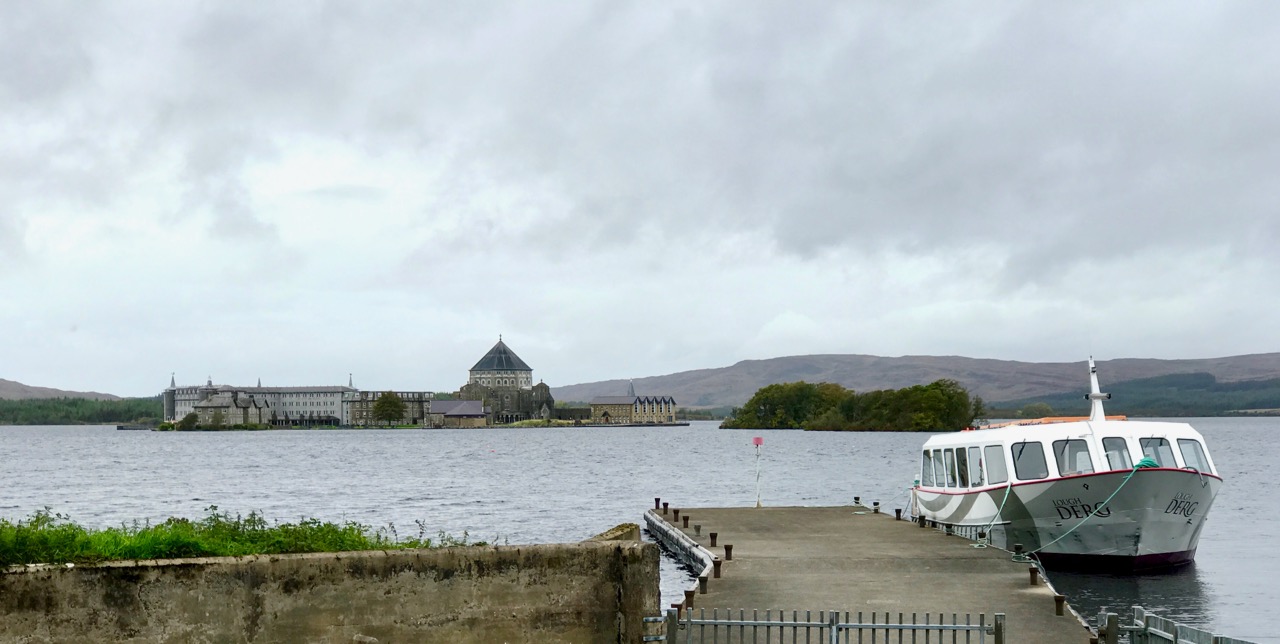
I was excited to be travelling to one of Ireland’s oldest – and most important – pilgrimage sites. Finola studies stained glass windows and their artists, and she knew that some particularly impressive Harry Clarke windows can be seen in the Basilica on Station Island, Lough Derg, in County Donegal. The roof of the Basilica, completed in 1931, towers over the island in the picture above, taken from the quay at Ballymacavany. Finola obtained special permission for us to visit the island to view and photograph the windows, after the main pilgrimage season was over: her account of them will appear in Roaringwater Journal in the near future.
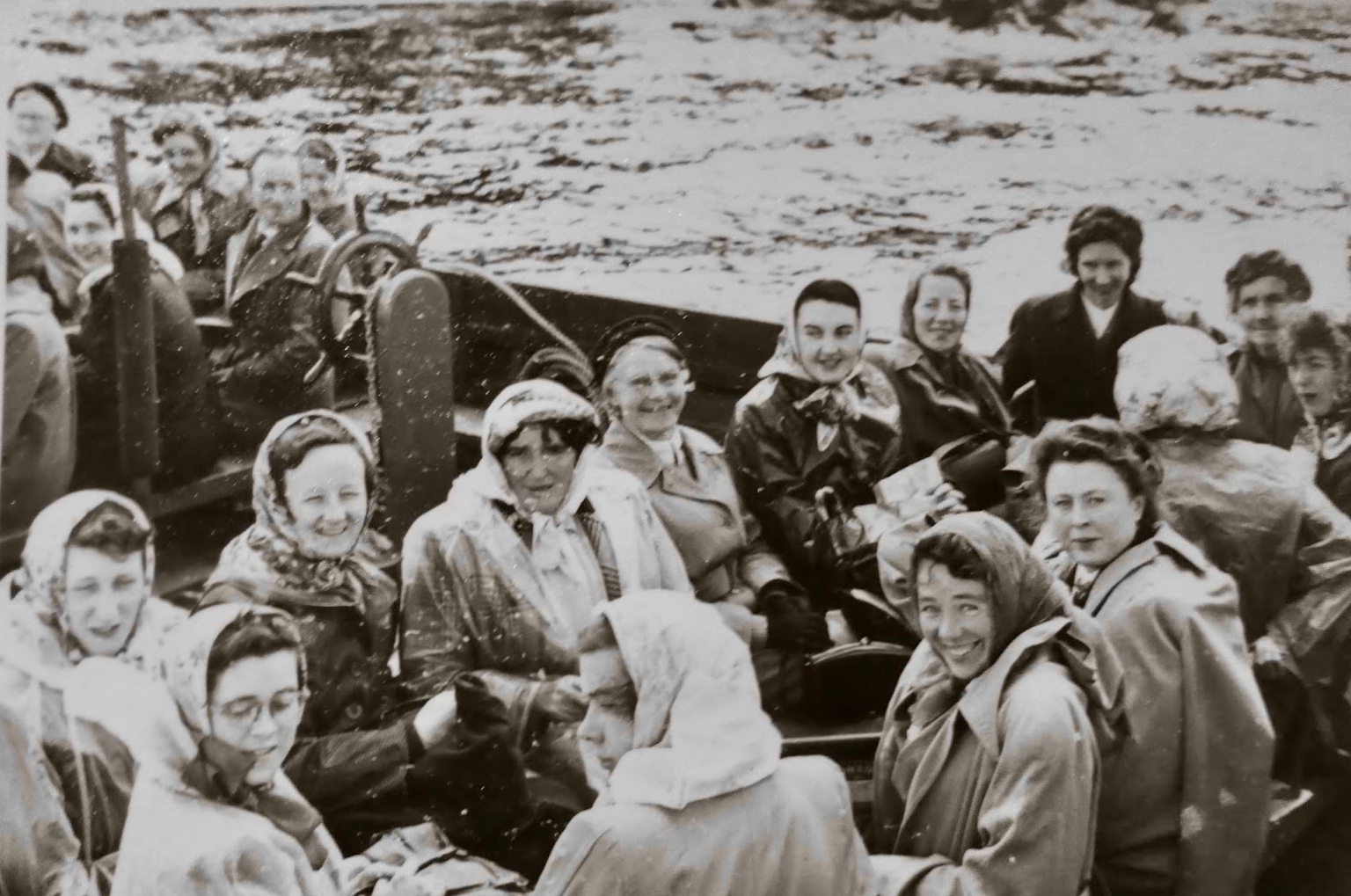
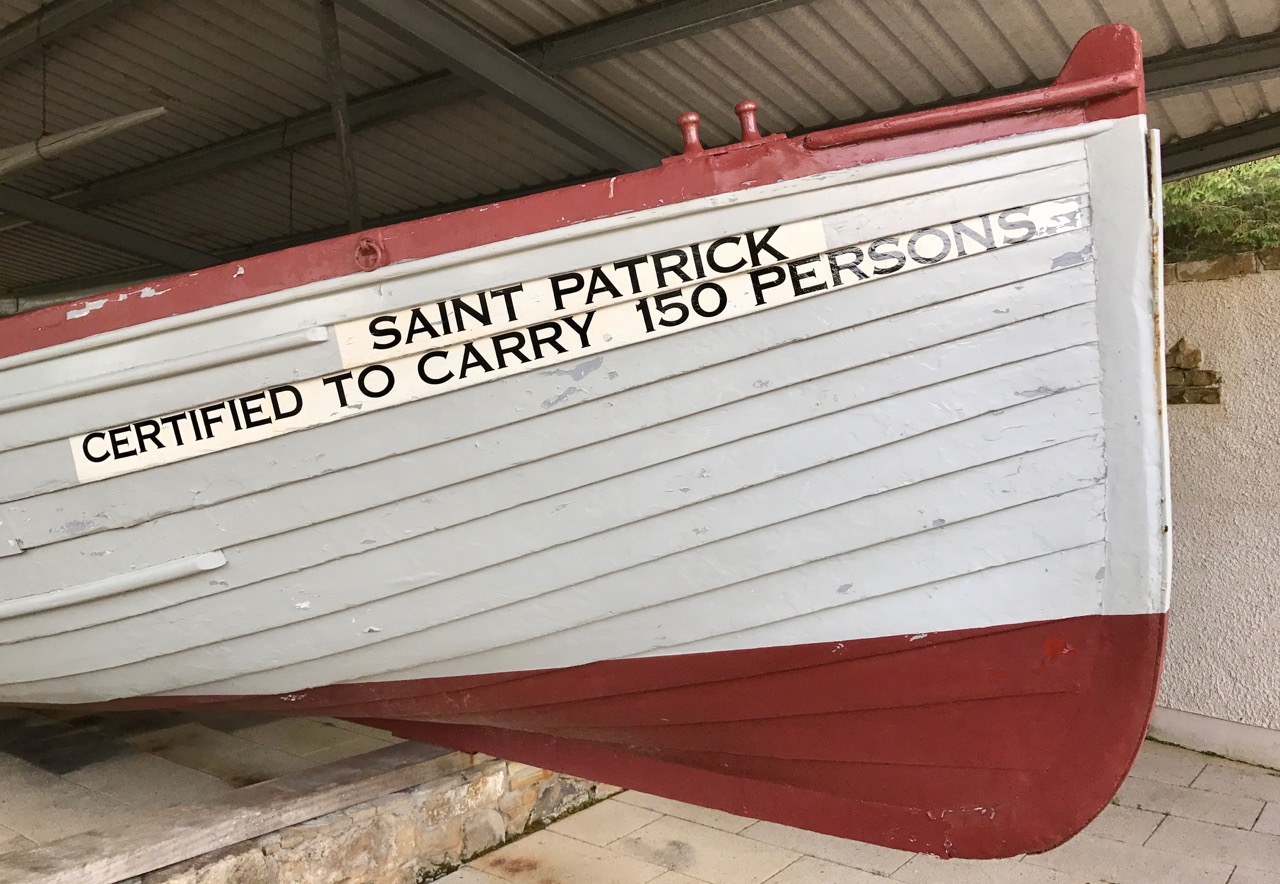
It’s salutary to learn how many people and families we know have taken part in the pilgrimage at Station Island. It’s a particularly austere experience, involving a three day cycle of prayer and liturgies, bare-footed and with very little food or sleep. Finola’s father undertook the pilgrimage in the 1950s: the photograph above was taken at around that time, when pilgrims were ferried over in large open boats once rowed by eight oarsmen and subsequently motorised. One of these historic boats is kept on display at Ballymacavany (below). Nowadays the journey is made in a modern covered launch, as seen in the header photo.
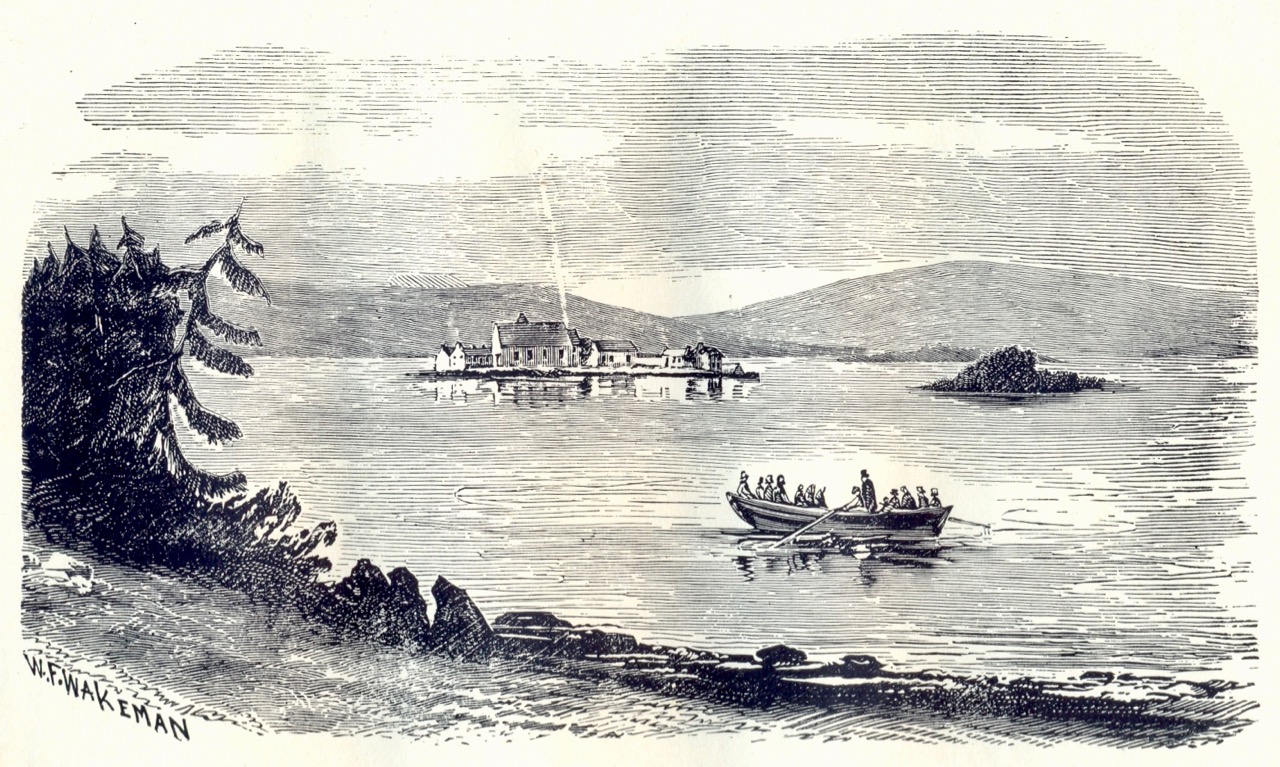
Records of the number of pilgrims who travelled to Station Island have only existed in comparatively recent times. The peak seems to have been just prior to the famine around 1846, when over 30,000 went there in one season. The drawing above is by William Frederick Wakeman, who was a draughtsman with the Ordnance Survey of Ireland, and was probably made at that time. Through the twentieth century numbers seldom fell below 10,000 pilgrims each season, but in many years was considerably more. This news item from the RTE Archives demonstrates the strength of the pilgrimage in the year 2000.

The island’s long history takes us back to the time of St Patrick. Despairing at the arduousness of persuading the Irish people to accept his Christian teachings he appealed to God to help. The story is admirably recounted by Dr Peter Harbison, Honorary Academic Editor in the Royal Irish Academy:

…St Patrick … was having difficulty convincing the pagan Irish of the 5th century of the truth of his teaching about heaven and hell; they were not prepared to believe him unless one of them had experienced it for themselves. To assist Patrick in his mission … Christ showed Patrick a dark pit in a deserted place and told him that whoever would enter the pit for a day and a night would be purged of his sins for the rest of his life. In the course of those twenty four hours, he would experience both the torments of the wicked and the delights of the blessed. St Patrick immediately had a church built, which he handed over to the Augustinian canons (who did not come to Ireland until the 12th century), locked the entrance to the pit and entrusted the key to the canons, so that no one would enter rashly without permission. Already during the lifetime of St Patrick a number of Irish entered the pit and were converted as a result of what they had seen. Thus the pit got the name of St Patrick’s Purgatory…

(from Pilgrimage in Ireland: the Monuments and the People by Peter Harbison, Barrie & Jenkins, 1991)

The entrance to this cave is on Station Island, and is the reason for the enduring popularity of the pilgrimage, which has persisted there for over 1500 years. In the medieval illustrations above, the gateway into Purgatory can be seen on the right, while on the left is a knight – Owein – whose terrifying adventures in the cave in medieval times have been written about in many languages: a summary can be found here.
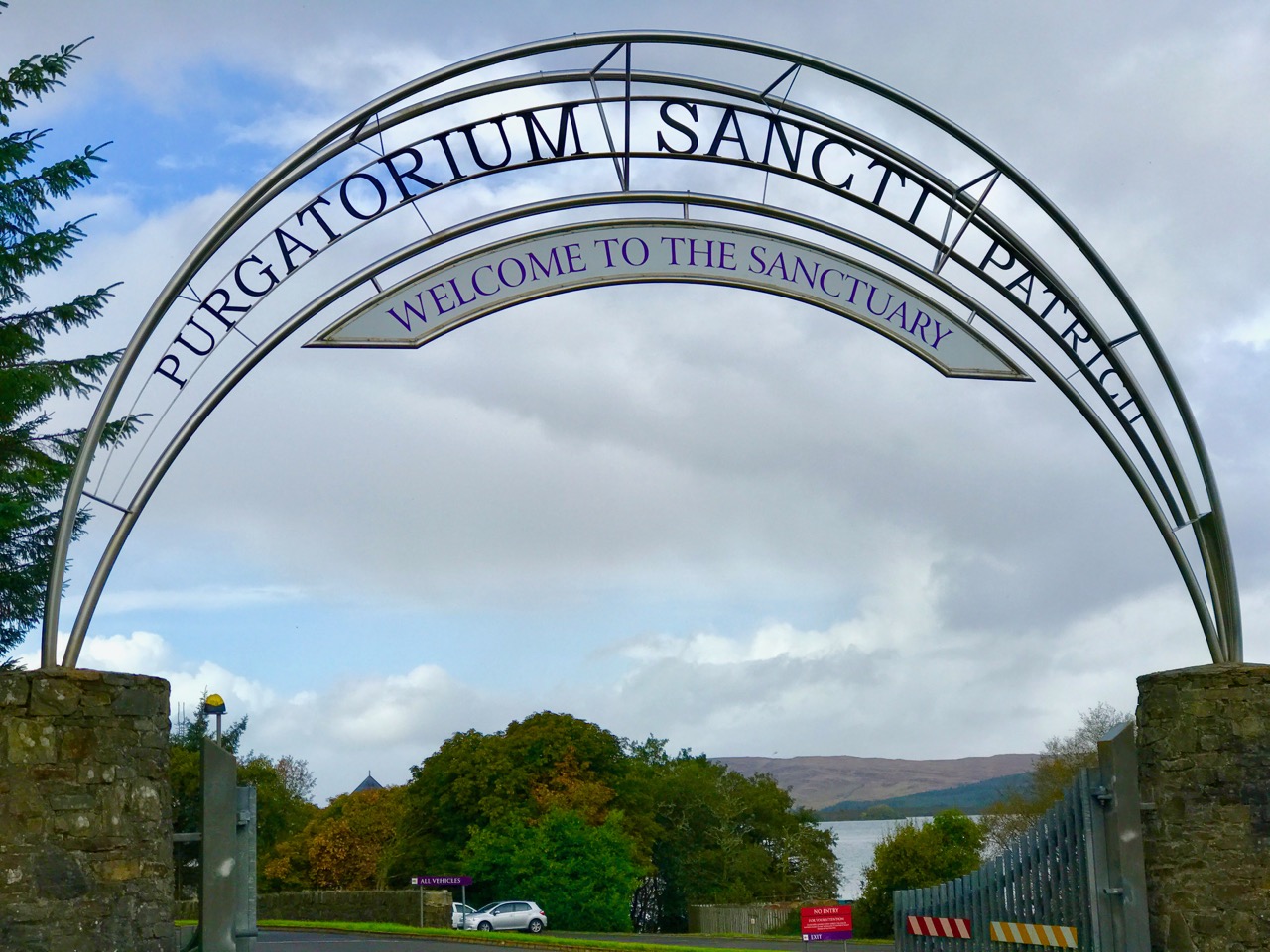
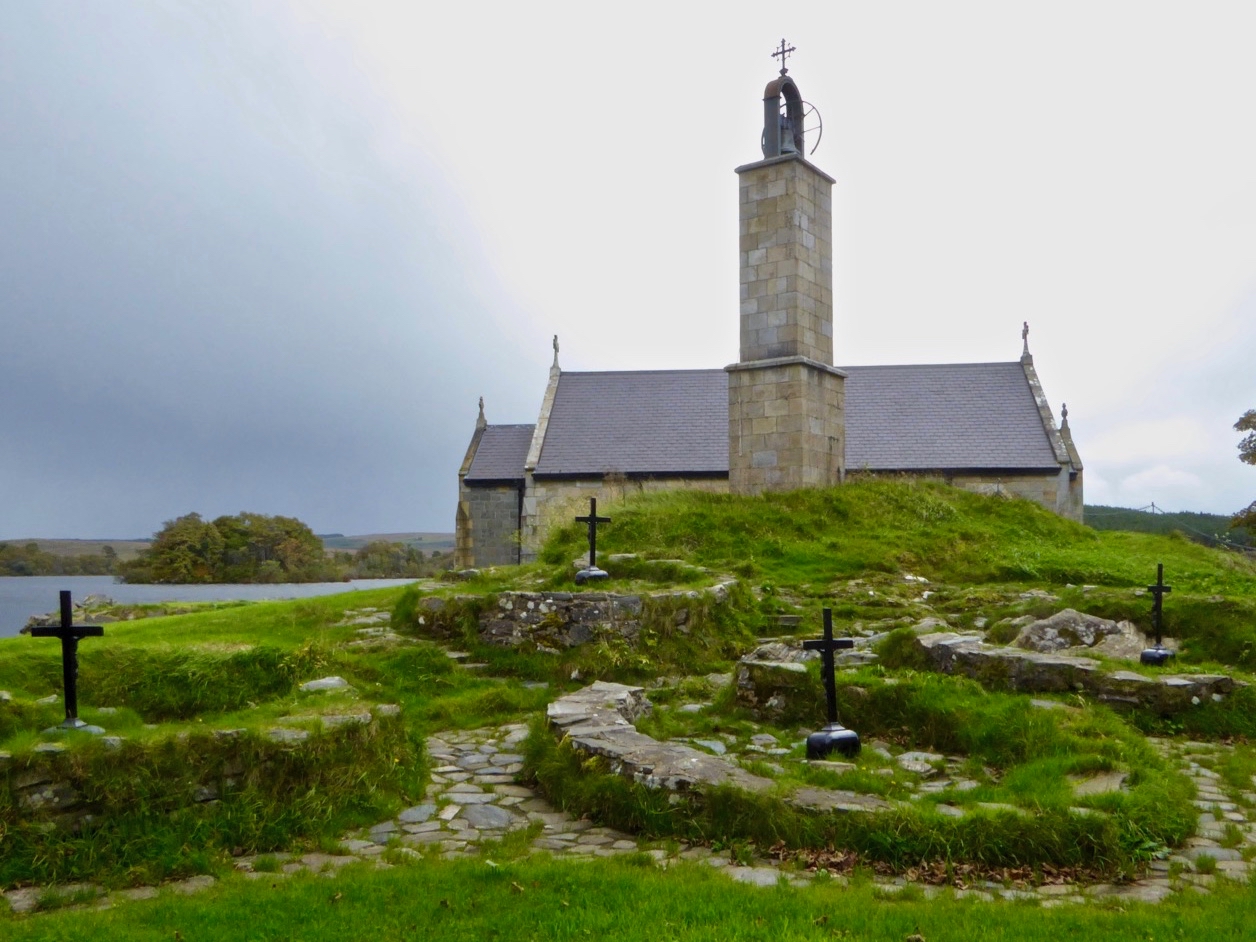
St Patrick’s Purgatory: the name is over the entrance at the reception centre at Ballymacavany, the point of departure for Station Island. The cave which marks the entrance into Purgatory was permanently sealed up in October 1632 when the pilgrimage was suppressed by order of the Privy Council for Ireland; in the same year the Anglican Bishop of Clogher, James Spottiswoode, personally supervised the destruction of everything on the island. Later, in 1704, an Act of Parliament imposed a fine of 10 shillings or a public whipping …as a penalty for going to such places of pilgrimage… The site of the cave entrance lies under the bell tower, seen above. In front are the penitential beds where pilgrims perform rounds to this day. It is thought that these formations are the remains of monks’ cells or ‘beehive huts’.

On the left is a map of Station Island by Thomas Carve, dated 1666. The words Caverna Purgatory, centre left, show the site of the cave entrance. In spite of the efforts of the Penal Laws to suppress the observances, pilgrimages have continued unabated. Above right is a photograph from the Lawrence Collection, dated 1903, showing pilgrims about to embark for the island.
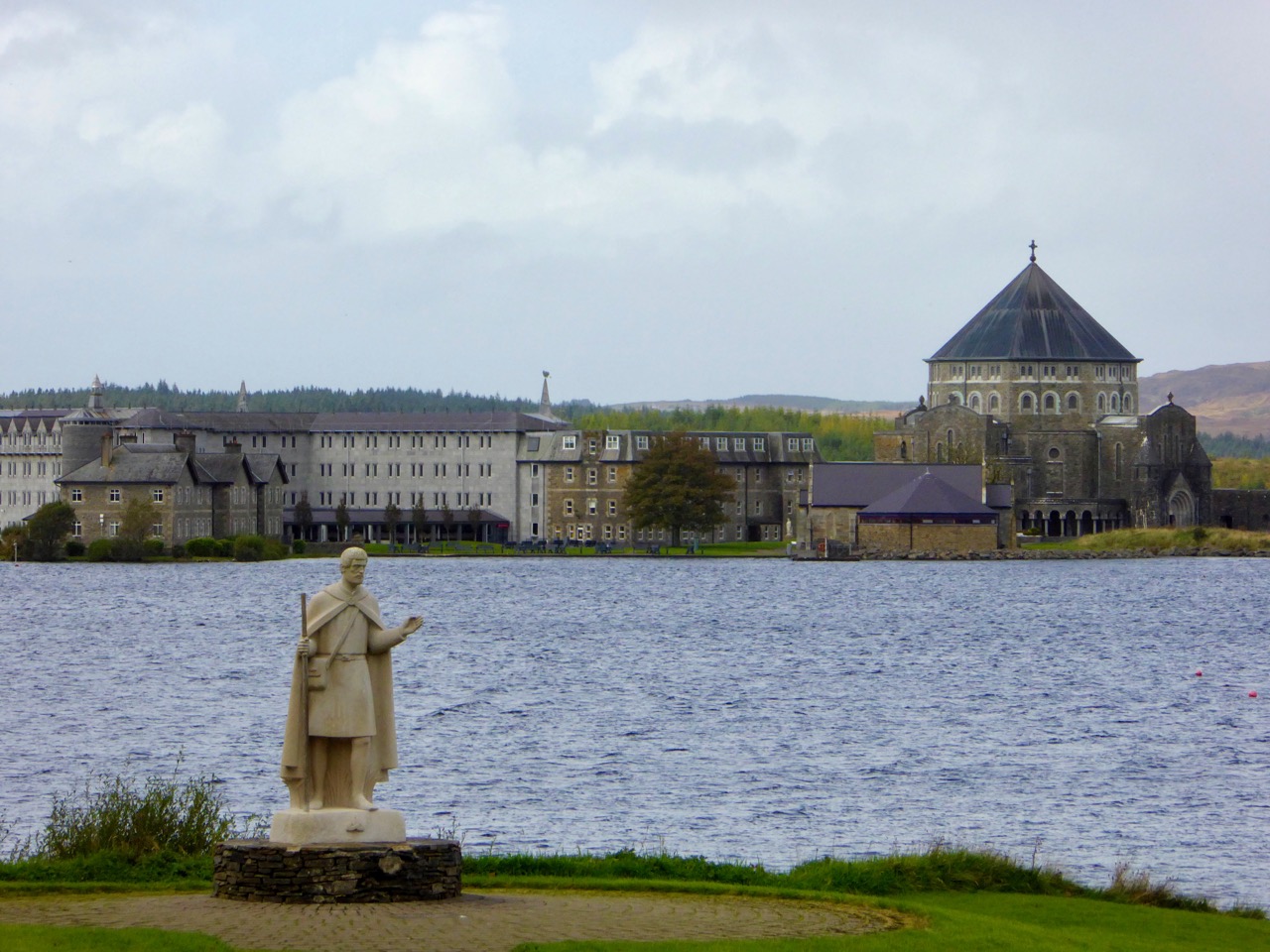
A young St Patrick portrayed as a pilgrim stands in front of the island: the Basilica is on the right. This view indicates the huge development  of the island since its complete destruction in the 18th century and shows the facilities provided for the many thousands who have come here over the generations.
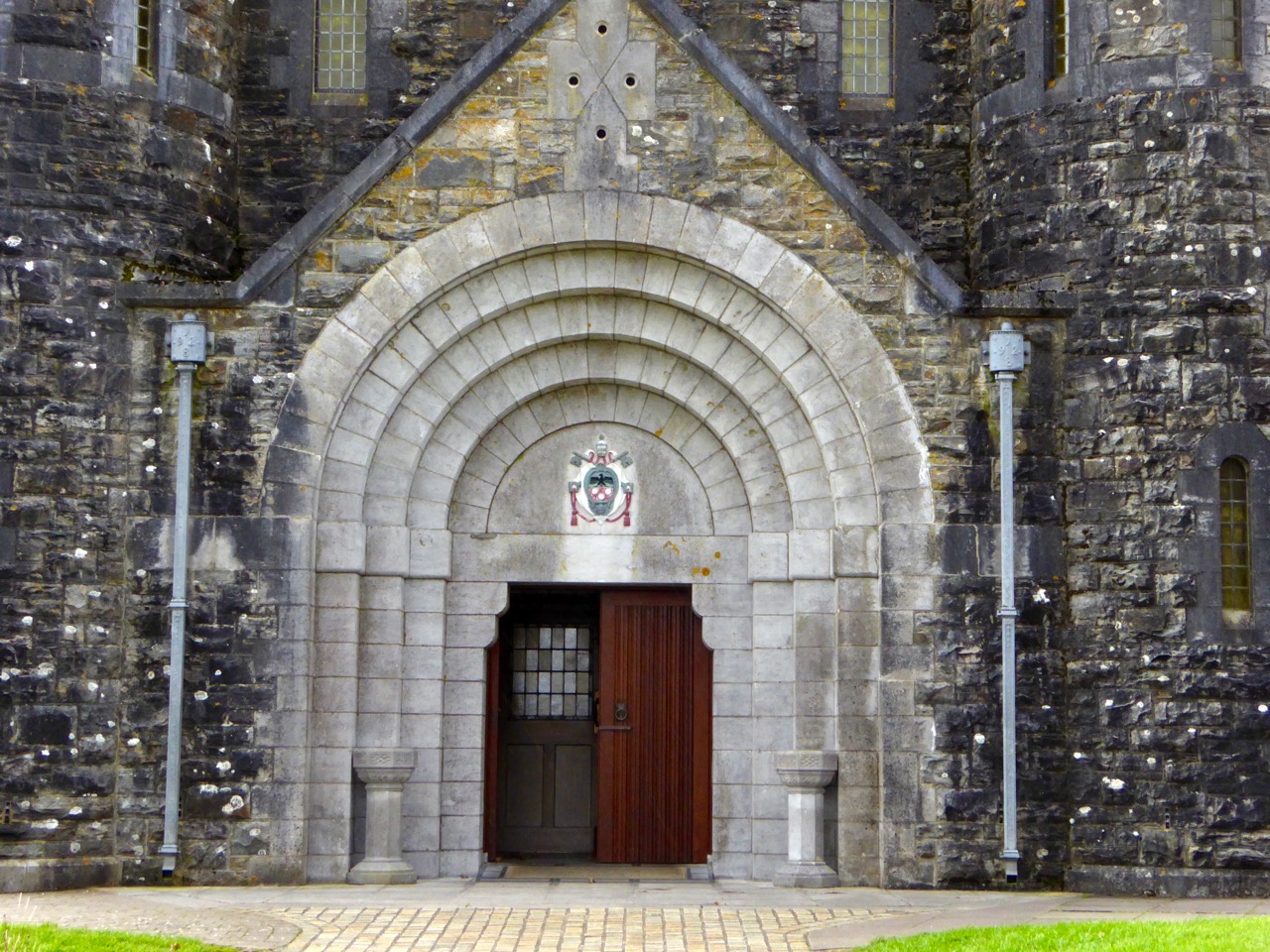
The Basilica is the focus of the pilgrimages today: it was formally consecrated in 1931. The entrance door is a modern interpretation of Romanesque architecture, while the tabernacle is an impressive example of fine bronze work.
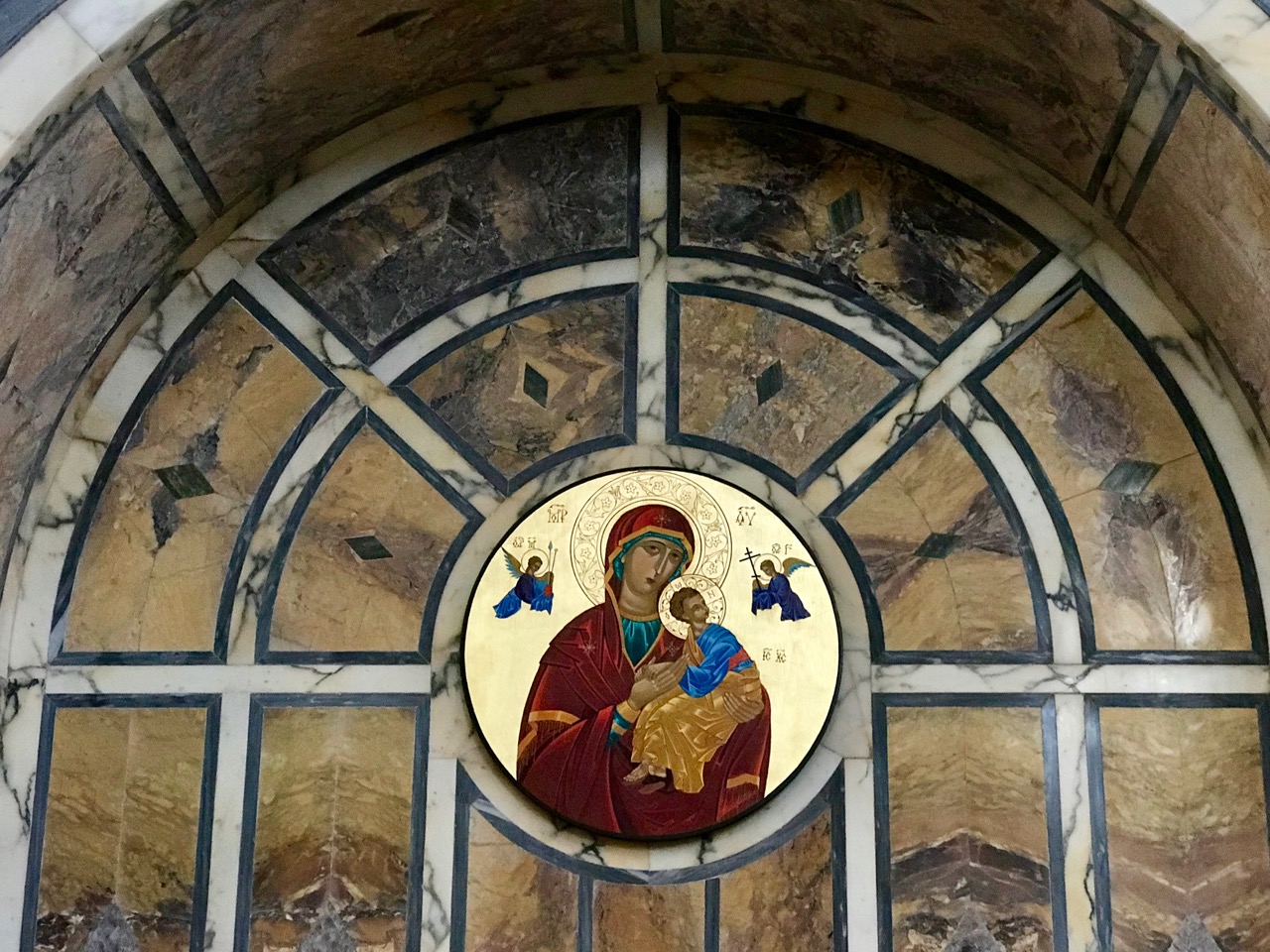
Ireland’s great poets and writers have visited St Patrick’s Purgatory, and have responded to the experience:

Donnchadh Mór Ó Dálaigh (1244) “Chief in Ireland for poetry”:

Truagh mo thuras ar loch dearg
a Rí na gceall is na gclog
do chaoineadh do chneadh’s do
chréacht
‘s nach faghaim déar thar mo rosg.

(Sad is my pilgrimage to Lough Derg, O King of the cells and bells; I came to mourn your sufferings and wounds, but no tear will cross my eye)

Patrick Kavanagh:

Lough Derg, St. Patrick’s Purgatory in Donegal,
Christendom’s purge. Heretical
Around the edges: the centre’s hard
As the commonplace of a flamboyant bard.
The twentieth century blows across it now
But deeply it has kept an ancient vow.

W B Yeats:

Round Lough Derg’s holy island I went upon the stones,
I prayed at all the Stations upon my marrow-bones,
And there I found an old man beside me, nothing would he say
But fol de rol de rolly O.

Most impressive of all, perhaps, is Seamus Heaney whose moving contemplations took him back through his life experiences and produced twelve memorable poems in a volume entitled Station Island:

How well I know that fountain, filling, running,
although it is the night.
That eternal fountain, hidden away,
I know its haven and its secrecy
although it is the night.
But not its source because it does not have one,
which is all sources’ source and origin
although it is the night.
I know no sounding-line can find its bottom,
nobody ford or plumb its deepest fathom
although it is the night.
And its current so in flood it overspills
to water hell and heaven all peoples
although it is the night.
And the current that is generated there,
as far as it wills to, it can flow that far
although it is the night.

Finally, here’s a contemporary journalist’s view, well worth the read!
 

Kilcoe Studios – Dedication and Passion

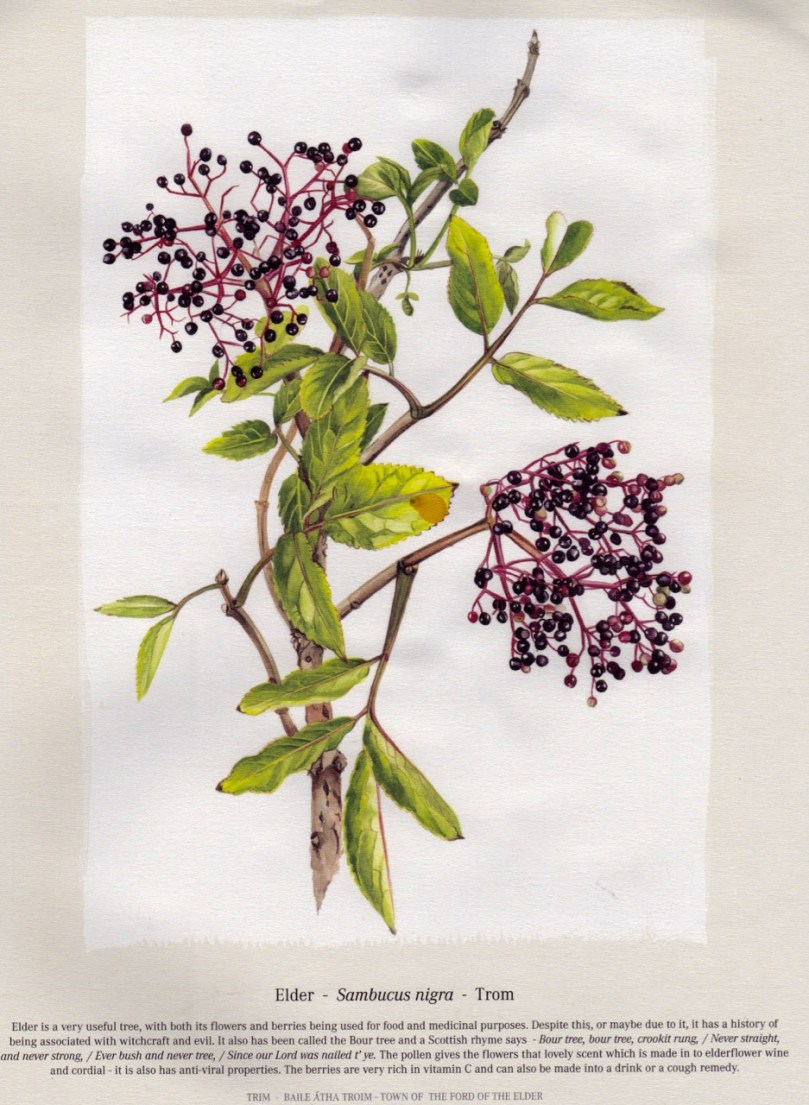
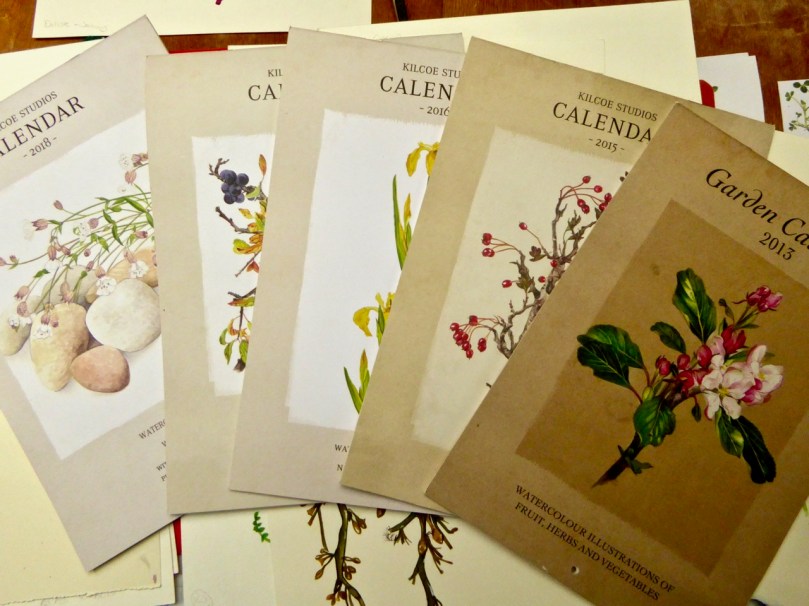
Every year I’ve pounced on the Kilcoe Studios calendars as soon as they come out, and bought their exquisite cards. Recently I met their creator, Sonia Caldwell and discovered that the studio is quite close to me. I told Sonia that I’ve long been an admirer of her work and asked if I could visit her in her studio and talk to her about her inspirations. In the process I discovered a dedicated and hard-working artist and sculptor and a fellow wildflower lover. *

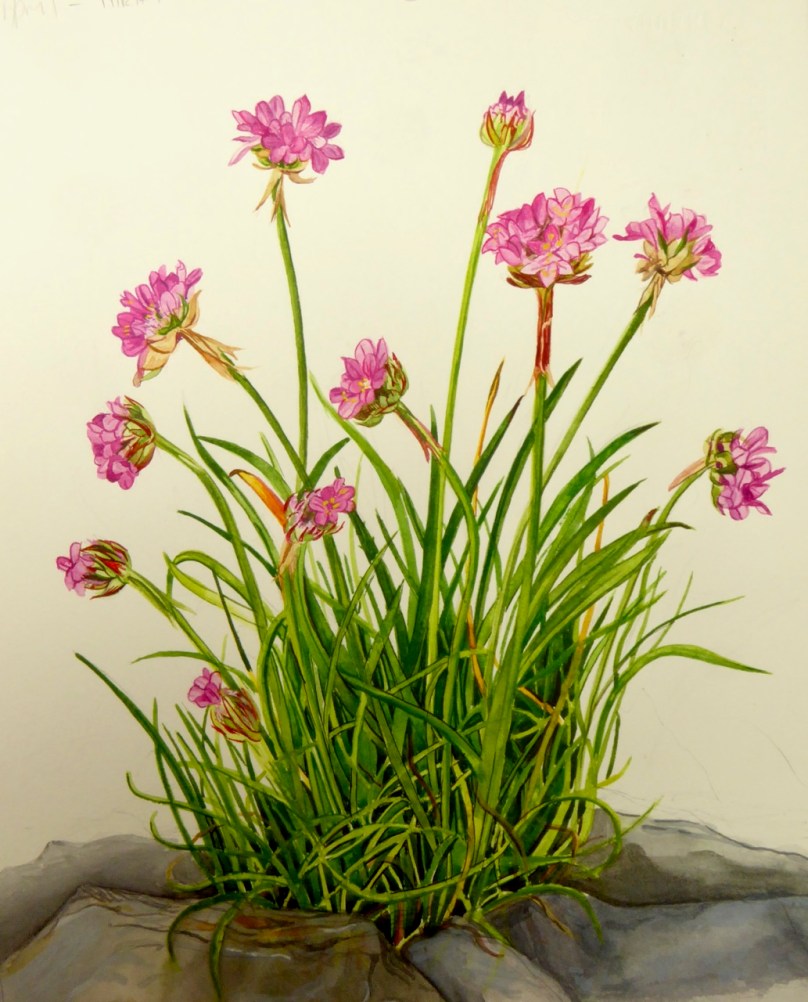
Thrift, or Sea Pinks

Sonia’s botanical artwork is meticulous and yet avoids mere illustration. Her colours are delicate but true and she insists on live models – you just can’t get the detail you need from a photograph, she asserts.

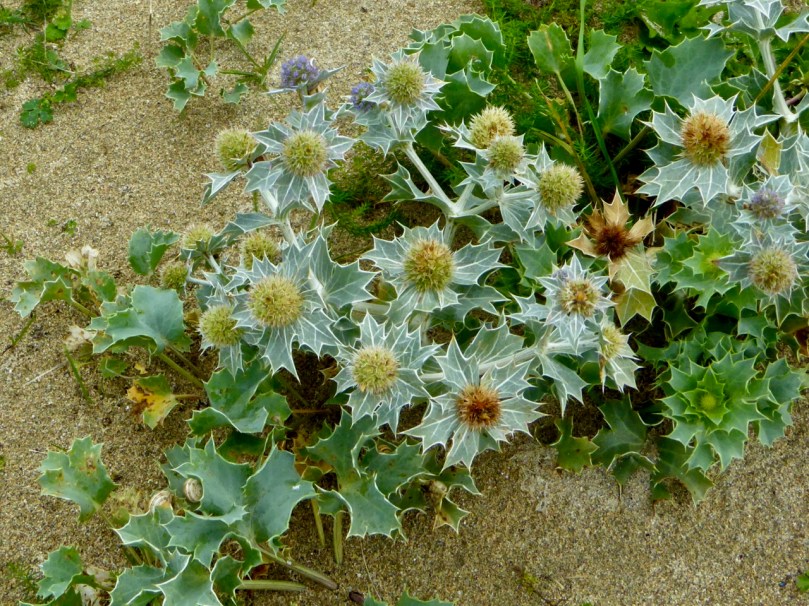
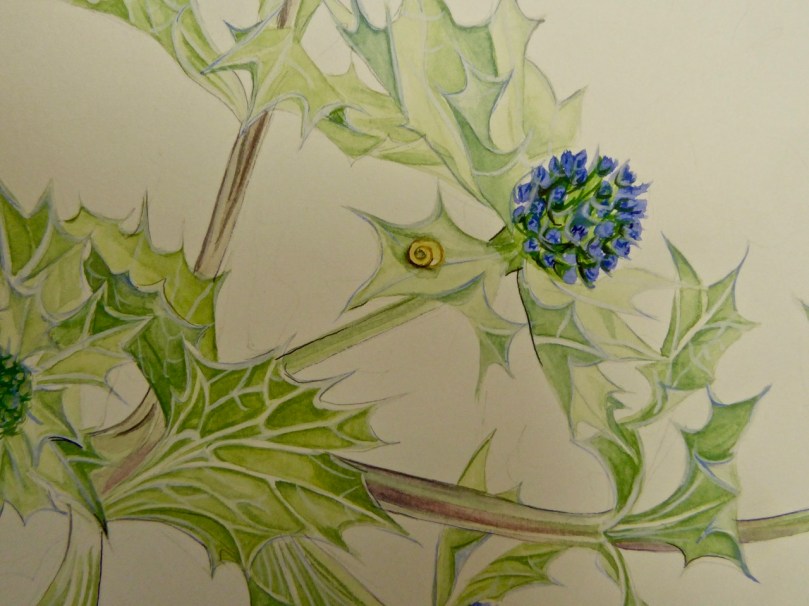
Sea-holly: my own photograph, and a detail from one of Sonia’s paintings

But it’s more than that – she researches each flower, tree, shrub, berry, fruit and provides information on folklore, herbal uses, Irish names and their meanings, and other little titbits of information.

She collaborated with the marvellous Pilgrim’s Restaurant of Rosscarbery for the latest (2018) calendar. We’ve eaten there a couple of times and been blown away by their approach to food – simple, fresh, delicious, and often with foraged ingredients. I’m still living on the memory of their blackberry and meadowsweet sorbet. So with this calendar not only are you getting Sonia’s wonderful botanical prints but recipes from the Pilgrim’s chefs as well.

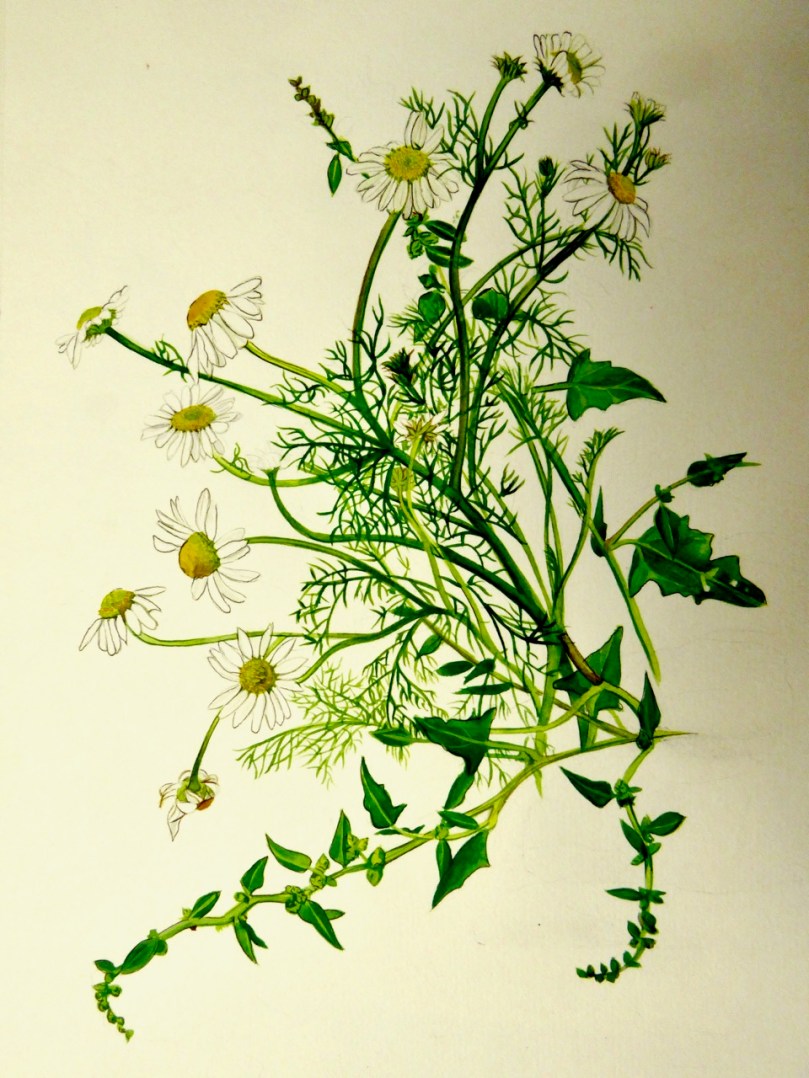
This is Sea Mayweed and Orache intertwined. Pilgrim’s recommends a one-minute steaming for the Orache, and pairing it with white fish (like hake), new potatoes and a cream sauce. You can also mix it with other “tidal greens” such as rock samphire, sea aster, and sea beet.

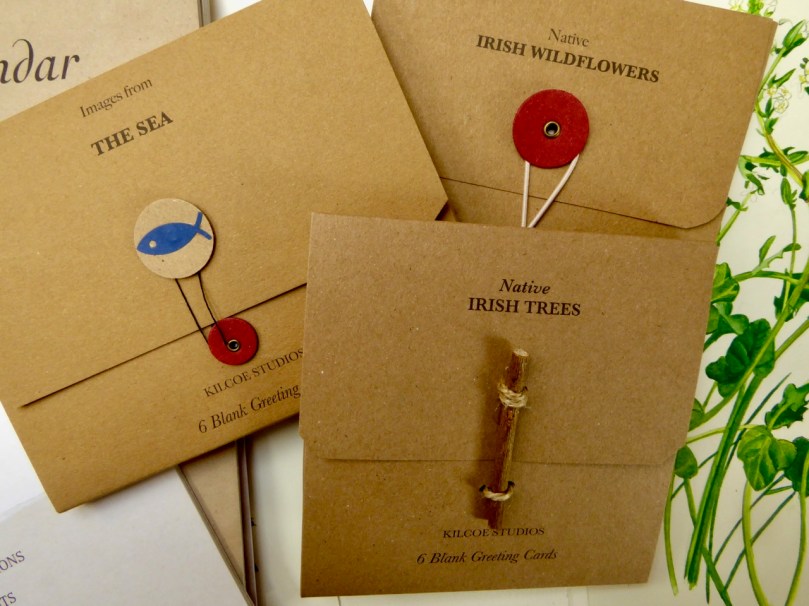
The painstaking drawings she lovingly creates for her calendars also go into her cards. That’s great, because they should outlive their ‘year’. The card packaging is a work of art in itself – I’ve given many a set as a gift.

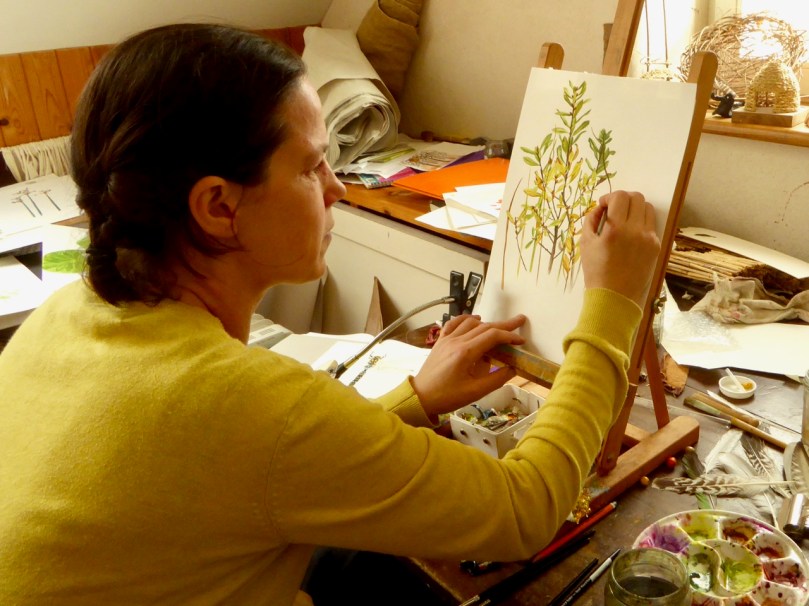
Because I’ve spent so many hours myself photographing wildflowers I know what goes into identifying, researching, and then reproducing each one, but only on a superficial level compared to the kind of attention each one gets from Sonia. Watching her getting the colour of each leaf exactly as she saw it was illuminating, and humbling.

Sonia sells her work in various stores throughout Ireland, but you can also order from her online shop. There’s still time to get those 2018 calendars!

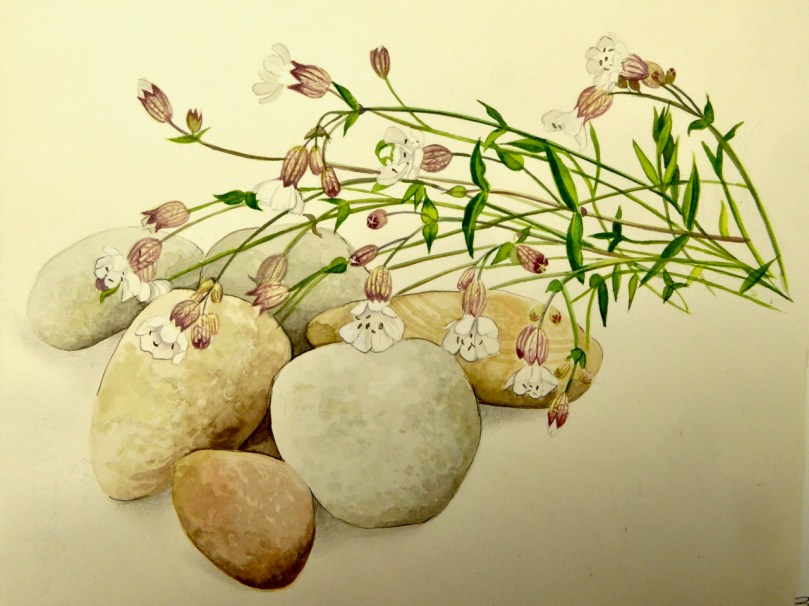
Sea Campion – the front cover illustration for the 2018 calendar

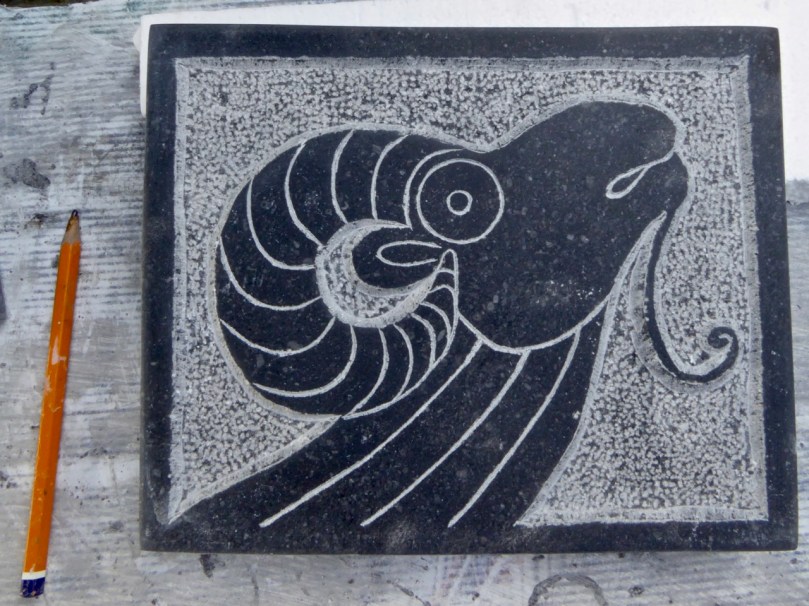
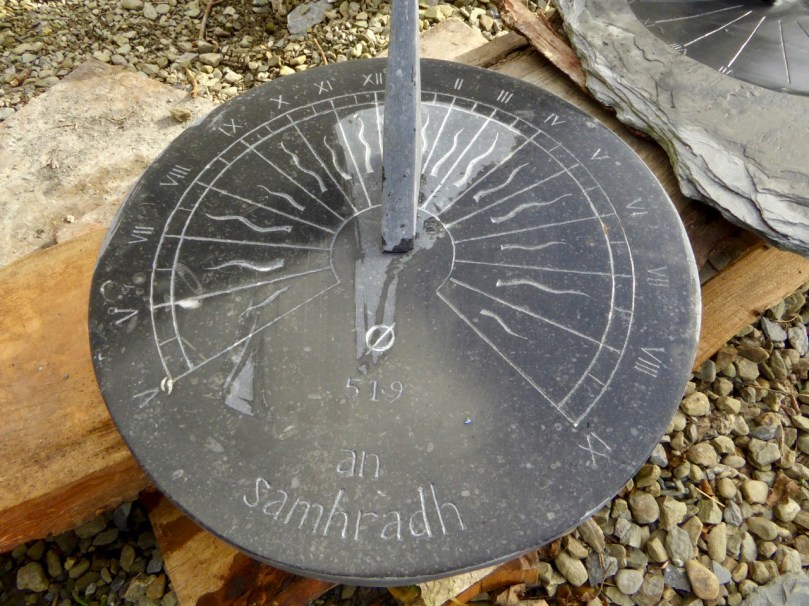
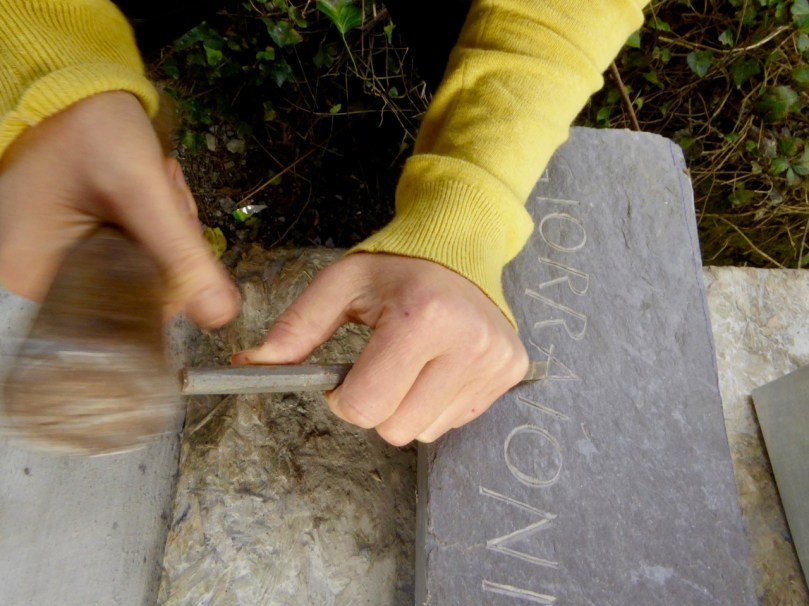
Although I was aware that Sonia was also an accomplished sculptor, I was unprepared for what I found in her studio. She works in stone, on both a small and large scale. She makes beautiful bowls, sundials and plaques as smaller, more affordable pieces, and they are popular buys at the summer markets. 

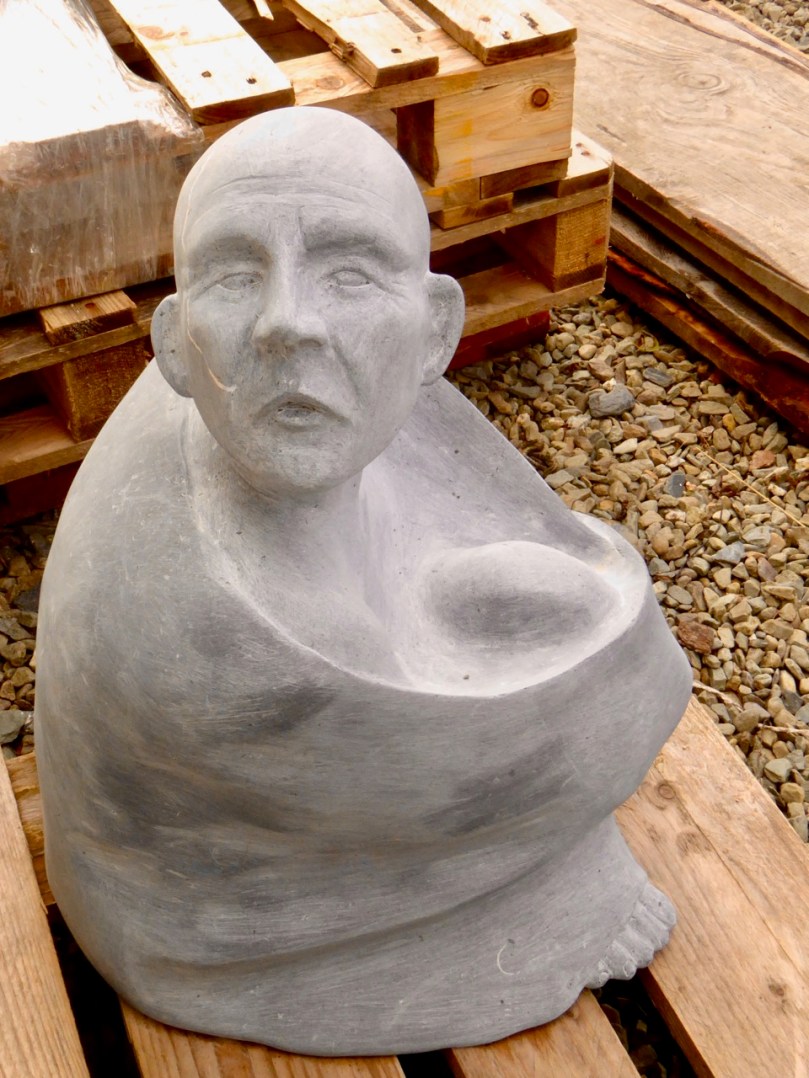
But her passion is her figurative work. These are large-scale carvings, mostly in Kilkenny limestone, which she polishes to a beautiful finish using finer and finer grades of sandpaper. It’s physically demanding work, but I get the impression that when she’s engaged in it, she’s lost to time, and indeed to everything except what’s under her chisel.

Her work has a quality to it that I can only call ‘questing.’ The eyes look far away, seeking answers to some great question. In one case, they are blindfolded, forcing the quester to look inward. The bodies fold in on themselves, or on one another, or are rigid, as if acting as mere plinths for the imagination or the brain

It’s powerful stuff, and left me wondering why artists such as Sonia face such difficulties in the market place. Sculpture, I now understand, is much harder to sell than paintings. You can see a range of Sonia’s sculpture on her separate artist’s website. She has exhibited widely.

Sonia works with her husband, Eamon Quinn, a master joiner. Take a look at his beautifully-crafted furniture on their website. It’s inspiring to spend time with someone like Sonia, someone so dedicated and talented and committed. The good news is that, even if you don’t happen to live near her, you can still enjoy her art every day of the year.

*All the images of Sonia’s work are used with her permission. Please respect intellectual property issues and copyright for all the artwork in this blog post.

Mizen Magic 6: Schull to Castlepoint

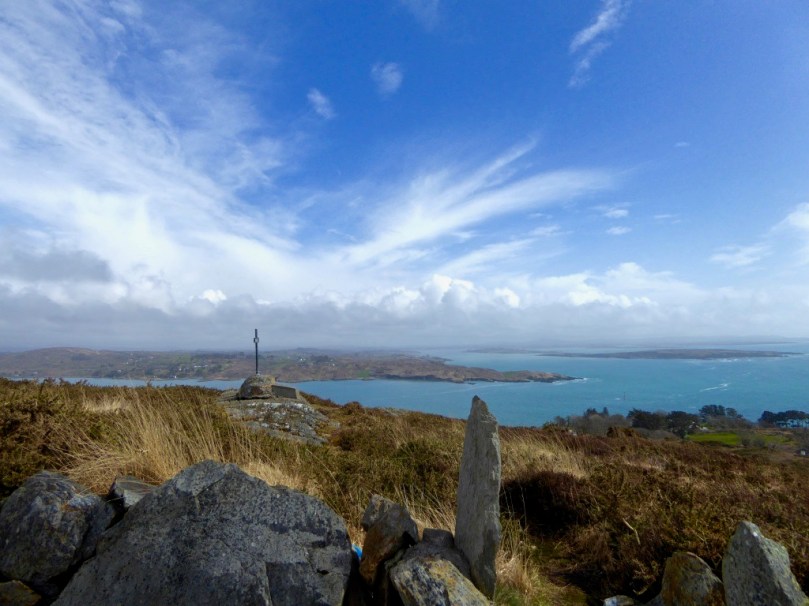
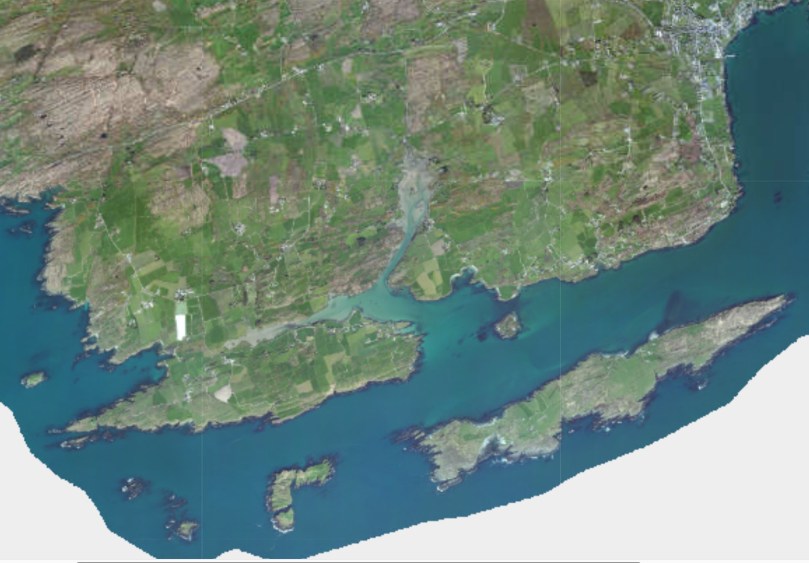
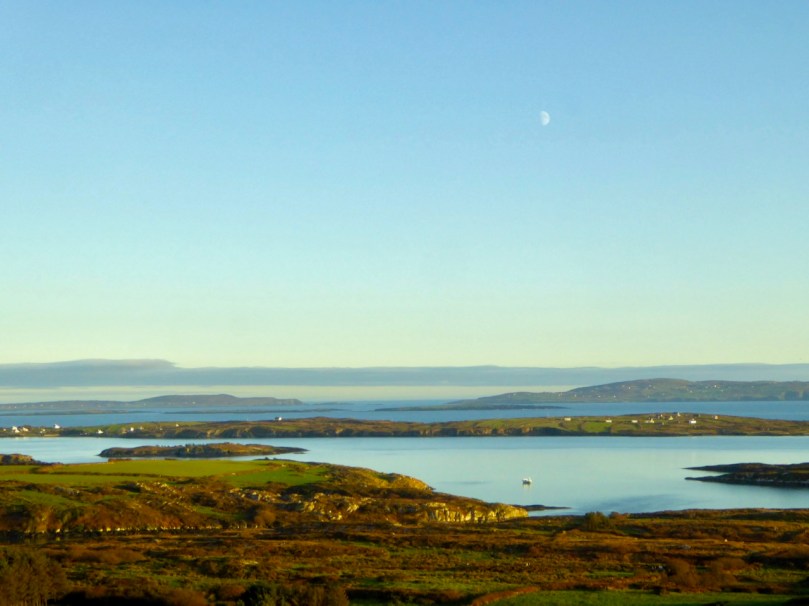
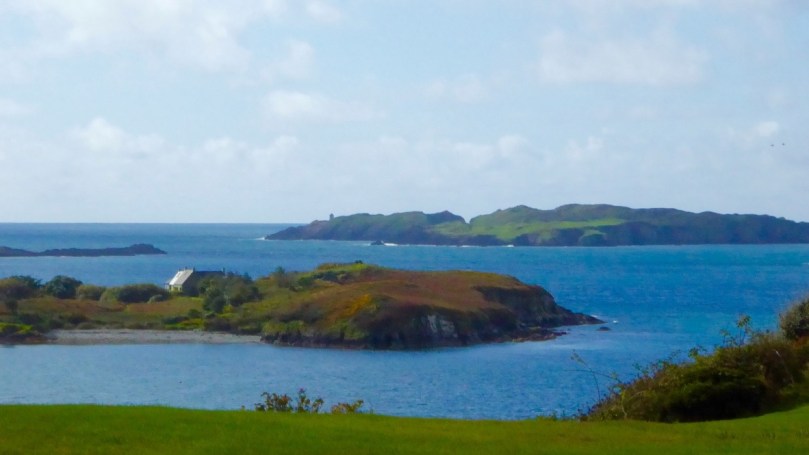
The Mizen is the Peninsula we live on, and of course we think it’s the most beautiful part of West Cork, and of Ireland. In previous Mizen Magic posts I’ve been exploring different aspects and areas, such as the Northside, or Brow Head, or our excellent beaches. This time I’m concentrating on the stretch from Schull to Castlepoint. The map below shows the area, with the village of Schull, our starting point, on the top right. The photograph above was taken from the top of Sailor’s Hill.

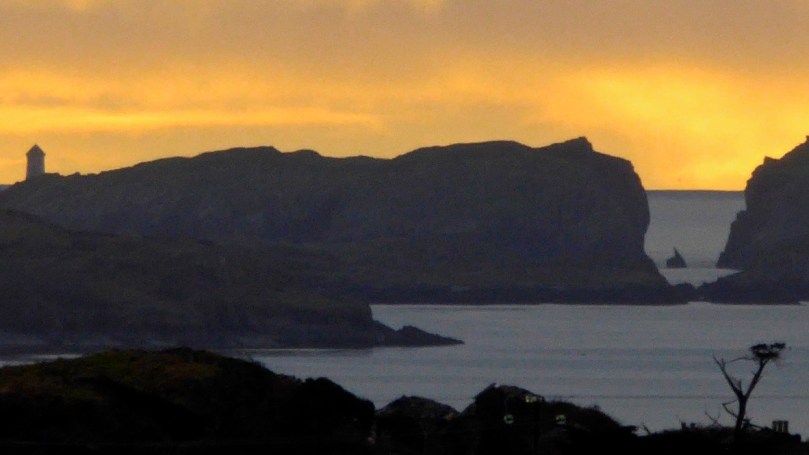
A winter view of Long Island Sound – Coney Island, Long Island,  the Calves, Cape Clear and Sherkin, with the entrance to Croagh Bay in the foreground

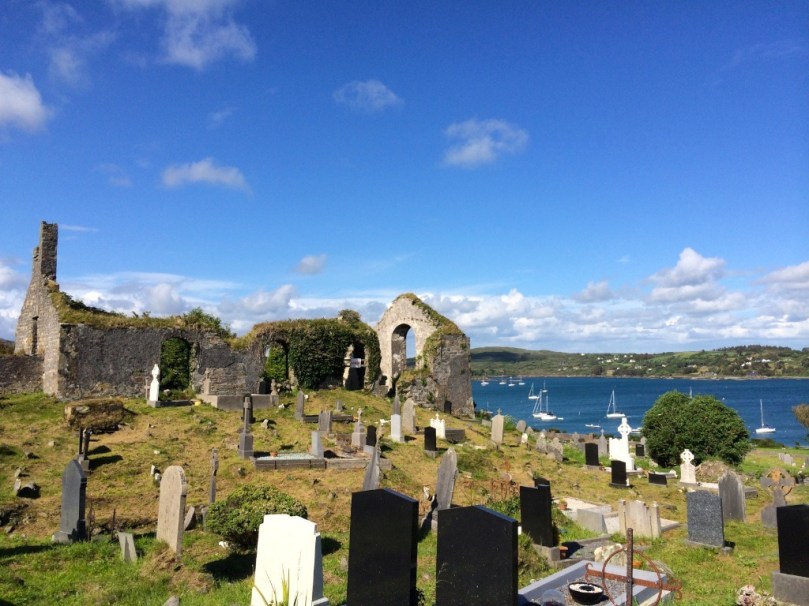
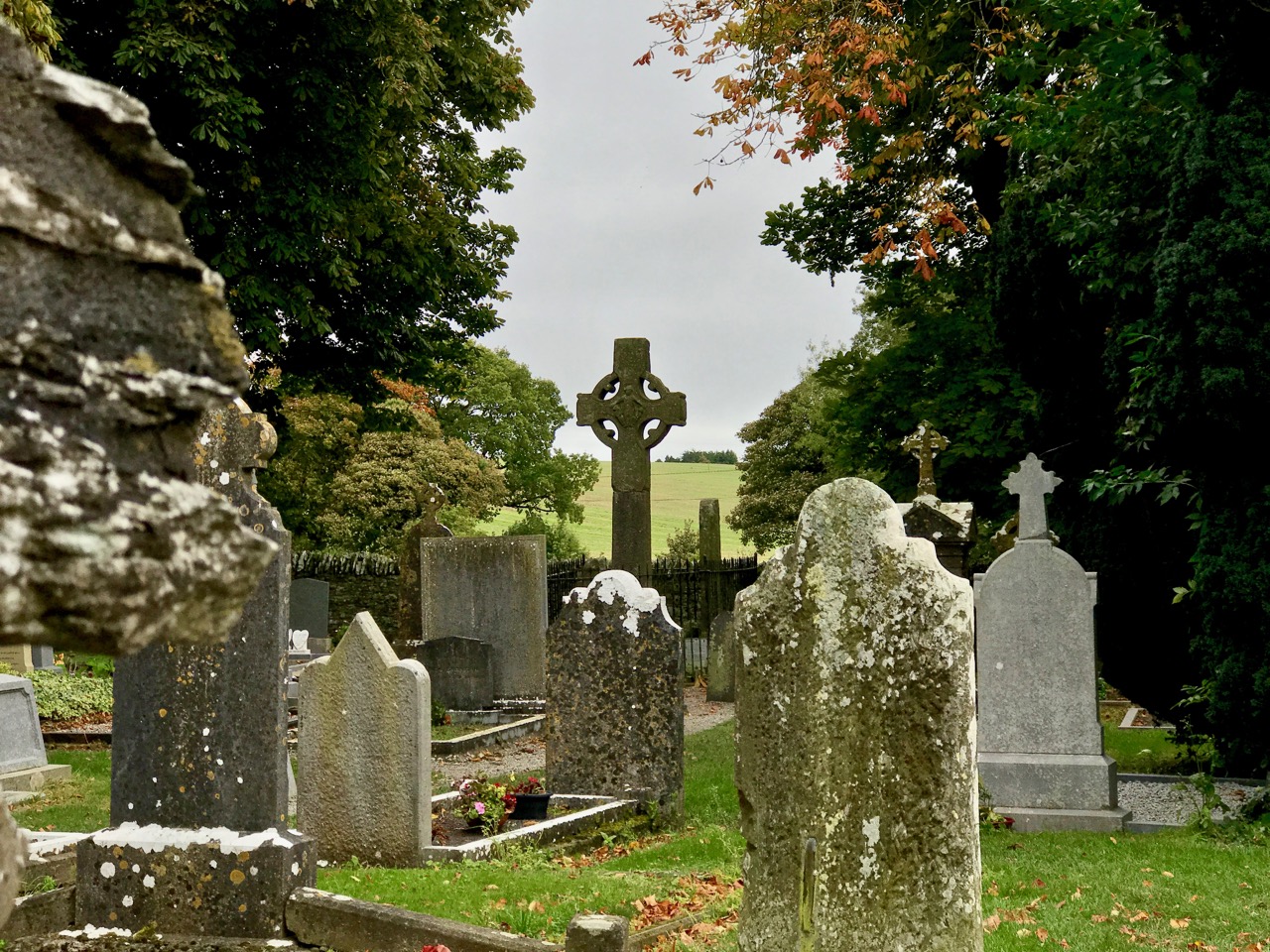
It’s only a few kilometres, and it would take you about ten minutes to drive straight to Castlepoint from Schull. But where’s the fun in that? No- let’s start by driving (or walking if you’d rather) out to St Mary’s Church on the Colla Road. It’s largely an eighteenth century church, although there are hints of a medieval structure here and there, and it stands in what must be one of the most scenic graveyards in West Cork.

Intriguing depictions of boats are inscribed into the render inside the church. How old are they? Who did them and for what purpose?

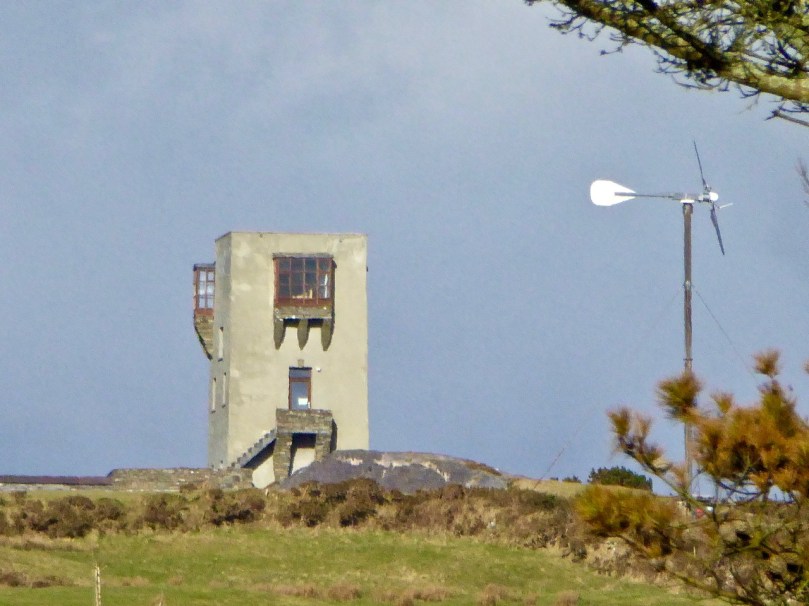
From there, I suggest you drive to the lookout on Sailor Hill – the trail arrows for the new extension of the Fastnet Trails will show you the way. We discovered Sailor’s Hill ourselves when I was researching belvederes – the redoubtable Connie Griffin has built his own modern version of a belvedere and there is no better place to get a view of Long Island Sound and the south side of the Mizen. Here’s the viewing house Connie built  – perfect for contemplation.

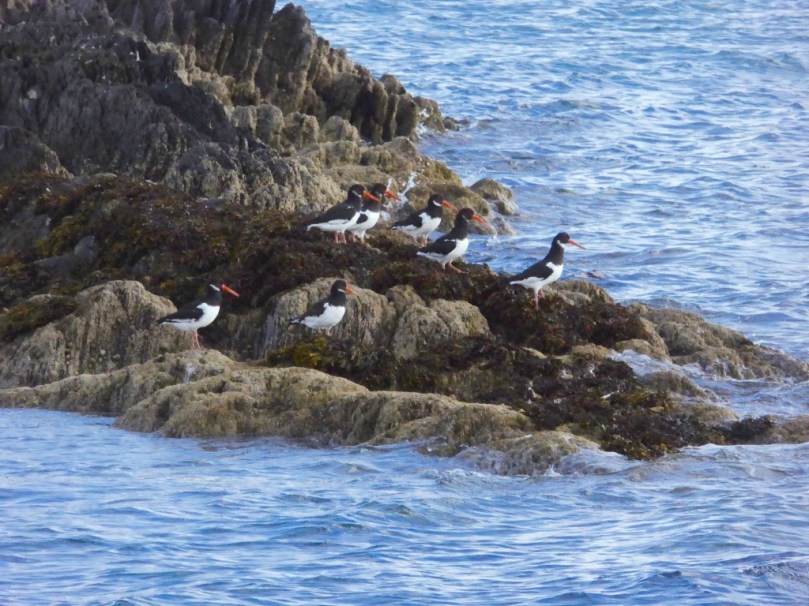
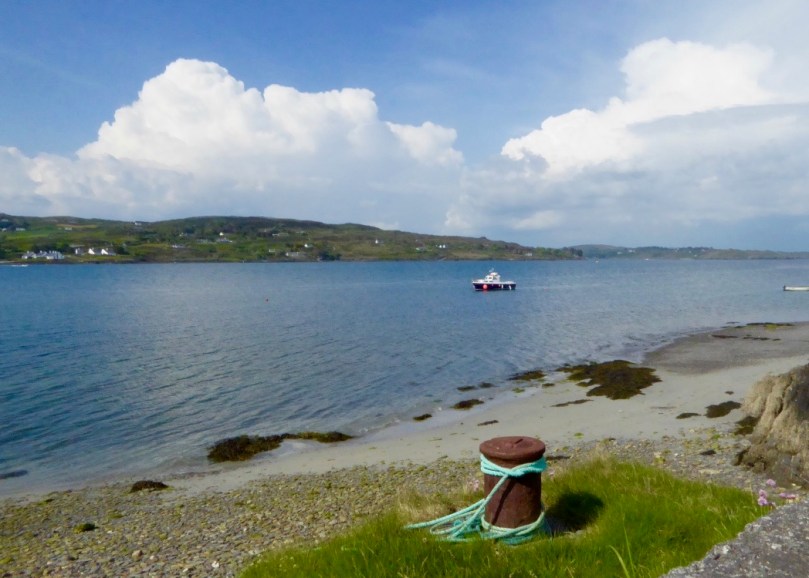
Back down to the Colla Road, continue to the scenic little Colla Pier, where you can take the ferry to Long Island. Robert and I do this every year as part of the Fastnet Film Festival. The ferry runs every day but you can also book special trips – it is, as they say here, a great day out. Pack a picnic and your camera – there’s lots of birdlife, including these oystercatchers on the rocks at Colla Pier.

The ferry leaves Long Island for the return trip to Colla Pier

From the Pier the road winds across country, overlooking the sea here and there, and always with Mount Gabriel looming in the background. From here you can see tiny Coney Island, privately owned, and with one house which is rented out to holiday makers.

Beyond Coney Island are the Goat Islands – Goat Island and Goat Island Little – probably once one island, but now split into two, with a narrow passage between. There are feral goats on these islands, but not much else. They appear to be completely inaccessible, with craggy shores that are impossible to land on. That, of course, only makes them all the more mysterious. I’d love to hear from anyone who knows more about the Goat Islands.

The narrow and treacherous channel that divides the Goat Islands, and the beacon on the smaller of the two islands

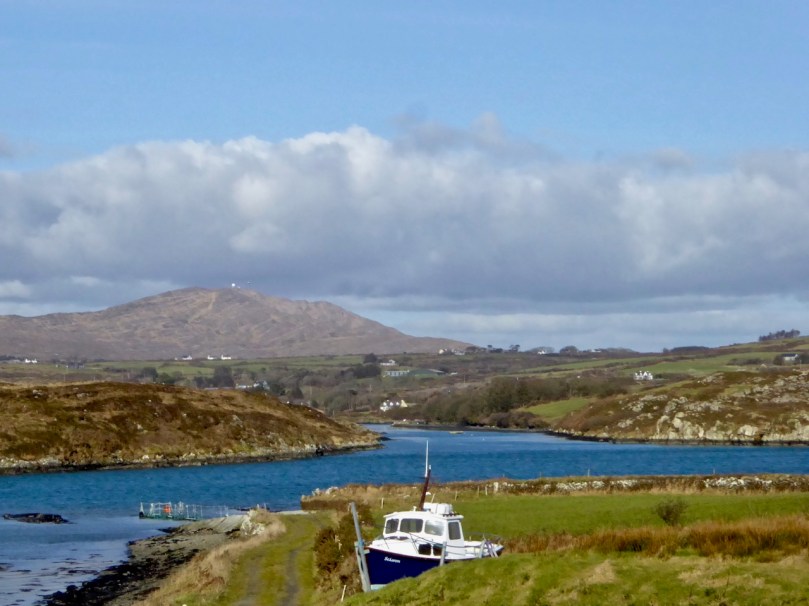
The road now winds down to Croagh Bay (locally pronounced ‘Crew’), a lovely tidal sheltered inlet with the romantically named Gunpoint at its head. On the higher ground to the right you will see that an enterprising individual has converted one of the old signal stations into a unique residence. It must have the best view – but all those stairs!

We are now in the territory described by Robert in Here Be Pirates and in Pilchards and PalacesCroagh Bay, or more correctly Leamcon House, was the site of William Hull’s house and a hotbed of piratical activity.

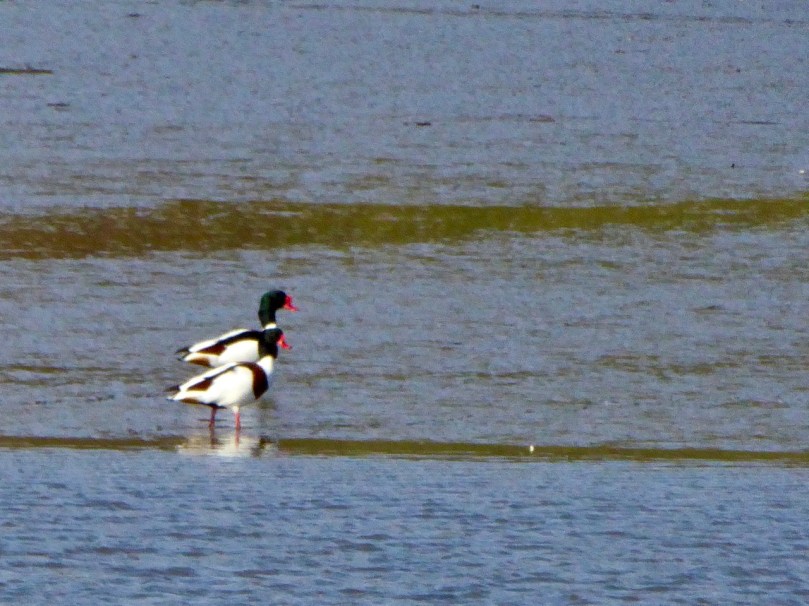
Nowadays it’s downright idyllic and the shallow waters of Gunpoint inlet provide sanctuary to wintering birds such as these shelducks.

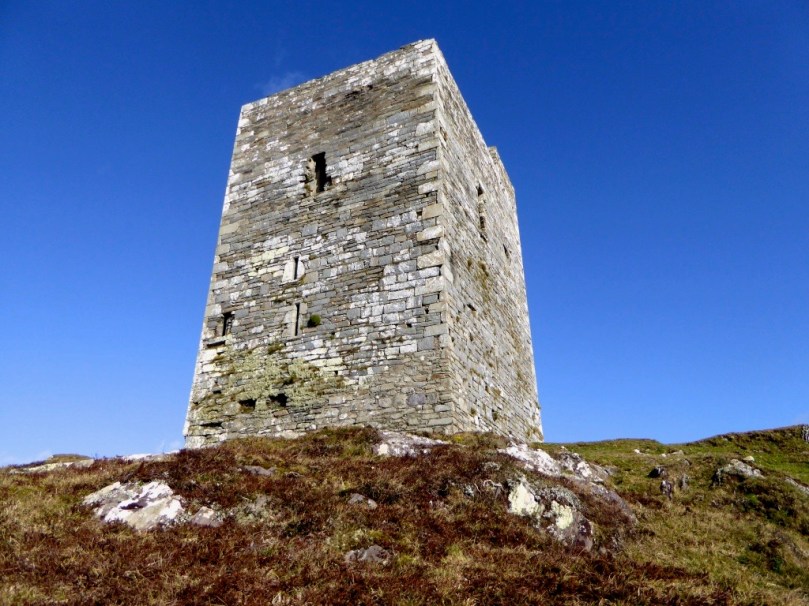
Our last stop is the little pier at Castlepoint, offering a dramatic view of Black Castle, one of the O’Mahony Tower Houses that dotted the coast of West Cork in the fifteenth and sixteenth centuries. This one is privately owned and the owner has stabilised and largely restored the castle, saving it for future generations from the all-too normal fate of dereliction that befalls West Cork Castles.

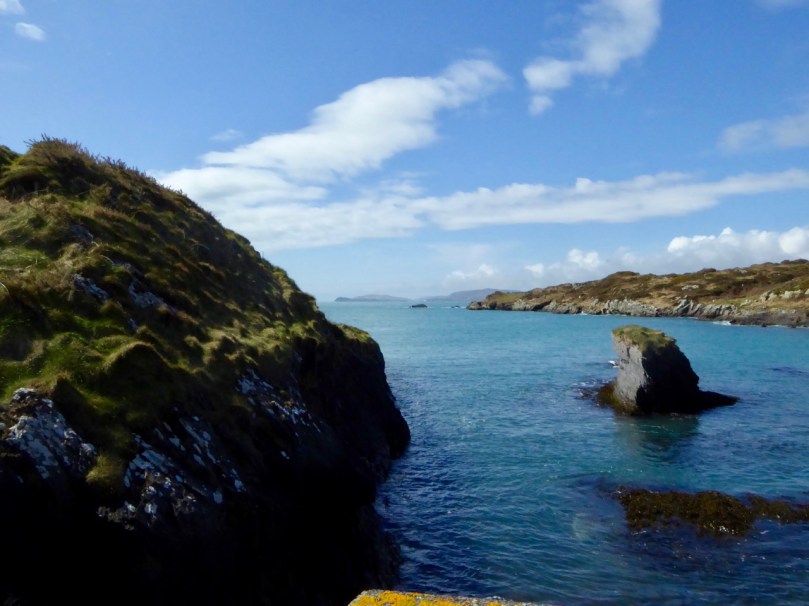
Robert looks across to Black Castle in the photograph above. The castle as the owner has stabilised it is shown below – he has done a first-rate job and we should all be grateful for his care of this important monument. The final photograph is of a small inlet by Castlepoint Pier.

The Wonders of Monasterboice

In our recent journeys around Ireland we both had opportunities to indulge our particular interests. Among them, Finola was able to take in some fine examples of stained glass and Romanesque architecture, while I concentrated on the beautiful medieval carving of a number of Irish High Crosses, to add to the examples I have written about recently.

For any Irish High Cross enthusiasts (I suspect that there are many of you out there), Monasterboice in County Louth has to be on the list of ‘must see’ places. It was founded in the 5th century by Saint Buithe, a follower of St Patrick – the Irish Mainistir Bhuithe means Monastery of Buithe – and was an active and important Christian settlement through to the 12th century, when its importance was eclipsed by Mellifont. I found out that St Buithe ascended into Heaven by climbing a ladder that was lowered down to him for the purpose.

Left – a photograph of the great cross at Monasterboice – known as  Muiredach’s Cross – taken in 1905 and, right – the same west face seen today. Finola is there to show its true scale: remarkably it is 5.5m tall

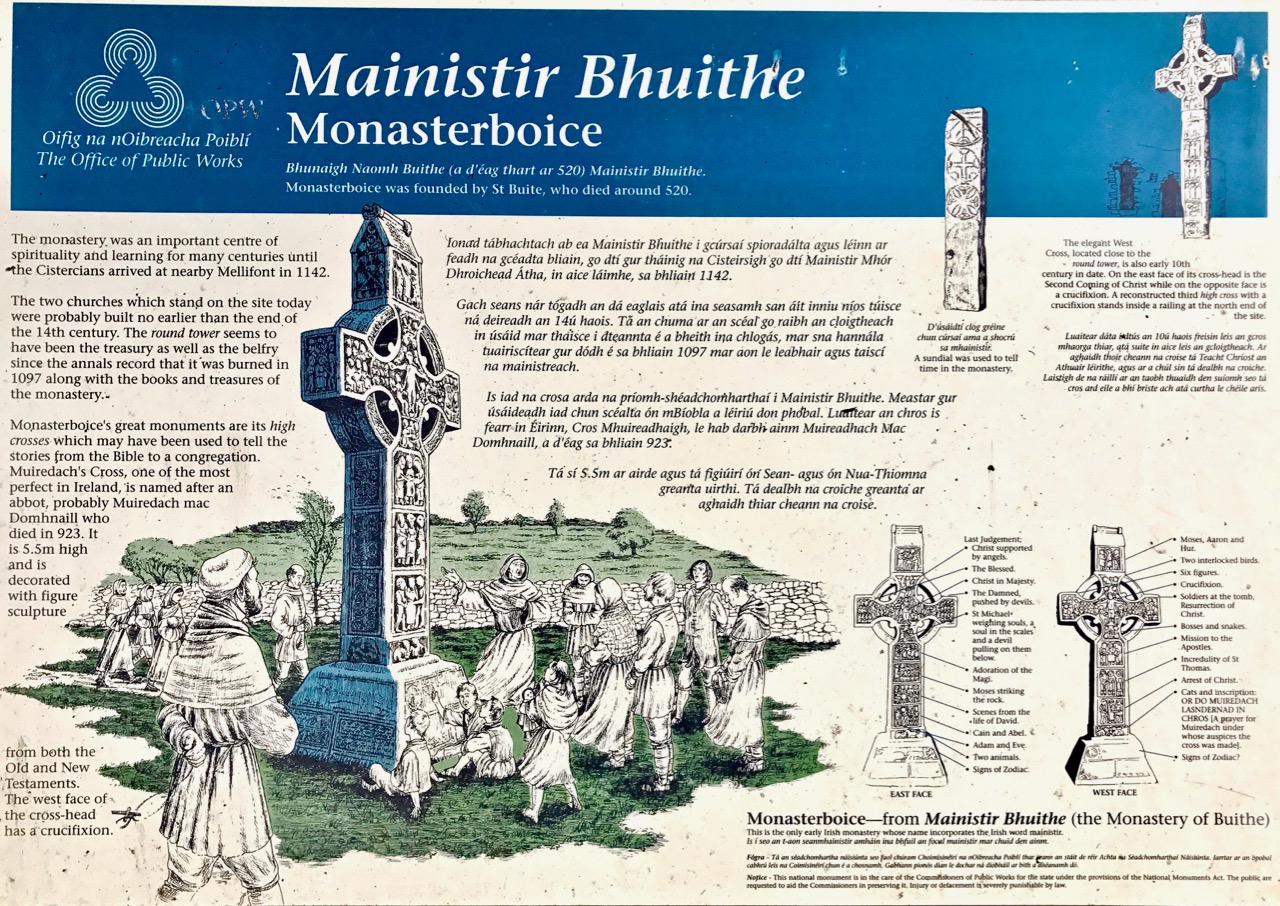
Muiredach mac Domhnaill, who died in 923, was an Abbot at Monasterboice. He is  credited with commissioning the great cross, shown above. It’s not quite the tallest high cross in Ireland, but it’s said to be the finest, probably because of its stature and remarkable state of preservation. The carved panels are all legible, and the biblical stories illustrated have all been identified. An inscription on the lower section of the cross shaft states: OR DU MUIREDACH LASNDERNAD IN CHROS – A prayer for Muiredach under whose auspices this cross was made. Confusingly there was also a king, Muiredach mac Cathail, who owned the lands on which the monastery was built. He died around 867, so it is possible that the cross was commissioned by him, or was made in commemoration of him, rather than by the Abbot.

The Office of Public Works has responsibility for overseeing the site at Monasterboice. The well produced information panel details the carvings on Muiredach’s Cross

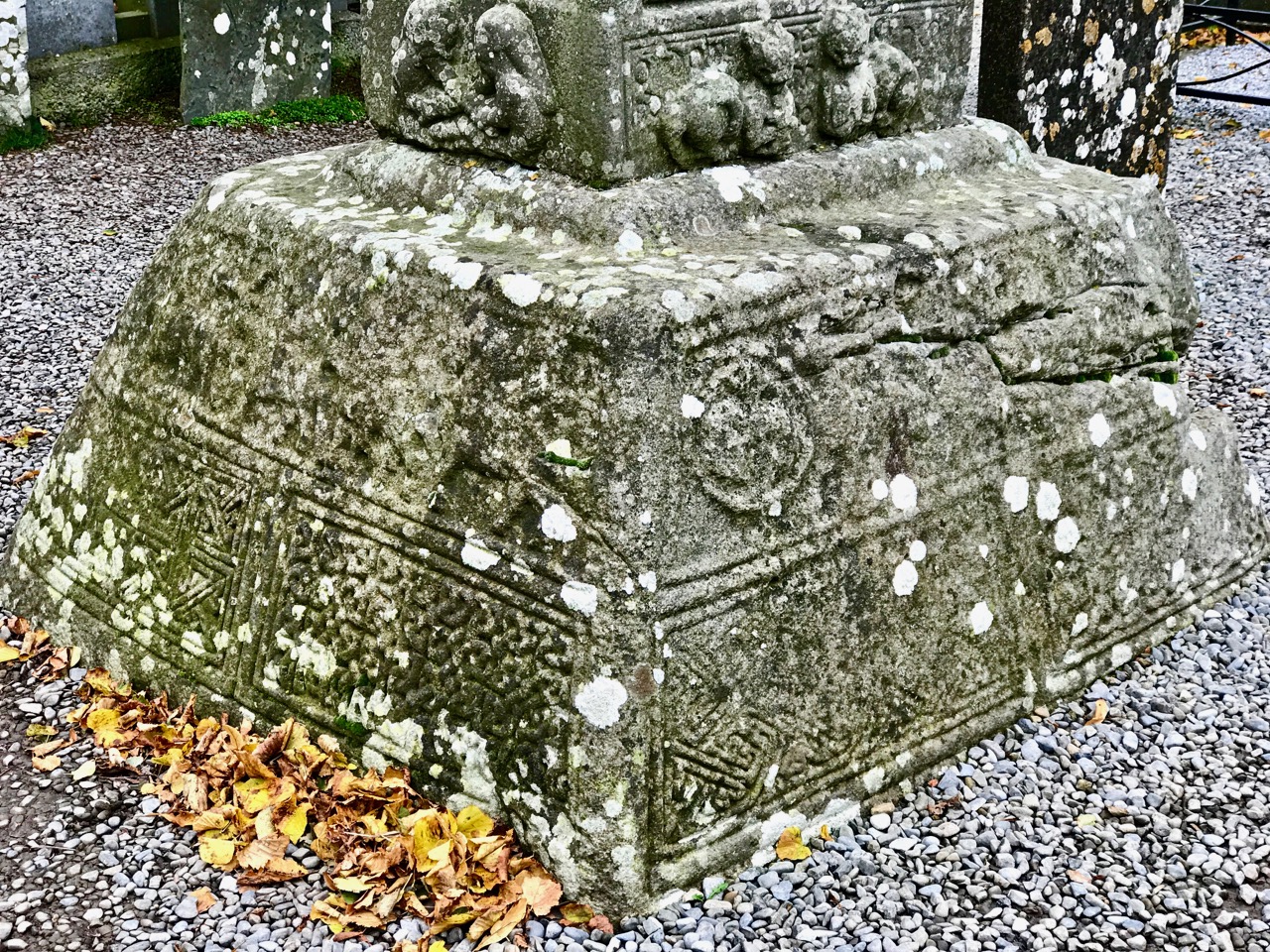
A gallery of detailed carving work from Muiredach’s great cross: the subjects include Adam and Eve and Cain and Abel; Celtic knotwork; Moses striking the rock; the crucifixion and (header) nativity scene with the Magi. The lowest picture, above, shows the decorated base, which is shaped like a saint’s reliquary and the panel with two cats and the prayer for Muiredach

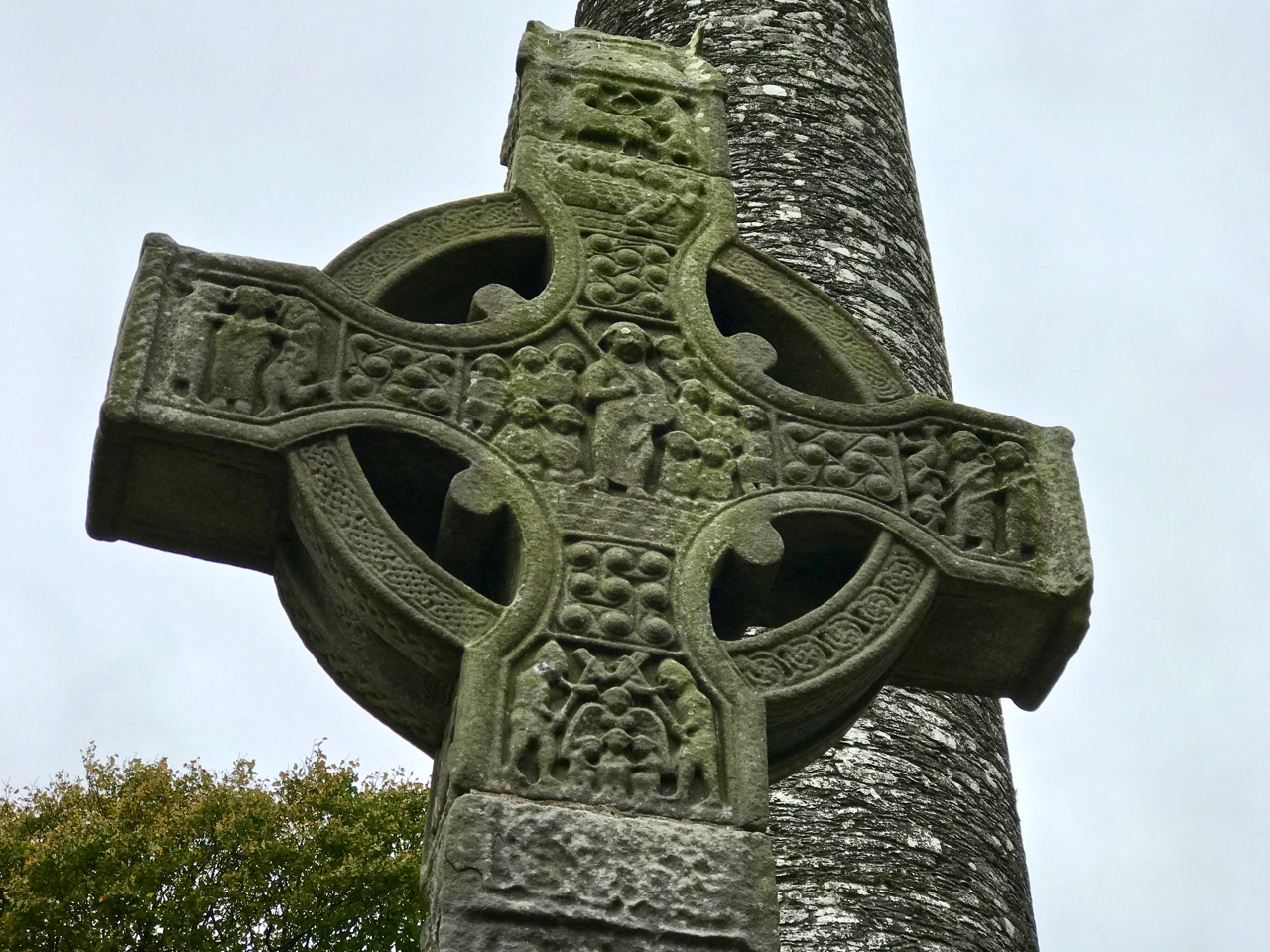
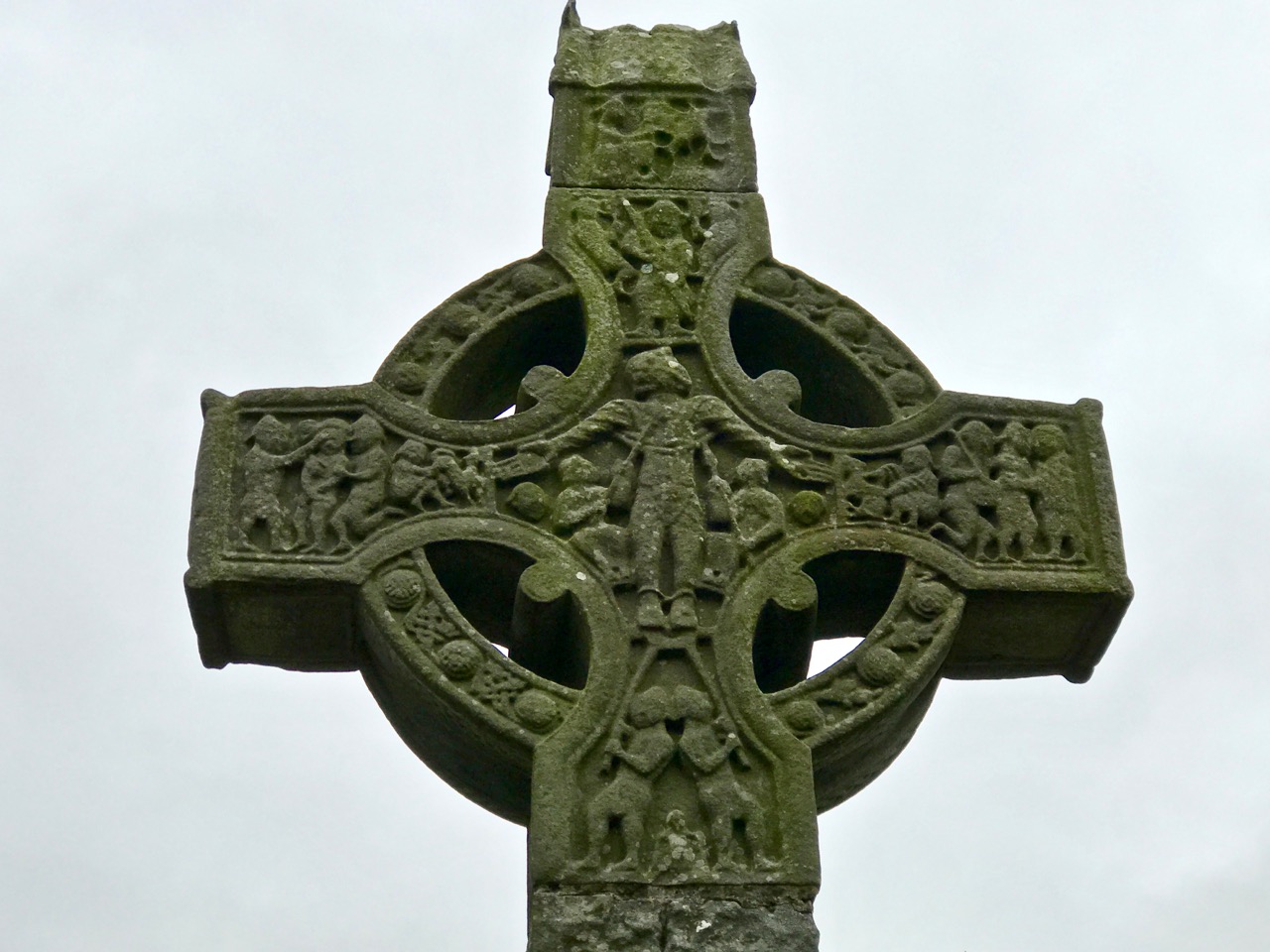
This wealth of medieval art is only part of the site’s wonders. There are two more complete High Crosses, fragments of other carvings and slabs, and a round tower. The Tall Cross or West Cross is the highest in Ireland, at nearly 7 metres. Because of its size it has the greatest number of carved panels of any Irish High Cross. However, these panels are suffering from weathering much more than Muiredach’s Cross, and their present state must raise concerns for all the carvings at Monasterboice. At other sites, crosses have been sheltered (Moone) or moved into buildings (Clonmacnoise, Durrow).

The Tall Cross (or West Cross) at Monasterboice; left – in context with the round tower beyond; right – an example of a badly weathered panel on the Tall Cross

Upper – the west face of the Tall Cross cross-wheel, which is in comparatively good condition, and lower – the east face. The number of scenes depicted on these panels alone is remarkable

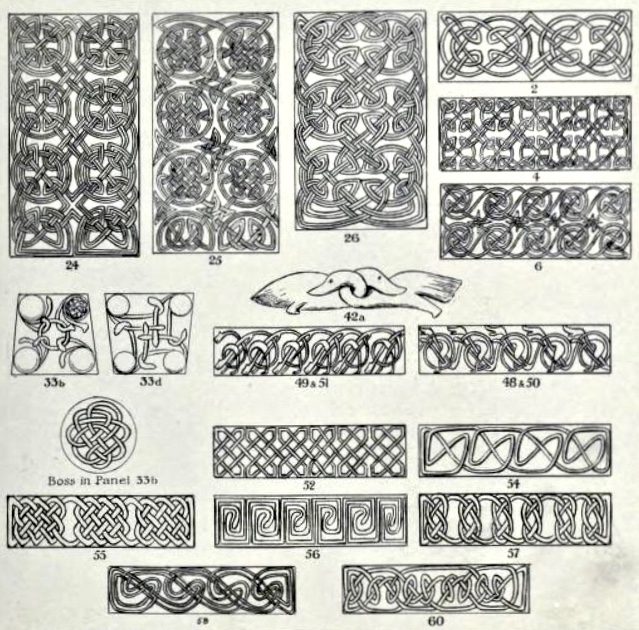
Carved panels on the Tall Cross at Monasterboice and – lower – a study of Celtic knotwork found on Irish High Crosses, taken from MUIREDACH – Abbot of Monasterboice 890-923 AD by R A S McAlister MA FSA, Dublin 1914

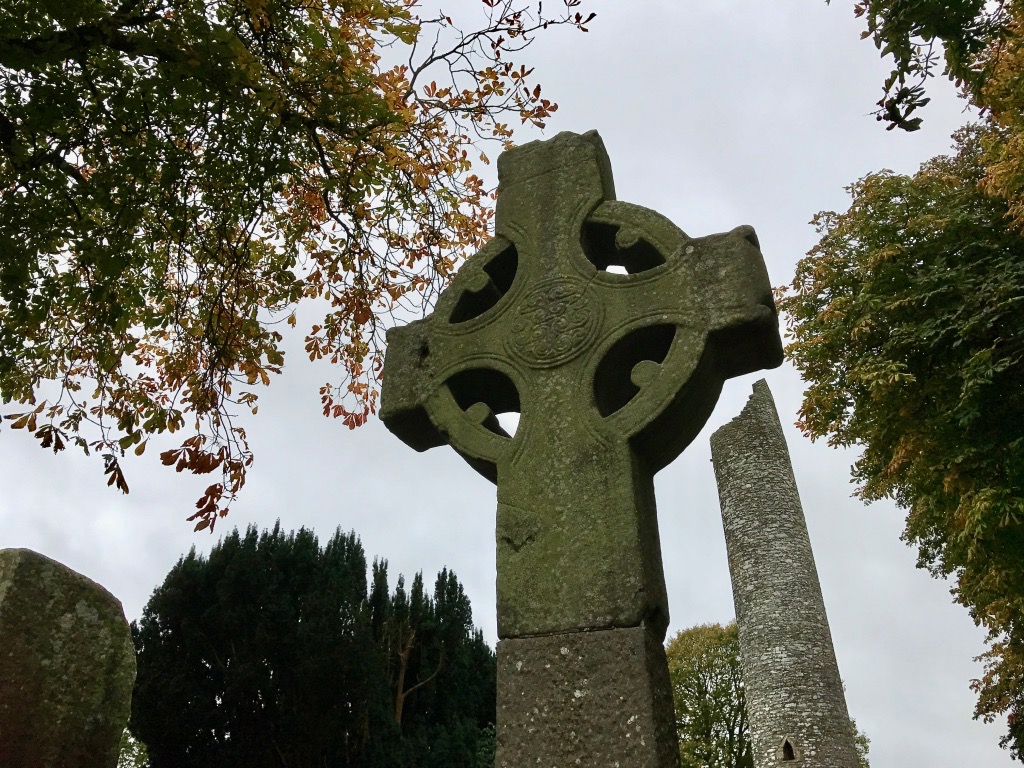
There is a third High Cross at Monasterboice, known as the North Cross. It is less spectacular, perhaps, than the large ones, and the carvings are comparatively minimal. Nevertheless, its modesty gives it a somewhat more refined character. Close to the North Cross are some fragments, including part of a medieval sundial – reminiscent of the one we saw at Kilmalkedar, County Kerry, earlier this year.

Upper – the North Cross with the round tower in the background; lower left – North Cross east face and, lower right – nearby fragment of a medieval sundial

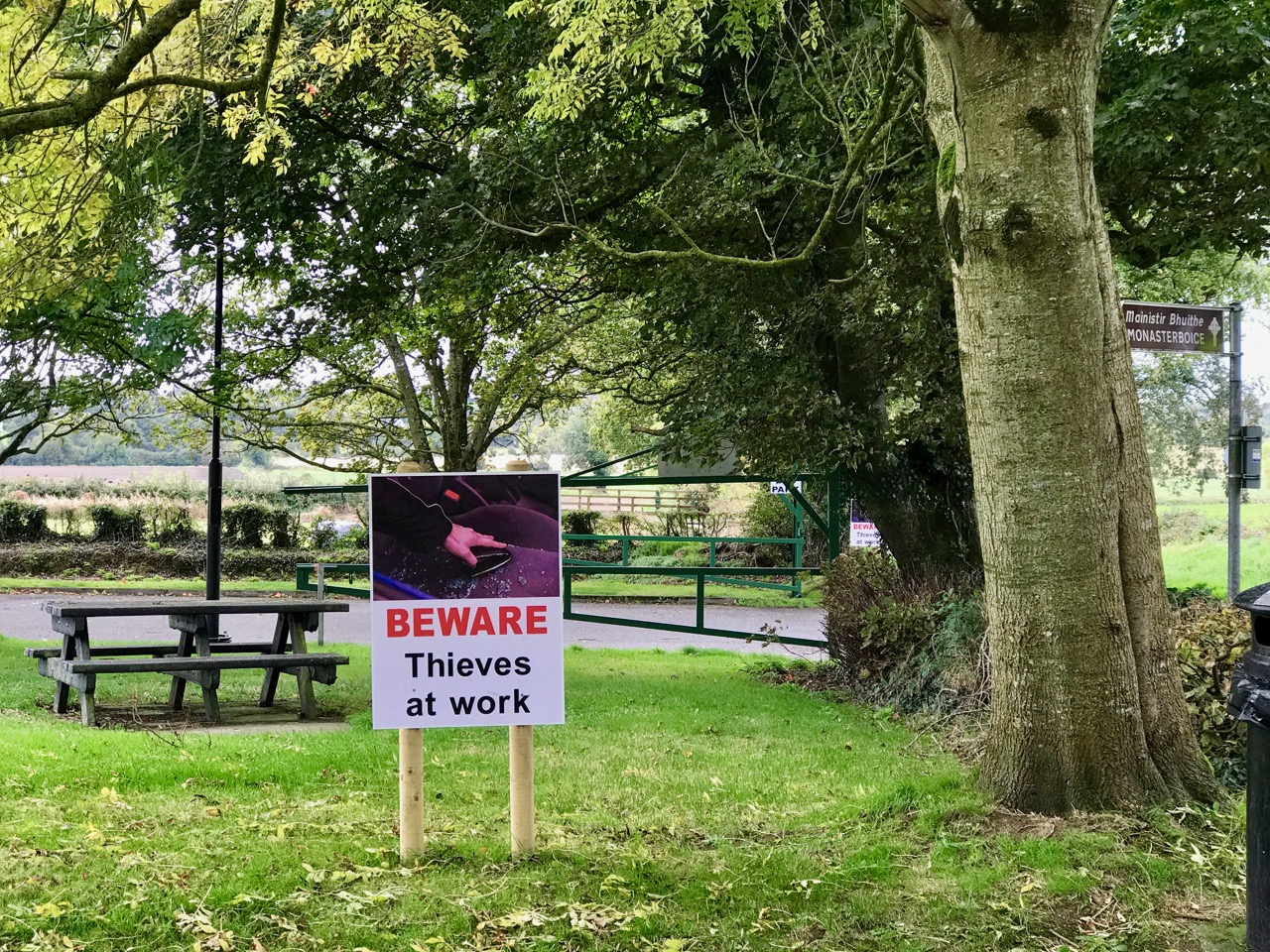
Monasterboice displays so many wonders. Yet, in some ways, it’s an uneasy site. It’s probably not helpful – but perhaps essential – that the parking area a little way off is rife with warnings about thieves, and broken glass is evident. There have also been reports of vandalism against the monuments themselves – emphasising their vulnerability. The place is of major importance: during the summer season the site is attended, and guides are available. We were there in early October, when no-one was around.

This site – and similar ones all across Ireland – are vitally important to the heritage of this country. The artefacts are irreplaceable, yet too little resource is given to protecting them – from weather and people. As we know from our forays into the world of Prehistoric Rock Art, stone carvings are fragile, and under-appreciated. There’s no obvious easy solution, apart from them being given higher status and priority by the empowered bodies such as the Office of Public Works. They, in turn, need to be given more support by the State, particularly in terms of funding: they do the best they can with very limited resources.

Cats on the base of Muiredach’s Cross, recorded  by McAlister in 1914:

Freshly Dug Queens

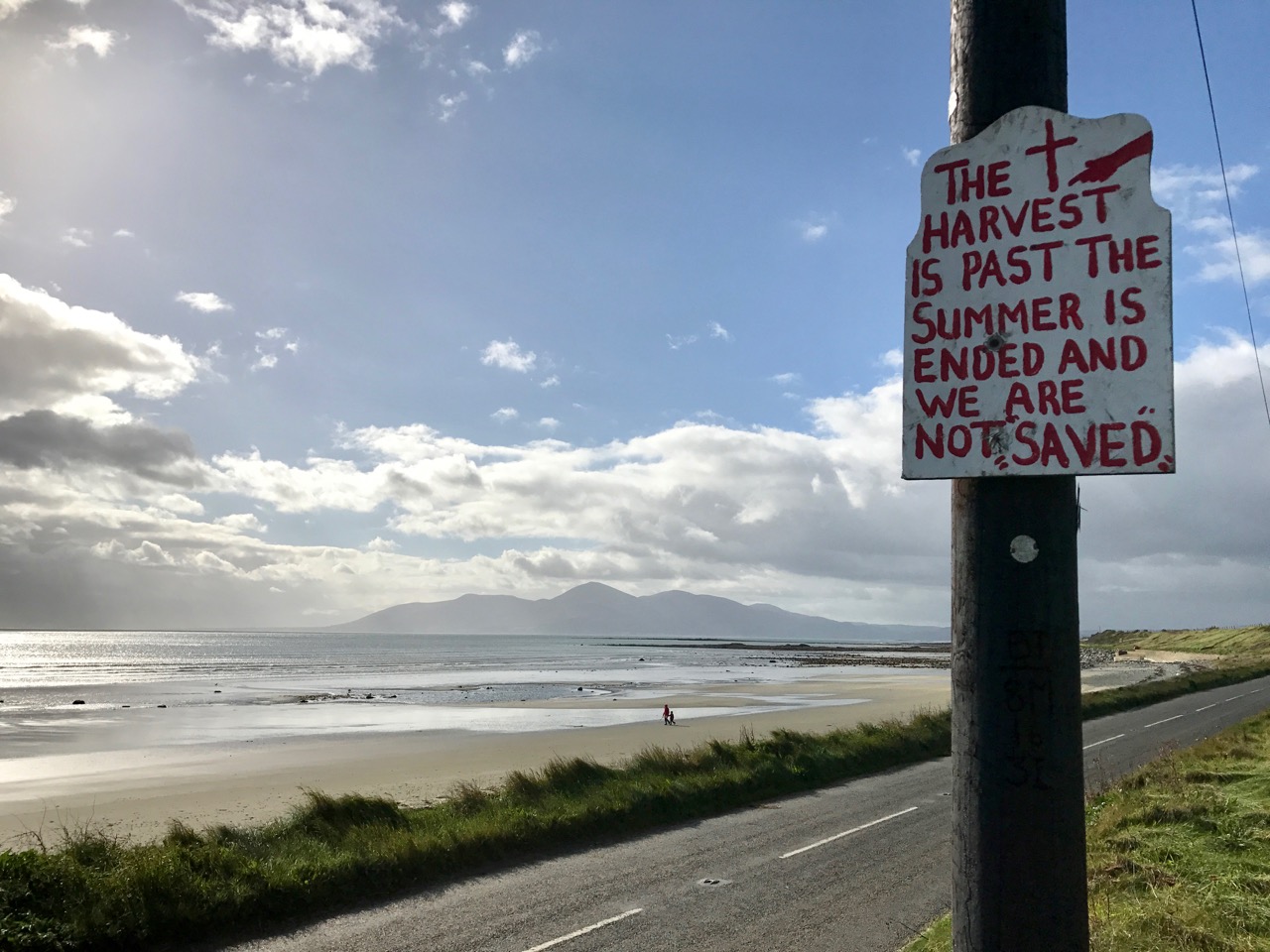
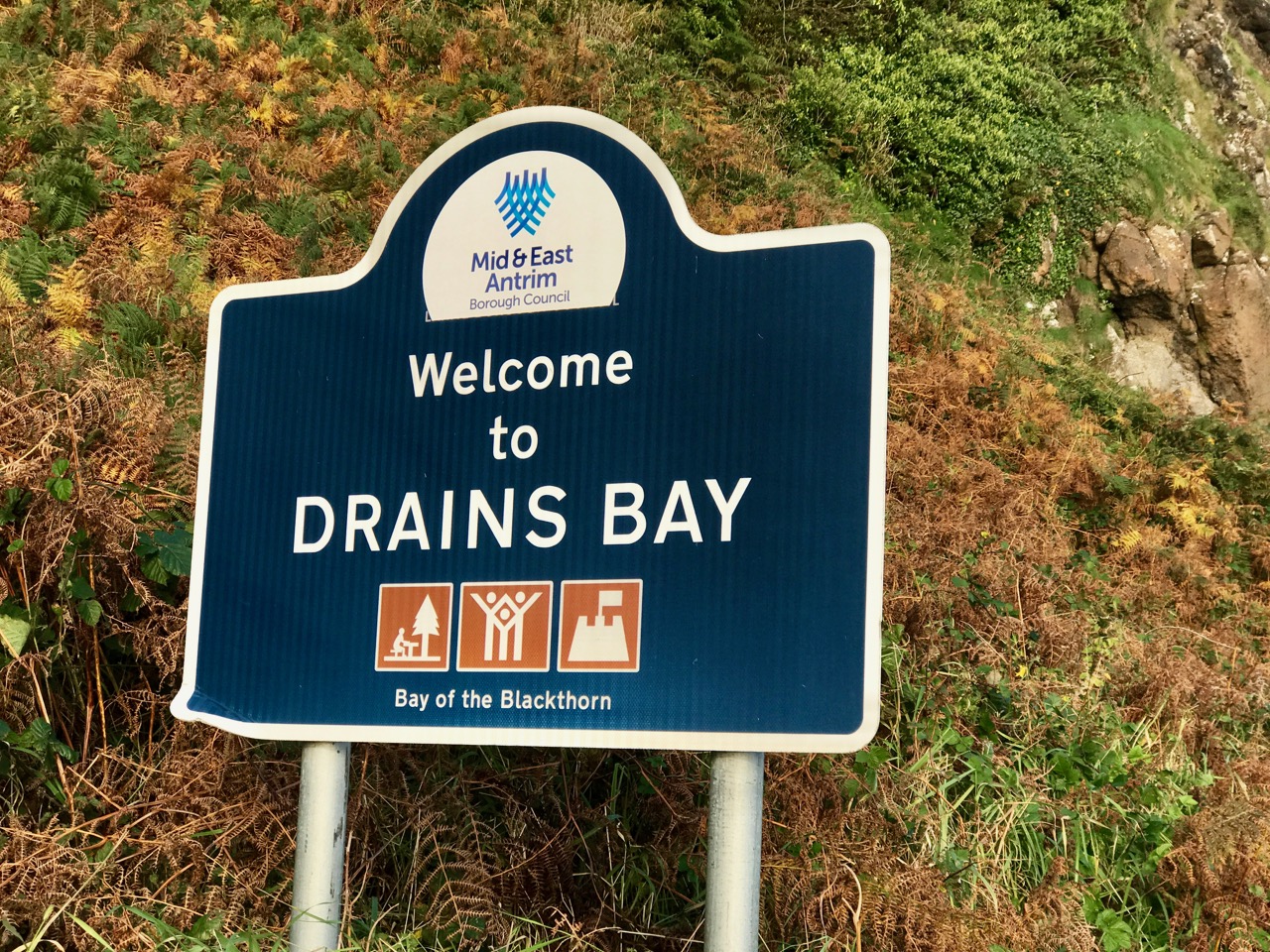
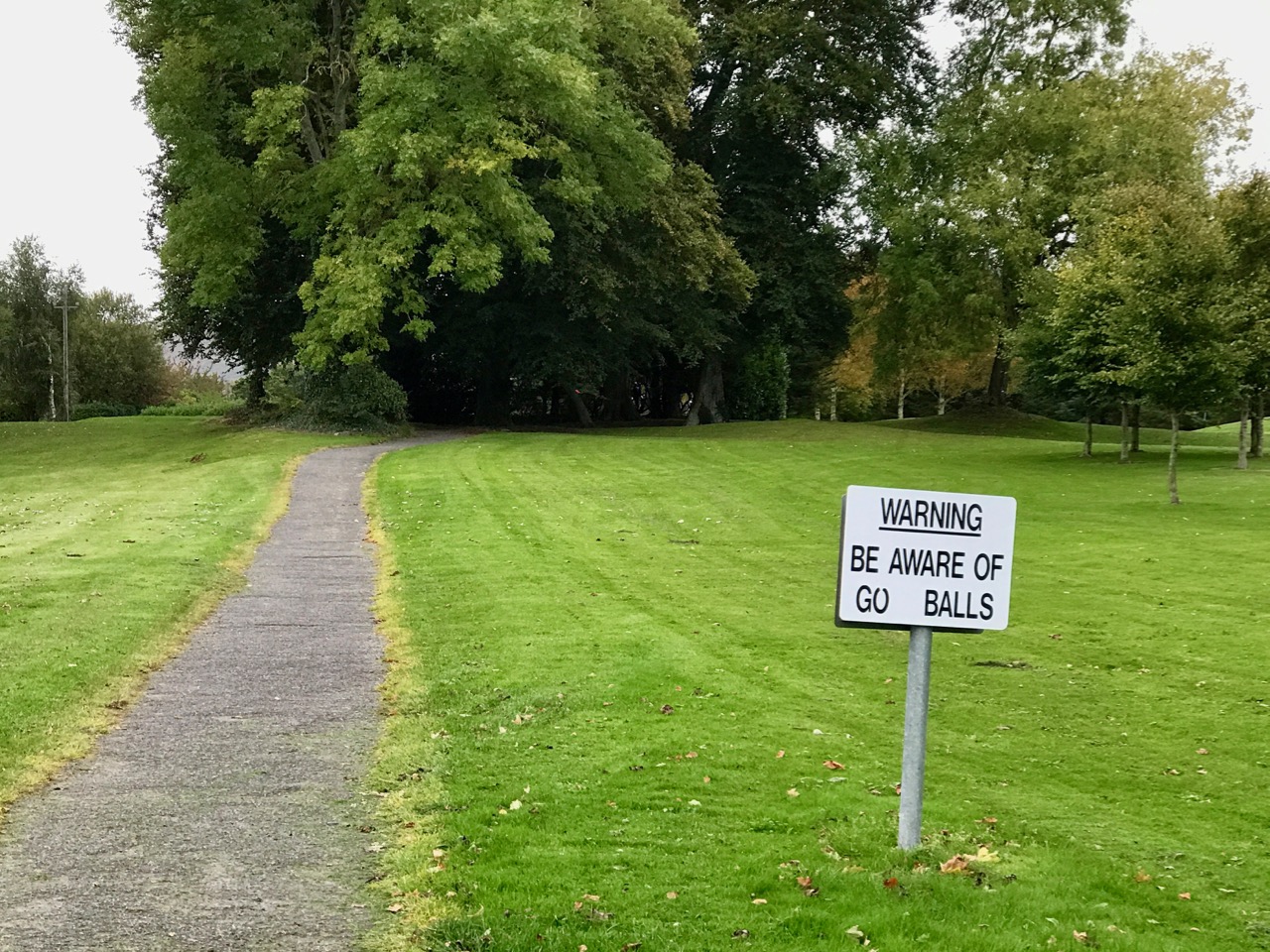
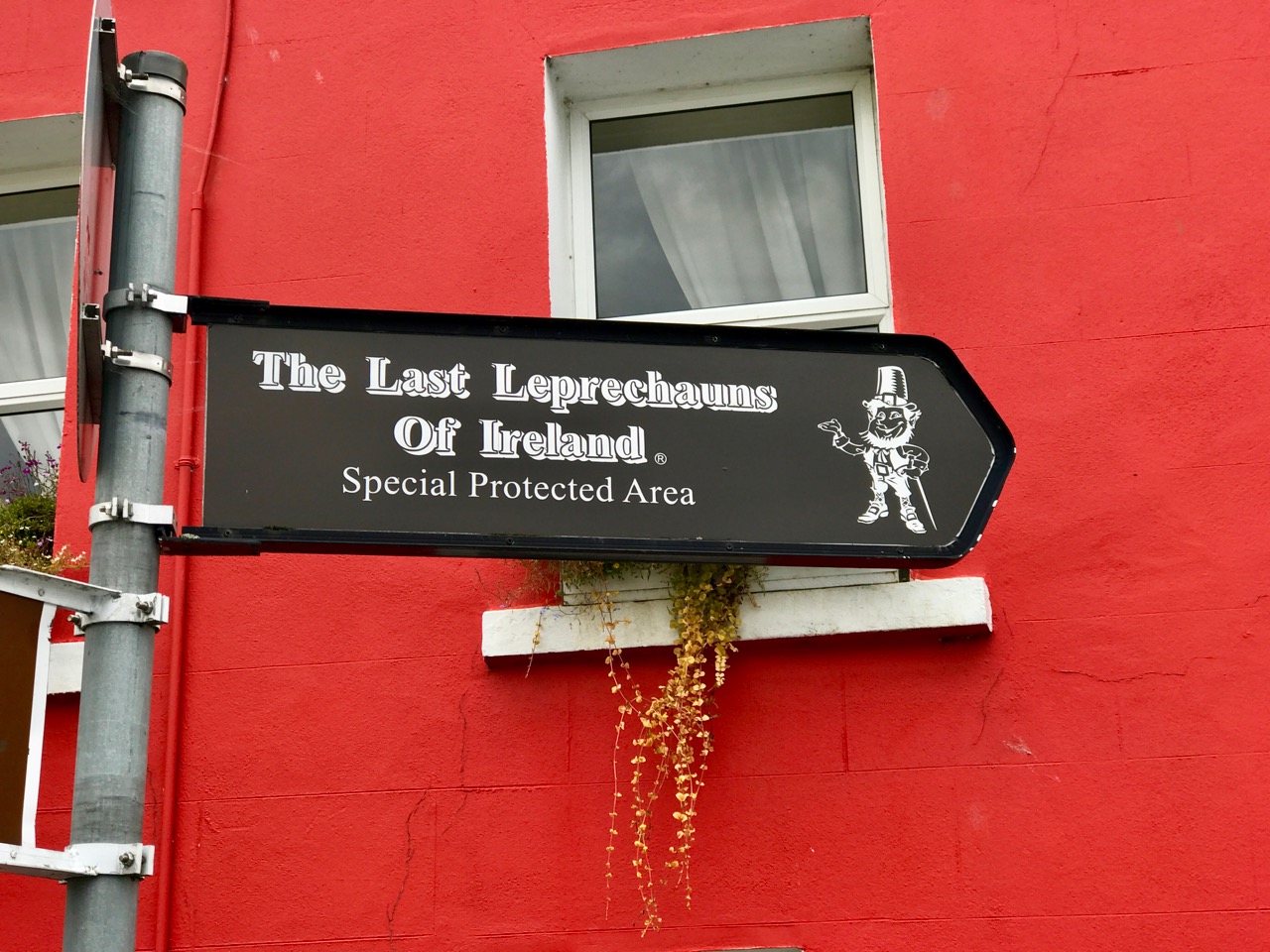
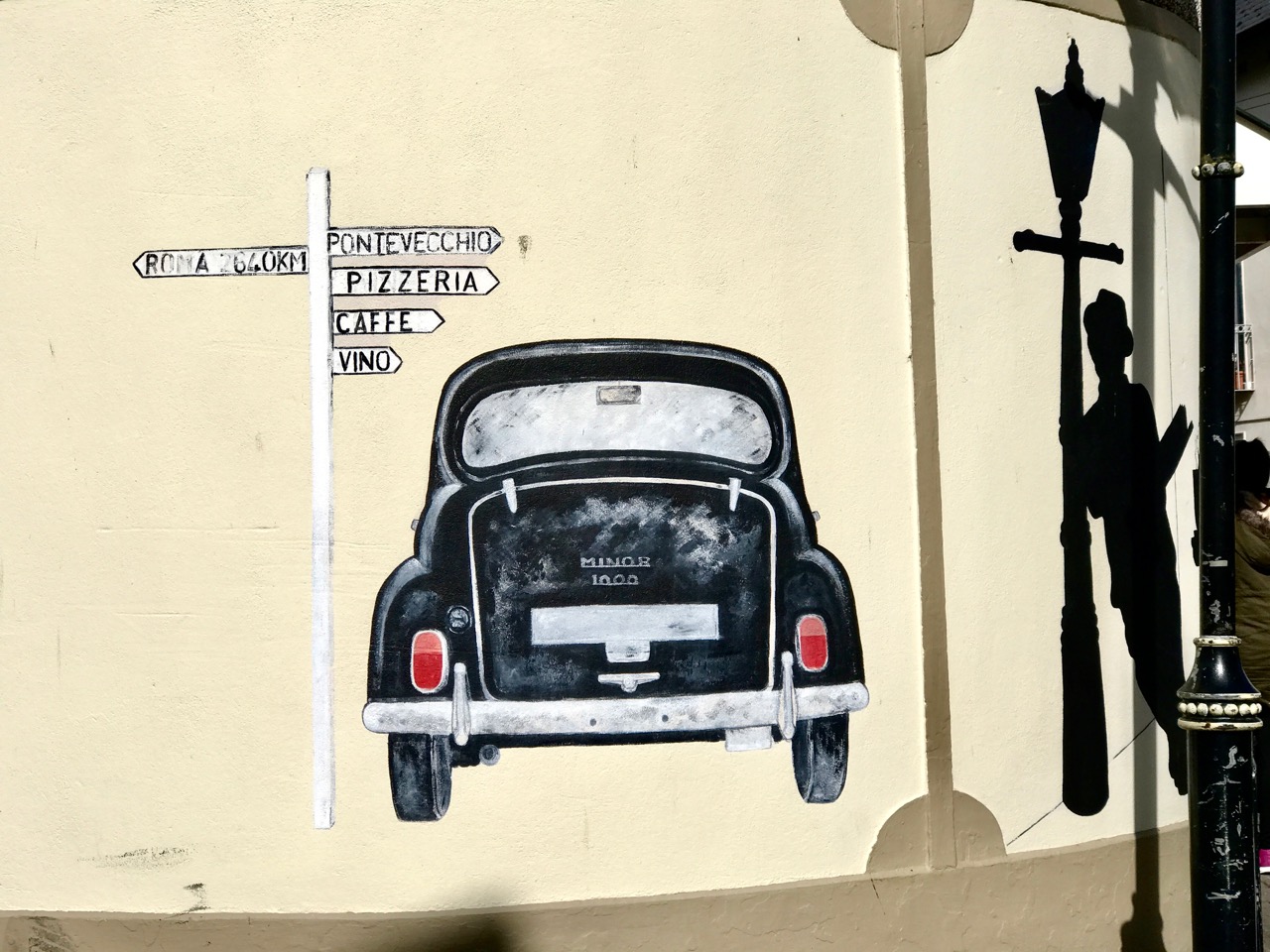
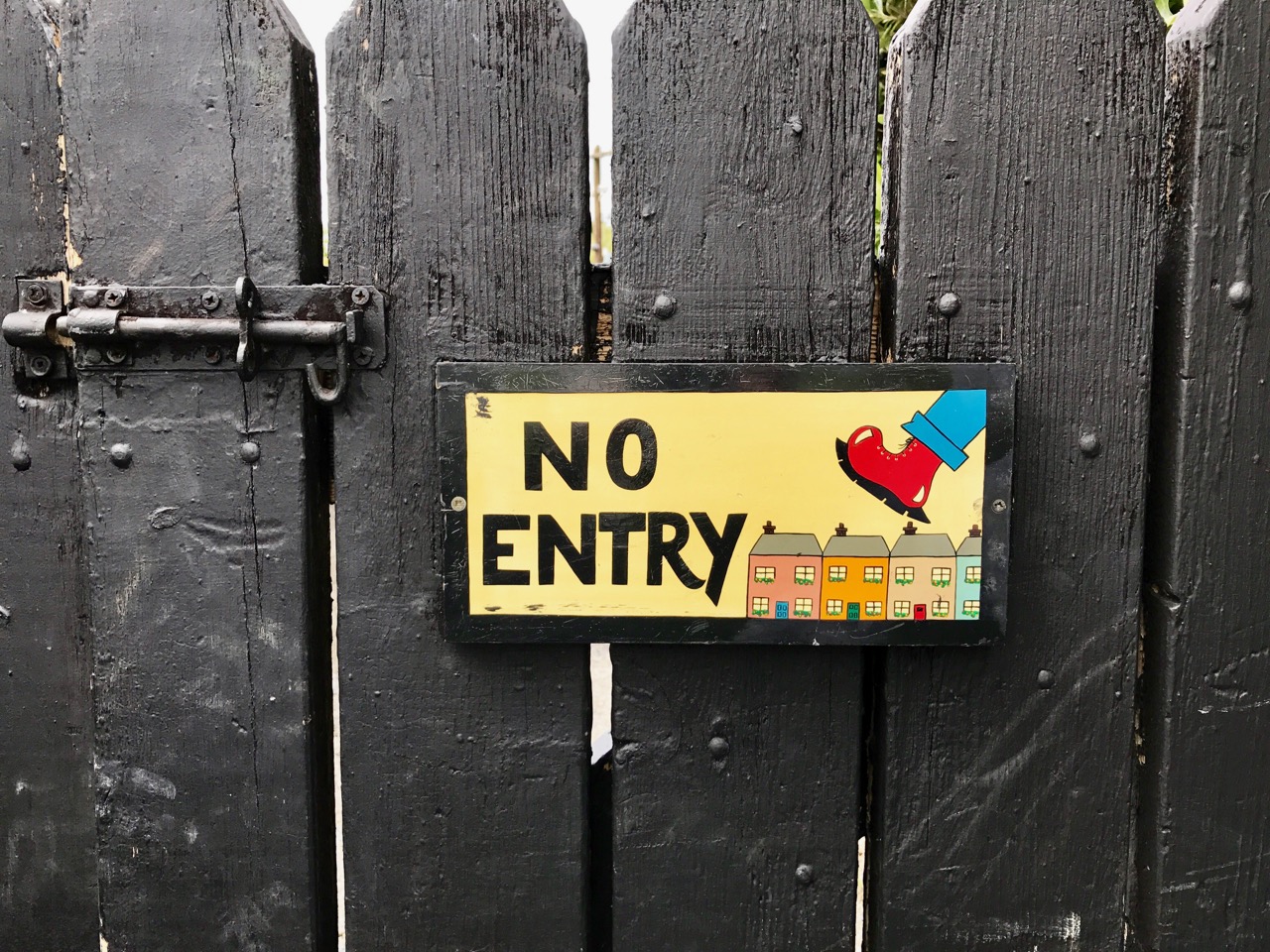
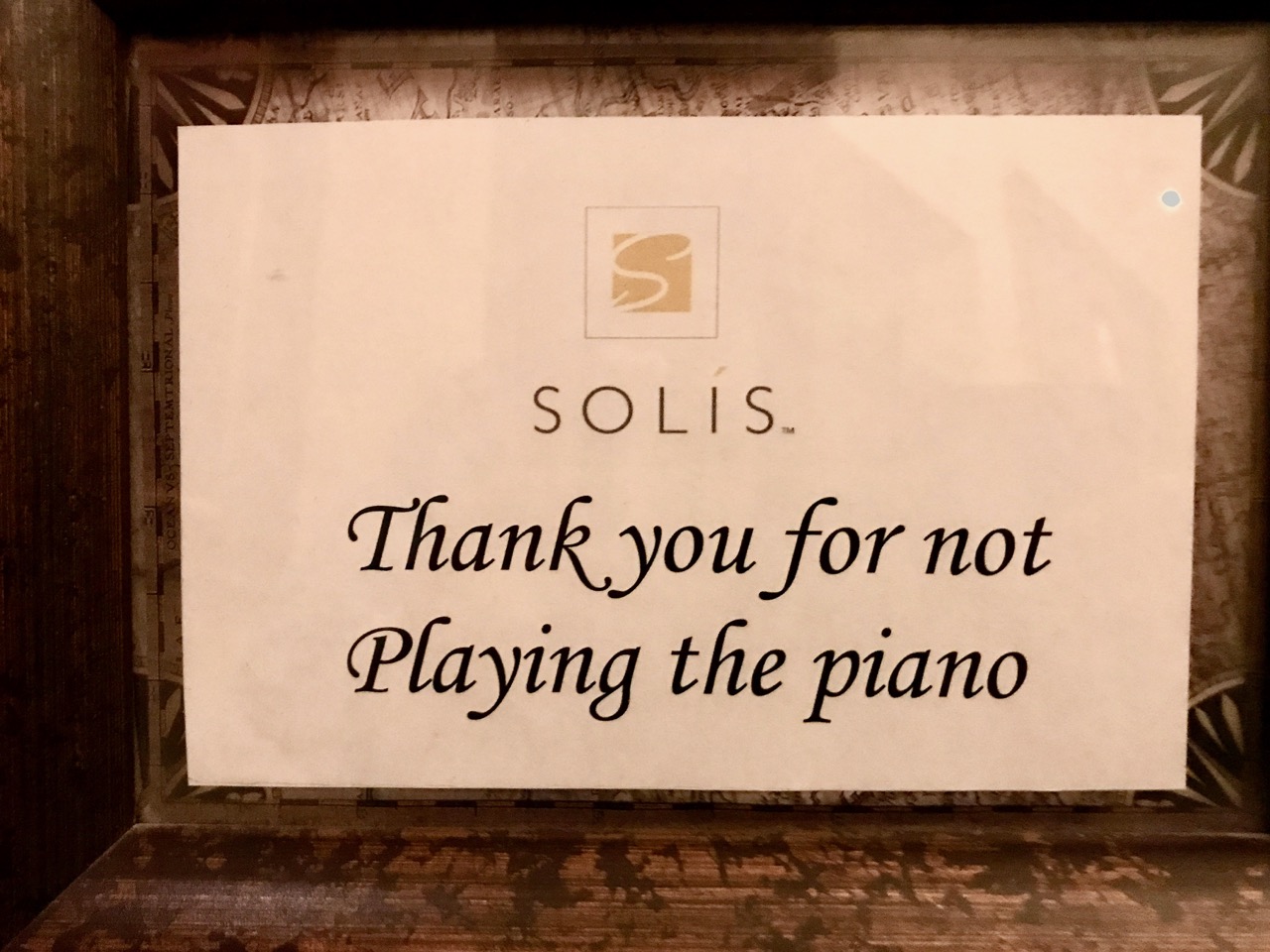
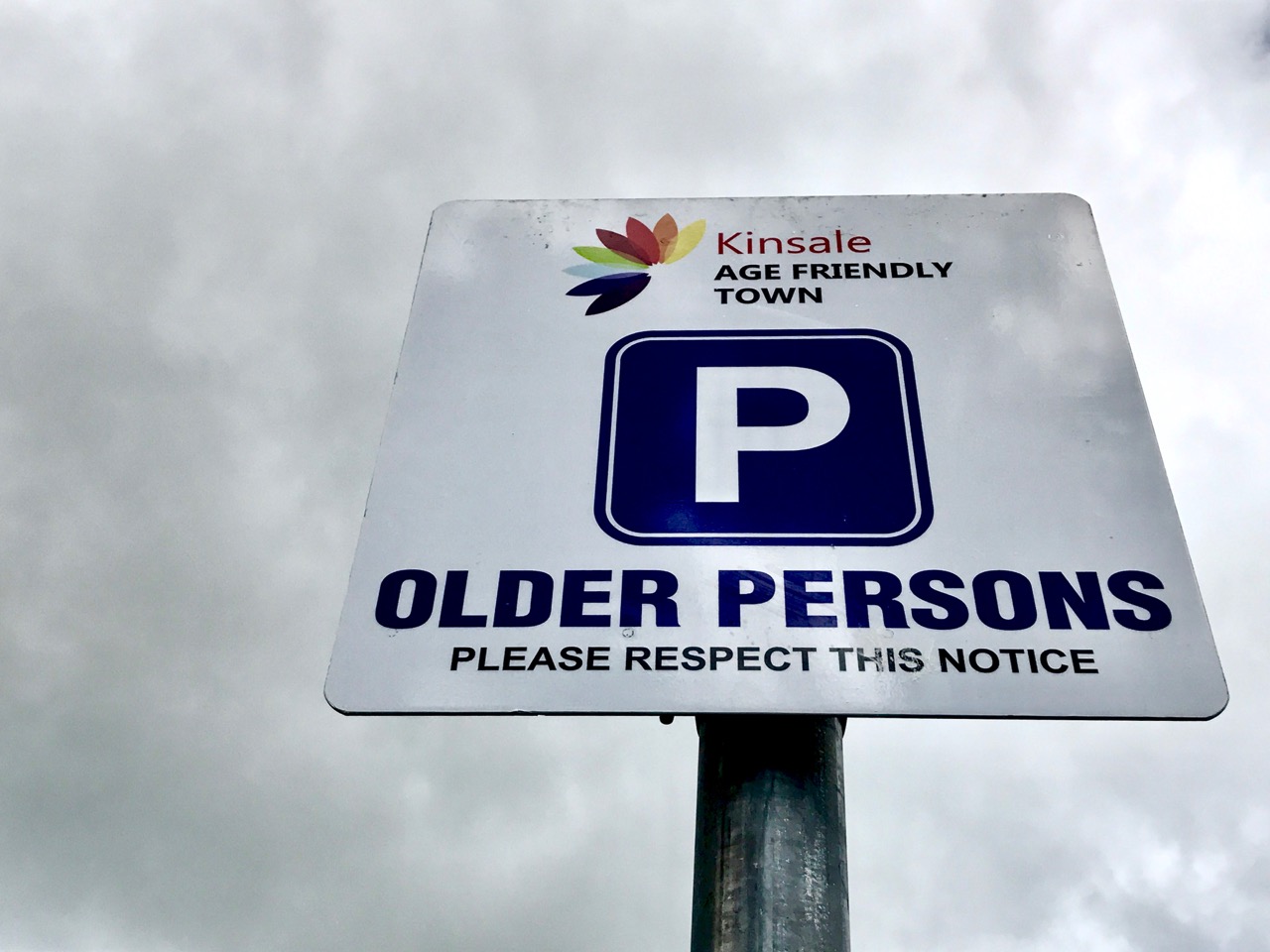
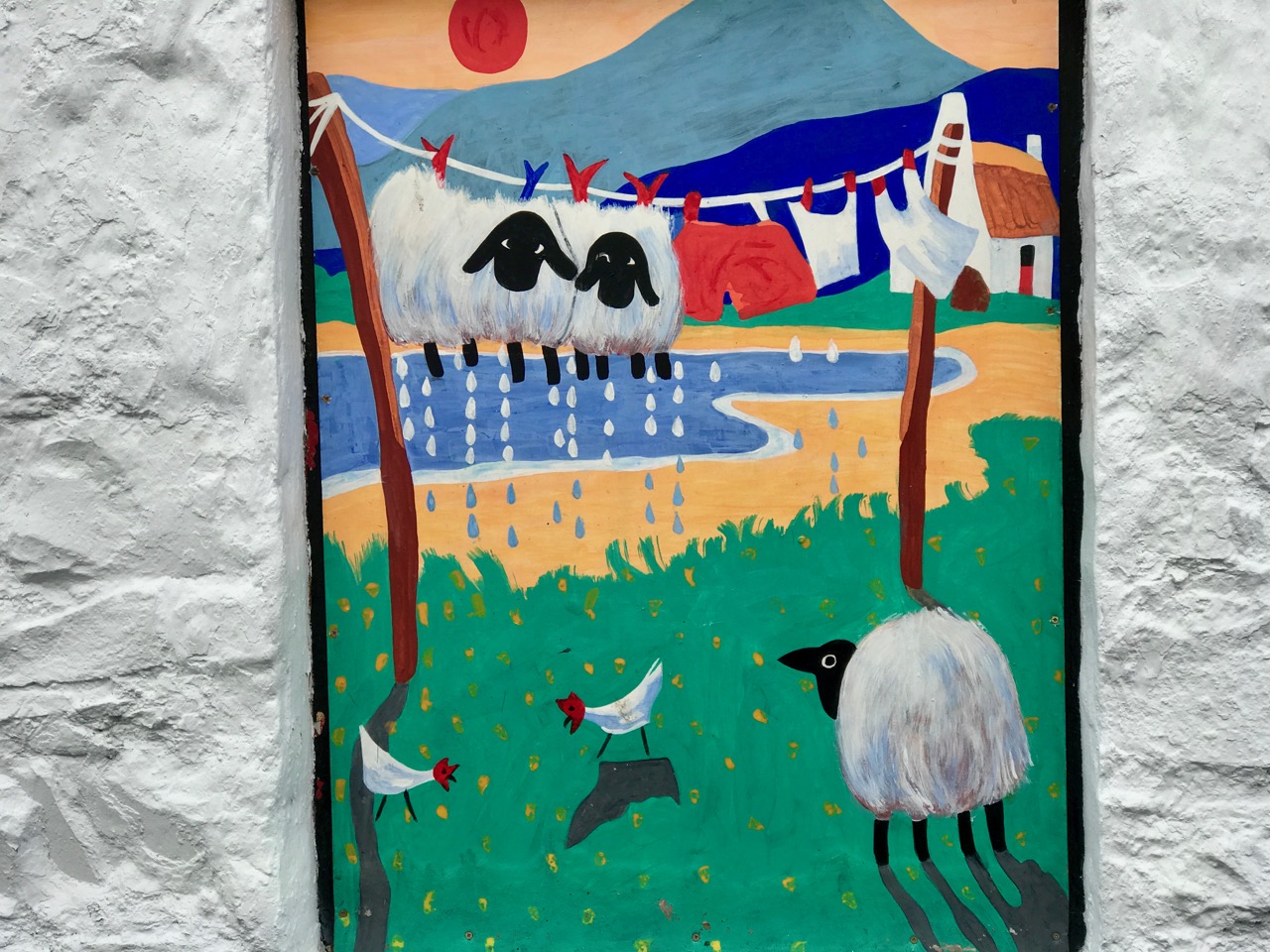
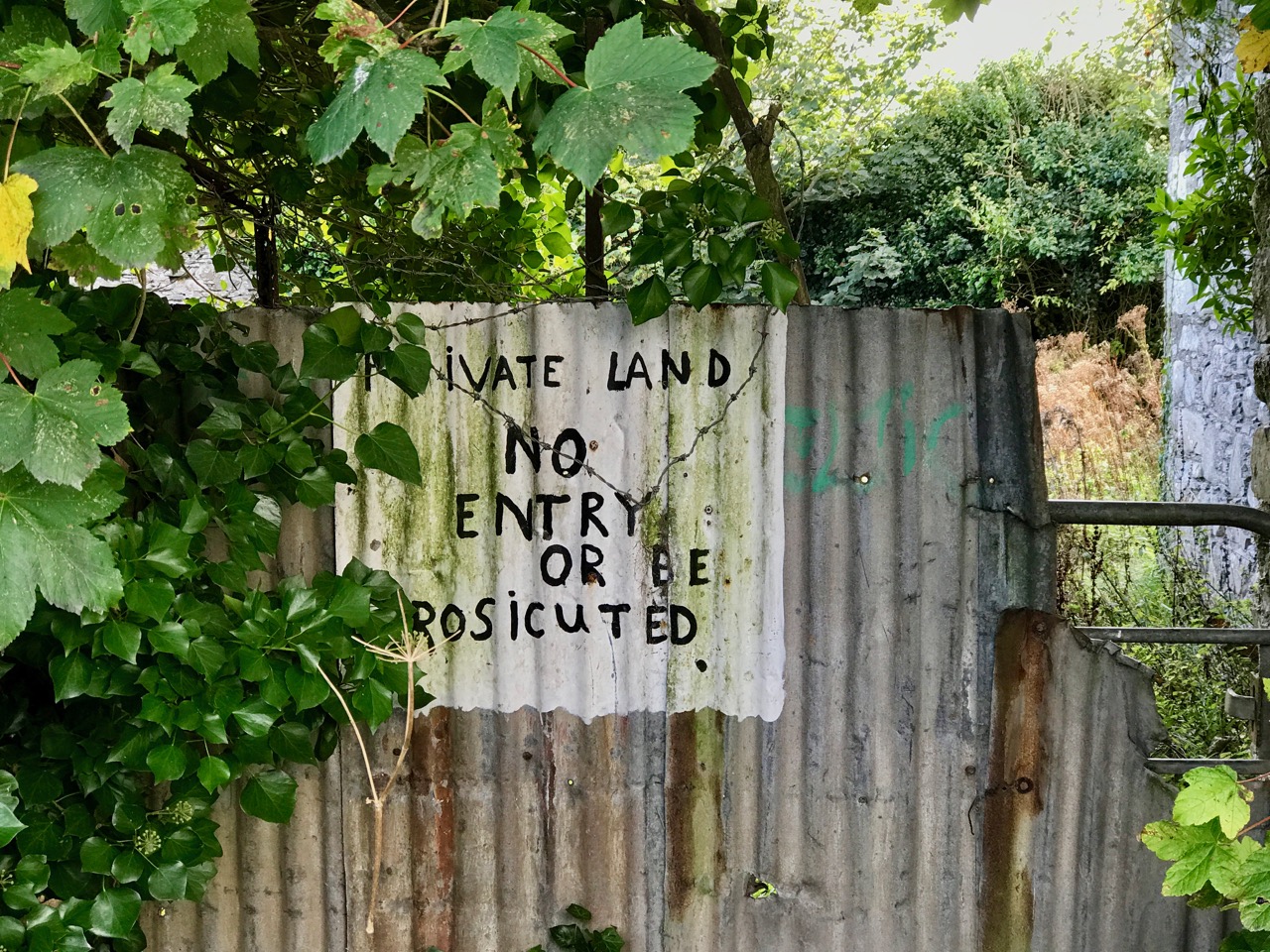
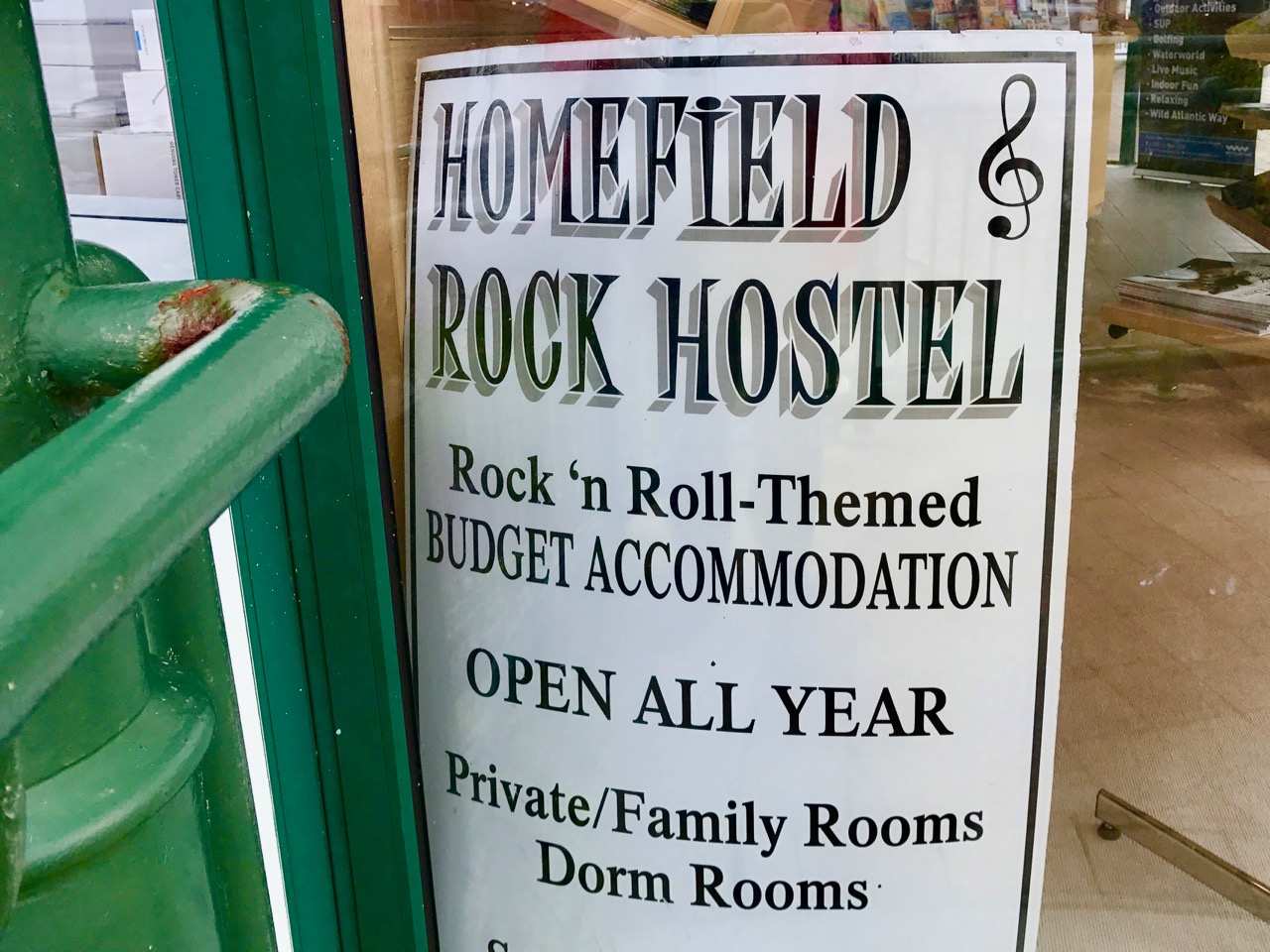
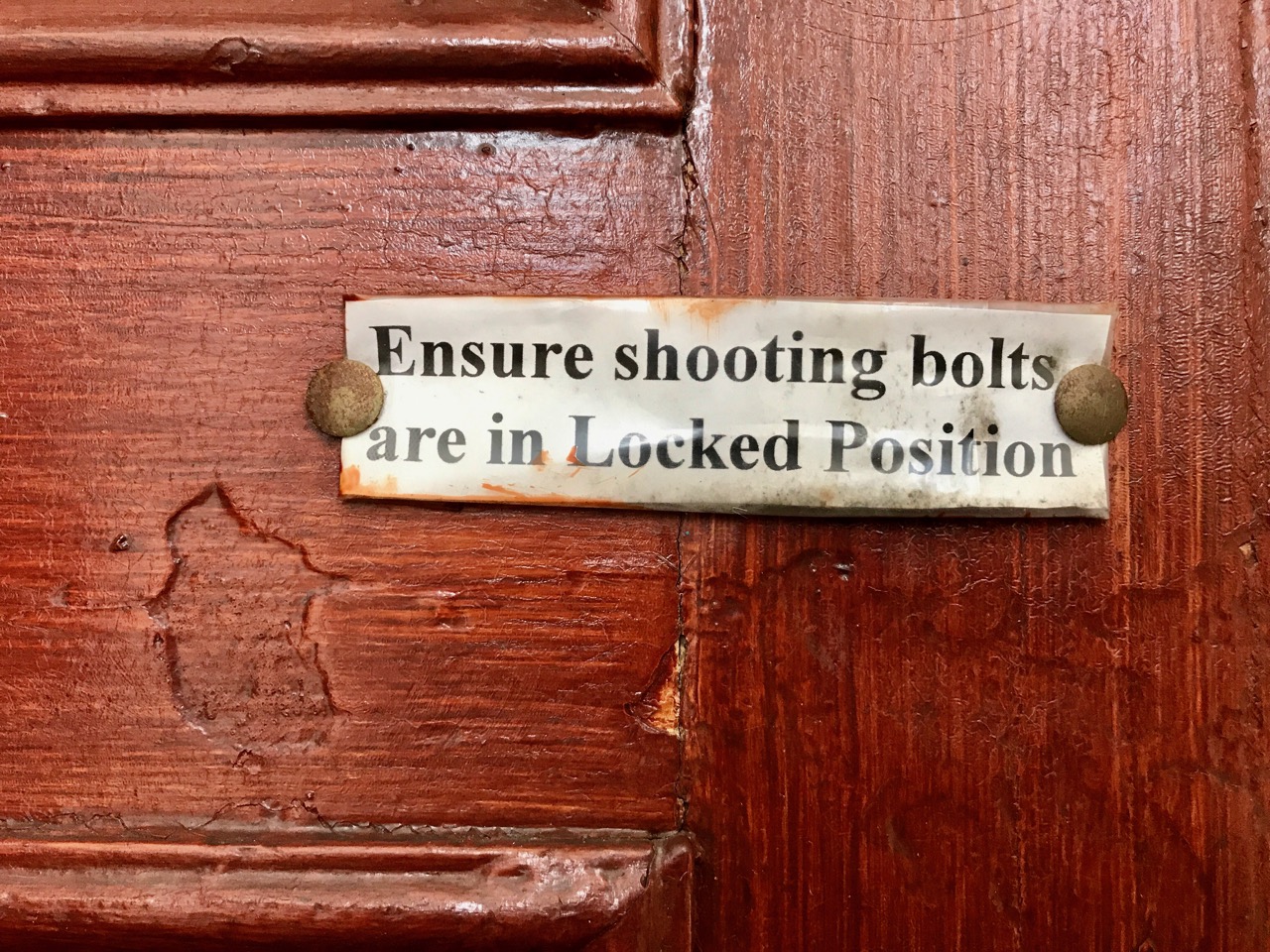
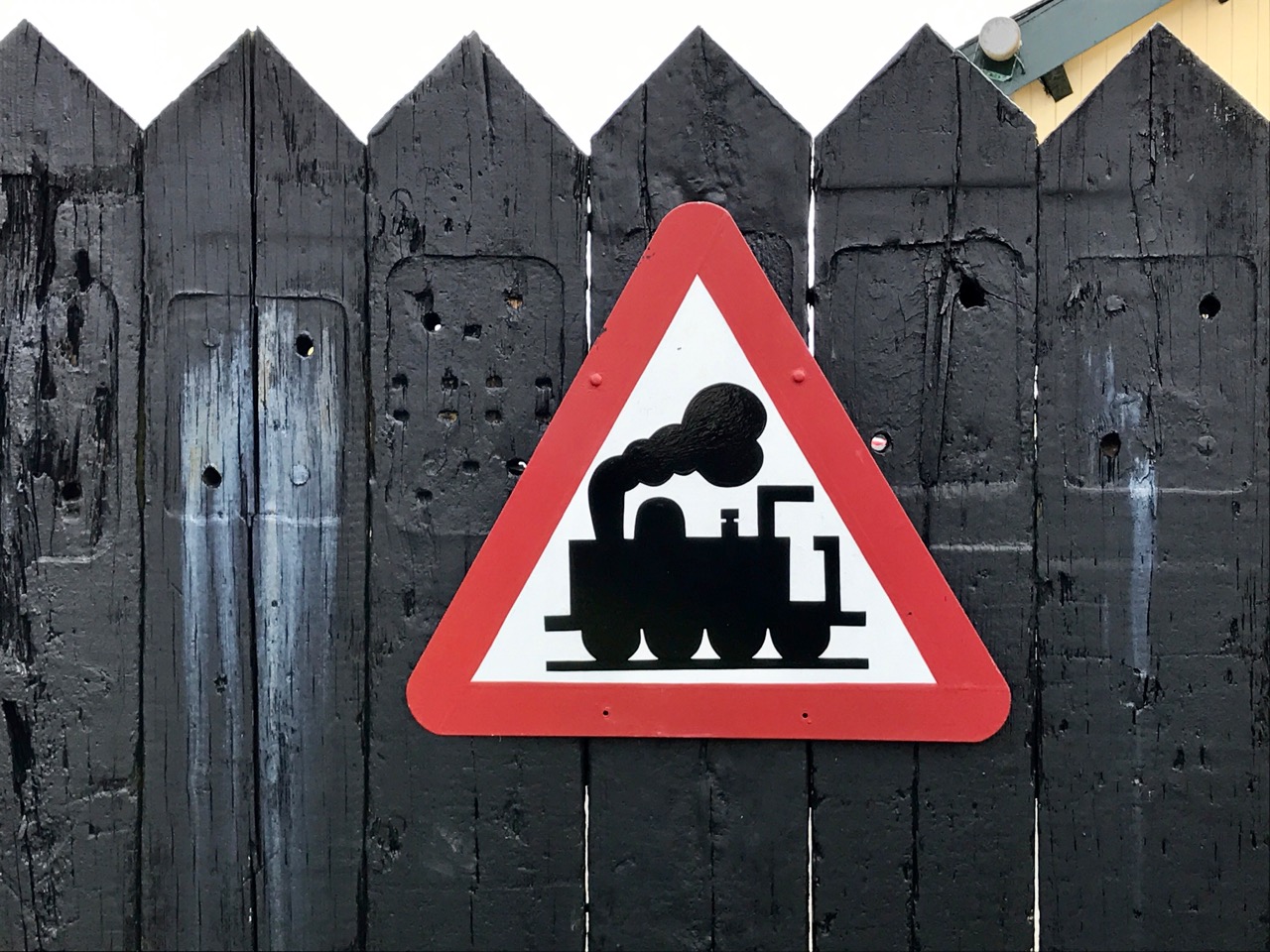
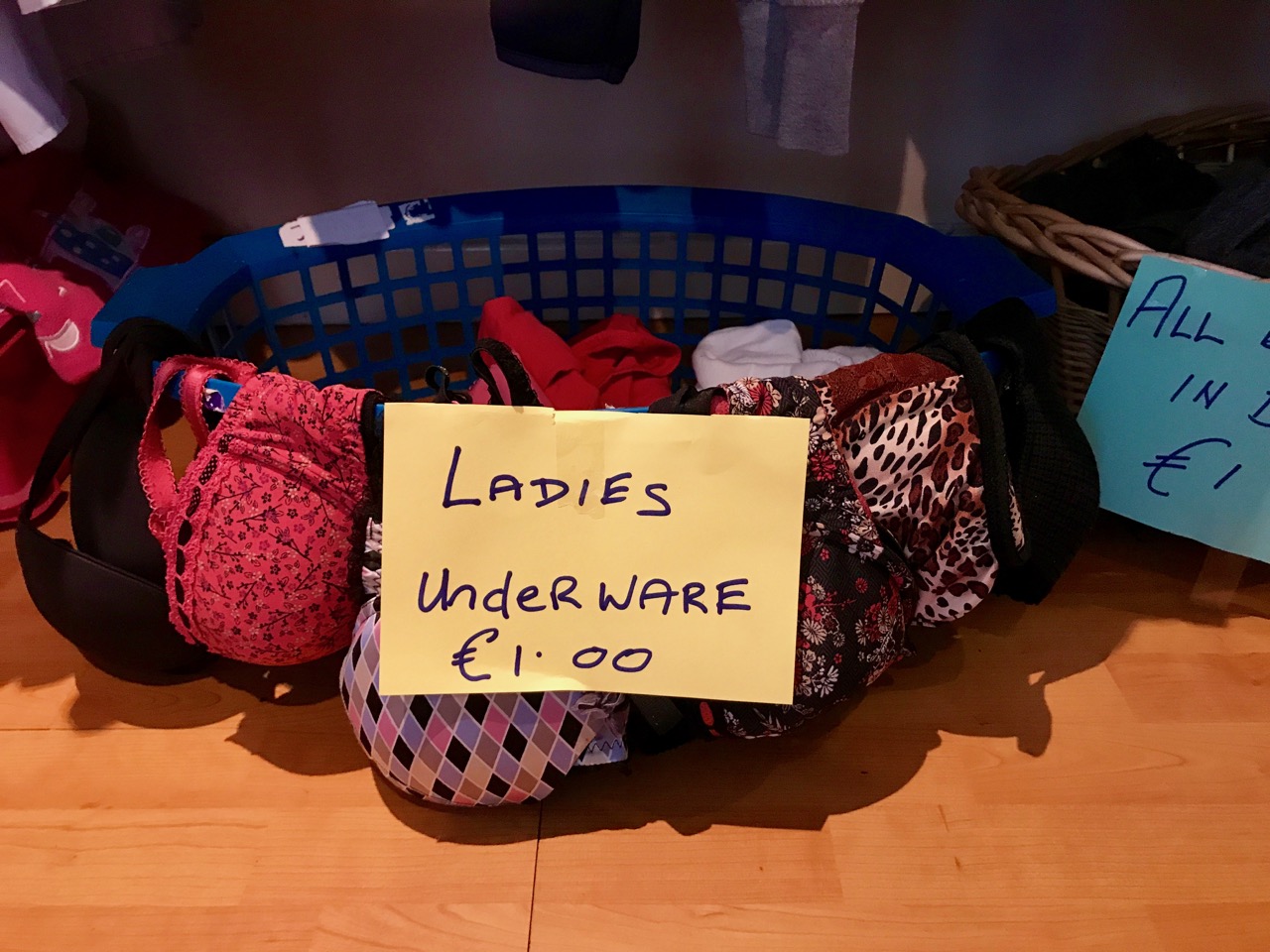
It’s always the ones that got away that are the best! We saw Freshly Dug Queens in a field of potatoes in Northern Ireland but were unable to stop on the busy road to capture it on film. We are just left with the concept hanging in the air… Worthy of a title, however, for this latest review of signs – amusing, curious and sometimes just plain puzzling – from all around Ireland. Take a look at the picture above: the dramatic Mountains of Mourne form a serene backdrop, but I couldn’t resist the enigmatic message hanging on a pole beside the beach.

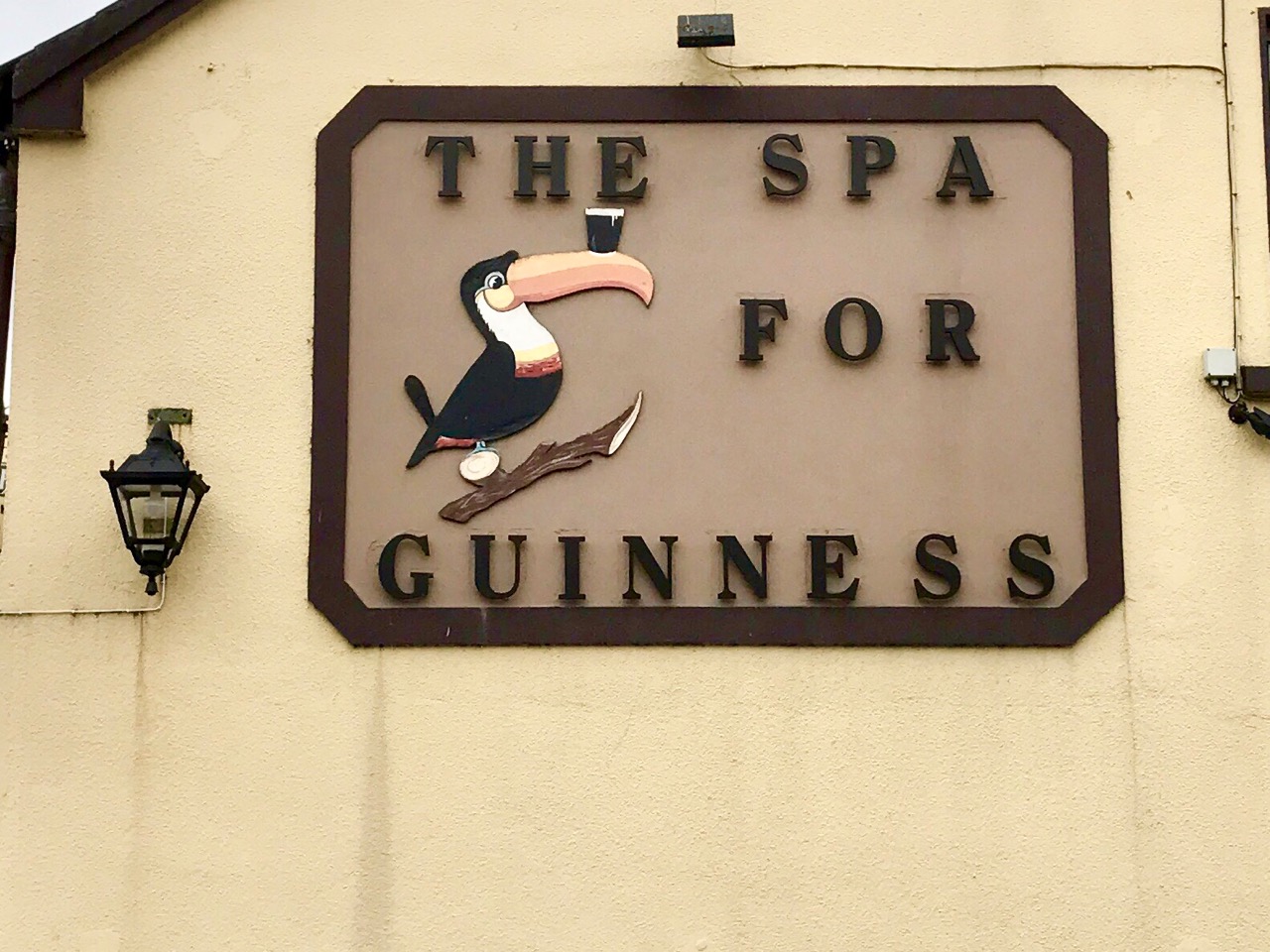
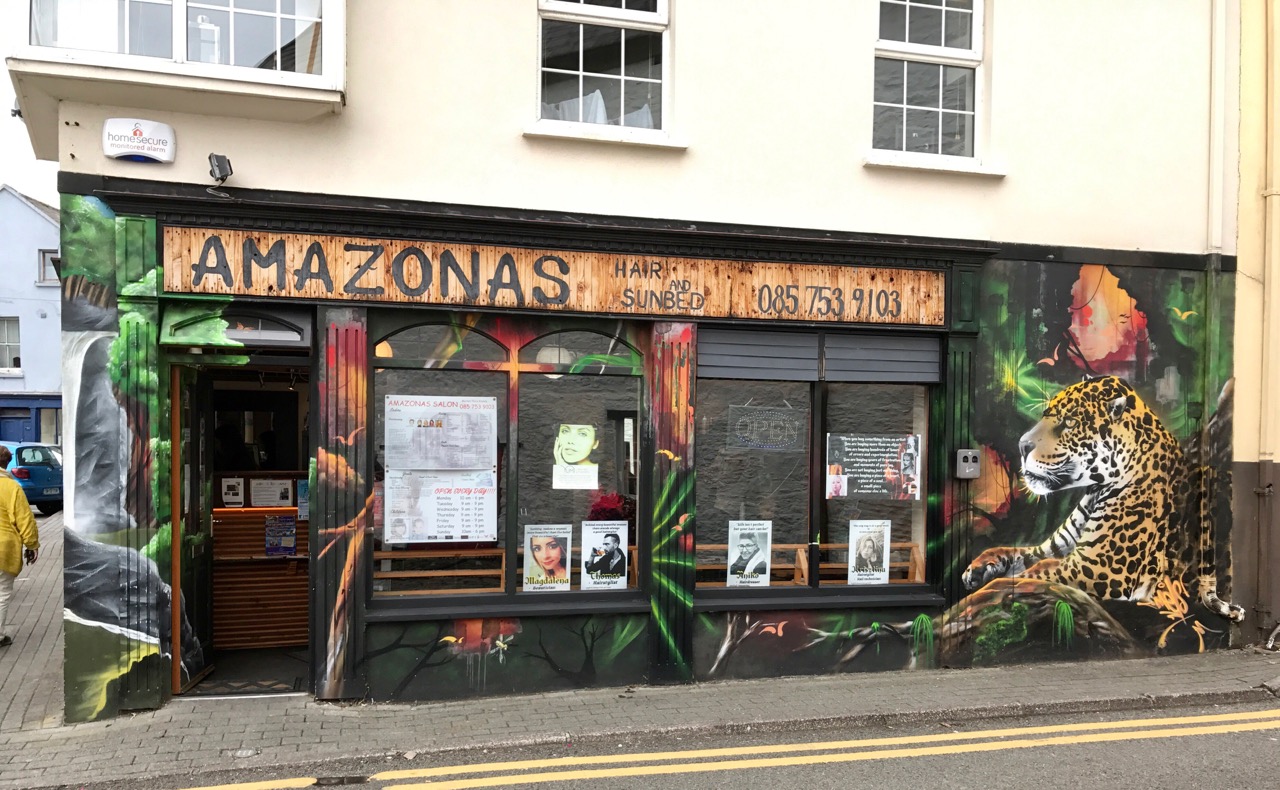
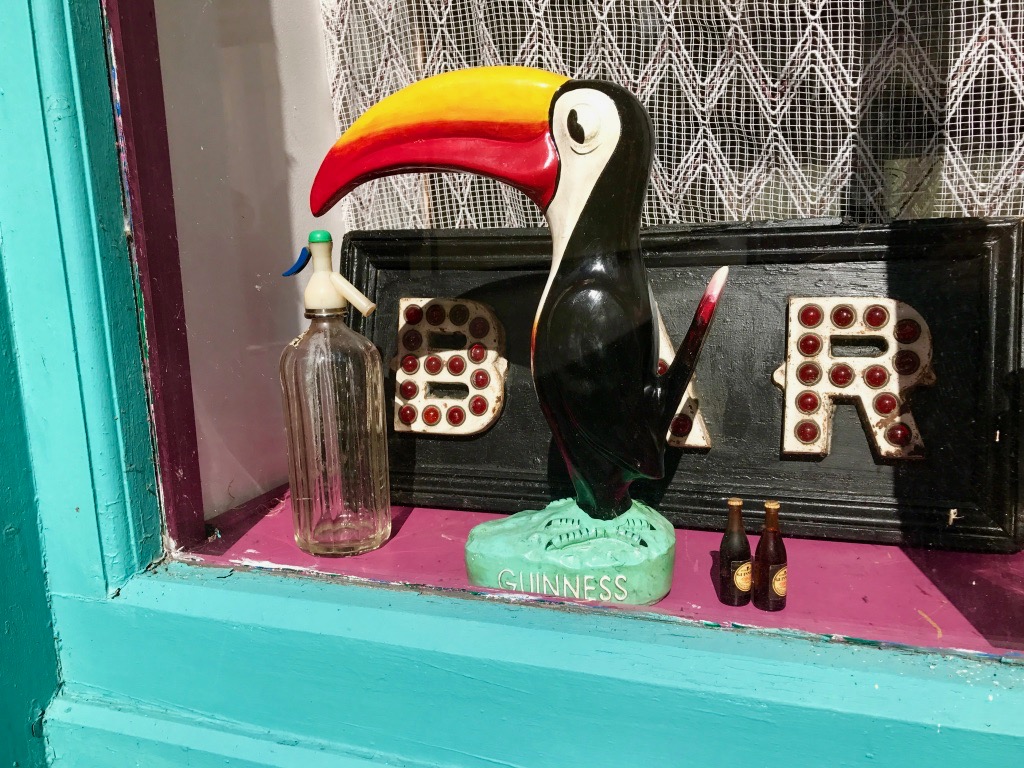
It’s always the case that context is everything: where the sign is often provides the clue as to what it means. But it’s almost better not to know the context. This time around, I’m including some which are purely pictorial – and even some shopfronts which, for me, enter the category of Folk Art. There’s plenty more in my own archives – you’ll find some here. Meanwhile, just enjoy them for the visual delights that they are.

You’ll notice that I have a particular liking for the various Guiness signs. That’s because I remember being fascinated by them during my childhood. I think I learned to read through looking at them!


Shay Hunston and the People of the Wild Atlantic Way

It’s the people! Shay Hunston is passionate about his subject. Sure, we have wonderful scenery, and every photographer is out capturing it. But time and again, what visitors tell us is that what makes Ireland special for them is the people they meet, their warmth, humour, empathy, poetic language, and the interest they take in others. So I set out to document those people – to show the faces and the personalities you will meet along the Wild Atlantic Way.

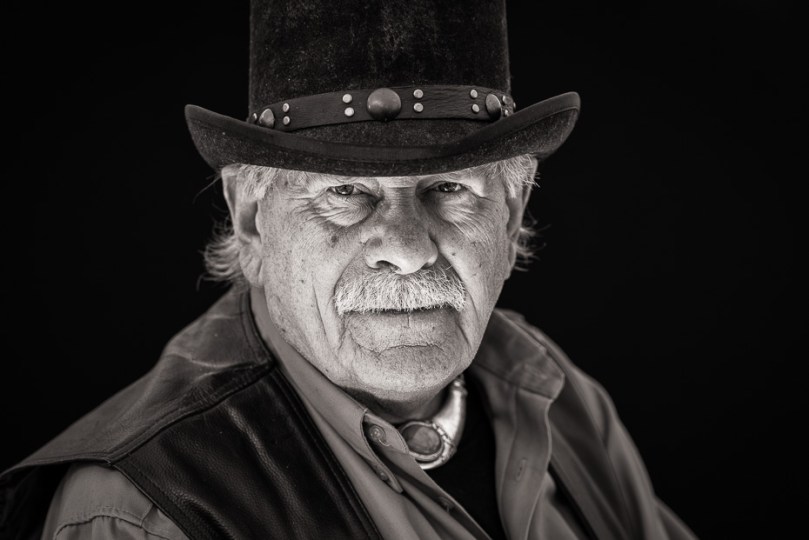
The first photograph above is part of that project – it’s Mike Watkins, the friendly face we pass most days as we drop into Budd’s of Ballydehob. He sits outside, drinking tea and greeting everyone. Here’s what he has to say about life: I have sunshine in my heart and I never, ever, ever get upset about anything. I’m happy every single day and everybody else should be the same, and we should all hug each other and talk to each other. This I have learnt from a lifetime of experience.

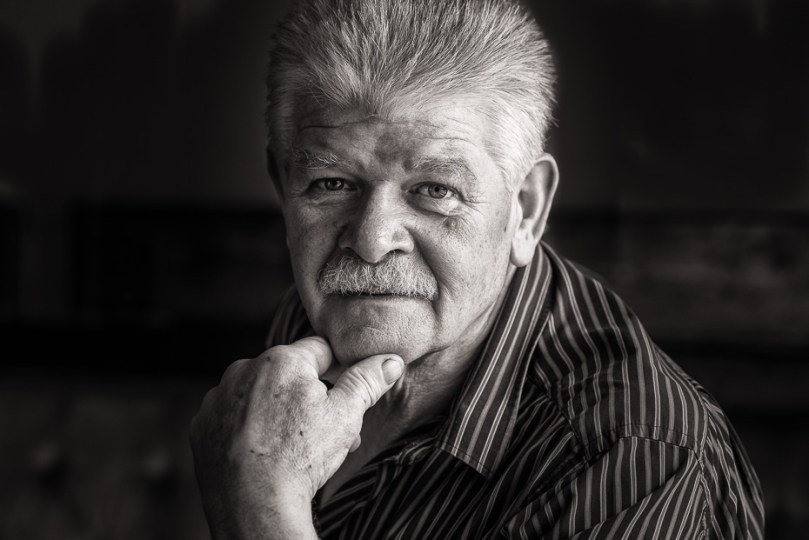
Tim Healy – Leap. The best advice I ever received in life was when I came to live in Leap in 1983. I knew of a local lad who had a reputation for liking a bit of a ‘Work Out’, he was well able to look after himself. So I said to him, just to wind him up, would you like to have a go, the two of us for 20 pounds. No, he said, I’ll tell you what, don’t be wasting your money, we’ll fight for pleasure.

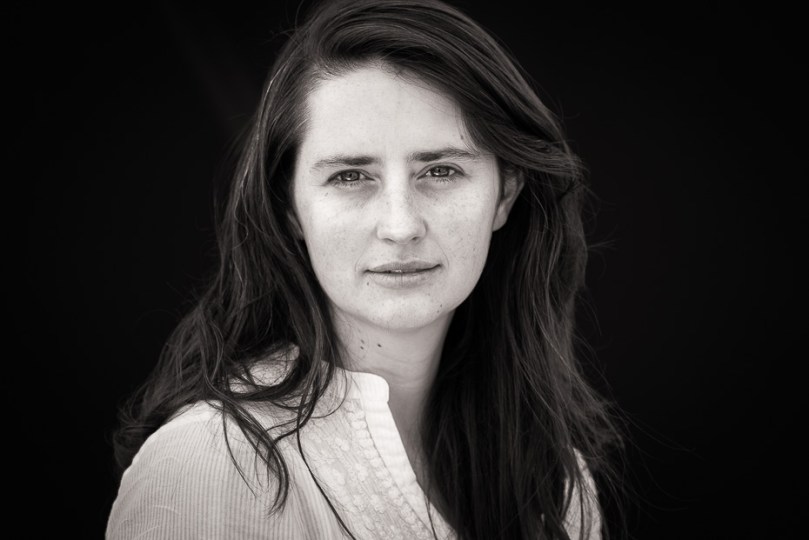
So far, Shay’s project has been a Wild Atlantic Success, and he hasn’t even moved beyond Cork yet. He’s been going from community to community along the Wild Atlantic Way, photographing whoever volunteers. Once the prints are made, the town or village mounts an exhibition of his strong black and white images, in shop fronts, on the approaches to town, on walls and railings.

Caroline O’Donnell – Ballydehob. My grandmother once told me that as long as I have music and laughter in my life I would never grow old. I think about her every day and try not to grow old. She also said never marry a man you haven’t seen drunk… I’m still thinking about that advice.

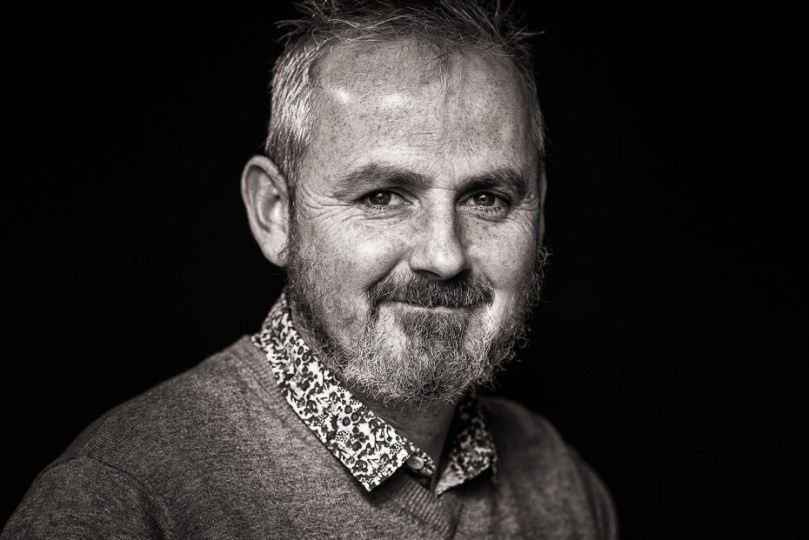
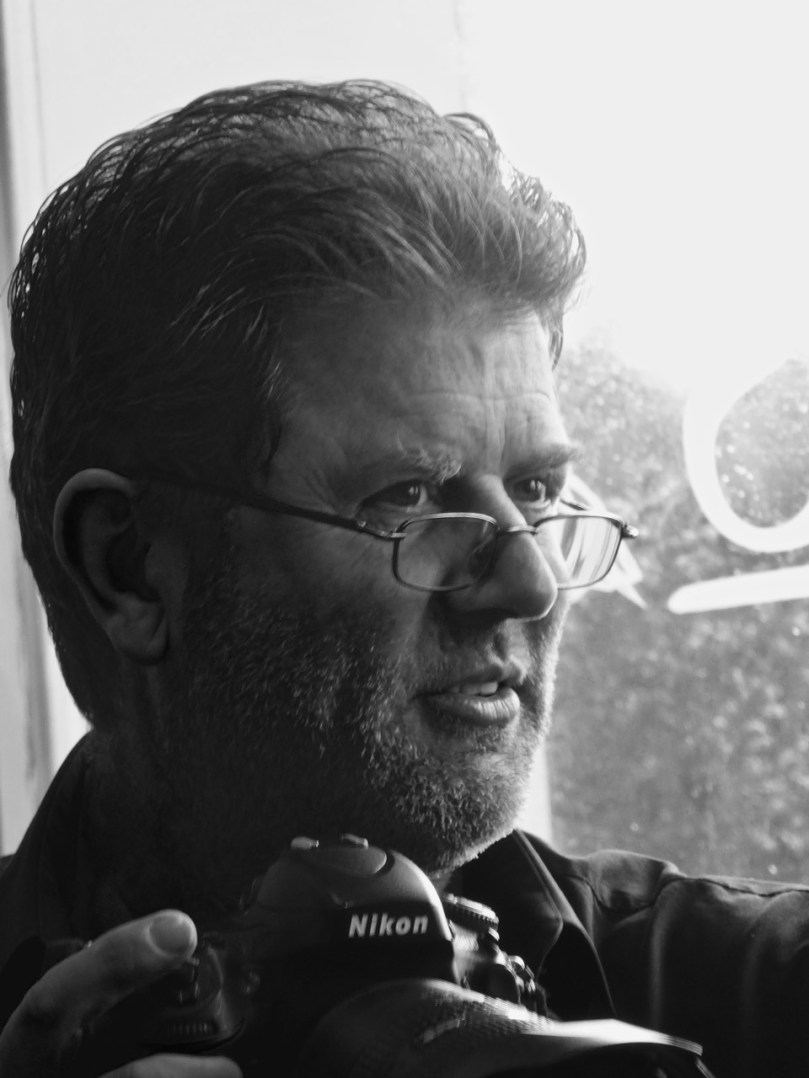
We missed the shoot in Ballydehob as we were away, so we participated in Schull. It’s a nervous business, sitting for a portrait, but Shay creates an instantly warm and relaxing environment. He’s good humoured and patient and empathetic and he obviously loves doing this. He was also cool about my photographing him and his process (no pressure like, to be snapping away in the presence of genius!) and doing a blog post.*

Pat Murphy – Castletownbere. I started fishing at 13 years of age in open boats with a crew of three. We fished winter and summer in all kinds of weather. From October to March we fished for scallops, two rowing the boat and the third man looking after the dredge, by God you had muscles from pulling oars for six months…In summer we would fish for lobsters and crabs. To make the pots we would go to the mountains to cut hazel and sally rods. I use to make four pots a day. Besides the fishing we all had a bit of land to grow our own vegetables and potatoes. Come September, those of us who had a pig or a cow would slaughter them, butcher and salt the pieces and put them in a barrel, there they would be left for 6/8 weeks, they would then be hard dried or smoked, we would also salt fish. The best life advice I could give anybody is to be able to negotiate with people, to work together, not against each other.

Shay asks people to write a few words to go with the image. It’s lovely to meander down the street and read what people have said, so I’ve included snippets under each photograph.

Saoirse Canty – Ballydehob. My perfect day would be my friends and I hanging out around Ballydehob. We would do nothing and talk about nothing all day. The reason why that is so perfect to me is because it makes me truly happy and the familiarity of this beautiful town is very comforting. It is one of those things that I could do forever.

You will notice, of course, that this post is (not surprisingly) a little heavy on Ballydehob folk, so as part justification for that, here’s what Shay himself wrote about his experience working in Ballydehob:

Ballydehob is a remarkable place, a multicultural melting pot of creative activity and is home to artists, poets, writers, musicians, sculptors and craftworkers. The local community encourages people to pursue and develop their creative and artistic talents…With the influx of artistic people in the 70’s, Ballydehob became known as the ‘San Francisco of the Mizen’. Ballydehob is an inspiration to all and is a template for how a multicultural community can live in harmony, with sympathy and compassion for each others needs.

But just to show I am not totally biased, here’s Danny Smith, whose day job as a postman in Bantry allows him the space to observe and dream about his next painting. Next time you’re in Kilcrohane, drop into The Old Creamery and see the wonderful results.

Danny Vincent Smith – Bantry. I started painting as long ago as I can remember, this passion for painting started from there. Every hour I would be thinking and looking for some kind of angle for a painting, observing everyday life, watching people’s faces, their expressions, trying to capture movement in the moment, such as an old lady with shopping, old farmers or a fella sitting inside the pub by himself. I try to picture people’s life’s and transfer them to canvas. My environment has a massive influence on my work and I feel like I’m documenting a time and place in rural life from where I live for future generations.

Go visit Shay’s website NOW to see lots more of his people photography, including his project to photograph the people of Dublin’s Temple Bar. Or sign up to follow him on Facebook or on Twitter. The Schull images should be ready in a few weeks – I will let you know.

Callum Donnelly – The Ludgate Hub, Skibbereen. My Perfect Day – A frosty morning, circa 8am, the ground is firm. I wrap up in a coat, scarf, gloves and I bring my springer spaniels for a walk around our local woodland. The air is sharp, and you can take a deep breath, and try to ignore the daily bombardment of emails, messages & calls. To be able to walk in silence, absorb your surroundings is a fantastic way of  balancing your mind in a world where work can often take precedence. Young people feel enormous pressure to succeed, and perform, its good to take some time out in an environment that is a polar opposite to your usual surroundings.

I will leave you with a couple of shots of Shay himself and his session with Robert. If he comes your way, you lucky people of the Wild Atlantic Way, take advantage of this opportunity! And as for everyone else – come and meet us for yourselves.

Shay and Robert

Himself

*Images were downloaded from Shay’s website with his permission. Please always credit the source for any image you download from the internet.