A Midwinter’s Tale

winter gales

We’ve established a little tradition for Christmas: we include a story, ideally to be read by candlelight huddled beside the stove just at the turning of the shortest days. Last year Finola wrote of childhood memories – Christmas in Dublin; the year before that I penned a version of a haunting Irish folk-tale. This year it’s my turn again, and I’m including a story which is based largely on events which really happened many years ago in the small Devon village where I lived. They bring to mind our own stormy winter which we survived earlier this year here in Nead an Iolair…

winter

Kathleen by Robert

Kathleen was a large woman alright.  If you saw her in the field, there was no mistaking her profile:  she always wore two coats, one on top of the other, and at the bottom they flared out like a church bell.  I never saw her without her great legs jammed into a pair of old wellington boots – except in chapel of a Sunday – and on her head was the same shapeless piece of faded red knitting, year after year after year.

Kathleen became a neighbour of ours soon after Mr Monihan’s passing.  – And there was a strange thing, too.  I never heard it from Kathleen’s mouth direct – but then I never heard her deny it either – but everyone in the village was sure enough of the story.  He had been a smallish man, I suppose; certainly, he was small by comparison with Kathleen.  They shared the marriage bed late in life, for he’d taken herself – a confirmed spinster – as his second wife long after his own children were out in the world.

Well, it was about two years into the union that Kathleen first noticed her husband’s night wanderings.  She would wake in the morning – so the story goes – and find him cold and shivering beside her, with the smell of the sea all around.  Time and again this happened, and because he would say nothing about it, she determined to find out what was going on.  A certain night they went to bed as usual; she lay quiet but kept herself awake by repeating the Our Father over and over into the bolster.  It came to the deepest part of the night, and Mr Monihan seemed to be peacefully asleep, while Kathleen was feeling very tired and wondering what she was about.  Suddenly, he started up, crept across the room to the door, and in a minute was out of the cottage.  He had paused only to put on his old black cape that always hung on the peg.  Just as quickly, Kathleen was out too, but she was careful to keep hidden away behind him.  Down the hill they went, through the sleeping village and out on to the beach, he walking so fast that she had some difficulty in keeping him in her sights.  Eventually, she lost him altogether in the rocks over by where the cliffs start.  She searched for an hour and then gave up, returning crossly to her bed.

In the morning he was back again, but cold and shivering as usual.  Kathleen went over to the peg by the door and felt his cape:  it was streaming wet, and flecks of sea-foam still clung to it.

Of course, Kathleen confronted him with the story and wanted to know what it all meant.  He just shrugged and claimed to know nothing of it; as far as he was concerned, he had slept all night in his bed and woke up in the morning as cold as any old man would be.  So there was a pretty poor state of affairs for Kathleen.  But she accepted it in the end, as we all accept the mysteries in our lives.  She did try to follow him again, but had no more success than before.  She closed her mind to it and denied its happening, even to herself.

A while after, he was gone altogether, and his black cape with him.  She waited a day and a night, then went down to the rocks to search for him.  He was never found, and everyone accepted that he was drowned while in pursuit of his trade, which was kelping.

After that Kathleen moved up the hill into the little thatched cottage across the lane from us, and took up the kelping herself.  I would often meet her coming across the sand of an evening, the great dripping net slung over her back and she bent with the weight of it.  Yet I never heard her complain, and she a widow so soon.

She was not companionless for long.  One of her husband’s daughters who lived away in the city with a family of her own fell on difficult times and sent her own son to stay with Kathleen.  This was a weak looking boy of about fifteen years old.  The arrangement was meant to help Kathleen as well as the mother, but I never once saw him lift a kelp net, and doubted if he was even able.  Instead, he followed her around like a dog, and seemed more of a worry to her than ever her widowhood had been.

What happened after was only learnt by the villagers in the course of time, and much of it hearsay in any case, as Kathleen always kept herself to herself.  She must have been aware of the stories that went about but was never known to confirm any aspect of them.  On the other hand, she never uttered against them, so they are probably worth the telling.  I saw little enough of the events myself, although I was aware at the time that Kathleen was in some way troubled.
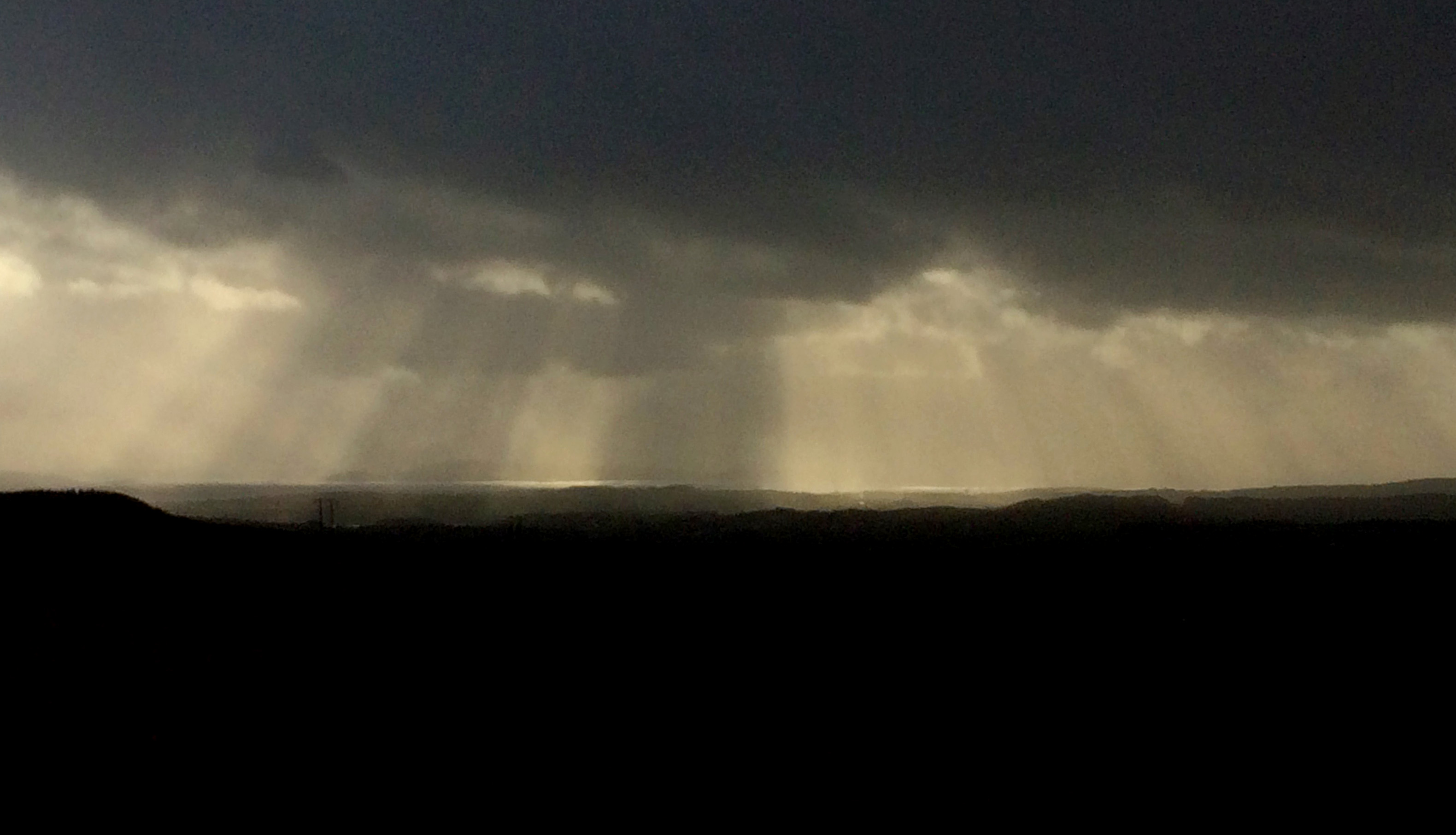
Storm clouds

It was late in the year; nights were long.  The cottage had only one bedroom – Kathleen’s – and the boy slept on a settle in the kitchen.  On our wild coastline, dawn is hailed not by a cock’s crow, but by the first wailing of sea birds that collect in huddled crowds over the off-shore rocks.  One of these winter mornings Kathleen was just stirring herself when she was startled to find the boy standing by her bed.  He had thought that she called him – somebody or something had called him – so he came from his place on the settle to see what was wanted.  She paid little enough heed of it the once, but when it happened again a second and a third night, well – then she started to worry.  On the fourth she stayed up, sitting herself in a hard chair by the embers of the hearth so that the discomfort of it would keep her awake.  She kept the Good Book beside her.  She was determined to wait the night out, but drowsiness overtook her and she suddenly awoke in the early hours to find the boy had sat bolt upright and was staring sharp at the cottage door.  He seemed not to hear her when she spoke but eventually came to, like one shaken out of a dream, and told her that – again – there had been the voice crying to him in the night.  She made light of it, and convinced him it was no more than the wind and the sea, but inside herself she knew there was something else.

After that, Kathleen could not rest easy without taking the precaution of fitting a large lock to the door which faced down the shore road – something she had never lived with all her life before – and when she went to her bed at night, the key was firmly under her pillow!

The solstice passed, and days grew longer.  Gales came, as they always do in January on our coast.  But in that year these were savage gales, far wilder than anything I had experienced in my lifetime.  The glass in the hall fell and fell again, until the little brass pointer was hard against its bottom stop.  We kept around our firesides, then, and listened to the storms hurling themselves against us, our windows and doors rattling and moaning from the wind wanting to tear us from our refuge.  Some days there would be a little respite, and we would venture outside to pick up the broken slates and chimney caps that littered the lanes and gardens.  At these times, we saw how the sea had thrown itself halfway up the village street as though angrily trying to reach out for our hillside homes, having already washed over those against the harbour.  There was no kelping could be done – the huts on the shoreline were in any case smashed and the nets all gone – but Kathleen could never be idle:  she feared for her roof and I watched her throw thick cords across the ridge of it, and lash them to great boulders at the eaves to weigh it down.  All this she did from ladders with the wind still high, she heaving the heavy rocks on her own while the boy stood under her, useless as a lame sparrow.

These lulls were short, and were each time followed by yet worse weather.  The peak of it came towards the end of the month, with a roaring wind that you could not stand up against.  It brought our chimney down, and the church steeple too, which went through the nave and ruined it.  A day and a night it lasted with us all crouching indoors, wondering what havoc we would find around us if ever we survived.
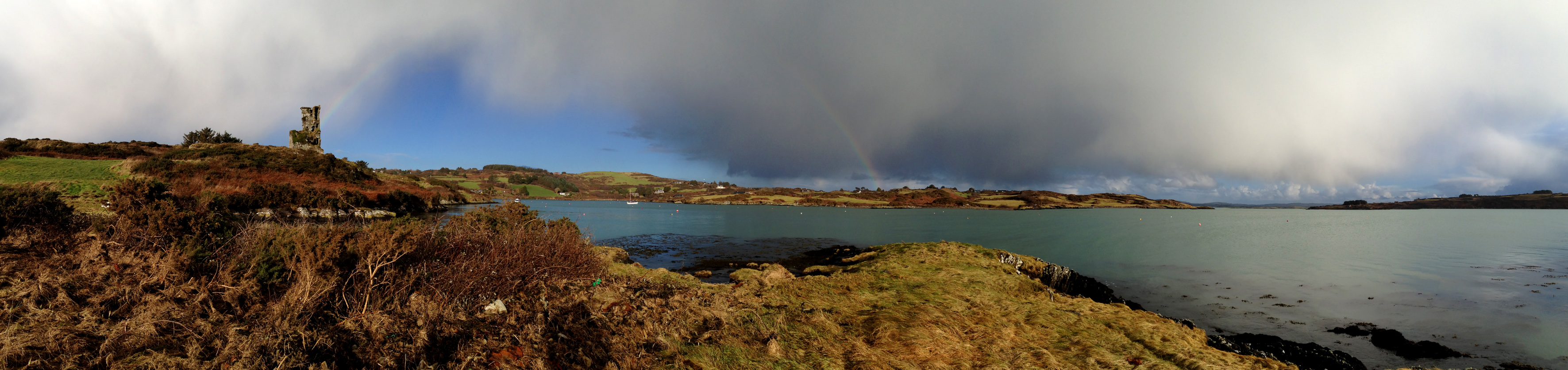
stormbow

The morning that followed after was, unbelievably, as quiet and as calm as spring.  There was not a breath of air moving; the wind seemed to have blown itself right away.  We crept out and viewed the devastation.  It was bad, but it could have been worse.  There would have to be a lot of roofing done, but generally the old stone walls had taken the battering well.  In the course of time we were thankful to discover that no-one in the village had suffered injury to themselves.  Like us, they had each one hidden away by the safety of their own hearth.  Kathleen was not so relieved however, and I realised her agitation as soon as I crossed the lane to find how she herself had fared.  She showed me where her door lay half in and half out of the tiny porch, as though it had been picked up in the night by some gigantic hand.  The rest of the cottage was undamaged, the roof intact under its protection.  But the boy was vanished.

We got together a search party as soon as it could be managed, and went after Kathleen who had gone straight down to the rocks at the end of the beach, close under the cliff.  All that day and all the next we searched, but never a trace we found.  I happened on an old black cape lying half in one of the pools but left it for the tide to take back again.

A few years have passed since these things occured.  The winds have never been as rough again as on that night when Kathleen’s boy was lost.  The village gradually got itself back to normal, and the sea has done its best to wash over the memories.  The cottage across the lane is unchanged, except that it has a new entrance door.  I often meet Kathleen striding across the beach with her loaded kelping nets:  I would like to ask her if she still locks herself in at night.
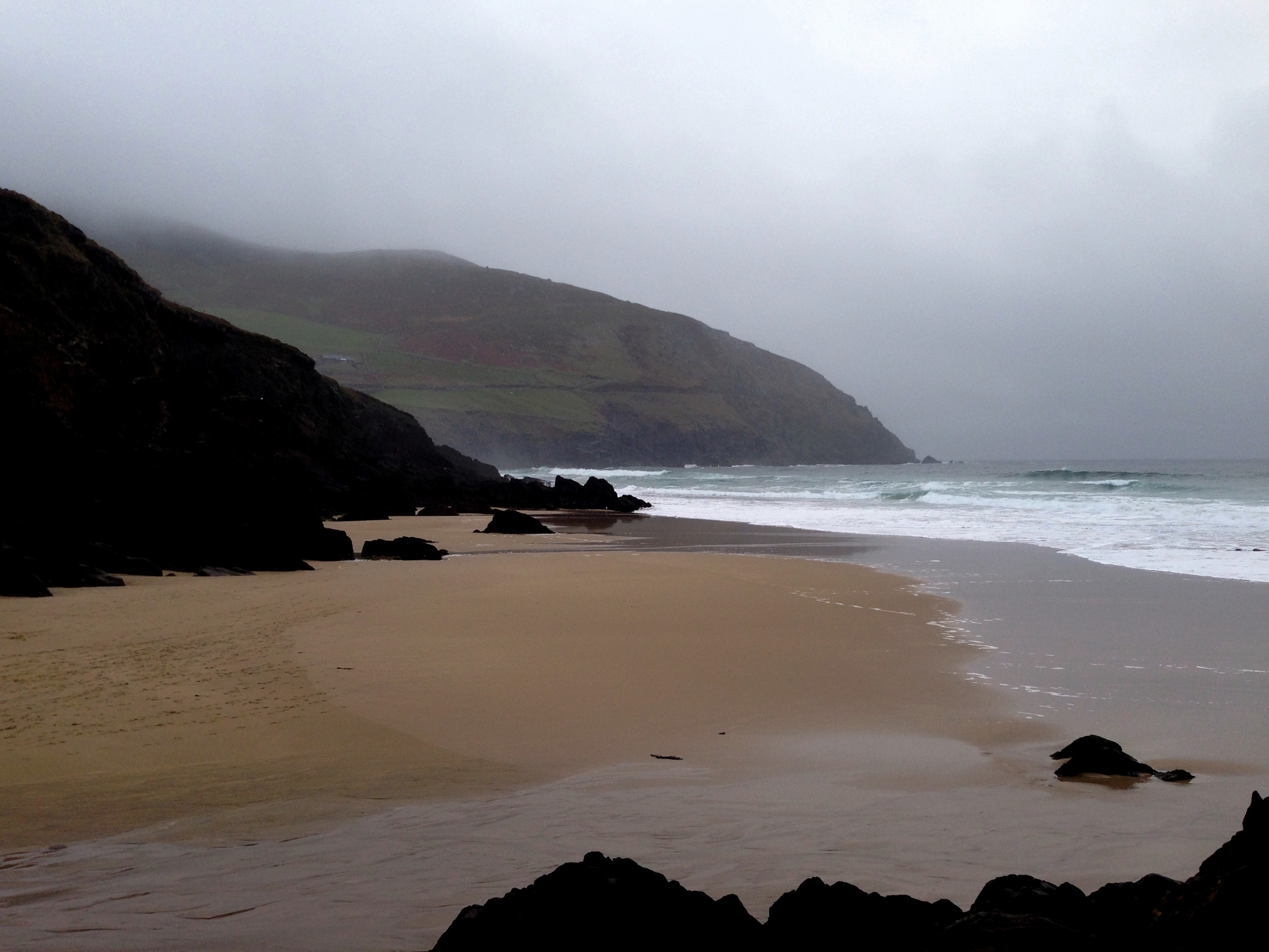
storm sea

The gale found us again this last January.  I lay in bed unable to sleep for the fury of it beating itself over the sea walls.  Or perhaps I did drowse – for I fancied that just before daybreak the storm dropped, and from beyond it there came a faraway sound unfamiliar to me, as of someone calling out of the night.  Calling my name.  I shook myself properly awake.  No, I could not still hear it; it must have been one of the sea birds on the islands shouting in advance of the dawn chorus.  In the morning I went down to the beach.  There was Kathleen as usual, pulling through the combings of the high tide with her long wooden rake.  I passed her by, and walked out to the end of the sands, where the cliffs begin.  I had thought that the sounds of the breaking surf would wash the night-cries from my ears or my head.  Yet they still rang clear inside me. I started, then, when I suddenly came upon two figures – they were two great black seals who when they saw me threw their heads in the air and cried out, and their cries were carried away by the wind over the village and over the hills.  I watched as the creatures slid back clumsily across the sand until the water took them.  Still they cried as they swam away, their snouts raised up through the racing froth.  At the far end of the beach I saw a small stooped figure – Kathleen it was – raise her hand briefly to her eyes to watch after them.

church tower

The church in Hatherleigh, Devon, destroyed by the hurricane of January 1990

Shenanigans

running fox

The word shenanigan (a deceitful confidence trick, or mischief) is considered by some to be derived from the Irish expression sionnachuighim, meaning ‘I play the Fox’. That’s by no means the only definition of shenanigan that you’ll find, but – for me – it’s a good one.

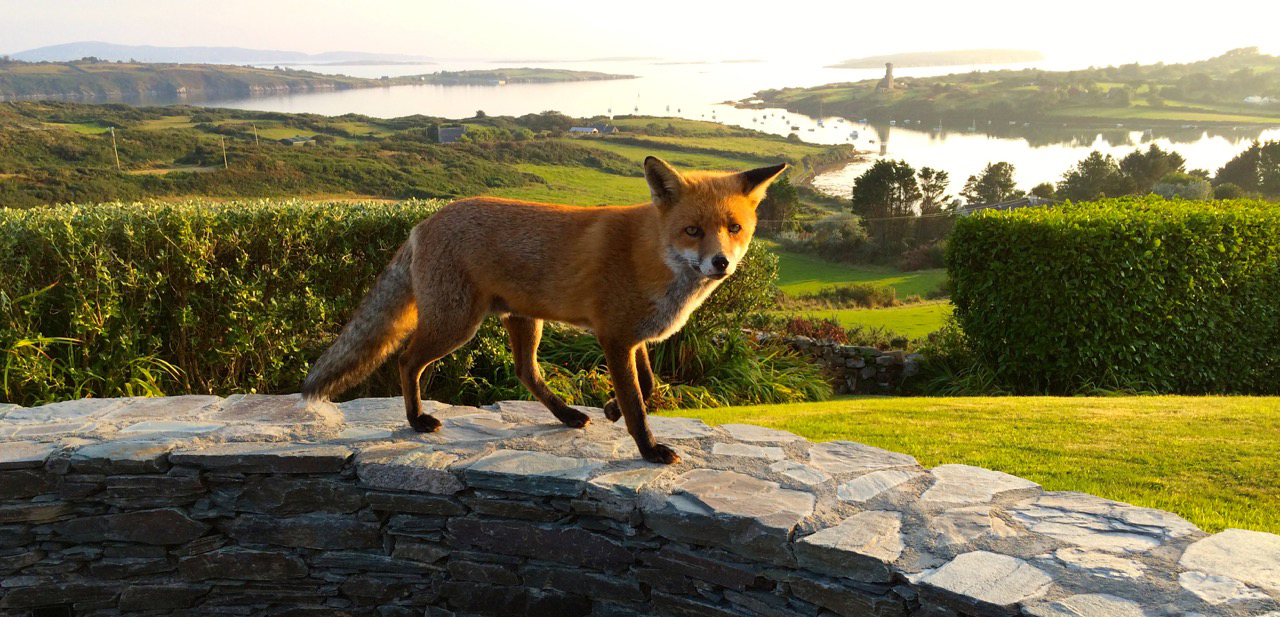
The Red Fox stops by Nead an Iolair on most days. He’s such a frequent visitor that he’s trodden a furrow across the lawn – which he follows meticulously in order to keep his feet dry: he’s a fastidious creature is our Ferdia.

It’s a bit unkind, perhaps, to always think that the Fox is up to some kind of shenanigans. That would be playing up to his reputation of being cunning or sly. Our Ferdia is pretty open about why he takes an interest in us – purely and simply, it’s his stomach. His patter is always the same: he stands at the window and presses his nose against the glass, managing to look somehow downtrodden or neglected (we know he isn’t at all – in fact his current winter coat is magnificent: not just red, but with a silver grey sheen, and his legs, paws and ears are a beautifully velvety black).

on the wall 2

The Irish word for Fox is Sionnach, and there are stories that this animal was brought over here by the Vikings, who reputedly used them for hunting. Now the tables are turned: in Ireland Fox hunting is a legal sport (which it no longer is in Scotland, Wales and England), and we have very occasionally seen The Hunt crossing the fields during our travels. If you read the highly amusing Irish RM by Somerville and Ross you will quickly gather that actually apprehending a Fox is something very rare for The Hunt: more usually it results in a loss of balance, life or dignity for the participants. This is probably a realistic picture: Edith Somerville was herself a MFH and therefore had considerable experience in the matter.

Well, Ferdia’s ploy usually works, and he frequently deprives us of the last morsel on our own plates. I’m sure I’ve heard him chuckling to himself as he disappears off into the fields clutching a bone or three. Foxes are good family animals: generations can live together for a few seasons, helping to look after the succeeding offspring – the collective noun for Foxes is A Skulk. Ferdia himself has got his act together: if we give him some scraps he’ll eat a good chunk first and then carry the rest off home – which I’ve worked out is quite a distance away. That’s fair enough: as Alpha Male and number one provider it wouldn’t do if he was debilitated with hunger.

We have on occasion seen Ferdia lead another Fox into the garden – either a wife or a daughter, but they are so nervous that their visits are rare and short. Ferdia, on the other hand, is totally confident that he’s got us wrapped around his little finger… In the summer he has been sitting out with us on the terrace, passing the time of day in a very relaxed fashion.

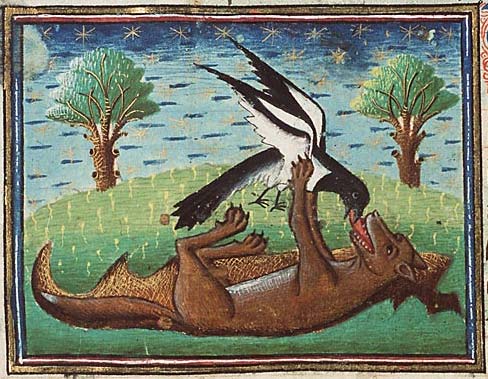
img4954Only yesterday I noticed our Fox sorting out some scraps on the lawn. Suddenly, there came into view two magpies. As I watched, one of them hopped around to the front of Ferdia and he stopped what he was doing to chase it away. Immediately, the other Magpie jumped in and took a good helping. Ferdia rushed at this competitor, and Magpie number One hopped in and had his share… From which I deduce that the cunning of Magpies is equal to that of the Red Fox.

In folklore, the Fox has a big presence. The animal is said to be able to foresee events including the weather and its barking is said to be a sure sign of rain (the only time we heard Ferdia bark was when we hadn’t noticed him standing at the window).

It is thought to be unlucky to meet a woman with red hair when setting out in the morning, especially if you are a fisherman. We may assume that the woman is a Fox in disguise.

There are legends about both St Ciarán and St Brigid finding and taming a Fox, and there are medieval carvings in churches showing Foxes: in one instance a Fox is in a pulpit preaching to Geese!

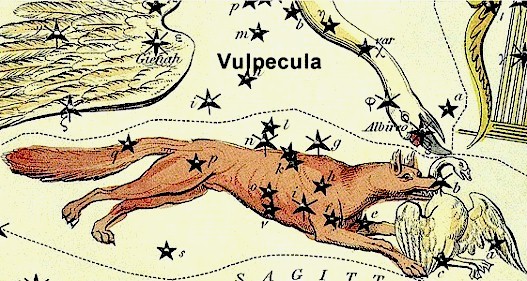
Where does the word Fox come from? One theory is that it derives from the French word faux – false. Interestingly there is also a possible link to the flower – Fuschia – so prolific in the Irish hedgerows. Theories abound, but we know that the Fox is above us in the night sky, in the constellation of Vulpecula – once known as Vulpecula cum Ansere – Fox and Goose.

Vulpecula

The story of Fox and Goose has been immortalised in what is reputedly one of the oldest folk songs in the English Language: The Fox or Daddy Fox. This version is from the 14th century:

‘Pax Uobis quod the fox,

‘for I am comyn to toowne’

It fell ageyns the next nyght

the fox yede to with all his myghte,

with-outen cole or candlelight,

whan that he cam vnto the town.

When he cam all in the yarde,

soore te geys were ill a-frede;

‘I shall macke some of youre berde,

or that I goo from the toowne!’

when he cam all in the croofte,

there he stalkyd wundirfull soofte;

‘for here haue I be frayed full ofte

whan that i haue come to toowne.’

he hente a goose all be the heye,

faste the goos began to creye!

oowte yede men as they myght heye,

and seyde, ‘fals fox, ley it doowne!’

‘Nay,’ he said, ‘soo mot I the

sche shall go vnto the wode with me;

sche and I wnther a tre,

e-mange the beryis browne.

I haue a wyf, and sche lyeth seke;

many smale whelppis sche haue to eke

many bonys they must pike

will they ley a-downe.’

2253385750

Here’s a more accessible version:

The fox went out on a chilly chilly night

He prayed to the moon to give him light

He had many many miles to go that night

Before he reached the town-o, town-o town-o,

Many many miles to go that night before he reached the town-o.

He ran ’til he came to a great big pen

Where the ducks and the geese were kept therein

He said a couple of you will grease my chin

Before I leave this town o, town o, town o

A couple of you will grease my chin before I leave this town-o.

He grabbed the grey goose by the neck

And he threw a duck all across his back

He never did heed the quivvy quivvy quack

Nor the legs all a dang-ling down-o, down-o, down-o

He never did heed the quivvy quivvy quack

Nor the legs all a dang-ling down-o.

Old mother Flipper Flopper jumped out of bed

Out of the window she pushed her little head

Cryin’ O John, O John the grey goose is gone

And the fox is away to his den-o, den-o, den-o

O John, O John the grey goose is gone

And the fox is away to his den-o.

Well, the fox he came to his very own den

And there were the little ones, eight, nine, ten

Saying Daddy you better go back again

‘Cause it must be a mighty fine town-o, town-o, town-o

Saying Daddy you better go back again

‘Cause it must be a mighty fine town-o.

Well, the fox and his wife without any strife

Cut up the goose without any knife,

They never had such a supper in their life

And the little ones chewed on the bones-o, bones-o, bones-o

They never had such a supper in their life

And the little ones chewed on the bones-o.

stamp

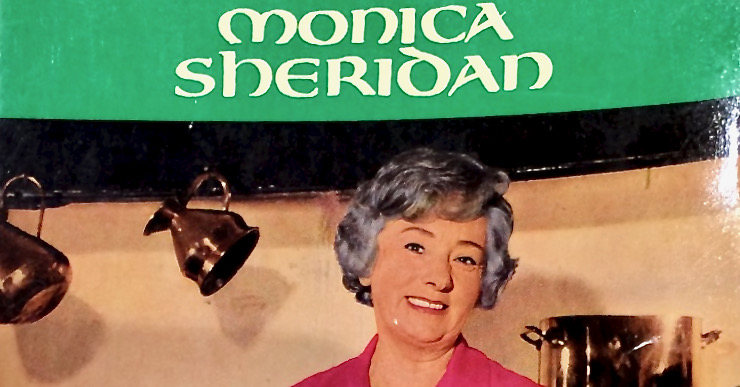
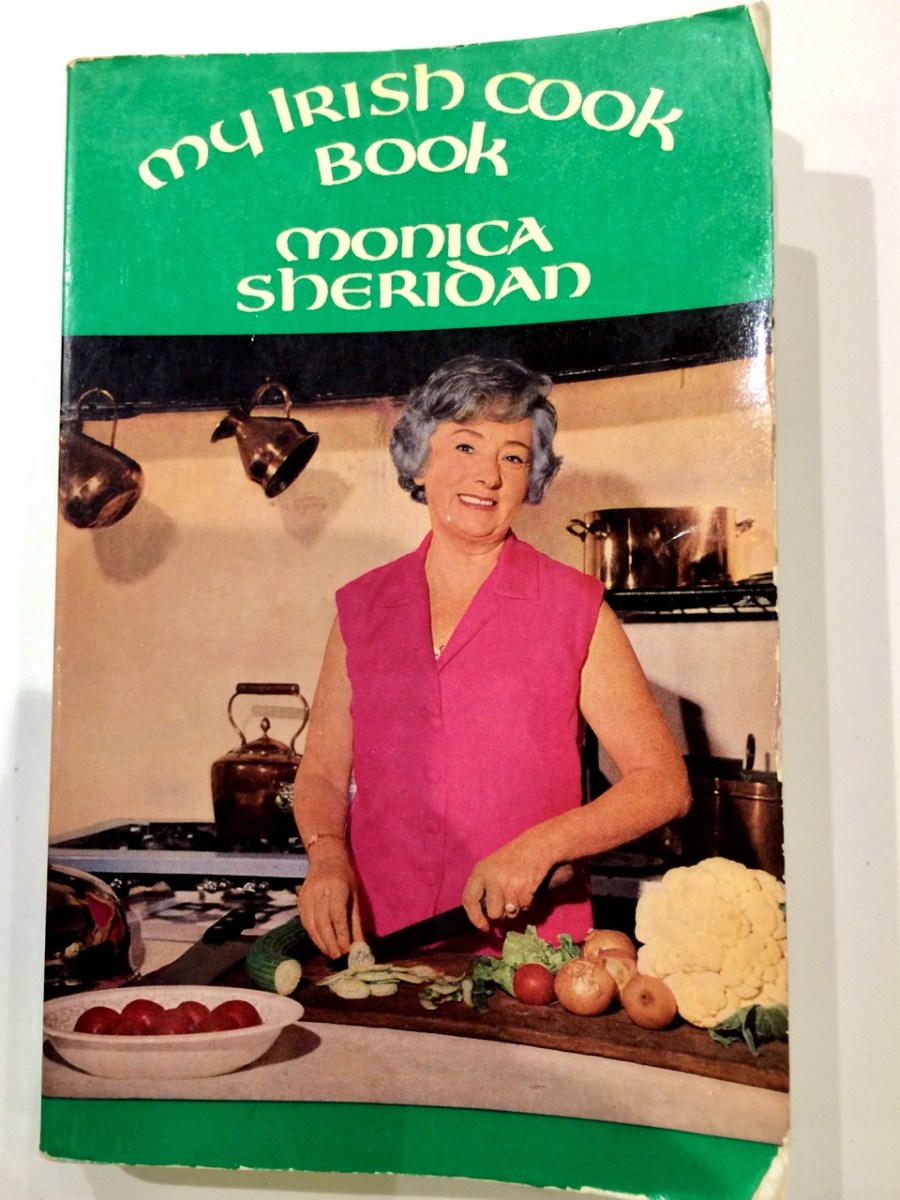
Monica Sheridan’s My Irish Cook Book

Last year I decided to make Christmas cake according to Monica Sheridan’s recipe, which I remembered from my childhood. A comment from a reader got me curious about her other Christmas recipes and I got out my dog-eared copy of My Irish Cook Book to look up how to make a traditional plum pudding. Fatal mistake! Instead of cracking eggs and and soaking fruit I have been chuckling over the book and insisting that Robert listens as I read bits out loud.

I have already posted about Monica’s Kitchen and the delights it contains. The audience for that book was the modern Irish home cook (assumed to be female) of the 1960s. My Irish Cook Book focuses on traditional Irish foods and recipes. The emphasis is on fresh ingredients and fairly simple cooking methods – the kind of thing we call Slow Food nowadays. But because it’s about Irish food it is also an extended piece of nostalgia, replete with dewy-eyed memories of her childhood and her trademark stories and trenchant wit.

The book starts with an essay on the cooking traditions of her family, from her great-grandmother cooking stews in a bastable oven over an open fire, to her grandmother (who actually had running water from a tap!) to her mother who continued to churn her own butter, cure her own bacon, bake her own bread and make the most outlandish hats with feathers purloined from the cock.

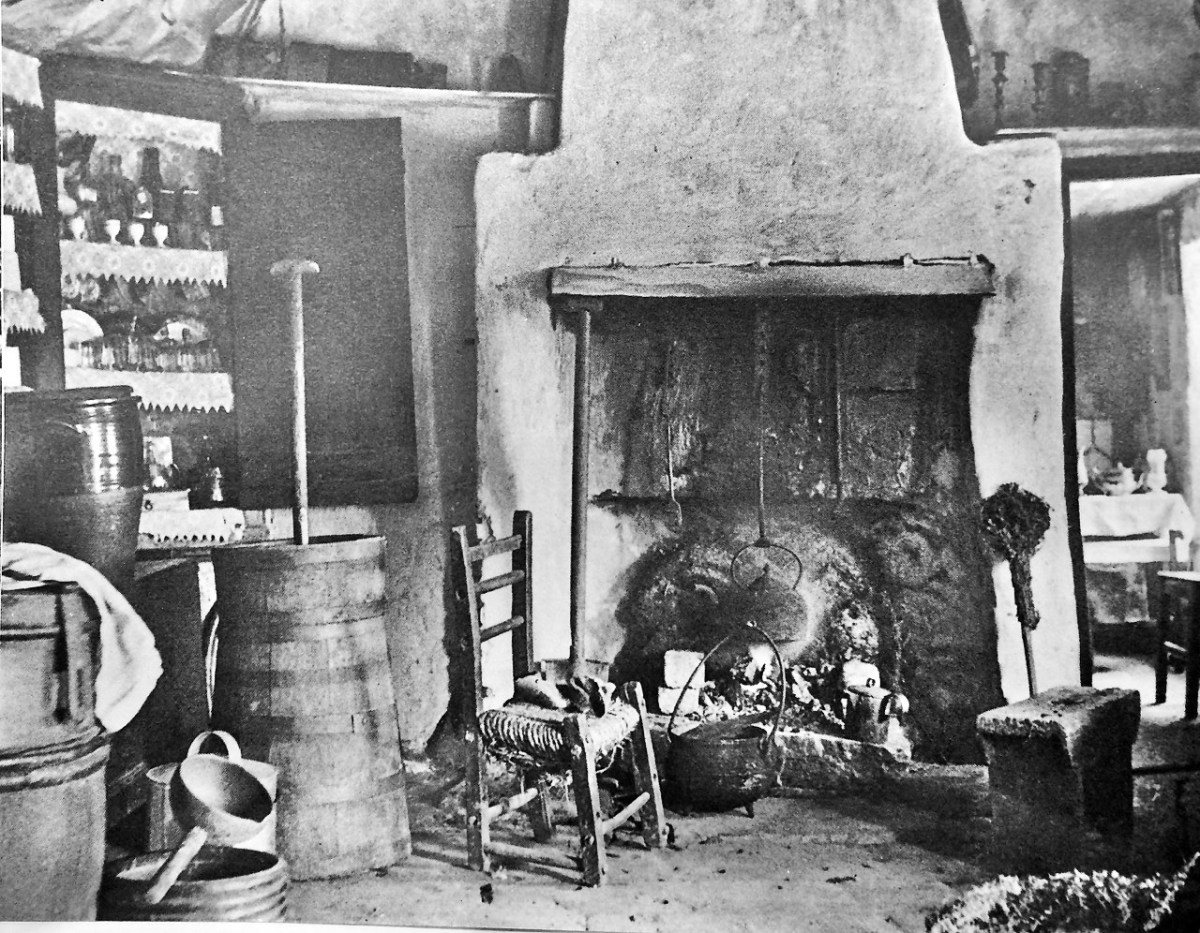
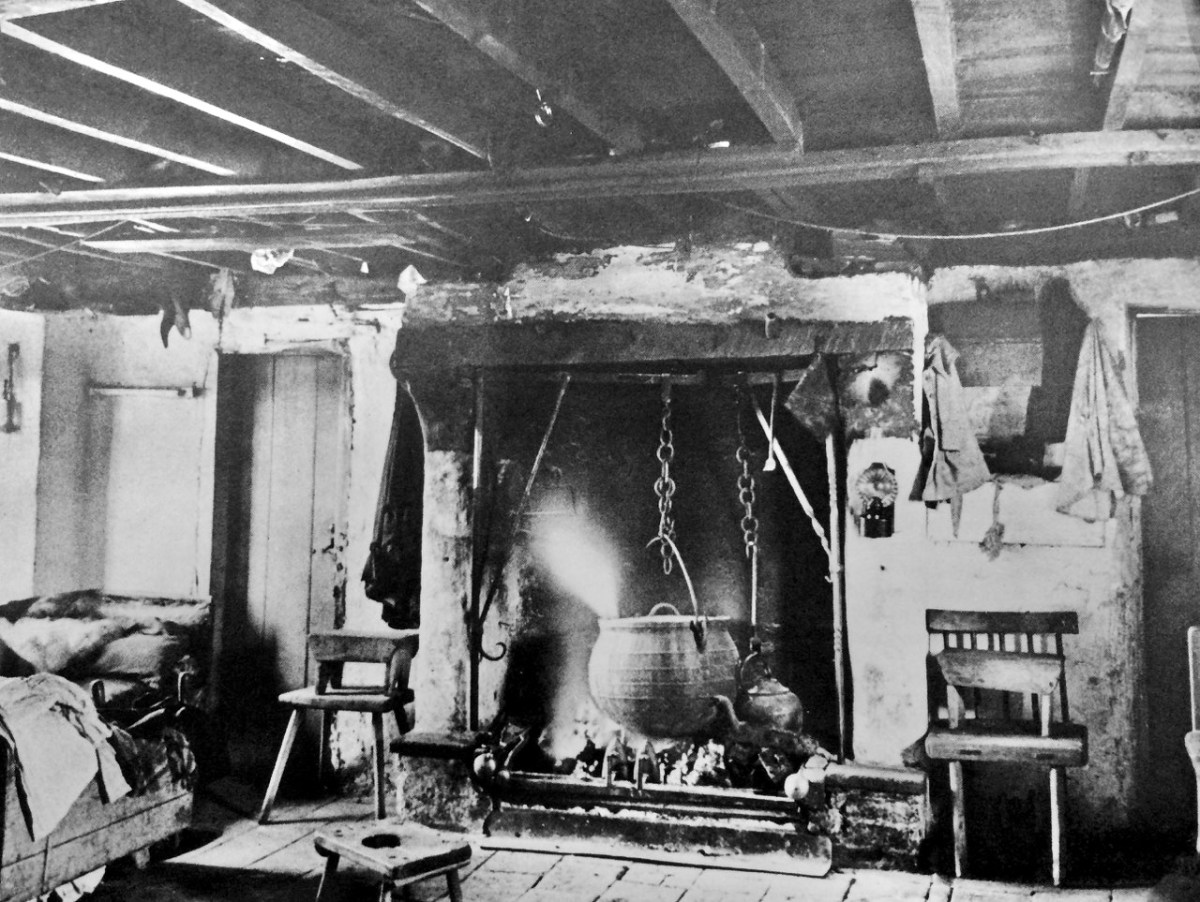
The photographs above and below, by the way, are from my own copy of the book A Taste of Ireland by Theodora FitzGibbon – a book that deserves its own post one day. The photo above is labelled A traditional Irish Kitchen, about 1888, and the one below is of the ancestral home of US President William McKinley in Co Antrim.

Her soup chapter begins thus:

The Geography we learn at school tells us that Ireland has a moderate climate, warmed by the Gulf Stream without any great variations of temperature either in summer or winter. This is a flagrant piece of Celtic exaggeration…

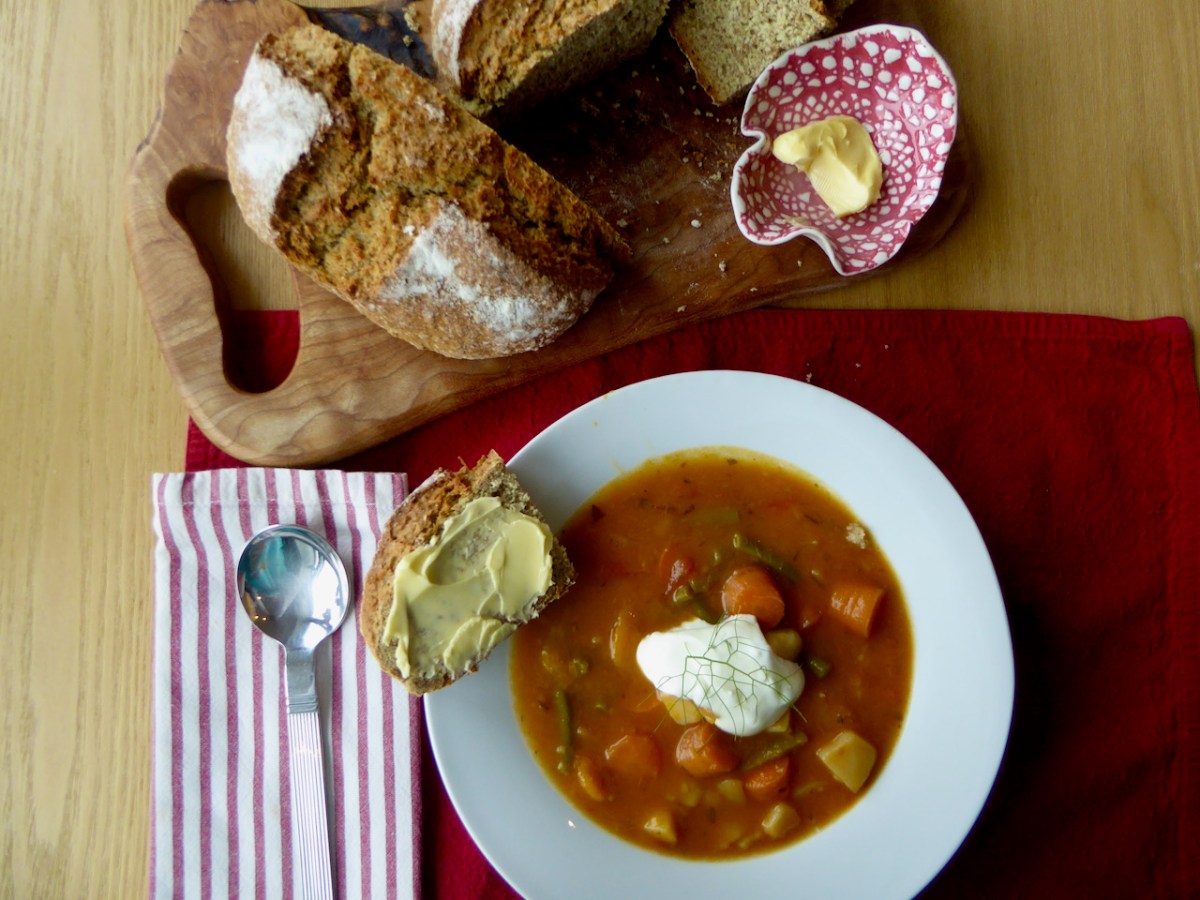
You wouldn’t be long in Ireland before realising that soup is an essential part of our daily fare. Like whiskey it is our internal central heating, raising the temperature of the body and thawing out the gastric juices so that they will be receptive to the delights that are to follow. Remember, in Ireland, except in the cities, domestic central heating is still a rarity (we are a credulous people and believe what we read in the geography books). We need soup to warm us.

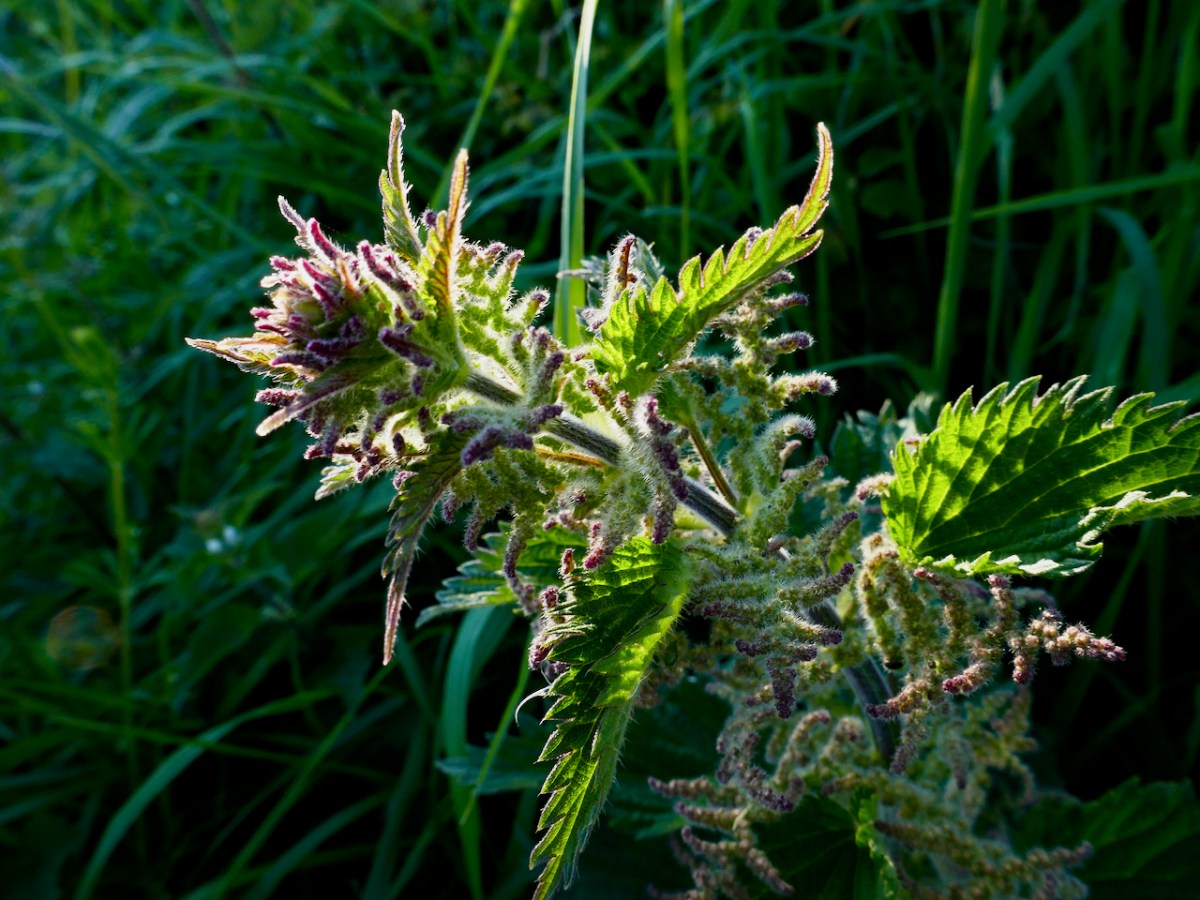
This chapter includes instructions for making a Nettle Tonic. This essentially involves boiling a pound of young nettles in water. Strain and drink a tumblerful, hot or cold, first thing in the morning. Guaranteed to put roses in your cheeks and a glint in your eye. Not pleasant, of course, but you must suffer to be beautiful.

This is the same pre-feminist era woman of Monica’s Kitchen: she gives the following directions for serving steak and fried onions.

Carve the steak by cutting it in thick slices along the grain of the meat. Give a good slice of the fillet to your most important male guest (all men are knowledgeable about steak – all that expense-account eating, I’m sure) and never you mind about his wife. The chances are she is so delighted to be away from her own kitchen stove she won’t mind what she gets.

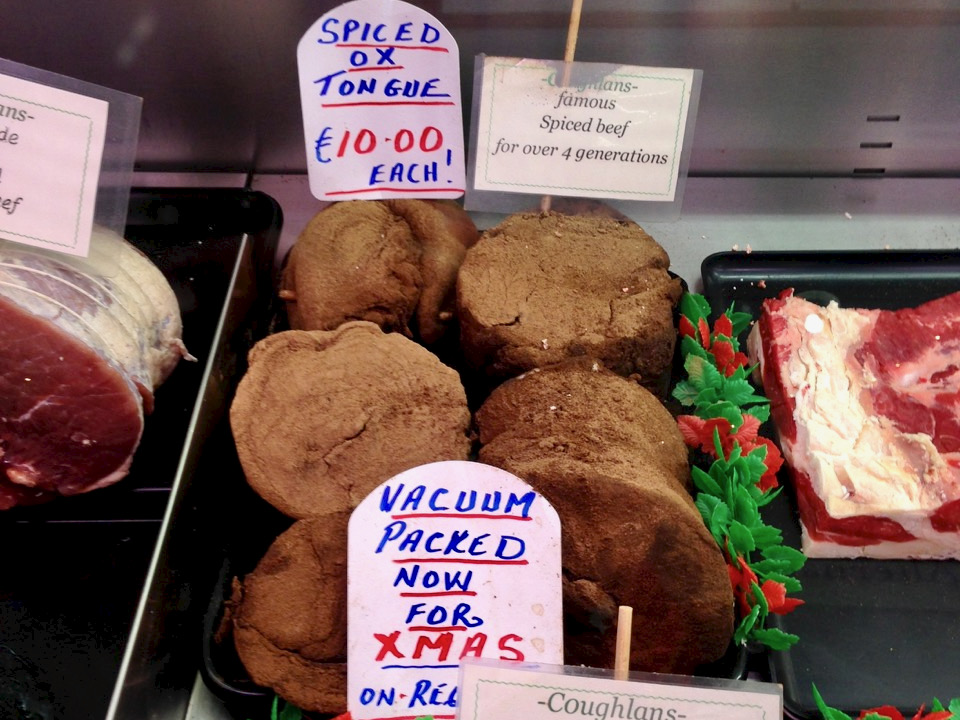
There are lots of recipes for offal, and indeed as children we ate lots of organ meats – although I drew the line at tripe and my mother finally relented after an epic battle of wills. Kidneys, tongue, liver, sweetbreads, heads, brains, cheeks…all get a look in.

Traditional Cork Christmas Meats at the English Market

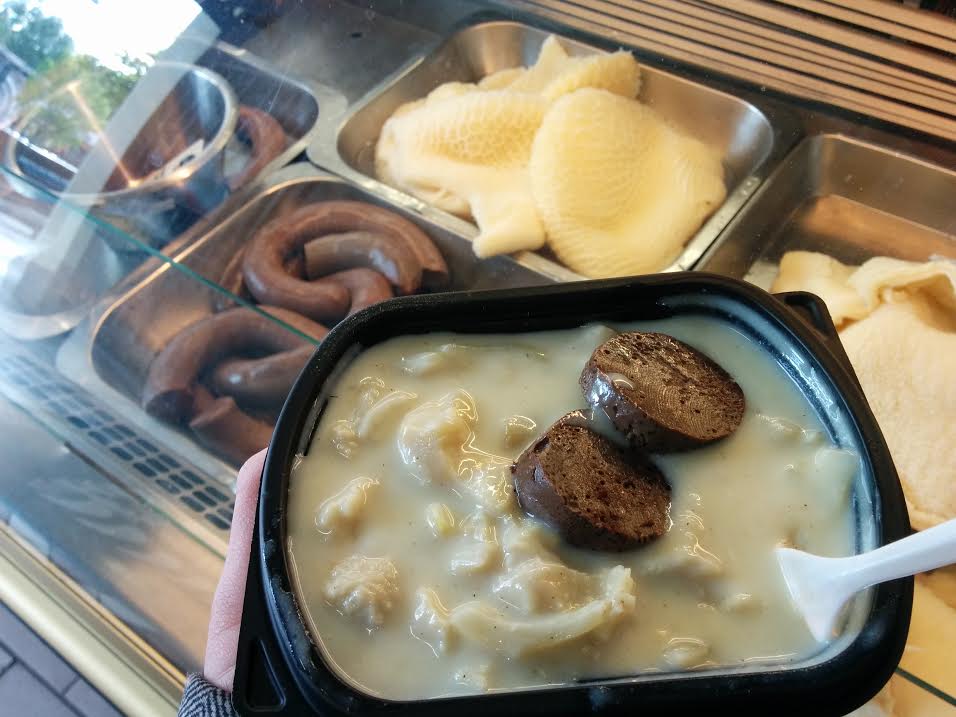
Some Cork specialties get special attention, like Skirts and Bodices. Bodices are pickled spareribs because they are like the boned bodices our grandmothers wore and skirts are the fluted trimmings that are cut away from the pork steak. Drisheens sound, er, appetising: They are made from sheep’s blood. In appearance they resemble a blown-up bicycle tyre, but they have a wonderful texture, like baked egg custard. Serve with butter, she recommends, flavoured with tansy. Crubeens, meanwhile, are pigs’ trotters. Crubeens should always be eaten with your fingers. They lose half of their magic if you attack them with a refined knife and fork. You will need a bath afterwards, of course, but their sweet savour is well worth the extra ablution.

Tripe and Drisheen courtesy of the Eat This Town blog

She finishes the pork section with the following: I will tell you an interesting thing about ham. The true ham epicure will always look for the left ham of a pig. It is considered more tender and delicate. You see, the pig scratches himself with the right leg and consequently exercises it far more. So now you know!

There are many recipes for poultry, some of which involve boiling the fowl, or, in the case of Uncle George’s Turkey, injecting cream into the breast with a syringe. Chickens, of course, must be young – a digression is called for: Describing a woman of certain age, my mother would often say, “She wouldn’t tear in the plucking” (young birds have very delicate skin that breaks easily with inept plucking) or, “A chicken of her age wouldn’t fall off the roost.” Mother had a tongue that would clip a hedge.

Monica in 1968, from the Australian Womens' Weekly
Monica in 1968, from the Australian Womens’ Weekly

When Monica talks about a soufflé (although she doesn’t provide a recipe) she says, it should rise gradually, like a careful civil servant, consolidating its position on the way up. She devotes five pages to talking about soda bread before she even gets to a recipe for it. But that recipe is one I used often, when I lived in Canada, before the days of the internet opened up a world of online recipes. I can attest that it’s a good one.

But, like Monica, I digress – my intention was to give her recipe for plum pudding. Alas, it is hardly a recipe – little more than a list of ingredients followed by instructions to mix it all together, put into greased pudding dishes, and boil for 5 hours. Like many of her recipes, it calls for booze – in this case a glass of whiskey (she has a whole chapter on ‘Drink’). So instead of detailing how to make the plum pudding I will leave you with her approach to serving it.

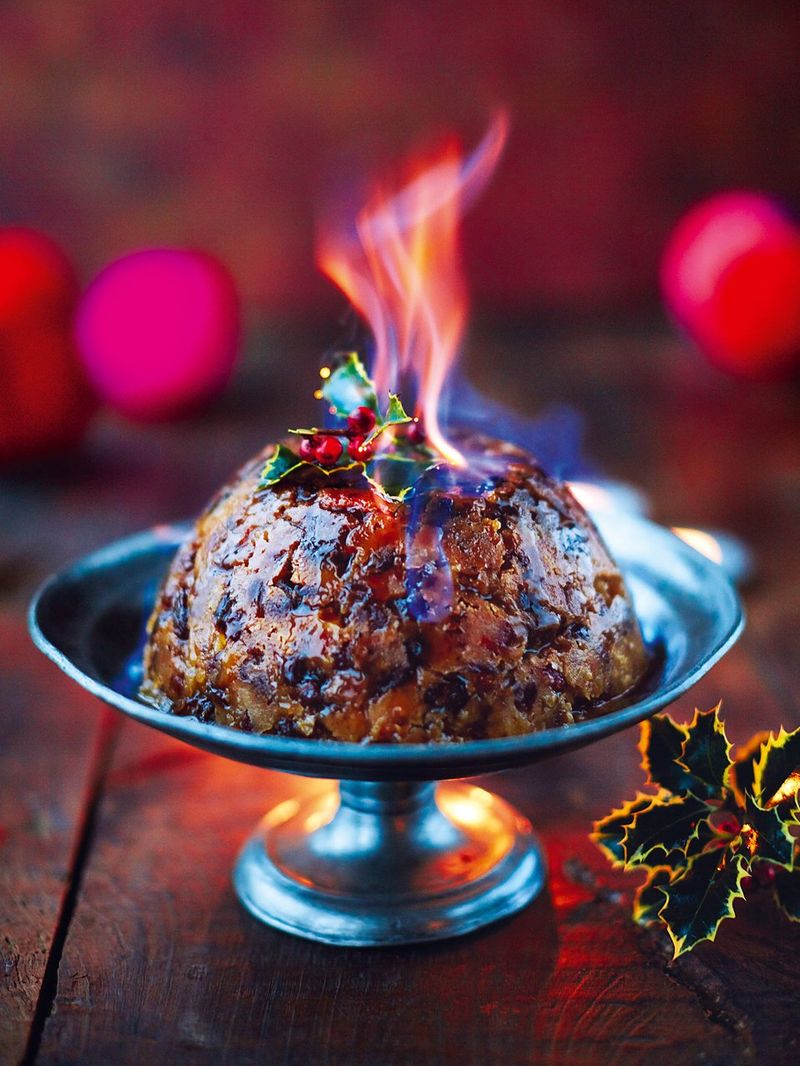
The most exciting thing about a plum pudding is the presentation. To capture the spirit of Christmas it must come to the table lapped in blue flames – and this can be quite tricky with the weak quality of booze nowadays. When I was young we always doused the pudding in poteen and you got a flame that would singe the rafters. To make sure of a good flame it is most important to warm the spirit (cheap brandy is better than whiskey) before pouring it over the pudding.

If you want to make a spectacular entrance to the dining-room with the flaming pudding held on high, this is what you do. Scoop out a hole in the top of the pudding and place half and empty upturned eggshell in the hole. Fill the shell with warmed brandy, ignite and move the dish to spill out the spirit as you enter the dining-room.*

I couldn’t resist this photo of a flaming pudding, which is from Jamie Oliver

In preparing this post I looked up lots of plum pudding recipes, then decided to buy one from my favourite market stall. But if you really want to make a traditional Irish one, Brenda Costigan’s mother’s recipe, from the Independent, looks like a wonderful, rich, boozy pudding that would have done Monica proud.

*Disclaimer: Roaringwater Journal will not be responsible for house fires caused by following these directions.

Footsteps

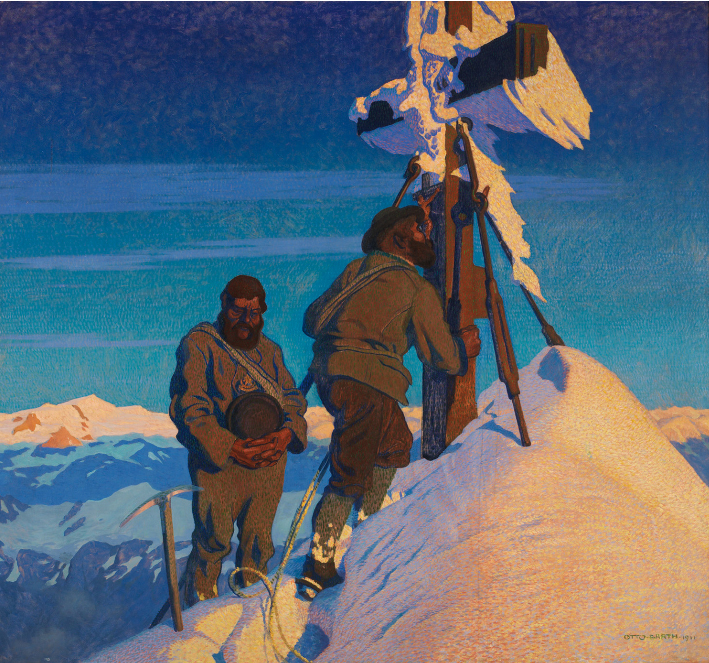
Morning prayers on the Großglockner, Otto Barth 1911

Morning prayers on the Großglockner, Otto Barth 1911

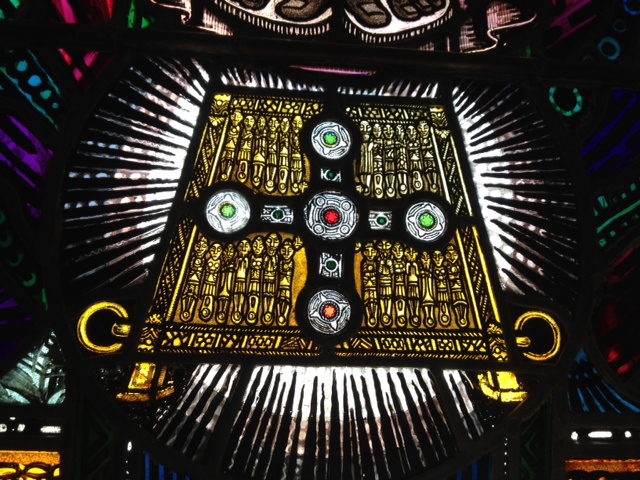
Is it us? We seem to be following in the footsteps of thieves and wreckers… Back in June 2012 we visited St Manchan’s Church, in Boher, Offaly and saw the splendid shrine of that Saint securely locked in an armoured glass case and mounted in front of the equally magnificent Harry Clarke window depicting him. That was at about 1 o’clock in the afternoon. We were shocked to hear on the news that evening that the shrine had been stolen at 1.30! Two men had taken just a few minutes to break open the case – in spite of alarms and cctv – and make off with the Saint’s remains…

We were relieved to hear the following day that the robbery had been bungled: the shrine was thrown out of the getaway car and landed in a bog: both it and the perpetrators were picked up by the Gardi. I wonder if perhaps the thought of what divine justice might be wrought from on high (from St Manchan himself, even) had put doubts into the minds of the thieves and diverted them from their intentions – whatever they might have been.

Harry Clarke's depiction of the Saint's shrine

Harry Clarke’s depiction of the Saint’s shrine

Nevertheless, the incident led to some considerable debate on whether the reliquary should be returned to the church – where the security was evidently lacking – or whether the original 1,000 year old artefact should be put into Ireland’s National Museum and the replica which happens to be there should be sent back to St Manchan’s. The Boher people campaigned vigorously against this – quite rightly in my opinion – and eventually, after some improvements to the arrangements in the church, the shrine has been restored to where it belongs.

winter

Carrauntoohil Summit – photo by Noel Mulcair: thejournal.ie

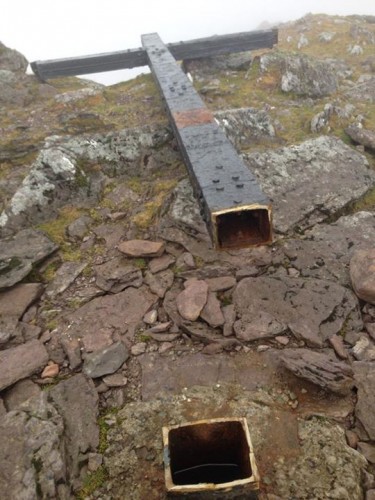
So there we were just a week or two ago, honeymooning in the shadow of Ireland’s highest mountain (although warmly ensconsed in a comfortable Kerry hotel) when we heard the news that, not far away, someone had climbed the mountain at night and felled the iron cross that had stood up there for many years, with an angle-grinder! Obviously some point was being made, although nobody was quite sure what that was at the time…

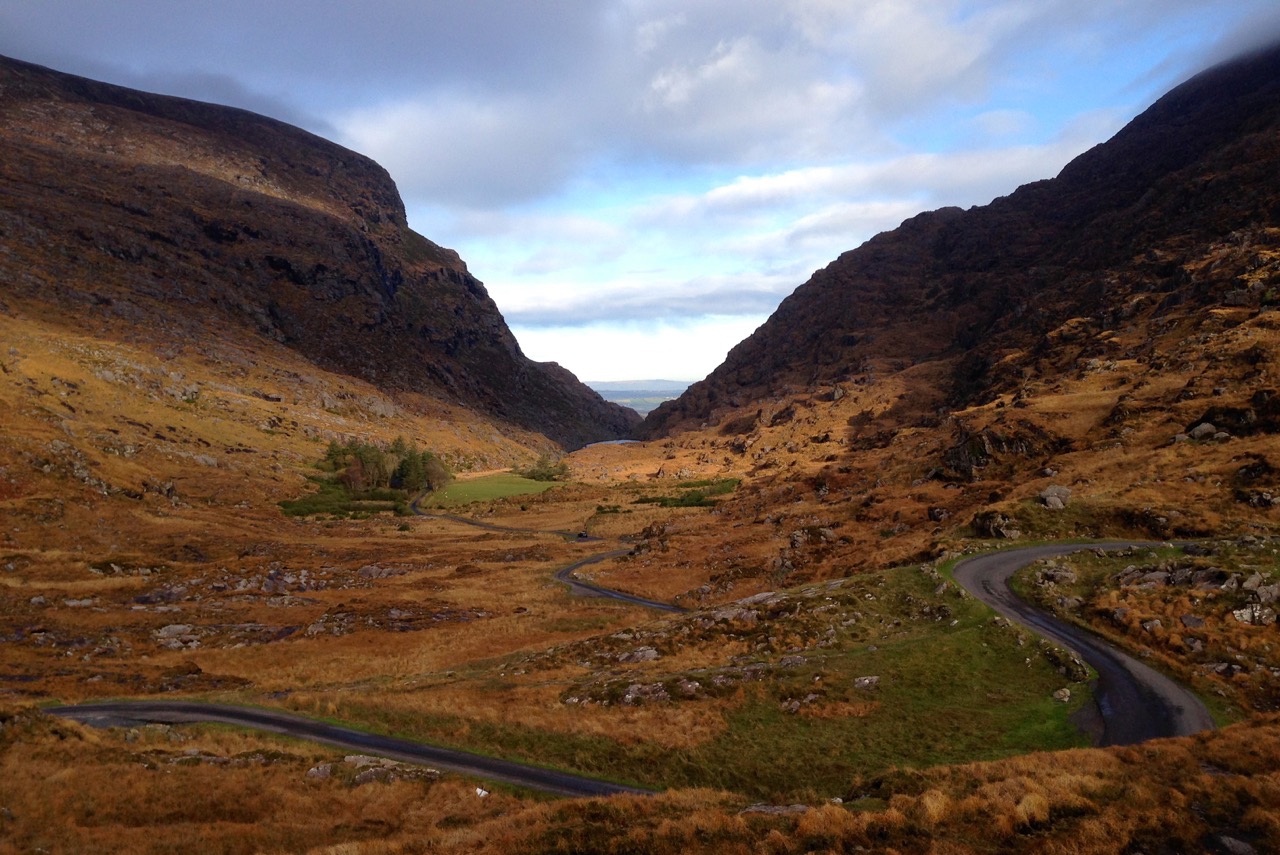
The Mountains of Kerry

Gap of Dunloe, in the shadow of Carrauntoohil


The cross is felled...

The cross is felled…

The Carrauntoohil incident sparked off a lively correspondence in The Irish Times. Many were indignant at the act of vandalism, while others took the view that there is no reason why wild places should be ‘sullied’ with religious symbols. Hmmmm… that’s a bit harsh, perhaps: crosses on mountain tops have a been around for a long time all over the world and, ever since prehistory, humans have marked their presence on the landscape with monuments of one sort or another. As you all know, the two of us are fascinated (obsessed might be a more appropriate word) by megaliths, tombs, circles and inscribed rocks – and these are preserved archaeological artefacts – it would be unthinkable for someone to get it into their head that a standing stone should be destroyed because it might have represented someone’s god. At the very least, surely, the subject should be aired and a democratic decision made by a public majority before any such action is taken. Indeed, the subject did get aired after the event and I gleaned that the majority of respondents felt that the iconic cross should not have come down.

Well, this story – like the St Manchan one, has had a happy ending. A group of volunteers has been up to the summit with block, tackle and welding equipment and the cross is back again.

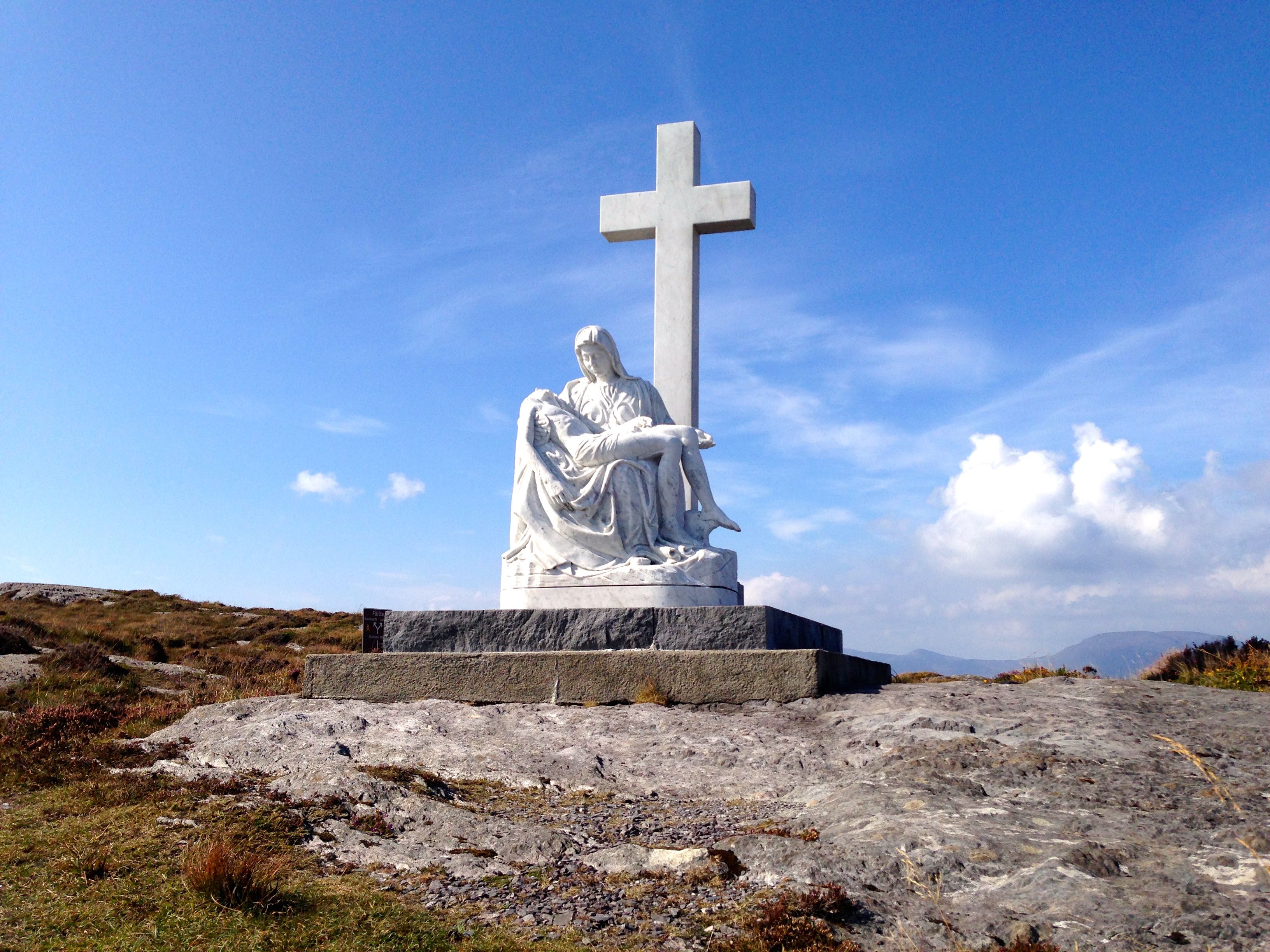
Ireland has many summits adorned with constructed pieces – ancient cairns and tombs, and more modern statues and symbols, not forgetting the wind farms which are another source of controversy. We are all part of human history and one of Ireland’s big attractions for me is that the history is so visible and accessible. In 1968 a white marble Pieta was placed high up on the Goat’s Path in Glanalin townland. It’s someone’s personal monument to a much loved father. In my opinion the melancholy statue enhances the wild place: I make a bee-line for it whenever I’m in the area – partly to enjoy the magnificent view but also, I have to say, because I am fascinated to see how many coins and offerings are put into the outstretched palm of Mary. Look here for a fuller description on the excellent website Sheep’s Head Places.

Hilltop Pieta

Hilltop Pieta

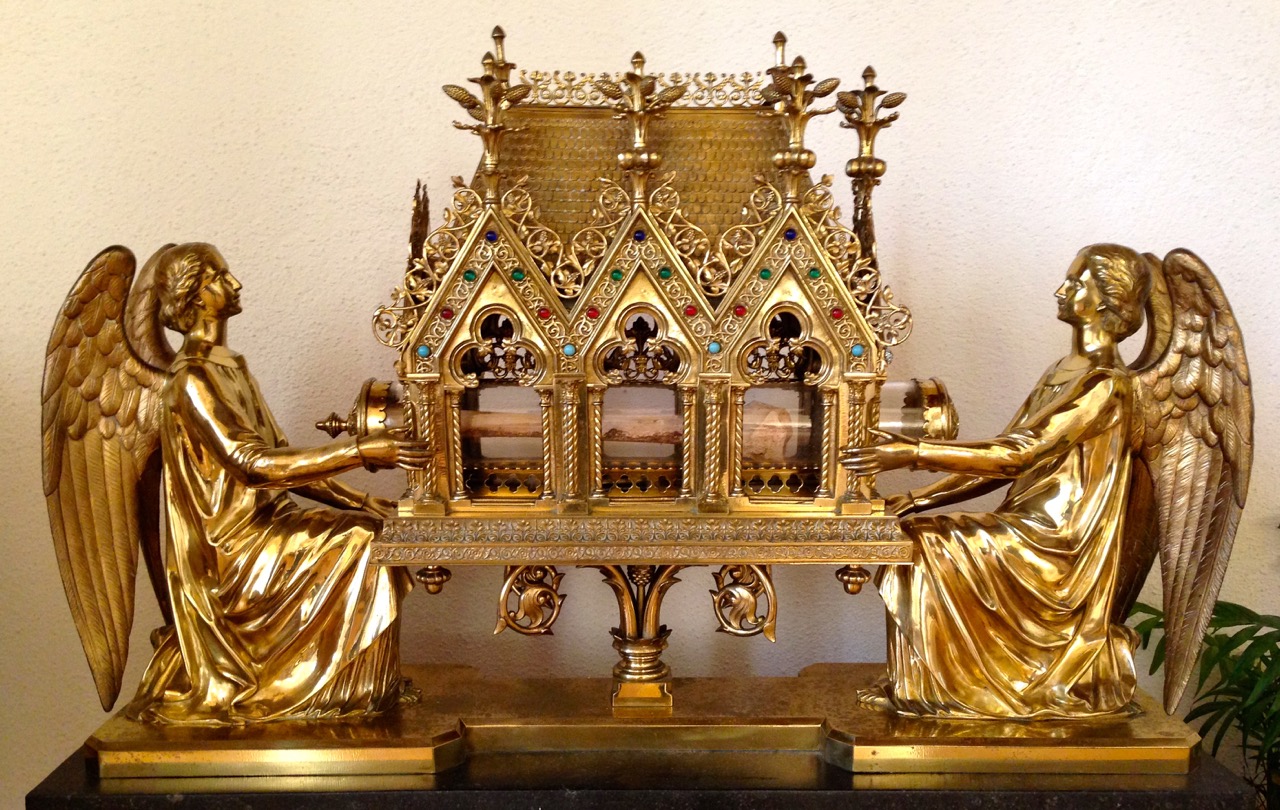
Given our experiences to date I worried a bit about our visits to Holy Cross Abbey and the Cathedral of St Mary and St Anne in Cork, where we came across the shin bone of Blessed Thaddeus McCarthy. But it seems to be ok: fair enough, the fragment of the True Cross was stolen from Holy Cross (it’s now been replaced with another), but long before our visit, while the saintly shin bone seems to have survived unscathed so far. I can’t help looking over my shoulder, though, when we visit such places. Ireland is full of enigmas…

thaddeus

Sacred shin bone – with Angelic guardians

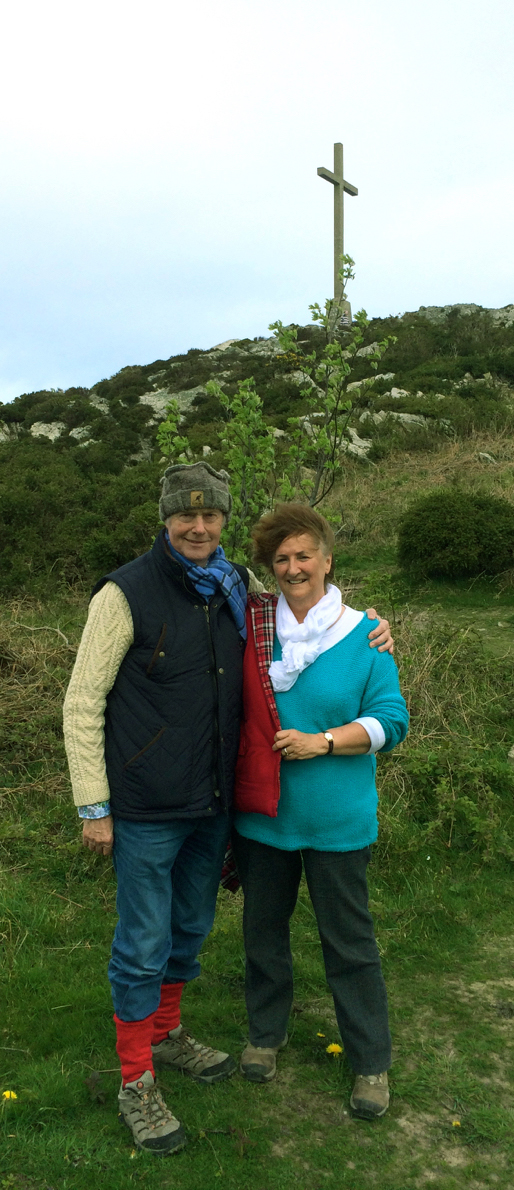
Finola's childhood haunts: the cross on Bray Head, Wicklow

Finola’s childhood haunts: the cross on Bray Head, Wicklow

Lough Hyne Holy Wells

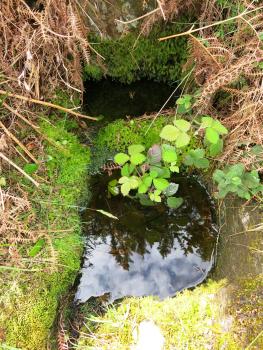
sea shell Local tradition (and there is no better source of knowledge!) has it that you can relieve any eye problems with the waters from  Tobarín Súl – one of the holy wells close by Lough Hyne. The name is Irish for Little Well of the Eyes and, if proof were needed of the efficacy of the cure, you will find hanging from the branches of the trees around the well white canes and spectacles presumably left behind by modern day pilgrims who are no longer in need of them after visiting the well.

There is no doubt that Tobarín Súl and its near neighbour – Skour Well – are actively visited: offerings abound. Most commonly, rags and ribbons adorn the surroundings of a well. According to Anna Rackard (Fish Stone Water – Holy Wells of Ireland, Atrium 2001):

…Traditionally, rags were used to wash the afflicted part of the body with water from the well and were then tied to the tree or bush. As the rag deteriorated, the pain faded away. In some parts of Ireland, when the rag is tied to the tree, the tree itself ‘takes on’ the pilgrim’s pain…

The Eye Well decorated

The Eye Well decorated

Tobarín Súl is set beside a narrow lane which winds up Knockomagh Hill in the townland of Highfield, to the north of Lough Hyne. The Skour Well is a little way further up the same hill. Nobody seems to know the origin of the name: one suggestion is that the word Skour comes from the Irish ‘sceabhar’ meaning ‘slope’ or ‘slant’, indicating its position on the side of a hill. Whatever the origin, it’s another colourful well, also adorned but with a more religious flavour – rosary beads, candles and statuettes.

Christian iconography at Skour Well

Christian iconography at Skour Well

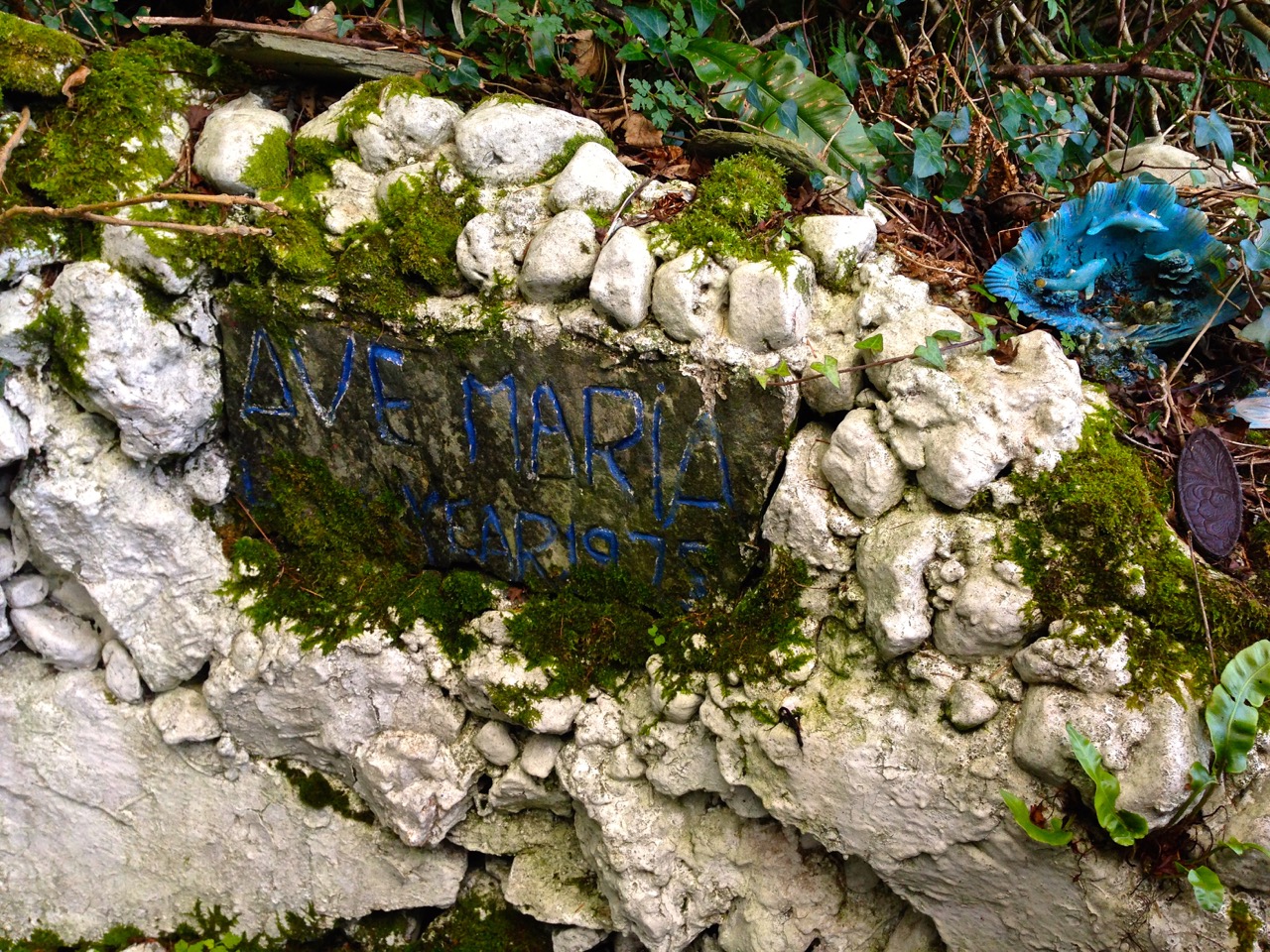
Some sources suggest that this well is dedicated to St Brigit, but I think that is a confusion with two more holy wells which are reputed to be close beside an ancient ruined church dedicated to her on the south side of the lake. Skour Well, however, is clearly devoted to Mary and ’rounds’ are performed here: it’s said that pilgrims drop white pebbles into the water on completing each circuit. On May Eve the local priest conducts a mass at the roadside here.

Inscription at Skour Well

Inscription at Skour Well

White pebbles in Skour Well

White pebbles in Skour Well

So here we have a fascinating meeting of beliefs: two wells almost side by side, one seemingly an ancient centre for traditional cures and the other a Christian site. Both are powerful places.

Lough Hyne

Lough Hyne

We have mentioned the lake itself in previous posts. We have yet to visit St Brigit’s little church to try and find the other wells (the Archaeological Survey database says they are no longer visible) but we must look for the place where St Brigit knelt and left imprints of her knees in the rock!

St Brigit knelt here!

St Brigit knelt here!

Amanda found St Brigid’s knee prints“…The forecast being good I decided an adventure was needed. We headed out for Lough Hyne – I had read that there was an ancient church, holy well and cross slab in the vicinity. It looked do-able on the map. We parked and set forth. Quite a long walk down a small road skirting the lough, so green and leafy with sheer rocky sides dripping with moisture. We got to where the smaller road should have been leading onto a peninsula jutting out onto the lake but it seemed to go onto private land and there were big gates. Suddenly a woman came out to check her post and I was over there like a flash. Once she’d got over her amazement that anyone should know about this obscure church she was very helpful. The whole headland was her land and it was brimming with interesting things. She gave us firm instructions and allowed us to venture forth. The boreen down was long and green and so beautiful – full of the most amazing variety of wildflowers – primroses, buebells, anemones, violets, Irish spurge. We found the church – teeny, roofless with a beautiful arched doorway. Her husband was buried close by – his epitaph had him down as a philosopher. Her instructions to the holy well were exact – climb up onto a stone and approach on your knees, – for safety rather than holy reasons I imagined, but maybe not. A teeny, two pooled well with lovely fresh water – and the knee prints of St Brigid on each side! Really. I tested. Perfect fit…” (taken from Amanda’s Blipfoto description) Amanda mentions the cross slab – there’s a story about this in Brigid: Goddess, Druidess and Saint by Brian Wright – The History Press 2009:

…There are traditions from many parts of Ireland and Britain of stones that return to their original spot when moved and an example of such a ‘homing stone’ involves St Brigid’s Church, Lough Hyne, Co Cork. There, about 150ft north east of the church is a piece of a broken pillar about 18 x 15in bearing an incised cross. One Day this was carried away by a fisherman who took it to his house, but the very next morning he found it had gone and it was discovered back in its original spot. The fisherman drowned shortly after and everyone knew he had been punished for daring to remove this holy stone…

Homing stone? The ancient cross by St Brigid's Church

Homing stone? The ancient cross by St Brigid’s Church

Three Pilgrims in West Cork

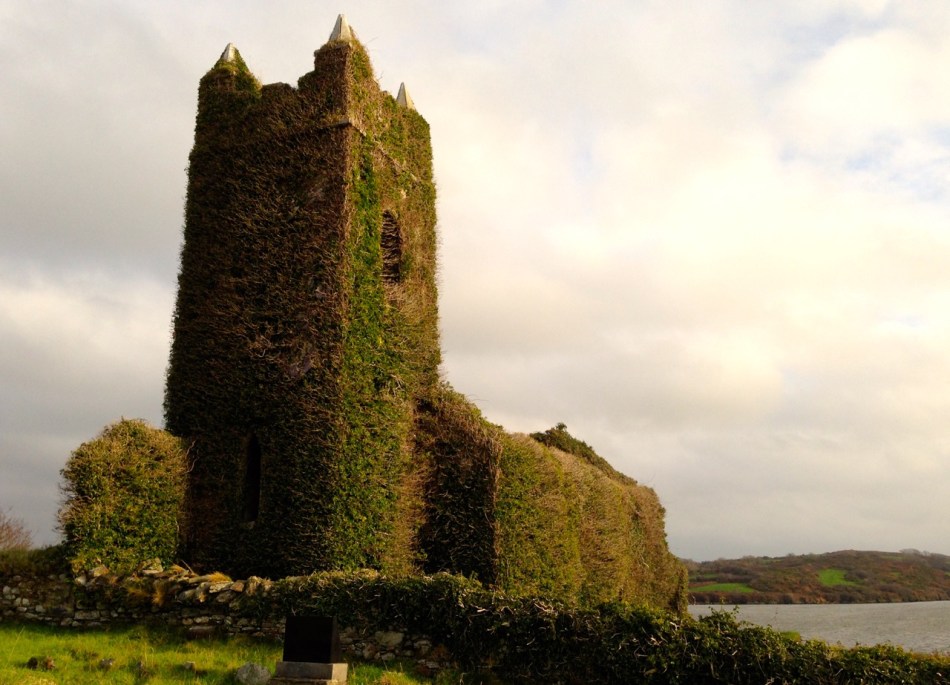
Glebe Church, on the Ilen River

Glebe Church, on the Ilen River

The guest speaker at this Thursday’s Skibbereen Historical Society meeting was Louise Nugent, speaking on the topic of Pilgrimage in Medieval Ireland. We became familiar with Louise’s work though her blog of the same title – a blog which manages to be consistently erudite and down-to-earth and entertaining all at once – and suggested her as a speaker. This also gave us the opportunity to meet Louise in person (she is as engaging and as knowledgeable as her blog) and, the next day, show her a little bit of our part of West Cork.

One of the great delights of following Louise’s blog is realising that the concept of pilgrimage – a spiritual journey undertaken for a variety of purposes – is still very much alive in Ireland. Local veneration of shrines, relics and holy wells is common and often involves a mass or prayers on special days. The “journey” involves going to the shrine, and sometimes moving around it in a set pattern or round. Larger scale pilgrimages, such as the annual trek up Croagh Patrick or a stay at Lough Derg in Donegal or a Novena at Holy Cross Abbey, transcend the local and attract pilgrims from around Ireland. In her talk, Louise also described the popularity of pilgrimage in Medieval times to holy sites outside Ireland such as York, Santiago de Compostela, Rome, or Jerusalem. Those who completed the Santiago Camino wore scallop shells to signify their pilgrim status, an image we had just seen the previous weekend in Cork in the Cathedral of St Mary and St Anne, where we came across a shrine to Blessed Thaddeus McCarthy. There was a statue, a painting, scrolls, but most fascinating of all a reliquary containing a leg bone! Blessed Thaddeus lived in the 15th Century and was appointed a bishop twice but was never able to take up his see because of the activities of the rival clan O’Driscoll.

On our day with Louise we concentrated on the area around Skibbereen. We started off by visiting the 18th Century Church at Glebe, on the banks of the River Ilen. The church and graveyard enjoy a picturesque and peaceful setting and a wander around the graveyard yielded interesting headstones.

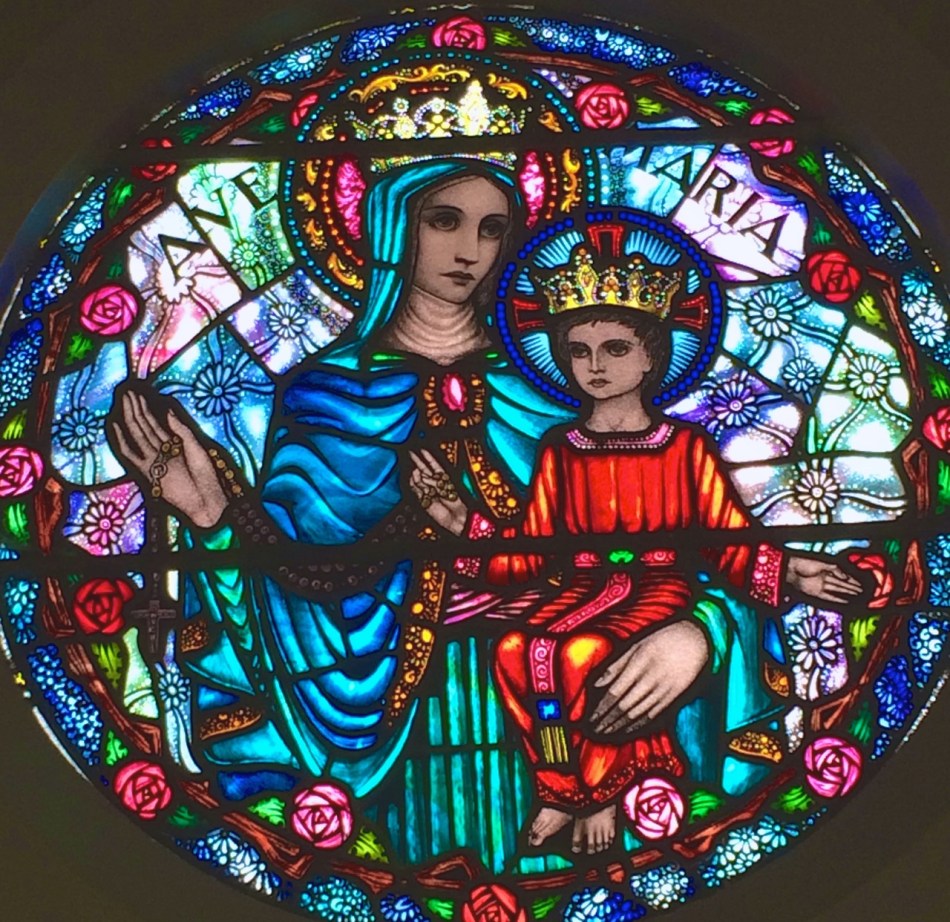
Holy Rosary Church at Aughadown, window detail

Holy Rosary Church at Aughadown, window detail

From there we went to the ruined medieval church at Kilcoe, stopping for a quick peak at the notable windows in the Church of the Most Holy Rosary at Aughadown. They deserve a fuller description at a future date, so for now I will include a detail from the rose window at the back of the church, designed and executed by the Harry Clarke studios in 1941.

The church at the tip of the Kilcoe Peninsula was already a ruin in the early 17th century. Although a simple rectangular structure, the pointed arched doorway and the tiny ogival windows mark it as medieval, perhaps as early as 14th or 15th century. Romantic and atmospheric as it is, it has the added advantage of a clear view of Kilcoe Castle, famously restored by Jeremy Irons and gently glowing in the afternoon light as we were there.

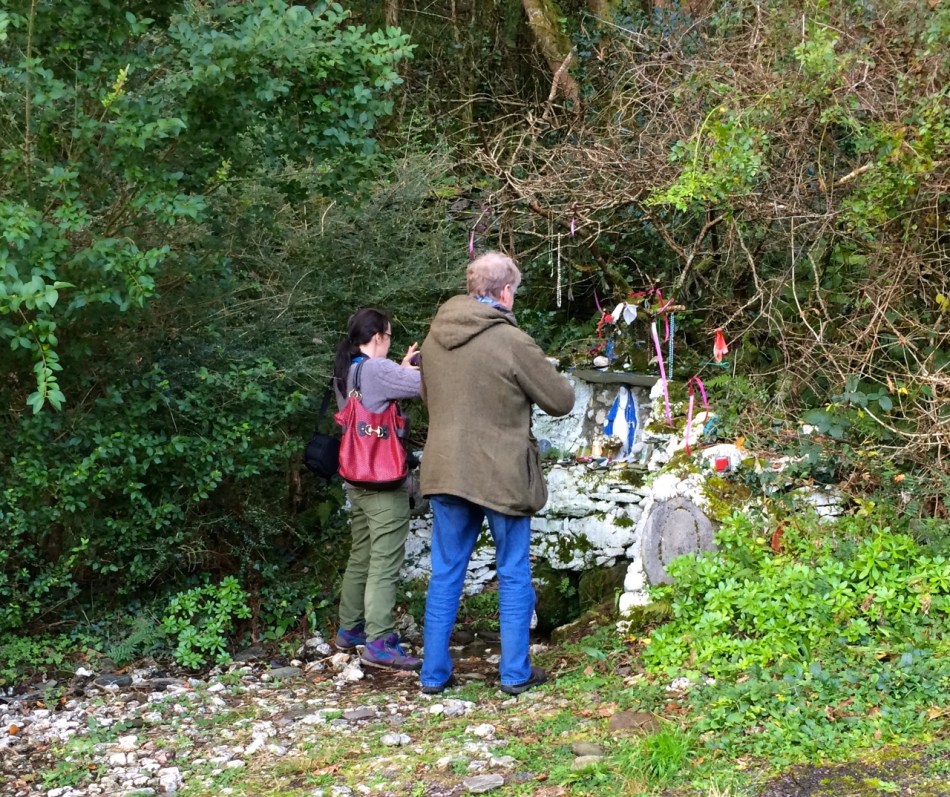
Two of the three pilgrims at a holy well

Two of the three pilgrims at a holy well

Louise’s special interest is in holy wells and several audience members the night before had come forward with information about local wells and the practices and beliefs associated with them. Two of the best known and most beloved local wells are situated close to each other at Lough Hyne. Robert is writing about these wells this week so I will leave the detailed description to him.

Our final stop was the village of Castletownshend and the Church of St Barrahane, filling two different functions. First, Louise had been to visit a holy well dedicated to St. Martin of Tours in Clare, and we wanted to show her the Harry Clarke window that Robert had described in his Martinmas post. Second, a trip to St Barrahane’s is always a pilgrimage of a different sort for me, as it is the final resting place of three of my heroes. The first two, of course, are the writing team of Somerville and Ross – more about them in this post. The third is Vice-Admiral Boyle Somerville, brother of Edith and a keen amateur archaeologist worthy of a post to himself in the future.

St Louis: detail of Harry Clarke window in St Barrahanes, Castletownshend

St Louis: detail of Harry Clarke window in St Barrahanes, Castletownshend

Come back soon, Louise – these two pilgrims have lots more to show you!