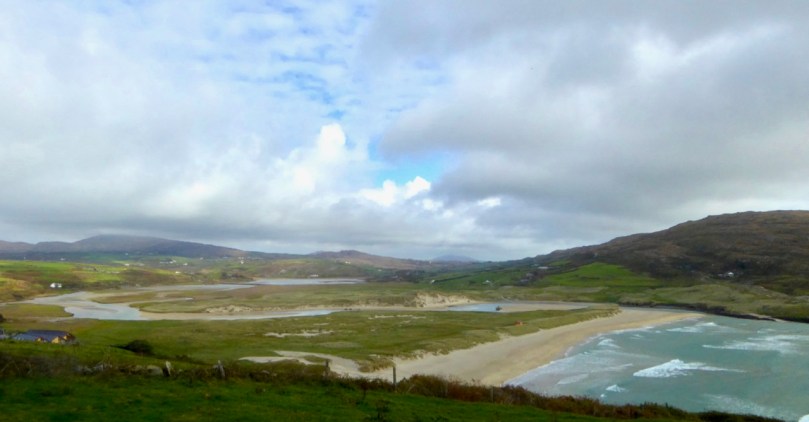
The Boa Island Figures – Mysterious Carvings From Our Pagan Past

We’ve been thinking lots lately about Northern Ireland and how much we enjoyed our time there. One of our truly memorable experiences was a trip to Boa Island in Fermanagh to see the mysterious carved figures in the Caldragh graveyard.

Despite the fact that this is one of Northern Ireland’s most important archaeological sites, we had the place to ourselves when we were there, in October 2016. In fact, it looked like any peaceful rural graveyard, with higgledy piggledy gravestones behind a hand-forged iron gate, lush grass, and an air of benign neglect.

But there’s one big difference – in this remote place are two of the most enigmatic carved figures on the Island of Ireland. The first one has two faces – it’s been called a Janus figure, or simply bilateral, carved in a style that is reminiscent of Early Medieval carvings, but also different. Different enough so that one can see these as pre-Christian figures, and that is how they are most often interpreted.
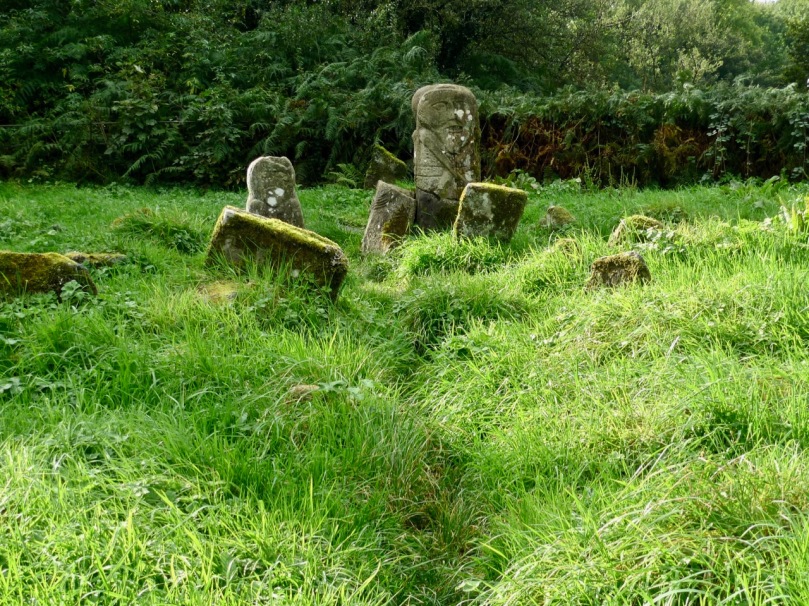
Boa Island itself may be named for the Goddess Badhbh (pronounced Bov), a potent character in Irish mythology. The figures do not bring saints or clerics to mind – there are no croziers, no fingers raised in blessing, no tonsures or crosses. We’ll look at the bilateral figure first. It has two faces, back to back, with a groove in between. The groove collects water and in recent years people have started to leave coins in the puddle formed by the groove, perhaps echoing its original purpose. The heads are joined at the side by herringbone or plaited lines that may represent hair.

One side has been interpreted as male and some point to a stylised penis that rests between the legs. Although I have seen photographs of this side when it had been recently cleaned, where a carved element is denoted as the penis, it is not in any way obvious now that the statue is once again covered in lichen and badly weathered, with moss growing in this area. The face is long and triangular, the mouth open and the eyes wide and staring. Two arms cross across the body, over a belt which runs around both figures.

On the other side the mouth is open and a tongue protrudes. Apart from that, the figures are almost identical. The statue is broken just below the belt on this side, so it is impossible to say that there are any female, or indeed male attributes present.
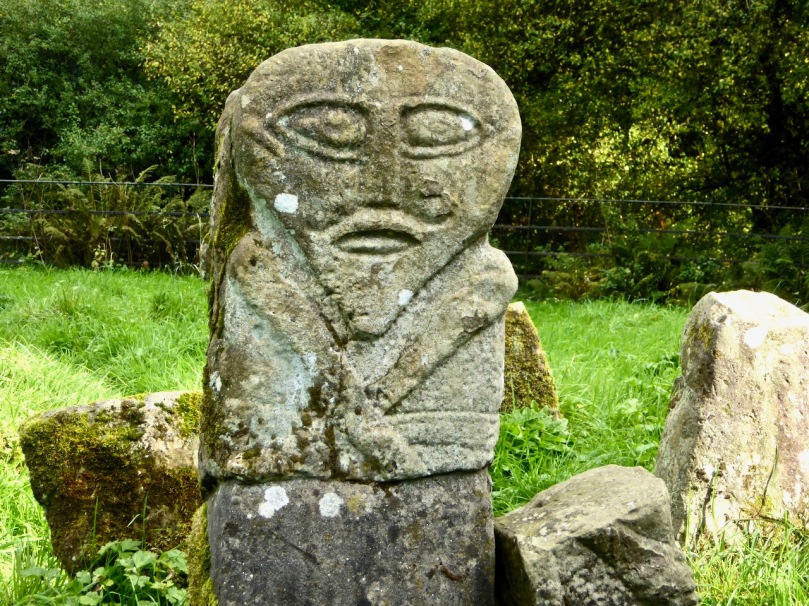
The carving has been mounted on a plain base but leaning against it is what might be the original base, or part of it. If it is, then the arms extended down into hands, resting on either side of the base.

There is a second figure, brought here from nearby Lusty More Island. This one is much more worn, or perhaps not even totally finished, but it’s possible to see that it bears a strong resemblance to the others in its triangular face. The arms are not crossed but appear to be holding something. Visitors leave coins in front of this one.
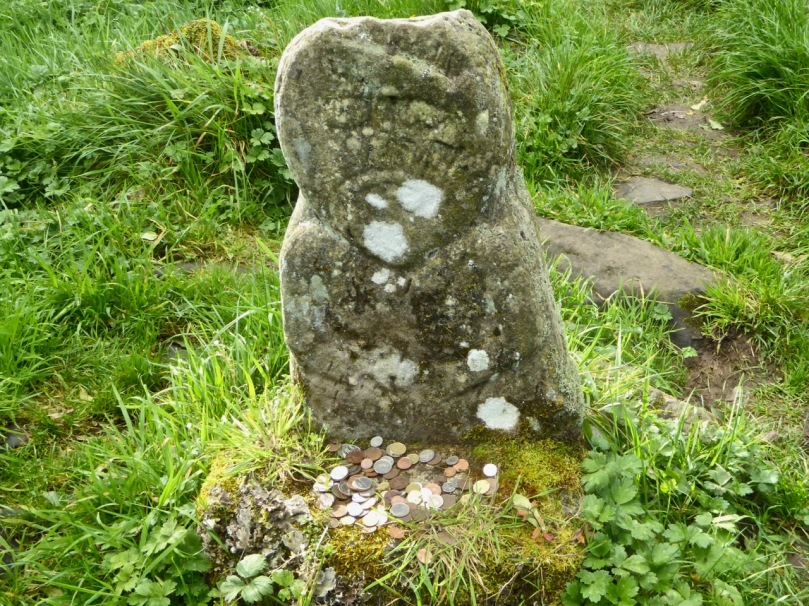
What does it all mean? In short, we don’t know, but current consensus appears to fall in the area of calling these figures representations of pagan deities. The smaller figure, rather than holding something, may be female and pointing to her genitals. This would place it in the tradition of the sheela-na-gigs, although presumably much earlier than the majority of sheelas, which are thought to be medieval.

Whatever they are, they have inspired poets and artists – even filmmakers. One of our favourite films, the marvellous Song of the Sea, has taken much of its artistic design from prehistoric Irish art, including the Boa Island figures. Watch this teaser for the movie and see if you can spot the Boa Island figure at 46 seconds.

And the poetry? Seamus Heaney, of course, himself from Northern Ireland, drew inspiration from the landscape around him and often wrote about archaeological themes. His poem, January God, captures the mysterious sense of the two-faced God and makes a shift to summon the idea of Cernunnus, the antler-headed pagan god of wild things depicted on the Gundestrup Cauldon.

Then I found a two-faced stone

On burial ground,

God-eyed, sex-mouthed, its brain

A watery wound.

In the wet gap of the year,

Daubed with fresh lake mud,

I faltered near his power –

January god

Who broke the water, the hymen

With his great antlers

There reigned upon each ghost tine

His familiars,

The mothering earth, the stones

Taken by each wave,

The fleshly aftergrass, the bones

Subsoil in each grave.


Watsons of Youghal – Revivalist Masters Part 2

In Part 1 I laid out the background to the Watsons of Youghal Revivalist-style windows, a design innovation for which they should be particularly celebrated. In this post I will provide further examples and tell you where you can see some.

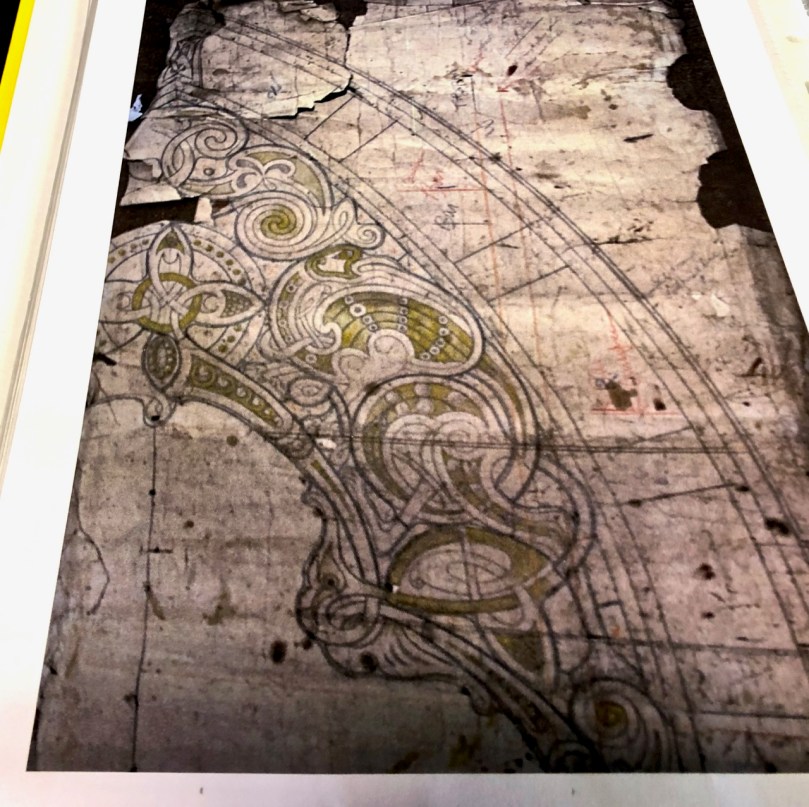
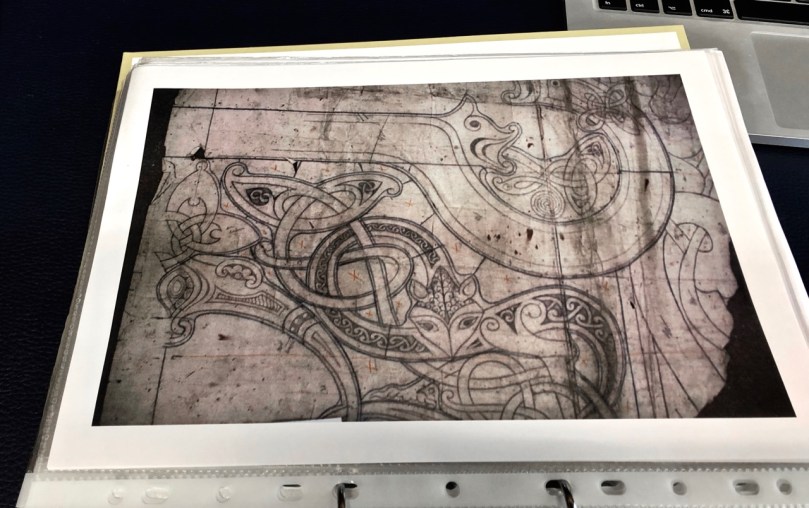
The Watson Archive is housed at the Crawford Gallery in Cork. In it are original cartoons showing the careful working out of interlace patterns and of lettering styles. Since these cartoons are on long pieces of paper which remained rolled or folded in storage for many years, they are in fragile condition and therefore what one consults in the Crawford Archive is the file of photographs of these papers. While not ideal, this at least allows serious students of stained glass to see some of the original work upon which the windows were assembled. There are also smaller drawings and paintings – these were done as original designs from which the cartoons could be drawn and from which the colours could be worked out.

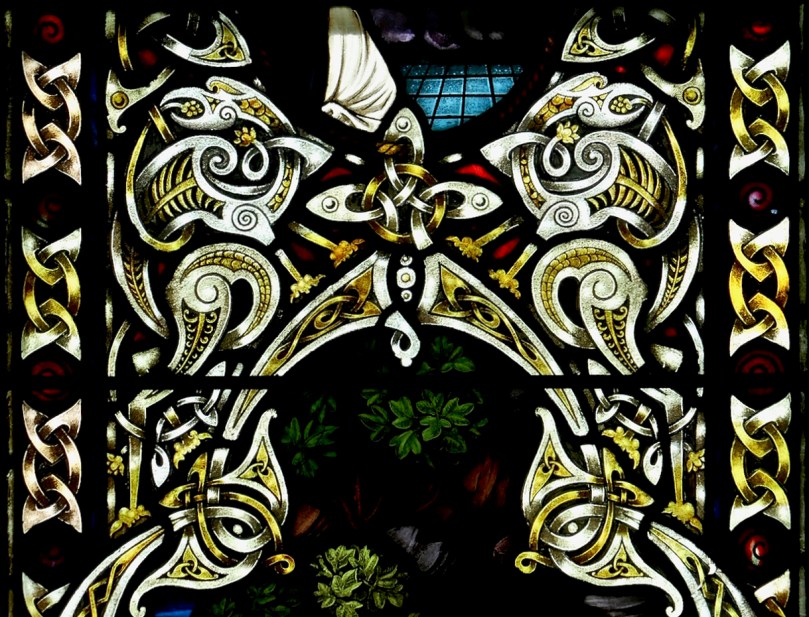
It’s a real thrill to come across a window that is based on one of those designs: see above and below for a perfect match! Incorporation of interlacing can also help to identify an un-signed window as being a Watson: it was what set them apart, when the figures themselves – the saints or angels – might be well-nigh indistinguishable from those of other stained glass manufacturers.

Interlacing is the preferred word for the complex looping and braiding of ribbons, which twist in and out and around each other and often end in the head of a fantastical animal. Artists studied the Book of Kells and other illuminated manuscripts, copied the elaborate decorations and eventually figured out their own designs. Just walk through any older cemetery in Ireland to see the craftsmanship with which many crosses were carved with interlace motifs.  So it was with Watsons: they became expert at fitting and filling spaces in a window with Revivalist designs.

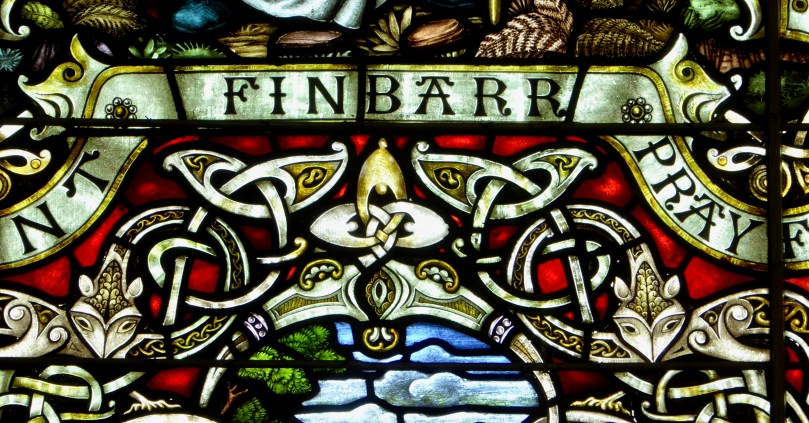
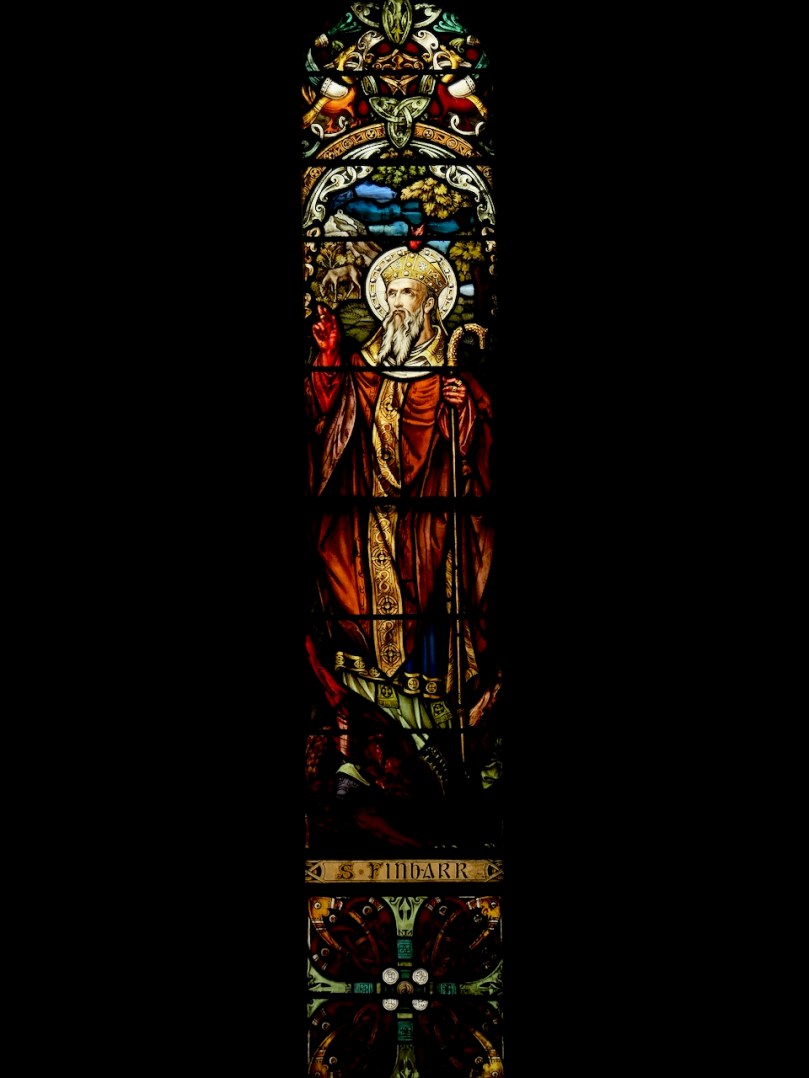
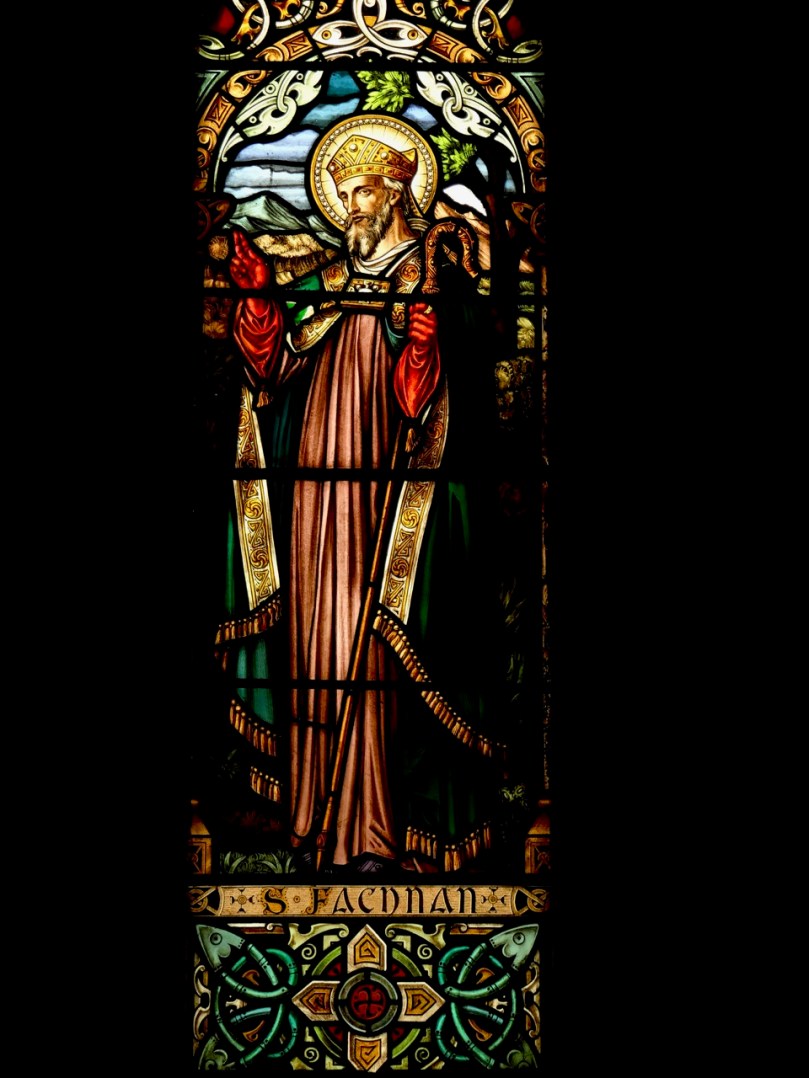
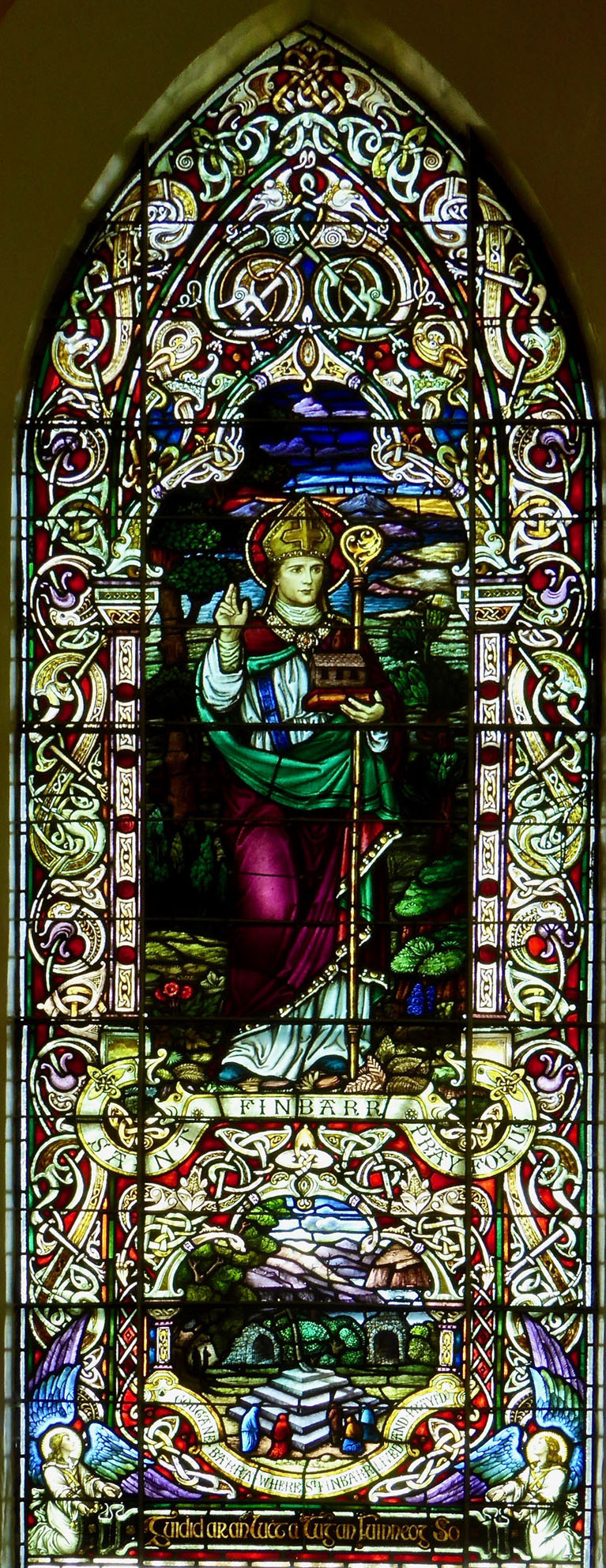
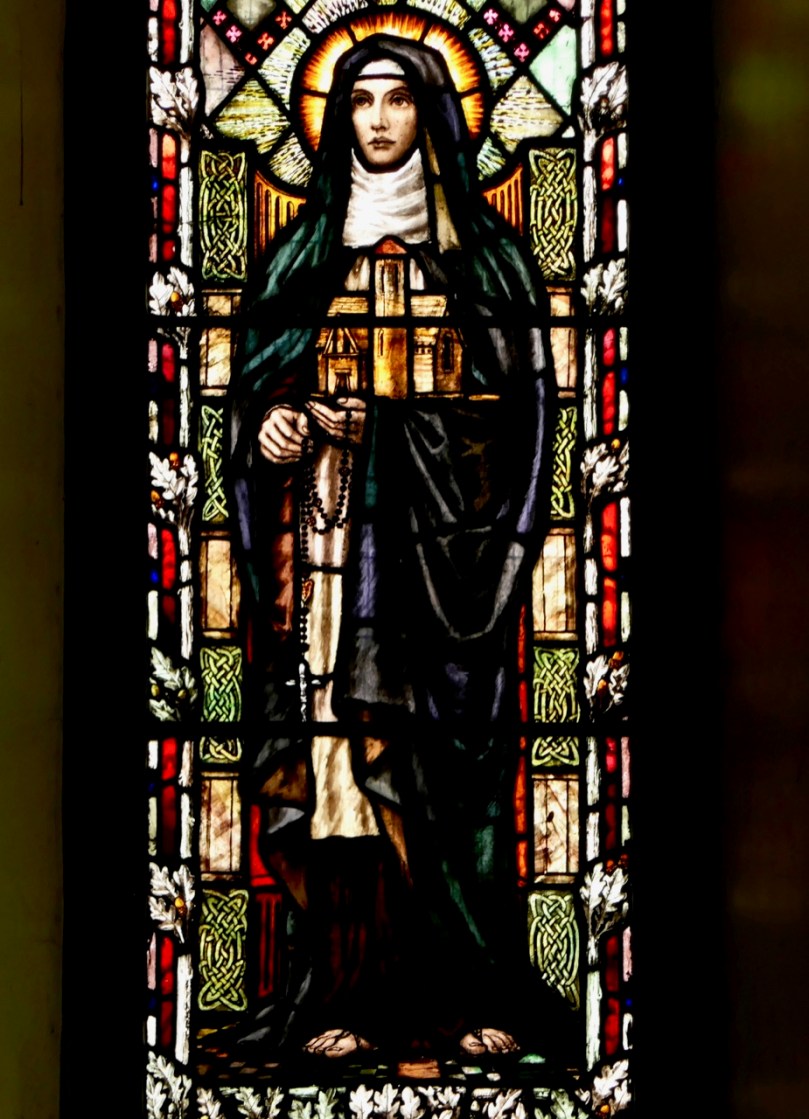
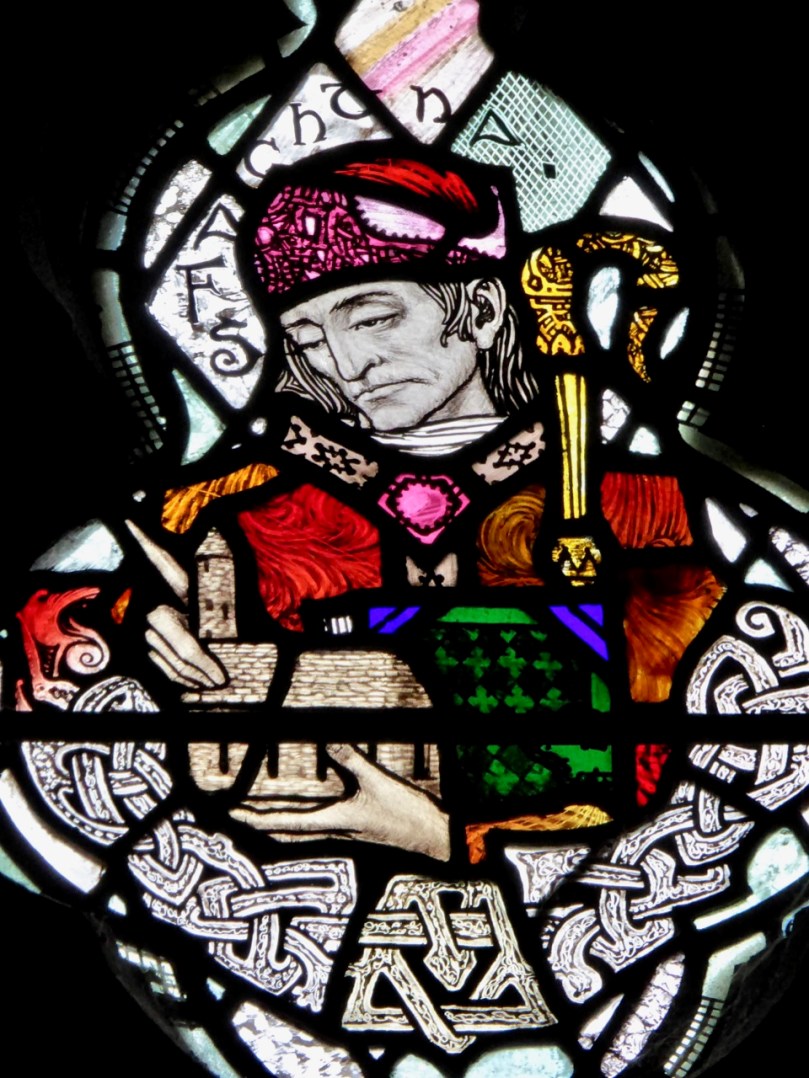
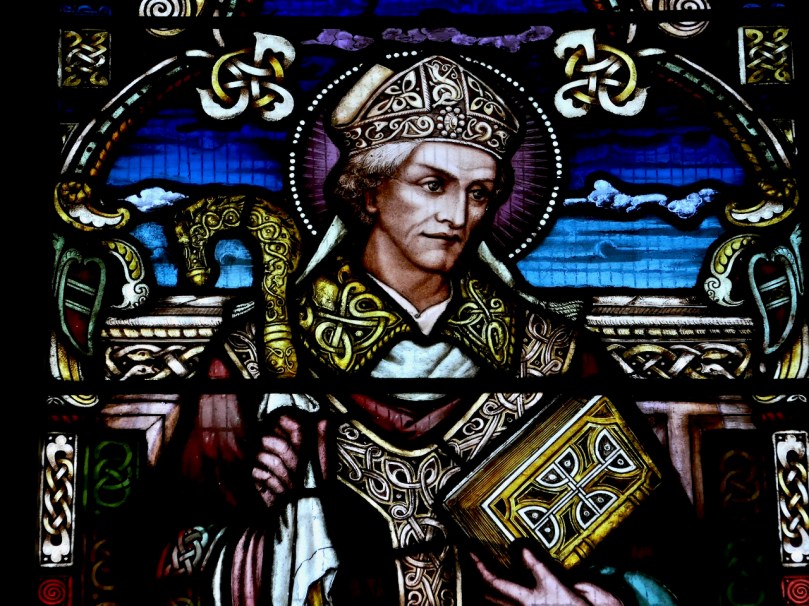
One of the best places to see Watson Revivalist windows, because it’s a small space and you can get close to the windows, is the Oratory at Gougane Barra. The vision for the building was that of Fr Patrick Hurley who developed the ‘ancient’ monastic settlement on the island, a scholarly man well versed in the Revivalist art and literature of the period who specified that the oratory itself would be built in the Neo-Romanesque style based on 12th century Irish churches such as Cormac’s Chapel (see this post for more on this). In the Oratory all the windows except a Marian image depict Irish saints, some of whom are local to Cork (Finbarr [above], Fachtna [below], Gobnait and Eltin).

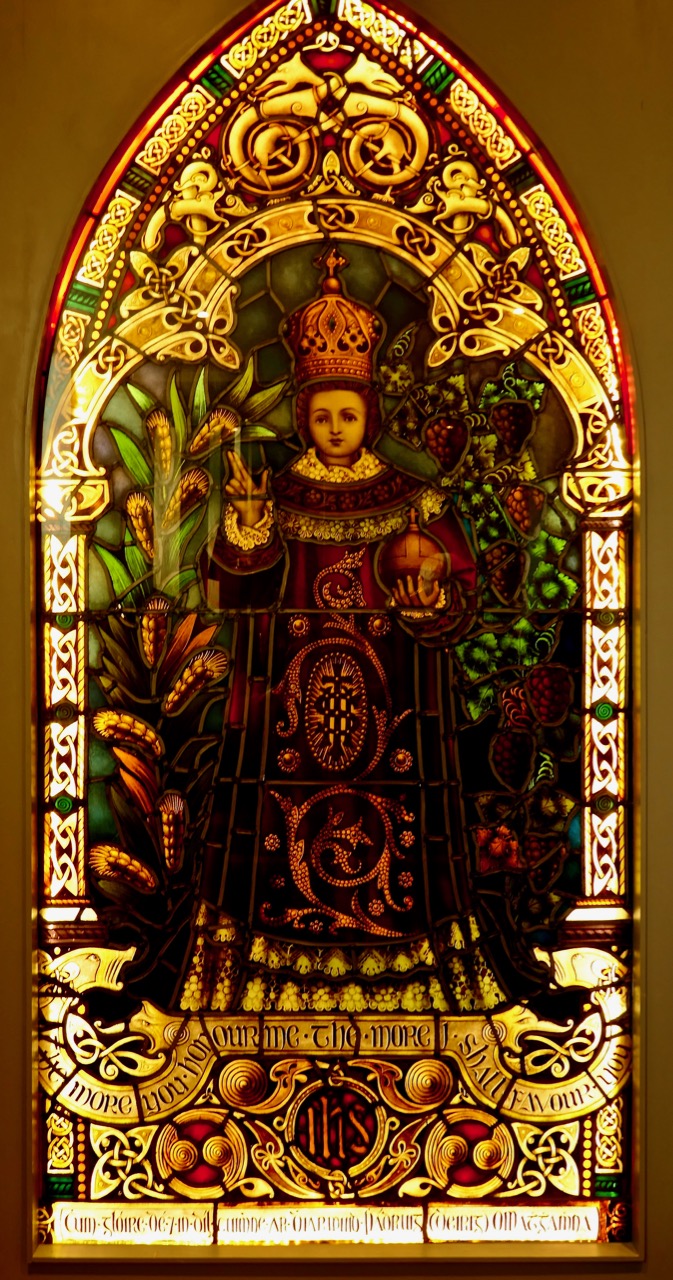
Another West Cork church with Watson Revivalist windows is in Ardfield, south of Clonakilty. I used some of these in my Symbols and Stories post so take a look at those now. Note that, in contrast with the Gougane Barra Oratory, the iconography in Ardfield is essentially International-Catholic (St James, Jesus, Mary), very much in line with the Devotional Revolution which I described in my post Saints and Soupers: the Story of Teampall na mBocht (Part 7, the New Catholicism). Instead of repeating the Ardfield images here I will send you instead to the little country church in Castletown-Kinneagh, near Enniskeane, and one of my favourite windows – the Infant of Prague. In the extensive renovation of this church the parishioners, ably led by Fr Tom Hayes, worked hard to save this window from a porch which had to be demolished and re-located it in a light box inside the church. While not perfect for back-lighting, this has the great advantage of allowing the viewer to get really close to the window to observe the painting techniques and the details. 

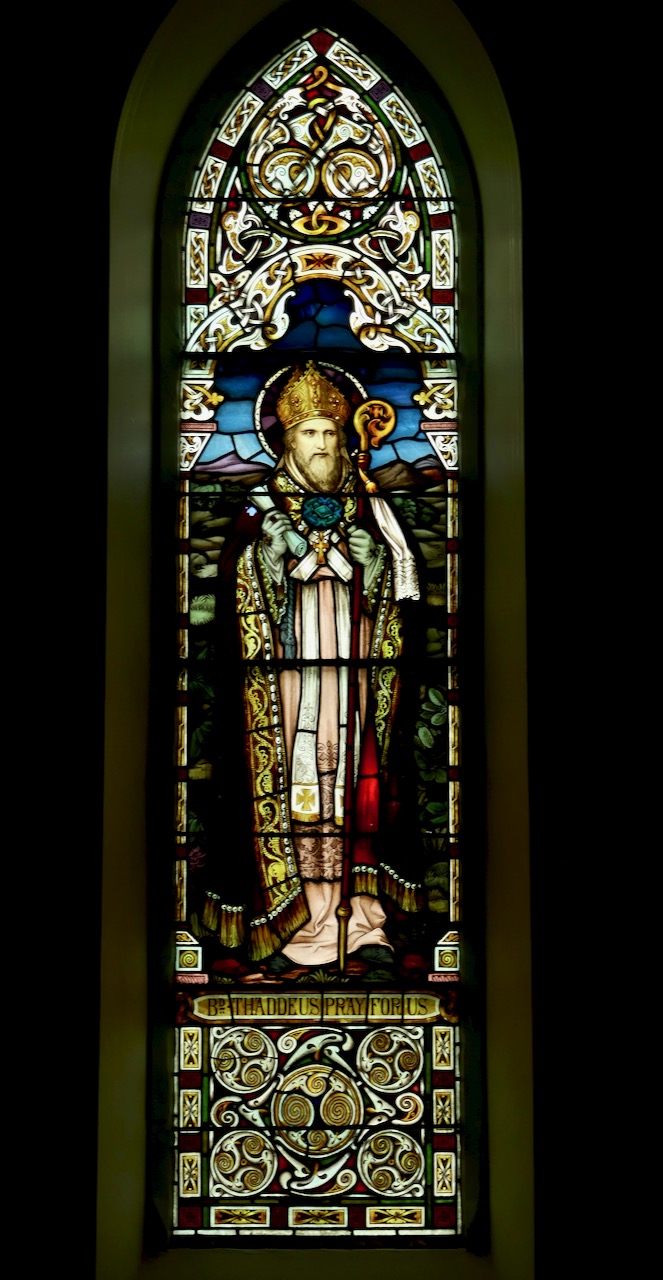
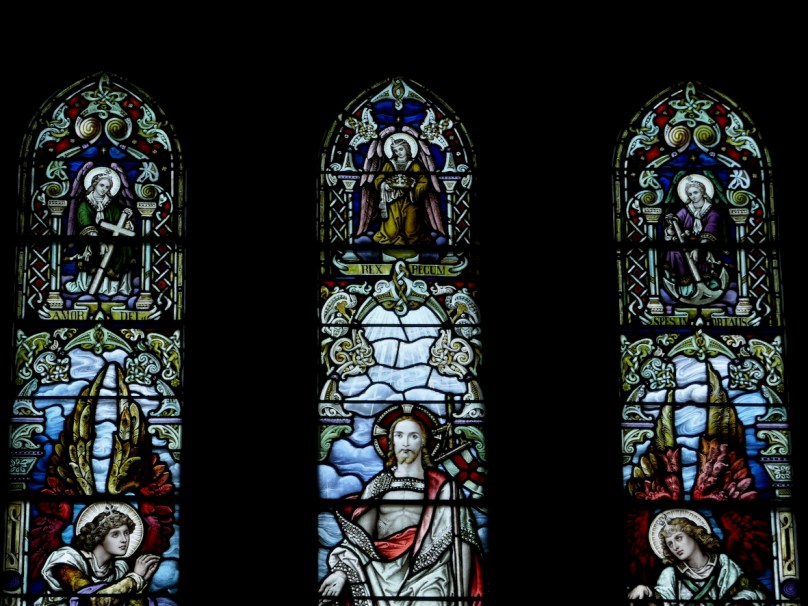
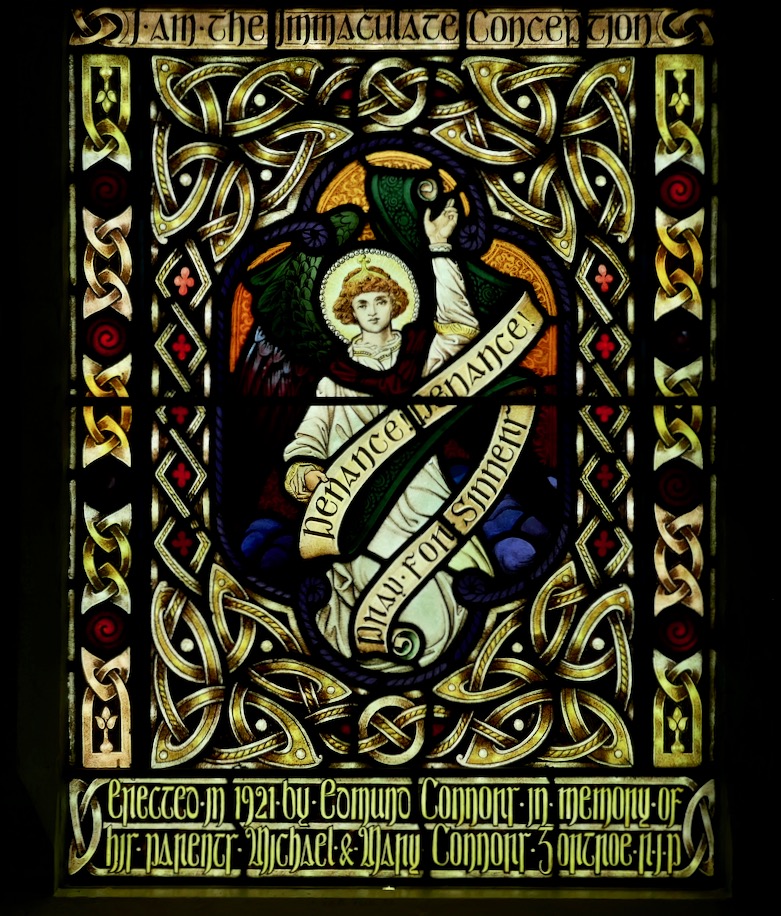
Next we will stop by St Ita’s church in Gortroe, near Youghal. Here you will find one of Watson’s Revivalist windows dedicated to that same Blessed Thaddeus McCarthy (below) about whom Fr Hurley wrote in the Journal of the Cork Historical and Archaeological Society and whose travails I described in my Post Thaddeus McCarthy, The Bishop Who Never Was. In the sanctuary is a three light window, the Sacred Heart flanked by Thaddeus and St Ita, while a Lourdes window occupies the south wall (a detail from that window is my lead image in this post).

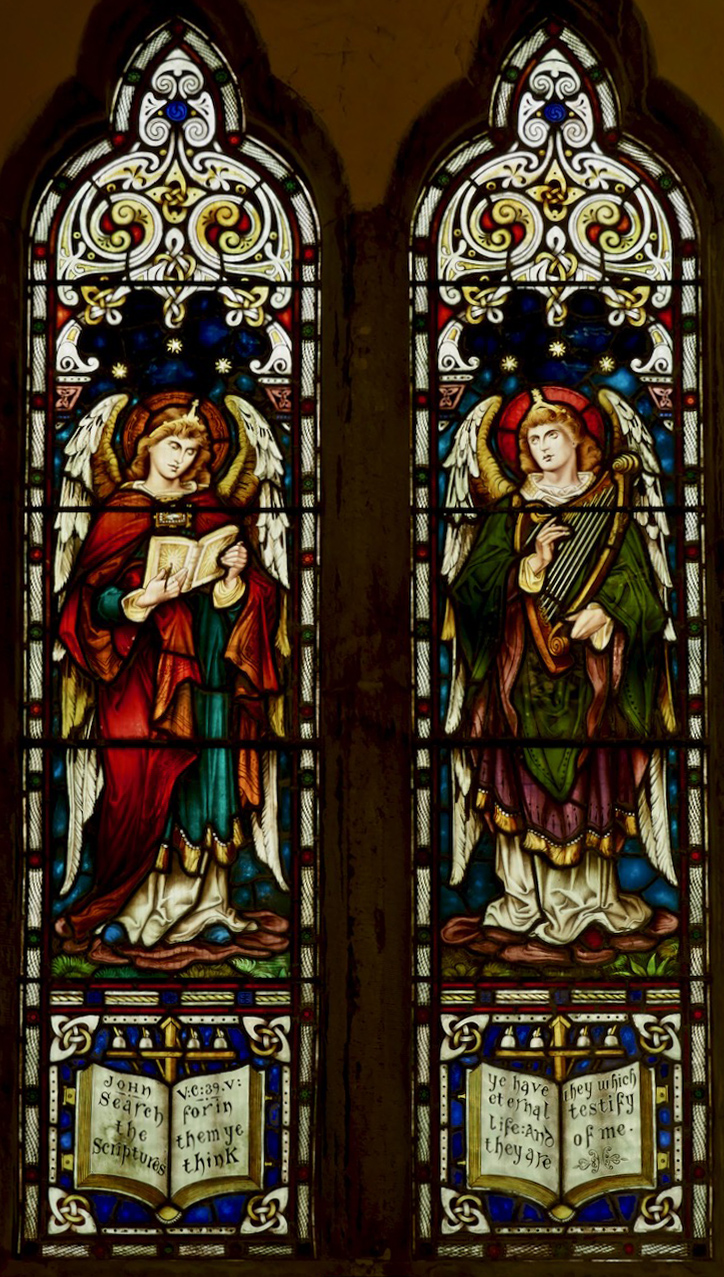
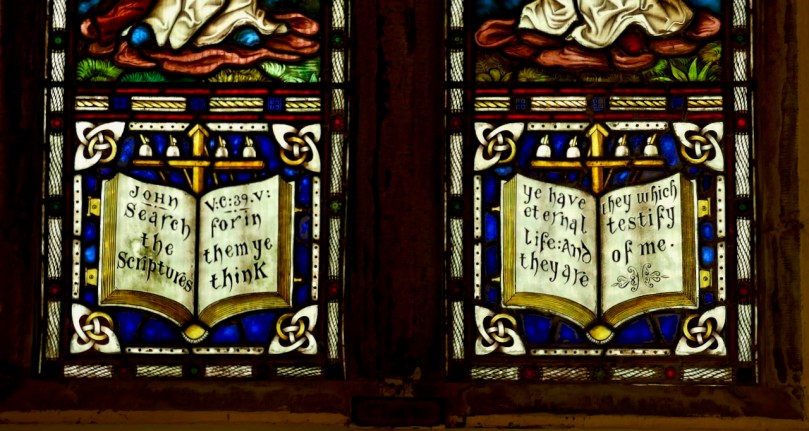
Protestant churches were also attracted to Revivalist touches and one of the most interesting windows I’ve seen is in St John’s Church of Ireland in Knight’s Town on Valentia Island in Kerry. The two light window depicts the angels of Prayer and Praise, with book and harp. The angels are beautiful if over-familiar depictions, but it is the surround that shows how Watsons worked hard to customise windows according to the wishes of the clients.*

The windows commemorate James and Anne Graves. James Graves was the first Superintendent of the Anglo-American telegraph station on Valentia and he held the post for forty years. Accordingly, the framing surround of each window shows not only nicely worked-out interlace but the telegraph cable, punctuated by cross sections of that cable in red and green. Marine rope, telegraph poles and ceramic insulators also make an appearance, and the international telegraph alphabet is represented by black dots on a white background. The window was executed in 1912 and cost thirty five pounds.

So far I have illustrated this post from windows in small churches, but the very large Catholic Church of St Carthage in Lismore, Co Waterford, has several very fine Revivalist windows. Some are credited to Cox and Buckley and were completed in the 1890s; others were done after the company had changed its name to J Watson and Co. The church itself, in a flamboyant Lombardo-Romanesque style, is well worth a visit and the windows certainly enliven the interior. The iconography is a mixture of International-Catholic and Celtic-Revival/local iconography, with, for example, the Archangel Michael and St Carthage (see Part 1) side by side.

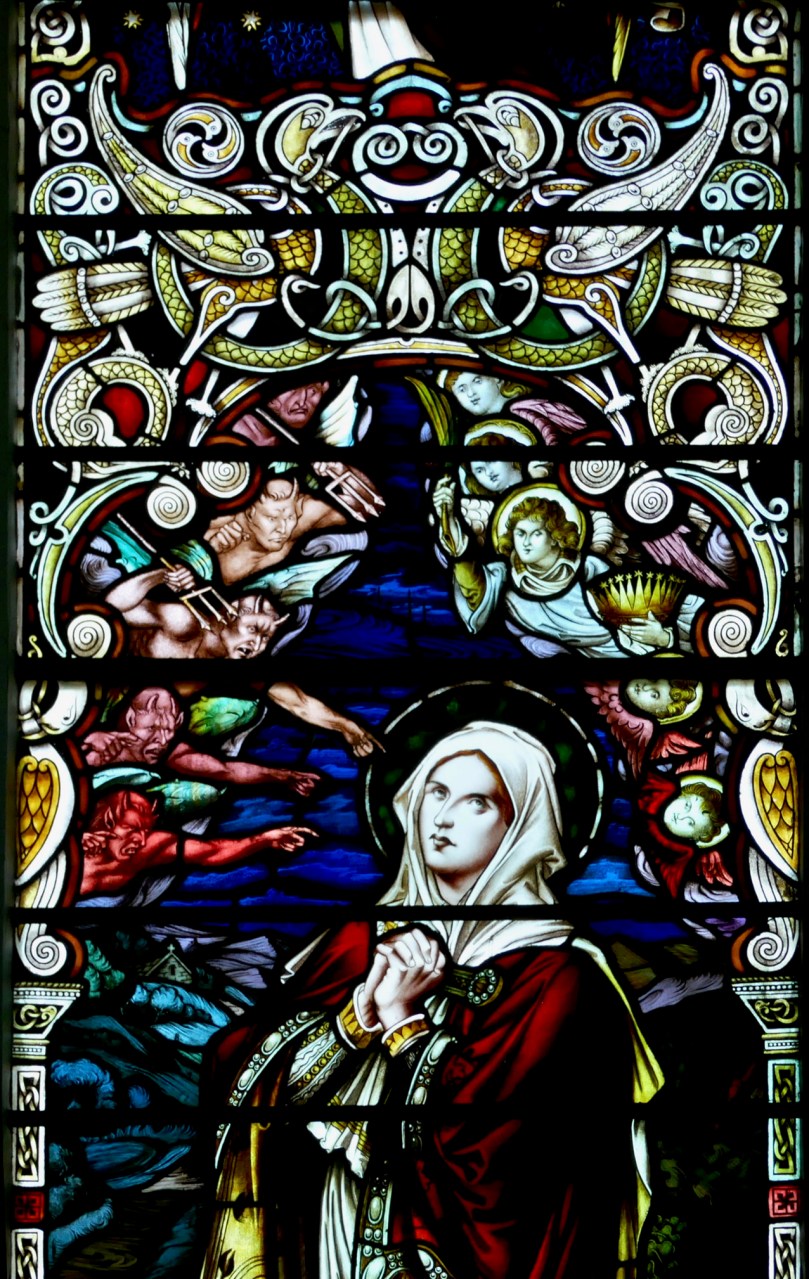
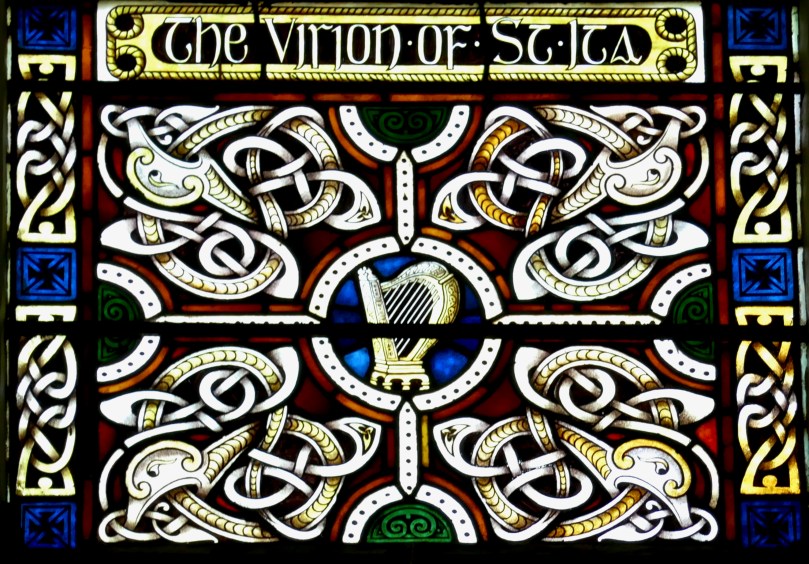
I included a detail from the Vision of St Ita window in Part 1, but it’s worth having a look at more of that window. The end of the nineteenth century saw the publication of many texts related to Irish saints – translations from Irish by such scholars as Whitley Stokes (see my post on The White Hound of Brigown) and Canon John O’Hanlon – and these became the religious equivalent of the stories of Finn McCool, Cuchulainn and the great Irish mythology cycles as written by Standish O’Grady and others at the time. St Ita was the foremost female saint of Ireland after St Brigid, and she is traditionally thought to have come from Waterford. She was given to visions and raptures and this is what is depicted here. And just look at those wonderful birds in the canopy above her head.

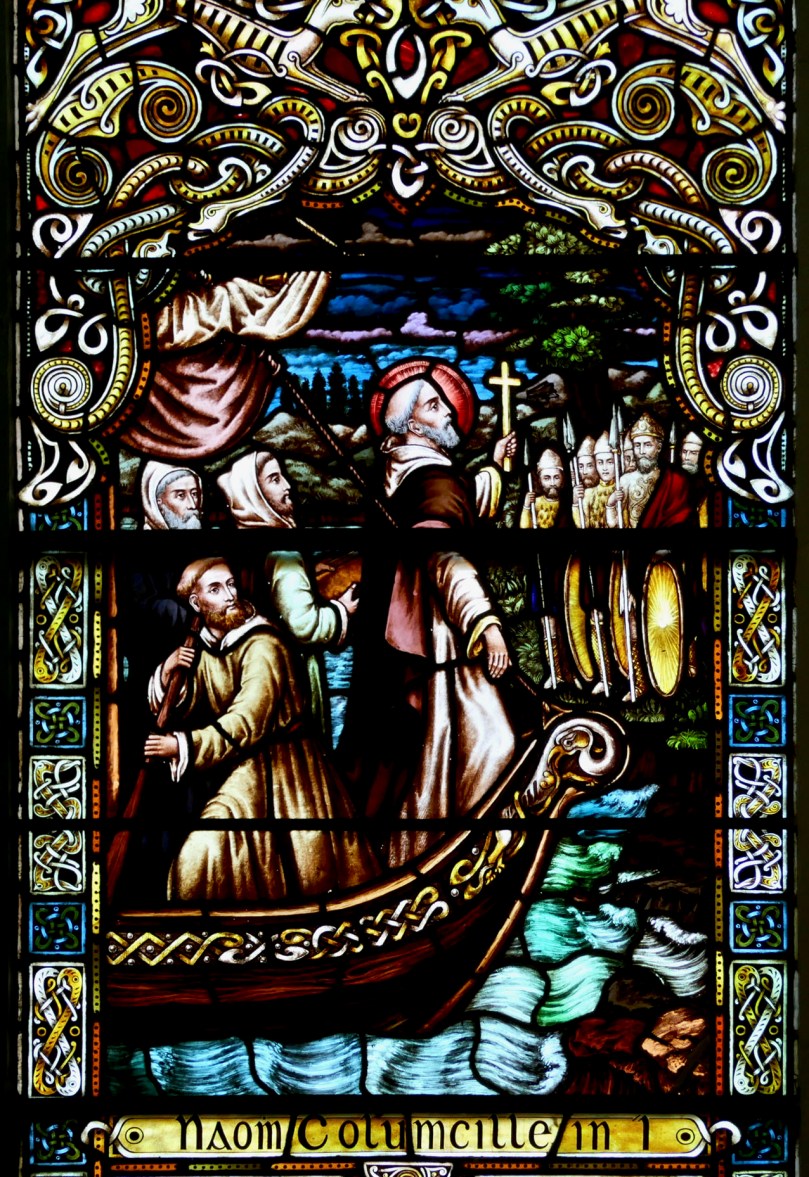
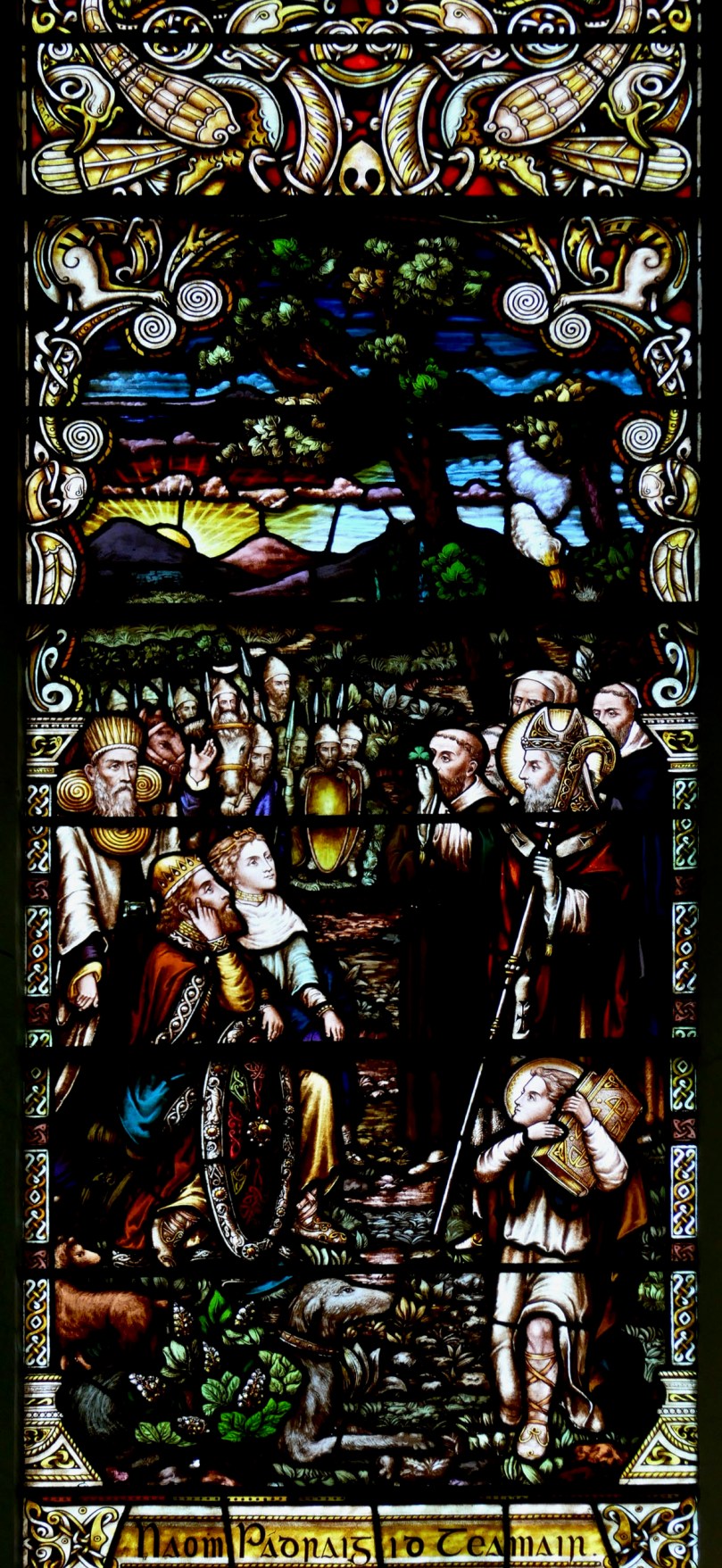
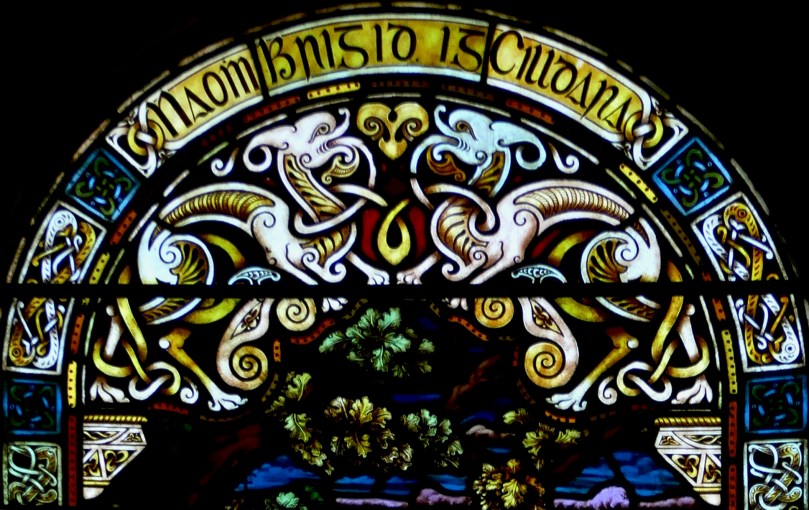
This demonstrates the popularity of these hagiographies with Irish Catholics and their clergy at the time – the artists responsible for these windows had to make sure they were well read on the lives of Irish saints. Both the Columcille window (above) and the Patrick window (below) exuberantly display their artist’s knowledge of the lives and deeds of these saints as well as their immersion in all the tropes of Celtic Revival imagery (wolfhound, anyone?).

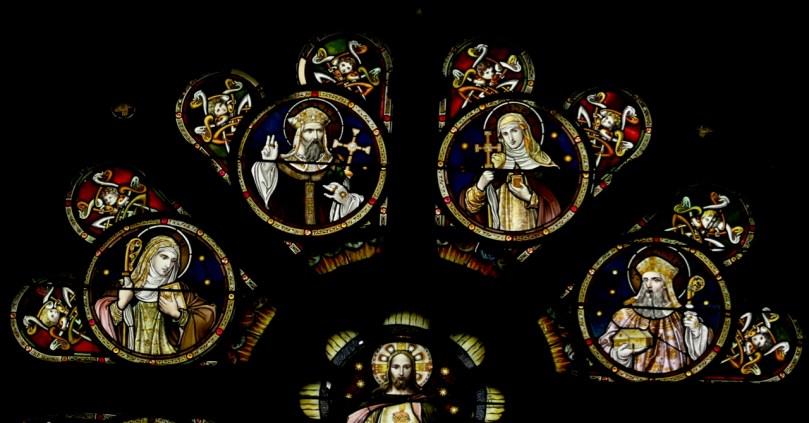
The Rose Window has a panoply of Irish Saints (including Saint Otteran, Patron Saint of Atheists!) each one occupying one of the rays of the rose with cherubs encased in interlace. As they say in property ads – must be seen to be appreciated.

My final window astounded me when I first saw it – in fact I think it was my introduction to Watson’s use of interlace and it really is a virtuoso performance. I’ve used the bottom panel from it further back in the post to demonstrate how a cartoon ends up as a window, but the whole window deserves pride of place. It’s in the Catholic church in Inchigeelagh, Co Cork, and so we have circled back again to St Finbarr of Gougane Barra – an excellent place to stop.

I’ve included illustrations in this post from Cork, Kerry and Waterford but I would be interested to hear from anyone who has found Watson Revivalist windows anywhere.

Part 1 of this post is here

Time for Signs

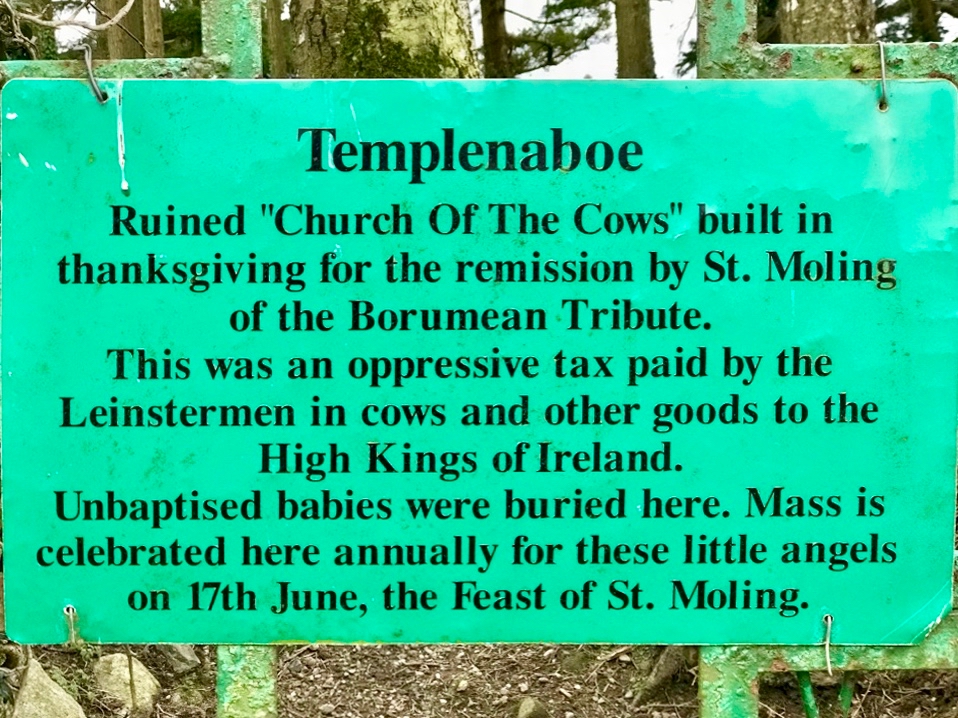
It’s a few months since I took a selection from my ever increasing files of Irish Signs. If you want to see some of the older posts in this series, click here. Otherwise, I’m going to stand back and let the images speak for themselves: there are curiosities and humour: unexpected juxtapositions – and some that might leave you with question marks . . . I hope you will enjoy them all.

Mizen Mountains 2 – Lisheennacreagh

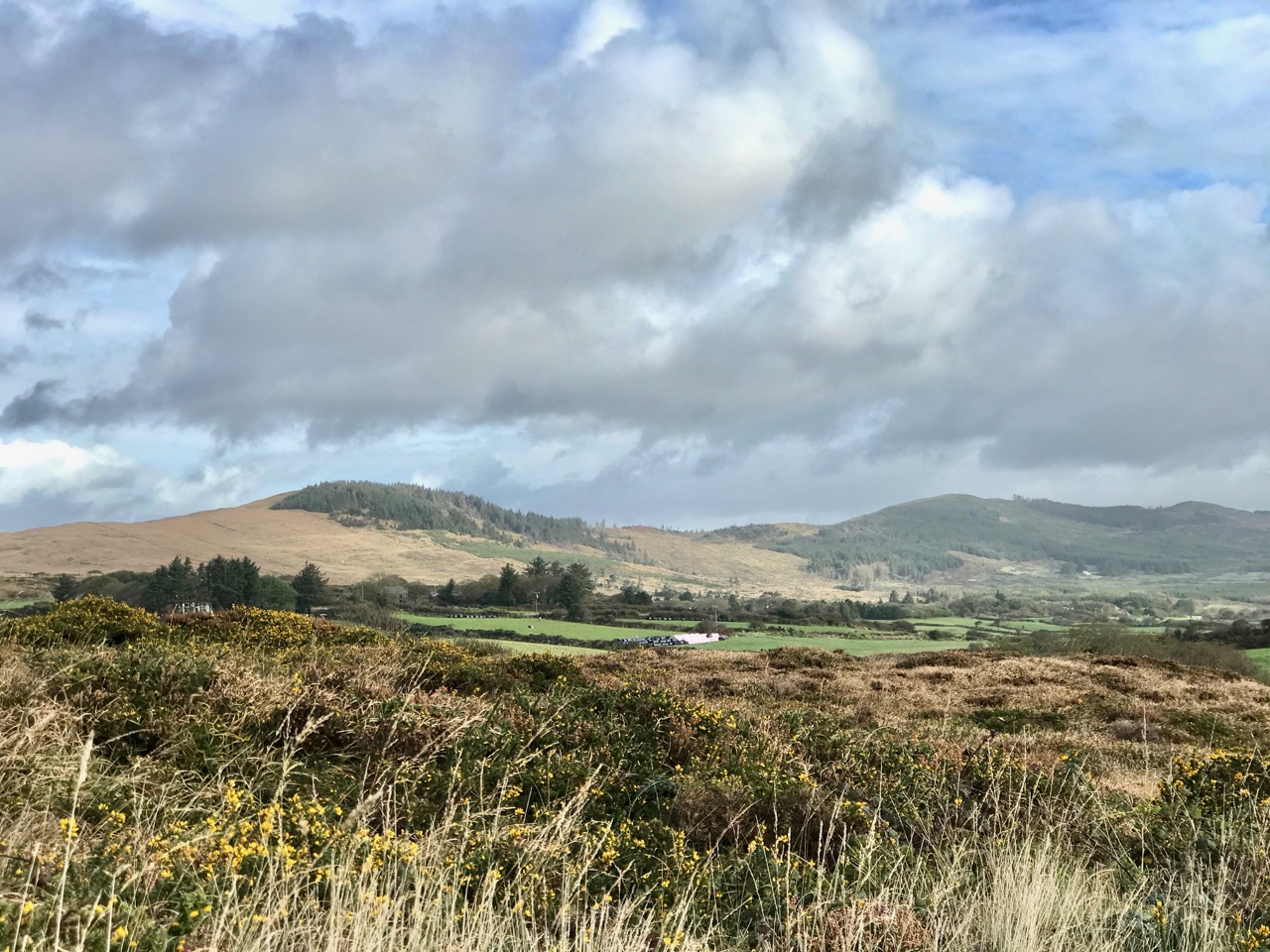
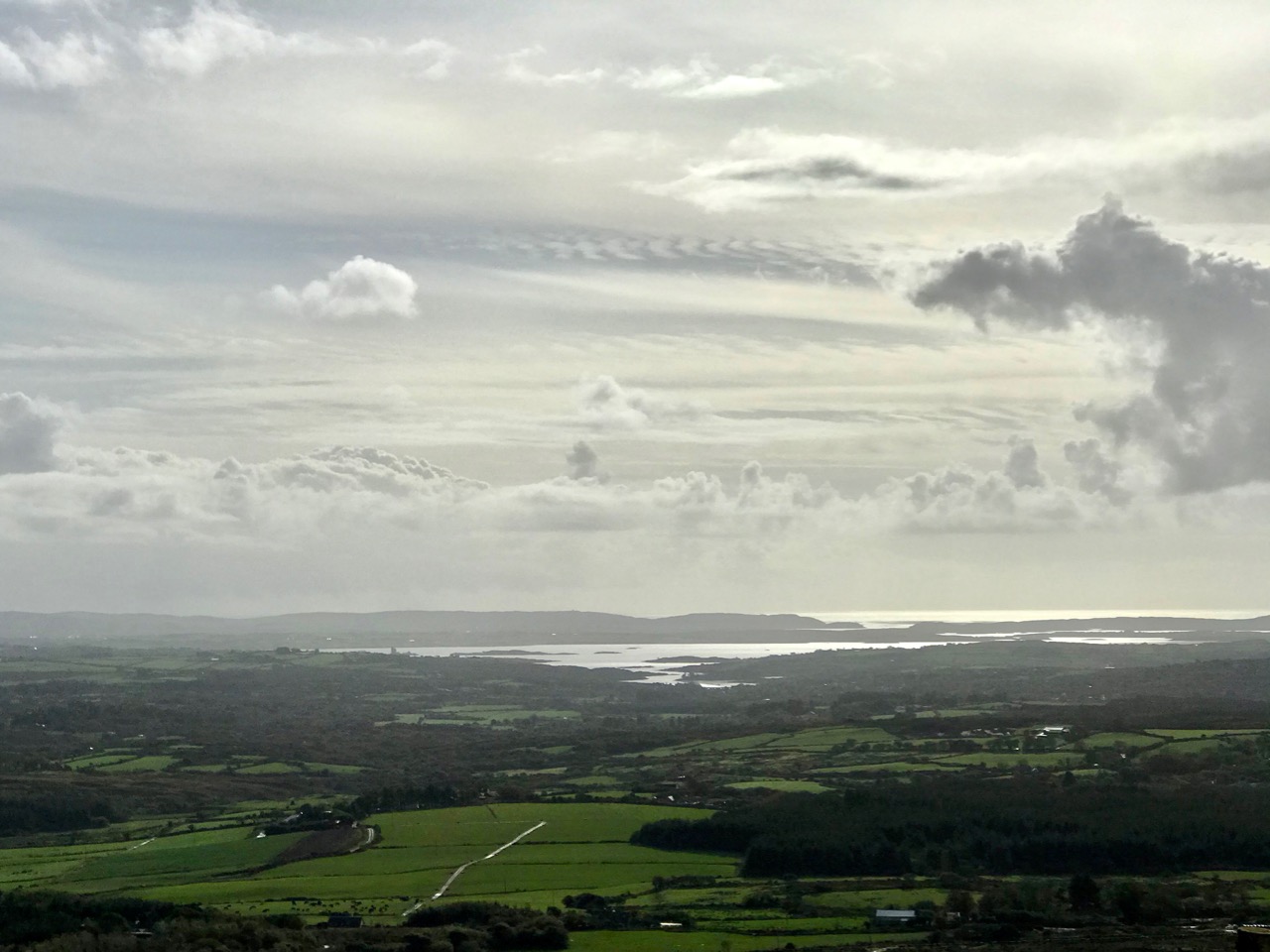
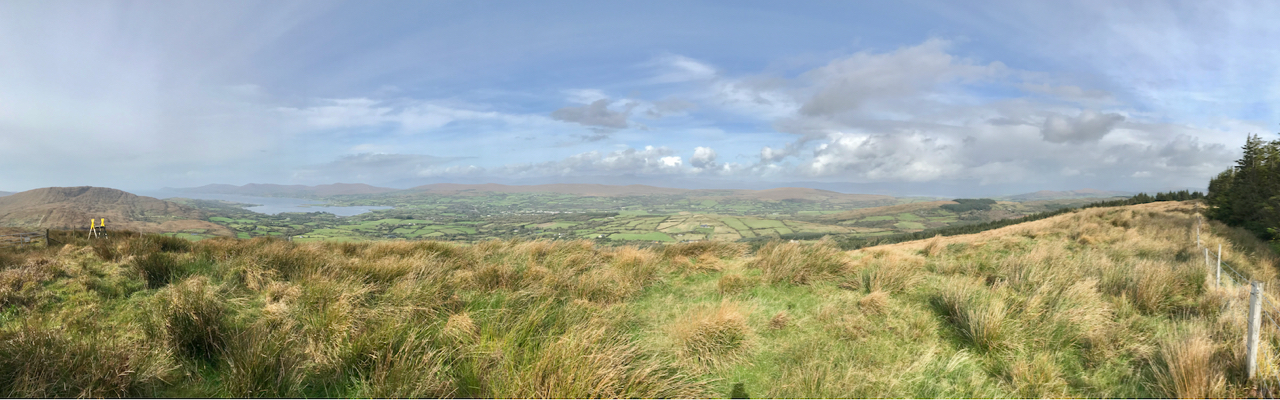
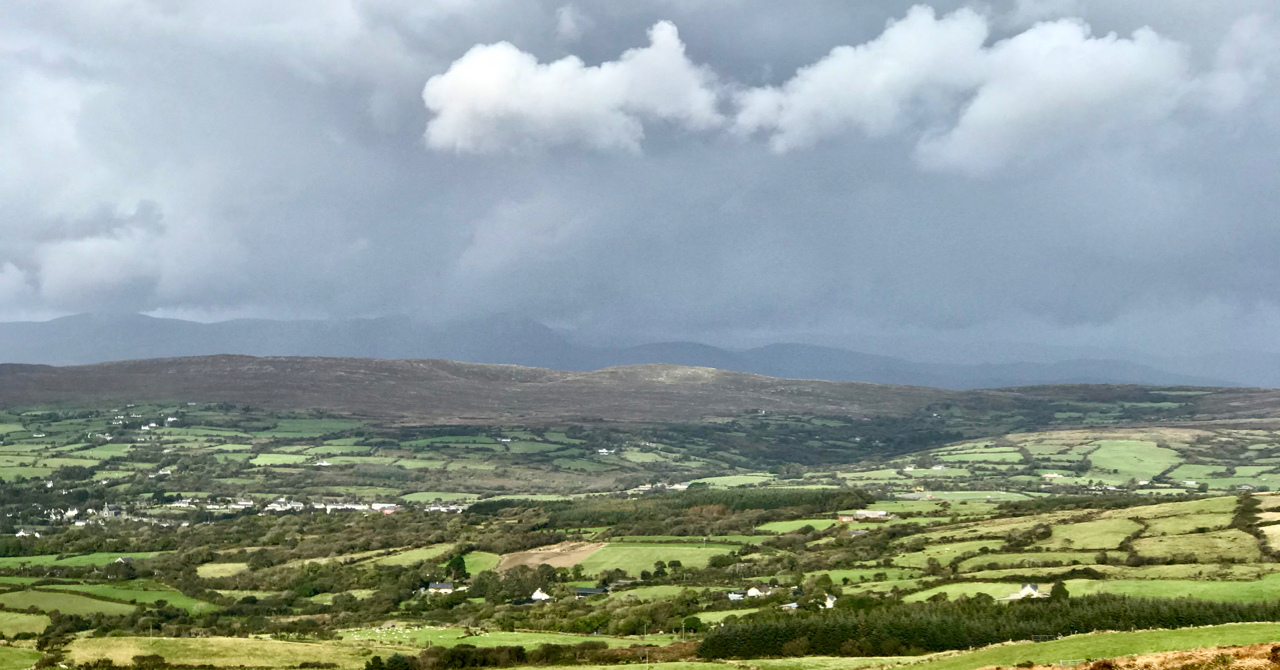
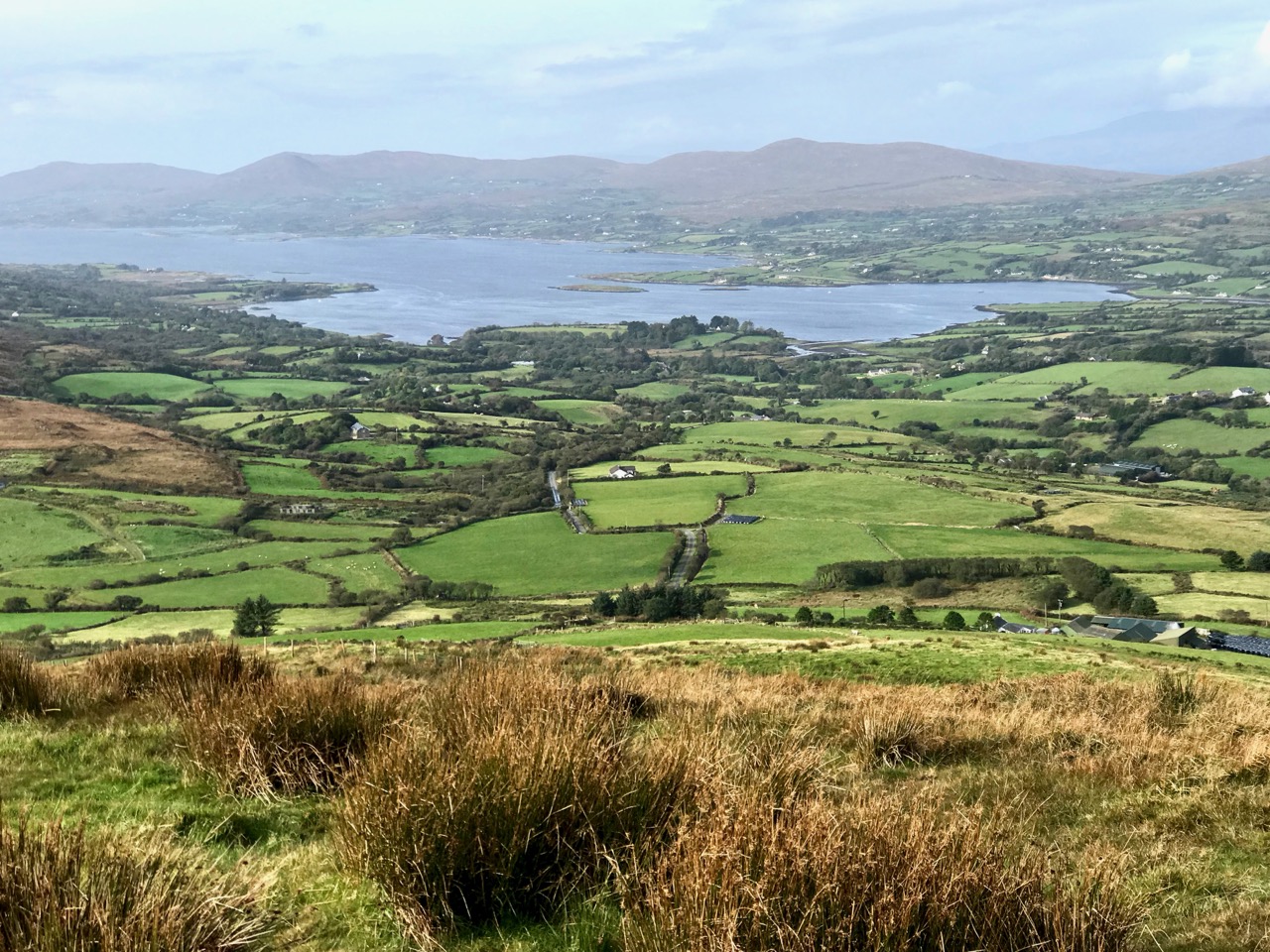
In this series I’m visiting and recording all the ‘mountains’ on the Mizen Peninsula in West Cork. I’m defining a mountain as any summit over 200m above sea level. If I hear you crying out ‘shame!’ – as a mere 200m peak can’t possibly be a mountain – then I can say our country is defined by its undulations, and here in the far west of Ireland all our outcrops, however modest, are dramatic and offer striking views over the landscape, such as the one above which looks north-west across Dunmanus Bay towards the Sheep’s Head, seen from this week’s climb.

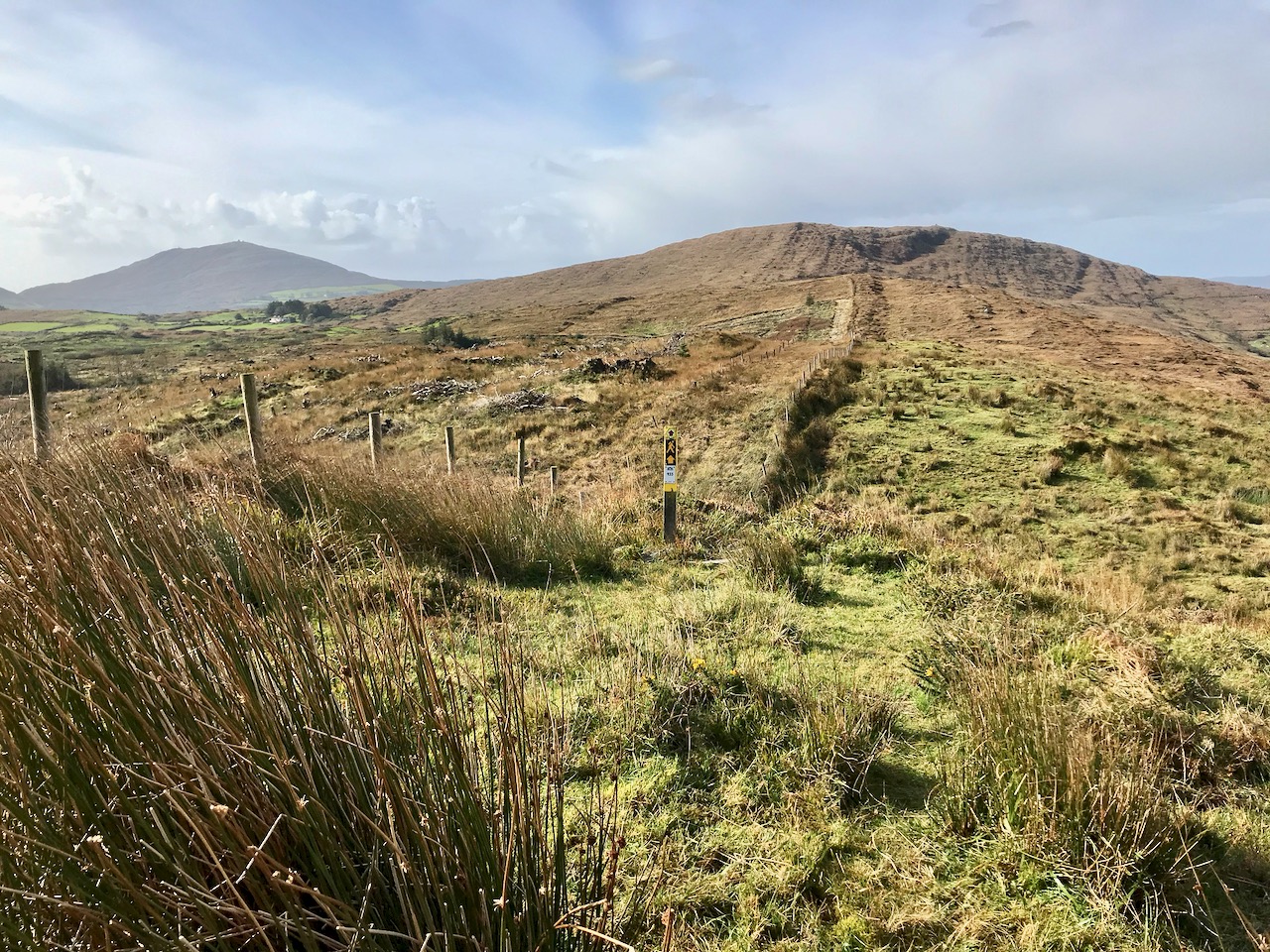
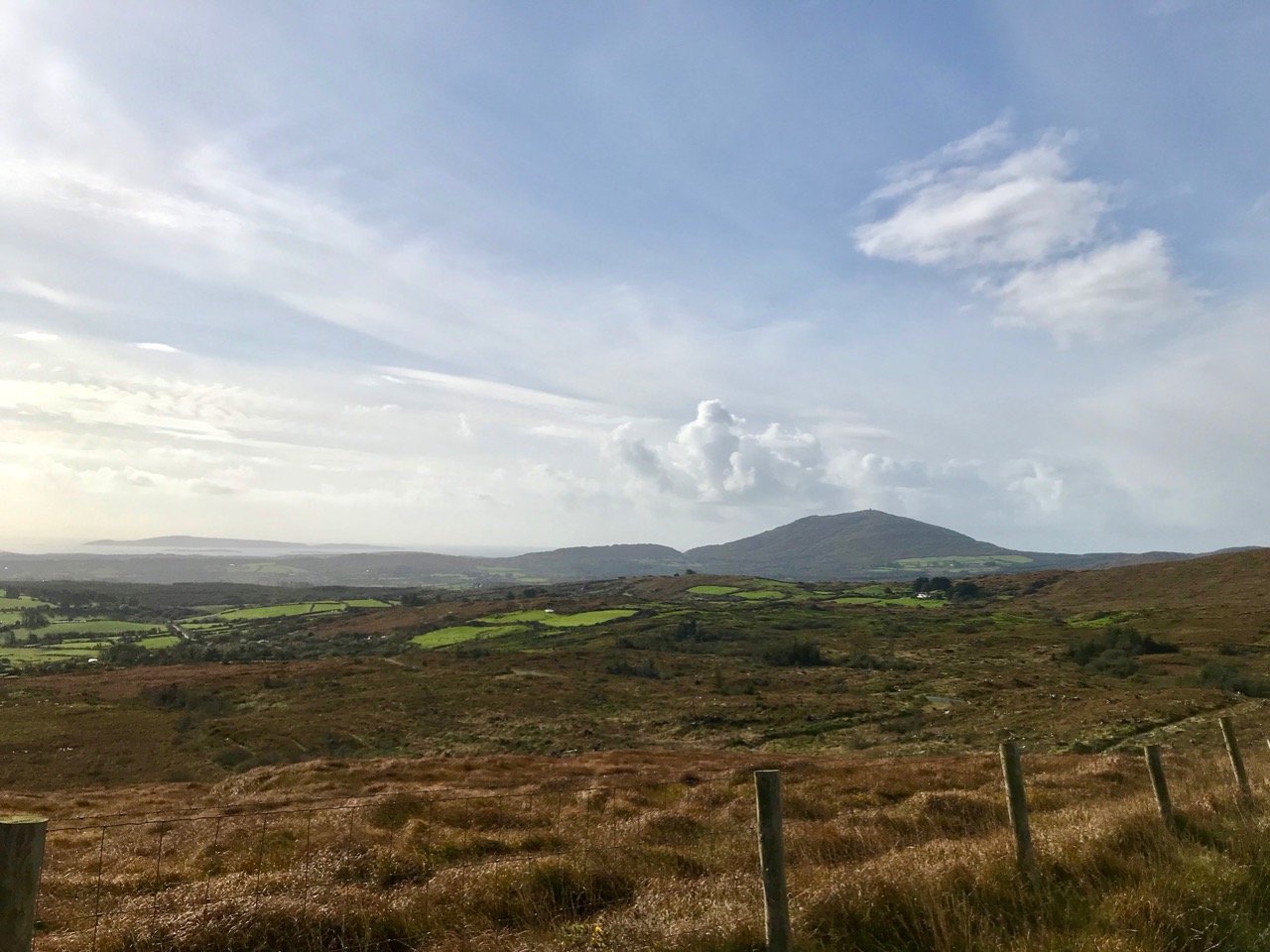
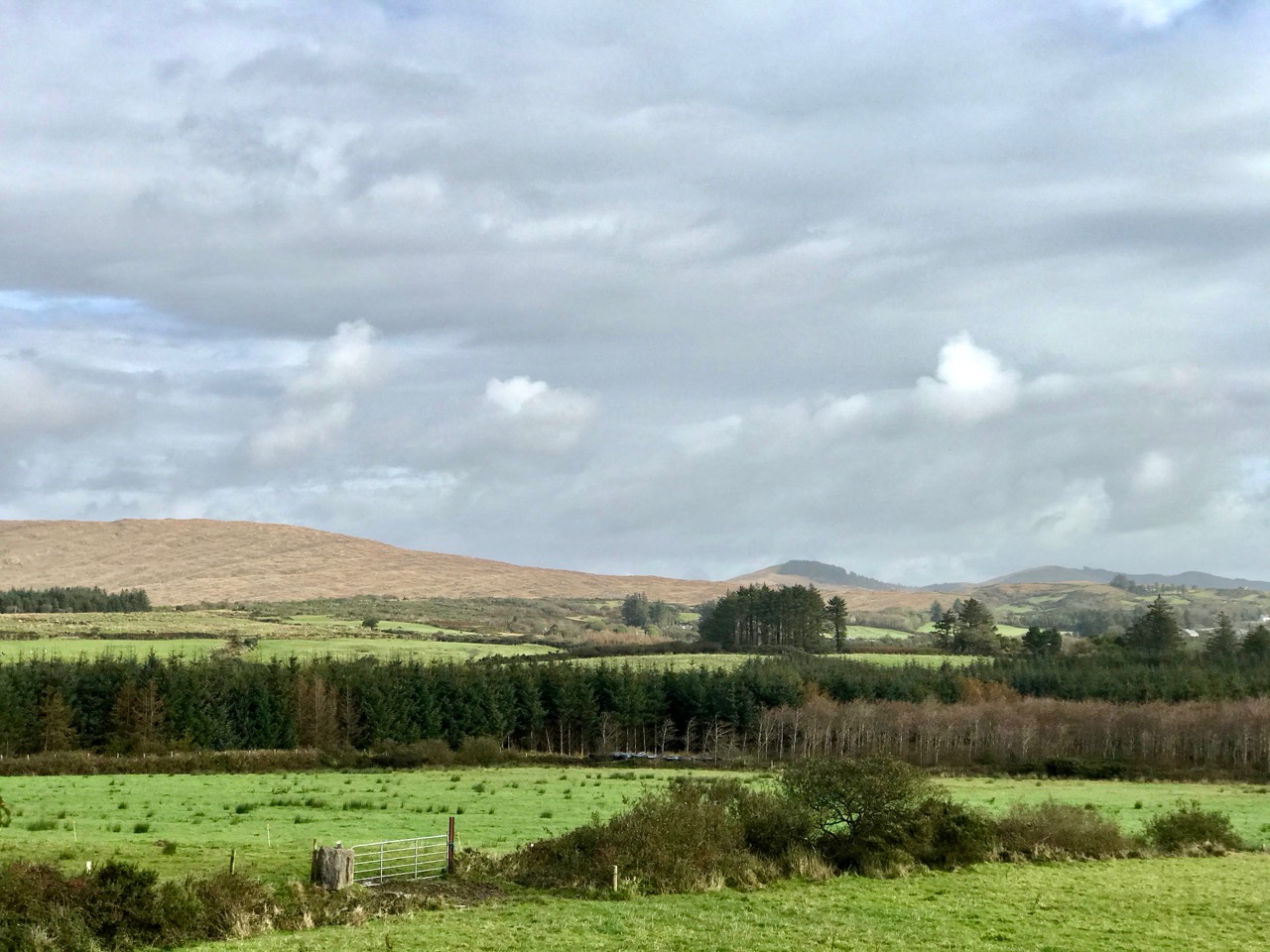
Upper – approaching the ridges from the Schull direction, the three peaks of Corrin (left), Lisheennacreagh (centre) and Derrylahard (right) are set out before us. Lower – a closer view: Lisheennacreagh is on the left: its summit is hidden behind the forestry plantation

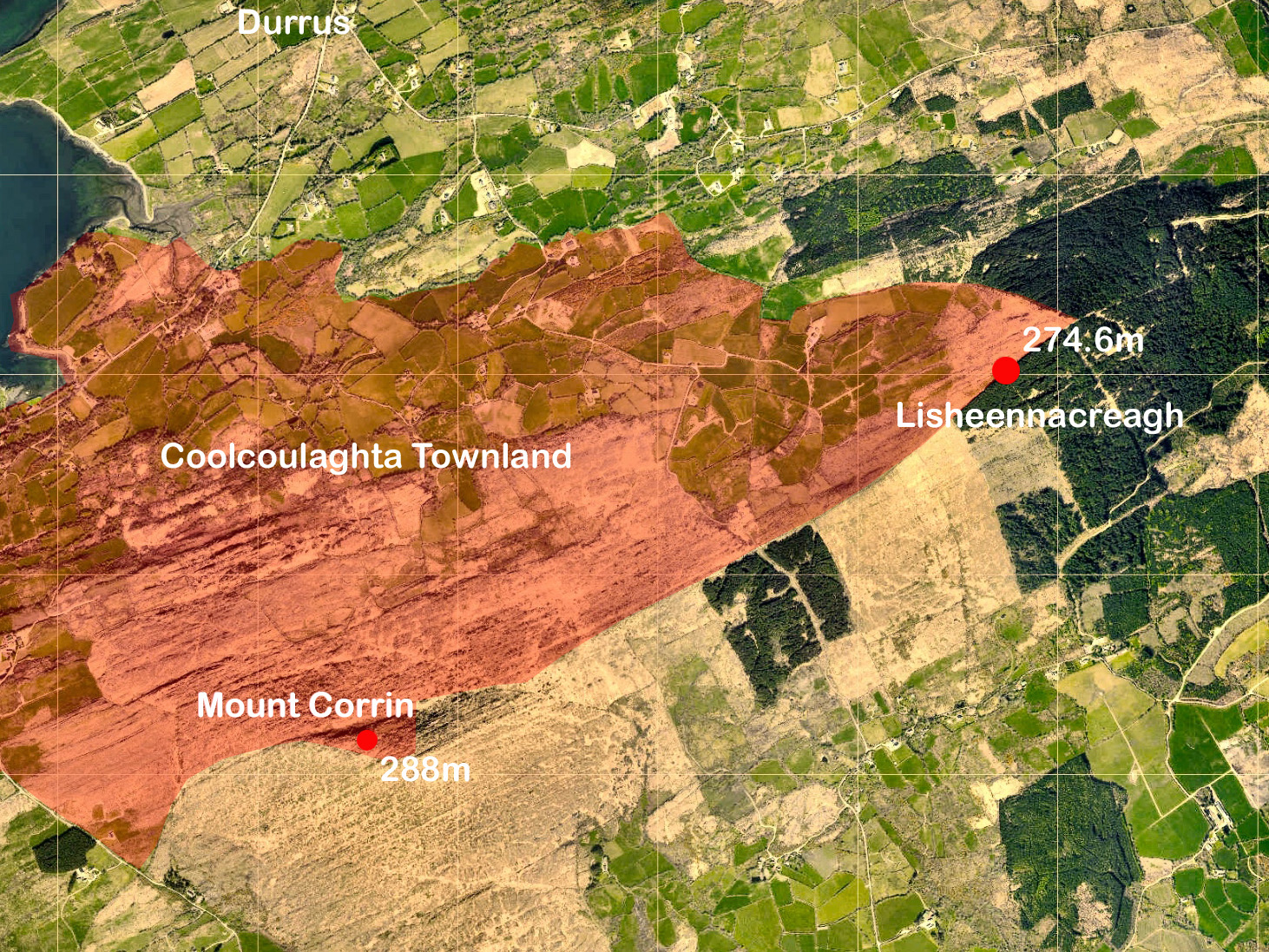
Last week we explored at the western end of the peninsula, where Knockatassonig – at a height of 204m – only just crept into our ‘mountain’ category. This week – much further to the east – we are more secure, as my chosen destination comes in at 274.6m. It’s actually higher than it looks as neighbouring Mount Corrin (no doubt about that one!) peaks at 288m, and appears much more of a climb from below. Today’s summit is not named on any map, so I’m probably courting controversy by calling it Lisheennacreagh, after the townland in which, by my calculations, the highest point is located. Have a look at the aerial view below:

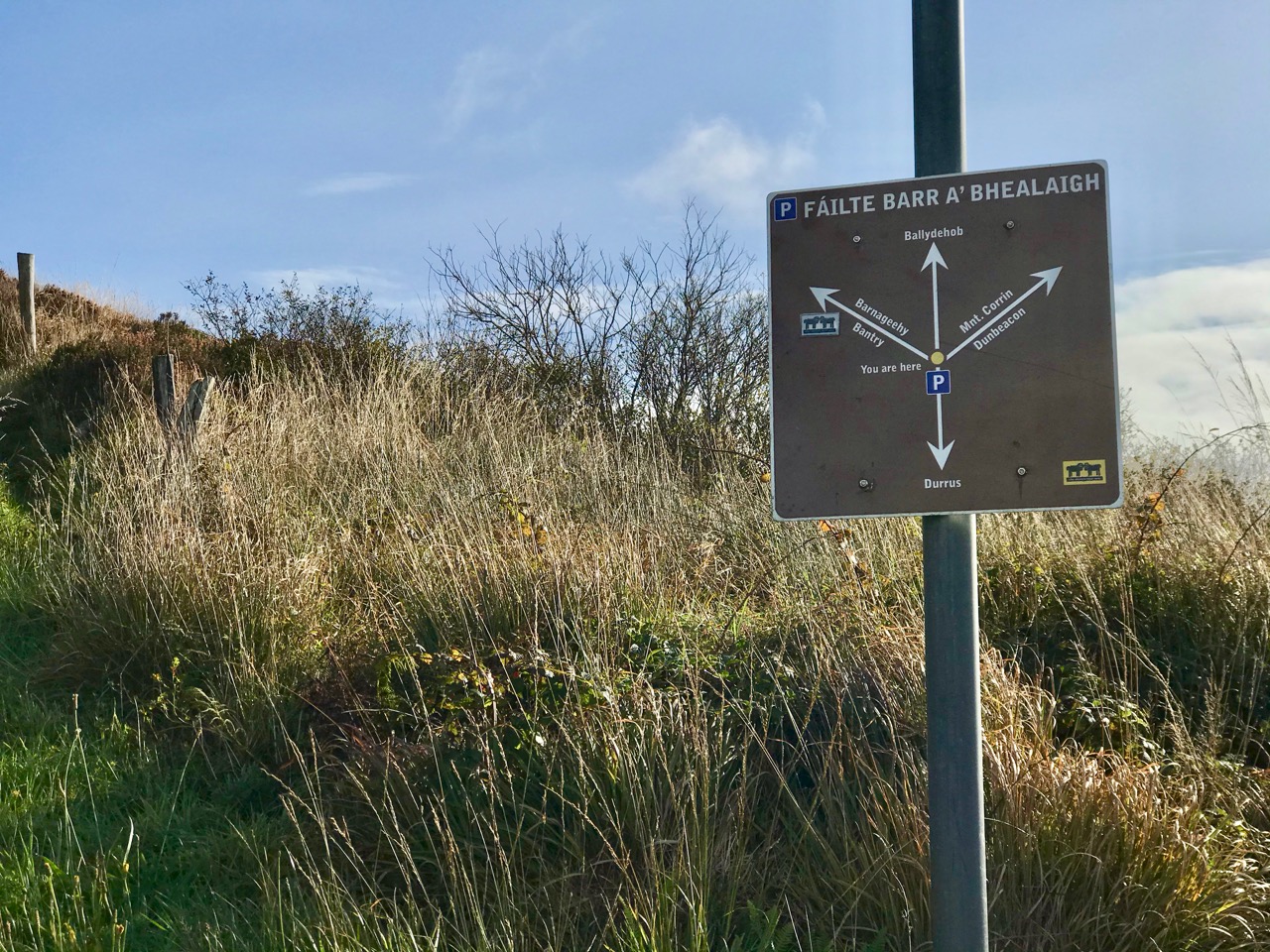
The pink shading shows the outline of part of the large townland of Coolcoulaghta, the southern boundary of which takes a sinuous course to include the summit of Mount Corrin. Over in the east, however, our high point is exactly on the boundary between the townlands of Coolcoulaghta and Lisheennacreagh – a boundary which is physically defined at that point by a substantial fence, whose course – part of the Sheep’s Head Way Mt Corrin Loop route – we followed all the way up to this summit from the designated car parking area on the Rathuane to Durrus road. After much on-site pondering, I decided to give the summit to Lisheennacreagh, as Coolcoulaghta townland already claims Corrin!

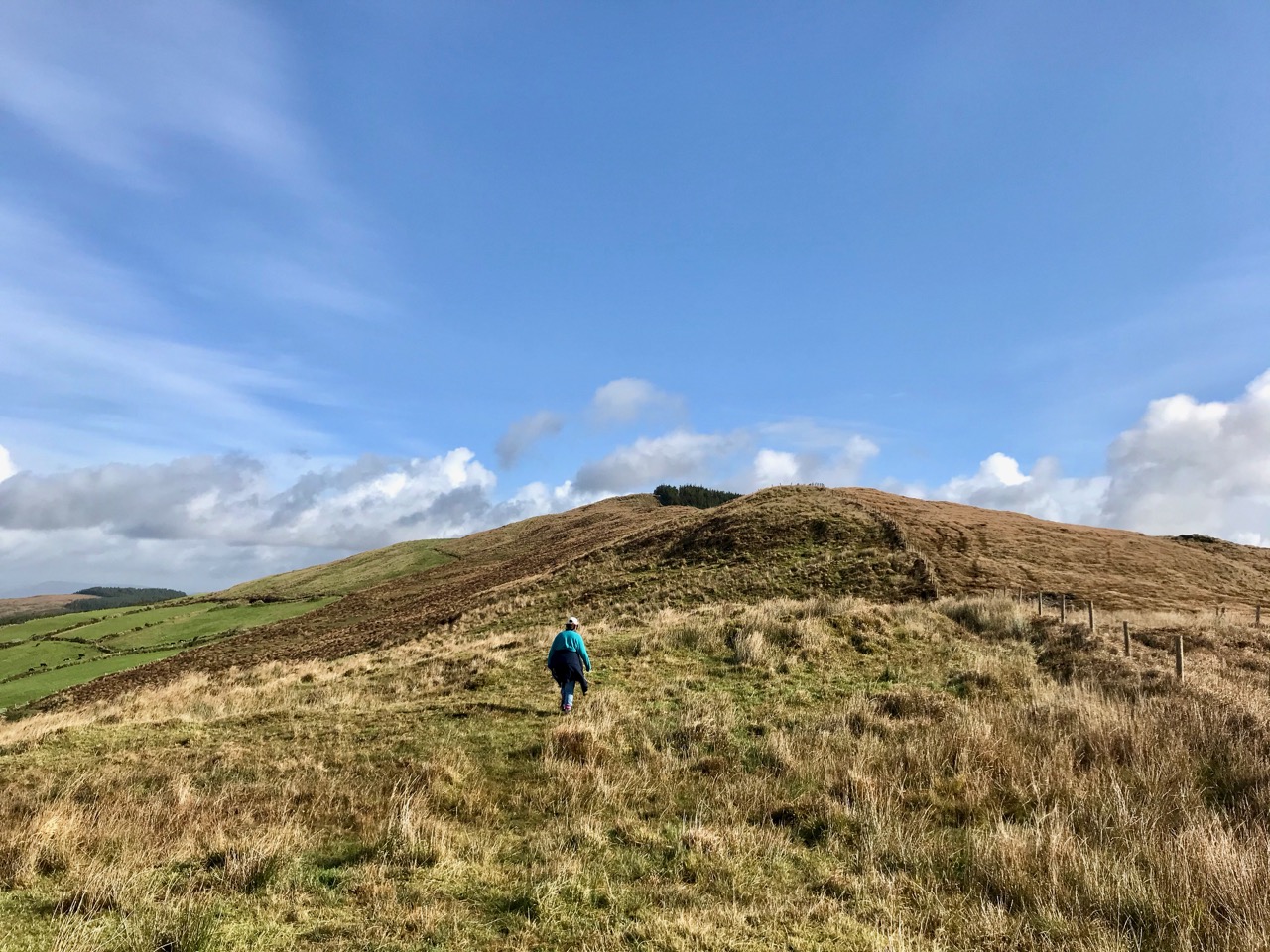
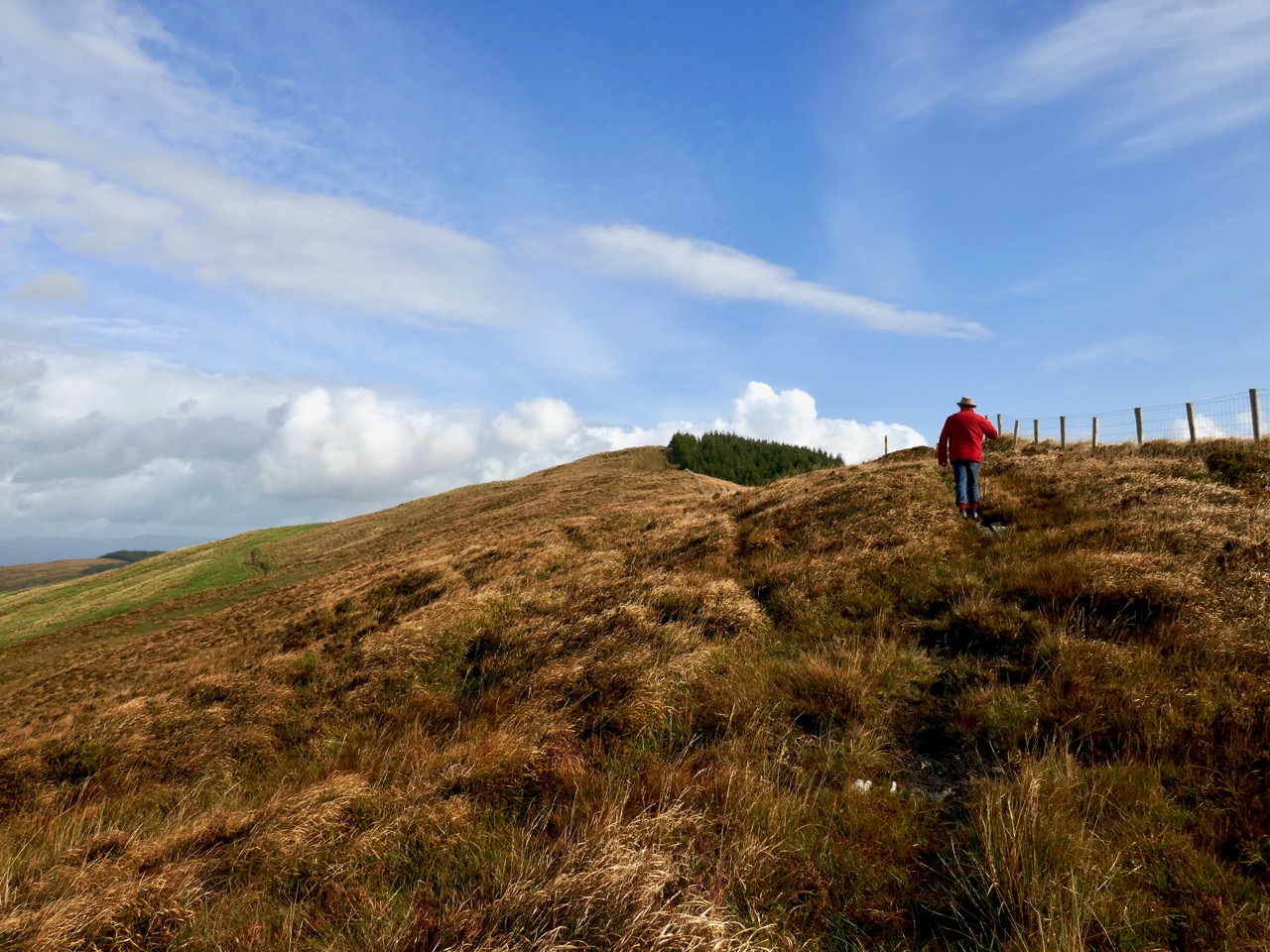
Upper – Finola is heading out for the high ground: the summit is in the far distance, beside the forestry plantation. Lower – looking back from the ascent, high Mizen summits are set out: Corrin is in front of us and Mount Gabriel is in the distance to the left

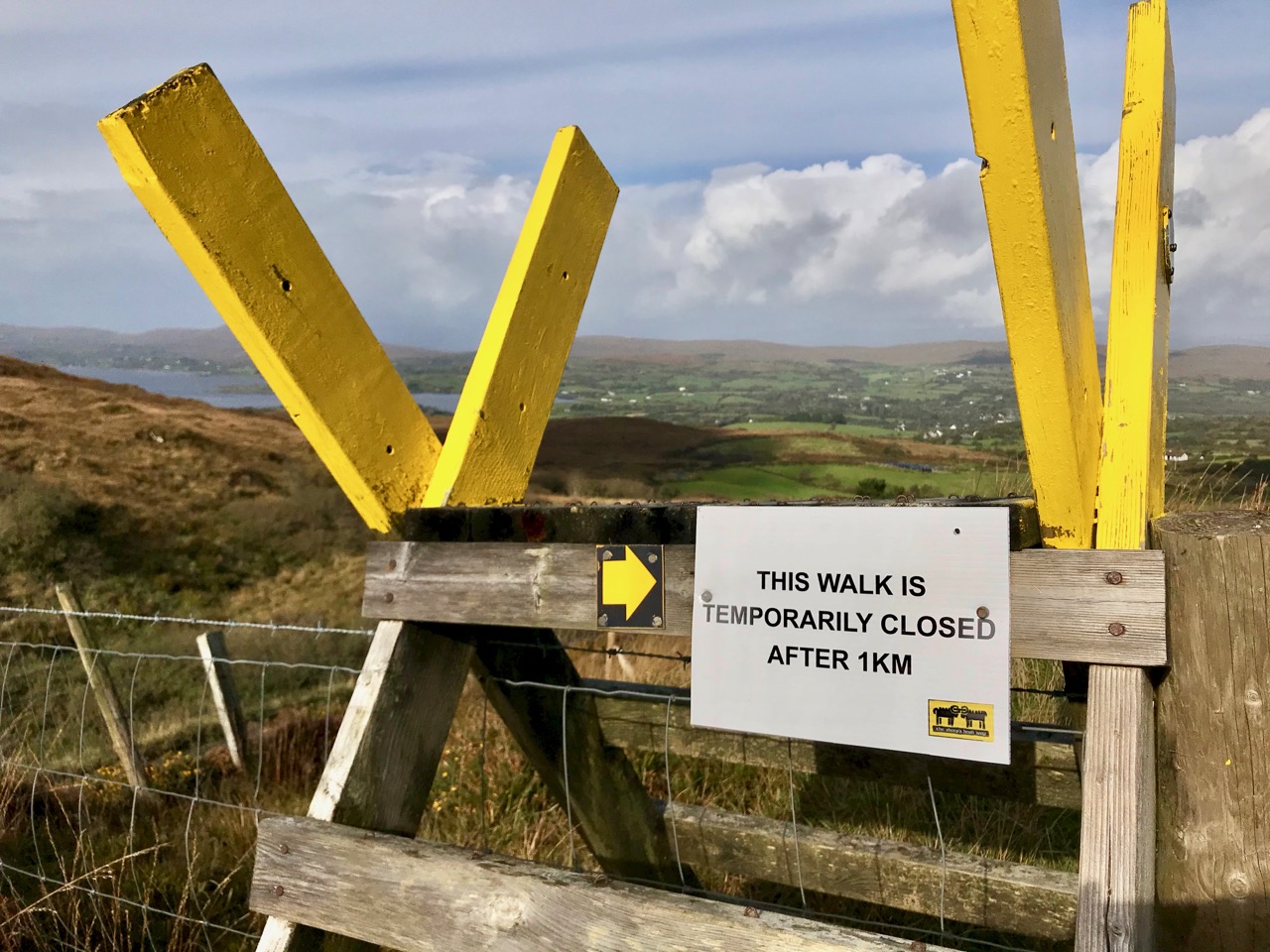
According to the place name records surveyed in 1841, Lisheennacreagh (Irish Lisín ne Cré) means Little fort of the preys or plunders – I was hoping I might find some traces of ancient earthworks on this summit, but there is nothing visible: buried deep in the inaccessible forest is a scheduled monument, described as a hachured univallate enclosure with a diameter of 22m. In fact it’s not possible to complete this loop walk at all, as the way to the next high point – Derrylahard, 301.7m – passes through heavy forestry, but access has been blocked by storm damage earlier in the year.

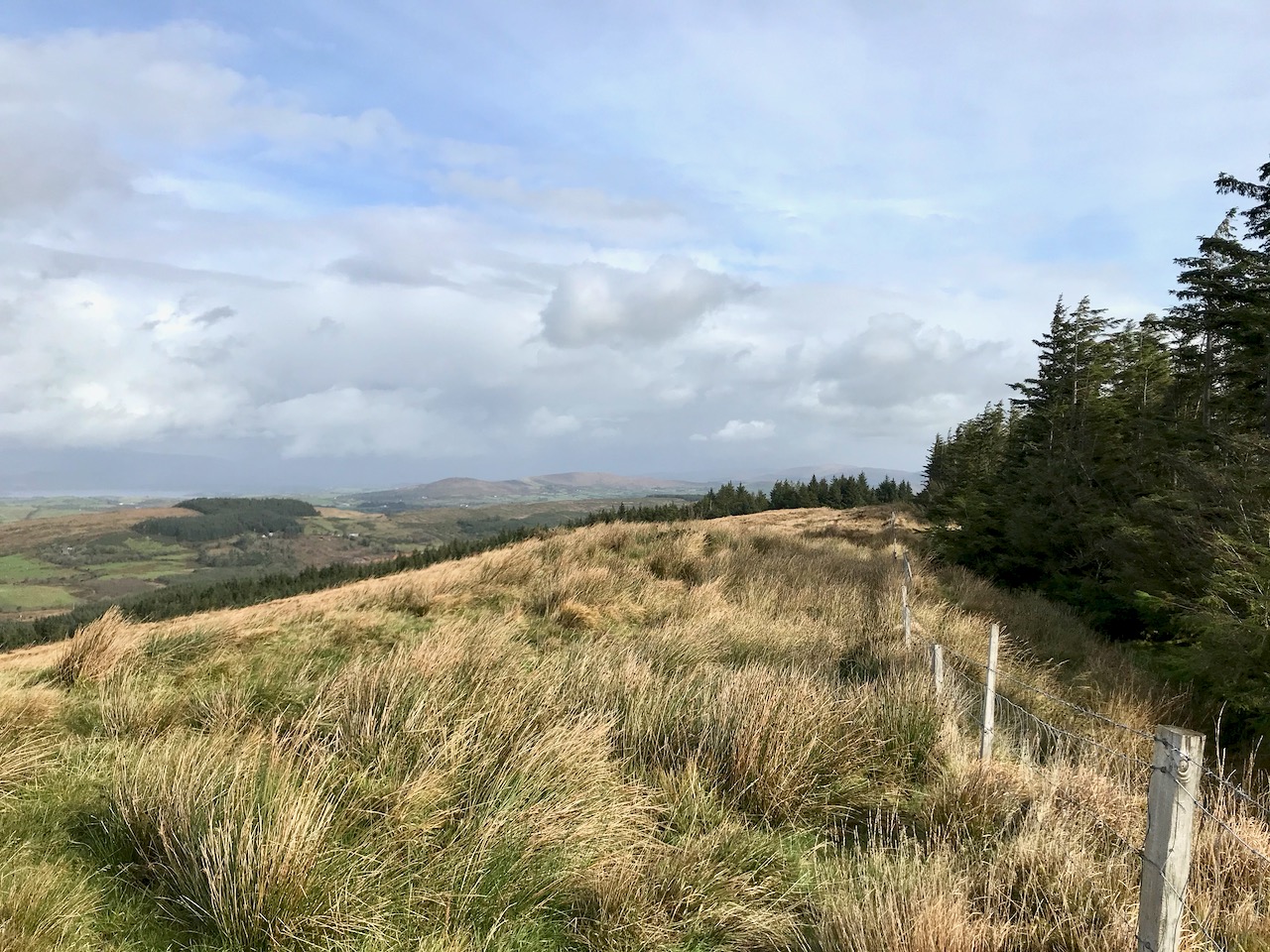
Above – autumnal shades of rough grazing continues all the way over the summit: you can go only as far as the next section of forest. Our companions on the walk were just a few ponies

It may seem a fairly featureless walk, but it was well worth the efforts for the superb views in all directions. We were lucky with the day: the mild weather this year has continued right through September and well into October. The mixture of blue skies and scudding clouds emphasises the contours, shadows and natural features, wherever you look.

Rewarding views from the Lisheennacreagh climb: upper – looking across Roaringwater Bay to Baltimore; lower – Cape Clear in the far distance, with another view of Gabriel, the most dominant feature of our Mizen landscape

I found some entries from the Duchas Schools Folklore Collection, for Durrus School. I could not find anything specific to Lisheennacreagh, but I liked this introduction to ‘My Native Townland’ from Brenda MacCarthy dated May 9th 1938:

I live in the townland of Coolcolaughter away out in the country, far from any stuffy unpleasant town or city, and almost two miles from the village of Durrus. My home is at the foot of the mountain in a quiet peaceful valley where my father tills, and sows, and reaps, from dawn to dark year in year out, happy and prosperous, and thankful to God for health and existence . . .

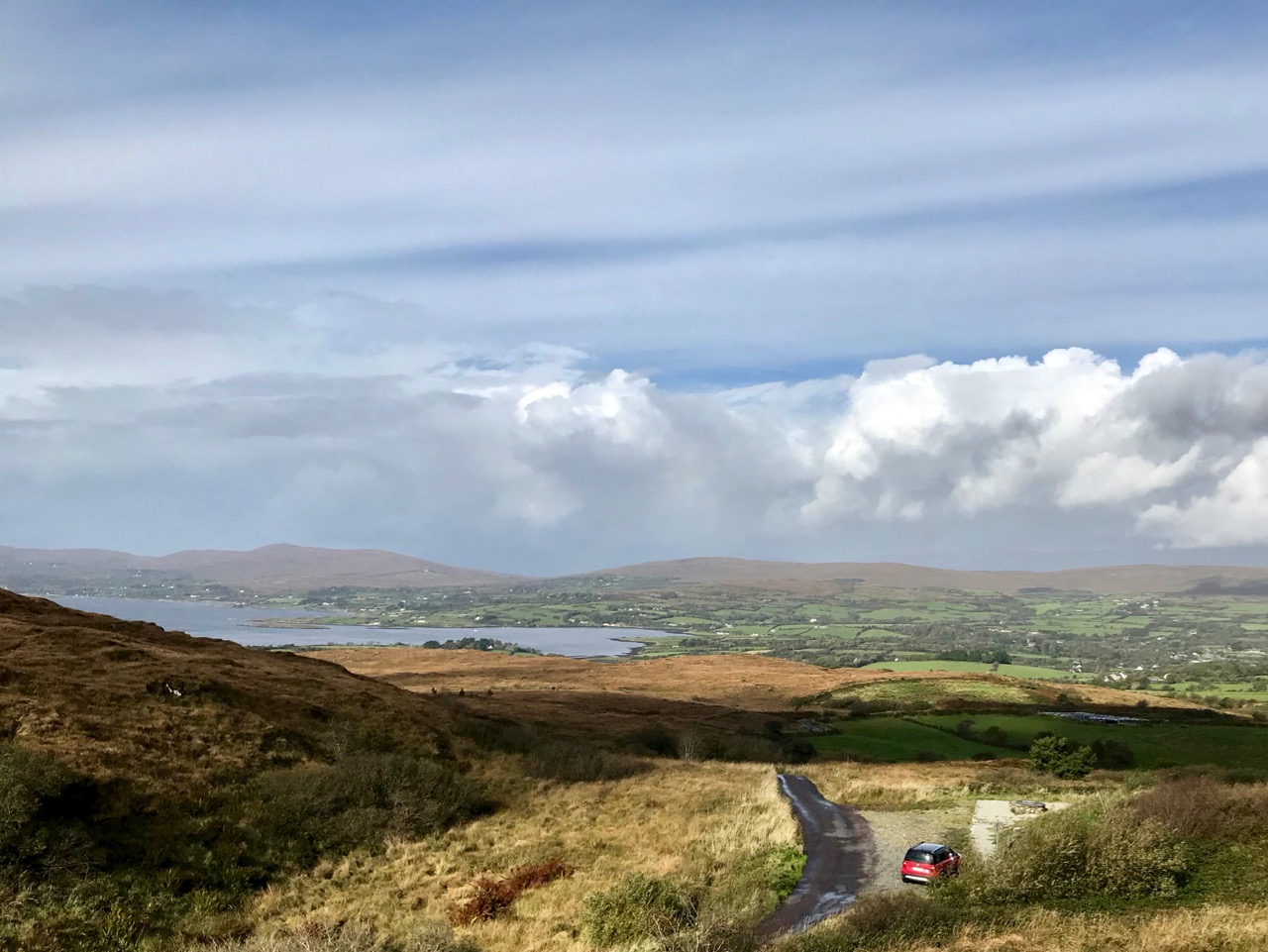
One aspect of Lisheennacreagh is that it is one of the more accessible peaks. There’s a place to park your car (with a fine view looking out to Durrus!), good signage and waymarks. Once the path is repaired beyond this summit, you can go on to Derrylahard (which will be the subject of a future post) and complete the loop by going round Glanlough to Durrus, then back over Corrin – a marathon 17km in all. Choose a good day and you couldn’t hope for a more inspiring hike.

Good accounts of this route and the whole Sheep’s Head system of trails can be found in Amanda and Peter’s book Walking the Sheep’s Head Way – Wildways Press, 2015. Also, have a look at this Living the Sheep’s Head Way post.

Watsons of Youghal – Revivalist Masters Part 1

The stained glass firm of J Watson & Co of Youghal not only represented a new type of Irish-based business when it started to operate in the 1880s but developed a uniquely Irish style of stained glass (see above). I introduced this topic in my post Symbols and Stories: Looking at Stained Glass, but I want to develop it properly in this post and provide further illustrations in the next. Watsons was first opened by Michael Buckley, who had Irish connections, as a branch of Cox, Sons, Buckley and Co of London but was eventually bought out by James Watson, a Yorkshire stained glass artisan who had come to work there a decade earlier. Members of the Watson family continued to make windows right up to 2012.*

This St Eltin window in Gougane Barra has been attributed to Michael Buckley. Note the Revivalist elements

Based in Youghal, the firm supplied stained glass all over Ireland, but especially in Munster. They competed with other new firms which had set up church supply and decorating businesses, mostly in Dublin. These included Joshua Clarke (father of Harry), James Pearse (father of Patrick and Willy) and the Earley Brothers, Thomas and John. All of them had learned the trade in Britain and some started as agents for such companies as Mayer of Munich and London or Hardman of Birmingham, but eventually employed their own artists and glaziers.

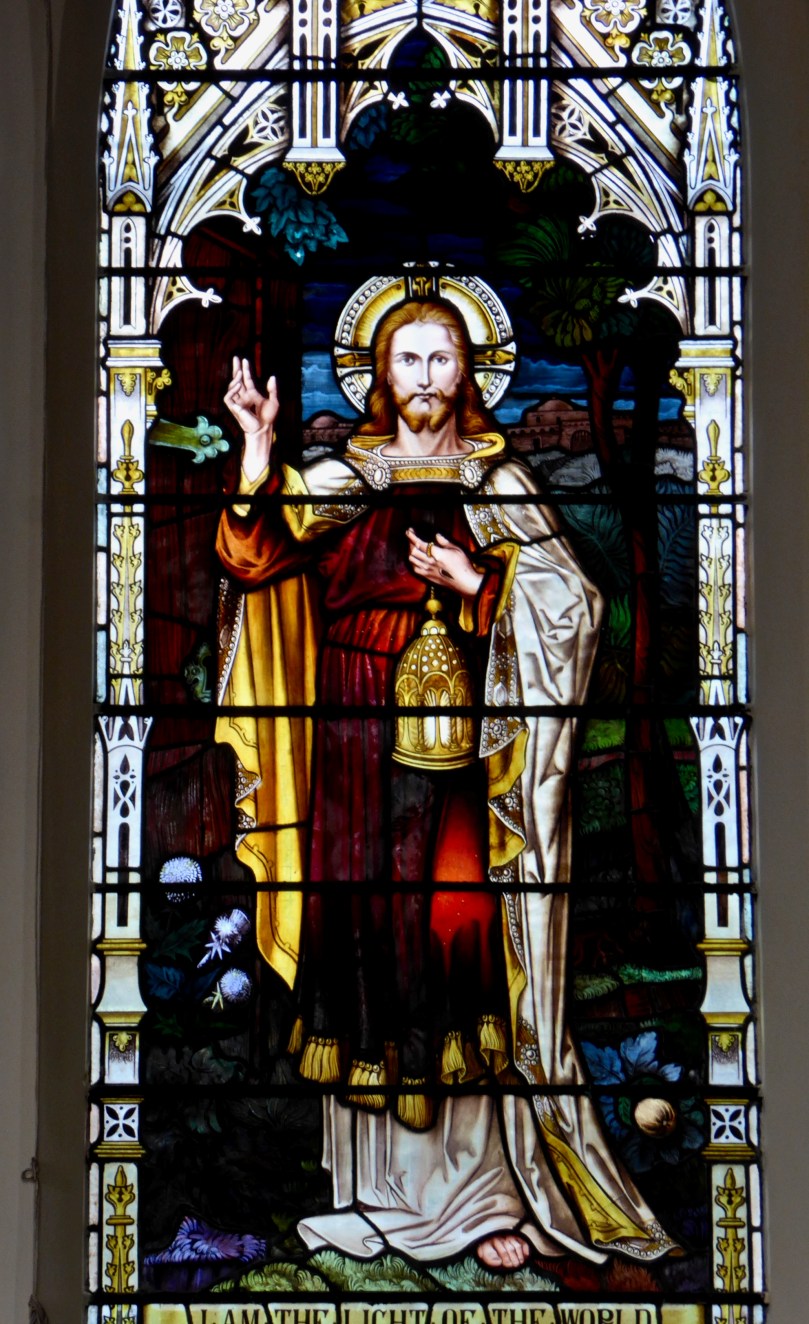
This is one of many Light of the World windows that Watsons produced, in St Brendan’s of Bantry Church of Ireland. Note the conventional Gothic canopies . This was a universal favourite, especially in Protestant churches and all the stained glass manufacturers had a version

This was a boom period for Irish church building and stained glass windows were, of course, one of the expressions of faith that could enliven and decorate the interiors. They also offered an opportunity for both clerical and lay people to contribute to the church and to commemorate deceased family members (and occasionally to commission an ego-stroking window for themselves).

Catherine O’Brien of An Túr Gloine painted this window for Kilcoe Church of the Most Holy Rosary in West Cork. Note the introduction of some interlacing as a minor element in the design. Patrick and Brigid, as the male and female patron saints of Ireland were always in demand for church windows

The choice of iconography for the window was dictated either by didactic imperatives (e.g. the Holy Family as a model to be emulated by the faithful) or by devotion to a particular saint, international, Biblical or local, or by church politics (e.g. Papal authority).  This was also the period when the Celtic Revival was in full swing and artists of all kinds were busy crowding graveyards with Celtic crosses, stitching Book of Kells symbols onto vestments, and painting illuminated addresses with complicated knotwork. Buying from Irish firms, once they were able to supply the orders, quickly became preferred.

Harry Clarke did not incorporate much interlacing into his windows, but this one, of St Fachtna, in Castletownshend Church of Ireland, shows that he knew well how to do it

Nowadays the term Celtic is suspect: we no longer believe that the evidence exists for an Iron-Age invasion of a tall blonde race from the continent. Archaeologists and Art Historians often now use the term Medieval Insular Art, however Celtic Revival, as shorthand for the domination of a certain decorative style (as well as the re-discovery of a great literary tradition and the craze for antiquarianism) at the end of the nineteenth century and into the Irish Arts and Crafts period, is so well understood that I use the term, and ‘Revivalist’,  here in that spirit.

Contrast the canopies in this window, with its intricate interlacing, with the conventional Gothic canopies of the Light of the World window above. Watson’s executed this one for Charleville Catholic Church

In her in-depth analysis of the Watson Archives, art historian Vera Ryan has demonstrated that orders for stained glass often stipulated that instead of the gothic canopies favoured by the English and German manufactures, windows should contain Celtic (or even ‘Keltic’) artwork. While other firms included some minor elements of interlacing in a design (see the Brigid and Fachtna windows above), no Irish stained glass firm delivered on this request better than Watsons of Youghal – it became one of their hallmarks and a real selling point for Irish clergy of both Catholic and Church of Ireland persuasions.

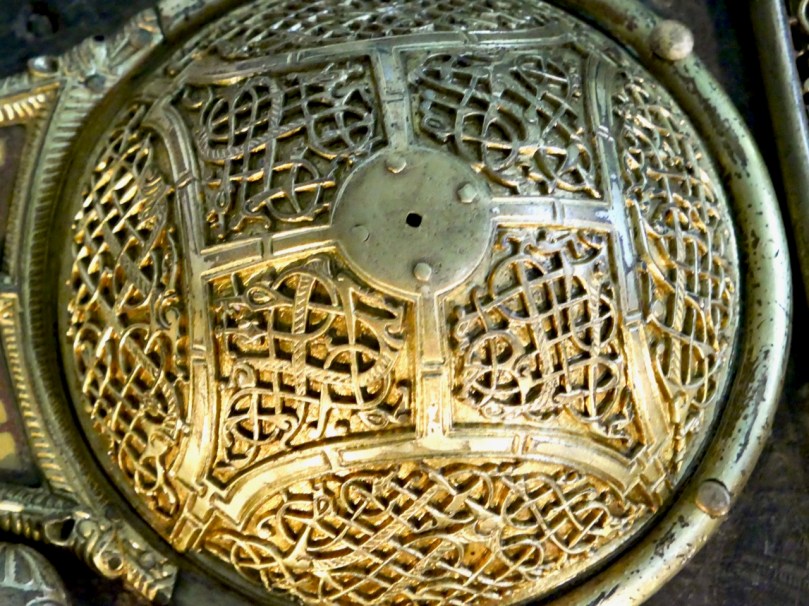
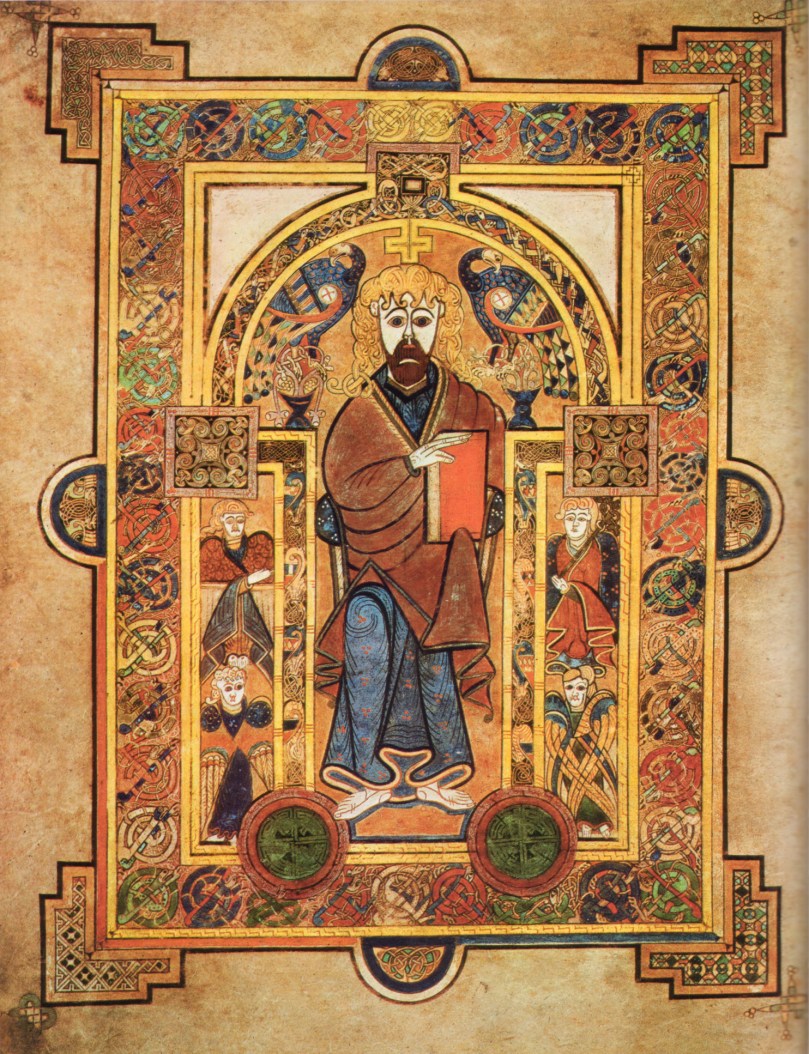
Models artists could learn from: Upper – a detail from St Manchan’s shrine, a replica of which was housed in the National Museum. Lower – The Christ Enthroned Page from the Book of Kells

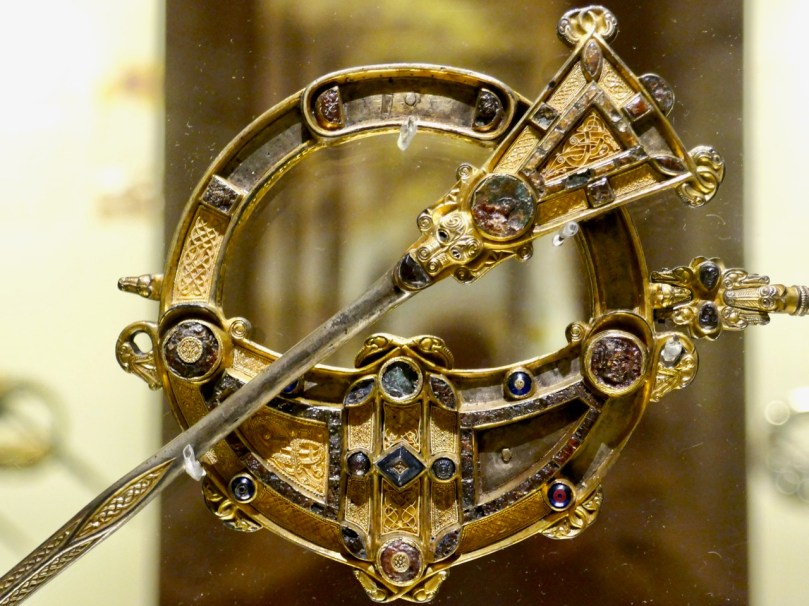
This was the most popular style of art at the time for all kinds of objects and it’s not hard to understand why. First of all, the interlacing itself is delightful, quirky and complex and full of tiny surprises. Secondly, the Revivalist motifs were taken from a rich treasury of sacred and secular Medieval objects that formed the nucleus of the displays in the National Museum, which opened its doors in 1877. The Tara Brooch (below), for example, created a sensation when it was found it 1850 and became instantly iconic, with thousands of copies being made.
Thirdly, and perhaps most importantly, here was now a truly indigenous art of which we could be justly proud. In an era of evolving nationalism, images conjuring up a glorious Christian past, replete with our own saints, literature and high art, was a reminder of what we had once been and what we had lost as a nation.
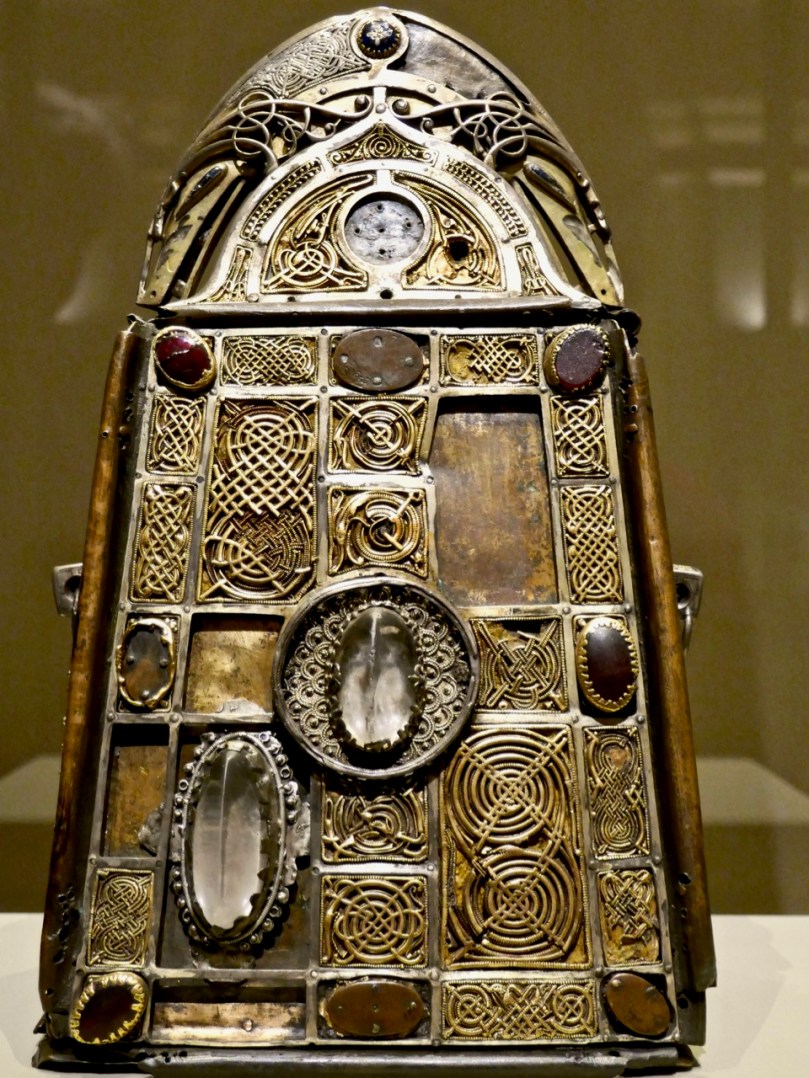
The Shrine of St Patrick’s Bell – not only a beautiful object but a potent symbol of what was seen as a Golden Age in Ireland of learning and piety

While their figurative designs remained conventional – think bearded men in long robes or saintly women in nuns’ habits, all in the style of renaissance paintings – the artists at Watsons had fun developing increasingly elaborate frames and canopies to surround their figures. Added to this was a mastery of Irish lettering styles, deployed to great effect whether the text was in Irish, English or Latin.

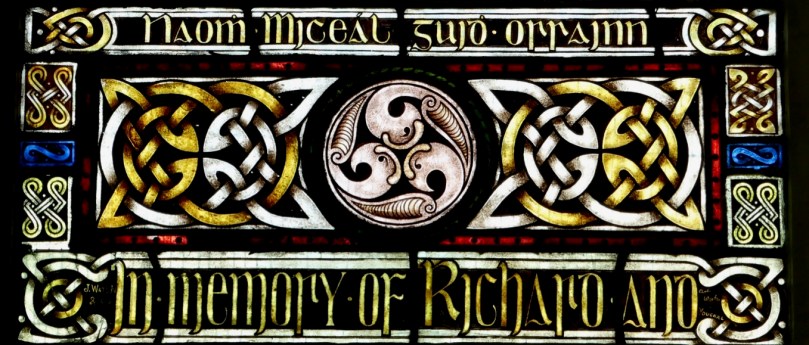
The use of interlacing and an Irish lettering style. Two continuous ribbons link the upper and lower surrounds, with the corner interlacing twisting around them. The Irish script was still being taught to us in school in the 1950s and 60s 

The net result was the development, in the hands of the expert and talented designers and painters at the Watson studio, of a hybrid style of stained glass window unique to Ireland – the overlayering of conventional objects of worship with the originally pre-Christian and later Early Christian/Early Medieval decorative style that came to be labelled ‘Celtic Revival’ at the end of the nineteenth century.

St Carthage, from his eponymous Catholic church in Lismore, Co Waterford. Details include the Book of Lismore, the Lismore Crozier (on display at the National Museum) and a whole galaxy of interlace motifs for the clothing and decorative surround

Next week – examples of Watsons’ use of Revivalist motifs and where to go to see them, as well as some original cartoons, now housed in the Crawford Gallery in Cork. I leave you with a detail from one of the windows employing interlace and lettering – but can you spot the signature?

*Much gratitude to Vera Ryan who has generously shared her Watson expertise with me, and to the Crawford Art Gallery for allowing access to the Watson Archive. I recommend Vera Ryan’s article Divine Light: A Century of Stained Glass in the Summer 2015 edition of the Irish Arts Review for those who would like to learn more about Watsons of Youghal.

Part 2 is here.

Barley Cove: A Special Area of Conservation

Did you know that Barley Cove to Ballyrisode is a European Special Area of Conservation (SAC)? SACs are areas designated as particularly interesting or sensitive on account of their flora or fauna. There’s a complex assessment process carried out that looks at the species present in the area, how important or endangered they are, or how representative of a particular habitat. It’s all done by the National Parks and Wildlife Service and the report on the Barley Cove area is online.

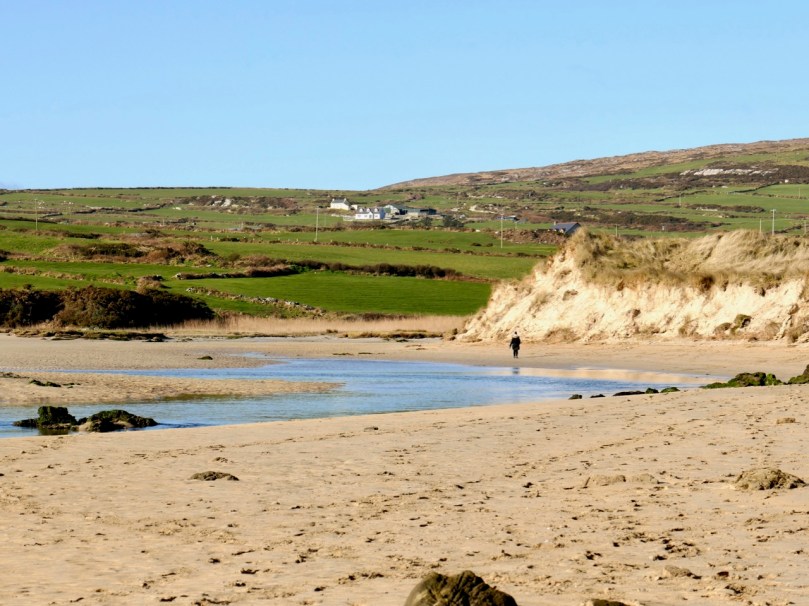
Barley Cove not only has an established dune system, but also a tidal wetland behind it. Because of the mild climate here, it has both Atlantic and Mediterranean Salt Meadows – that is, communities of plants that thrive in a salty environment on the edge of tidal shores. Some of those plants are quite rare and others are valued because they are diagnostic of a particular environment.

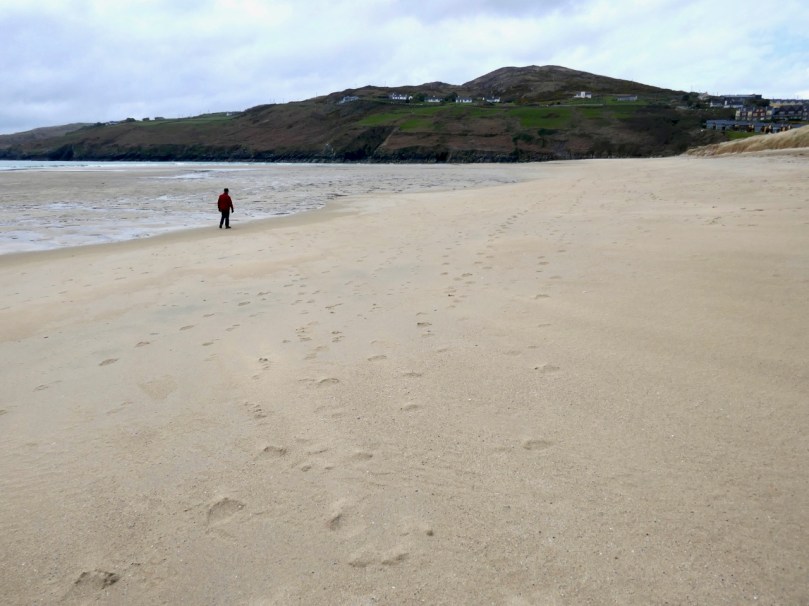
But it’s not isolated or unused – in fact during the summer it is one of the most popular swimming, dog-walking, picnicking, surfing and sea-gazing sites in West Cork. In the off-season, you can often have all this magnificence to yourself!

The fact that it’s so well used presents some challenges in conserving the habitat. Once, for example, there was quite an industrial level of sand removal at the Dunes, but that was stopped when it was realised how much damage it was doing. By and large, it’s encouraging that people do seem to respect the dunes – there is little evidence of litter.

In fact, one of the biggest challenges to the dunes is the enormous rabbit population. Rabbits burrow into the sand, creating extensive warrens which undermine the stability of the dunes. The evidence of the rabbits is everywhere – warren entrances and pellets – but the rabbits themselves are only glimpsed at night. Perhaps the dog walkers have encouraged them in their strictly nocturnal habits. But we do like the idea that the rabbits have a home here too.

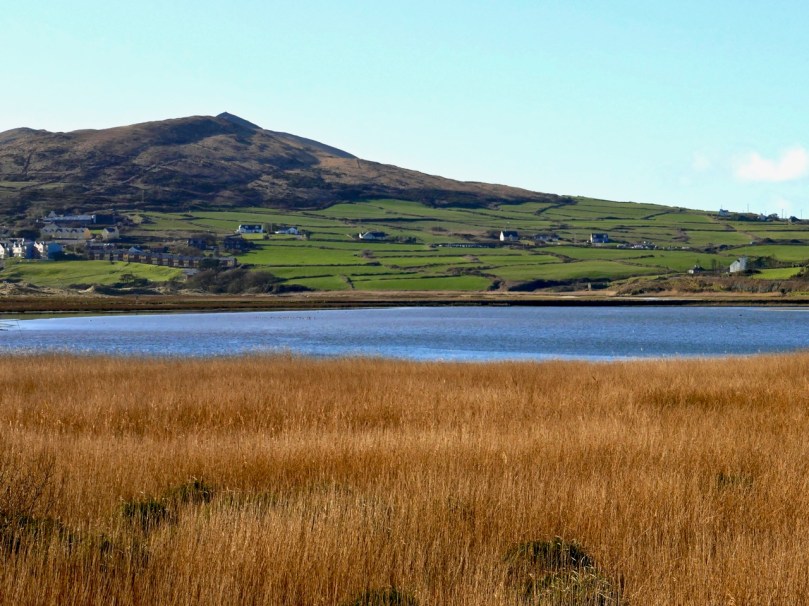
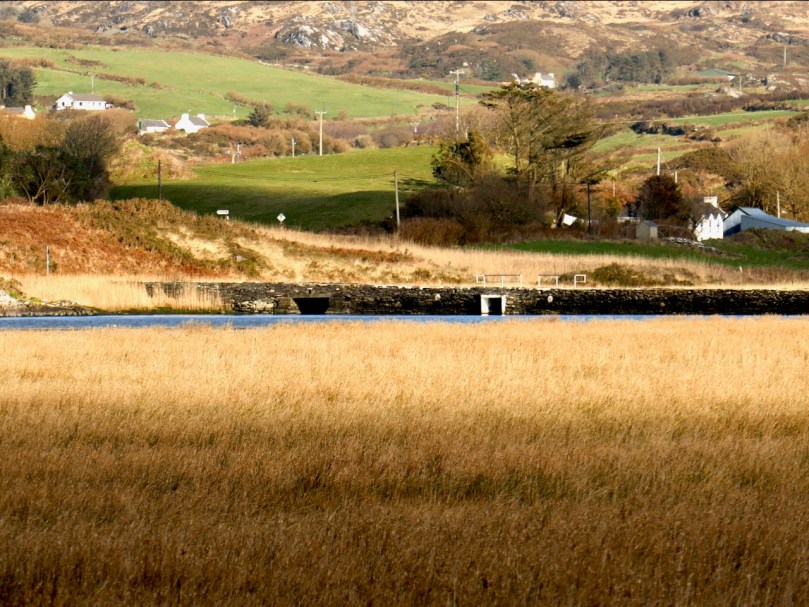
Coastal heath surrounds Barley Cove. Characteristic of West Cork, it supports a wide variety of plant life, dominated by heathers and gorse, and lends our peninsula its background and ever-changing colours. There’s an artificial lake, Lissagriffin Lake, which is classed as a ‘brackish lagoon’ and which hosts a large expanse of rushes.

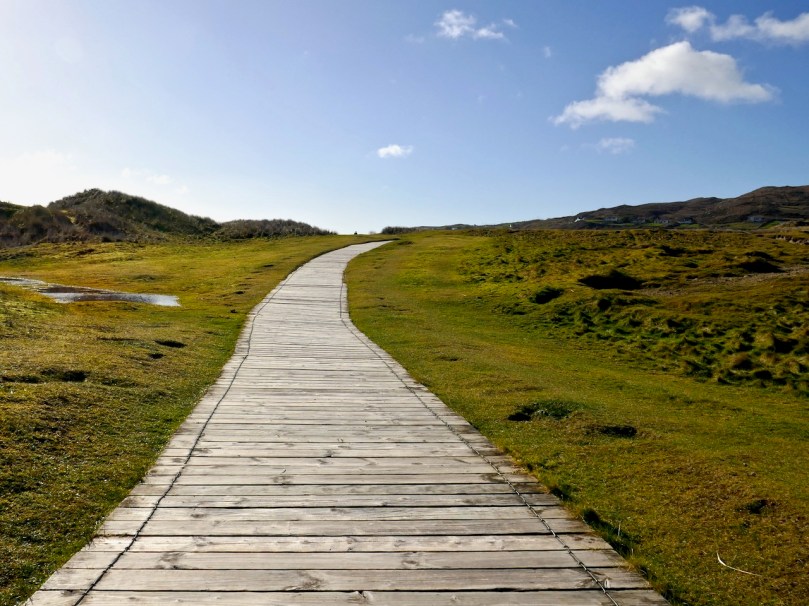
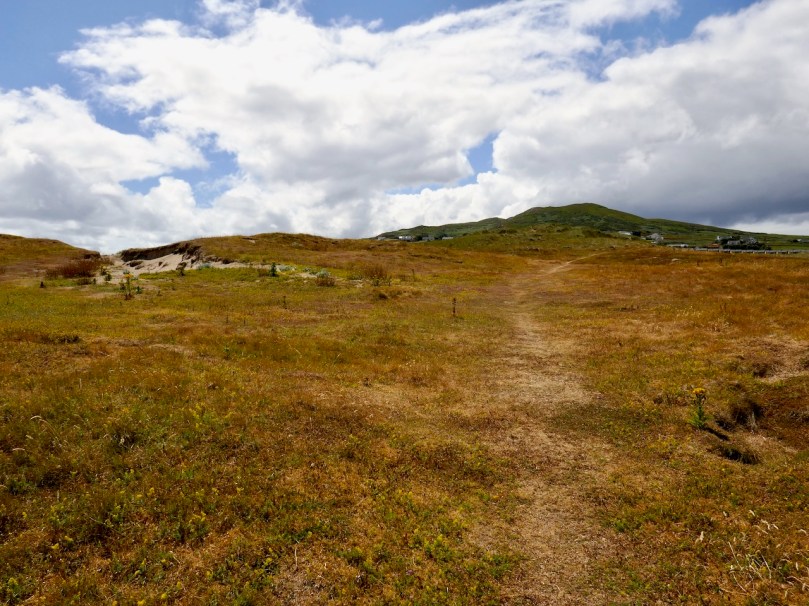
The whole thing is beautiful as well as special. Walking on the dunes is one of our favourite past-times, always with the camera in hand. The sheer variety of what grows here is a wonder, changing with the seasons. On a warm day you can just lie in one of the tiny dune amphitheatres and let your eye tune in to the multitude of flowers around you. Here’s a slideshow of some of what I have seen there.

This slideshow requires JavaScript.

If you like music with your slideshows, start the audio below. It’s the Wild Rose of the Mountain and The Gentle Maiden by Eugene O’Donnell & James MacCafferty.

Next time you go to Barley Cove wander in from the beach and take a stroll through the dunes. Better still, sit for a while and see if you can see some of the flowers in the slideshow. Let us know how you did.