The Mizen is slightly over 35 kms long, and the last five km or so contain a wealth of sites and places that beg to be explored and experienced. These include our signature tourist attraction, Mizen Head Signal Station, our spectacular white sand beach, Barley Cove, and picturesque Crookhaven, but also some lesser known spots that are equally worthy of inclusion in our Mizen Magic list.
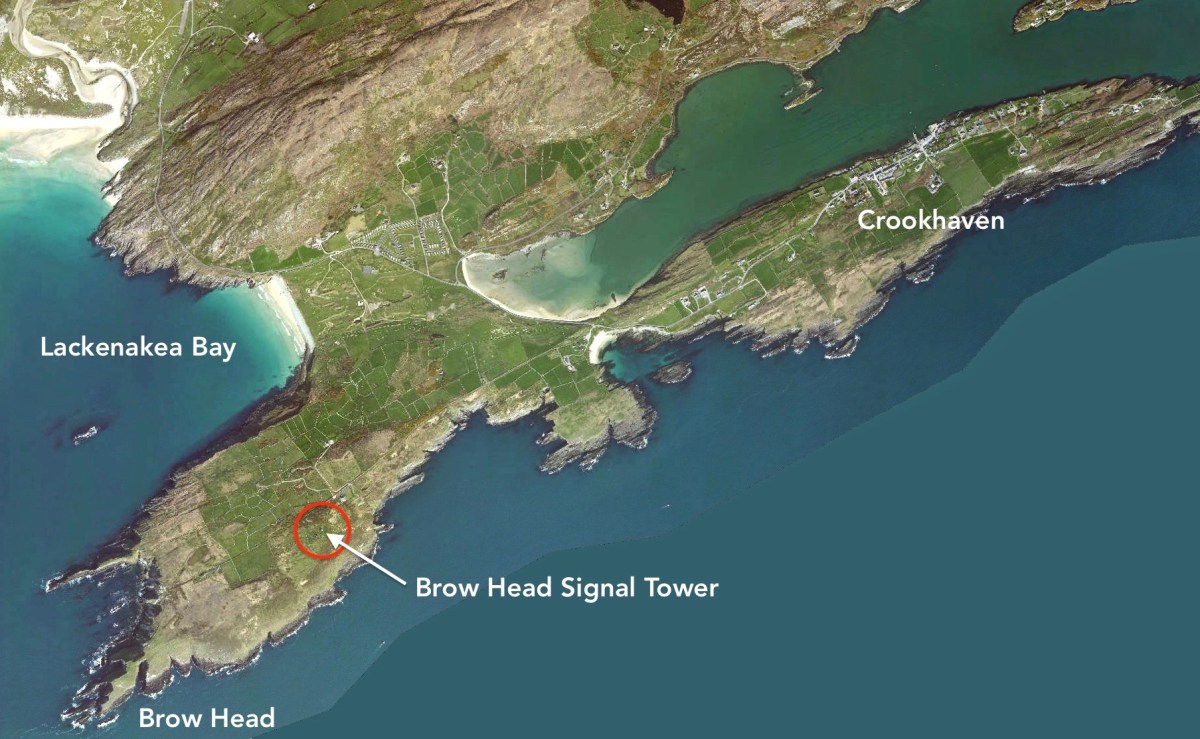
Despite the hype about Mizen Head, the actual southernmost tip of Ireland is Brow Head. In our post about it we said: Brow Head doesn’t have the same profile as Mizen Head: many people have never heard of it. But it’s magnificent, steeped in history, wonderfully scenic and best of all, totally walkable.
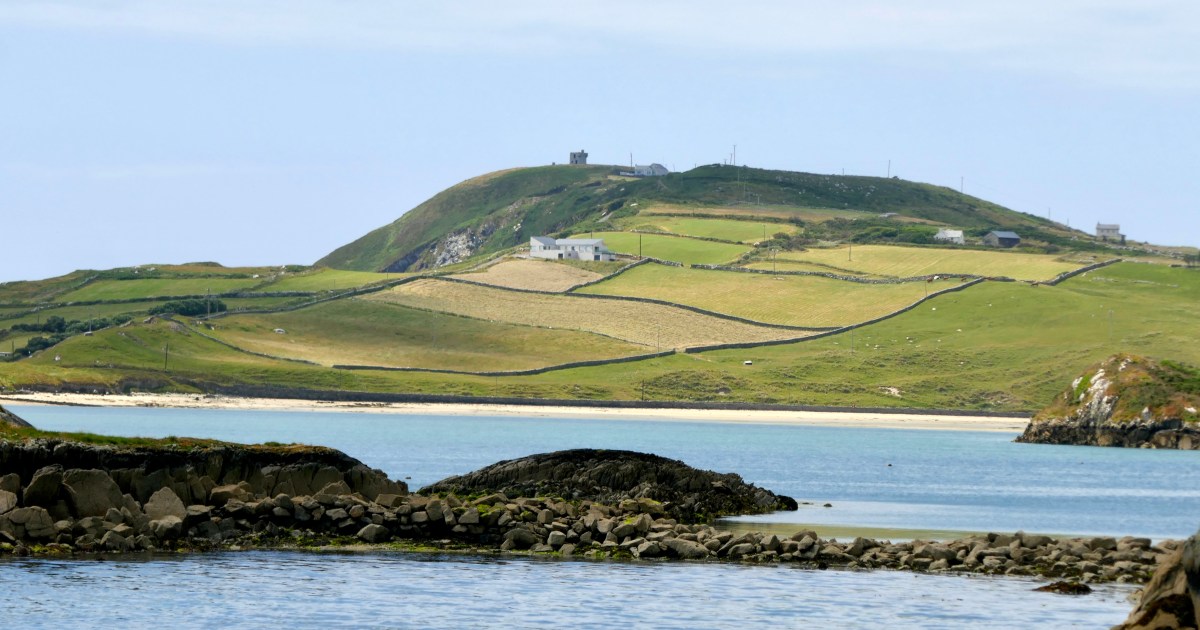
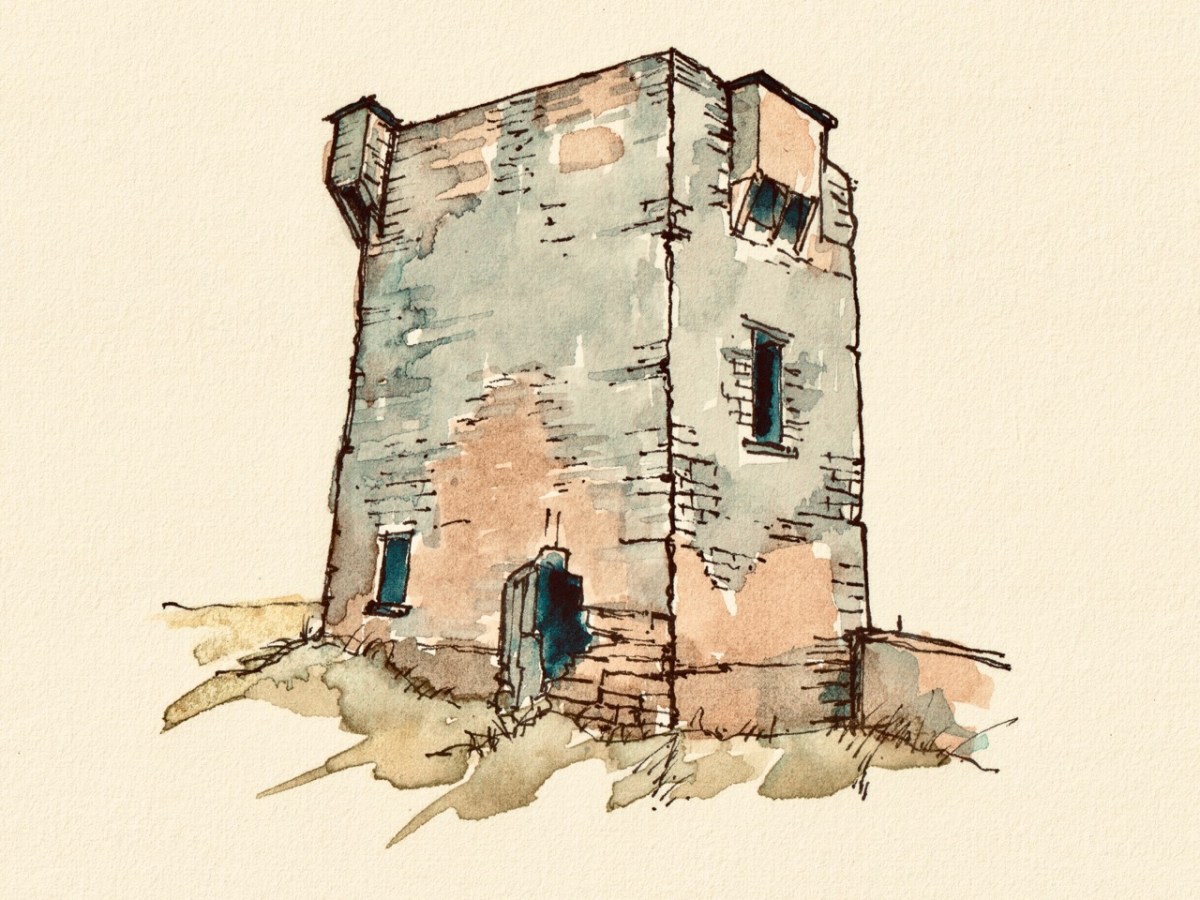
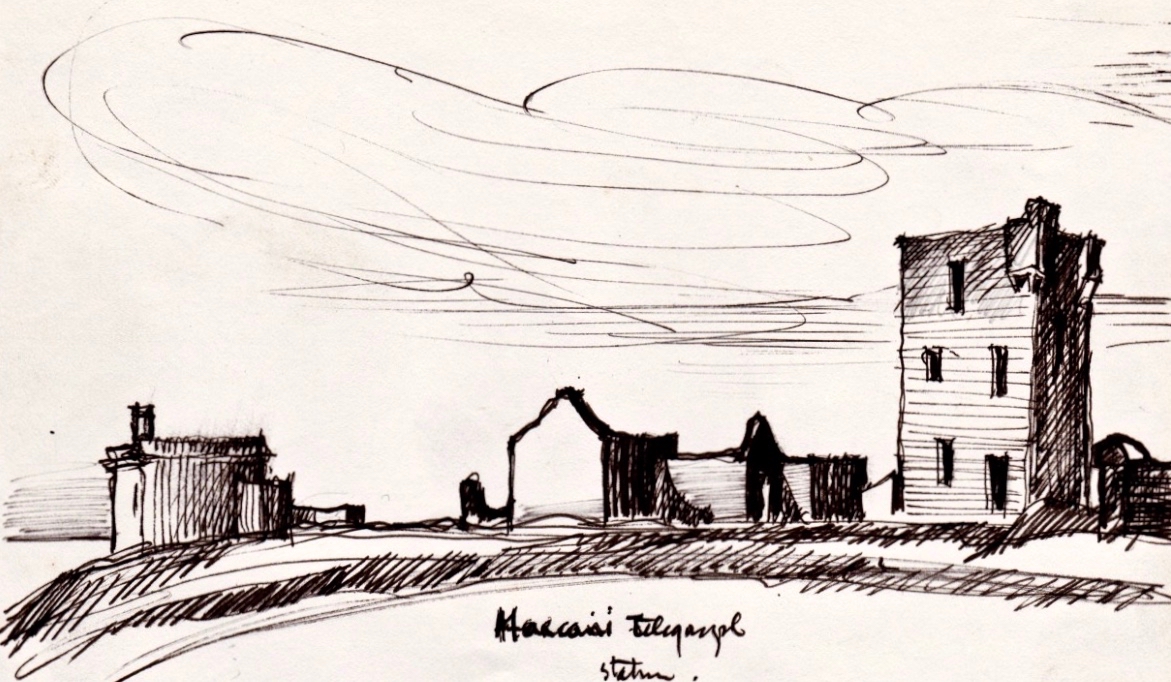
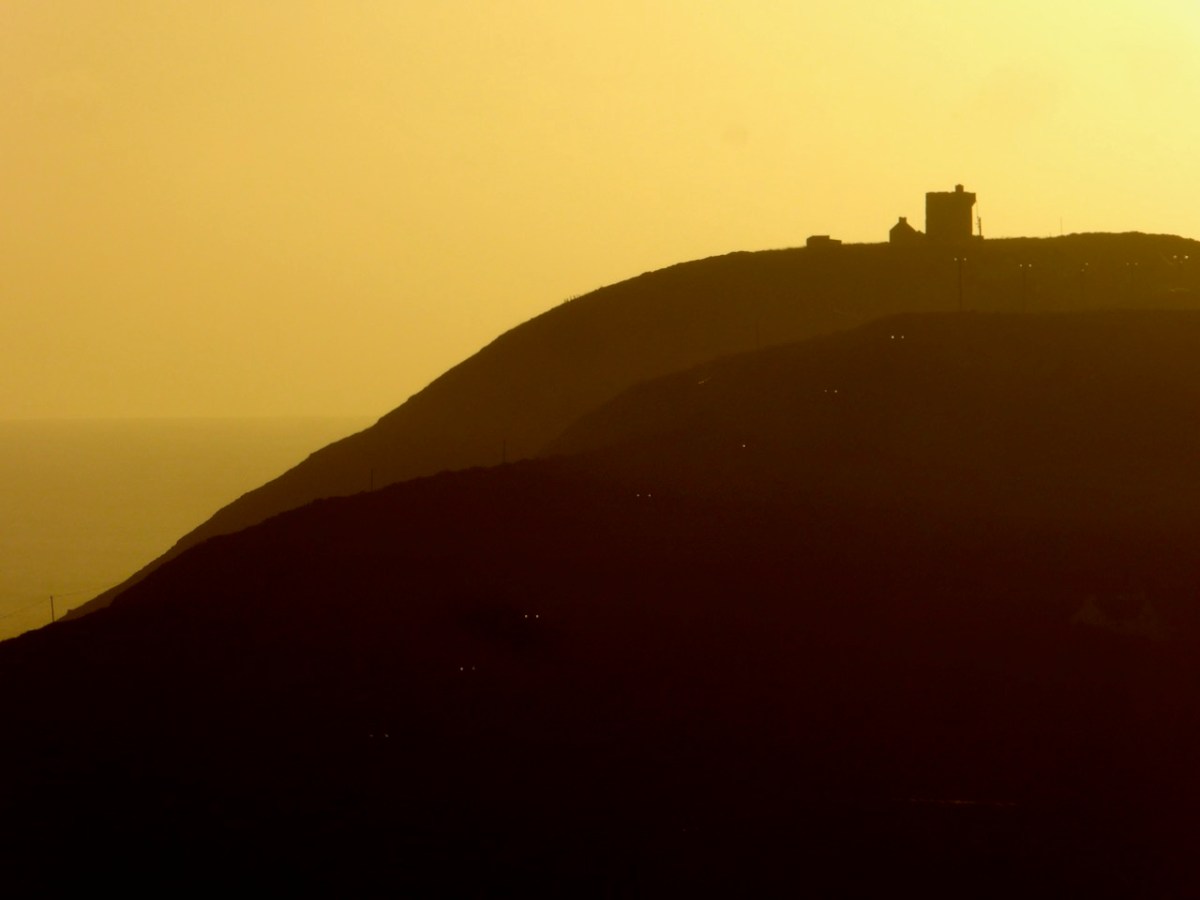
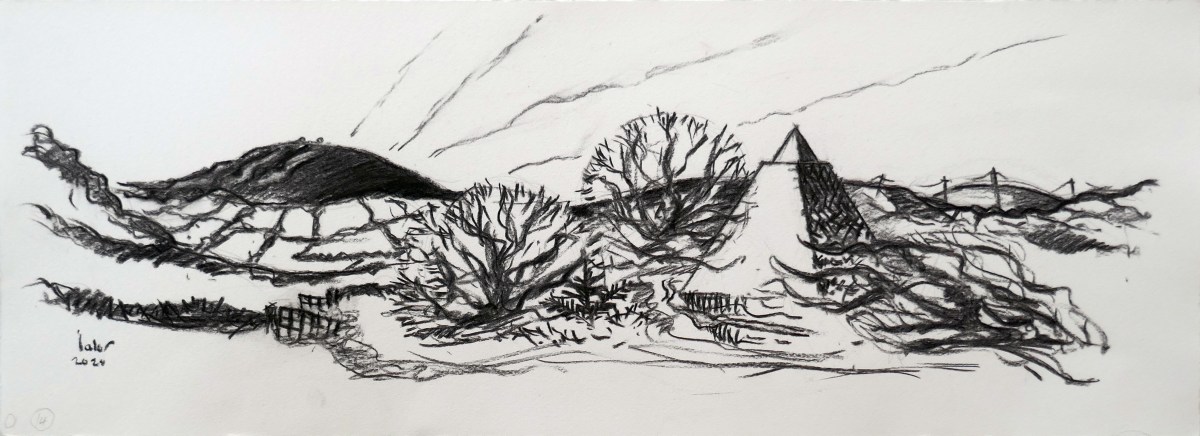
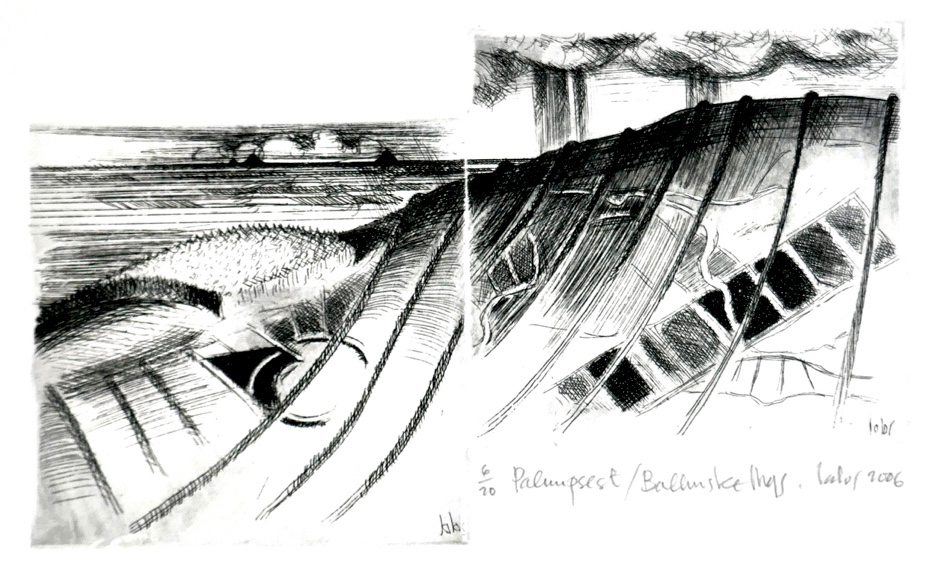
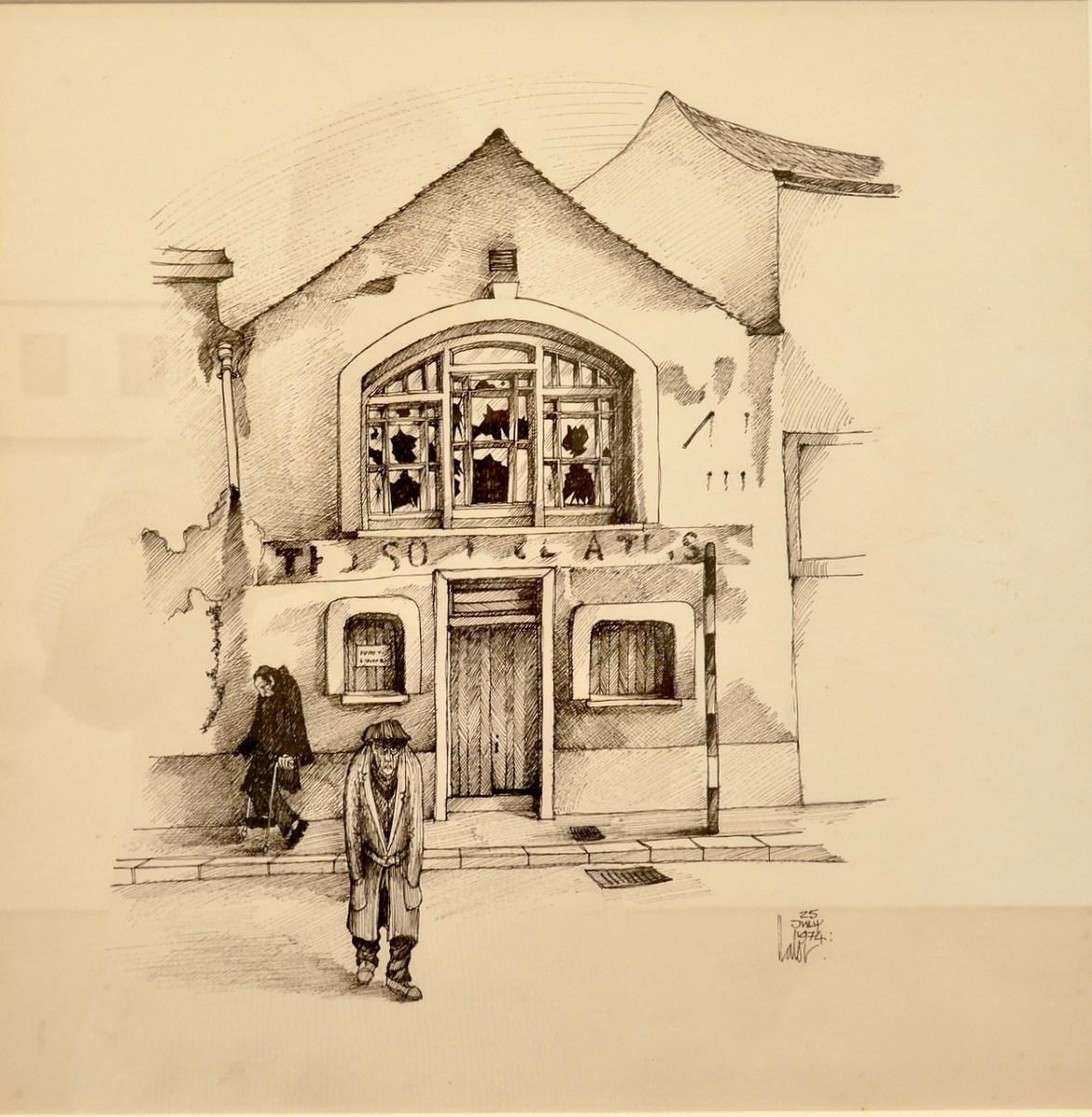
Brow head boasts not only a Marconi Telegraph Station, but also a Napoleonic-era Signal Tower. For a good overview read Mizen Magic 3: Brow Head, but we know you will want to know a lot more about Marconi, the telegraph pioneer, so take a look at In Search of Ghosts for more abut him and his operations on Brow Head. And for two takes on Marconi’s station, there is Peter Clarke’s drawing above and Brian Lalor’s below.
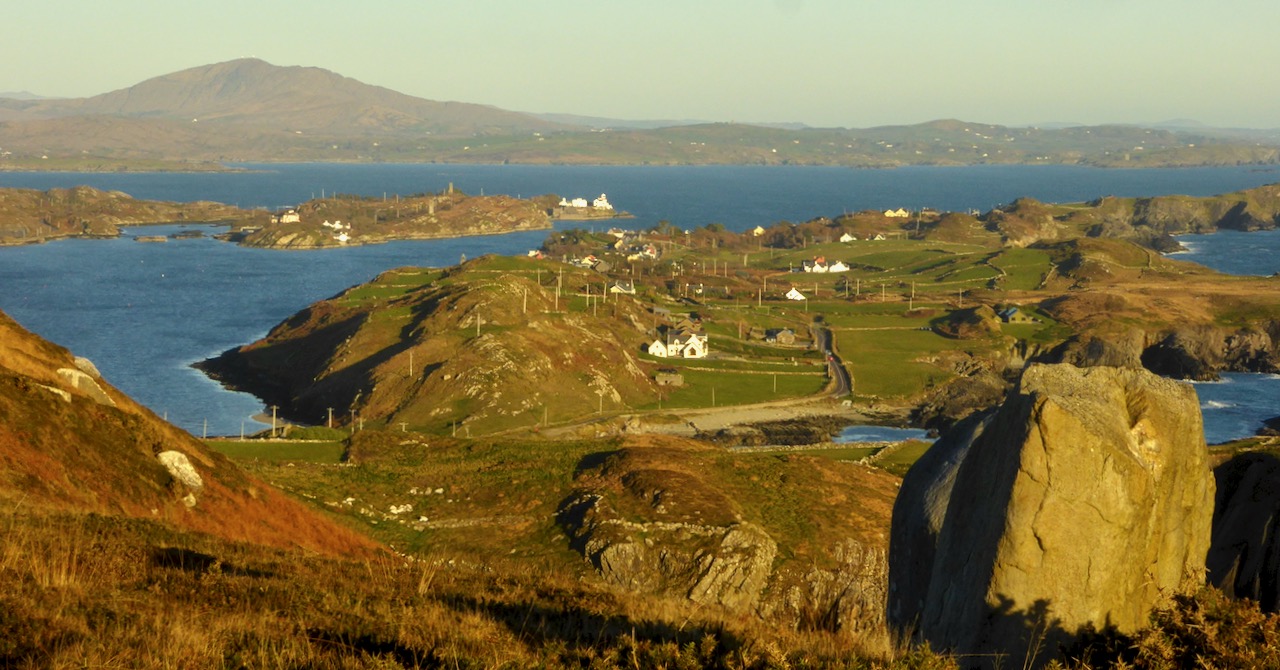
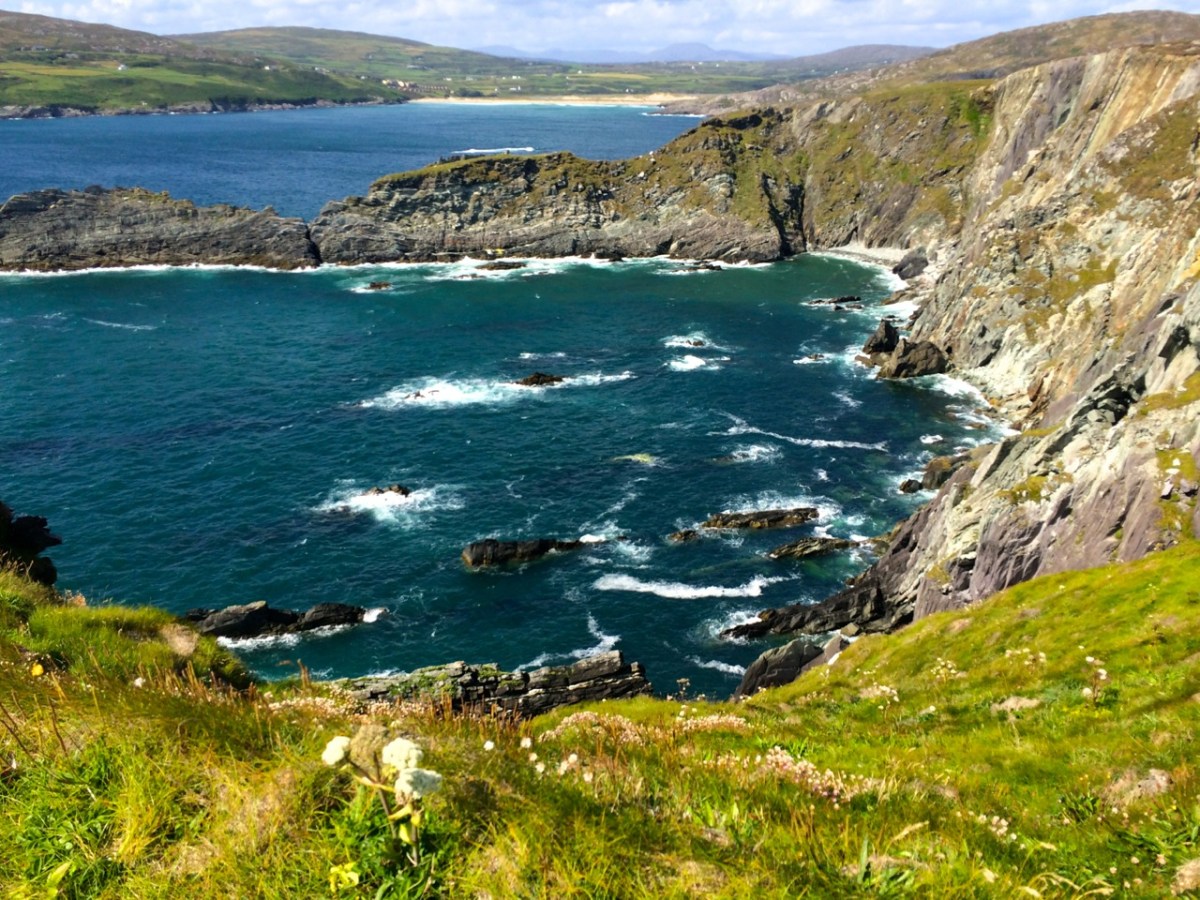
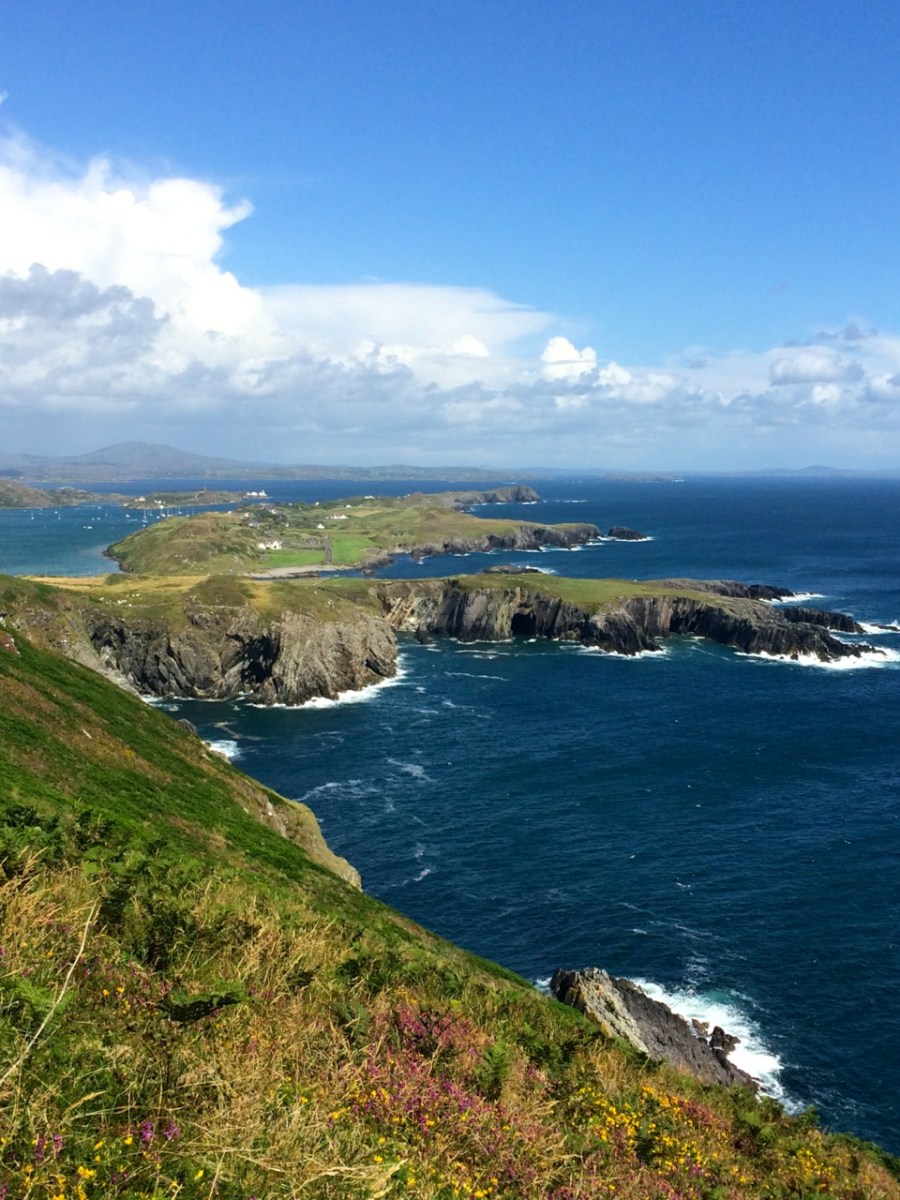
Brow Head looks back to Barley Cove (above) and Crookhaven (below) – some of the most spectacular views on the Mizen are seen descending from the head.
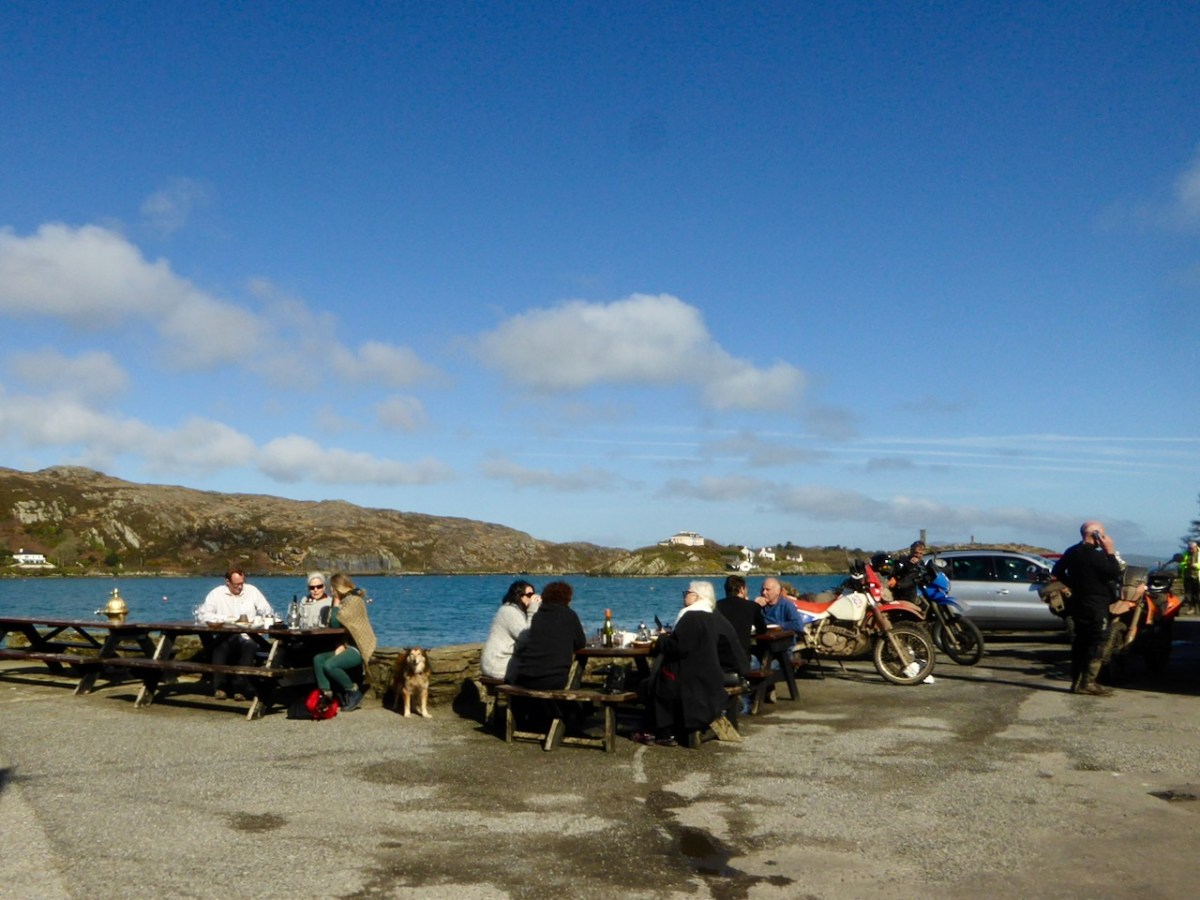
We took a dander around the Harbour and wrote about it in Mizen Magic 22: Crookhaven Harbour. Do the same, and don’t forget to stop at O’Sullivan’s for their excellent chowder and famous crab sandwich.
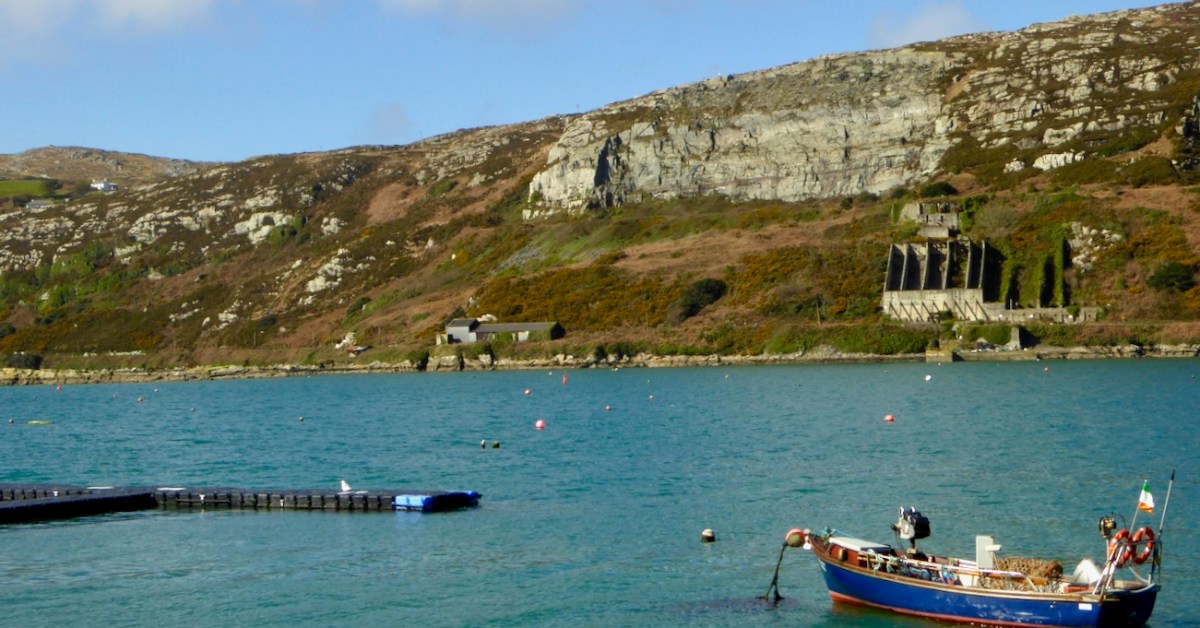
And while you’re sitting outside, savouring your chowder, look across at some Industrial Archaeology in Crookhaven. These imposing remains are all that’s left of a once-thriving stone quarry supplying road material until the late 1930s.
Of course there is much more to the Far End of the Mizen – I’ll continue this in the next post.
Republishing one of Robert’s classic posts. This one was originally published in May, ten years ago, under the title High Drama.
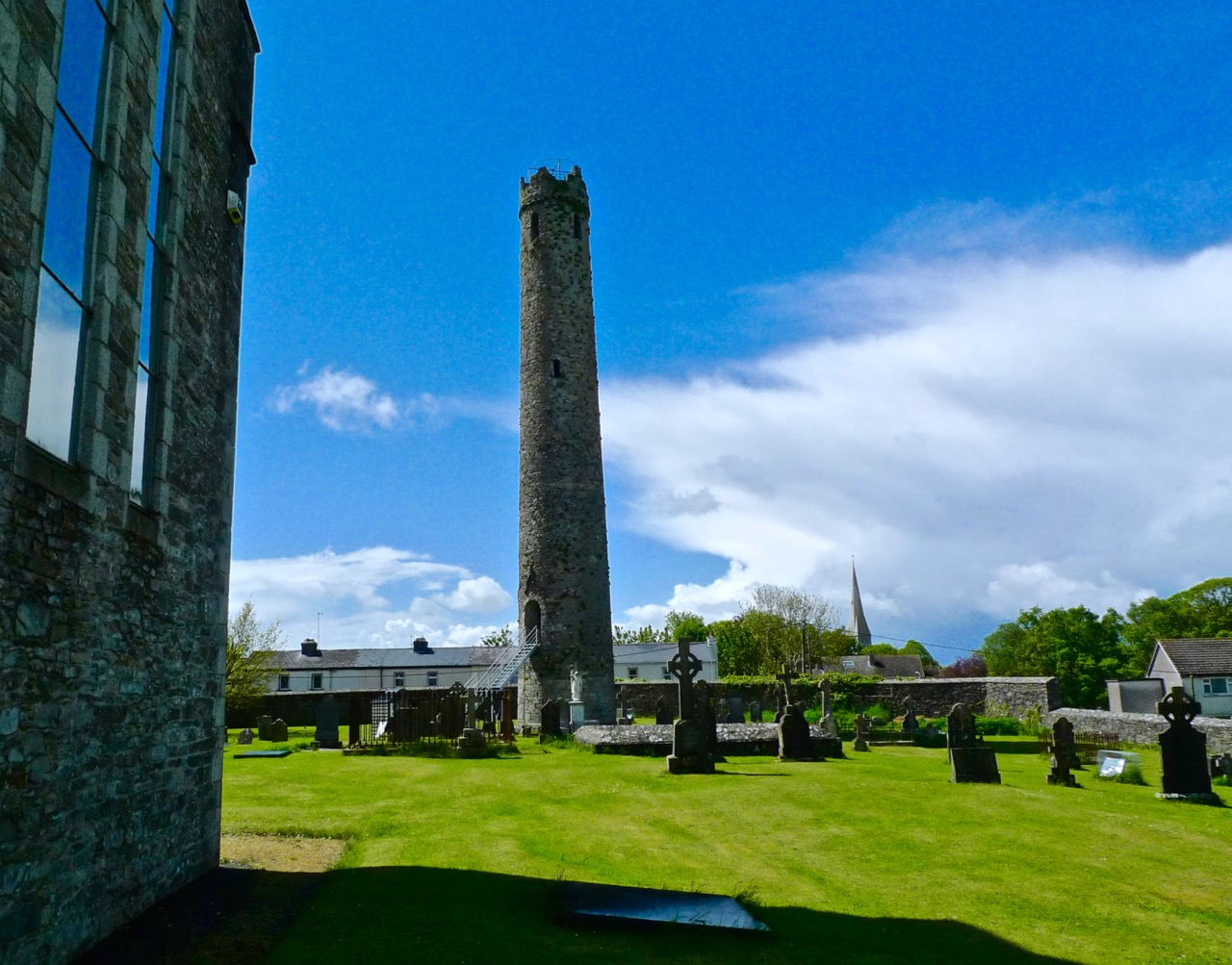
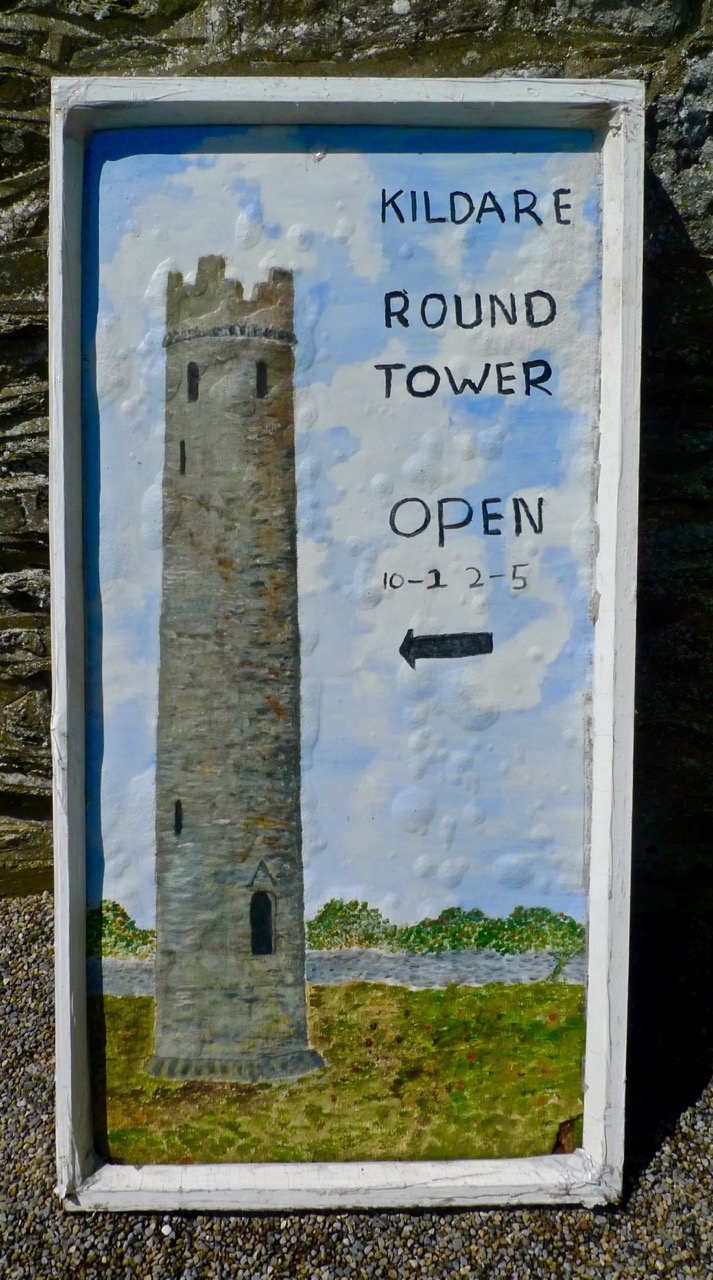
If you suffer from vertigo or claustrophobia – or both – then you won’t want to follow us in the adventure we had this week while returning from a visit to Dublin: climbing to the top of an Irish Round Tower! Overcoming any tendencies we might have had towards these phobias, we arrived at the roof of the 32.6 metre high Kildare tower and marvelled at being able to stand on the summit of a piece of architecture over a thousand years old. Kildare has the second highest Round Tower still extant in Ireland: the highest is at Kilmacduagh, Co Galway, at 34.9 metres; however, Kildare now lacks a conical cap, which it might once have had. If so, it would just tip in as the highest of all the towers.
Kildare Round Tower: note the battlemented top – probably added in an 18th century restoration, the romanesque doorway and the granite base. The upper stonework is limestone and sandstone
The print above – dating from 1788 – shows the ruins of St Brigid’s Church, which was fully restored as a Church of Ireland Cathedral a hundred years later. We looked down on this from our vantage point atop the Tower – and had a good view of the (also restored) Fire Temple where a perpetual flame, lit by the Saint, was kept burning for hundreds of years, finally being extinguished by the shenanigans of Henry VIII.
Looking down on Kildare Cathedral, with St Brigid’s ‘Fire Temple’ in the grounds
You’ll have heard me talk about St Brigid many times: she’s second only to St Patrick in the Irish Martyrology. In fact, as probably the most influential woman in Irish history, I’m going to declare her as quite the equal of St Patrick: she’s often enough described as one of the Patron Saints of Ireland. You will also know that she is surrounded by folklore and traditional customs, such as the making of her Cross on her day, the First of February.
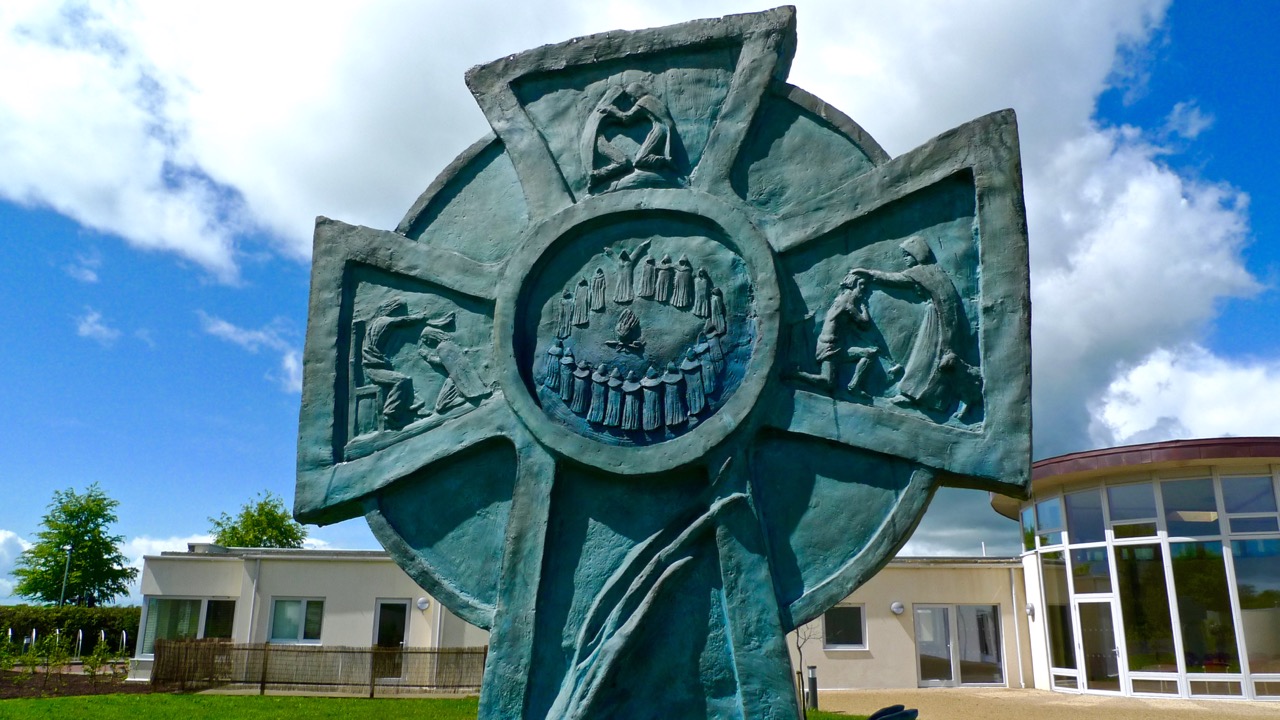
St Brigid’s Cross – left, at her Holy Well and right, a textile in the Solas Bhride Centre, Kildare
Back to the adventure (although the whole day was adventurous!) – climbing the tower was hard going. There were a series of near-vertical ladders to be negotiated: each one took us to a higher timber platform, six floors in all. At the top of each ladder we had to squeeze ourselves through a narrow opening; this, and the confines of the tower interior – only two metres or so across – certainly challenged the claustrophobiac in me.
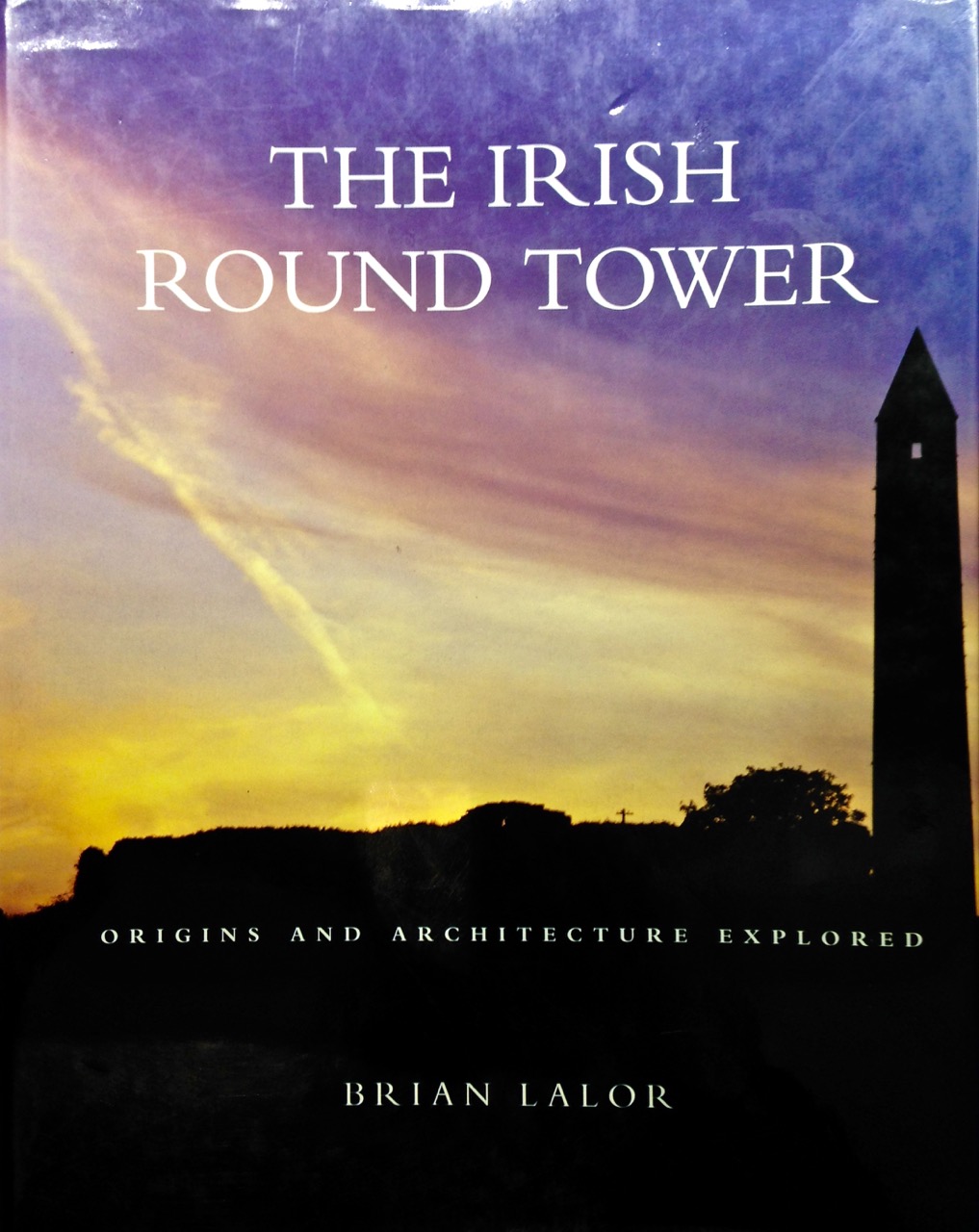
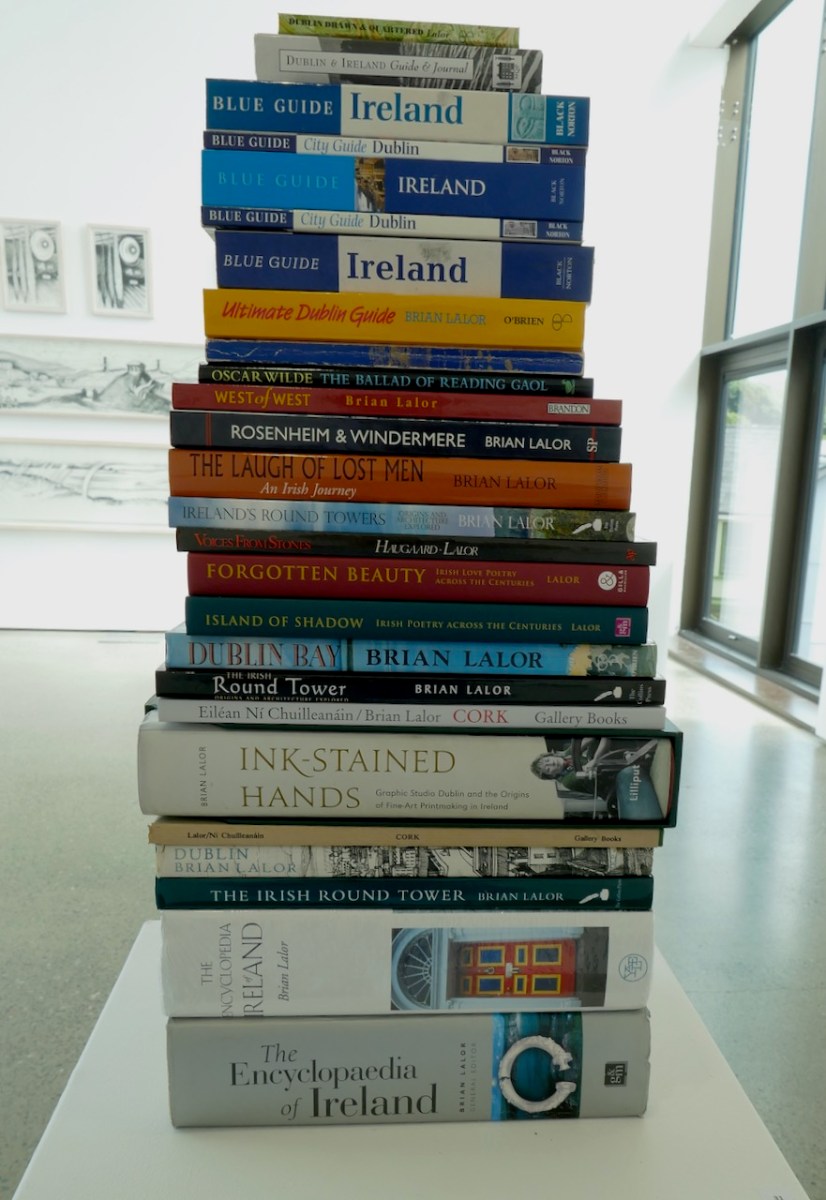
The restricted space also made us question some of the theories about the uses of these towers, which are always located at ecclesiastical sites. The definitive work on them is, as it happens, written by someone who also lives in West Cork – just a little distance from Nead an Iolair: Brian Lalor. Brian has led a very full life, involving architecture, archaeology, sketching and printing (his etchings are exquisite). He is also the author of a number of books, many of which are on our own shelves, including The Irish Round Tower, published by The Collins Press, 1999 and 2005.
Brian is unequivocal in his assertion that the primary purpose for round towers was to house the monastery bell. He also suggests that a secondary function would be as a safe storage place for the monastic treasures: the entrance door was always raised at a considerable height above the surrounding ground level, requiring steps or a ladder to gain access. In the times when they were constructed they would have been visually impressive – and could be seen from a great distance. They would have acted as signposts for travellers who might have been searching for the hospitality which monastic communities always offered. Brian discounts some of the more bizarre theories for the towers – for example, that they might have been places of safe refuge for the monks if under threat of attack by Vikings – or that they are simply phallic symbols! Lastly, Brian considers – and gives some credence to – the idea that the towers were monumental buildings of prestige and local aristocratic patronage: certainly, they required considerable expense and effort to construct.
As is often the case with our days out, one adventure led on to another. When we came down from the tower we found that St Brigid’s Cathedral had closed for lunch. But we knew that the Saint’s trail also involved a Holy Well and we had heard that there was a new building devoted to the work of Brigid just outside Kildare.
Solas Brhíde Centre
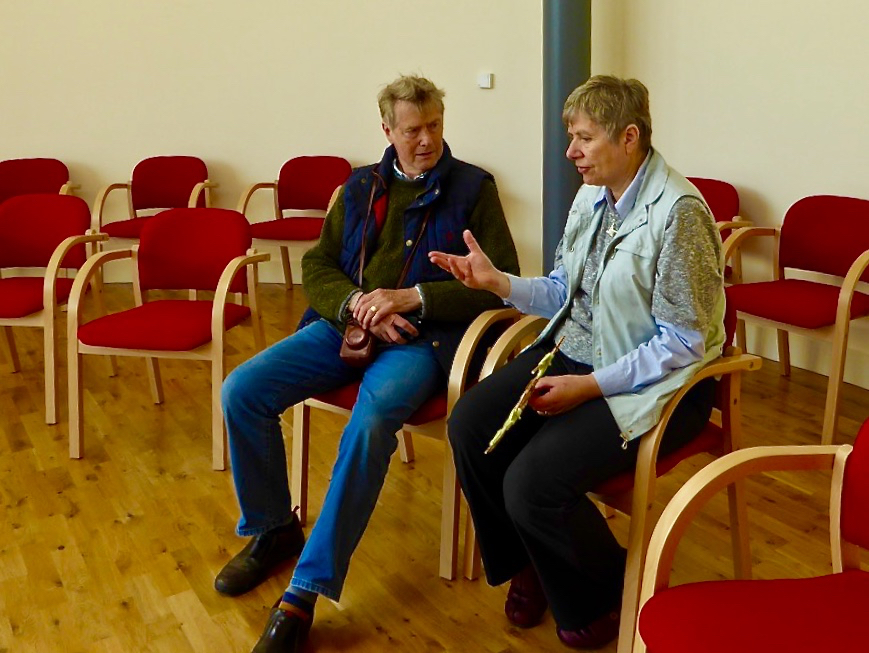
Robert with Phil, one of the Sisters who conceived the project
We were very impressed with the Solas Bhríde Centre: a small group of Brigidine Sisters has put together the project to build a Christian Spirituality Centre which unfolds the legacy of St Brigid and shows that it is still relevant in the present day. We were shown around the Centre by one of these Sisters, Phil, who pointed out that Brigid was attuned to the natural world and would have appreciated that the new building (designed by Solearth Ecological Architecture) is conceived on ecologically sound terms using sustainable materials and techniques which care for the wellbeing of the Earth. The plan of the building is appropriately inspired by the shape of a St Brigid’s Cross.
Architect’s drawing of the newly completed building
The next stop on our itinerary was the nearby Holy Well – a popular place of pilgrimage and veneration on St Brigid’s Day:
Finally, we arrived back at the Cathedral. I’m always a little disappointed by restorations – particularly those which were carried out in Victorian times; nevertheless there are some impressive features. The possibly twelfth century font is one of them (below left), and another has to be the hidden Sheelagh-na-gig under the lip of Bishop Wellesley’s tomb (below right). I reached under to feel this little carving, and was then told by the Cathedral’s guardian that anyone who touches the effigy is ensured everlasting fertility!
The excellent Heritage Centre opposite the Cathedral entrance is informative about the town’s history and the important connections with this special Saint. There is much more to be discovered – and written – in respect of St Brigid, and other places in Ireland which are connected with her still to be visited. Do go to Kildare and, at the very least, suspend your phobias sufficiently to allow you to climb the ancient Round Tower. But make sure you go between May and September – and not during the lunch hour…
What do we need for Christmas? More books! Where will we put them? We’ll figure that out later. (You know who you are.) Or are you stuck for ideas on what to get other people? Or someone has asked you for a hint on what to buy for you?
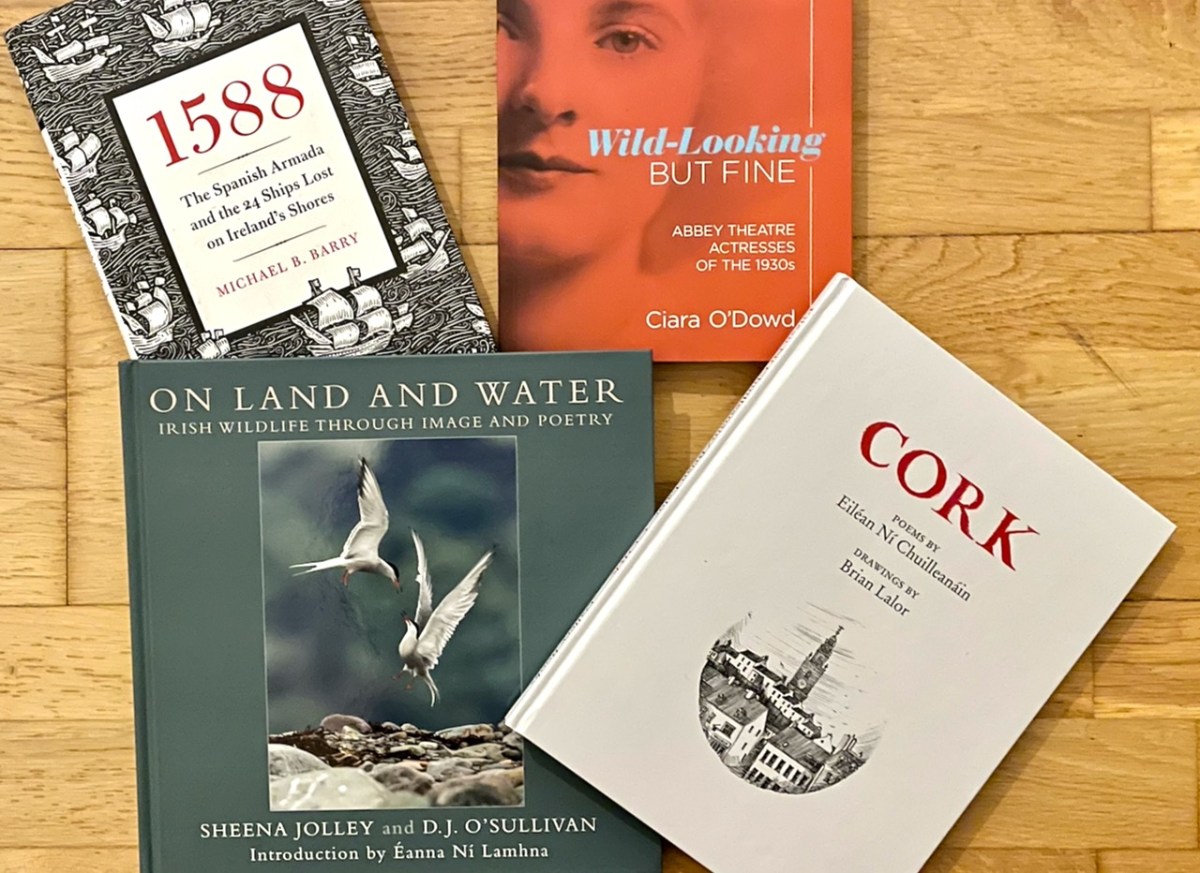
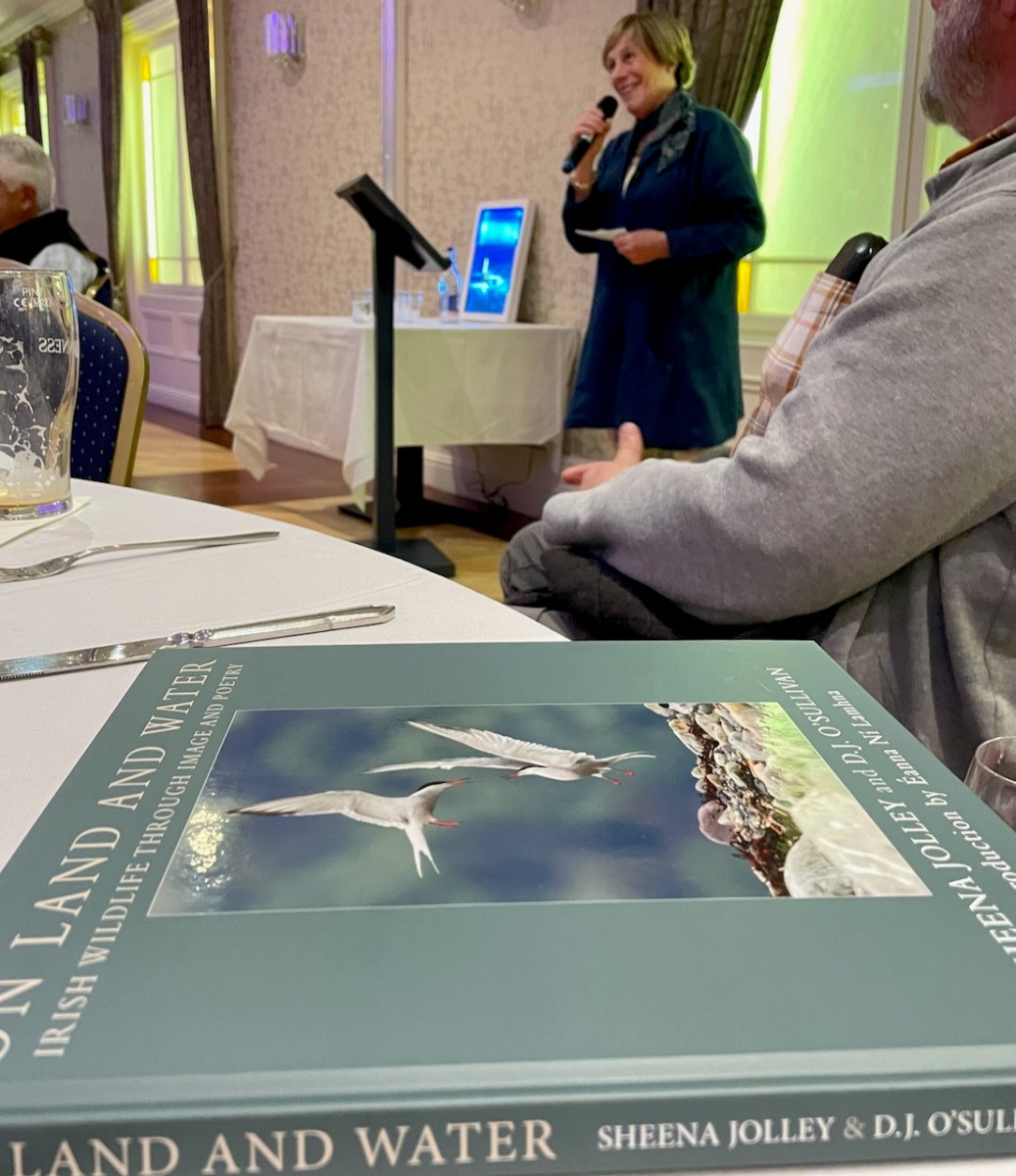
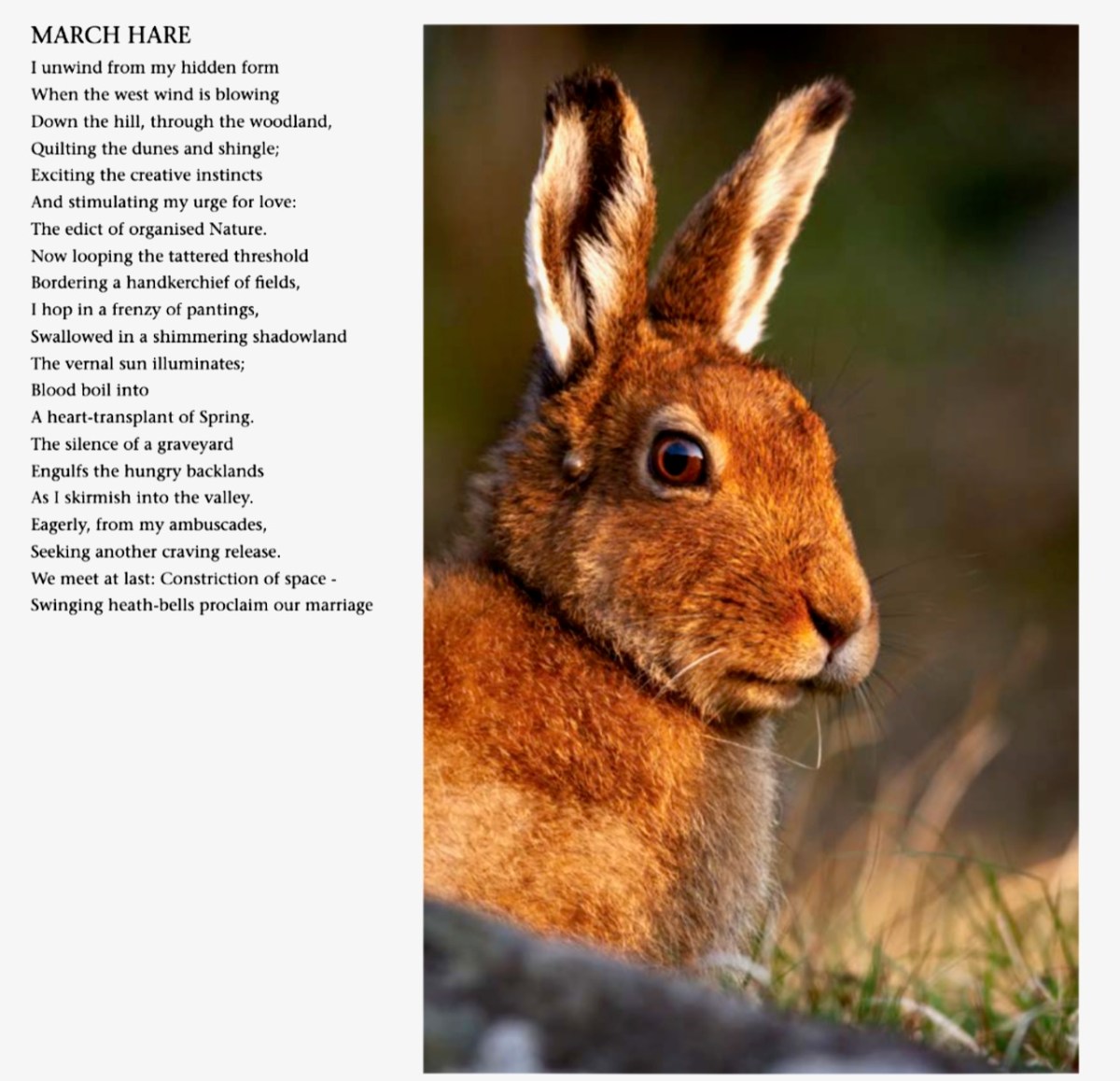
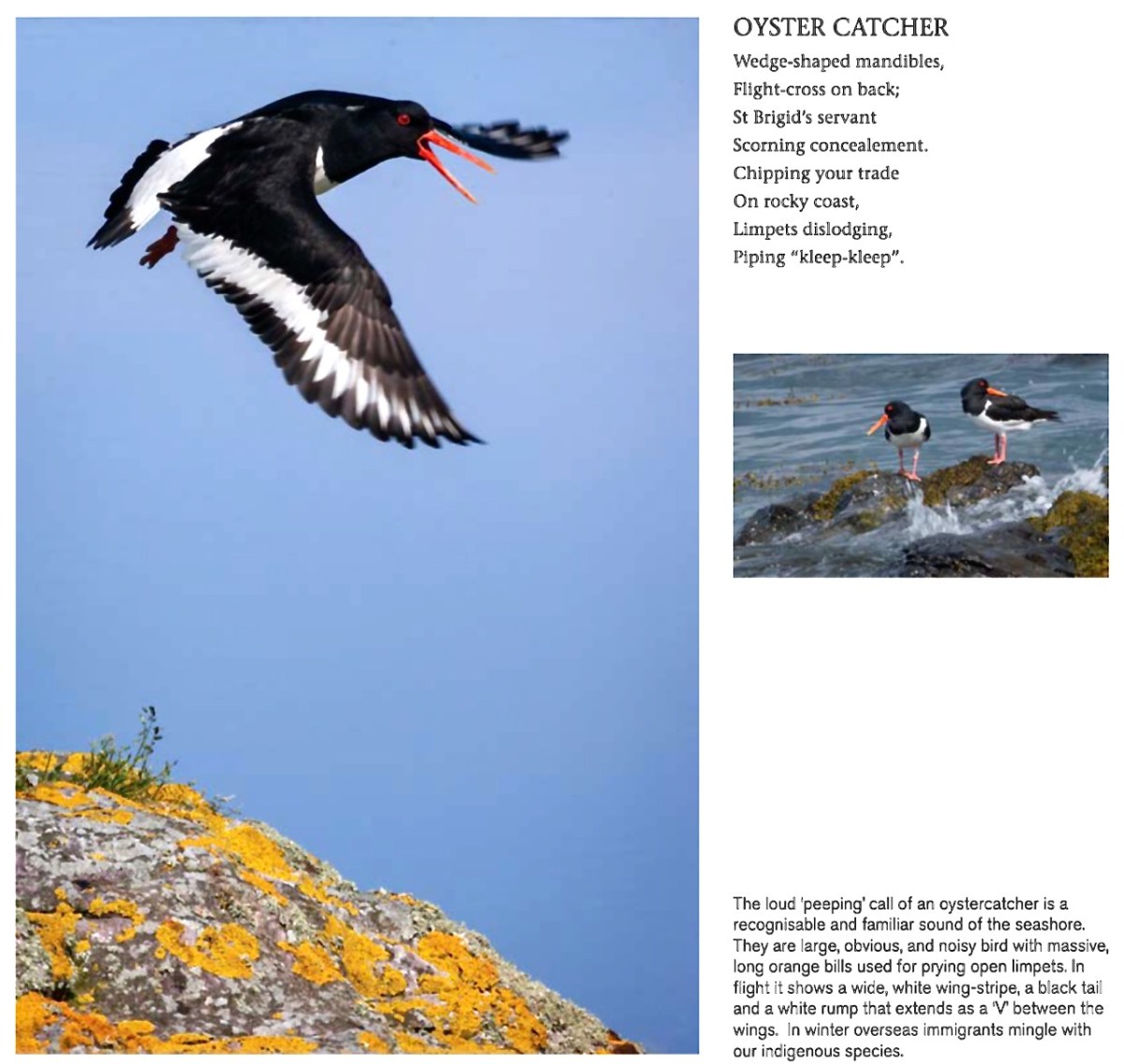
So here are my recommendations for your wish list this Christmas, and I am doing you a favour because I’m keeping it to four. I have a personal interest in all of them – but I am of course completely unbiased. The first is On Land and Water, a truly beautiful production from Menma Books (available through their website or in bookstores) that combine the poetry of lighthouse keeper DJ O’Sullivan, and the exquisite wildlife images of renowned photographer Sheena Jolley.
I cannot overstate what a lovely production this is. DJ O’Sullivan spent his life in close communion with the birds and sea-creatures of Ireland’s remotest places. He writes with the insight of one who has honed his observations skills through long hours and days.
Sheena is one of Ireland’s top wildlife photographers. At the launch in Skull we were all transfixed by her relation of what that takes – being dropped off on an uninhabited island with your equipment and food, and making the boatman promise he will remember to come back for you in a couple of days. Then getting up before dawn and being ready for that golden light when the animals stir.
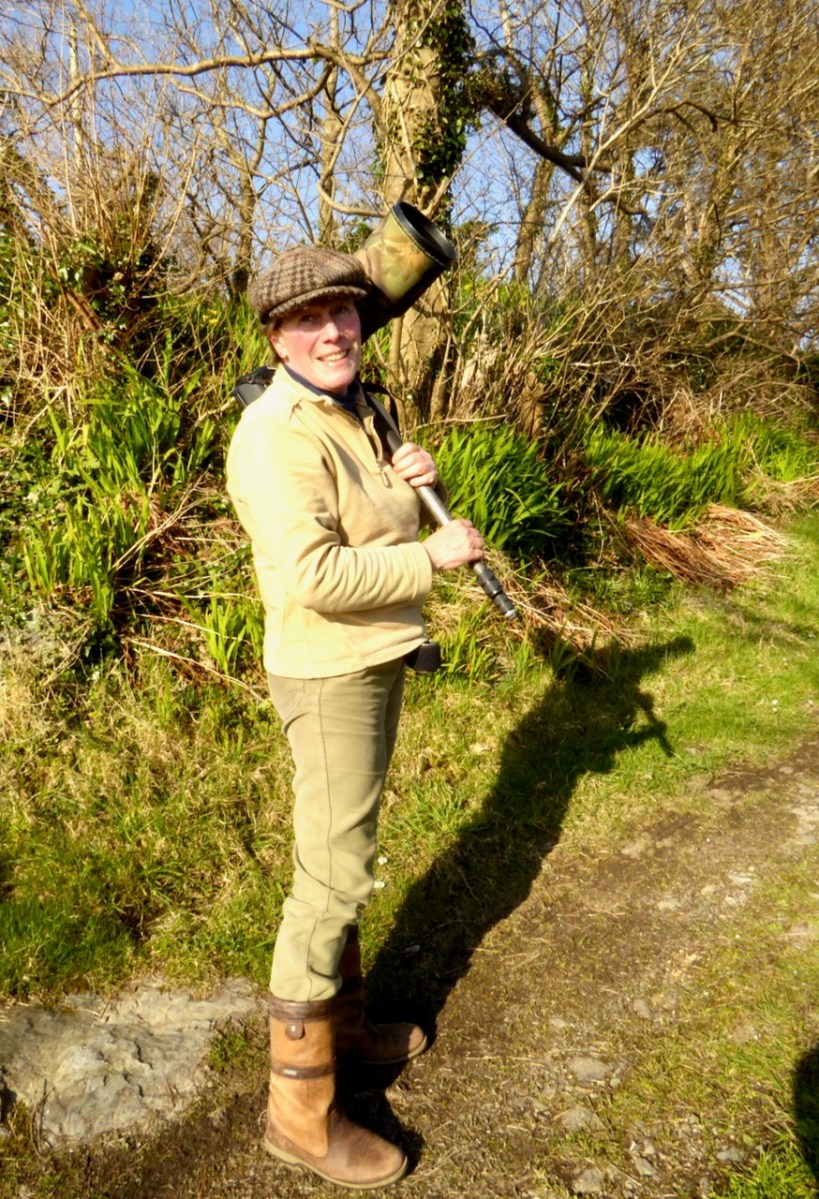
This is Sheena out to photograph some choughs
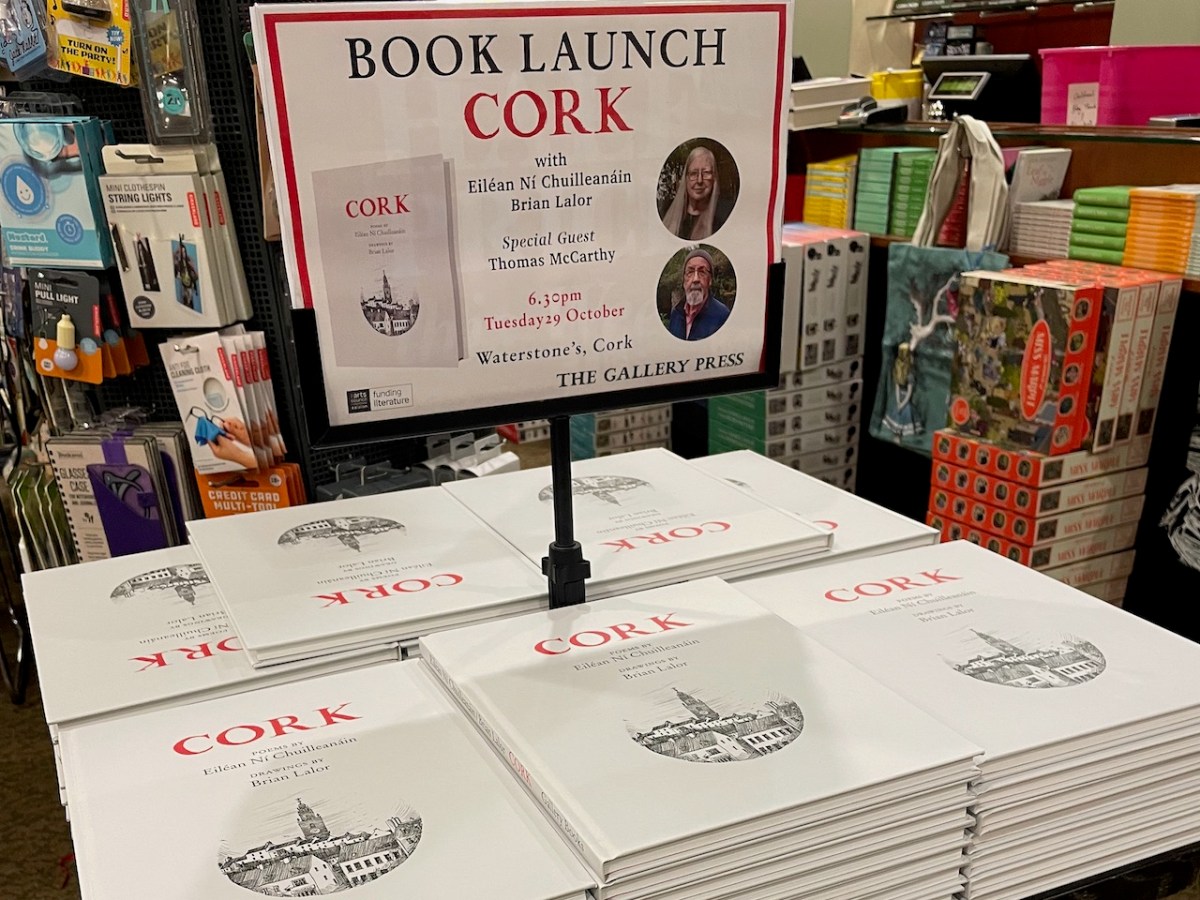
Besides the photographs, Sheena provides text that describes the creatures, their habitats and habits. This is the kind of book you will dip into over and over. And the same is true of my next choice – Cork by the artist Brian Lalor and the poet Eiléan Ní Chuilleanáin.
I have written about this book before – four years ago, in a two-part post titled Cork, Part 1: Brian Lalor and Cork, Part 2: Eiléan Ní Chuilleanáin. At that time, I was writing about a treasured gift given to me by my parents in the 70s – the amazing news is that 50 years later the book has been re-issued! It was launched (re-launched!), in a revised edition, in Waterstones in Cork at the end of October. Both Brian and Eiléan were there!
Take a look at the two posts above for a real flavour of what this book is all about. If you have ever lived in Cork, or even if you’ve visited, this is the book for you.
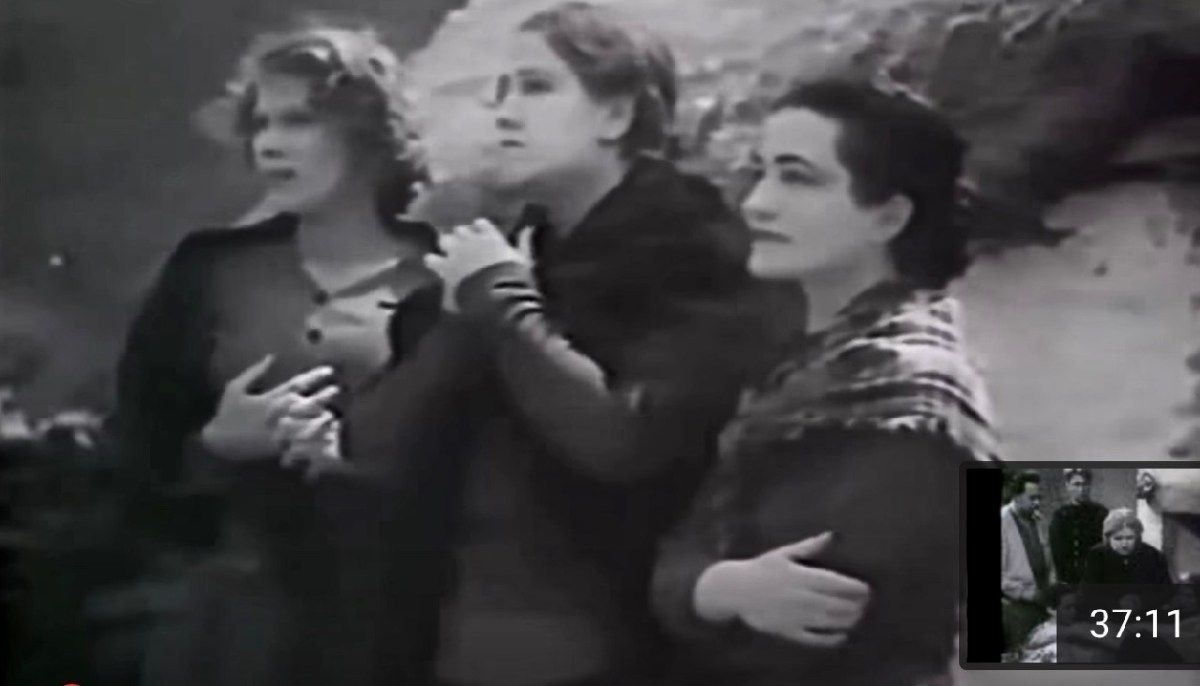
Wild Looking But Fine, by Ciara O’Dowd is my next recommendation. You might remember my post about Ciara and the chocolate box of letters between my mother, Lilian Robert Finlay, and other people associated with the Abbey Theatre. Eight years, and one child, later, Ciara’s book is finished and my brother and I attended the launch in Dublin. Ciara’s account of how difficult it was for women in 1930s Ireland to forge a professional and autonomous life is riveting. In her review of the book in Books Ireland, Jane Brennan asks, Why don’t we know more about their lives and achievements? Why, for example, is Ria Mooney not more widely remembered as the renaissance woman she was? Why had I never before heard of Aideen O’Connor (but am well acquainted with the name and reputation of her husband Arthur Shields)?
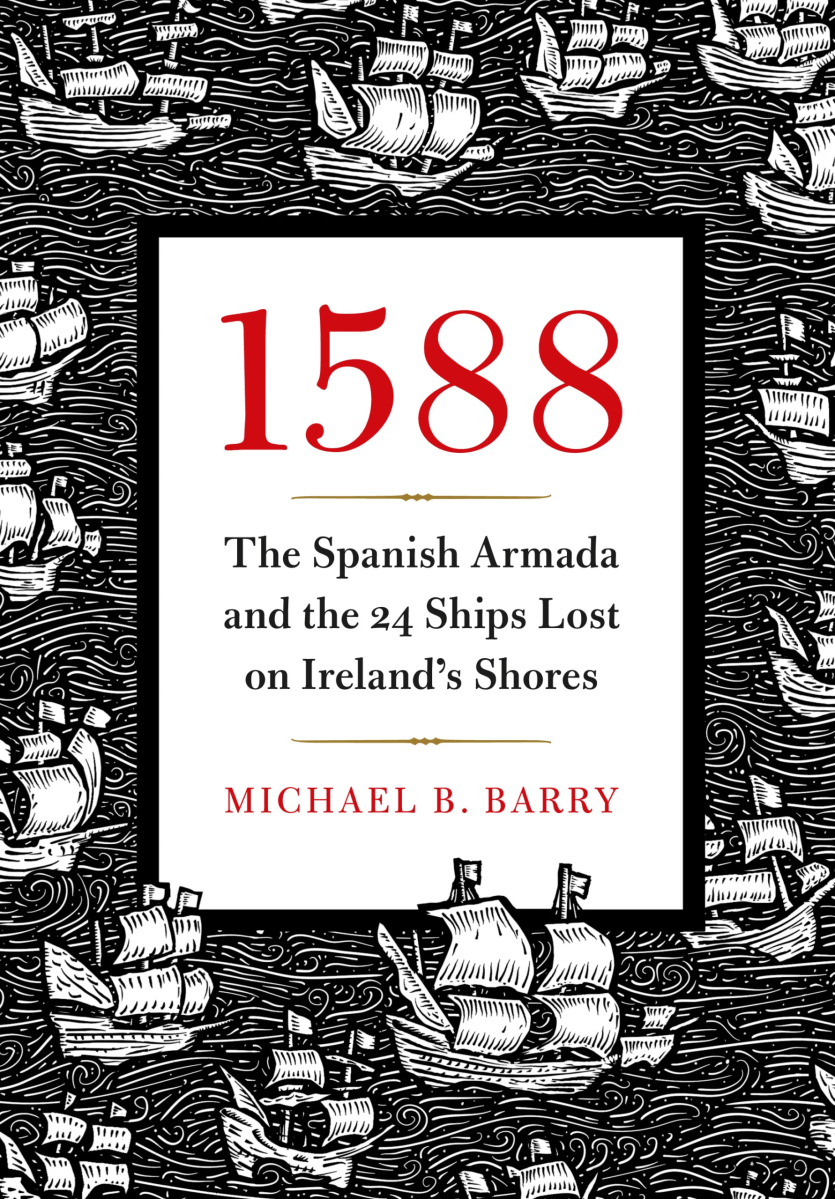
The thing is, the story of the Spanish Armada was taught to us through an English lens. Prepare to have everything you thought you knew questioned and turned on its head. That’s because Michael has done his research in Spanish and Irish sources and, as is his wont, (see this post from eight years ago about his books) the book is profusely illustrated with lots of images sourced from unusual archives as well as his own fine photography.
The books are all available from their publishers or in all fine bookshops. You can think me in the New Year, once your loved ones have taken the hint and bought you one or all of the above.
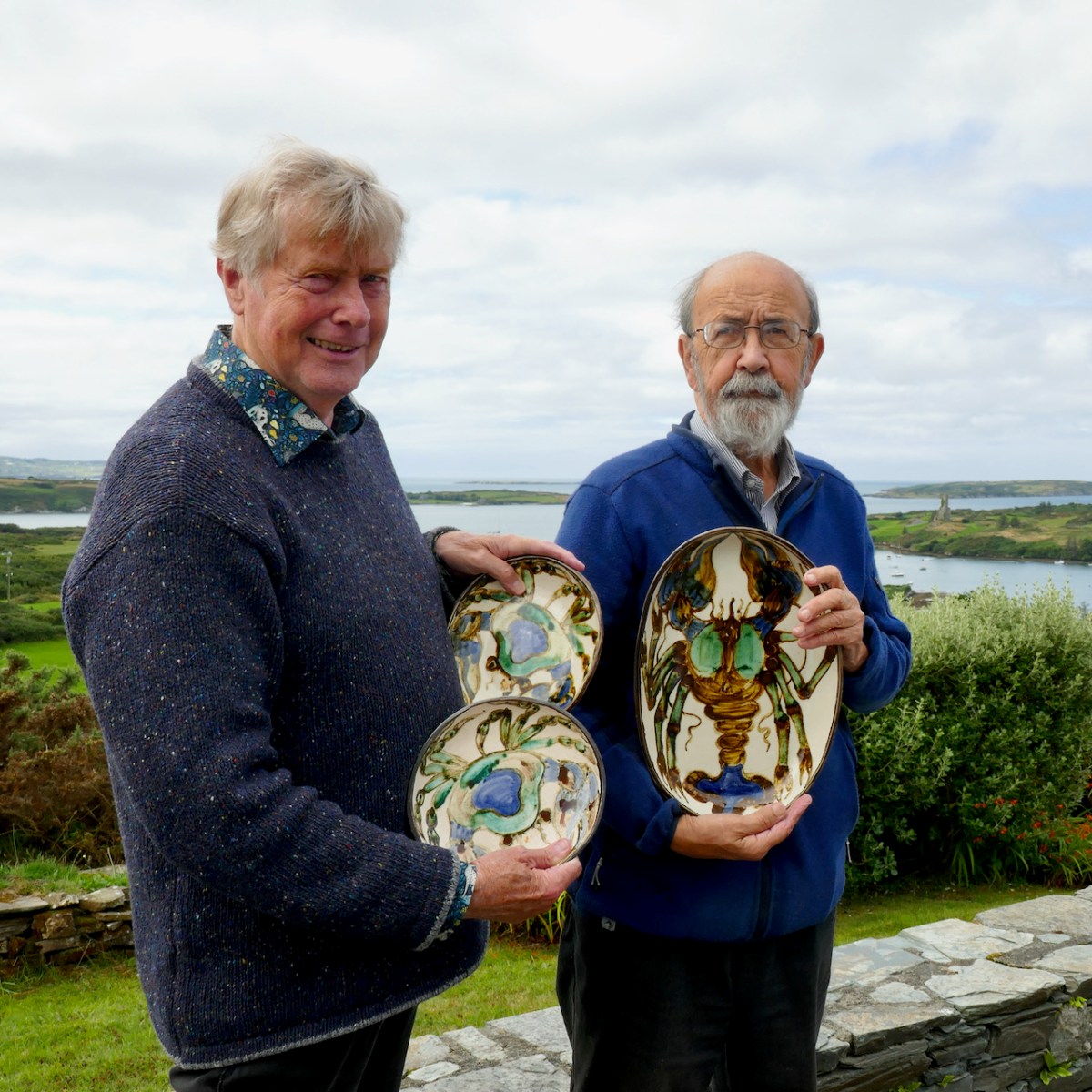
Robert and I were excited about doing this post since we first knew this project was going ahead, a couple of years ago. Sadly, I am the one who gets to write it, but happily Robert is in there too, since Brian dedicated the exhibition book to his memory. That’s the two of them, below, showing off some of John and Noelle Verling’s ceramics acquired for the Ballydehob Arts Museum.
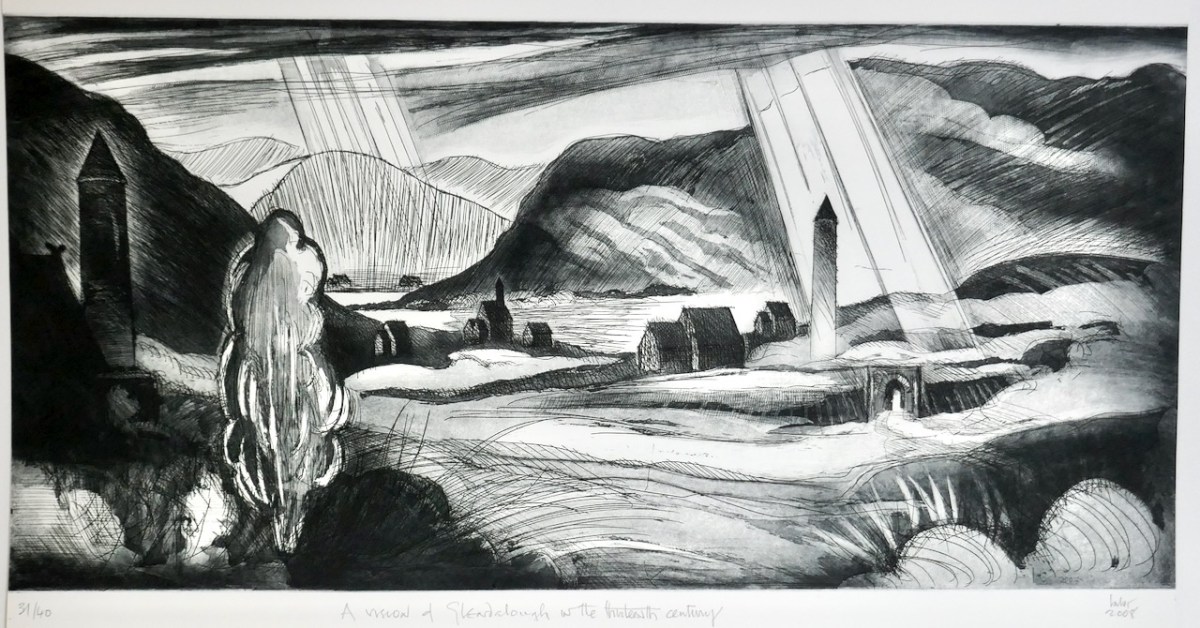
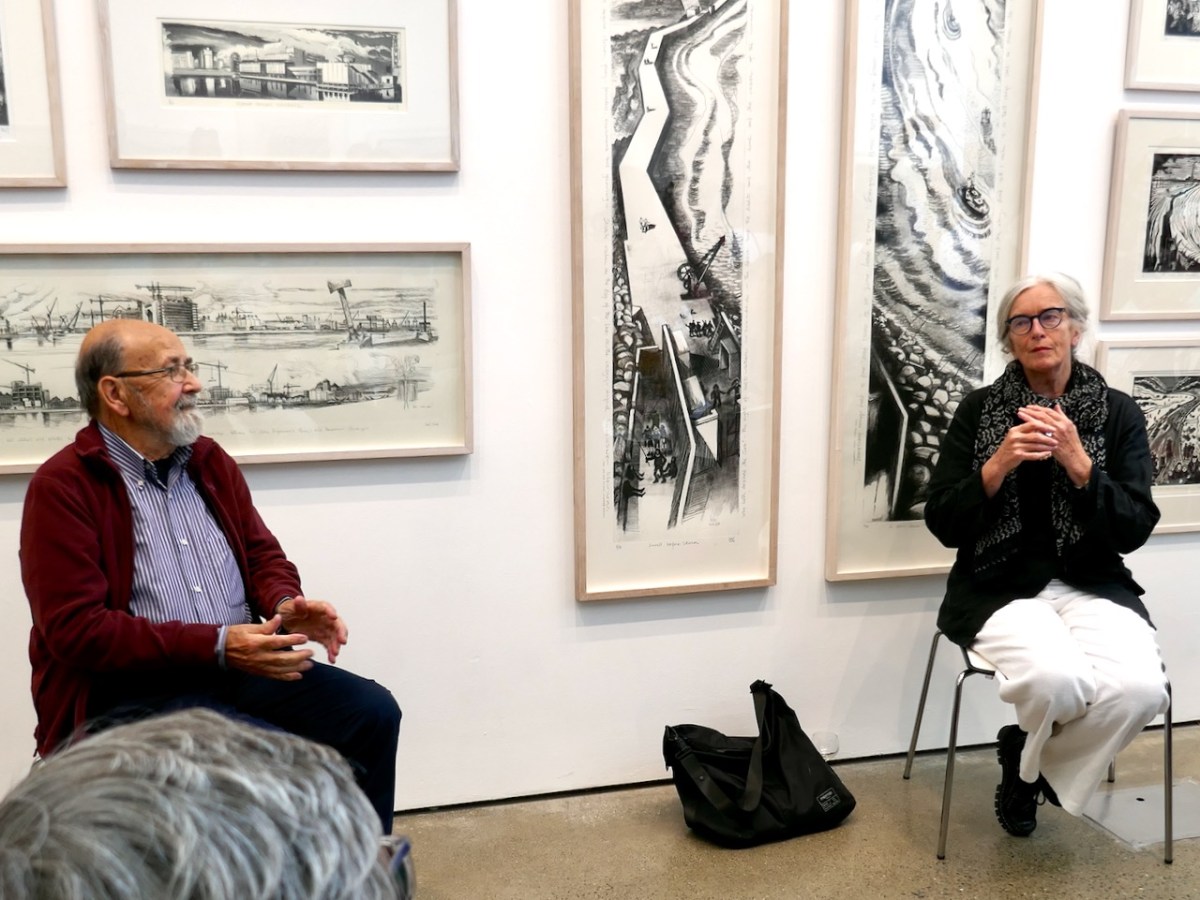
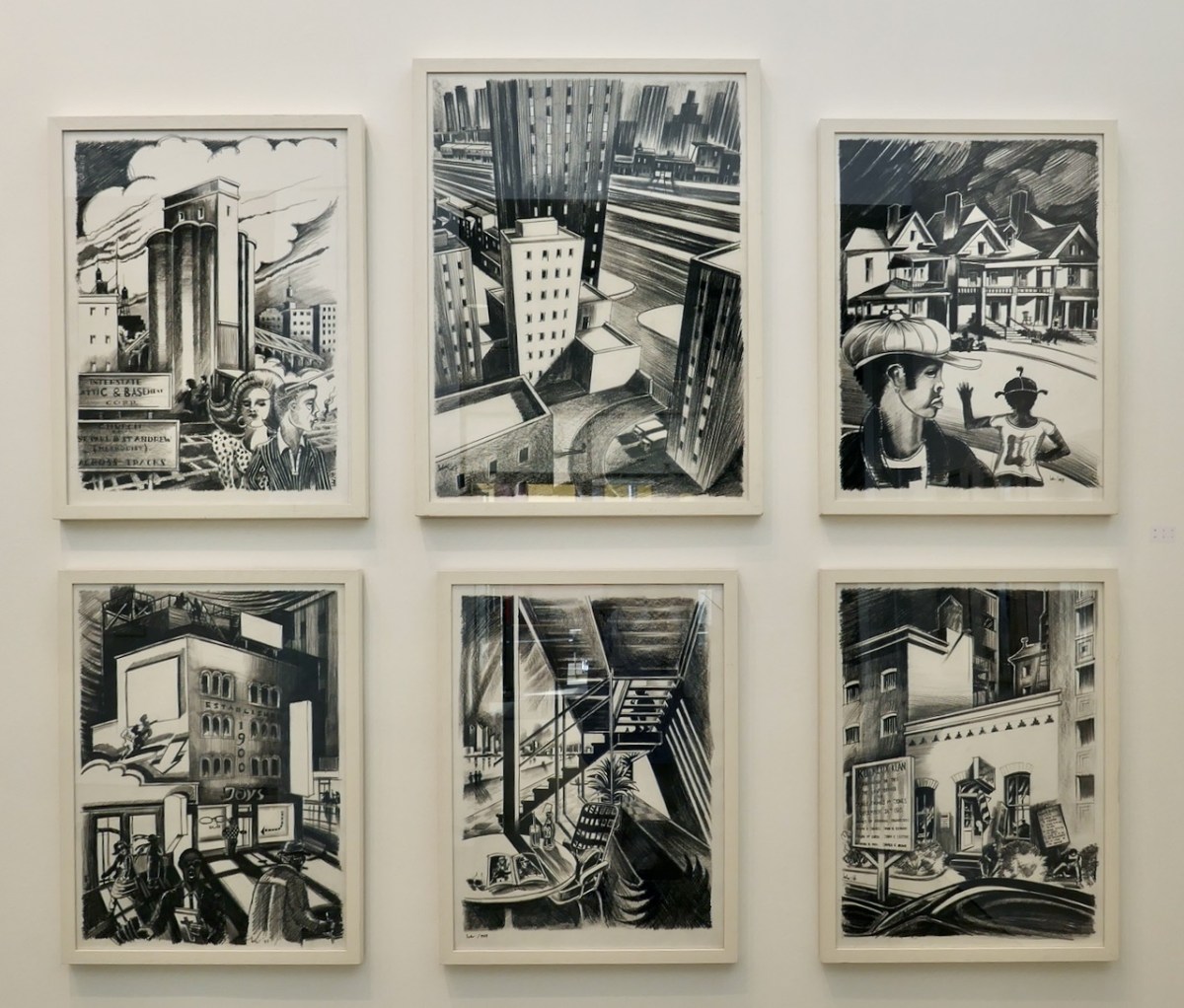
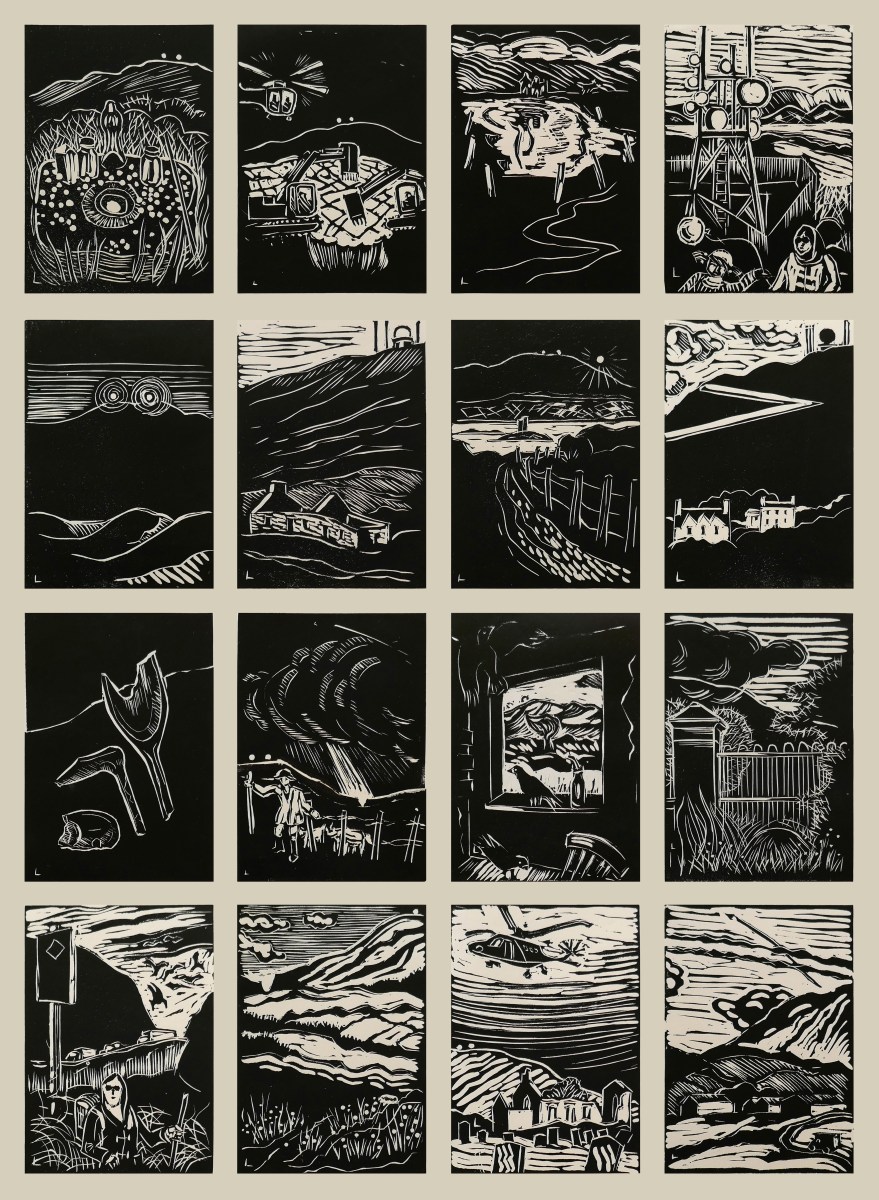
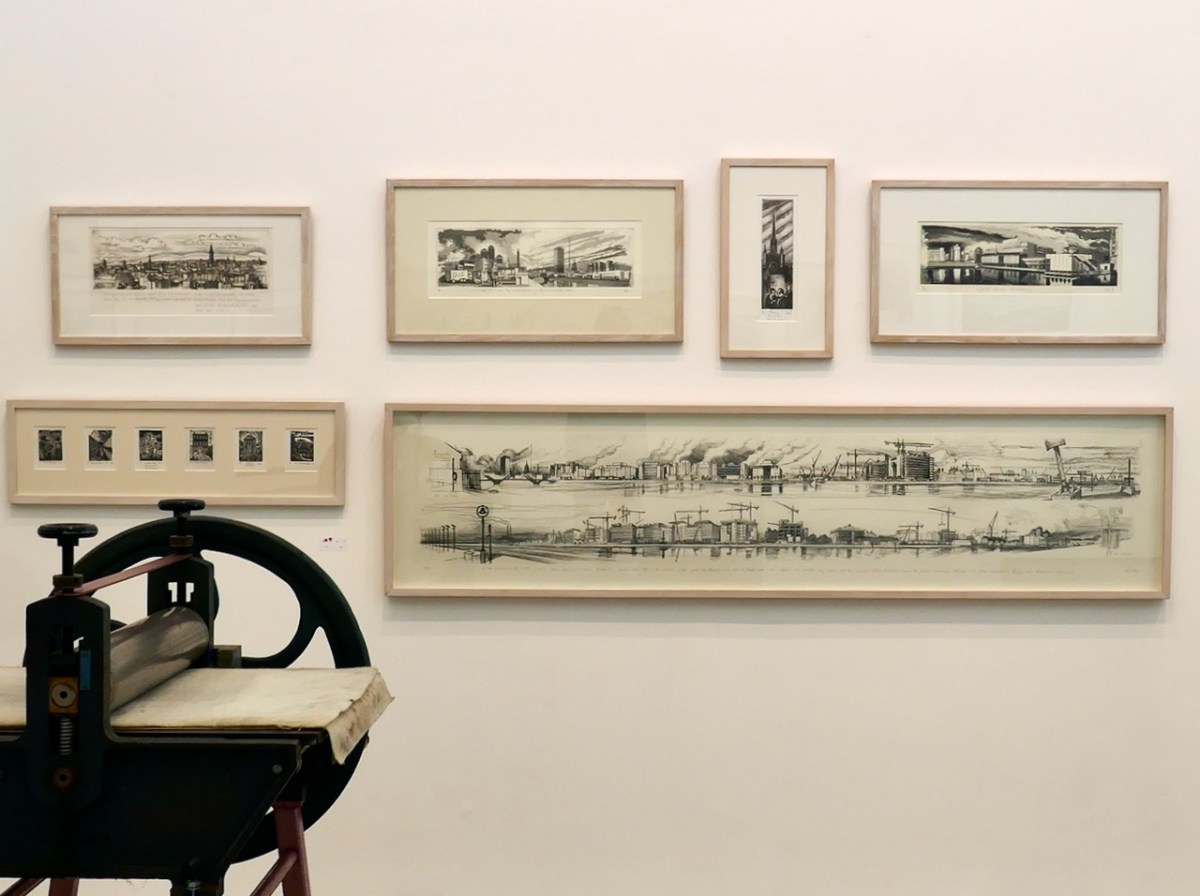
I described Brian in a previous post as a National Treasure. Artist, engraver, printmaker, print collector, curator, writer, editor – he has done, and continues to do it all, and this retrospective captures a lifetime of his multi-faceted interests. Brilliantly organised around the theme of Place by curator Vera Ryan, it leads us from the Middle East through Europe to North America, dwelling of course on his own Home Place, West Cork.
The book has essays by Angela Griffith of Trinity College and Anne Hodge of the National Gallery, a lengthy conversation with Vera Ryan, and a short concluding note by Brian. That’s Vera interviewing Brian at the launch, below.
Through all of these we get to know Brian, his life, his travels, his training as an artist (but first as an architect and archaeologist), his collector’s eye – the honed observational skills coupled with a vivid imagination that allow him to produce works that are at the same time minutely accurate and wildly fanciful. As Angela Griffith puts it,
He is a meticulous recorder of life, nature and the human-made environment. But he is also an interpreter, as such he captures the cadences of these spaces, reveals or create mythologies, and interrogates the impact of humans on the land, past and present. Many times he finds the lyrical in his subject matter.
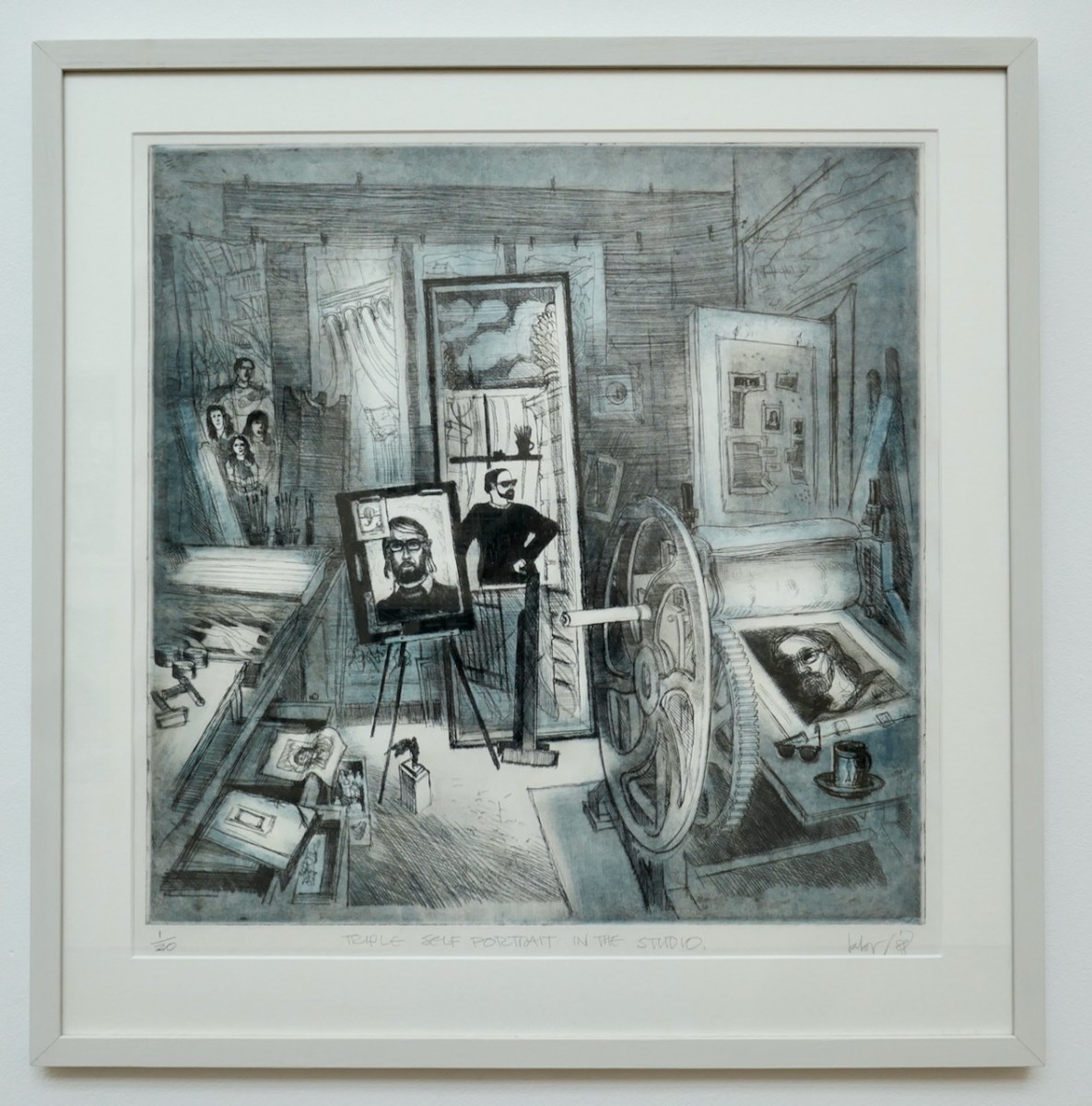
Printmaking has been at the core of Brian’s work. His fascination with printing techniques dates from a young age and led him to amass a fine collections of prints, chosen not for their subject matter but for what they can reveal about the art of printmaking. That collection is now in the National Gallery. He helped to found the fine art printmakers, Graphic Studio Dublin, the success of which and indeed Ireland’s printmaking tradition, is charted in his book, Ink-Stained Hands.
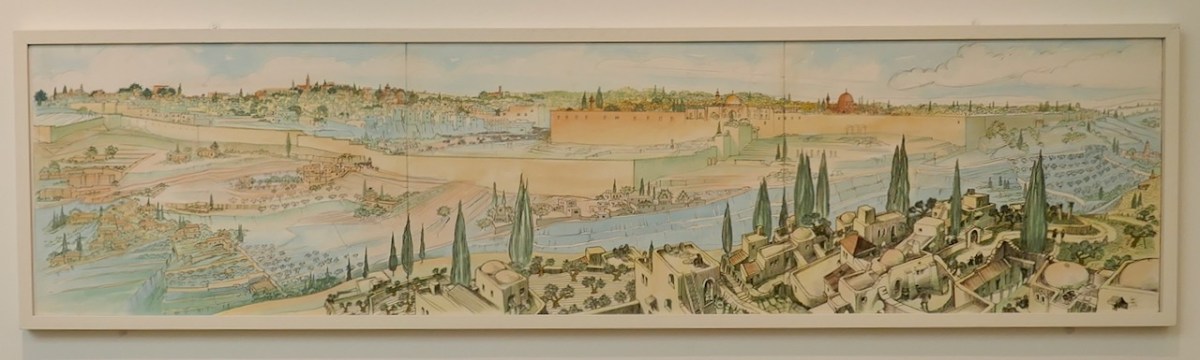
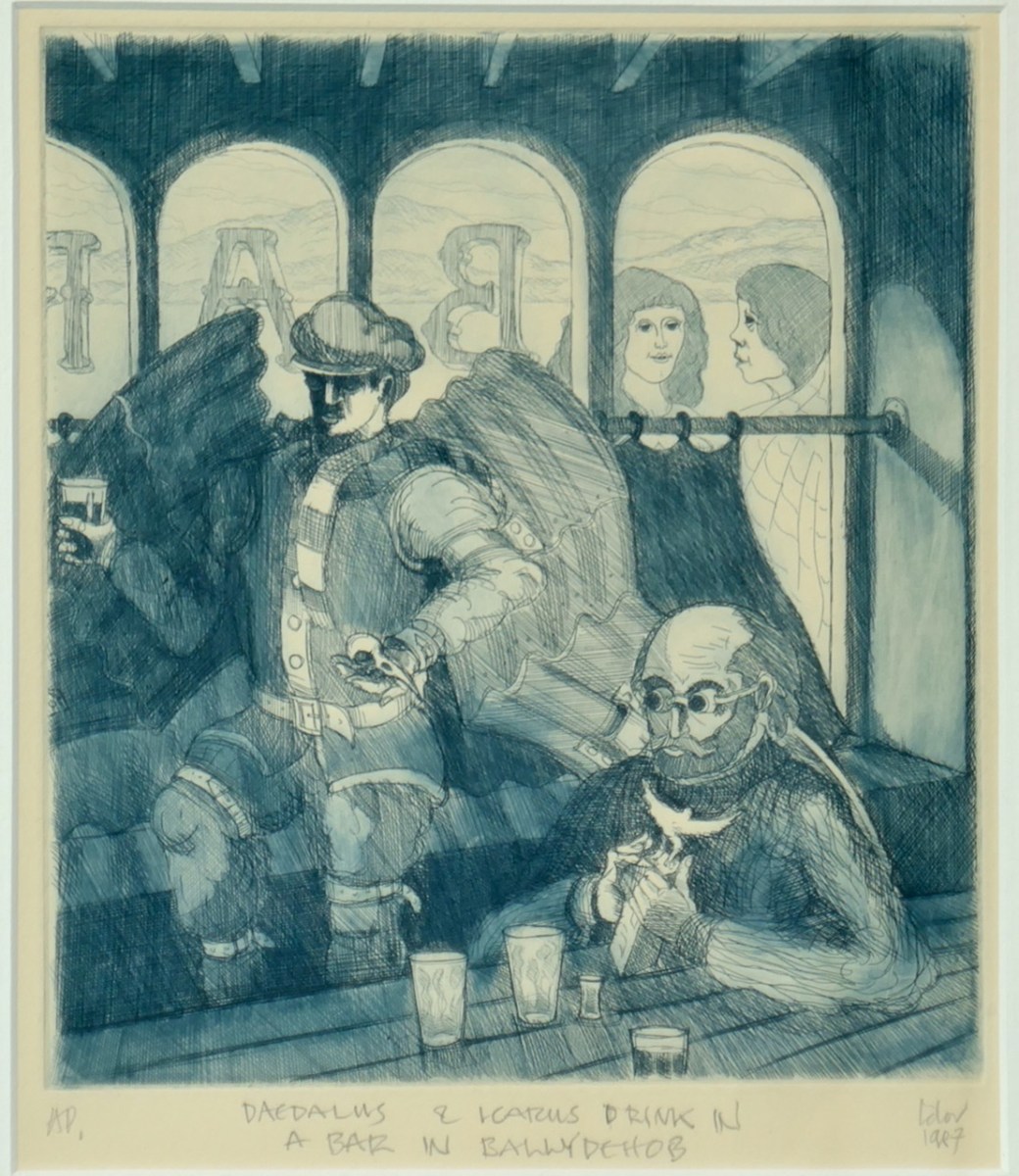
The exhibition itself contains multiple treasures that I haven’t seen before, even though I was familiar with some of Brian’s work. His enormous prints of Jerusalem, Rome and Dublin dominate several walls. His whimsical series on Icarus and Daedalus (above) was new to me, as were his American prints.
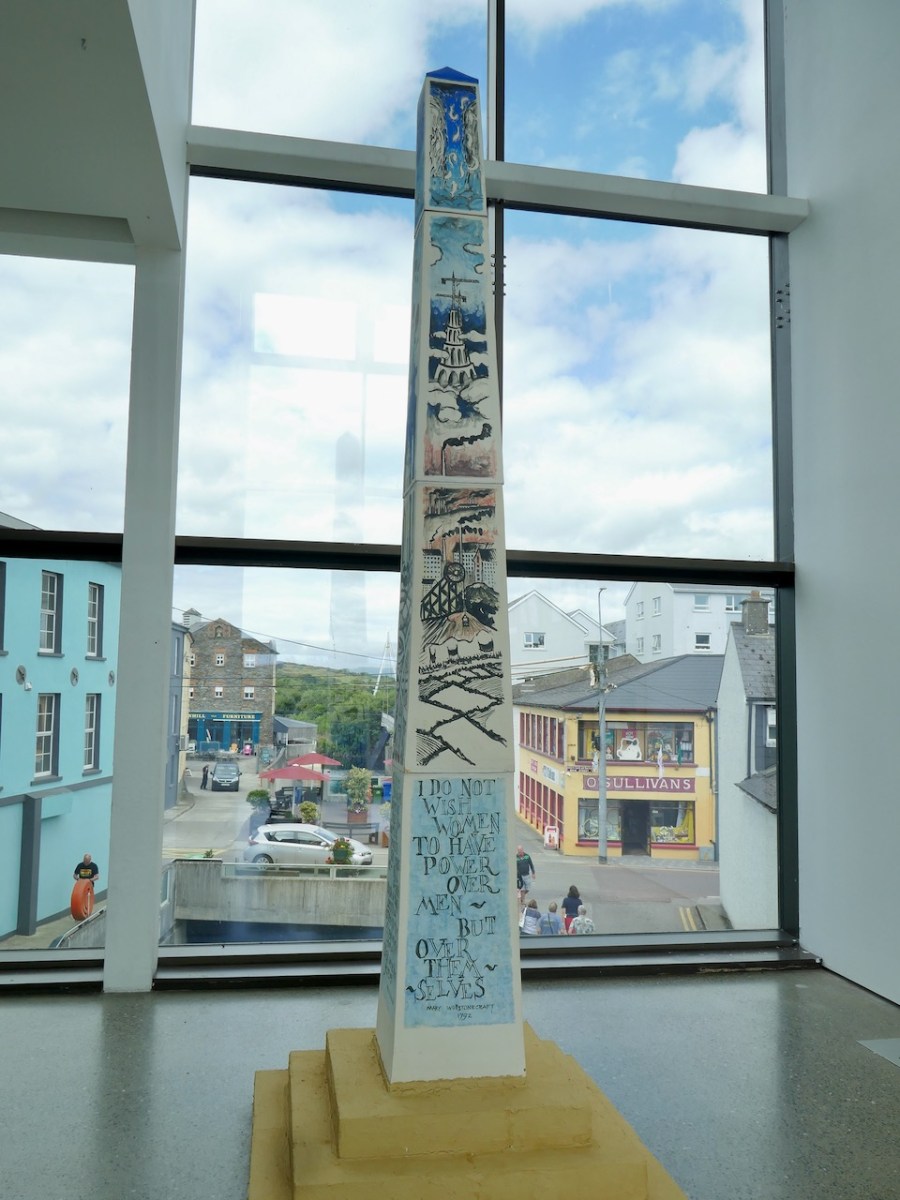
And it’s not only paper-based. He has collaborated with master-ceramicist Jim Turner on a series of fired earth works, some of which are politically charged. He knows the Gaza Strip intimately, after all.
All I can do here is give you a tiny flavour of what’s in store at this outstanding show. Below I am appending a list of posts written by Robert or me that are either about Brian’s work, or illustrated by his art. I was amazed when I went back and looked at how many Brian-related posts we had written about him over the years. Partly that’s because he and Robert worked so closely together on the Ballydehob Arts Museum, but mostly it’s because we have been so bowled over by his art and writing.
Brian Lalor posts
The Fertile Crescent – an extraordinary exhibition at The Blue House Gallery in Schull
Brian’s Original sketchbook for his field trips around West Cork with the Mizen Archaeological and Historical Society was the basis for this post on Signal Towers.
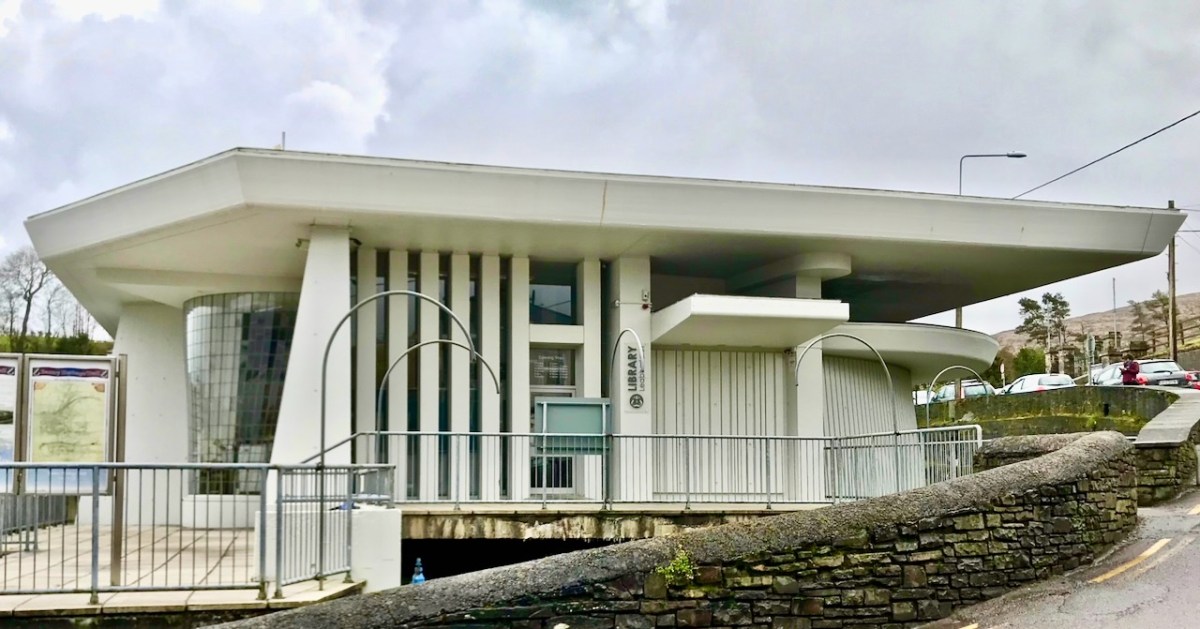
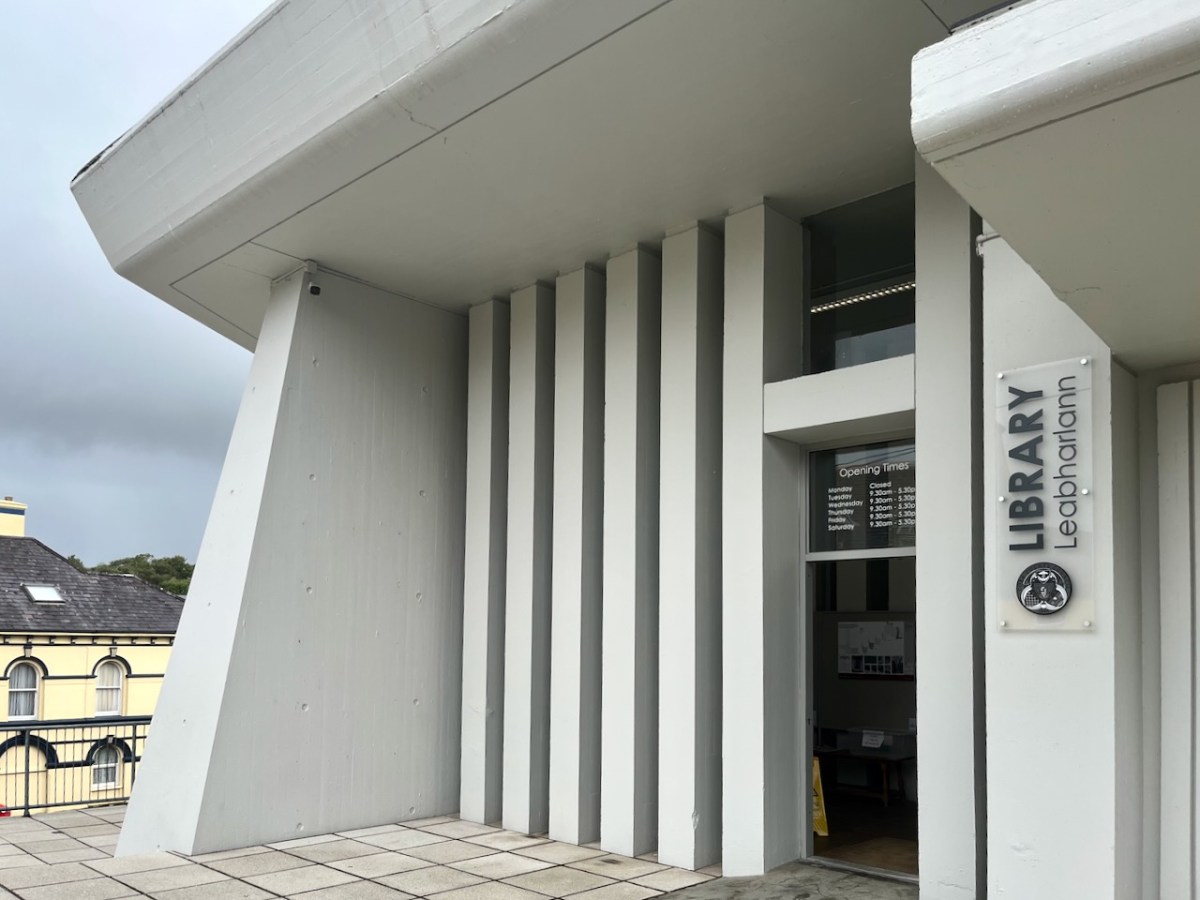
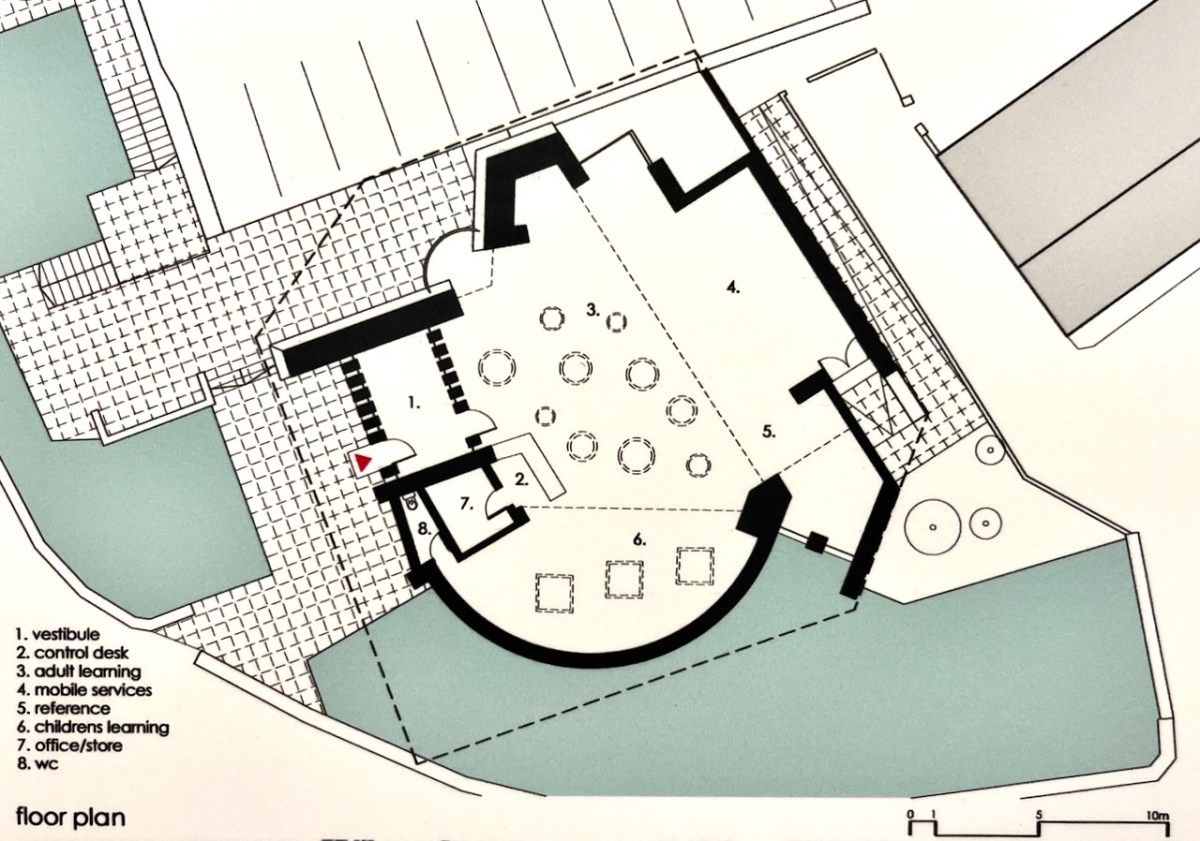
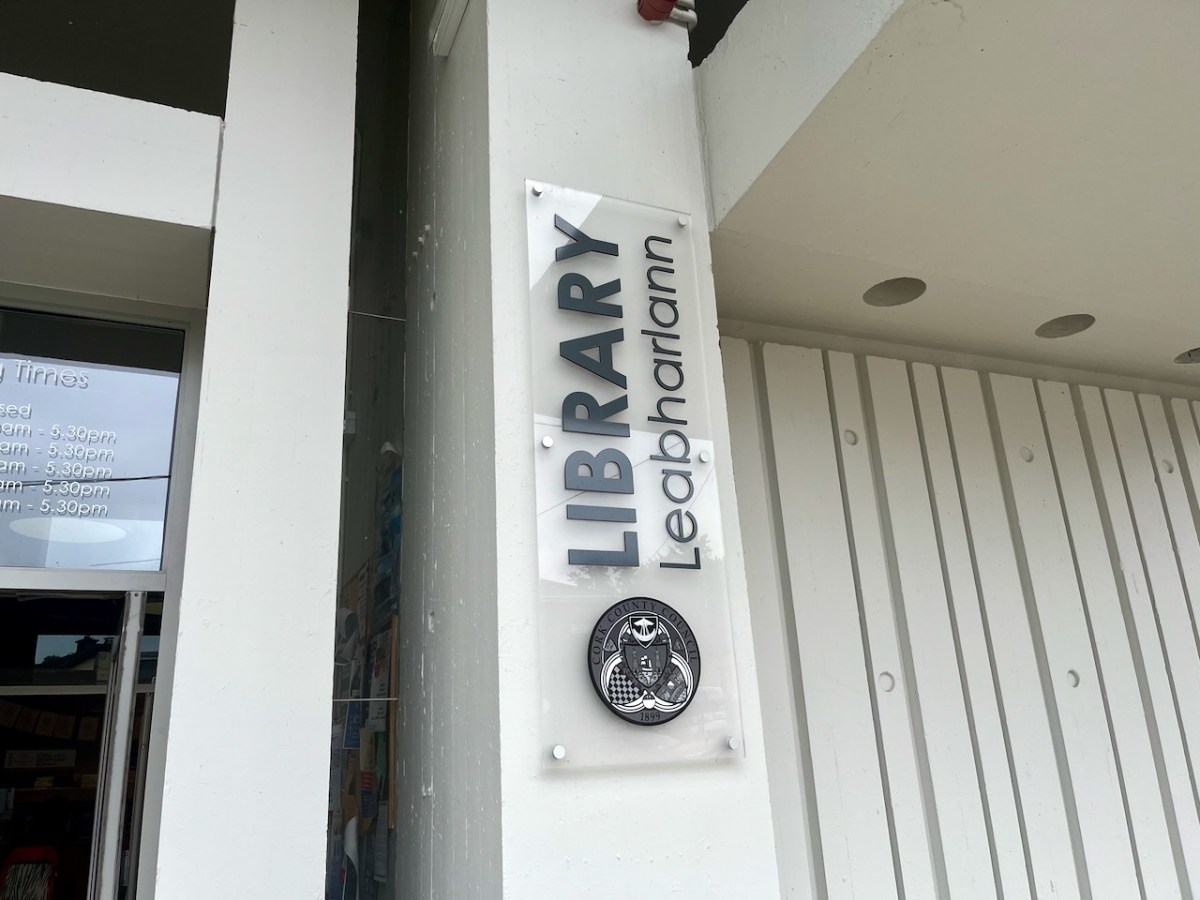
In last week’s post I described a unique type of boat that was connected with Bantry, here in West Cork. Today we are also focussed on Bantry, but this time on architecture: the Public Library, which is one of the most unusual and innovative buildings from twentieth century Ireland.
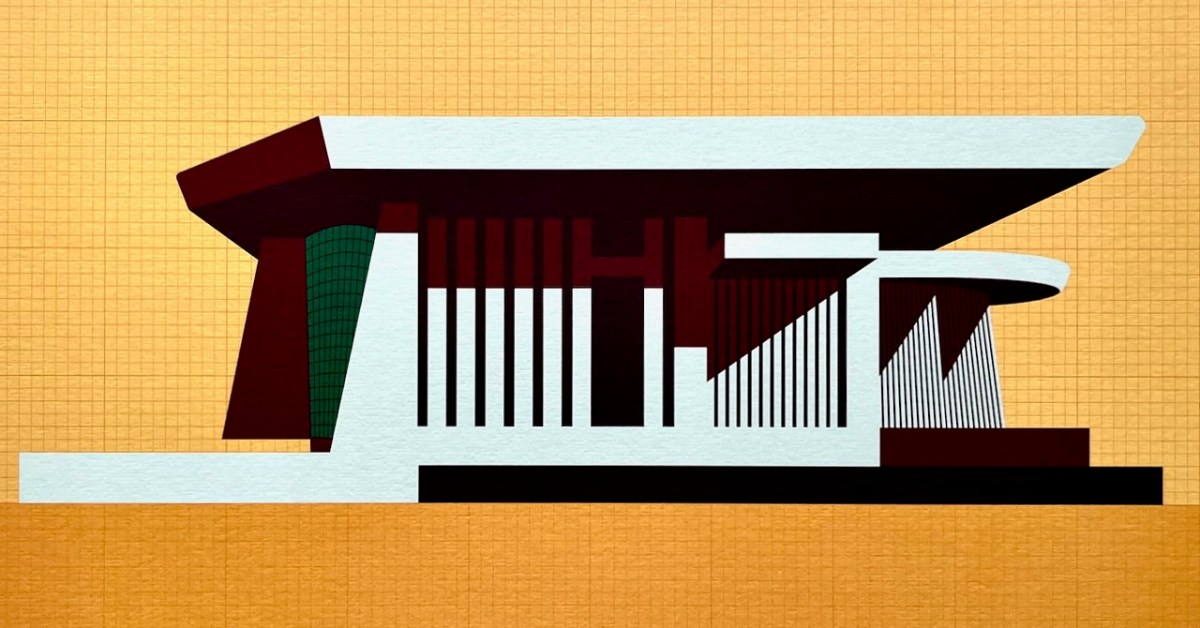
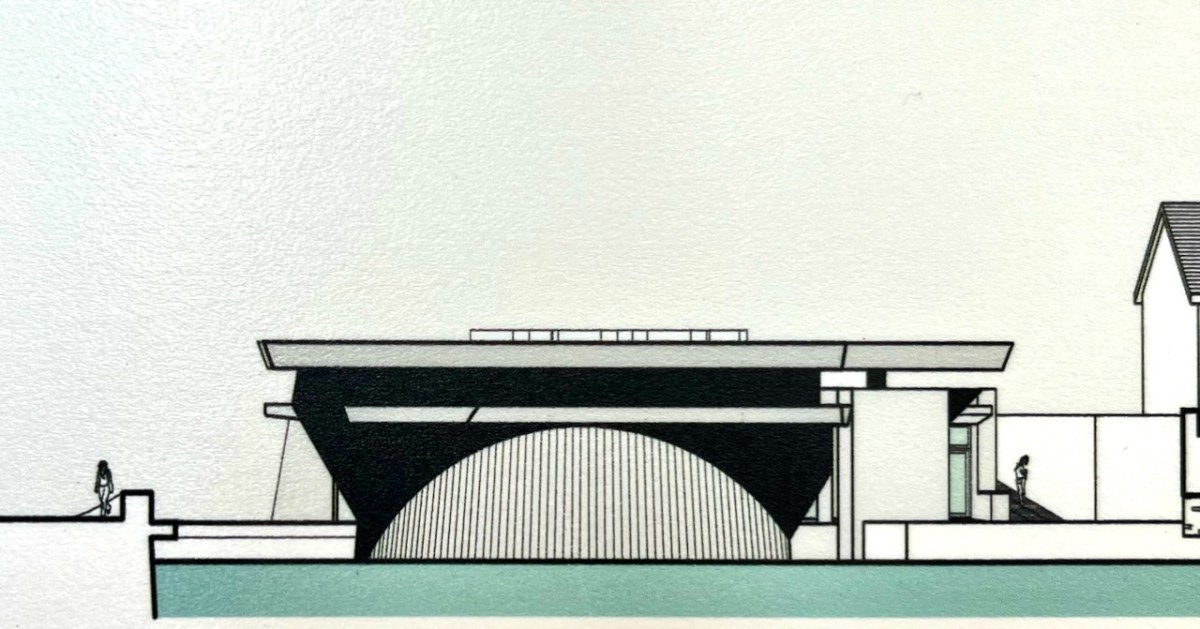
Here is the building as we see it today. The header is a limited edition print, a collaboration between Dermot Harrington of Cook Architects and Robin Foley of Hurrah Hurrah celebrating the upcoming 50th Anniversary of the completion of Bantry Library in 1974. For me, the print captures perfectly the iconic graphic of this most unorthodox design.
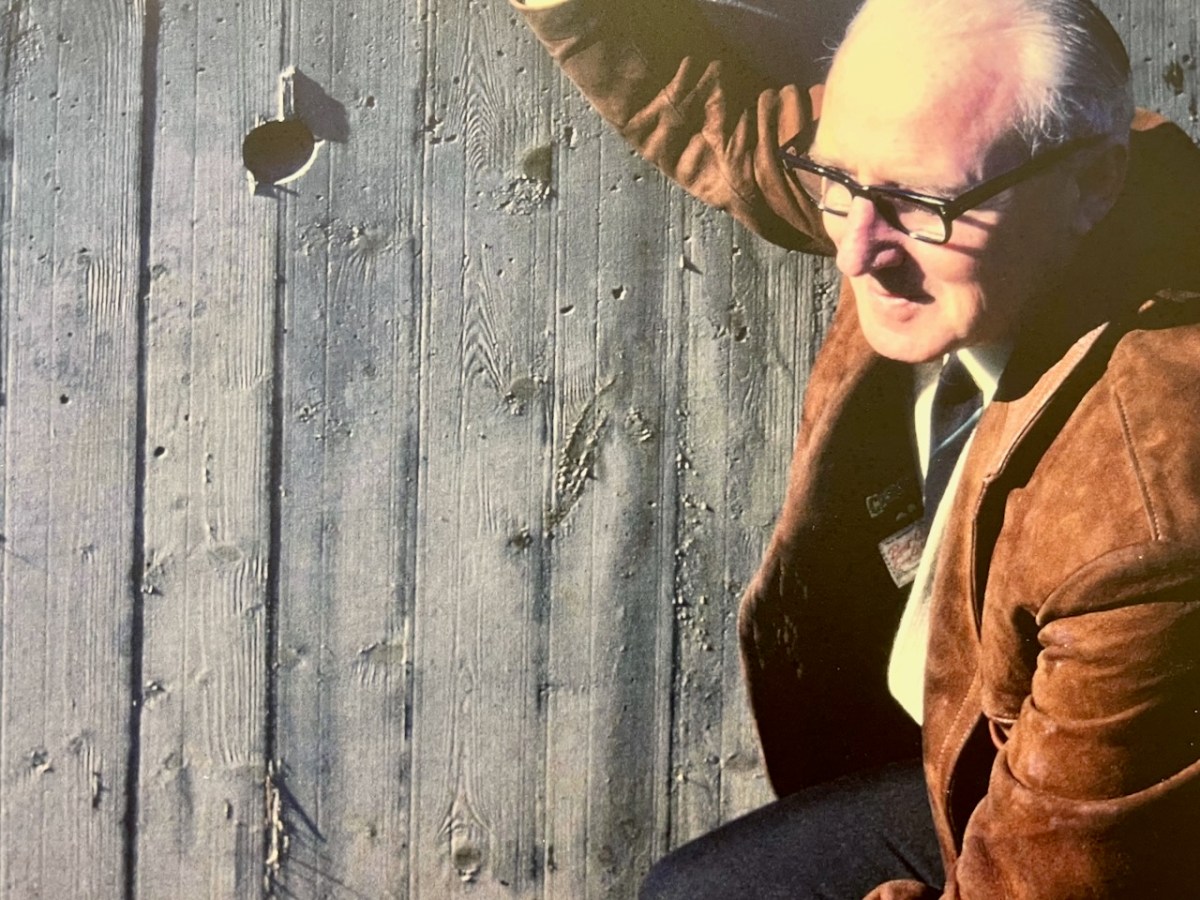
The Library was conceived by Patrick McSweeney (above) – Cork County Architect between 1953 and 1975. He deserves a post of his own one day, as he was responsible for some outstanding buildings in the county. Two of his assistants in the Architect’s Department at the time were Brian Lalor and John Verling. Both had a hand in the genesis of the Library. Interestingly for us, McSweeney, Lalor and Verling were all living around Ballydehob in those days – it was a swinging village!
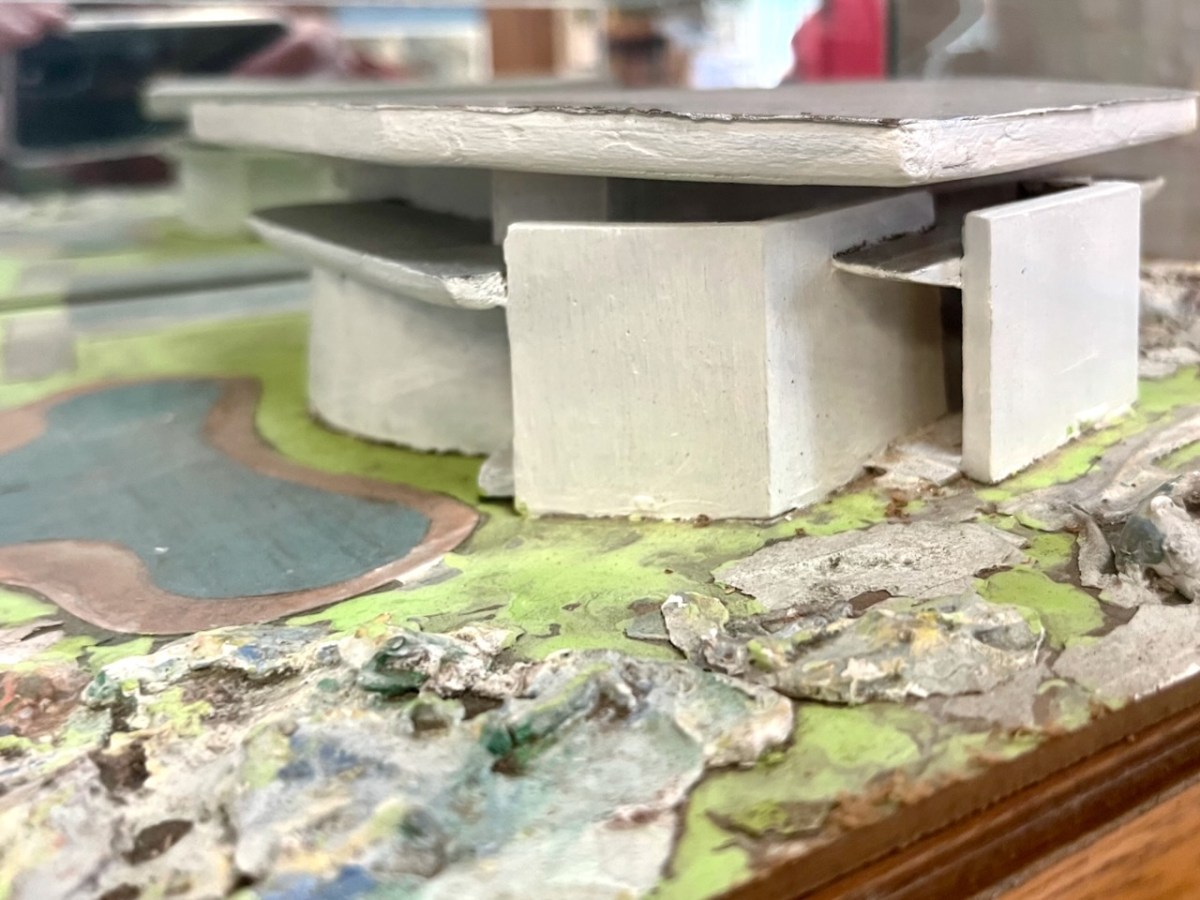
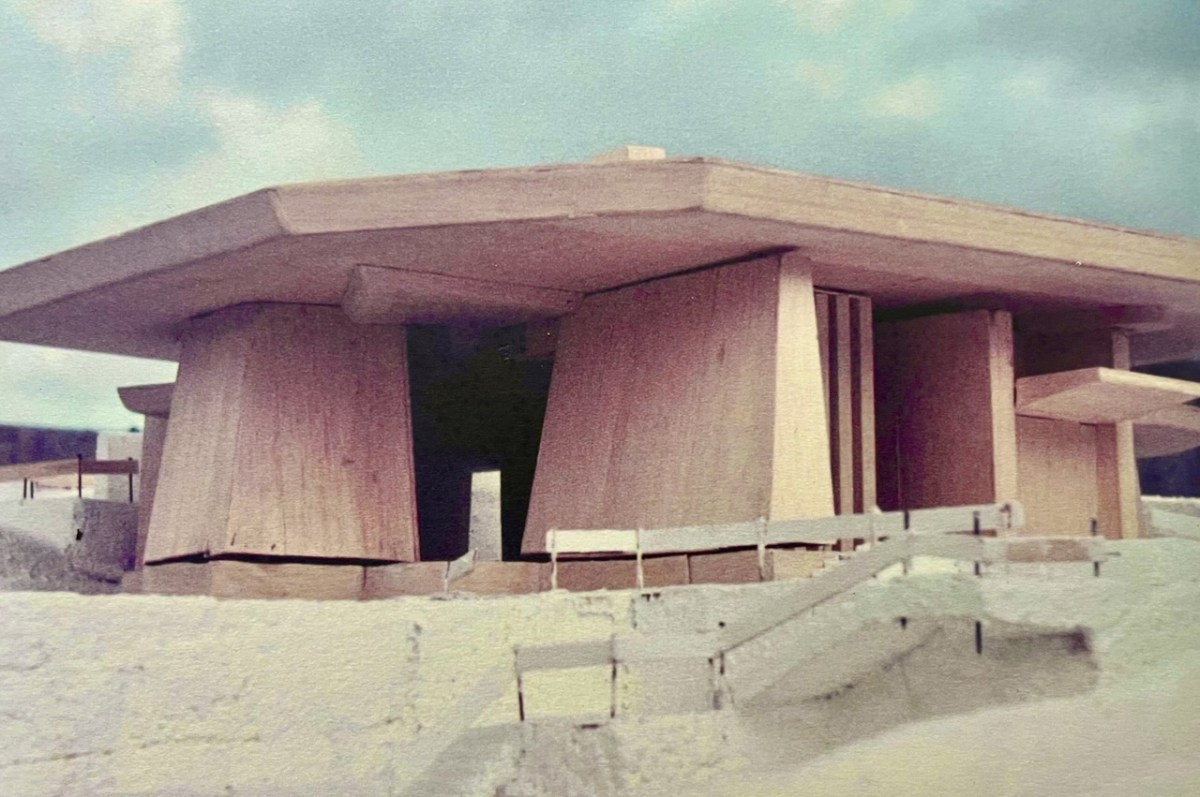
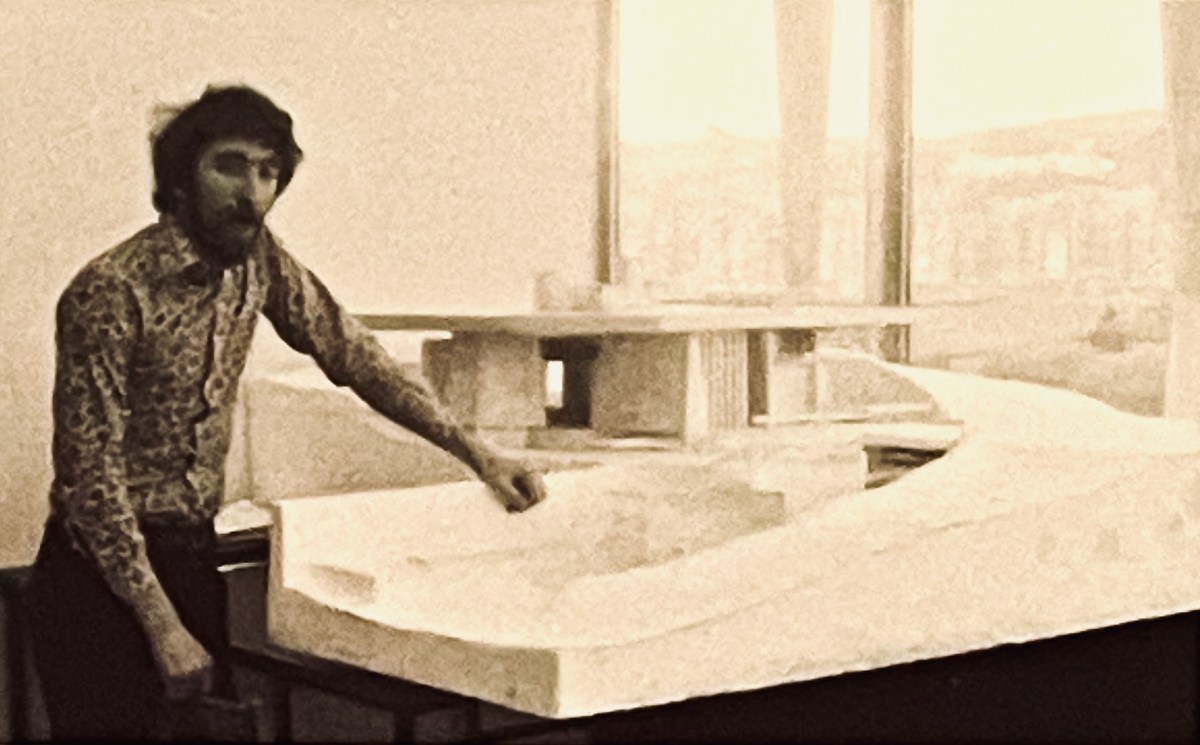
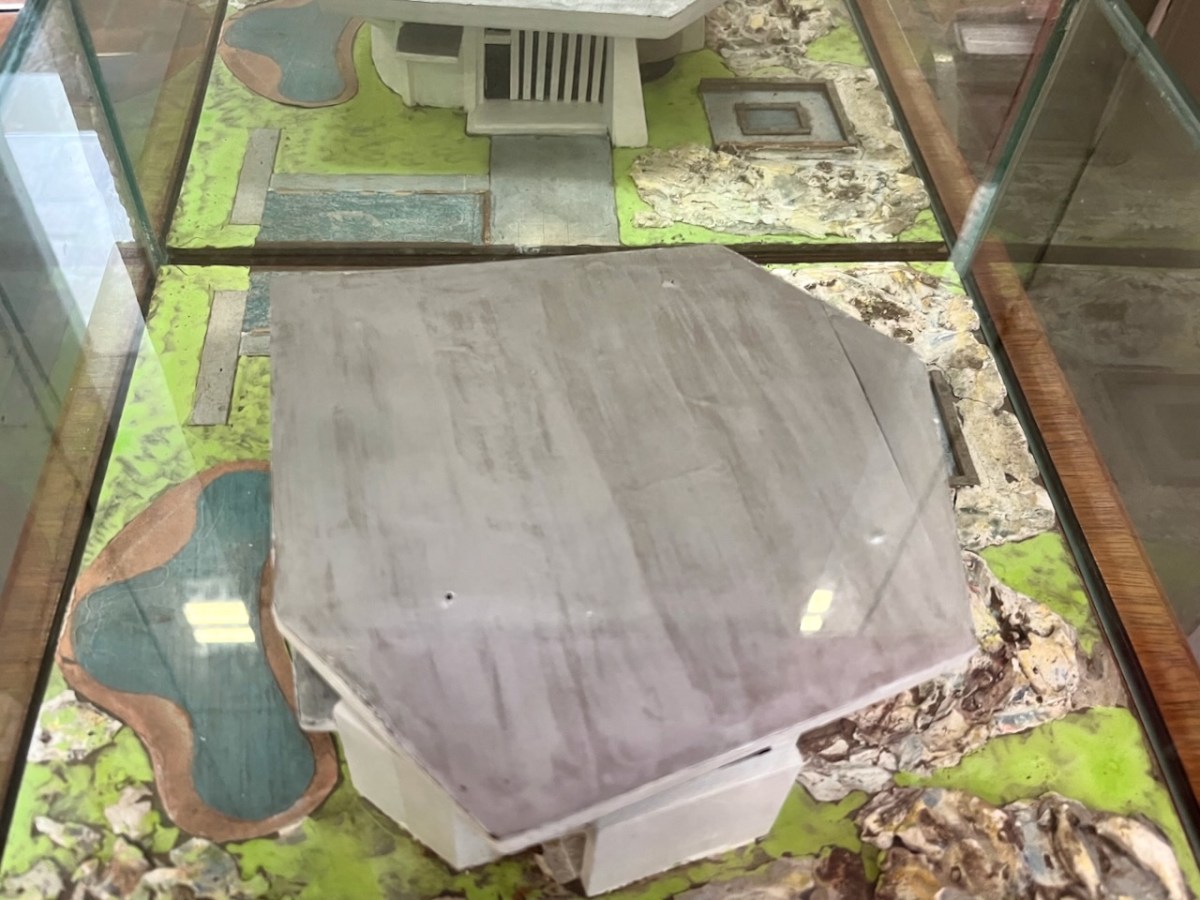
In the era before computers were universal in architects’ offices, everything was drawn by hand – or modelled. Brian recalls that Pat (McSweeney) called him into the office one day, handed him cardboard, tape and scissors, and instructed him to make a model of a building shaped like a Bronze Age dolmen. And he wanted it made in a hurry! It could well have been the one shown above – which still exists. Remarkably, although this model was made in the early 1960s, the building that resulted in the 1970s was very similar in form. Later, John Verling produced a balsa-wood model upon which the design production drawings were based:
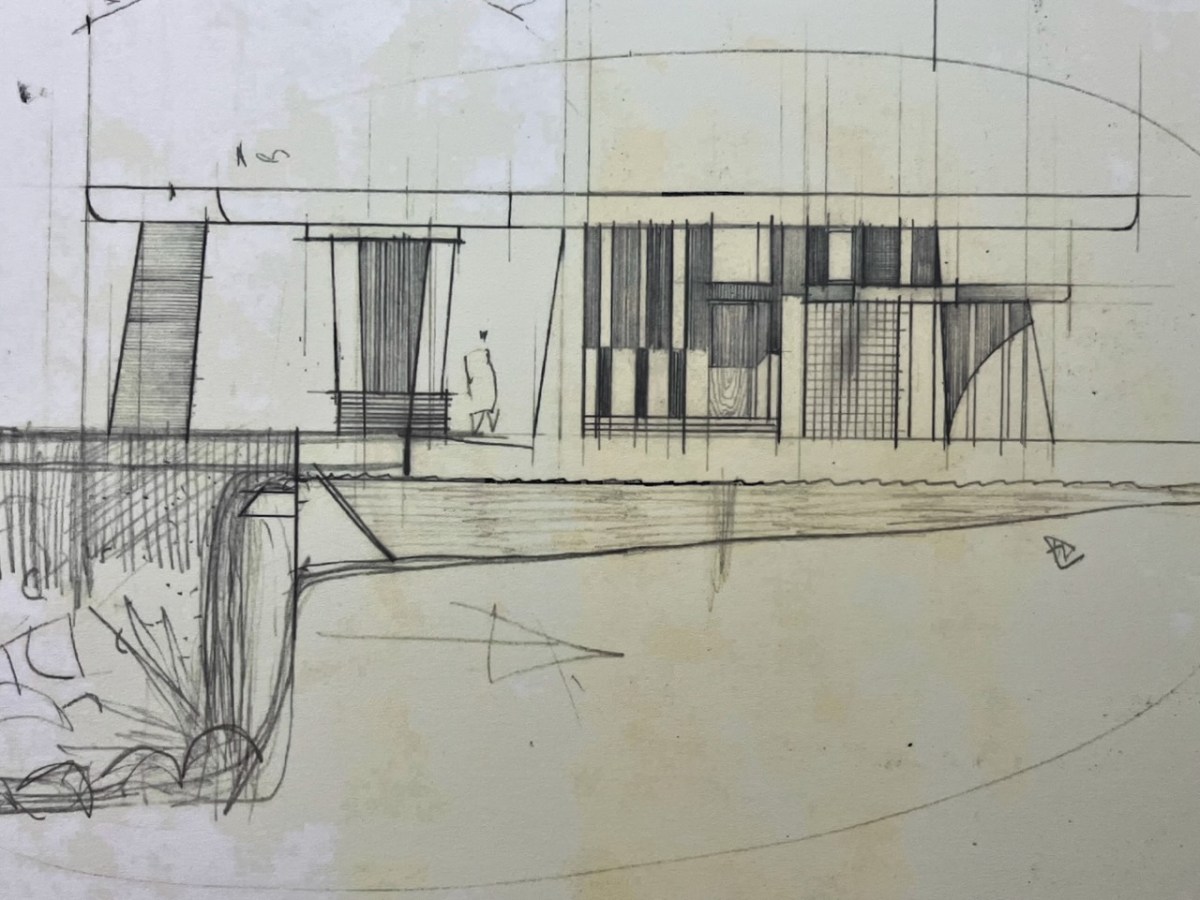
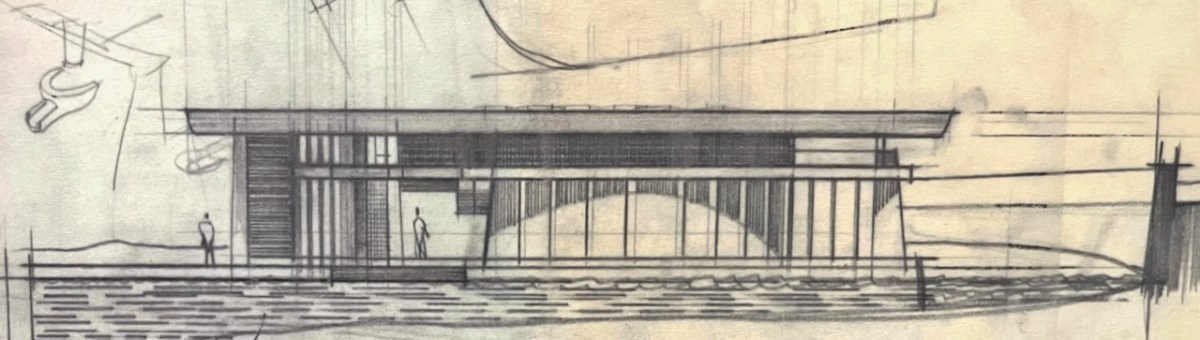
That’s John Verling, above, with his model. He and his wife, Noelle, are the subjects of the current exhibition in the Ballydehob Arts Museum (click the link). Following are some of the design sketches carried out by Harry Wallace who was leading the team in County Hall, and detailed drawings of the building that eventually ensued.
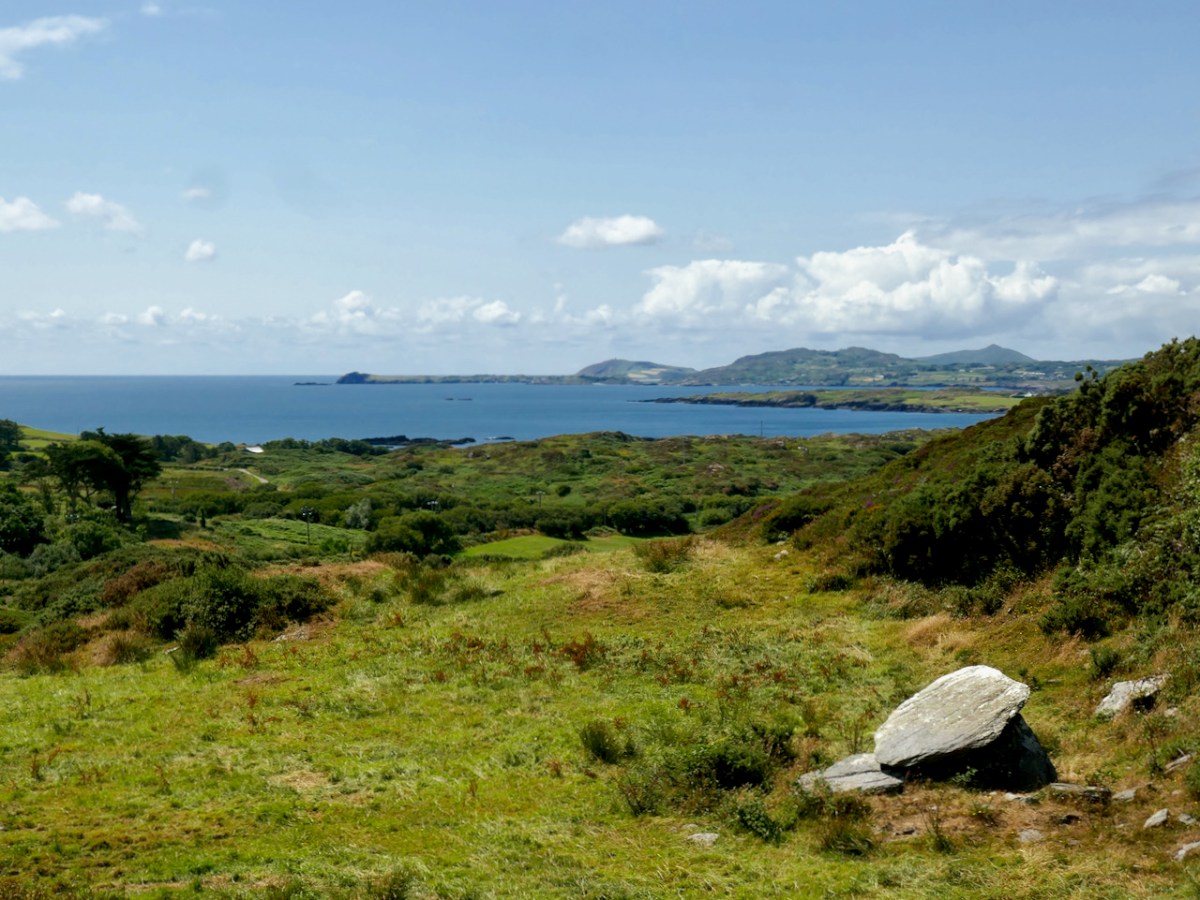
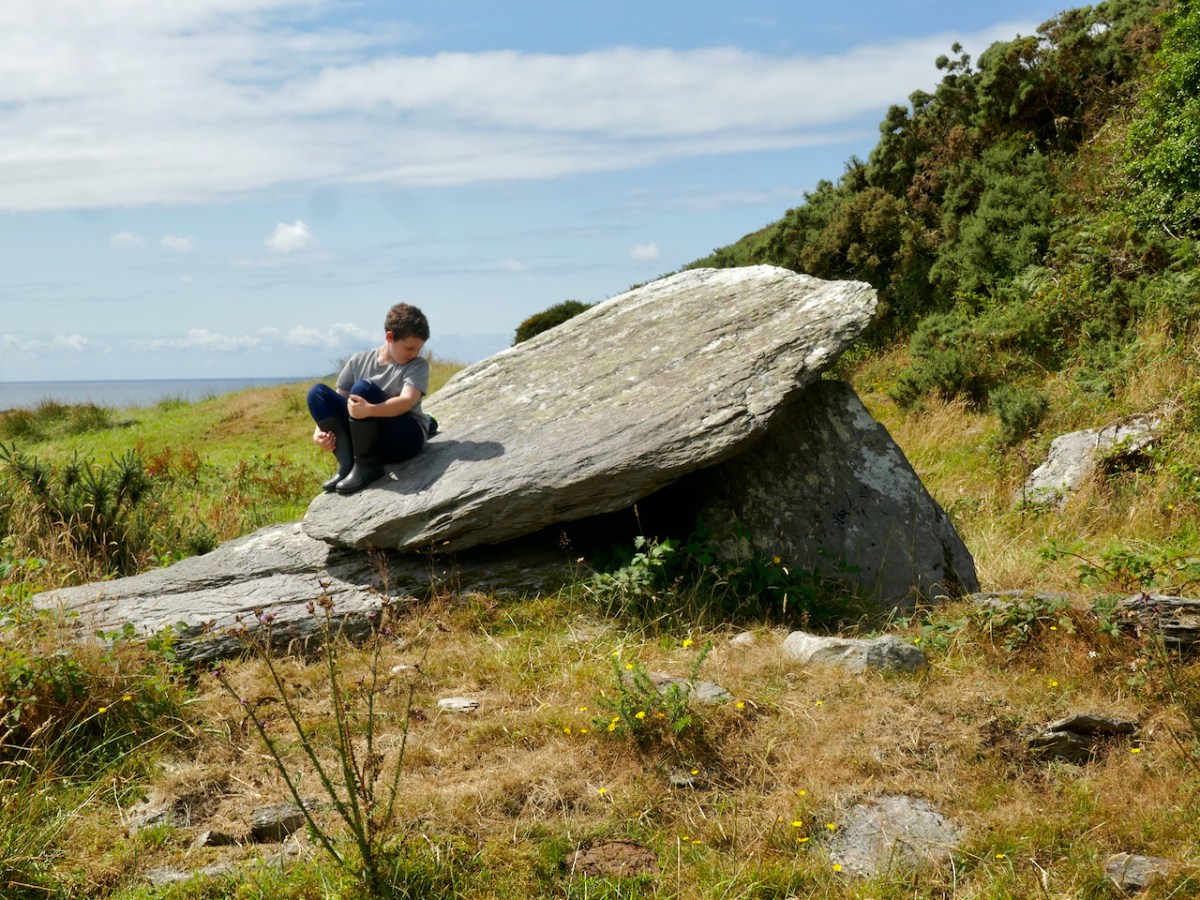
Let’s look a bit further at the early concept work, especially that first model. It’s said that McSweeney was inspired by a ‘Dolmen’. In fact we would today call that type of early megalithic structure a ‘Wedge Tomb’ or a ‘Portal Tomb’. At its simplest, this is a large flat stone slab (or slabs) supported on vertical stone slabs: it was probably a burial chamber, perhaps with its opening facing the sunset at a particular solar event. The closest such tomb structure to Ballydehob is the one featured in Finola’s post today. I wonder if Pat McSweeney was aware of this local one? He would have certainly been aware of the striking example at Altar, further west on the Mizen Pensinsula.
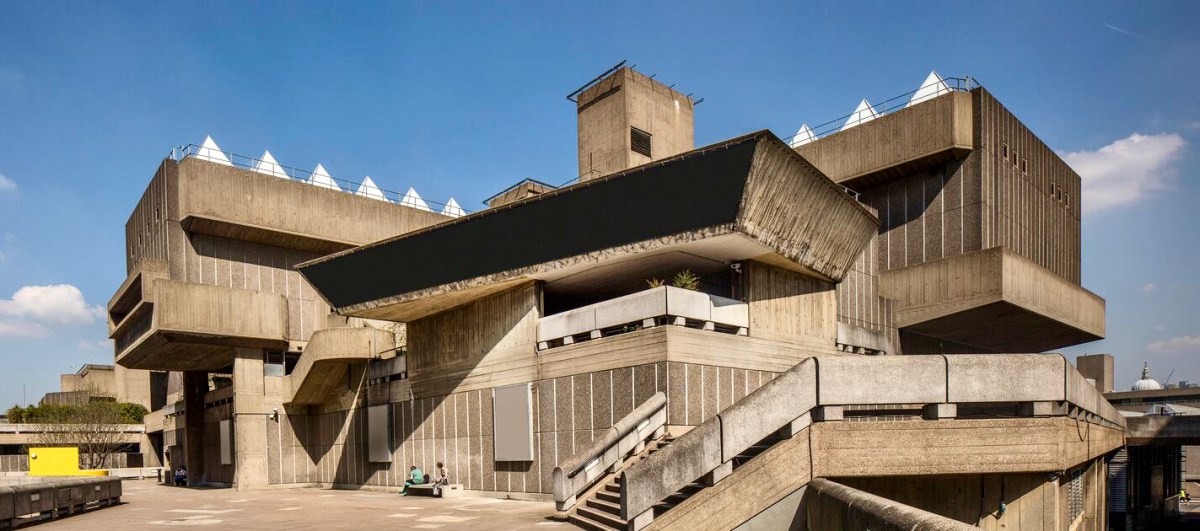
Returning to the twentieth century, and the Bantry Library project, construction posed many problems, using techniques which might have been considered at the leading edge of architecture in its time and place. Across the sea similar experiments were taking place. I was at the centre of them! I completed my architectural education in the late 1960s and went to work for the Greater London Council. I saw going up around me on the South Bank of the Thames a development which included the Hayward Gallery (below): its design (described as ‘brutalist’), earned it the nomination of the ugliest building in Britain when it opened!
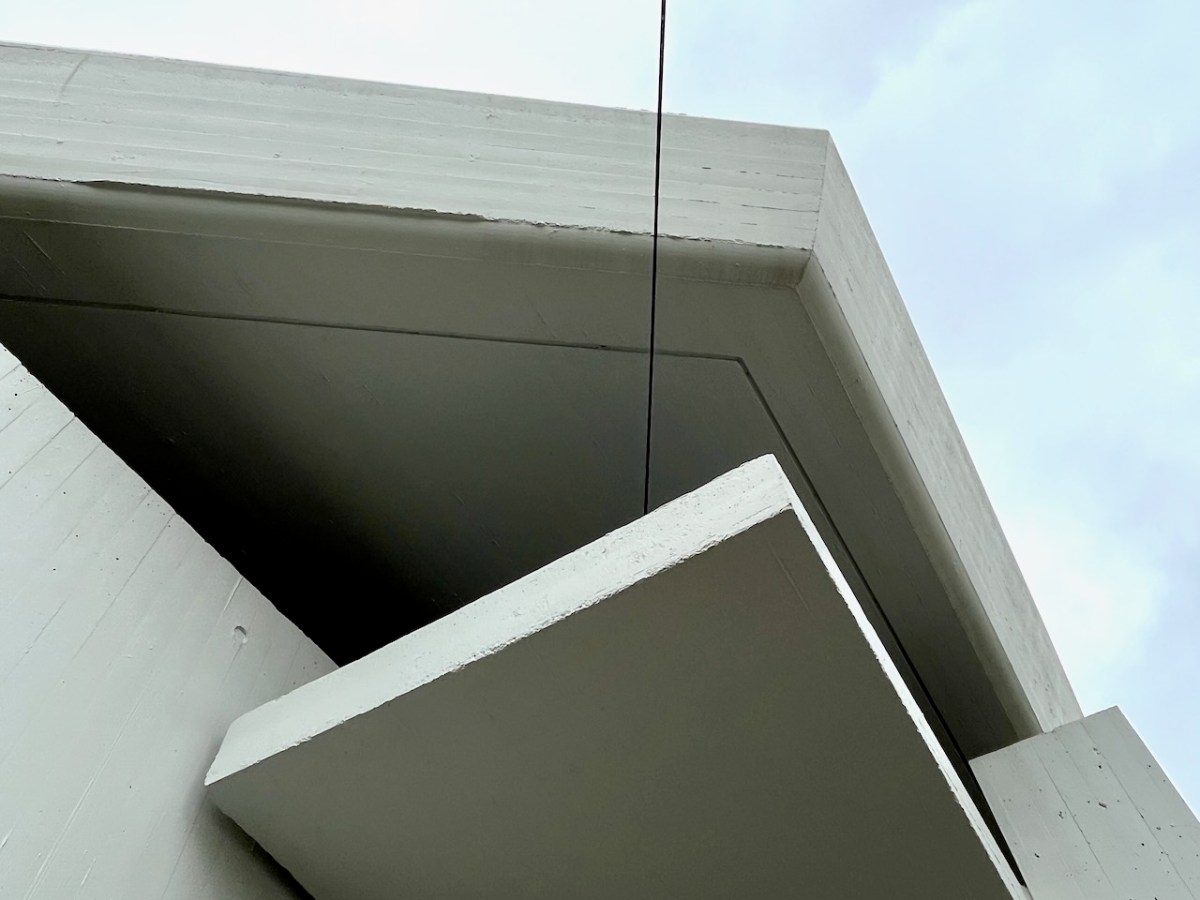
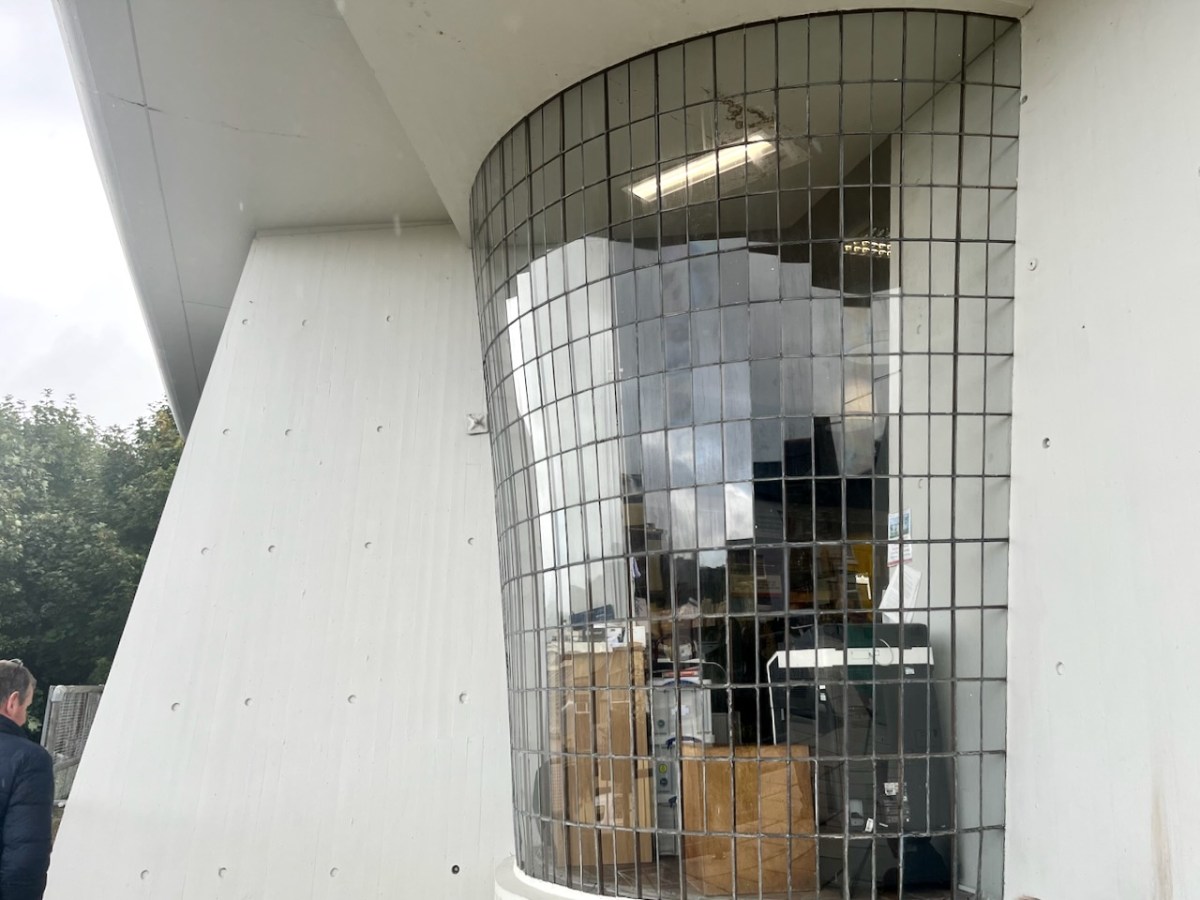
Larger in scale, this complex exhibits some of the features we see in Bantry: shutter-marked mass concrete, frameless glazing, bold overhanging roof planes… The Library roof cantilevers six metres in one part of the building.
The status of this building as an unique example of modernist architecture in Ireland has recently been recognised with a Heritage Council grant of over €250,000 to carry out refurbishments to some of the major elements.
. . . As Bantry Library approaches its 50th anniversary, we are committed to safeguarding this important building. As a protected structure within an Architectural Conservation Area, Cork County Council recognizes its responsibility to preserve and protect Bantry Library for future generations. The conservation works will take place during 2023, and we look forward to seeing the library restored to its former glory . . .
Tim Lucey, Chief Executive, Cork County Council
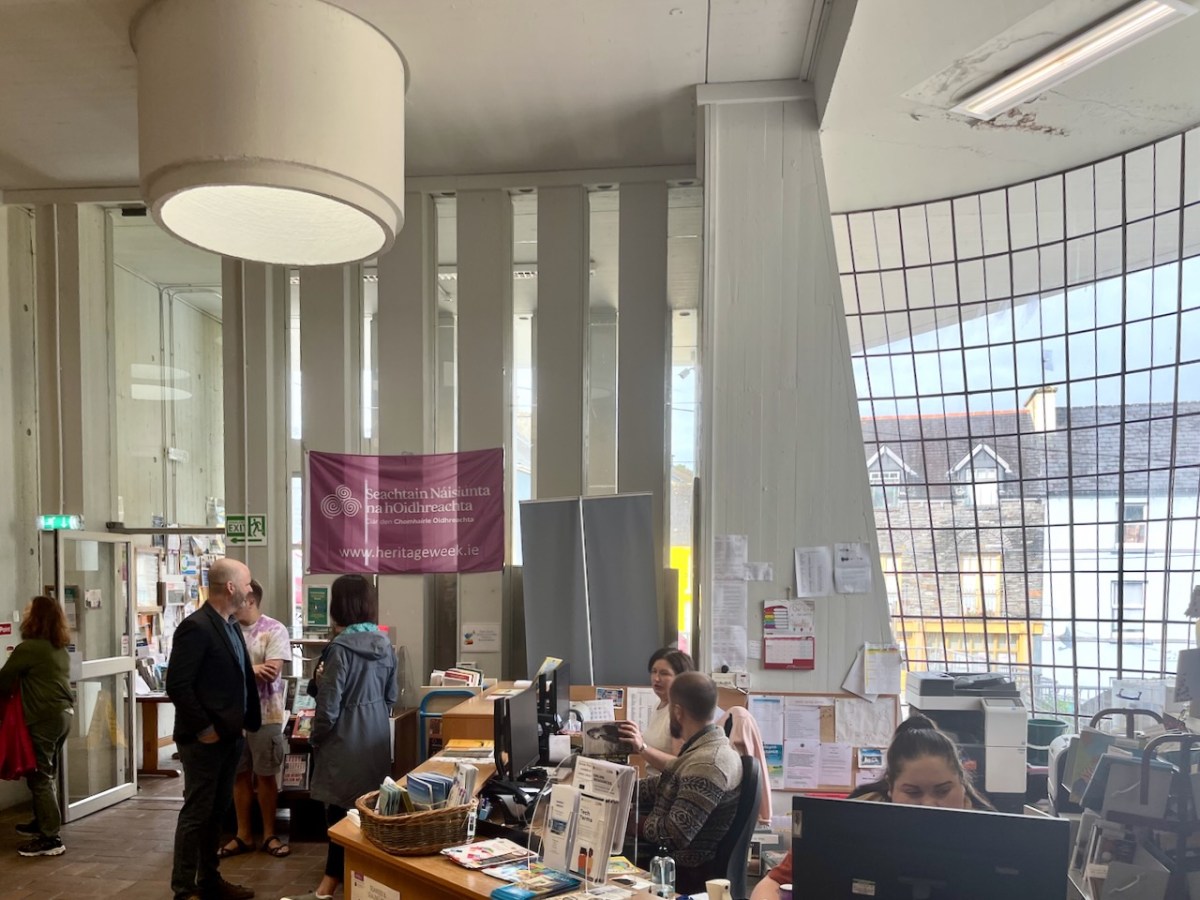
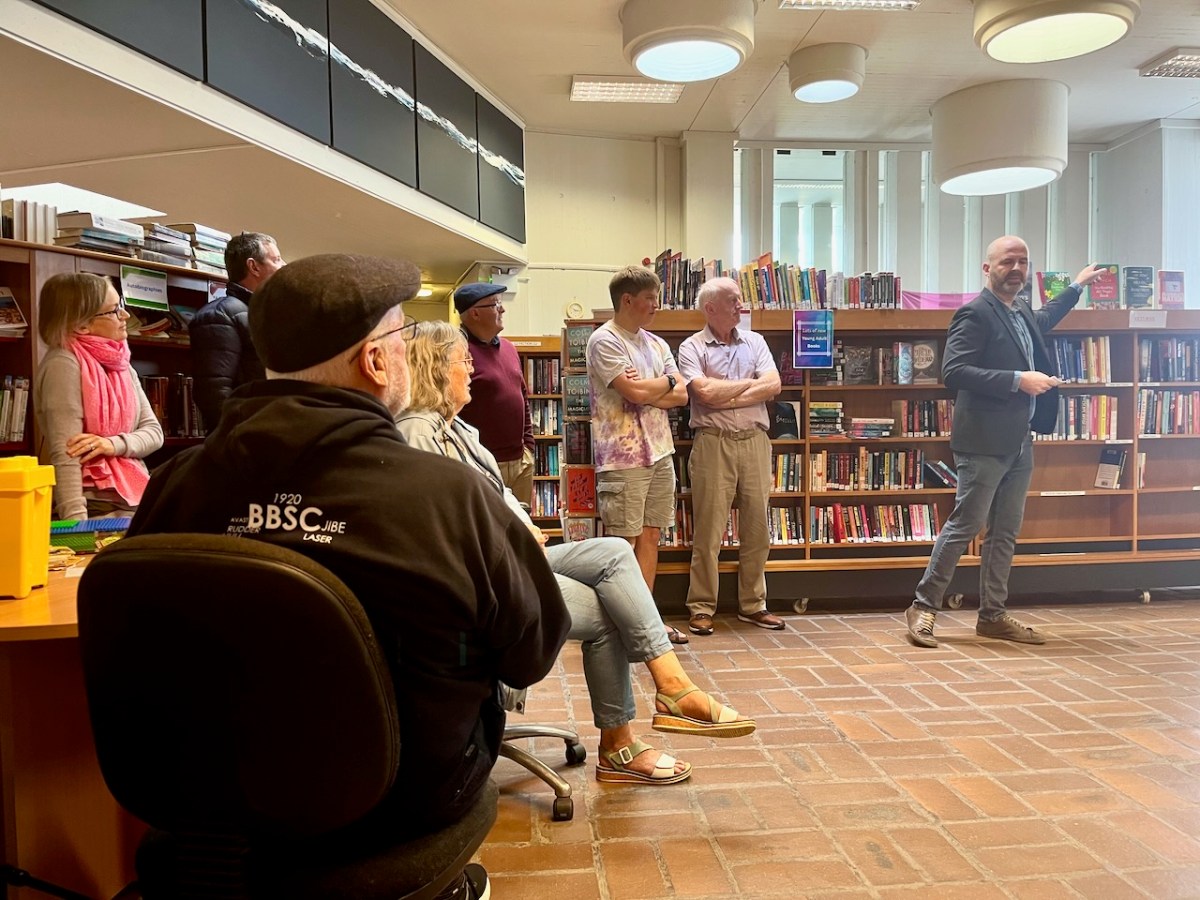
A Heritage Week talk was given by Dermot Harrington of Cook Architects at the Library (below). It was a most informative review of the building and its history.
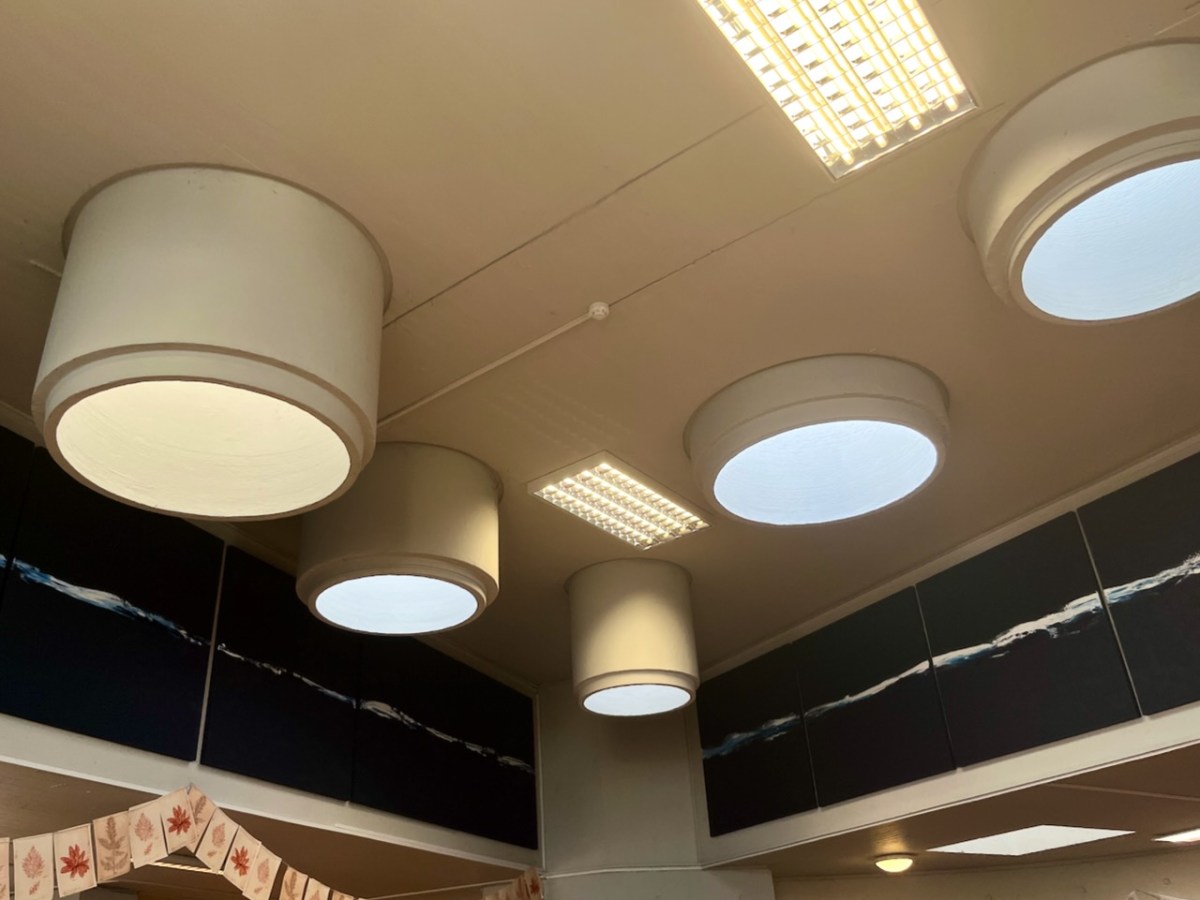
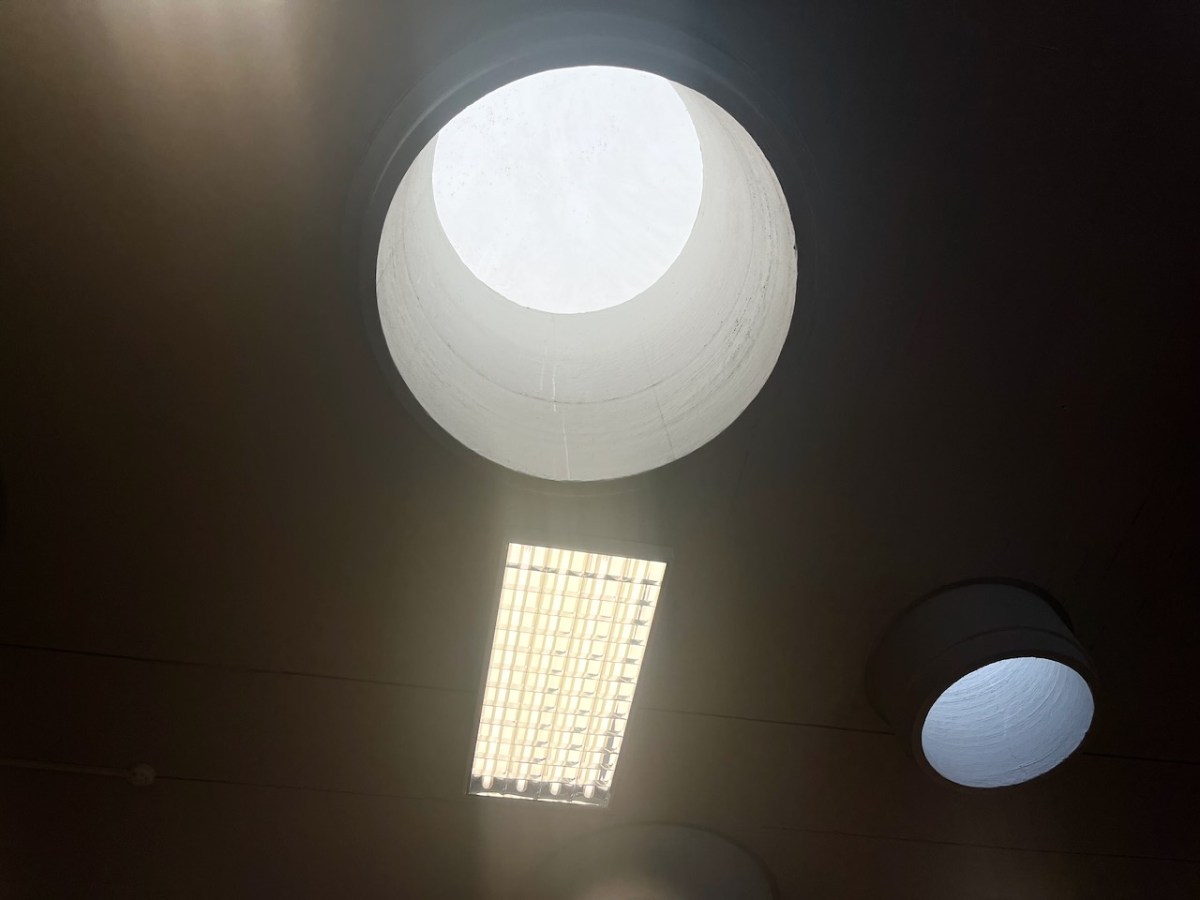
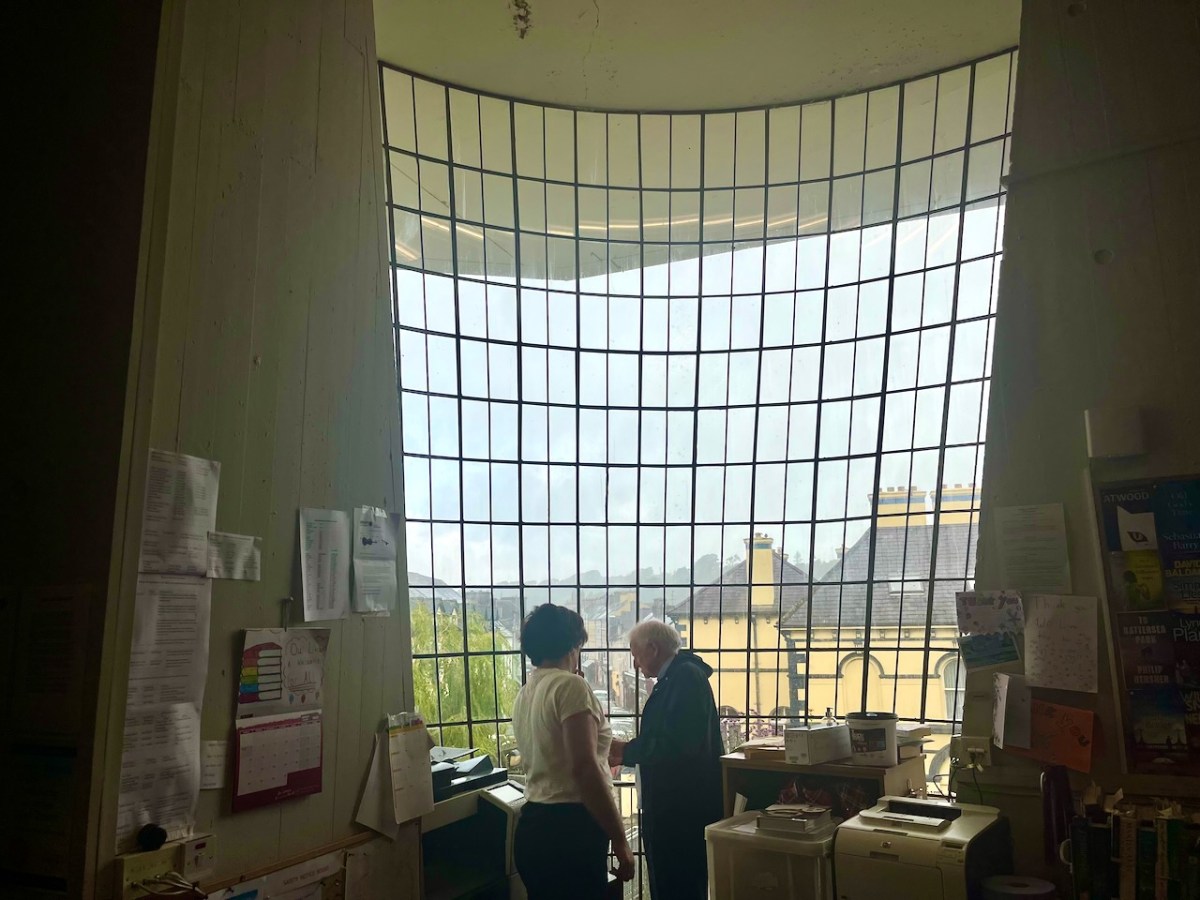
Most of the original features of the building have survived in reasonable order. I was impressed with the ‘pipe lights’ which draw daylight down into the centre of the main room:
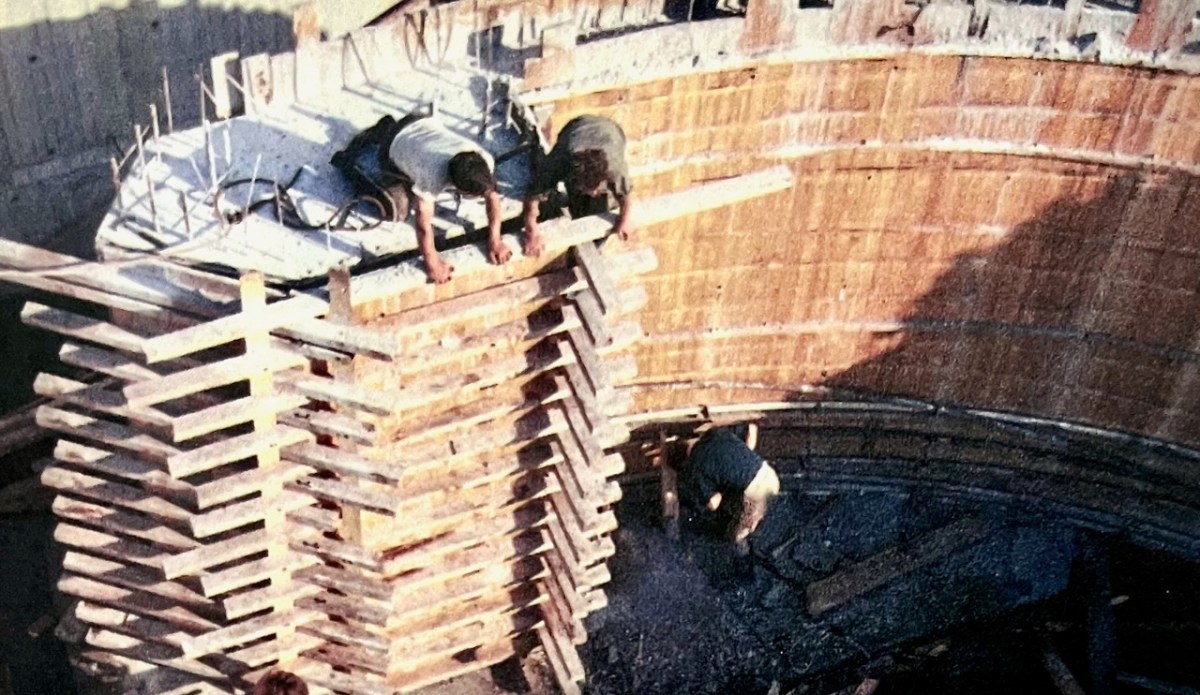
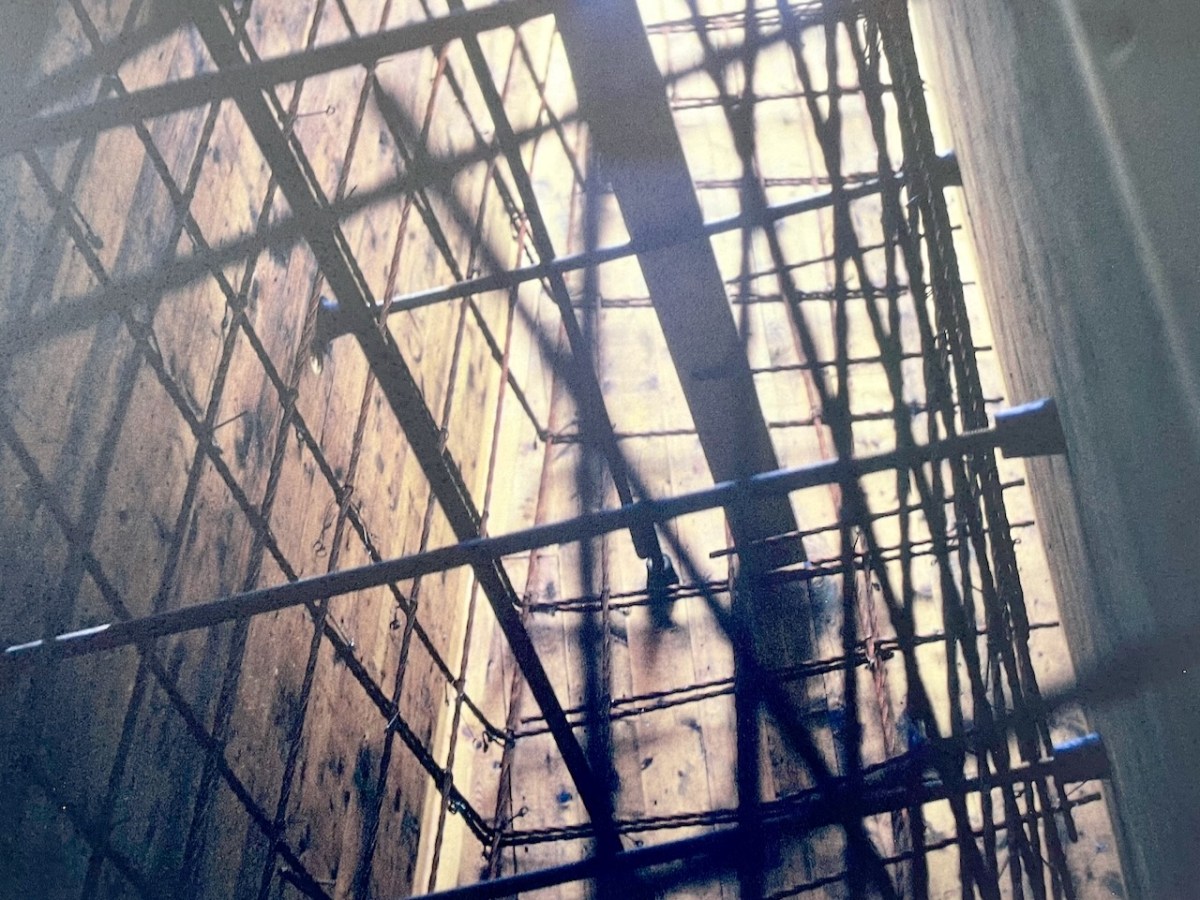
We also learned about the complexity of the building construction, and saw photographs of the steel reinforcement and board shuttering from fifty years ago:
Dermot Harrington pointed out that the building was effectively put together by only five men, under foreman Gerry O’Sullivan, who was just 27 years old. Neither he or any of the other crew had ever tackled anything like this before!
The Library is central to the life of the town, and still serves its original purpose. It’s eye-catching (perhaps sensational is a good word?) and very much alive and relevant. We look forward to the completion of the current works, and suitable festivities to mark the fiftieth birthday of this creative West Cork project.
Thank you to the Library for the information they provided and the display boards that are currently on show. Many of my illustrations are taken from these resources
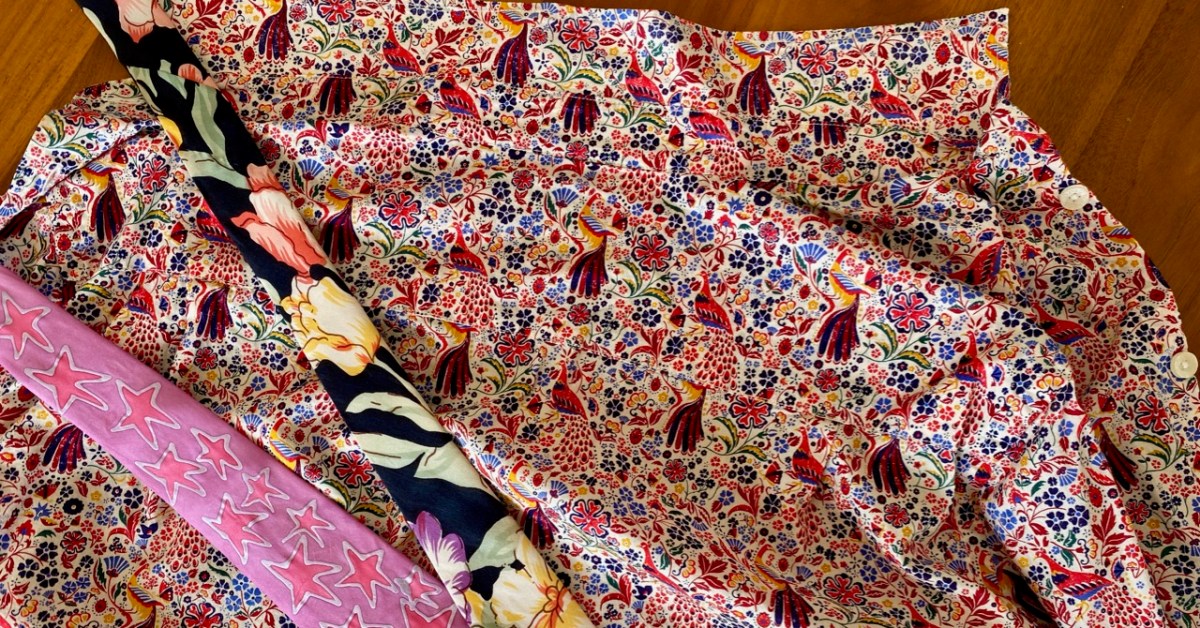
I was around in London in the early sixties, and was definitely part of the swinging Flower Power scene: beatniks, Beatlemania, Carnaby Street, flowery shirts and ties (I’ve still got some of them – below – stashed away in my wardrobe!) – the regulation Afghan coat (and its distinctive smell) . . . What I miss most, perhaps, is the purple velvet flared trousers: sadly an expanding waistline quickly did away with them.
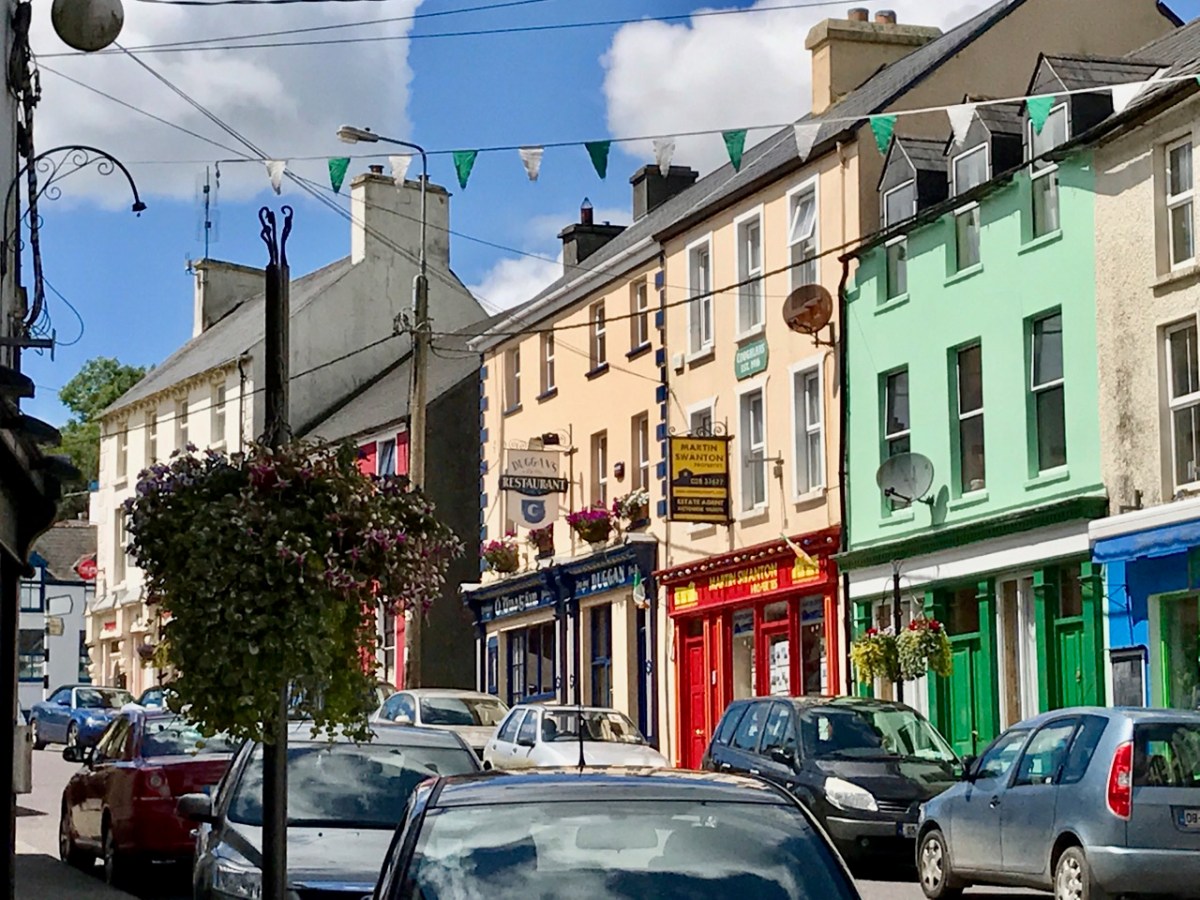
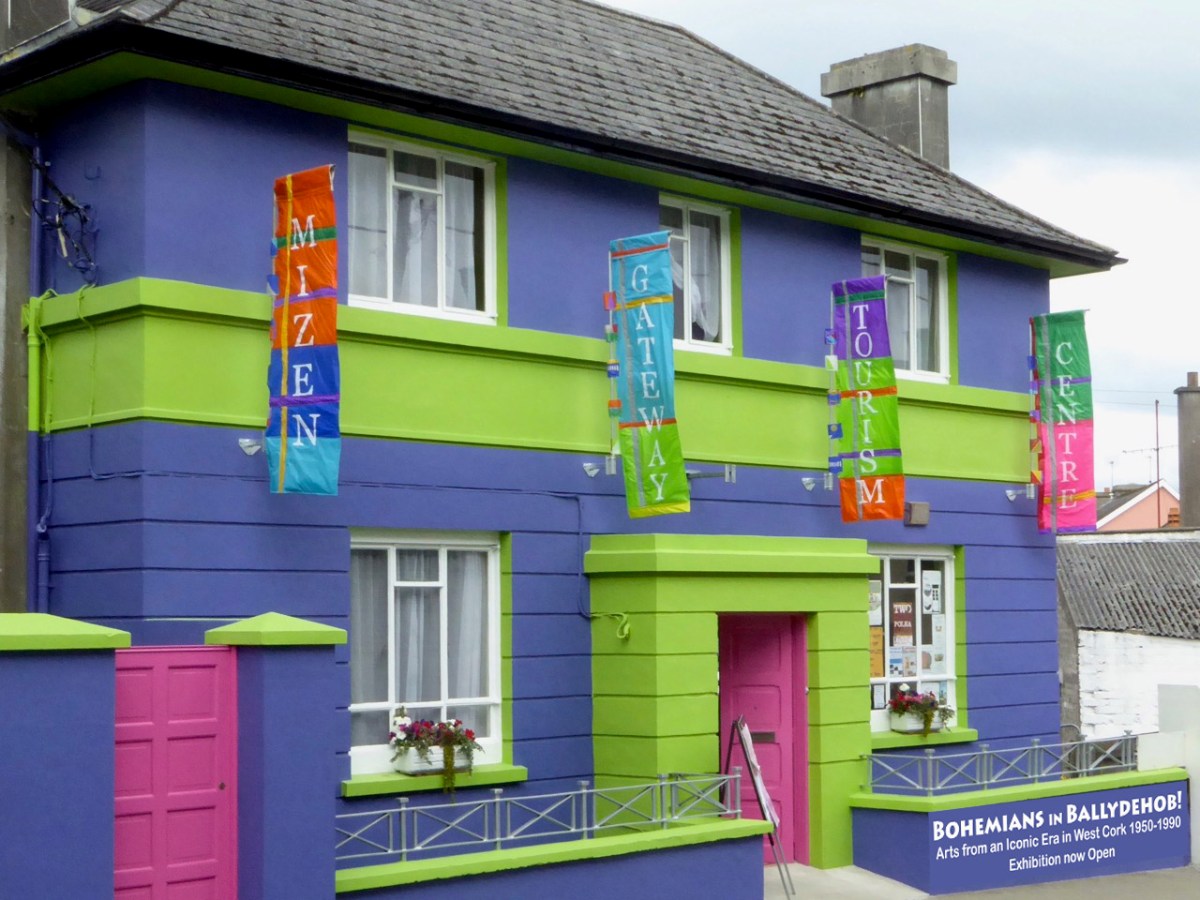
What is less well-known – in my generation at least – is the fact that there was a similar cultural phenomenon in one part of Ireland – our own West Cork! And it was centred on Ballydehob – that’s the main street, above. It’s a colourful village today – as it was then: well-suited to the cultural heritage which the artist community of the time imposed upon it. This building on the main street in those early days was particularly significant:
One of the artists who happened upon Ballydehob at that time lived on here to tell the tale (he still lives in the village and is still a working artist):
BREAKING NEWS: BALLYDEHOB IS DISCOVERED!
. . . During the early 1960s, a group of students at the Crawford School of Art in Cork, heard a rumour that something bizarre was happening in a village called Ballydehob. Here some vestige of Swinging London had taken up residence in a painted-up building called ‘The Flower House’. I was one of those students. We decided to investigate.
Since nobody owned a car, a parental vehicle must be ‘borrowed’. Somebody’s parent was away so this could be done without controversy. One of the know-it-all students announced that Ballydehob was in County Sligo and we would need money for petrol and have to camp when we got there. Nobody owned a tent. A forever-complaining student said that ‘He didn’t want to end up arrested as a vagrant and to have to sleep in a Garda station’. A few days later we left the Crawford en-route to County Sligo. Fortunately, a more astute student rummaged in the car as we were leaving the city for the West, found a road atlas and announced that Ballydehob was actually in County Cork, a mere two hours drive over the potholes. Tent-less or Garda station camping would not be required.
We arrived, we saw, we were astonished. Cork was then a darkly conservative place, ditto the Crawford and its staff members. What we found in Ballydehob was a house on the main street of the village with enormous flowers painted on the façade. It might have been in Chelsea or San Francisco. We entered to find a hive of creativity and alternative lifestyles. This was the world of women in flowing batik dresses, bearded men with bead necklaces and leather-thonged trousers. Even a cod-piece was observed. We sat in the café and drank coffee from the brownest of chipped brown ceramic mugs, ate inedible brownies and marvelled at the range of art and crafts being produced by this creative group.
This establishment, which seemed to have landed from another planet since the remainder of Main Street appeared to have experienced no visual or economic change from the images recorded in the black + white photographs of the 1900s, was run by two women, one German, the other English: Christa Reichel and Nora Golden. Here was a living example of William Morris’s dictum, ‘Have nothing in your homes that you do not know to be useful, or believe to be beautiful’.
Some ten years later, John and Noelle Verling (participants in that epic car journey) set up the Fergus Pottery in Dripsey outside Cork, later transferring it to Christa Reichel’s former premises in Gurteenakilla, Ballydehob, where it became a fixture of the creative community. A few years following, another member of the car-team, myself and Clair, came to stay with the Verlings, and also remained in the area, setting up an etching studio on the other side of Ballydehob.
Many of those who established the creative community of West Cork have died. Another generation has grown to maturity, further expanding the tradition of West Cork as a major and continuing centre of creative engagement in all of the arts, an epi-centre of delight. . .
BRIAN LALOR
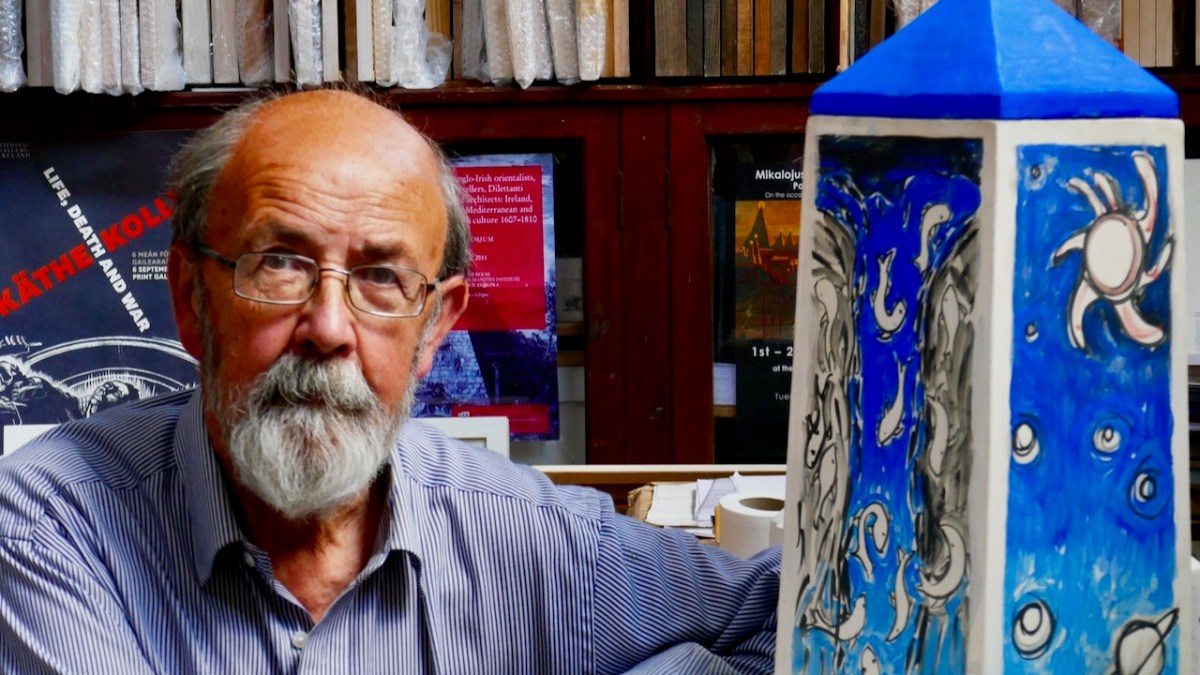
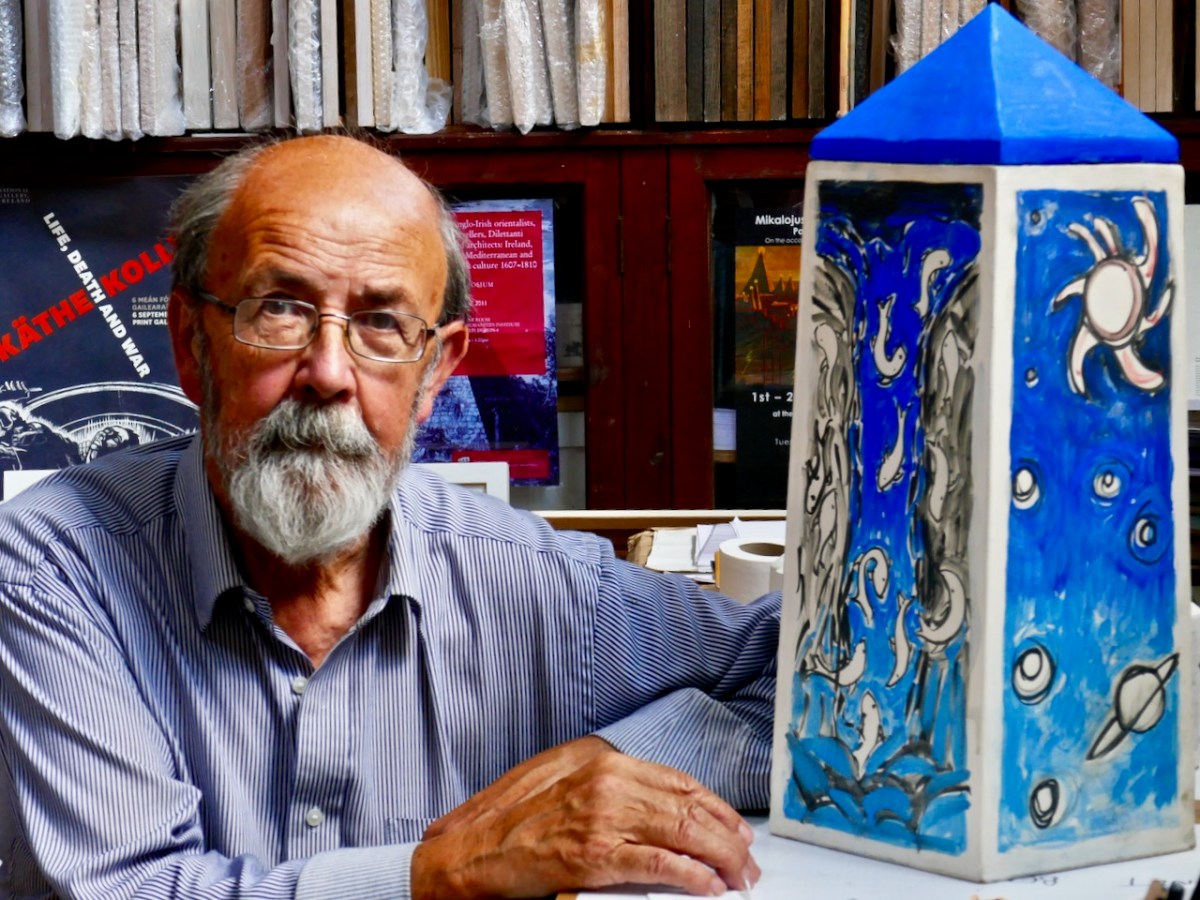
That’s Brian, in his studio today. Just a few years ago – in 2018 – he and I decided that that creative time in the village needed to be properly celebrated, and we gathered around us like-minded enthusiasts, and opened up the Ballydehob Arts Museum, using a room kindly donated by those who had taken over the disused bank building, right in the centre of town:
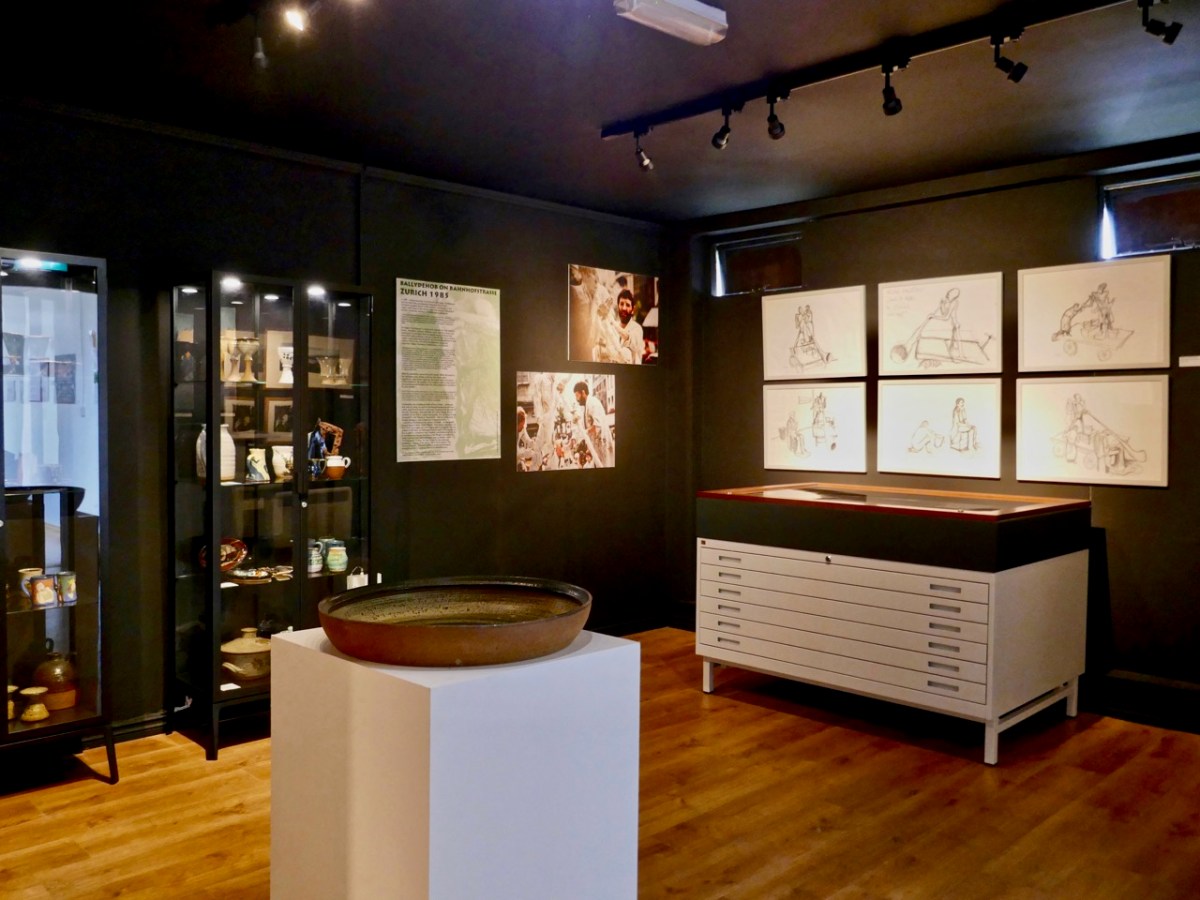
That’s the inside of the Museum above: its first exhibition opened in the summer of 2018. We had another the following year, then Covid stopped us until last year, when we featured Ian + Lynn Wright. This year’s exhibition also features a ‘couple’ of working artists: The Verlings– Noelle + John.
John Verling was a contemporary of Brian Lalor (who has written the account above), and they both studied architecture and art in London and at the Crawford in Cork. Brian has penned for us his memories of sharing a studio in London with John Verling:
THE PERILS OF A SHARED STUDIO, LONDON, 1967
. . . During the late 1960s, John Verling and I, then students of architecture in London, shared a quite substantial studio in one of the leafier areas of Kensington. The building, a large brightly lit interior behind a row of decaying Victorian villas (it might originally have been a Victorian studio, we never discovered) had many more recent uses and the first task on gaining possession was to somehow manage to get rid of what had been left behind by earlier tenants; office furniture, old matresses, much unidentifiable plumbing apparatus and a stuffed fox whose pelt had been consumed by moths, were among the challenging contents.
Conversation among acquaintances in our local, the Norland Arms, evoked interest from other drinkers, an English sculptor and a South African photographer who asked could they share the space and, very willingly offered a down payment on the rent. This was agreed and not long afterwards the studio became operational, with both John and myself busy creating in our new-found haven, with only the occasional appearance of our fellow tenants. John was at that point concentrating on elegant photomontages as well as complex drawings of Portobello costermongers and was extremely productive, while I was engaged in a substantial series of elaborate and brightly coloured timber constructions enhanced by scaffold clamps, in a latter-day Bauhaus manner. Time passed, various local artists called to view the work and admire the space. We were exhibiting successfully and the studio became in W H Auden’s phrase, ‘the cave of making’. Our fellow studio members failed to turn up and when occasionally encountered in the Norland, expressed embarrassment in being behind with the rent while offering a contribution to ‘keep their name in the pot’. This was an extremely satisfactory situation with individuals happy to subsidise the rent but too busy to actually attend the studio.
A chance encounter in the Norland brought another hopeful artist to our acquaintance, David O’Doherty, Dublin painter, he worked at the international telephone exchange. He came, he admired the studio, and invited himself to join. Fatally, we agreed. An accomplished portrait painter, he often had a sitter posed, but seemed happy to work on, undisturbed by the other occupants. Our new tenant was affable, expansive, a storyteller. He became a permanent fixture. Suddenly we realised that we were entertaining a cuckoo in our midst. O’Doherty had moved in permanently, camp bed, small stove on which there was always a fry-up in progress, an endless stream of visitors, large canvasses propped against the wall, and the catastrophic revelation of his other occupation; he was a keen traditional musician, devoted to the Uillinn pipes. Suddenly the space, ample for John and myself to pursue our work, had begun to feel like a home for the demented.
Gradually it became apparent that our studio, which a year before had been, in the midst of the city’s turmoil, as quiet and remote as a stylite’s pillar, had metamorphosed into Picadilly Circus with noise, air pollution and crowd control issues. The dream of having a secure place in which to create had floundered on the fatal choice of an individual whose concept of an ideal workplace was perilously close to Francis Bacon’s taste for irredeemable chaos. I bailed out, John lasted a little longer. And the completed series of brightly coloured scaffold-clamp constructions, what of them? Occasionally I received reports of their travels. Before he emigrated to Boston, O’Doherty sold them to a construction company and they were later spotted decorating the foyer of a social welfare office in Amsterdam. After that only blessed silence . . .
BRIAN LALOR
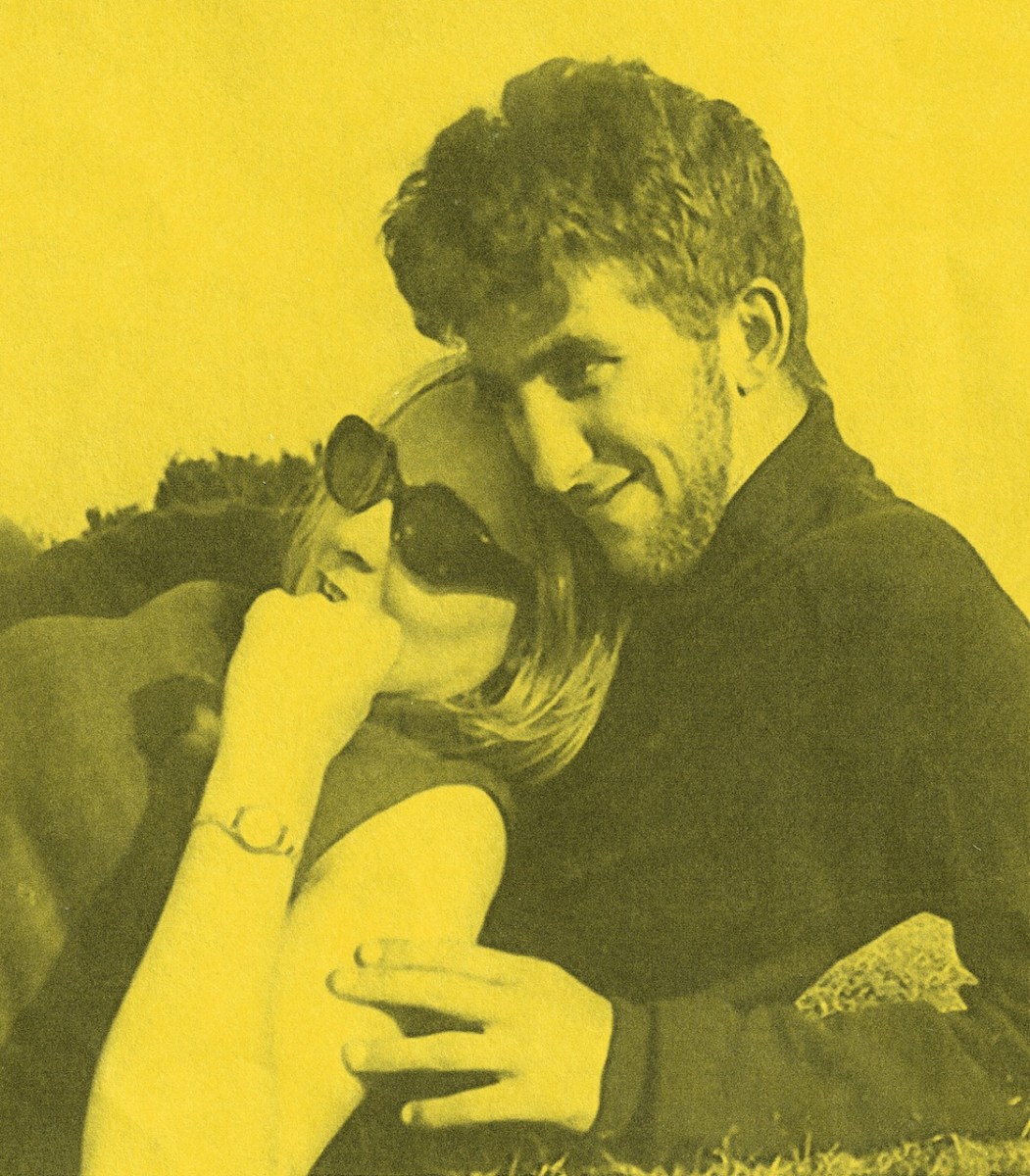
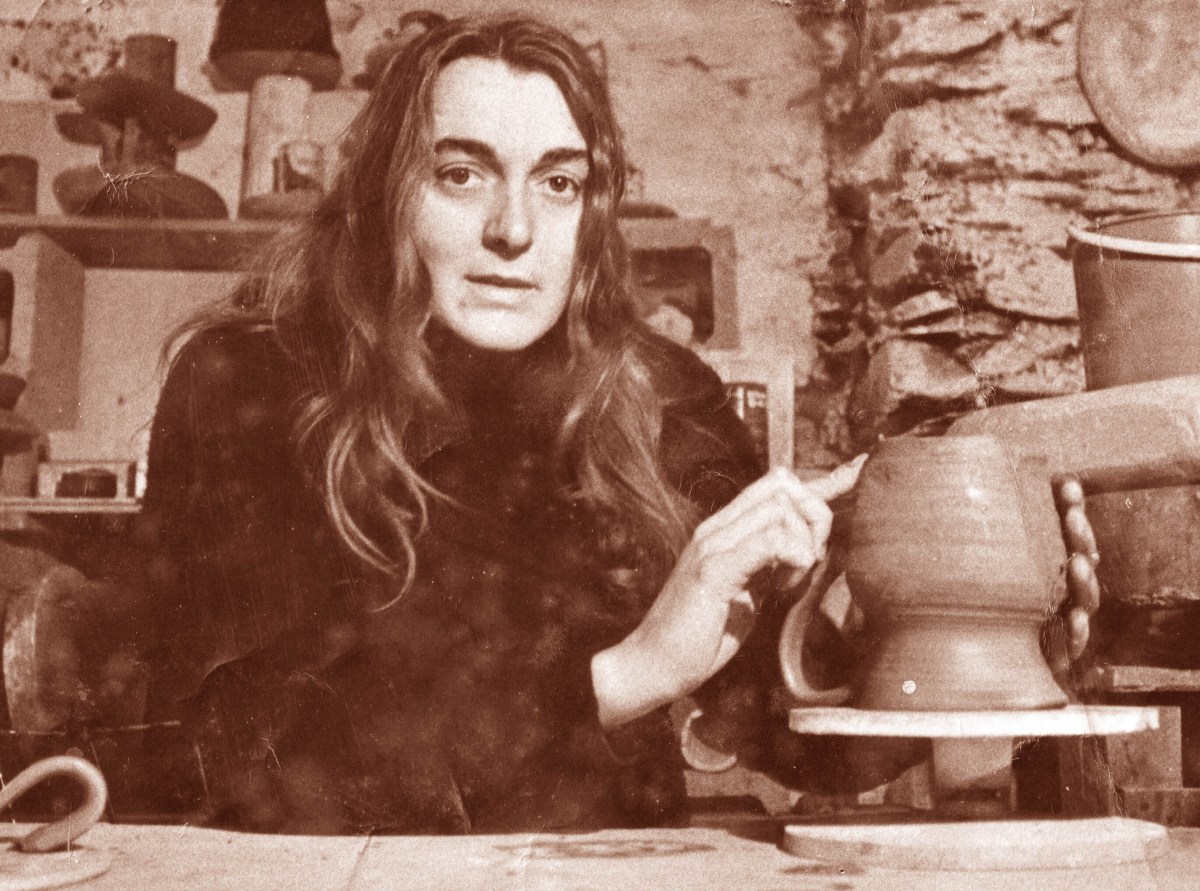
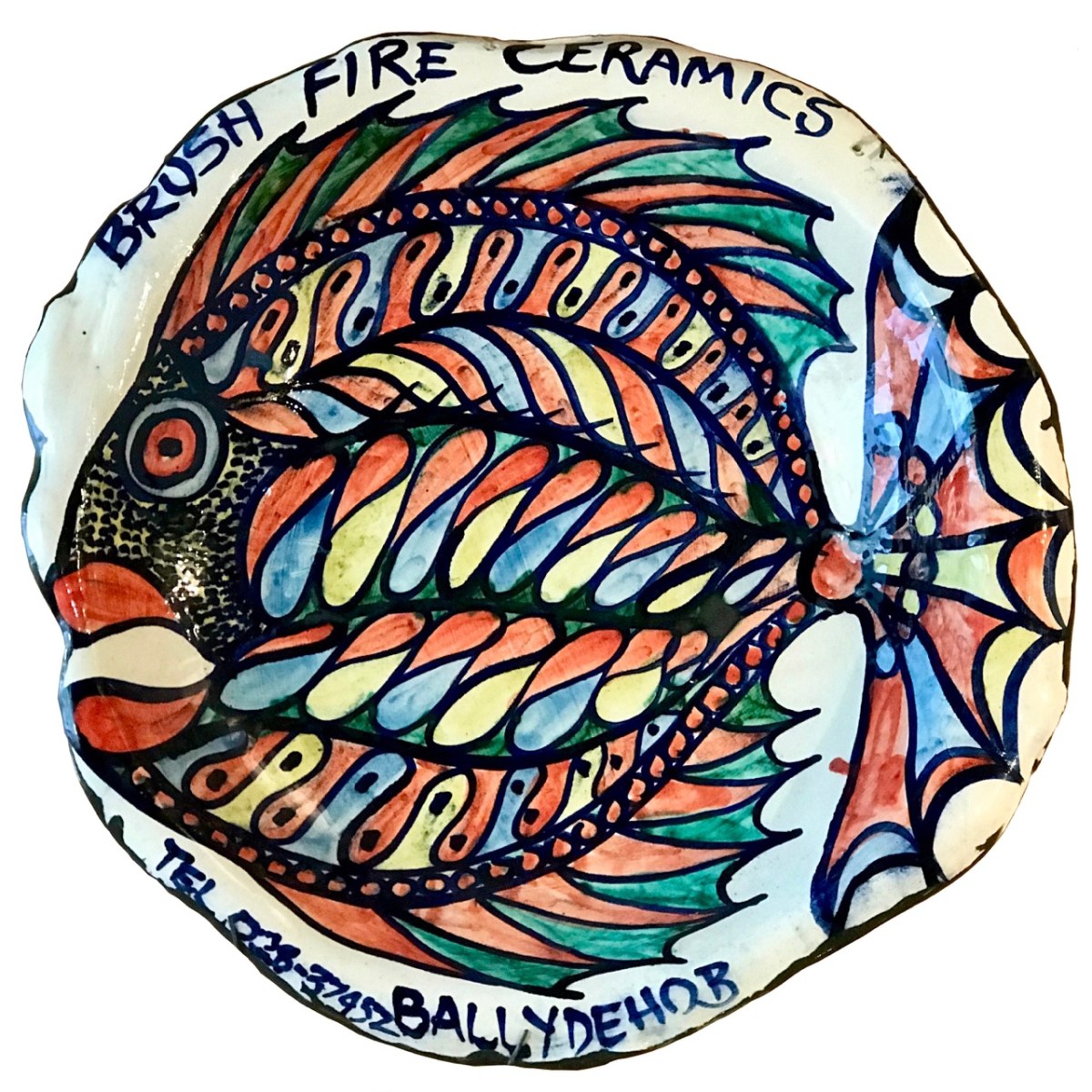
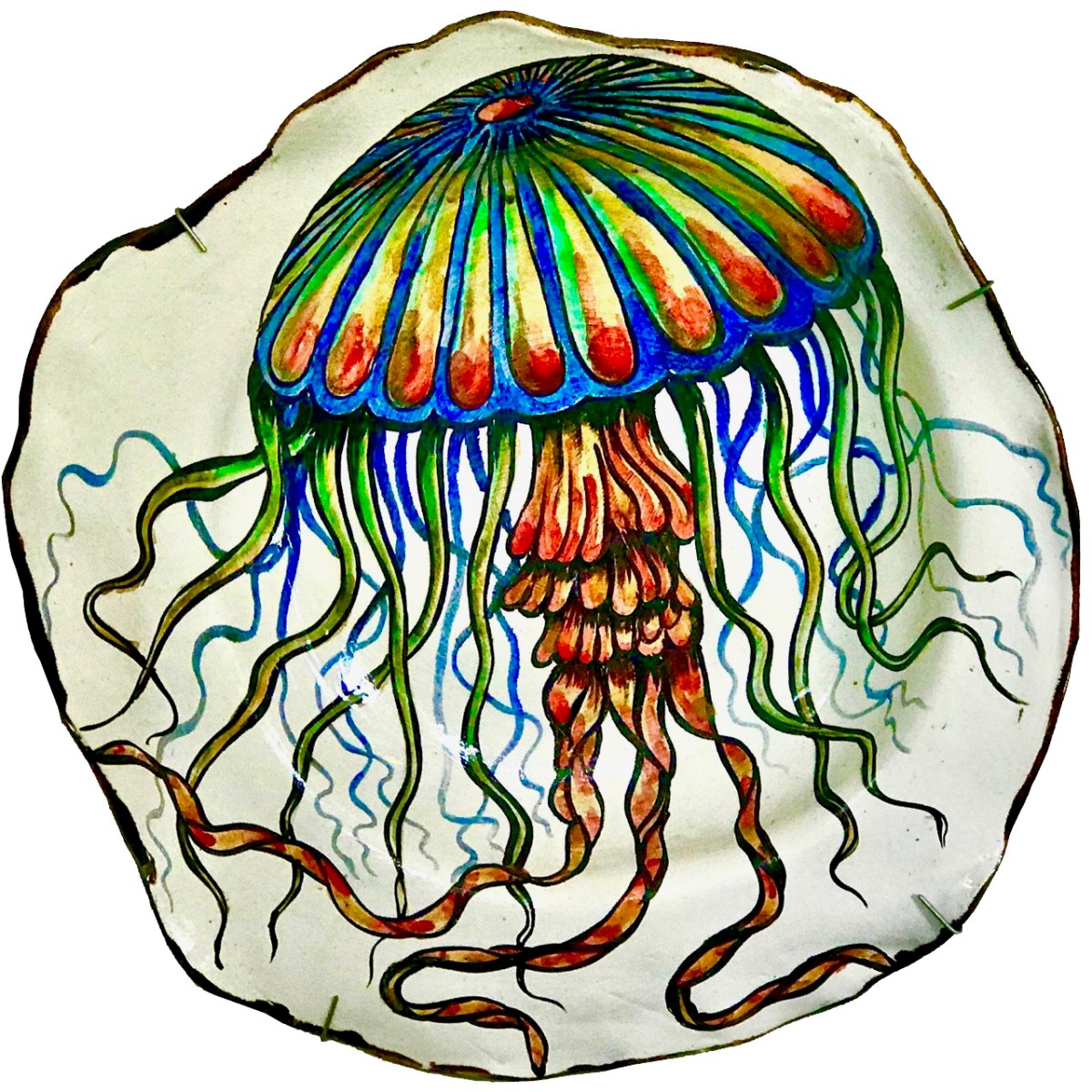
Noelle Verling (above) studied ceramics at Hammersmith College of Art. She and John met and married and – when they moved back to Ireland in 1971 – John & Noelle Verling established the Fergus Pottery in Dripsey in 1971 with Noelle as potter. She produced a wide range of domestic ware at Dripsey. When they moved in 1973 to Ballydehob to take over Christa Reichel’s studio, they adapted Reichel’s press-moulds and Gurteenakilla pottery stamp for their own work and from then on, traded as Gurteenakilla Pottery and latterly as Brushfire.
. . . The Verlings loved the windswept West Cork landscape and felt moved to record a disappearing environment. John’s paintings often depicted the doors, windows and walls of decaying buildings, repositories for the memories of past inhabitants, long gone. The windswept thorn tree is a familiar motif which connects John Verling with West Cork: the tree became his icon and frequently appeared in his paintings and on his ceramic work . . .
Alison Ospina – West Cork Inspires 2011
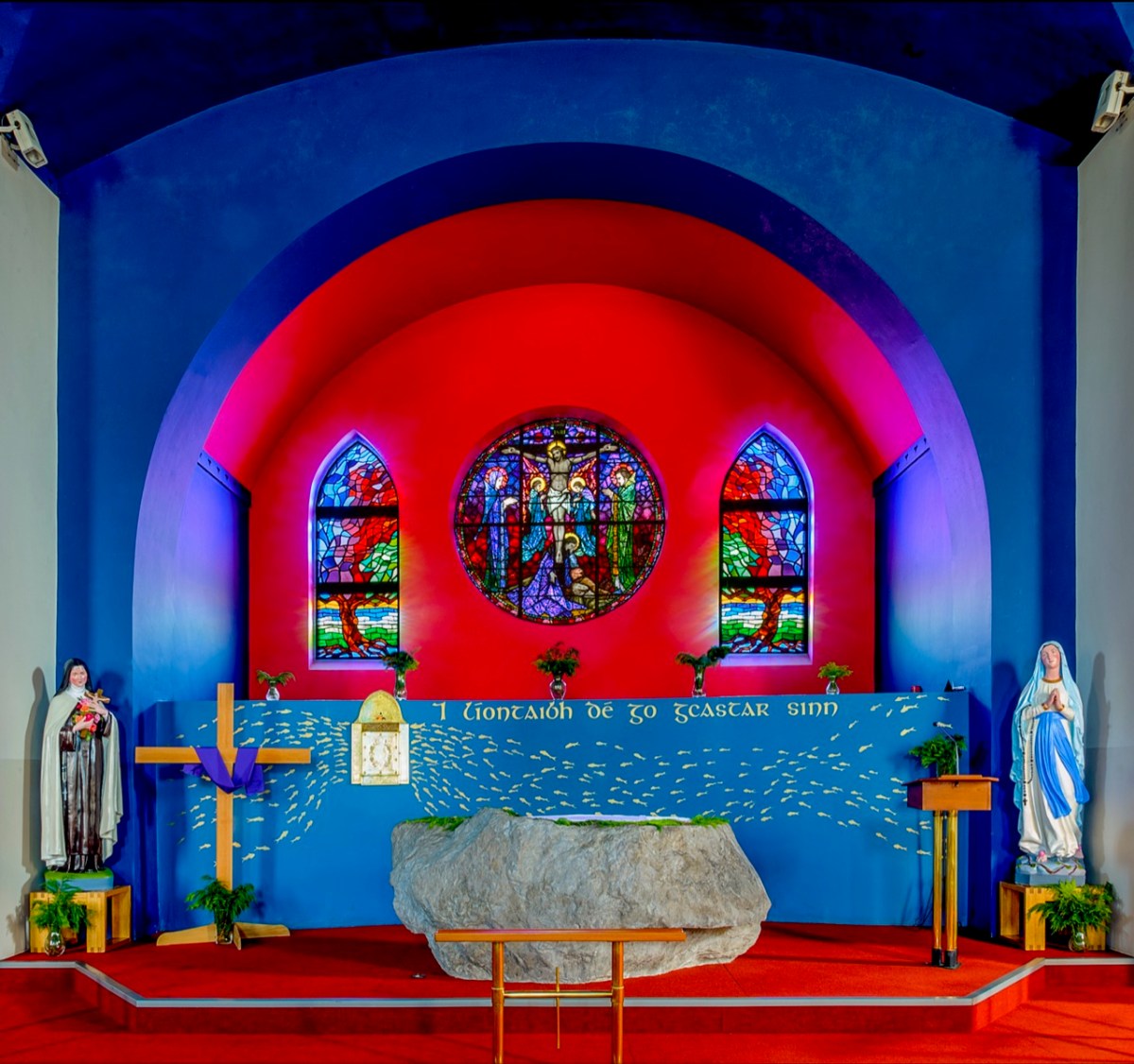
This is a rare photograph of John working on one of his favourite subjects: the gnarled thorn tree suffering from the ravages of harsh West Cork gales. Among the architectural work he undertook voluntarily was the reordering of the east end of St Bridget’s Catholic Church in Ballydehob. This was a major work.
. . . The gold fish hand drawn in the background of the altar and the depiction of one fish swimming against the shoal continues to evoke admiration from locals and visitors alike. He also designed the two ‘windswept thorn’ stained glass windows and etched the brass surround of the tabernacle. The Altar slab, composed of a vast monolith like the capstone of a dolmen, is a distinguished piece of sculpture and a tribute to his imaginative capacity . . .
Special thanks to Geoff Greenham for giving us this superb photo of St Bridget’s Church, Ballydehob.
The sign for the Brush Fire Ceramics Pottery, created by Noelle and John. They successfully produced a large number of individual pieces, crafted and fired by Noelle, and decorated by John.
John Verling died in 2009. Noelle Verling is living in West Cork and has been extremely helpful in providing material and information for this exhibition. Without her we would have been unable to fully present this story.
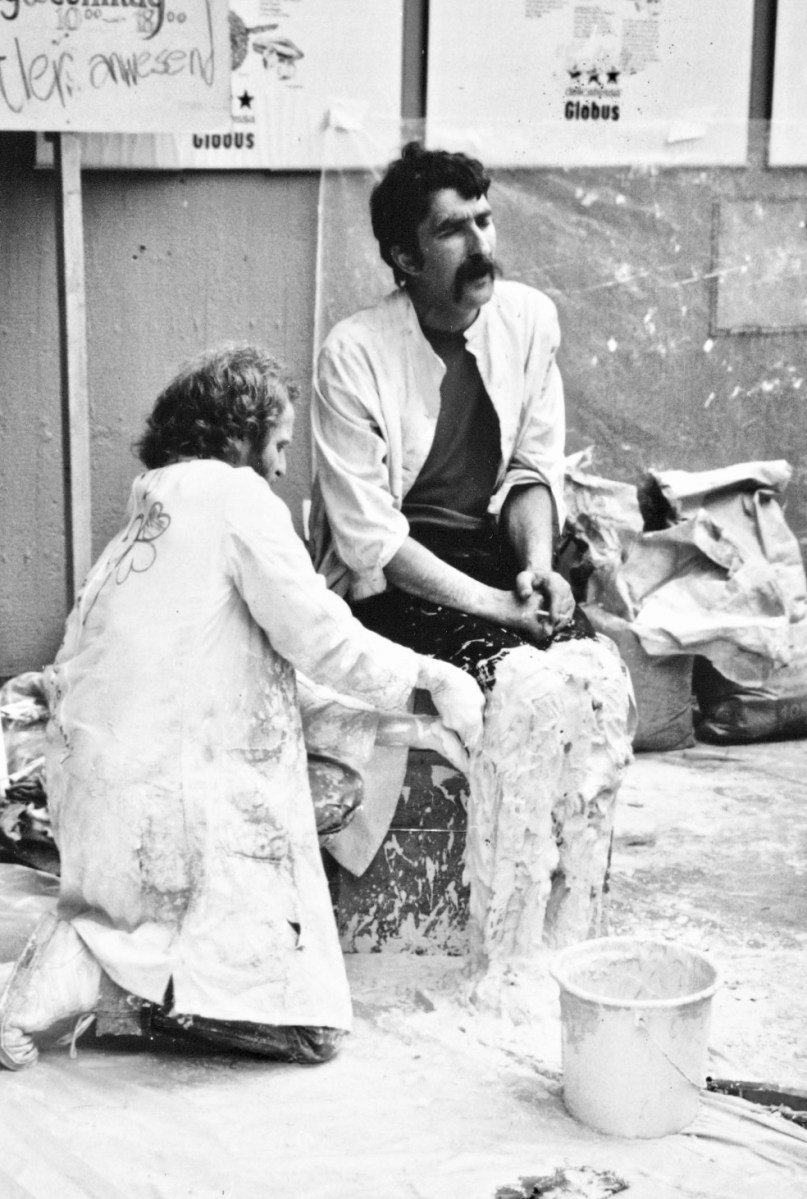
That’s John Verling in the picture above having his legs plastered by Ian Wright: this was part of a publicity stunt for the visit of a large group of West Cork artists to Zurich in 1985. John is also singing a folk song! You can read more about that particular enterprise here.
The Ballydehob Arts Museum is grateful to the town’s Community Council for providing the accommodation for the Museum. BAM is: Brian Lalor, Robert Harris, Sarah and Stephen Canty. Their combined knowledge and practical experience has ensured that our ambitions for this – our fourth exhibition – are fully realised.
Exhibition opens Jazz Festival Weekend in Bank House: Thursday 27 April @ 5pm, then Friday 28 April to Monday 1 May: 11am – 4pm. It will open with the Tourism Centre from June to September 2023
Welcome to the UCD Library Cultural Heritage Collections blog. Discover and explore the historical treasures housed within our Archives, Special Collections, National Folklore Collection and Digital Library







 Roaringwater Journal