Watson’s Brian Boru: One Window, 7 Stories

Story 1: Jasmine

The first story concerns Jasmine Allen – she is the charming and erudite Curator of the Stained Glass Museum in Ely, in the UK. At a recent Stained Glass Symposium in Trinity, she showed us how stained glass studios were advertising their artistry and products at exhibitions in the late nineteenth and early twentieth centuries in Britain and Ireland, starting with the Great Exhibition in 1851, but happening at regular intervals after that. The Irish International Exhibition was held in Dublin in 1907. It was inspired by the success of the Cork International Exhibition of 1902 (see Robert’s post about that here) and even copied their thrilling water slide!  For a marvellous collection of images from that exhibition, see this Flikr Album from the Church of Ireland. The story of their discovery is also fascinating.

Irish international exhibition from Herbert Park, by National Library of Ireland on The Commons

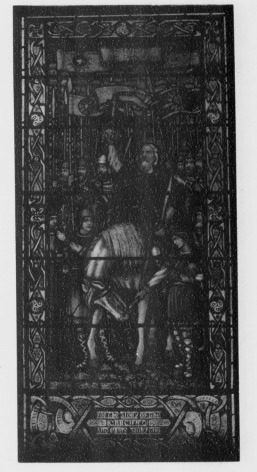
One of the exhibitors was James Watson and Co of Youghal. Jasmine subsequently sent me this image, saying: Catalogues of these exhibitions are all too brief and I would love to know what happened to it. Is it in a church or secular building in Clontarf? I only have a very bad image from the Art Journal (early b+w photography was worse than engraving for capturing stained glass!)
Story 2: Michael

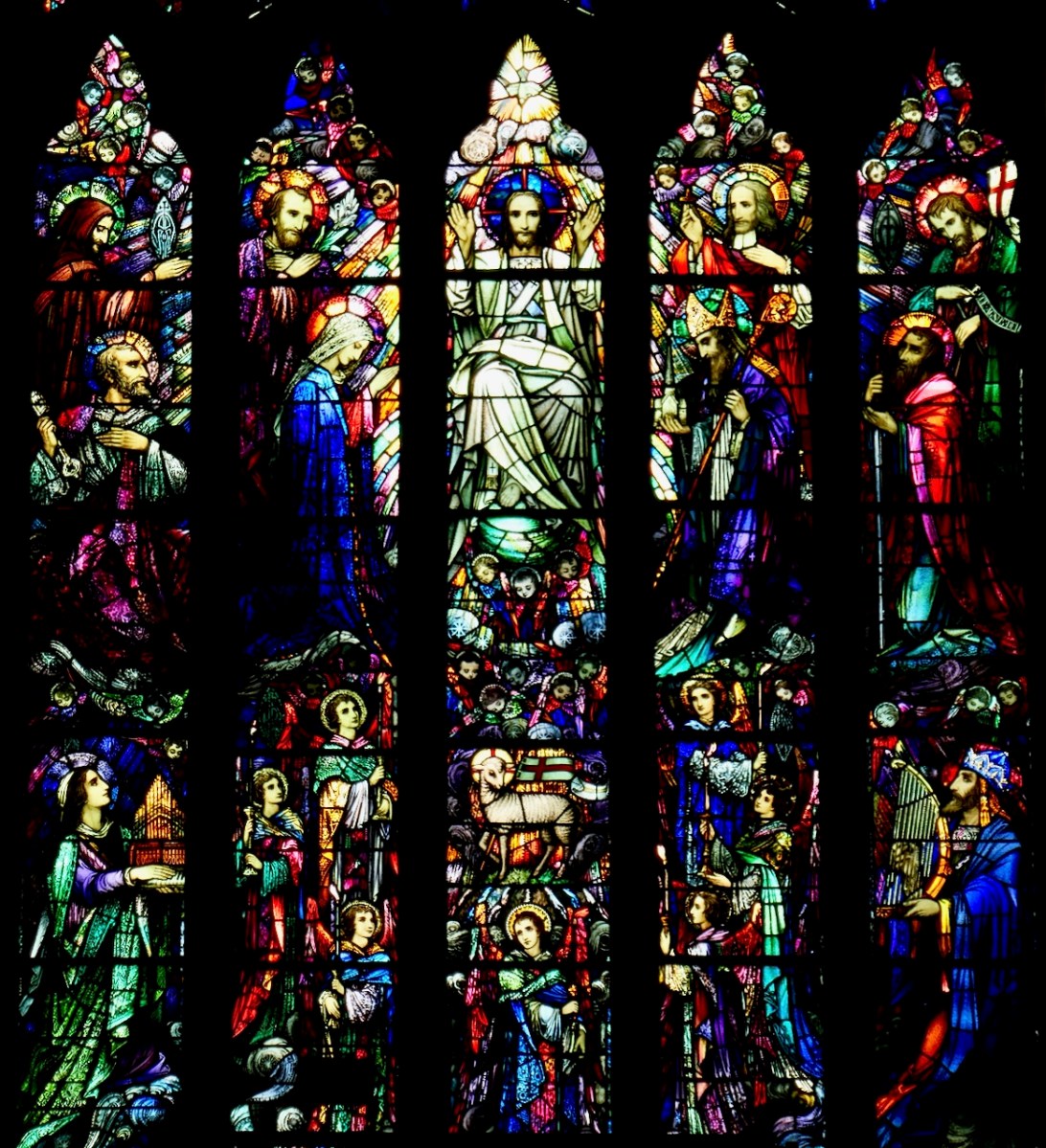
I sent the photo to the group of colleagues, mostly contributors to the Gazetteer of Irish Stained Glass with whom I correspond on a regular basis and who are always helpful, asking if any of them knew the fate of the window. I got several “no idea” responses and then I heard from Michael Earley. Anyone interested in Irish stained glass will be familiar with the name of Earley, and Michael Earley, a great-grandson of the founders, has just completed doctoral studies on the Studios. I’ve featured Earley windows here and there in my blog posts, but here’s an example of their work – you will find it everywhere throughout Ireland, often distinguished by glass of unique and brilliant colour, enormous packed scenes of multiple angels and saints surrounding a central images, and beautifully rendered figures. Here’s one from St Aidan’s Cathedral in Enniscorthy.
Michael didn’t know what had happened to the window, but he did send me two pages from the Irish Catholic Directory of 1908. The first page was an advertisement for James Watson and Co, The Art Work, Youghal, Co. Cork. Here it is:
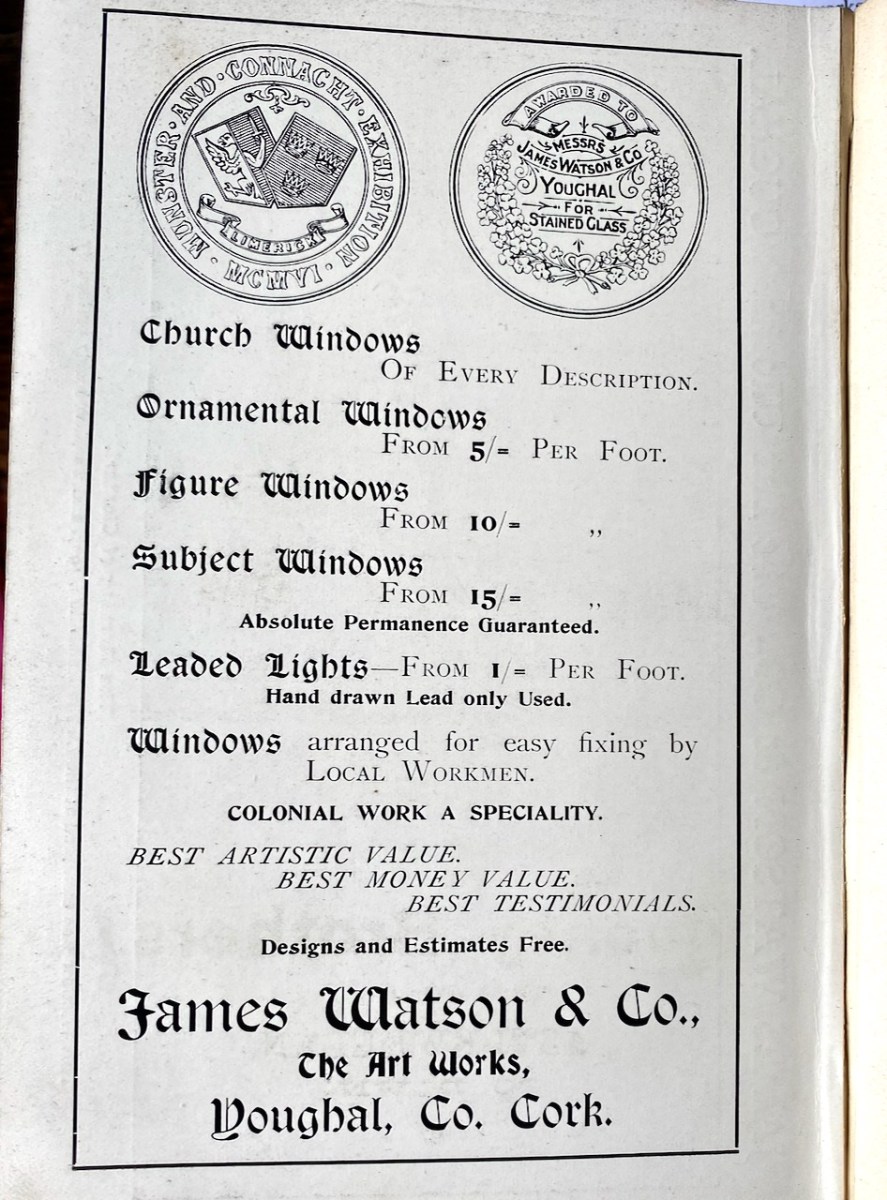
Much to savour in this ad – the prices, the variety of windows, “colonial work”. . .  The second page, though, hit the jackpot. It was from the same Directory, and was a full scale black-and-white photograph of the window. Titled The Morning of Clontarf, a subtitle reads “This window was exhibited at the Dublin Exhibition, 1907, and was favourably noticed by The Art Journal”. 
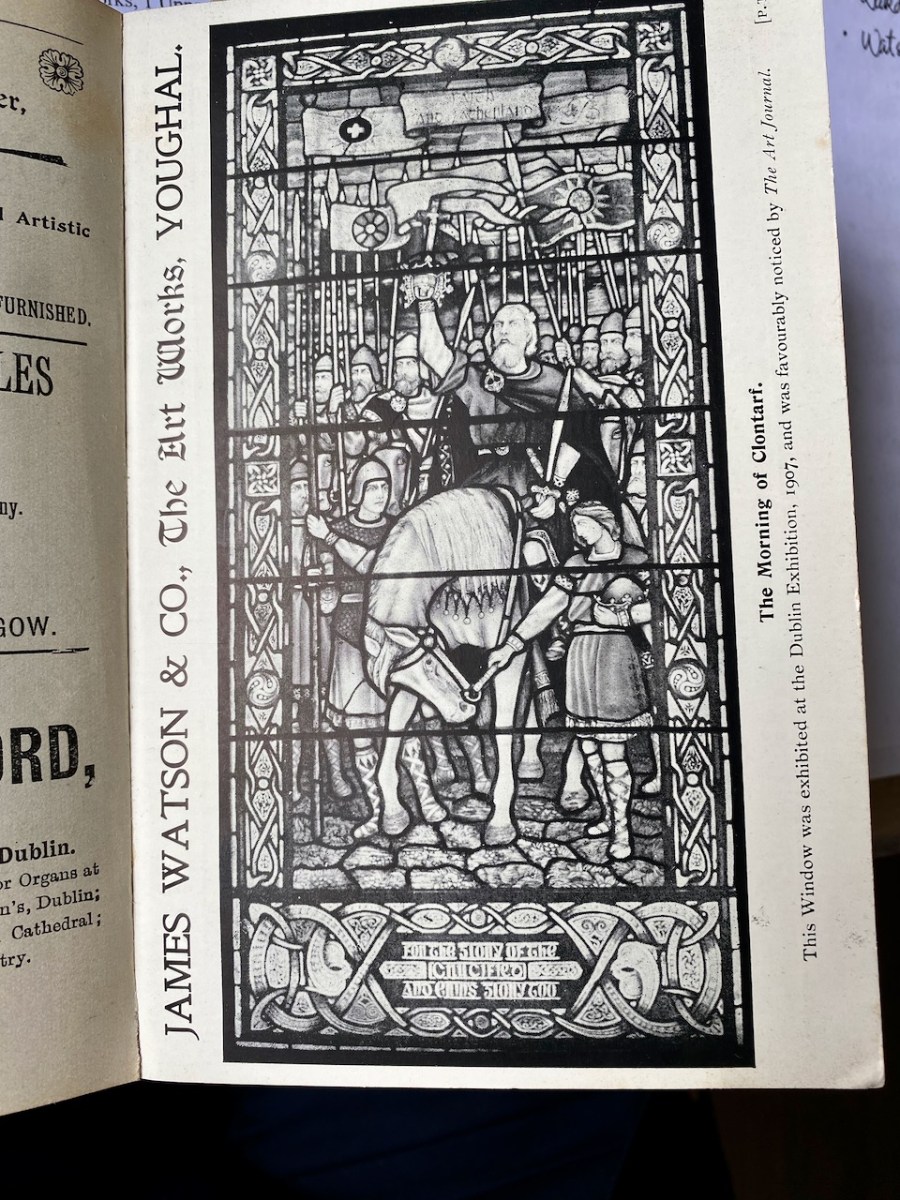
Now I had an excellent image with which to pursue my inquiries – and I knew exactly who to consult!

Story 3: Vera

The art historian who knows more than anyone else about Watson of Youghal is Vera Ryan. In fact, it was Vera who curated the Crawford Gallery 2015 exhibition of the Watson Archive, when the Crawford acquired the Archive. She also wrote the piece on Watsons:  Divine Light: A Century of Stained Glass, in the Summer 2015 edition of the Irish Arts Review. A couple of years ago, when I was trying to find information on a Watson window which was the centrepiece of an article I was writing for the Clonakilty Historical and Archaeological Journal (now published and available here), Vera mentored me as I tried to dig my way through the archive. We have been exchanging information ever since. 
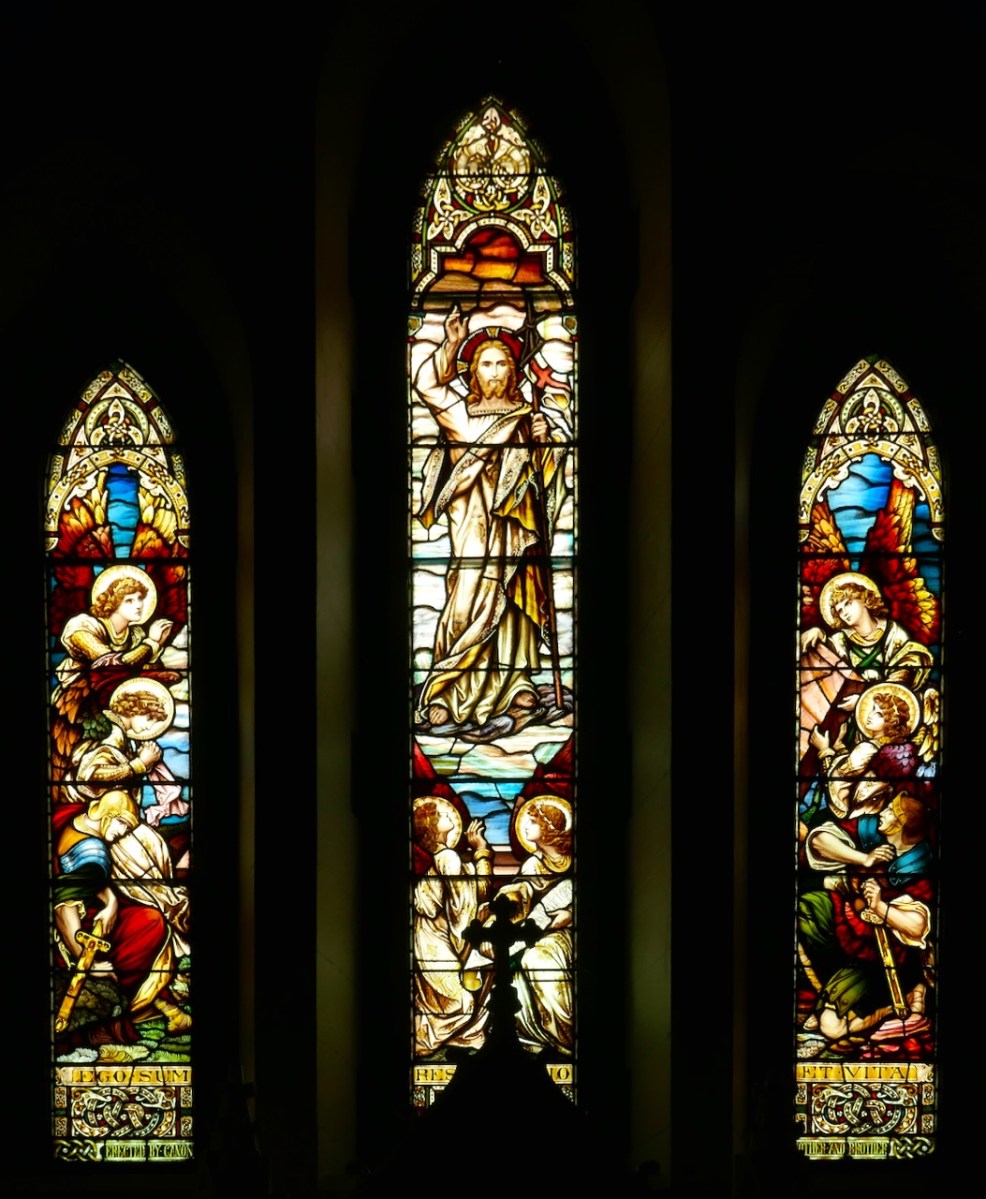
Above is a window in St Michael’s Church, Tipperary, erected in 1914. The design (below) and cartoon (below below) for this window were still in the Watson Archive and were displayed in the Crawford Exhibition. This represents a special opportunity to see the evolution of a stained glass window from concept to completion. 
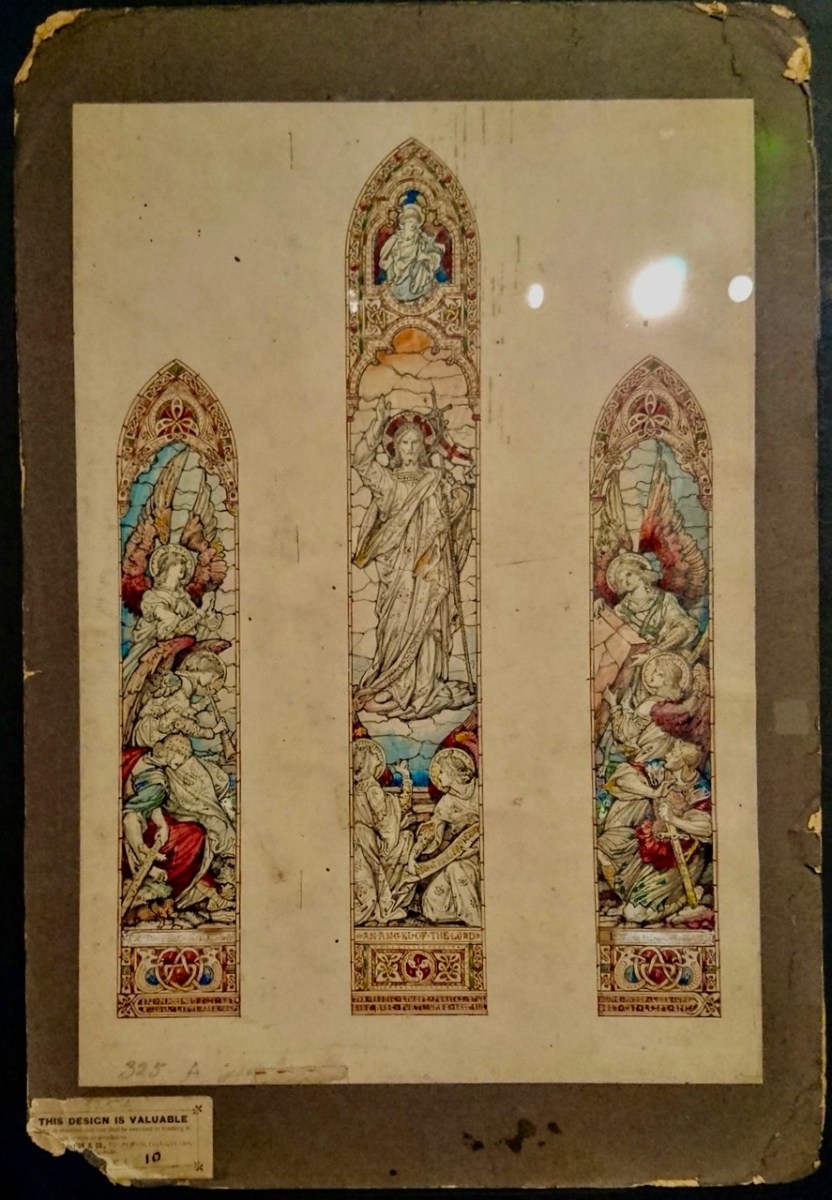
This opportunity is relatively rare in stained glass studies – there aren’t many collections like this, so it is wonderful that the Crawford rescued the archive, which has now been passed on for expert conservation, to the National Gallery of Ireland.
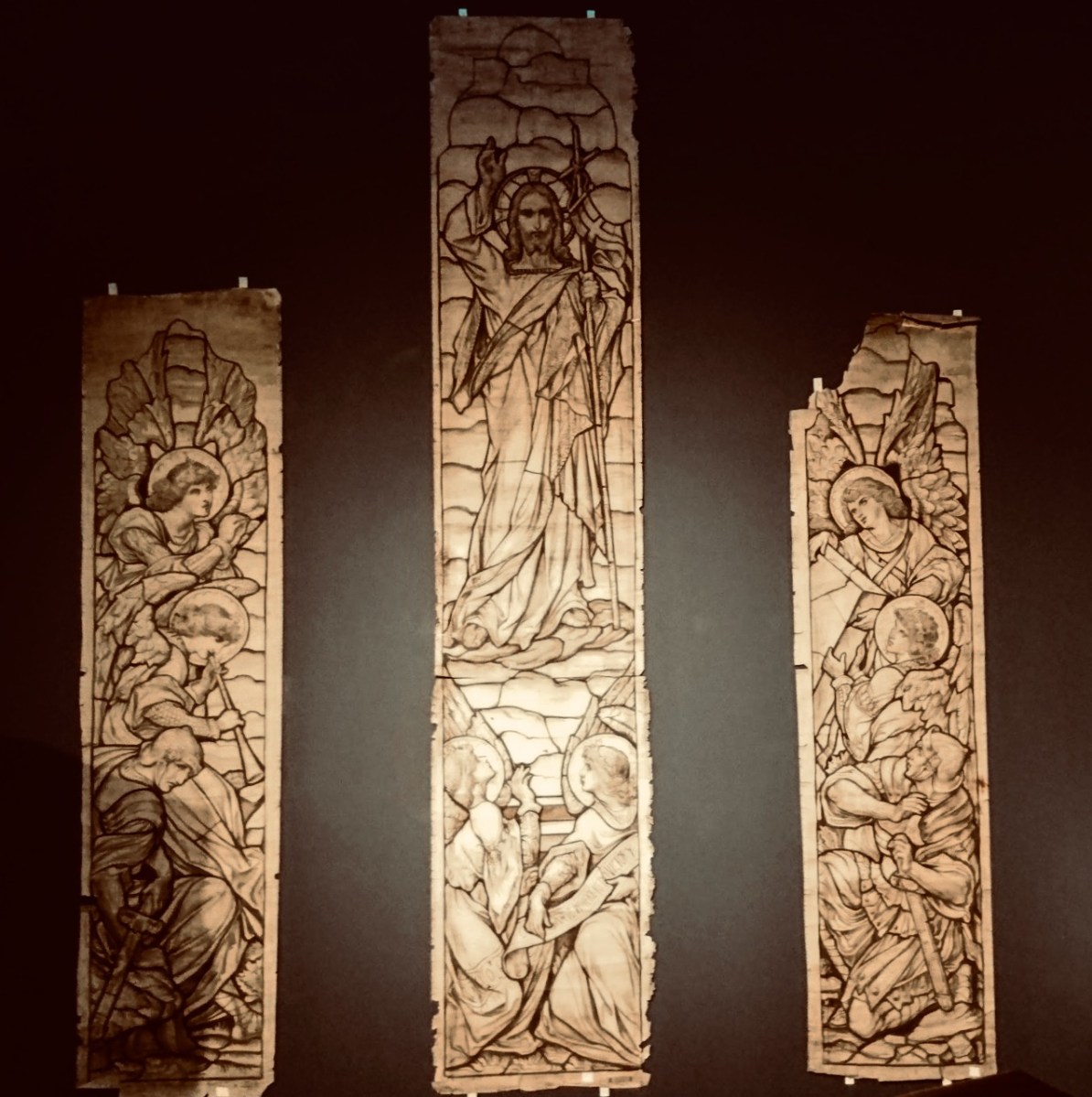
When I contacted Vera, she remembered the Brian Boru window well, and told me that the cartoon was part of what came to the archive, although in a very fragile state. The window, itself, she thought, was still extant, and possibly in Knappogue Castle. The important person to talk to, she said, was Antony Watson, great-grandson of James Watson and the executor of the Watson Estate.  Before I did that, I tried some detective work of my own.

Story 4: Jody

I don’t know Jody Halstead, but in 2016 she stayed at Knappogue Castle and posted a video to YouTube, titled The Knappogue Castle Most Visitors Don’t See. At about the 5 minute mark she arrives at a landing and as her camera roams around, it captures a stained glass window – and there it was! Here’s a screenshot from the video.
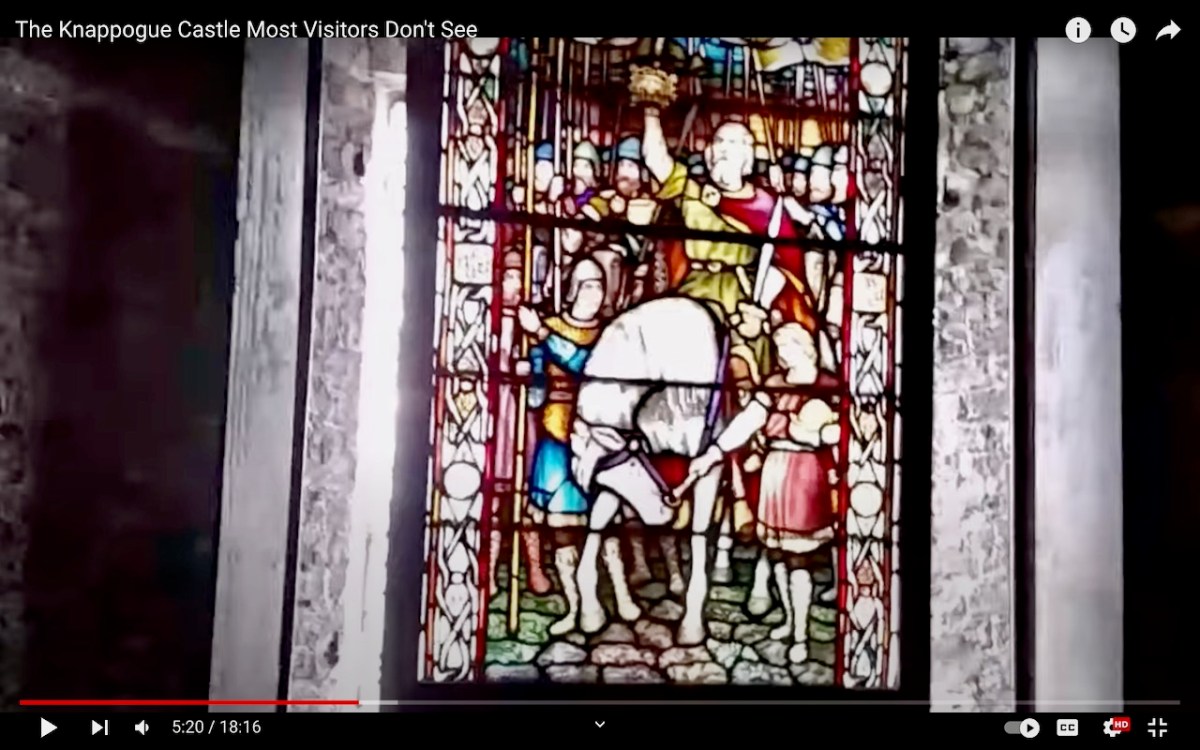
Because of Jody, now I had proof that the window was still in existence. The next challenge was how to get a good photograph of it. Once again, thanks to the glorious (and relatively small) world of Irish stained glass scholars and enthusiasts, I knew who to turn to.

Story 5: John

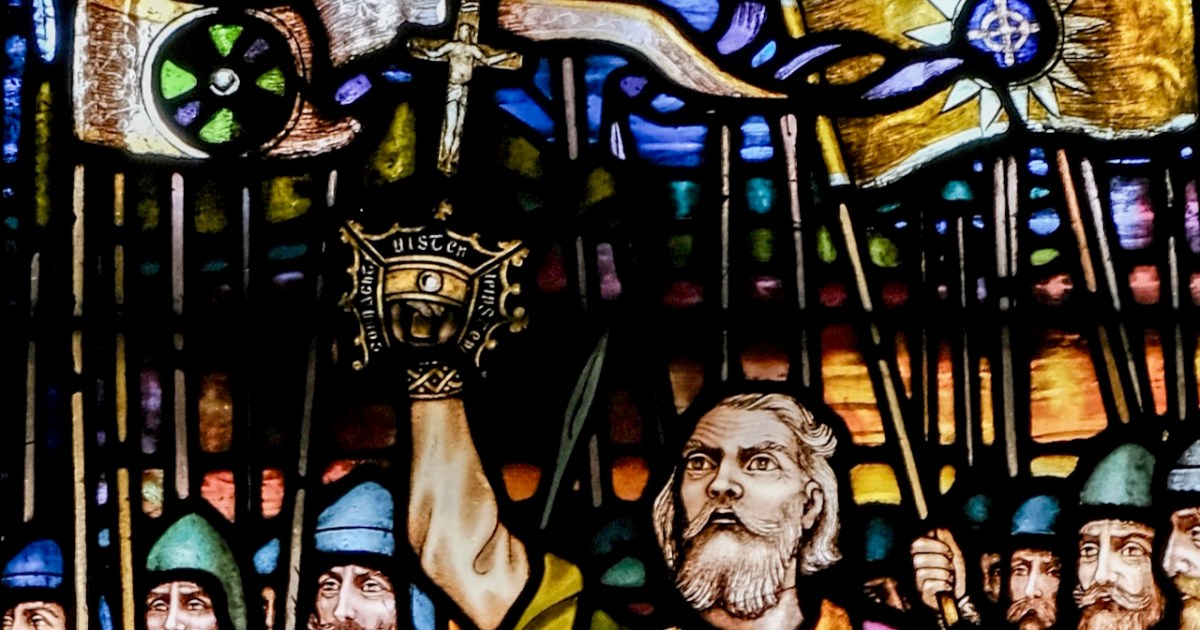
John Glynn is an outstanding photographer with an interest in stained glass. His was the excellent image from Kilrush I used in my post on Brigid: A Bishop In All But Name, and he lives in West Clare, about an hour by car from Quinn, where Knappogue Castle is located. I thought he might already have taken a photograph of the window – he hadn’t but promised to do so as soon as he could. To my great delight, he did it right away. Here is what he sent me.
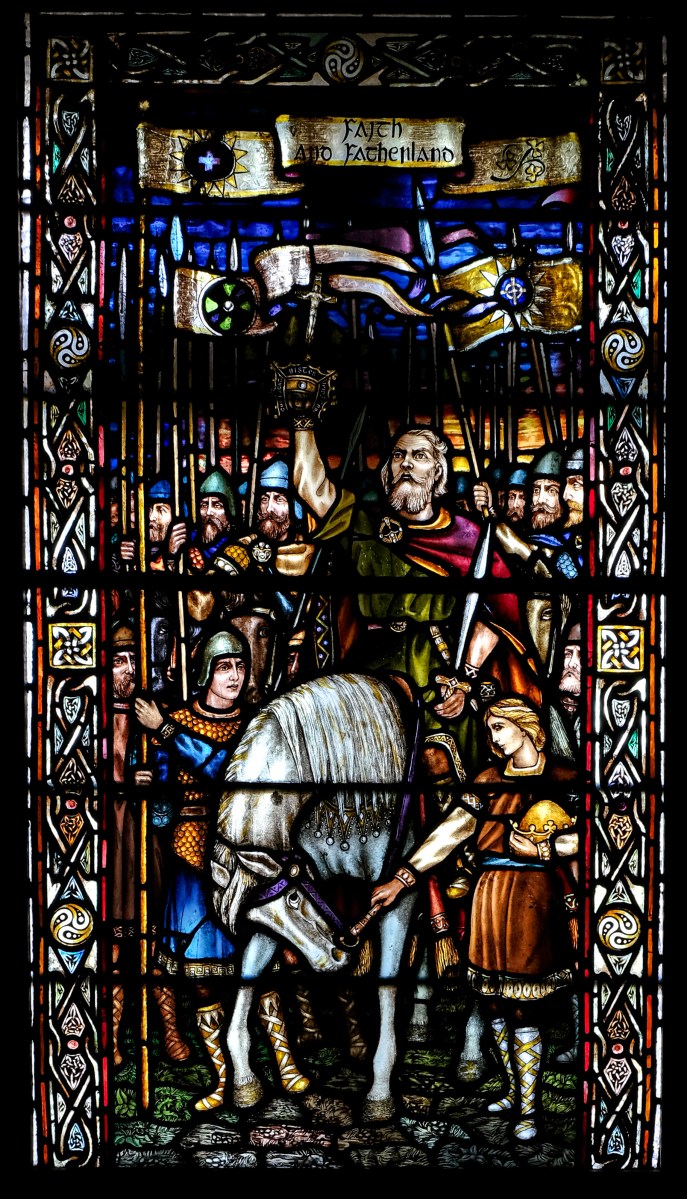
This and all detailed images of the Brian Boru window in Knappogue, are the work of John Glynn, and used with his permission

Isn’t it an amazing photograph! What’s also clear in this photograph is that the window is incomplete. To make it fit the opening, the predella, or bottom section, has been removed. Here’s what’s missing. 
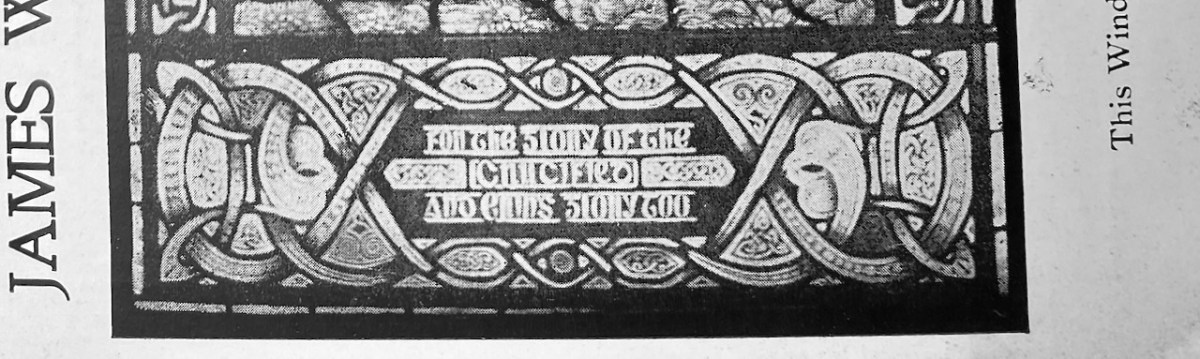
The text, in old Irish script, reads FOR THE GLORY OF THE CRUCIFIED AND ERIN’S GLORY TOO. The Celtic Revival interlacing that surrounds it is beautiful, and accomplished – it’s the thing that Watson’s were to become most famous for. So that’s a loss. Perhaps it was felt that the script was not suitable for a secular building: however it is more likely that it had to go in order to make the window fit. The rest of the window, comparing it to the original black and white images, seems to be intact. I was curious as to how the window came to be there, and this brings me to my second-to-last story.

Story 6: Antony

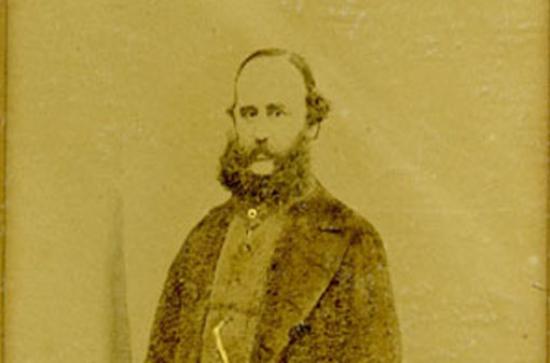
Vera kindly put me in touch with Antony Watson, and yesterday we had a long talk on the phone. Antony’s father was John Watson, Manager and Chief Designer for Watson of Youghal. John’s father was Clement, universally known as Capt Watson (he was an officer in the RFC/RAF), and Clement’s father was James Watson, seen here with a marble altar carver.
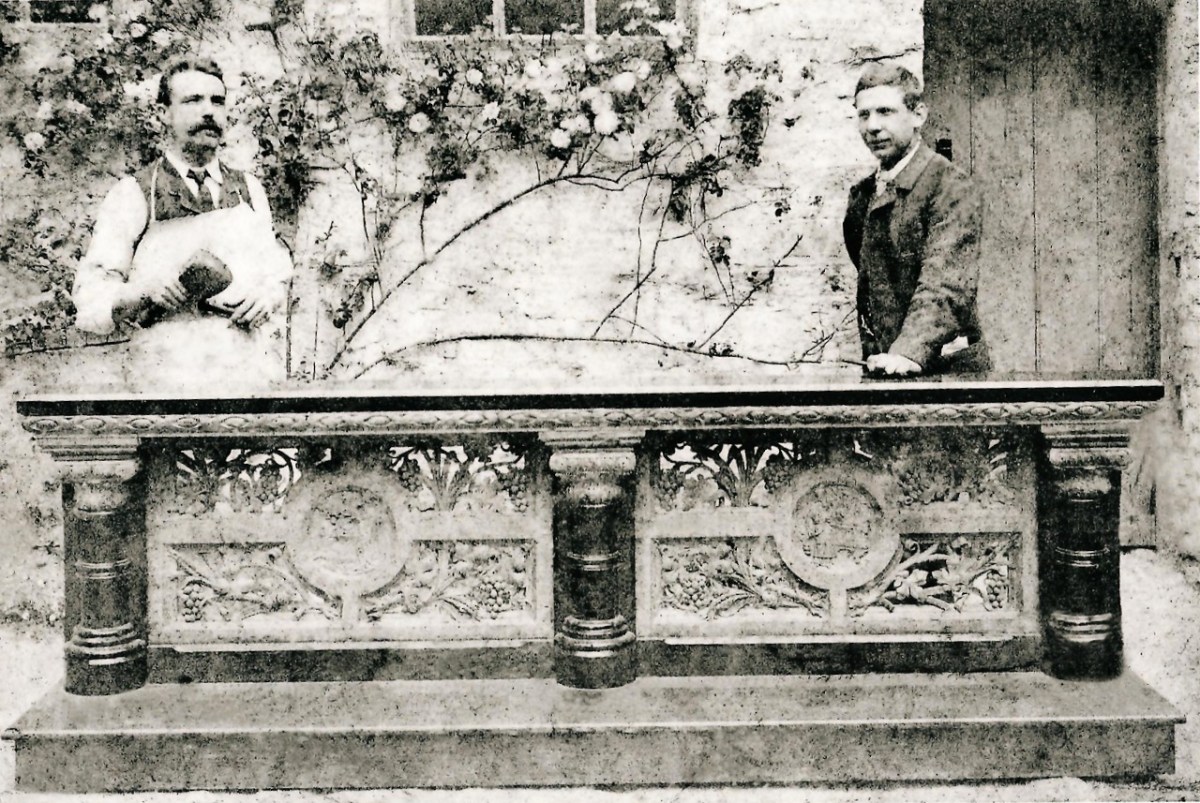
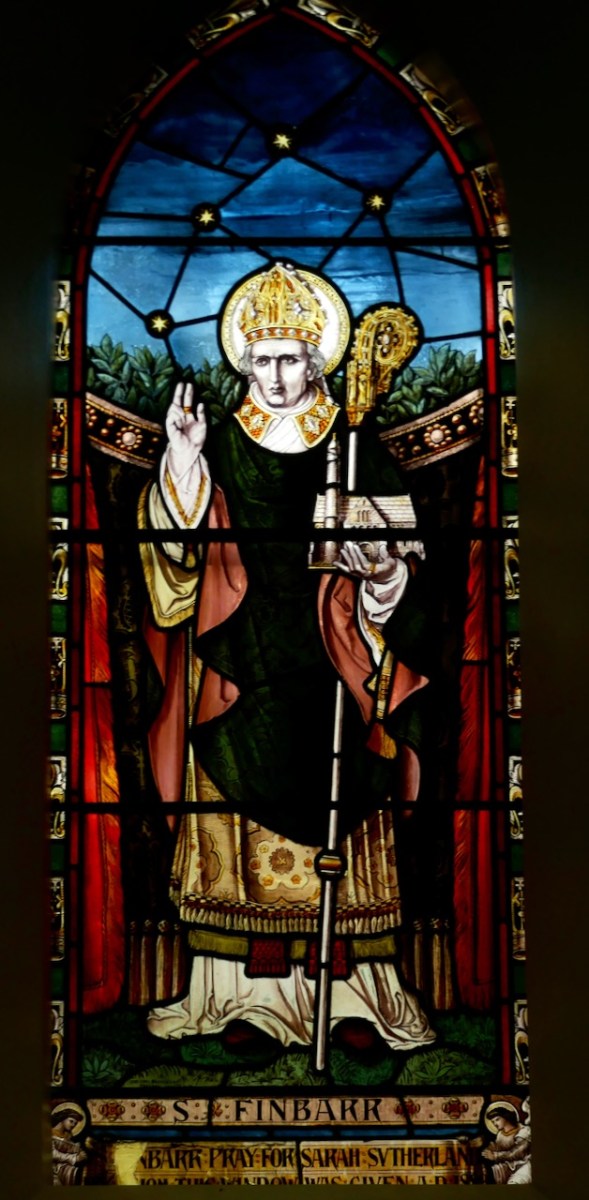
James had come from Yorkshire to run the Irish office of Cox, Sons, Buckley & Co, Church Outfitters, and eventually bought the Irish branch of the company. Here’s one of their early windows, in Ballingeary, from the 1880s, when they were still being signed as Cox, Sons, Buckley, Youghal and London.
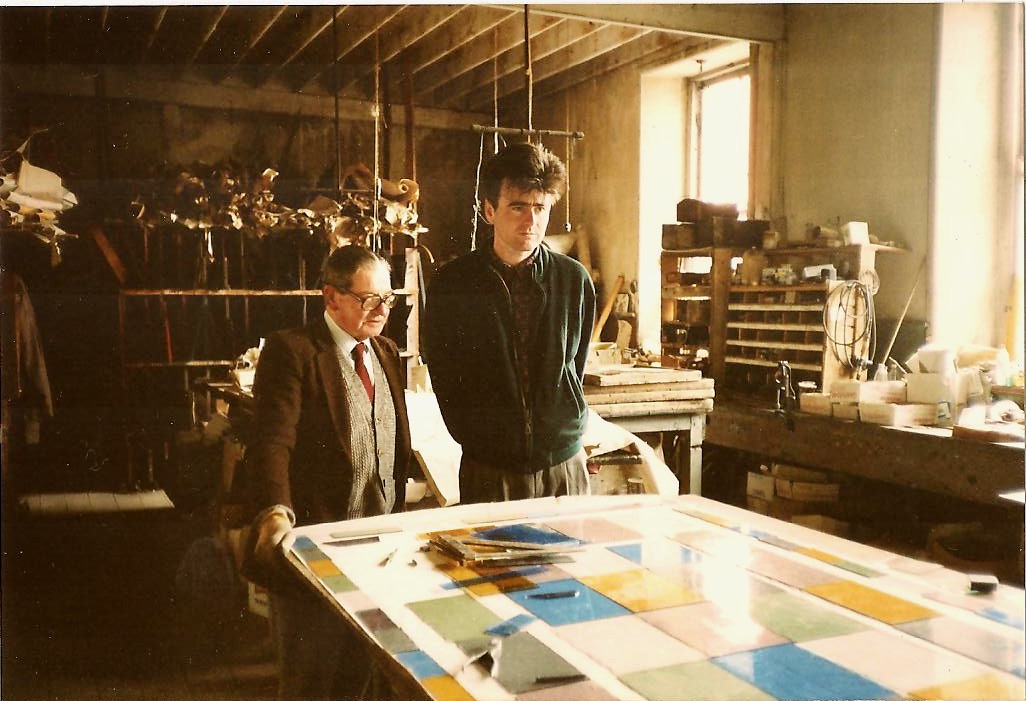
Antony told me the most enthralling stories, and I want to devote more posts to cover some of that treasure trove in the future, but I don’t want to get too distracted from Brian Boru now. Antony loved his life in and around the studios and workshops when he was young and has a very clear memory of the Brian Boru window. It stood, he said, in a rack in what was called the Great Hall (a grand name for a storage area for tall items). Here’s Jack, Antony’s father, with a client, in the early 1990s.
Watsons got the job of installing leaded windows into Knappogue Castle when it was bought by wealthy Americans – Mark and Lavonne Andrews. He remembers the day they arrived to see the Brian Boru window – there was a frantic tidy-up beforehand and the whole of Youghal turned out to witness two stretch limos arriving in state and disgorging the ‘Texas millionaires’ and their retinue.

Story 7: Mark and Lavone
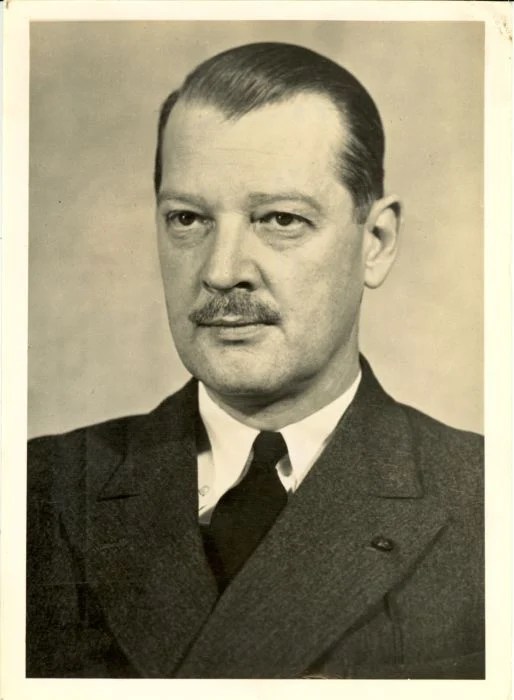
This is Mark Edwin Andrews, highly educated (Princeton) and cultured, and at one time Assistant Secretary of the Navy under Truman. He went on to become an industrialist and oil producer. His wife, Lavone Dickensheets Andrews (so sad I can’t find a photograph of Lavone) was a prominent architect. Together they purchased Knappogue Castle in 1966 and set about restoring it from a ruinous state. Knappogue is located in Quinn, Co Clare, the heart of Brian Boru country. It’s now owned and managed by Shannon Heritage.
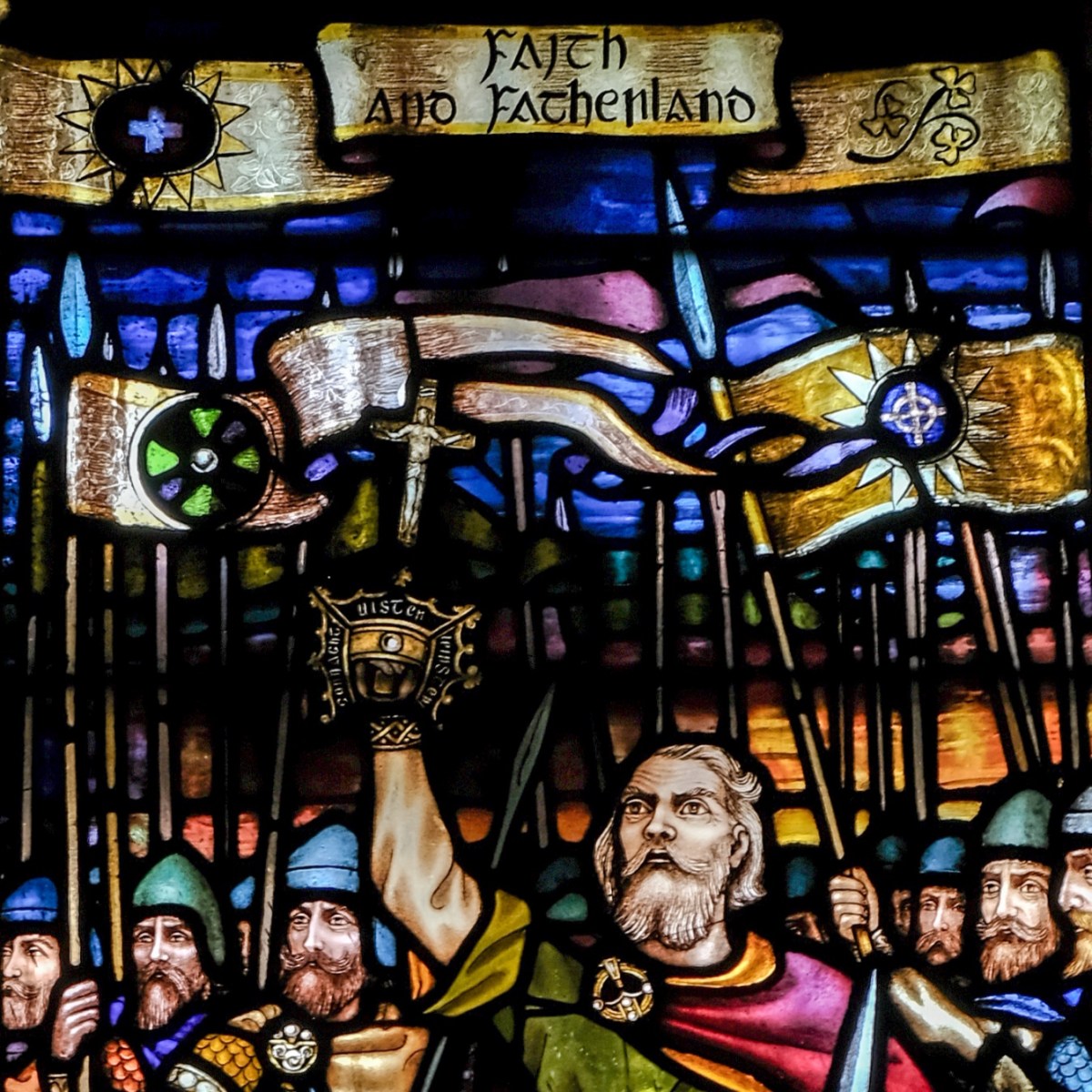
It was Mark and Lavone who rescued the Brian Boru window and had it fitted into Knappogue Castle, some time in the 1970s. And there it still is, a testament to the enduring attraction (and durability) of stained glass windows and their power to enchant and intrigue us.
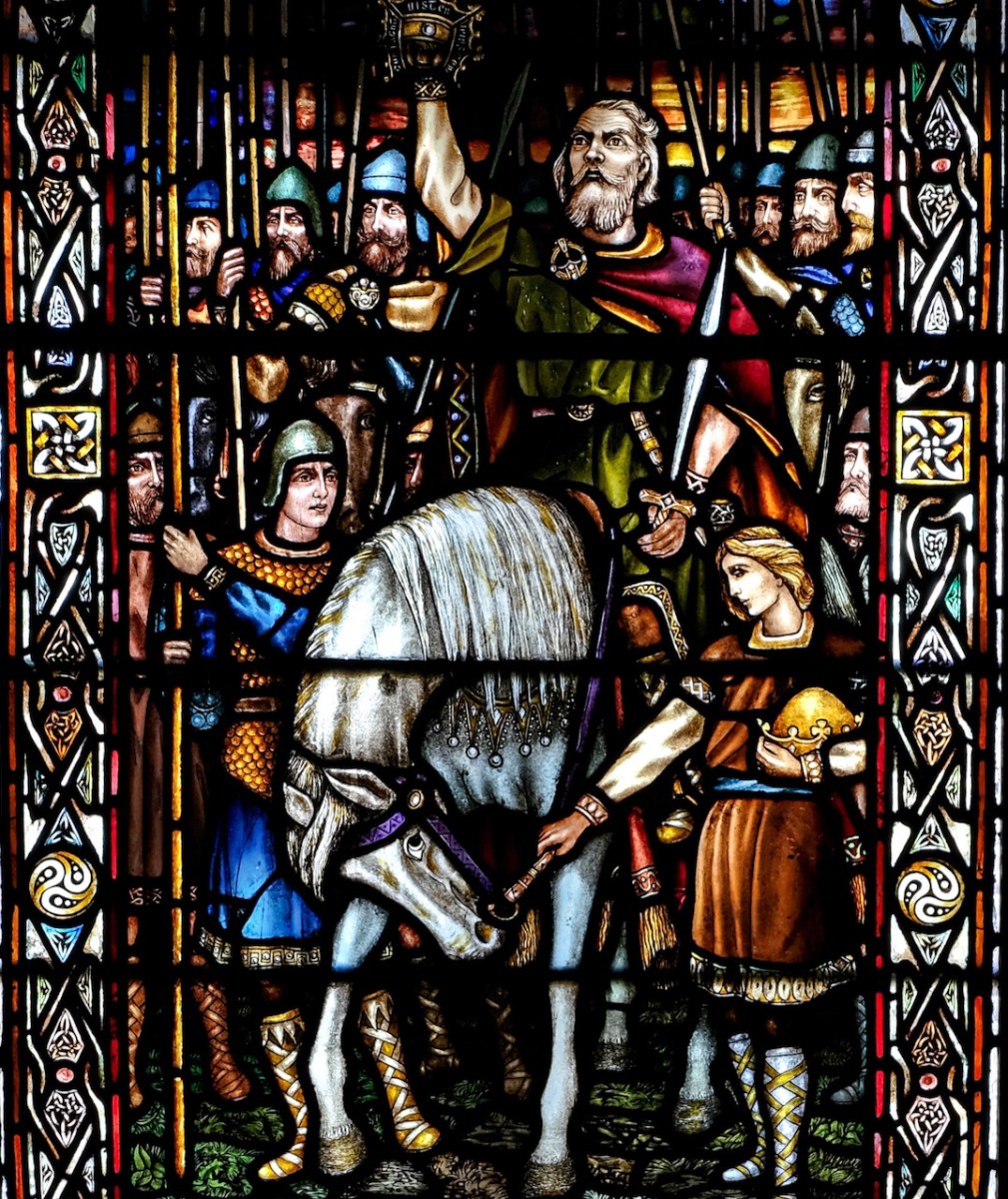
It’s a highly unusual window in so many ways, not least that it is a secular rather than a religious subject. It showed off, when it was exhibited, one of our historic heroes, Brian Boru (for more about Boru, see Robert’s post, Battling it Out), as well as the Celtic Revival decoration which Watsons mastered: both the subject matter and the treatment established them firmly in the Nationalist Camp. This of course, was a canny move designed to appeal to Irish Catholic church-builders. Antony tells me that nobody espoused Irish Nationalism more enthusiastically (or astutely) than James Watson, in the broad Yorkshire accent he kept to the end. 
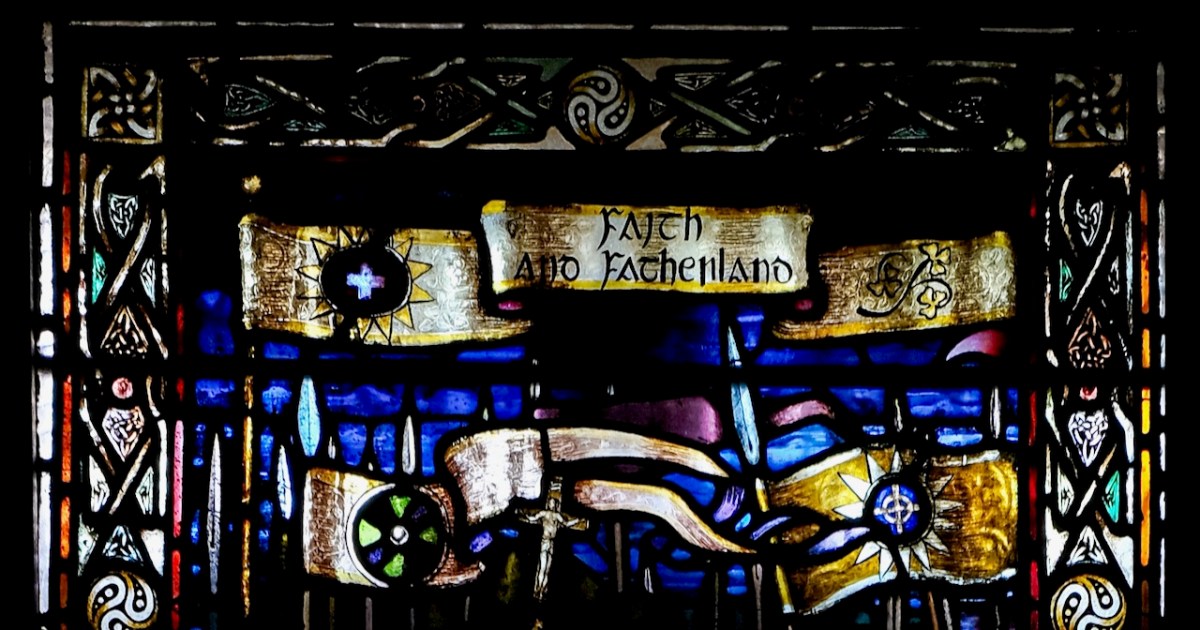
As an image of Faith and Fatherland, this window knew exactly who it was appealing to. It appeals to us still.
Seán Keating – Escaping the Storm

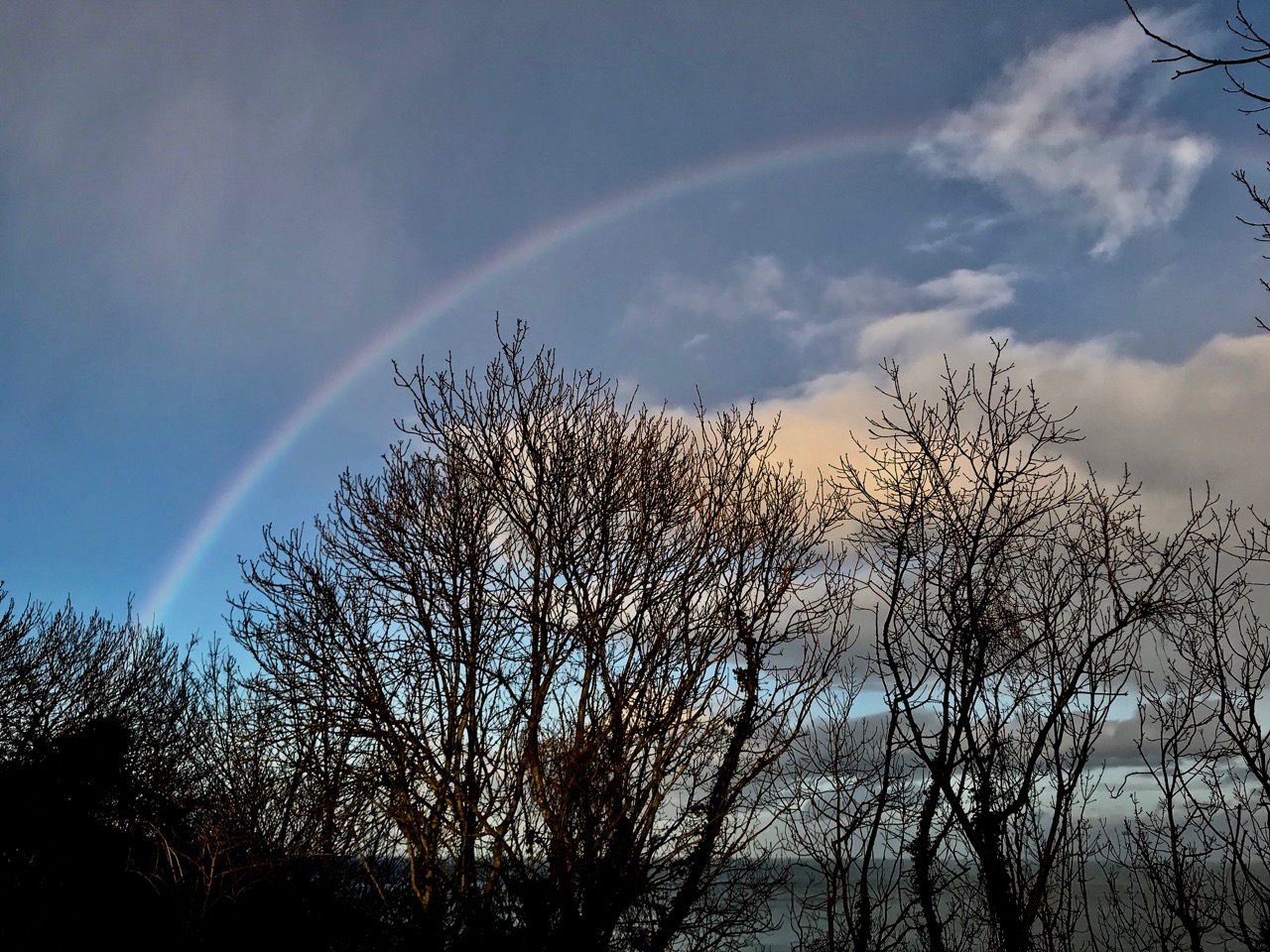
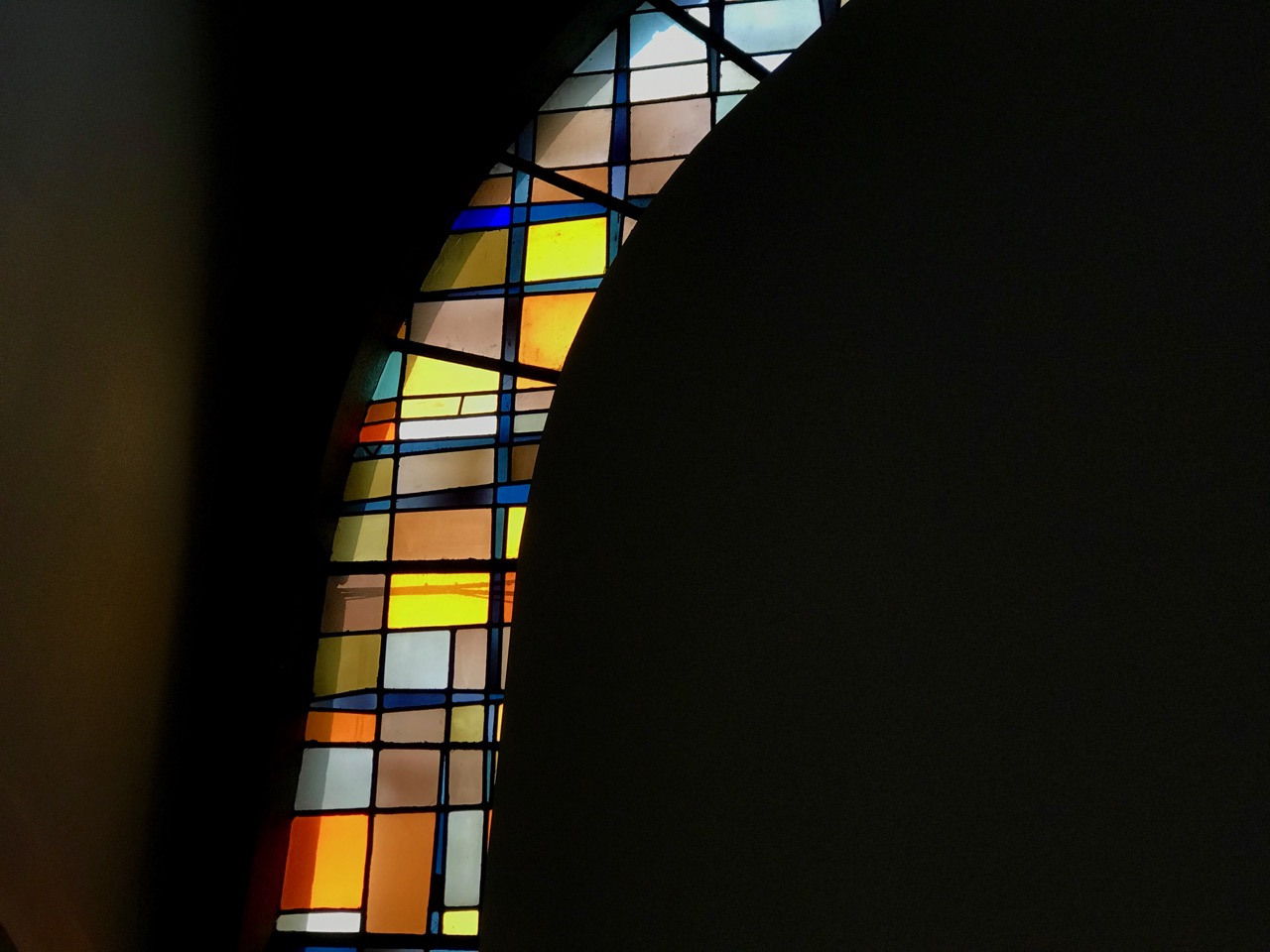
Storm Ciara was upon us as we headed over to the east coast – a mere few hops from Nead an Iolair. But it wasn’t all black clouds and thunder and lightning: winter storms here in Ireland feature high winds and spectacles such as this rainbow (above) which seemed to hang in the sky over County Wicklow for hours. When the rain comes, we often find refuge in a church – especially if it helps Finola’s quest for new stained glass windows. Sometimes they seem to reflect the weather patterns:

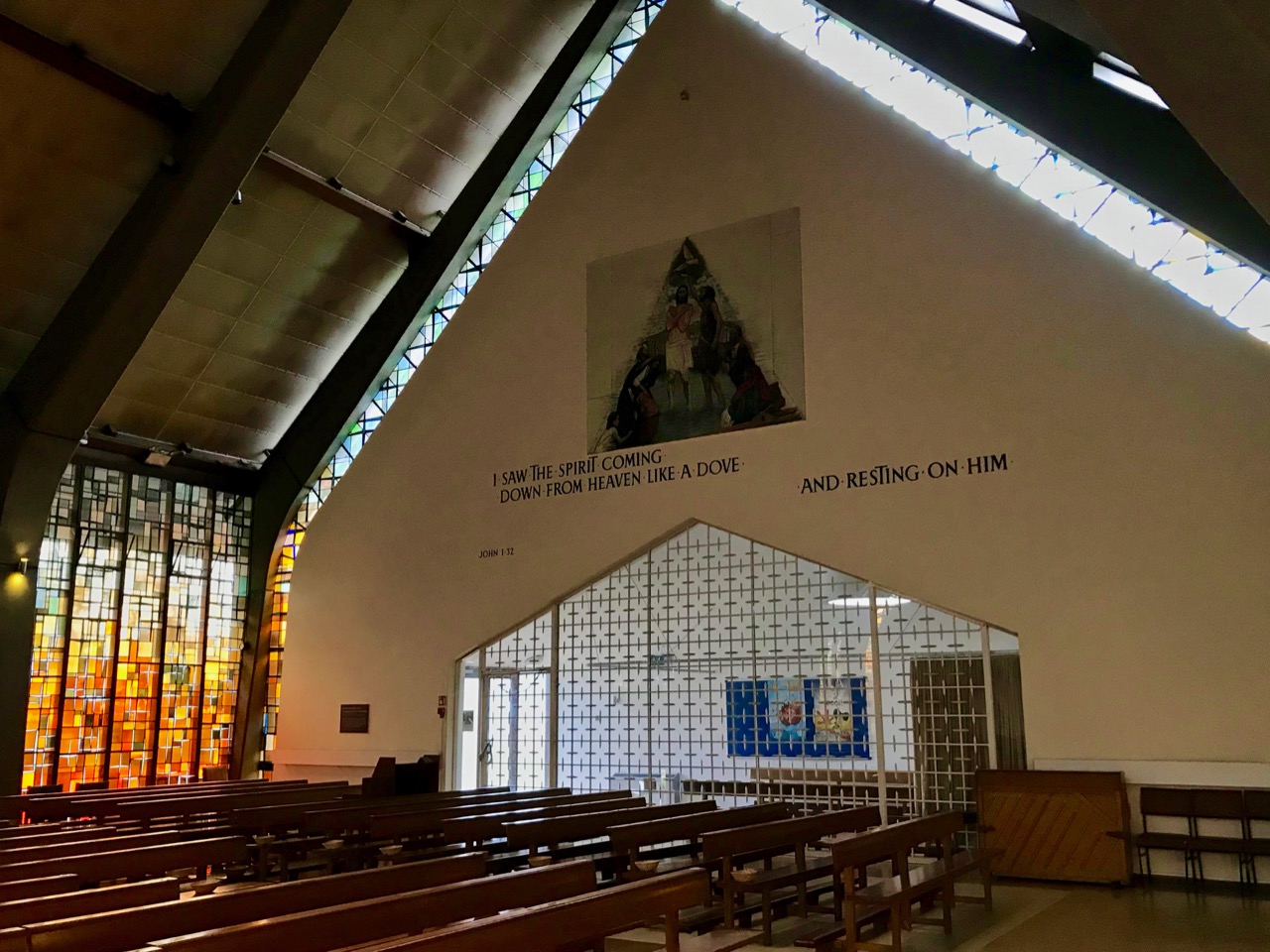
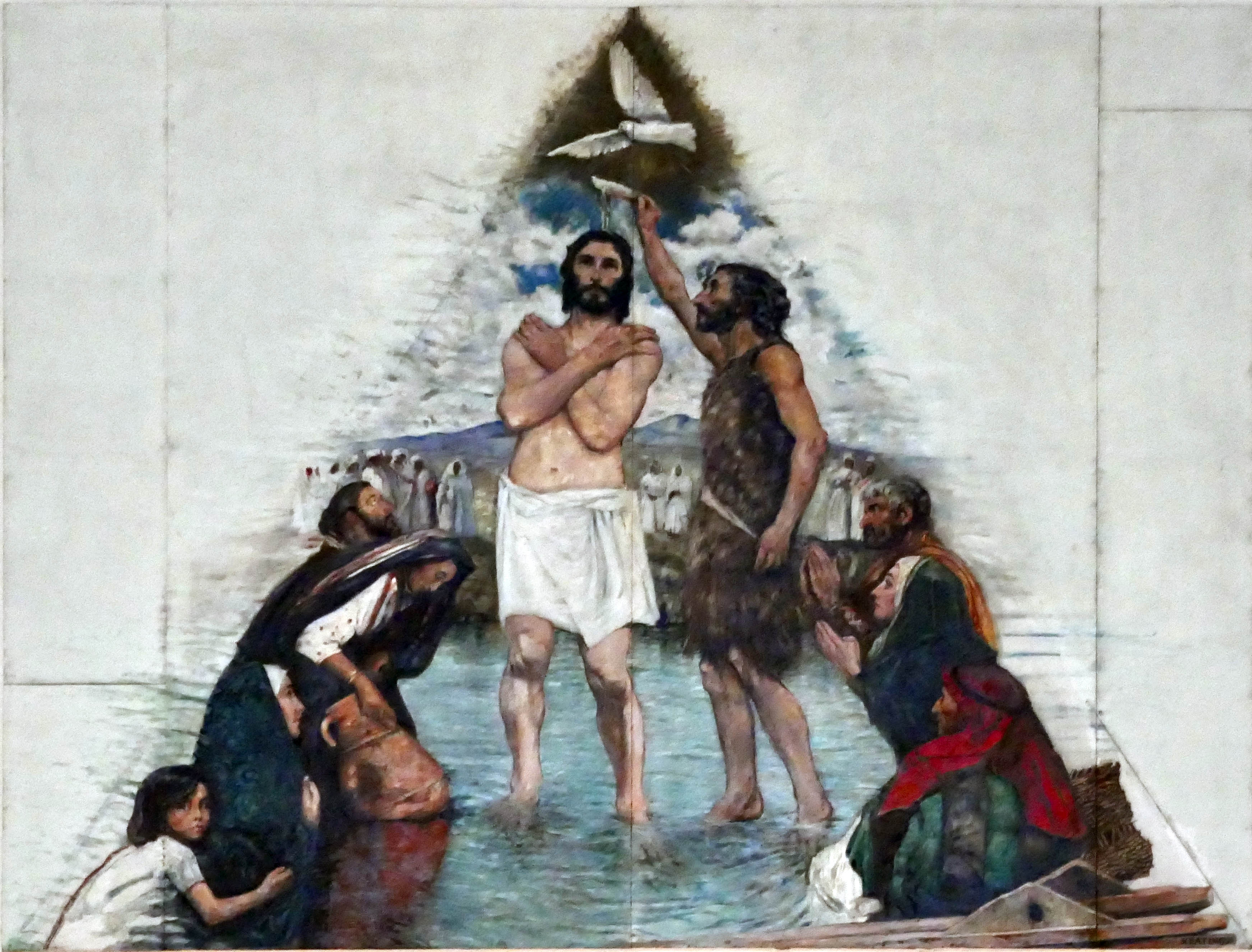
This panel, which could be seen as an indoor rainbow, is in an impressively large church in Ballyroan, Rathfarnham Parish, County Dublin: it was built in 1967 to seat a thousand. What caught my eyes was not the array of windows by Murphy Devitt (Finola has written extensively about this creative partnership), but two murals high on the walls of the crossing. I was delighted to find that these were painted by one of Ireland’s great artists working through the turbulent twentieth century – Seán Keating.

Seán Keating’s ‘Baptism of Christ’ mural in the Church of the Holy Spirit, Ballyroan

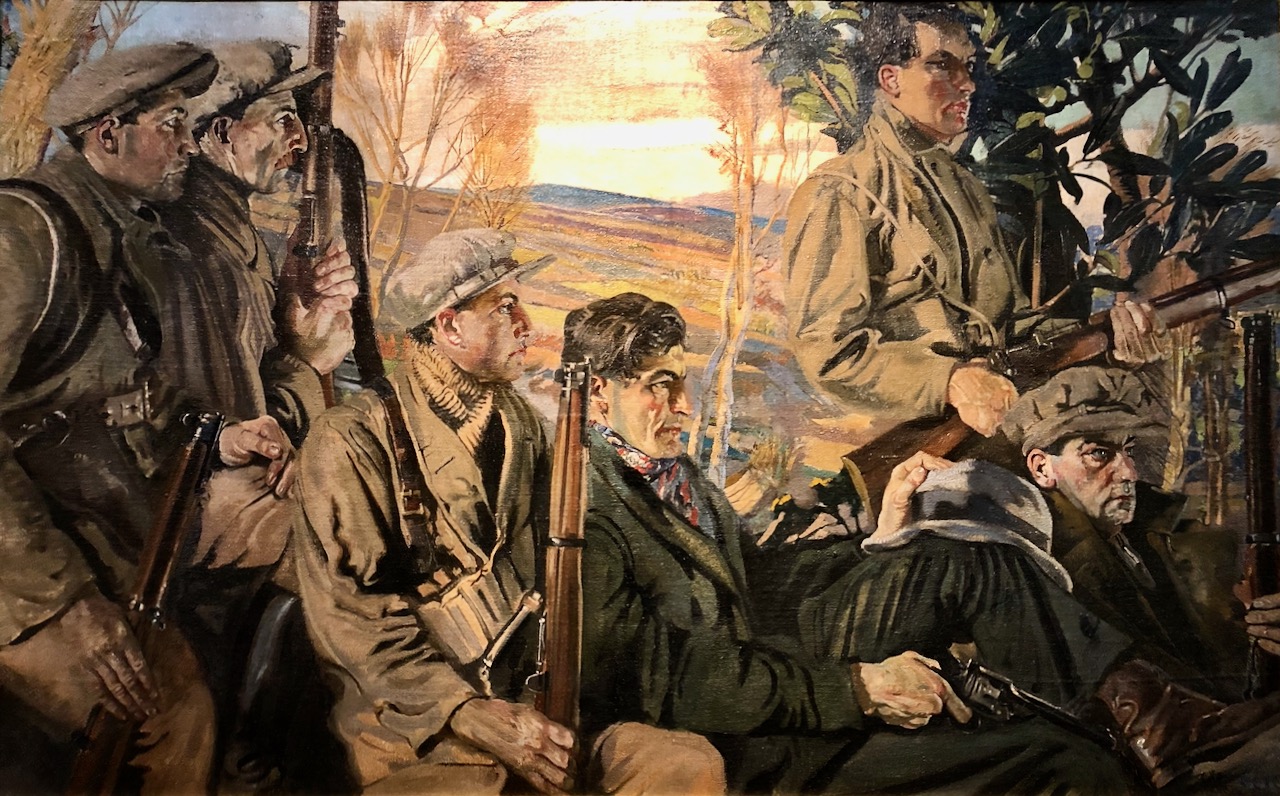
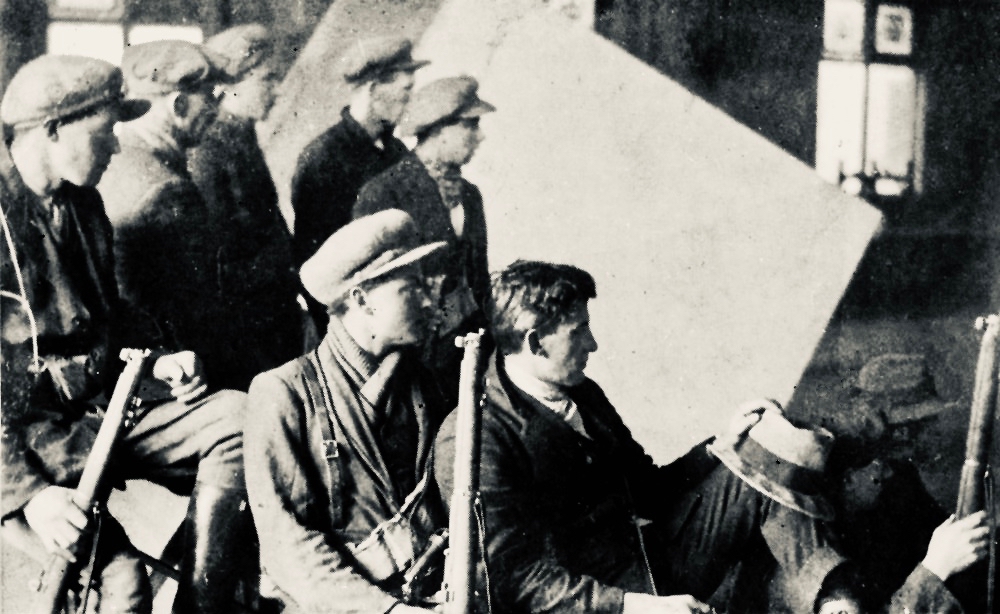
I am always surprised to find that Keating is under-appreciated: yes, he gets mentioned in books of art history, and is reasonably well represented in the state’s galleries. Yet you will also find terms such as ‘not great art’ applied to his work by critics and commentators. This is possibly because he is best known for his documentary work and, particularly, for his raw representations of the tempestuous years of Ireland’s struggle to gain independence. Here is ‘Men of the South’, dating from 1921 when there was a ceasefire in the Irish War of Independence while the Anglo-Irish Treaty was being negotiated and out of which the Irish Free State was born.

Top: Men of the South – Seán Keating’s documentary portrayal of the North Cork Brigade of the Irish Republican Army. Below the painting is one of the photographs taken in Keating’s Dublin studio in preparation for the work. Two versions of this painting were made by the artist: the one above is in the Crawford Gallery, Cork City, while the other (which depicts eight men) is now in Áras an Uachtaráin, the official residence of the President of Ireland.

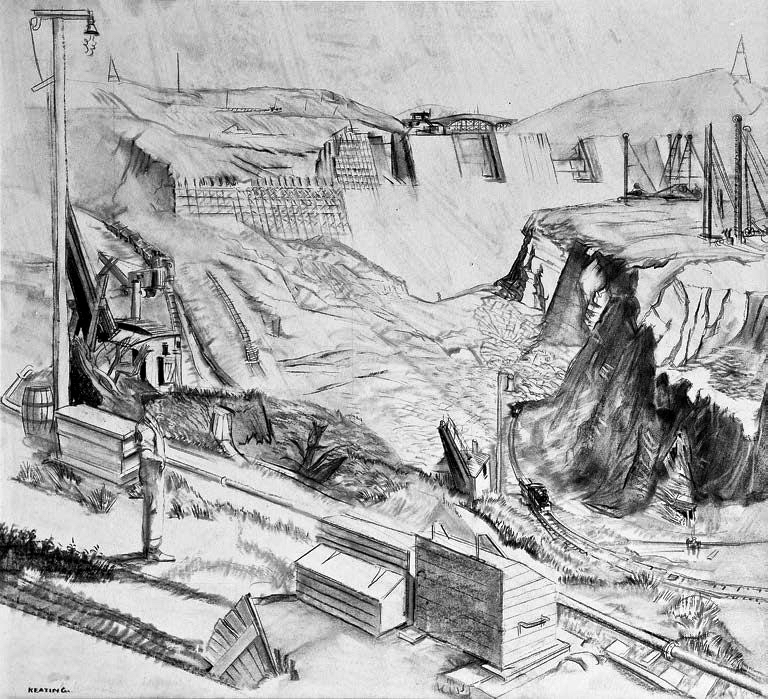
After the War of Independence and the abhorrent Civil War which followed it, Keating’s work concentrated on documenting the founding and burgeoning of the new State. Scenes of conflict were replaced by works showing industrial development, such as Ireland’s largest ever civil engineering contract: harnessing the power potential of the State’s major waterway, the River Shannon. The construction of a dam and hydro-electric generating station at Ardnacrusha, County Clare, together with a country-wide electric distribution infrastructure, was a symbol of major importance to the nation’s fledgling government. Keating began recording the work in 1926, soon after inception. No-one had commissioned him – he saw the significance of making dramatic documentary work of this nature, but his vision was eventually recognised by the Electricity Supply Board (ESB) – which now owns the largest collection of Keating’s paintings in Ireland. Above is one of the artist’s working sketches of the dam under construction.

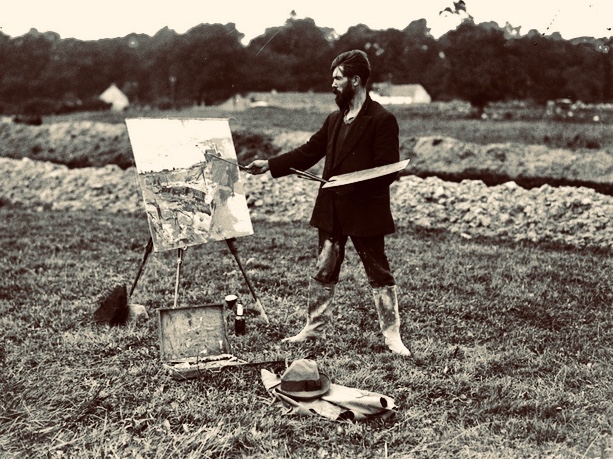
Seán Keating painting en plein air at Ardnacrusha, 1920s

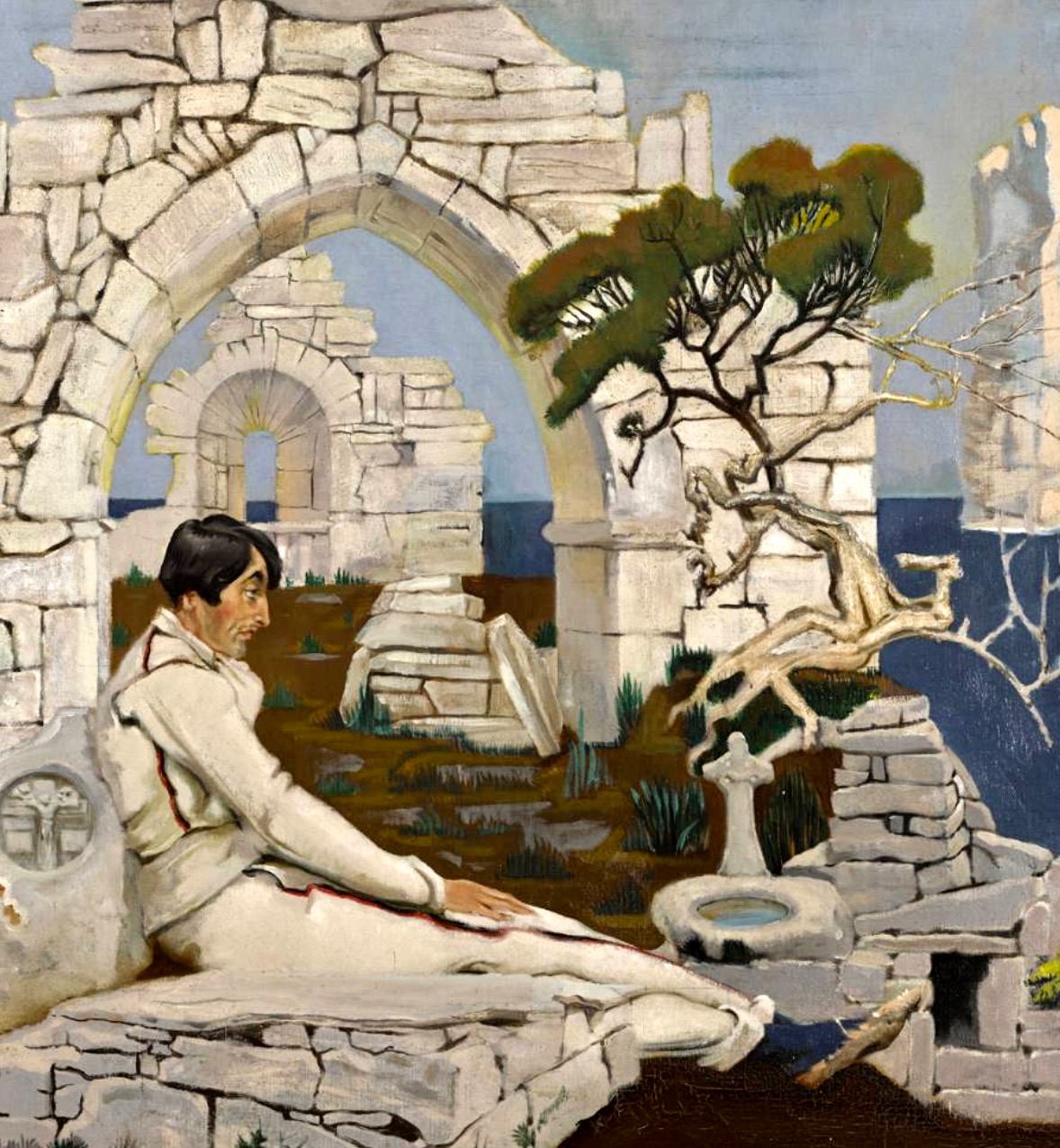
Keating studied under William Orpen in Dublin. He was to become one of Orpen’s important pupils (and, latterly, his assistant) and his documentary painting style owes a debt to his teacher. One of his famous early paintings is Thinking Out Gobnet (below), a portrait of his good friend Harry Clarke, dating from 1917. Keating and Clarke frequently visited the Aran Islands together. The painting shows Clarke sitting on a grave slab within the ruins of Teampall Chaomháin (St Kevin’s church) on Inis Oírr, along with a holy water font at his feet, and a holy well to the bottom right of the image. The suggestion is that Clarke is finding inspiration for his series of eleven windows for the Honan Chapel, Cork, which include a fine representation of St Gobnet. The ‘healing’ symbolism of the holy water and well are deliberate references to Clarke’s TB, the illness which ended his life at the age of 41.

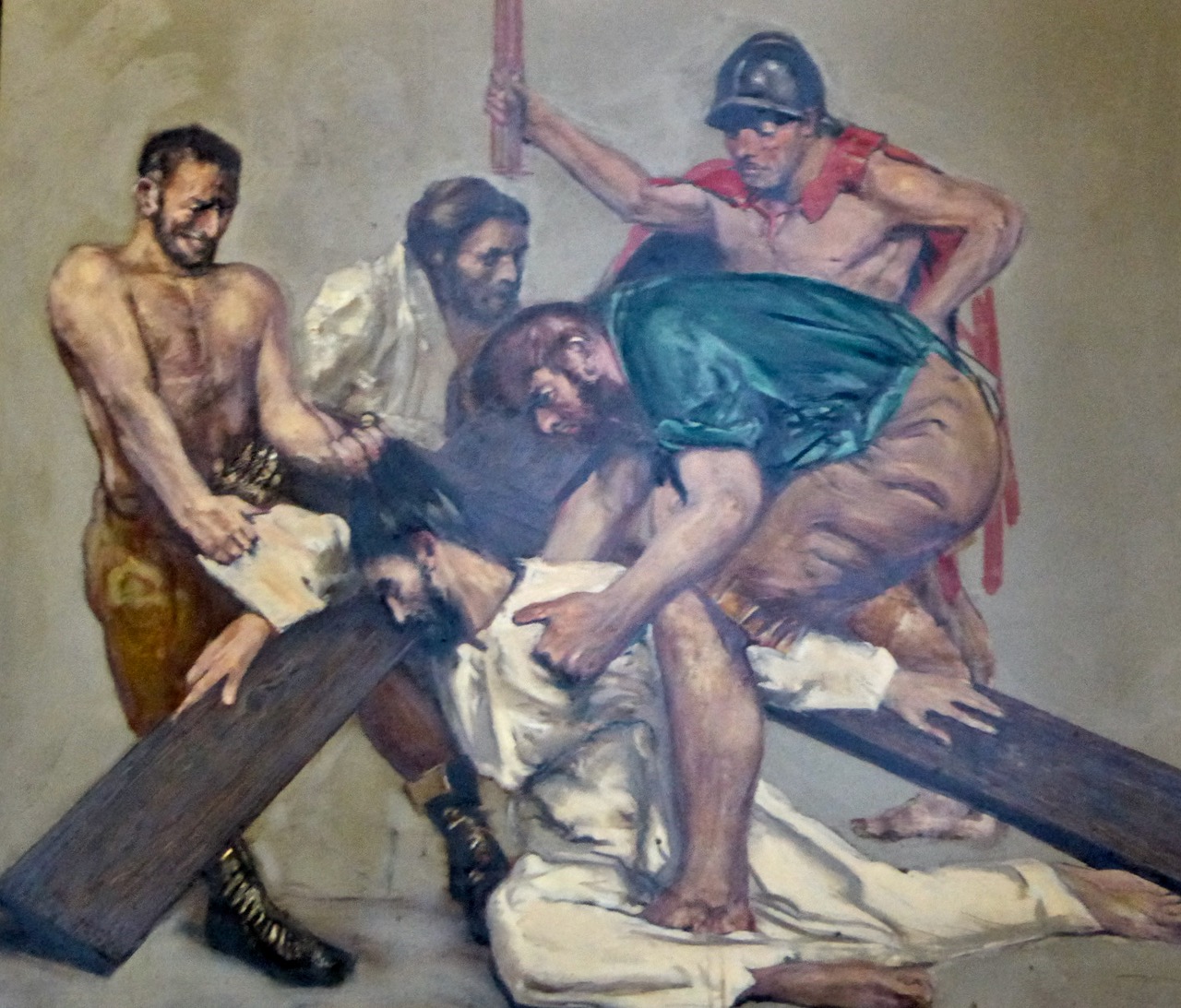
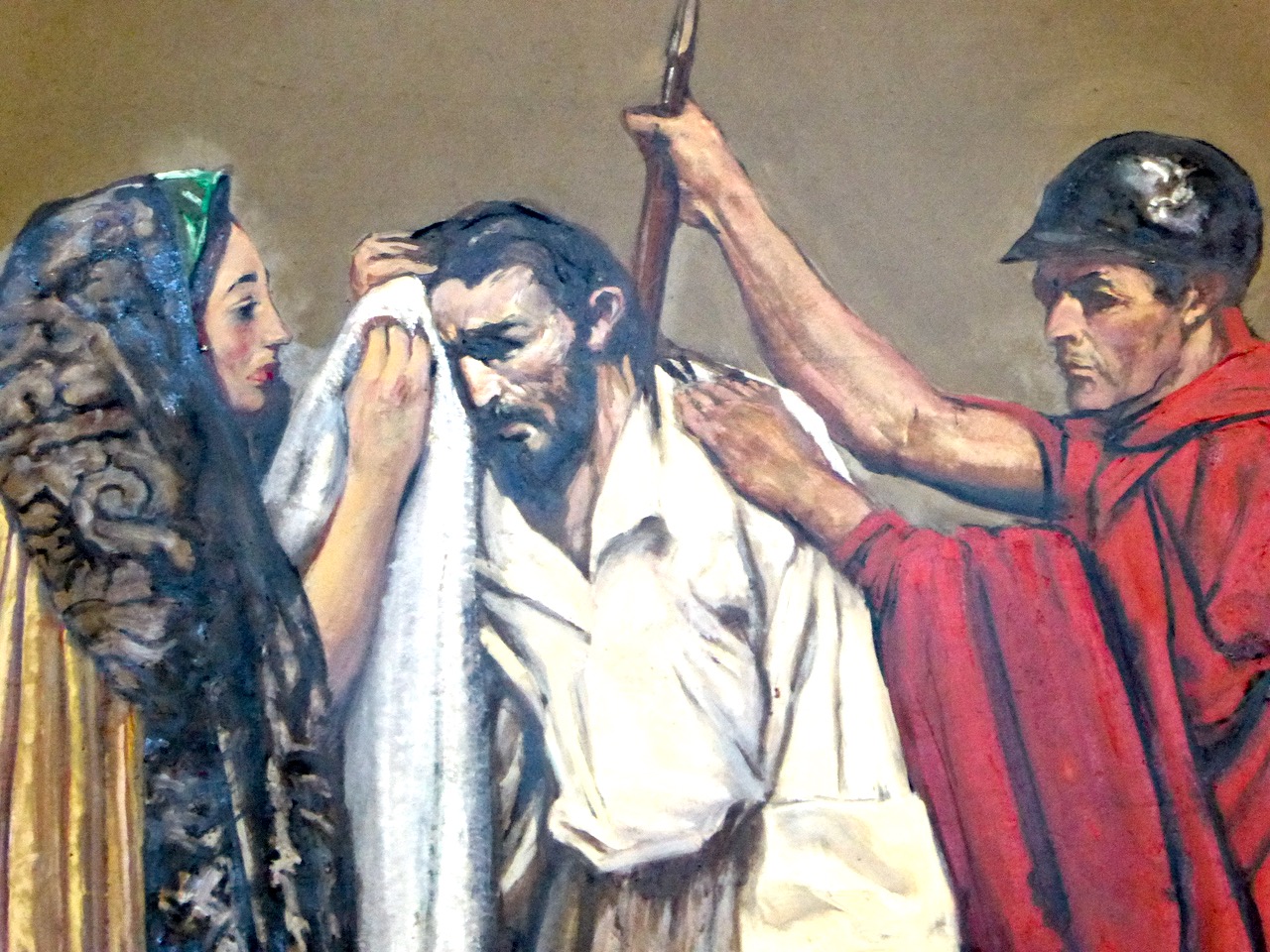
Seán Keating was always a committed Catholic, and we have seen many examples of his artwork in churches, including the murals at Ballyroan. Most striking, perhaps, are the Stations of the Cross which he painted for St John’s Church, Tralee – the church which features in Finola’s wonderful Irish Arts Review article (and RWJ blog post) about Ireland’s Newest Stained Glass Window.

Stations of the Cross by Seán Keating in St John’s Church, Tralee, County Kerry

Back to Ballyroan: while we were sheltering from the tempest and admiring the church architecture, and the murals, I was delighted to find out that Seán Keating had lived for much of his life just down the road, in Ballyboden, in a house which he had designed himself. He attended mass regularly at Ballyroan until his death in December 1977, aged 88.

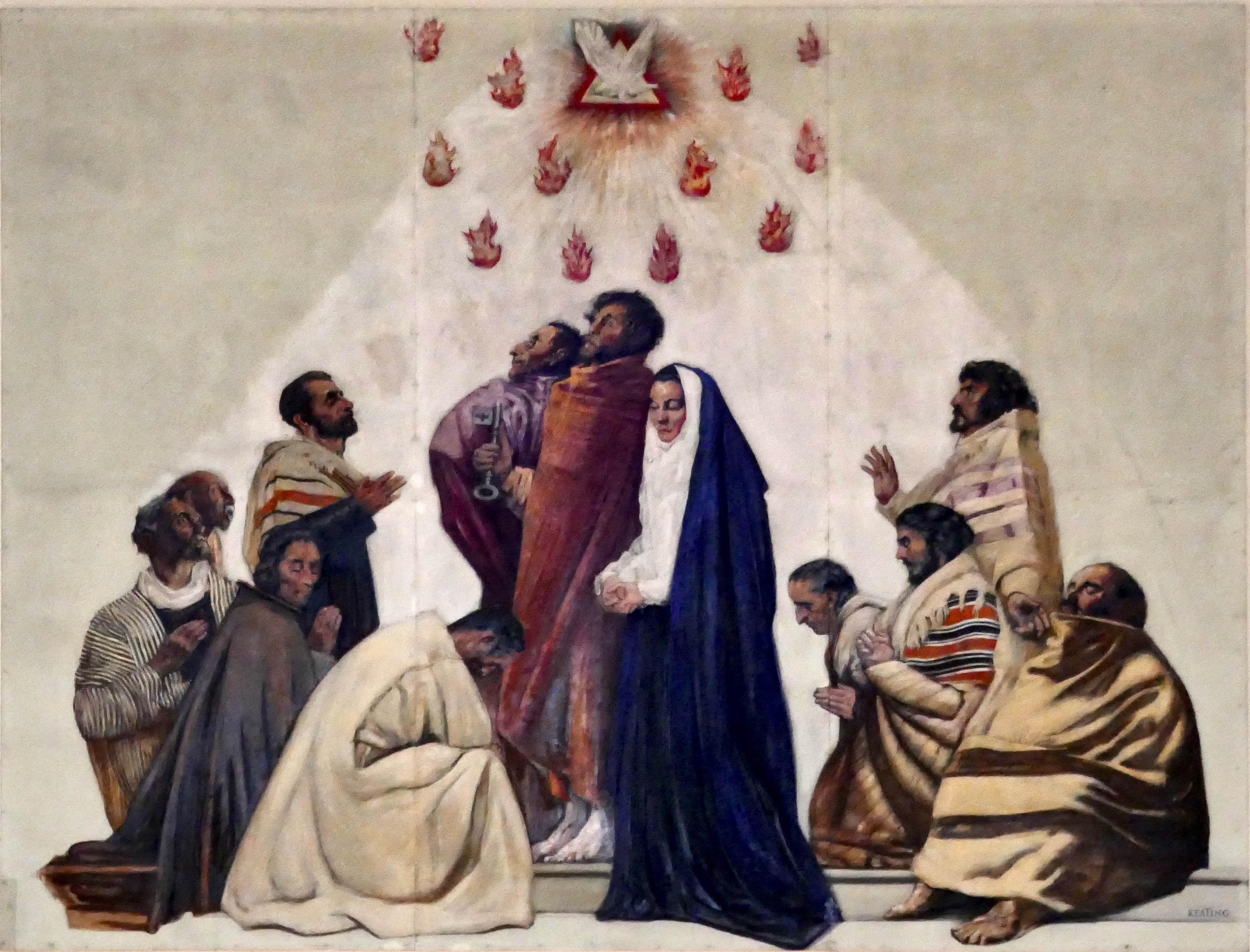
Keating’s mural The Descent of the Holy Spirit in his own church of Ballyroan, Parish of Rathfarnham, installed in 1967

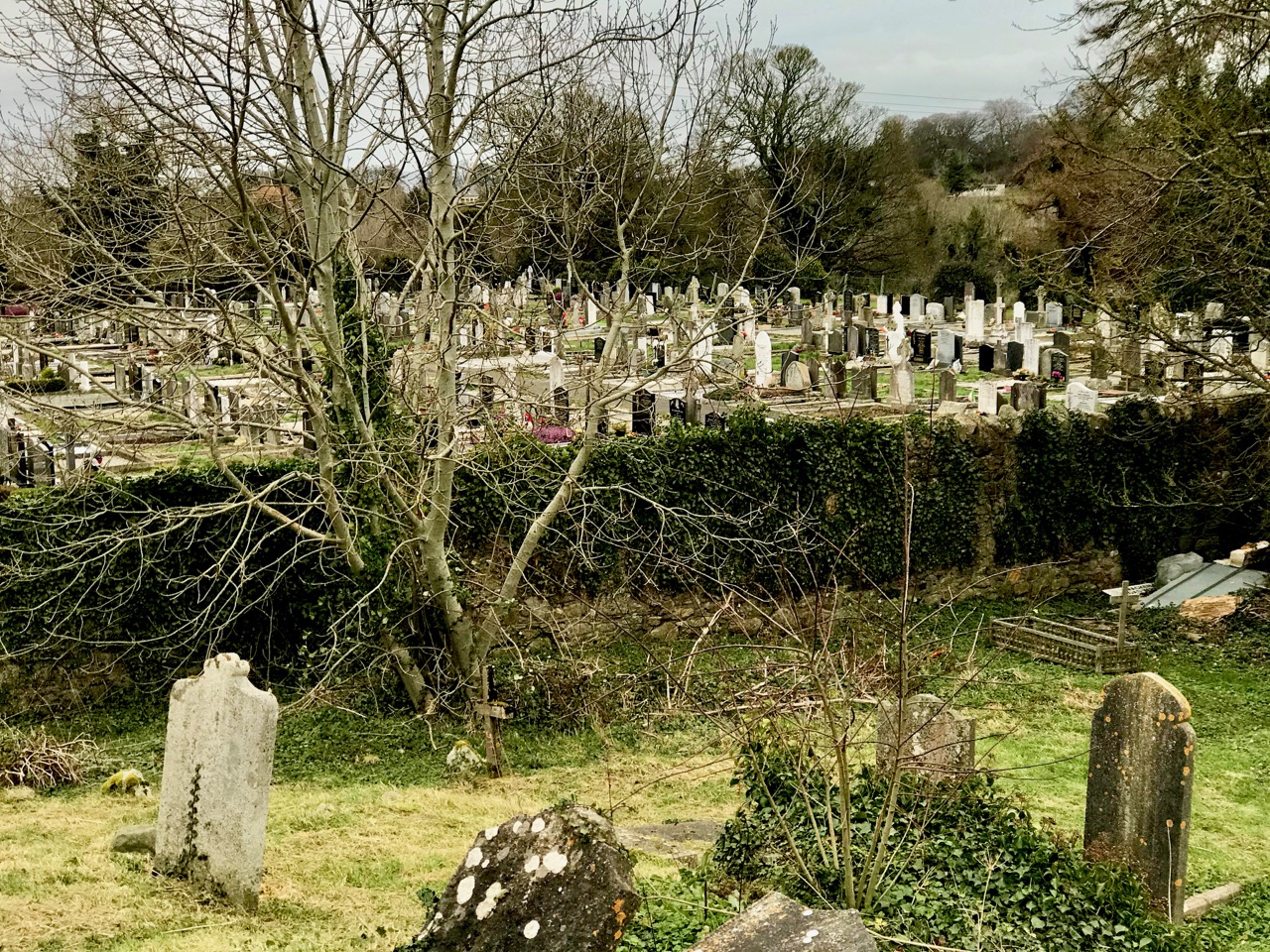
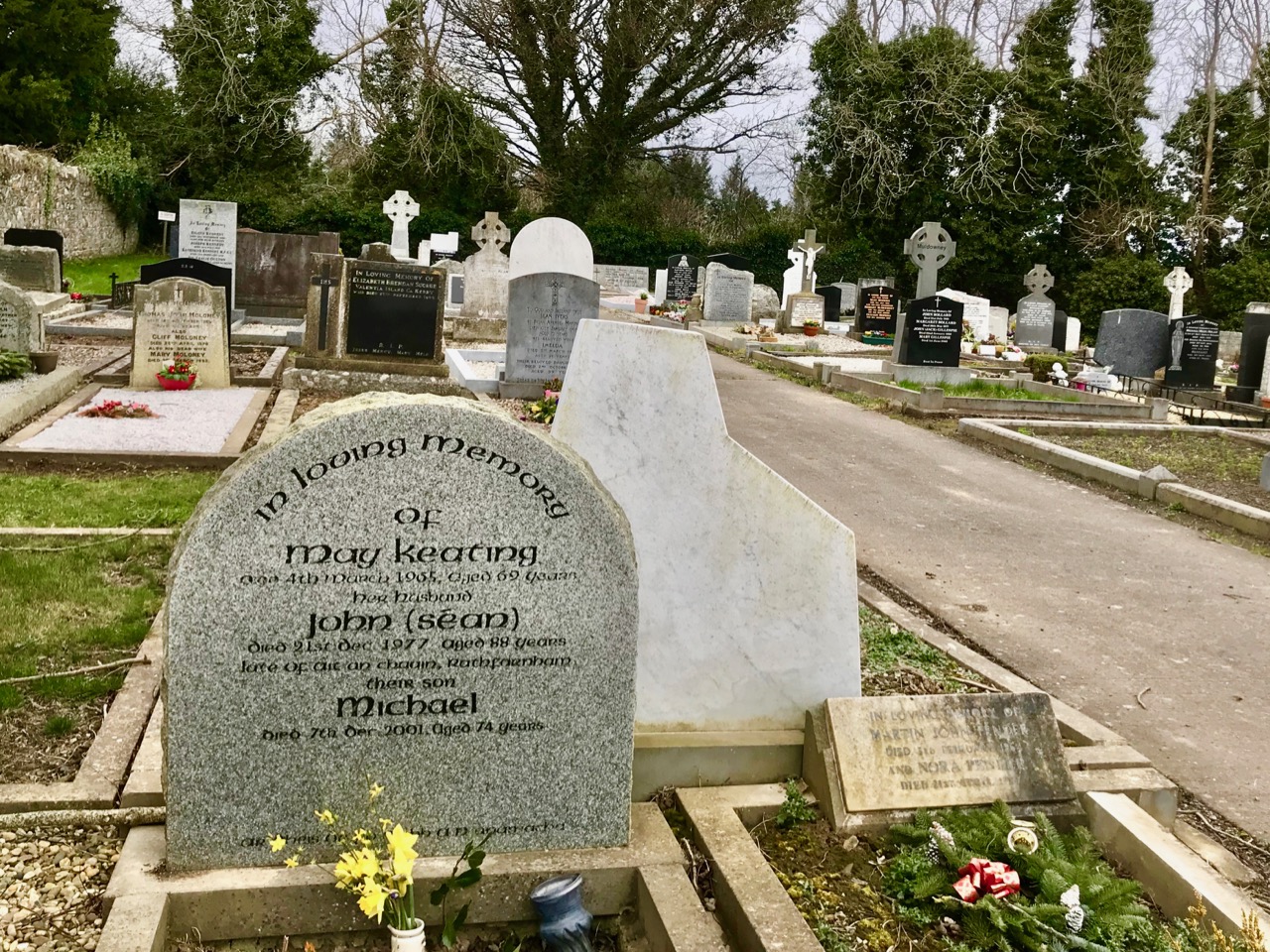
We discovered that Keating is buried in the nearby Cruagh Cemetery, so we had to head out into the storm again to find his grave. It is as unassuming as he apparently was in life: a visitor would not be aware that herein lies one of modern Ireland’s greats.

Cruagh Cemetery, Co Dublin (top) is the resting place of Seán Keating. His grave is shared with his wife, May, and son Michael

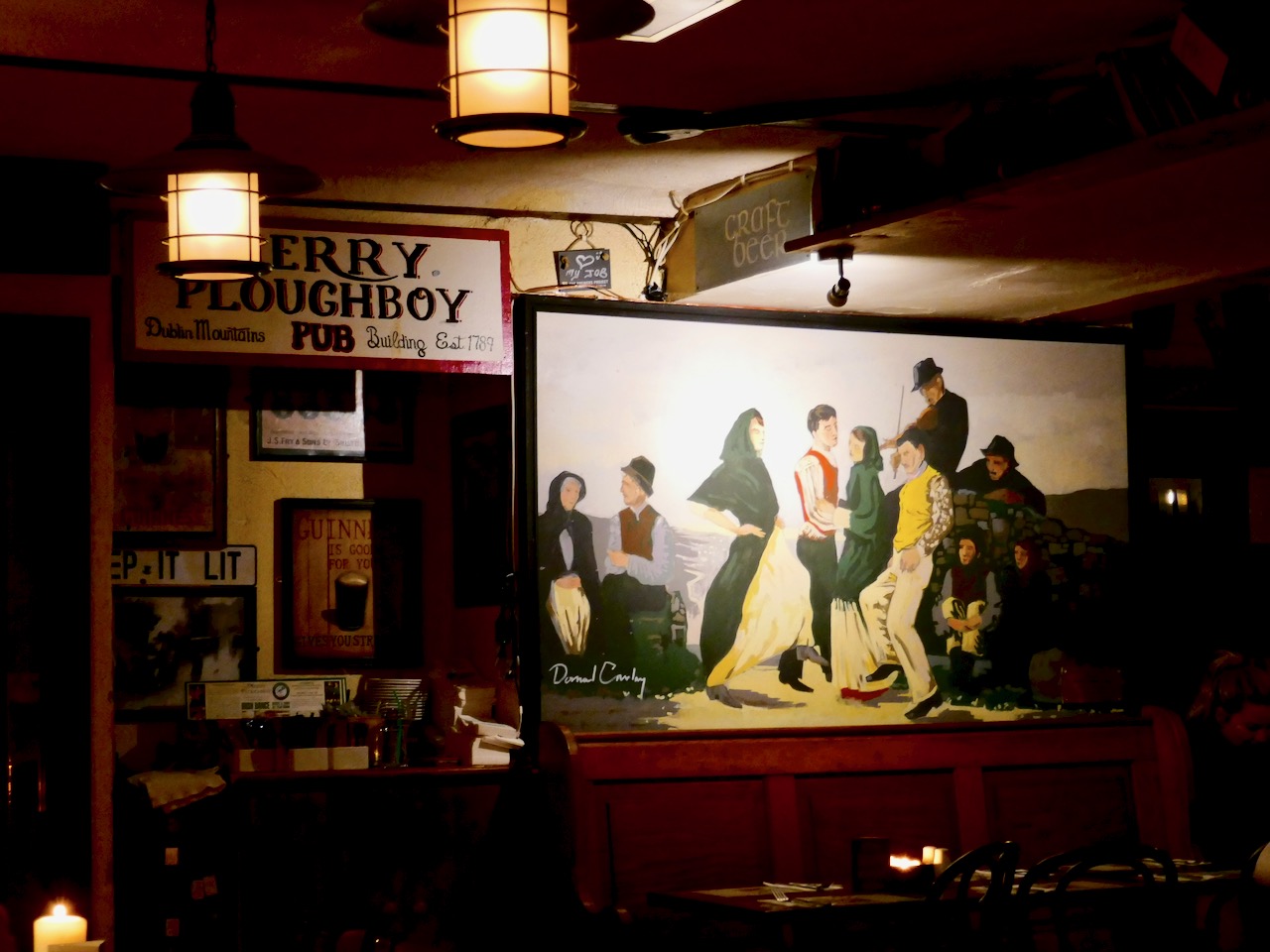
Our little artist’s memoir is almost over. The gale continued with ferocious lashing rain: cold and hungry we made a beeline for the local pub – the Merry Ploughboy, evidently a famous music venue. It was warm and welcoming, and full of a crowd watching Six Nations Rugby on the big screen (Ireland won the match).

In the lounge we were intrigued to find an oblique reference to Seán Keating – a painting which has a nod to his style but is by a different artist!

We agreed that our day trip to the east, in the teeth of the gale, was a memorable way to discover the life, work and death of one of Ireland’s significant artists.

Mizen Magic 8: The Altar

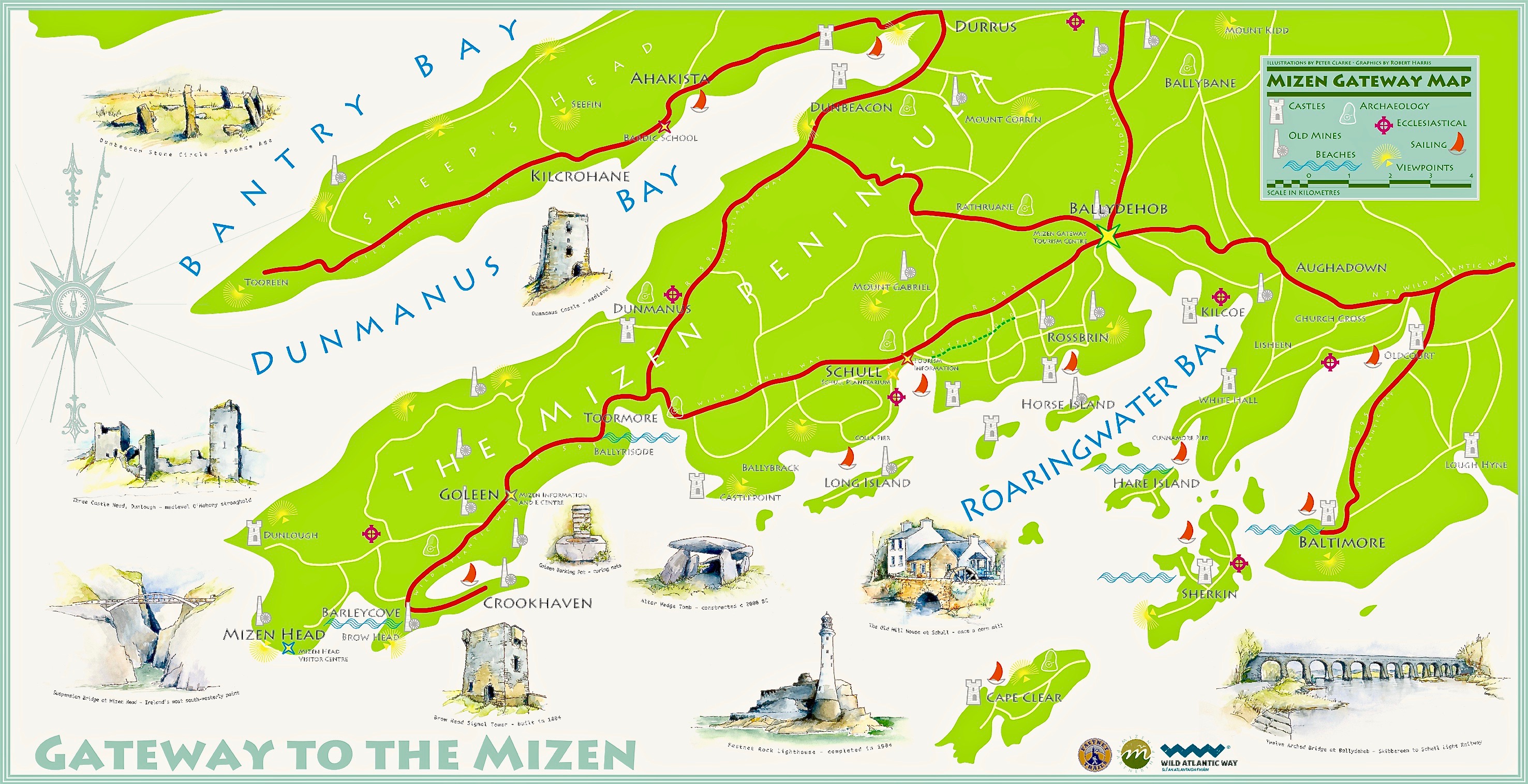
Here’s the Mizen Peninsula shown on a map drawn by Robert for the Bank House tourism centre in Ballydehob and embellished with Peter Clarke‘s exquisite watercolour sketches of just some of the places that should not be missed by visitors to West Cork . . .

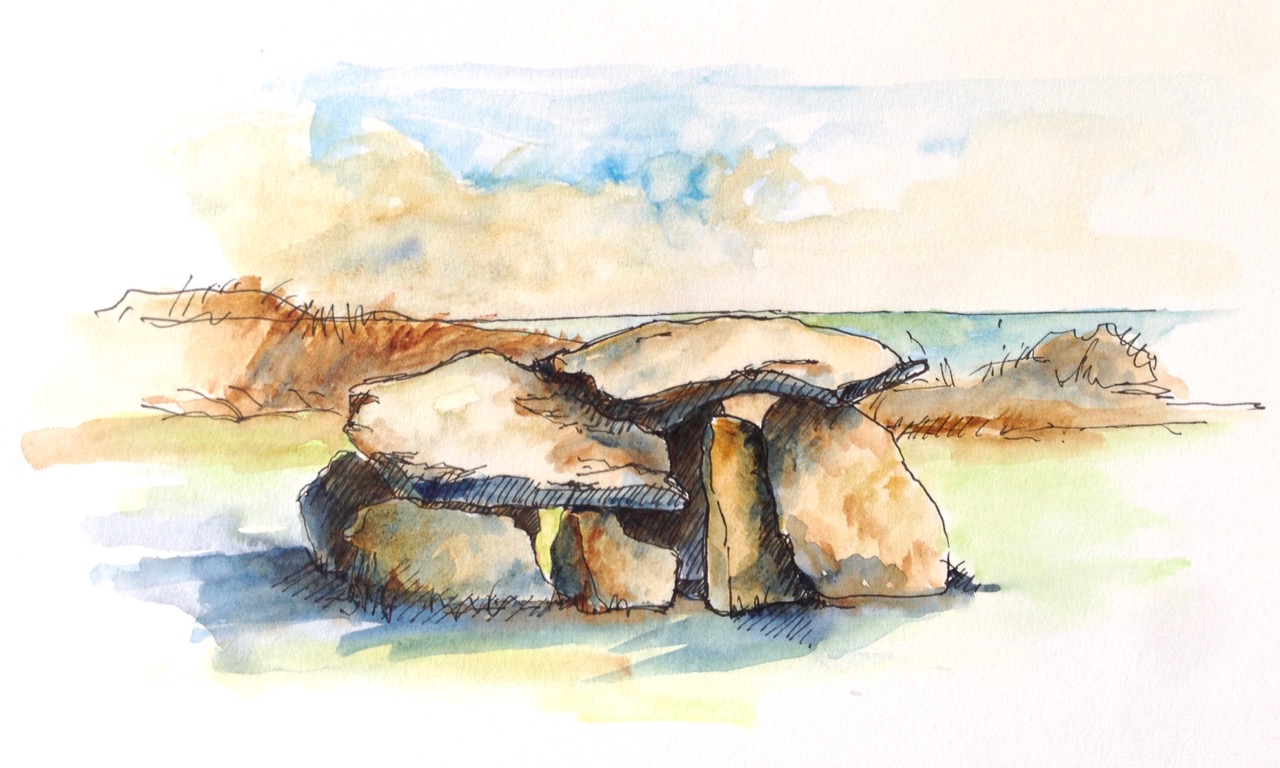
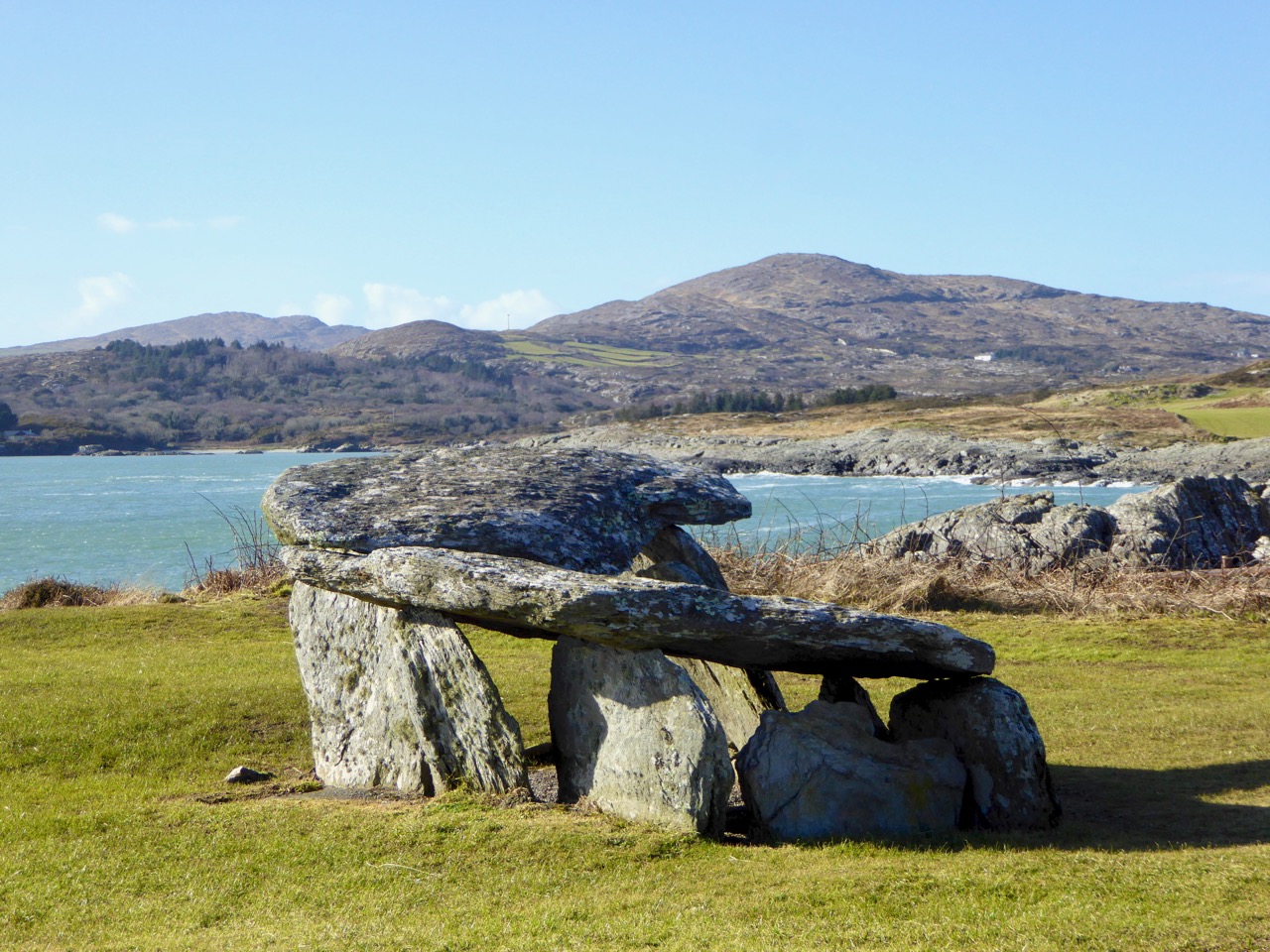
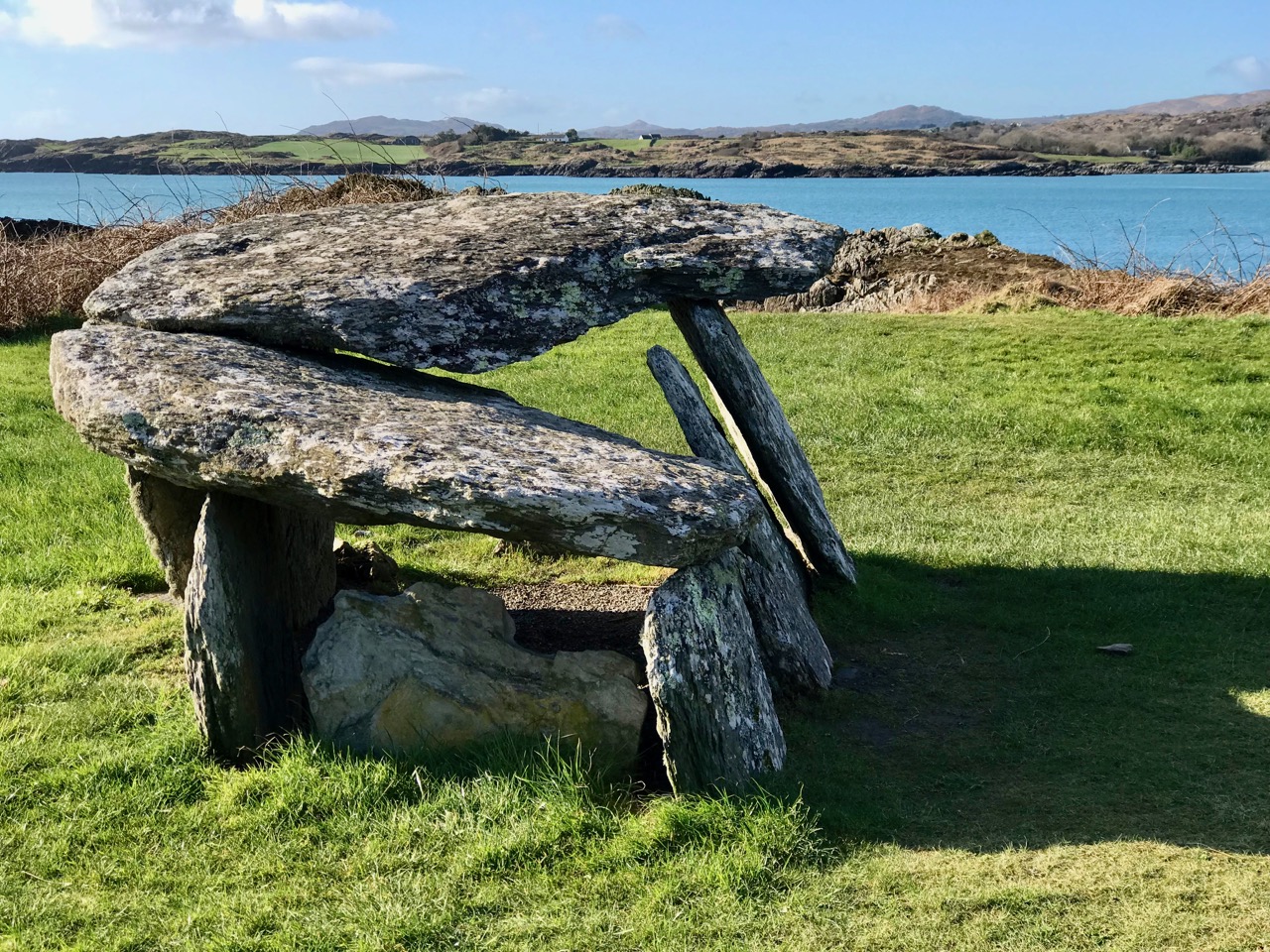
. . . And here is another rendering from Peter of one of the ancient sites that everyone goes past when travelling to the far west: possibly one of the most accessible pieces of archaeology on this section of the Wild Atlantic Way. It’s the Altar Wedge Tomb at Toormore Bay.

It’s early February, and Imbolc has passed. That means that Springtime has officially started here in Ireland. Sure enough, we looked out over a sunlit Roaringwater Bay this morning: soon we were heading out towards Goleen, Barley Cove and all points west. We stopped at The Altar and had it all to ourselves. You can see here that it’s orientated towards the Mizen Peak – that sharp little pyramid which is right on the centre of the picture – and lies to the west. For me, there’s a perfectly natural symbolism about placing the dead in a tomb that is aligned on the rising and the setting of the sun: that’s something we still do, several thousand years on!

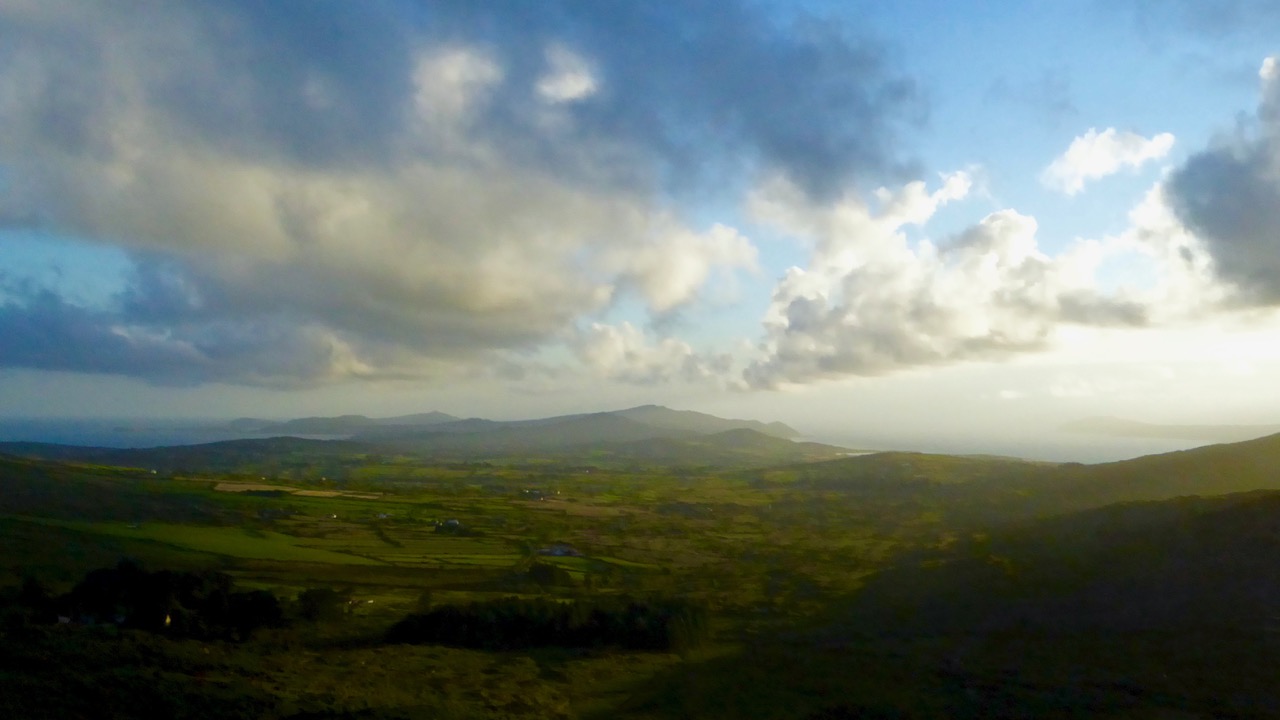
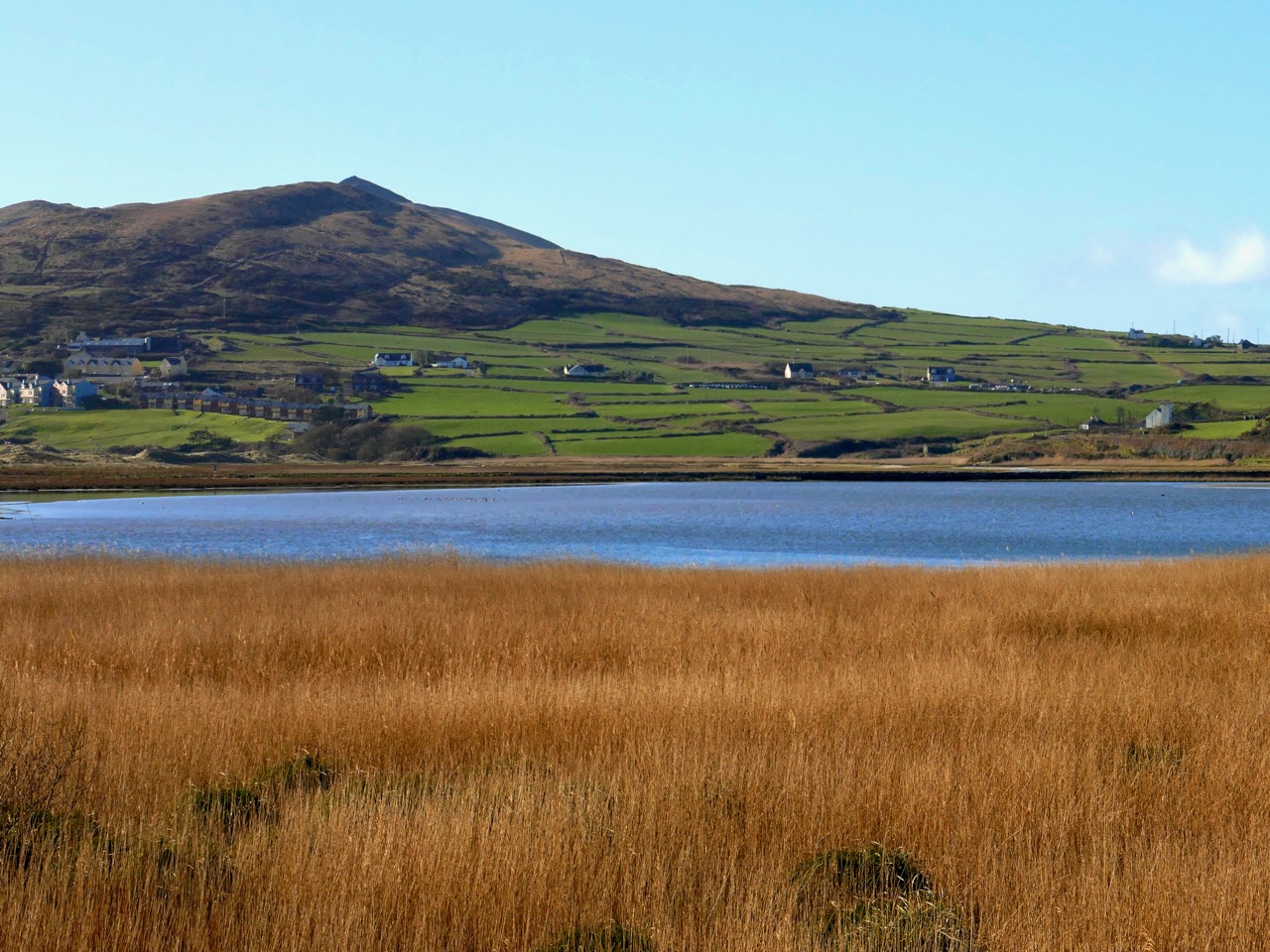
The upper picture, taken on the Winter Solstice, shows the Mizen stretching away from the heights of Mount Gabriel: the Mizen Peak is the little pointed blip just left of centre. The lower picture looks across the wetlands behind the sand dunes at Barley Cove, and was taken today in the Spring sunlight: the Peak is clearly visible as the highest point. I believe that our forebears attached great importance to high places, as many stone monuments and Rock Art often seem to be placed in the landscape with commanding views towards hilltops. Mike Wilson’s site Mega-What sets out his detailed studies of the orientation of ancient sites within the natural landscape. Here is his analysis of the setting of the Altar Wedge Tomb.

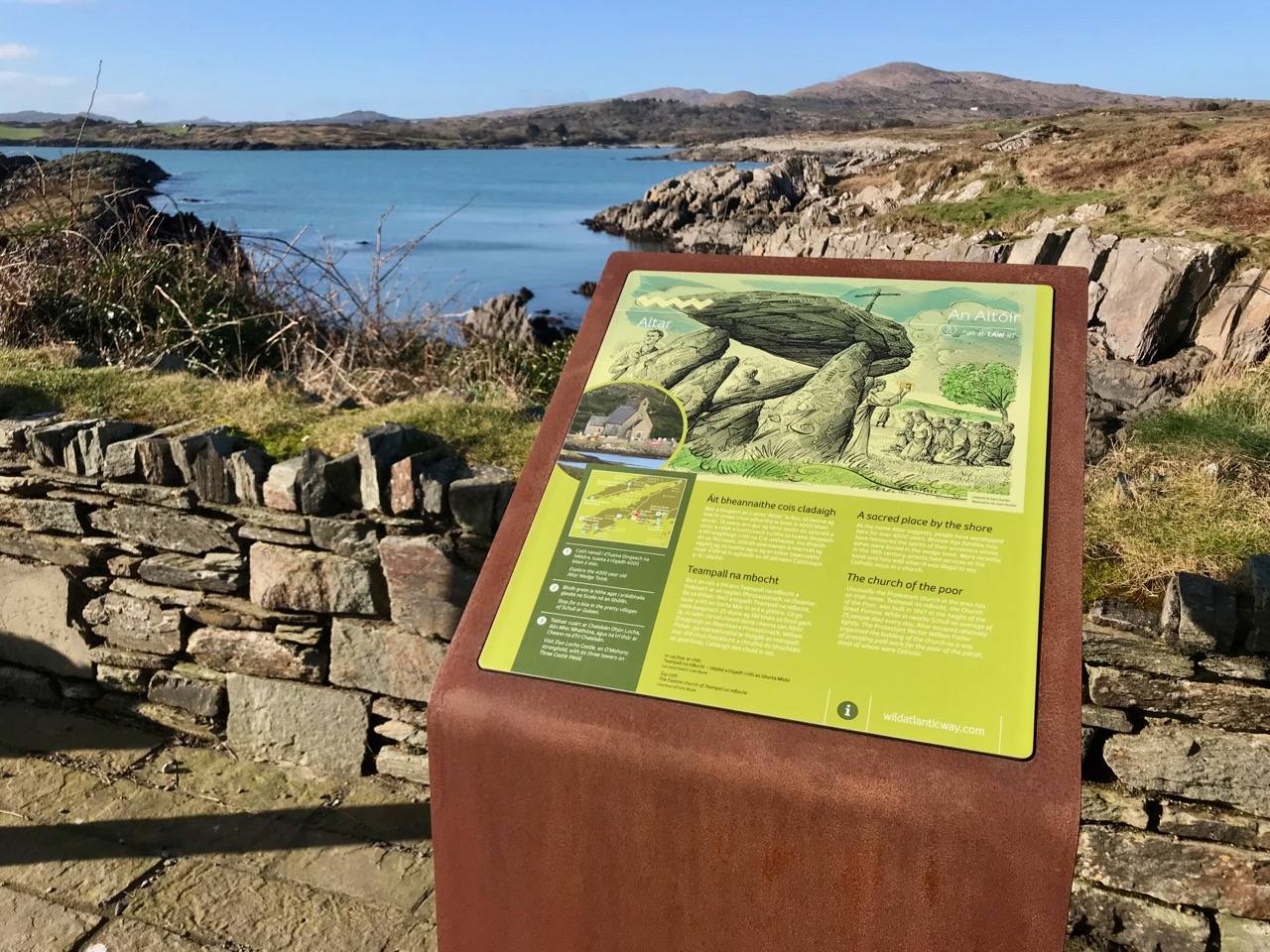
I am always alert for the ways in which our special sites are interpreted for us. I created a bit of a storm a while back when I commended the signage which has been put in place along the Wild Atlantic Way using visually strong corten steel elements (above left) supplemented more recently by (in my opinion) very well designed information boards. The image on the right above is from an earlier OPW board which explains the possible early use of the wedge tomb, while the images below show the new signage, which features the later use of the tomb as a Christian altar during the Penal times (hence the name: The Altar), with a drawing by Sam Hunter. I am struck by the way this monument has been a focal point for differing rituals spanning countless generations.

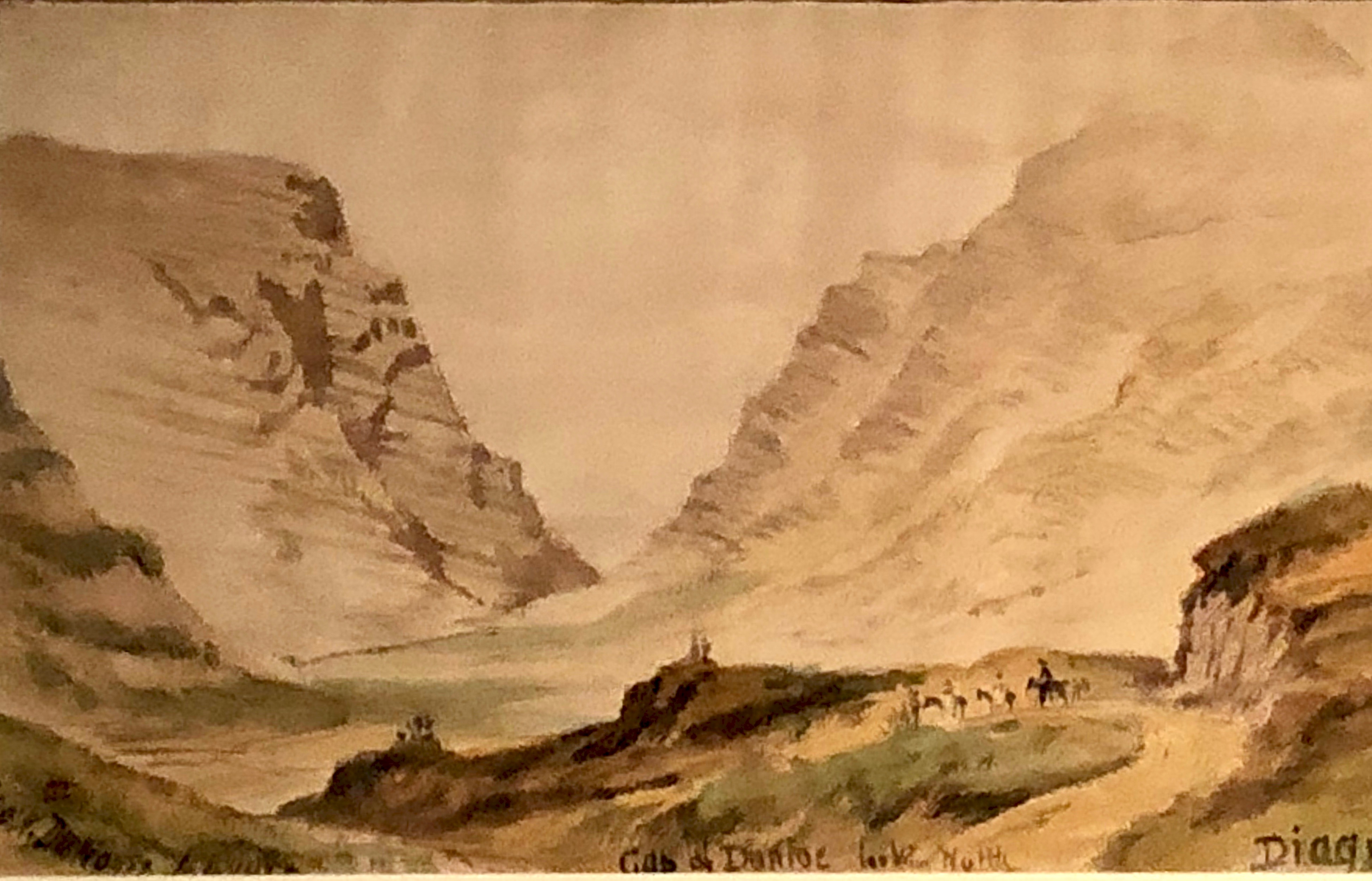
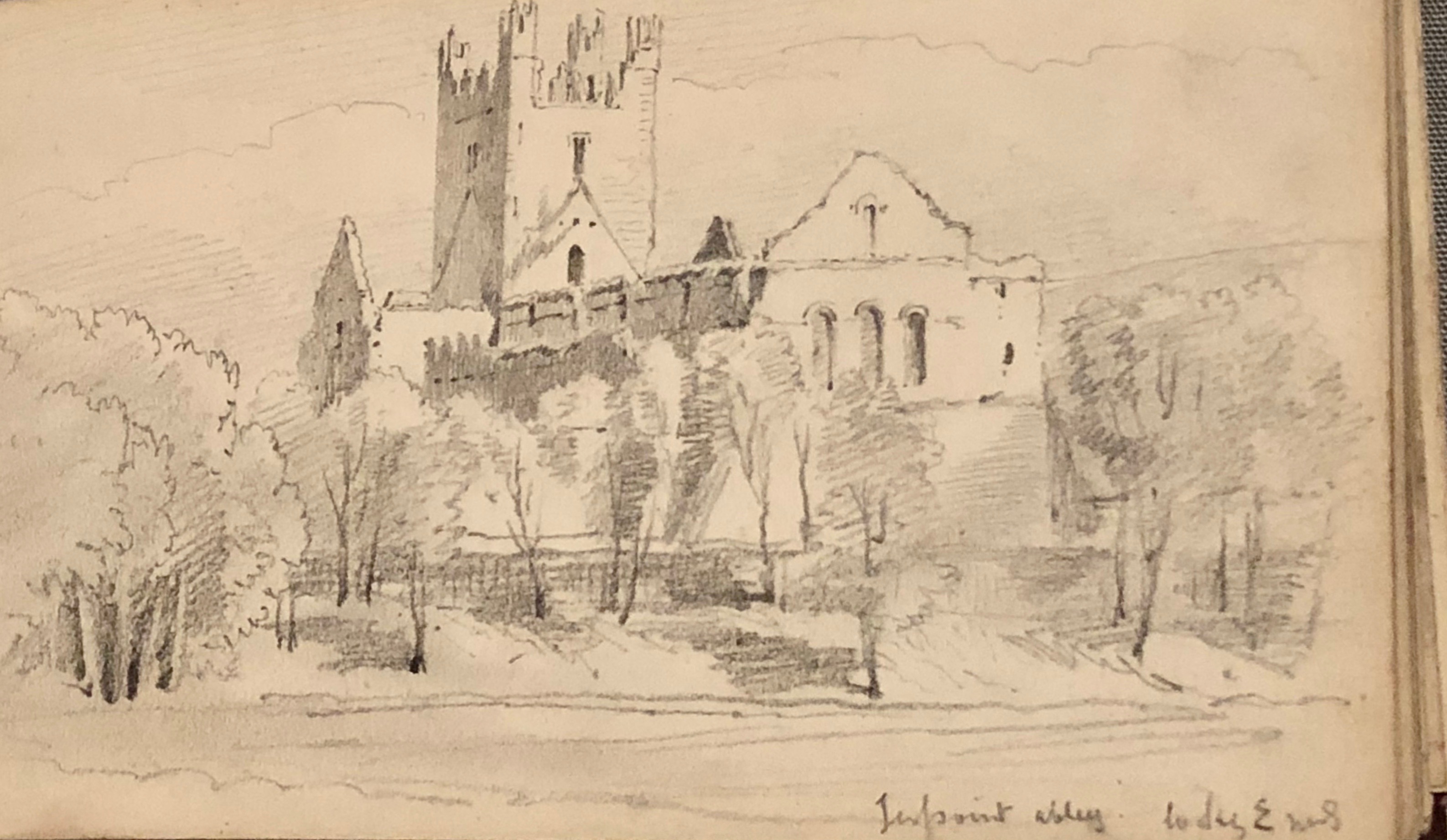
When writing about archaeological subjects I am always on the lookout for the way that antiquarians saw the sites which we are familiar with today. I had hoped that George Victor du Noyer – the subject of an excellent recent exhibition in Cork’s Crawford Gallery – might have drawn this wedge tomb when he travelled the country for the Ordnance Survey during the early nineteenth century: he may well have done, but the annotation and cataloguing of his vast legacy of work has yet to be completed and I have not found such a record. His drawings below are not of The Altar, but a portal tomb, Ballybrittas in County Wexford. Portal tombs (sometimes known as dolmens) share similarities with wedge tombs, but are earlier, dating from between 3000 BC to 2000 BC, while wedge tombs tend to be associated with the Bronze Age, which followed this period.

Cremated remains were found in Altar Wedge Tomb when it was excavated in 1989 by Dr William O’Brien, now Professor of Archaeology at UCC. We can never know exactly what the significance of these impressive structures was to those who built them. For me, I’m pretty sure that it was connected with their relationships to, and respect of, the landscapes which they inhabited, and which they invested with meaning. They must certainly have paid heed to the passing of the seasons and the continual cycles of nature, and their closeness to all of this must have given them an inherent knowledge of the paths of the sun, moon and stars. Above all, our ancestors had to understand and appreciate the environment around them, and make it work for them. In a practical sense, certainly, but also in terms of the stories they might pass on about the meaning of places.

Above – the magical landscape of the Mizen: we will never tire of it

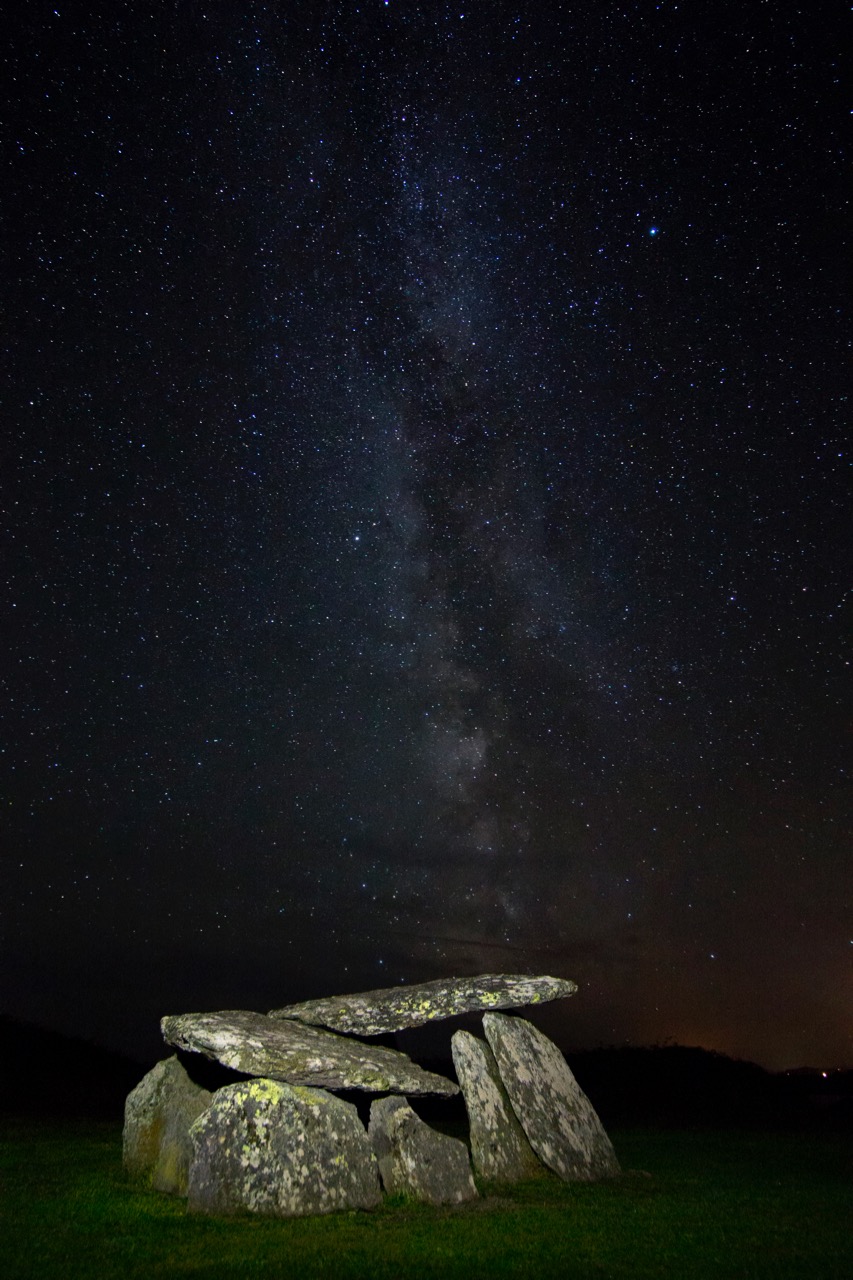
The tailpiece picture, which is from Wikimedia Commons, attributed to Lukeoc88, is a remarkable timeless view of a human construction in the setting of our Universe: Altar Wedge Tomb under the Milky Way.

George Victor Du Noyer at the Crawford Gallery

I had been aware of George Victor Du Noyer’s antiquarian drawings from my days as a student, but that did not prepare me for the Du Noyer exhibition currently running at the Crawford – it’s nothing short of breathtaking. Du Noyer, it turns out, was far far more than an antiquarian: he was a nineteenth century Renaissance man, artistic, talented, curious, scientific and learned in equal proportions. Stones, Slabs and Seascapes is curated by Peter Murray (recently retired director of the Crawford) and co-curated by Petra Coffey of the Geological Survey.  If you do nothing else this winter, get to Cork to see this exhibition!

I’ve decided to annotate the images with quotes in italics (image follows quote) from the outstanding exhibition catalogue which is a collection of essays, each written from a slightly different perspective. I’ve tried to show representative samples of Du Noyer’s work, mostly from the exhibition. A couple of illustrations are from elsewhere. I’m not going to say a lot about Du Noyer’s life – there’s an excellent summary (with some additional photographs) by Fiona Ahern on the Maynooth University Library website.

From a cultural studies and critical theory perspective, the principal interest in Du Noyer lies also in seeing how, as an Irish artist, he responded to the international debates of his day: to the Devonian controversy, to the widening gap between ‘uniformitarianists’ and ‘catastrophists’, and to the urgent search by geologists and astronomers during his lifetime to explain the origins of the planet Earth. The ability of Du Noyer to traverse conventions of representation – he moved easily from picturesque watercolours, to scientific cross-sections of landscape – reflects a similar flux in nineteenth-century learning, where advances in science co-existed with a desire to adhere to traditional modes of representation. (From the Introduction by Peter Murray and Petra Coffey)

In contrast with other artists’ depiction of Ireland at this time (many of them English), Du Noyer’s sketches lack the stereotyping that is all too common in art of that period. Based on eyewitness observation, his drawings lack elements of caricature and satire often perceptible in depictions of Ireland by artists who tended to work from preconceived ideas. (From the Introduction by Peter Murray and Petra Coffey)

Throughout a long and productive lifetime, during which he depicted a myriad of objects and places in Ireland, George Victor Du Noyer compiled a databank of images that not only formed part of the new awareness of Irish national identity that emerged in the early nineteenth century, but also revealed the potential of art to frame revolutionary narratives relating to geology, natural history and human evolution . . . Du Noyer was one of those who helped construct this new narrative. He documented towns and villages, prehistoric sites and ruined monasteries. He had a keen interest in the natural environment, in methods of transport . . . artefacts connected with food preparation, cooking, eating and drinking. (From the Foreword by Peter Murray)

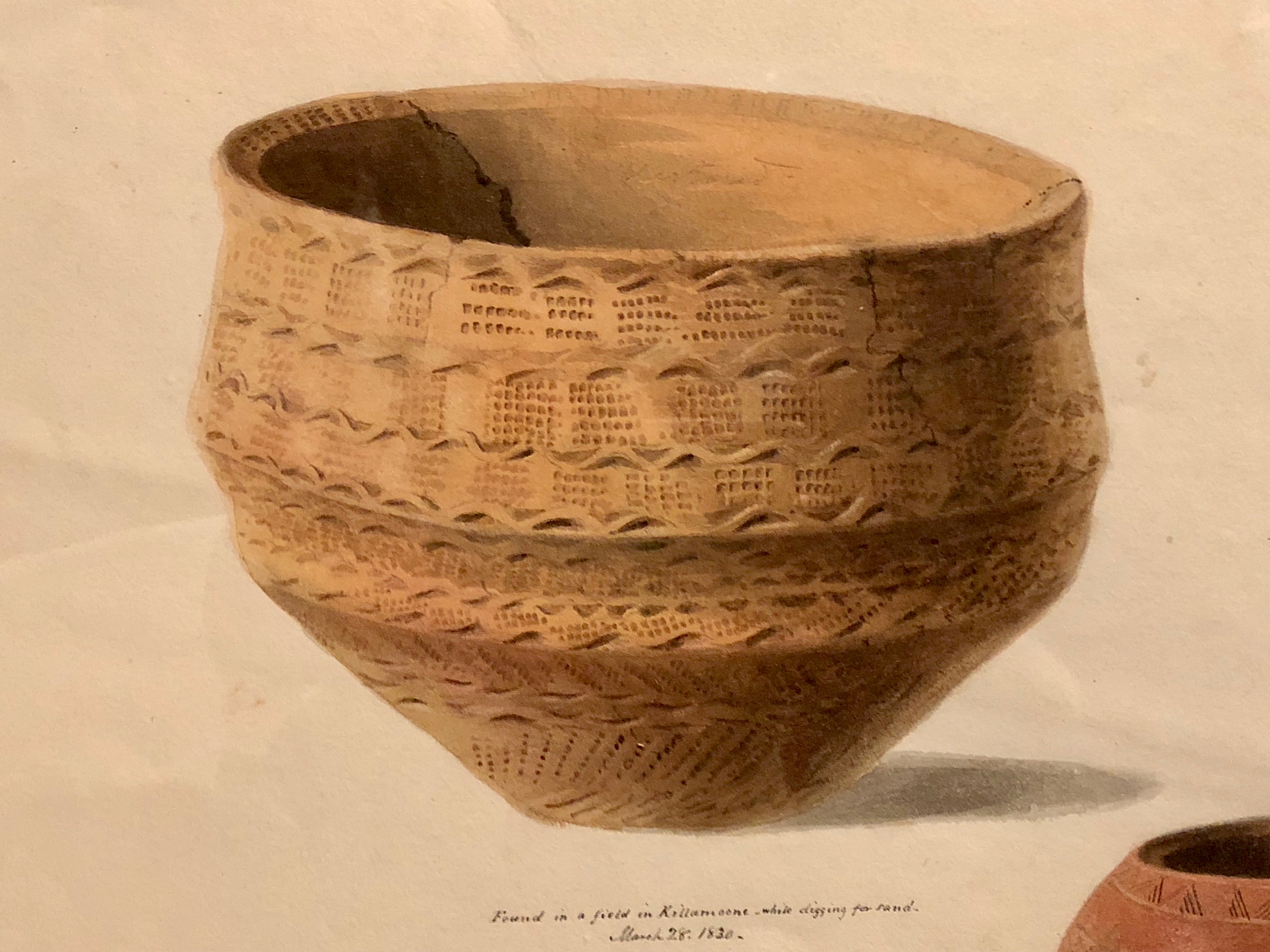
As  industrial production began to dominate people’s everyday view of the world, the aesthetics of handmade objects fell into sharp relief. Du Noyer delighted in depicting such objects, from every age, from simple ‘Killick’ anchors of wood and stone, to querns for grinding corn and wooden drinking vessels. Removed from their original context and preserved in glass cases in museums, these objects had begun to lose much of their original meaning. In illustrating them, Du Noyer not only committed their image to paper but also highlighted philosophical questions relating to the passing of time and the formation of both individual and collective memory. (From the Foreword by Peter Murray)

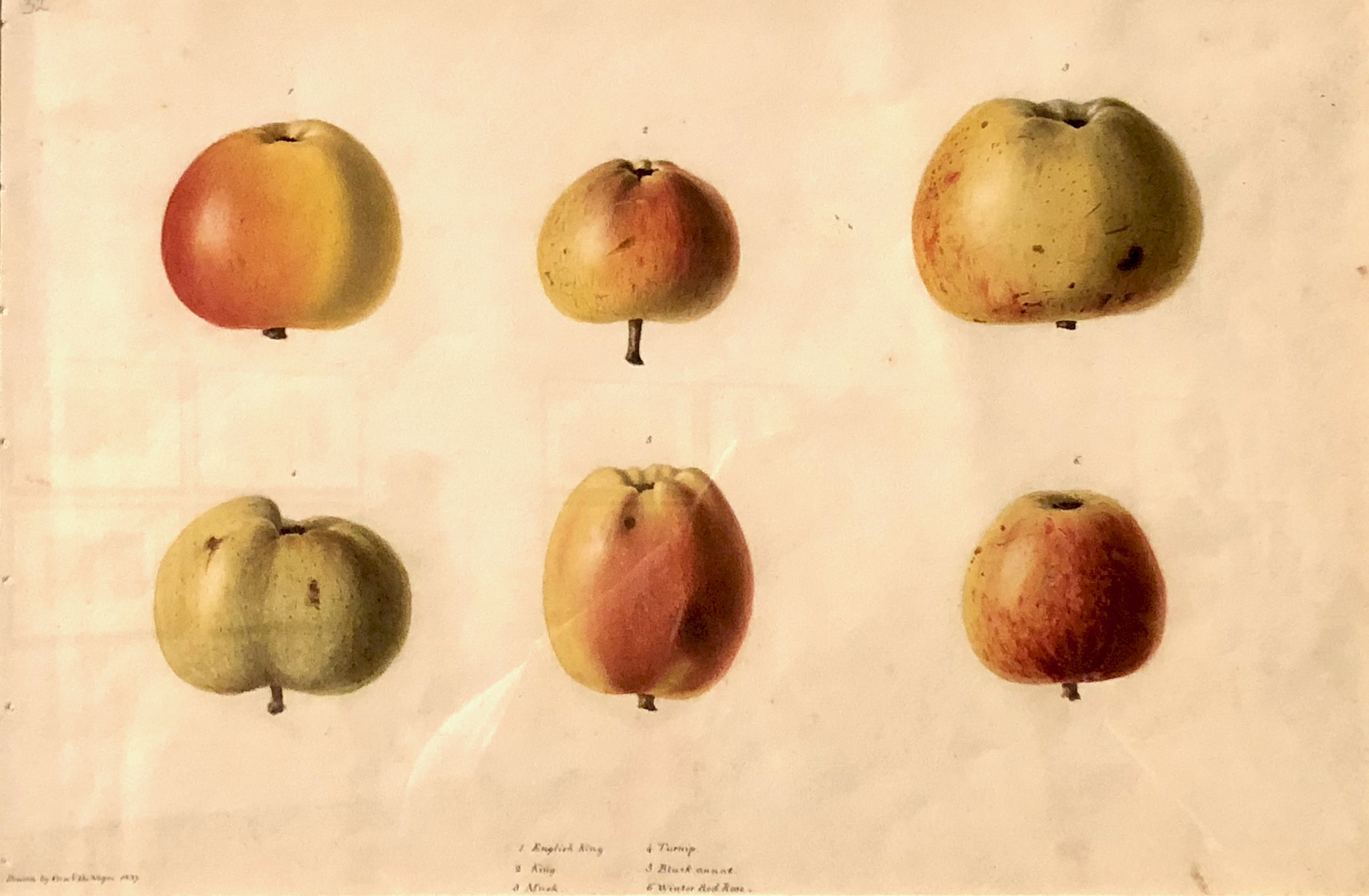
When he was visiting Belfast in 1837, he bought some apples in the market thinking they were Irish apples (they were not) and he painted them magnificently, enhanced with gum Arabic. (From George Victor Du Noyer – Artist and Geologist  (1817-69) by Petra Coffey)

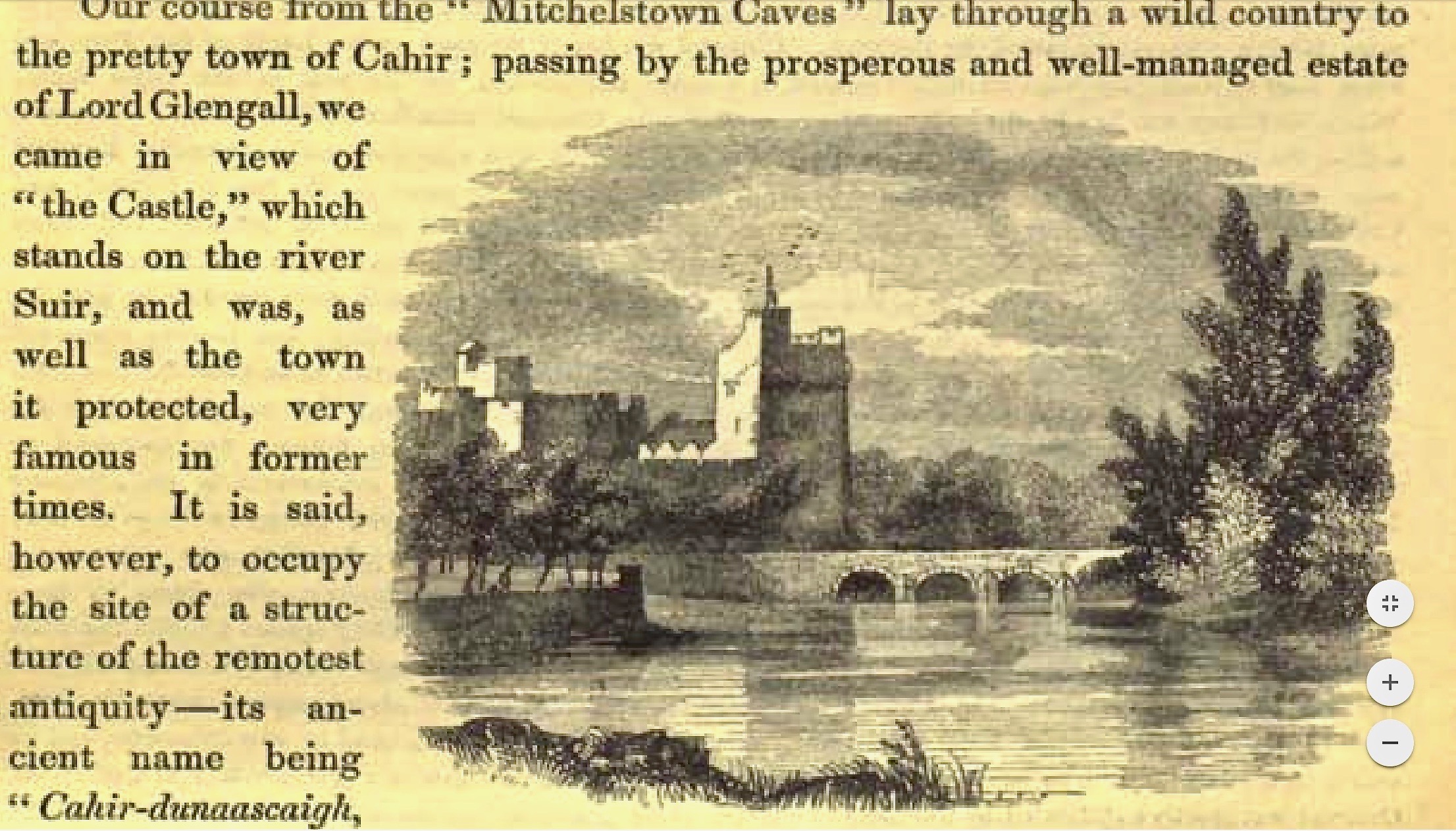
From 1842 to 1843 . . . he accepted private work, as he was able to produce art work in many media . . . He illustrated Hall’s Ireland: Its Scenery, Character, etc (Vol.2, 1842). (From George Victor Du Noyer – Artist and Geologist  (1817-69) by Petra Coffey)

The Geological Survey of Ireland (GSI) was established on 1st April, 1845 . . . Du Noyer had been introduced to the new study of the earth – geology – and it was to shape his life thereafter. Despite having no formal training or qualifications in geology he was to become extremely competent in his calling with the added bonus of being better able than most to record graphically what he saw . . . From now on, Du Noyer never put down his geological hammer, pencil, paper and watercolours . . . (From George Victor Du Noyer – Artist and Geologist  (1817-69) by Petra Coffey)

Du Noyer published papers in many journals, including the Archaeological Journal. His most important work was ‘On the remains of ancient stone-built fortresses and habitations to the west of Dingle, Couny Kerry’, published in 1858. (From George Victor Du Noyer – Artist and Geologist  (1817-69) by Petra Coffey)
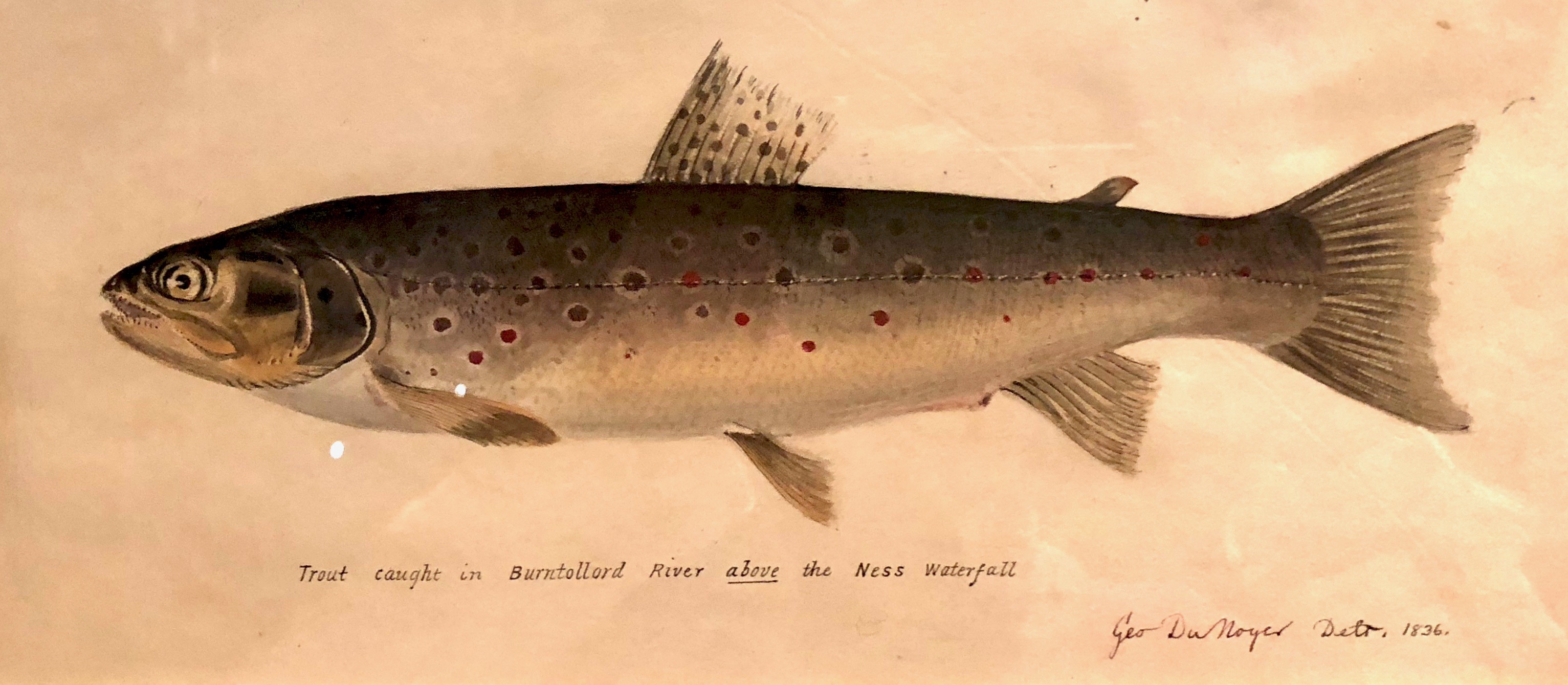
The purpose of a scientific illustration is to reflect accurately the key features of a fossil, animal, plant or landscape. It can be a far cry from the conventional artist’s view, where the essence can be more important than the reality. (From The Scientific Illustrations of George Victor Du Noyer by Nigel T Monaghan)

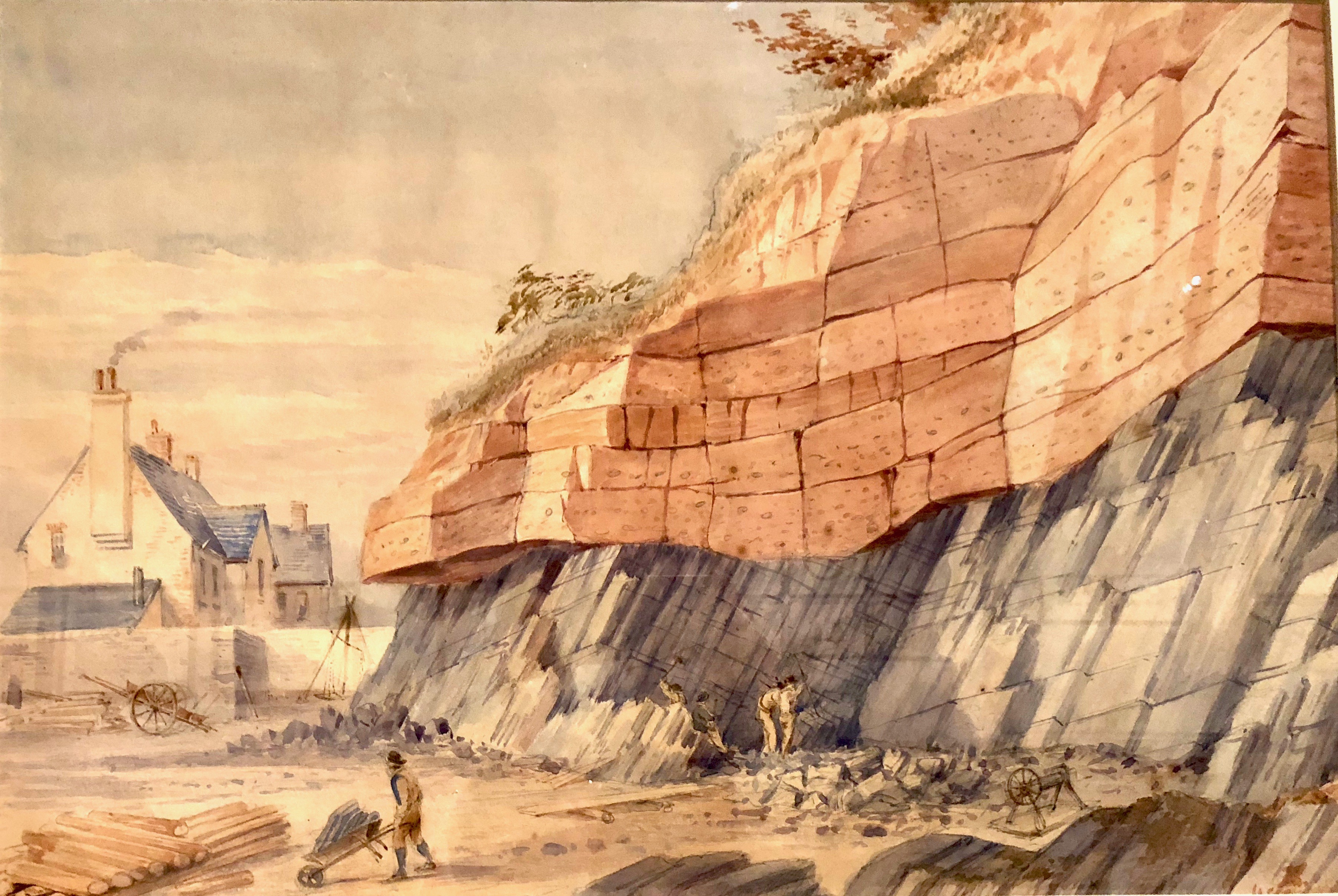
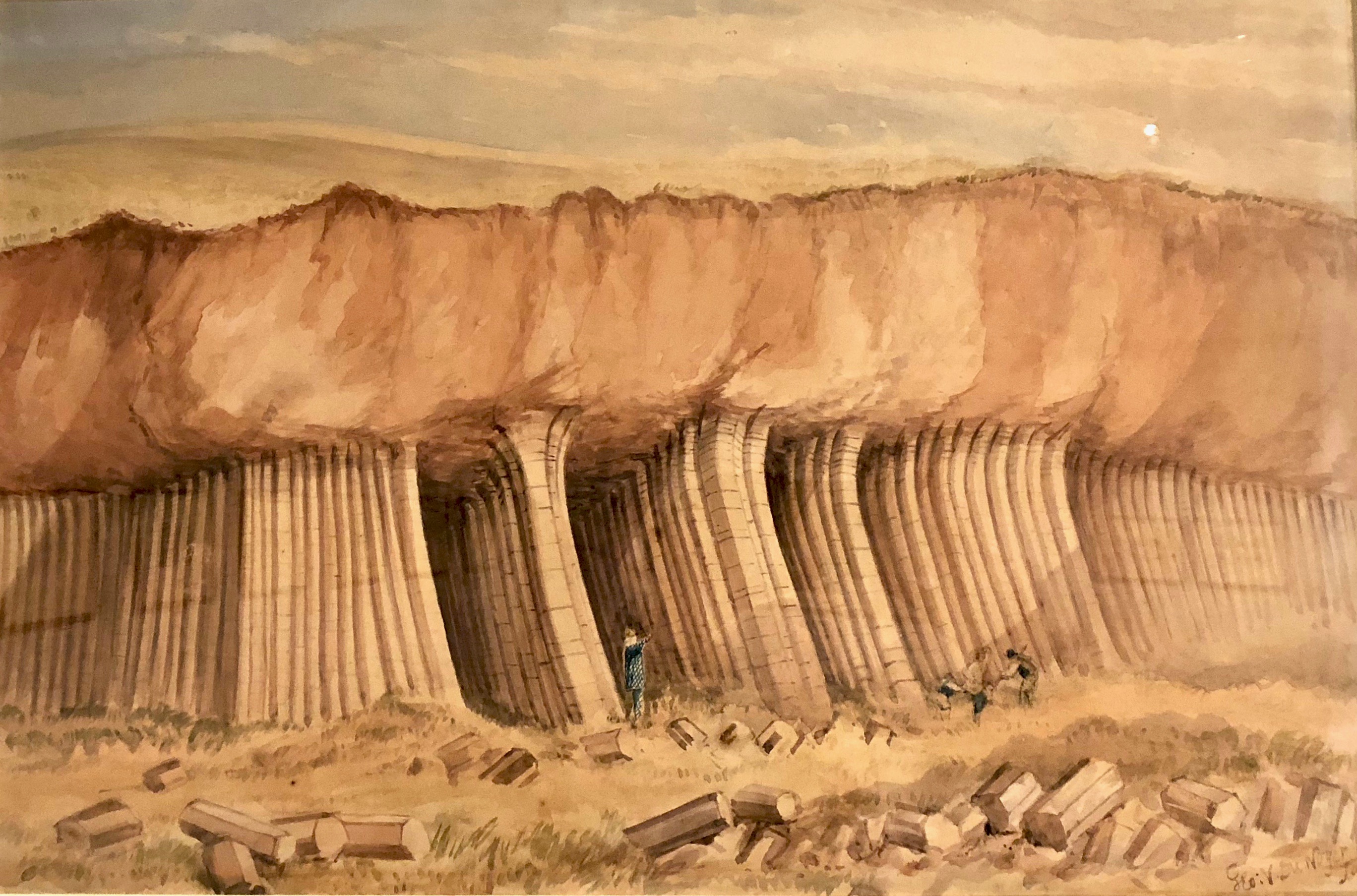
Du Noyer’s scientific landscapes emphasise the geology, showing rocks accurately in terms of bed thickness, irregularity, angles of dip, faults and major joints, with no less attention to detail in his rendition of the soil cover, vegetation and the human impact on the countryside. (From The Scientific Illustrations of George Victor Du Noyer by Nigel T Monaghan)

. . . when Du Noyer worked with the [Ordnance] Survey, he would go out in all weathers to sketch antiquities surviving in the landscape, some of which are now in a more parlous condition than when he drew them, while others have disappeared entirely… (From Du Noyer’s Treasures in the Royal Irish Academy by Peter Harbison)

In 1837 Du Noyer painted a series of large watercolours depicting typologies of Bronze Age spears and axeheads, and early Christian artefacts, such as brooches, bells, devotional crosses, and figures clearly prised off reliquaries. (From George Victor Du Noyer – Where and When by Peter Murray)

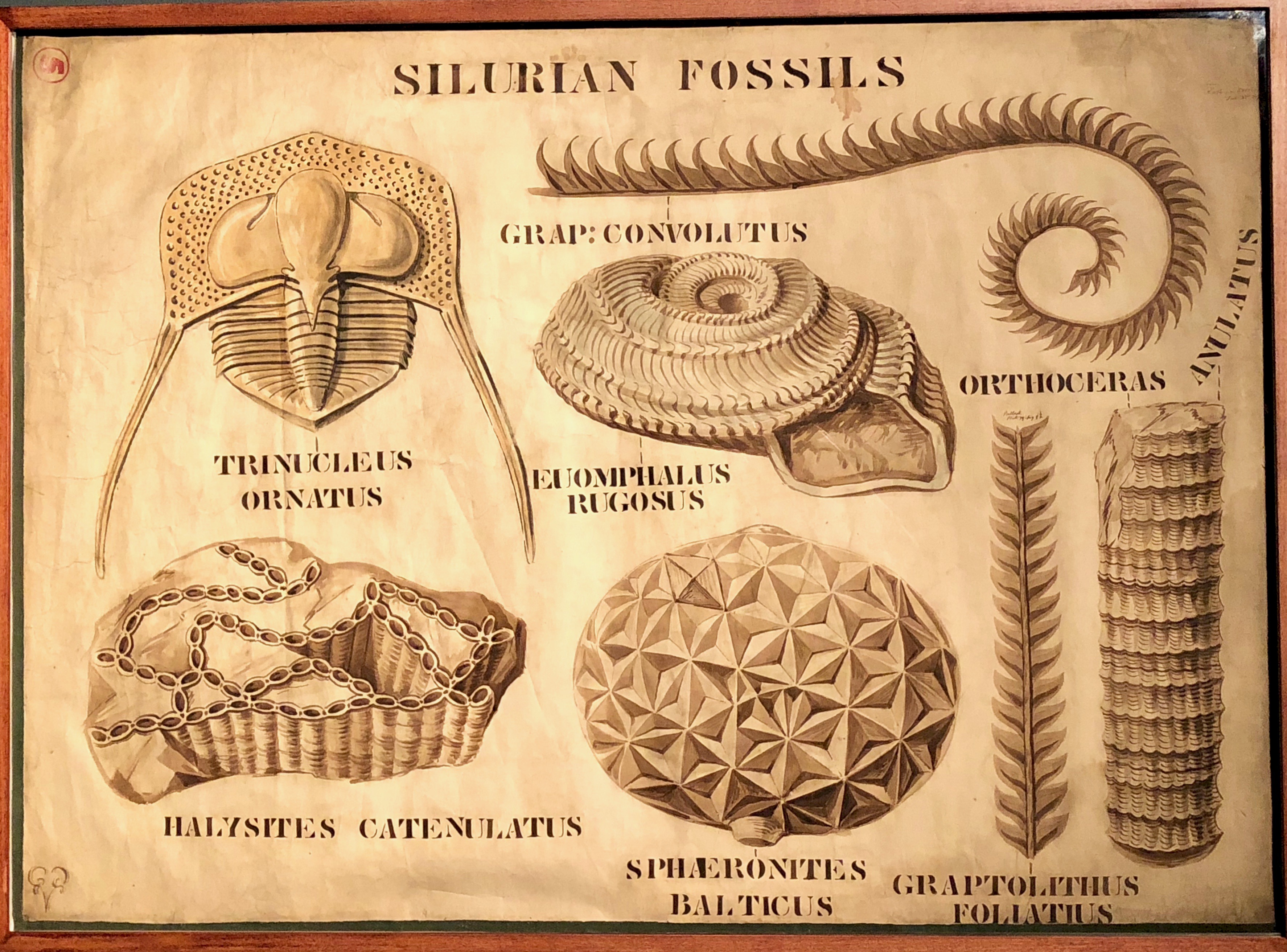
in 1837 and 1838, Du Noyer drew a series of palaeontological monochrome-wash watercolours, depicting fossils of ancient life forms, including seashells, whorls, spirals and other simple shapes, images that were lithographed for Portlock’s Report on the Geology of Londonderry . . . Portlock’s publication, at over 500 pages, was, literally, ground-breaking in terms of the study of fossils in Britain and Ireland. (From George Victor Du Noyer – Where and When by Peter Murray)

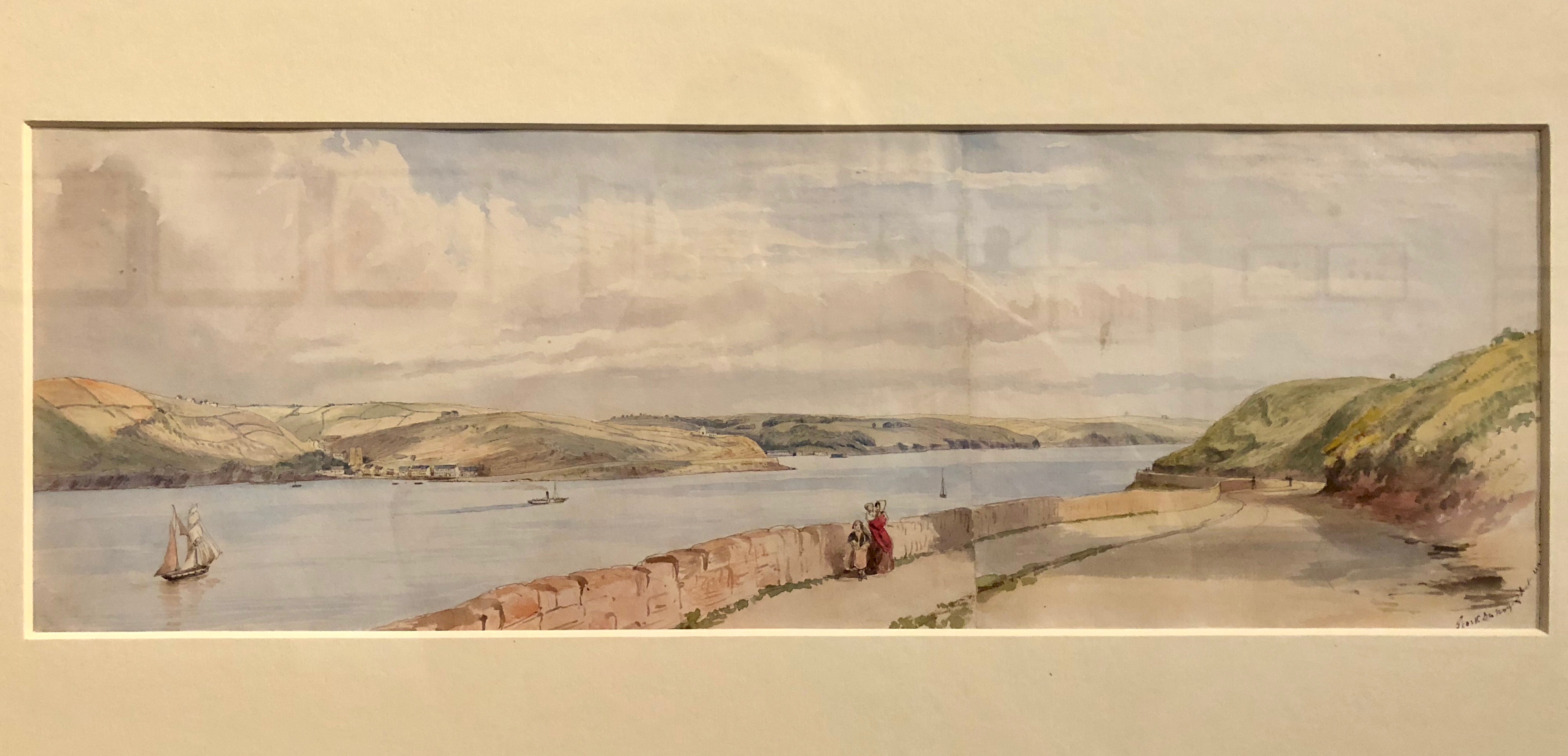
In May 1850, he painted four panoramic watercolours from the top of Carrickbyrne Hill . . . [and] also painted a panoramic watercolour, ‘View of Ballyhack and Arthurstown from Passage’. (From George Victor Du Noyer – Where and When by Peter Murray)

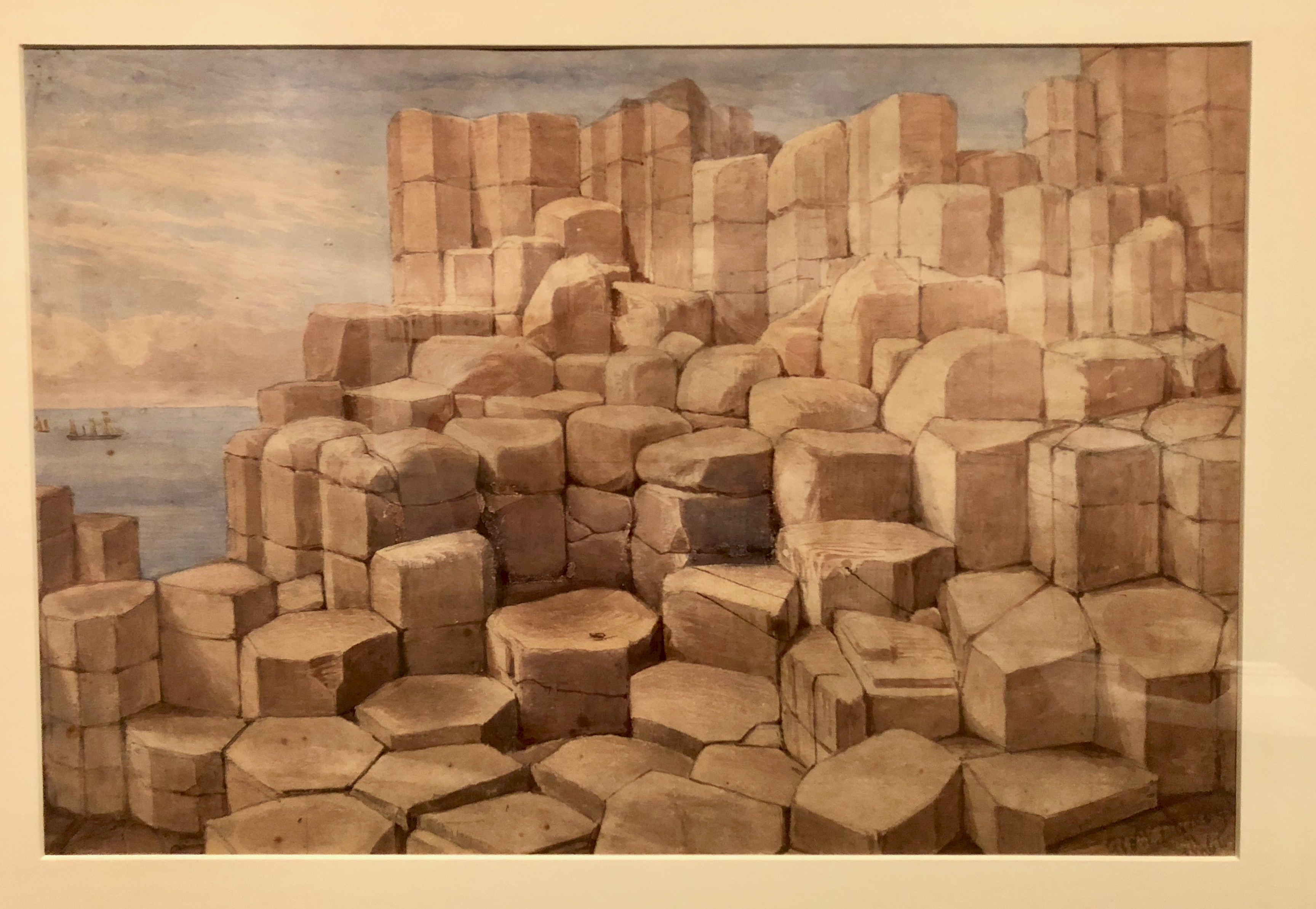
In 1867 . . . after many years working for the Geological Survey of Ireland as an assistant surveyor, Du Noyer was appointed District Surveyor and posted to a field station in County Antrim . . . His article, ‘Notes on the stratigraphical position of the Giant’s Causeway, and the structure of the Basaltic Cliffs immediately adjoining it,’ had been published in The Geologist in 1860. (From George Victor Du Noyer – Where and When by Peter Murray)

In total, Du Noyer left some five thousand works of art, in pencil and watercolour. At his best, he combined an objective scientific approach with a sublime artistic vision. (From George Victor Du Noyer – Where and When by Peter Murray)

The exhibition runs from November 17th, 2017 to February 24th, 2018 at the Crawford Art Gallery in Cork and then from March to September 2018 at the National Museum of Ireland, Dublin.

Catalogue published by Crawford Art Gallery, available from their book shop.