More on Martinmas

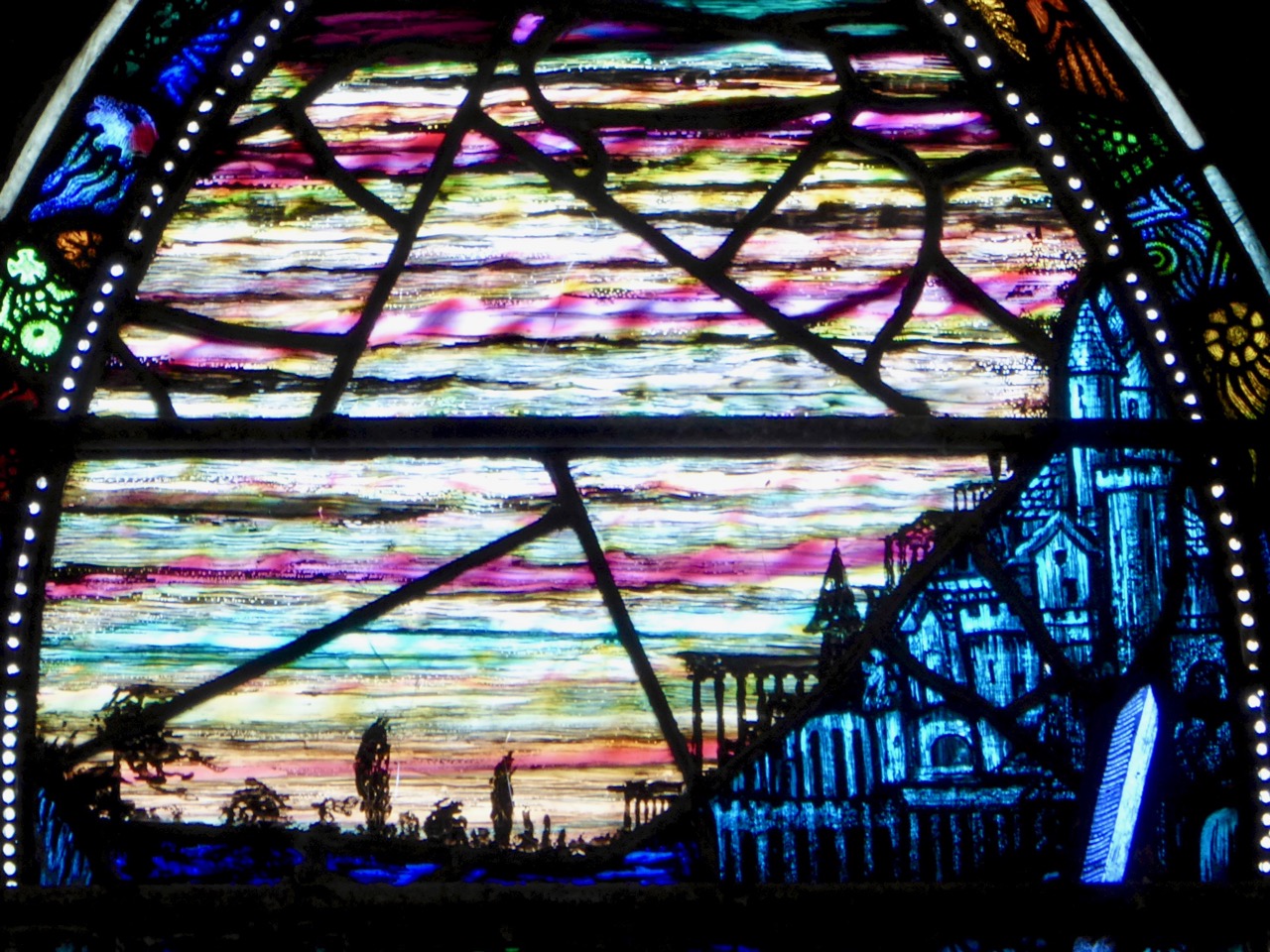
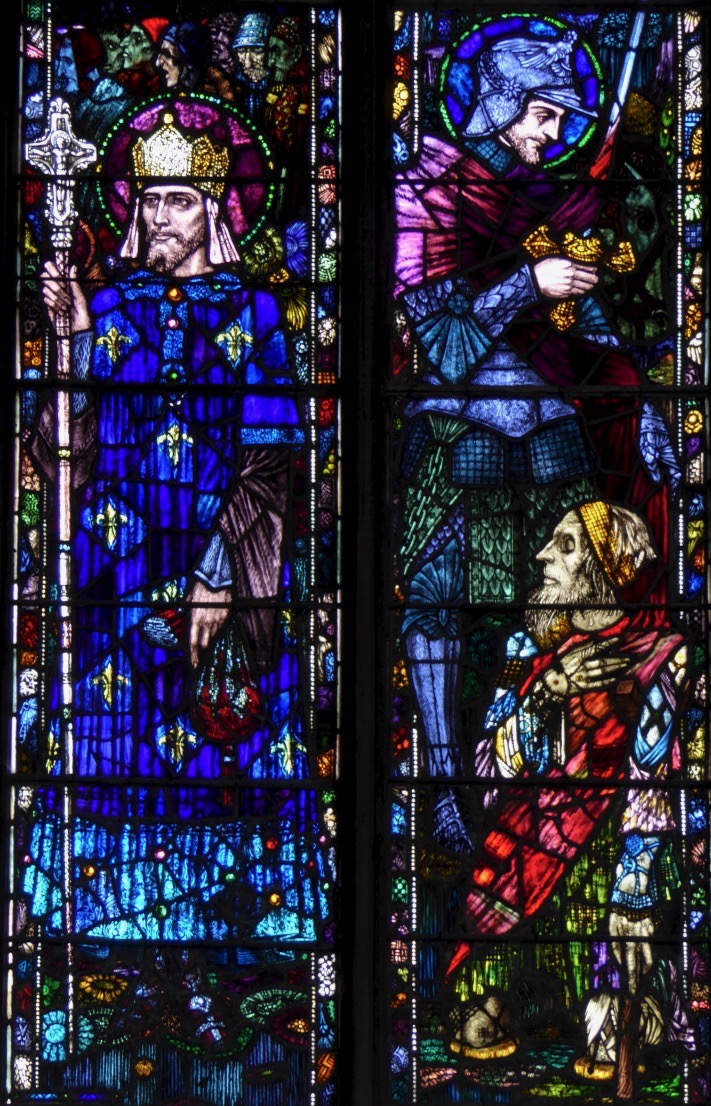
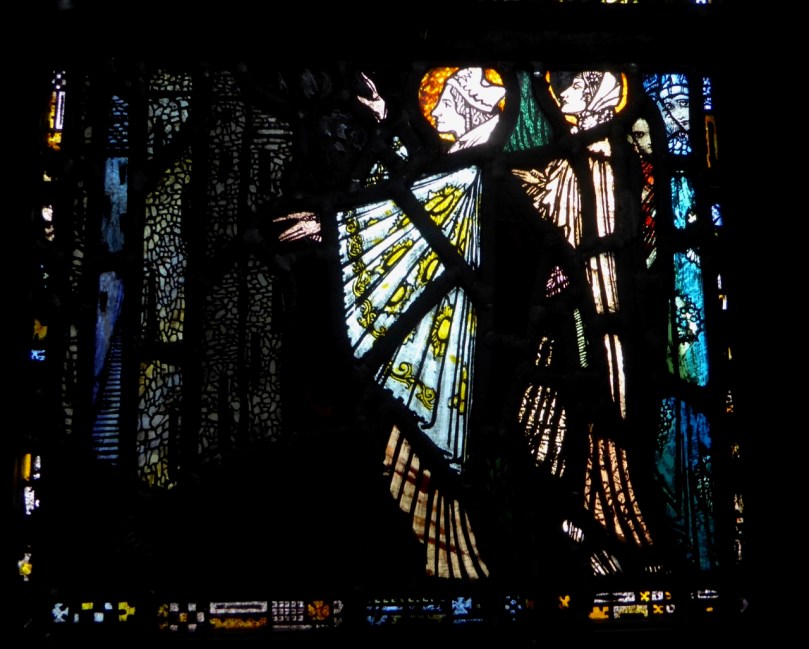
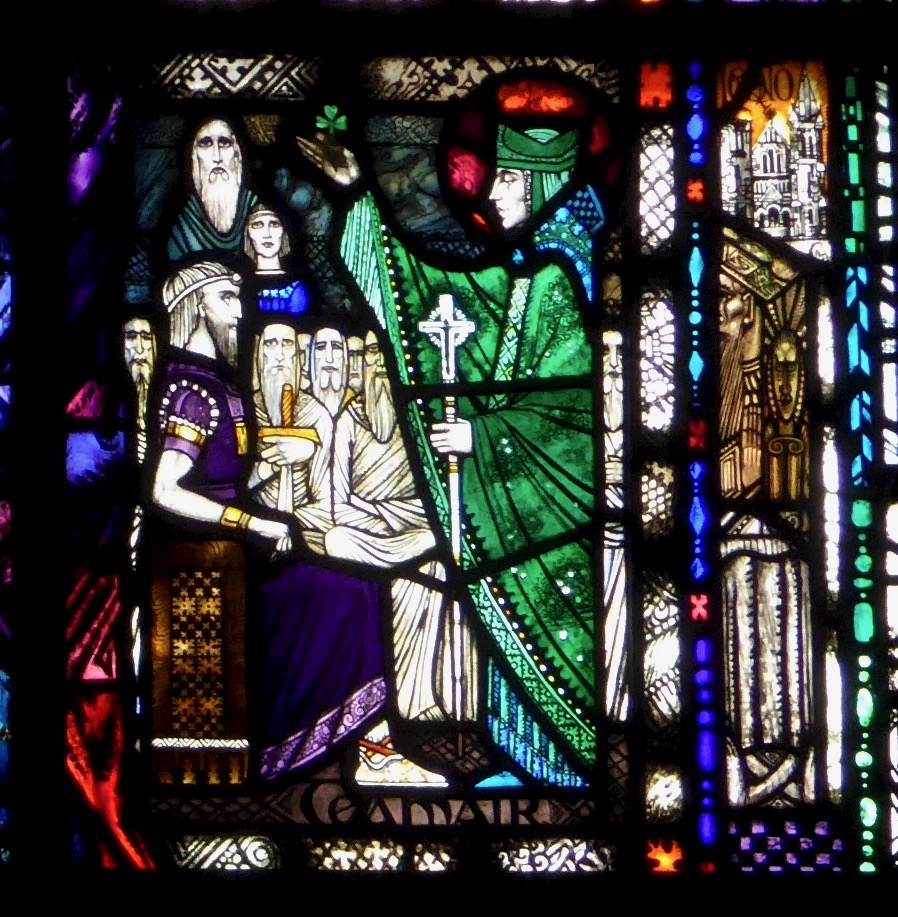
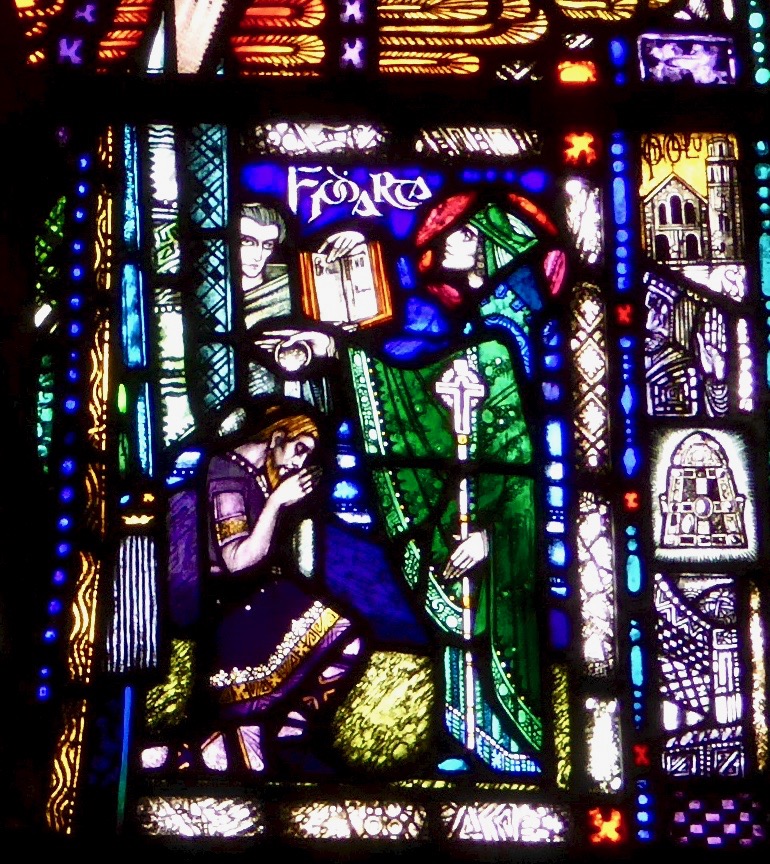
Today – November 11 – is Martinmas. That’s the feast day of St Martin of Tours: the picture above is Harry Clarke’s representation of the city of Tours, which we can see in St Barrahane’s Church, Castletownshend, here in West Cork. St Martin was a saint of Hungarian origin who founded a monastery in Marmoutier, in north-eastern France in 372. As far as we know, he never visited Ireland, yet he is widely celebrated here… Why?

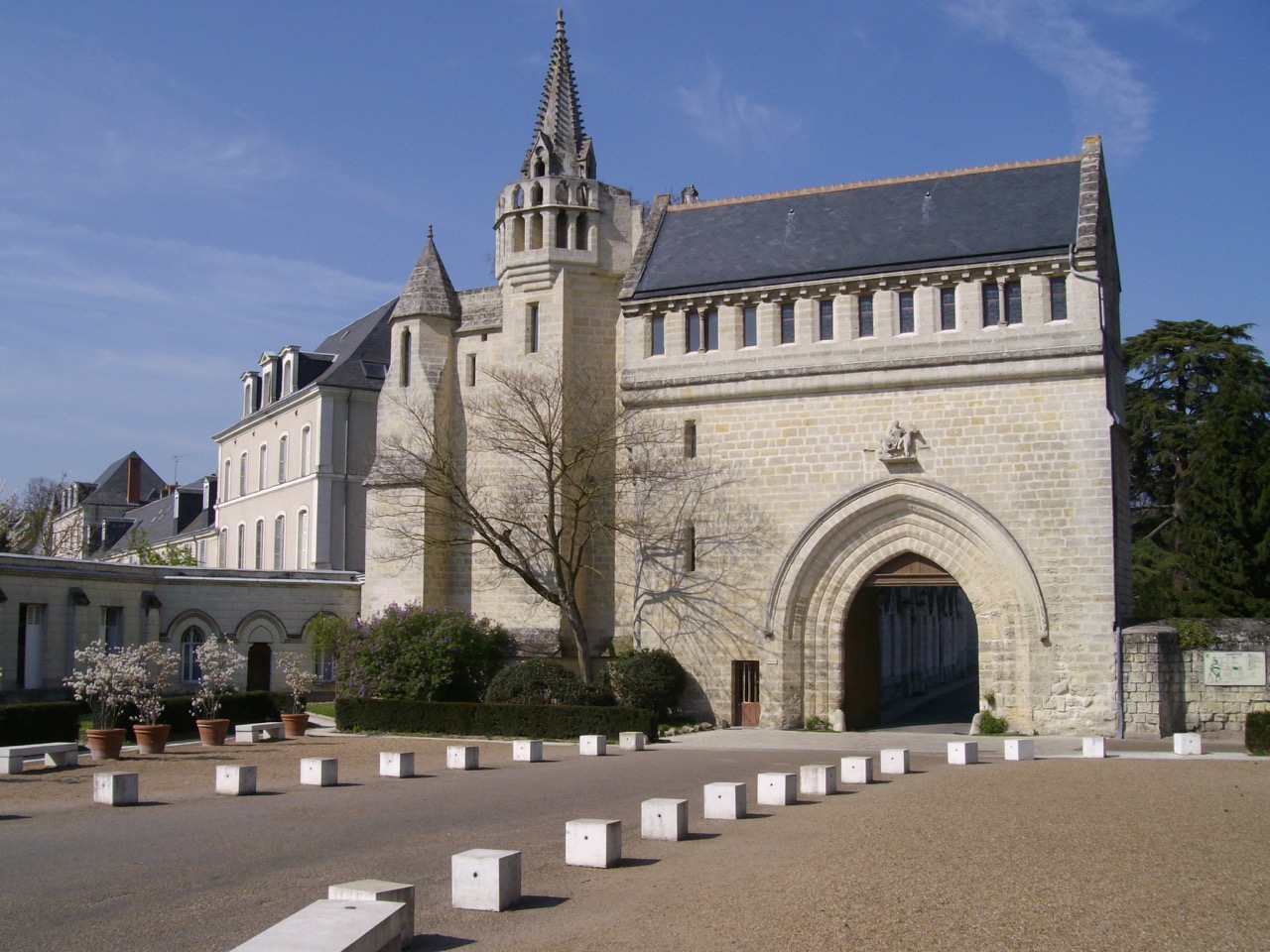
Marmoutier Abbey, near the city of Tours (photo from Wikimedia Commons)

Well, one reason could be that St Martin was the sister of St Patrick’s mother, Conchessa. Or, perhaps he was her uncle – we don’t have definitive records from that time, but we do have plenty of stories. The one everyone seems to know about St Martin is that he came across a naked beggar while travelling in the middle of winter. He immediately split his cloak in two and gave half to the beggar. That night he had a dream in which Jesus told him that it was he who had received the gift of the cloak from Martin. From then on Martin determined to spread Christianity wherever he went.

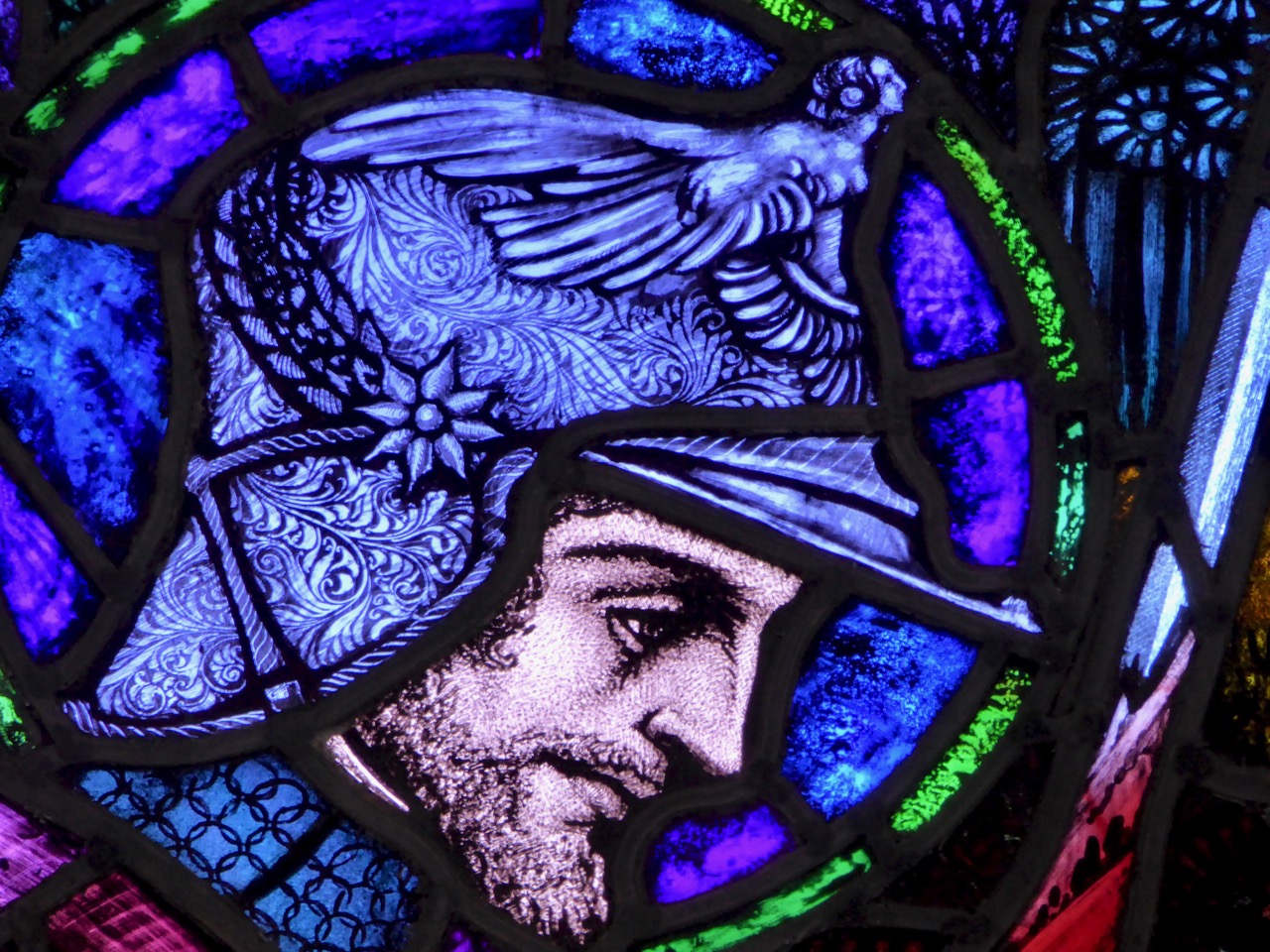
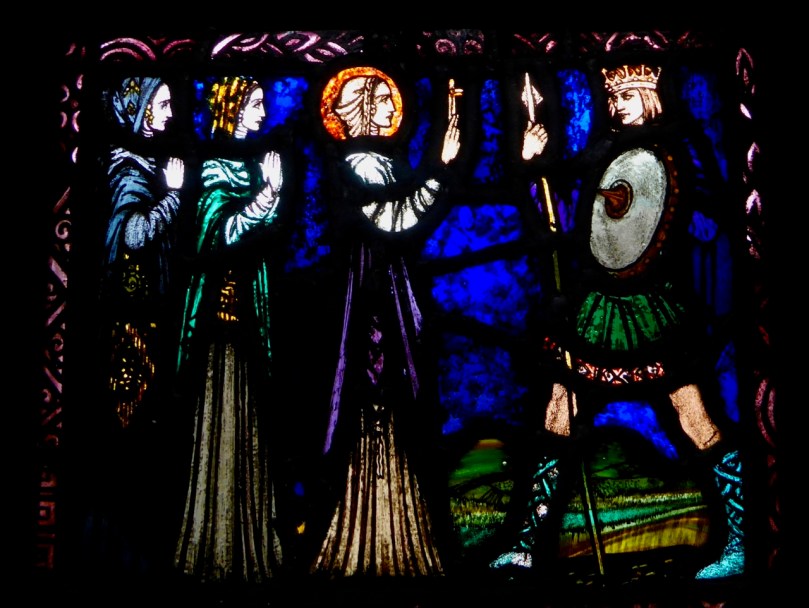
Here is St Martin, depicted in Harry Clarke’s Castletownshend window. Finola tells the full and fascinating story of this wonderful window here. He is depicted as a soldier, and is the patron saint of soldiers. Confusingly, he is also the patron saint of conscientious objectors! In fact, he was the first recorded conscientious objector as he became converted to Christianity while he was serving in the Roman Army. Because of his beliefs he refused to fight but – to prove he was not a coward – he was prepared to go into battle unarmed and stand between the opposing parties in the name of Jesus. Miraculously, on the eve of the battle an armistice was declared. Martin was given a discharge and was able to pursue his calling. Eventually he was made Bishop of Tours and founded his Abbey across the River Loire.

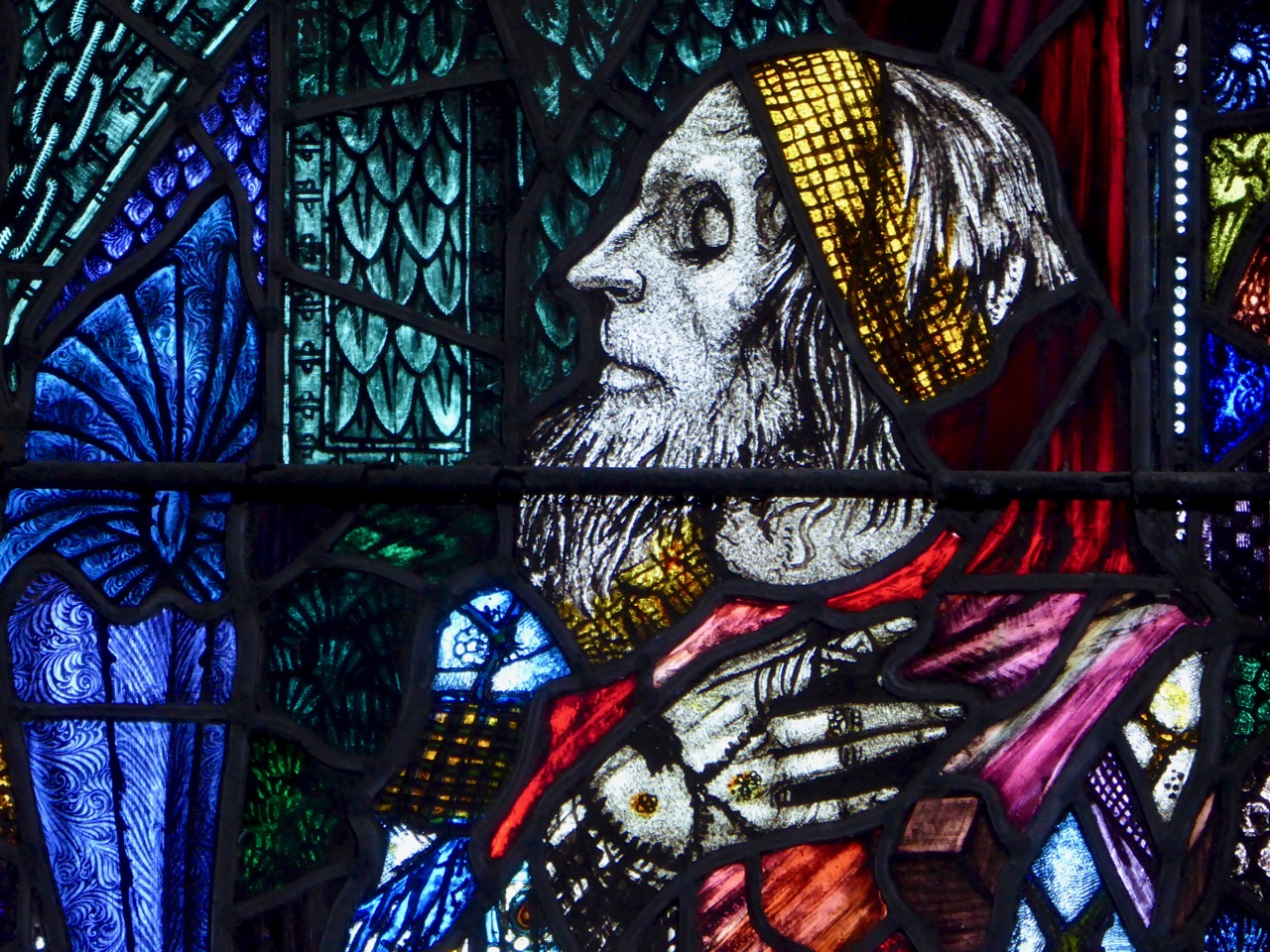
This is the beggar who received the gift of St Martin’s cloak – also from the Harry Clarke window. Here in Ireland there were once many customs associated with Martinmas. I set out some of these in a previous post a few years ago. For me, the most interesting is that no wheel should be turned on St Martin’s feast day. This is because the saint met his death by falling under a mill wheel. Below are two of ten 14th century frescoes from the San Martino Chapel in Assissi, setting out the stories of the saint: these depict his death and his funeral.

In County Londonderry, Northern Ireland, St Columba founded a church in the sixth century and named it after St Martin: Díseart Mhartain or ‘Hermitage of Martin’. Fascinating that this European saint should have such a following in Ireland: I found at least four churches dedicated to him in the Republic. One thing I touched on in my earlier post was the custom of killing a goose or cockerel on the day and sprinkling its blood in the four corners of the house to ensure well-being for the next year. I have since found that it is correct to say ...In onóir do Dhia agus do Mháirtin… while doing this (In the Honour of God and St Martin). I hope I’m not too late to wish you a good Martinmas! And I’m leaving you with the full image of the Harry Clarke window…

Journey into Purgatory

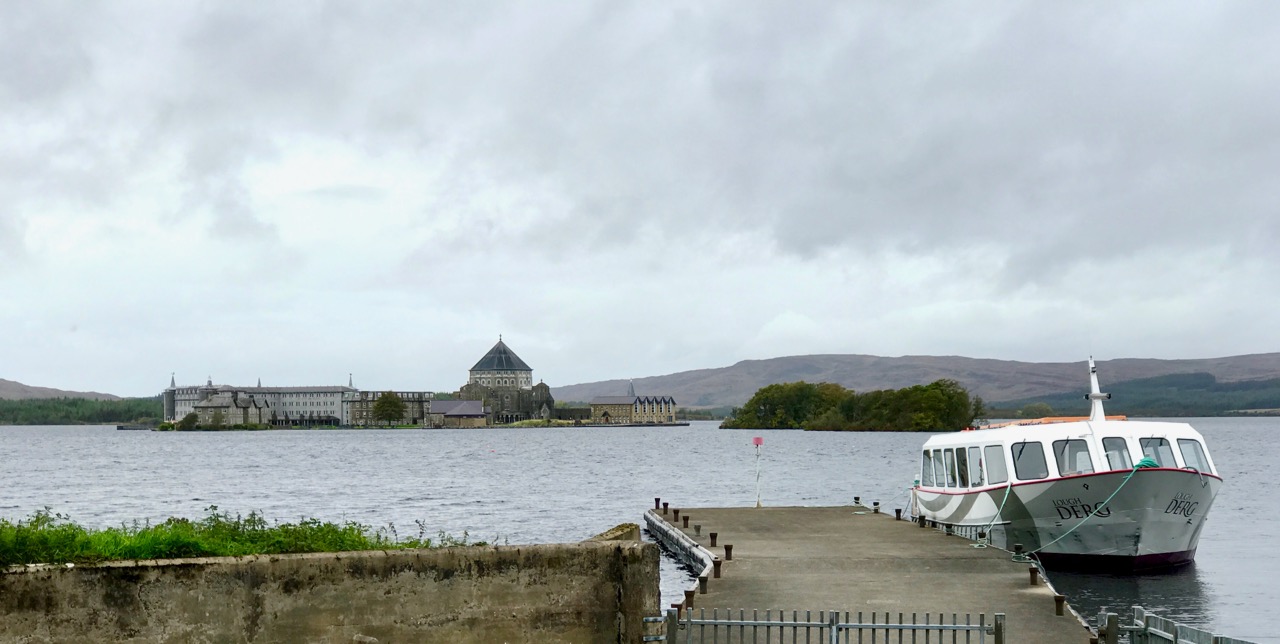
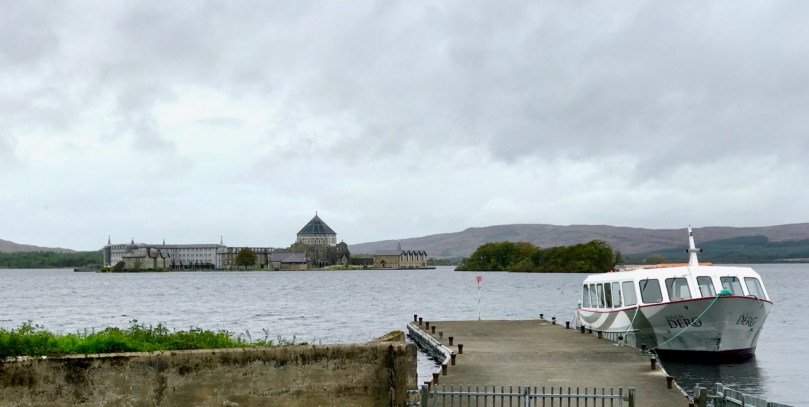
I was excited to be travelling to one of Ireland’s oldest – and most important – pilgrimage sites. Finola studies stained glass windows and their artists, and she knew that some particularly impressive Harry Clarke windows can be seen in the Basilica on Station Island, Lough Derg, in County Donegal. The roof of the Basilica, completed in 1931, towers over the island in the picture above, taken from the quay at Ballymacavany. Finola obtained special permission for us to visit the island to view and photograph the windows, after the main pilgrimage season was over: her account of them will appear in Roaringwater Journal in the near future.
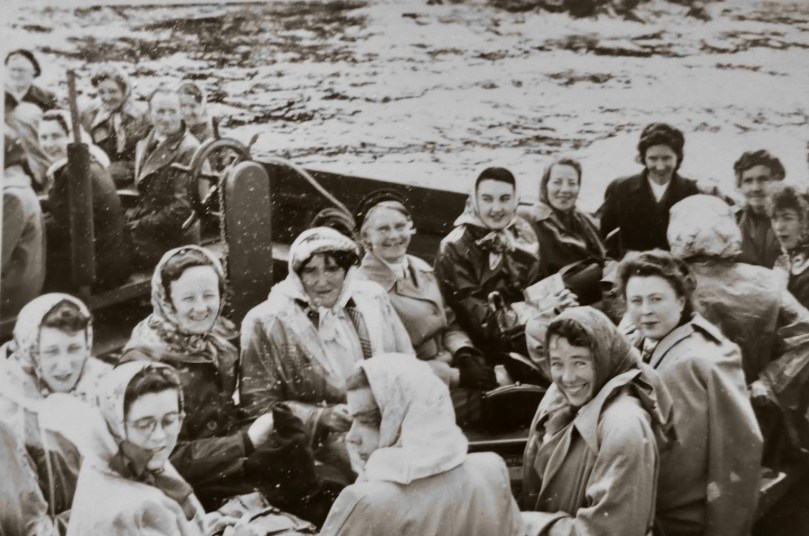
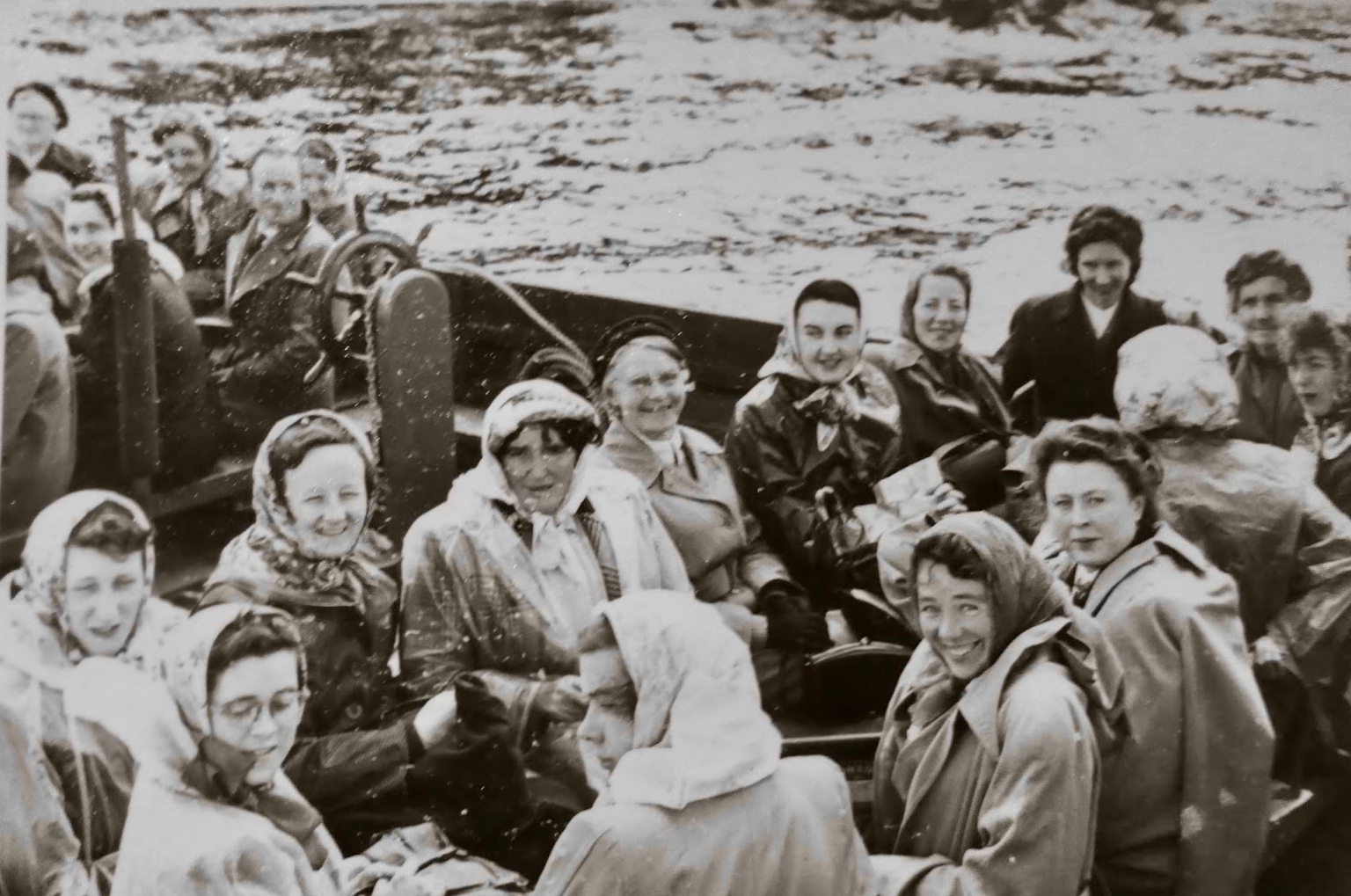
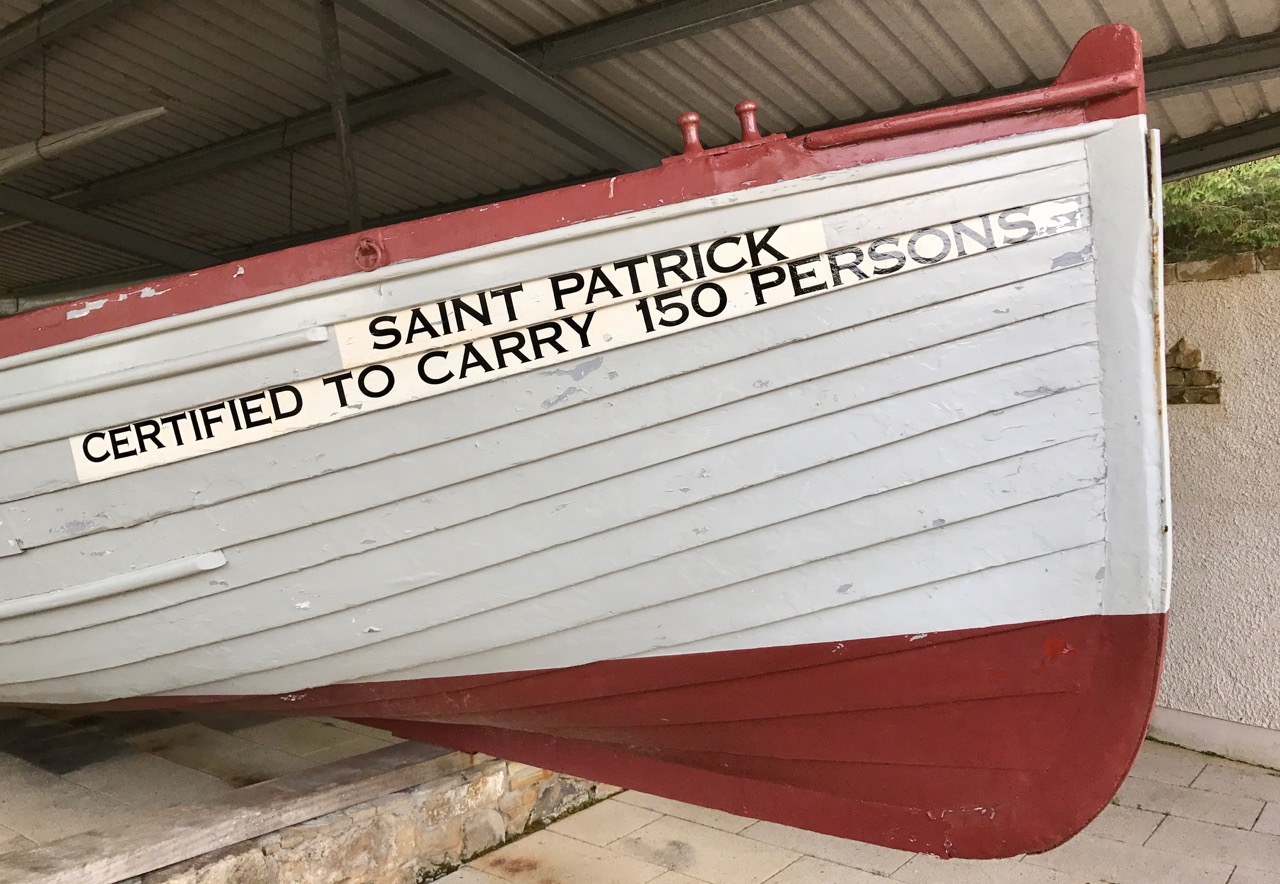
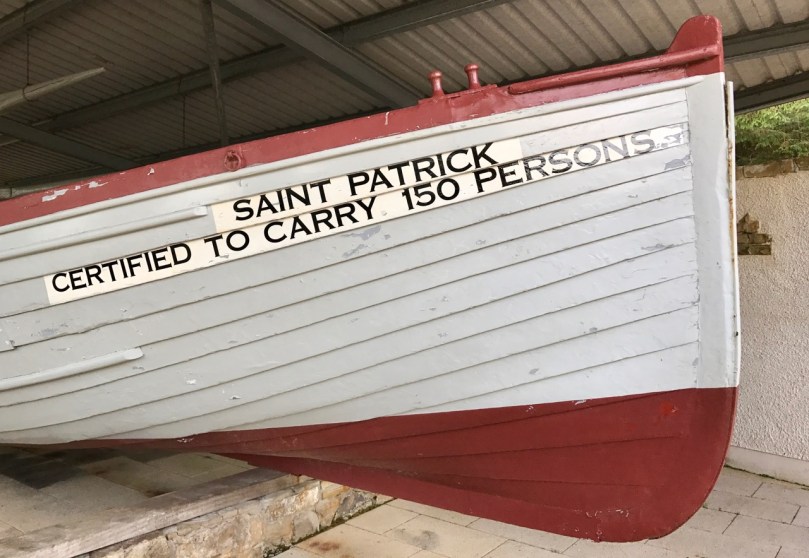
It’s salutary to learn how many people and families we know have taken part in the pilgrimage at Station Island. It’s a particularly austere experience, involving a three day cycle of prayer and liturgies, bare-footed and with very little food or sleep. Finola’s father undertook the pilgrimage in the 1950s: the photograph above was taken at around that time, when pilgrims were ferried over in large open boats once rowed by eight oarsmen and subsequently motorised. One of these historic boats is kept on display at Ballymacavany (below). Nowadays the journey is made in a modern covered launch, as seen in the header photo.
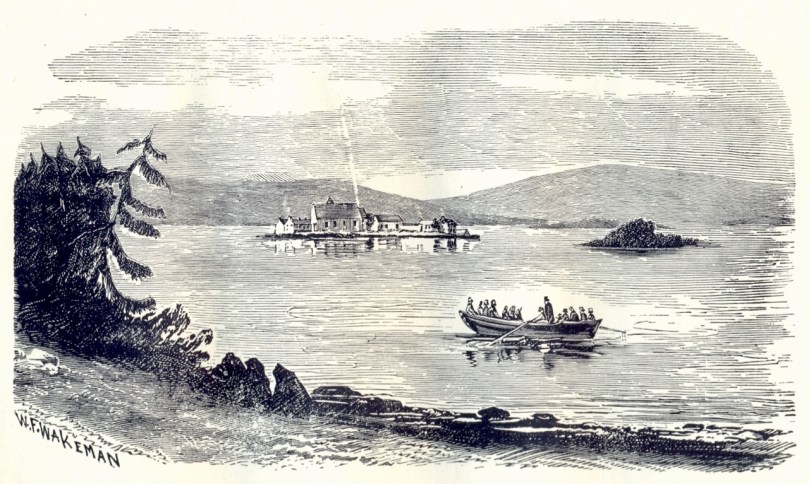
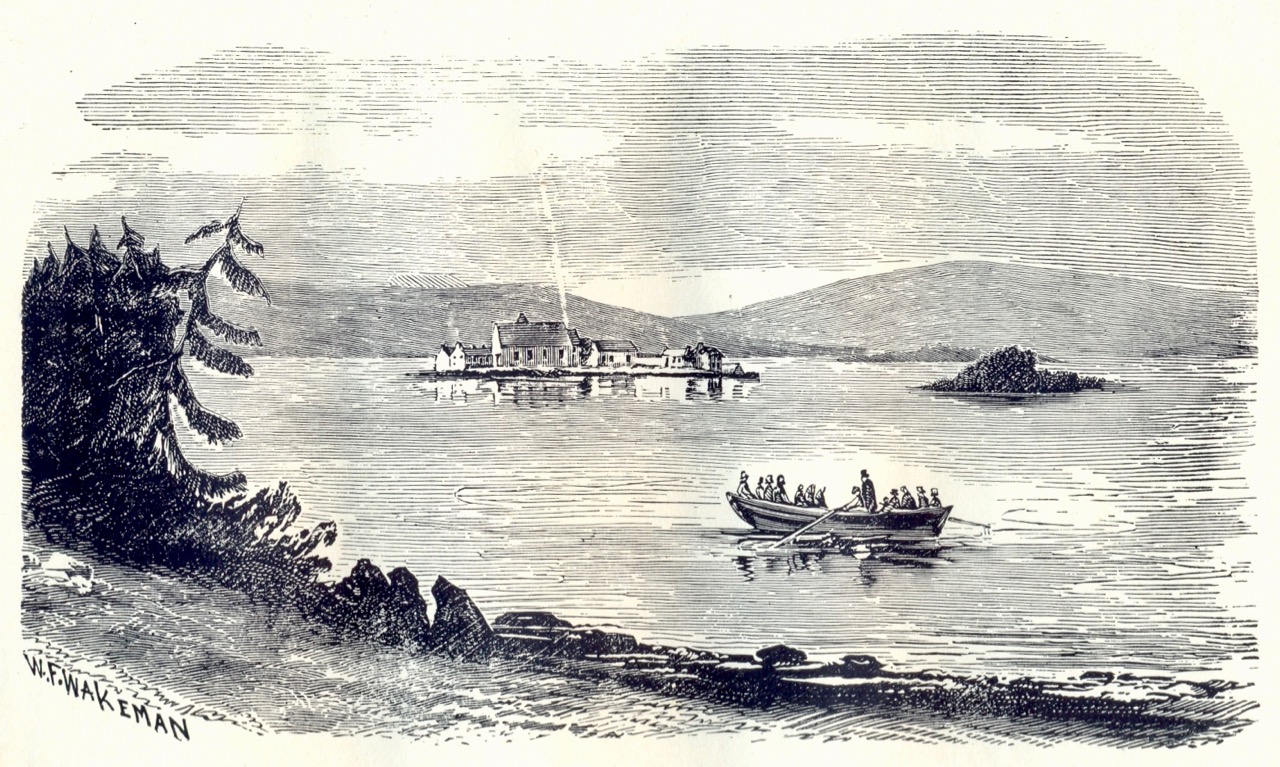
Records of the number of pilgrims who travelled to Station Island have only existed in comparatively recent times. The peak seems to have been just prior to the famine around 1846, when over 30,000 went there in one season. The drawing above is by William Frederick Wakeman, who was a draughtsman with the Ordnance Survey of Ireland, and was probably made at that time. Through the twentieth century numbers seldom fell below 10,000 pilgrims each season, but in many years was considerably more. This news item from the RTE Archives demonstrates the strength of the pilgrimage in the year 2000.

The island’s long history takes us back to the time of St Patrick. Despairing at the arduousness of persuading the Irish people to accept his Christian teachings he appealed to God to help. The story is admirably recounted by Dr Peter Harbison, Honorary Academic Editor in the Royal Irish Academy:

…St Patrick … was having difficulty convincing the pagan Irish of the 5th century of the truth of his teaching about heaven and hell; they were not prepared to believe him unless one of them had experienced it for themselves. To assist Patrick in his mission … Christ showed Patrick a dark pit in a deserted place and told him that whoever would enter the pit for a day and a night would be purged of his sins for the rest of his life. In the course of those twenty four hours, he would experience both the torments of the wicked and the delights of the blessed. St Patrick immediately had a church built, which he handed over to the Augustinian canons (who did not come to Ireland until the 12th century), locked the entrance to the pit and entrusted the key to the canons, so that no one would enter rashly without permission. Already during the lifetime of St Patrick a number of Irish entered the pit and were converted as a result of what they had seen. Thus the pit got the name of St Patrick’s Purgatory…

(from Pilgrimage in Ireland: the Monuments and the People by Peter Harbison, Barrie & Jenkins, 1991)

The entrance to this cave is on Station Island, and is the reason for the enduring popularity of the pilgrimage, which has persisted there for over 1500 years. In the medieval illustrations above, the gateway into Purgatory can be seen on the right, while on the left is a knight – Owein – whose terrifying adventures in the cave in medieval times have been written about in many languages: a summary can be found here.
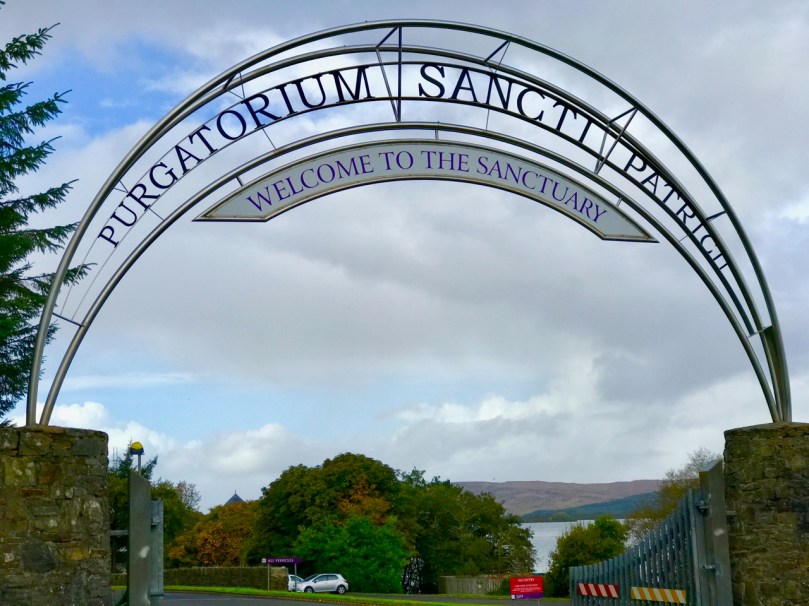
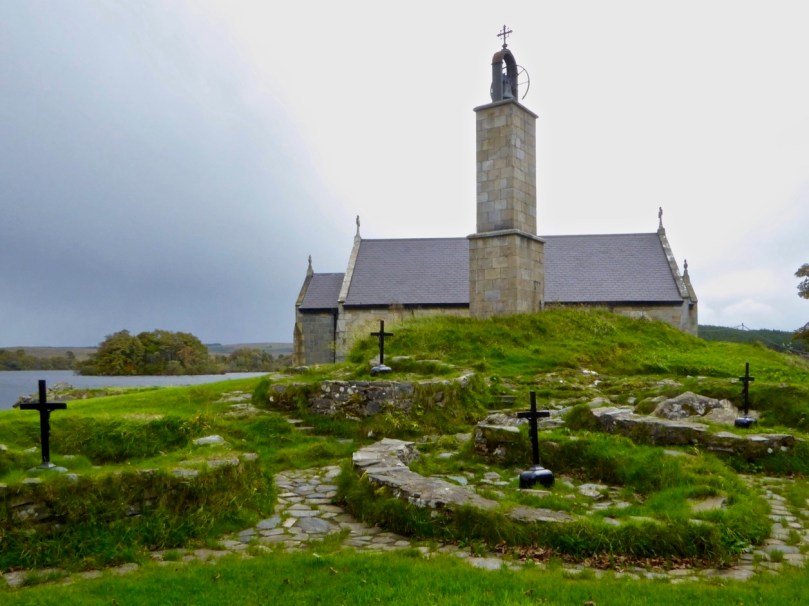
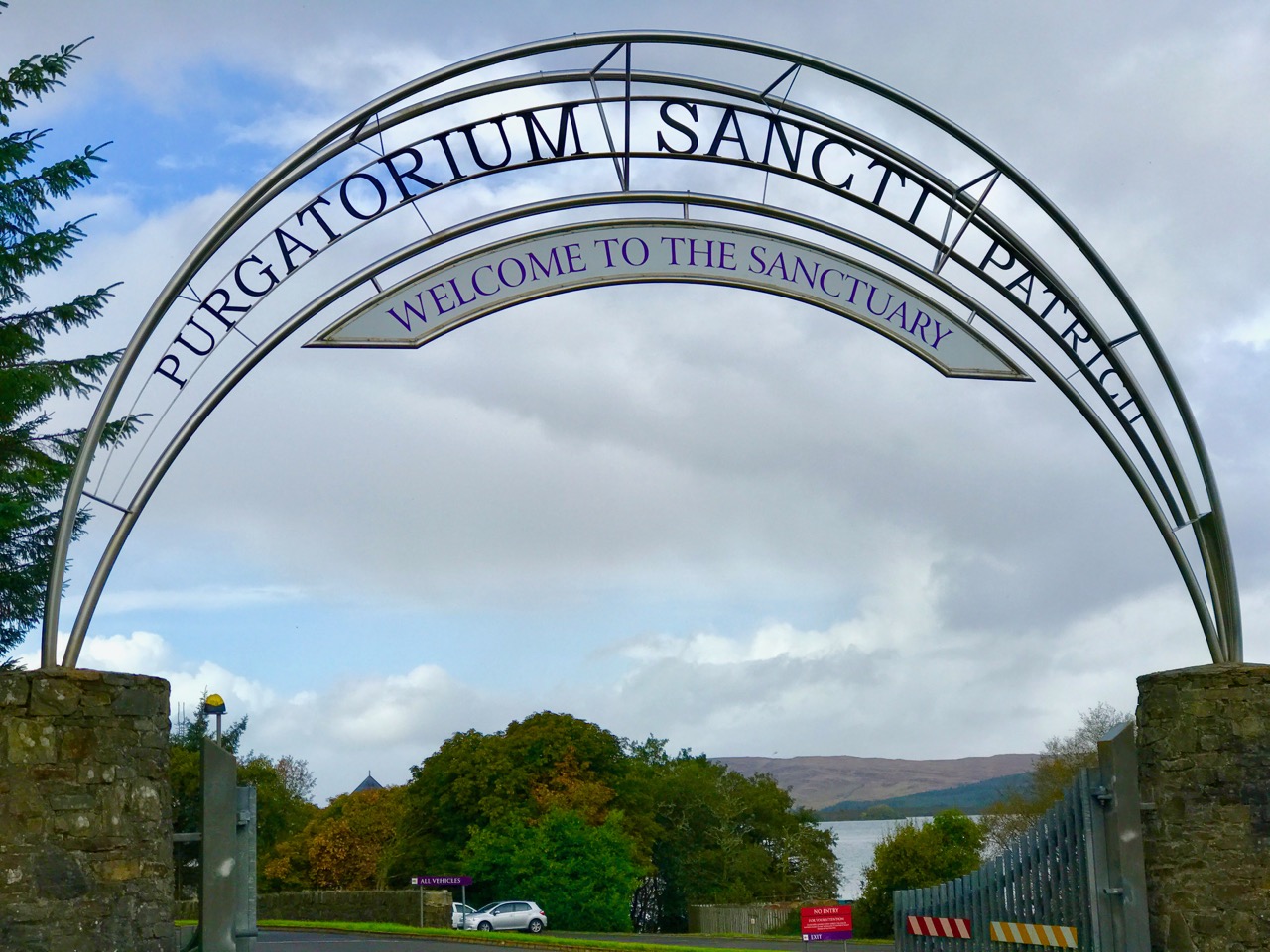
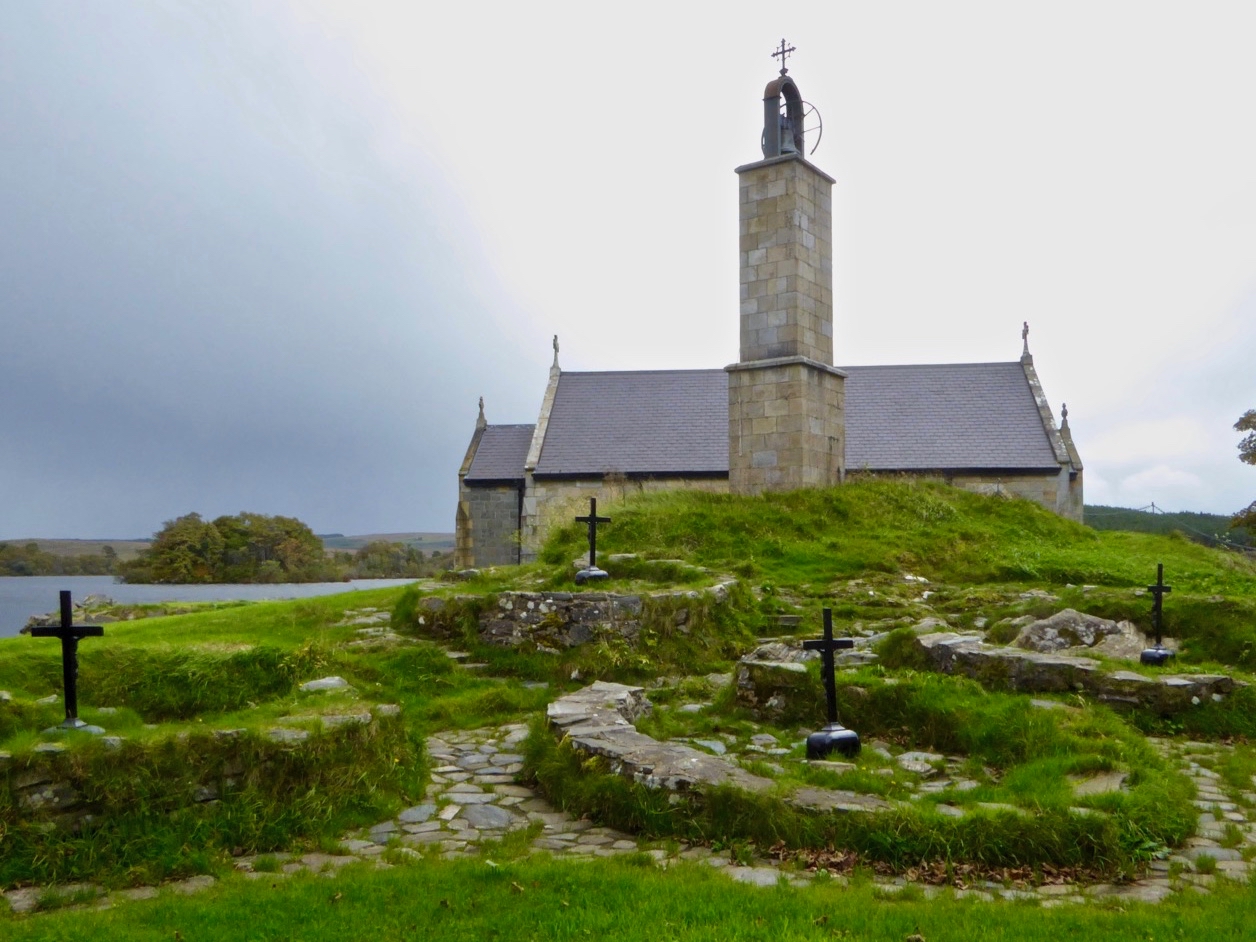
St Patrick’s Purgatory: the name is over the entrance at the reception centre at Ballymacavany, the point of departure for Station Island. The cave which marks the entrance into Purgatory was permanently sealed up in October 1632 when the pilgrimage was suppressed by order of the Privy Council for Ireland; in the same year the Anglican Bishop of Clogher, James Spottiswoode, personally supervised the destruction of everything on the island. Later, in 1704, an Act of Parliament imposed a fine of 10 shillings or a public whipping …as a penalty for going to such places of pilgrimage… The site of the cave entrance lies under the bell tower, seen above. In front are the penitential beds where pilgrims perform rounds to this day. It is thought that these formations are the remains of monks’ cells or ‘beehive huts’.

On the left is a map of Station Island by Thomas Carve, dated 1666. The words Caverna Purgatory, centre left, show the site of the cave entrance. In spite of the efforts of the Penal Laws to suppress the observances, pilgrimages have continued unabated. Above right is a photograph from the Lawrence Collection, dated 1903, showing pilgrims about to embark for the island.
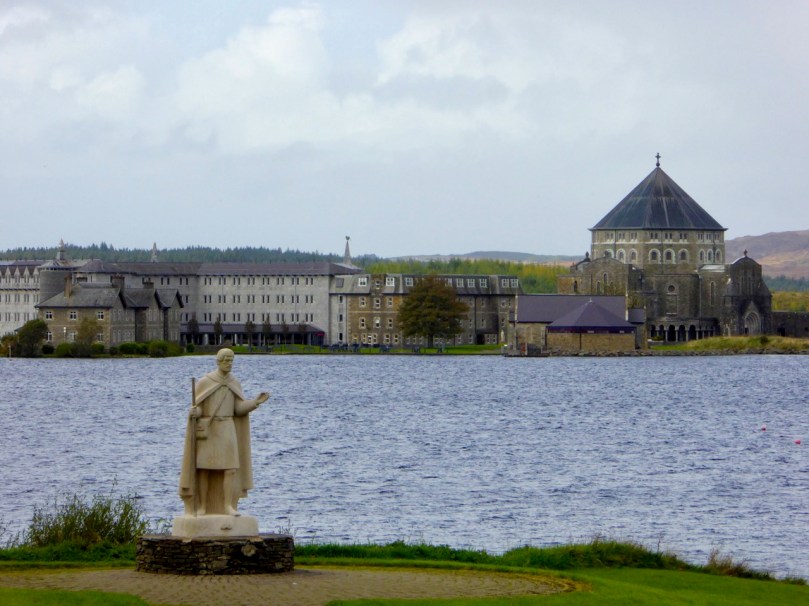
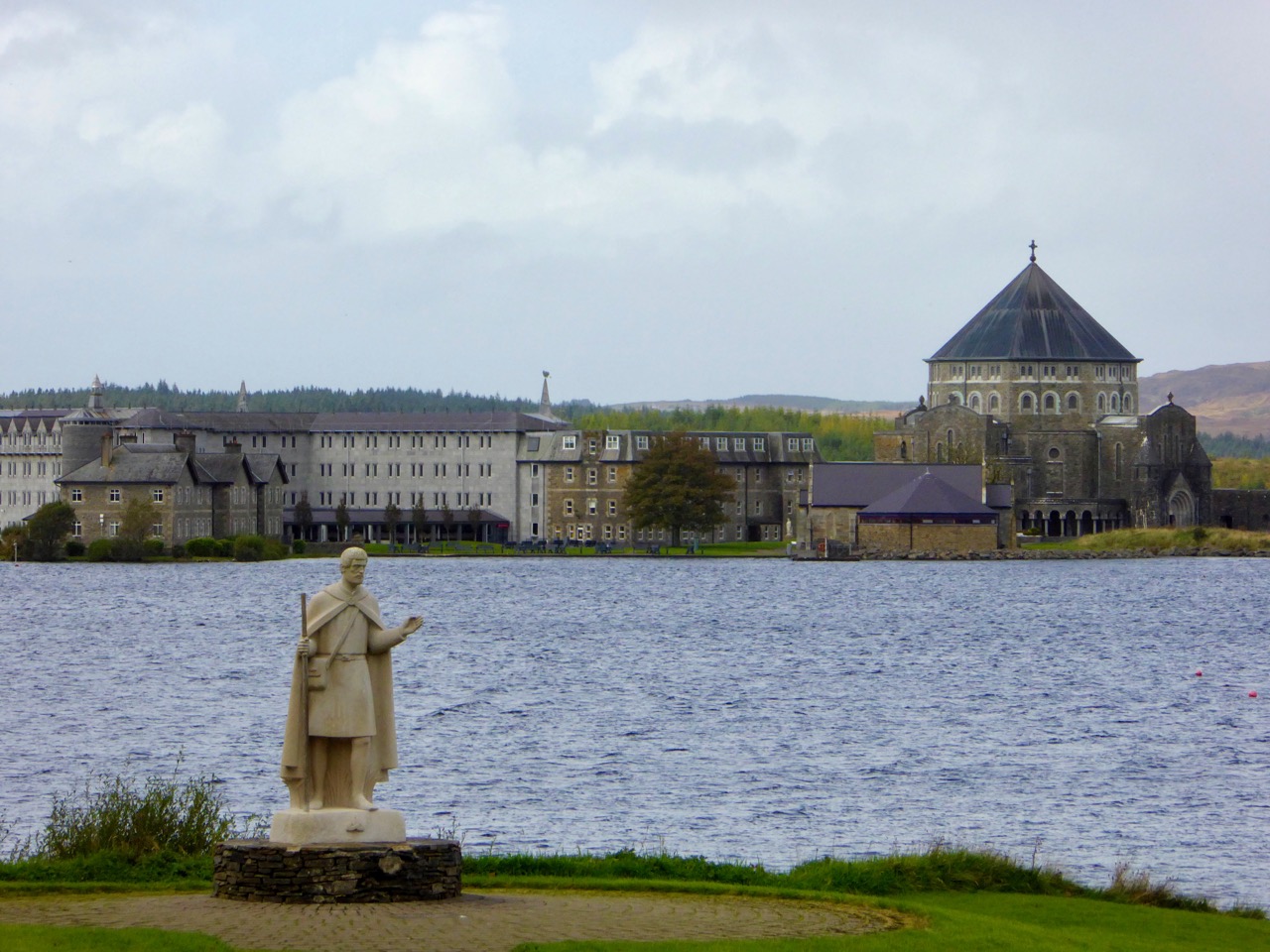
A young St Patrick portrayed as a pilgrim stands in front of the island: the Basilica is on the right. This view indicates the huge development  of the island since its complete destruction in the 18th century and shows the facilities provided for the many thousands who have come here over the generations.
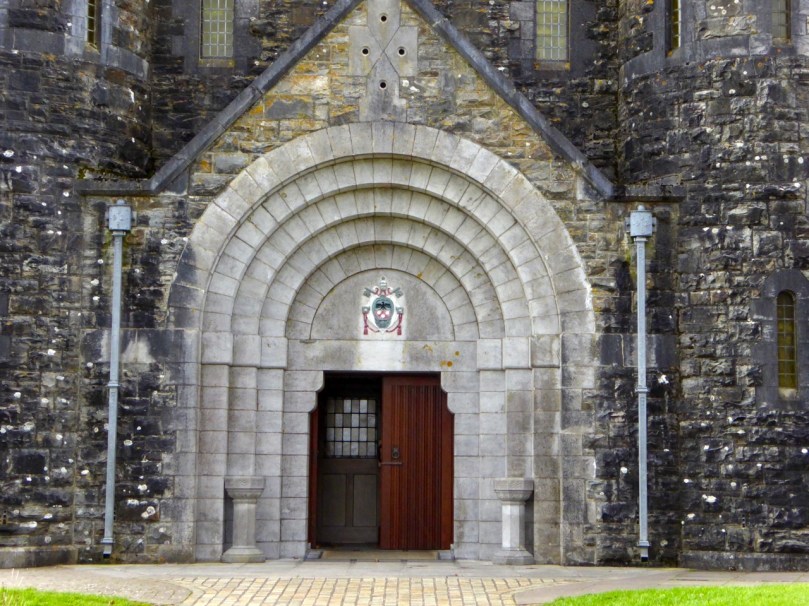
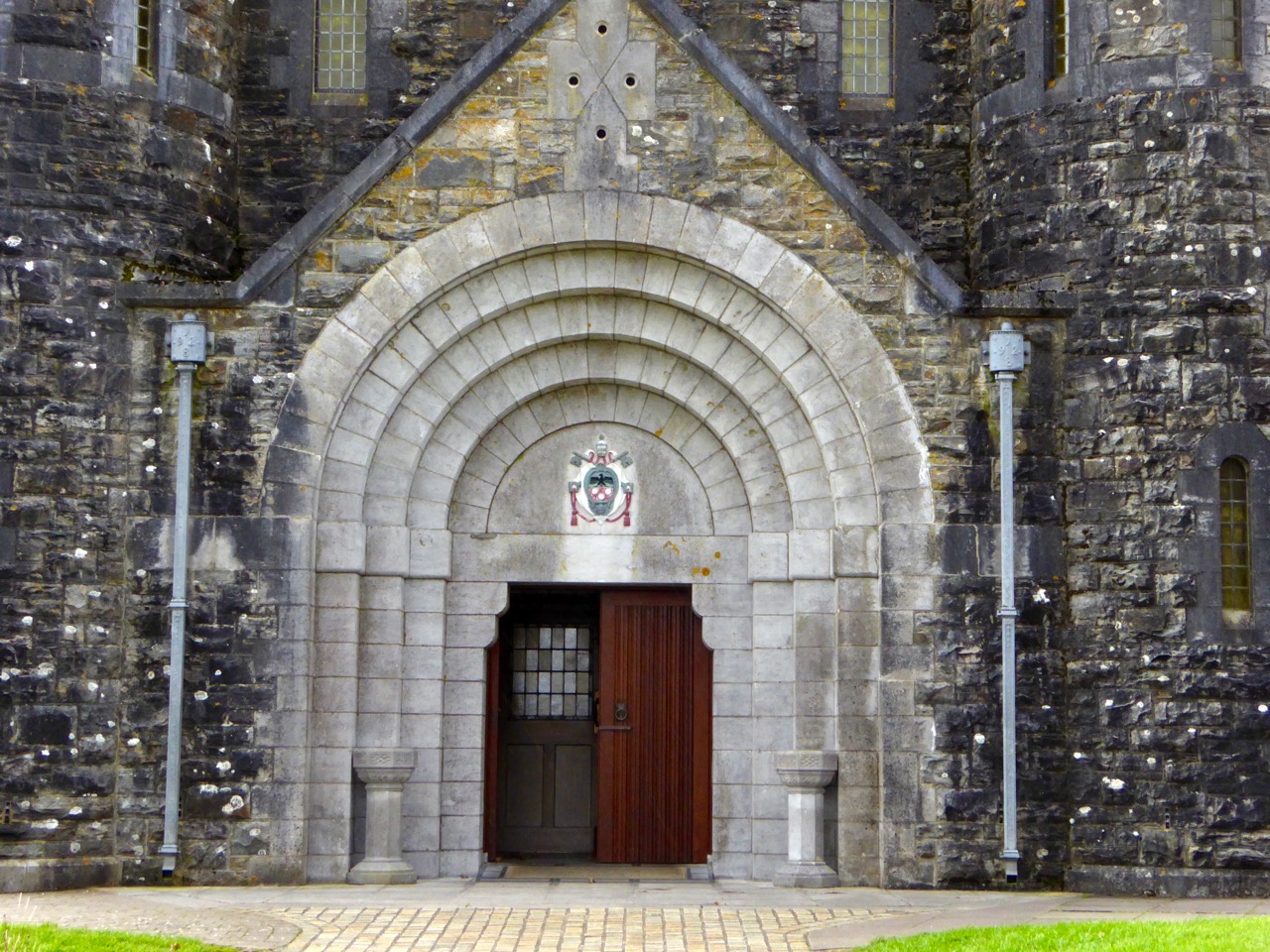
The Basilica is the focus of the pilgrimages today: it was formally consecrated in 1931. The entrance door is a modern interpretation of Romanesque architecture, while the tabernacle is an impressive example of fine bronze work.
Ireland’s great poets and writers have visited St Patrick’s Purgatory, and have responded to the experience:

Donnchadh Mór Ó Dálaigh (1244) “Chief in Ireland for poetry”:

Truagh mo thuras ar loch dearg
a Rí na gceall is na gclog
do chaoineadh do chneadh’s do
chréacht
‘s nach faghaim déar thar mo rosg.

(Sad is my pilgrimage to Lough Derg, O King of the cells and bells; I came to mourn your sufferings and wounds, but no tear will cross my eye)

Patrick Kavanagh:

Lough Derg, St. Patrick’s Purgatory in Donegal,
Christendom’s purge. Heretical
Around the edges: the centre’s hard
As the commonplace of a flamboyant bard.
The twentieth century blows across it now
But deeply it has kept an ancient vow.

W B Yeats:

Round Lough Derg’s holy island I went upon the stones,
I prayed at all the Stations upon my marrow-bones,
And there I found an old man beside me, nothing would he say
But fol de rol de rolly O.

Most impressive of all, perhaps, is Seamus Heaney whose moving contemplations took him back through his life experiences and produced twelve memorable poems in a volume entitled Station Island:

How well I know that fountain, filling, running,
although it is the night.
That eternal fountain, hidden away,
I know its haven and its secrecy
although it is the night.
But not its source because it does not have one,
which is all sources’ source and origin
although it is the night.
I know no sounding-line can find its bottom,
nobody ford or plumb its deepest fathom
although it is the night.
And its current so in flood it overspills
to water hell and heaven all peoples
although it is the night.
And the current that is generated there,
as far as it wills to, it can flow that far
although it is the night.

Finally, here’s a contemporary journalist’s view, well worth the read!
 

Rejecting those Earthly Dignities: Irish Women Saints by Harry Clarke

I’ve been struck by the absence of sacred women in the iconography of stained glass windows in Irish Protestant churches. Sure, there’s the odd window devoted to or including Mary (such as Nativity scenes) or Bridget, or images of women as Charity or Hope, but for windows depicting women who are venerated for their piety or leadership or courage you have to visit Catholic churches in Ireland. 

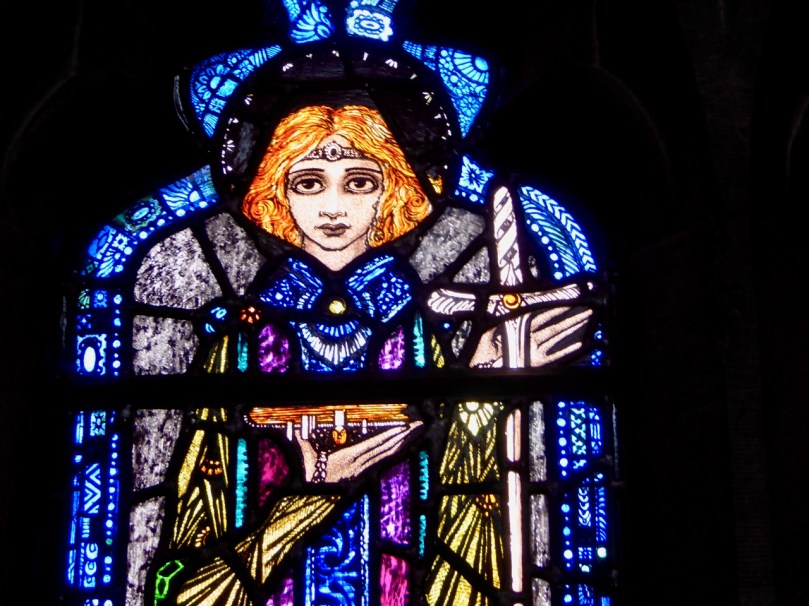
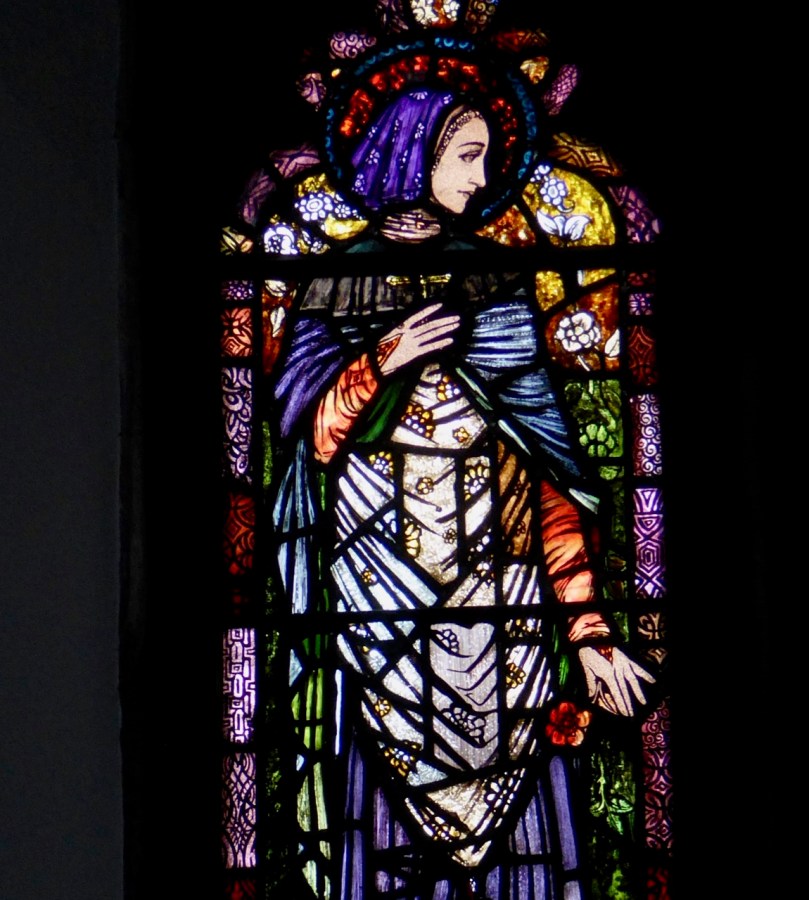
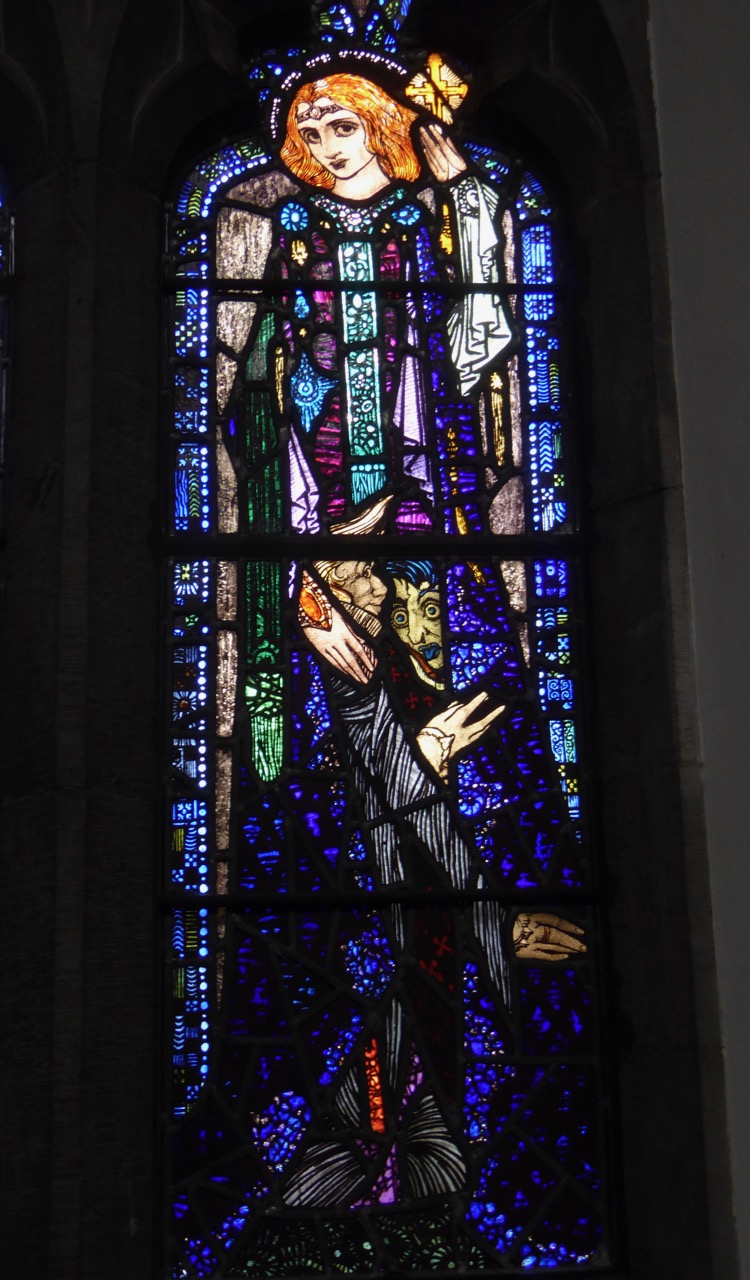
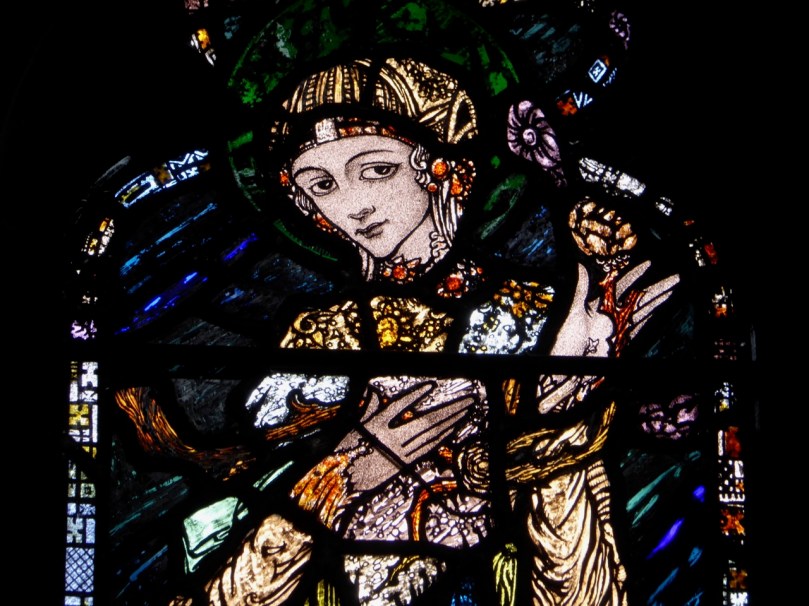
The top picture is St Dympna, depicted with a sword – it is a tradition to depict martyrs with the instrument of their death. She looks wide-eyed and innocent – she was only 15 when she died. Above is St Fanchea, bearing a rose and with a kindly expression

We’ve written already about Bridget here and here and about Gobnait: Bridget is considered the female equivalent of Patrick in being the most widely known and celebrated of the Irish women saints. Gobnait is a good example of a local saint, in this case she is associated with the Muskerry area of Cork. When you read the lives of Irish saints, women and men, you are reading accounts written many centuries after they lived, often a mixture of tradition, mythology, folklore and reconstructed hagiography. 

Harry Clarke, as I have discovered before, had a thing for red hair and gave St Dympna a particularly glowing crop. Here she shelters her patients, the mentally ill poor who came to her hospital

Robert and I have been travelling in Ireland and visiting stained glass here and there, and in the process discovering more unfamiliar Irish saints. Harry Clarke, Ireland’s incomparable stained glass artist of the early part of the 20th century, was often asked to depict local saints and always did as much research as he could into their lives, to enable him to tell their stories and use appropriate elements and symbols. [For more posts about the genius of Harry Clarke, Ireland’s most famous stained glass artist, go to our Navigation page and scroll down to C5.] In Carrickmacross (Co Monaghan) this week I found three Harry Clarke windows illustrating three Irish female saints, two of whom I had never heard of before. Let’s start with the one I thought I knew because I’ve had friends with that name – St Dympna.

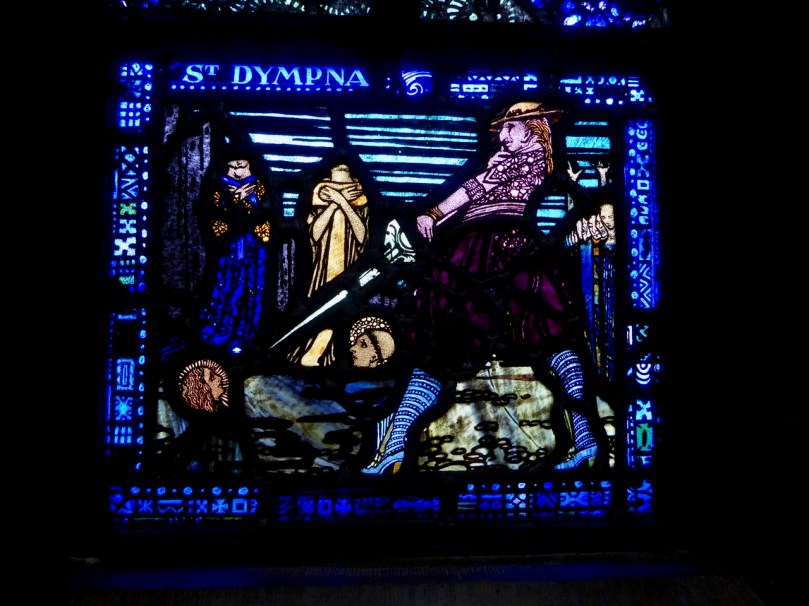
Dympna flees her father’s house. Following her is the court jester, his wife, bearing medicines, and Gerebran, her confessor

Dympna was the daughter of an Irish King called Damon. When his wife died, her father became unhinged and decided he would only marry the one who was as beautiful as her – his own daughter Dympna. Horrified, she fled with her confessor, Gerebran, and travelled to Gheel in Belgium. There she established a hospital and tended to the poor and sick. But her father found her and in his rage beheaded first the faithful Gerebran and then, when she refused to yield to him, his daughter.

Harry Clarke did not shy away from depicting the grizzly end of Dympna and Gerebran

She is venerated in Ireland and in Belgium, and particularly associated with care of the sick and those who are mentally ill. She is also a patron saint for those who have suffered incest. There are shrines and hospitals named for her in Belgium, Ireland and the United Stares. She is also known as St Davnet, and there are hospitals and holy wells with this name.

If you’d like to know more about St Dympna, take a look at this post from the wonderful Ali Isaac.

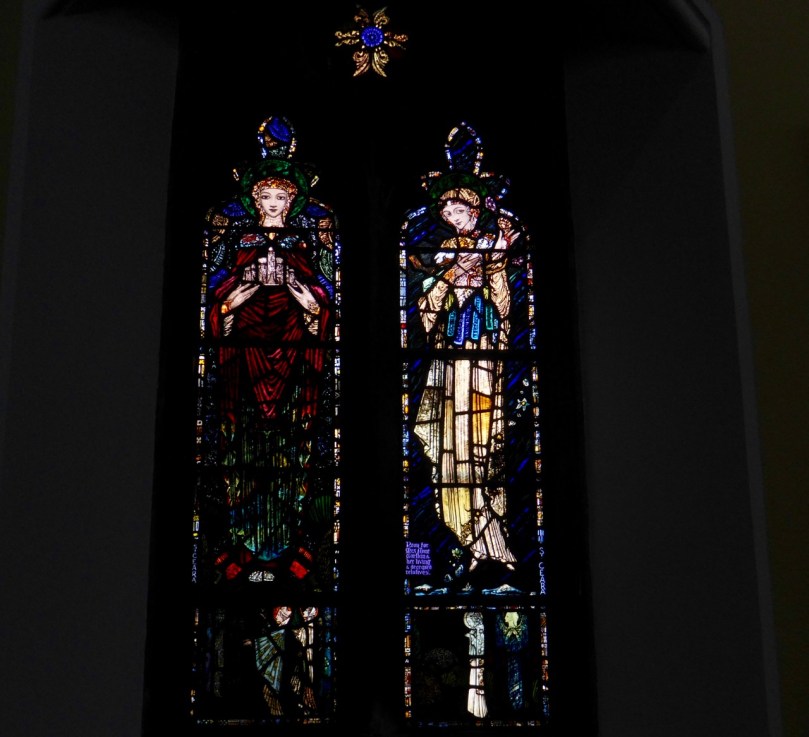
St Ceara is the subject of one window with two lights

Like Dympna, Ceara was of royal blood and established her first monastery in present-day Westmeath on land granted by St Fintan – or perhaps in Kilkeary near Nenagh in Tipperary at the behest of Brendan of Clonfert. You see, there may have been two Cearas and over time their stories were conflated. To add to the confusion, St Ceara, also known as Ciara, is known to have been an abbess who founded a monastery near the spot currently better known as Kilcrea Friary in Cork.

St Ceara and her virgins

Harry Clarke in his windows chooses to depict her as beautiful and royal, in one window carrying her monastery and in the other (below) sumptuously dressed and appearing more the princess than the holy woman.

St Fanchea was the sister of St Enda of Aran, and they share the two lights of one window. St Fanchea was famed for her holiness and founded a monastery in Fermanagh. Enda was a warrior-king but was finally won over by the piety of his sister and converted when he came to see her in her convent.

Fanchea and her brother, Enda of Aran

For a full (and graphic!) account of the brother and sister relationship, see the marvellous post in Omnia Sanctorum Hiberniae, a fabulous blog for anyone interested in obscure Irish saints. Marcella starts her story of Fanchea this way:

Aengus, son of Natfraich, King of Munster, is said to have desired Fanchea’s hand in marriage. Notwithstanding all his pressing entreaties, however, and rejecting those earthly dignities to which she might be advanced by yielding to his suit, the holy virgin’s mind was intent on a life of celibacy, and on those rewards promised by Christ to his spouses.

St Fanchea stops her brother, Enda, and turns him from his warrior ways

I’d love to hear from readers who have their own favourite women saints, especially Irish ones.

Richard King in Mayo

Scenes from The Old Testament by Richard King

In my post Discovering Richard King, I introduced you to the stained glass artist and the extraordinary windows in Athlone. If you haven’t read that post, pop back now and read it for an overview of King’s career, before continuing. Ever since then, I have been trying to track down Richard King’s art – he was active in several media and also exported windows to the US, UK and Australia. In Mayo recently, I was finally able to photograph more of his stained glass.

The Assumption window in Swinford

King was greatly influenced by Harry Clarke in his time at the studio, and when he took over as chief designer upon Harry’s death in 1931 he carried on very much in Harry’s style. After all, that was the style the clients wanted, and he excelled in producing it. I think I have tracked down several windows produced in the decade from 1930 to 1940 (when he left to open his own studio) that bear his hallmarks, but since Studio windows were never signed by individual artists after Harry died (with a few notable exceptions) it is impossible to verify whether or not I am correct. That’s why it was a thrill, on a recent visit to Mayo, to be able to view and photograph three Richard King windows, all of which date to the period after he left the Harry Clarke Studio. Richard came from Mayo (from Castlebar) so no doubt was a popular choice when stained glass was needed. Together, these three windows illustrate the evolution of his style over time.

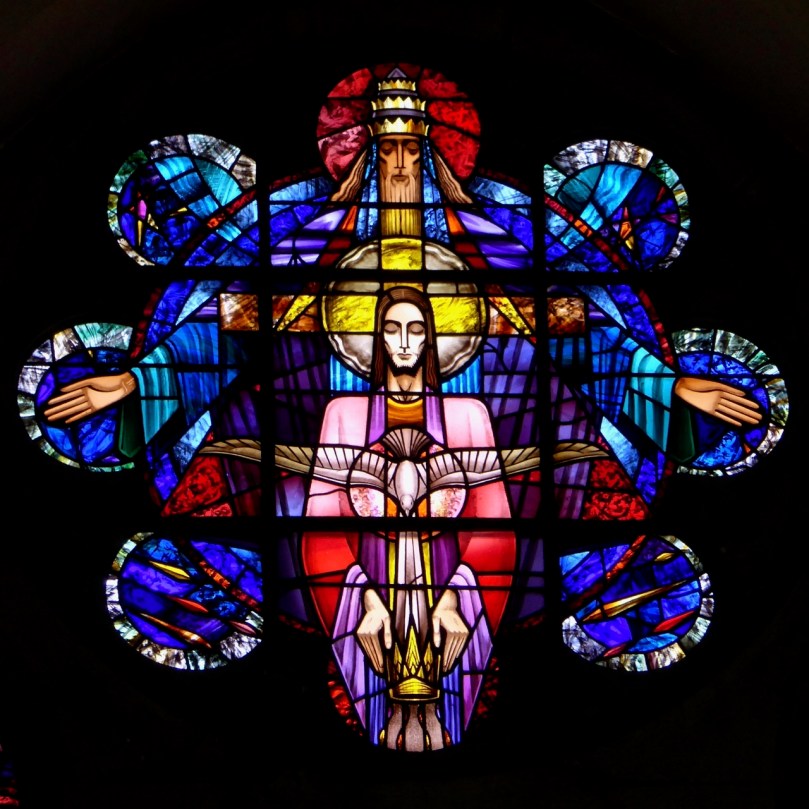
The earliest, and largest, window dates to 1952 and is in the Church of Our Lady Help of Christians in Swinford. It consists of three lights and a rose window above them and the theme is the Assumption of Mary into heaven. The rose window above the depiction of Mary rising shows the Trinity – Father, Son and Holy Spirit – with the Son holding the crown with which he will declare his mother to be Queen of Heaven. I can’t help thinking that the Father looks a little like a depiction of one of the ancient Irish chieftains from the Athlone Patrick windows.

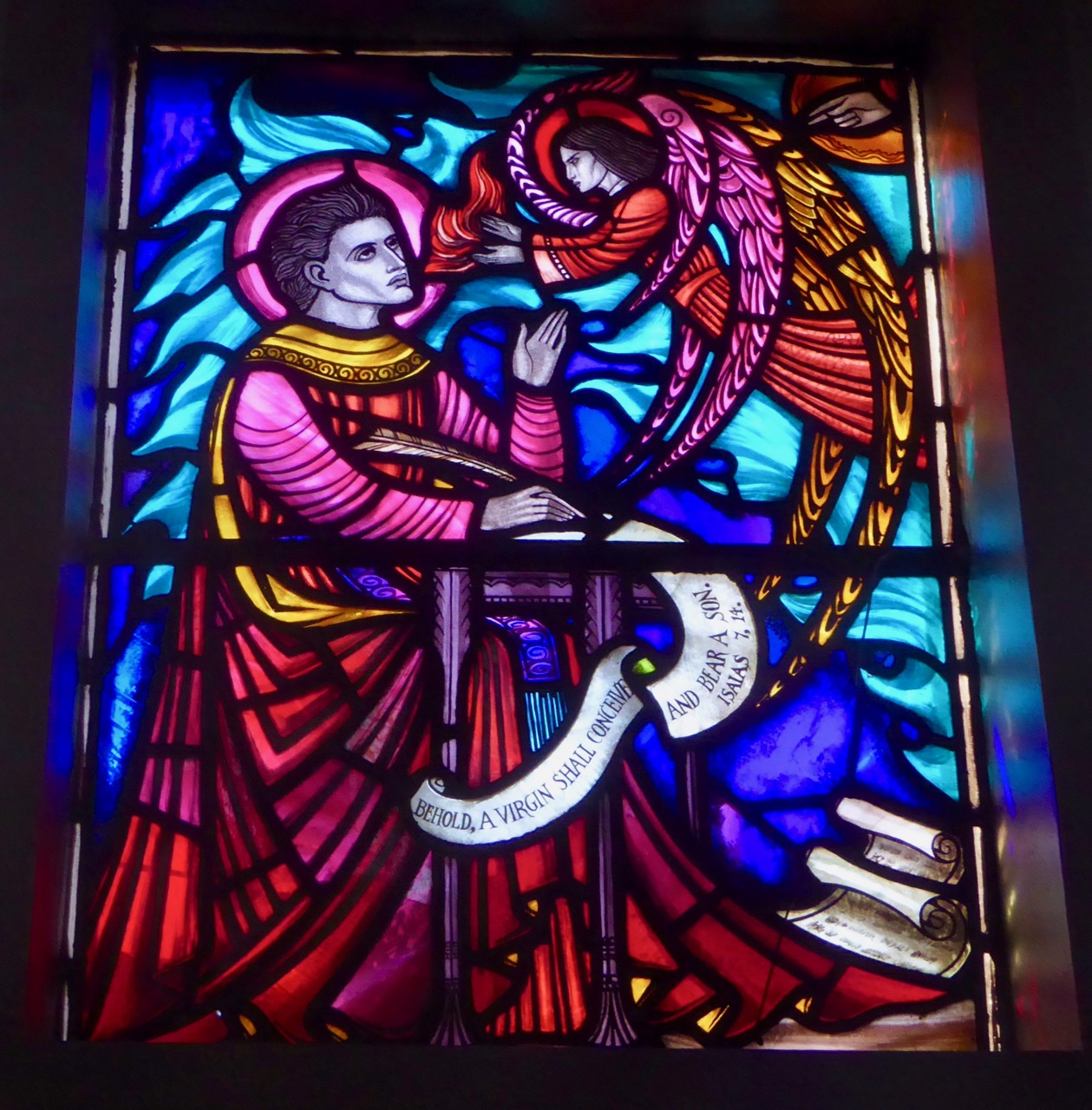
Mary is flanked by John the Evangelist and by Patrick – unusual choices and one wonders who dreamed them up. We know it’s John since he holds a quill pen with which to write the gospel, and is accompanied by an eagle, his symbol as one of the four evangelists. Patrick is always recognisable in green, with a crozier on his arm and a snake underfoot, and is accompanied by geese. I’m not sure of the symbolism of the geese – perhaps they were to balance the eagle [EDIT: see Niall McAuley’s comment below]. He’s wearing fetching green gloves and slippers. Take a close look at the church he carries – the windows are the same configuration as these windows – a little visual pun that Richard must have enjoyed making.

The lingering influence of the Clarke style is still visible in the extraordinary detail of every part of the window, in the glowing colours, the symmetry of the matched angels and in the cherubim faces below Mary. However, in every respect this is the work of an artist who is his own man – it could never be mistaken for a Clarke, or even a Clarke Studio, window.

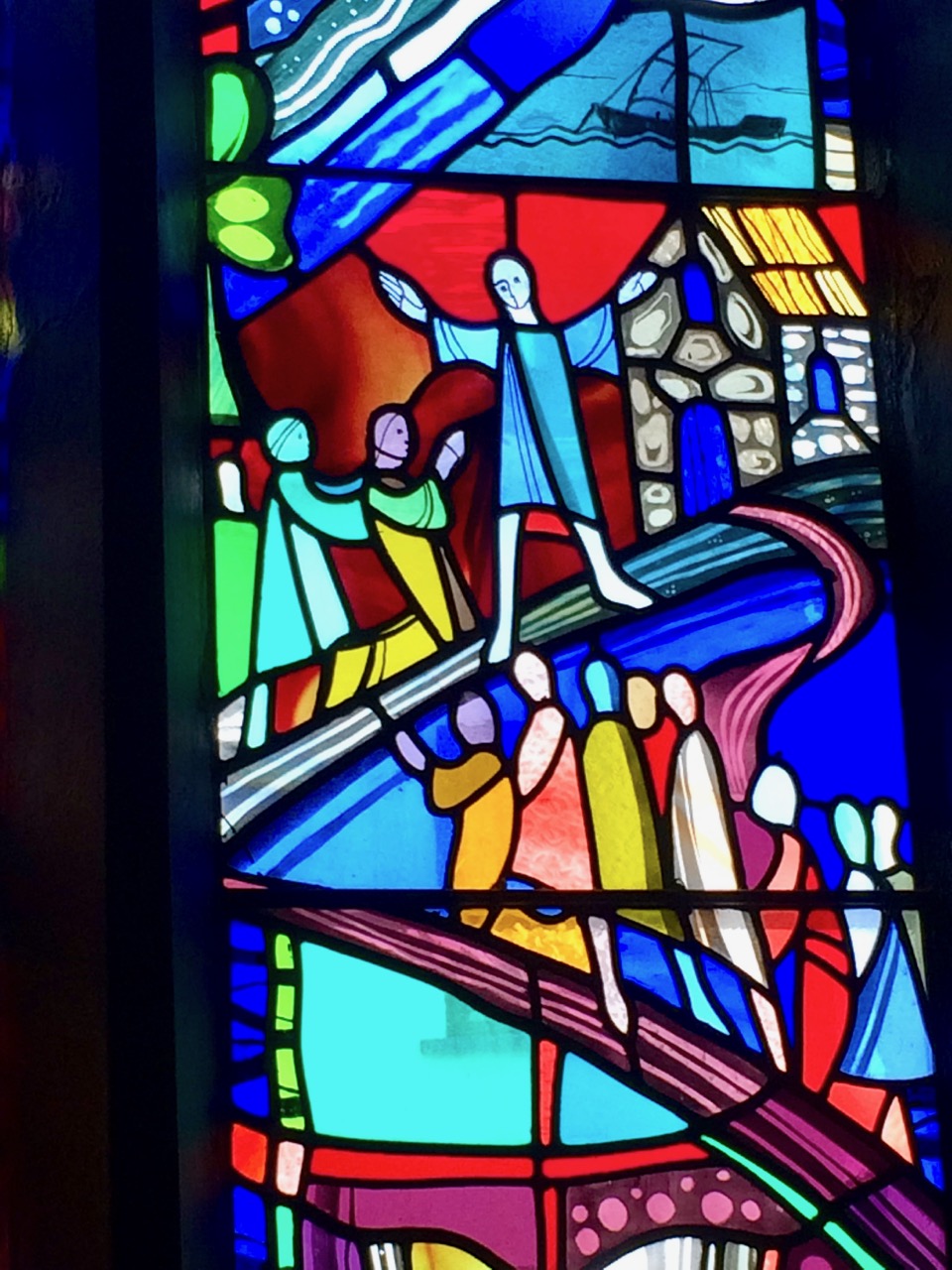
But the Swinford church has a surprise – a second Richard King window, dating from 1964 and radically different from the Assumption. This is a two-light window depicting the Old and the New Testaments. The style is suddenly modernist, bold, faux-naïf and reflects his own study of the modern styles of the time and his experimentation with new ways of capturing religious themes. The windows are also delightful – strong colours and carefully placed figures create an attractive whole.

Pentecost – the Holy Spirit descends on Mary and the apostles

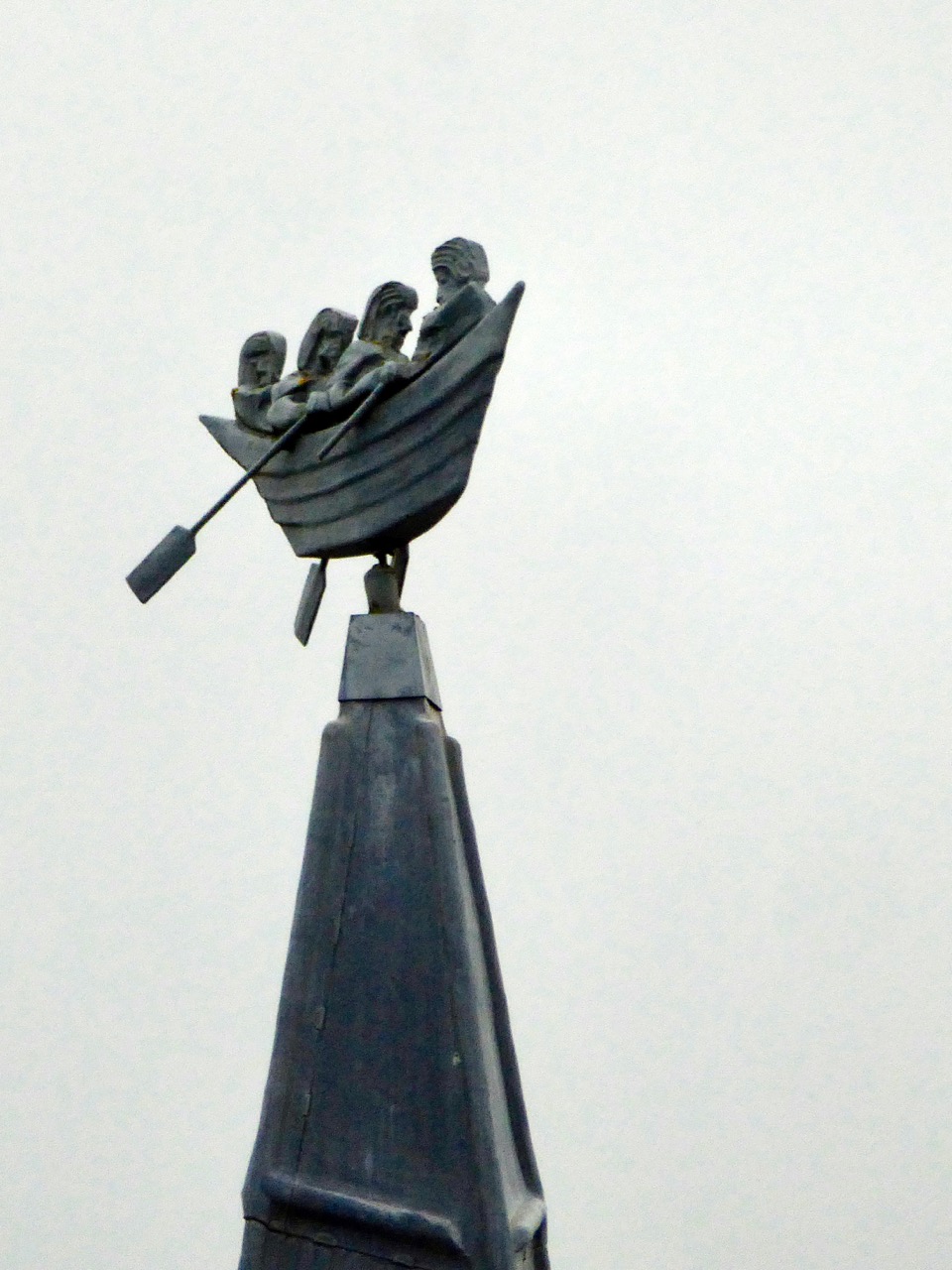
I think my favourite image is the one in which Pope Paul VI steers a boat full of bishops – a reference, apparently, to the ‘barque of Peter’. Paul was pope from 1963 to 1978, much of my young life, and his likeness was instantly recognisable. It brought a smile to my face.

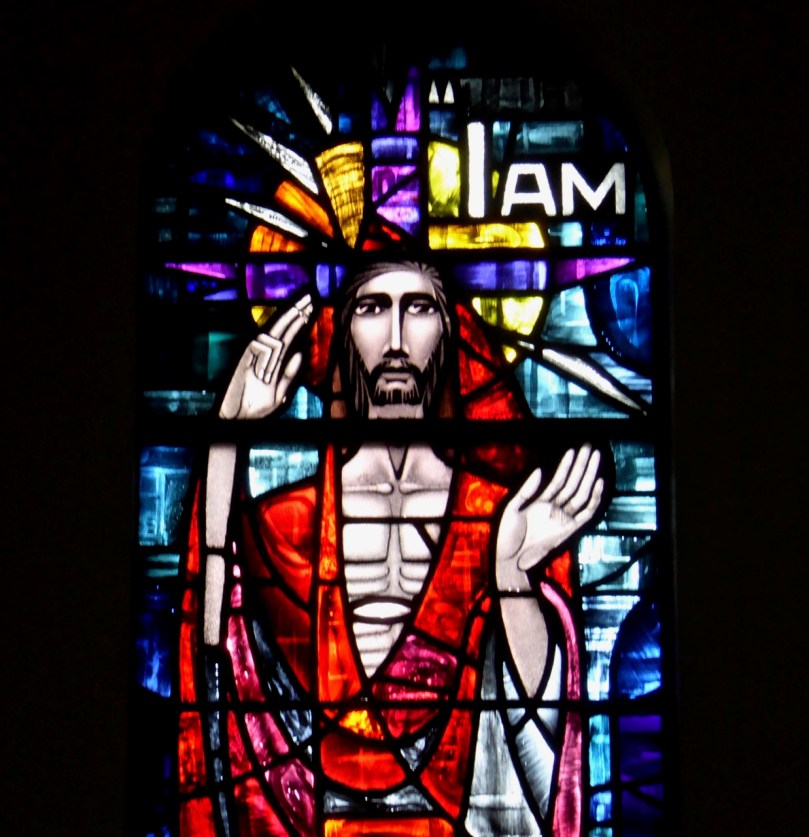
The last Richard King window is a two light window in the St Patrick’s Church in Newport. The theme is I Am The Resurrection And The Light. This one dates from 1973, the year before he died and what is striking is how far now he has moved towards a fully modern style with elements of cubism and abstraction.

The glowing colours are still there, the strong reds and blues, but there is no attempt at realism in the figures (note for example his treatment of Christ’s ribs as a series of rectangles) and a strong geometric arrangement is obvious throughout the composition.

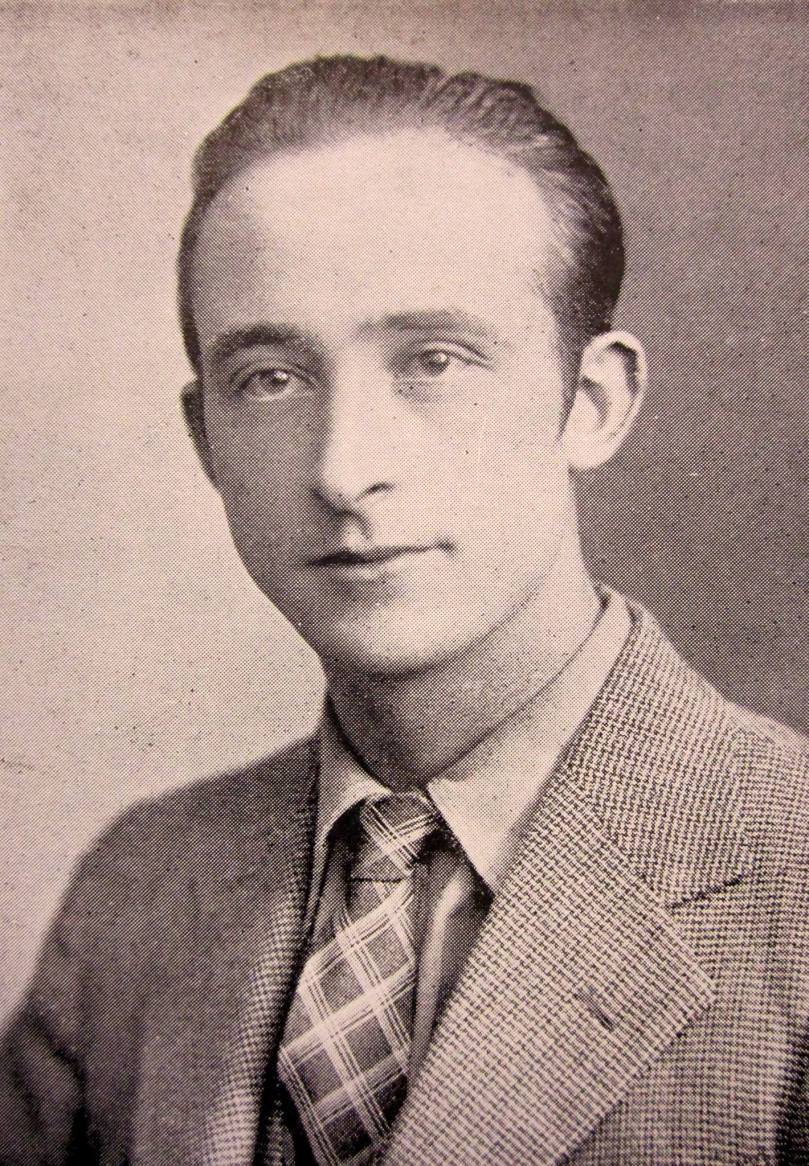
So far I have only written about Richard King as a stained glass artist, but there was more, much more, to him than glass. In future posts I will endeavour to expand on that statement. Meanwhile, I will leave you with a photograph of the young Richard King, courtesy of the Capuchin Archives.

Looking for Patrick

Patrick lights the Paschal Fire on the Hill of Slane. Richard King window, Church of St Peter and Paul, Athlone

A joint post – text by Robert, images by Finola

Last week we talked about Ireland’s very first saint – Ciarán (or Piran), who was born on Cape Clear. His aim in life was to convert the heathen Irish to Christianity, but they were having none of it: they tied him to a millstone and hoisted him over the edge of a cliff. Fortunately – and miraculously – the wondrous millstone floated him over to Cornwall where he became their Patron Saint and is celebrated with great acclaim on March 5th every year.

A typical representation of Patrick, older and bearded, in bishop’s robe, holding a shamrock in one hand and a crozier on the other. Skibbereen Cathedral

To return the favour of gaining an important saint from Ireland, the British have given Ireland their special saint – Patrick – and he is being celebrated this week in similar fashion. So here’s the story of Saint Patrick, seen through the eyes of an Englishman (albeit one with Cornish connections) and illustrated by Finola with a series of images from her collection.

Still traditional – looking fierce – but this one has beautiful detailing, including the interlacing surrounding the cherubs. St Carthage Cathedral, Lismore

Of course, there’s the real Patrick – the one we know through his own Confessio. The best summary we’ve come across of what can be deduced from the historical documents is the audio book Six Years a Slave, which can be downloaded from Abarta Heritage, and which is highly recommended (be warned – no snakes!). But what you’re going to get from me today is the good old-fashioned Patrick, with all his glamour and colour and centuries of accrued stories – just as he’s shown in Finola’s images.

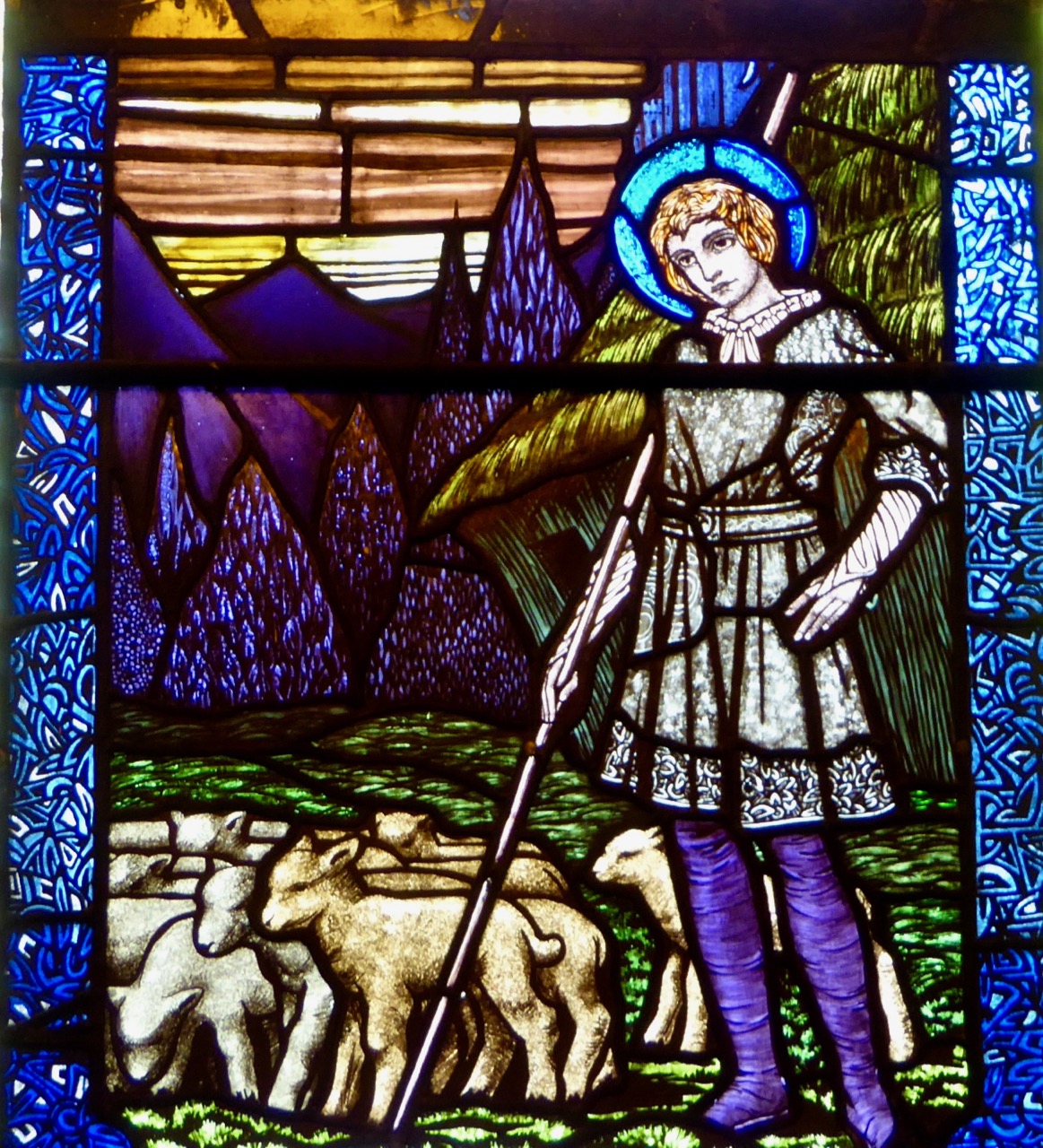
Six Years a Slave – this Harry Clarke window in the Church of The Assumption, Tullamore, seems to depict Patrick tending sheep during the period of his captivity

Patrick was born and brought up somewhere in the north west of Britain. He was of Romano British descent: his father was a a decurion, one of the ‘long-suffering, overtaxed rural gentry of the provinces’, and his grandfather was a priest – the family was, therefore, Christian. In his own writings Patrick describes himself as rustic, simple and unlearnèd.  When still a boy, Patrick was captured by Irish pirates and taken to be a slave in Ireland. He was put to work on a farm somewhere in the west and spent the long, lonely hours out in the fields thinking about the Christian stories and principles he had been taught back home.

Patrick is visited by a vision – the people of Ireland are calling to him to come back and bring Christianity to him. Richard King window, Church of St Peter and Paul, Athlone.  Read more about Richard King and the Athlone windows in Discovering Richard King

After six years he escaped from his bondage and made his way back to Britain – apparently by hitching a lift on a fishing boat. Because he had thought so much about Christianity during those years away, he decided to become a bishop which, after a few years of application, he did. Although he had hated his enforced capture he was aware that Ireland – as the most westerly outpost of any kind of civilisation – was one of the only places in the known world that remained ‘heathen’, and he was nagged by his conscience to become a missionary there and make it his life’s work to convert every Irish pagan.

Detail from Patrick window by Harry Clarke in Ballinasloe

When you see Patrick depicted in religious imagery he always looks serious and, perhaps, severe. You can’t imagine him playing the fiddle in a session or dancing a wild jig at the crossroads. In fact he was well know for his long sermons: on one occasion he stuck his wooden crozier into the ground while he was preaching and, by the time he had finished, it had taken root and sprouted into a tree!

Patrick with his hand raised in a blessing, accompanied by his symbols of the Paschal Fire and the shamrock. Harry Clarke Studio window, Bantry

Perhaps it was his severity that caused him to be respected: while giving another sermon (at the Rock of Cashel) he accidentally and unwittingly put the point of his crozier through the foot of the King of Munster. The King waited patiently until Patrick had finished sermonising then asked if it could be removed. Patrick was horrified at what he’d done, but the King said he’d assumed it was all part of the initiation ritual!

In Richard King’s enormous Patrick window in Athlone, the saint is depicted as youthful and clean-shaven. Here he is using the shamrock to illustrate the concept of the Trinity

Patrick first landed on the shores of Ireland just before Easter in 432 AD and established himself on the Hill of Slane – close to the residence of the High King. In those days the rule was that only the King himself was to light the Bealtaine Fire to celebrate the spring festival, but Patrick pre-empted this by lighting his own Paschal Fire on the top of the hill, thus establishing his authority over that of the High King (see the first image in this post). Somehow, he got away with it – and the fire has been lit on the top of the Hill of Slane every Easter from that day to this.

Another panel from the Richard King window – Eithne and Fidelma receive communion from Patrick. They were daughters of the King of Connaught; Eithne was fair-haired and Fidelma a redhead, and they were baptized at the Well of Clebach beside Cruachan

St Patrick seems to have been everywhere in Ireland: there are Patrick’s Wells, Patrick’s Chairs (one of which in Co Mayo – the Boheh Stone – displays some fine examples of Rock Art), Patrick’s Beds and – on an island in Lough Dergh – a Patrick’s Cave (or ‘Purgatory’) where Jesus showed the saint a vision of the punishments of hell.

Patrick blesses St Mainchin of Limerick. Detail from the Mainchin window in the Honan Chapel, by Catherine O’Brien for An Túr Gloinne

The place which has the most significant associations with Patrick, perhaps, is Croagh Patrick – the Holy Mountain in County Mayo, on the summit of which the saint spent 40 days and 40 nights fasting and praying, before casting all the snakes out of Ireland from the top of the hill – an impressive feat. To this day, of course, there are no snakes in Ireland – or are there? See my post Snakes Alive for musings on this topic (it includes a most impressive window from Glastonbury!)

Like many Patrick windows, this one, By Harry Clarke in Tullamore, shows Patrick banishing the snakes. This one has all the gorgeous detailing we expect from Clarke, including bejewelled snakes

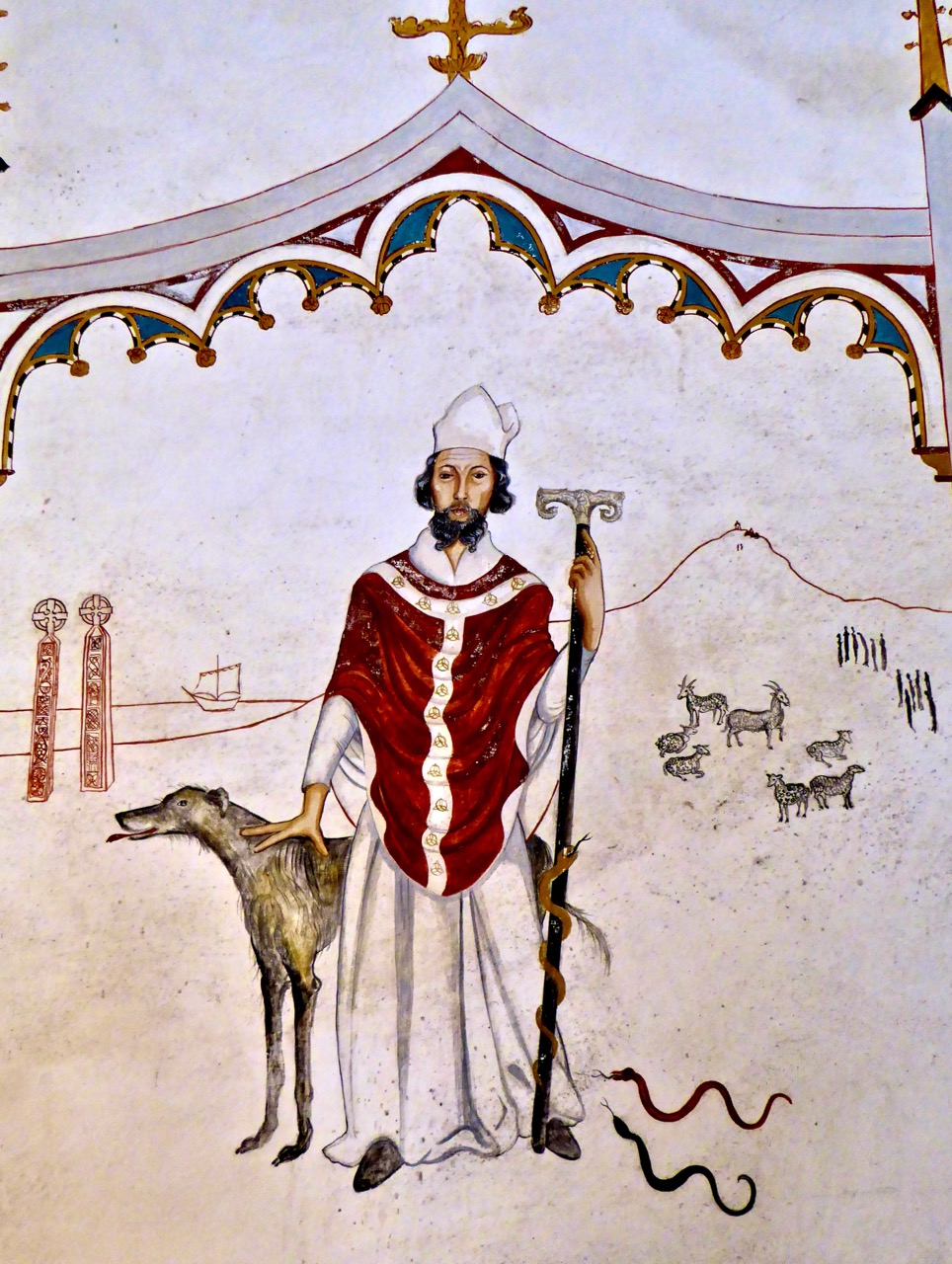
When Patrick considered that he’d finished his task, and the people of Ireland were successfully and completely converted, he returned to Britain and spent his retirement in the Abbey of Glastonbury – there’s a beautiful little chapel there dedicated to him.

This depiction of Patrick on the wall of his Glastonbury chapel shows him with familiar symbols but also several unusual symbols – an Irish wolfhound, high crosses, and Croagh Patrick, the holy mountain

It’s logical he should have chosen that spot to end his days as it must be the most blessed piece of ground in these islands, having been walked upon by Jesus himself who was taken there as a boy by his tin-trading uncle, Joseph of Arimathea. St Bridget joined Patrick there in retirement and they are both buried in the Abbey grounds, along with the BVM who had preceded them to that place a few centuries earlier.

From the George Walsh window in Eyeries, Patrick returns to convert the Irish

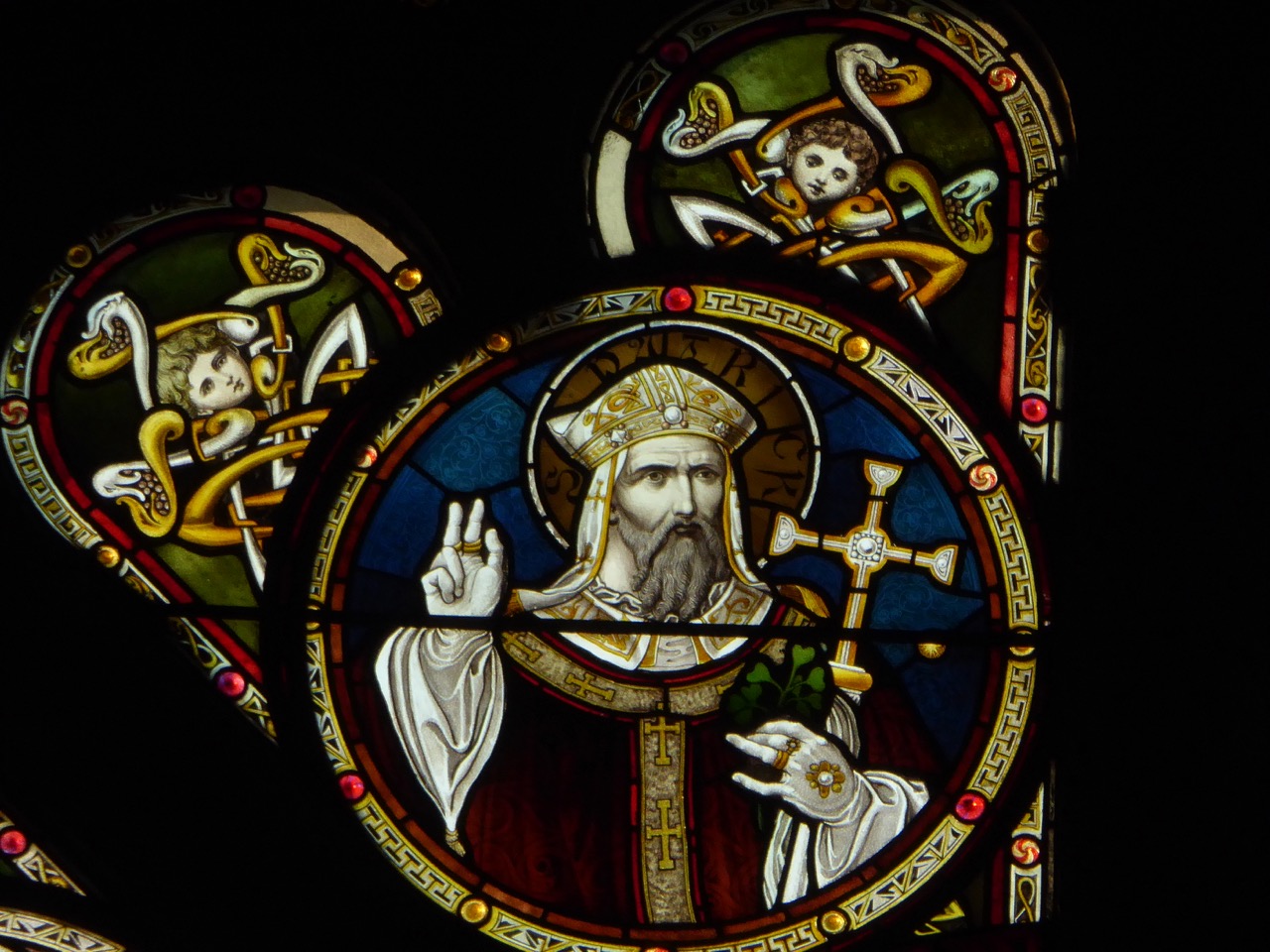
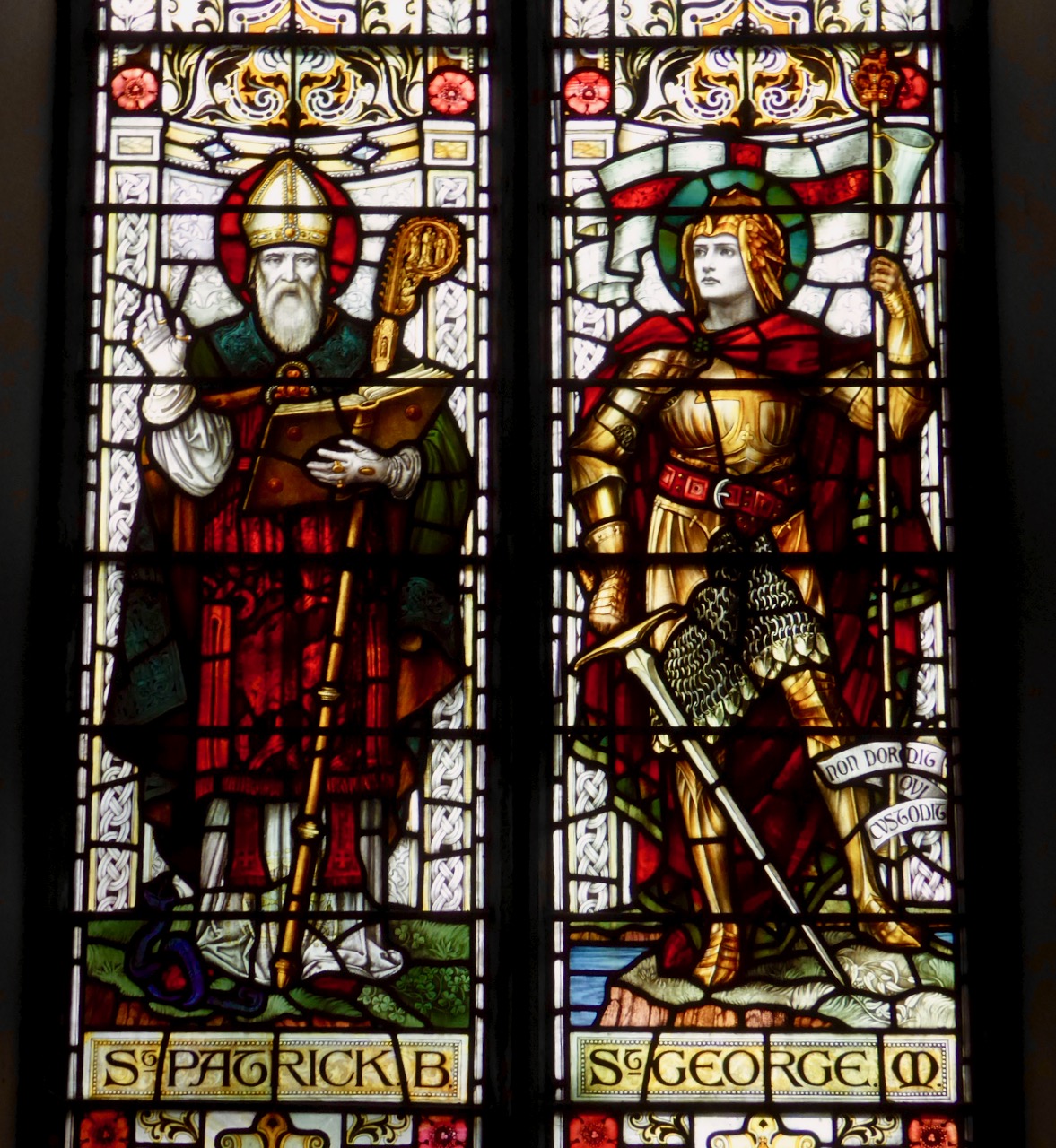
A depiction of Patrick below comes from St Barrahane’s Church of Ireland in Castletownsend where he is shown alongside St George. The window dates from before Irish independence and is an attempt to show the unity of Britain and Ireland through their respective patron saints. Perhaps meant to represent friendship between the countries, nevertheless nowadays it seems to display a colonial overtone that is an uncomfortable echo of past mores.

The window is by Powells of London and dates to 1906

So let’s leave Patrick doing what he came back to do – a last panel from the Richard King window in Athlone shows him performing his saintly task of converting the Irish – one chieftain at a time.

The Christmas Story, One Window at a Time

Bandon Catholic Church

The Christmas story, as told in stained glass in Irish churches, is the biblical story. There are no Christmas trees or Santa Clauses, no references to anything other than the story of the birth of the Christ child. Not surprising, since stained glass is to be found mainly in churches after all. The one above is from the Catholic Church in Bandon. Pop in next time you’re passing – it will surprise you with its size and striking colour.

Church of the Annunciation, Cork. AnnunciationFive windows in a Cork church tell the story, beginning with the Annunciation

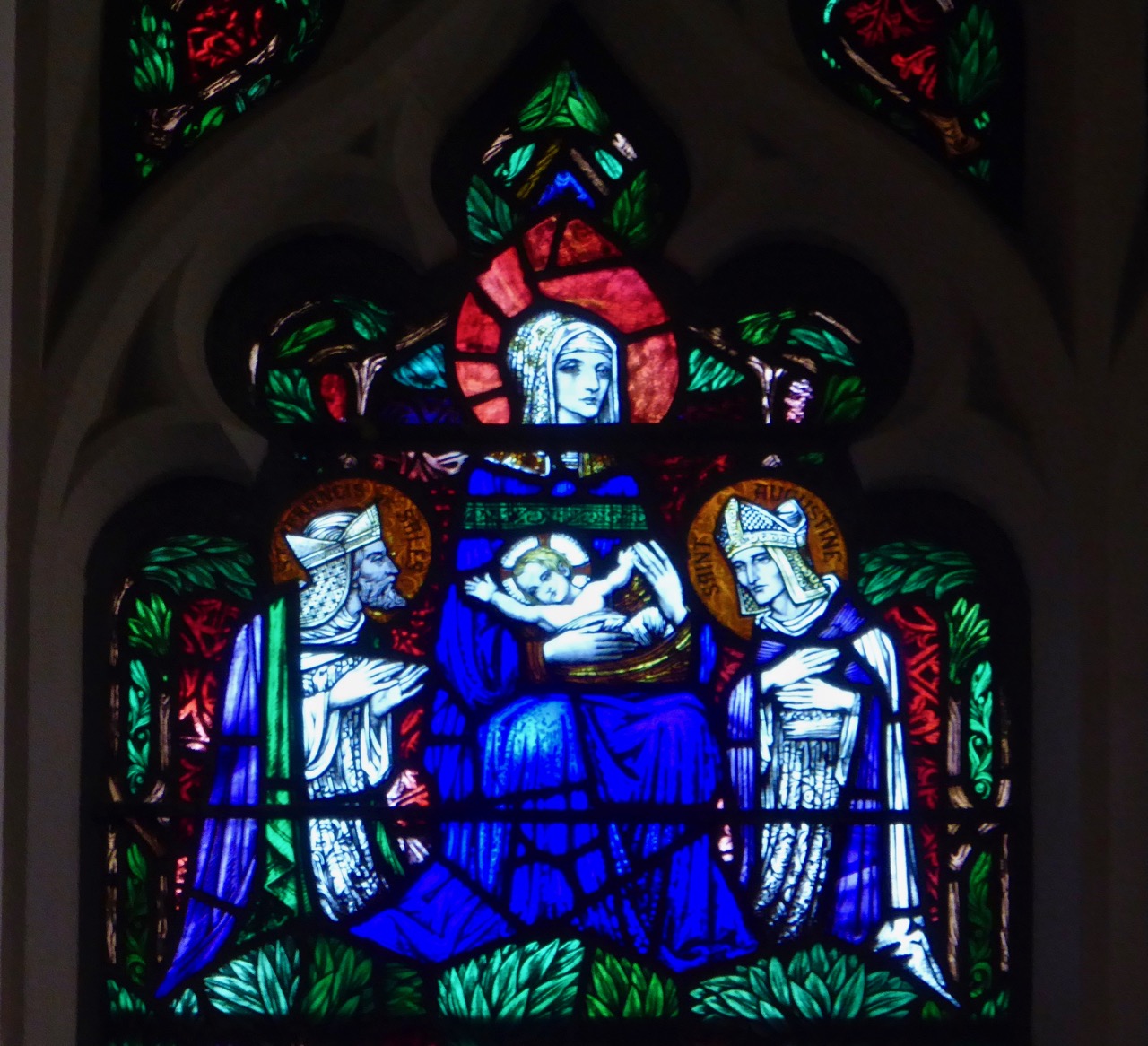
Two years ago I wrote a post about depictions of the Nativity by Harry Clarke. This year I’m branching out, to show you some of the stained glass Nativity images I have found in churches all over Ireland. Some are by artists I can identify, some are by the Harry Clarke Studios (after Harry’s death in 1931), and some are by anonymous artists. Some are traditional and some are avant garde. 

The next two windows show Mary visiting her cousin Elizabeth (mother of John the Baptist), followed by the betrothal of Mary and Joseph

In Cork, in the Church of the Annunciation – a church designed by the stone carver Seamus Murphy – a series of windows illustrate the complete Nativity story, from the Annunciation to the Visit by the Magi. These windows are by the Harry Clarke Studios and were installed in the 40s.

The birth in the manger with shepherds visiting, and the arrival of the Magi round out the story

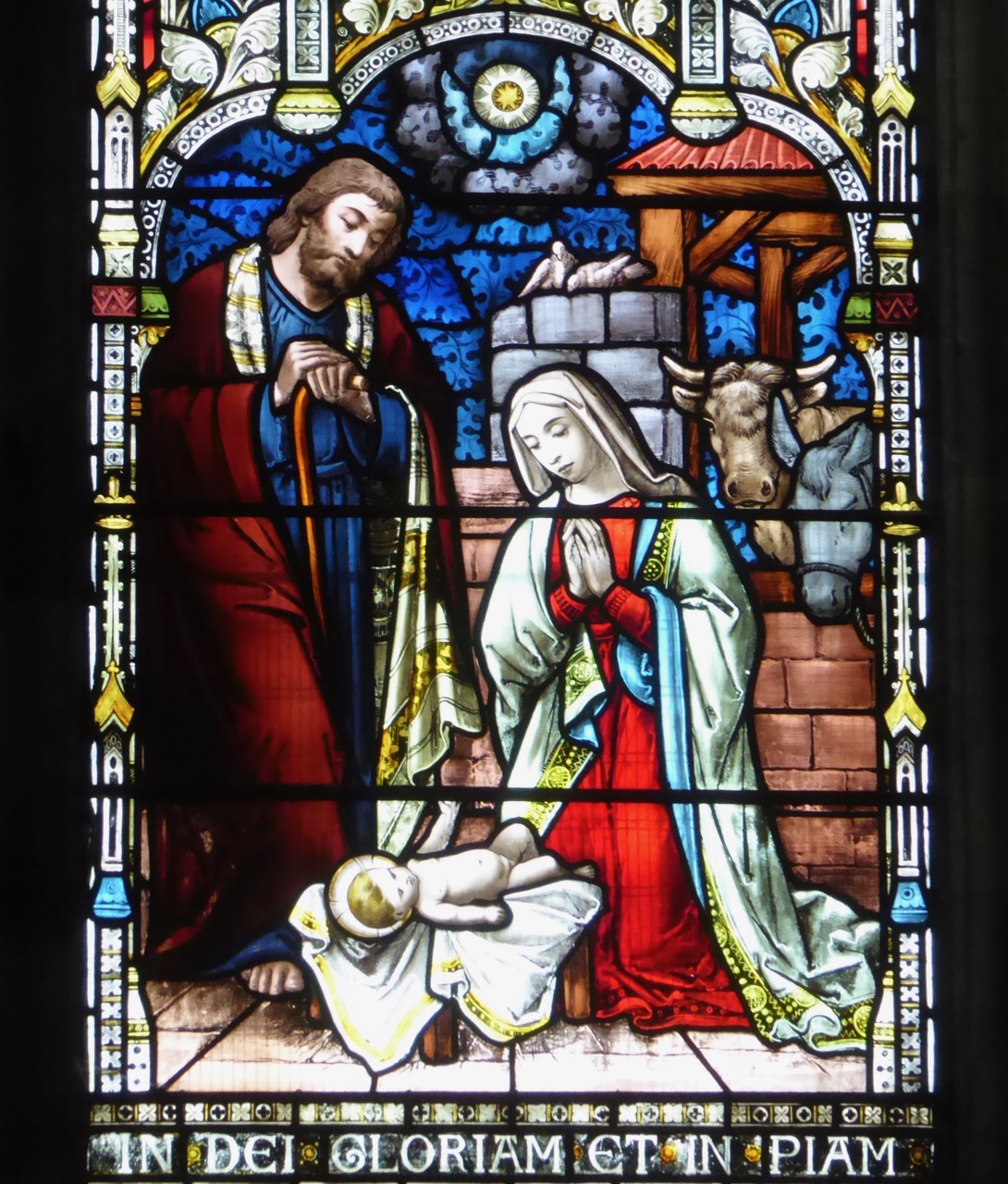
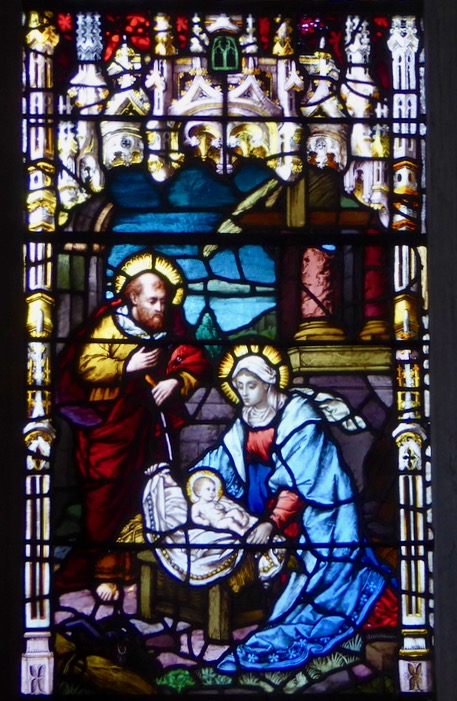
When we visited Kilkenny we saw two examples in St Canice’s Cathedral. The first, a traditional crib scene, looks like it belongs on a Christmas card.

St Canices

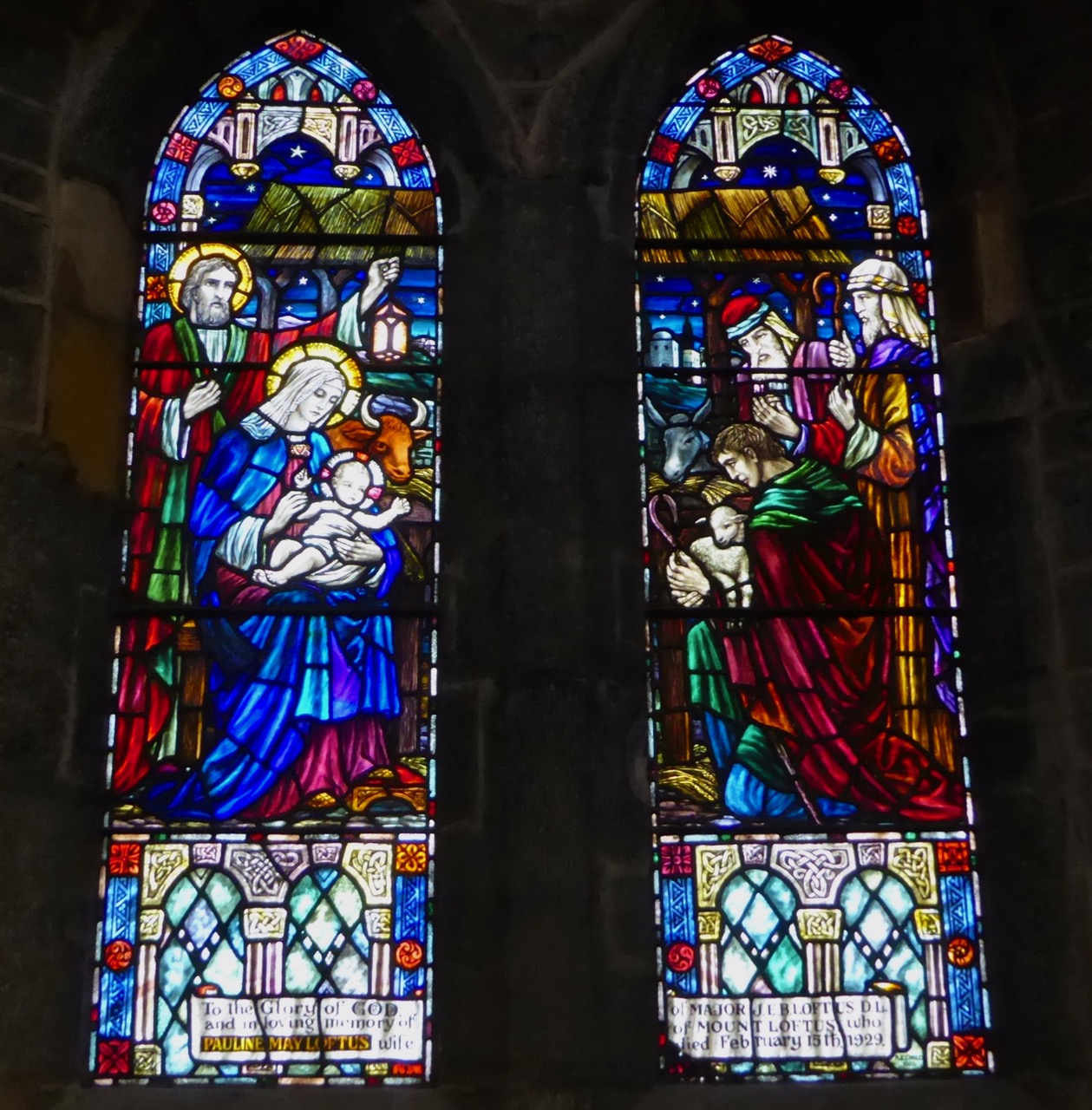
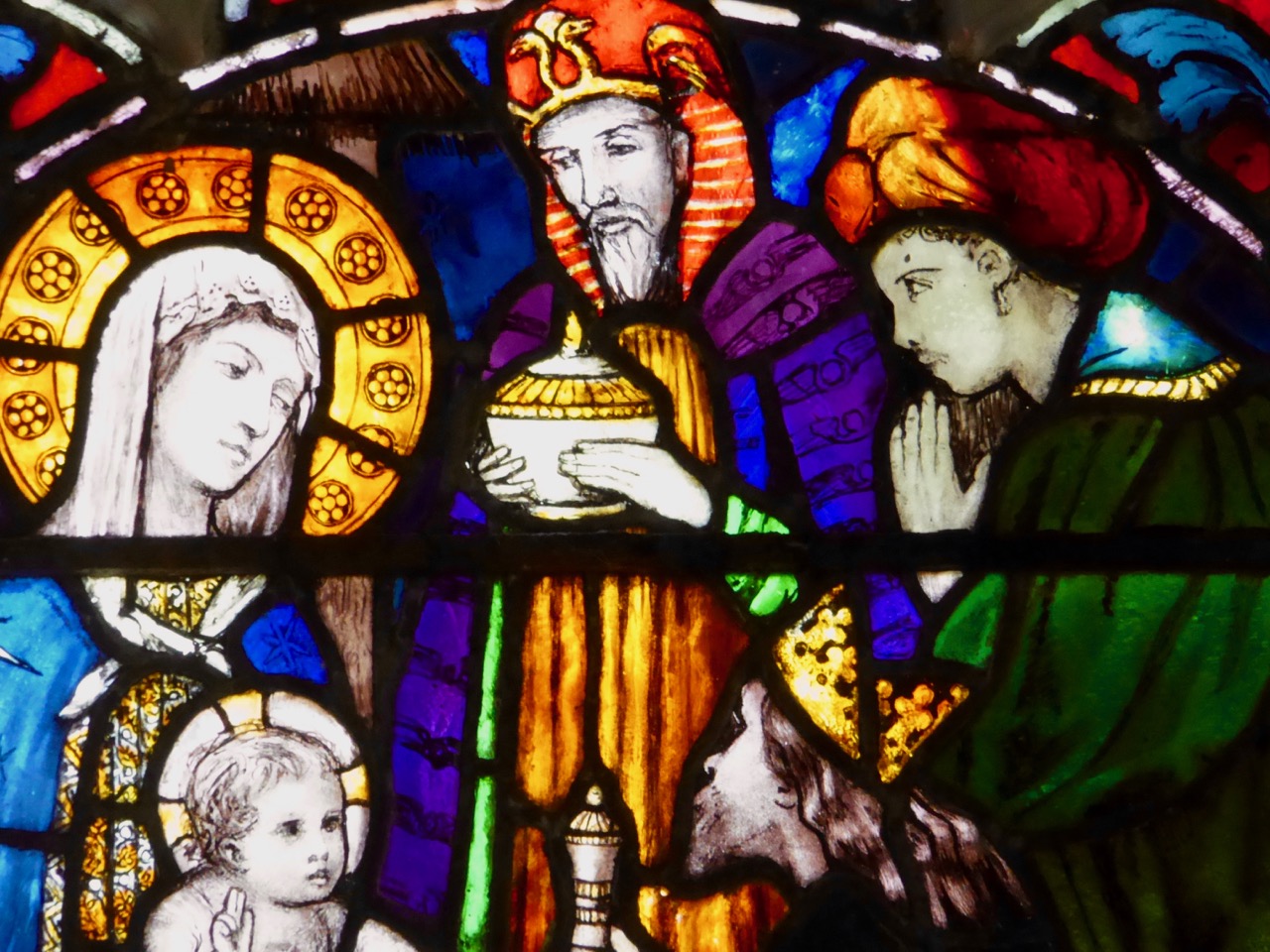
On  another wall in the same church is a two-light window by A E Child, depicting the visit of the Magi. A E Child was a highly influential teacher, and member of Sarah Purser’s Tower of Glass (An Túr Gloine) – a contemporary of Harry Clarke and a highly skilled stained glass artist, but with a more orthodox style than Clarke’s.

Canice's AE Childe

Still in Kilkenny, the Black Abbey has reputedly the largest stained glass window in Ireland. It’s divided into numerous smaller scenes and this one depicts the Nativity. It bears a striking resemblance to the Christmas card window from St Canice’s – perhaps it was from the same studio.

Black Abbey Kilkenny

In  Tullamore, the enormous Church of the Assumption has wonderful stained glass by different artists. Several large windows are by the Dublin firm of Earley. This one of the madonna and child shows a small shepherd on her right and three crowns on her left – a clear indication, I think, that this is intended as a Nativity image. The swirling colours and modern lines create a dramatic effect.

Church of the Assumption, Tullamore

The St Joseph window in the Richard King collection in Athlone contains a detail in one of the side panels that depicts the Flight into Egypt, and another of the marriage of Joseph and Mary.

Back to Cork and to the Holy Trinity Church on Father Matthew Quay, just behind the South Mall. Three windows on the west wall are by the Harry Clarke Studios. Research in the Studio archives (held in Trinity College) has revealed the the middle window was designed by Harry Clarke, but executed in fact by his father. It has many of the hallmarks of Harry but lacks the rich detail for which he became justly famous.

Holy Trinity Church, Cork, Designed by HC and executed by his father

Behind the altar, on the north wall of the same church is an enormous window dedicated to Daniel O’Connell and containing scenes from the life of Christ. It is conventional, but finely painted and the colours are rich.

Holy Trinity Cork, East Window

I will leave you with two of our favourites. Close to home I love the the Sarah Purser/Tower of Glass round window in the Holy Rosary Church in Kilcoe. Here’s a detail.

Tower of Glass Magi closeup. Kilcoe

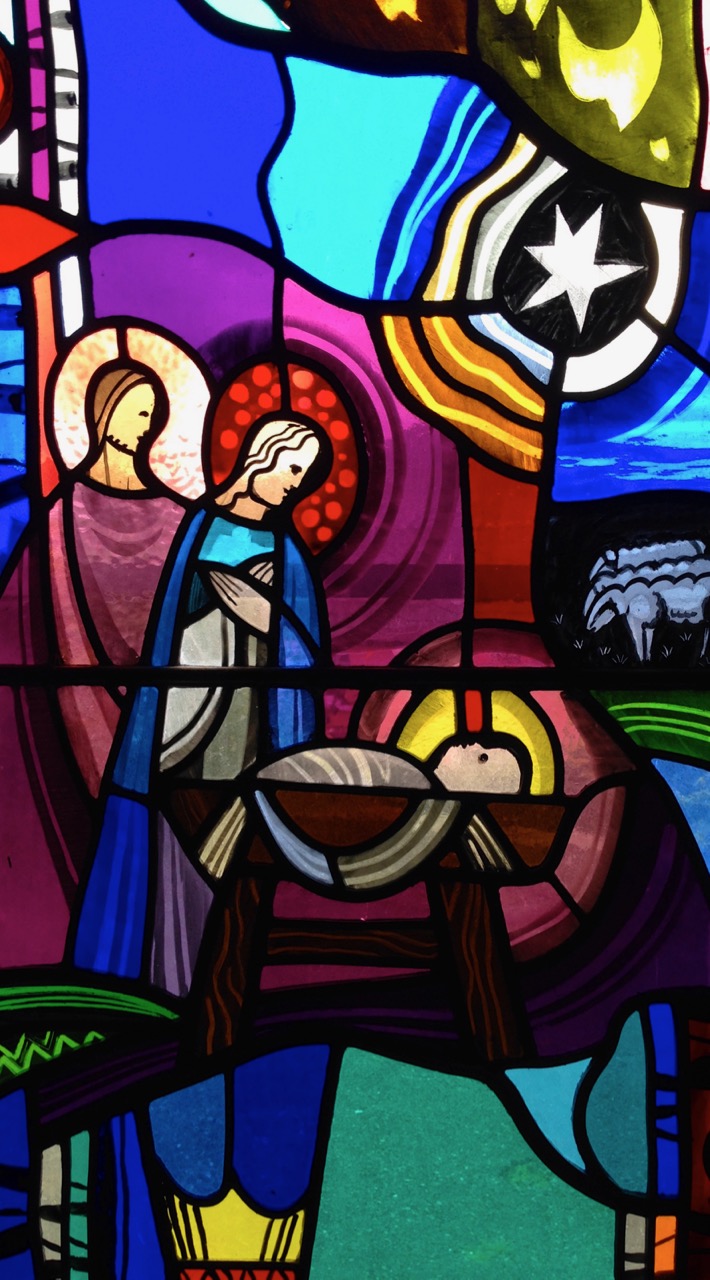
And finally, from the village church of Eyeries on the Beara Peninsula, Robert wrote about  a stunning set of windows by George Walsh. His nativity scene is touching and beautiful.

george walsh nativity