Ballinacarriga Castle Part 2

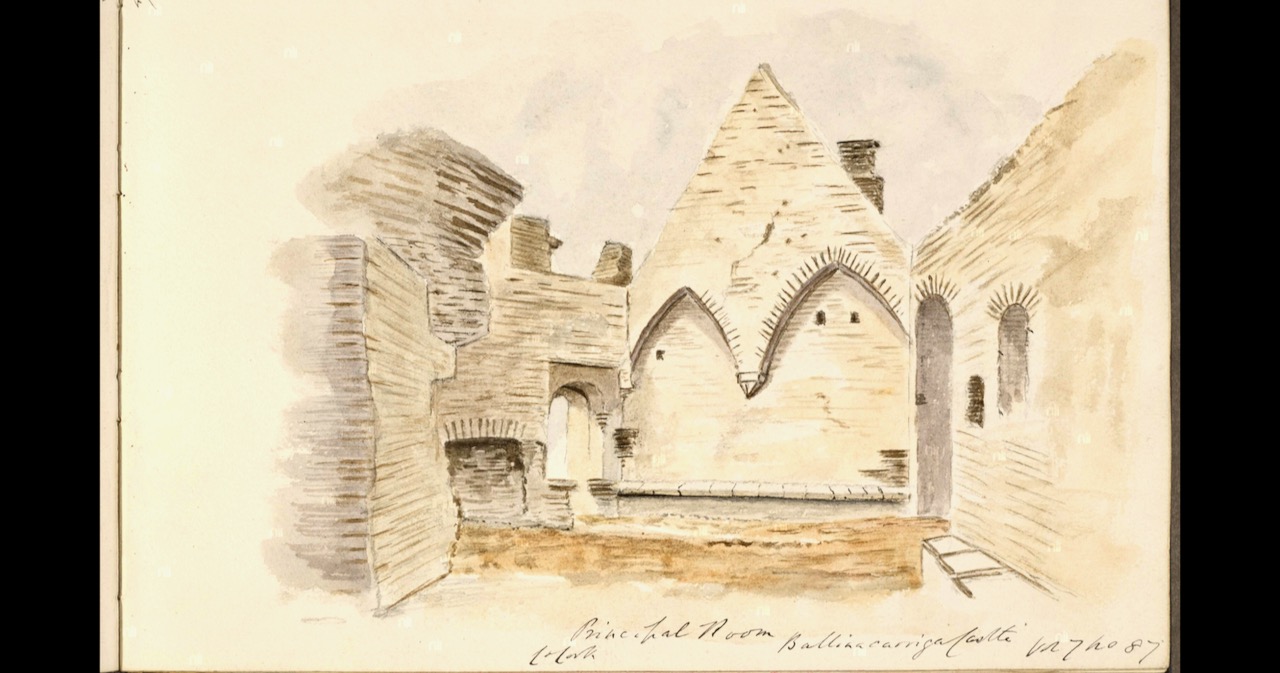
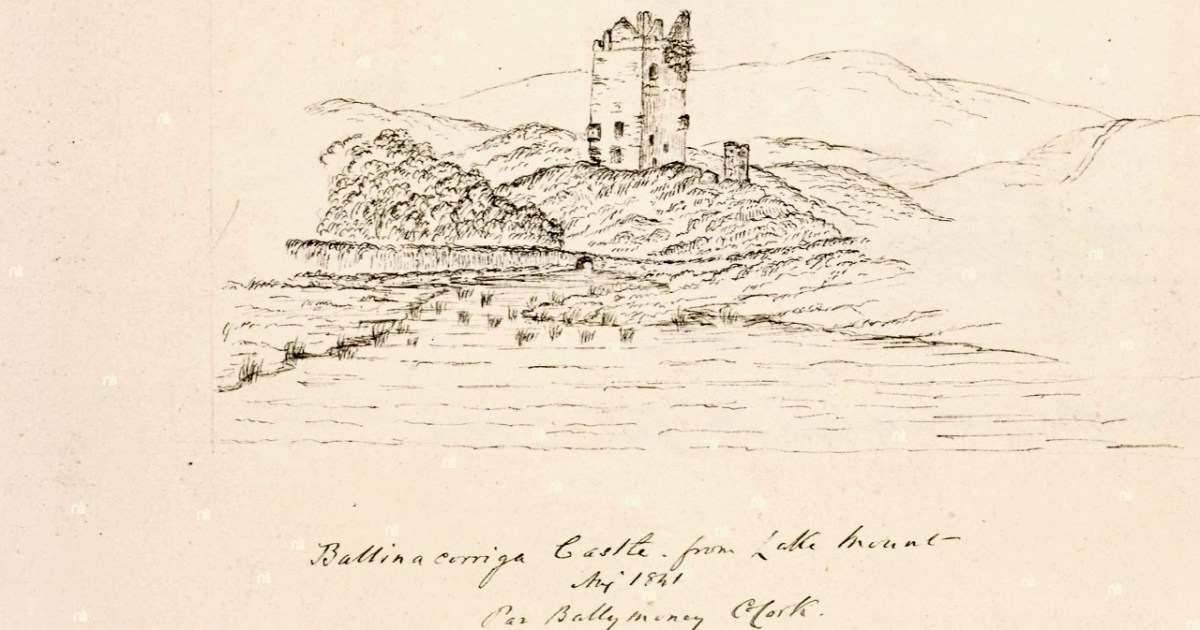
The romantic situation of Ballinacarriga Castle, and its relative intactness, meant that it was a favourite of antiquarians and travellers. There was a great appetite in the nineteenth century for images and accounts of all things to do with Irish antiquities – we were rediscovering our past and revelling in the realisation that we had a proud and significant heritage. Two of those illustrators, William Frazer and James Stark Fleming, visited and drew Ballinacarriga for their series on castles and other antiquities. Fleming, a Scottish solicitor and a constant visitor to Ireland was an accomplished watercolour artists and architectural historian. In all, he produced 10 volumes of drawings of Irish castles*. His sketches ( like the one below) were made on the spot.
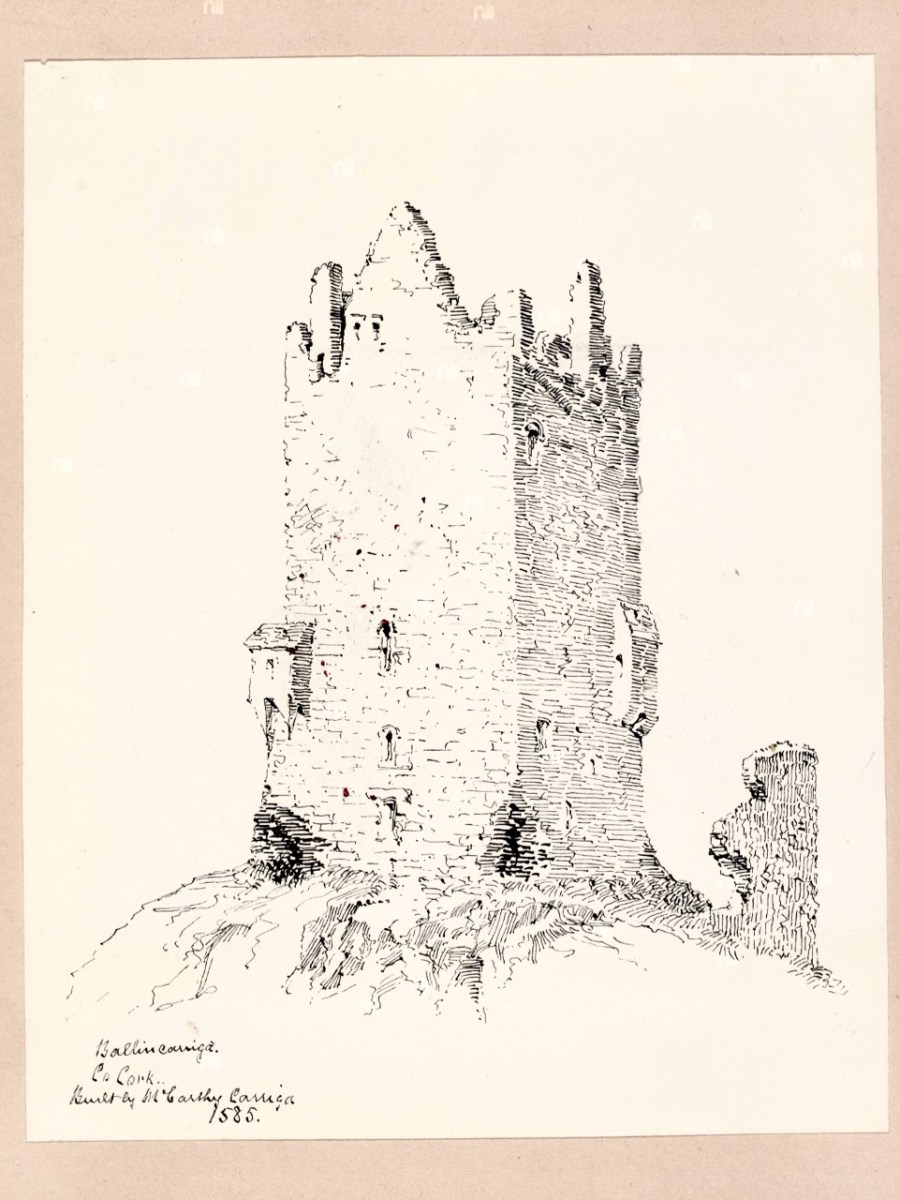
William Frazer was also a prolific illustrator but his sketches were sometimes based on other drawings (such as by du Noyer) or on photographs. His interior scene is a lovely wash. Both the lead images are by Frazer, and the Fleming and Frazer drawings are included here courtesy of the National Library of Ireland
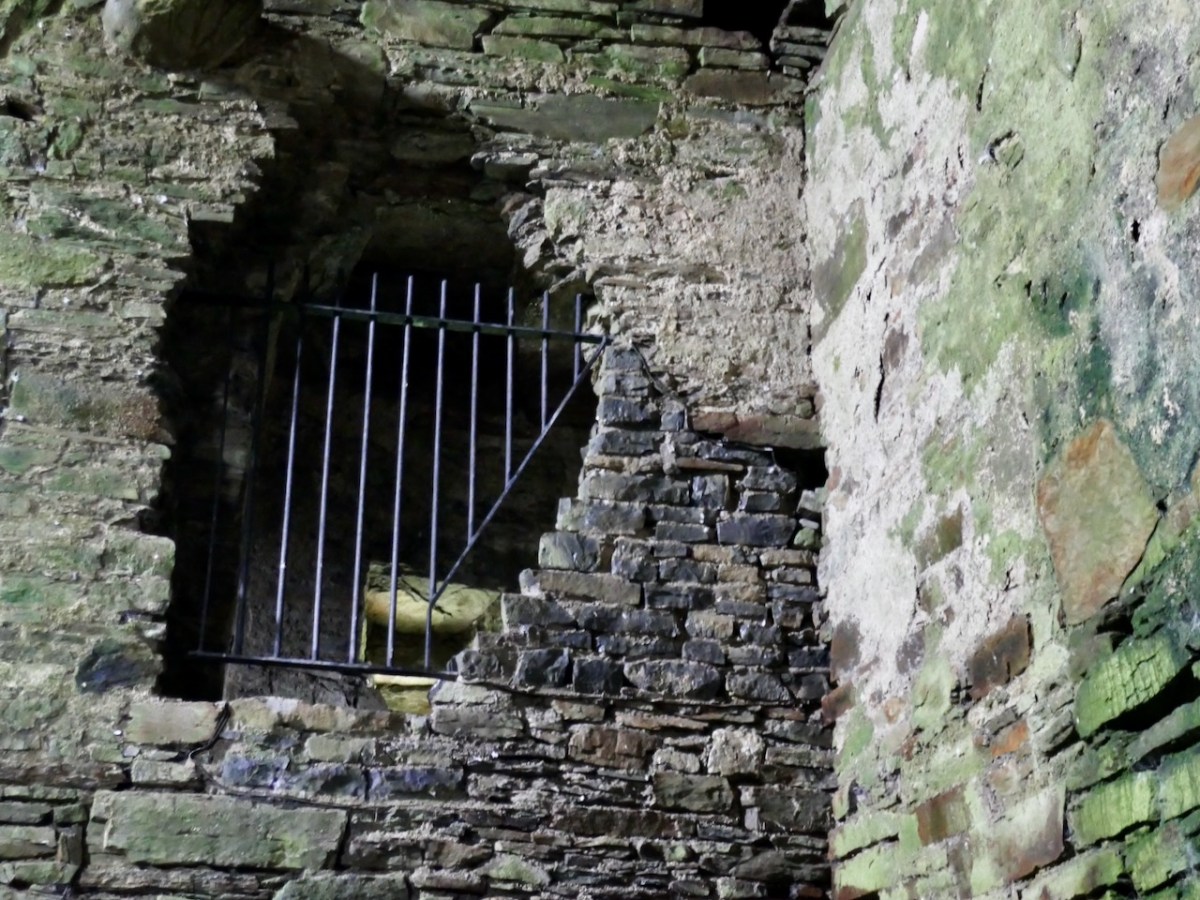
And yes, the interior – let’s go back inside the castle (see Part 1 for the exterior). Before we leave the level under the vault, let’s take a look at the interior render, still in place on the walls. It’s a reminder that those walls would have been lime-rendered in white, which would really have helped with visibility inside. 
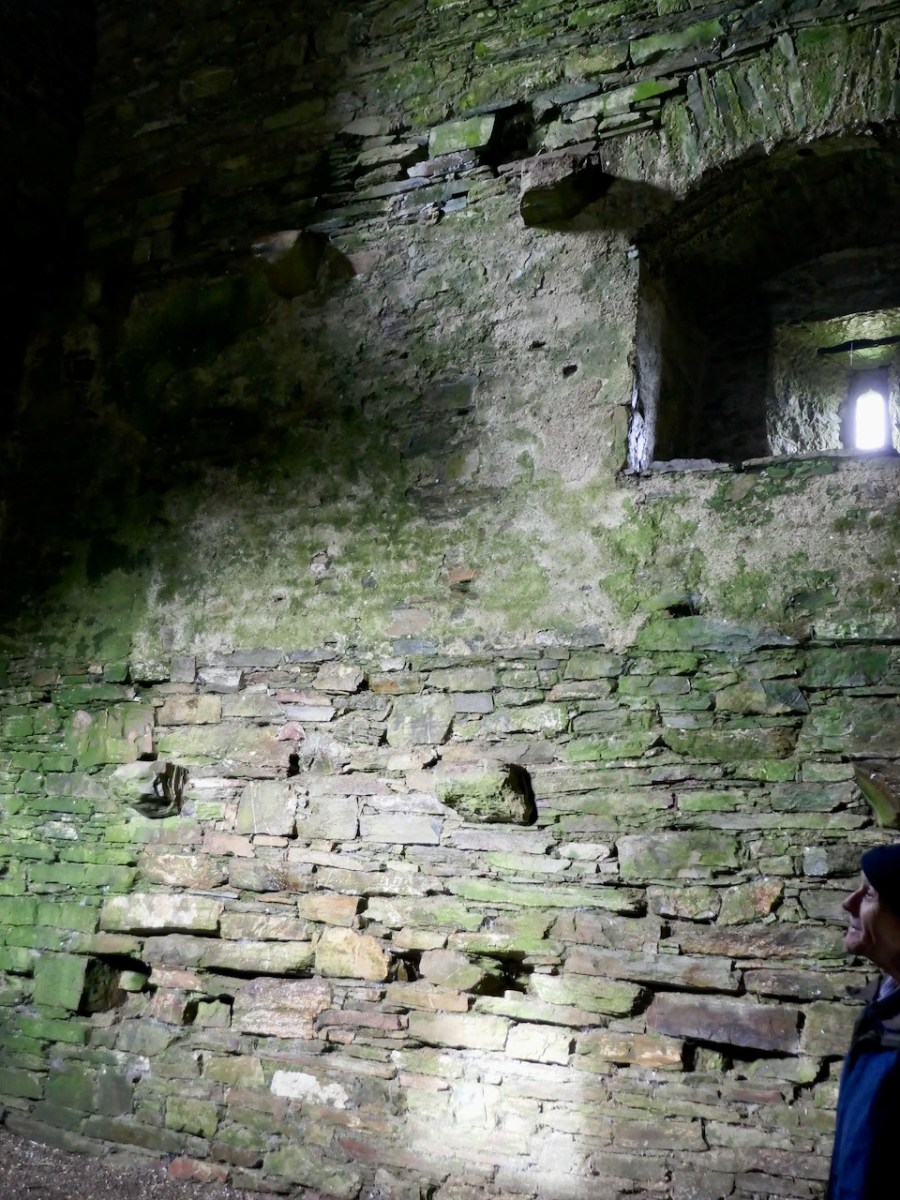
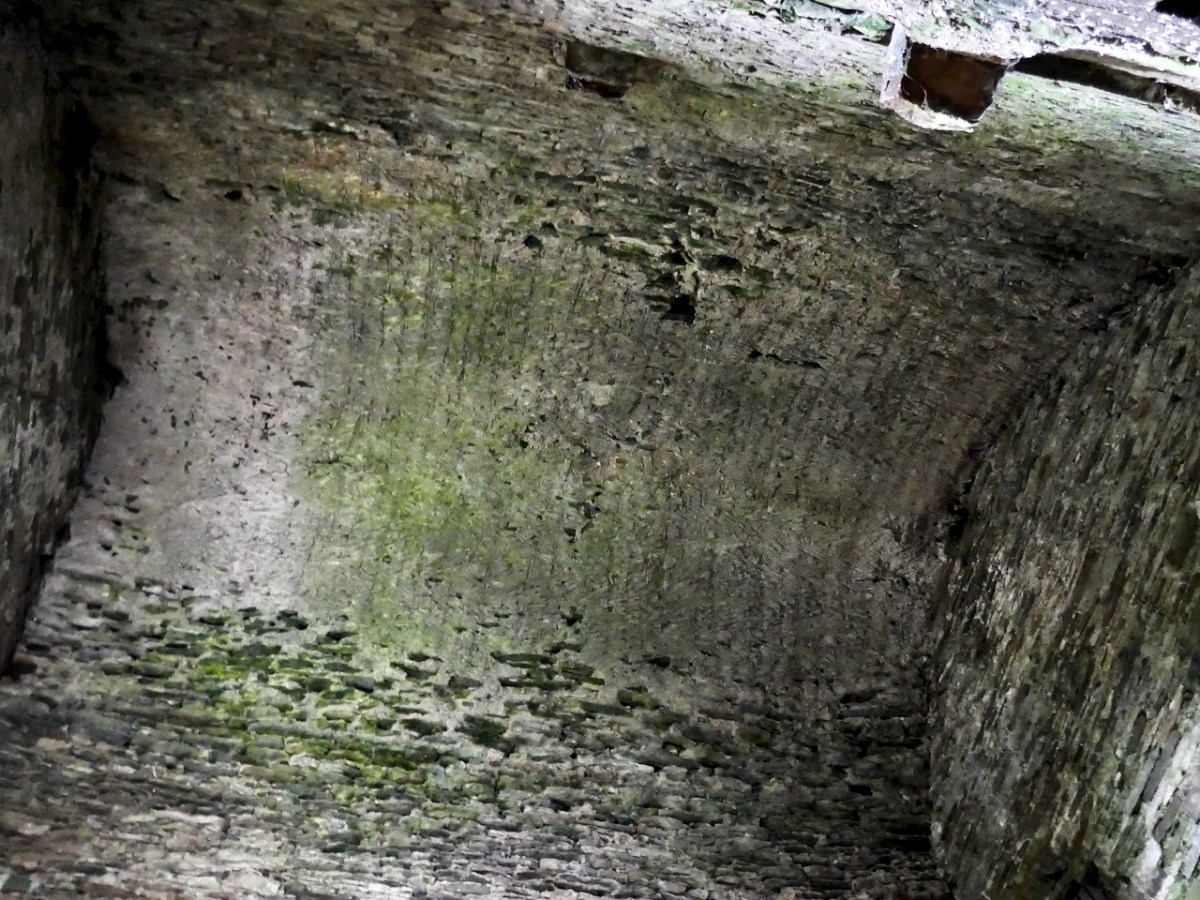
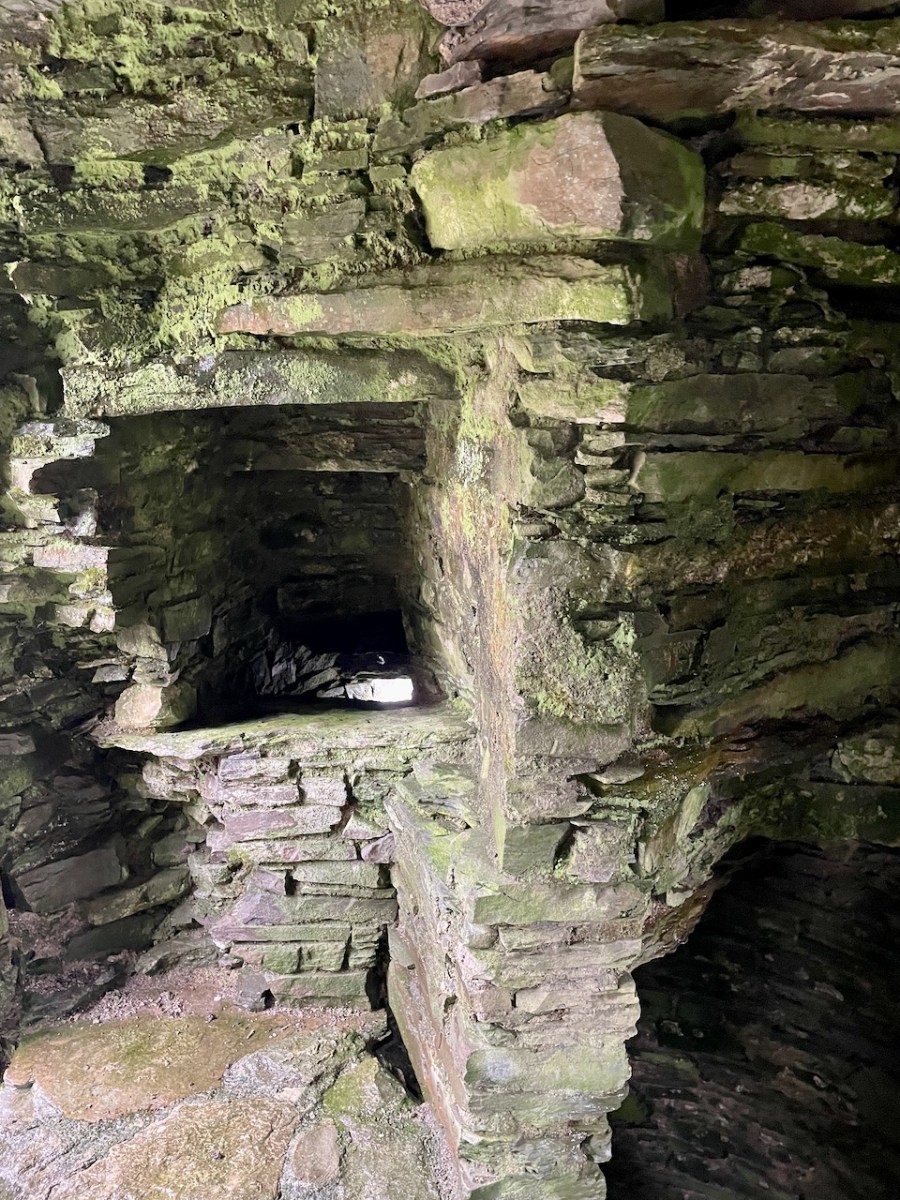
A mural chamber (room within the walls) at the top of the stairway also has a vault and here we can see exactly how the vault was constructed.
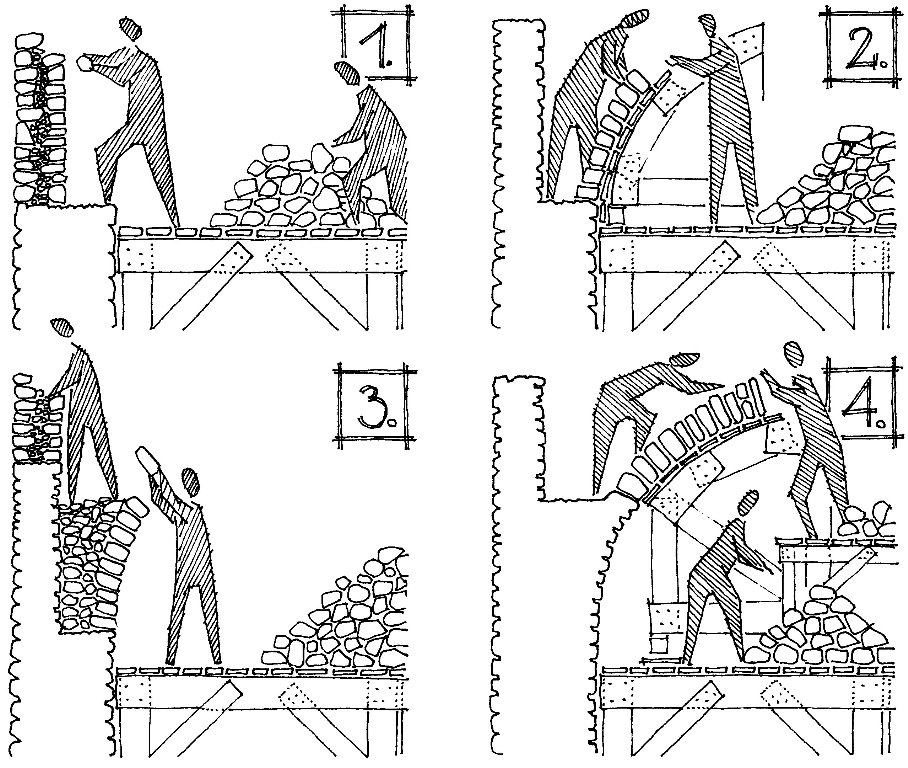
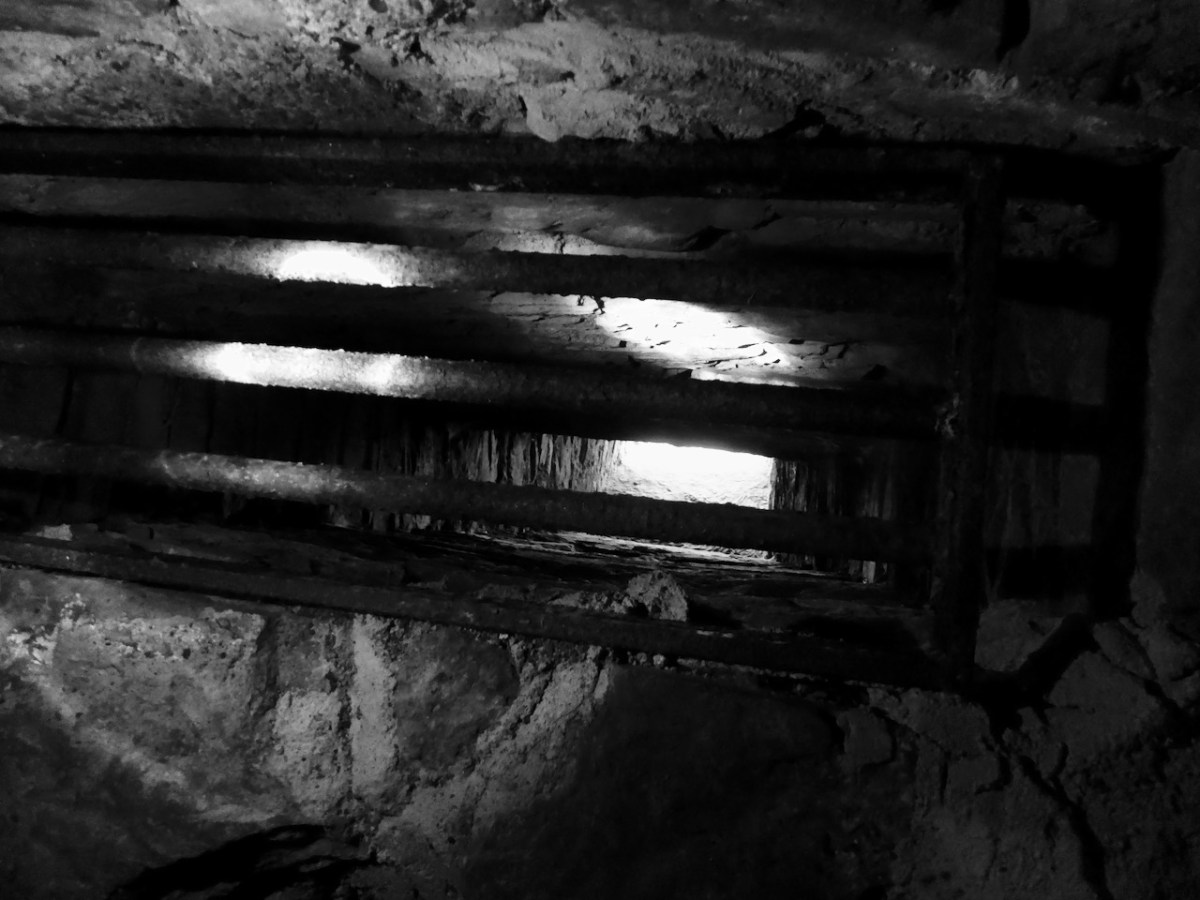
A scaffolding of wicker was erected first and a layer of mortar laid on top of that. Ceiling stones were laid on the scaffold and mortared into place and then the stone work was built up to provide the floor of the next story.
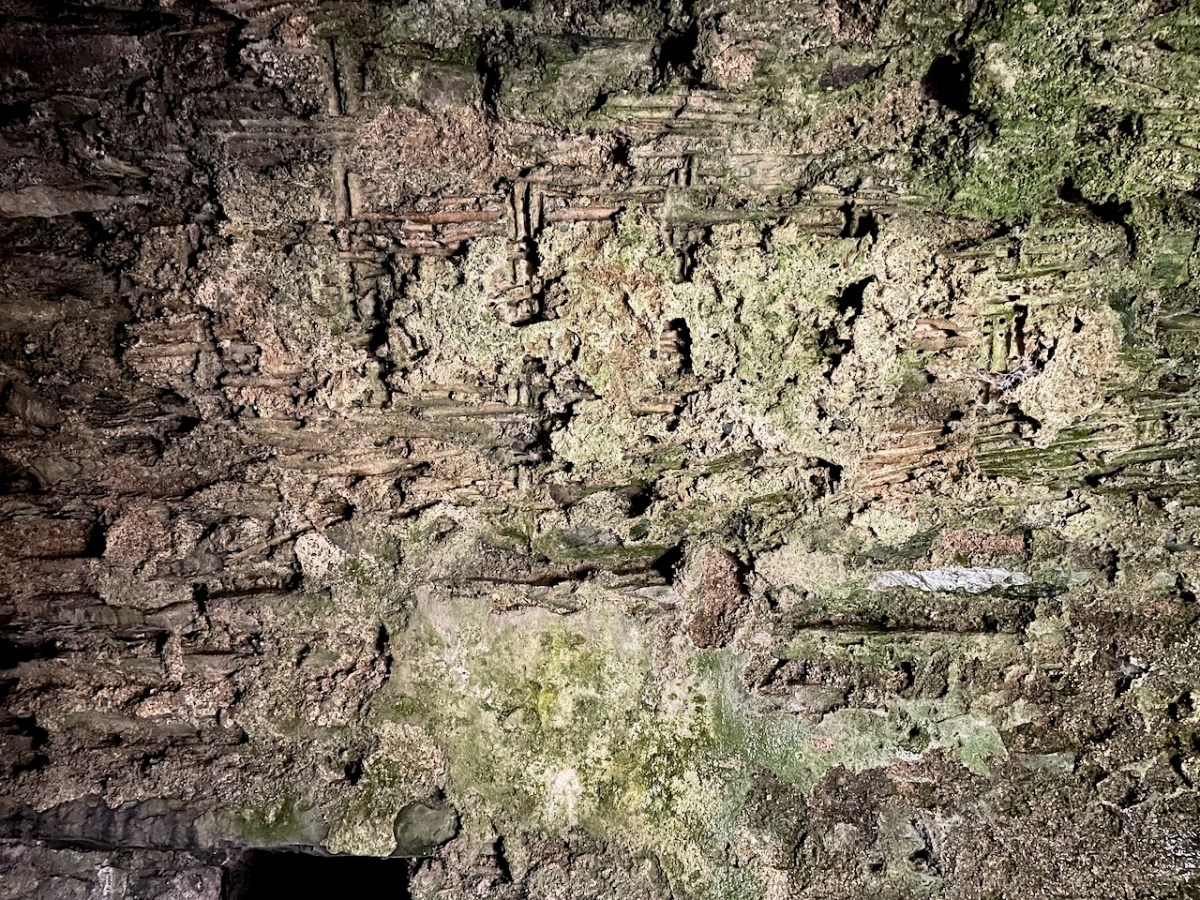
When the scaffold was dismantled the impression of the wicker was left on the mortar – and in this case it looks like some of the wicker stayed behind as well.
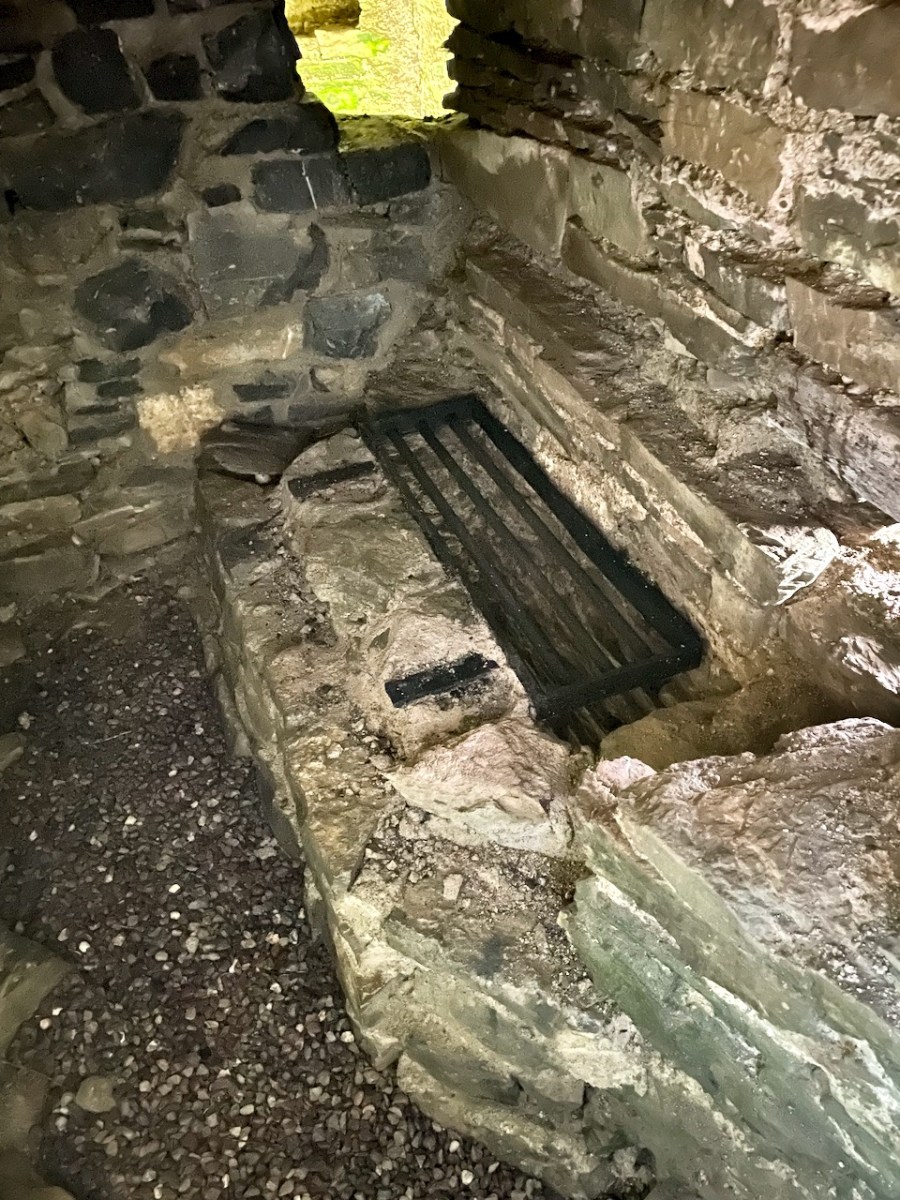
Another mural chamber contained the castle’s indoor plumbing. In the last post we saw the exit of the garderobe chute. Here is the garderobe itself – it would have had a wooden seat for comfort. 
Another way of getting rid of rubbish was to have a slop chute and there is one here, close to what may have been an interior cooking area.
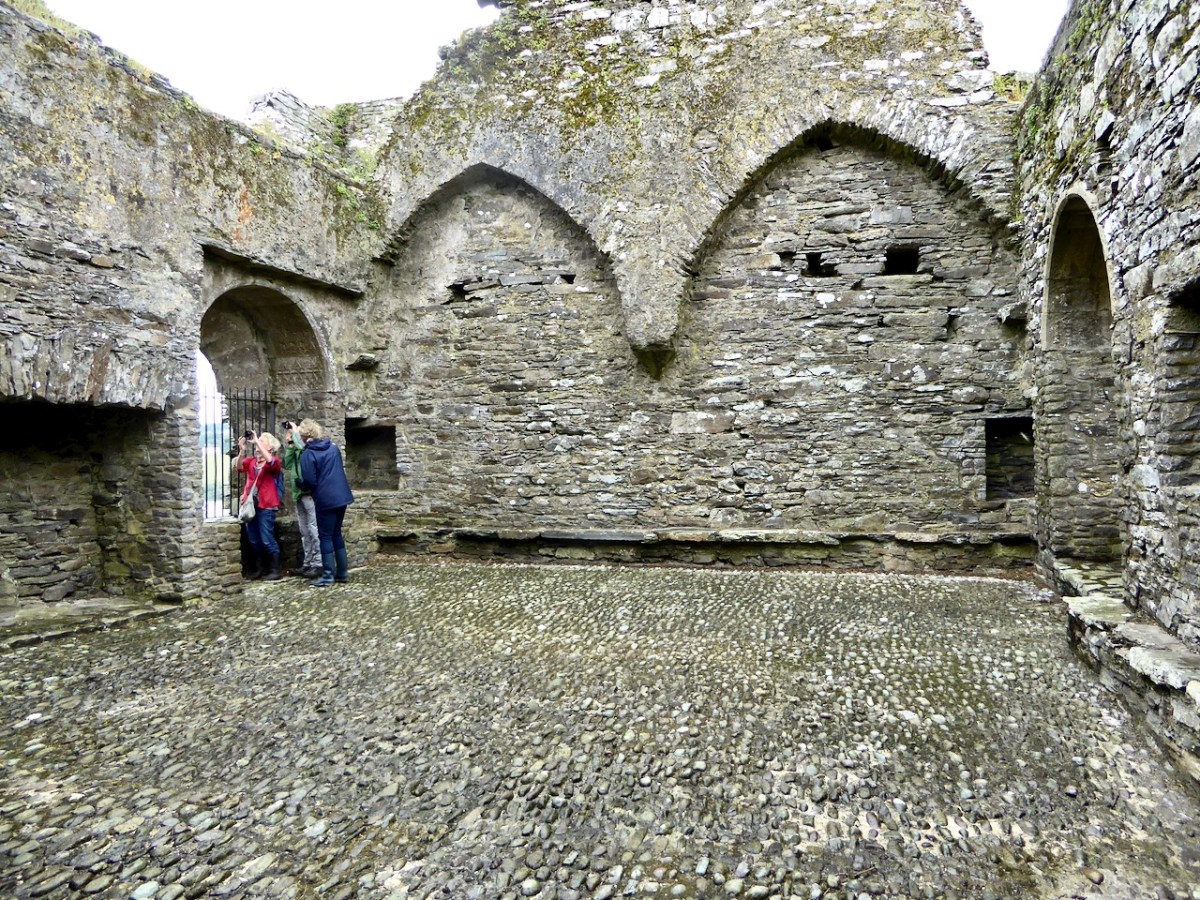
But the real glory of the castle is the top floor. The function of this chamber, sometimes called a solar, was for the chief and his family to entertain visitors and to conduct business.
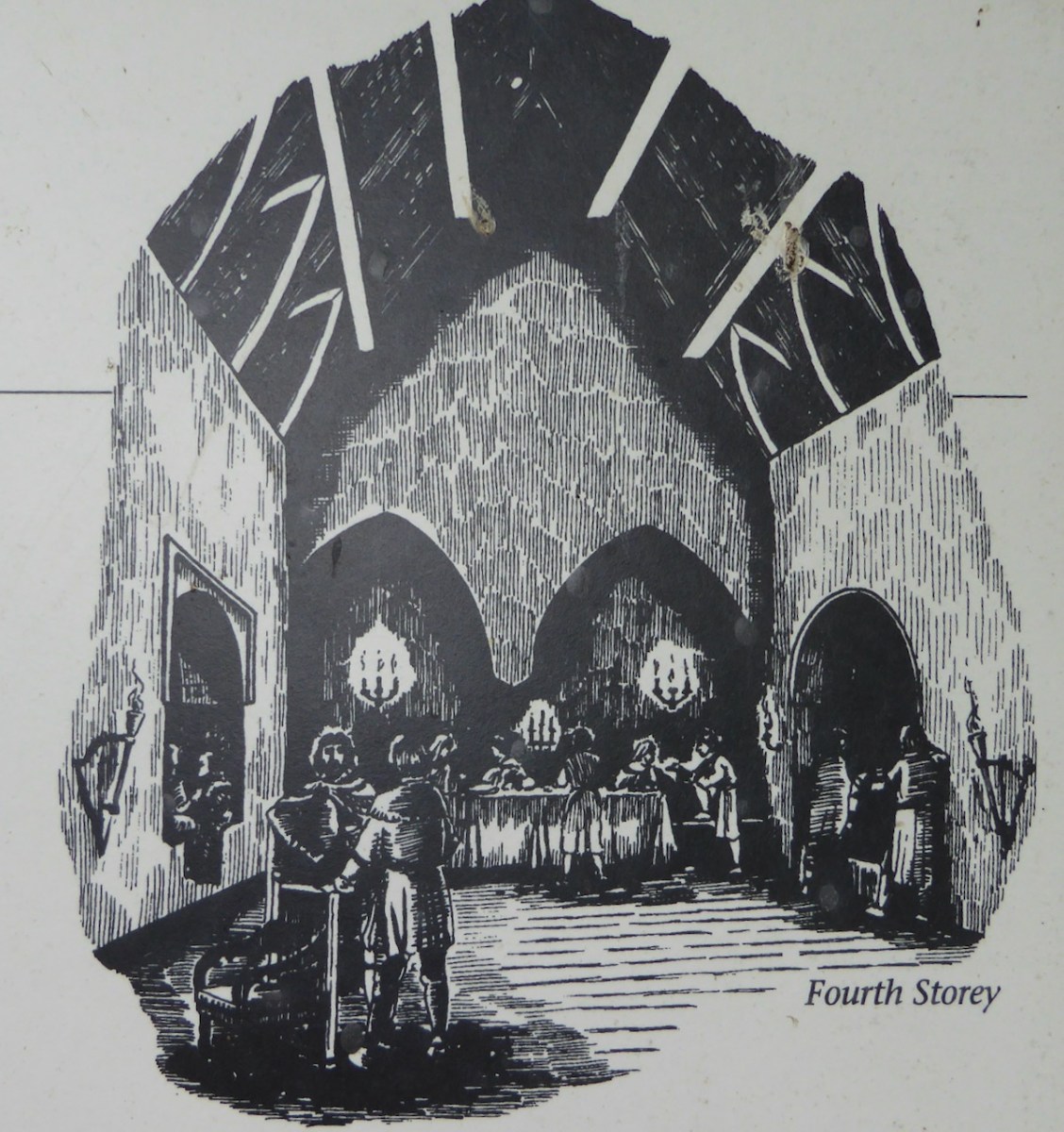
Hospitality was an important obligation of all the great Irish houses and a drawing on the information board at Ballinacarriga shows how this room may have been used for feasting and discussions. 
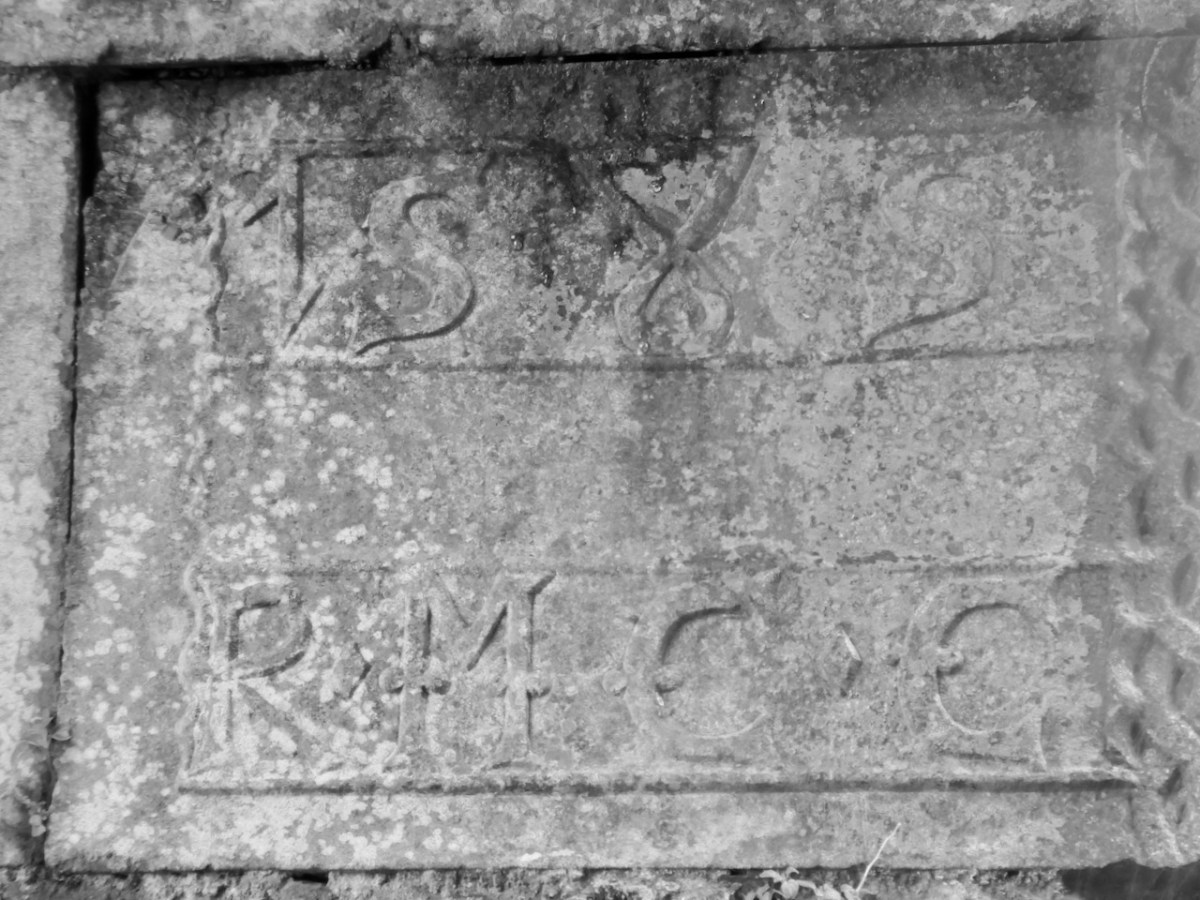
And here we meet more carvings – yes, there are two more window embrasures with carvings on this level. On a window on the north side there is an inscription that gives the date of 1585, and the initials R.M. C.C.  for Randal Muirhily (Hurley) and his wife Catherine O Cullane (we met Catherine last week). So this is likely when all the carvings were done.
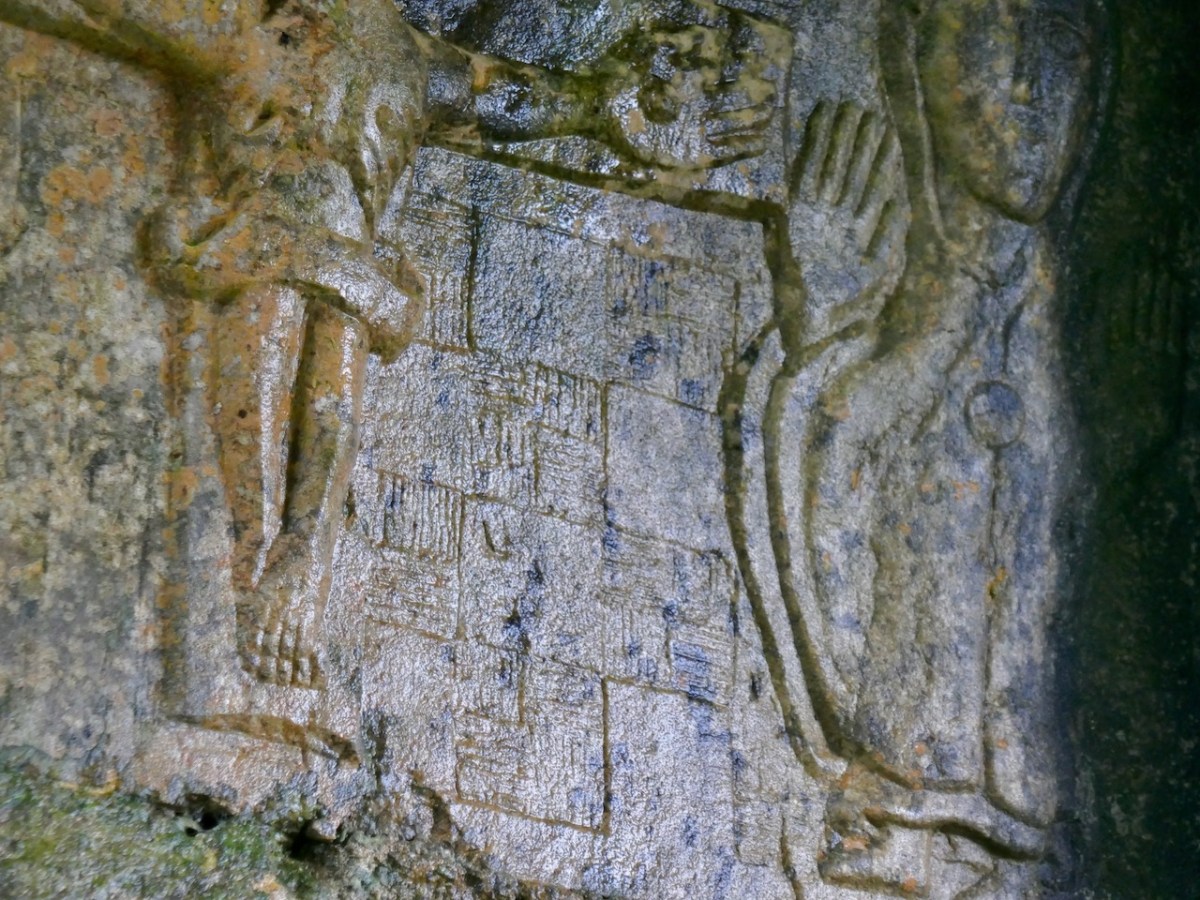
This room may also have been used as a private chapel. The clue is in the nature of the remaining carvings.  The window on the South side has a crucifixion on the east end, but the whole surround is carved with stylised foliage and scroll patterns. While it is difficult to photograph this, the information board has a great illustrations (even if backwards from how it is viewed).
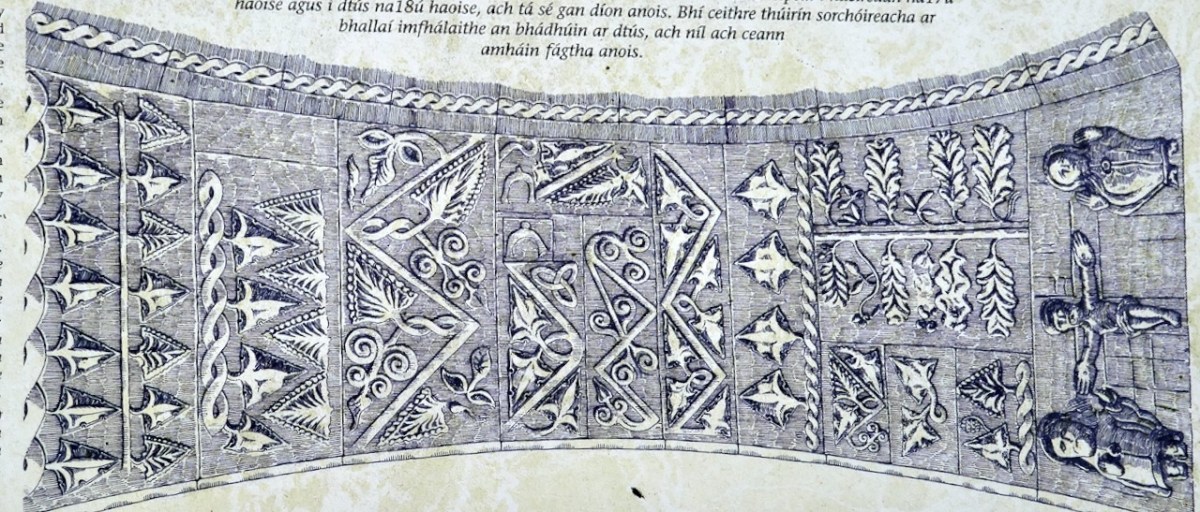
The crucifixion and other religious iconography (more of that in a minute)  is a remarkable and unique element in this castle. After the Reformation got underway, and starting around the 1530s iconoclasts destroyed anything in the way of religious representational art they could get their hands on. It’s the reason we have no Medieval stained glass left in Ireland. That’s right – not a single window, nothing but a few scraps of glass that have turned up in excavations. 
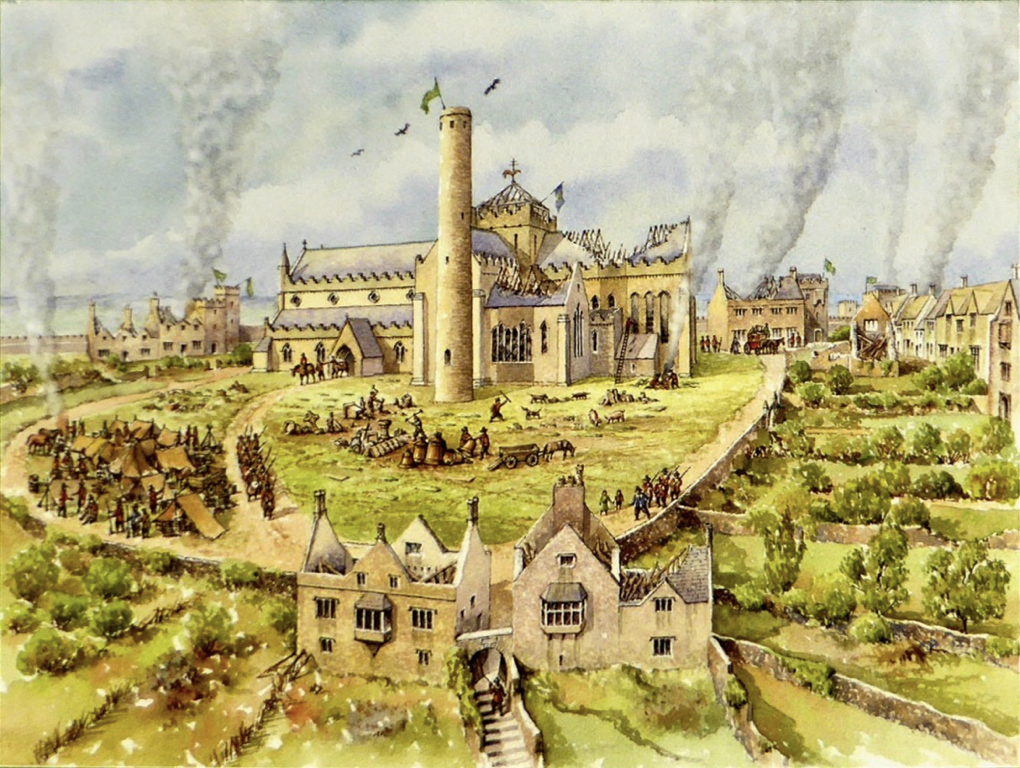
Crucifixion images were particularly anathema to the Protestant reformers. What survived those rampages fell victim to the Cromwellian Puritans from the 1640s on, like the destruction of St Canice’s Cathedral above – once renowned for its great East Window. 
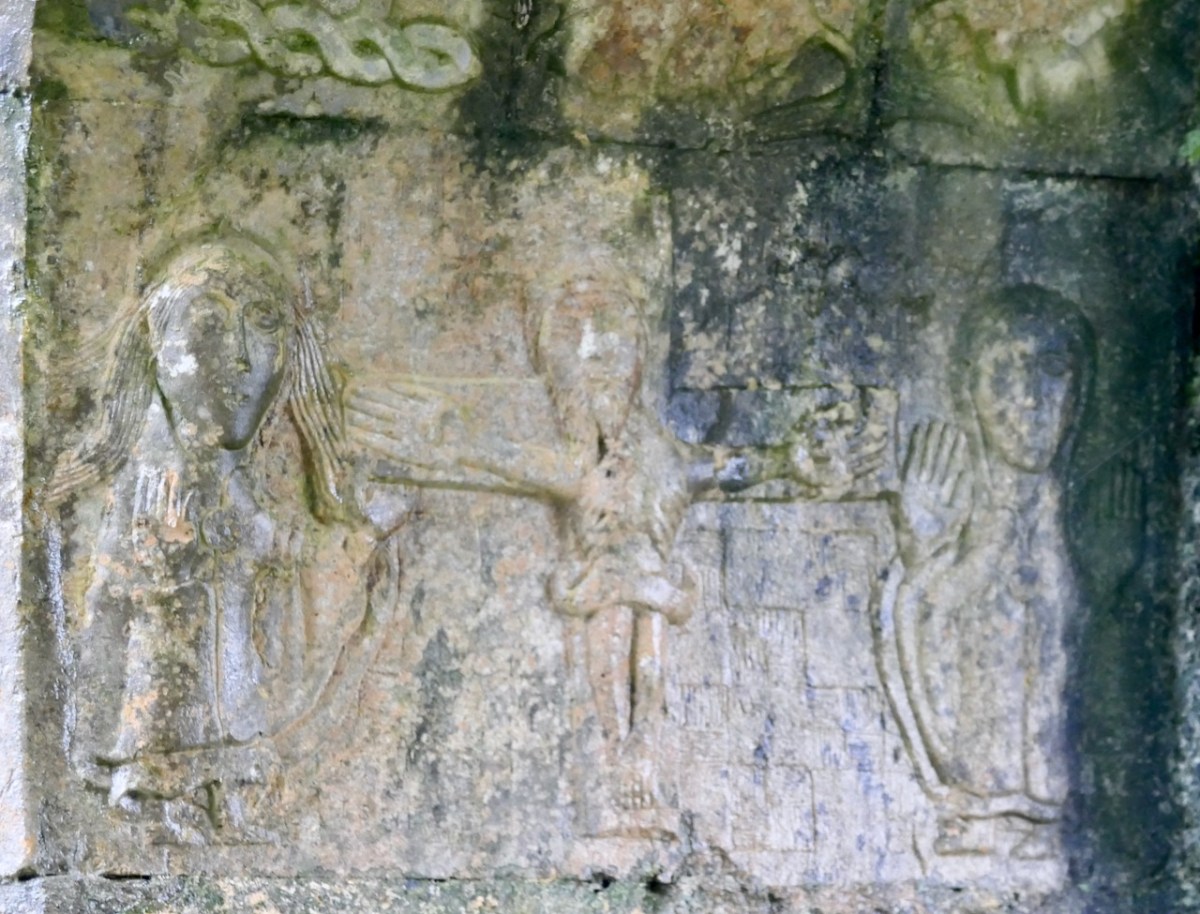
The location of the Crucifixion carving is probably the key to its survival — tucked inside a West Cork tower house, it was simply inaccessible to reforming zeal. And the date of 1585 is actually rather bold, coming right in the thick of the Elizabethan push. It could even be read as a deliberate act of Catholic defiance by the Hurleys, which adds another layer of significance.
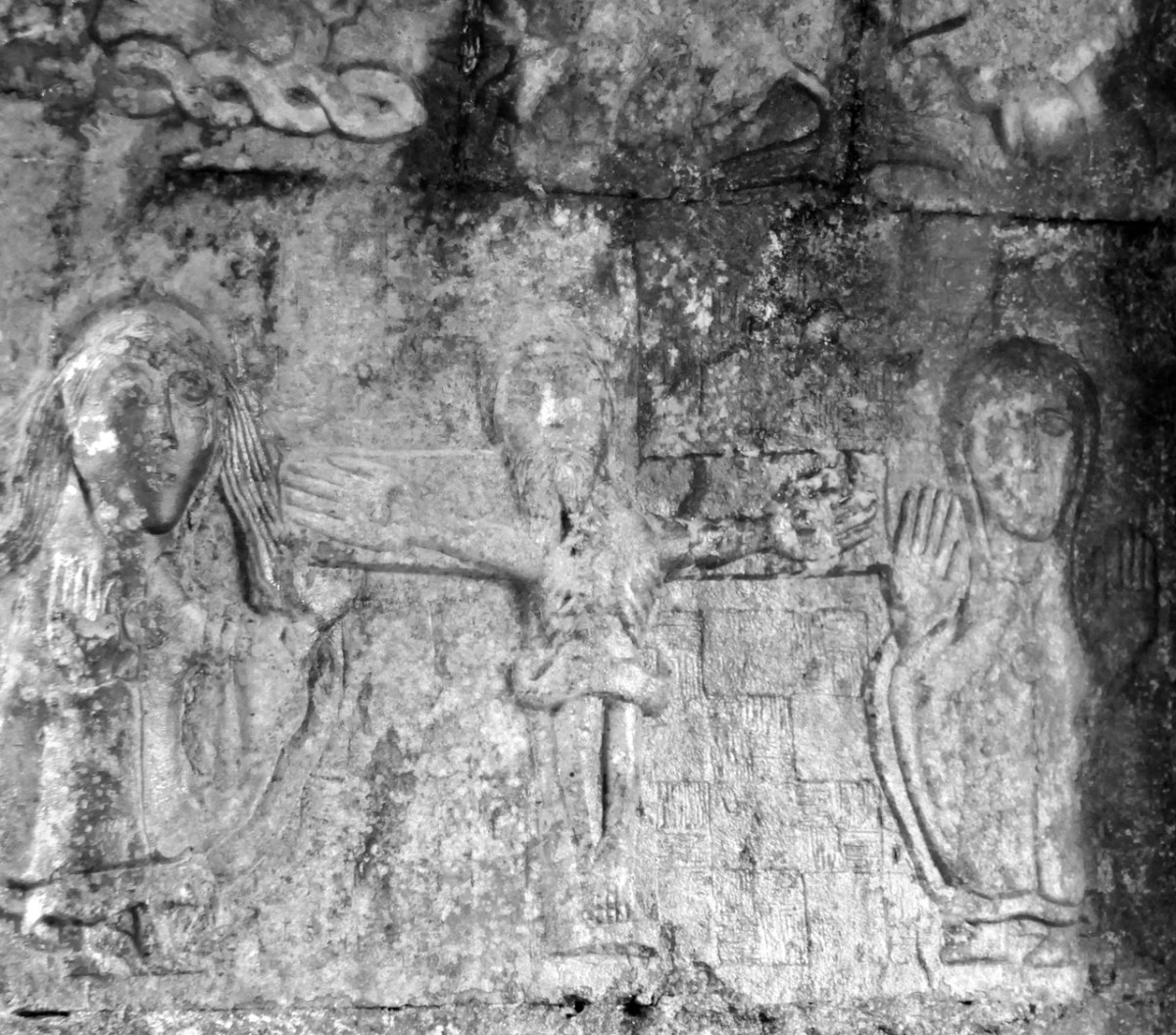
The crucifixion scene actually looks a little archaic – more like a Romanesque carving than a 16th century one. That may have been because local craftsmen were working in a persistent native tradition rather than following Continental Renaissance trends. Jesus on the cross is flanked by Mary and John. The carving is naive, the hands are disproportionately large and the feet are pointing sideways. There is a checkerboard pattern as background. I have provided a black and white image as well as the colour photo, in case that helps.
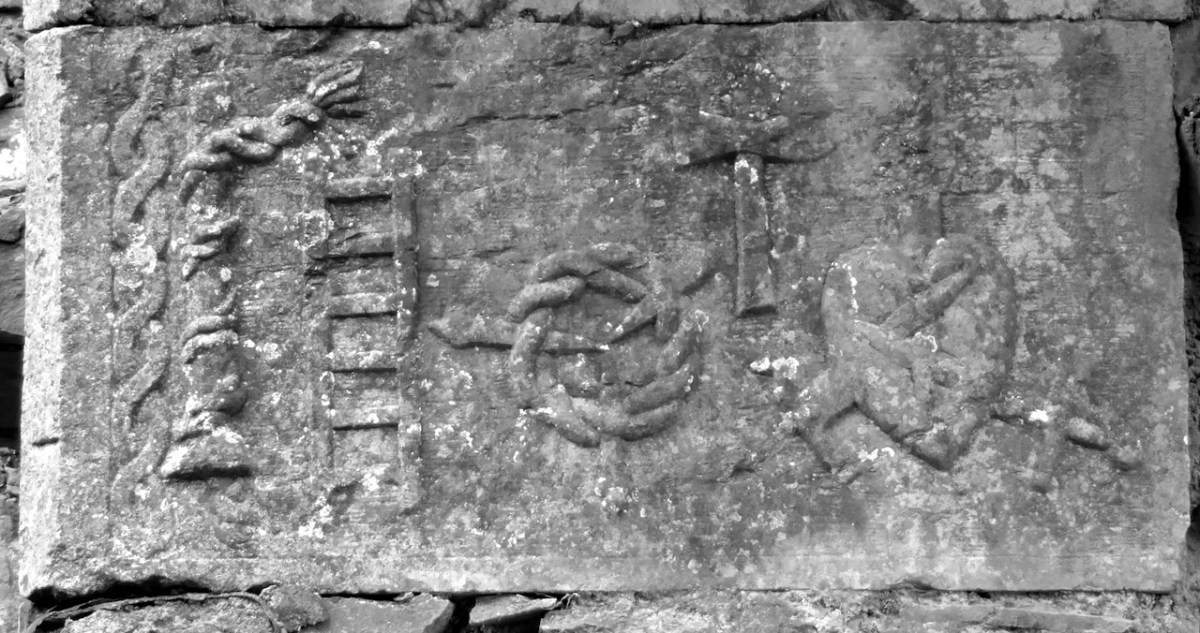
Equally intriguing is the Arma Christi, or Instrument of the Passion panel on the opposite (north) wall. This is a motif that is also familiar from much later 18th century headstones. It was a particular favourite of the Franciscans, and the Hurleys may well have had good relationships with the friaries in Bantry or Timoleague, and a Franciscan confessor (pure speculation on my part). 
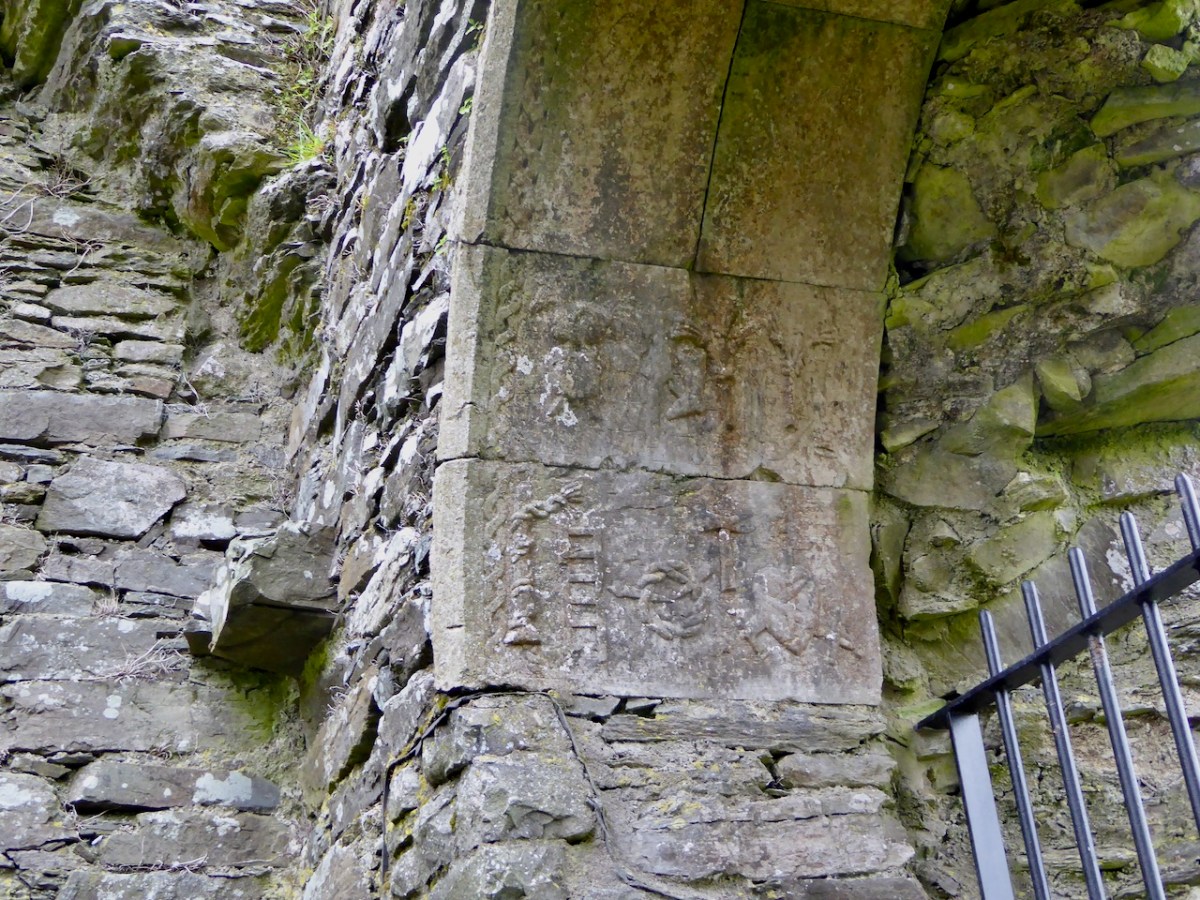
While I have seen assertions that the top panel features images of Mary and St Paul, I have pored over them and see only the familiar elements of the Instruments of the Passion. From left to right, on the bottom panel (below) I see the pillar and ropes used to bind Christ, the ladder, the crown of thorns, the hammer (with a hammer end and a pincer end), and a heart pierced by crossed swords.
On the upper panel (below) I see the cock and the pot, the spear, a nail behind the spear, the crucified Christ, and the flail. The thing that looks like a boot to the left of Christ has me stumped, as do hints of other elements. It looks like a checkerboard background is used, which would indicate it is of the same exact vintage and by the same hands as the crucifixion on the opposite window.
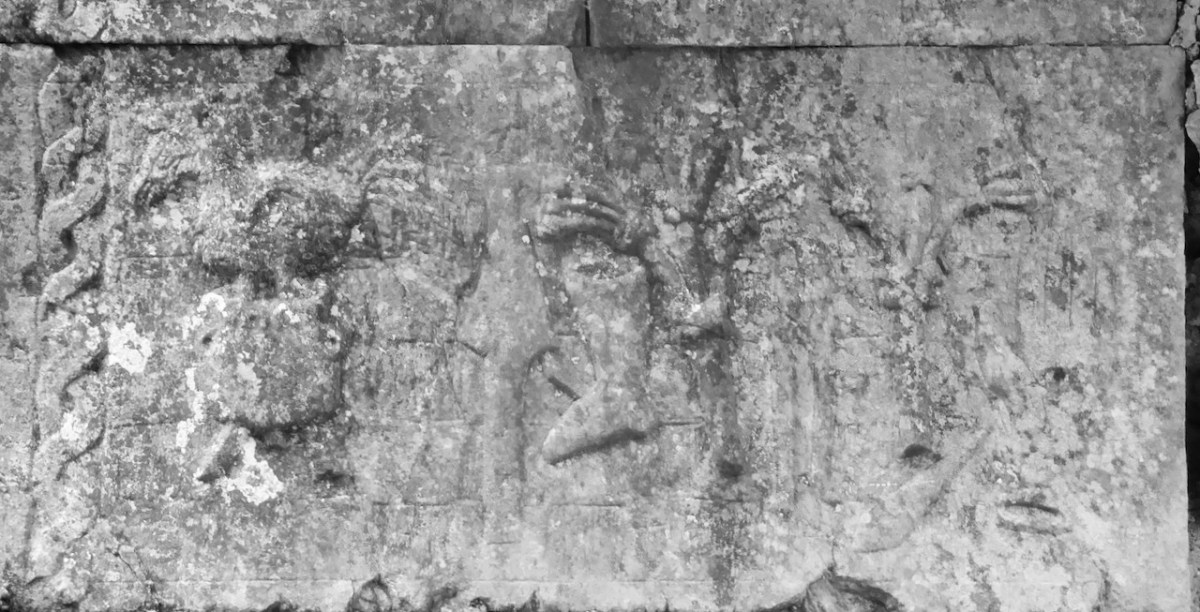
Please – dear readers, tell me what you see – I love to be educated and corrected in these matters. Apparently, this room was used as a chapel by local people. The author of the piece in the Dublin Penny Journal says Up to 1815, (when the chapel of Ballinacarrig was built,) divine service was performed for a series of years in the hall of the castle. There is a strong local tradition that that was, indeed, the case. By the way, the whole piece in the 1834 Dublin Penny Journal is highly improbable and equally entertaining. You can read it freely here.  
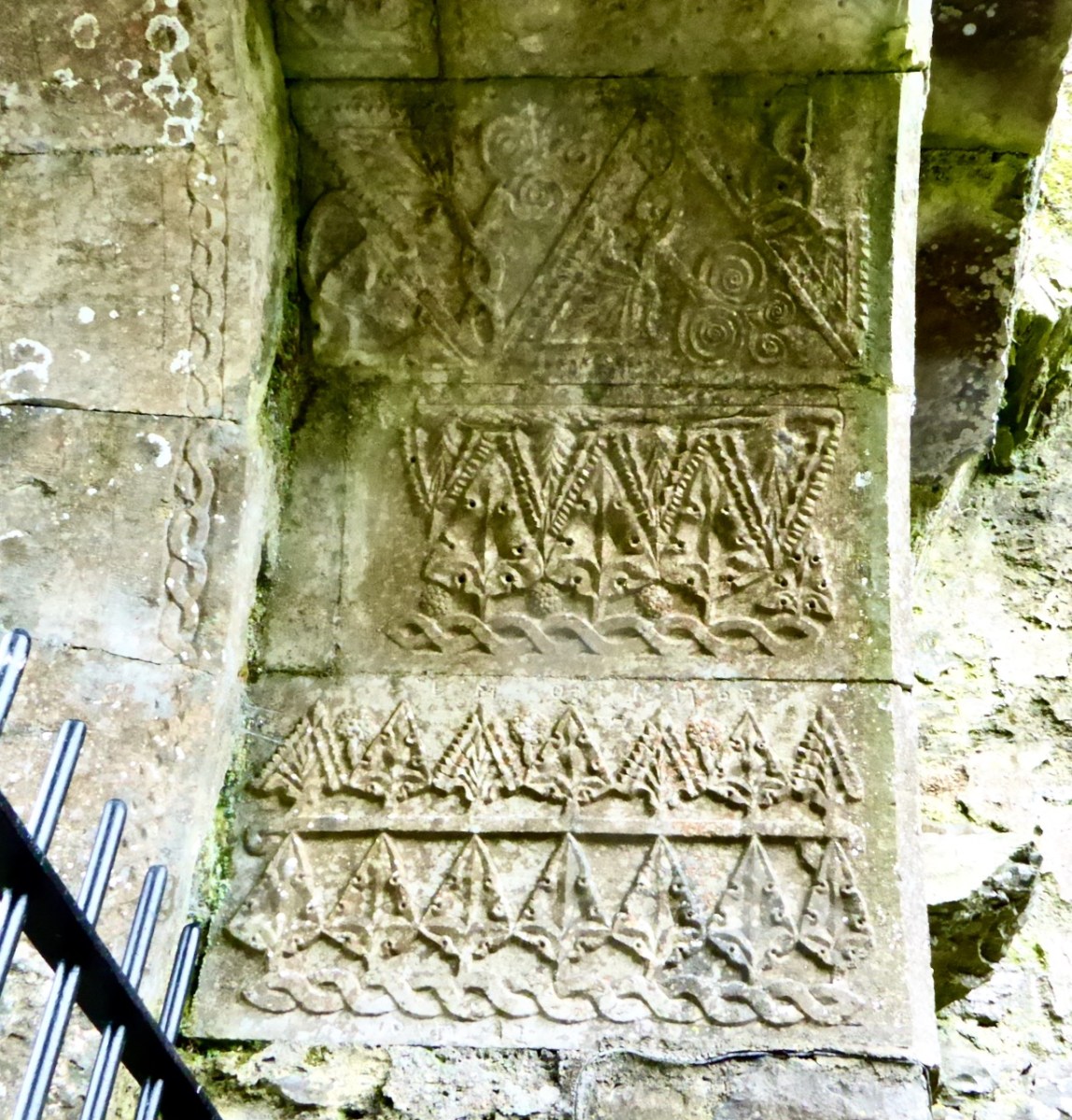
Ballinacarriga Castle is in many ways a typical West Cork 15th/16th Century tower house. What make it unique and a national treasure are the carvings, and the hints they give of a secret life away from the prying eyes of the conquerer.

* Available here: https://catalogue.nli.ie/Collection/vtls000245965
Back to Clonfert

Clonfert is only a couple of counties over from us: we just have to skip through a bit of Cork and Tipperary and there we are in Galway – a tiny corner of it that is shaped by the River Shannon. So, on a Thursday afternoon at the beginning of June, we found ourselves tripping along dead straight boreens – narrow for the most part – taking us through lush dairy lands – on a quest to revisit Clonfert’s medieval Cathedral, and its associations with one of Ireland’s most famous saints: Brendan the Navigator.

As we approached the little settlement of Clonfert, our empty road ahead was interrupted by a small white car, which seemed to travel erratically from one side of the lane to the other, and our arrival made little difference to its progress. As we got near, we realised that there was a wiry Jack Russell ambling along the road in front of the car: it was clear that the terrier was having its daily walk, with the owner driving along protectively behind it, regardless of where its fancy might take it. Ah, sure – we were in no hurry, so we joined the procession and waited as the dog sniffed and shuffled its way back home: eventually, dog, car and owner vanished through a gate, and we had the road to ourselves once again . . . This is life in Ireland, and it’s good!

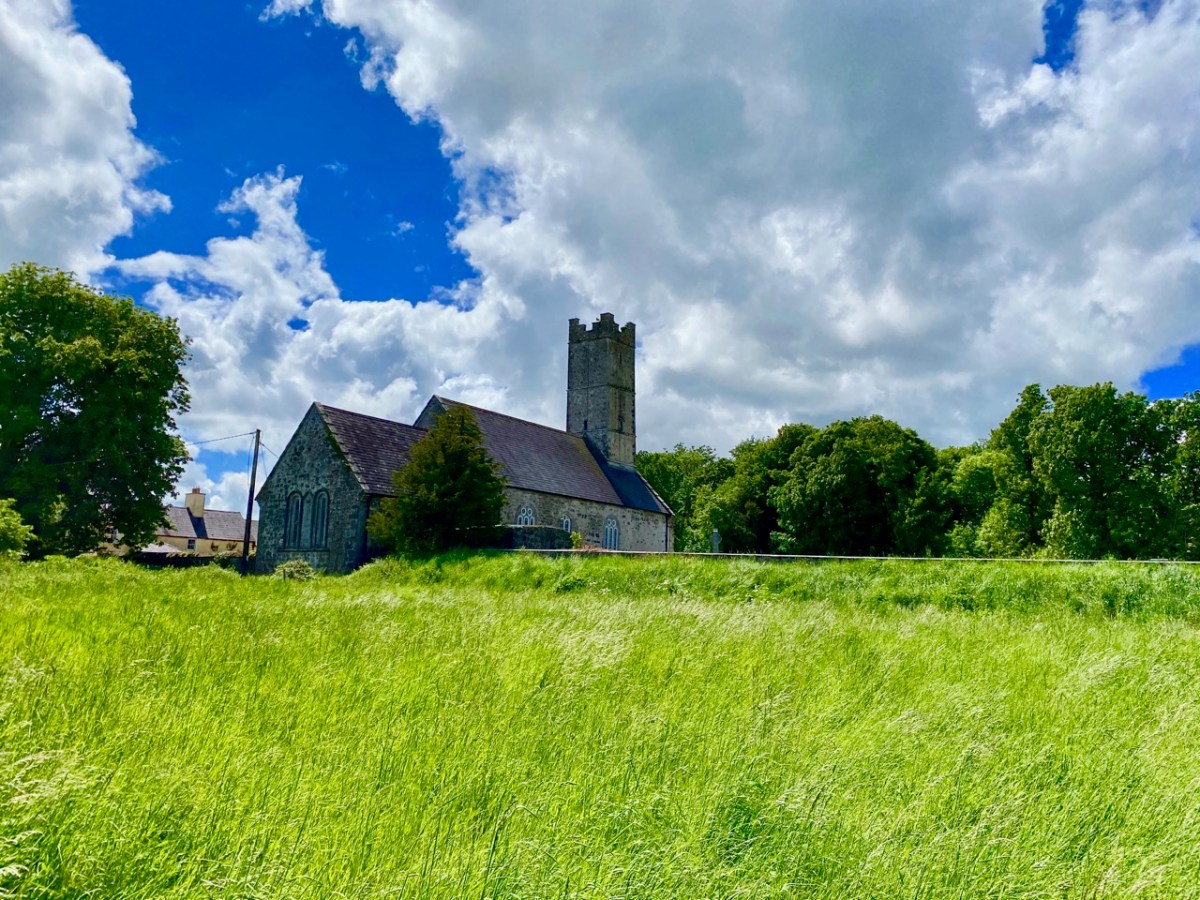
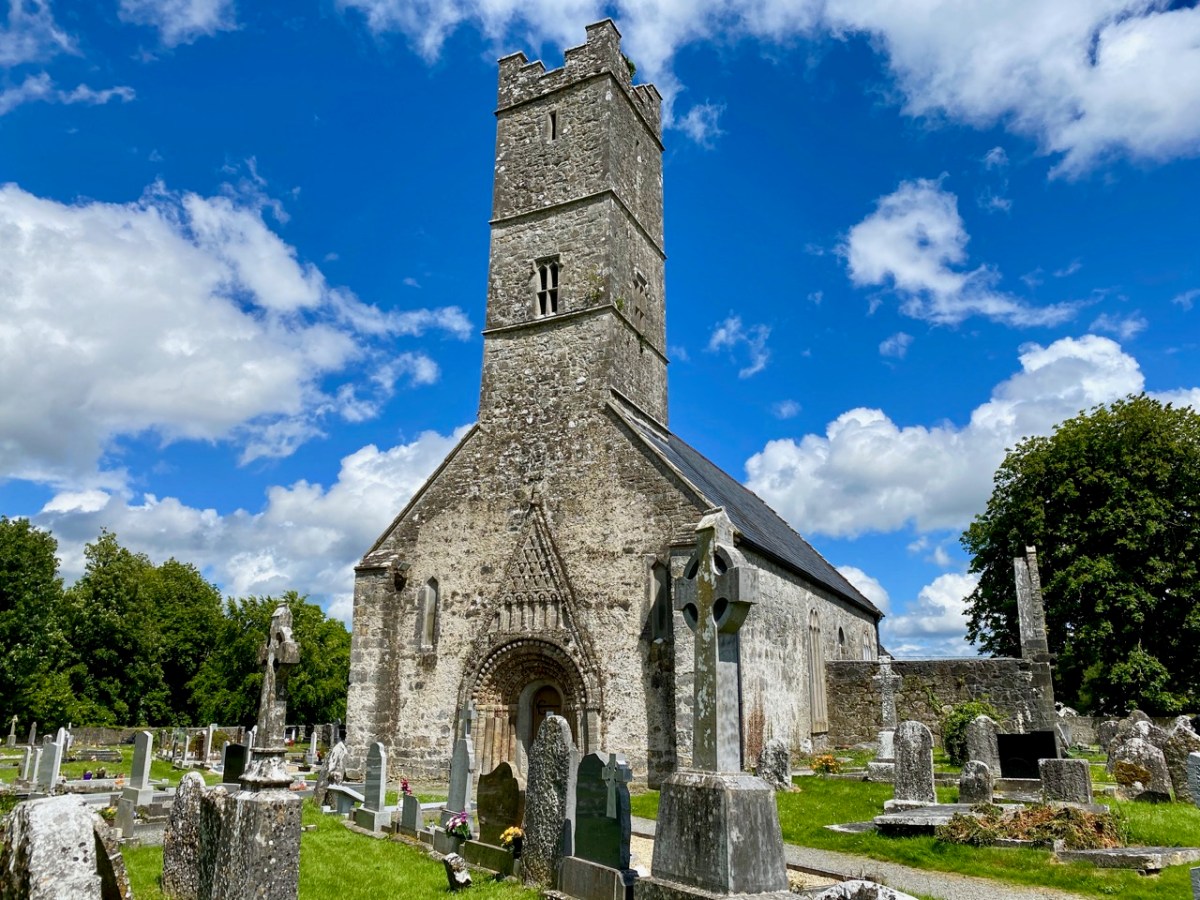
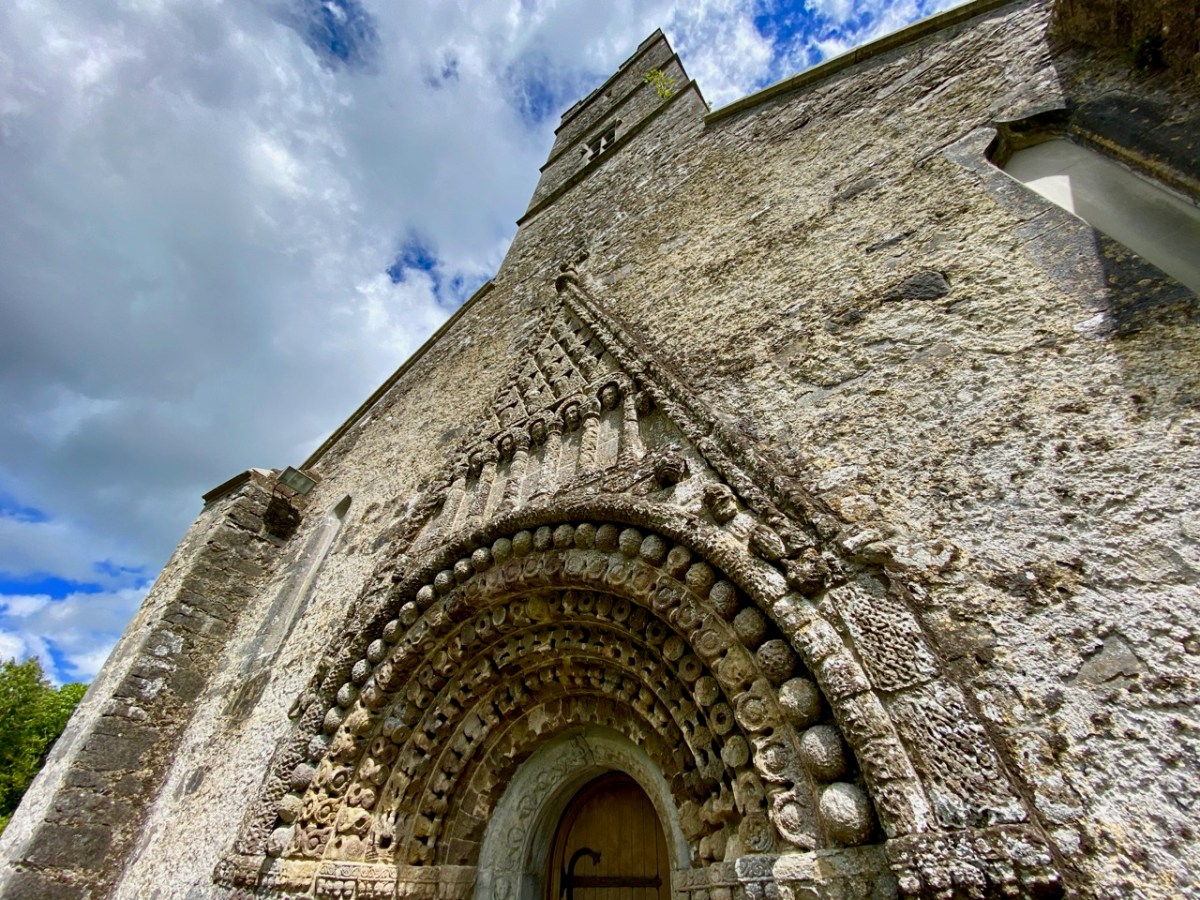
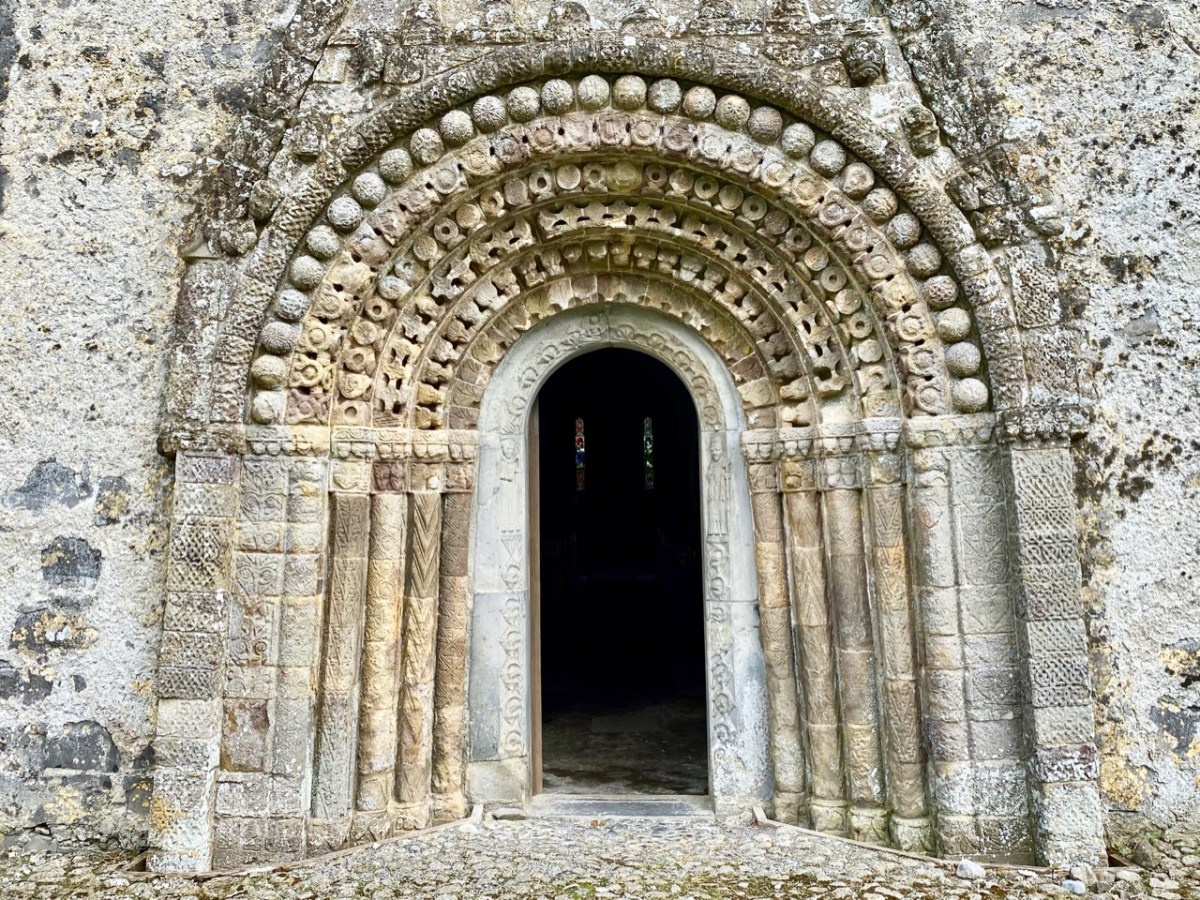
Clonfert’s grandly styled ‘Cathedral’ is so important historically, yet it could hardly be more remotely situated. From the east (upper picture above) it looks like many another Church of Ireland building, maybe not worth a second glance – unless, like us, you can’t resist examining every unturned stone because there is invariably something unexpected to be found under it. Just turn the corner and have a look at the west entrance door:

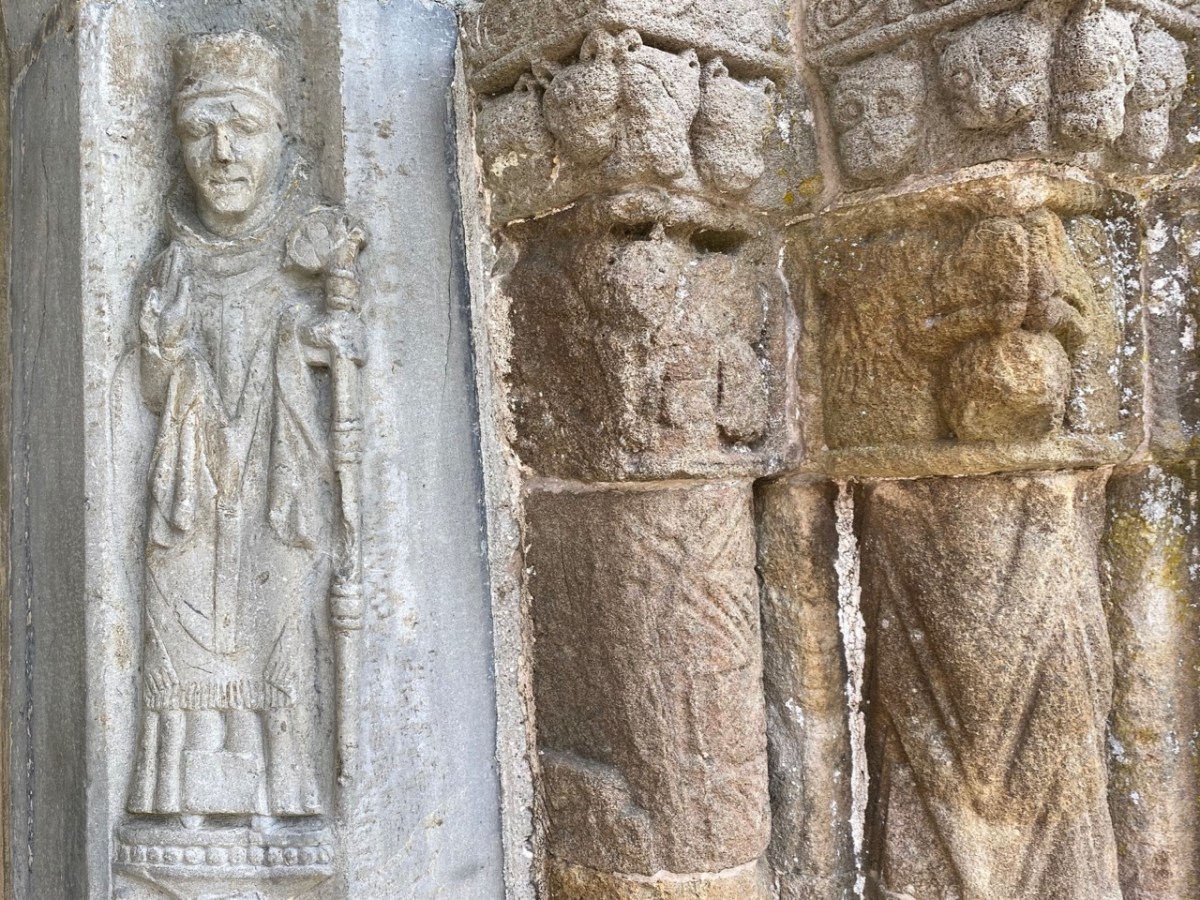
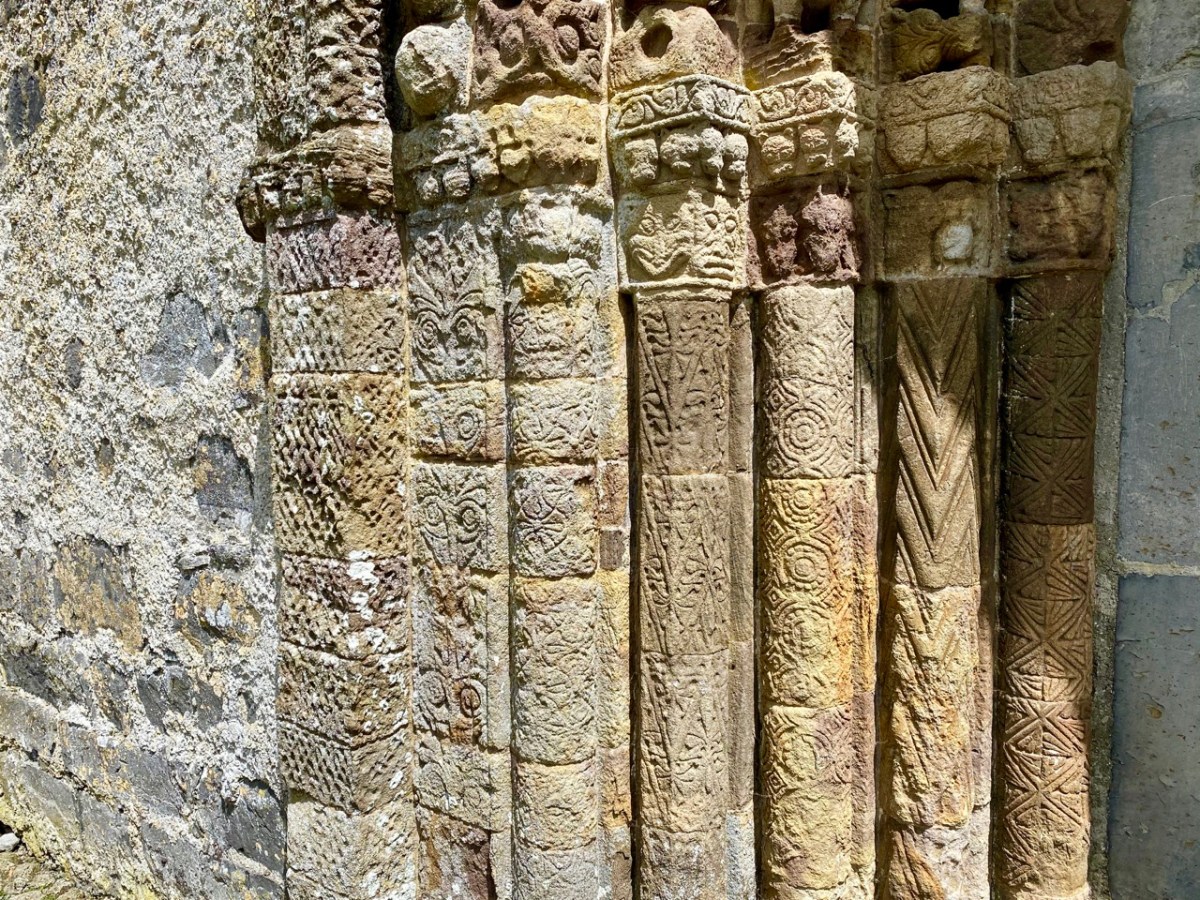
That doorway, with its exquisite decoration dating probably from the 12th century, has been described as ‘the supreme expression of Romanesque decoration in Ireland’. The carvings, although suffering from hundreds of years of wear and tear from the Irish elements, still display an extraordinary richness and variety: we can only wonder at the inspiration, skill and knowledge of the carver, who must have been deeply immersed in both lore and craft. Tadhg O’Keeffe, current Professor of Archaeology at University College Dublin, suggests a date of c1180 for this doorway. Records state that the church was burnt during a Viking raid in 1179, the same year in which a synod was held there by St Laurence O’Toole; installation of this imposing entrance may be connected with these events. Finola’s post today also explores Romanesque carvings not too far away, at Clonmacnoise. She has also written on Clonfert’s architecture in her Irish Romanesque series.

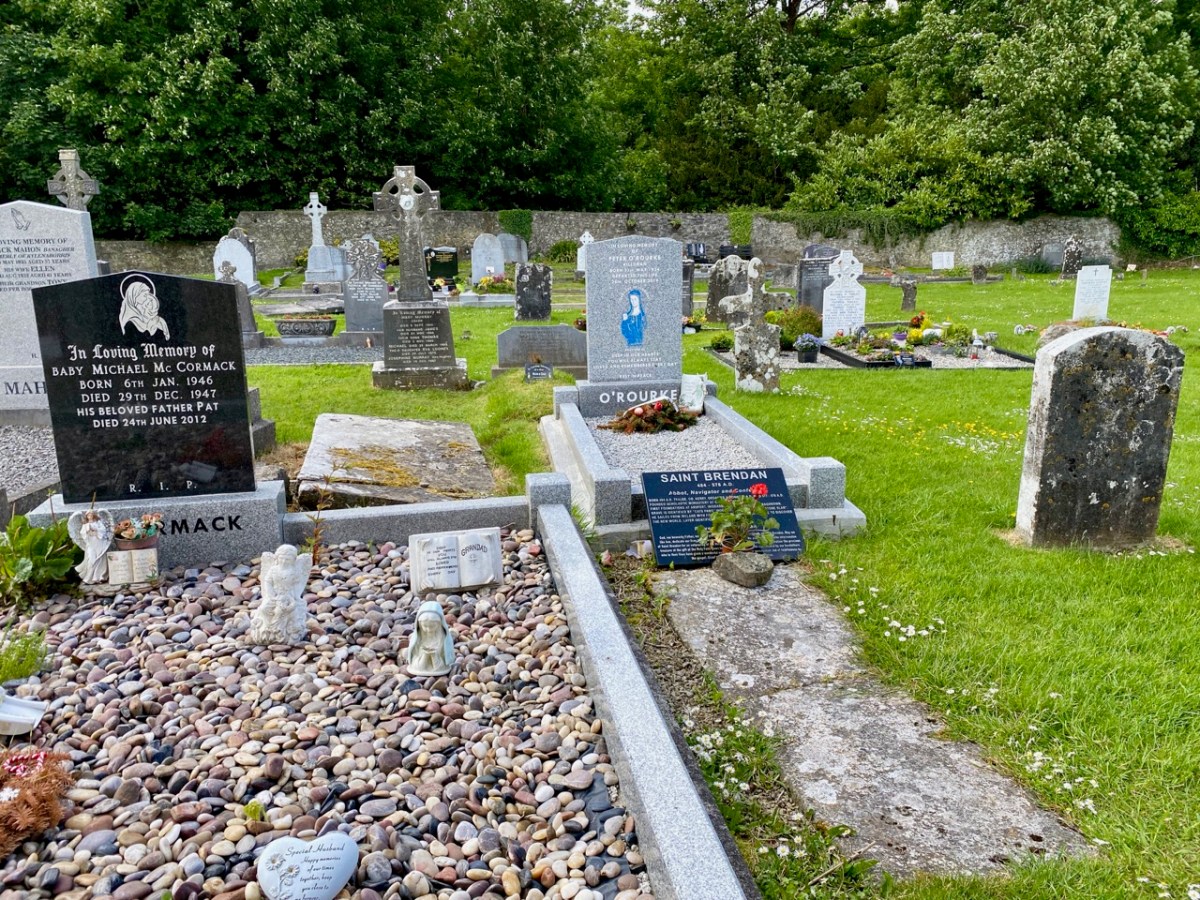
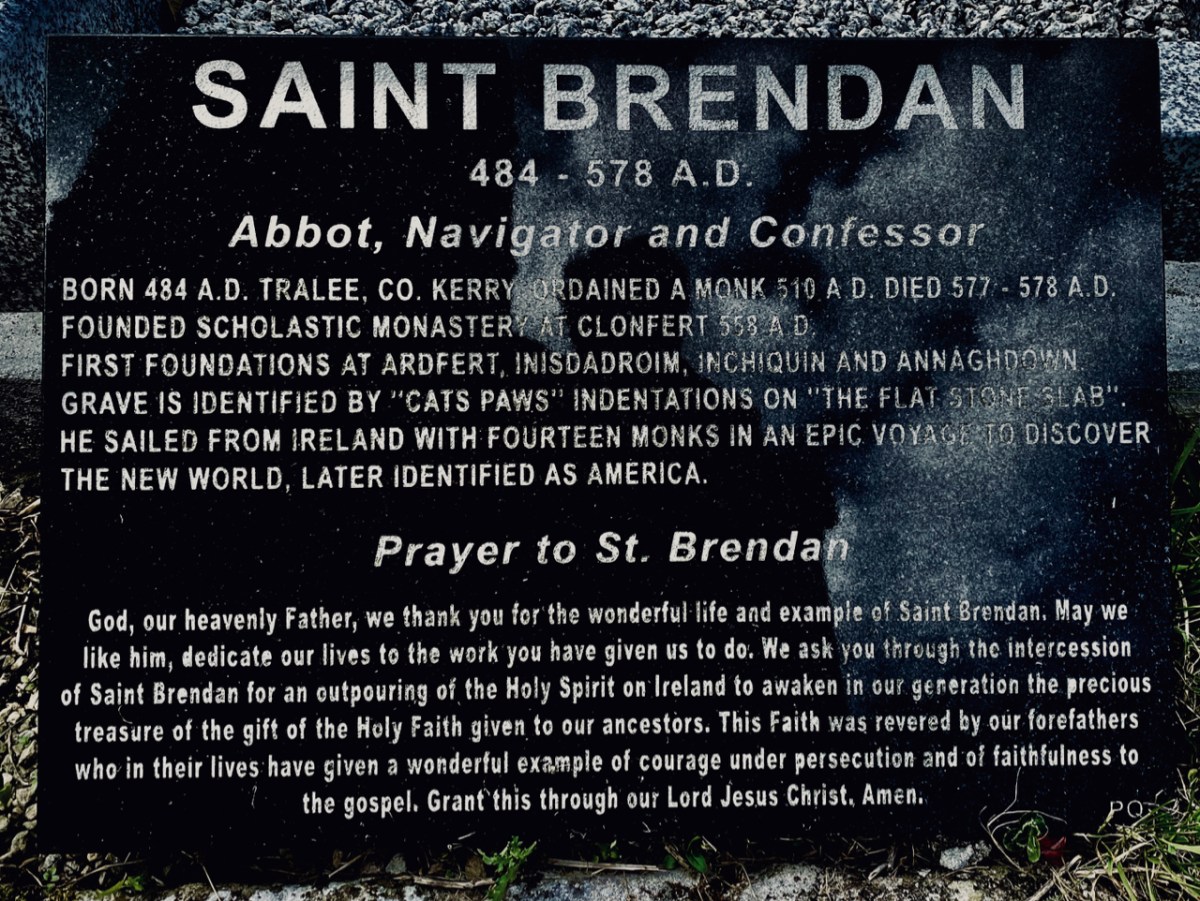
St Brendan lived from 484 to 577. We saw his birthplace in Fenit, Co Kerry, a few years ago. He founded many monasteries in Ireland but arranged for his body to be taken secretly to Clonfert Cathedral for burial as he didn’t want his remains to be disinterred by relic hunters. His grave is a stone slab just outside the great west door. On it are said to be the marks of cats’ paws – interestingly linked, according to folklore, with the many carvings of cats’ heads on the doorway arches.

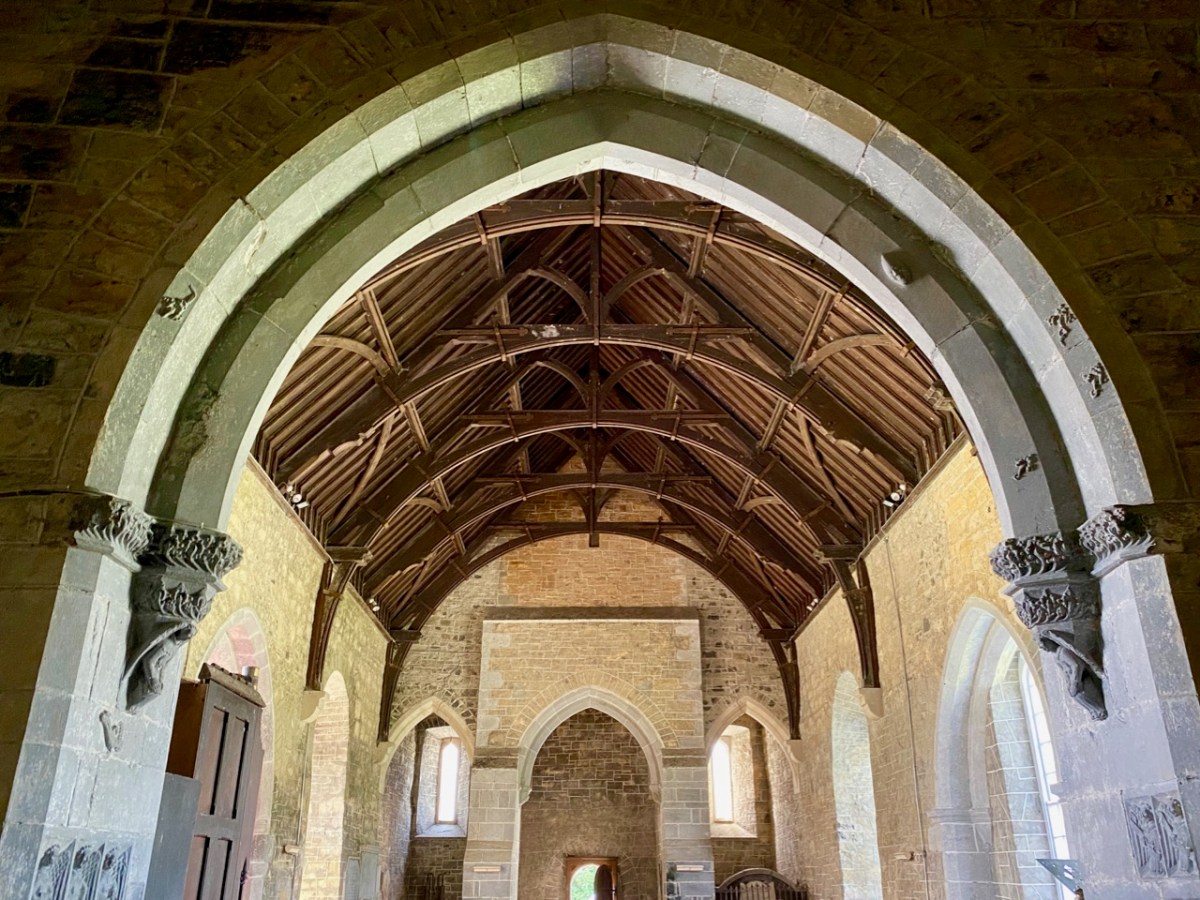
When we first visited Clonfert, many years ago, the cathedral itself was closed and we went away with the impression that we had seen all the wonders that the place had to offer by our explorations of the outside of the building and its setting. We were wrong: on this occasion the door was unlocked and there were unexpected treats hidden for us in the interior.

Further carvings decorate the church walls: they vary in date and style, but all are fascinating. Here is a selection – notice the seemingly random arrangement of heads and animal features on the great 15th century chancel arch, above.

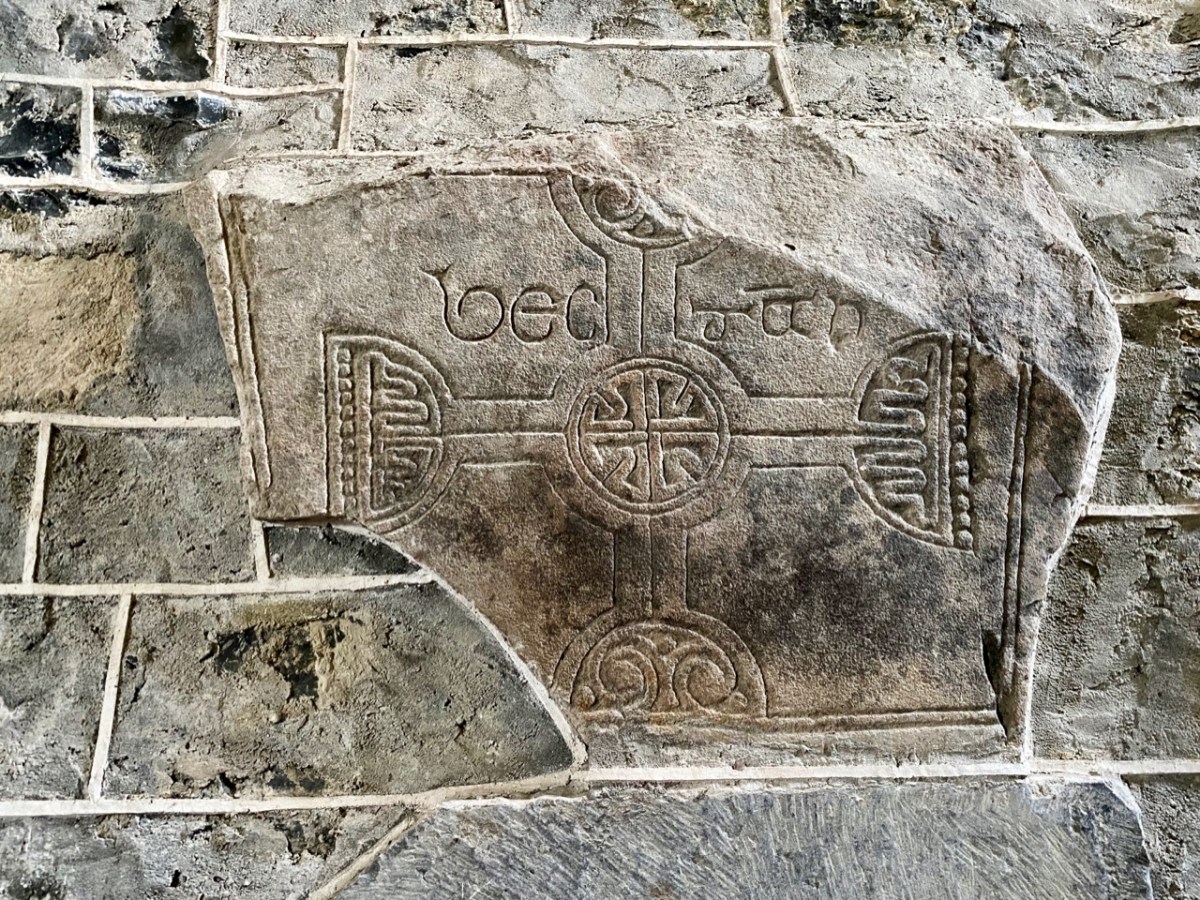
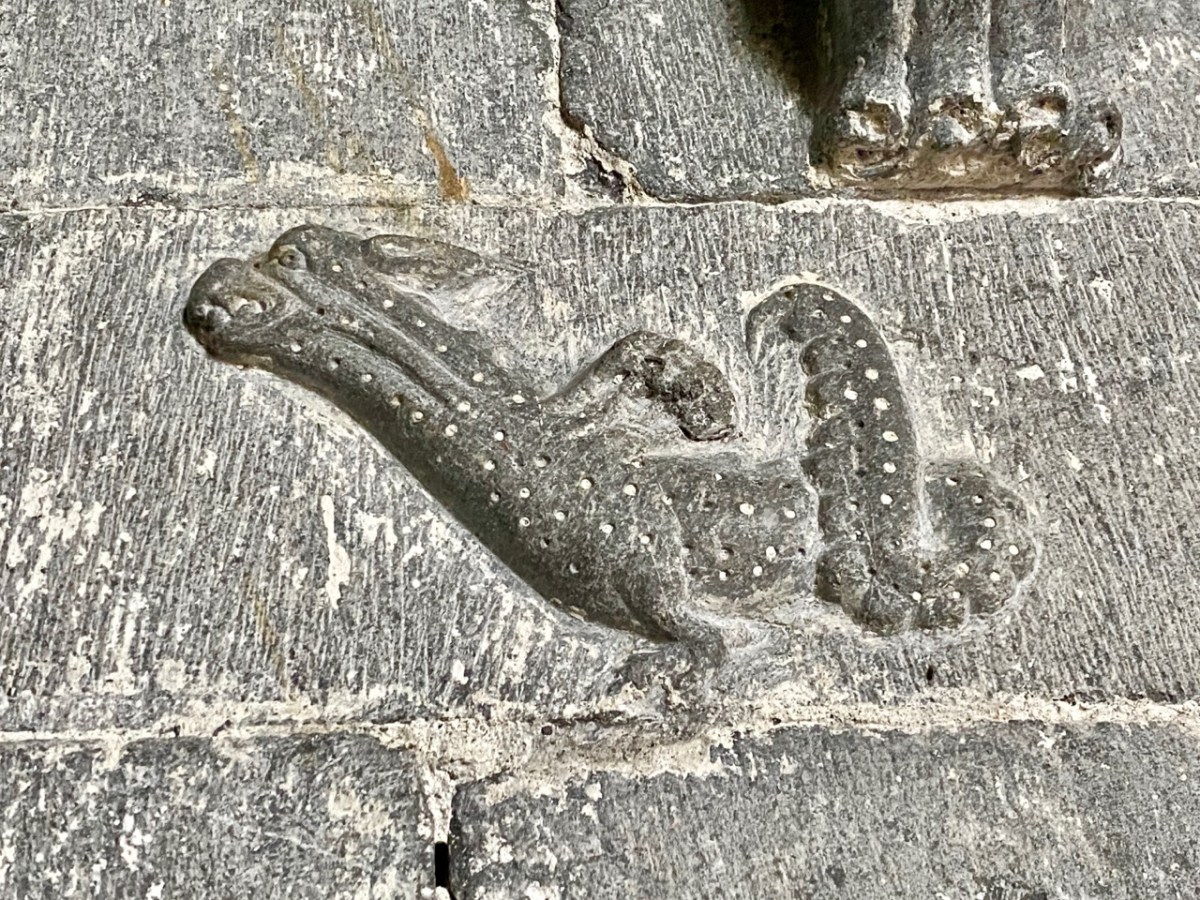
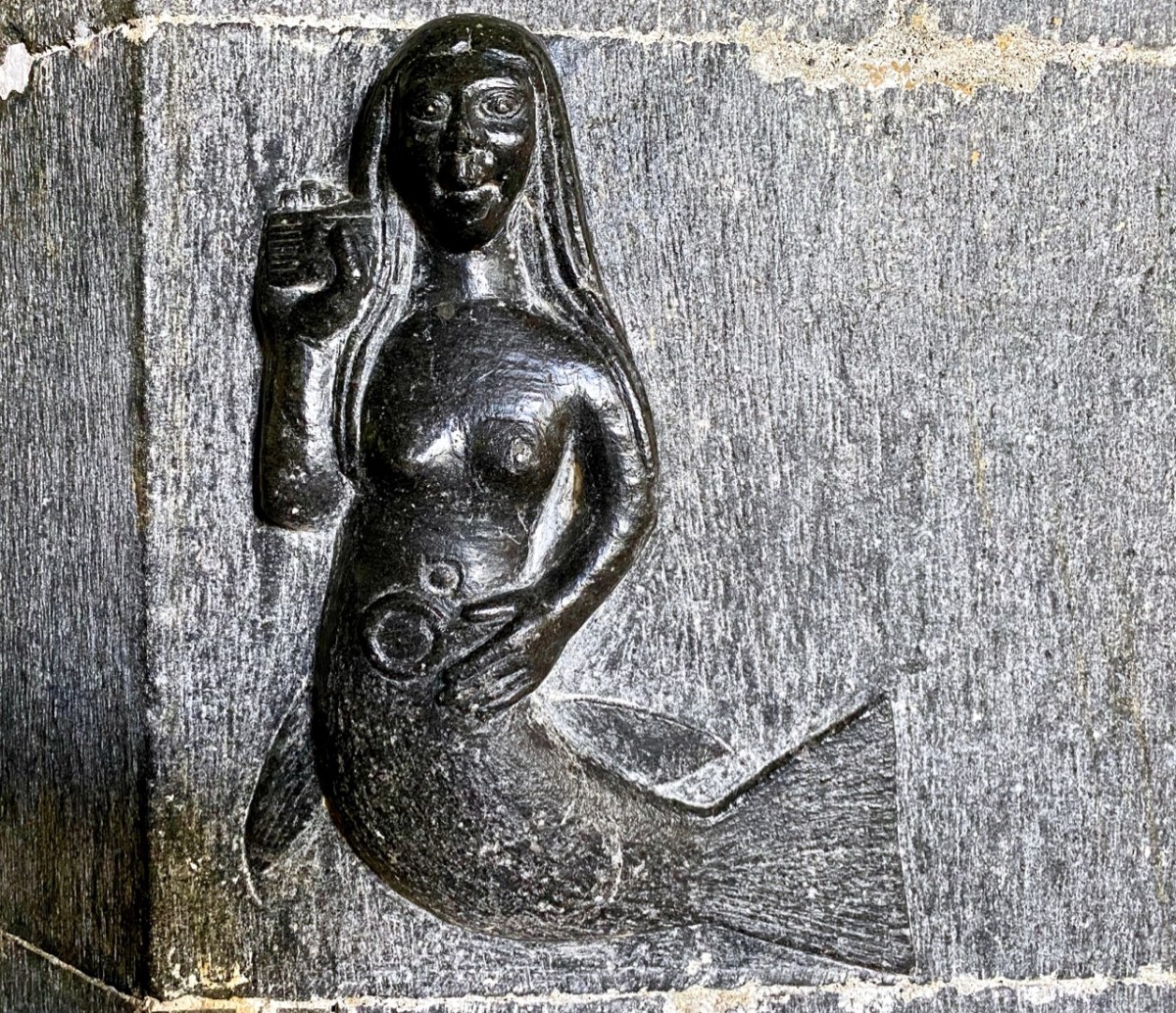
Angels, cross-slabs, a wyvern and, astonishingly, this fine mermaid complete with comb and mirror. I have found very little information to identify why these various carvings are found here in the Cathedral, apart from general legends which suggests links with Saint Brendan.

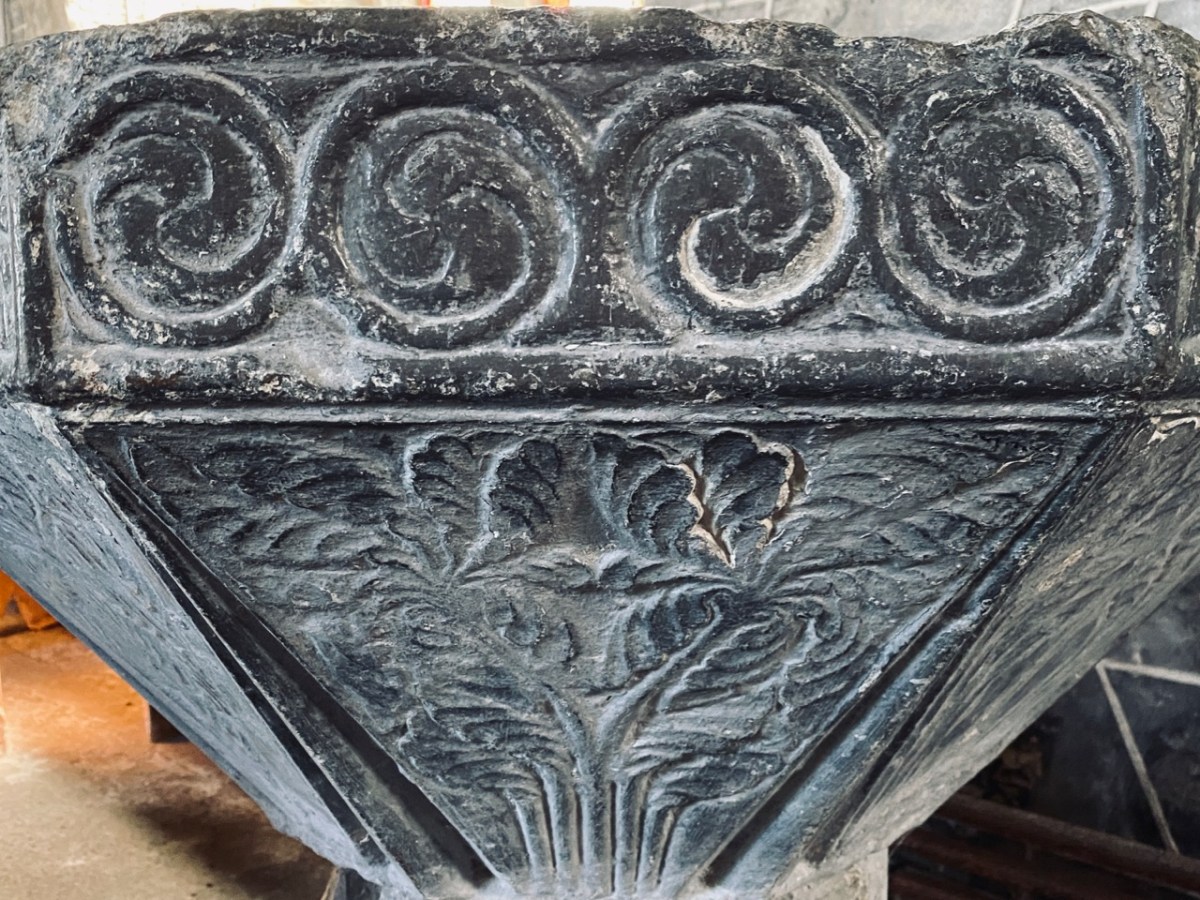
The carved stone head was found ‘in the ceiling’ when restoration work was carried out in 1985. It is said to date from around 1500, while the ancient and beautiful font is attributed to the thirteenth century. We could linger and feast on further treasures inside the church, but we need to look at the surroundings, which reveal yet more history.

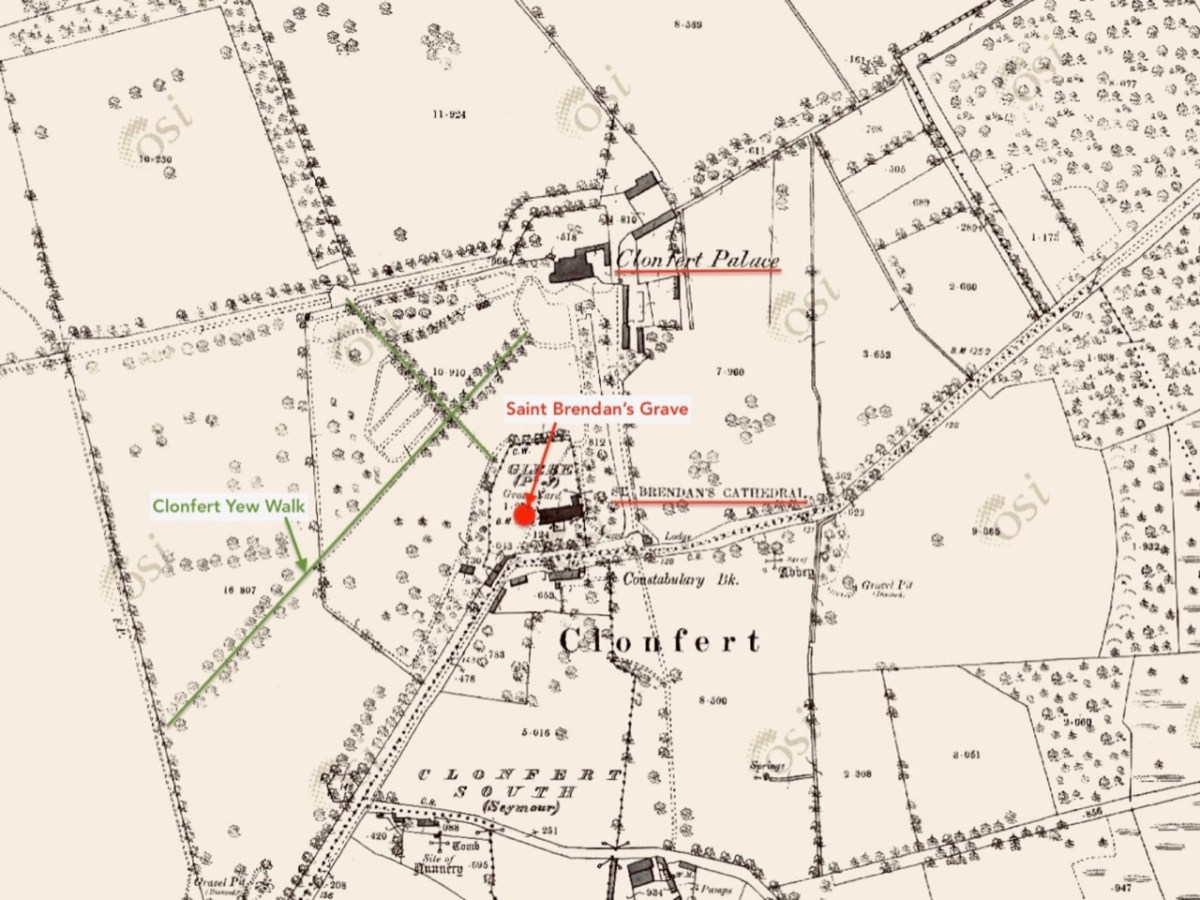
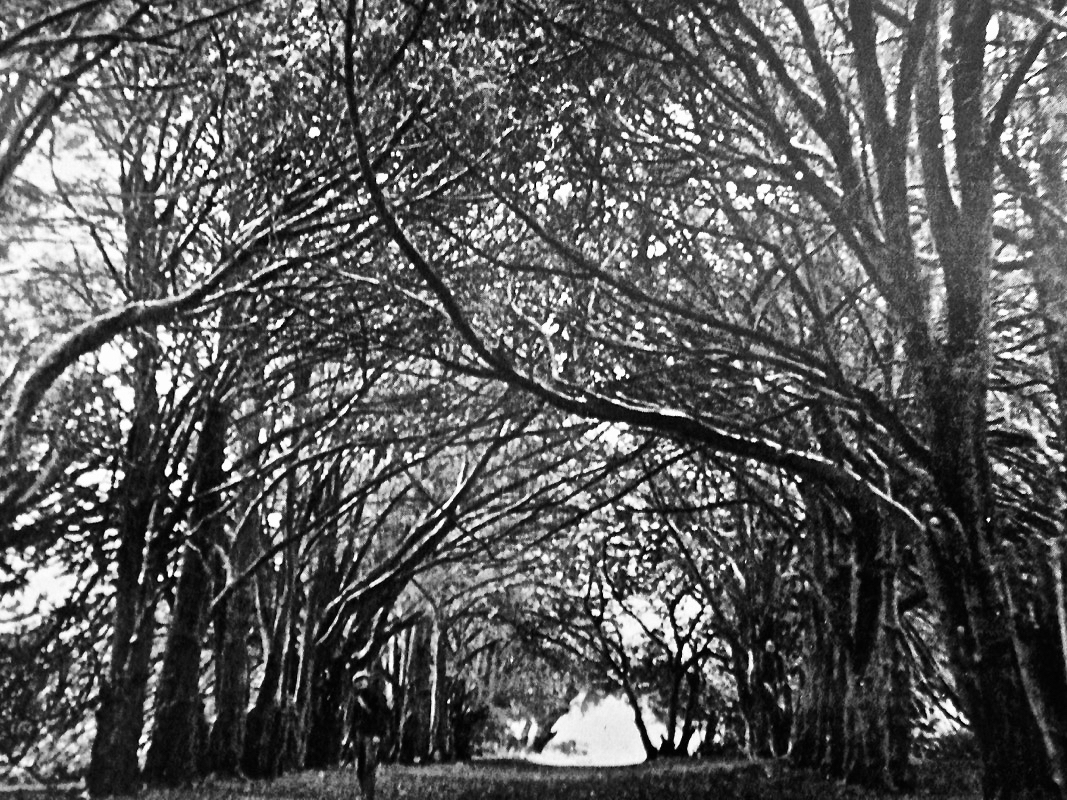
This extract from the 25″ OS map – late nineteenth century – shows the cathedral and some of the landscape features associated with it. We came here a few years ago, when we were researching Ireland’s waterways, following in the footsteps of English writer L T C Rolt. In his book ‘Green & Silver’ we read of his admiration for Saint Brendan, and his determination to find the grave at Clonfert, which he did in 1946. His book is illustrated with photographs taken by his wife Angela, and the one picture from Clonfert which is used in the book is this one of the ‘Yew Walk’ which was laid out as part of the gardens of the Bishop’s Palace, which you can see marked on the map.

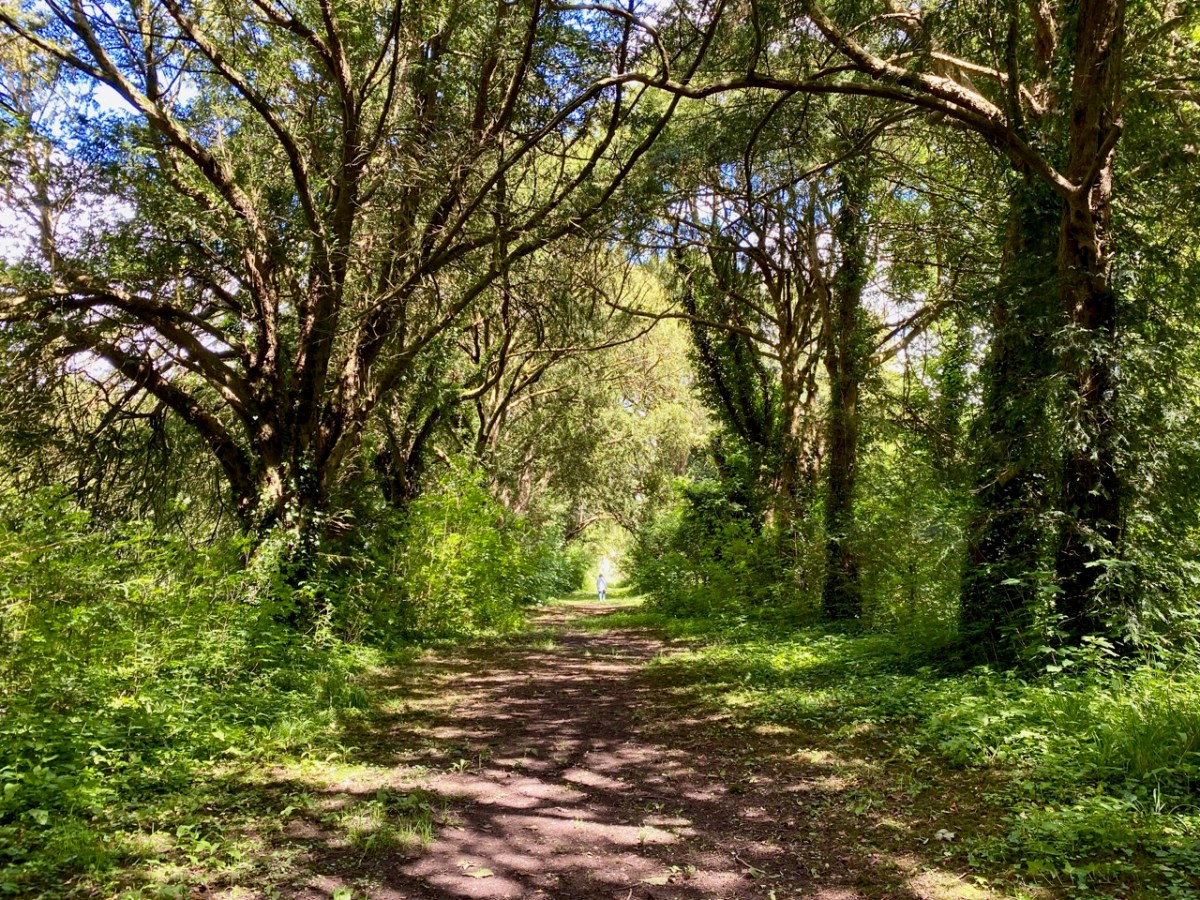
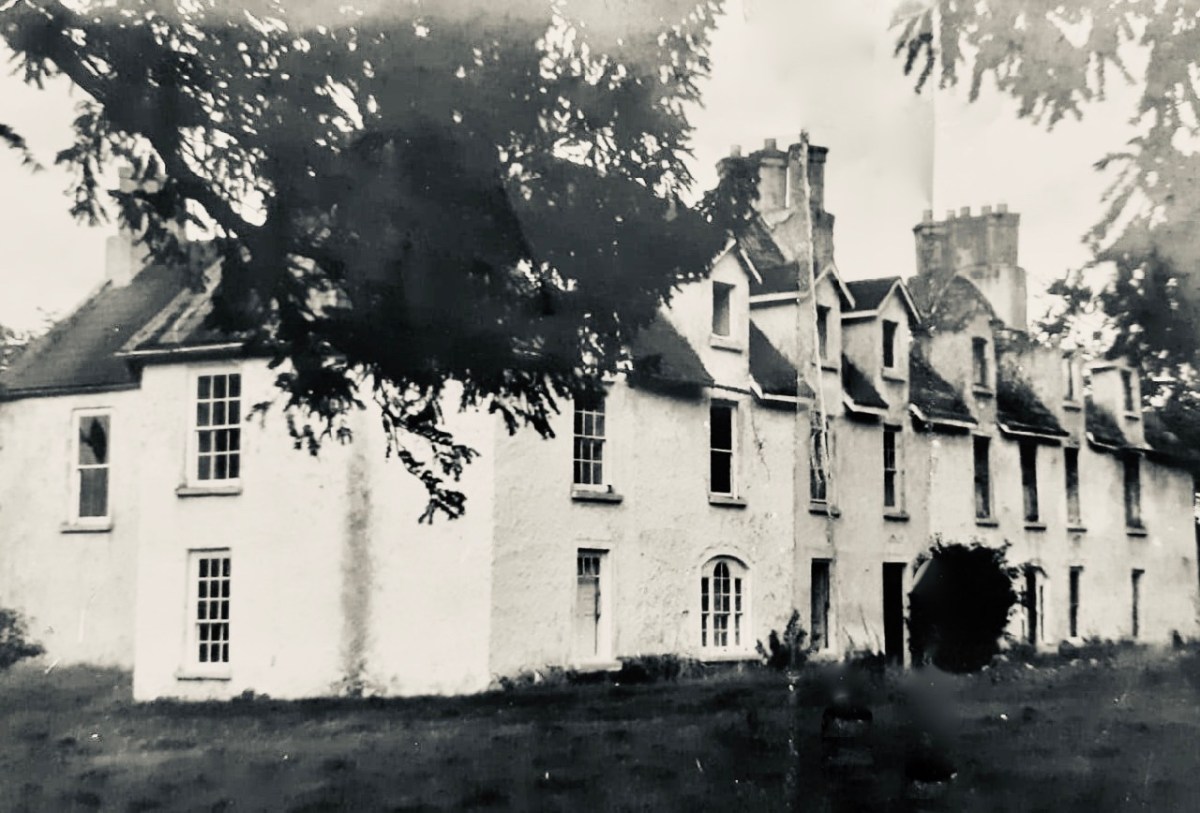
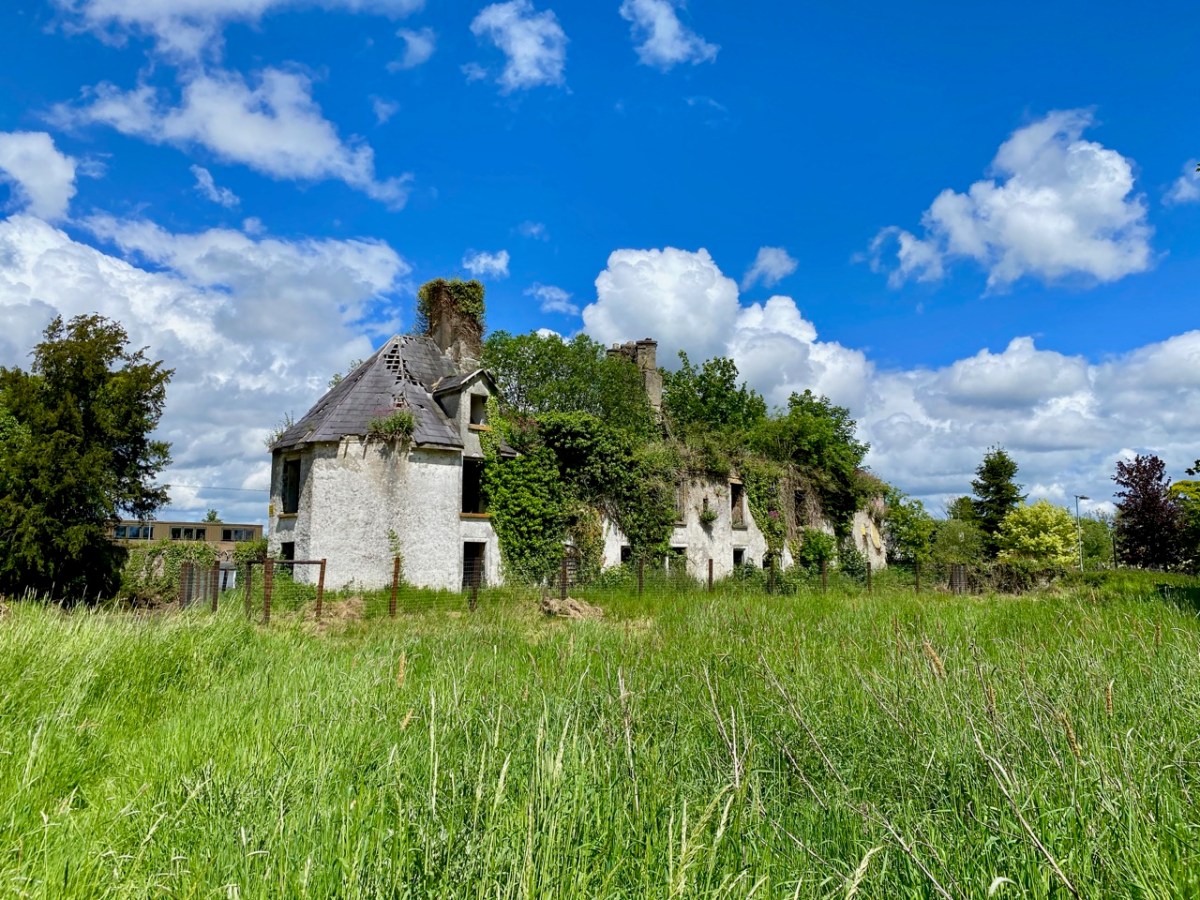
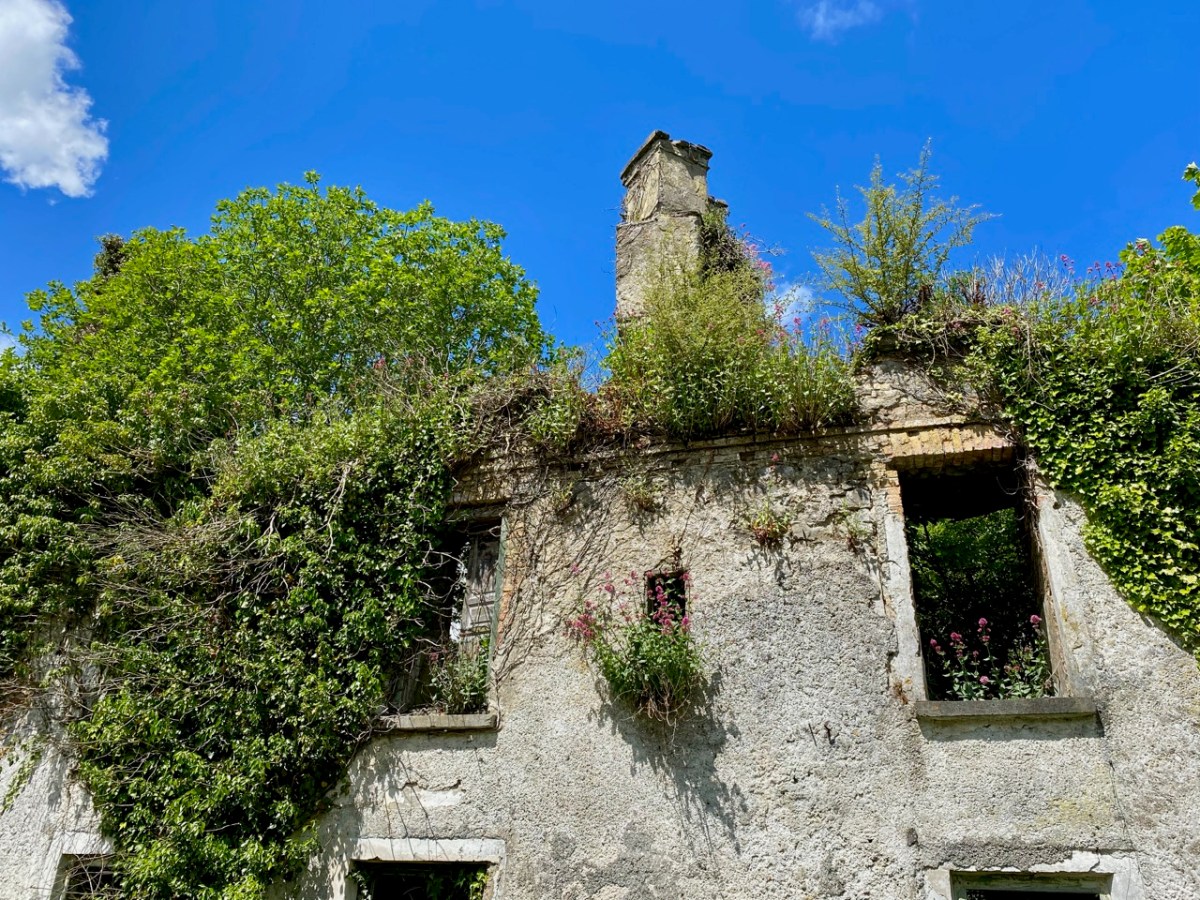
Our own photo of the Yew Walk at Clonfert was taken a few days ago. You can see that it survives, although neglected today. Some of the yew trees are said to be up to 500 years old. From the map you can also see that the Yew Walk connected the Cathedral to the 16th century ‘Clonfert Palace’, and was set out as an ornamental cruciform route, suggesting the path that might have been taken by the monks a thousand years ago. When we explored previously, we discovered the ruins of the Palace at the end of the Yew Walk, and wondered why it has been left in this state (since 1954, as we subsequently learned). The answer to that is fascinating, and I urge you to read my full account from that first visit, here. Below is a photo dating from c1950, showing the Palace at that time (with thanks to Dr Christy Cunniffe). My own photos from this week’s visit follow.

Clonfert might have been a very different place today if Queen Elizabeth had been listened to:

 . . . We are desirous that a college should be erected in the nature of a university in some convenient place in Irelande, for instruction and education of youth in learning. And we conceive the town of Clonfert within the province of Connaught to be aptlie seated both for helth and comodity of ryver Shenen running by it . . .

Queen Elizabeth, Letter to the Bishop Of Clonfert, 1579

The Queen’s advice was not taken up, and Trinity College Dublin was established instead – in 1592 – becoming Ireland’s first University.

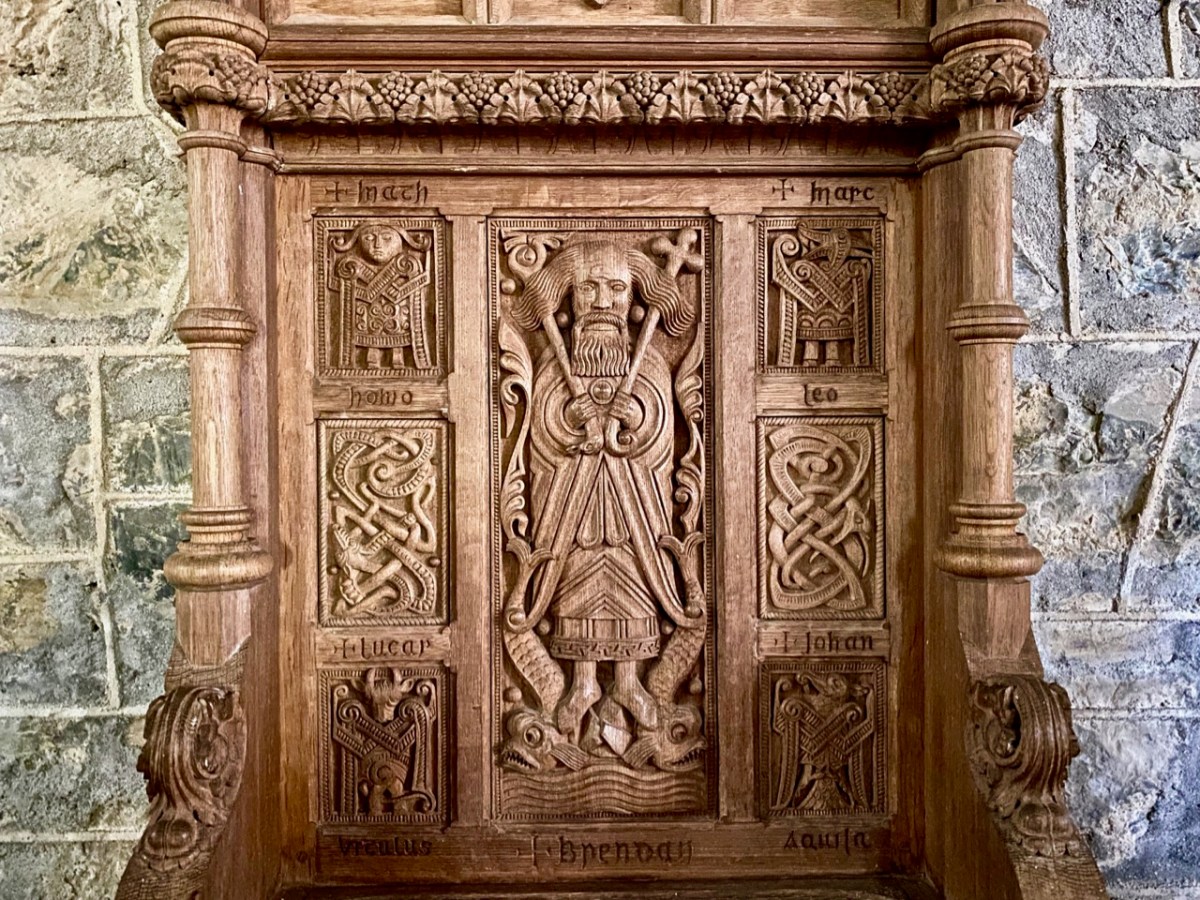
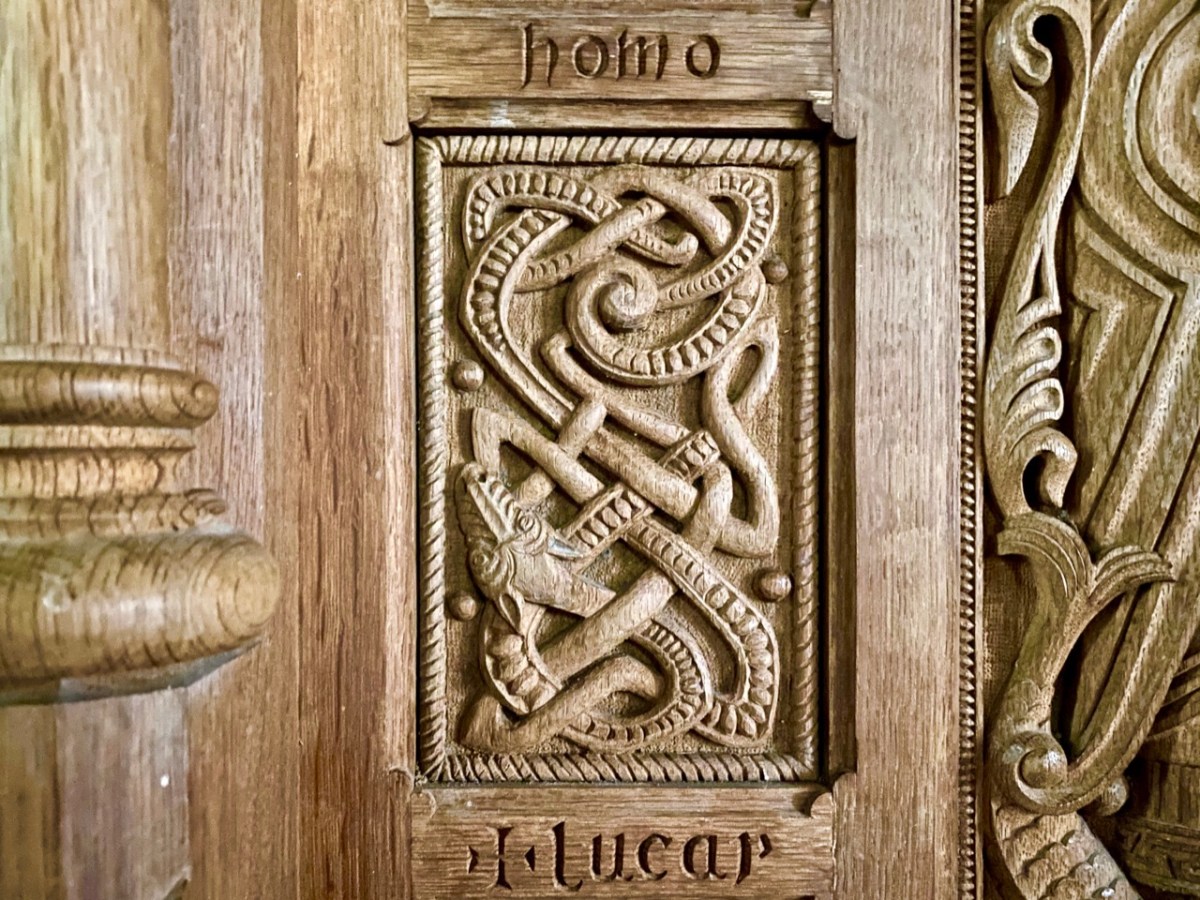
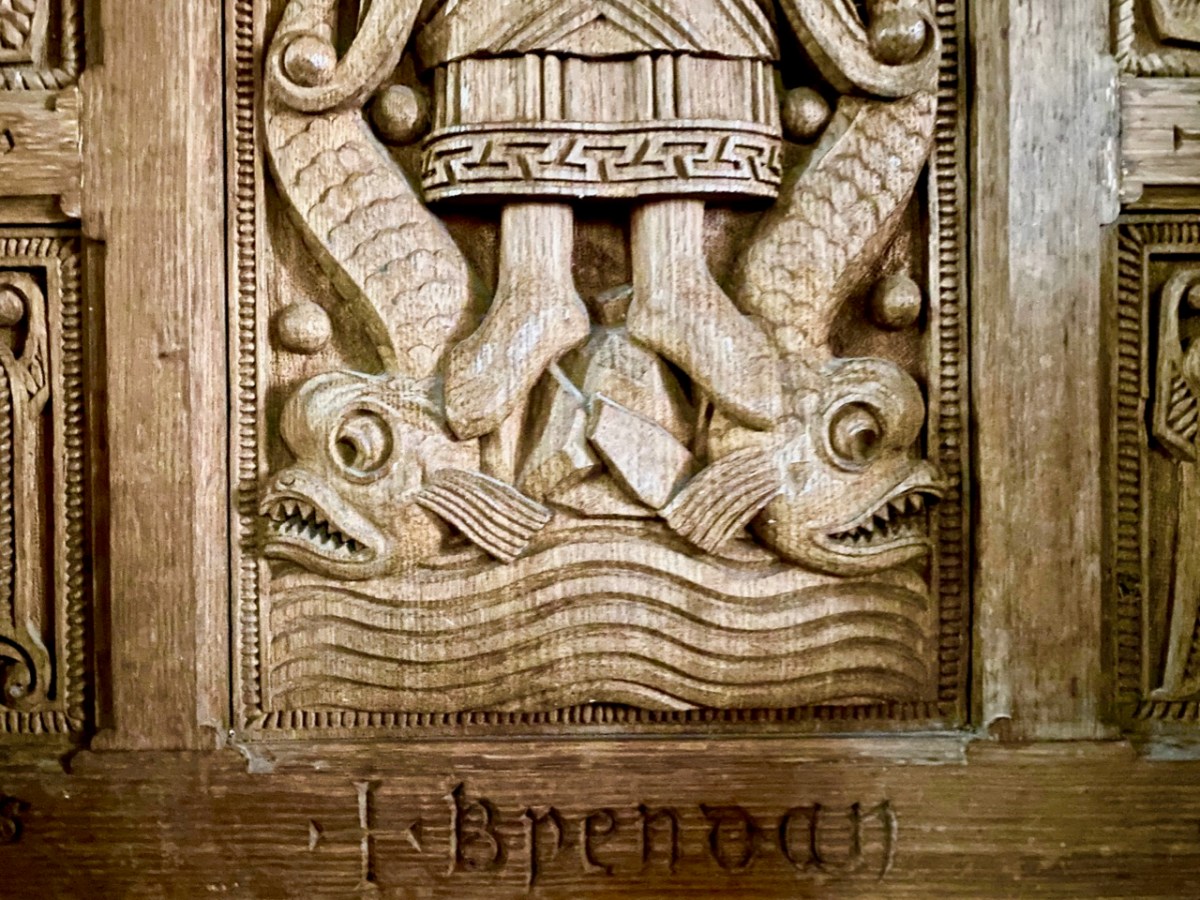
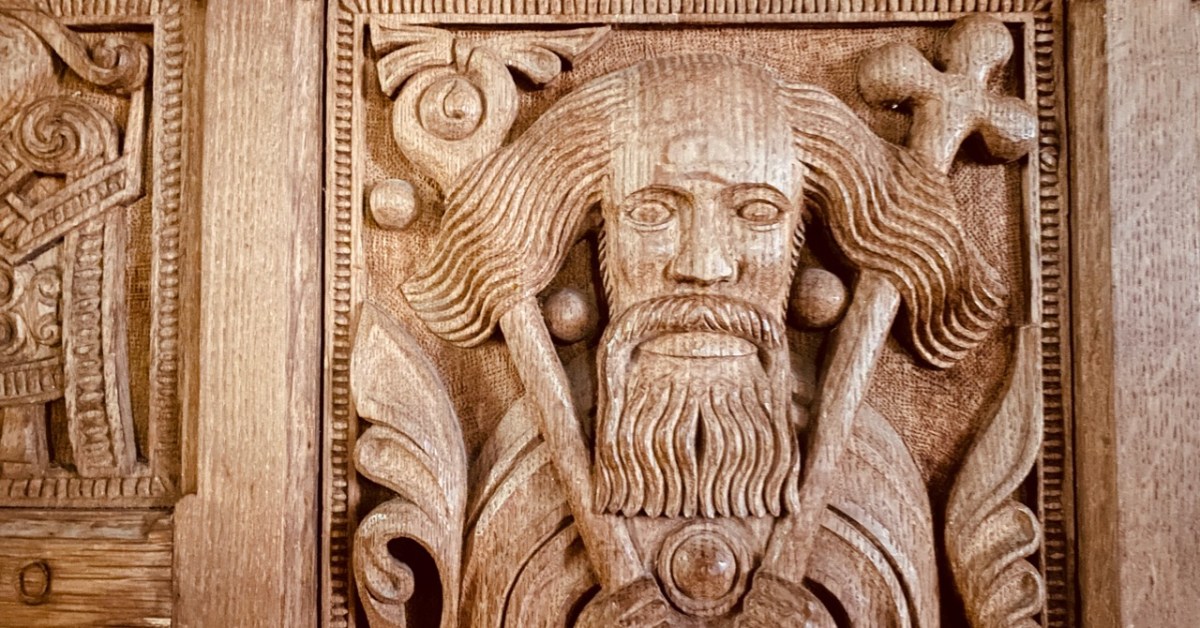
The site at Clonfert is so interesting – and covers so many periods in Ireland’s history – right up to the 20th century. It was well worth revisiting – and will merit further visits in the future, too. I’ll leave you with one aspect that probably impressed us most this time around. It’s the Bishop’s Throne which is hidden in the shadows of the Cathedral chancel. Carved from oak, most likely in the 19th century, it is a wonderful representation of Saint Brendan himself, surrounded by the Four Evangelists, crafted in the style of the Book of Kells. Look at him, also, on the header. Here is the Irish saint who set sail out on a voyage into the unknown – seeking Paradise – and discovered the World!

Off the M8 – A Secret in The Glen of Aherlow

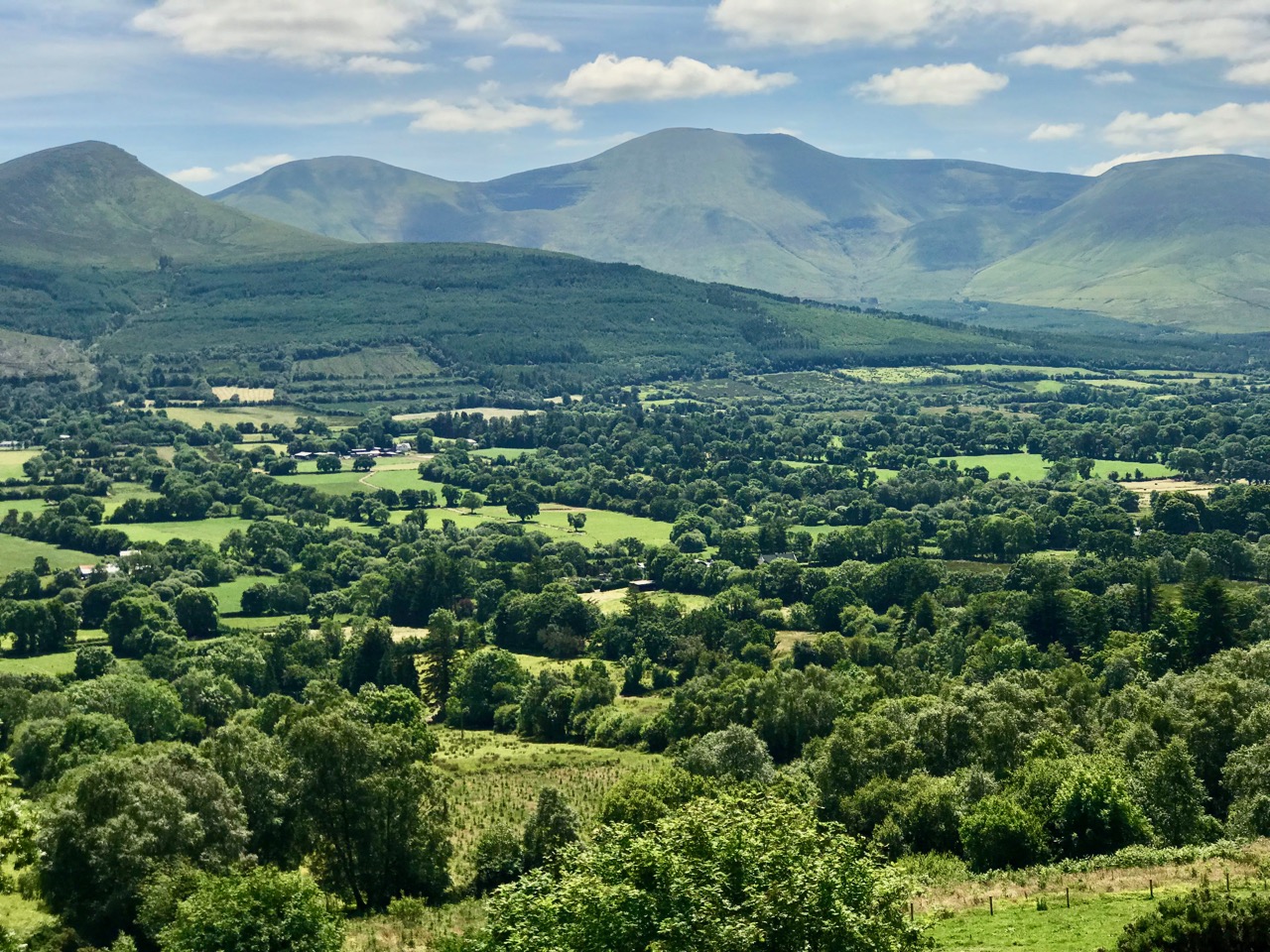
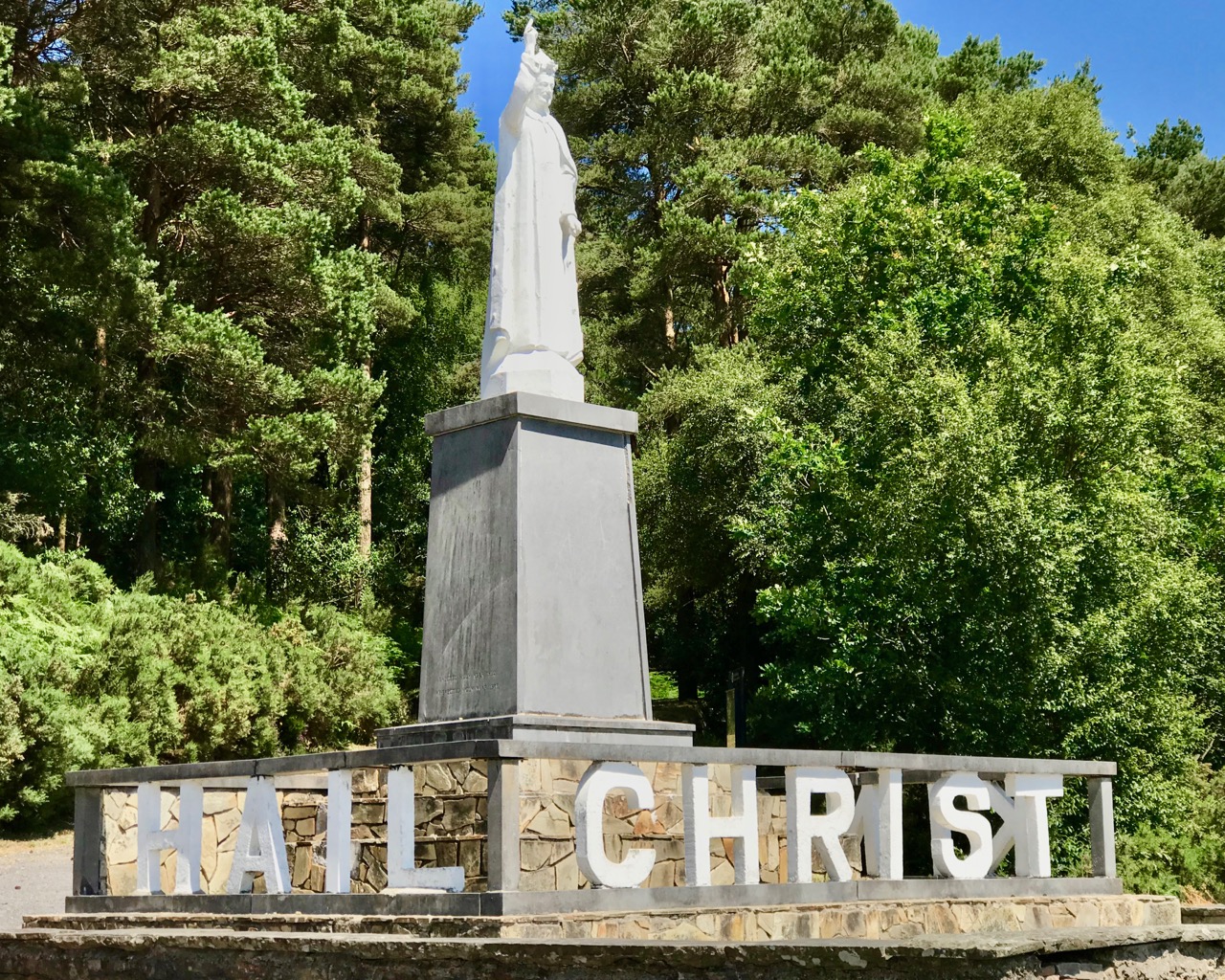
The Glen of Aherlow, County Tipperary: I had never heard of it. However, as you can see from the view, above, the place deserves to be explored: it’s about 20 minutes from junctions 10 and 11 near Cahir. That’s not too much of a diversion. From the spot where this photo was taken – on our travels this week – you can look out across to the Galtee Mountains, a prospect enjoyed for eternity by this imposing statue of Christ the King, whose hand is raised . . . in blessing the Glen, its people and all those who pass by . . . The statue was originally placed here by volunteers in the Holy year of 1950, and recreated in 1975. It has become the symbol of the Glen.

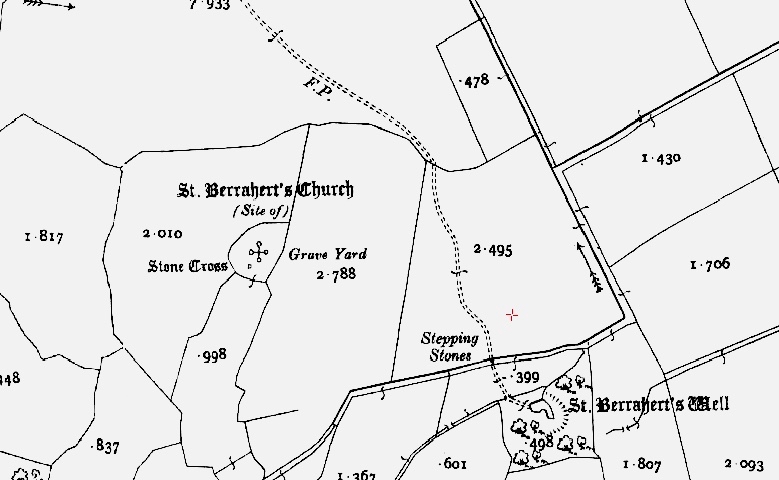
We were passing on our way to search out a secret which the Glen holds: somewhere in the townland of Ardane, we knew that there is a very ancient site where treasures have been hidden away for centuries. The first edition of the Ordnance Survey map has it marked:

I was intrigued, because a ‘Stone Cross’ indicated in this way often implies a High Cross, and a monastic settlement, so I was anxious to investigate. You will remember previous posts I have written on the many magnificent examples of these medieval treasures which Ireland holds. We had been alerted to this site by our friends Amanda and Peter, who have recently visited, and Amanda has given a comprehensive account of St Berrahert’s Well (also shown on the map) in Holy Wells of Cork. Like Amanda, I am unsure if there is a ‘correct’ spelling of St Berrahert: he is also known as Berrihert, Berehert, Bernihardt, Bericheart, and Bernard! Not a lot is known about him, other than that he came to the Glen after the Synod of Whitby in AD 664 and died on 6 December 839 – one of the saints who, like St Ciarán . . . the first Saint of Ireland . . . had a remarkably long life and who has left his name behind in the heart of Tipperary.

The place is generally known as St Berrahert’s Kyle (from the Irish word cill, ‘church’). It’s hard to find. We enlisted the help of Jimmy Martin, a local resident, who regaled us most entertainingly – and at great length – about hooded monks, crows and strange characters he had personally encountered at the site, and cures which he had witnessed at the well. Following his instructions we crossed fields, passed somnolent cows, and saw before us the remarkable ‘Kyle’.

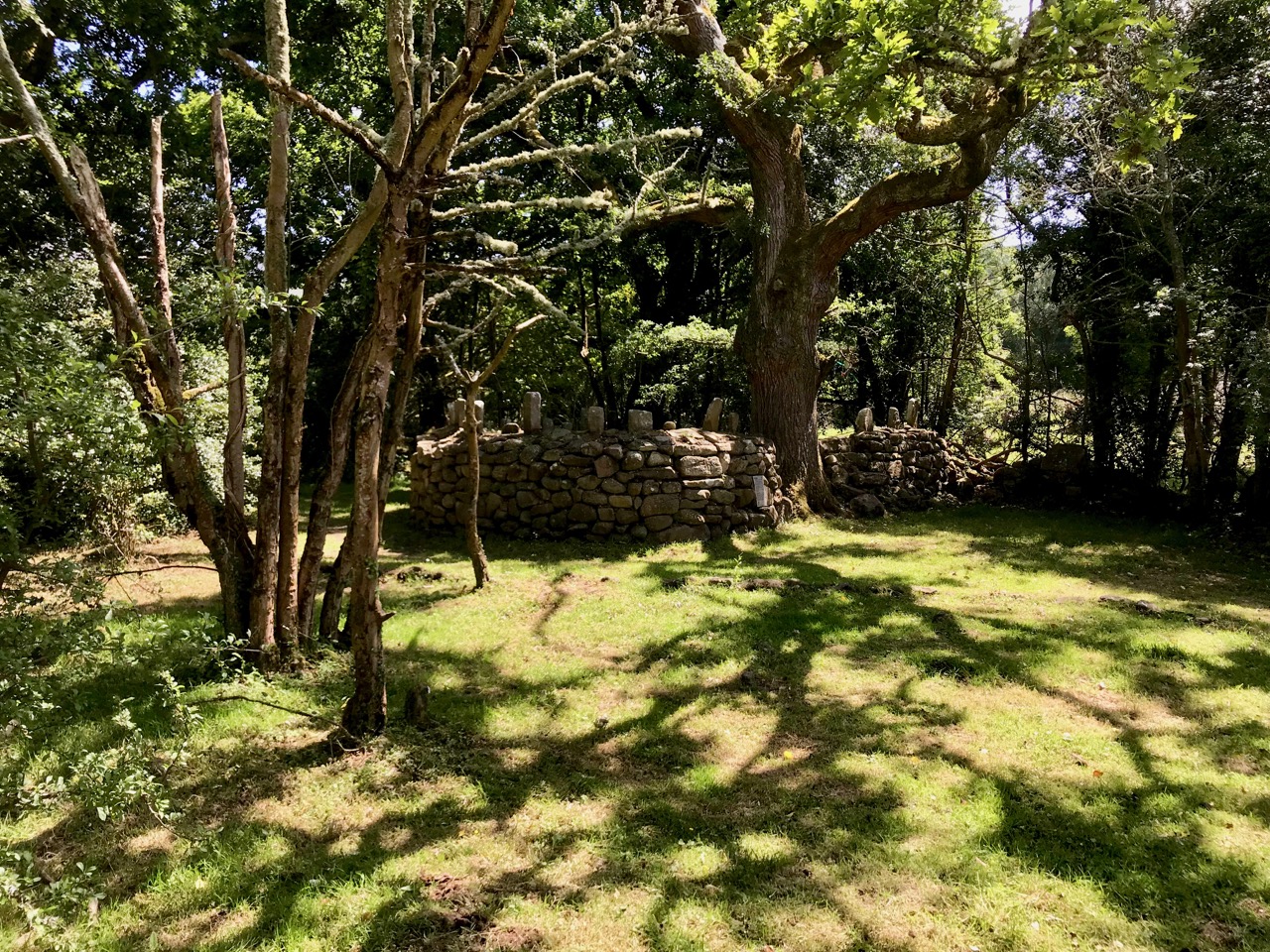
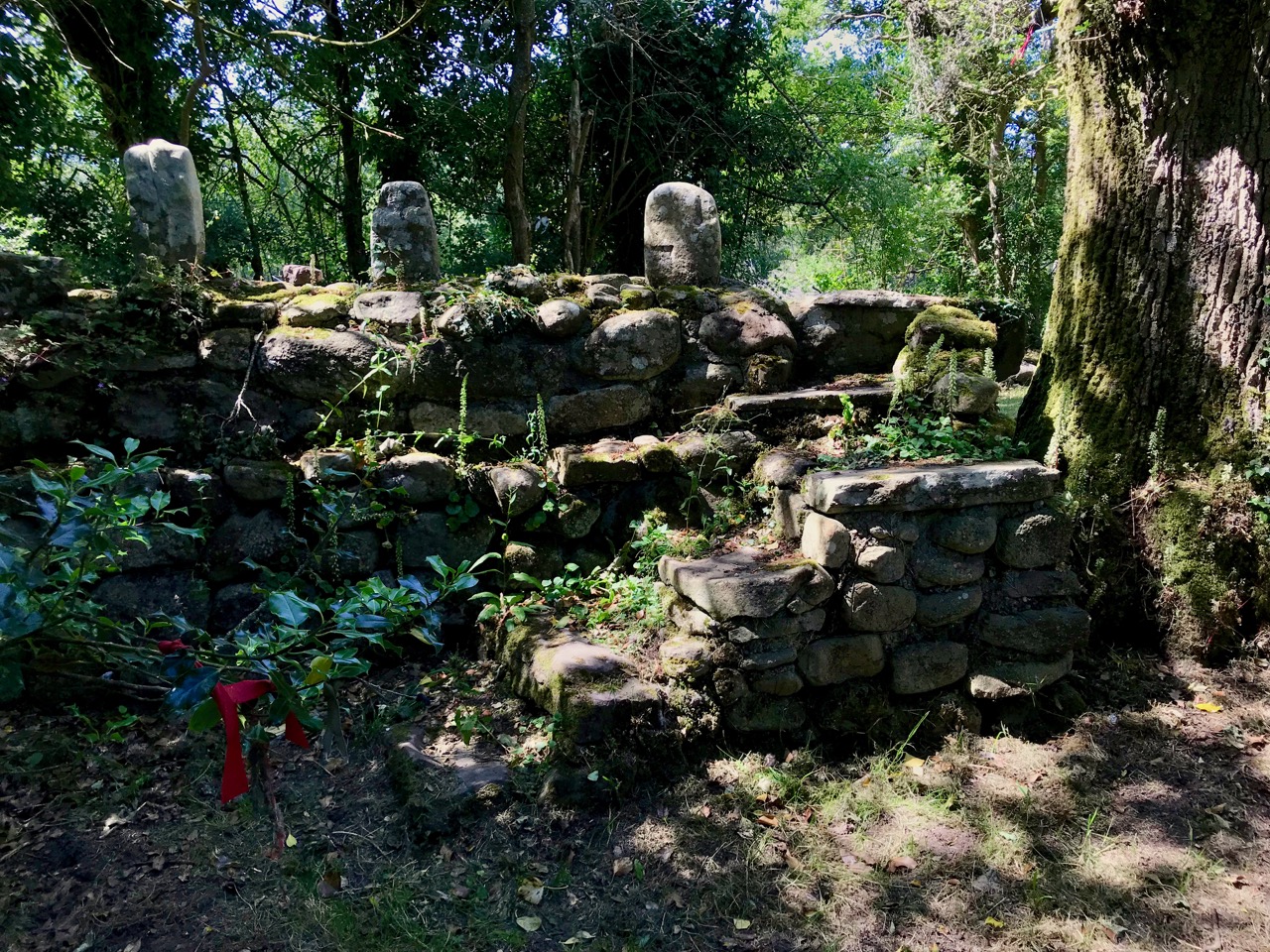
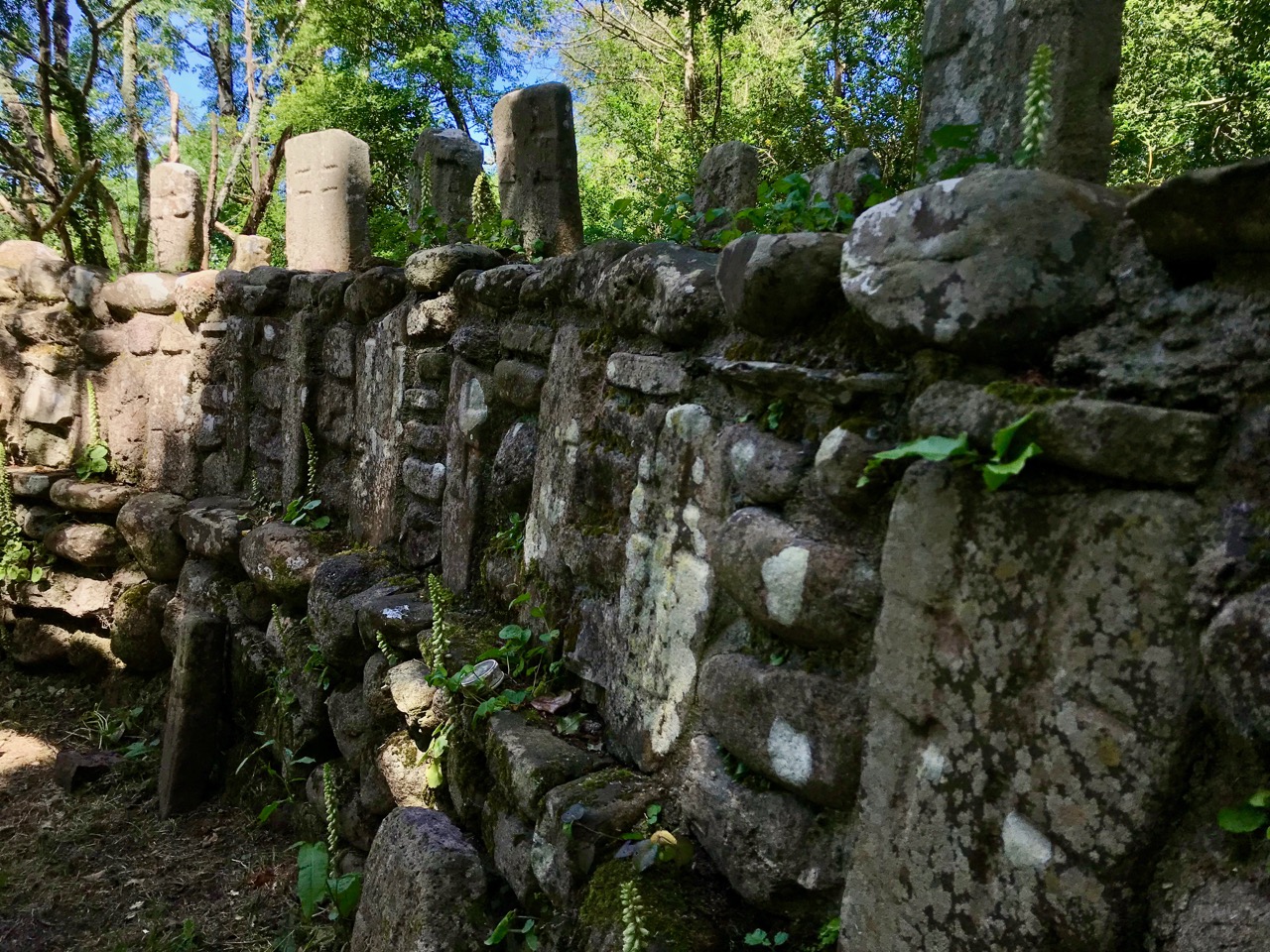
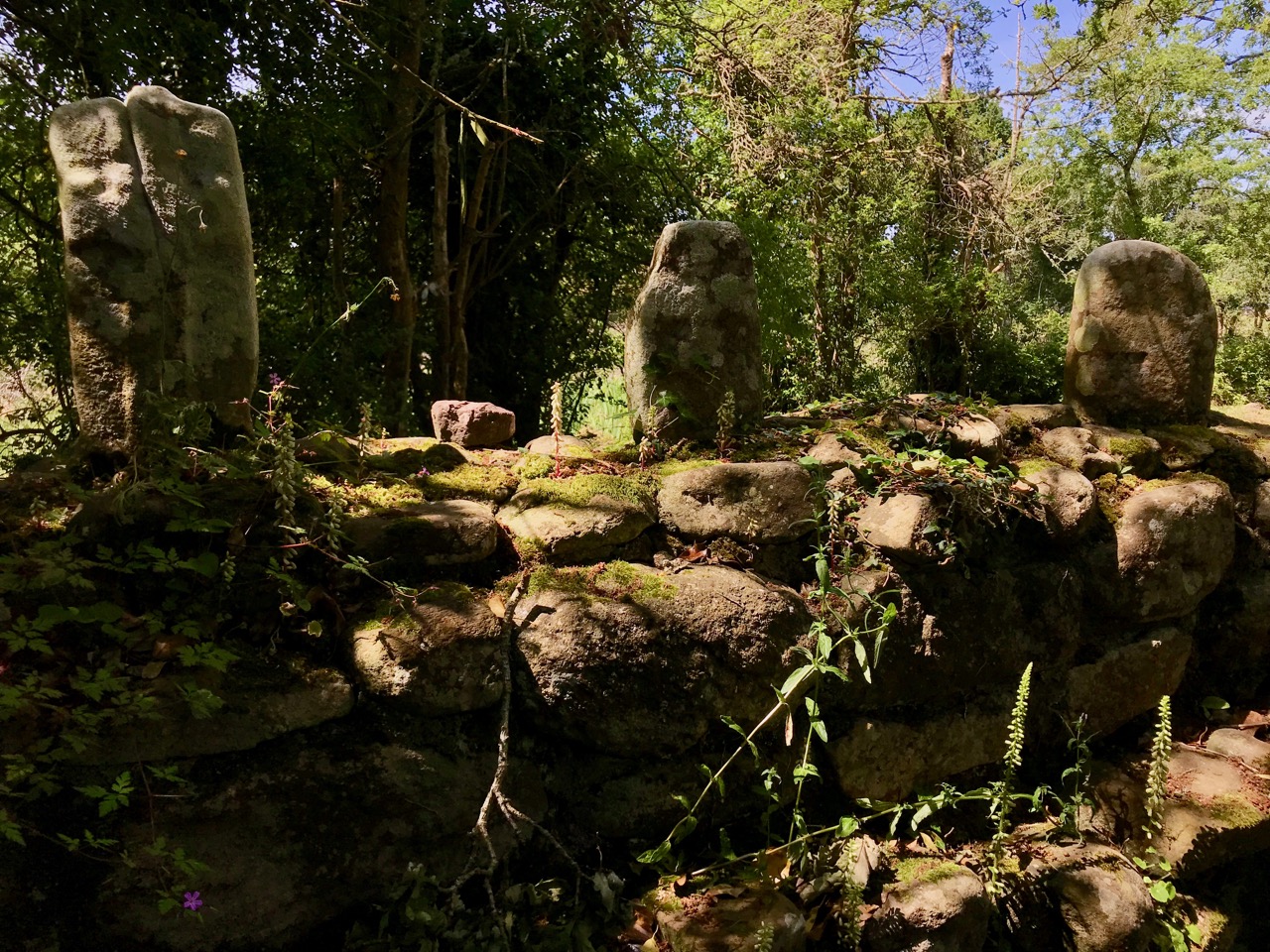
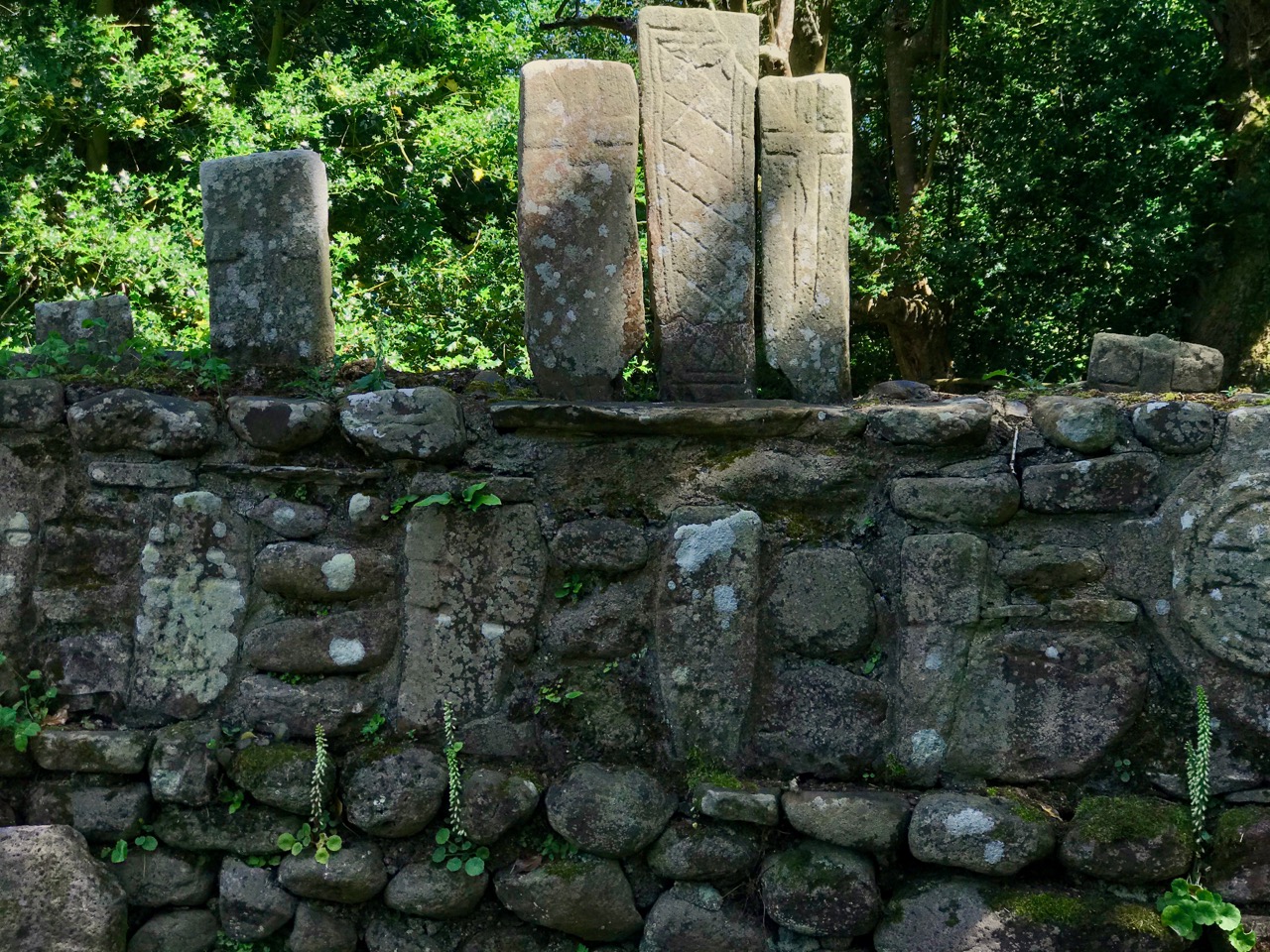
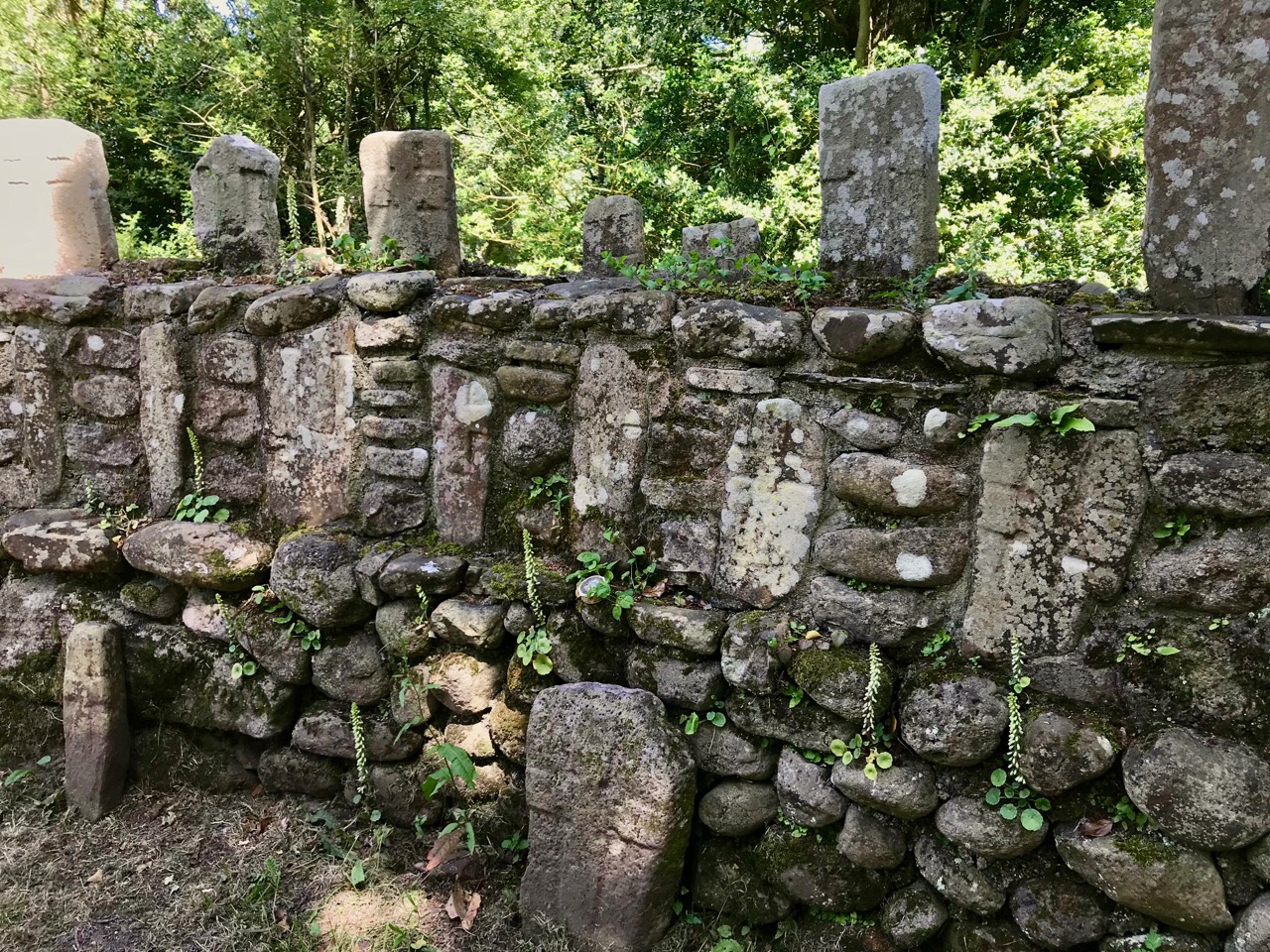
Stone walls and large trees completely encircle an oval shaped enclosure, and the only way in is by steps going over the wall. You are unlikely to be fully prepared for what you find inside. I had hoped for a High Cross – or the fragments of one: we did find a High Cross (perhaps two), but we also found around 70 other stone crosses! Somehow, the Kyle has become a repository for them, but hardly anything is known of their history. After our visit I looked into the stories and found that the enclosure itself – which feels timeless – is probably only as old as I am…

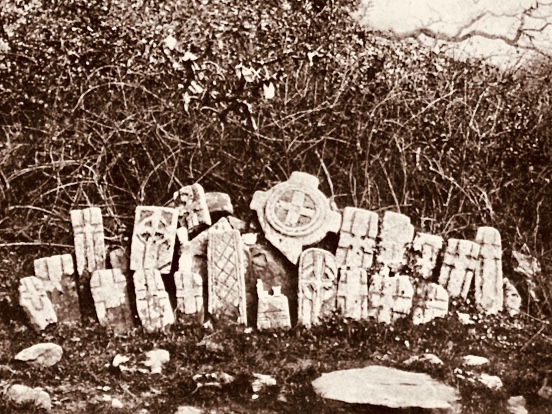
This photograph was taken in 1907. It shows that, for whatever reason, by that time a collection of stone crosses was assembled here. Suggestions have been made that an ancient church on this site was robbed of good building stone, but ‘sacred’ marked stones were left behind out of respect (or from fear of divine retribution). But records do show that the stone enclosure was built in 1946 by the Office of Public Works. What we see today, therefore, is (like me) 72 years old, although of course the stones themselves must have been carved long ago.

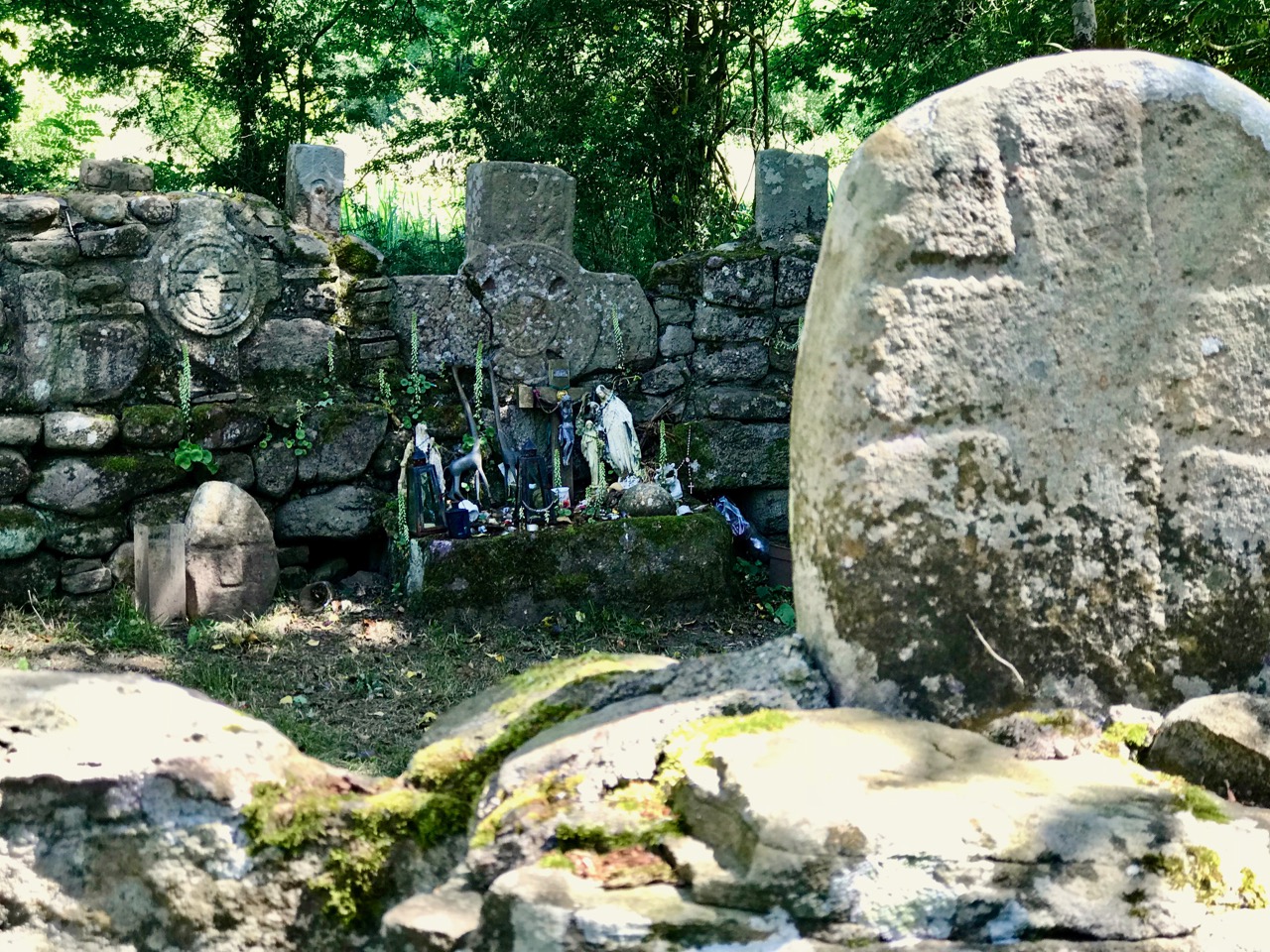
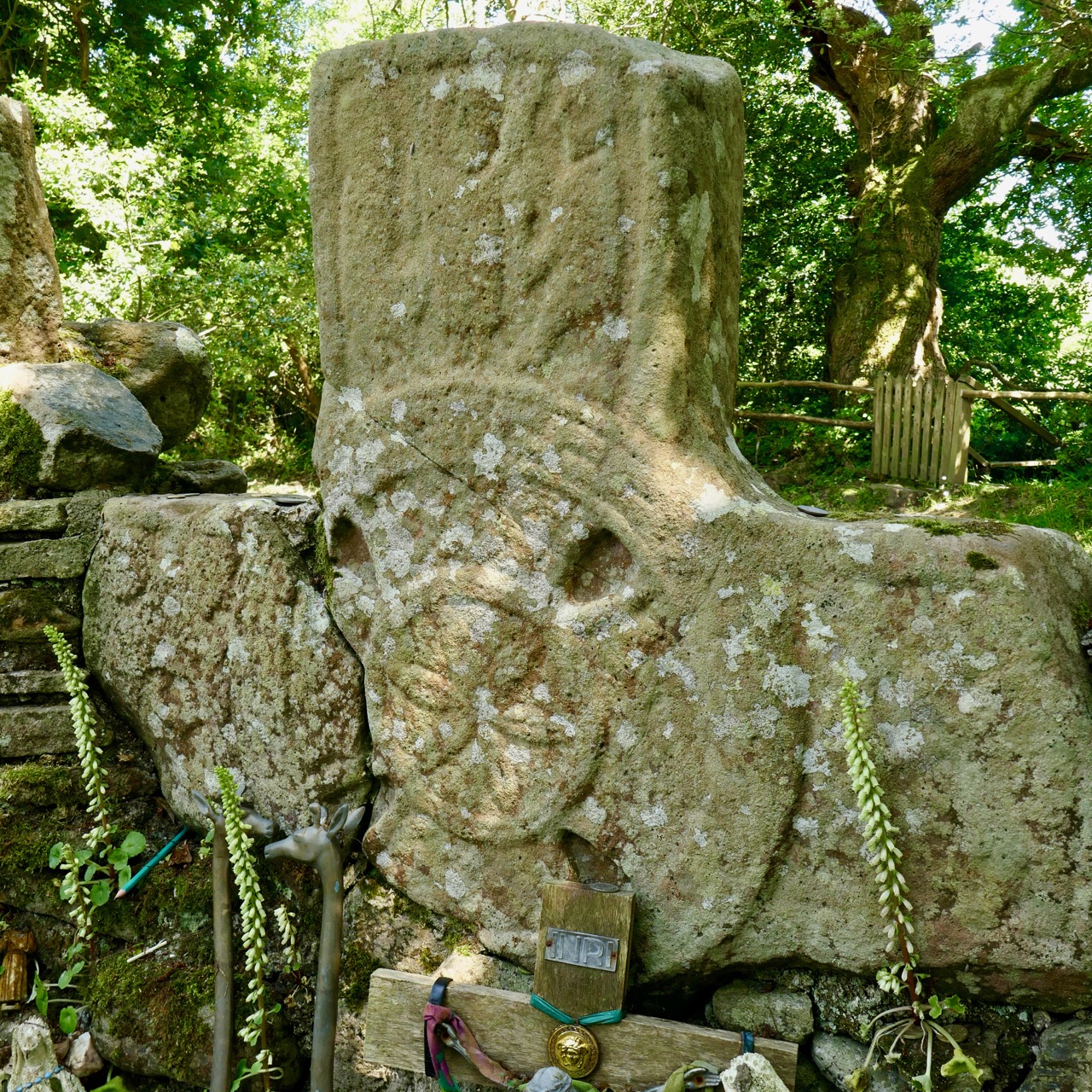
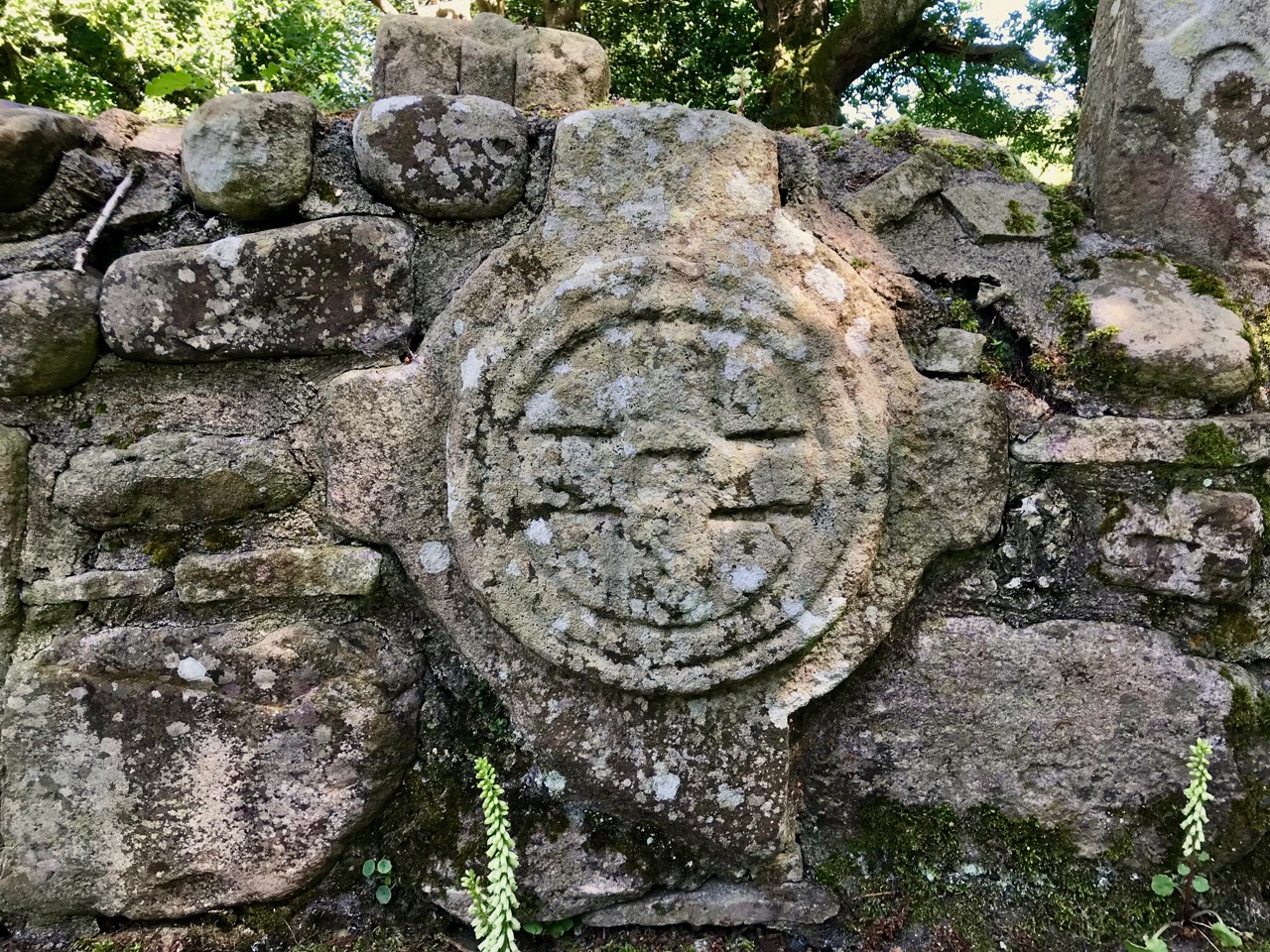
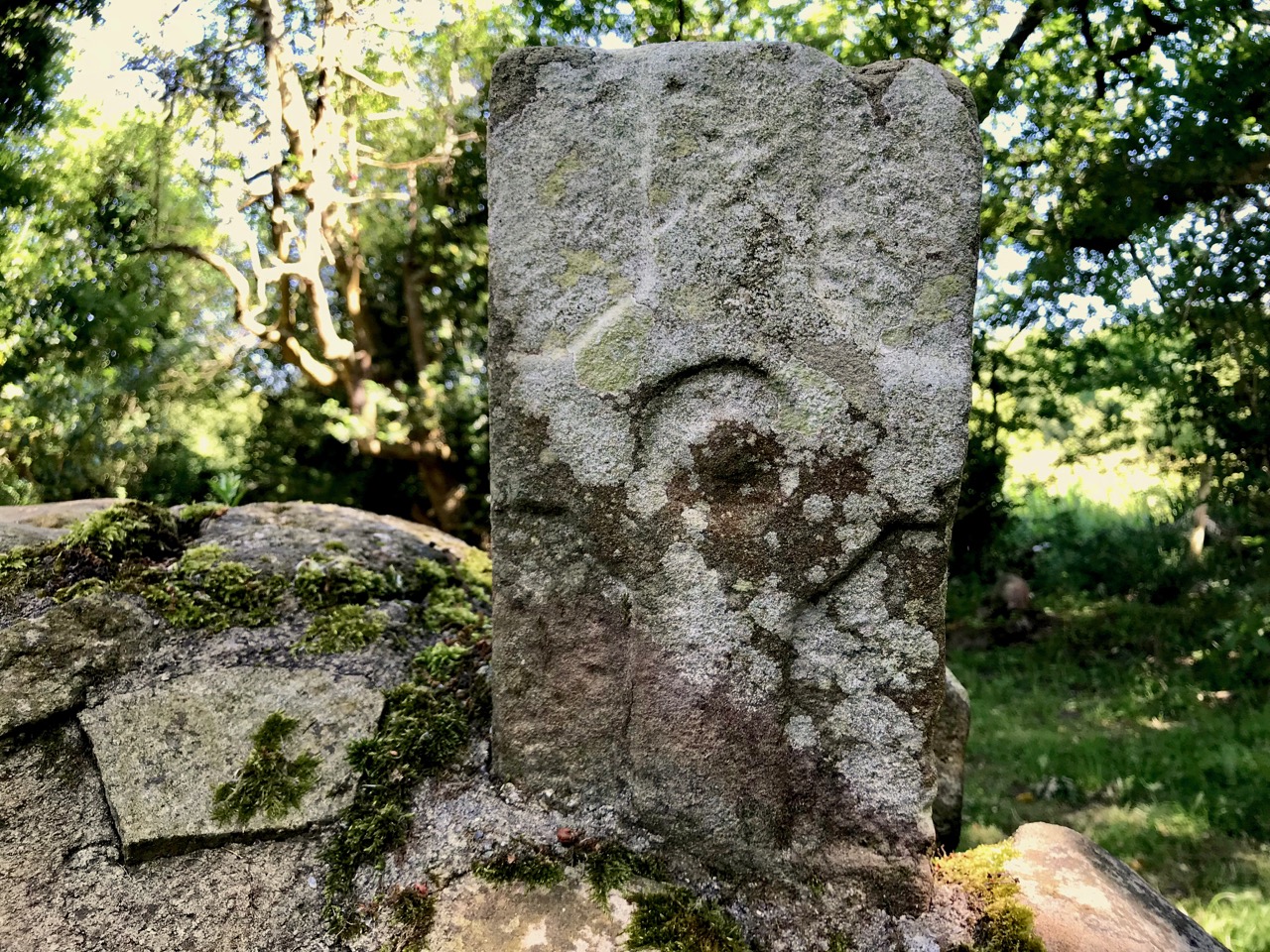
The whole collection of stone cross slabs, cross wheels and decorated pillar stones has been put together into an aesthetically pleasing composition which is exciting and – relatively – in safe keeping. To my mind it’s a far better way of displaying these enigmatic pieces than being tucked away in a museum. On a day when the harsh sunlight and perfect blue sky cast deep shadows and outlined the carvings so clearly the place was absolutely magical: the outside world seemed so very far away. The two largest crosses are set close to each other, built into the wall itself. The first is – to my mind – undoubtedly a High Cross in the medieval tradition; it is likely to have originated here, in St Berrahert’s holy place. As to the others, their stories will probably remain untold. But I wish them all well, and hope that future generations appreciate that what has been put together here has a life of its own and should remain an open secret, to be revealed to anyone who makes the effort to search it out.

A pilgrim path – set out with ‘stations’ – encircles the enclosure (photos below). Would this be part of the 1946 construction? From here, the way to the well is marked across more fields, and requires negotiating a boardwalk. It’s a trip that has to be made, though, as the well itself – continuously bubbling up from the sandy bed – is just as magical as the Kyle.

The Treasures of Castledermot

Last week we explored the medieval wonders at Moone, in County Kildare. We couldn’t leave the area without going on to Castledermot to visit the monastic site of Díseart Diarmada, (the hermitage of Dermot) – a few minutes’ drive down the road. Stone carving artists were active here, too, as we can see from the many artefacts mainly centred today around St James’ Church, built on the site of the former monastery. These include a decorated Romanesque doorway: Finola is writing about Romanesque architecture today.

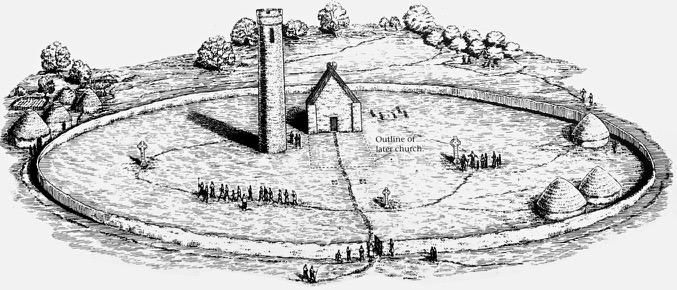
Díseart Diarmada as it might have appeared in the 800s. This reconstructed view is taken from the excellent Dúchas interpretation panels on the site, and shows the earliest church, the 20m high round tower (which still stands today) and the two ornate high crosses, which also remain intact

The settlement itself was highly important. There were Viking raids during the 9th century, probably indicating that there was wealth to be plundered there. A royal grant was given for a fair in 1199, and the very first Irish parliament was convened in the town on 18th June 1264. In 1393 Castledermot was granted permission to mint its own coins.

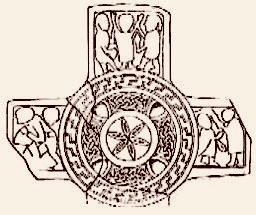
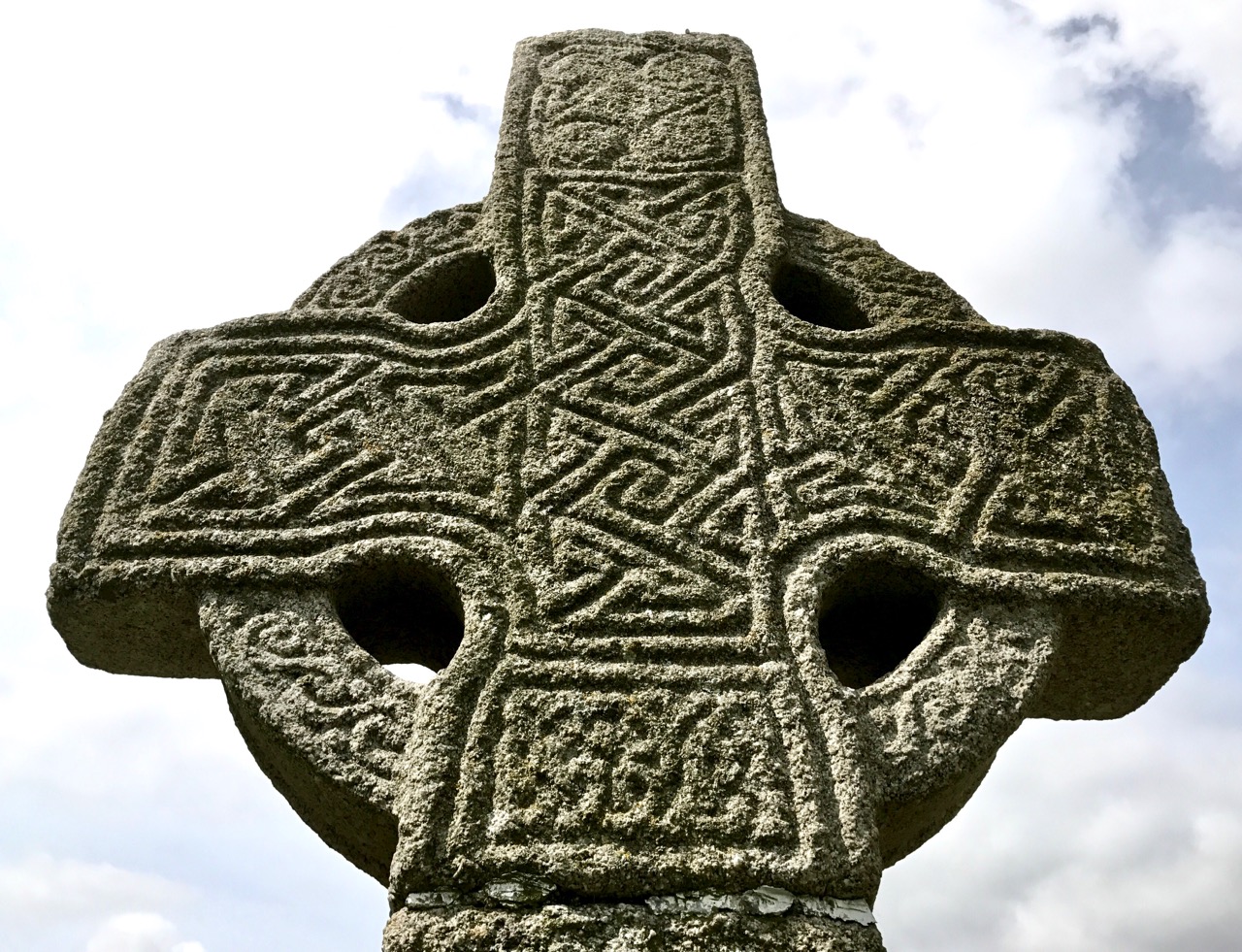
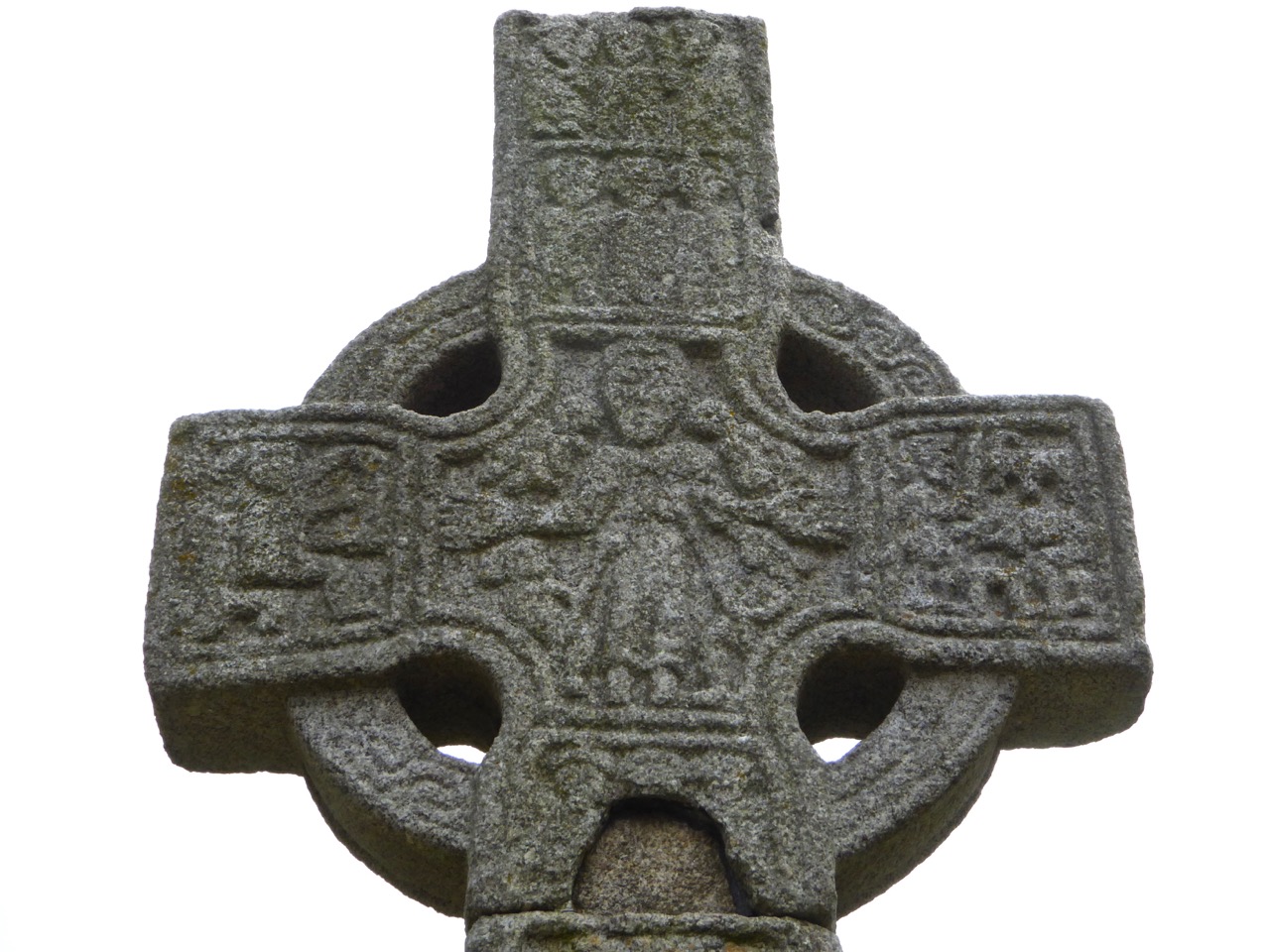
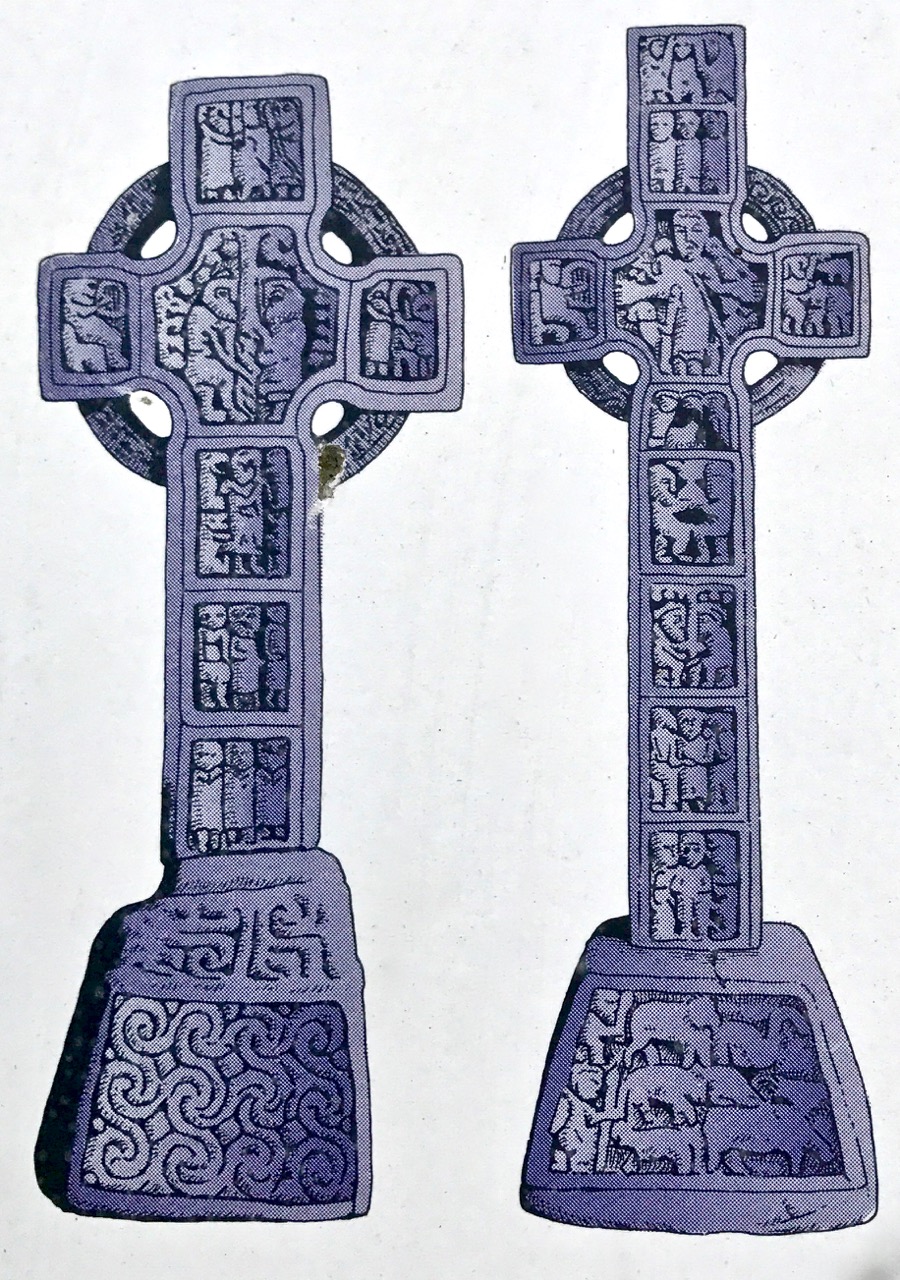
The two high crosses at Castledermot: south cross (left) and north cross (right – round tower beyond). The header picture shows the geometric work on the east face of the south cross

There are certainly figurative carvings on the two crosses to almost rival those found at Moone. I was particularly interested to see other versions of the stories of the loaves and fishes and Daniel in the lions’ den. But the real glory of Castledermot lies in the panels of knotwork. If these were coloured (as suggested at Moone) they must have been spectacular.

Note the loaves and fishes, bottom left

It’s interesting to speculate who might have been responsible for this ancient carving. Could it have been the monks themselves, who considered that part of their dedicated life was to build and decorate the great monastic buildings? Or were they constructed by travelling masons, much as the later cathedrals were? And who directed and designed the work? These are such important monuments – a legacy which we must be sure to look after: they have been here for more than a thousand years and – in spite of being in the open and subject to constant weathering – are still clear to see. At Moone the great cross there has been placed under a modern protective canopy, which is not intrusive. Perhaps such actions should be considered for all these Irish medieval works of art.

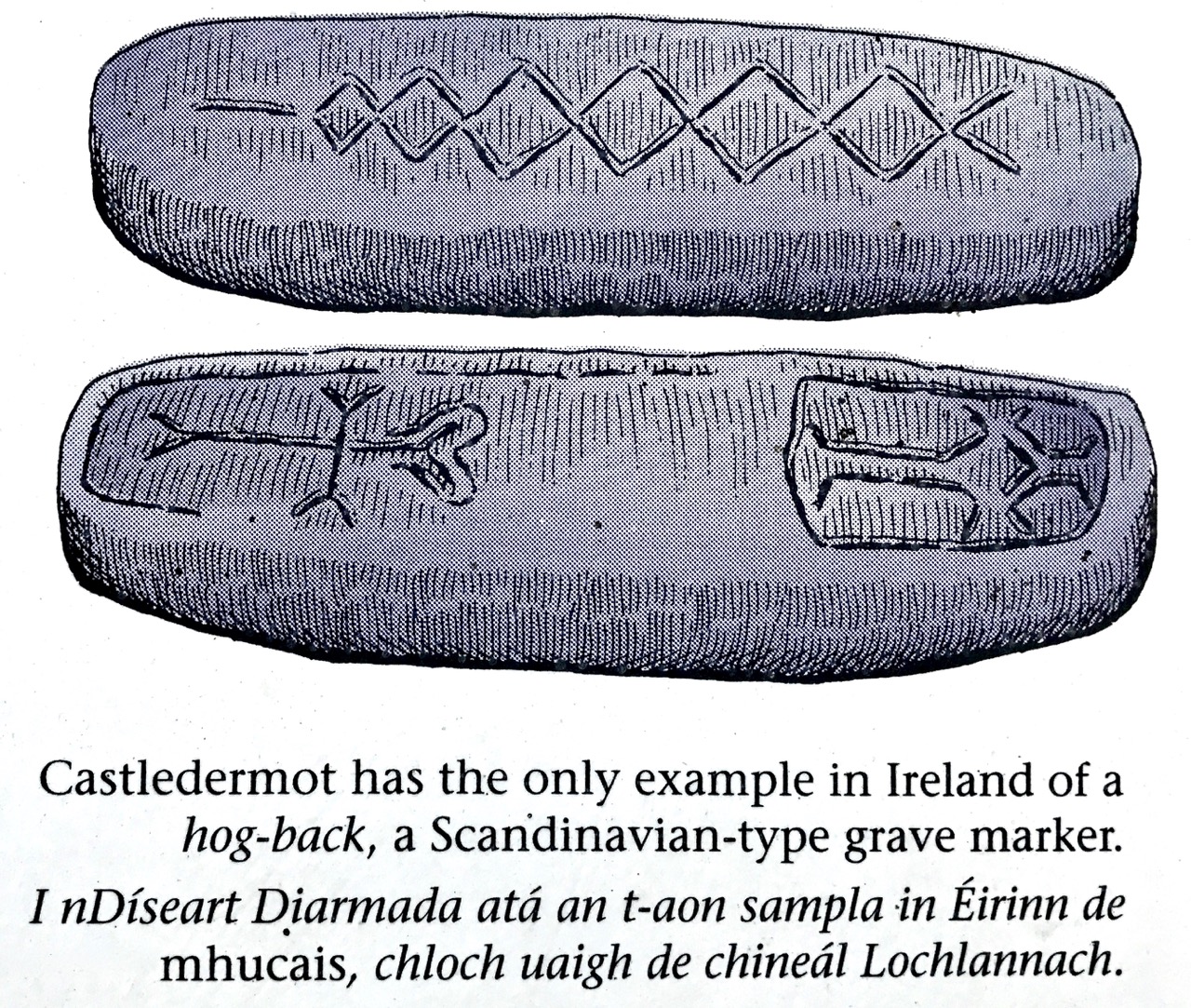
The site at Castledermot reveals many other remains which appear to be weathering quite badly. These include the Hogback Stone, which has been linked to Viking activity in the area: it was discovered just below the ground in its present location in 1967. It is said to represent a House for the Dead, and other examples have been found in Scotland and England: this is the only one found so far in Ireland.

The Hogback Stone (top – Dúchas – and bottom left) and an unusual type of cross-slab close by (right). This is known as the Swearing Stone, and it is said that it may have been used during wedding ceremonies or for swearing oaths or allegiances in early times

Although residents in Castledermot are keen that their historic artefacts are well looked after and are seen by an interested public, the site remains rather obscure and perhaps deserves to be better known. There is a wealth of heritage in Ireland – do we take it too much for granted? The Office of Public Works (formally Dúchas) do their best to maintain and advertise the monuments under their care but it’s an uphill job with a budget which is far too small.

We have by no means exhausted the treasures of this remarkable Irish town. There are other intriguing carved stones and crosses on the monastic site, and, at the southern end of the town are impressive remains of a Franciscan Friary, founded around 1247. This site has a guardian and a key holder, but we didn’t have time to visit. Inside it is a rare cadaver grave stone dating to about 1520. In 1275, the town was given a royal murage grant. This allowed the collection of tolls from people entering Castledermot to pay for the construction and maintenance of town walls. The wall, with three gates, was completed around 1300.