Fort of Gold 1: The Promontory Fort

I have been gifted with a marvellous set of photographs of Dunanore, or Dún an Óir – an O’Driscoll Castle on Cape Clear. The gift came from one of our readers, Tash, and I am very grateful indeed. Regular readers know that I like to use my own photos, and I do have some that I took from the sea (like the one below) but I have none of Dún an Óir from the land, let alone from the castle itself! 
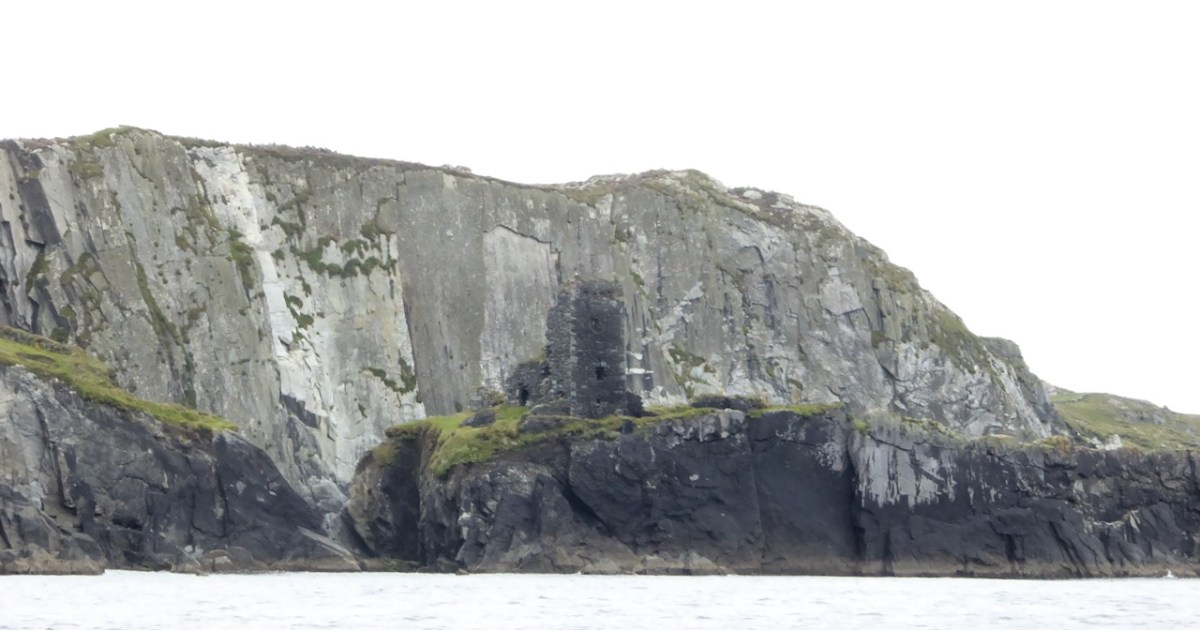
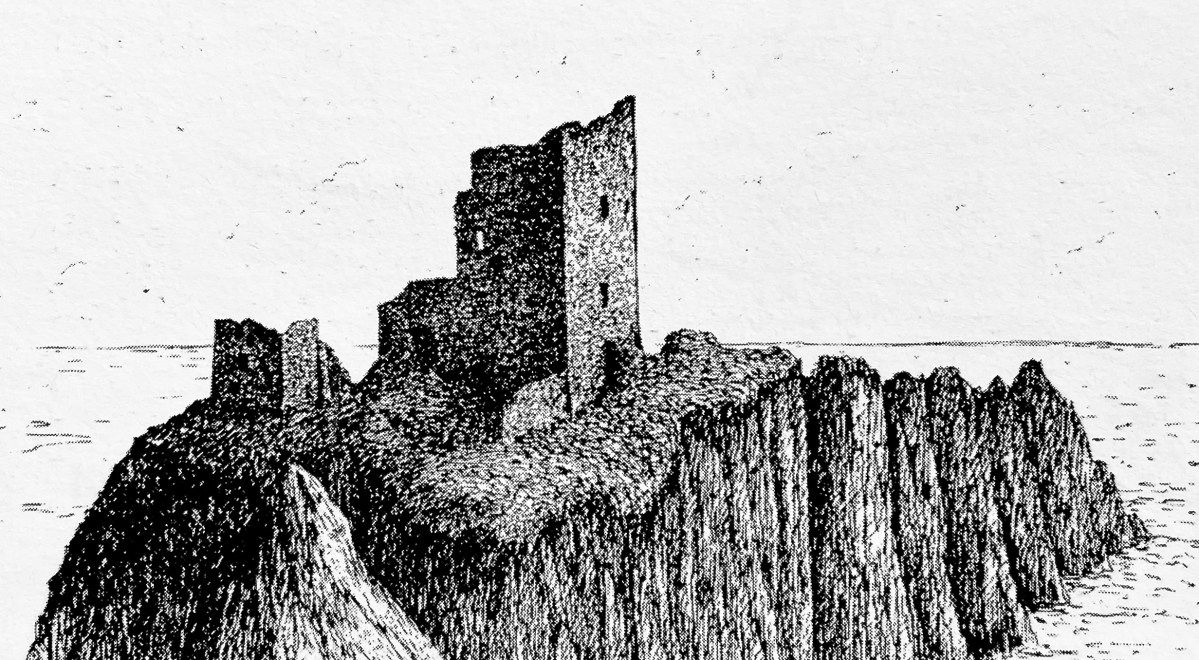
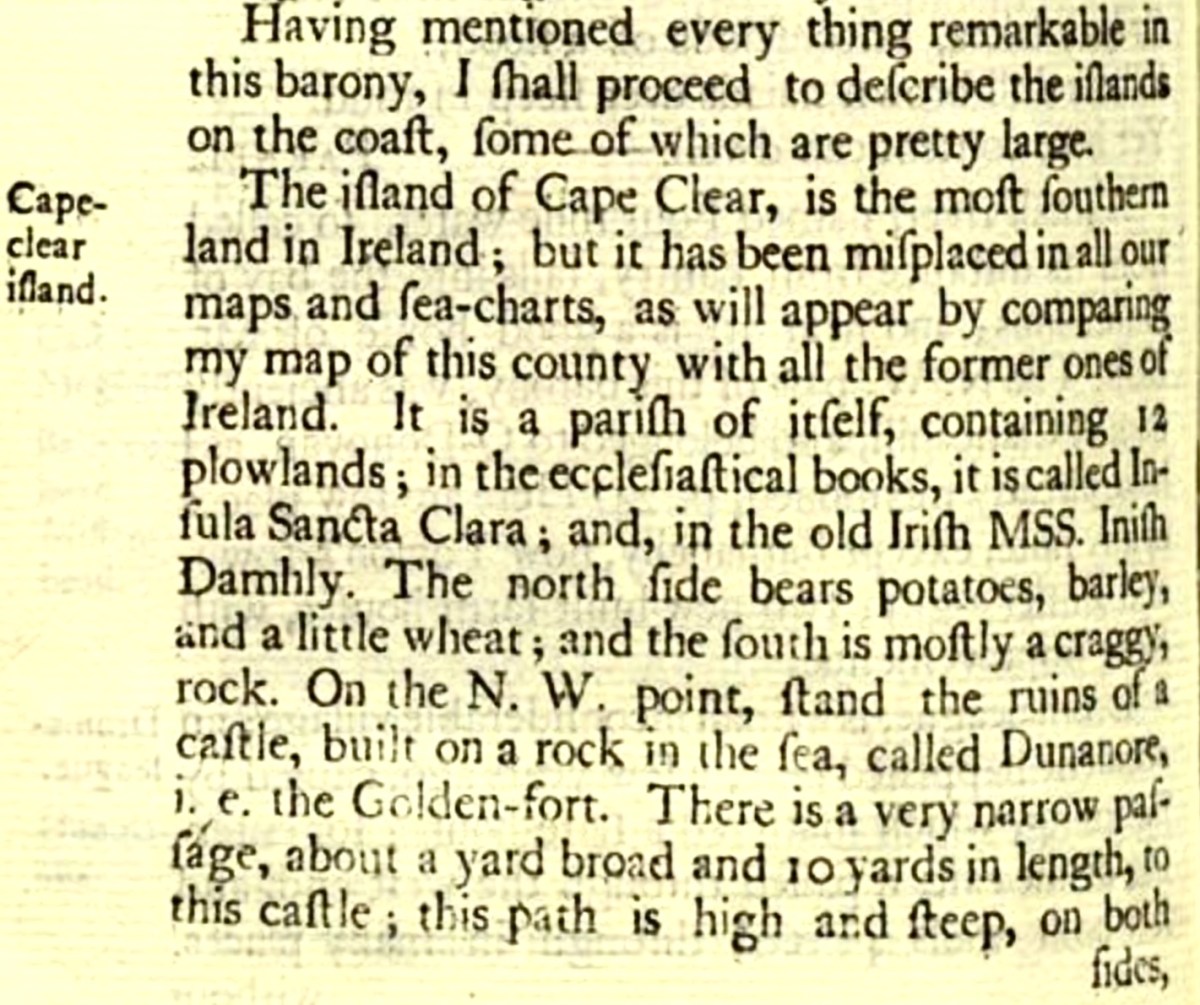
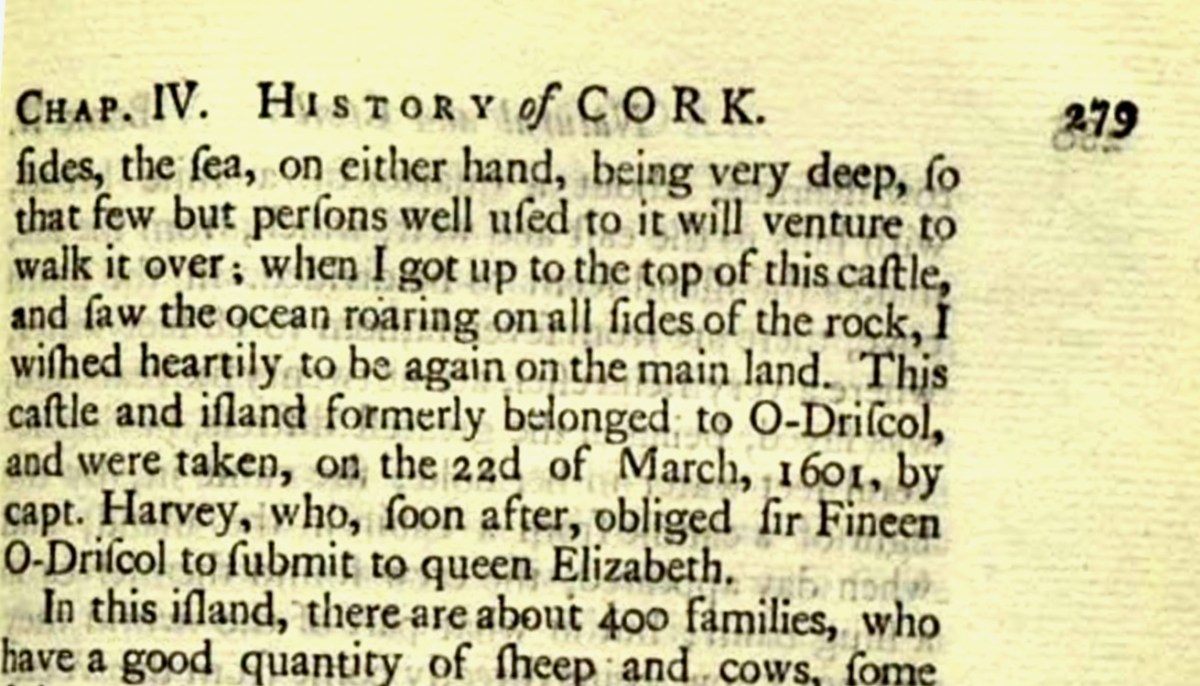
And that’s because, as you can see from the drawing by Jack Roberts at the top of this post, this castle is situated in a very perilous location, on the edge of a cliff, on a small island, essentially, making access a hazardous scramble up from a rocky beach. It was once connected to the rest of Cape Clear by a narrow causeway but this has long collapsed. It was still there in the 1770s when Charles Smith visited. In his The Ancient and Present State of the city of Cork Vol 1, he wrote:
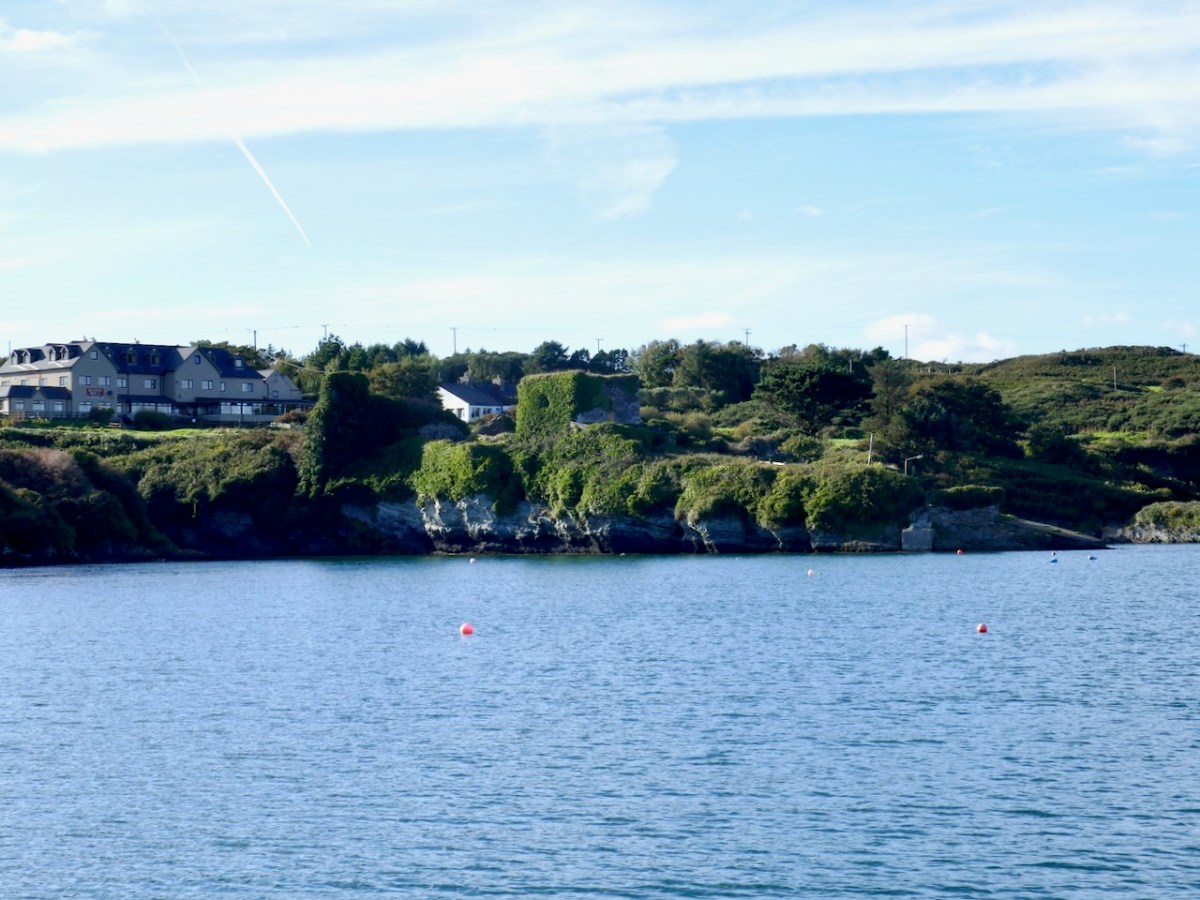
And this brings us to the name – Dún an Óir. It means, of course, Fort of Gold, and some of the old legends about this place talk about the name coming from stories of buried treasure. But in fact, this has been the name of this fort since the first maps of this area were made in the fifteen hundreds and it speaks to the wealth of the O’Driscoll clan who built it. Remember, their other stronghold, now called Baltimore, was Dún na Séad, or Fort of Jewels (on at least one map given as Castle of Perles). On Sherkin, their castle was Dúnalong – or the Fort of the Ships – that’s it as it is now, below.
There are many accounts of their fleets of ships, and the battles they waged against the Waterfordmen in which they came out the worst for wear when Dunalong was attacked. The scene below, from an information sign on Sherkin, shows the Battle of the Wine Barrels, 1537, with both Dunalong and the Friary on Sherkin in flames
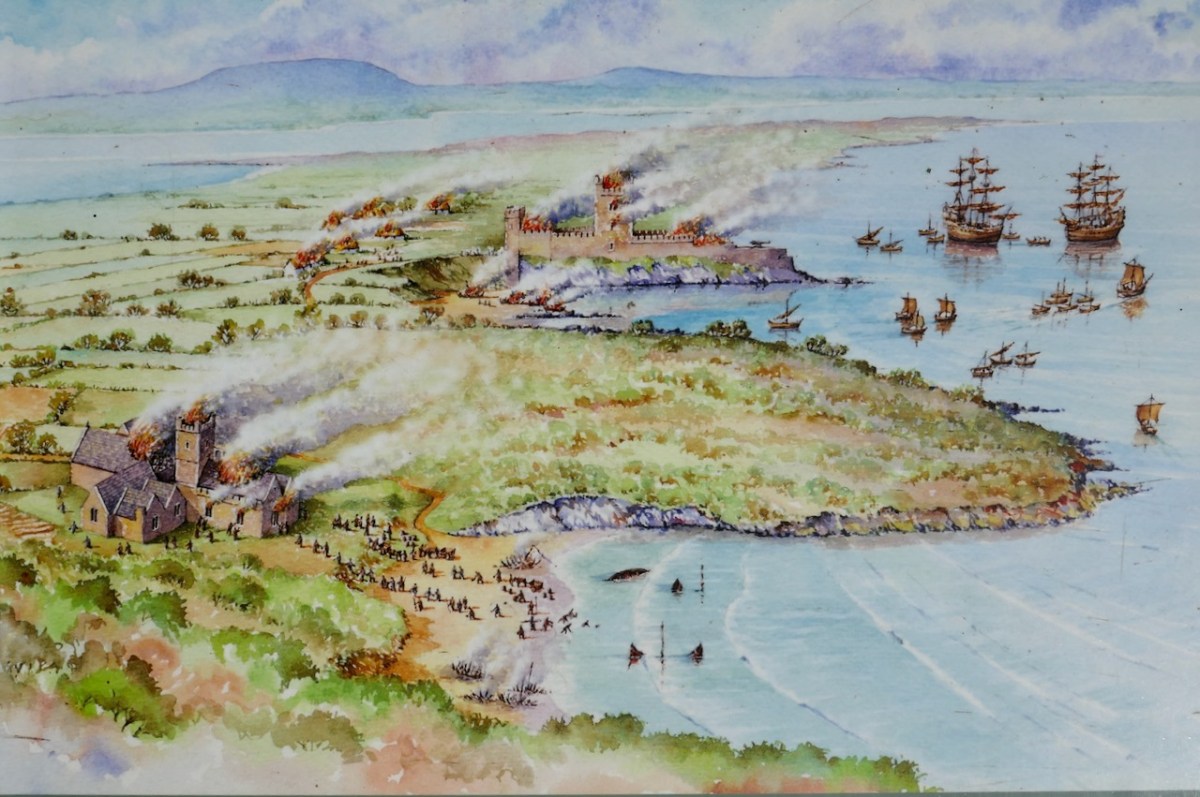
Dún means ‘fort’ but seems to be especially applied to promontory forts in the southwest. Before the castle was built, therefore, it is likely that the O’Driscolls fortified the headland, which may date well back to the Early Medieval period (400-1200) or even to the Iron Age (500BC to 400AD, or 500BCE to 400BC for those who prefer the secular version). The Illustration below is taken with permission from Dún an Óir Castle: an uncertain future, by Dr Sarah Kerr, and shows the present state of the castle, marooned on what was once a promontory connected to the Island.
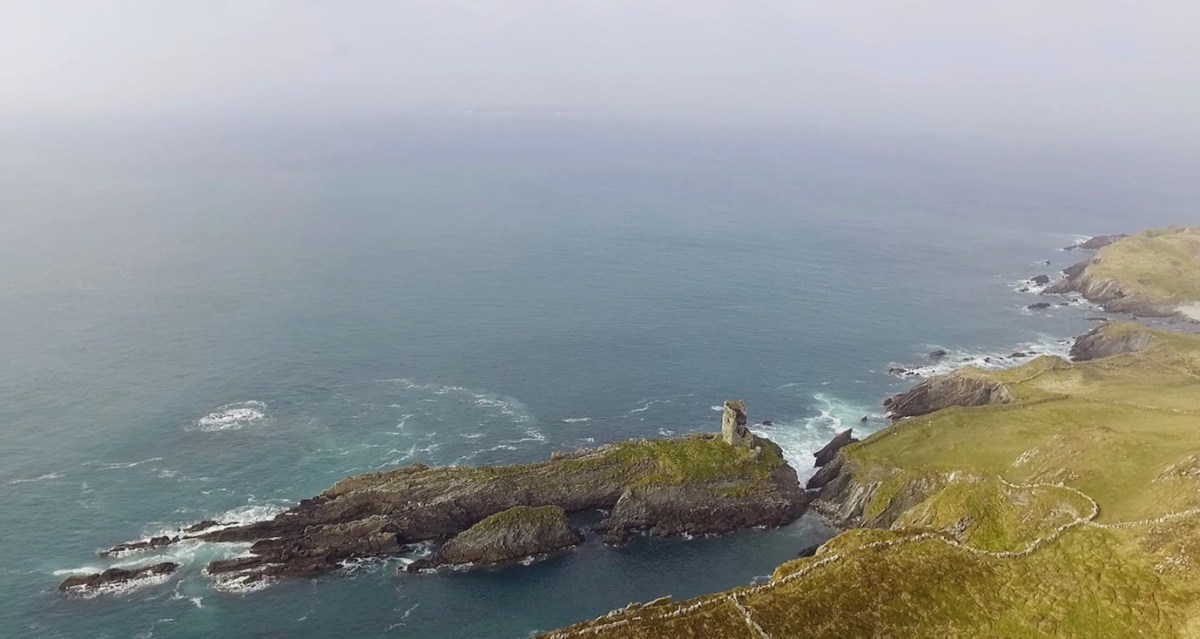
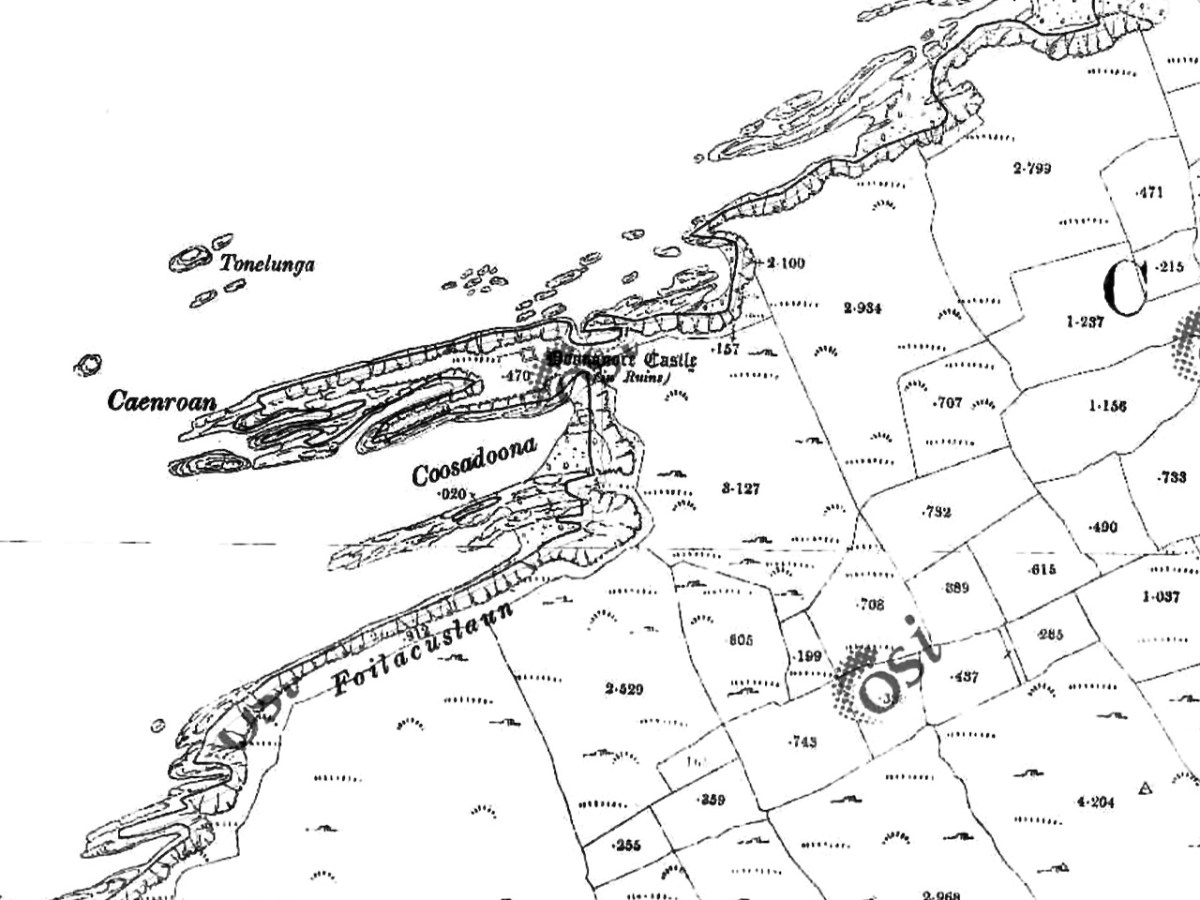
Our Promontory Fort man is Thomas Westropp (see here and here), and he wrote about Dún an Óir in his 1914-16 paper for the Royal Irish Academy, Fortified Headlands and Castles in Western County Cork. Part I. From Cape Clear to Dunmanus Bay. He visited the site, but like many a good explorer before and after him, did not venture out onto the promontory, but satisfied himself with what he could see from the high ground above it. That included the promontory and ruined castle, the rather ominously named Tonelunga (The sea-bed of the Ships), the end of the promontory called Caenroan (quay of the Seals), the inlet between the promontory and the cliffs, Coosadoona (the Little Harbour of the Fort) and the high cliffs behind the fort, Foilacuslaun (Cliffs of the Castle). All of these are marked on the 19th century twenty-five inch map.
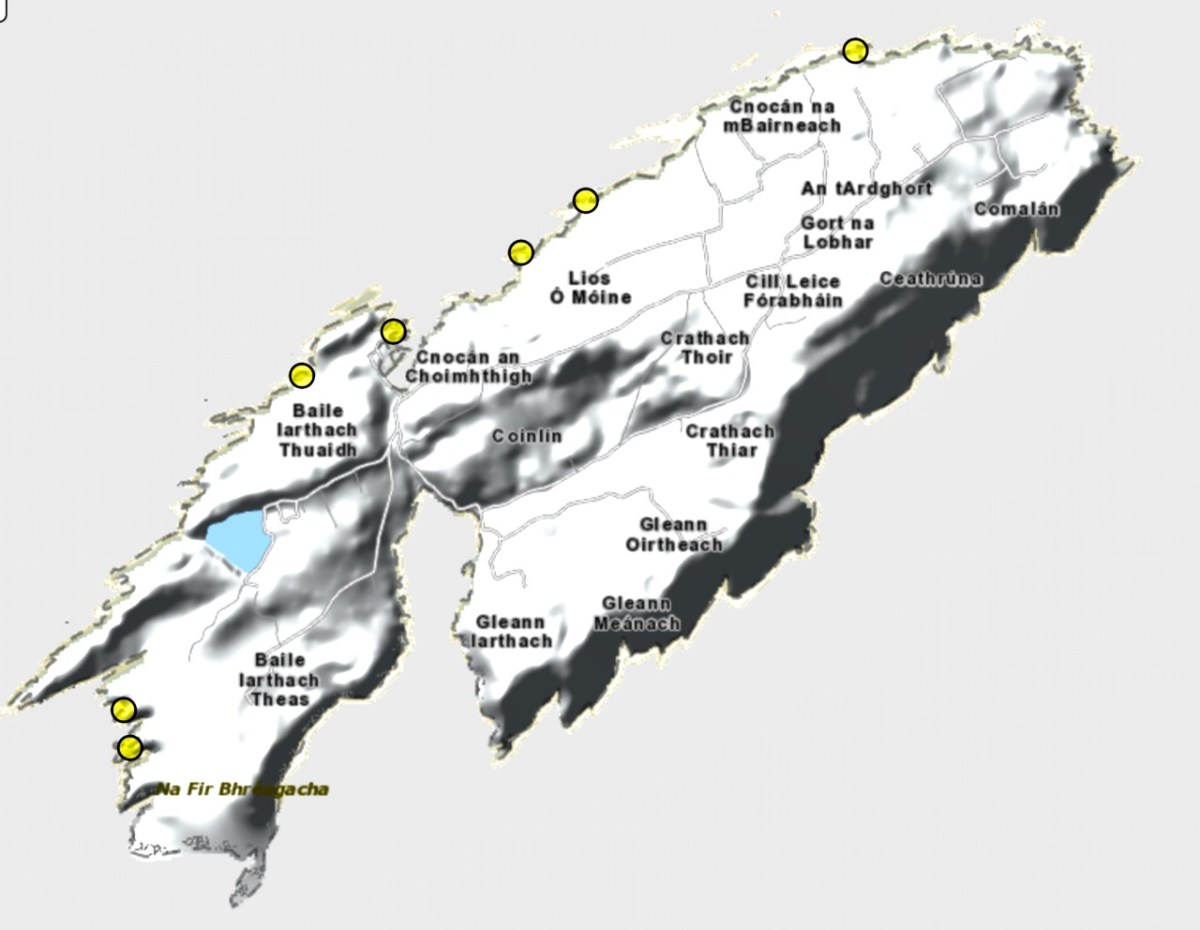
Westropp writes about Dún an Óir as one of three Promontory forts on Cape Clear Island, although in fact there are more than that, as identified by the National Monuments Record – each yellow dot below is one.
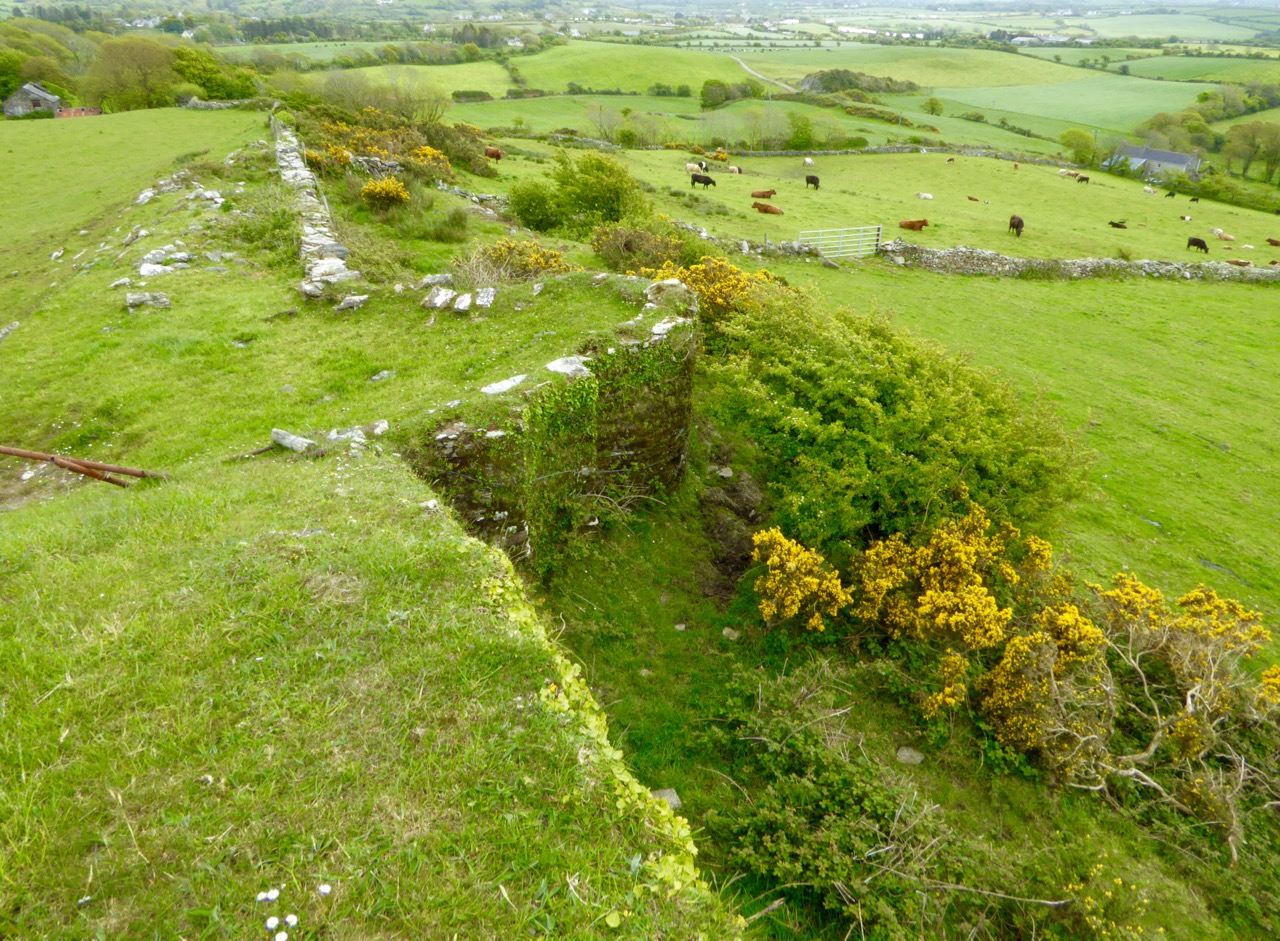
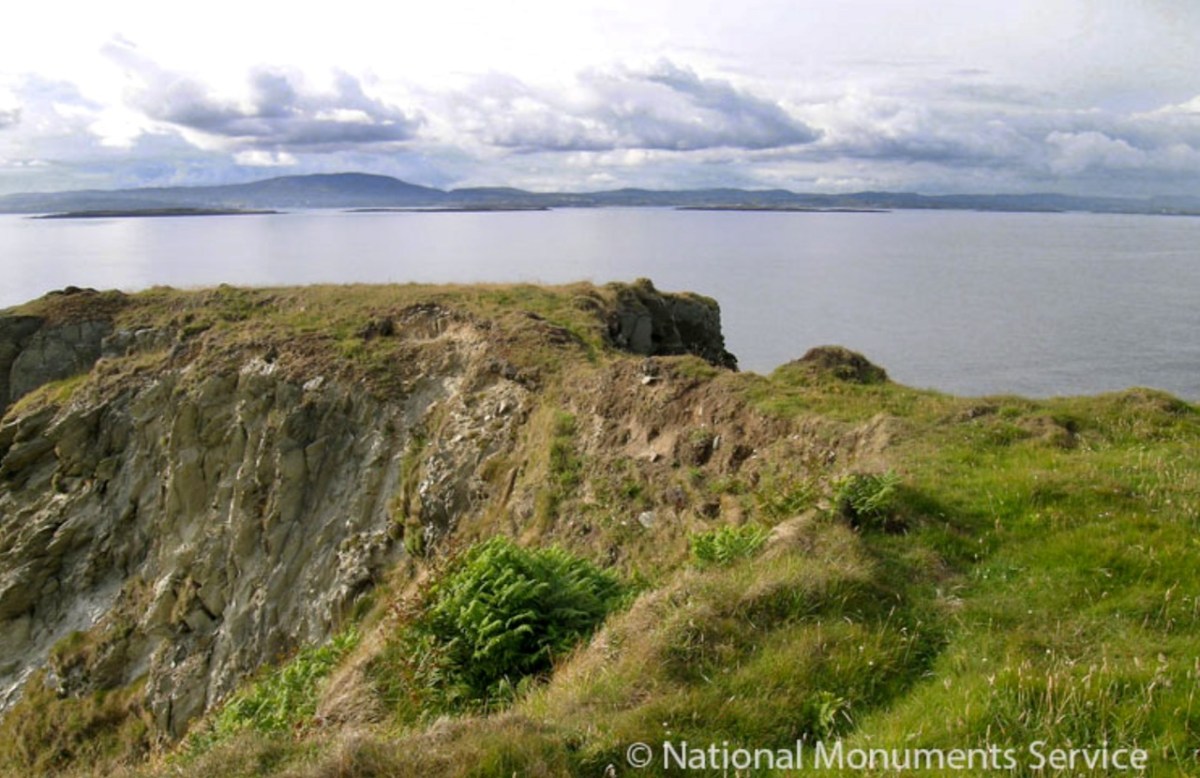
Here’s one of them (below), Lios Ó Móine (the Fort of the Meadow – lios is usually used to designate an earthen ring fort): the description and then the photo are by National Monuments Service (NMS). In the photo you can see the narrow neck of land leading out to the promontory. This is likely what the spit leading out to Dún an Óir may have looked like.

Description: In rough pasture, at the foot of a steep N-facing slope on Stuckaunfoilnabena, a headland on the NW coast of Clear Island. A narrow eroding neck of land (Wth 3m; L 15m) leads to the roughly anvil-shaped headland. Across this neck of land are the remains of three earthen banks and the shallow remains of three fosses. Further examination of the remains was not possible for safety reasons.
Curiously, the NMS does NOT identify Dún an Óir as a promontory fort – here is what it says: 

Description: The location of the tower house ‘Doonanore Castle’ (CO153-015002-) on a promontory, on the NW shore of Clear Island, suggested that it may have been built on the site of a promontory fort. However, there are no visible surface traces of an earlier defences across the promontory. The promontory is now isolated at high tide but was connected to mainland by causeway until 1831.

However, it has this to say about the earthwork identified on the high ground: 

In pasture, on a steep N-facing slope to the E of the tower house known as Doonanore Castle . . . An earthen bank . . .extends upslope in a S to SW direction from a modern E-W field boundary wall on the cliff-top at N and ends at a large outcropping rock on the edge of another cliff. This bank appears to have formed part of the defences on the land approach to the castle from the E. The bank has three contiguous linear stretches [and] there is an entrance near the N end. There is a possible hut site near the centre of the enclosed area. The short promontory on which Doonanore Castle stands is a possible coastal promontory fort.

So, as you can see, although the NMS declines to label it a promontory fort because there are no longer any signs of banks or walls, it does concede that it is possible. It also extends the defences of that fort to the higher ground above it.

Back to Westropp – He quotes:

the poem of O Huidhrin, before 1418, tells how “0 hEidersceoil assumed possession of the Harbour of Cler.” It was of some importance to the foreign traders in wine and spices, and so figures in all the early portolan maps. Angelino Dulcert, in 1339, calls it Cap de Clar ; the subsequent portolans, Cauo de Clara, 1375 and 1426 ; Clarros, 1436 ; C. d’Clara or Claro, 1450 and 1552, and, to give no more, Cauo de Chlaram, in 1490. The 0 Driscolls’ Castle probably dates between 1450 and the last date. It was probably on an earlier headland fort, as it is called Dunanore. In 1602 it surrendered without resistance to the English, who burned it.

Westropp goes on to say

Dr. O’Donovan, in his ” Sketches of Carbery,” gives a few notes on the later history. He says there was a garrison at the Castle in Queen Anne’s time, and mentions the huge iron ring-bolt, set in the rock, to which the O Driscolls formerly moored their galleys in the creek. The last is improbable, even to impossibility: no one could moor galleys in the dangerous wave-trap, open to the most stormy and unsheltered points. The islanders regard the ruin as haunted, and tell of the singing of ships’ crews in its vaults. One “Croohoor” (Conor) O’Careavaun (Heremon’s grandson) lived as a hermit there in the eighteenth century. Another legend tells how, in 1798, the inhabitants painted the Farbreag Rocks and pillars so as to resemble soldiers in uniform to keep away the French ! If any truth underlies this, it is probably based on the idle act of some revenue or other officers, in the endless leisure of their island station.
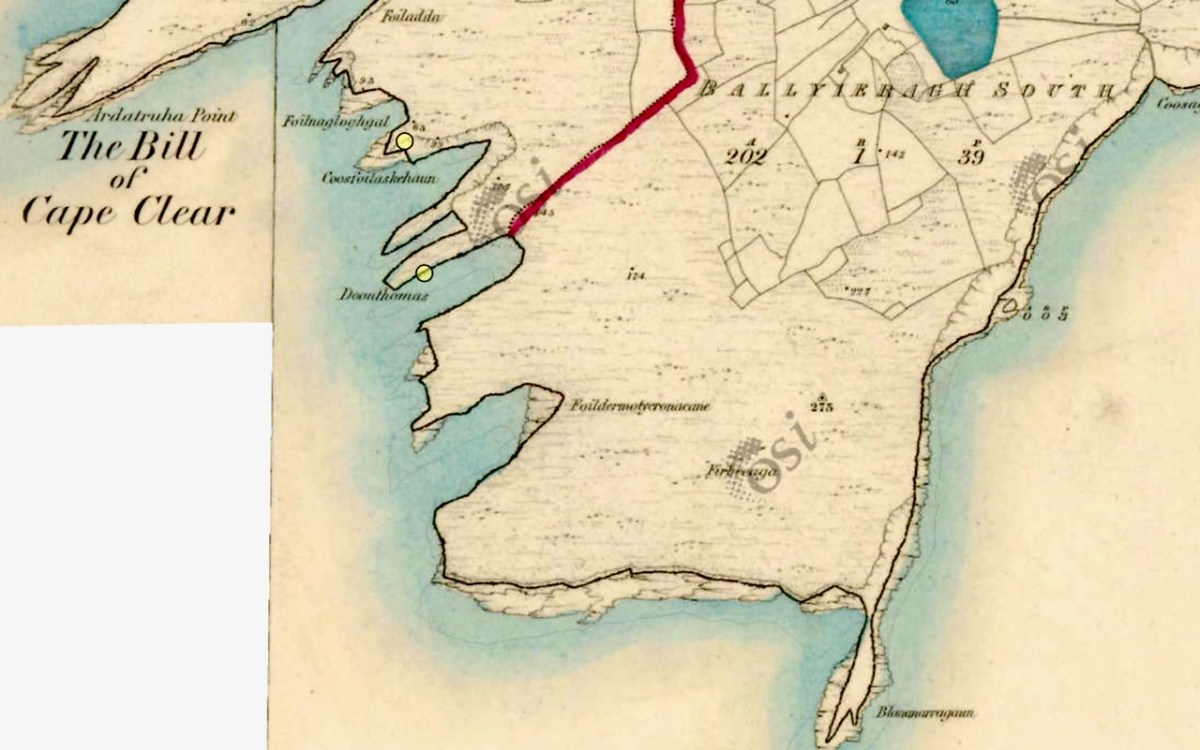
In the map above, of the southwest end of the Island, you can just make out the name Firbreaga, almost covered by the O of OSI. Fir Bréaga means The Lying Men, an apt translation given Westropp’s story. No doubt the name is older than 1798, and may refer to the cliffs at that end seeming to be less dangerous from the sea than they actually were. Note also the two yellow dots for two more promontory forts- Doonthomas (Thomas’s Fort) and Coosfoilaskehaun (the Small Harbour of the Knife-Edge Cliff).

Westropp’s description of the promontory upon which Dun an Óir sits is poetic:

The path runs up a very slight ledge, flaking away and high above the creek, along the face of a cliff of polished silvery slate. The low neck joined it to the mainland, and the nearly perpendicular strata make the dock-like creek of Coosadoona, fort-cove, to the south Beside this cove, opposite to the castle, an enormous precipice rises high above the tower top. In the other direction is a noble view across the wide, porpoise-haunted bay, and its low islands to the blue, many-channelled Mount Gabriel, and on to Mizen Head. 
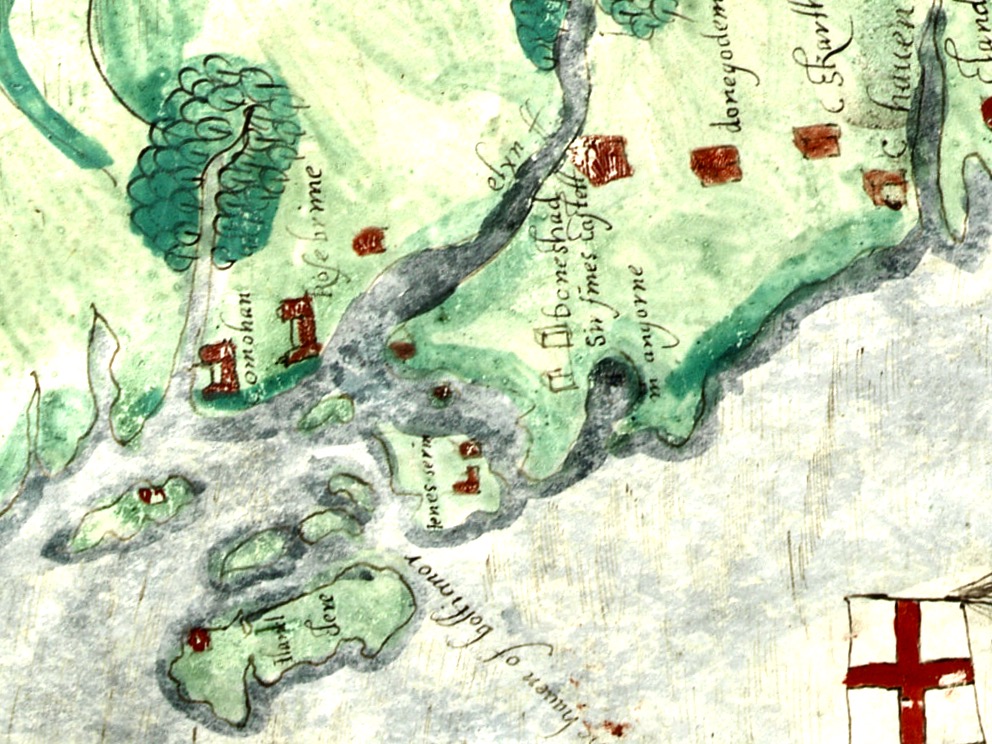
In fact, very little is known about the history of Dún an Óir before the Battle of Kinsale in 1601. We can deduce from its strategic location that the O’Driscolls used it to keep an eye on every ship that sailed in and out of Roaringwater Bay, to exact fishing dues before the rival O’Mahonys could get to the incoming vessels, to curb the power of those O’Mahonys, and to establish their dominance over the land of Cape Clear Island. (See this post for more on the map above.) Because the castle would have been rendered, probably in some shade of white or near-white, it would have been visible from all around Roaringwater Bay, and have represented a potent statement of supremacy.

After the Battle of Kinsale the Castle was seized by Captain Harvey, as described in Pacata Hibernia:

‘While these things were on doing, Captain Roger Harvy sent a party of men to Cape Clear, the castle whereof being guarded by Captain Tirrell’s men, which they could not gain, but they pillaged the island and brought thence three boats; and the second day following the rebels not liking the neighbourhood of the English, quitted the castle, wherein Captain Harvy placed a guard. At this time Sir Finnin O’Driscoll came to Captain Harvy and submitted himself.’
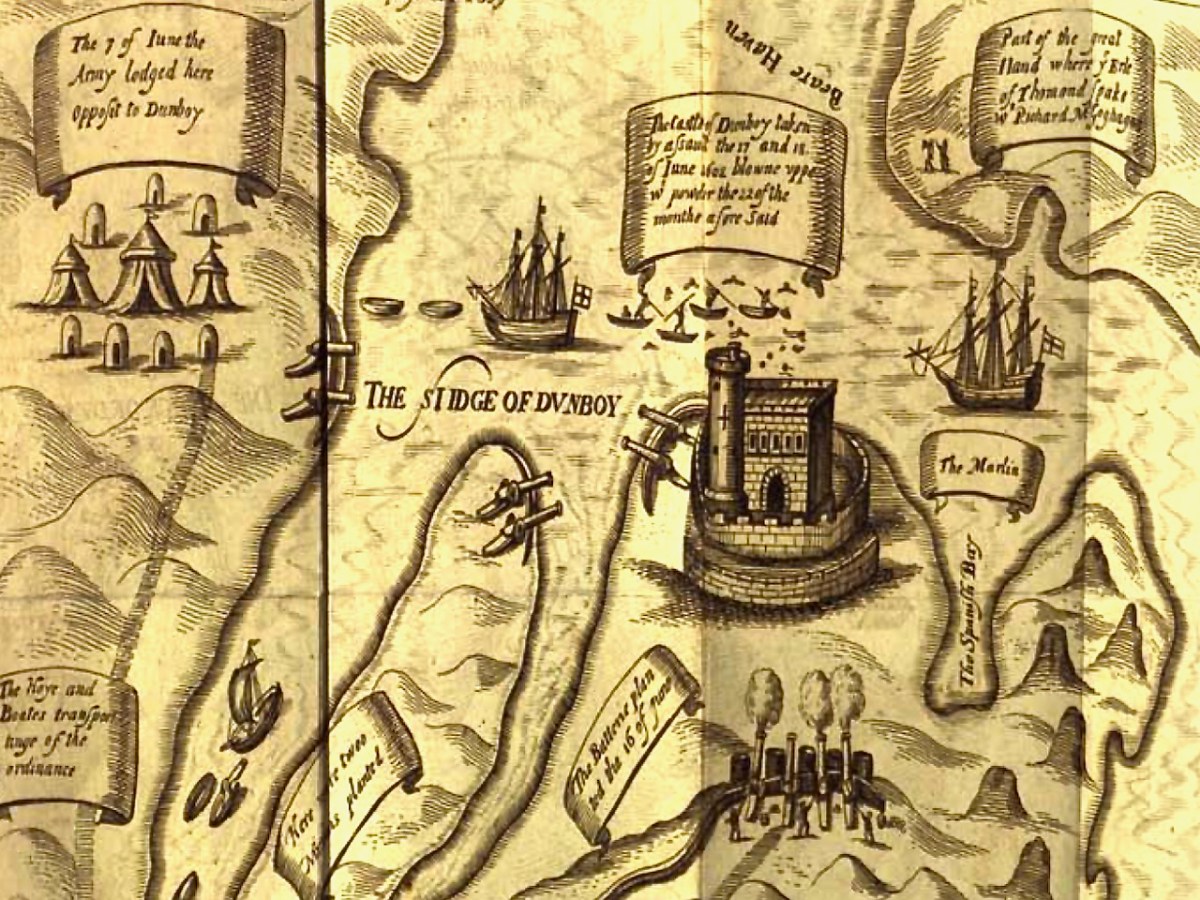
This illustration, from Pacata Hibernia, is of the siege of Dunboy Castle, the stronghold of O’Sullivan Beare, on Beara Peninsula. The destruction of Dún an Óir is described by James Burke in his article Cape Clear Island in the Journal of the Cork Historical and Archaeological Society Journal of 1908. Rather than Harvey simply taking over the castle, Burke relates the following:

Its central arch and the steps leading to its upper portion remain; but the huge pieces of its eastern wall now lying about show how severely it has suffered from the havoc of war. This wholesale destruction occurred when Dunanore Castle, together with the island, was captured on the 22nd of March, 1601, by Captain Roger Harvey, following on the defeat of the Spaniards at Kinsale. By means of the artillery he planted on the high ground adjoining it, he battered down the eastern wall and compelled the garrison to surrender, for which and other services (as Dr Donovan writes in his “Sketches of Carbery”) he was granted at the time a commission by Lord Deputy Mountjoy as Governor of Carbery.

It is far more likely that the ruined state of the castle is a result of the natural passage of time than the ‘havoc of war.’ For one thing, it would have been a monumental task to deploy artillery overland on Cape Clear. Any cannon fire would have come more naturally from the English warships we know were in use during this period and therefore, the damage would have been to the seaward side of the castle – but this side is actually intact.
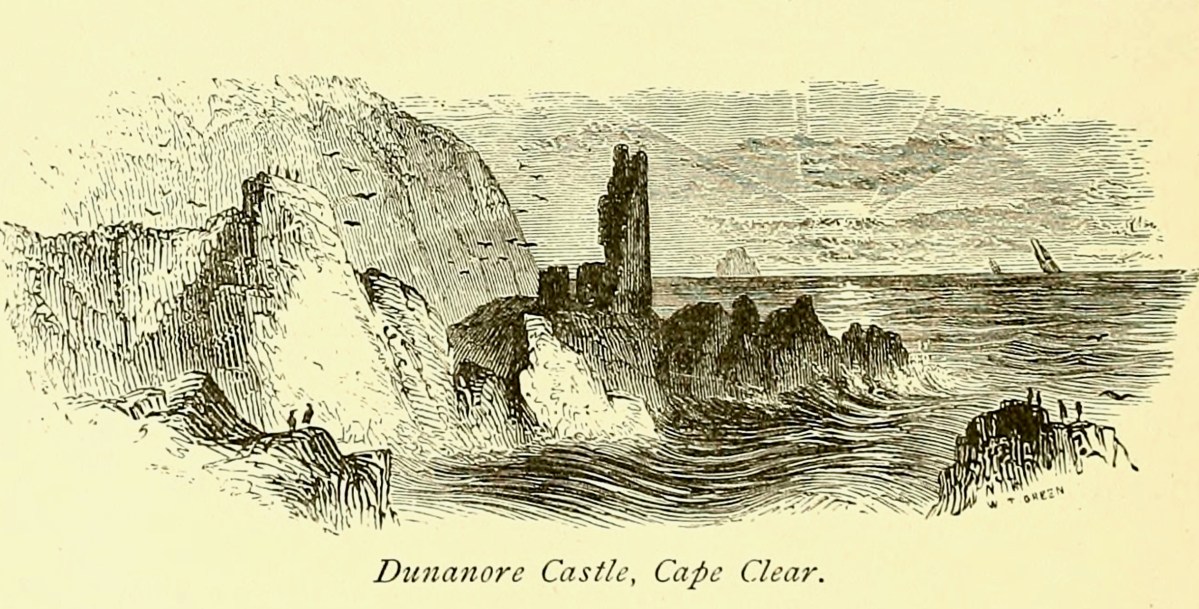
A romantic view of the ruins of Dún an Óir above, by W Willes.* Next week we will look at what is left of the castle and what we can tell from that. I’ll be using the marvellous photos from Tash in that post.
*From: Picturesque Ireland : a literary and artistic delineation of the natural scenery, remarkable places, historical antiquities, public buildings, ancient abbeys, towers, castles, and other romantic and attractive features of Ireland, by John Savage, 1885.

Capturing the View: Belvederes in West Cork

Swift's Tower

The 18th century was a time of profound change in garden design in Britain, and by extension in Ireland. In the opening decades of the 1700s great and small estates included formal gardens laid out in the French and Dutch styles that emphasised symmetry and geometry, parterres and avenues of trees. The gardens at Bantry House are a good example of this garden style. Although developed in the first half of the 19th century, they were perhaps influenced heavily by the gardens at Versailles and great European houses visited by the Earl of Bantry on his Grand Tour.

Bantry House 1

Thanks to Dennis Horgan, aerial photographer extraordinaire, for allowing me to use his shot of Bantry House. Note the formal and geometric layout of the gardens and the parterres immediately behind and to the right of the house

However, for the previous century a different style of landscaping had dominated garden design in Britain, pioneered by William Kent and Charles Bridgeman and reaching its peak in the work of Lancelot ‘Capability’ Brown. The effect they strove for was naturalistic (as opposed to natural) – a planned layout that mirrored but enhanced their idea of a ‘wild’ and romantic landscape. Large expanses of grass, strategically placed lakes and ponds, plantings of carefully chosen tree and shrub species, and clever little structures such as temples, summer houses and belvederes all combined to delight the eye, create a romantic mood and, of course, attest to the taste and wealth of the owner.

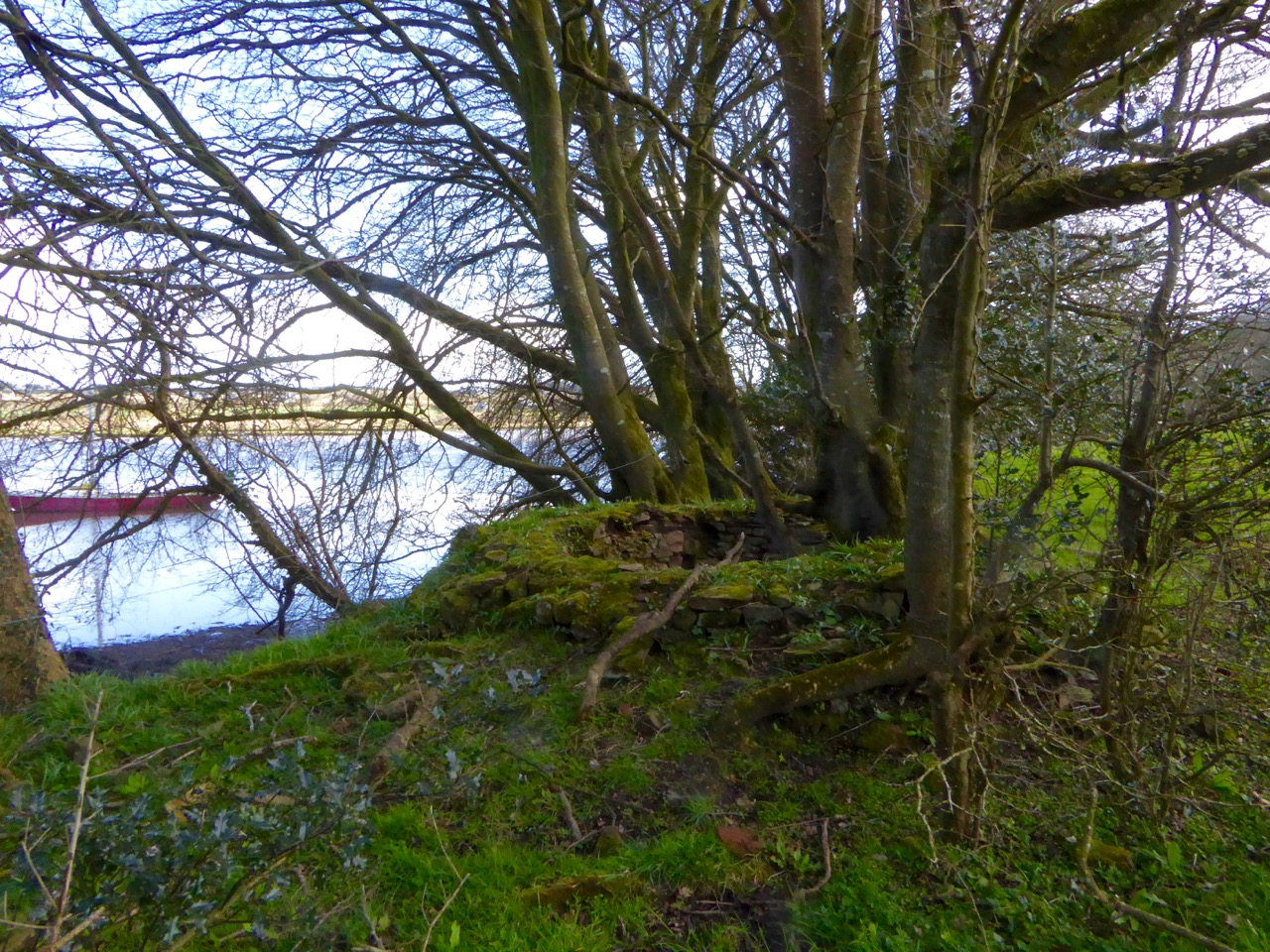
base of ruined tower belvedere New Court

Nothing remains but the stub of what was once a belvedere in the shape of a round tower on the edge of the River Ilen, on the old New Court demesne.

Echoes of these designed landscapes can be found here and there in West Cork, even where the big houses themselves have disappeared. Lately I have been on the hunt for belvederes and have found several intriguing examples. A belvedere (bel-beautiful, vedere-to see) was an edifice from which to enjoy a view. It could be as simple as a platform at a high point, or as complex as a multi-storey tower, but its most important attribute was its positioning to command a breathtaking vista.

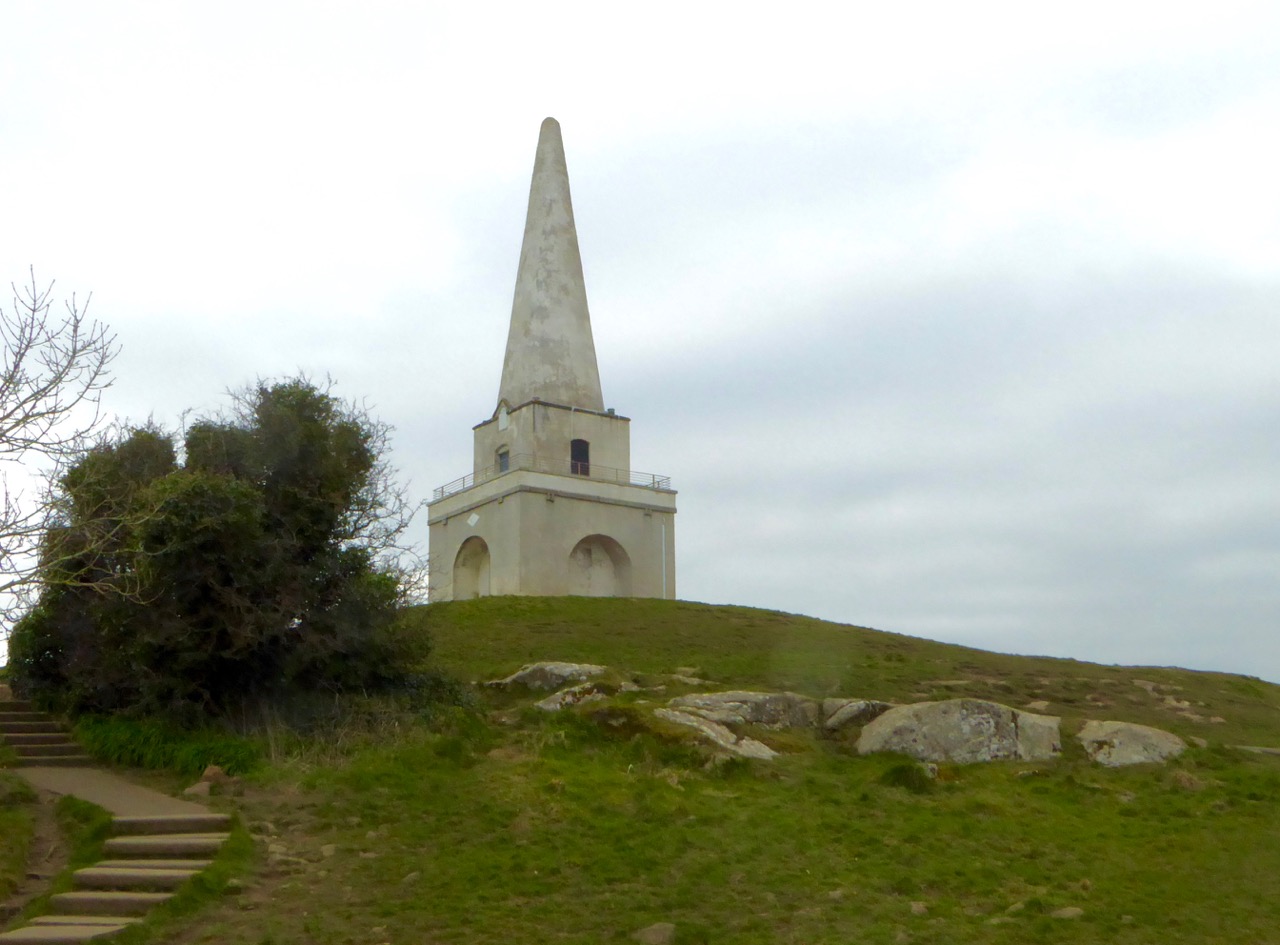
Killiney Hill belvedere

Killiney Hill, just south of Dublin

Perhaps the best known belvedere in Ireland is the one on top of Killiney Hill in Dublin. It was built in 1742 by the then-owner of the hill, John Mapas, to provide an opportunity to admire one of Ireland’s most iconic prospects. The room on the second floor had a little fireplace, windows, and a door to the exterior viewing deck, which was surrounded by wrought-iron railing. It’s no longer in use as a belvedere and many people think of it as some kind of memorial or folly.

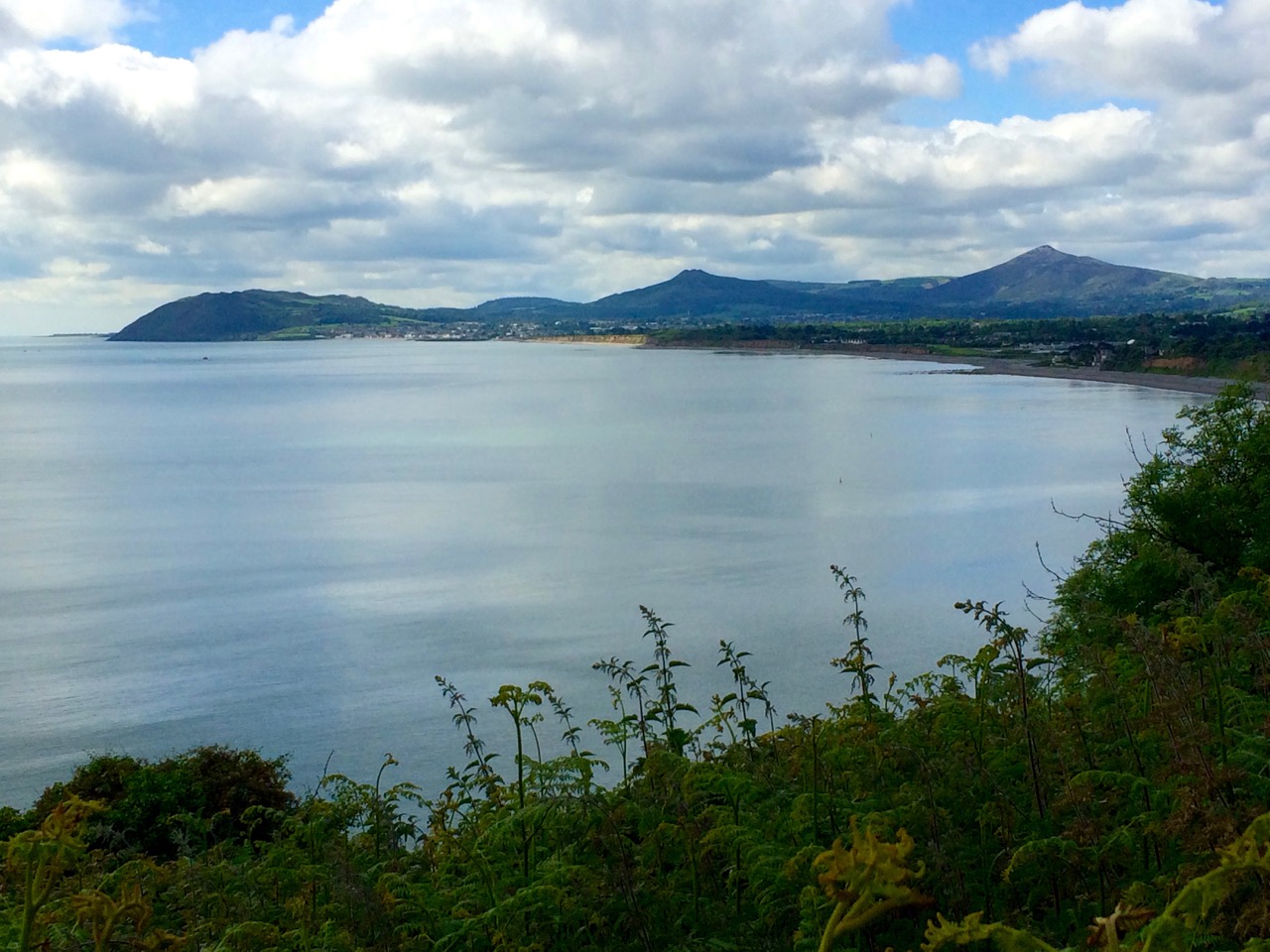
View from Killiney Hill

The view from Killiney Hill

In West Cork, the belvedere at Aughadown (known locally as the gazebo) is of the most simple kind, a viewing platform. It was associated with Aughadown House, a fortified mansion built by the Bechers that I wrote about in Trading Up In Tudor Times: Fortified Houses in West Cork.  

Belvedere, Aughadown

Peter Somerville-Large, in The Coast of West Cork, quoting Daniel Donovan*, says: Donovan described it as “a strong castellated mansion, entered by a drawbridge, surrounded by beautiful grounds and having a gazebo on one of the heights behind”. He continues: This gazebo was approached by a ramp along which the quality used to drive their carriages in order to enjoy the magnificent view out over Roaring Water Bay to the islands and the Fastnet in the distance. I found the ramp running above a field of winter wheat.

Aghadown Belvedere and tower house siting

The view from Becher’s ‘gazebo’ across to Roaringwater Bay

On each side of the Ilen River lie belvederes, in the form of towers. Imagine the ladies of the house and their guests, walking or being driven down to the water’s edge. Servants would have arrived earlier and the tea would be ready and a little fire laid against the breezes. They ascend the internal staircase to the second floor or perhaps to the roof and admire the views of the lazy Ilen River as it wends its way to the sea at Roaringwater Bay.

Creagh House Belvedere

The Creagh House belvedere

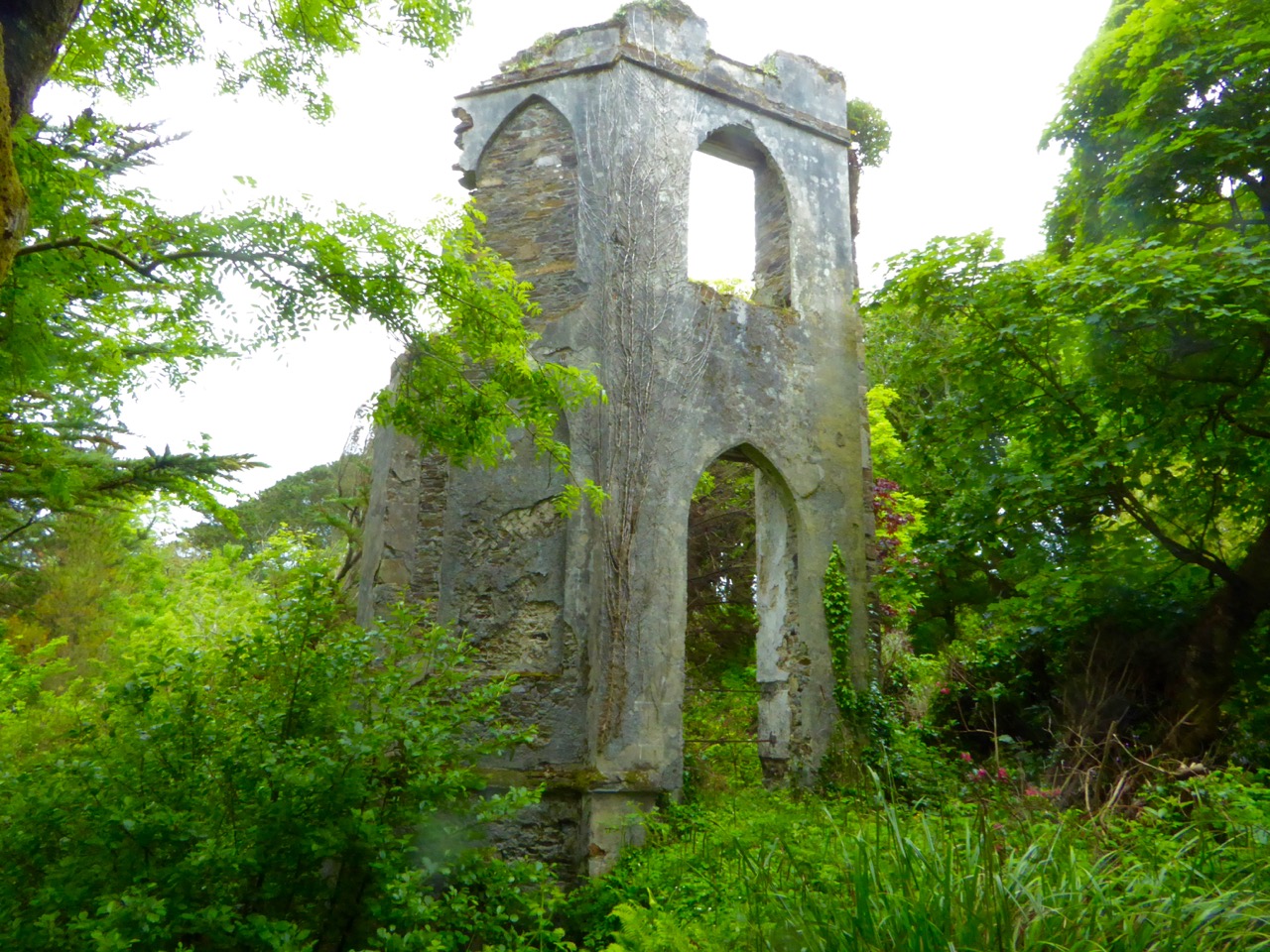
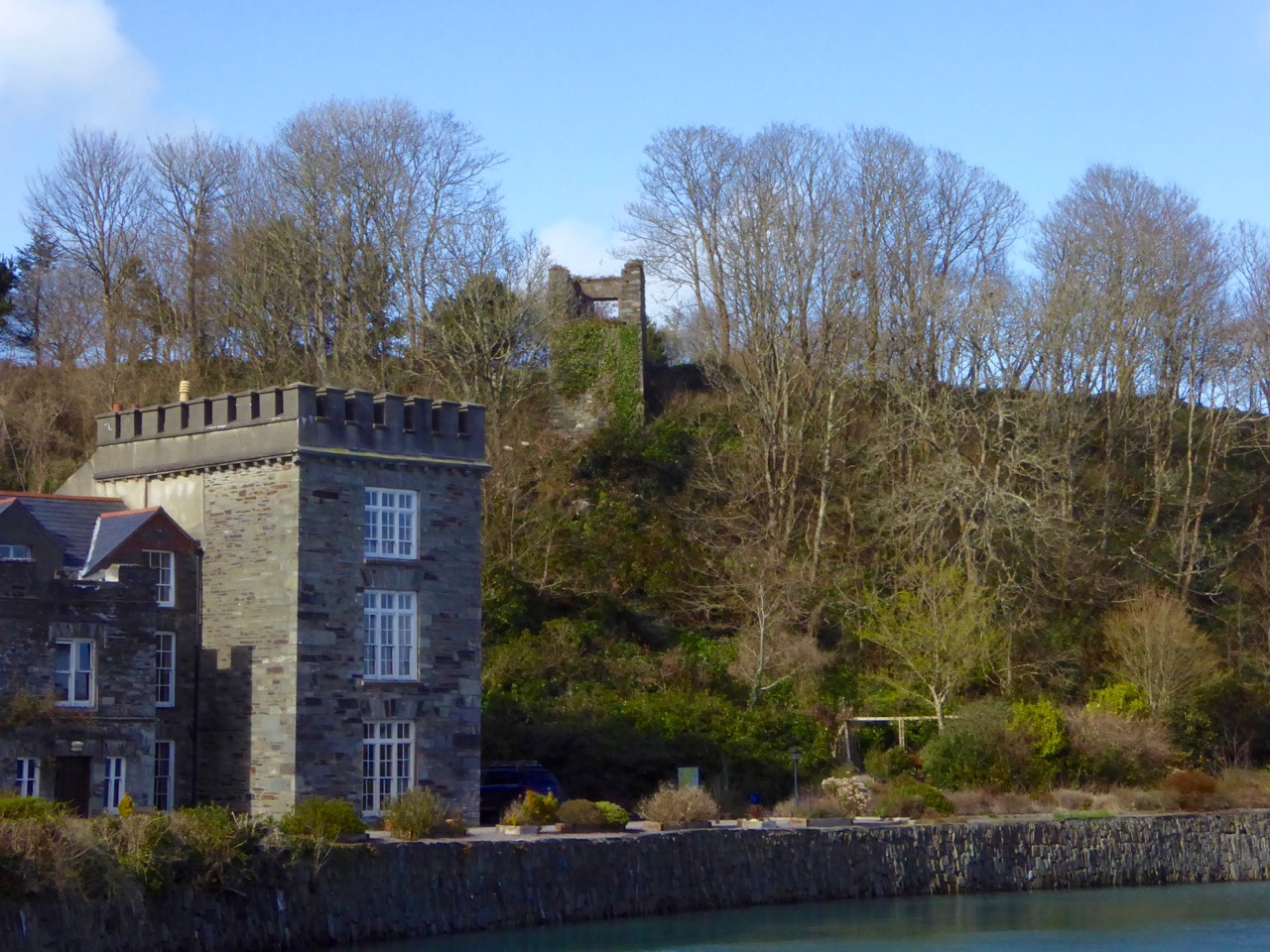
The belvedere at Creagh House exists now as a picturesque ruin. Octagonal in design, with pointed gothic windows and a small fireplace inside, it rises to three stories. Some sources describe it as the remains of a mill, and the artificial pond beside it as a mill pond, but it has all the hallmarks of a romantic garden structure.

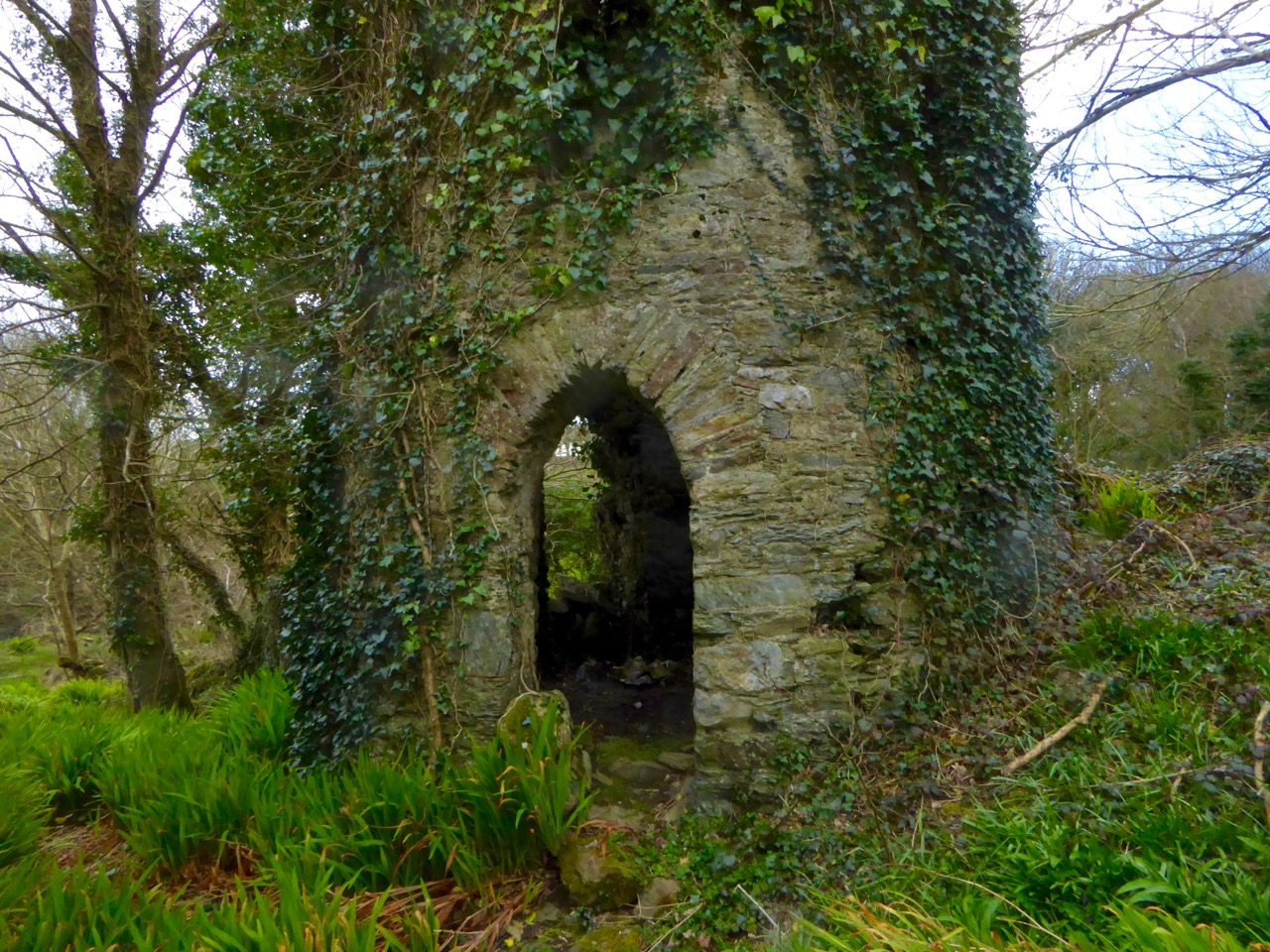
Across the river at New Court there were once three such ornamental towers. One is gone, the second is a mere stump, but the third still stands to its original height and offers lovely views of the river both to the east and the south.

Belvedere, New Court

One of the three original belvederes that once dotted the New Court Estate

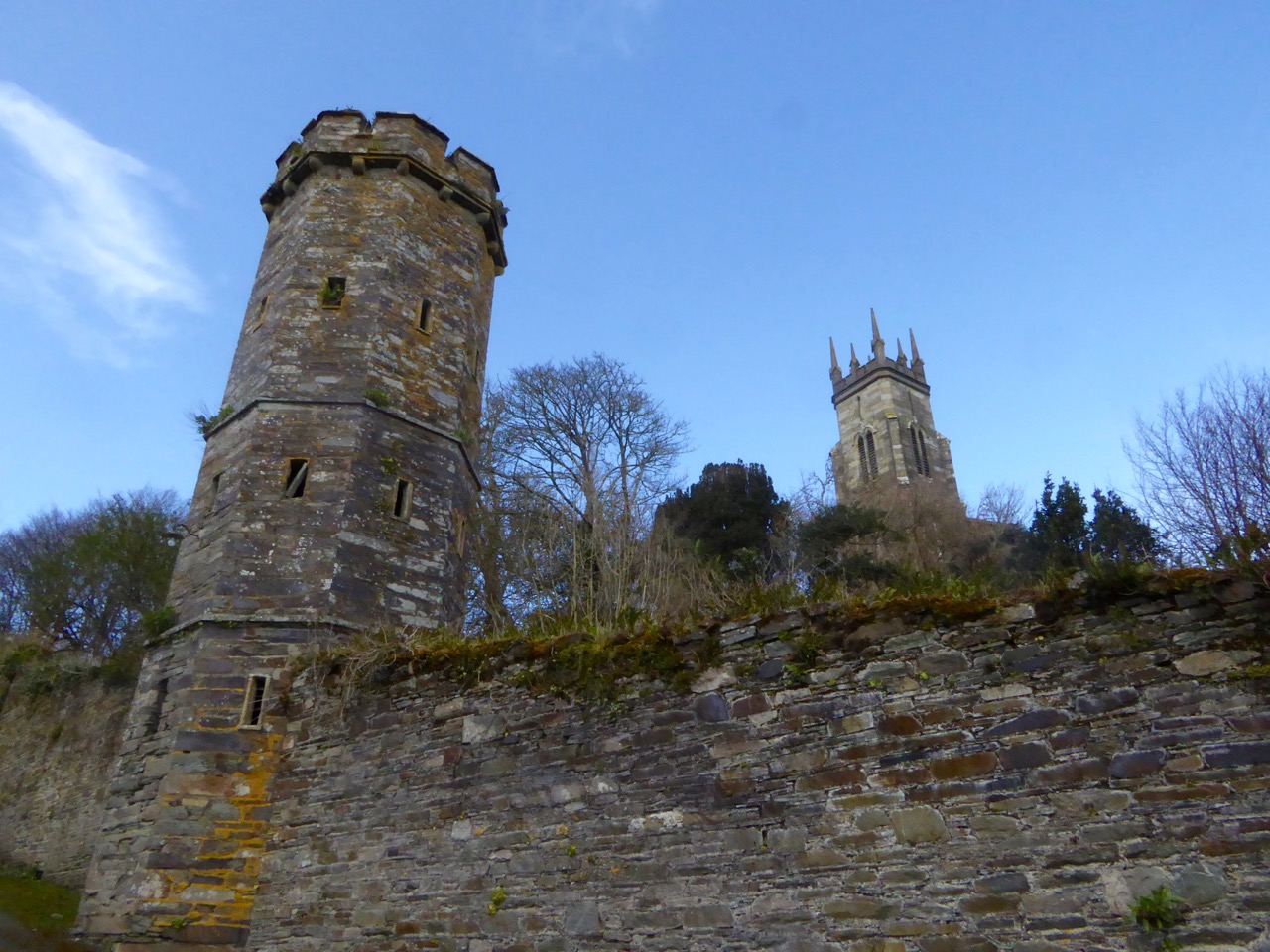
At Castletownshend the local gentry were enthusiastic builders of ‘pleasure architecture’. Castletownsend Castle boast two structures of interest. The first is in the walls, an octagonal tower that is made to look like a defensive feature but in fact is purely decorative. Since there is apparently no entrance, this one may have to count as a folly rather than a belvedere.
Castle Townsend Belvedere turret

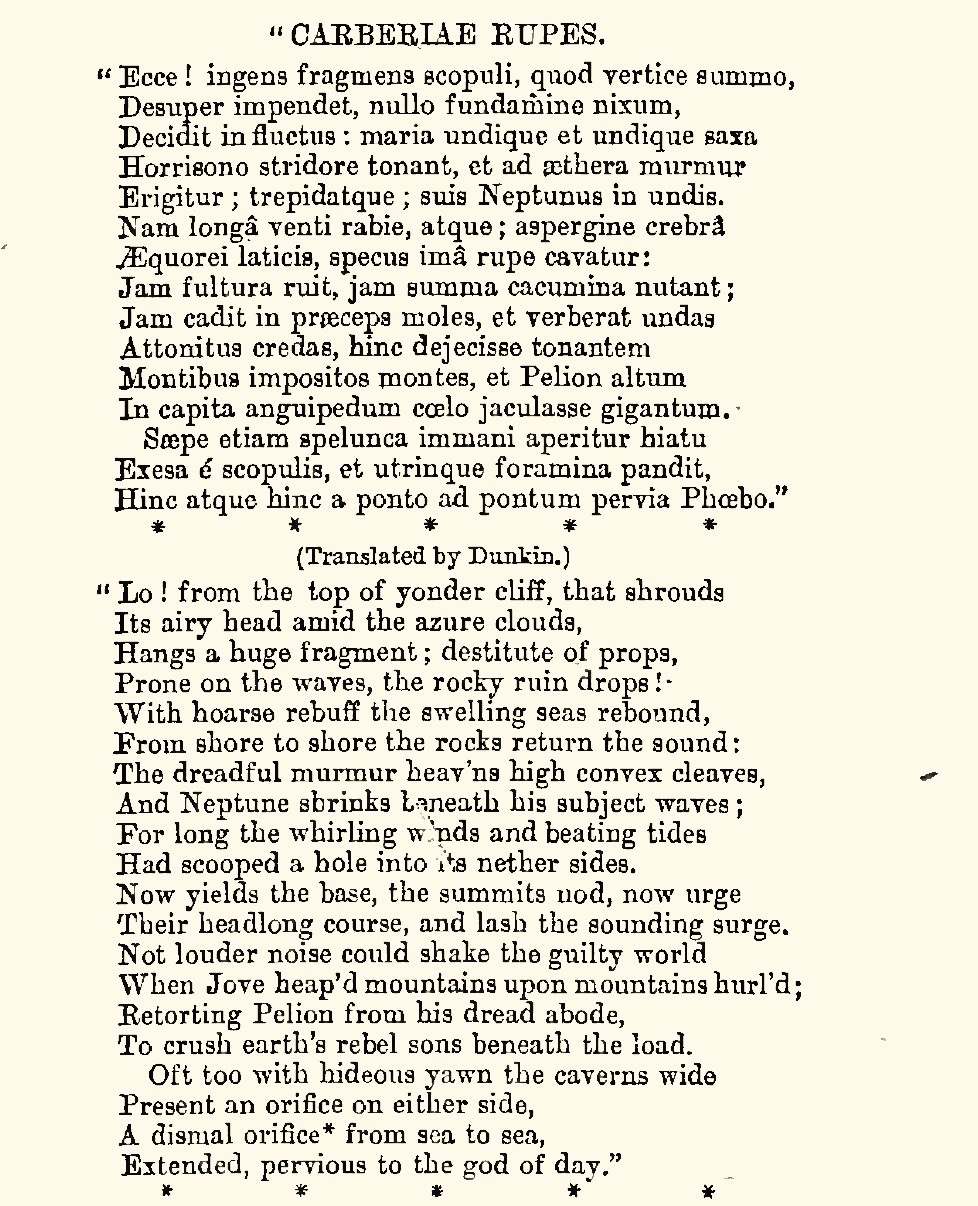
Behind the castle is the structure known as Swift’s Tower (see the very first photograph for an idea of its placement). Following the death of his beloved Vanessa in 1723, Dean Swift embarked on a long summer trip to the south west. it was in this tower, tradition has it, that he wrote the Latin poem Carberiae Rupes, which translates as The Crags of Carbery.

Swift's Tower 3

Once again we are indebted to Daniel Donovan’s Sketches in Carbery for an account of the poem and even a translation. Donovan did not have a high opinion of the poem (although he says that Dean Swift himself preferred it above other, better poems) and another critic referred to it as “a set of indifferent verses” describing a “bleak and deadly landscape”.

Carberiae Rupes

What do you think – his finest work?

Perhaps the Dean’s depressed state was to blame, or maybe he should have just stuck to prose. Or perhaps the servants hadn’t lit the fire and provided the tea – the tower certainly looks bleak enough now to bring on a fit of the dismals, in spite of the magnificent view.

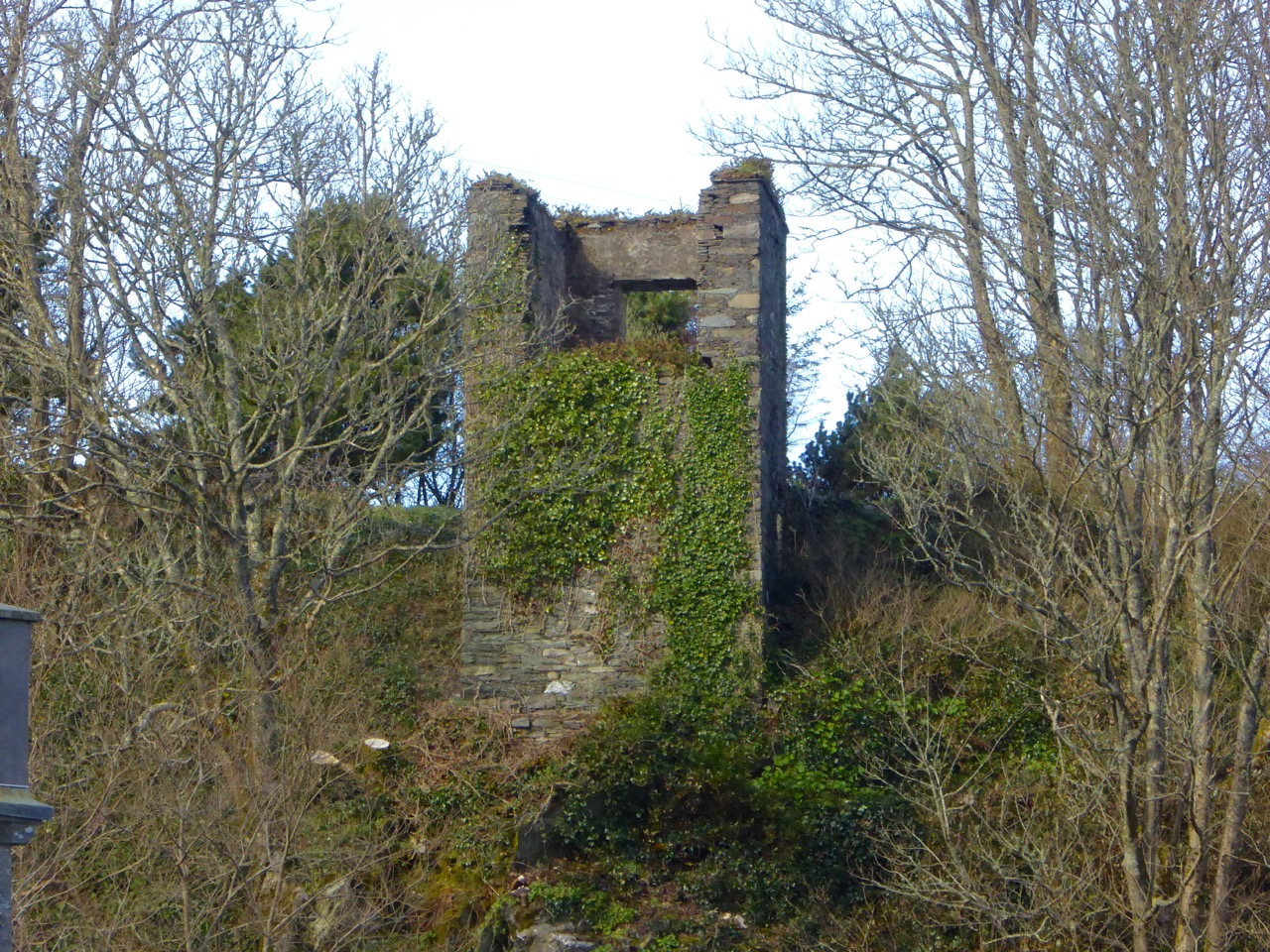
Swift's Tower, Belvedere

On Horse Island, just outside of Castlehaven Inlet, there is the base of a round tower that may also have been a belvedere. A visit there would have made a wonderful pleasure outing on a fine day, and the views would be stupendous.

Horse Island, Castlehaven, belvedere

You can just make out the remains of a round wall at the top left of Horse Island

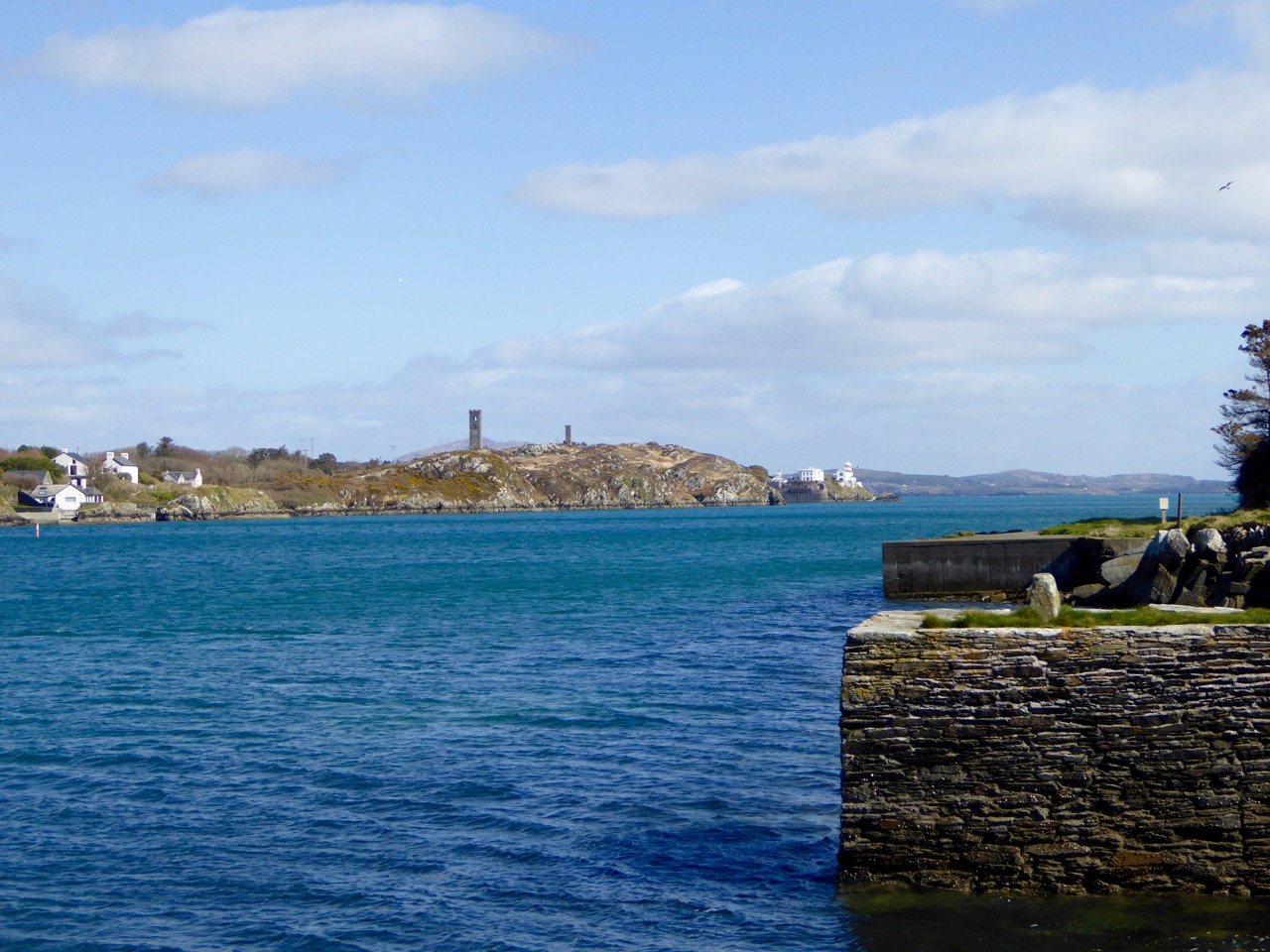
There is a whole set of monuments in West Cork that are labelled as Belvederes in the National Monuments Service Inventory, but as Signal Towers in the records maintained by the National Inventory of Architectural Heritage.  These contradictory interpretations are fascinating and these towers are worth a post on their own. I will save that for another day, but to show you what I mean, take a look at the two towers on Rock Island, near Crookhaven. Belvederes or Signal Towers – what do you think? (If you’re not sure what signal towers are, take a look at this post from Amanda Clarke of Sheep’s Head Places.)

Crookhaven belvederes

Looking across to Rock Island from Crookhaven. Experts differ about the functions of the two towers

But what about nowadays? Do we still worship the view in West Cork? And do we still build belvederes from which to admire that view? The answer to both those questions can be found at Sailor’s Hill, just west of Schull!

Sailor's Hill 1

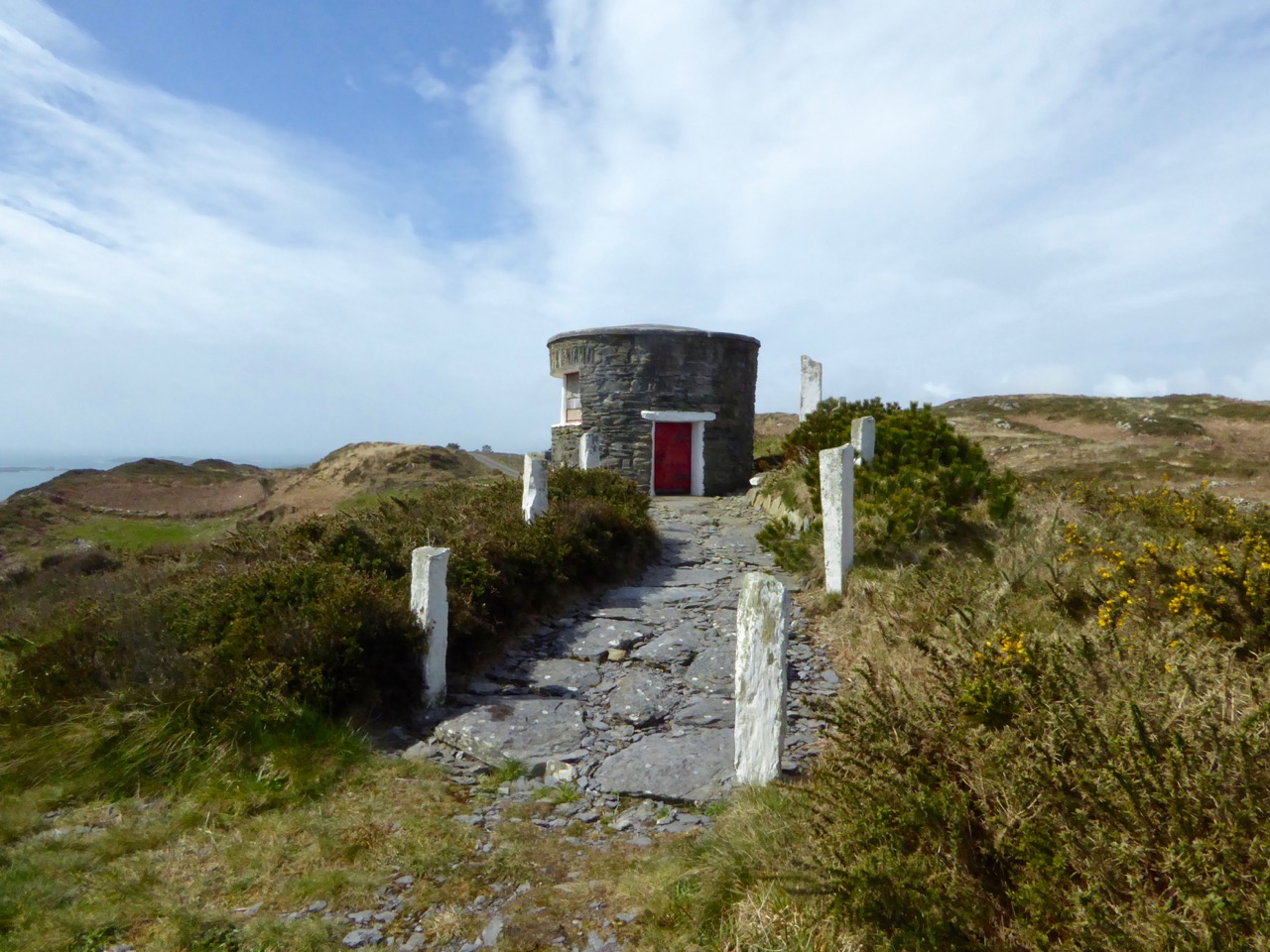
Sailor’s Hill Belvedere

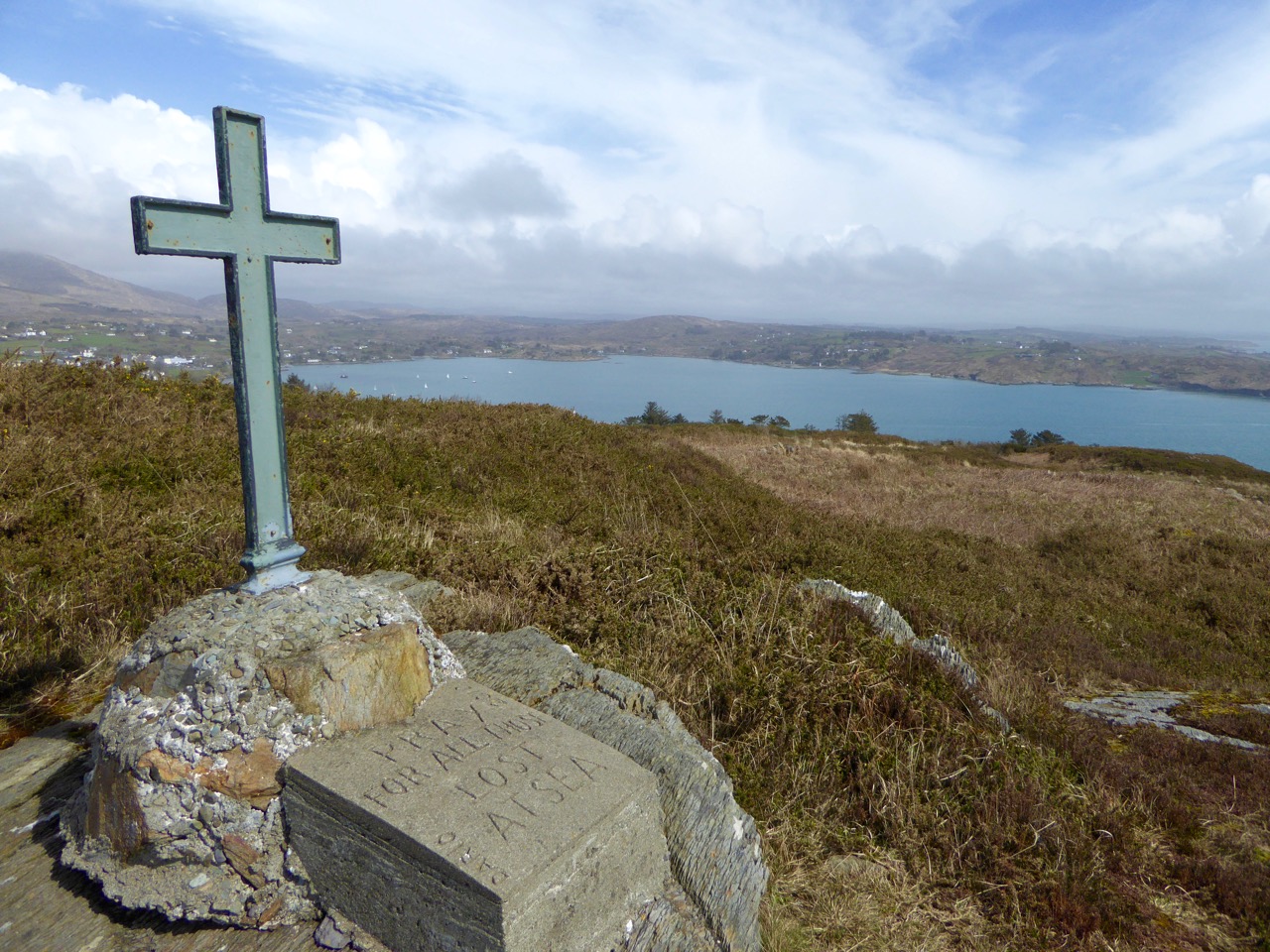
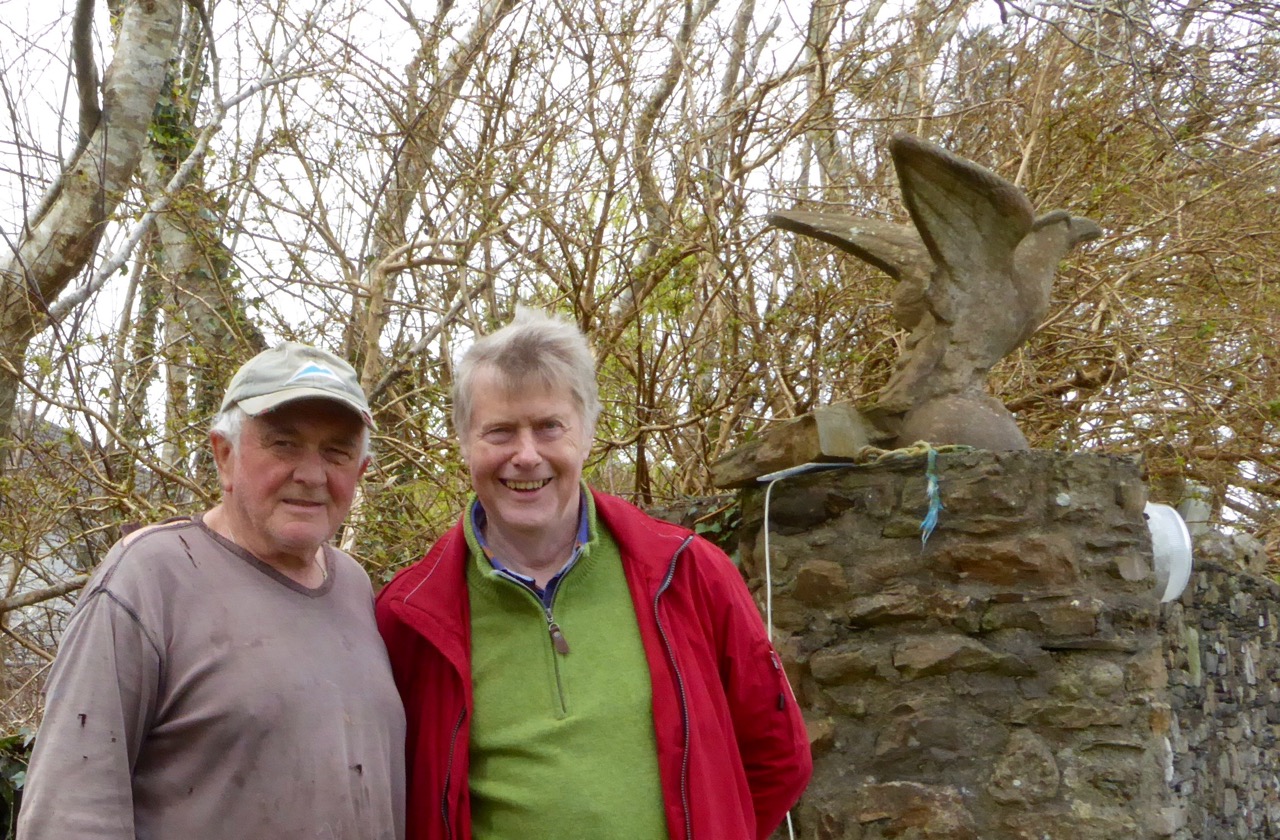
Sailor’s Hill is a labour of love by Connie Griffin who has worked on the sea and lived in this area all his life. It’s partly a memorial to those lost at sea and partly a place of contemplation to simply sit and soak up the panoramic views that stretch gloriously before you in ever direction.

Sailor's Hill Memorial 2

Schull Harbour in the background

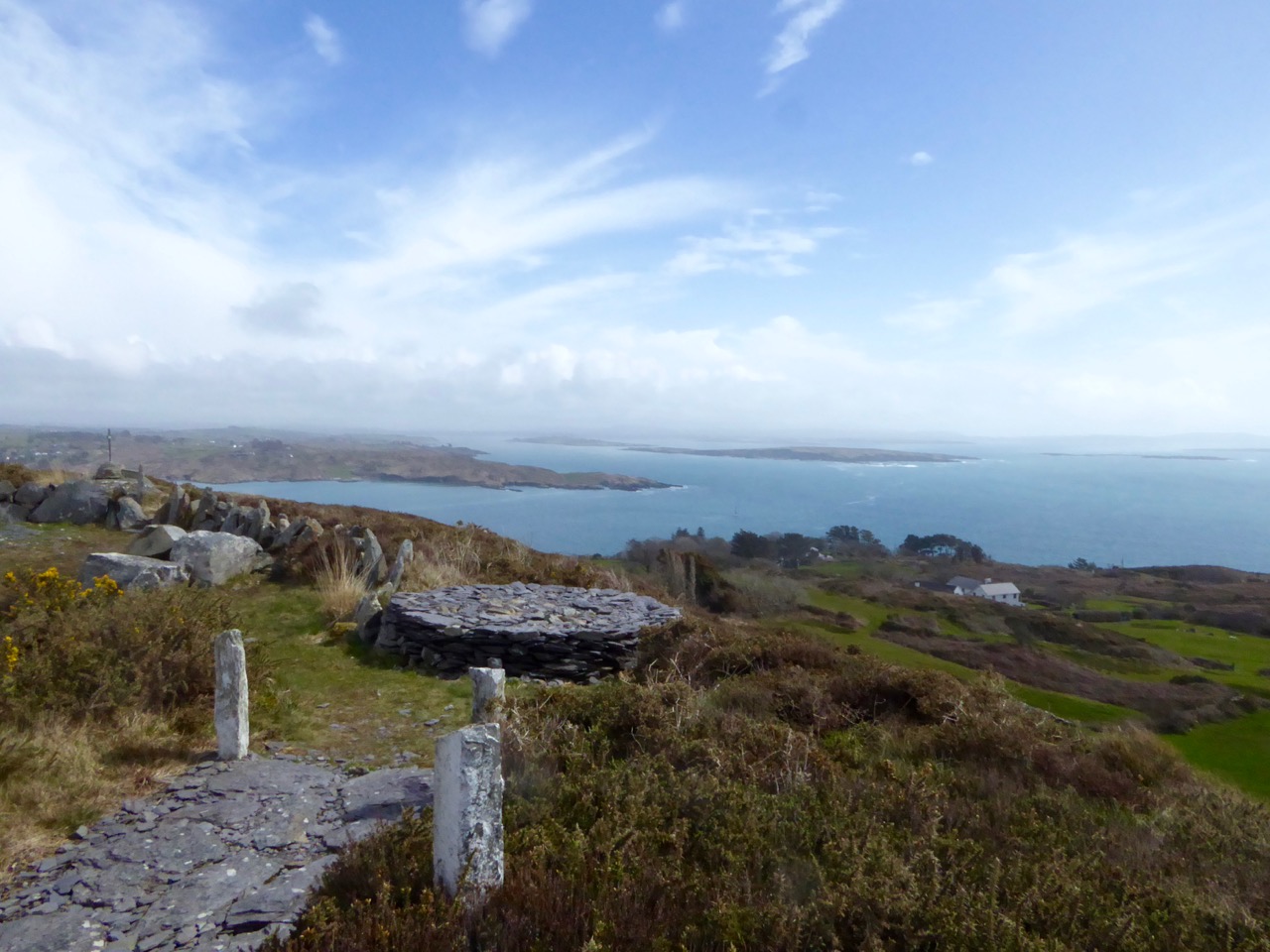
Sadly now a little overgrown and vandalised, it is still an incredible experience to arrive at Connie’s little round tower and see vast stretches of the Cork coast to the south, while the mountains of the Beara and Kerry rise behind you.

Sailor's Hill Views

It’s a testament to the power that landscape and seascape has over us: the power to move us and uplift us; the power to inspire us to try to capture it in paint and in words. We can’t really, but, like Connie, we keep trying.

Connie Griffin and Robert

Connie Griffin and Robert

*Somerville-Large attributes this information to Sketches in Carbery by Daniel Donovan. However, I have not been able to find the quote and wonder if it’s from another book.

Words on Roaring Water

from Brow Head

…Anyone who has glanced even cursorily at the map of Ireland, will have noticed how the south-west corner of it has suffered from being the furthest outpost of European resistance to the Atlantic. Winter after winter the fight between sea and rock has raged on, and now, after all these centuries of warfare, the ragged fringe of points and headlands, with long, winding inlets between them, look as though some hungry monster’s sharp teeth had torn the soft, green land away, gnawing it out from between the uncompromising lines of rock that stand firm, indigestible and undefeated…

Naboth’s Vineyard, Somerville and Ross, Spencer Blackett, 1891

hedge and wall

So constantly entranced am I by the character of this remote corner in which we have chosen to settle (in my own experience – admittedly somewhat geographically limited – it is the most beautiful landscape in the world) that I am always excited when I discover that others have shared the same feelings. Consequently I am forever looking out for references to the coastline and country around Roaringwater Bay – particularly descriptive writing – in the wealth of books on West Cork that are harboured by local bookshops, libraries, and our own shelves here at Nead an Iolair: we are most fortunate that some of these books, especially the now out-of-print ones, came with the house! I have sifted through a few of the words: essays, extracts from novels, historical treatise and guidebooks that support my own feelings about the place. All are taken from writers I admire and thoroughly recommend. I present them here for you to take in, together with some hopefully seductive illustrations from the locality, in support of my thesis that there is no better place to be alive.

rosbrin cove days

…I believe that in West Cork water runs uphill. There is a small lake on the very summit of Mount Gabriel, nearly fourteen hundred steep feet above the Atlantic level. Small it is, but so deep that when, once upon a time, a heifer was lost in it, she came out in Schull harbour, on her way to America! (Or that is what the people tell you.)…

 ‘Happy Days!’ – Essays of Sorts, Somerville and Ross, Longmans, green and Co, 1946

stone beach

…There was a line of tables up the middle of the pier, each with its paraffin lamp smoking and flaring in the partial shelter of a fish-box, and each with its wild, Rembrandtish group of women splitting the innumerable mackerel, and rubbing lavish fistfuls of coarse gray salt into each, before it was flung to the men to be packed into barrels. The lamps shone fantastically on the double row of intent faces, on the quickly moving arms of the women, crimsoned to the elbows, on the tables, varnished with the same colour, and on the cold silvery heaps of fish…

Naboth’s Vineyard, Somerville and Ross, Spencer Blackett, 1891

cappacolour

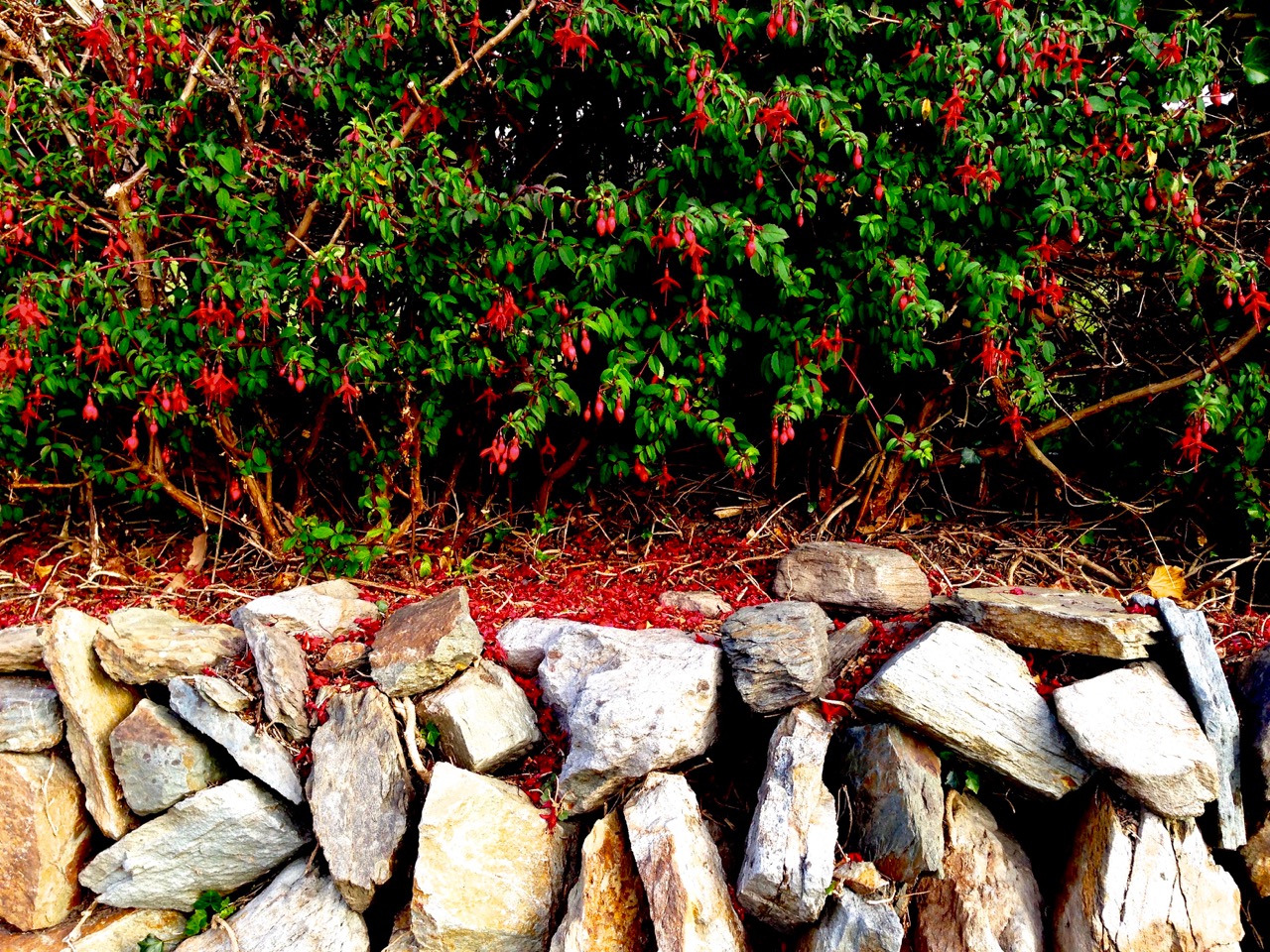
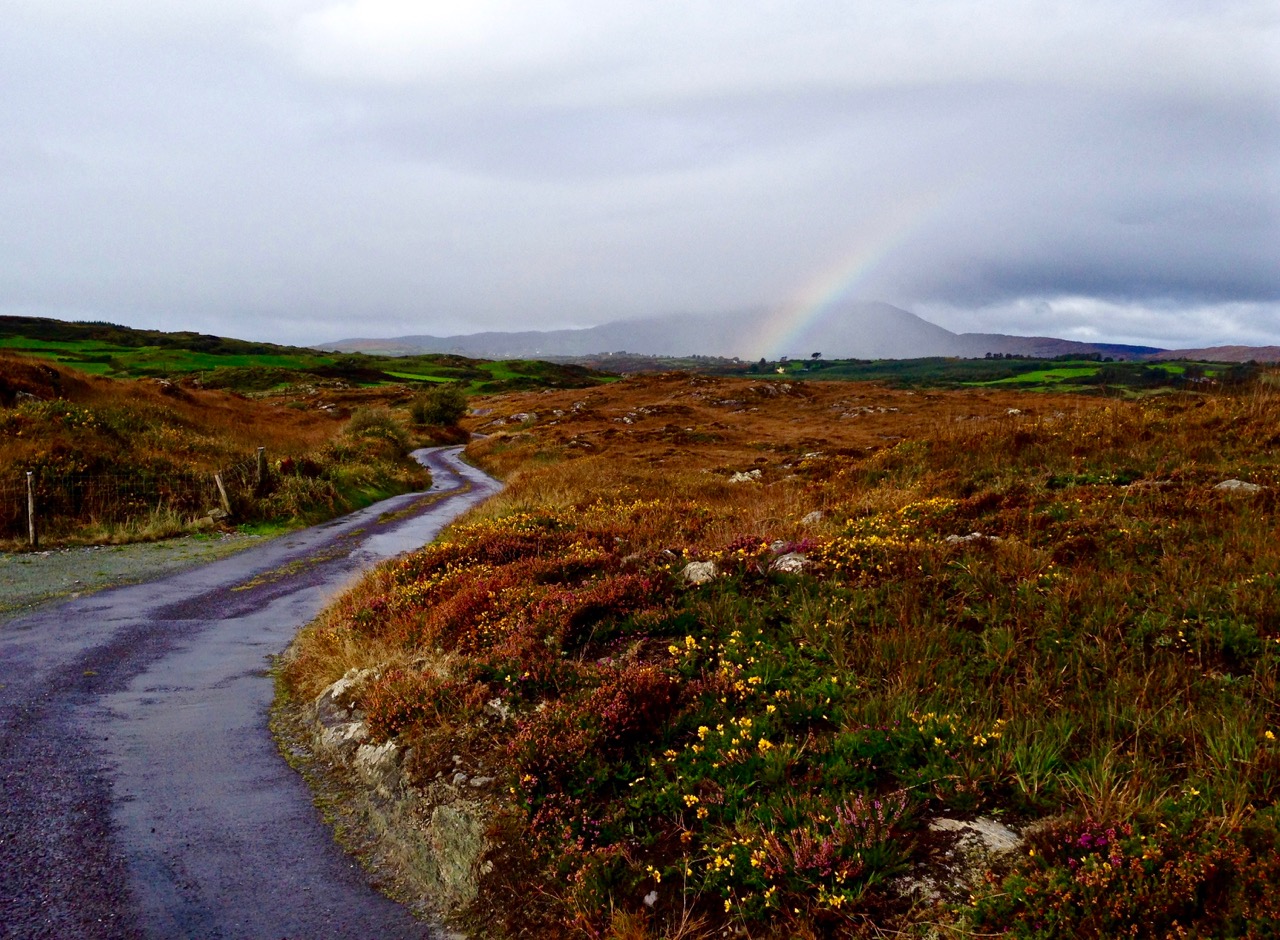
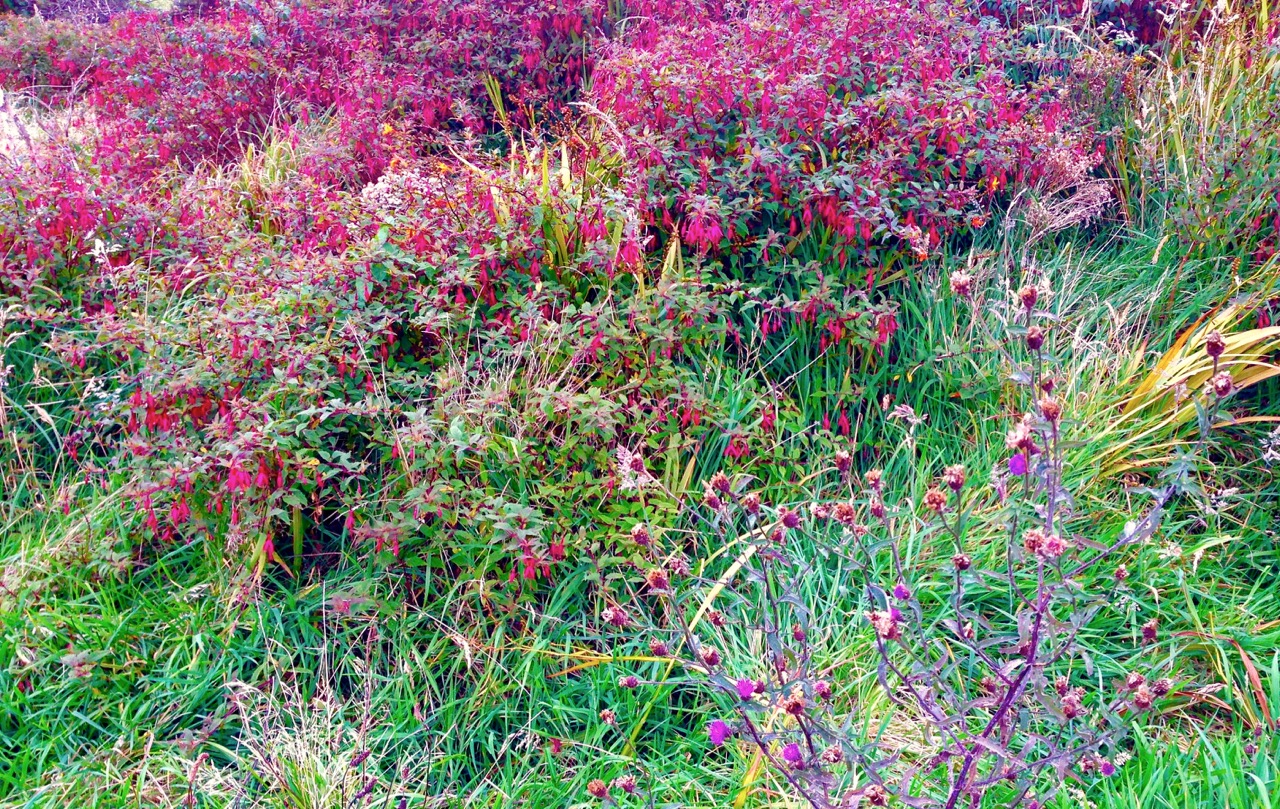
…Think of a wandering road in – let me say West Cork… The way is rough and stony, and (most probably) muddy, but it can claim compensating charms, even though it can hardly fulfil any of the functions proper to respectable roads. And in its favour I would claim the broken varying lines of the hills against the sky. The untidy fences, with their flaming furze bushes, or crimson fuchsia hedges; their throngs of vagabond wild flowers, that can challenge the smug respectability of a well-kept garden. And the inevitable creatures, the donkeys, the pigs, the coupled goats, the geese, that regard the highroad as their lounge and playground. No doubt they exasperate the motorist in a hurry (as are all motorists) but for more tranquil wayfarers they can offer entertainment, almost charm…

‘Happy Days!’ – Essays of Sorts, Somerville and Ross, Longmans, green and Co, 1946

fuschia colour 2(Ireland) …is a land of surprises. She has the gift of unexpectedness, of uncertainty: her people, like her looks, and her weather, can be sometimes charming, often exasperating, but seldom commonplace. Is there another country, reasonably civilised, in which, in the course of a casual idle stroll, records of pre-history can be met with in any field, unconsidered, or found (as I have known) an immense cup-marked stone, built into the wall of a cow-house, ignored by the descendants of those who were once its worshippers? And yet, in characteristic contrariety – as is our way in Eire – in the field next to that cow-house, you can see that the plough has turned aside from its rightful course in respect for a little old deformity of a thorn-tree, which has asserted, for possibly a thousand years, its right to be reverenced and feared…

‘Happy Days!’ – Essays of Sorts, Somerville and Ross, Longmans, green and Co, 1946

sun rays

…In the mirror that memory will sometimes hold for us, I can see Rahyne Glen at four o’clock on a silver autumn morning before the sun has reached it. Opposite, just below the rim of the steep western side of the glen, there is one of the memorials of an older race and its religion. This is a broad slab of pale stone, leaning sideways against the hill, having, somehow slipped off the stones on which it had been supported. The sunlight falls full on it; it catches the eye and holds it. It is a dolmen, and the pale slab was its cap-stone. It marks the grave of a chief. He might have been content with his resting-place, had beauty of scene appealed to him (which seems improbable). Whether contented or no, he has lain there (if the archaeologists may be believed) undisturbed, through all the long centuries. If he were to look out now on those familiar hills he would see no change. His hills have defied civilization. All would look as it might have looked on any fair September morning during past thousands of years. And, I suppose, the pink ling, and the purple heather and the gold of the low-growing autumn furze, would then have spread the same carpet of colour over the hills… The wild stream comes storming through the thorn-bushes of the glen as fiercely as ever it did when the Chieftain and his warriors washed their spears in it… Beyond the glen the country rises, in long swathes of dim green, and purple, and misty blue, to a curving line of hills, and farther and higher still – for the viewpoint is a high one – a narrow flashing line tells of the silver plain below, which is the Western Ocean…

‘Happy Days!’ – Essays of Sorts, Somerville and Ross, Longmans, green and Co, 1946

roaring water

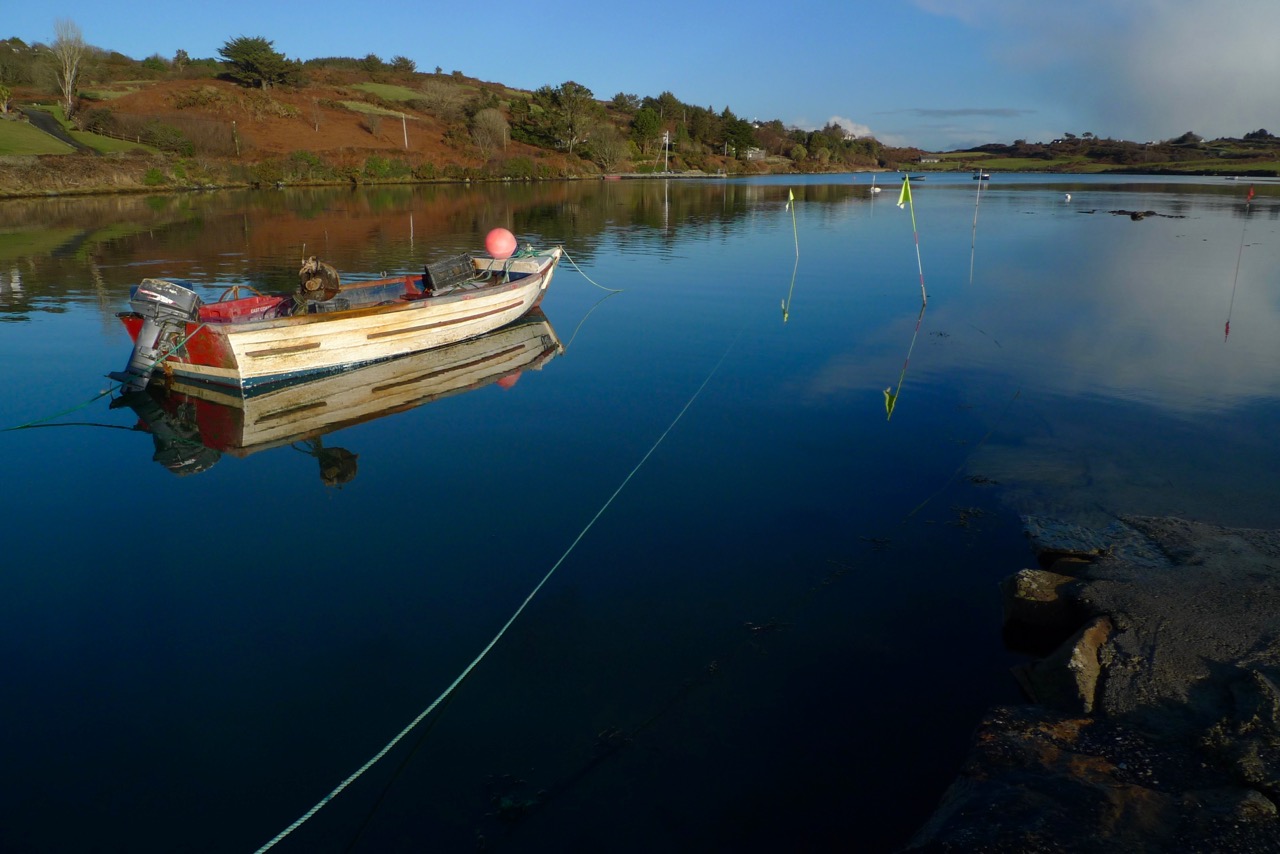
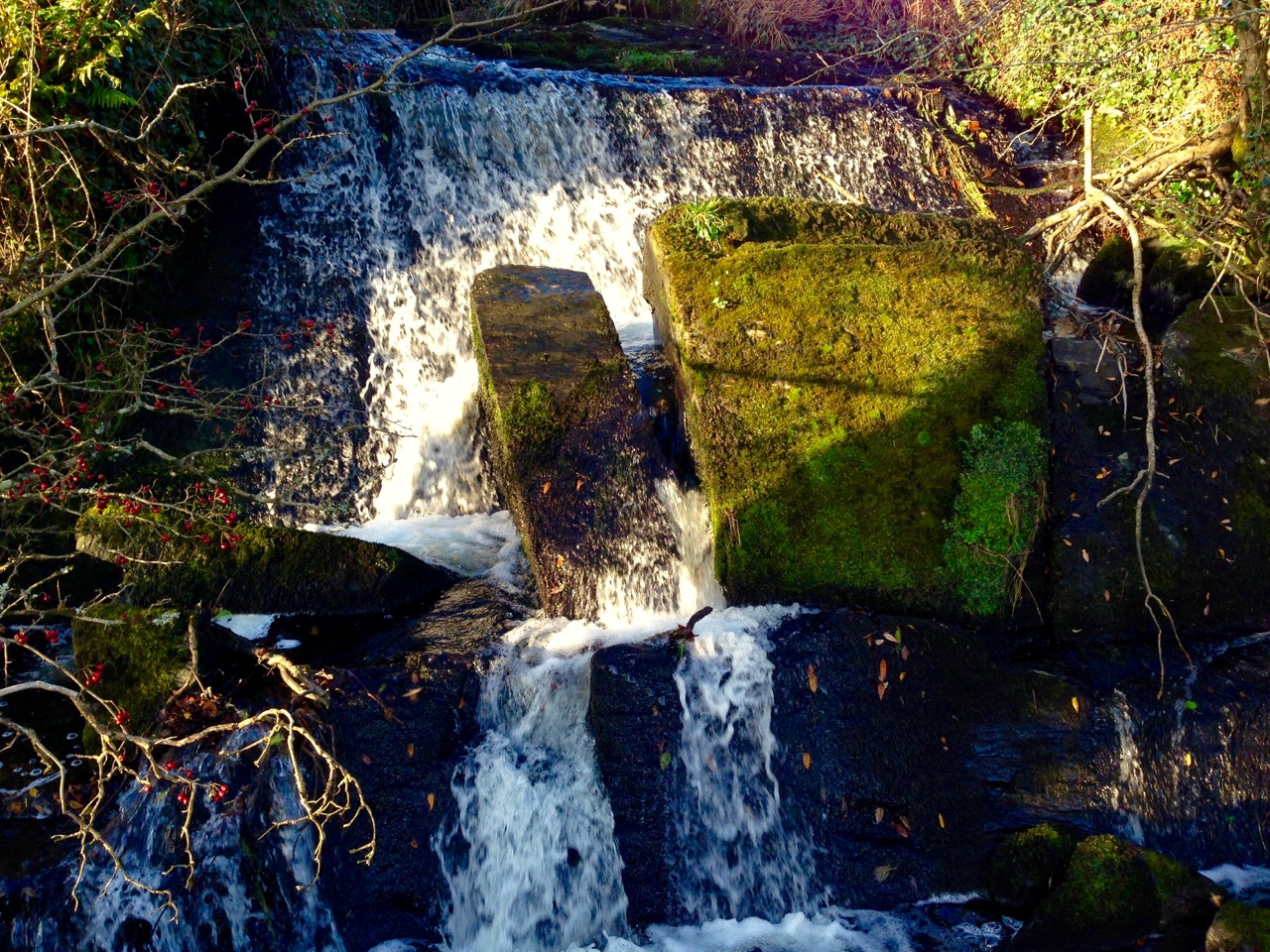
…The indented contours of Raring Water Bay enclose a maze of minute inlets and islands. The name derives from a stream which flows down the side of Mount Kidd amidst a landscape of bracken and boulders. The torrent roars in the narrow gaps and gullies as it rushes towards the sea. The little inlets penetrate the land like miniature fjords and create a sense of safe haven from dangerous seas. Their piers, long abandoned except for the occasional fisherman’s or tourist’s boat, are overgrown and tumbled-down romantic ruins, quiet spots for sighting a lone heron at low tide, grey against grey water. In the narrow defile where the roaring water debouches into the bay nature has done much to reclaim the territory usurped by human purpose. Perhaps, like the closing of a wound, this former embarcation point, which saw many thousands flee a country unable to support them, is being bound in ivy and decorated with wild fuchsia to heal the scar…

West of West – An Artist’s Encounter with West Cork – Brian Lalor, Brandon Book Publishers, 1990

gabriel side

…The islands of the West Cork coast are rather grandly referred to as Carbery’s Hundred Islands, but only Clear Island and Sherkin now sustain a viable population – though, like the other islands off the west coast, there is a steady draining of young people to the cities on the mainland for education and employment. Horse Island off Schull is evocative of the vanished communities of these islands. Silhouetted against the skyline, this piece of low-lying land appears like an old-fashioned, gap-toothed saw; a dark bulk of rock with triangular projections – the gable ends of a row of roofless cottages – biting into the clouds…

West of West – An Artist’s Encounter with West Cork – Brian Lalor, Brandon Book Publishers, 1990

kilcoe days

…Three or more centuries ago, before the landscape of West Cork became bound by a web of roads and fences, its contours would have been best understood when seen from above, from the heights of Mount Kidd or Mount Gabriel. Parallel ribs of rocks and hills, dividing up the pasture land, extended from the base of the mountains to the coast, where long fingers of rocky promontories projected out into the sea. There was a natural order to everything…

West of West – An Artist’s Encounter with West Cork – Brian Lalor, Brandon Book Publishers, 1990

rosbrin shadows

… Beyond Whitehall I rode out to the point at Cunamore where the road ended at a small pier which was the nearest point to Hare Island, also known as Inishdricoll. There was no regular ferry across, but the post boat went over several days a week, and the schoolmistress crossed daily to teach the dozen remaining children. It is a much less dramatic island than Cape or Sherkin, a low-lying slab of land with golden beaches. One road leads to a little village nicknamed Paris – probably a derivation of ‘pallace’ – once the centre of a fleet of lobster boats. Now I listened to an old man lamenting the terrible decline.

   “John has gone and Dennis has died, and we’ll die too, and then the foreigners can have it all.” Already half a dozen of the houses had been bought up by strangers.

   One by one the smaller islands became deserted. It is a long time since they were densely populated, but until quite recently they supported a certain number of families. Only a few years ago I visited Horse Island, just opposite Ballydehob. The last people there, an elderly couple, were living all alone. It was summer, and the old man was sitting in a chair outside his house, his feet in a basin of water. His wife, behind him, fed hens. Next year they were gone. The house, still intact and comfortable, stood empty, the linoleum in place, last year’s calendar on the wall. Down by the pier a plough had been thrown into the water where it looked like a gesture of despair…

The Coast of West Cork – Peter Somerville-Large, Victor Gollancz Ltd, 1974

rosbrin cool

…West of Ballydehob the laneways ran into each other like the veins of a leaf. Many of them were untapped; they seemed empty, with little life except for cattle or a white horse browsing in watery fields beside them. Most seemed to end up at the sea, and each little turn had its own alignment to the bay. One looked across the islands with Kilcoe standing squat and menacing on its headland; the next inlet had a view across to Horse Island; another lane climbed to a hill to where one could see the sweep from Baltimore Beacon and the Gascanane to the shattered tower of Rosbrin castle…

The Coast of West Cork – Peter Somerville-Large, Victor Gollancz Ltd, 1974

Afternoon in Ballydehob 04.2014

…May Day in Schull was the day for ‘bringing in the green’. But the ancient custom is dying out. Only a few branches of green leaves were tied on doors, and a twig of fuchsia dangled from the handle of a bike. “Old pishoges,” an old man muttered as he carefully arranged sycamore round a drainpipe…

The Coast of West Cork – Peter Somerville-Large, Victor Gollancz Ltd, 1974

altar

…Colla harbour and pier is the nearest point to embark for Long Island. Horse Island, Castle Island and Long Island lie in a line just outside Schull harbour. A tradition, quoted by Smith, claims that they were once all one island. “In the latter end of March, AD 830, Hugh Domdighe being monarch of Ireland, there happened . . . terrible shocks of thunder and lightning . . . at the same time the sea broke through the banks in a most violent manner. The island, then called Innisfadda, on the west coast of this country was forced asunder and divided into three parts”…

The Coast of West Cork – Peter Somerville-Large, Victor Gollancz Ltd, 1974

december sun over rossbrin

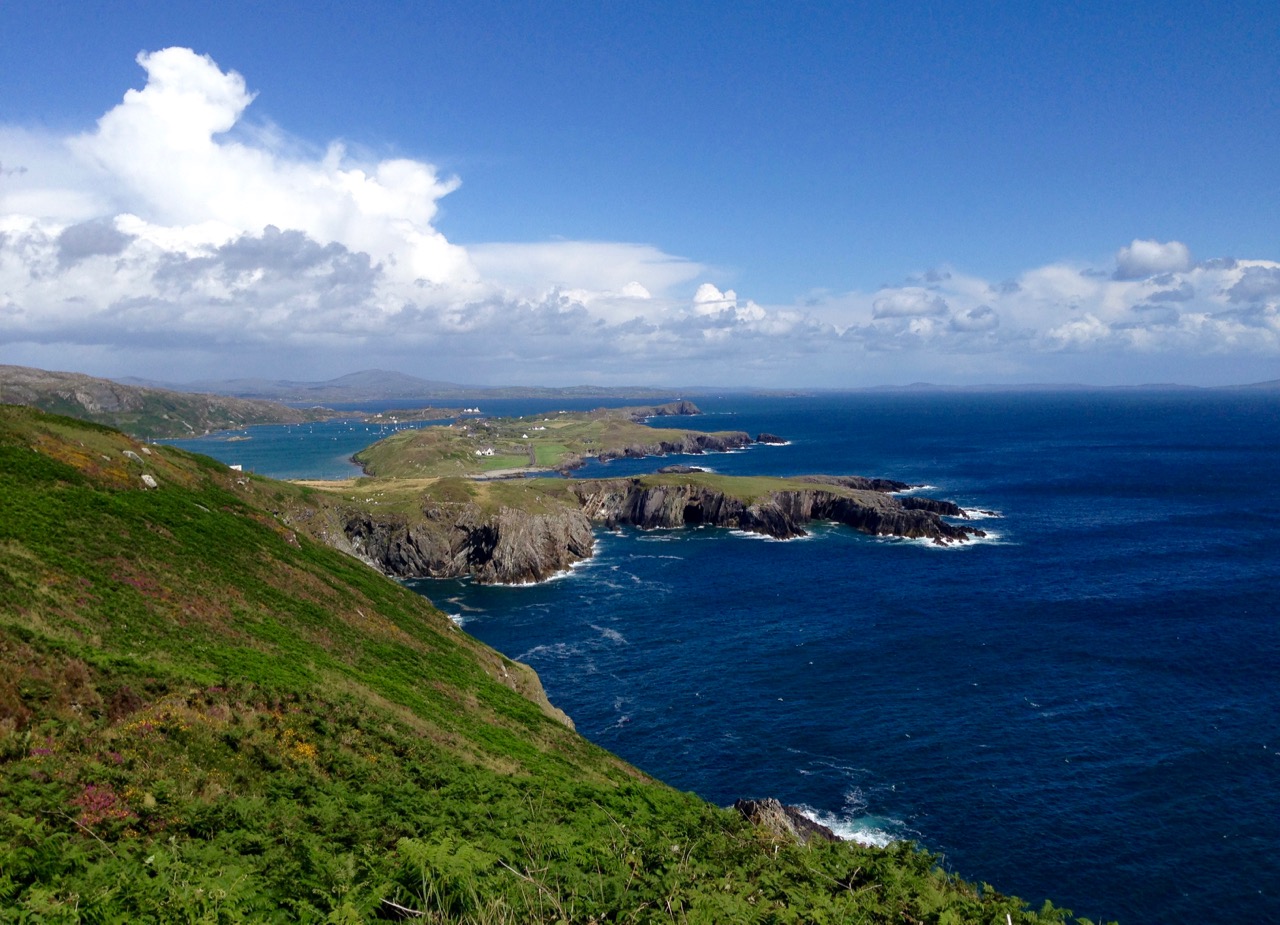
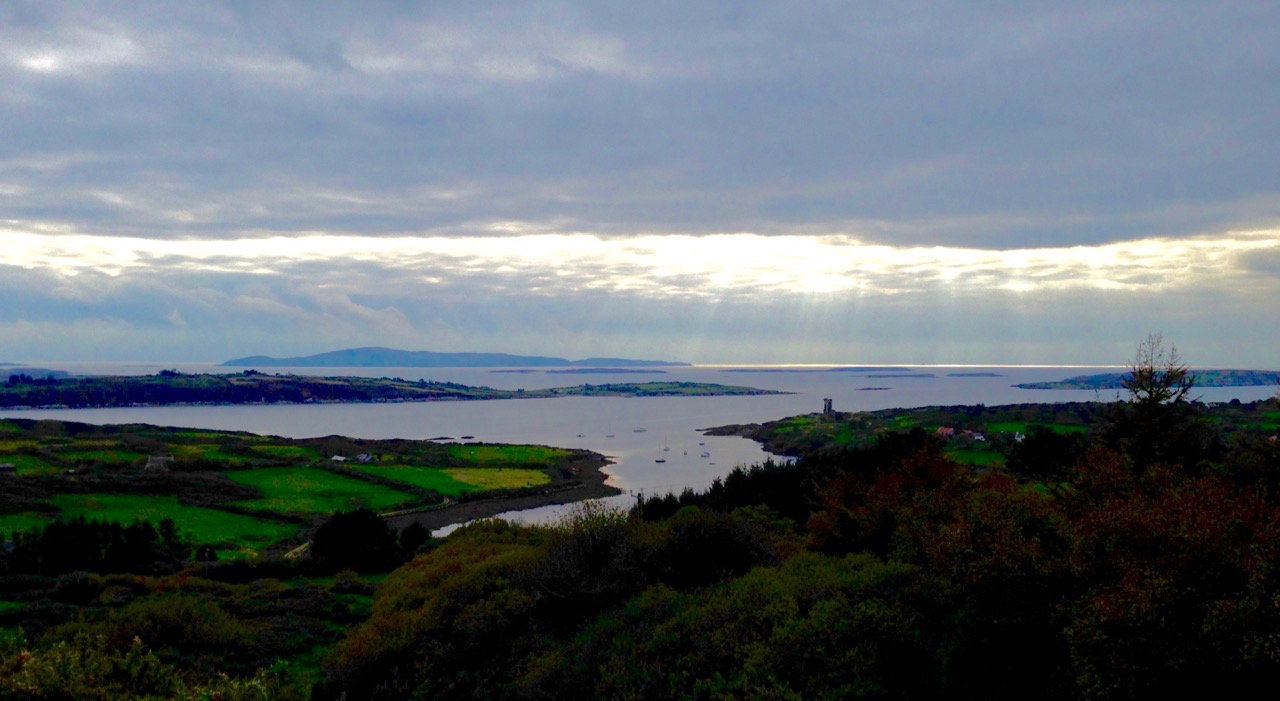
…From the vicinity off Dunanore, we obtain a view of the coast and the surrounding open, which is one of surpassing beauty, when the summer sun is setting in the far west. Towards the south, as far as the eye can reach, the broad expanse of the Atlantic is stretched before our gaze, the distant horizon dotted here and there by some white sail, or the dark hull of one of those leviathan steamers which ply their busy trades between the Old World and the New. Cape Clear is the first land which greets the American tourist or the returning emigrant on his approach to the old country, and the last cherished spot of his ‘own dear isle’ which bids adieu to the Irish peasant, when he parts, perhaps for ever, from his native country…

Sketches in Carbery, County Cork: its antiquities, history, legends, and topography – Daniel Donovan, McGlashan & Gill, 1876

down below