William Trevor’s Skibbereen – “The Back of Beyond”

Yellow furniture vans – Nat Ross of Cork – carted your possessions off, through Cork itself, westward through the town that people call “Clonakilty God Help Us”, to Skibbereen, the back of beyond . . .

William Trevor, one of Ireland’s most celebrated writers of short stories and novels, grew up in Skibbereen. His father worked for the Bank of Ireland, and the family was frequently moved to pastures new, but Trevor’s memories of our own West Cork town are amongst his earliest, encompassing his first schooldays and all the traumas of that ‘learning experience’.

Where and when did my writing life begin? I suppose it was in a small schoolroom in Skibbereen when, as an alternative to parsing and analysis, I was occasionally required to compose six sentences on such random subjects as A Wet Afternoon or A Day in the Life of a Dog. I did my best, but even at seven I believe I probably guessed that there was more to words and what you did with them than recording rainfall or reporting that our smooth-haired fox terrier was infatuated by our cat . . .

The way to school? Bridge Street, Skibbereen today. William Trevor’s family lived a mile and a half out of town, so we are not really sure what path his daily journey took

William Trevor was born in Mitchelstown, County Cork, in 1928, and moved to the town before he began to go to school, so he would have known what the Skibbereen of the 1930s looked like. He provides wonderfully descriptive word-pictures of his memories of the time in Excursions in the Real World, autobiographical sketches published in 1993 but now out of print. I have used some of his descriptions from this work and others from various sources – including a 2001 school exam paper – to make a narrative in his own words. I have illustrated this with some of my own present day images of the town, and some historic material. In fact I have as yet found no photographs from 1930s Skibb! But – reading between his lines (and, remember, he was renowned as a storyteller) – we can get a good feel for the place and those times.

A bit too early for William Trevor . . . This photograph of the Square with the Maid of Erin statue was taken in 1912. It has in fact changed very little even in the present day: the statue has been moved backwards but the visible buildings (that’s the Post Office in the background) are recognisable, so this is a good picture of what the writer is likely to have seen

My world at that time was not extensive. There was memory, as far back as it would go, and the modest reality of Skibbereen, which afterwards became memory also. A mile and a half it was, the journey to school, past Driscoll’s sweetshop and Murphy’s Medical Hall, and Power’s drapery, where you could buy oilcloth as well as dresses. Pots of geraniums nestled among chops and ribs in butchers’ windows. A sunburnt poster advertised the arrival of Duffy’s Circus a year ago. Horses trudged slowly, carts laden with a single churn for the creamery. On fair-days, farmers stood stoically by their animals, hoping for the best; there was a smell of whiskey and sawdust and stout . . .

This photo of Main Street was taken before the Maid of Erin statue was moved – and while Skibereen’s main streets were two-way (and also while sign-posts were still in miles)- so it must be pre-1988

In the town’s approximate centre, where four streets meet, a grey woman still stands, a statue of the Maid of Erin. E O’Donovan, undertaker, still sells ice-cream and chocolate. The brass plate of Redmond O’Regan, solicitor, once awkwardly high, is now below eye-level. In the grocers’ shops the big-jawed West Cork women buy bread and sausages and tins of plums, but no longer wear the heavy black cloaks that made them seem like figures from another century. They still speak in the same West Cork lisp, a lingering careful voice, never in a hurry. I ask one if she could tell me the way to a house I half-remember. “Ah, I could tell you grand,” she replies. “It’s dead and buried, sir.”

Extract from the 6″ Ordnance Survey map showing Skibbereen town centre during the first half of the twentieth century. The Station and railway to Baltimore can be seen on the left (it closed in 1961); the Bank of Ireland where Trevor’s father worked is outlined in blue, and Trevor went to a school that was ‘next to the Methodist Church’ – outlined in pink. Note the ‘Urinal’ usefully marked on the map!

You made the journey home again at three, the buying and selling over, the publican’s takings safely banked, the last of the dung sliding to the gutters. If you had money you spent it on liquorice pipes or stuff for making lemonade that was delicious if you ate it as it was. The daughters of Power’s drapery sometimes had money. But they were always far ahead, on bicycles because they were well-to-do. Or their mother drove them home in the Hillman car because of the dung.

Upper – the Maid of Erin statue and the Town Hall clock tower, both familiar elements in the Sklibbereen streetscape, both in William Trevor’s time, and today. Lower – the facade of the Methodist Church still stands, although the building was converted to a restaurant in 2005. Trevor’s school adjoined the church, although we are not sure on which side

The door beside the Methodist church, once green, is purple. The church, small and red-brick, stands behind high iron railings and gates, with gravel in front of it. Beyond the door that used to be green is the dank passage that leads to Miss Willoughby’s schoolroom, where first I learnt that the world is not an easy-going place. Miss Willoughby was stern and young, in love with the cashier from the Provincial Bank. Like the church beside her schoolroom, she was a Methodist and there burnt in her breast an evangelical spirit which stated that we, her pupils, except for her chosen few, must somehow be made less wicked than we were. Her chosen few were angels of a kind, their handwriting blessed, their compositions a gift from God. I was not one of them . . .

Upper – an anonymous building stands at the back of the former Methodist church – a possible site for Miss Willoughby’s school? Lower – the impressively gaunt Bank of Ireland building in Skibbereen – unchanged externally since William’s father worked there. Although we know that his father became a Bank Manager in his career, it probably wasn’t when he was in Skibbereen, otherwise William would have lived with the family in the rooms above the bank. Instead, we know that he walked a mile and a half to school in the town

On the gravel in front of the red-brick church, I vividly recall Miss Willoughby. Terribly, she appears. Severe, and beautiful, she pedals against the wind on her huge black bicycle. ‘Someone laughed during prayers,’ her stern voice accuses, and you feel at once that it was you, although you know it wasn’t. V poor she writes in your headline book when you’ve done your best to reproduce, four times, perfectly, Pride goeth before destruction. As I stand on the gravel, her evangelical eyes seem again to dart over me without pleasure. Once I took the valves out of the tyres of her bicycle. Once I looked in her answer book. ‘Typical,’ her spectre says. ‘Typical, to come prying.’ I am late. I am stupid. I cannot write twenty sentences on A Day in the Life of an Old Shoe, I cannot do simple arithmetic or geography. I am always fighting with Jasper Swanton. I move swiftly on the gravel out on to the street and into the bar of the Eldon Hotel: in spectral form or otherwise, Miss Willoughby will not be there . . .

In Shannon’s grocery there is a man who breeds smooth-haired fox-terriers. He gave us one, a strange animal, infatuated by our cat. The man was tall and thin, and behind the counter now he’s only different because he’s old. Other faces, forgotten and now remembered, are different in that way too. But Barbara, the belle of Miss Willoughby’s schoolroom, eldest daughter of Power’s drapery, is nowhere to be found. She runs a café in the main street, I’d heard, with an exotic African name, where every morning at coffee-time she presides. Perhaps I dreamed it, for the café in the main street has no name at all, and trades mundanely in lunchtime fare of stewed meat and vegetables. I peer through the window, and through the diners seated at chromium-legged tables, but the soft-haired Barbara is not there. No figure stands there as gracious as the Lady of Shallott, no face recalls the nine-year-old beauty of Class III. Can she really be one of those hurrying women with trays? A man consuming turnips wags his head at me. A message in the window says someone has found a purse . . .

William Trevor, photographed by Jerry Bauer, Bauer (1934-2010), often called “the author’s photographer,” made portraits of an endless list of writers

Biographical note – William Trevor died on 20 November 2016, aged 88. His full name was William Trevor Cox, but he always wrote under ‘William Trevor’. Although his first career was as a sculptor he is known only for his considerable literature output: he had published fifteen novels, three novellas and twelve volumes of short stories, and he won numerous awards for his work. He described the Irish family he was born into as ‘lace curtain’ middle class Protestants. He left Ireland in 1954 and spent the rest of his life in England, settling near Crediton in Devon.

With thanks to Philip O’Regan and Skibbereen Heritage Centre for alerting me to William Trevor’s local connections

Illusions fall fast in the narrow streets of Skibbereen, as elsewhere they have fallen . . .

Mine Ghost

My name is Thomas – William Thomas. When I’m at the mines they call me Captain Thomas – because I’m in charge! I’m visiting some of my old ‘haunts’, and thought you might join me, to see what a working day was like in ‘ . . . one of the wildest districts in the United Kingdom . . . ‘ – Gortavallig, on Rinn Mhuintir Bháire. I know you call this place The Sheep’s Head now: that amuses me. I’m always trying to pick up on the Irish words – it’s such a poetic language. My grandfather was a natural Cornish speaker, but the language was gone by the time I was born – it’s only used by the Bards nowadays.

That’s my house – above – in the townland of Letter East. That’s where I stayed with my family when I was Captain at Gortavallig. It was rough going when I had to get to the mine – a solid hour’s trek across rough country, and the same back again. As part of the work that we did while developing this mine we built a good ten miles of road, which helped with communications in that untamed north-coast country.

Come with me now on the way that leads down, firstly, to the cove at Bunown in Eskraha townland: there’s a slipway there, and a house where my assistant Superintendent, Mister Bennett, lodges. It was once a coast-guard station. This cove has also been the scene of some tragedies in your own time. There was the writer, James Farrell, who drowned while fishing off the rocks there in 1979. He’s buried beyond by the church of St James in Durrus, looking out forever over Dunmanus Bay. The sea is a dangerous element: I know, because I’ve had to work with it. But it’s your friend, as well as your foe. If it wasn’t for the sea we would have no chance of transporting ore from the remoteness of Gortavallig.

The rocks at Bunown – on a good day! James Gordon Farrell is buried facing the water of Dunmanus Bay at St James’, Durrus

They say that, wherever you are in the world, if there’s a mine – or even a hole in the ground – you’ll find a Cornishman at the bottom of it! That’s because pulling the metal out of the ground – and from the cliffs – and even from under the sea – was our lifeblood in that far western peninsula. But the land was ravaged. This scene (below) is where I grew up and learned my trade: Dolcoath, near Camborne in Cornwall, in its heyday one of the busiest mining areas in the world. My father James was agent there and I enjoyed ‘ . . . a liberal education and had the very great advantage of being taught dialling and the whole routine of the profession by the most eminent miners of the day and worked for several years as a tributer – an admirable practical school . . . ‘

I was pleased to get away from the noise, the grime and the stench of that place when I was called to Ireland with my own family in 1845, firstly to Coosheen on the Mizen – where I revived an ailing venture by successfully rediscovering the copper-bearing lode. After that I came here to the Sheep’s Head where the surveyors, travelling on board small inshore vessels, could see promising ore-bearing strata on the cliff-faces which were being eroded on this coastline. My job was to work those veins – a gargantuan one bearing in mind the uncompromising nature of the landscape and the remoteness of the geography.

Looking back across silver waters as we walk together on the rough pathway to Gortavallig: nature has been tamed by the fields that go down to the coast west of Bunown, whereas the way to the east is across rough, wild country

If you follow this path with me you will have to have good shoes and a steady gait, and the will to clamber upwards and downwards on sometimes steep and rough rock faces. But you will be rewarded by the remarkable vistas and the untamed surroundings. Your only companions will be the choughs: these sleek red-billed birds are a comfort to me as they have always been a symbol of Cornwall, sharing pride of place on that county’s coat-of-arms, together with an image of the Cornish miner! Did you know that the chough is the embodiment of old King Arthur, who is ready to rise again and save our nations in times of trouble?

A chough espied on our walk to Gortavallig, and the Coat-of-Arms of Cornwall which is shared between bird, fisherman and miner

After a vigorous hour’s trekking over the rough terrain we will catch our first glimpse of the mining works at Gortavallig: a row of small stone cottages perched on the cliff-top. This is known today as the Cornish Village, although it wasn’t just Cornish mine-workers who lived here. Good, strong Irishmen came to the place and earned their keep, and everyone here had to pay rent for the single-roomed lodgings. If there had been windows on the seaward side of these dwellings they would have enjoyed magnificent views, but we were more concerned at keeping out the extremes of the weather, and the few small windows only faced inland. There was plenty of ocean to be seen while you were working your hearts out to extract the minerals!

‘Cornish’ cottages close by the mine workings at Gortavallig

Once we have passed by the cottages we find ourselves traversing a sheer cliff edge. Below us the sea roars, but it’s down there that we built two quays, one 73 feet long and 40 feet high, the other 92 feet long and 36 feet high and, at the base of the cliff, a dressing floor 180 feet long and 50 feet wide, while above it we put in a stone dam and sluice so that we could wash the ore. Water was such an important element to us: in Cornwall we used its power to turn wheels and drive machinery such as crushers. We were never short of it here in Ireland.

Hold on to that rope or you might go over the edge!

Now, of course, on an idyllic day of blue sky and sunshine, you couldn’t find a place more picturesque, peaceful and redolent of nature’s beauty, but imagine what it was like in my time when men, women (we called them Bal Maidens in Cornwall) and children laboured long hours to bring out the precious ore and break, dress and prepare it for market: there was always the movement of ropes and machinery as trucks were pushed out of the mine-galleries on the rail-way, and figures constantly toiled up and down the precipitous rough stepways to and from the quays so far below. Although built in as sheltered a position as possible, they were constantly battered by heavy swells and breakers. In fact, they have now disappeared altogether.

Finola braves the cliff edge to get a view of the site of the old quays below, accessed by the rough and steep stone lined path

If we go up to the hillside above the mine workings we can look out over the reservoir, and we can also see the fenced-off openings of shafts. Most of the engineering took place, of course, underground: hard work in restricted spaces. We did our best to ensure safety, but there were accidents.

A lot of people have said that our mine was a ‘failure’, but I wouldn’t necessarily share that view. In May 1847 I presented my first report to the directors of the company:

. . . We have set bounds to the Atlantic waves, for though they lash and foam sometimes over craggy rocks, our works have withstood the furious storms of two severe winters. A complete wilderness and barren cliff, which had been for past ages the undisturbed resort of the Eagle, the Hawk and Wild Sea Bird, has by our labours for the past 16 months been changed into a valley of native industry, giving employment, food, and comfort, to numbers of the hitherto starving, but peacable inhabitants. We have in the course of 16 months, with an average number of 24 miners, whose earnings ranged from 9 shillings to 12 shillings a week, explored 174 fathoms of ground. We have also employed about 26 surface men, at the rate of 10 pence and one shilling a day . . .

In May 1848 the SS William and Thomas collected 88 tons of copper ore from the quay of our mine at Gortavallig. It sold for £269 14s in Swansea. Yes – it was the only shipment that the mine ever exported, but it gave employment and food to families in one of the remotest areas of the West of Ireland during the ‘Great Hunger’. In my time at Rinn Mhuintir Bháire I was able to set up – at my own cost – the Coosheen Fishery Association over on the Mizen, which also helped with food production through those bad years. With my brothers Charles and Henry, and my son John, we helped to bring industry to the remote fastnesses of West Cork and Kerry – including the mine at Dhurode, on the Mizen. I feel satisfaction that our lives have benefited our neighbours here in these far western peninsulas which bear such a similarity to our own native Cornwall . . .  Now you will want to return to civilisation: thank you for your company and mind your step – I think I’ll rest a while here pondering on old times with my pipe and tobacco.

Captain William Thomas possibly in 1843 (left) and right, with one of his daughters in 1852. The latter photograph was taken by Hastings Moore in Ballydehob

From the Skibbereen Eagle, 7 June 1890:

Died, May 22nd at Coosheen, Schull, William Thomas, of Bolleevede, Camborne, Cornwall, aged 82 years, manager of mines in Cork and Kerry for nearly 50 years. He truly believed in Irish men and Irish mines. He wrote and spoke on their behalf to the utmost of his ability . . .

Two Mines Are Better Than One (Mizen Magic 16)

I was actually in search of a nineteenth century Protestant clergyman, not expecting to find this remote and beautiful valley. But Robert is also writing about nineteenth century mining today – hence my title.

Dhurode mine on the far north shore of the Mizen Peninsula was established by the Rev Robert Traill (above) in 1843. I’ve written about Traill in my series on Saints and Soupers. He featured largely in the episode on tithes, and again for his heroism at the height of the Famine. He deserves a post of his own and that will come. Besides everything else, he was obviously an entrepreneur. He joined forces with a navy man, Captain Forster, to establish in 1843 the Consolidated and West Carbery Company.

This is what you can see from the road: the powder house is silhouetted on the horizon. The ruined building in the foregound may relate to the water wheel and stamps

The Metal Mines of West Cork by Diane Hodnett is my chief source of information for a lot of what follows about the mine. It’s an outstanding book of scholarship and a, er, mine of information (sorry). She writes : In June of that year [1843], an adit had been started on the course of the lode, and driven over 180 feet, with a whim shaft sunk down to it. By June the following year, Dhurode Mine had sold 97 tons of copper ore at Swansea, and received £331 4s in payment.

There’s a great description of the mine from April 1846 in Diane Hodnett’s book. The potato blight had first hit the previous autumn, but most people had managed to make it through the winter and the full horror of Famine in the Mizen had still to dawn. A man called St Pierre Foley had visited the mine and this is what he saw:

Dhurode is about four miles NW of Crookhaven. It is situated on Dunmanus Bay, placed amphitheatrically like, and is now well studded with neat slated cottages, built for the use of miners employed in the works. The Manager is Henry Thomas. Ore: yellow copper pyrites and is variable in its assay. There is a good horse whim erected for drawing, water wheel and stamp heads with sufficient water power for crushing etc., the ores, and all the necessary offices, working shops and sheds, built around the mine in a very convenient and picturesque manner.

This is a photograph of a horse-powered whim, used for drawing up materials to the surface. This photo is from the Beamish Museum, County Durham, England, and used under the Creative Commons license

Some cargoes of ore have been shipped from this mine. New roads are being built through the mountainous district, which will assist considerably in facilitating the carriage of the ores to the safe and commodious harbours at and along the Crookhaven coast, beside expediting and ensuring regularity of shipment – a matter depending too much on certain states of weather, as regards the Dunmanus coasts.

The restored 19th century waterwheel and tin stamps at Geevor Tin Mine, Cornwall, England, used under the Creative Commons license

S0 – a promising start to this enterprise but by the autumn of 1846 it was becoming clear that the potato harvest had failed again and that West Cork was heading into a full-blown disaster. Robert Traill, as principal shareholder, could not invest time or money in the mine, being fully occupied with the calamity on his doorstep and his duties to the Schull Relief Committee and his own flock. The manager, Captain Henry Thomas (one of the famous Thomas brothers, Mine Captains all, who managed several mines in Ireland – see Robert’s post, Irish Poldarks) carried on until 1850, but admitted that very little was being done, given the state of the countryside.

The waterfall and the remains of the stamp house below it

There is little indication now of the ‘neat slate cottages’ not even as much as at the Gortavallig Mine about which Robert is writing today. At Gortavallig, they are known as the Cornish Miners’ Cottages, and it is likely that Cornish men were imported to work the Dhurode Mine too, although local people would have filled many of the positions, as they did at Gortavallig, including women and children.

This may have provided sufficient employment for some to enable them to survive the worst of the Great Hunger. It’s interesting to speculate here about those who worked at the Mine – Robert Traill was famously anti-Papist and until 1847 had, by his own confession, never been inside a Catholic house. There was a large population of poor Protestants on the Mizen – Traill had over 2,000 of them within his parish – many descended from linen weavers and flax growers brought in to service an industry that no longer flourished in West Cork. He may have seen a venture like this as not only having the potential to enrich him but also as a way of providing a living for many of his indigent parishioners.

Captain Henry Thomas

The mine revived in the 1850s under the management of yet another Thomas brother, Charles. For a while it seemed to be producing well, but letters flew back and forth (all faithfully recorded in Hodnett’s book) with accusations and counter-accusations of mismanagement and overspending on useless equipment. Things staggered on until 1863. As late as 1862 a report noted that gold had been found as well as copper and that there was on site a water wheel measuring 24 feet in diameter, and 4 feet wide, which was attached to stamps. There were dressing floors, a smith’s forge, a carpenter’s shop and a good residence for the agent, with 10 acres of ground for the mining work.

Upper: The ruins of a substantial house – perhaps the agent’s? Lower: The building remains in the foreground may date from the 1900-1906 phase

One final phase of mining came in 1900 and lasted until 1906. Some of the buildings may date from then, but there are no real records of the activity there during this period. Today, the place is home to a flock of placid sheep. If it was not for the abundant evidence of ruined buildings and cement-capped mine shafts it would be hard to imagine that such a remote, wild and beautiful place could have been the centre of a busy industrial complex.

Upper: one of the cement-capped shafts. Lower: The powder house

The most obvious structure is the round gunpowder magazine. Diane Hodnett reckons it was built to support the initial blasting of the lodes in the original adit, and that it bears a strong resemblance to the powder house at Crookhaven which dates from the 1830s. It was originally castellated, and is square inside, although round outside.

The waterwheel and stamps were powered by a quarried-out waterfall (above), which still provides a burbling backdrop to the walk down to the mine site. Partial walls of the stamp house still stand, covered with ivy. Pushing through the bracken to get to the waterfall was like entering an overgrown fairy glen.

From there we wandered down to the main site and the powder house, and then to the opencast workings. I’m not quite sure which period this belongs to or what they were looking for in this working. The rock face is heavily grained with quartz but also now with lichen, after so many years.

The real surprise for us came when we walked east from the mine site, along the side of a valley running up from the sea. We hadn’t expected the ruggedness, the colour and the contours of what turned out to be a very special, and quite hidden, part of our Mizen Peninsula.

With astounding views across to the Sheep’s Head and beyond to the Beara, and west to the inaccessible Bird Island, this was a very rewarding discovery indeed.

Just when you think you’re getting to know this incredibly peninsula, the Mizen, it will throw up another hidden wonder!

Forest Bathing

Excuse me – forest what? Don’t worry, it doesn’t involve any actual bathing (the clothes stay on) – perhaps immersion is a more apt word.

The whole idea is Japanese and comes from the concept of shinrin-yoku, which translates literally as ‘forest bathing’ but really conveys the idea of immersing yourself in a woodland environment for a while and reconnecting with that part of you that needs this experience.

And we do need it – it’s buried in our genes and our psyche that we are creatures who used to live close to nature and who feel good when we are back in that place. Forest bathing has been developed as a kind of therapeutic return to the natural world as well as an escape, for a while at least, from the civilised one.

Future forest – tree planting is ongoing at Caherbeg farm, native species only

The event itself was part of the Taste of West Cork Food Festival and it took place on Caherbeg Free Range Pork Farm, home of Avril Allshire-Howe and her family. I’ve written about Avril before, in my post on black pudding way back in 2015. A leader in the thriving West Cork food scene and a very busy woman, Avril discovered that her way of relaxing and centering was to take a walk down into the woods on the Allshire farm, and so the idea of introducing other people to the healing power of time with the trees was born.

As we walked, Avril explained she and William’s philosophy of farming and how they hoped to plant more trees over time. They are pioneers in the new discipline of agri-forestry – a true mixture of trees and agriculture, where the trees are planted far enough apart to allow for agricultural activities (such as hay-making) to take place among and between them.

Here is an example of agri-forestry, with trees widely-spaced. We were fascinated by the grass growing up the tree-tube along with the tree

One of the trees they have found thrives in our ever-damp West Cork environment is the water-thirsty eucalyptus. So our first stop (after saying hello to the piggies) was through the eucalyptus grove.

The aroma all around us was incredible and here we stopped and breathed deeply, rubbing the leaves and the bark with our hands and taking in the sinus-clearing benefits.

Then down beside a rippling brook – the air became still and the noises of the farm and pork plant disappeared. We came to a conifer plantation that was put in before the Allshires bought the land. It had not been properly managed so it is not commercially viable but it’s perfect for a dark forest immersion experience. Very little light penetrates the canopy and the air is perfectly still, almost spookily so. We wandered the path through it, saying very little and concentrating on the suddenly-cool air, the feel and texture of the tall straight trunks and the soft, sterile ground underfoot.

Where light could pierce the darkness ferns took hold and along the pathways as we emerged we found wildflowers taking advantage of every beam to put down their tenacious little roots. Although the Foxglove was finished we could still see their basal rosettes getting ready for next year, and along the little watercourses running through the trees Water-mint took hold wherever it could – more leaves to crush and savour.

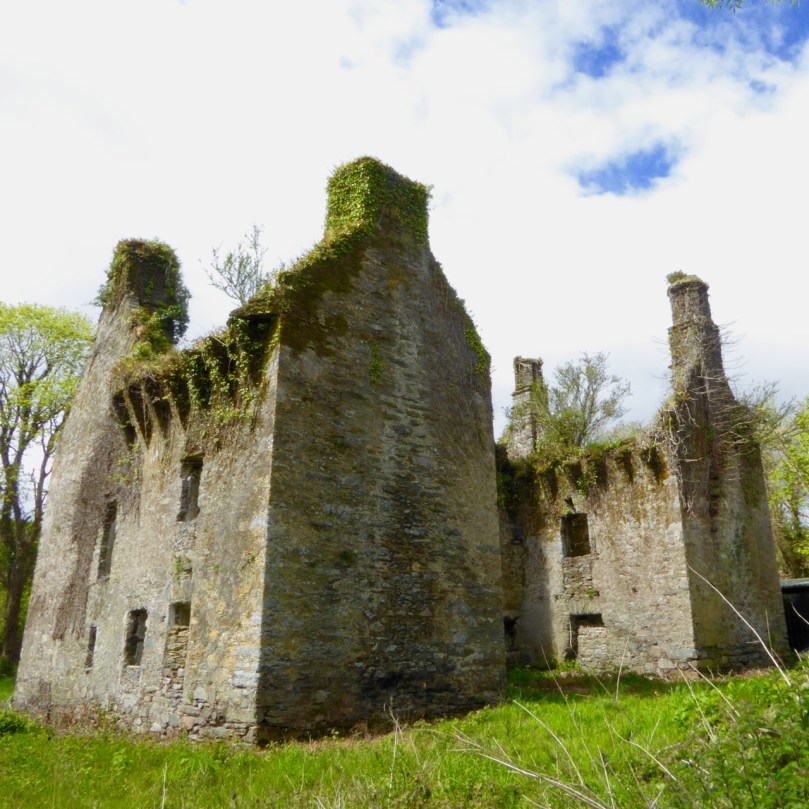
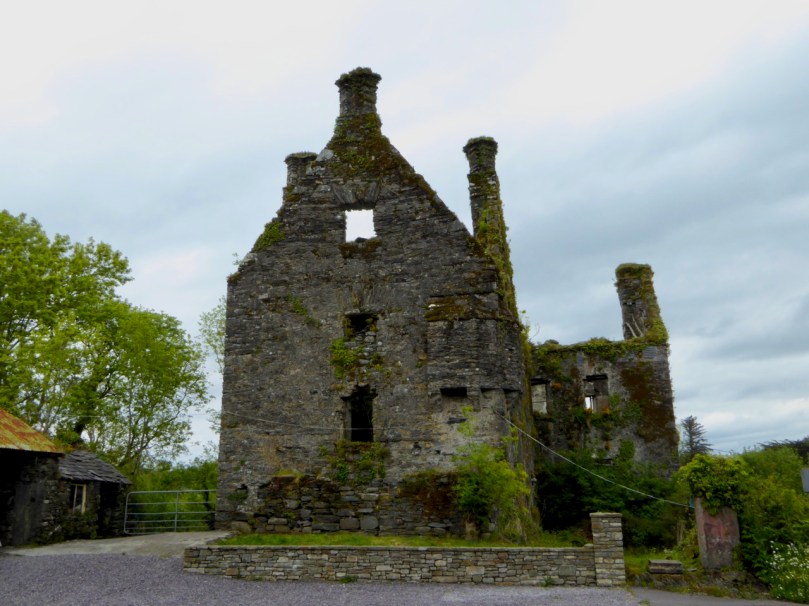
Of course, no country walk in Ireland is complete without the obligatory ruin – this one a highly satisfactory house that must have been quite fine in its day.

And then, what was this? At the bottom of a field was a table, laden with West Cork goodies, and Avril invited us to browse and make a sandwich using her own home-made challah bread. A picnic has never tasted so good!

I have my eucalyptus and mint leaves by me as I write this – aroma is a sure-fire memory stimulant and I am back in my head walking through the trees, time slowed down, breathing and listening, with the rough bark under my hands.

Keeping Time in Youghal

I had time to pass in East Cork on Saturday, so I went off to Youghal (pronounce it ‘yawl’), a substantial town with a great deal of history. I had a purpose in mind: to check out a recently opened museum, dedicated to the way that the time of day was chronicled here over a number of centuries.

The museum is housed in an iconic building that has spanned the main street of the town for 250 years: the Clock Gate Tower. That’s it bottom centre in the aerial view below, and underneath that is the more usual view of it, from the road. It’s the most visible building in Youghal town, and you can see one of its three clock faces (which all show exactly the same time) in this photograph.

In medieval times Youghal was a walled town, and the site of the Clock Gate Tower was one of the defended entrance points at the south end of the enclosed settlement; Finola has written about the walls here. Masonry walls were fine in the days of bows and arrows but became obsolete when heavy artillery took over: by the late 1700s the town had expanded beyond the walls and the southern gate was redundant: before the Clock Gate Tower was completed in 1777 a medieval gateway known as the Iron Gate stood on the site.

Upper – a map from the Pacata Hibernia showing Youghal – first published in 1633: we are looking at the town from the east. The Iron gate is highlighted: even then the town had expanded beyond the original walls. Lower – the Iron Gate in 1681: by that time the original defensive towers had been embellished with a clock and bell tower

It was perhaps whimsical – in the 18th century – to replace the earlier gate with a building which could be seen as a pastiche of what was there before, but it has certainly succeeded in creating a distinctive landmark which has lasted to the present day, and continues to fulfil the function of a clock and bell tower central to the town.

This early photograph of Youghal’s main street with the Clock Tower probably dates from around 1900

I took the Clock Gate Tower Tour and can assure you that a great time was had by all who were on it. Before you go, however, make sure you are able for climbing the six flights of steps from street level to the very top: there were no lifts in the 1770s, and no way that any mechanical assistance could now be fitted into the restricted spaces in the building. However, the staircases are safe and easy, and there is plenty of time to pause on each floor to see the fascinating displays that have been installed. I’m not going to reveal everything that the tour includes, or you might think you don’t need to take part! Just a few tasters will suffice.

I will disclose that you will get a feeling for what prison life was like two or three hundred years ago, as this was then one of the main functions of the tower, and one of the floors has been set out as a cell. Our enthusiastic ‘storyteller’ guide, Katy (above) pointed out that the restricted space could have held a large number of inmates, unsegregated and crowded together with no sanitation (other than a window). Prisoners had to pay for their own food, which was hauled up through the same window from friends outside. Even in 1841 the conditions that prevailed here were considered appalling – and Youghal was specifically mentioned in the Report of Inspectors General on the General State of the Prisons of Ireland of that year:

My favourite room was one dedicated to the workings of the clock (header picture and above). From the earliest days the Clock Keeper was also responsible for ringing the town bell:

. . . In 1622 Balltazar Portingale was appointed as clock-keeper and was given free quarters in return for ringing the clock at four in the morning from Easter to Michaelmas, and at five in the morning from Michaelmas to Easter, and at nine at night all the year. . .

In more modern times the bell was also employed to summon the fire brigade. Following complaints from some outlying residents of the town that it could not be heard, the original bell was replaced with a larger version, still in use today and connected to the clock mechanism for striking the hours.

From 1915 to 1955 three generations of the McGrath family lived as tenants in the tower: they had responsibility for winding its clock and announcing a death by ringing the town bell. John McGrath, now 80, was born in the Clock Gate and has great memories of his childhood there: he provided a lot of the information to help fit out the fourth floor of the museum as a 1950s interior, and he can be heard talking about his youthful experiences on one of the audio-visual screens:

As someone who also grew up in the 1950s (but not in a clock tower!) I can confirm the authenticity of some of the exhibits in the highest room of the museum

Probably the most exciting part of Youghal’s Clock Gate Tower Tour is the culmination: being allowed to ascend to the viewing platform at the very top. It’s a small area, but safely enclosed with unobtrusive glass balustrades. From it you get a panoramic vista in all directions over the whole town and the sea beyond. And, knowing how much history you are standing above, it’s well worth the modest tour fee. It will be time well spent!

This museum experience is proving justly popular: if you plan a visit check in advance with the Clock Gate website. In the summer tours are run seven days a week – I believe winter opening hours are being assessed; there is a phone number on the website. Have a great time . . .

Ethel Mannin, W B Yeats – and Wild Flights

If you read my post last week you will recognise this autumnal view of Rossbrin Castle. I took the photo in November 2017 and looked it out after I watched the magic of a skein of wild geese flying over Nead an Iolair just a few days ago – at the end of August. There’s something wistful about that spectacle – birds coming to winter on our west coasts – and Irish weather lore has to be heeded about these early advents:

It was generally believed that the early arrival of wild geese meant that a prolonged and severe winter was in store. This is a very old belief, as the ninth-century Irish work ‘Cormac’s Glossary’ states that the brent goose usually arrived at the coasts of Erris and Umhall between 15 October and 15 November, and that when it appeared earlier, it brought storms and high winds. Similarly, in Counties Donegal and Galway, when the wild geese arrived, it was a sign that cold and frosty weather was on the way. In Donegal, a sign of an approaching wind was when a goose stuck its neck up into the air and beat its wings against its stomach. Fishermen would watch out for this and if they saw it would not go out, believing that a storm was on the way . . .

(Niall Mac Coitir – Ireland’s Birds: Myths, Legends and Folklore, Collins Press 2015)

Today’s post – while inspired by my sighting of the wild geese – is more connected to swans: these large and graceful birds are a constant down on Rossbrin Cove, and plentiful along our West Cork coastlines. Niall Mac Coitir also has much to say about them:

In Ireland it was generally believed to be very unlucky to kill a swan, and many tales were told of the dire consequences for those who did so. For example, the mysterious death of one of their farm animals often occurred soon afterwards. In County Mayo the whooper swan was never interfered with, on account of a tradition that the souls of virgins, who whilst living had been remarkable for the purity of their lives, were after death enshrined in the form of these birds . . . In Donegal it was believed that swans were people under enchantment, so that bad luck would come to anyone who interfered with them . . .

(Ibid)

We know all about the tradition of people being turned into swans from the legendary Children of Lir – one of whom was Finola: you may remember the stained glass window we have in our house. A few years ago I found the above book in the wonderful Time Traveller’s Bookshop in Skibbereen (which has now transformed itself into the Antiquity Bookshop Café, the first all-vegan Cafe in West Cork: it’s well worth a visit – for books and food!). I was attracted initially by the cover and the illustrations, and then was delighted to find that the first story in the book was all about Finola and is a modern ‘take’ on the Irish legend. I had to buy the book, of course, for our Finola and I immediately thought of ‘The Wild Swans’ when I saw those wild geese. This post results from those wandering encounters.

Another of the illustrations from The Wild Swans – used on the cover: do you see the swans? The second picture above – of the four swans – is also from the book. The illustrator is Alex Jardine, about whom I have been able to find very little, other than he was British, lived from 1913 to 1987, wrote and illustrated books on angling, and designed a number of postage stamps. I was also keen to find out more about the author of this book – Ethel Mannin (shown above next to the book cover) – and initially came across scant information, until I discovered a connection with W B Yeats. Then, by dipping and diving through letters and articles specifically by and about Yeats, I was able to put together some often surprising details on her life.

Above left – Alex Jardine’s illustration for The Wild Swans showing Finola – beautifully detailed and with intriguingly distorted perspective (suitable for a ‘modern’ legend?); above right – for comparison, an illustration from the same period (1950s) of wild geese by prolific British illustrator Charles Tunnicliffe: a scene which looks uncannily like a peninsula from the west coast of Ireland

Ethel Mannin was born in 1900 in London, and died in 1984. None of her writings is in print today and she is now little regarded, yet in her lifetime she wrote and had published well over a hundred volumes, half of which were novels and others which included short stories, children’s books, travel books, autobiographies and works on literature, politics and her contemporary world. On the fly-leaf to The Wild Swans – published in 1952 – is the statement:

Her reputation as a writer is founded on her honesty and unorthodoxy. For some years past she has done most of her writing in retreat in a cottage in the remotest west of Ireland, the country of her ancestors . . .

Mannin traced her family background to the O’Mainnin owners of Melough Castle, Co Galway. In 1940 she settled close to Mannin Bay in Connemara, renting a cottage which she eventually bought in 1945. She spoke at public meetings against the Partition of Ireland – ‘the imperialist problem nearest home’ – and was elected Chairman of the West London Anti-Partition Committee. Her travels included India (where she attended a World Pacifist Conference and tore up her diary en route, throwing it overboard in the Indian Ocean, and found Hinduism repellent ‘with its lingam cult’), Burma, Morocco, Sweden, the Soviet Union, Brittany, where she befriended Cartier-Bresson.

I found more wild swans in this illustration by Charles Tunnicliffe from the 1927 best-seller and Hawthornden Prize winner Tarka the Otter: His Joyful Water-Life and Death in the Country of the Two Rivers by nature writer Henry Williamson. Tarka captured the public imagination and has never been out of print, even though Williamson himself became unpopular following his support for Oswald Mosley and fascism

Ethel Mannin met W B Yeats in the 1930s and they became lovers. Their relationship was reported by Brenda Maddox in Yeats’s Ghosts: The Secret Life of W B Yeats, Harper Collins 1999:

Ethel Mannin was a rationalist and skeptical, he mystical and credulous. Politics divided them too. She was left-wing, just short of being a Marxist, and had recently returned starry-eyed from the Soviet Union; his leanings were firmly the other way. But that hardly mattered when, as a companion, she was brilliant, fun, and full of the salty talk that Yeats adored. She was not worried about his cultural baggage: “Yeats full of Burgundy and racy reminiscence was Yeats released from the Celtic Twilight and treading the antic hay with abundant zest.”

In 2014, to mark the 75th anniversary of Yeats’ death, Jonathan deBurca Butler wrote in the Irish Independent newspaper an article titled The Many Women of W B Yeats. This is an extract:

In 1934, Yeats, who had been suffering from both sexual and artistic impotence for three years, had a Steinach operation, a type of vasectomy, which was said by its supporters to increase energy and sexual vigour in men. According to Yeats, the procedure worked and he claimed to go through what he called “a second puberty”. Shortly after the operation, Ethel Mannin, a 34-year-old writer and member of the World League for Sexual Reform, was called on to “test the operation’s efficacy”. The test was by all accounts unsuccessful but it showed Yeats was still inclined towards trying his hand. If all else failed he could still arouse his mind . . .

This ‘swans’ illustration is almost exactly contemporary with Ethel Mannin’s The Wild Swans. Robert Gibbings wrote and beautifully illustrated Sweet Cork Of Thee, which was published by J M Dent in 1951

Ethel Mannin married twice, and had one daughter, Jean, after which ‘ . . .she espoused the idea that a masculine mind better suited women writers than motherhood . . . ‘ Apart from W B Yeats she also had an affair with Bertrand Russell. In her later years, Ethel returned to England and lived out her life in Devon – also, incidentally, the home of Henry Williamson. I have been chasing the works of Ethel Mannin, and have succeeded in recently locating some very inexpensive used copies on the internet – including some of her biographical works. Once I have these I may have more to report on her connections with Ireland. Meanwhile, I can only recommend The Wild Swans for its romanticism and imagination – and its seductive illustrations. And, of course, for its connections with Finola!

Because of the Yeats connection, it seems appropriate to quote his poem The Wild Swans at Coole (1916):

The trees are in their autumn beauty,

The woodland paths are dry,

Under the October twilight the water

Mirrors a still sky;

Upon the brimming water among the stones

Are nine-and-fifty swans.


The nineteenth autumn has come upon me

Since I first made my count;

I saw, before I had well finished,

All suddenly mount

And scatter wheeling in great broken rings

Upon their clamorous wings.


I have looked upon those brilliant creatures,

And now my heart is sore.

All’s changed since I, hearing at twilight,

The first time on this shore,

The bell-beat of their wings above my head,

Trod with a lighter tread.


Unwearied still, lover by lover,

They paddle in the cold

Companionable streams or climb the air;

Their hearts have not grown old;

Passion or conquest, wander where they will,

Attend upon them still.


But now they drift on the still water,

Mysterious, beautiful;

Among what rushes will they build,

By what lake’s edge or pool

Delight men’s eyes when I awake some day

To find they have flown away?