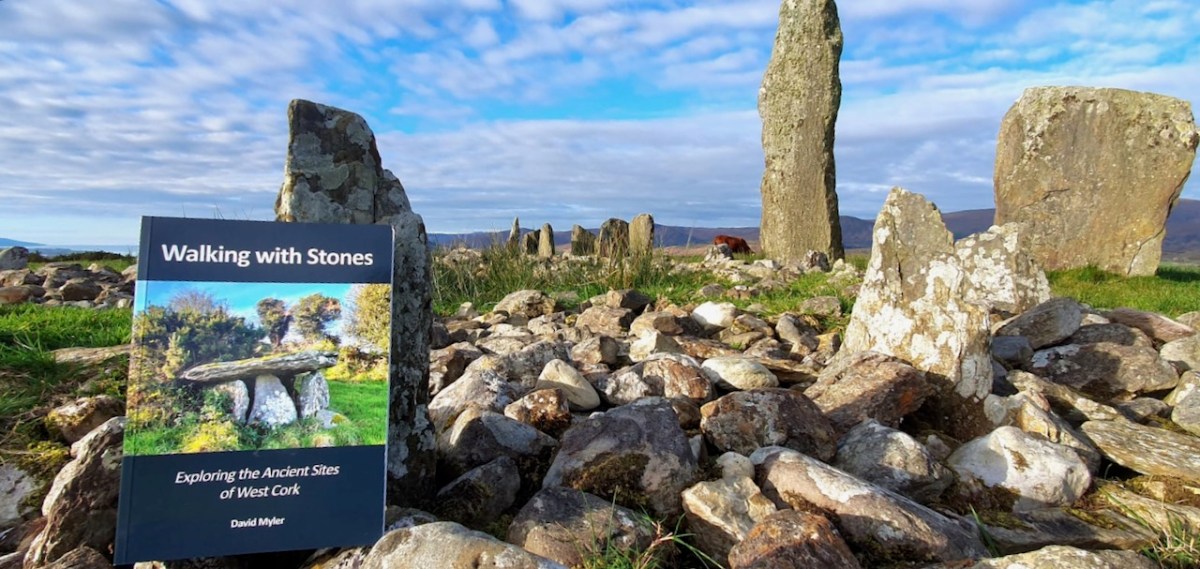
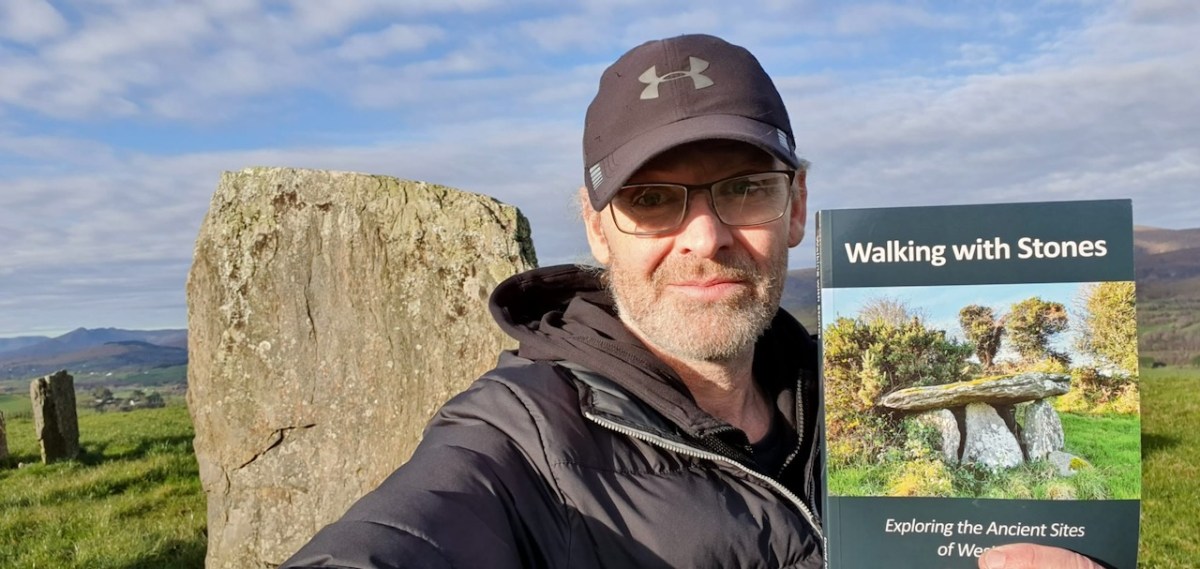
If you live in West Cork, or if you love to visit it, your Christmas present dilemma is solved! Here comes Walking With Stones, the new book on West Cork archaeological sites written by David Myler.
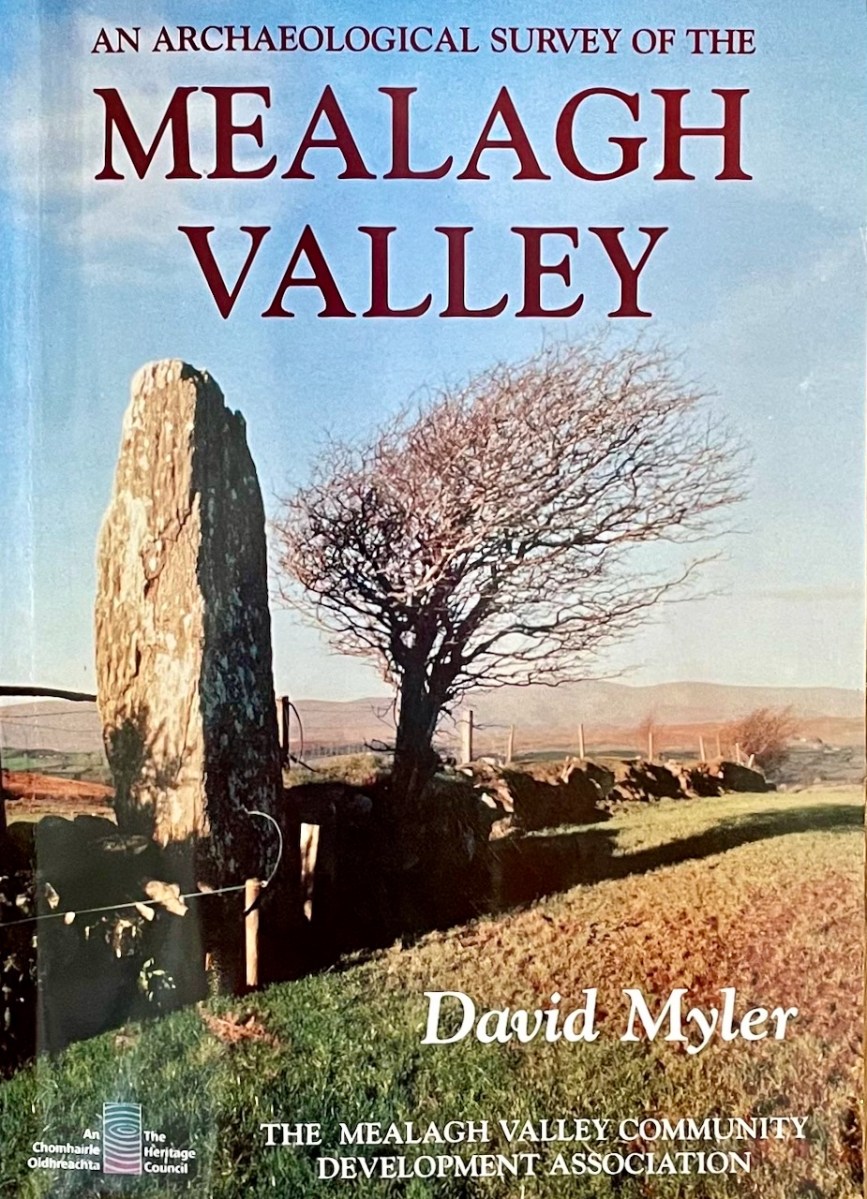
David has been sharing his passion for West Cork antiquities in an online Facebook Page/blog which he called Walking with Stones. But even before that, he wrote An Archaeological Survey of the Mealagh Valley – a book we have had on our bookshelves for years and turned to often.
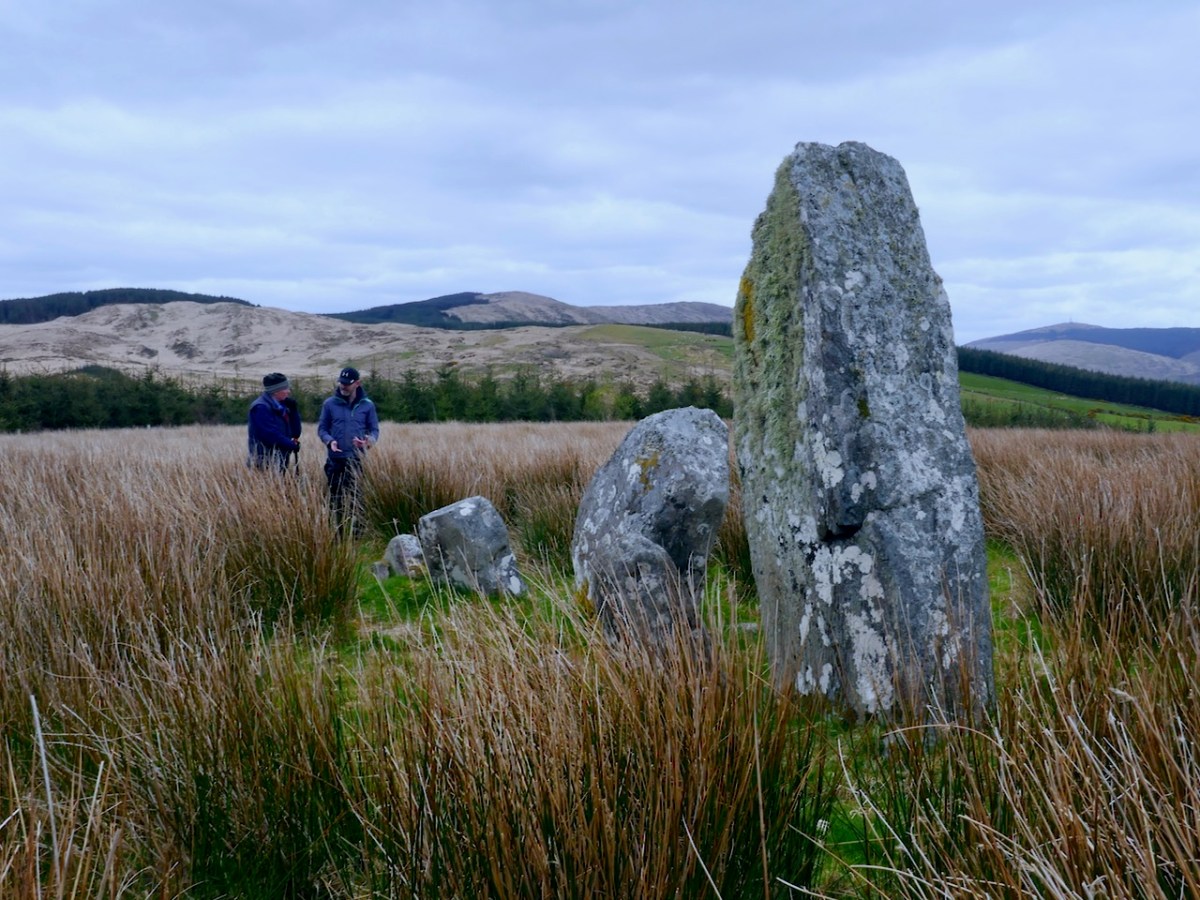
Once we saw Walking With Stones pop up on our Facebook feed, we knew we had found a fellow traveller. We had to meet – and meet we did, along the way discovering many shared interests and even a relative in common. Our first meeting was a field trip where David showed us this stunning stone row in the Mealagh Valley.
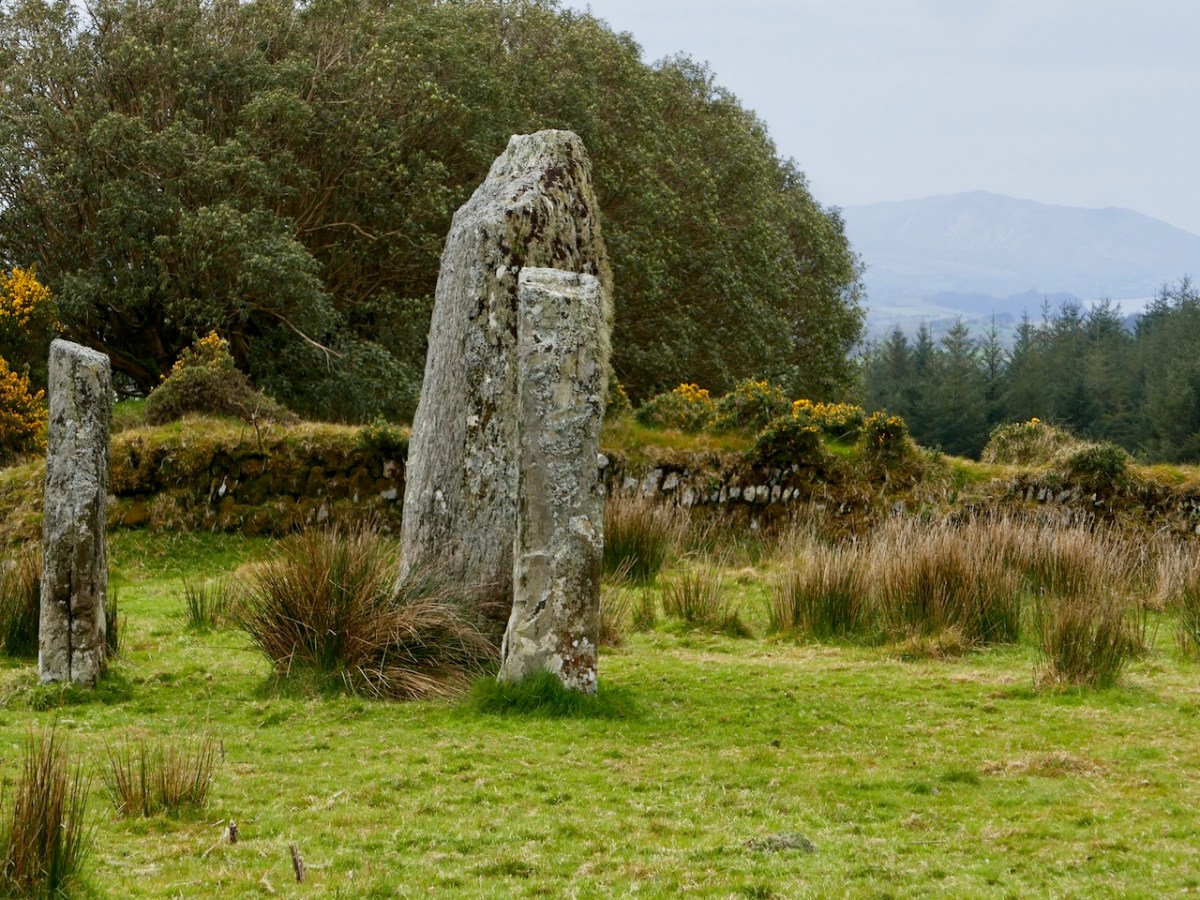
On that same trip we saw my first ever Four-Poster Monument – they are very rare, with only four in West Cork – as well as a spectacularly-sited wedge tomb that David had discovered.
David’s book is a very welcome addition to our bookshelf. Perhaps I should declare right away that he asked me to write the Introduction and I was delighted to do so. Now that I finally have my own copy, I am thrilled to be associated with it, in this small way.
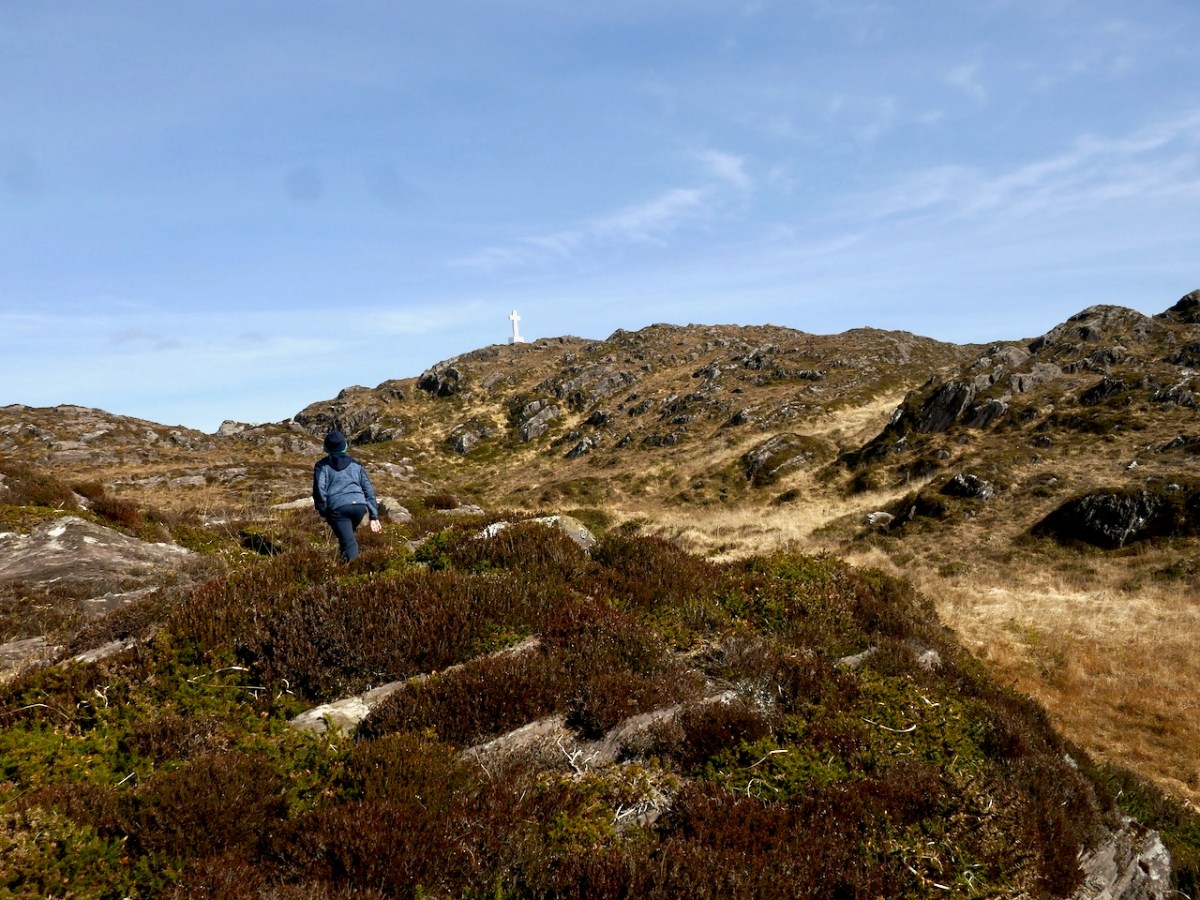
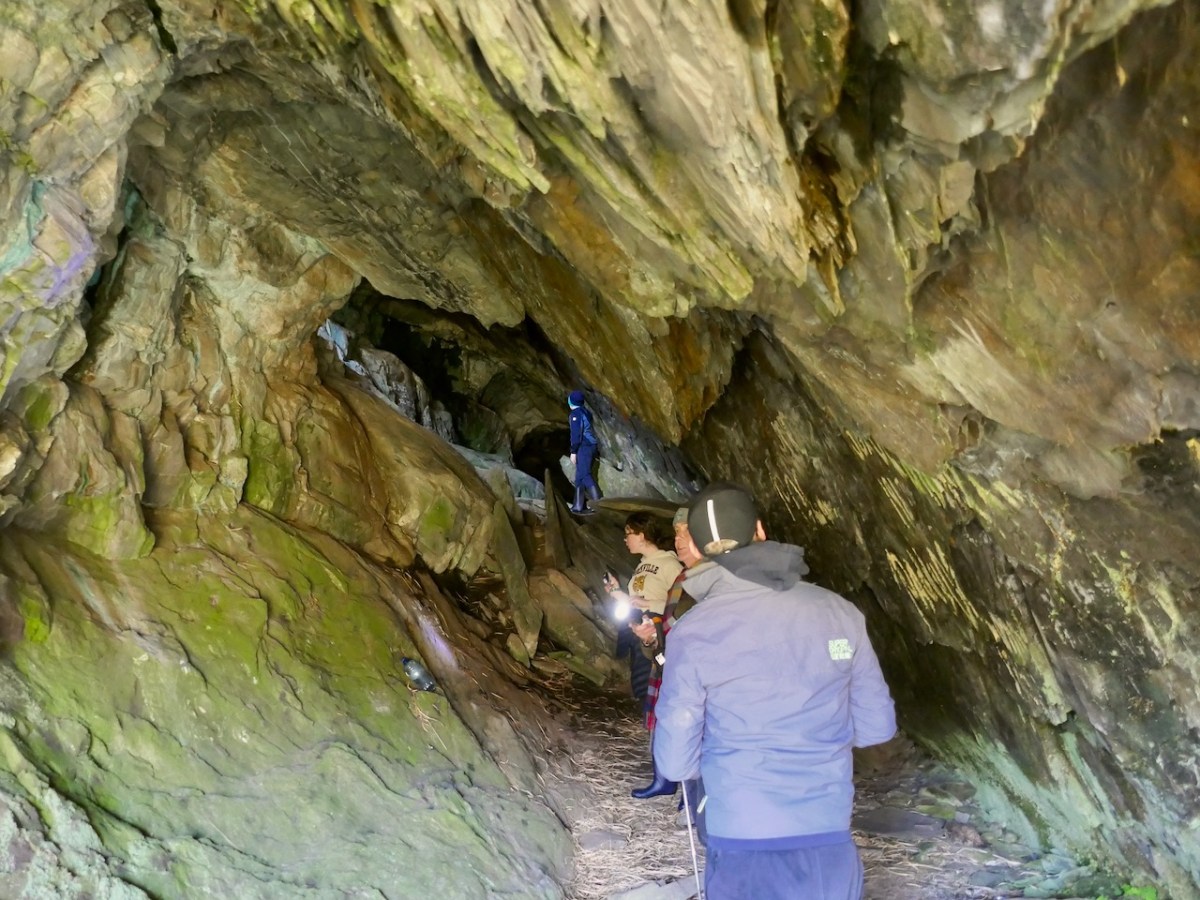
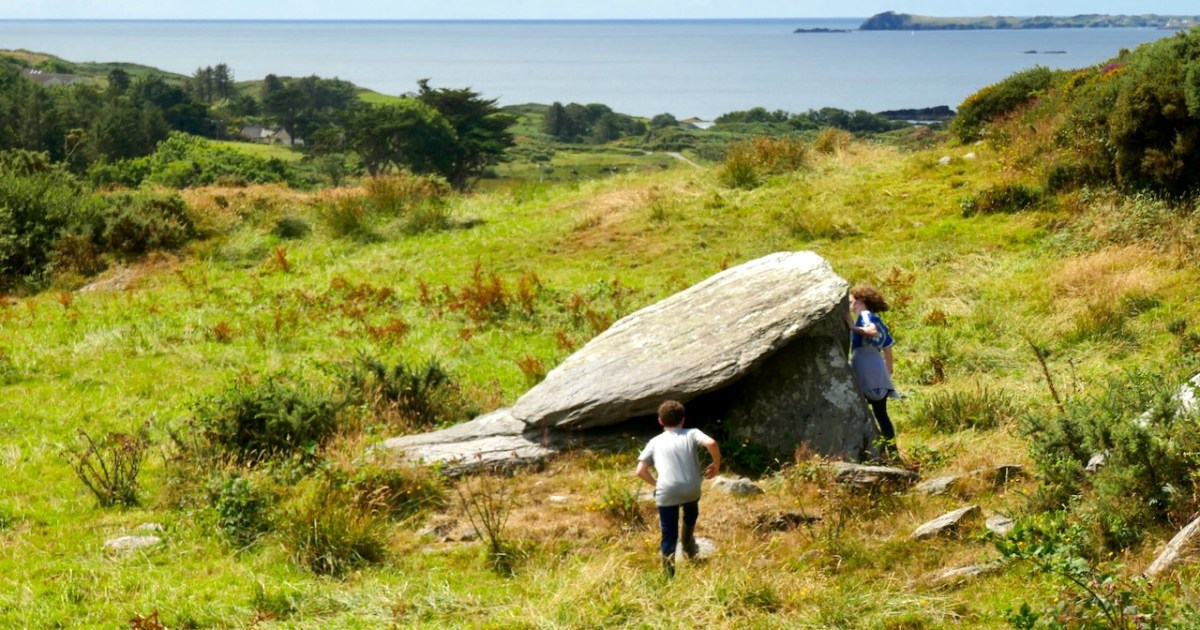
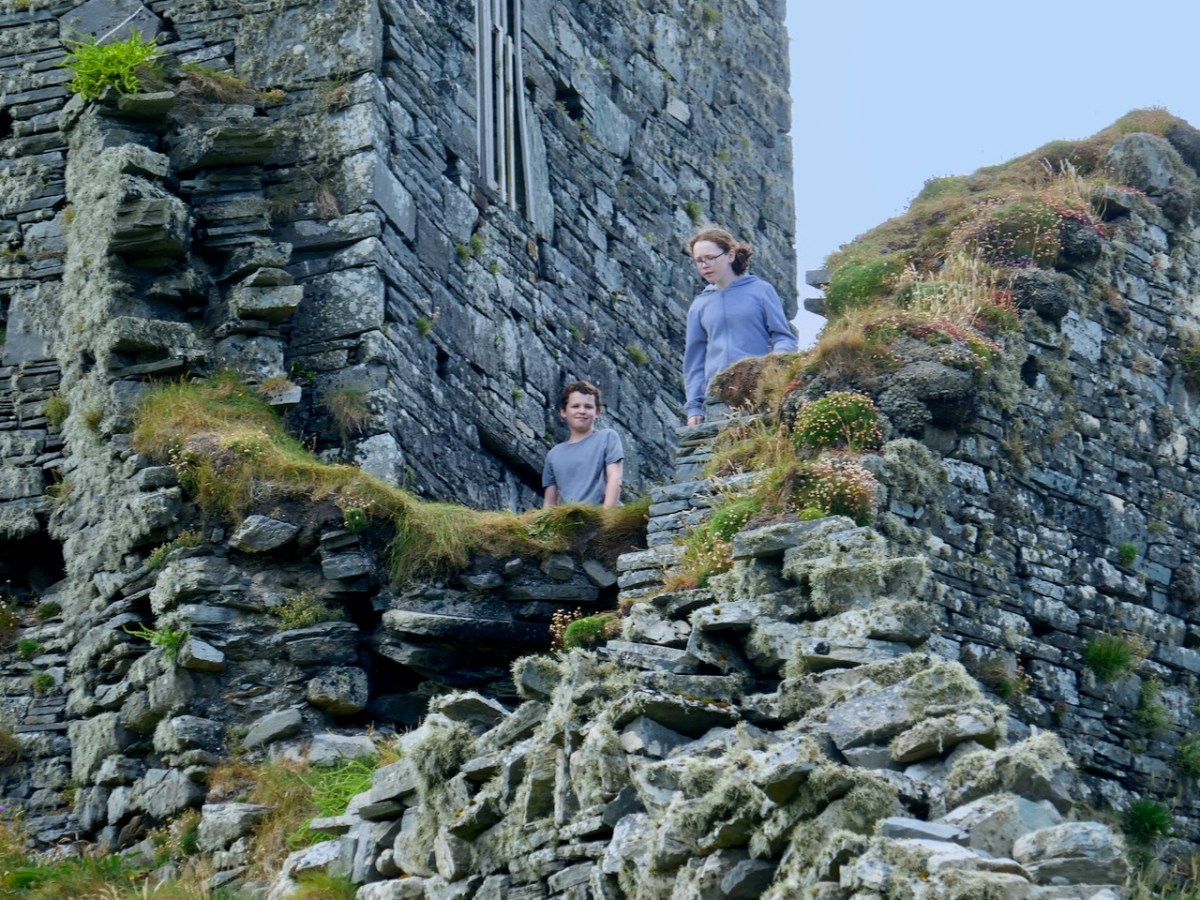
David’s favourite companions on his walks are his kids and one of the real strengths of this book is the sense that all these places can be enjoyed with family. Having young people along, with their curiosity, their need to really explore, and their chatter, brightens any walk. Just make sure you go equipped with food and bandaids. What follows are a few photos of joint field trips we have taken with them.
The only comparable book we can think of is Jack Roberts’ Exploring West Cork, first published in the 1980s and updated and re-published a couple of times. We treasure all of Jack’s books, especially for their marvellous black-and-white drawings, as accurate as they are charming.
While Jack tried to be fairly comprehensive in his coverage, David’s selection is personal – this does not pretend to be a gazetteer, but a guide and companion. Many of the sites have been chosen because they are accessible and can be enjoyed as part of a good walk through the countryside. Restricting the number of sites also allows David to write more about each one and use his own photographs to illustrate important features.
The best place to have David’s book is in your car, your bicycle carrier, or your backpack. You can buy it online here or here. Look out for it in local bookstores, if you live in West Cork – David is doing the legwork now of getting copies to them.
Congratulations, David! Given that you work full time and have a family to look after, this is an amazing accomplishment and one we are all grateful for.
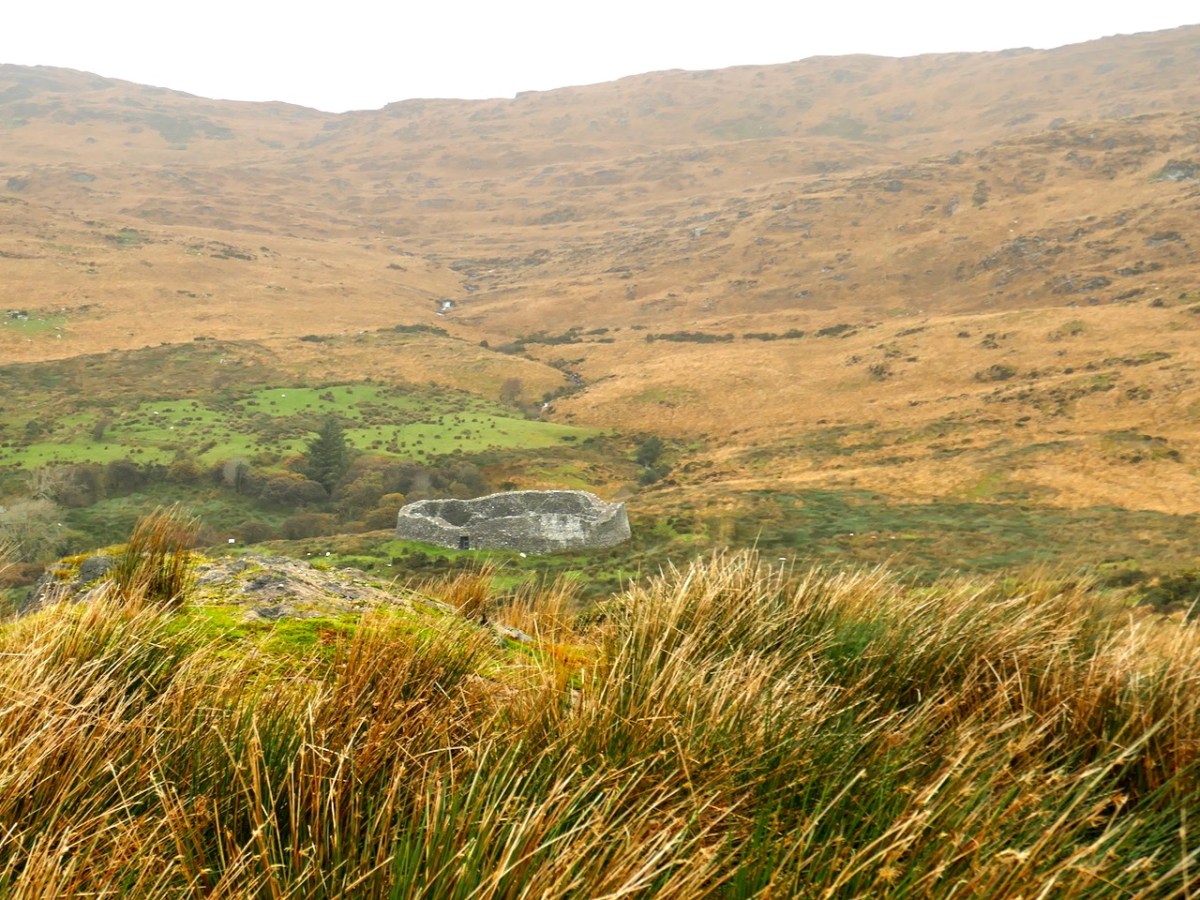
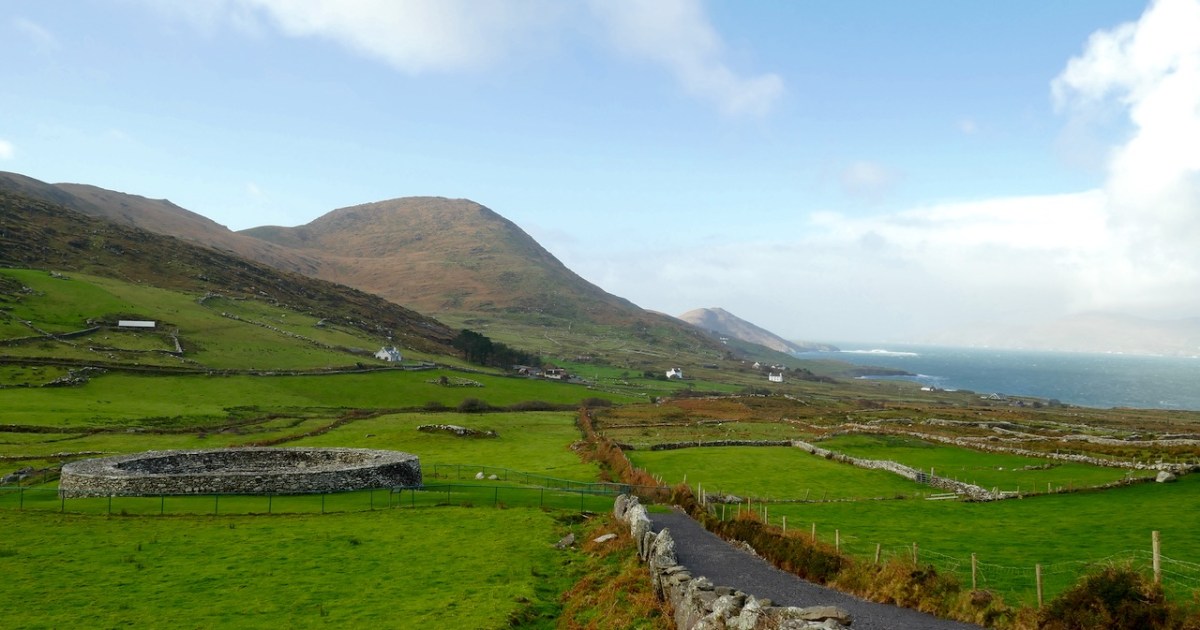
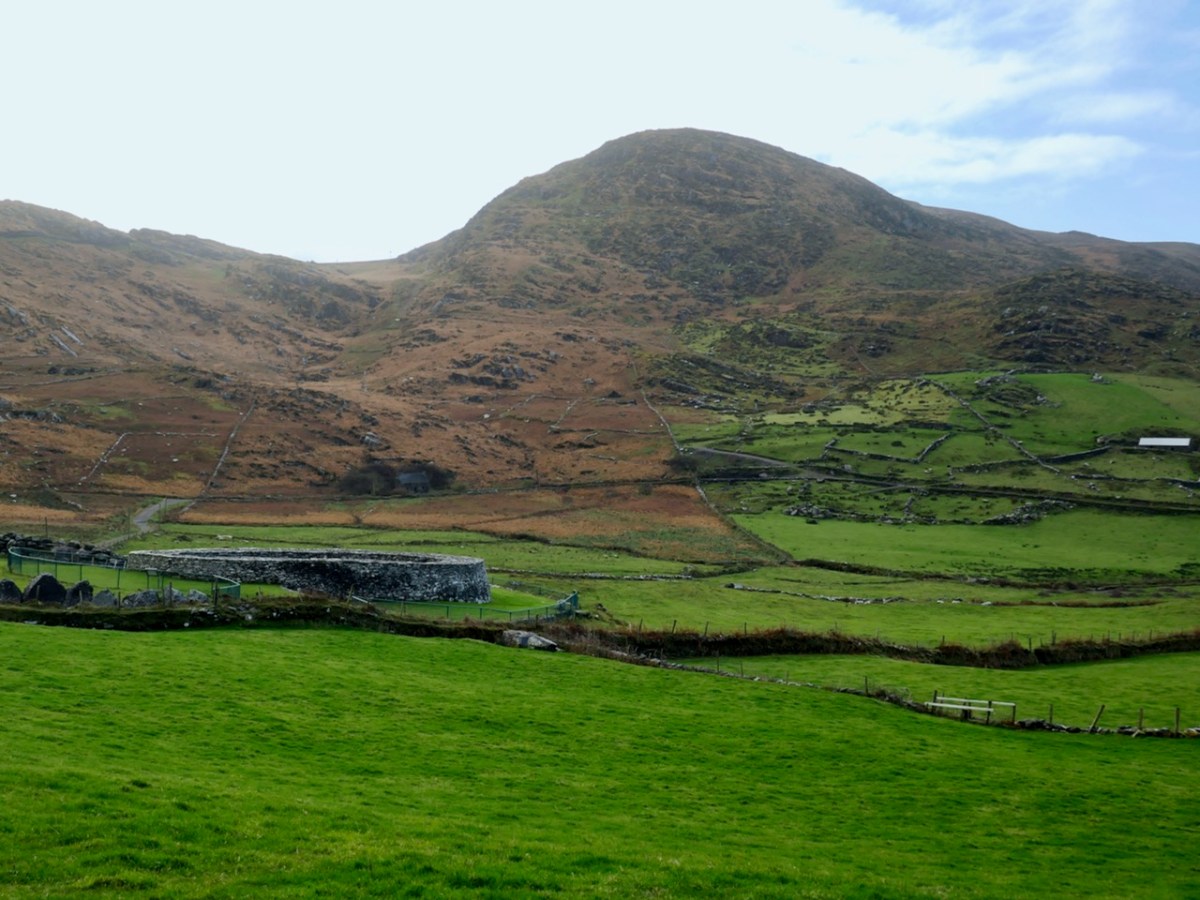
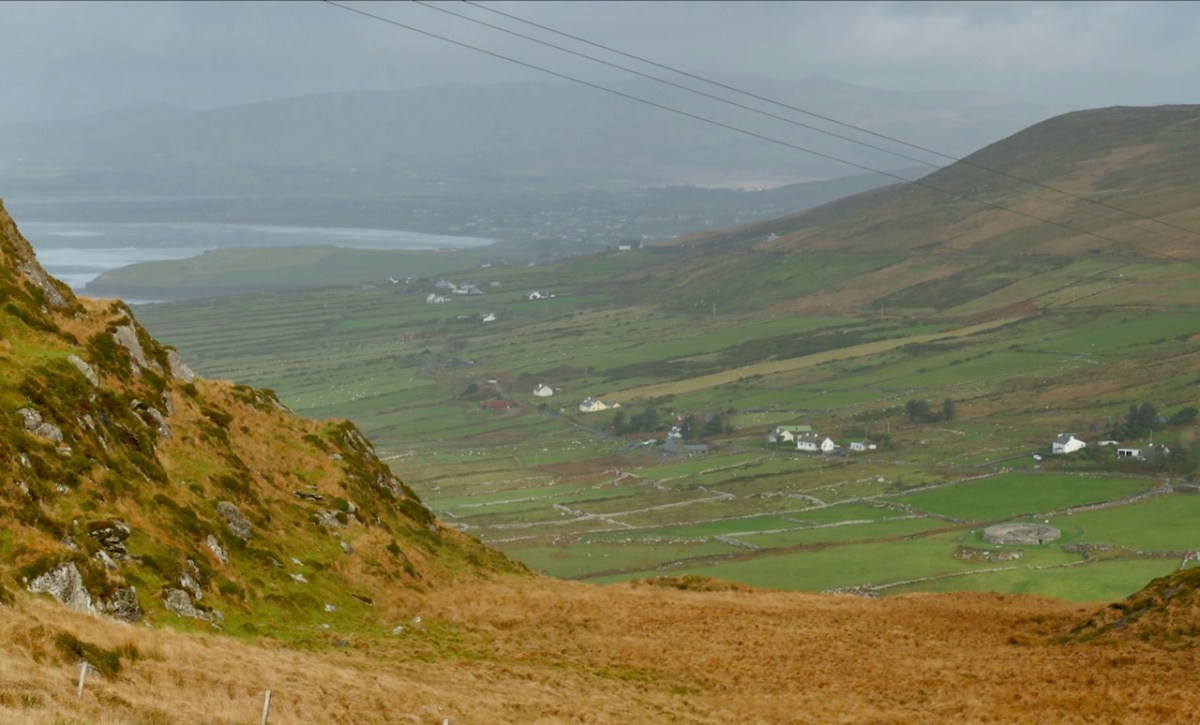
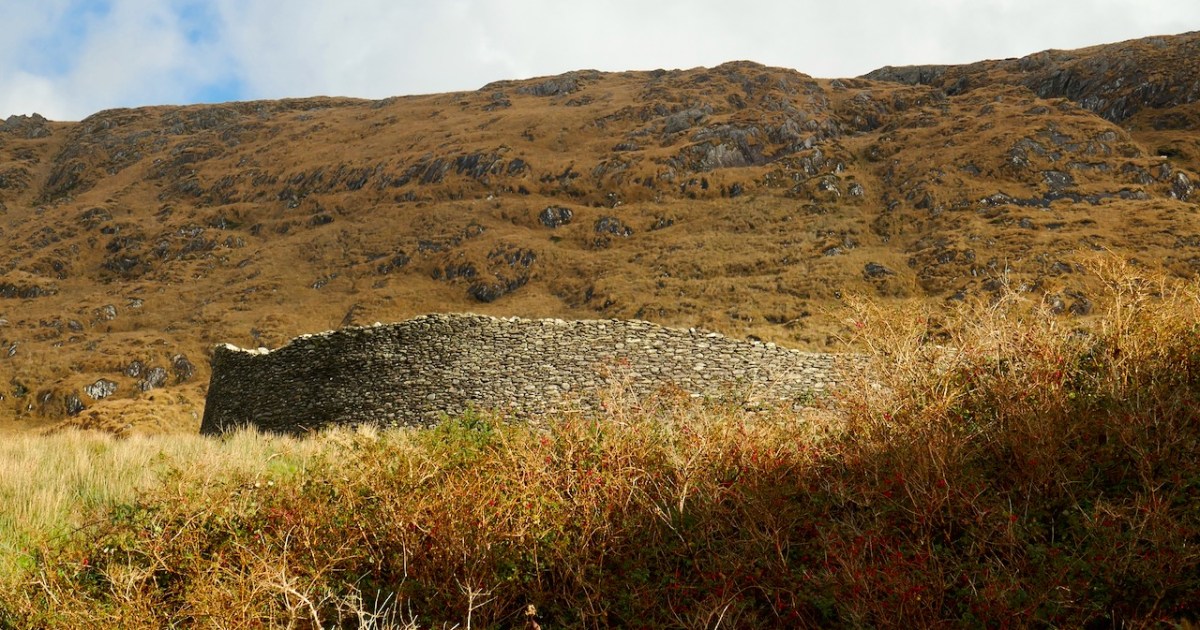
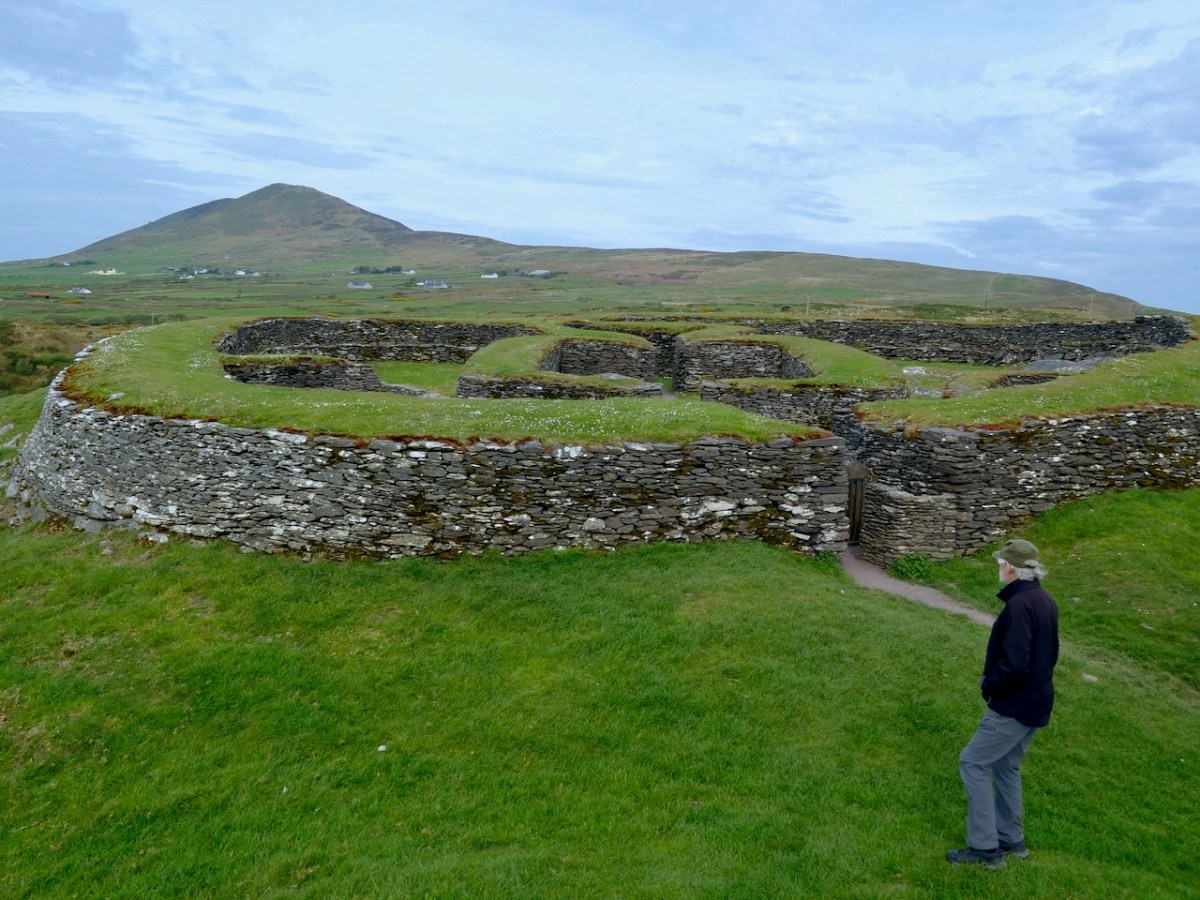
Our last, and most magnificent, cashel in this series is Staigue. Majestic, imposing and mysterious, it sits at the head of a long valley with views down to the sea, almost 4kms away.
Staigue is the one that has never been excavated, and so it is the one that we can project our own speculations on regarding its age, its function, and its association with the fairies.
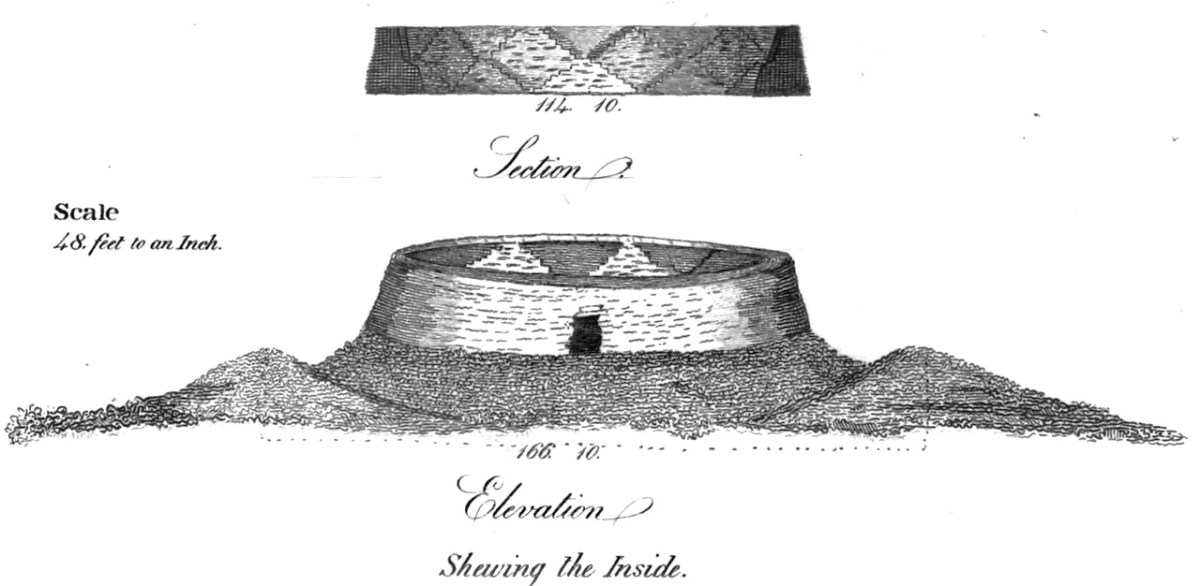
The thing that distinguishes Staigue from the other Cashels in Kerry I have written about so far is its sheer size. It’s what provokes awe. The first to write about it, in 1821, was the then-landowner F C Bland, who said:
When the appearance of the country, which is barren and uninviting, is considered, it must create surprise, what could have been the inducement to erect such a structure in such a place; and, when the traveller, whose curiosity has supported him through a long journey, the latter part of which for ten or twelve miles has been through a wild, uncultivated, though not an uninteresting country, first approaches it, he experiences a sensation of disappointment. For it stands a single object on a hill, and from its figure (being round) producing but little effect of light and shade; and, having no familiar object by which to measure its magnitude, and its importance being rather diminished by the extent and desolation of the surrounding scenery, he attaches a meaner opinion to it than it deserves. But when he enters it, he is struck with astonishment; and his imagination almost instantly transports him to distant ages lost in remote antiquity. He vainly endeavours to figure, in his “mind’s eye,” the beings who erected it, their manners, habits, and costume; until, “lost and bewildered in the fruitless search,” his mind returns to sober investigation, again to lapse into conjecture. This effect is not lost by familiarity:—I have visited it a hundred times, and have always experienced the same sensation.
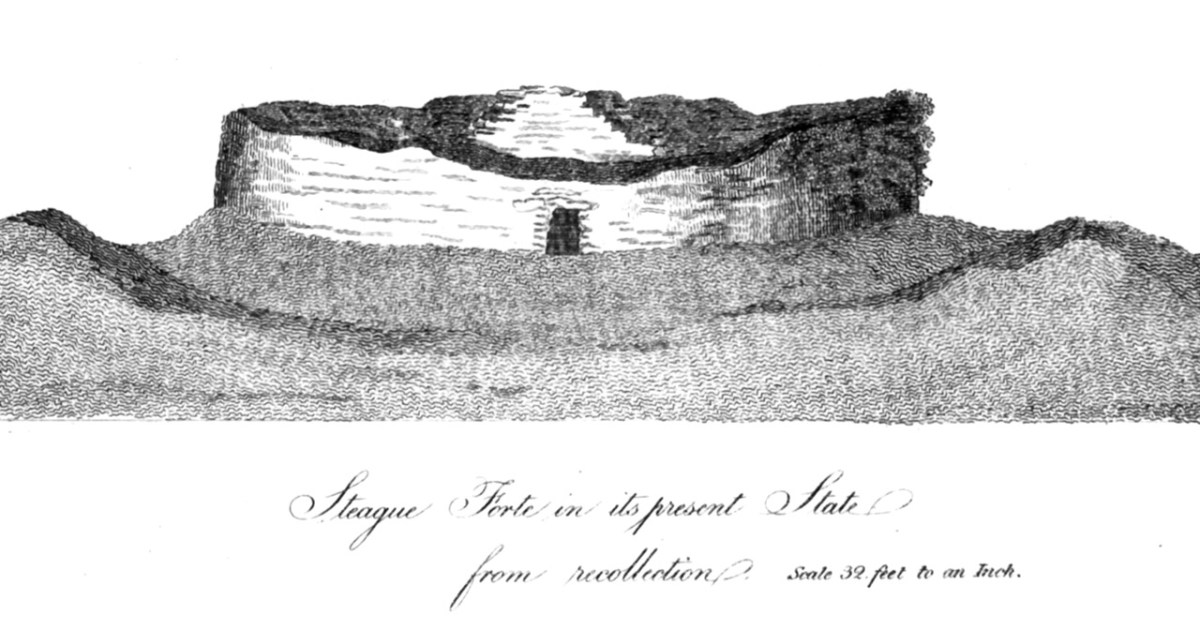
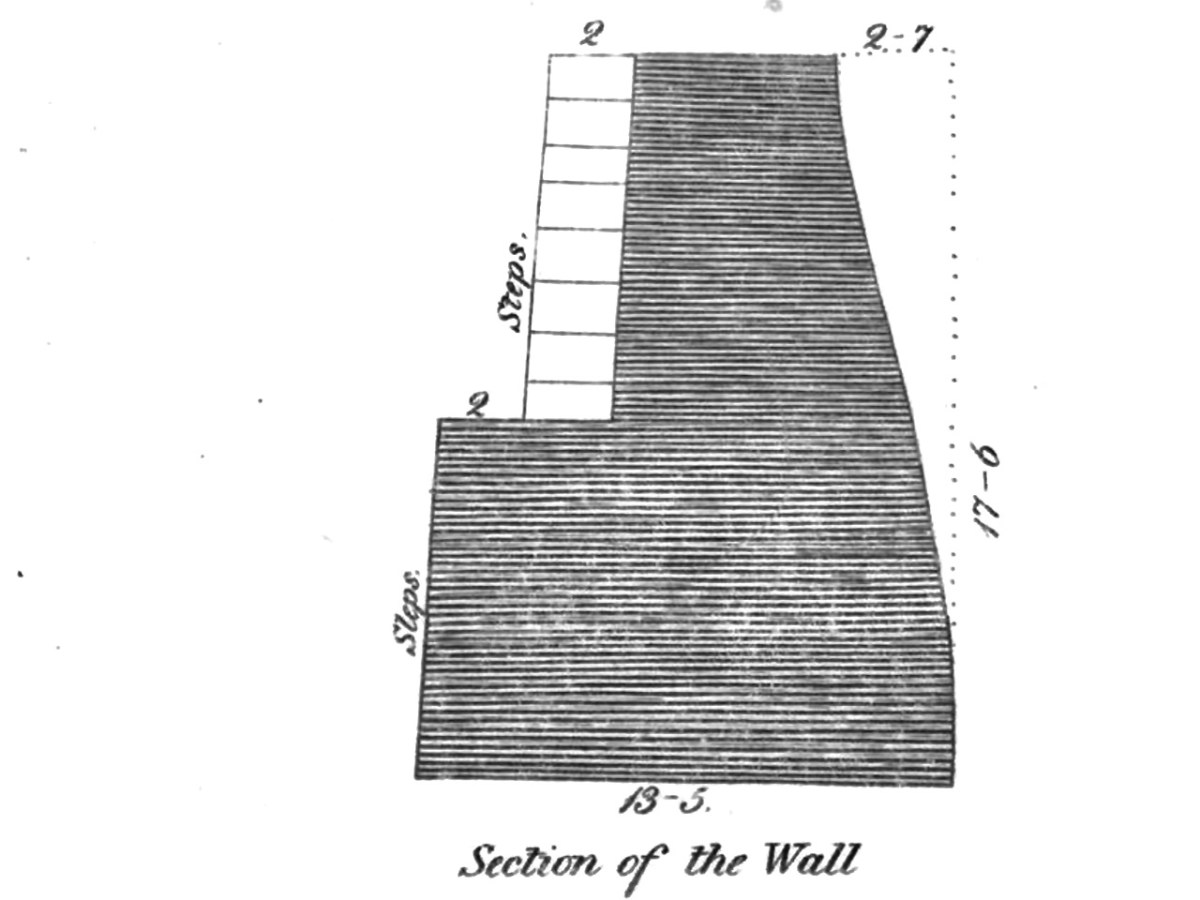
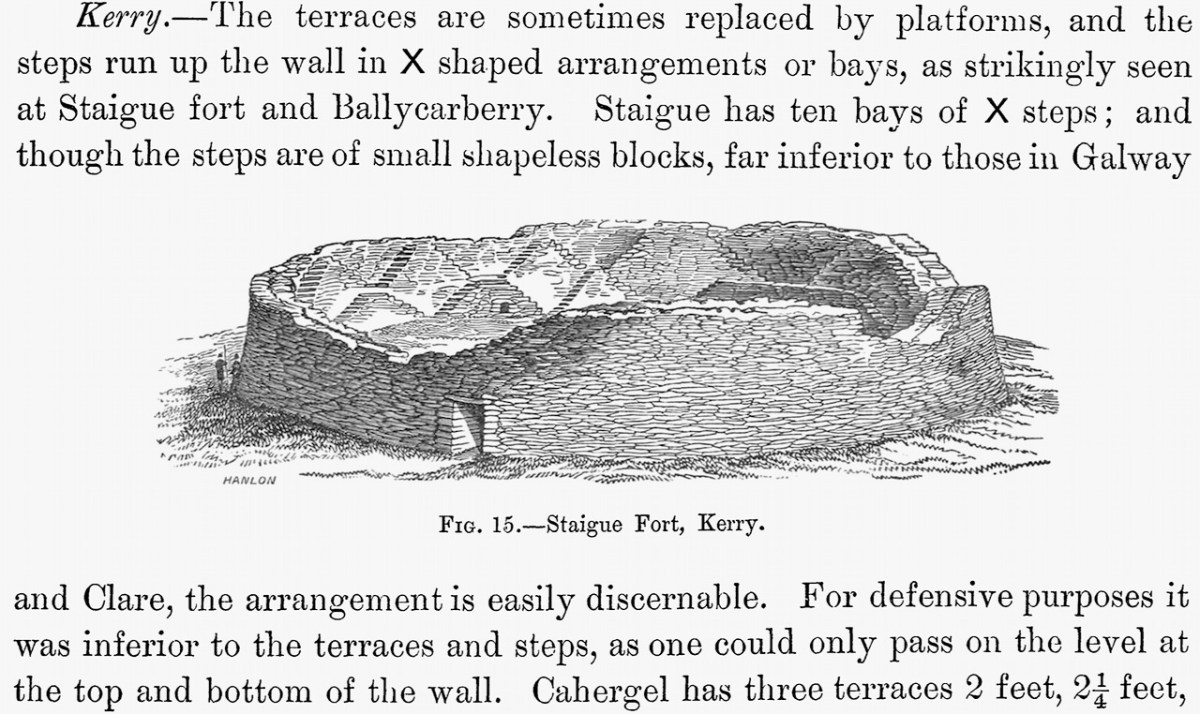
I know how he felt. Bland did a series of measurements and drawings of the fort, and they provide a charming antiquarian look at how it was 200 years ago, when it had been in use as a cattle pound. That’s one of his drawing at the head of this post. Here’s another.
But his account is more than charming – it provides an indication of how the fort looked at that time (even though the drawings are not exactly accurate). This is important because we need to know what interventions have been made over the years to the fort – interventions that can significantly altar the profile and appearance of the fort, as we have seen in the other three. For example, he referred to an ‘eve stone’ a term that is unfamiliar to me, and said:
In one part, where the wall is perfect, it is surmounted by a projecting eve stone, which, when complete, must have added greatly to the effect of the whole. This is indeed the only attempt at ornament in the entire building.
His own drawing do not show any special feature and whatever it was, no really obvious eve stone has survived the two centuries since he wrote this account. However, the National Monuments record does state The rampart stands to a maximum external height of 5.7m at N, where both Bland and Dunraven noted a number of coping stones projecting slightly over its inner wall-face (1825, 18-19; 1875, 24). Two of these remain in situ, and average 1m x .4m x .08m thick. Perhaps I need to go back and take a closer look.
The good news is that, of all the cashels we have examined so far in this series, Staigue seems to have remained most true to its original state. That is not to say it is identical to how it was 200 years ago – it has been tidied and stabilised, although when and by whom remains uncertain. There is a suggestion that Bland himself employed local workmen to do some restoration work, and another that the OPW did some in the 19th century.
While no records of these works remain, overall, the fort looks similar now to the older images we have of it. Historic edifices like Staigue cannot be left to crumble if significant numbers of people are visiting it. Sooner or later, as people climb on the walls, knocking off stones, it will deteriorate, creating a safety hazard and a dangerous situation for the monument itself.
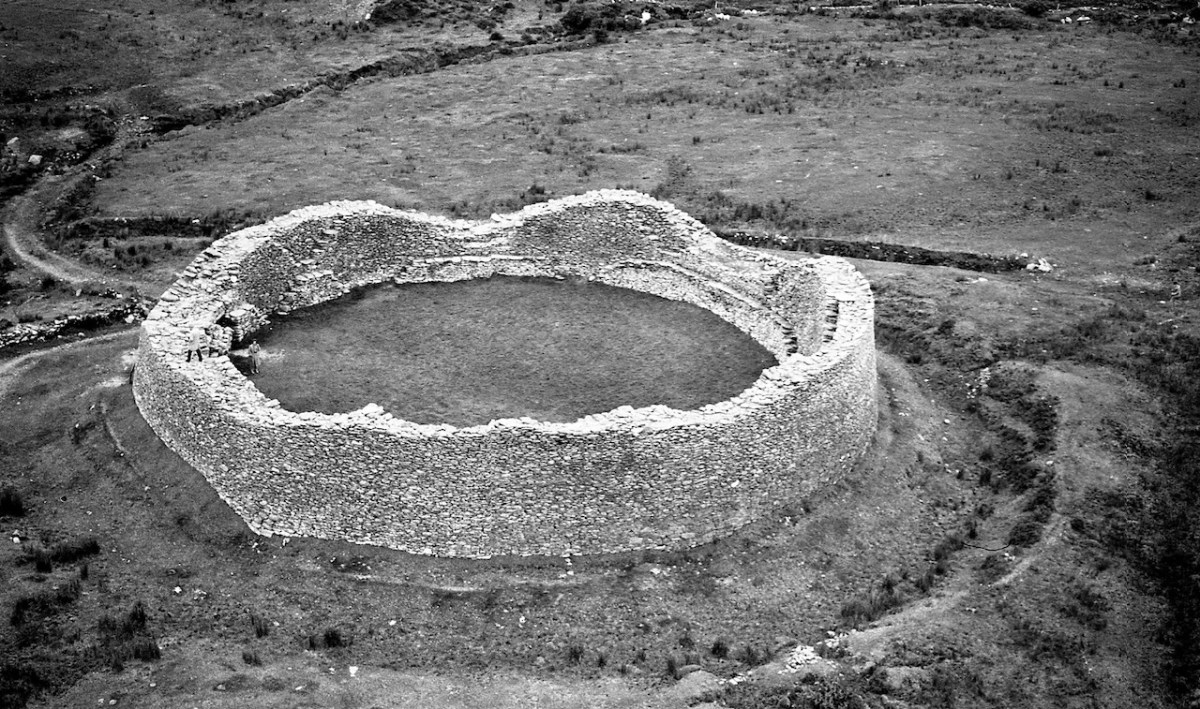
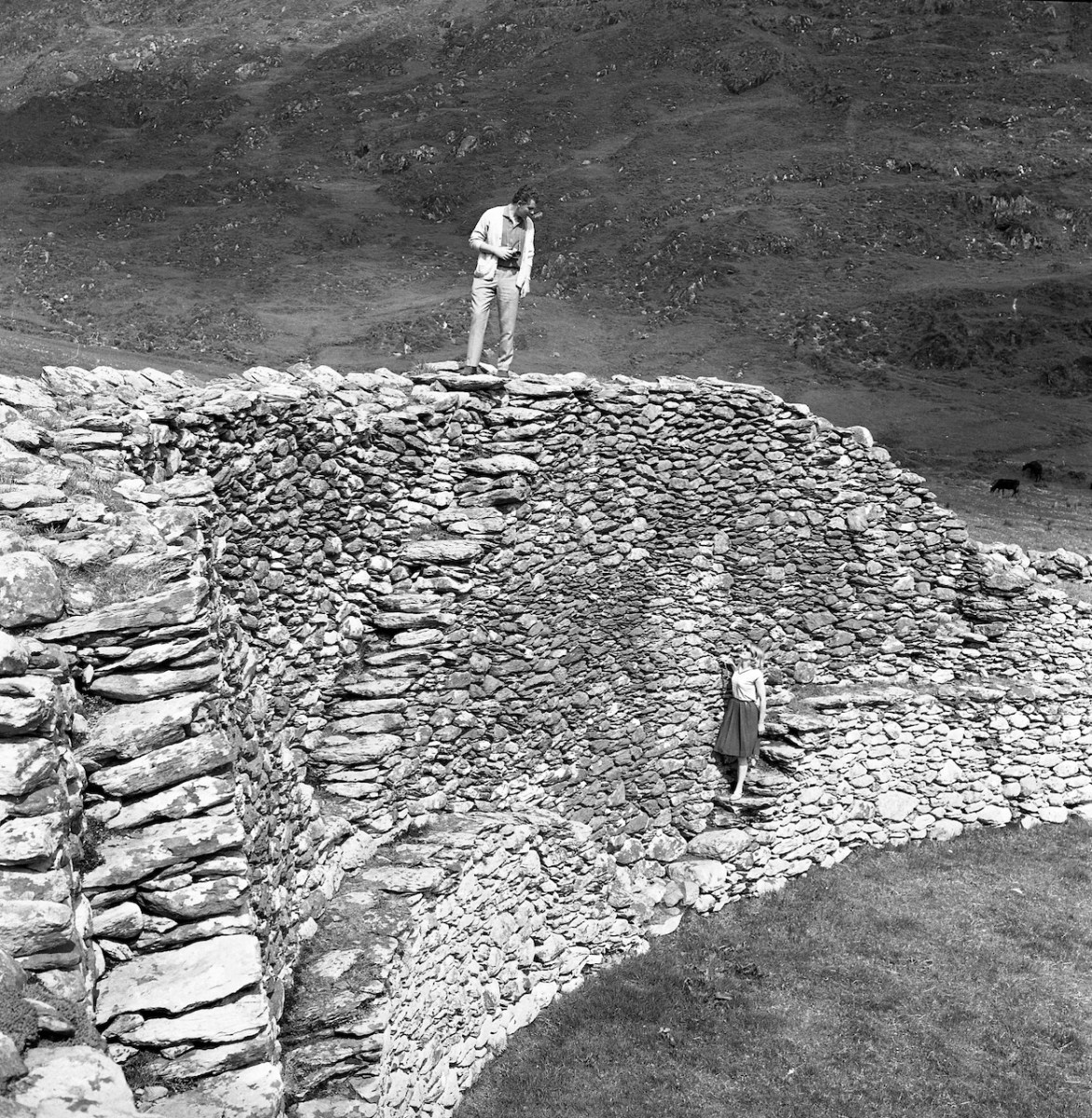
The trick is to intervene as sensitively as possible while still providing safe access and I would say that this has been done well at Staigue, although readers may want to weigh on on this question. The photos above and below are from the Irish Tourist Board collection (used in compliance with their Creative Commons License) – they amply demonstrate that climbing on the walls was as irresistible in 1964 as it is now. The ditch around the fort is also quite obvious in the aerial photo.
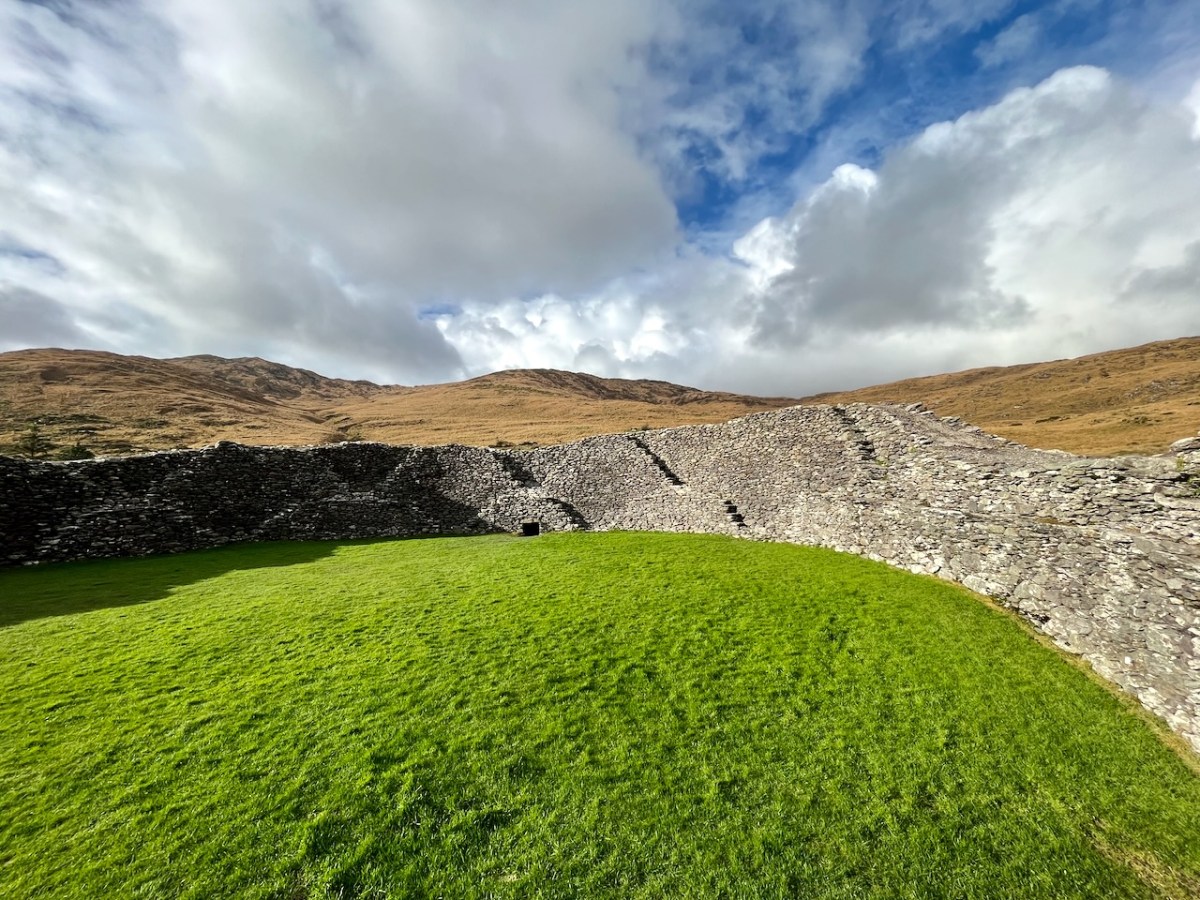
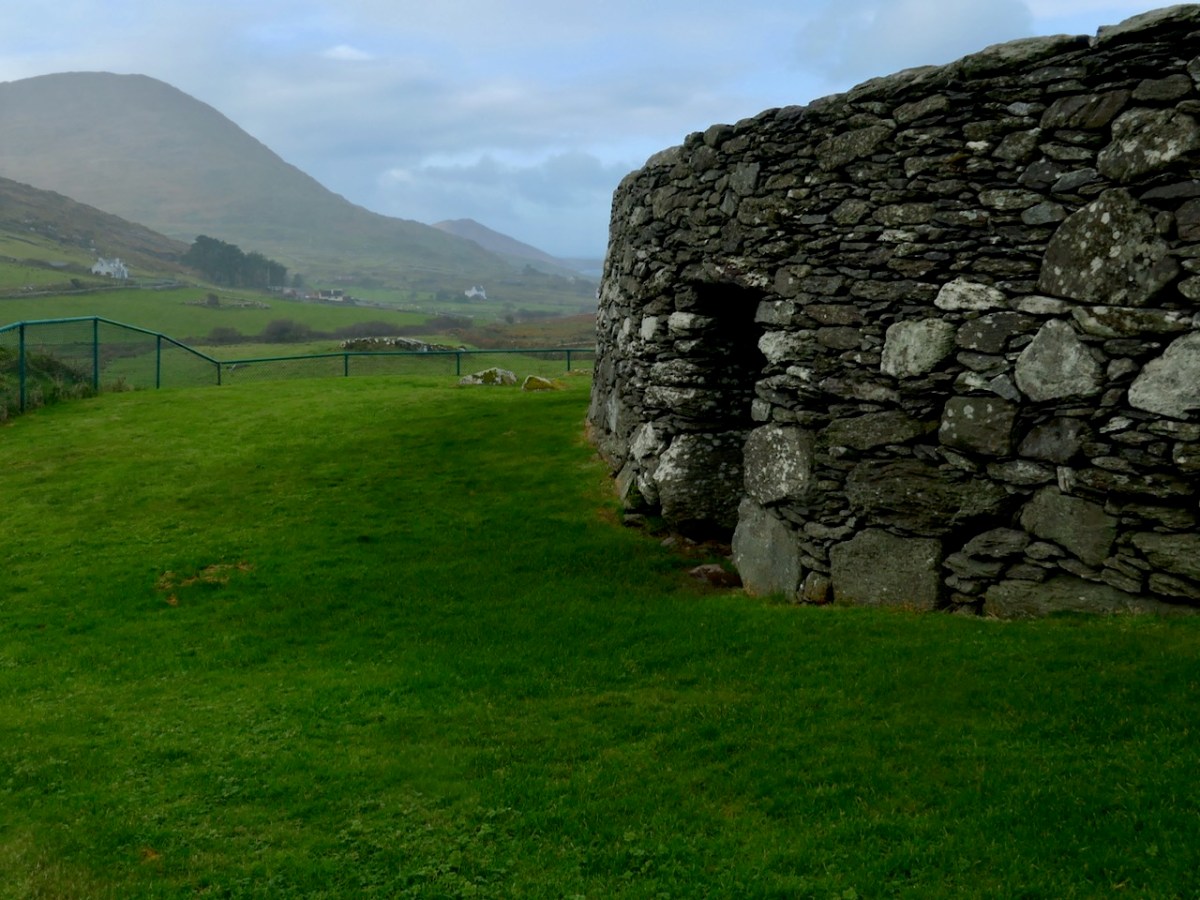
In essence, Staigue is similar to the other Cashels, with massive walls, two internal rooms or ‘cells’ in the walls, an entrance through the walls on the south side, and sets of stairs giving access to the top of the walls.
The stairs – the Irish word staighre (pronounced sty-rah) may have given the cashel its name – are the most striking feature. Commonly referred to a X-pattern, the first set lead up to a flat ‘landing’ from where the next set take off in both directions. You can see this really well in this 3D model of Staigue done by The Discovery Program. The image below is a still from the model – click here to go to it – it’s fun to manipulate it for yourself.
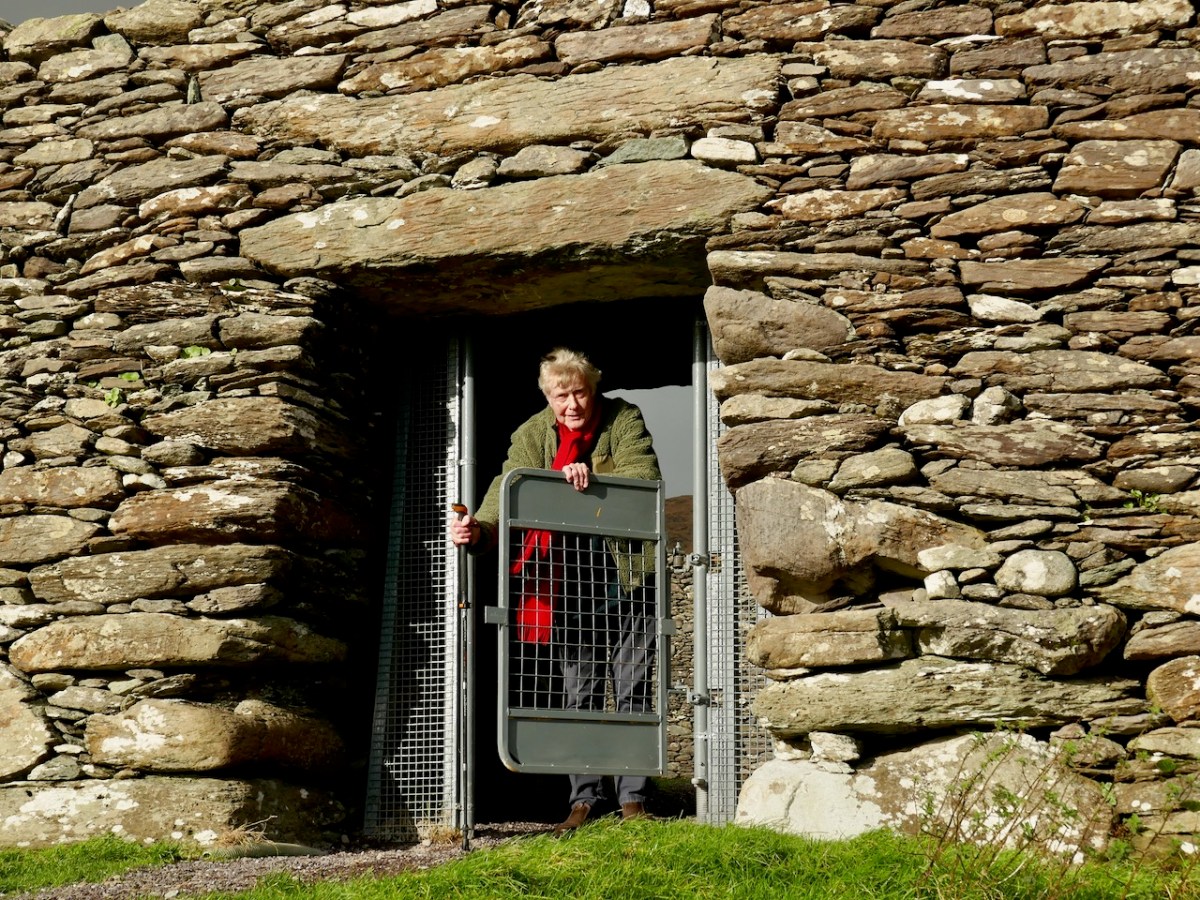
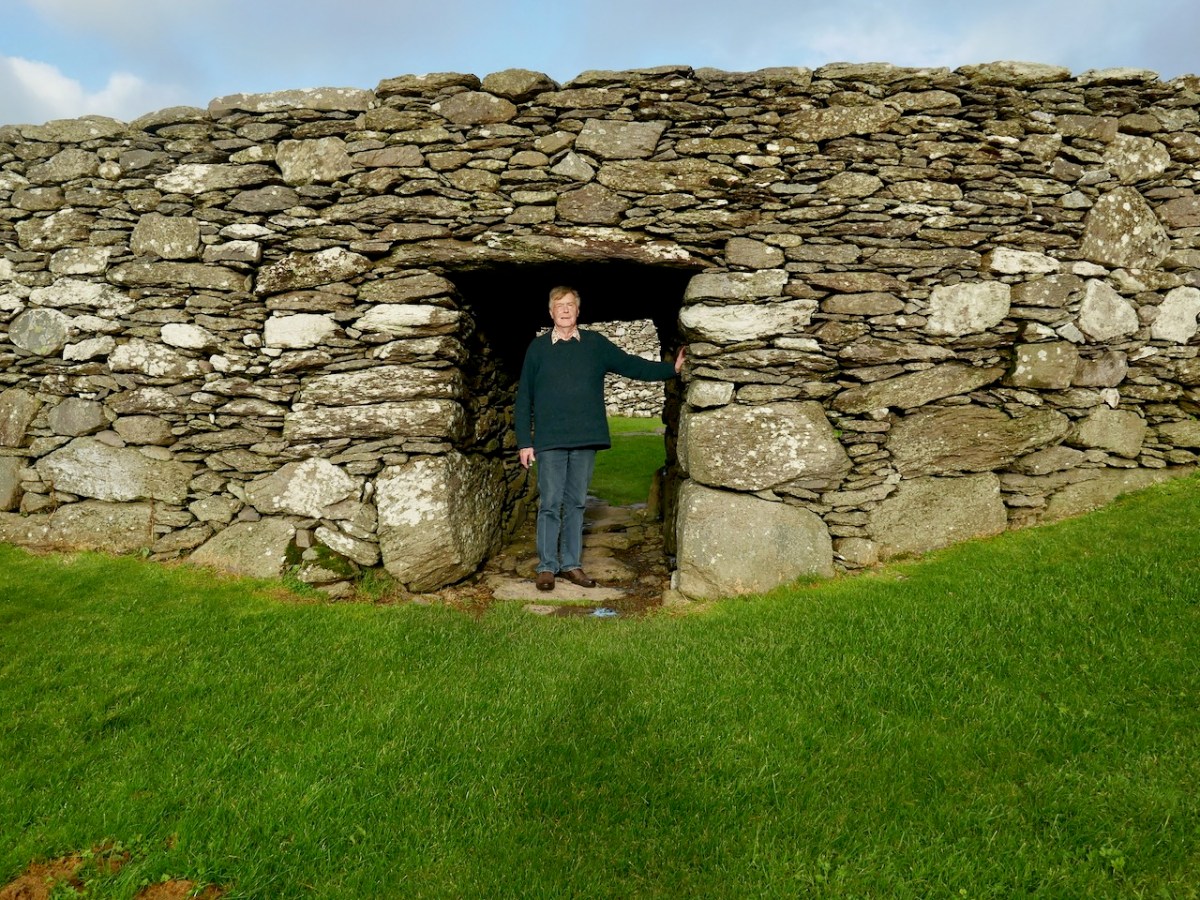
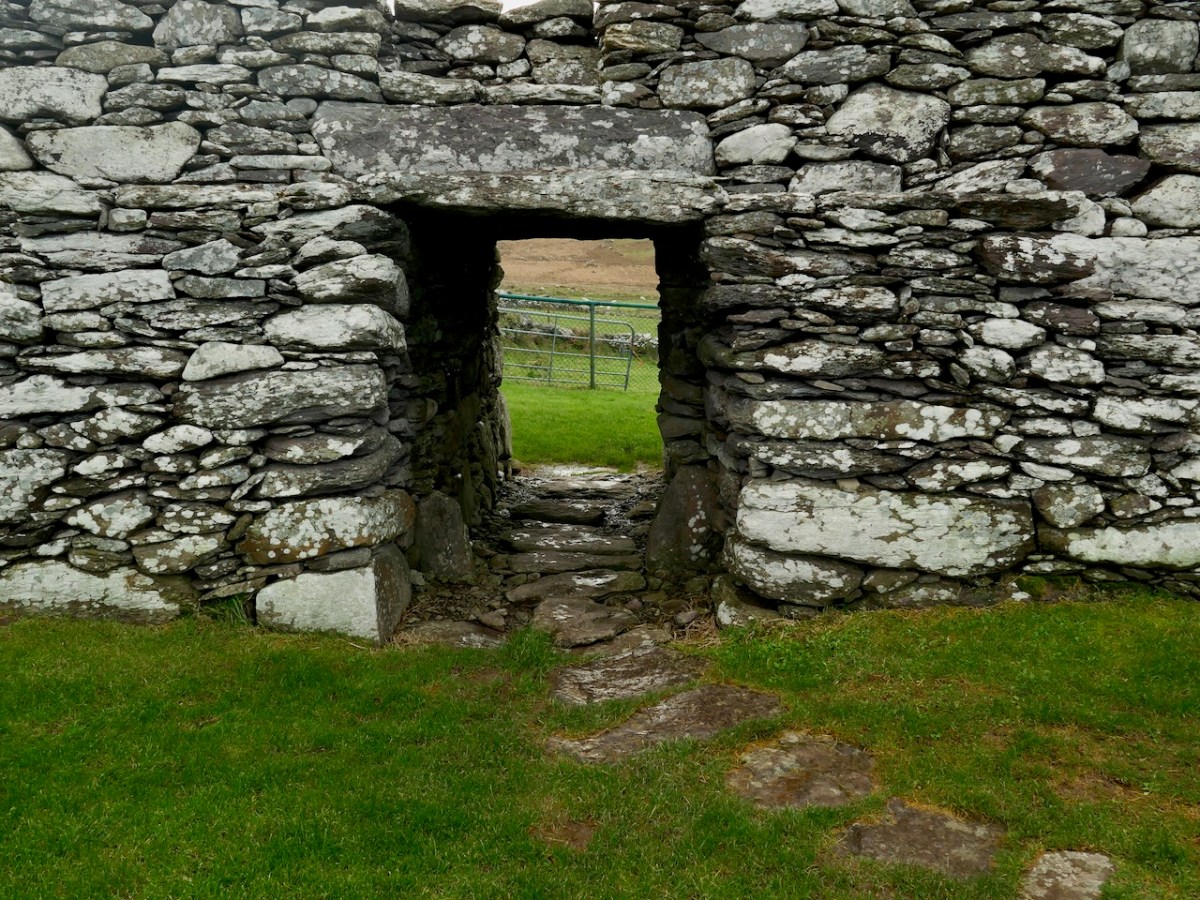
The entrance, surmounted by not one but two massive lintels, leads through the south wall, with a slightly inclined profile. The walls is lowest at this point.
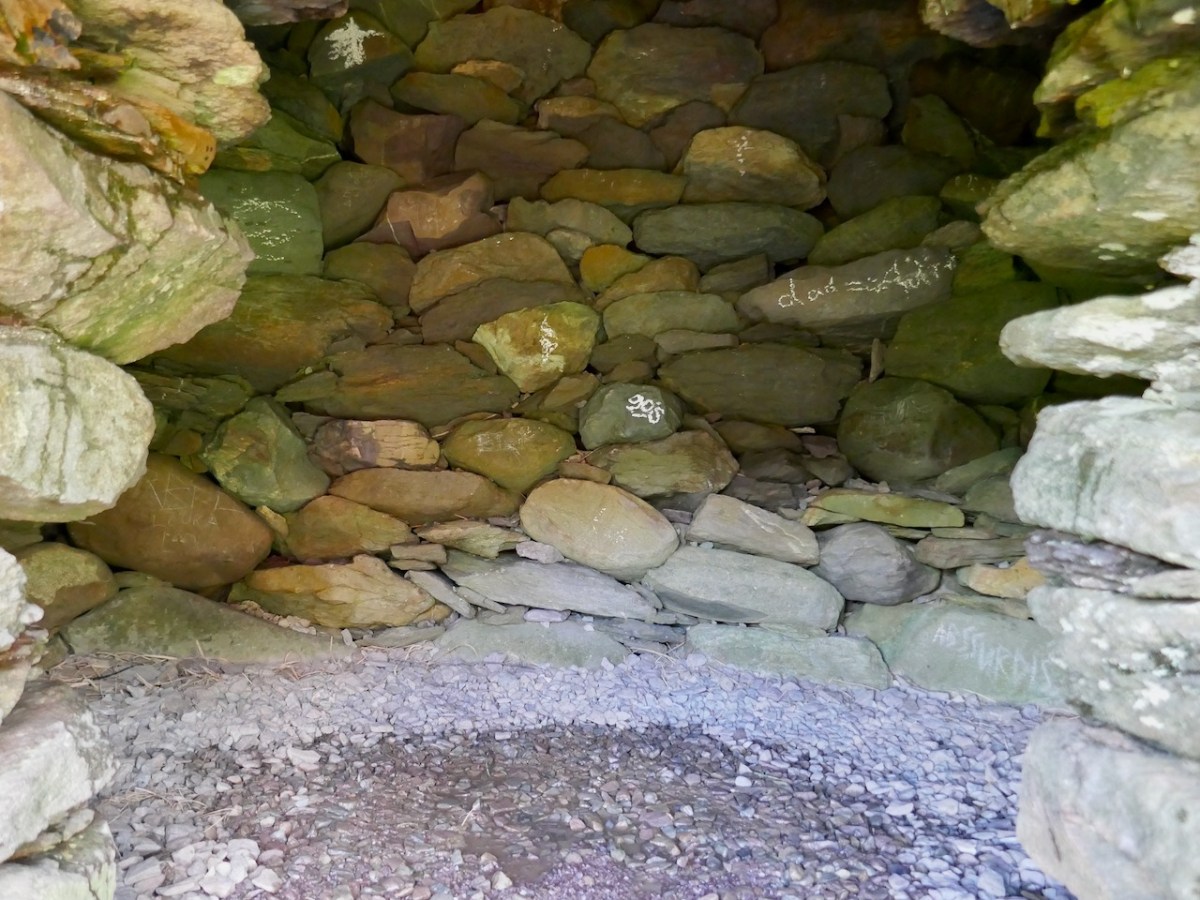
The two mural chambers are to the left of the entrance and opposite it. Their use is unclear, but they may have functioned, like souterrains, as cold storage for food.
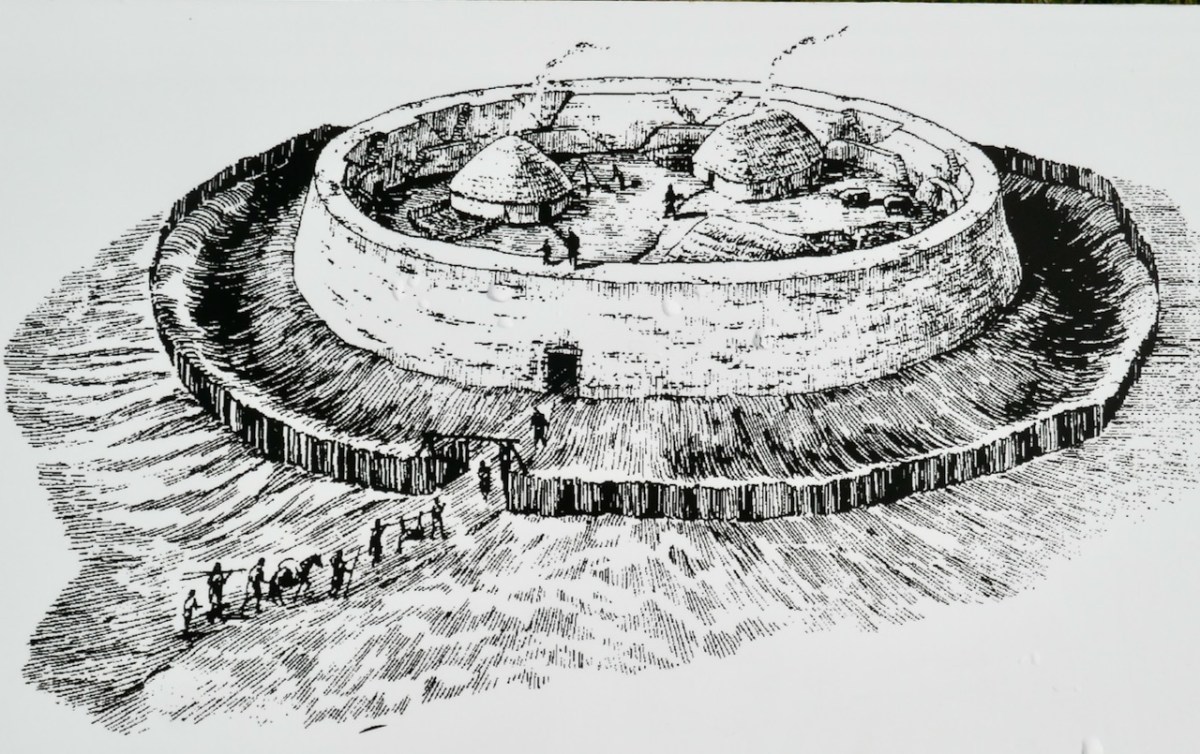
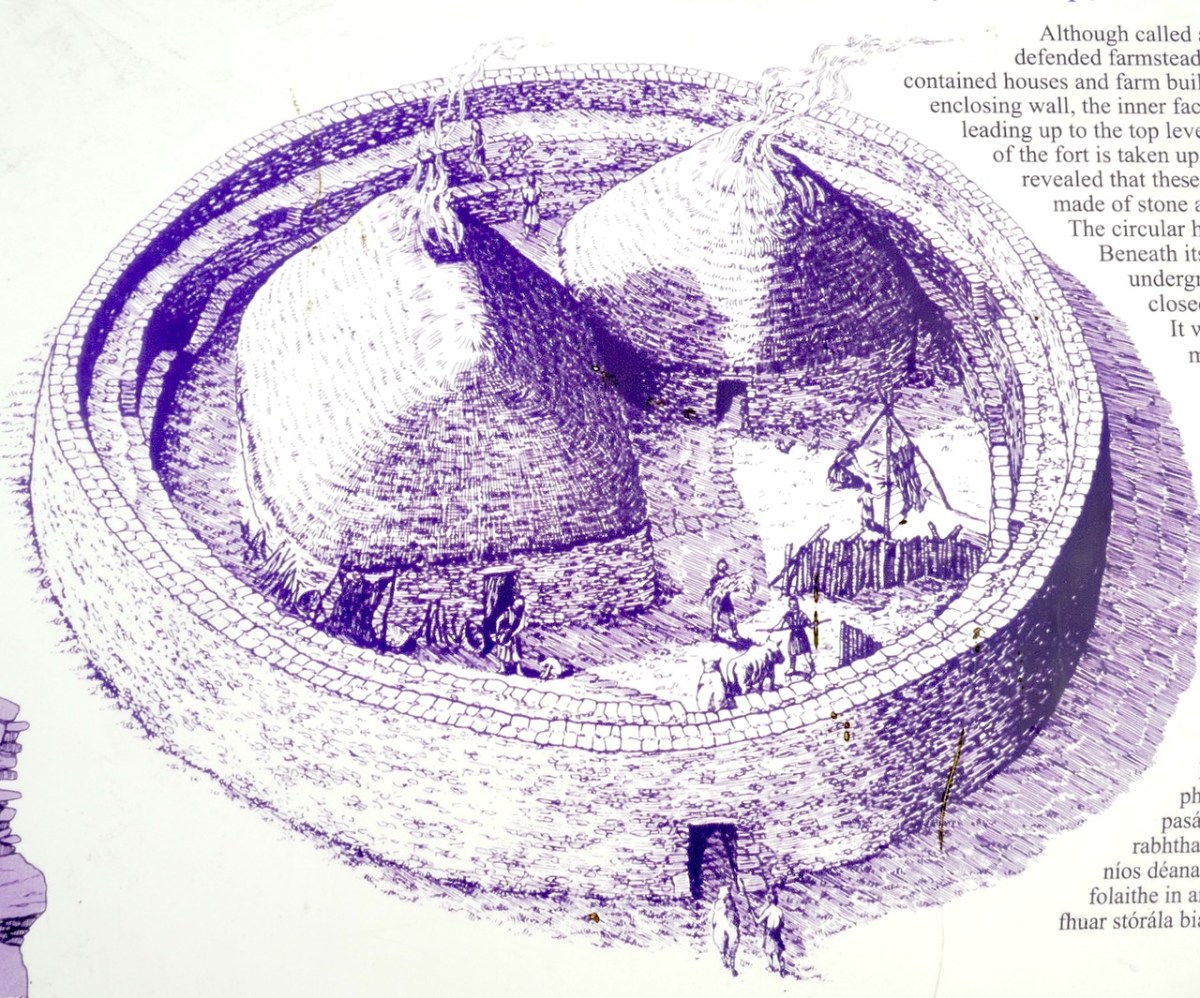
We do not know what buildings may have been inside the fort, although, as we saw in the other three, it was common for these cashels to have houses, whether for dwelling or for ceremonial use (as at Cahergal) or both. It is highly likely that any future excavation of Staigue would reveal similar constructions. The OPW sign (extract below) makes that assumption and says The fort was the home of the chieftain’s family, guards and servants, and would have been full of houses, out-buildings, and possibly tents or other temporary structures.
You remember our old friend General Vallancey from Beranger’s West Cork? In that post I told you that he was an antiquarian of the fanciful sort – forever banging on about druids and Chaldeans and coming up with far-fetched theories. In fact he pronounced Staigue to be a Phoenician amphitheatre! Perhaps Bland’s romantic illustration, below, put him in mind of such an interpretation.
Westropp, one of whose main activities was bringing common sense to antiquarian discourse, in a series on forts written between 1896 and 1901, situated Staigue very much in line with other stone forts on the Western seaboard. The photograph below is from that series. He acknowledges the defensive nature of the huge walls, but declined to use what he saw as the simplistic term “fortress”.
As for their use as cattle pens (as Bland had suggested), he says:
It was, however, not unusual to keep the cattle in the residential fort; we find this in legend, as in the case of the cattle of Iuchna the curly-haired, and in that story, so often quoted, of the three forts of Ventry. What is stronger evidence is that the ancient laws of Ireland made provision for seizing cattle kept in forts, and even for keeping them impounded therein on dark nights. That this extended to later times we have seen in the fort-names Cahernagree, Lisnagry, &c., and perhaps even in the “pounds” of Dartmoor and the local name for Staigue fort “Pounda-na-Staigue.”
We have seen that the three other Kerry Cashels have been dated to the Early Medieval and Medieval period: Leacanabuaile to the 9th and 10th centuries, Cahergal in use between the 7th and 9th centuries and again during the 11th and 14th, and Loher from 400 to 1600. It is puzzling therefore, that the OPW sign at the fort assigns a likely date of the early centuries AD before Christianity came to Ireland. In other words, the Iron Age. This assertion, of an Iron Age date, is repeated in various online sources about Staigue (including an even more vaguely worded reference to “during the Celtic Period.”). There is no evidence that Staigue was built significantly earlier than the other Kerry Cashels. In all likelihood, it belongs in the same medieval tradition of cashel-building.
If you get to Kerry, go visit all four of these remarkable testaments to our past. You will find yourself wondering at the context in which they were built, and the complex and highly stratified society in which resources could be marshalled to build something that would serve to remind all who saw it, who’s in charge here!
I had the opportunity to visit Loher Fort in Kerry recently, so I have decided to expand this Cashels in Kerry series to four and I’m including it in the list. I’m leaving Staigue till last.
Loher Fort was excavated for four seasons in the 1980s by an archaeologist from UCC. Yes, that’s right, four seasons! You might reasonably expect, therefore that this would be the fort that would yield a thick report full of details and illustrations of what was found, some radiocarbon dates, some historical context – but shockingly, the only report ever forthcoming was a few paragraphs provided to Excavations.ie. I quote it in full now.
The fourth season of excavation was completed during 1985. The site may be classed as a cashel, 20m in internal diameter, with rampart walls, 2m thick.
Prior to excavation the interior of the site was composed of stone fill to a depth of 2m. On removing this fill, 2 stone structures were uncovered. Both of these had walls surviving to a height of 1m and 1m in thickness. One structure is circular (clochan type) and the other rectangular. The circular structure is c. 5m in diameter and the rectangular structure is 7m x 6m in extent.
The interiors of both these structures have been excavated. This revealed no great depth of occupation deposit but did reveal a good stratigraphic sequence of structures. Essentially, there are 5 identifiable structures including the above two. In the area of the surviving circular structure, an earlier stone-built circular structure was uncovered. This was pre-dated by a wooden structure constructed of driven stakes.
The rectangular structure was pre-dated by a circular wooden house, again of driven stakes. There is also the possibility of another post-built structure in this area. Apart from the above mentioned stratigraphic relationships, the latest circular structure pre-dates the rectangular stone structure. Other features include a souterrain associated with the circular house, and a parapet walkway and mural steps.
Finds include glass beads and a tanged knife. Organic material includes shell, carbonised seed remains, fish scales and fish bones.
That’s it – that’s all we know, apart from a very broad assigned date in the overview of Medieval (AD 400-AD 1600).
Interestingly archaeologist Aoibheann Lambe, the rock art expert, has identified a number of pieces of rock art in an around the fort, including on stones used as building materials. While these pre-date for fort by several thousand years, it is evidence that people were living in this area for millennia. It’s easy to see why – it’s a spectacular setting, with access to the sea and a location that provides a strategic point of domination over the surrounding landscape.
As at Leacanabuaile, there was also a souterrain, although there is no indication on the ground now of where it was, and we have no record of what it looked like and no plan. It was under the round house, which is the earlier of the two houses. Here’s what the National Monuments records says about that:
The entrance to a souterrain is located in the W half of the interior of the house. Measuring 1.1m x 1.3m, it gives access to a drystone-built lintelled passage, 1m high, which runs E-W for 3m before turning sharply to N. The excavation revealed that the construction of the souterrain post-dated that of the house, and that an earlier stone-built circular structure in the area of the house was, in turn, pre-dated by a wooden structure constructed of driven stakes.*
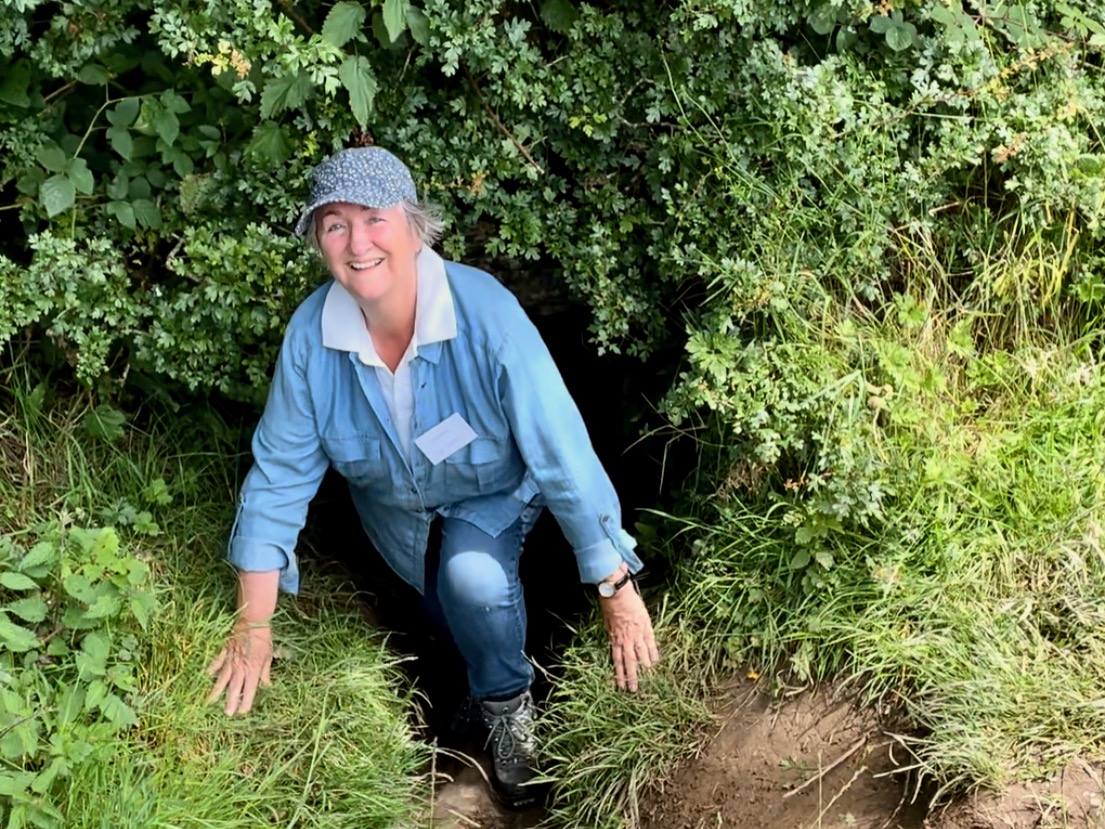
What is a souterrain exactly? As the name suggests, it’s a man-made underground passage, often associated with ringforts and cashels. They may have had a variety of uses, but perhaps the main one was as a root cellar to preserve food. That’s me, above emerging from one of the most famous of of our Irish souterrains, Oweynagat at Rathcroghan. They’re a common class of archaeological monument – there are over 1,000 in Cork and over 800 in Kerry. Folklore is rich with stories of souterrains that stretch for miles, that end up in the sea or in a nearby castle, but alas although we know of complex examples with passages leading to multiple chambers, most are quite short and contained within the general area of the ringfort. For more on souterrains, see this wonderful site.
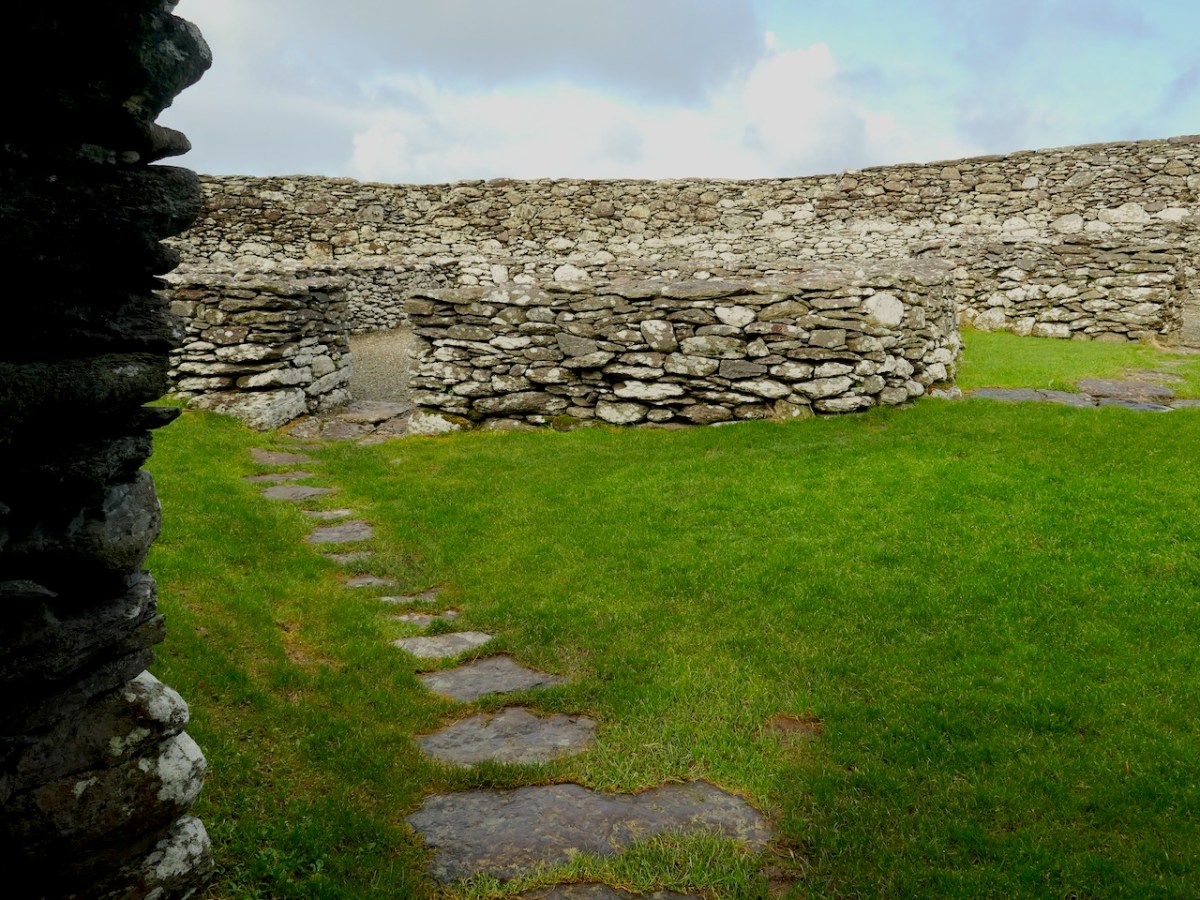
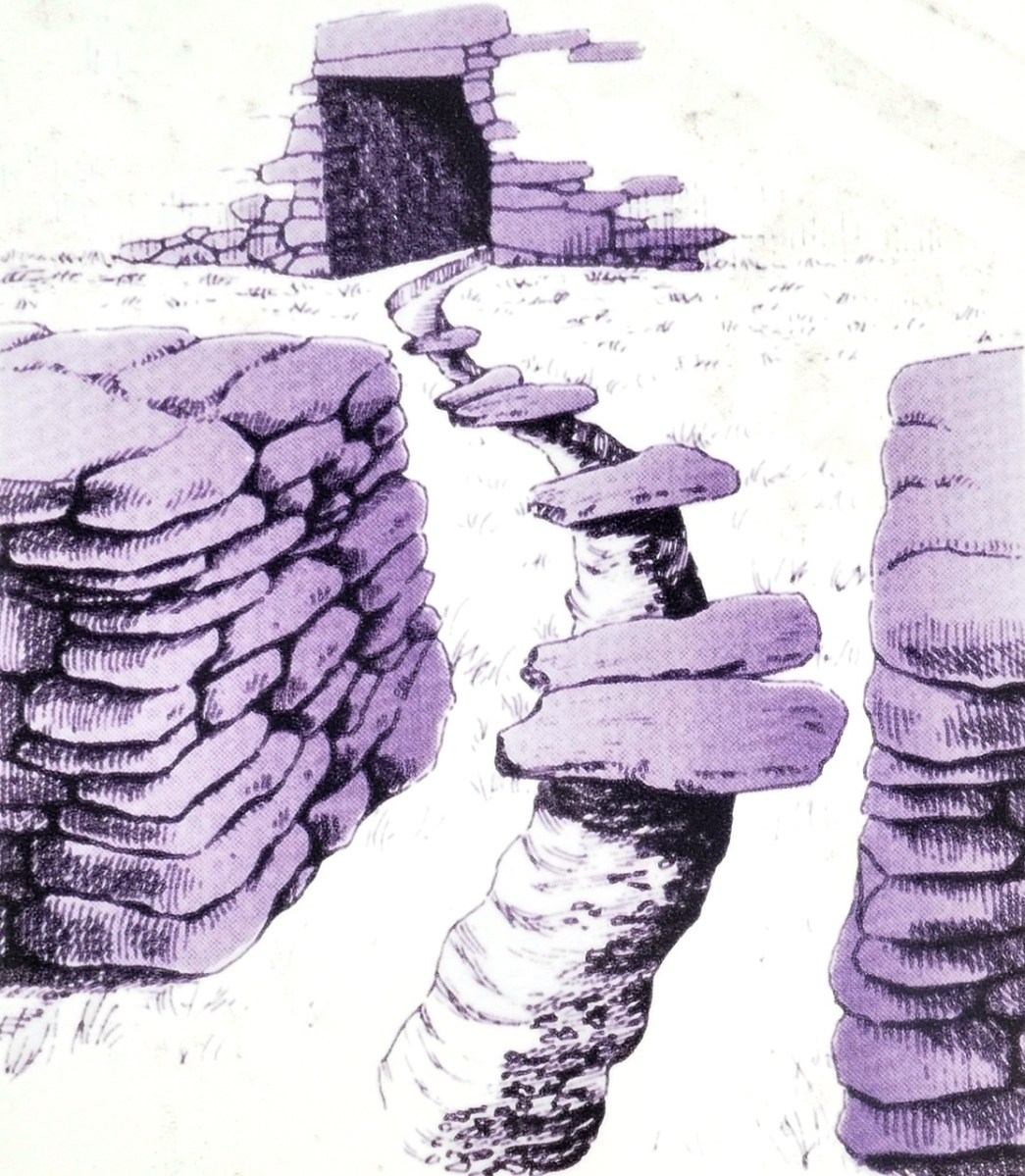
There was also a covered drain leading from the fort entrance to the house, and another between the two houses. Not quite the fine paving that was found at Cahergal, but certainly a way of keeping your feet dry on what were no doubt well-worn paths. There’s no mention of this in the brief report, but obviously the OPW, who conducted the reconstruction, knew about this, as did National Monuments who commissioned the interpretive plaque. Is there, in fact, more information available somewhere? I would be happy to stand corrected.
The walls and stone steps, which are a standout feature of these Kerry Cashels, are described in the National Monuments record. Note they use the word Caher instead of Cashel – both mean ‘stone fort.’
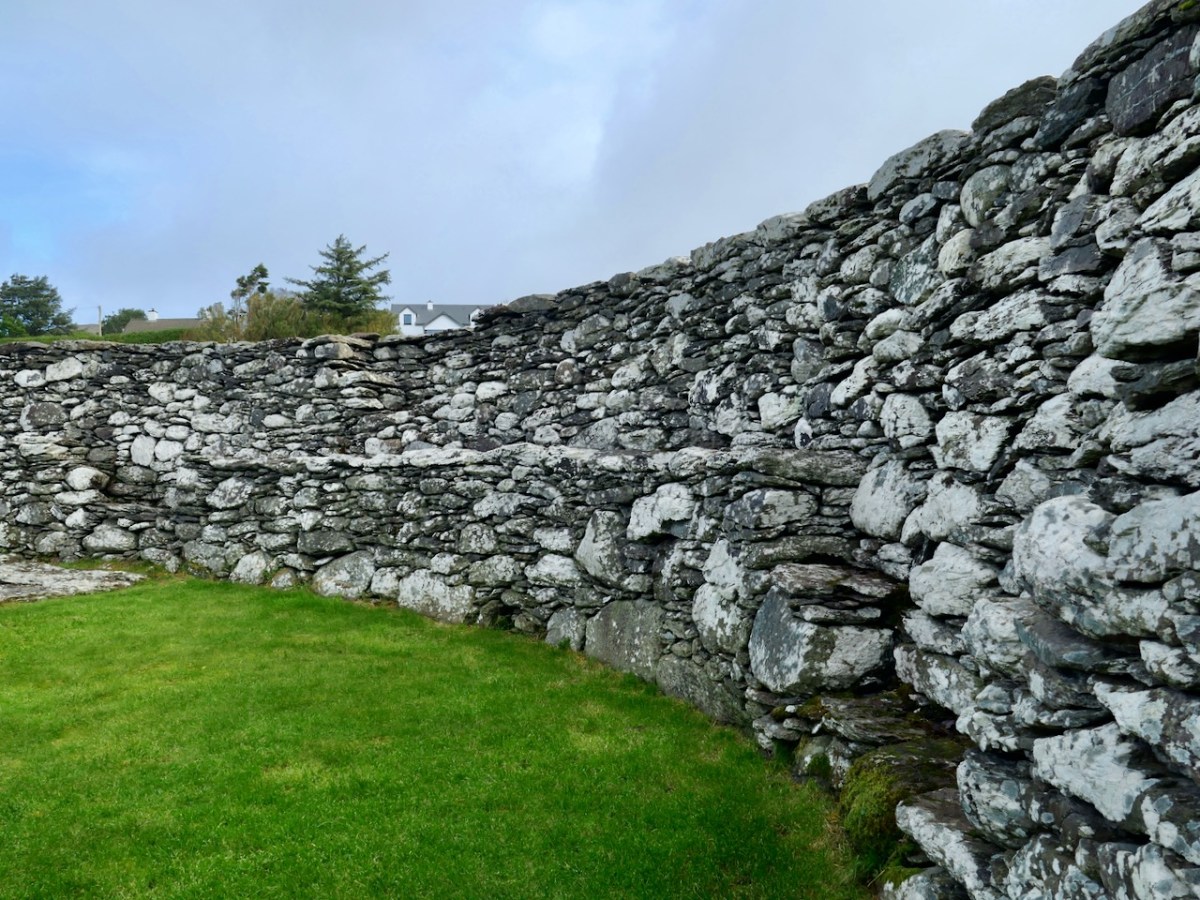
Caher Wall: This consists of a rubble core faced internally and externally with random courses of well-built drystone masonry. Much of the external face, which is battered, is concealed by a substantial build-up of collapse and field-clearance material. The wall, which is up to 4m in basal thickness, varies in external height from 1m to 2.5m and internally from 2.5m to 3.3m. A lintel-covered paved entrance passage. . . leads into the interior of the site from SSE. A terrace, reached by means of seven inset arrangements of opposing steps, occurs on the internal face of the caher wall at an average height of 1.3m. The arrangements of steps occur at irregularly spaced intervals, and the individual sections of the terrace to which they give access average .6m wide. Traces of a short section of a second terrace, also furnished with steps, occur above the first in the N sector of the wall.*
Because we have no access to a proper excavation report, we don’t know how closely the reconstruction efforts at Loher were based on the findings. However, from the little information we have it seems that what we see now on the ground is a reflection of what was left after multiple periods of occupation, one of which (perhaps the earliest phase) included a house built with wooden stakes.
Like Leacanabuaile and Cahergal, it seems that once the excavation is over, the OPW moves in and ensures that what is left, if it is to be open to the public is made safe for visitors. If that was all they did, we might all, perhaps, be a little less confused now about what these forts looked like originally. But the instinct to reconstruct is strong, as well as the perceived need to tidy up the place, round off sharp corners and keep the grass trimmed to golf course standards. The information plaques the National Monuments folk provide are exceptionally well designed and full of welcome information.
What we can say is that it’s a wonderful site, impressively built and situated, and adds to the sum total of what knowledge we have of how high-status individuals constructed statement dwellings or ceremonial spaces for themselves in medieval Ireland.
The description is taken from the online inventory maintained by National Monument for all archaeology sites in Ireland, available to search here:
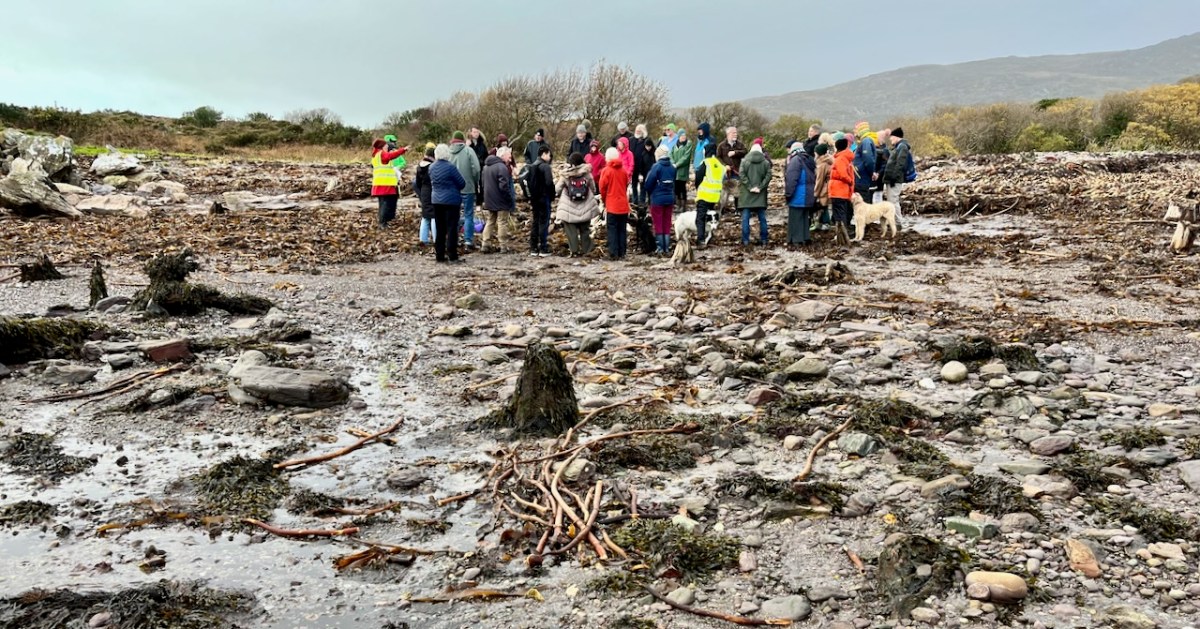
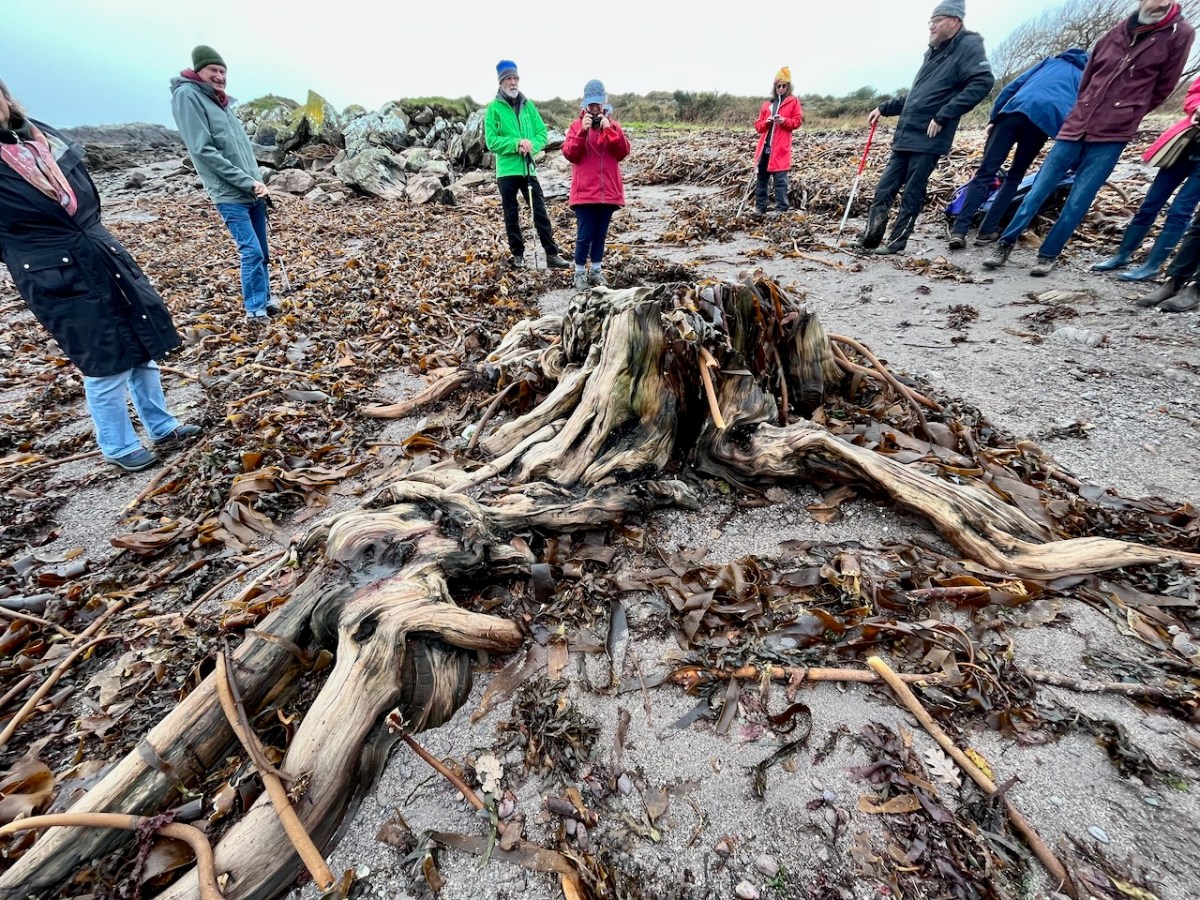
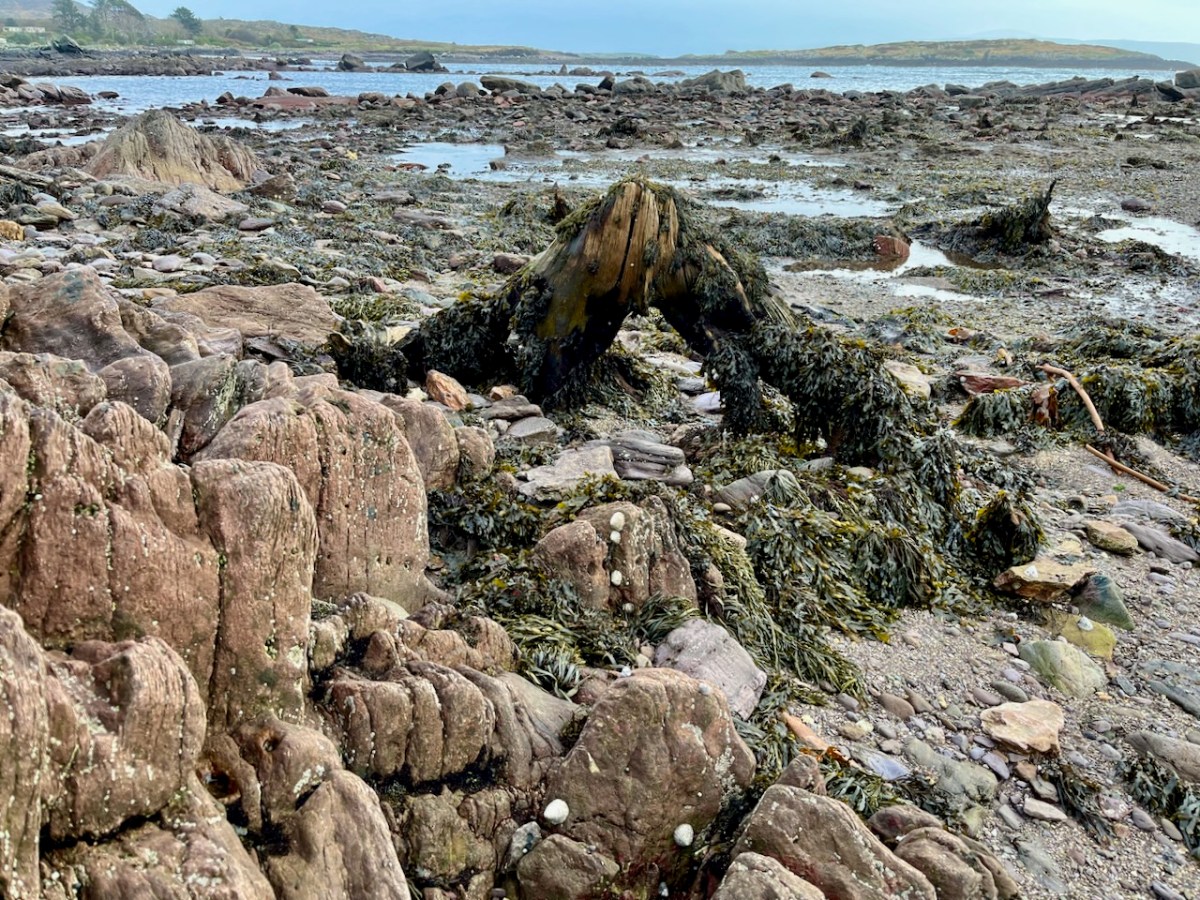
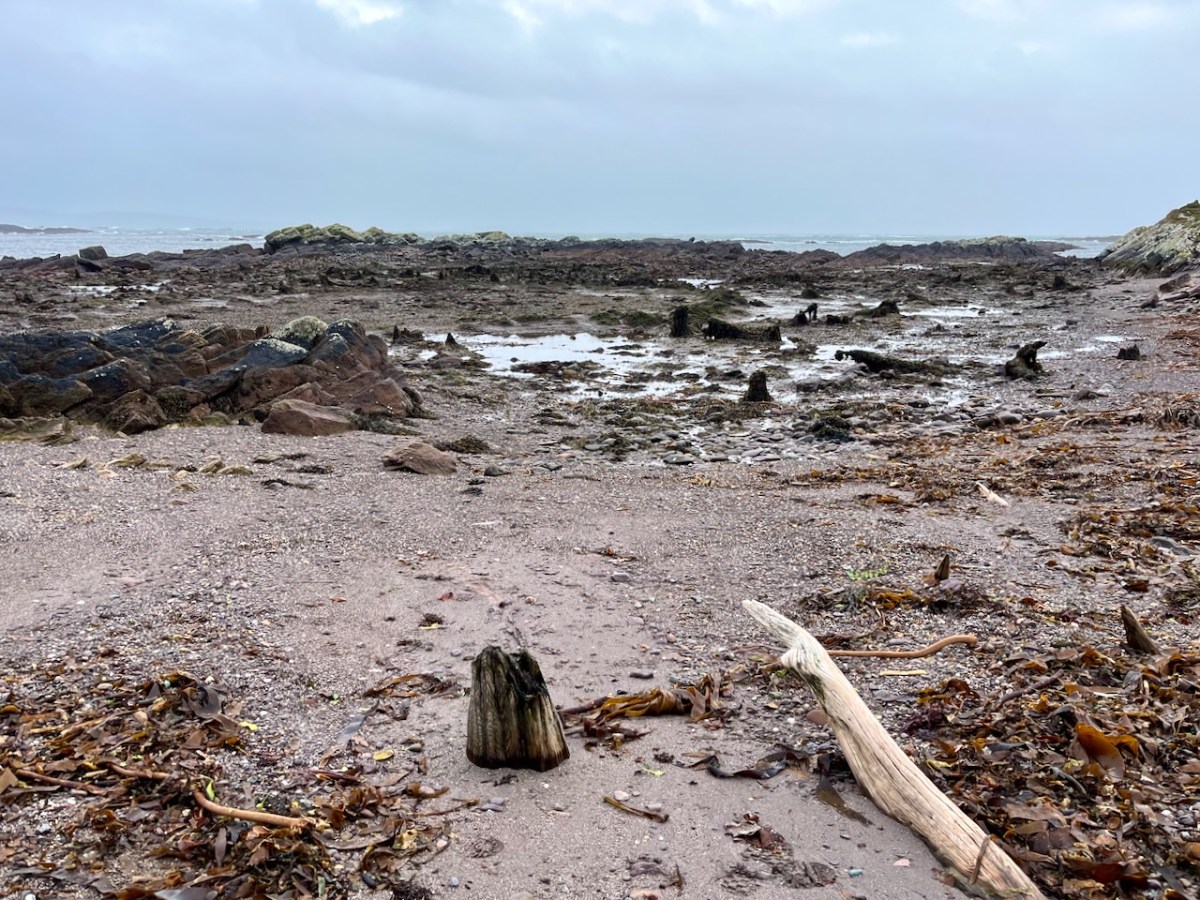
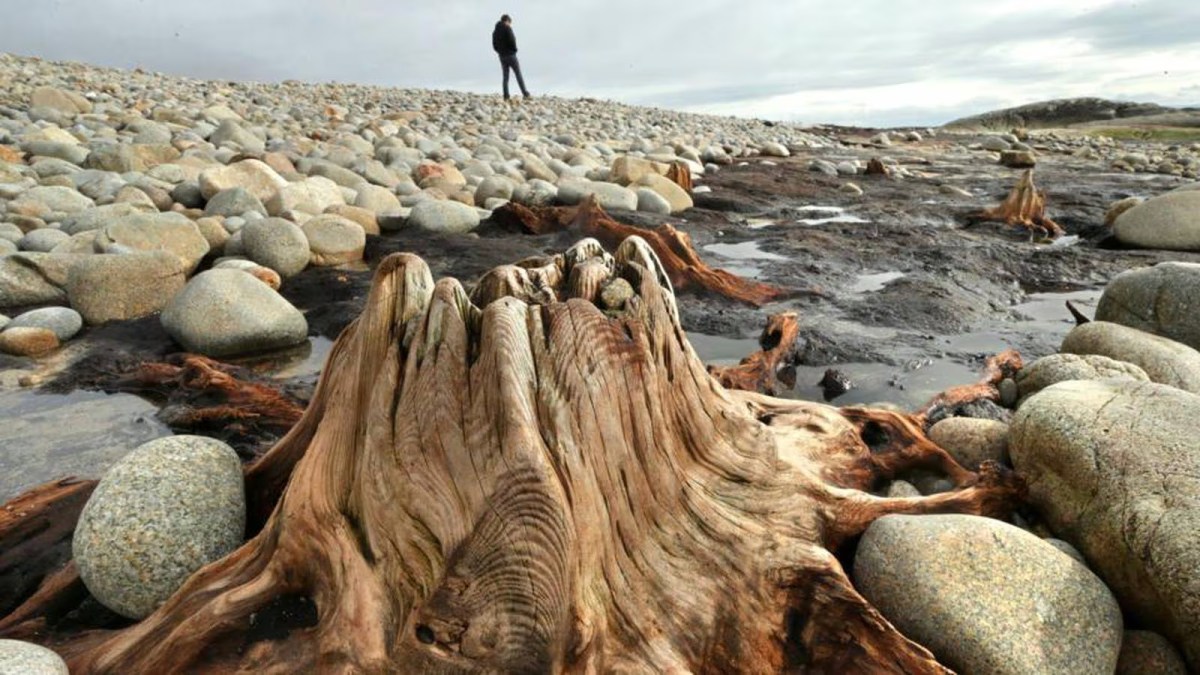
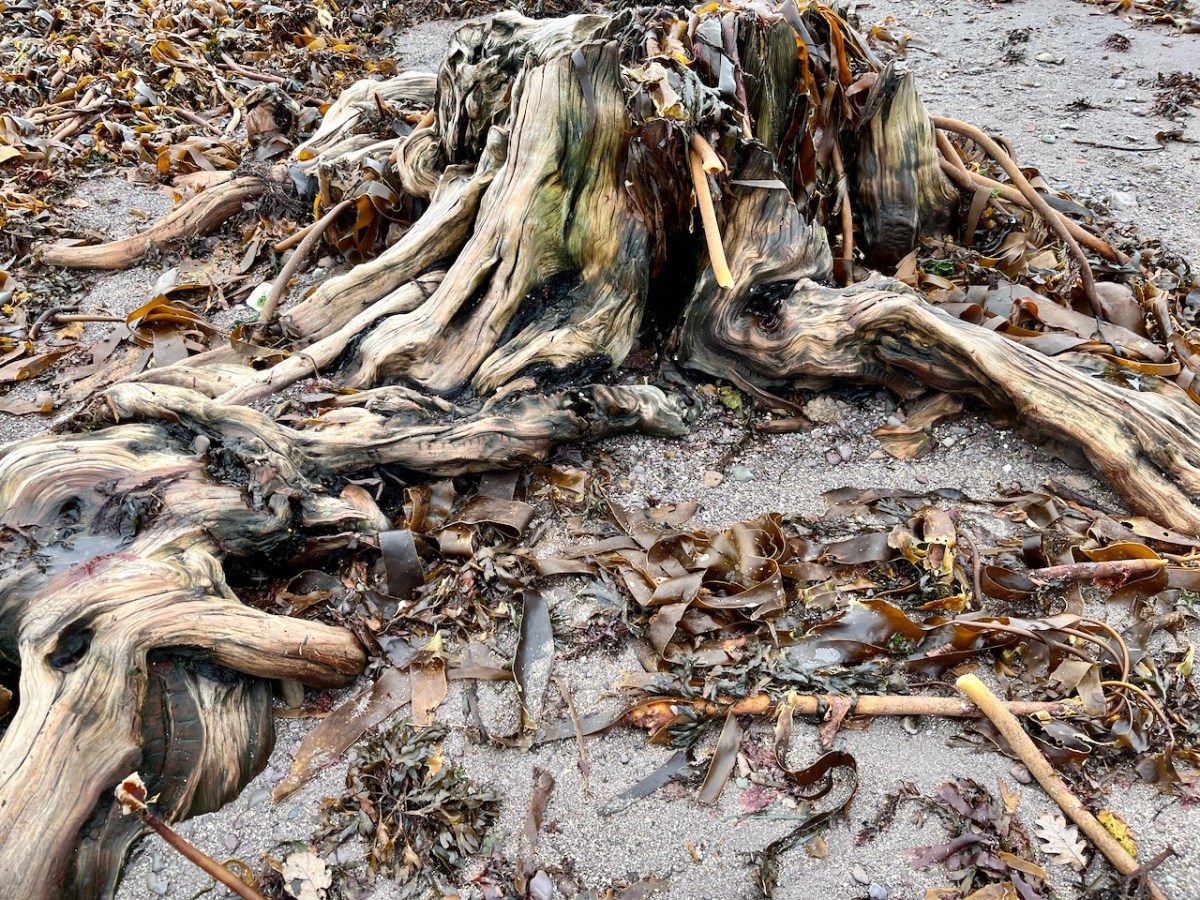
‘Drowned Landscapes’ – that’s an adequate enough description for us to look again at a subject which RWJ covered five years ago in this post: Tralong Bay, Co Cork – give it a read. I was reminded of the subject when we took part in an Archaeology Festival based in West Kerry just a week ago: Amanda’s current holy well blog describes the expeditions. One of the sites visited was Bunaneer Drowned Forest, where we saw stumps of trees on the beach there which were alive thousands of years ago. At low tide many tree remains become visible at Bunaneer, near Castlecove village on the south coast of Kerry’s Iveragh Peninsula. Our guides for this expedition were plant biologist Calum Sweeney and archaeologist Aoibheann Lambe.
This large jumble of roots (above) is known as Goliath. All the remains here can be seen at regular low tides: at other similar sites elsewhere in Ireland, remains of ancient tree boles and roots are only revealed when tides are exceptionally low. I find it remarkable to be able to see and readily touch these archaic pieces of timber: we are communing with distant history!
Carbon dating has shown that these remains were alive between three and a half and five millennia ago. This is evidence that sea levels were significantly lower then, and that the shore line was further out – perhaps 50 metres from where we see it today. We are constantly – and quite rightly – being warned about rising sea levels resulting from our changing climate in the long term: here we see clear verification that it’s a continuing – and now apparently accelerating – process.
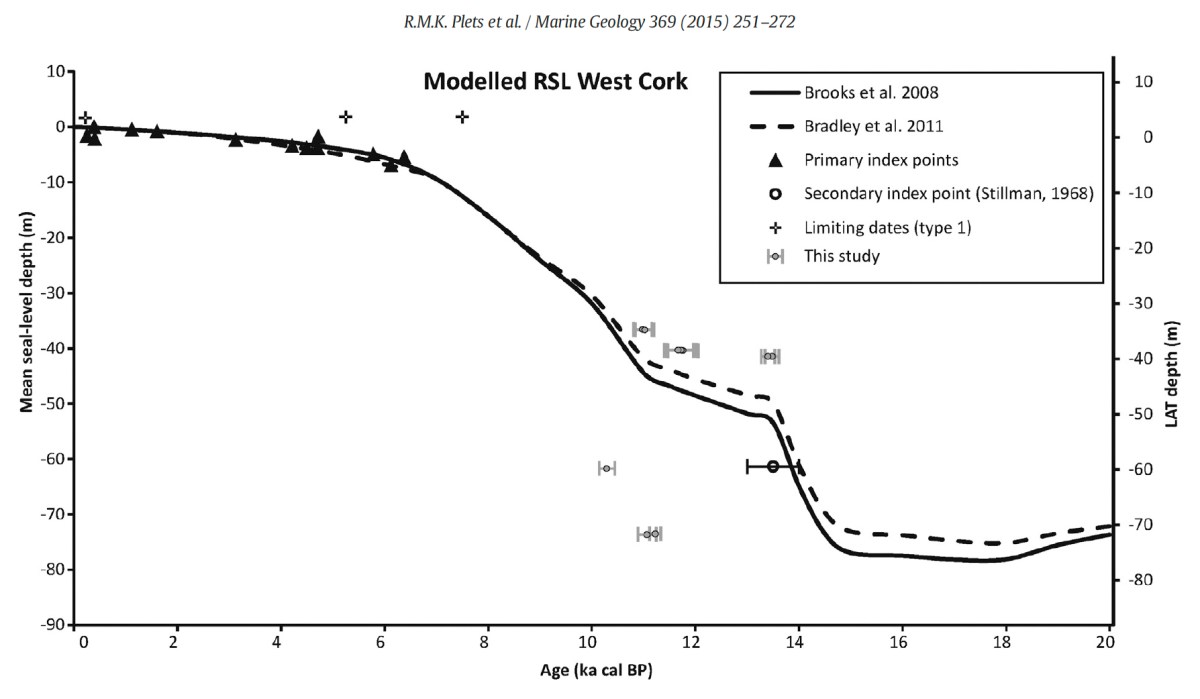
Our friends Robin and Sue Lewando were also on this expedition. Robin has a particular interest in sea-level changes in the Late Quaternary and subsequent eras, and he pointed me to a 2015 paper which explores the subject specifically in the Bantry Bay area of West Cork. That’s a good place to be looking at ancient history: remember the story of Cessair – Noah’s daughter-in-law – who came ashore at Donemark? You first read about it here! So this is a scientific diagram which sets out how sea-levels have been changing over time in our locality:
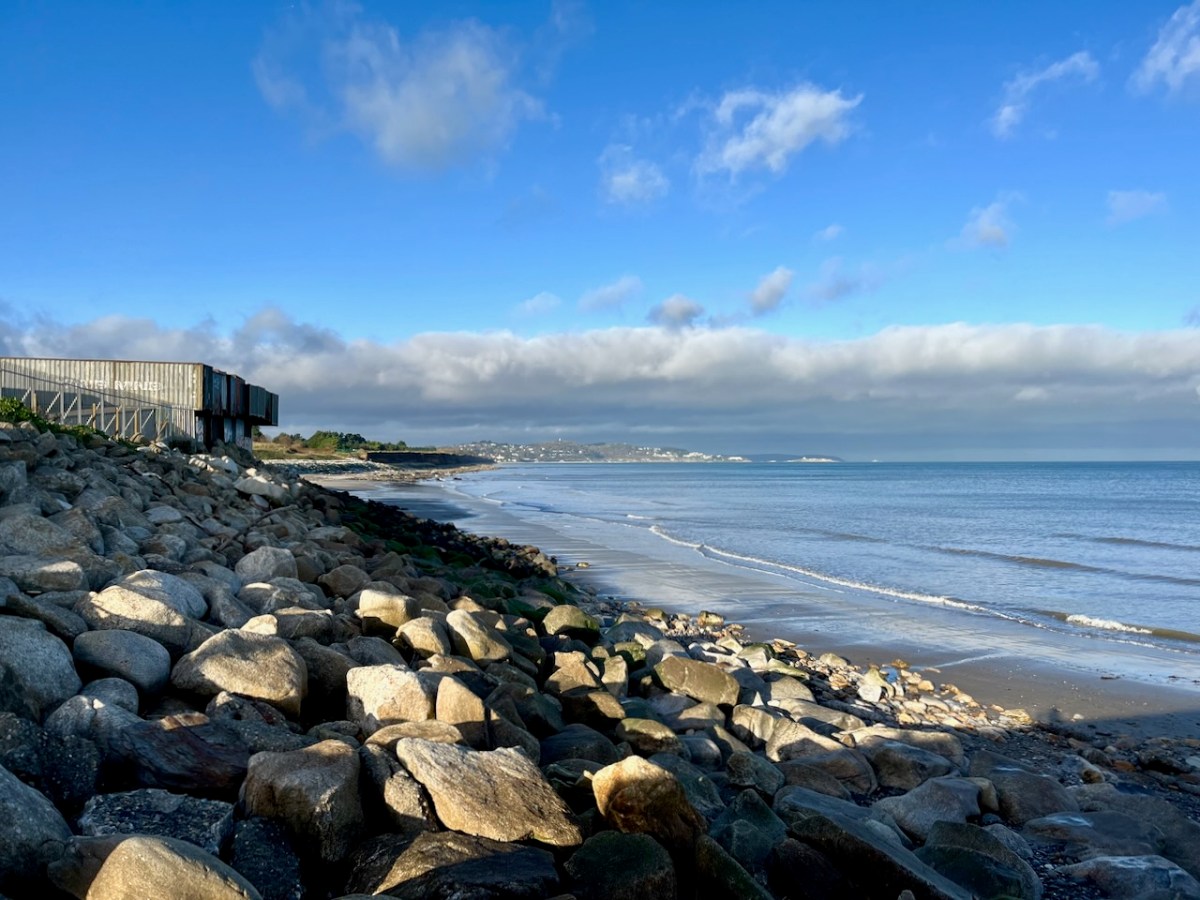
It’s an interesting comparison to take our horizons wider in our study of changing sea levels across the islands of Ireland. Over on the east coast – north of Bray, Co Wicklow – there is another substantial area where tree remains have been revealed at certain tidal conditions.
Above are the areas of beach between Bray and Killiney where ‘drowned forest’ remains have been observed. While at Youghal, Co Cork, further finds have occured:
This example catches our interest because the name of the settlement – Youghal – is derived from the Irish word ‘Eochaill’ meaning ‘Yew Woods’: they were evidently once common in the area, leading us to wonder whether the tree remains in this instance are of yew. In 2014 the following account of another ‘ancient drowned forest’ discovery appeared in the Irish Times (photograph courtesy of Joe O’Shaughnessy):
. . . Walking out on to the shoreline at low tide, geologist Prof Mike Williams points to the oak, pine and birch stumps and extensive root systems which were once part of woodlands populated by people, wolves and bears. These woodlands extended out into lagoons and marshlands that pre-dated the formation of Galway bay, Prof Williams says.
An extensive layer of peat also exposed at low tide in the same location in Spiddal was formed by organic debris which once carpeted the forest floor. The stumps at Spiddal are surrounded by root systems which are largely undisturbed. The carpet of peat is covered in strands of a reed called phragmites, which can tolerate semi- saline or brackish conditions.
“These trees are in their original growth position and hadn’t keeled over, which would suggest that they died quite quickly, perhaps in a quite rapid sea level rise,” Prof Williams adds. Up until 5,000 years ago Ireland experienced a series of rapid sea level rises, he says. During the mid-Holocene period, oak and pine forests were flooded along the western seaboard and recycled into peat deposits of up to two metres thick, which were then covered by sand.
Prof Williams estimates that sea level would have been at least five metres lower than present when the forests thrived, and traces of marine shell 50cm below the peat surface suggest the forest floor was affected by very occasional extreme wave events such as storm surges or tsunamis. He says most west coast sand-dune systems date to a “levelling” off period in sea level change about 5,000 years ago. Dunes in Doolin, Co Clare, are older still, having first formed around 6,500 years ago.
Prof Williams has located tree stumps in south Mayo and Clare, along with Galway, which have been carbon dated to between 5,200 and 7,400 years ago at the chrono centre at Queen’s University, Belfast. Some of the trees were nearly 100 years old when they perished . . .
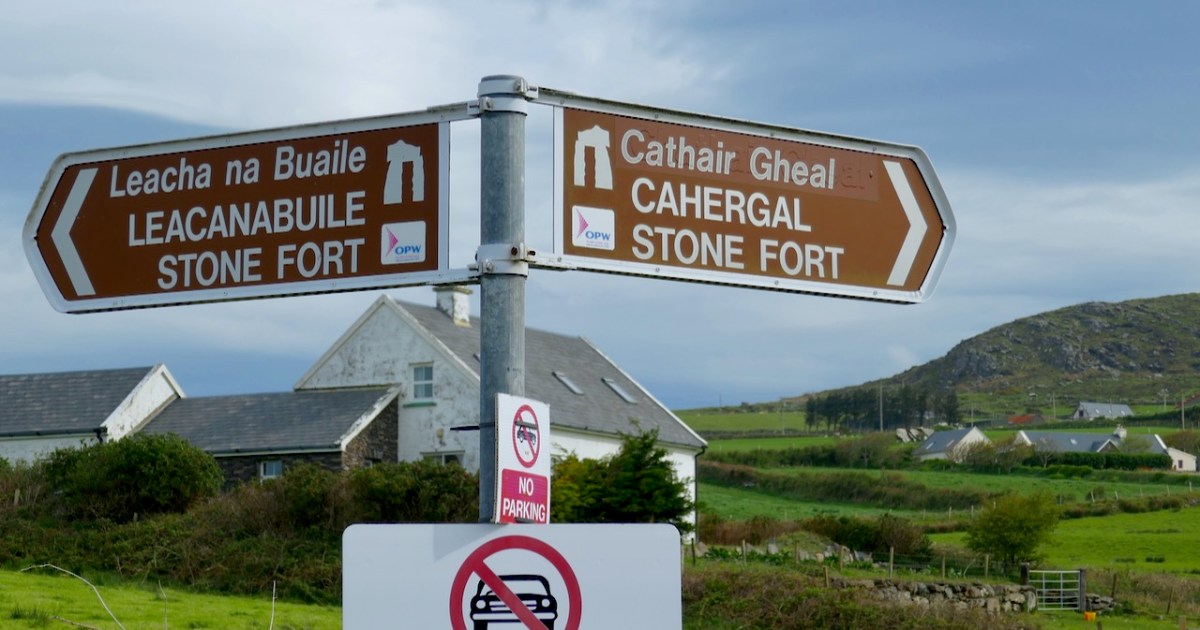
We have been in Kerry a few times this year and visited three stunning sites – Staigue (above), Leacanabuaille and Cahergal (sometimes written Cahergall) – all of which fit the definition of stone forts, often referred to as Cashels. For non-Irish readers, cashel is pronounced the same way as castle, but with the sh sound in the middle – don’t say cash-elle.
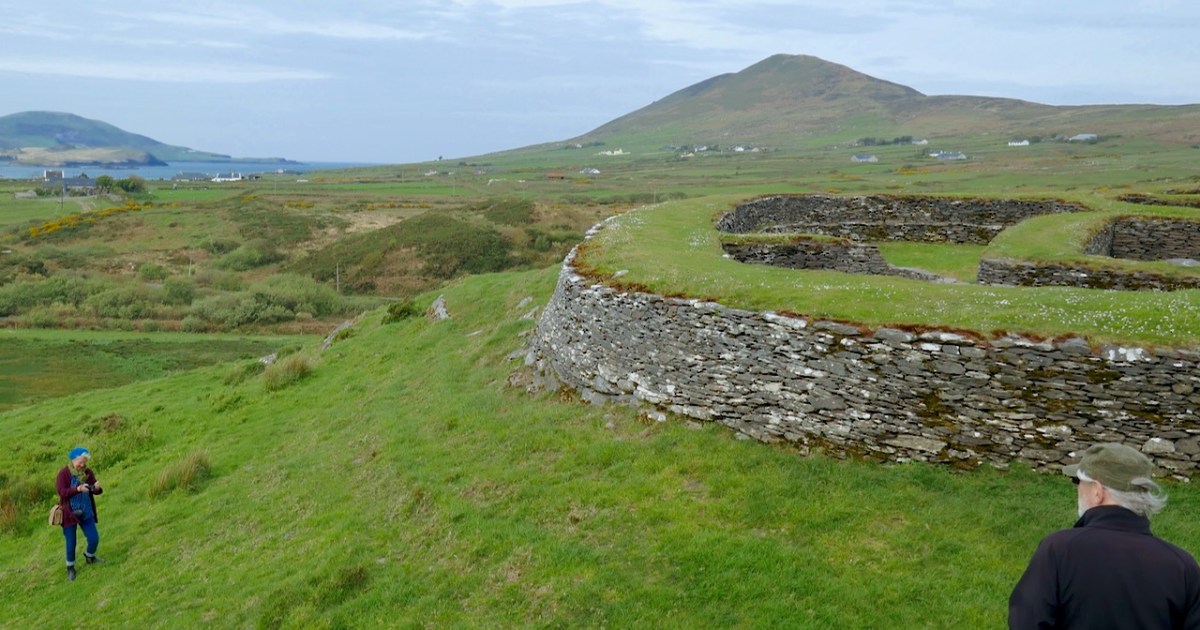
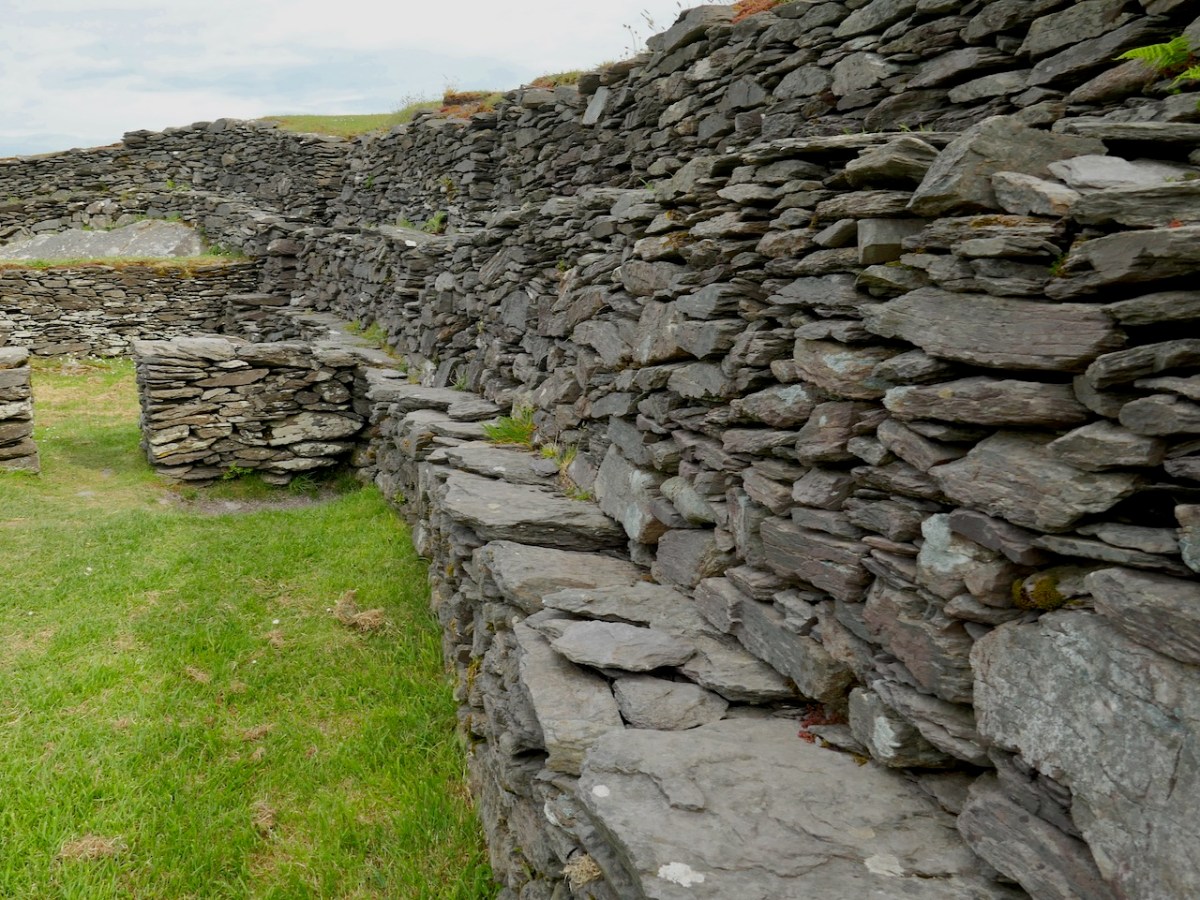
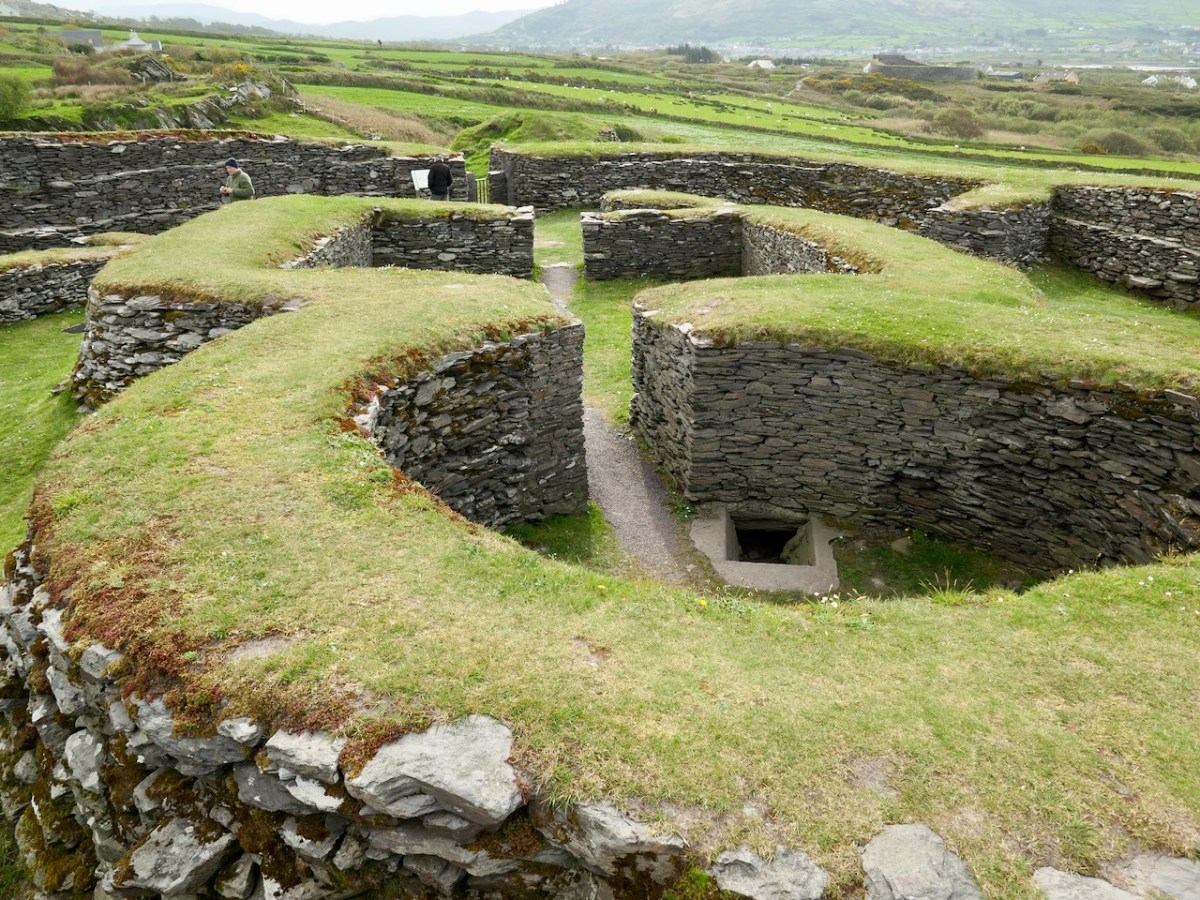
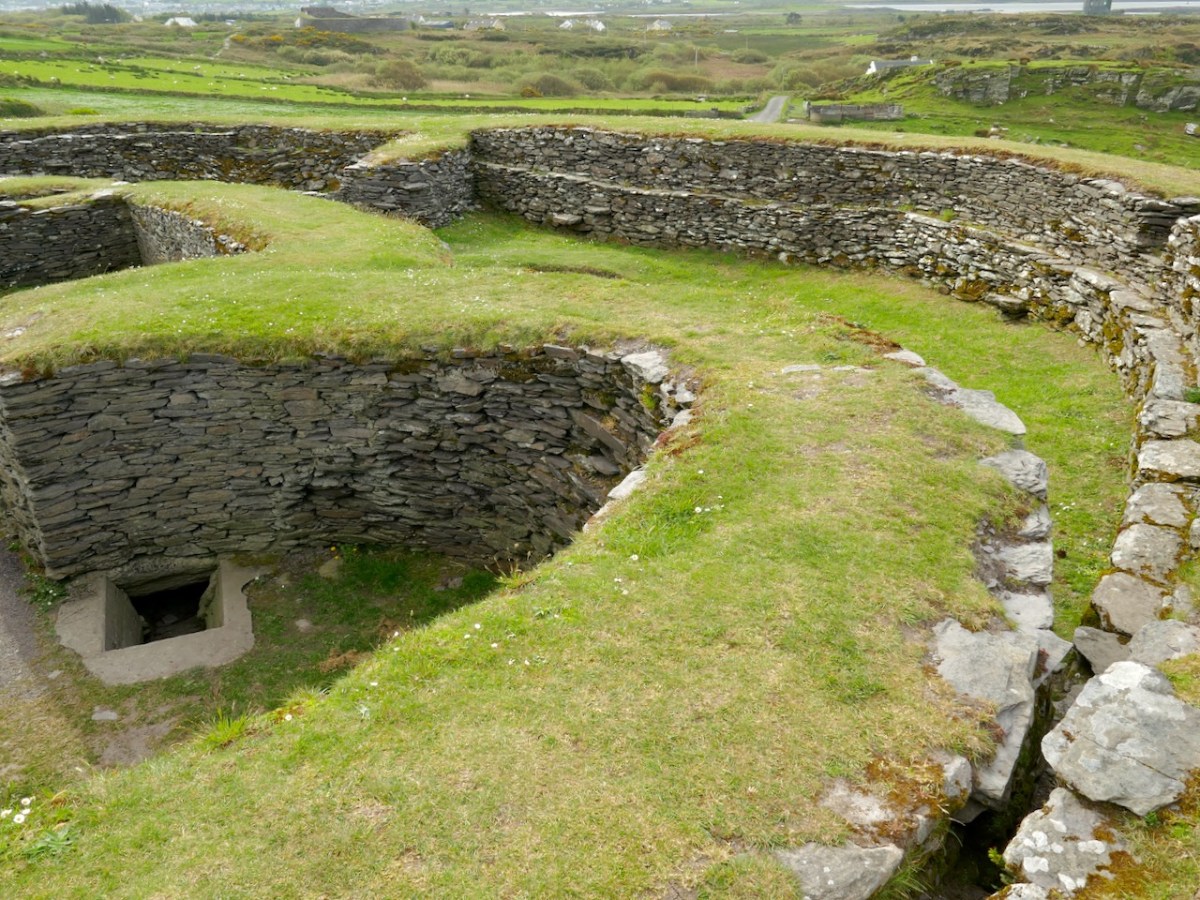
In a fascinating talk available to view online, archaeologist Claire Cotter walks us through several examples of such forts. In relation to size, she points out the huge investment in effort to build those walls, once you go over about 2 metres in height. Of course the walls have to be very thick as well, to carry the weight of all that rock and to ensure they didn’t fall over. Inside, a feature of Staigue and Cahergal are the stone staircases arranged in a X shape – they make for a strong visual statement. Leacanabuaile (below) has stepped levels on the inside of the walls to give access to the parapet. Let’s take a look at each fort in turn to see what’s unique and what’s common among the three of them.
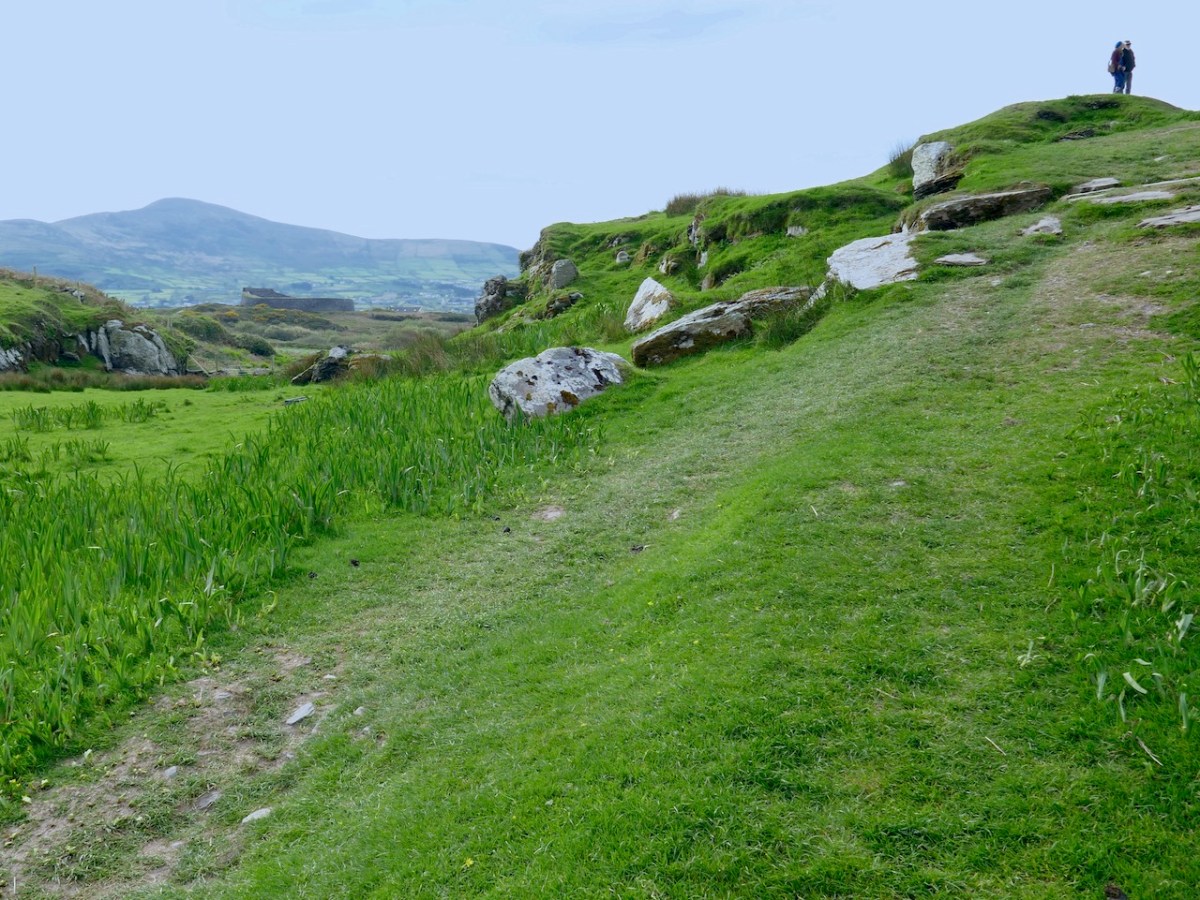
We’ll start with Leacanabuaile, pronounced Lacka – na – boolya and meaning the flagstones of the enclosure, or possibly the flagstones of the summer pasture. Large flagstones, or leacs, do litter the way up to the fort.
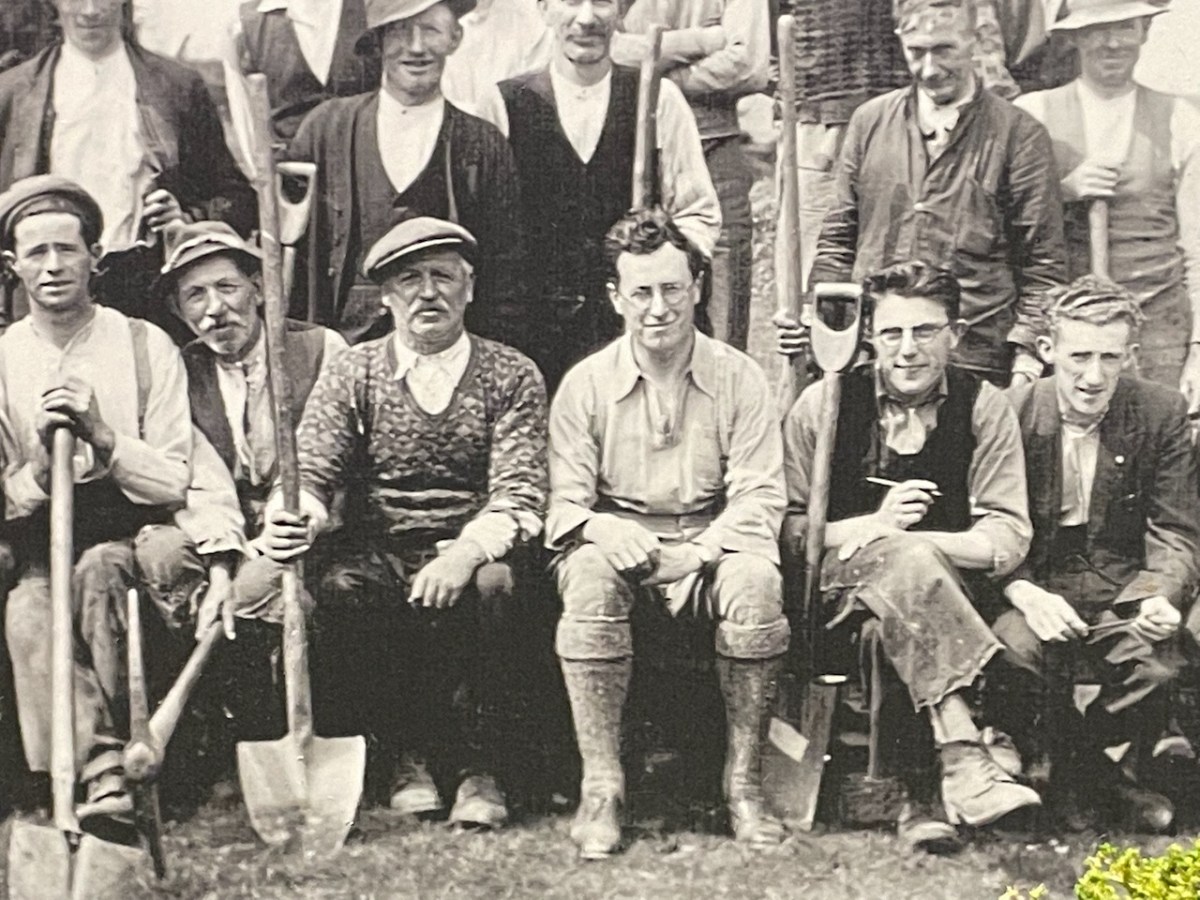
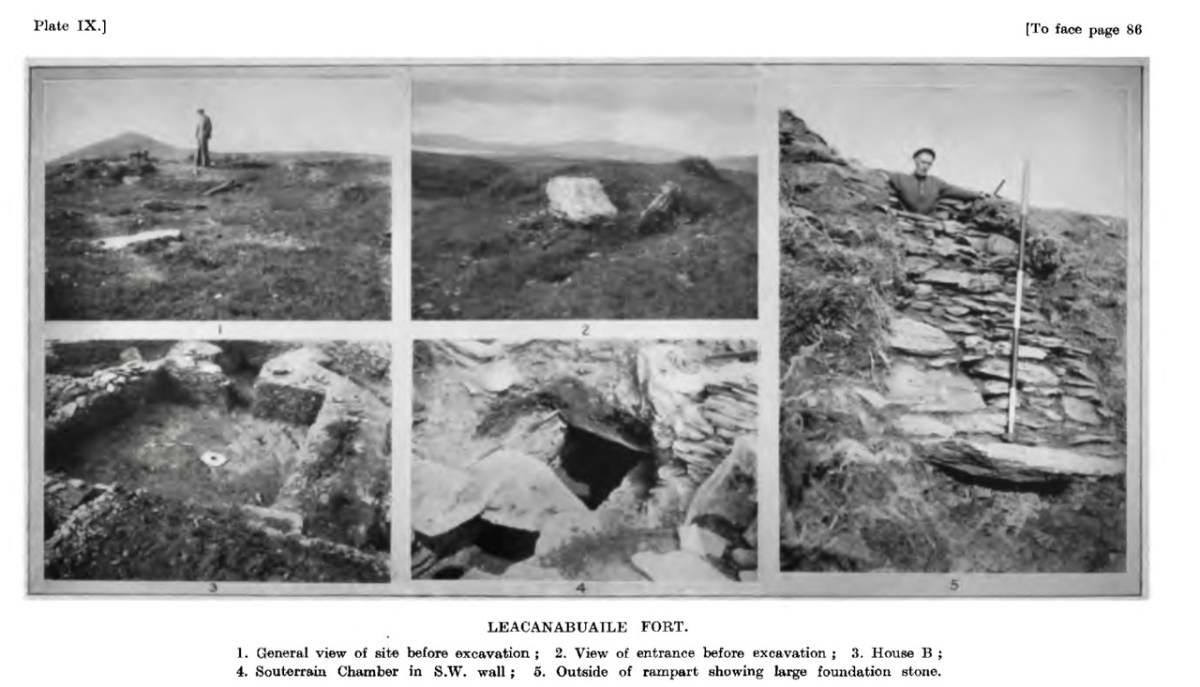
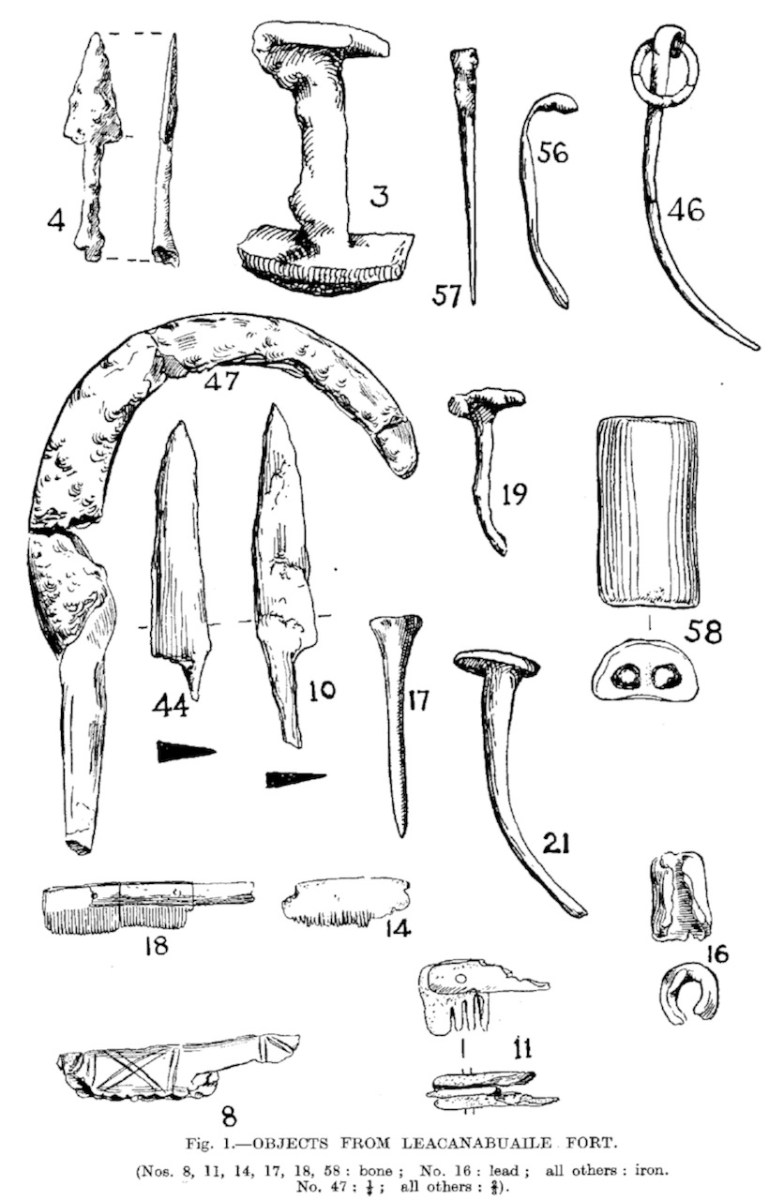
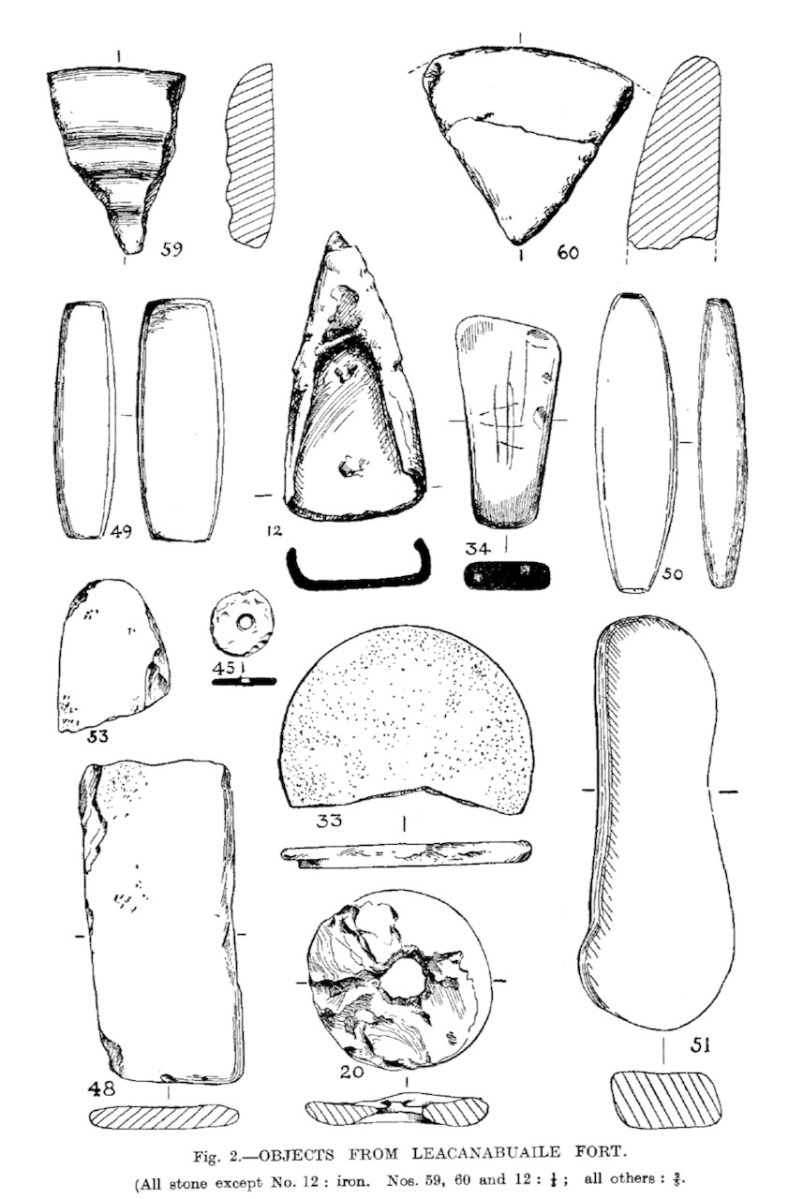
Leacanabuaile was excavated in the summers of 1939 and 1940 by Sean P Ó Ríordáin and J B Foy. Ó Ríordáin was a revered Irish archaeologist and his book, Antiquities of the Irish Countryisde was our text for first year in the Archaeology Department at UCC, where he had been the professor before O Kelly. That’s Ó Ríordáin in the middle, below at the Lough Gur dig in Limerick, with O Kelly furthest to his left. As an aside, he was married to Gabriel Hayes, the sculptor – one of her major works is mentioned in this post. She did the drawings of the finds, which you will see further down.
For most of the following, and all the quotes, I am taking the information from the excavation report, which was published in the Journal of the Cork Historical and Archaeological Society for 1941. The marvellous CHAS has made their old journal available online, and this report is here. Leacanabuaile is situated in the middle of a concentration of forts, close to Caherciveen and all within a mile or two of each other, and in the case of Cahergal, in clear sight, as you can see below.
Before the excavation it was in very poor condition – the walls had collapsed and it looked more like an earthen ringfort, with just traces of the stone wall showing through here and there. It was so unremarkable, in fact, that it was left off the Ordnance Survey maps.
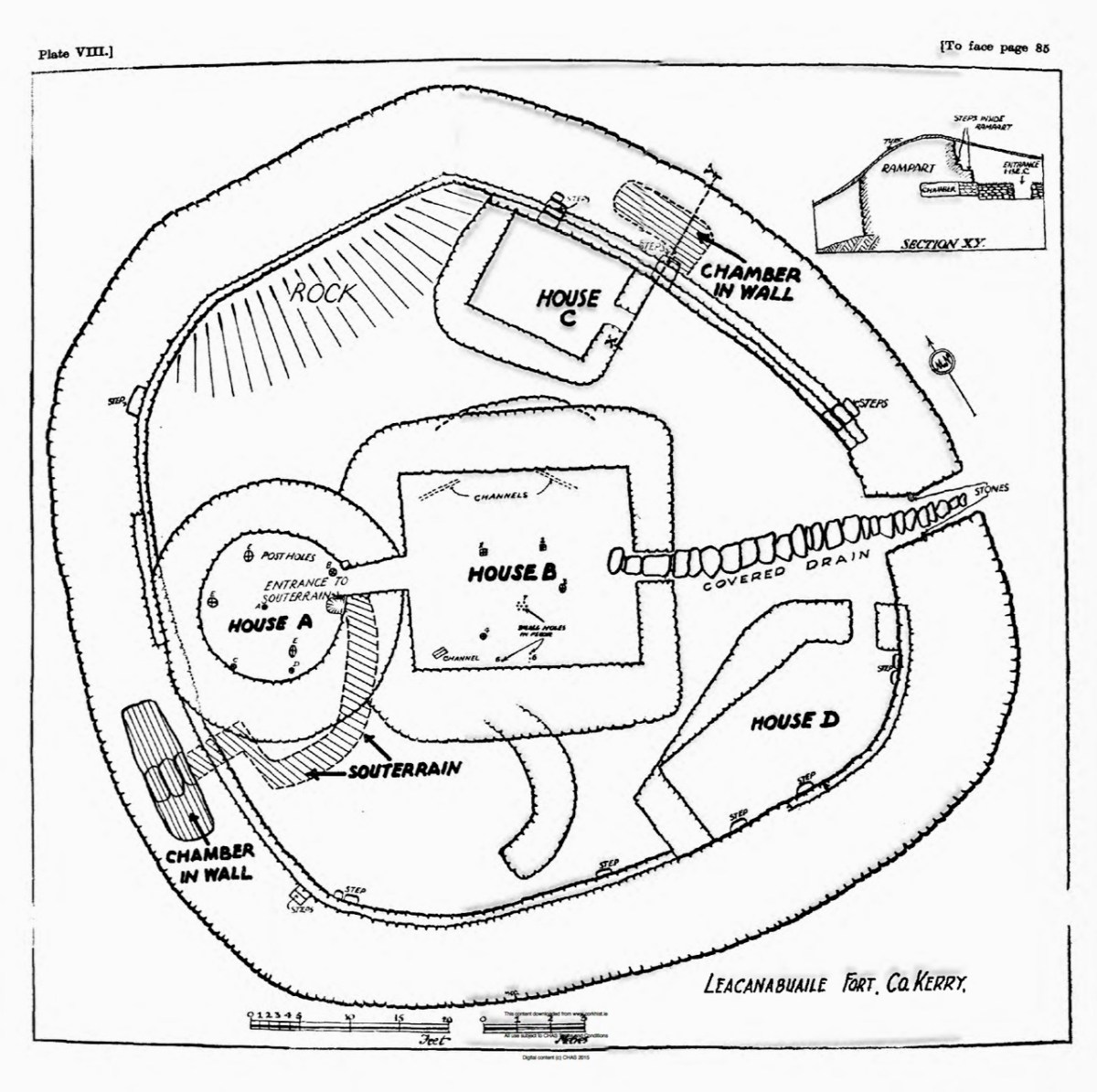
The excavation uncovered not only the massive nature of the walls, but four houses inside, a souterrain, and mural chambers. This was before the commonplace use of radiocarbon dating in Ireland so the usual way of dating a site like this was through the finds and through comparison with similar sites. Using these methods, Ó Ríordáin says:
The close dating of the Leacanabuaile site is not possible, but it may be noted that the finds correspond to material from sites dated by more significant objects to the ninth and tenth centuries AD.
The fort is not quite round and this was due to the undulation of the rocky hilltop on which it was built, the builders having to work around the steep slopes. The souterrain and the mural chambers were built at the same time as the walls.
Of the houses inside the fort, three were built at the same time as the fort – round house A and two others which now lie under house B. Houses D and C were the last to be built.
In regards to the material cultural objects found during the excavations, and what they reveal about the inhabitants, Ó Ríordáin states
Elaborate brooches and glass objects, for instance are notable by their absence. Bronze is rare and there is no evidence of its having been worked on the site – crucibles are not forthcoming: iron working is evidenced by the iron slag found. On the other hand, the inhabitants were probably quite well provided with the more vital necessities of life. They had . . . a dual source of supply – the sea and the land. The plough-sock and the querns show show that grain was cultivated, the bones show that domestic animals were kept and eaten, while the fare was added to by the collection of shellfish from the coast and by the capture of birds, particularly sea-birds.
The sea birds included heron, duck, goose, cormorant, puffin and razorbill, while the domestic animals were ox (most numerous), sheep, and pig. Also found were evidence of horse, dog and red deer.
What we see on the ground today is the result of conservation work undertaken by National Monuments as Leacanabuaile was taken into state care. Ó Ríordáin describes how
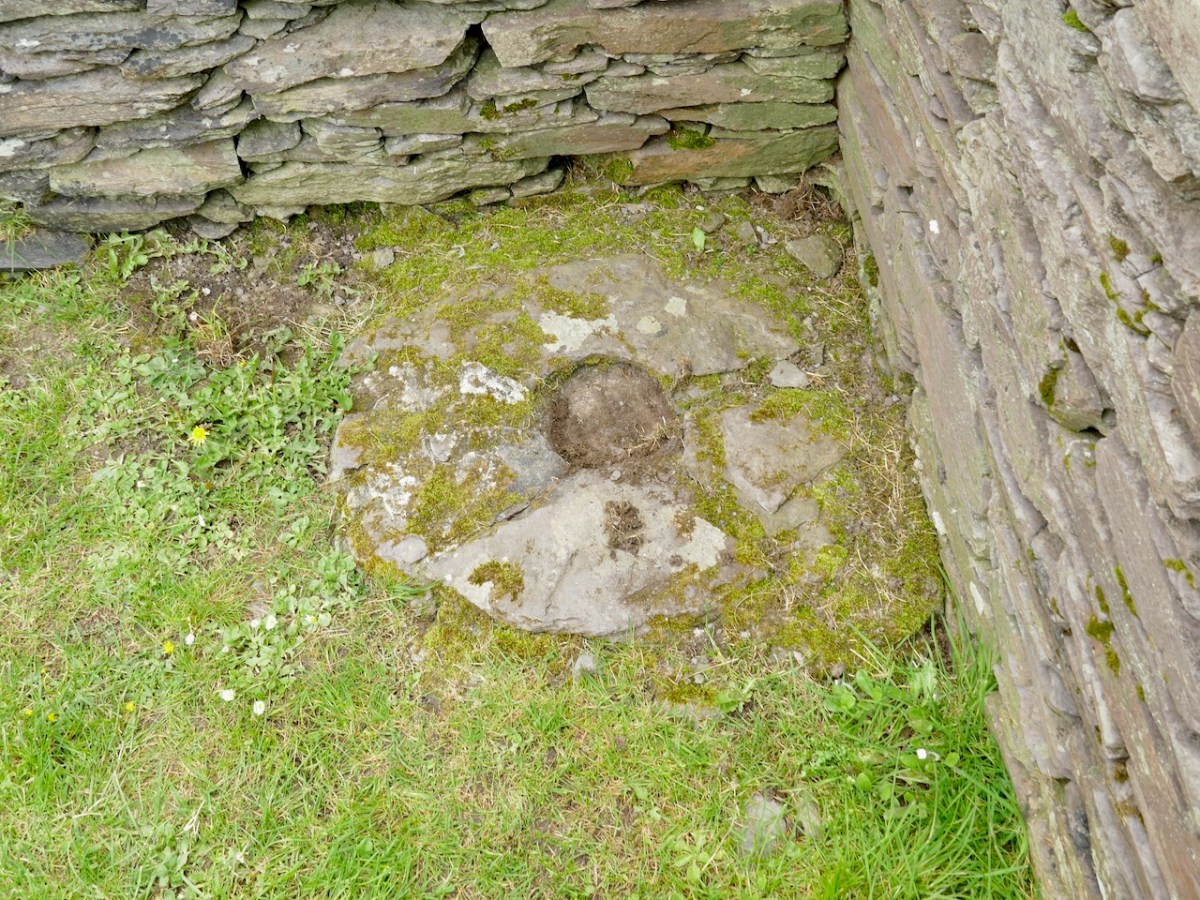
. . .the walls of the fort and the enclosed buildings were restored by building up, to some extent, the destroyed portions, so as to provide a level top surface which should stand the better the ravages of time. The lines of the old work have been carefully followed and the new building has been marked off from the old with a thin line of concrete. . .[stone objects] were set in cement in House B, so that they may be conveniently inspected.
So – what you see now at Leacanabuaile is as a result of the excavation and the subsequent conservation by National Monuments. Ó Ríordáin remarks, the skill with which the workmen used the material to build in the old manner is a good example of the survival of a technique in a given environment. That reminded me of our own experience with Building a Stone Wall. I also regretted that I hadn’t read the report before I visited so that I could find that thin line of concrete and take a photograph of it for this post.
We’ll take a look at Cahergal next, also excavated, this time by our friend Con Manning in the 1980s and 90s. This is a more complex site and the report is much longer so it will be a challenge to summarise in a blog post, but I’ll do my best.
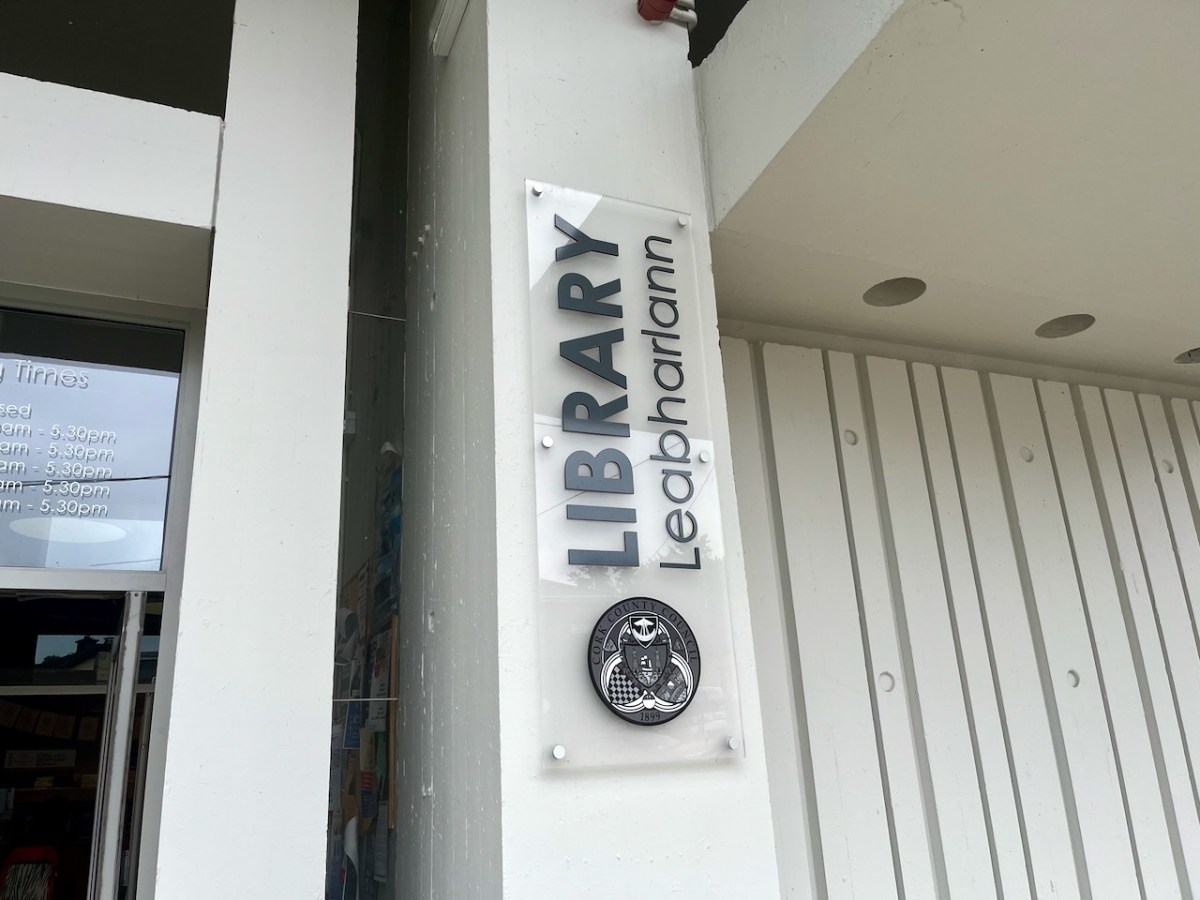
In last week’s post I described a unique type of boat that was connected with Bantry, here in West Cork. Today we are also focussed on Bantry, but this time on architecture: the Public Library, which is one of the most unusual and innovative buildings from twentieth century Ireland.
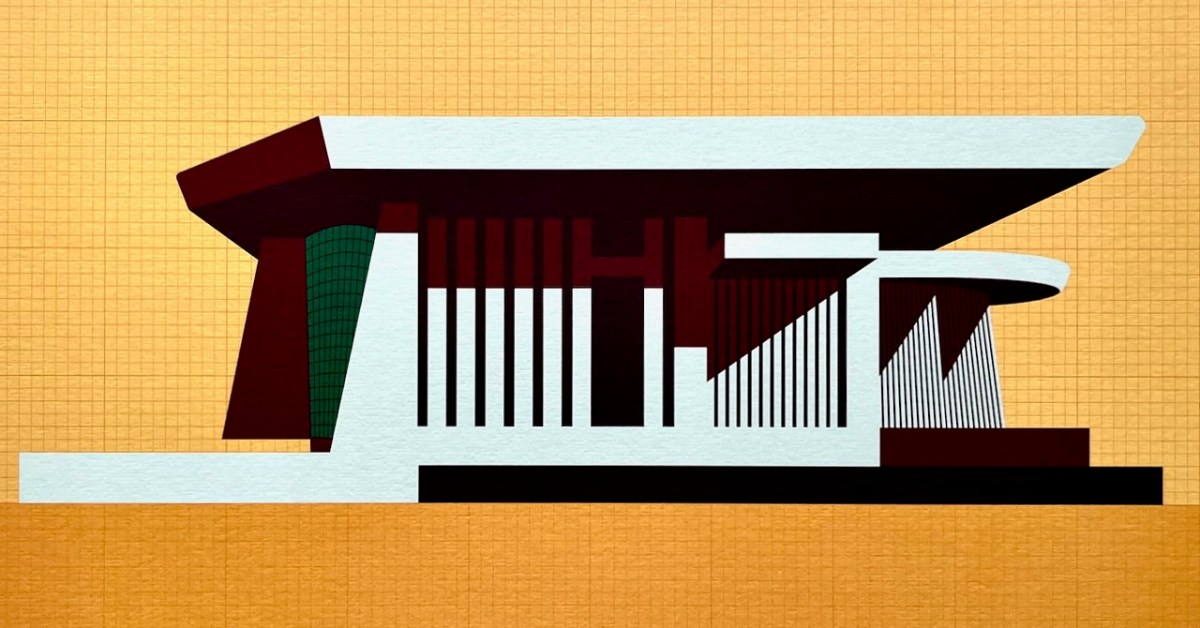
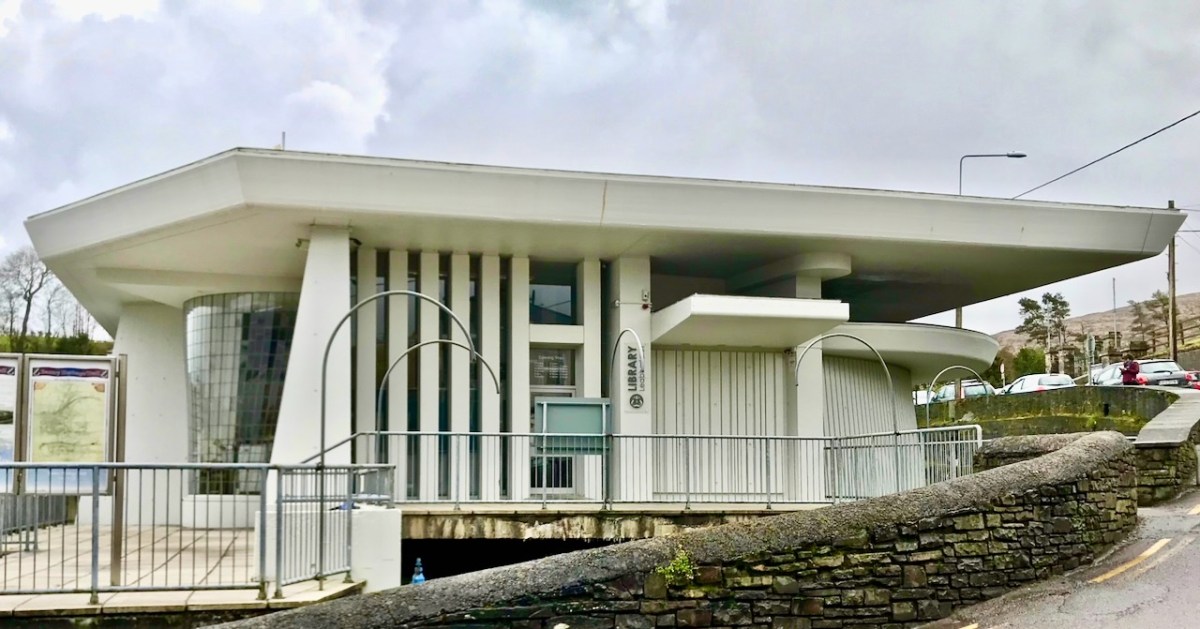
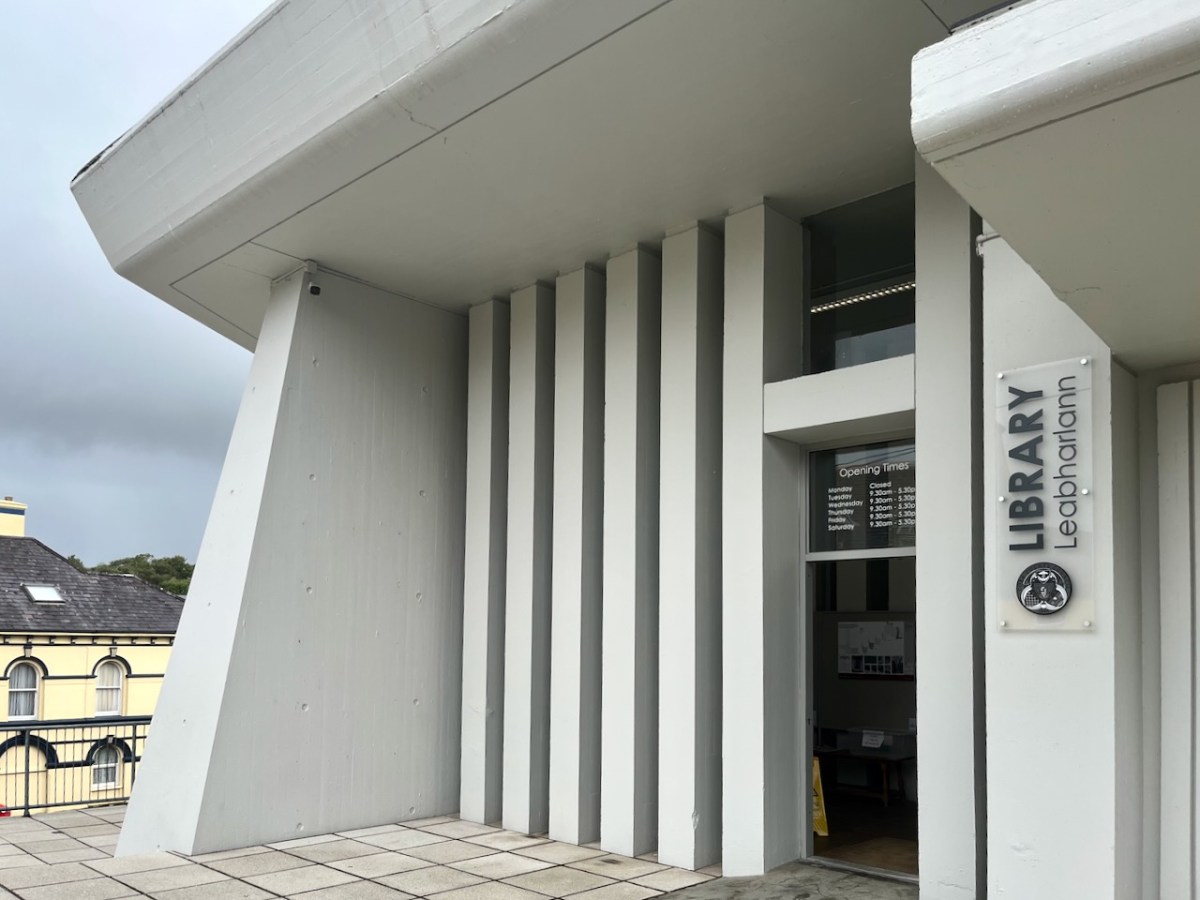
Here is the building as we see it today. The header is a limited edition print, a collaboration between Dermot Harrington of Cook Architects and Robin Foley of Hurrah Hurrah celebrating the upcoming 50th Anniversary of the completion of Bantry Library in 1974. For me, the print captures perfectly the iconic graphic of this most unorthodox design.
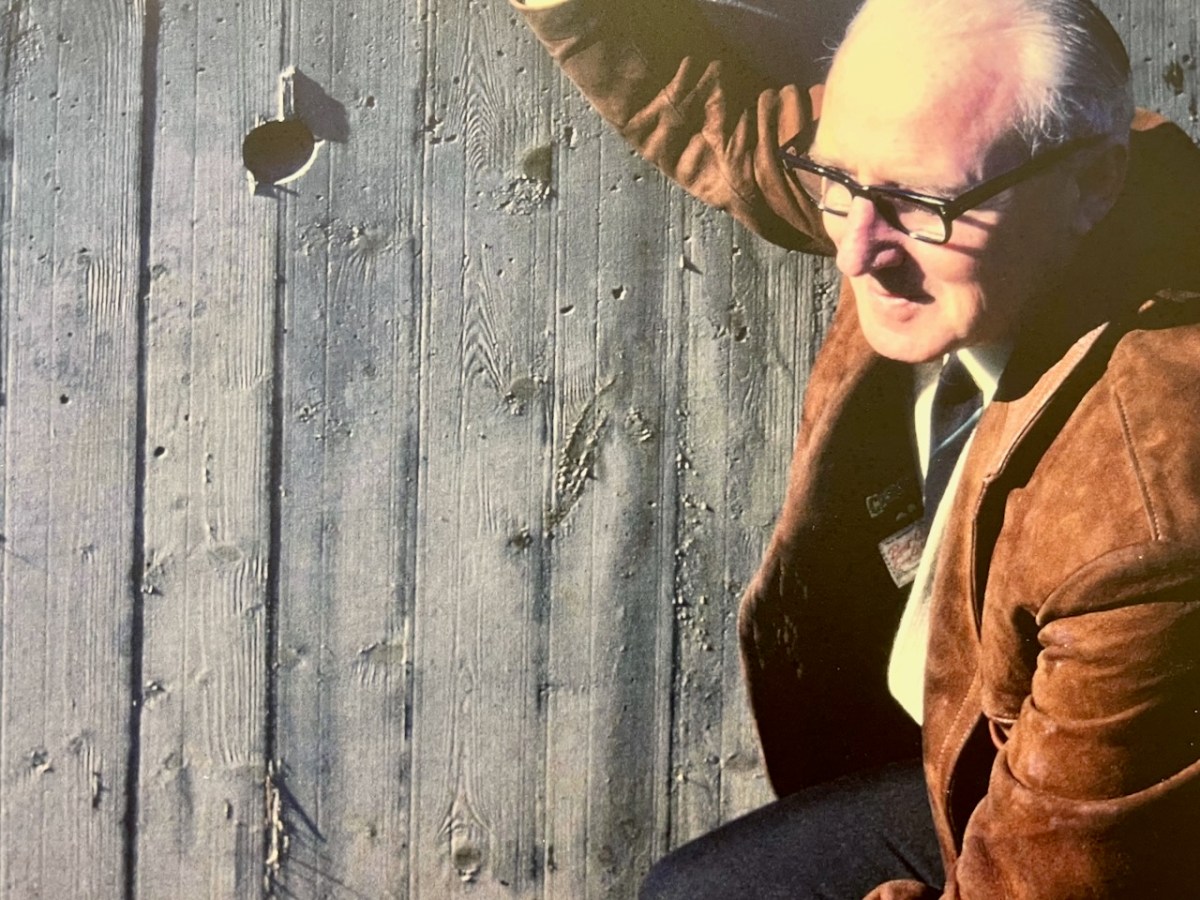
The Library was conceived by Patrick McSweeney (above) – Cork County Architect between 1953 and 1975. He deserves a post of his own one day, as he was responsible for some outstanding buildings in the county. Two of his assistants in the Architect’s Department at the time were Brian Lalor and John Verling. Both had a hand in the genesis of the Library. Interestingly for us, McSweeney, Lalor and Verling were all living around Ballydehob in those days – it was a swinging village!
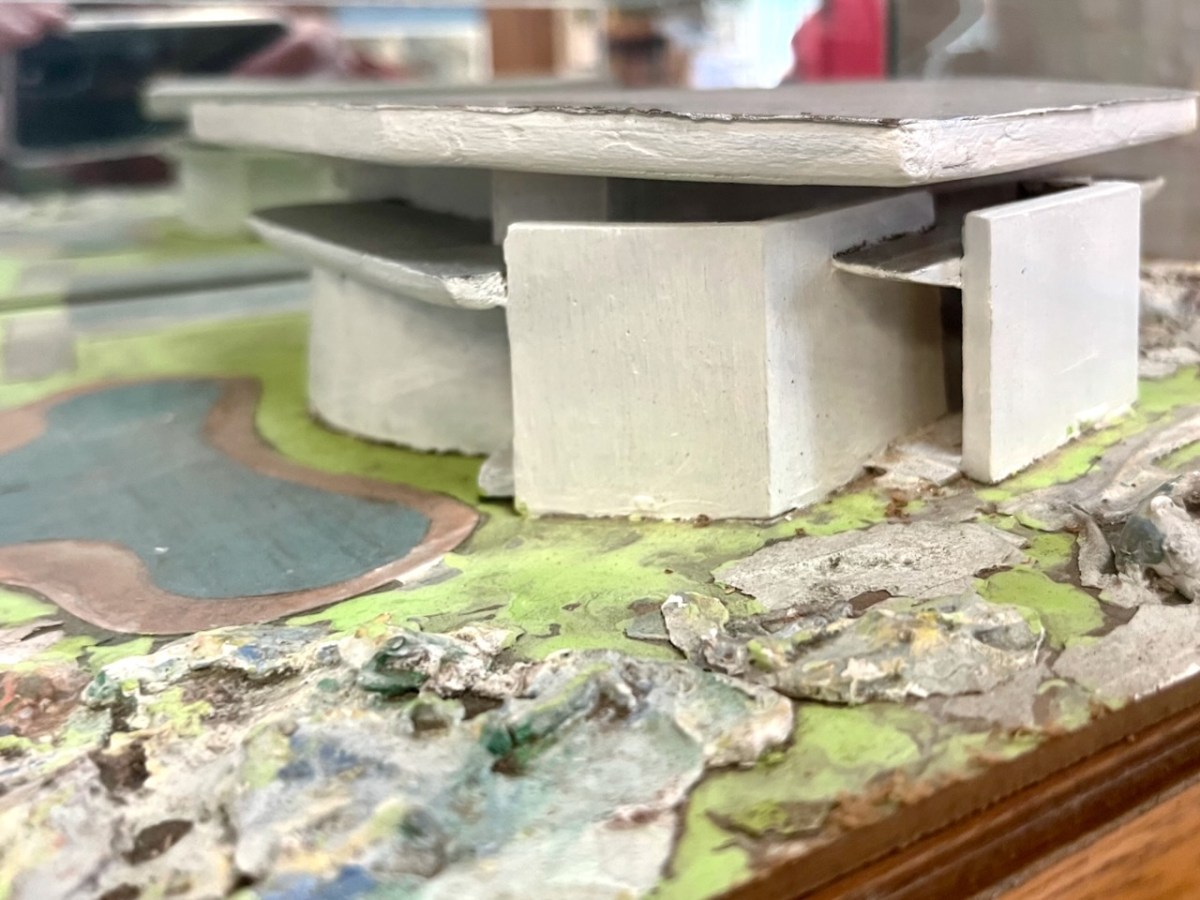
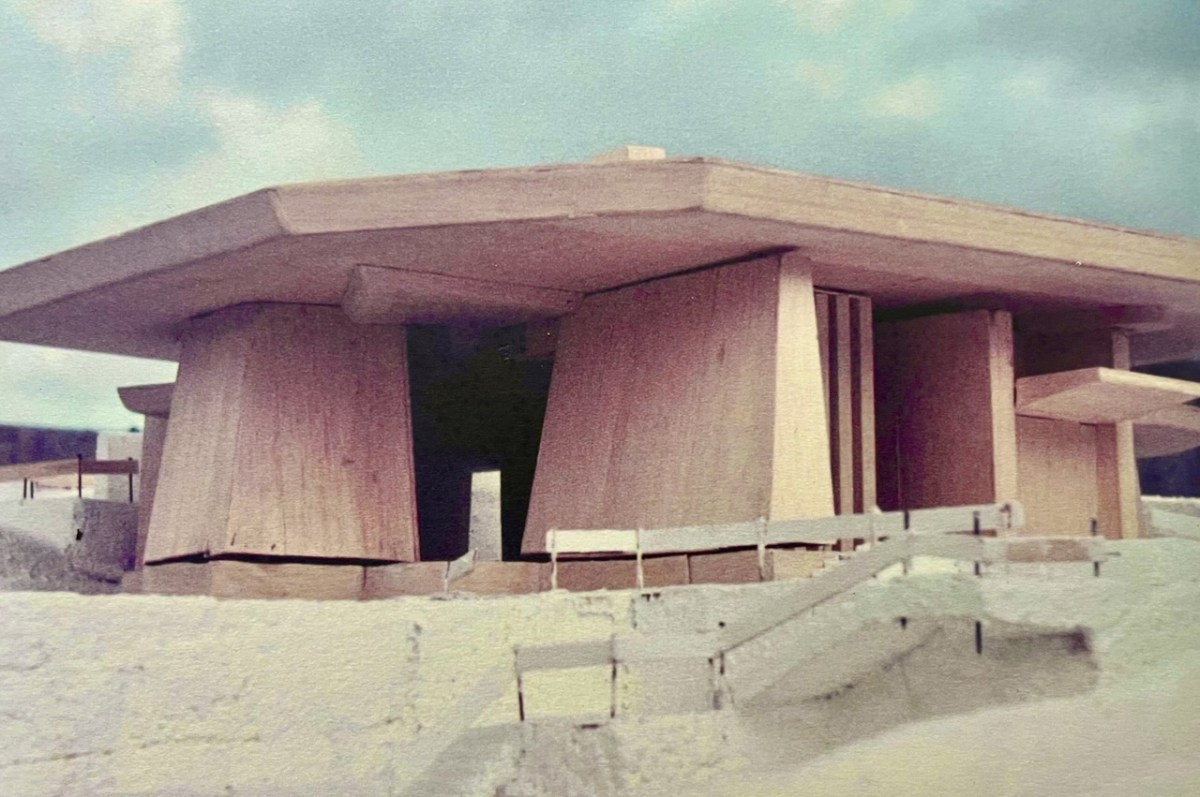
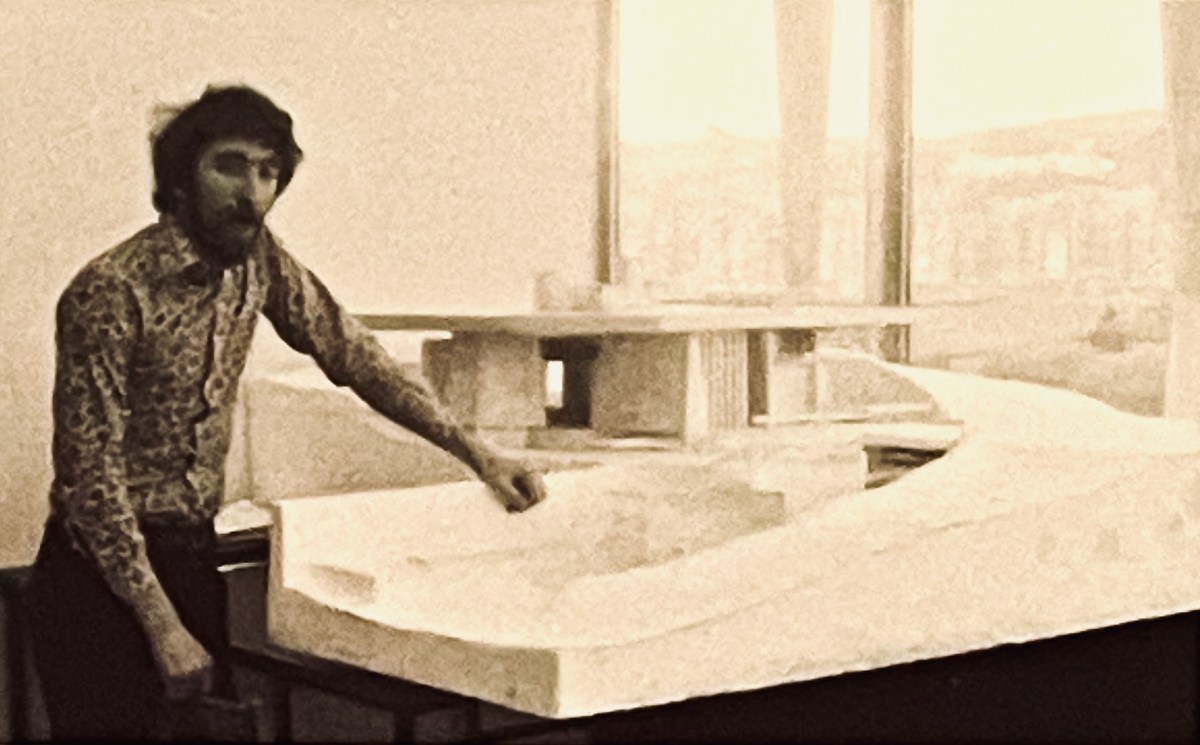
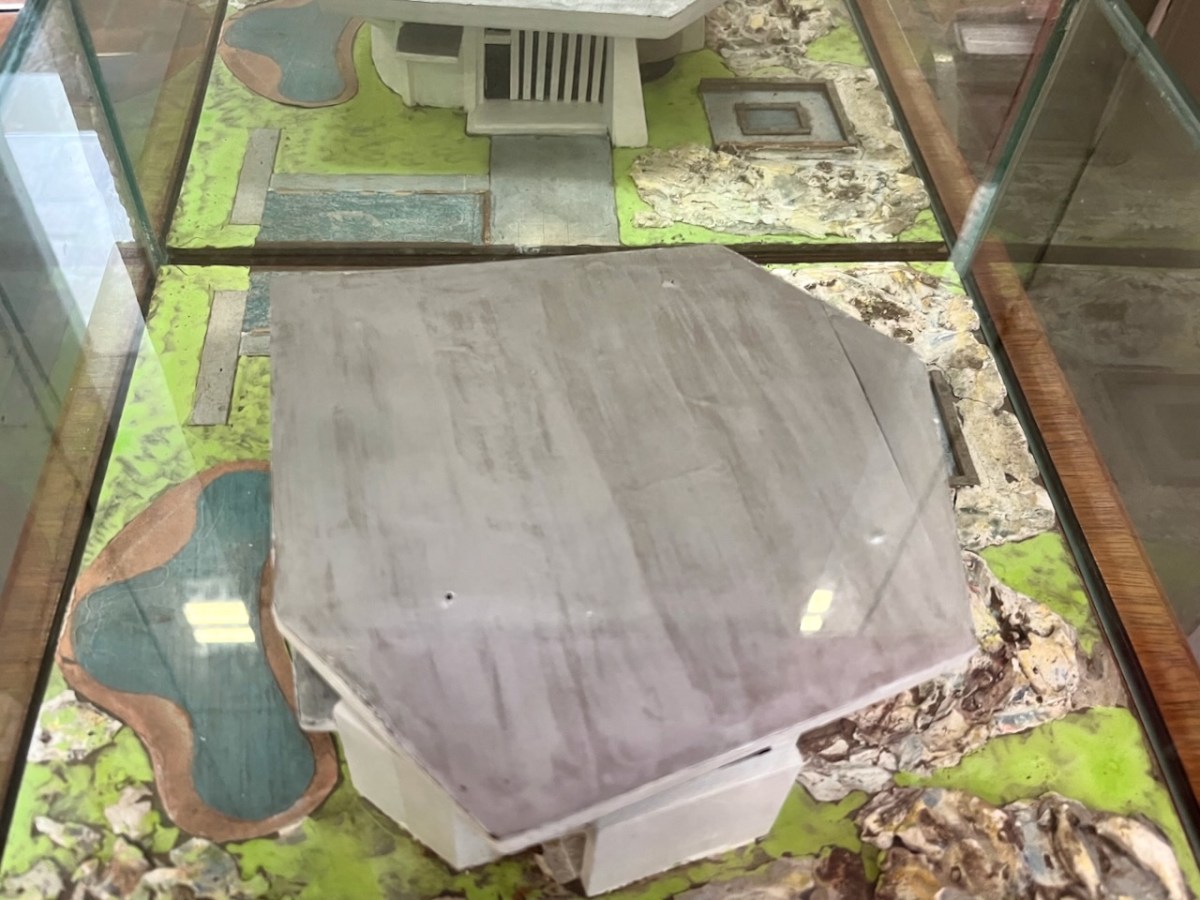
In the era before computers were universal in architects’ offices, everything was drawn by hand – or modelled. Brian recalls that Pat (McSweeney) called him into the office one day, handed him cardboard, tape and scissors, and instructed him to make a model of a building shaped like a Bronze Age dolmen. And he wanted it made in a hurry! It could well have been the one shown above – which still exists. Remarkably, although this model was made in the early 1960s, the building that resulted in the 1970s was very similar in form. Later, John Verling produced a balsa-wood model upon which the design production drawings were based:
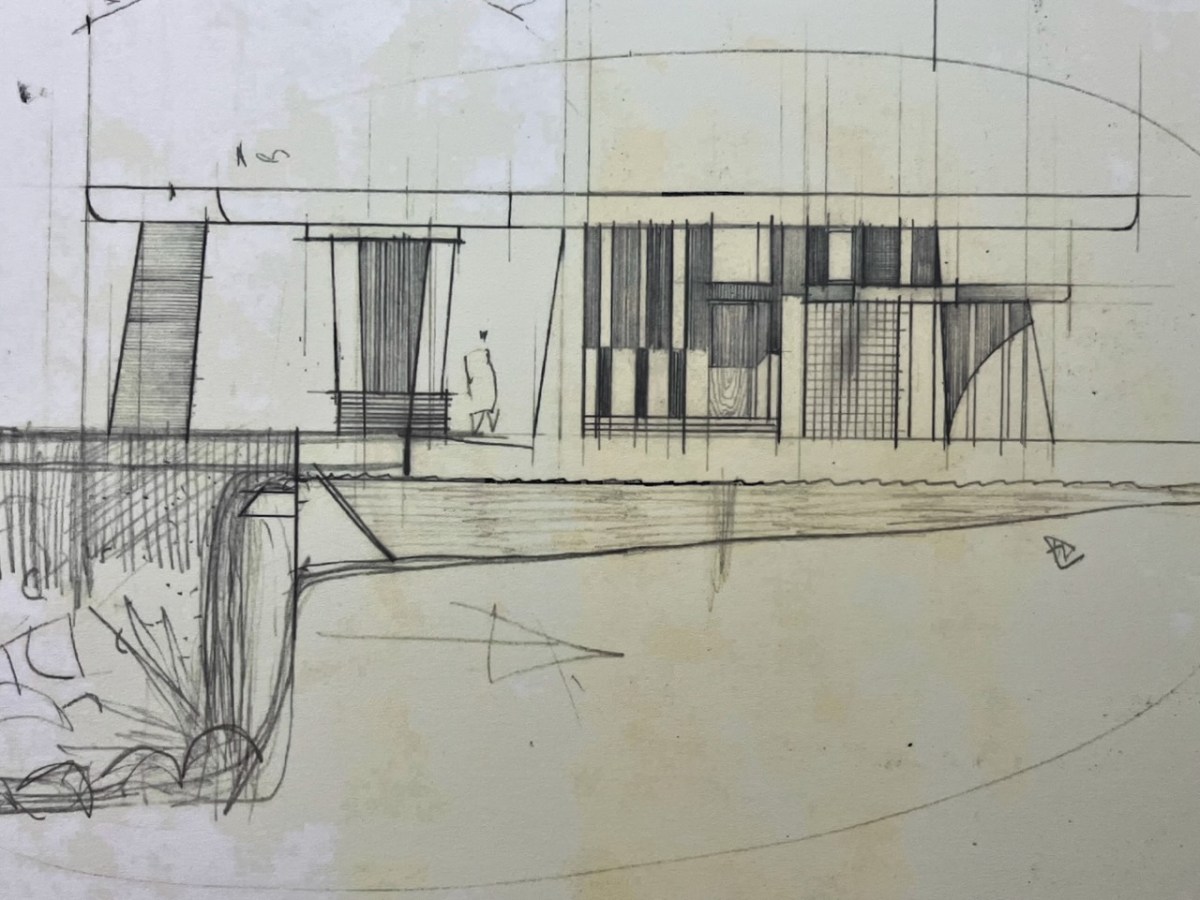
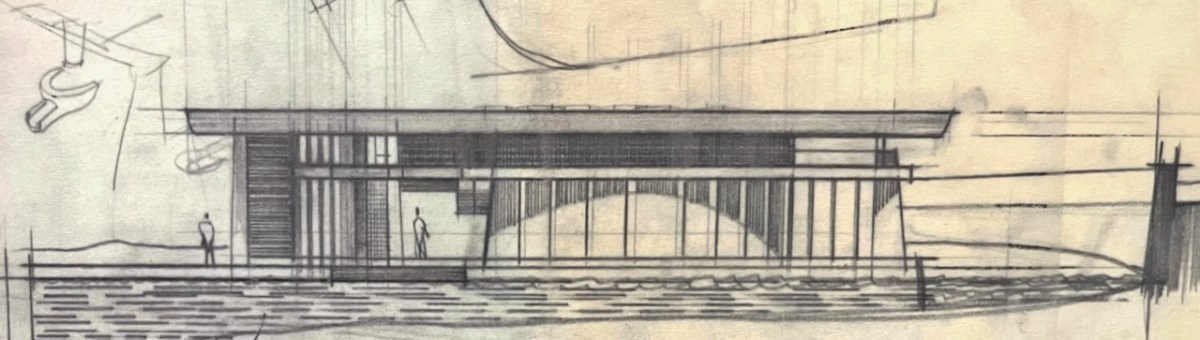
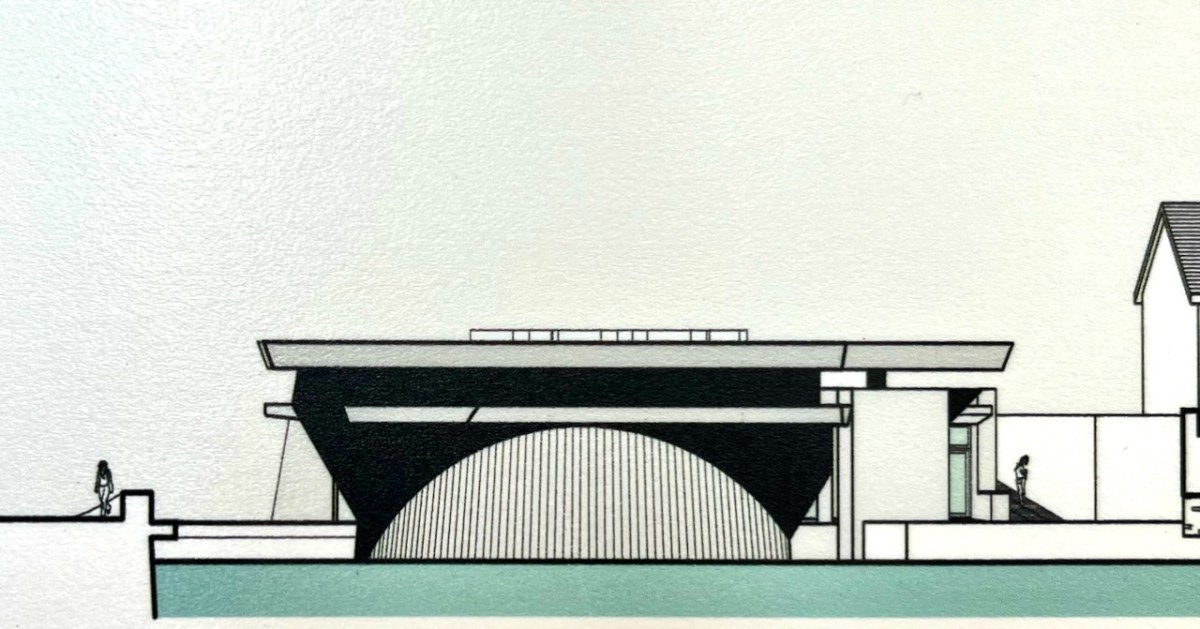
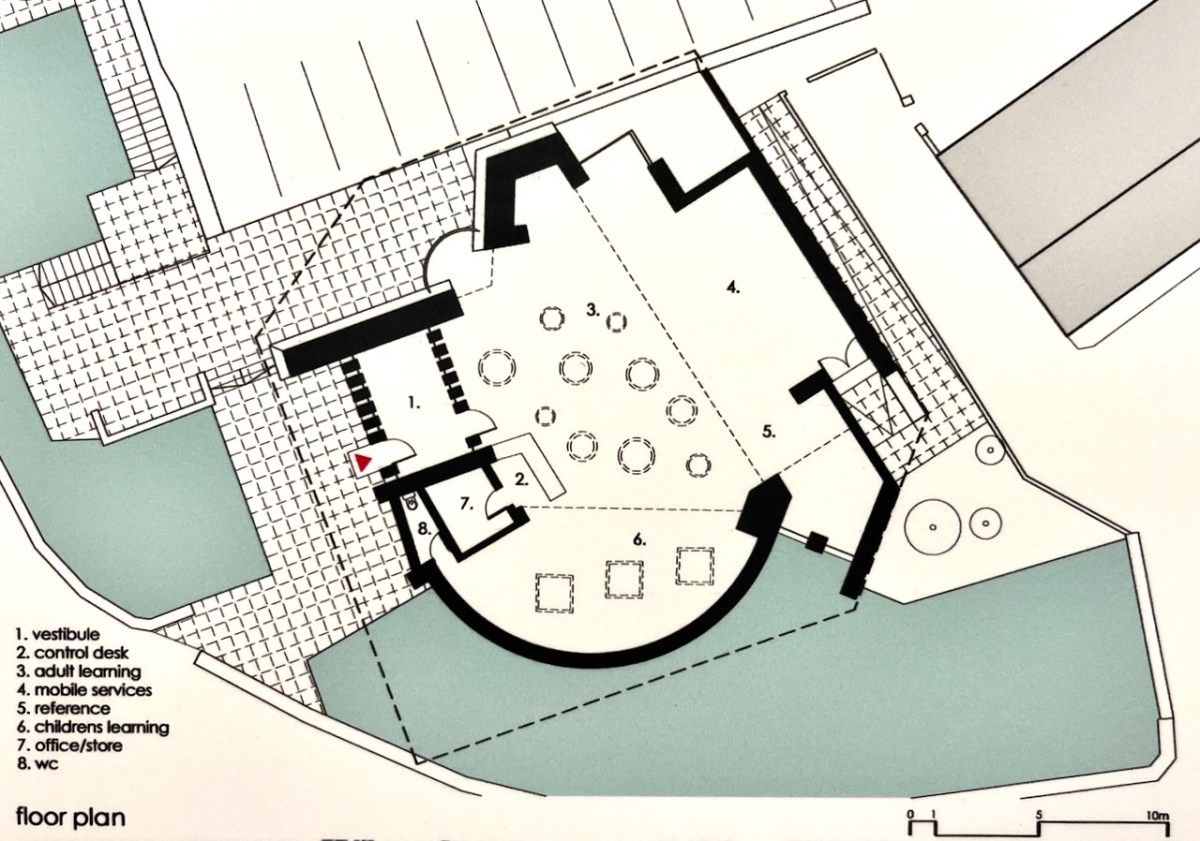
That’s John Verling, above, with his model. He and his wife, Noelle, are the subjects of the current exhibition in the Ballydehob Arts Museum (click the link). Following are some of the design sketches carried out by Harry Wallace who was leading the team in County Hall, and detailed drawings of the building that eventually ensued.
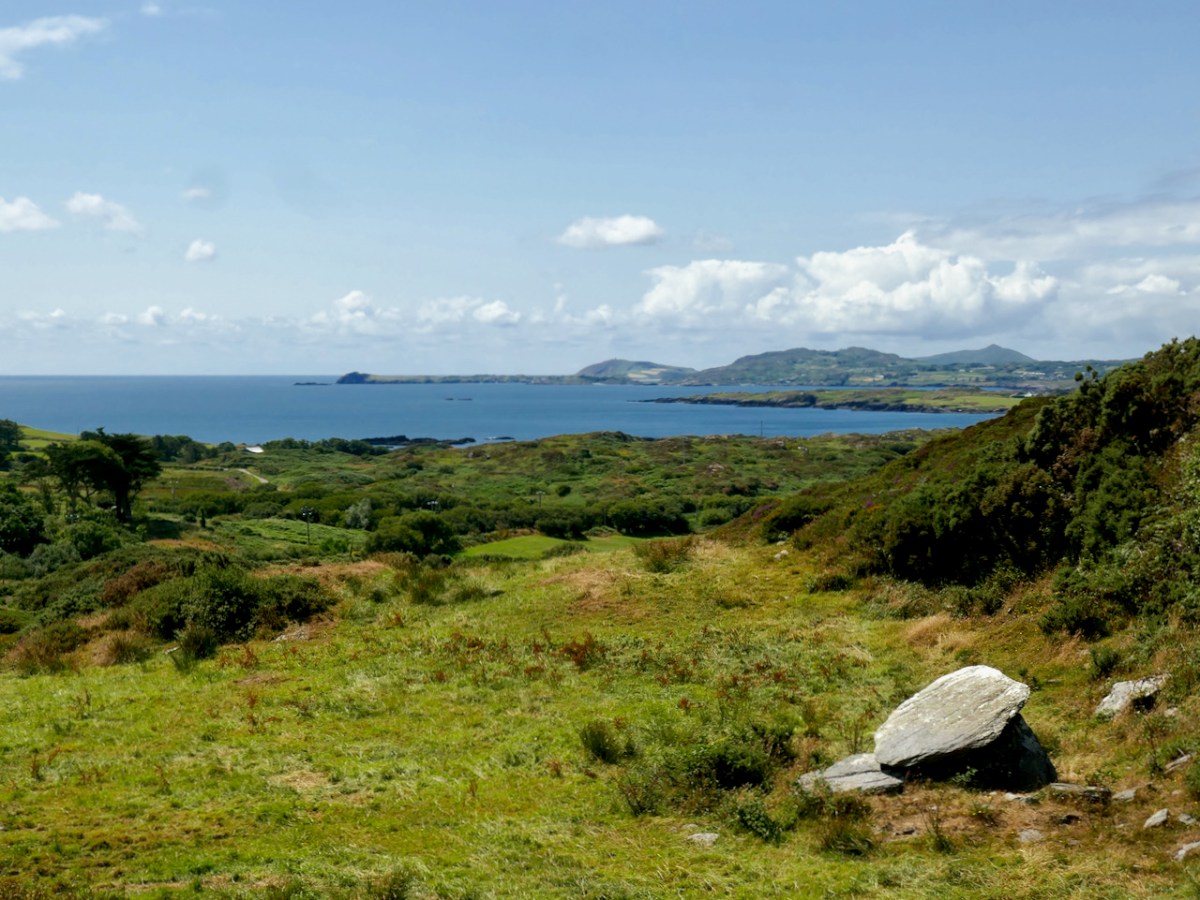
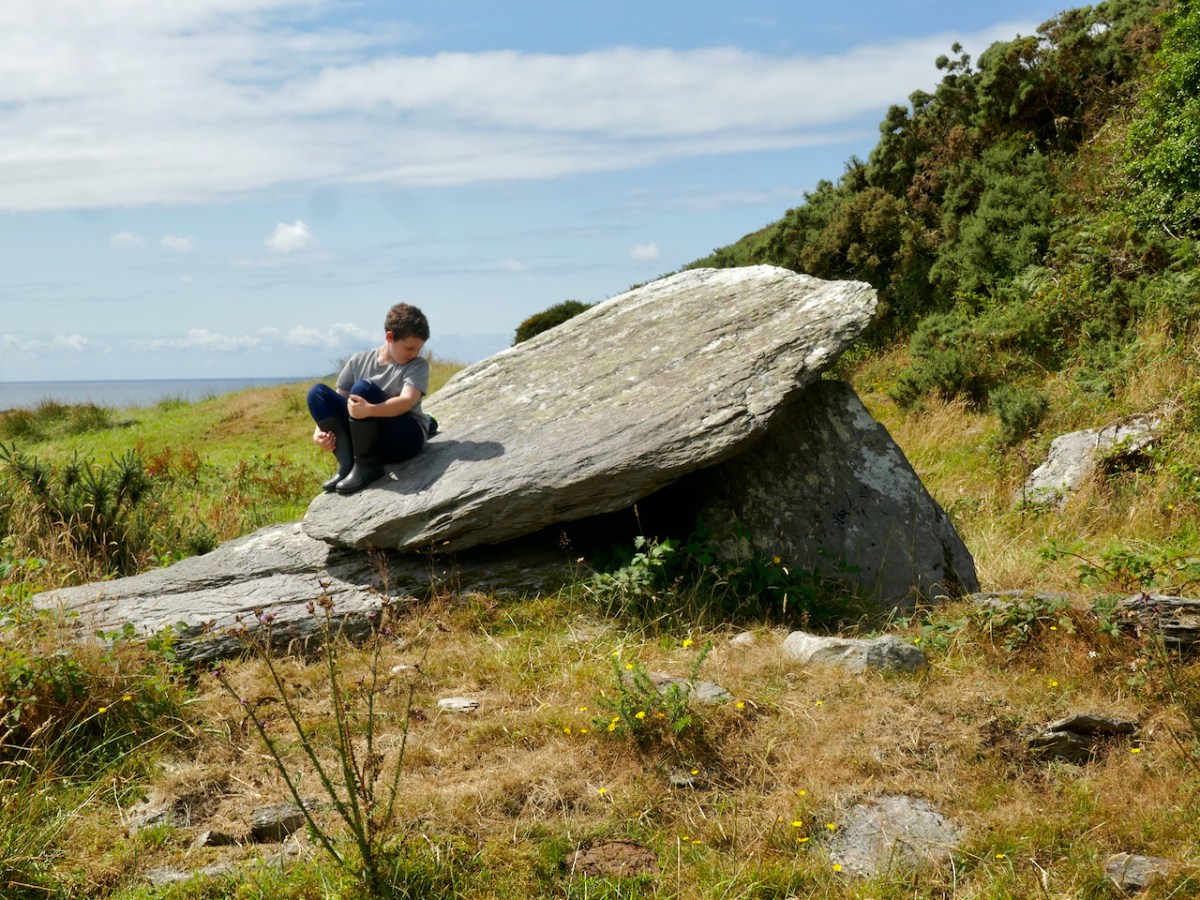
Let’s look a bit further at the early concept work, especially that first model. It’s said that McSweeney was inspired by a ‘Dolmen’. In fact we would today call that type of early megalithic structure a ‘Wedge Tomb’ or a ‘Portal Tomb’. At its simplest, this is a large flat stone slab (or slabs) supported on vertical stone slabs: it was probably a burial chamber, perhaps with its opening facing the sunset at a particular solar event. The closest such tomb structure to Ballydehob is the one featured in Finola’s post today. I wonder if Pat McSweeney was aware of this local one? He would have certainly been aware of the striking example at Altar, further west on the Mizen Pensinsula.
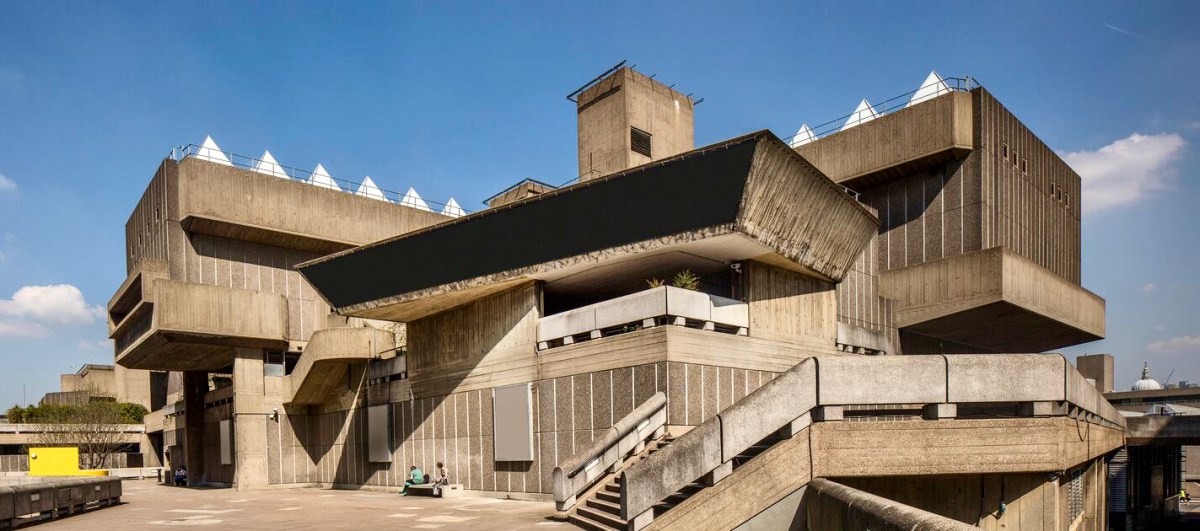
Returning to the twentieth century, and the Bantry Library project, construction posed many problems, using techniques which might have been considered at the leading edge of architecture in its time and place. Across the sea similar experiments were taking place. I was at the centre of them! I completed my architectural education in the late 1960s and went to work for the Greater London Council. I saw going up around me on the South Bank of the Thames a development which included the Hayward Gallery (below): its design (described as ‘brutalist’), earned it the nomination of the ugliest building in Britain when it opened!
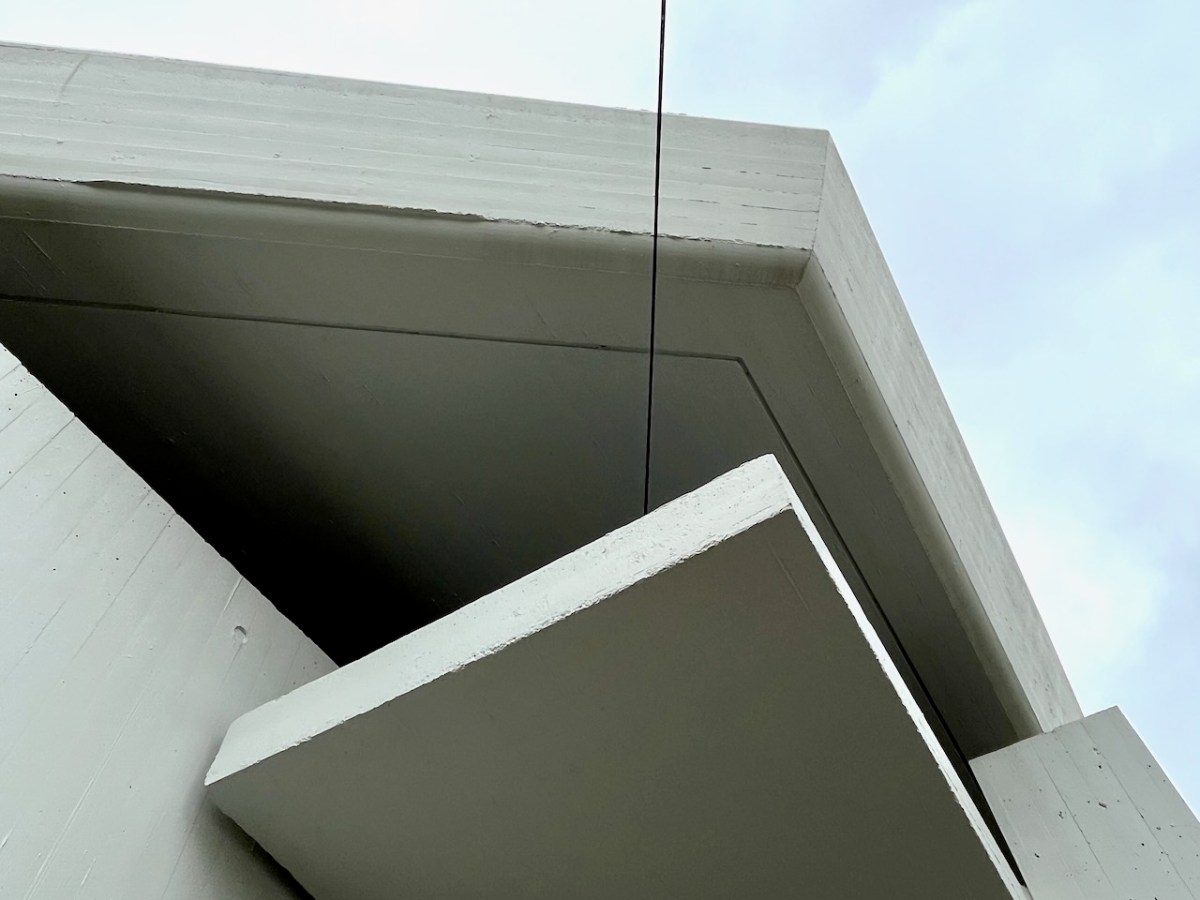
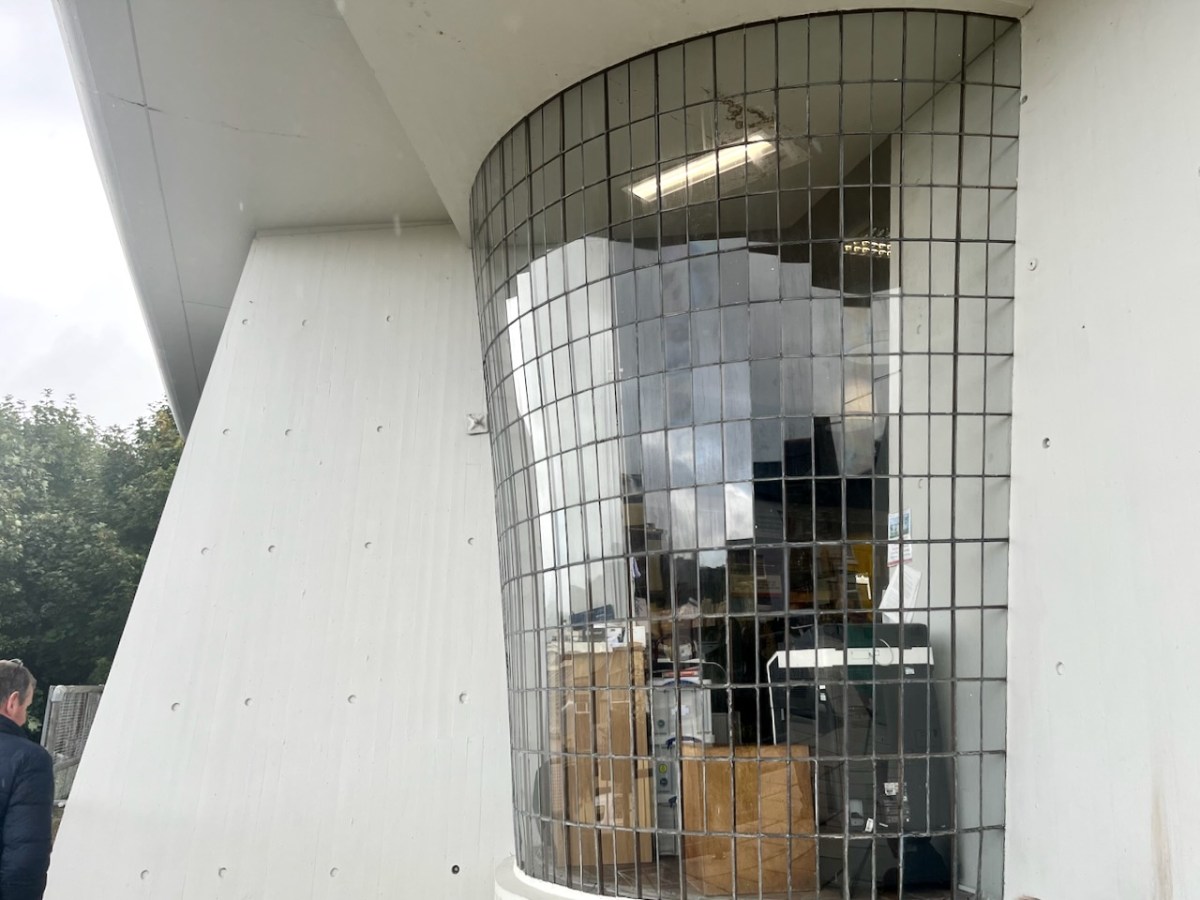
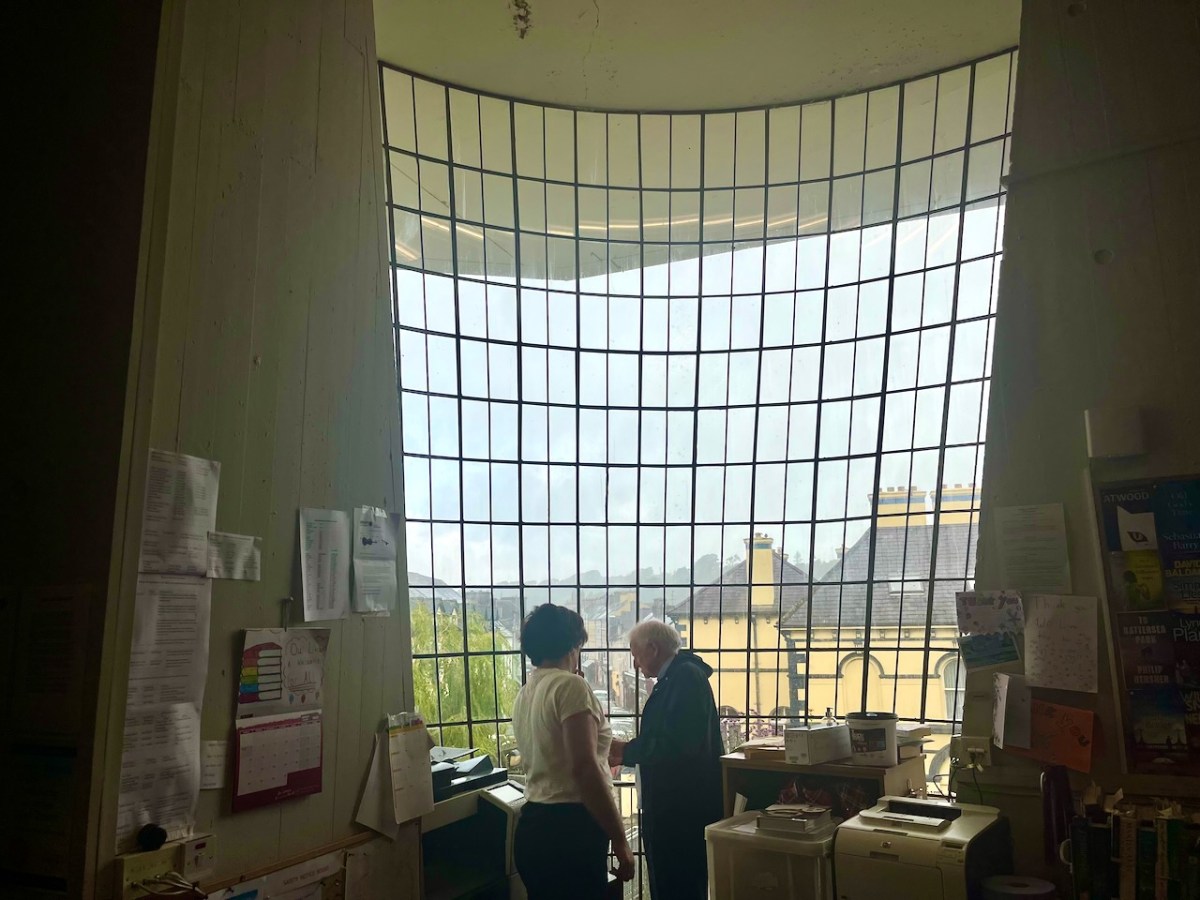
Larger in scale, this complex exhibits some of the features we see in Bantry: shutter-marked mass concrete, frameless glazing, bold overhanging roof planes… The Library roof cantilevers six metres in one part of the building.
The status of this building as an unique example of modernist architecture in Ireland has recently been recognised with a Heritage Council grant of over €250,000 to carry out refurbishments to some of the major elements.
. . . As Bantry Library approaches its 50th anniversary, we are committed to safeguarding this important building. As a protected structure within an Architectural Conservation Area, Cork County Council recognizes its responsibility to preserve and protect Bantry Library for future generations. The conservation works will take place during 2023, and we look forward to seeing the library restored to its former glory . . .
Tim Lucey, Chief Executive, Cork County Council
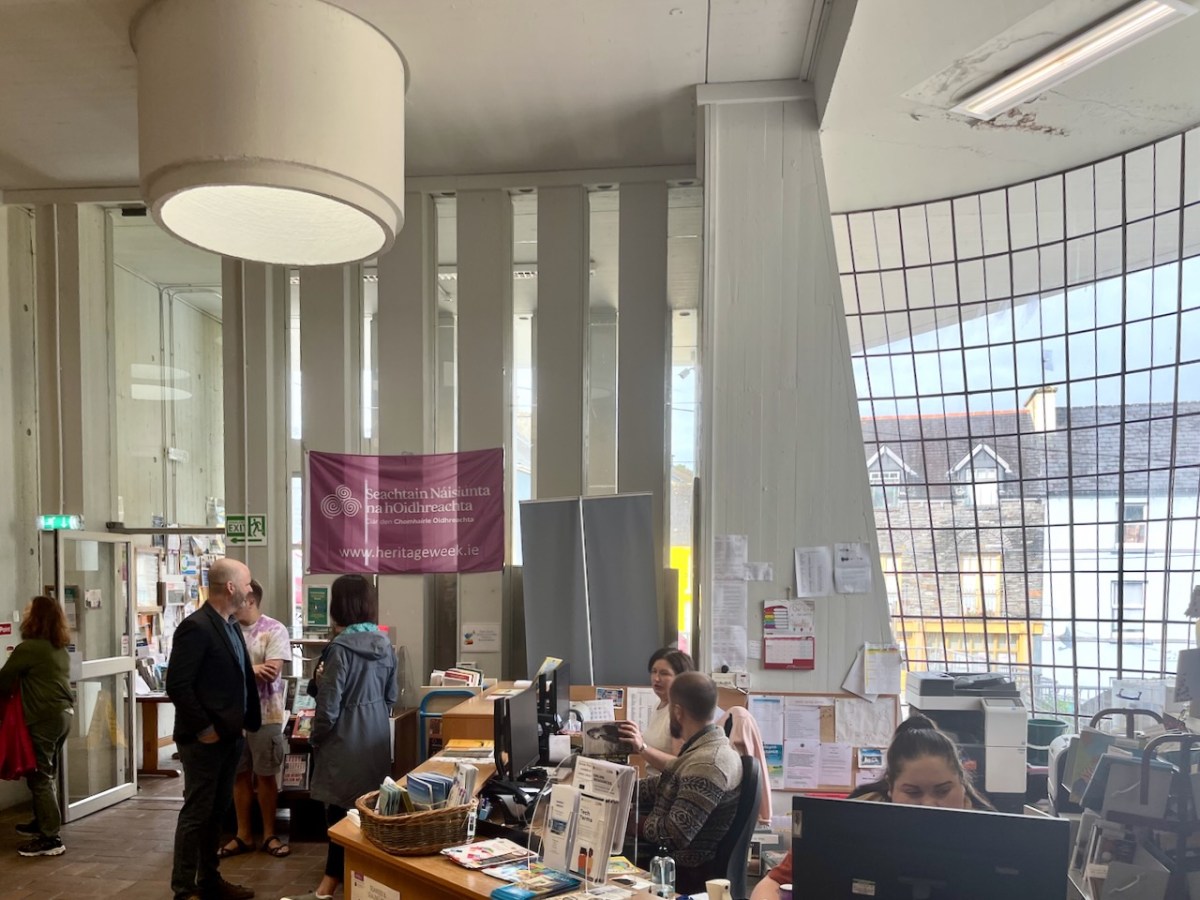
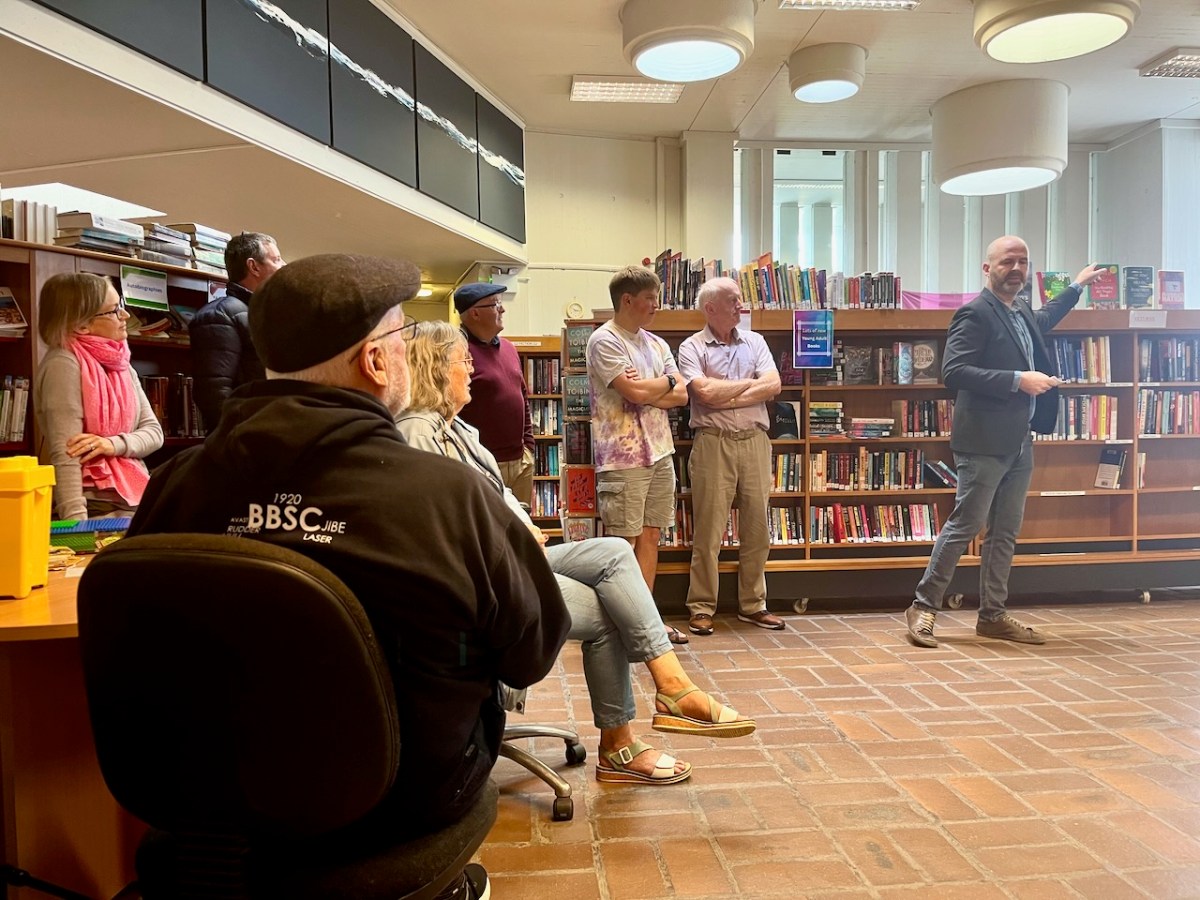
A Heritage Week talk was given by Dermot Harrington of Cook Architects at the Library (below). It was a most informative review of the building and its history.
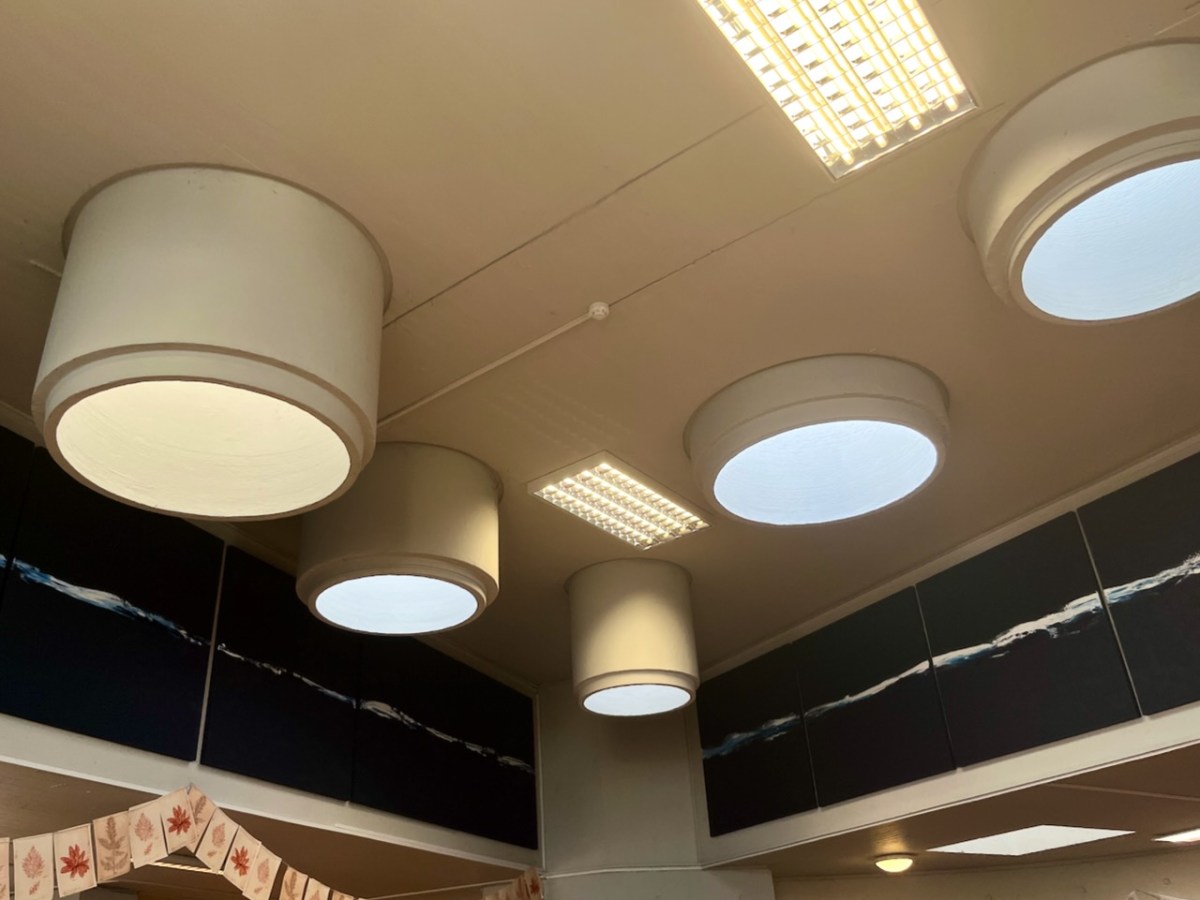
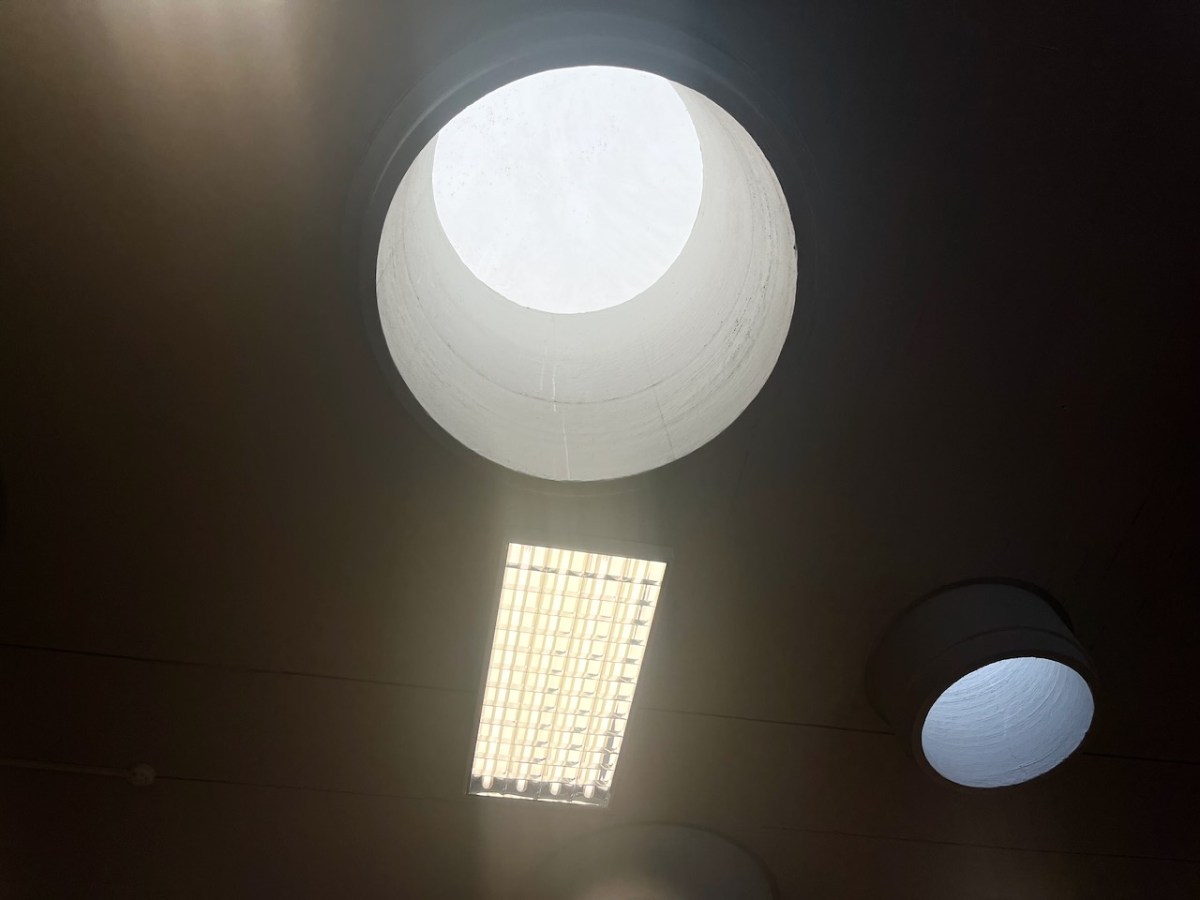
Most of the original features of the building have survived in reasonable order. I was impressed with the ‘pipe lights’ which draw daylight down into the centre of the main room:
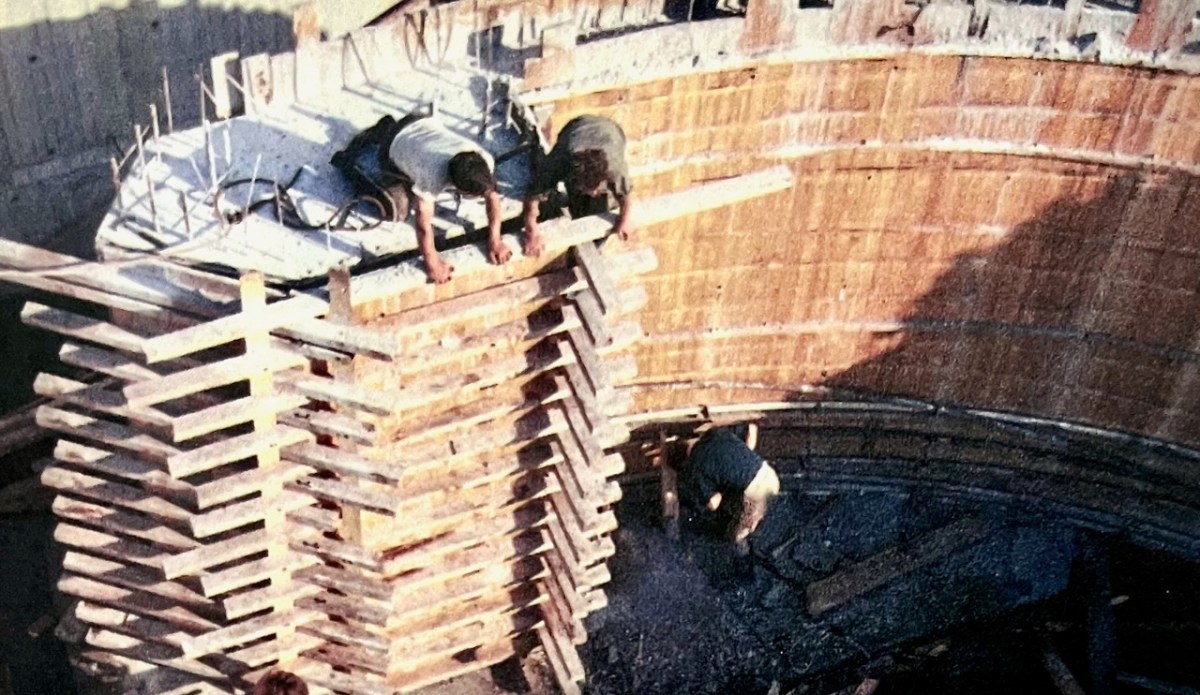
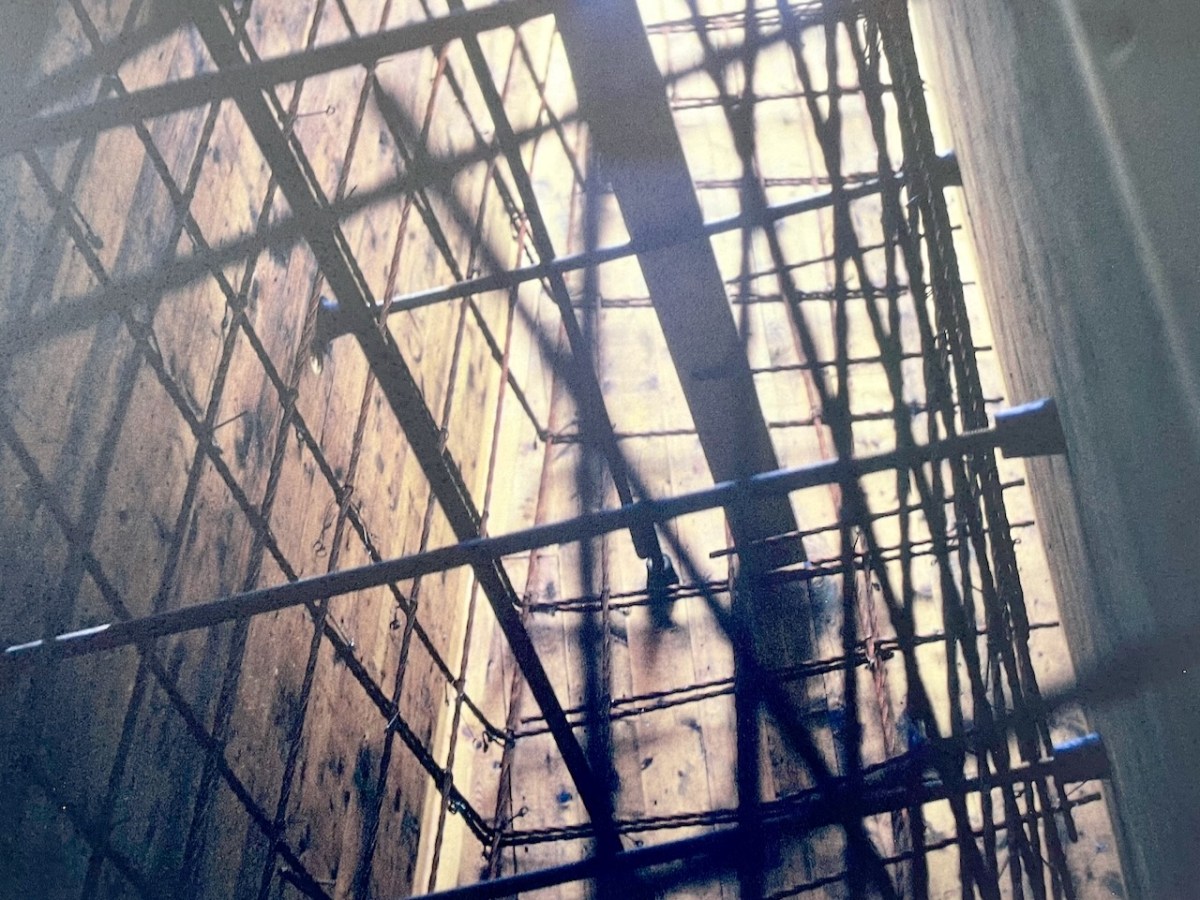
We also learned about the complexity of the building construction, and saw photographs of the steel reinforcement and board shuttering from fifty years ago:
Dermot Harrington pointed out that the building was effectively put together by only five men, under foreman Gerry O’Sullivan, who was just 27 years old. Neither he or any of the other crew had ever tackled anything like this before!
The Library is central to the life of the town, and still serves its original purpose. It’s eye-catching (perhaps sensational is a good word?) and very much alive and relevant. We look forward to the completion of the current works, and suitable festivities to mark the fiftieth birthday of this creative West Cork project.
Thank you to the Library for the information they provided and the display boards that are currently on show. Many of my illustrations are taken from these resources
Welcome to the UCD Library Cultural Heritage Collections blog. Discover and explore the historical treasures housed within our Archives, Special Collections, National Folklore Collection and Digital Library












 Roaringwater Journal