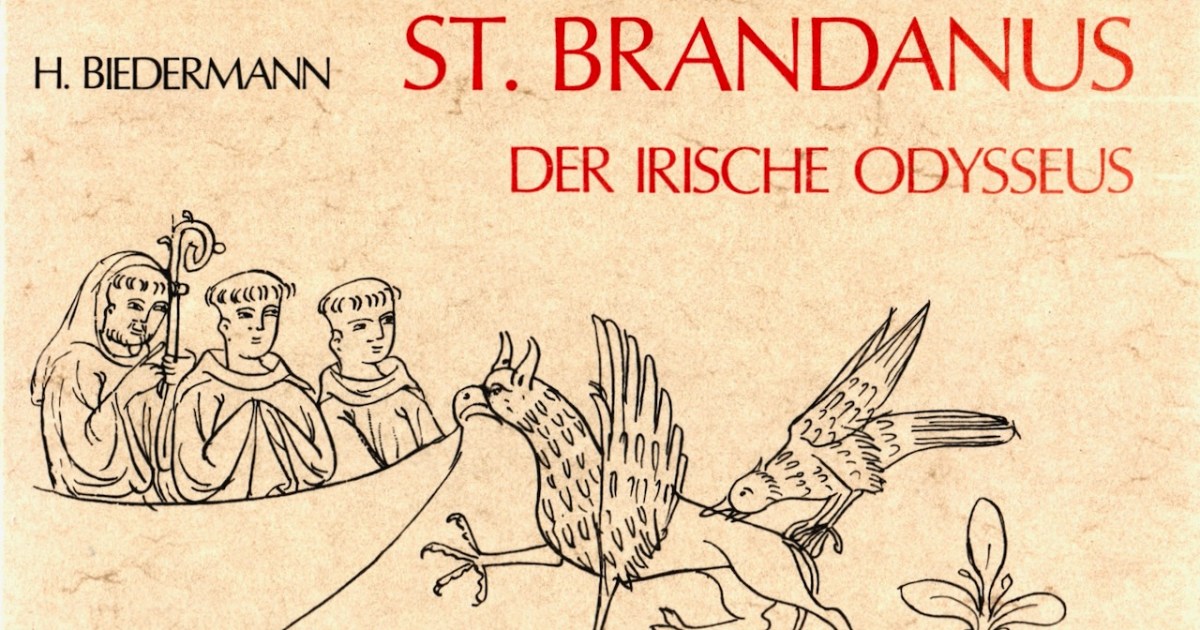
St. Brandanus: A 14th Century Graphic Novel. Part 1

I am fond of telling people (because I read it somewhere) that the Voyage of St Brendan the Navigator was a “medieval best seller.” But I have just acquired a book (above) that made me look more closely at that claim. And yes, it’s a true statement, and my book is part of a sprawling tradition of stories about our own beloved St Brendan, that were written across medieval Europe in many languages over several centuries.
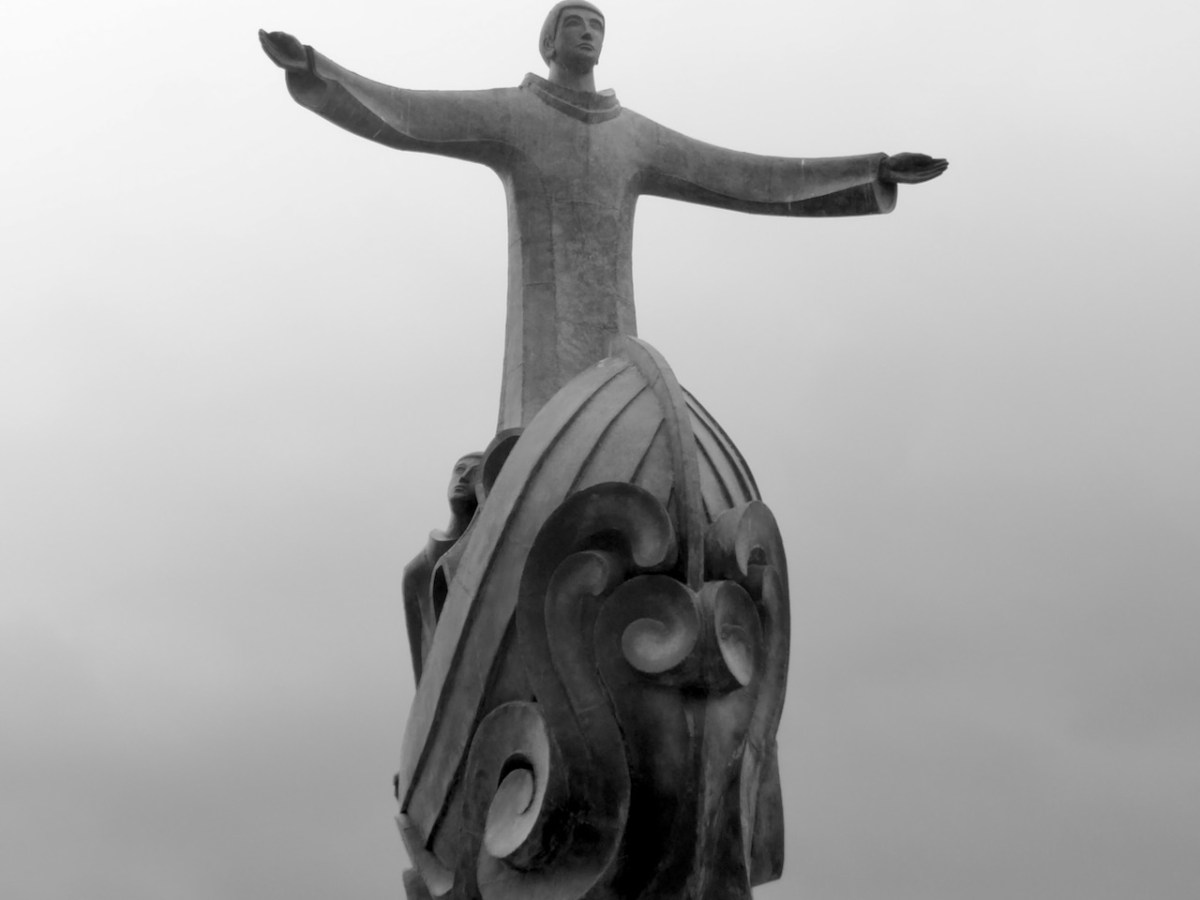
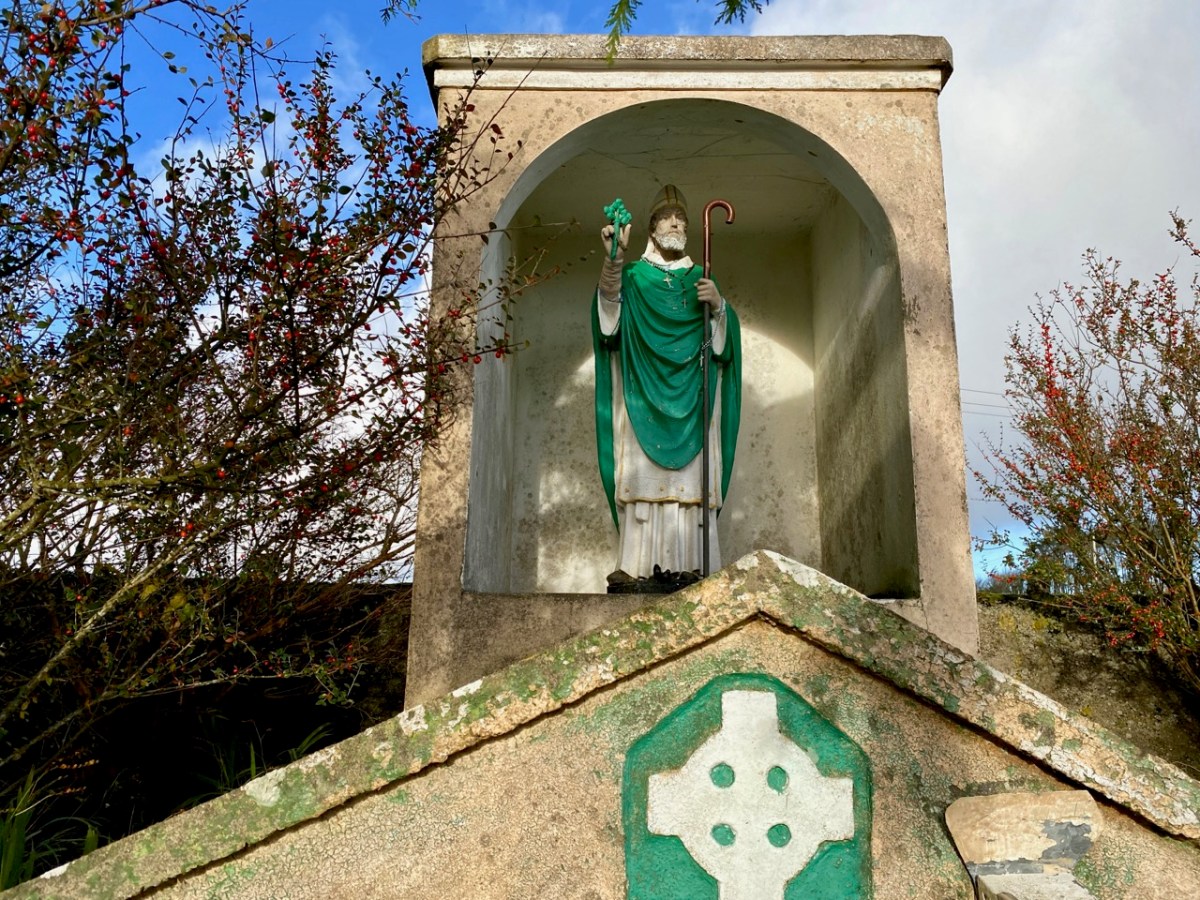
This statue of Brendan dominates the town of Bantry. It’s by Ian and Imogen Stuart

I’m mainly illustrating this post with images of St Brendan in stained glass or other art forms. Since he’s one of our favourite Irish saints here, this isn’t hard. But the next post will be illustrated by images from the book, St Brandanus: Der Irische Odysseus. This post is mainly background about St Brendan and his legendary journey.
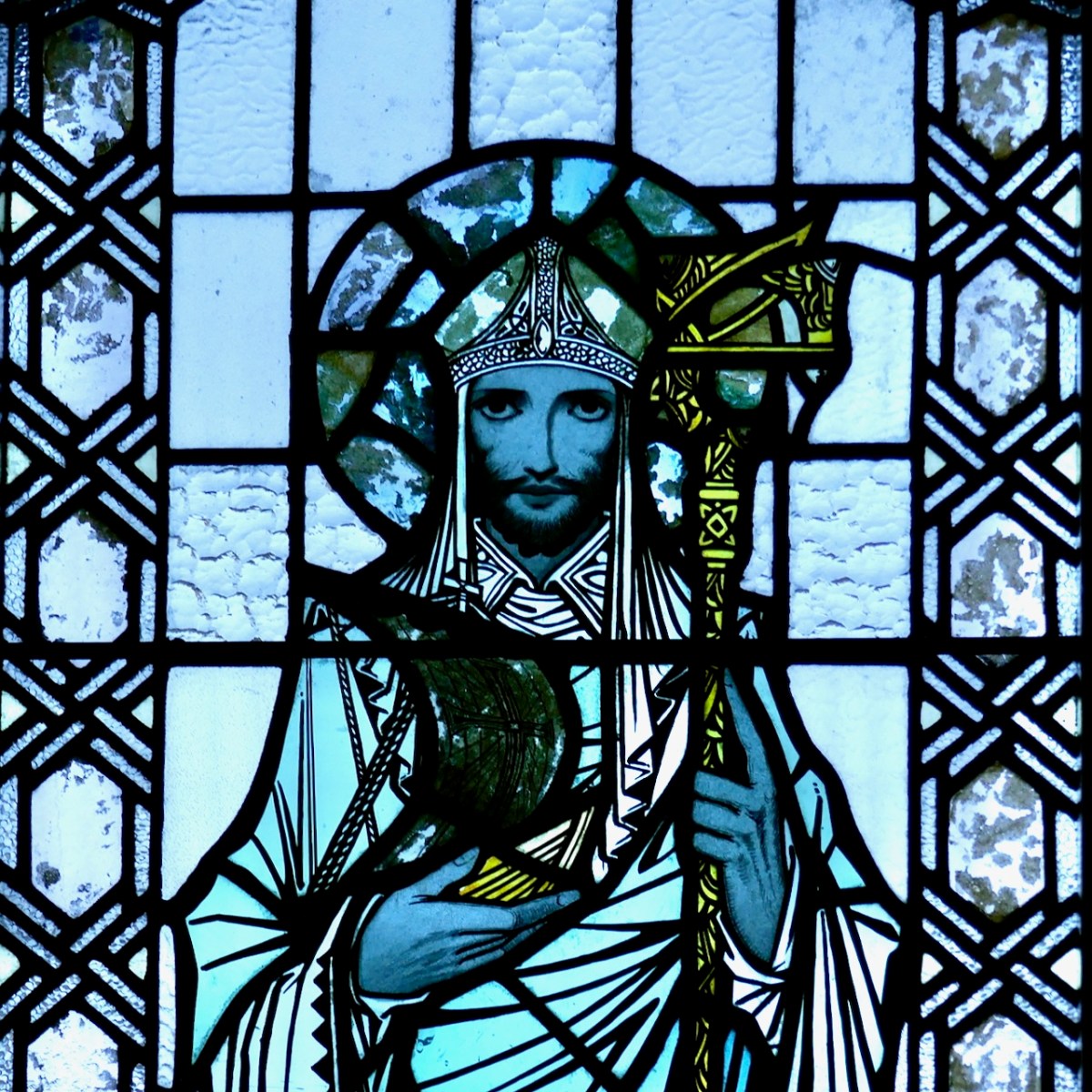
Willy Earley’s Brendan, St Brendan’s College, Killarney

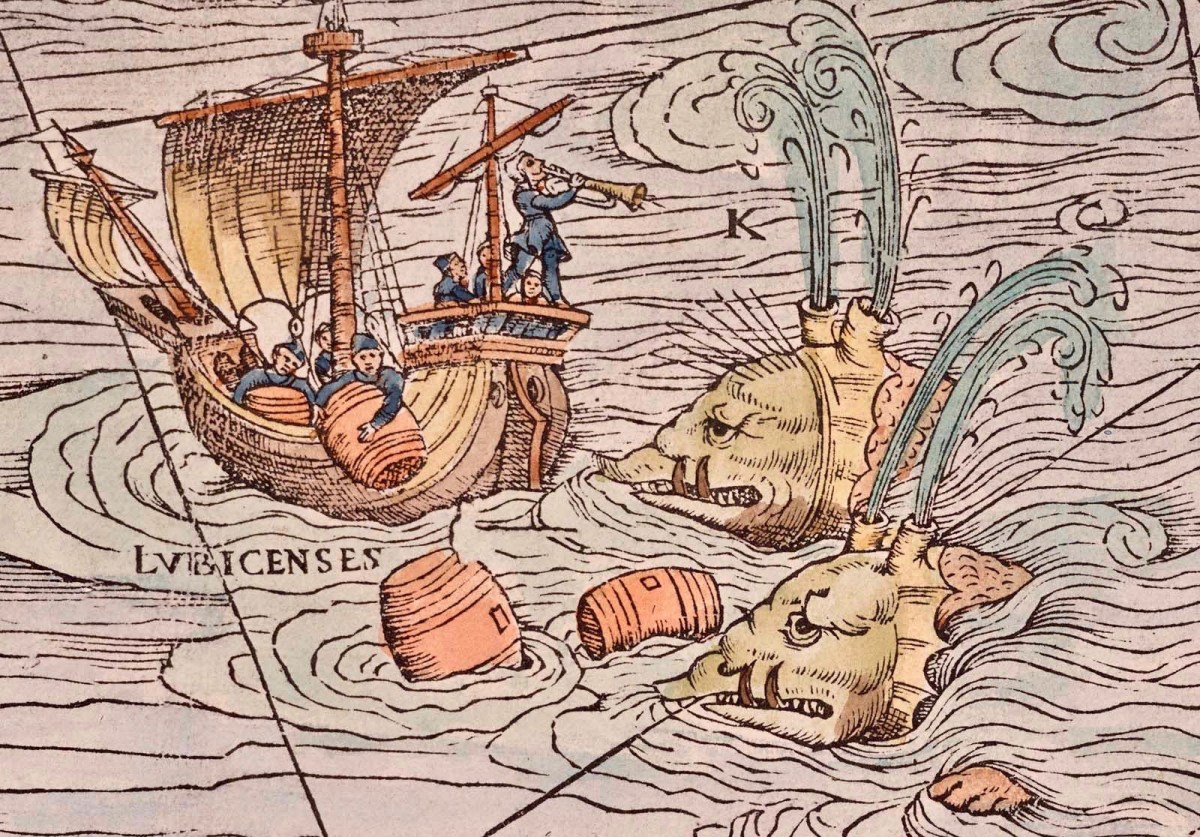
Brendan’s Navigatio is perhaps best understood as one manifestation of the deep well of mythology that many of our stories have come from. St Brendan sets out from Ireland with several companions (the number changes from version to version) and journeys over the sea for several years. Along the way he encounters wonderful islands, strange creatures, demons and whales, colonies of feathered men and beautiful women. Many miracles keep him and his companions alive and moving onwards towards the Land of Promise.
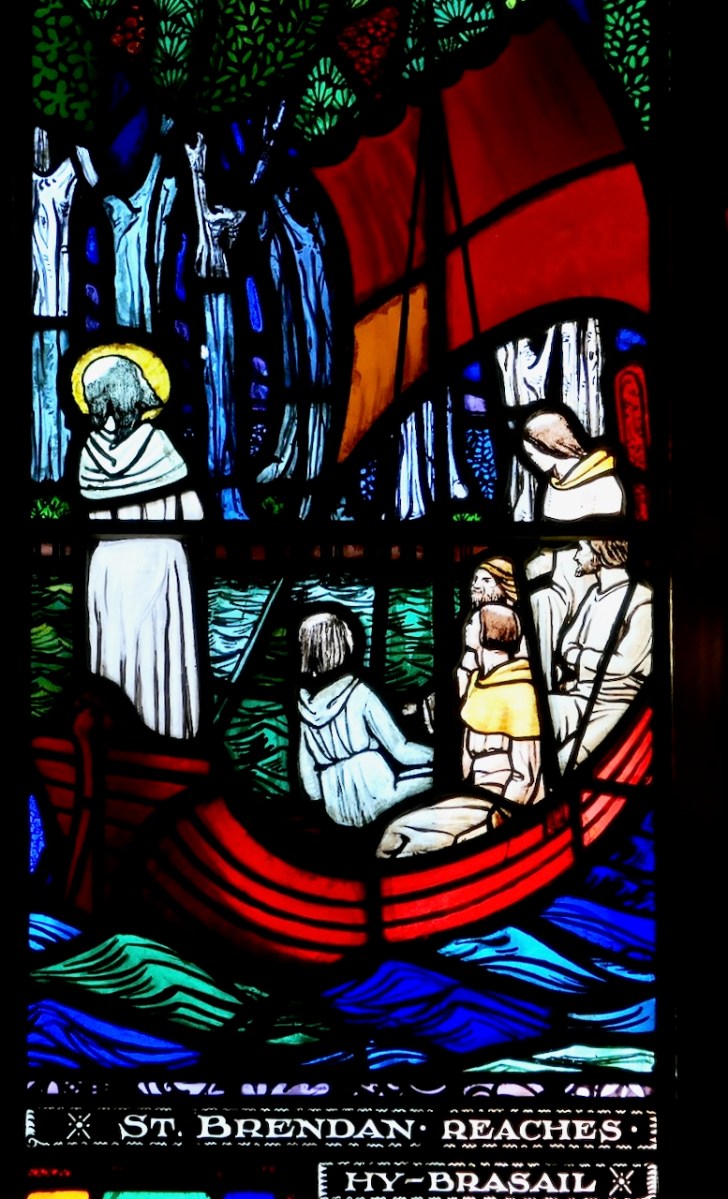
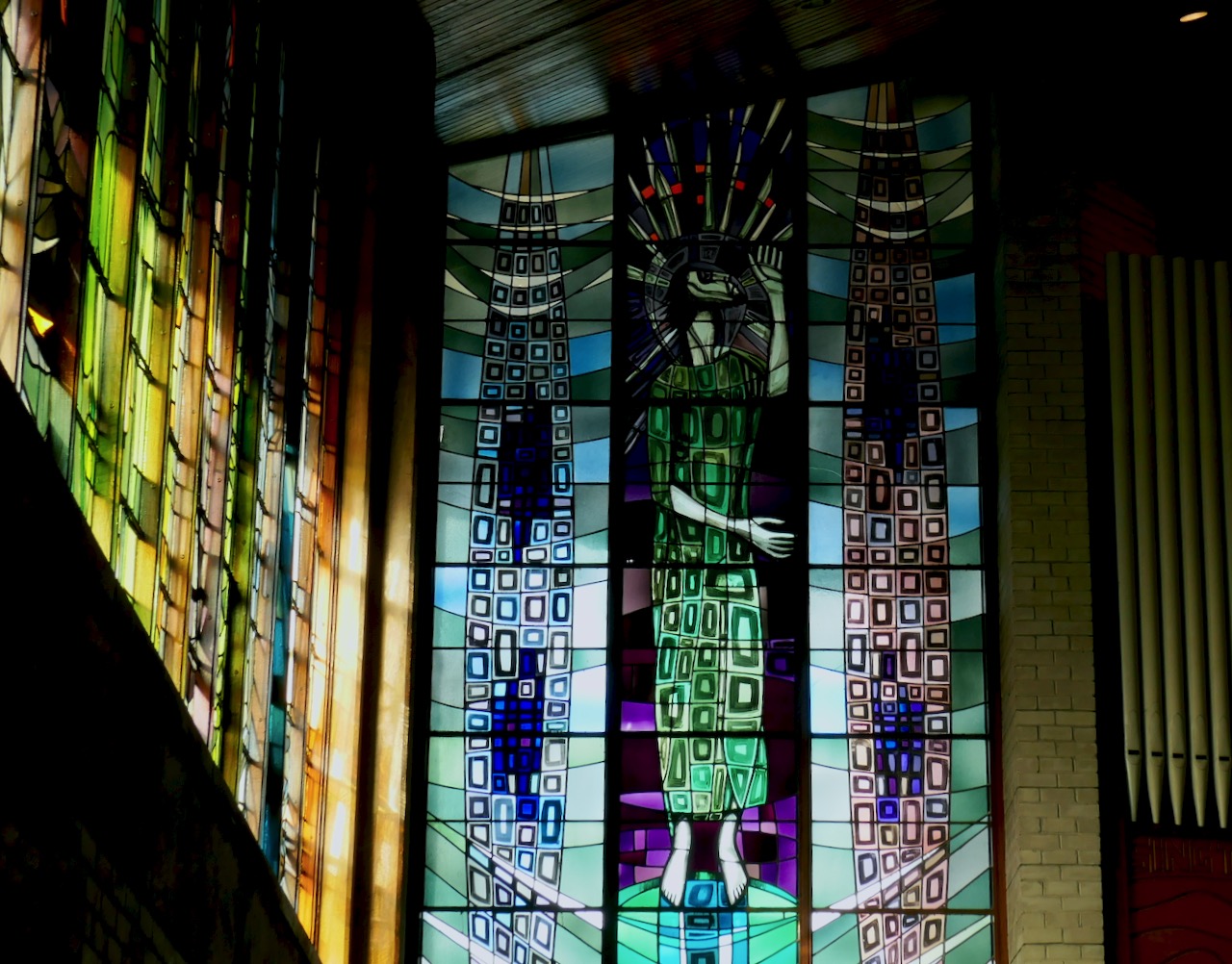
This window by Ethel Rhind of An Túr Gloine is also in St Brendan’s College in Killarney

This great Irish tradition of seafaring pilgrimage is called Immram and is part of a wider-world mythological treasury that includes Sinbad the Sailor and Odysseus, as well as some other Irish saints. Brendan’s tale is based on a pre-Christian legend called Immram Brain (the full text of which can be read here). Here’s a good summary, courtesy of (unlikely as it seems) the University of Texas in Austin.

The text relates how a mysterious woman appearing in the fort of the protagonist, Bran son of Febal, tells him about a magic apple-tree on the island of Emain Ablach, a terrestrial paradise far away to the west of Ireland and abode of the sea-god Manannán mac Lir, which she describes as a place Without sorrow, without grief, without death, without any sickness, without debility from wounds.

Subsequently, Bran sets out to find this island with three times nine companions: on their way they encounter the sea-god, who directs them to an island inhabited by laughing people, after which they reach a different island inhabited exclusively by women. There, Bran and his retinue spend many blissful years, not noticing the passing of time. When finally Nechtan, one of Bran’s companions, is overcome by homesickness, they decide to return to Ireland but are warned by the queen of the island not to set foot on Irish soil. Upon their arrival, Nechtan disregards the warning and immediately crumbles to dust, as they had spent so many years on the magic island that they were well past their dying age; Bran on the contrary remains on the boat and, after telling their adventures to some onlookers on the shore, sets out again for new adventures.

Readers who are familiar with Irish mythology will immediately recognise the similarity of Nechtan’s story to that of the famed warrior Oisín, who goes to live with the beautiful Niamh of the Golden Hair in TIr na nÓg (the Land of Youth), and to whom the same fate befalls when he returns to Ireland. 
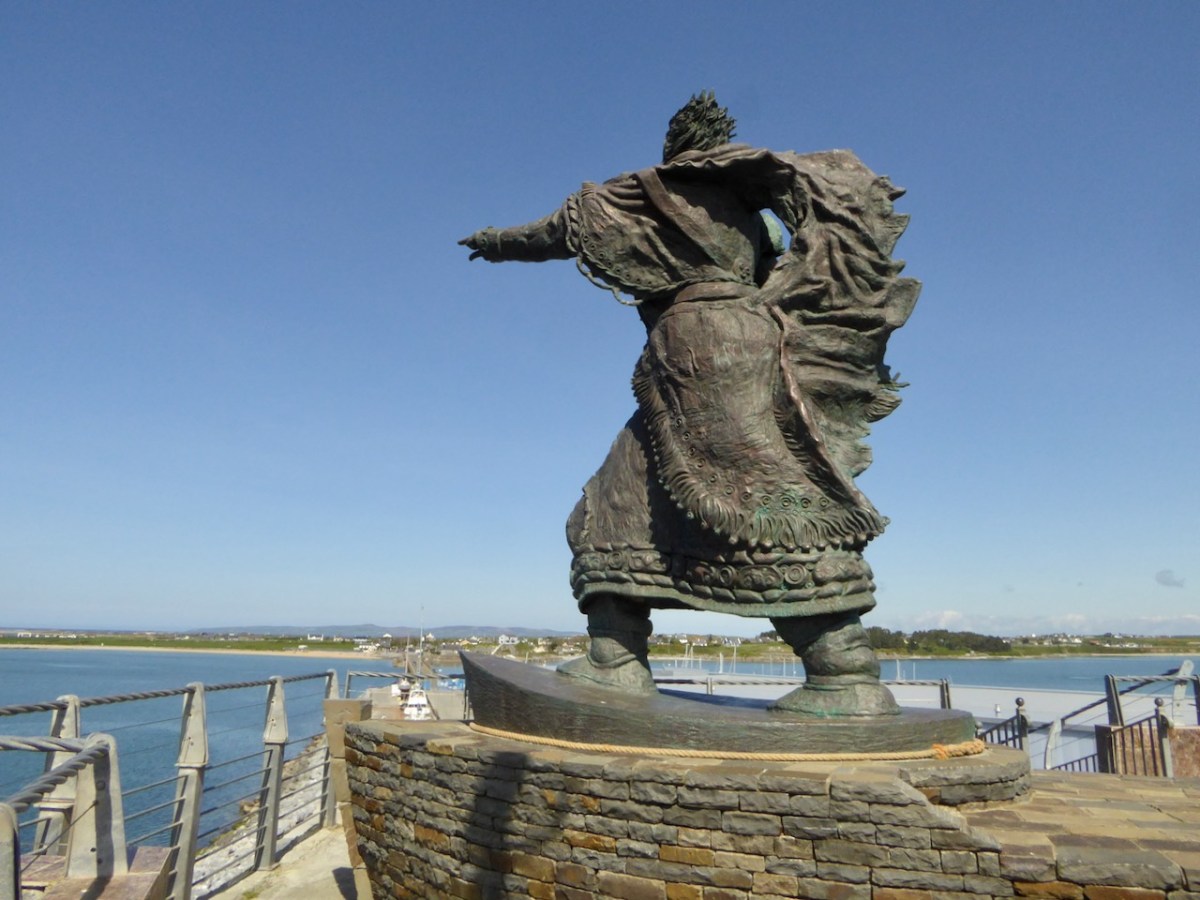
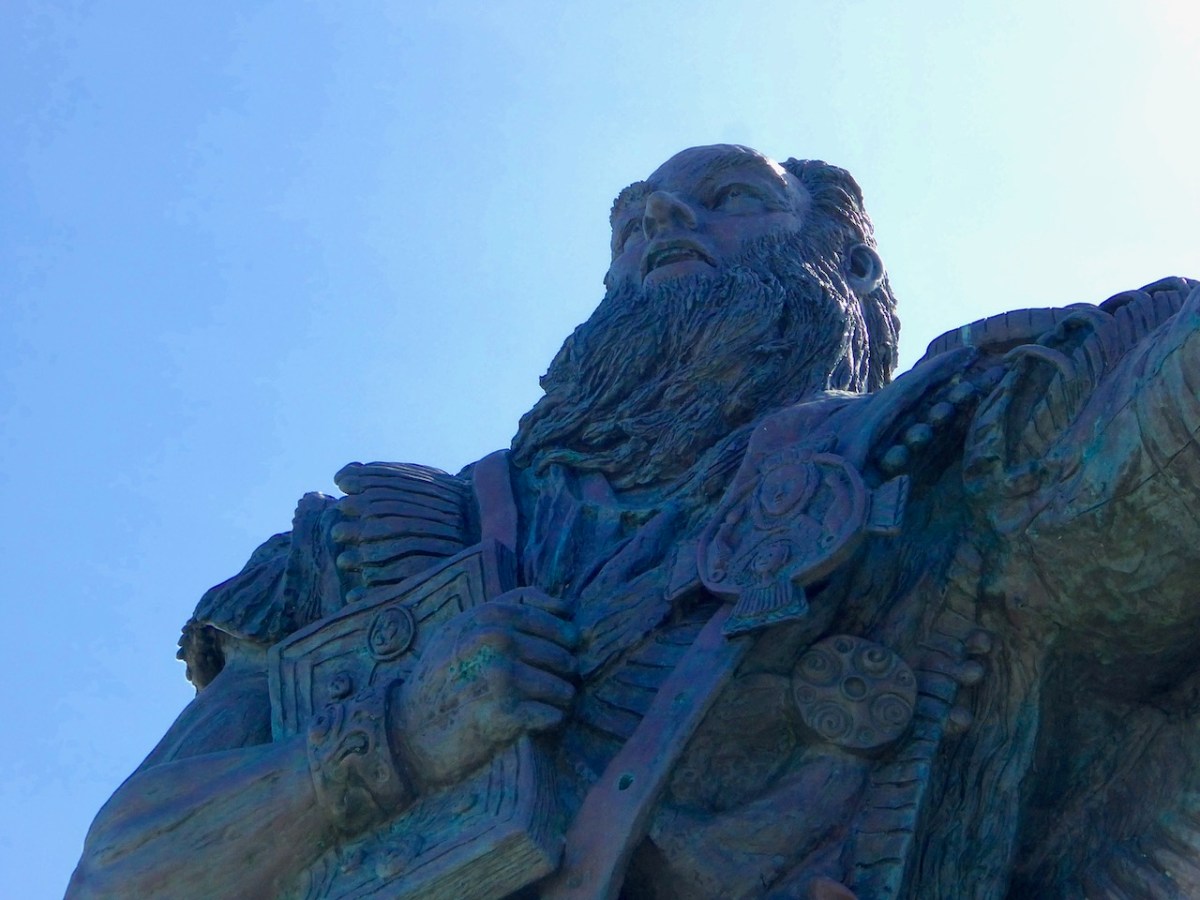
The muscular statue of a mature Brendan in Fenit, Co Kerry, which is the work of Tadgh O’Donoghue. Below is another image of this wonderful work

But to get back to Brendan – the story of his voyage became the principle Immram of the Middle Ages. Originally written in Latin as early as the 9th century, by the 12th century, it was one of the most popular medieval legends, with versions in many languages: French, Italian, English, Dutch, German, Irish, Welsh, and more. In fact, more than a hundred manuscript versions survive. That does not include the Life of Brendan from the Book of Lismore, compiled in the 1480s, and wonderfully translated by Whitley Stokes, even though that Life contains the voyage within it.
Just to give you a flavour of Stokes’ language, here a little extract from the Life:

So Brenainn, son of Finnlug, sailed then over the wave-voice of the strong-maned sea, and over the storm of the green-sided waves, and over the mouths of the marvellous, awful, bitter ocean, where they saw the multitude of the furious red-mouthed monsters, with abundance of the great sea-whales. And they found beautiful marvellous islands, and yet they tarried not therein.
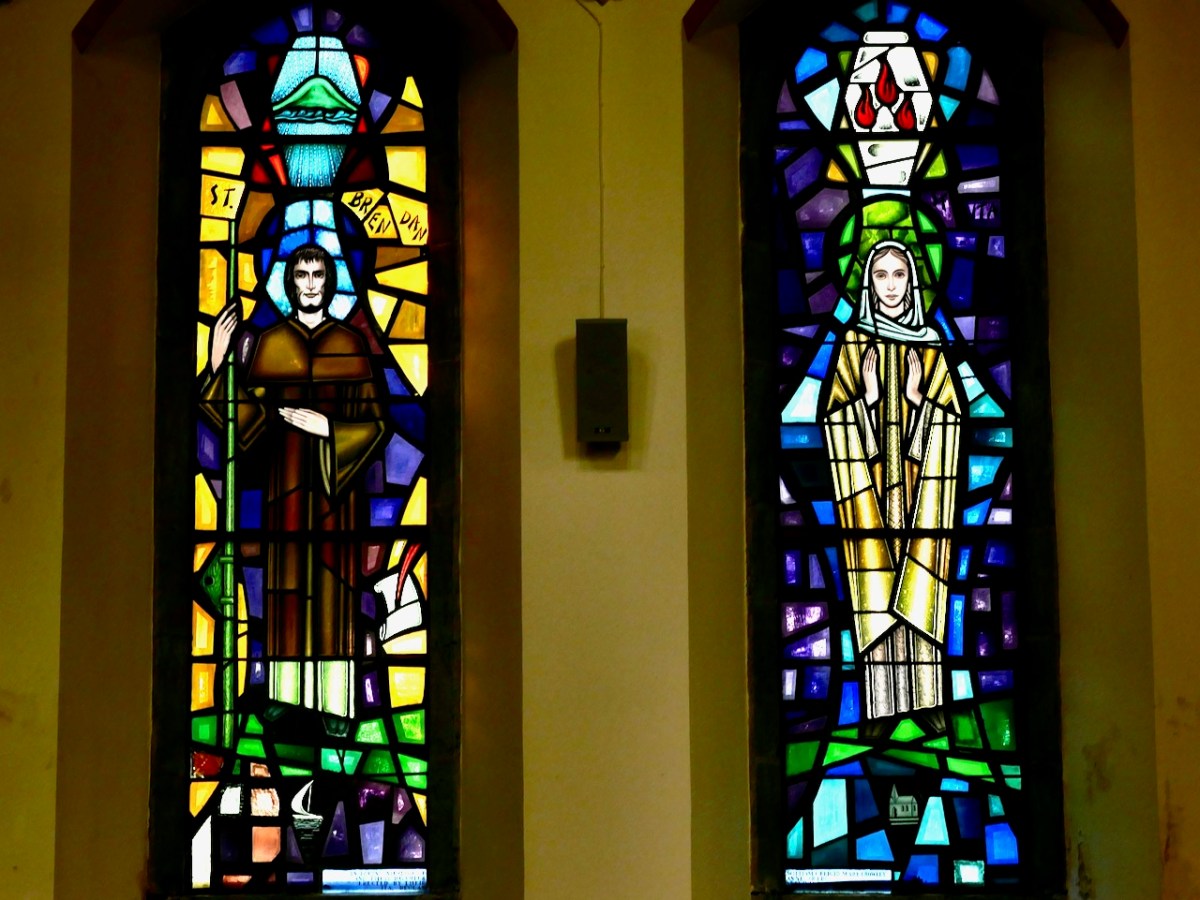
Brendan and his foster-mother, St Ita. In Killorglin, by George Stephen Walsh

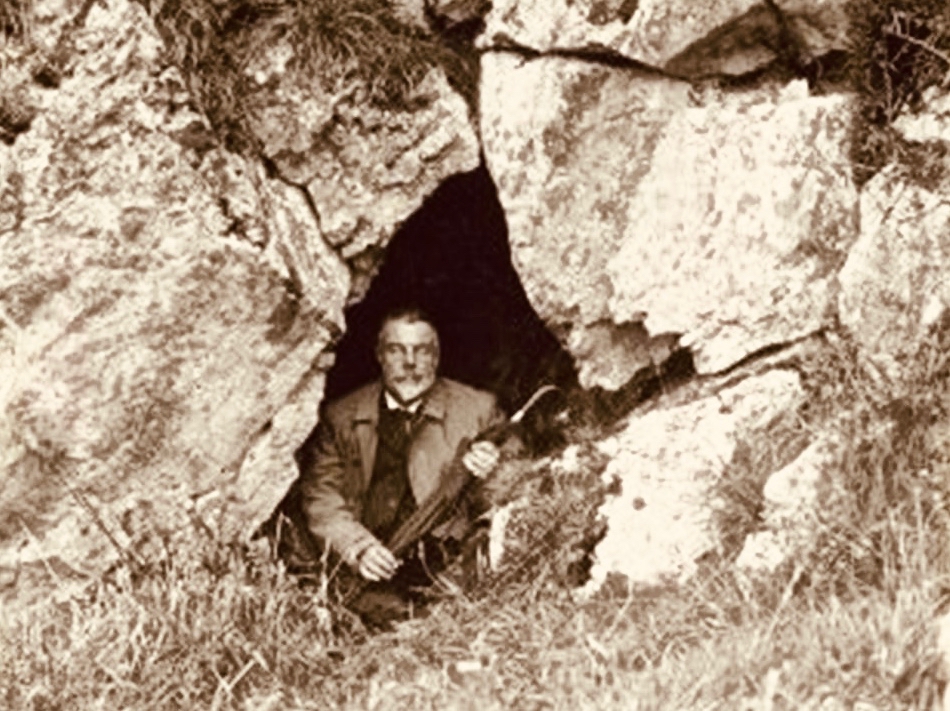
The thing about all these manuscript versions of Brendan’s Navigatio is that none except a couple is illustrated. My recent acquisition (thank you, Innana Rare Books!) is a book about one of only two fully illustrated versions, although isolated illustrations crop up here and there. The book was published in 1980 and is a work of scholarship by Hans Biedermann. Biedermann was a highly respected Austrian academic and an expert on symbolism and mythology. A professor at the University of Graz, he died in 1990, aged only 60. This is the only photograph of him I have been able to find.

This means, of course, that the book is in German, and no English translation exists. I turned to my favourite AI tool, Perplexity, to help me with the translations and it provided me with a page-by-page summary. 
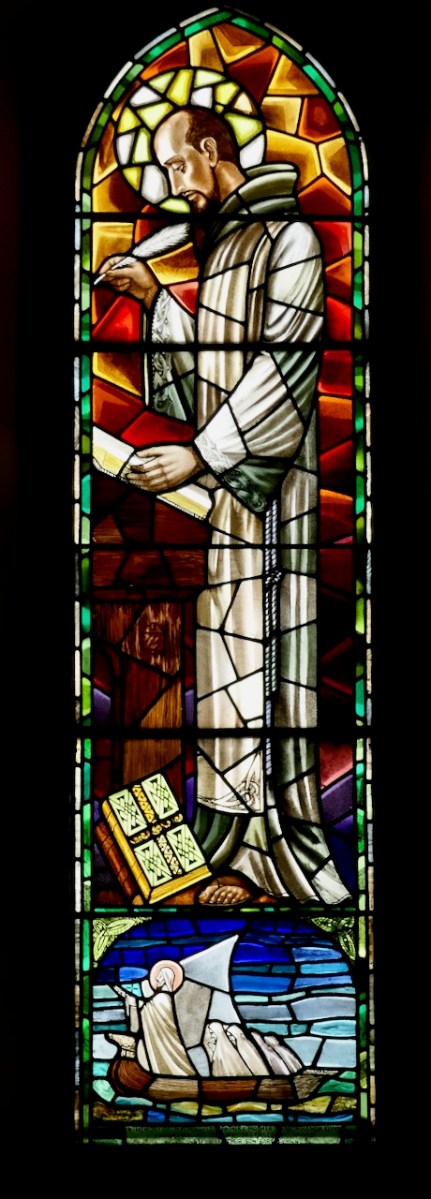
This window is in KIllorglin and is by James Cox. It emphasises the scholarly monk in the main panel, leaving the seafarer to the predella

A digression – I am as concerned as you all are about the use and mis-use of AI. For the purpose of this project I used Perplexity as an AI-powered search engine, translator and research assistant, asking it to fact-check items for me, and to dig deeper into sources and references. Because the book is in German, and some of the sources I consulted are in European libraries, I couldn’t have done it without this kind of help. Perplexity also ‘fixed up’ the photograph of Hans Biedermann above, from the tiny fuzzy image which was all I could find online. The writing, however, is all my own – don’t worry, none of this was written by a chatbot.
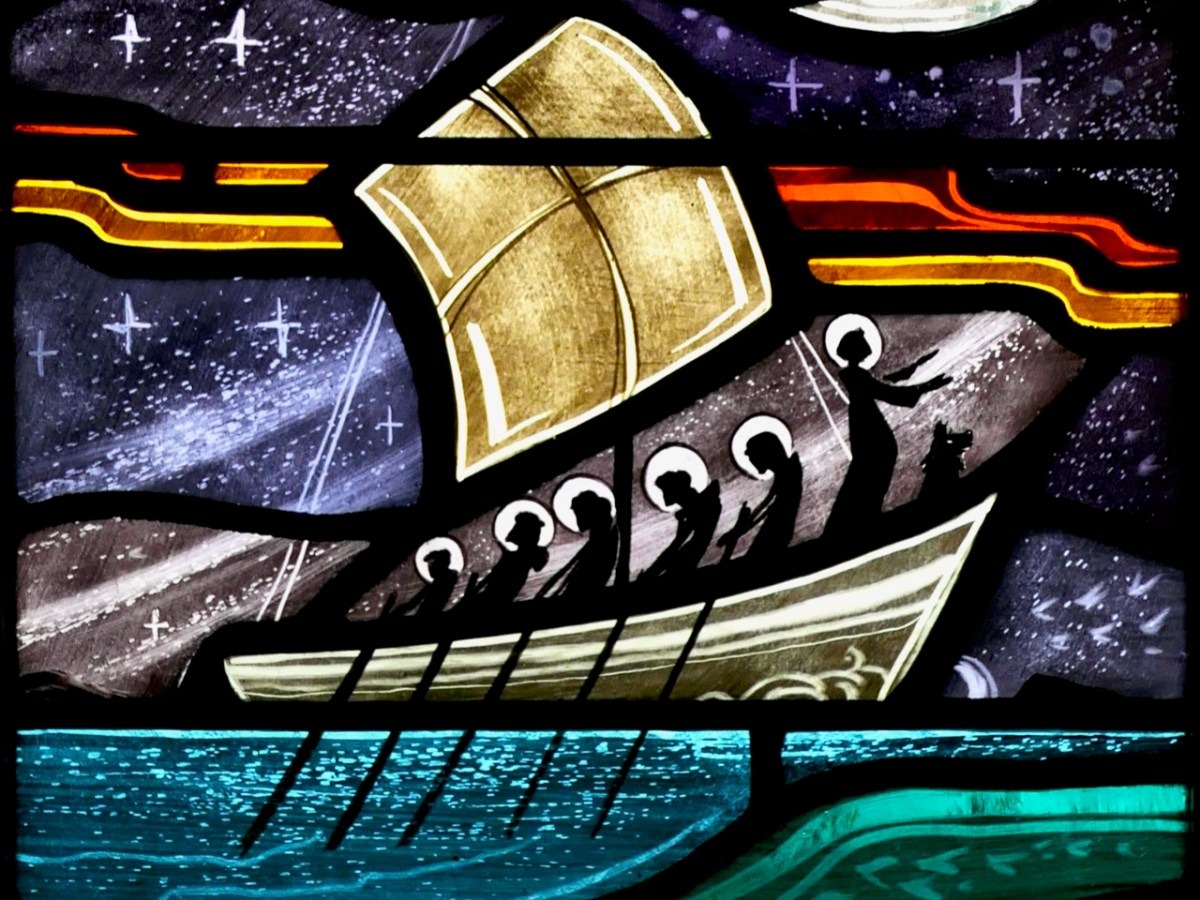
A detail from a George Walsh window

I am also painfully aware that I am many words in and I haven’t actually shown you what the book is all about. It contains facsimile reproductions of 62 plates from the Krumauer Bildercodex, Codex 370, which is a manuscript kept at the Austrian National Library. The plates illustrate the voyage of St Brendan. There is a minimum of text, in the form of captions in Latin in Gothic script. It is, in essence a graphic novel – and it dates to 1360!
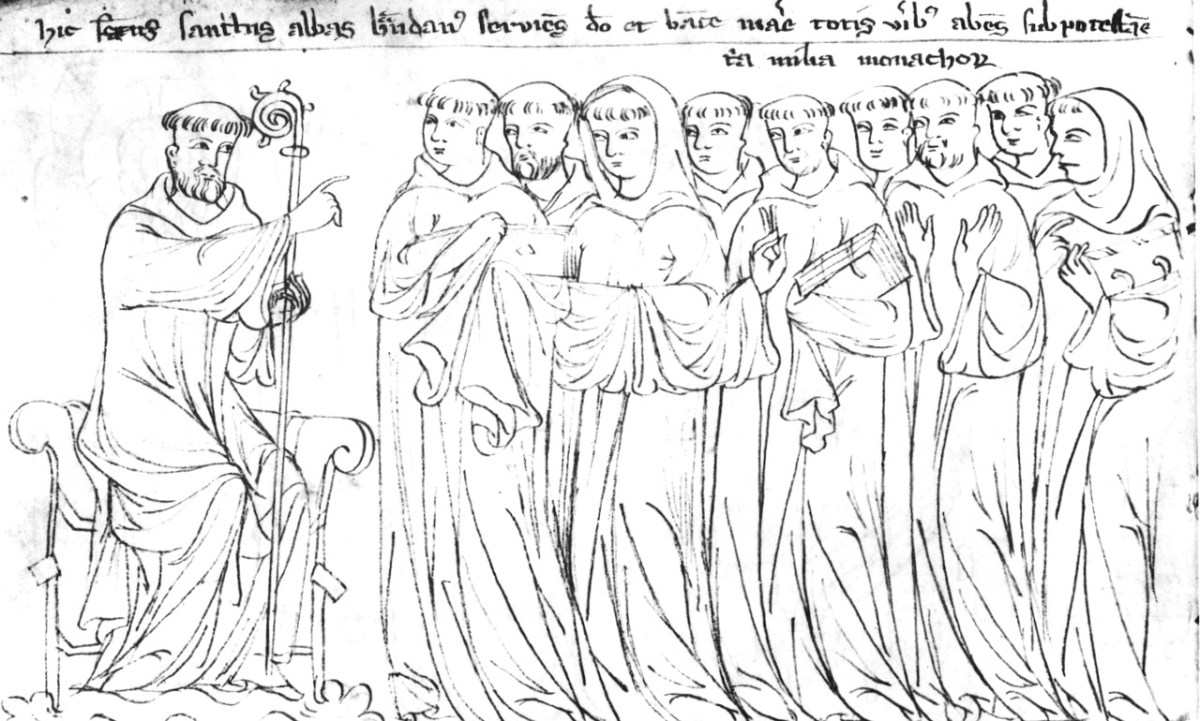
Caption reads: Here the holy abbot Brendan, serving God and the blessed Mary with all his strength, had under him nearly three thousand monks

Next week we will get into the illustrations and look at what may have been the origins and the purpose of the manuscript. They are all pen and ink line drawings – above and below is a foretaste.
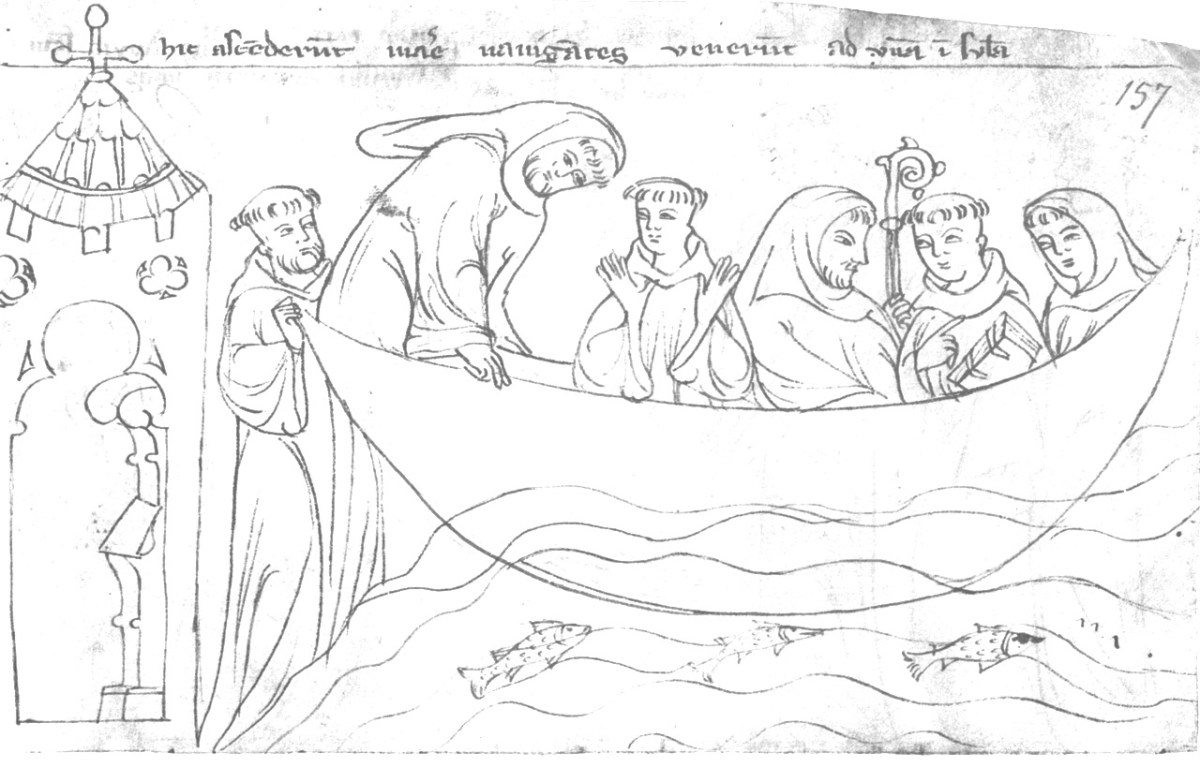
Caption reads: Here they set out upon the sea, sailing, and came to an island.

Part 2 is here

Get The Message!

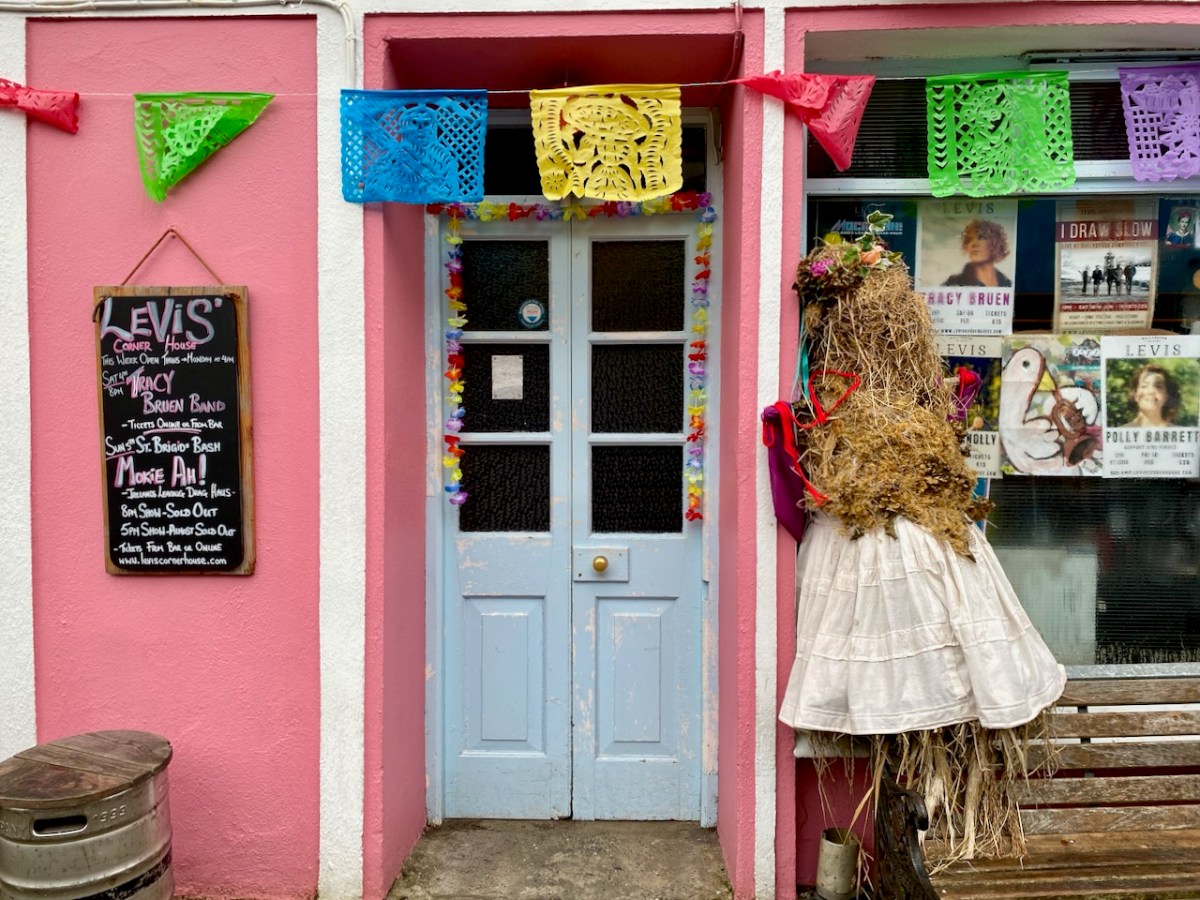
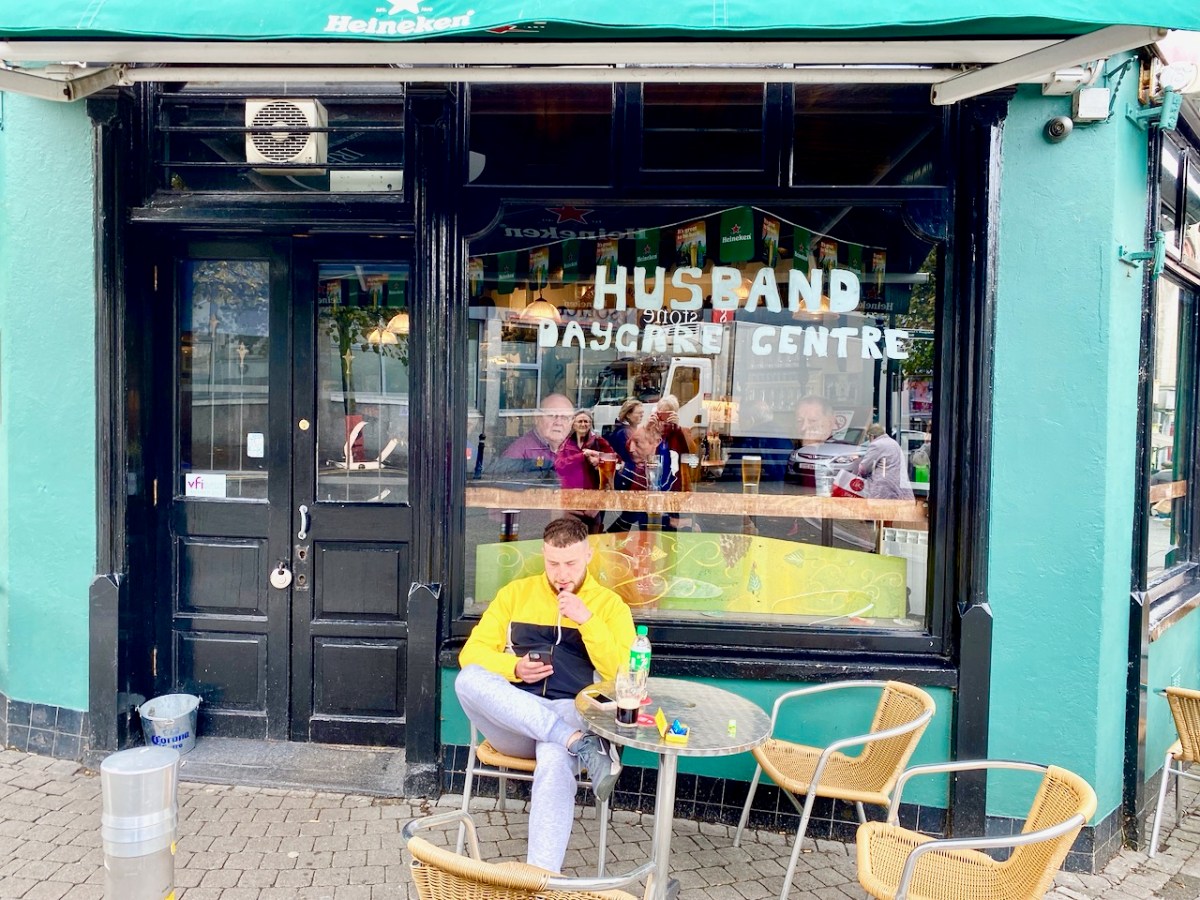
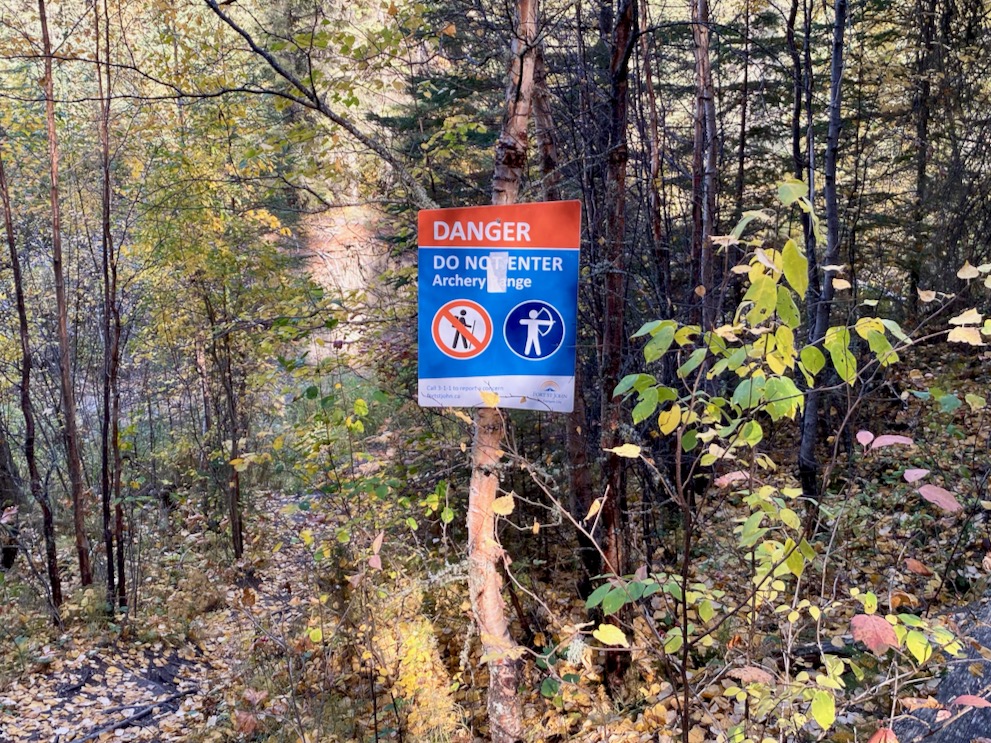
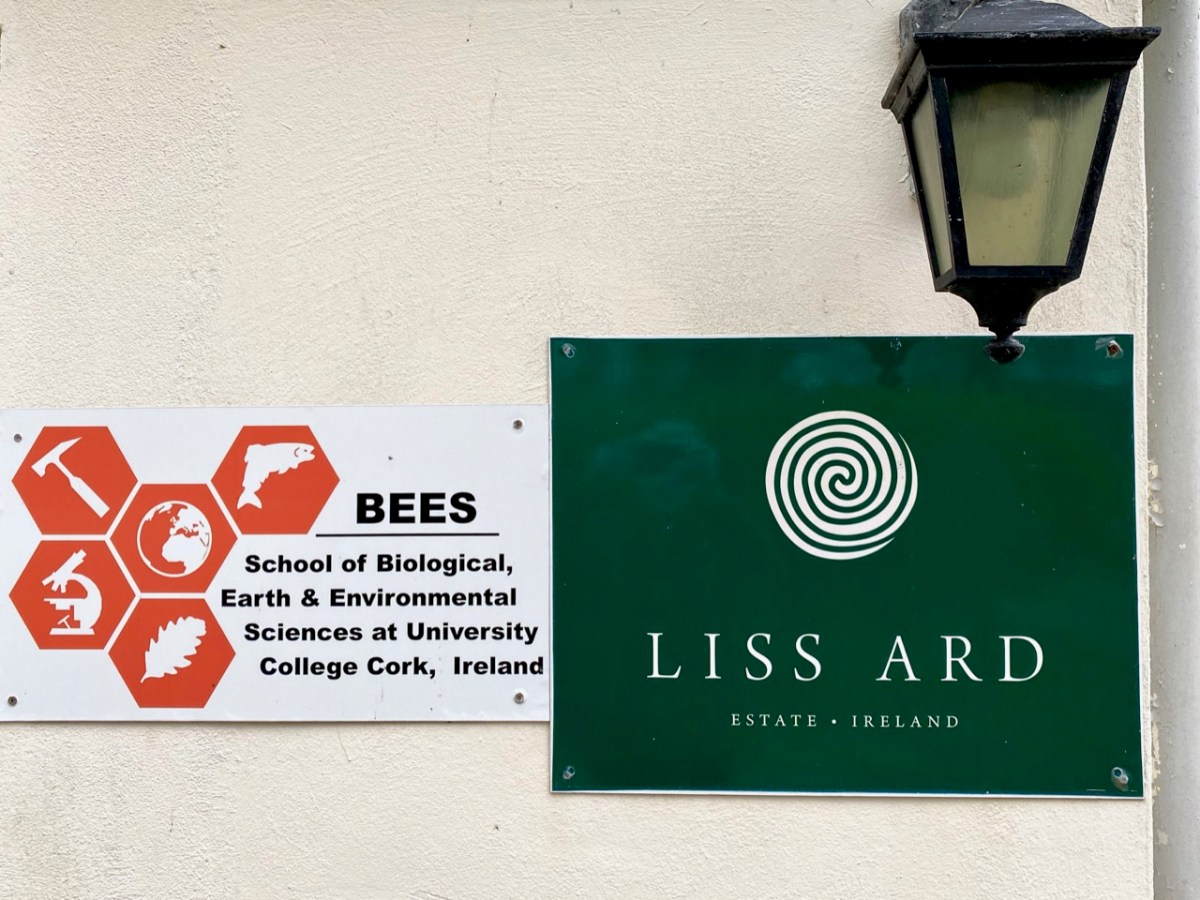
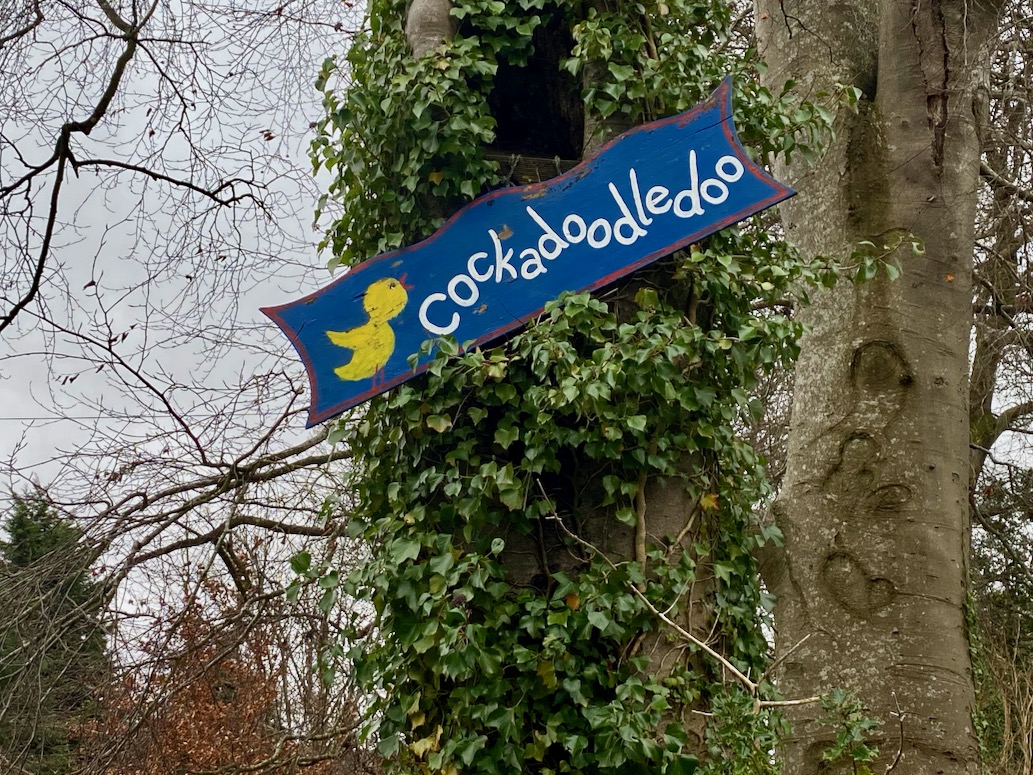
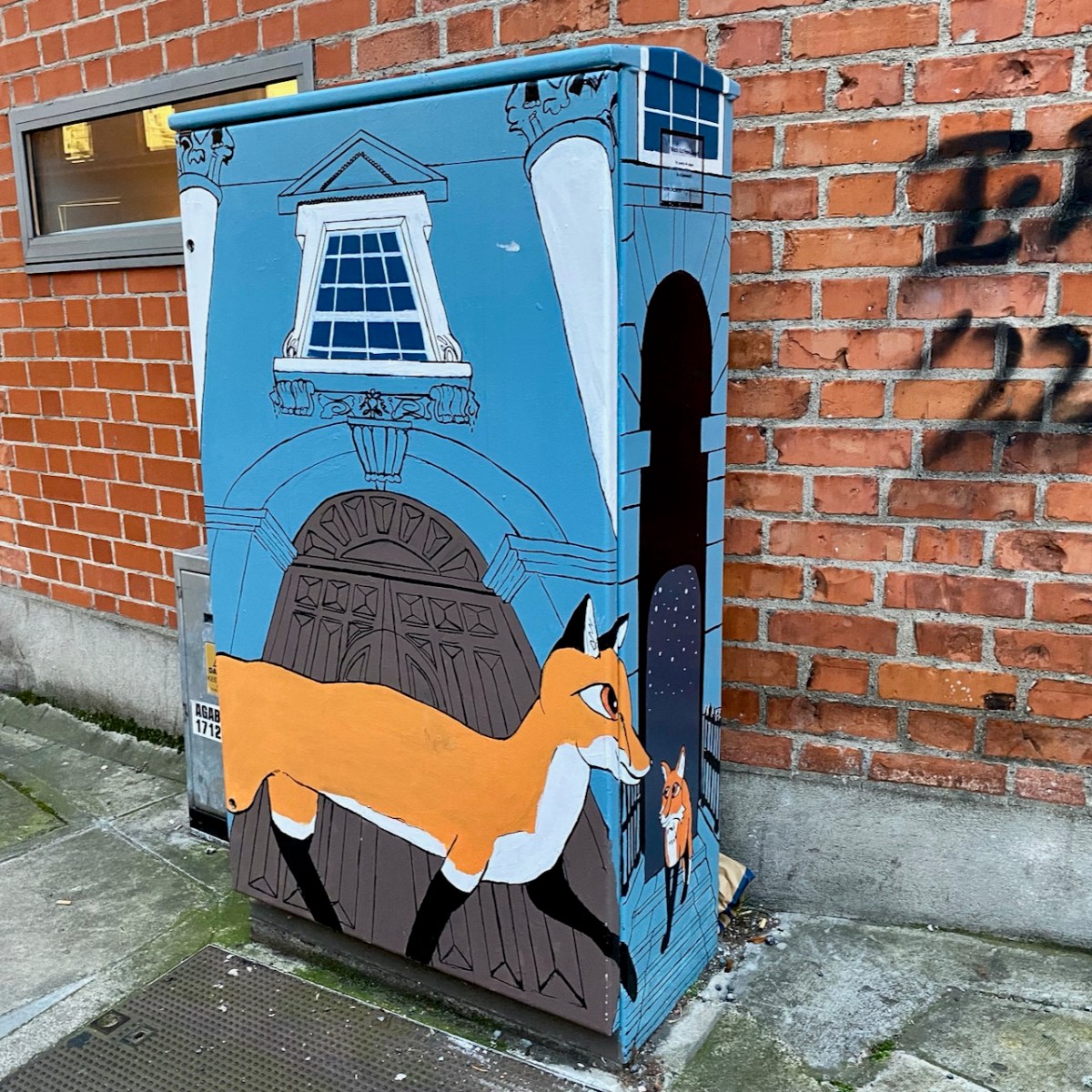
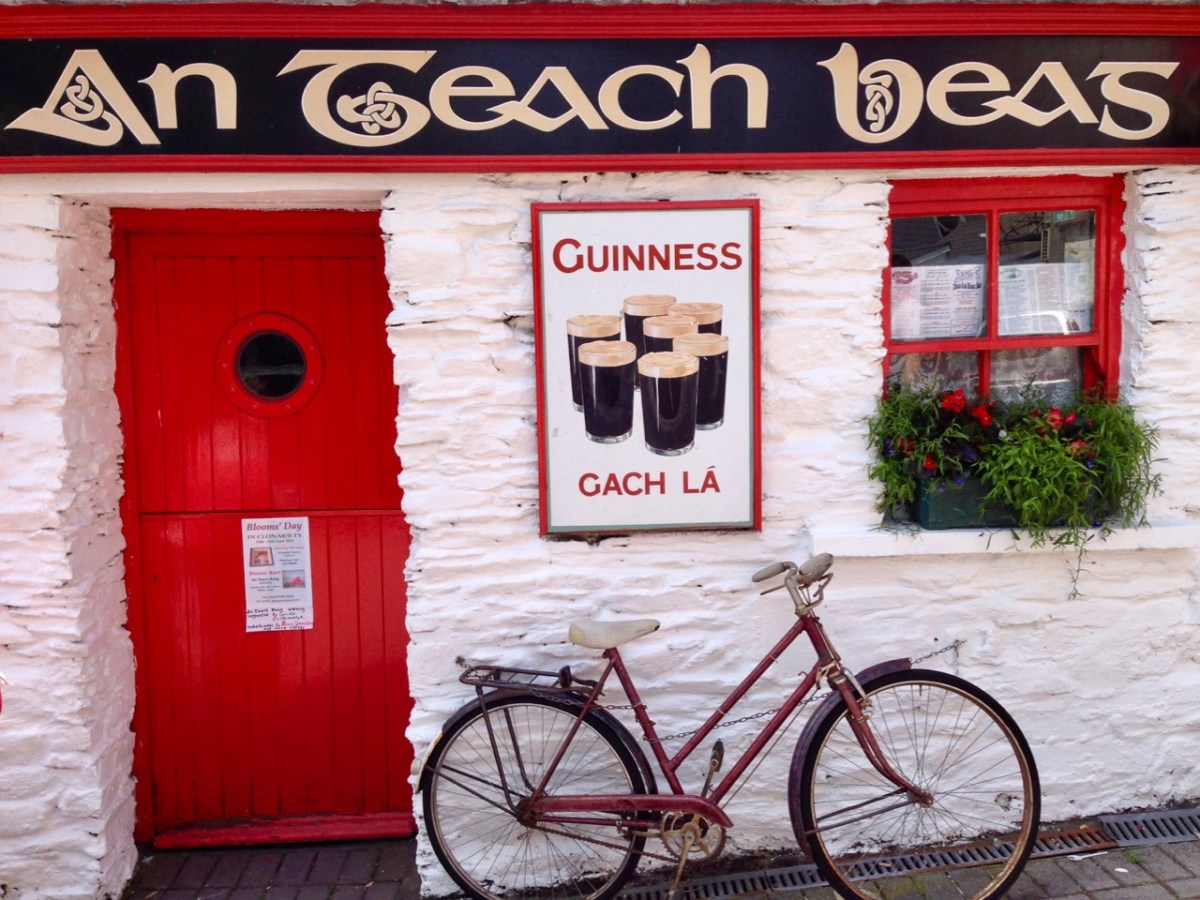
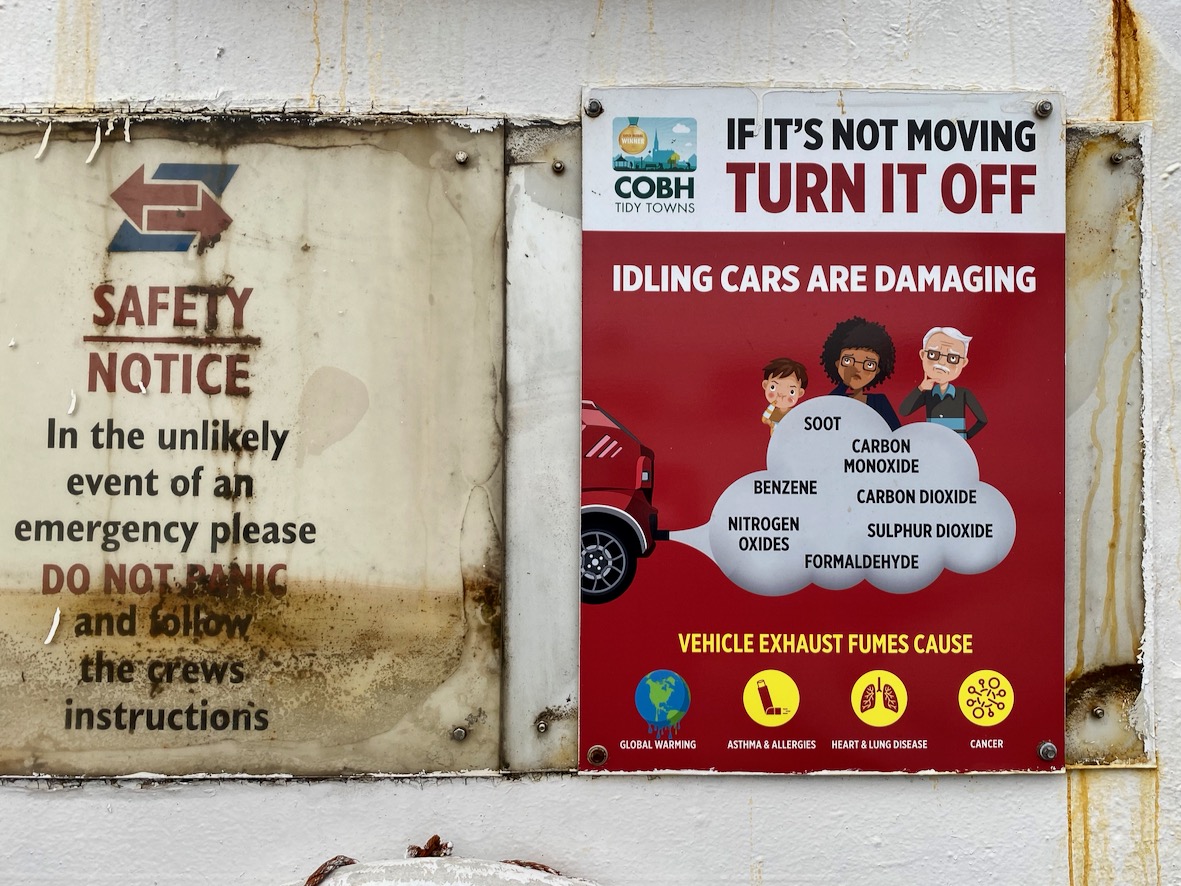
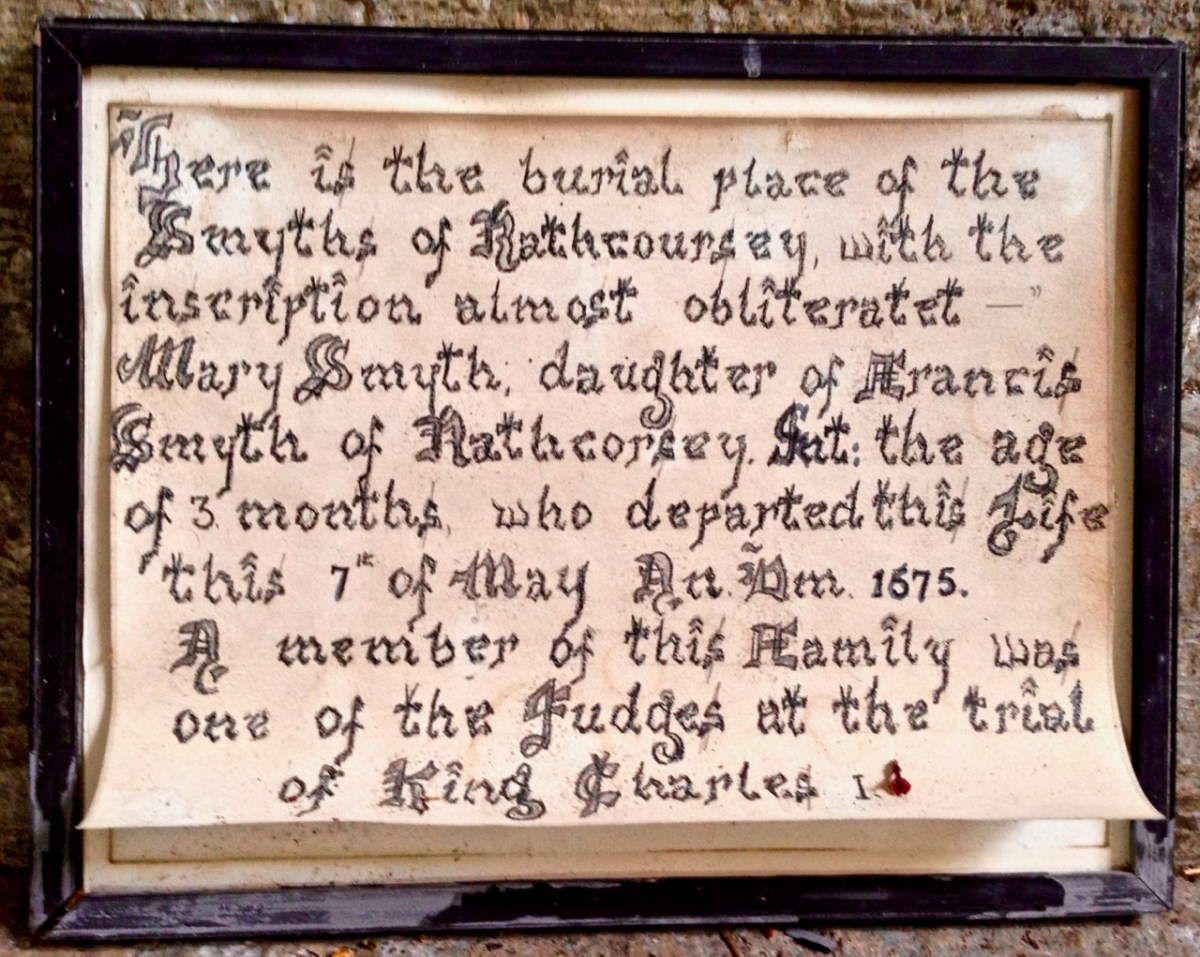
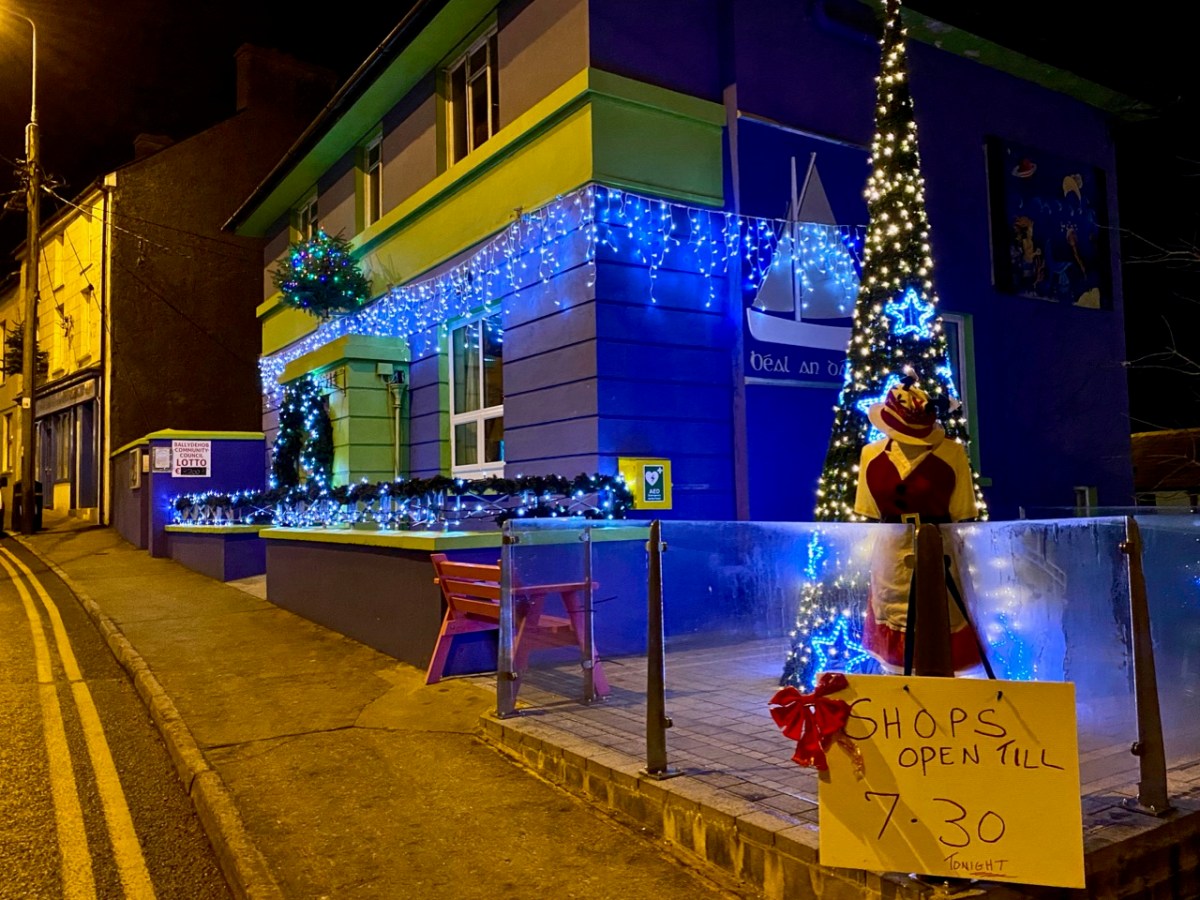
My collections of signs, posters and visual images expands all the time. If I see something quirky, I can’t resist a photo. I share these with you every so often. Today’s selection comes from far and wide: mainly here in Ireland (principally West Cork) with the odd stray from outside. I will only explain something if I feel an image demands it. The example above – from our own Ballydehob – certainly doesn’t, but the one below, which I also came across today in our little village, probably does.
It’s a straw doll representing St Brigid. Often also known as Brídeóg, ‘Breedhoge‘ or ‘Biddy‘, it was once common to see these made to celebrate spring (which traditionally begins on her day, February 1st). This year Ireland has its first ever St Brigid’s bank holiday (tomorrow), to balance out St Patrick’s Day which we have always celebrated around his own feast, March 17th.

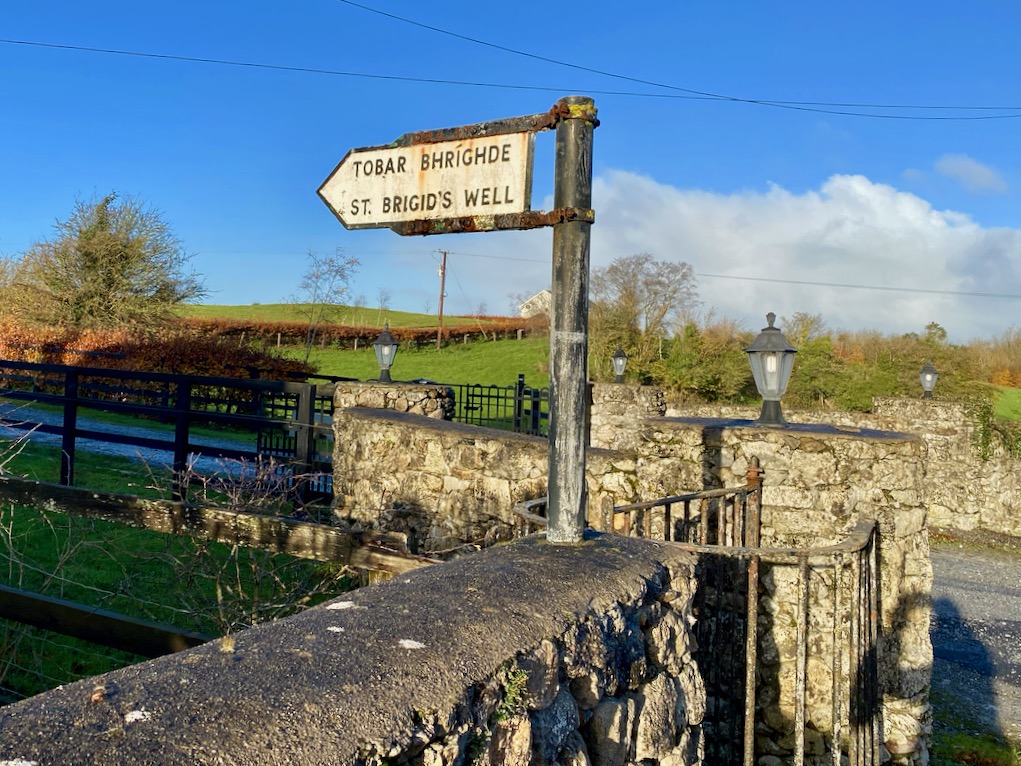
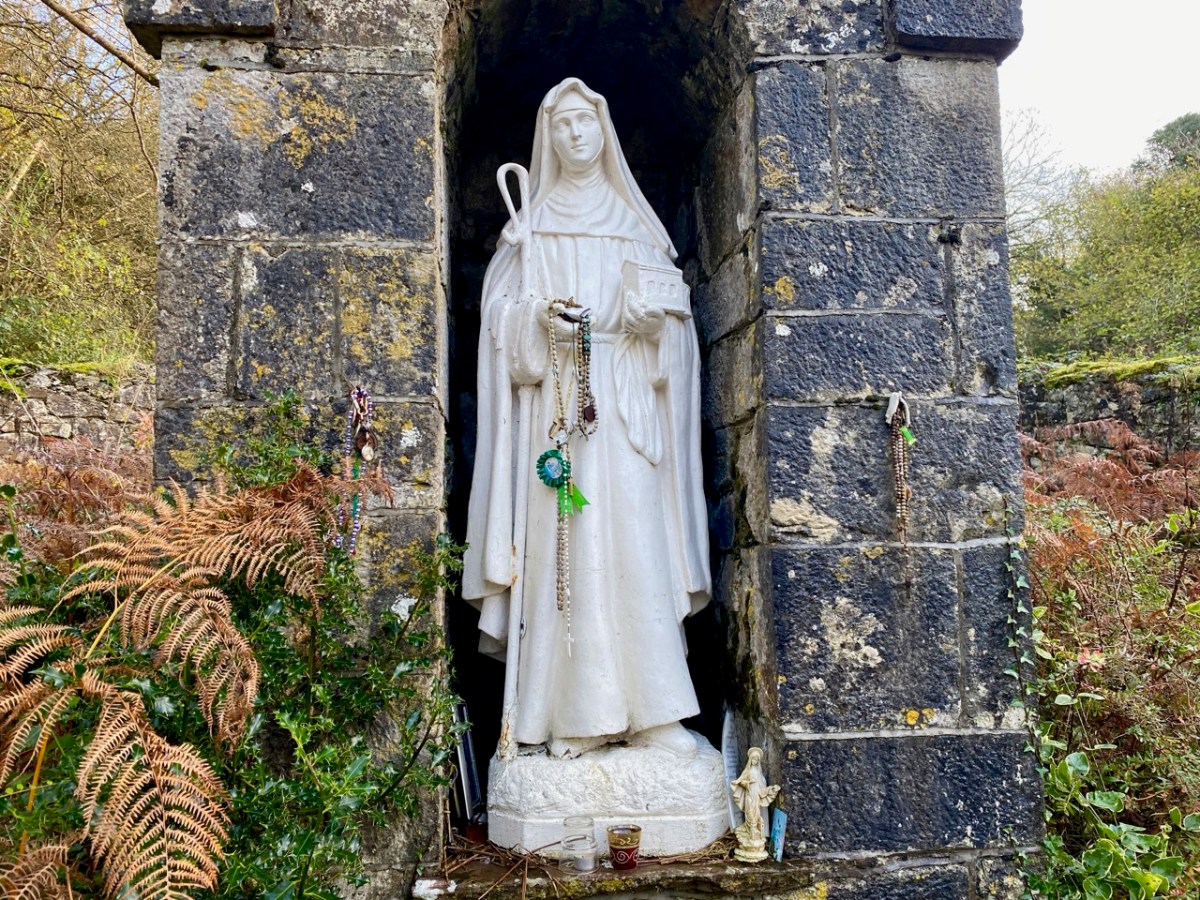
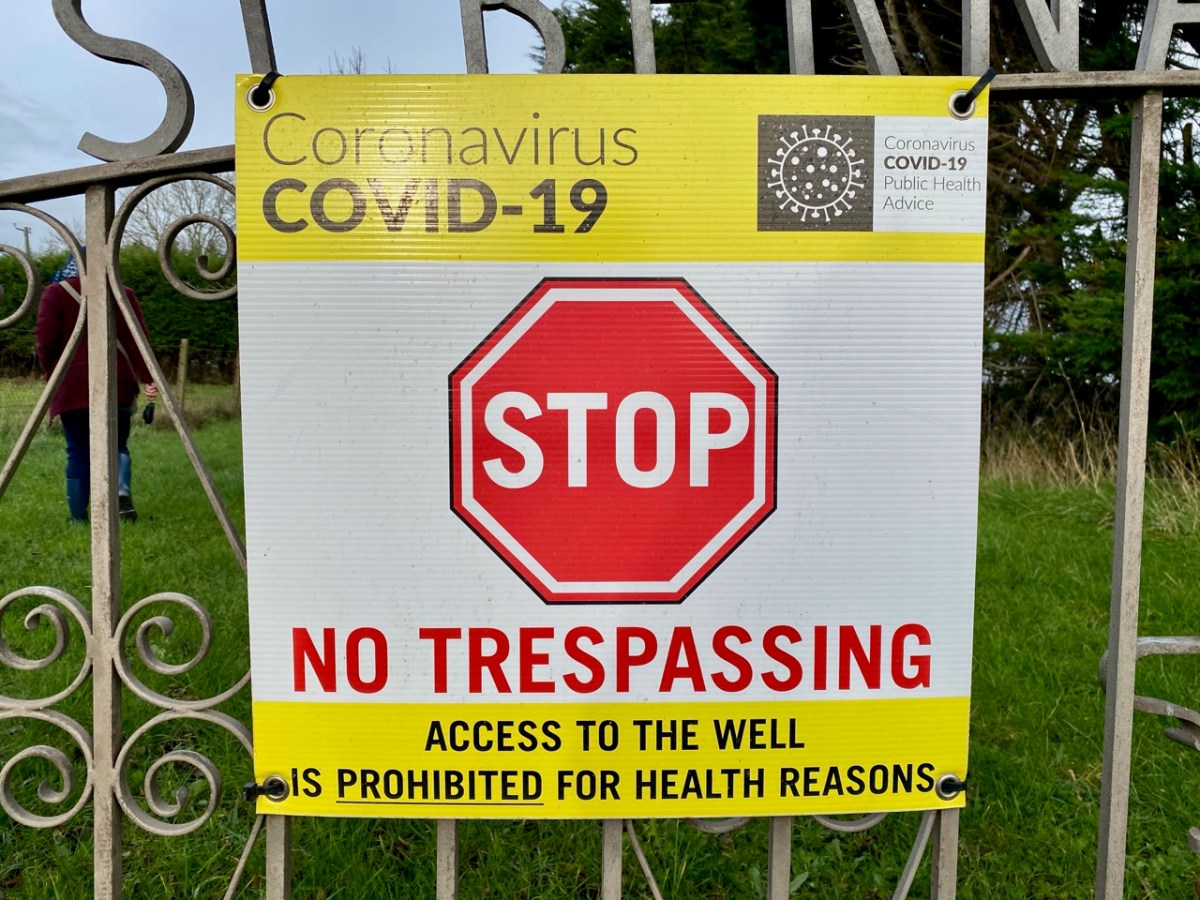
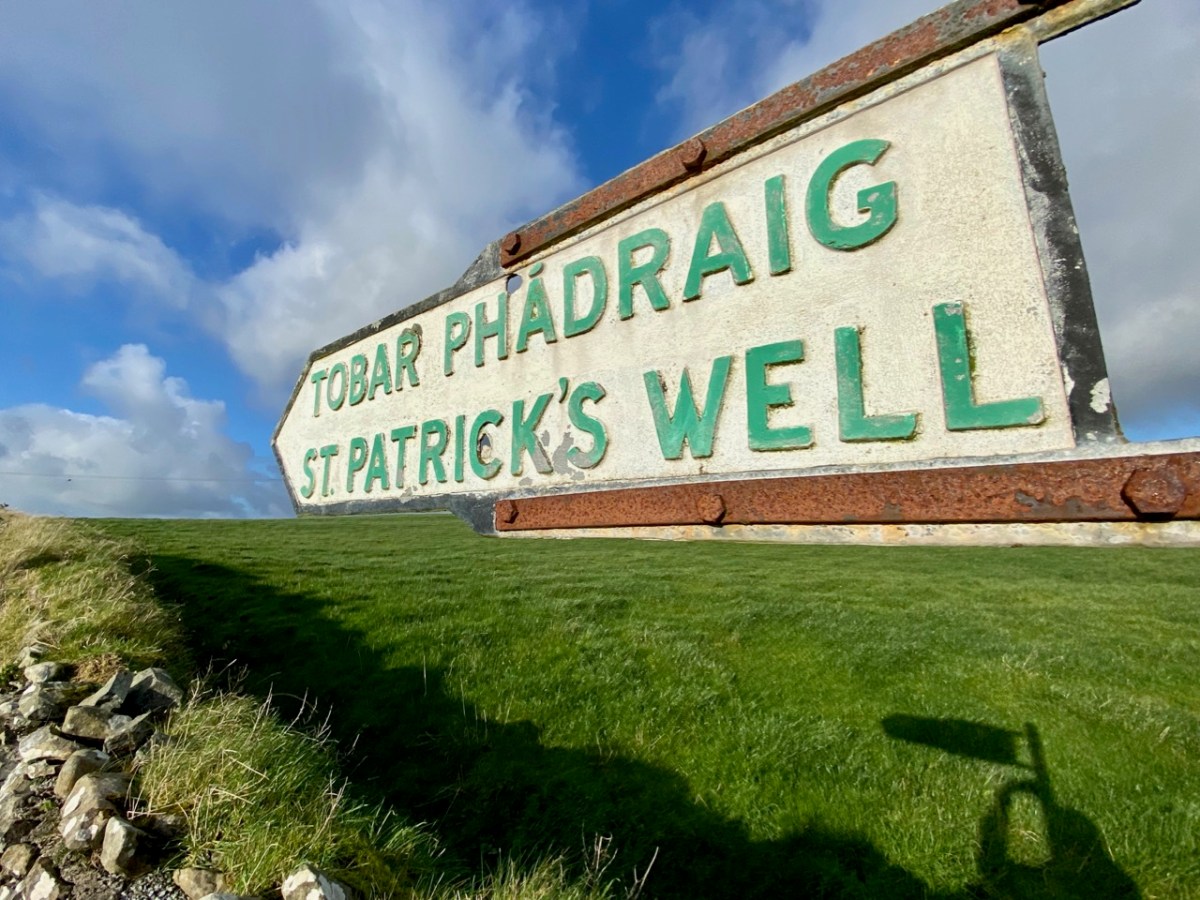
Let’s get back to signs. Wouldn’t you expect that one might visit a holy well for health reasons?

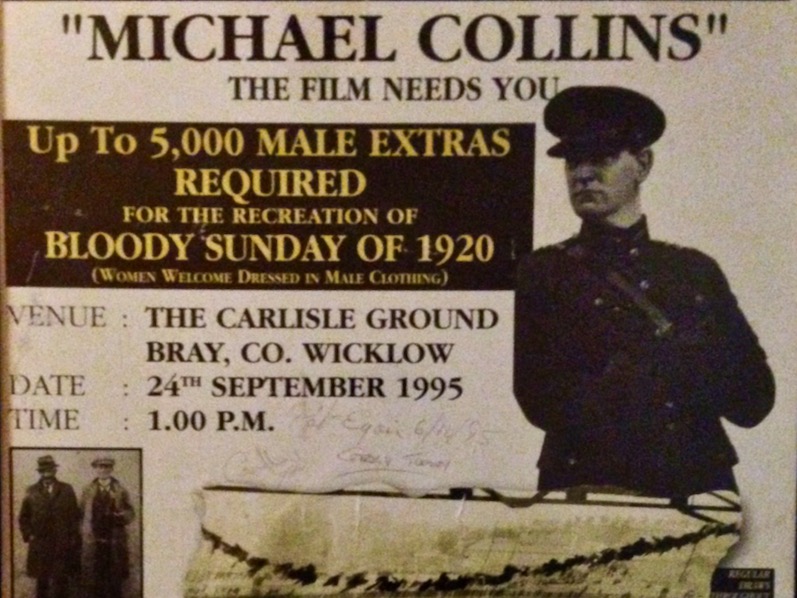
This surviving poster in Bray, Co Wicklow, somewhat irreverently makes light of the Bloody Sunday events of 1920. I can’t help being amused by the little insertion underneath Up To 5,000 Male Extras Required“Women Welcome Dressed in Male Clothing”.

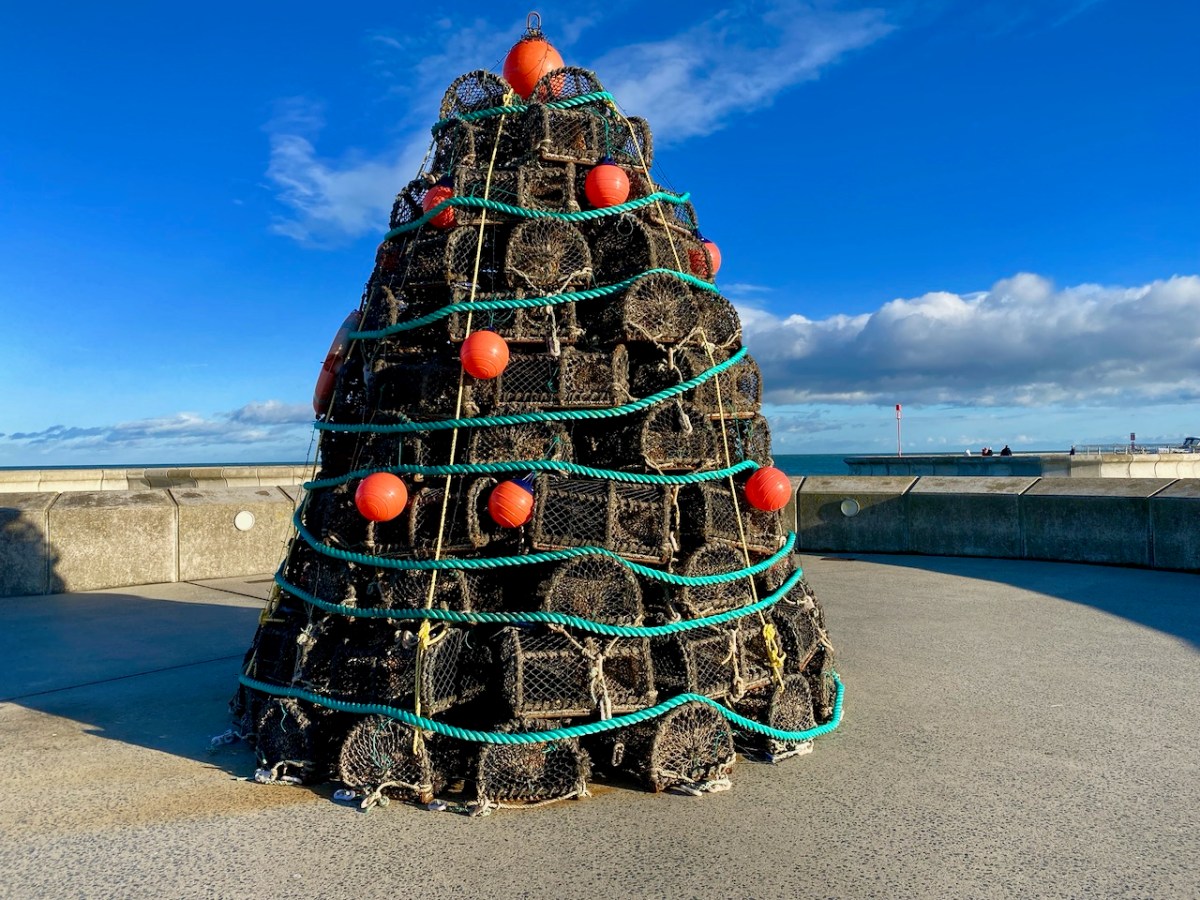
An impressive Christmas tree, built by the artistic fishermen of Greystones, Co Wicklow.

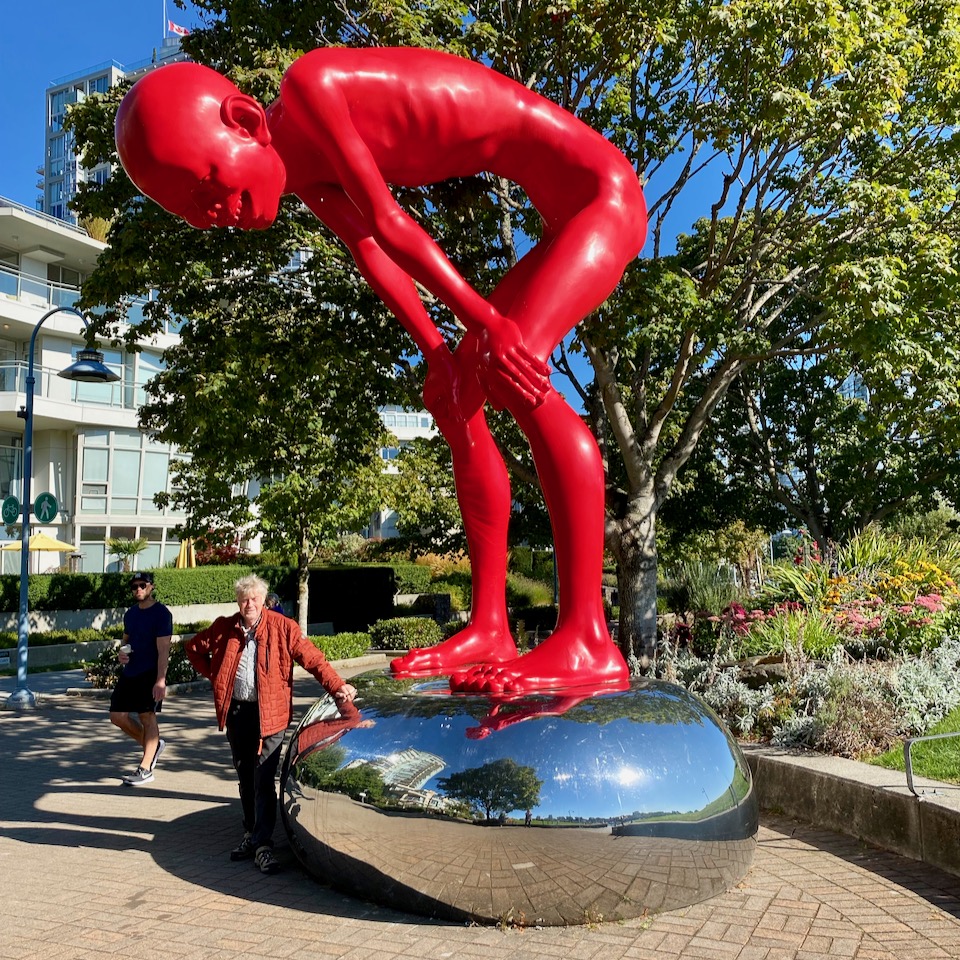
A long way from West Cork, we found this sculpture in False Creek, Vancouver last autumn. Titled “The Proud Youth,” the six metre high figure was created by Chinese sculptor Chen Wenling.

. . . Simple and truthful, this work creates a direct communication between man and nature, and initiates a sincere conversation between people and society. The cheeky expression and arresting pose are a celebratory call to the audiences, inviting them to embrace their inner child . . .

Vancouver Biennale

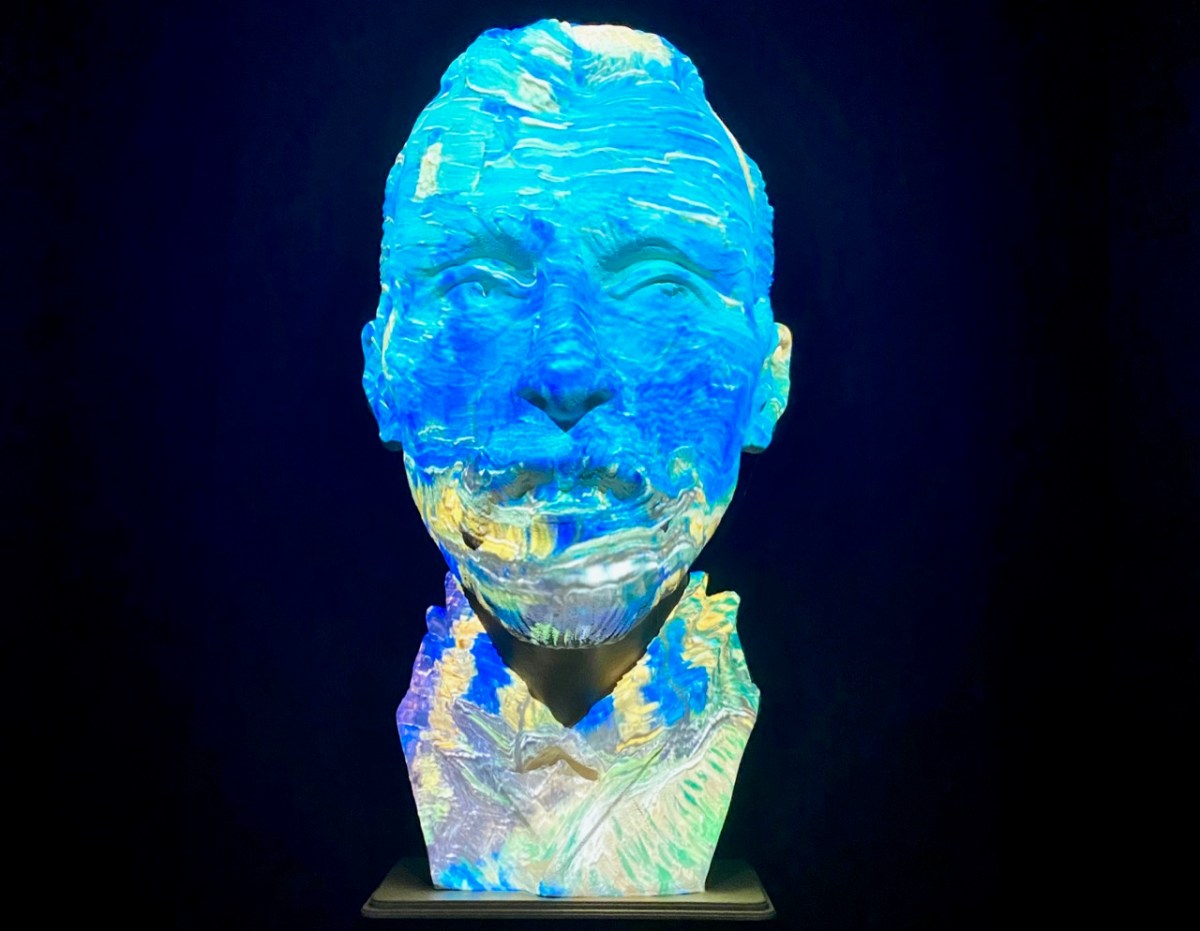
This may seem out of place, but we visited a Van Gogh exhibition while in Dublin recently. Described as an ‘Immersive Experience’ it is quite mind-blowing and we recommend the immersion if you are in the area.

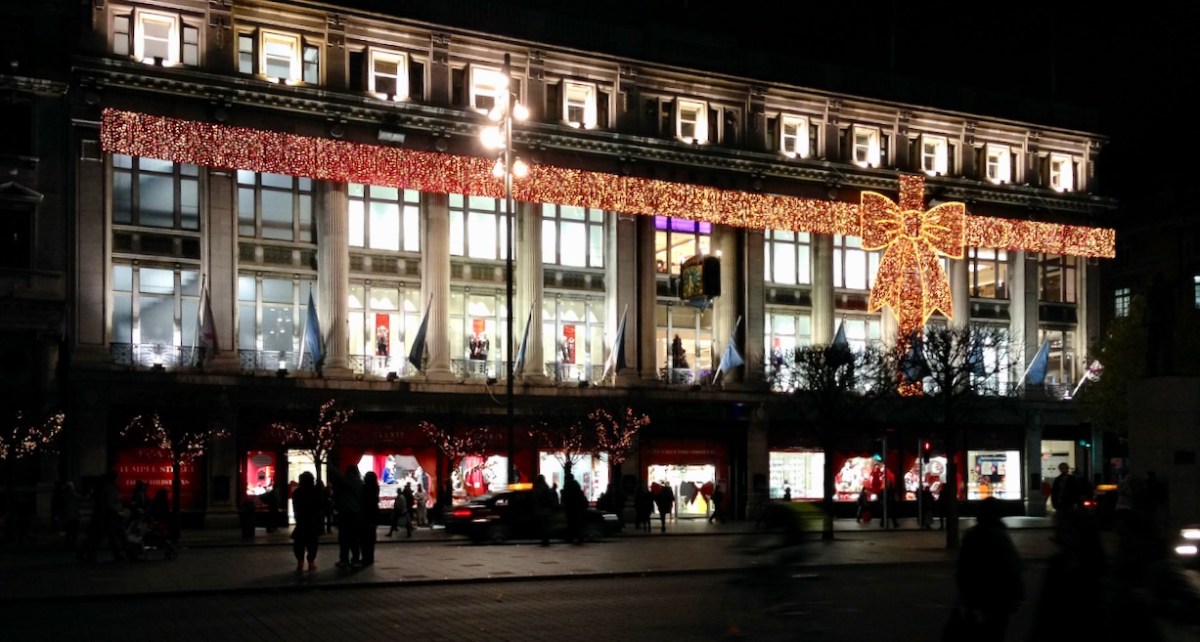
We’ll finish today with some shopfronts decorated for Christmas: in Dublin, and back in picturesque Ballydehob.

Mythical Isles of the West

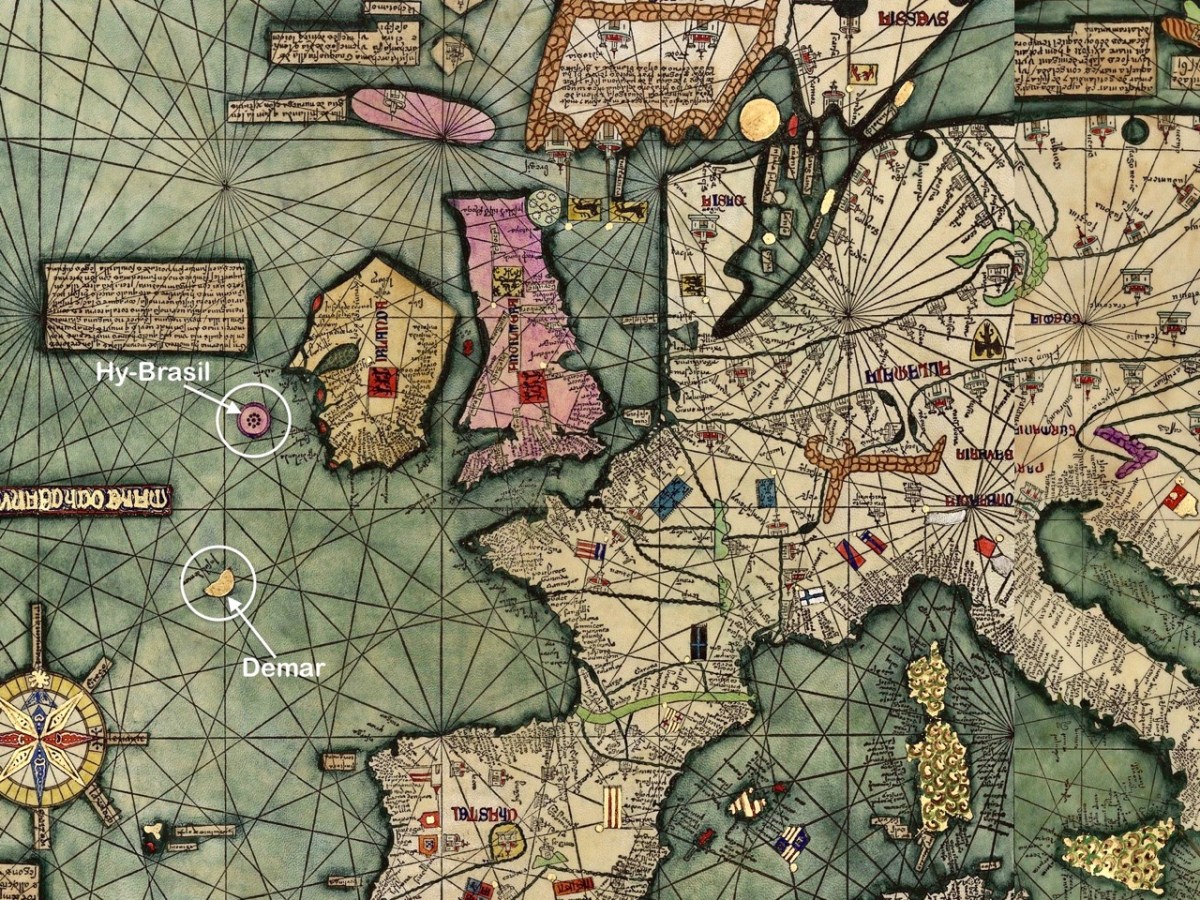
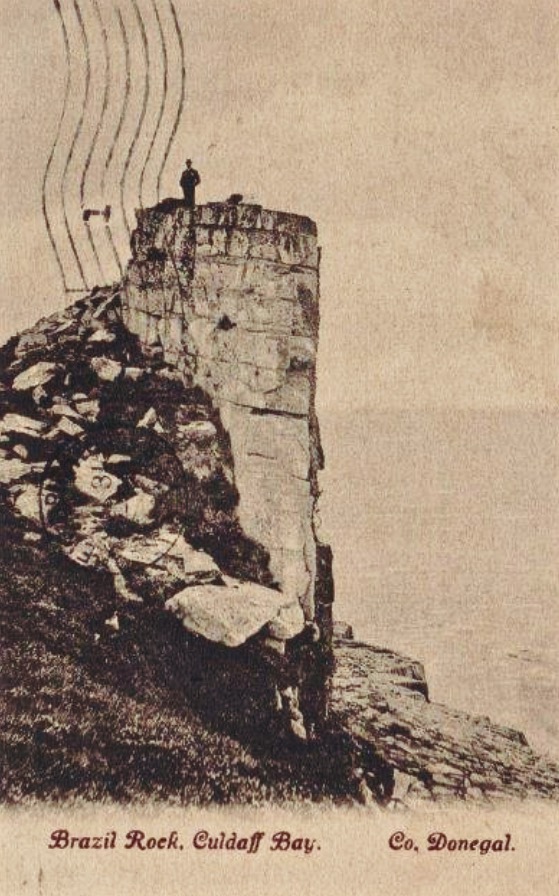
The fine map, above, was drawn in 1375 and is attributed to Abraham Cresques (courtesy  Library of Congress, Geography and Map Division). it is known generally as the Atlas Catalan. What interests us is that it depicts two islands off the west and south-west coasts of Ireland (see detail below): Hy-Brasil and Demar. These landfalls are shown on maps since then through the centuries, the last depiction being in 1865.

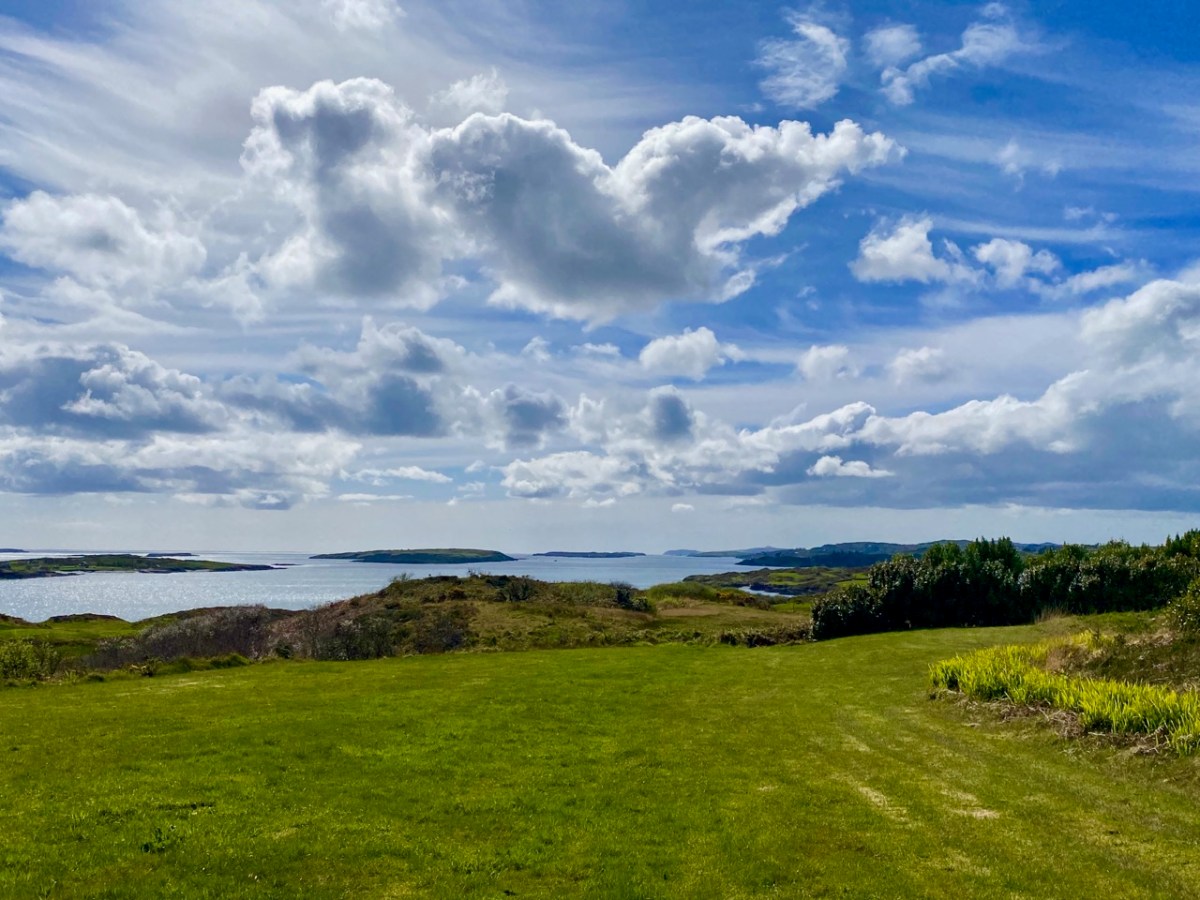
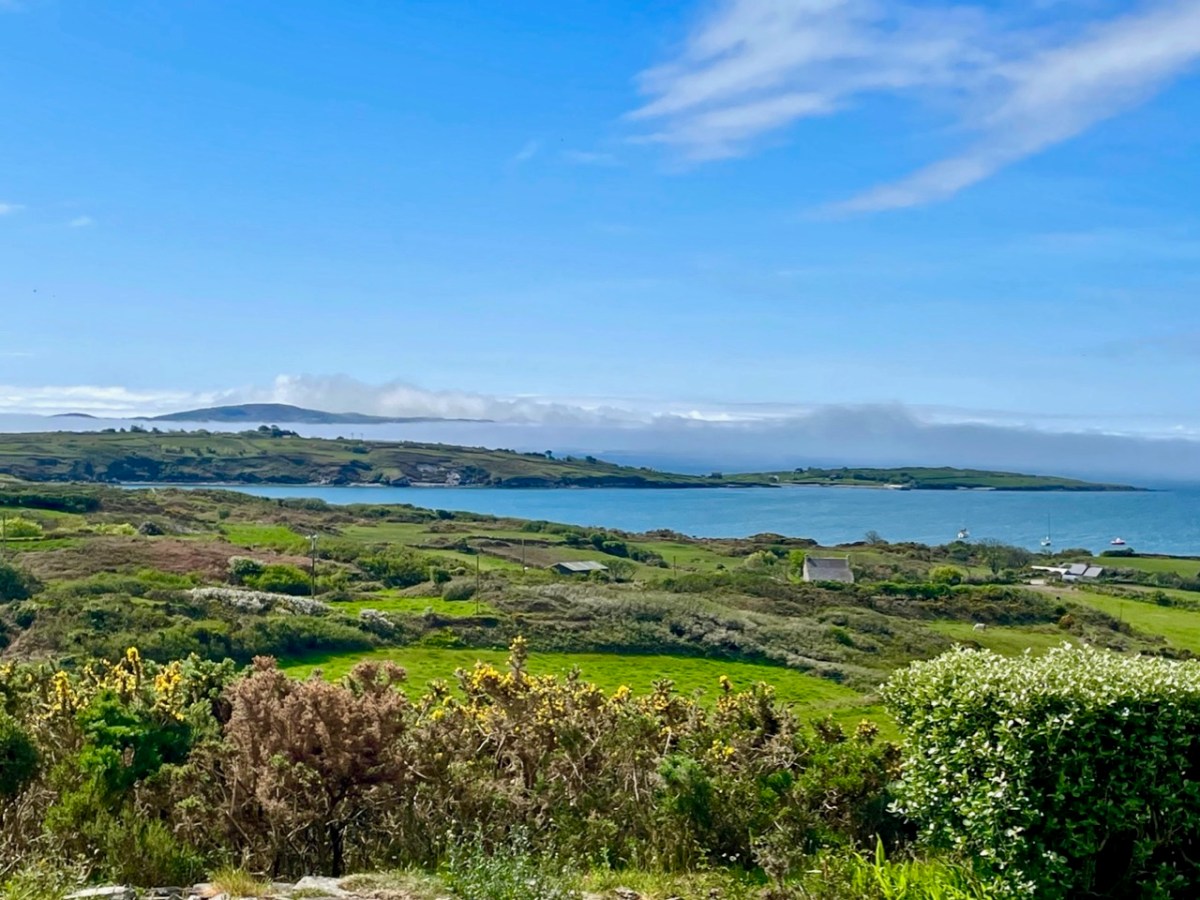
We look out to the hundred Carbery Islands in Roaringwater bay. The view (above) is always changing as sun, rain and wind stir up the surface of the sea and the sky and clouds create wonderful panoramas. But, generally, the view is predictable: we know that Horse island will be across from us, and Cape Clear will always be on the distant horizon, while the smaller islets break up the surface of the ocean in-between, and help calm down its wildness when the storms come.

But, suppose it wasn’t always predictable? What if those islands changed, moved around or appeared and disappeared? It seems that such things do happen, here in Ireland. At least, they do according to some of the recorded evidence. ‘Mythical Islands’ have been mentioned by mariners and storytellers through the centuries.

Our best source of information for Ireland’s ‘transcendent’ islands is our old friend Thomas Westropp (above, kitted out for an expedition) who was an archaeologist and folklorist living between 1860 and 1922. He was active in Counties Clare and Limerick and wrote a paper for The Royal Academy in 1912 – Brasil and the Legendary Islands of the North Atlantic: Their History and Fable. This comprehensive paper includes a list of evanescent islands, a new map drawn by Westropp, and a summary of historic maps which have located them:

Westropp’s exploration of the subject is remarkably comprehensive. Here are some extracts:

. . . Bran son of Febal, sleeping near his fort, hears sweet music, and awakes to seize a magic apple branch. An unknown woman sings of “a glorious island round which sea-horses glisten – a fair course against the white swelling surge.” In it dwells no wailing, treachery, death, or sickness; it glows many-coloured in incomparable haze, with snowy cliff’s and strands of dragon-stones and crystals. She vanishes, and Bran, with twenty-seven followers, embarks. They meet the sea-god Mananann mac Lir in his chariot, visit Magh Mell, the Isle of Laughter, and the Isle of Women, whose queen draws Bran to it by a magic clue. Entranced by love, the visitors do not note the flight of time; in apparently undiminished youth and strength they return to Ireland; it is only when the first to step ashore falls to ashes, as if centuries dead, that they know the truth. The survivors tell their tale without landing, and sail out into the deep, never to be seen again . . .

Thomas WESTROPP – Brasil and the Legendary Islands of the North Atlantic, 1912

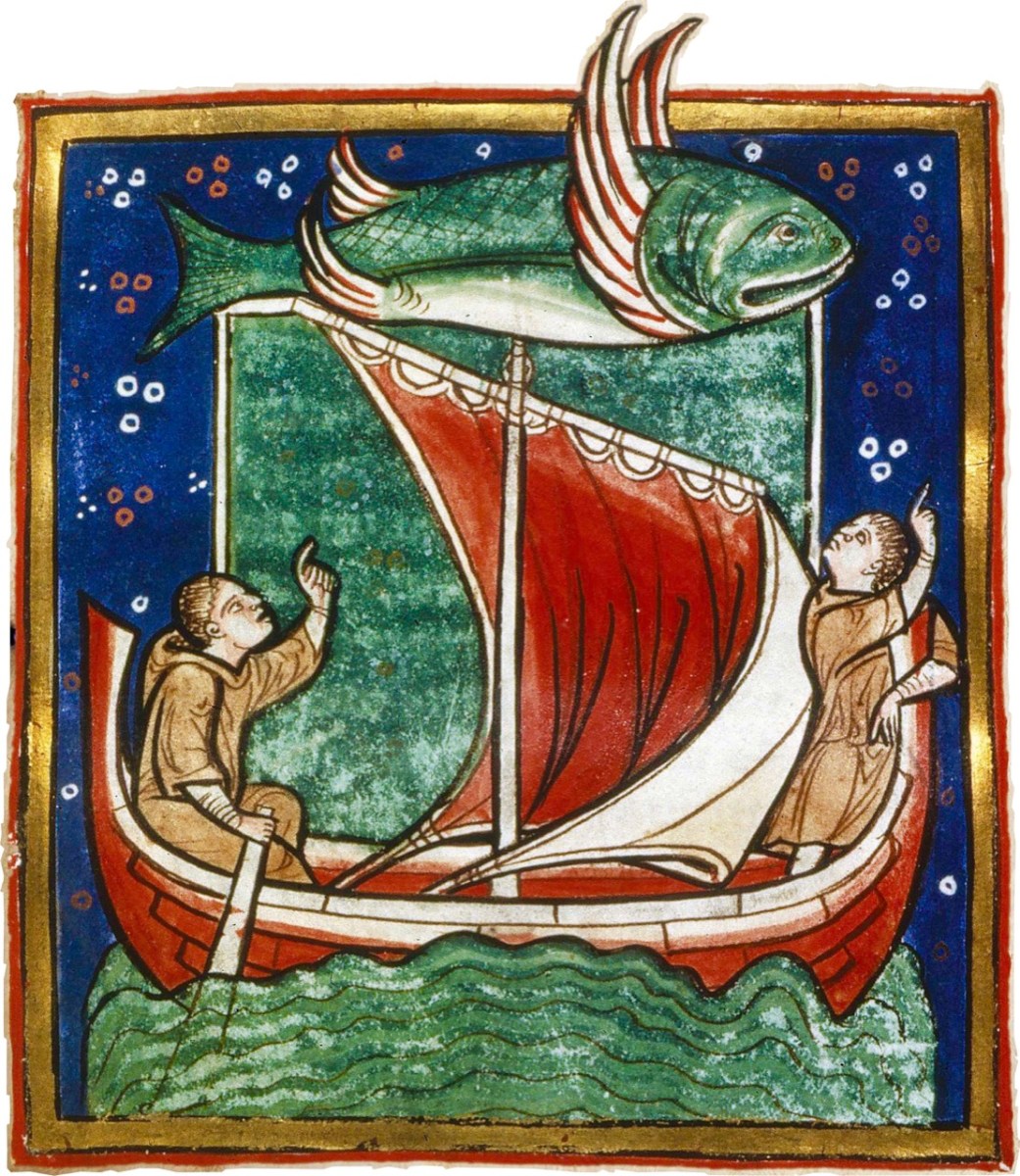
Image above courtesy of the Worksop Bestiary.

. . . The Sunken Land. I found no name for this in north Mayo save when it was confused with Manister Ladra. Belief in it prevailed in north Erris and Tirawley from Dunminulla to Downpatrick. In 1839 it was said to extend from near Teelin to the Stags of Broadhaven and thence half way to America. A boatman knew a woman named Lavelle who saw from the shore (when gathering Carrigeen moss) a delightful country of hills and valleys, with sheep browsing on the slopes, cattle in green pastures, and clothes drying on the hedges. A Ballycastle boatman, a native of Co. Sligo, corroborated this, adding that he had seen it twice at intervals of seven years, and if he lived to see it a third time he would be able to disenchant it. He could talk of nothing else, became idle and useless, and died, worn out and miserable, on the very eve of the expected third appearance . . .

Thomas WESTROPP – Brasil and the Legendary Islands of the North Atlantic, 1912

. . . Owen Gallagher, Lieutenant Henri’s servant, heard of one Biddy Took, who, when gathering dillish (seaweed), asked some passing boatmen to put her out to an islet and fetch her back on their return : amused by her talk they brought her fishing, and soon got a ” tremendous bite.” They landed a green, fishy-looking child, quite human in shape, and in their fright let him escape and dive. The man who hooked him died suddenly within a year. Gallagher also said that he had fired at and wounded a seal; soon after, when far out to sea in his currach, he got lost in a fog-bank and reached an unknown island. An old man, moaning, with one eye blinded, stood on the shore and proved to be the seal. With more than human forgiveness, he warned his enemy to fly from the land of the seal men, lest his (the seal’s) sons and friends should avenge the cruelty . . .

Thomas WESTROPP – Brasil and the Legendary Islands of the North Atlantic, 1912

Image Carta Marina (1539) courtesy Bone + Sickle

. . . The Aran people now believe that Brasil is seen only once in seven years. They call it the Great Land. In Clare, I have heard from several fishermen at Kilkee and elsewhere that they had seen it ; they also told legends of people lost when trying to reach it. I myself have seen the illusion some three times in my boyhood, and even made a rough coloured sketch after the last event, in the summer of 1872. It was a clear evening, with a fine golden sunset, when, just as the sun went down, a dark island suddenly appeared far out to sea, but not on the horizon. It had two hills, one wooded ; between these, from a low plain, rose towers and curls of smoke. My mother, brother, Ralph Hugh Westropp, and several friends saw it at the same time; one person cried that he could “see New York ” ! With such realistic appearance (and I have since seen apparent islands in 1887 in Clare, and in 1910 in Mayo), it is not wonderful that the belief should have been so strong, probably from the time when Neolithic man first looked across the Atlantic from our western coast. It coloured Irish thought ; stood for the pagan Elysium and the Christian Paradise of the Saints ; affected the early map-makers ; and sent Columbus over the trackless deep to see wonders greater than Maelduin and Brendan were fabled to have seen, till Antilha, Verde, and Brazil became replaced by real islands and countries ; and the birds, flowers, and fruit of the Imrama by those of the gorgeous forests of the Amazon in the real Brazil. ” Admiration is the first step leading up to knowledge, for he that wondereth shall reign.” . . .

Thomas WESTROPP – Brasil and the Legendary Islands of the North Atlantic, 1912

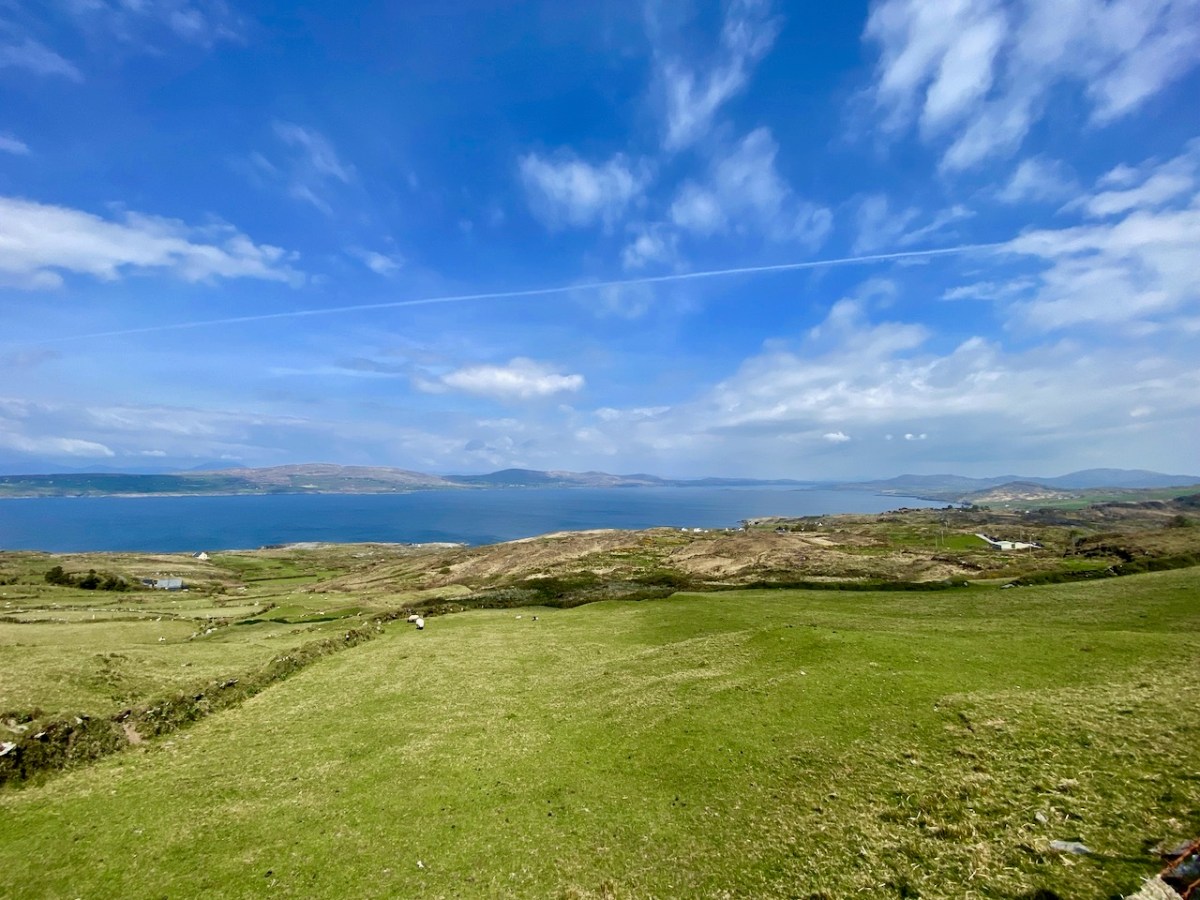
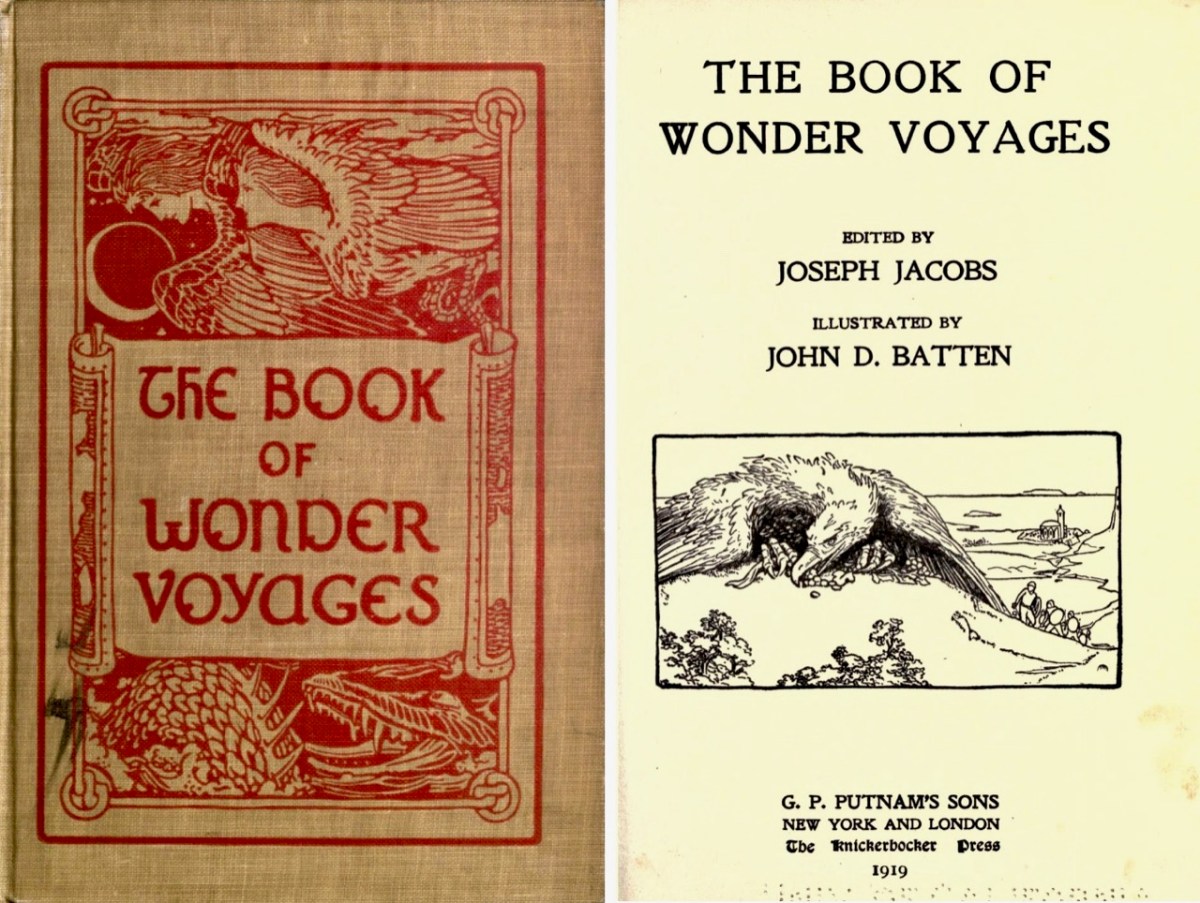
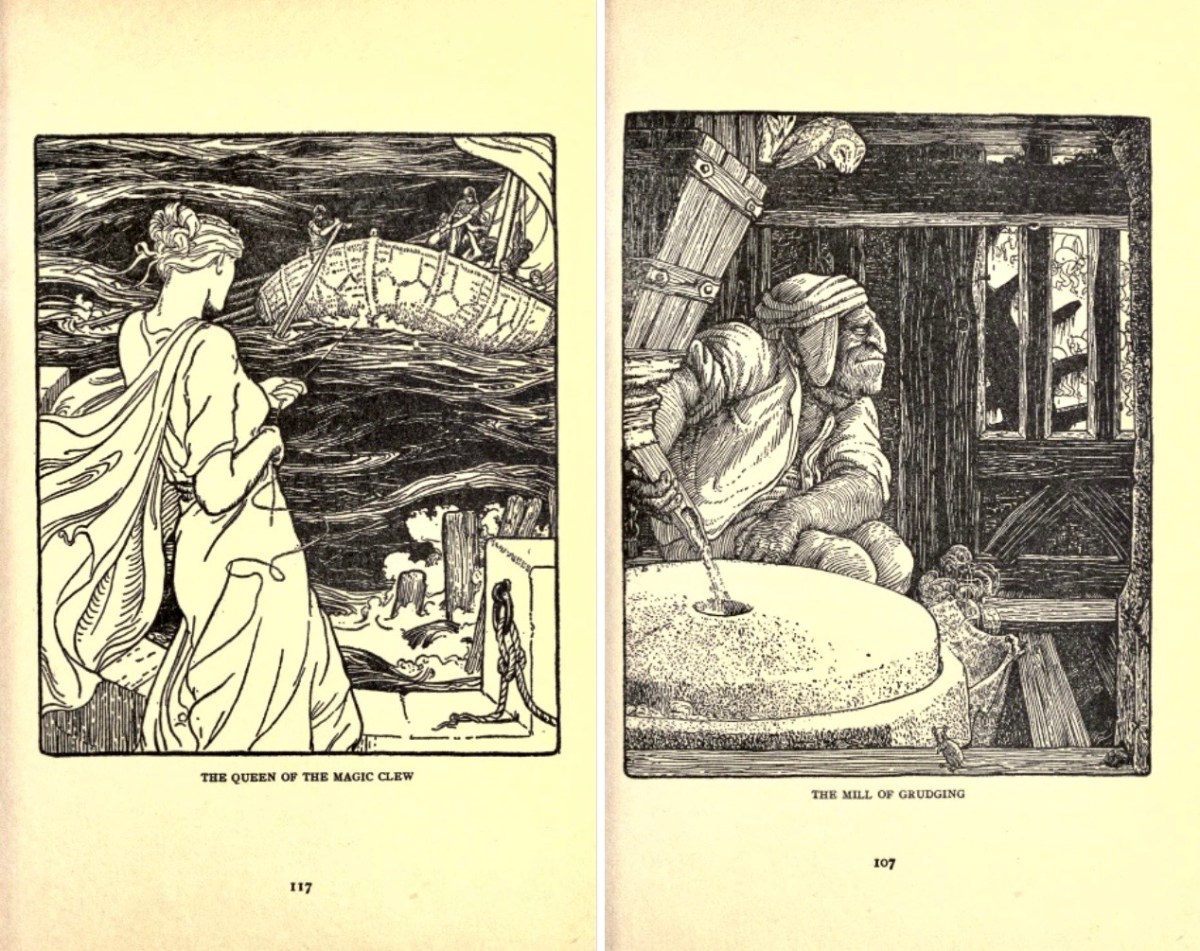
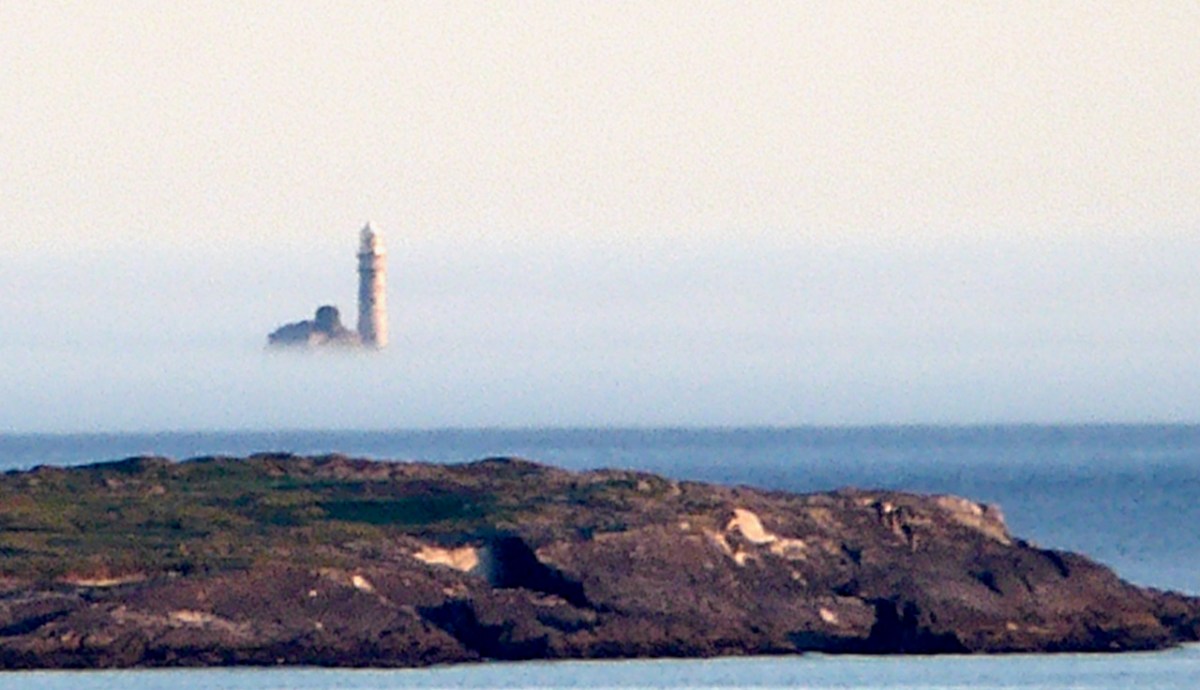
Above is the view from our house – Nead an Iolair – a day or two ago, when a strong sea mist was coming across from the south-west, enveloping Cape Clear and making it float ethereally like one of the mythical islands. Other writers have tackled the subject of the vanishing lands, including Joseph Jacobs, who put together a collection of stories in 1919. The subject is ‘Wonder Voyages’, and the book (available online here) covers some of Ireland’s adventurers, including Máel Dúin – a predecessor of Brendan the Voyager.

Máel Dúin sets out ‘into the limitless ocean’, suggesting that ‘God will bring the boat where it needs to go’. He and his crew encounter a large number of strange islands, including:

The island of ants, from which the men flee because the ants’ intention is to eat their boat

The island of tame birds

The island of the horse-like beast who pelts the crew with the beach

The island of horses and demons

The island of salmon, where they find an empty house filled with a feast and they all eat, drink, and give thanks to Almighty God.

The island with the branch of an apple tree, where they are fed with apples for 40 nights

The island of the “Revolving Beast”, a creature that would shift its form by manipulating its bones, muscles, and loose skin; it casts stones at the escaping crew and one pierces the keel of the boat

The island where animals bite each other and blood is everywhere

The island of apples, pigs, and birds

The island with the great fort/pillars/cats where one of the foster brothers steals a necklet and is burned to ashes by the cat

The island of black and white sheep, where sheep change colours as they cross the fence; the crewmen do not go aboard this island for fear of changing colour

The island of the swineherd, which contained an acidic river and hornless oxen

The island of the ugly mill and miller, who was “wrinkled, rude, and bareheaded”

The island of lamenting men and wailing sorrows, where they had to retrieve a crewman who entered the island and became one of the lamenting men; they saved him by grabbing him while holding their breath

The island with maidens and intoxicating drink

The island with forts and the crystal bridge, where there is a maiden who is propositioned to sleep with Máel Dúin

The island of colourful birds singing like psalms

The island with the psalm-singing old man with noble monastic words

The island with the golden wall around it

The island of angry smiths

The crew voyaged on and came across a sea like a green crystal. Here, there were no monsters but only rocks. They continued on and came to a sea of clouds with underwater fortresses and monsters.

The island with a woman pelting them with nuts

The island with a river sky that was raining salmon

The island on a pedestal

The island with eternal youth/women (17 maidens)

The island with red fruits that were made as a sleeping elixir

The island with monks of Brendan Birr, where they were blessed

The island with eternal laughter, where they lost a crewman

The island of the fire people

The island of cattle, oxen, and sheep

The most well-known voyager of all – in Irish tradition – is Saint Brendan. The image above is from the Finola Window, which was crafted by George Walsh. We all know that Brendan was a real character, who discovered America back in the sixth century. On the way he also encountered many islands – which we cannot locate today (that doesn’t mean they are not there) – and had hair-raising adventures on them. This post will take you through some of his journeyings.

It’s clear that, in the shared Irish psyche, we are aware of places that we can’t always see, or visit. it’s all part of a folk knowledge that’s largely hidden away, except in the memories of older generations, that relates to the sea, and the idea that there are races of people who live on ‘lost’ islands – or even in the sea. In some of the stories about the islands it is suggested that, when they vanish, it’s because they have submerged under the ocean – perhaps temporarily.

There’s a great collection of stories readily available in a series of podcasts known as Blúiríní Béaloidis / Folklore Fragments. Look out for the one titled Blúiríní Béaloidis 16 – Otherworld Islands In Folk Tradition. I have transcribed one of my favourite pieces from this podcast, and will finish this post with it. It summarises, very neatly, the tradition that other worlds are out there, and – at times – our world and theirs meet, providing solid evidence for there being human life under the sea! The tale was collected by Dr McCarthy of Kerry.

. . . People from Dingle Harbour used to sail to Kilrush in Limerick long ago. There was a boat leaving the harbour to Limerick one day with a load of salt. There were 8 men in the boat. They had prepared the boat. There was no quay in Dingle in those days, just a slipway. A fine, strapping young man approached them carrying a pot and a pot-hook, The pot-hook looked as if it had come straight from the forge. He addressed the boat’s captain. Are you going to Limerick, my good man? I am, said the captain, we are just about to leave. Would you mind terribly, said the young man, taking me some of the way? I don’t mind, said the captain, if you wish to come all of the way. He placed his pot and pot-hook in the boat, and got in himself. They rowed away and raised the sail at the mouth of the harbour. They were halfway when the man with the pot and pot-hook roused himself. I’ll be leaving you now, he said to the captain, and I’m very grateful to you. He took hold of his pot and his pot-hook and he leapt into the sea. They never saw him again . . .


Blúiríní Béaloidis

There’s a rather nice postscript to this story:

. . . Some time later, a man with a line and hook was fishing in the sea in the same place, and a boiled potato came up on his hook . . .

Blúiríní Béaloidis

Back to Clonfert

Clonfert is only a couple of counties over from us: we just have to skip through a bit of Cork and Tipperary and there we are in Galway – a tiny corner of it that is shaped by the River Shannon. So, on a Thursday afternoon at the beginning of June, we found ourselves tripping along dead straight boreens – narrow for the most part – taking us through lush dairy lands – on a quest to revisit Clonfert’s medieval Cathedral, and its associations with one of Ireland’s most famous saints: Brendan the Navigator.

As we approached the little settlement of Clonfert, our empty road ahead was interrupted by a small white car, which seemed to travel erratically from one side of the lane to the other, and our arrival made little difference to its progress. As we got near, we realised that there was a wiry Jack Russell ambling along the road in front of the car: it was clear that the terrier was having its daily walk, with the owner driving along protectively behind it, regardless of where its fancy might take it. Ah, sure – we were in no hurry, so we joined the procession and waited as the dog sniffed and shuffled its way back home: eventually, dog, car and owner vanished through a gate, and we had the road to ourselves once again . . . This is life in Ireland, and it’s good!

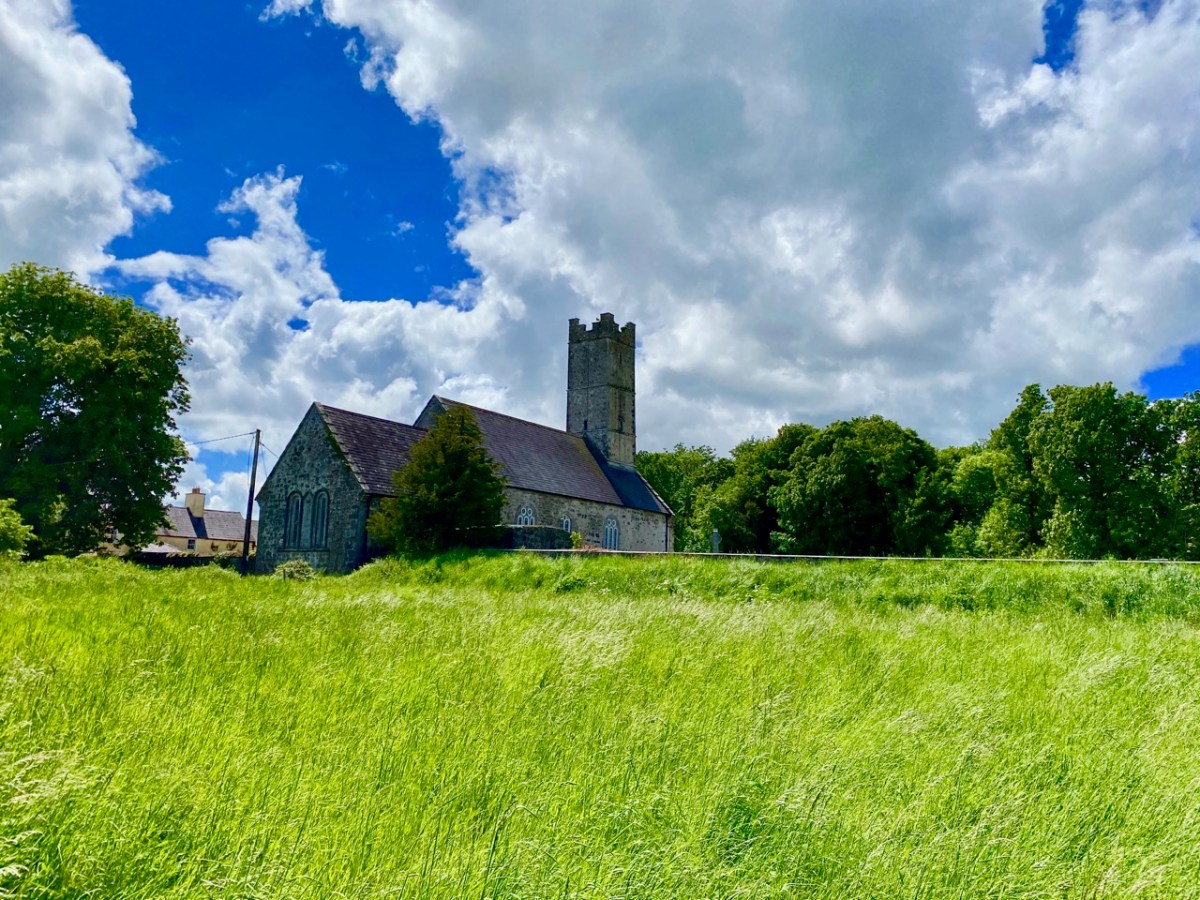
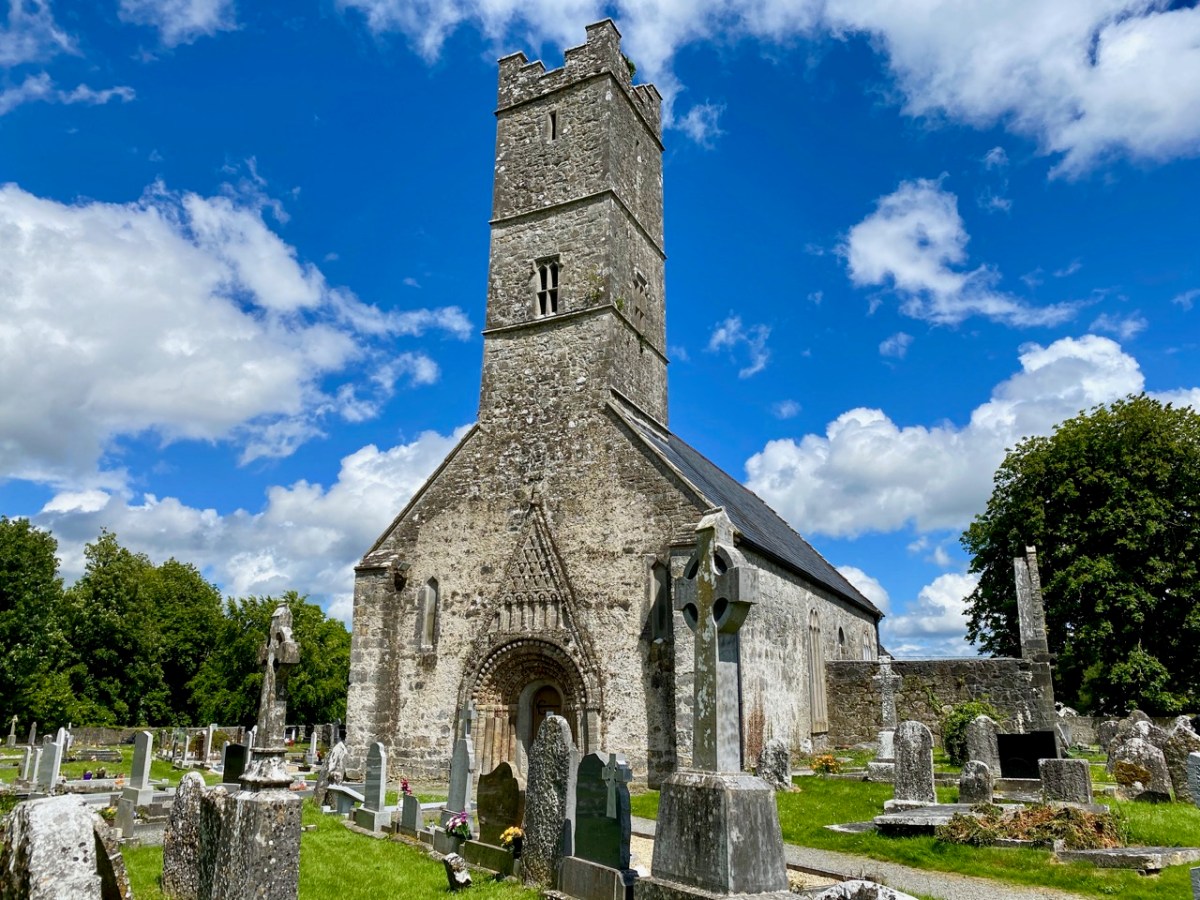
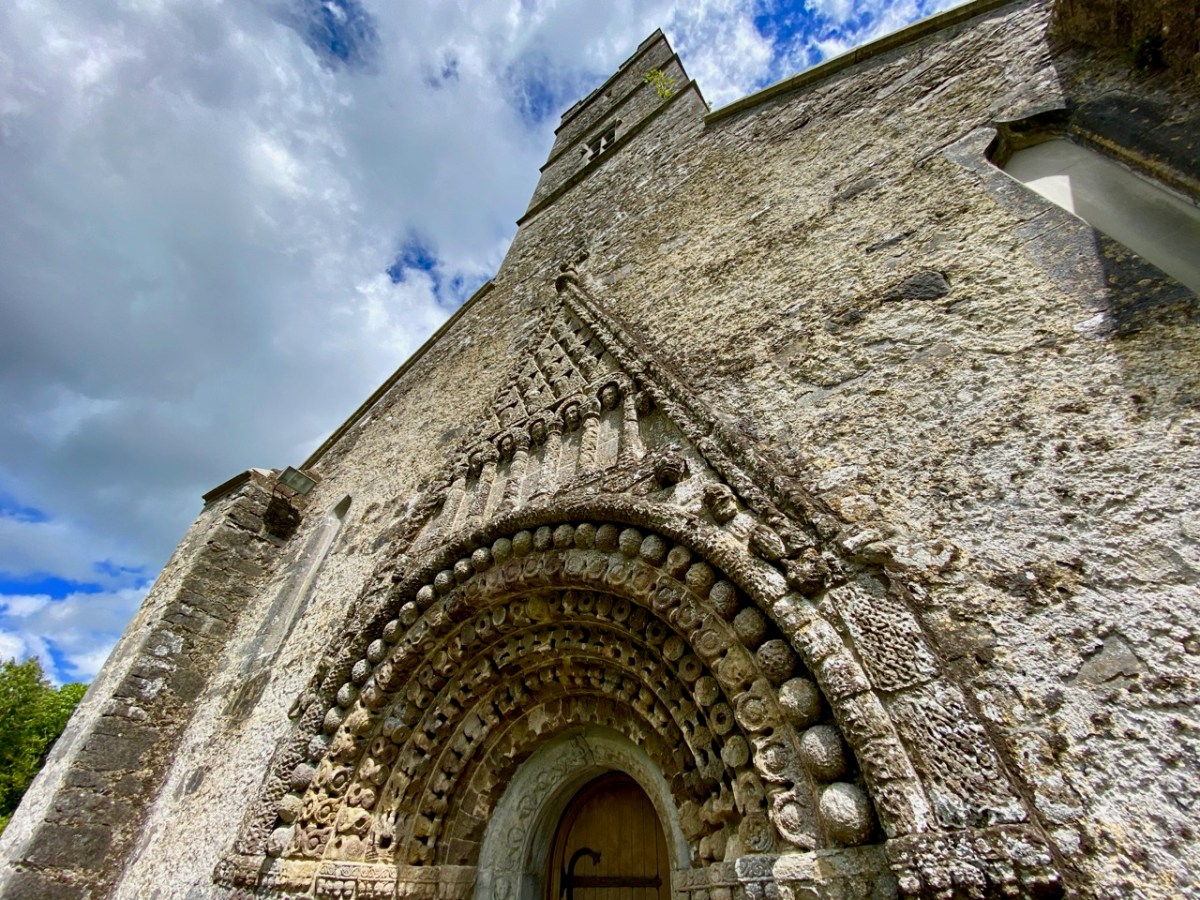
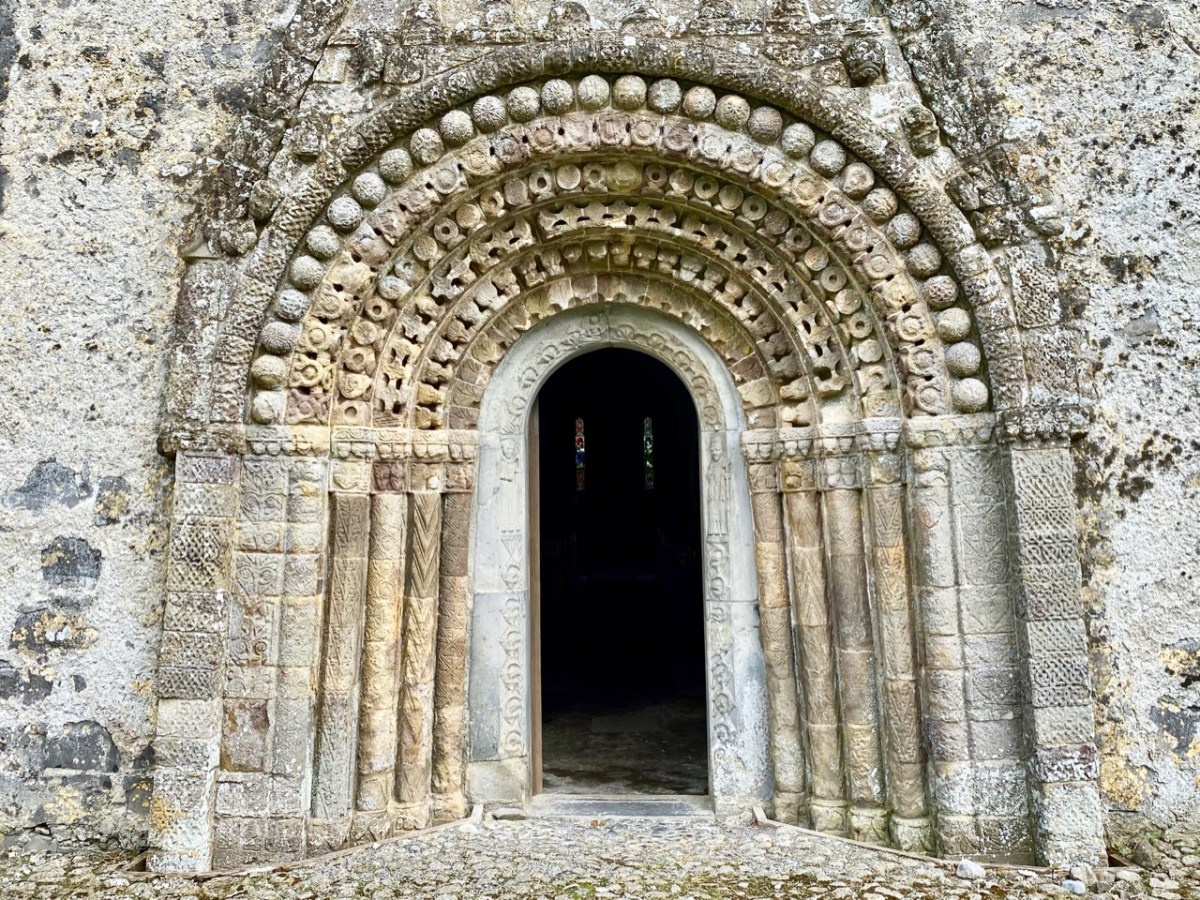
Clonfert’s grandly styled ‘Cathedral’ is so important historically, yet it could hardly be more remotely situated. From the east (upper picture above) it looks like many another Church of Ireland building, maybe not worth a second glance – unless, like us, you can’t resist examining every unturned stone because there is invariably something unexpected to be found under it. Just turn the corner and have a look at the west entrance door:

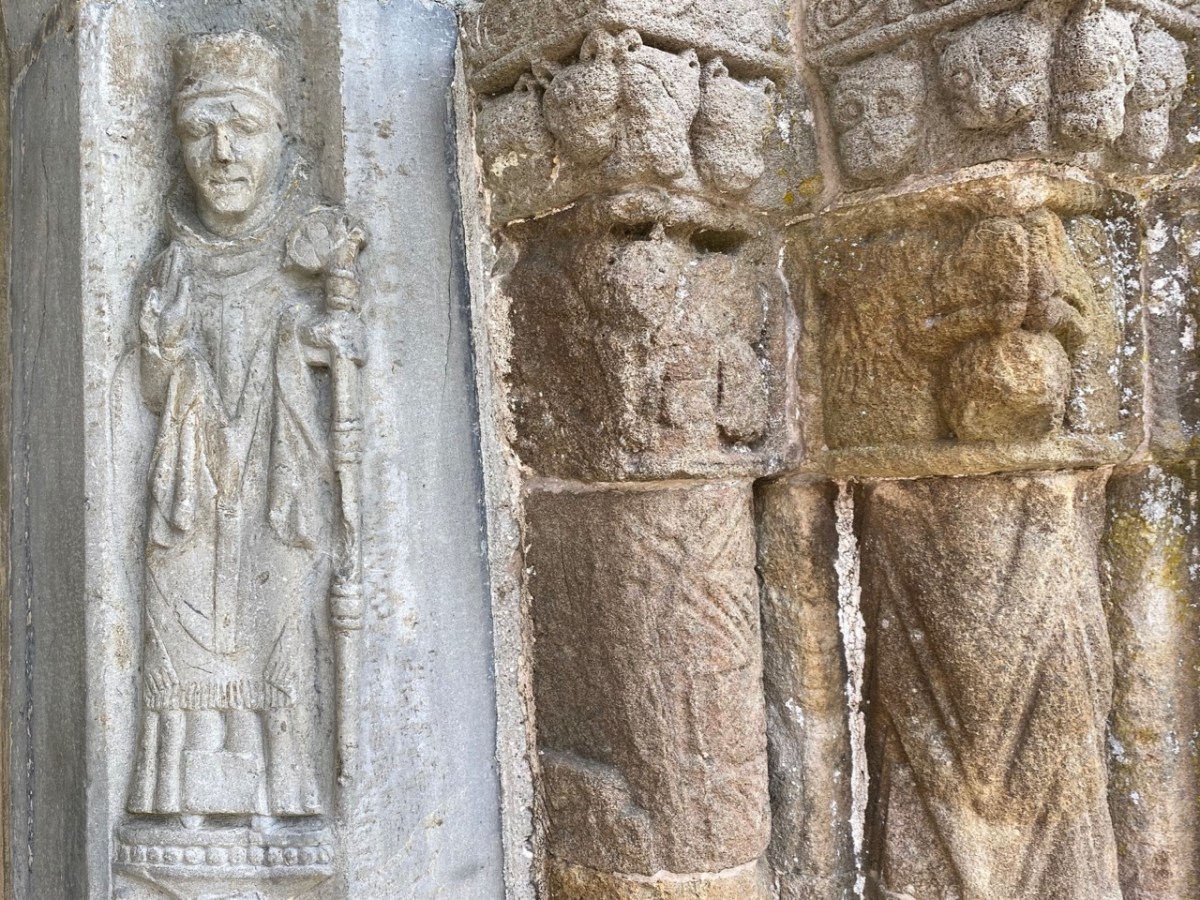
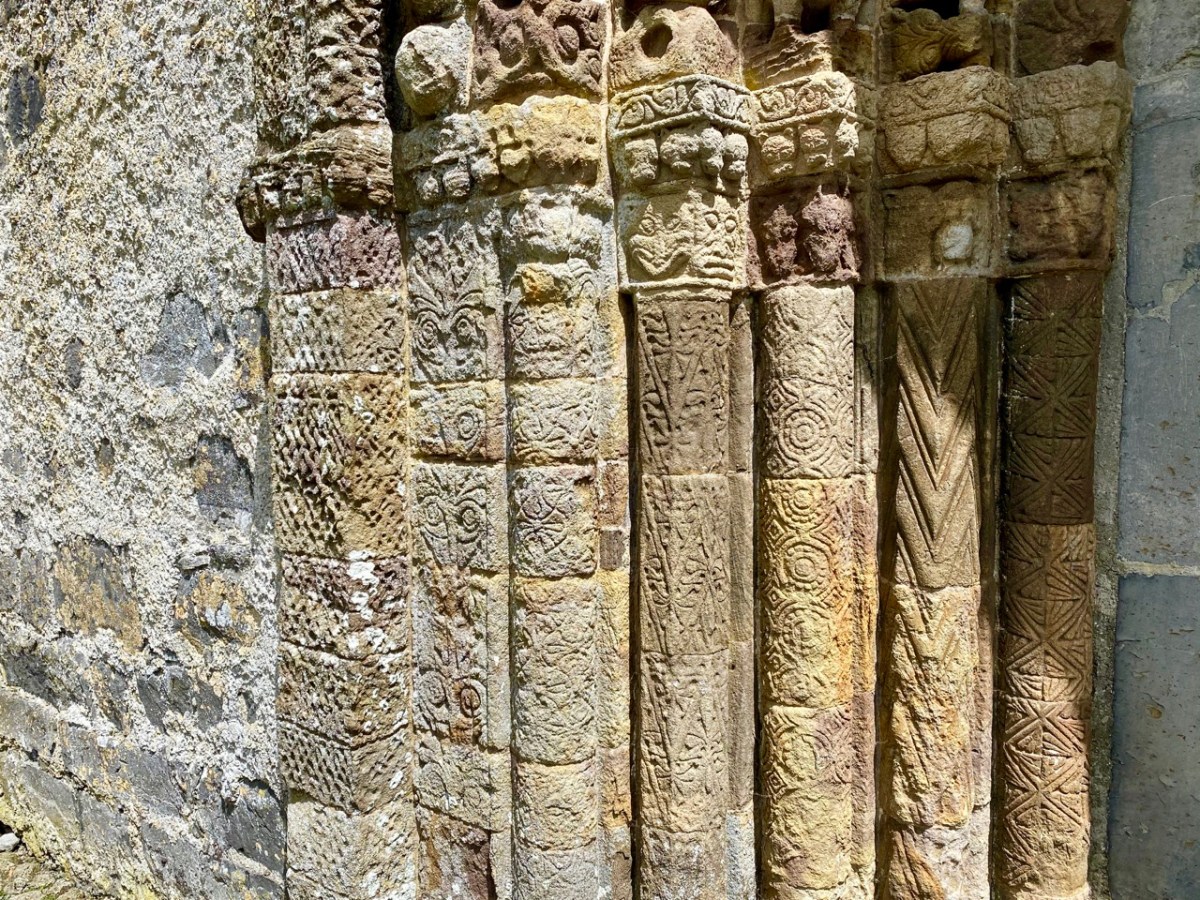
That doorway, with its exquisite decoration dating probably from the 12th century, has been described as ‘the supreme expression of Romanesque decoration in Ireland’. The carvings, although suffering from hundreds of years of wear and tear from the Irish elements, still display an extraordinary richness and variety: we can only wonder at the inspiration, skill and knowledge of the carver, who must have been deeply immersed in both lore and craft. Tadhg O’Keeffe, current Professor of Archaeology at University College Dublin, suggests a date of c1180 for this doorway. Records state that the church was burnt during a Viking raid in 1179, the same year in which a synod was held there by St Laurence O’Toole; installation of this imposing entrance may be connected with these events. Finola’s post today also explores Romanesque carvings not too far away, at Clonmacnoise. She has also written on Clonfert’s architecture in her Irish Romanesque series.

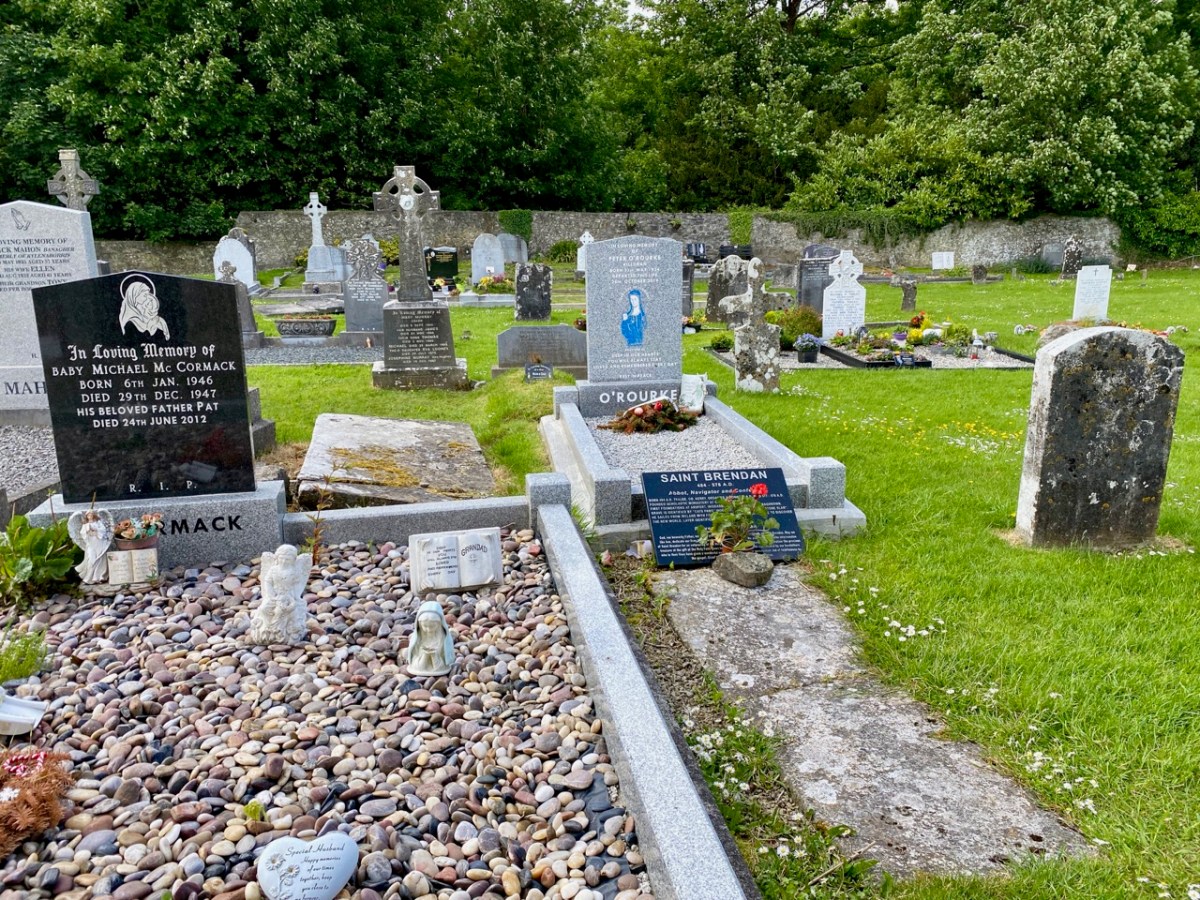
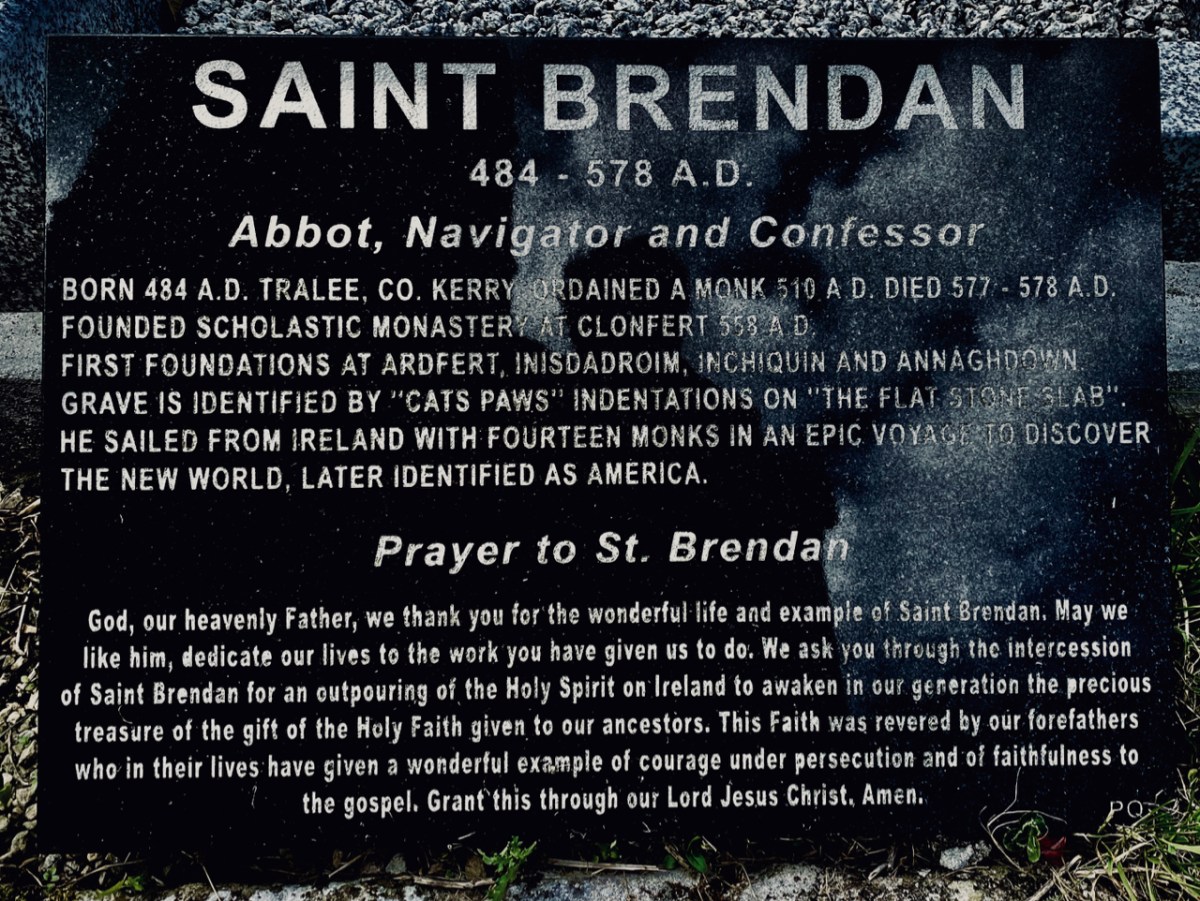
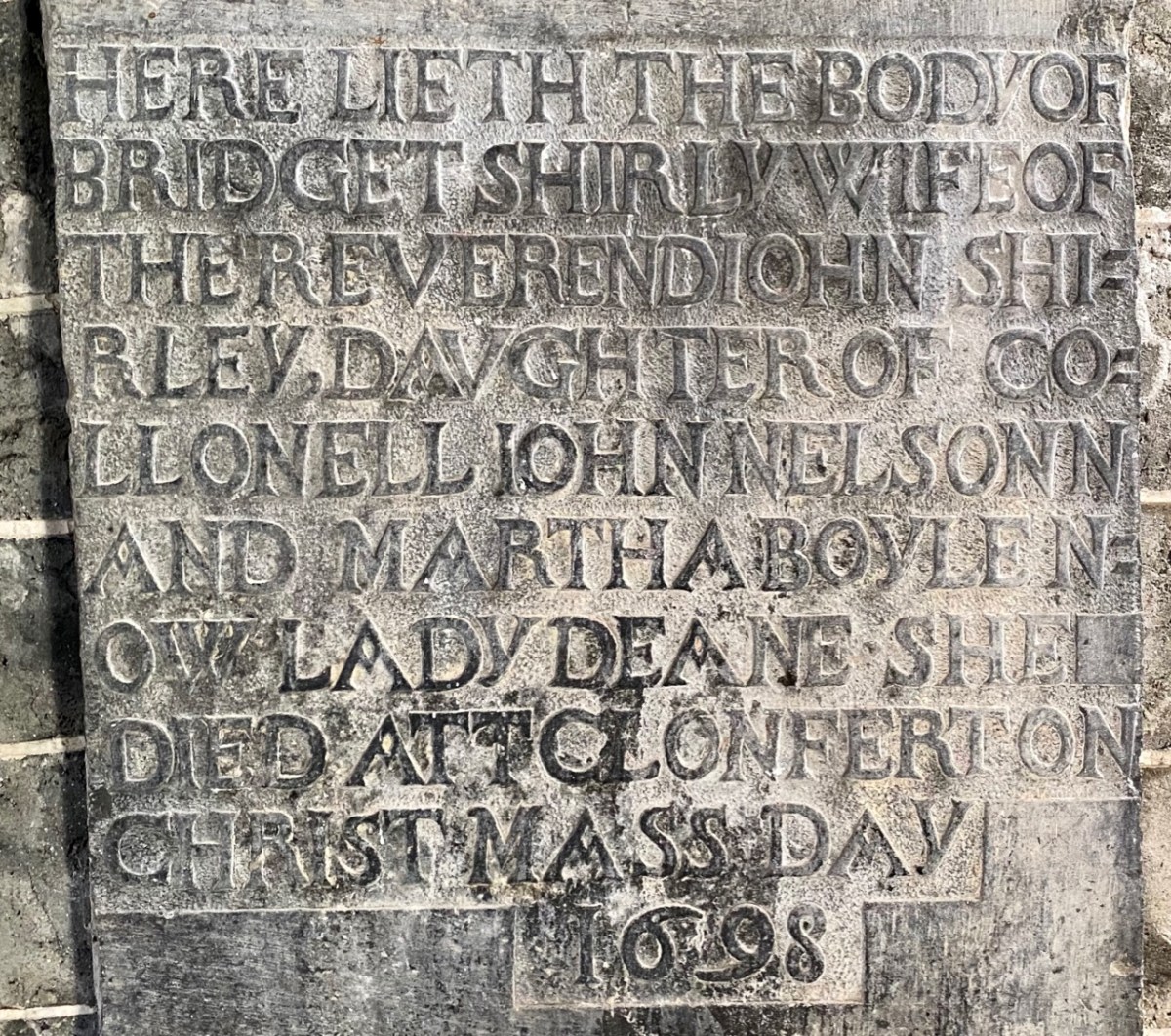
St Brendan lived from 484 to 577. We saw his birthplace in Fenit, Co Kerry, a few years ago. He founded many monasteries in Ireland but arranged for his body to be taken secretly to Clonfert Cathedral for burial as he didn’t want his remains to be disinterred by relic hunters. His grave is a stone slab just outside the great west door. On it are said to be the marks of cats’ paws – interestingly linked, according to folklore, with the many carvings of cats’ heads on the doorway arches.

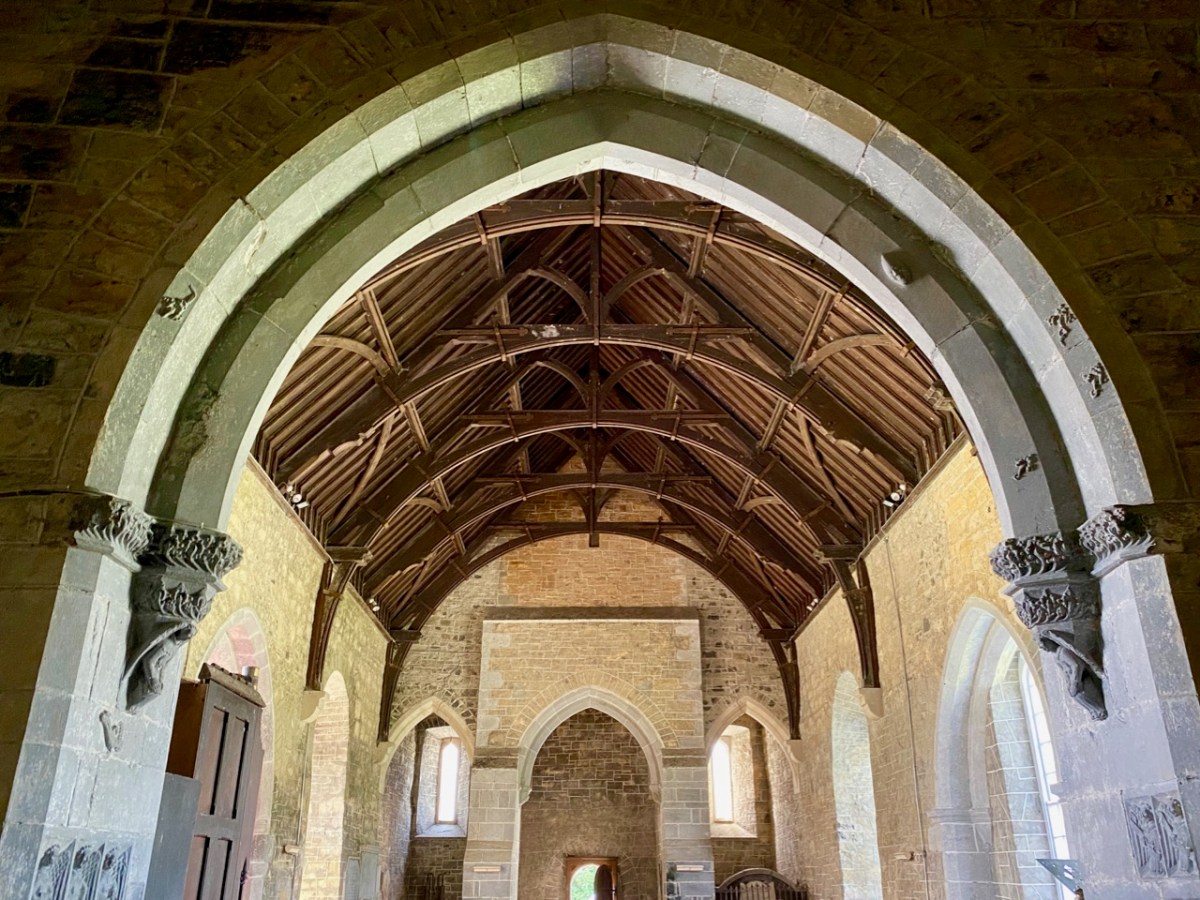
When we first visited Clonfert, many years ago, the cathedral itself was closed and we went away with the impression that we had seen all the wonders that the place had to offer by our explorations of the outside of the building and its setting. We were wrong: on this occasion the door was unlocked and there were unexpected treats hidden for us in the interior.

Further carvings decorate the church walls: they vary in date and style, but all are fascinating. Here is a selection – notice the seemingly random arrangement of heads and animal features on the great 15th century chancel arch, above.

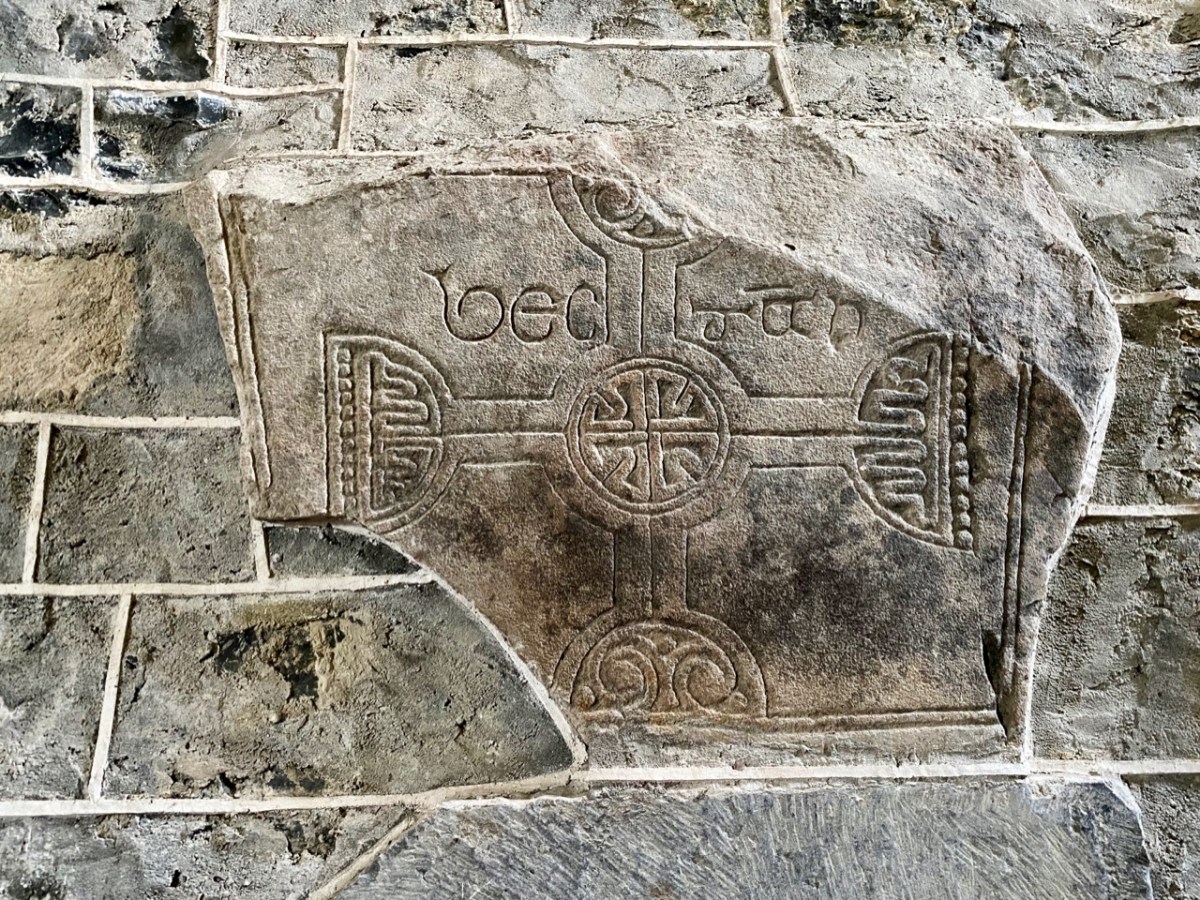
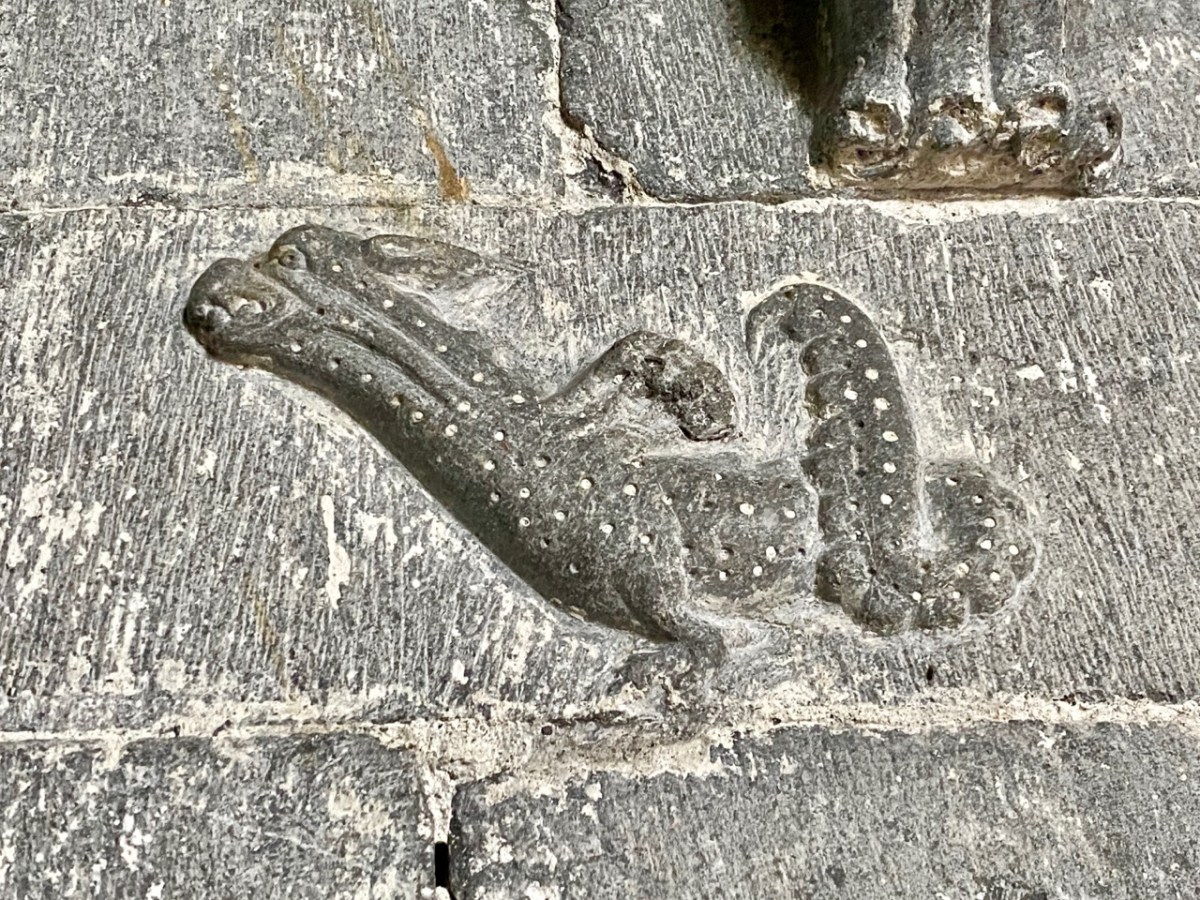
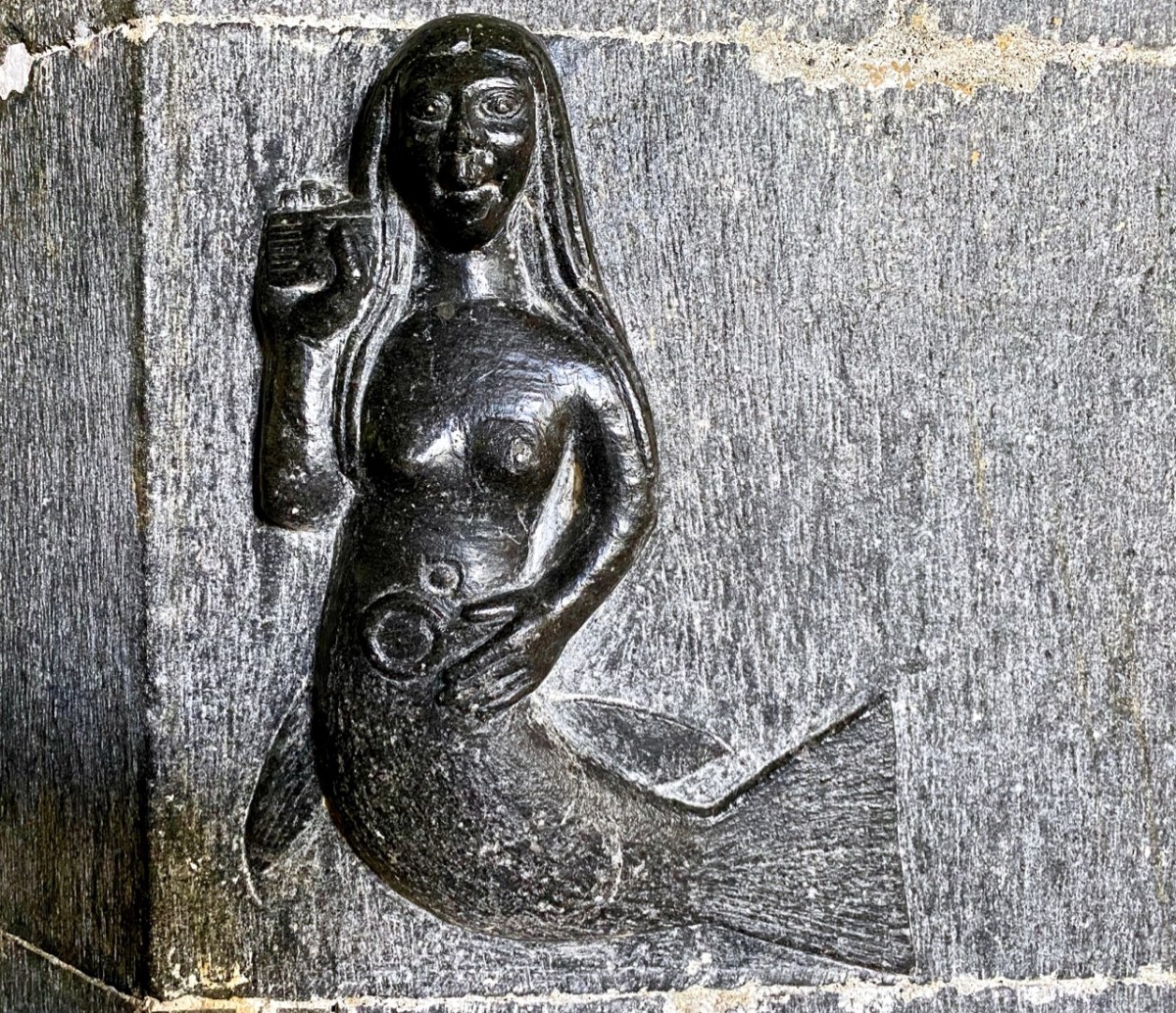
Angels, cross-slabs, a wyvern and, astonishingly, this fine mermaid complete with comb and mirror. I have found very little information to identify why these various carvings are found here in the Cathedral, apart from general legends which suggests links with Saint Brendan.

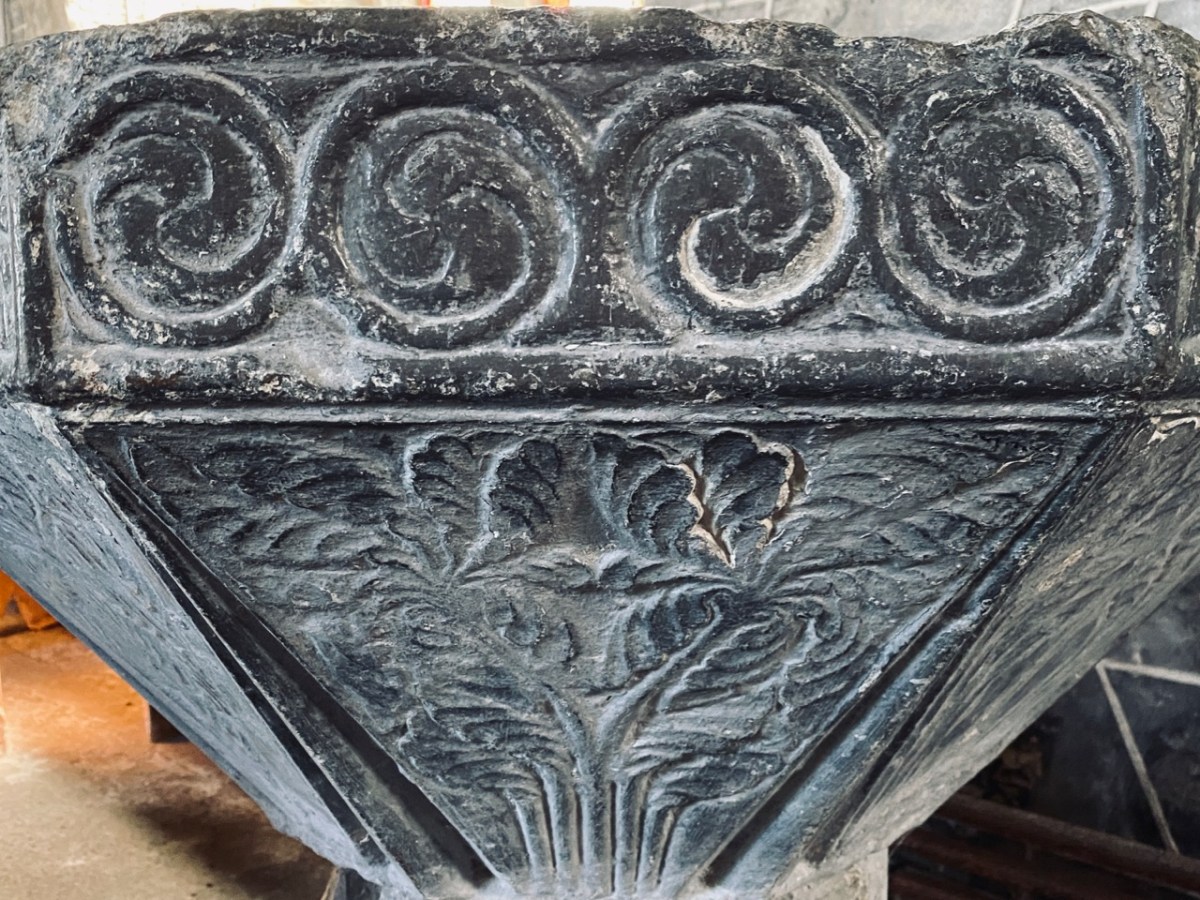
The carved stone head was found ‘in the ceiling’ when restoration work was carried out in 1985. It is said to date from around 1500, while the ancient and beautiful font is attributed to the thirteenth century. We could linger and feast on further treasures inside the church, but we need to look at the surroundings, which reveal yet more history.

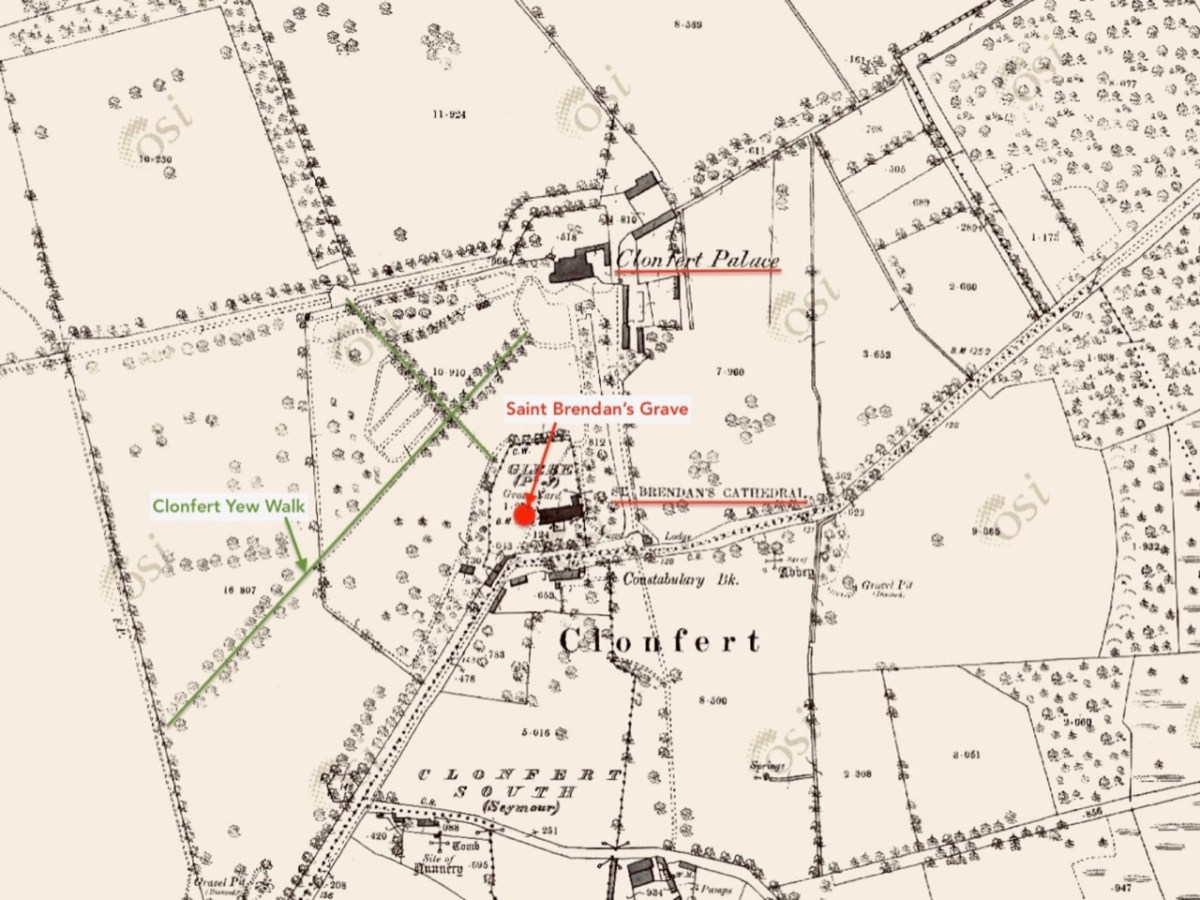
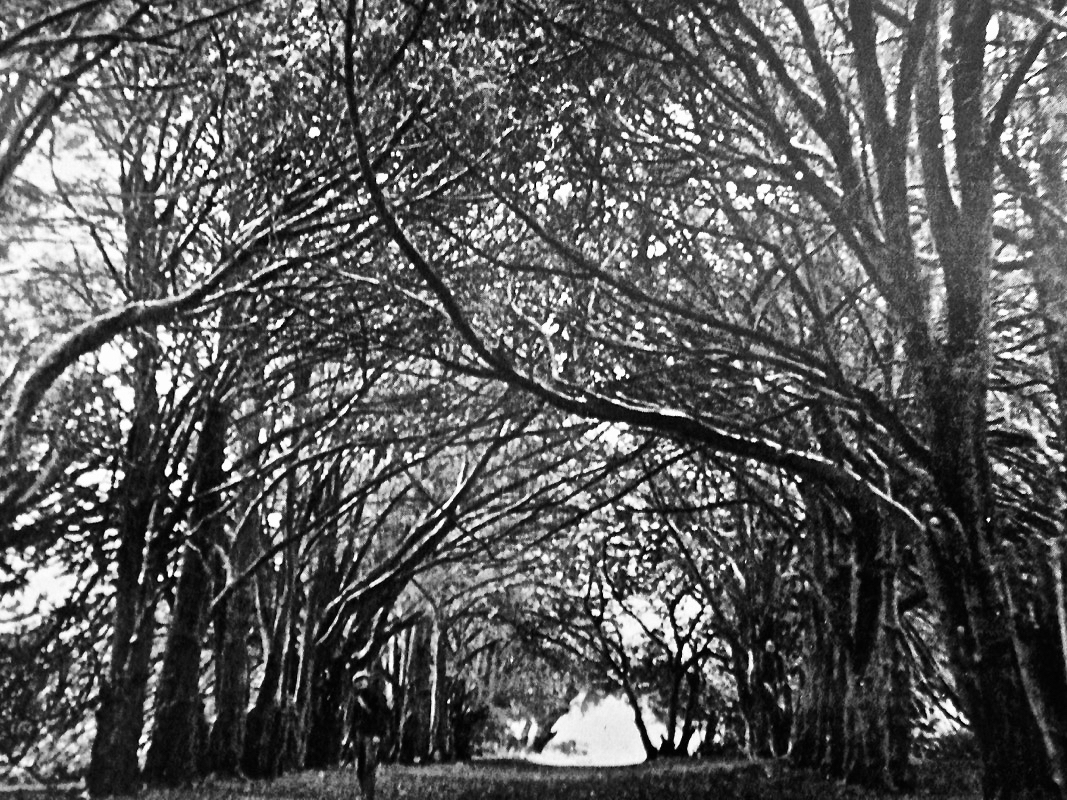
This extract from the 25″ OS map – late nineteenth century – shows the cathedral and some of the landscape features associated with it. We came here a few years ago, when we were researching Ireland’s waterways, following in the footsteps of English writer L T C Rolt. In his book ‘Green & Silver’ we read of his admiration for Saint Brendan, and his determination to find the grave at Clonfert, which he did in 1946. His book is illustrated with photographs taken by his wife Angela, and the one picture from Clonfert which is used in the book is this one of the ‘Yew Walk’ which was laid out as part of the gardens of the Bishop’s Palace, which you can see marked on the map.

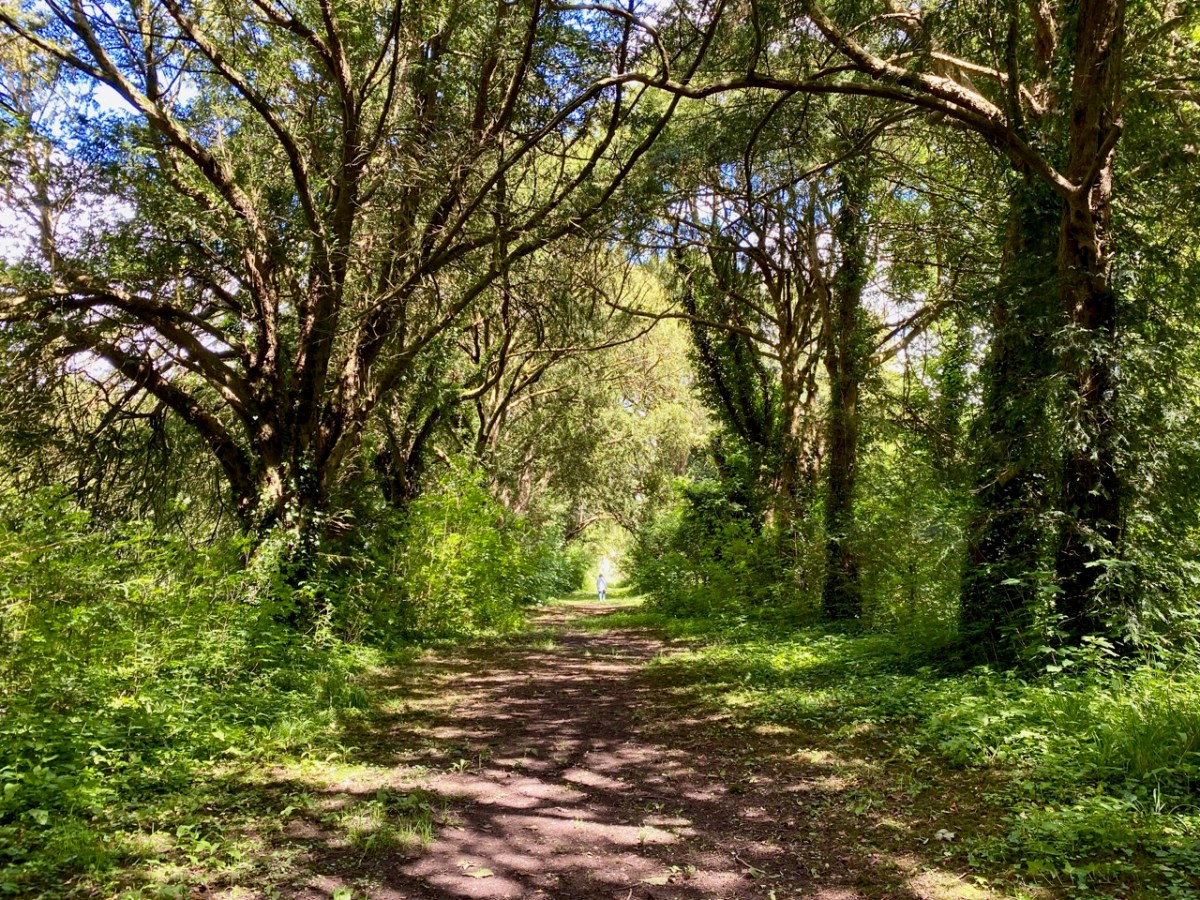
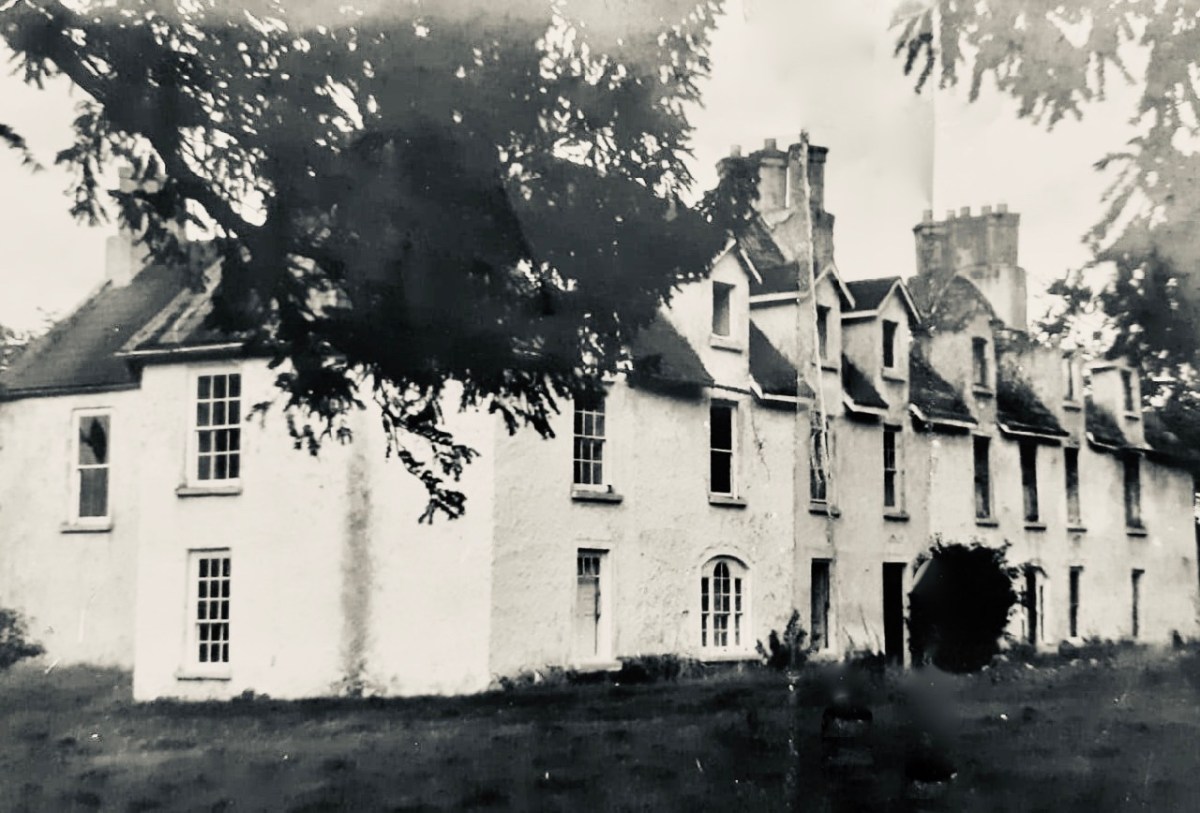
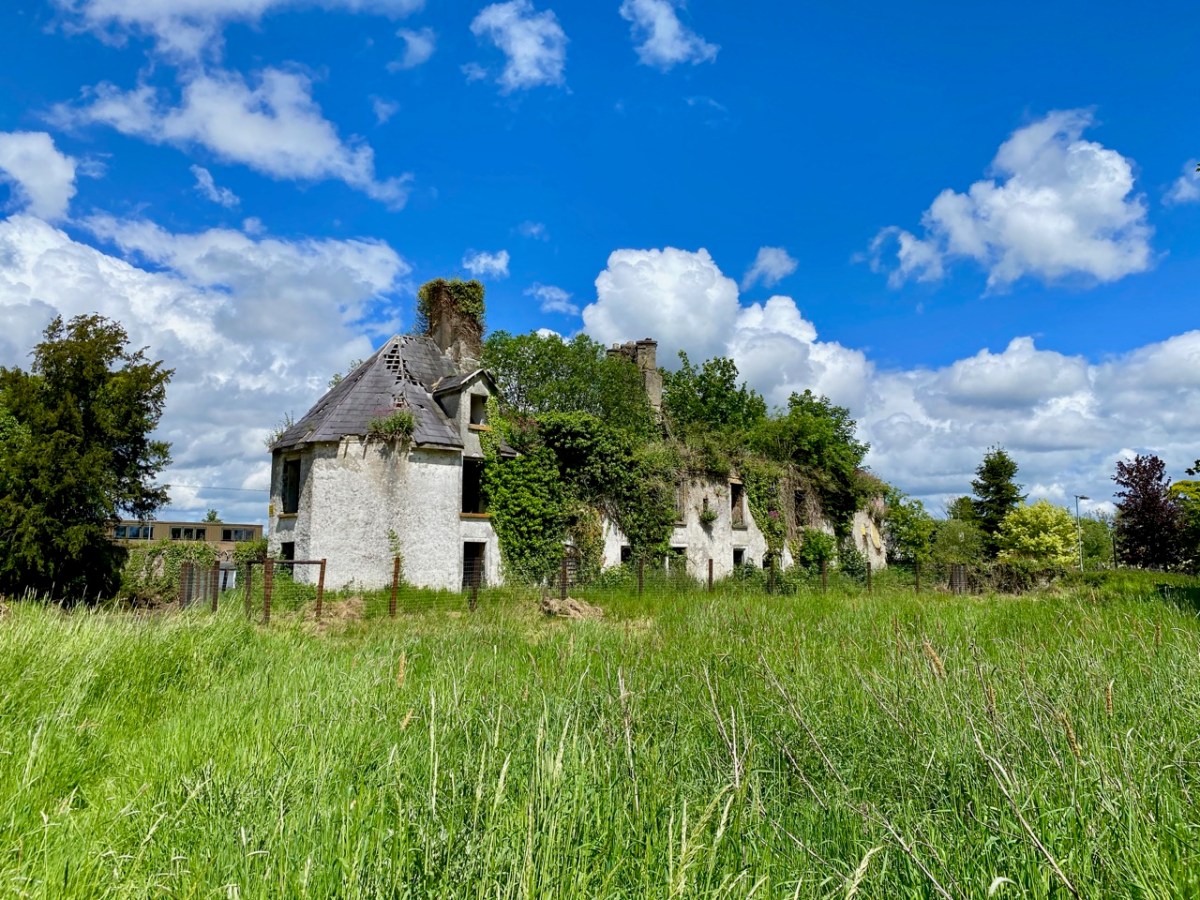
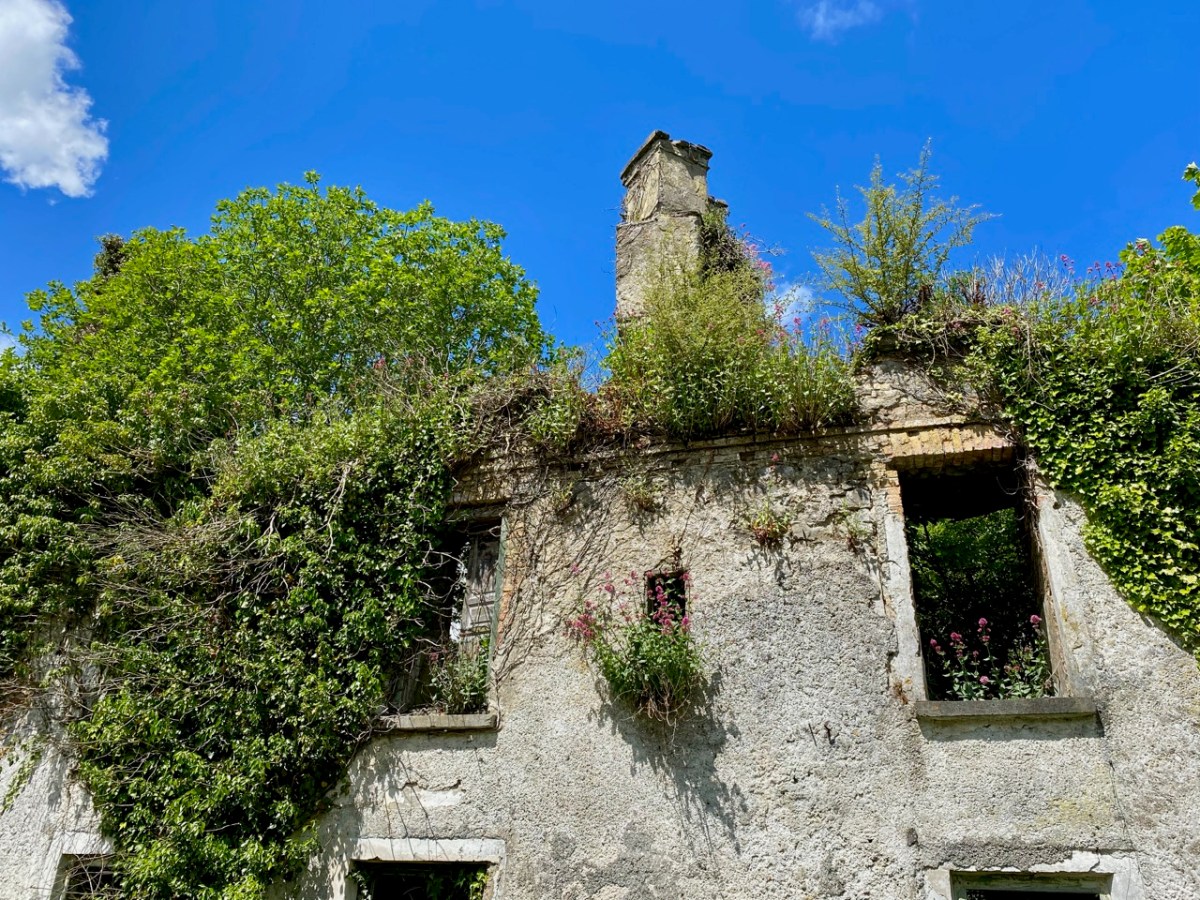
Our own photo of the Yew Walk at Clonfert was taken a few days ago. You can see that it survives, although neglected today. Some of the yew trees are said to be up to 500 years old. From the map you can also see that the Yew Walk connected the Cathedral to the 16th century ‘Clonfert Palace’, and was set out as an ornamental cruciform route, suggesting the path that might have been taken by the monks a thousand years ago. When we explored previously, we discovered the ruins of the Palace at the end of the Yew Walk, and wondered why it has been left in this state (since 1954, as we subsequently learned). The answer to that is fascinating, and I urge you to read my full account from that first visit, here. Below is a photo dating from c1950, showing the Palace at that time (with thanks to Dr Christy Cunniffe). My own photos from this week’s visit follow.

Clonfert might have been a very different place today if Queen Elizabeth had been listened to:

 . . . We are desirous that a college should be erected in the nature of a university in some convenient place in Irelande, for instruction and education of youth in learning. And we conceive the town of Clonfert within the province of Connaught to be aptlie seated both for helth and comodity of ryver Shenen running by it . . .

Queen Elizabeth, Letter to the Bishop Of Clonfert, 1579

The Queen’s advice was not taken up, and Trinity College Dublin was established instead – in 1592 – becoming Ireland’s first University.

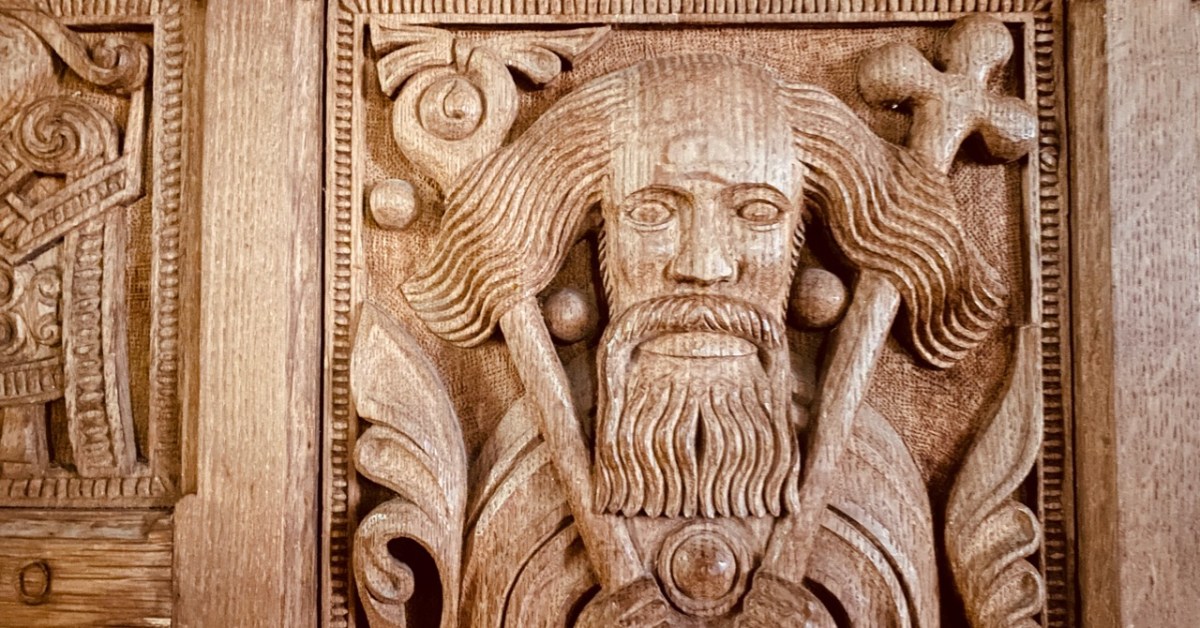
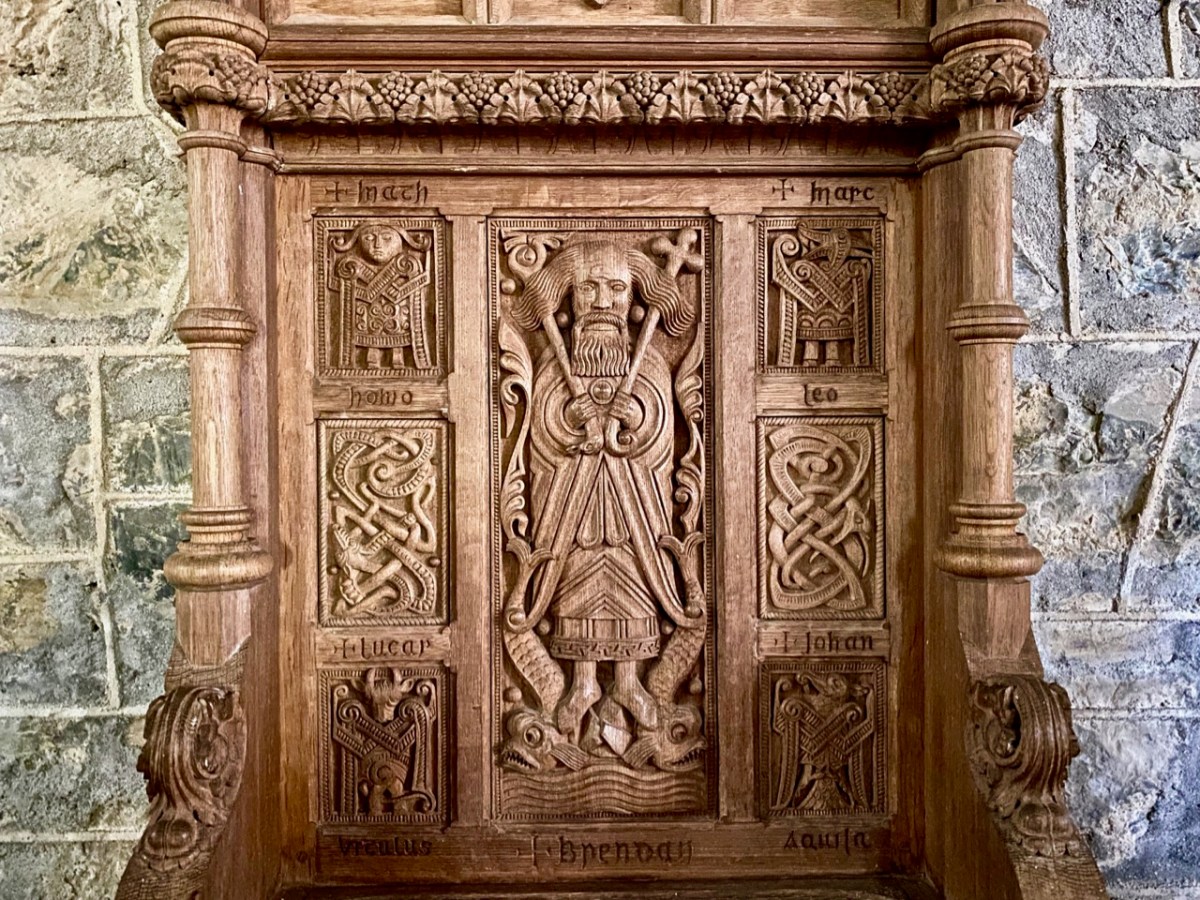
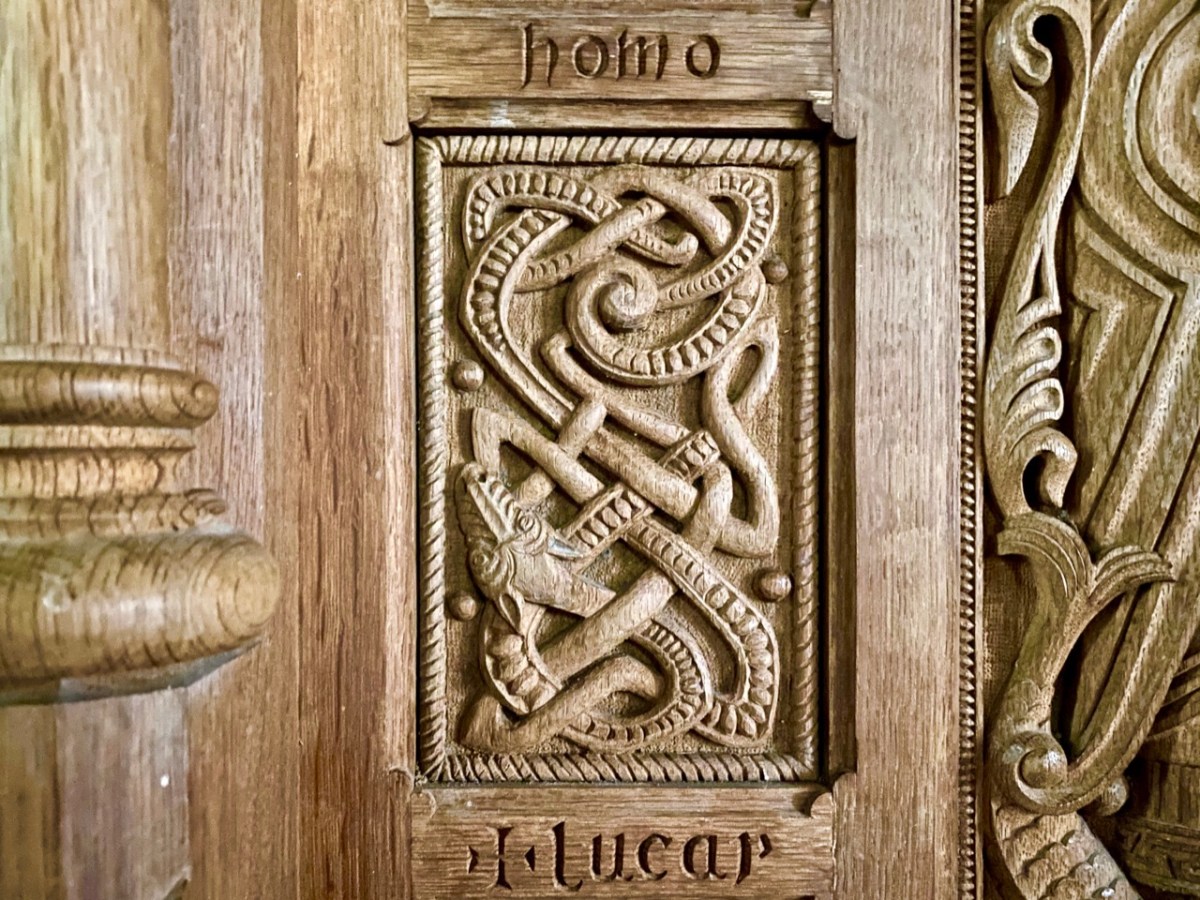
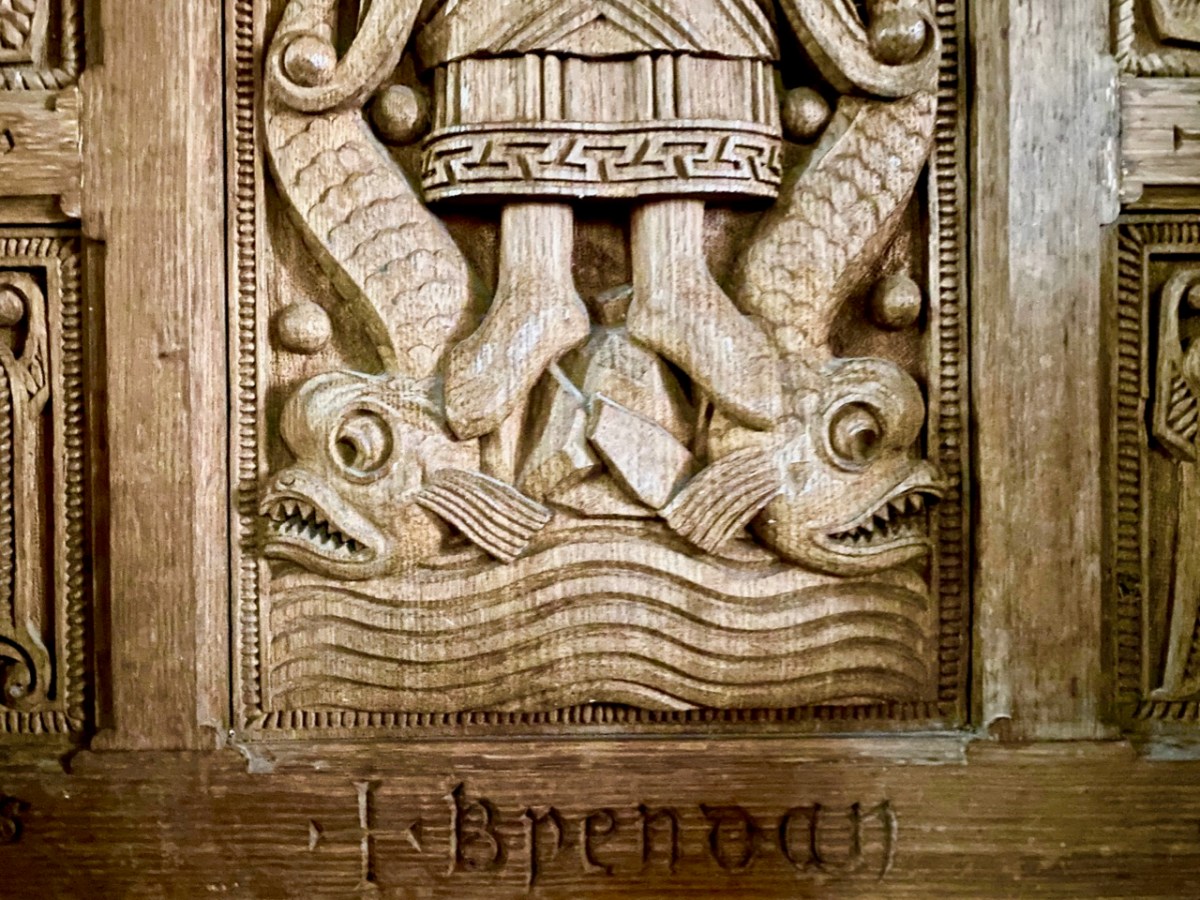
The site at Clonfert is so interesting – and covers so many periods in Ireland’s history – right up to the 20th century. It was well worth revisiting – and will merit further visits in the future, too. I’ll leave you with one aspect that probably impressed us most this time around. It’s the Bishop’s Throne which is hidden in the shadows of the Cathedral chancel. Carved from oak, most likely in the 19th century, it is a wonderful representation of Saint Brendan himself, surrounded by the Four Evangelists, crafted in the style of the Book of Kells. Look at him, also, on the header. Here is the Irish saint who set sail out on a voyage into the unknown – seeking Paradise – and discovered the World!

Brendan in Bronze

Do you know the story of St Brendan? He – ‘The Navigator’ – went to North America long before Columbus. Nearly a thousand years before, in fact: Brendan was born in the fifth century. The story of his voyage, and his remarkable adventures with his fellow monks, has inspired art, music and song ever since then. Here’s the beginning of Christy Moore’s version:

A boat sailed out of Brandon in the year of 501
’twas a damp and dirty mornin’ Brendan’s voyage it began.
Tired of thinnin’ turnips and cuttin’ curley kale
When he got back from the creamery he hoisted up the sail.
He ploughed a lonely furrow to the north, south, east and west
Of all the navigators, St Brendan was the best . . .

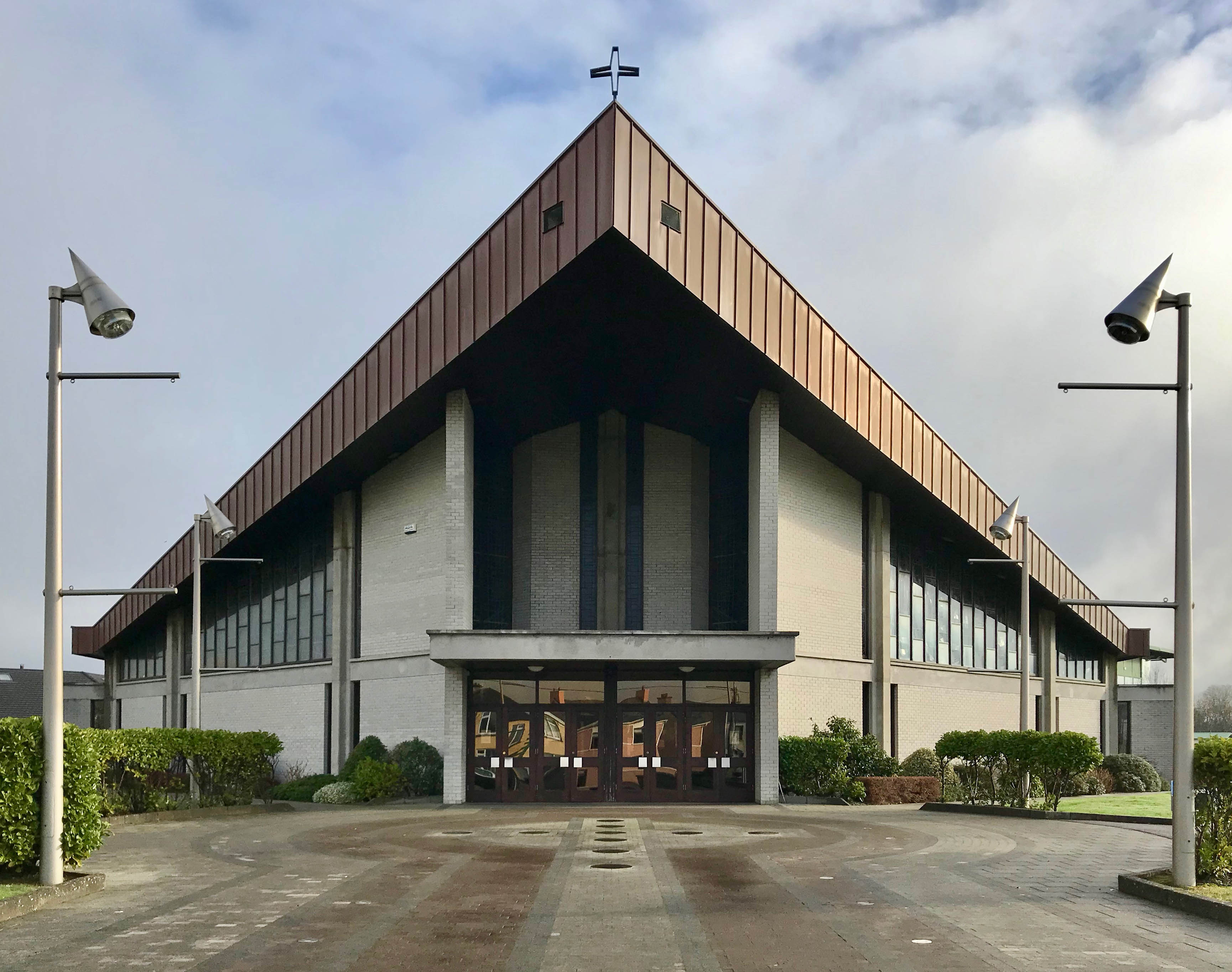
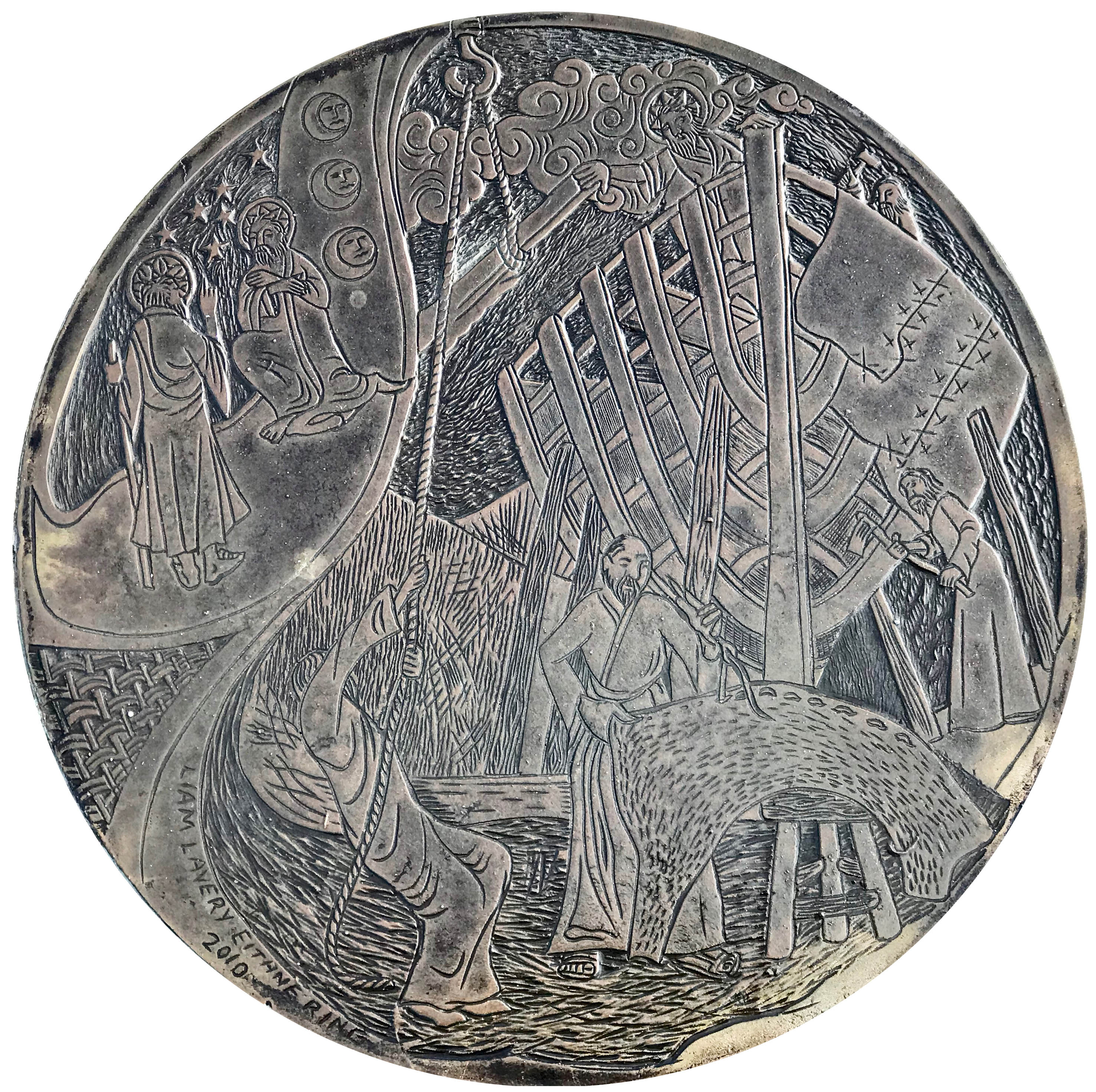
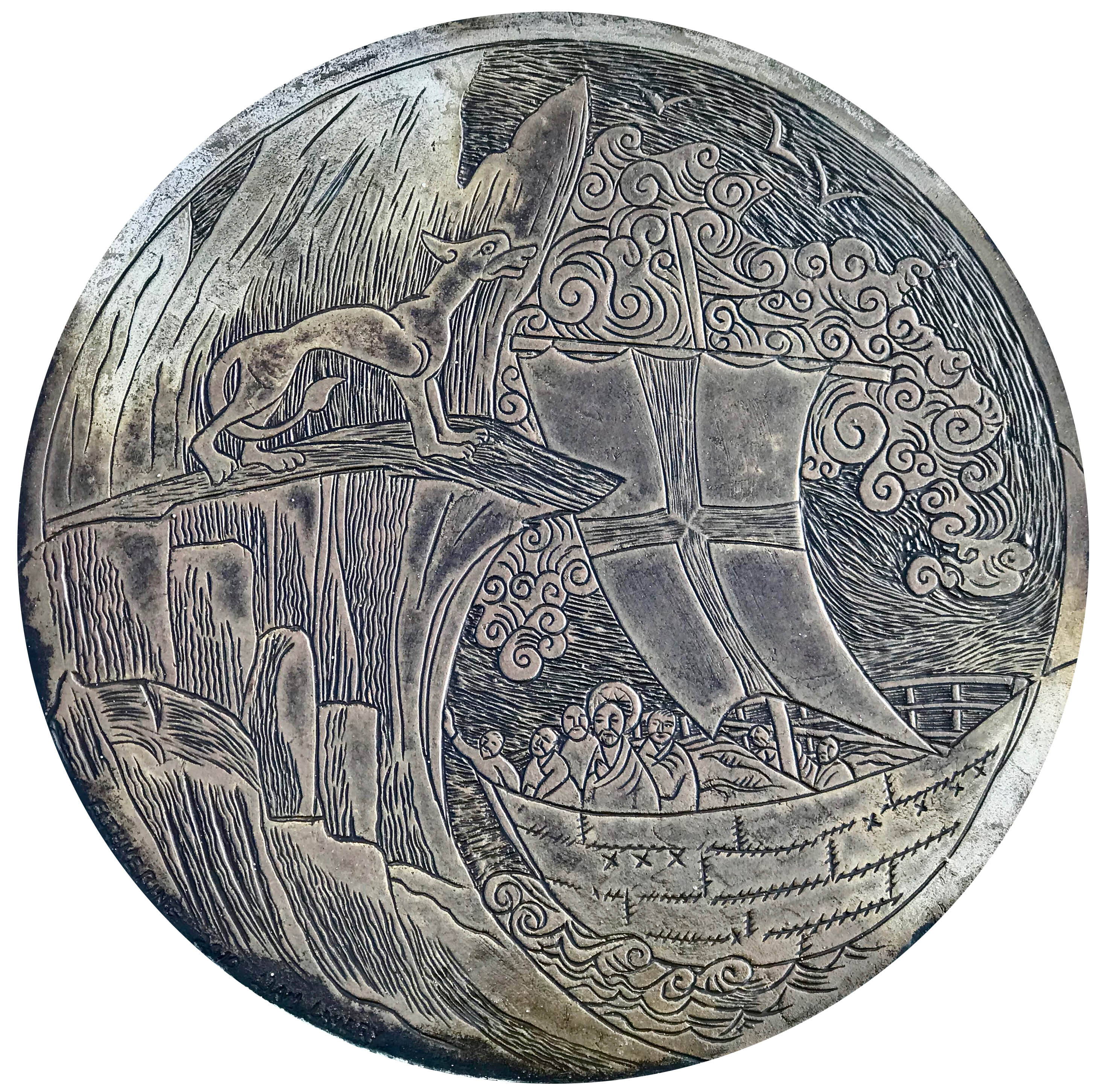
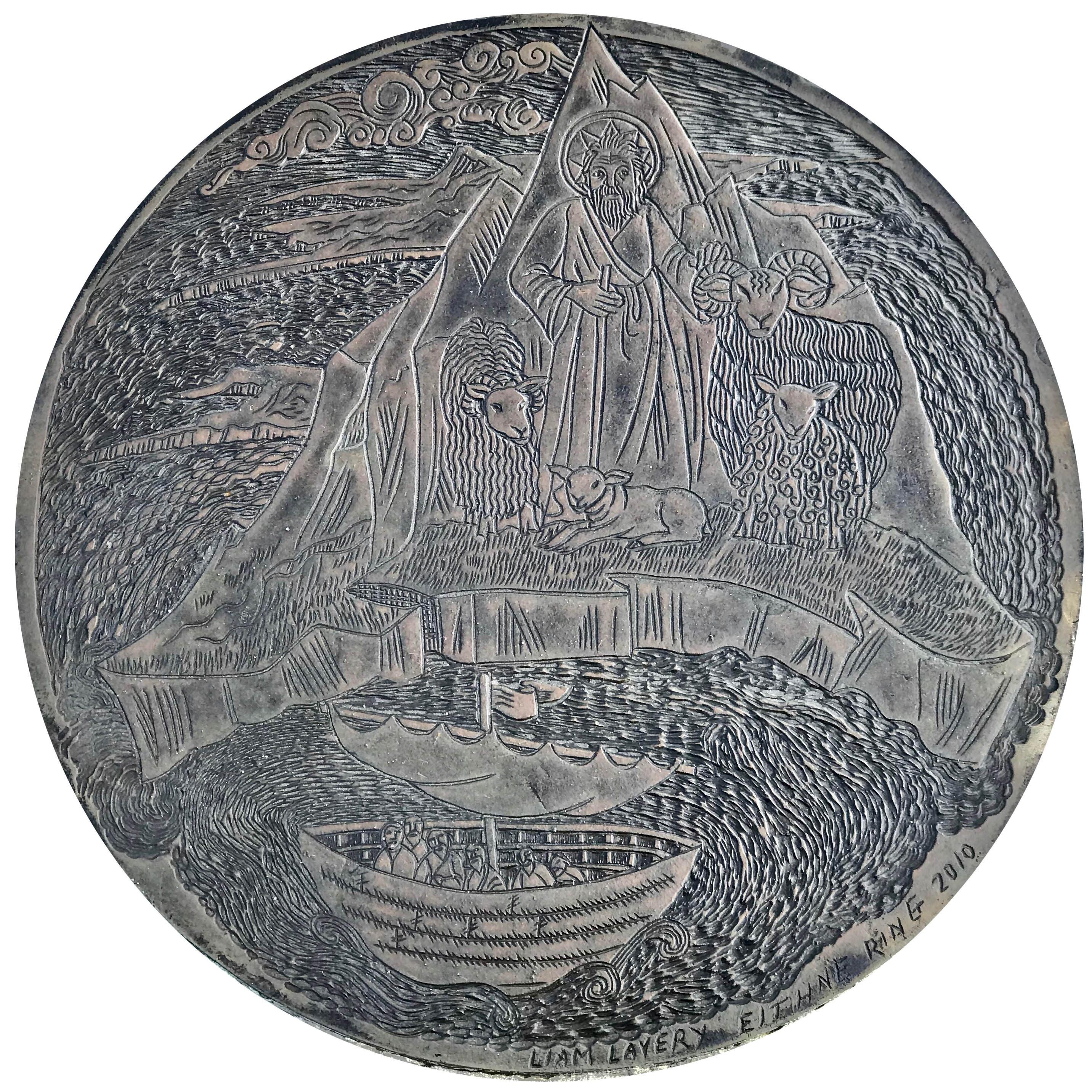
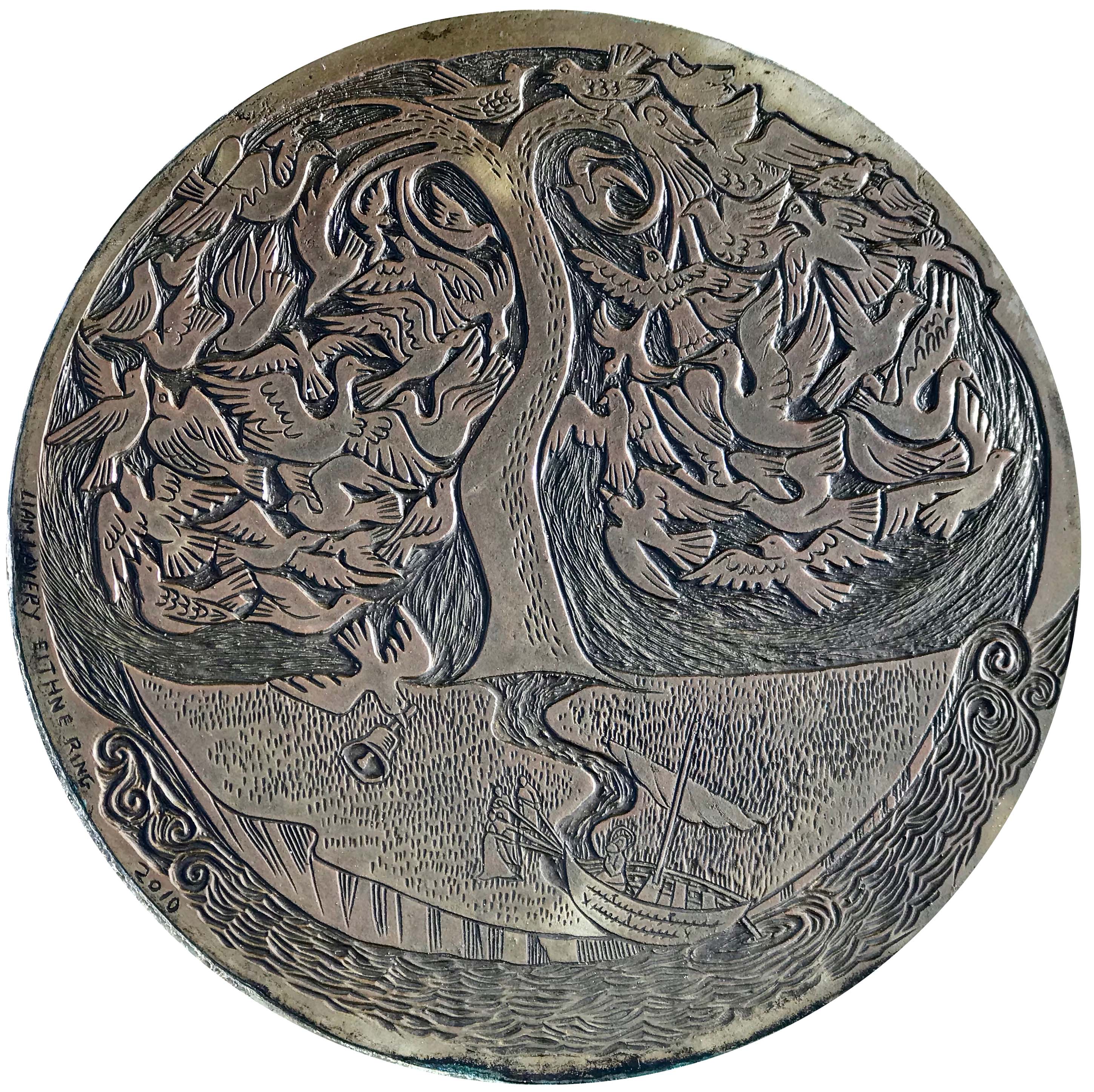
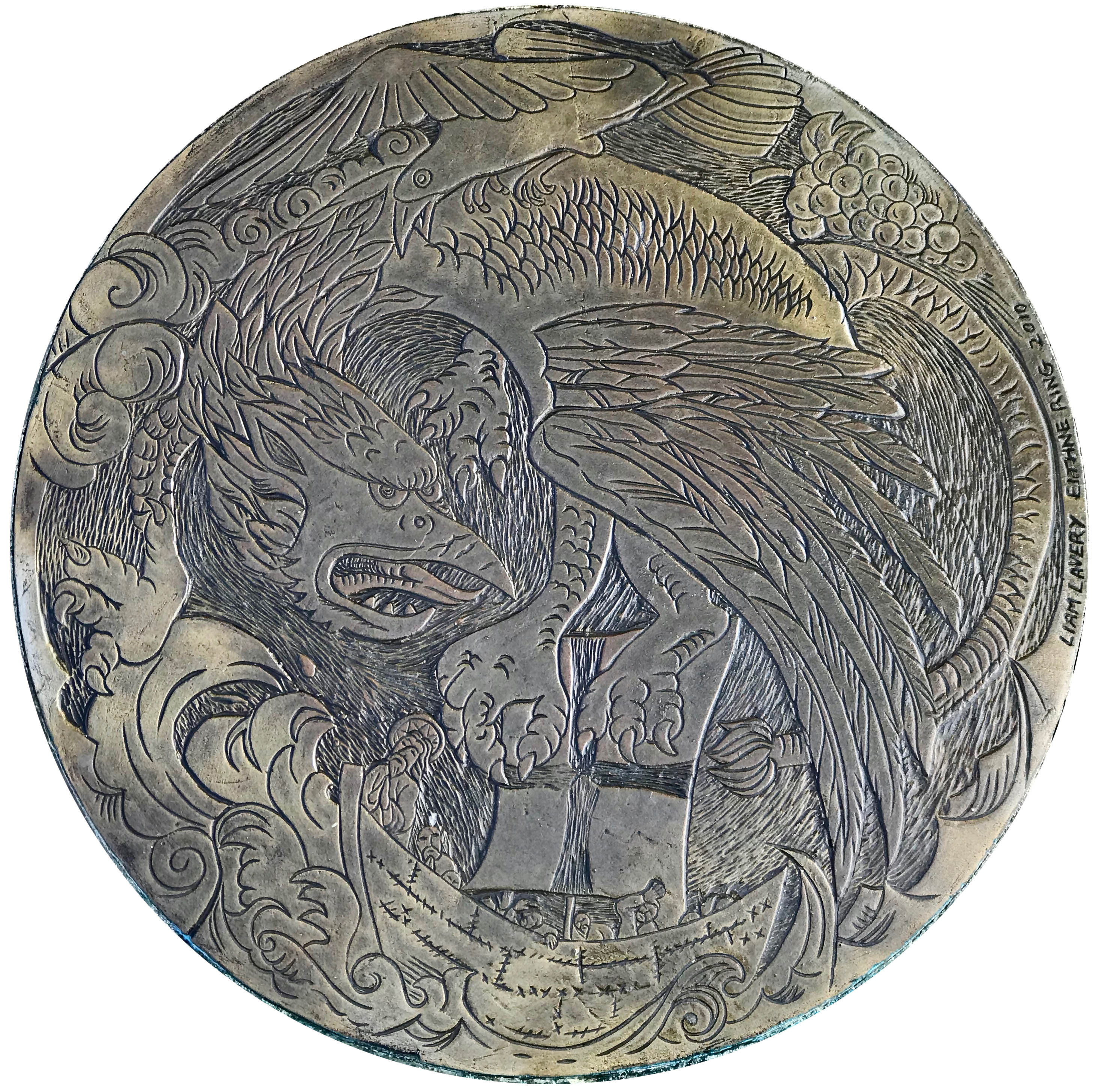
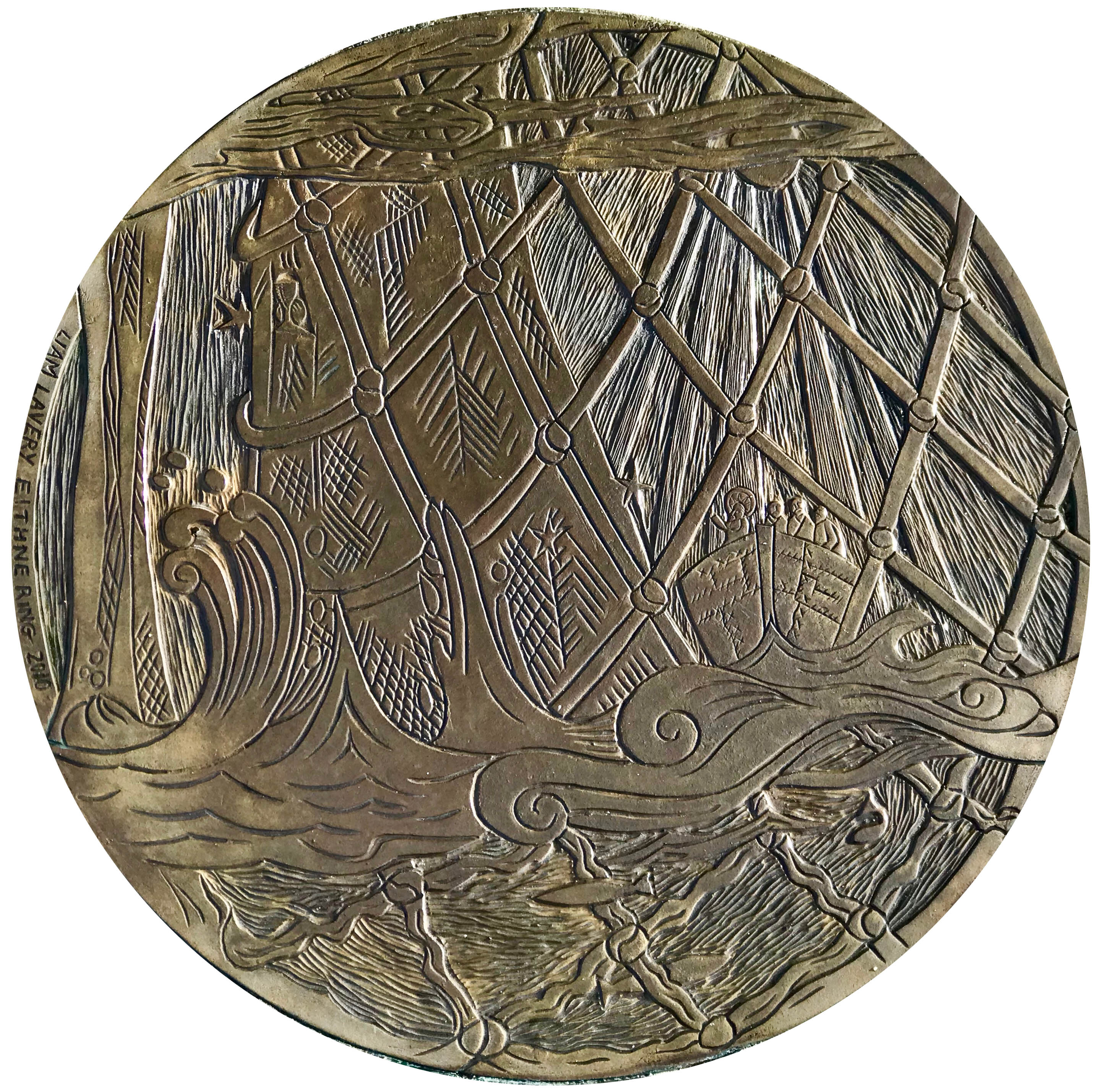
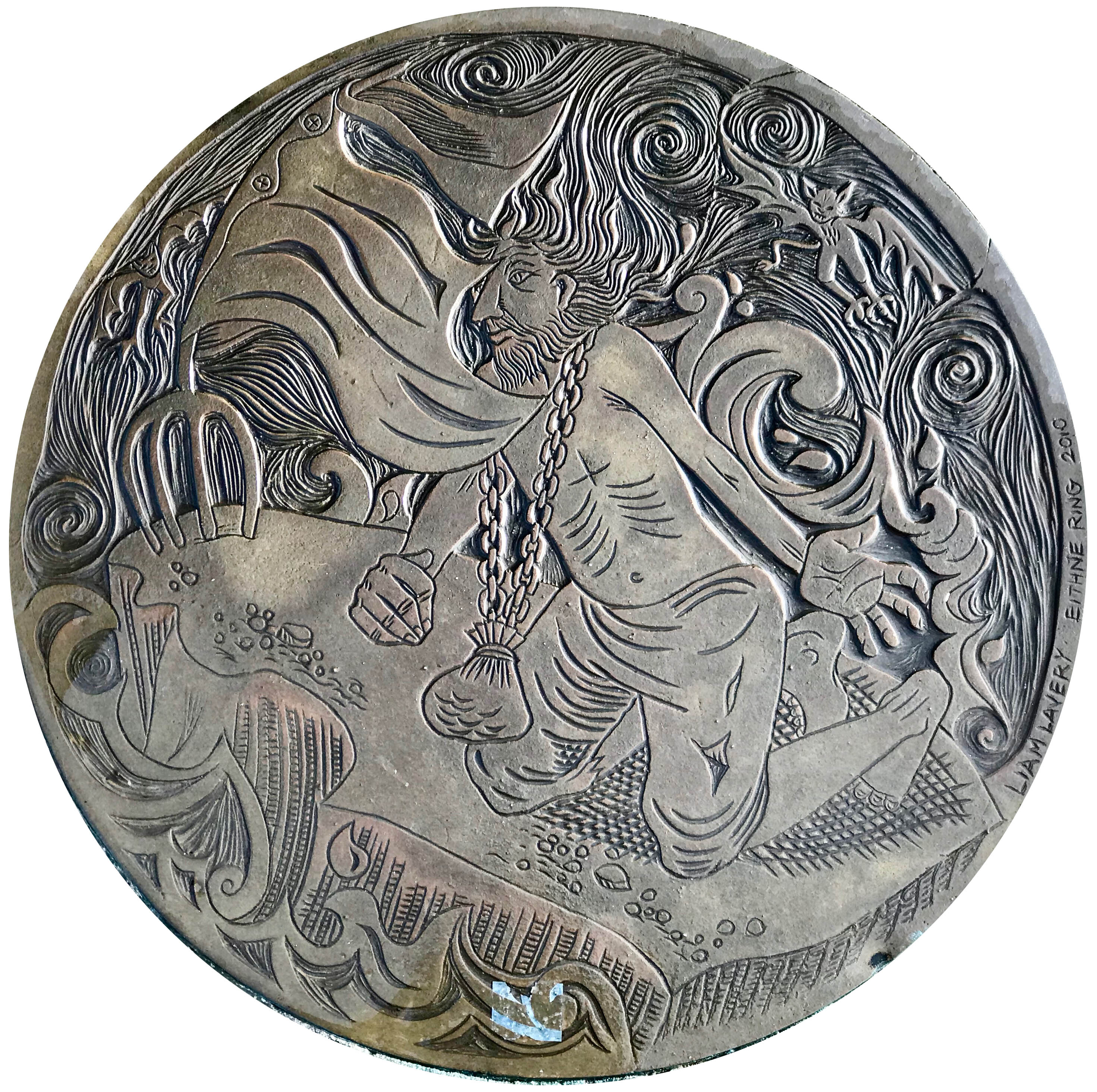
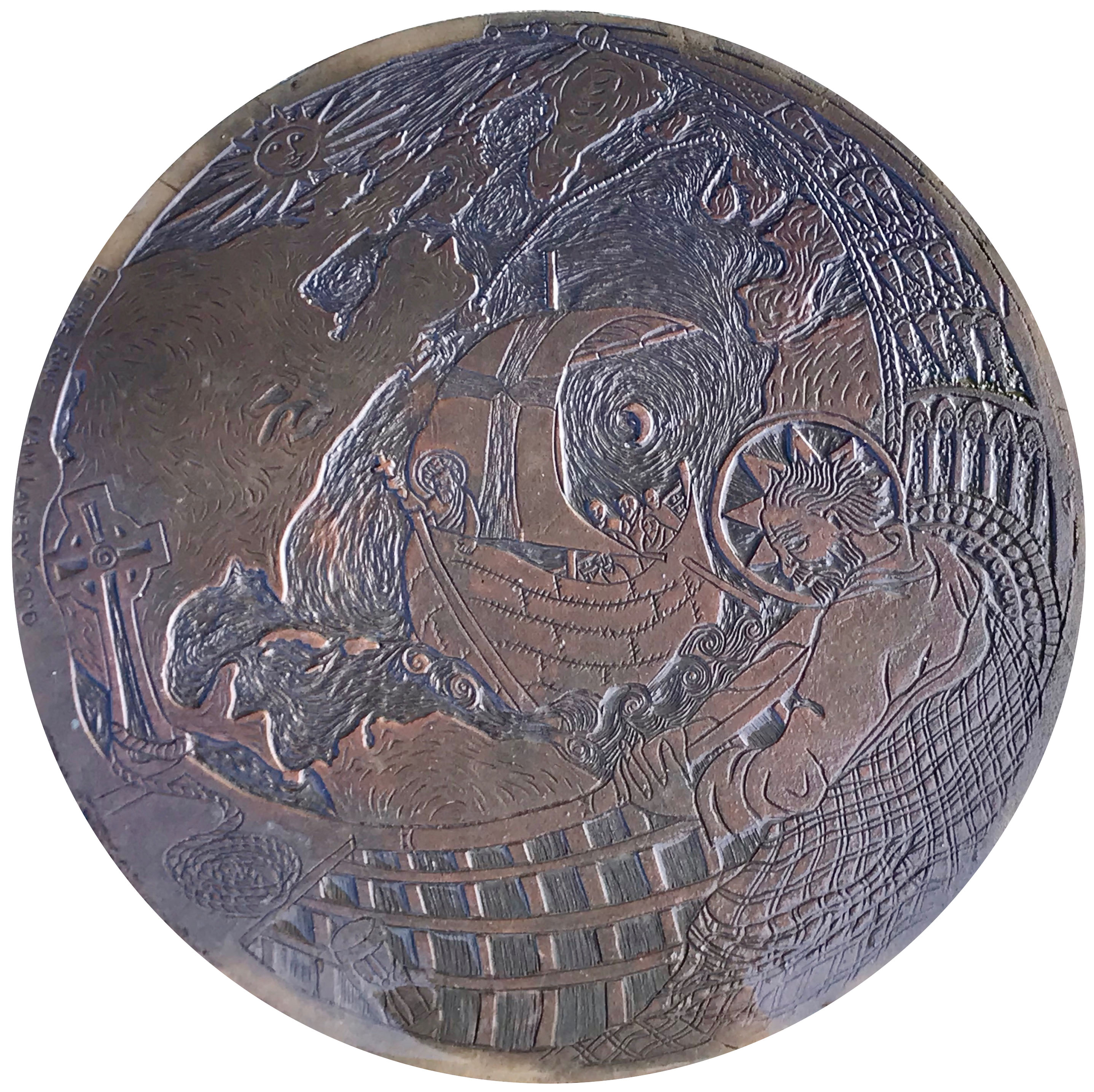
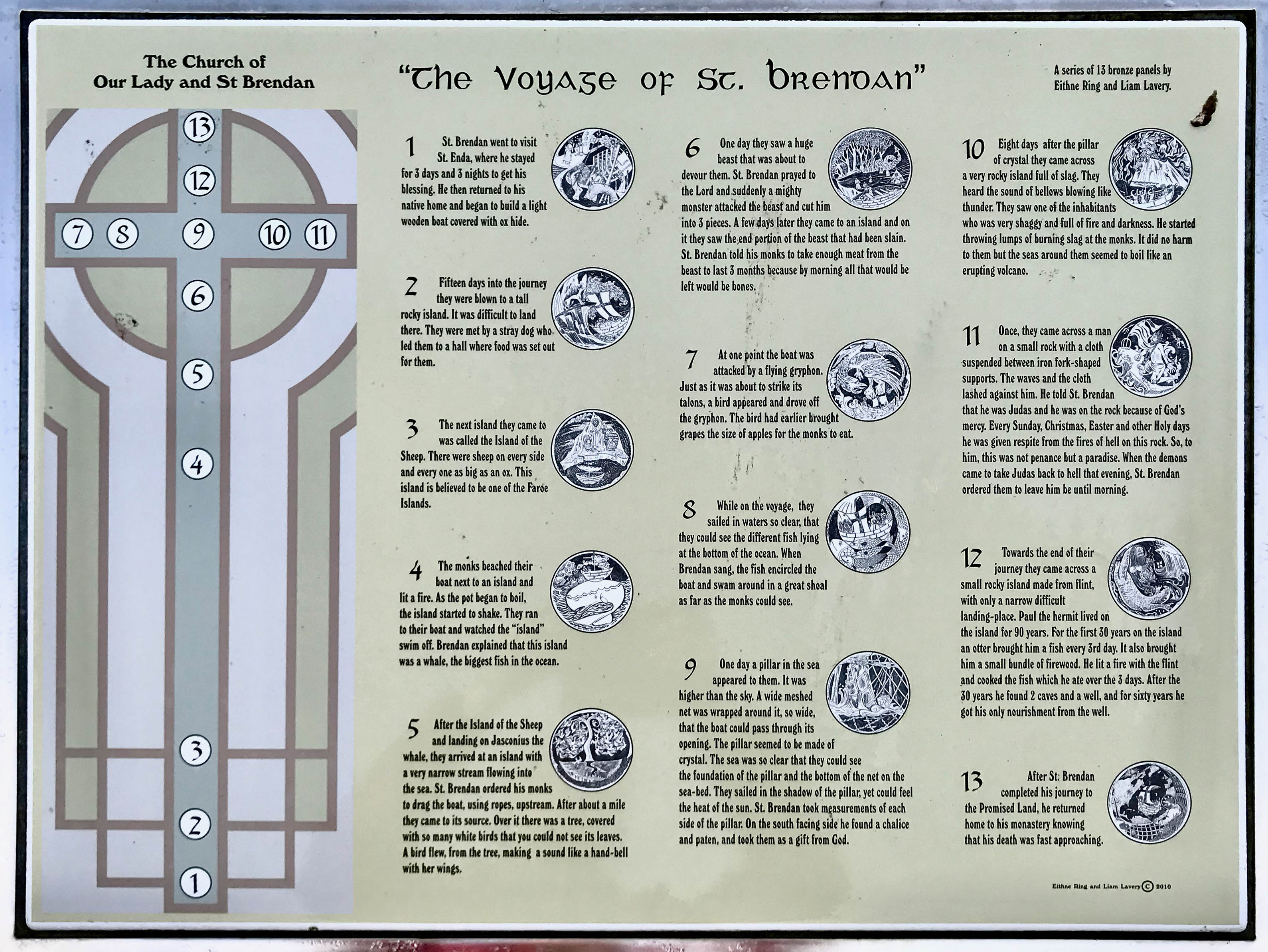
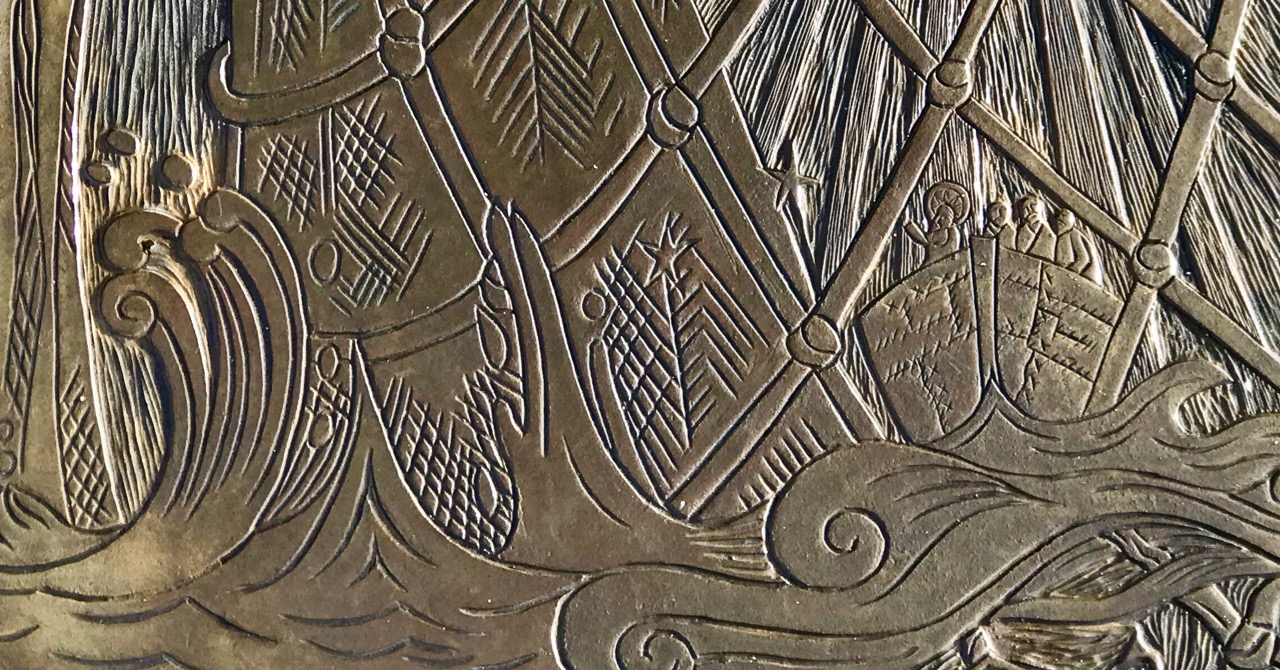
We went to Tralee, Co Kerry, to visit the Church of Our Lady and St Brendan: Finola was looking for windows by Murphy Devitt (which are spectacular) and I chanced upon a set of bronze roundels laid into the paving leading up to the main entrance (above). I felt I had to record them here, as they illustrate and tell the whole story of the Saint so wonderfully well. The large medallions were designed and made by Eithne Ring and Liam Lavery, and were installed in 2010. As far as I know this is a unique record of the voyage: well worth a visit – but don’t miss the windows!

St Brendan: part of a huge stained glass installation by Murphy Devitt in this Kerry church

I’m showing the roundels in the order in which you encounter them as you approach the main doors to the church, and giving a very brief description of the subject of each. At the end you will find a commentary provided by the designers, which gives more detail.

1 St Brendan visits St Enda prior to building his boat

2 On a rocky island, Brendan’s crew are led by a hound to a miraculous hall of food

3 The monks find an island inhabited by giant sheep

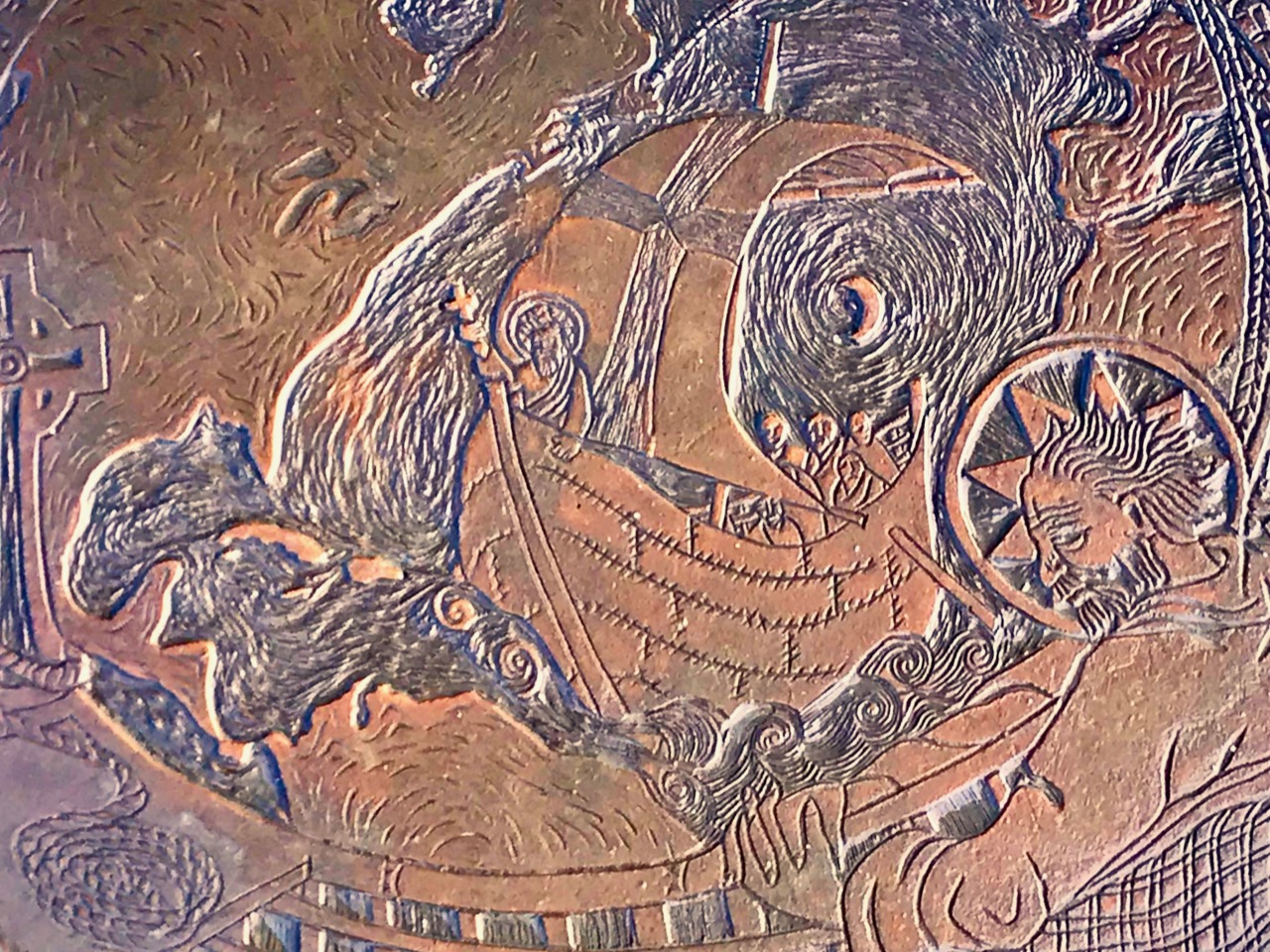
4 Brendan and his companions land on an island, light a fire and celebrate Mass; they discover that they are on the back of a whale!

5 An island of white birds: one is ringing a bell

6 The monks take meat from a beast that has been slain by a monster

7 On the Island of Grapes the monks witness a battle between a gryphon and a bird: the bird is victorious

8 All the fish in the ocean come to listen to Brendan while he sings

9 Brendan finds a huge crystal pillar rising out of the sea

10 The sea is boiling like an erupting volcano

11 Brendan and his companions meet the unhappy Judas chained to a rocky island

12 The travellers find a hermit who has been fed by an otter for forty years

13 Brendan returns to Ireland to prepare for his death

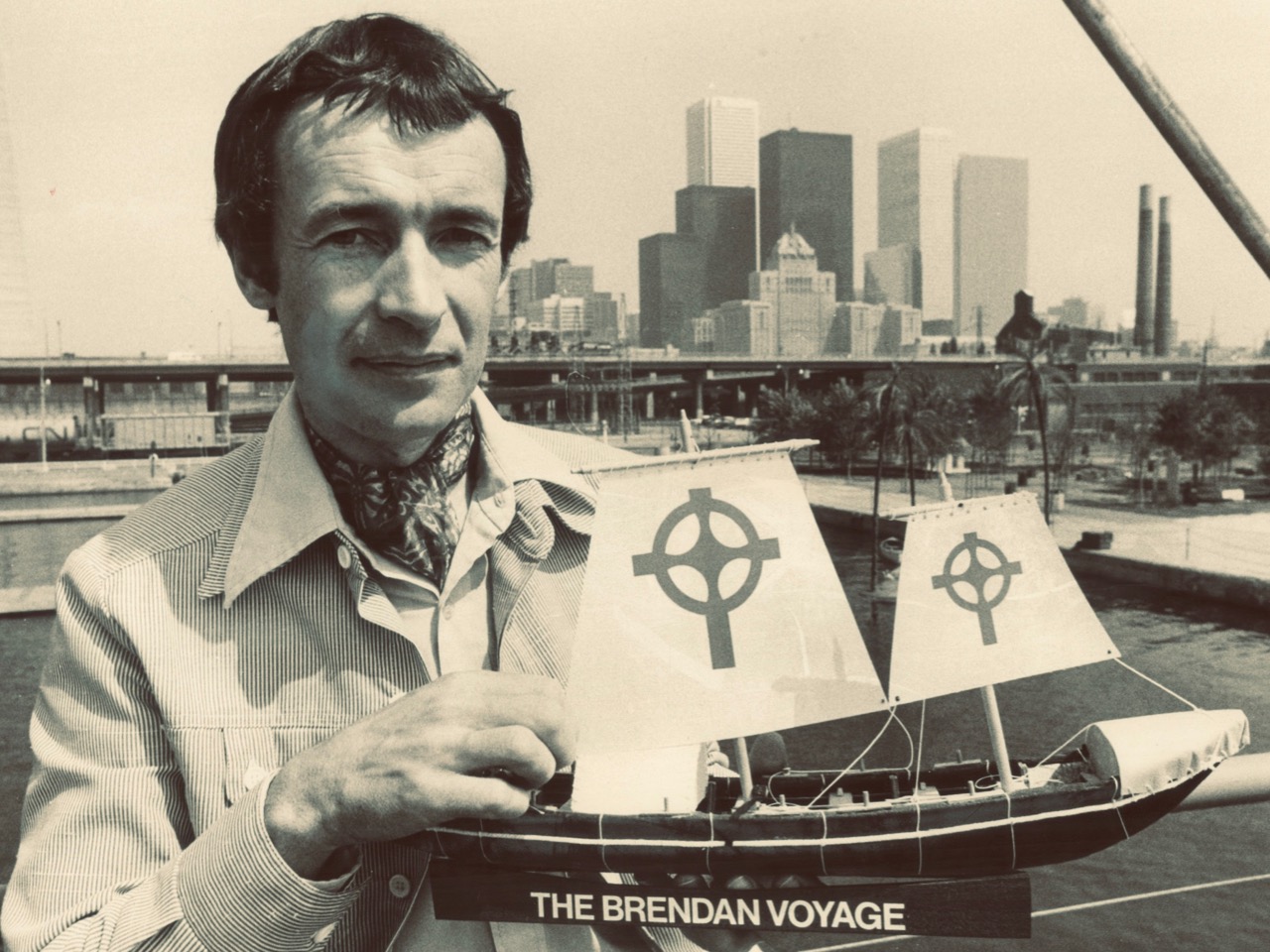
So now you know the bones of Brendan’s story. Now listen to the music! Saun Davey’s Brendan Voyage, a suite for uillinn pipes and orchestra, is a masterpiece inspired partly by the Saint himself, but also by Tim Severin’s 1976/77 recreation of the journey across the Atlantic in a leather clad boat:

Tim Severin pictured with a model of the boat in which he recreated the Saint’s journey

Let’s give the last words to Christy Moore, and the chorus of his Brendan song (you can find all the lyrics here):

“Is it right or left for Gibraltar?”
“What tack do I take for Mizen Head?”
“I’d love to settle down near Ventry Harbour”,
St Brendan to his albatross he said . . .

Harry Clarke, Brendan, Judas – and Matthew Arnold

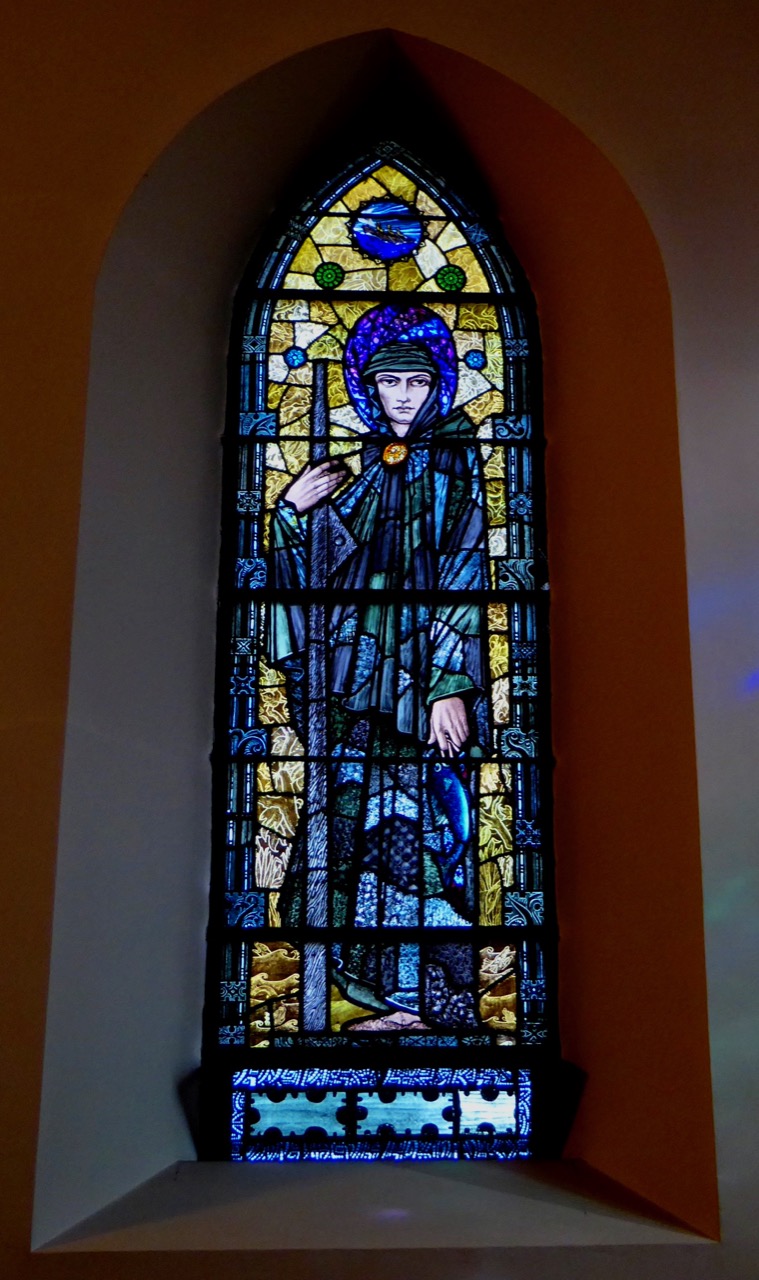
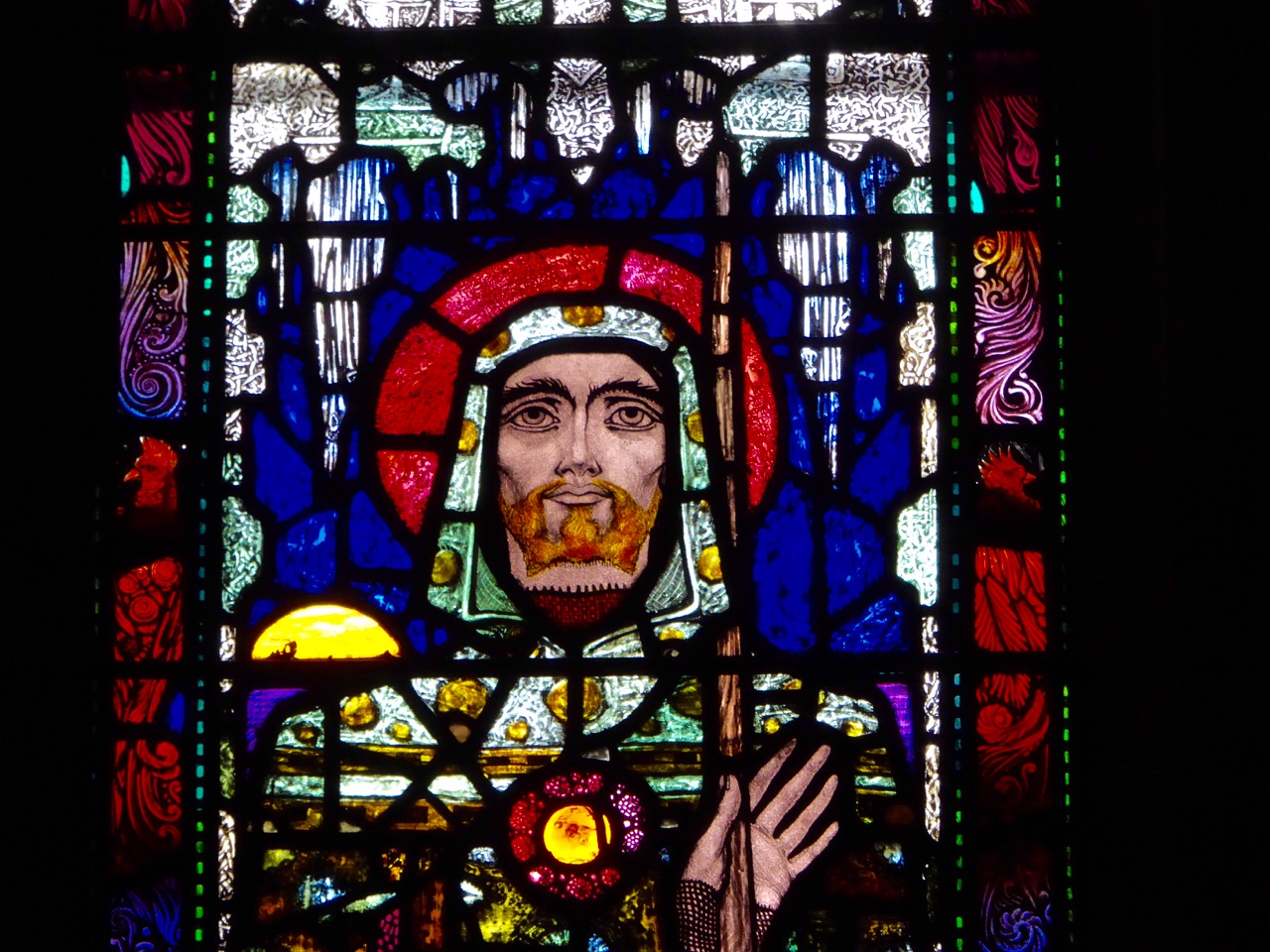
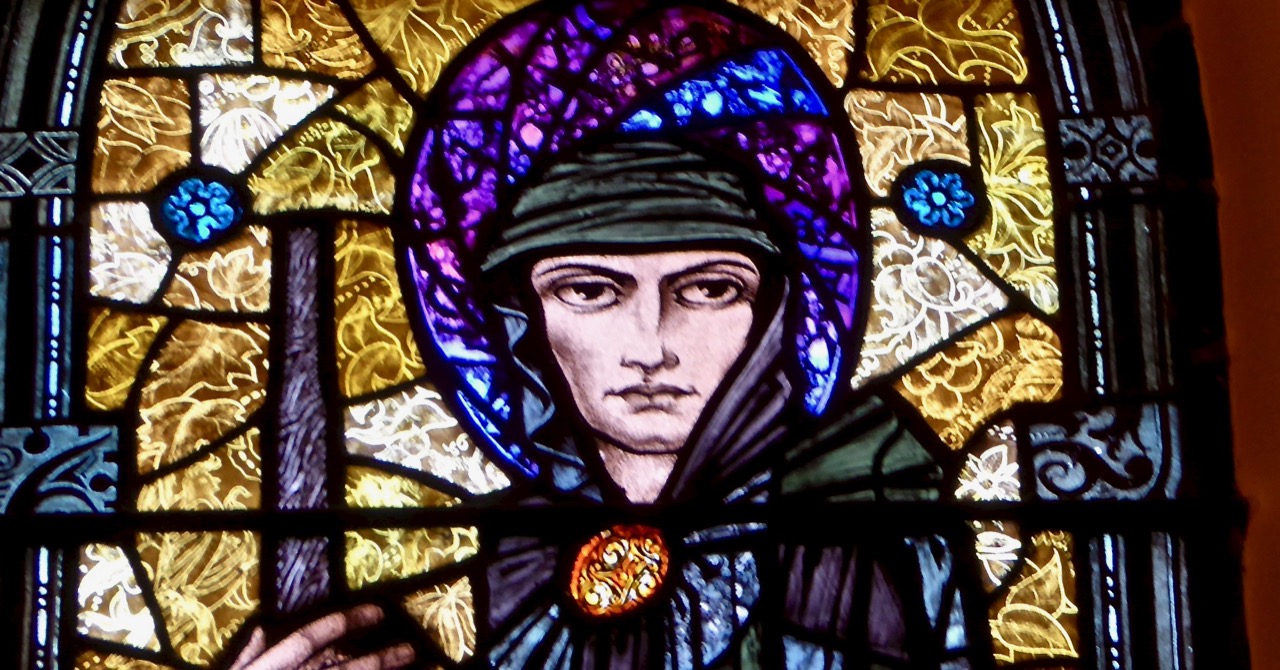
St Brendan was a favourite subject for Harry Clarke.

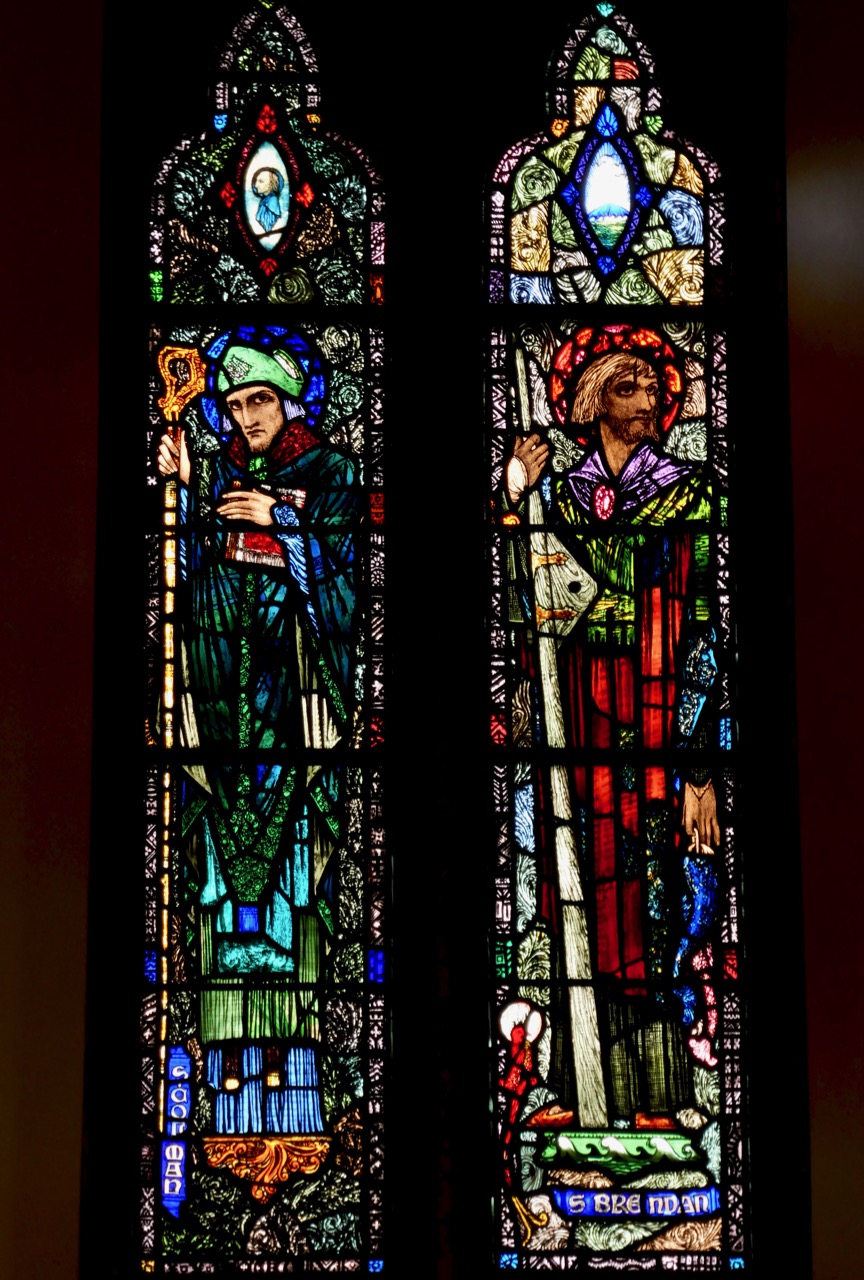
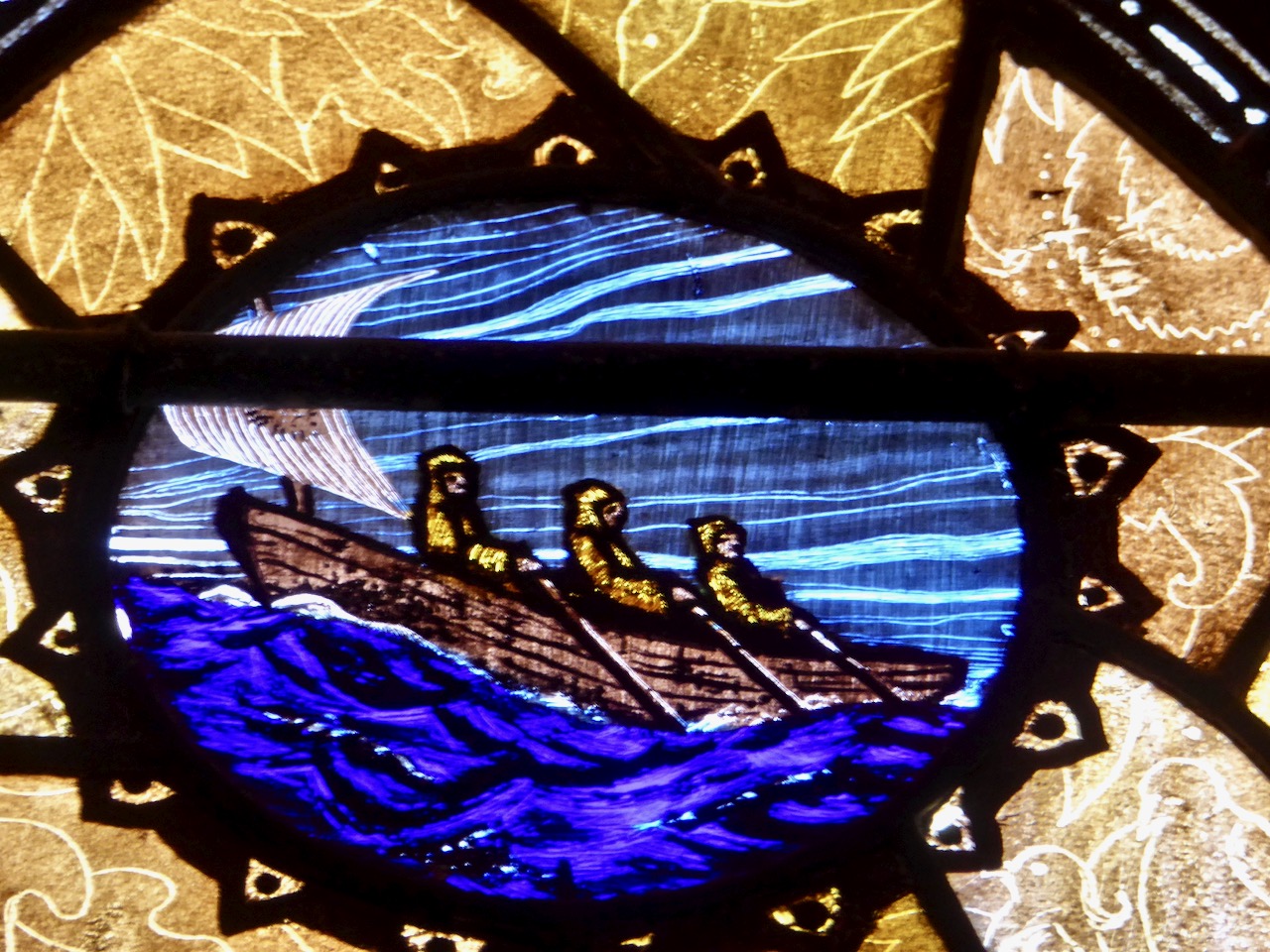
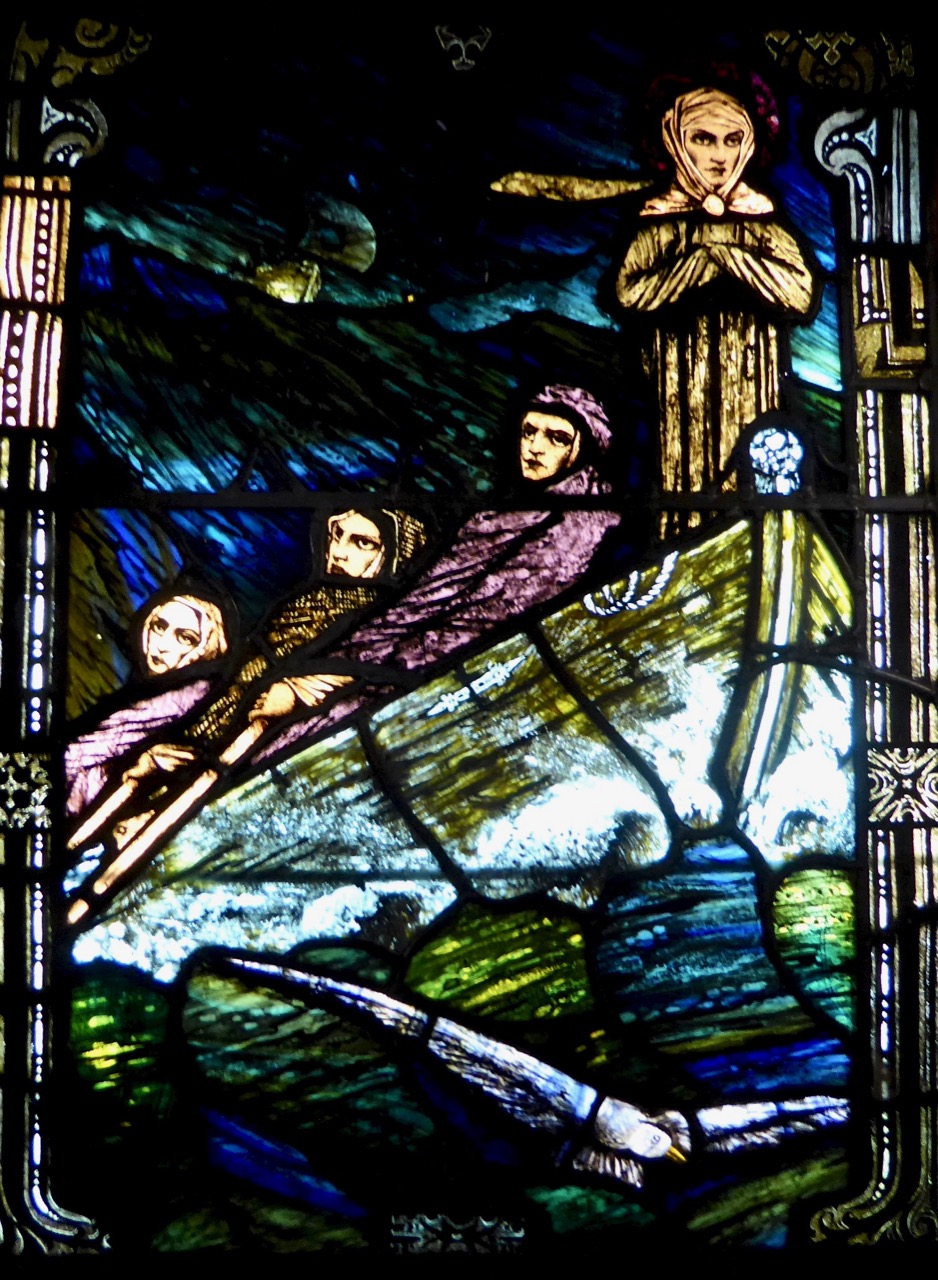
Four of his windows depict the saint: a prizewinning student piece from 1911; his Honan Chapel commission of 1916; the Ballinrobe windows from 1924-25 (pictured above); and the windows designed for the Rathfarnham Jesuit Retreat in 1928 and subsequently relocated to Tullamore (pictured below).

The Tullamore Brendan (above) is recognisably based on that from Ballinrobe, but in this window a youthful Brendan, as described by Paul Donnelly, ‘engages the viewer directly with a penetrating look’  

Harry researched his subjects extensively and ensured that anyone working on his windows did too. Paul Donnelly, in his fascinating essay Legacy and Identity: Harry Clarke, William Dowling and the Harry Clarke Studios (in Harry Clarke and Artistic Visions of the New Irish State) tells how he sent his apprentice, William Dowling, off to the National Library to read all that was available on his subject when he was working on the Rathfarnham window (above and below).

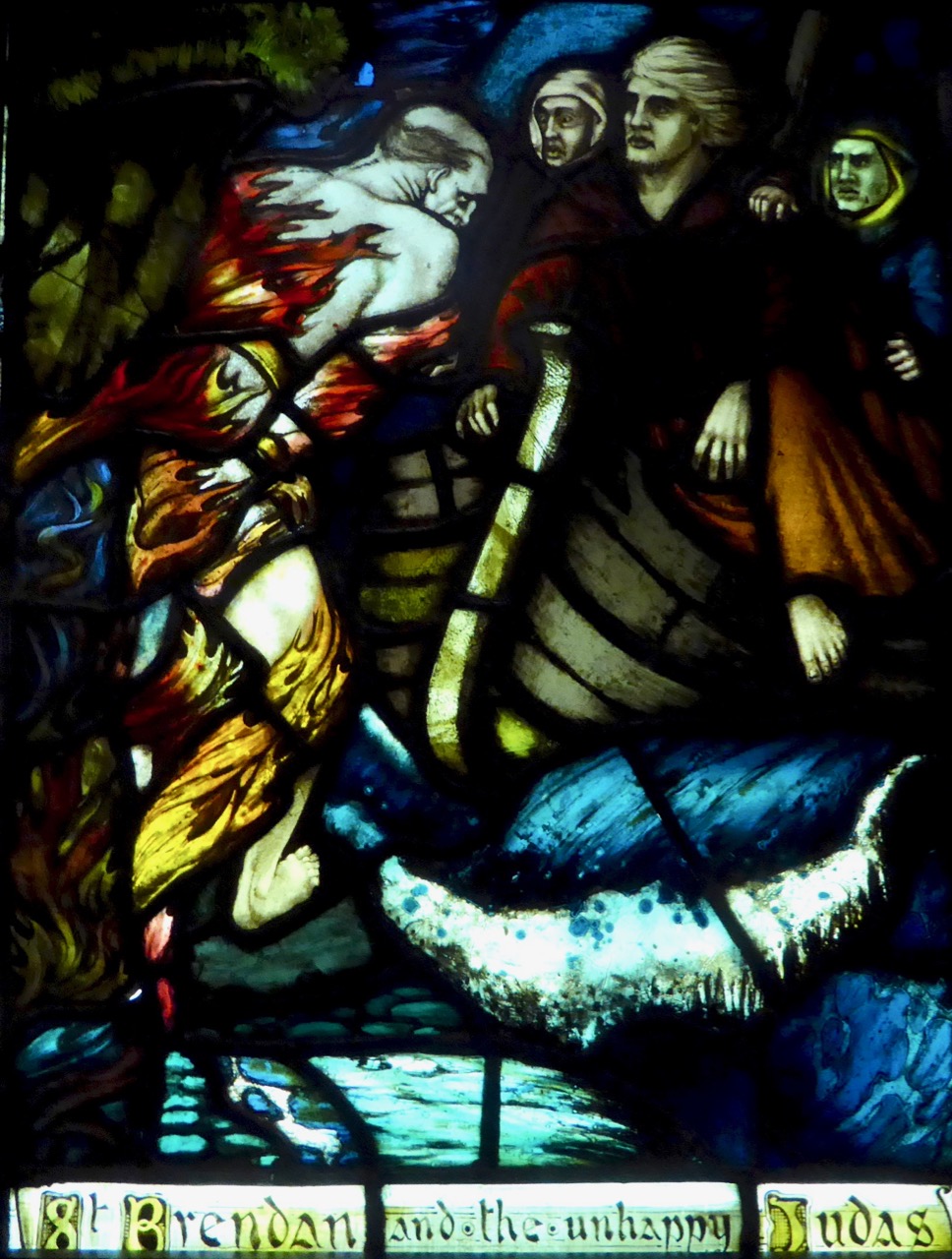
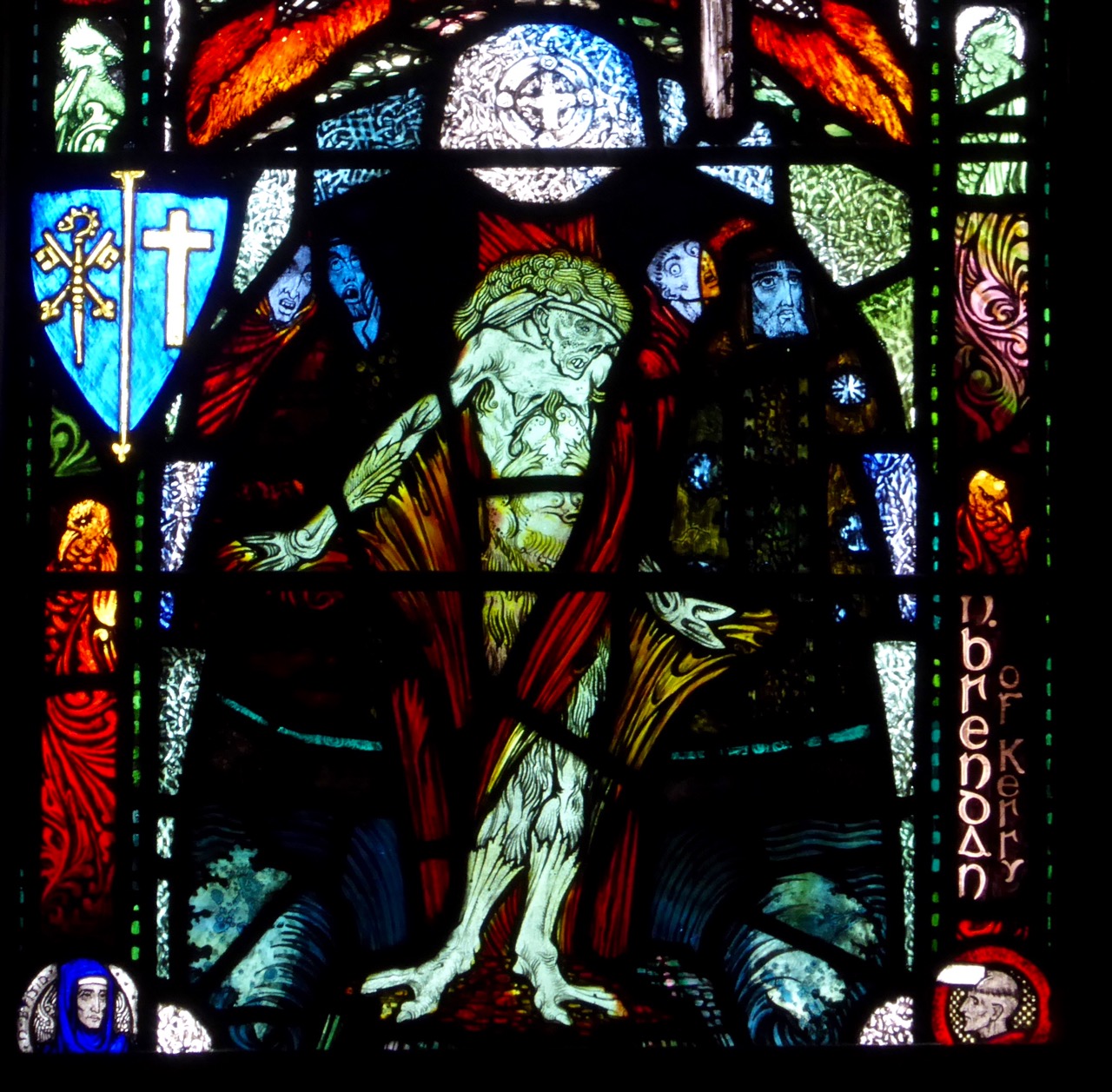
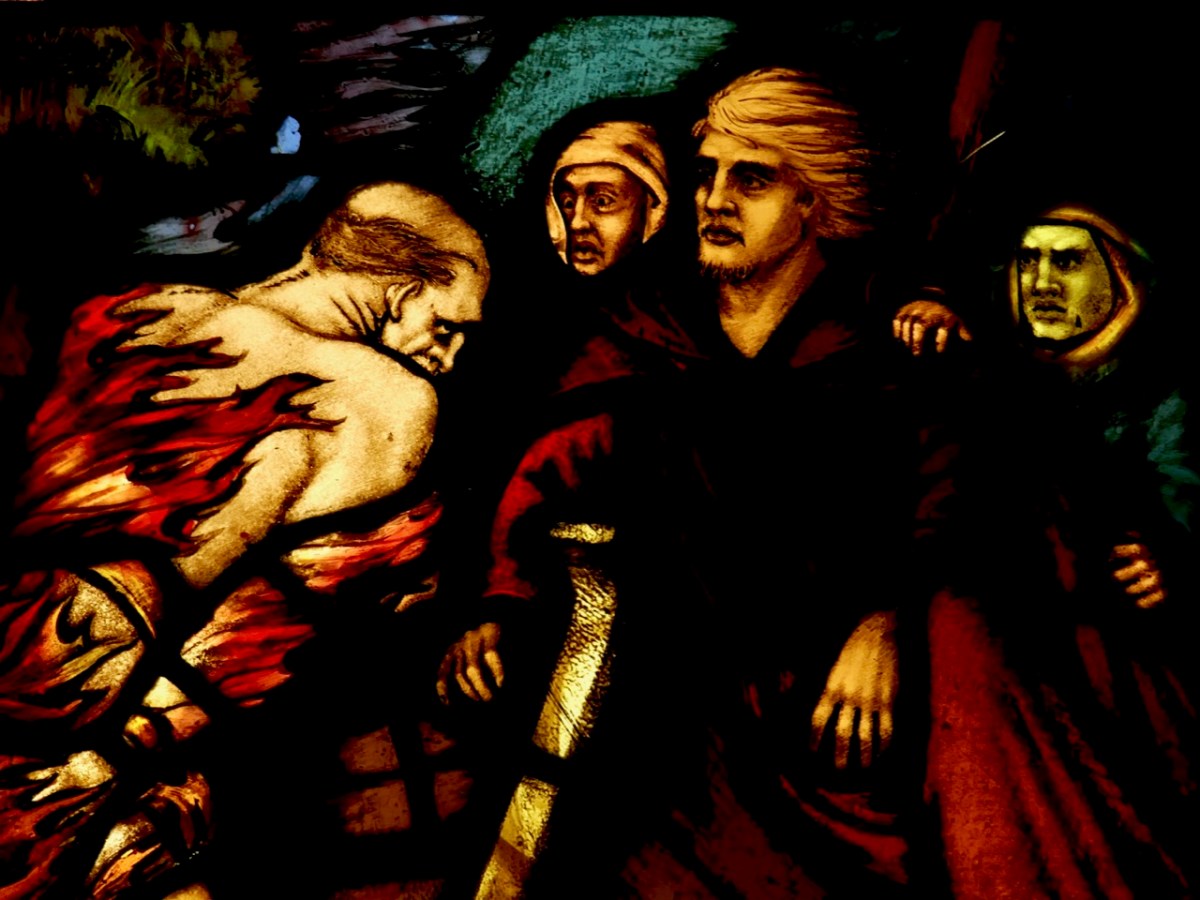
Nicola Gordon Bowe, in the Life and Work of Harry Clarke, felt that Harry was influenced by Matthew Arnold’s poem, St Brandon, when he set about designing his student piece, now in the Crawford Art Gallery. Based on the Medieval best-seller (there are over 100 versions still extant and many translations) Navigatio Sancti Brendani Abbatis, Arnold’s poem tells of an incident on the voyage in which the Saint meets with Judas, tied to an iceberg in the ocean. There are several slightly different accounts of this part of the voyage, but Arnold’s poem is compelling, and beautifully told.

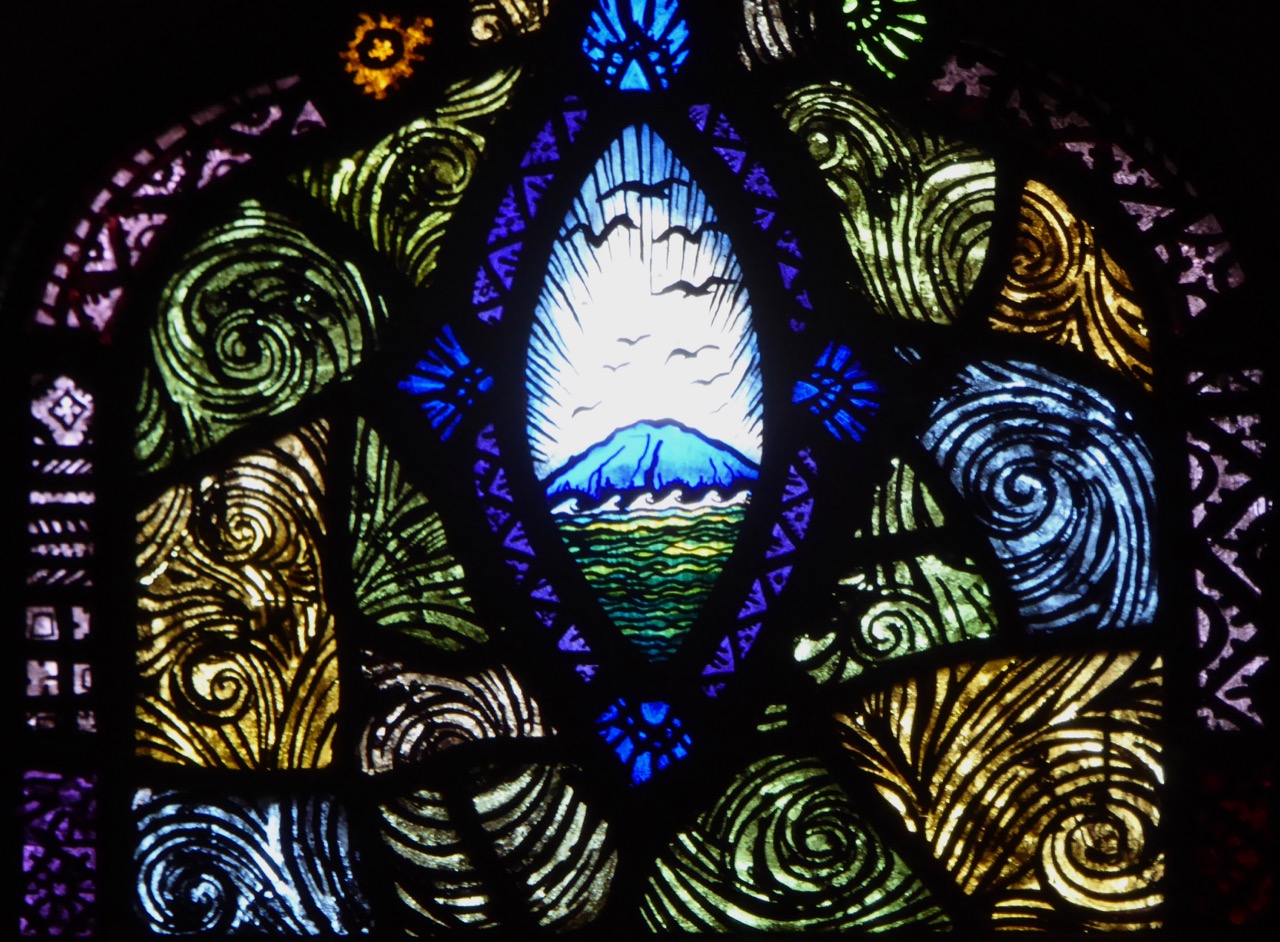
From the Ballinrobe window, a detail showing what Brendan was seeking – the Land of Promise

Both in his poetry and criticism, Arnold explored issues of morality versus religion, and themes of alienation and redemption. Clarke was constrained to work on religious subjects since most of his stained glass commissions came from churches, but revelled in the chance to introduce details from mythology and ancient hagiographies (such as O’Hanlons Lives of the Irish Saints which he consulted exhaustively) and to use those details as a springboard for his own imagination.

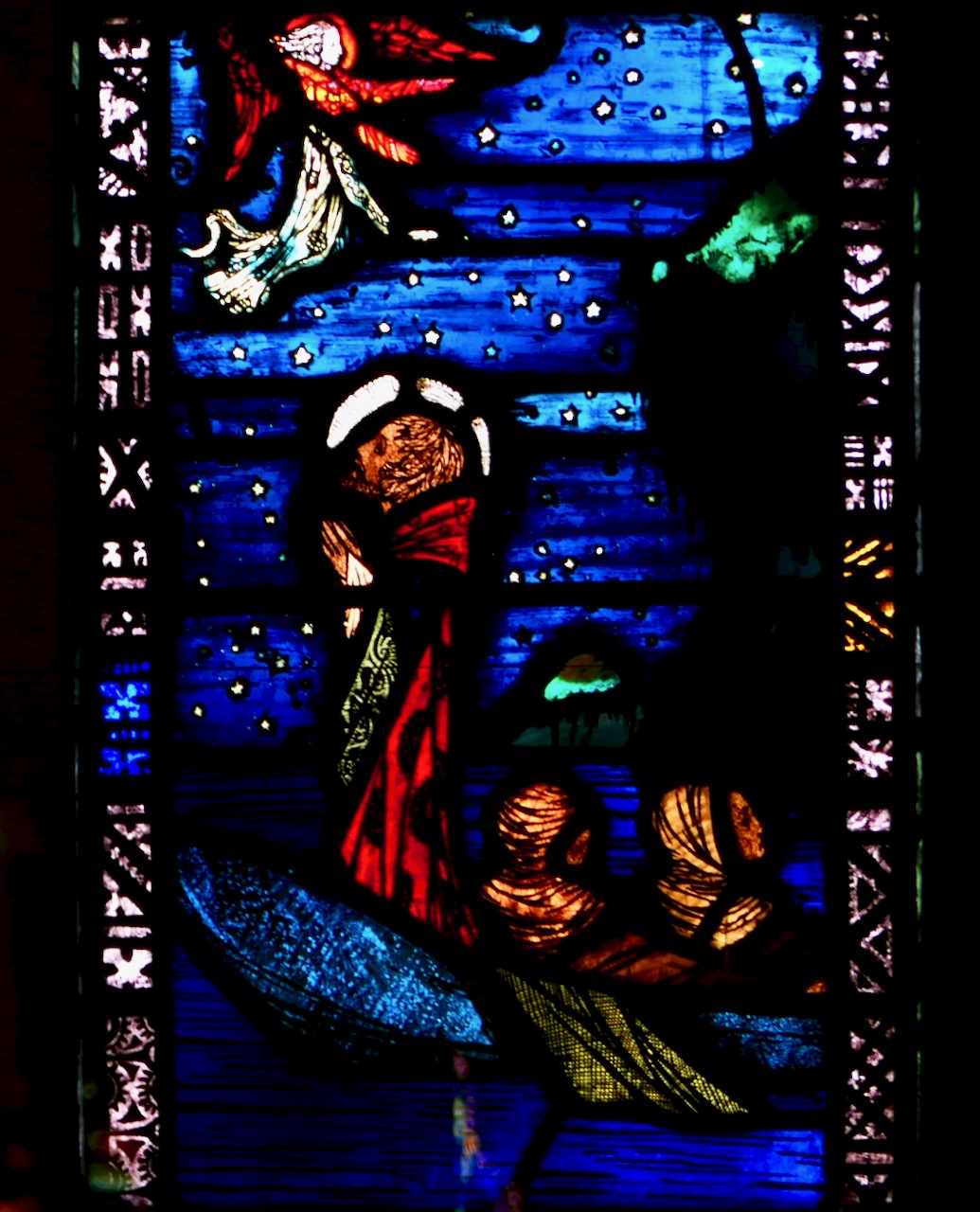
Also from the Ballinrobe window, the bottom panel shows Brendan praying  at the bow of the boat and an angel appearing

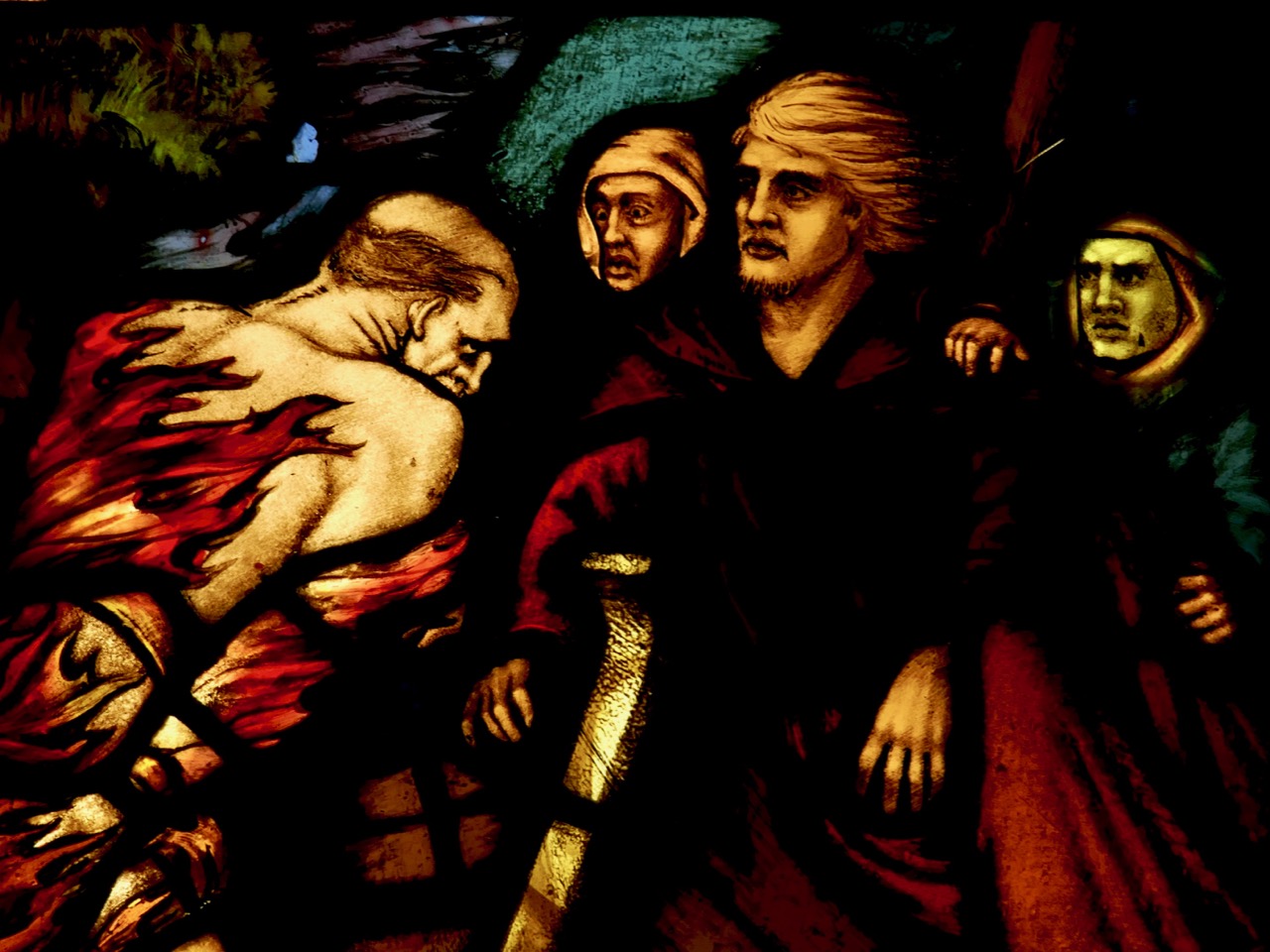
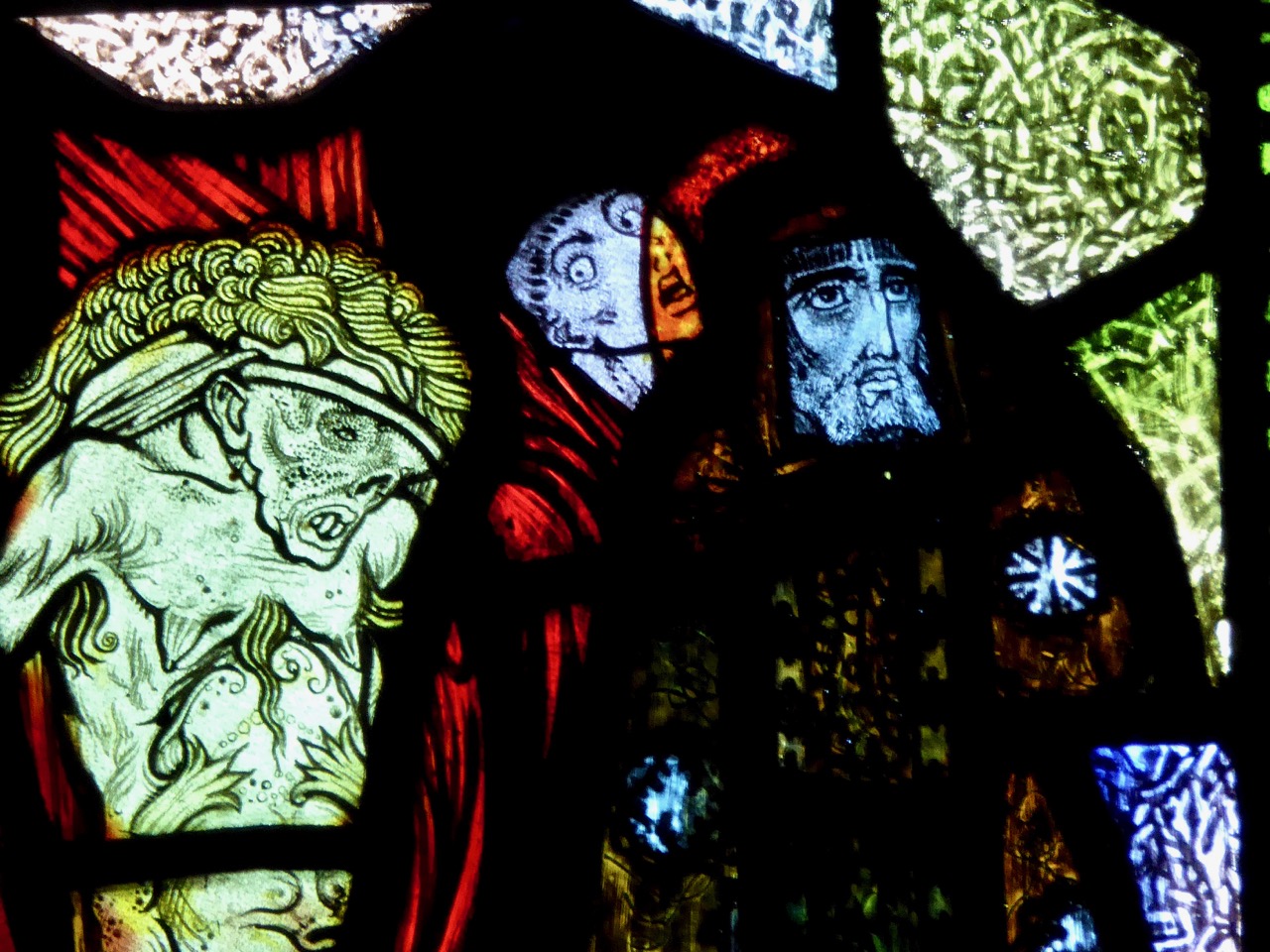
We can see the progression of his art, and his growing interest in the macabre, in the two depictions of Judas. Both are emotive and powerful, but in the first, from 1911, Judas is shown as a fully human, tortured man. In the Honan window, from 1916, he has turned into a monster with scales, feathers, fur and claws. One constant is that Brendan’s companions look on in shock and horror in both pieces, while the saint remains unmoved, gazing thoughtfully and perhaps compassionately on the scene.

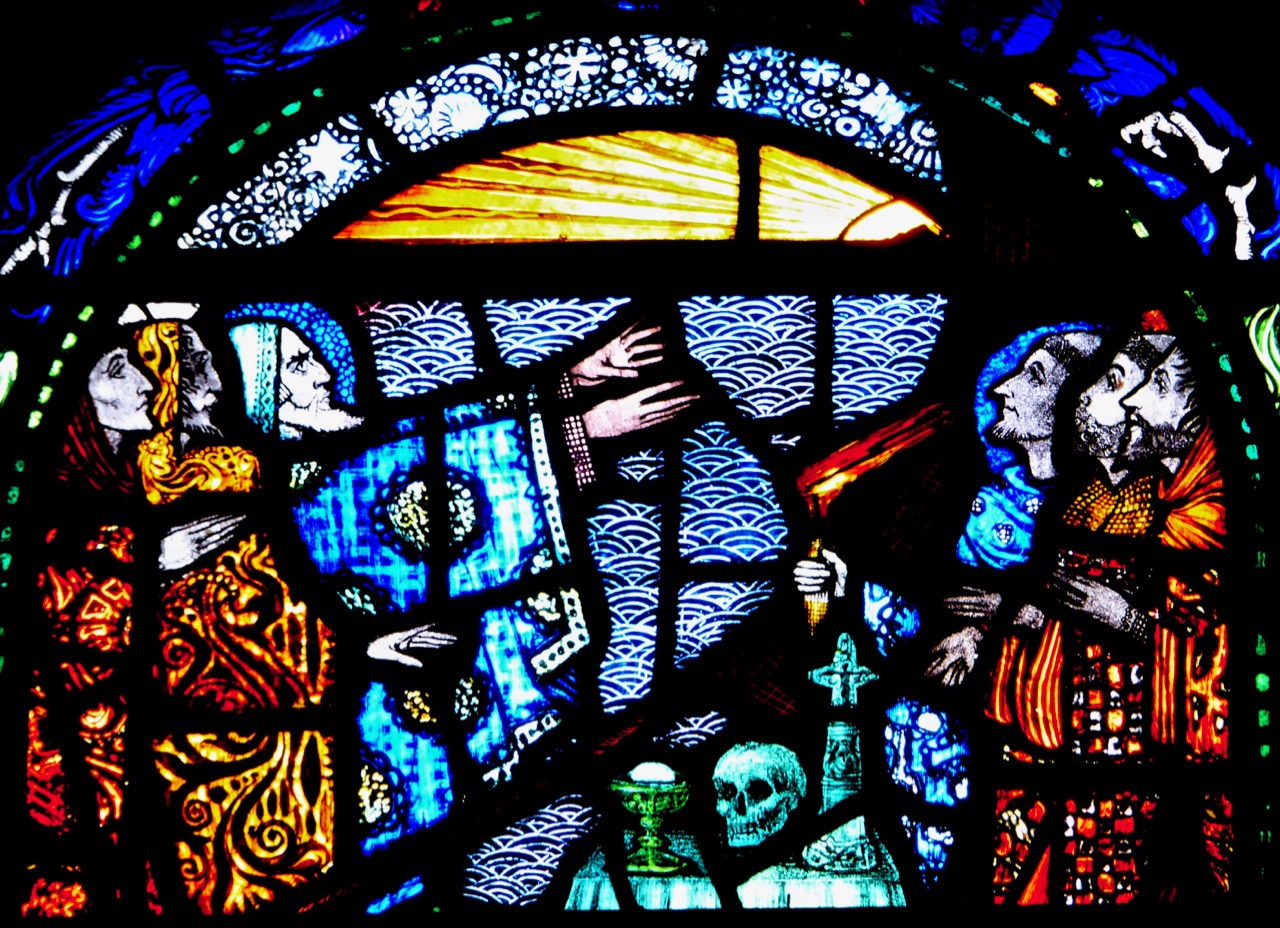
From the Honan window, according to Gordon Bowe: ‘The upper panel which perhaps represents Brendan’s vision of Paradise, is spanned by a golden hemisphere and depicts the saint at sea in his coracle, preaching to his companions as they approach the skull-ridden coastline of America in their search for the Islands of the Blessed’

Harry went on to design two more Brendan windows, but chose different details for them. In fact, he wrote to Monsignor D’Alton at Ballinrobe, ‘The meeting with Judas I have done too often to do again with enthusiasm.’  Arnold’s poem was first published in 1860. He died in 1888 and Harry was born in 1889, so their lives did not overlap. But Harry was very well read and Arnold, at the turn of the century, was still considered one of the major poets of the Victorian era. I think you will find that the poem and the windows are a successful collaboration between two iconic figures of art and literature. I give the poem now in its entirety, illustrated by Harry Clarke. [The first image is from a panel in Tullamore, originally part of the St Brendan window but separated from it when the windows were relocated. The second and third image are from the 1911 student piece; the next three from the Honan Chapel 1916 window.]

Saint Brandan sails the northern main;

The brotherhood of saints are glad.

He greets them once, he sails again;

So late!—such storms!—The Saint is mad!

He heard, across the howling seas,

Chime convent-bells on wintry nights;

He saw, on spray-swept Hebrides,

Twinkle the monastery-lights;

But north, still north, Saint Brandan steer’d—

And now no bells, no convents more!

The hurtling Polar lights are near’d,

The sea without a human shore.

At last—(it was the Christmas night;

Stars shone after a day of storm)—

He sees float past an iceberg white,

And on it—Christ!—a living form.

That furtive mien, that scowling eye,

Of hair that red and tufted fell—

It is—Oh, where shall Brandan fly?—

The traitor Judas, out of hell!

Palsied with terror, Brandan sate;

The moon was bright, the iceberg near.

He hears a voice sigh humbly: ‘Wait!

By high permission I am here.

‘One moment wait, thou holy man

On earth my crime, my death, they knew;

My name is under all men’s ban—

Ah, tell them of my respite too!

‘Tell them, one blessed Christmas-night—

(It was the first after I came,

Breathing self-murder, frenzy, spite,

To rue my guilt in endless flame)—

‘I felt, as I in torment lay

‘Mid the souls plagued by heavenly power,

An angel touch my arm, and say:

Go hence, and cool thyself an hour!

”Ah, whence this mercy, Lord?’ I said.

The Leper recollect, said he,

Who ask’d the passers-by for aid,

In Joppa, and thy charity.

‘Then I remember’d how I went,

In Joppa, through the public street,

One morn when the sirocco spent

Its storms of dust with burning heat;

‘And in the street a leper sate,

Shivering with fever, naked, old;

Sand raked his sores from heel to pate,

The hot wind fever’d him five-fold.

‘He gazed upon me as I pass’d

And murmur’d: Help me, or I die!—

To the poor wretch my cloak I cast,

Saw him look eased, and hurried by.

‘Oh, Brandan, think what grace divine,

What blessing must full goodness shower,

When fragment of it small, like mine,

Hath such inestimable power!

‘Well-fed, well-clothed, well-friended, I

Did that chance act of good, that one!

Then went my way to kill and lie—

Forgot my good as soon as done.

‘That germ of kindness, in the womb

Of mercy caught, did not expire;

Outlives my guilt, outlives my doom,

And friends me in the pit of fire.

‘Once every year, when carols wake,

On earth, the Christmas-night’s repose,

Arising from the sinner’s lake,

I journey to these healing snows.

‘I stanch with ice my burning breast,

With silence balm my whirling brain.

Oh, Brandan! to this hour of rest

That Joppan leper’s ease was pain.’—

Tears started to Saint Brandan’s eyes;

He bow’d his head, he breathed a prayer—

Then look’d, and lo, the frosty skies!

The iceberg, and no Judas there!