Ireland 50 Years Ago: April 1971, JM Synge Issue

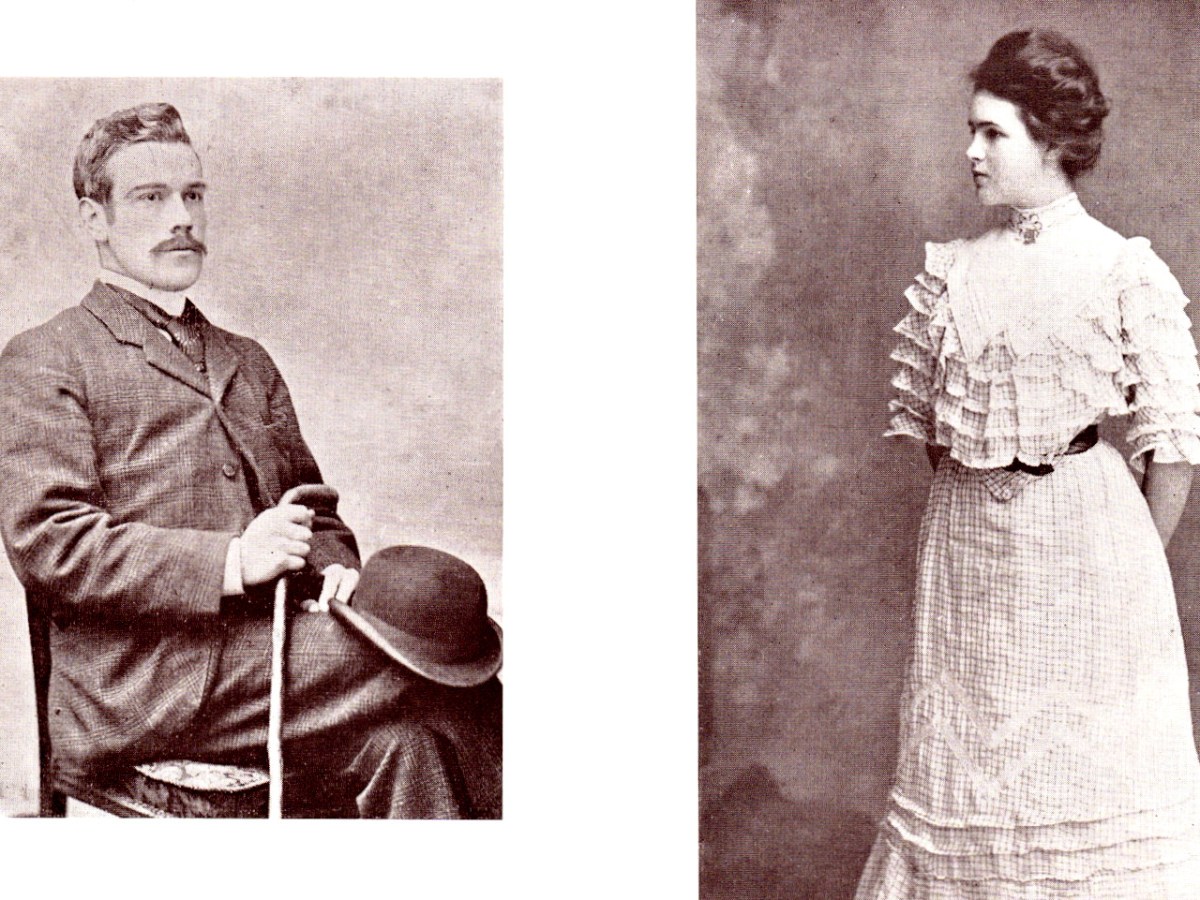
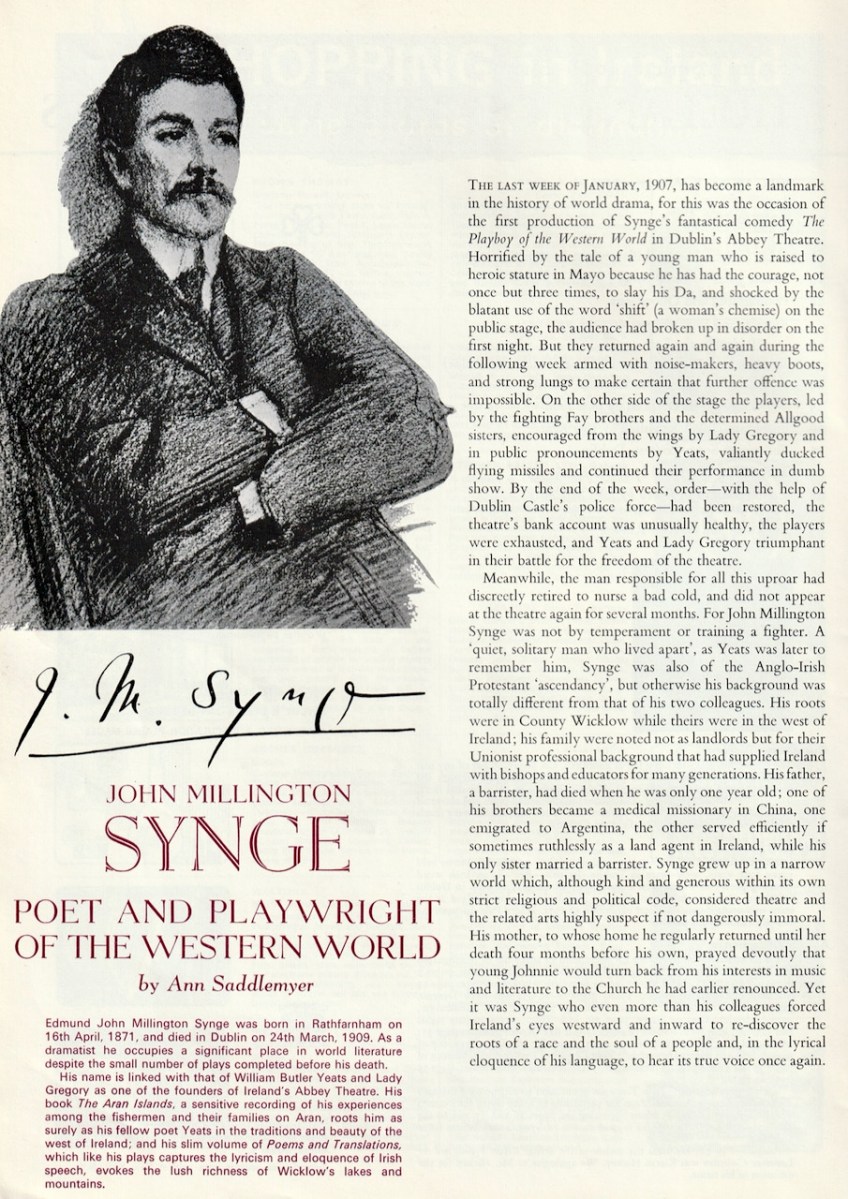
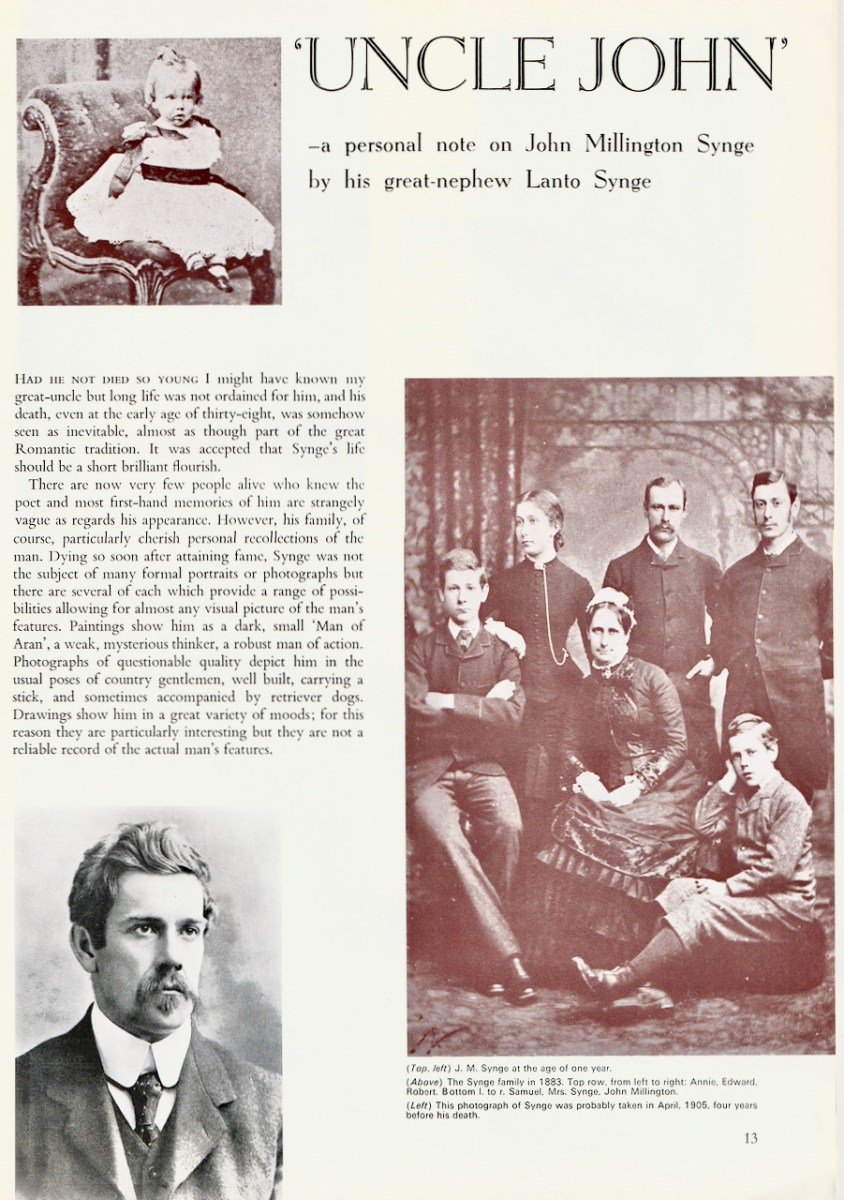
Back to Ireland of the Welcomes and this time to the March-April issue of 1971. This was a special issue, largely devoted to John Millington Synge, born April 16th, 1871, which means that next Friday is the 150th anniversary of his birth. These two photographs from this issue show Synge and the beautiful Abbey actor to whom he was engaged, Molly Allgood. Alas, JM died far too young, at 38, and Molly went on to lead a longer but unhappy life.

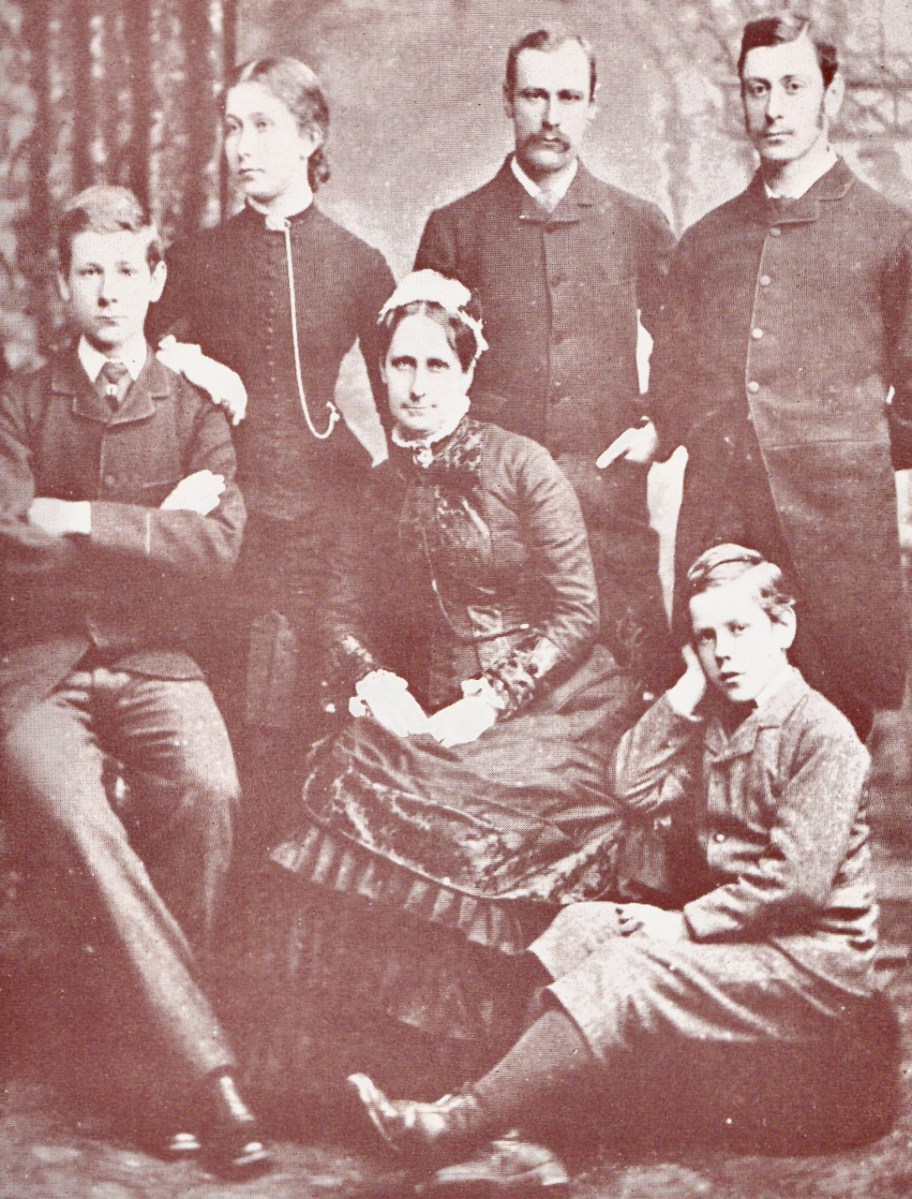
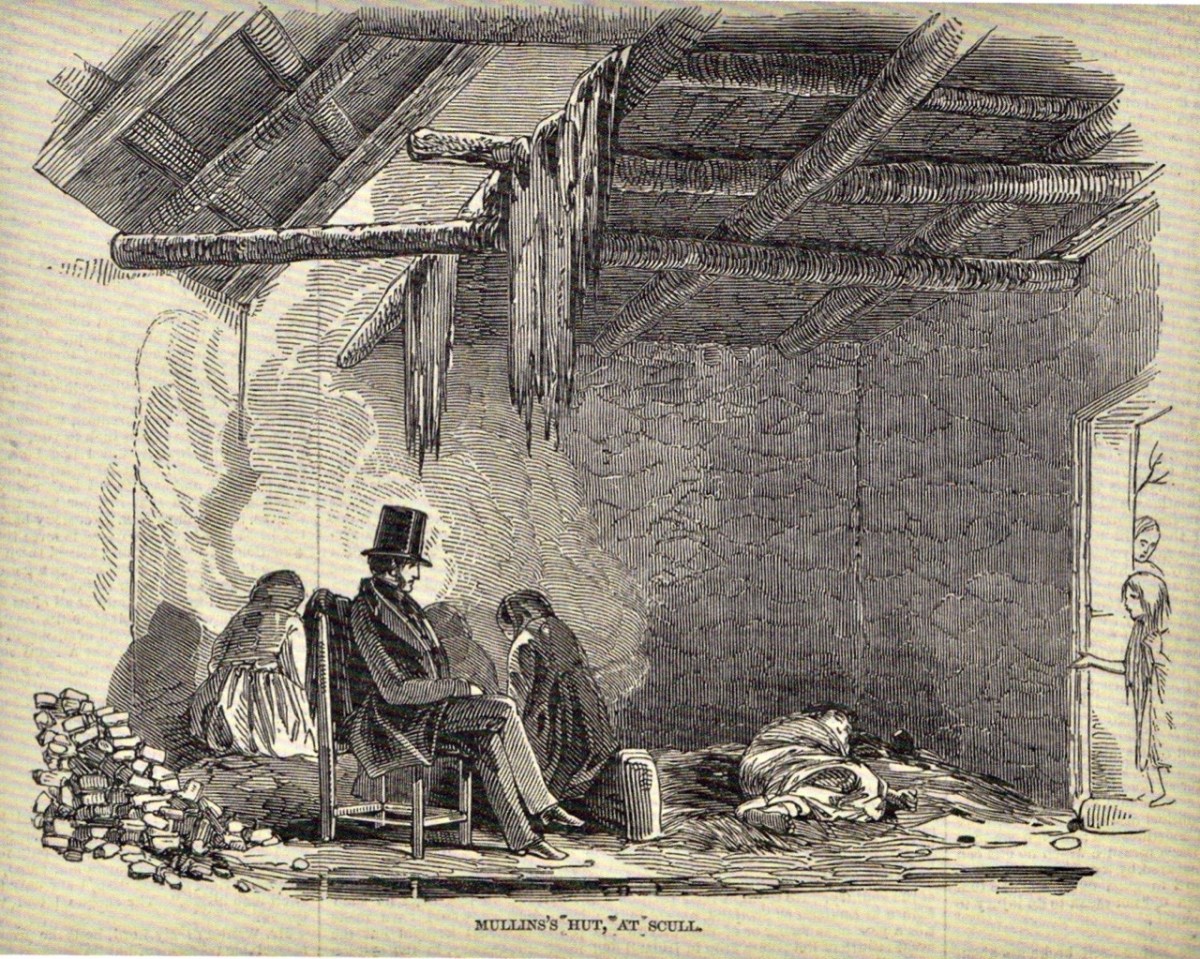
There’s a special connection to West Cork too – Synge’s mother, Catherine but known as Kathleen, was the daughter of the Rev Robert Trail, Rector of Schull. She is shown above with her children – JM is bottom right. I have written about the various roles her father played in this area.  During the Tithe Wars he railed against all protests, declaring that he “waged war against Popery and its thousand forms of wickedness”. He saw an outbreak of cholera after a huge rally as God’s vengeance on this who would deprive him of his income. He tried his hand at mining and established a considerable workings at Dhurode, the remains of which can still be seen – see Two Mines are Better Than One. It was doing well when interrupted by the Famine.  Finally, during the Famine, his better nature won out and he worked tirelessly to alleviate distress. He died of famine fever in Black ’47, universally mourned and honoured for his efforts to inform the public about the dire situation and to feed the starving people all around him. That’s Traill below in one of James Mahony’s sketches for the Illustrated London News – he had led Mahony to Mullins hut so he could witness and capture first hand the desolation, disease and despair.

That was in 1847 and Kathleen would have been 11. There is a contemporary account of how hard the whole Traill family were working to fill the soup pots, how difficult was the ceaseless onslaught of begging, how dangerous the fever-filled air. Her mother fled Schull as soon as she could after Robert’s death – she was later sent a bill for damage to the rectory caused by building a soup kitchen! Kathleen married a barrister, John Hatch Synge, and Edmund John Millington was their youngest child. Kathleen found solace from the trauma of her early experiences in her father’s stern fundamentalist faith – a faith that never wavered although it brought her into conflict with JM. Interestingly, that conflict did not destroy their mutual love for each other, and Kathleen (although looking stern in the photograph below) has been described as kind and generous.
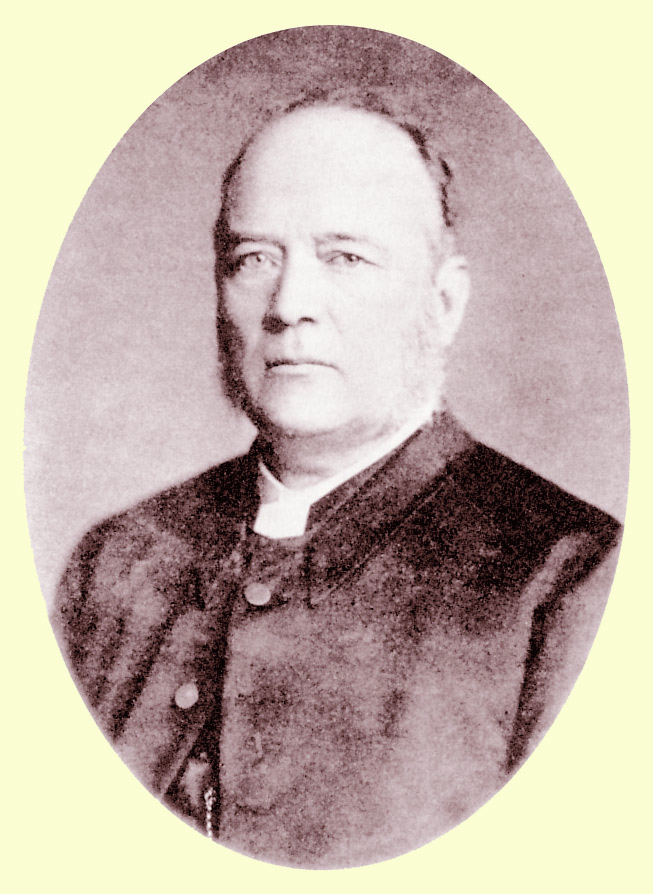
JM grew up to be one of Ireland’s foremost dramatists and the writer of a unique and inventive form of English that set out to capture the idiom and cadence of Irish. And here’s where our second West Cork connection comes in – his Irish teacher in Trinity was none other than our own Canon Goodman (below), who spent half of each year in his parish of Abbeystrewry in Skibbereen and the other half in Dublin teaching Irish. He had no more committed or enthusiastic student than JM. 

For an excellent summary of the life and work of JM Synge I recommend you to the essay by Declan Kiberd in the newly-available-online Dictionary of Irish Biography. In this issue of Ireland of the Welcomes the major essay on Synge is by the distinguished Canadian Academic Ann Saddlemyer. Saddlemyer is now 90, an elected member of the Royal Irish Academy and a long-recognised expert on Synge, WB Yeats and the history of Irish theatre.

Another charming piece is by JM’s great-nephew, Lanto Synge, a fine arts and antique consultant, recently retired. His essay tells the stories that have come down through the family, including the great religious divide. He paints a portrait of a shy, nervous, intensely musical and engaging man, travelling and studying wherever he went, philosophically attuned to modern thought while immersed in an appreciation of an ancient language and way of life.   

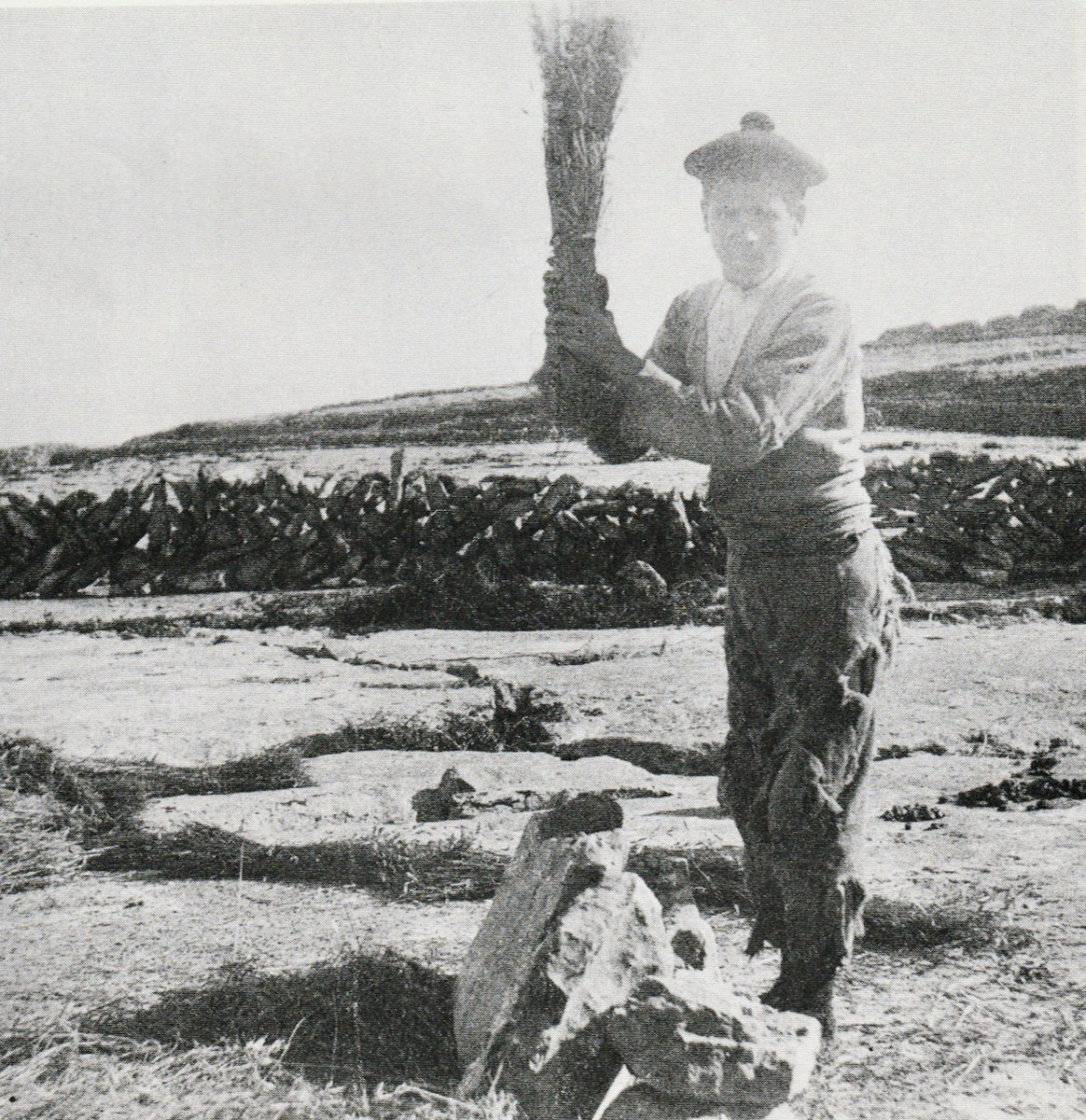
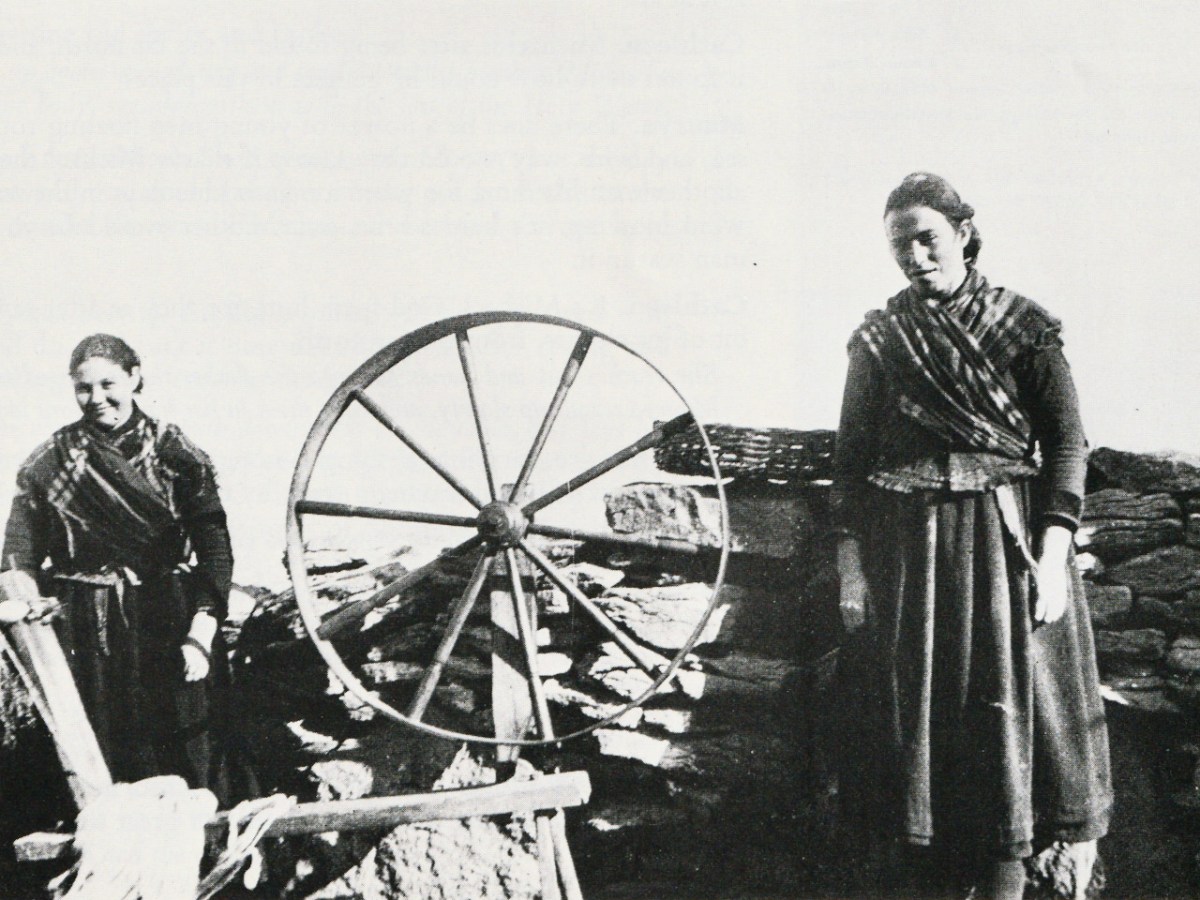
The issue contains several extracts from Synge’s plays, poetry and prose, each one illustrated by photographs or drawings.* One thing I hadn’t realised  is that Synge was an early photographer. Although some of his photos are are reproduced in this article (two examples below), you can see better images at Ricorso. They show he had an ethnographer’s eye and an interest in the everyday lived experience of his subjects, such as the man threshing by hand and the two women spinning.

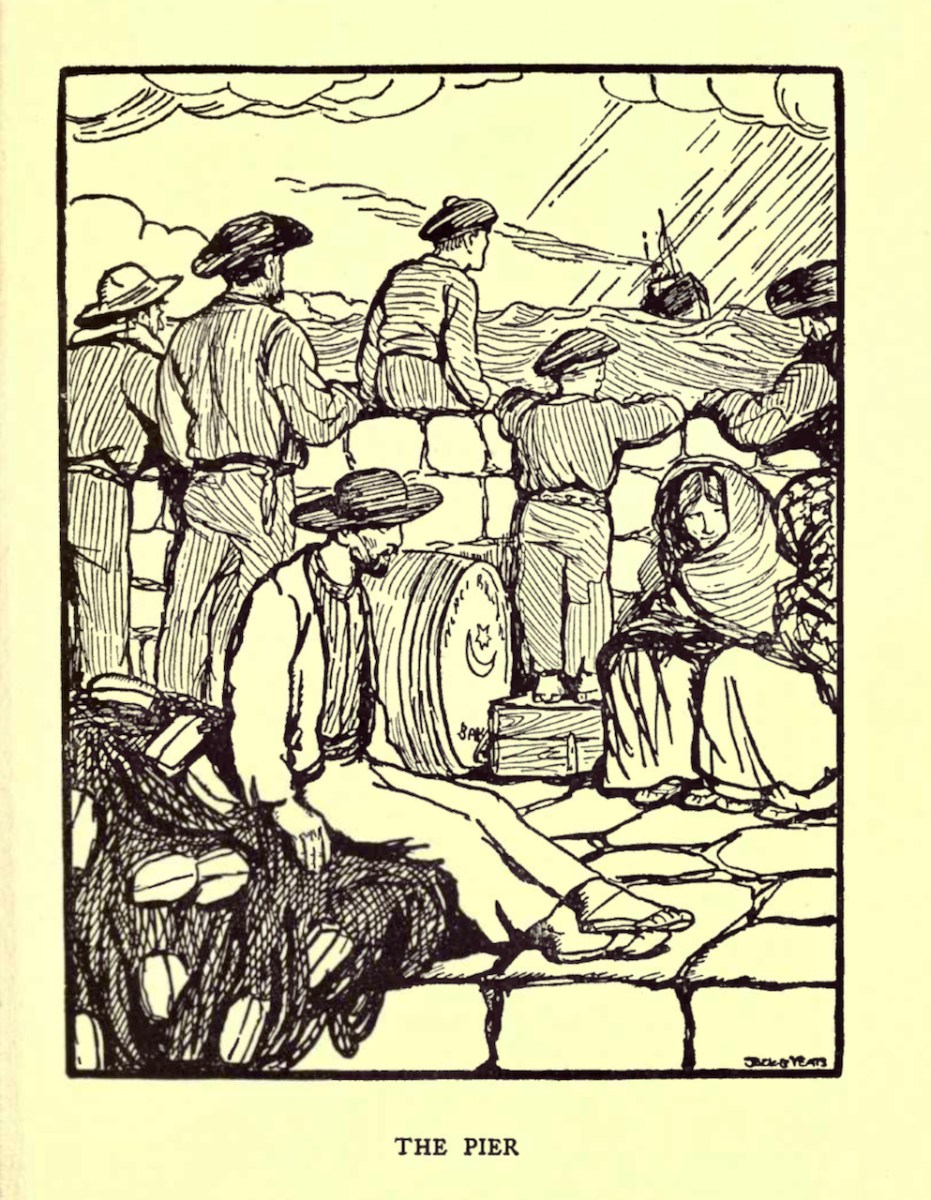
One of his great friends was Jack B Yeats and they worked collaboratively on several projects. Yeats illustrated his book on the Aran Islands (downloadable from archive.org – a site that is surely the greatest boon to researchers like us!). The two pictures below are from that source rather than the article. Synge and Yeats were of one mind, it seems, in what they chose to focus on.

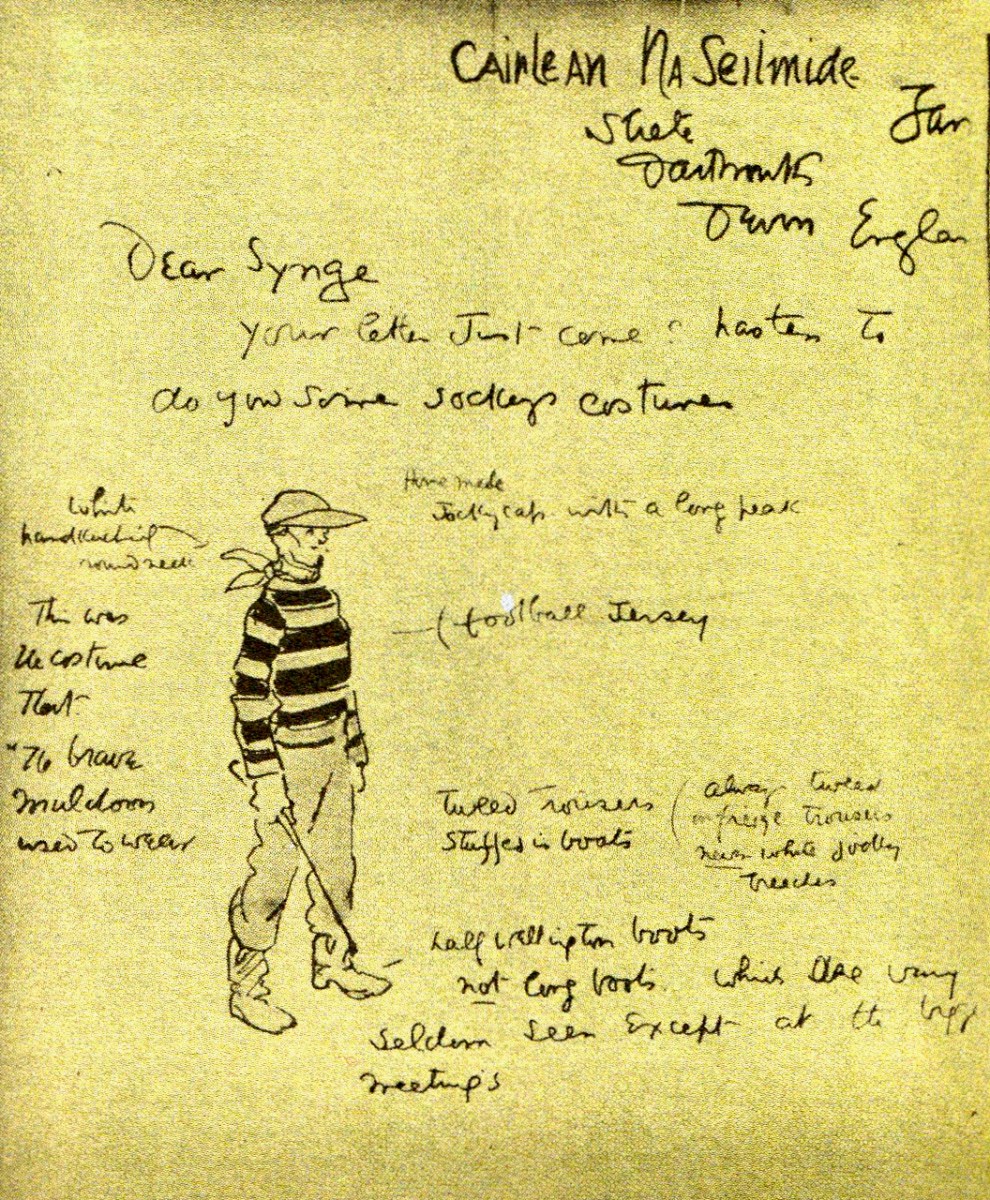
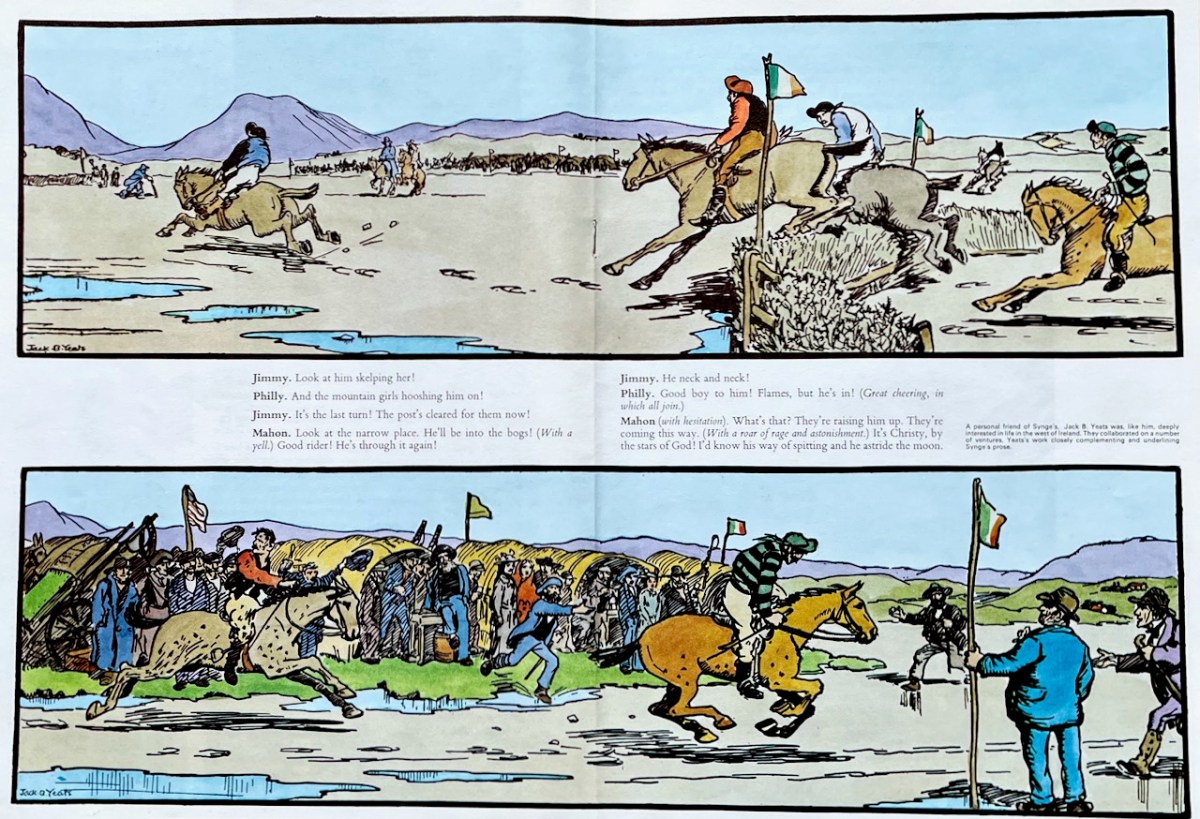
But Jack B Yeats did more than illustrate The Aran Islands – he produced drawings for Synge’s three-act masterpiece, The Playboy of the Western World. This appears to have been an iterative process. We see a letter from Yeats to Synge, advising on the outfit a jockey might wear in the West of Ireland.

The finished illustrations are wonderful – this subject gave Yeats great scope to indulge his love of horses and horse racing.

Two of the horse racing sequences occupy the centrefold of the issue. It is obvious that both Synge and Yeats are intimately familiar with, and relish, this kind of occasion in the West of Ireland.

This issue of Ireland of the Welcomes does contain a couple of other articles, but I will leave it there, since the bulk of it is devoted to Synge and it is good to focus on and celebrate him on such an auspicious anniversary.

*Although individuals (some no longer alive)  are thanked for illustrations in the issue, it is unclear after all this time whether there are any copyright issues and so I have reproduced illustrations from the magazine, and from my downloaded copy of The Aran Islands, with gratitude to those who provided them. I will remove these images, or seek permission to retain them, if I am alerted to any infringements of copyright.

Stained Glass Detectives – and a Find!

This is the story of what it takes sometimes to ferret out information about stained glass windows – often unsigned and undated and installed too far back for community memory to help. In this case, the window turned out to be a significant addition to the list of important Irish windows. Although it was I who first saw and photographed the windows in 2017, the detective work was largely done by my friend and colleague David Caron. David is the editor of the soon-to-be-published second edition of The Gazetteer of Irish Stained Glass and the most knowledgeable stained glass scholar on this island. My own contribution to the Gazetteer focusses on the work of George Walsh, but I am in the habit of photographing stained glass wherever I go, and I often send interesting windows to David or to other colleagues. In 2019, going though my photos, I came across two images that piqued my curiosity and decided to send them to David.

St Colman’s Catholic Church in Macroom (above, photo courtesy of the Buildings of Ireland) is a fine example of Gothic Revival architecture. The original church was built in 1826 – a significant achievement in the period before Catholic Emancipation and especially considering the poverty of the majority of the Catholic population at the time – and remodelled and extended in the 1890s. It has several stained glass windows inside – an Earley, some Harry Clarke Studios from the period after Harry died (such as the one below), and others that are unsigned and possibly imported. A fairly standard assemblage for a church of this period.

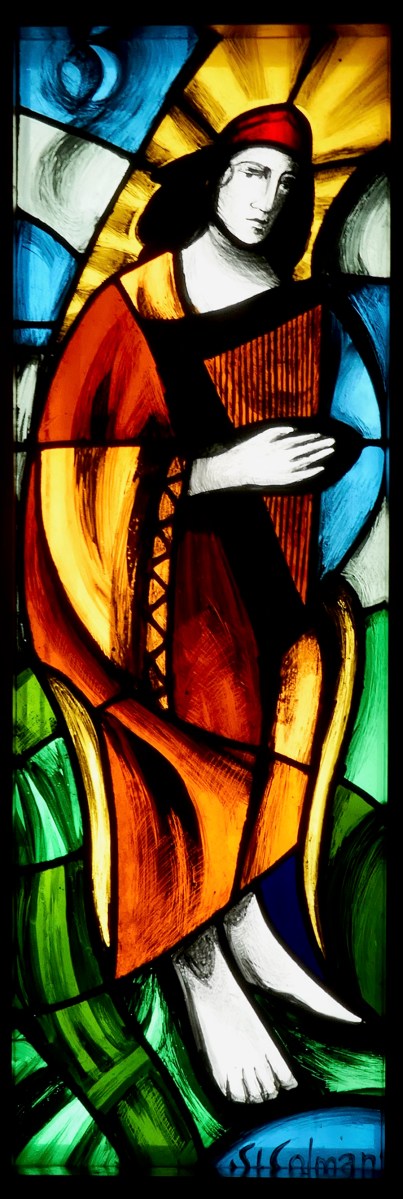
What caught my attention, however, were two panels in the entry porch. Rather than being fitted into true windows, the two pieces are installed in back-lit cabinets. The backlighting wasn’t quite bright enough so the windows did not show to full advantage and it was hard to make out any detail. Nevertheless, they were arresting in their modernity and in how different they were to the other windows inside the church. The first, to the left of the door, is an image of St Colman of Cloyne, patron saint of the diocese and of the church itself. He is depicted with a harp, dressed in long robes and with large bare feet. The harp is a reference to his status as a noted bard or poet – medieval bards recited their compositions to the accompaniment of the harp. The figure is surrounded by glass panes of varying shapes mostly in shades of green, and an aura radiates around his head.

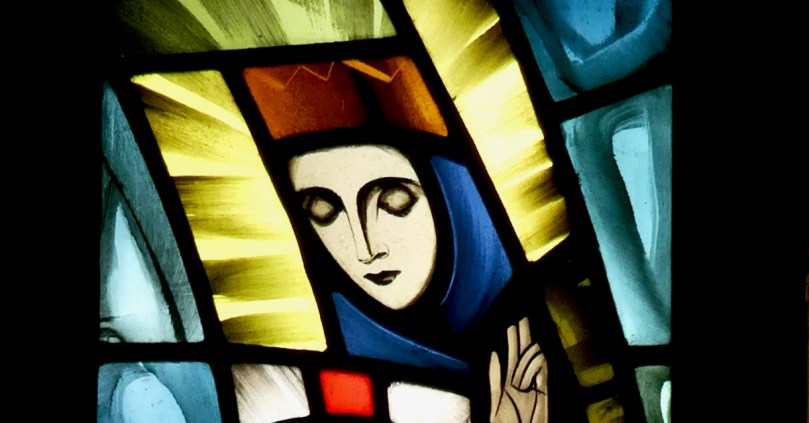
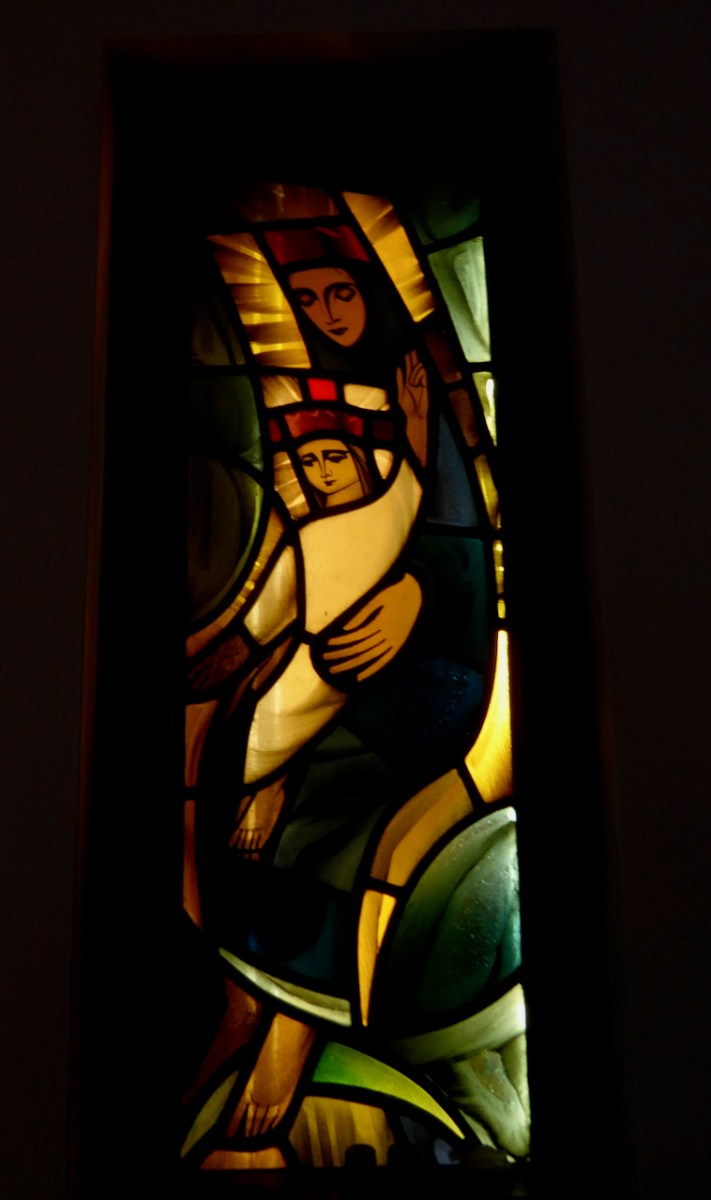
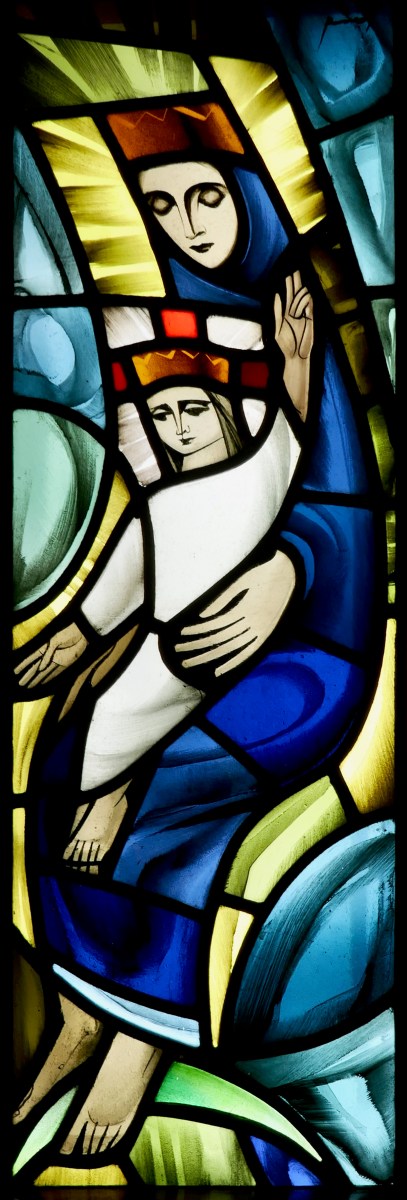
The glass to the right of the door is a depiction of the madonna and child. Mary wears a wimple with a fez-like top and a long robe in olive green. She is seated and in her lap is the Christ child with one hand raised in blessing. He wears a crown and a white robe. Their faces are similar with a small mouth, long noise and heavy eyebrows (see lead image). Mary’s large foot rests on a crescent moon and her head and Jesus’ are surrounded  by an aura. Like Colman, the figures are set within irregularly shaped pieces of coloured glass in shades of green.

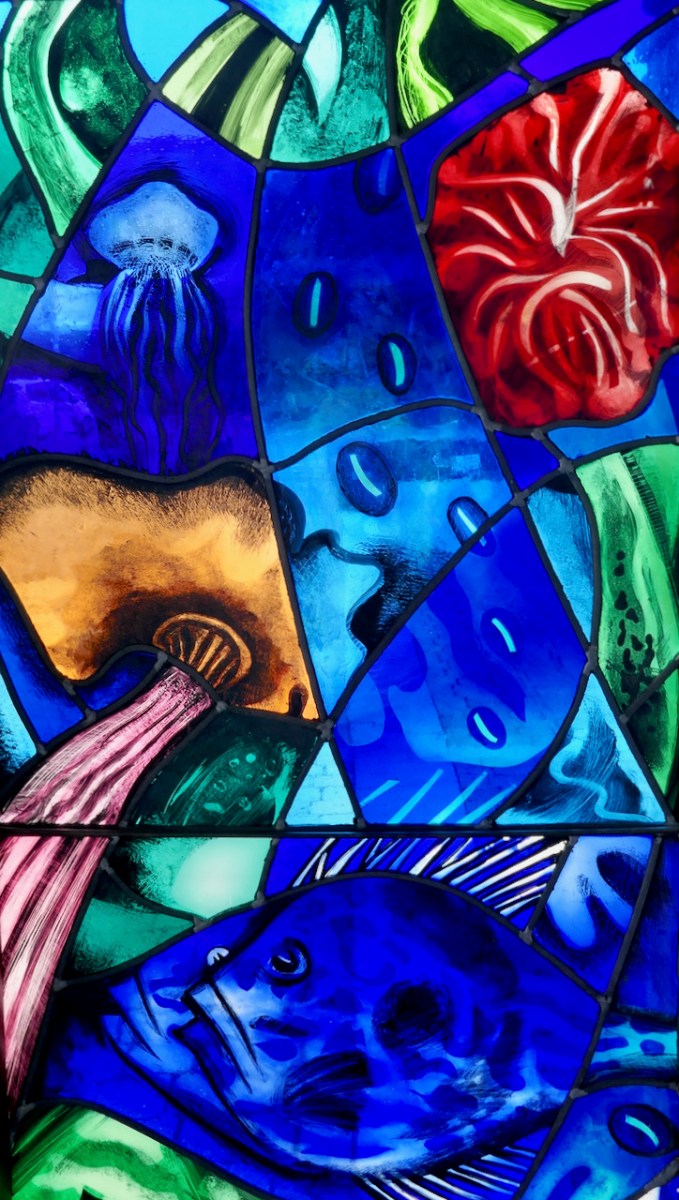
David decided to track down the mystery of who had made these windows and finally managed to get in touch with Fr O’Donnell, a retired Parish Priest who was very helpful indeed. He remembered that the windows had been made by a “Swedish woman from Skibbereen”. I got on the case and through a series of inquiries found Carin MacCana, who no longer does stained glass but still lives in West Cork. Below is an example of her previous stained glass work from the Skibbereen Heritage Centre, based around the sea creatures of Lough Hyne.

Carin confirmed that she had indeed done one of the windows. Wait, what? One of the windows? Yes, in fact she had been asked to match her window, St Colman, as closely as possible to the existing Madonna and Child window but she did not know who had done that one. Meanwhile, the enterprising Fr O’Donnell (now 90) was making good on his resolve to improve the backlighting. In the course of this, the signature ‘K’ was noticed on the back of the Marian panel. Fr O’Donnell recalled that the Madonna and Child had been presented by the artist Thomas Ryan, PRHA, in memory of a friend of his, a local doctor. Armed with this information, David went back to Carin who then remembered that she had been told the name of the artist was Richard King.

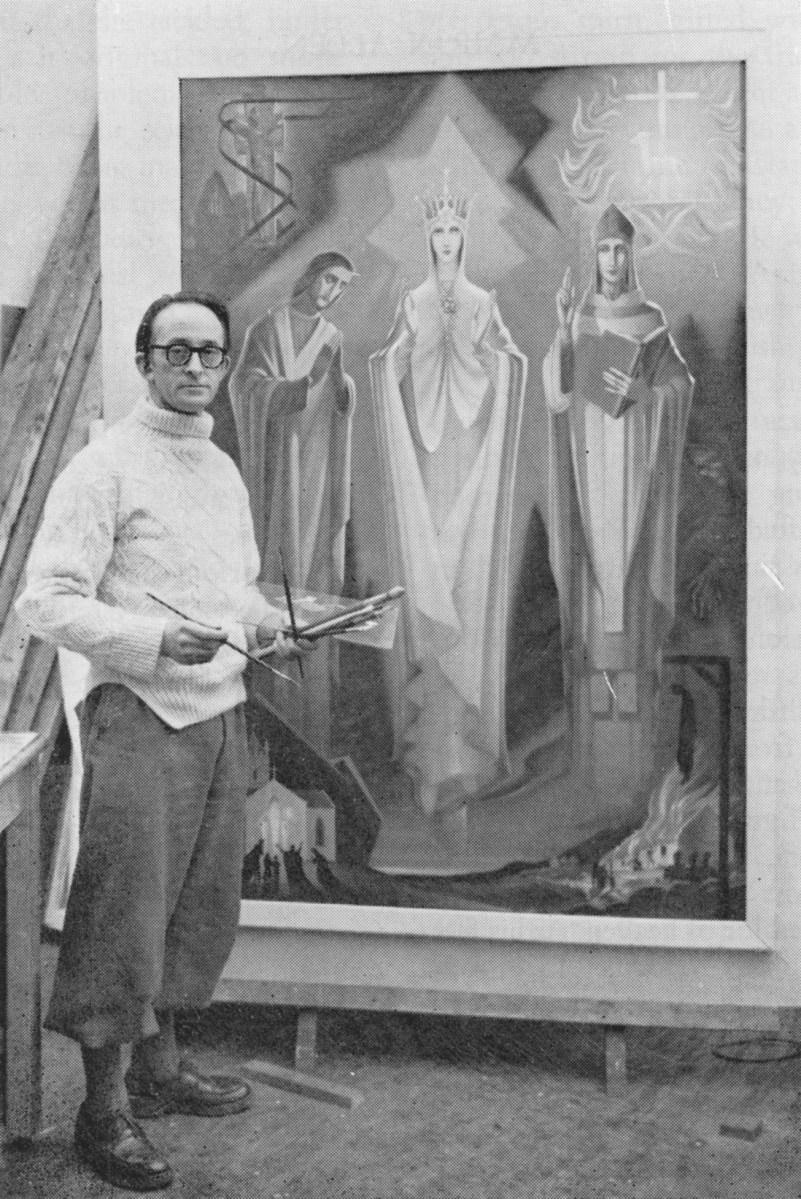
 Richard King in his studio, courtesy of the Capuchin Archives. The 1975 volume has extensive images and moving obituaries for King, beginning on page 169: he was the magazine’s chief artist.

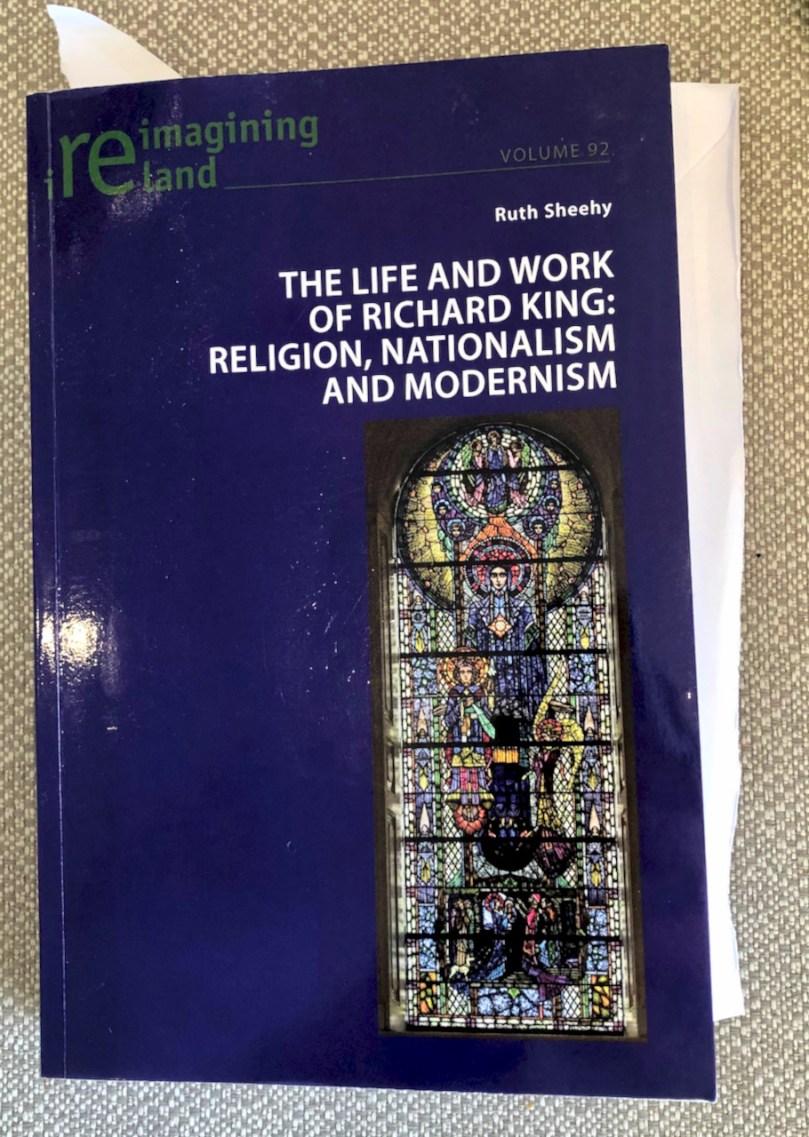
Although I have written about Richard King before (see Richard King in Mayo and Discovering Richard King), I am no expert – but we know who is! David immediately consulted Ruth Sheehy. Ruth has recently published her magisterial study The Life and Work of Richard King: Religion, Nationalism and Modernism – an engaging, erudite and exhaustive study of King’s artistic output, including his stained glass. This is my well-thumbed copy.

She was delighted to confirm that this was indeed the work of Richard King, and that it was a panel she knew existed, but had never managed to find. She pointed us to a similar panel – a ‘twin’ – that King made for the Church of the Holy Cross in Aberaeron in Wales. That panel has been well documented by Martin Crampin, artist and academic, who is the acknowledged expert on Welsh stained glass. He has kindly given me permission to reproduce his photo of that window, “Our Lady of Ireland”, below. For more on that window, see his listing here: http://stainedglass.llgc.org.uk/object/970 and also his blog post about this and another Richard King window in Wales: https://stainedglasswales.wordpress.com/2020/12/17/richard-king/

Of the Welsh window, dating to 1958, in her book, Ruth says:

The Virgin Mary seated with the Christ-child shown in red, is depicted as an Irish woman with a blue shawl around her head and shoulders. The two figures are seen in the centre against a background of large areas of vibrant colour and cubist-abstract shapes. As King knew and admired Mainie Jellett’s art, he would have been aware of her meditative and indirect approach to religious themes as shown by The Ninth Hour. . . Although King’s interpretation of figuration and non-figuration was somewhat different from that of Jellett, the stained glass window of Our Lady of Ireland shows him experimenting with a cubist-abstract approach to form, light and colour which suggests an adaptation of her style.

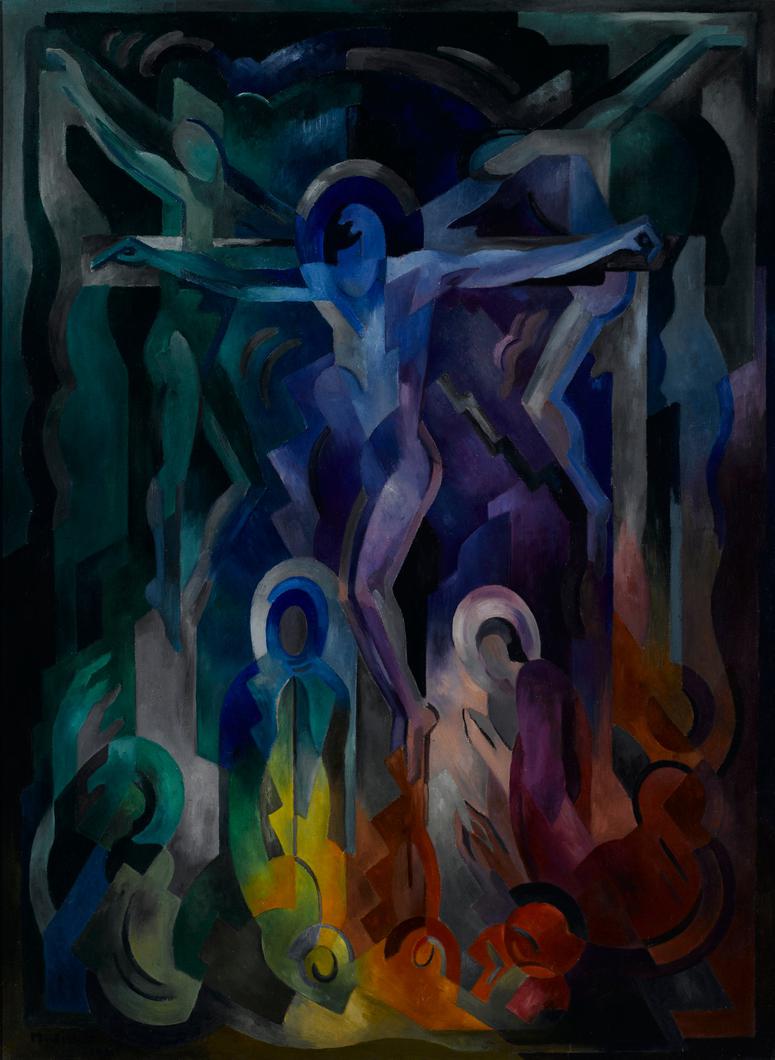
Mainie Jellett’s The Ninth Hour, 1941, oil on canvas, Collection Dublin City Gallery The Hugh Lane

Regarding the Macroom window, which dates to 1963, Ruth wrote to us in an email:

The Virgin and Child are depicted here as King and Queen of Heaven and this image has similarities with another work by King entitled ‘Our Lady of Ireland’ c. 1958 which is reproduced in the book. The half moon at the Virgin’s feet refers to her immaculate conception. The red and white halo behind the Christ child wearing a crown indicates that his kingship is based on his ultimate Cross and resurrection and is not of this world.. . . . The large hands and feet of the figures and their expressive quality would suggest the influences of Evie Hone and modern German stained glass on King’s stylistic development at this period.

Fr O’Donnell has now had the windows cleaned and installed much improved back-lighting. The results are wonderful and allow us to see the windows properly, as both Carin MacCana and Richard King intended. Carin has done an outstanding job of matching King’s style, which is why we all assumed in the beginning of the hunt for answers, that this was a pair of windows done by the same artist. The colours of the St Colman window, instead of being muddy and autumnal now glow in golds, blues and greens.

As for King’s Madonna and Child window, the colours are quite different from how they appeared before. The background is dominated by light yellows and pale blues and greens, while Mary’s robe is not olive green but a brilliant azure – and it is now obvious that the ‘fez’ is a crown. The red and white halo (a favourite symbol of King’s) is also clearer now. Both of these windows beautifully illustrate the importance of proper back-lighting.

It isn’t every day that you can be part of rediscovering a ‘lost’ work of art – what a privilege it has been to be part of this journey.

Dean Swift and I

Robert writes:

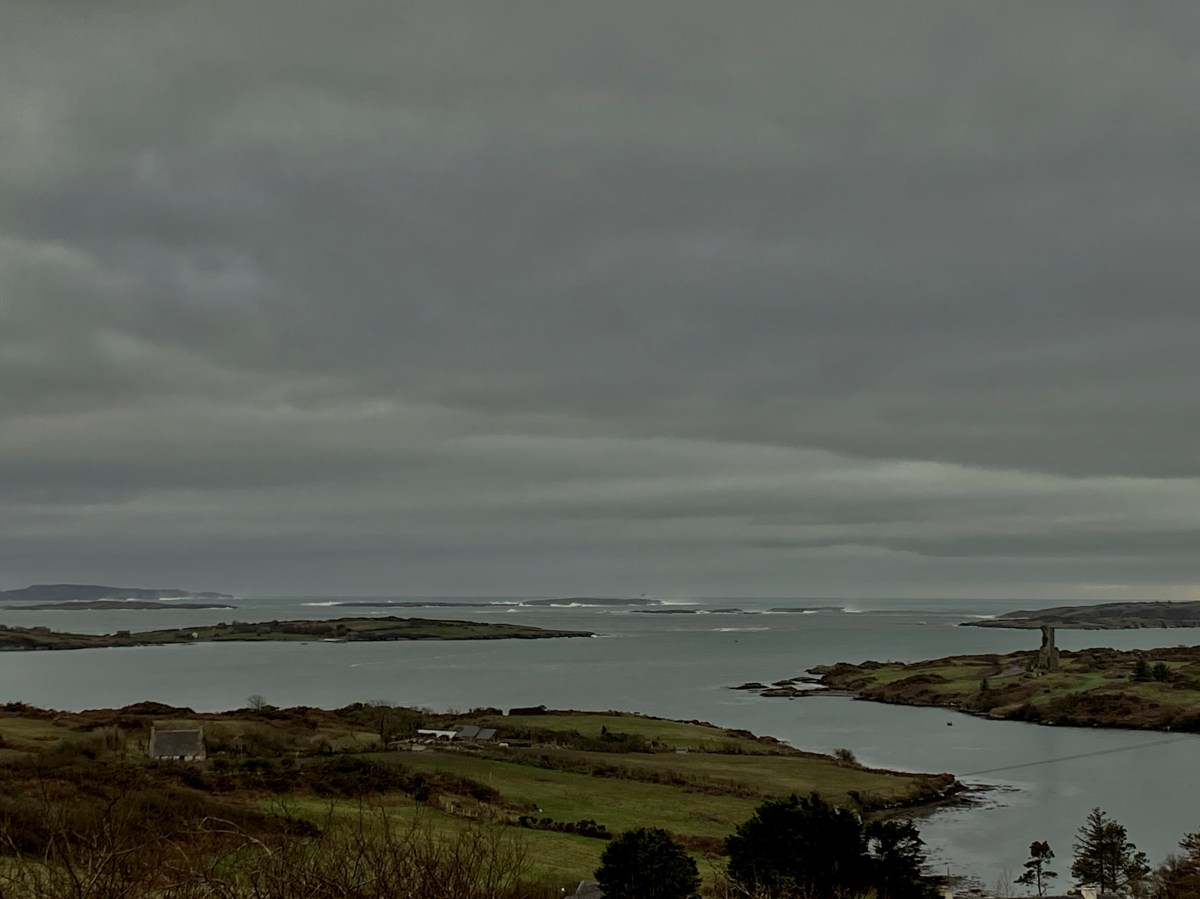
Our weather has turned grey and damp. Our 5k Covid limited walks to seek inspiration for the posts we write for you every week are less than comfortable, and our photography is suffering. But we are undaunted! Spring is just around the corner (it starts tomorrow, on the first of February – Imbolc – here in Ireland) and we will soon see the emerging wildflowers in our verges. We will notice the days getting longer. Meanwhile, let’s enjoy the stormy prospect from our eyrie:

Roaringwater Bay, January 30 2021. Between the islands the water is always calm but you can see the force of an Atlantic storm stirring things up beyond them

For my post today I’m diving into our archives, but also travelling back in time – in my own life. The topic is an Irish one – and has West Cork connections (you’ll see) – but writer and satirist Jonathan Swift appeared in my view early on, and through a somewhat odd series of events which touch on many things – historical characters, folktales, archaeology, and hauntings. Here is how I came into the company of Dean Swift before I was ten years old!

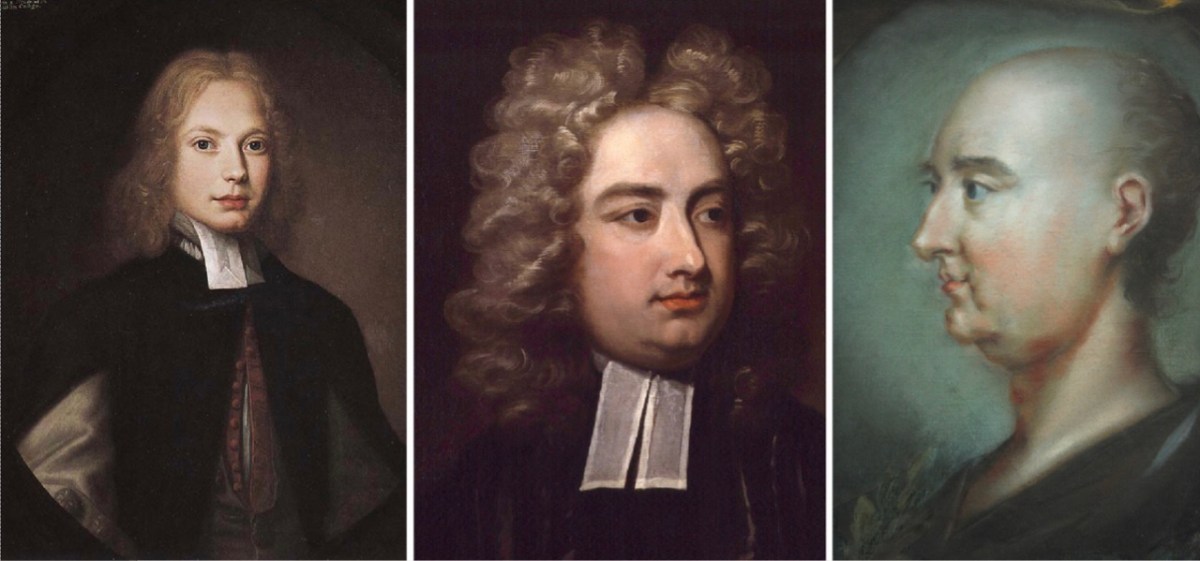
Jonathan Swift, born in Dublin in 1667: left – in 1682 (when he was fifteen years old) painted by Thomas Pooley; centre – in 1710 (aged 43) by Charles Jervas and right – in 1745 (the year of his death, aged 78) by Rupert Barber (National Portrait Gallery, London)

I was born and brought up in a small country town in southern England – Farnham. A big influence on my young life was my grandmother, Annie – we always called her Granma. But she wasn’t a relation at all: my mother had been orphaned (by the 1918 ‘Spanish Flu’) at the age of four, and lived in a children’s home until the age of 16, after which she was fostered by my Granma. In my younger years my mother worked as a shorthand typist. I had no idea, then, what a ‘short hand typist’ was, but I must have formed an image of sorts in my mind. Be that as it may, the consequence was that I spent time with my Granma during my mother’s working hours in school holidays – and, quite often, at weekends.

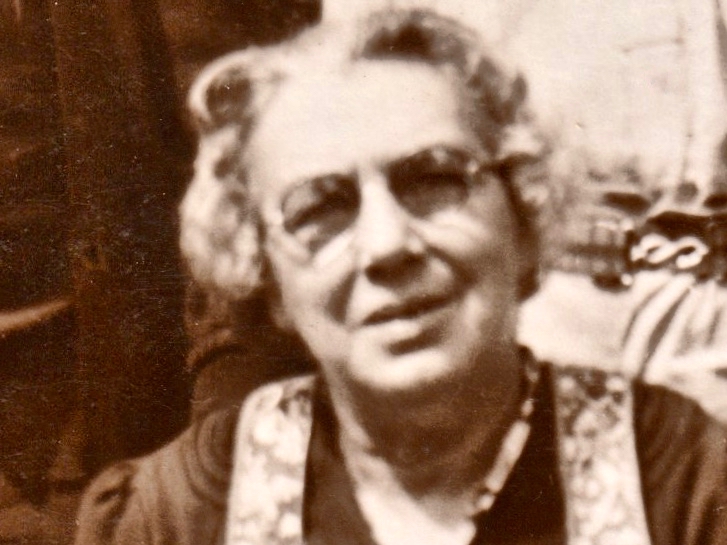
My Granma – the one picture I have of her, above – was only ever the kindest of ladies. She helped me to learn to read well from the age of four, and embedded in me a huge love of books – and stories. Widowed, she lived alone in 2 Darvill’s Lane, Farnham. And that’s where I have the happiest of my childhood memories. Why? Because it was such a different house from my parents’. It had no electricity, a big black coal range and an outside lavatory – all thoroughly fascinating. The gaslights hissed and spluttered in a friendly way on winter evenings; there were always interesting things sizzling on the range – and blancmange for pudding, and fruit cakes for tea! And, although there wasn’t electricity, there was a large wireless set with a bakelite shell, shiny knobs and a glowing celluloid dial splendidly esconced on its very own table in a corner of the small sitting room. I can still see it in my mind’s eye, although I have no memory of what I might have heard from its gold-meshed speaker as everything seemed obscured and overlayed by intense crackling. A cable descended from the set to a large glass accumulator sitting on the floor beneath. This was similar in size and weight to a car battery today. One of my frequent duties when staying with Granma for an afternoon in the holidays was to help dismantle this accumulator, place it into a wheeled shopping basket and trundle it up into the town where it was exchanged for a freshly charged apparatus of the same design, a task which had to be done weekly (and cost how much? Sixpence…). But, I digress . . . Let’s move on to the subject of this post – Dean Swift: what is his connection with my Granma?

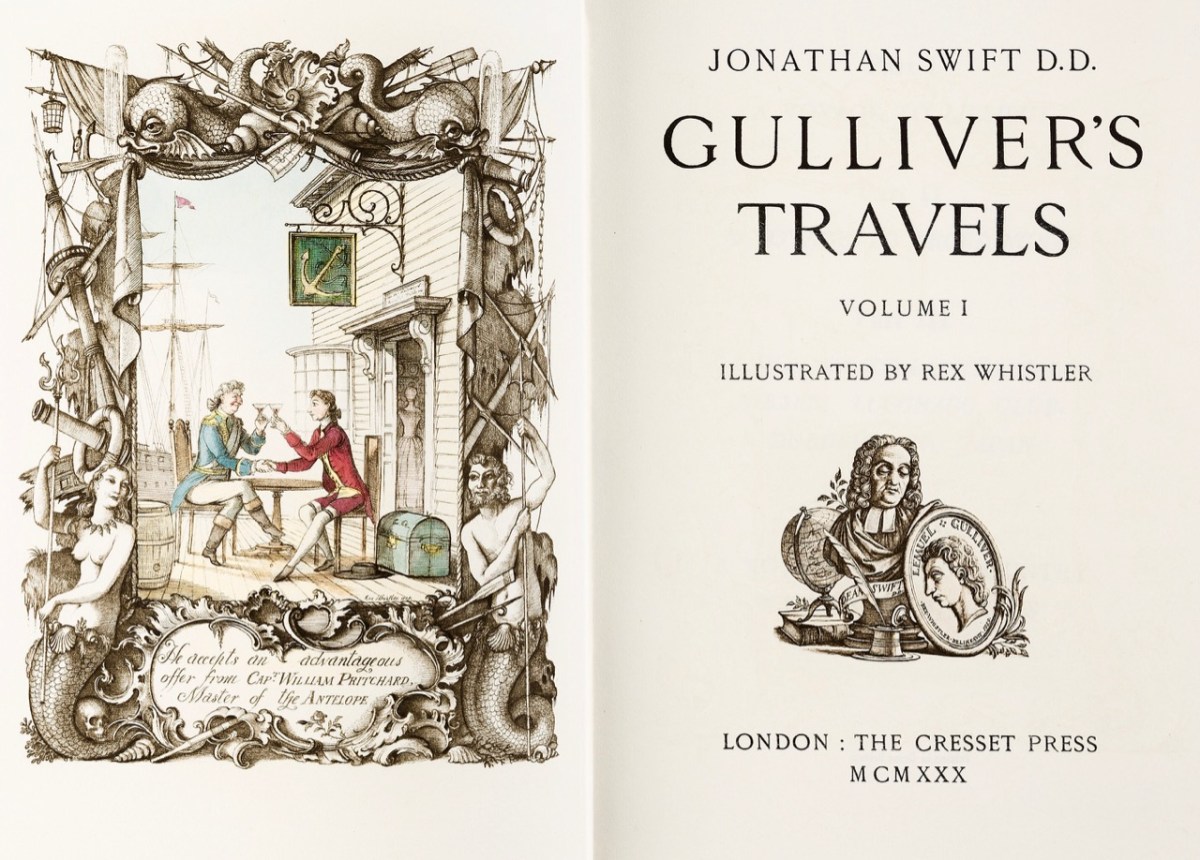
A particularly fine edition of Gulliver’s Travels in two volumes, dating from 1930. A similar one in good condition fetched £6,900 at auction last year. The first edition – also in two volumes – was issued on 28 October 1726, priced at 8 shilings and 6 pence

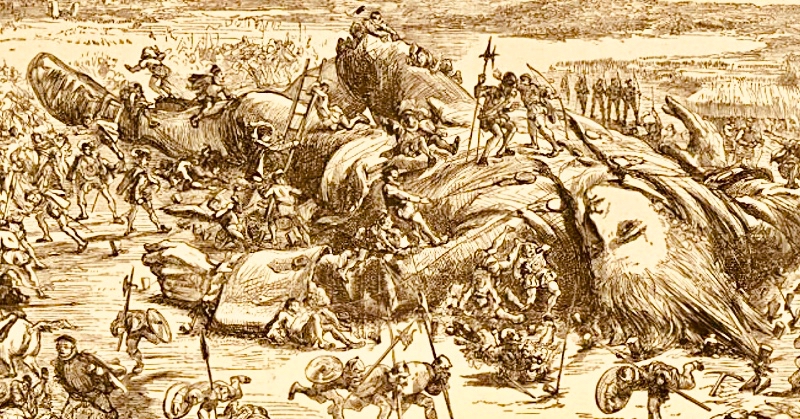
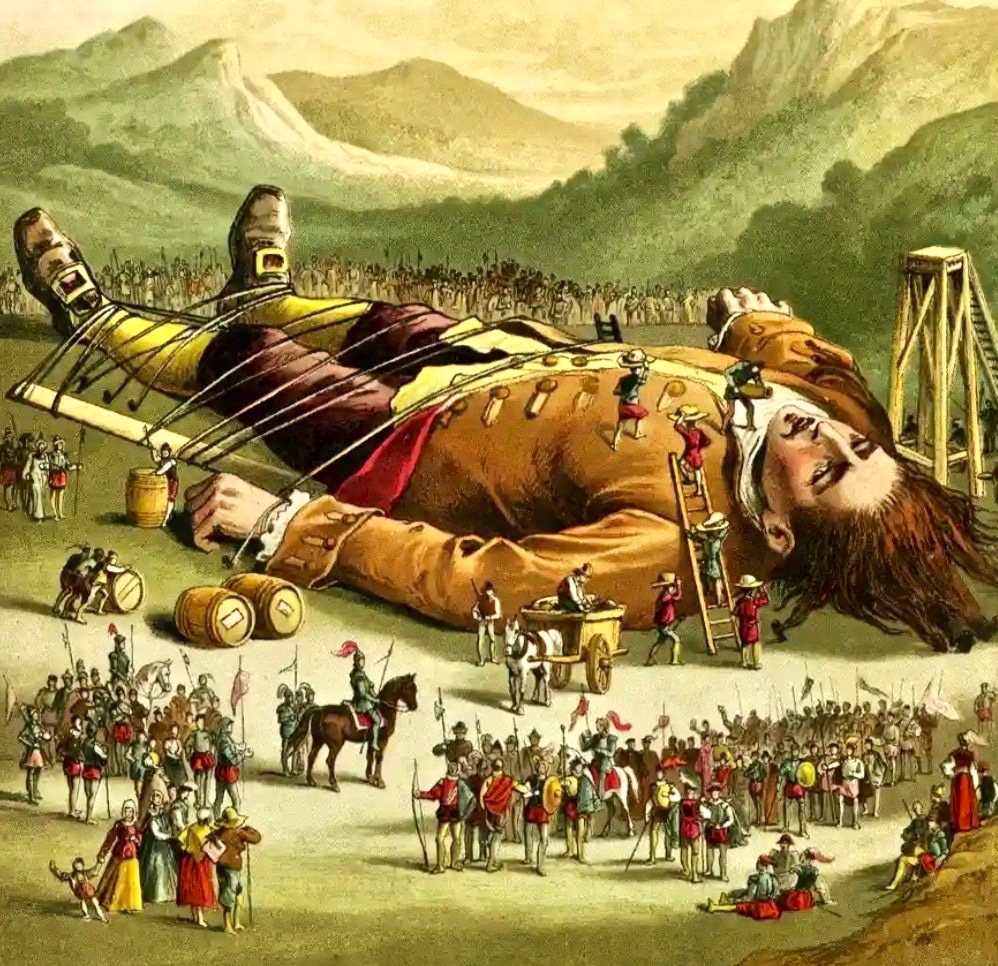
Gulliver’s Travels was one of the many books I read at my Granma’s house, probably when I was four or five. My version was nothing like the handsome one above: it was the Ladybird Books edition: I wish I still had it. Of course, I now know that practically everything of value historically had been expurgated from this and all other children’s renderings of the book (and plays, films etc) including all the (then) politically outrageous bits and the vividly scatalogical episodes. (If you don’t know these, one of the mildest is Gulliver’s success in putting out a house fire in Lilliput by publicly urinating on it, something for which he was convicted of treason and then sentenced to be blinded!). Nevertheless, at such an innocent age, who would not have been impressed simply by the illustration of a ‘giant’ man tied down to the ground with twine and surrounded by a horde of miniature people?

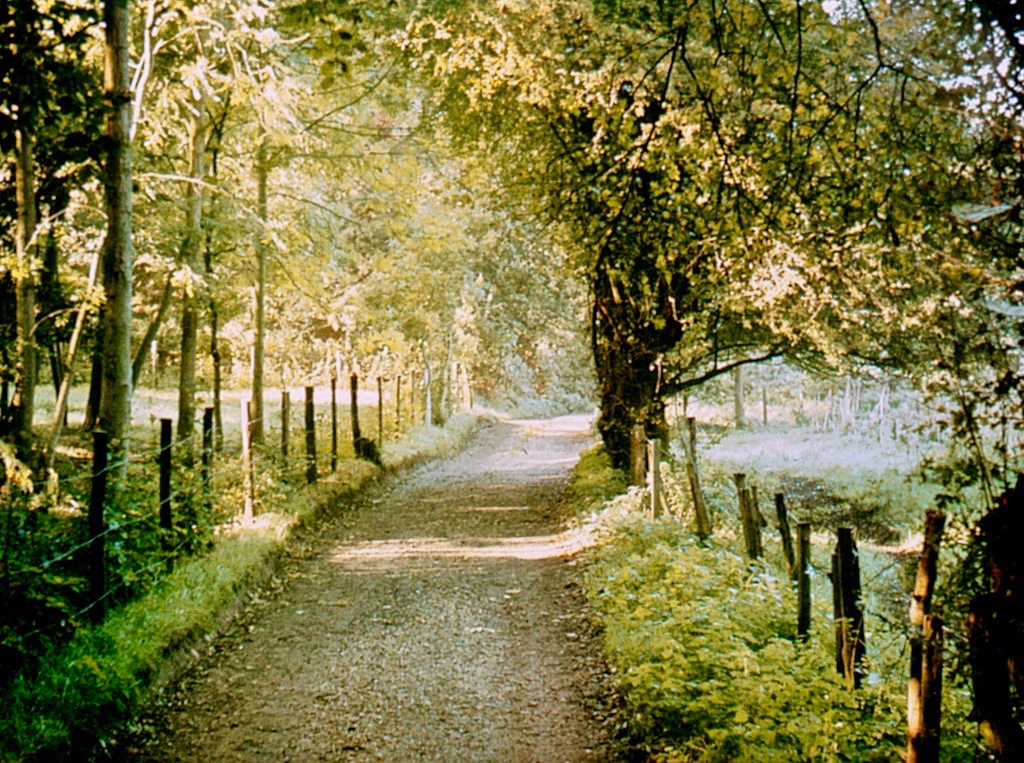
My world met that of Swift (I never knew him as ‘Dean Swift’ until I came to Ireland) when my Granma and I would walk together out into the countryside. We only ever walked because, in the 1950s, very few people had cars and I had not yet graduated to a bicycle: walking is still, after all, the best way to travel without missing all the details. From Darvill’s Lane we followed a path away from the town which almost immediately became deeply rural. We headed for Moor Park. I was delighted, recently, to find this old postcard of Moor Park Lane which could date from those same days:

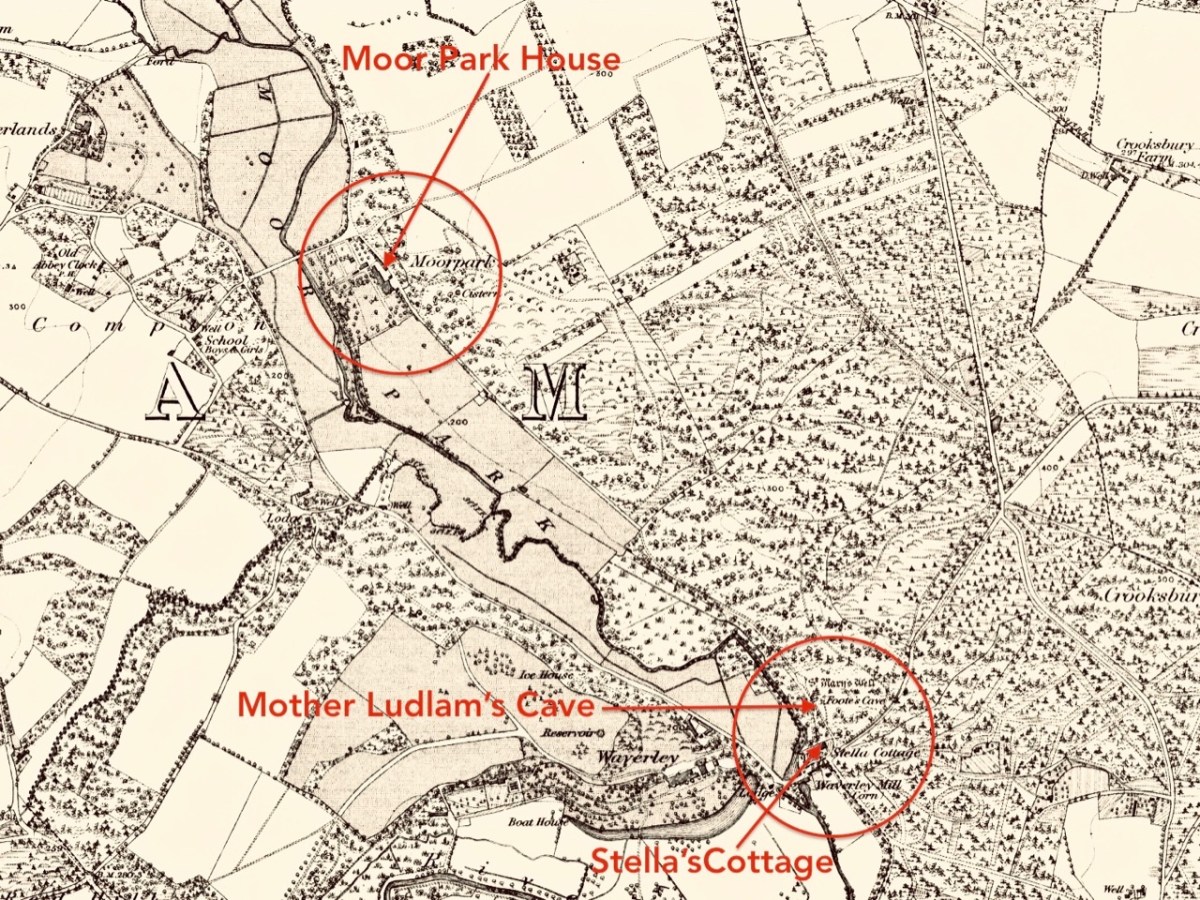
With the benefit of Google Maps I have been able to calculate that our walks were around two miles if we only went as far as Moor Park House, but it was much more interesting to go beyond, so sometimes we would have done a round trip of seven or eight miles. ‘Beyond’ there were caves, and a holy well, and the ruins of an old abbey – all of which Granma could tell me stories about. I’m so grateful to my Granma as, today, I can’t resist searching out the likes of caves, holy wells and archaeology, wherever I travel.

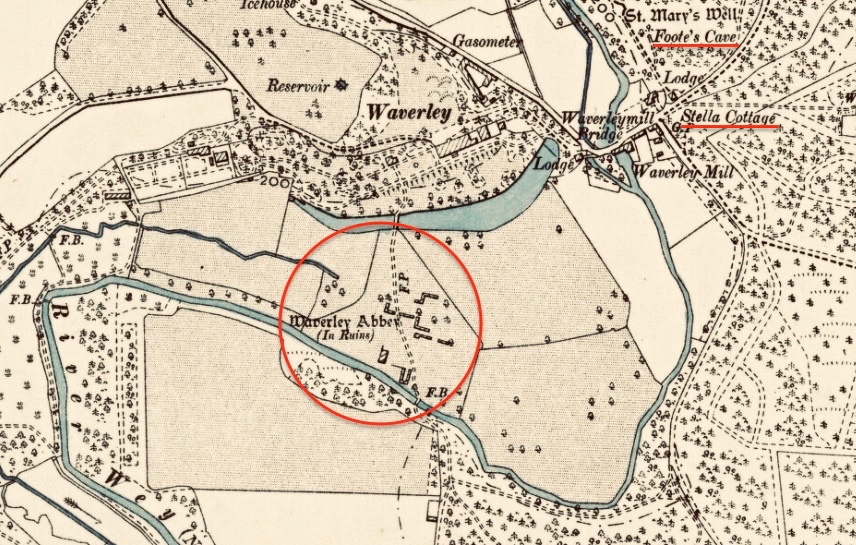
An extract from a late 19th century Ordnance Survey map of the country we walked through outside Farnham town, with just a few of the places which I learned ‘stories’ about during my escapades with my Granma!

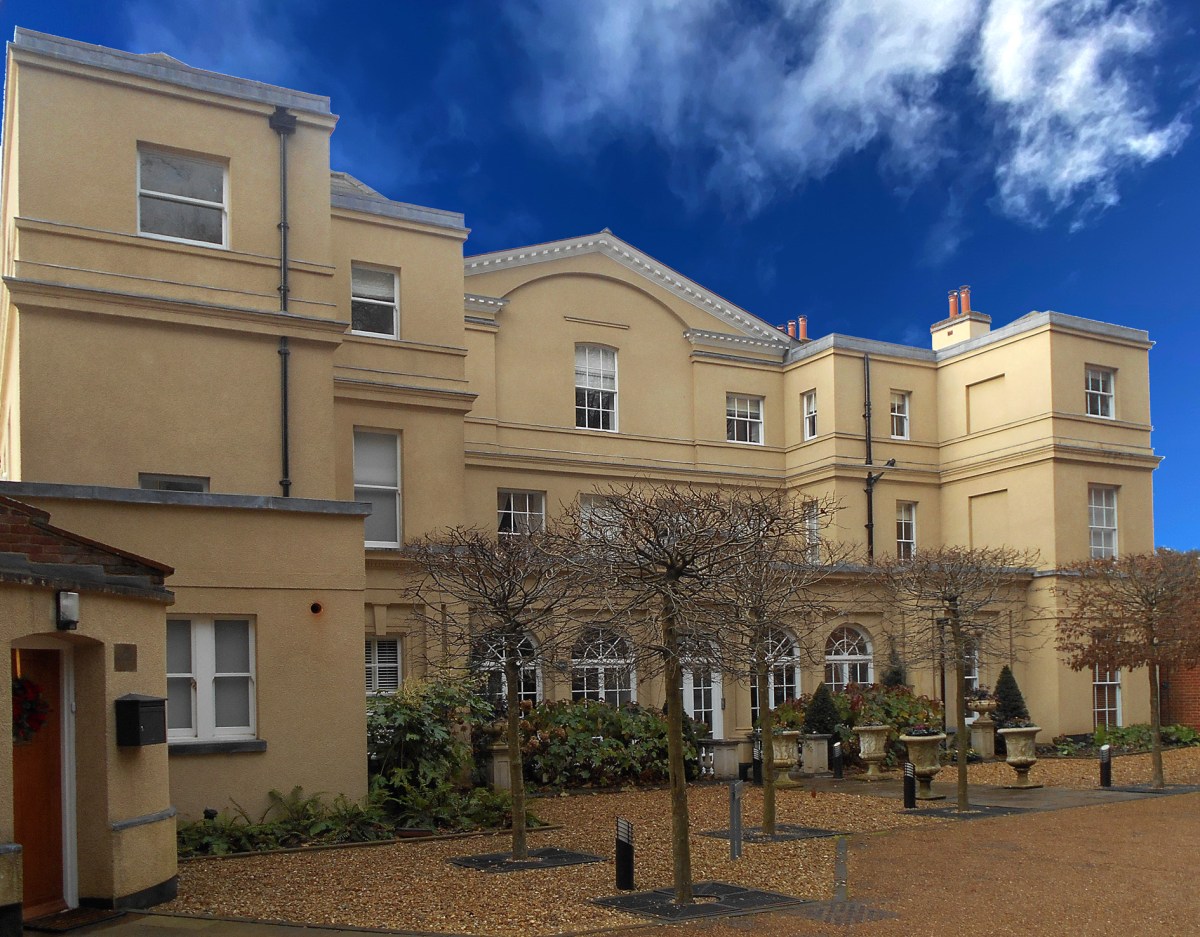
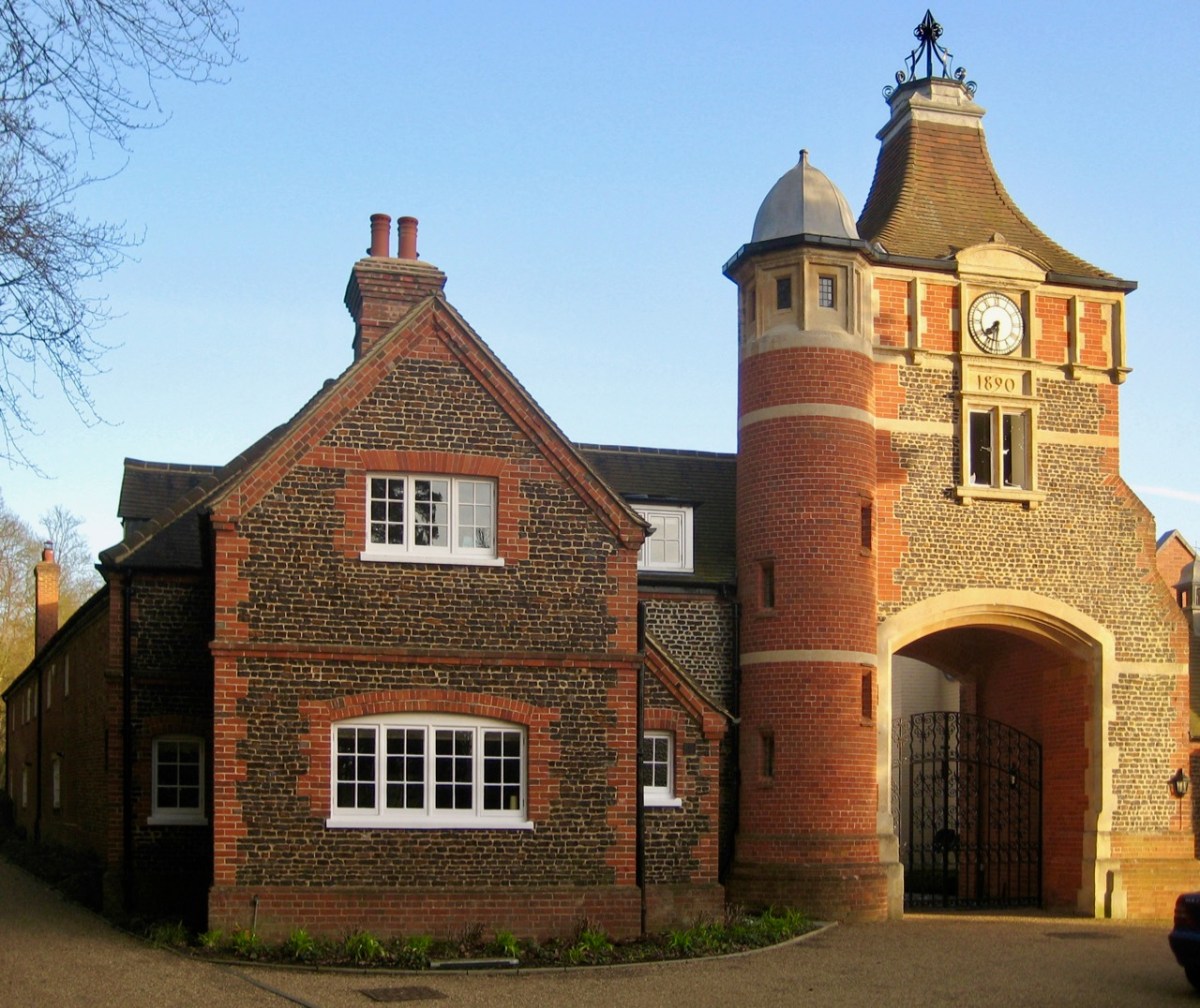
Moor Park House was always our first port of call. I now know that an early dwelling on this site – known as Compton Hall – dates from 1307, and that this was modified and added to over the generations, most notably by Sir William Temple in the late 17th century. Temple (1628 – 1699) bought the property in the 1680s and renamed it after his own family home in Hertfordshire. He had a career as a noted diplomat under Charles II including, in 1677, helping to arrange the marriage between the King’s niece, Princess Mary and William of Orange: I don’t need to go into their story now. William Temple retired to Farnham and constructed a large formal garden at Moor Park, covering five acres. From 1688 until his death he employed Jonathan Swift as his secretary. My Grandma ensured that I knew about the link between Moor Park and Gulliver’s Travels, and I was impressed! She also told me that the path along which we walked, passing through the gates of Moor Park Lodge, had once been the scene of a great battle when an owner of Moor Park (long after Temple) closed off the right-of-way along that path, or attempted to: I have since learned that it happened in 1897, and a crowd of over a hundred local people armed themselves with cudgels and crowbars and forced the locked gates open. They have been open ever since.

Upper – Moor Park House today and, lower – the gatehouse which was the scene of a battle over rights-of-way in 1897

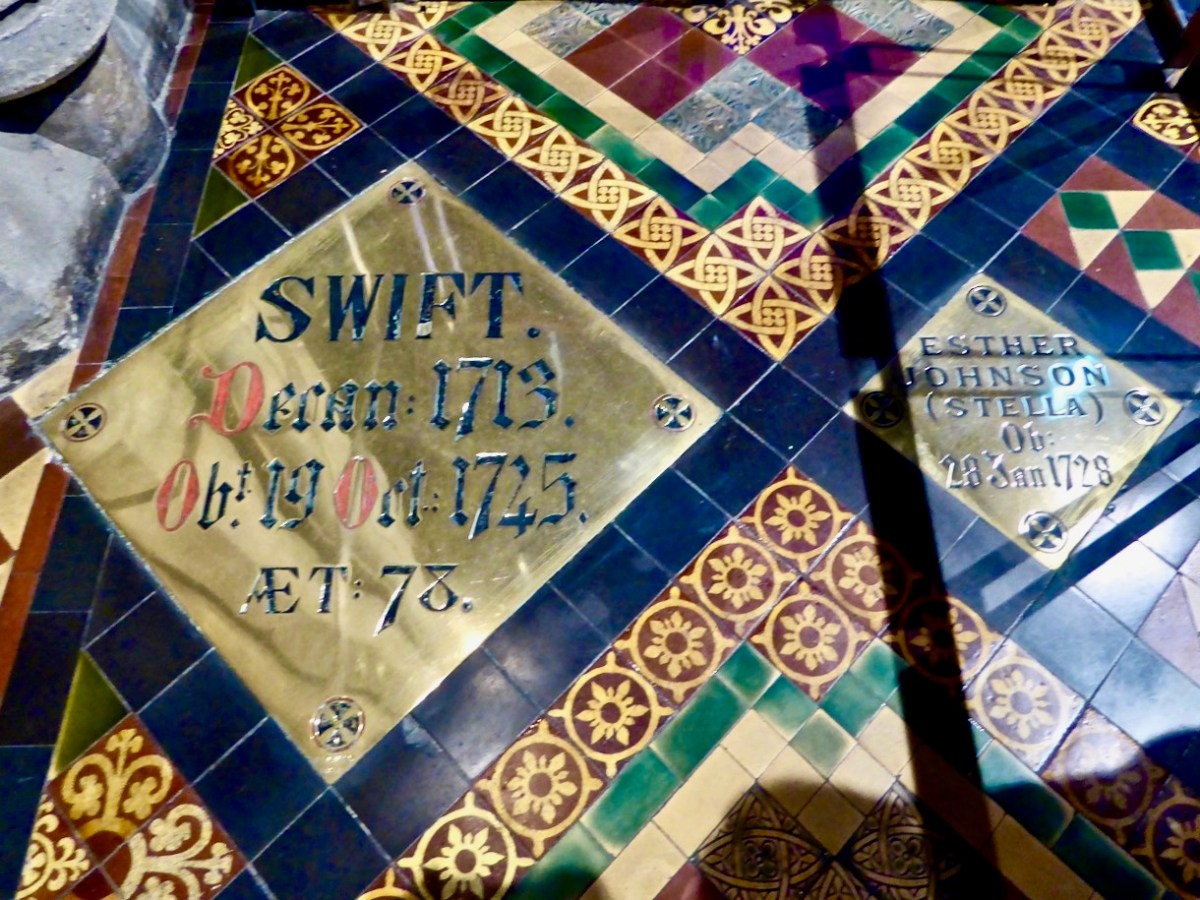
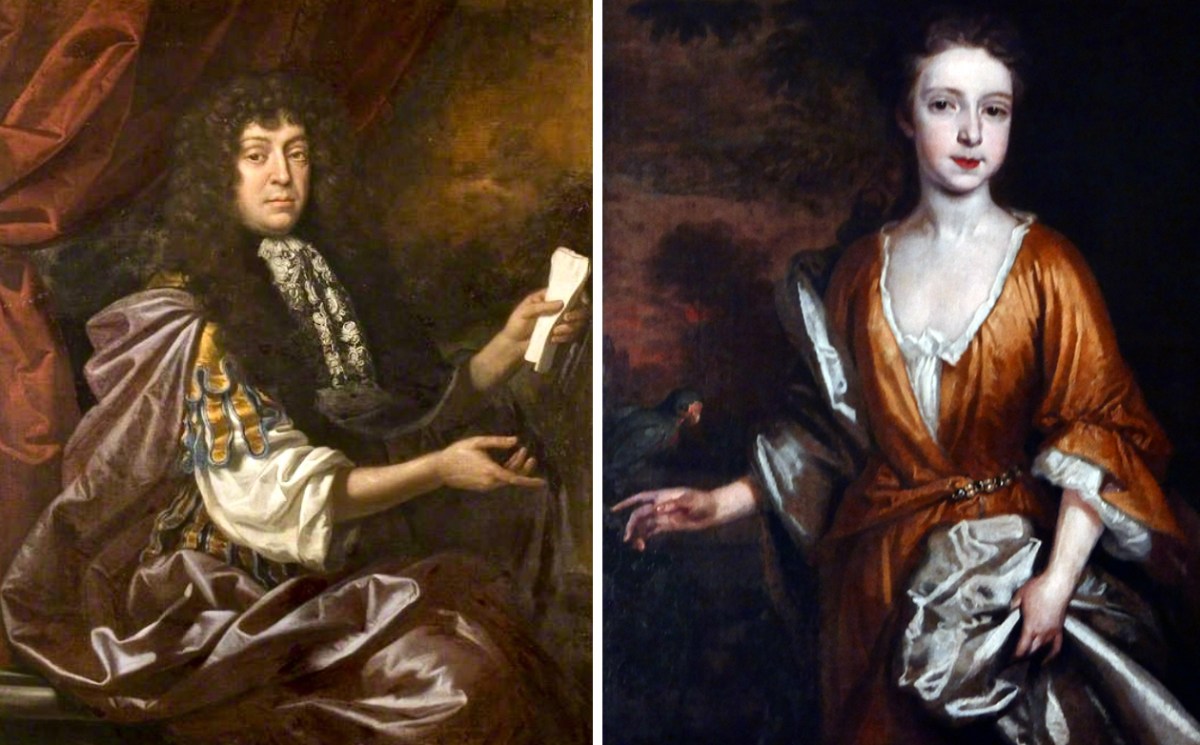
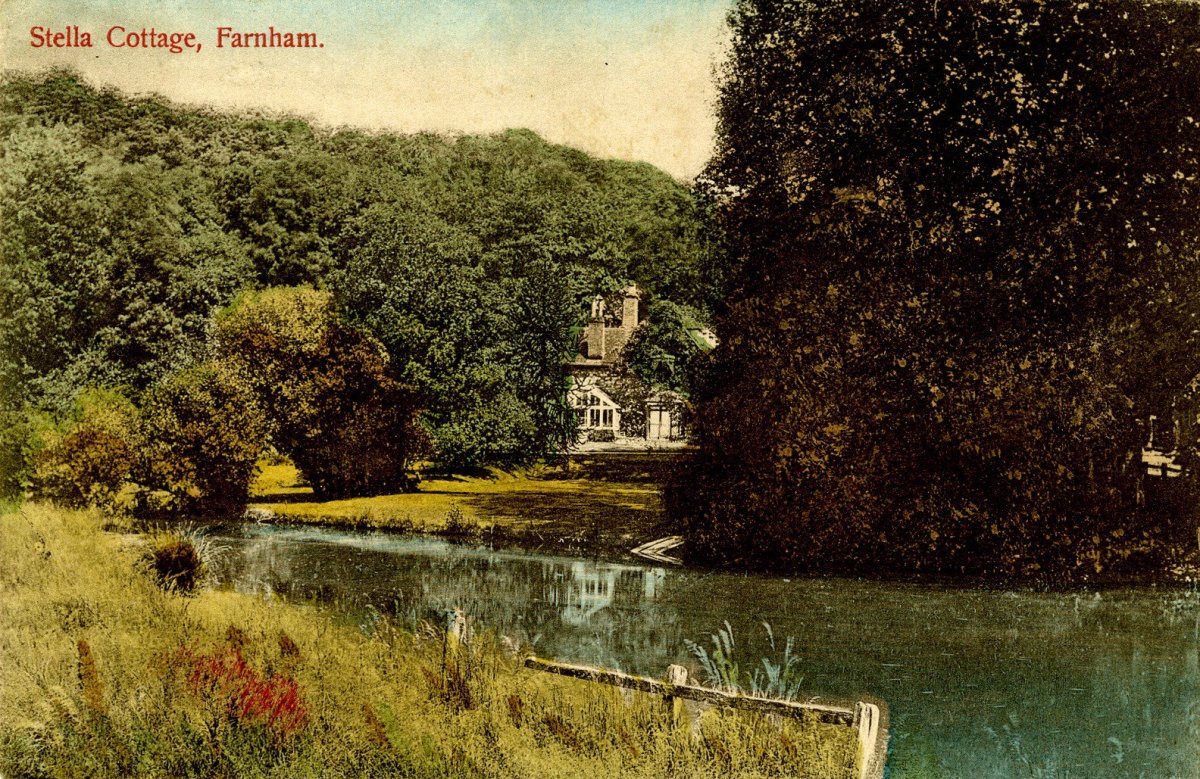
For over a decade Moor Park house figured large in the life of Jonathan Swift. When first there he became the tutor and mentor to a local girl who lived nearby, and whose mother acted as a companion to Temple’s sister. The local girl was Esther Johnson (1681 – 1728). She was nicknamed ‘Stella’ by Swift. My Granma told me that Stella was a close friend of Jonathan Swift, and that he would visit her by following the path we always took through the estate, ending at ‘Stella’s Cottage’ at the far end. My young brain took all this information in, and I carried with me through the years a picture in my mind of Stella’s Cottage at the end of our path. A postcard I came across recently confirms that picture exactly! Stella remained ‘close’ to Swift for the rest of his life. On his death Temple left her some property in Ireland and she moved there in 1702. There were rumours – never confirmed or denied – that she and Swift had married secretly. She died in 1728, and was buried in St Patrick’s Cathedral, Dublin. Swift was inconsolable at Stella’s death; when he died he was buried beside her at his own request:

Childhood associations: centre – Sir William Temple on the left (painted by John Closterman – courtesy of Beecroft Art Gallery) and Esther Johnson on the right (artist unknown – Crawford Gallery): she was Jonathan Swift’s ‘close friend’. Lower picture – an old postcard showing ‘Stella Cottage’

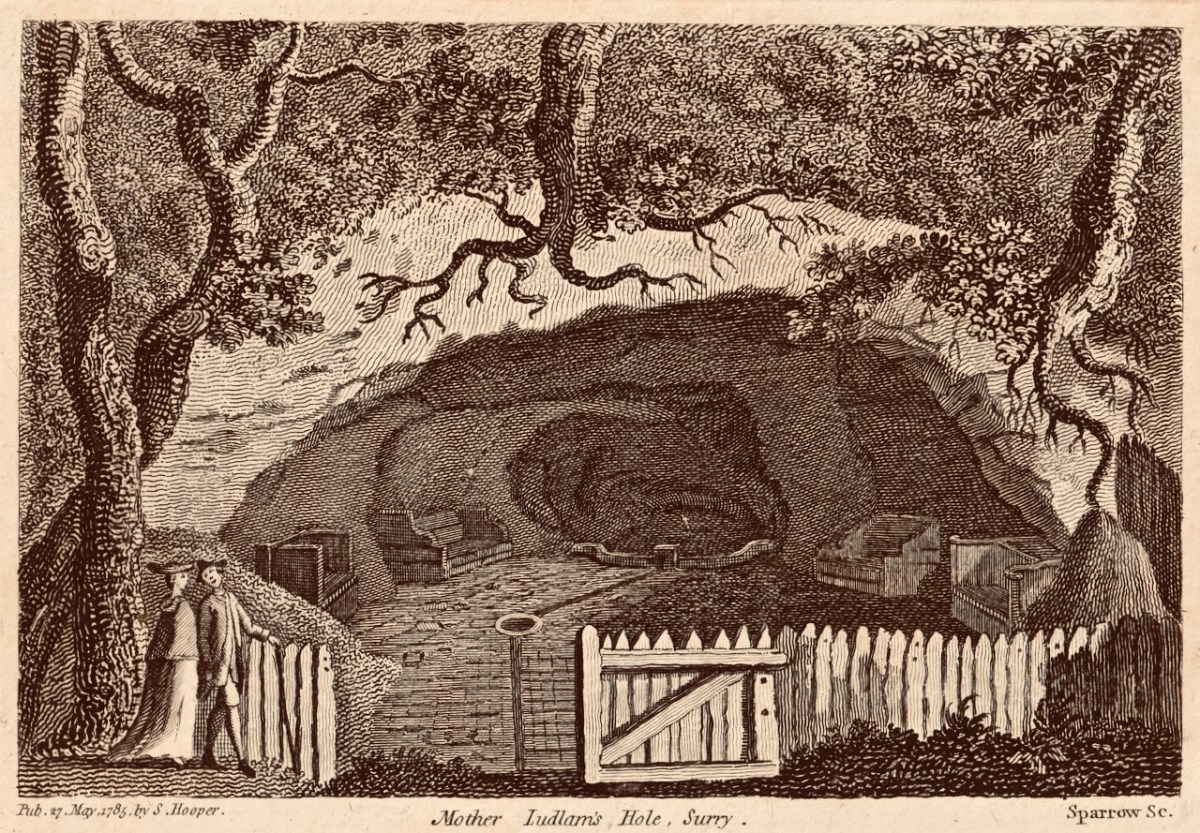
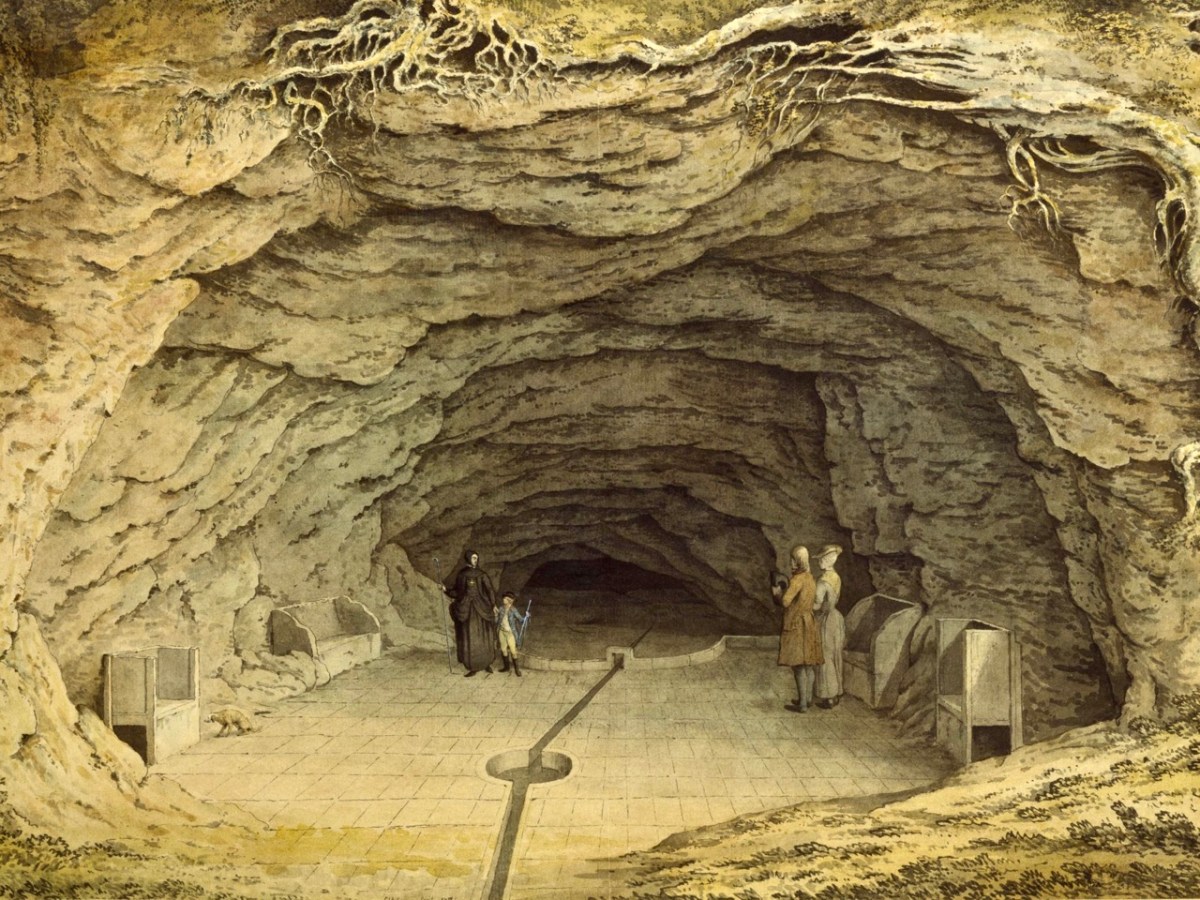
On the best days our walks continued beyond the Moor Park estate, and included a visit to two caves – ‘Old Mother Ludlam’s cave’ and ‘Father Foote’s’. These provided great stories, and my Granma’s recounting of those stories has been confirmed through my present day researches, although I prefer them the way she told them, rather than the precise history. Mother Ludlam was a witch, but a good one. She had a cauldron which she would lend to anyone, presumably so they could make their own magic potions. The cauldron can still be seen today, in a nearby church. She lived in her cave, which had (and still has) a stream running through it. Every time we looked into the mouth of the cave – through a locked iron gate – my Granma repeated the same story (which I have never seen written down): when she was a young girl it was decided to find out where the stream that ran out of the cave originated, so a raft of ducks (that’s the correct word for a whole lot of ducks) was taken into the cave and shooed away into the darkness up the stream. Then, presumably, the assembled crowd waited to see if and where they might emerge. They didn’t. Except that – according to my Granma – some considerable time later (days or weeks) one lone duck was found coming out of a small culvert on the River Wey in Guildford ten miles away – minus all its feathers! I could never forget such a rare story.

Here (above) is one of my prized possessions: a 1785 print of Mother Ludlam’s Hole, Surry: I found it in a second-hand bookshop in Farnham very many years ago – I think I paid a shilling for it – and I have kept it ever since, if only to remember my Granma and the stories she told. I later came across this fine print in the Victoria and Albert Museum, London. It shows that Mother Ludlam had some notoriety:

But you very seldom hear about ‘Father Foote’. In fact, I wondered in later life whether he was a personage which my Granma had thought up to explain a second, smaller cave nearby. But no – because if you look at this 1895 map of the area you will see that ‘Foote’s Cave’ is clearly marked (along with St Mary’s Well), but Mother Ludlam’s isn’t.

So – Granma’s tale: Mother Ludlam and Father Foote lived at the same time close to each other. The second cave is quite high up in the rock face, and rather small. They had a baby, which they kept in the smaller cave, One day the baby rolled out of the cave, down the steep hill and into the river below. That’s the story – I’ll leave you to ponder on it.

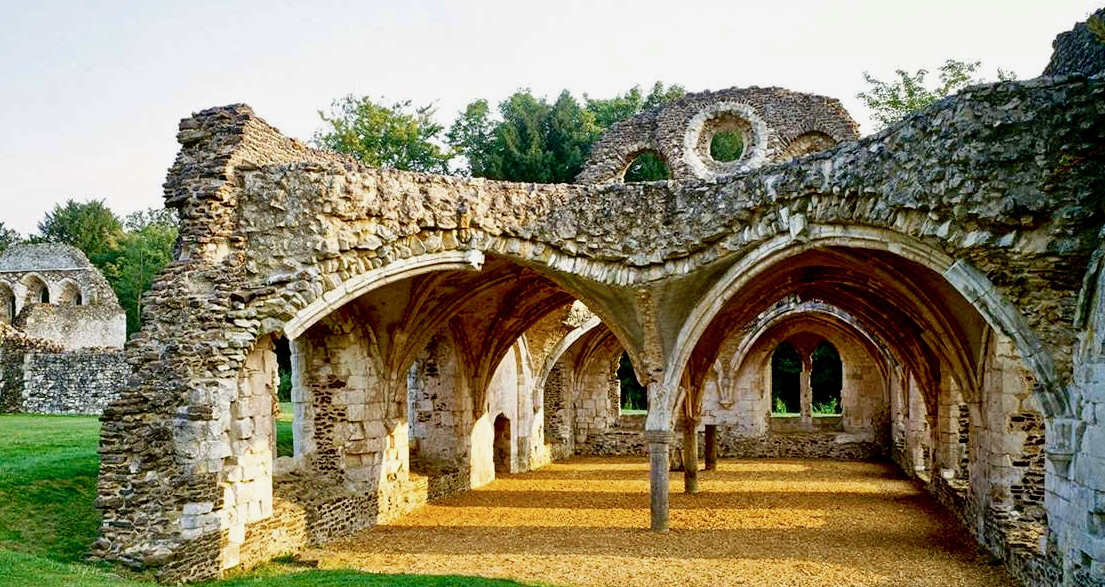
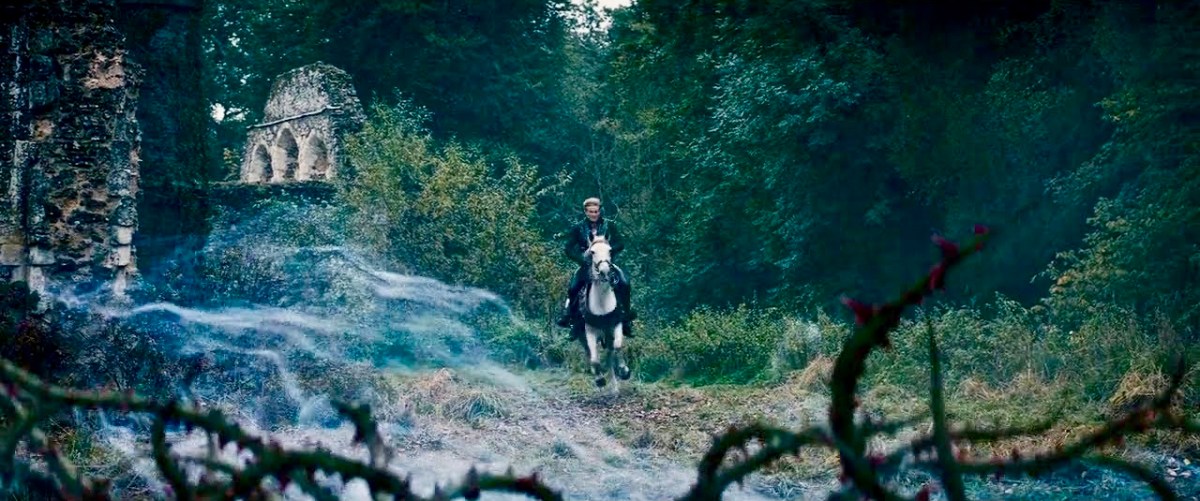
Generally, the last port of call on our walks was Waverley Abbey – the very first monastery founded in Britain by the Cistercians, constructed in a meadow beside the River Wey in 1128. That’s what remains of the refectory above (photo courtesy of English Heritage). I don’t remember my Granma telling me any ghost stories – she didn’t go in for those; yet she did always say to me I had to look out for the ‘white monks’ when we went past the old abbey ruins. I was interested to see that Waverley Abbey was used as a film set in 2014 for a Disney film about the story of Rapunzel. Here’s a still from that film:

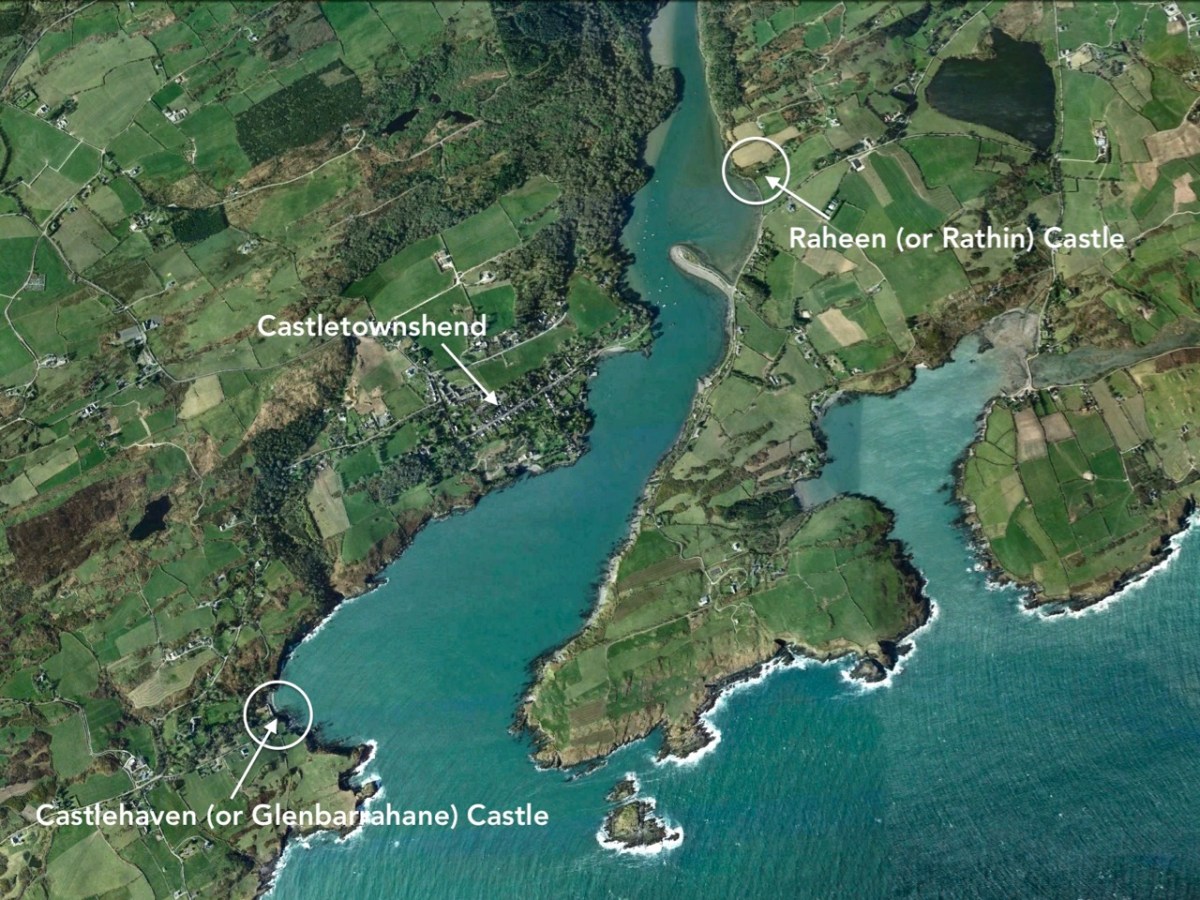
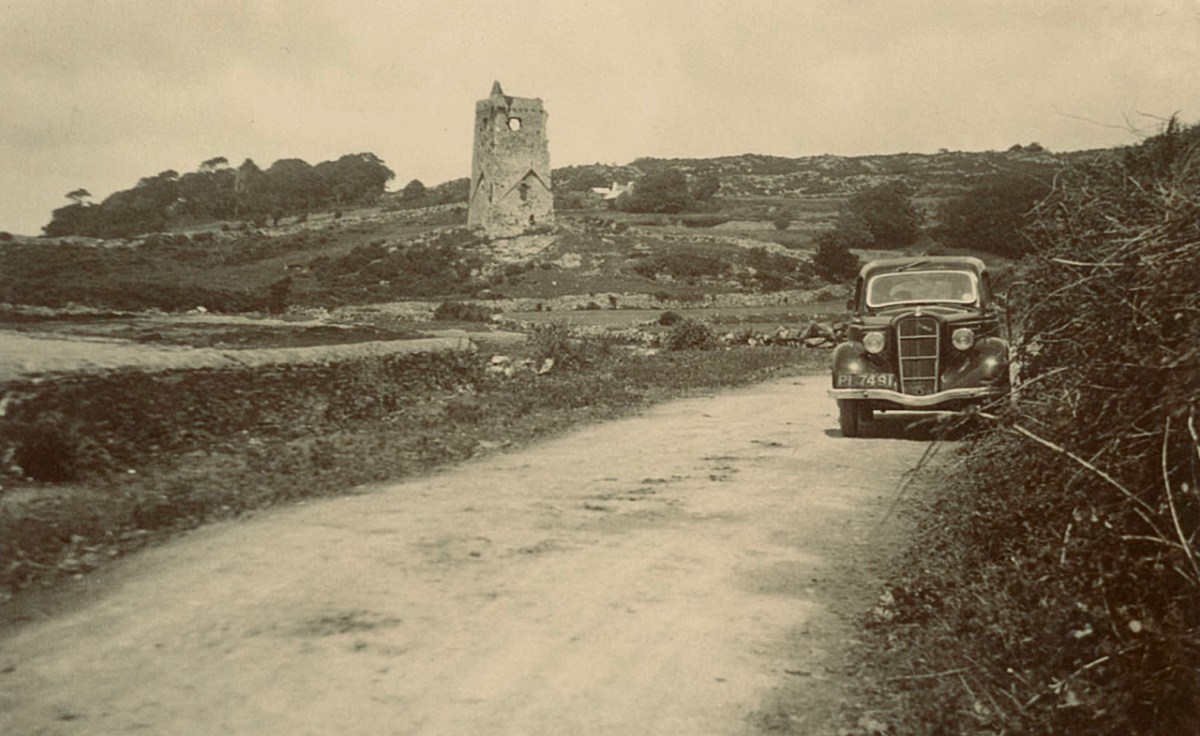
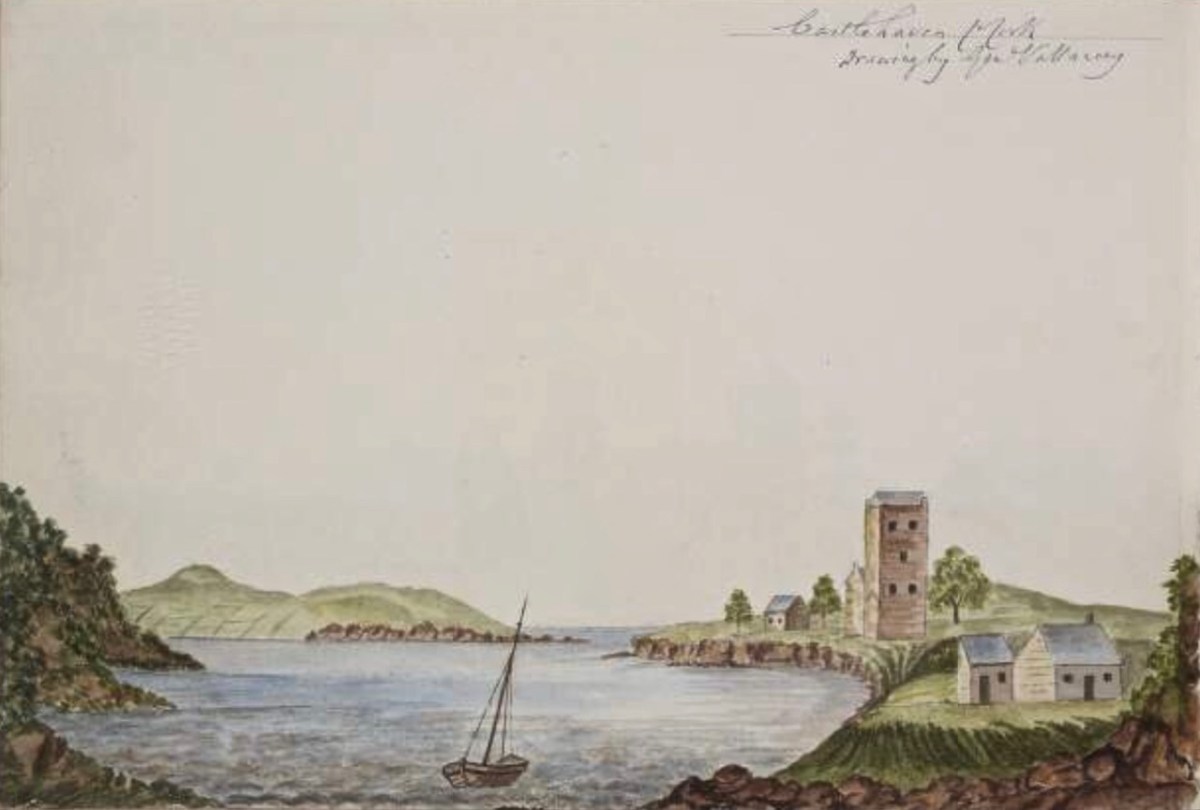
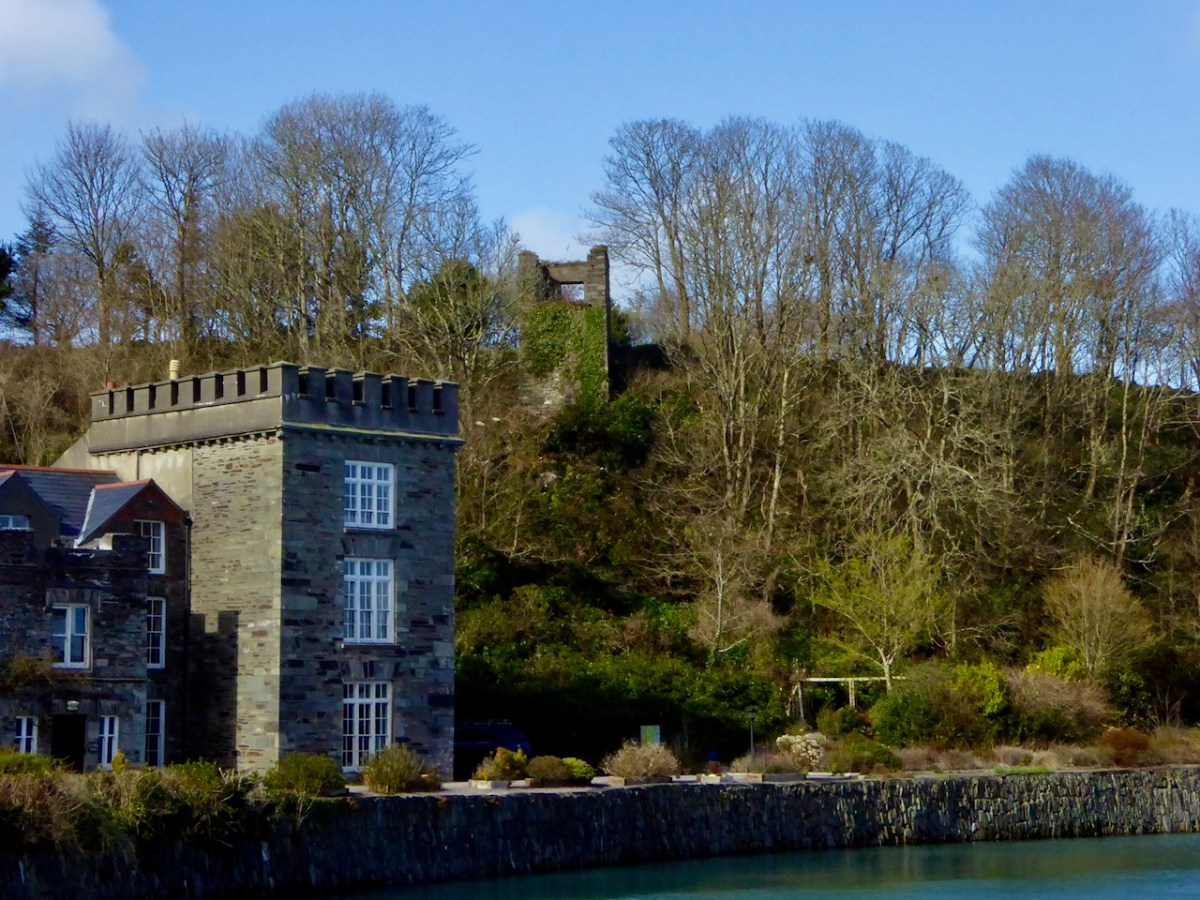
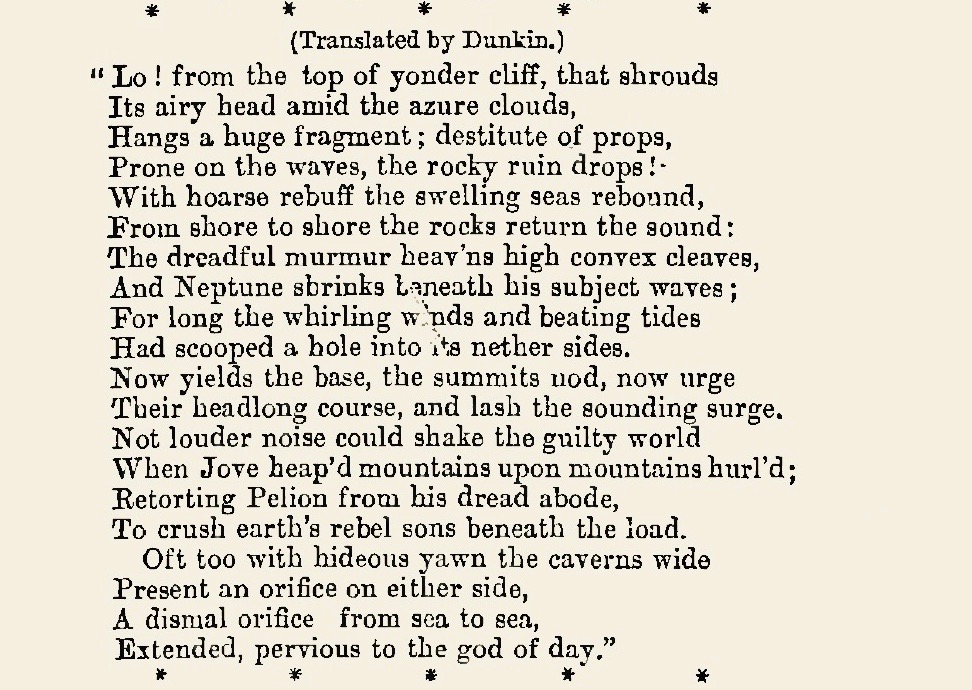
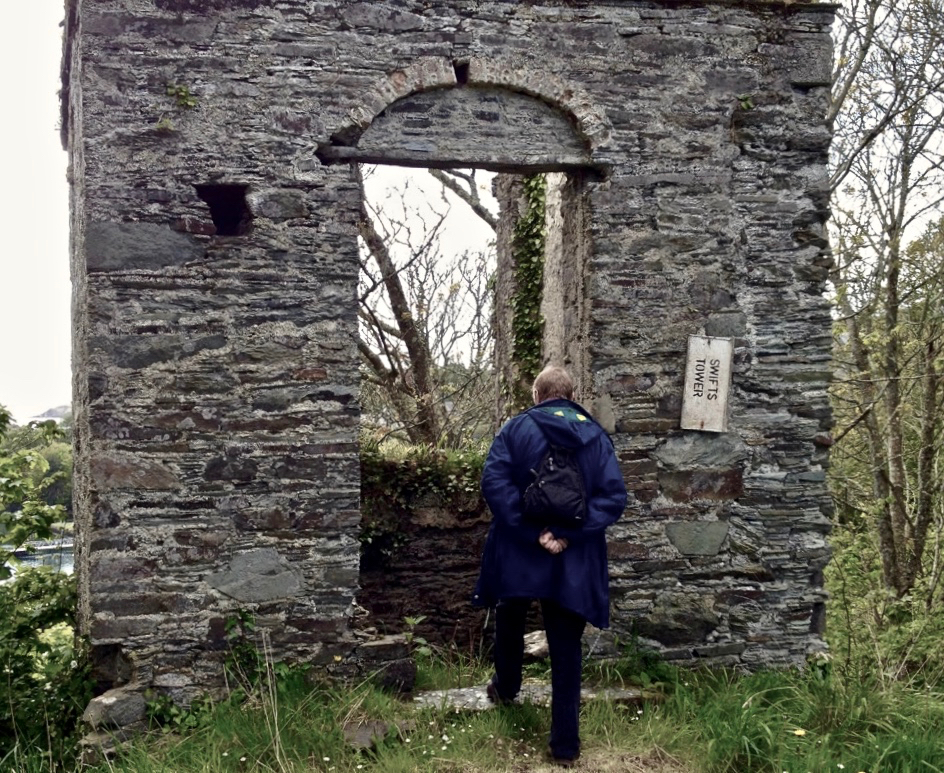
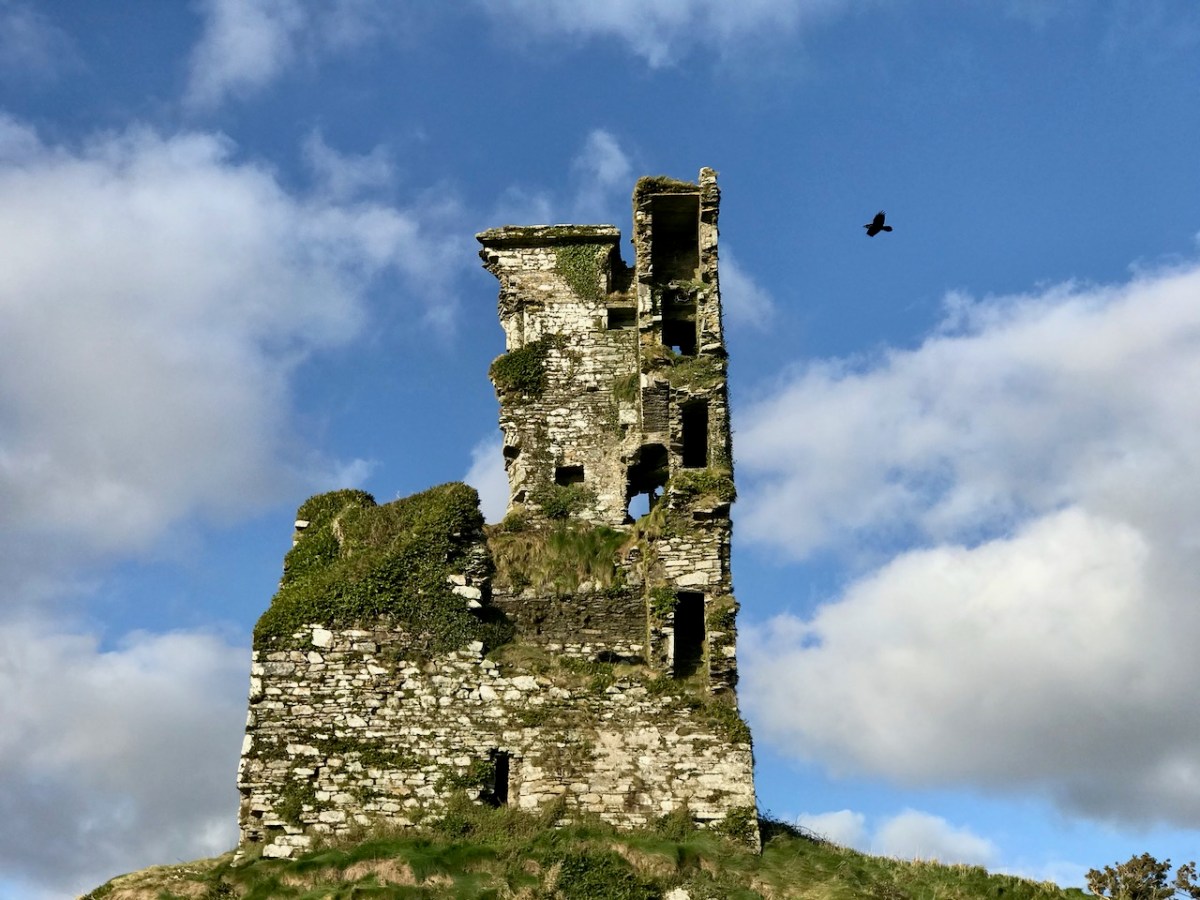
I did promise you a ‘West Cork connection’ to the subject of this post. Well, Dean Swift visited the south west of Ireland in 1723 and stayed in Castletownshend. Finola, in her post on Belvederes in 2016, tells that he used a tower behind the castle there as his refuge, and in it he wrote a long poem in Latin – Carberiae Rupes – which translates as ‘The Crags of Carbery’. Here’s the tower beside Castletownshend Castle, and a short translated extract from the poem. At the end there’s Finola’s photo of me visiting ‘Swift’s Tower’, and closing the loop that began for me more than seventy years ago.

31st January 2021

Harry Clarke’s Terenure Masterpiece

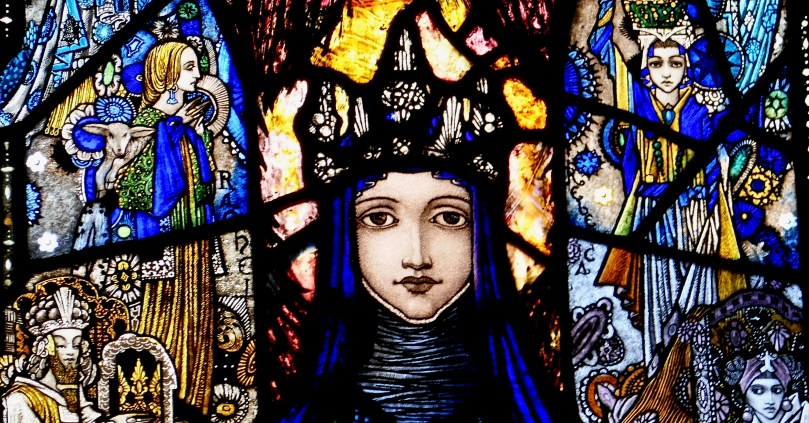
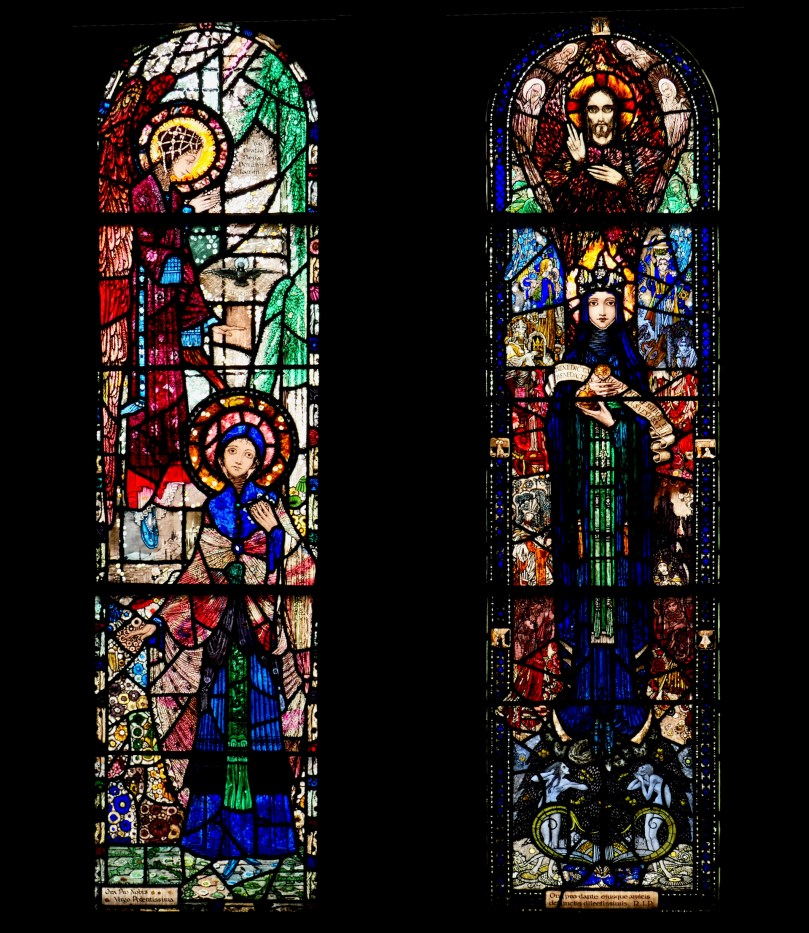
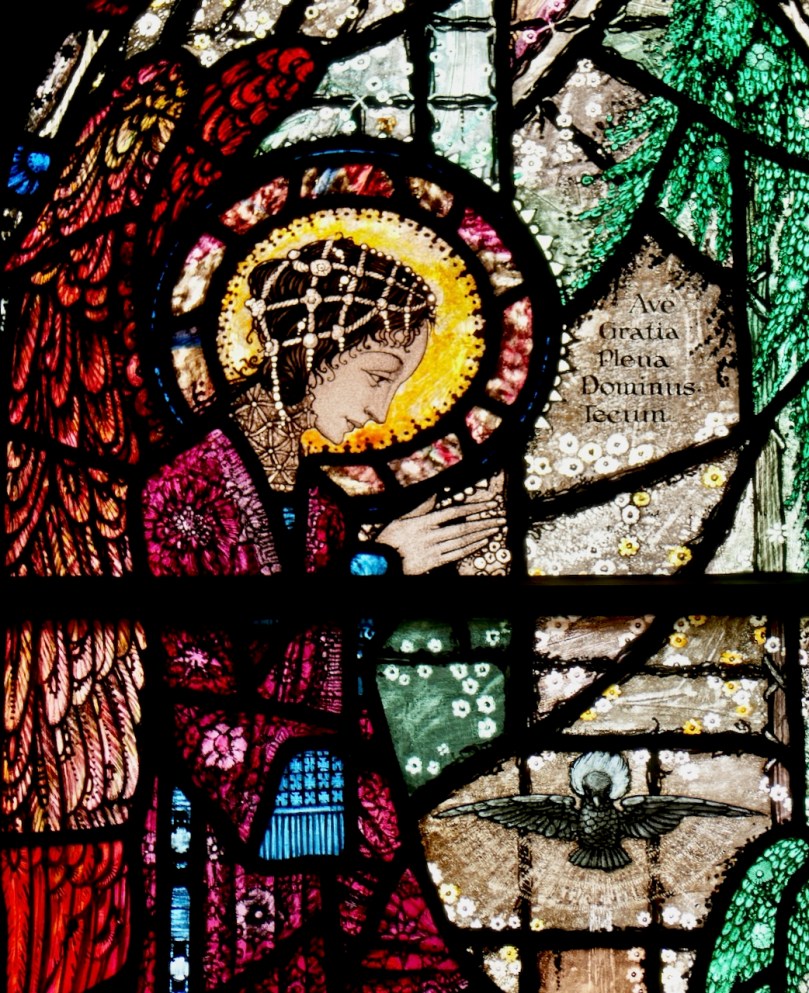
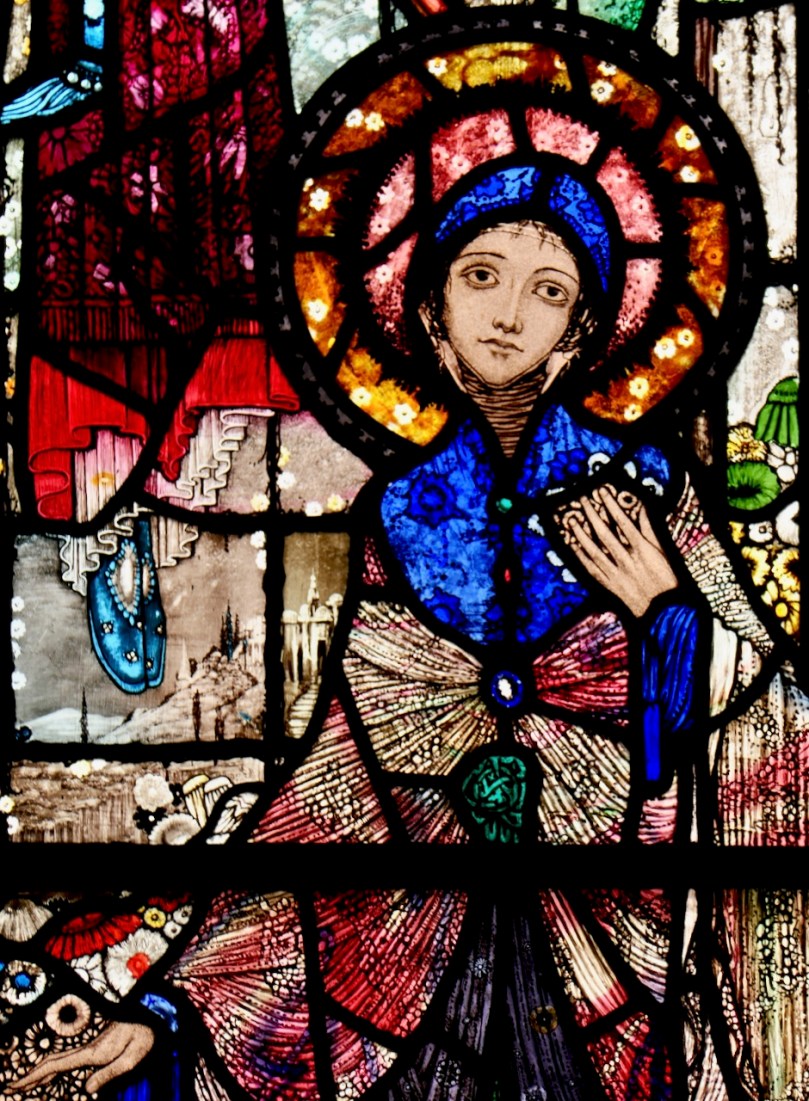
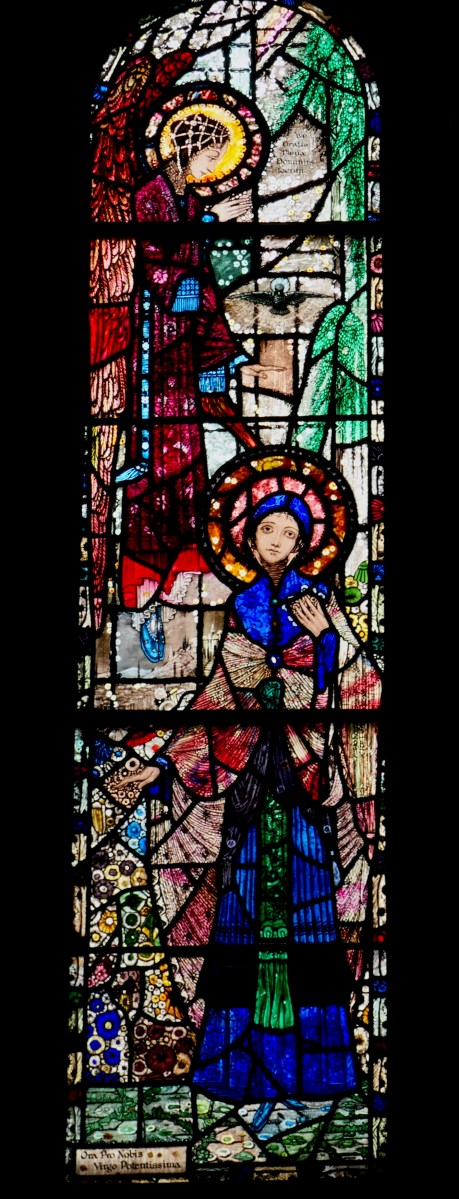
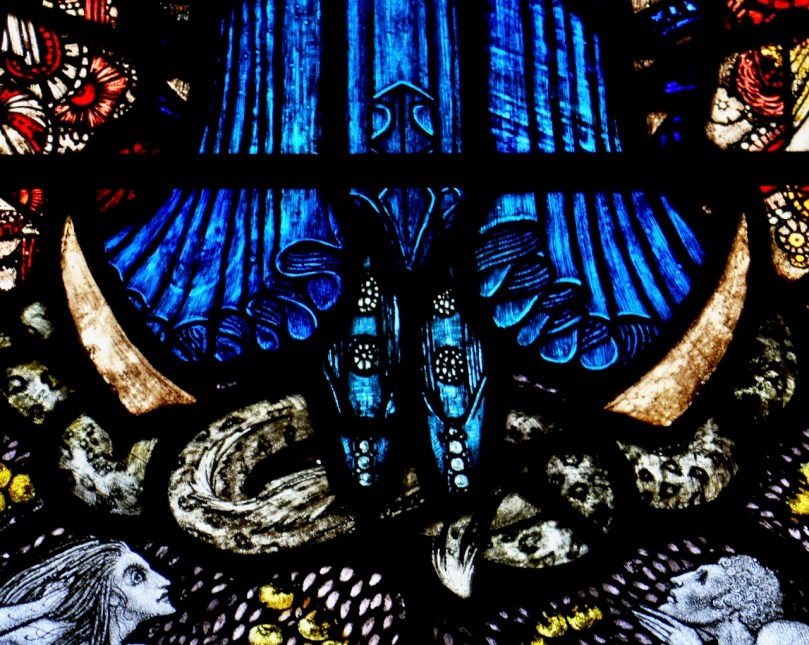
A controversial word, masterpiece, and in this case I am using it to denote that this a Harry Clarke masterpieces rather than the masterpiece. There are several contenders for that title, although the Geneva Window may take the crown. In any ranking of Harry’s windows, however, these two side-by side windows, in St Joseph’s Church in Terenure in Dublin*, must be close to the top. 

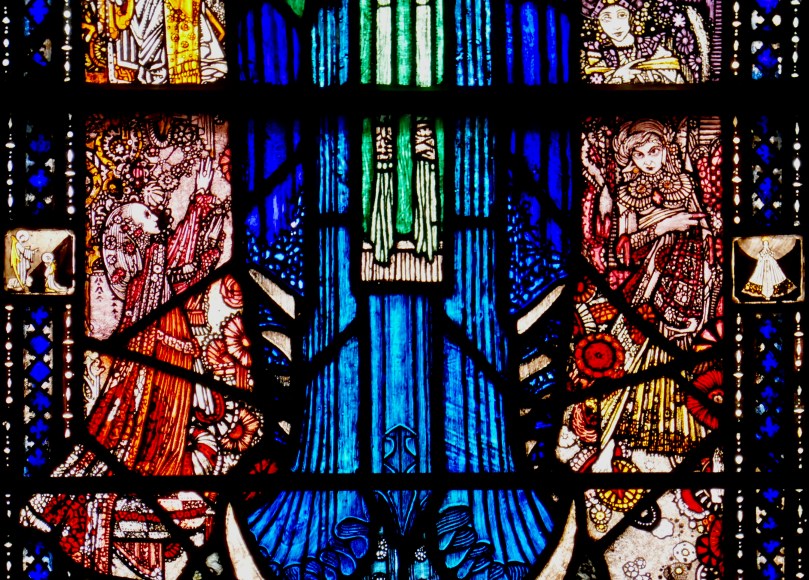
The left window, The Annunciation, was finished in 1922 and the right window, The Virgin in Glory, in 1923. What is perhaps extraordinary is that these windows were completed at a time when Ireland, and Dublin in particular, was in turmoil and the country was riven by civil war. Life in the artistic world was precarious, with the National Gallery and the School of Art closed and the destruction of many of Dublin’s finest buildings. Harry was in the midst of moving house and re-organising and staffing the studio, while also very busy with illustration commissions. But stained glass was still his main business and he was pleased to receive the order for the two-light window from Fr Healy, for whom he had previously completed the enormous three-light Crucifixion window over the main altar. Having been completed several months apart, each window in this set has a different mood and character. Let’s look at the Annunciation first. Before it was installed, Harry entered it in the art competition that was part of the Aonach Tailteann, or Tailteann Games – a Festival of all-things-Irish with a strong Celtic Revival influence. The window won the Gold Medal for stained glass. 

Gabriel hovers above Mary, held in suspense by long scarlet wings. Depicted as female, she wears a complex headdress and long multi-layered garment tied at the waist with a broad blue sash. Her feet are suspended over a scene of a hill town. The Holy Spirit in its dove form is to her right, shedding silver rays down on Mary.

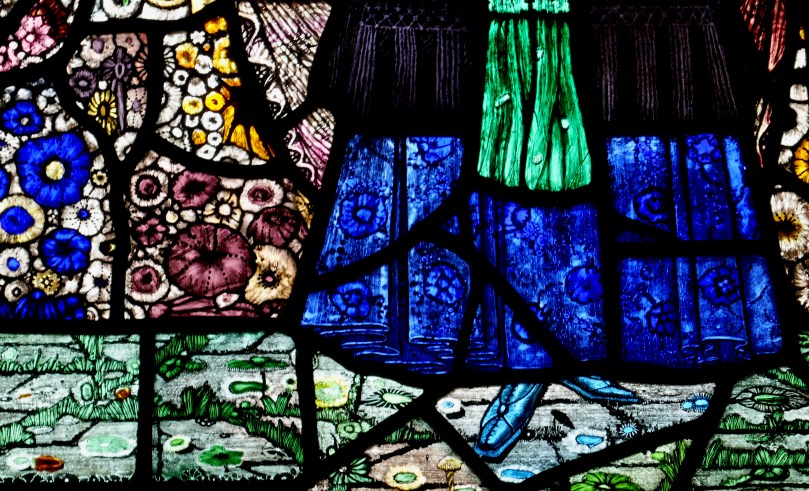
Mary is depicted as young, with huge innocent eyes and a gentle expression. Her colour has traditionally been blue and Harry uses a deep royal blue for her gown. Across her shoulders is a large shawl. Nicole Gordon Bowe in Harry Clarke: The Life and Work describes the window in terms which could be applied to this shawl “. . . a subtle work with shimmering pale colours, gossamer lines and finely laid on tones. . .” Harry’s typical ‘floral ornamentation’ (known to his assistants as F Os or even as Fried Onions) occupy much of the rest of the lower half of the window, an endlessly various and imaginative garden of blooms.

The composition is balanced and harmonious. The scarlet wings are mirrored by green fronds cascading from the right border. Mary’s outstretched hand provides a counterpoint to Gabriel’s, while both have large and complex haloes. The eye is drawn to two pairs of dainty slippers. The angel’s predominant red hues are laced and leavened with blues, while Mary’s blues are warmed by the reds and pinks of the shawl. Despite the inclusion of the floral elements and highly-figured details on the garments, the impression is of a serene and uncluttered scene.

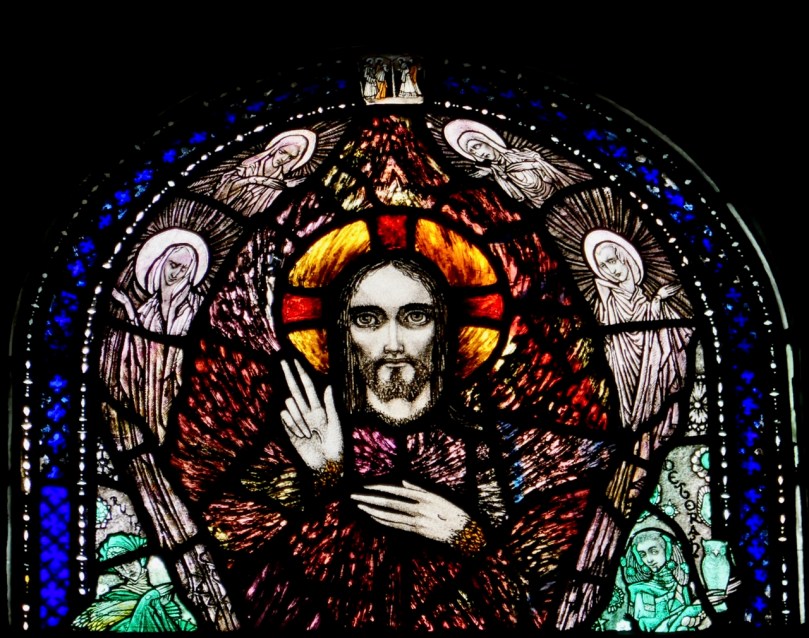
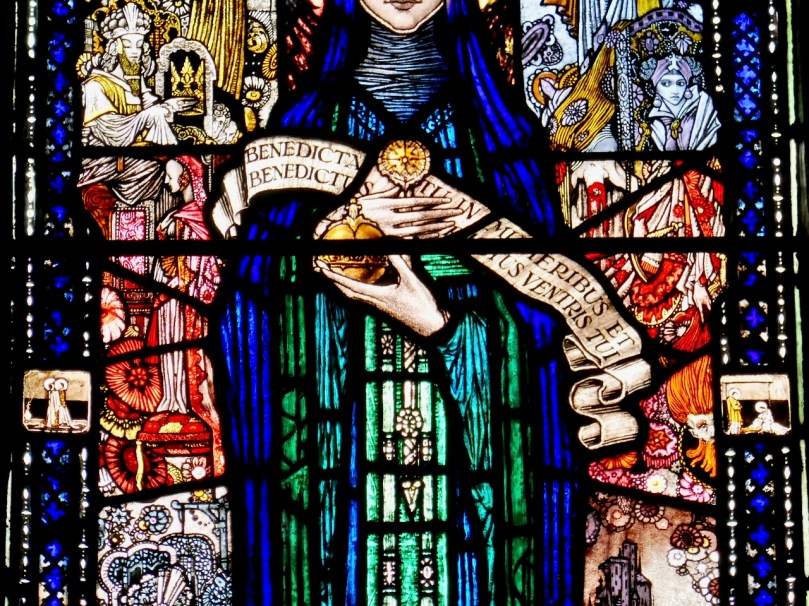
The right hand window exudes a different energy – forceful, complex, and peopled with the kind of supporting cast that Harry delighted in. The emphasis on Marian iconography, very much part of the popular emphasis of Catholicism pre-Vatican II, supported this kind of depiction of Mary, triumphant and queenly, holding sceptre and orb, with the moon and snake under her feet (a mixed metaphor inspired by the Woman clothed in the sun with the moon under her feet from Revelations 12, and the Genesis verse in which God tells the serpent that the woman shall ‘crush thy head’). God is shown above her, hands raised in the sign of blessing, and both have fiery aureoles. Mary carries a scroll with the invocation in Latin, Blessed art thou among women and blessed is the fruit of the womb.

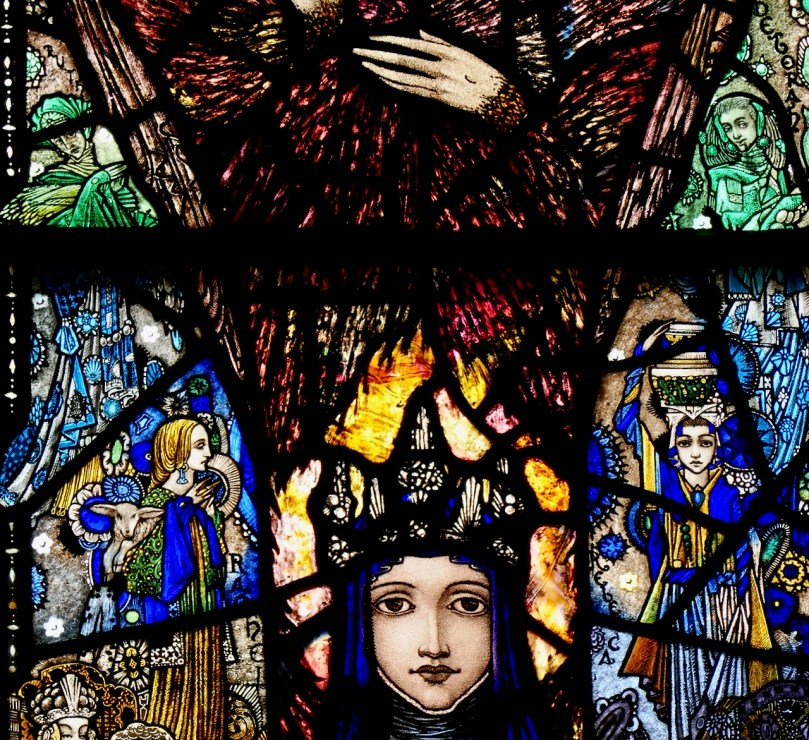
While these are the two main figures, much of the interest in this window comes from the host of other women characters whose stories are illustrated in the side panels and the predella. Unusually for a Catholic window of the time, these are women from the Old Testament, not the Bridgets and Itas and Dympnas which populate so many of Harry’s saintly stained glass. I will start at the top and go through the stories as our eyes descend.

The border is patterned in deep blue, punctuated by tiny scenes from the life of Mary. God is surrounded by four female saints although the effect is of ghostly, insubstantial figures. The flowing clothing of the lower two provide a triangular link to Mary’s crown, an effective technique that divides the space and provides a frame for the first two Old Testament women, Ruth and Deborah. They are both rendered in green glass above and blue below, and both images protrude beyond the border, a technique Harry used to give depth. Ruth is known for her goodness and kindness, and Deborah for her wisdom and gift of prophecy, symbolised by the owl on her hand.

To the left of Mary’s Crown is Rachel and to the right, Rebecca. Rachel, beloved of Isaac, mother of Joseph, was watching her sheep when Isaac first sees her. Hers is a complicated story, full of trickery and disappointment. ‘Rebecca at the Well’ is a familiar motif of Renaissance painting – Rebecca comes to draw water at the well and gives it to a weary traveller and his camels, little knowing that by doing this she fulfils a prophecy and becomes the wife of Isaac (different Isaac) and mother of Jacob from whom descends the nation of Israel. 

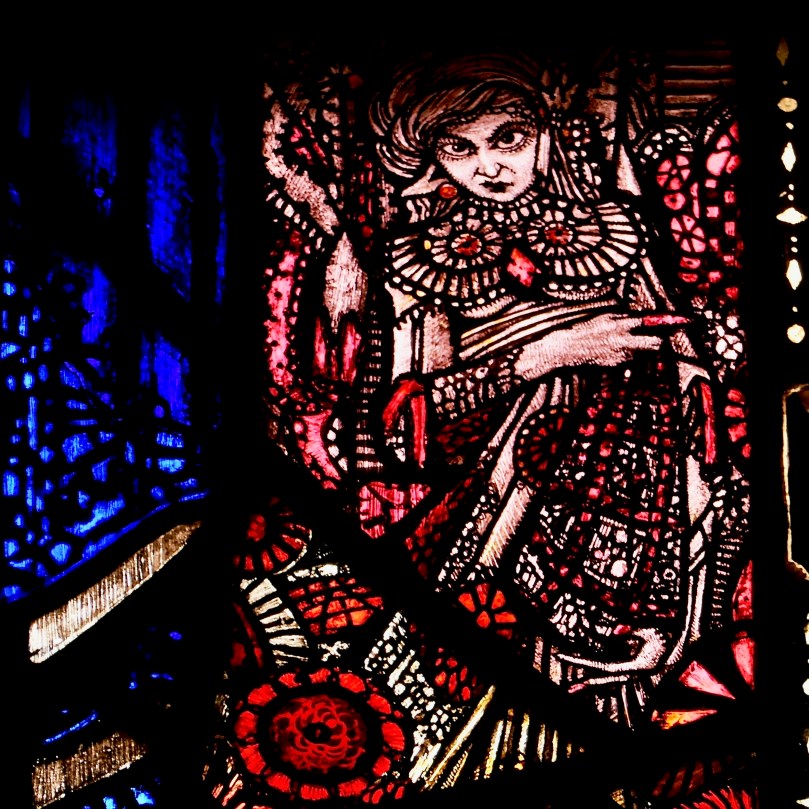
Next (above and below) are scenes from two stories. To the left is the story of Esther. King Xerxes, having banished his wife for disobedience, identifies her as his favourite (lower down the panel) from the harem and (higher image) makes her his queen. She goes on to become a saviour of her people. To the right is the story of Judith, the courageous widow who inveigles her way into Holofernes tent, lies with him, and cuts off his head when he sinks into an inebriated sleep. In the higher images she is pictured in scarlet robes, with her hand tangled in Holofernes bright red hair. In the lower, she and her maid escape carrying the head of Holofernes in a basket. The maid has a comical, grimacing expression – understandable given her burden. 

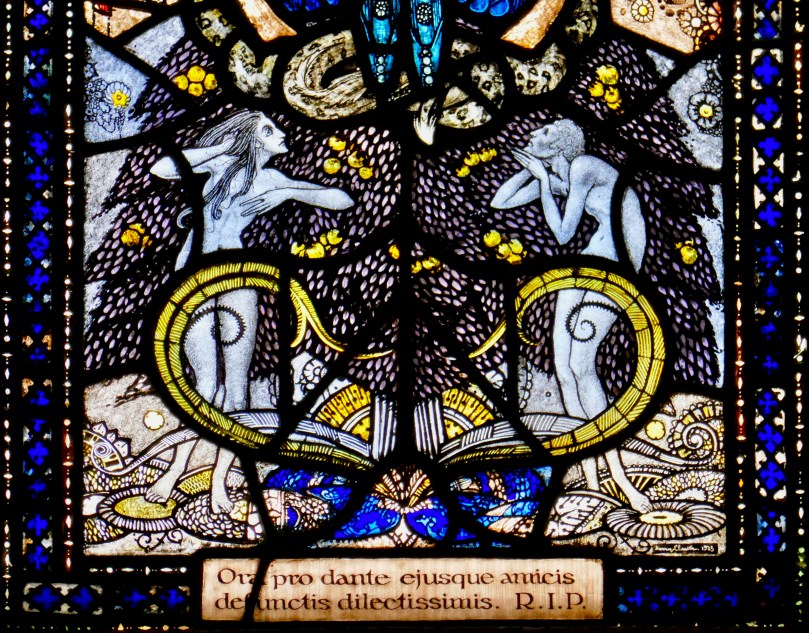
Finally, in the predella, we have Adam and Eve cowering in fear and shame in the Garden of Eden, while the golden apples hang from a purple tree. Gordon Bowe, whose knowledge of art history was prodigious, sees this as an homage to Paul Klee, whose Two Men Meeting, Each Presuming the Other to be of Higher Rank, the source she posits for this depiction, can be seen here.

By any standards these two windows belong to the highest order of artistic endeavour. They are also, especially The Blessed Virgin in Glory, an insight into Harry Clarke’s unique imagination, with its selection of tiny figures whose stories are worked out in intricate detail despite the constraints of space, and many of whom are far from the gentle virgins idealised by Catholic clergy of the day. Thomas Bodkin, the eminent art critic and later Director of the National Gallery referred to them as a multitude of little foreshadowing figures and says, They are drawn with such amazing delicacy of detail that they demand inspection at the closest quarter; and yet when seen from a distance they sink into a background swirl of lovely hues enhancing the majestic figure of their queen (Quoted in Gordon Bowe’s The Life and Work of Harry Clarke).

*If and when you can, go visit St Joseph’s in Terenure. Take with you the Marvellous book Harry Clarke and His Legacy by Patricia Curtin-Kelly. It’s a well-researched and very readable account of all the windows in this church by Harry Clarke and by those who carried on his legacy, Richard King and William Dowling and I highly recommend it. 

Book of Lismore

This is a topical post, as only this week we heard the news that the Book of Lismore has been donated to University College, Cork to become the centrepiece of the library there. It will be accessible to students and will contribute to the knowledge and study of Gaelic manuscripts dating from the 15th century.

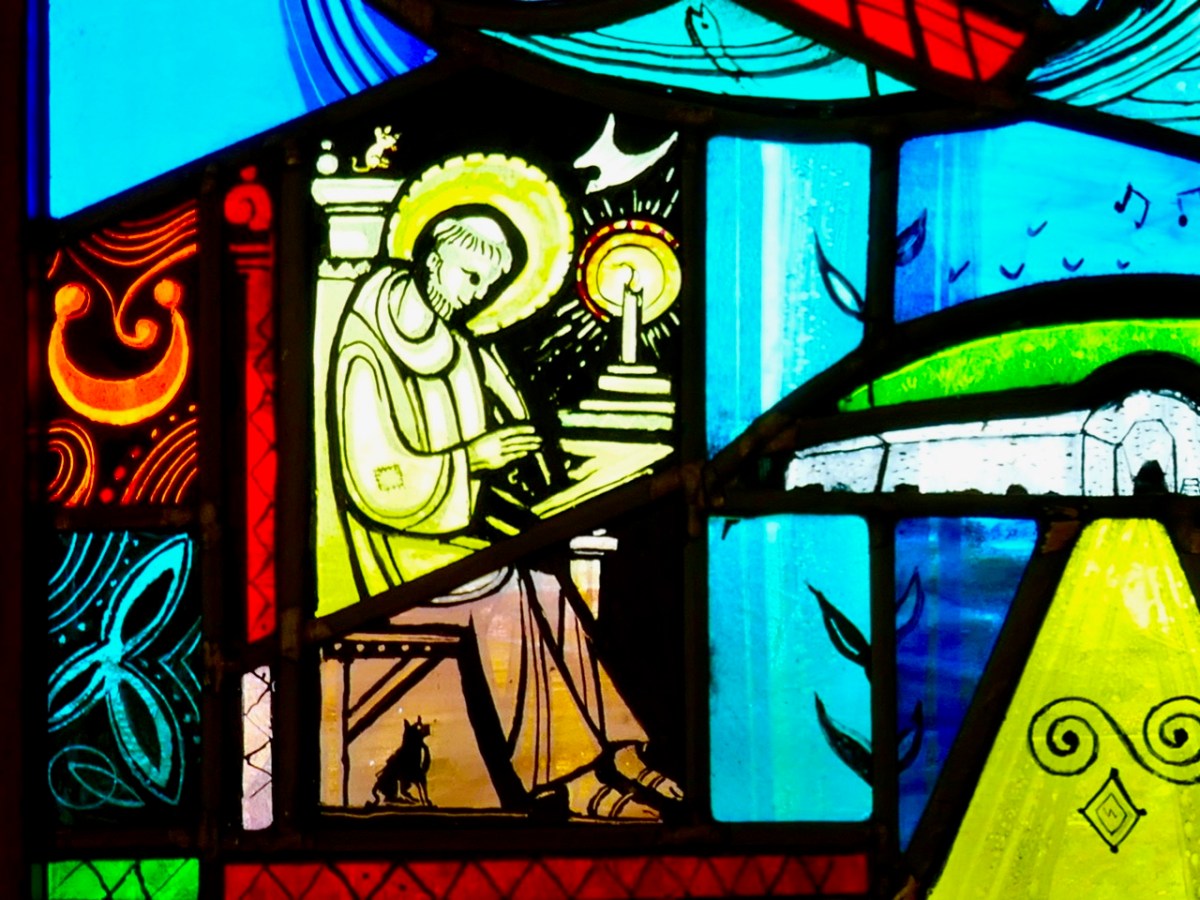
When we think of ancient Irish manuscripts we might visualise the Book of Kells, which is on display in Trinity College, Dublin. It’s remarkable to think that the Book of Lismore is over 500 years old, but that the Kells manuscript predates it by 600 years: it was created around 800AD. Here’s a scribe (from Finola’s window by George Walsh) who could be from any of those medieval periods when monks and lay brothers worked away in their scriptoriums making, copying and illuminating beautiful works which have become our most precious historical documents:

The Book of Lismore is written on vellum, and was compiled for Fínghin Mac Carthaigh, Lord of Carbery (1478–1505) and his wife Caitlín. It became known as Leabhar Mhic Cárthaigh Riabhaigh. It is entirely in Irish. What has really excited us is that, in introducing the installation of the book at Cork, UCC Professor of Modern Irish Pádraig Ó Macháin mentioned our own locality:

[The book] belongs to a period of creativity which was centred on the coastline of Cork. It is difficult to imagine those seats of learning and literature today when you look at the remote rural landscapes . . . In Rossbrin Castle – the O’Mahony stronghold – translations, treatise and journals were being made using contemporary European resources: it was a proto-university in pre-urban Ireland, paralleled by the vibrant poetic tradition of the O’Daly family in nearby Mhuintir Bháire [The Sheep’s Head] . . .

Pádraig Ó Macháin, 2020 (paraphrased)

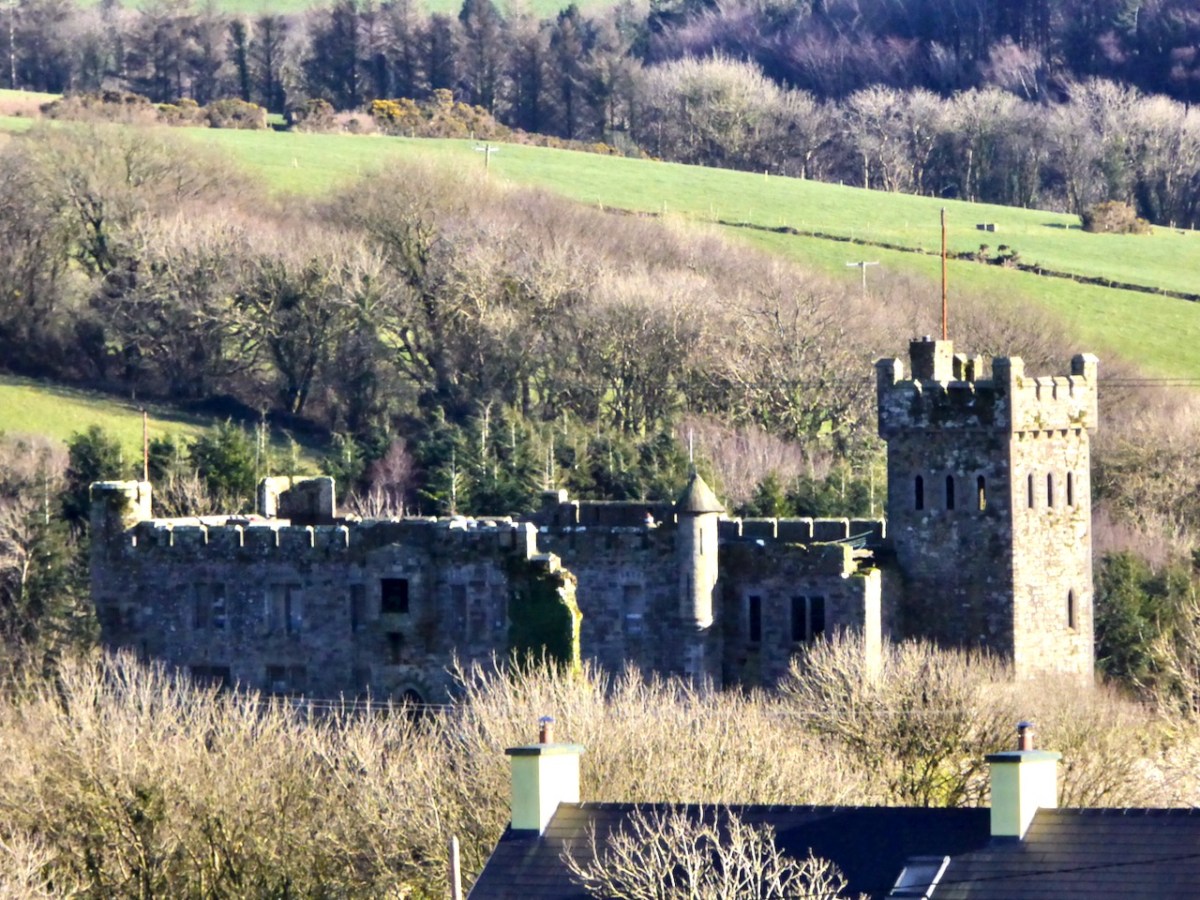
Rossbrin (above) was only one of many castles occupied by the Gaelic nobility along the coastline here in the 15th century and beyond: this ties in with my post of last week when I explored a 1612 map and identified many centres of occupation and scholarship which surely made West Cork so vibrant and cosmopolitan in earlier times. Books are known to have originated here – including the first to be written in Ireland on paper – and some of them survive to this day.

All the page illustrations in this post come from the Book of Lismore. It has a complex history and is likely to be by many hands. One – Aonghus Ó Callanáin – is certainly identified within its pages, and another – a friar named O’Buagachain is suggested. Tradition has it originating from the lost Book of Monasterboice and associates it with Kilbrittain Castle, Cork – reportedly the oldest inhabited castle in Ireland, dating from as early as 1035 and possibly built by the O’Mahonys – but also with the Franciscan Friary at Timoleague.

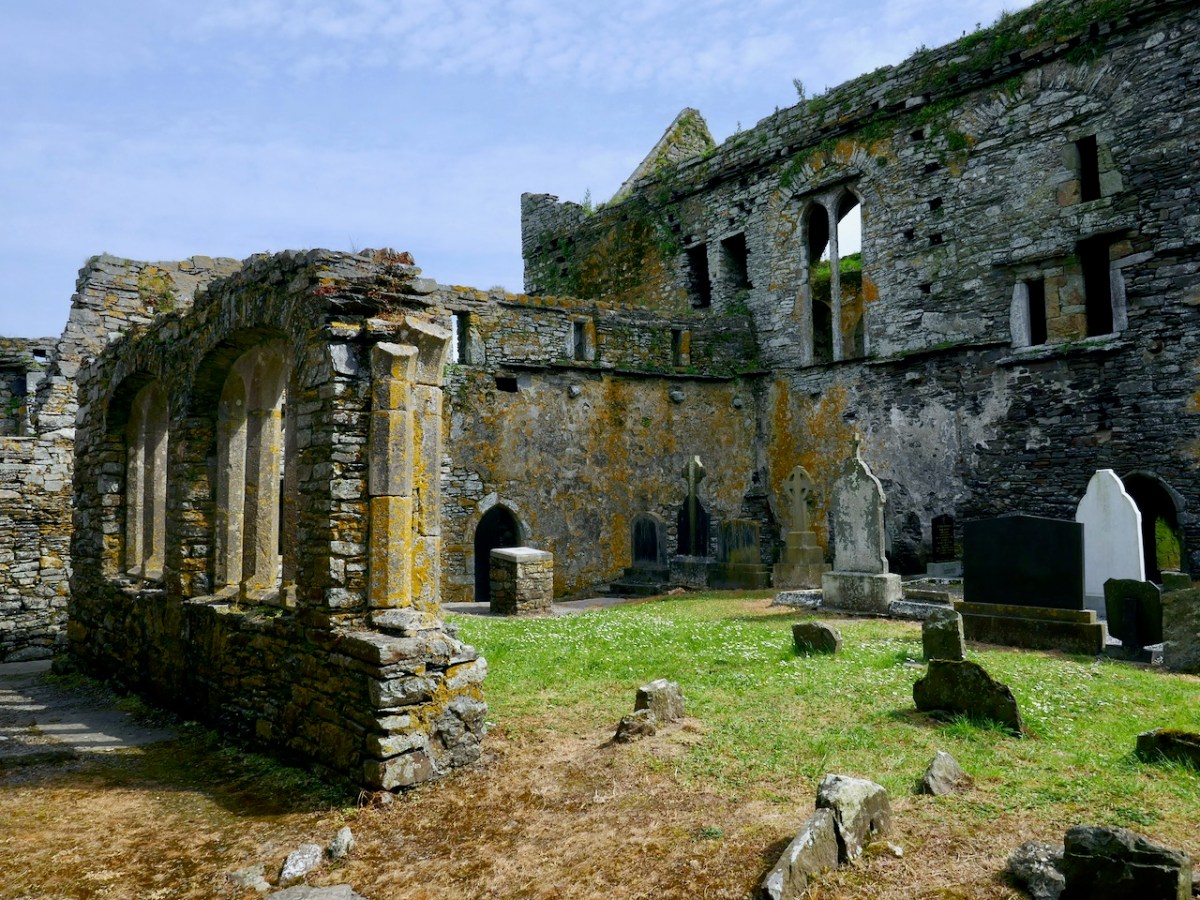
Upper – Kilbrittain castle in the present day: the original building is a thousand years old. Lower – the Friary at Timoleague, a foundation attributed to the MacCarthys in 1240, and plundered in the 17th century

The book fell into the hands of Richard Boyle, First Earl of Cork, during the Irish civil war in June 1642 and ‘vanished’ until its rediscovery in Lismore Castle in 1814. Apparently it was walled up together with the Lismore Crozier. By then the castle was owned by the Cavendishes, Dukes of Devonshire. It is this family that has donated the book to Cork and the nation, through the Chatsworth Settlement Trust.

Upper – Lismore Castle by TS Roberts, Aquatint and etching 1795 print by Samuel Alken. LowerThe Book of Lismore and the Lismore Crozier celebrated in this Celtic Revival stained glass window of St Carthage in Lismore Cathedral. The window is by Watsons of Youghal, and you can read more about them in Finola’s post here

One further thought: today is ‘All Saint’s’ – November 1st. The contents of the Book of Lismore include a section on the lives of the Irish Saints: these lives were translated by Whitley Stokes in 1890 and are available to read online. Finola has used this source in her post about Saint Fanahan, or Fionnchú. We look down on Rossbrin Cove and the ruins of the medieval O’Mahony castle – sometimes described as the greatest centre of learning in Europe! We feel excitement and gratitude that here in West Cork we are linked to this treasure from that age, now in the responsible hands of UCC.

Harry Clarke Quiz – The Answers

Well done to everyone who took part and I hope you enjoyed it. (And it’s not too late – you can always try the Quiz, if you haven’t already done so, before proceeding.) It wasn’t easy. In fact, if I had tried to answer it myself, as opposed to setting it, I don’t think I would have got them all right. That’s important, as it illustrates the very conundrum posed by the question of what is, in fact, a genuine Harry Clarke, designed by him and either at least partially executed by him or executed under his very close supervision, as opposed to a Harry Clarke Studios, that is one done by other artists working in his studio, especially after his death. I hope you remember your answers, as the poll only tells me the percentage of people who answered correctly. OK – here goes.

Saint with Hood 1
Yes: 70% No: 30%
Correct Answer: Yes

In fact it was designed and totally executed by him. It depicts St Fachtna, Patron Saint of Rosscarbery, and is a detail from the 1919 Nativity at St Barrahane’s Church of Ireland in Castletownshend, West Cork. The window was commissioned by Edith Somerville and her siblings in memory of their parents and was one of Harry’s first private commissions after he burst on the scene with his triumphal set of windows for the Honan Chapel at University College, Cork. Harry was still trying to find his feet as a stained glass businessman at this point with the artist in him taking precedence over the need to make money at this. He lavished such care and attention on this window that his father, Joshua Clarke, despaired of their ability to recoup what it was costing. In the end he and Harry had to come to an arrangement whereby Harry paid for workshop time and the use of his father’s glaziers. It was an important lesson in the need to balance his drive as an artist with making a living and led to his taking on assistants and artists to help him with the volume of work. To see the whole window, take a look at my post The Nativity – by Harry Clarke.

Saint with Hood 2
Yes: 33%  No: 66%
Correct Answer: No

Two thirds of you knew at once that this is not a Harry Clarke – in fact, it isn’t even a Harry Clarke Studios. This is the head of St Colman from the Honan Chapel, but it is not one of the 11 windows that Harry supplied, but rather one of the windows done by An Túr Gloine (The Tower of Glass), the cooperative studio established by Sarah Purser and Edward Martyn to promote the use of Irish windows by Irish artists. Read more about An Túr Gloine in this post: Loughrea Cathedral and the Irish Arts and Crafts Movement. The St Colman window was the work of A E Child, who mentored many of the Túr Gloine artists and who taught Harry at the Dublin Metropolitan School of Art.

Nativity 1
Yes: 80% No: 20%
Correct Answer: No

Four out of every five of you thought this was a Harry Clarke, but in fact this was the work of one of the Harry Clarke Studios artists, probably in the period immediately following Harry’s death, when there was pressure on them to produce Harry look-alikes. The window, which is very difficult to photograph, is high up in the wall of a transept in St Patrick’s Church in Wicklow Town. I think this is one I would have identified as a Harry Clarke, as it is such a close reproduction of his style.

Nativity 2
Yes: 58% No: 42%
Correct Answer: Yes

Yes, this is indeed a Harry Clarke. However, it’s not as straightforward as the Nativity window described in Saint with Hood 1, above, in which every aspect of the project was the work of Harry himself. It’s one of the collection of windows in the Diseart Centre in Dingle, in what was formerly the Presentation Convent. These windows were commissioned in 1924. Nicola Gordon Bowe assigned a status of Harry Clarke (B) to this one, that is ‘initially conceived and designed by him but executed by his Studio under his close supervision’. She wrote: 

At the beginning of 1924 Harry Clarke was at the peak of his career, in both stained glass and illustration. However, his health was beginning to deteriorate, among the causes being the extreme pressure of work, the extra responsibility his father’s death had put on him, and the upheaval in his life caused by the reconstruction of the Studios and the conversion of the two extra houses acquired in North Frederick Street. . . He engaged Austin Molloy to help him with cartoons, probably those required for a series of windows illustrating The Life of Christ at the Presentation Convent, Dingle. . . Although the Studios were responsible for most of the work on the Dingle windows. . . this series of six pairs of lancets is notable for some passages either worked or directed by himself. These include the sensitively painted head of the oldest king in the Nativity light. . .

In The Nativity – by Harry Clarke, you can see the whole window and a detail of the three kings. Five years after he had expended such personal concentration on the Castletownshend Nativity, Harry was under so much pressure from incoming orders that he could no longer handle all the work himself. By this time he had employed a small but brilliant contingent of assistants and artists and rigorously trained them to reproduce his style and bring his designs to fruition.

Presentation
Yes: 38% No: 62%
Correct Answer: No

This is a detail from an enormous Harry Clarke Studios Window in St Mel’s Cathedral in Longford, installed in 1932, after Harry had died. The Cathedral burned down on Christmas Day 2009 but was rebuilt and the windows were wonderfully restored by Abbey Stained Glass Studios for the 2014 re-opening. If you search online for ‘St Mel’s Cathedral stained glass’ most of the results will simply refer, erroneously, to ‘the Harry Clarke windows’. The scene of the Presentation is in the predella (lowest panel) of the St Anne window. 

St Augustine
Yes: 53% No: 47%
Correct Answer: No

This depiction of St Augustine is in the Holy Cross Catholic Church in Charleville, Co Cork, which is packed with interesting stained glass, including a series of twelve from Joshua Clarke and Sons erected between 1919 and 1922. Harry was working in his father’s studio at the time, doing his own windows and also assisting with the supervision of work under his father’s imprint. In a letter to Holy Cross, Joshua says, “Harry will look to the new windows and see you get very good ones.” And they are good, but the only one that looks (to me, that is) like Harry took an active hand in it is this one of St Augustine. It has the large expressive eyes, sensitive mouth, compassionate expression and long tapering fingers that we see in the full development of his style. I suspect that’s what those of you who answered Yes were responding to. However, it cannot be called a Harry Clarke, or even a Harry Clarke Studios – instead, it bears the stamp of J Clarke and Sons and remains an interesting question.

Crucifixion
Yes: 52% No: 48%
Correct Answer: No

A round window above the altar in Ballydehob Church in West Cork. While the style is reminiscent of the windows produced by the HC Studios after Harry died, in fact this window is by Earley and Co, and specifically by Leo Earley. Leo was very inspired by Harry and emulated his use of colours and his embellishments and decoration. While the faces and figures in this window are not convincing, the flow of the ornate garments are an echo of the fantastical and imaginary faux-medieval costumes Harry loved. 

Malachy Meets Bernard
Yes: 48% No: 52%
Correct Answer: Yes

The predella from the right hand light of a three light window, this small scene show St Malachy meeting his mentor, St Bernard. Of the three lights, the St Bernard and St Rita windows are by Harry Clarke and the central light is by William McBride. They date to 1924 and are in the Sacred Heart Church in Donnybrook, Dublin.

St Sebastian
Yes: 71% No: 29%
Correct Answer: No

John the Baptist Church in Blackrock, South Co Dublin, is full of interesting stained glass, including an Evie Hone. There are several windows by the Harry Clarke Studios and the St Sebastian is one of them. This is one I would have voted yes to myself, as the faces of the onlooking soldiers are so Harry Clarke.

Scene from Wedding Feast at Cana
Yes: 80% No: 20%
Correct Answer: No 

Although officially this is not listed as a Harry Clarke window, you can certainly be forgiven for thinking it is, as everything about it shouts Clarke, including the sheer richness of detail. In fact, this window was one of the last to be worked on on his studio while he was still alive (although mostly absent at a sanatorium in Davos, Switzerland) and he did indeed have some input (although we don’t know how much) into the design of parts of the window, including this scene. It is a detail from one of three lights, which together incorporate seven Scenes from the Life of Christ in the Catholic Church in Timoleague, West Cork. The whole window is very fine indeed and I will be writing a future post about it as it is the subject of some excellent research by Clarke scholars, and a good example of the complexities of ascribing the label ‘Harry Clarke’. 

Saint with Helmet
Yes: 61% No: 39%
Correct Answer: Yes

No ambiguity here – this is the head of St Adrian from the O’Keefe Memorial Window by Harry Clarke in the Church of the Assumption, Wexford. You can view the full window and read more about this window in my post That He Might Better Rest. Harry designed and executed this window in 1918/19 having first travelled to Wexford to meet with the fallen soldier’s grieving mother.

Lourdes Apparition
Yes: 56% No: 44%
Correct Answer: Yes

I might have been tempted to say no to this one as I find it ultra-conventional, but it is indeed a Harry Clarke, designed by him and executed under his supervision. It is one of two windows in a small country Church in Duhill, Co Tipperary. The other window is a startling contrast to the piousness of this one but I will leave that discussion for another day.

Patrick at Slane
Yes: 34%  No: 66%
Correct Answer: No

Good eye! This image is a detail from the huge Patrick window in the Church of Sts Peter and Paul in Athlone and it’s by Richard King, done in the Harry Clarke Studios in 1937 several years after Harry died. It’s unusual for any HC Studios window to be signed – that’s part of the difficult of  identifying which of the Studios artists worked on their windows – but in this case we do know that Richard King made several of the Athlone windows. Read more about those windows in my post Discovering Richard King, where you will also find a link to images of all the Athlone windows.

Brendan the Navigator
Yes: 68% No: 32%
Correct Answer: Yes

This is the head of Brendan the Navigator from the Honan Chapel series which propelled Harry Clarke into the forefront of Irish design when they were installed in 1916.

So – how did you do? Want to argue about any of the answers?