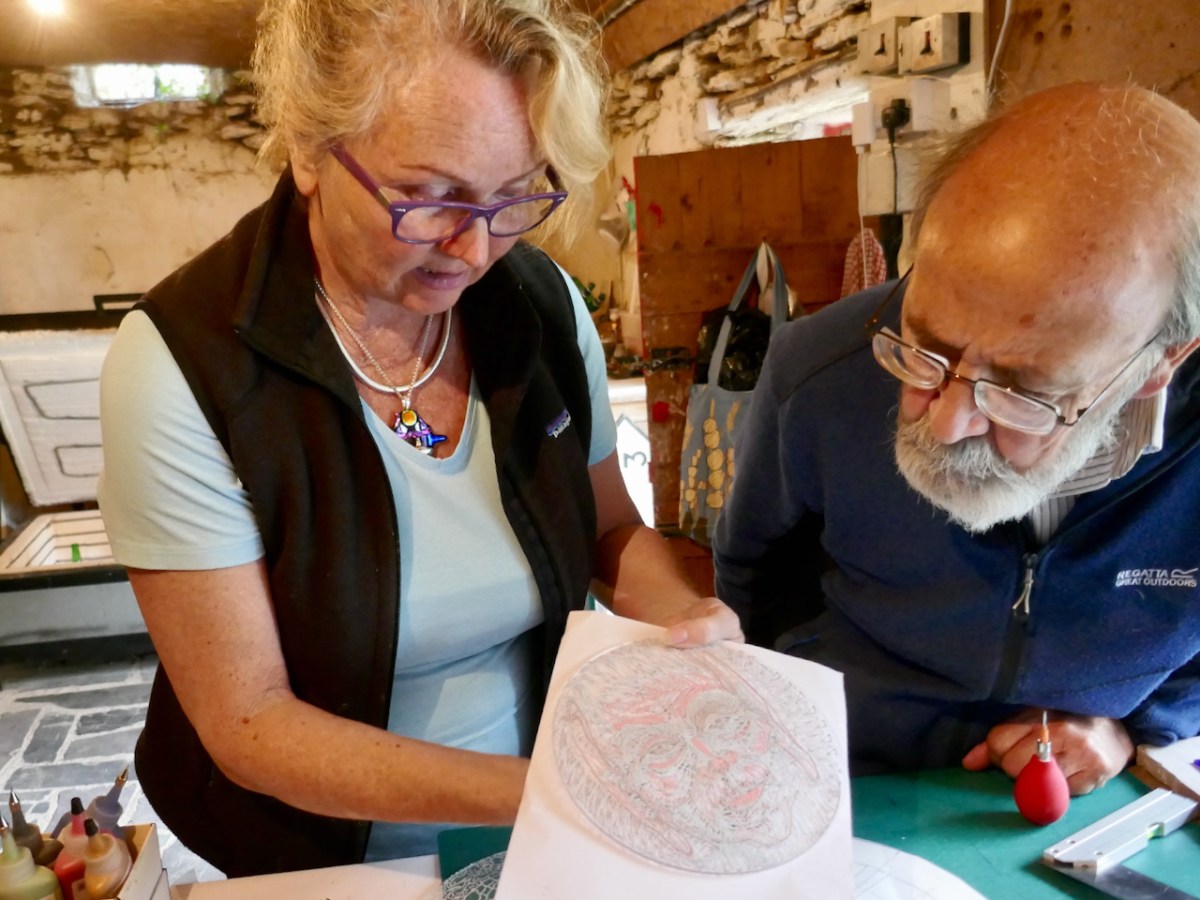
Finola and I went to a workshop on creative fused-and-painted glass. It was wonderful! We were guinea-pigs in that the glass artist – Angela Brady– was keen to try running an event and we were privileged to be invited, joining our friends Brian and Clair Lalor.
Top: that’s Angela introducing us to the medium of glass and showing us some of her own work. Centre: she’s encouraging Brian to turn his artist’s mind to the possibilities of the material. Above: Angela Brady and Robin Mallalieu (who are also architects) have taken over the former Brush Fire Pottery, just outside Ballydehob. This was the home and workplace of dynamic artists John and Noelle Verling, who bought the Gurteenakilla premises in 1973 and lived and worked there for very many years. John died in 2009 and Noelle now lives not too far away. To spend the workshop day in such hallowed surroundings added to the ambience, and could only have inspired us in our artistic endeavours!
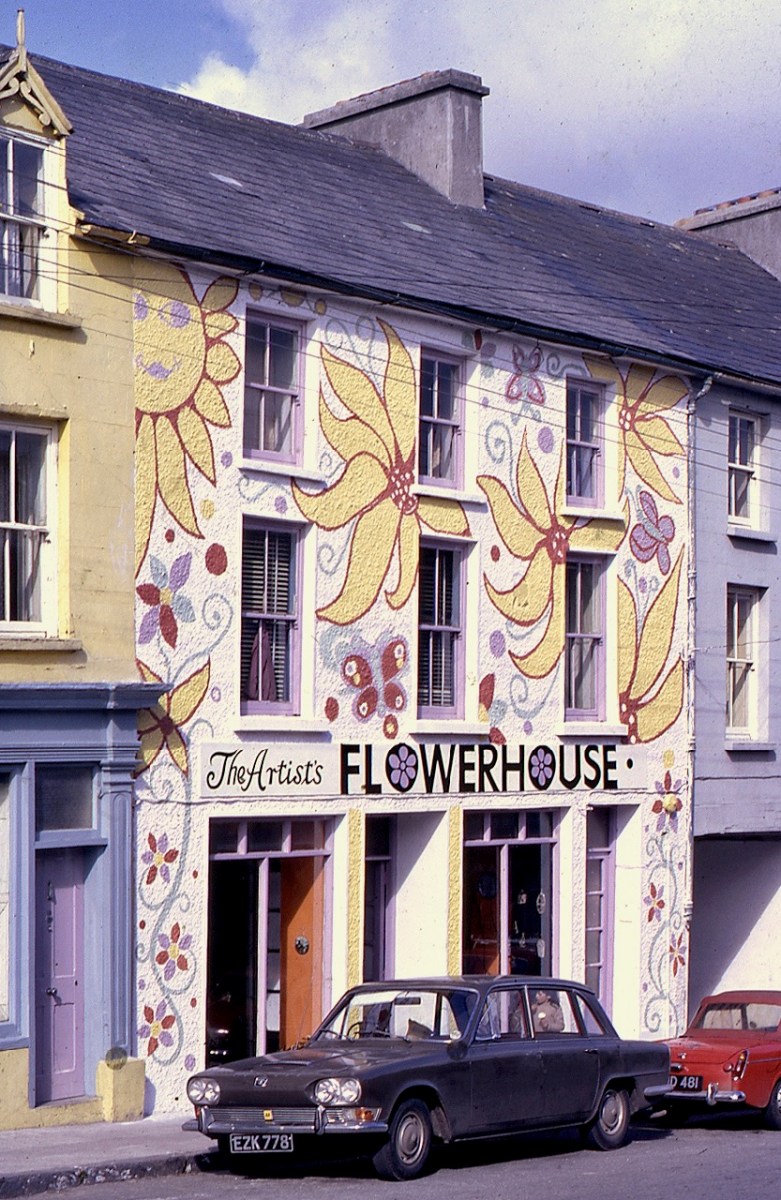
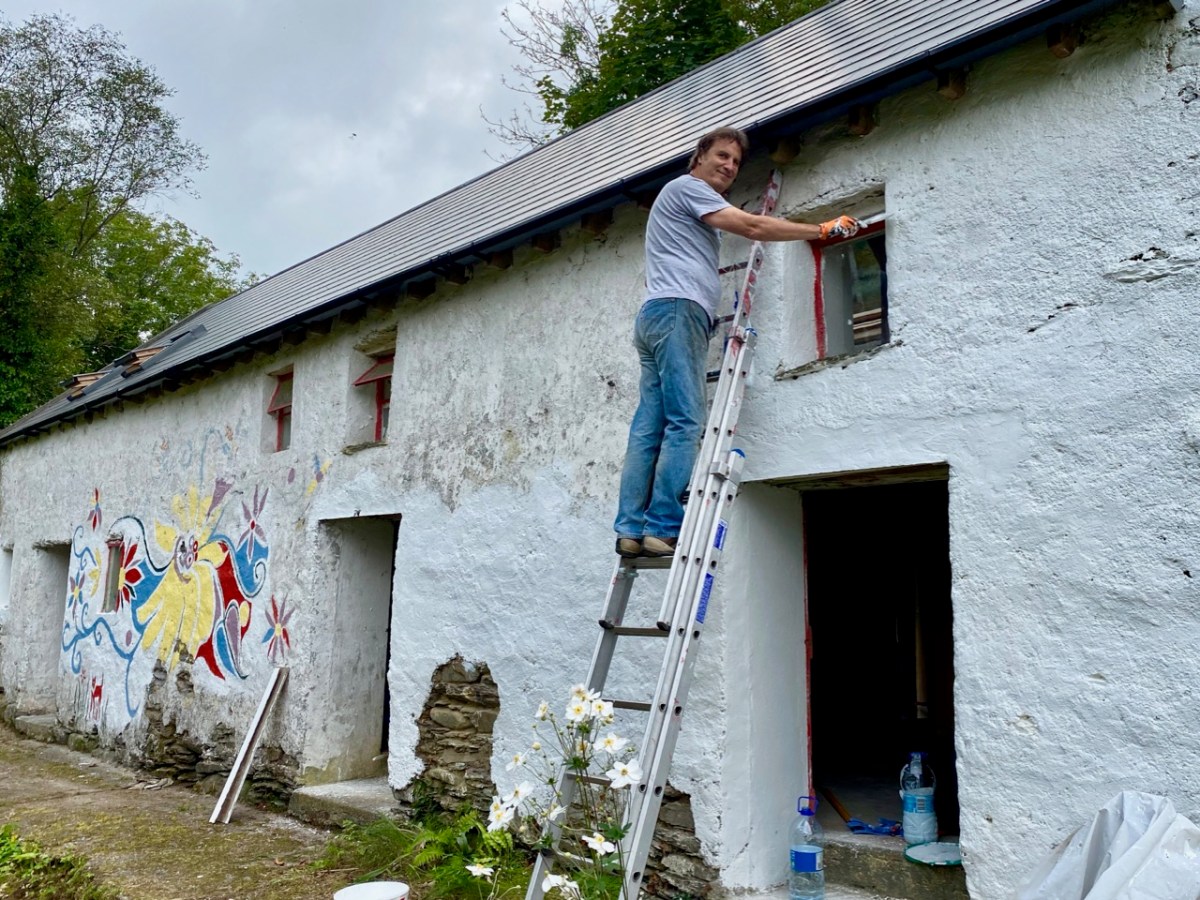
Back in the 1960s – the heyday of the Ballydehob Artists’ community – the pottery at Gurteenakilla was established by Christa Reichel who – together with her partner Nora Golden – went on to set up the Flower House on the main street in the village as a gallery and meeting place for the artists. They painted the vivid facade of the Flower House (the photo below dates from 1963, and is reproduced with the permission of Andrew Street): similar decorations were applied to the Brush Fire studio, where they survived and are now being restored by Angela and Robin.
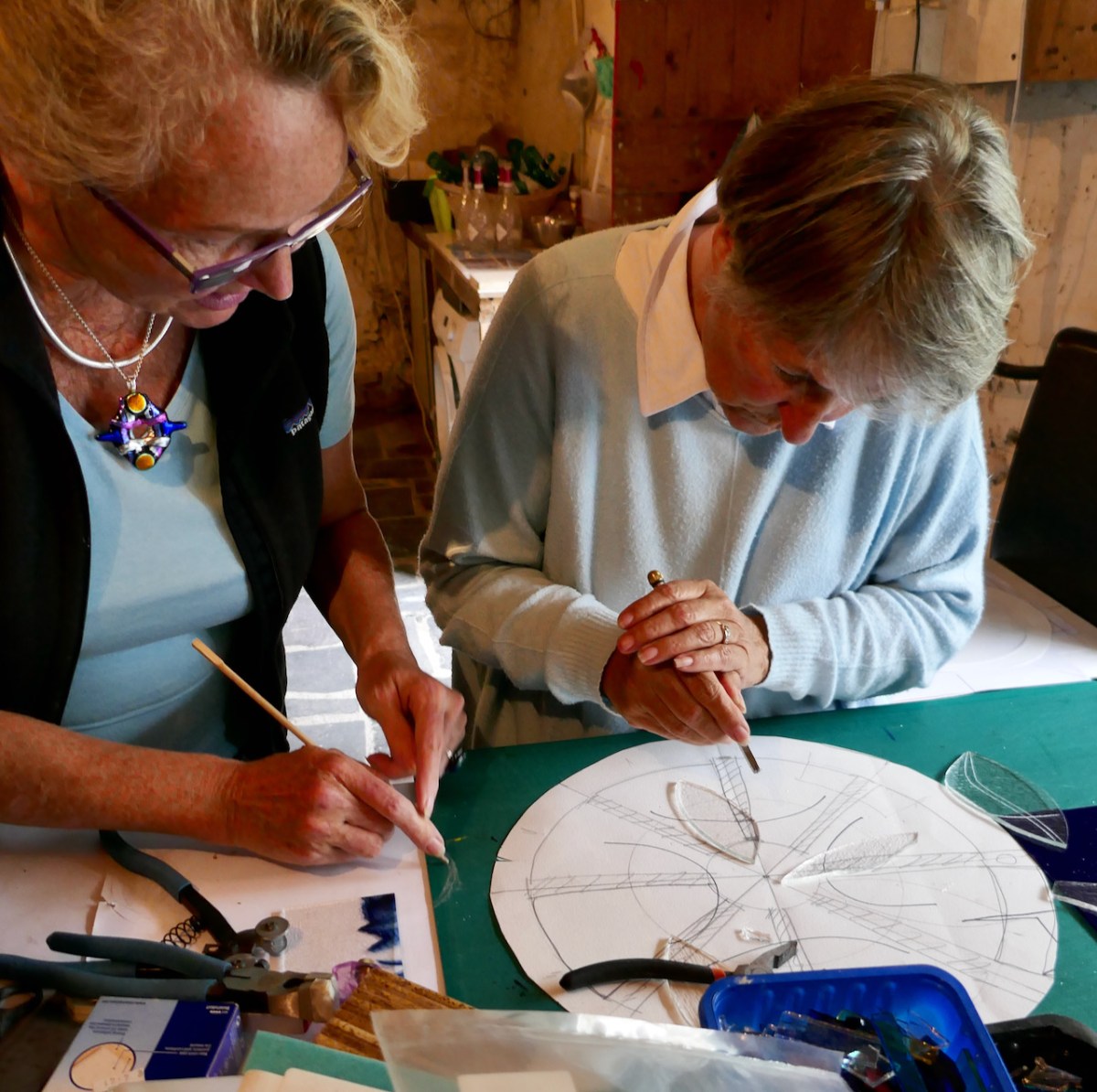
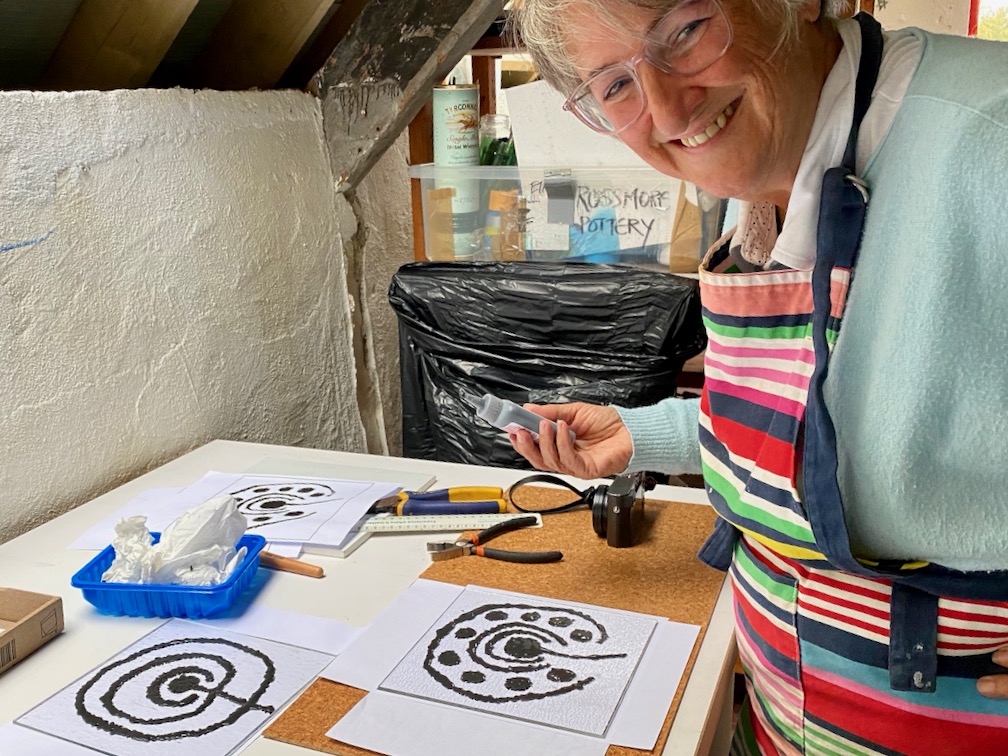
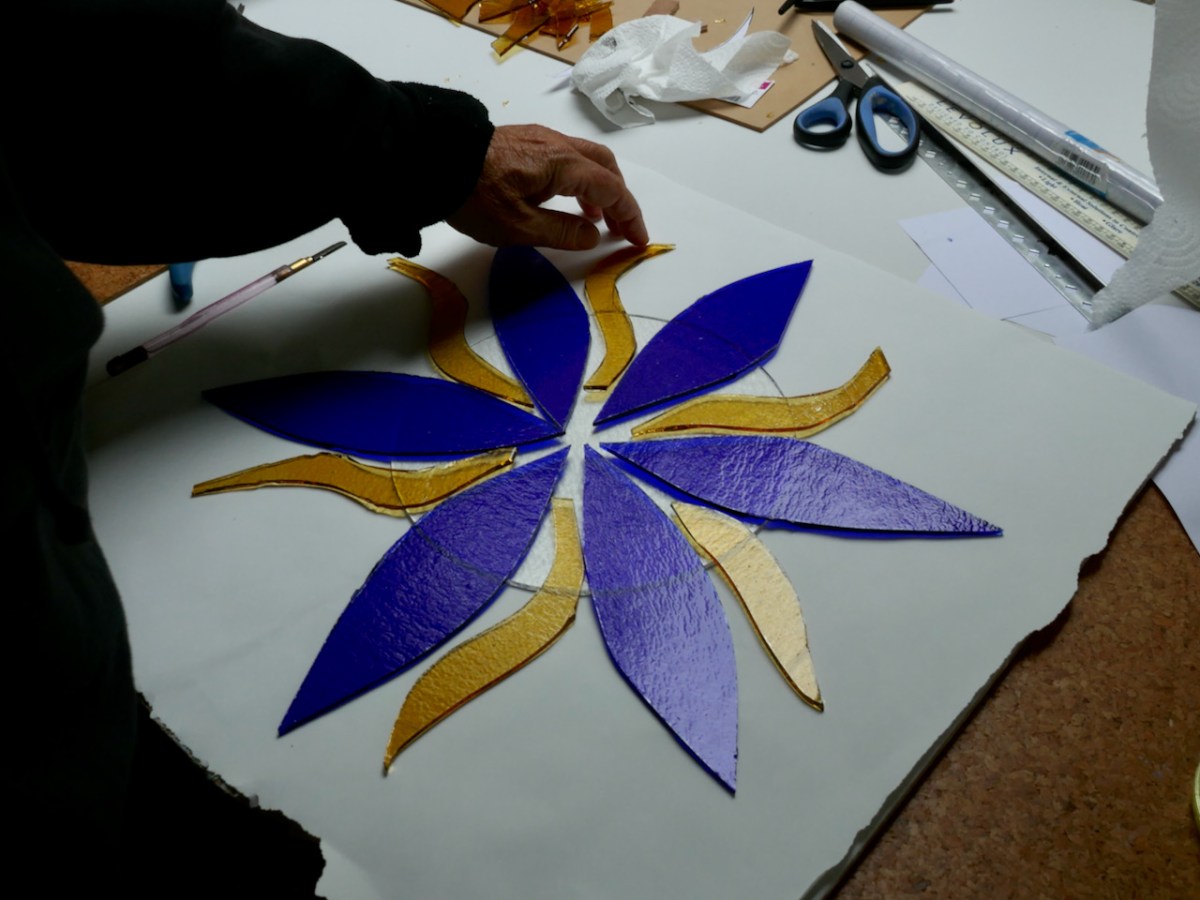
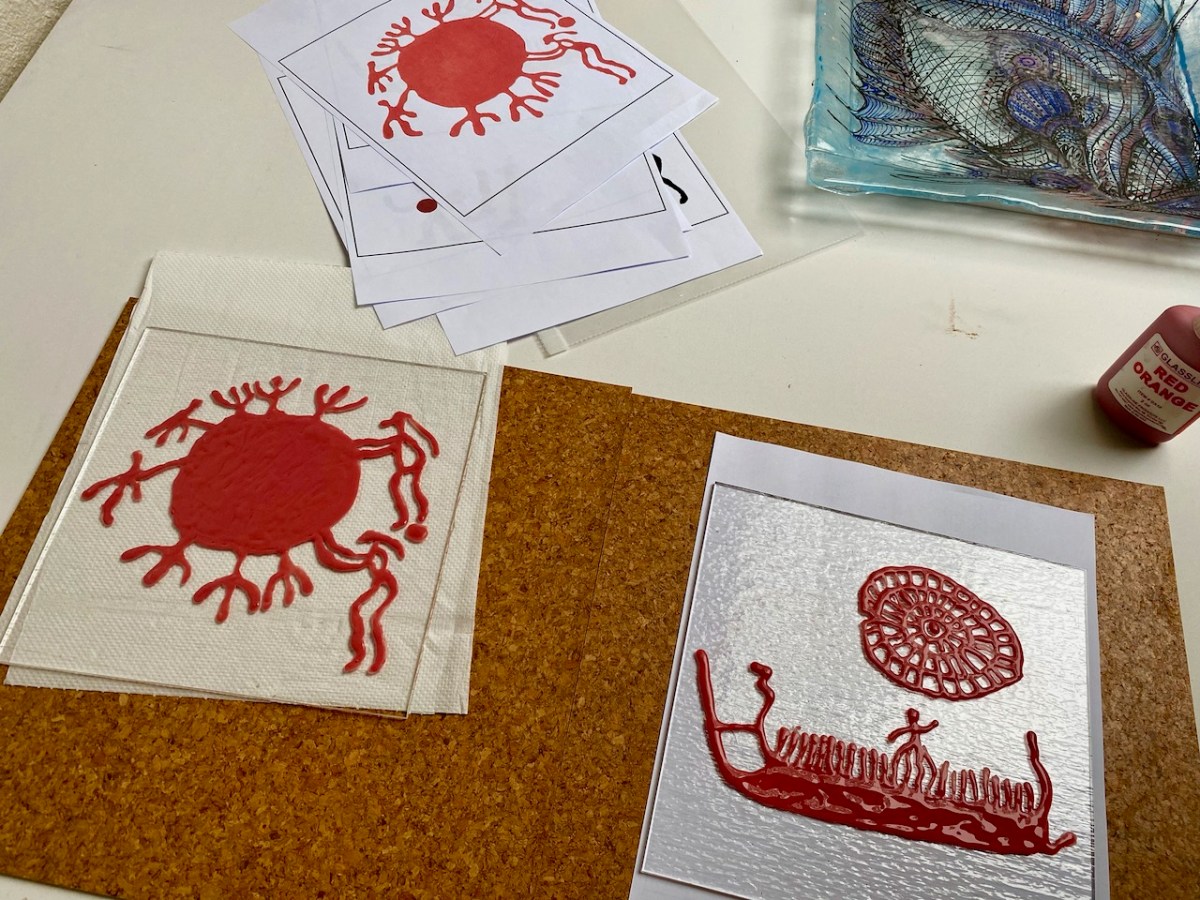
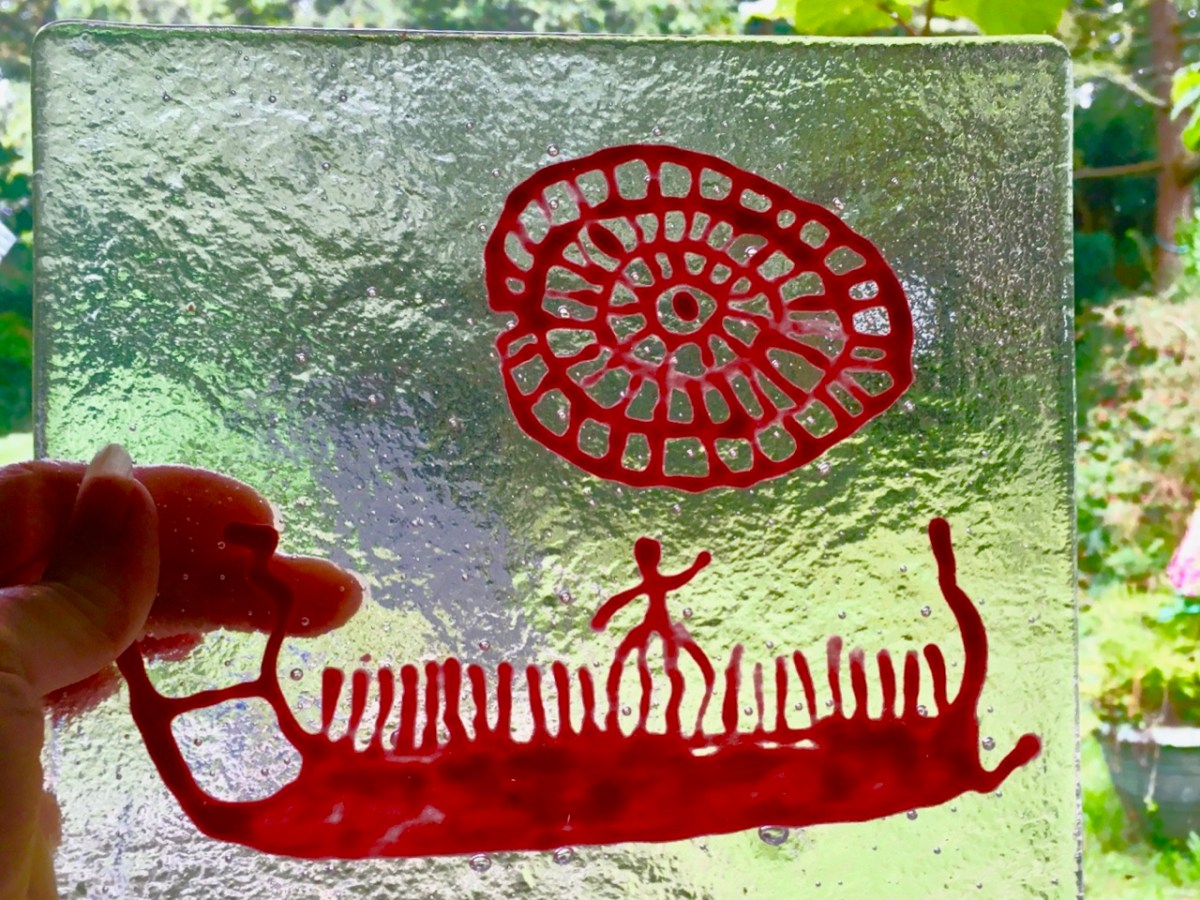
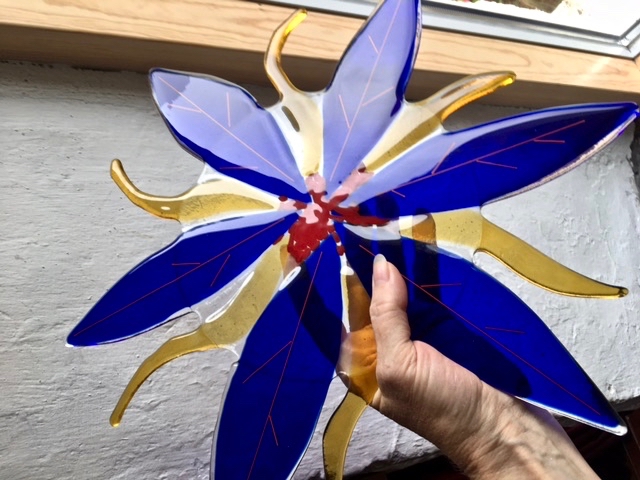
Below the Flower House picture is Nora Golden outside the studio at Gurteenakilla; and here are pics of Robin painting the studio building, and Angela’s restoration of the Reichel / Golden decorations. But back to the job in hand: in these venerable surroundings we learned how to cut glass, paint on it and prepare pieces for the kiln. We all had our own ideas: Finola and I decided to paint glass tiles with ancient motifs: Rock Art from Ireland and Scandinavia, some thousands of years old. Brian chose to use cut glass to enhance one of his exquisite sketches, while Clair was perhaps the most ambitious, planning a flower from cut pieces of glass which would require two sessions in the kiln to allow it to be ‘slumped’ to a three-dimensional shape. My view is that all the pieces were equally successful in their execution (but I am prejudiced!)
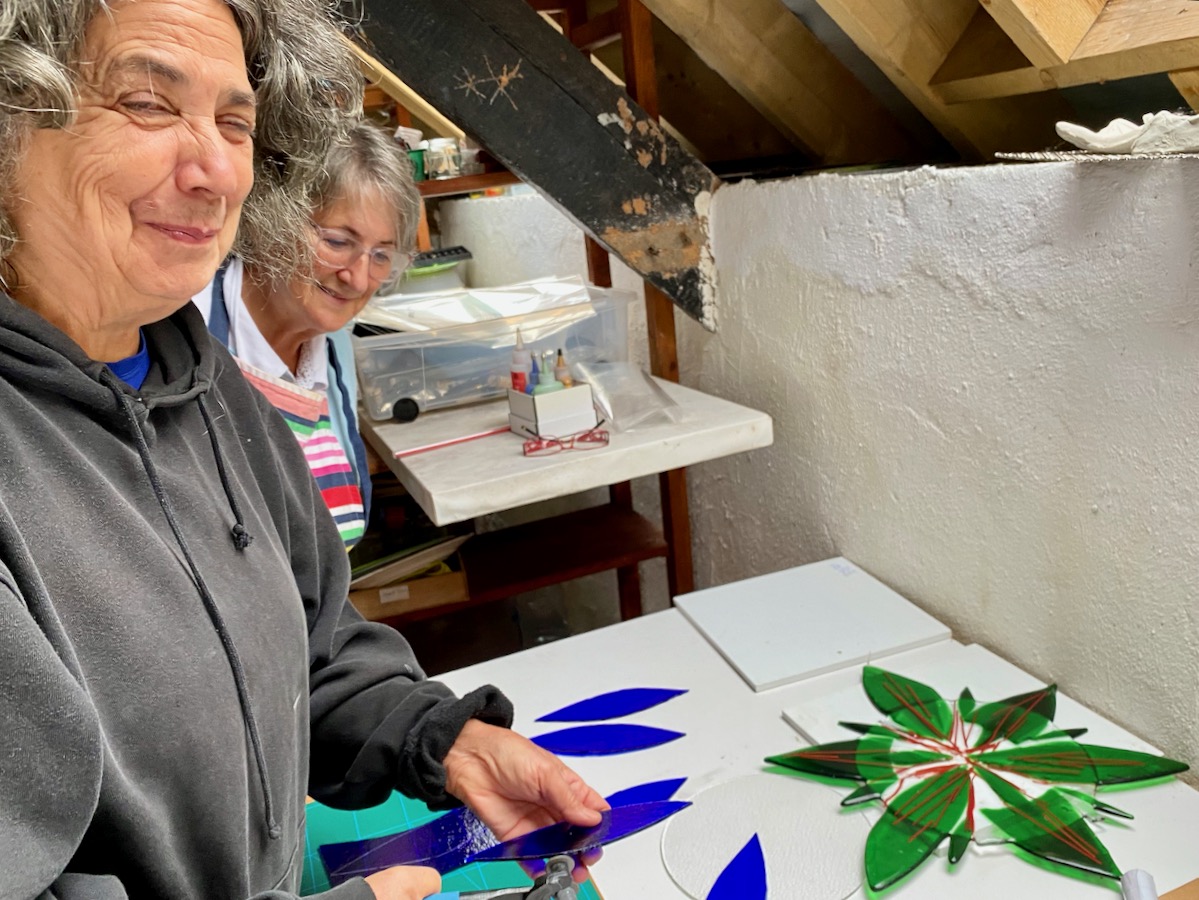
Top: Angela instructs Finola in the technique of cutting glass shapes, although Finola chose to use glass paint to reproduce some of her own Rock Art images traced during her studies in the 1970s. Above: Clair cuts and assembles a flower shape.
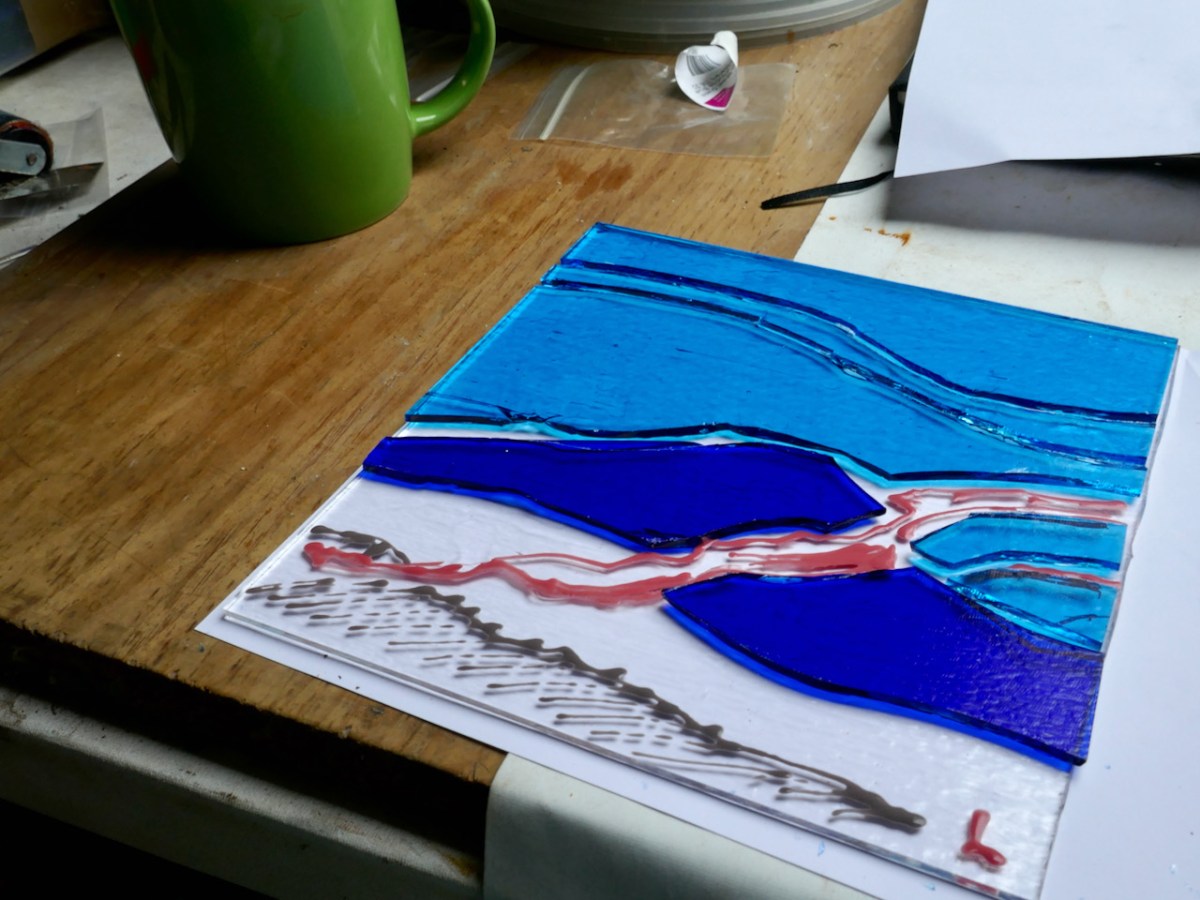
Top: my own pieces: on the left are attendants pushing the sun across the sky, while on the right is a ship carrying souls to the land of the Gods under a potent sun. All these Bronze Age images are found in Norway. Above, Brian working on his cut-glass sketch.
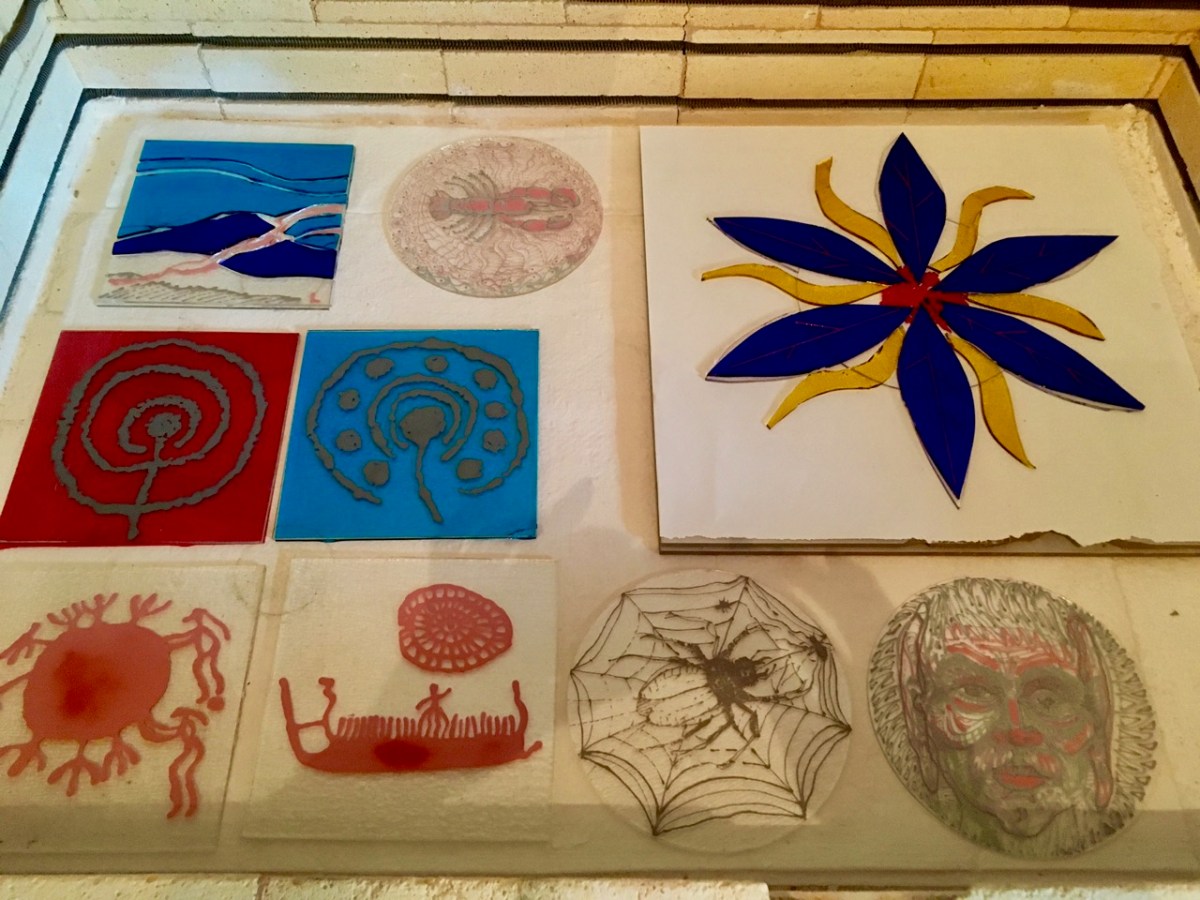
Artists at work in the studio – and the kiln room at Brush Fire. Before going in the kiln, we laminated our pieces with additional glass, to provide a stable background and – in some instances – colour. The firing is carried out overnight at a temperature of at least 760 degrees C. During that time the glass fuses and – hopefully – does not crack.. Angela was firing some of her own pieces at the same time: if you went to the West Cork Createsexhibition in Skibbereen during August of this year you would have seen many examples of Angela’s brilliant work, together with the work of other artists using glass as a medium.
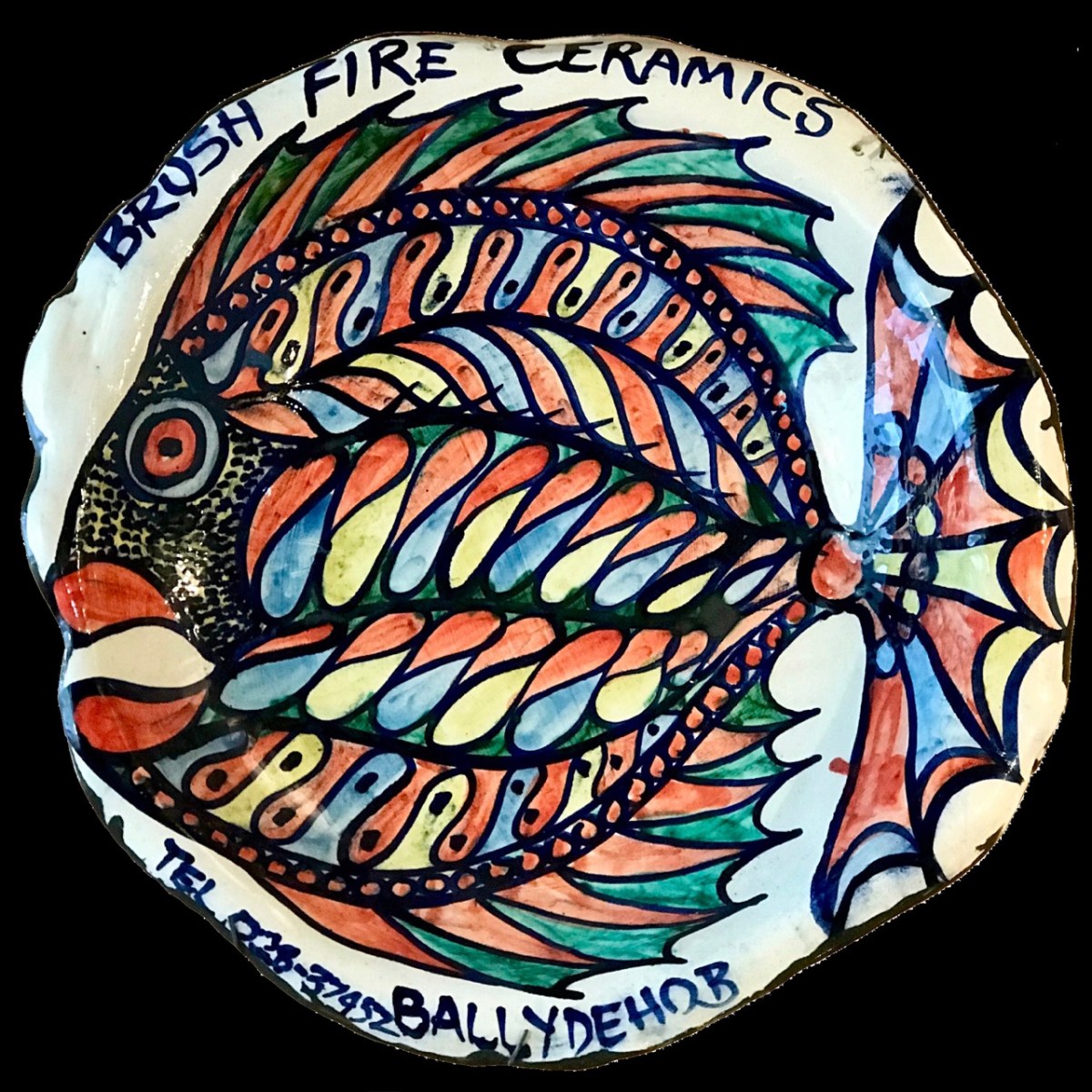
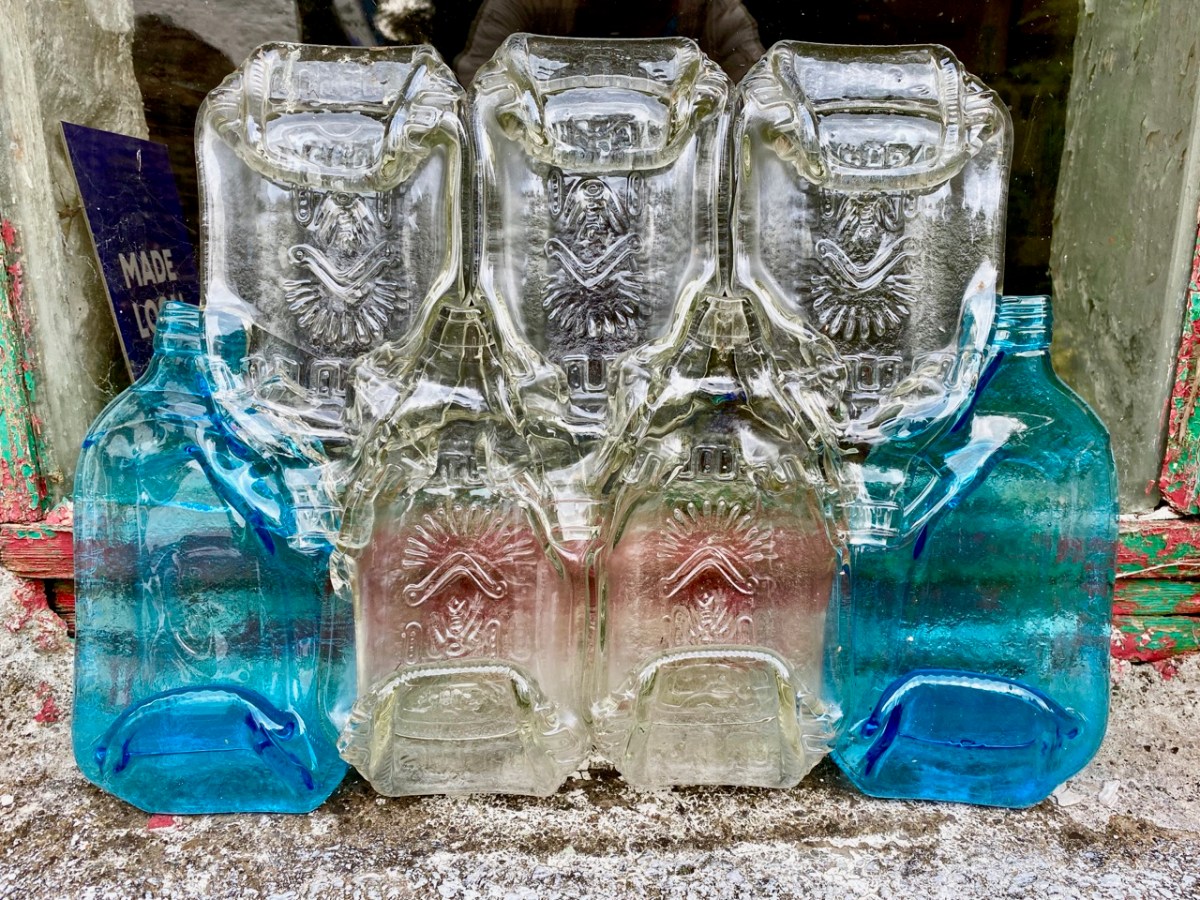
In Angela’s studio are many reminders of past times. John and Noelle Verling specialised in fish imagery – here’s the Brush Fire Ceramics sign that they made back in the day (above – since presented by Noelle to the Ballydehob Arts Museum), while above that is one of Angela’s glass pieces which pays due respect to her predecessors at Brush Fire. Below is a quirky example of Angela’s experimentation: she collected some interestingly shaped bottles from the recycling centre, and fused them together in the kiln:
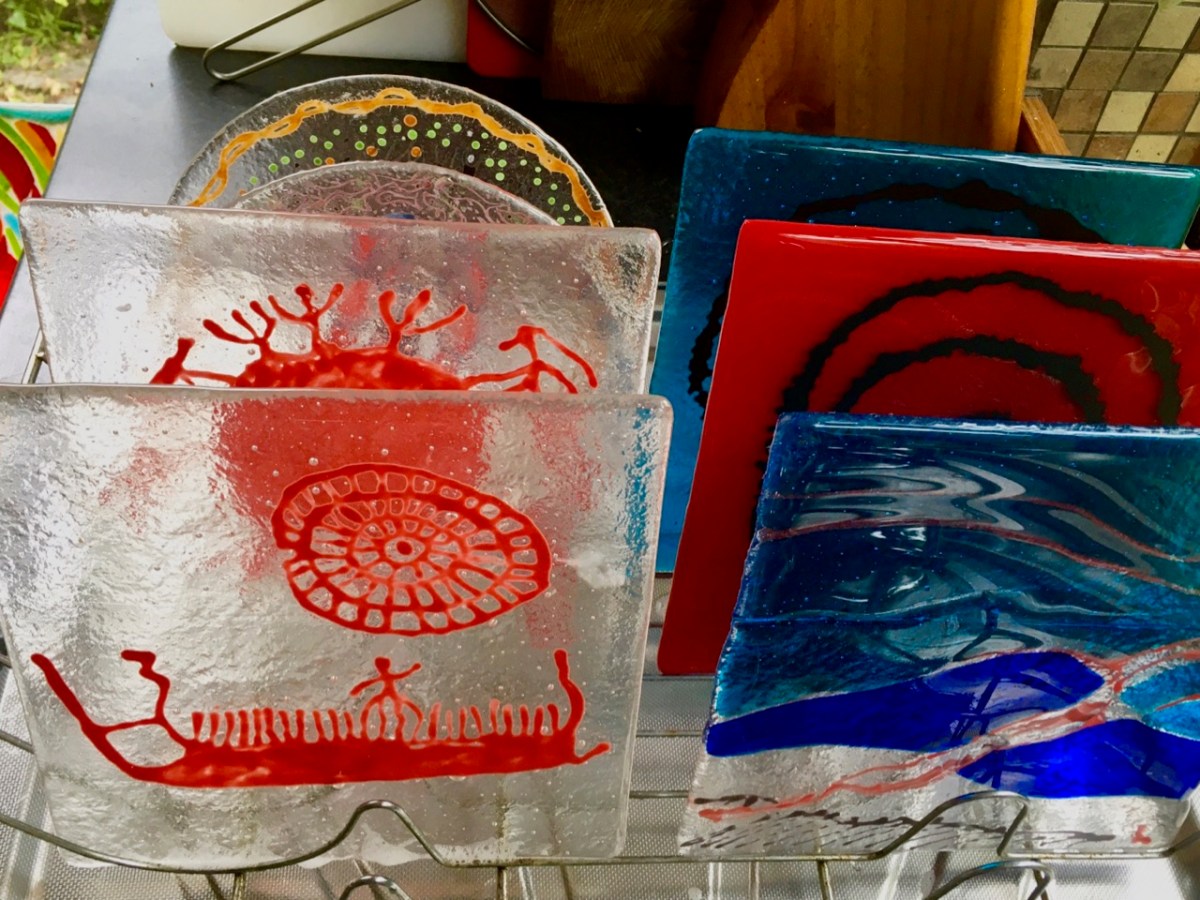
The following day, Angela took our pieces out of the kiln once it had cooled, and washed them (above). Then we assembled at Nead an Iolair for the reveal. Thank you to Robin for the photos. Clair’s work had to be refired to allow it to ‘slump’, so that was unveiled later on.
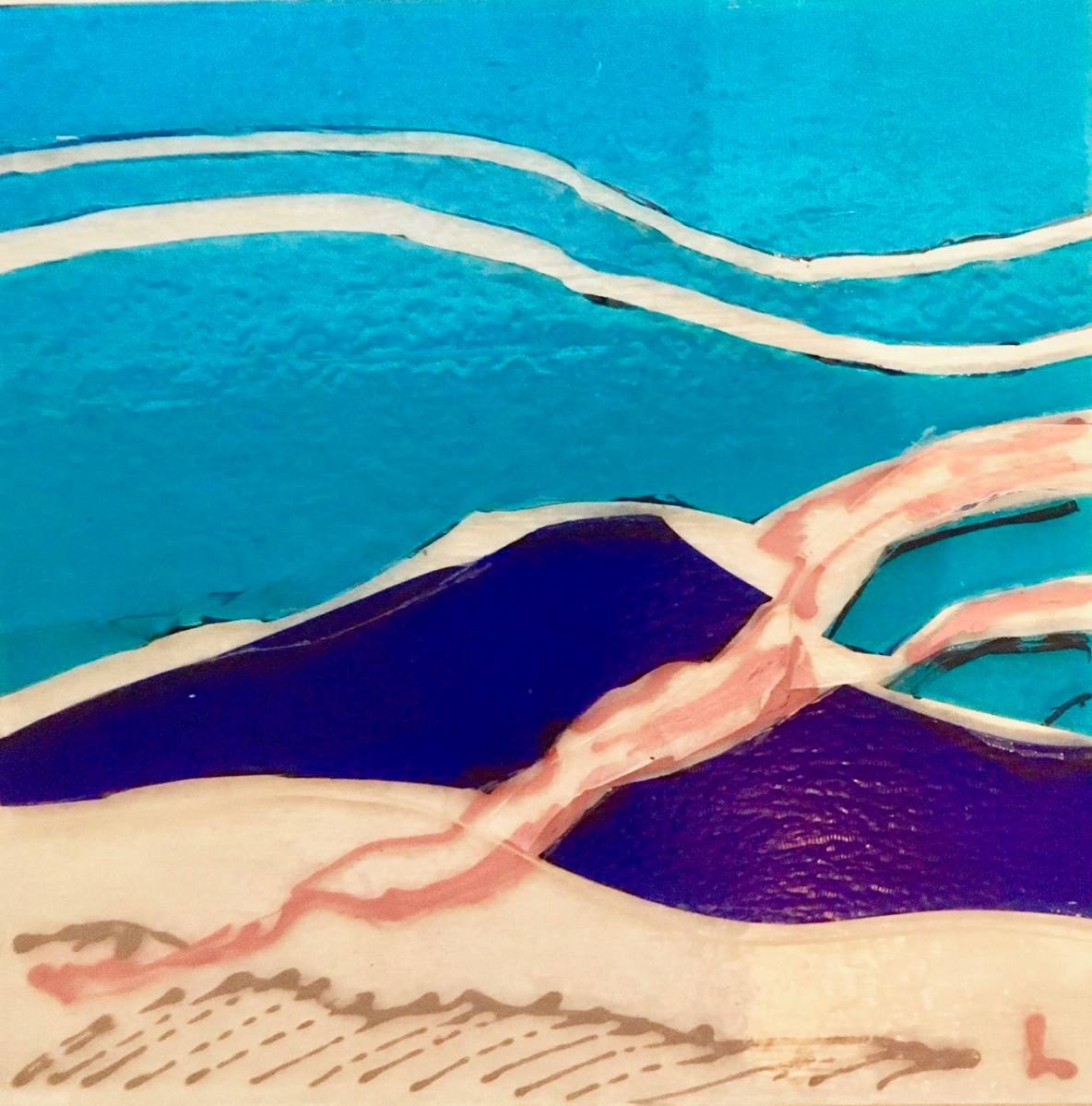
Pieces (top to bottom) by Brian, Finola and myself. And – to finish as we started – Clair’s magnificent flower – before and after the second firing! Thank you to Angela for enabling each one of us to experience this most satisfying process. We would all like to take part again another day – and expand our new-found skills!
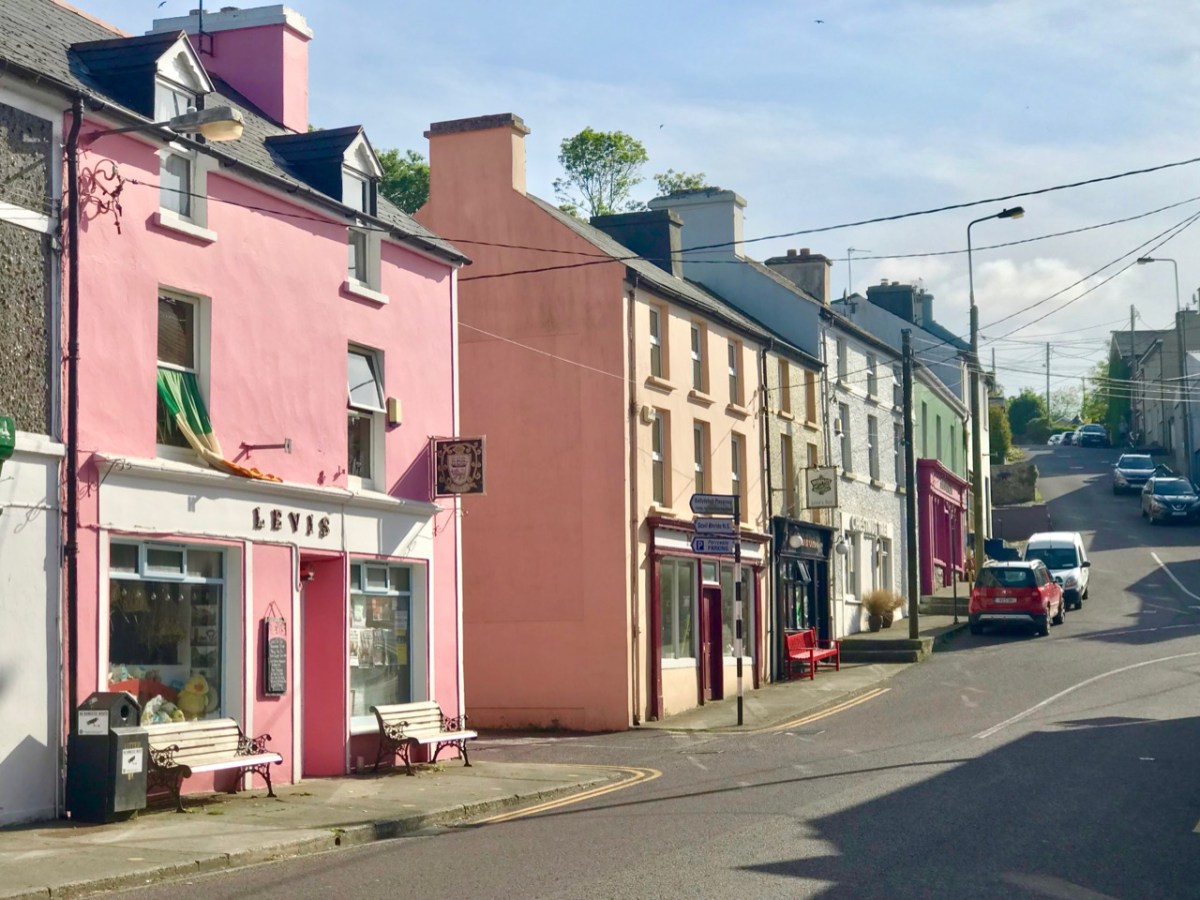
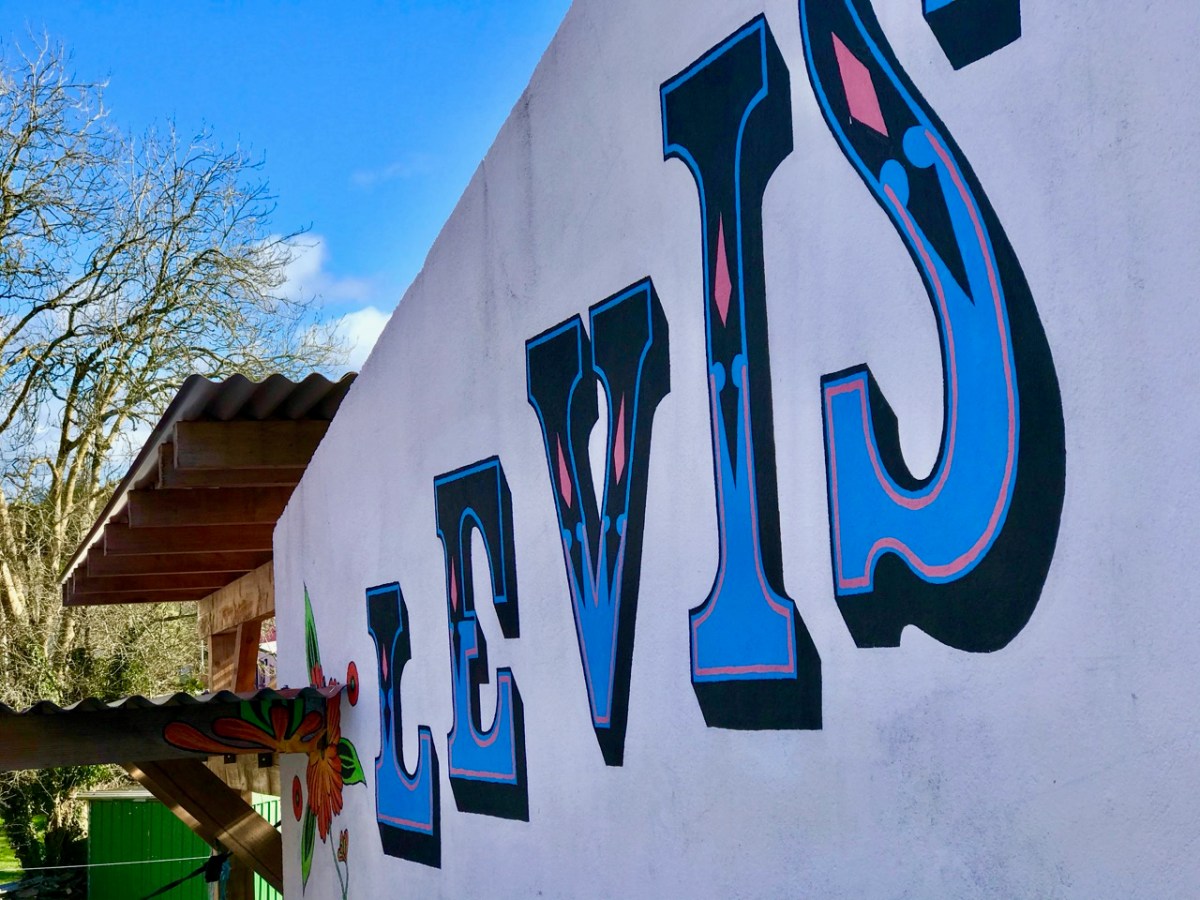
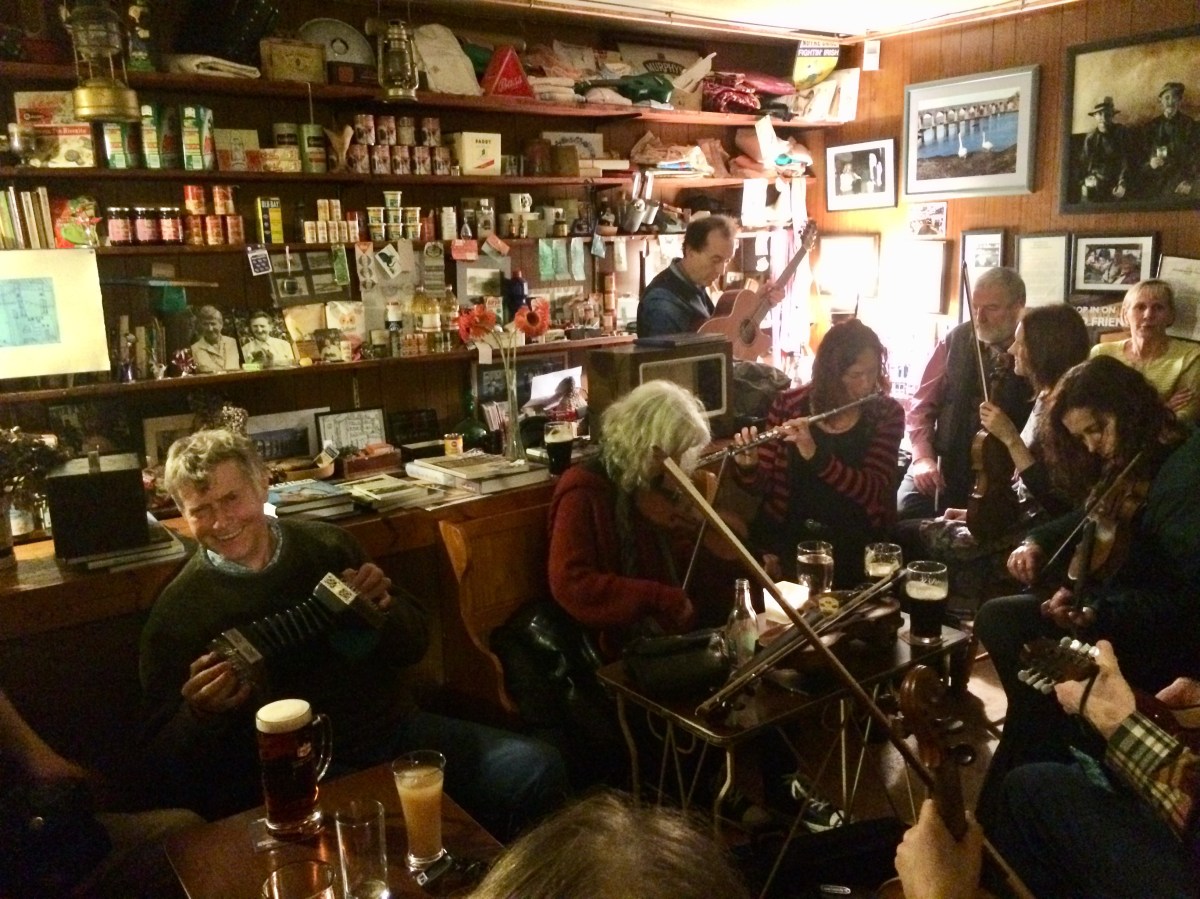
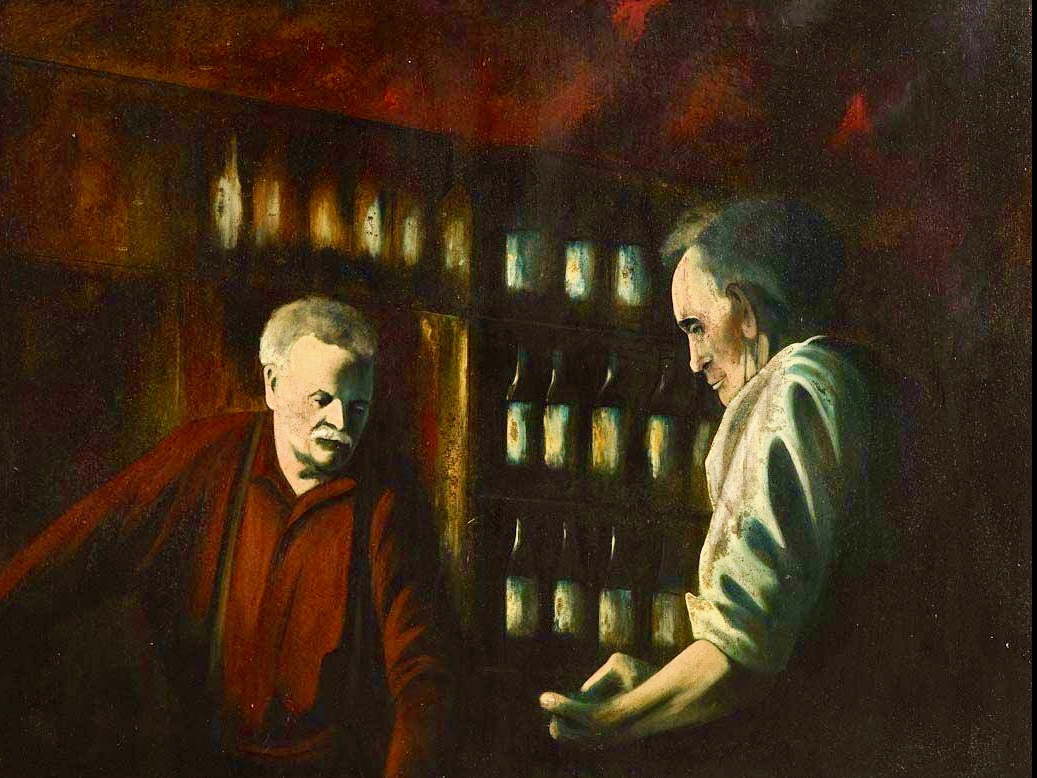
Today there is a story to tell, with lots of connections to the West of Ireland – and our own Ballydehob! That’s Levis’s Corner Bar, below, one of the village’s fine hostelries: try them all if you visit. Levis’s is known for its musical events but also for its traditional appearance inside. Look at the photo of the Irish music session (you’ll see me bottom left playing concertina) – that was taken a few years ago, before Covid; we are still waiting for those good times to return. On the wall behind the players you can catch a glimpse of a painting of men with pints and pipes.
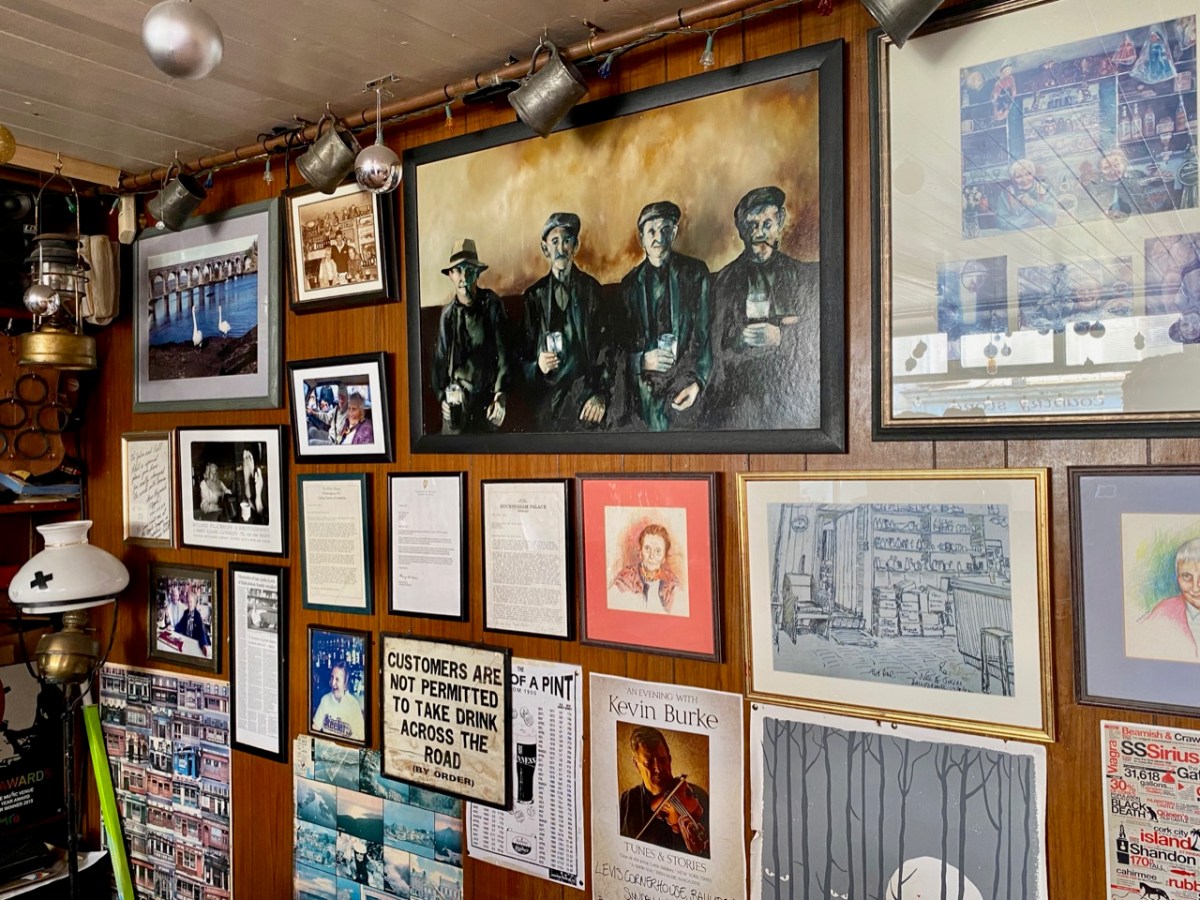
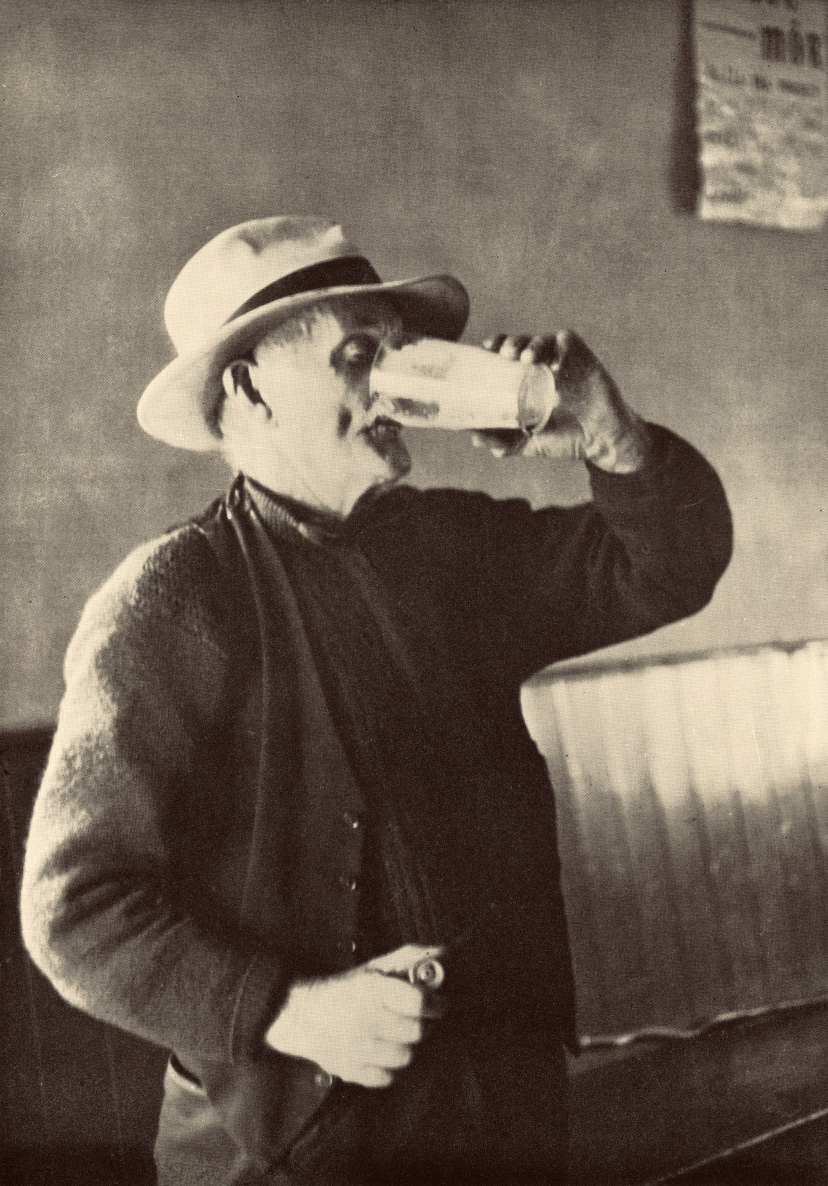
There’s a better view of the painting, above. When I first saw it – very many years ago now – I knew immediately that it was based on a photograph that had been taken by Tómás Ó Muicheartaigh – an Irish cultural hero who spent most of his life documenting traditional life, mainly in the western counties. He lived through the founding of the Irish Free State and was an enthusiastic proponent of the Irish language. This sketch portrait of him is by Seán O’Sullivan, a friend and compatriot:
Way back in the 1970s my then wife and I ran a small bookshop in a Devon market town, specialising in folklore and traditional life. It had a substantial section on Ireland, and Irish culture. We stocked a recently-published volume (1970) celebrating the work of Ó Muicheartaigh, and I very soon had to sell myself a copy, as it is a superb record of mainly rural life in Ireland during the early twentieth century. I have it to this day – of course.
There is the photograph in the book, above. It is captioned Piontí Agus Píopaí – Pints and Pipes, hence the title of this post. Below it is a photograph of two Aran Island fishermen relaxing on the rocks while waiting for the weather to improve before they set out to sea. But there is more – a list of the photographs with some expanded captions at the end of the book. The whole book is written in Irish so I have recruited Finola’s help in providing a transcription for the Pints and Pipes – here it is, in the original and then translated:
Piontí Agus Píopaí
Ceathrar pinsinéirí ag baint spraoi as lá an phinsin le píopa agus le pionta Pórtair. B’fhéidir nach mbeadh pionta go hAoine arís acu. A saol ar fad tugtha ar an bhfarraige acu seo. Féach, cé gur istigh ón ngaoth agus ón aimsir atá an ceathrar go bhfuill an cobhar ar píopa gach duine acu. Is mar chosaint are an ngaoth a bhíodh an cobhar agus chun tobac a spáráil, ach ní bhainfí an cobhar anuas den phíopa instigh ná amuigh
Pints and Pipes
Four pensioners enjoying pension day with pipes and pints of porter. They might not have another pint until Friday. They’ve spent their whole lives on the sea. Look, even though the four of them are inside, away from the wind and the weather, the cover is still on each of their pipes. The covers are to protect the tobacco from the wind and to make it last longer and they aren’t taken off inside nor out
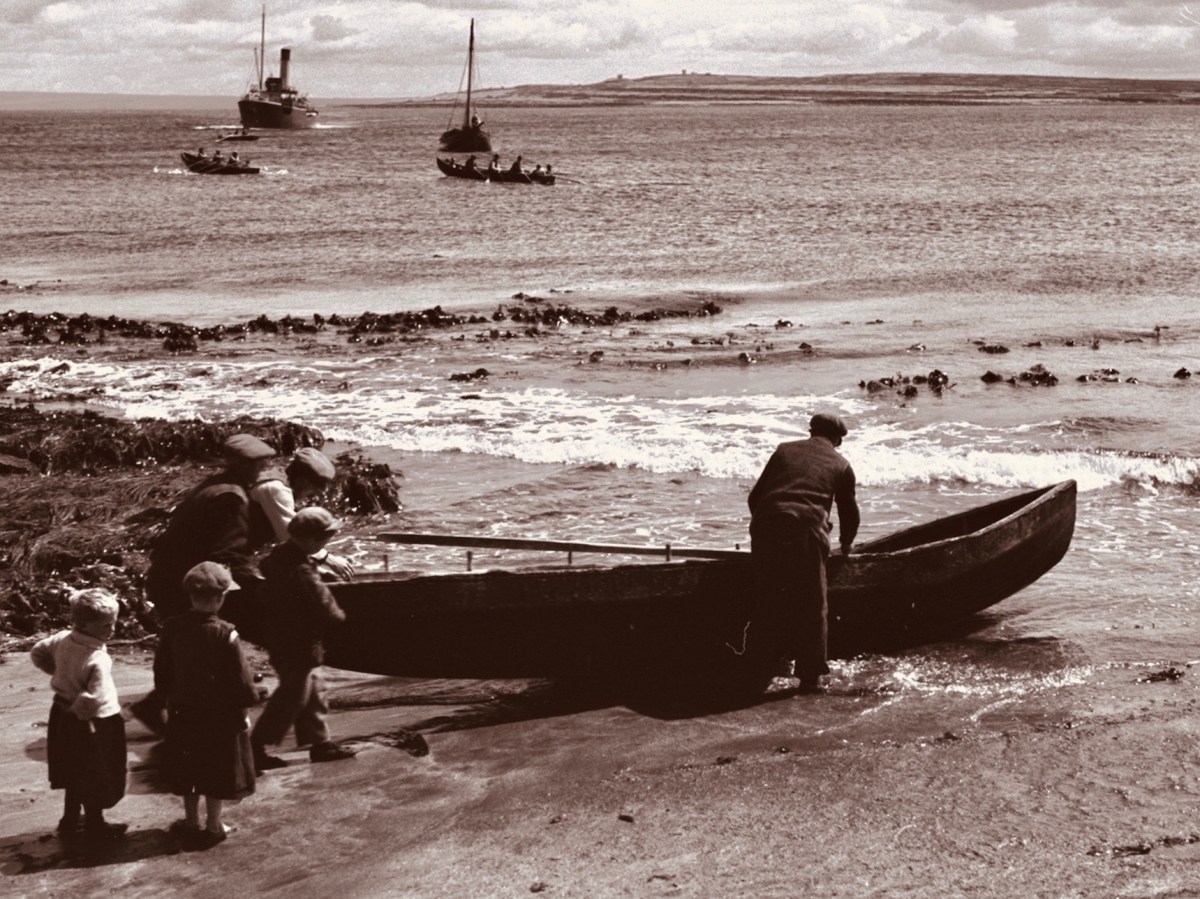
So, a fascinating piece of social history. Apart from conjecturing a date for the photo, I didn’t have much information to add when I first published it on Roaringwater Journal in February 2016. Because of the juxtaposition in the book, I guessed that the picture might have been taken around 1938, when Tómás is known to have visited and photographed the Aran Islands (and would have travelled through Kerry to get there). Here is one of his views of a Curragh being launched on Inis Meáin at this time (Dúchas):
I didn’t expect my story of Pints and Pipes to advance beyond this. But, last week, I received a message from a reader who had seen the photograph in Roaringwater Journal and was able to provide very significant additional information!
. . . My name is Joanne and I live in London. My dad found a photo on your website from a blog dated 14 Feb 2016 entitled Images – it is the Tomás Ó Muircheartaigh photograph of the 4 men drinking in a bar. My great-grandad is the man on the far left. It was great to find the photo as it is much better quality than the copy we have, unfortunately my nan had an original postcard but it was borrowed by a representative of Guinness many years ago and never returned!
Joanne, September 2021
Joanne has proved to be a wonderful contact, and I am so grateful to her for providing information and allowing me to use it here. In summary:
. . . My great-grandad’s name was Seán Mac Gearailt but he was known as Skip. He was from Baile Loisce in Kerry. The photo was taken in a bar which was then called Johnny Frank’s in Baile na nGall (Ballydavid) but I think is now called Tigh TP. I can see from the photos that have been digitalised Tomás Ó Muircheartaigh took a lot of photographs at Baile na nGall. Pints and Pipes isn’t in that digitalised collection . . .
. . . I gave my dad a call tonight and discussed the extract with him; he lived with his grandparents as a child in the late 1940’s/50’s and visited regularly so knows a lot about Skip. Dad remembers him collecting his pension on a Friday at Ballydavid and having a beer in Johnny Frank’s before going home to hand over the rest of the pension to his wife – so the extract in the book is correct on that. Skip was primarily a farmer but dad says he did go out fishing in a curragh at night. Dad remembers his nan being worried for him when he was out at sea. Dad doesn’t know the name of the other men in the photograph. Skip was friends with two Moriarty brothers (from Gallarus) – so dad thinks maybe the two men in the middle are them but he can’t know that for sure . . .
Joanne, September 2021
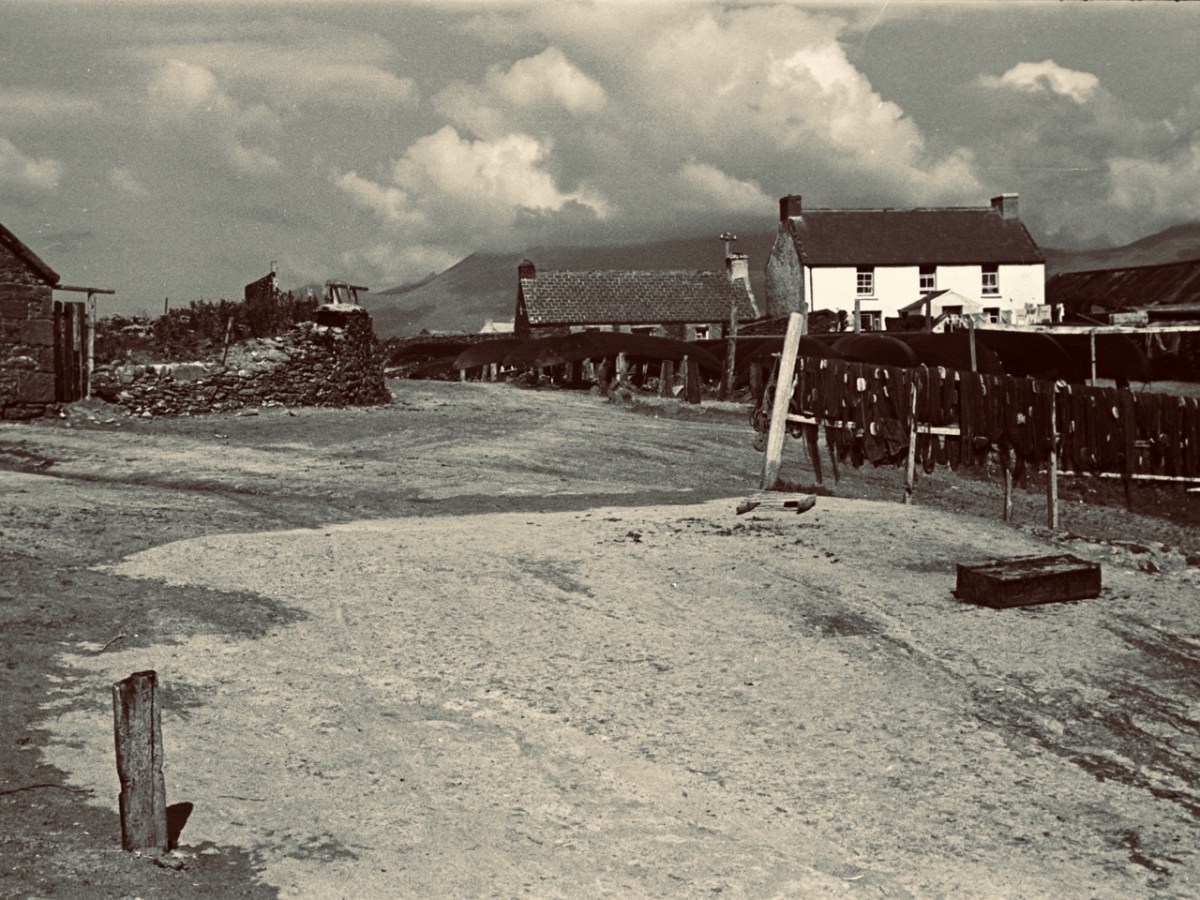
Wow! You can imagine how delighted I was to receive that information. But there’s more. I managed to find some early photos of Ballydavid (Baile na nGall in Irish), which is part of the Corca Dhuibhne Gaeltacht area. In fact we have been there – when we took the Irish language immersion course two years ago.
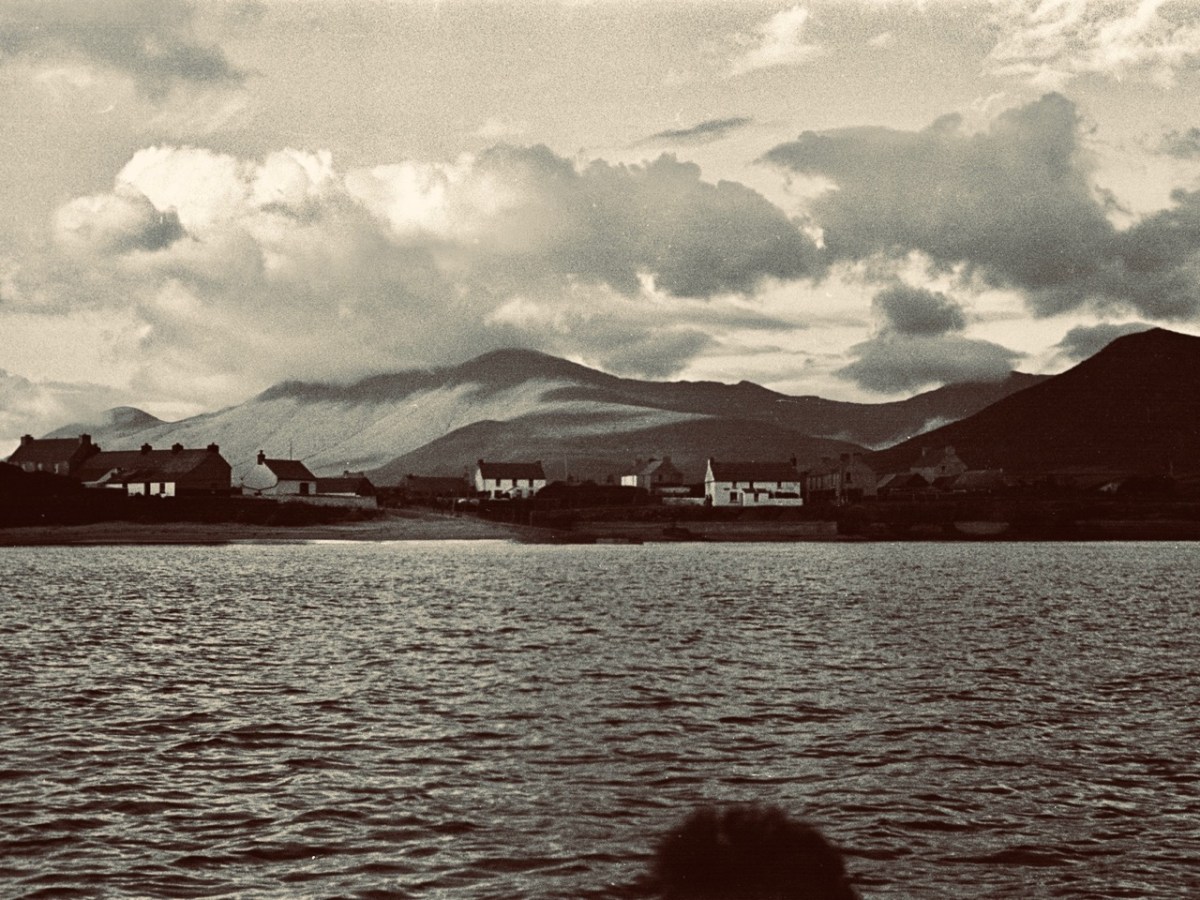
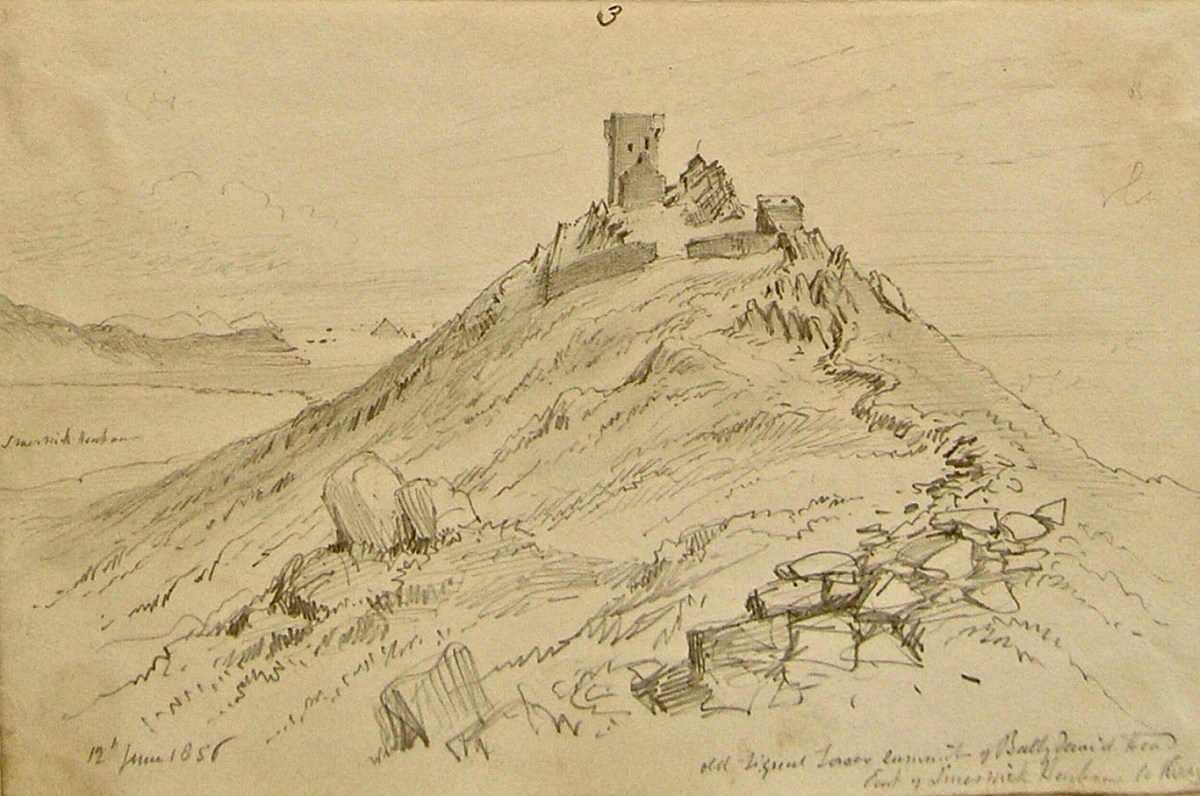
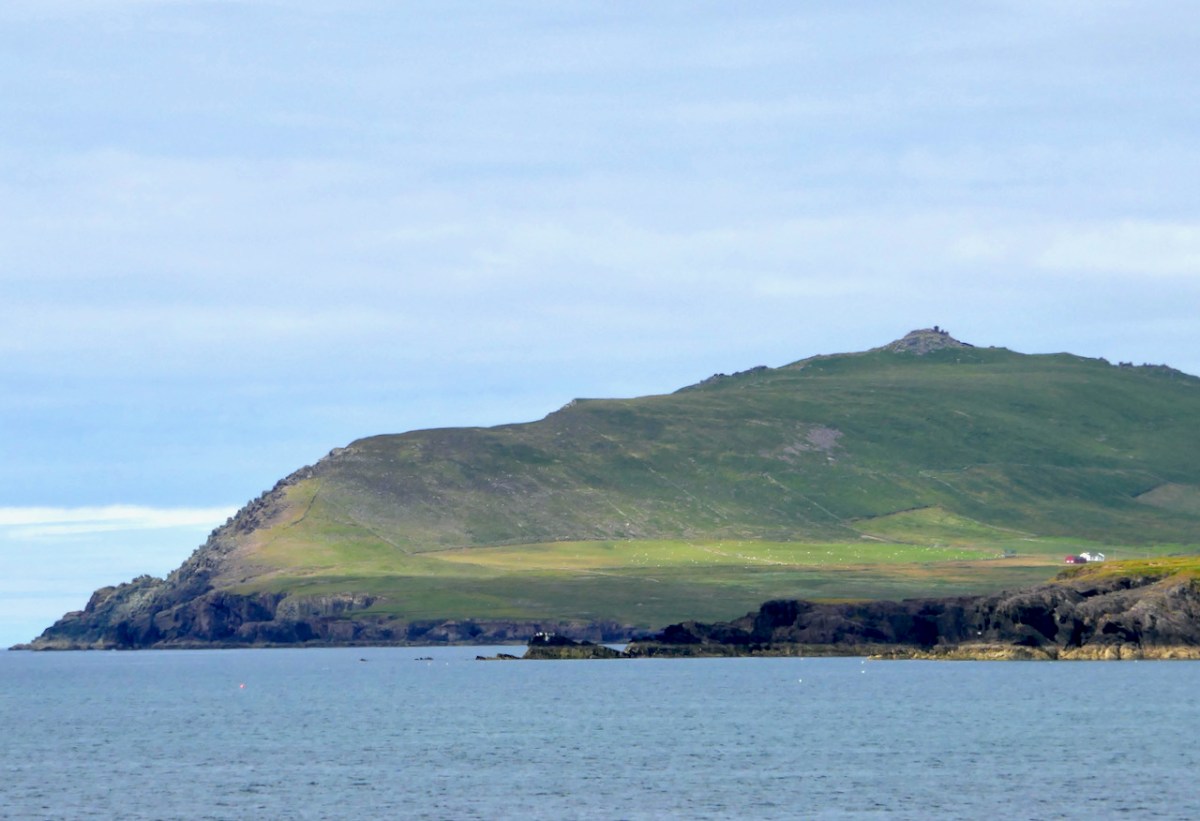
Regular readers will know my interest in the Napoleonic-era signal towers which dot the coast of Ireland, all built in the early years of the 19th century. There was one at Ballydavid Head, drawn (above) by George Victor Du Noyer as he passed by on one of his geological expeditions on 12 June 1856. We didn’t climb the Head when we visited, but we viewed it from a distance (below). The tower is now a ruin.
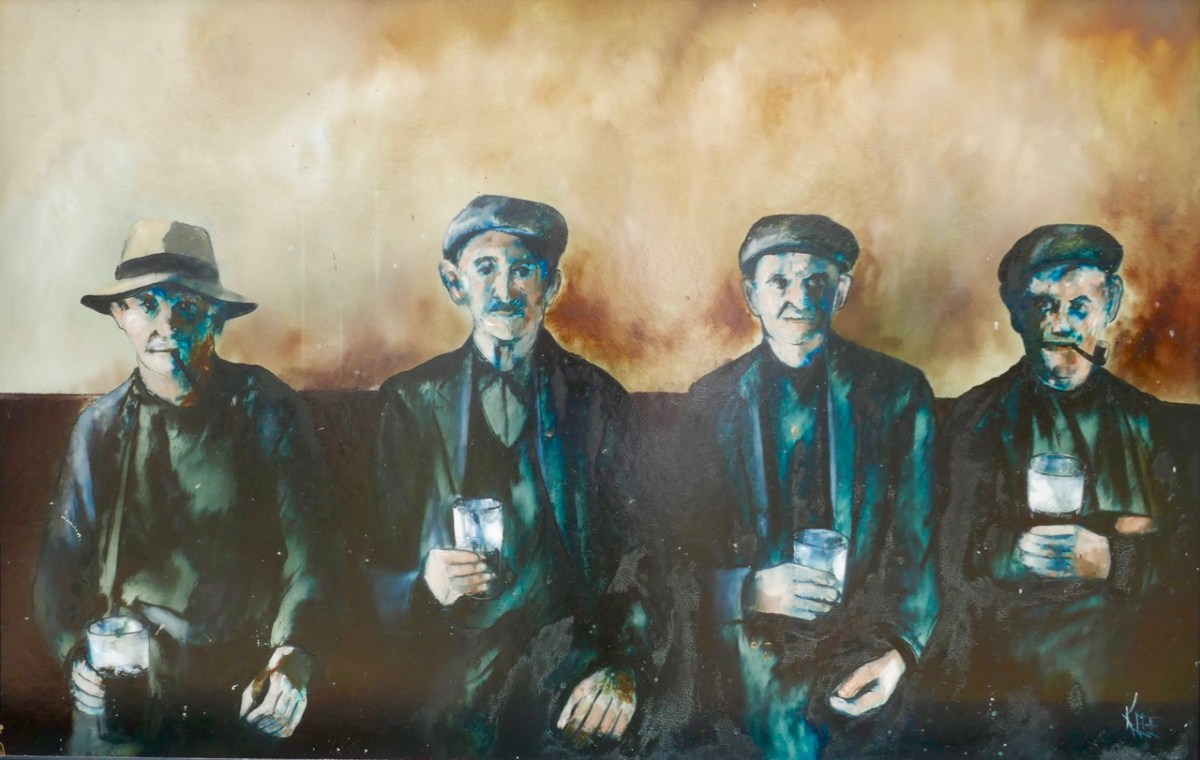
We have travelled far, far away from Ballydehob where, in some ways, the weaving of this tale began. We had better return. Here’s a reminder of that painted image of the ‘Pints and Pipes’ photograph in Levis’s Corner Bar. Compare it to the header photograph of this post.
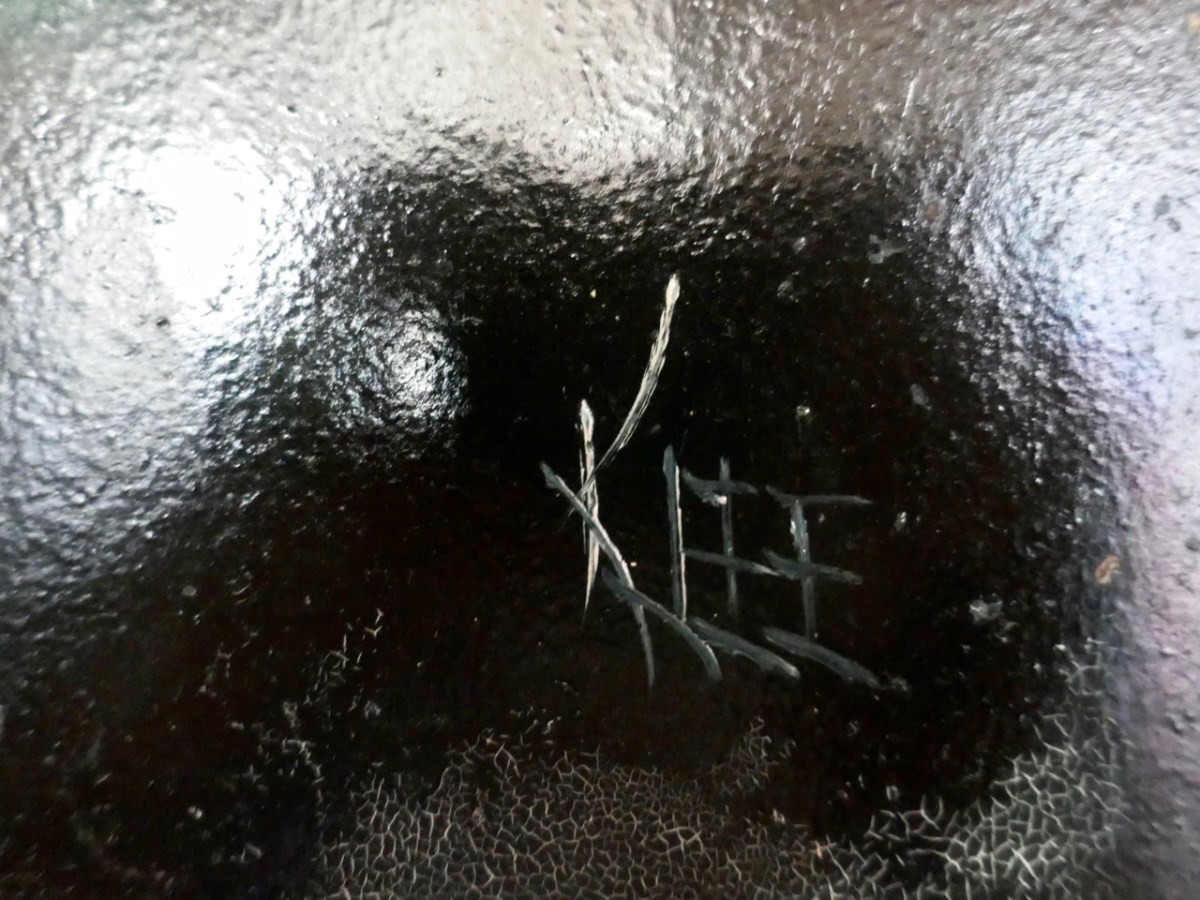
It is so obviously based on the Tómás Ó Muicheartaigh portrait, yet there are some differences. The pipes of the two men in the middle are missing! I can’t tell you why this is the case, but I can tell you now who produced the painting, as I was given a valuable link by Joe O’Leary, landlord of Levis’s (which his been in his family for some generations – but that is another story). The painting has a signature:
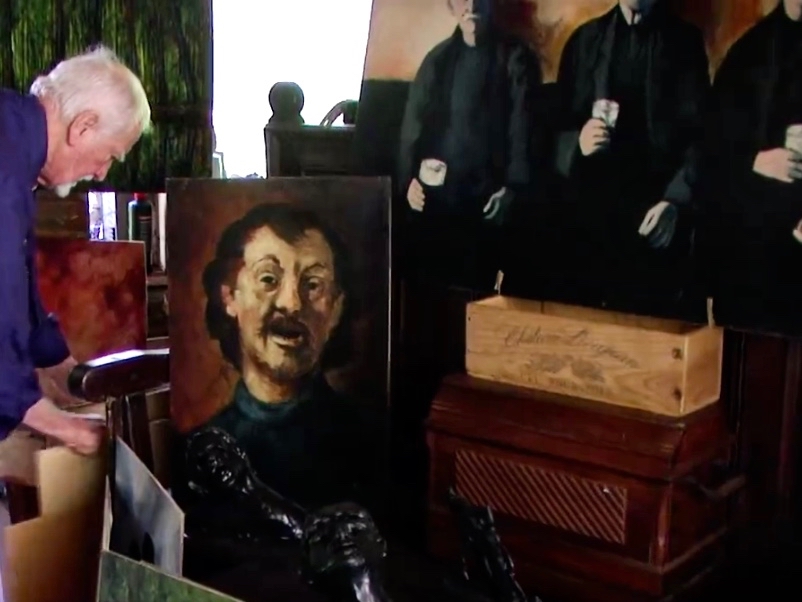
Paul Klee was, of course, a well known Swiss-born German artist who lived between 1879 and 1940: he had no connection whatsoever with Ireland! Nor did he have anything to do with this painting, which was in fact from the brush of Raymond Klee, born in Barry, South Wales, in 1925 but living out much of his later life in Bantry, West Cork, until his death there in 2013. During the 1950s and 60s he lived in the Montmatre artists’ quarter in Paris, and is said to have been a close friend of Pablo Picasso. There can be no doubt that the Levis’s painting is his work, as I came across a short video, taken late in his life, in his Ballylickey Gallery. I managed to ‘freeze’ the fast-moving film at this point:
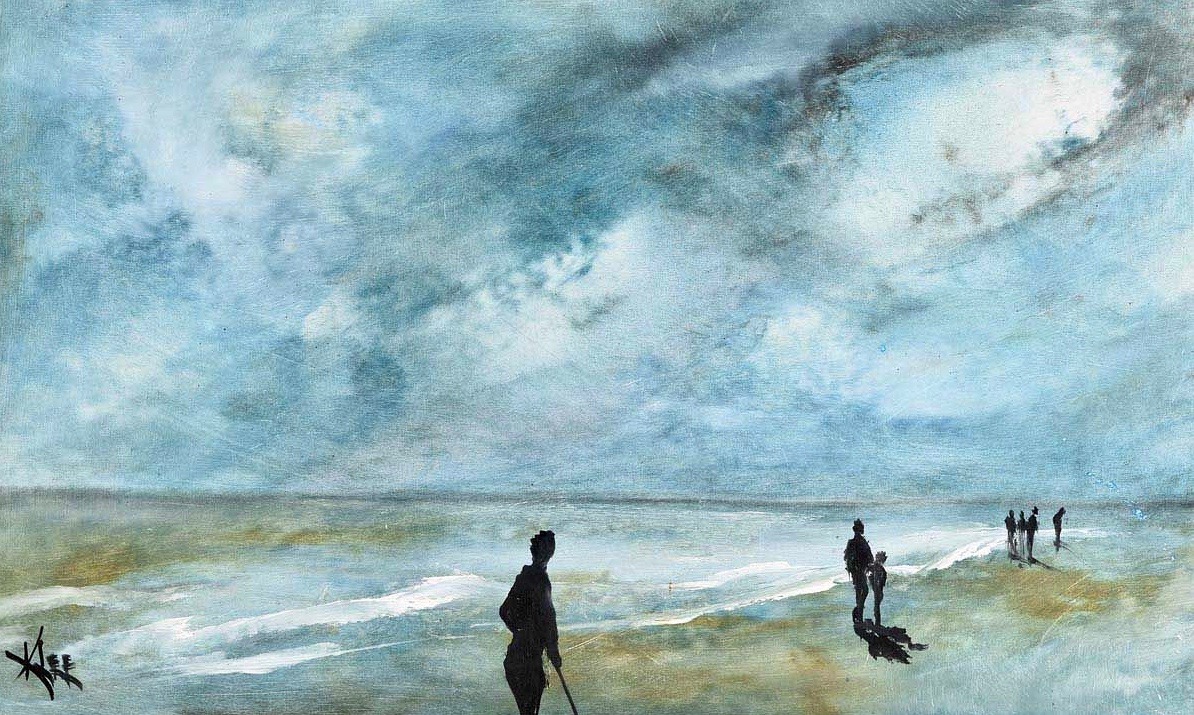
There, you can see the artist himself on the left, and over on the right is the partial image of a huge painting propped up: it’s another version of Pints and Pipes… I wonder what became of it? Or, indeed, of much of the large body of work which he left behind in Ballylickey? You will find examples on the internet, including several from the catalogues of art dealers. He doesn’t seem to have exhibited a particularly consistent style and – by repute – ‘churned out’ some of his works very quickly but – it has to be said – to a willing audience. During tours of the United States he would paint large canvases in front of a crowd – perhaps 200 spectators – and produce work which he immediately sold to the highest bidder in the room! I have selected a couple of images of paintings which might be of interest to my audience. The upper painting is titled The Local, while the lower one is Sky Over Inchydoney.
I must end my tale. Here is a little bonus, especially for my correspondent Joanne – and she won’t see this until she reads this post for the first time. We were leafing through the Tómás Ó Muicheartaigh book; it’s hard to put down – over 300 seminal photographs of Irish life. Finola’s eagle eye picked out one which I had never noticed before – and here it is: Seán Mac Gearailt, Joanne’s Great Grandfather, Skip. The caption underneath is apt. Many thanks, Joanne, for setting me on this journey…
GO mBEIRIMID BEO AR AN AM SEO ARÍS . . .
Thanks go to my very good friend Oliver Nares, who worked on the photographs of Pints and Pipes and Skip for me, and greatly improved their quality. Have look at his own site
I never fail to come away on a high from this annual exhibition, and this year just confirmed that all over again! It is packed with swoon-worthy pieces, like Paddy McCormack‘s Whale Rider seat, above.
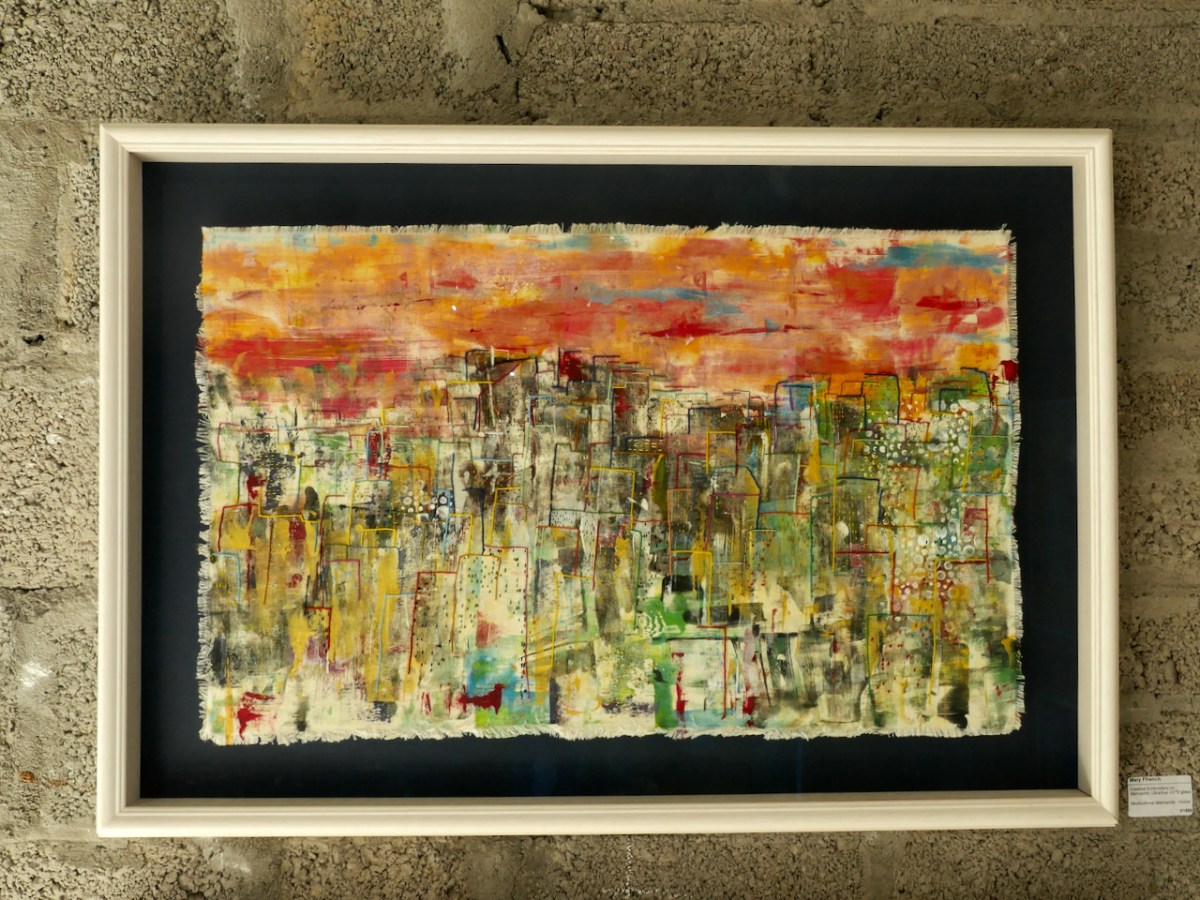
Mary Ffrench, Embroidery on Monoprint
The divide between ‘art’ and ‘craft’, although useful in some ways, can pigeonhole work that does not fall neatly into one category or the other. This annual juried exhibition gloriously transcends any artificial dividing lines and instead celebrates all that is best in the West Cork visual arts scene.
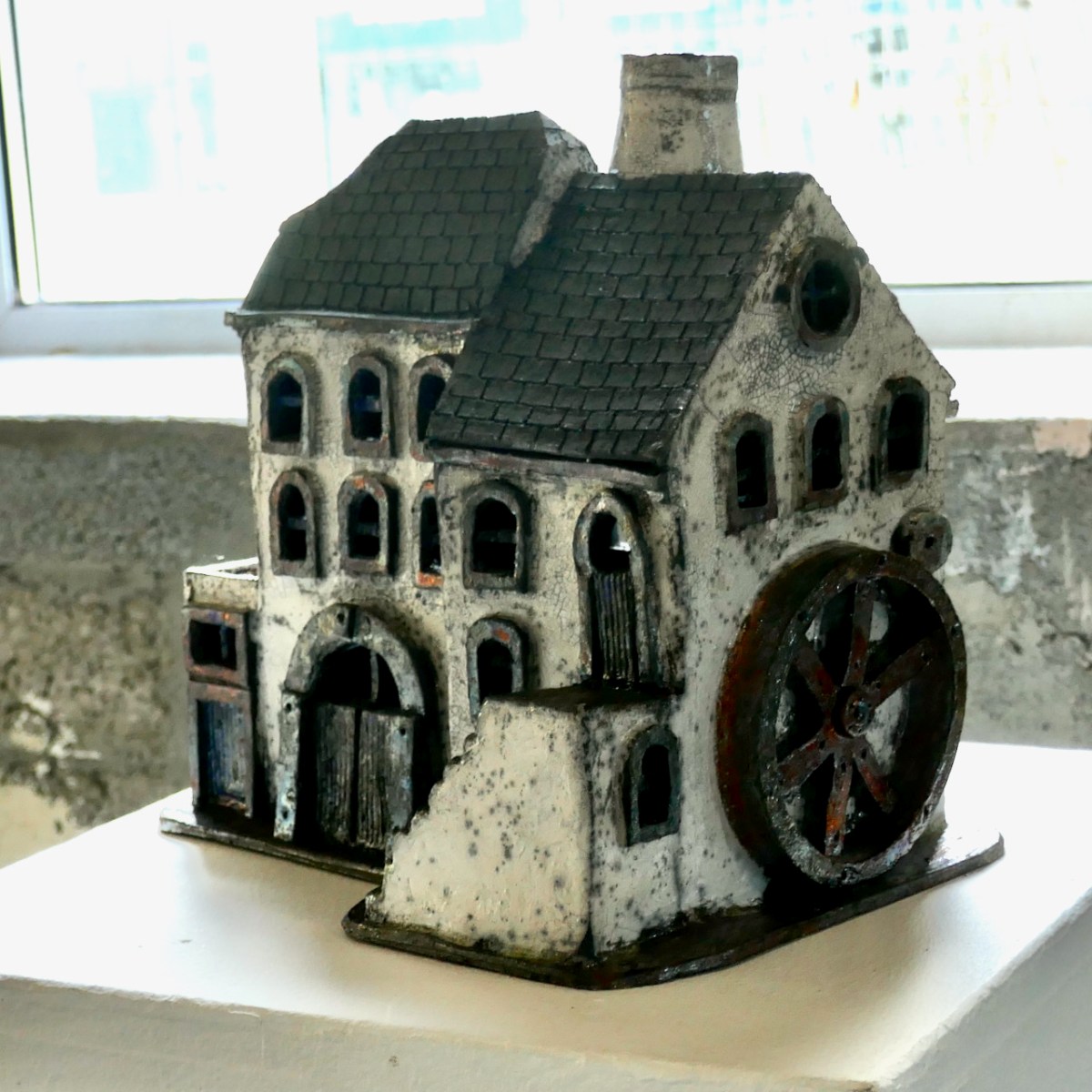
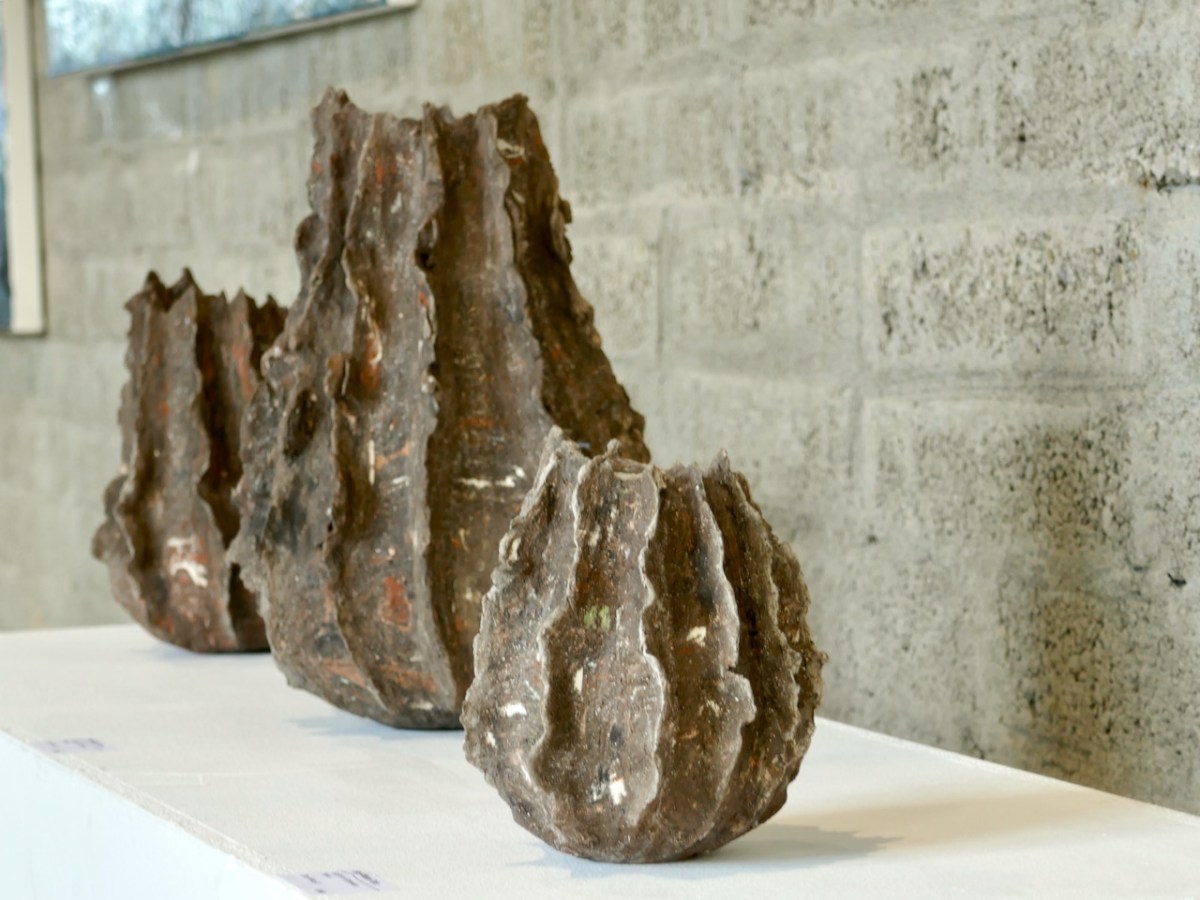
Brendan Ryan, Raku, The Old Mill; Bernadette Tuite, Sculptural Stoneware, Brow Head
Take a look at the website for bios of and statements by each of the artists. There’s a dizzying variety of approaches, materials and visions, but all are responding this year to the theme of Home Ground – and it’s not hard to relate, as we have all become so much more aware of our own patch of ground, and have taken to exploring all that it has to offer.
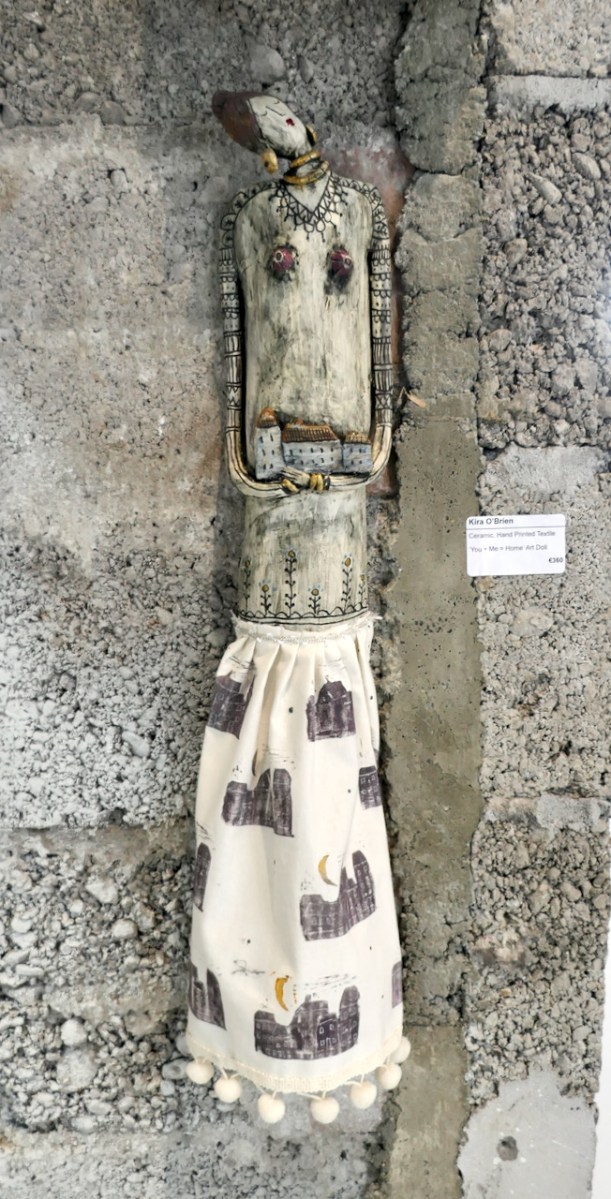
Greenwood chair by Alison Ospina with fabric by Mary Palmer (and in the background large jugs by Etain Hickey and Jim Turner; Kira O’Brien and her ceramic and hand-printed fabric piece ‘You+Me=Home’
It’s all for sale, too, with some very keen prices, so if you are looking to bring home a piece of West Cork, this is the place for you. The most lustworthy painting in the exhibition, to judge from the reaction of everyone who comes in the door, is Christine Thery’s Vanishing Island (below), a large oil painting of her beloved Heir Island.
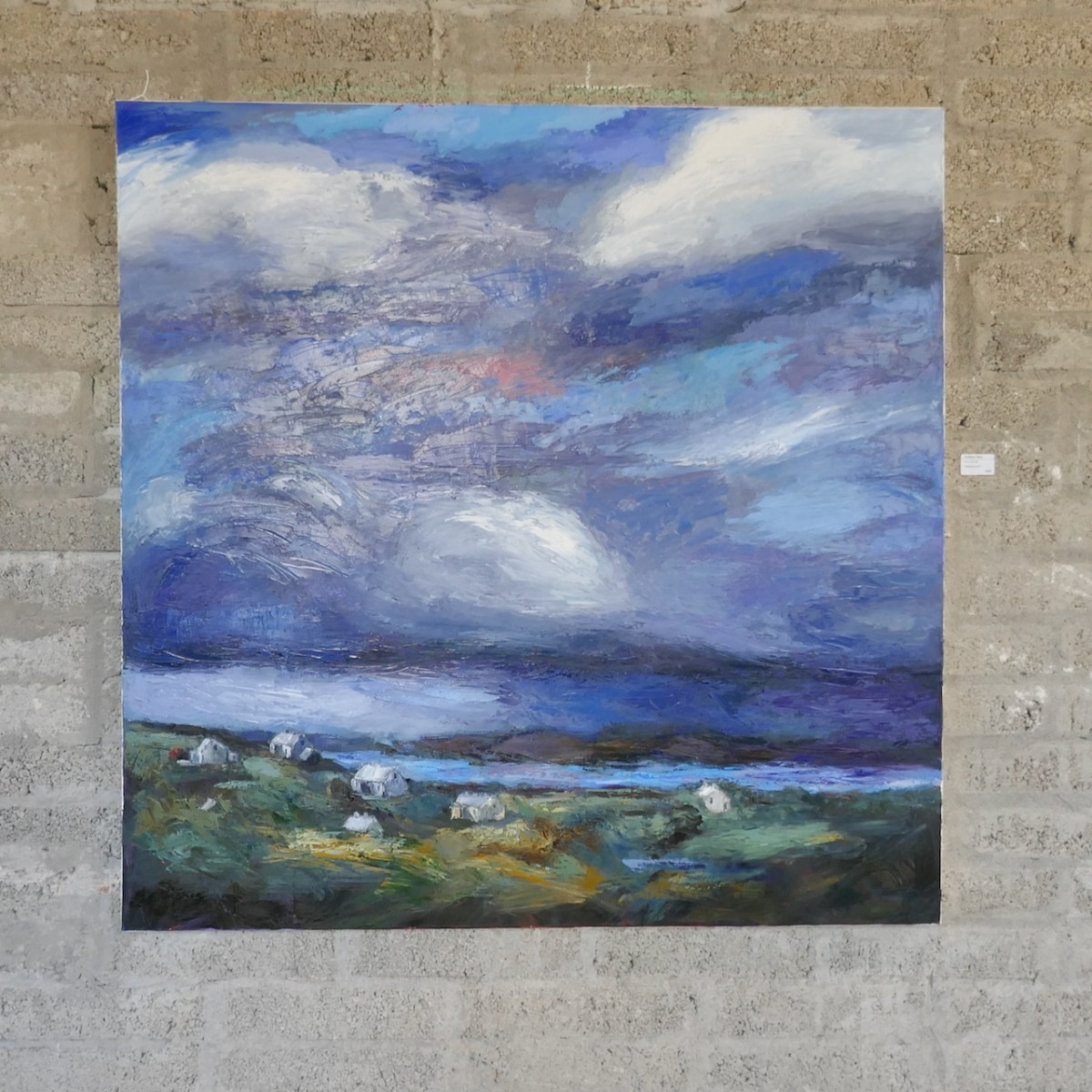
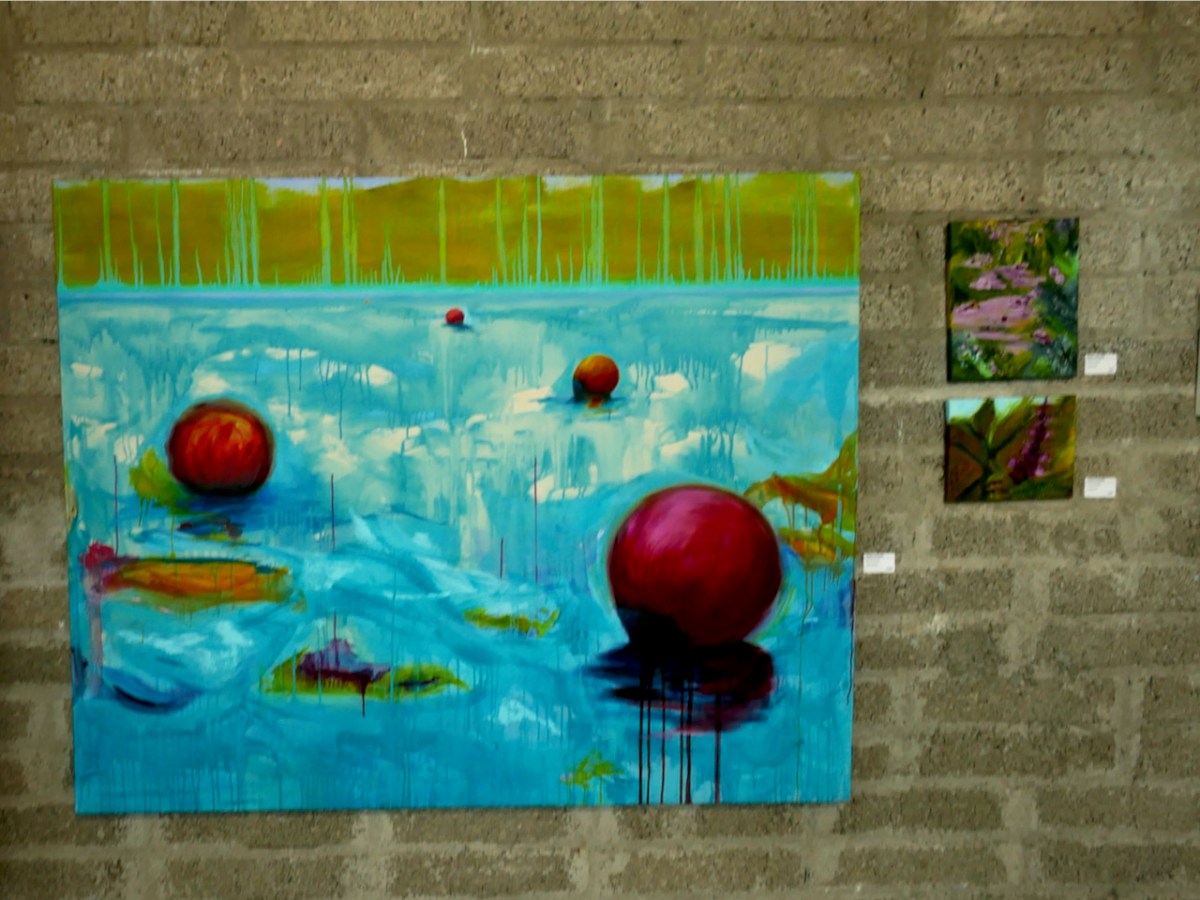
Helen O’Keefe’s terroir is another Island – Long Island – and she captures the sometimes nostalgic emptiness of it all in her paintings, although the large one below shows her responsiveness to its vibrant colours as well.
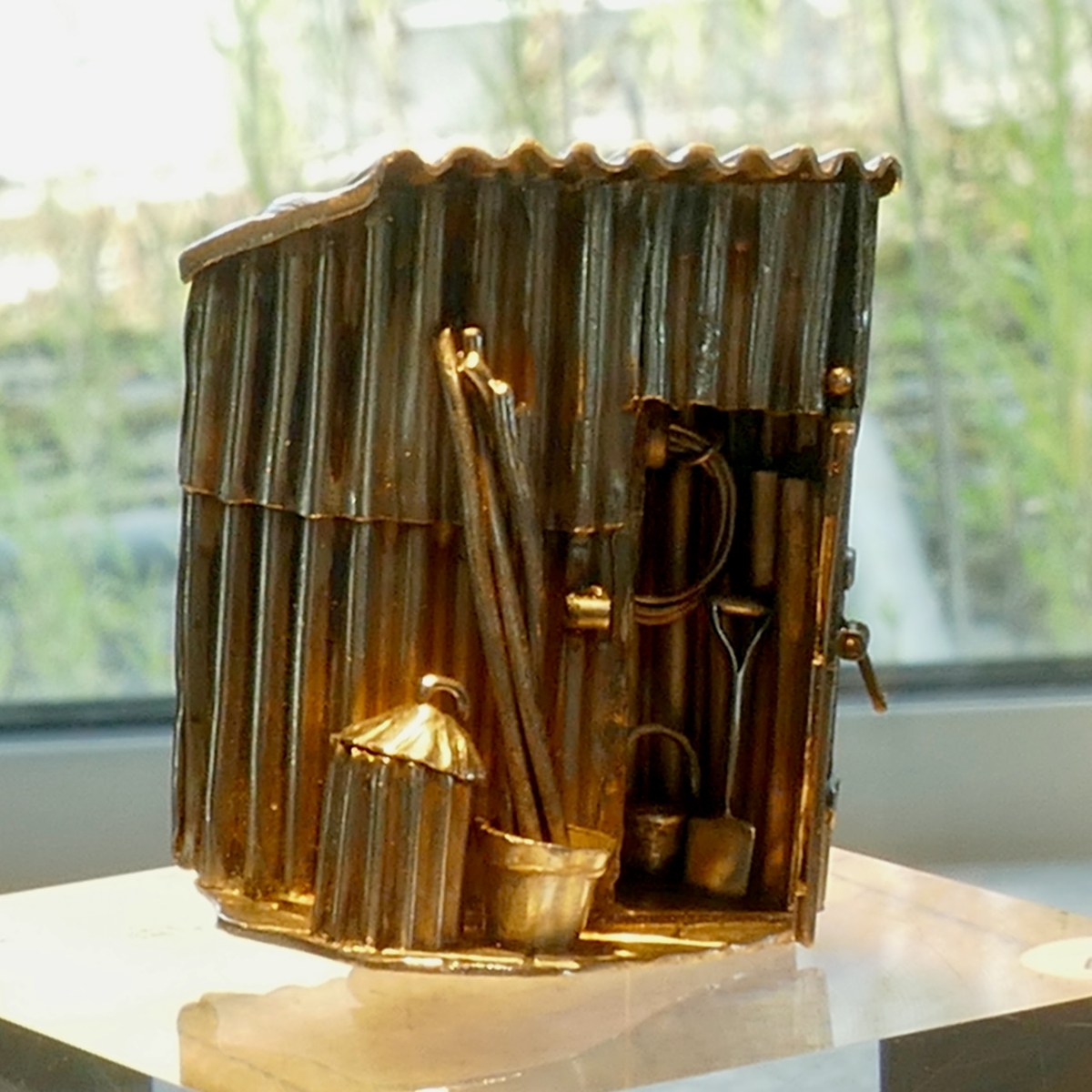
Lots of jewellery too – Here is one of Michael Duerdon’s gorgeous brooches – Garden Shed. (If a particular person out there is wondering what to get me for Christmas…just saying.)
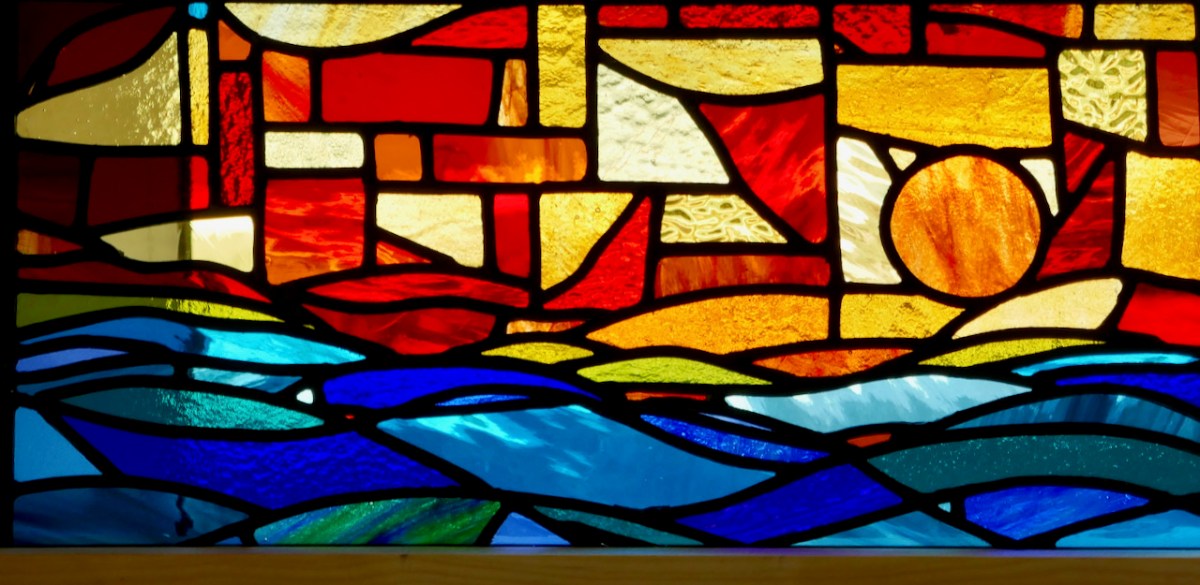
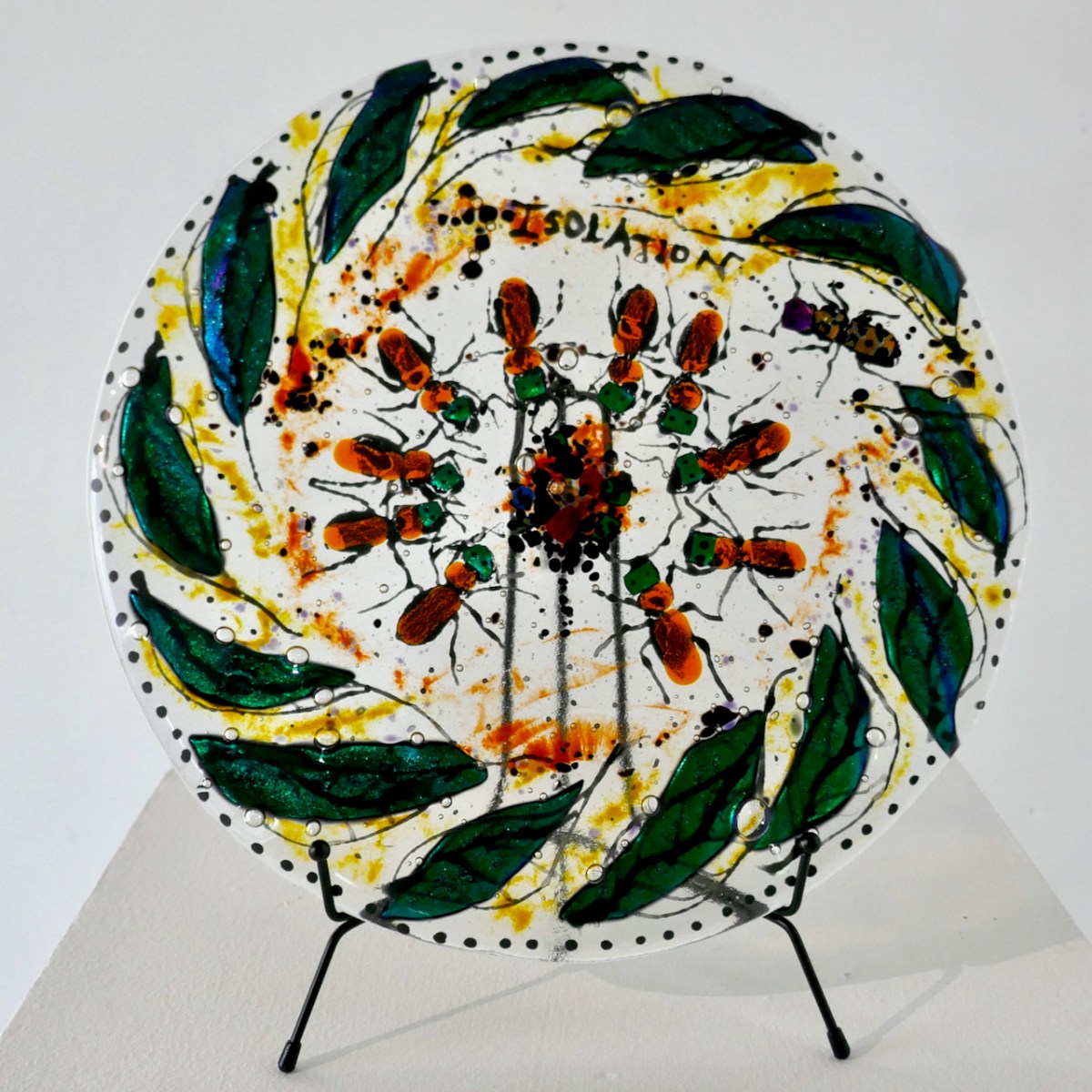
And glass! As someone who studies and writes about stained glass, I was delighted to see such a variety of glass this year, from classical stained glass, to fused creations.
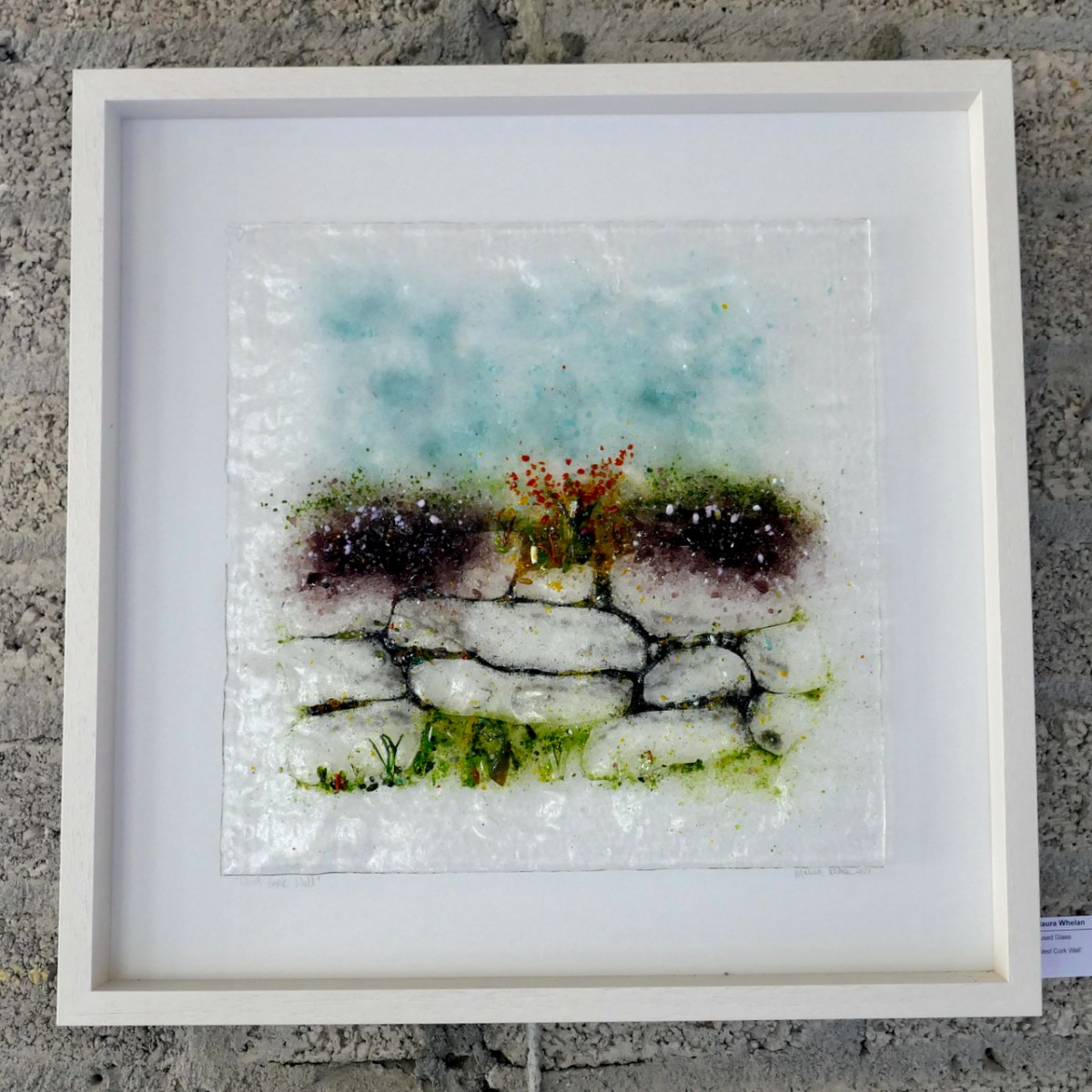
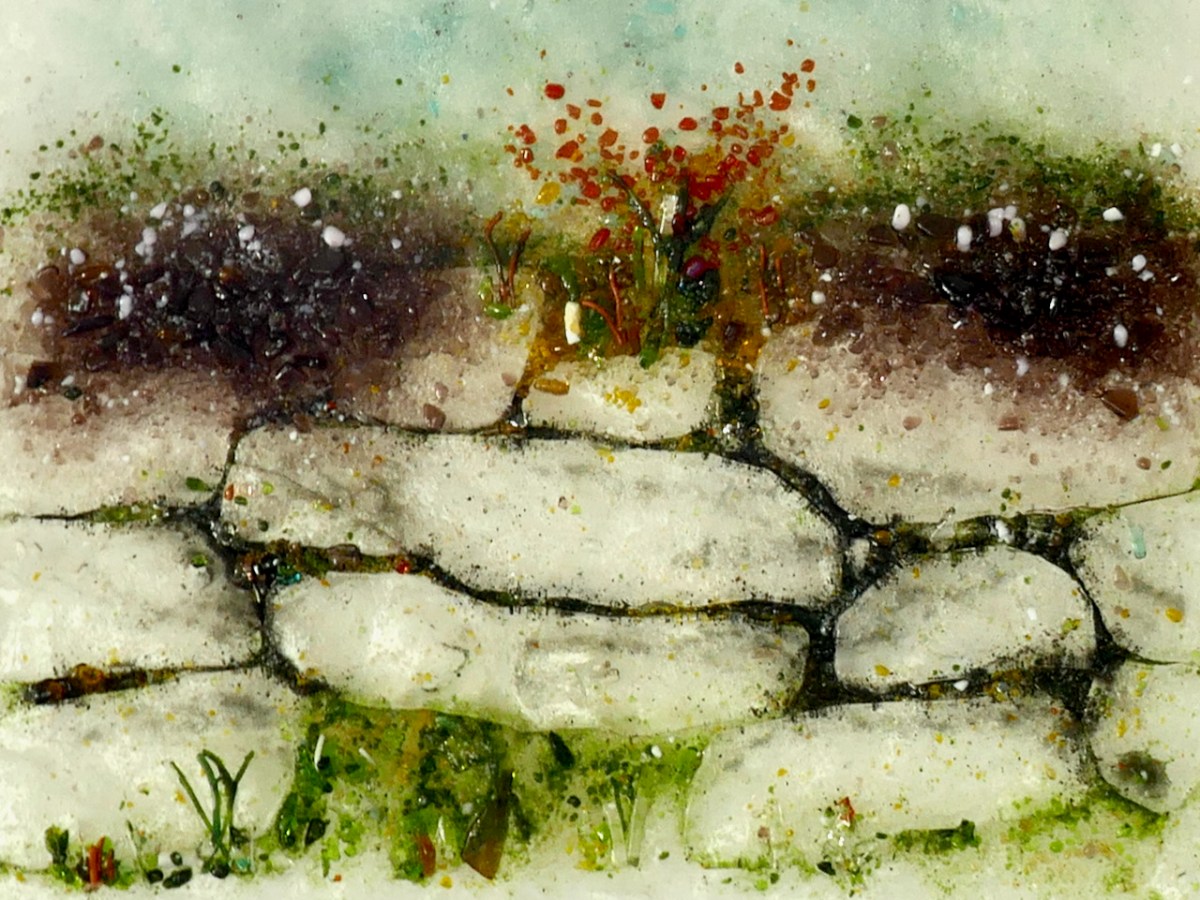
In descending order: Deirdre Buckley Cairns stained glass inspired by the Calf Islands; Angela Brady’s witty ‘Ant Colony’; A vibrant kiln-fired plate from Trish Goodbody; Maura Whelan’s West Cork Wall, and a detail from that piece
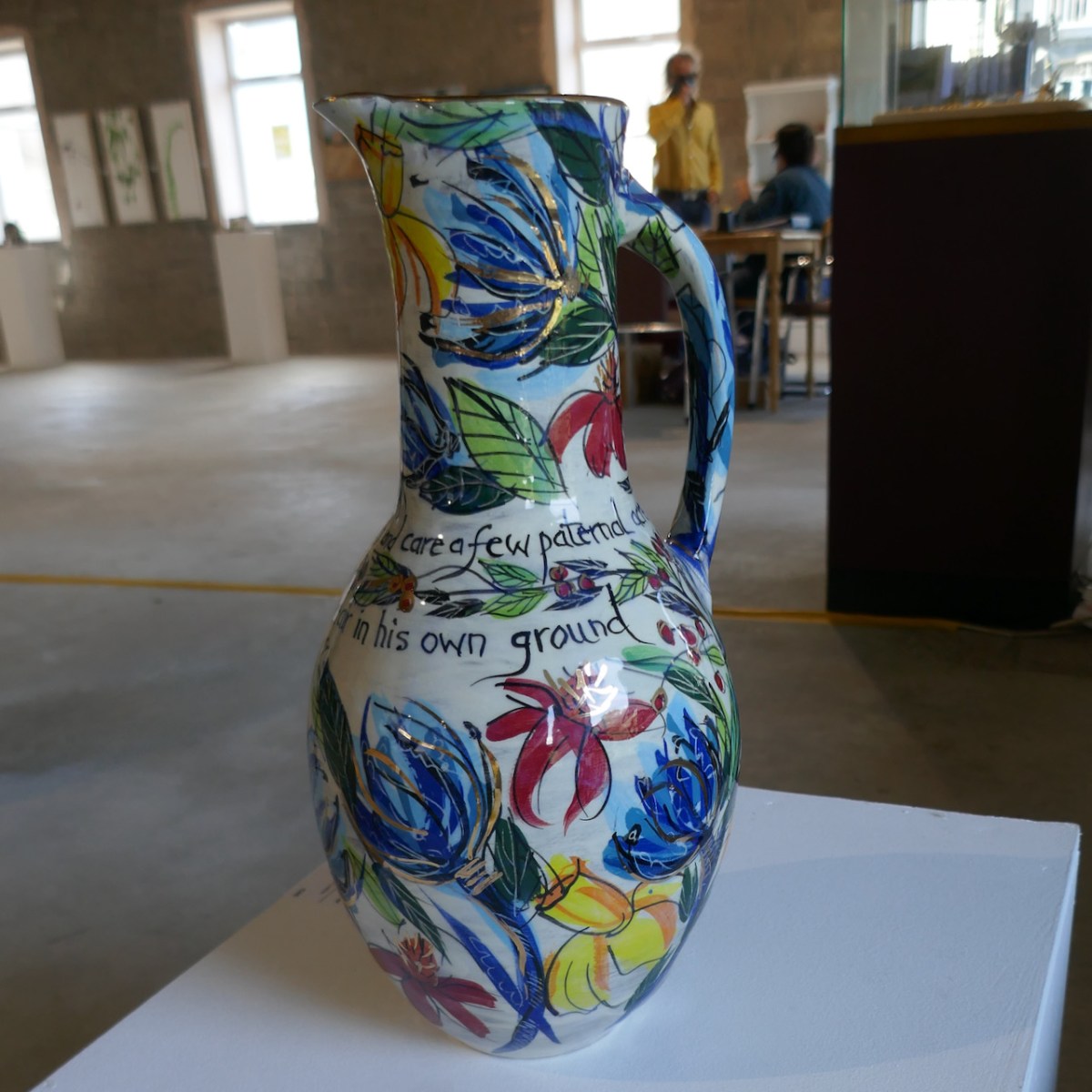
Jim Turner and Etain Hickey each have their own ceramics in this show, but they have also collaborated on several items, including beautifully decorated large jugs (above, upper). Etain has been inspired by her lockdown walks this year to produce a set of wall plates in glowing reds and blues, all angles and arcs, illustrating the agricultural life around her (above, lower).
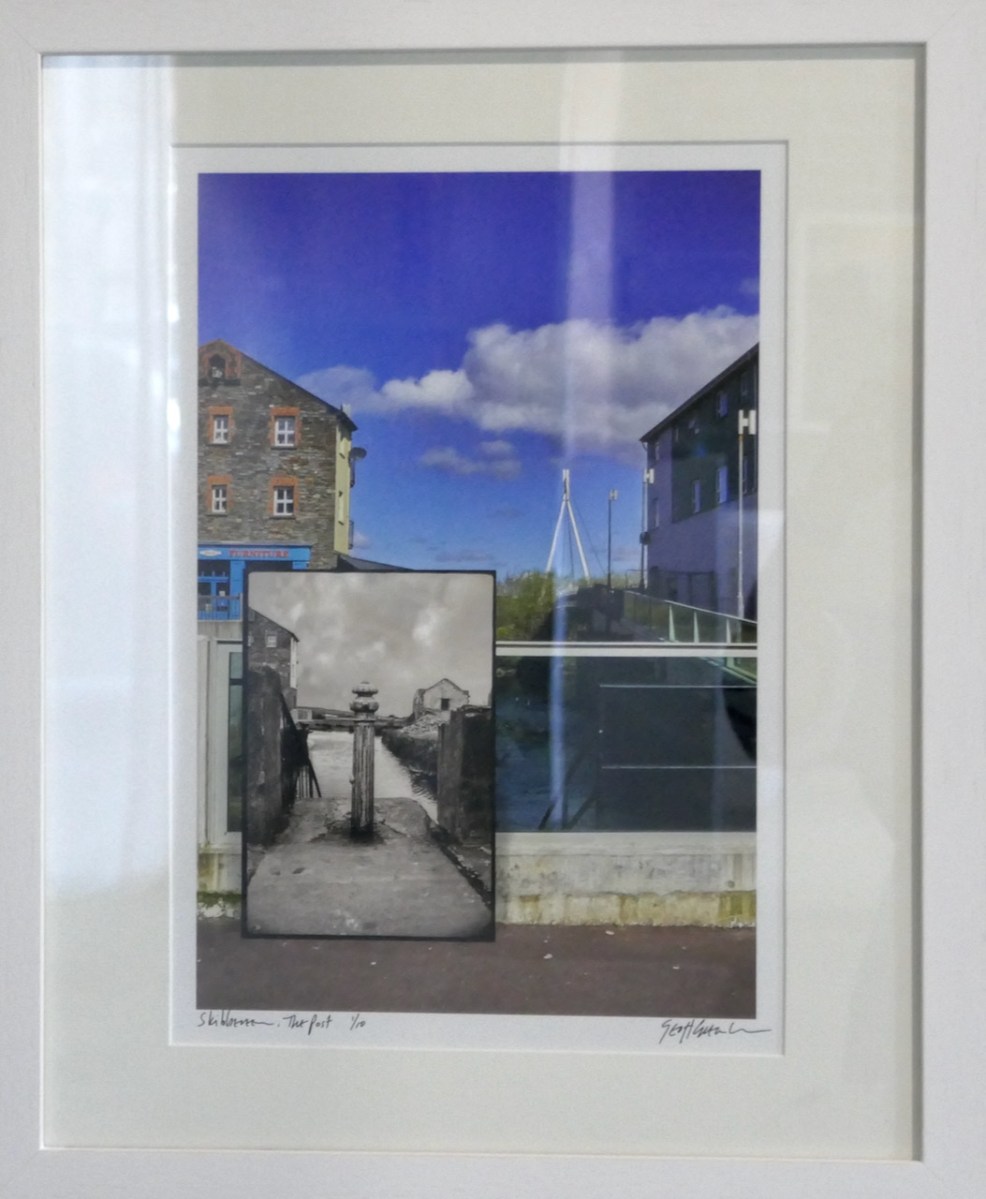
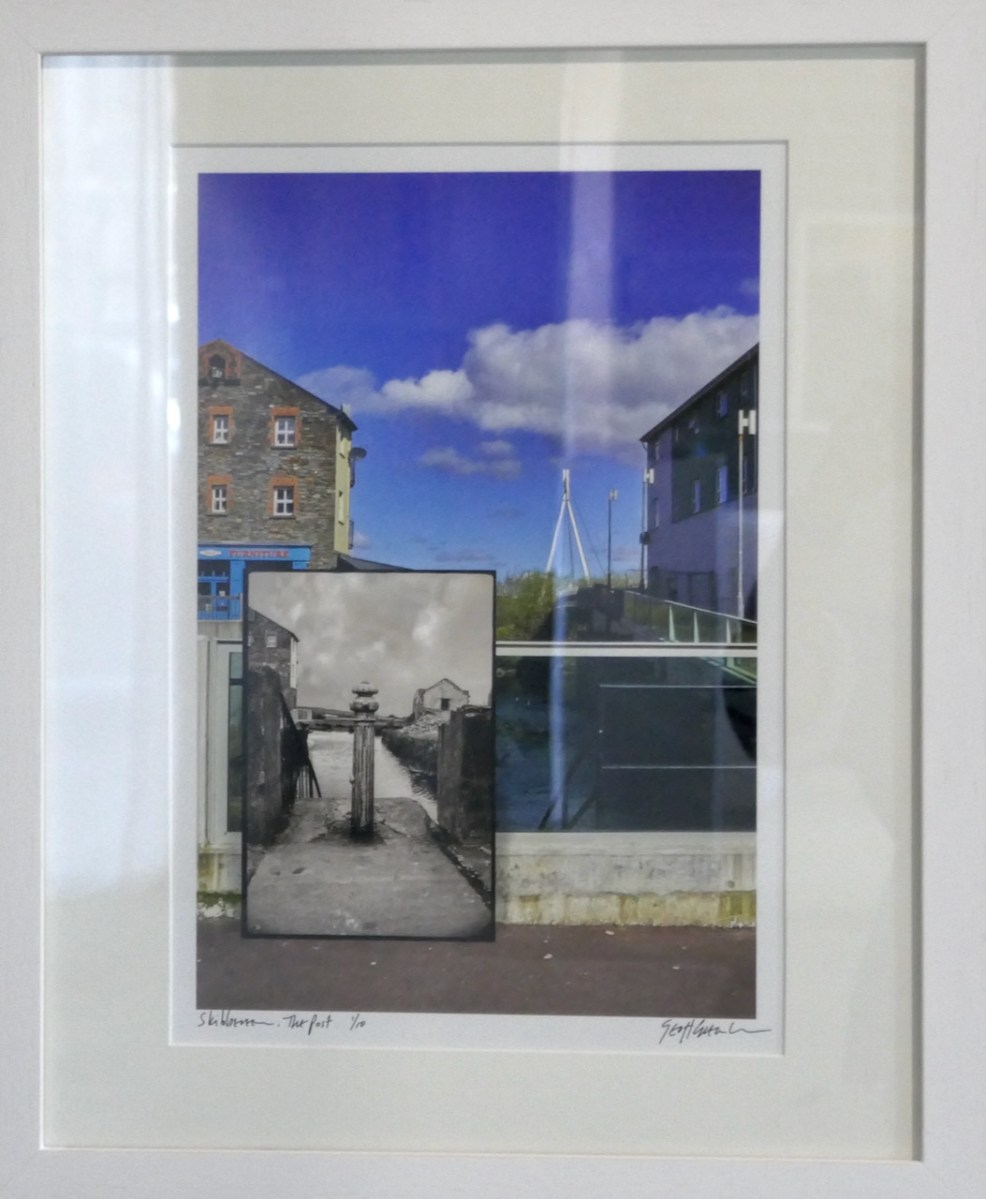
Geoff Greenham is one of my favourite local photographers and I love his approach to the theme this year – juxtaposing the old and new in his series on Skibbereen. Below is ‘Bollard’. Although the exhibition space, in the O’Driscoll building by the River, is superb for exhibiting, it’s not great for photography, so my apologies to Geoff and others for the reflections in some of my images.
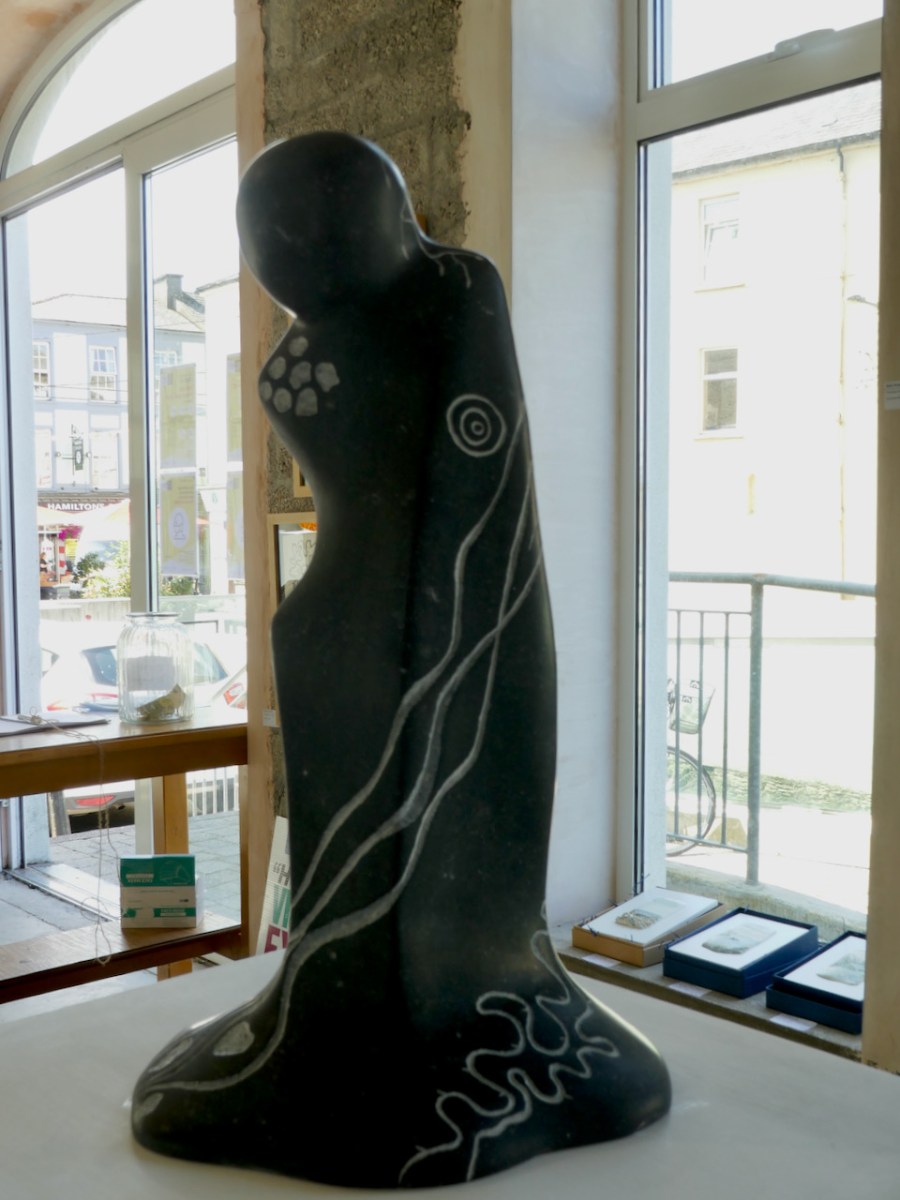
Geoff Greenham and Sonia Caldwell were standouts for me last year, when West Cork Creates was solely online, so I will finish with Sonia’s sculpture in this year’s show – another one of her thoughtful, brooding figures which showcases her mastery of technique.
I have only shown a tiny fraction of what’s in the Exhibition. It’s on for another two weeks, until the 28th, so make sure you get there!
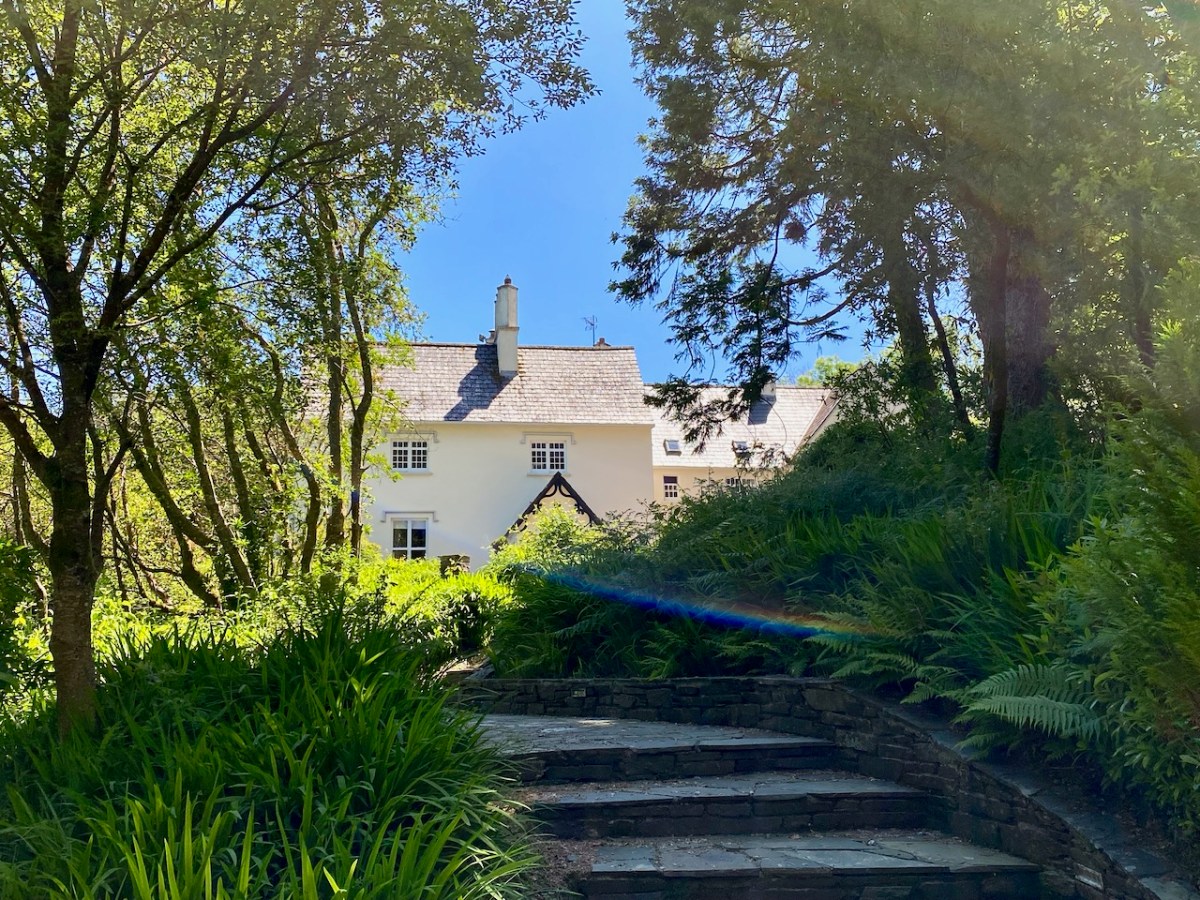
Just along the road from us in West Cork lies Liss Ard Estate. One of Ireland’s ‘big houses’, it was built in 1853 and was for generations the home of The O’Donovan, leader of that Gaelic clan. During the ‘cold war’ era of the 20th century it was owned by the Swiss government, who saw in West Cork a potential safe haven if the world descended into a nuclear holocaust. Just recently it has been taken over by an American company who will continue to run it as a hospitality venue. Finola’s eagle eye picked out the other day that Liss Ard were opening up for outdoor Sunday brunch! How could we resist?
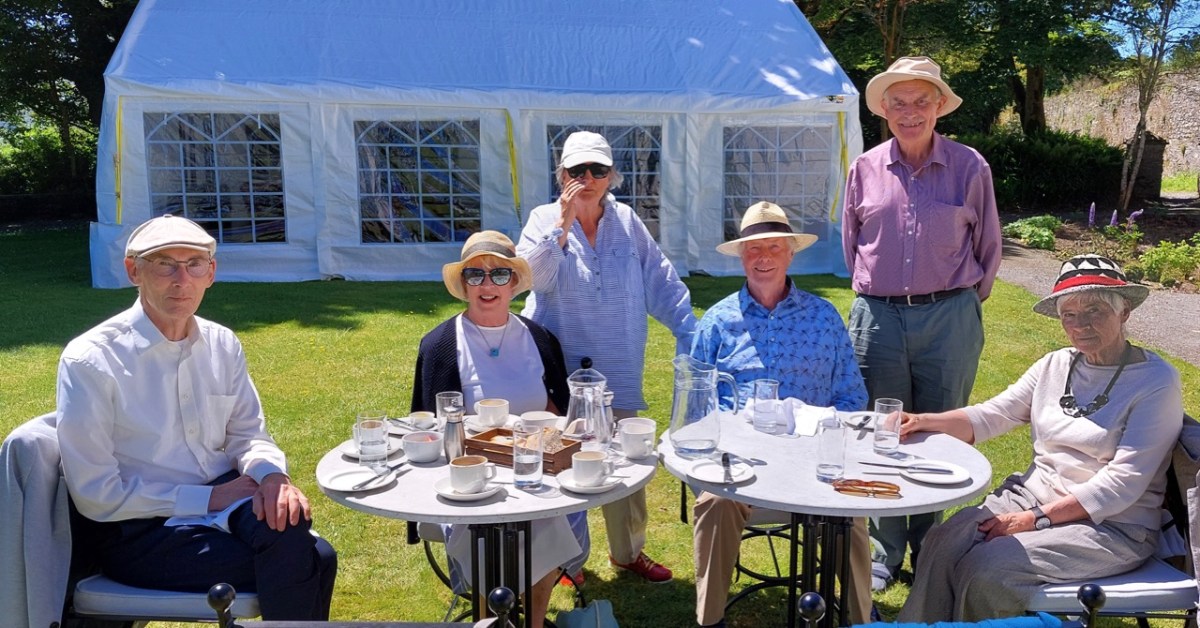
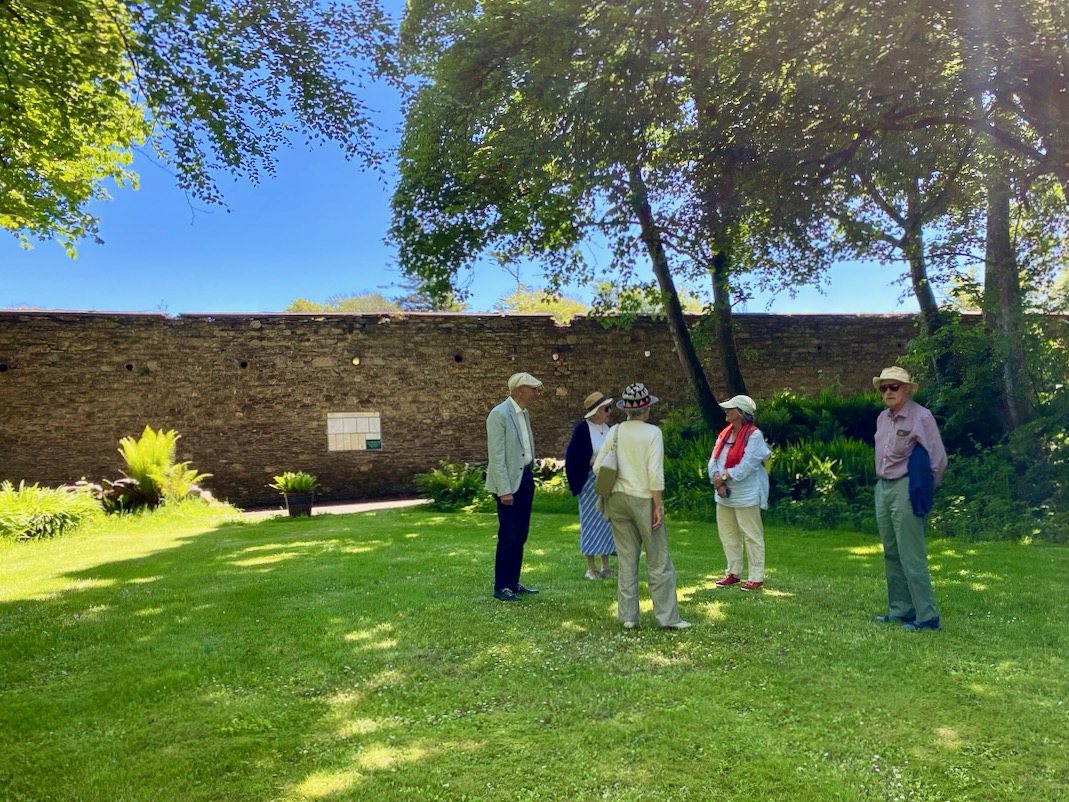
Here’s the brunch group: George, Una, Finola, myself, Con and Clair. We thoroughly enjoyed the occasion – partly because it was like being let out of jail (although I doubt – but can’t say for certain – that any of us has experienced that particular phenomenon), but also because, as customers, we were able to follow the excellent breakfast and coffee with a walk around the 163-acre estate.
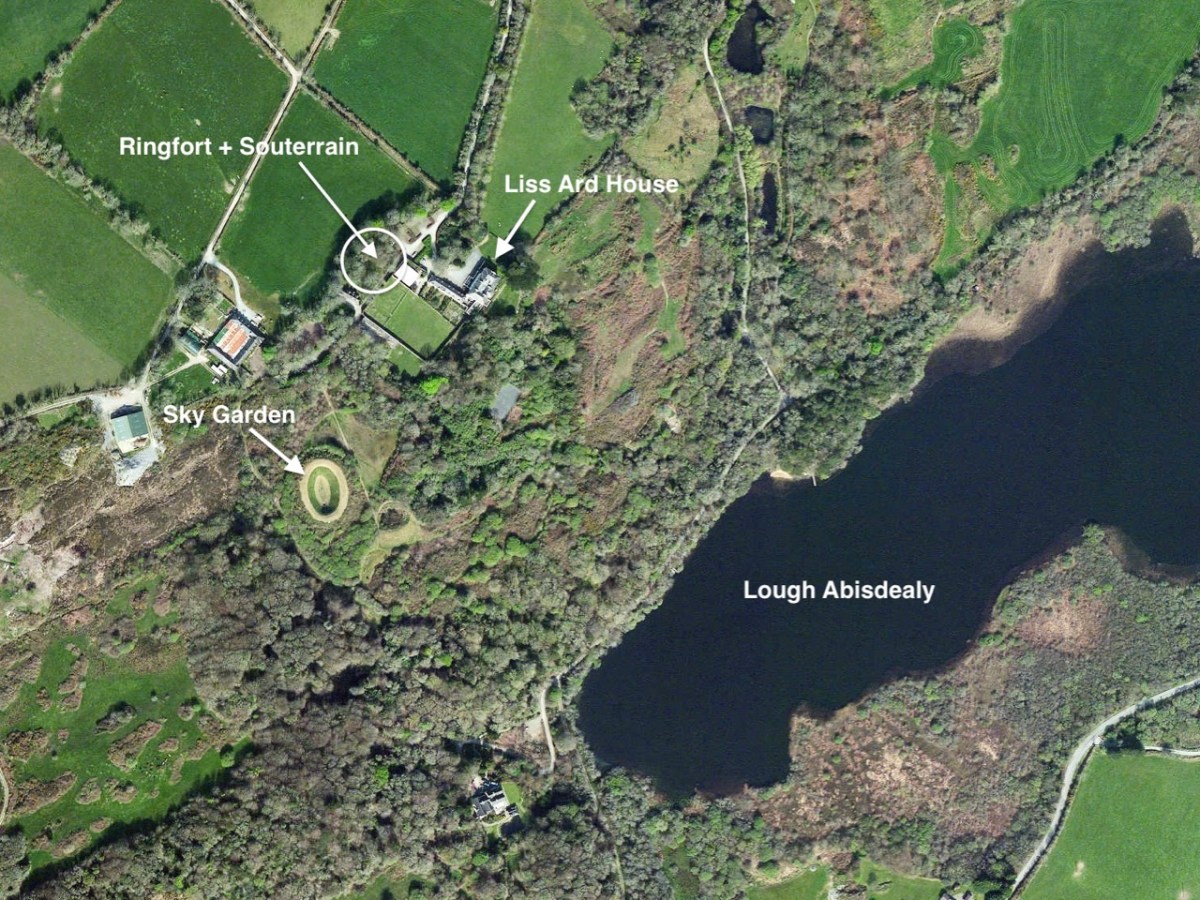
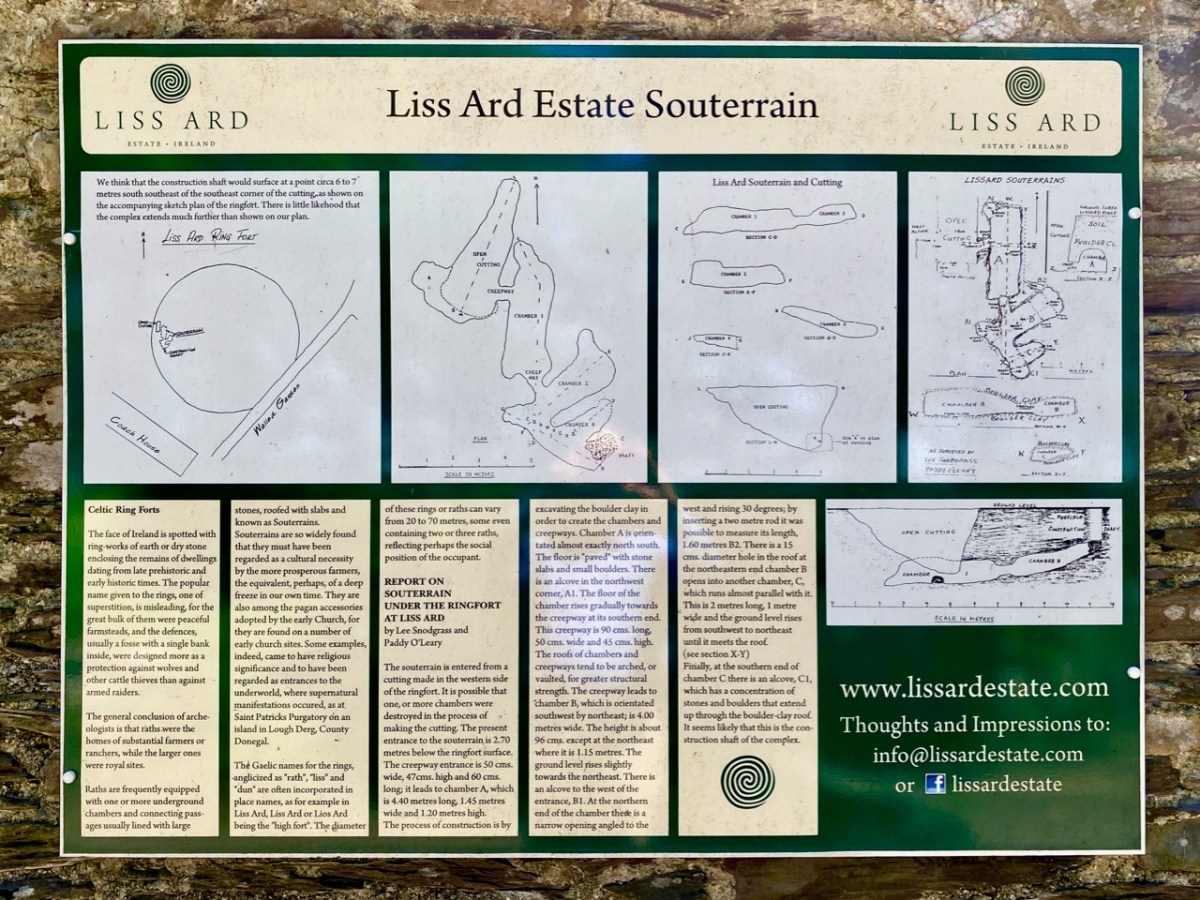
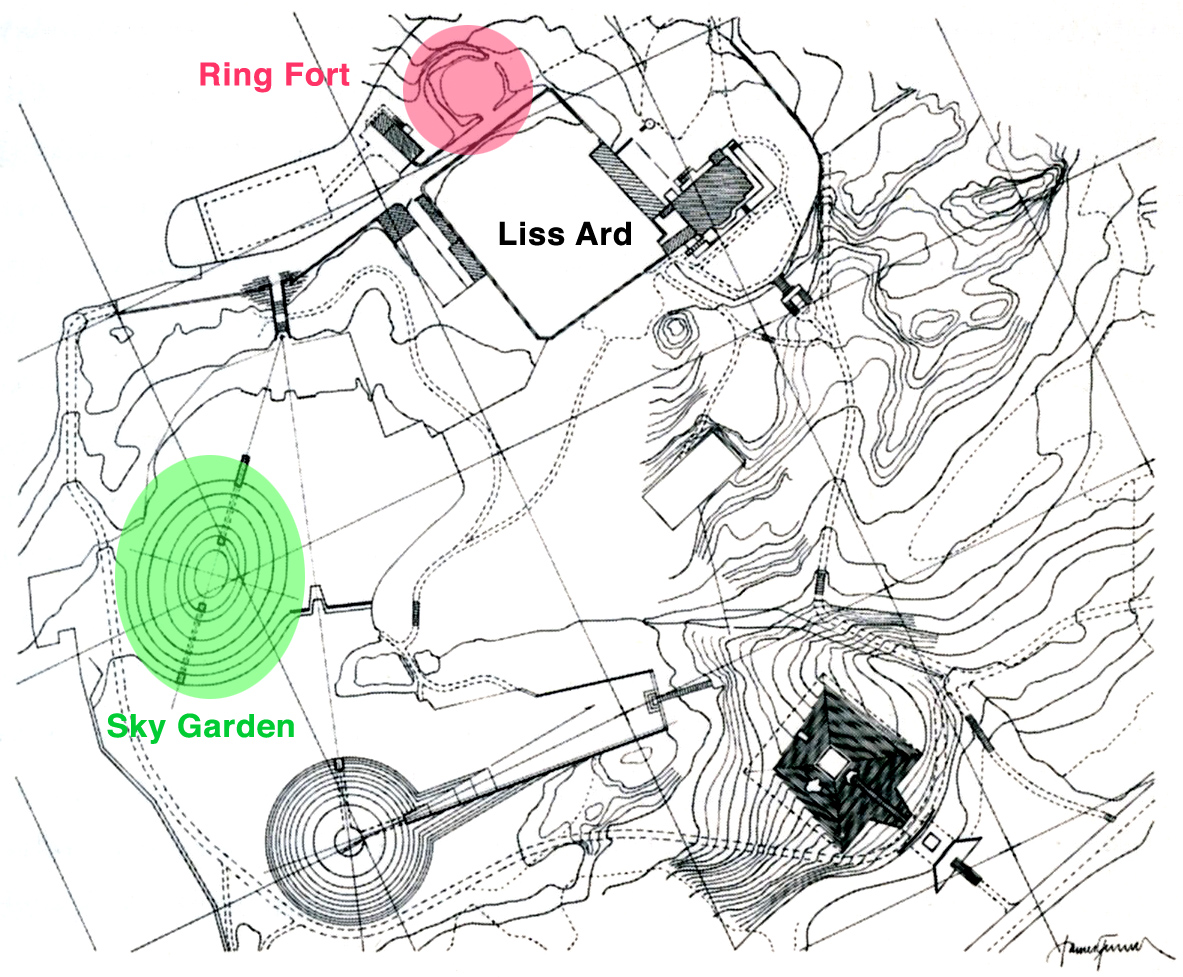
Finola and I have special feelings for Liss Ard, as we were married there in 2014 in an ancient ringfort! So, easing ourselves out of our chairs in the summer sunshine our first port of call was the feature after which the house is named: Lios Ard = High Fort. At our wedding the souterrain which was an integral part of the fort was not visible: today it can be seen, from above (at least, the entrance to it can be seen). The souterrain is a series of underground chambers, and this one – cut from rock and clay – has survived for well over a millennium. It was fully explored by a good friend of ours, Lee Snodgrass and her partner Paddy O’Leary – both archaeologists – back in the 1980s, and an information board just beside the fort tells the story in their words.
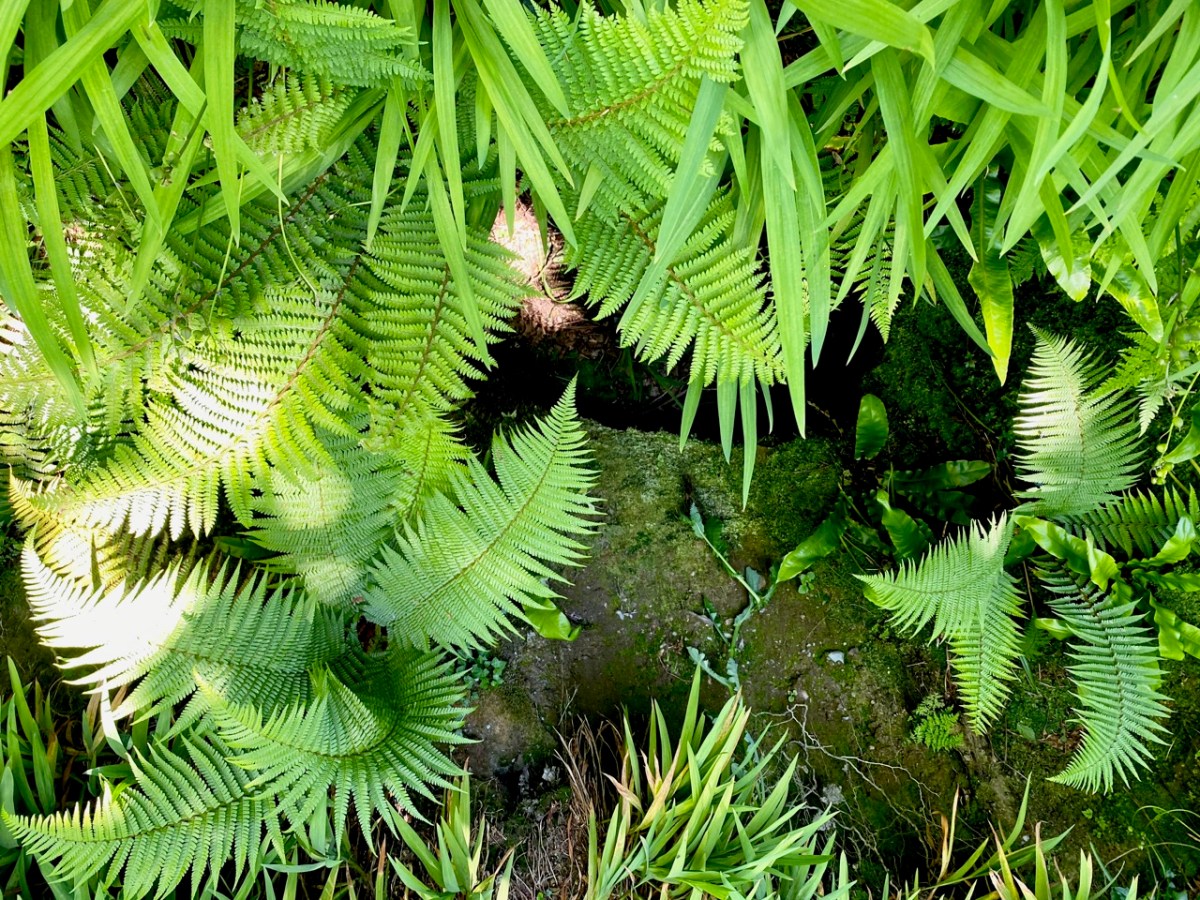
Above: Lee and Paddy’s survey drawings of the fort and souterrain, with a view of the entrance at the west side of the enclosure, and the cave-like structure which can be seen today, surrounded by ferns. Below is our group standing in the circle of the fort: such structures were probably high status homes defended by banks and timber palisades. They would also have provided protection for domestic animals who would have been predated by wolves.
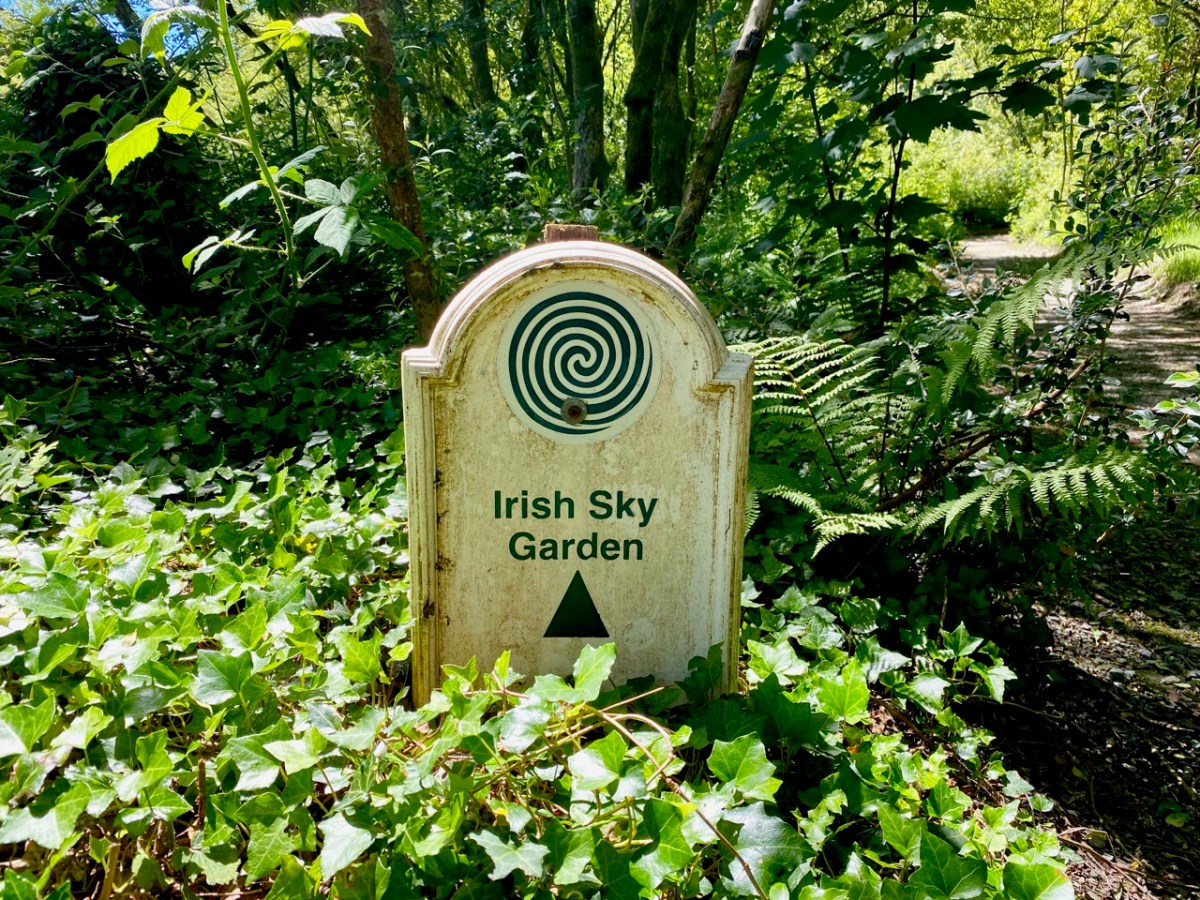
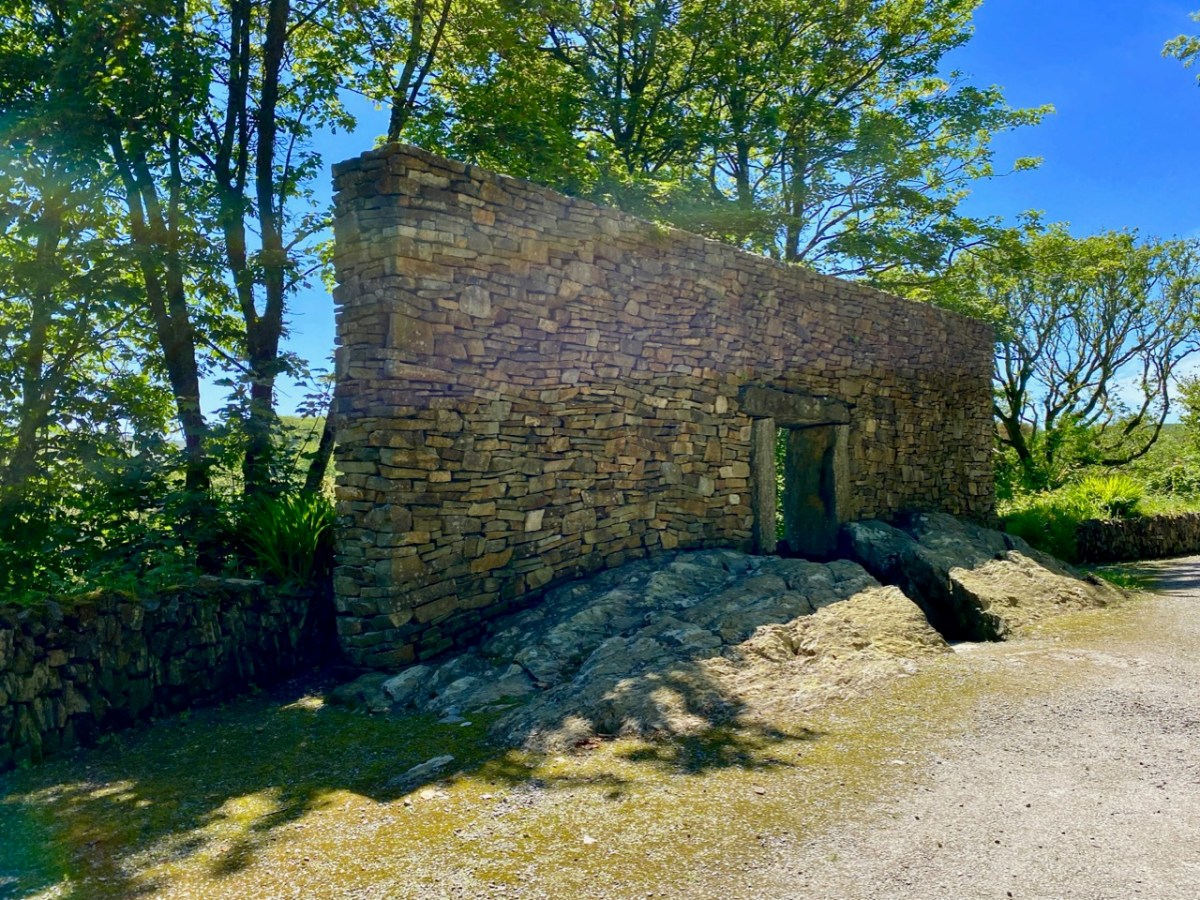
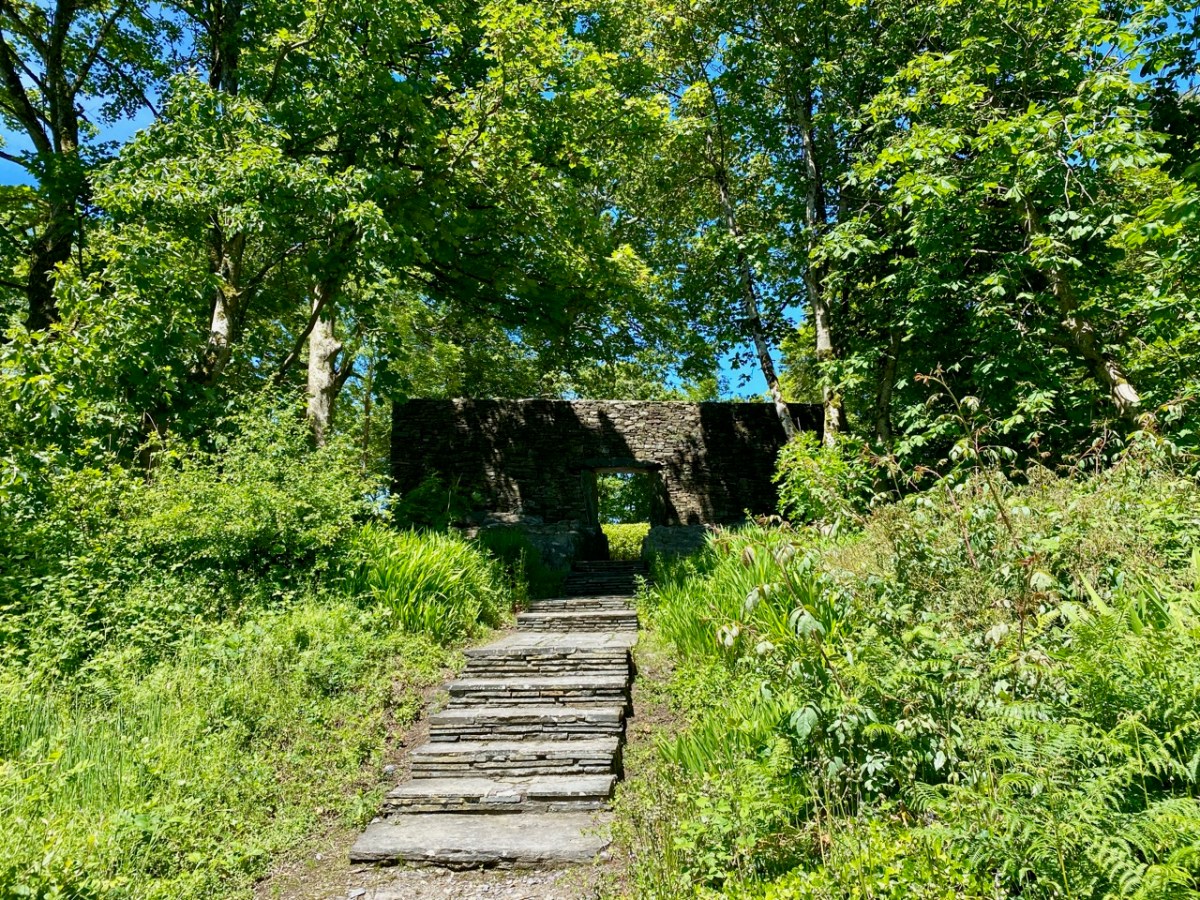
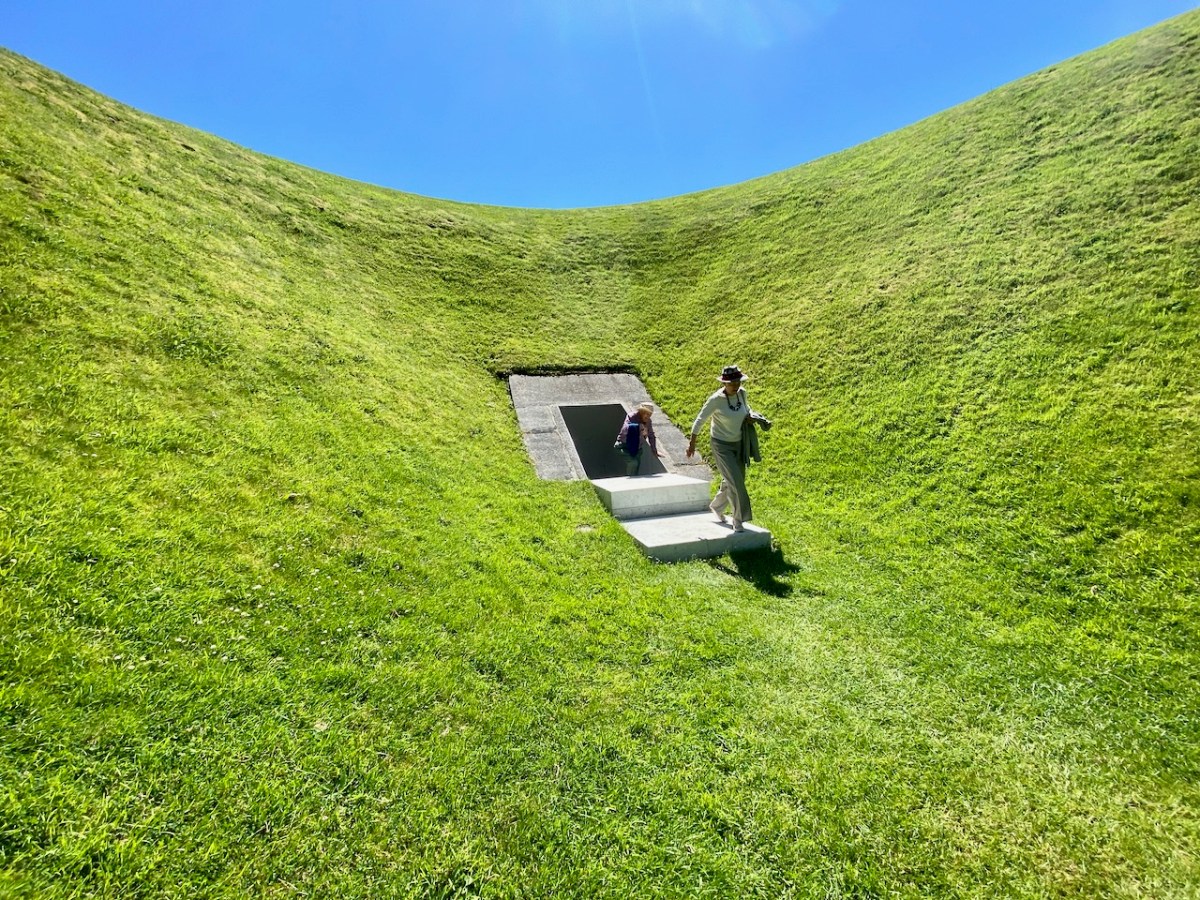
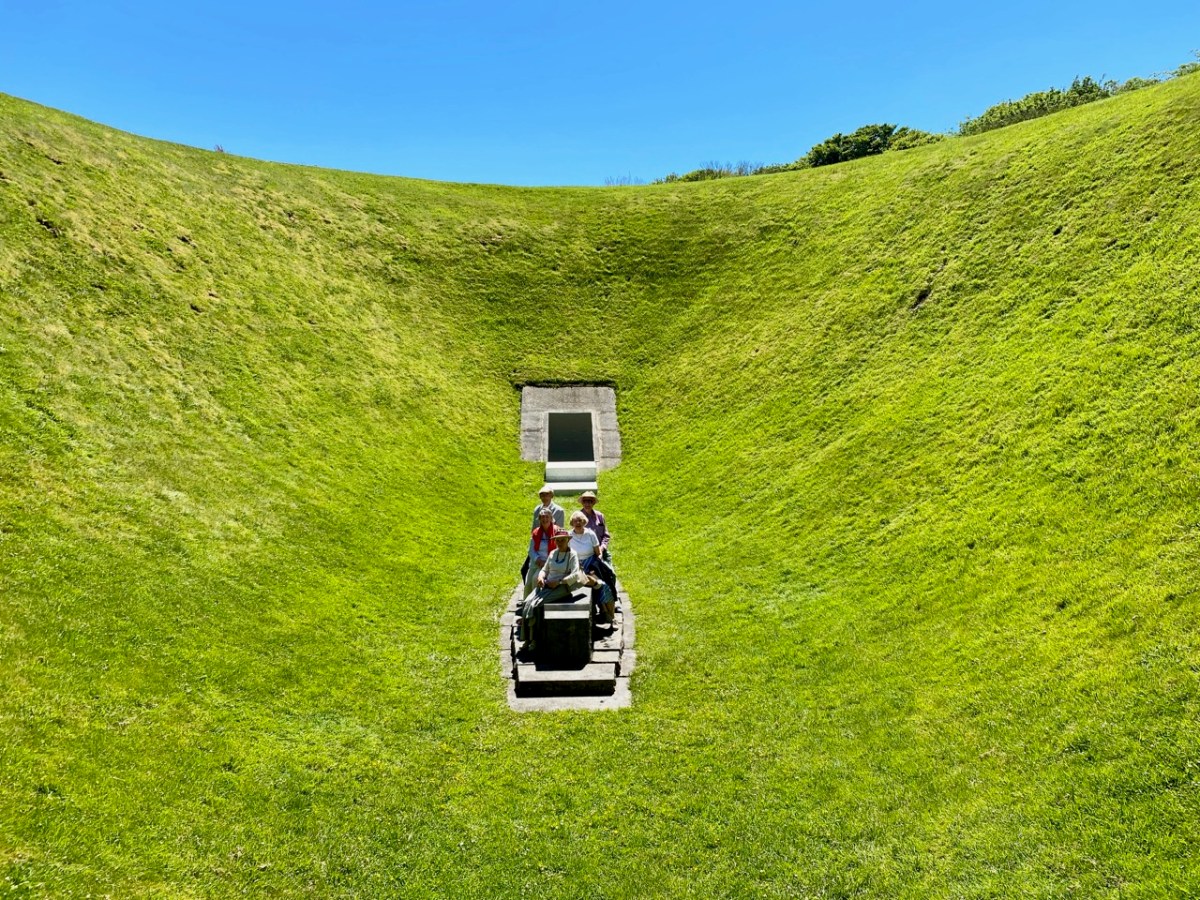
Another feature in the grounds of Liss Ard may also seem like something ancient, but actually only dates from 1992:
. . . The Liss Ard Project brings together the conservation of nature and contemporary art: it will combine animal wildlife preservation, controlled ‘wild’ gardens and a contemporary art project – the Sky Garden . . .
. . . Turrell traced his wife (Julia)’s ancestors to Castletown Bearhaven. He had his two youngest children, Sophie and Arlen, baptised in the church there . . . This (West Cork) is the countryside that inspired his Sky garden. It could not be realised anywhere else. Jim is responding to what he has found in Liss Ard, and his sensitive response will enhance the attraction of the site even more. Jim and Veith (the Zurich art dealer who bought the estate in 1989) study the site like two conspiring brothers. Both radiate assurance. Something unique and shared is being created there. The joy of it shows in their faces . . .
James Turrell from the exhibition – Long Green, Turske & Turske, Zurich 1990
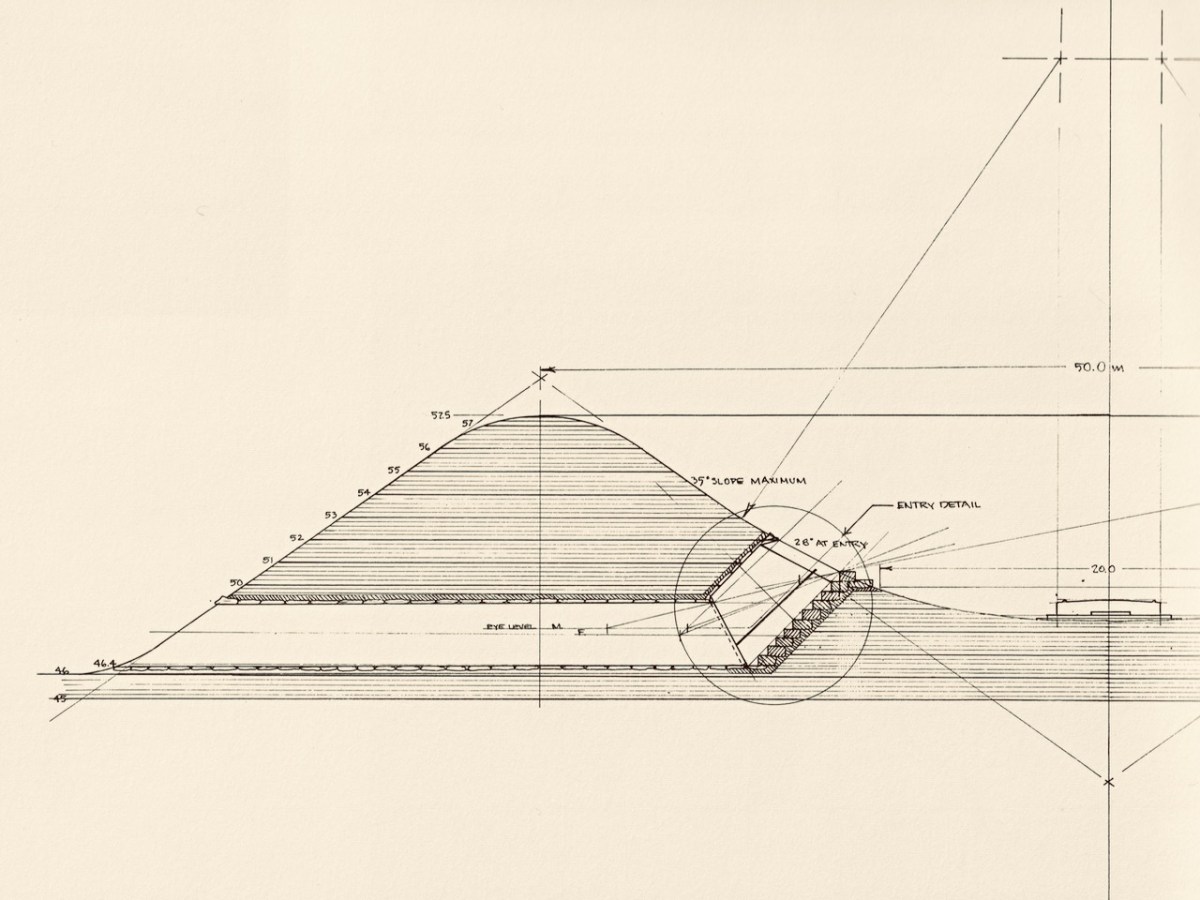
The Irish Sky Garden is an as yet incomplete work of art. The whole project was set to incorporate other ‘land works’ including a pyramid and a vault. Turrell’s most famous work, perhaps, is the Roden Crater in the Arizona desert. It is also work still in progress: construction began in 1977.
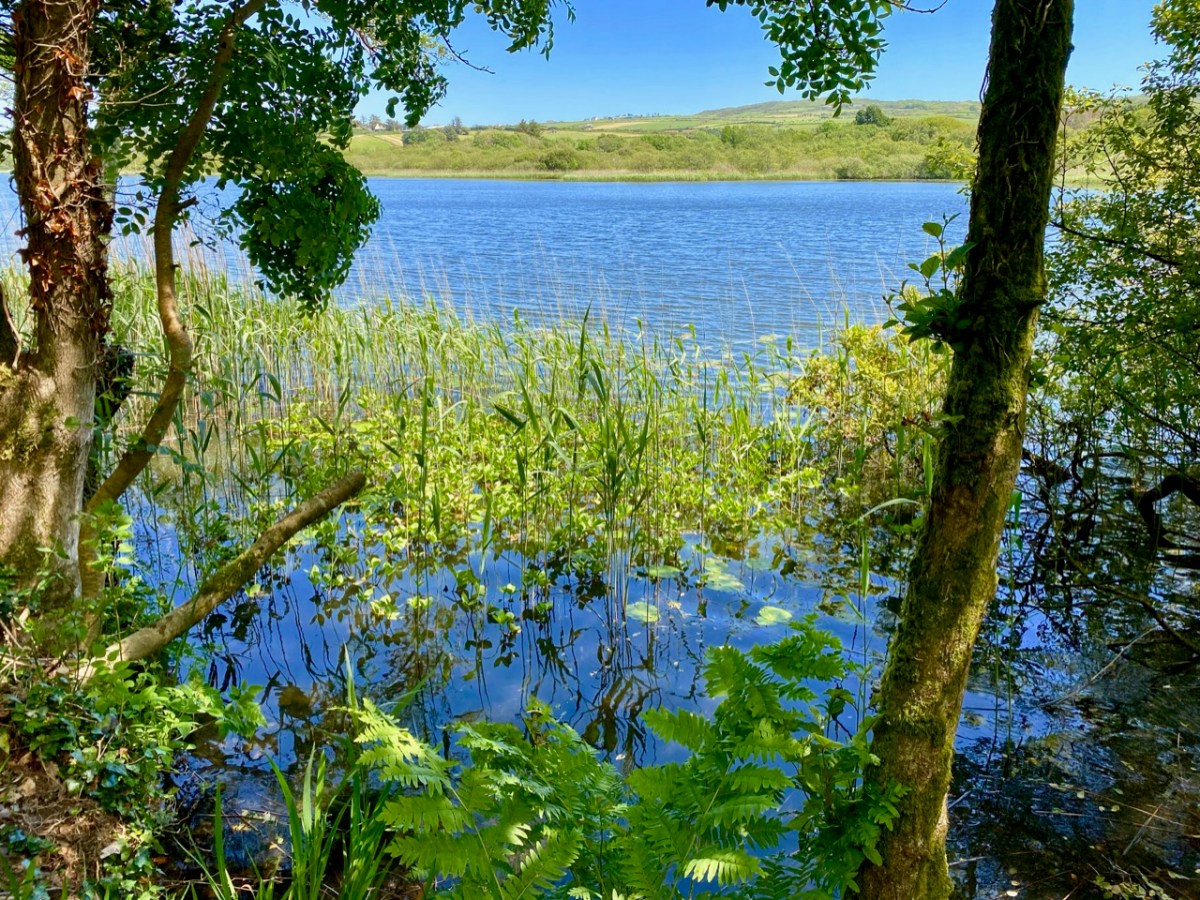
Quite apart from the ancient history and modern art, the gardens at Liss Ard have so much to offer. There is a maze of paths and steps, lush – almost tropical – growth and views across the substantial lake which forms part of the demesne: Lough Abisdealy.
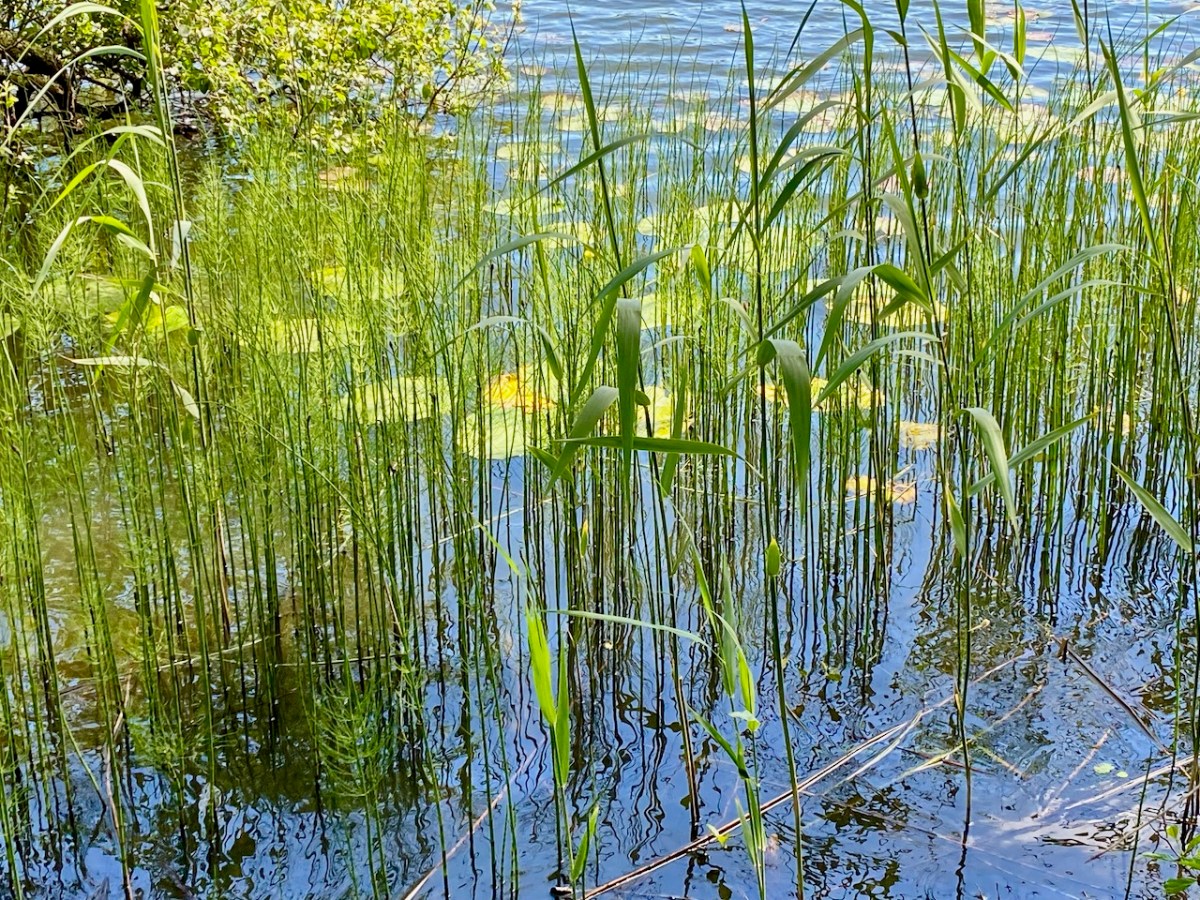
As we walked beside the lake I was entranced by the sound of the wind in the reeds, and have tried to capture it with this little recording: you can imagine the combination of the swaying reeds, the crescendo of the light wind, the distant birdsong and the lapping water.
I can only give you a brief impression of our sensory experiences from the day: much is left unsaid and unseen but – all you need to do is book your Sunday brunch, and you stand a good chance of following our footsteps. I only hope that the day is as brilliant for you as it has been for us!
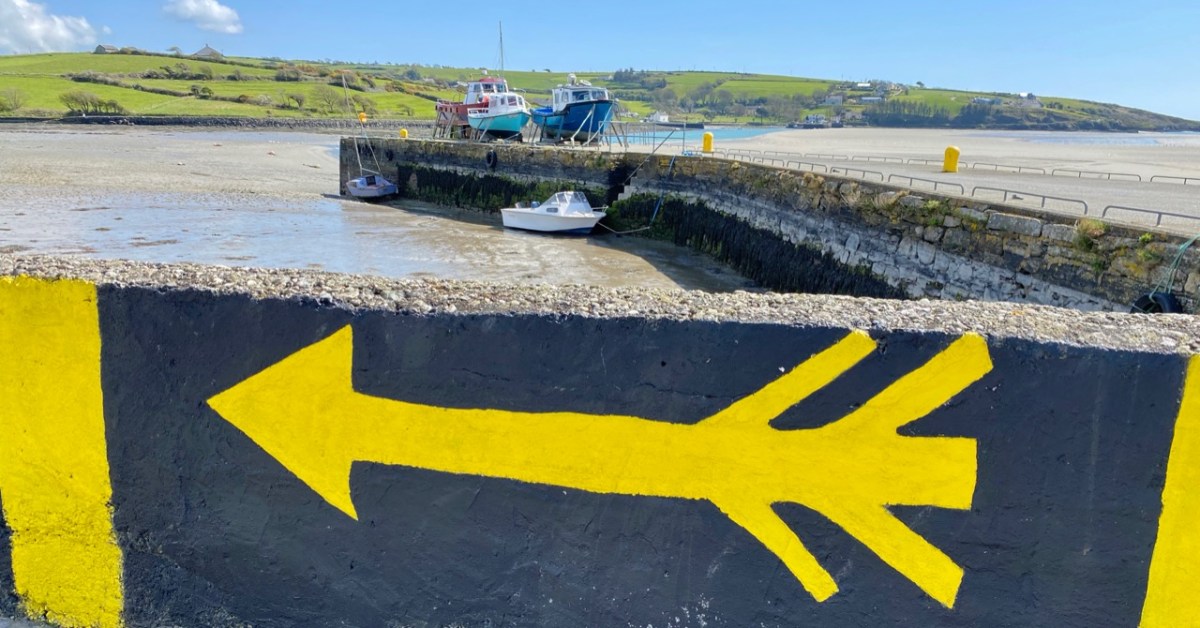
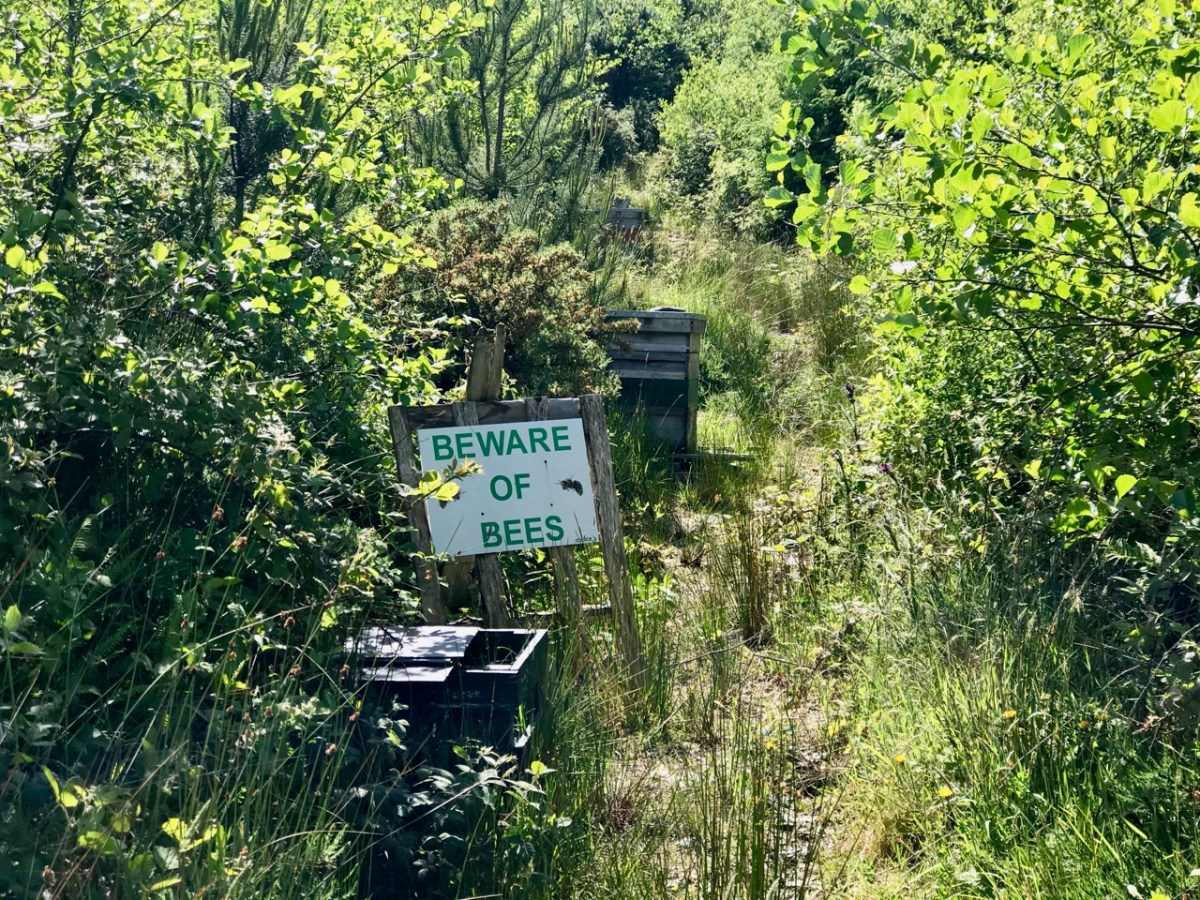
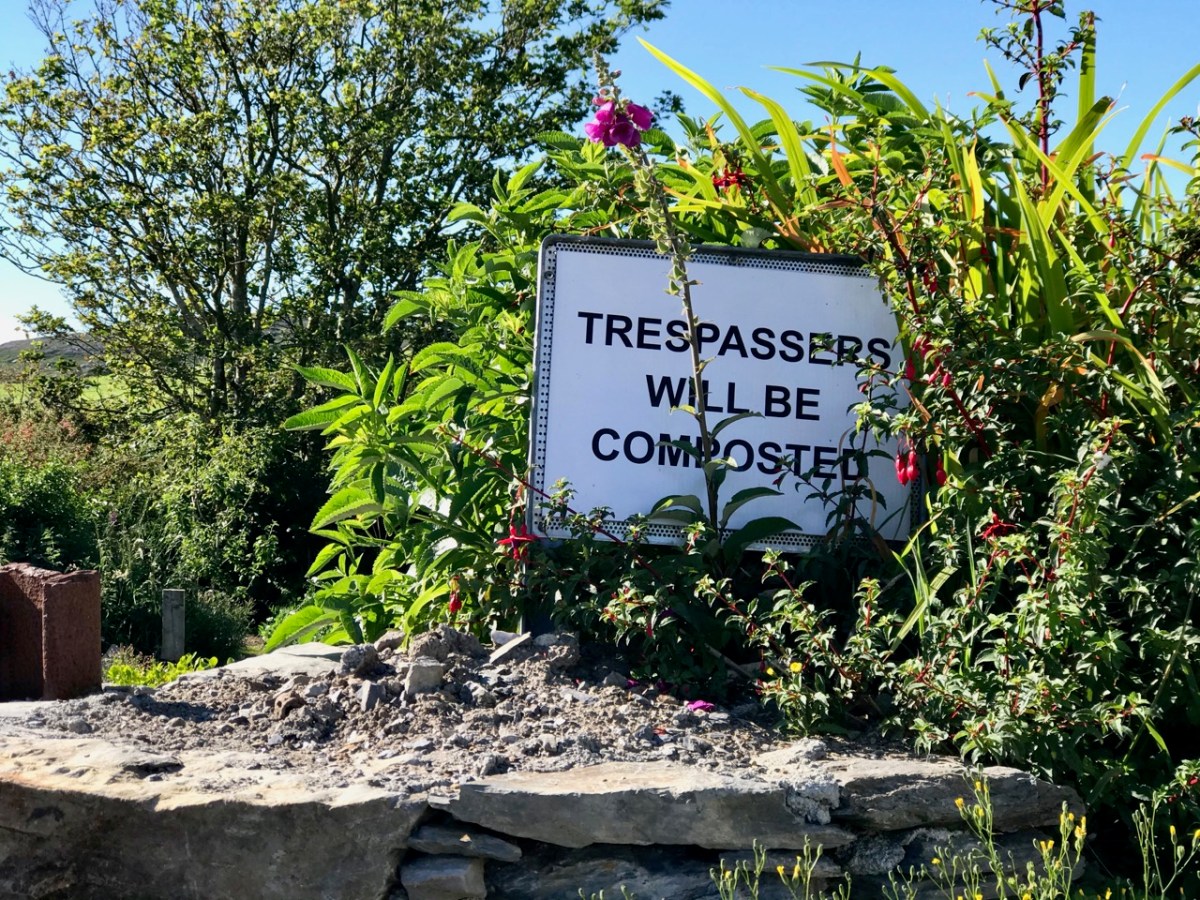
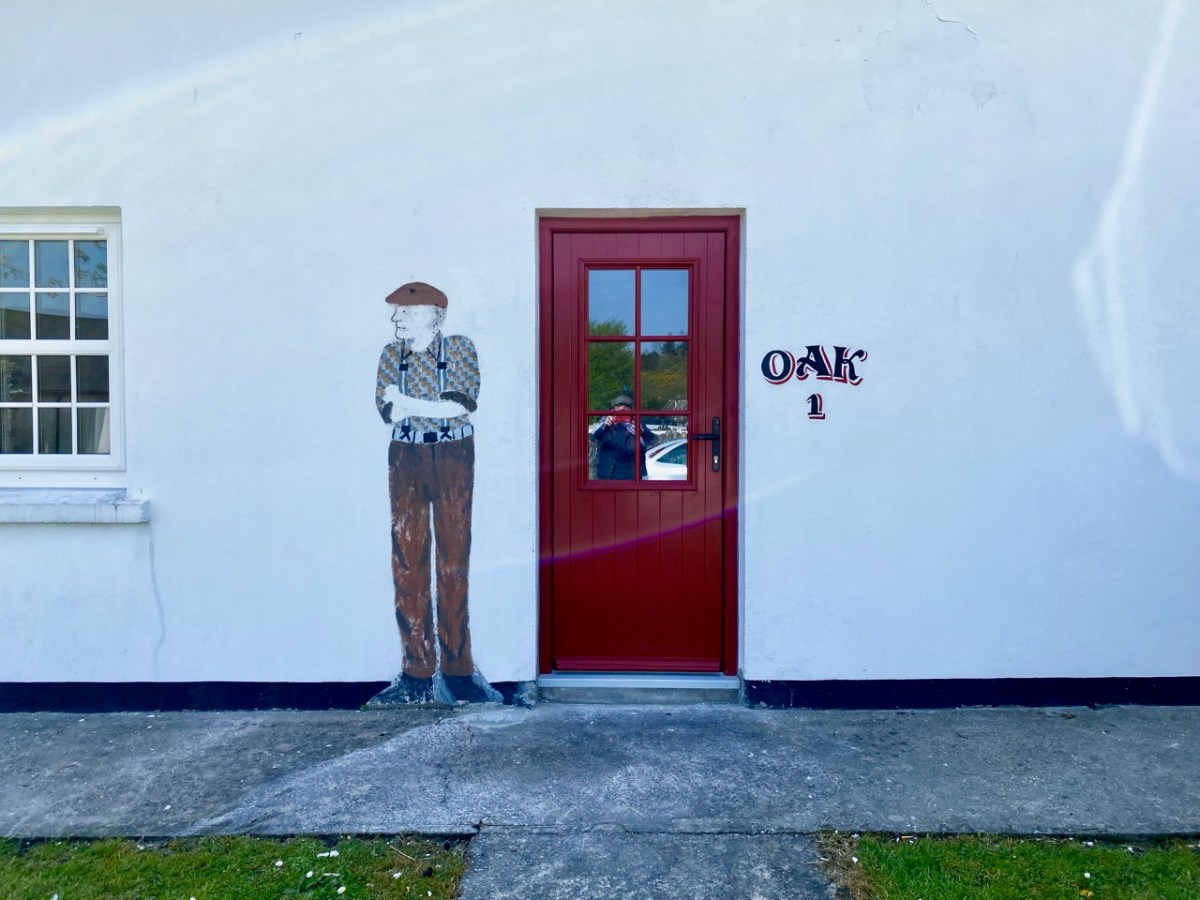
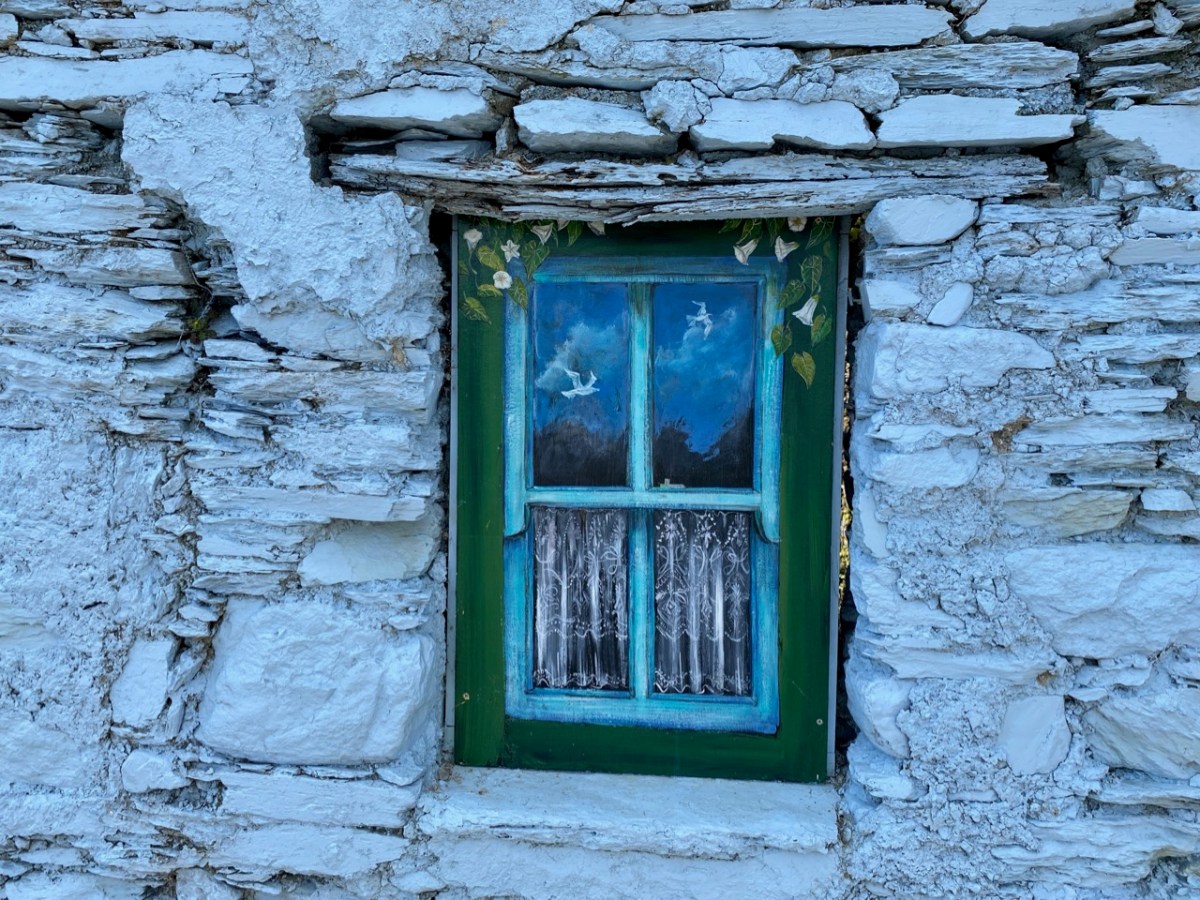
It’s been a while since I put up a post about ‘signs’ – I’m an avid collector of Irish ones. They have been a regular feature of Roaringwater Journal, but the last was 18 months ago (see it here). Wherever I go, I’m on the lookout: sometimes it’s just the little things that catch the eye – perhaps a spelling mistake – often it’s the sheer exuberance, like the one above guiding you around a corner at Ring.
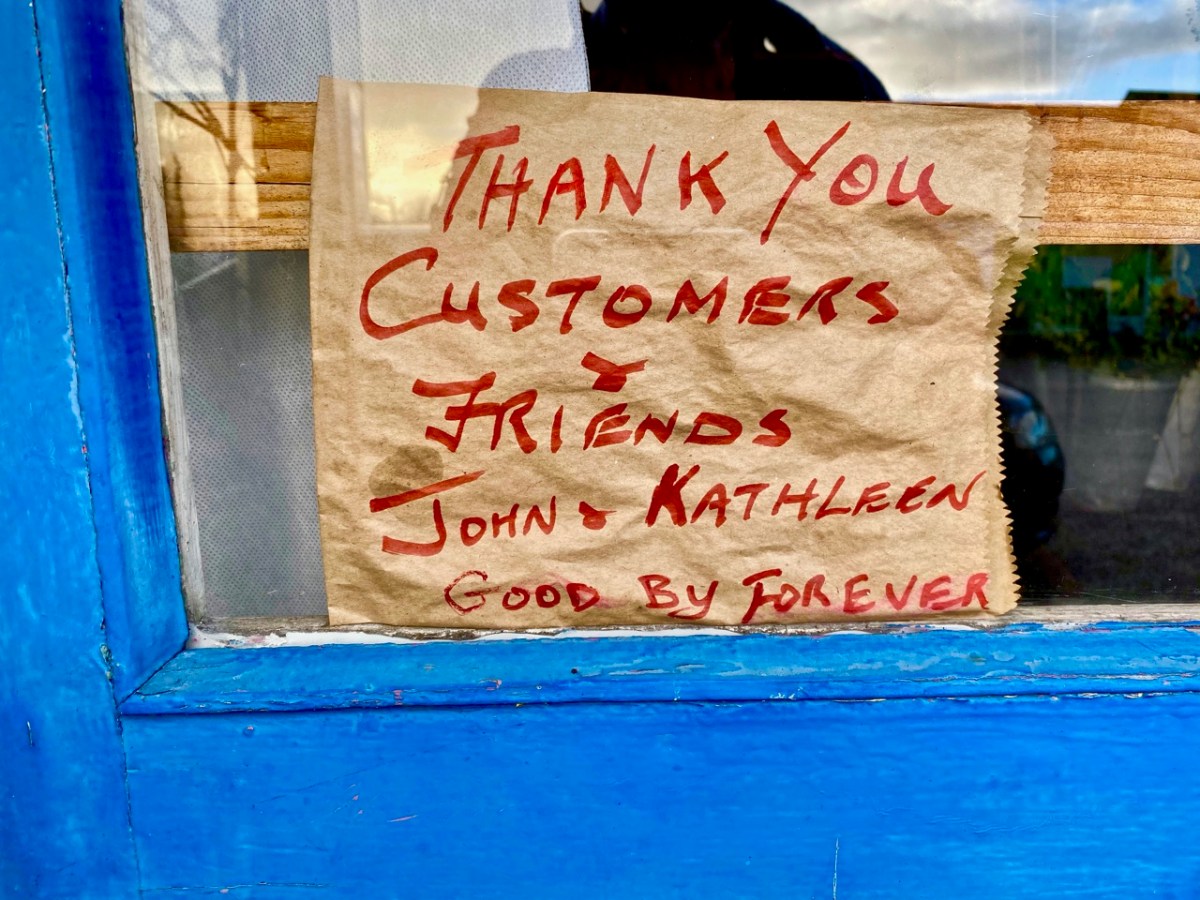
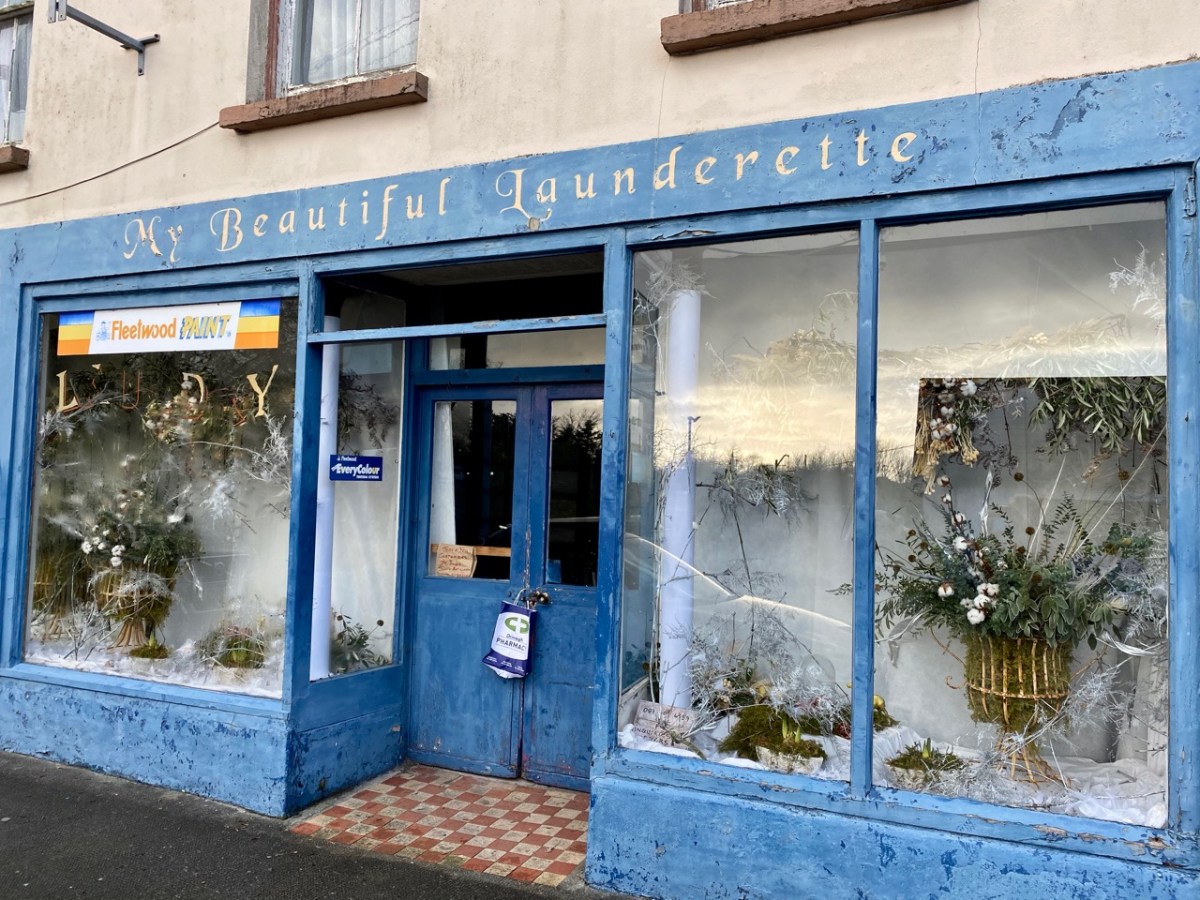
Very often there is intentional humour; occasionally there’s a poignancy – especially when the sign is faded and you know it has long lost its purpose. But there can also be a sense of history. Here’s one from Ballydehob earlier this year – My Beautiful Launderette, which provided us with clean bedding for a decade (and paint, all manner of screws, hammers and nails), finally closed on the retirement of Kathleen and John: we can only wish them well. The iconic shopfront has just this week been painted over. An institution, now, which is only a good memory.
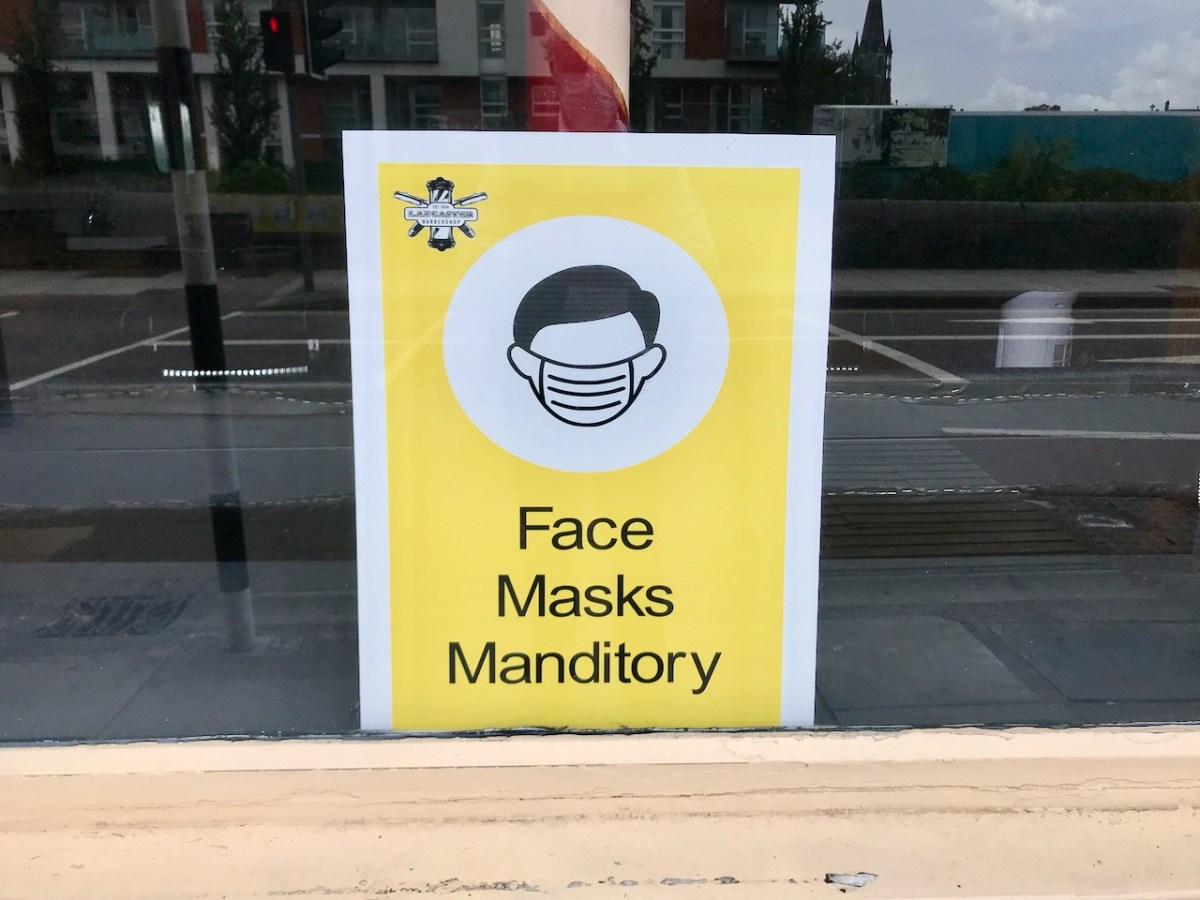
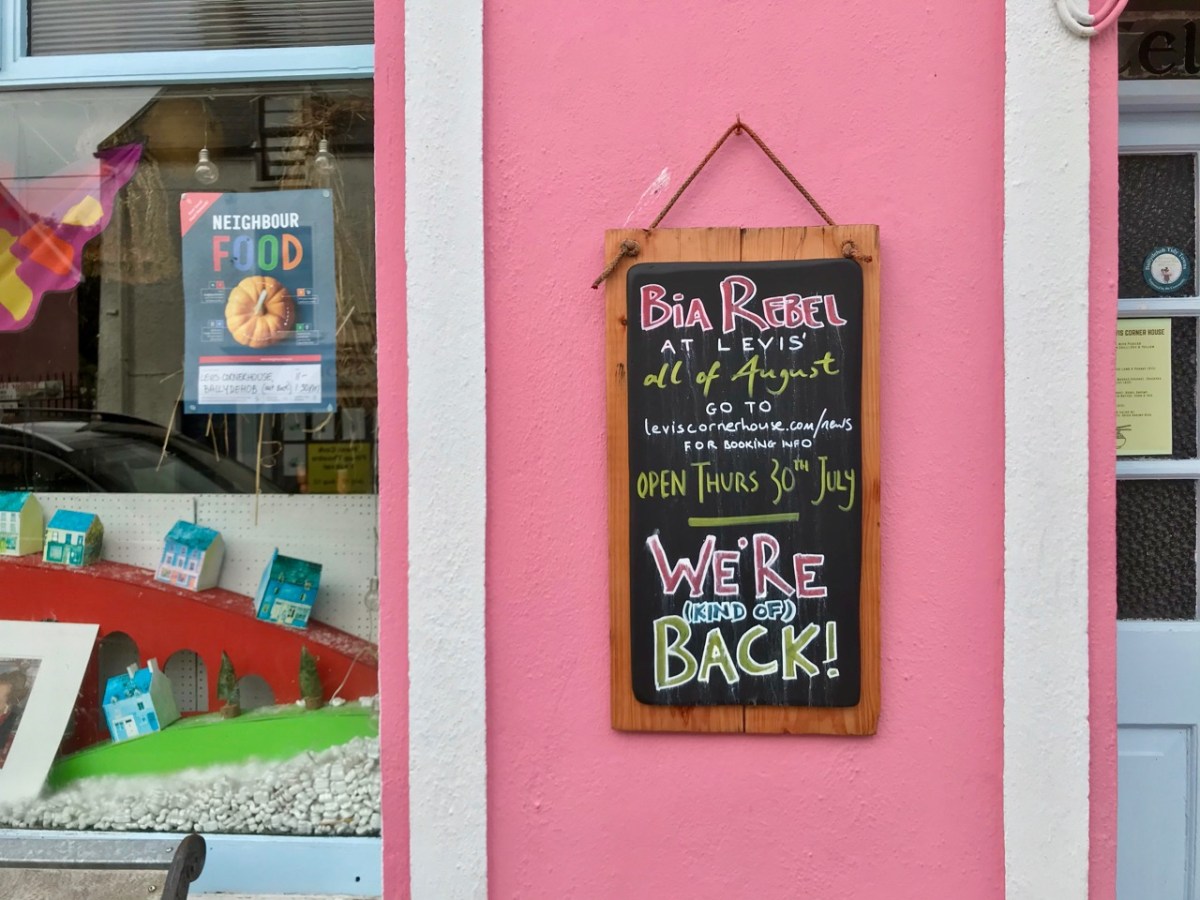
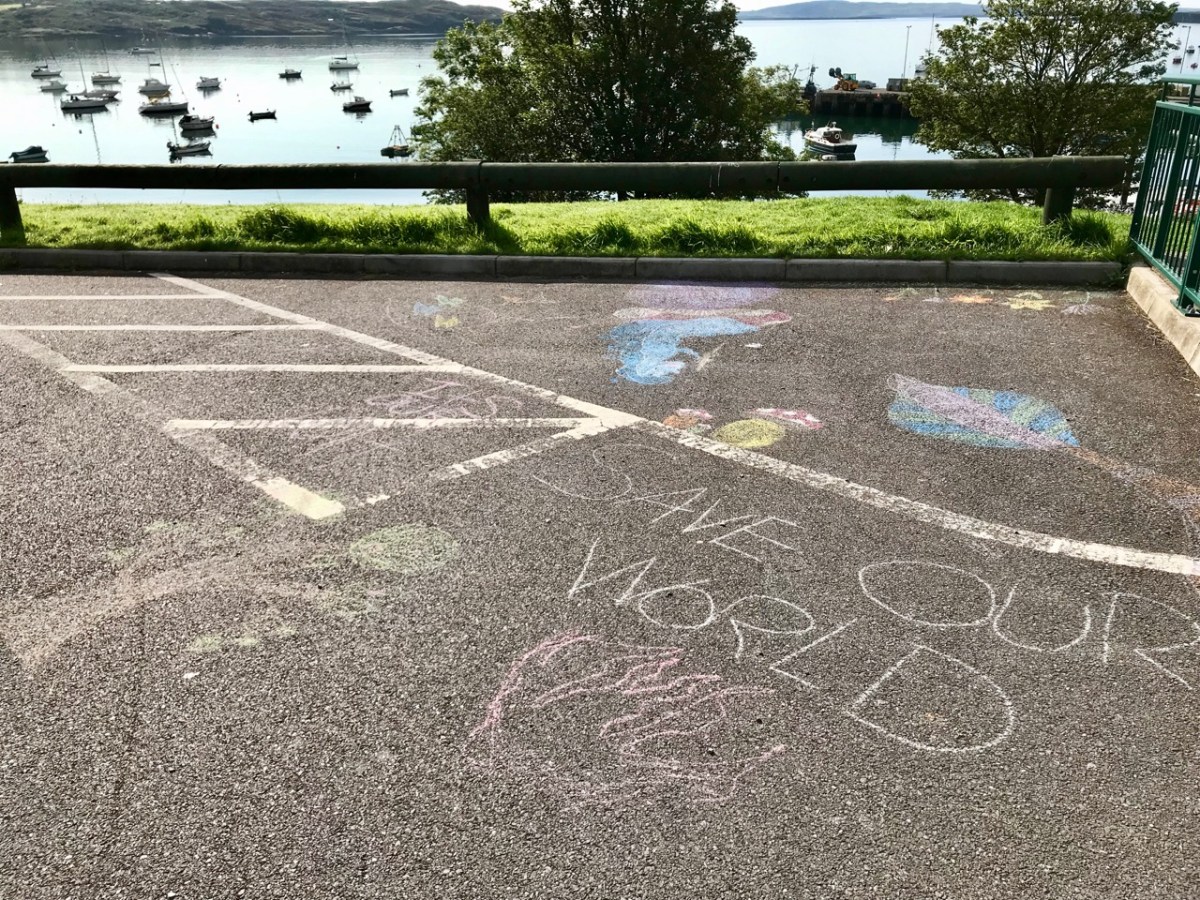
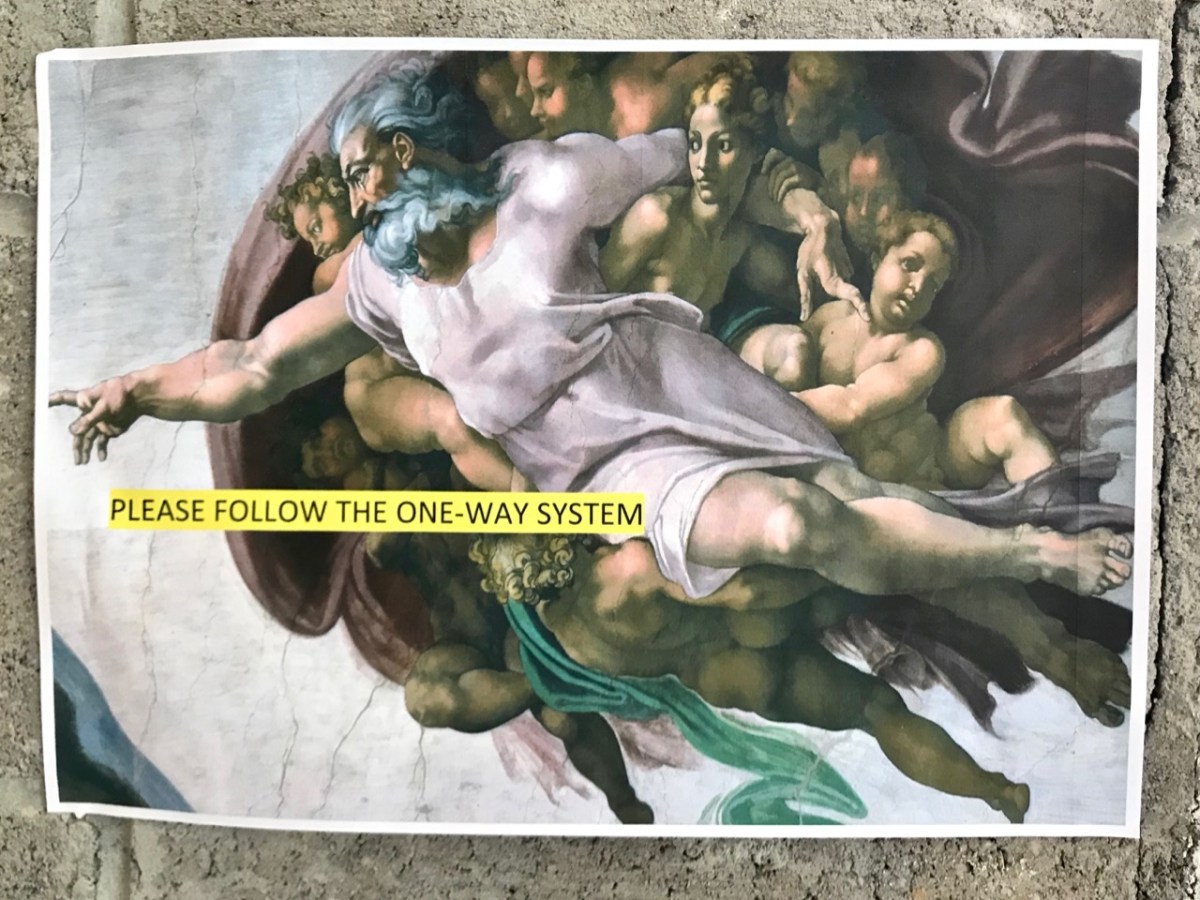
Most of the following signs speak for themselves. We will be familiar, of course, with the directives called for by the Covid19 pandemic. Here’s a variation, followed by a reminder of hopeful days back in the summer of 2020, and a message.
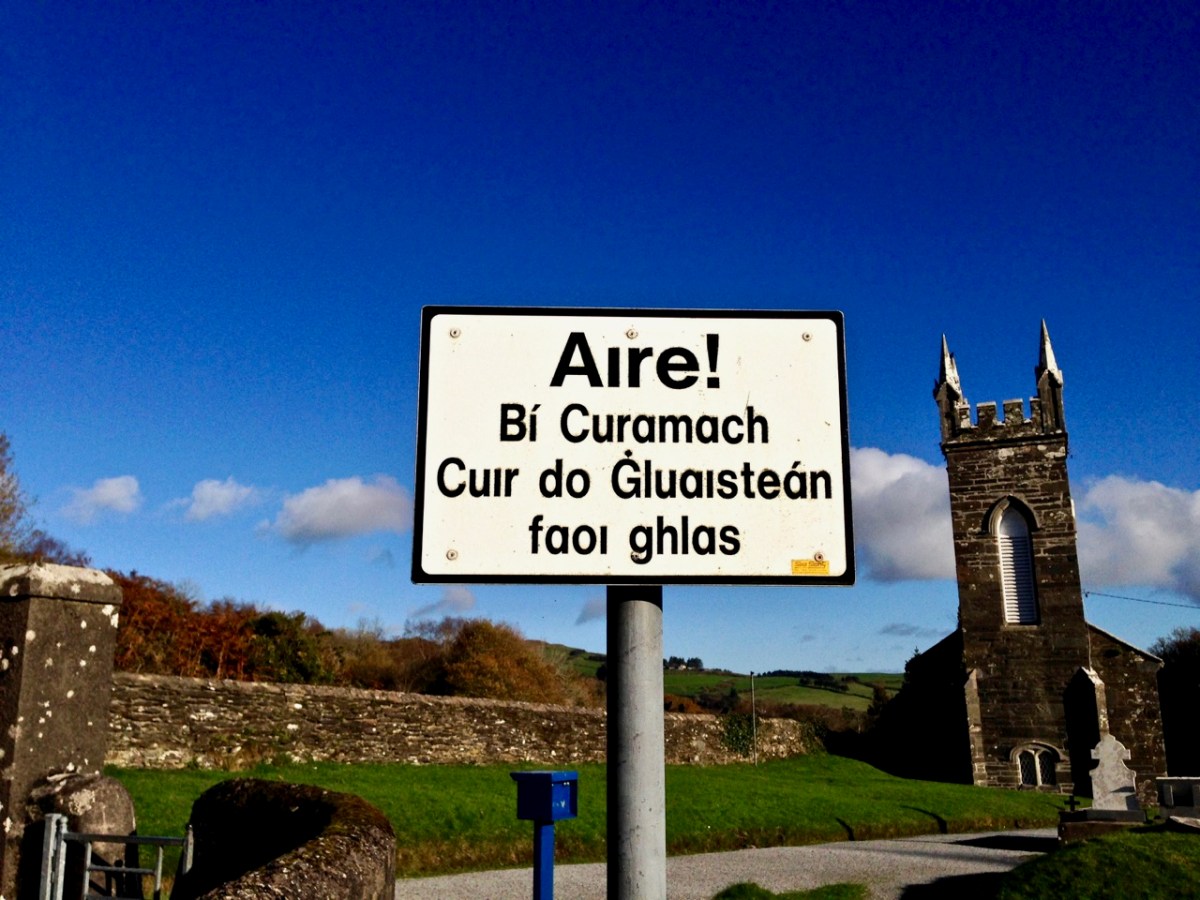
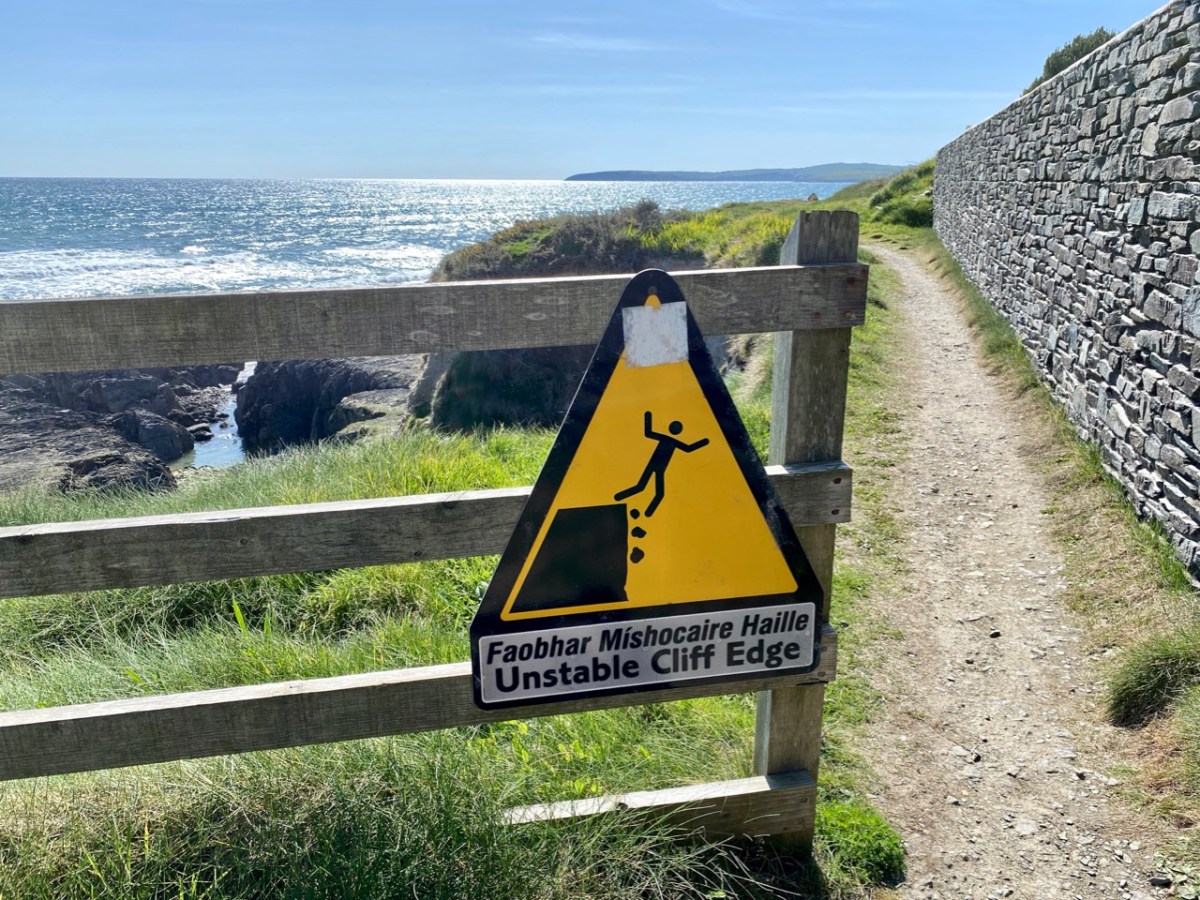
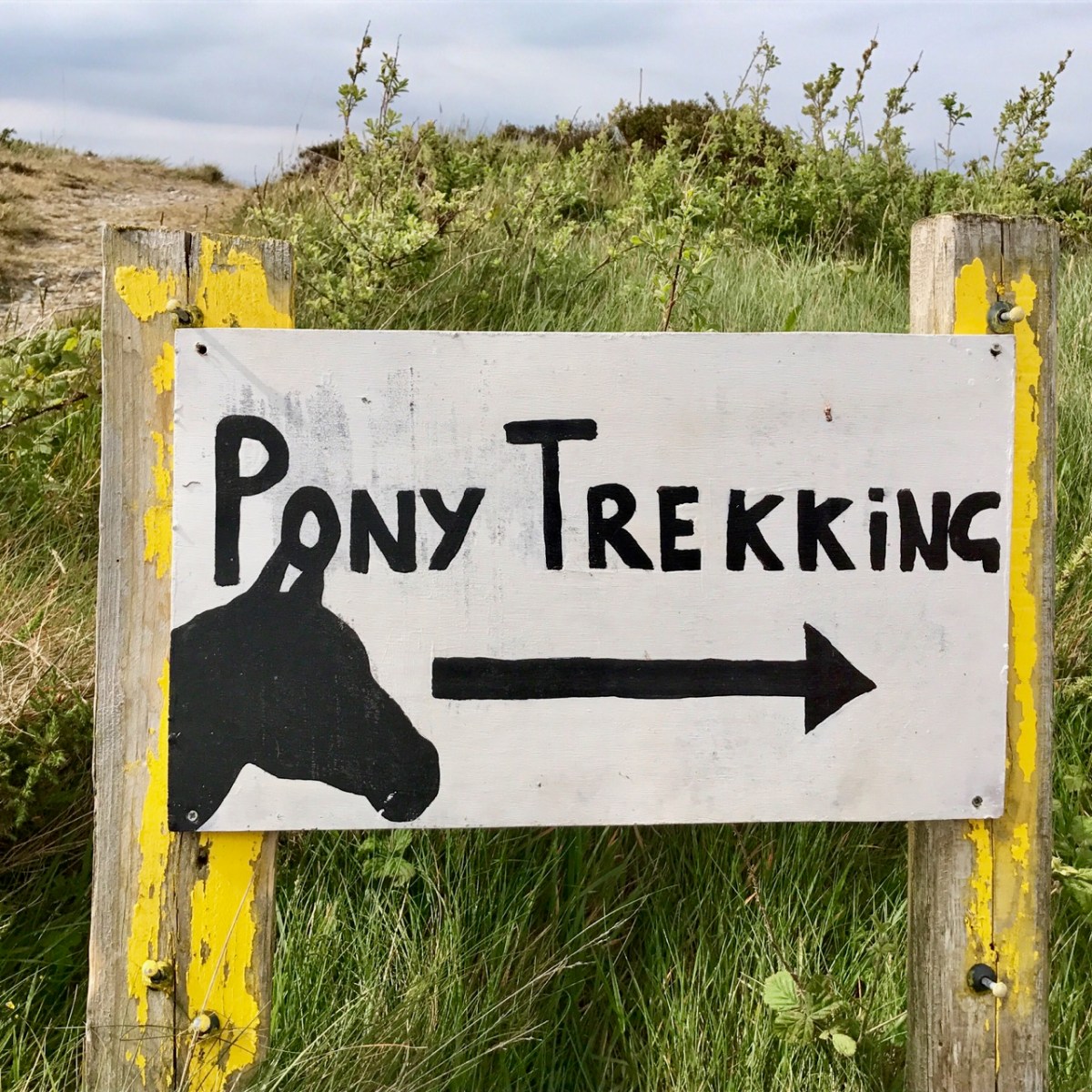
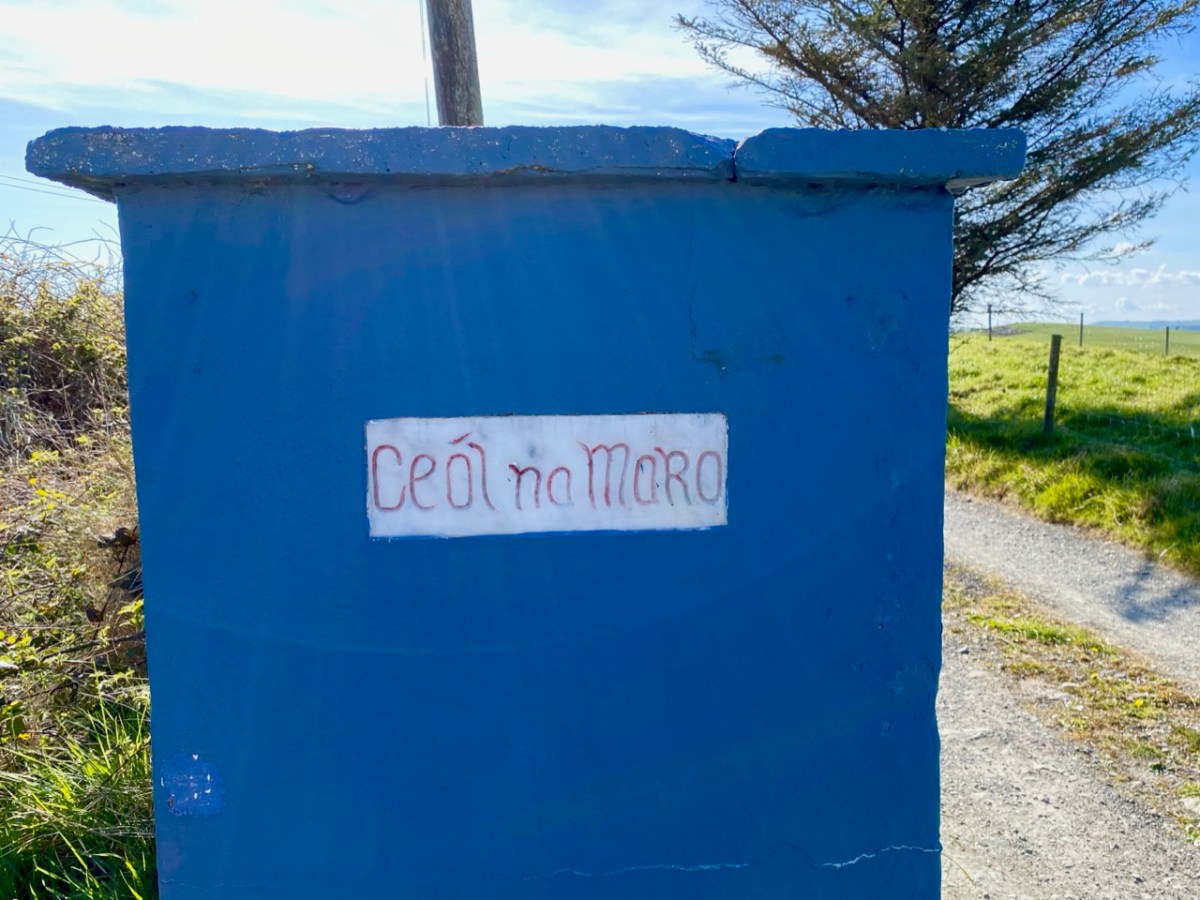
Most of the signs here come from West Cork; you’ll find others in past posts from all over Ireland. Official directives here have to be in Irish and English, except in Gaeltacht areas (where Irish is the first language). There, things can be quite disconcerting at times.
Even though I have taken some rudimentary lessons in the language, this one (above, in Ballyvourney) had me puzzled. But it’s simply telling you to be careful to lock your car.
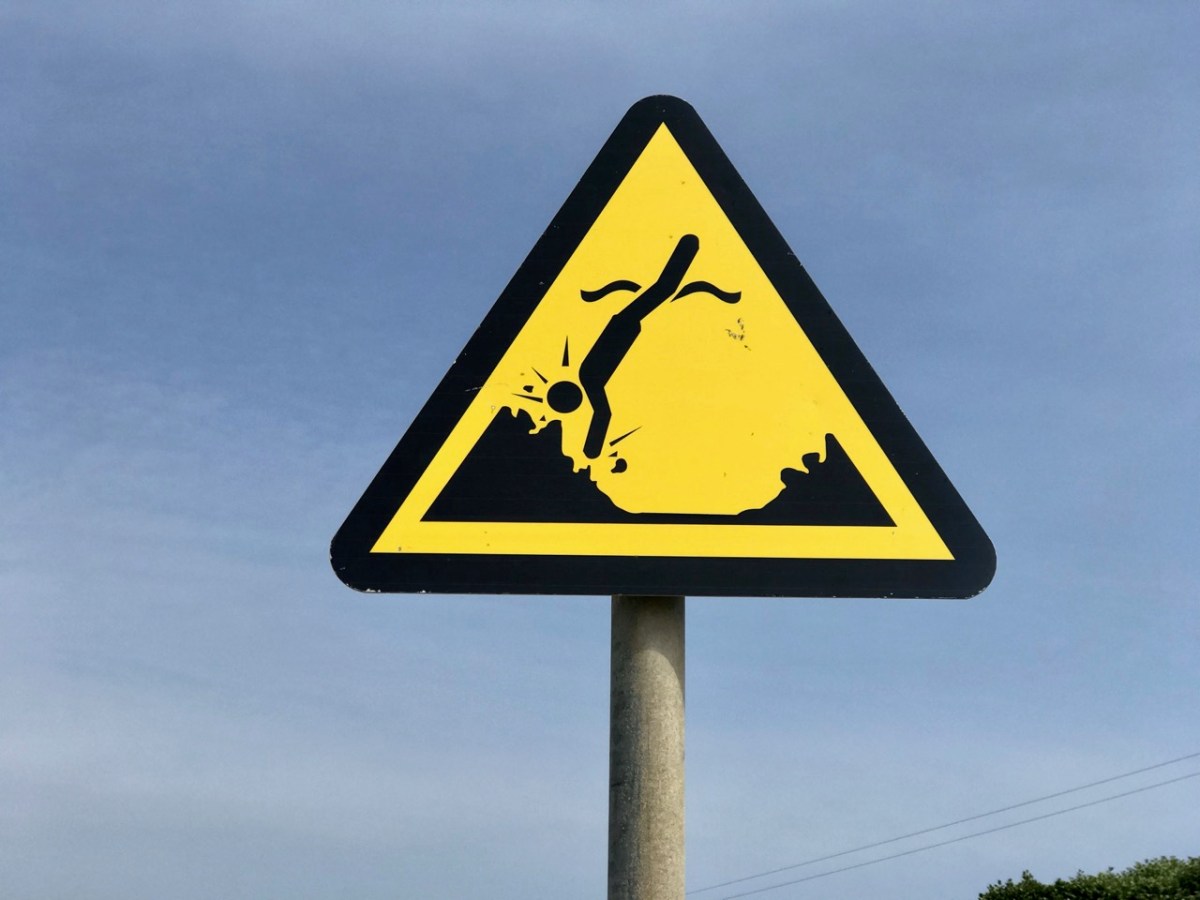
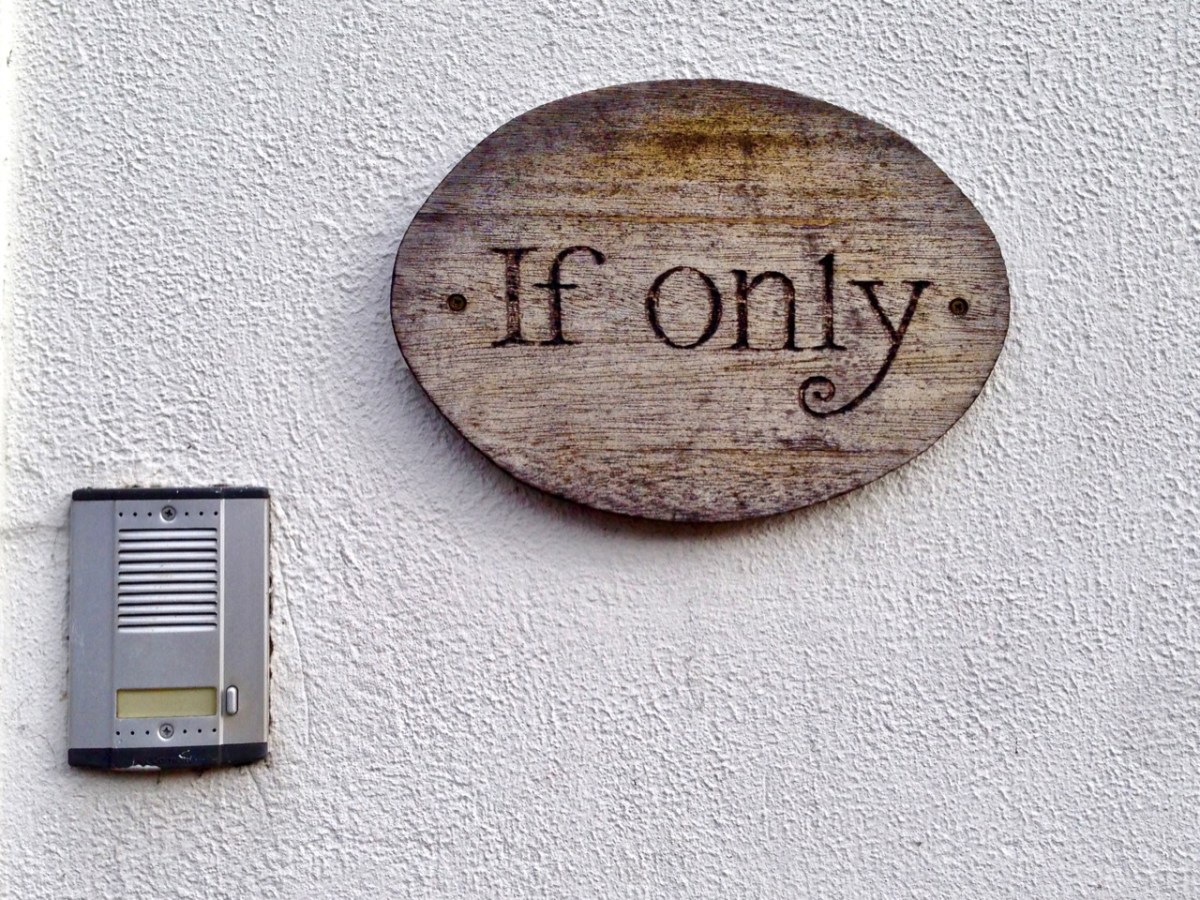
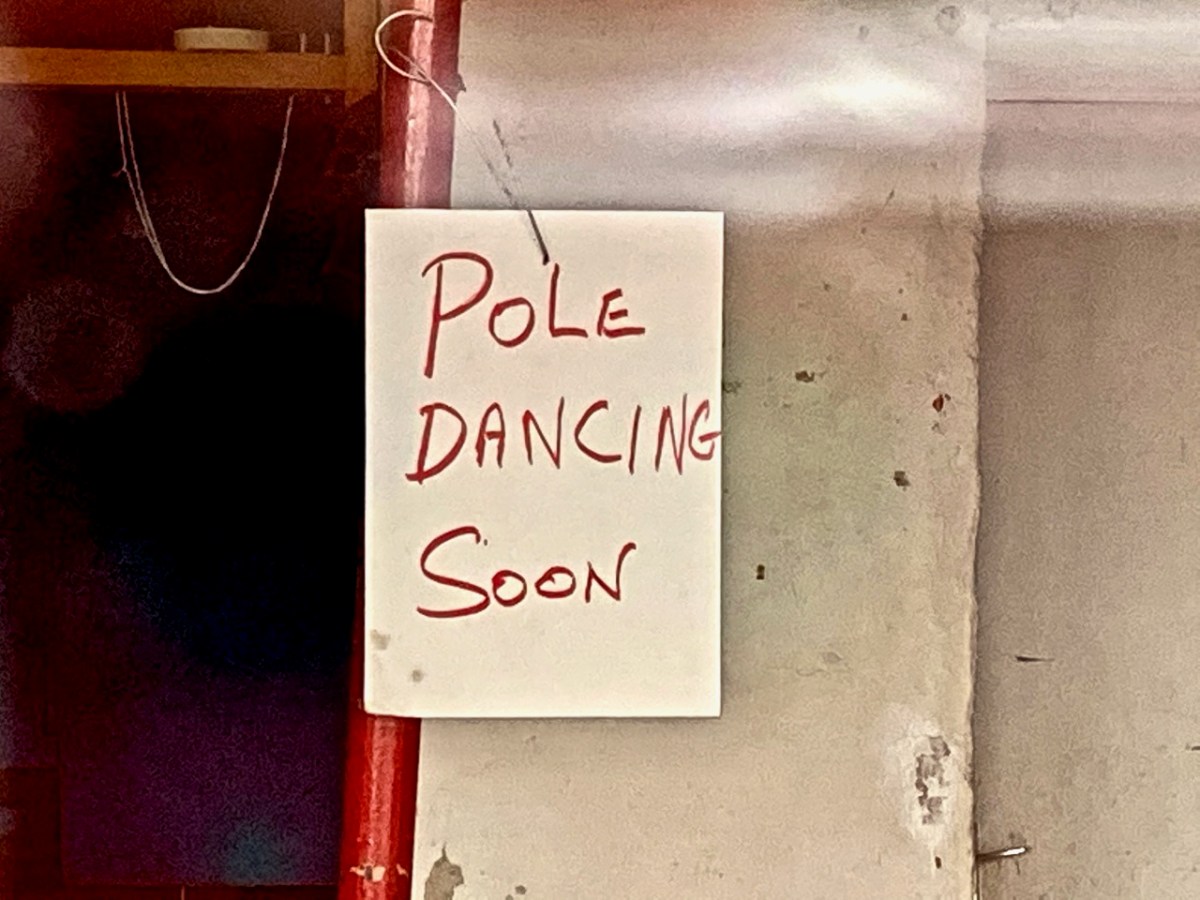
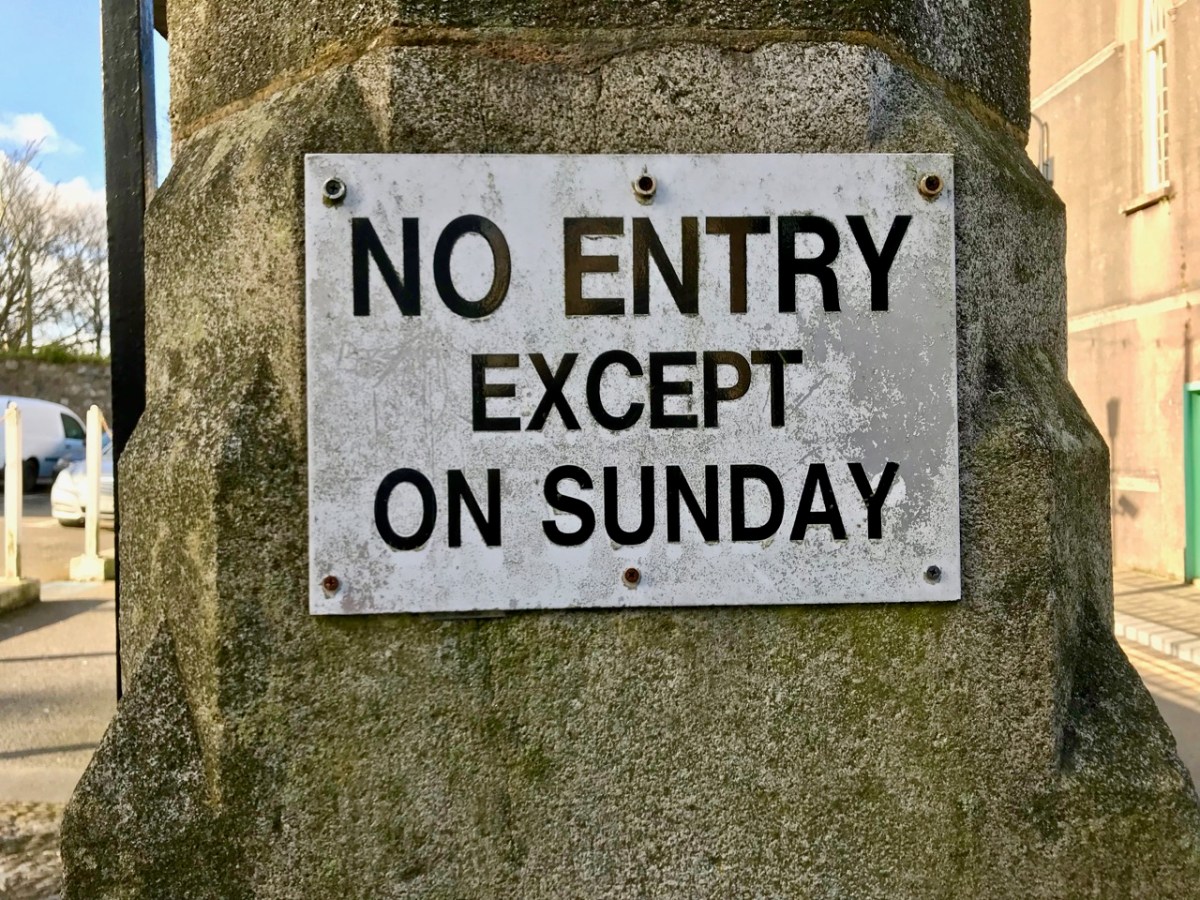
I suppose if you missed either of the above signs, it might just be too late! If only you had noticed…
It means ‘Song (or Music) of the Sea’. I couldn’t resist recording this romantic house name, and wonder what view the occupants have? There is no shortage of information on Ireland’s wonderful history – an example below.
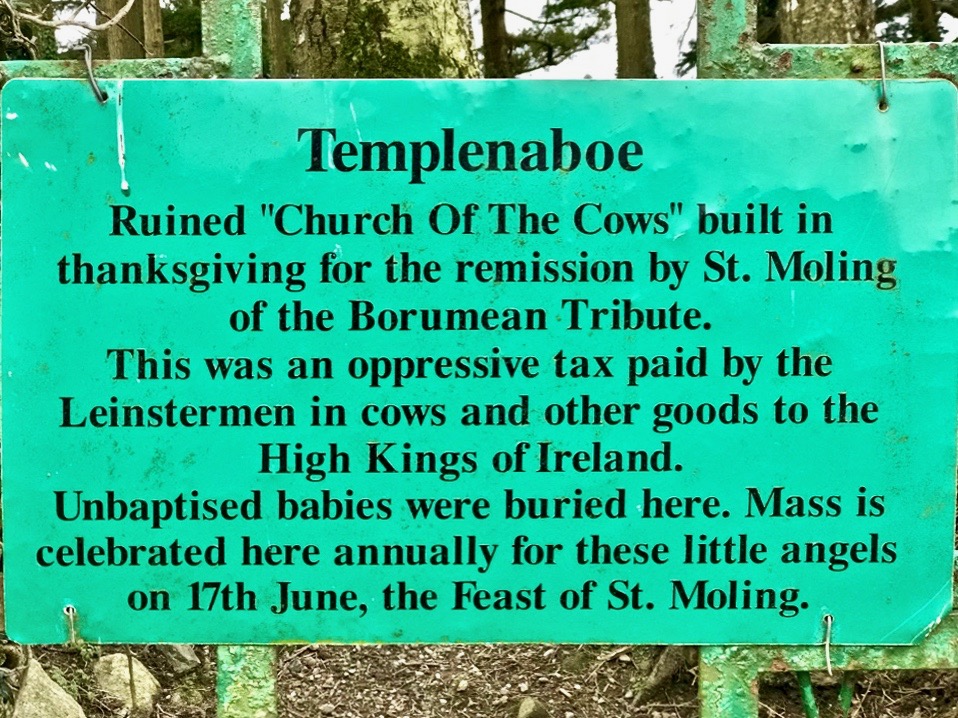
I can’t help wondering – why?
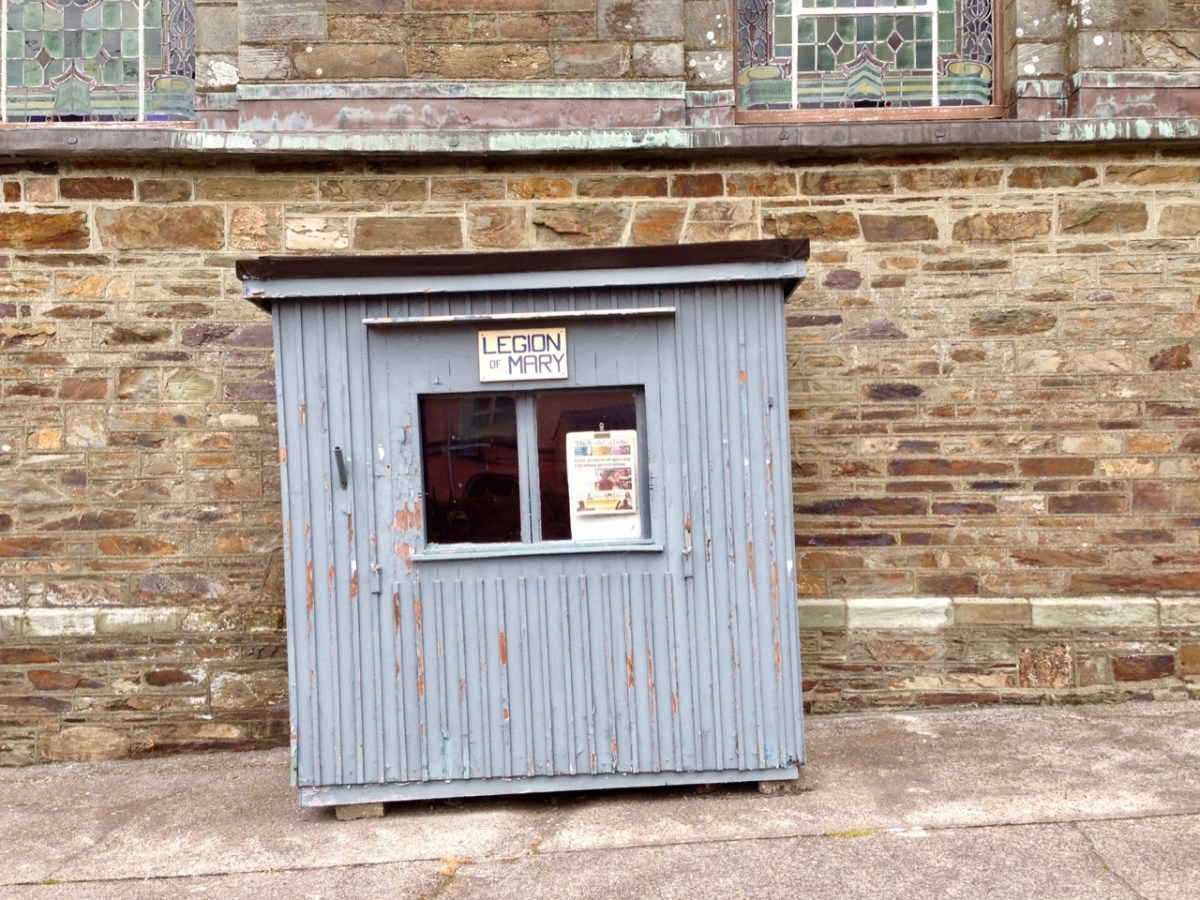
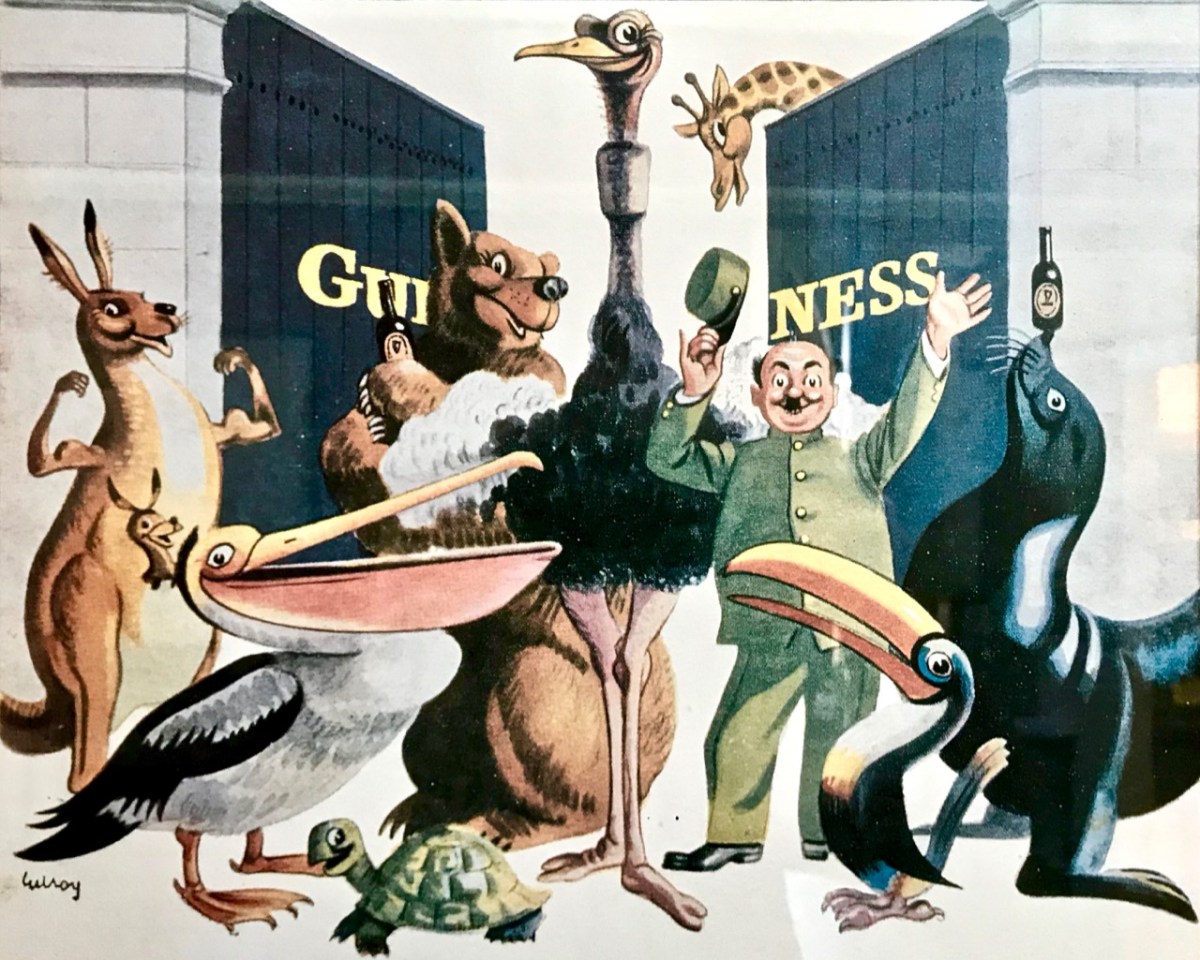
That’s not you that’s gone askew – it’s Mary’s kiosk on a bit of a slope! I’m always attracted by Guinness posters (there are plenty of old ones surviving here) – I learned to read from them in my younger days (below).
That’s quite enough for one day. Keep a lookout for yourself – and alert me to any good ones you encounter in your own travels!
Gladys Leach was a beloved Cork artist who specialised in line drawings of gracious historic buildings. Her work once lined the walls of City Hall (it might still). In 1974 a limited edition book of her Cork drawings was produced, bound in blue. Called The Scenery and Character of Cork, it sold out in 16 days.
Sean Feehan re-published the book in 1978, bound in red to distinguish it from the 1974 edition. The drawings are accompanied by text by him and each description is full of fascinating snippets about specific buildings. I am not sure how many copies he published, but it too sold out quickly and nowadays the only way to find a copy of the first or second edition is through an antiquarian bookseller, such as our friends at Inanna Rare Books.
I have one! It was part of a box of treasures which has been languishing in my sister’s attic with my name on it for several years. It belonged to my parents – both of them lived in and loved Cork for several years, and a vague memory hints that it may have been a present from me.
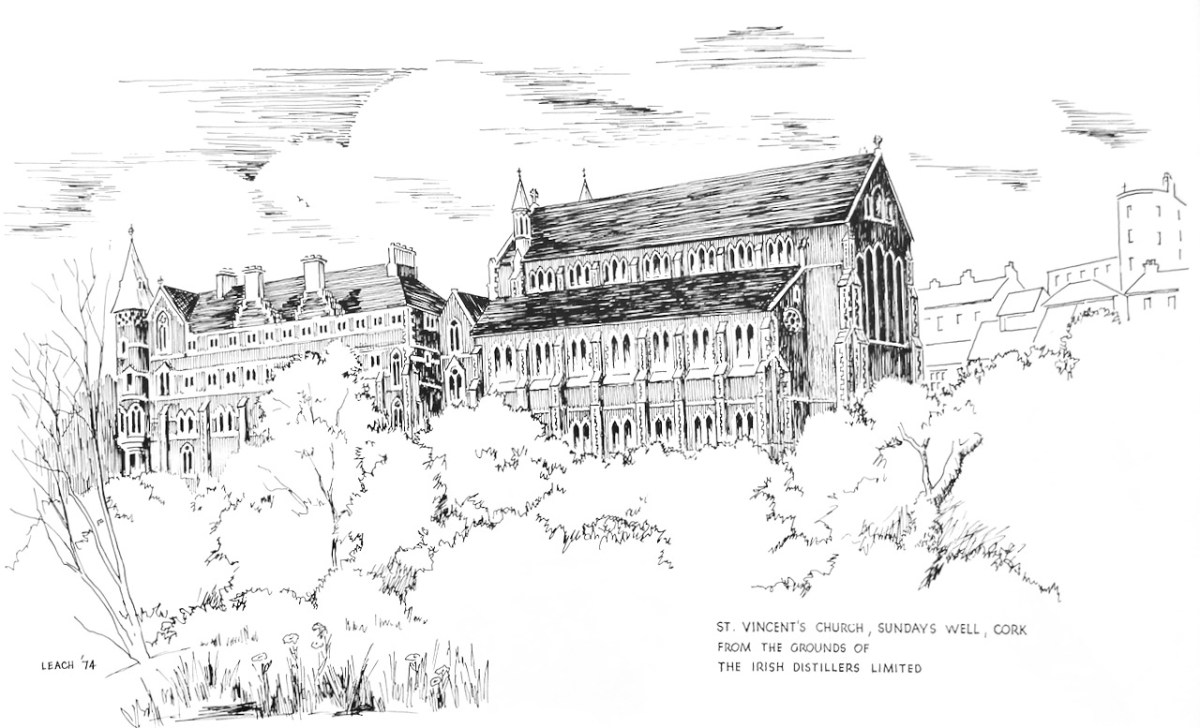
During my master’s program at UCC I lived in a flat in St Lukes and my route took me past this church, built, according to Feehan’s notes, in 1889
Gladys Leach Hyde died in 2014, aged 97 – Peter Murray, then Director of the Crawford Art Gallery, in an admiring obituary in the Examiner, spoke of her “undeniable artistic talent.” He described a “quiet and undemonstrative” person whose work evoked a gracious past. Her framed sketches and card collections became, over time, hot collector’s items. People were enchanted by how she had captured their place and time as much as they were by her clever perspectives and her eye for line and detail.
That’s how I feel – enchanted, because this is my Cork. I lived there from 1966 to 1973 and it is exactly how I remember it. So this book is very special to me as a reminder of those golden student days at UCC (above).
We were all in love with Roger Moore. weren’t we? Here’s the trailer for that film. This is just before the cinema closed, to be reborn as a shopping arcade, having been operating since the 1930s, with an organist and ‘uniformed male attendants’
The Lee Maltings – Brian Lalor drew them too. In my day we played racquetball there. In his accompanying text Feehan wrote:
The Lee Malt House was built over a century ago. . . The old Malthouse was taken over by [UCC} and but for their foresight the days of this fine building would have been numbered. They went to great lengths to preserve it in its original state while at the same time making optimum use of its facilities through conversion to lecture halls, science laboratories, etc. Inside the building there is a little theatre known simply as The Maltings which has acquired a reputation for quality production over a short period. The work of the university authorities makes this building a perfect example of functional conversion.
Dominating the skyline north of the river, St Vincents was a powerful ecclesiastical centre in its day, with strong links to the Murphy family of Irish Distillers. More about it here.
If you would like your own Gladys Leach, her family still have prints available and you can contact them through the Gladys Leach Facebook Page. How fabulous a Christmas present that would make!
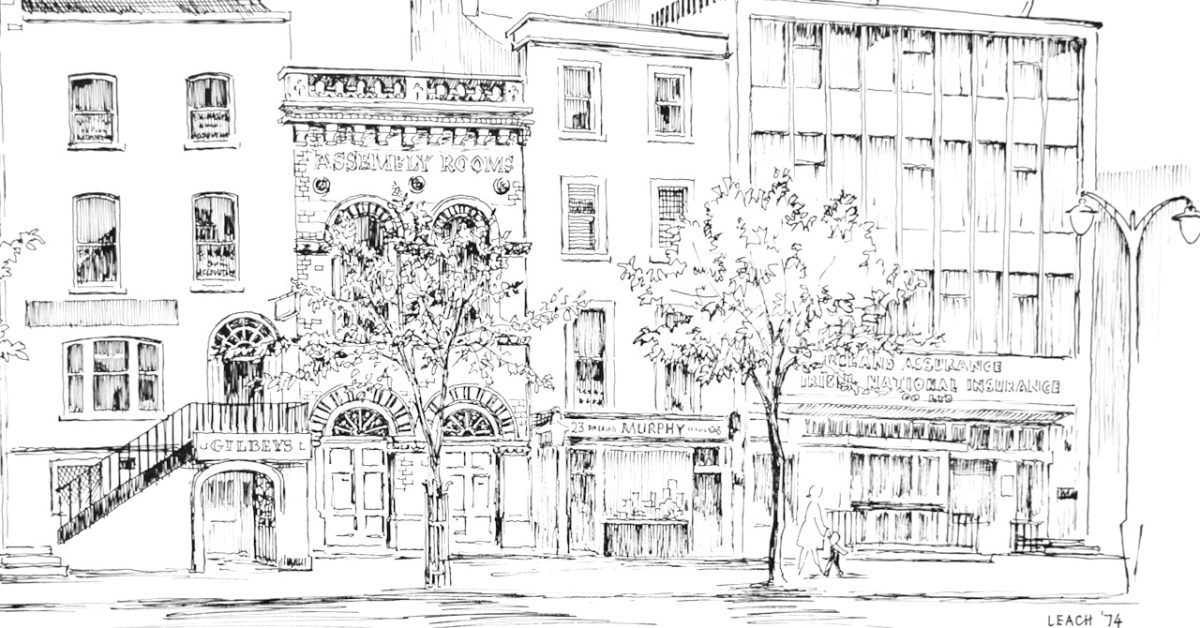
South Mall – still recognisable as a fascinating mix of the old and new
This is just a tiny selection of what’s inside this book. Gladys Leach deserves to be remembered and celebrated – and the 50th anniversary is approaching. How about it, Cork!
Welcome to the UCD Library Cultural Heritage Collections blog. Discover and explore the historical treasures housed within our Archives, Special Collections, National Folklore Collection and Digital Library


































 Roaringwater Journal