The Christmas Story, One Window at a Time

Bandon Catholic Church

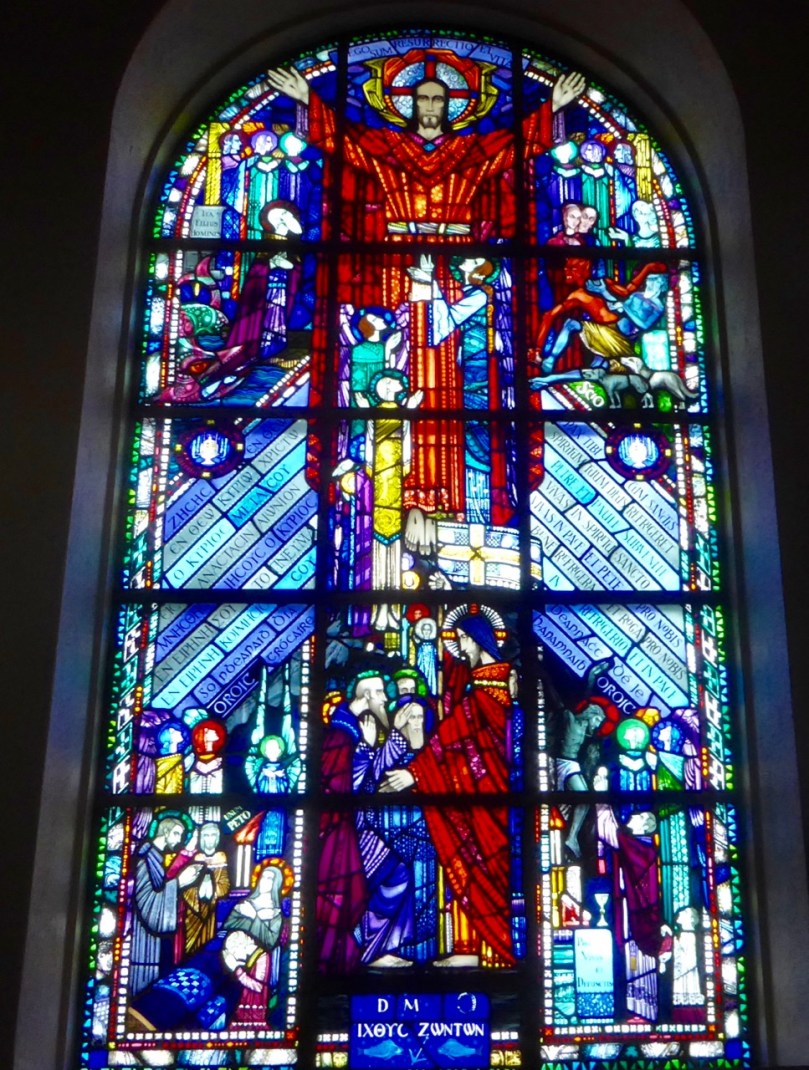
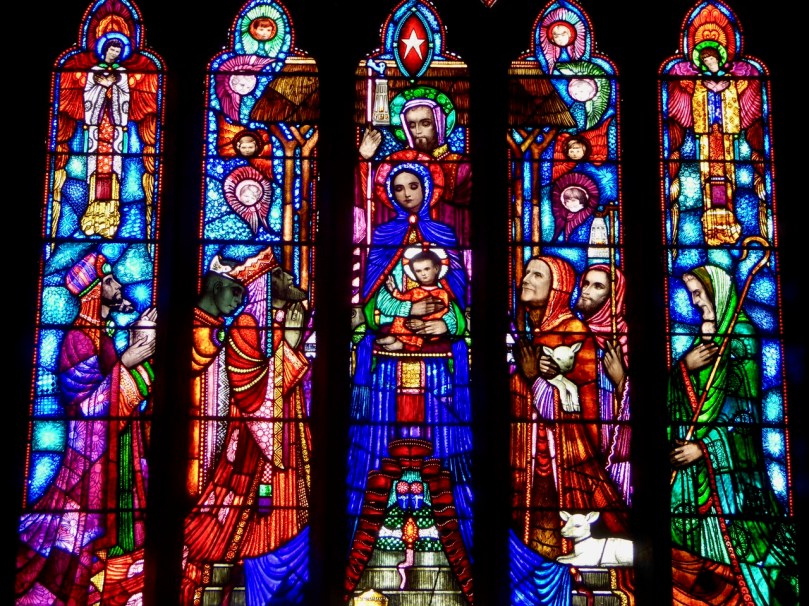
The Christmas story, as told in stained glass in Irish churches, is the biblical story. There are no Christmas trees or Santa Clauses, no references to anything other than the story of the birth of the Christ child. Not surprising, since stained glass is to be found mainly in churches after all. The one above is from the Catholic Church in Bandon. Pop in next time you’re passing – it will surprise you with its size and striking colour.
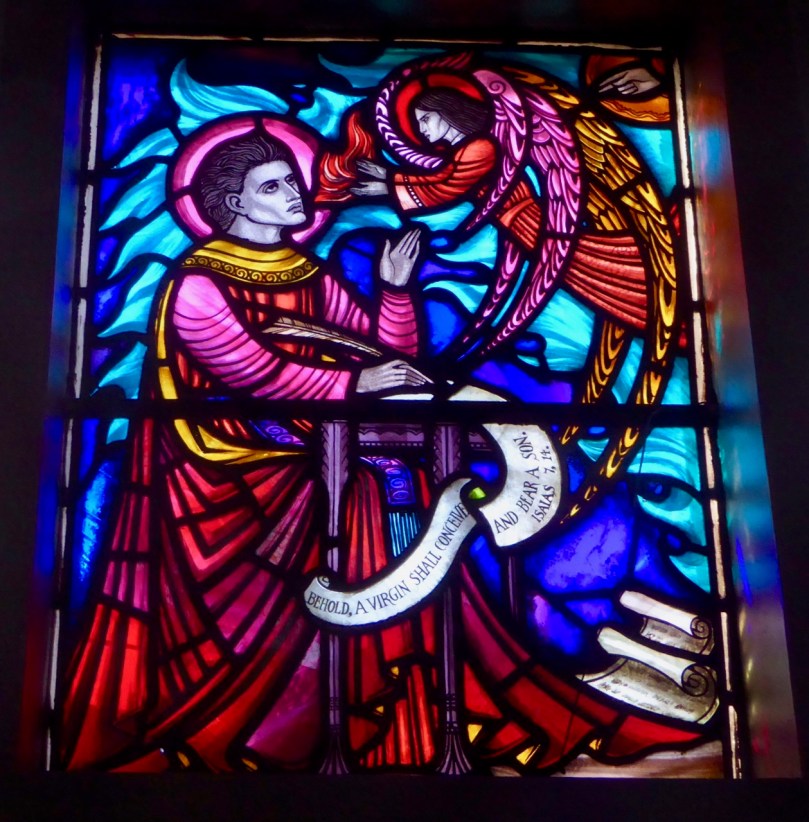
Church of the Annunciation, Cork. AnnunciationFive windows in a Cork church tell the story, beginning with the Annunciation

Two years ago I wrote a post about depictions of the Nativity by Harry Clarke. This year I’m branching out, to show you some of the stained glass Nativity images I have found in churches all over Ireland. Some are by artists I can identify, some are by the Harry Clarke Studios (after Harry’s death in 1931), and some are by anonymous artists. Some are traditional and some are avant garde. 

The next two windows show Mary visiting her cousin Elizabeth (mother of John the Baptist), followed by the betrothal of Mary and Joseph

In Cork, in the Church of the Annunciation – a church designed by the stone carver Seamus Murphy – a series of windows illustrate the complete Nativity story, from the Annunciation to the Visit by the Magi. These windows are by the Harry Clarke Studios and were installed in the 40s.

The birth in the manger with shepherds visiting, and the arrival of the Magi round out the story

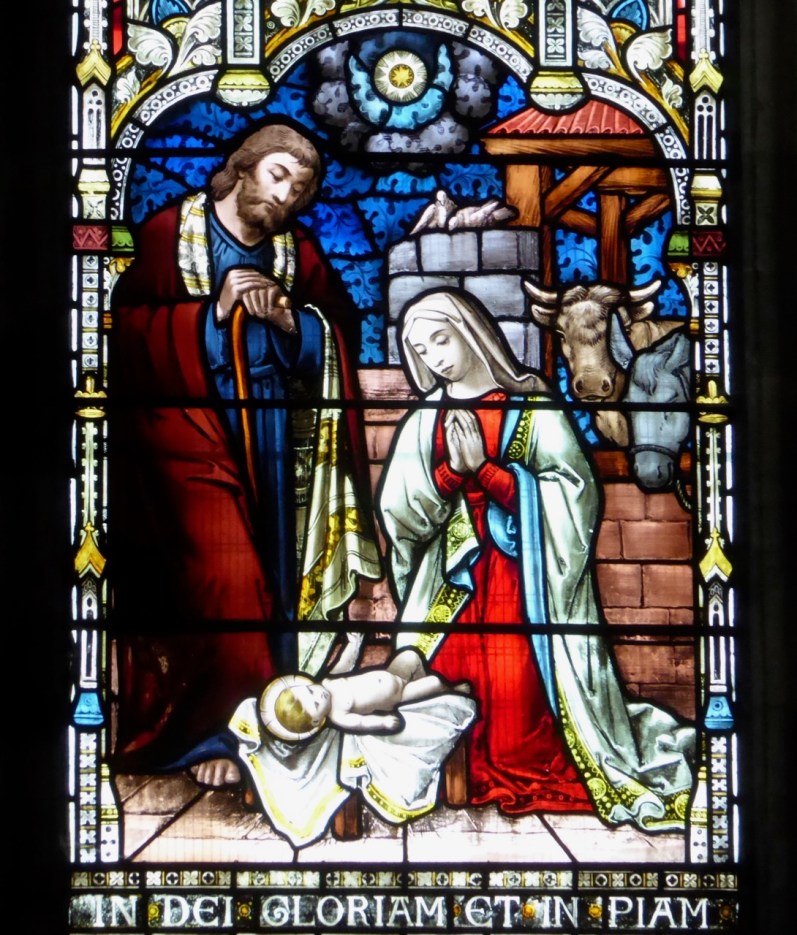
When we visited Kilkenny we saw two examples in St Canice’s Cathedral. The first, a traditional crib scene, looks like it belongs on a Christmas card.
St Canices

On  another wall in the same church is a two-light window by A E Child, depicting the visit of the Magi. A E Child was a highly influential teacher, and member of Sarah Purser’s Tower of Glass (An Túr Gloine) – a contemporary of Harry Clarke and a highly skilled stained glass artist, but with a more orthodox style than Clarke’s.
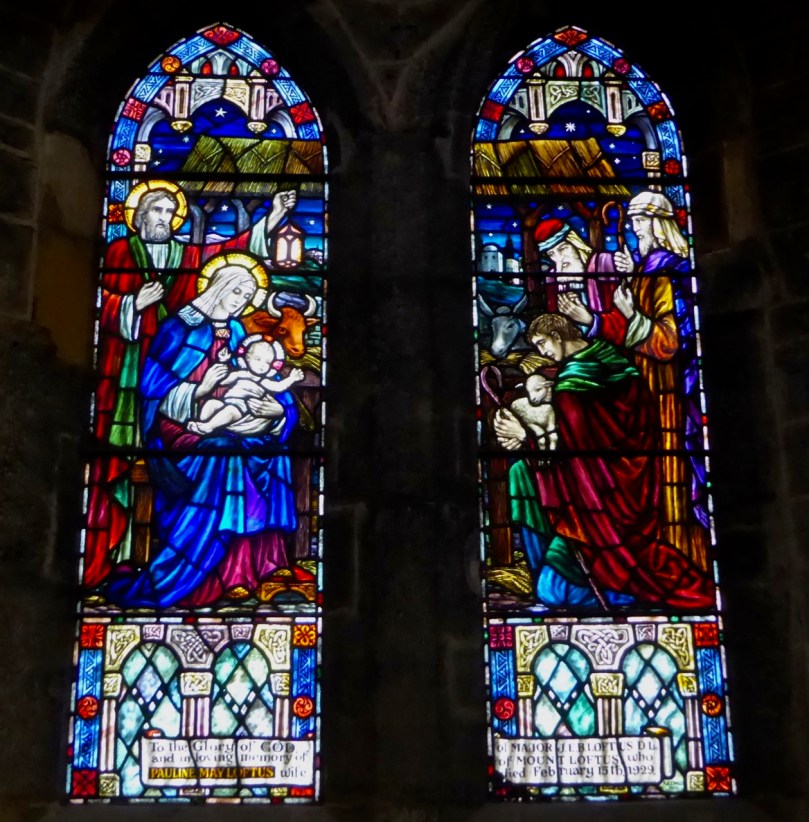
Canice's AE Childe

Still in Kilkenny, the Black Abbey has reputedly the largest stained glass window in Ireland. It’s divided into numerous smaller scenes and this one depicts the Nativity. It bears a striking resemblance to the Christmas card window from St Canice’s – perhaps it was from the same studio.
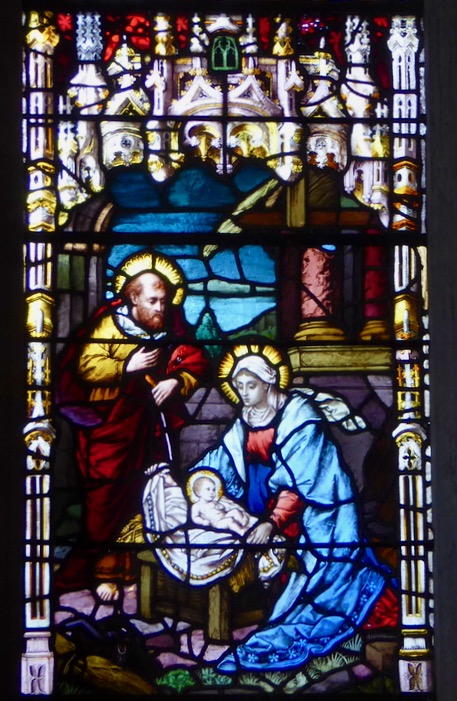
Black Abbey Kilkenny

In  Tullamore, the enormous Church of the Assumption has wonderful stained glass by different artists. Several large windows are by the Dublin firm of Earley. This one of the madonna and child shows a small shepherd on her right and three crowns on her left – a clear indication, I think, that this is intended as a Nativity image. The swirling colours and modern lines create a dramatic effect.

Church of the Assumption, Tullamore

The St Joseph window in the Richard King collection in Athlone contains a detail in one of the side panels that depicts the Flight into Egypt, and another of the marriage of Joseph and Mary.

Back to Cork and to the Holy Trinity Church on Father Matthew Quay, just behind the South Mall. Three windows on the west wall are by the Harry Clarke Studios. Research in the Studio archives (held in Trinity College) has revealed the the middle window was designed by Harry Clarke, but executed in fact by his father. It has many of the hallmarks of Harry but lacks the rich detail for which he became justly famous.
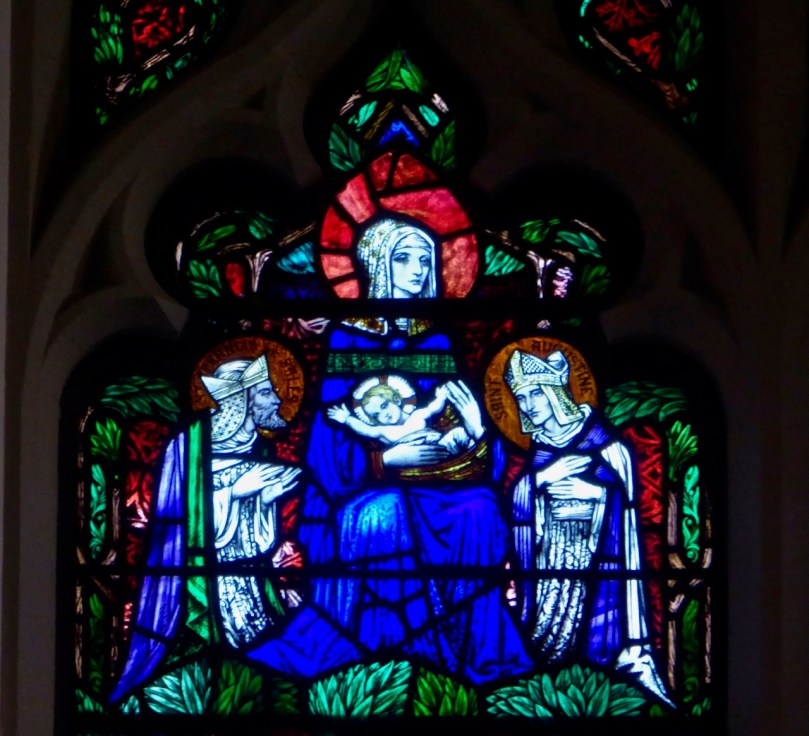
Holy Trinity Church, Cork, Designed by HC and executed by his father

Behind the altar, on the north wall of the same church is an enormous window dedicated to Daniel O’Connell and containing scenes from the life of Christ. It is conventional, but finely painted and the colours are rich.
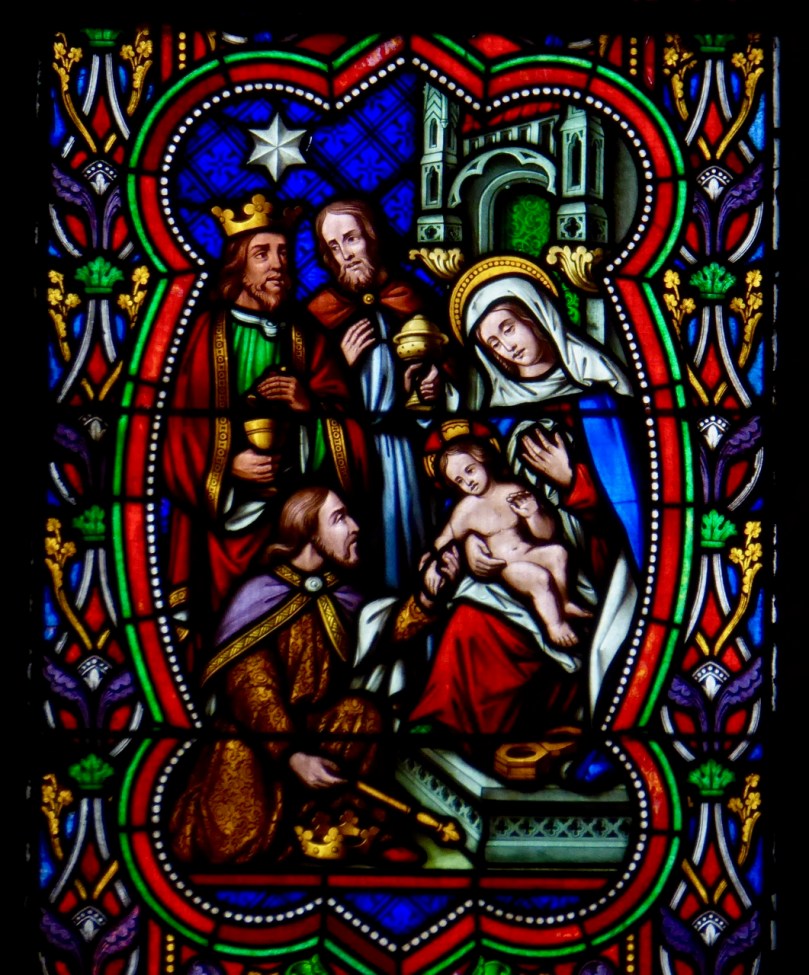
Holy Trinity Cork, East Window

I will leave you with two of our favourites. Close to home I love the the Sarah Purser/Tower of Glass round window in the Holy Rosary Church in Kilcoe. Here’s a detail.

Tower of Glass Magi closeup. Kilcoe

And finally, from the village church of Eyeries on the Beara Peninsula, Robert wrote about  a stunning set of windows by George Walsh. His nativity scene is touching and beautiful.

george walsh nativity

Discovering Richard King

Patrick Vox Hib

Here is a typical Harry Clarke piece of stained glass – note the large expressive eyes and long tapering fingers, the gorgeous raiment of the angel and that headdress, the additional tiny angelic figure hiding in the blue glass, the border filled with non-repeating decorative elements. All classic Clarke elements, right? But this is not the work of Harry Clarke. He died in 1931 and this window was designed, executed and installed in 1937, by the studio that he founded and which carried on after his death under the name Harry Clarke Studios.

Patrick Preaching

The first image in this post is from the Patrick window and shows Vox Hibernicæum – the people of Ireland calling Patrick back to convert them. The image above is from the same window – Patrick preaching to the chieftains **

This window, it turns out, along with several others in the same church, was the work of Harry Clarke’s apprentice, the man who stepped into the breach caused by his death and took over as the main stained glass artist of the Studio. That man was Richard King.

Joseph all

The Joseph window: each frame tells a story from the life of Joseph or references other biblical Josephs.

I had never heard of Richard King until I stepped into Sts Peter and Paul’s Catholic Church in Athlone during our Midlands trip. That’s not all that surprising, because after Harry Clarke died windows from his workshop were generally signed simply by the Studio and individual artists were not identified. Mostly, it seems, this was to capitalise on the Harry Clarke brand, which by the time of his death was justly celebrated, and thereby to keep orders coming in.

Joseph scenes

Close up of the lowest frames in the Joseph windows. Clockwise from top right: the marriage of Mary and Joseph; the death of Joseph; Genesis 41:55 When all Egypt began to feel the famine, the people cried to Pharaoh for food. Then Pharaoh told all the Egyptians, “Go to Joseph and do what he tells you.”; Four rivers and two deer: the four rivers of Paradise; This is a reference to another biblical Joseph mentioned in Psalm 104, ‘constituit eum dominum domus suae et principem omnis possessionis suae’ – He made him master of his house, and ruler of all his possession **

Richard King had been trained by Harry: he had executed windows designed by Harry under Harry’s close supervision. A promising artist when he joined, he probably did more than set glass etched and drawn by Harry, but may have been responsible for background elements, borders, details. Harry was away in Davos, gravely ill, for the last year of his life and Richard may well have translated his cartoons (window designs on paper) into glass. But I am speculating here, and I hope to learn and write more about Richard King in the future. He went on to have a long and distinguished career as an illustrator.

Purgatory all

The Purgatory window: prayer fragments in Greek, Latin and Irish; the righteous ascend to heaven; Christ descends to purgatory with a banner to lead those who have done their penance up to heaven; in the lower left St Monica is on her deathbed while St Augustin looks on; lower right, the mass is celebrated; upper right, Jonah (whose purgatory was to be in a whale) and upper right Job, who was robbed of everything he held dear by the devil, thus testing his faith **

The King windows I photographed are enormous. (There are other Harry Clarke Studio windows by Richard King in the church as well as windows by other companies, but I will concentrate on these ones for the purpose of this post.) They represent St Joseph, St Patrick, Jesus, Mary and Purgatory. All follow the same convention of placing the main figure centrally, surrounded by smaller panels which tell stories or illustrate events from the life of the central character.

Purgatory Jesus and the Saints

Close up: Christ descends to purgatory

HC Studio, Athlone

Close up: the Job panel

The sheer size of the windows has allowed ample scope for this approach, but size alone cannot account for the myriad details that King inserts into every possible space in the window. Words abound, in several languages and scripts. References to the ancient and the modern, the mythological, the hagiographical, and the historical jostle for space with abstract designs, tiny figures both realistic and imaginative, symbols, animals, buildings – everywhere the eye lingers new elements are discovered. In its essence, this is very Harry Clarke; in the sheer exuberance of its execution, this is Richard King having fun, cramming in as much as his own fertile imagination can offer up.

Mary Rosary Angelus and Scapular

This is the Mary window and these sections concentrate on images of Marian veneration. Clockwise from top left: workers pause to pray the Angelus; a family says the rosary together; St Simon Stock receives the scapular from Mary (more on this here);  Mary; St Dominic receives the rosary **

The Harry Clarke Studios closed down in the 70s. For many years after Harry’s death in 1931 it carried on his tradition of highly stylised and beautiful works of art in stained glass, although over time works became more conventional and quality suffered as orders were harder to get, costs rose and corners were cut. Look, for example at the Studio windows in my post Time Warp, about the Drimoleague church, done in the 50s. But that’s in the future – what we can see, under Richard King’s assured hand, are windows that proudly carry on the Clarke preoccupations with designing windows that dazzle and inspire.

Juses details bottom

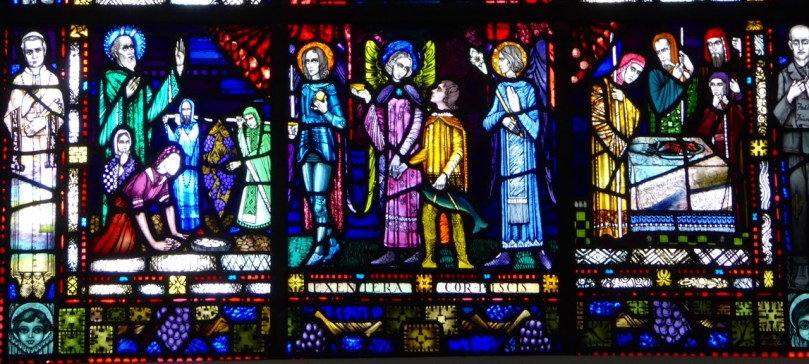
Details from the Jesus window from left to right: Pope Pius x; Manna from heaven; Tobia walking with the Angel Raphael, with Michael and Gabriel; eating the paschal lamb; Matt Talbot, a Dublin man who died in 1925 and who was considered on the path to sainthood because of his extreme practice of asceticism **

Perhaps, though, there is another element that creeps in now that Harry is gone – the religious fervour of the early years of the state is now in full swing. Government and Church Hierarchy work hand in glove to develop and promote a vision of Ireland that is devout, Catholic, monocultural, conforming and repressive. A high point in this relationship occurs in 1932 with the Eucharistic Congress in Dublin – an event explicitly referenced in the Patrick window. Richard King will never, as Harry did, fall afoul of puritanical state censorship – he will go on, in fact, to become the chief illustrator for a Catholic magazine.

Patrick top

The top of the Patrick window explicitly references the Eucharistic Congress of 1932 and the crossed flags of Ireland and the Vatican. Try to enlarge this image and see how many different elements you can identify. Good luck!

But in 1937 he is at the height of his powers as a stained glass artist. I hope to find and illustrate more of his work in that medium in future posts.

Patrick details and cathedrals

From the bottom of the Patrick window: Patrick lights the paschal fire on the Hill of Slane; he is flanked by images of two St Patrick Cathedrals, New York and Melbourne; Beneath, the swans represent the ancient myth of the Children of Lir (although there were four swans in the myth, not three) – the spell they are under is broken when they hear St Patrick’s bell

** The photographs in this post are my own, but for the explanations that I use in the captions, I am indebted to Niall McAuley, who has mounted a Flikr Album of all the stained glass in this church and has researched and annotated each image. I don’t know you, Niall, but I salute your wonderful images and your exhaustive notes on each of the windows. Please go to Niall’s album for more on all the King windows (especially if you are stumped by the Patrick window) and also windows by other stained glass suppliers and artists in this amazing collection.

Memento Mori

Fanlobbus

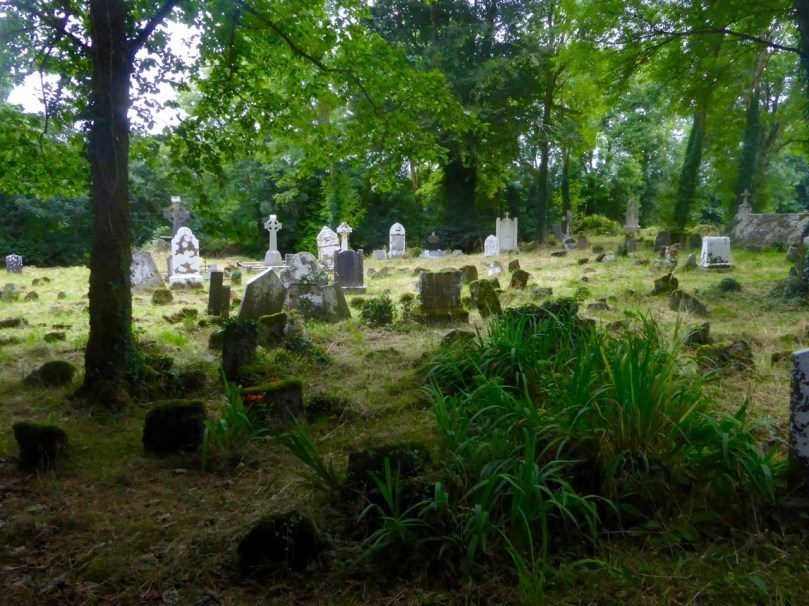
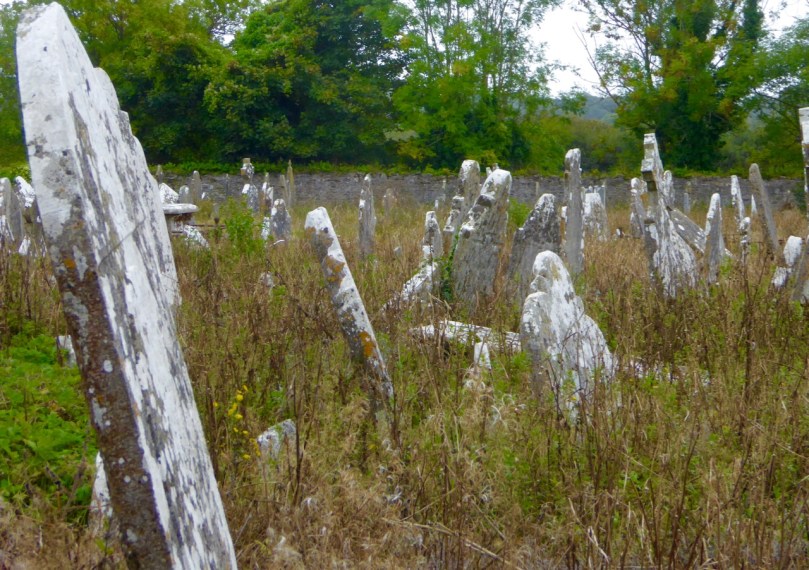
It’s Halloween – what better time to take a wander round an old graveyard! Fortunately, we’re well endowed with them in Ireland, in varying states of preservation and decay.

Old graveyard, near Dunmanway

Except for the wealthy, who could afford to erect tombs and decorate churches with effigies of themselves and carved wall plaques, most people who died in Ireland up to the 1700s lie in unmarked graves. However, in the 18th century the practice of erecting carved headstones become commonplace for those who could pay for it. Styles of headstone carving evolved over time. Local craftsmen used the symbols in vogue, interpreting them according to their own ideas and their level of skill. The result can best be described as folk art.
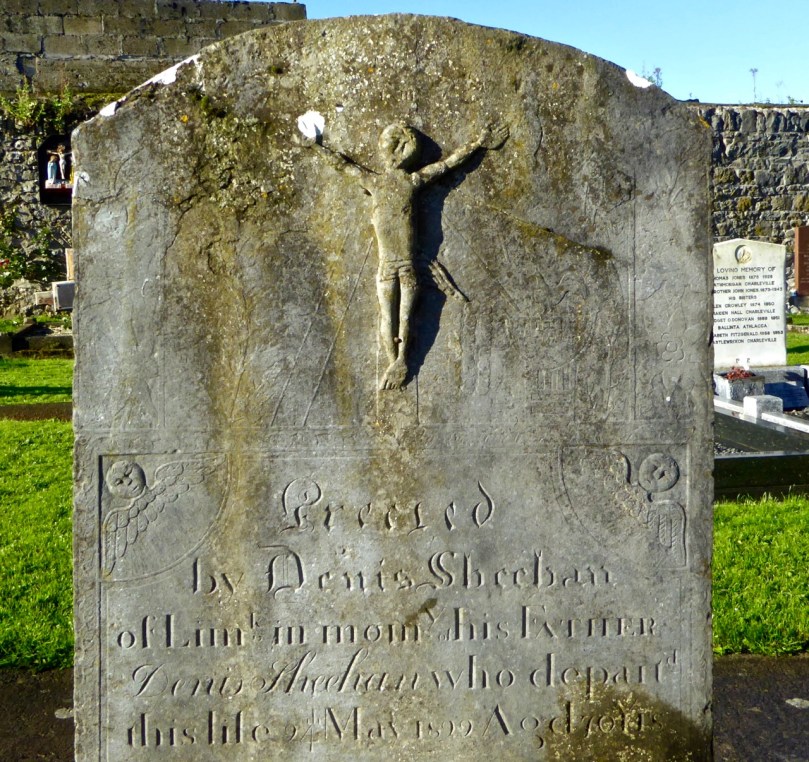
Bridget Sweeney Kilmallock

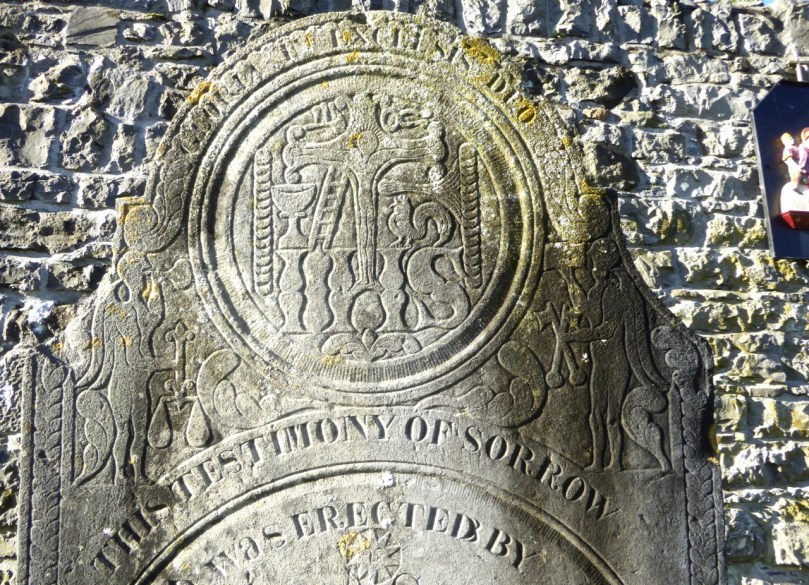
Bridget Sweeney’s grave in Kilmallock Co Limerick is memorialised with a great example of a nineteenth century carved headstone

One recurring theme is the passion, or crucifixion of Christ, and a headstone we saw recently in Kilmallock, Co Limerick, is an excellent example of the crucifixion and other symbols.

Bridget Sweeney Closer

Top: Not only a crucifixion image,  but various other symbols feature on the headstone, such as a chalice (eucharist) and a rooster (awakening or time). Below: close up of the two angels: left is Michael blowing his trumpet and bearing a set of scales (reflecting his role of weighing souls at the gates of heaven); right is another angel bearing a book (in which might be recorded a person’s good and bad deeds) and keys (to the gates of heaven?)

Denis Sheehan, Kilmallock

Another crucifixion headstone, also in Kilmallock: harder to make out, but full of interesting elements

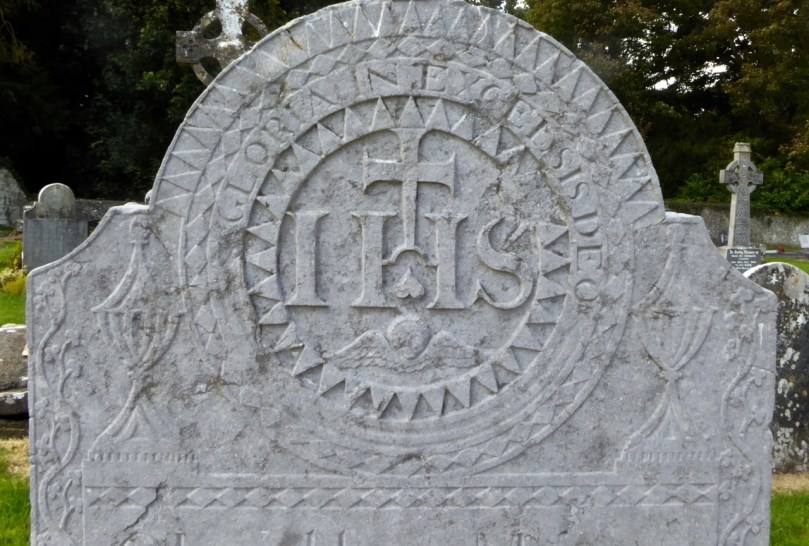
You may have noticed the letters IHS on Bridget Sweeney’s grave. Ubiquitous on old gravestones, on its own, accompanied by a simple cross, or as part of a more elaborate decoration, IHS stood for the name of Jesus. For a full explanation, see this post from the always excellent Pilgrimage in Medieval Ireland.

Thomas Donahoe Clonfert

Another favourite symbol was a head with wings, usually representing the soul on its flight to heaven, but perhaps also an angel. 

Alice Bolster, Kilmallock

A particularly fetching angel/soul on the grave of Alice Bolster, Kilmallock

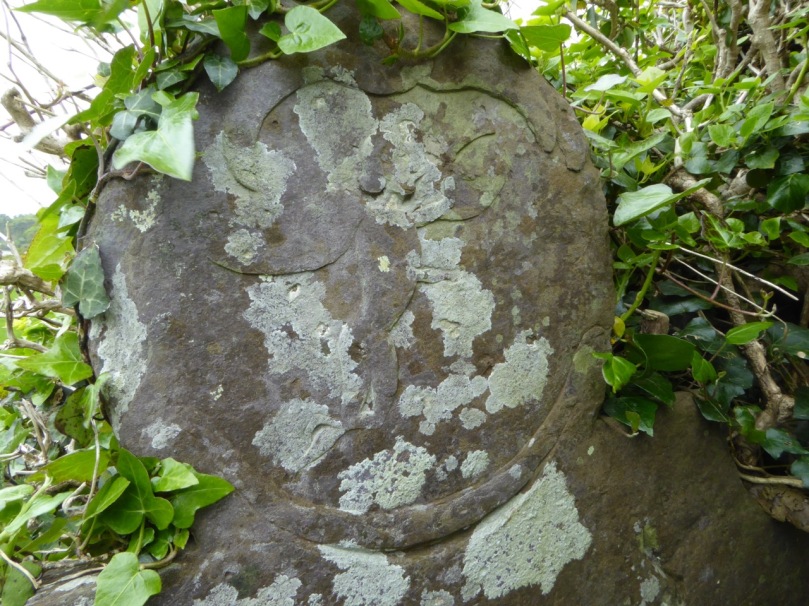
St Michael, blowing his trumpet to welcome that soul to heaven, was a favourite motif. We found one behind a bank of ivy in the old Aughadown graveyard near us, down by the Ilen River.

Aughadown

AughadownCan you make out Michael, blowing his trumpet? The enemies of all headstones are ivy and lichen and this one has been overtaken by both

Symbols of mortality decorate some of the earliest Irish headstone – skull and crossbones, hourglasses, books and bells, skeletons, even rotting corpses – all represent the finite nature of life on earth. Memento Mori literally means Remember, you must die. These images were supposed to encourage us, apparently, to lead better lives by reflecting both on the futility of relying on earthly delights and on the reward awaiting us in heaven. Mortality symbols generally date to the 1700s.

Cloondara, Co Longford, no inscription

Top: this slab is in the churchyard at Cloondara Co Longford and has no inscription. The two images below it are from a grave in Castlelands, near Kinsale. These two images are courtesy of our friend Amanda Clarke: she was told by a man doing maintenance work that this was the grave of Anne Bonny the pirate – hence the skull and crossbones!

Sun, moon and star images represent the glories of creation and we’ve seen many instances of sunbursts, often enclosing the IHS lettering. Here’s a nice example, below, from Kilmallock, which also has winged heads and beautiful lettering.

William Jones Kilmallock

Lettering styles varied widely, as did the carver’s ability to spell and to ensure he had left himself enough room. Anyone wanting to invent new fonts (yes, that’s a thing) could well study old headstones and admire the incredible variety of lettering. Carving some of the more elaborately rounded scripts must have been a job for only the most highly skilled.

Dan Linnehan, Cullen, Co Cork

We often see instances where letters and words have to be added above or below the line, where the carver ran out of room

The Lamb of God is another common image – although it can be hard to recognise a lamb in the often lumpen carving at the top of a headstone.

Headstone, Cullen

At an old graveyard in Cullen, Co Cork, there are several stones that appear to be in a local style with a head on either side of the top of the stone

We can’t resist old graveyards – we seldom pass an opportunity for a stroll and an explore. Sometimes we find interesting headstones, sometimes we just soak in the atmosphere, sometimes we worry about the neglect that allows them to slowly disappear into a jumble of brambles and nettles.

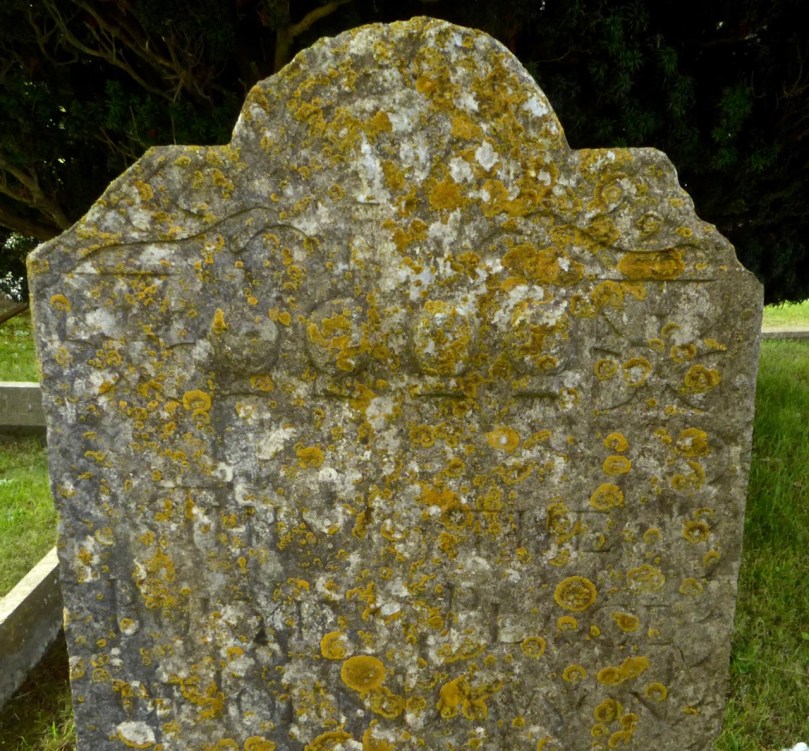
Four Children gravestone, Bandon

It’s hard to make out what’s on this old headstone in the churchyard at St Peter’s C of I church in Bandon. The words include a reference to ‘his four children’ so I am tempted to think these four heads representing those little souls.

Here’s some good new – there is an Irish organisation, Historic Graves, that is doing outstanding work in saving our historic graveyards from that fate. In their own words:

The Historic Graves project is a community focused grassroots heritage project. Local community groups are trained in low-cost high-tech field survey of historic graveyards and recording of their own oral histories. They build a multi-media online record of the historic graves in their own areas and unite to form a national resource.

Lissagriffin

Kilmoe churchyard, in LIssagriffin on the MIzen Peninsula, has benefited from a Historic Graves survey

I used information from the Historic Graves survey in my posts about the Stouke Graveyard (Priests and Poets Part 1 and Part 2) and I hope to learn more about their methods and objectives in the future.

Another Historic Graves project was Castlelands, near Kinsale. These photographs are by Amanda Clarke, used with thanks

One thing we have seen is that once a graveyard has been surveyed it’s important to keep it well maintained. The Cloyne graveyard was surveyed in 2013 and many fine old headstones were found and recorded. We visited in May 2014 and loved our walk through the flower-strewn pathways and the newly-revealed headstones. However, earlier this month when we dropped in it had started to resemble a jungle again. 

Cloyne Graveyard

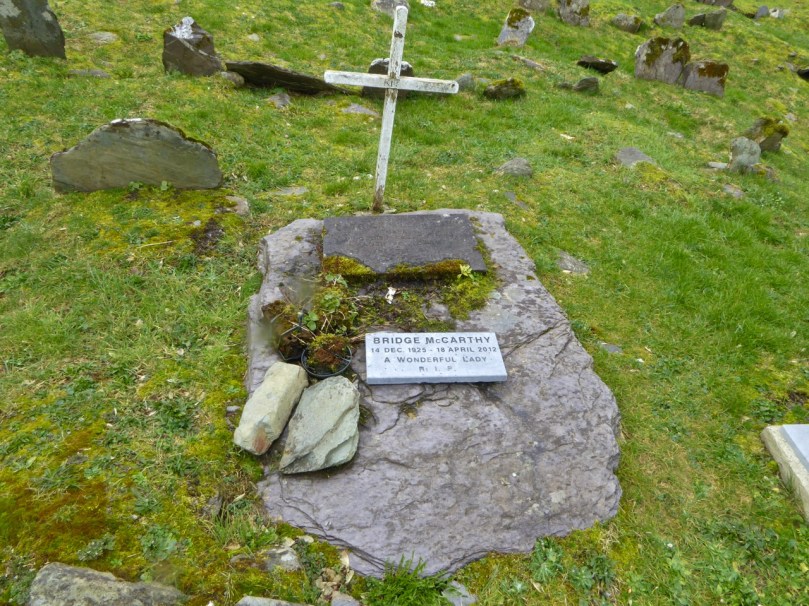
I will leave you with a couple of my personal favourites from graveyard visits – not elaborate, not particularly old, but saying so much. The first is from Castlehaven graveyard in West Cork, the second from Kilbarry, near Dunmanway.

Castlehaven Bridge McCarthy

Crowley Castle St

Into the Heartland

Elphin Windmill

Because we live on it, sometimes we get carried away by the notion that The Wild Atlantic Way represents the best that Ireland has to offer. A recent trip to the midlands – the Heartland of Ireland – convinced us (if we needed it) that there is no part of Ireland that isn’t beautiful and full of fascinating things to do and see. (Like the Elphin Windmill, Co Roscommon, above.)

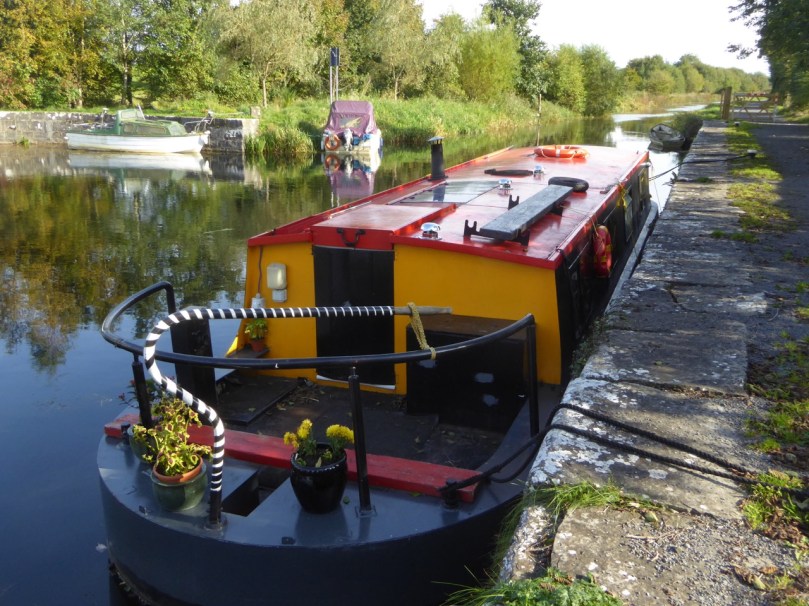
Parked at Coolnahay

We spent a lot of time along rivers and canals! 

Robert explains the background and purpose of our trip in his post, Travel by Water. I knew very little about canals before I met Robert and it’s been eye-opening to learn about the history and the sheer extent of Ireland’s inland waterways. We spent a lot of time exploring the canals – walking and driving – and enjoyed it all tremendously.

Boa Island figures

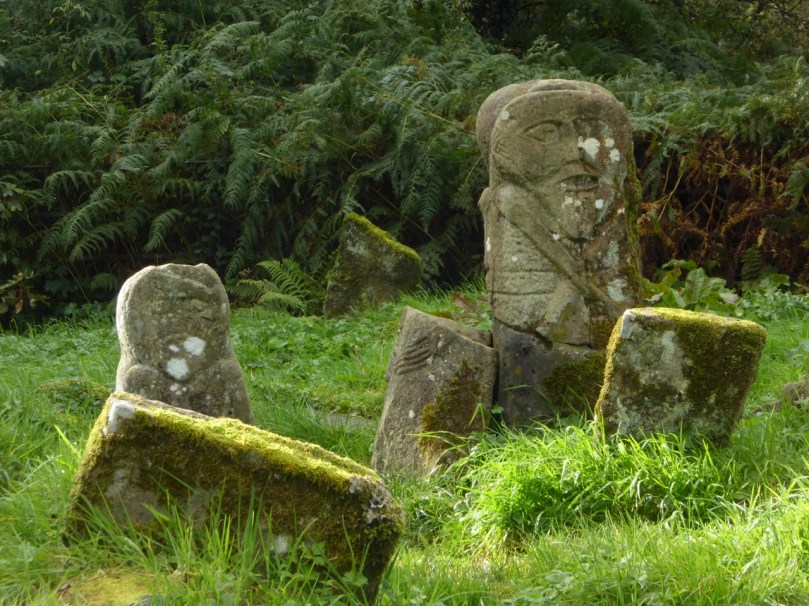
Boa Island on Lough Erne, Co Fermanagh, is home to these mysterious carved figures. Lower left: heads on a medieval church in Kilmallock, Co Limerick. Lower right: a contemporary sculpture celebrates the mythical Finn McCool, in Keshcarrigan, Co Leitrim

But wherever we went there were always other places luring me away – tower houses and fortified houses, churches and graveyards, friendly villages and colourful houses, stained glass windows and prehistoric sites. We drove along roads where we counted ring forts in every field. We explored ancient graveyards and we found a Holy Tree. We visited two sites we posted about last week, the Corlea Iron Age Trackway, and the Hill of Uisneach.

Holy Chestnut

The Holy Tree. A local man we met called it a ‘holy show’ and it certainly had some very questionable items mixed in with the statues and offerings

It’s autumn now, and, while we do experience a change of colour here in West Cork, it’s really in the midlands that the colours of the deciduous trees can overwhelm the senses. They were just starting to turn. I’m strongly tempted to head back in another couple of weeks for the full experience.

Birr Castle Gardens 2

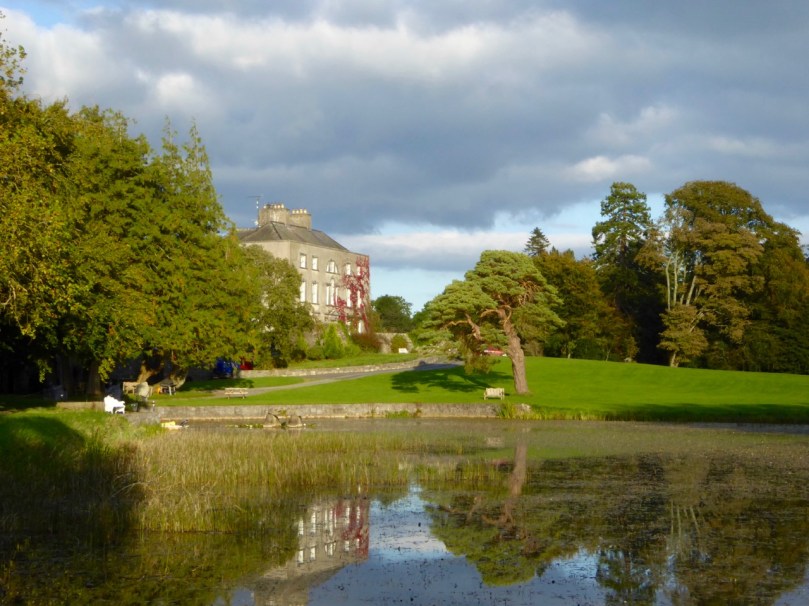
These photographs were all taken at Birr Castle Gardens. Birr Castle (Co Offaly) was one of the most interesting and beautiful places we visited, home of the famous telescope and beautifully maintained

We visited thirteen of Ireland’s 32 counties on this trip – and never came close to the sea or the Wild Atlantic Way. Instead, everywhere we went we saw notices for the latest iteration of the Tourist Board’s marketing scheme. This one is called Ireland’s Ancient East, and appears to take in every county that isn’t on the Atlantic seaboard. A good resource, if you’re considering a trip like this, is Neil Jackman’s guidebook, Ireland’s Ancient East – we kept it by us and found it invaluable.

Grange Stone Circle, Lough Gur

Grange Stone Circle, the largest in Ireland, is one of a complex of monuments at Lough Gur, Co Limerick

Our headquarters for the biggest chunk of our time away was the incomparable Mearescourt House near Mullingar, Co Westmeath. George and his team made us welcome and comfortable, there were glorious grounds to wander around and animals to meet, and delicious breakfasts that left us feeling full for the rest of the day.

Mearescourt House

Mearescourt House – highly recommended!

When tourists are interviewed about their holidays in Ireland they praise the scenery, the food, the music – but most of all, they say, it’s the people who make it so enjoyable. We agree! Everywhere we went we ended up in conversation, as you do here, with local people delighted to help out with information, share old stories, invite us to the sessions, tell us where to go for a nice dinner, or point out places off the beaten track (and then rescue us later when we got lost).

Claire and Paddy Crinnegan, Coolnahay

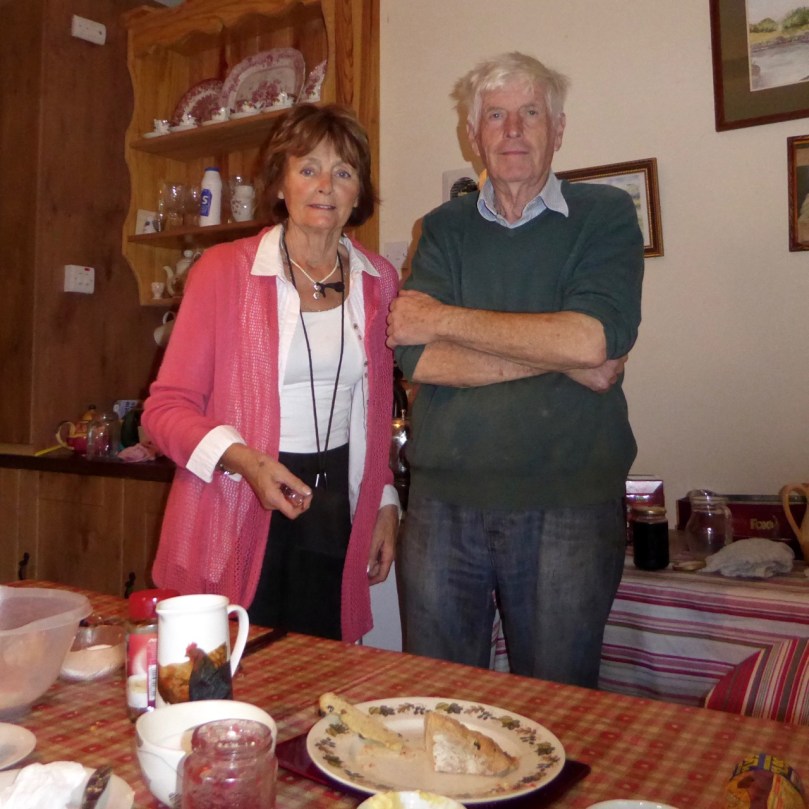
Paddy and Claire Crinnegan maintain the canal lock at Coolnahay on the Royal Canal. in Co Westmeath They made us tea, fed us Claire’s delicious currenty bread, told us about the trad concert that evening, loaned us a book, and related stories of growing up at the lock, where Claire’s father was the lock keeper.

Future posts will go into more depth on some of what we saw and experienced on this trip. This one is just an introduction, to share some of our impressions and drop some hints about what might be upcoming.

Clonfert Doorway

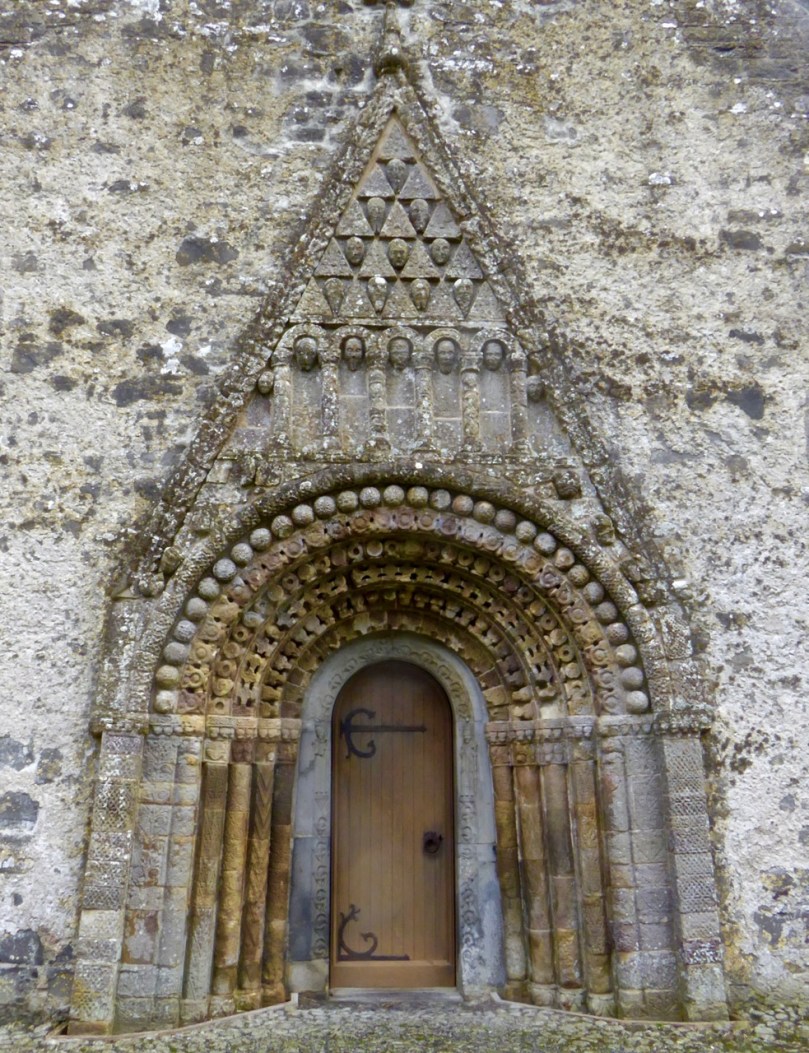
Clonfert Cathedrall (Co Galway) has the most beautiful Romanesque doorway I have ever seen
Along the canals and rivers, flora and fauna
Top left: in case you might get too happy with yourself; top right: the imposing gates to Portumna Castle, Co Galway, a 17th century house now owned and managed by the Office of Public Works; Bottom left: I peeped inside the priest’s section of a confession box and observed how he maintains an efficient count of time spent on each confession; bottom right; we disturb the rooks at Ballycowan Castle, Co Offaly

HC Studio, Athlone

Athlone Cathedral (Co Westmeath) has a gorgeous set of enormous windows from the Harry Clarke Studios – this is a detail from just one of them.

Can you detect a future post or two?

‘Auf der Walz’ – The Journeymen

on the summit

I am always happy to find longstanding customs and traditions still going strong, especially when they are as relevant today as they have been over countless generations. This summer we chanced upon two strangers from Germany who passed through Ballydehob. They were journeymen blacksmiths: lads who had completed their apprenticeships at home and were now ‘Auf der Walz’ (on the road) – gaining experience in the wider world.

inese-journeymen

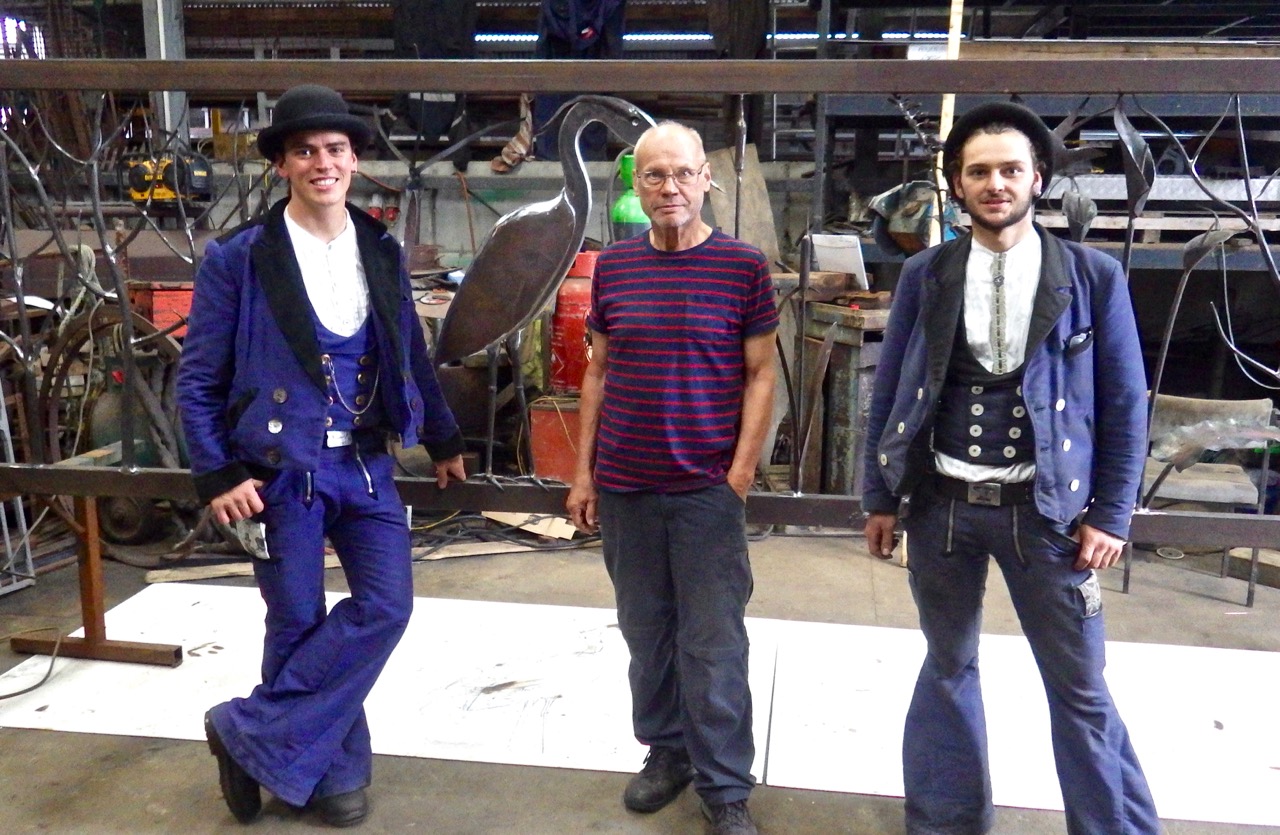
Here are the two Journeymen who travelled the west of Ireland’captured’ by photographer Inese MJ – she came across them in her local supermarket! I am very grateful to Inese for allowing me to use her excellent photograph which comes from her own blog, here.

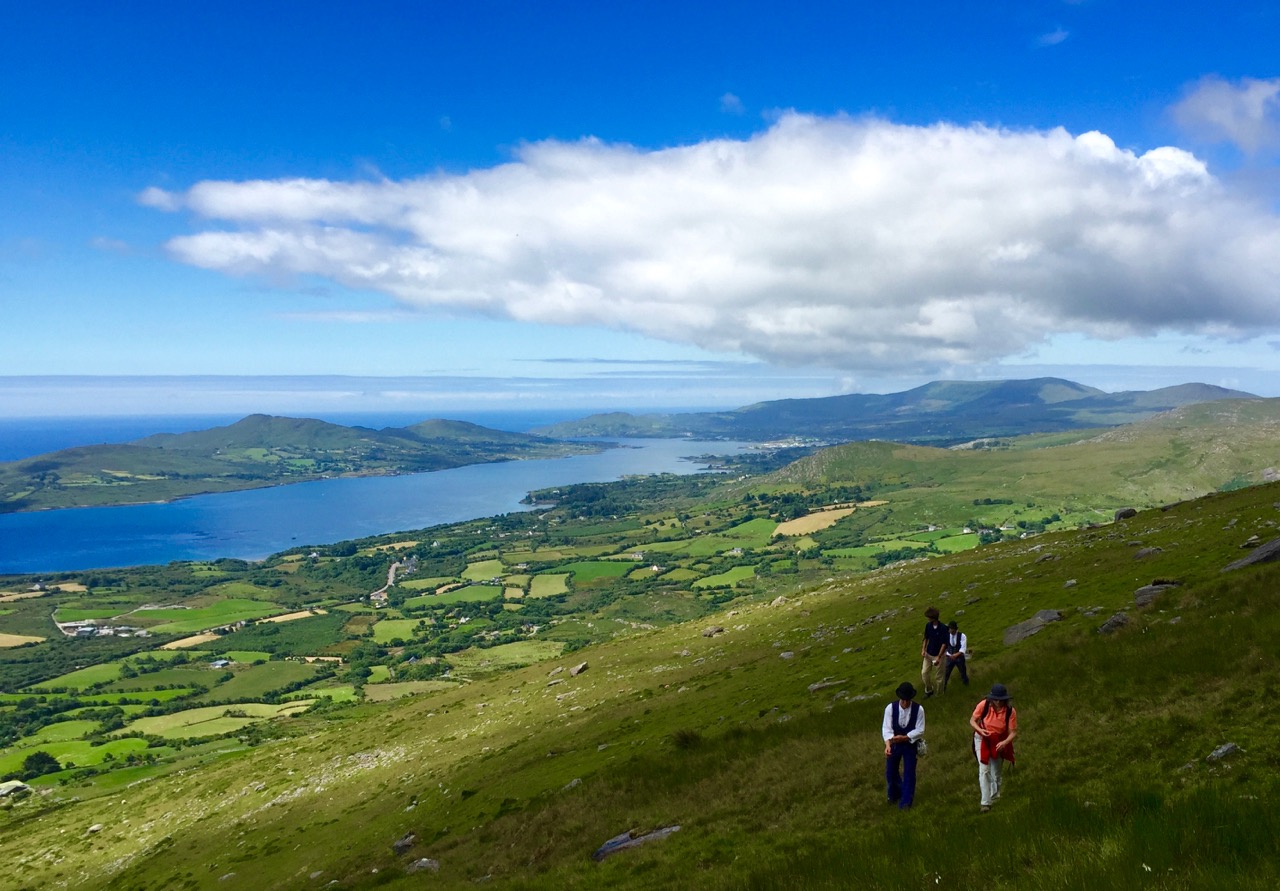
The tradition of the Journeyman Brotherhood is centuries old, originating in the Craftsmen Guilds of Europe during the Middle Ages and it is still practiced. In the past every young craftsperson who aspired to be a Master was, following his apprenticeship, required to leave home and not return for three years and a day. They had to stay at least 50 km away, but the journeys of the more adventurous candidates involved crossing oceans and continents. Simon and Benjamin – seen in the top picture after an exploratory climb to the summit of Hungry Hill on the Beara Peninsula – are from Munich and Frankfurt. They are wearing the uniform of their trade, known as the Kluft: this is how they are required to dress during their travels. The number of buttons on their waistcoats show the number of hours in a day they expect to work – in this case eight. When they leave home they have only a token sum of money each, and they must return with the same sum, no more. The purpose of the journey is not to seek their fortune, but to improve their knowledge and skills and give them a rich life experience, preparing them for becoming masters of their craft. It is a prerequisite that Journeymen cannot set out unless they are unmarried, childless and debt-free.

Left – a typical Charlottenburger used to carry the Journeyman’s possessions. Right – group of three in Germany looking for their preferred mode of transport

Other traditions which have to be observed by the true Journeymen include carrying only the most basic possessions with them: clothes to work in and the tools of their trade. These are wrapped in a small blanket, 80 cm square, known as a Charlottenburger. They also often carry a crooked walking stick, called a Stenz, which they have made themselves. Mobile phones are not allowed! Notably, Journeymen usually have gold bracelets and earrings: these may be pawned or sold, but only in cases of dire emergency… I learned that the earring tradition refers back to a time when each apprentice had a nail hammered through his earlobe to mark that he had reached the stage of his apprenticeship which allowed him to go out into the world and remain a stranger until he had completed his journey. Some sources suggest that the term Journeyman comes from the French Journée, meaning ‘journey’ – but this is not correct. Journée means ‘day’ in modern French, but its medieval root is the latin diurnata, which in fact means ‘a day’s work’ or ‘a day’s travel’.

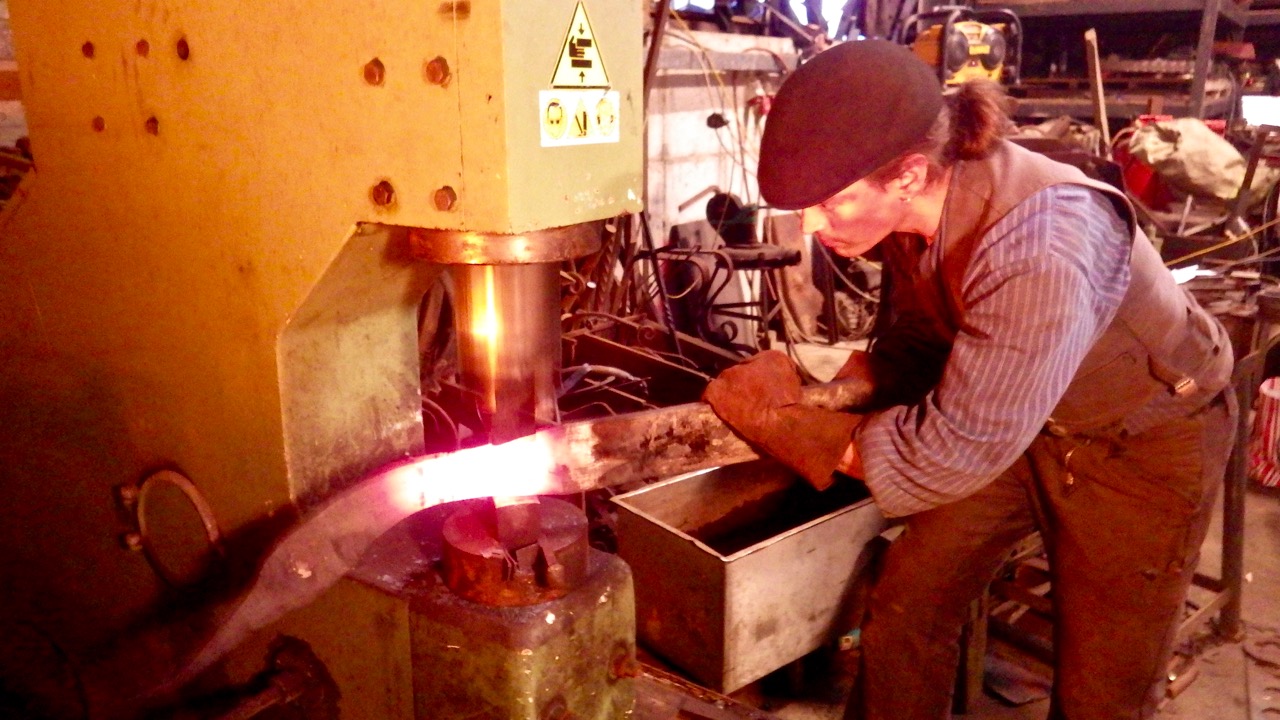
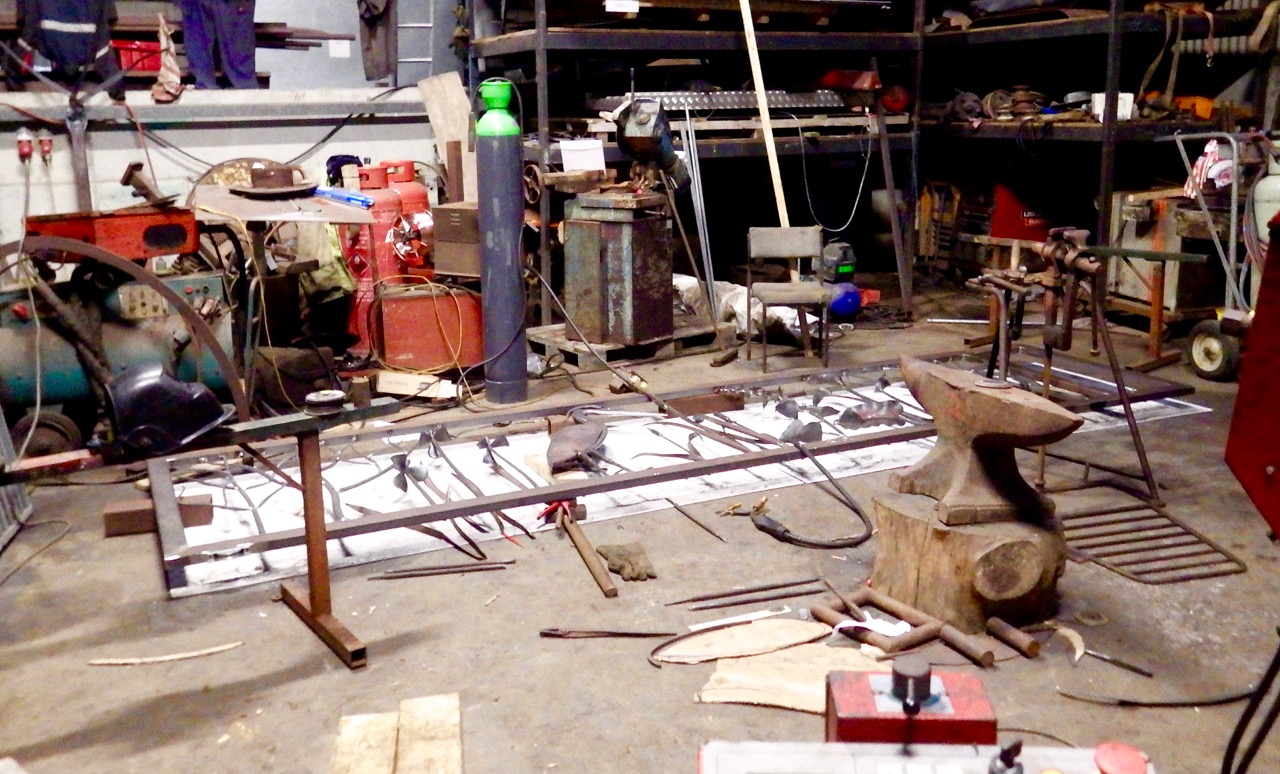
Journeymen surrounded by the tools of their trade in the forge at Lowertown

Simon and Benjamin were fortunate that in Ballydehob they bumped into our neighbour Dietrich: although he and Hildegard have lived here for much of their working lives they were brought up in Germany and were aware of the Journeyman tradition. They immediately found a project for the two young blacksmiths: constructing a new gate for their entrance. John Joe Bowen of the local forge at Lowertown was very helpful in allowing a space in his workshops for the boys to set to work.

blank canvas

The process. Top – blank canvas: laying the full-size design out on the workshop floor. Above – learning from real life: how to fabricate a metal foxglove

We followed reports of the gate-making process with great interest, but were not allowed to see the completed design until the ‘official unveiling’. Dietrich and Hildegard recorded the various stages and have most kindly allowed me to use their photographs of the construction process (and the hike up Hungry Hill) reproduced here.

hammering

making the heron

From design to reality. Top left – Hildegard supervising the assembly and – top right – her design concept drawings. Above – a metal heron takes shape

The gate is a masterpiece. Made in West Cork, it reflects the environment of the place. It’s elegant, and unique. Although it appears complex, it is very understated: I think Dietrich and Hildegard have perfectly summed up the zeitgeist of our own time here in our small townland. Its inspiration is in nature, yet it is a technologically up-to-date piece of fine engineering.

piecing it together

on the floor

sanding the gate

dietrich, journeymen and gate

The construction process, and Dietrich and ‘The Boys’

We were privileged to be at the ‘launch party’. I have never been to a formal gate opening before! Dietrich cut the ribbon and then revealed the finished product to our eager eyes. This work must surely have been the highlight of the travels of these Journeyman from afar: they learned so much about observation and the translation of ideas into practical form.

the gate

Benjamin and Simon were not at the ‘launch’; they were already far away, continuing with their travels and their education. But they must carry with them good memories of the West of Ireland. Good luck to them both!

on hungry hill

Experiencing beautiful West Cork – the Beara Peninsula, summer 2016

Summer Markets

Long Island

Our West Cork markets – Skibbereen, Bantry and Schull – are thriving. Each has a distinct character and all of them are fun for wandering, browsing and buying.

Top right: A basket of scotch eggs from West Cork Pies; bottom left: April Danann from Rebel Foods

Skibbereen Market on Saturday mornings has become the iconic foodie market of West Cork. Everyone goes – it’s a social occasion as much as a shopping trip. Yesterday, Darina Allen of Ballymaloe breezed through when I was chatting with Eithne McCarthy, and rumour had it that Saoirse Ronan had been spotted earlier.

Eithne

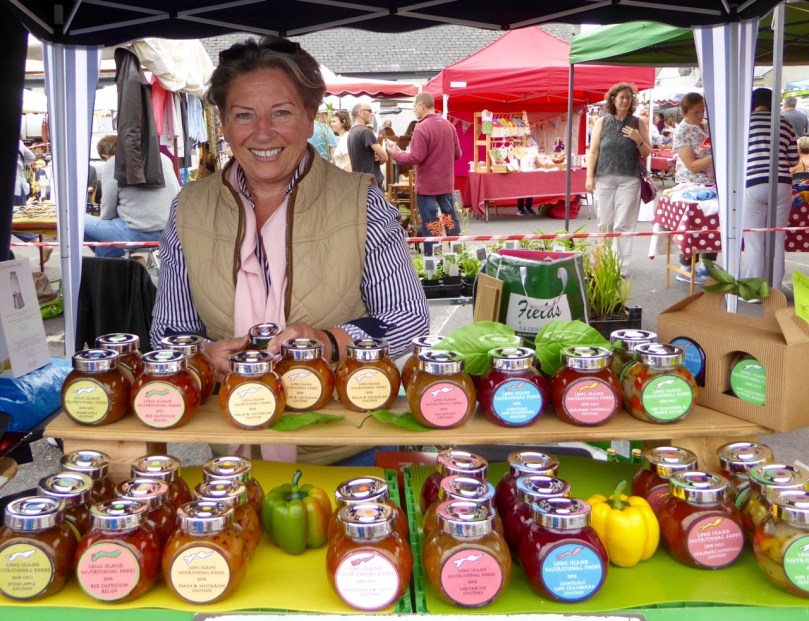
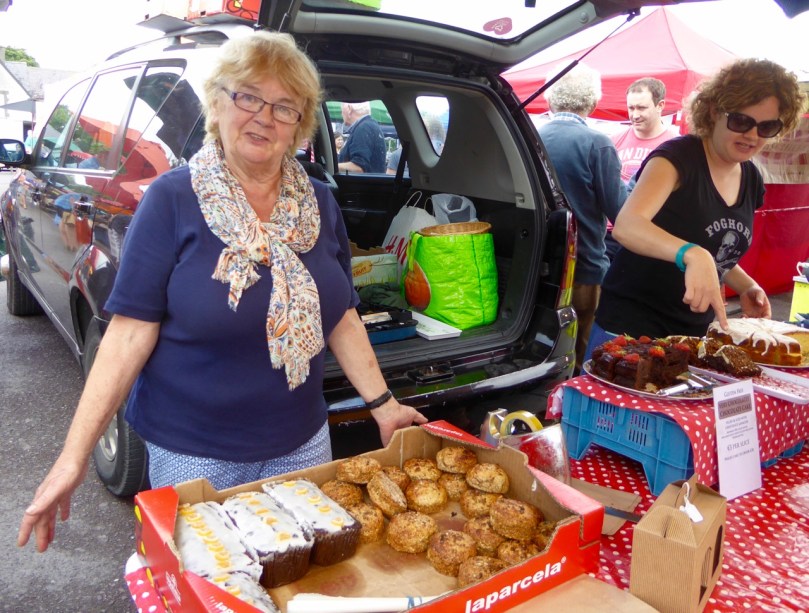
Everybody loves Eithne McCarthy’s home made cakes, breads, jams and chutneys.

There’s music and coffee and crepes and bean burgers and sausages and cupcakes and scotch eggs and anything else you can happily munch on as you wander.

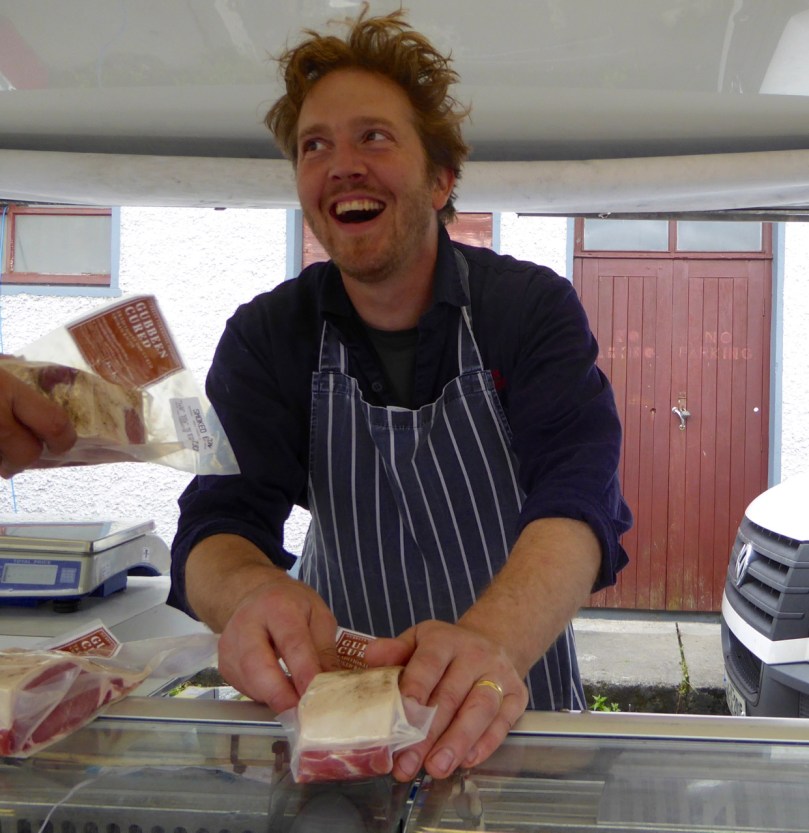
Many stall are devoted to locally produced and artisan foods. Perhaps the best known is Gubbeen, famous for cheese and smoked meats, but not far behind is West Cork Pies, Brown Envelope Seeds, April Danann’s Rebel Foods (wild, foraged and fermented), and Union Hall Smoked Fish.

Fingal

Top: Fingal Ferguson of Gubbeen; Lower left: Union Hall Smoked Fish; Lower Right; Madeline McKeever of Brown Envelope Seeds

But there’s also a whole array of stalls selling chocolates, baked goods, chutneys and pickles, free range eggs and the hens who lay them, vegetables, honey, vinegars, sausages, quiches, berries, olives, seaweeds, and more cheese.

It’s not just food, of course. There are flowers and bedding plants, wooden chairs, magic wands, dolls, jewellery, wool, carved bowls, antiques, books, junk, and yes, knitted tea cosies.

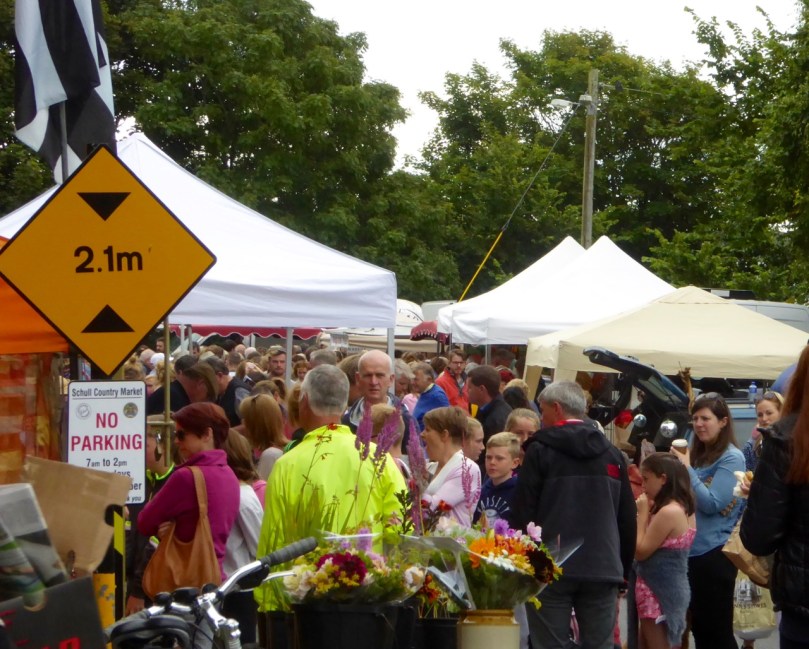
The Schull market is much smaller but has many of the same stalls. Schull is the quintessential tourist town – heaving in the summer – and the market here goes from Easter to October. It’s on Sunday mornings and has a lovely, casual, local vibe, with people dropping down after mass and everyone getting caught up on the latest news.

Schull Crowds

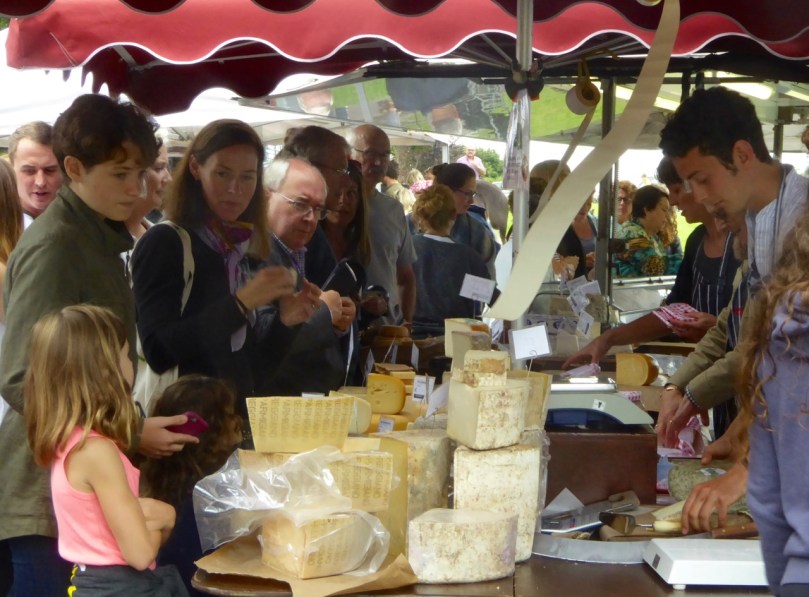
Like Skibbereen, it’s madly busy, so expect to queue and just enjoy the ambience and the music.

Cheese Queue

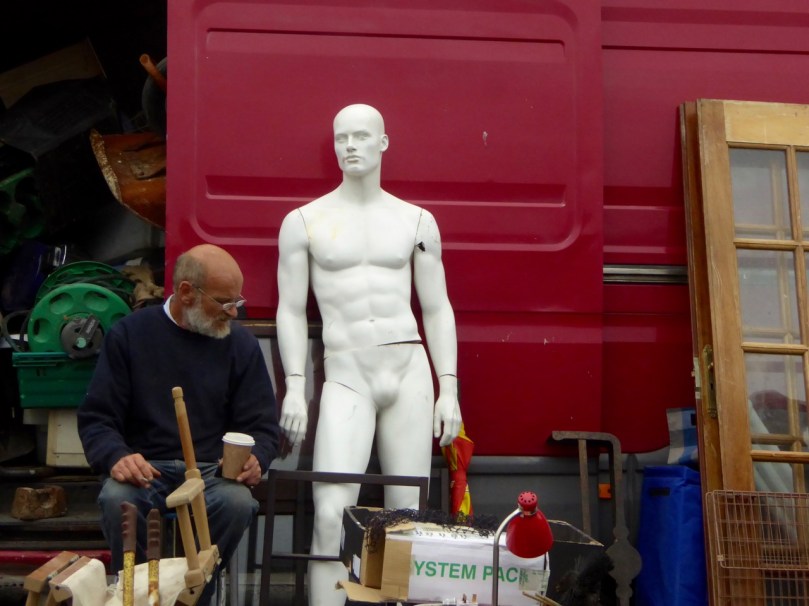
Bantry, on Friday mornings, is the largest market. Although there are some of the same food stalls, it seems to attract different vendors than the other two. This is the market where people shop for second hand goods, curios and collectibles, tools, carpets, clothing, work boots, trees and shrubs, and Michael Collins posters.

Bantry Market

A visit to West Cork wouldn’t be complete without making a trip to the market. Heck – make it to all three of them!

Vials