Memento Mori

Fanlobbus

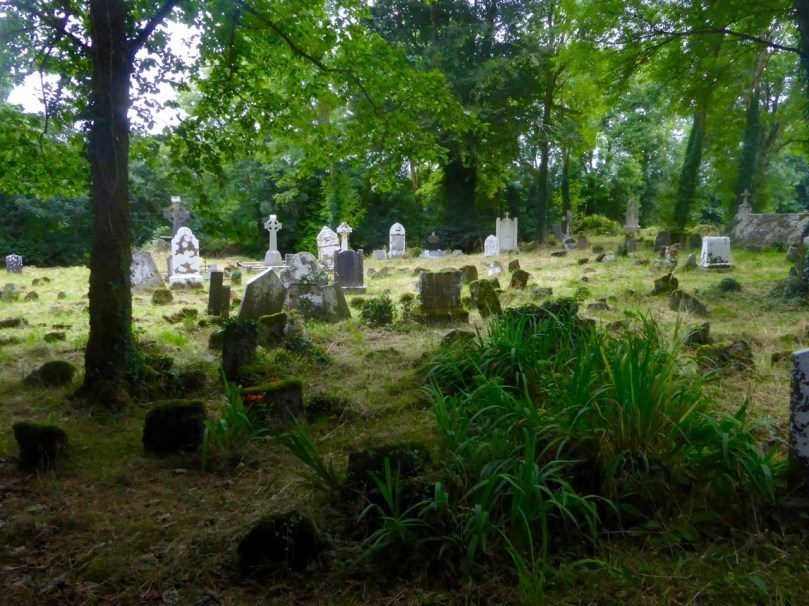
It’s Halloween – what better time to take a wander round an old graveyard! Fortunately, we’re well endowed with them in Ireland, in varying states of preservation and decay.

Old graveyard, near Dunmanway

Except for the wealthy, who could afford to erect tombs and decorate churches with effigies of themselves and carved wall plaques, most people who died in Ireland up to the 1700s lie in unmarked graves. However, in the 18th century the practice of erecting carved headstones become commonplace for those who could pay for it. Styles of headstone carving evolved over time. Local craftsmen used the symbols in vogue, interpreting them according to their own ideas and their level of skill. The result can best be described as folk art.

Bridget Sweeney Kilmallock

Bridget Sweeney’s grave in Kilmallock Co Limerick is memorialised with a great example of a nineteenth century carved headstone

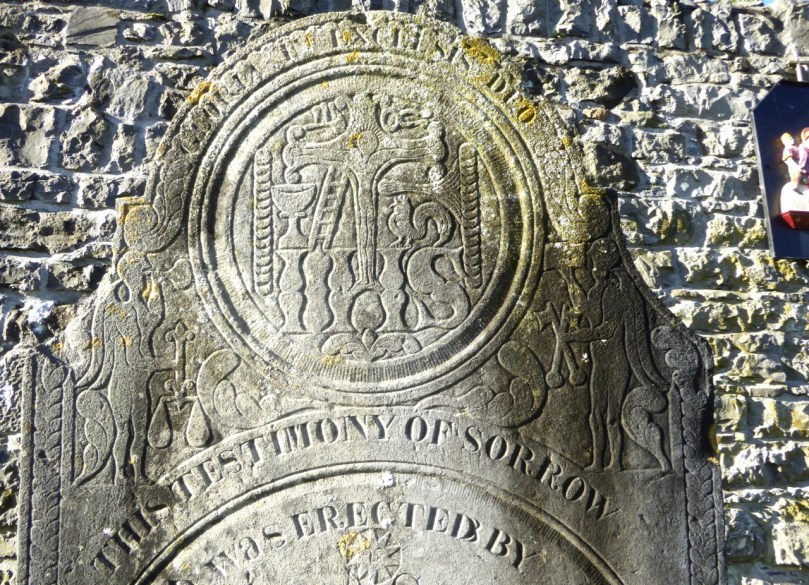
One recurring theme is the passion, or crucifixion of Christ, and a headstone we saw recently in Kilmallock, Co Limerick, is an excellent example of the crucifixion and other symbols.
Bridget Sweeney Closer

Top: Not only a crucifixion image,  but various other symbols feature on the headstone, such as a chalice (eucharist) and a rooster (awakening or time). Below: close up of the two angels: left is Michael blowing his trumpet and bearing a set of scales (reflecting his role of weighing souls at the gates of heaven); right is another angel bearing a book (in which might be recorded a person’s good and bad deeds) and keys (to the gates of heaven?)
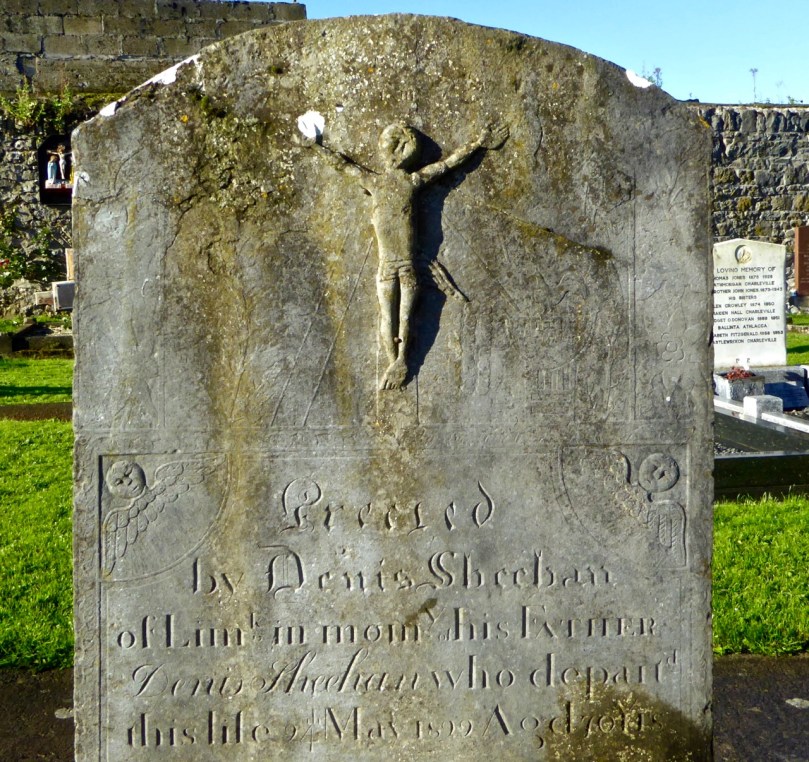
Denis Sheehan, Kilmallock

Another crucifixion headstone, also in Kilmallock: harder to make out, but full of interesting elements

You may have noticed the letters IHS on Bridget Sweeney’s grave. Ubiquitous on old gravestones, on its own, accompanied by a simple cross, or as part of a more elaborate decoration, IHS stood for the name of Jesus. For a full explanation, see this post from the always excellent Pilgrimage in Medieval Ireland.
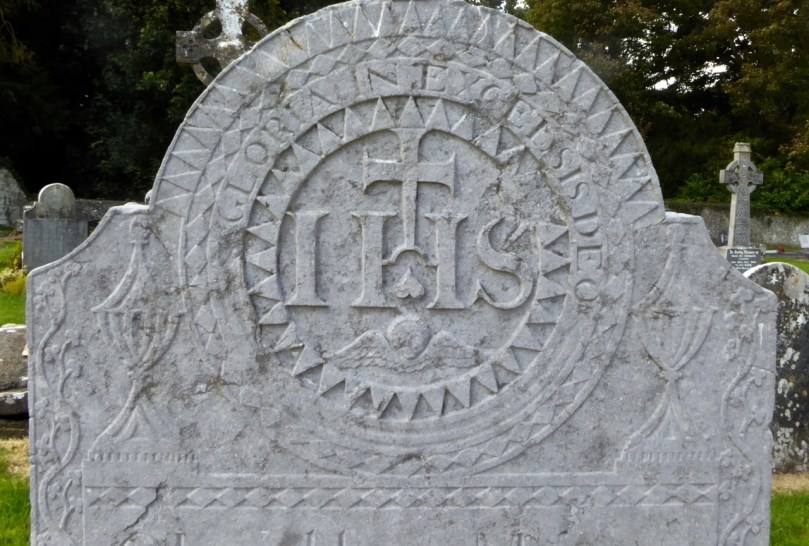
Thomas Donahoe Clonfert

Another favourite symbol was a head with wings, usually representing the soul on its flight to heaven, but perhaps also an angel. 

Alice Bolster, Kilmallock

A particularly fetching angel/soul on the grave of Alice Bolster, Kilmallock

St Michael, blowing his trumpet to welcome that soul to heaven, was a favourite motif. We found one behind a bank of ivy in the old Aughadown graveyard near us, down by the Ilen River.

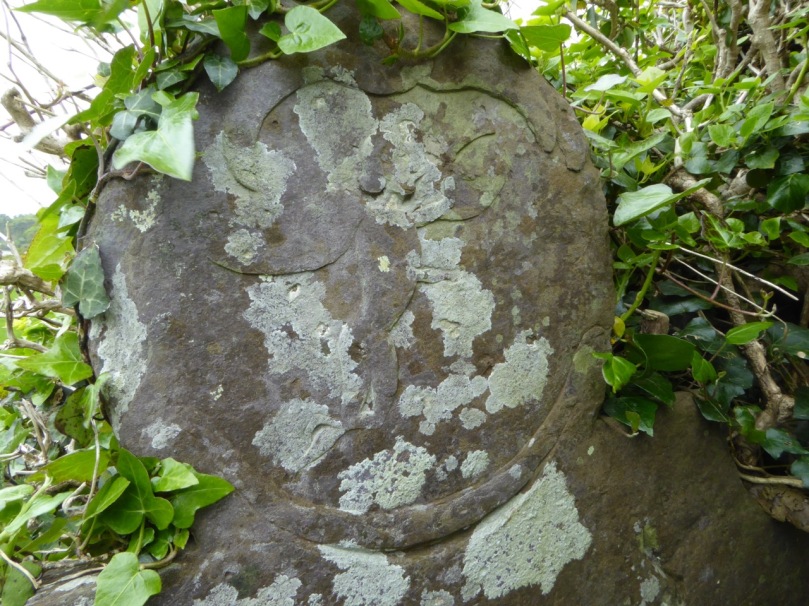
Aughadown

AughadownCan you make out Michael, blowing his trumpet? The enemies of all headstones are ivy and lichen and this one has been overtaken by both

Symbols of mortality decorate some of the earliest Irish headstone – skull and crossbones, hourglasses, books and bells, skeletons, even rotting corpses – all represent the finite nature of life on earth. Memento Mori literally means Remember, you must die. These images were supposed to encourage us, apparently, to lead better lives by reflecting both on the futility of relying on earthly delights and on the reward awaiting us in heaven. Mortality symbols generally date to the 1700s.

Cloondara, Co Longford, no inscription

Top: this slab is in the churchyard at Cloondara Co Longford and has no inscription. The two images below it are from a grave in Castlelands, near Kinsale. These two images are courtesy of our friend Amanda Clarke: she was told by a man doing maintenance work that this was the grave of Anne Bonny the pirate – hence the skull and crossbones!

Sun, moon and star images represent the glories of creation and we’ve seen many instances of sunbursts, often enclosing the IHS lettering. Here’s a nice example, below, from Kilmallock, which also has winged heads and beautiful lettering.

William Jones Kilmallock

Lettering styles varied widely, as did the carver’s ability to spell and to ensure he had left himself enough room. Anyone wanting to invent new fonts (yes, that’s a thing) could well study old headstones and admire the incredible variety of lettering. Carving some of the more elaborately rounded scripts must have been a job for only the most highly skilled.

Dan Linnehan, Cullen, Co Cork

We often see instances where letters and words have to be added above or below the line, where the carver ran out of room

The Lamb of God is another common image – although it can be hard to recognise a lamb in the often lumpen carving at the top of a headstone.

Headstone, Cullen

At an old graveyard in Cullen, Co Cork, there are several stones that appear to be in a local style with a head on either side of the top of the stone

We can’t resist old graveyards – we seldom pass an opportunity for a stroll and an explore. Sometimes we find interesting headstones, sometimes we just soak in the atmosphere, sometimes we worry about the neglect that allows them to slowly disappear into a jumble of brambles and nettles.
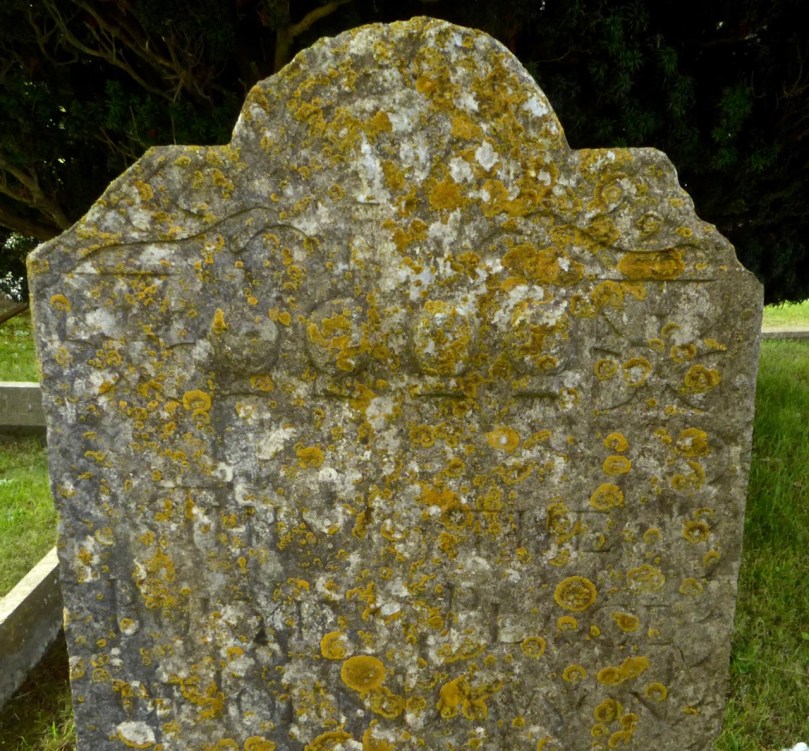
Four Children gravestone, Bandon

It’s hard to make out what’s on this old headstone in the churchyard at St Peter’s C of I church in Bandon. The words include a reference to ‘his four children’ so I am tempted to think these four heads representing those little souls.

Here’s some good new – there is an Irish organisation, Historic Graves, that is doing outstanding work in saving our historic graveyards from that fate. In their own words:

The Historic Graves project is a community focused grassroots heritage project. Local community groups are trained in low-cost high-tech field survey of historic graveyards and recording of their own oral histories. They build a multi-media online record of the historic graves in their own areas and unite to form a national resource.

Lissagriffin

Kilmoe churchyard, in LIssagriffin on the MIzen Peninsula, has benefited from a Historic Graves survey

I used information from the Historic Graves survey in my posts about the Stouke Graveyard (Priests and Poets Part 1 and Part 2) and I hope to learn more about their methods and objectives in the future.

Another Historic Graves project was Castlelands, near Kinsale. These photographs are by Amanda Clarke, used with thanks

One thing we have seen is that once a graveyard has been surveyed it’s important to keep it well maintained. The Cloyne graveyard was surveyed in 2013 and many fine old headstones were found and recorded. We visited in May 2014 and loved our walk through the flower-strewn pathways and the newly-revealed headstones. However, earlier this month when we dropped in it had started to resemble a jungle again. 
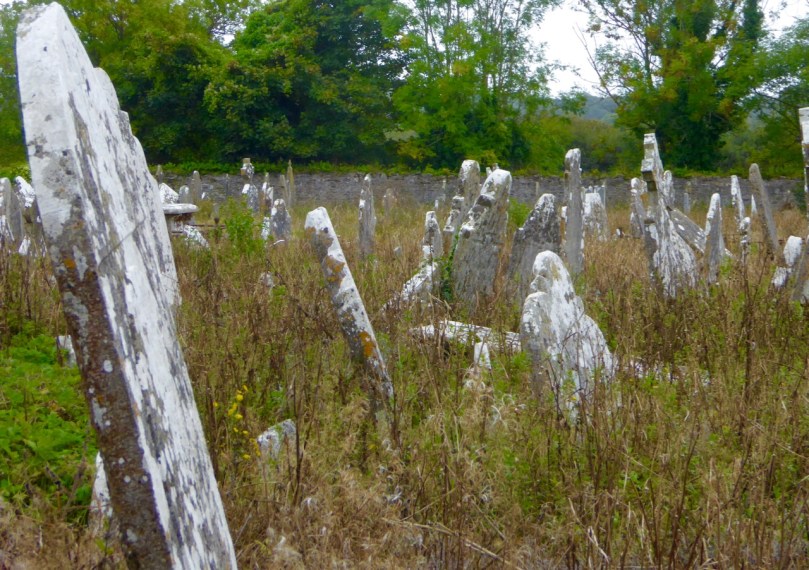
Cloyne Graveyard

I will leave you with a couple of my personal favourites from graveyard visits – not elaborate, not particularly old, but saying so much. The first is from Castlehaven graveyard in West Cork, the second from Kilbarry, near Dunmanway.
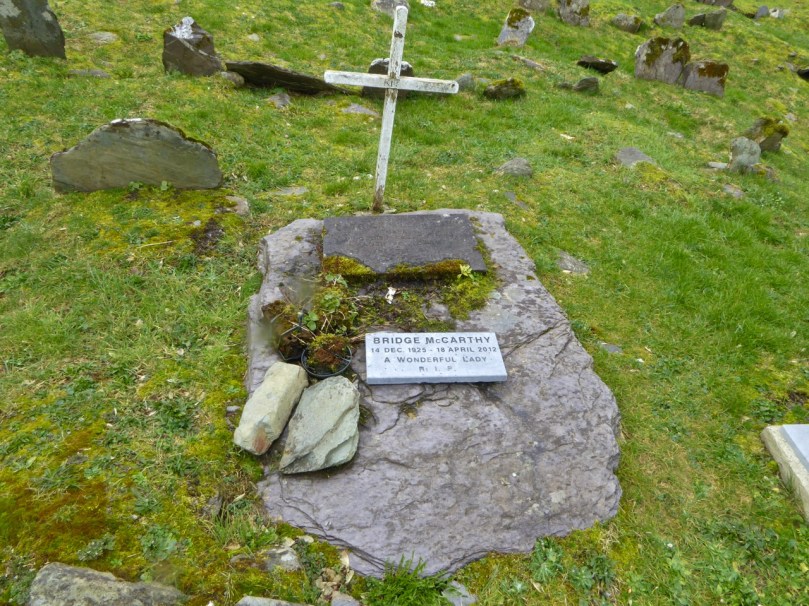
Castlehaven Bridge McCarthy

Crowley Castle St

Travel by Water 2 – A Tale from Trollope

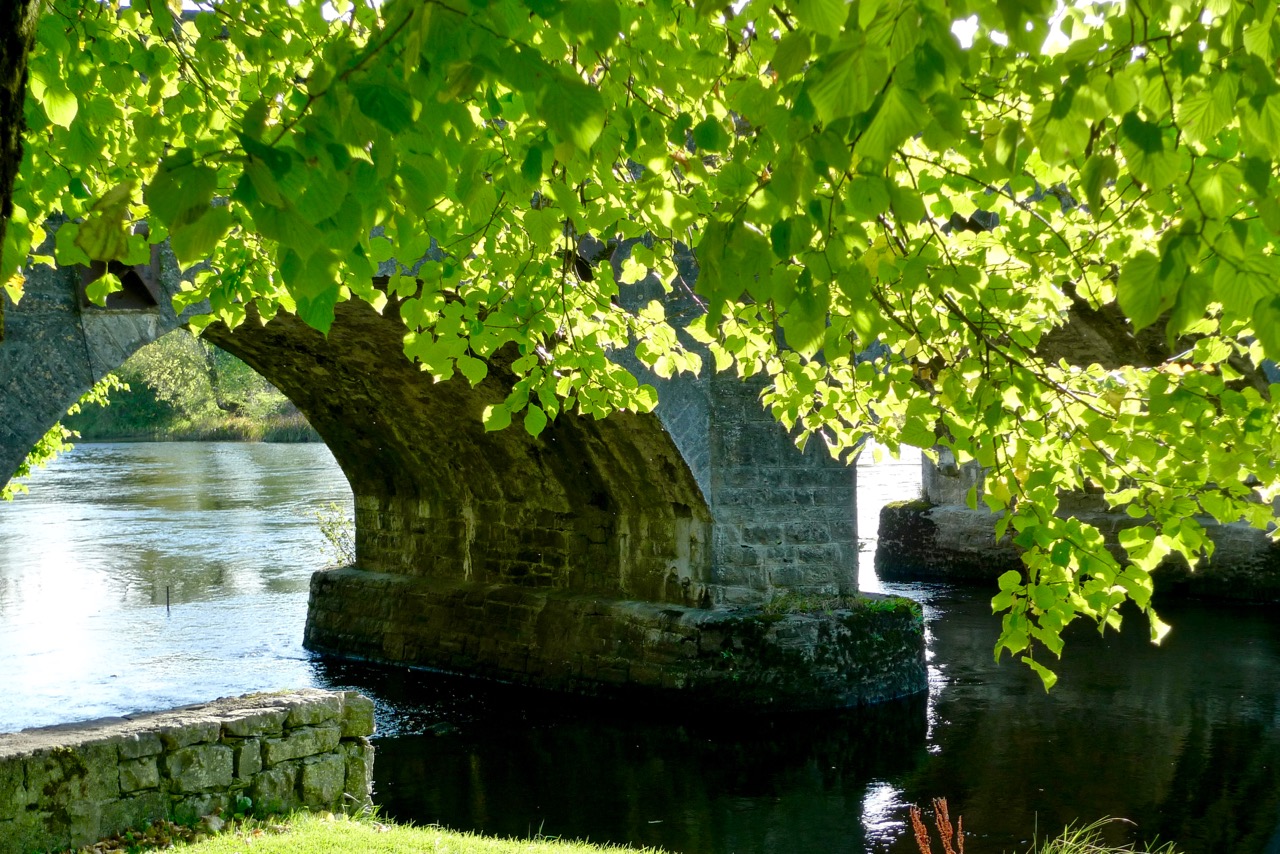
Drumnsa Bridge

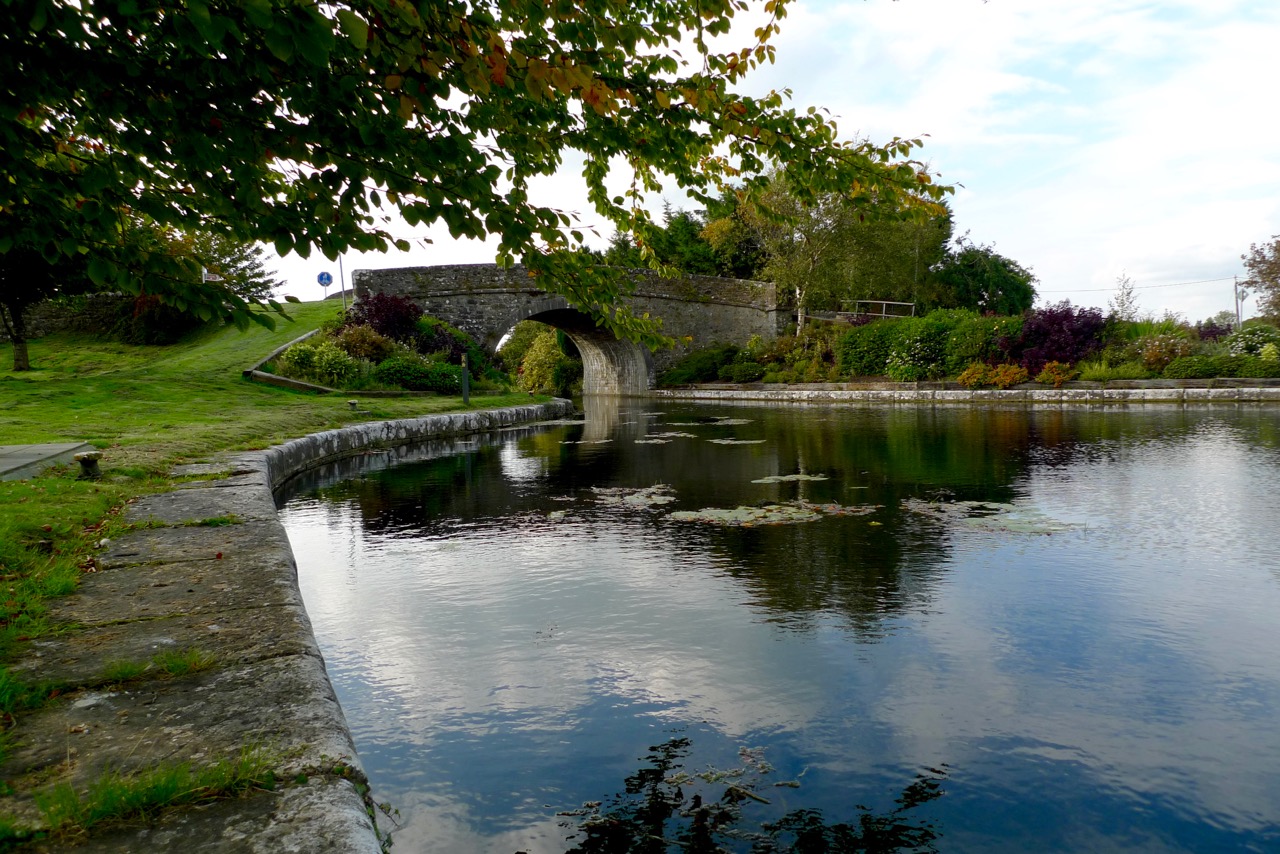
If you travel by water on the Shannon, you can still take your boat up to the bridge at Drumsna, Co Lietrim (above). Just below the bridge is a stone wharf which is the present limit of navigation on that part of the river, a great loop which was bypassed in 1848 by a 2.6km canal. The towns of Drumsna and Jamestown were once thriving river ports but went to sleep once the canal was built. When Tom and Angela Rolt arrived in Drumsna in 1946 the quay there was in ruins, and they had to anchor their boat Le Coq in the shallows and row their small dinghy into the village.

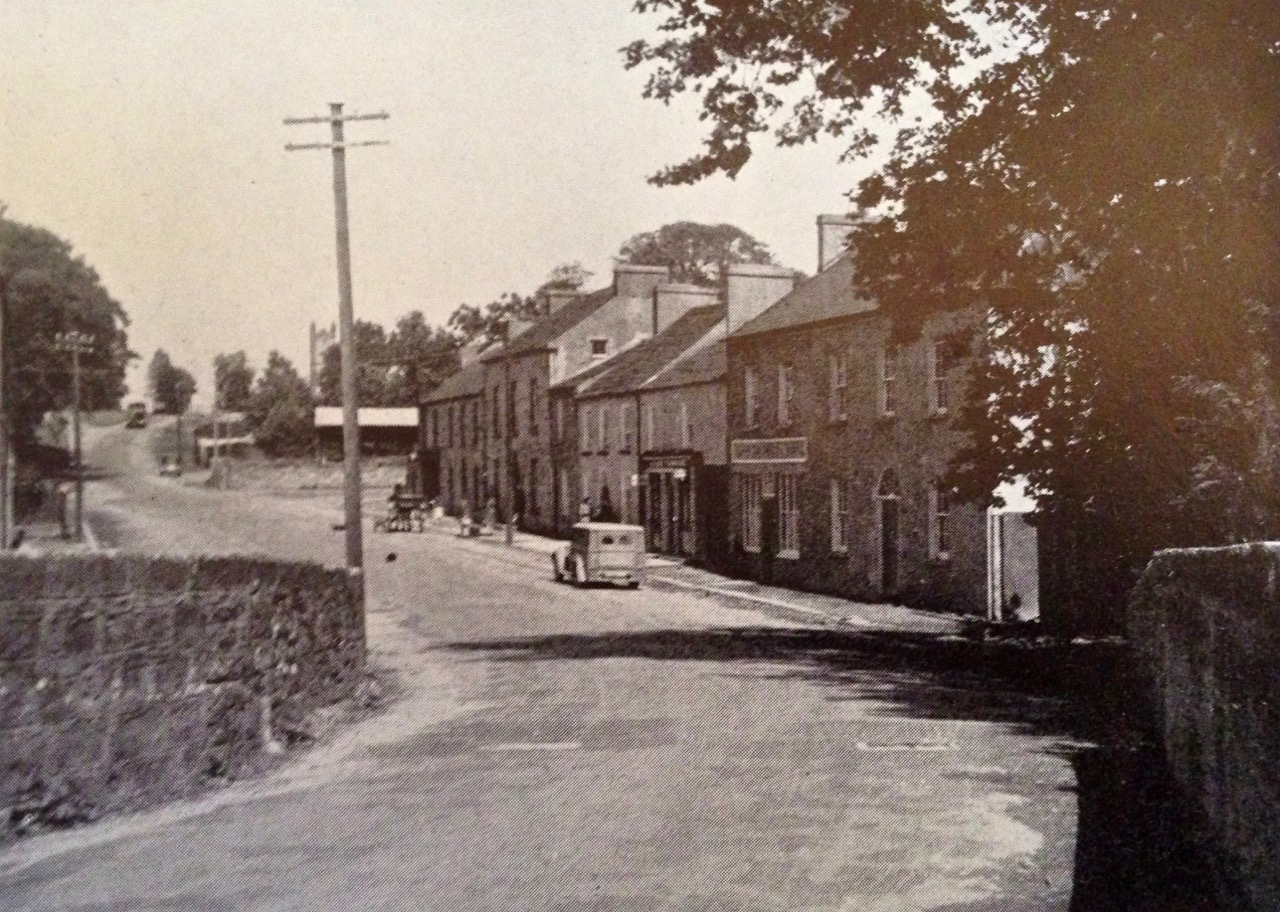
Drumsna (Trollope)

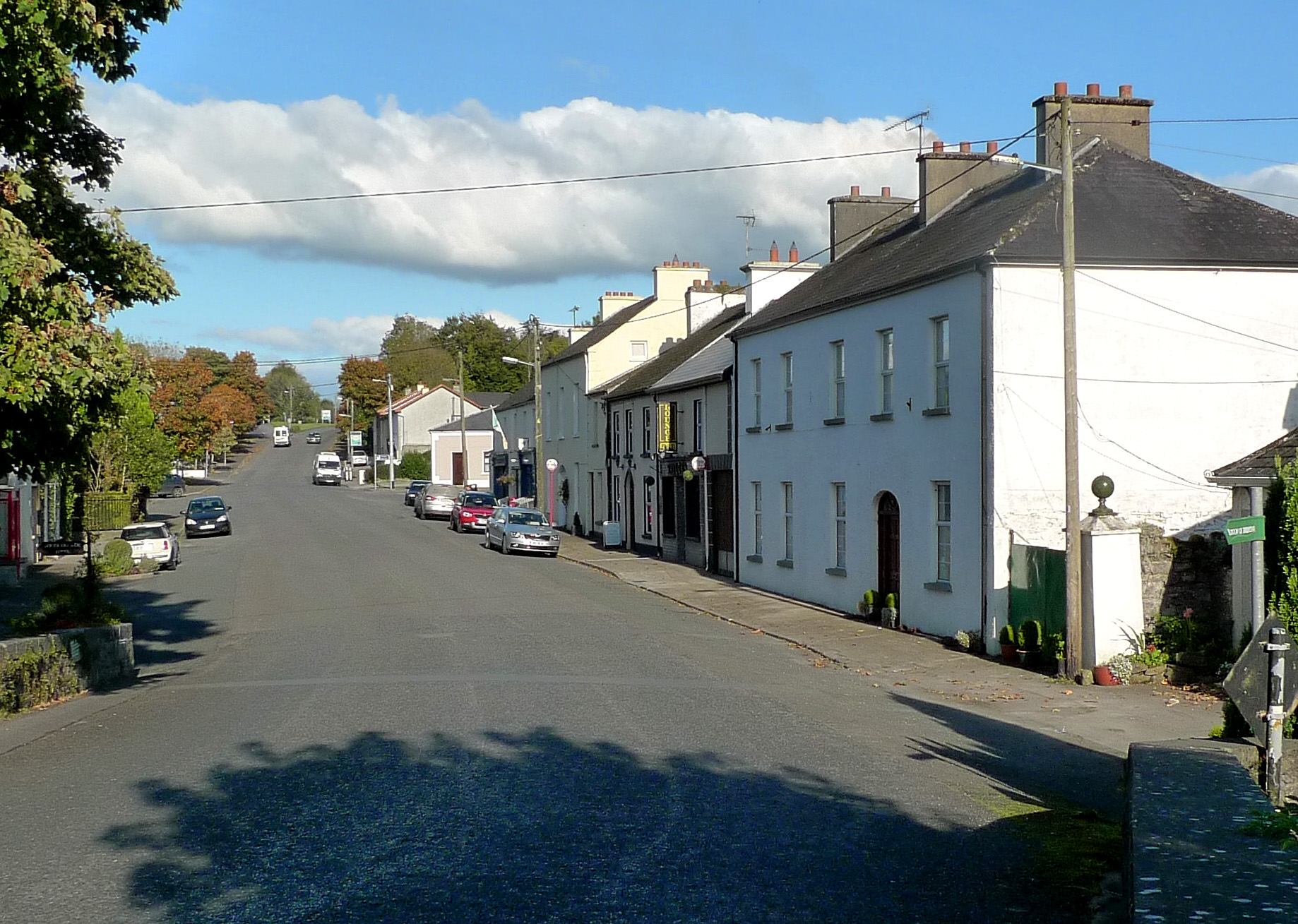
drumnsa-2016

Upper picture – Drumsna in 1946, a photograph taken by Angela Rolt. Lower picture – the same scene in 2016; 70 years have passed but there have been few changes in the fabric of the village

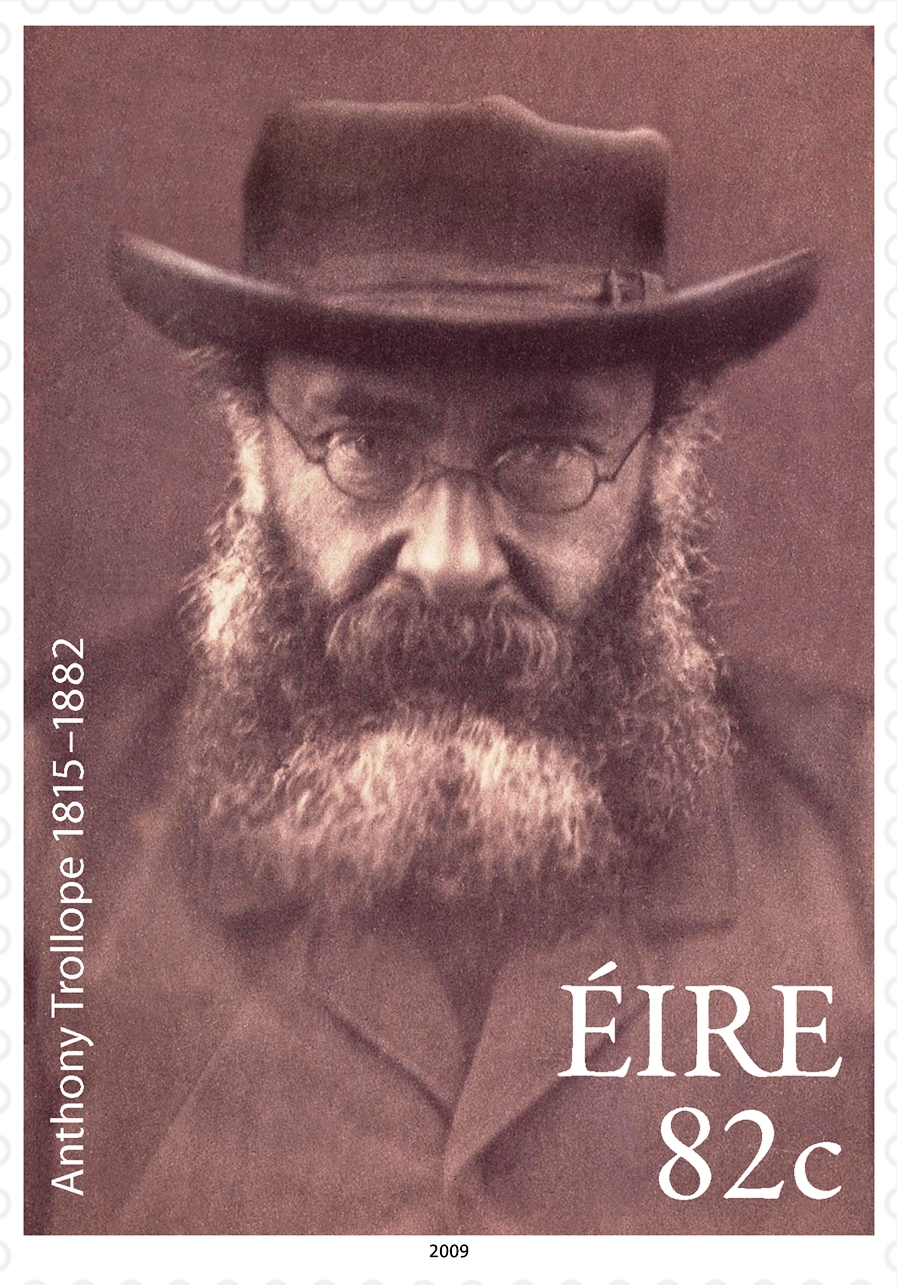
The Rolts were interested in Drumsna because of its associations with Anthony Trollope, who readers will remember for his introduction of post boxes into Ireland. While working as a Post Office Surveyor he was stationed in Drumsna during the 1840s, before the Great Famine, and began his writing career with the novel The Macdermots of Ballycloran (published in 1847). It was not a success but he persevered and became one of the most prolific writers of all time, publishing no less than 47 novels and many more short stories and works of non-fiction during his lifetime. He died in London in 1882, aged 67.

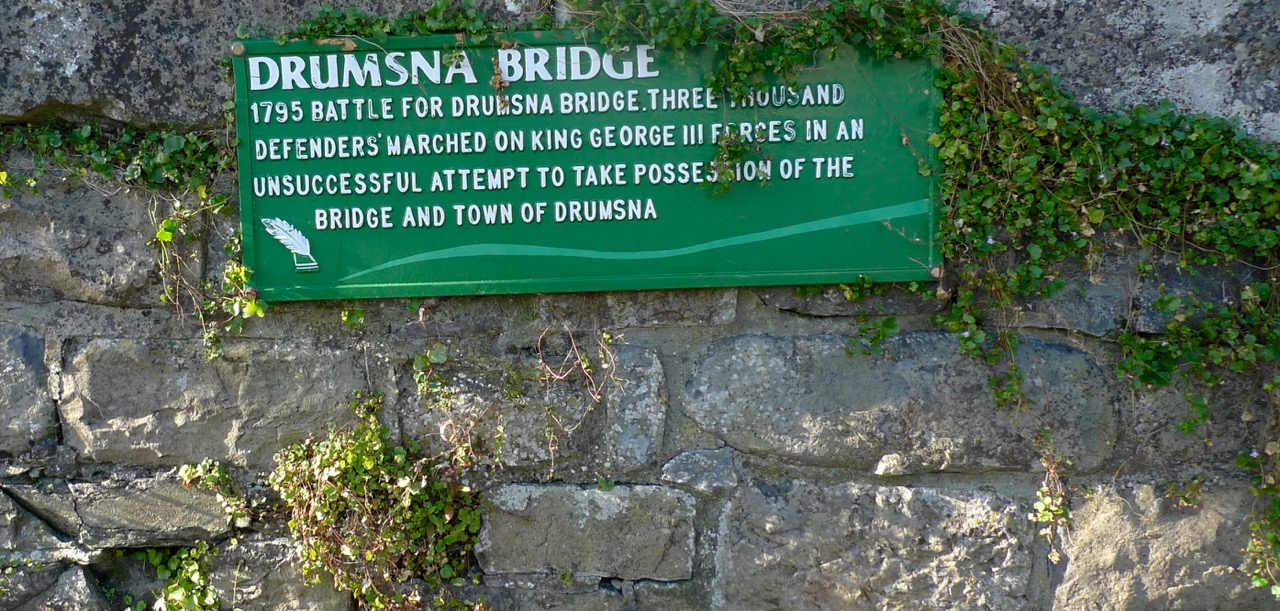
1795 battle Drumsna

Drumsna was historically important as one of the crossing points of the Shannon: it was the site of a ford until the stone bridge was built, probably in the 18th century. This bridge, one of the oldest on the river, once had a blind eye arch where prisoners were jailed and, reportedly, a handball alley on the side where many a  famous championship was held. The plaque on the bridge today (above) remembers an uprising from 1795

Trollope was living in Ireland at the time when the canal system was thriving. He was certainly familiar with travelling by water on the canals, as we can see through this excerpt from his second novel, The Kellys and the O’Kellys (also inspired by his experience of life in Ireland and a success – it was published in 1848 and sold 140 copies). Trollope was 33 when he wrote this book and he must have had direct personal experience of the passenger boat services running out of Dublin on the Grand Canal:

…MR MARTIN KELLY RETURNS TO DUNMORE

We will now return to Martin Kelly…. Hstarted for home, by the Ballinasloe canal-boat, and reached that famous depot of the fleecy tribe without adventure. I will not attempt to describe the tedium of that horrid voyage, for it has been often described before; and to Martin, who was in no ways fastidious, it was not so unendurable as it must always be to those who have been accustomed to more rapid movement. Nor yet will I attempt to put on record the miserable resources of those, who, doomed to a twenty hours’ sojourn in one of these floating prisons, vainly endeavour to occupy or amuse their minds. But I will advise any who from ill-contrived arrangements, or unforeseen misfortune, may find themselves on board the Ballinasloe canal-boat, to entertain no such vain dream. The ‘vis inertiae’ of patient endurance, is the only weapon of any use in attempting to overcome the lengthened ennui of this most tedious transit. Reading is out of the question. I have tried it myself, and seen others try it, but in vain. The sense of the motion, almost imperceptible, but still perceptible; the noises above you; the smells around you; the diversified crowd, of which you are a part; at one moment the heat this crowd creates; at the next, the draught which a window just opened behind your ears lets in on you; the fumes of punch; the snores of the man under the table; the noisy anger of his neighbour, who reviles the attendant sylph; the would-be witticisms of a third, who makes continual amorous overtures to the same overtasked damsel, notwithstanding the publicity of his situation; the loud complaints of the old lady near the door, who cannot obtain the gratuitous kindness of a glass of water; and the baby-soothing lullabies of the young one, who is suckling her infant under your elbow. These things alike prevent one from reading, sleeping, or thinking. All one can do is to wait till the long night gradually wears itself away, and reflect that, Time and the Hour Run through the Longest Day.

I hardly know why a journey in one of these boats should be much more intolerable than travelling either outside or inside a coach; for, either in or on the coach, one has less room for motion, and less opportunity of employment. I believe the misery of the canal-boat chiefly consists in a pre-conceived and erroneous idea of its capabilities. One prepares oneself for occupation–an attempt is made to achieve actual comfort–and both end in disappointment; the limbs become weary with endeavouring to fix themselves in a position of repose, and the mind is fatigued more by the search after, than the want of, occupation.

Martin, however, made no complaints, and felt no misery. He made great play at the eternal half-boiled leg of mutton, floating in a bloody sea of grease and gravy, which always comes on the table three hours after the departure from Porto Bello. He, and others equally gifted with the ‘dura ilia messorum’, swallowed huge collops of the raw animal, and vast heaps of yellow turnips, till the pity with which a stranger would at first be inclined to contemplate the consumer of such unsavoury food, is transferred to the victim who has to provide the meal at two shillings a head. Neither love nor drink – and Martin had, on the previous day, been much troubled with both – had affected his appetite; and he ate out his money with the true persevering prudence of a Connaught man, who firmly determines not to be done.

He was equally diligent at breakfast; and, at last, reached Ballinasloe, at ten o’clock the morning after he had left Dublin, in a flourishing condition. From thence he travelled, by Bianconi’s car, as far as Tuam, and when there he went at once to the hotel, to get a hack car to take him home to Dunmore…

Long distance travel within Ireland by inland waterways was the preferred form of transport in the first half of the 19th century. The alternative was the stage coach: this was no faster than canal travel because of the sometimes tortuous routes which roads took, and the conditions of the roads themselves, particularly in the winter. It must be significant that in the early years of stage coach travel only departure times were advertised: the journey would take as long as conditions permitted. Coaches were notoriously uncomfortable. At least the canal packet boats were relatively smooth and passengers had the opportunity to stretch their legs on deck. Everything changed, of course, with the coming of the railways as the century progressed.

Duchess Countess

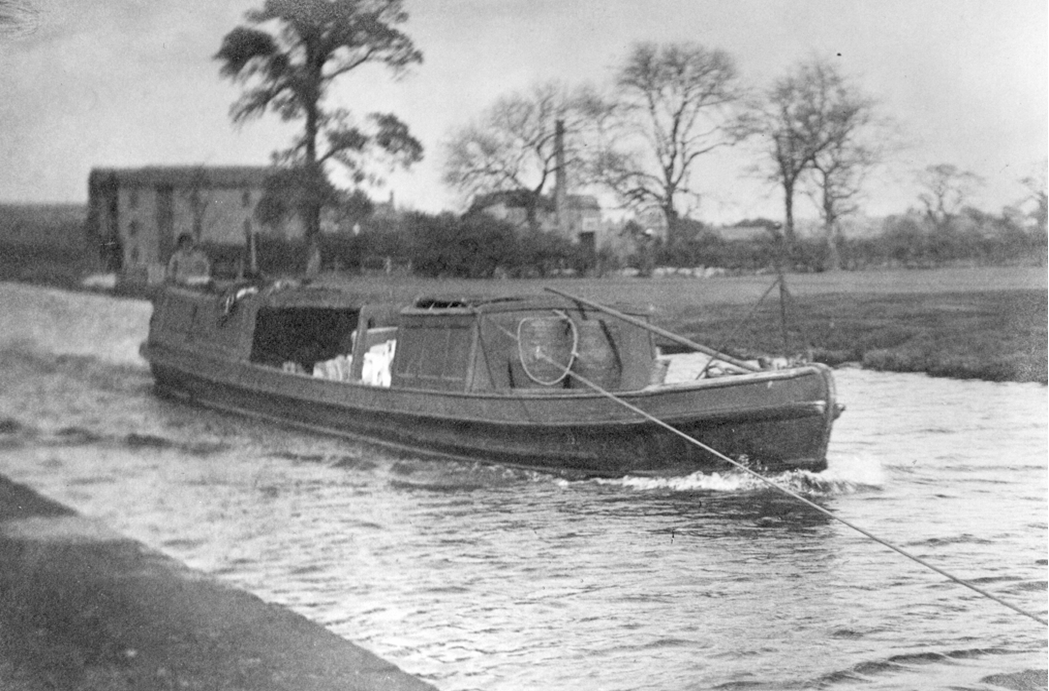
The last days of the former express passenger boat Duchess Countess, photographed by Angela Rolt in the late 1940s. The Rolts initiated attempts to have the boat preserved, but these were unsuccessful

Rolt mentions passenger packet boats or ‘fly boats’ in England in his later book which was published in 1950. In The Inland Waterways of England, George Allen and Unwin, he describes:

…the miraculous preservation by sinking of the Bridgewater Canal passage boat Duchess Countess (a name recalling the titles of the Bridgewater family). This old boat was eventually raised and, still in substantially original condition even to her cabinwork, began a new lease of life as a houseboat. She was moved on to the Welsh section of the Shropshire Union Canal near Frankton Junction where she is still occupied at the time of writing although, owing to the deterioration of her hull, she has now been drawn out of the water. The Duchess Countess was the last packet boat in regular service. In the heyday of her career as a packet boat she proudly mounted a great curved knife-blade on her bow. This was of much more than symbolic significance, for it was so contrived that it would sever the towline of any boatman who failed to give way to her… …Very soon the Duchess Countess must inevitably disintegrate, and with her passing the last tangible link with these once extensive but little known canal passenger services will be irretrievably lost…

dc_on_water

dcountess_-_line_drawing_boat

Upper picture – a rare photograph of the Duchess Countess still in use  on the canals (courtesy British Waterways Archive – date unknown) and , lower picture – a modern line drawing of the boat. Both images show the blade on the prow which could slice through the towlines of any unfortunate boat which did not get out of the way in time!

Angela Rolt photographed the Duchess Countess on the canal bank and, fortunately, an early photograph of the boat in its working days is preserved. This shows the scythe-like blade on the prow and confirms that the express boat service had priority over all other traffic on the canals. I am not aware that any of the Irish passenger boats were so equipped but, using teams of horses which were frequently changed along the route, they were evidently able to keep up a continuous speed of around 10 miles per hour, which was no mean feat at the time.

trollope-irish-stamp

We will revisit passenger travel on the Irish Canals in a future post continuing this series…

Travel by Water

Ballynacarrigy Bridge

We have been on a voyage of discovery – or, perhaps, rediscovery. You remember that recently I reviewed a book which I received as a school prize in 1963: Green & Silver by L T C Rolt? That was a book about travelling by water through some of the canals and rivers of Ireland. The book was published in 1949 but I found out that the journey was undertaken in 1946 – exactly 70 years ago and, also, the year in which I was born. Tom Rolt was a good travel writer and a good observer, and the book is full of descriptions of the places and people that he and his wife Angela came across: it’s a valuable social document and it is rather significant that three score years and ten have passed since they completed their explorations.

Tom Rolt (left) and Angela and Tom Rolt (right) aboard Le Coq, the boat with which they set sail from Athlone to circumnavigate the inland waterways of Ireland between June and September 1946. The photos are taken on the Grand Canal

Back in my more youthful days I also travelled by water, but around the English canal system, a journey of nearly 2,000 miles, taking several months. I also wrote a book after the journey: Canals and their Architecture. Tom Rolt was to have written the introduction to that book but he was unable to, because of illness. As a tribute to him, and to mark his journey through Ireland, Finola and I have been retracing his steps. We should have travelled by water, too, but that would have impinged overmuch on our busy lives here in West Cork. Instead, we covered in a couple of weeks by car what Tom and Angela had taken three months to achieve. Their’s were difficult times, too, immediately after The Emergency when fuel was virtually unobtainable.

navigable waterways

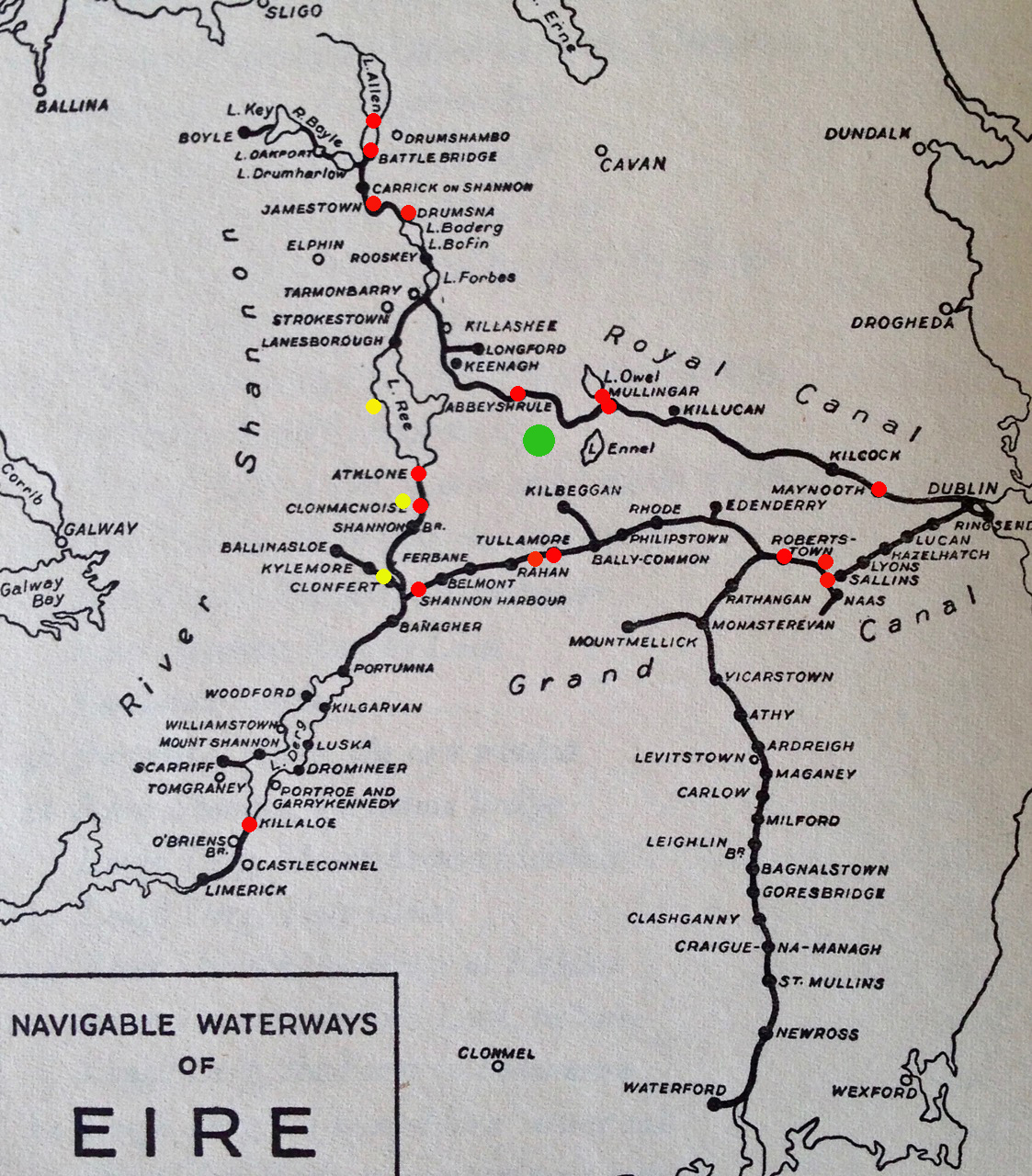
Map of the journey taken from Green & Silver. We have marked on it the sites which we wanted to visit, either because Angela had photographed them or because there was a ‘story’ about the place in the book

Angela Rolt recorded the journey in her own way – through the lens of her camera. Her wonderfully evocative monochrome photographs illustrate Green and Silver, and provided a goal for each leg of our own travels. Armed with the book and digital scans of all her pictures we set out to retrace the watery steps of Le Coq – the little boat which the Rolts borrowed – and take a new photograph at every place they visited. The aim was to set up each photograph of 2016 to exactly match those of 1946 and, through the lens, to record the differences that have taken place in Ireland during all those years. Of course, there is much more to this exercise than the photos: Rolt’s book contains many stories, of people and places not necessarily illustrated but well described, so we also looked out for those: would anyone today have any memories of the people talked about in the book? And would the descriptions of the places that the waterways served in those days ring true in the present?

harbour town

Tullamore 2016

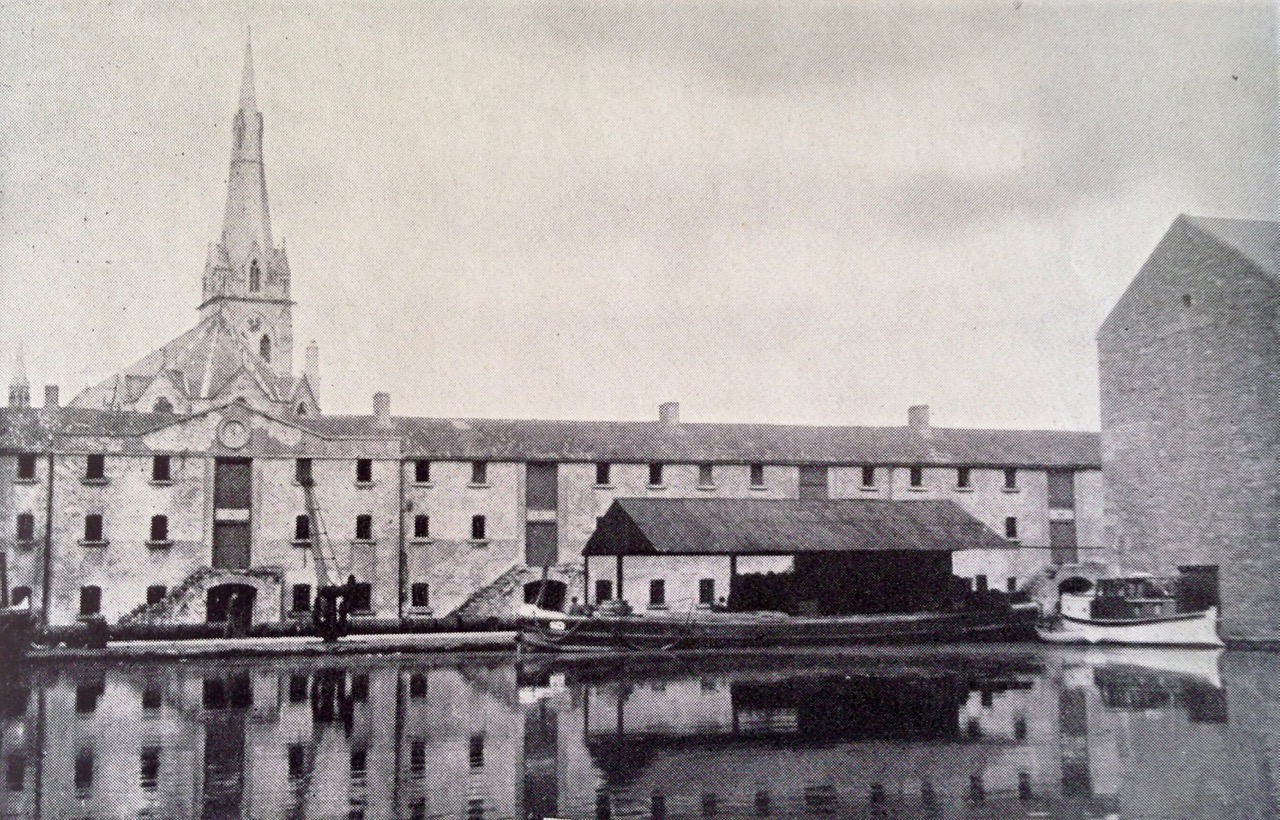
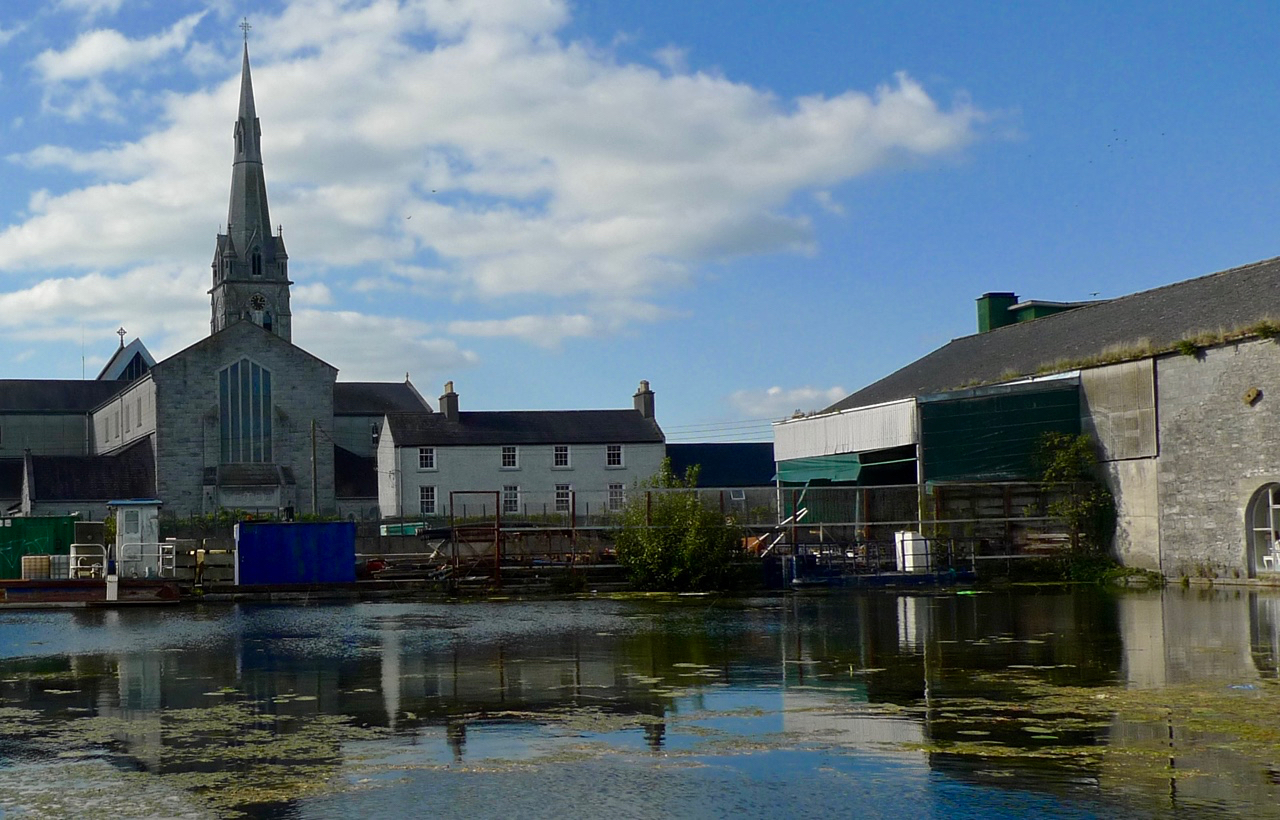
Just one example of our efforts to retrace the steps of the Rolts and record a changing Ireland. Upper photograph – taken by Angela Rolt in 1946 at Tullamore Harbour, Grand Canal. Lower photograph – taken by Robert at the same site. Although the canal harbour itself is intact today – it is an administrative centre for Waterways Ireland – there have been some significant changes. The fine three storeyed warehouses which faced on to the canal 70 years ago have gone, demolished in the 1960s. The Church of the Assumption beyond the harbour was destroyed by fire in 1983 and has since been rebuilt to a modern design except for the tower, which survived the fire

This project will take a little time to fully document. It might occupy a few blog posts! This one is by way of introduction. One thing that struck me most forcefully is the change which the waterways of Ireland have undergone in seventy years. Now all the navigable waterways of Ireland are administered by a single cross-border authority – Uiscebhealaí Éireann (Waterways Ireland); some of the canals which were derelict or near-derelict in 1946 have been fully restored, and many are equipped with modern electric lock gear – something which the Rolts could never have envisaged in their time. However, the volatile economic situations which Ireland has been subjected to in the late twentieth century, and into the twenty-first, have also had their effects, and we found this reflected in some of the stories which we followed during our travels.

Shannon Erne Waterway

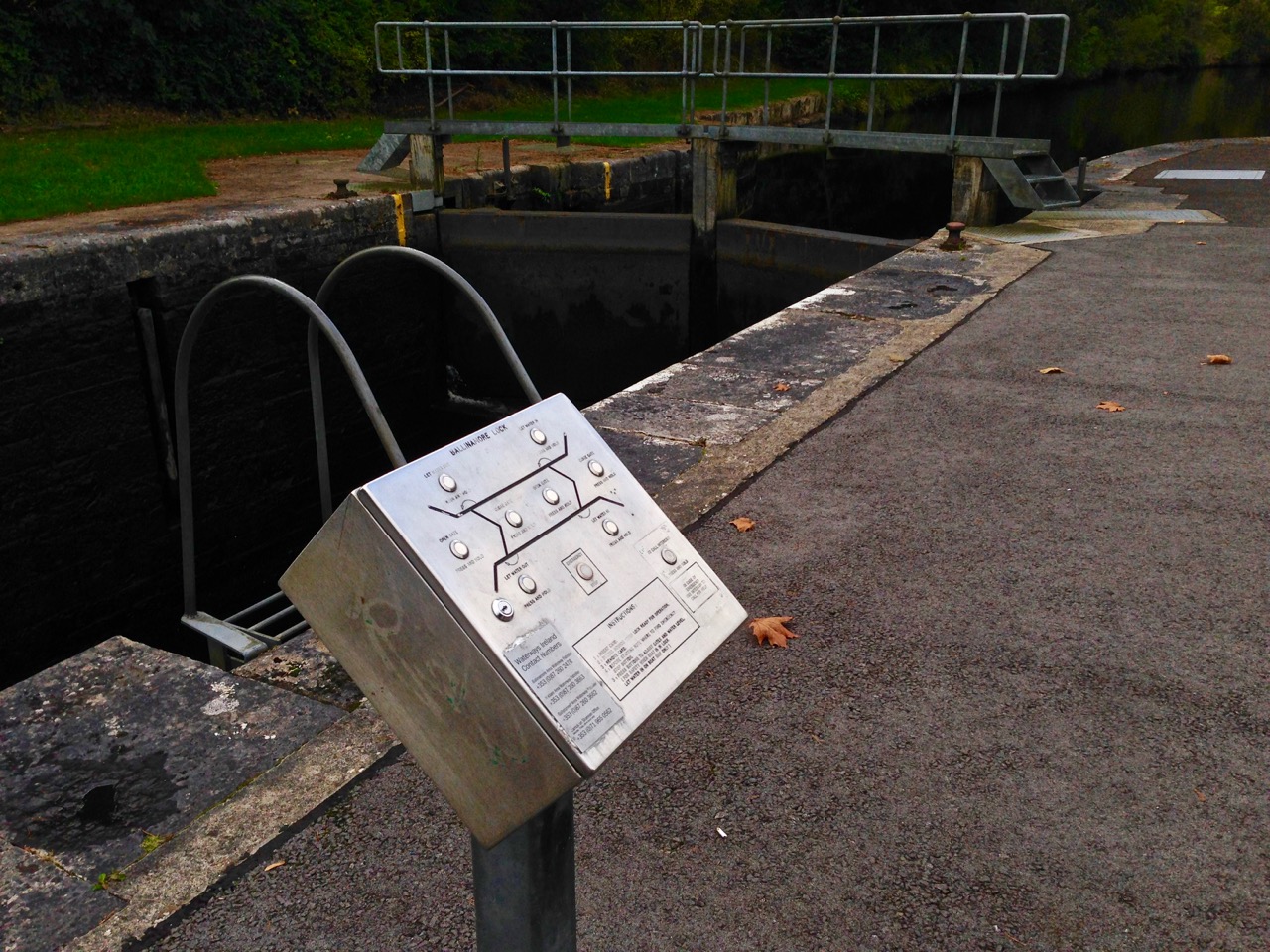
The restored Shannon-Erne navigation links waterways between the Republic of Ireland and Northern Ireland. The 63km canal was constructed originally in the mid nineteenth century but became moribund by 1865. The navigation was reopened in 1994. All sixteen new modern locks are operated electronically by hydraulics: boaters are issued with a key which activates the control panels (above)

Another surprise for me was the quality of the engineering and the scale of the undertakings which Ireland displays on its system of navigations. These were massive construction projects in their day, but they nonetheless manage still to convey a sense of respect for their settings, an appropriateness of all materials used, and a constant appreciation of human scale. The architecture of Ireland’s canals is truly vernacular, something I hope to demonstrate during these explorations.

Mullawornia Lock

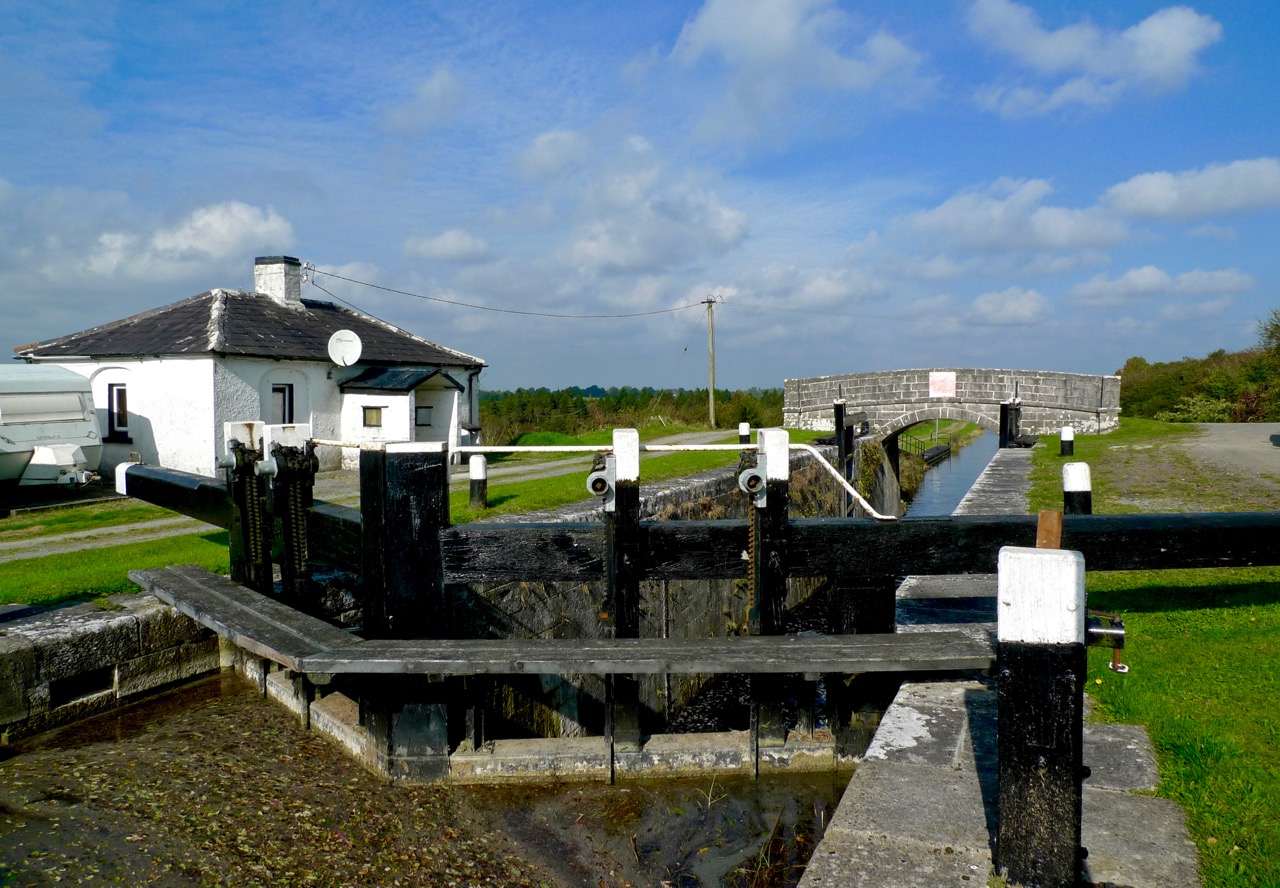
Mullawornia Lock, Lock 40, Royal Canal, County Longford. The lock-keeper’s house is an unspoilt example of a vernacular architecture which can be seen across Ireland’s canals

To be continued…

Into the Heartland

Elphin Windmill

Because we live on it, sometimes we get carried away by the notion that The Wild Atlantic Way represents the best that Ireland has to offer. A recent trip to the midlands – the Heartland of Ireland – convinced us (if we needed it) that there is no part of Ireland that isn’t beautiful and full of fascinating things to do and see. (Like the Elphin Windmill, Co Roscommon, above.)

Parked at Coolnahay

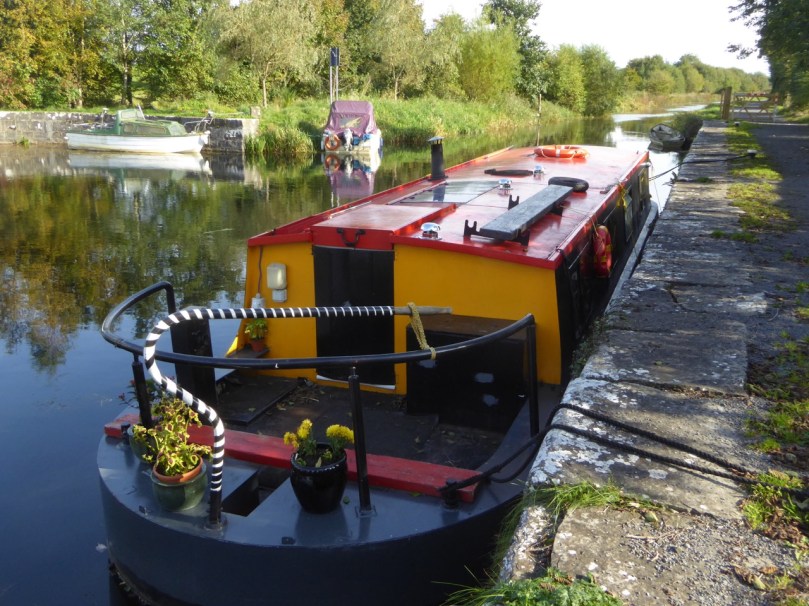
We spent a lot of time along rivers and canals! 

Robert explains the background and purpose of our trip in his post, Travel by Water. I knew very little about canals before I met Robert and it’s been eye-opening to learn about the history and the sheer extent of Ireland’s inland waterways. We spent a lot of time exploring the canals – walking and driving – and enjoyed it all tremendously.

Boa Island figures

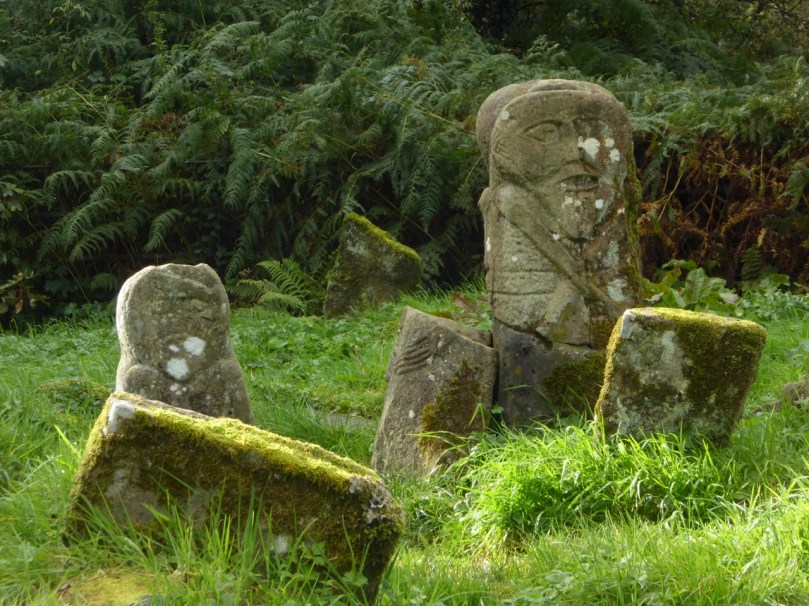
Boa Island on Lough Erne, Co Fermanagh, is home to these mysterious carved figures. Lower left: heads on a medieval church in Kilmallock, Co Limerick. Lower right: a contemporary sculpture celebrates the mythical Finn McCool, in Keshcarrigan, Co Leitrim

But wherever we went there were always other places luring me away – tower houses and fortified houses, churches and graveyards, friendly villages and colourful houses, stained glass windows and prehistoric sites. We drove along roads where we counted ring forts in every field. We explored ancient graveyards and we found a Holy Tree. We visited two sites we posted about last week, the Corlea Iron Age Trackway, and the Hill of Uisneach.

Holy Chestnut

The Holy Tree. A local man we met called it a ‘holy show’ and it certainly had some very questionable items mixed in with the statues and offerings

It’s autumn now, and, while we do experience a change of colour here in West Cork, it’s really in the midlands that the colours of the deciduous trees can overwhelm the senses. They were just starting to turn. I’m strongly tempted to head back in another couple of weeks for the full experience.

Birr Castle Gardens 2

These photographs were all taken at Birr Castle Gardens. Birr Castle (Co Offaly) was one of the most interesting and beautiful places we visited, home of the famous telescope and beautifully maintained

We visited thirteen of Ireland’s 32 counties on this trip – and never came close to the sea or the Wild Atlantic Way. Instead, everywhere we went we saw notices for the latest iteration of the Tourist Board’s marketing scheme. This one is called Ireland’s Ancient East, and appears to take in every county that isn’t on the Atlantic seaboard. A good resource, if you’re considering a trip like this, is Neil Jackman’s guidebook, Ireland’s Ancient East – we kept it by us and found it invaluable.

Grange Stone Circle, Lough Gur

Grange Stone Circle, the largest in Ireland, is one of a complex of monuments at Lough Gur, Co Limerick

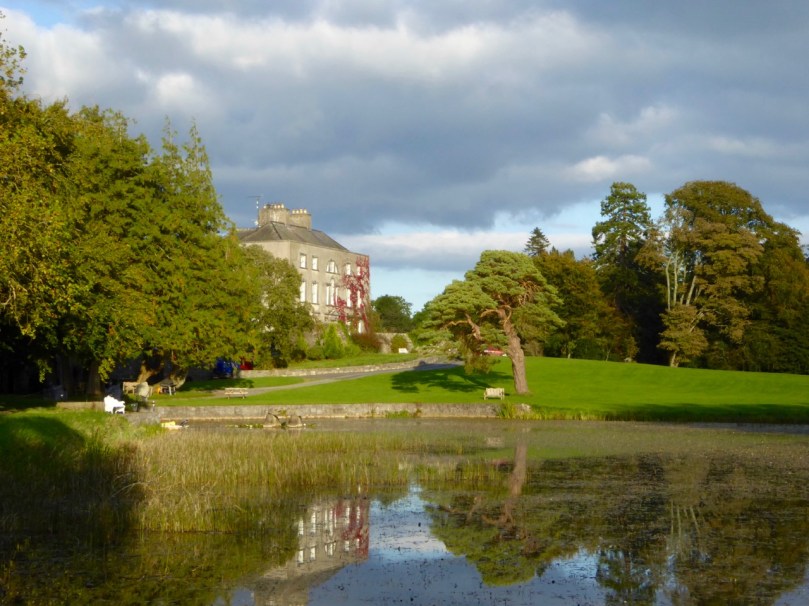
Our headquarters for the biggest chunk of our time away was the incomparable Mearescourt House near Mullingar, Co Westmeath. George and his team made us welcome and comfortable, there were glorious grounds to wander around and animals to meet, and delicious breakfasts that left us feeling full for the rest of the day.

Mearescourt House

Mearescourt House – highly recommended!

When tourists are interviewed about their holidays in Ireland they praise the scenery, the food, the music – but most of all, they say, it’s the people who make it so enjoyable. We agree! Everywhere we went we ended up in conversation, as you do here, with local people delighted to help out with information, share old stories, invite us to the sessions, tell us where to go for a nice dinner, or point out places off the beaten track (and then rescue us later when we got lost).

Claire and Paddy Crinnegan, Coolnahay

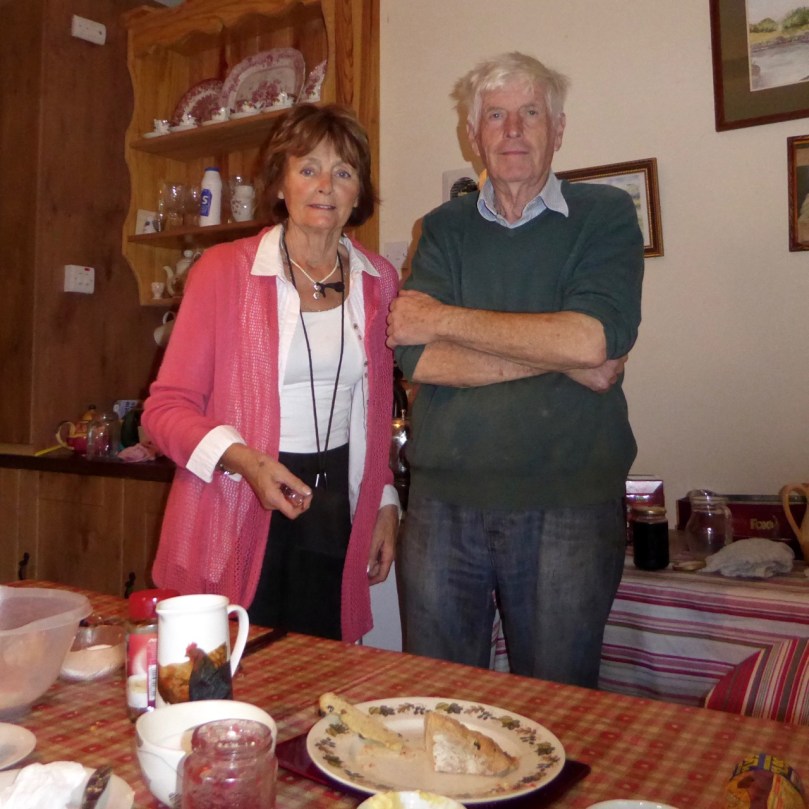
Paddy and Claire Crinnegan maintain the canal lock at Coolnahay on the Royal Canal. in Co Westmeath They made us tea, fed us Claire’s delicious currenty bread, told us about the trad concert that evening, loaned us a book, and related stories of growing up at the lock, where Claire’s father was the lock keeper.

Future posts will go into more depth on some of what we saw and experienced on this trip. This one is just an introduction, to share some of our impressions and drop some hints about what might be upcoming.

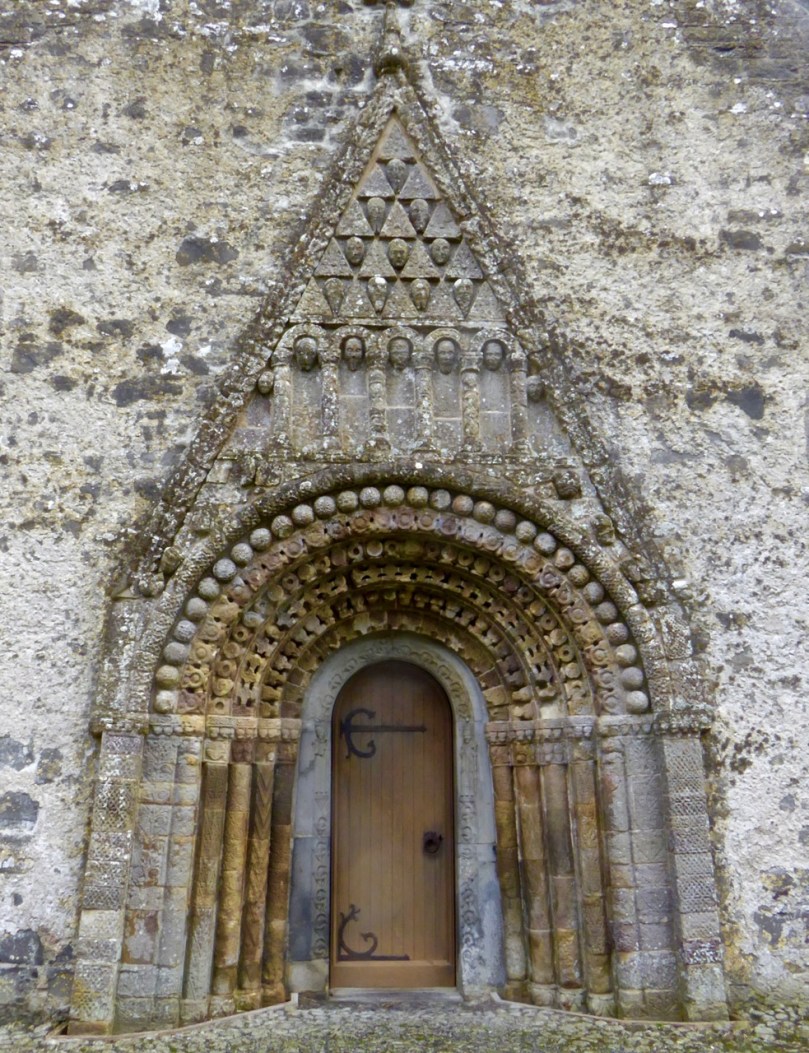
Clonfert Doorway

Clonfert Cathedrall (Co Galway) has the most beautiful Romanesque doorway I have ever seen
Along the canals and rivers, flora and fauna
Top left: in case you might get too happy with yourself; top right: the imposing gates to Portumna Castle, Co Galway, a 17th century house now owned and managed by the Office of Public Works; Bottom left: I peeped inside the priest’s section of a confession box and observed how he maintains an efficient count of time spent on each confession; bottom right; we disturb the rooks at Ballycowan Castle, Co Offaly

HC Studio, Athlone

Athlone Cathedral (Co Westmeath) has a gorgeous set of enormous windows from the Harry Clarke Studios – this is a detail from just one of them.

Can you detect a future post or two?

The Navel of Ireland

eyes of the goddess

Today we happened upon the Navel of Ireland. That’s the name given to the Hill of Uisneach in the townland of Loughanavally, in the barony of Rathconrath, in the county of Westmeath. It’s an archaeological centre of powerful cultural significance, one of (possibly) six ‘royal’ sites in the island of Ireland.

palace rendering

Seen in the developing visitor centre below the Hill – an artist’s reconstruction of the ‘Royal Palace’ on the Hill of Uisneach, County Westmeath

Today, Ireland is divided into four provinces: Leinster, Ulster, Munster and Connacht. The Irish word for this division is cúige, which literally means ‘fifth part’. That’s confusing, until you learn that there was, before the Norman invasion, a fifth province, known as Mide. The Irish word Midhe means ‘middle’. Mide has survived as a county – Meath; but this large county was divided in two during the time of Henry VIII, and we now have both Meath and Westmeath.

Justin the guide 2

catstone in context 2
Upper picture – Justin, our tour guide, explains the significance of the earthwork known as the ‘Royal Palace’. Lower picture – approaching the Navel of Ireland, the focal point of the Hill of Uisneach

Uisneach was probably the ancient headquarters of the fifth province, but was also particularly important because it was the place where all the provinces came together. The provinces were formerly administered by the dynasties, or ruling families of the day, and it is likely that they met up here to ensure that laws were fair and consistent through the whole of the land, and also to exchange news and stories, to feast, and to hold contests. In that latter context the tradition survives – rugby and hurling contests between the provinces in Ireland are madly important events – and their followers positively tribal!

ancient trackway 2

distant fort 2

Upper picture – an ancient trackway appears to lead to another circular enclosure on a distant hilltop (shown in the lower picture)

Uisneach is privately owned – and a working farm – but we are fortunate that the owner fully appreciates the significance of the place and allows access – by permission – through the services of a number of guides who are well versed in its known history and traditions. Our tour guide today was Justin – a complete Uisneach enthusiast. We followed him for two hours and were shown many of the currently accessible sites. There are very many more: access to others is being worked on, as is a small visitor centre, so a visit to Uisneach is an evolving experience. Some of the hill was excavated, intermittently, over a period of years during the 1920s by R A S Macalister and R L Praeger. In 2001 a long term project was started by Dr Roseanne Schot  of NUI Galway: this is continuing. Future plans for the archaeological investigations include aerial Lidar surveys which could uncover hidden features and artefacts without excavation.

Justin talks about the first archaeological excavators of the Hill (left) and (right) describes the ‘wood henge’ which has been found by laser scanning on the Hill’s summit

While the science of archaeology is being focussed on Uisneach, the equally important investigations of folkore and mythology (the stories of the hill) are also in full swing. Naturally, St Patrick made an appearance on the hill back in the day (we were shown his stone ‘bed’) and I was fascinated to read, later, that Geoffrey of Monmouth in his 11th century History of the Kings of Britain tells how stones from Uisneach were magically transported to Stonehenge. From the top of the hill it is said that you can see twenty counties – and all four (five?) provinces. The day of our visit was not quite clear enough for this, but we did ascend to the summit, where we could see the remains of a passage tomb – perhaps five thousand years old – although these had been disturbed and disbursed by the Ordnance Survey, who placed a trig point there back in the 1800s.

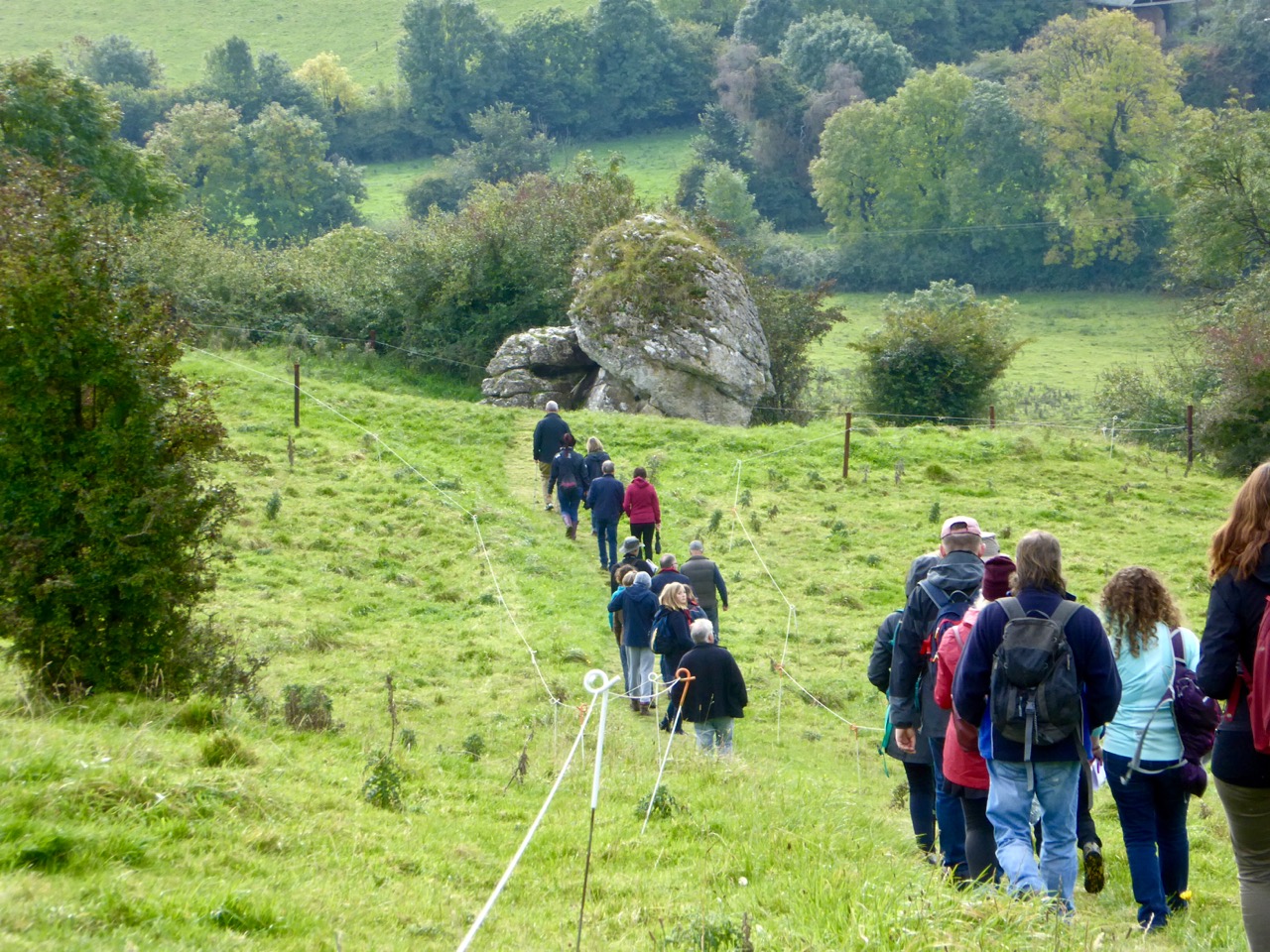
walking to the catstone

Our visit to The Catstone, an enormous glacial erratic which became the meeting place of the chieftains of all the provinces of Ireland

The goal of our little expedition was the Navel of Ireland – by tradition the centre of the whole land, and the place where the meetings of dynasties took place. It’s a little way on from the summit of the hill and only enjoys some of the views, but it is marked by an enormous natural boulder set into a circular earthwork of human construction: Justin painted a word picture for us of each of the chieftains sitting at the head of his own province on the banks of the earthwork and facing the stone while all the important affairs of state were discussed. Culturally this was where the provinces met. In relatively modern times the boulder has been called The Catstone: some say this is because it resembles a cat, others would have it that a cat is a traditional symbol for a place where our world meets the ‘otherworld’.

decorating the goddess

Upper left – the entrance to Uisneach symbolises the Bealtainne Fires which have been celebrated on the hilltop. Upper right – an image of Lugh on the shores of the lake (middle pictures) where he is said to have met his end. Lower picture – Eriu being adorned with autumnal hues

On our way down from the hill we met with a large crowd coming up. They were off to the Catstone for a ceremony of their own which involved drumming and singing – and, possibly, making contact with the ‘otherworld’ themselves. I think there’s a continuity here: a gathering place imbued with some deep significance and referenced to Irish mythology through Eriu, a goddess who gave her name to Ireland, and Lugh – a god or ancient hero who, according to the stories, met his death in a lake near the summit of the hill. Whatever your beliefs, there’s no denying that the Hill of Uisneach has been an empowering place in ancient times, and remains so today.

With thanks to Justin for such an erudite and enthusiastic tour of the Hill, and great appreciation of the interest and generosity of the Clarke family in allowing the Hill to be researched and visited

Below – off to the ceremony on Uisneach Hill

ready for the ceremony

‘Auf der Walz’ – The Journeymen

on the summit

I am always happy to find longstanding customs and traditions still going strong, especially when they are as relevant today as they have been over countless generations. This summer we chanced upon two strangers from Germany who passed through Ballydehob. They were journeymen blacksmiths: lads who had completed their apprenticeships at home and were now ‘Auf der Walz’ (on the road) – gaining experience in the wider world.

inese-journeymen

Here are the two Journeymen who travelled the west of Ireland’captured’ by photographer Inese MJ – she came across them in her local supermarket! I am very grateful to Inese for allowing me to use her excellent photograph which comes from her own blog, here.

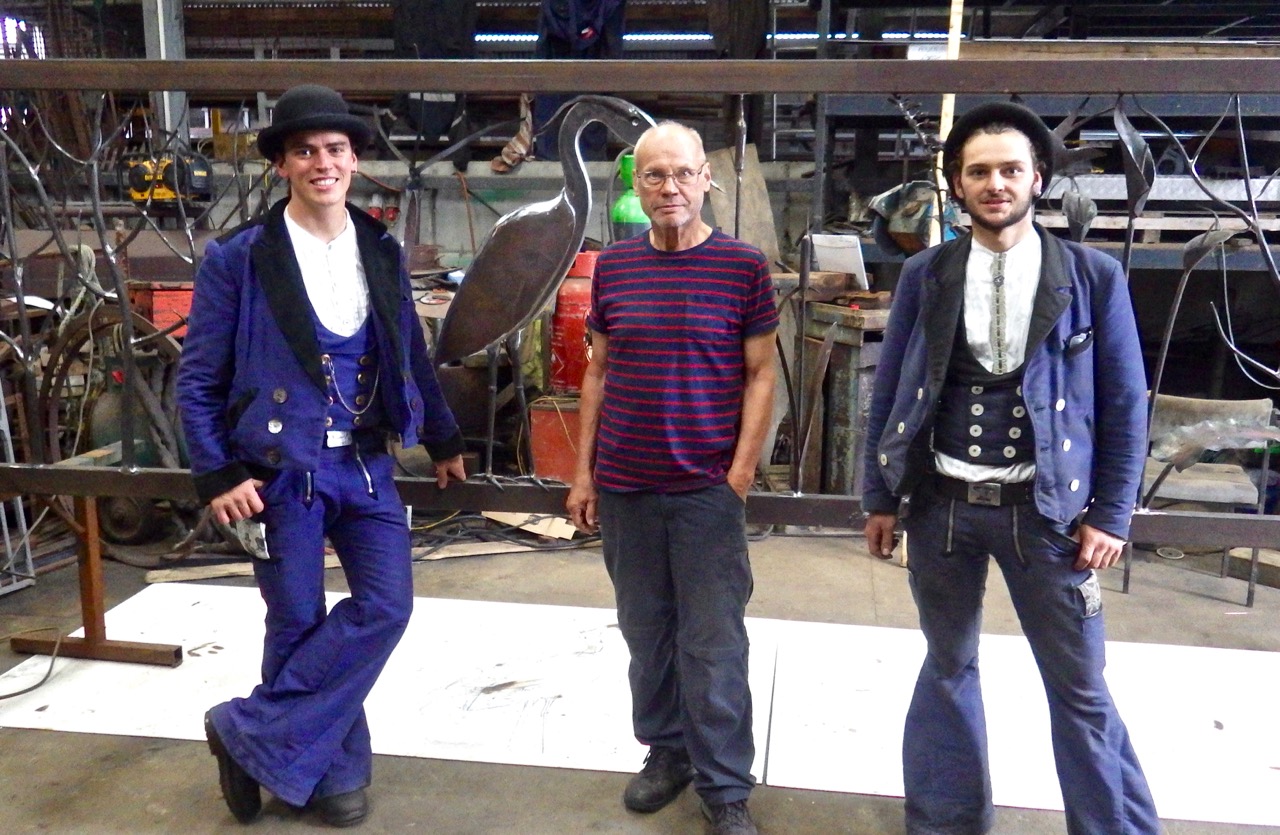
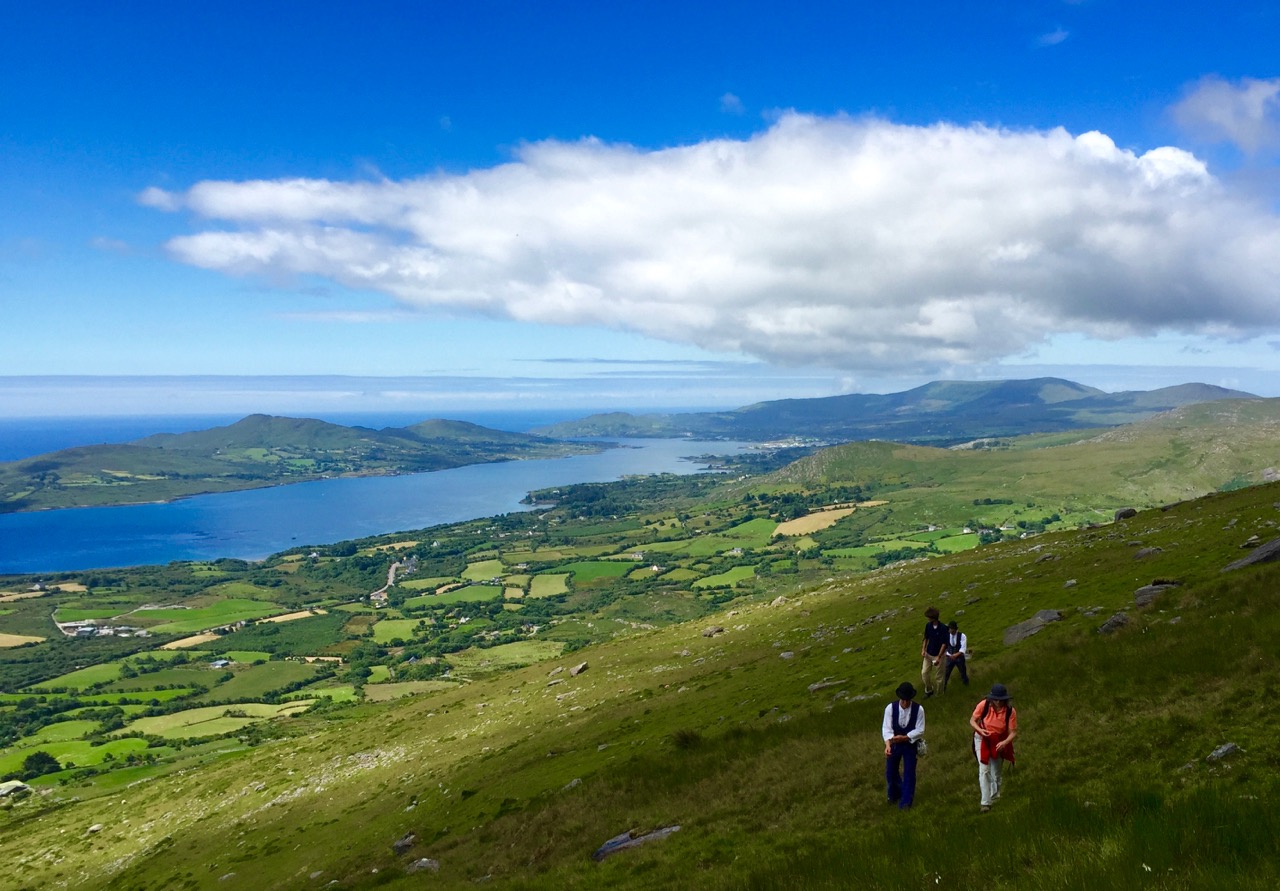
The tradition of the Journeyman Brotherhood is centuries old, originating in the Craftsmen Guilds of Europe during the Middle Ages and it is still practiced. In the past every young craftsperson who aspired to be a Master was, following his apprenticeship, required to leave home and not return for three years and a day. They had to stay at least 50 km away, but the journeys of the more adventurous candidates involved crossing oceans and continents. Simon and Benjamin – seen in the top picture after an exploratory climb to the summit of Hungry Hill on the Beara Peninsula – are from Munich and Frankfurt. They are wearing the uniform of their trade, known as the Kluft: this is how they are required to dress during their travels. The number of buttons on their waistcoats show the number of hours in a day they expect to work – in this case eight. When they leave home they have only a token sum of money each, and they must return with the same sum, no more. The purpose of the journey is not to seek their fortune, but to improve their knowledge and skills and give them a rich life experience, preparing them for becoming masters of their craft. It is a prerequisite that Journeymen cannot set out unless they are unmarried, childless and debt-free.

Left – a typical Charlottenburger used to carry the Journeyman’s possessions. Right – group of three in Germany looking for their preferred mode of transport

Other traditions which have to be observed by the true Journeymen include carrying only the most basic possessions with them: clothes to work in and the tools of their trade. These are wrapped in a small blanket, 80 cm square, known as a Charlottenburger. They also often carry a crooked walking stick, called a Stenz, which they have made themselves. Mobile phones are not allowed! Notably, Journeymen usually have gold bracelets and earrings: these may be pawned or sold, but only in cases of dire emergency… I learned that the earring tradition refers back to a time when each apprentice had a nail hammered through his earlobe to mark that he had reached the stage of his apprenticeship which allowed him to go out into the world and remain a stranger until he had completed his journey. Some sources suggest that the term Journeyman comes from the French Journée, meaning ‘journey’ – but this is not correct. Journée means ‘day’ in modern French, but its medieval root is the latin diurnata, which in fact means ‘a day’s work’ or ‘a day’s travel’.

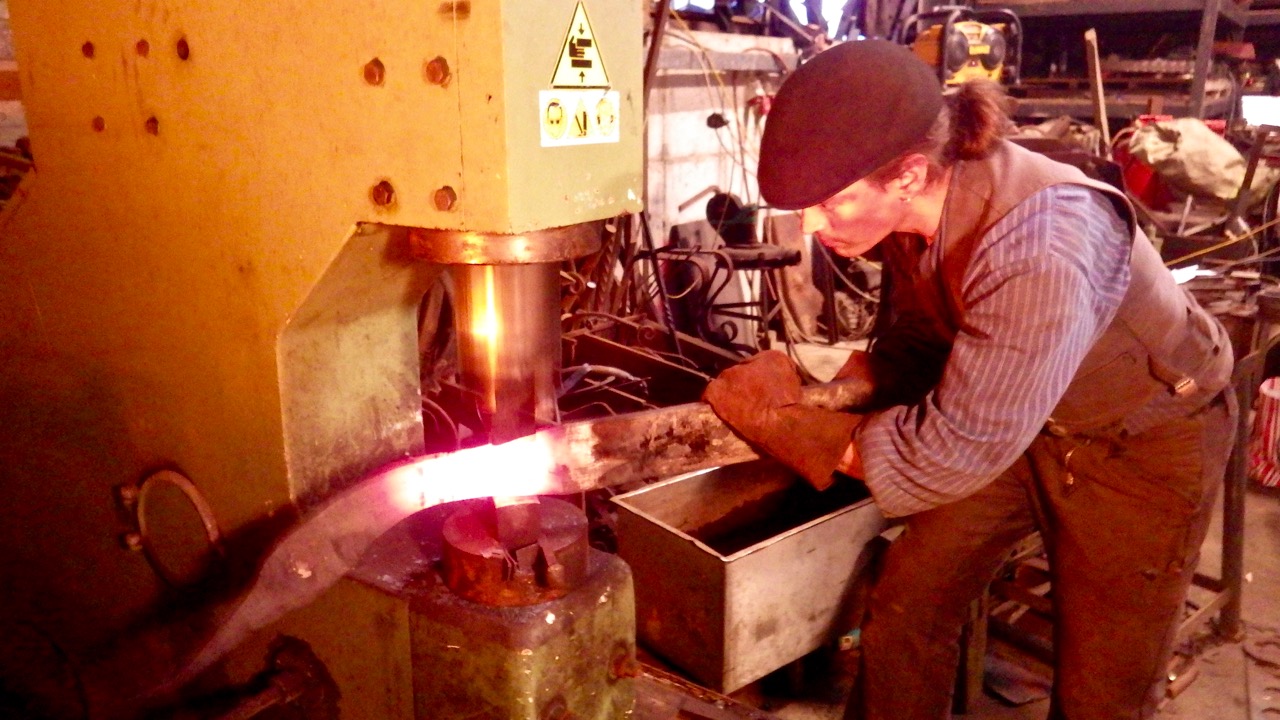
Journeymen surrounded by the tools of their trade in the forge at Lowertown

Simon and Benjamin were fortunate that in Ballydehob they bumped into our neighbour Dietrich: although he and Hildegard have lived here for much of their working lives they were brought up in Germany and were aware of the Journeyman tradition. They immediately found a project for the two young blacksmiths: constructing a new gate for their entrance. John Joe Bowen of the local forge at Lowertown was very helpful in allowing a space in his workshops for the boys to set to work.

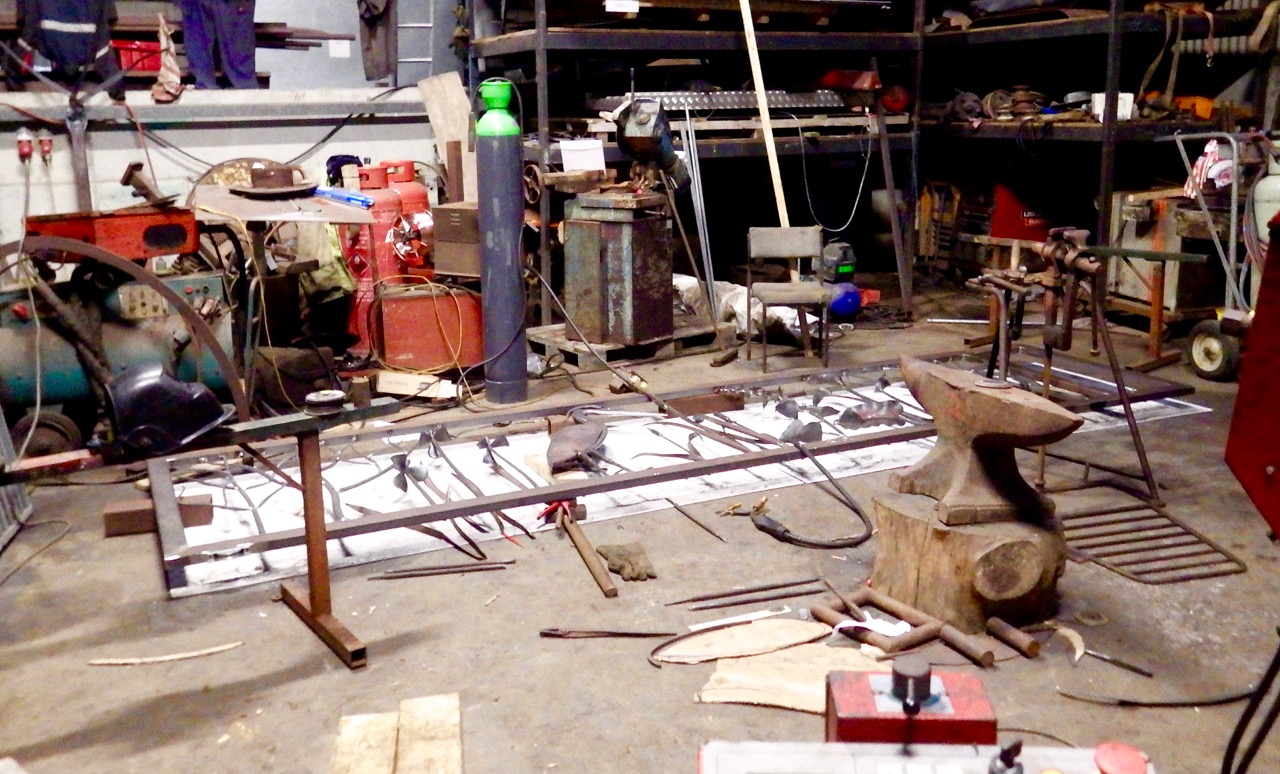
blank canvas

The process. Top – blank canvas: laying the full-size design out on the workshop floor. Above – learning from real life: how to fabricate a metal foxglove

We followed reports of the gate-making process with great interest, but were not allowed to see the completed design until the ‘official unveiling’. Dietrich and Hildegard recorded the various stages and have most kindly allowed me to use their photographs of the construction process (and the hike up Hungry Hill) reproduced here.

hammering

making the heron

From design to reality. Top left – Hildegard supervising the assembly and – top right – her design concept drawings. Above – a metal heron takes shape

The gate is a masterpiece. Made in West Cork, it reflects the environment of the place. It’s elegant, and unique. Although it appears complex, it is very understated: I think Dietrich and Hildegard have perfectly summed up the zeitgeist of our own time here in our small townland. Its inspiration is in nature, yet it is a technologically up-to-date piece of fine engineering.

piecing it together

on the floor

sanding the gate

dietrich, journeymen and gate

The construction process, and Dietrich and ‘The Boys’

We were privileged to be at the ‘launch party’. I have never been to a formal gate opening before! Dietrich cut the ribbon and then revealed the finished product to our eager eyes. This work must surely have been the highlight of the travels of these Journeyman from afar: they learned so much about observation and the translation of ideas into practical form.

the gate

Benjamin and Simon were not at the ‘launch’; they were already far away, continuing with their travels and their education. But they must carry with them good memories of the West of Ireland. Good luck to them both!

on hungry hill

Experiencing beautiful West Cork – the Beara Peninsula, summer 2016