The Navel of Ireland

eyes of the goddess

Today we happened upon the Navel of Ireland. That’s the name given to the Hill of Uisneach in the townland of Loughanavally, in the barony of Rathconrath, in the county of Westmeath. It’s an archaeological centre of powerful cultural significance, one of (possibly) six ‘royal’ sites in the island of Ireland.

palace rendering

Seen in the developing visitor centre below the Hill – an artist’s reconstruction of the ‘Royal Palace’ on the Hill of Uisneach, County Westmeath

Today, Ireland is divided into four provinces: Leinster, Ulster, Munster and Connacht. The Irish word for this division is cúige, which literally means ‘fifth part’. That’s confusing, until you learn that there was, before the Norman invasion, a fifth province, known as Mide. The Irish word Midhe means ‘middle’. Mide has survived as a county – Meath; but this large county was divided in two during the time of Henry VIII, and we now have both Meath and Westmeath.

Justin the guide 2

catstone in context 2
Upper picture – Justin, our tour guide, explains the significance of the earthwork known as the ‘Royal Palace’. Lower picture – approaching the Navel of Ireland, the focal point of the Hill of Uisneach

Uisneach was probably the ancient headquarters of the fifth province, but was also particularly important because it was the place where all the provinces came together. The provinces were formerly administered by the dynasties, or ruling families of the day, and it is likely that they met up here to ensure that laws were fair and consistent through the whole of the land, and also to exchange news and stories, to feast, and to hold contests. In that latter context the tradition survives – rugby and hurling contests between the provinces in Ireland are madly important events – and their followers positively tribal!

ancient trackway 2

distant fort 2

Upper picture – an ancient trackway appears to lead to another circular enclosure on a distant hilltop (shown in the lower picture)

Uisneach is privately owned – and a working farm – but we are fortunate that the owner fully appreciates the significance of the place and allows access – by permission – through the services of a number of guides who are well versed in its known history and traditions. Our tour guide today was Justin – a complete Uisneach enthusiast. We followed him for two hours and were shown many of the currently accessible sites. There are very many more: access to others is being worked on, as is a small visitor centre, so a visit to Uisneach is an evolving experience. Some of the hill was excavated, intermittently, over a period of years during the 1920s by R A S Macalister and R L Praeger. In 2001 a long term project was started by Dr Roseanne Schot  of NUI Galway: this is continuing. Future plans for the archaeological investigations include aerial Lidar surveys which could uncover hidden features and artefacts without excavation.

Justin talks about the first archaeological excavators of the Hill (left) and (right) describes the ‘wood henge’ which has been found by laser scanning on the Hill’s summit

While the science of archaeology is being focussed on Uisneach, the equally important investigations of folkore and mythology (the stories of the hill) are also in full swing. Naturally, St Patrick made an appearance on the hill back in the day (we were shown his stone ‘bed’) and I was fascinated to read, later, that Geoffrey of Monmouth in his 11th century History of the Kings of Britain tells how stones from Uisneach were magically transported to Stonehenge. From the top of the hill it is said that you can see twenty counties – and all four (five?) provinces. The day of our visit was not quite clear enough for this, but we did ascend to the summit, where we could see the remains of a passage tomb – perhaps five thousand years old – although these had been disturbed and disbursed by the Ordnance Survey, who placed a trig point there back in the 1800s.

walking to the catstone

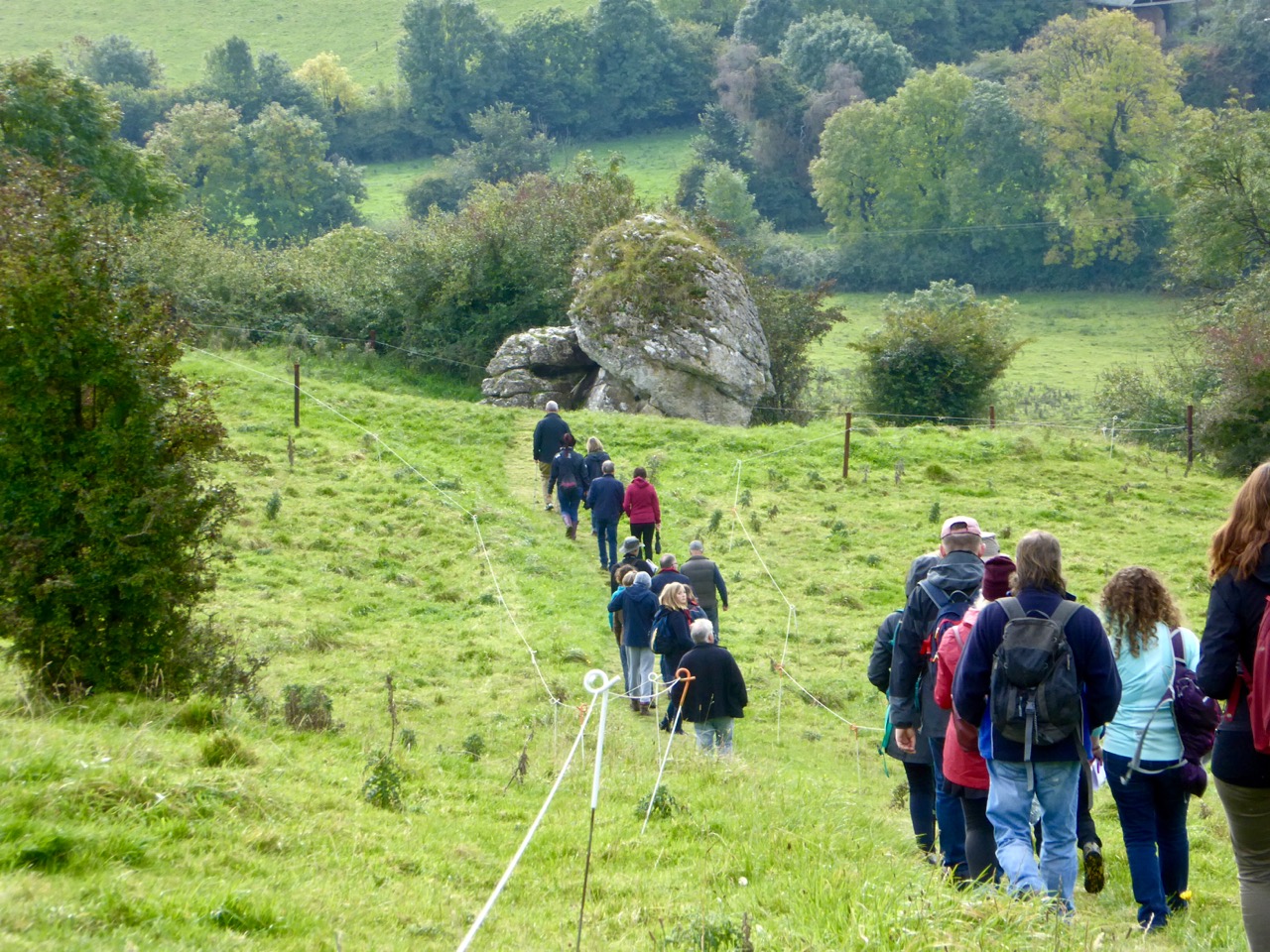
Our visit to The Catstone, an enormous glacial erratic which became the meeting place of the chieftains of all the provinces of Ireland

The goal of our little expedition was the Navel of Ireland – by tradition the centre of the whole land, and the place where the meetings of dynasties took place. It’s a little way on from the summit of the hill and only enjoys some of the views, but it is marked by an enormous natural boulder set into a circular earthwork of human construction: Justin painted a word picture for us of each of the chieftains sitting at the head of his own province on the banks of the earthwork and facing the stone while all the important affairs of state were discussed. Culturally this was where the provinces met. In relatively modern times the boulder has been called The Catstone: some say this is because it resembles a cat, others would have it that a cat is a traditional symbol for a place where our world meets the ‘otherworld’.

decorating the goddess

Upper left – the entrance to Uisneach symbolises the Bealtainne Fires which have been celebrated on the hilltop. Upper right – an image of Lugh on the shores of the lake (middle pictures) where he is said to have met his end. Lower picture – Eriu being adorned with autumnal hues

On our way down from the hill we met with a large crowd coming up. They were off to the Catstone for a ceremony of their own which involved drumming and singing – and, possibly, making contact with the ‘otherworld’ themselves. I think there’s a continuity here: a gathering place imbued with some deep significance and referenced to Irish mythology through Eriu, a goddess who gave her name to Ireland, and Lugh – a god or ancient hero who, according to the stories, met his death in a lake near the summit of the hill. Whatever your beliefs, there’s no denying that the Hill of Uisneach has been an empowering place in ancient times, and remains so today.

With thanks to Justin for such an erudite and enthusiastic tour of the Hill, and great appreciation of the interest and generosity of the Clarke family in allowing the Hill to be researched and visited

Below – off to the ceremony on Uisneach Hill

ready for the ceremony

‘Auf der Walz’ – The Journeymen

on the summit

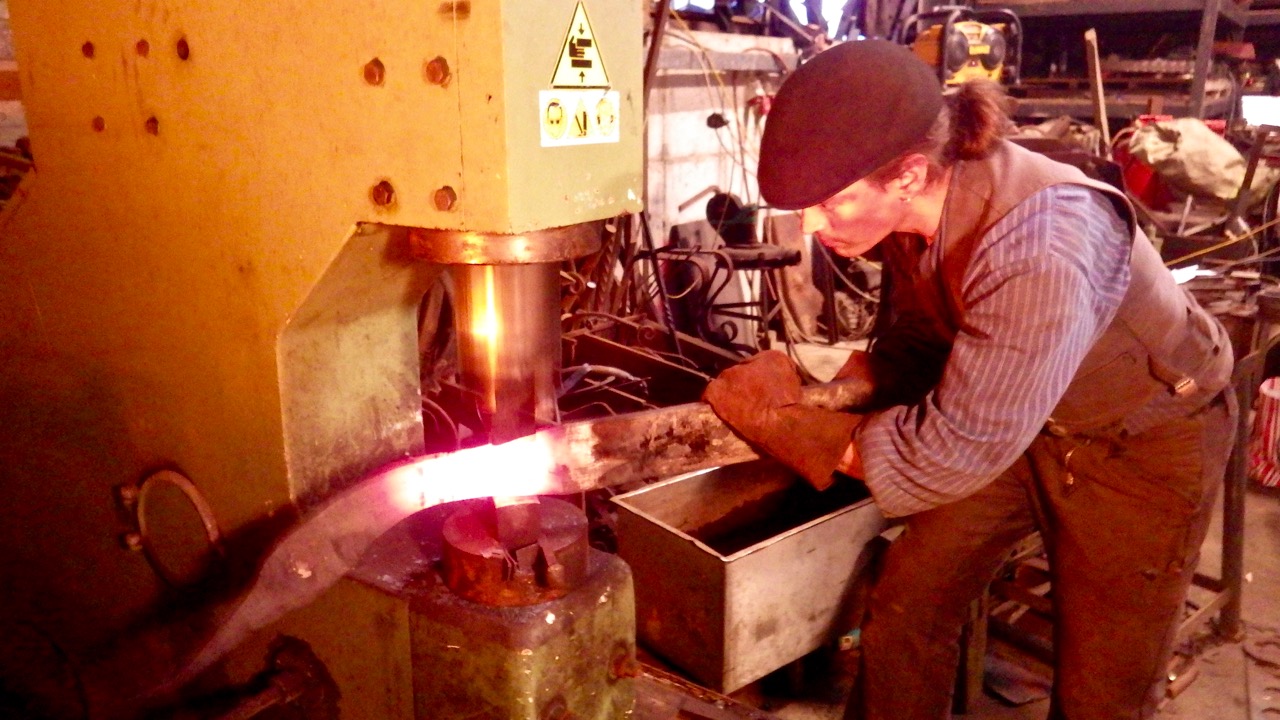
I am always happy to find longstanding customs and traditions still going strong, especially when they are as relevant today as they have been over countless generations. This summer we chanced upon two strangers from Germany who passed through Ballydehob. They were journeymen blacksmiths: lads who had completed their apprenticeships at home and were now ‘Auf der Walz’ (on the road) – gaining experience in the wider world.

inese-journeymen

Here are the two Journeymen who travelled the west of Ireland’captured’ by photographer Inese MJ – she came across them in her local supermarket! I am very grateful to Inese for allowing me to use her excellent photograph which comes from her own blog, here.

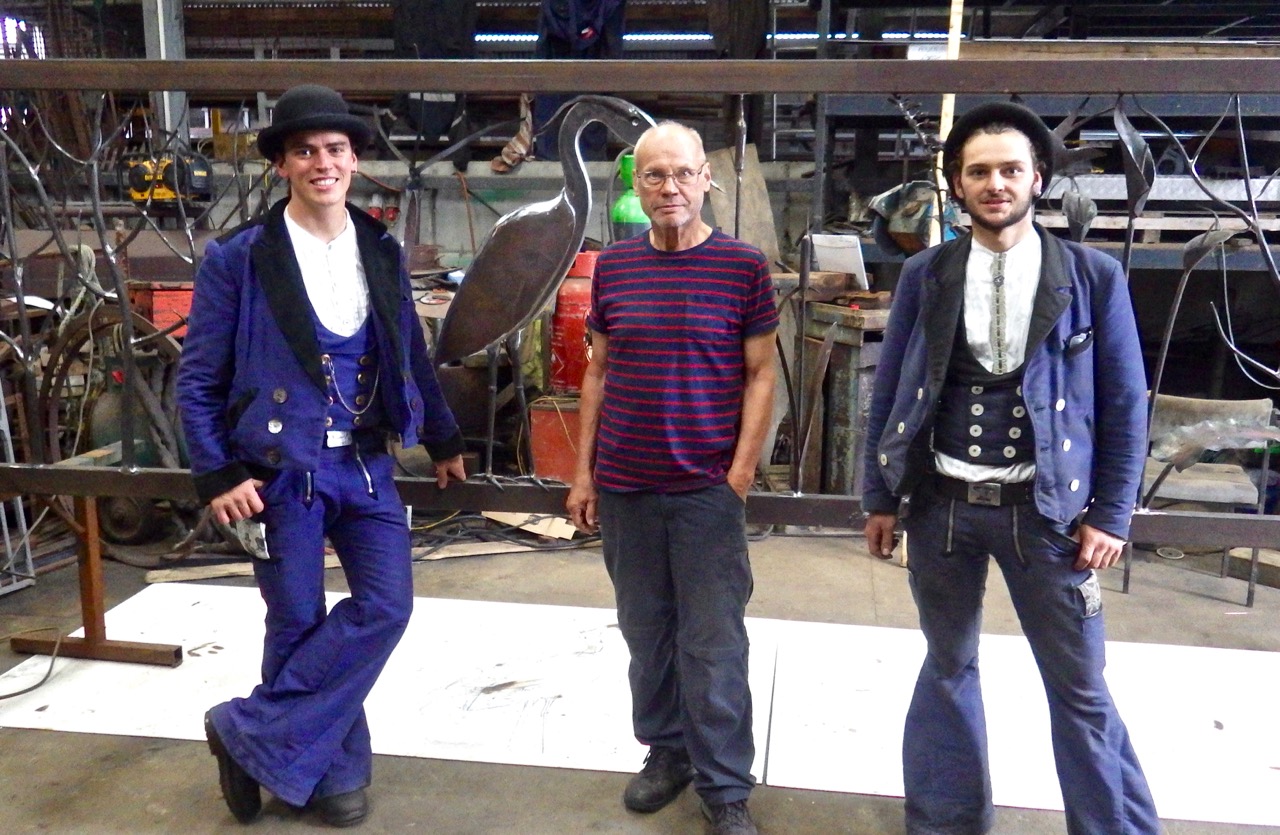
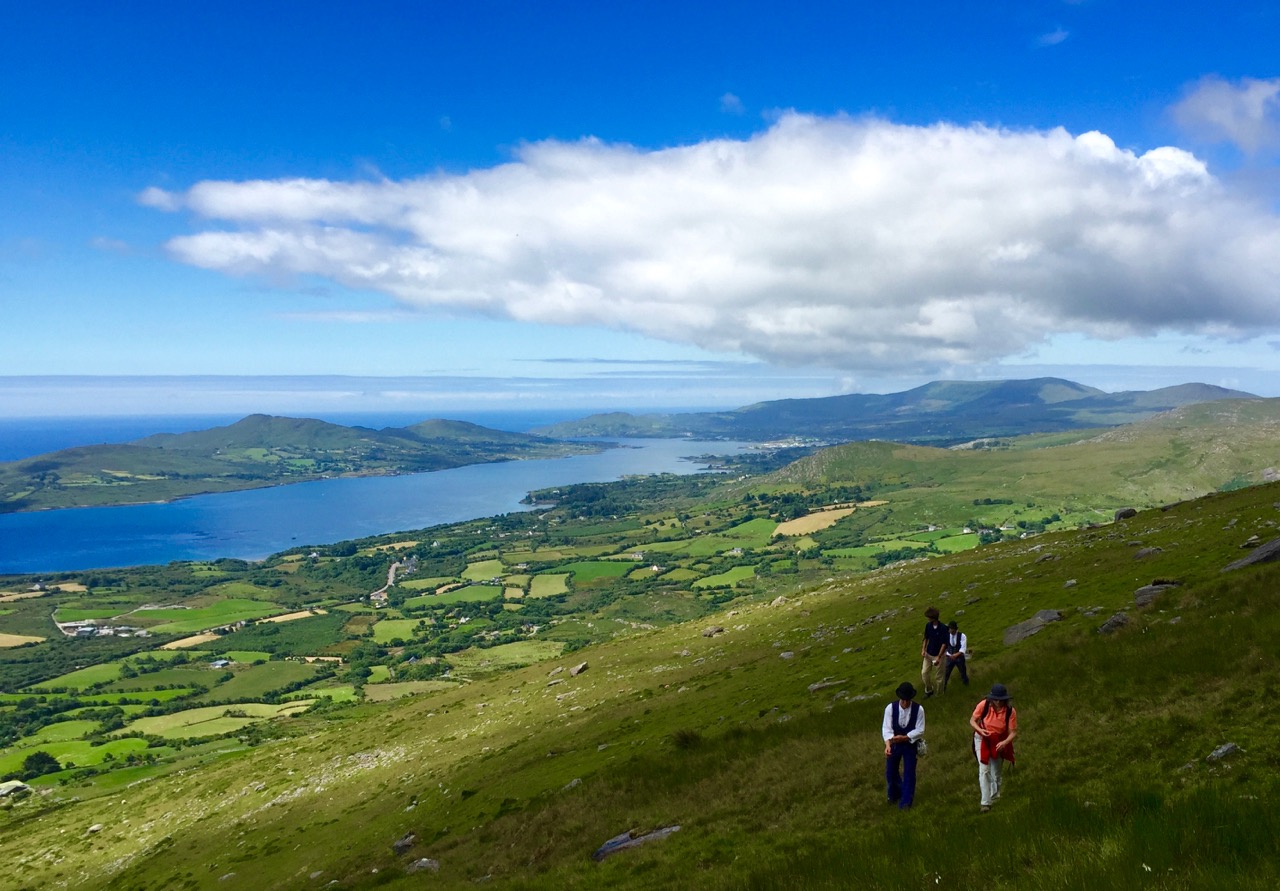
The tradition of the Journeyman Brotherhood is centuries old, originating in the Craftsmen Guilds of Europe during the Middle Ages and it is still practiced. In the past every young craftsperson who aspired to be a Master was, following his apprenticeship, required to leave home and not return for three years and a day. They had to stay at least 50 km away, but the journeys of the more adventurous candidates involved crossing oceans and continents. Simon and Benjamin – seen in the top picture after an exploratory climb to the summit of Hungry Hill on the Beara Peninsula – are from Munich and Frankfurt. They are wearing the uniform of their trade, known as the Kluft: this is how they are required to dress during their travels. The number of buttons on their waistcoats show the number of hours in a day they expect to work – in this case eight. When they leave home they have only a token sum of money each, and they must return with the same sum, no more. The purpose of the journey is not to seek their fortune, but to improve their knowledge and skills and give them a rich life experience, preparing them for becoming masters of their craft. It is a prerequisite that Journeymen cannot set out unless they are unmarried, childless and debt-free.

Left – a typical Charlottenburger used to carry the Journeyman’s possessions. Right – group of three in Germany looking for their preferred mode of transport

Other traditions which have to be observed by the true Journeymen include carrying only the most basic possessions with them: clothes to work in and the tools of their trade. These are wrapped in a small blanket, 80 cm square, known as a Charlottenburger. They also often carry a crooked walking stick, called a Stenz, which they have made themselves. Mobile phones are not allowed! Notably, Journeymen usually have gold bracelets and earrings: these may be pawned or sold, but only in cases of dire emergency… I learned that the earring tradition refers back to a time when each apprentice had a nail hammered through his earlobe to mark that he had reached the stage of his apprenticeship which allowed him to go out into the world and remain a stranger until he had completed his journey. Some sources suggest that the term Journeyman comes from the French Journée, meaning ‘journey’ – but this is not correct. Journée means ‘day’ in modern French, but its medieval root is the latin diurnata, which in fact means ‘a day’s work’ or ‘a day’s travel’.

Journeymen surrounded by the tools of their trade in the forge at Lowertown

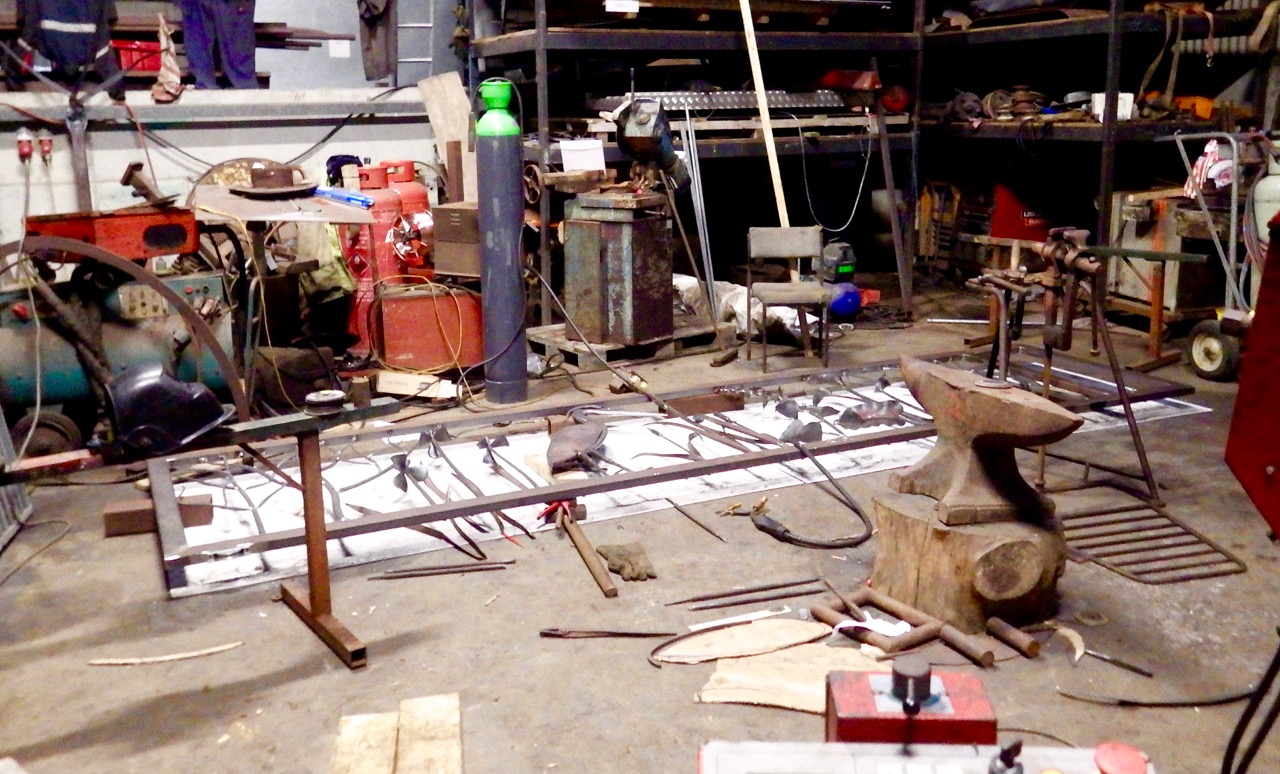
Simon and Benjamin were fortunate that in Ballydehob they bumped into our neighbour Dietrich: although he and Hildegard have lived here for much of their working lives they were brought up in Germany and were aware of the Journeyman tradition. They immediately found a project for the two young blacksmiths: constructing a new gate for their entrance. John Joe Bowen of the local forge at Lowertown was very helpful in allowing a space in his workshops for the boys to set to work.

blank canvas

The process. Top – blank canvas: laying the full-size design out on the workshop floor. Above – learning from real life: how to fabricate a metal foxglove

We followed reports of the gate-making process with great interest, but were not allowed to see the completed design until the ‘official unveiling’. Dietrich and Hildegard recorded the various stages and have most kindly allowed me to use their photographs of the construction process (and the hike up Hungry Hill) reproduced here.

hammering

making the heron

From design to reality. Top left – Hildegard supervising the assembly and – top right – her design concept drawings. Above – a metal heron takes shape

The gate is a masterpiece. Made in West Cork, it reflects the environment of the place. It’s elegant, and unique. Although it appears complex, it is very understated: I think Dietrich and Hildegard have perfectly summed up the zeitgeist of our own time here in our small townland. Its inspiration is in nature, yet it is a technologically up-to-date piece of fine engineering.

piecing it together

on the floor

sanding the gate

dietrich, journeymen and gate

The construction process, and Dietrich and ‘The Boys’

We were privileged to be at the ‘launch party’. I have never been to a formal gate opening before! Dietrich cut the ribbon and then revealed the finished product to our eager eyes. This work must surely have been the highlight of the travels of these Journeyman from afar: they learned so much about observation and the translation of ideas into practical form.

the gate

Benjamin and Simon were not at the ‘launch’; they were already far away, continuing with their travels and their education. But they must carry with them good memories of the West of Ireland. Good luck to them both!

on hungry hill

Experiencing beautiful West Cork – the Beara Peninsula, summer 2016

The Old Mine Road

to the castle

Exactly two years ago I wrote a piece for this Journal – A Moment in Time – remarking on the very specific changes that we become aware of at the end of the summer: the holiday homes being closed up and shuttered; the boats being taken off their moorings and stored away in the boatyard; the shorebirds returning to their winter quarters. I finished up by pointing out that our own summers never end: we enjoy living in Cappaghglass just as much in the darker, colder days at the turning of the year as we do when the sun is high in the heavens.

cove gray day

high road gray day

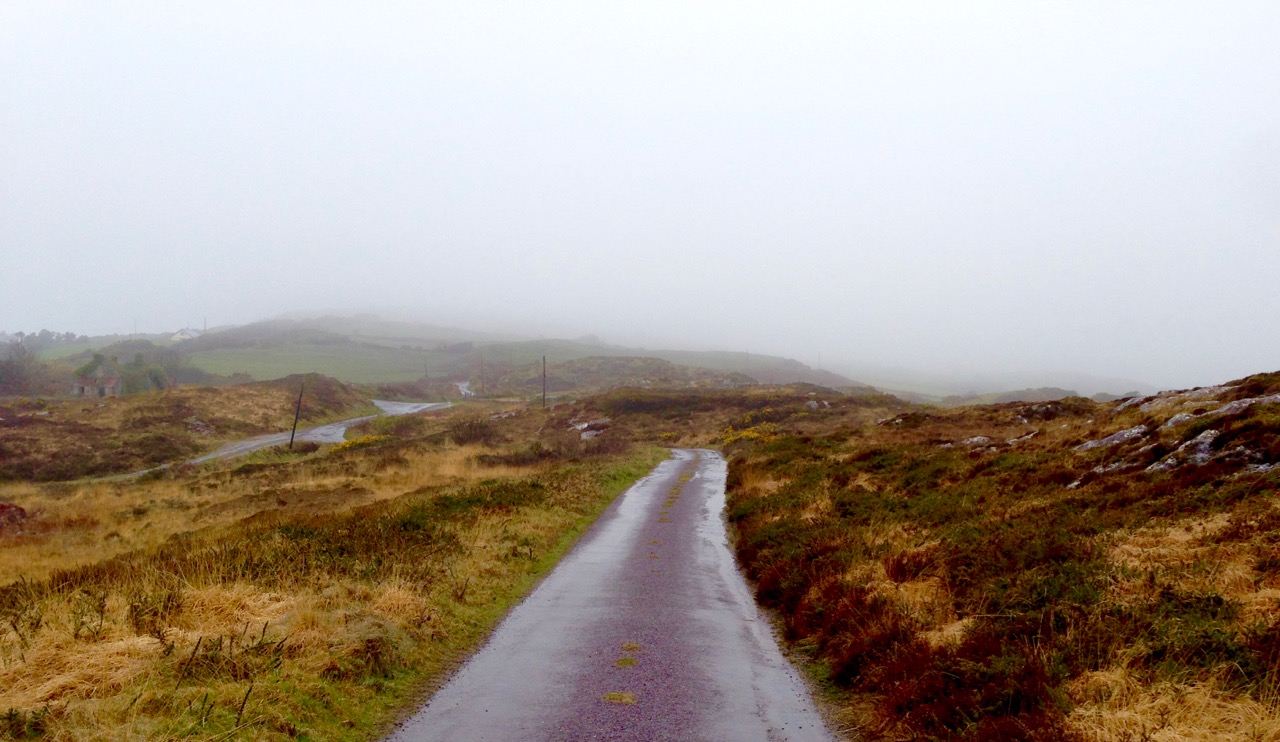
Top – starting point: Rossbrin Cove on a gray day. Bottom – The Old Mine Road wearing its raincoat

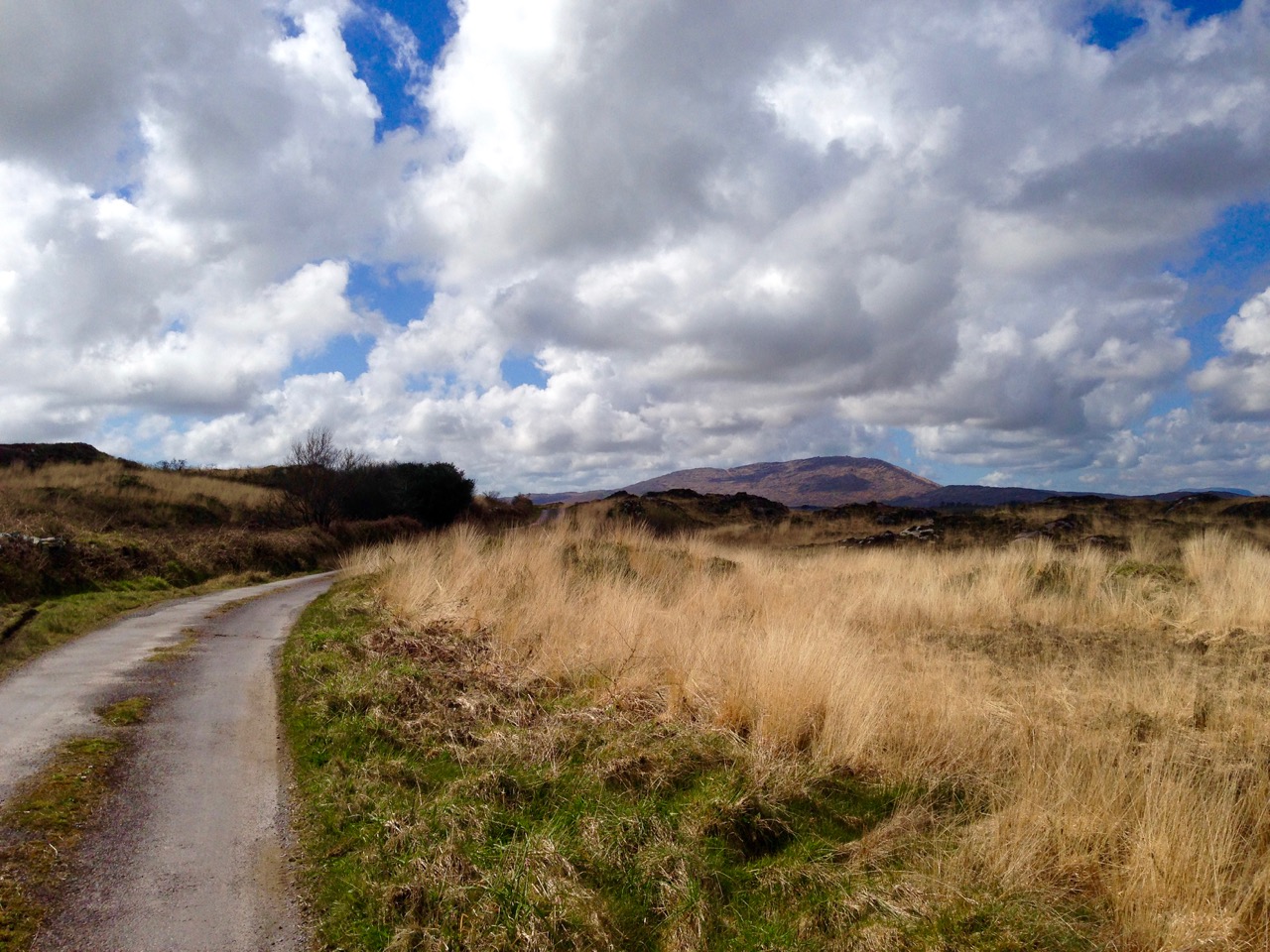
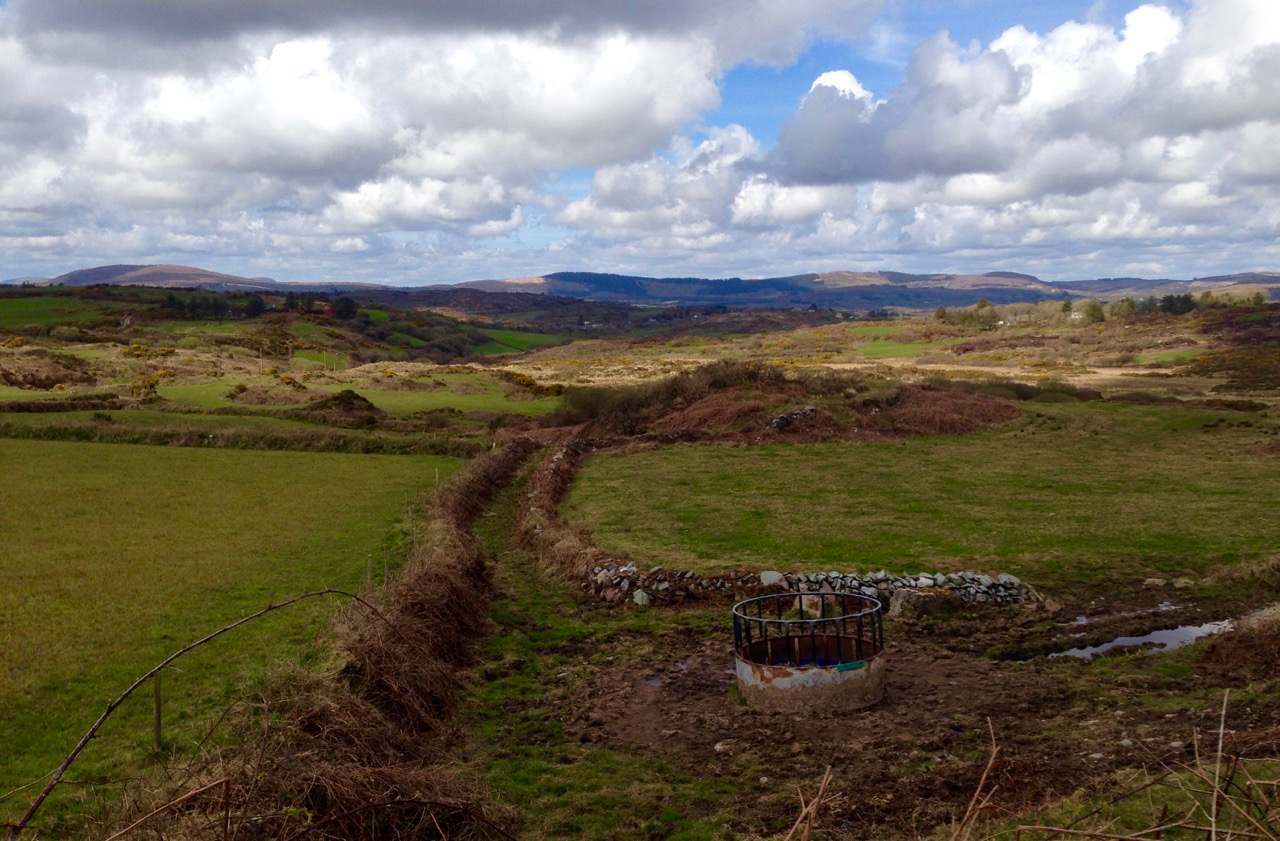
It is an idyllic life and we are privileged to have the quiet boreens to ourselves in all weathers. We have talked about Rossbrin Cove so often, in its many seasonal variations: for today’s post I’m taking the upward road through the townland, the route that I call The Old Mine Road. This road – or more accurately this series of lanes and byways – will take the traveller from the Cove into the little town of Ballydehob, and will pass through an old copper mining district which, two hundred years ago, saw heavy industry, intermittent employment, smoke, noise, pollution and desperate human working conditions where now ‘peace comes dropping slow’ with only the crying of the Choughs over an undisturbed backdrop of rock, heather and coarse grasses – and the occasional jumble of stones showing where there were once buildings, shafts and crumbling walls marking the old mine complex.

cappaghglass

captain's house sun

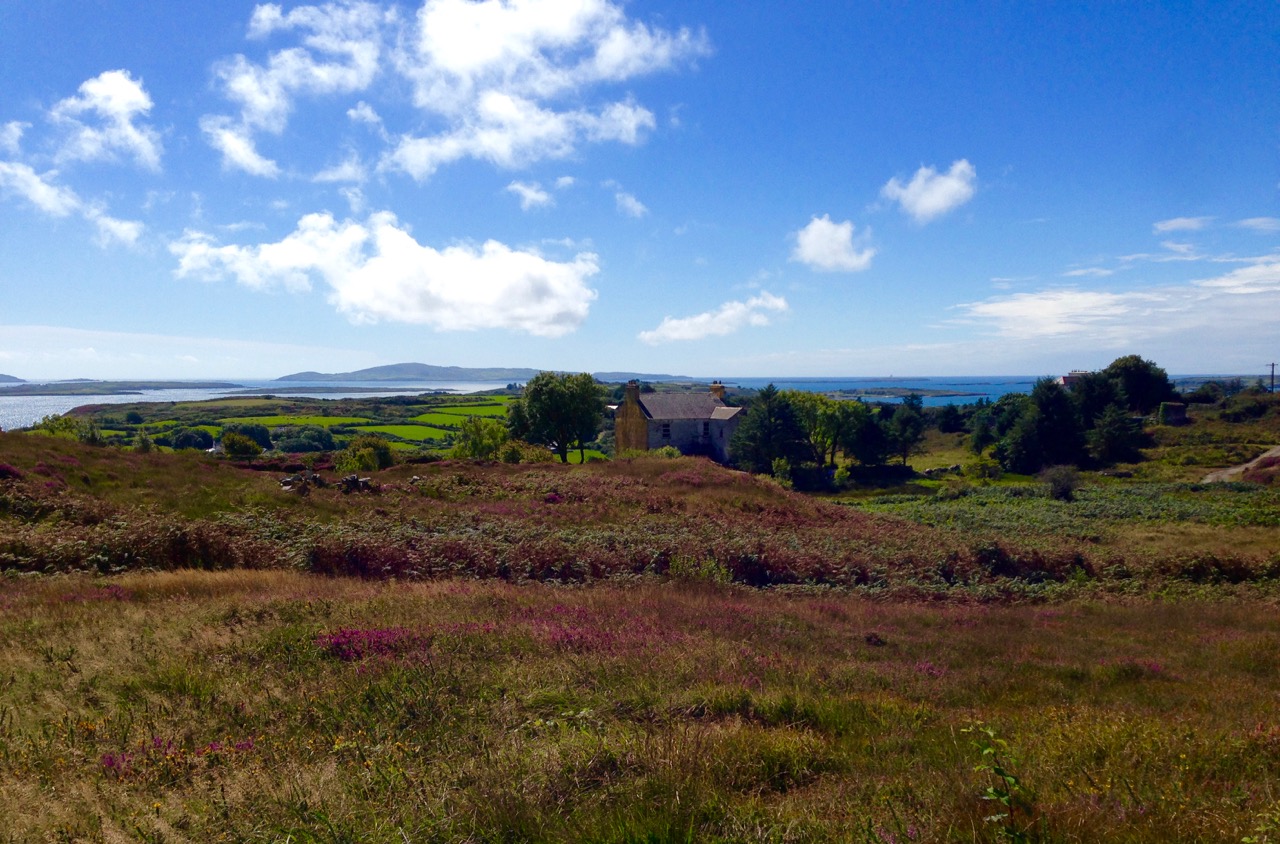
Top – the landscape of The Old Mine Road: Mount Gabriel dominates the horizon to the west. Bottom – looking from the road towards Roaringwater Bay: in the foreground is the site of old mine workings, now reclaimed by nature, with one of the two Mine Captain’s Houses in the centre and the stump of an old mine chimney on the right

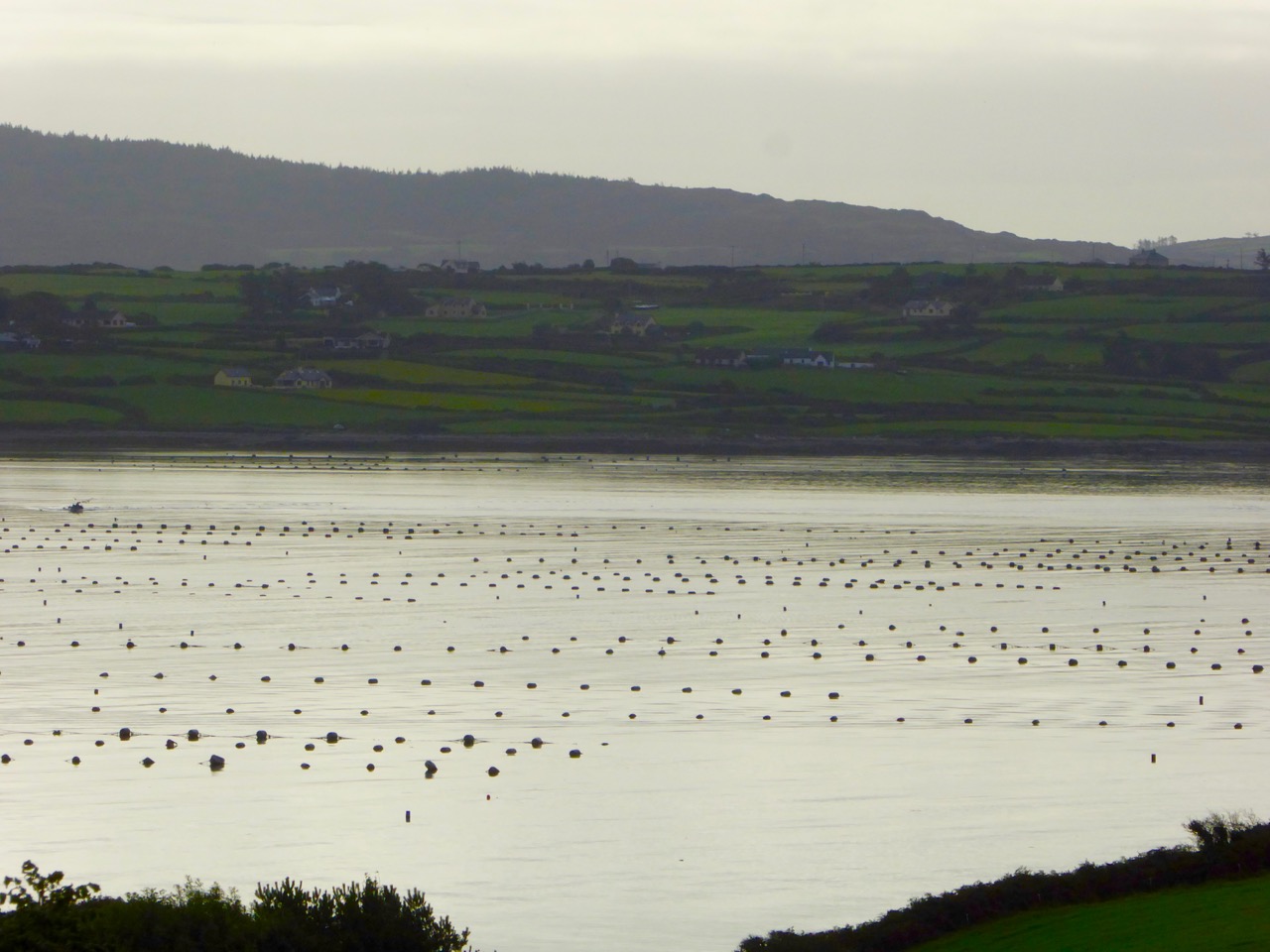
A walk along The Old Mine Road on a benign late September day will be rewarding because of the good air, the distant views to the Mounts Gabriel and Kidd, and with the bays of Roaringwater and Ballydehob below. You will find medieval history in the form of towerhouse castles, modern economy delineated by distinctive lines of mussel ropes spilling over the water and always alongside you the immediate wildness of a natural, undisturbed landscape. Views change as the way winds and dips – always interesting, always different, however many times you follow these routes.

mussel ropes

waving grass

mine buildings

Top – mussel ropes abundant in the Bay. Middle -waves of grass in the wild landscape to the north of the road. Bottom – ruins of old mine buildings can still be seen from the road

Autumn brings with it a certain melancholy. Time passes, our lives move relentlessly forward. We enjoy the changing of the seasons but we want to know that there will be so many more seasons to see. Each one will bring us unique experiences.

blue in the grass

from the road

Top – wildflowers in abundance on the boreens of Cappaghglass. Bottom – signs of old workings in the fields below the road

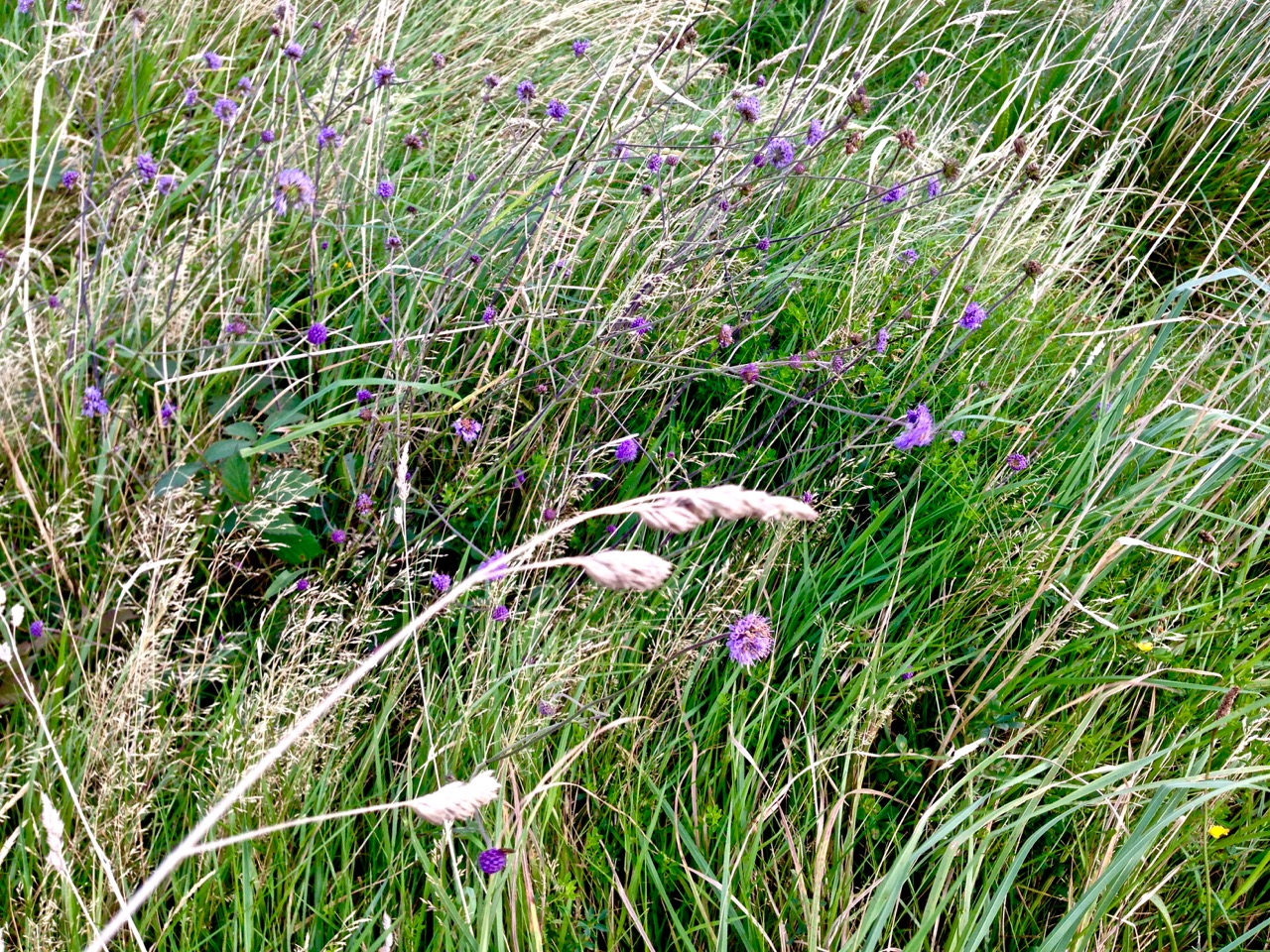
As I walk the old road, I can’t help trying to picture the scenes there from other times. I wonder what feelings the hard working miners had – did they take in the changing light and the views? Did they see the way the grasses moved with the wind, creating waves on the landscape? Did they have any time to notice nature’s fine details – the incredible variety, colours and designs of the wild flowers? Or was theirs just a drudging commute from cottage to workplace at dawn and dusk?

ballydehob wharf

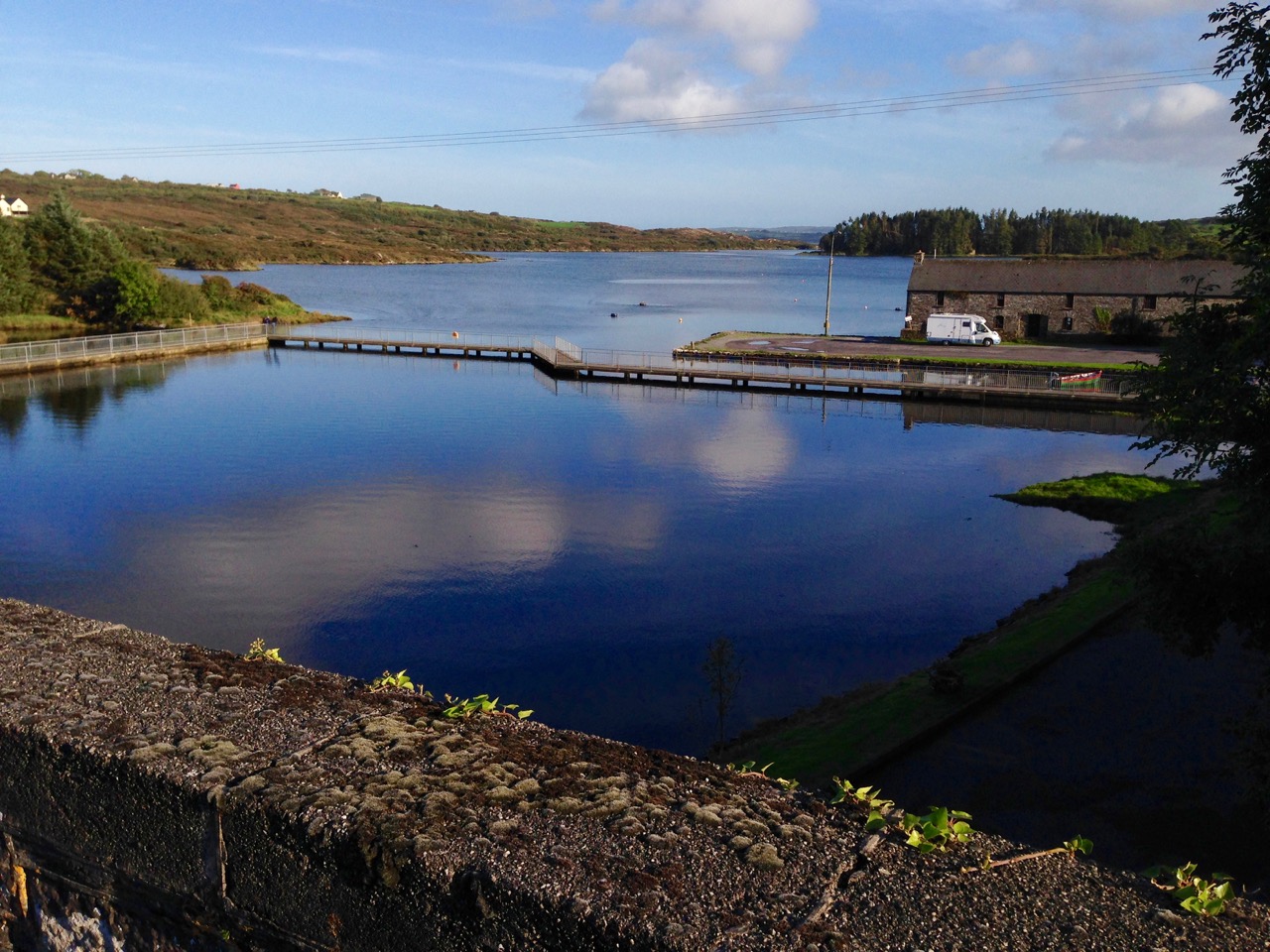
The end of the road: Ballydehob Wharf, which would have seen great activity (intermittedly) when the mines were in full swing. Cappagh Mine was operating between 1816 and 1873, with its maximum output of about 400 tons of ore being produced in 1827

The poet Seamus Heaney has much to say about the hardship – and order – of a physical working life; his own father had worked the land and the poet was infected with memories of his younger days. This poem – Postscript – has a different emphasis but strikes me as a similar commentary on encounters with the landscape, although it’s concerned with another geography:

…And some time make the time to drive out west
Into County Clare, along the Flaggy Shore,
In September or October, when the wind
And the light are working off each other
So that the ocean on one side is wild
With foam and glitter, and inland among stones
The surface of a slate-grey lake is lit
By the earthed lightning of a flock of swans,
Their feathers roughed and ruffling, white on white,
Their fully-grown headstrong-looking heads
Tucked or cresting or busy underwater.
Useless to think you’ll park or capture it
More thoroughly. You are neither here nor there,
A hurry through which known and strange things pass
As big soft buffetings come at the car sideways
And catch the heart off guard and blow it open…
wall and heather

Green & Silver

title

This book review has been a long time coming: I first read the book in 1963! I was still at school then, and I was given it as a prize for essay writing (although I have no memory of the essay). I chose Green & Silver because I was already familiar with the author – Lionel Thomas Caswall Rolt, more usually known as L T C Rolt or ‘Tom’ Rolt. I had found in the local library his first book – Narrow Boat – written in the late 1930s when the author and his wife were living and travelling through England and Wales on board a converted canal boat. At that time the canals of Britain were still in commercial use, although water transport as a way of life was declining. I was smitten with the romanticism of the nomadic life of the canal boatmen – and of Tom Rolt – and Narrow Boat is beautifully illustrated with woodcuts by Denys Watkins-Pitchford, which enhance the experience of reading this classic book (which has never been out of print). Sir Compton Mackenzie wrote “it is an elegy of classic restraint unmarred by any trace of sentiment… Rolt’s pen is as sure as the brush of a Cotman… Narrow Boat will go on the shelf with White and Cobbett and Hudson.”

Woodcuts by Denys Watkins-Pitchford which illustrated the first edition of  Narrow Boat by L T C Rolt, published by Eyre + Spottiswoode, 1944

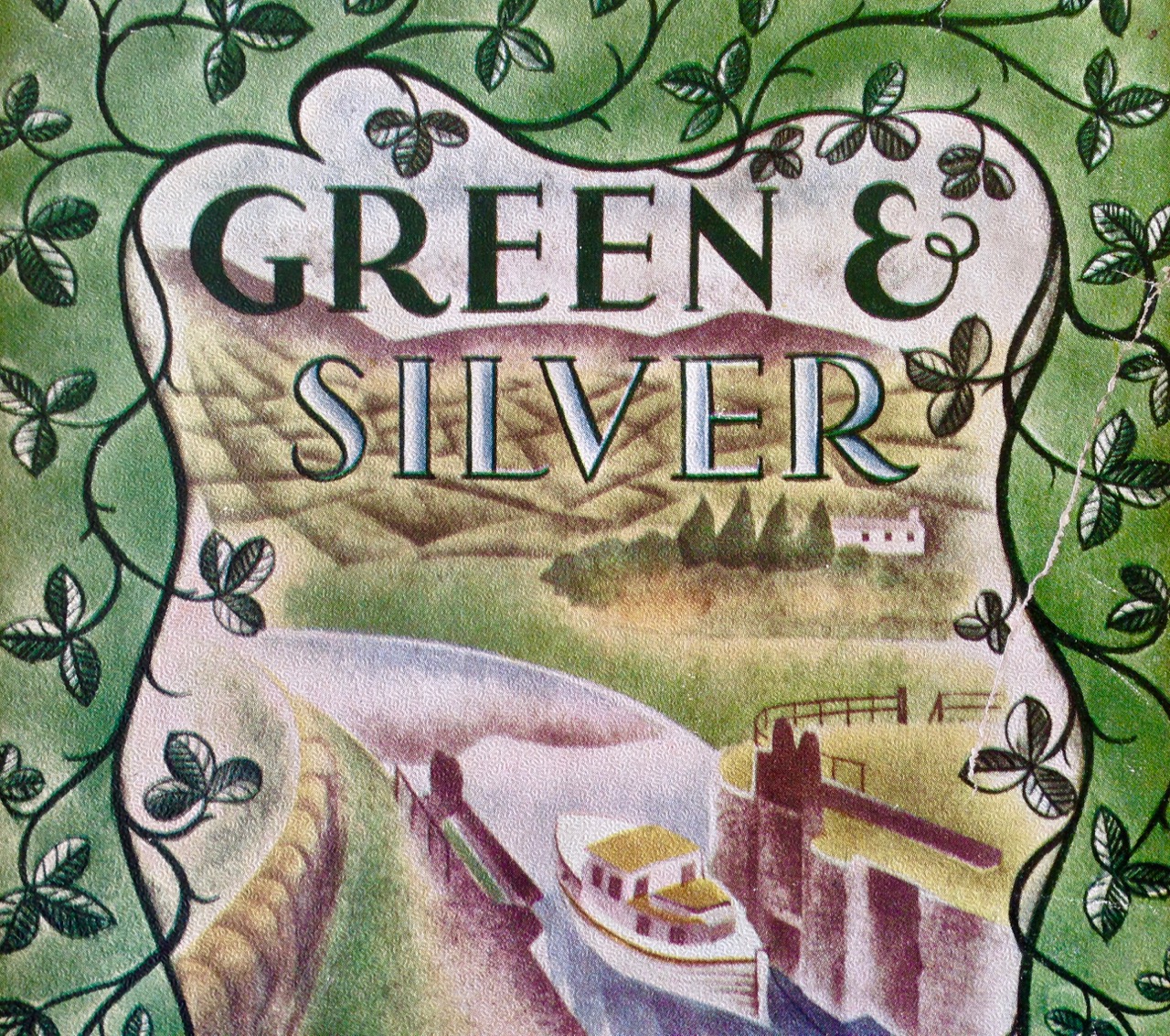
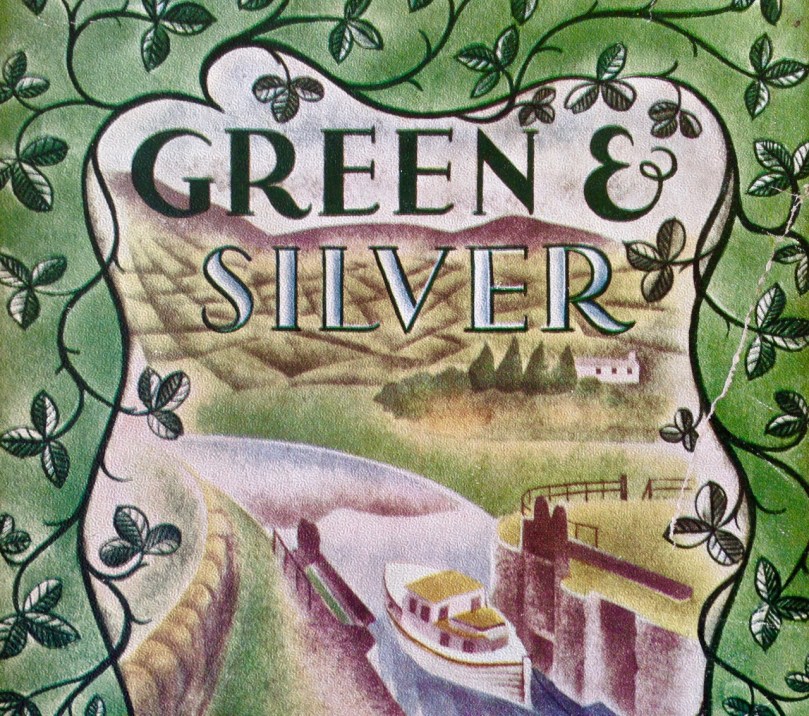
When choosing my essay prize, therefore, it seemed perfectly natural to go for another of Rolt’s books. A brief foray through book catalogues (remember – there was no internet in those days!) brought to light Green & Silver, first published in 1949. I established that it was an account of a journey by the same author through the canals of Ireland. It was the cover as much as anything else that attracted me to the book – it stood out as something quite unusual; I little knew that the content would have a profound effect on me, instilling an immediate yearning to visit the land across the Irish Sea, about which I knew very little.

Left – the bookplate pasted into my first edition of Green & Silver (it’s now in print again); right – the exuberant dust cover which attracted me to the book, painted by Evelyn Hunt

It was, however, to be a dozen years before I first visited Ireland (and then it was more a search for music than the canals), but Rolt’s works as a whole (he wrote more than 50 books) cemented in me an enduring interest in engineering, industrial archaeology, and, specifically, water transport. I spent my youthful leisure time campaigning to restore canals, physically digging them out of dereliction and even building lock gates with oak beams and elm boards using traditional techniques. Within a few years of reading Rolt I had acquired and restored my own boat and followed in his wake, spending a year travelling over the British canal system and writing a new book about their engineering and architecture.
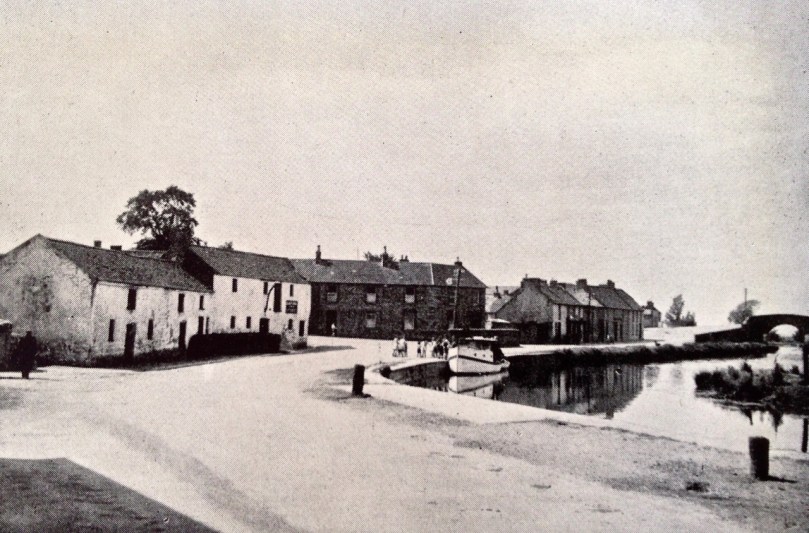
canal port

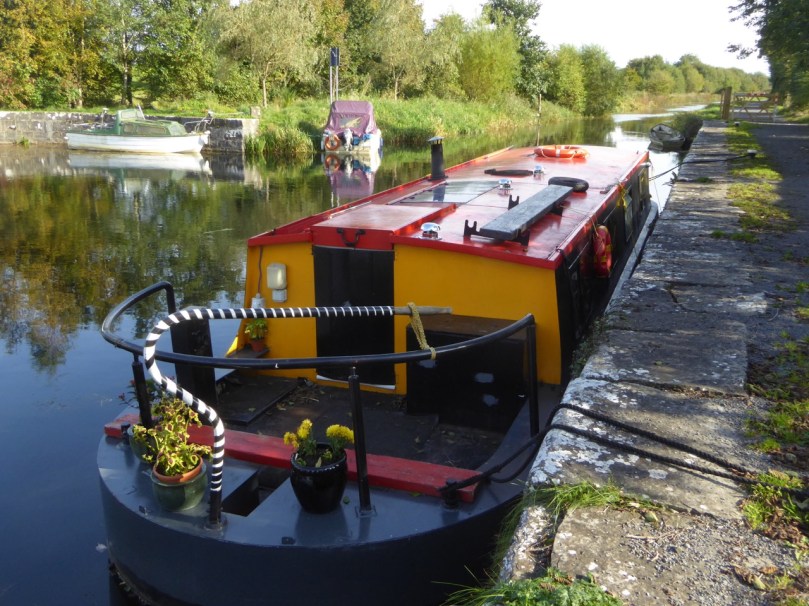
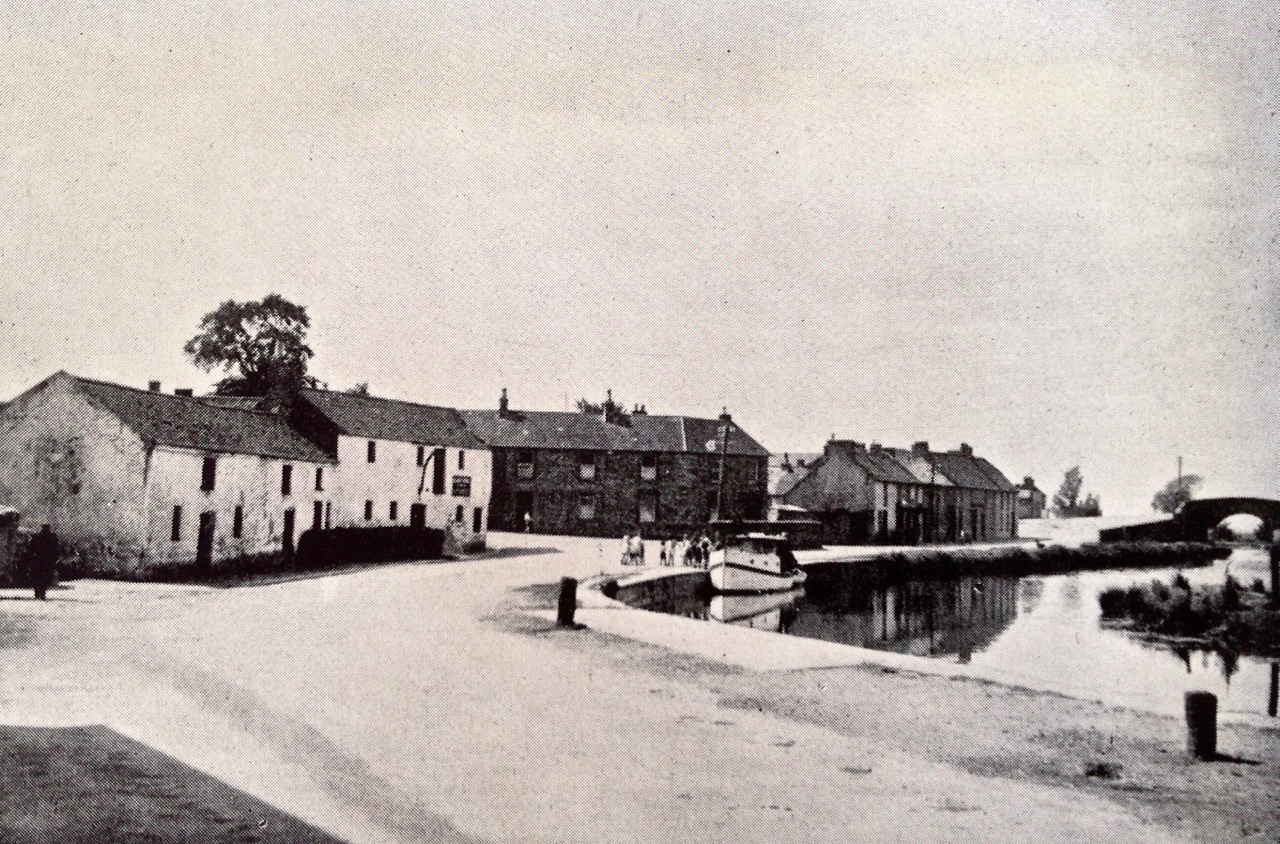
Green & Silver is illustrated with photographs taken by Angela Rolt on the journey through Ireland. They are a valuable and evocative record of life just after the ‘Emergency’ years of the Second World War. Here is the Rolts’ borrowed boat – Le Coq – at Robertstown, on the Grand Canal: pleasure boating was virtually unheard of in rural Ireland in those days and the voyagers seemed much troubled by groups of children who gathered whenever they moored up, all demanding to see – and board – the ‘yacht’

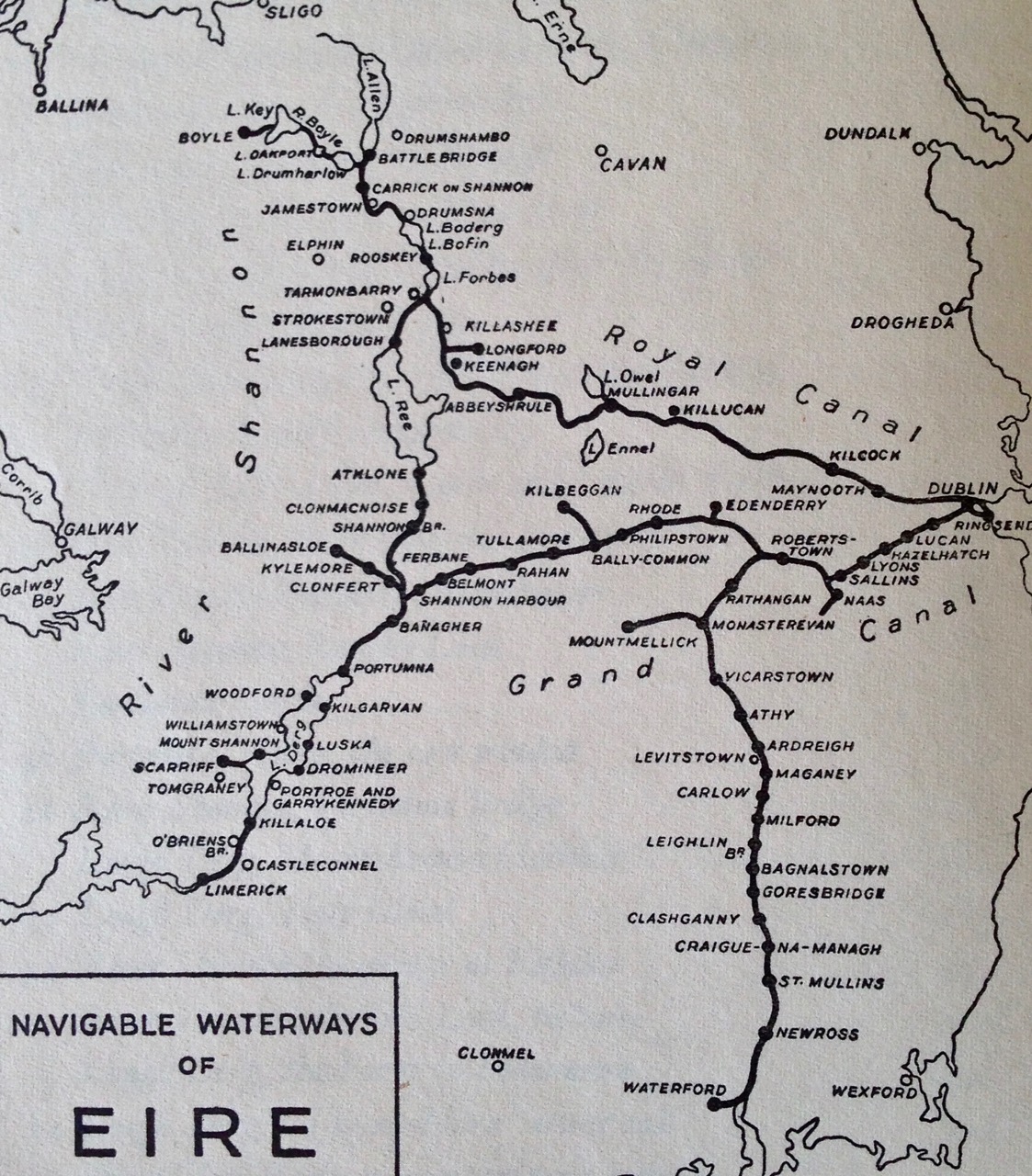
Tom and Angela Rolt faced many challenges in their journey – well documented in the book. They set out to navigate the Shannon, starting at Athlone, to the entrance of the Grand Canal at Shannon Harbour; along that canal to Dublin, then up the Royal Canal to rejoin the Shannon at Tarmonbarry and exploring the river northwards as far as Lough Allen, also taking in the River Boyle. The final part of the journey to Athlone crossed Lough Ree. The ‘Emergency’ years and their aftermath saw restrictions on the availability of fuel: this affected the Rolts’ plans, although they did complete their journey. They encountered commercial traffic on the Grand Canal – some horse drawn – and a little on the Royal Canal, which became derelict shortly after their travels. Le Coq was probably the last boat to complete the circular journey in the twentieth century: after significant efforts by the Inland Waterways Association of Ireland (founded in 1954) the Royal Canal has been fully restored to navigation and reopened in 2010.
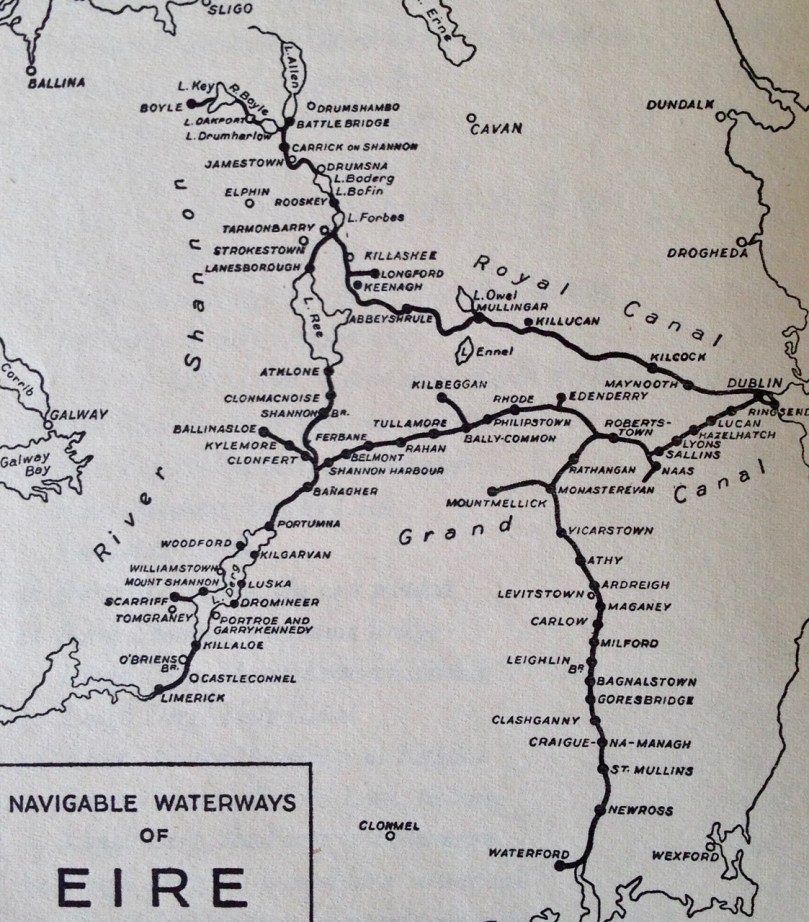
navigable waterways

From Green & Silver: a map of the navigable waterways of Ireland at the time of the book’s publication in 1949

This book is full of descriptive detail and observation of the ways of life and the people that Tom Rolt encountered: every page fascinates. It’s hard to pick out any one section to exemplify the writing style, but here is an extract describing a visit to a corn mill at Cloondara in County Longford close to Richmond Harbour, the junction of the Royal Canal with the River Shannon (the mill ceased operations in the 1950s, not long after Rolt’s visit):

…Across the canal bridge there was a large corn mill which had seen better days but which I was pleased to see was still at work. Moreover it was not, as our few surviving [British] watermills are, relegated by the milling combine to grinding cattle meal. Cloondara Mill was grinding 100 per cent extraction flour for the village bakeries of the district. As we walked over the bridge a small water-turbine was churning merrily, driving the dynamo which provided electric light for the mill and the miller’s house. But the great undershot wheel which drove the mill from the waters of the Fallan River, a tributary of the Shannon, was still and silent. I knew why because, from somewhere in the dim recesses of the rambling stone building I could hear the chip chip of a mill-bill tapping away like some busy woodpecker. This Irish miller, like the English country millers who I have been fortunate enough to meet, was obviously proud of his mill and was delighted by our interest. Having assured himself that the stones being dressed were out of gear, he insisted upon opening the sluice for our benefit, setting the giant wheel revolving with a rumble and surge that wakened the mill and which, via a complex of wooden gearing, shafts and pulleys, set screens and sieves shaking and revolving to the very top of the building…
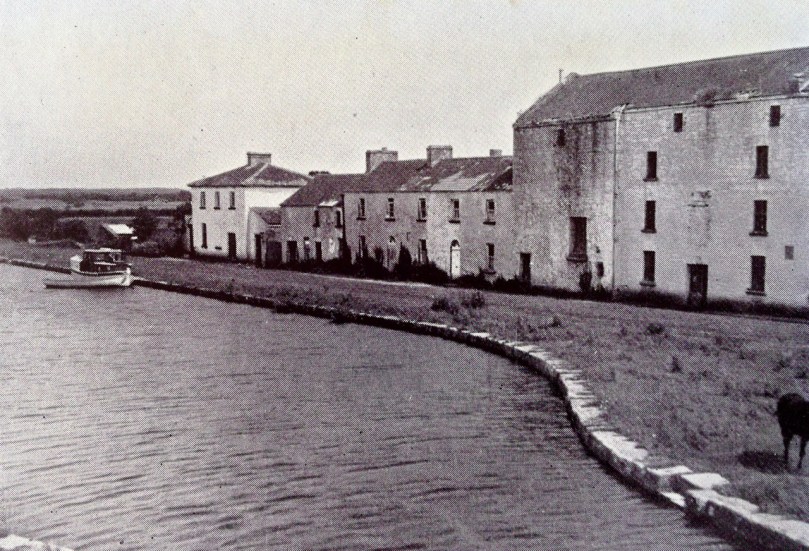
Cloondara

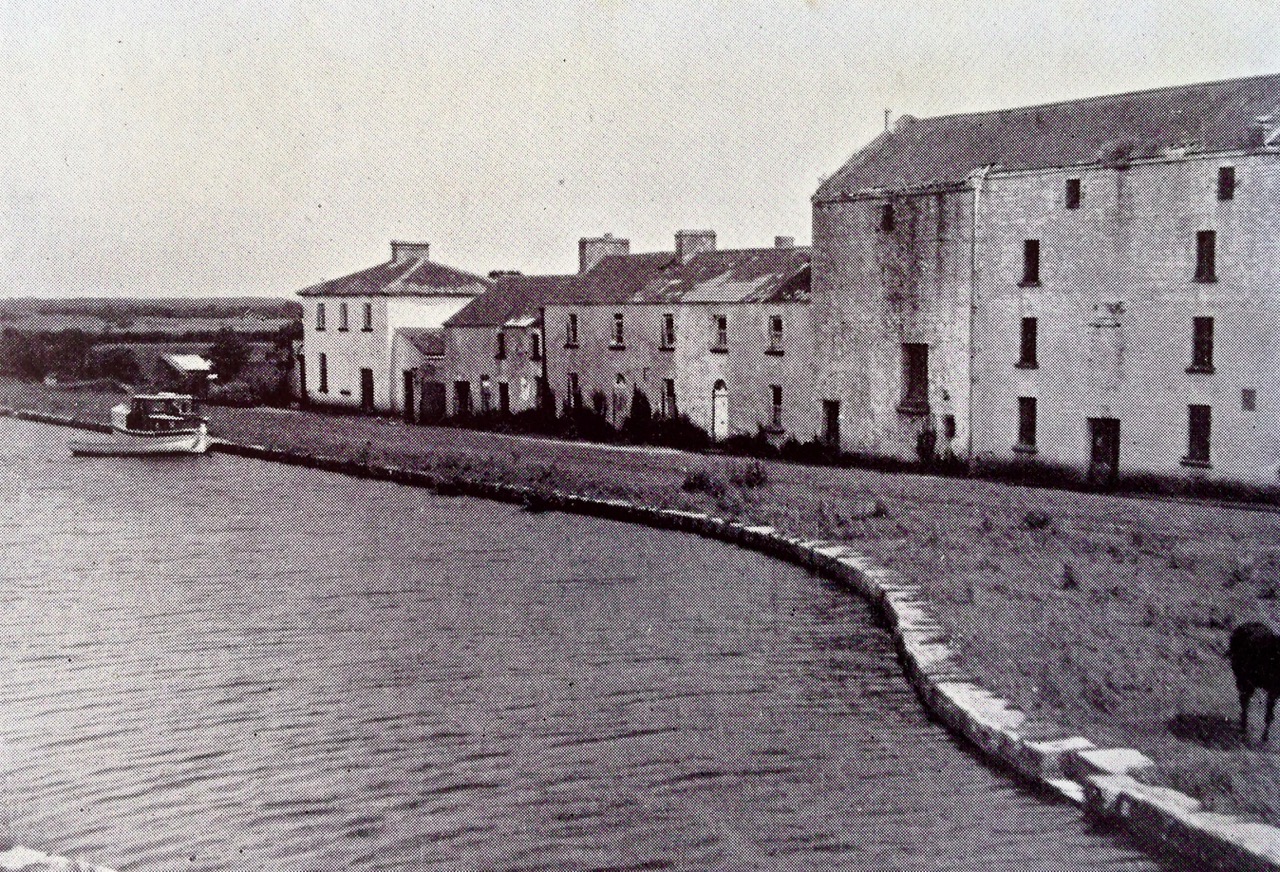
Angela Rolt’s photograph of Le Coq moored at Richmond Harbour, Cloondara – ‘derelict warehouses and empty cottages’

…There were four pairs of stones, two sets of ‘Peaks’ for meal and two sets of French Burrs for wheat. The runner of one pair of Peaks had been swung off the bedstone, and the dresser sat on a sack, legs astraddle, as he tapped away at the worn furrows with his bill. I had expected to find that the language of the miller’s craft was different in Ireland, but this was not so. Thus the stirrup and shoe which feeds the grain into the eye of the runner stone and whose cheerful clink clack contrasts with the rumble of the stones, our miller, like his fellows in England, called the ‘damsel’. In an earlier book I described how the miller of Minshull Mill in Cheshire used apple wood to renew the teeth of the wooden mill gearing. Here beech wood was used for this purpose…
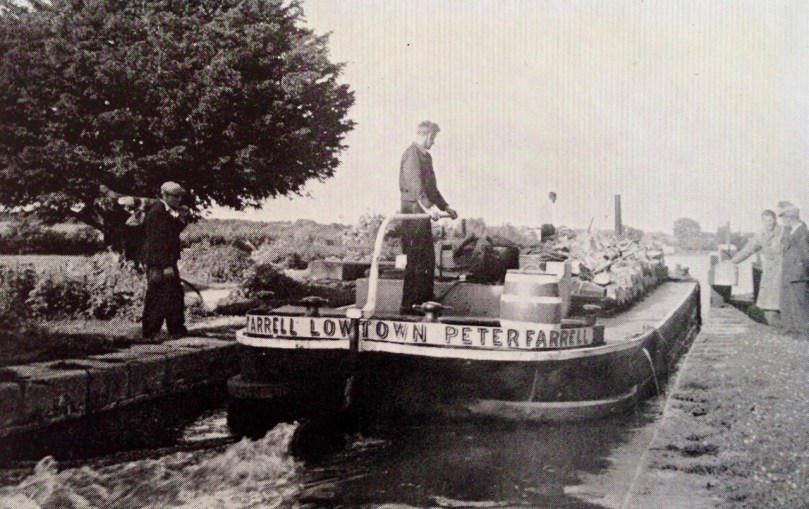
grand canal boat

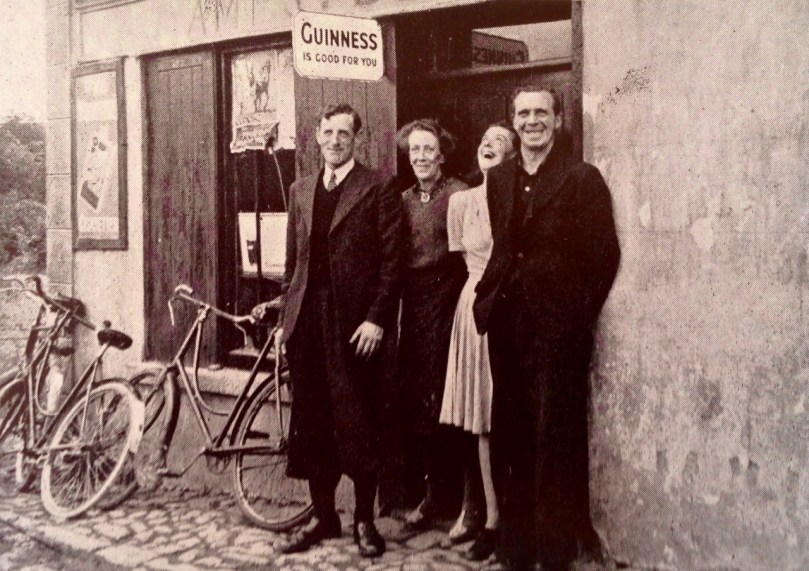
guiness

keeper and family

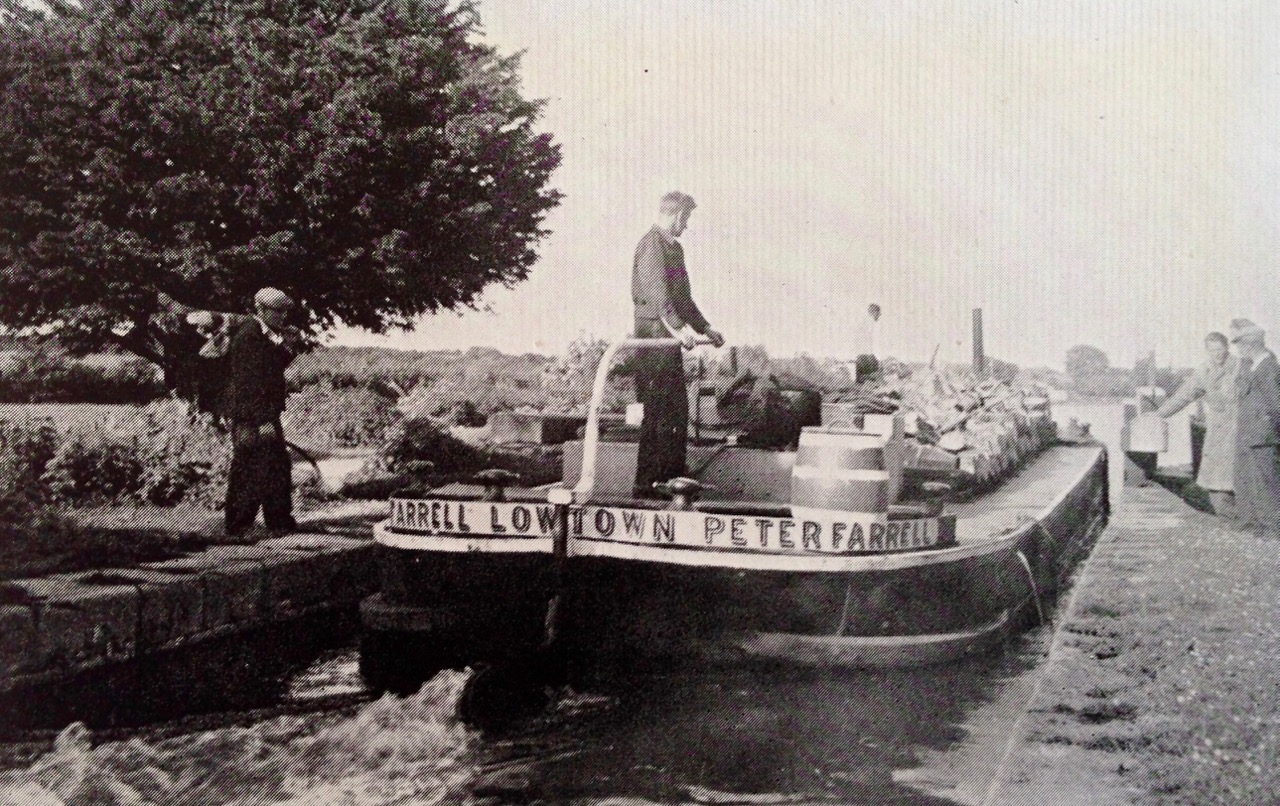
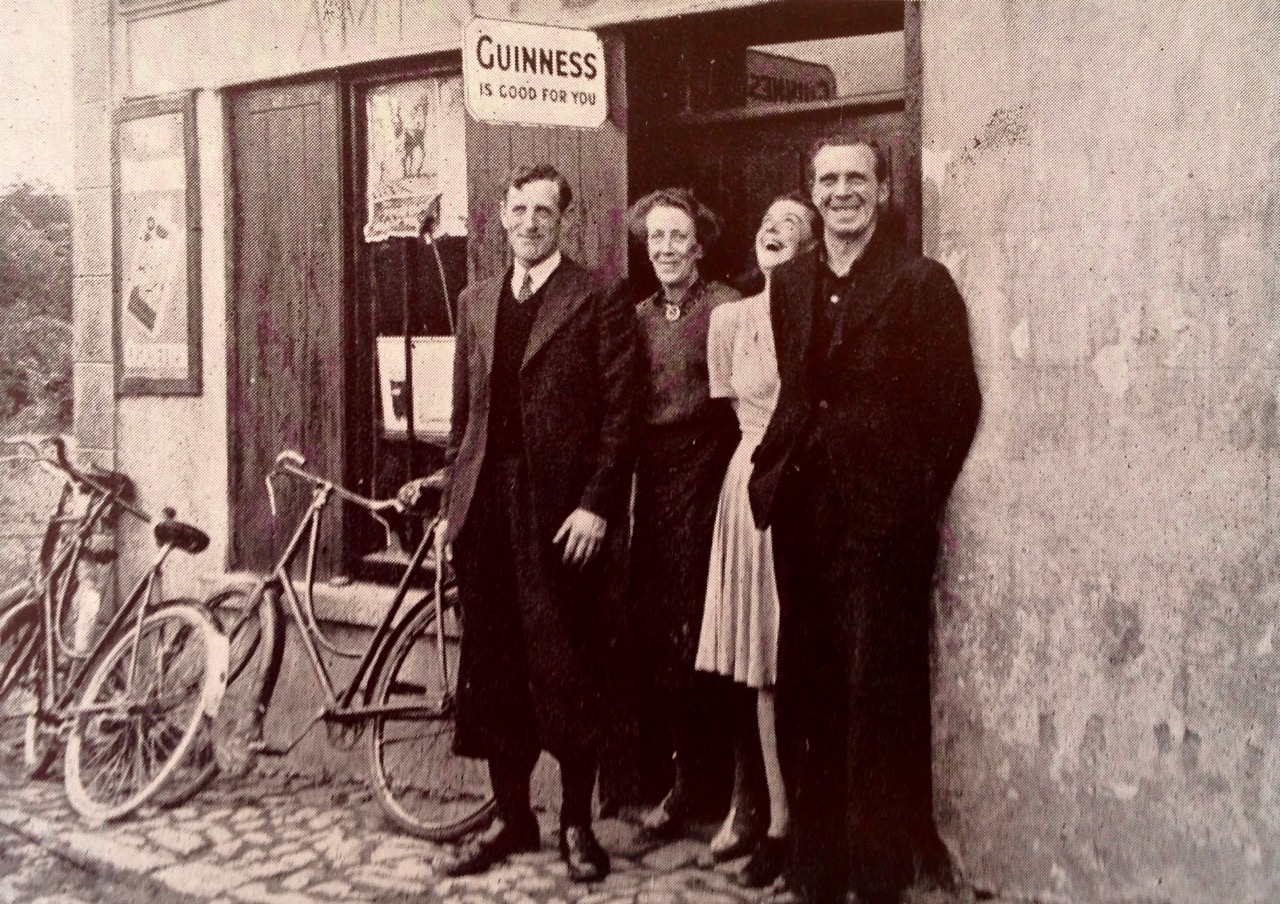
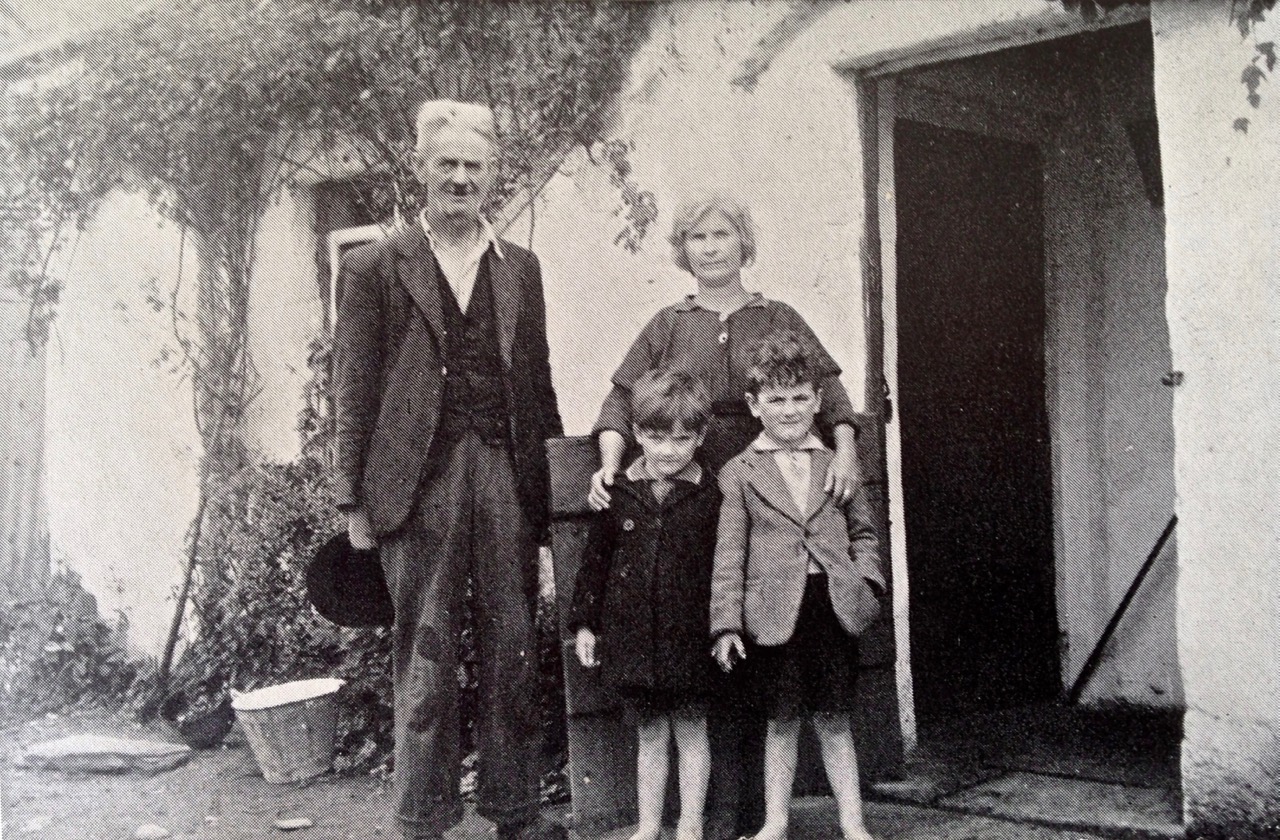
More of Angela Rolt’s photographs from the book: top – Peter Farrell’s working boat on the Grand Canal; centre – the Beirne family outside their inn at Battlebridge, close to the entrance of the abandoned Lough Allen Canal. Le Coq was the first boat to visit Battlebridge in seven years! Bottom – the Lock Keeper and his family at Draper’s Bridge, Royal Canal. The Rolts were always impressed with the generosity of the lock-keepers, particularly on this little-used waterway: they were constantly plied with milk, potatoes and scallions – ‘enough to sink the boat’…

Rolt was at heart an engineer: on leaving school at 16 he took a job learning about steam traction, before starting an apprenticeship at the Kerr Stuart locomotive works in Stoke-on Trent. Railways were in his blood as much as canals were. Thus he couldn’t leave Ireland without a journey on the West Clare Railway – then one of the last surviving narrow gauge railways in Ireland – and the subject of a song written and – famously – sung by Percy French, which includes the refrain:

…Are ye right there, Michael, are ye right?
Do you think that we’ll be there before the night?
Ye’ve been so long in startin’
That ye couldn’t say for certain’
Still ye might now, Michael
So ye might!

The Rolts’ journey on the line from Ennis is well documented in Green & Silver:

…We consigned the bulk of our luggage direct to Limerick to await our arrival there next day, and booked a first class ticket to Kilrush. We might as well enjoy this protracted journey in the maximum of comfort and seclusion. The little train, the only one of the day, was standing in the bay, and we settled ourselves into a compartment that was a period piece in itself. The seats were covered with black American cloth well studded with buttons. Braided arm rests (were they ever used?) were looped over the door pillars, and the captions of the ancient and faded photographs over the seat backs were hand written in painstaking copper-plate. To do justice to such an interior I should, I felt, be wearing a deer-stalker and an ulster…

The West Clare Railway: left – a photograph by Angela Rolt from Green & Silver showing L T C Rolt in a first class carriage on their journey from Athlone and – right – a stamp issued by the Railway Company for the ‘conveyance of single post letters by railway’

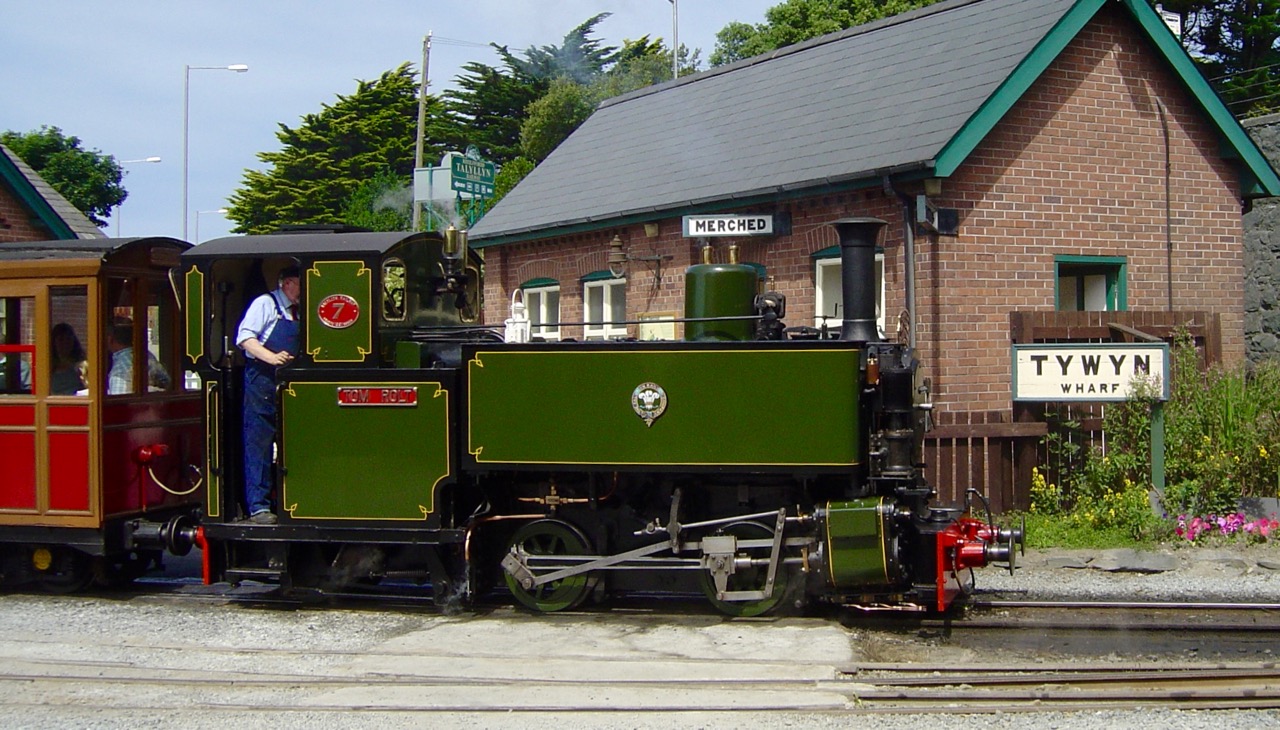
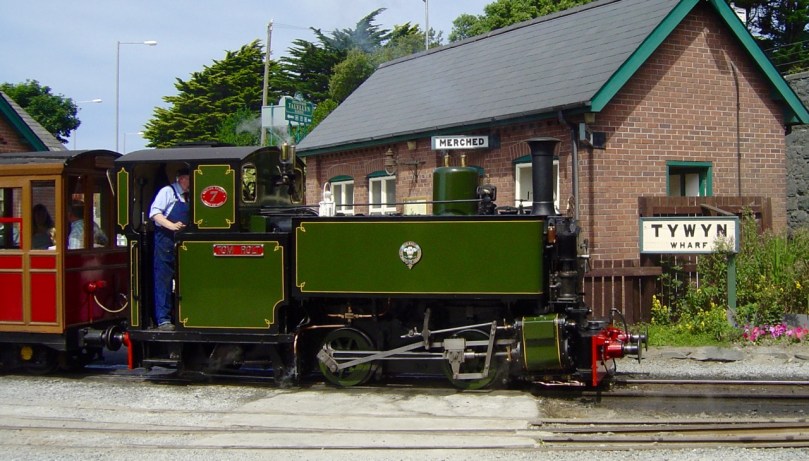
L T C Rolt was heavily involved in a movement in Britain to ‘save’ the declining canal system and in May 1946 the Inland Waterways Association was founded with Robert Aickman as chairman, Charles Hadfield (the canal historian) as vice-chairman and Rolt as secretary. Since that time the IWA has successfully campaigned to secure the restoration of many threatened waterways, and even to build some new ones in Britain. Sadly, within 5 years, Rolt had fallen out with the IWA over ideology, and was expelled from its membership. But Rolt moved on and campaigned to prevent the closure of the Talyllyn narrow gauge railway in Wales. He was involved in its resurrection as the first ‘preserved’ railway line in the world. His name is commemorated on one of the restored locomotives operating on the line: fittingly this engine began life working for Bord na Móna, the company in Ireland created by the Turf Development Act of 1946. The company is still responsible today for the mechanised harvesting of peat and uses narrow gauge railways: formerly steam driven, the lines now use diesel traction. The Tom Rolt (formerly nicknamed Irish Pete) was one of three 3 ft (914 mm) gauge 0-4-0WT well tank locomotives built by Andrew Barclay Sons + Co, an engineering workshop founded in 1840 in Kilmarnock, Scotland.
Tom Rolt Loco

Tom Rolt, the former Bord na Móna locomotive now reconstructed and operating on the Talyllyn narrow gauge railway in Wales, at Tywyn Wharf (photograph courtesy Optimist on the run)

Following in the footsteps of L T C Rolt I wrote my own book on canals and it was published in 1969. The publishers, Hugh Evelyn of London, asked Rolt if he would write an introduction to the book. In the event he was unable to do so, passing the job on to Charles Hadfield. I was sorry not to have a ‘hero’ of mine endorsing the volume, but in my preface I mention my indebtedness to him for introducing me to the world of navigable waterways. Tom Rolt died in 1974 and he won’t know that I am also indebted to him for introducing me to Ireland, now my home.

Champions for Ireland

wolfhounds

Irish Champions – ancient warriors, wolfhounds and rain at the Tailteann Games 1924

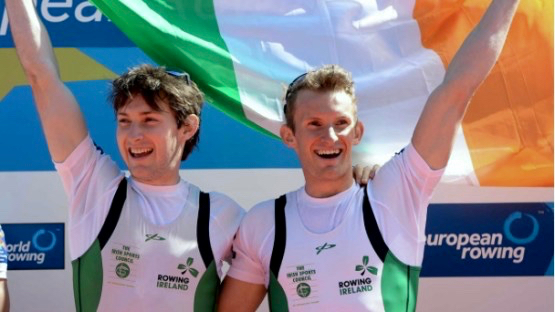
We heard hearty cheers coming across the water on Friday, when Ireland won the Olympic silver medal in the Lightweight Men’s Double Sculls Final. The cheers we heard were not coming from Rio, however (although there were plenty there), but from Lisheen, the tiny West Cork parish that’s just around the corner from us. That’s where Gary and Paul O’Donovan hail from. We think they have declared a public holiday there in honour of the two rowing brothers who, prior to this title, won gold at the European Championships in Brandenburg in Germany this year – the first Ireland rowing crew to become European Champions. This success set me looking at the records of Irish Olympic achievements over the years.

NGI 941

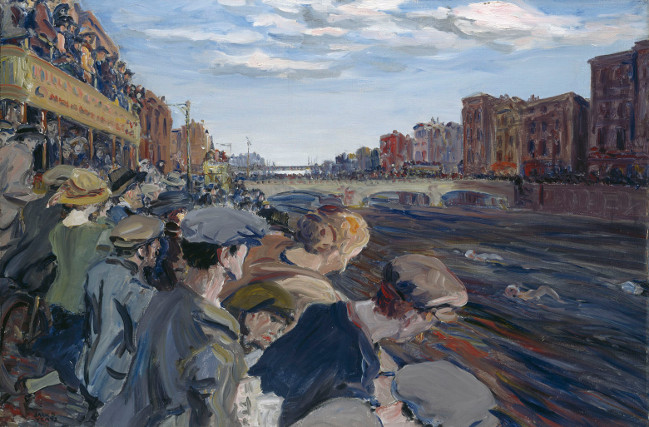
The Liffey Swim by Jack Butler Yeats, painted in 1923. Courtesy National Gallery of Ireland

Independent Ireland was represented at the Olympic Games from 1924 onwards. No Irish athletes won medals in 1924 but Jack Butler Yeats won a silver medal for the above painting and Oliver St John Gogarty won a bronze medal for literature in that year. Did you know that between 1912 and 1948 competitions in the arts were part of the Olympic Games? For a small nation Ireland has made its mark in the games: in Melbourne in 1956 Irish athletes and boxers won 5 medals between them – a gold, a silver and three bronze, and in London in 2012 boxers, athletes and a showjumper won 6 medals – a gold, a silver and four bronze. 1996 was a memorable year when, in Atlanta, Michelle Smith won 3 golds and a bronze for swimming.

An original cover from the 1924 programme for the Tailteann Games, an artist’s perception of the ancient games and (right) two medals struck for the Games

While researching this information I came across Tailteann Games. The word is pronounced ‘tell-tin’. The eleventh century Lebor Gabála Érenn (the Book of the Invasions of Ireland) states that the games were founded by Lugh Lámhfhada, Lugh of the Long Arm – the first High King of Ireland – as a mourning ceremony for the death of his foster-mother Tailtiu. Lugh buried Tailtiu underneath a mound in an area that took her name and was later called Teltown in County Meath, not far from the Hill of Tara. It’s perhaps significant that the games took place around the festival of Lughnasa – at the beginning of August. Accounts vary as to the historical periods in which the games were held: some say as early as 1800 BC, while a more generally accepted dating seems to be from the 6th to the 9th centuries AD: the festival died out after the Norman invasion but was later revived as the Tailten Fair, consisting of contests of strength and skill, horse races, religious celebrations, and a traditional time for couples to contract ‘trial’ marriages. These were allowed under Brehon Laws: couples could meet and live together for a year and a day – at the end of this time either party could end the marriage on the ‘Hills of Separation’.

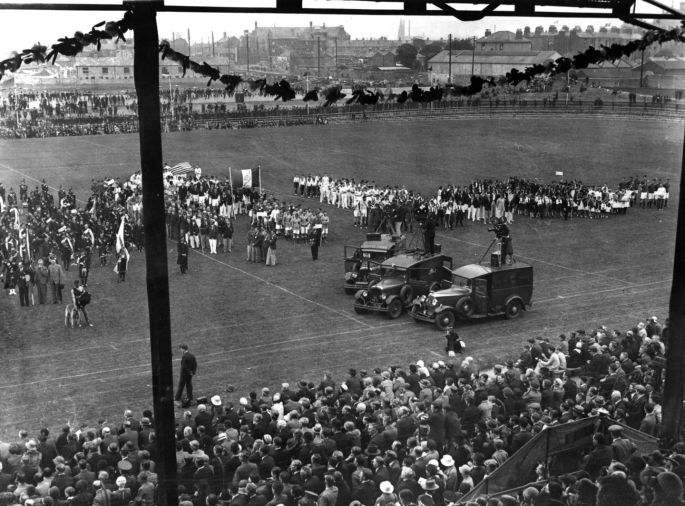
Presumably these photographs are from the ‘Opening Ceremony’ of the 1924 Tailteann Games held in Croke Park

While the 1924 Olympics were being held in Paris (where Finola’s grandfather was a member of the Irish team) a revival of the Tailteann Games was held in Croke Park, Dublin. This ‘meeting of the Irish race’ or ‘Irish Olympiad’ had been announced by Éamon de Valera in Dáil Éireann in 1921 to celebrate the founding of the Irish Free State, but the event was delayed because of the Anglo-Irish War and the Irish Civil War. Organised by the Gaelic Athletic Association (GAA), it was open to all people of Irish birth or ancestry. Participants came from England, Scotland, Wales, Canada, the USA, South Africa and Australia as well as Ireland. 

image

Note the media presence at the 1924 Tailteann Games: newsreel cameras mounted on to motor vans  

Tailteann Games were held again in 1928 and 1932. The name survives today as Rás Tailteann, which is an 8 day international cycling race around parts of Ireland. This race has run every year since it was founded in 1953 and has developed into a much sought after event by professional and amateur teams from many parts of the world: it is able to award qualifying points that are required for participation in Olympic Games and World Cycling Championships.

Fireworks_at_the_First_Tailteann_Games_August_15,_1924

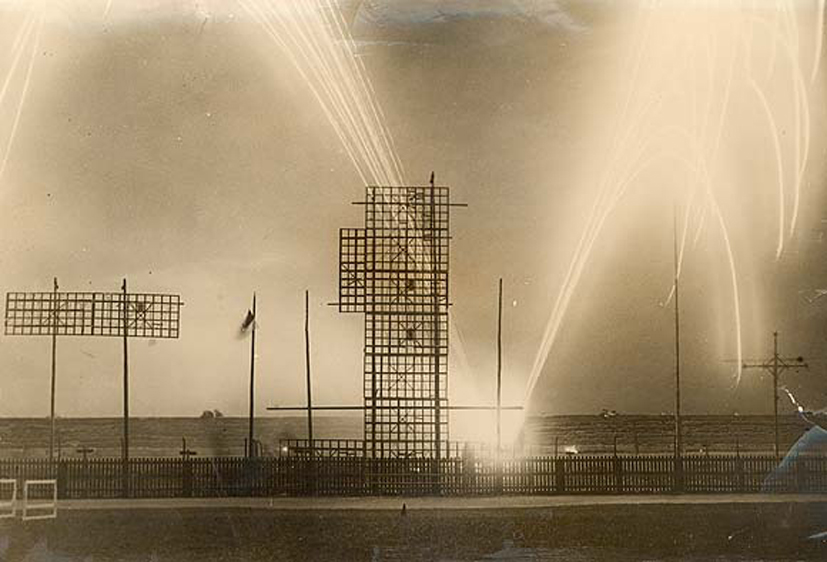
No modern games ceremony would be complete without a fireworks display: (top) this unusual photograph shows the fireworks at the 1924 Tailteann Games. (Lower left) a 1958 poster for the Rás Tailteann. (Lower right)  We watched this year’s Rás Tailteann on the road to Ballydehob. (Below) Paul and Gary O’Donovan – West Cork lads in Rio on Friday added a 2016 Olympic Silver to their many achievements (photo afloat.ie)

brothers

‘Will the Hare’ – and the Mizen Olympics!

street market

…In ancient Ireland the festival of the beginning of the harvest was the first day of Autumn, that is to say, it coincided with 1 August in the Julian calendar. This has continued in recent tradition, insofar as Lúnasa or Lammas-Day was still taken to be the first day of Autumn; the gatherings and celebrations connected with it were, however, transferred to a nearby Sunday, in most parts of Ireland to the last Sunday in July, in some places to the first Sunday in August… The old Lúnasa was, in the main, forgotten as applying to the popular festival and a variety of names substituted in various localities, such as Domhnach Chrom Dubh, Domhnach Deireannach (Last Sunday), Garland Sunday, Hill Sunday and others…

making the stack

All the photographs in this post are from the collection of Tomás Ó Muircheartaigh who travelled and photographed the west of Ireland during the 1930s, 40s and 50s and is an invaluable documentary of the times in which he lived. Generally, the locations of the photographs are not noted, and very few are likely to be specific to the Mizen: they do however record life as it would have been lived at that time in all the rural areas

Today we celebrate Lúnasa – the festival of the bringing-in of the harvest. Kevin Danaher (The Year in Ireland, Mercier Press 1972) wrote (above) about what he observed in the middle of the last century, when things were already changing and many of the old customs were, as he notes, ‘in the main forgotten’, although still talked about. What changes do we see in Ireland, a few generations on?

seascape

Northside of the Mizen by Patrick McCarthy and Richard Hawkes was written in 1999 (Mizen Productions) and is a collection of memories and stories still being told then about traditional life in this westerly part of of the country:

…The heat of the summer was eased by the cooling breezes from the Atlantic. It was busy on land and sea, with seine fishing by night and fish curing and farming by day, but there was always time for scoriachting, games and dance, sometimes on Carbery Island or across Dunmanus Bay…

…Once in the year Carbery Island was the location for a dance and in settled weather the Northsiders could shout across and give the signal to the people of Muintir Bháire to meet at Carbery Island. As many as forty-five people in three boats would cross Dunmanus Bay to the White House, and a good crowd of men and women from Bear Island would also come to the dances. They were great hearty people. Ann Daly from Kilcrohane and Agnes O’Donovan of Dunkelly played the melodeon…

I like the idea of the Northsiders shouting across the water to the residents of the Sheep’s Head, two miles away! I wonder if they would be heard nowadays?

horse race

…There were competitions at Dunmanus for swimming, running, jumping and weight lifting, and you could be sure that the Northsiders were well represented in each of the events. ‘Will the Hare’ (William McCarthy of Dunkelly Middle), was good at the long jump and the running races and would often win and bring great honour to the Northside. It was said that ‘Will the Hare’ got his name by catching a hare on the run! It was also said that when you blew the whistle to gather the men for seining, by the time you had finished, ‘Will the Hare’ would be at Canty’s Cove waiting!

boat race

…Wild John Murphy would take the lads to the Crookhaven Regatta which was held on The Assumption (15th August). It was a long pull around the Mizen but a good time was had by all. The Northsiders were great with the oars, but it was hard to beat the Long Island crews in the boat races…

(Danaher): …In very many localities the chief event of the festival was not so much the festive meal as the festive gathering out of doors. This took the form of an excursion to some traditional site, usually on a hill or mountain top, or beside a lake or river, where large numbers of people from the surrounding area congregated, travelling thither on foot, on horseback or in carts and other equipages… Many of the participants came prepared to ‘make a day of it’ bringing food and drink and musical instruments, and spending the afternoon and evening in eating, drinking and dancing…

picnic

…Another welcome feature of the festive meal was fresh fruit. Those who had currants or gooseberries in their gardens, and this was usual even among small-holders in Munster and South Leinster, made sure that some dish of these appeared on the table. Those who lived near heather hills or woods gathered fraucháin (‘fraughans’, whortleberries, blueberries) which they ate for an ‘aftercourse’ mashed with fresh cream and sugar. Similar treatment was given to wild strawberries and wild raspberries by those lucky ones who lived near the woods where these grow… A number of fairs still held or until recently held at this season bear names like ‘Lammas Fair’, ‘Gooseberry Fair’, ‘Bilberry Fair’…

market in town

One interesting custom was the driving of cattle and horses into the water. This is mentioned in the 1680s by Piers in his Description of the County of West-Meath:On the first Sunday in harvest, viz in August, they will be sure to drive their cattle into some pool or river, and therein swim them; this they observe as inviolable as if it were a point of religion, for they think no beast will live the whole year thro’ unless they be thus drenched; I deny not but that swimming of the cattle, and chiefly in this season of the year, is healthful unto them…

at the fair