I had the great pleasure recently of spending a day in a bog – and because the bog had dried out completely it was indeed a rattlin’ bog, complete with the twig on the branch and the branch on the log…
It was an amazing place – there were several different habitats – waste ground, heath, meadow, woodland, marsh and finally a bog – except there had been so little rain that the whole bog had dried up and we were able to walk all over it. I had volunteered to help out our friends Robin and Sue Lewando with a small plant study of a defined area, while Robin collected samples from the lake for his own research. Afterwards, we spent a happy hour wandering through the dried-up bog, exclaiming over plants you can’t normally get close to and taking photos. Several were new to me – I had never seen Bur-reed or Yellow-cress before, or Star Sedge.
The slideshow is an amalgam of shots from the whole day. Here is the complete plant list, in the order in which you see them in the slideshow:
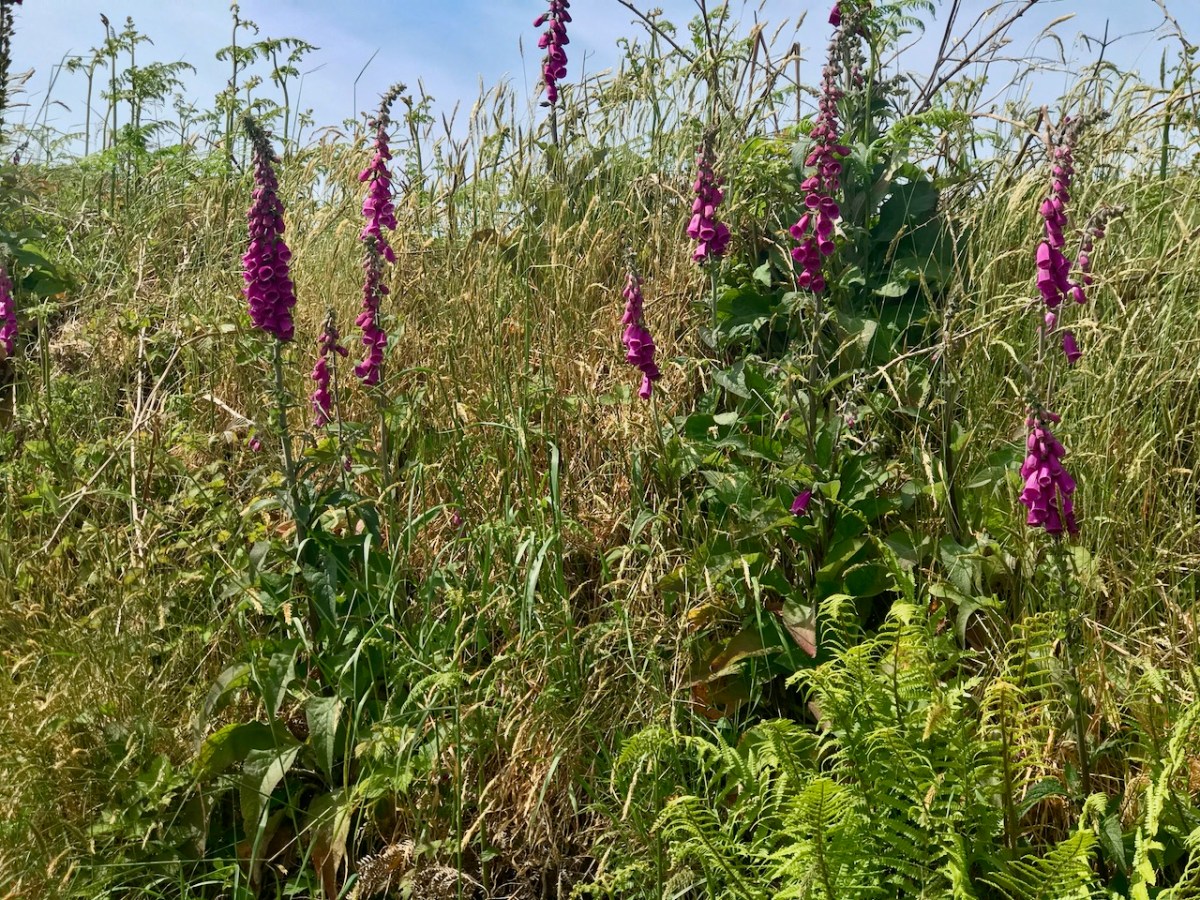
First three sides - waste ground with Foxglove, Sheep’s Bit, Cat’s-ear, Clover
The Lake
Slides 6 to 10 Marsh Cinquefoil (10 is Sue photgraphing the Marsh Cinquefoil
11 Compact Rush (?)
12 Soft Rush
13 to 15 Common Valerian (with Grypocoris stysi/Mirid Bug - thanks to Margaret Manning for the ID)
16 and 17 Heath Spotted-orchid
18 and 19 Marsh Bedstraw
20 - 22 Marsh Yellow-cress
23-25 Water-plantain
26 Water Forget-me-not
27 and 28 Water Forget-me-not and Spike-rush
29 and 30 Branched Bur-reed
31 and 32 Beaked Sedge
33 and 34 Marsh Speedwell
35 Bogbean
36 Robin
37 Star Sedge
38 Labyrinth Spider
39 Marsh Thistle, 7-Spot Ladybird and Bumble Bee
A weed is a wildflower whose name we haven’t learned yet, in the same way that a stranger is a friend we haven’t met yet. Like the hogweed above – a plant, by the way, that is in the top ten percent of the most nectar-rich and valuable-for-pollinator wild plants, a plant that is also edible by humans and animals – ‘weeds’ are plants we mostly love to hate.
Ah yes – weeds! Those wreckers of manicured lawns and tidy driveways. Those nasty undesirables that must be dug up or, as with the seldom-used holiday home above, Rounded-Up.
But wait – what’s this? All over Ireland people are letting the ‘weeds’ take over! Just look at this fabulous example at the Heron Gallery on the Sheep’s Head (above). It’s like we’ve had a mad rush of blood to the head and are changing life-long attitudes. What has caused this? Was it the pandemic, like we account for so many other changes in our lives?
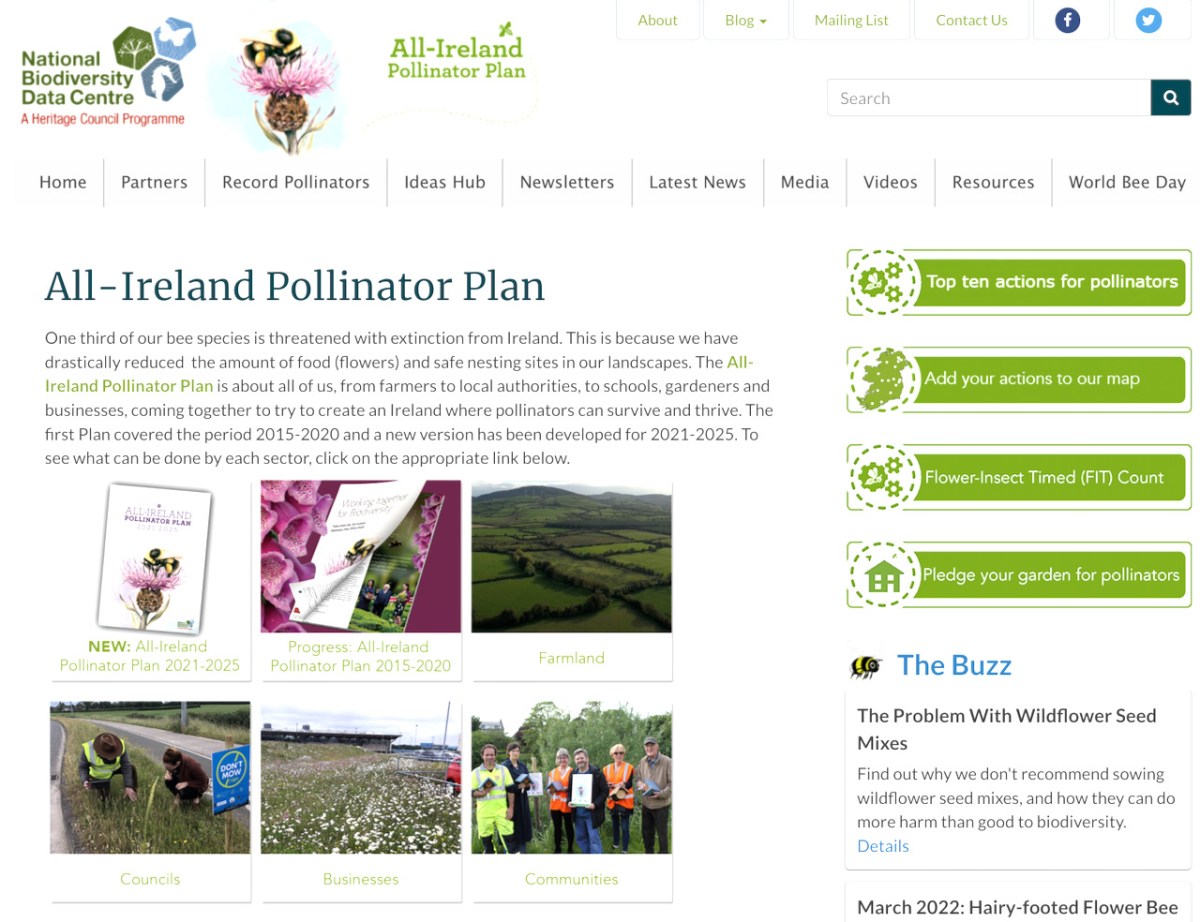
Pollinators are in decline, with one-third of our 98 wild bee species threatened with extinction from the island of Ireland. The problem is serious and requires immediate attention to ensure the sustainability of our food, avoid additional economic impact on the agricultural sector, and protect the health of the environment.
Working together for Biodiversity: Tales from the All-Ireland Pollinator Plan 2015-2020
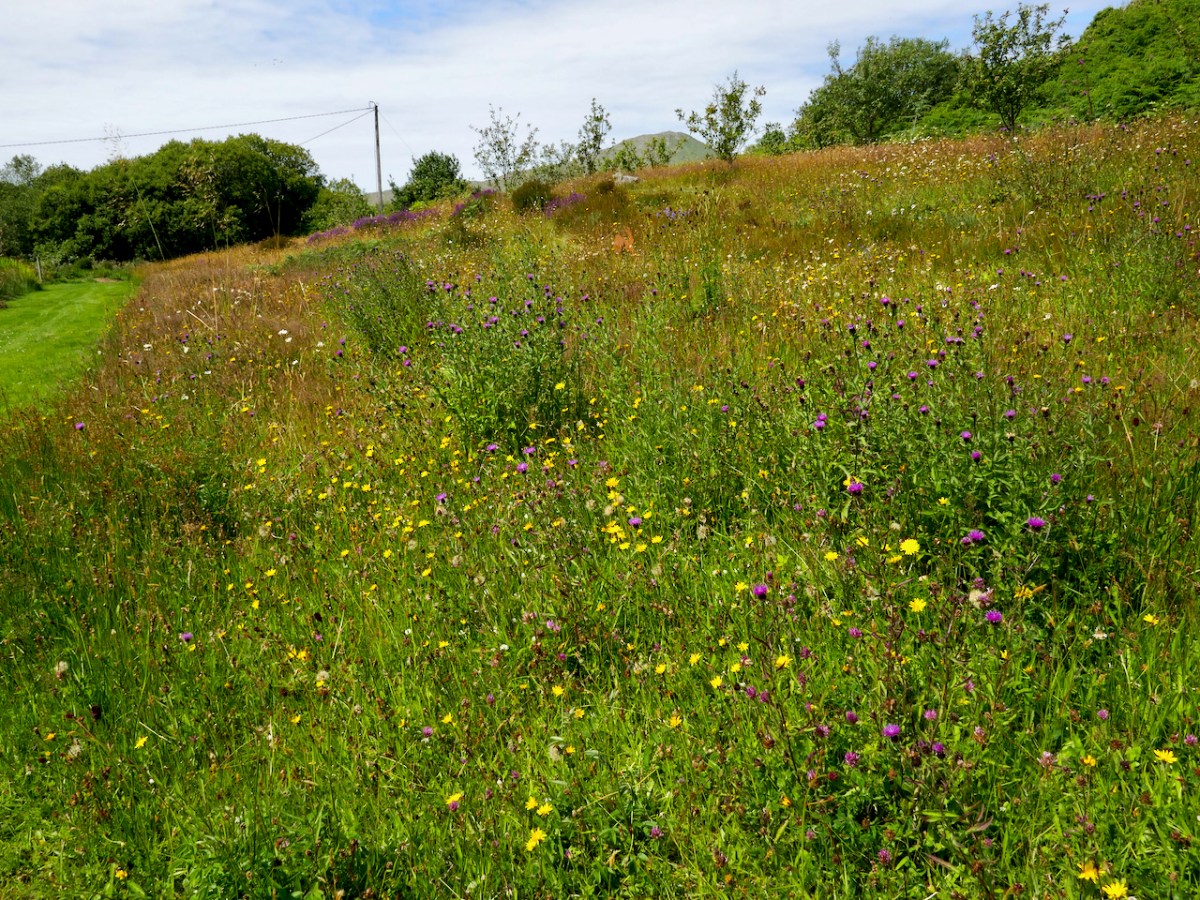
Each of us with any little patch of ground can do our bit too. All you have to do is set aside whatever portion of your garden you’re comfortable with (10%? 50%?) and turn it into a perennial wildflower patch. I’ve been doing this in my garden (above) now since 2017, so this is my 6th year. in 2018 I introduced Yellow Rattle from seeds bought from Sandro Cafolla at The National Wildflower Seed Collection. Called the meadow maker, Yellow Rattle (below) parasitises on grass roots, thinning them out and providing space for other wild seeds to take root. Apart from that, I have had to keep an eye on incursions of bracken and nettles.
The results have been all that I hoped for. Every day I am tempted out to my little mini-meadow with my camera. The rest of the lawn I try to leave as long as possible between cuts and it’s amazing what comes up there too. Take a look at my video, Lying in the Grass, for a sense of the sheer wonder and variety of what has appeared all over my One Acre.
The driveway and all around the house is gravelled and I have resisted the temptation to tidy it up in any way. In return, a huge variety of wildflowers have appeared – Groundsel and Pineapple-weed, Scarlet and Yellow Pimpernel, Silverweed, Cat’s-ear and Autumn Hawkbit, Germander and Thyme-leaved Speedwells, Herb-Robert and Keel-fruited Cornsalad, Dove’s-foot and Cut-leaved Crane’s-bills, Common and Bush Vetch, Sowthistles (Prickly and Smooth), Sheep’s-bit, Sorrels and Chamomile.
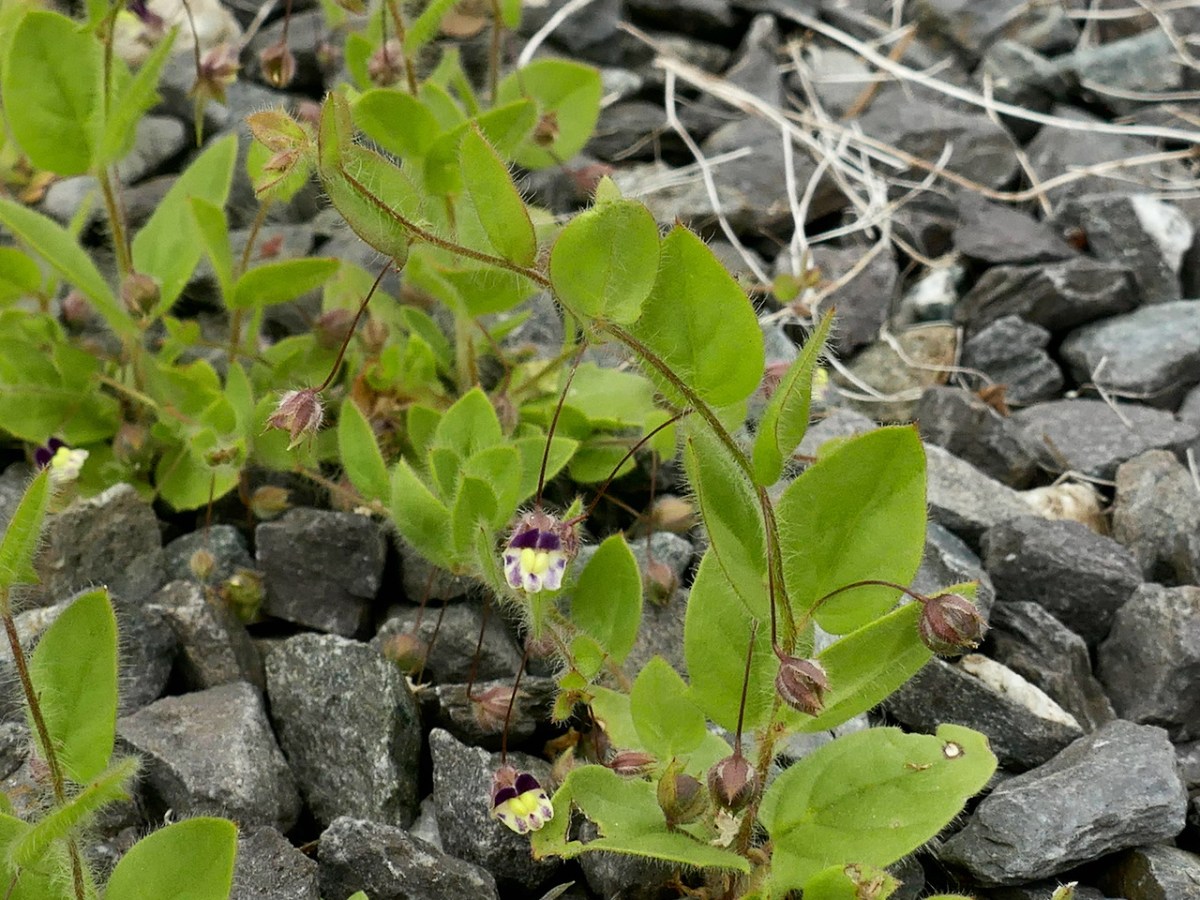
I even discovered a rare little plant popping up in my driveway – the gorgeous and curious Sharp-leaved Fluellen. According to the distribution maps it’s been slowly making its way west from Wexford over the years – but how on earth did it land in my driveway? It’s a mystery like that, that keeps me fascinated with wildflowers.
See what I did there? I named the ‘weeds’ – and naming something gives it presence and personality. Once you know the name, there’s a natural curiosity to know more about the plant itself and to keep an eye on it. Thus, they turn into old friends and your heart lifts as you watch a Painted Lady Butterfly feeding on the humble Knapweed, or a Bumble Bee hover over the vetch, choosing which blossom to settle on.
We need to adjust our notions of what’s beautiful if we are to avoid a biodiversity catastrophe. Each one of us can do something to help. If you want to grow your own perennial wildflower patch, there are simple steps you can take – see my posts on my One Acre (then, One Year on, Three Years on, and Four Years On) for what I have done, or follow the Guidance of the Pollinator Plan.
Here’s what NOT to do – don’t buy ‘Bee Bombs’ or packets of ‘wildflower mix’ seeds. As this excellent paper puts it: Wildflower seed mixtures do not help address biodiversity loss. Rather, they cause further disruption to what remains of the natural environment. Follow best practice – mow once a year and remove the cuttings, try to keep down nettles, dock and bracken (and Ragwort if it’s threatening to take over) – and then let it be. Every now and then, go lie down in the grass beside it and listen for buzzing.
And if you’re a keen gardener and want to just make your garden more pollinator-friendly – there’s a guide for that too!
For a wildflower enthusiast there is nothing better than a day spent with like-minded folk looking for interesting plants under the leadership of a true expert.
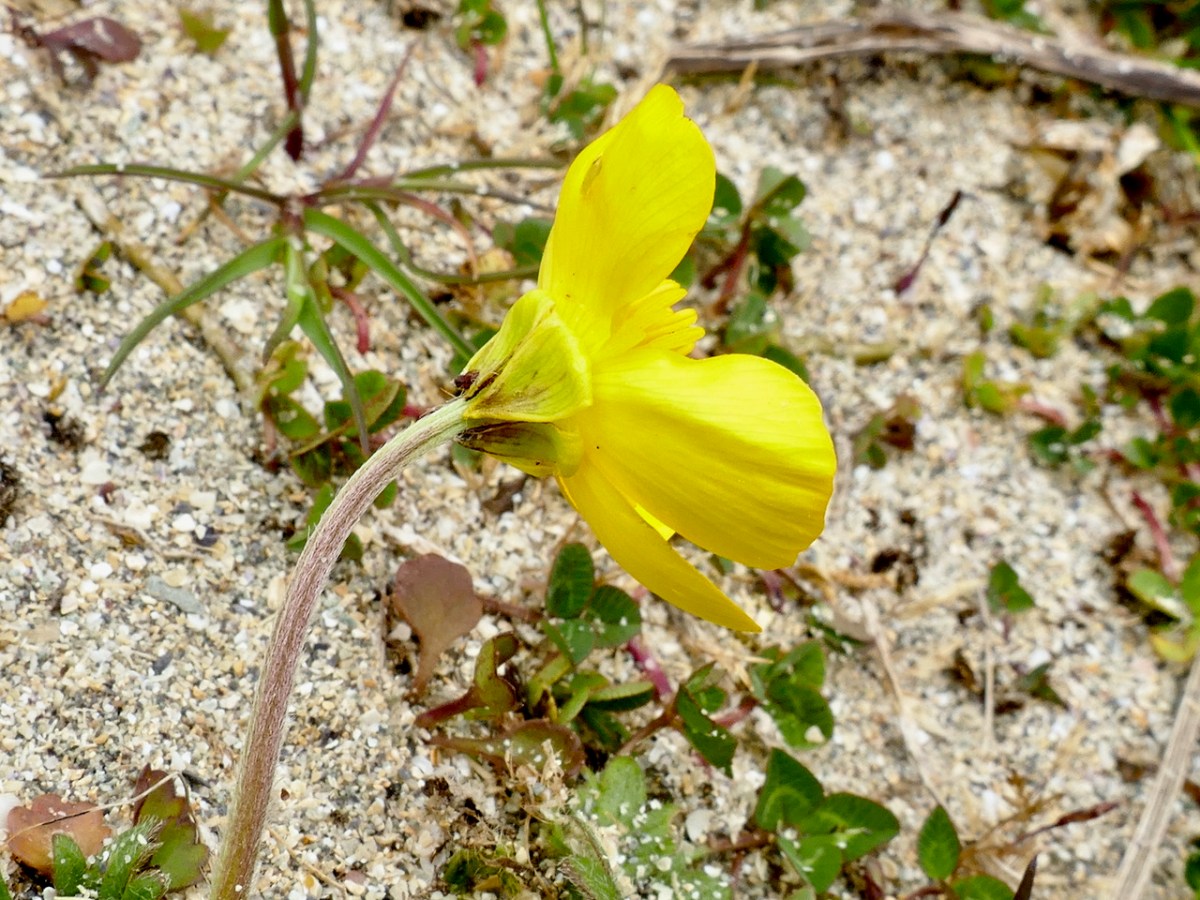
At this time of year the buttercups all over the dunes are actually Bulbous Buttercups – if you look under the flower head you will see that the sepals turn down away from the petals
I had the immense privilege of being included in a Rare Plant Monitoring Workshop on Friday the 13th – which also happened to be the day that Biodiversity Week kicked off in Ireland. As you probably all know by now, Nature is in crisis all across the world, and although we may be surrounded by lush hills and boreens in West Cork, there are ominous signs that all is not well with our natural world here as elsewhere. Fewer than ten percent of our native species in Ireland have been assessed for their conservations status – but of those that have been, one fifth (yes – one-fifth!) are at risk of extinction.
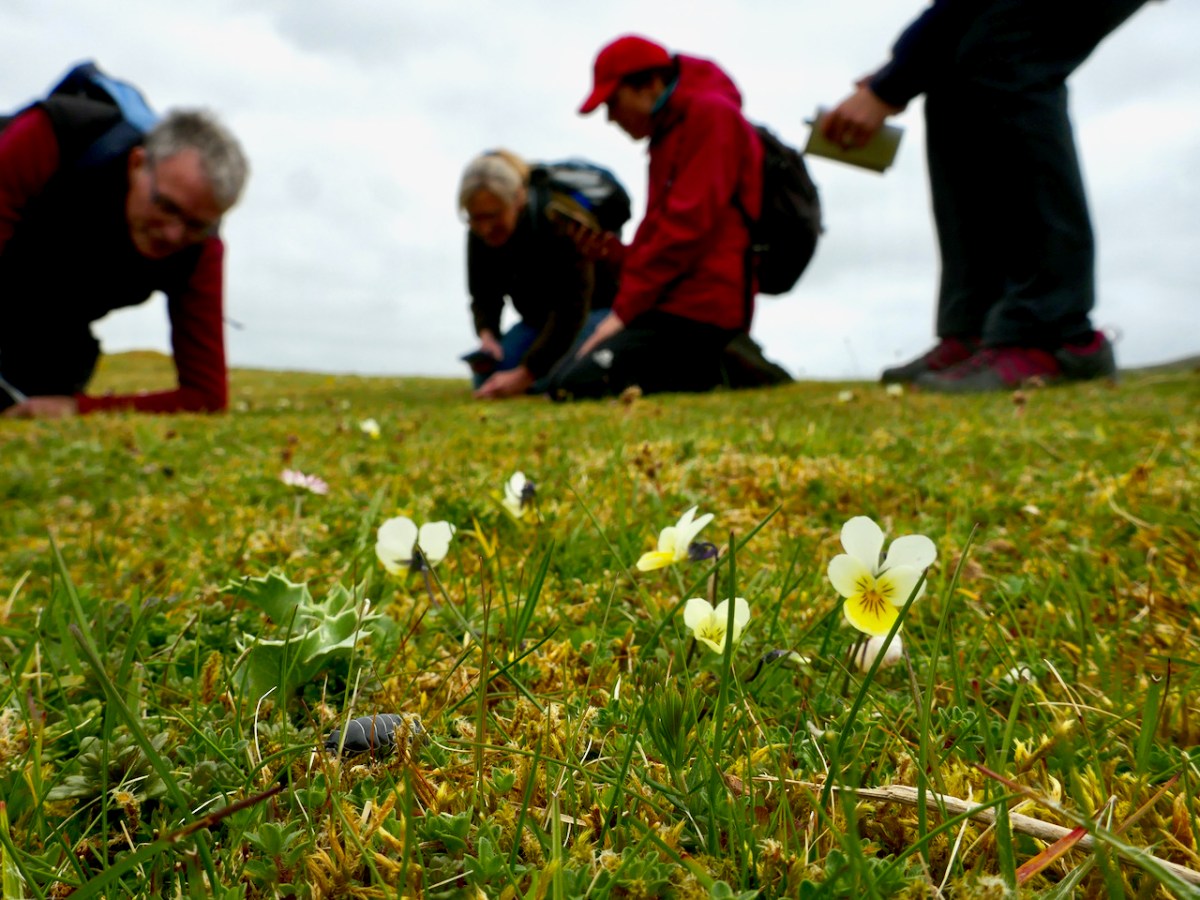
Sand Pansy – gorgeous little violas found on the dunes
That’s why counting plants is important – each one is part of the complex web of biodiversity that contribute to the health of our environment and the loss of even one can have knock-on effects on a whole cascade of others. I already monitor two rare plants for the National Biodiversity Data Centre (NBDC), Vervaine and Calamint, so I have an insight into the kinds of threats rare plants can face, from mowing to herbicides to change of land use – all of those have happened to the small populations I monitor.
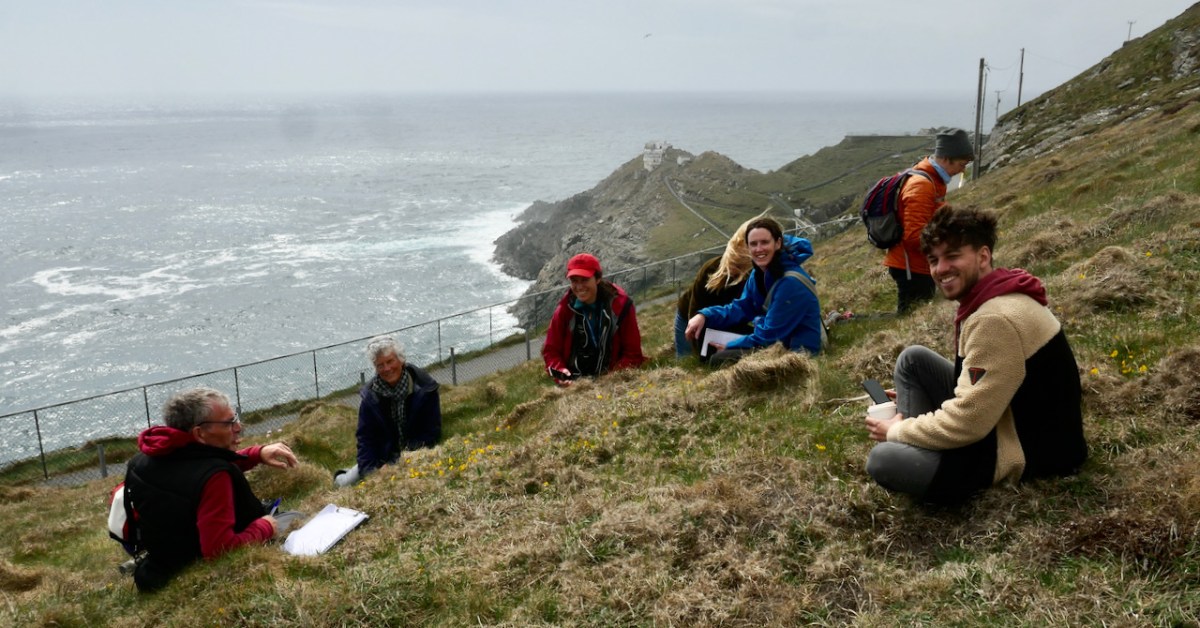
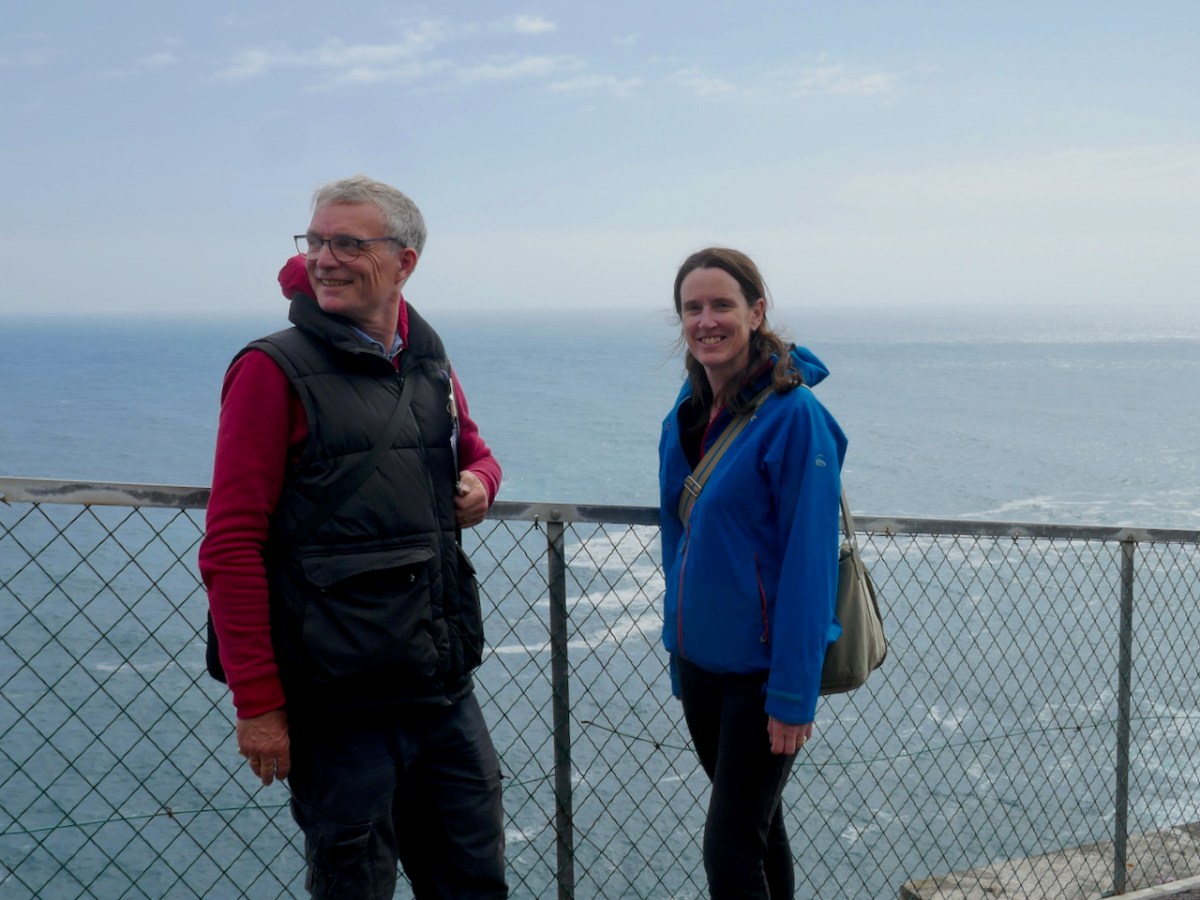
The location for this workshop was Barley Cove and Mizen Head. Having rendezvoused with Botanist Paul Green and NBDC Scientist Úna FitzPatrick (above, at Mizen Head) we set out across the dunes. I had met Paul before and so I knew that he is unfailingly generous about sharing his immense knowledge. Throughout the day we stopped frequently to exclaim over a plant that one or another of us spotted (like the Bulbous Buttercup) on the dunes or the rocks, and Paul always took the time to stop and educate us about each one.
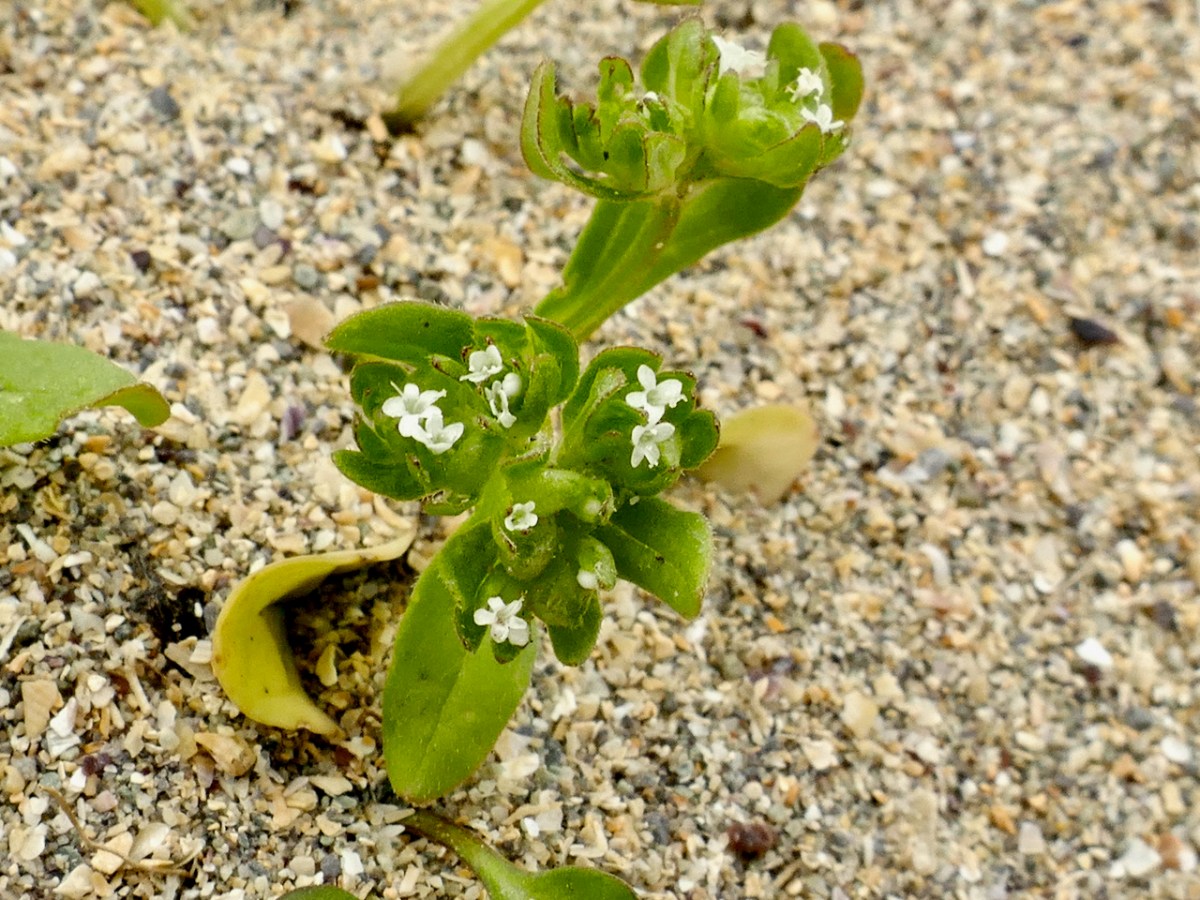
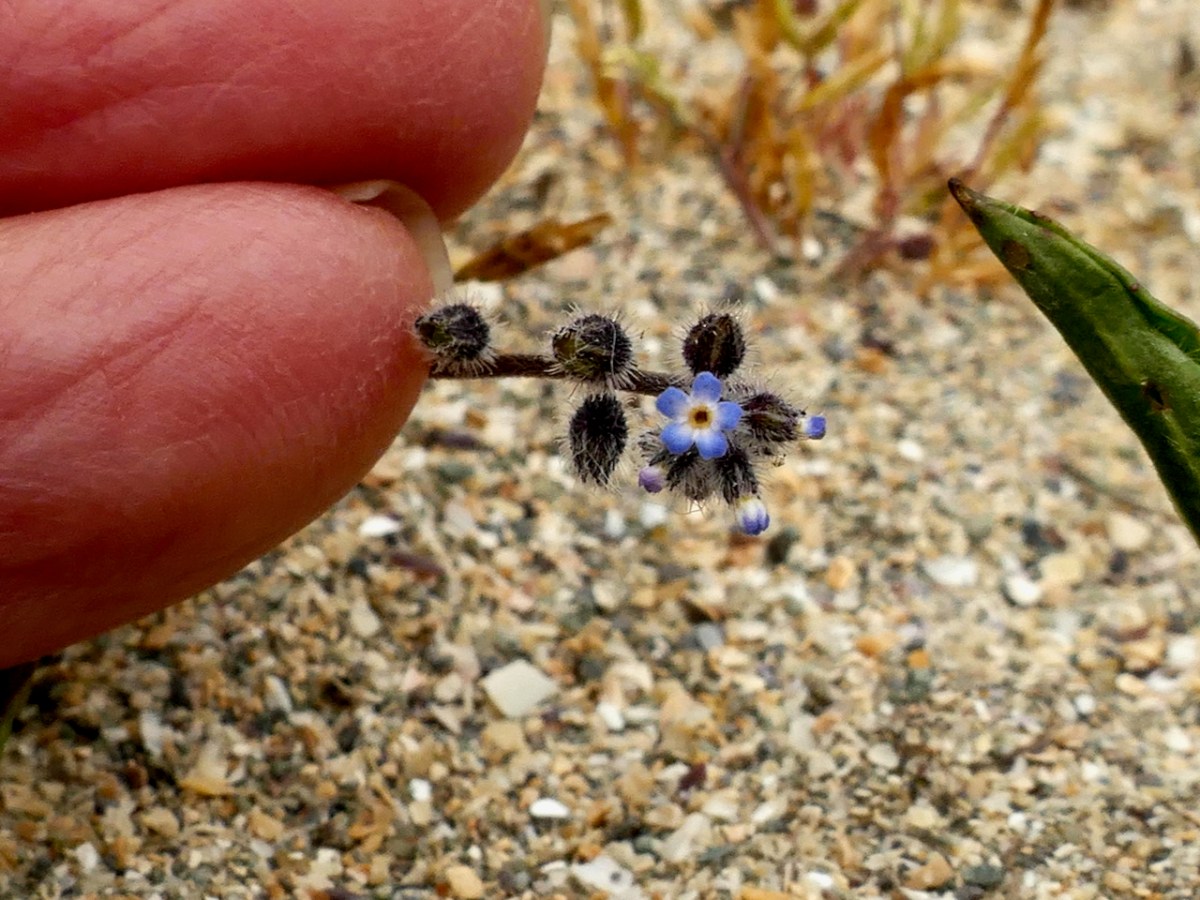
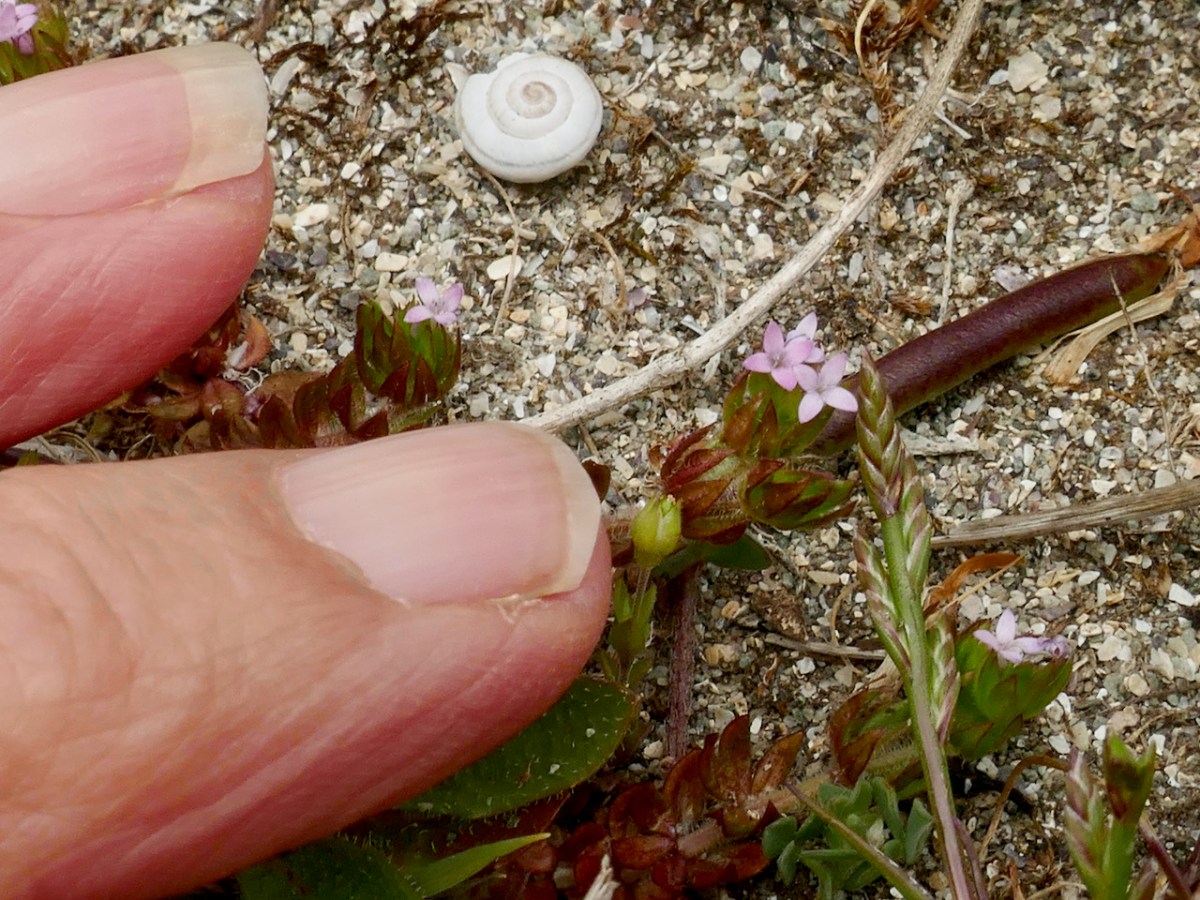
Thus, along the way, I was introduced to several plants that were entirely new to me. Despite the fact that I have been to Barley Cove on numerous occasions, many of them spent lying in the grass on the dunes (see this post and the wildflower slideshow within it, for example), I had never seen Common Cornsalad (above) nor Early Forget-me-not (below) before Friday.
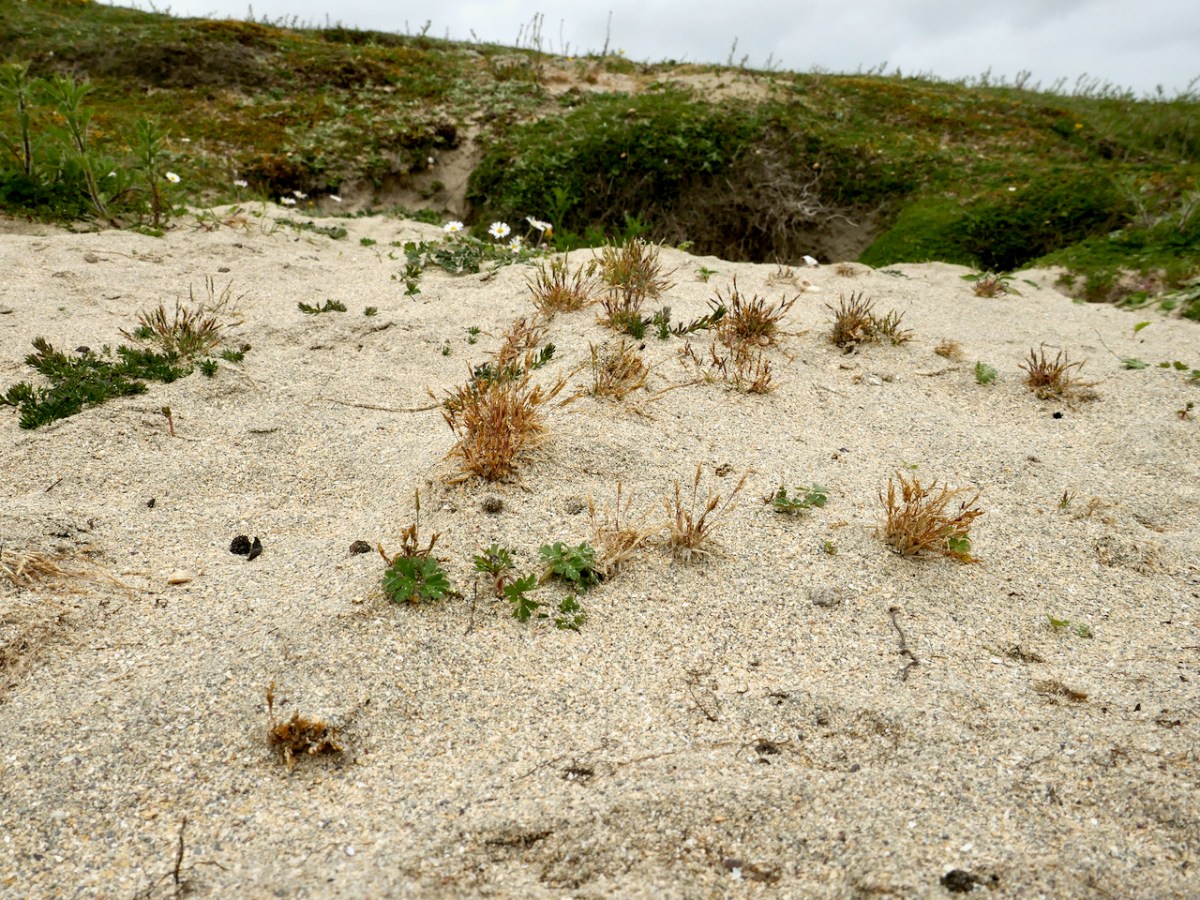
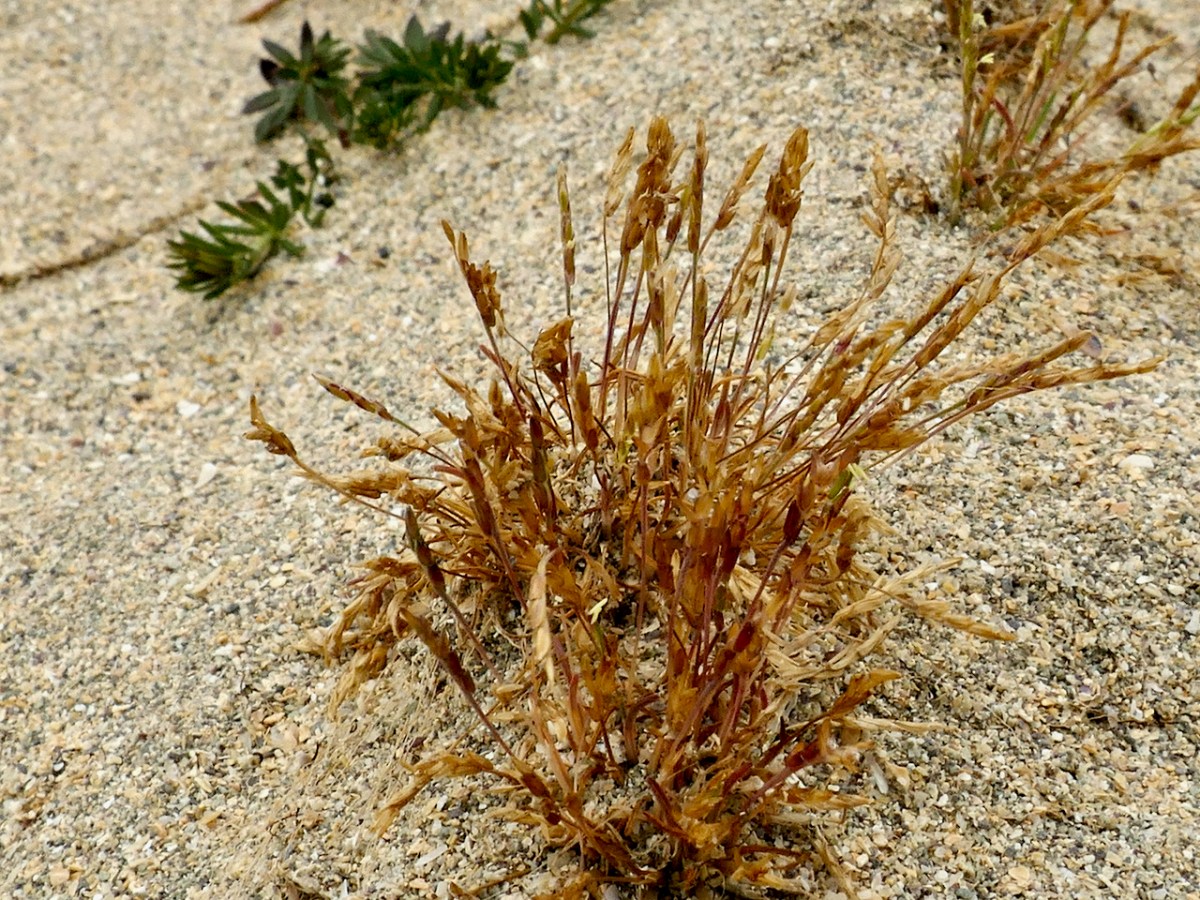
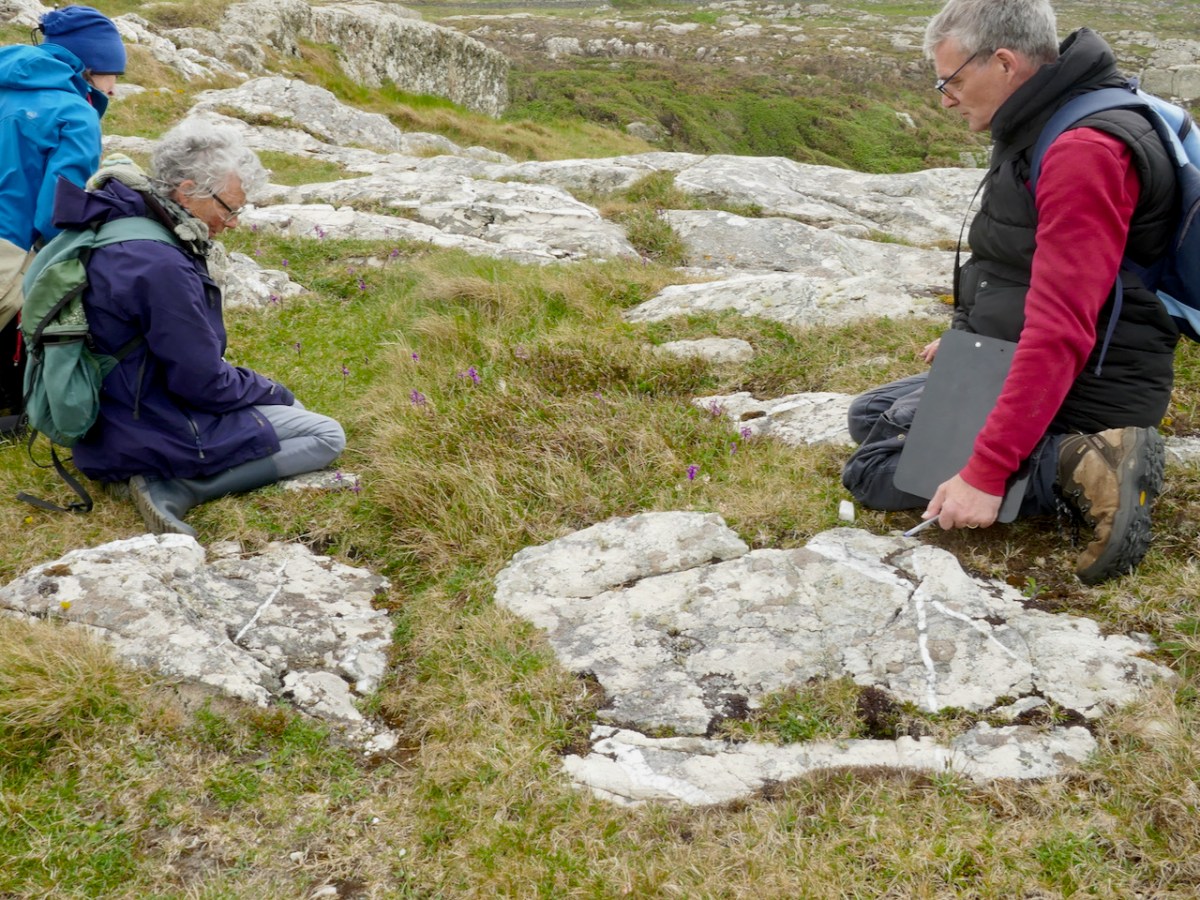
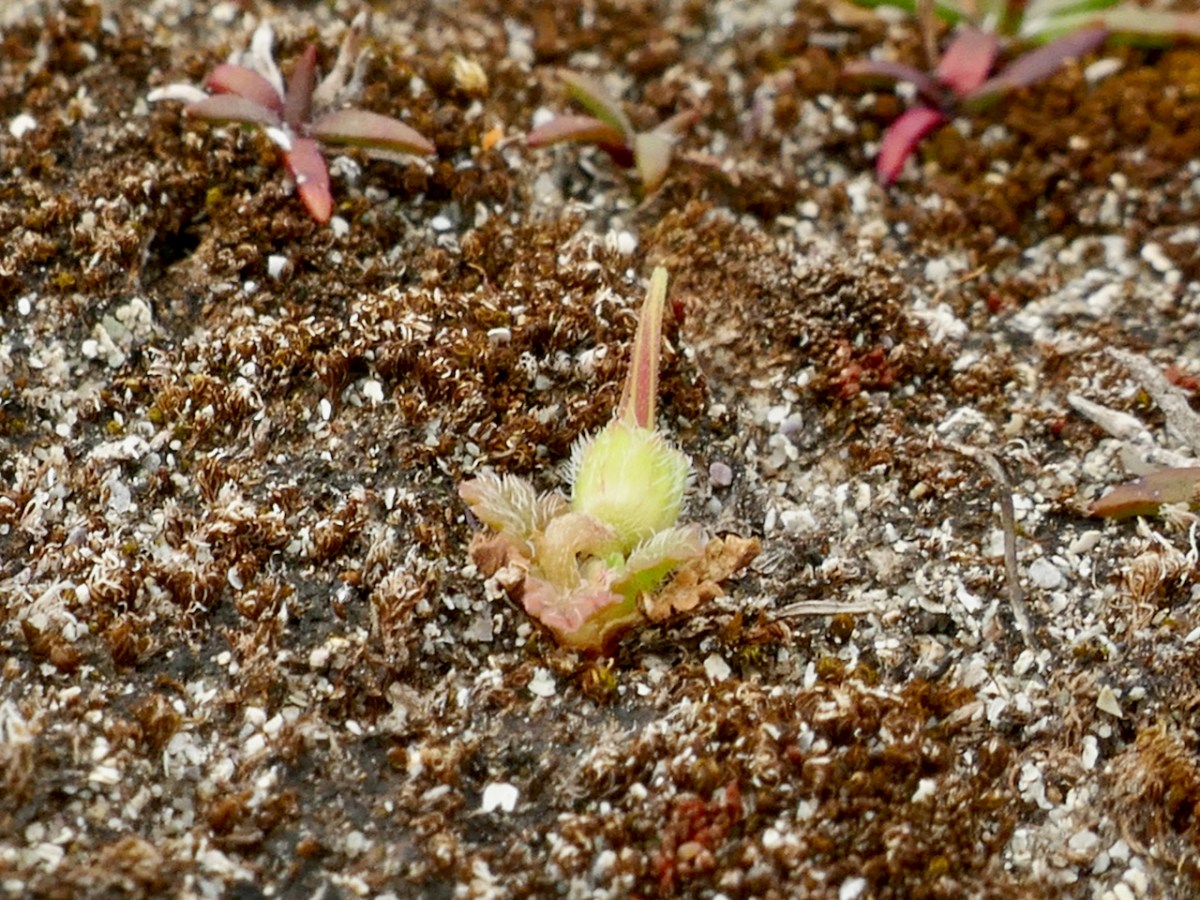
As our first rare plant, we were in search of Early Sand-grass, the kind of undistinguished little plant that you would walk over unthinkingly, but which is so rare that it only occurs here and in the Bull Island Nature Reserve in Dublin. That’s the distribution map below, courtesy of the BSBI.
Paul found it and we collectively traced its extent across the dunes. This is an area with much rabbit activity and Paul speculated that the bare patches of sand created by the busy bunnies was what had encourage or allowed the Sand-grass to colonise this area. It’s a complex issue – those Barley Cove Bunnies can be destructive to the dunes in some ways, but here we have an instance where their presence has been beneficial – one of those complex interactions that are so hard to predict.
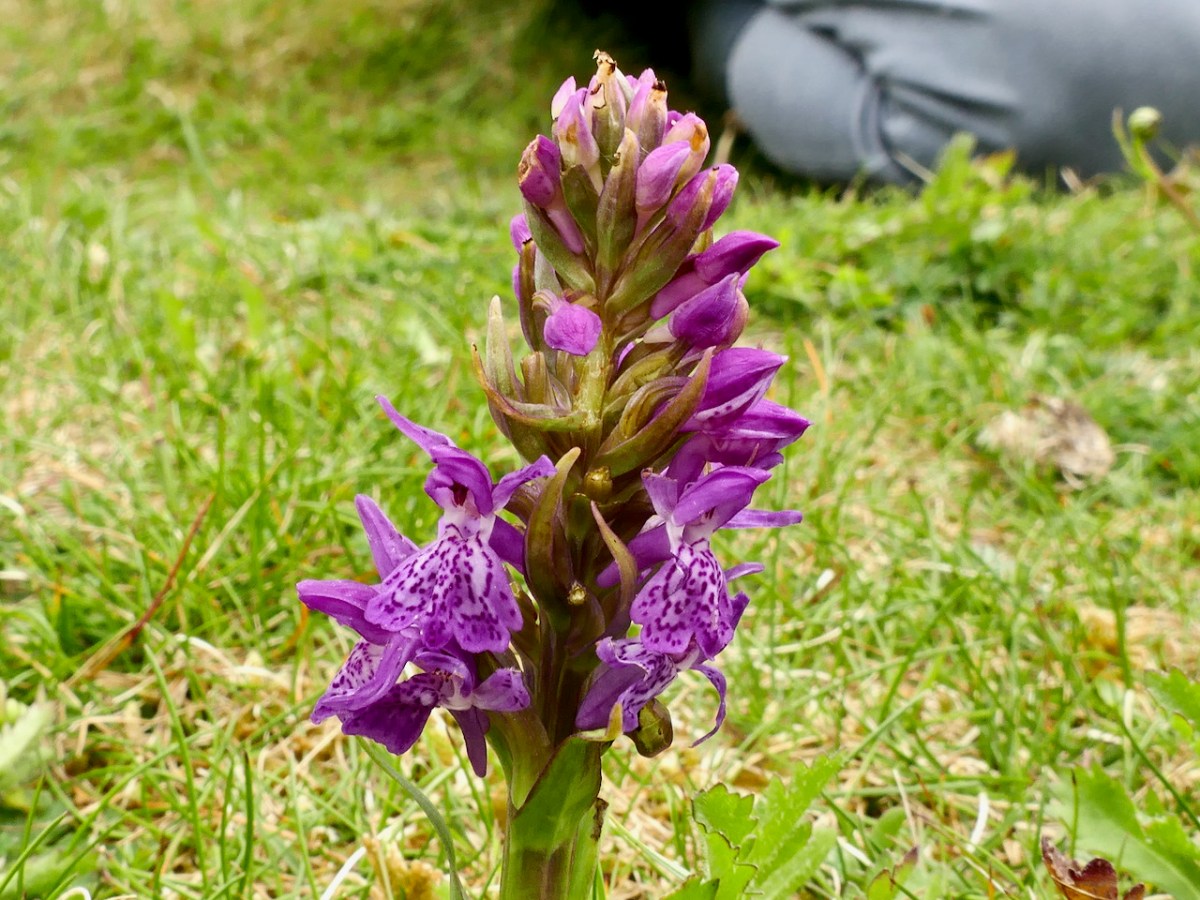
Our next target was an orchid – the Green-winged Orchid. But, on the way, we found another Orchid – the Irish Marsh Orchid (below). It was beautiful and bold and instantly visible in the short grass on the dunes.
In contrast, we almost tripped over the Green-winged Orchid, which upon first glance looked spindly and unremarkable. This is one you have to get close to – can you see them in the grass, below?
Here’s what Zoe Devlin has to say about this flower:
Surely the most exquisite wild orchid in Ireland. . . Green-winged Orchid is a small, erect plant which grows to about 30cm tall in grassland and meadows where grazing occurs. It bears flowers, well separated, in short spikes and these flowers appear in several colours – from snow-white through pink and magenta to deep purple. The three sepals are purple-veined with strong, green lines and these sepals form a hood over a broad, downward folded lower lip which is three-lobed and heavily spotted at its white centre. There is also a stout, slightly-curved spur. These incredible flowers bloom from mid-April to mid-June. The leaves are shiny green, unspotted with the upper leaves sheathing the stem and the lower leaves forming a rosette.
Can you see all that in these photos? I’m not sure you can, which is one of the things that makes wildflower identification interesting – especially with a family like the orchids where there are quite a few that look similar until you really examine them.
There were more plants on the dunes – I was amazed to find Field Madder (above), which I always assumed was a plant of arable ground. One of the things we had to get used to was how tiny many of the plants on the dunes were compared to those that grow in less challenging environments – like miniature versions of themselves.
Then there was one of our target species, the Sea Stork’s-bill (above) – really, a flower that only its mother could love, but very rare in Ireland and therefore one of the plants that enable us to chart the conservation of its habitat.
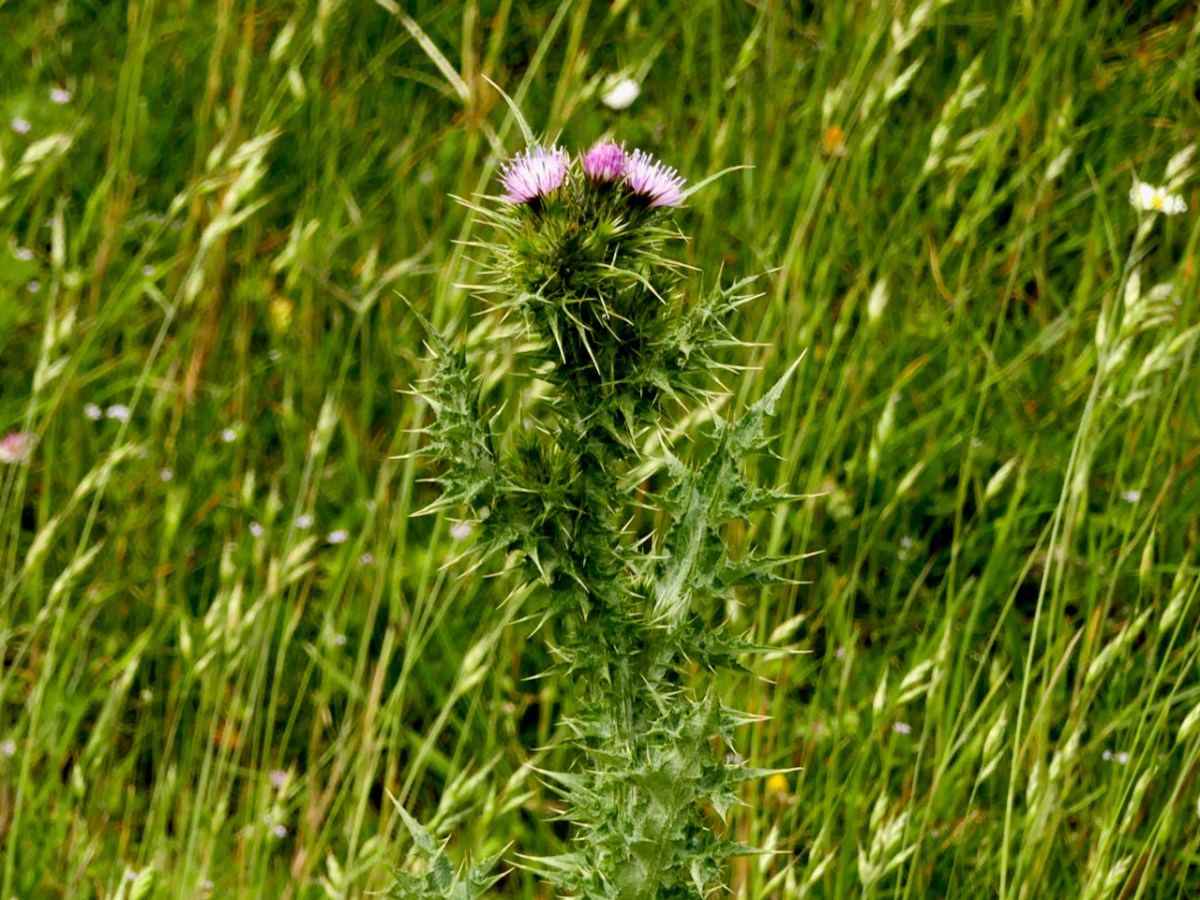
We drove from Barley Cove around to the Holiday Park but were unable to do a count of the Slender Thistle. The land was being grazed by sheep and every access was blocked (above). So we contented ourselves with noting that currently it appears to be abundant, if very localised. I managed a distant shot of this fine head (below) showing the pink flowers but also how spiny it is.
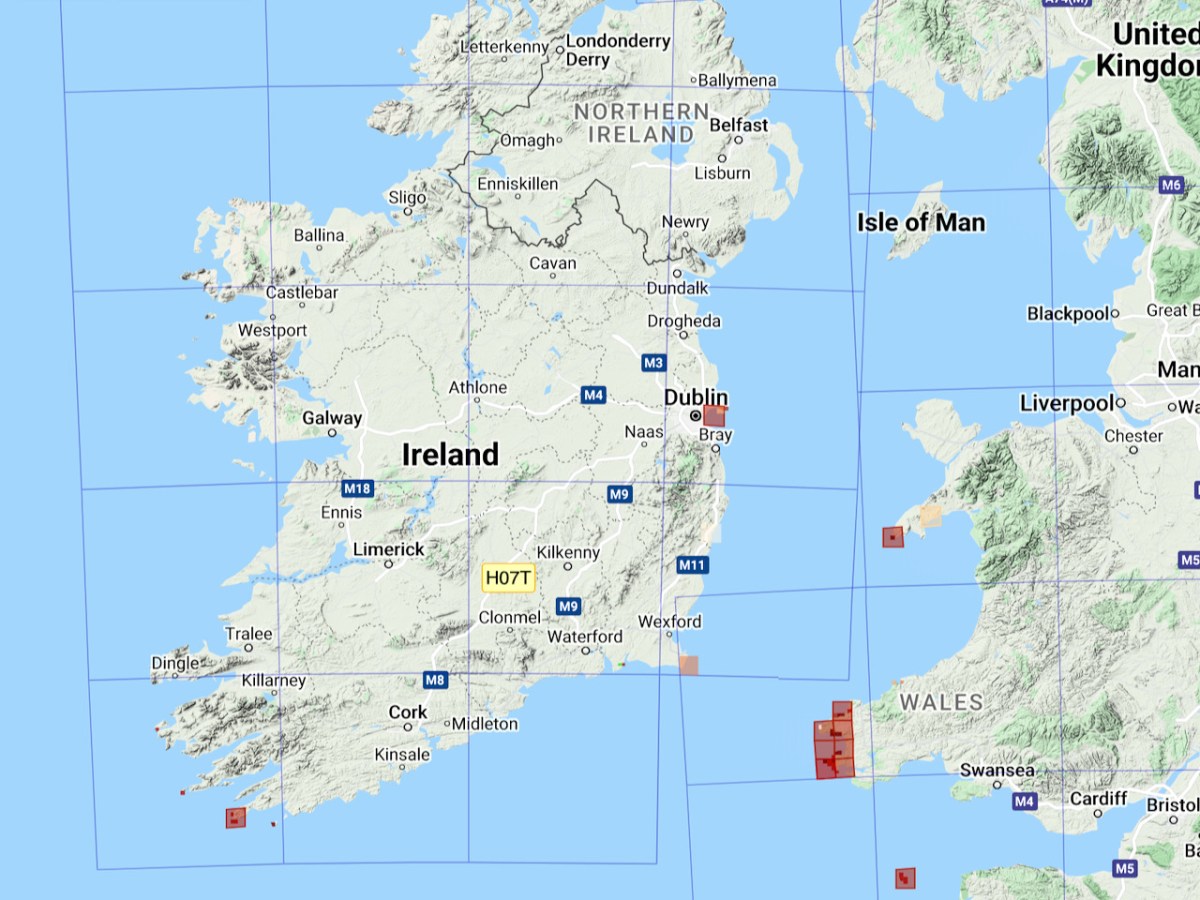
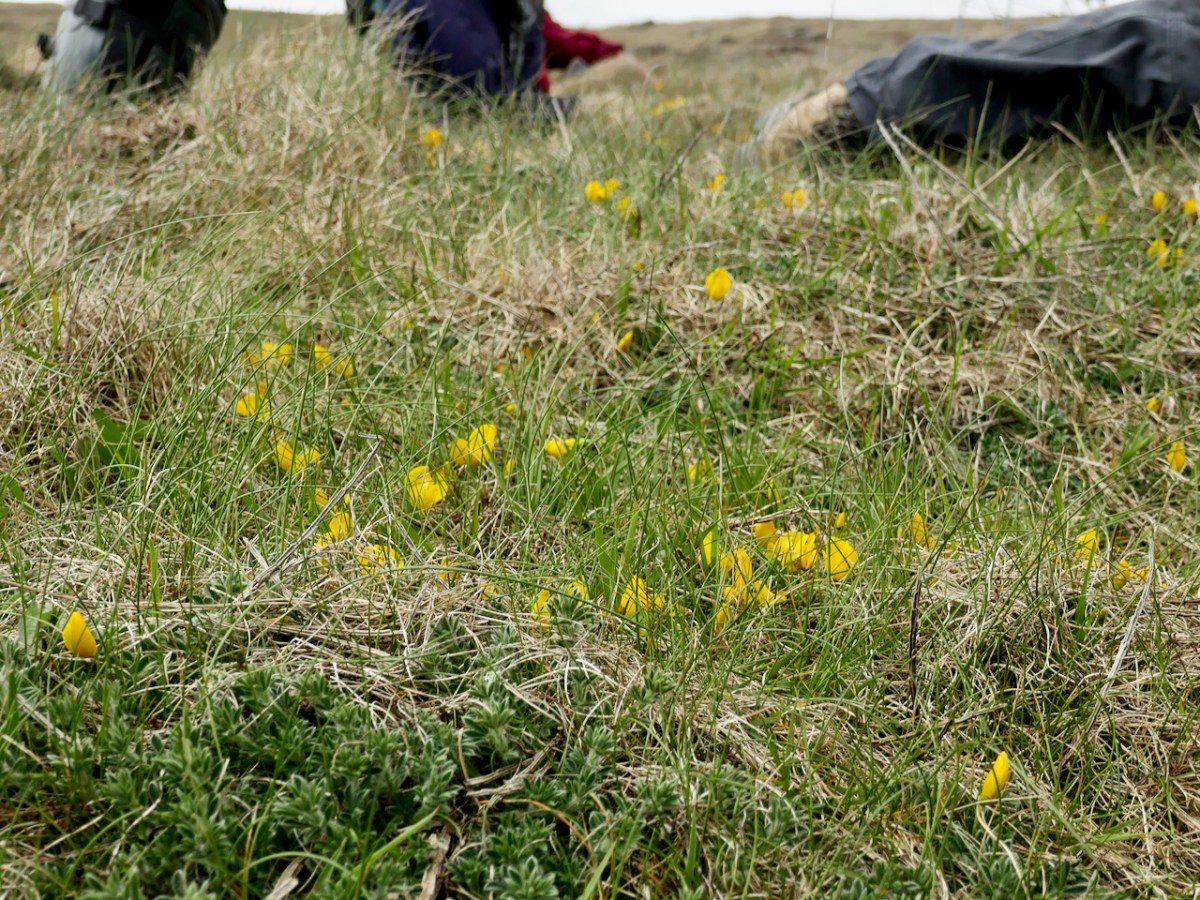
Our final stop was Mizen Head, one of the very few places in Ireland (see map below and the Broom below that) where you can find Prostrate Broom (try saying that fast). This was another exercise in a different kind of counting, since the plant is on sea cliffs and behind fences at the Visitor Centre, so it has to be identified at a distance and the count is an educated estimate. Add in the fact that there are two other yellow flowers gaily blooming around it (Kidney Vetch and Bird’s-foot Trefoil) and you get an idea of the challenge involved.
I have taken on the task of the Early Sea-Grass count. It may bloom as early as February or March, so I’ve made a calendar note to head out to the Dunes next year at that time. Another one of the participants, Damaris, and I will work together on our counts – it’s always more fun if you have a companion and probably more accurate too.
Thank you, Úna and Paul, for such a profoundly educational experience, that also managed to be great fun.
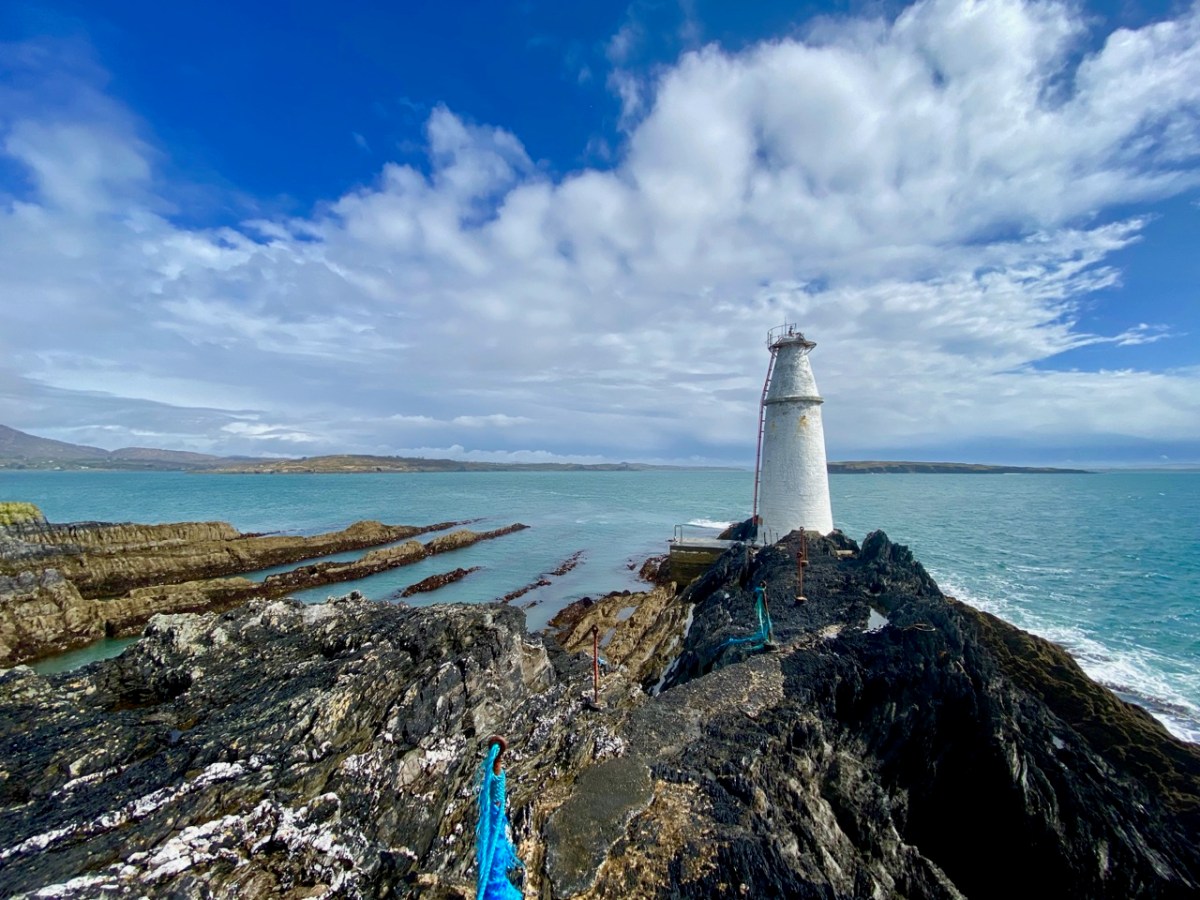
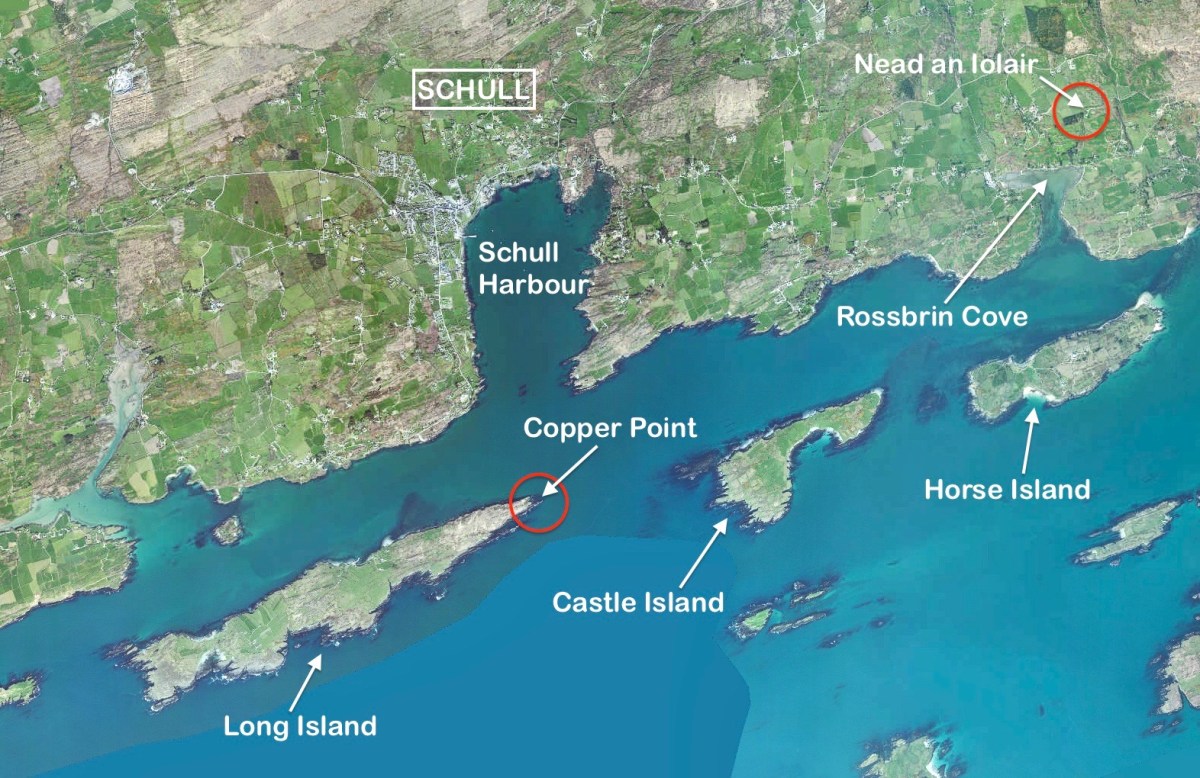
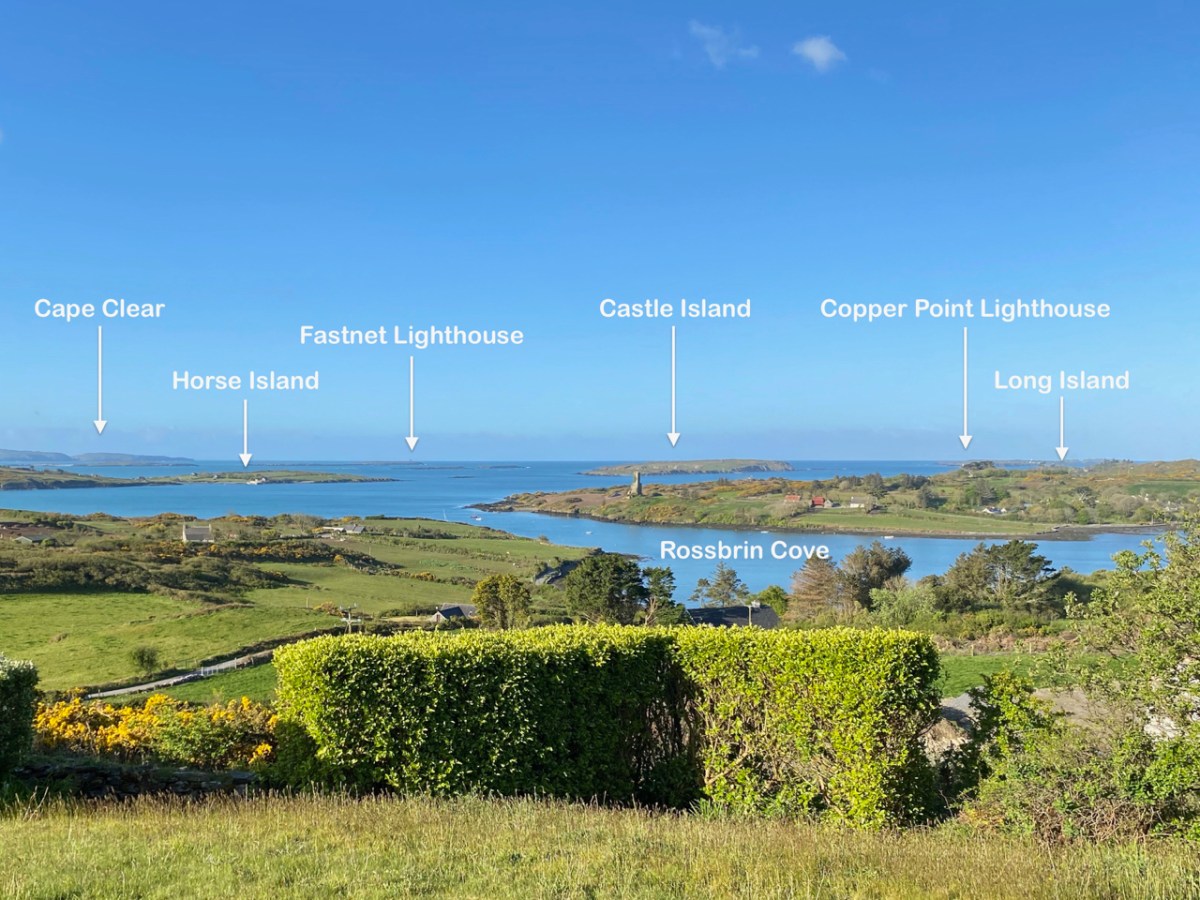
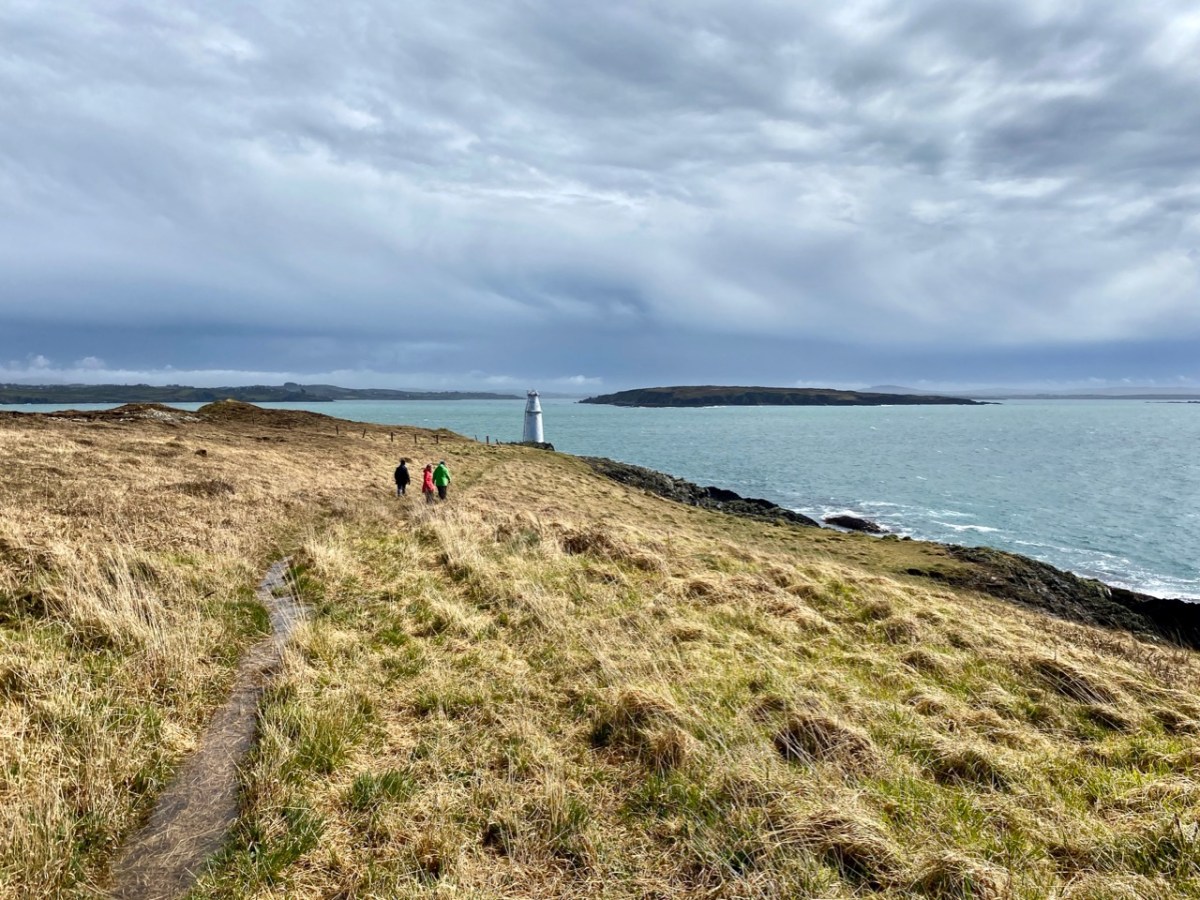
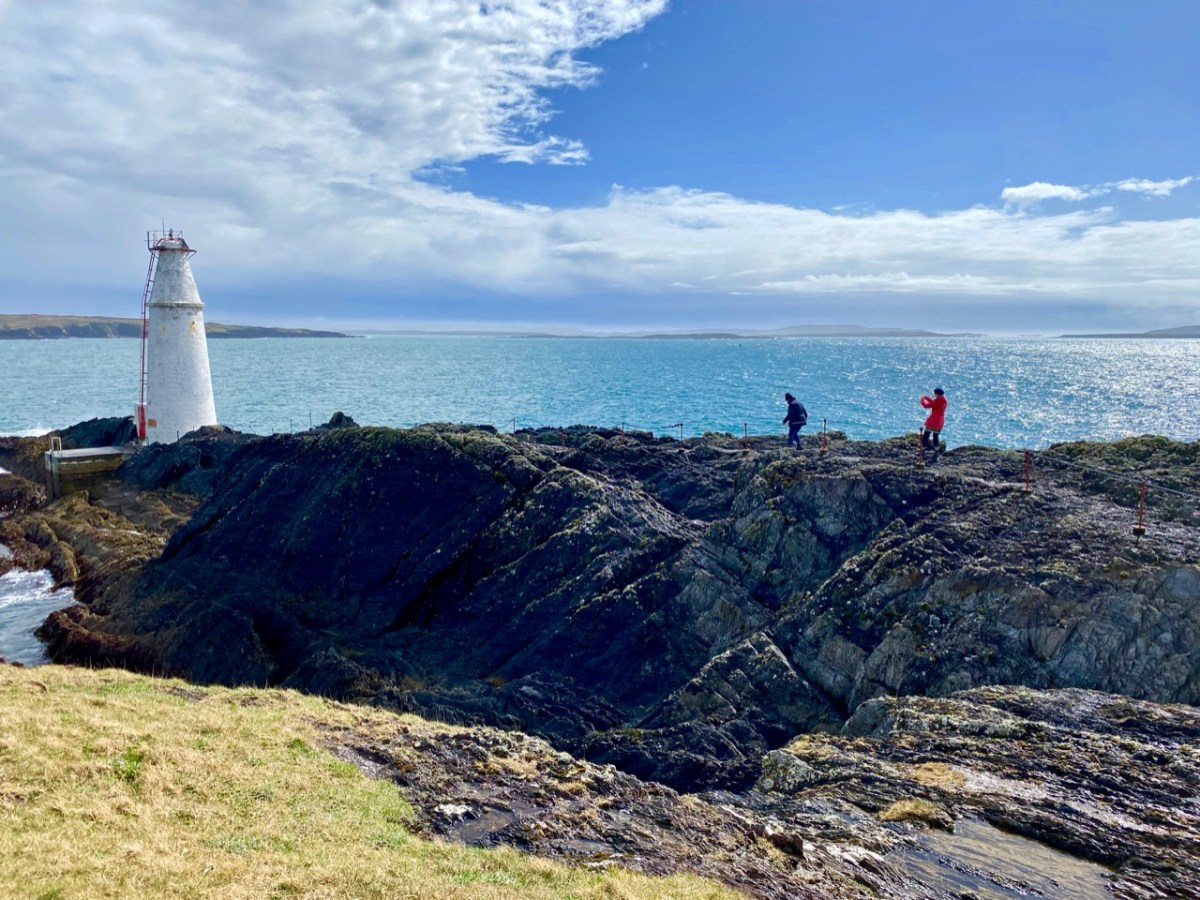
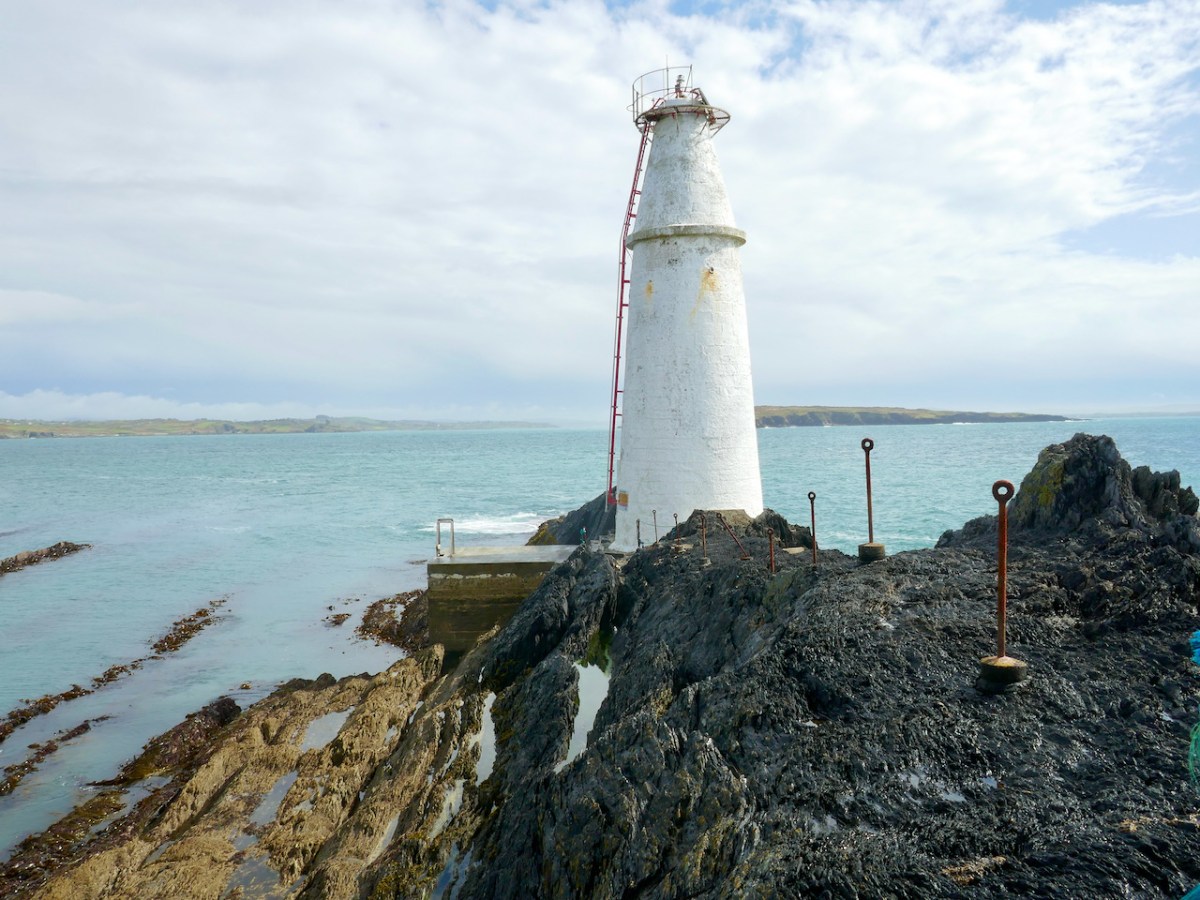
What better place to spend Easter Day than at the ‘Easter end’ of Long Island? We can see the island – out there in Roaringwater Bay – from our home here at Nead an Iolair. The lighthouse on the end of the island faces us – and winks through the night with the character of 3 quick flashes every 10 seconds. The narrow headland on which it stands bears the name ‘Copper Point’ – and so does the lighthouse.
This aerial view shows Long Island in its context – a part of Roaringwater Bay and its ‘Carbery’s Hundred Islands’. Its neighbours to the east are Castle Island and Horse Island – all in our view – (that’s our view, below).
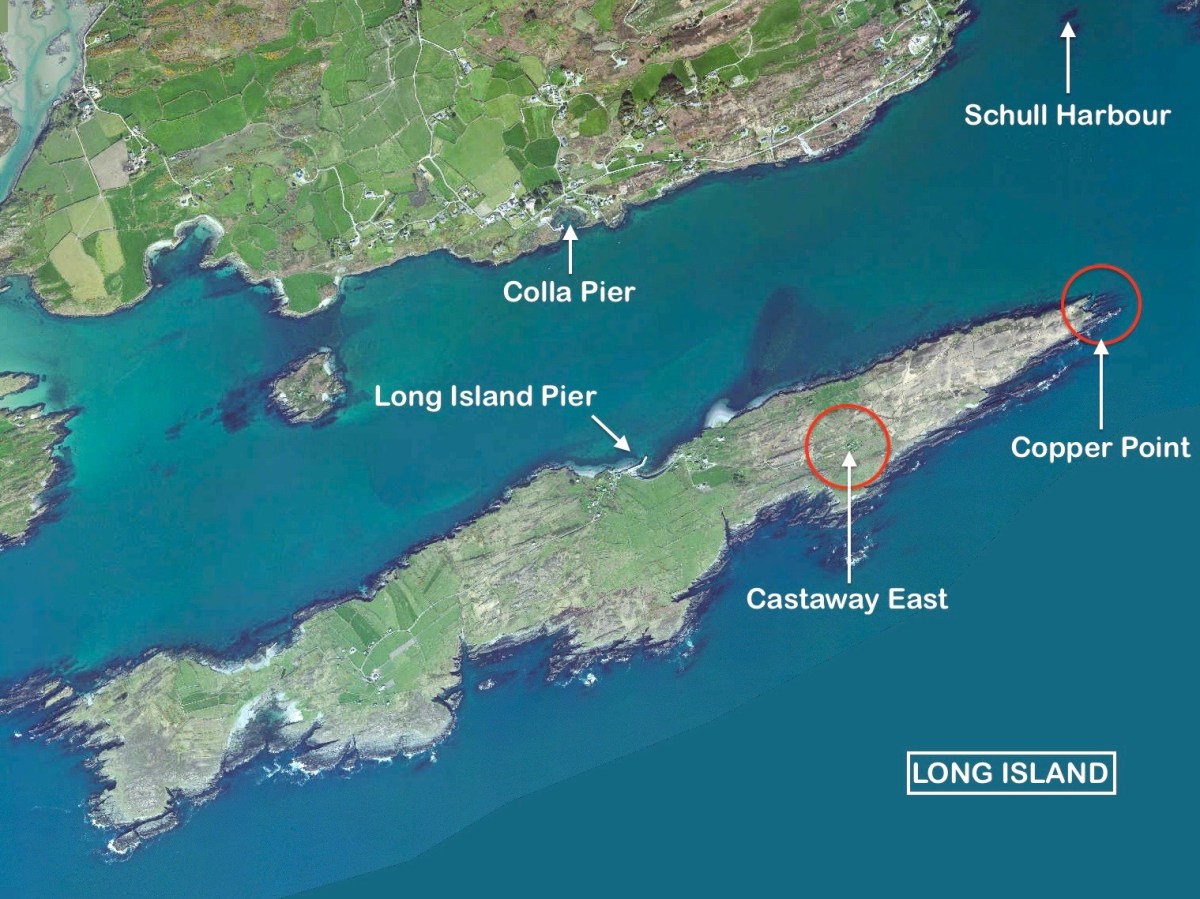
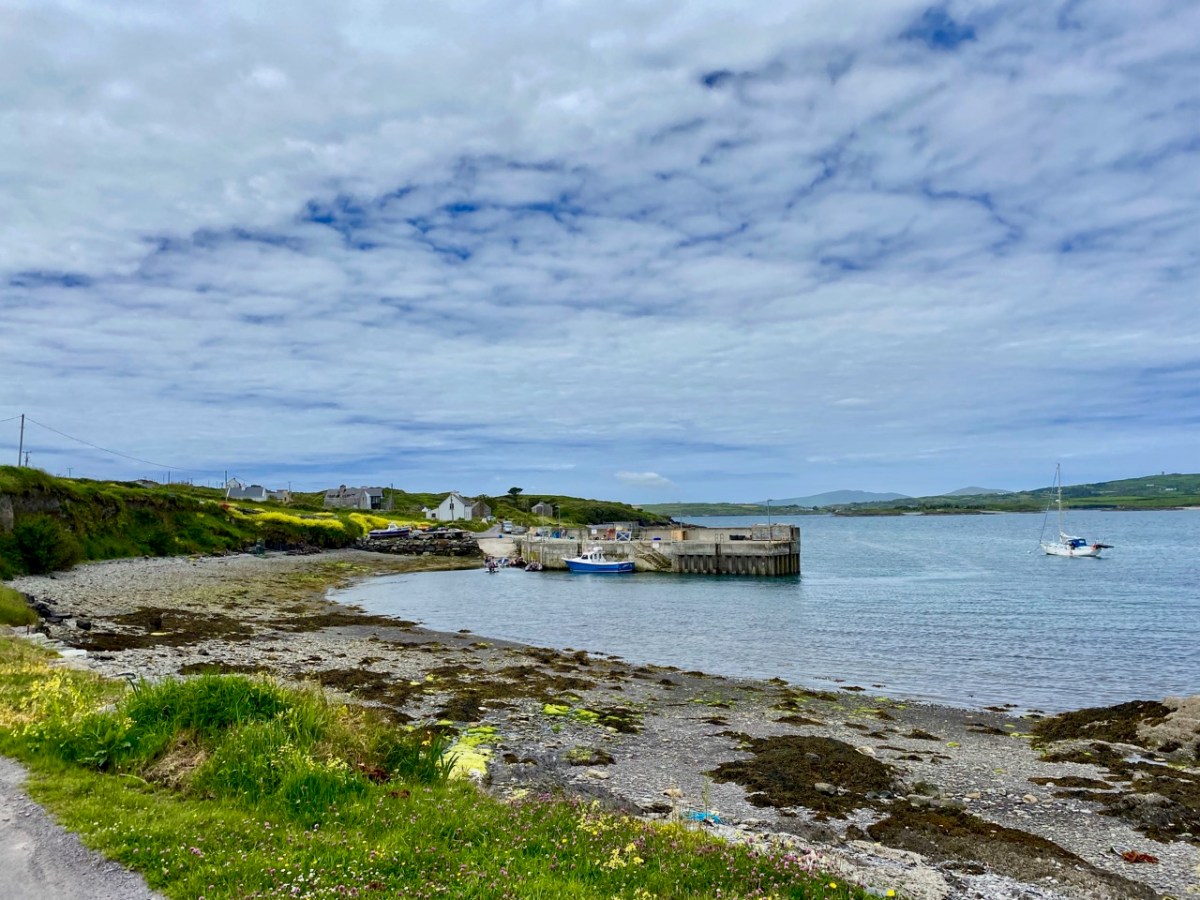
A closer aerial view of the island, above. It’s accessed by a regular ferry which leaves Colla Pier, a short distance from Schull town. The ferry arrives at Long Island Pier: there it is, on the pier (below).
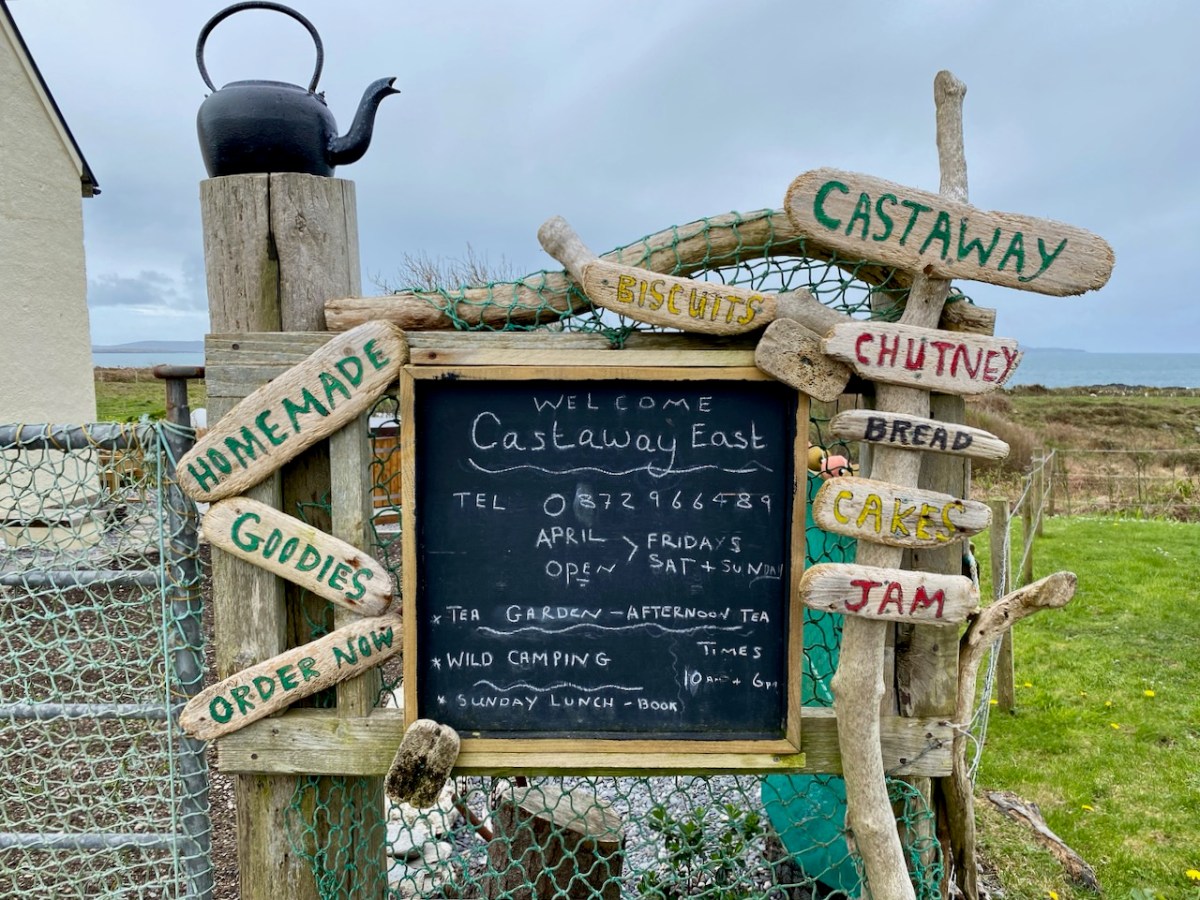
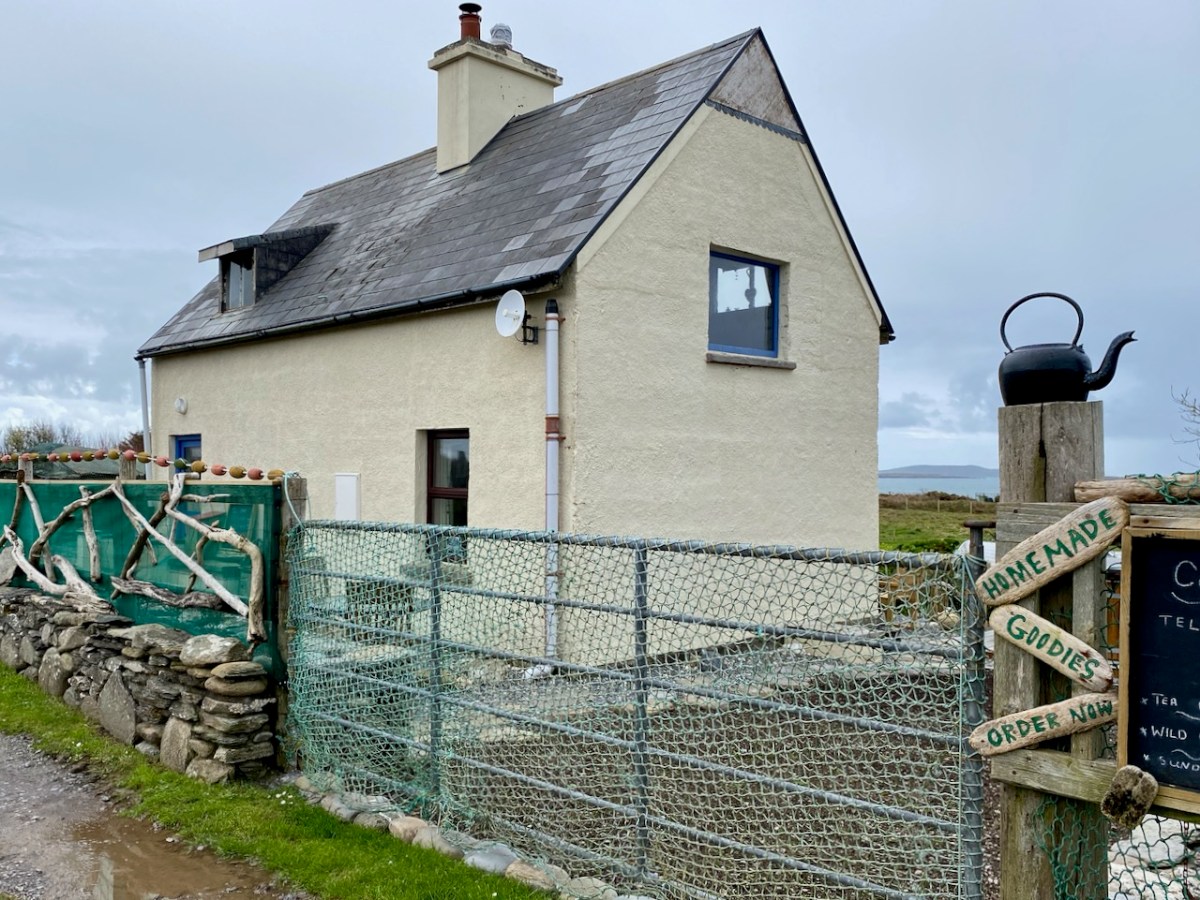
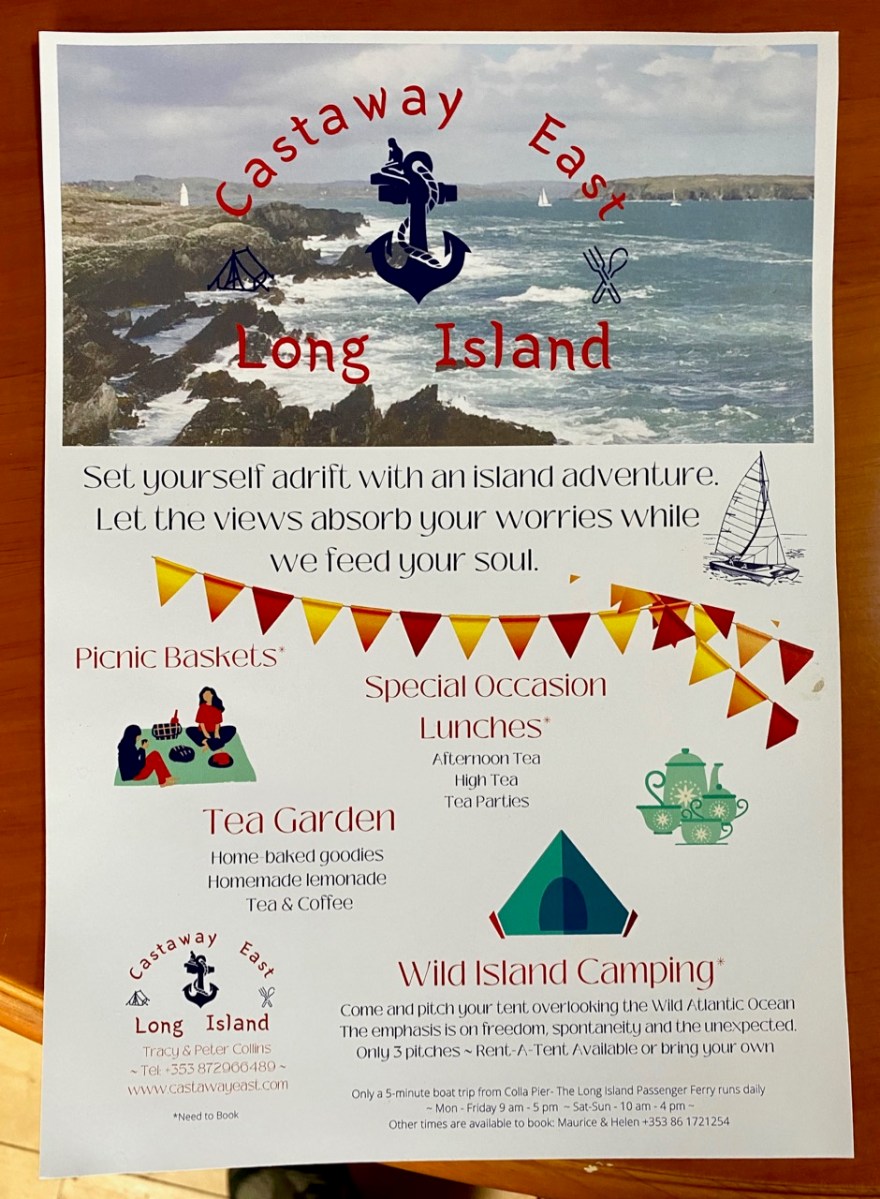
Our destination on this Easter Sunday was Castaway East – the furthest house on the ‘Easter’ end of the island. We have taken you there before, when we organised a Mad Hatter’s Tea Party in July of last year. The hosts there are Tracy and Peter, who served us brilliantly for that occasion, and also for the Wildflower Walks which Finola led last June: the Castaway crew provided a superb picnic for everyone, delivered to us at the island’s western end. This time we decided that we would test Tracy and Peter’s skills by ordering up an Easter Sunday lunch to celebrate a ‘special’ birthday for our good friend, Peter Clarke.
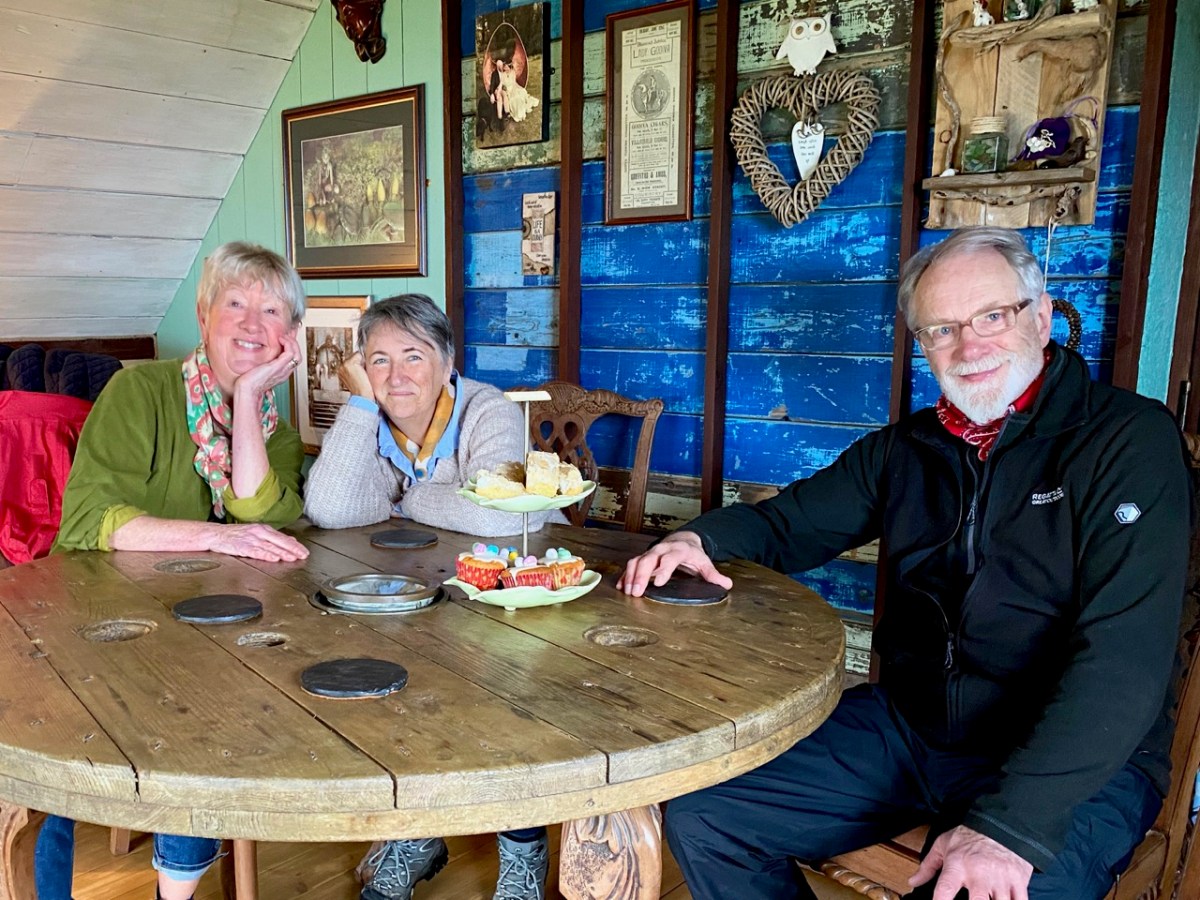
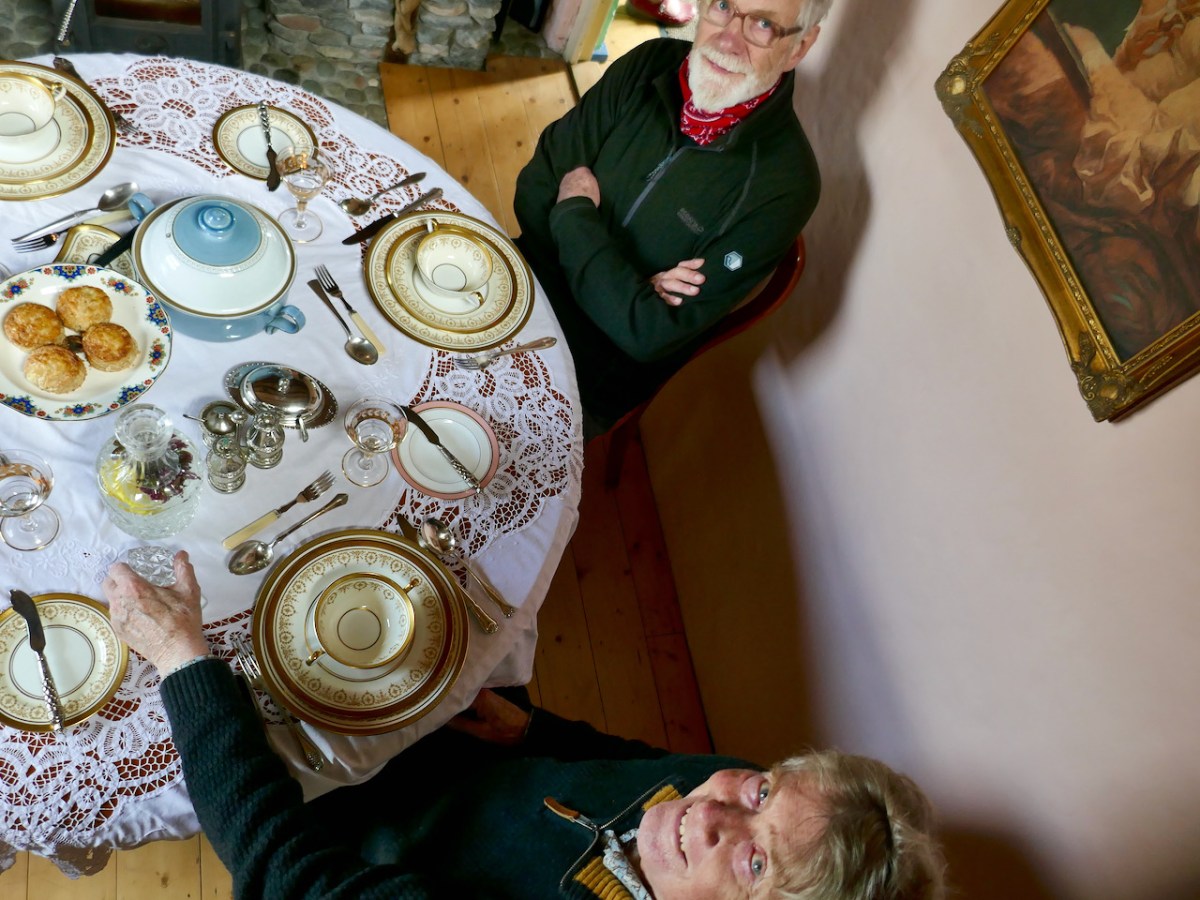
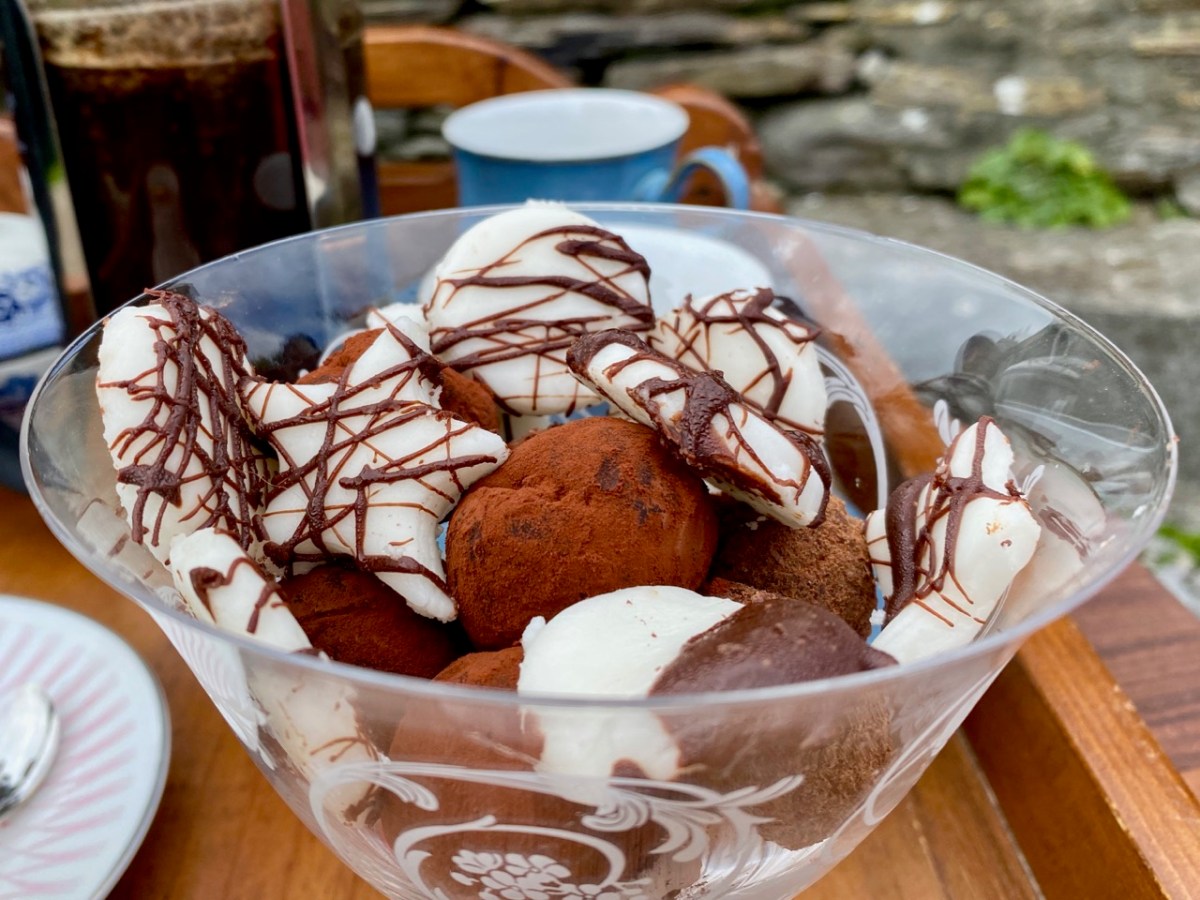
Amanda Clarke, Finola and birthday boy Peter, looking forward to a morning coffee (with delicious Easter treats) after arriving at Castaway East. We had an upstairs room in the Castaway house, with a good view over the island. Before lunch we had an opportunity to explore part of the island we had never been to before, heading down to Copper Point.
Why is it called ‘Copper Point’? Because there was a copper mine close by, one of many such enterprises that were seen in West Cork in the nineteenth century. Explorations on the island were started in the 1840s by the Cornish mining engineer Captain William Thomas: he wrote a Roaringwater Journal post for us a couple of years ago! William sank a trial shaft for 10 fathoms (60 feet) and extended a level south from this shaft for 3 fathoms. No metal bearing lode was found, and the mine was abandoned. Traces of these workings can still be seen not far from the lighthouse. It’s slightly ironic, perhaps, that the name ‘Copper Point’ arrived from somewhere and stuck.
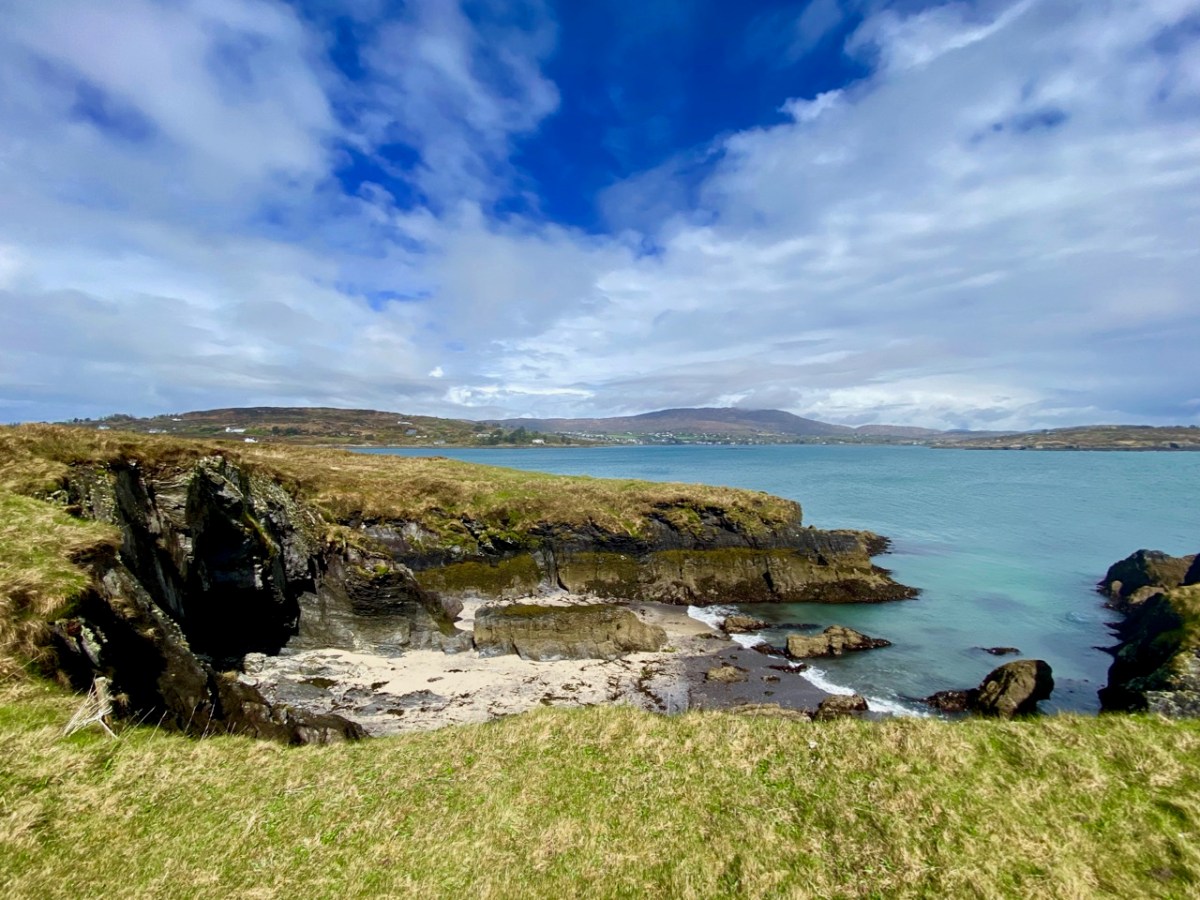
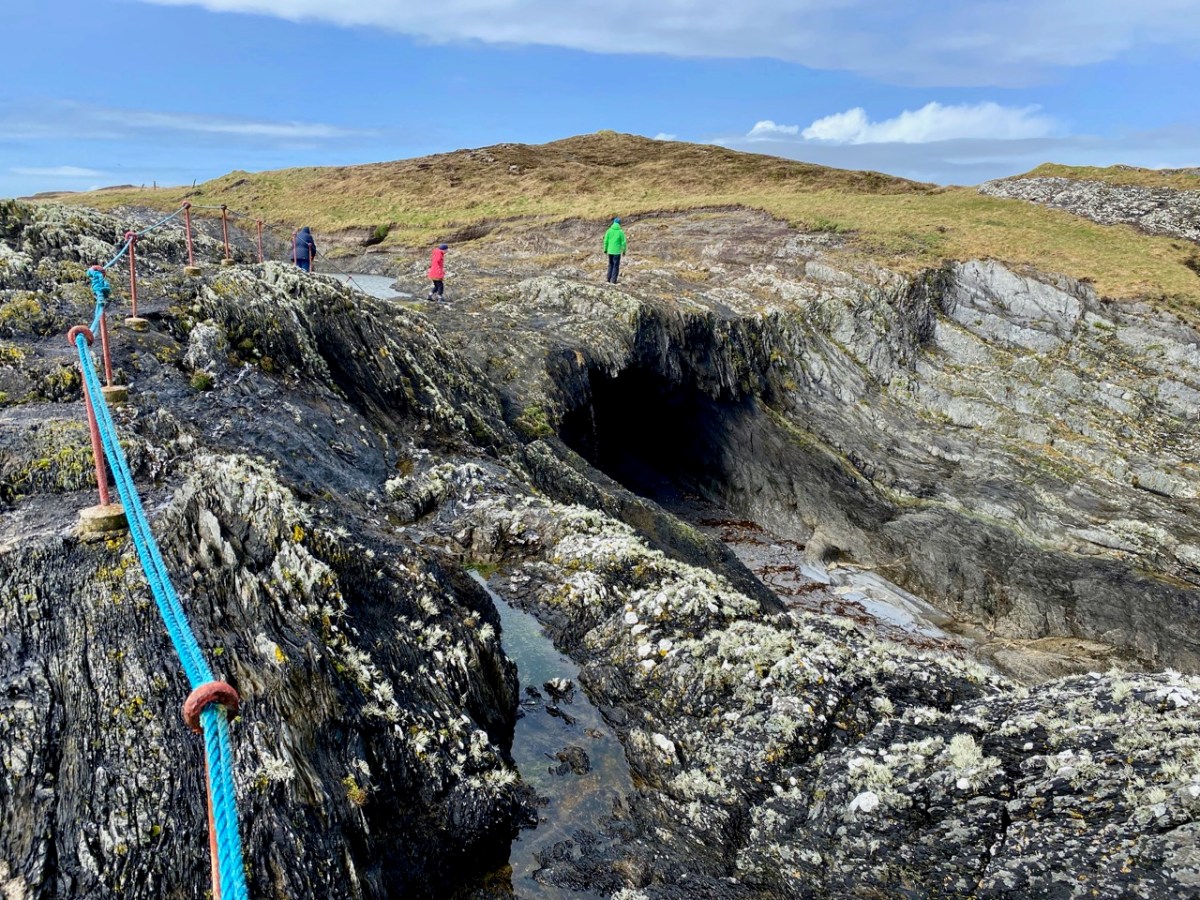
It’s a wild landscape – but very beautiful and imbued with atmosphere. We certainly worked up a good appetite while on our morning walk, and returned to the house with great expectations.
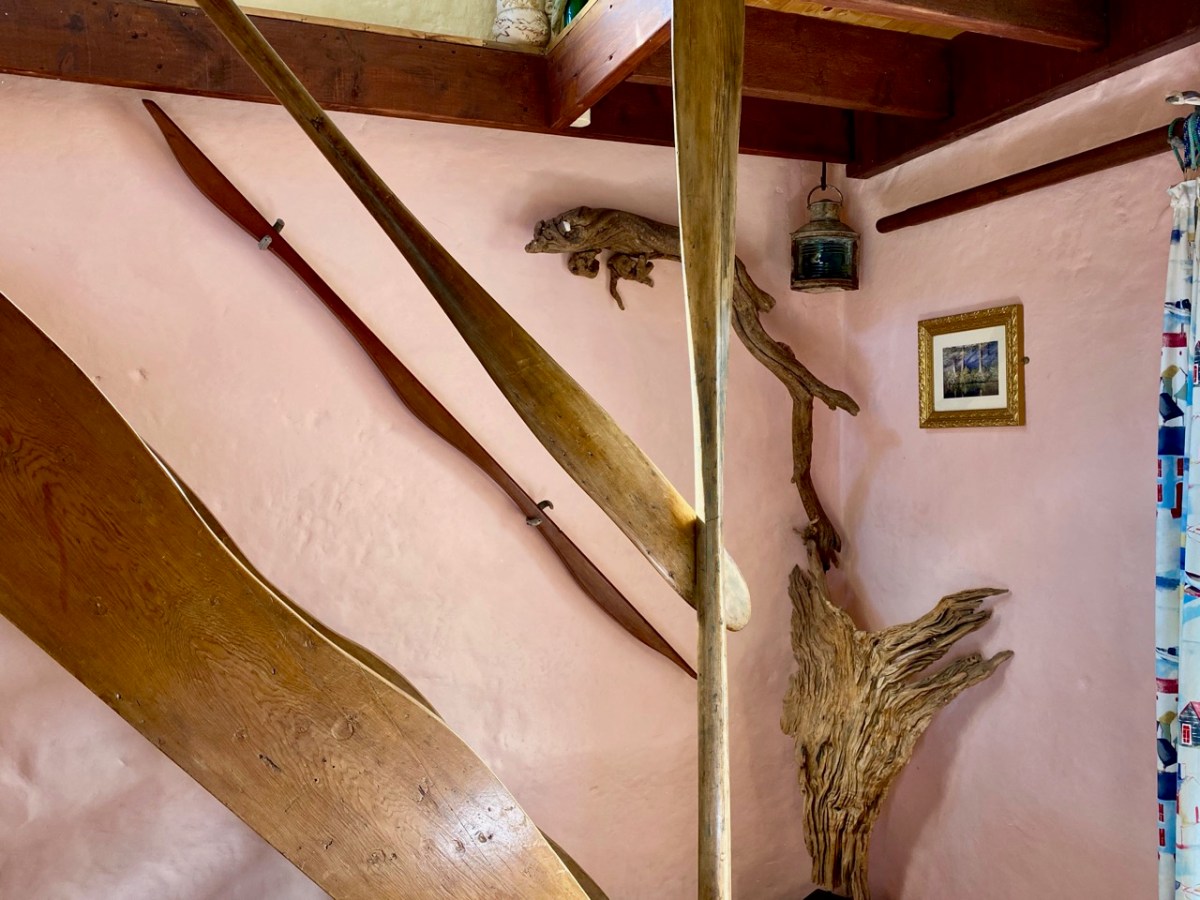
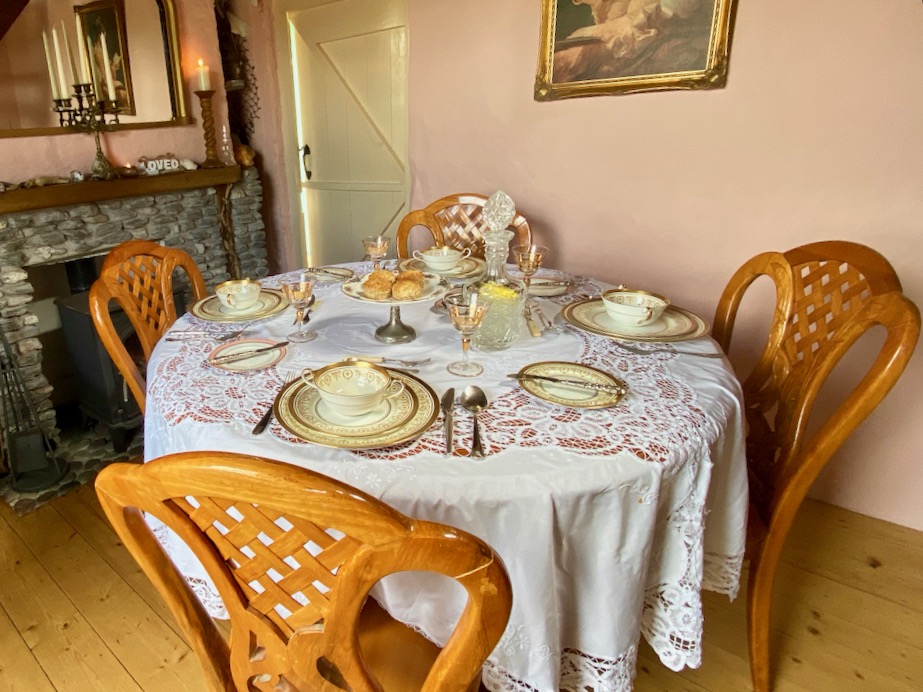
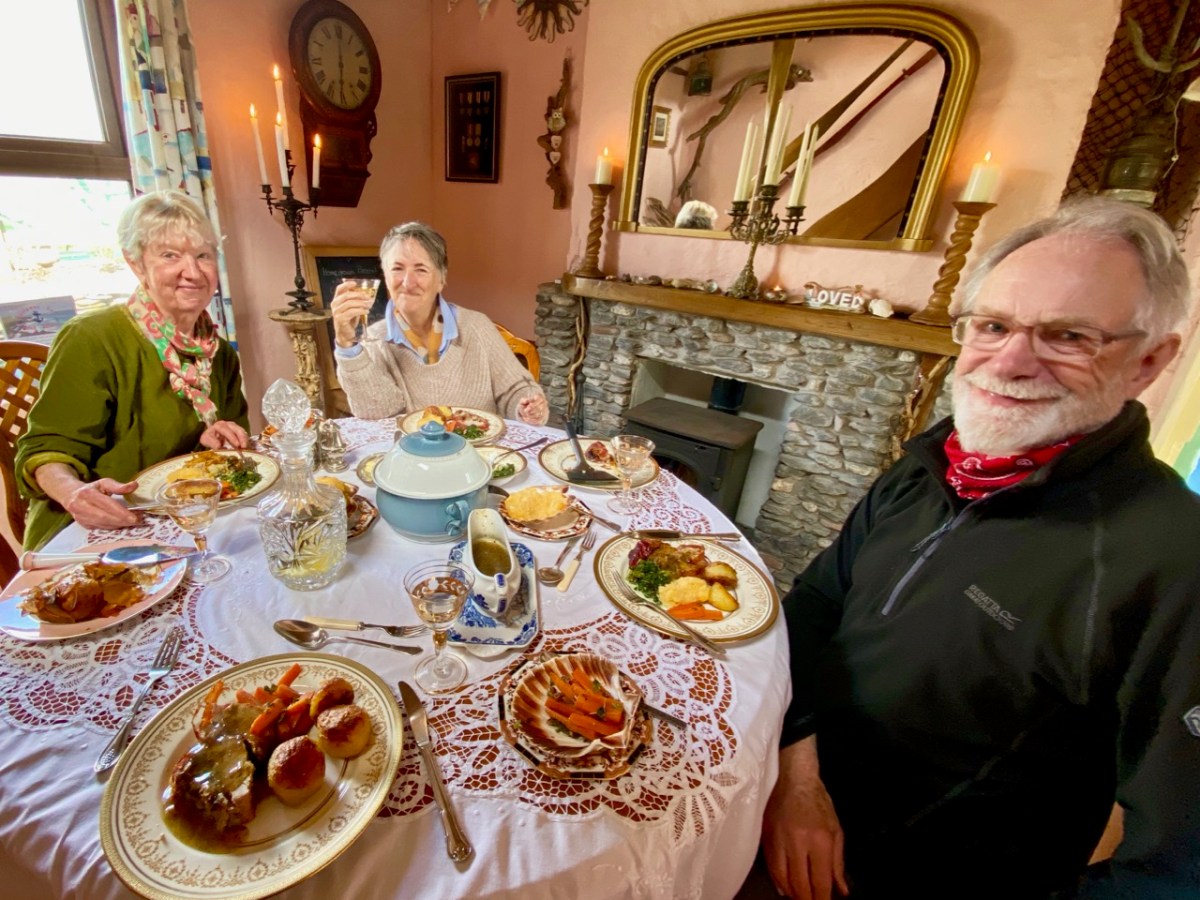
All those expectations were far exceeded when we sat down to our meal. We had a room to ourselves, attractively furnished and comfortable, with a welcome wood-burning stove on the go in one corner. Tracy and Peter have spent considerable time and energy upgrading what was a very run-down cottage, and have used locally available materials with impressive imagination.
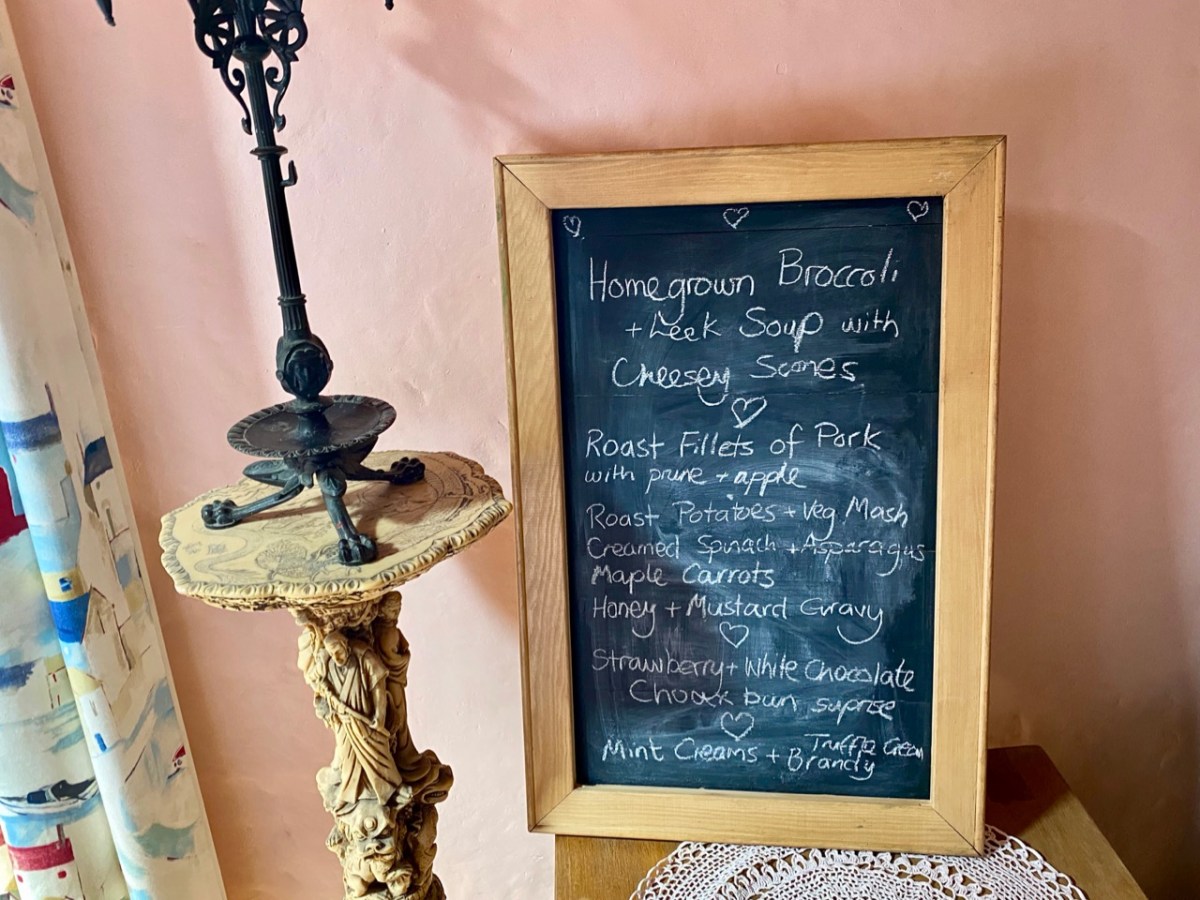
Tracy – in charge of the culinary delights – had worked out a menu which was entirely tailored to our various tastes (and dislikes) – and it was brilliant! All the courses were exemplary.
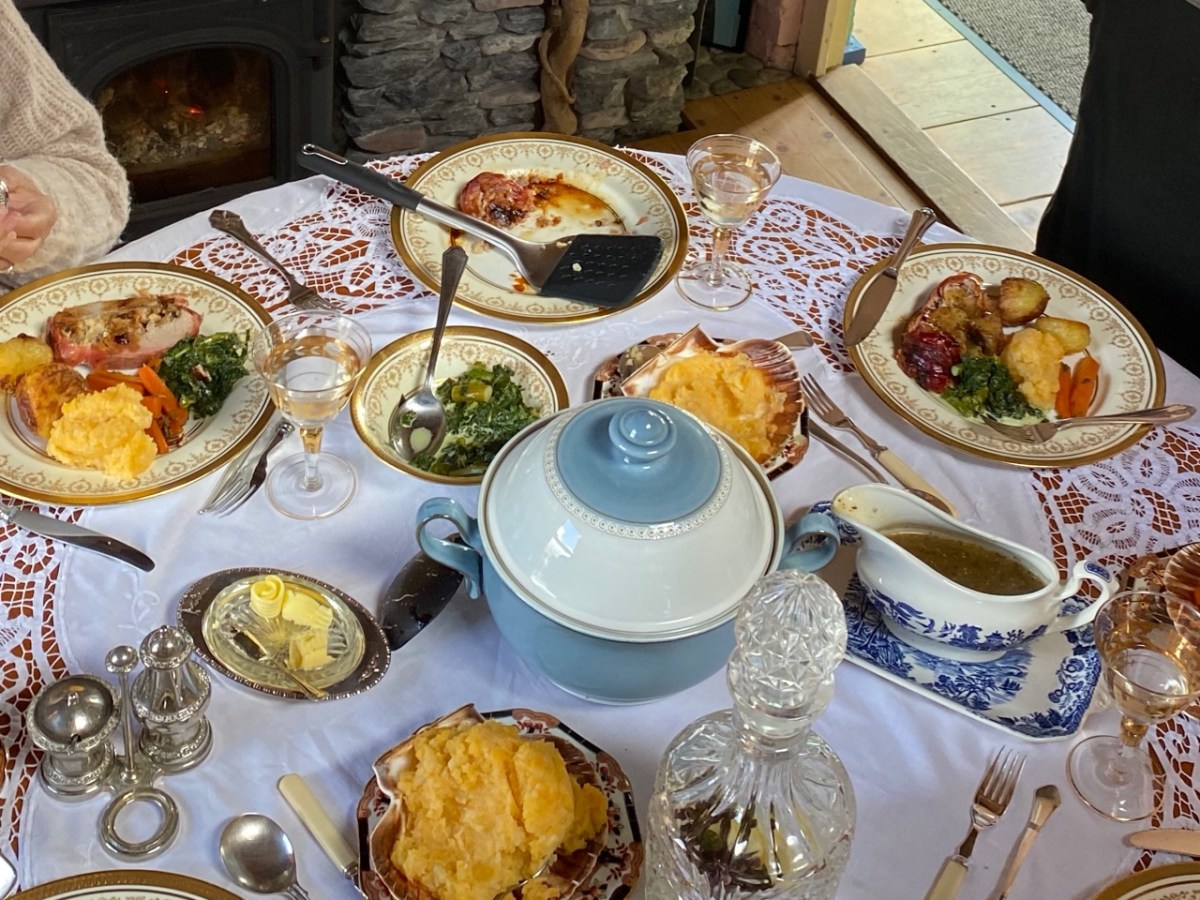
The main was a Sunday roast to make your mouths water… Fillets of pork for the three of us who are not vegetarian, and a miraculous stuffed filo pastry pie for Amanda. The accompanying vegetables were prepared without any meaty elements – so we could all savour them in equal measure.
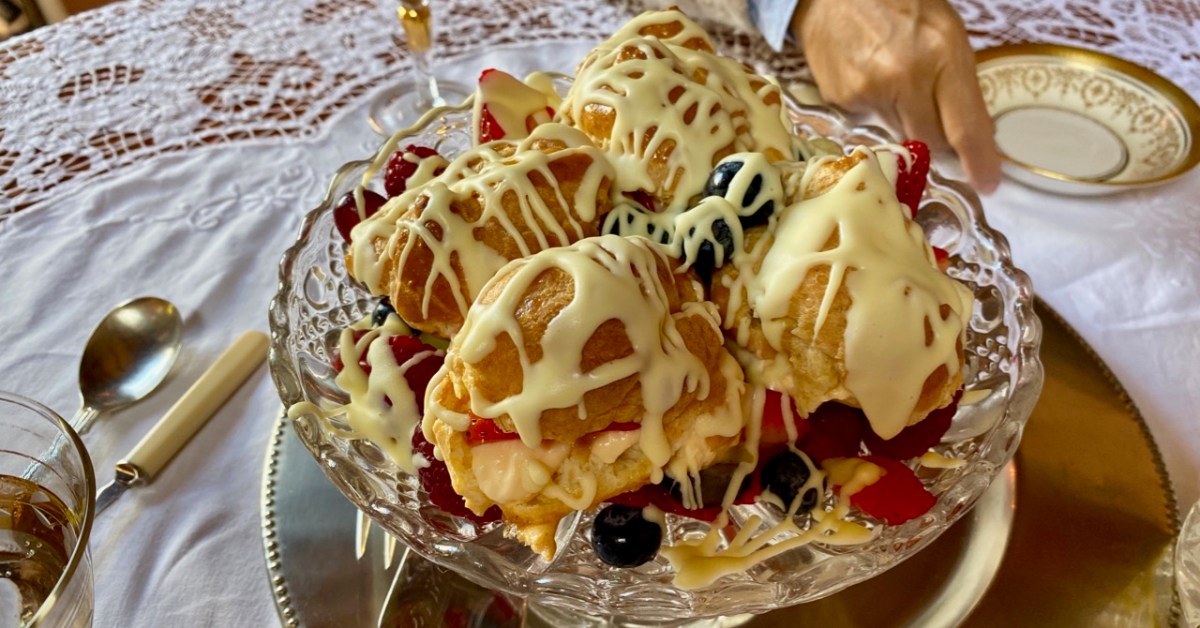
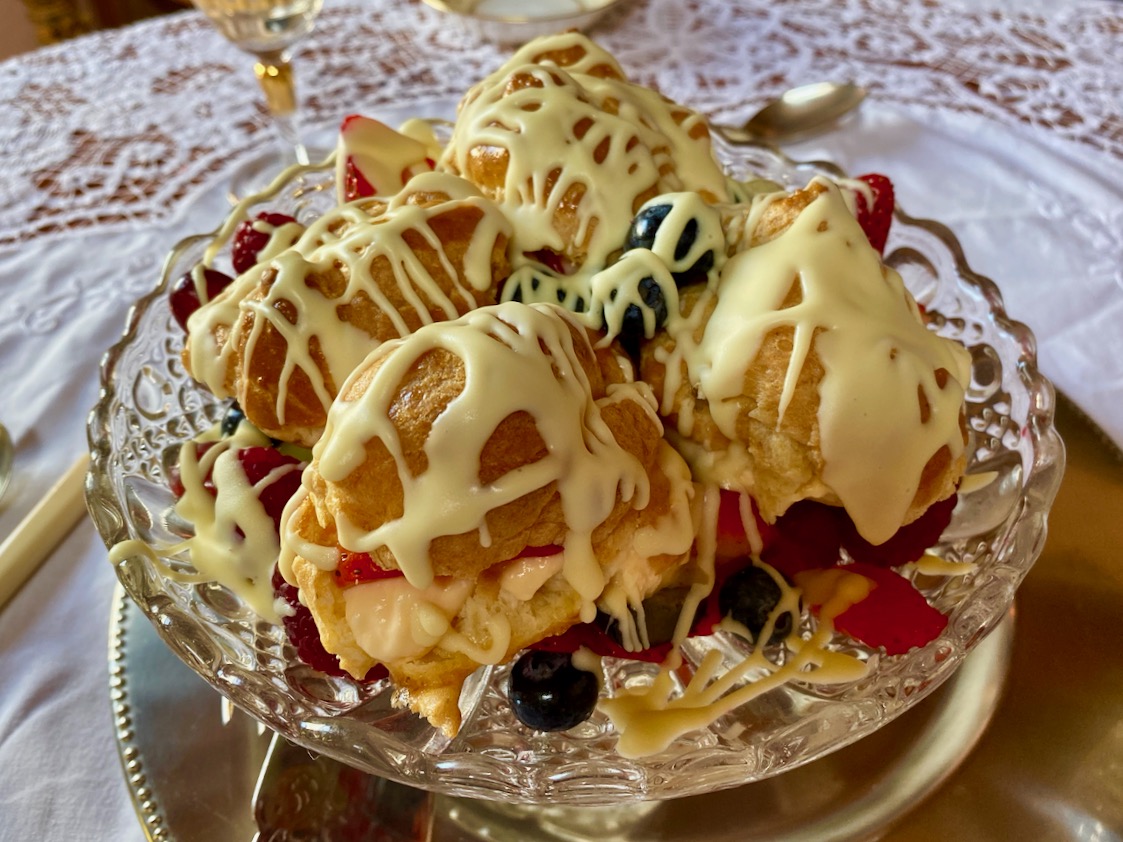
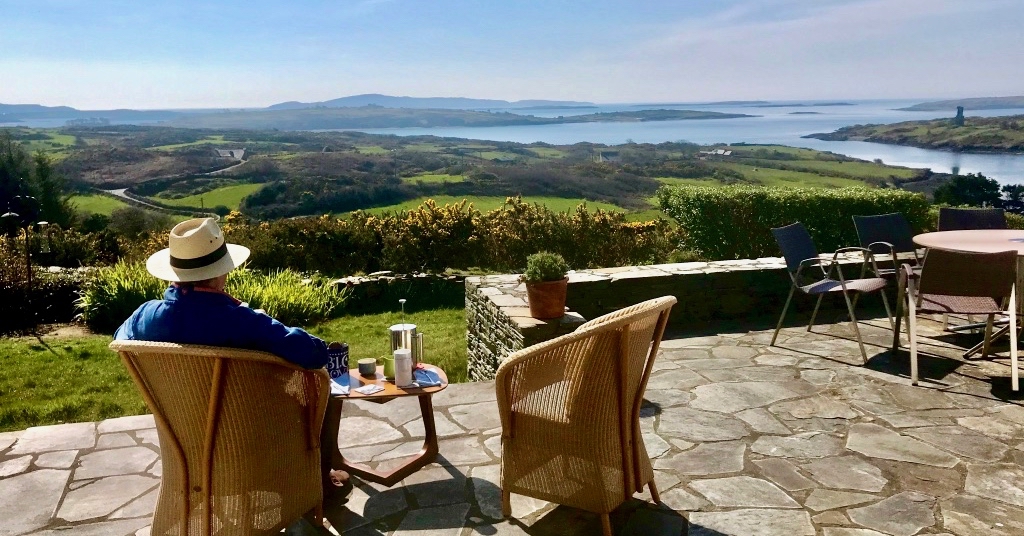
Peter was delighted with every aspect of his celebratory meal – we all were! The choux bun dessert was unbelievable; not a morsel was left behind. The riches never stopped: for our after-dinner coffee we went outside to the terrace-with-a-view and enjoyed home-made fondants and biscuits.
I think you’ve got the message… Sunday lunch at Castaway East is a very special experience indeed. Combine it with a good walk on a beautiful and atmospheric West Cork island and you will have a day you will always remember. If you want the experience for yourselves give Tracy and Peter a shout: they will be delighted to organise it for you.
Contact Tracy & Peter Collins on +353 872966489 or email simplytracy@icloud.com – They also have a campsite!
We thought ourselves fortunate to have come through those years unscathed. But the Covid has caught up with us both! Two years later, when we thought we could stop worrying: quite suddenly we felt strange – and gave ourselves Covid tests, which showed up positive! Of course, we are both fully vaccinated, and perhaps took too much for granted. We continued to be careful and wore masks in crowds (not that we encountered many of those). Perhaps there’s an inevitability that most people will succumb to it. But we are fortunate that it has seemed like no more than a severe cold. We are almost at the end of our isolation period, and look forward to setting foot on the boreens again.
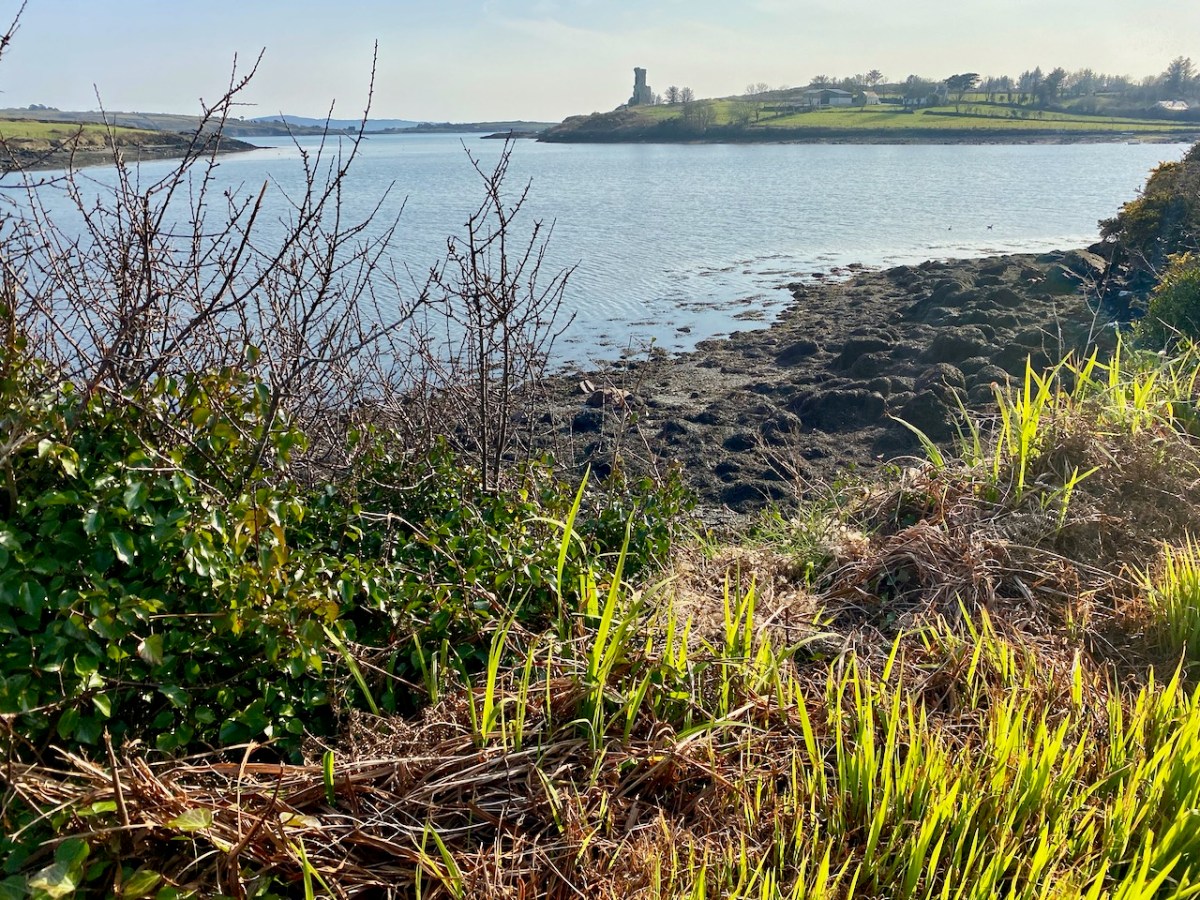
That’s our local tramping ground: Rossbrin Cove, yesterday. We couldn’t want for a better place to enjoy the lengthening warm days of this new spring which, so far, is proving exceptional for weather. Hopefully, by next week we will be back to normal, with new posts to interest and entertain you!
A pic of the Saturday market at Skibbereen just three weeks ago.
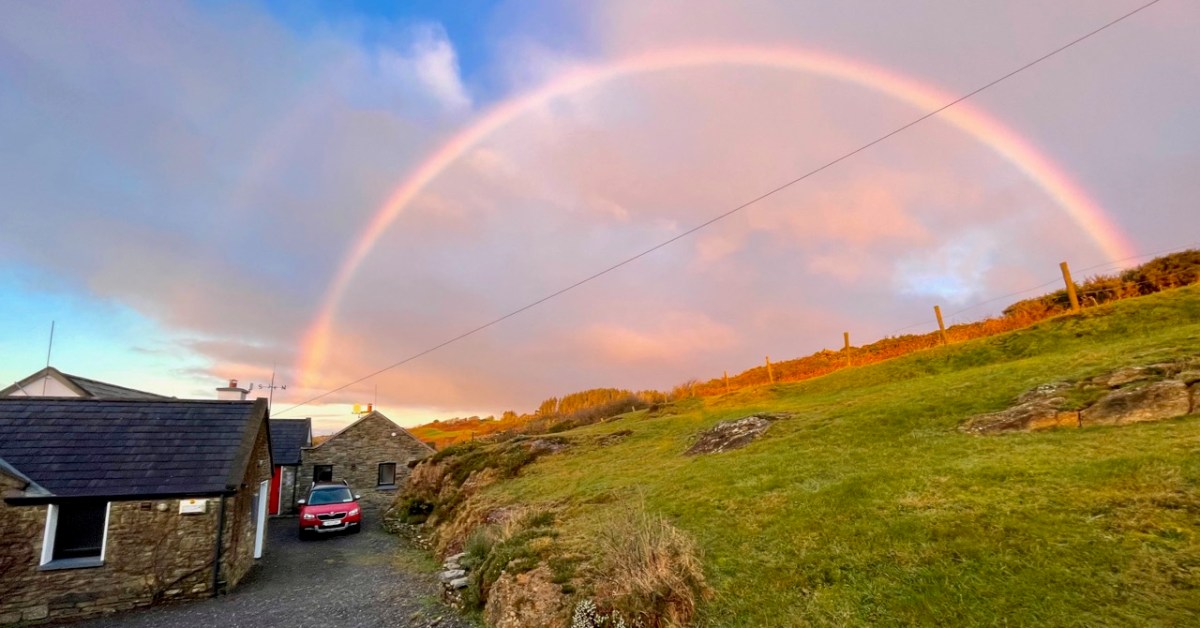
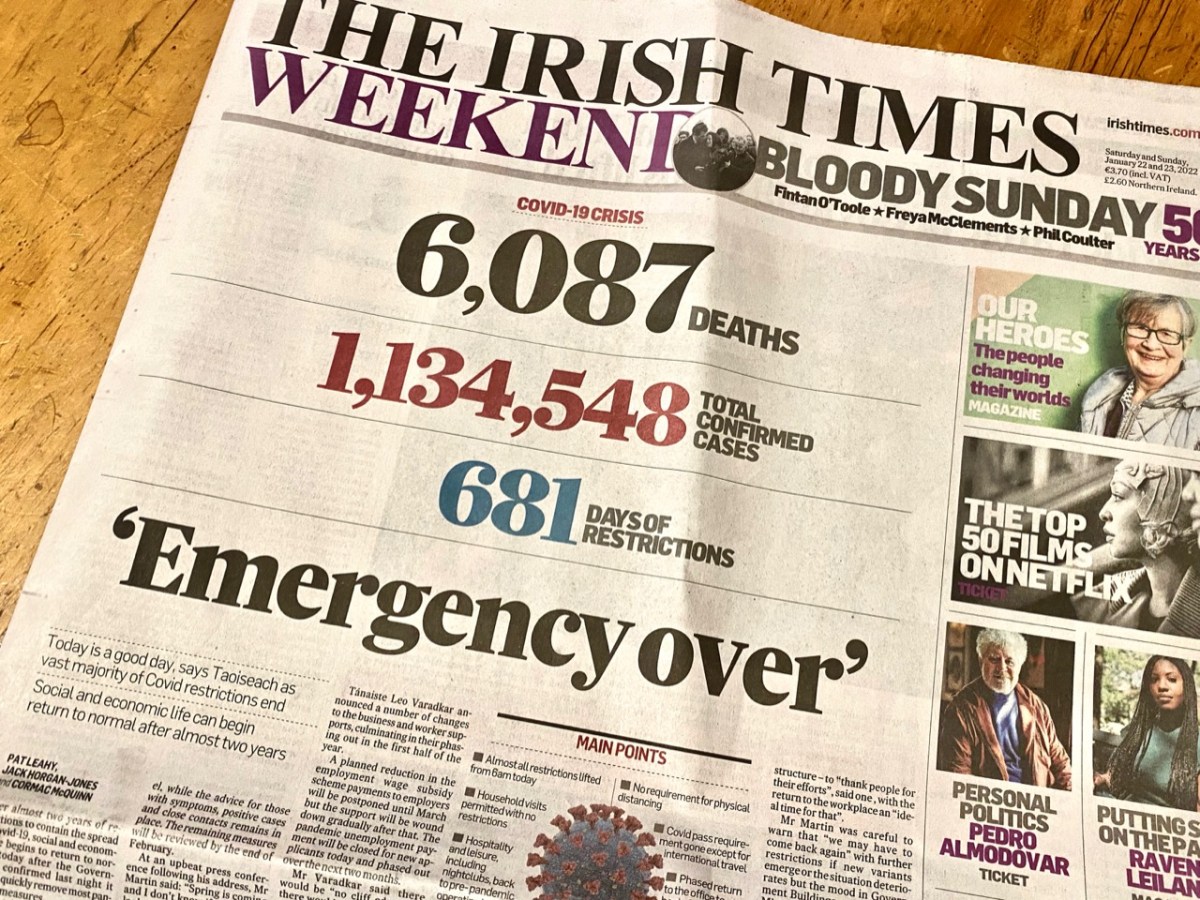
Yes – it has been 681 says since Covid-19 hit us and our world changed. From today, 22 January 2022, most restrictions in the state are gone, apart from the continuing need to wear masks in certain public places. Hopefully that West Cork sky over our house this morning, above, is a good omen for us. Today’s paper shows the stark tally:
The population of the Republic of Ireland as I write this is 5,023,337 (no doubt that is changing by the minute). That tells the story: 22.6% of the people here have had the virus. And of course it hasn’t gone away yet… But at least “social and economic life can begin to return to normal” says the Taoiseach. In order to mark the significance of the moment, my post looks back to our experiences over the last 681 days: in particular, how our lives changed at the beginning of the outbreak.
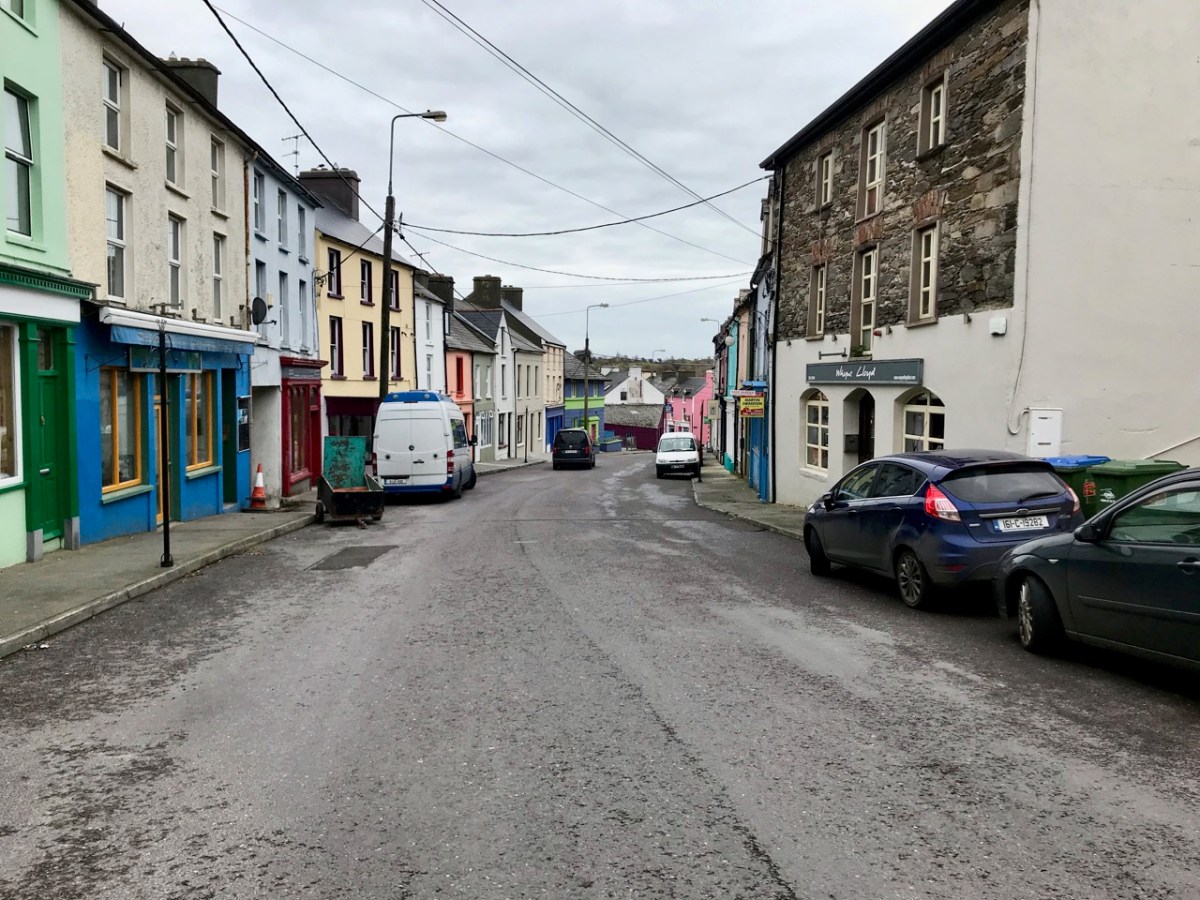
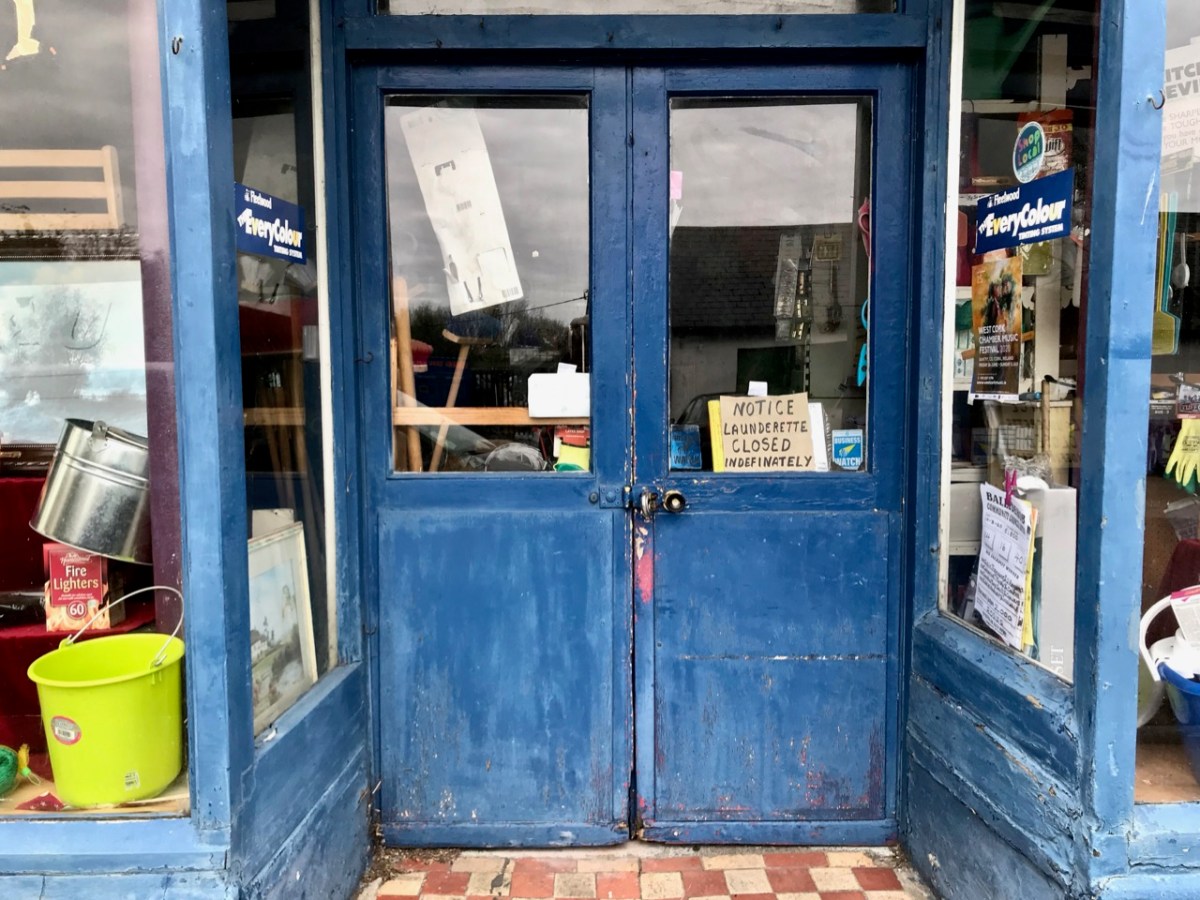
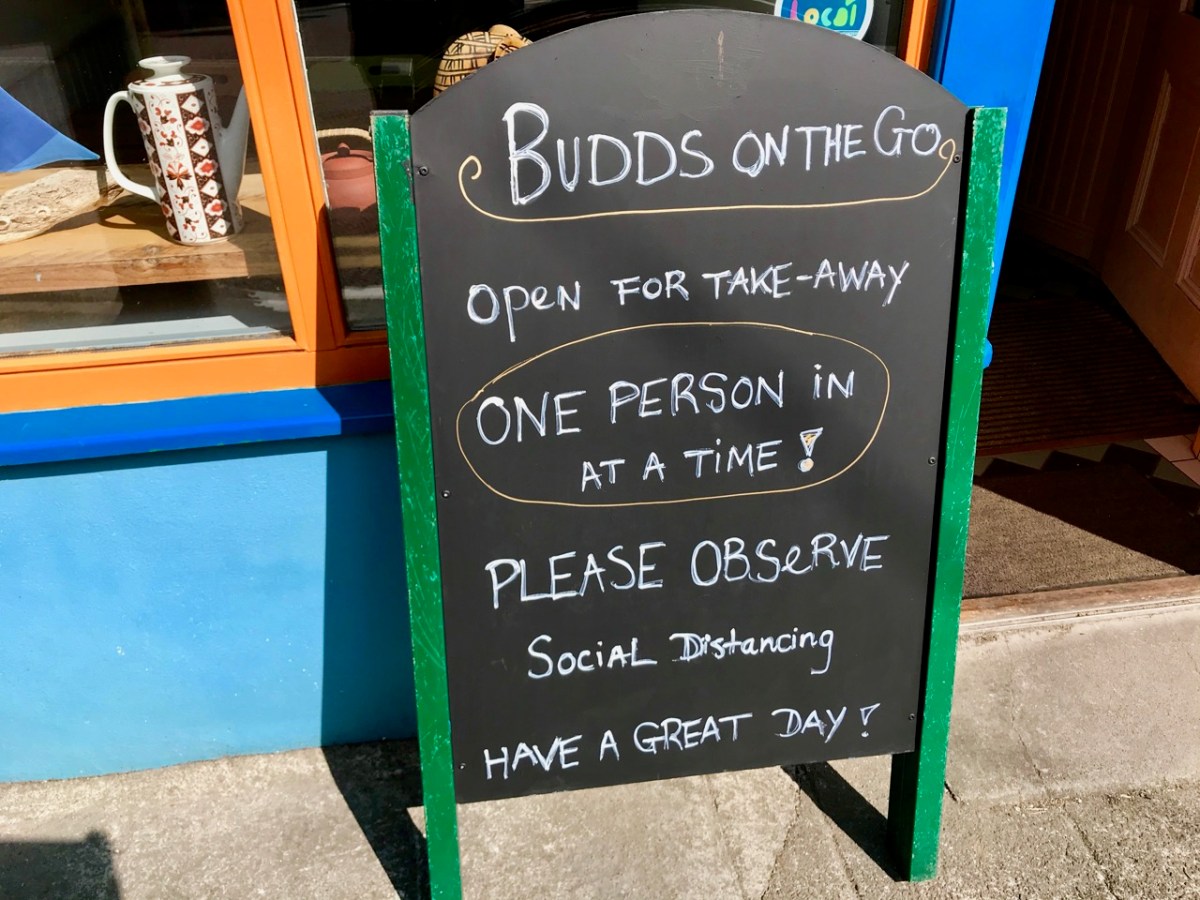
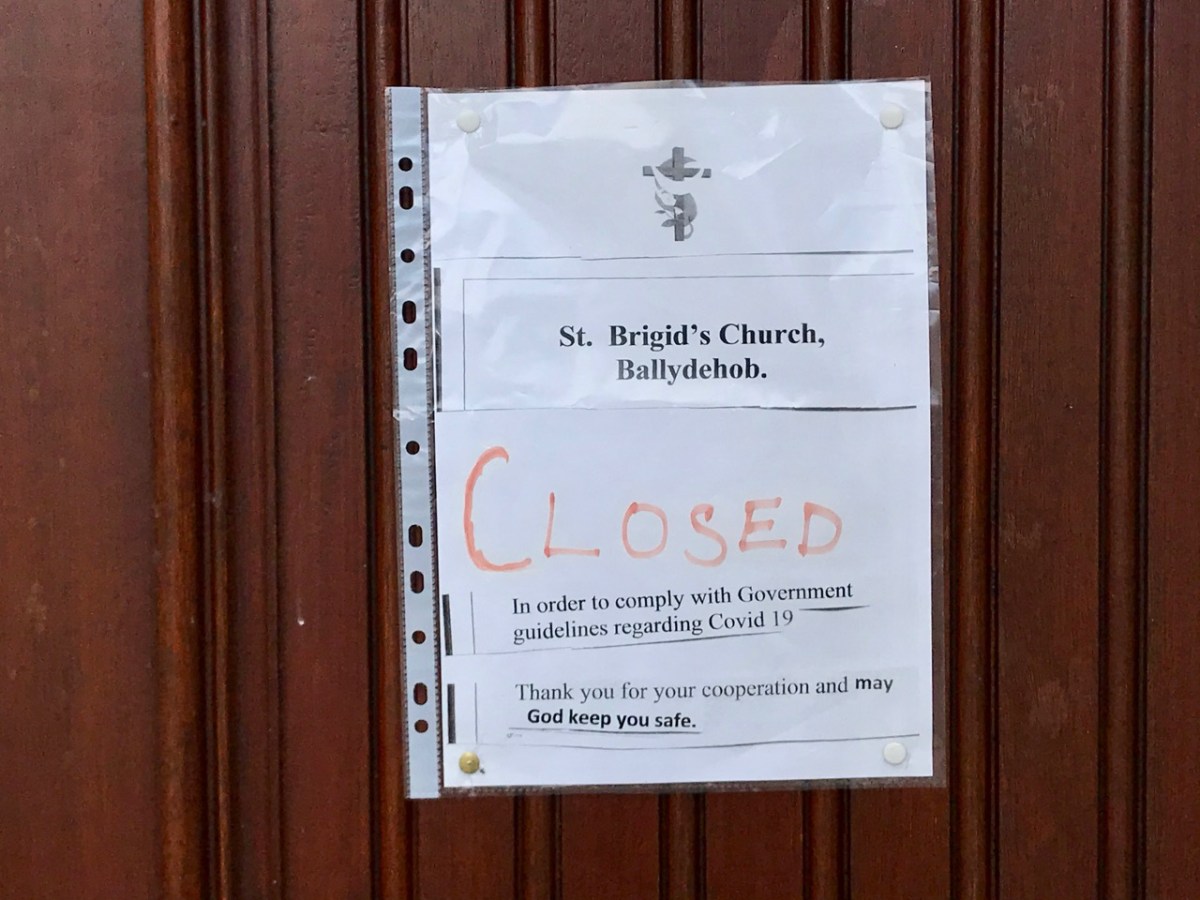
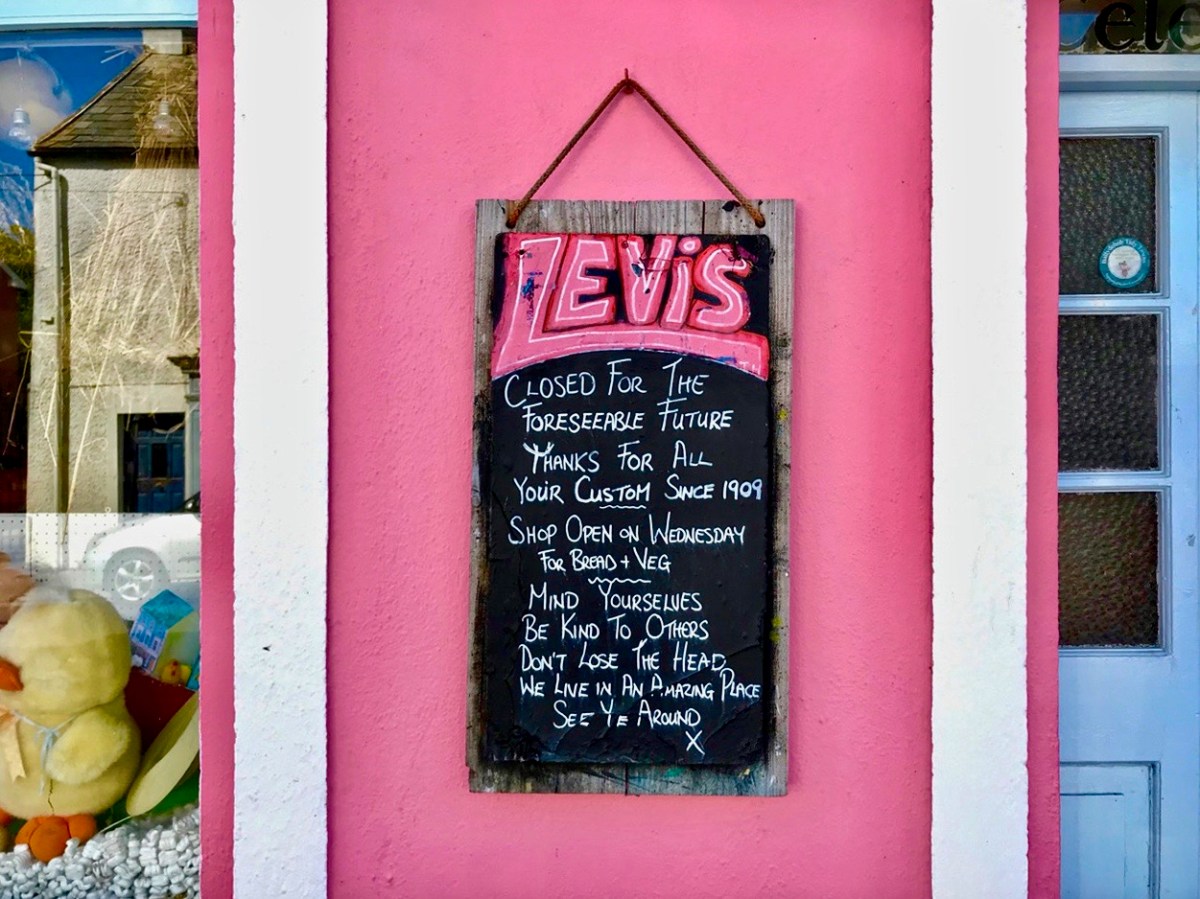
These two images of Ballydehob, taken at the beginning of April, 2020, sum up the shock of empty streets, closed businesses and everyone being advised to isolate. It all seemed very bleak: our movements were initially restricted to 2km from home, then that increased to a radius of 5km. If you lived in rural areas – as we do – you were permitted to travel beyond those distances if you needed to in order to shop or use essential services. We breached those rules on occasion – sometimes to get exercise in the deserted countryside all around us.
As the days went by, an amazing spring emerged, with day after day of beautiful weather. Human activity was curtailed, but the natural world continued along its course as though nothing was awry!
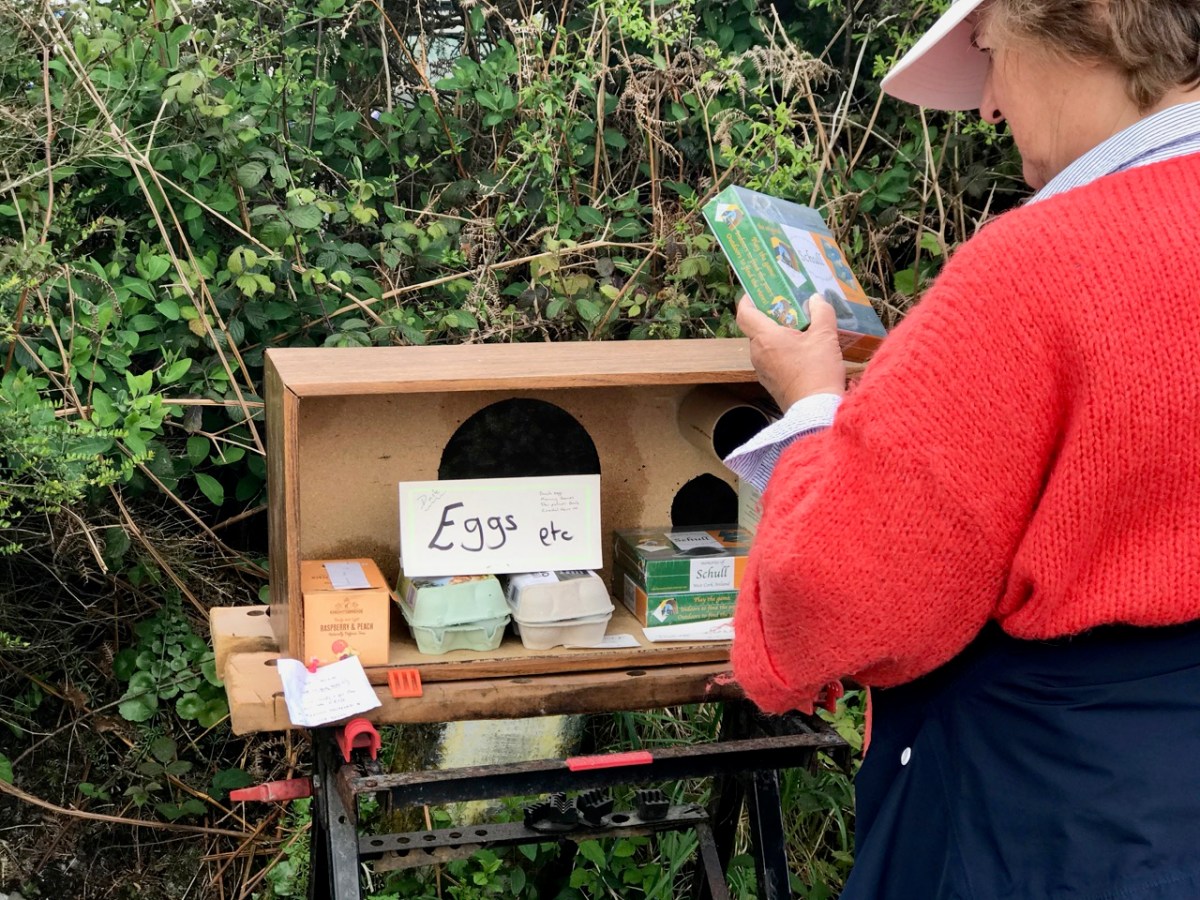
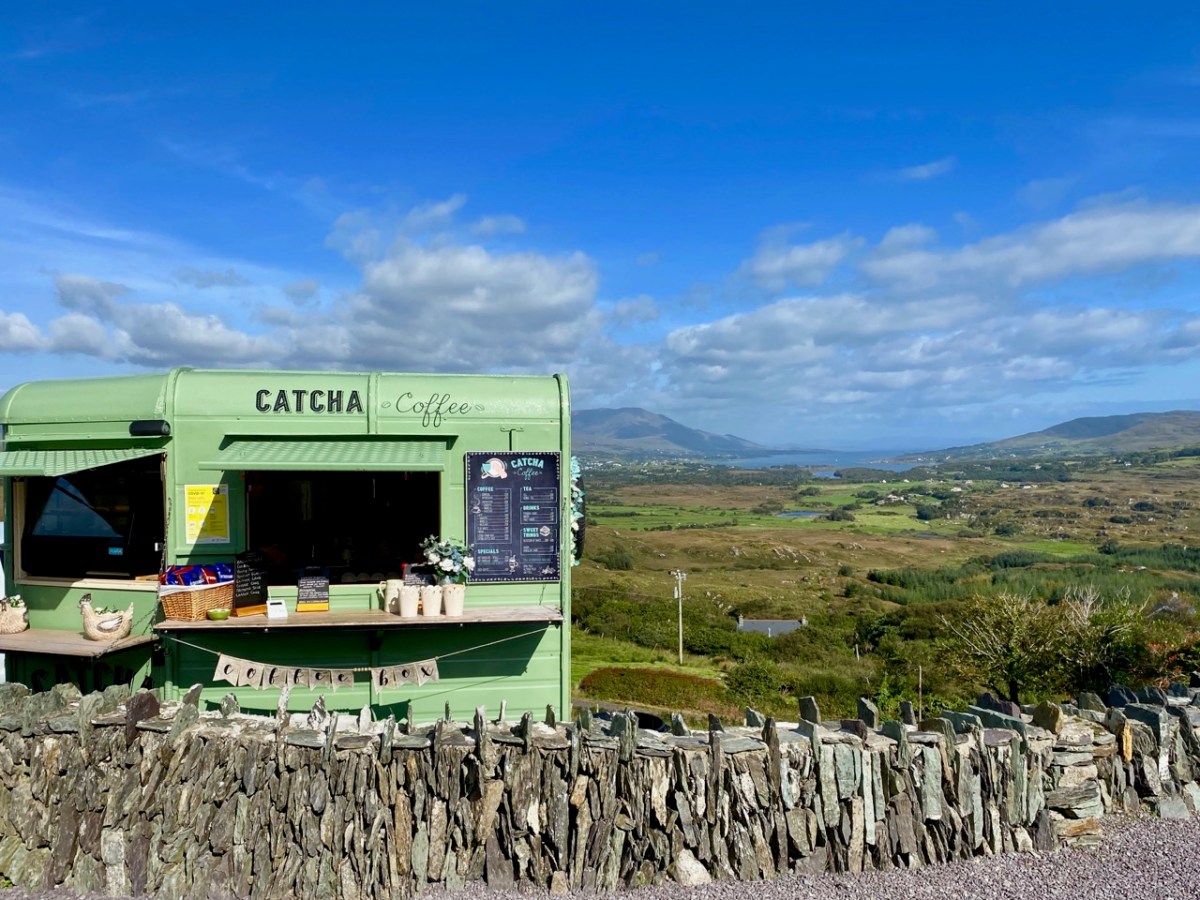
We humans are pretty adaptable. It was amazing to see the ingenuity of folks creating outlets for their energies without having to mix. Food-on-the-go blossomed as a craft industry: here are some examples.
We were very impressed with many of the examples we encountered – and which have survived over the months. Hopefully they will carry on, as casual coffee stalls in the middle of nowhere are welcome to us in our travelling. Pre-pandemic they were probably frowned upon by ‘the authorities’ – and they are certainly regulated – but ‘authority’ would have had to be very hard-hearted to close down these little lifelines. In our experience, every one we encountered was well-run, and spotless. It was an incidental opportunity to have a distanced ‘chat’: always a source of good local information on how others were coping.
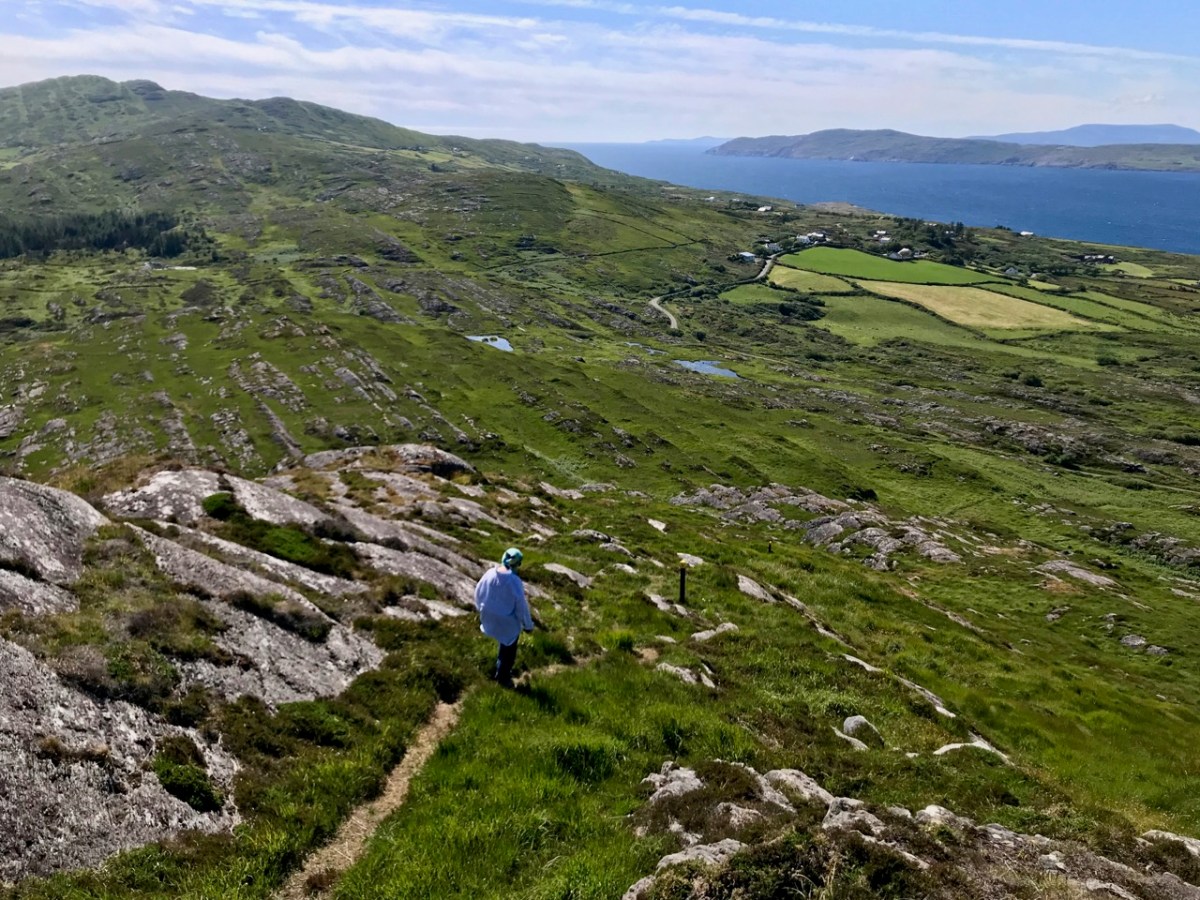
We took the opportunity to climb – and descend – Knockaphuka during the pandemic. It’s a mountain a short distance from Nead an Iolair, but a little outside the limit. No-one was watching! I suppose being restricted to our immediate environment for so long – day after day – made us re-assess it, and our lives. Certainly we have got to know the fine detail of the beautiful place we call home.
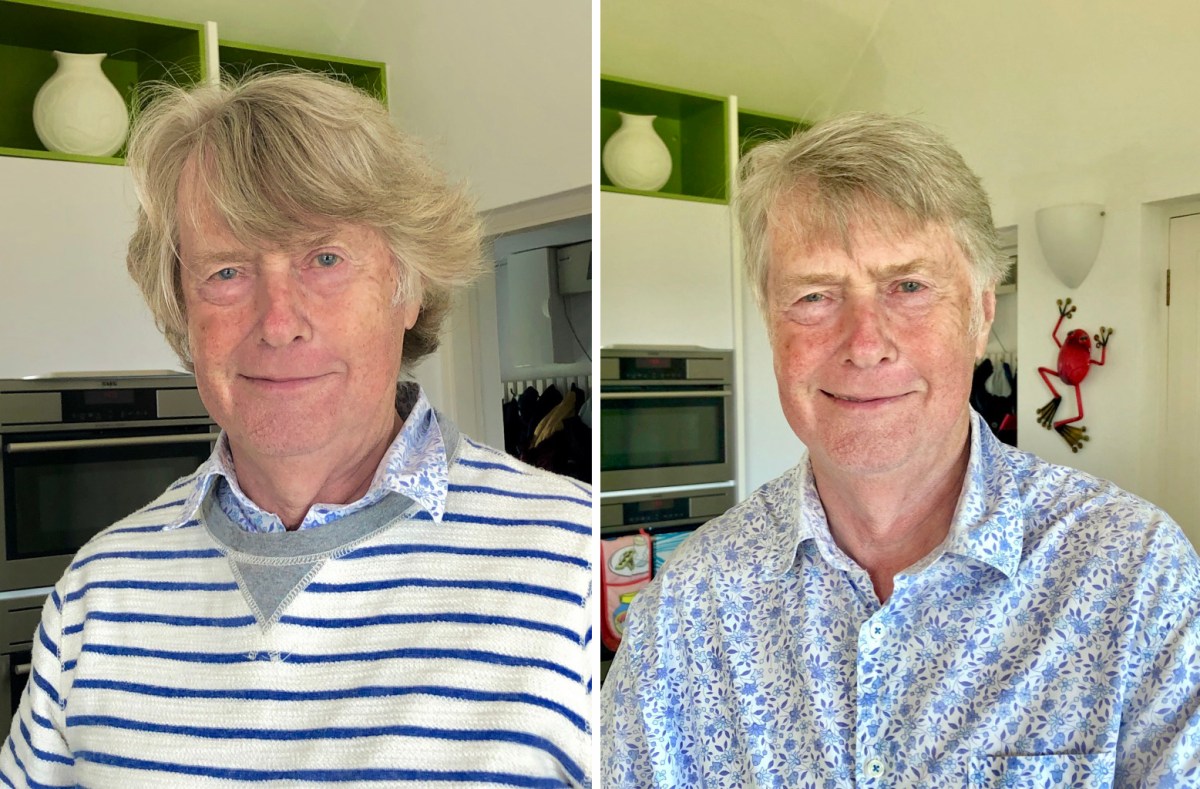
Here’s a social issue: we couldn’t get a haircut for months! Finola kept me in trim, but it was a relief when salons were once again allowed to operate, albeit with some restrictions.
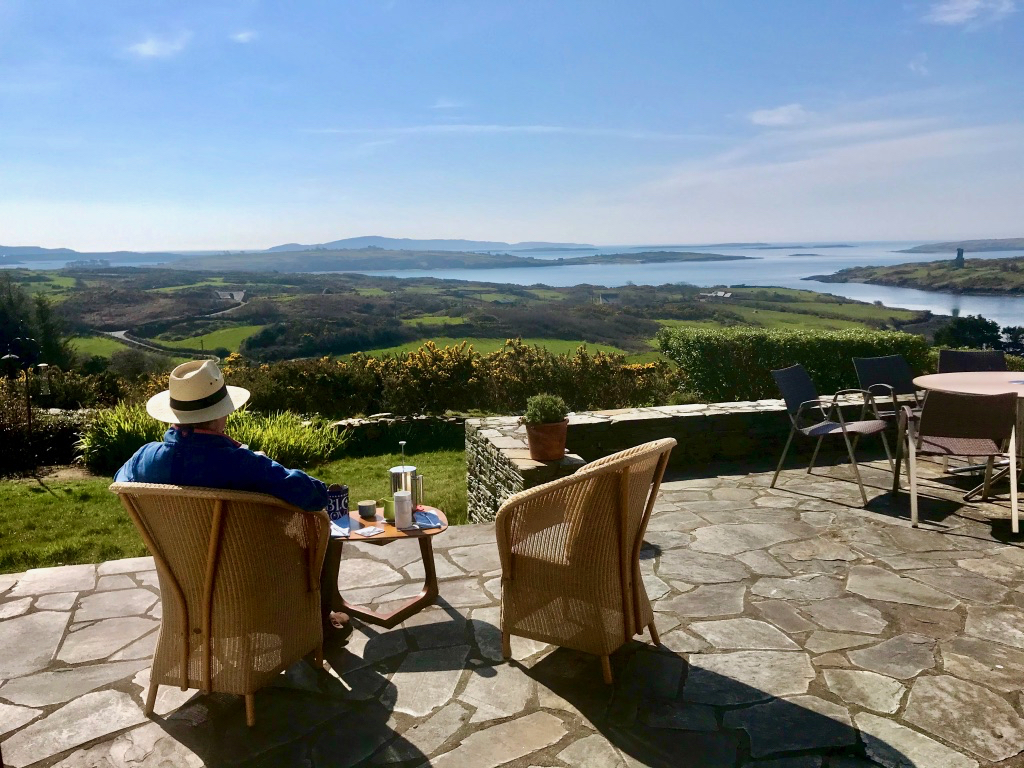
This is us having coffee on our own terrace, looking out over Roaringwater Bay in the wonderful spring of that first pandemic year. In fact, each of the two last years has been benign – with a few exceptional winter storms. We would have felt less relaxed if we had had persistent rain (which sometimes happens).
A sprig of green appears on a doorstep on May Day, 2020: a sign that we all still want to continue the old (perhaps ancient) traditions… There were ups and downs: things eased as the year went by and then the new variations came in. Numbers went down and we breathed out. Then they soared – especially with the Omicron variant, and everything went haywire again. Let’s hope that the present easing is here to stay. But the future can never be told…
Welcome to the UCD Library Cultural Heritage Collections blog. Discover and explore the historical treasures housed within our Archives, Special Collections, National Folklore Collection and Digital Library













 Roaringwater Journal