On the Passing of Poets

Ireland: ‘land of Saints and Scholars’ – and poetry, as we found on our travels. In just a few days we have discovered how three pre-eminent Irish poets – whose passing has spanned a century – are being celebrated and commemorated in their own townlands.
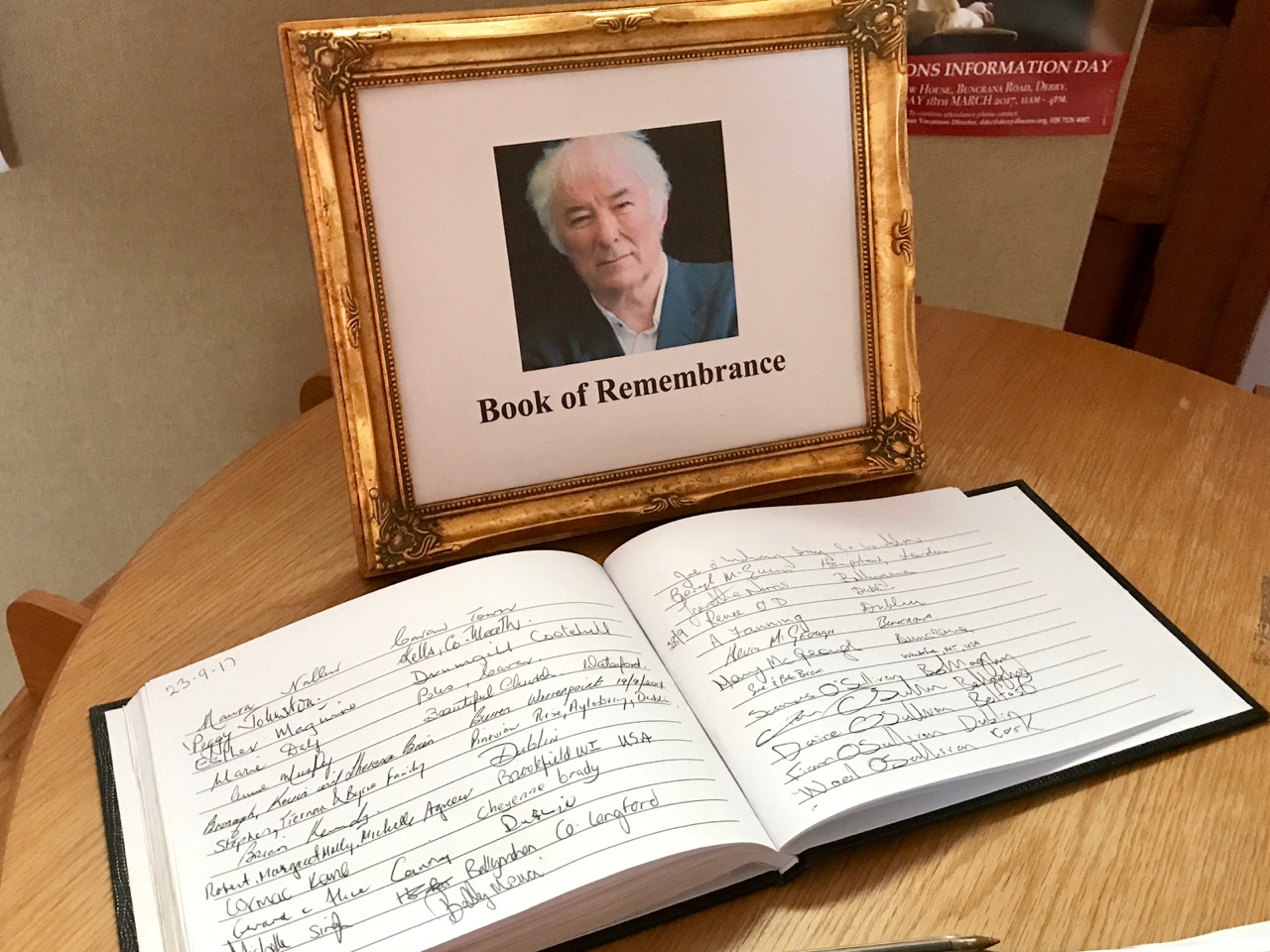
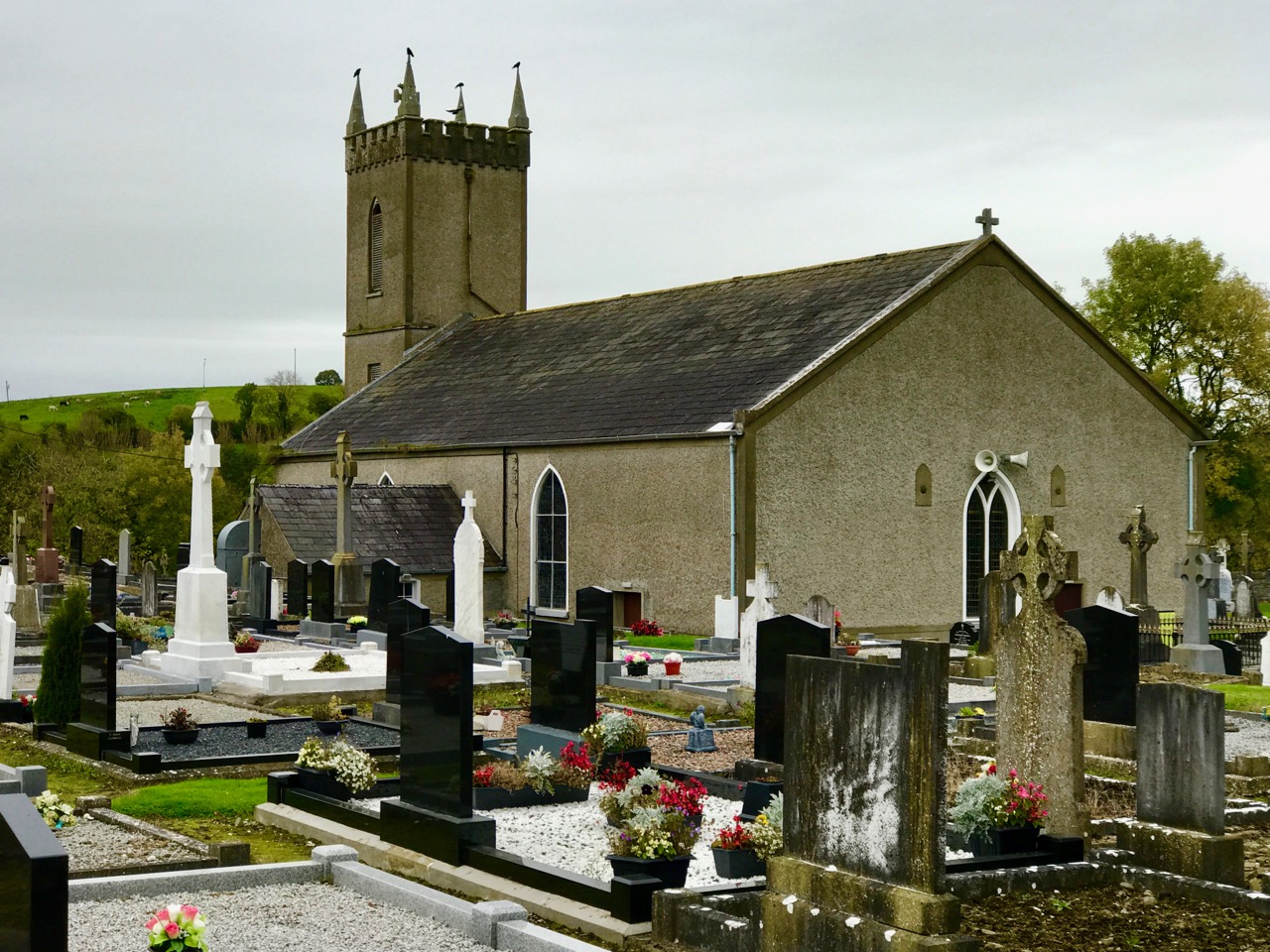
Bellaghy, County Londonderry, in Northern Ireland was the childhood home of Seamus Heaney  who was born at nearby Mossbawn on 13 April 1939, the eldest of nine children. Heaney passed away on 30 August 2013 and, in accordance with his own wishes, he is buried in the Cemetery of St Mary’s Church, Bellaghy. A Book of Remembrance is kept in the church, and on his headstone is a line: Walk on air against your better judgement, from one of his poems – The Gravel Walks.

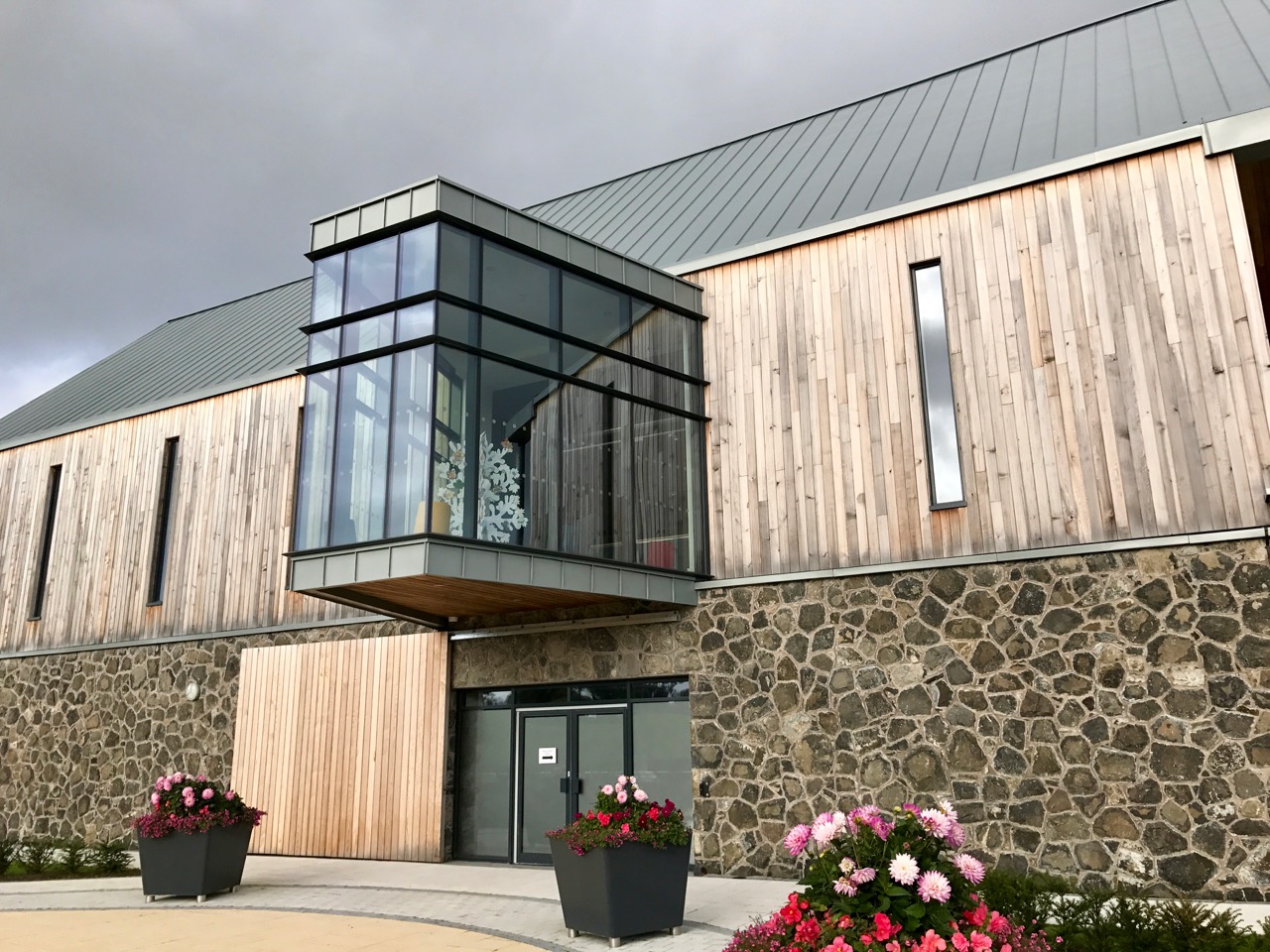
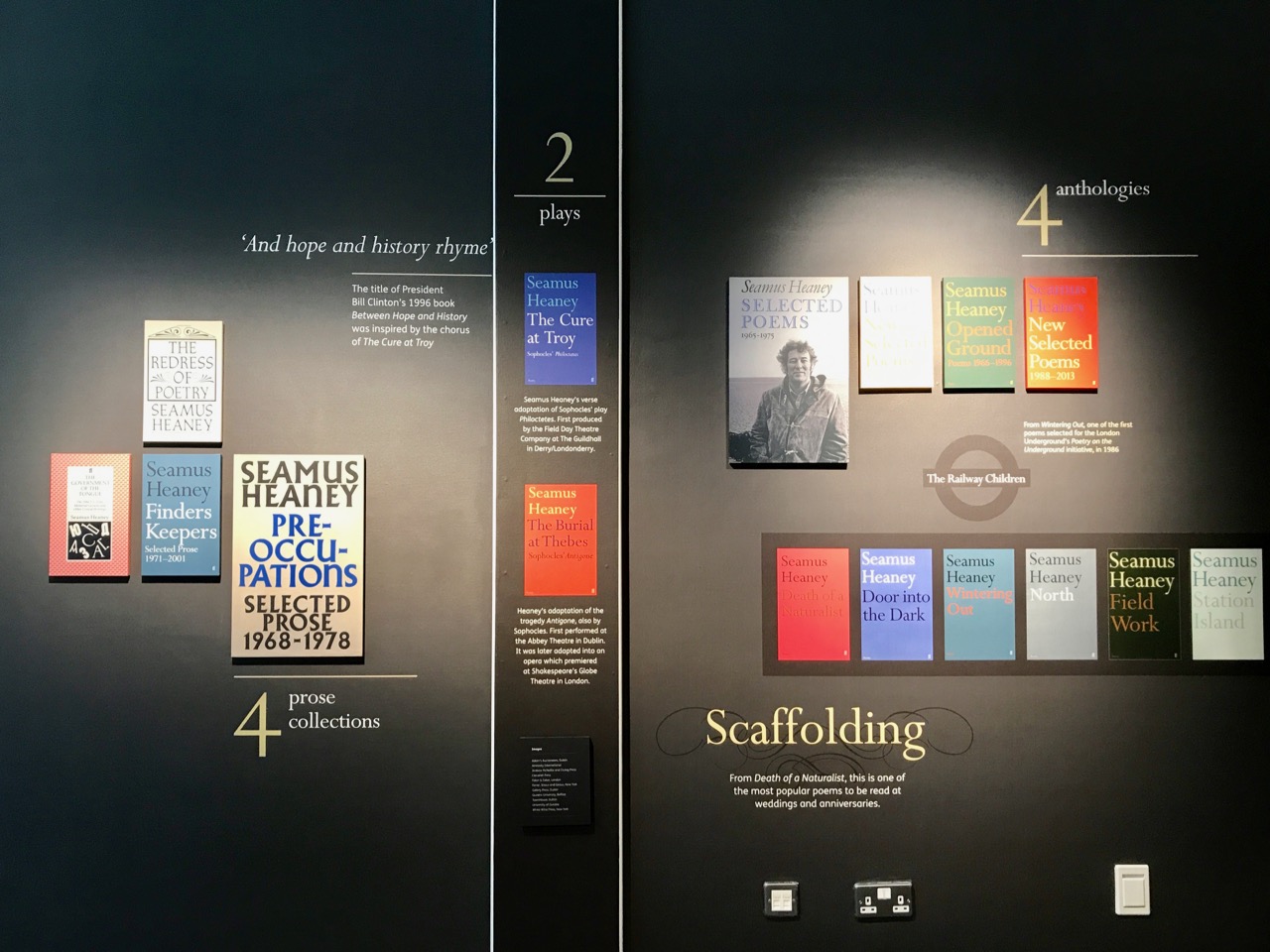
Exactly a year ago – October 2016 – a new building was opened to commemorate Heaney, the Nobel Prize winner, who has been described as ‘…the most important Irish poet since Yeats…’, ‘…the greatest poet of our age…’ and ‘…probably the best-known poet in the world…’ The quality of the HomePlace centre reflects this reputation and provides excellent facilities for the sheer exploration of words as well as performance, lectures and research.
This year sees the 50th anniversary of the death of another of Ireland’s country-born poets: Patrick Kavanagh. We visited Inniskeen, County Monaghan, to search out the old St Mary’s Church, which has been transformed to a Centre – open to the public – which displays information on the poet born and raised on a nearby farm in 1904, the fourth of ten children. The Centre also carries out research into the poet’s life and work, and organises an annual event to celebrate him. I am grateful to the staff of the Centre for allowing me to photograph the interior of the former church.

Appropriately, the grave of the poet can be found in the churchyard. Strangely, an elegant memorial to the poet and his wife (below left) vanished in 1989 and was replaced with a simple wooden cross (below right), said to have been carved by his brother, Peter. I could not get to the bottom of this matter: there are various reports to be found on the internet, including this one from RTE.

Like Heaney, Kavanagh’s strong influences came from his rural background. Some of his best-loved works portray country life, but without sentimentality. He remained on the farm in Monaghan until 1931, when he walked the 80 kilometres to Dublin. At first rejected by the literary establishment, his work eventually received appreciation. Seamus Heaney acknowledged that he had been influenced by Kavanagh.

When Kavanagh died on 30 November 1967, at the age of 62, he was recognised as …Ireland’s leading poet in English…

For our third commemoration we travelled to Slane, County Meath, to find the Francis Ledwidge Museum. This poet died exactly a hundred years ago, a victim of the Great War.

The Museum has been created in the cottage where Francis was born on 19 August 1887, the eighth of nine children. Again, he came from a rural background. His father died when he was only five, and he spent much of his life as farm hand, road builder, and copper miner. He was an active campaigner for better working conditions, became an early Trade Unionist, and attempted to organise strikes.
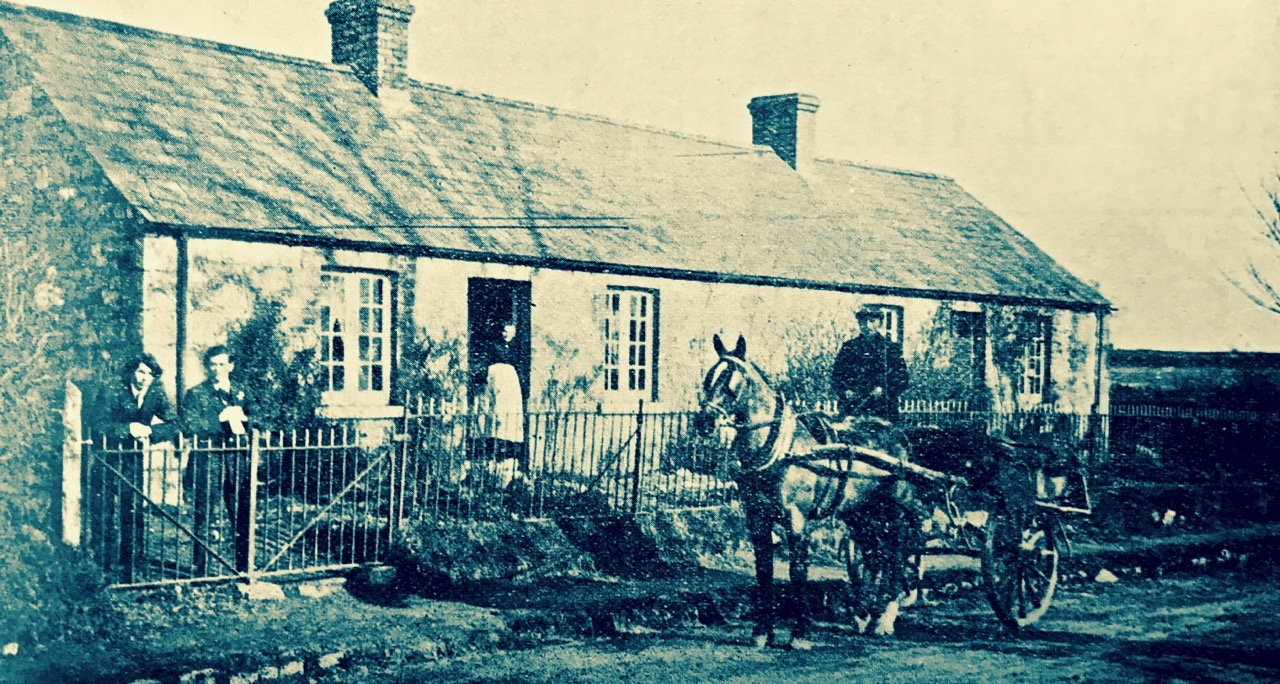
The Ledwidge cottage in Janeville, Slane, around the end of the nineteenth century (top), and the cottage – now the Francis Ledwidge Museum – today (lower)

Francis had written poetry all his life, and some was published in local newspapers when he was 14 years old. He attracted the patronage of Lord Dunsany, who introduced him to W B Yeats. Like many other artists, writers and poets, Ledwidge’s life was tragically cut short by the war. In the Third Battle of Ypres he and five companions were hit by an exploding shell. Father Devas, a Chaplain who was a family friend, recorded ‘…Ledwidge killed, blown to bits…’ A memorial was raised to him on the place of his death in Belgium, and a replica of this memorial can be found in the garden of the Janeville cottage.

Seamus Heaney also acknowledged Ledwidge as one of his influences

During our travels we have seen that poets in Ireland have respected the work of their compatriots. Wordsmithing is a time-honoured profession: there’s a common thread running from the Bards of old, who carried traditions, myths and genealogies through generations and over centuries.

Below – a portrait of Seamus Heaney by the Welsh artist Jeffrey Morgan hangs in the HomePlace Centre, Bellaghy

Rejecting those Earthly Dignities: Irish Women Saints by Harry Clarke

I’ve been struck by the absence of sacred women in the iconography of stained glass windows in Irish Protestant churches. Sure, there’s the odd window devoted to or including Mary (such as Nativity scenes) or Bridget, or images of women as Charity or Hope, but for windows depicting women who are venerated for their piety or leadership or courage you have to visit Catholic churches in Ireland. 
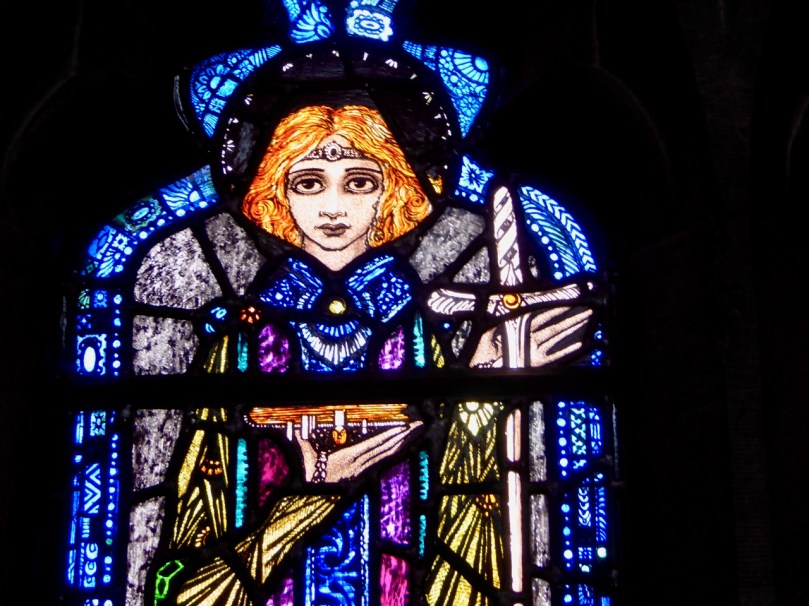
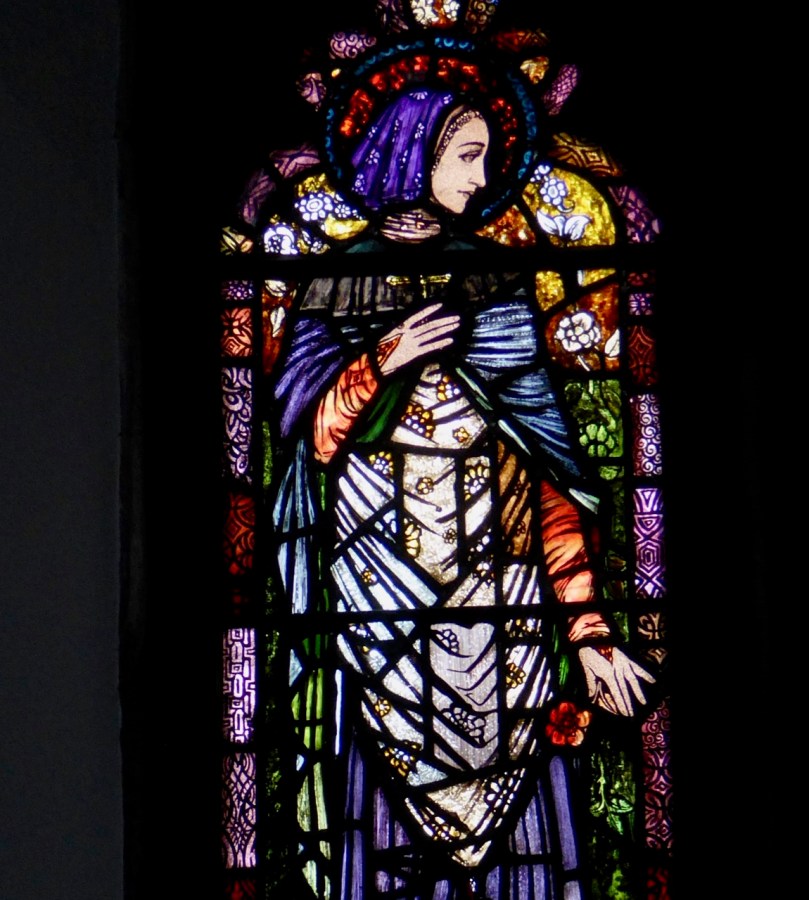
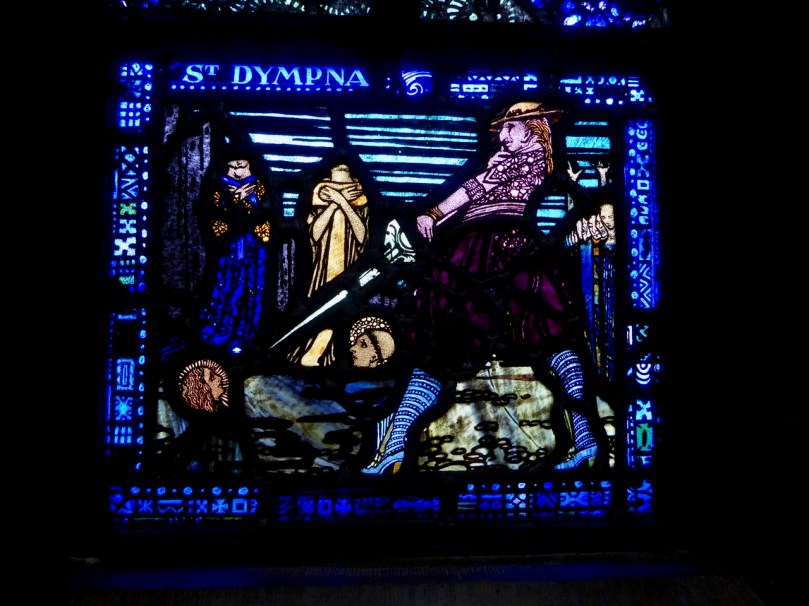
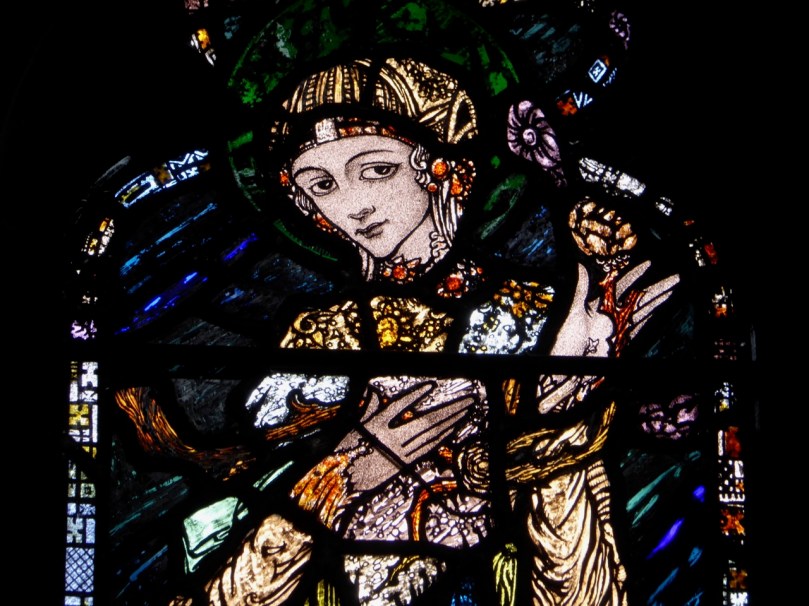
The top picture is St Dympna, depicted with a sword – it is a tradition to depict martyrs with the instrument of their death. She looks wide-eyed and innocent – she was only 15 when she died. Above is St Fanchea, bearing a rose and with a kindly expression

We’ve written already about Bridget here and here and about Gobnait: Bridget is considered the female equivalent of Patrick in being the most widely known and celebrated of the Irish women saints. Gobnait is a good example of a local saint, in this case she is associated with the Muskerry area of Cork. When you read the lives of Irish saints, women and men, you are reading accounts written many centuries after they lived, often a mixture of tradition, mythology, folklore and reconstructed hagiography. 

Harry Clarke, as I have discovered before, had a thing for red hair and gave St Dympna a particularly glowing crop. Here she shelters her patients, the mentally ill poor who came to her hospital

Robert and I have been travelling in Ireland and visiting stained glass here and there, and in the process discovering more unfamiliar Irish saints. Harry Clarke, Ireland’s incomparable stained glass artist of the early part of the 20th century, was often asked to depict local saints and always did as much research as he could into their lives, to enable him to tell their stories and use appropriate elements and symbols. [For more posts about the genius of Harry Clarke, Ireland’s most famous stained glass artist, go to our Navigation page and scroll down to C5.] In Carrickmacross (Co Monaghan) this week I found three Harry Clarke windows illustrating three Irish female saints, two of whom I had never heard of before. Let’s start with the one I thought I knew because I’ve had friends with that name – St Dympna.

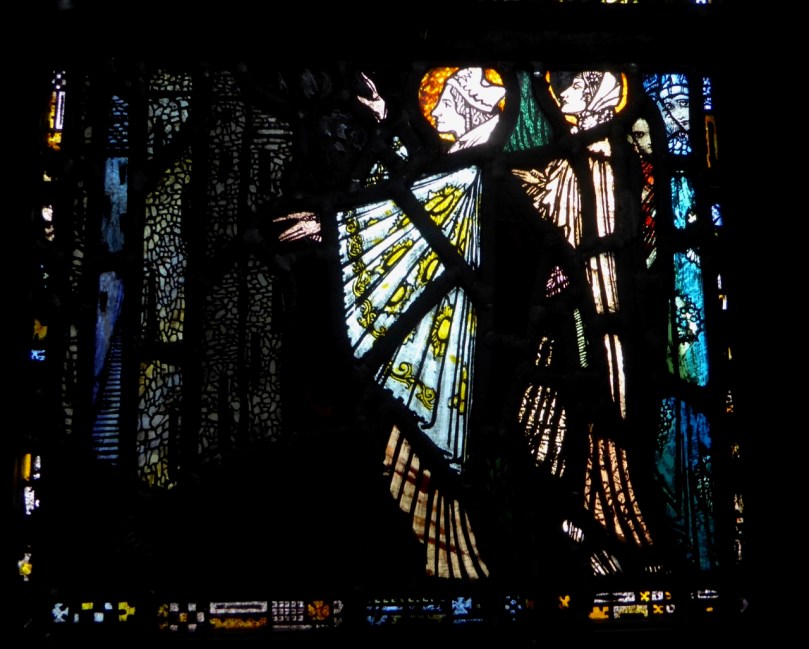
Dympna flees her father’s house. Following her is the court jester, his wife, bearing medicines, and Gerebran, her confessor

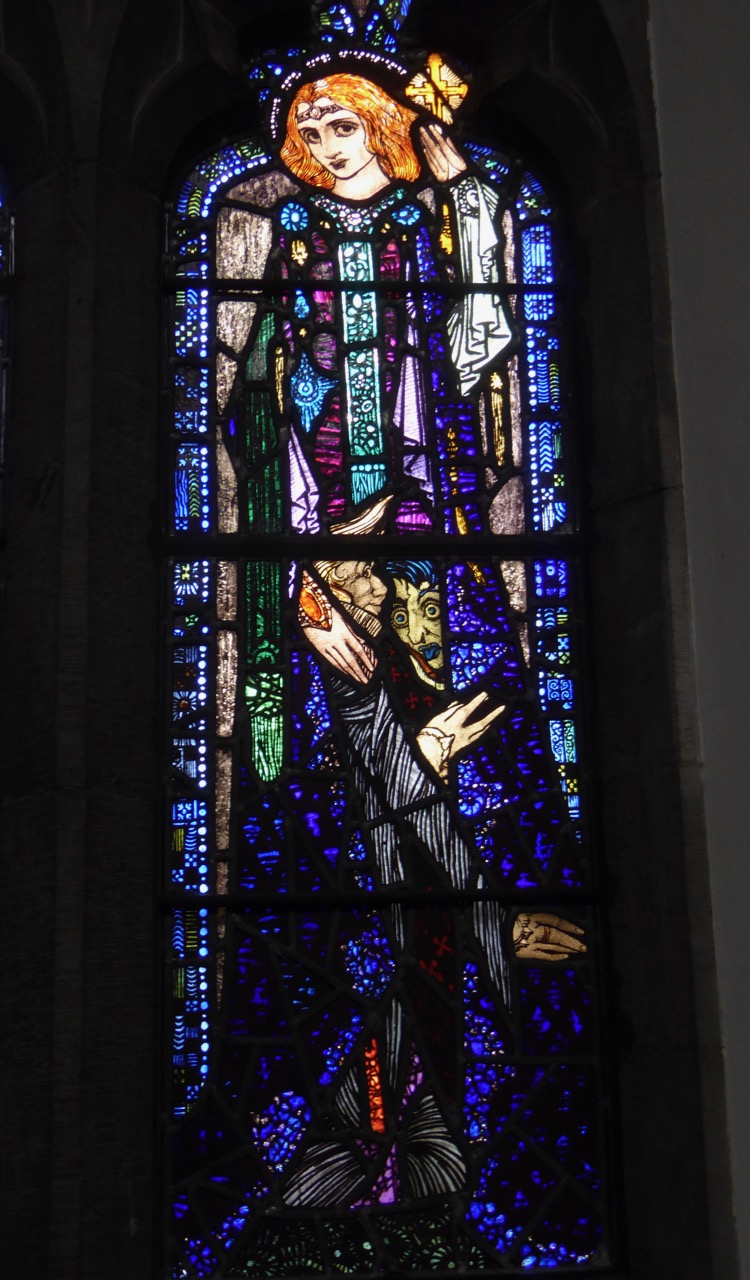
Dympna was the daughter of an Irish King called Damon. When his wife died, her father became unhinged and decided he would only marry the one who was as beautiful as her – his own daughter Dympna. Horrified, she fled with her confessor, Gerebran, and travelled to Gheel in Belgium. There she established a hospital and tended to the poor and sick. But her father found her and in his rage beheaded first the faithful Gerebran and then, when she refused to yield to him, his daughter.

Harry Clarke did not shy away from depicting the grizzly end of Dympna and Gerebran

She is venerated in Ireland and in Belgium, and particularly associated with care of the sick and those who are mentally ill. She is also a patron saint for those who have suffered incest. There are shrines and hospitals named for her in Belgium, Ireland and the United Stares. She is also known as St Davnet, and there are hospitals and holy wells with this name.

If you’d like to know more about St Dympna, take a look at this post from the wonderful Ali Isaac.

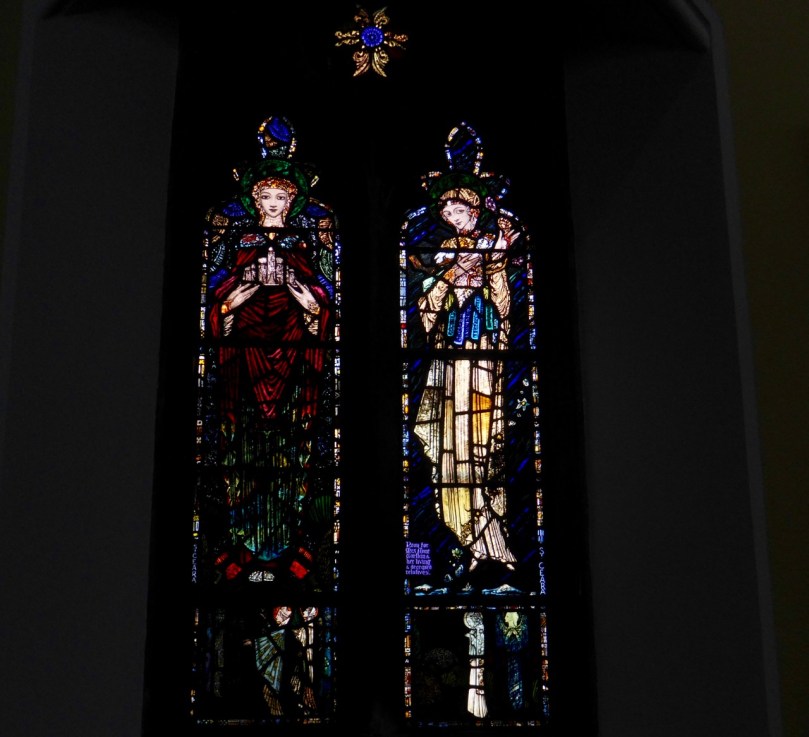
St Ceara is the subject of one window with two lights

Like Dympna, Ceara was of royal blood and established her first monastery in present-day Westmeath on land granted by St Fintan – or perhaps in Kilkeary near Nenagh in Tipperary at the behest of Brendan of Clonfert. You see, there may have been two Cearas and over time their stories were conflated. To add to the confusion, St Ceara, also known as Ciara, is known to have been an abbess who founded a monastery near the spot currently better known as Kilcrea Friary in Cork.

St Ceara and her virgins

Harry Clarke in his windows chooses to depict her as beautiful and royal, in one window carrying her monastery and in the other (below) sumptuously dressed and appearing more the princess than the holy woman.

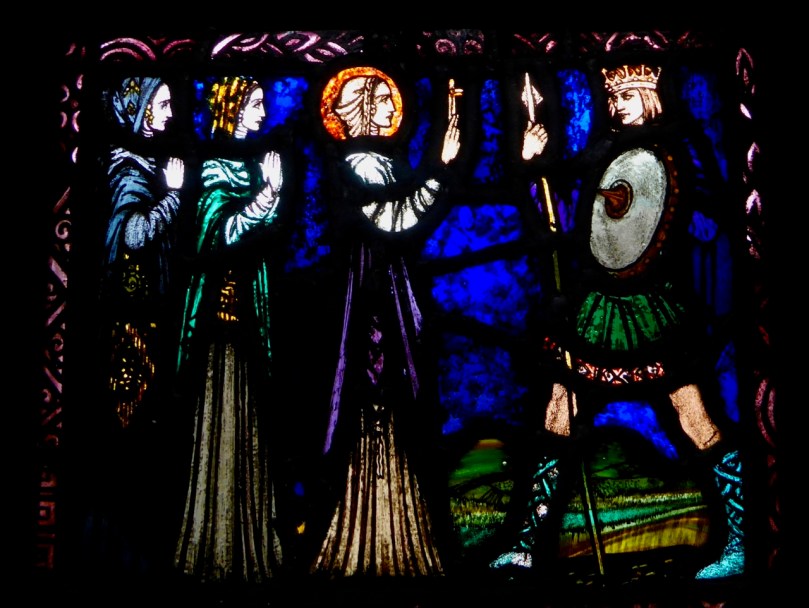
St Fanchea was the sister of St Enda of Aran, and they share the two lights of one window. St Fanchea was famed for her holiness and founded a monastery in Fermanagh. Enda was a warrior-king but was finally won over by the piety of his sister and converted when he came to see her in her convent.

Fanchea and her brother, Enda of Aran

For a full (and graphic!) account of the brother and sister relationship, see the marvellous post in Omnia Sanctorum Hiberniae, a fabulous blog for anyone interested in obscure Irish saints. Marcella starts her story of Fanchea this way:

Aengus, son of Natfraich, King of Munster, is said to have desired Fanchea’s hand in marriage. Notwithstanding all his pressing entreaties, however, and rejecting those earthly dignities to which she might be advanced by yielding to his suit, the holy virgin’s mind was intent on a life of celibacy, and on those rewards promised by Christ to his spouses.

St Fanchea stops her brother, Enda, and turns him from his warrior ways

I’d love to hear from readers who have their own favourite women saints, especially Irish ones.

One Acre

That’s what we have in West Cork – one miraculous acre. We don’t sow potatoes nor barley nor wheat – we just try to let the grass grow and see what happens.

Top Image: Marsh Thistle. Above: Chamomile along our boreen/right of way; Wildflowers behind the house – Self-heal, Chamomile and Bog Pimpernel (the tiny pink ones)

This year was my year for leaving part of my acre un-mowed. I’ve been reading Zoe Devlin’s new book, Blooming Marvellous, and as she suggests, I started with the September chapter which happens to be, among other things, about growing a wildflower meadow. I have a better idea now as to what I should have done, and I’ll be able to improve things as I go along, but for a first year, it didn’t work out too badly.

Common Sorrel, A delicate grass called Bent, and Red and White Clover with Plantain

Essentially, I chose one section not to mow at all until a couple of weeks ago. I was pleased with the flowers that appeared in my little ‘meadow,’ as well as the grasses and the plants we commonly call weeds (ragwort and thistles) because they all added to the variety of what was there and provided food for the pollinators.

Ragwort (above) is toxic to cattle and horses and is considered a noxious weed. Known in much of Ireland as Buachalláns (boo-ka-lawns) it is also a superb food source for insects. A recent Guardian article spells out the dilemma we face with Ragwort.

Sheep’s-bit rewards getting up close and personal

Thing is, even the parts I hadn’t intended as a wildflower haven flourished as well. Maybe it’s because I have an eye for what’s growing now (and didn’t before), or maybe it was a particularly good year, but whatever the case, I was living this spring and summer on an acre of wildflowers, a feast for the sense, and a joy to walk upon.

The flowers I found on my own acre are a testament to what happens when you try not to mow too often or too short. Lying in the grass on a warm summer morning you become intensely aware of the activity all around you – bees, bumble bees, hoverflies, butterflies and insects of all sizes and description are busily flitting from flower to flower, alighting on the Clover, the Cat’s-ear or the daisies, investigating the Bindweed and the Bramble flowers, and then buzzing off again.

Slender St John’s-wort and Bramble (blackberry) flowers

And it wasn’t just the lawn – random flowers started to poke out of the gravel driveway, as if sensing friendly territory, and all sorts of stuff popped up in my herb patch (the only actual gardening I do). I let the herbs go fairly wild too, once I saw how the insects loved them. 

From the top: Common Ramping Fumitory among my Tarragon; this Field Woundwort just appeared in the gravel one day; Wood Sage growing on the boundary wall, a soldier beetle on Parsley flower

The rock walls hosted Foxglove and Stonecrop and Wood Sage and around the periphery Heathers and Vetches fought the Gorse for space.

Common Vetch

I’ve just chosen a selection of wildflowers from my acre for this post, to give you a flavour of what will grow if you let it. 

Above: Heath Speedwell; Below: Common Mouse-ear

There were more and I don’t know that I can identify them all, especially all those yellow members of the Asteraceae family – the ones that I always used to think were just Dandelions but now I know that this family has enormous variety of flowers. One of my goals for next year is to advance my knowledge in this area so I am comfortable with distinguishing more of them.

There are fewer bright blooms now that it’s well into autumn. But, like the sweet little Scarlet Pimpernel about to open, below, it’s amazing what’s still flowering sturdily on – on our one acre.

Edifying and Eccentric – The Earl Bishop

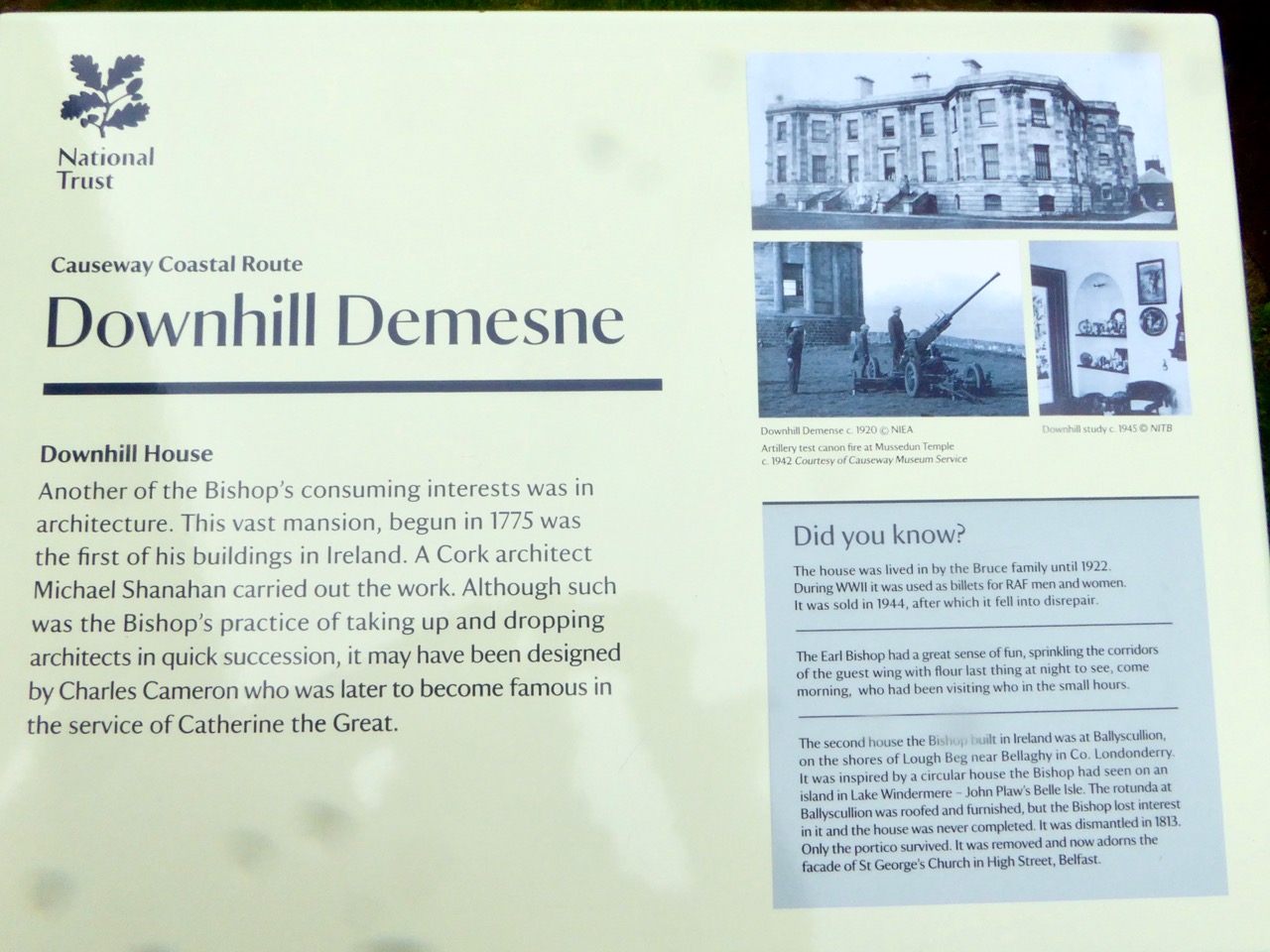
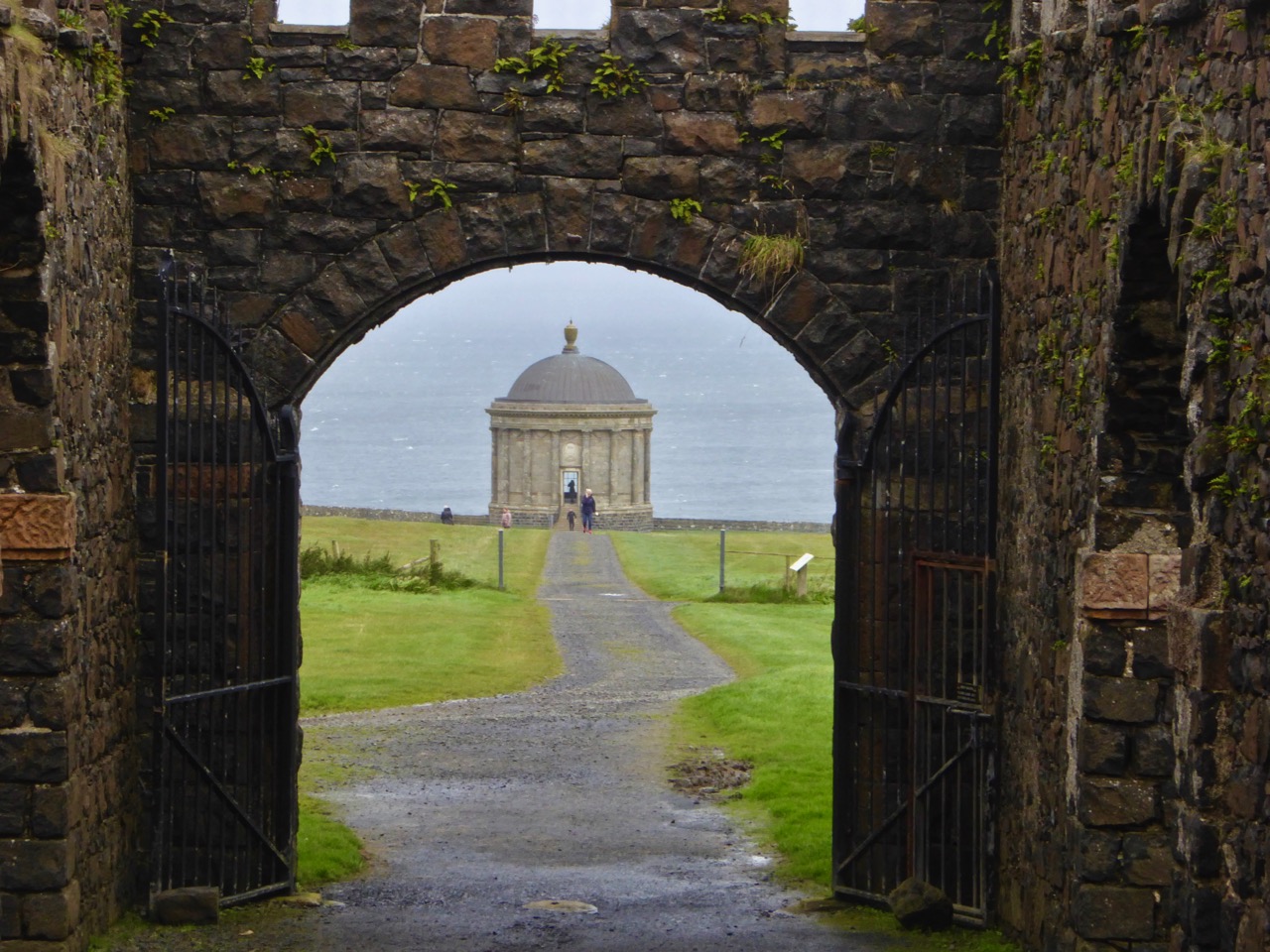
Finola had always wanted to visit Mussenden Temple and the ruins of the nearby great house on the Downhill Demense: it’s only a few stones’ throws from Nead an Iolair, so off we went on a stormy Sunday – the first day of October.

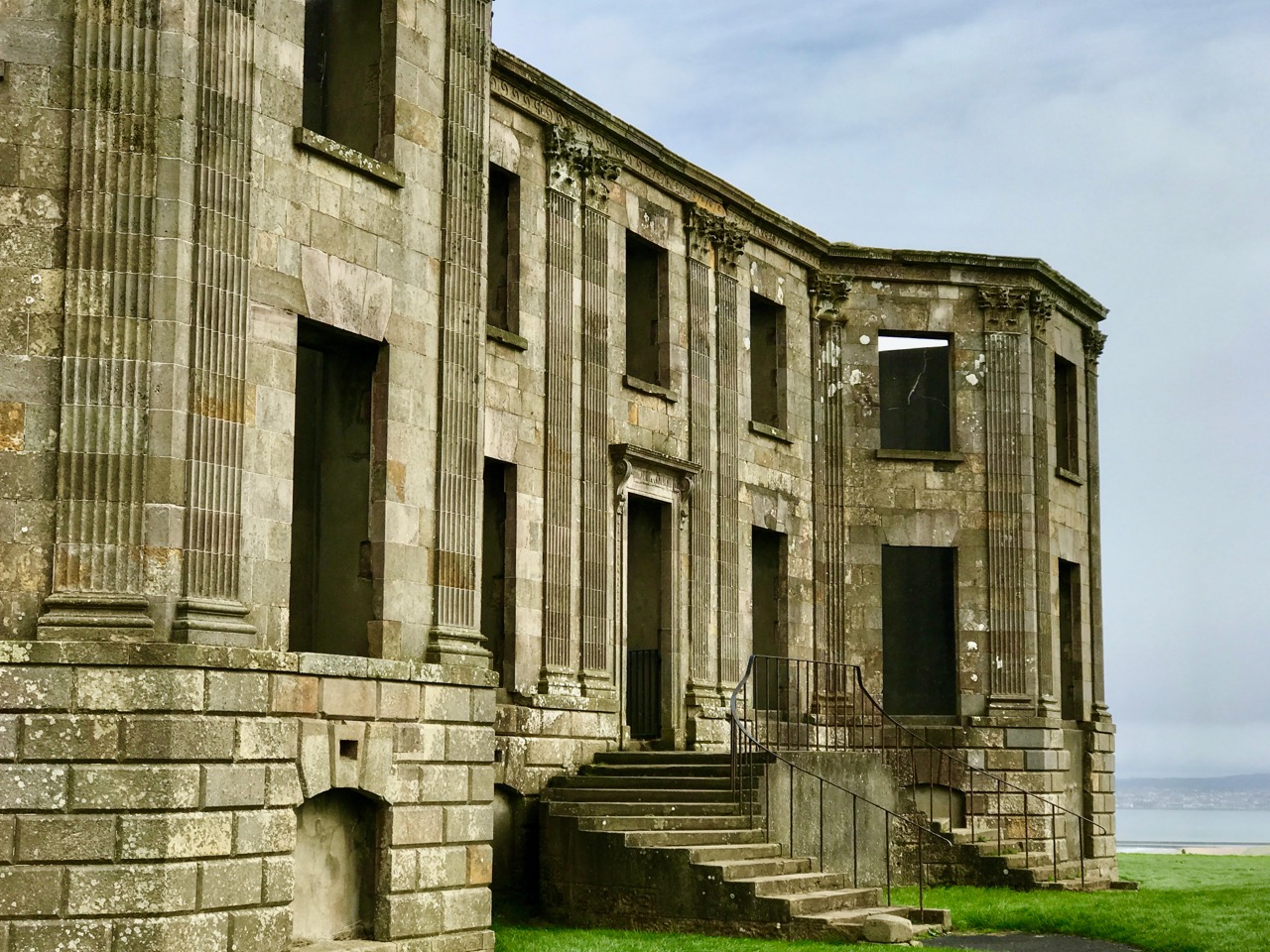
The house was built by the eccentric Frederick Augustus Hervey (1730-1803). Being the third son of the even more eccentric Lord John Hervey, he did not expect an inheritance and tried law (unsuccessfully) before entering the church. His eldest brother George was appointed Lord Lieutenant of Ireland in 1766 and, although he never set foot in the country, he managed to engineer Frederick’s appointment as Bishop of Cloyne then, shortly afterwards, Bishop of Derry, one of the wealthiest Irish sees. While in this post Frederick had the notion to establish a huge estate (apparently with the help of Diocesan funds) on a windswept clifftop overlooking the Atlantic Ocean in Dunbo, County Londonderry – now Northern Ireland.  Dunbo derives from the Irish Dún Bó, meaning ‘fort of the cows’.

It looks bleak today, and must have been in the Bishop’s time, although his plans for the new demense included classical landscaping and the planting of 300,000 trees: there’s not much sign of them now on that windswept terrain.

Both of Frederick’s older brothers died without leaving heirs and, in 1779, he found himself the Earl of Bristol and in control of a considerable fortune which helped greatly in the realisation of his plans for the Dunbo project, which he named Downhill Demense.

Everything about the Earl Bishop and Downhill Demense is ‘over the top’. Even though it is now a ruin, cared for by the National Trust, its former splendour is obvious. The residence was huge and grand, and Frederick went through a number of architects (beginning with Michael Shanahan of Cork) and including Placido Columbani from Milan, who was supervising plumbing and the installation of water closets – a considerable innovation at the time.

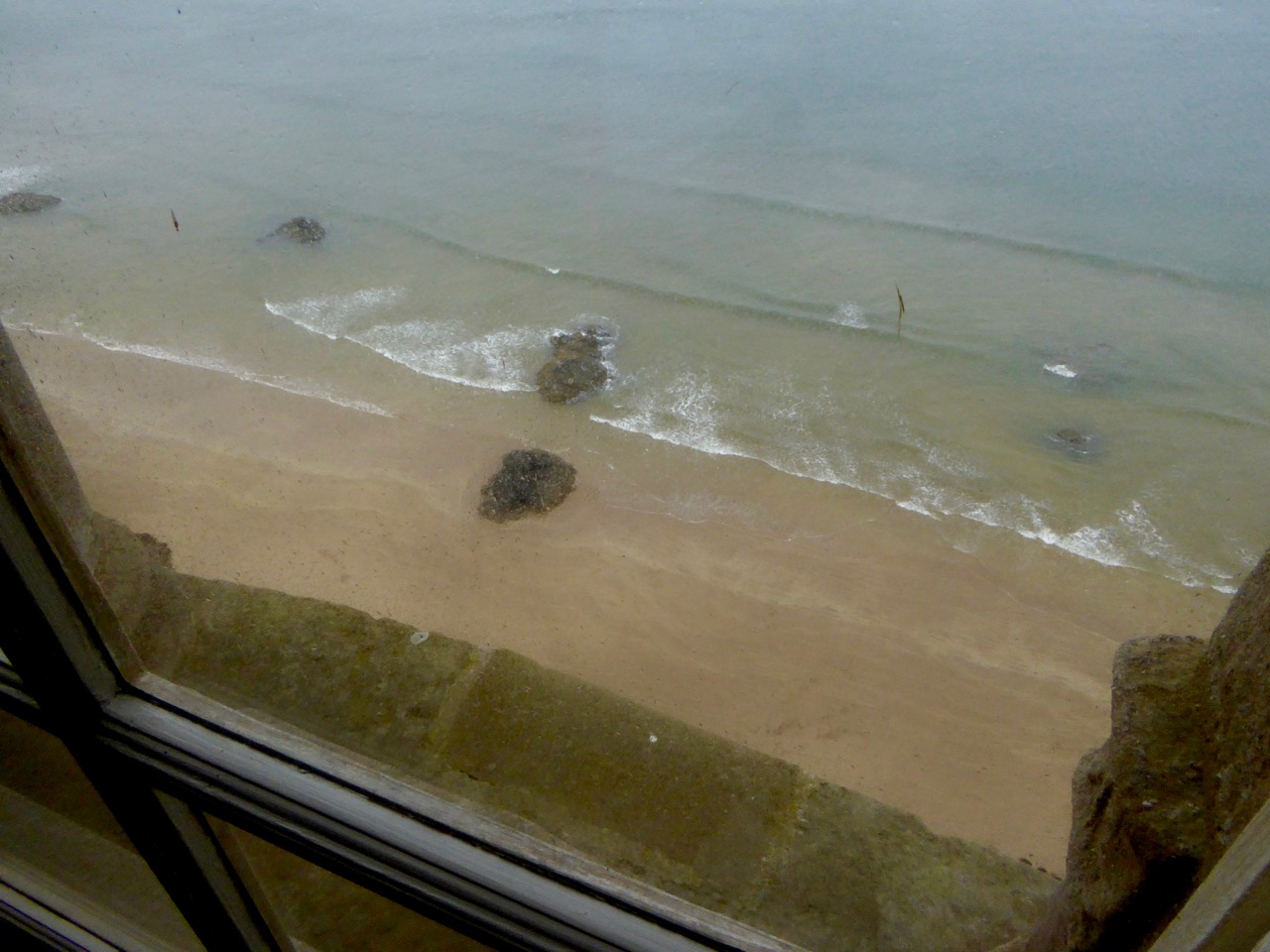
One of the most striking surviving buildings at Downhill is the Mussenden Temple, based on the Temple of Vesta at Tivoli, near Rome. It was built close to the cliff edge, but with enough land to enable a horse and carriage to be driven around it. When we looked out of the windows facing the sea we were shocked to see that the building is now teetering right on the cliff edge! Also, a railway line runs right underneath it near sea level, over 100 feet below – you can see the tunnel entrance in the header picture above.

The Temple was an ‘overflow library’ to the house, some distance away. It was constantly heated by a fire always burning in the basement room below, so the books didn’t get damp. The Earl Bishop was a great traveller and collector, and in its heyday the house was full of paintings, statuary and furniture. Students of the Northern Regional College together with the Arts Council of Northern Ireland, the University of the Third Age and the Earl Bishop Heritage Trail Group have put together a wealth of information and some reconstructions of the house, included here. Their website is a mine of good information.

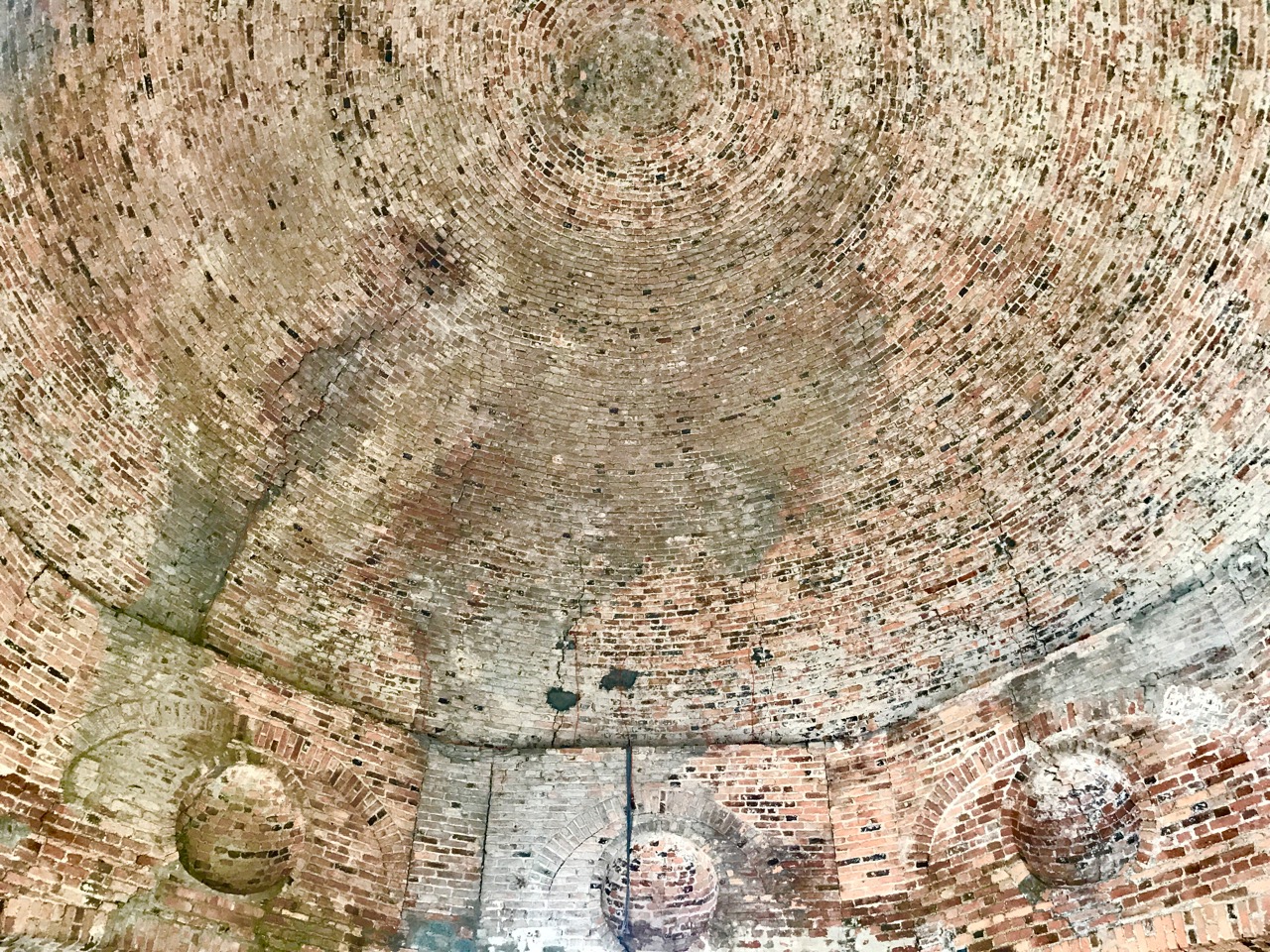
Reconstruction by the Earl Bishop Heritage Trail Group of the Temple dome (upper picture) and (lower) the ‘raw’ brick dome visible today

It’s sobering to stand in the driving rain – as we did today – on this deserted site and imagine the treasures that were once on display in this great edifice. On the Earl Bishop’s death the Demense passed to his cousin. It stayed in the family and survived a devastating fire in 1851, although restoration was not completed until 1876.

Upper picture – Earl Bishop Heritage Trail Group reconstruction of the main gallery in the house and (lower) poignant piles of rubble on the site today

The family left the house in the 1920s and in the 1930s the house was empty and had been stripped of furniture. During World War 2, Downhill was requisitioned and occupied by the Royal Air Force. In 1946 a request was made for permission to demolish the building, thus avoiding a large rates bill. Consent was refused because …the castle is of general local interest… A tenant was found – Mrs Belgrave – who was the last person to live in the house – but briefly; by October 1949 the entire property had been gutted and the windows and roof removed. The building was listed in 1977, and was acquired by the National Trust in 1980 which has been engaged in continual efforts to preserve the remaining fabric ever since.

Upper picture – Earl Bishop Heritage Trail Group reconstruction of the Temple interior and (lower) today the Temple is a significant landmark on Northern Ireland’s main tourist route

Wherever you are on the island of Ireland it’s just a hop and a step up to the North: the coastline is stunning, and a journey there will be punctuated, as always, with fascinating history. Well worth a visit!

An excellent detailed article by The Irish Aesthete on the Earl Bishop and his Downhill Demense can be found here

The Turning Year in Rossbrin

We are fortunate to live in a rural idyll: our immediate environment is immersed in the natural world. In fact, I suppose it is ‘Nature tamed’ – as we have pasture all around us as well as banks of gorse and rock: even a few trees which manage to cling on to the shallow soil all through the winter gales and (occasional) summer droughts. As the years go by we feel we become more closely entwined with the cycle of everything around us – we get to know personally the fox, pheasants and rabbits that pass by our window, and the myriad of birds that feed here, forage in the Cove or just show themselves to us on memorable occasions – Spioróg the Sparrowhawk is so handsome when she is resting on our terrace wall while on her deadly missions, and our choughs frequently perform wild dances in the air to entertain us. This year was special for me because, for the first time, I saw a hare amble around the house, alert with erect ears, before loping off into the next door field.

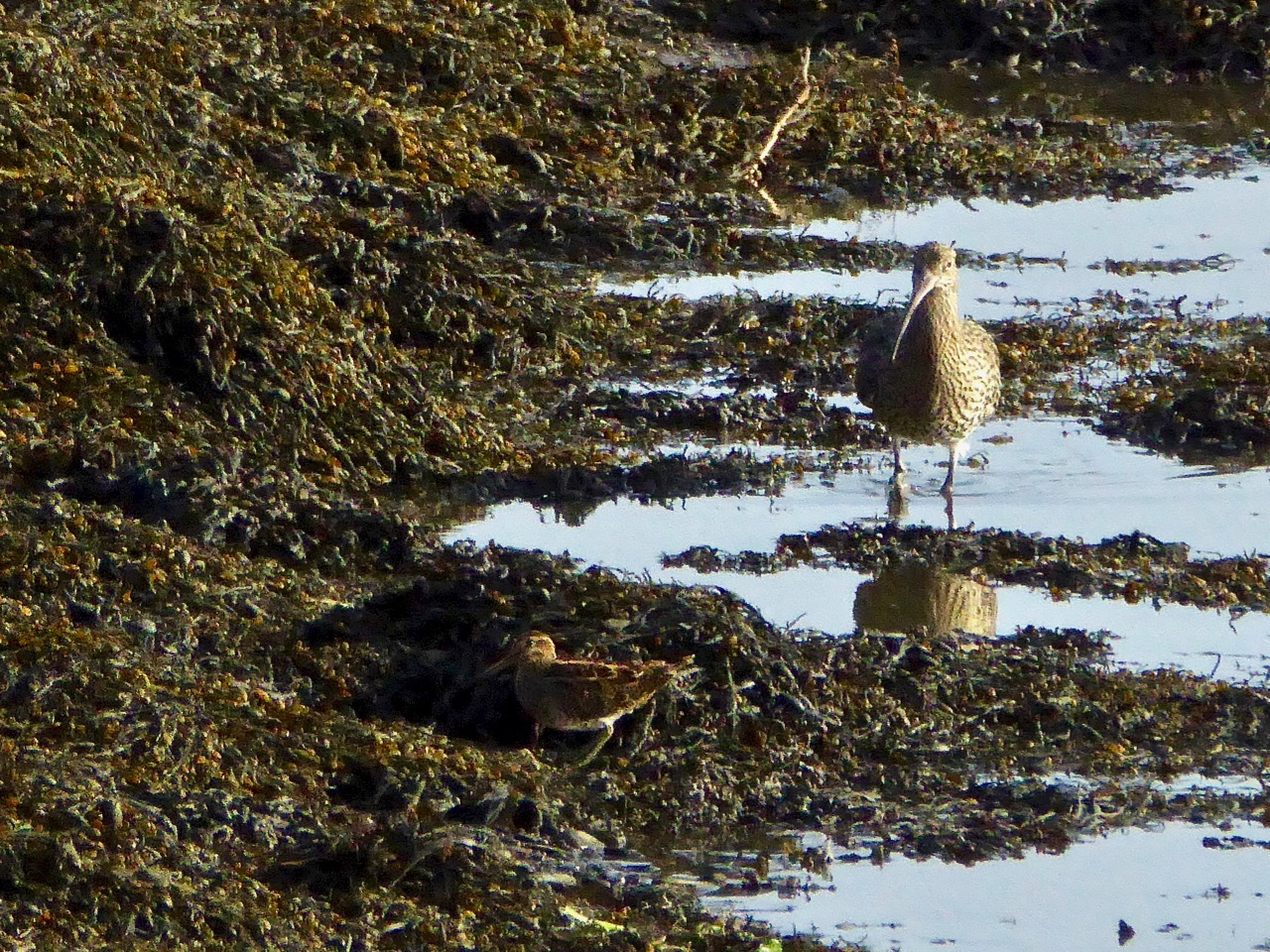
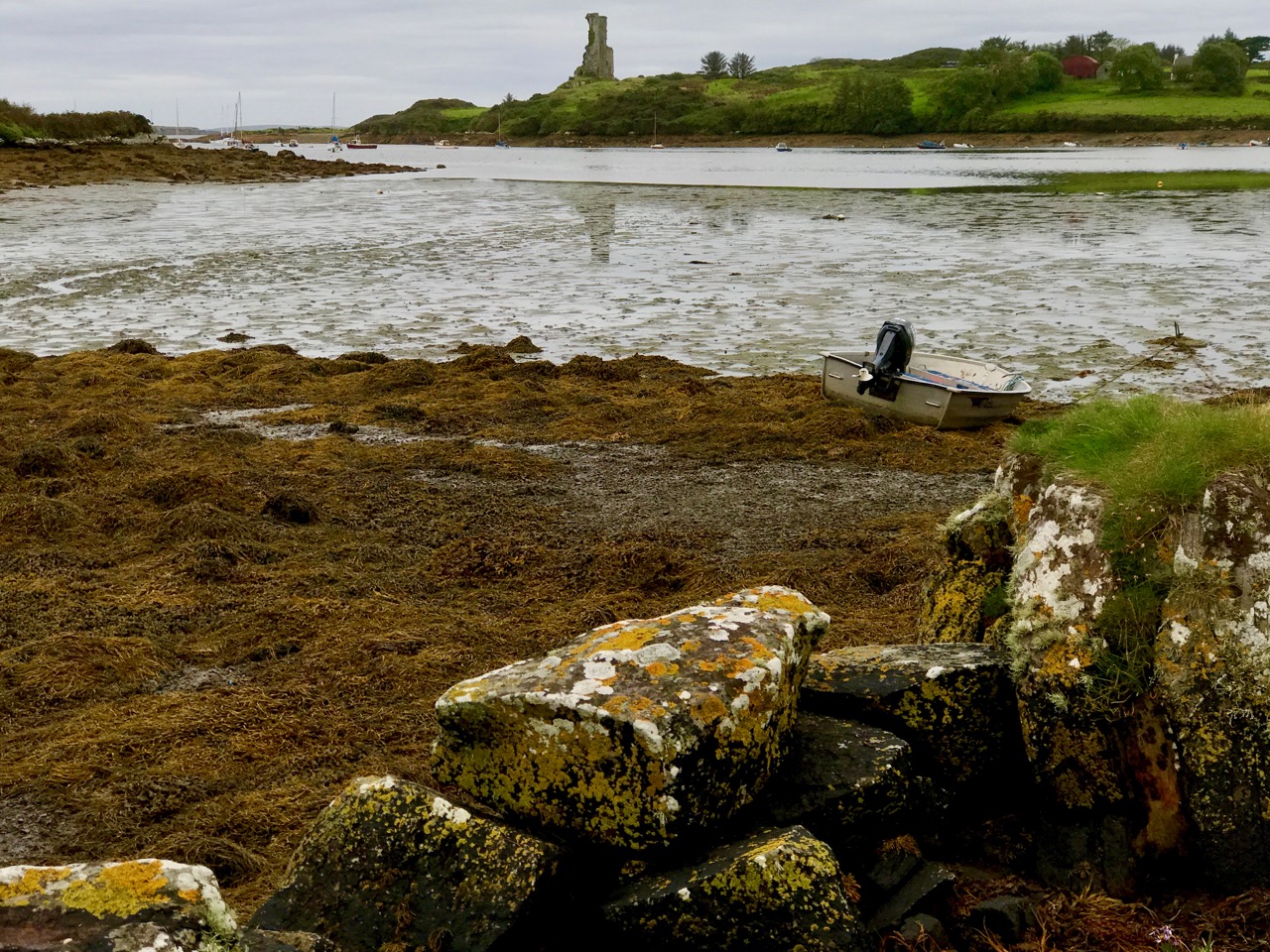
I have written about Rossbrin Cove many times before: look at A Moment in Time, Tide’s Out and Words on Roaring Water, for example. That sheltered natural harbour and the old mine road up on the hill above probably give us the most pleasure because we visibly see the year change and turn every time we walk there. Just now the days are rapidly shortening, and the autumnal influx of wading birds is returning. One we keep a particular eye out for is the curlew – a threatened breeding species here in Ireland. We see many on and close to the water, particularly at low tide, but these are probably migrants rather than resident breeders.

The year is turning – from late summer into early autumn, and the colours are changing from rich reds and purples – fuschia and heathers – to the more sombre yet equally attractive yellows and browns of furze and fern. Finola has closely followed the wildflowers right through from the spring – she is still finding and identifying every imaginable species – it’s a complete world of its own!

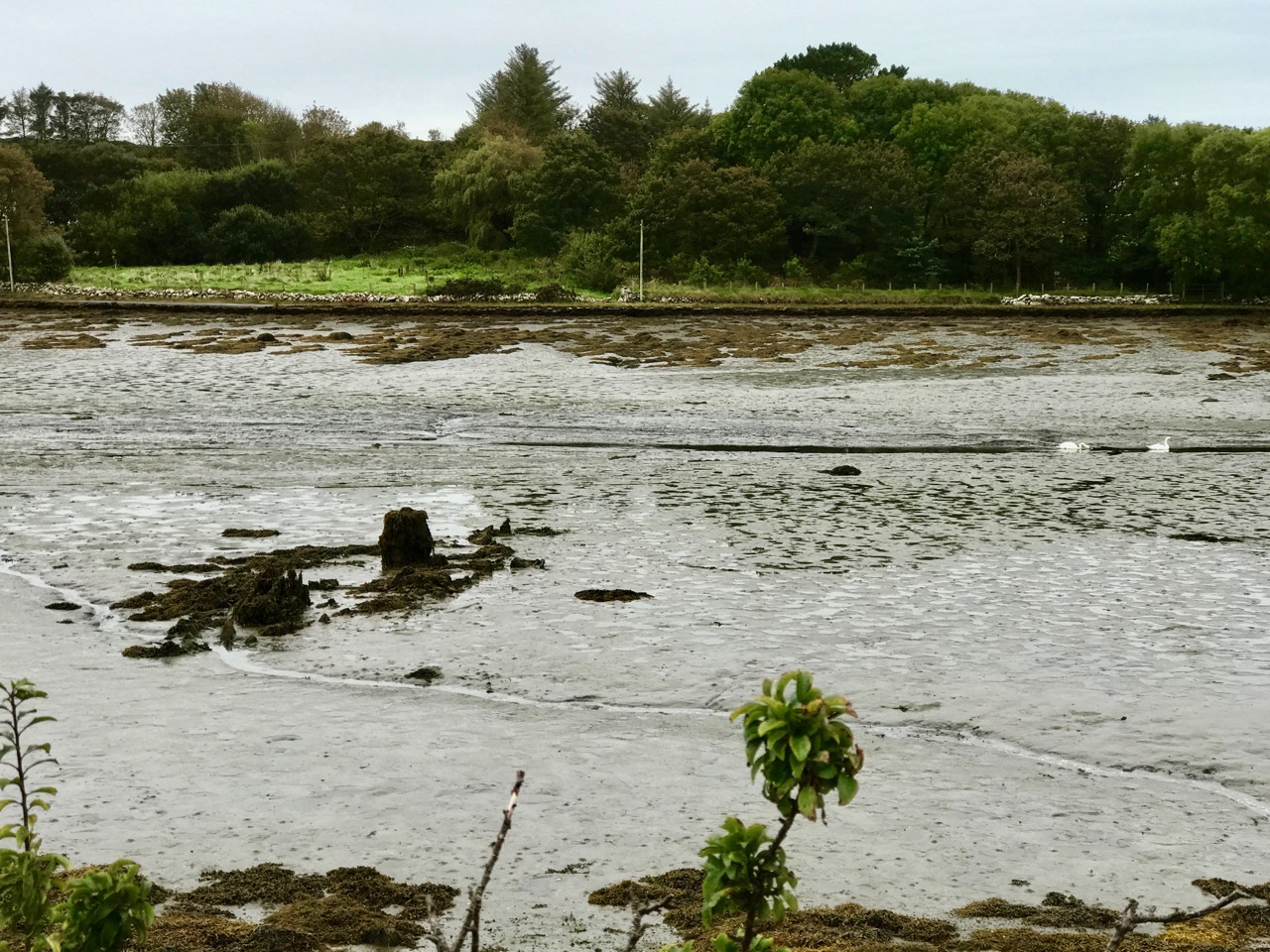
We have been seeing some exceptionally high and low tides here in Rossbrin. I’m always fascinated to see the mud-flats revealing bits of discarded history, while I am convinced that the huge remnants of dressed stonework on the north-east shore are the vestiges of once-busy quays, dating either from the medieval period, when Sir William Hull and the Great Earl of Cork owned the lands around here and set up thriving fish-processing ‘palaces’, or – at the latest – when the copper mines were active up on our hills and on Horse Island in the nineteenth century.

The real turning point comes at the end of October – Samhain – when the old calendar enters the ‘dark year’ (the ‘light year’ begins on May 1st –  Bealtaine). We know we have long, dark nights to come – time to huddle down by the stove – but there will be bright days as good as any in the year for walking, exploring and breathing in the Atlantic breezes. And the Rossbrin sunsets will be magnificent!

Richard King in Mayo

Scenes from The Old Testament by Richard King

In my post Discovering Richard King, I introduced you to the stained glass artist and the extraordinary windows in Athlone. If you haven’t read that post, pop back now and read it for an overview of King’s career, before continuing. Ever since then, I have been trying to track down Richard King’s art – he was active in several media and also exported windows to the US, UK and Australia. In Mayo recently, I was finally able to photograph more of his stained glass.

The Assumption window in Swinford

King was greatly influenced by Harry Clarke in his time at the studio, and when he took over as chief designer upon Harry’s death in 1931 he carried on very much in Harry’s style. After all, that was the style the clients wanted, and he excelled in producing it. I think I have tracked down several windows produced in the decade from 1930 to 1940 (when he left to open his own studio) that bear his hallmarks, but since Studio windows were never signed by individual artists after Harry died (with a few notable exceptions) it is impossible to verify whether or not I am correct. That’s why it was a thrill, on a recent visit to Mayo, to be able to view and photograph three Richard King windows, all of which date to the period after he left the Harry Clarke Studio. Richard came from Mayo (from Castlebar) so no doubt was a popular choice when stained glass was needed. Together, these three windows illustrate the evolution of his style over time.

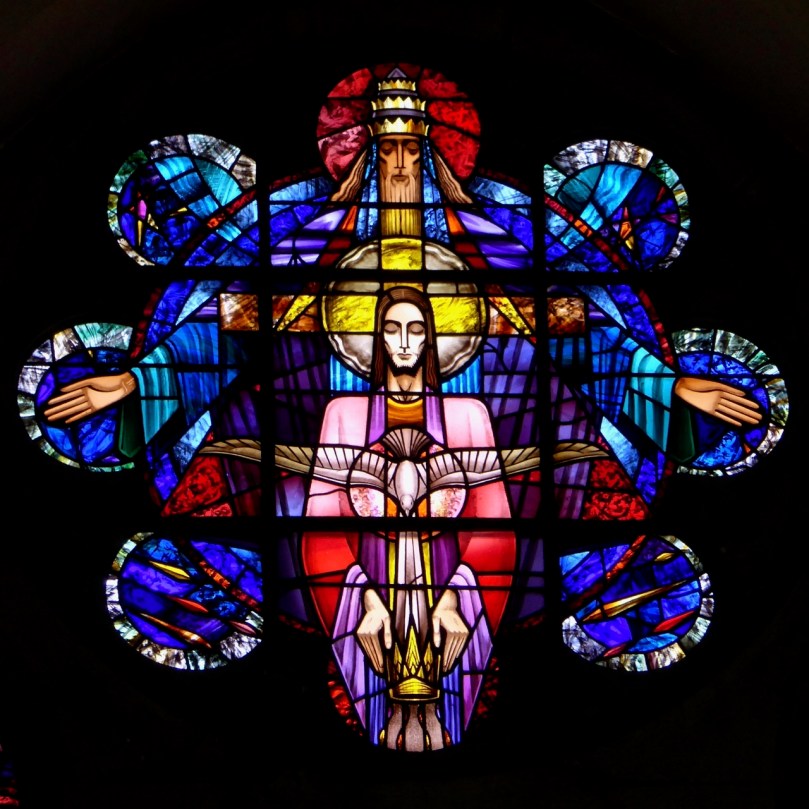
The earliest, and largest, window dates to 1952 and is in the Church of Our Lady Help of Christians in Swinford. It consists of three lights and a rose window above them and the theme is the Assumption of Mary into heaven. The rose window above the depiction of Mary rising shows the Trinity – Father, Son and Holy Spirit – with the Son holding the crown with which he will declare his mother to be Queen of Heaven. I can’t help thinking that the Father looks a little like a depiction of one of the ancient Irish chieftains from the Athlone Patrick windows.

Mary is flanked by John the Evangelist and by Patrick – unusual choices and one wonders who dreamed them up. We know it’s John since he holds a quill pen with which to write the gospel, and is accompanied by an eagle, his symbol as one of the four evangelists. Patrick is always recognisable in green, with a crozier on his arm and a snake underfoot, and is accompanied by geese. I’m not sure of the symbolism of the geese – perhaps they were to balance the eagle [EDIT: see Niall McAuley’s comment below]. He’s wearing fetching green gloves and slippers. Take a close look at the church he carries – the windows are the same configuration as these windows – a little visual pun that Richard must have enjoyed making.

The lingering influence of the Clarke style is still visible in the extraordinary detail of every part of the window, in the glowing colours, the symmetry of the matched angels and in the cherubim faces below Mary. However, in every respect this is the work of an artist who is his own man – it could never be mistaken for a Clarke, or even a Clarke Studio, window.

But the Swinford church has a surprise – a second Richard King window, dating from 1964 and radically different from the Assumption. This is a two-light window depicting the Old and the New Testaments. The style is suddenly modernist, bold, faux-naïf and reflects his own study of the modern styles of the time and his experimentation with new ways of capturing religious themes. The windows are also delightful – strong colours and carefully placed figures create an attractive whole.

Pentecost – the Holy Spirit descends on Mary and the apostles

I think my favourite image is the one in which Pope Paul VI steers a boat full of bishops – a reference, apparently, to the ‘barque of Peter’. Paul was pope from 1963 to 1978, much of my young life, and his likeness was instantly recognisable. It brought a smile to my face.

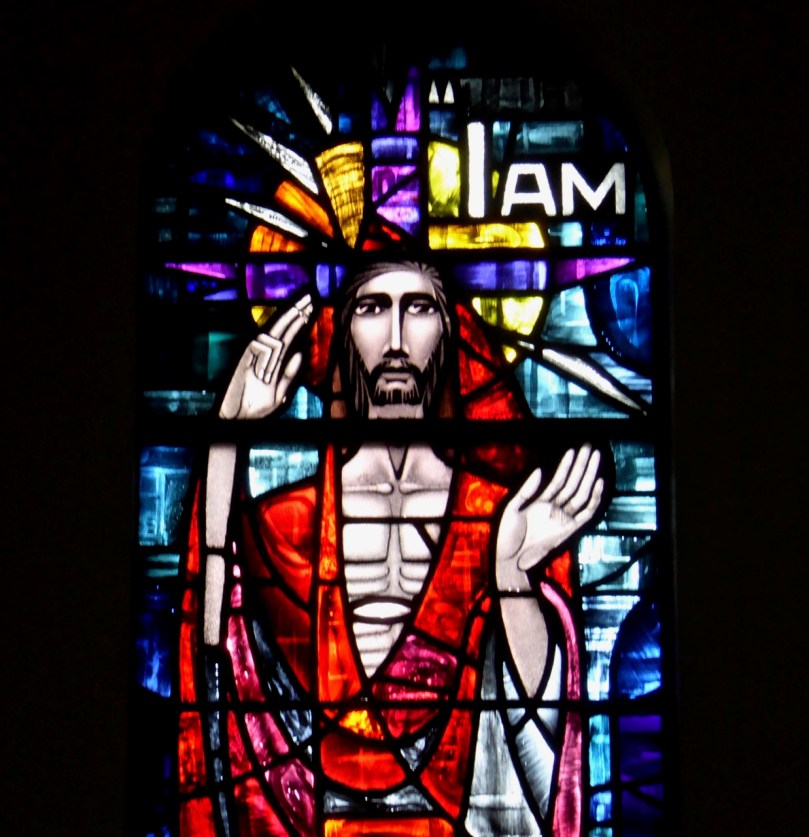
The last Richard King window is a two light window in the St Patrick’s Church in Newport. The theme is I Am The Resurrection And The Light. This one dates from 1973, the year before he died and what is striking is how far now he has moved towards a fully modern style with elements of cubism and abstraction.

The glowing colours are still there, the strong reds and blues, but there is no attempt at realism in the figures (note for example his treatment of Christ’s ribs as a series of rectangles) and a strong geometric arrangement is obvious throughout the composition.

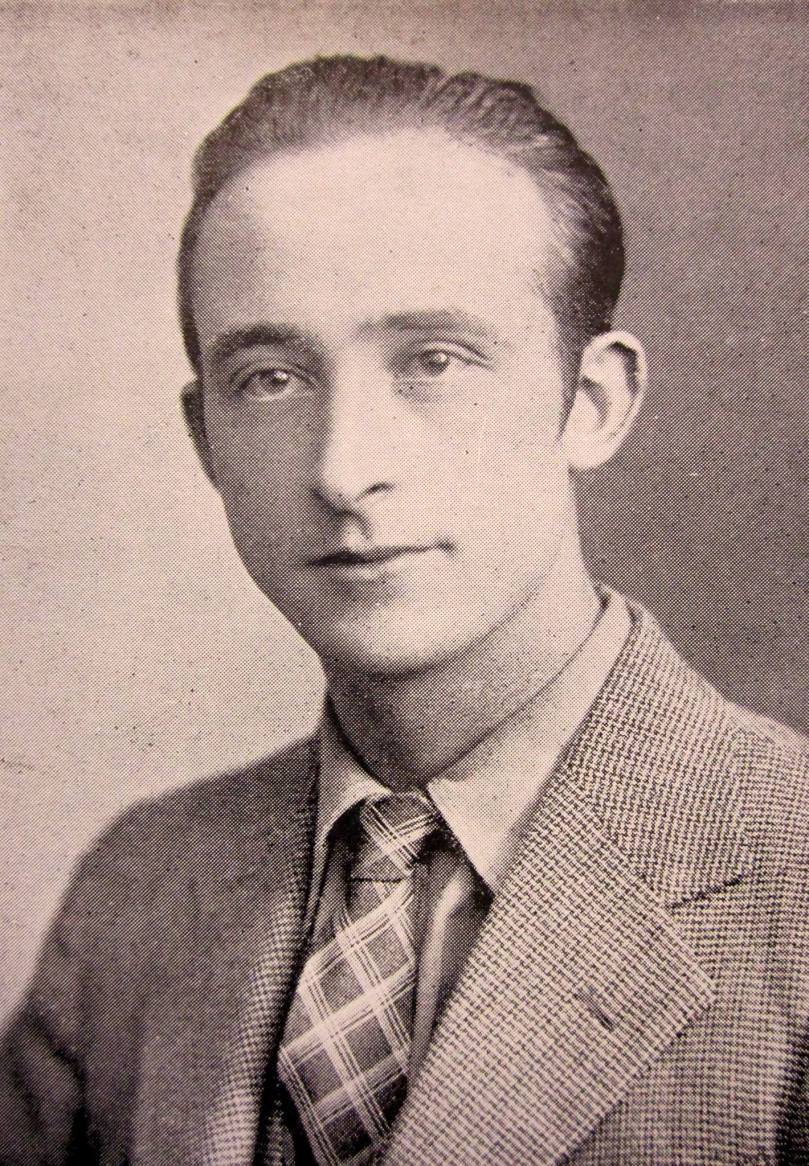
So far I have only written about Richard King as a stained glass artist, but there was more, much more, to him than glass. In future posts I will endeavour to expand on that statement. Meanwhile, I will leave you with a photograph of the young Richard King, courtesy of the Capuchin Archives.