Castlehaven – The Haven

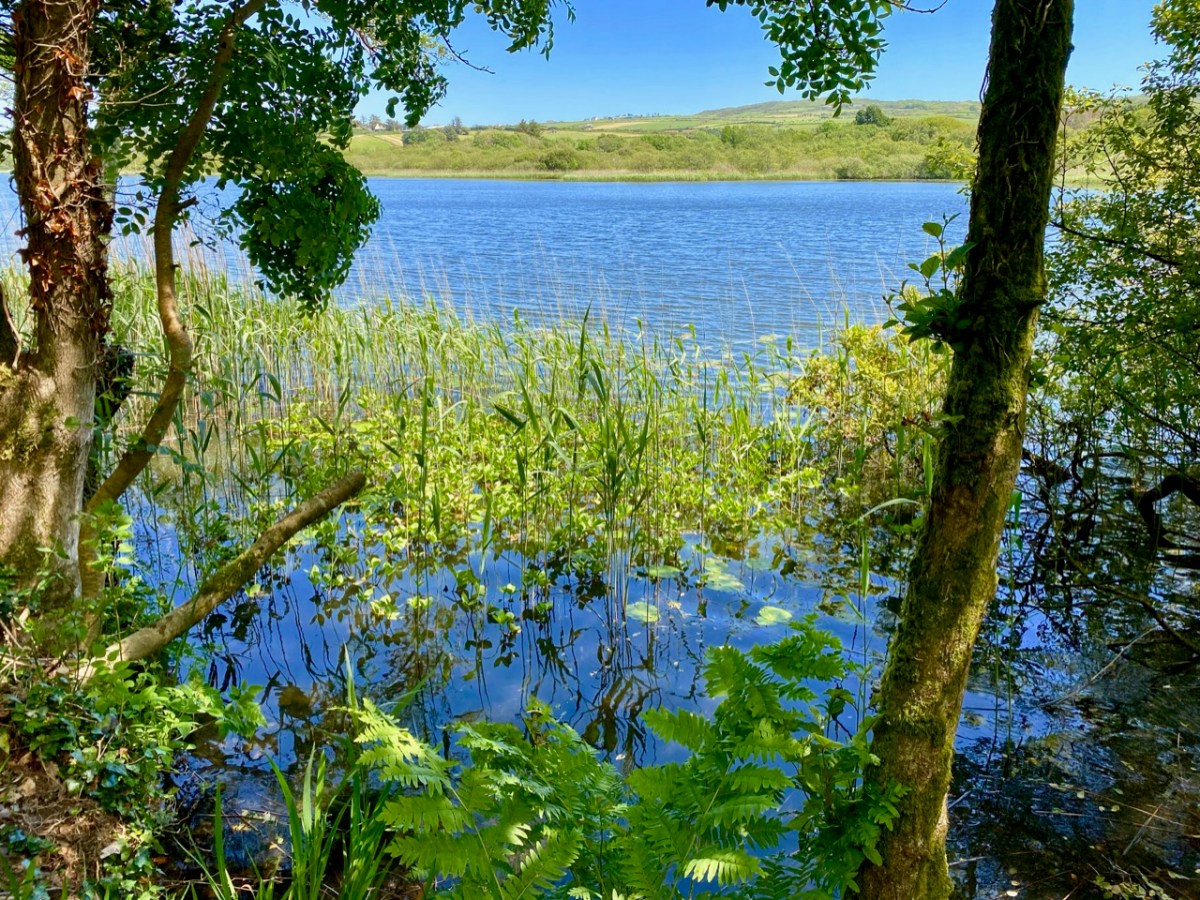
The word ‘haven’ is said to have a Norse origin: hǫfn. This translates simply as ‘harbour’. Does this mean that the Vikings visited West Cork and gave Castlehaven its name? Dictionary definitions include ‘a safe haven in times of trouble’ – refuge, retreat, shelter, sanctuary, asylum . . . The word conjures up something a little magical, and our exploration last week of the secretive valley that leads inland from Castlehaven – at the southern end of a significant West Cork cove – was certainly an enchanting experience. We traversed it on the greenest of days at the arrival of spring:

The header is a nineteenth century engraving, and shows a possibly idealised view looking across The Haven, towards the open waters of the Atlantic. In the foreground is the castle of Raheen, or Rathin. Castlehaven itself is at the far end, and the old tower house there – now all but vanished into the lush undergrowth – was strategically important, particularly during the Nine Years’ War between Gaelic Irish lords and the English. Spain also took an opportunistic interest in intervening in matters between Ireland and England. There are many accounts of the skirmish that occurred here on 6 December 1601, all of them varying to such a degree that we can have no real idea, even, of who was victorious! I like this version, penned by a contributor to the Duchas Schools Folklore Collection. It’s part of an extensive essay about the history of the area, which we will revisit in due course:

. . . Beside the Cemetery at Castlehaven stood, about ten years ago, the ruins of Castlehaven Castle, described by Don O’Sullivan in connection with the war of O’Neill & O’Donnell. “Porto Castello”, as it is called by O’Sullivan, played a very important part in connection with the Battle of Kinsale. Both O’Sullivan & Carew give accounts of a battle fought in the harbour, and while the former claims that Admiral Levison and his ships were driven off with loss of some vessels at the harbour’s mouth, Carew claims victory for the British fleet. Local tradition says that inside Reen Point, on the eastern side of the harbour lies a Spanish Vessel laden with gold, but that misfortune is sure to follow anyone who seeks the treasure. Castlehaven Castle was fortified by a combined garrison of Spanish and Irish and withstood the assault of Admiral Levison of the British fleet. The ruins of this castle were in a fair state of preservation about fifteen years ago, but the lower portion of the wall showed signs of weakness, and the great pity was, that nothing was done to prevent the collapse of the entire ruin a few years later. It is ‘said’ that stones had been removed for road metalling many years ago and this vandalism could certainly bring about the unfortunate collapse which only left only a confused pile of stones . . .


Seán Ó Donnabháin – Teacher, Baile an Chaisleáin School, Castletownshend 1936
Upper – a view of the now-vanished tower of Glenbarrahane Castle at the entrance to the Haven by Cork antiquarian John Windele, 1801 – 1865 (courtesy National Library of Ireland) and lower – the vestigial stone walls that remain today beside the grey sands of Castlehaven

Among our inherited collection of West Cork books in the library at Nead an Iolair is this volume by Gifford Lewis, published in 1985 by Penguin Viking. Ostensibly relating to the writings of Somerville and Ross, it is illustrated with a well-researched collection of old photographs which include some of the castle at The Haven still standing.

This photograph (above) is particularly valuable. It is also from the Gifford Lewis book and is captioned as follows:
. . . A very early plate by Sir Joscelyn Coghill (c. 1865) showing the old Castlehaven church and above it the Castle in which the Reverend Robert Morrit lived, and before him the Reverend Thomas Somerville. The Tithe War had its effect. Eventually, the Tithe Commission Act of 1838 moved the burden of supporting the Protestant clergy from the peasants to the landowners. The Catholic/Protestant confrontation in Ireland came with the influx of Elizabethan English, the first after the Reformation of the English Church. Those who came to Ireland as Protestants were much less likely to be assimilated than those who came before the Reformation, like the Martins. The ousting of the topmost layer of native Catholic society by a new Protestant one is audible in the list of Rectors of Castlehaven church from 1403 to 1640: O’Driscoll, O’Callaghan, O’Driscoll, Cormac/Basse, Pratt, Stukely . . .
Gifford lewis, Somerville and Ross – The World of the Irish R.M. 1985

The aerial view shows the inlet of Castle Haven guarded by its O’Driscoll castle at the southern end. In the upper reaches of The Haven is a further castle, properly known as Raheen (or Rathin), sited above the natural spit of The League: the juxtaposition of castle and land-spit was probably deliberate, to create a defensive barrier against any invaders infiltrating the upper waters of The Haven. The mid-19th century 6″ Cassini OS map (above) shows the location in detail. James N Healy (The Castles of County Cork, Mercier Press, 1988) well describes its situation: “. . . It is a remarkable sight, tall and dignified in its quiet isolation . . .” and attributes it to the O’Donovan family, associated with Castle Donovan on the Ilen River – which we visited recently. Raheen was attacked from the water by Cromwell’s army in 1649 and remarkably survives in that breached condition today.

The coloured postcard above is based on a view probably taken around the turn of the 19th and 20th centuries. The viewpoint is identical with that in the header engraving, and The League can be clearly seen in both representations. Because the whole inlet is known as Castlehaven, we have to be careful when reading references or captions, as the two castles – which I always endeavour to refer to by their original names (Glenbarrahane and Rathin) are often both known as Castlehaven Castle. And, of course, we also have the castle at Castletownshend itself to further confuse the issue, although the structure there now is relatively late (the present building dates mainly from the 19th century, although an earlier Bryans Fort on the same site was probably 17th century).

Here is a very fine painted view of Rathin Castle by contemporary West Cork artist Donagh Carey (thank you, Donagh!) You can find his works here: we are pleased to have some of them hanging at Nead at Iolair. I can’t resist including this photograph taken in the 1930s (below) – from the Adrian Healy postcard collection – showing Rathin, with the added bonus of a 1936 Ford 10 in the foreground!

This view (above) is an enigma. It is referred to as ‘Castlehaven Castle’ and is a pen-and-watercolour drawing by Charles Vallancey (1721 – 1812). If the written caption is ‘Castlehaven Mouth’, then it must be Glenbarrahane (although the foreground topography should surely have shown the old church and graveyard?); if it is fact ‘Castlehaven North’, then it would more likely be Rathin – and it is certainly visually closer to this castle. However, then the mouth of the Haven is not in the right place at all. Vallancey was a British military surveyor who had been sent to Ireland in the mid 18th century: he became fascinated with the country and its topography and settled here as a self-styled historian and antiquarian. An extract of his work follows, from a report on West Cork:

. . . There was only one road between Cork and Bantry; you may now proceed by eight carriage roads beside several horse tracks branching off from these great roads; from Bantry the country is mountainous and from the high road has the appearance of being barren and very thinly populated; yet the valleys abound with corn and potatoes and the mountains are covered with black cattle. In 1760, twenty years ago it was so thinly inhabited an army of 10,000 men could not possible have found subsistence between Bantry and Bandon. The face of the country now wears a different aspect: the sides of the hill are under the plough, the verges of the bogs are reclaimed and the southern coast from Skibbereen to Bandon is one continued garden of grain and potatoes except the barren pinnacles of some hills and the boggy hollows between which are preserved for fuel . . .

Charles vallancey – A Report on West Cork, 1778, British Library

Vallancey was noted for obtaining the Great Book of Lecan (Leabhar Mór Leacáin), a medieval manuscript written between 1397 and 1418 in Castle Forbes, Lecan, Co Sligo. He passed it on to the Royal Irish Academy, where it resides today. Sadly, his work apparently only garnered the poorest of appraisals – as an example, here is the 19th century Quarterly Review:

. . . General Vallancey, though a man of learning, wrote more nonsense than any man of his time, and has unfortunately been the occasion of much more than he wrote . . .

The Quarterly review, London, John Murray

In my Extreme Green post I promised a ‘salacious scandal’ associated with Castlehaven. Alas – we have this week run out of time and space . . . Keep watching!

Ireland 50 Years Ago: April 1971, JM Synge Issue

Back to Ireland of the Welcomes and this time to the March-April issue of 1971. This was a special issue, largely devoted to John Millington Synge, born April 16th, 1871, which means that next Friday is the 150th anniversary of his birth. These two photographs from this issue show Synge and the beautiful Abbey actor to whom he was engaged, Molly Allgood. Alas, JM died far too young, at 38, and Molly went on to lead a longer but unhappy life.

There’s a special connection to West Cork too – Synge’s mother, Catherine but known as Kathleen, was the daughter of the Rev Robert Trail, Rector of Schull. She is shown above with her children – JM is bottom right. I have written about the various roles her father played in this area.  During the Tithe Wars he railed against all protests, declaring that he “waged war against Popery and its thousand forms of wickedness”. He saw an outbreak of cholera after a huge rally as God’s vengeance on this who would deprive him of his income. He tried his hand at mining and established a considerable workings at Dhurode, the remains of which can still be seen – see Two Mines are Better Than One. It was doing well when interrupted by the Famine.  Finally, during the Famine, his better nature won out and he worked tirelessly to alleviate distress. He died of famine fever in Black ’47, universally mourned and honoured for his efforts to inform the public about the dire situation and to feed the starving people all around him. That’s Traill below in one of James Mahony’s sketches for the Illustrated London News – he had led Mahony to Mullins hut so he could witness and capture first hand the desolation, disease and despair.

That was in 1847 and Kathleen would have been 11. There is a contemporary account of how hard the whole Traill family were working to fill the soup pots, how difficult was the ceaseless onslaught of begging, how dangerous the fever-filled air. Her mother fled Schull as soon as she could after Robert’s death – she was later sent a bill for damage to the rectory caused by building a soup kitchen! Kathleen married a barrister, John Hatch Synge, and Edmund John Millington was their youngest child. Kathleen found solace from the trauma of her early experiences in her father’s stern fundamentalist faith – a faith that never wavered although it brought her into conflict with JM. Interestingly, that conflict did not destroy their mutual love for each other, and Kathleen (although looking stern in the photograph below) has been described as kind and generous.

JM grew up to be one of Ireland’s foremost dramatists and the writer of a unique and inventive form of English that set out to capture the idiom and cadence of Irish. And here’s where our second West Cork connection comes in – his Irish teacher in Trinity was none other than our own Canon Goodman (below), who spent half of each year in his parish of Abbeystrewry in Skibbereen and the other half in Dublin teaching Irish. He had no more committed or enthusiastic student than JM. 

For an excellent summary of the life and work of JM Synge I recommend you to the essay by Declan Kiberd in the newly-available-online Dictionary of Irish Biography. In this issue of Ireland of the Welcomes the major essay on Synge is by the distinguished Canadian Academic Ann Saddlemyer. Saddlemyer is now 90, an elected member of the Royal Irish Academy and a long-recognised expert on Synge, WB Yeats and the history of Irish theatre.

Another charming piece is by JM’s great-nephew, Lanto Synge, a fine arts and antique consultant, recently retired. His essay tells the stories that have come down through the family, including the great religious divide. He paints a portrait of a shy, nervous, intensely musical and engaging man, travelling and studying wherever he went, philosophically attuned to modern thought while immersed in an appreciation of an ancient language and way of life.   

The issue contains several extracts from Synge’s plays, poetry and prose, each one illustrated by photographs or drawings.* One thing I hadn’t realised  is that Synge was an early photographer. Although some of his photos are are reproduced in this article (two examples below), you can see better images at Ricorso. They show he had an ethnographer’s eye and an interest in the everyday lived experience of his subjects, such as the man threshing by hand and the two women spinning.

One of his great friends was Jack B Yeats and they worked collaboratively on several projects. Yeats illustrated his book on the Aran Islands (downloadable from archive.org – a site that is surely the greatest boon to researchers like us!). The two pictures below are from that source rather than the article. Synge and Yeats were of one mind, it seems, in what they chose to focus on.

But Jack B Yeats did more than illustrate The Aran Islands – he produced drawings for Synge’s three-act masterpiece, The Playboy of the Western World. This appears to have been an iterative process. We see a letter from Yeats to Synge, advising on the outfit a jockey might wear in the West of Ireland.

The finished illustrations are wonderful – this subject gave Yeats great scope to indulge his love of horses and horse racing.

Two of the horse racing sequences occupy the centrefold of the issue. It is obvious that both Synge and Yeats are intimately familiar with, and relish, this kind of occasion in the West of Ireland.

This issue of Ireland of the Welcomes does contain a couple of other articles, but I will leave it there, since the bulk of it is devoted to Synge and it is good to focus on and celebrate him on such an auspicious anniversary.

*Although individuals (some no longer alive)  are thanked for illustrations in the issue, it is unclear after all this time whether there are any copyright issues and so I have reproduced illustrations from the magazine, and from my downloaded copy of The Aran Islands, with gratitude to those who provided them. I will remove these images, or seek permission to retain them, if I am alerted to any infringements of copyright.

Wrought Iron Grave Markers

Every graveyard we go into has fine example of the blacksmith’s craft – wrought iron grave markers. Ranging from simple to decorative, they are a part of our heritage that is often overlooked and forgotten.

Wrought iron was once a common material in Ireland – there were huge production facilities in Clare, for example. What is it? It’s iron made by smelting iron ore and hammering out the impurities, with little or no carbon content. How it’s produced hasn’t changed much since the start of the Iron Age 2500 years ago. But it’s no longer available as a material, having been completely replaced by steel (carbon content up to 2%) and by cast iron (carbon content of up to 4.5%). This means we are in danger of losing all the knowledge about how to work with it, since it can only be worked using traditional forge techniques. 

Graves in burial grounds in the past in West Cork were mostly marked with crude stone slabs as headstones (and sometimes footstones) and the vast majority were un-inscribed. They were carefully chosen, though, and the memory of who was buried there, and the shape and placement of the markers, would pass down through families. 

However, every local blacksmith was also adept at making grave markers, most often in the shape of a simple cross, but sometime with more elaborate detailing. As with the hand-forged gates (see A Gate Post and Another Gate Post) grave markers were forge-welded or riveted, and details were added by hammering out shapes, or splitting the iron and curling it around the anvil.

Some examples follow. All are from my local area but wherever you are in Ireland you will find similar grave markers in old burial grounds (although probably not in newer cemeteries) – why not have a wander down to your own local old graveyards and see what you can spot?

Many of the wrought iron grave markers have lost any identification over the years, but there are exceptions, such as the plaque to Timothy Keating who died in 1896 and is buried in Abbeystrewry graveyard in Skibbereen, or the simple letter PH and the date of 1907, from the graveyard in Drimoleague.

This elegant grave surround is completely hand-forged and is in the Abbeystrewry graveyard. It is likely to be the work of one the McCarthys, a family of blacksmiths whose work is still remembered and celebrated in Skibbereen – see this post from the Skibbereen Heritage Centre.

In the same graveyard, Eugene, a member of that McCarthy family, made this impressive famine memorial (above, upper) in his forge on Ilen Street. His hallmark can be seen elsewhere in the graveyard – notice the similarities between the cross on top of the famine memorial and the gravemarker (above, lower). The cross keys are associated with St Peter – perhaps this marks the grave of a Peter.

Many simple crosses such as those above can be found in the graveyard surrounding the ruined church of St Mary in Schull. The second image in this post is a more elaborate example from St Mary’s.

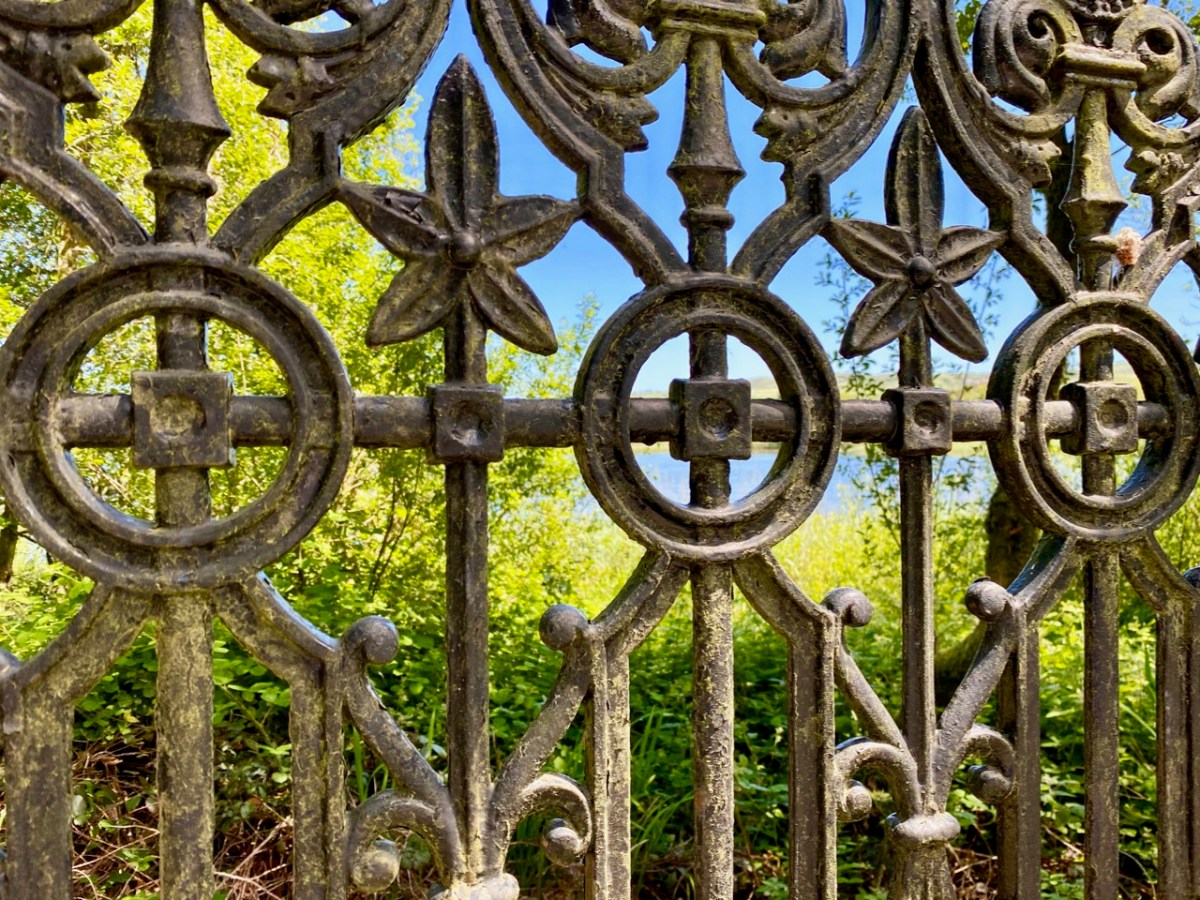
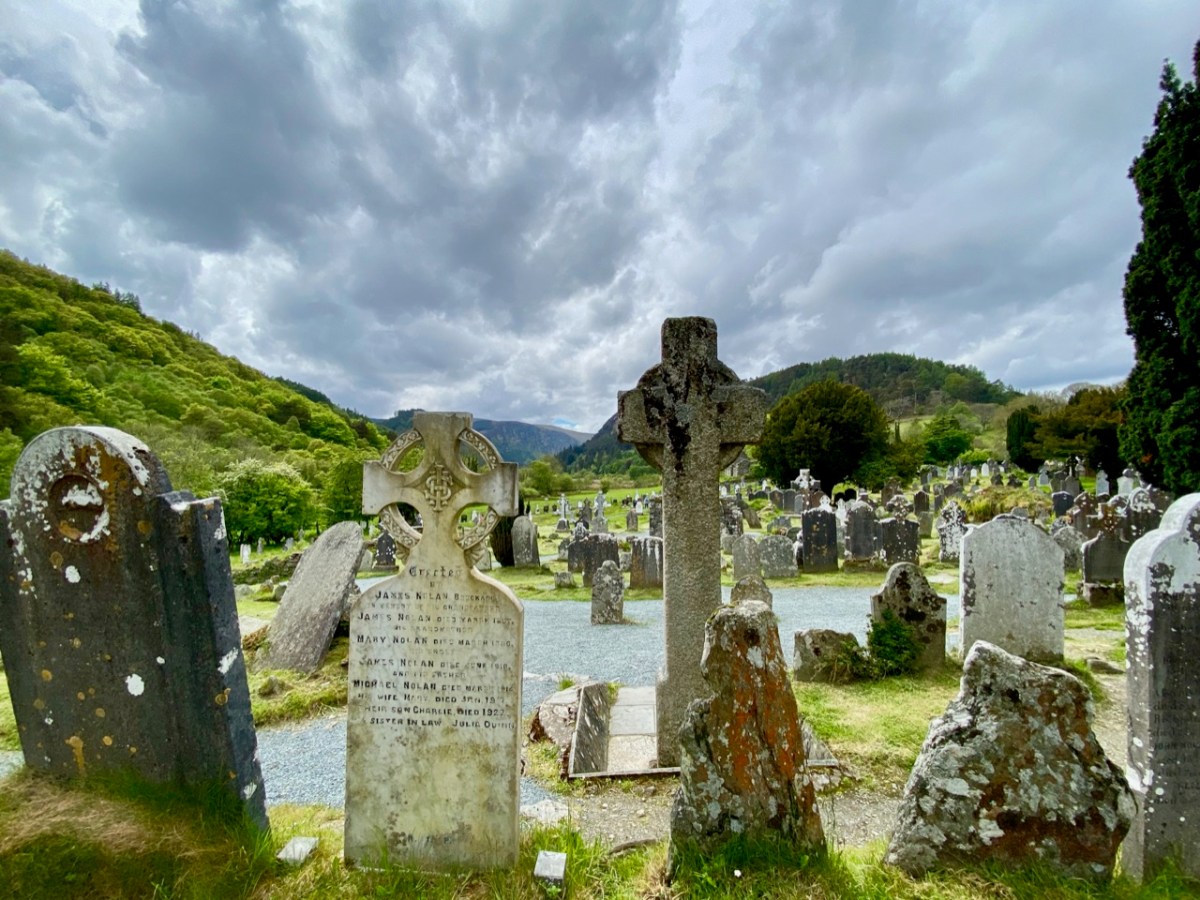
This graceful wrought iron grave surround is in the Castlehaven graveyard. The cast iron headstone obscures the original hand-forged IHS, just visible behind it.

Almost completely obscured by vegetation is this lovely example of a wrought iron grave marker in Creagh graveyard on the banks of the Ilen. Below are more simple crosses in Abbeystrewery.

Wrought iron is amazingly durable and will last for hundreds of years with little or no maintenance. It can deteriorate under certain conditions, though, and when it does it can only be properly repaired using traditional forging methods. There are still blacksmiths around who can use these traditional methods – in West Cork we are lucky to have Pat O’Driscoll* and JJ Bowen – but the knowledge and the equipment is getting scarcer. 

This lovely memorial to the O’Brien family can be see in the Dunbeacon graveyard. The image below is of a wrought iron memorial in Schull. The circle was made from band-iron, originally used for banding wheels.

I’ve tried to limit this essay to wrought iron. I’m still learning – please point out any errors you see, in the comment section. I hope to do more about cast iron in the future. Wrought and cast iron were often used in combination and we have lots of examples of this in our West Cork graveyards.

*My thanks to Pat O’Driscoll for information and for his willingness to patiently answer my questions.

I am also grateful to Architectural Conservation Professionals – see their site for lots of information on the conservation of historic ironwork.

Extreme Green – Castlehaven

There are many places in West Cork that deserve more than one visit. Our enforced confinement close to home focusses us on that thought. March went out like a lamb and – on the first day of April – we went off to enjoy the stirrings of spring in one of our favourite spots: Castlehaven.
Here’s that spot seen from above. It’s accessed from a boreen that goes nowhere else, and is to the south west of Drishane, just outside Castletownshend. In the view you can see the little cove and an old burial ground which surrounds the ruin of the original church of St Barrahane, probably built on medieval foundations but disused by the 1600s. This benign place has bathed in some momentous historical events but is now forever peaceful and seems far removed from our material world.

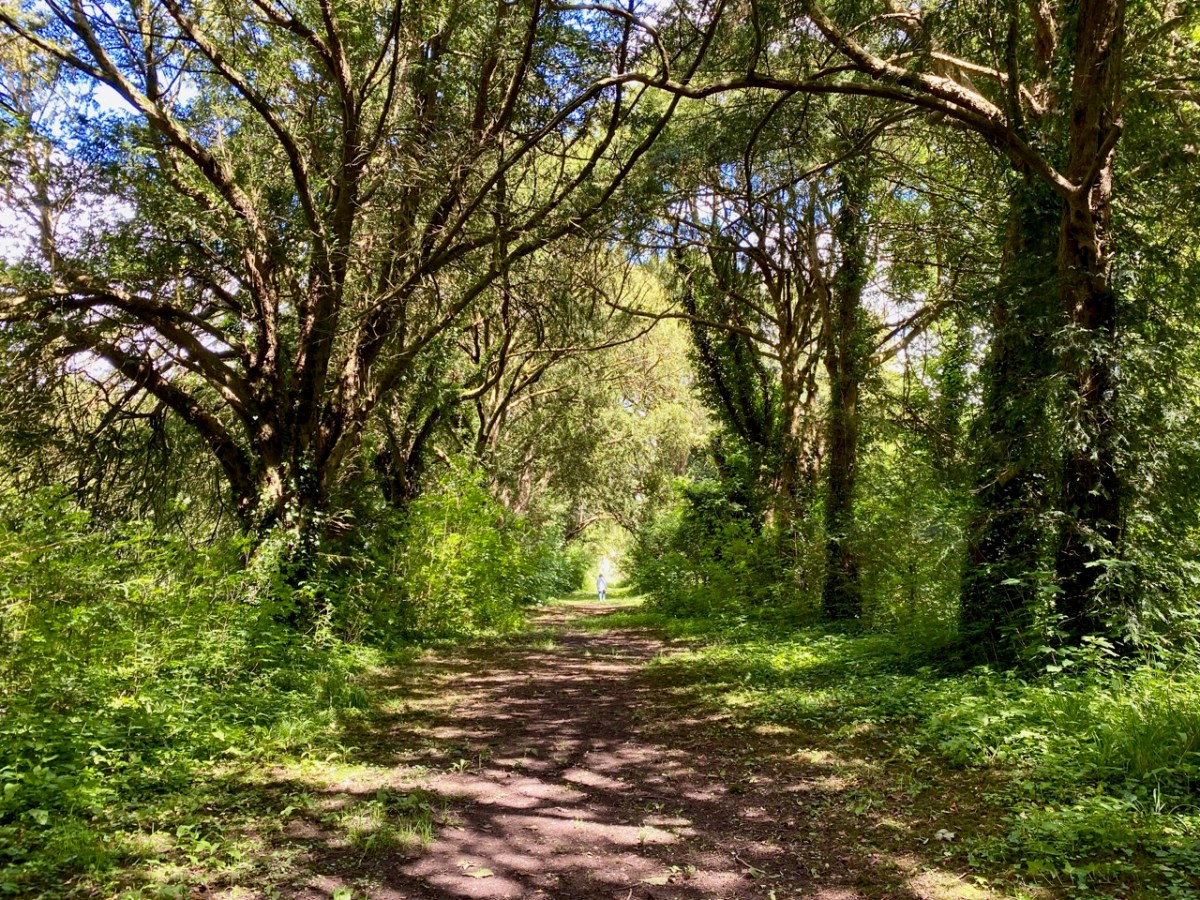
The 25″ OS map – dating from the late nineteenth century – marks the main features of Castlehaven: the ‘Grave Yard’, Rectory (based on an older house) and ‘Toberbarahane’ – a holy well. One of our favourite walks begins just to the south of the graveyard and wends its way up to the well, – and beyond – following a small stream which has ferociously gouged a channel through the rock formations in ancient glacial times. Today I can only describe the experience as ‘Extreme Green’ because our eyes are drawn to a riot of spring growth and exotic flora. In fact, Finola described it as a rainforest path when we first visited a few years ago.
The Holy Well is still revered, evidently, especially by sailors who need protection while at sea. The saint was known as Bearchán, and most likely came from the Corca Laoighde family  (the Annals describe the O’Driscolls as kings of the Corca Laoighde in the twelfth century), although we can find very little of his life. According to Pádraig Ó Riain’s A Dictionary of Irish Saints, Bearchán’s pattern day is not known, but Amanda gives it as 3rd December in Holy Wells of Cork & Kerry, something which she must have gleaned from local knowledge.

The Holy Well is easy to find and involves crossing a stout timber bridge to the left of the path. On our previous visit, three years ago, a tree had fallen across the path and the bridge was damaged, but this has now been put right.

Finola is coming back along the holy well path, and the bay of Castlehaven is immediately beyond her. The colour of the sea is stunning azure at this time of the year. Just beyond the gate, and sited right above the strand, is all that is left of Castle Haven, a strategic tower house which saw action on 6 December 1601, during the Nine Years’ War between Gaelic Irish lords and the English. The O’Driscolls, who held the castle then, had welcomed in a small convoy of Spanish munition ships. The commander of the English naval forces based at Kinsale, Admiral Leveson, was ordered to “. . . seeke the Spanish fleete at Castlehaven, to take them if he could, or otherwise to distresse them as much as he might . . .” I’ll leave the rest of this story as a cliff-hanger, to be completed in a future post, but we will return to the castle which gave Castlehaven its name.

The old photograph dates from the late 1800s and is from the Lawrence Collection, courtesy of the National Library of Ireland. My photo shows all that remains of the castle today: a section of stone walling close to the cliff face. Its downfall occurred in 1926 and we know this because:

. . . Edith Somerville recorded that while taking a walk on 26 February 1926 she heard a loud rumble and in looking towards the direction of the old tower found that it had collapsed. Nowadays only a mere stump remains, and that covered with briars and weeds. The castle stood on the side of the harbour of Castlehaven, to the immediate south of the stony grey beach, and the decayed church, graveyard and holy well of St Barrahane, the local patron saint who gives his name to the nearby glen and castle. The castle and haven was known as Cuan-an-Chaisleán to the Irish, as Castlehaven to the English, and El Puerto Castello to the Spanish, but they all mean the same thing . . .

The Castles of County Cork by James N Healey, The Mercier Press, 1988

In the next post I’ll be telling you more about the pivotal sea-battle at Castlehaven between the Irish – Spanish alliance and the English forces; and setting out a case of mistaken identity. We will also be exploring another Castlehaven Castle, and looking into a salacious scandal that led to a beheading or two in 1631. There’s much to look forward to…!

Following the Cascades (Sweet Ilen – Part 7)

There’s a walk that goes down from Castledonovan to Drimoleague: it follows an ancient mass path and much of it is right alongside the Ilen River. At its northern end there is a section known as the Deelish Cascades: this is geologically fascinating, and gives us some insights into how our West Cork landscape was formed thousands of years ago.

. . . The oldest rocks exposed in West Cork are of Devonian age (410 – 355 million years ago) . . . These mostly red and green sandstones, siltstones and mudstones were deposited on a continental landmass in a low latitude desert or semi-arid environment. The sediments were deposited from rivers, whose flow was dominated by flash-floods fed by episodic rainfall, which originated predominantly from mountainous areas lying to the north which were were formed during the Caledonian Orogeny (mountain building event) in latest Silurian and early Devonian times. The environment was perhaps similar to the present day Arabian desert. This “Old Red Sandstone” continent extended over what is now northwest Europe. In Cork and Kerry these sediments accumulated in a large subsiding trough (the Munster Basin), resulting in one of the thickest sequences of Old Red Sandstone encountered anywhere in the world (at least 6km thick) . . .

Geology of West Cork, M Pracht and A G Sleeman, geological Survey of Ireland 2002

I have marked on this Geology Map the course of the Ilen River from its source on Mullagmesha Mountain to the tidal estuary which begins at Skibbereen. The map shows the ‘grain’ of the various faults which run SW to NE over the terrain: the river generally flows perpendicular to these faults, and the ‘grain’ is clearly seen in the exposed river bed running over the Deelish Cascades.

Praeger usefully simplifies the geological definition of the landscapes (for more on Praeger see Finola’s complementary post today):

. . . The story which geology tells as to how West Cork and Kerry got its present form is interesting, and I shall try to tell it in non-geological language. Towards the close of Carboniferous times – that is, after the familiar grey limestone which covers so much of Ireland and the beds of sandstone and shale which succeeded it were laid down on an ancient sea-bottom, but long before the beginning of the Mesozoic period, when the New Red Sandstone and white Chalk were formed – the crust of the Earth in Ireland and beyond it was subjected to intense lateral squeezing from a north-south direction. This forced it into a series of great east-west folds, thousands of feet high from base to summit – the Carboniferous beds on top, and below them and following their ridges and hollows the massive strata of Devonian time, and other deeper-buried systems. A series of pieces of corrugated iron laid one over the other will illustrate what happened. The folding was developed particularly conspicuously in the Cork-Kerry area. What we see is the result of this ancient crumpling, now greatly modified by the effect of millions of years’ exposure to sun and frost, rain and rivers . . . The more resistant slates, carved into a wilderness of mountains, still tower up, forming long rugged leathery ridges. A sinking of the land has enhanced the effect by allowing the sea to flow far up the troughs. That the ridges were longer is shown by the high craggy islands that lie off the extremities, and continue their direction out into the Atlantic . . .

The Way That I Went, Robert Lloyd Praeger, Methuen & Co London, 1937

While the upheavals of far-off eras reaching back millions of decades certainly laid the foundations of our landscape, the geological events which actually honed the shaping of the terrain as we see it today are far more recent – the ‘Ice Ages’ which developed only 30,000 years ago and had receded by about 10,000 BC. During that time sea levels fell and then rose again, and the topography and shoreline of the island with which we are familiar today was established. The ice sheets covered most of the land and were up to 1,000 metres thick. As they melted, glaciers fell away from the highest points and carved fissures into the slopes, creating valleys and rivers. One of the most extensive ‘local’ ice-caps was in south-west Munster where a ‘Cork-Kerry’ glaciation, centred on or close to the Kenmare river, developed independent of the general ice sheet. Our own ‘Sweet Ilen’ was a consequence of the ice movement, and the rock formations that we see in the Deelish Cascades are good evidence of these modern geological events.

All the way down the Cascades you will see evidence of the scouring of the rocky river bed, and huge ‘erratic’ boulders that have been carried from the mountain-top on the ice flow, to be deposited randomly – and picturesquely – in the torrent. Of course, you don’t have to know about geology to appreciate the walk: you are free to explore the well kept path and delight in this West Cork experience which has been laid out for us all through the mighty efforts of the Drimoleague Heritage Walkways and the Sheep’s Head Way.

Previous episodes in this series: Sweet Ilen : Sweet Ilen – Part 2 : Sweet Ilen – Part 3 : Sweet Ilen – Part 4 : Sweet Ilen – Part 5 : Sweet Ilen – Part 6

Winter Light in West Cork: Lockdown Edition

We’ve both been dipping in to Robert LLoyd Praeger recently – Robert for this week’s post on the Ilen Cascades and me for pleasure. Praeger’s classic book The Way That I Went, was published first in 1937 and has never been out of print (this is the edition we have). My browsing reminded me that I tried a Praeger approach to explaining our West Cork landscape a few years ago, in a post post titled Wild Atlantic Light – the West Cork Winter Edition. I am having another go at it now with edited text and new photographs, all taken in the winter months. Mostly what I was trying to do then and now is to explain the West Cork landscape – what gives it its form and shape and colour and startling beauty. Being in lockdown since Christmas has forced us (even more than usual) to engage with our territory on a deeper level, seeking to understand what makes it the way it is.

Of this area, Praeger says,

At the Southern end of this land of great mountain promontories, in West Cork, you find yourself in a little-known and tourist-free region of much charm. You stay on Sherkin Island . . . or Cape Clear island . . . , at Schull or far out at Crookhaven: and you walk and boat and fish and lounge and bathe, and enjoy the glorious air and sea; towns and trams and telephones seem like bad dreams, or like fugitive glimpses of an earlier and inferior existence. A meandering railway penetrates to Schull, and the roads are as good as you could expect them to be in so lonely a country. All is furzy heath and rocky knolls, little fields and white cottages and illimitable sea, foam-rimmed where it meets the land, its horizon broken only by the fantastic fragment of rock crowned by a tall lighthouse which is the famous Fastnet.

Things have changed quite a bit since the 1930s, of course – how we wish that little railway was still running or that the ‘our’ part of Ireland had remained ‘little-known.’ But while it may seem that Praeger is describing a whole other world, enjoyed in the summer, the fundamentals remain. For example, as Praeger pointed out, West Cork is a maritime area and that affects our weather. It means that clouds are plentiful at all times of the year and that the weather can be highly variable and unpredictable. But the ocean, and the Gulf Stream it carries all the way from the Gulf of Mexico, ensure that we have a slightly milder climate than the rest of Ireland. Beside the sea, the air is full of negative ions. That’s a good thing. Negative ions stimulate our senses and lead to a heightened sense of wellbeing.

Sure, we can have rainy days and bitter winds in the winter, but there are lots of sunny days too. When the sun shines in the winter, it is filtered through those drifting clouds to produce those marvellous effects of light and shade that lend such drama to the landscape.

In winter too, the colours are highly contrasting – the green of the fields change abruptly to the blondes and golds of the higher mountains. The bracken turns the colour of amber and the fionán grasses provide an expansive sea of rippling heath on higher ground.

We don’t get snow very often, but it’s certainly visible on the high points, such as on the Caha Pass between Glengarriff and Kenmare. Praeger loved this dramatic geology with its crags and folds.

Under a blue sky the sea in West Cork turns the colour of the Mediterranean or the Caribbean. and this is particularly striking in the winter, perhaps because it’s so unexpected. They tell me it has to do with having a sandy bottom and I am sure there are other scientific explanations, but really, you have to see it yourself to believe it.

Our underlying geology (see Robert’s post again for Praeger’s explanation) provides the ruggedness, the exposed sandstone ridges, and the deep coastal indentations that characterise the landscape.

The end result of it all – the sunshine, the clouds, the mountains, the sea, the contours and colours of the land – is the kind of light that artists dream of. The sheer clarity of it is startling – you can see from one end of the peninsula to the other in a way that city dwellers have forgotten it’s possible to do. That clarity brings out every hue and allows all the colours to sparkle against each other.

The photographs in this post were all taken from the depths of winter to the first glimmerings of spring. Robert Lloyd Praeger found this area entrancing in the summer – he should have come in the winter! The last light of a winter evening would have set his heart aflutter.