Transcending Violence: Harry Clarke’s Sublime Lea-Wilson Window

Percival Lea-Wilson was assassinated by the IRA 100 years ago tomorrow, June 15th, 1920. The story has been well documented and is truly a tale of horror. Lea-Wilson was a Captain in the British Army detail looking after the prisoners who had surrendered from the General Post Office during the 1916 Rising. He was distinguished by his rough treatment of the prisoners and in particular for humiliating Tom Clarke by ordering him to strip naked in public.
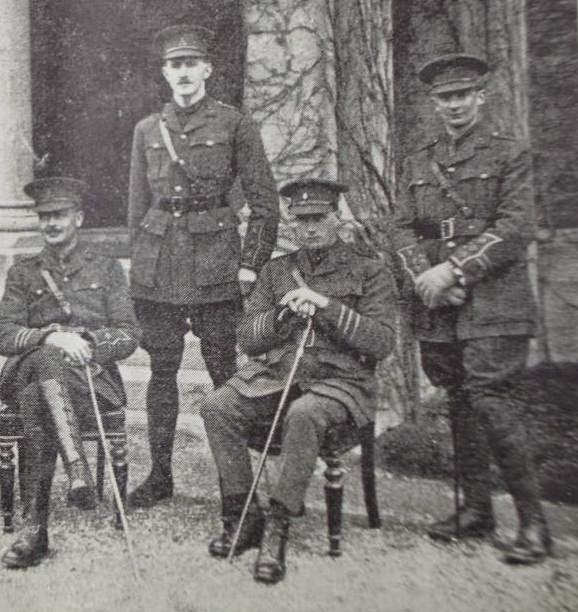
Lea-Wilson is standing on the right

His actions were observed by many, including Michael Collins. Four years later Lea-Wilson, who had since re-joined the Royal Irish Constabulary (RIC) was shot dead on the street in Gorey, Co Wexford, possibly by direct order from Collins. Perhaps many Irish people would not have mourned his passing, but Lea-Wilson’s wife was devastated and the depths of her feeling led to the creation of one of Harry Clarke’s masterpiece windows.
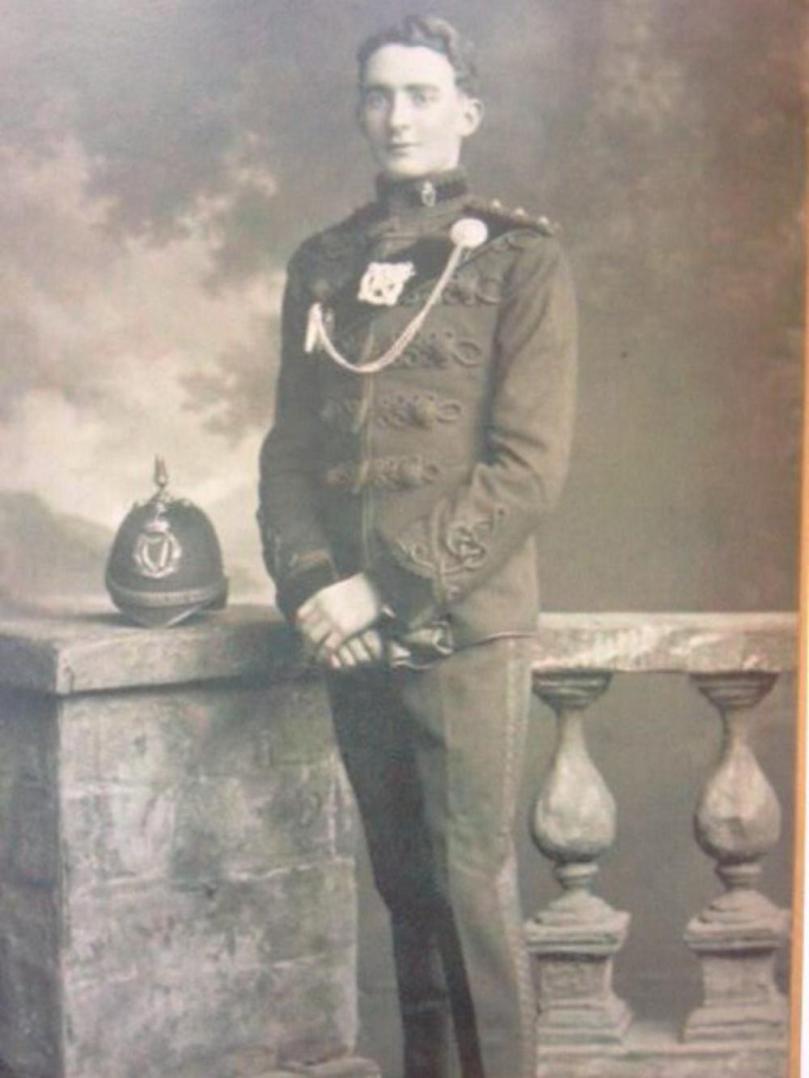
Percival as he might have looked around the time of his marriage to Marie

There is a second amazing story about Marie Monica Lea-Wilson (her friends called her Monica) and her acquisition of yet another masterpiece, Caravaggio’s The Taking of Christ, (below) now a centrepiece of the National Gallery in Dublin. My post is about the Clarke window, but you will find lots online about the Carravaggio, for example here and here.
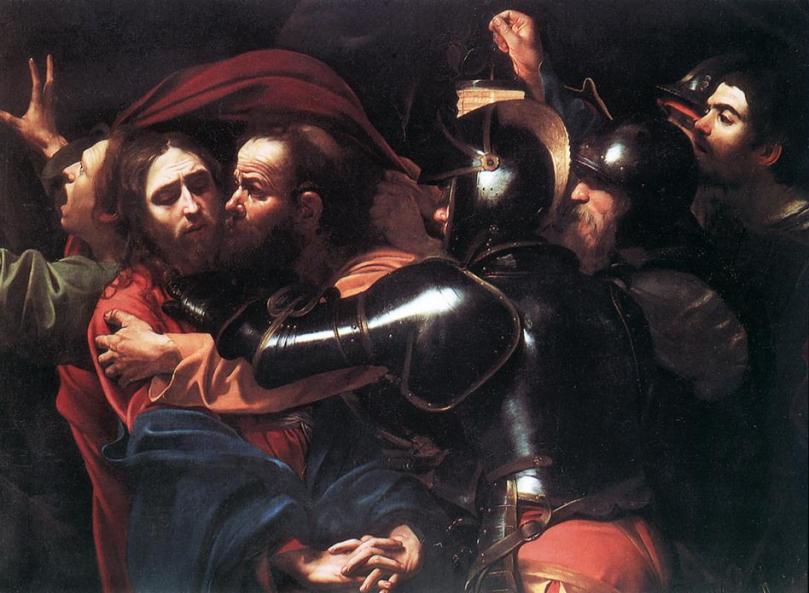
Marie Ryan, a Catholic, grew up in Charleville, Co Cork, where she met the young Percival when he was posted there as a member of the RIC. Percival was from a well-to-do family in London (his grandfather had been Lord Mayor and his father was a stockbroker) and had been privately educated at Winchester and Oxford. They married in a Catholic Church, but Percival did not convert – the window I am writing about is in the Church of Ireland Church in Gorey, the church he attended when he moved there as a District Inspector with the RIC, having re-joined after his stint in the army.
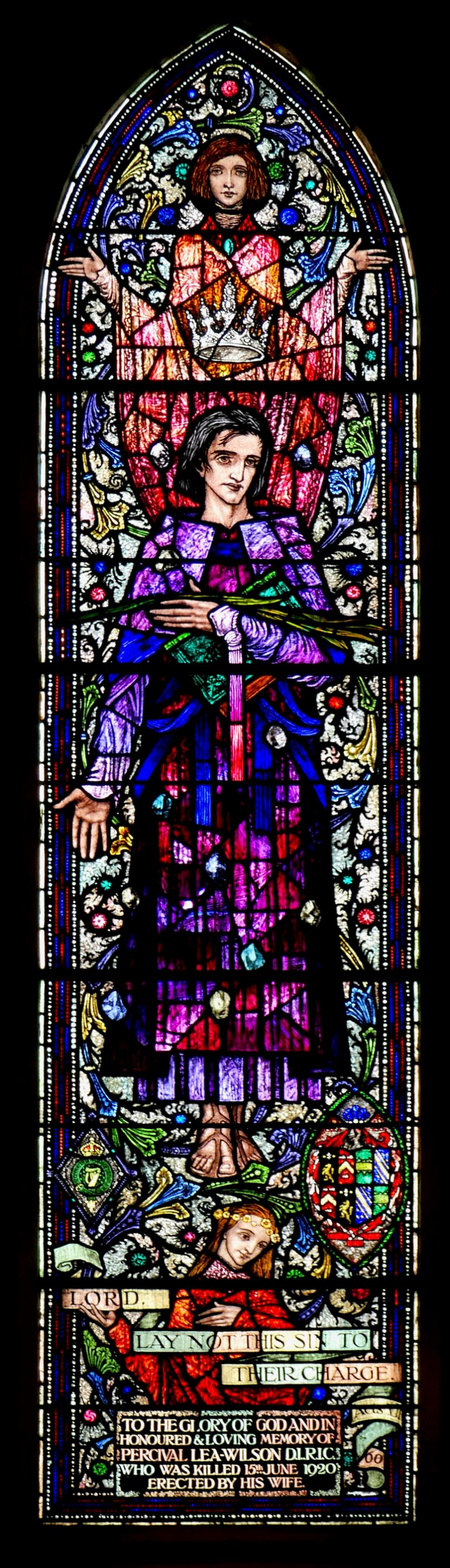
Harry Clarke’s Lea-Wilson window, Christchurch, Church of Ireland, Gorey, Co Wexford

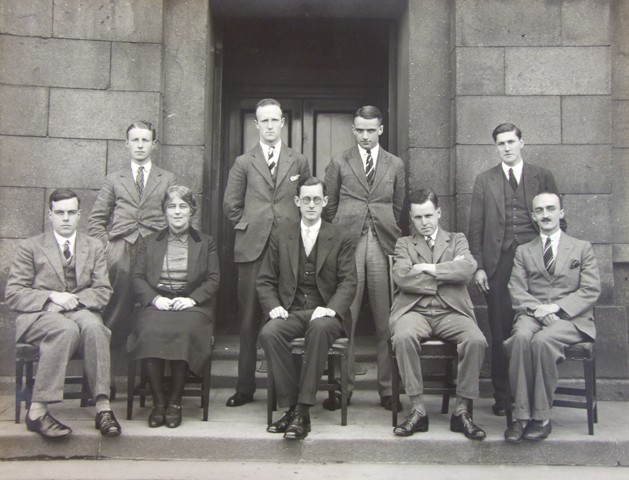
Marie Lee-Wilson never got over his death and never re-married but went on to become a highly-regarded paediatrician. Here she is in later life with her colleagues at Sir Patrick Dun’s Hospital in Dublin, now closed.
In shock after his assassination, she wrote to Harry Clarke and asked him to create a window for her husband. The theme of St Stephen was agreed and other elements which Marie suggested or requested were to be incorporated, such as the Wilson coat-of-arms.
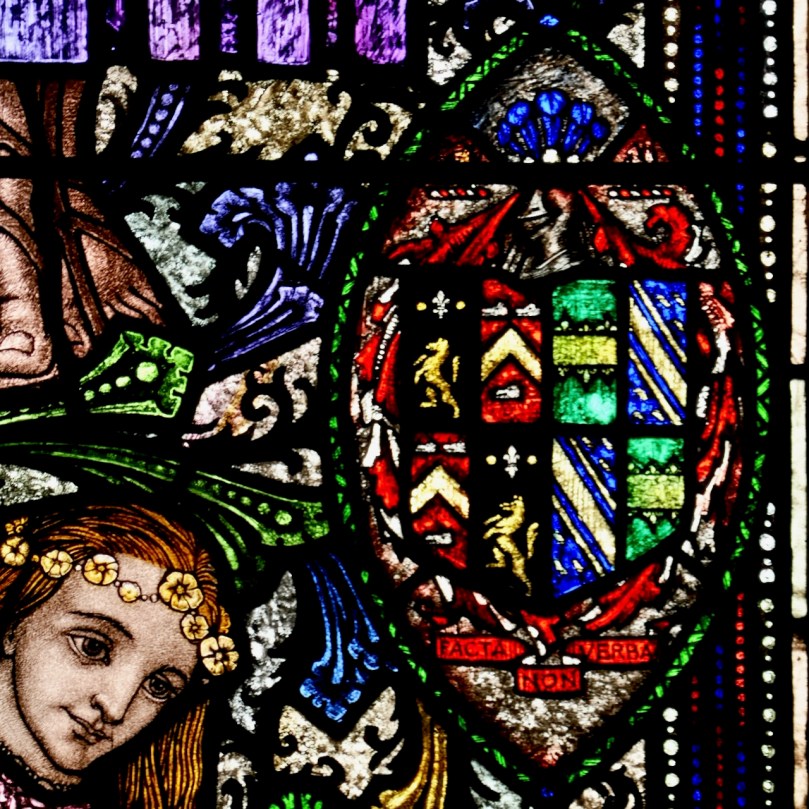
The Wilson coat of arms with the motto Facta non Verba – deeds not words

At this time, Harry’s reputation was well established and he was in great demand. Marie may have been familiar with his window in nearby Wexford town, the Church of the Assumption, commissioned by Mrs O’Keeffe for her war hero son the year before. Harry had difficulty hiring and keeping apprentices and assistants, upon whom he relied given the pressure of work. In the case of Marie’s window, he persuaded Kathleen Quigly to come to work at the studio more steadily, by offering to increase her wages, and it was Kathleen who worked on this window with him, always under his close supervision and following his design.
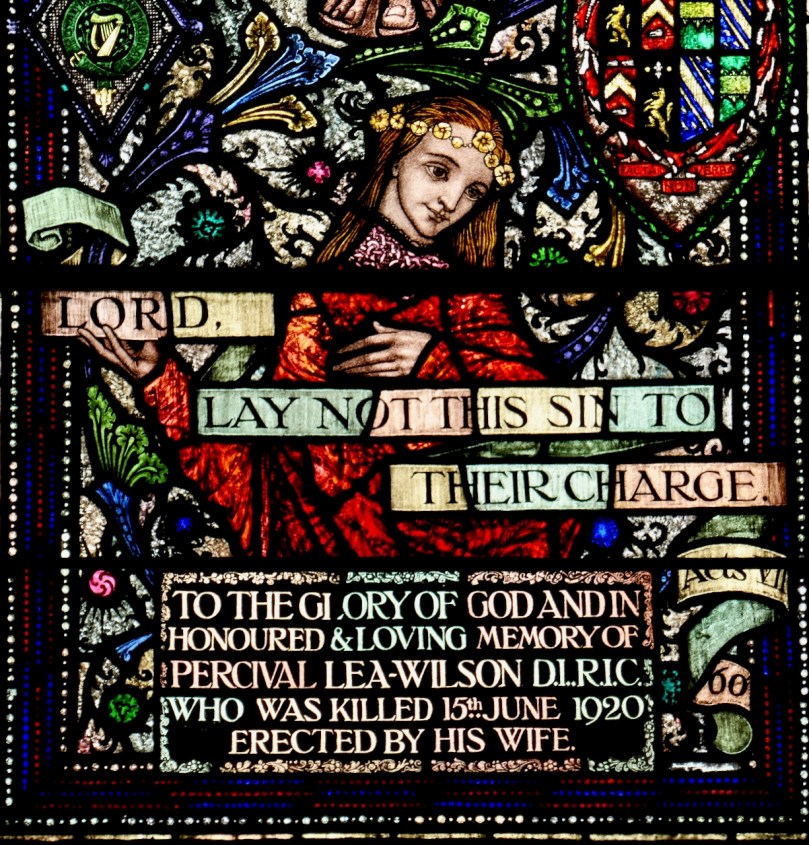
Another detail to note is the insignia of the Royal Irish Constabulary in the top left corner – a harp within a belt

The choice of St Stephen is telling. St Stephen was the first Christian martyr, stoned to death for “blasphemy” – that is, speaking up for his truth in a Jewish Synagogue. Here’s the passage from Acts 7, King James Version.

When they heard these things, they were cut to the heart, and they gnashed on him with their teeth. But he, being full of the Holy Ghost, looked up steadfastly into heaven, and saw the glory of God, and Jesus standing on the right hand of God, And said, Behold, I see the heavens opened, and the Son of man standing on the right hand of God. Then they cried out with a loud voice, and stopped their ears, and ran upon him with one accord, And cast him out of the city, and stoned him: and the witnesses laid down their clothes at a young man’s feet, whose name was Saul. And they stoned Stephen, calling upon God, and saying, Lord Jesus, receive my spirit. And he kneeled down, and cried with a loud voice, Lord, lay not this sin to their charge. And when he had said this, he fell asleep.

It is evident that Marie perceives Percival as a martyr, but in her choice of inscription, lay not this sin to their charge, she also invokes a sprit of forgiveness rather than of bitterness or revenge. The wife and lover in her mourns him deeply and sees his death as an injustice and as undeserved. But the Irish Catholic woman is fully alive to the political and social upheavals of her time and understands the complications of such a situation. Her choice of iconography and scripture embodies the hopelessly tanged web of relationships and reprisals that characterised the Irish War of Independence and her own invidious position as the wife of a British Office and RIC man.
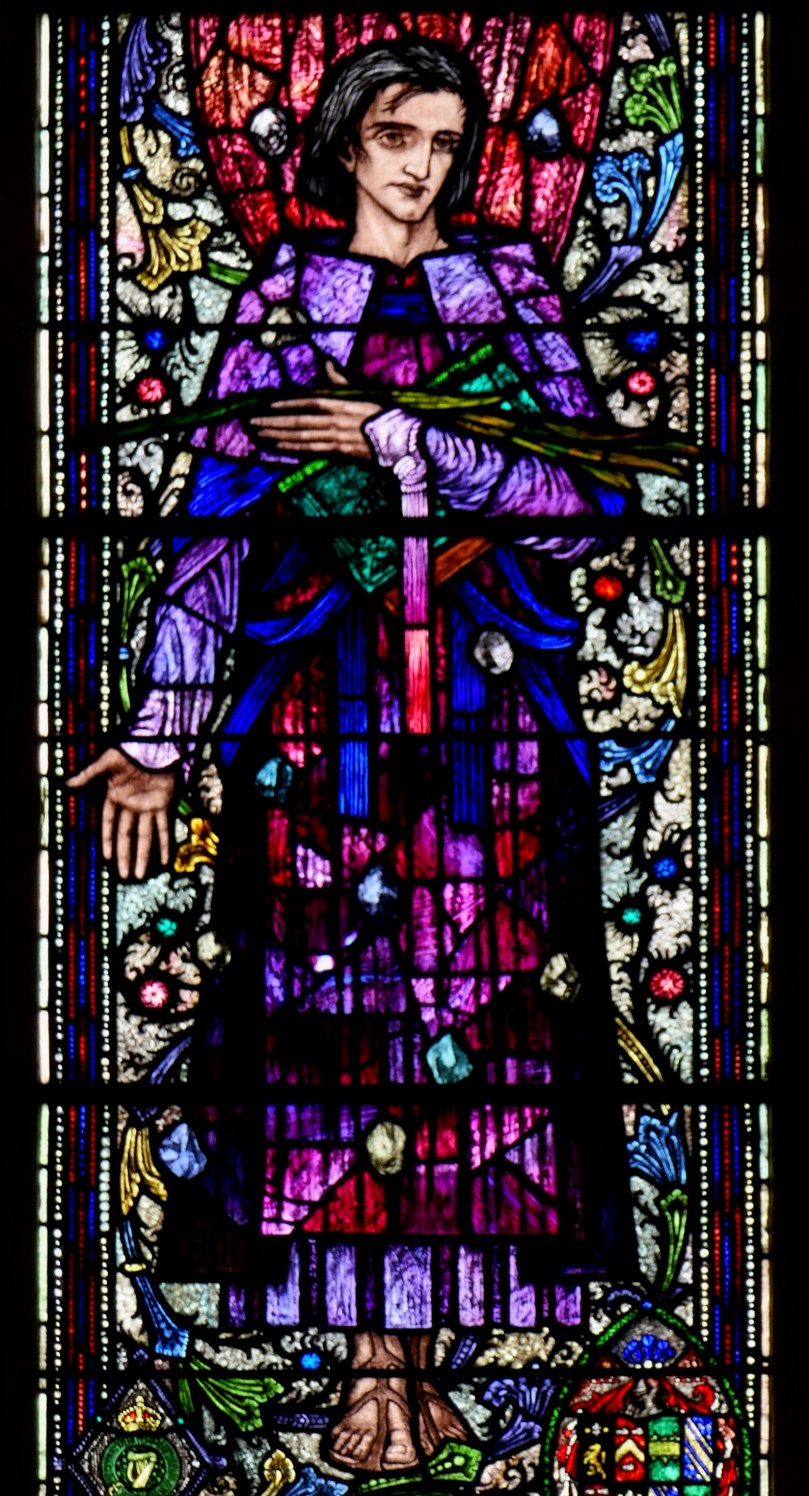
Harry Clarke understood all this too, and his sensitive design works out the emotions and the messages she wished to convey. Here is Nicola Gordon Bowe’s description of the window, from the magnificent Life and Work of Harry Clarke.

. . . the subject is St Stephen, the first Christian martyr, whom Harry has shown carrying the symbolic palm of martyrdom and bearing a book in his left arm while his right hand is extended, palm forward, suggesting his innocence. The stones by which he was slain are shown leaded into the rich purples, mauves, rubies and pinks of his simple vestments, contrasting with the emerald green of the book he holds. His face is pale and angular, the head inclined to the left with a long nose and sad, pensive eyes. This soulful Celtic face is reflected in the equally direct unstylized treatment of the hands and sandalled feet. The two girl angels above and below the Saint are gentle and childlike. . .

Interestingly there is another window, beside this one, also dedicated to Lea-Wilson and also done in the Clarkes’ establishment. But this one, although similar in many ways to the first, is not signed by Harry but bears the signature of J Clarke and Sons. It must have been done by somebody else working in the studio – perhaps by Kathleen Quigly?
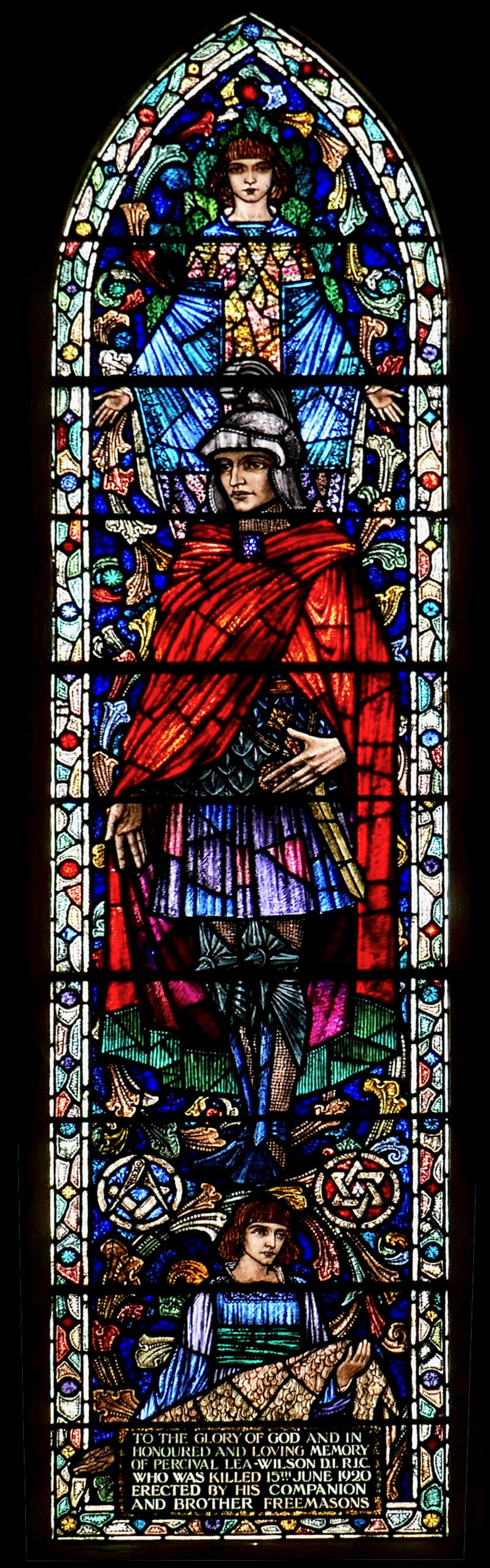
The second Lea-Wilson window

This one was donated by Percival’s ‘companion and brother freemasons’. The image is of a warrior in armour and a striking red cloak. There is an upper and lower angel, to match Harry’s design. The lower angel holds a fleece, indicating that this is an image of Gideon, the biblical soldier who slew a far greater army of Midianites, under God’s guidance. As such, it does not appear to hold the same reconciliatory feeling that Harry’s window does. However, look at the quote below the image (it’s from this source)
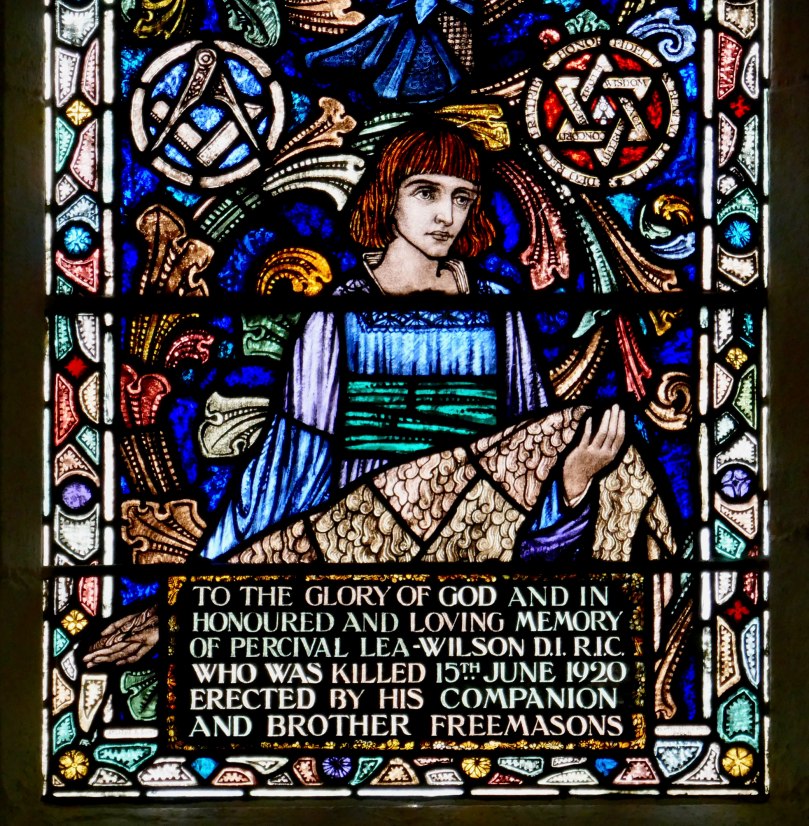
In the medieval era, the story of the angel’s visit to Gideon was often paired with the gospel story of the angel Gabriel’s visit to the Virgin Mary. In both accounts, an angel greets both Gideon and Mary with the words “The Lord is with you”, shares news of salvation for Israel and informs each of them of their special role in achieving this. As a result of this comparison, Gideon’s miracle of the fleece became a symbol of the Virgin Birth. This is because both events showed that God could make the impossible possible.

My friend Brian O’Riordan asks Could the angel holding the fleece be referring to the grieving wife, Marie?

Looking at the two windows, it is apparent why it is often difficult to say what is ‘a Harry Clarke’ and what is not. The design of the Gideon window is closely based on the St Stephen window, even to the floral decoration in the background. Elements of Gideon’s apparel are familiar – his helmet, for example echoes that of St Martin’s in the Castletownshend window I wrote about here.
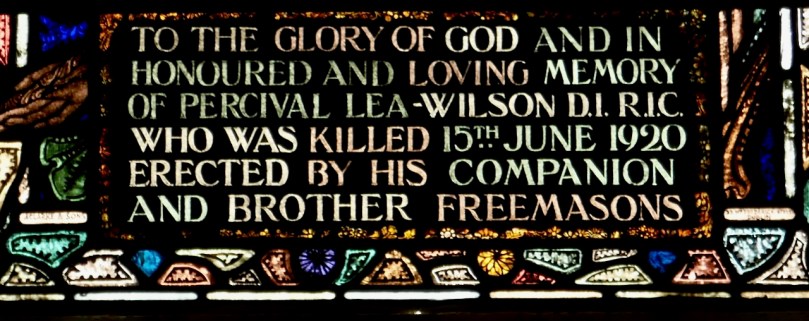
Can you make out the signature and address? To the left of ‘and brother’ is J Clarke and Sons, while to the right of ‘freemasons’ is 33 Nth Frederick Street Dublin

But that’s the thing – Harry trained his apprentices rigorously to reproduce his style and whoever did this window would have been competent and comfortable at producing a look-alike. The fact that is is not signed by Harry, however, must be the primary guide in ascribing it to the Joshua Clarke Studio, rather than to Harry. It is possible that budget was an issue – an almost-Clarke would have been less expensive than a wholly-Clarke.
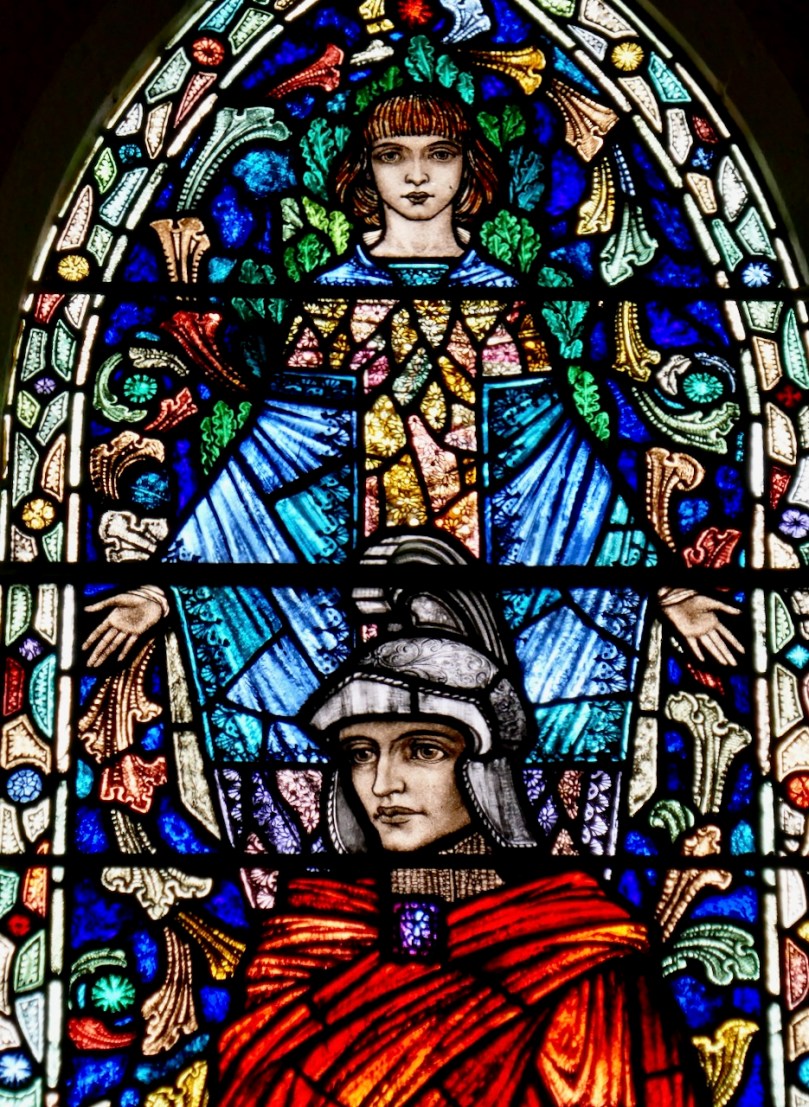
Gideon and the angel above him are painted in an exact rendition of Harry’s style

What is extraordinary about the Lea-Wilson story is that not one, but two great works of art stem directly from it. The story most often told is the Caravaggio one – I hope this post helps to redress that balance.

If you are anywhere close to Gorey, go visit Christchurch. There are more Harry Clarkes in that church and several other notable windows. For more Roaringwater Journal posts on Harry Clarke and on Irish stained glass, click on this link.
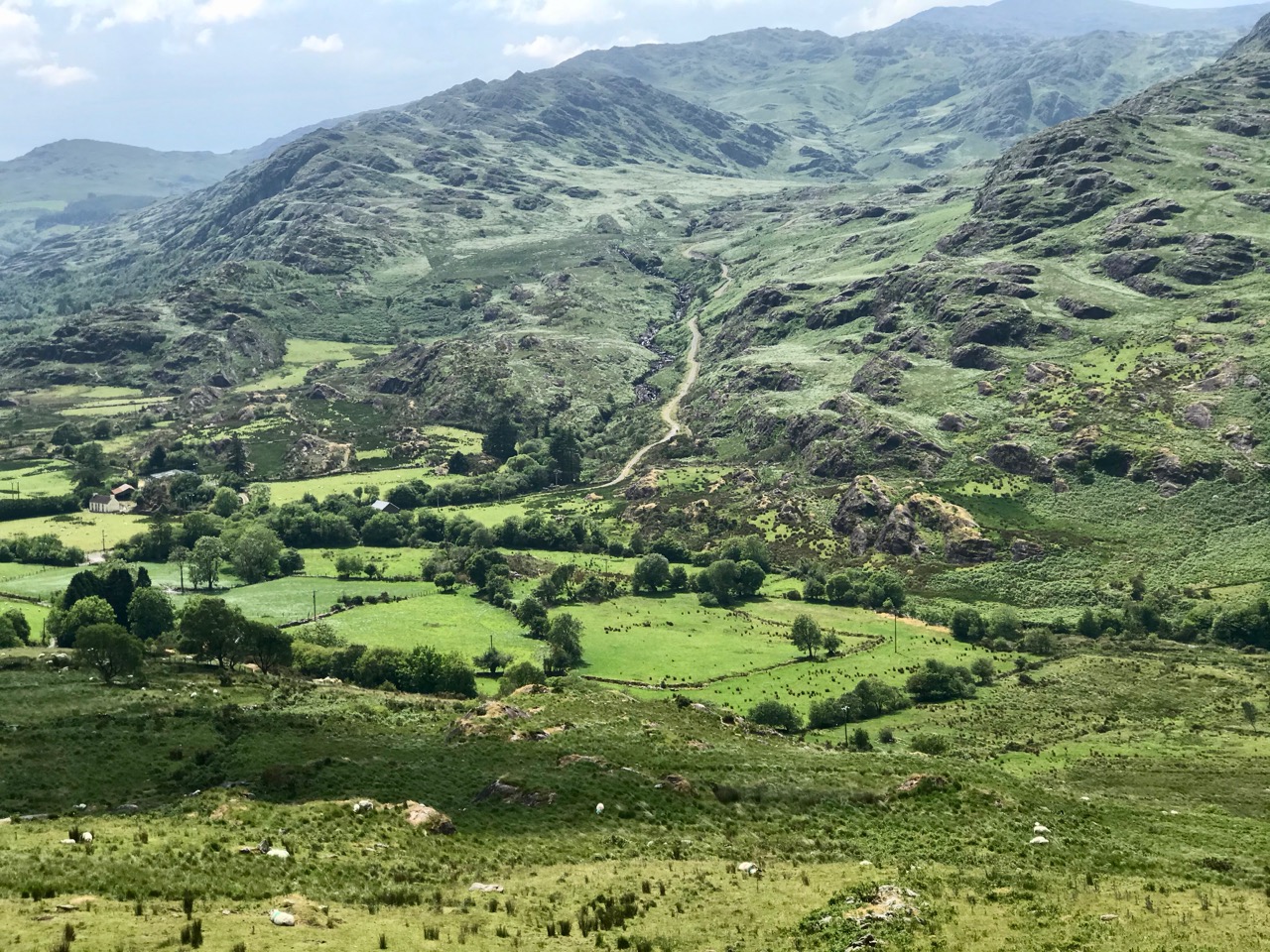
Coomhola Country

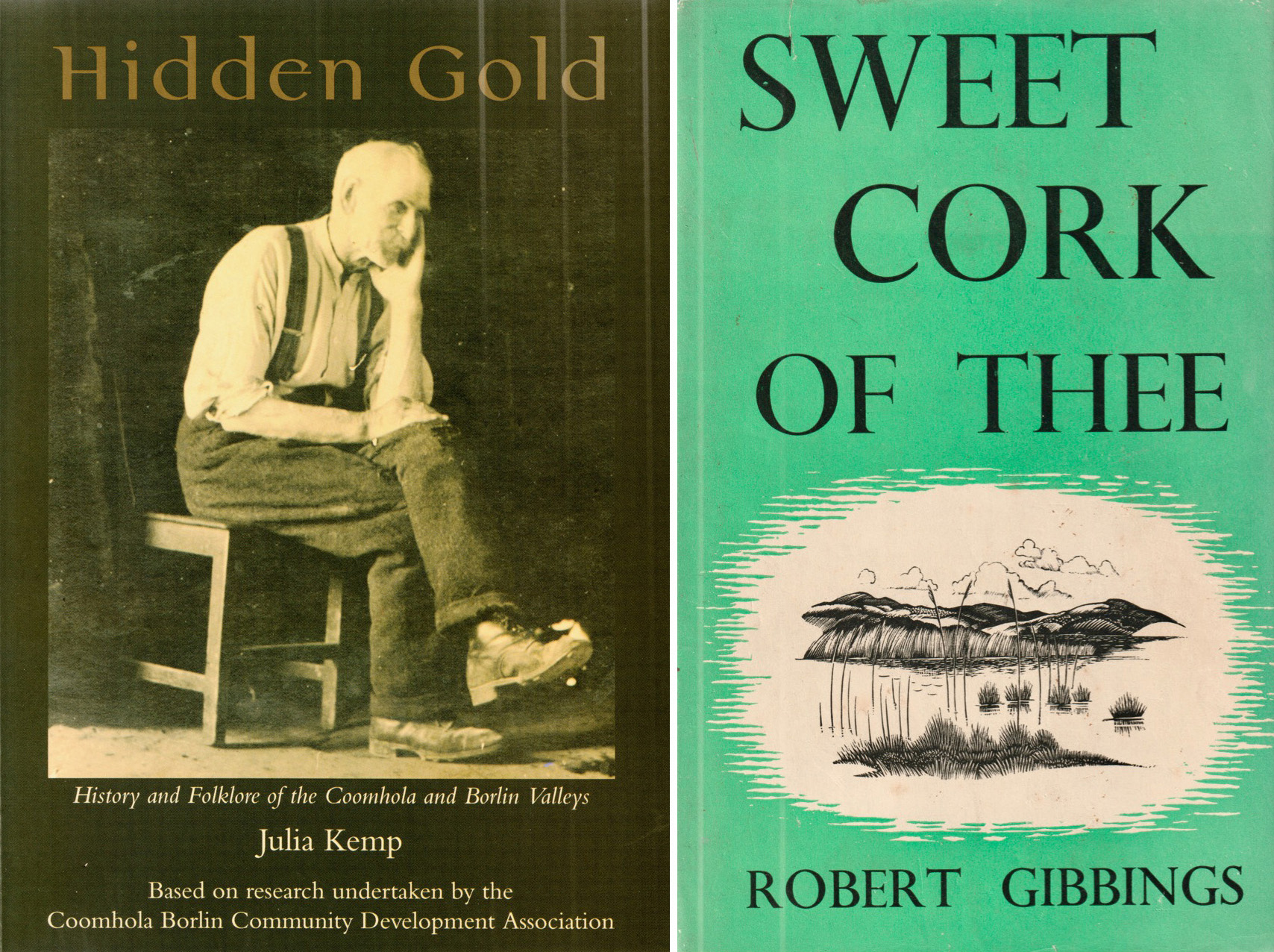
As the Coomhola River tumbles from Borlin to the sea, gathering tributaries, it forms many pools amongst the riffles and glides. These pools, in summer, provide leafy shelters for salmon and trout. To anyone who has fished or walked the river, each pool has its own character, and each its own name . . .


[From Hidden Gold, History and Folklore of the Coomhola and Borlin Valleys Julia Kemp: Coomhola Borlin Community Development Association 1998]

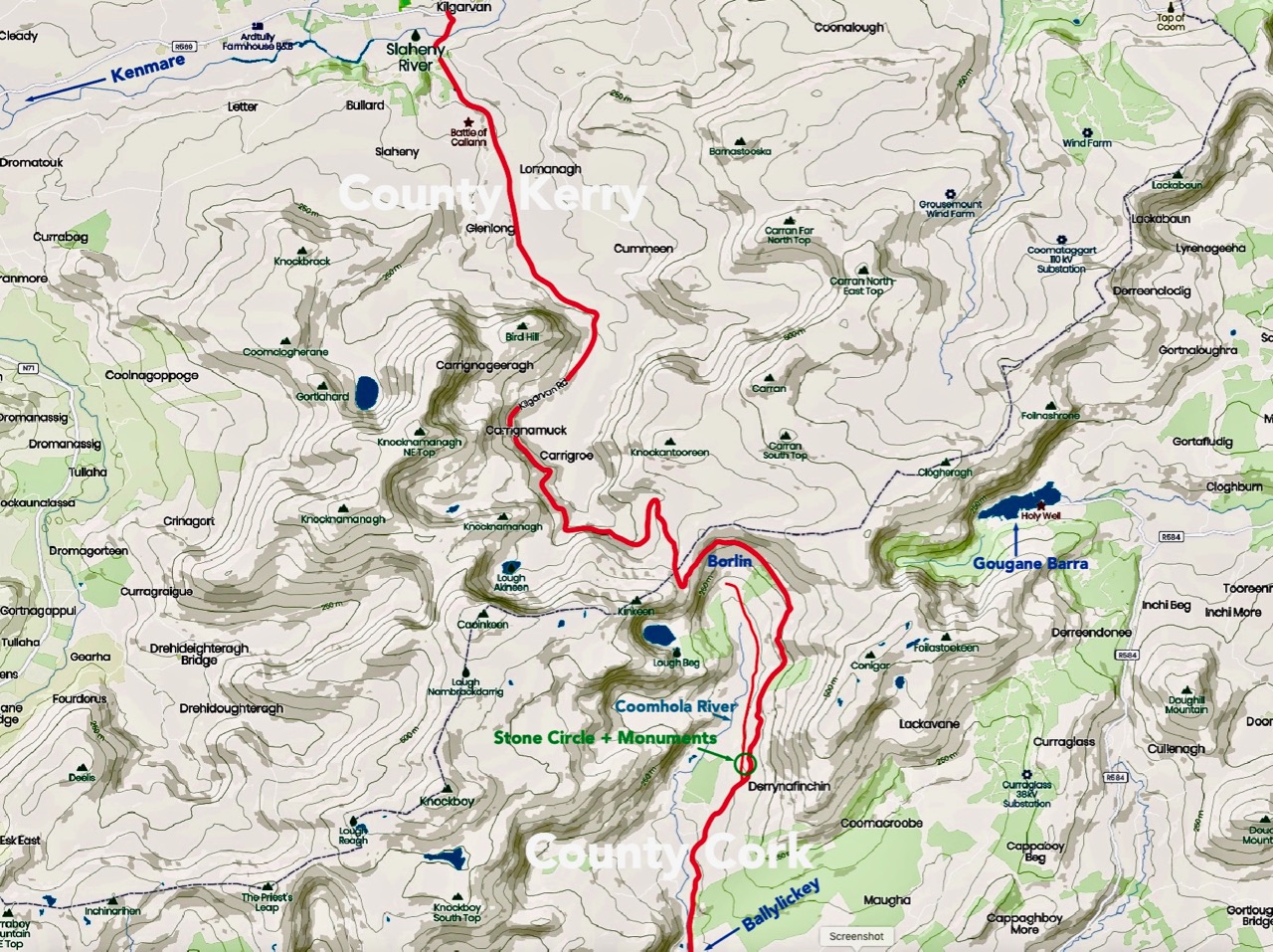
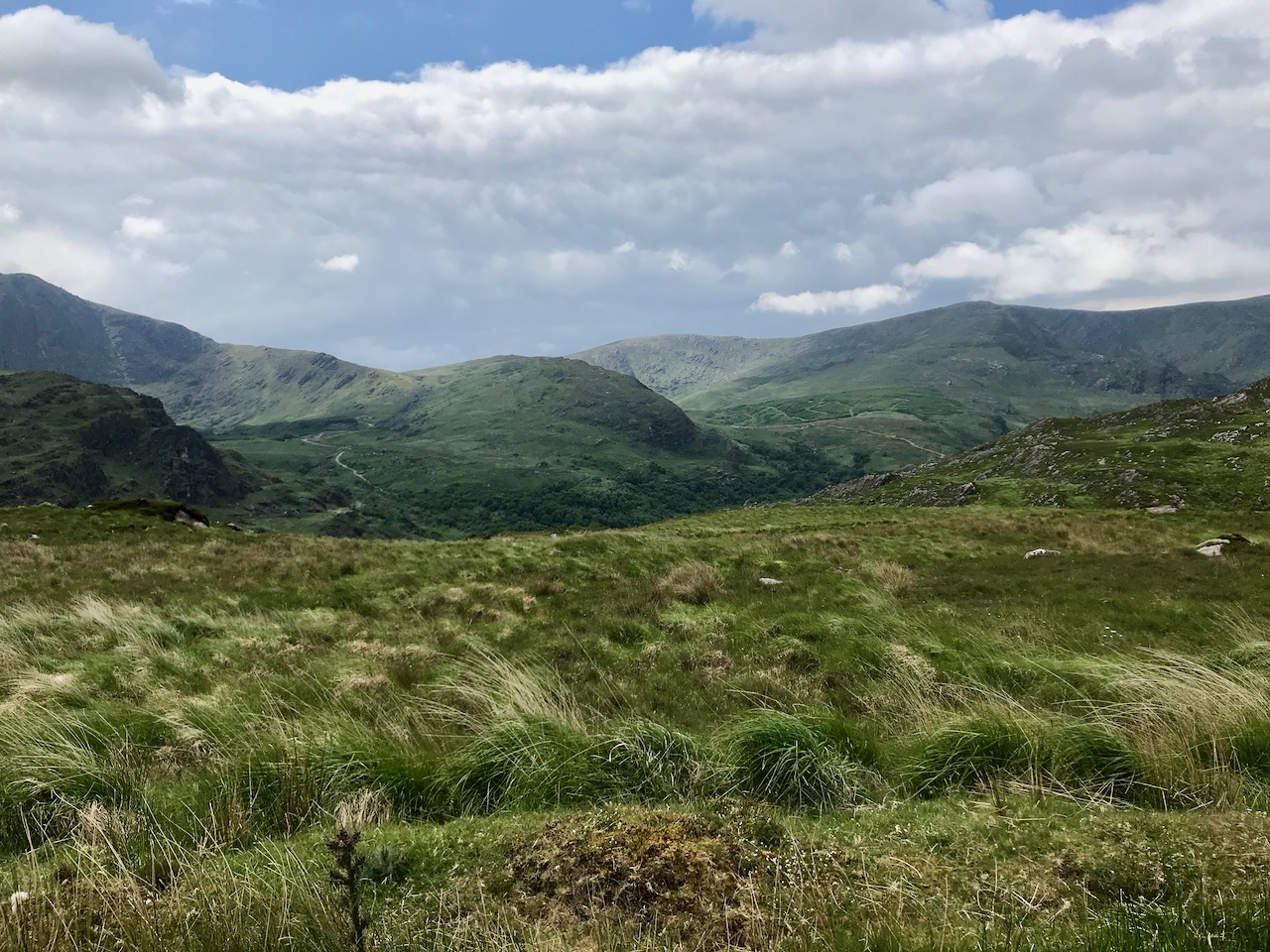
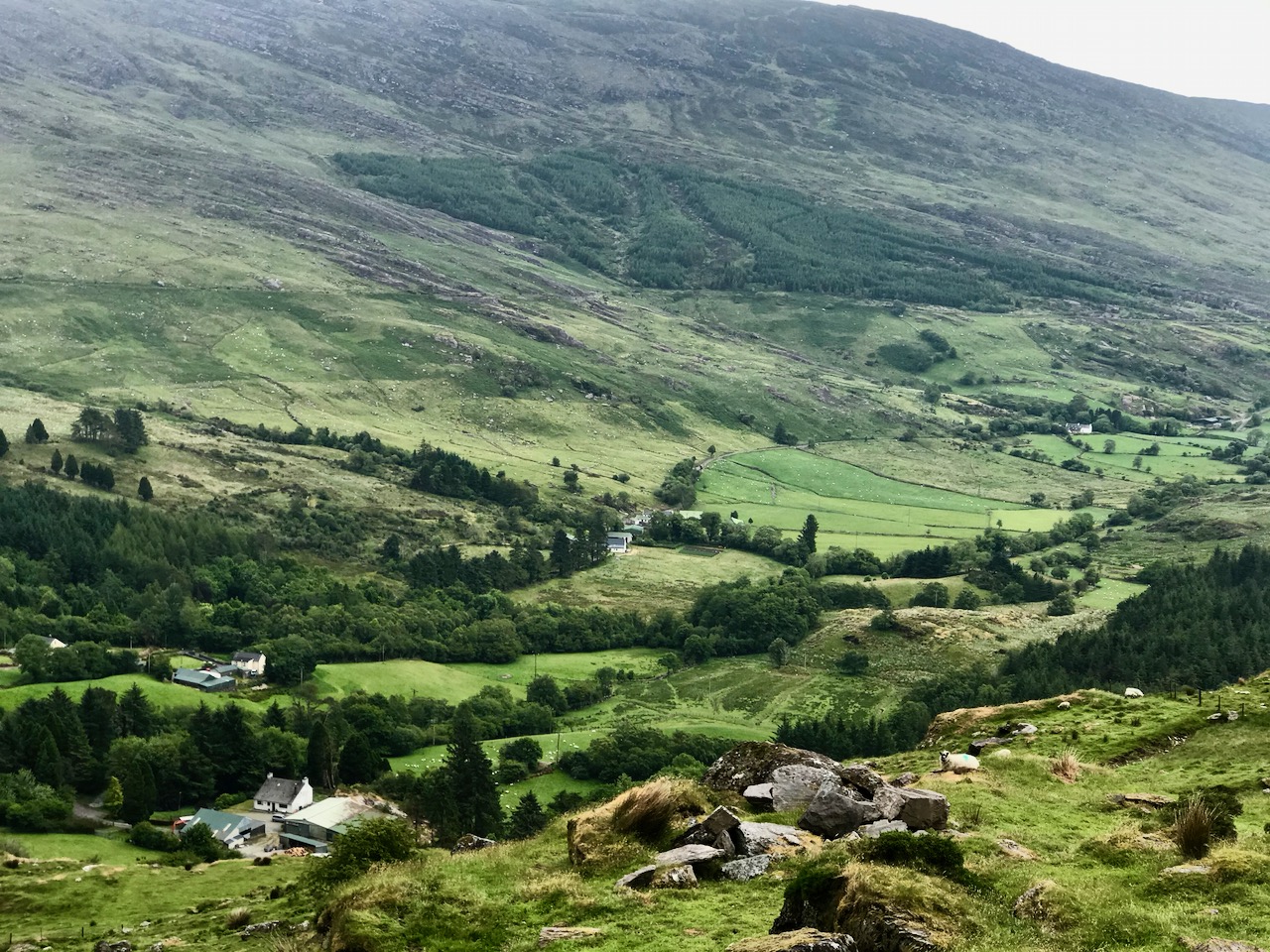
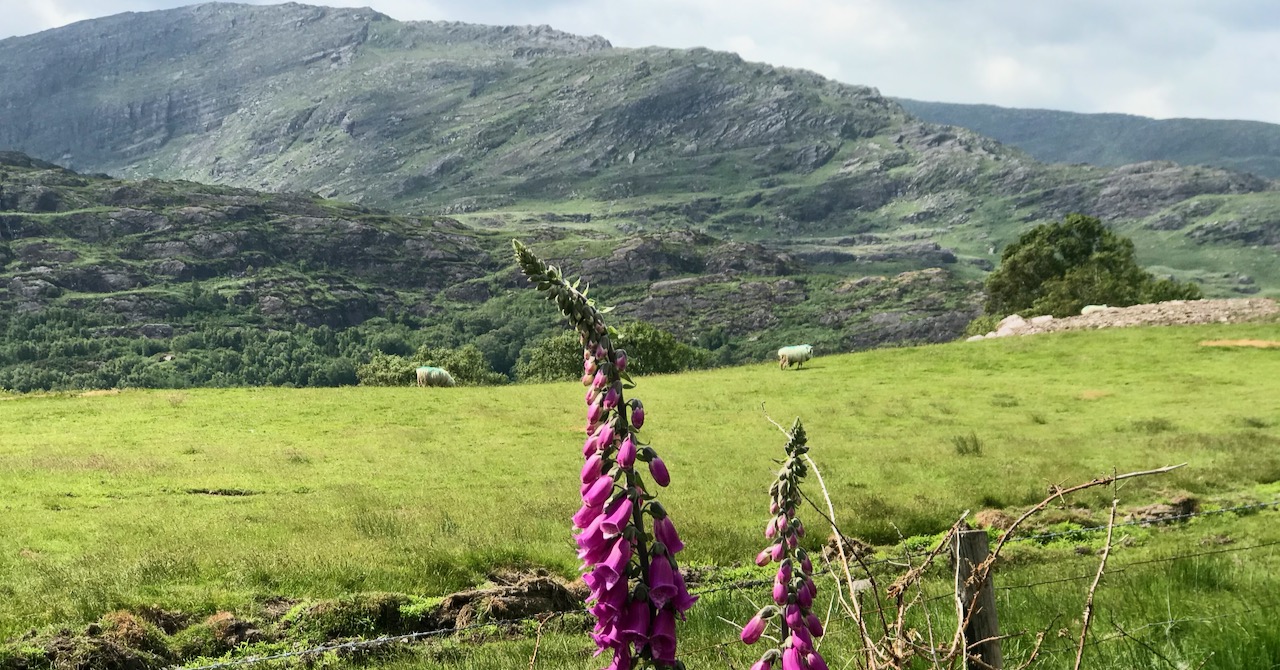
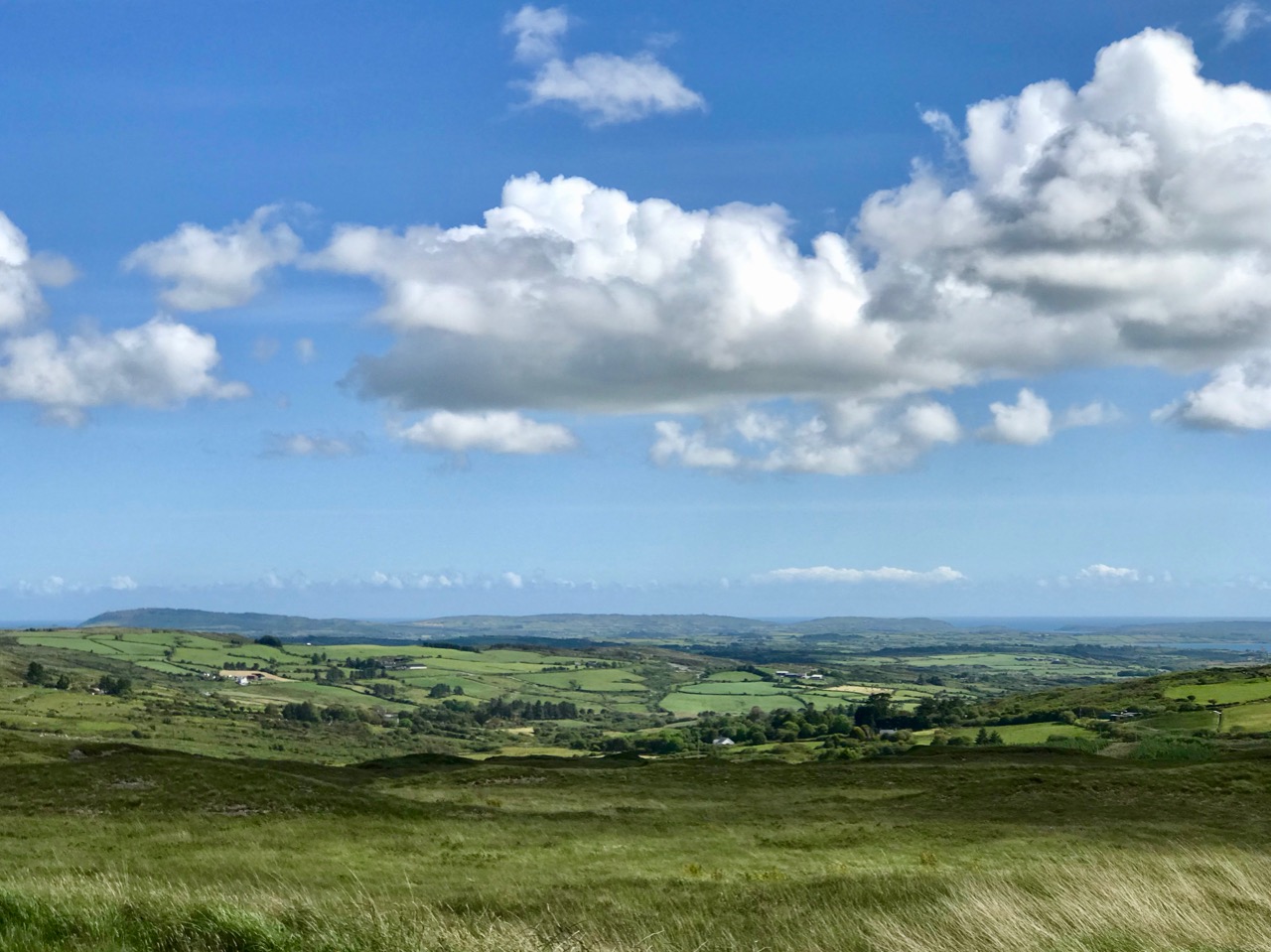
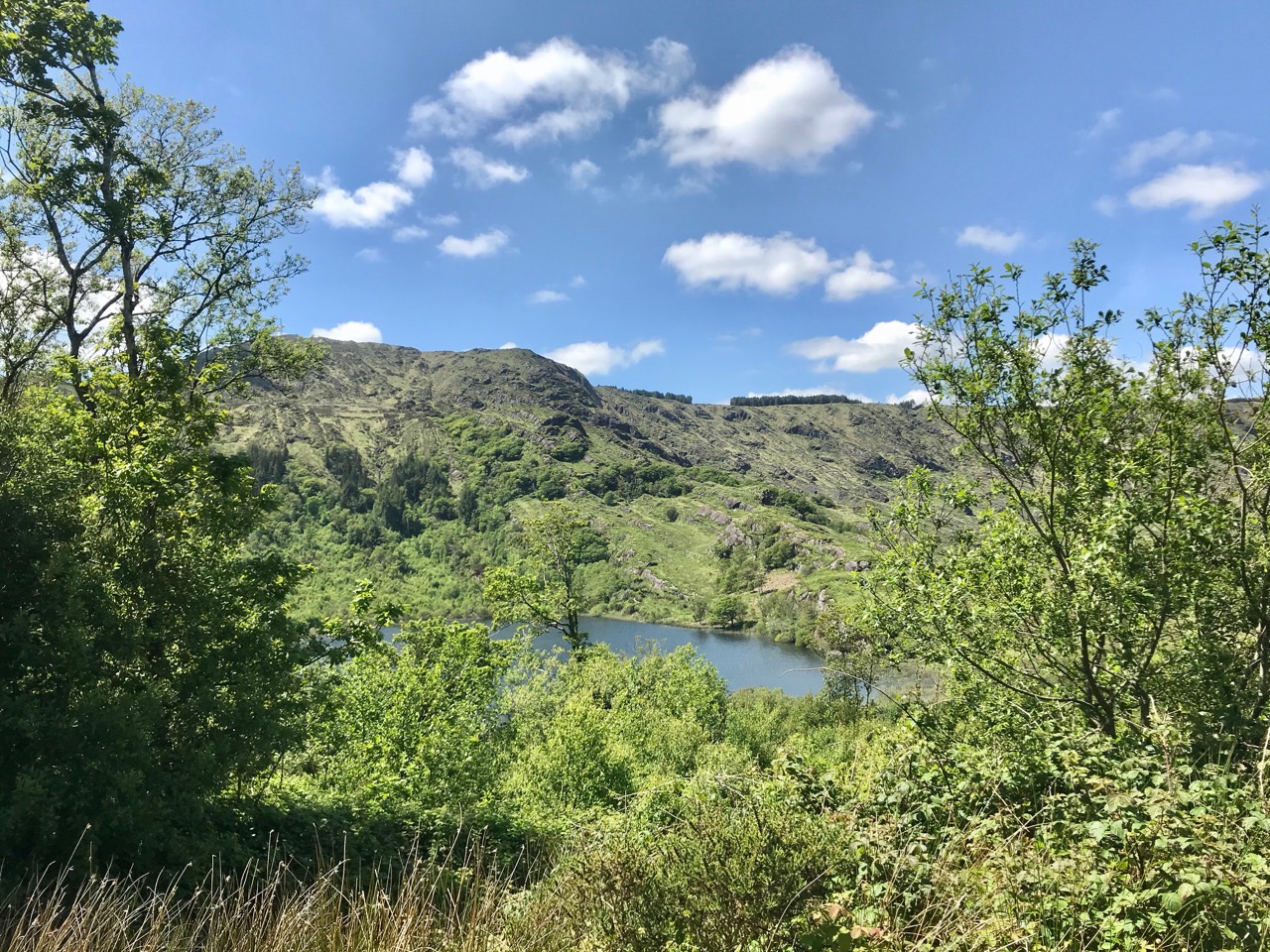
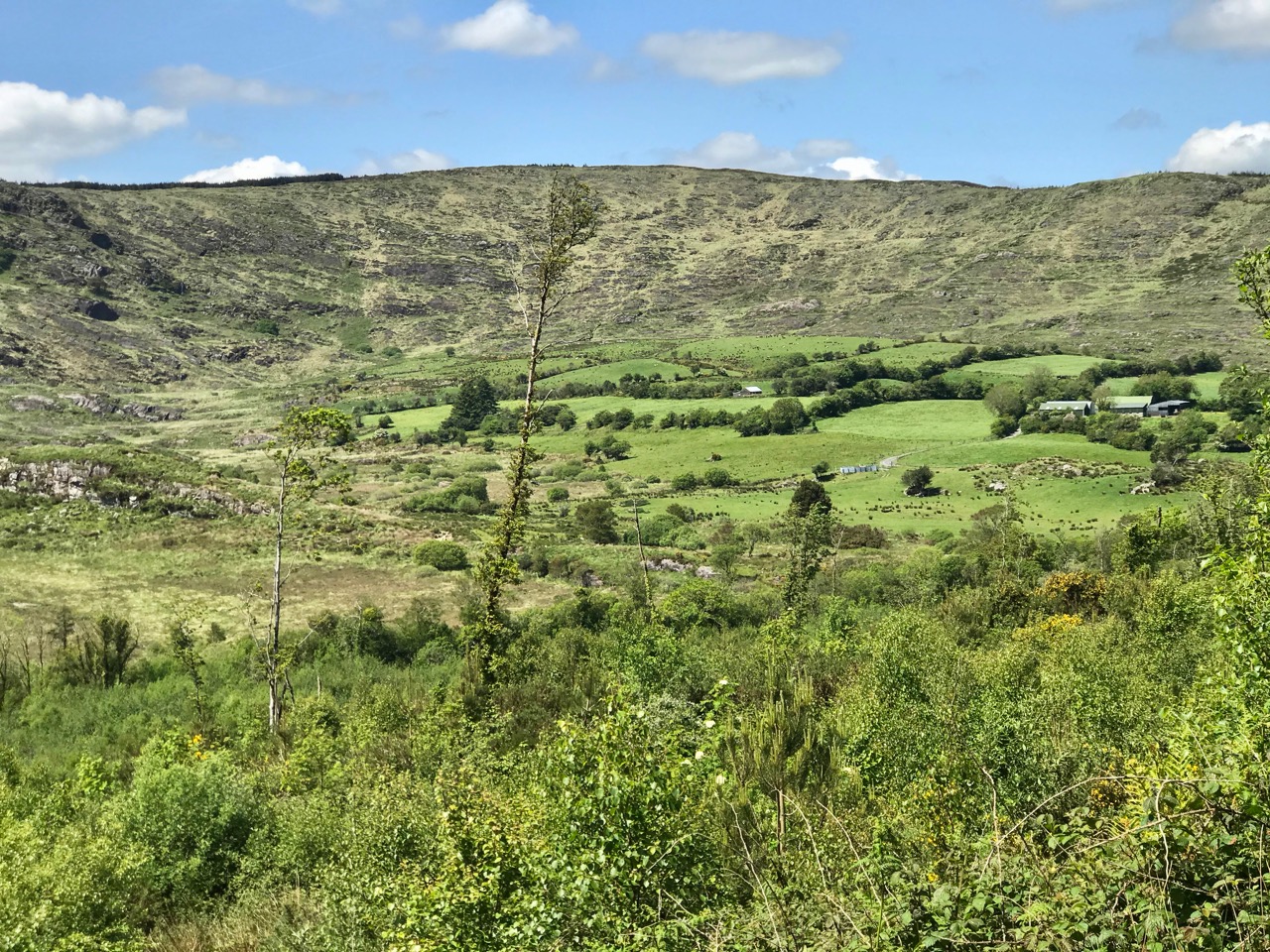
On the header is the spectacular view from Borlin, looking down the great glen where the Coomhola River finds its way through a country formed by glaciers in the Midlandian period, about 10,000 years ago. The rugged Shehy mountain range (Cnoic na Seithe in Irish, meaning Hills of the Animal Hides) with its peaks of Knockboy, Caoinkeen and Kinkeen provides some of the most dramatic scenery in West Cork, its scarred outcrops clearly showing the downward progress of the ice sheets. The contrast between the barren high land and the lush pastoral meadows laid out below evoke a beauty which is hard to match – anywhere in the world!

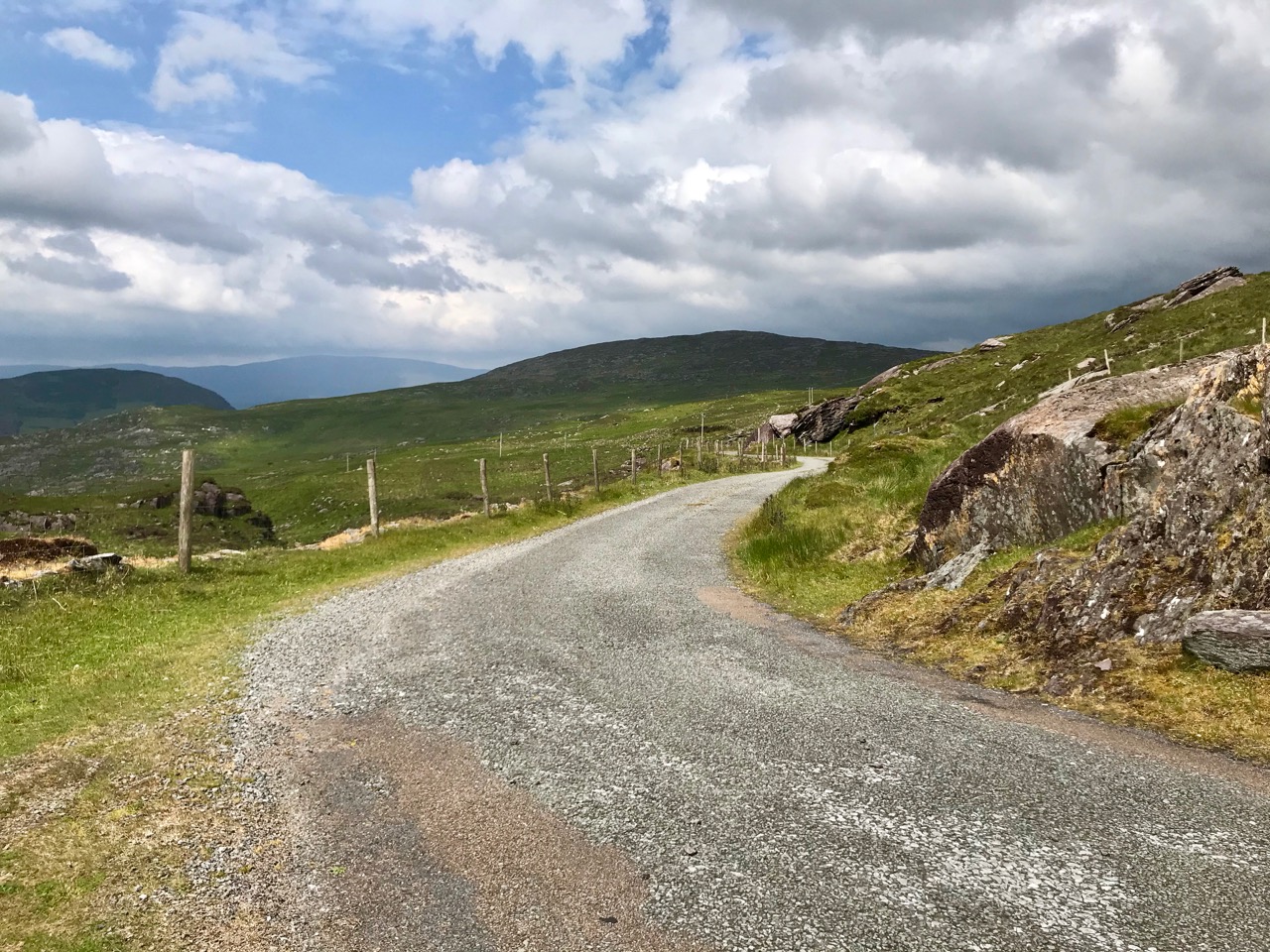
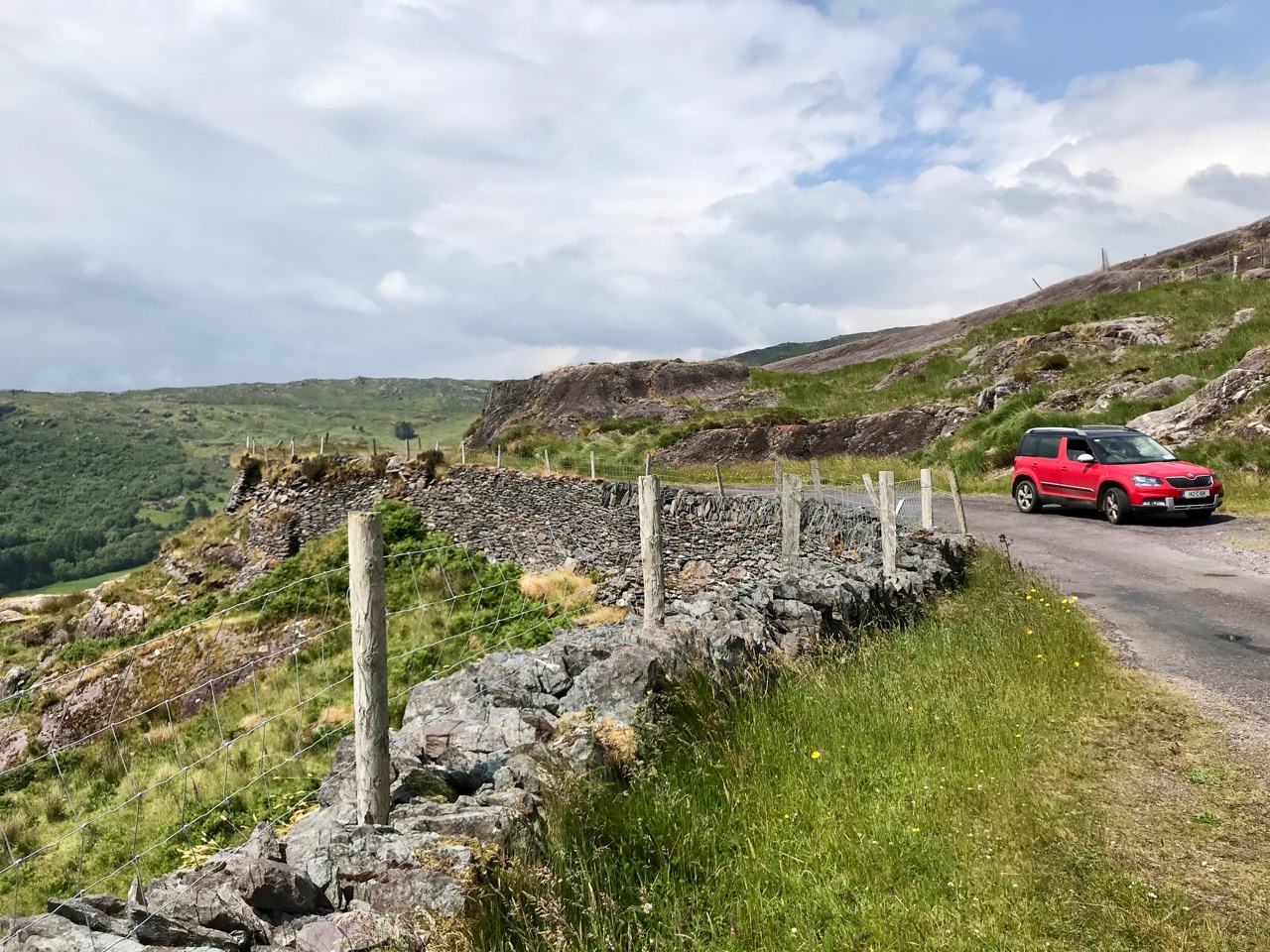
The Kilgarvan (Co Kerry) to Ballylickey (Co Cork) road is one of the unsung feats of Irish engineering. Until the middle of the nineteenth century it was no more than a system of ‘nearways’, providing rough, narrow access tracks to remote mountain dwellings and hard-won field systems. A famine improvement project c1846, involving metalling, a tunnel, cuttings and stone retaining walls, transformed it to the ‘through road’ which exists today – although it may seem to us no more than a boreen. It’s there for all to travel on, and will provide a breathtaking experience – but be aware that it could also deliver some hair-raising reversing episodes on the rare occasions when a vehicle is encountered coming the other way. The upper photo shows the road ‘clinging on’ to the face of a mountain outcrop, while the map gives a good idea of the circuitous route that the way takes to keep as far as possible to a level contour on its journey.

This is the country of St Finnbar. If you follow the County border east from the top of the Borlin Glen (off-road) you will very soon come to the site of his sixth century monastic settlement at Gougane Barra. This whole area was loved by the Cork born writer and illustrator Robert Gibbings, whose book Sweet Cork of Thee tells of a seven month sojourn in this mountainous region in 1949, beautifully illustrated by his woodcuts.

Mountain Road by Robert Gibbings, woodcut from Sweet Cork of Thee, published 1951

As we drove along the road beside the Inchigeelagh lakes, we could see moorhens gathering material for their nests among the taselled reeds and swans on islets, piling up dead rushes in readiness for their eggs. A corncrake was calling from a meadow. Celandines and kingcups outshone the gorse.


Mick said to me: ‘My father’s sister lived a mile to the north of us here. She married a man by the name of Scanlan. His mother came from Gougane and ’twas one evening when she was travelling west by the lake – there was no road there then, only a little bit of a track – she looked in the lake and what did she see but fields of corn and sheep and every sort of land and crop and stock. She was an old woman at the time and she knew well enough ’twas a kind of enchantment must be on the lake, so she says to herself, if I can keep an eye on it all and throw a bit of iron at it the spell will be broken. So she kept her eyes fixed on the fields and the cattle and the pigs and the hens, and all the time she was thinking where would she get a bit of iron. And the only bit she could think of was in the heel of her shoe. ‘Twould be worth it to throw in the shoe, says she. But when she went to unrip the lace wasn’t it tangled in a knot, and for the glint of a second she took her eye off the land. When she looked again ’twas all disappeared and the lake was there the same as ever.’


Our road turned south, through a wilderness of rock and bog and lilied pools . . .


[Robert Gibbings Sweet Cork of Thee, J M Dent & Sons 1951]

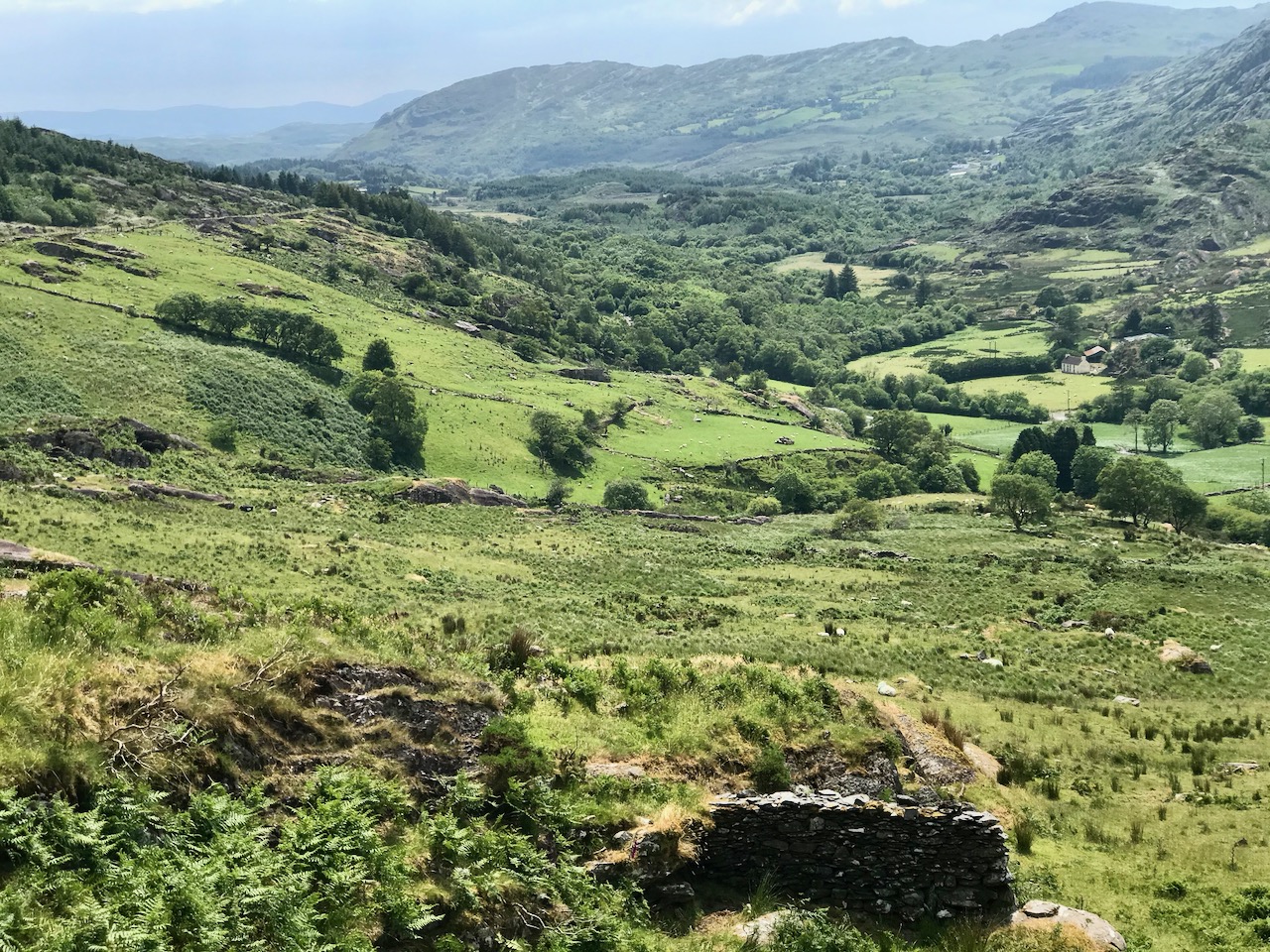
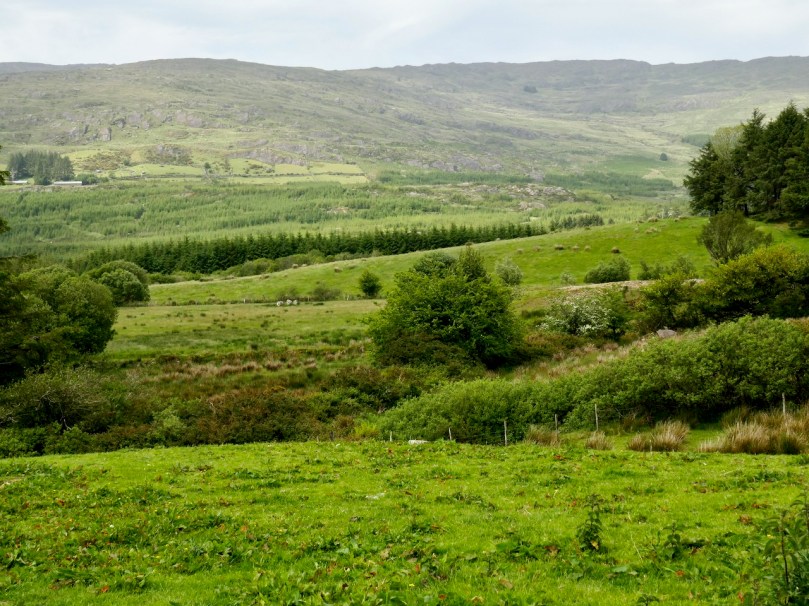
From the highest rim of Borlin Glen (upper picture), the Comhoola River valley is laid out below. Home to sheep and ravens, the scattered farmsteads emerge from rock and forest and provide a living – as they have for countless generations – to a hardy people.

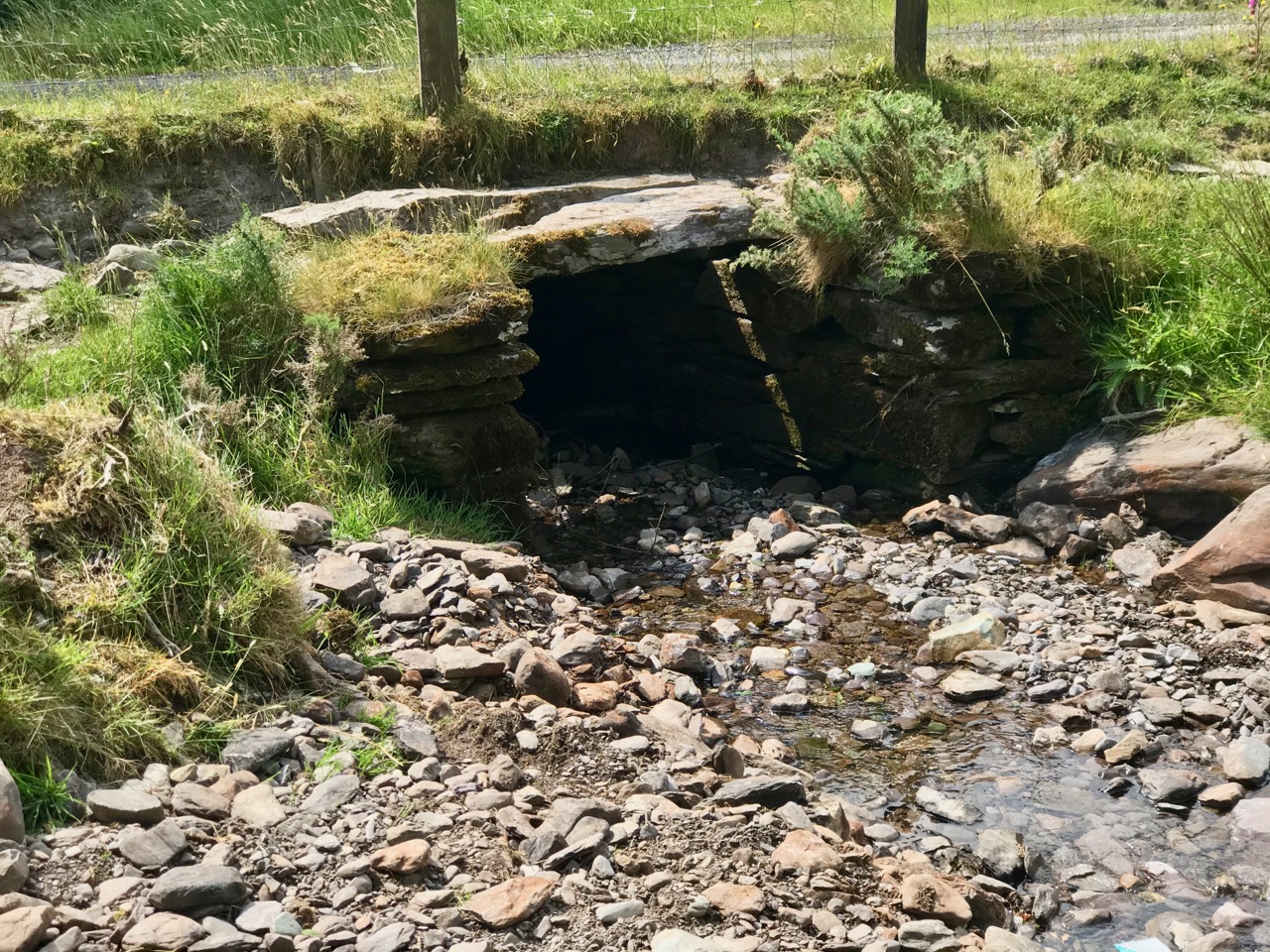
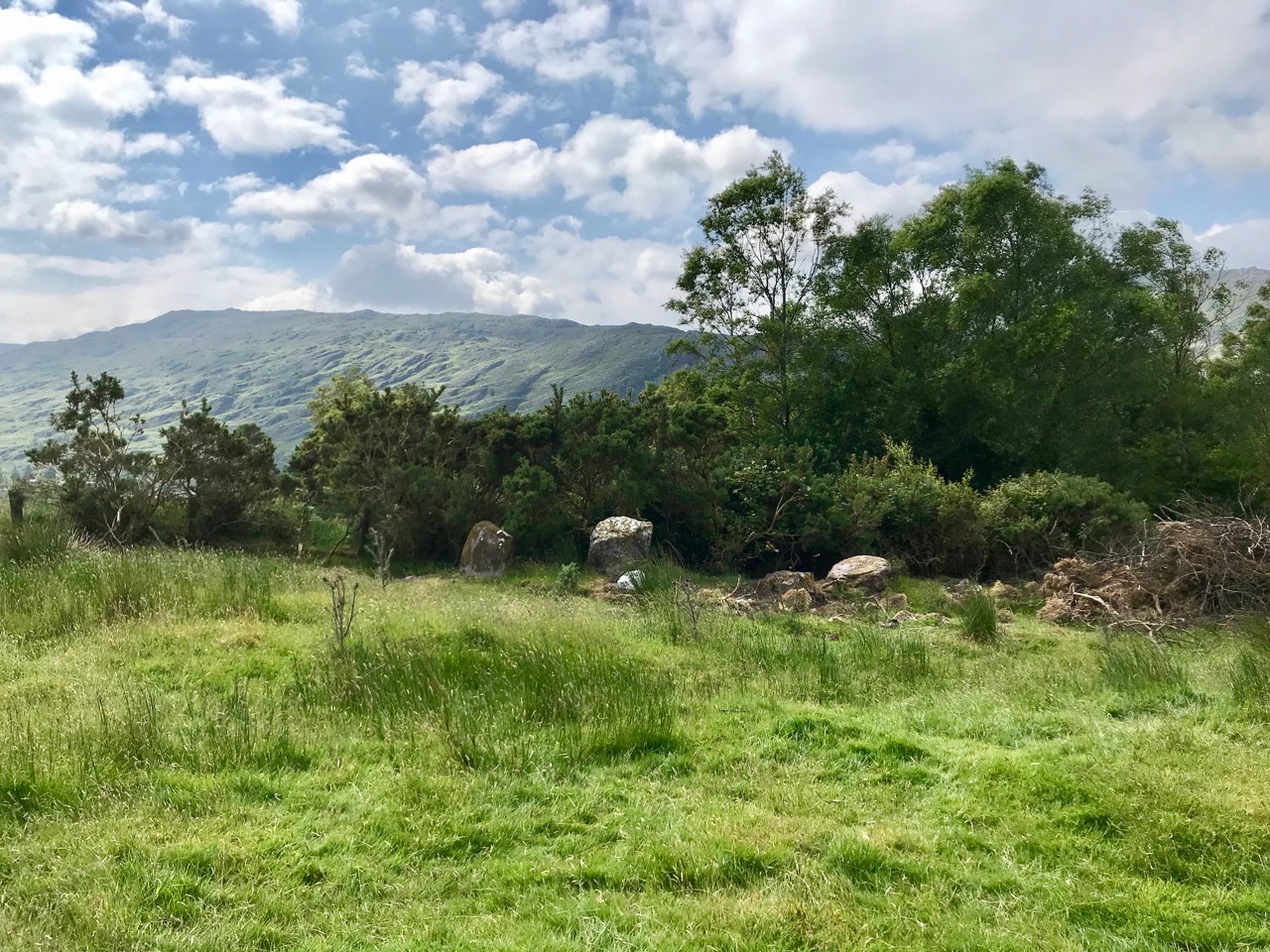
On the lush valley floor are signs of ancient activity and occupation. A stream flows through a meadow dotted with whitethorn trees (upper), while an old stone clapper bridge has been superseded by the modern boreen taking its way up to the Borlin Valley settlements (centre). Lower – a fascinating stone circle and mass rock site is interrupted by the field fence. Here, too, is a bullaun stone and cupmarked rock (below).

Let us give the last word to Johnny O’Driscoll from Snave, recorded by his grandson Sean O’Driscoll in the 1930s and featured in Julia Kemp’s Hidden Gold:

There is little gold in this area, but there is one place where it is said a crock of gold is buried. It is about a hundred yards from the Glaslough, between Coorycomade and Ardnatrush, about a mile and a half from Coomhola National School.


There is a bush growing at the exact location, and beneath the bush is a large stone which covers the hidden treasure. It belongs to a tiny dwarf, and anybody who visits the place at midnight can see this little creature on the bush above the gold.


People did go on one occasion in search of the gold, but they were unsuccessful. A little bright light is visible about midnight above the bush. I have seen it myself on several occasions . . .

The Oldest Folktale in the World!

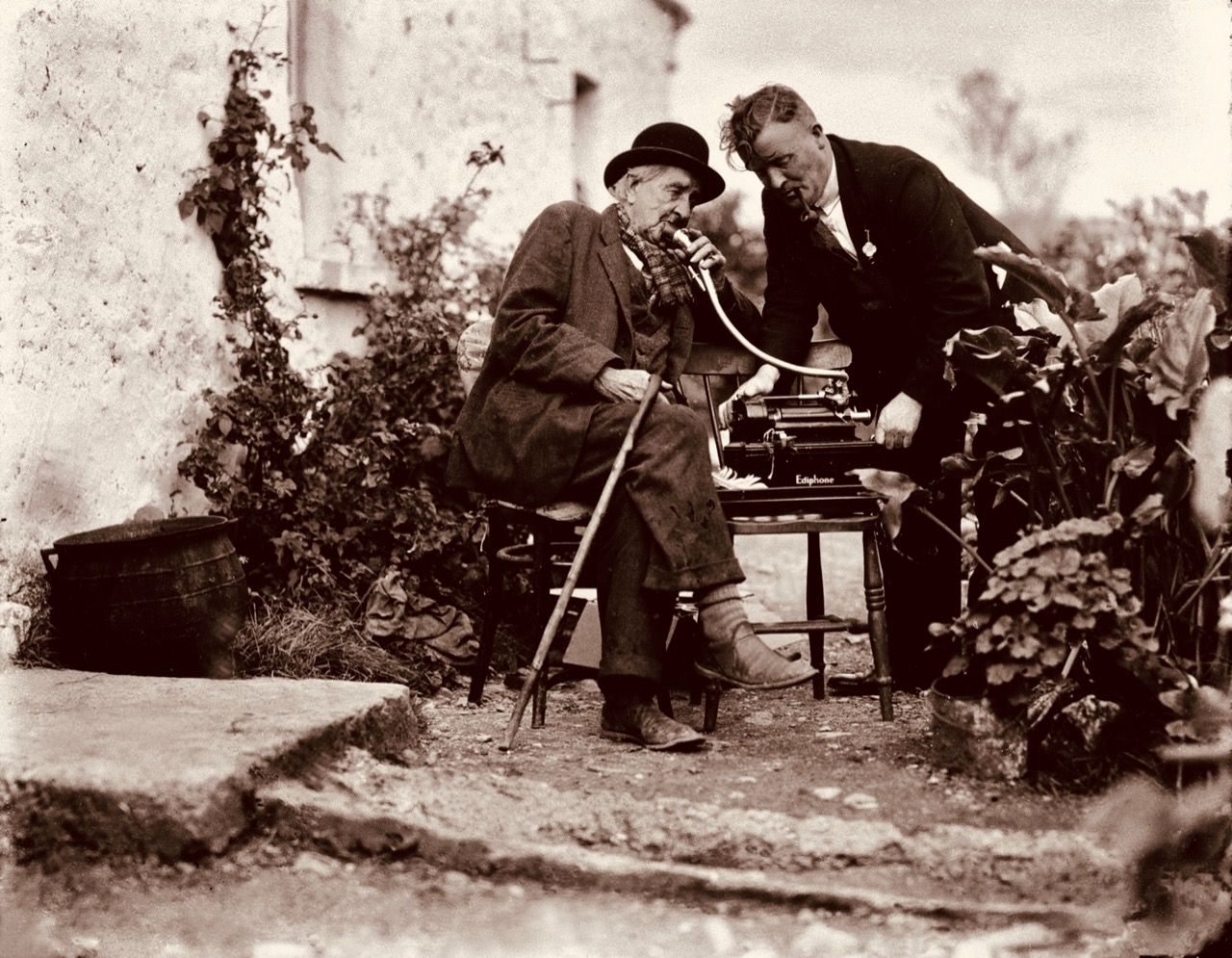
The Irish Folklore Commission was established in 1935 in Earlsford Terrace, Dublin – where turf fires burned regularly in the grates. In our library at Nead an Iolair are three books by researchers who gave much of their working lives to the Commission. Bríd Mahon, from Cork, was hired by the Commission as a temporary typist in October 1939. Ten years later she took over as office manager from Máire MacNeill, who was to marry: married women could not be civil servants in Ireland in those days! Seán O’Sullivan was the archivist of the Commission for the duration of its existence (1935 – 1971). In 1971 the project was absorbed by the Department of Irish Folklore, University College, Dublin.

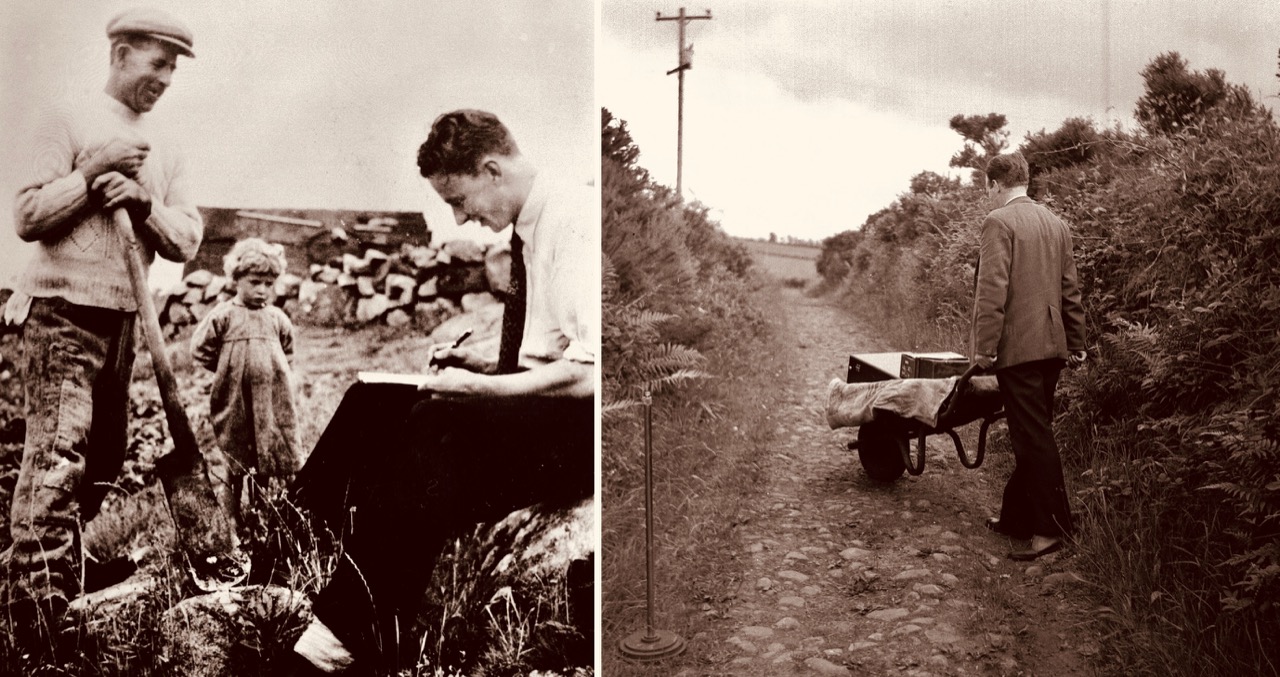
Tadhg Ó Murchú recording an unidentified informant on a clockwork Ediphone in Spunkane, Co Kerry, 1936. ©Commission and Department of Irish Folklore

. . . The first things I noticed were the wicker basket heaped with sods of black turf beside an open fire and the smell of the blue peat smoke which I love. It was the first day as a raw recruit to the staff of the Irish Folklore Commission. One wall of the room was lined with manuscripts bound in dark leather. A small dark man was turning the handle of a machine. Shreds of wax from a long cylinder fell into a container. Seán O’Sullivan (1903 – 96), who was the archivist, explained that the wax cylinders he was paring were used by the collectors on clockwork dictating machines called Ediphones to record the tales and traditions of the Irish countryside. He said that they were a great improvement on the old method of taking down information by hand. The only drawback was that the Ediphones had to be carried by the collectors on bicycles, which made riding over stony roads difficult and up mountain paths near impossible . . .


The Second World War was drawing to a close, petrol was scarce and few people owned cars. The Commission employed five full-time collectors, who worked in places as far apart as the Dingle Peninsula in County Kerry and the Bluestacks in County Donegal. When the men had filled a dozen cylinders they transcribed the information onto blue notebooks, using indelible ink. These were sent back to Dublin, carefully packed in boxes. The notebooks were bound and kept in the Commission’s archives and the cylinders were pared and recycled . . .

From Bríd Mahon’s account of her time at the Irish Folklore Commission: While Green Grass Grows Mercier Press, 1998

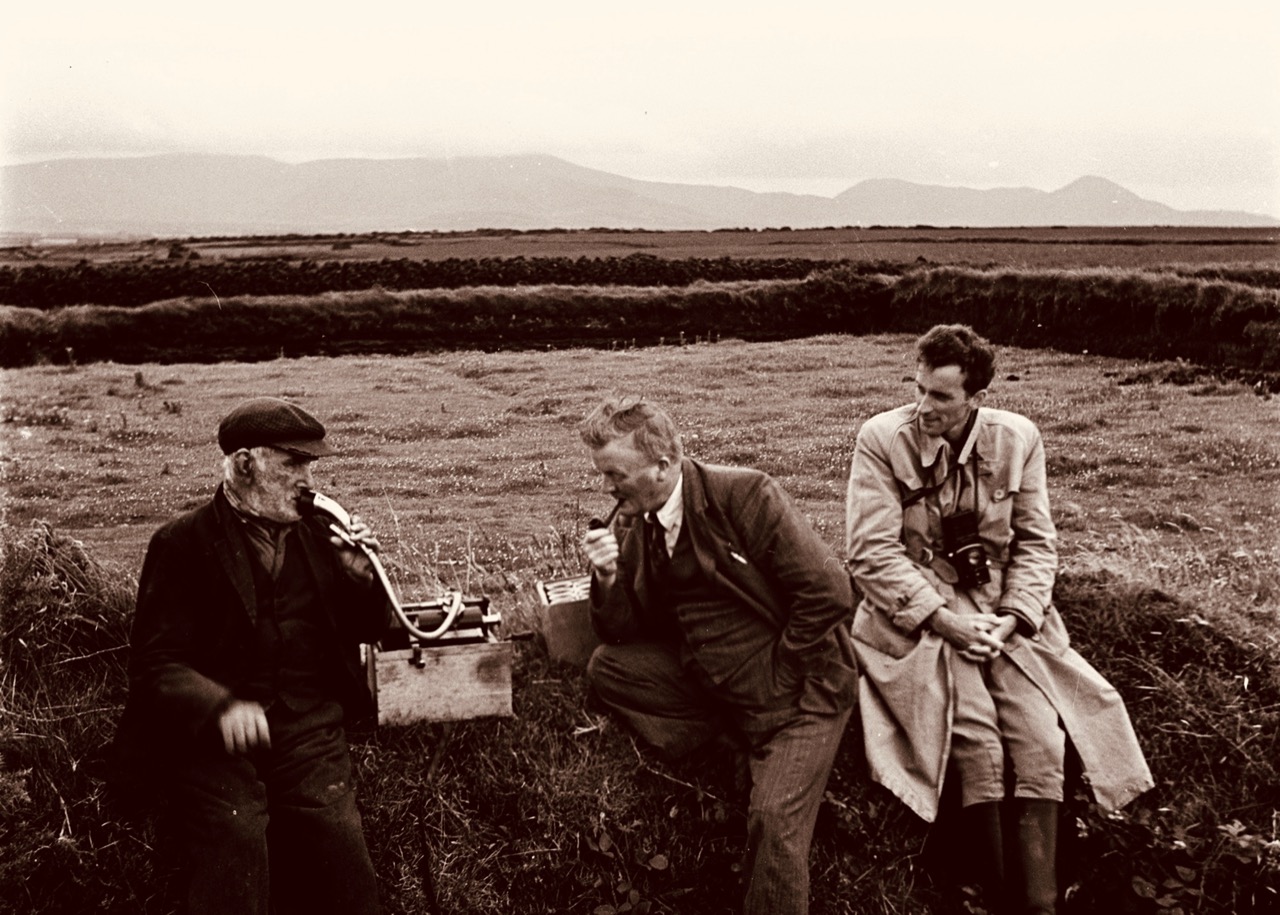
Paddy Óg Liath Ó Súilleabháin being recorded by Tadhg Ó Murchú. On the right is Caoimhín Ó Danachair  (Kevin Danaher – familiar to our Journal readers) ©Commission and Department of Irish Folklore

Bríd Mahon also relates how the Folklore Commission (which survived on a shoestring budget) acquired its Ediphone machines:

. . . In the 1930s Delargy [Séamus Ó Duilearga, Director of the Commission throughout its life] had gone on a lecture tour of America that entailed much travel and long train journeys. Coming to the end of his travels, he happened to find himself sharing a carriage with another traveller. They soon discovered a common interest – both were dedicated fishermen. As the night wore on they got talking about Ireland and the work of the Commission. Delargy remarked that gathering folklore was akin to fishing – both took time and patience. He described how for eight years he had spent every vacation in a remote hamlet in County Kerry, first helping with the housework, afterwards making himself as comfortable as he could on a bag of salt, while he wrote down from the dictation of one of Ireland’s great storytellers hundreds of legends, Fianna tales and miscellanea of folklore. ‘On a night in April 1931 Seán Ó Canaill told me the last tale in his repertoire,” Delargy told his listener. “A month later he was dead. It had been a race against time.”


Delargy’s travelling companion was impressed by the meeting. “I wish you well in your undertaking, Mr Delargy,” were his parting words as the train pulled into Grand Central Station, New York. But it wasn’t the end of the story. Delargy was scarcely back in Dublin when a consignment of Ediphone machines arrived with the compliments of the President of the Edison Company. The accompanying note read: “To a fellow traveller and fisher of men.” These Ediphones were used by the collectors for many years . . .
Left – Séamas Mac Aonghusa (Seamus Ennis) was responsible for recording over 2,000 songs and dance tunes while working for the Folklore Commission. Right – an Ediphone being transported in rural Ireland (1945)

More from Bríd Mahon:

Seán O’Sullivan showed me an international folktale known in Irish as ‘Ao Mhic an Bhradáin agus Ó Mhic an Bhradáin’ (‘Hugh and O, the Two Sons of the Salmon’) . . .


It was the earliest known folktale, first discovered on Egyptian papyrus 3,250 years before. During my years with the Commission hundreds of variants of that far-flung story were gathered in remote hamlets on the western seaboard of Ireland, in parts of Munster, in northwest Ulster and from a group of travelling people on the borders of Wicklow and Wexford . . .

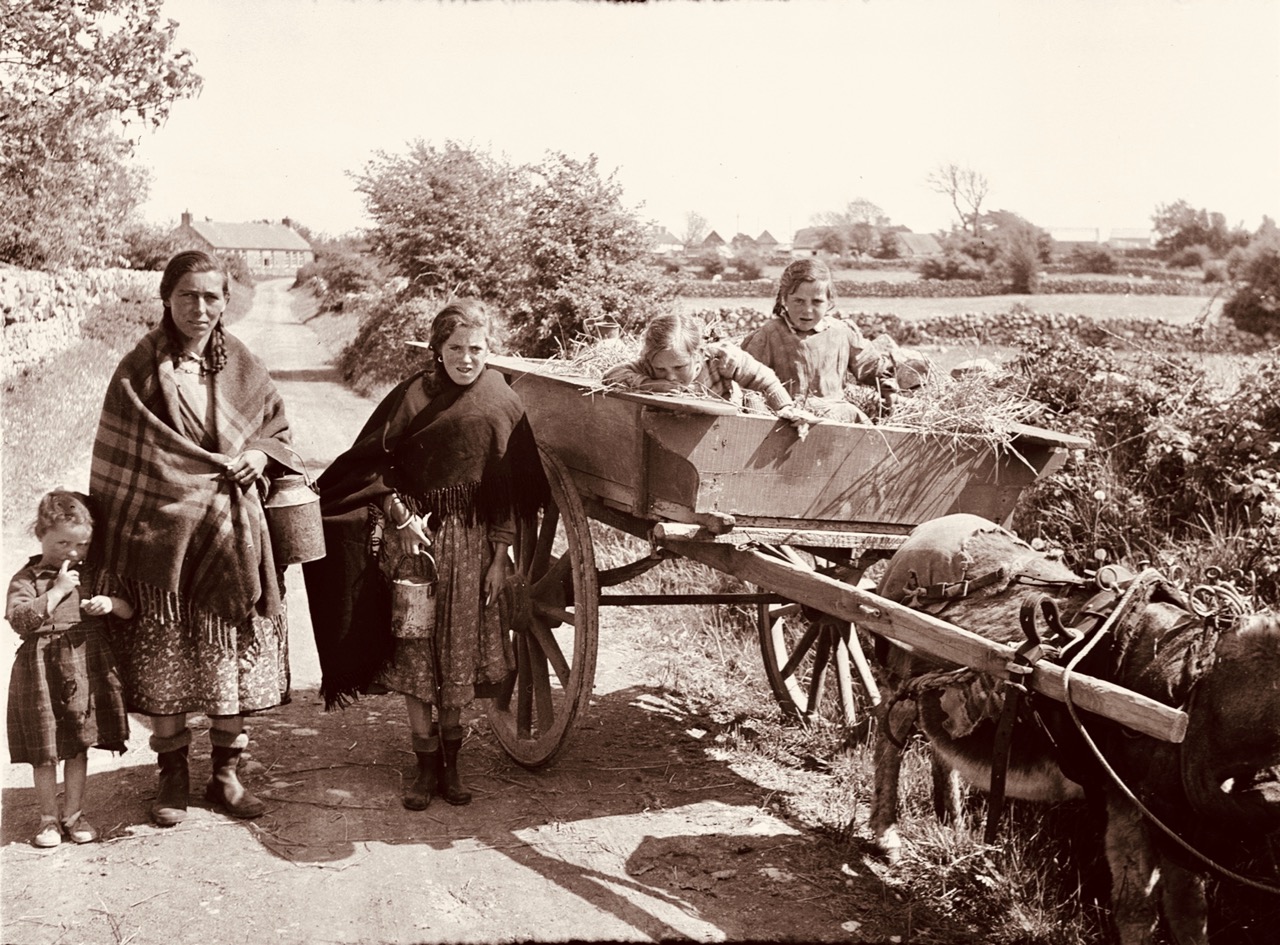
The Travelling Community, Parkgarve, Co Galway, 1956 ©Commission and Department of Irish Folklore

Nothing would satisfy me but to find a version of the ‘earliest known folktale’ to finish off this post. But, search high and low, the only example I could find is written in Irish and amounts to 5,000 words! With my very limited skills and many translation aids I have begun to work on the story. I’ll give you a taster, but the full tale will have to wait for another day:

Hugh and O, the Two Sons of the Salmon


It came out that there was a poor man whose only means of making a living was catching fish. If he came home with no fish, he wasn’t lucky. He could only do his best. The poor man had a wife for many years, but no children came to them, and they were both now well into old age.

On a day he was out fishing with his rod and a fine salmon came to him. It was hard work, but he reeled in the fish and was about to kill it when it spoke to him! “Don’t kill me’’ said the salmon, “Let me go and I will tell you a story of good fortune.”


The poor man was amazed to hear the salmon speak, but he replied: “I will hear the story and, if I am pleased, I will let you go”.


“Listen now”, said the salmon. “I know you have been upset that you have no children; I am glad to tell you that you will soon have two sons.”


“That is certain to be untrue”, said the fisherman.


“I am not telling you a lie”, said the salmon. “Let me go and you will see that I am telling you the truth.”


The fisherman cut the line and released the salmon. He returned home and told his wife the great news. She was not impressed. “It’s a pity you did not bring the salmon back with you: it’s clear that he was mocking you!”


Nevertheless, within the year the couple were surprised to have two sons. “Look now”, said the fisherman, “wasn’t it the truth that the salmon told me?”


“By my soul it was”, said the woman, “but what shall we call these two?”


‘We will call them É Mhic and Ó Bhradáin” said the fisherman. And so it was. They were known as Hugh and O, the Two Sons of the Salmon. You could not put anything between them in looks, manner or speech.


As the boys grew, so did the luck of the fisherman. Every time he went out with his rod his catch increased fourfold, and they became rich enough that each boy could have a hawk, a greyhound and a horse. The boys also had the luck with their hunting.


At twenty years of age Hugh told his brother that he would leave and seek his fortune in the world. “If I am not back in twelve months, then come and find me,” he said . . . 

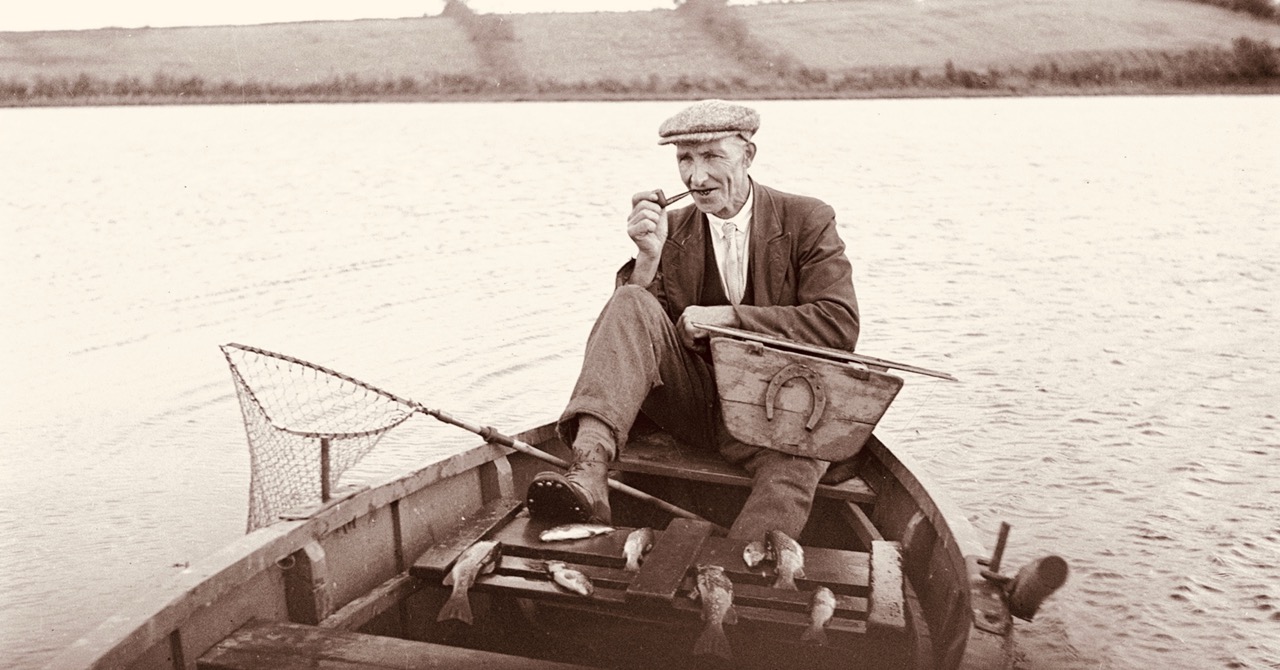
The Fisherman – Lough Skeagh, Co Cavan, 1946 ©Commission and Department of Irish Folklore

Guerrilla Botany in West Cork

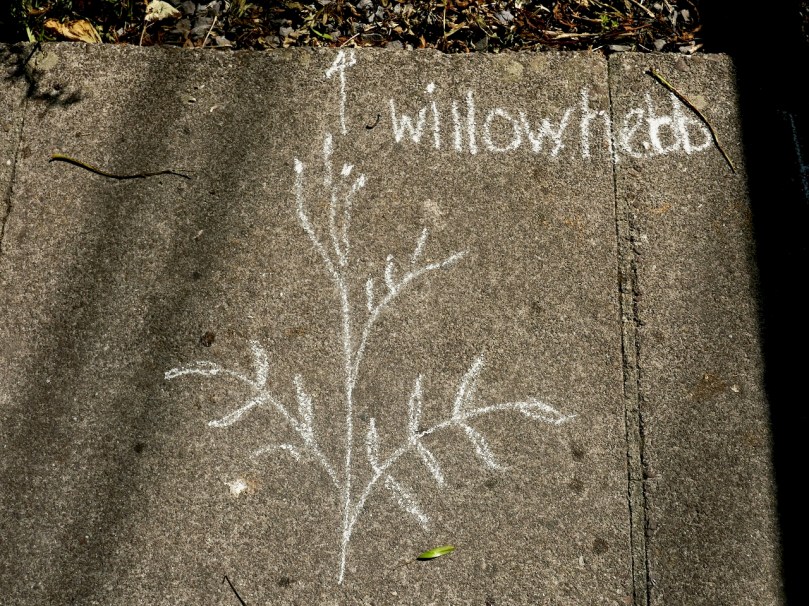
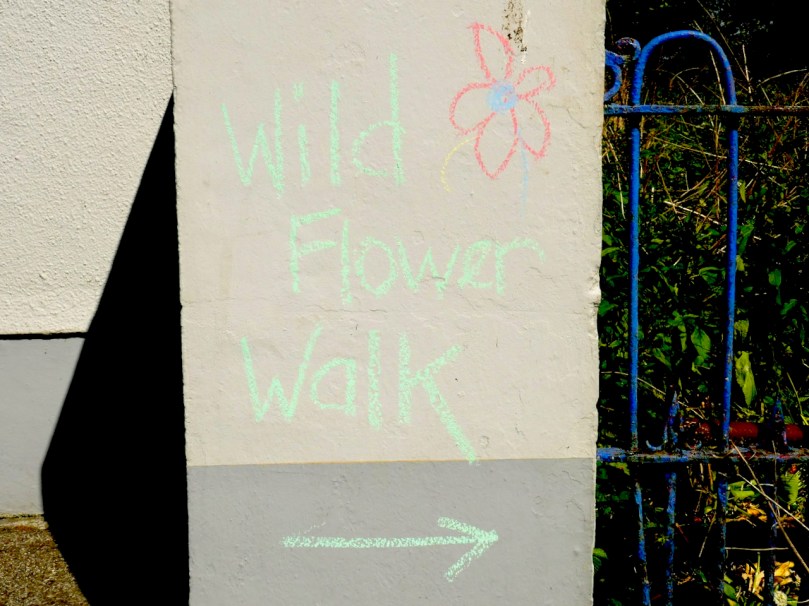
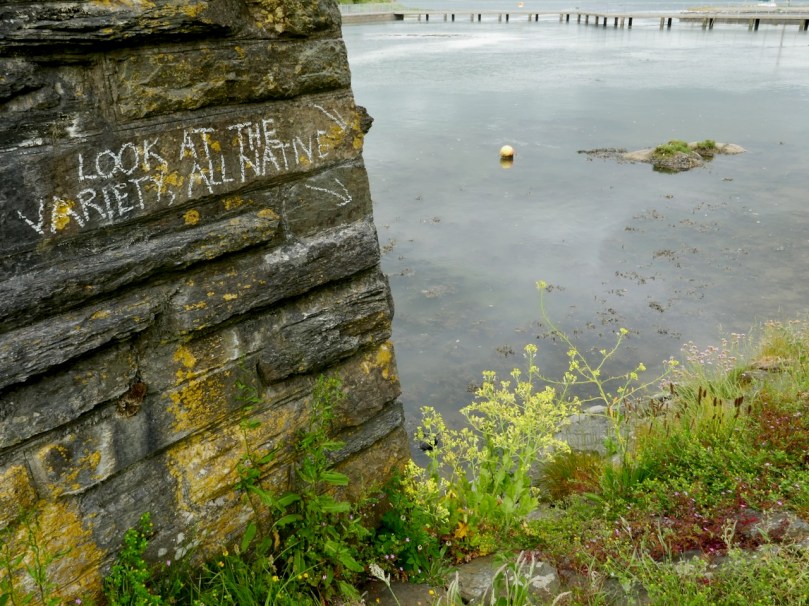
It started in France and has spread (like weeds?) across Europe, as a way of illustrating for casual walkers what we have all around us. All you need is chalk and a good wildflower book. I recommend Zoë Devlin’s The Wildflowers of Ireland – it’s how my love of wildflowers was sparked. If you have good reception on a phone or tablet, you can use her website Wildflowers of Ireland, but if you’re just starting, the book may be easier to search. Another excellent resource is Wildflowers of Ireland, although this one is wholly online.

This lovely little Field Forget-me-not (chalked in the top photo, close-up above) is a metaphor what what we were trying to do in our West Cork villages

The Botany part is easy: it’s incredibly important to know what we have as we are losing species, many through loss of habitat or the use of herbicides. Urban environments are home to many wildflowers (no such thing as weeds!) all of which do important jobs in supporting the great chain of life by providing vital food, shelter and reproduction spaces to an enormous variety of insects.

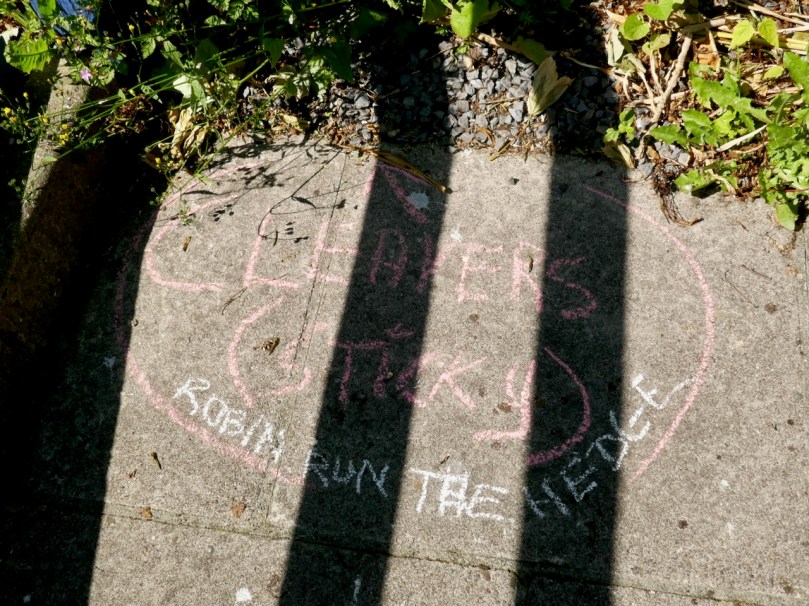
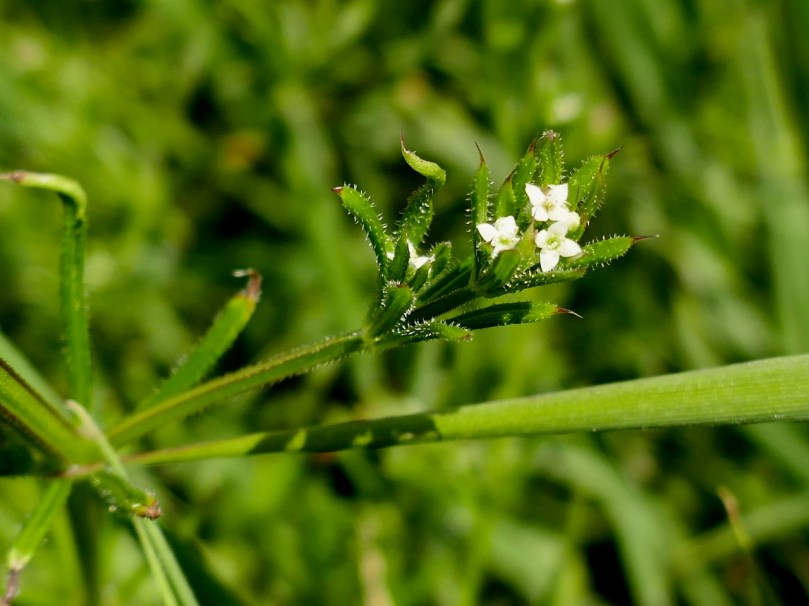
Cleavers – you might know it as Stickelback or Goose Grass, and one of the Flying Column grew up calling it Robin-run-the-hedge. It has a very efficient way of getting you or your dog to transport its seeds

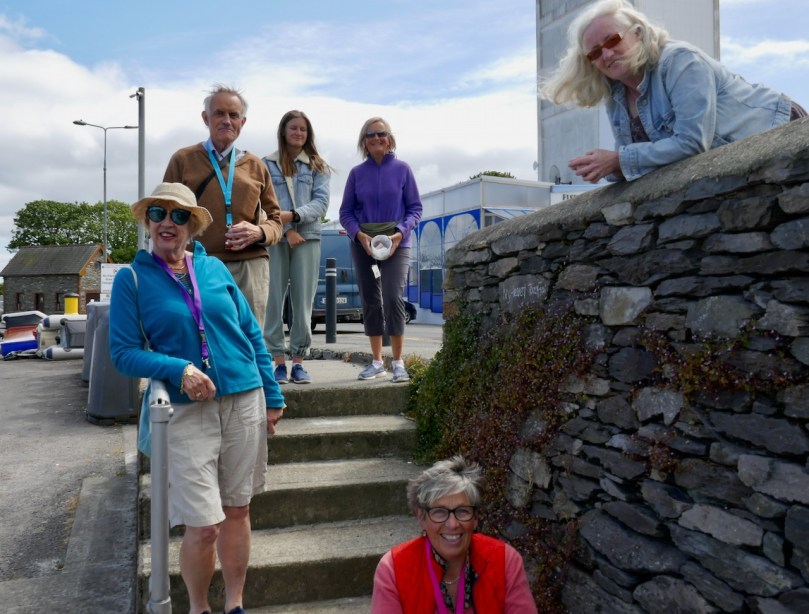
The Guerrilla part? Well, there is something subversive in writing and sketching what can be seen as graffiti on a footpath or a wall (but don’t worry – the first rainfall and it will be gone). It may even be slightly illegal, so ideally you deploy some level of stealth. However, the merry band in Schull yesterday, let’s call them Flying Column S, was having far too much fun to be deploying anything except their chalk.

Flying Column S (appropriately distancing) clockwise from top right: Karen, Julia, Úna and Con, Ann and Blathnaid

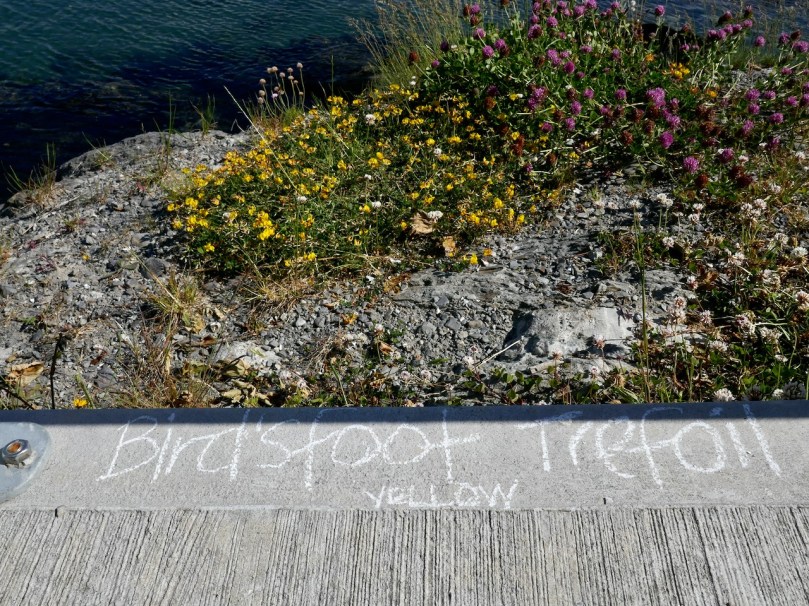
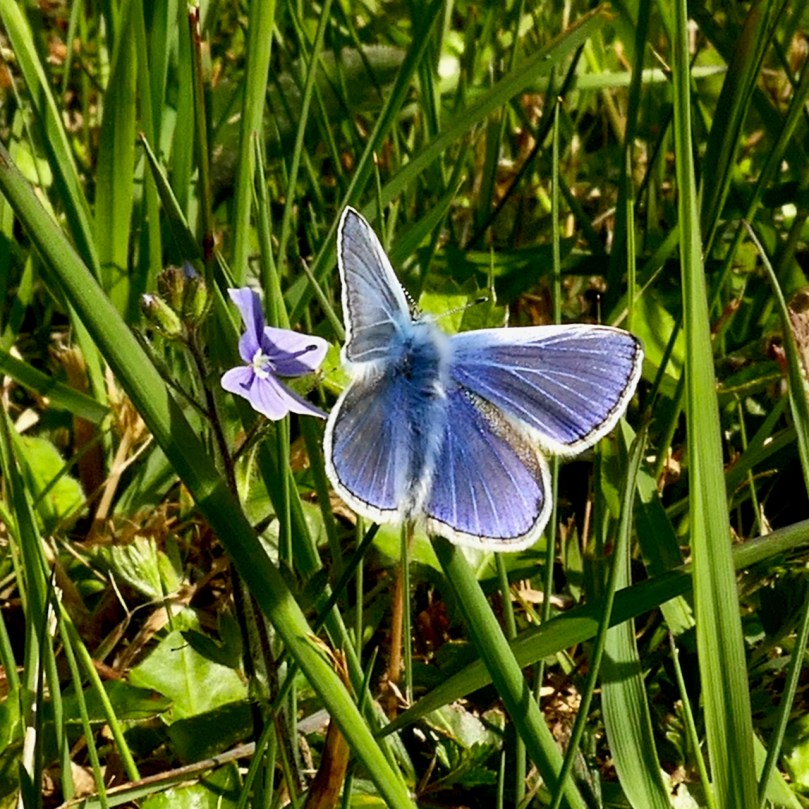
When you name something you give it an identity. That encourages people to look more closely at it and maybe do a little research into it. We are seeing all kinds of Bird’s-foot Trefoil (below, overlooking Schull Harbour, with Red Clover) at the moment, springing up in our lawns and frankly wherever it gets a chance. But did you know that this gorgeous little yellow flower, a member of the Pea Family, is the larval food plant of the Common Blue Butterfly?

Most of the wildflowers we see around us in our towns and villages are native, but there are a few invasive aliens as well and it’s also important to know where they are and how they are reproducing. Japanese Knotweed is the most feared, for how difficult it is to get rid of, how damaging it can be, and for how it takes over vast areas of habitat, choking out native plants.

Buddleia, better known as Butterfly Bush, is beloved of butterflies for its abundance of nectar. But there is a dark side – it can become very invasive, and while butterflies love the nectar it provides it is not a butterfly host plant – that is, one that butterflies can use to deposit their larva, which will then feed on the leaves. In fact, over time, butterfly populations decline where Buddleia is left unchecked. The Buddleia below has not yet come into flower.

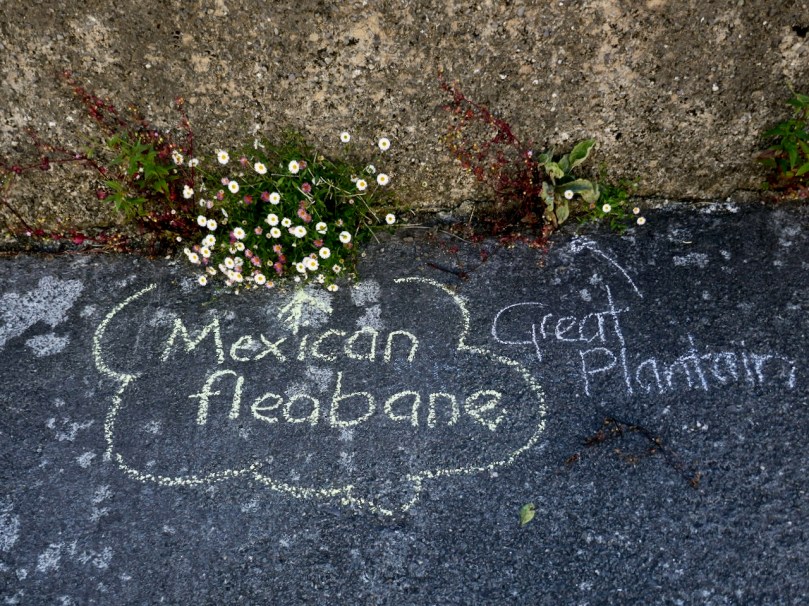
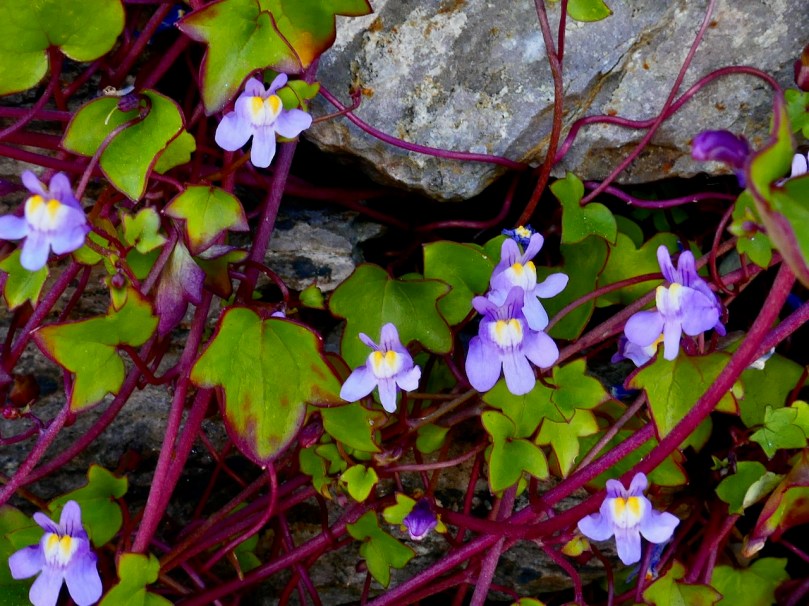
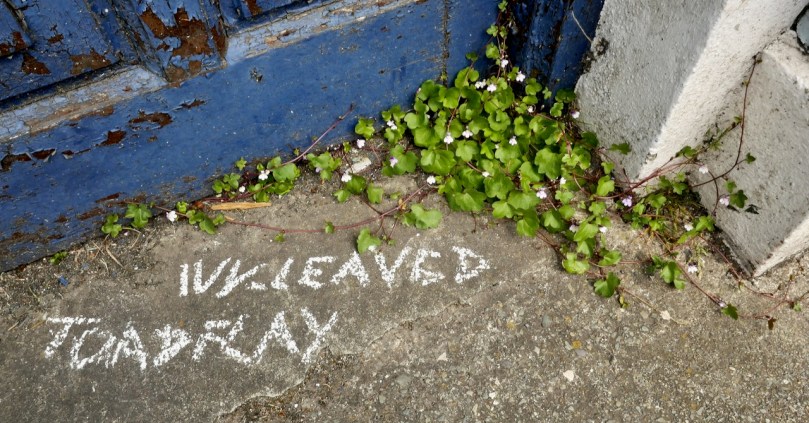
But there are other non-natives that are more benign. Mexican Fleabane (below with Greater Plantain) and Ivy-leaved Toadflax (a close-up – another photo is the last one in this post) both arrived here from elsewhere, but do not pose anything like the same level of threat. In fact they have settled in happily as neighbours.

But while they are certainly decorative and attractive to insects, it remains true that it is our native plants to which our native insects are best adapted.

Native, of course, can also be dangerous – several of our native plants are highly poisonous to humans including the beautiful Foxglove that is blooming everywhere right now and the attractive but deadly Woody Nightshade, below. It’s also known as Bittersweet. Children need to be warned to stay away from the inviting red berries of this plant later in the summer.

At first glance, we seem to see lots of dandelions, but most of the dandelions are gone over by now so what we are seeing are Sow-thistles, Nipplewort and most of all in West Cork, Cat’s-ear.

Cat’s-ear in Ballydehob, all mixed up with buttercups, daisies, White Clover, Club-rushed and grasses – an insect heaven

At the shore, marine species abound – take a look at my post on the Ballydehob Estuary – a haven for native wildflowers of all kinds. In Schull we chalked signs for Thrift (or Sea Pinks) and Kidney Vetch while in Ballydehob we pointed to Sea Radish and Sea Aster, the latter a plant that tolerates getting its feet wet in salt water.

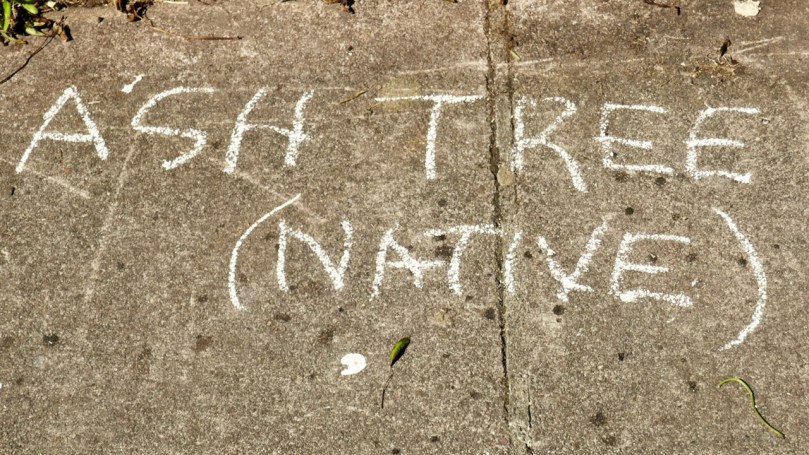
Trees, too, deserve our attention. Con was delighted with the number of elm trees around Schull and he pointed out one of our native Ash trees along the way. The Sycamore which springs up everywhere, on the other hand, is not native to Ireland and can grow to provide a powerful canopy under which other seedlings fail to thrive.

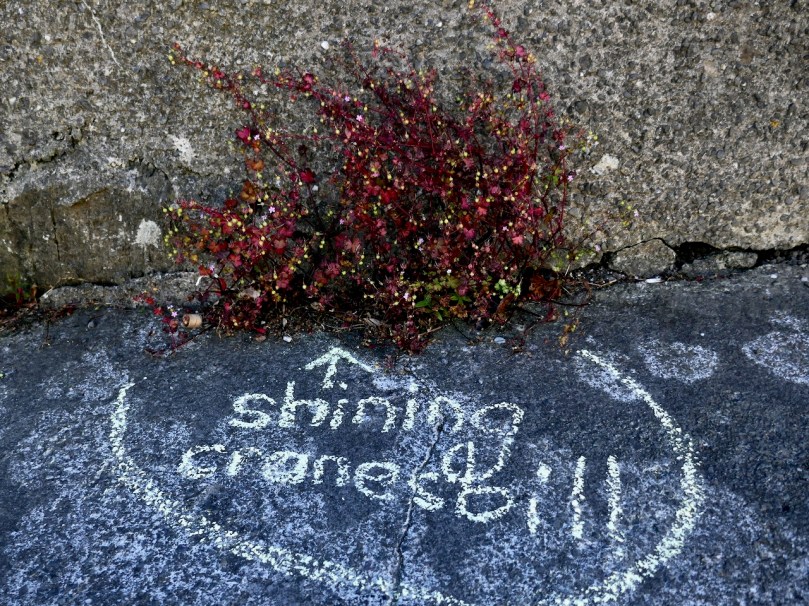
Herb-Robert is a perennial favourite but in Schull we found lots of its first cousin, Shining Crane’s-bill. The flower is very similar, although smaller, but the leaves are quite different, being round and glossy compared to Herb-Robert’s hairy fronds. Both turn an interesting red as they age. Bonus point to Karen for pointing out that this was not, in fact, Herb-Robert.

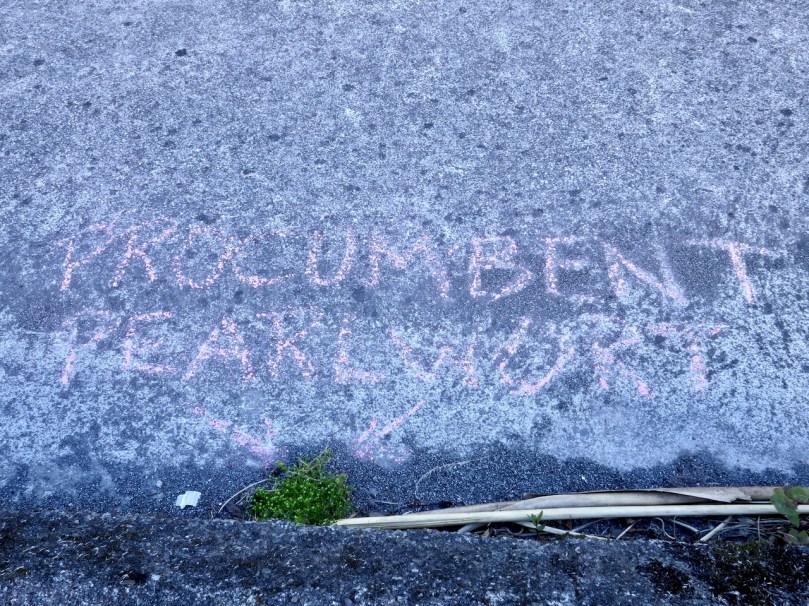
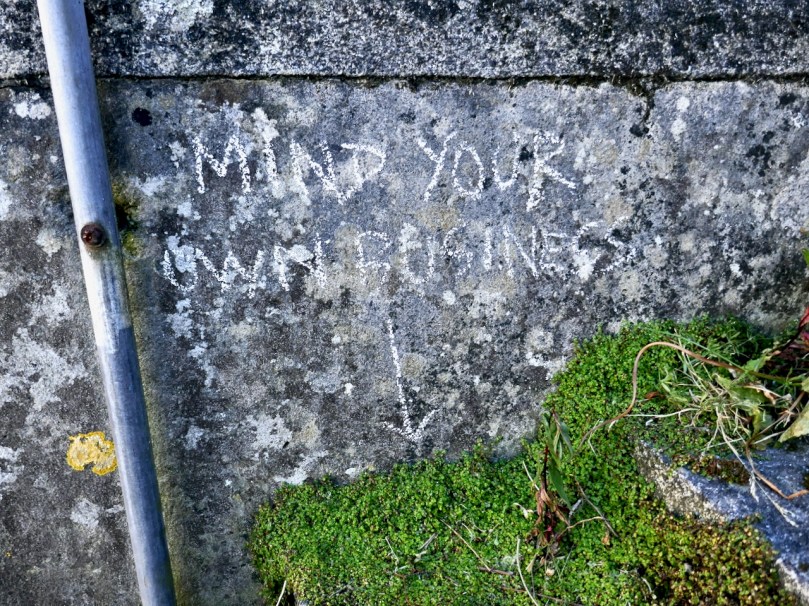
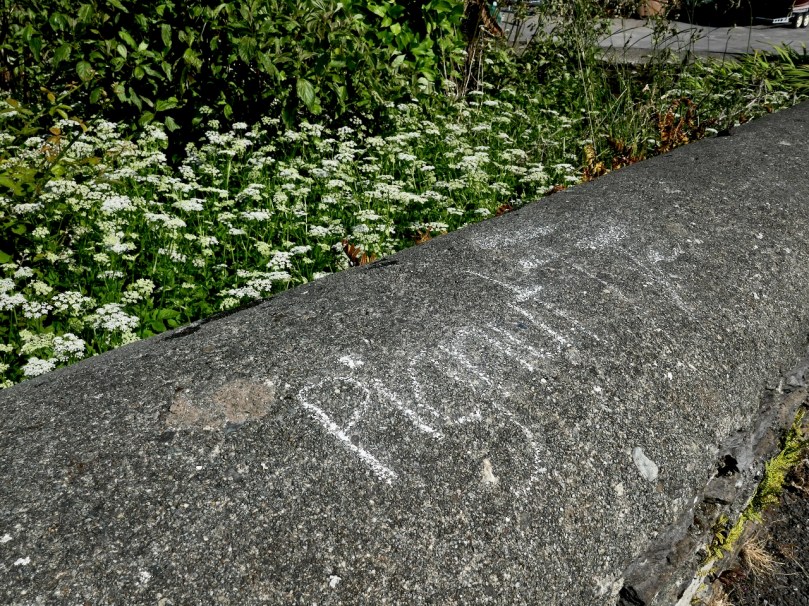
Some plants are so tiny and background-y that they are easily overlooked. A couple below – Procumbent Pearlwort and the charmingly named Mind-your-own-business. The second photo is a close-up of the Procumbent Pearlwort, showing its minuscule white flowers.

Foragers are the experts on what’s edible by humans – if you are interested in this, I highly recommend Forager Fred’s Facebook Page. One plant we did happen across in Schull was Pignut – I haven’t tried it myself, but apparently in the old days kids on their way to school would follow the stem down to the root with their fingers to find the little edible tubers. Any memories of that among our readers?

We identified lots more plants than I have room for here and we hoped that people would stop and take notice as they walk around the village and estuary of of Ballydehob and the Market car park and harbour road in Schull.

What do you think – is Guerrilla Botany a good idea? Why not get out and do some in your own community!


The Stone Circles of West Cork: Five-Stone Circles

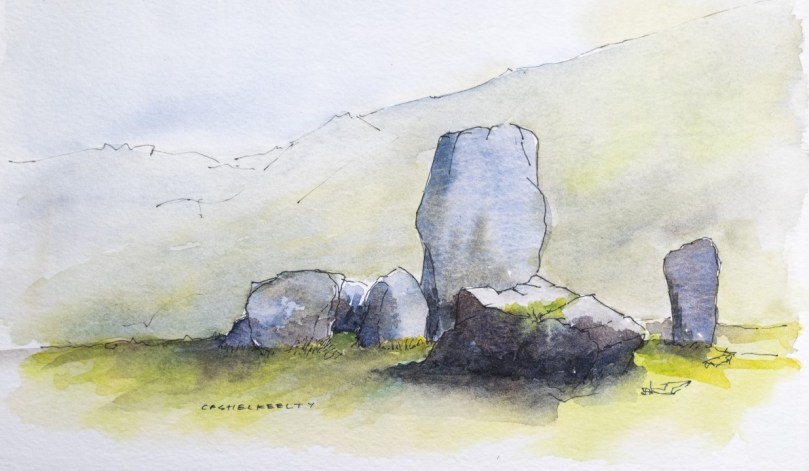
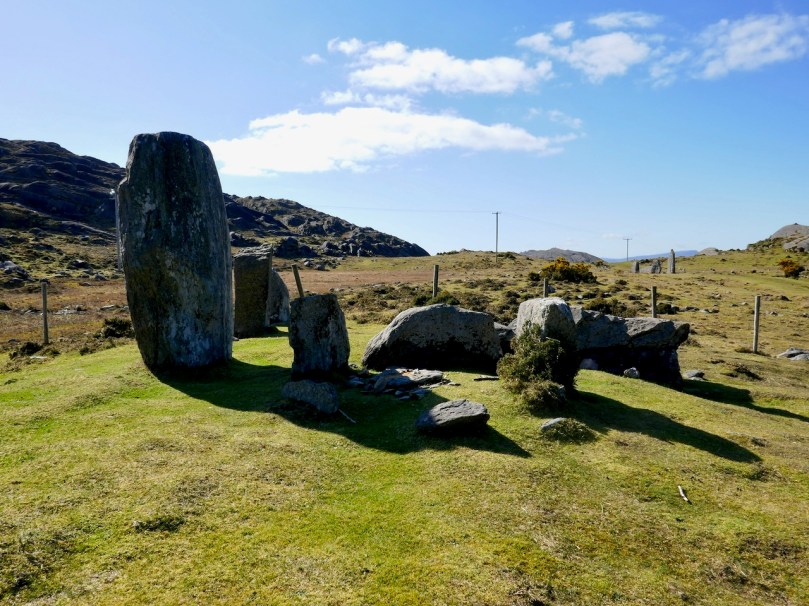
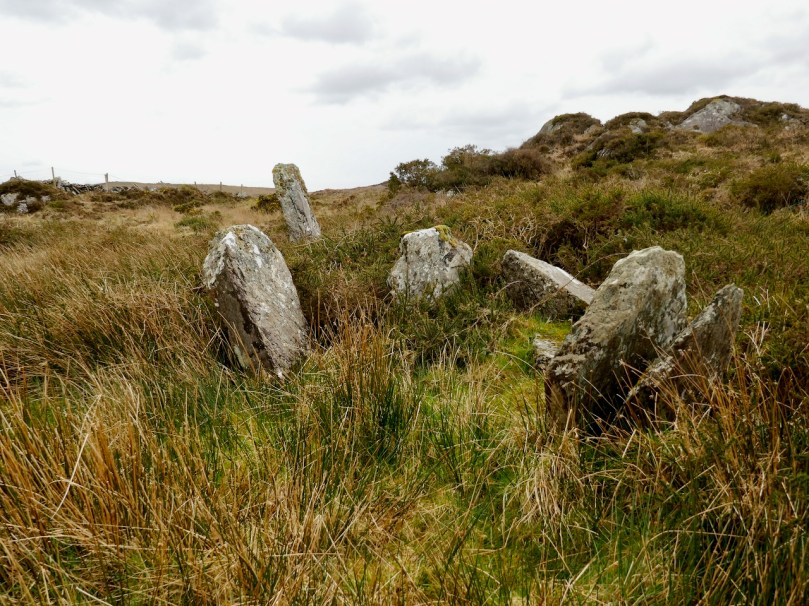
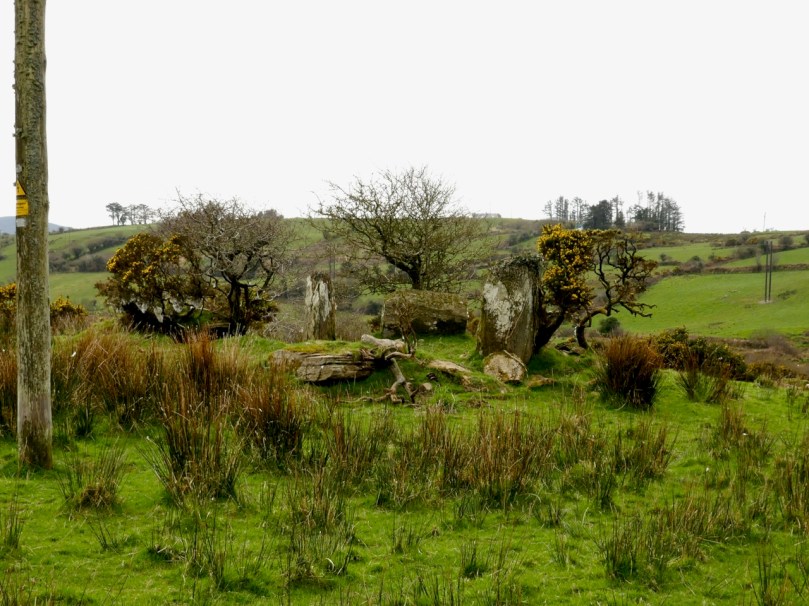
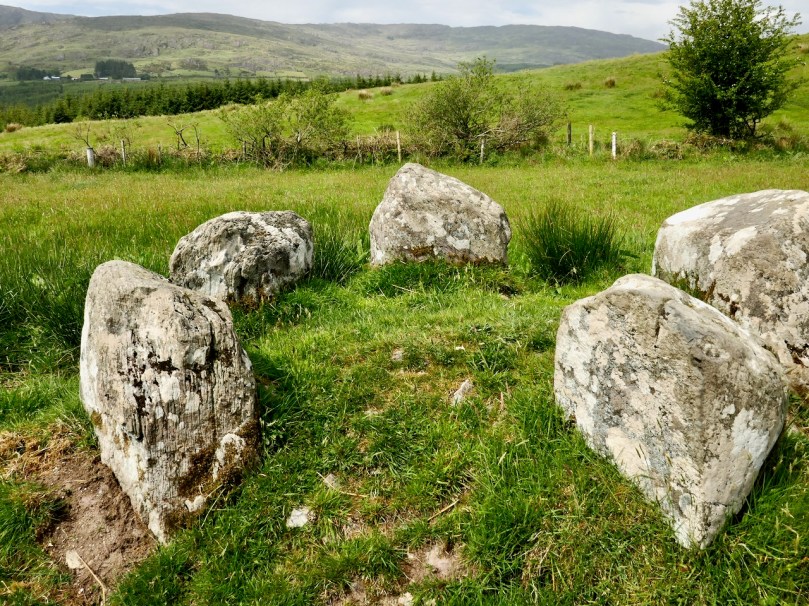
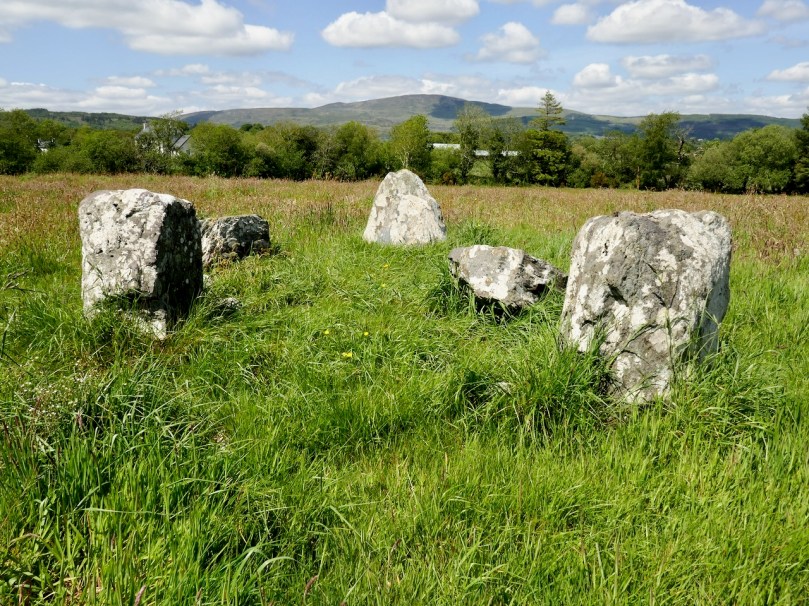
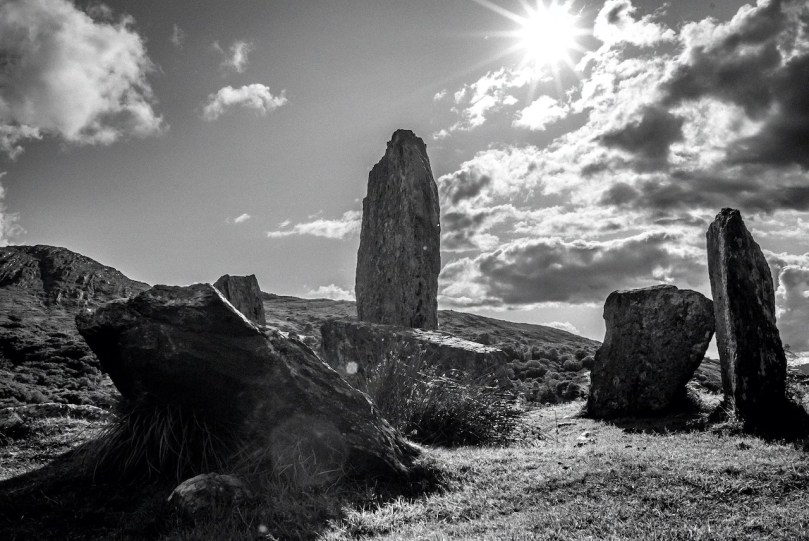
About half of the stone circles in the Cork-Kerry complex consist of only five stones, and constitute a sub-group know as Five-stone Circles. While they share many similarities with the Multiple-stone Circles, they are a unique class of monument. I’ve described the Multiples in detail here, so if you need to refresh your memory about that group, you can do it now and then come back and read on. While most of the photographs in this post are my own, I gratefully acknowledge the generosity of Ej Carr in allowing me to use two images (above and the last one in the post) of the Uragh Five-stone Circle and Standing Stone and of Peter Clarke for his drawing of the circle at Cashelkeelty (below).

Most strikingly, the Five-stone Circles follow the pattern of the larger ones in having two portal stones, usually the tallest orthostat of the circle, across from a recumbent, or axial stone which is usually the shortest. In describing them here, I am following the work of Seán Ó Núalláin, who surveyed and described all the Cork-Kerry Stone Circles in 1975. While his comprehensive paper is  45 years old, it is still the most complete work on the Stone Circles of Cork and Kerry (The Journal of the Royal Society of Antiquaries of Ireland, Vol. 105 (1975), pp. 83-131). 

Lettergorman, with its large block of sparkling quartz

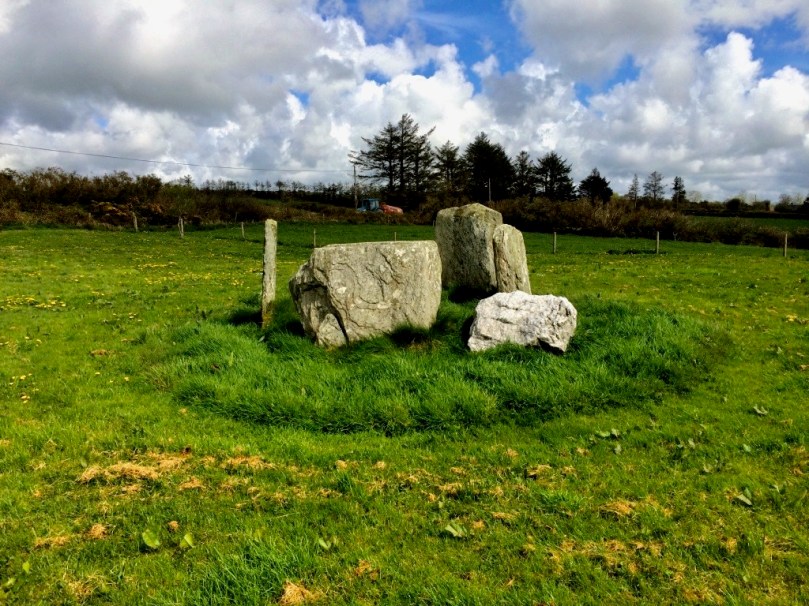
Most of the Five-stone Circles I have seen now are complete or almost complete, although some of the orthostats have fallen. They are actually in remarkably good condition – perhaps their small size has offered them some protection against the need to ‘improve’ farmland. some have been filled in with field stones but most are simply marooned in little islands of grass in the middle of a field, occasionally with a protective fence to keep cattle away.

Glanbrack, at the top of a small hill with views to all sides. This is one of the ones that Ó Núalláin thinks may have only ever had three stones. Note the two outliers

Two of the Five-stone Circles may in fact, according to Ó Núalláin, be actually Three-stone – it is assumed that both Cashelkeelty and Glanbrack had two more stones originally, but he muses that a setting of three stones could be seen as representing the ultimate degeneration of the “circle” concept.

This is Clodagh Five-stone Circle, also with two outliers immediately outside the circle. There is another standing stone pair nearby

Neither are they truly circular – in fact they are mostly D-shaped, with the axial stone being the straight edge of the D. This is a function of their size – the axial stone, with its straight edge, represents a much bigger proportion of the circle that it would in a large Multiple-stone Circle, but it also brings up the issue of whether the circle shape is truly essential to the functions of this type of monument.

Hard to make out exactly what’s what at Inchybegga Five-stone Circle, since the stones are small and the circle is disturbed and filled with field stones

The axis of the Five-stone Circles, that is, the direction of a line drawn between the portal stones across the recumbent, is generally NE/SW. This orientation is not exact, but most fall within a few degrees of it. Ó Núalláin agrees with Aubrey Burl in his analysis of the Scottish circles (and our own observations at the circles confirm this) when he says

Thus the circles are so aligned that the entrances face the side of the heavens on which the sun rises and the axial stones face the setting sun. The broad splay present, 107 degrees, suggests that a general alignment on the side of the heavens on which the sun rises or sets was what was required, and that precise alignments on specific celestial events were not in question. It is worth noting however that the axial stones tend to group in a sector indicating a winter rather than a summer position.


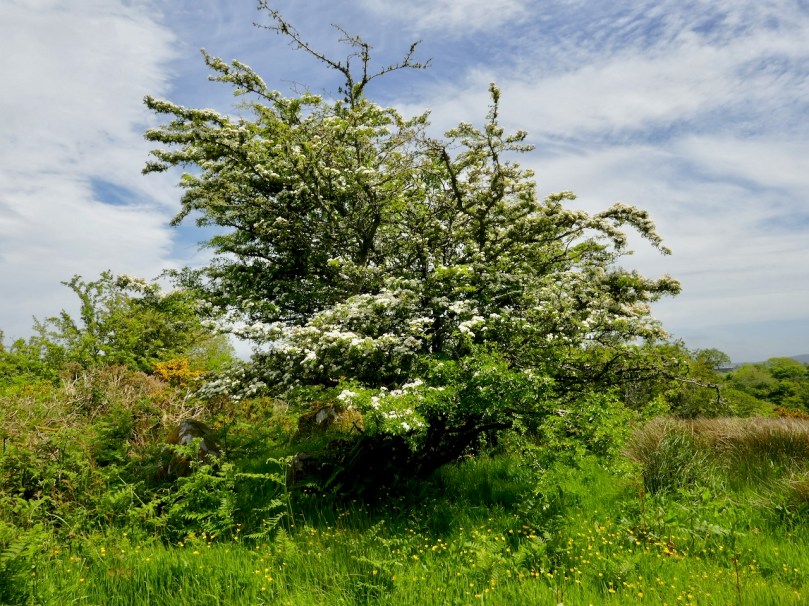
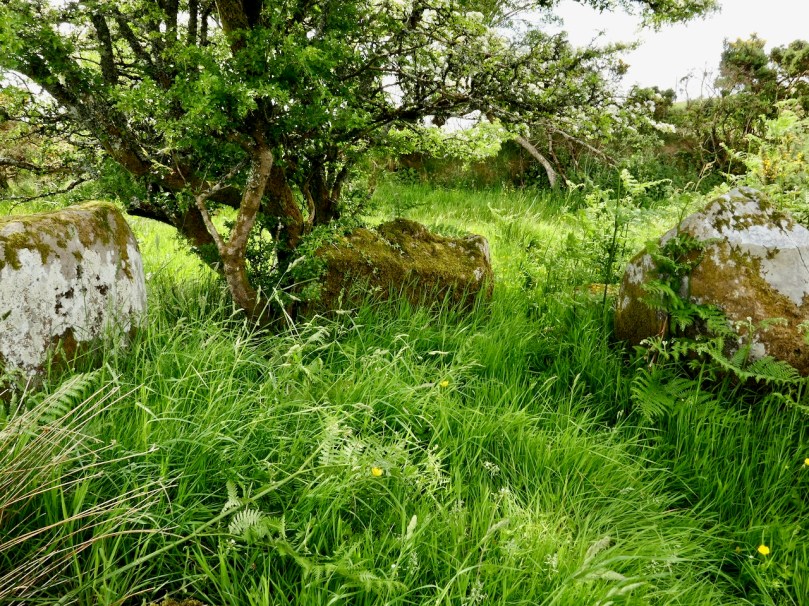
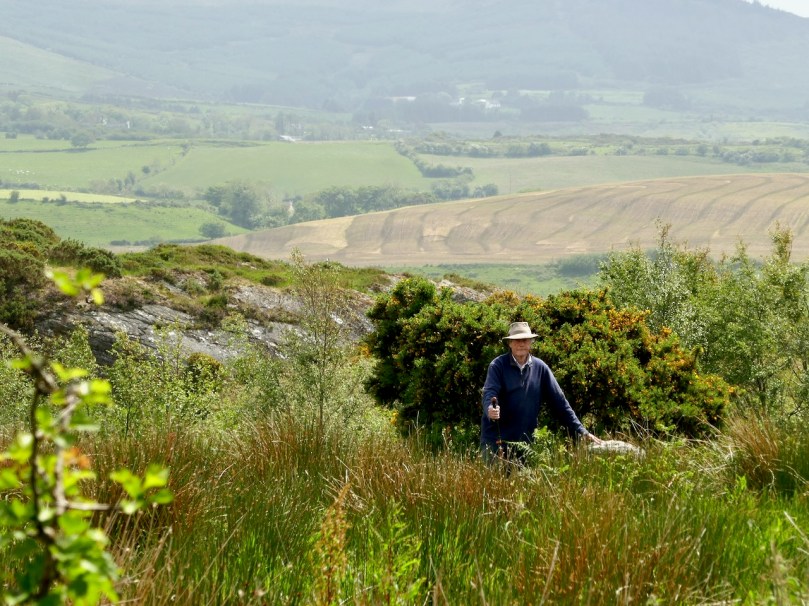
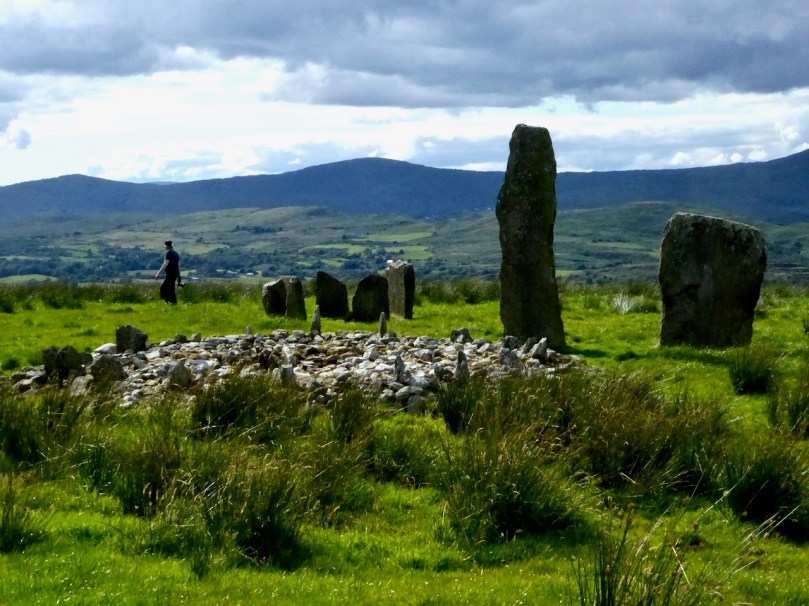
This intriguing site is Derryarkane Five-stone Circle. It is dominated by a Whitethorn Tree, traditionally never cut or interfered with. Under the tree the circle is complete although one of the portals has fallen. Robert is standing at an outlier about 35 metres away

As with the Multiple-stone Circles, there are peripheral monuments associated with Five-stone Circles – standing stones, stone pairs, stone alignments, quartz blocks, radial cairns, and in once case (Mill Little) boulder burials. None of these are inside the circle so are referred to as outliers.

One of the most complex of the Five-stone Circle sites is Kealkill (above), which includes two large standing stones (one of them is truly enormous) and a radial stone cairn.

Another complicated site is Cashelkeelty. Here (above) we see the Five-Stone Circle (although it may be the second of Ó Núalláin’s Three-stone Circles), a row of three stones to the left, and in the distance orthostats of what may have been a Multiple-stone Circle

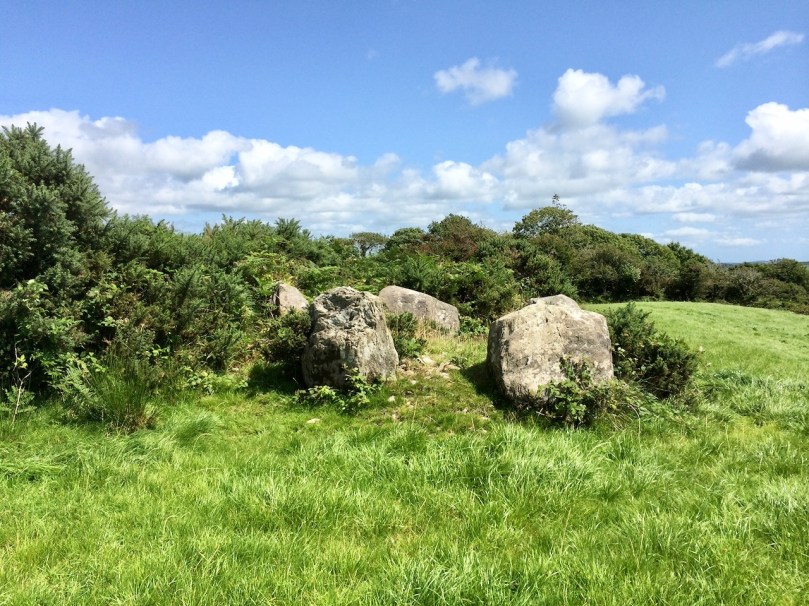
There are two Five-stone Circles in the townland of Baurgorm. This one (above), the more northerly of the the two, has two outliers but only one is visible in this photo as the other has fallen. There are two other standing stone recorded nearby but we could not find them. The portal stones are unusually far apart in this circle.

This is the second of the Baurgorm circles and from it are visible this group of stones – a standing stone row (three stones of which only two are visible from where we were and of which one of the stones is split) and a single standing stone.

This is the Mill Little Complex which comprises a Five-stone Circle (visible to the right of and behind Simon Tuite of Monumental Ireland), a standing stone pair (foreground, with field stones around them) and three Boulder Burials. While there are many example of Multiple-stone Circles in association with Boulder Burials, it’s unusual to see them alongside the Five-stone Circles.

Ó Núalláin finds the morphology (size and shape) of the stones unremarkable, apart from noting that the stones in individual monuments are roughly similar in size and shape. However, there is a little more to say about it than that. While the recumbent is invariably flat-topped, the flanking stones can vary from a gently rounded curve, to a slant, to what looks like a deliberately shaped angular peak. Have they been chosen, or shaped, with some purpose in mind? Two examples (above and below) are shown here where the right flanking stone (to the right of the recumbent) appears to have been chosen for its pointed shape. The first is Cappaboy Beg, the smallest of the Five-stone Circles and the second is Inchireagh.

Even though the recumbent is usually the lowest stone in the circle, it’s not always the case. At Kealkill (below), for example, the recumbent is easily the largest and most dominant of the five stones.

We cannot rely on archaeological evidence to reveal more about the nature and purpose of the Five-stone Circles. Only one has been scientifically excavated – the one that is part of the Kealkill complex. No burials or deposits were found. A one-day dig in the 1930’s at another site, Knocknakilla, revealed a sort of flat-stoned pavement in the interior, with lots of quartz fragments. Obviously this will be a fertile field for some future researcher.

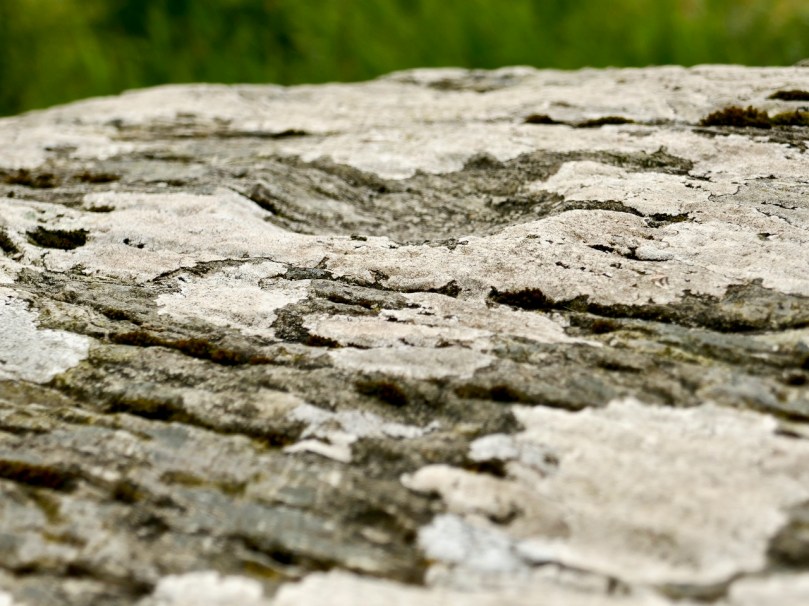
Glanbrack (above) has cupmarks on the top surface of the recumbent. Our second photograph, taken from the further of the two outliers, reminded us that on the day we visited the field had been half-spread with slurry (we held our noses). While we were engrossed in our photographing and observing, we suddenly became aware that the tractor had arrived at the gate (can you see it?) to do the second half. We hot-footed it out of there!

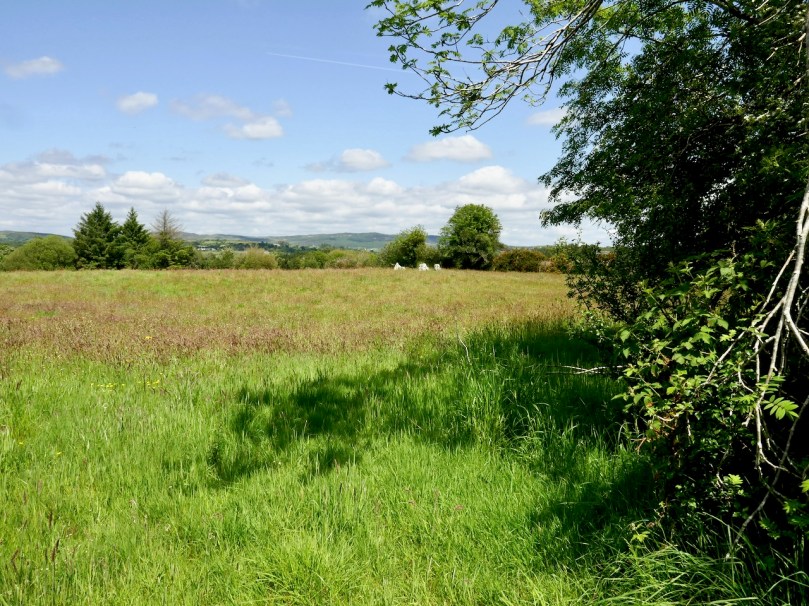
One thing we have noticed from our visits is that the Five-stone circles are differently situated from the Multiple-stone circles. Whereas Multiple-stone Circles are often on a bench on a hillside, with wide views in one direction and rising ground in the other directions (Drombeg is typical), Five-stone circles are often on flat ground in a valley or at the top of slight eminences (like Cullomane, above, and Cappaboy Beg and Inchireagh below) but usually with panoramic views all around. While we have noted this casually, we would need to go back and check these observations more carefully before being too categorical about them.

In my next post in this series I will get started on the Discussion – what conclusions can be drawn about the nature and purpose of Stone Circles? What do we know about who built them and why? And once again, thank you to Ej Carr for this superb shot of Uragh.


Transcendent Prospects

One of the advantages of the limitations that are placed upon us at the moment is that we have to look more closely at everything. We are seeing – and enjoying – the familiar landscape around us, so I am looking out, now, for the transcendent qualities it has to offer. [Transcendent: adjective – beyond or above the range of normal or physical human experience; surpassing the ordinary; exceptional.]

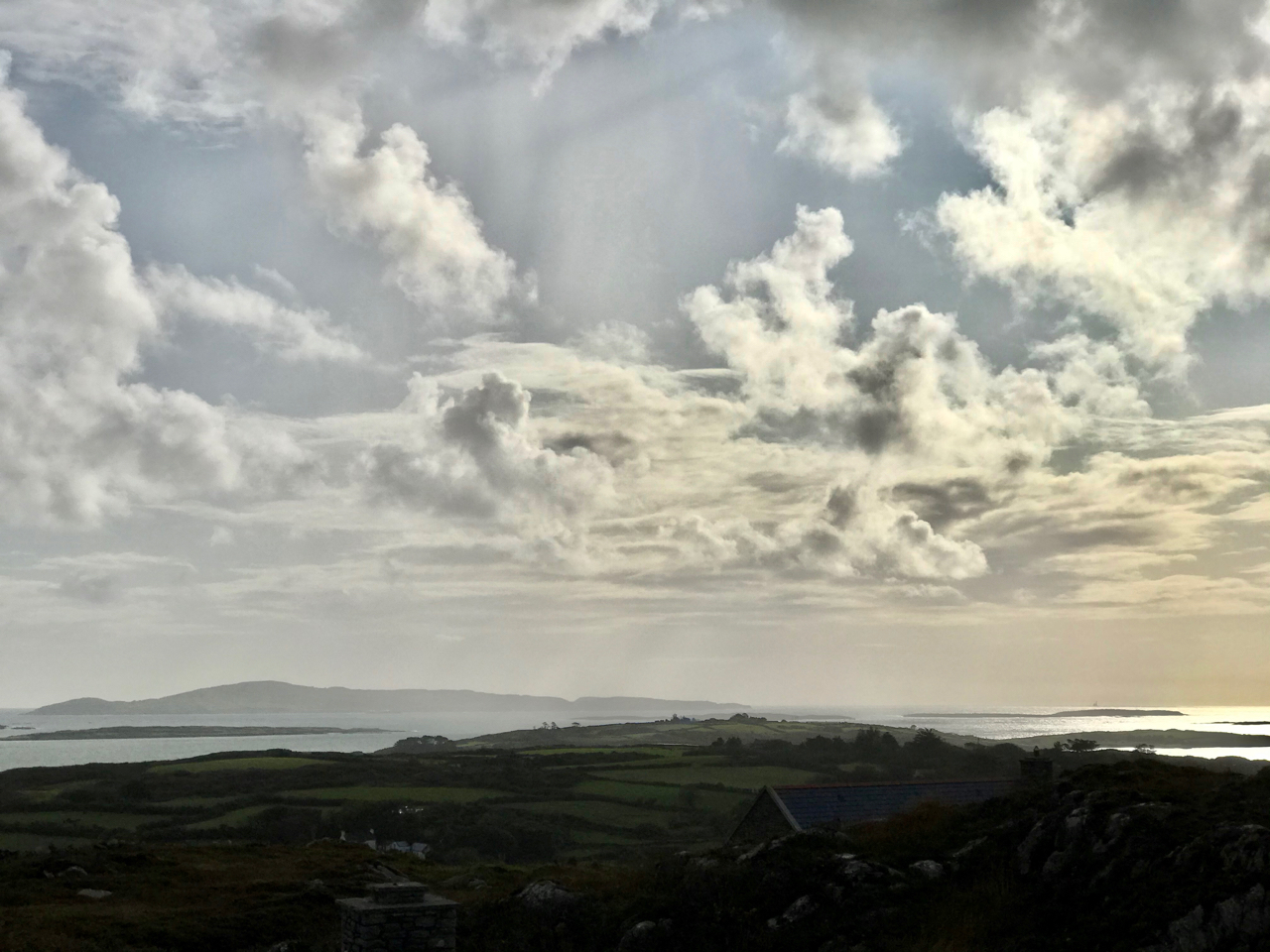
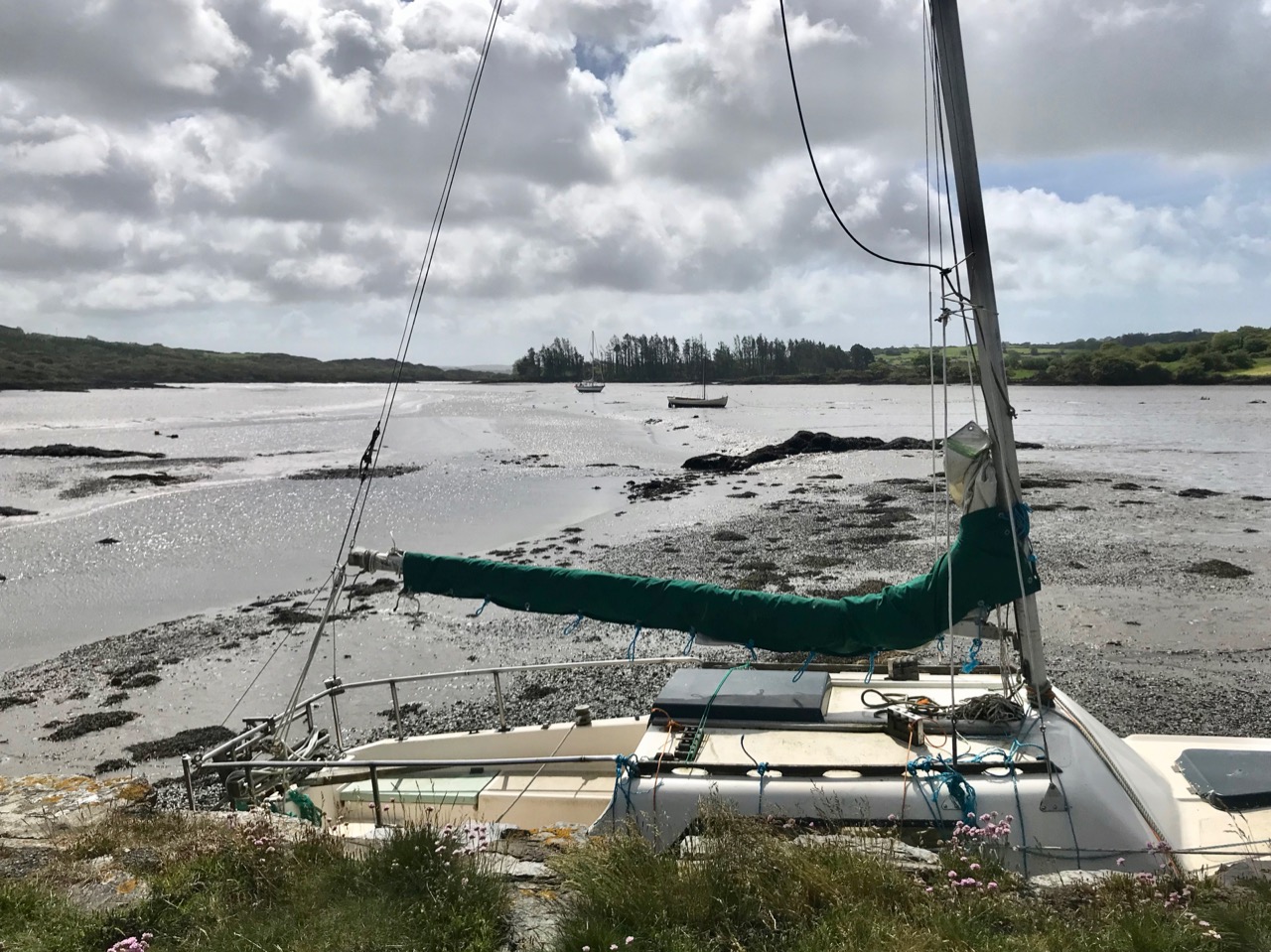
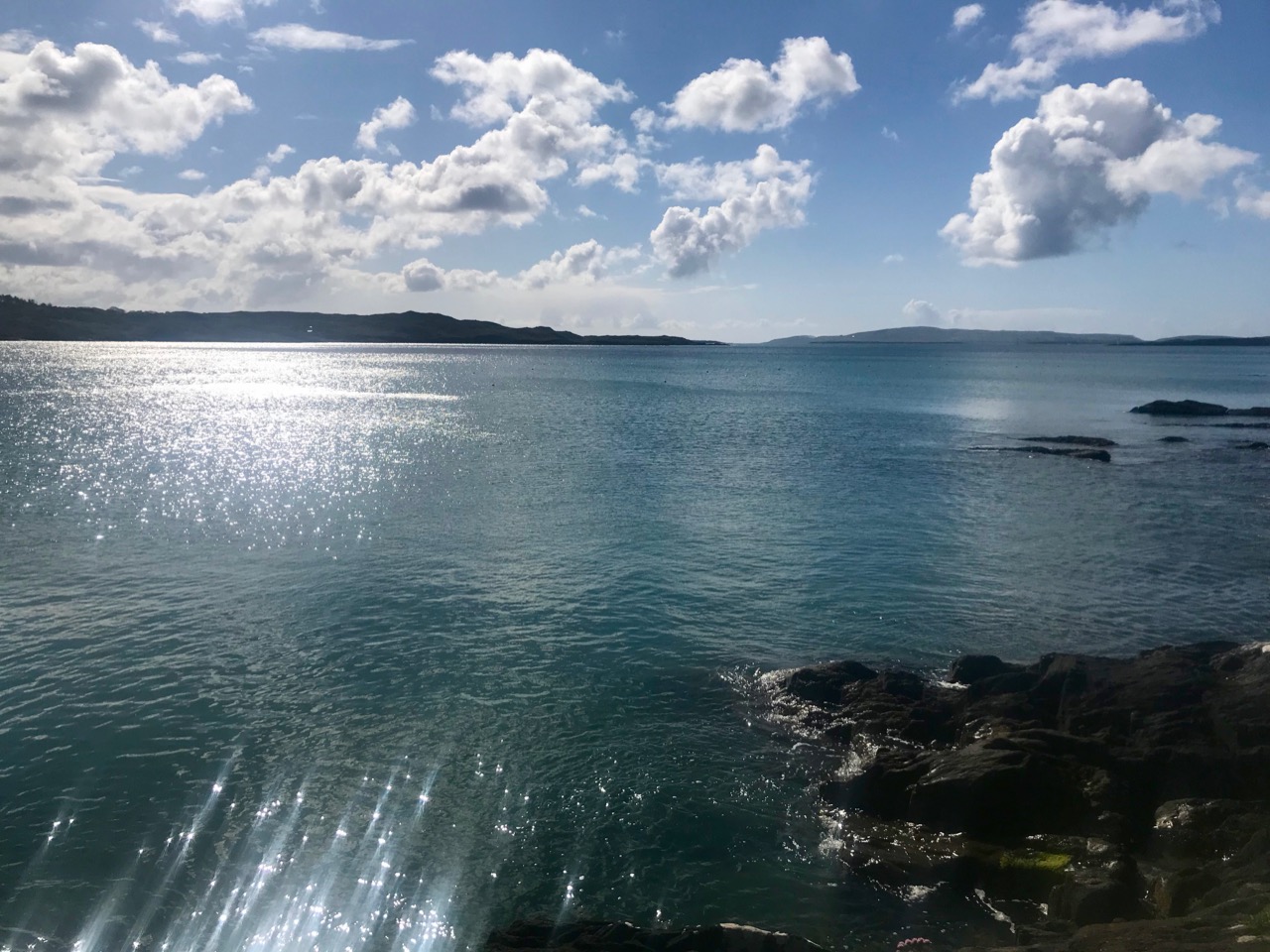
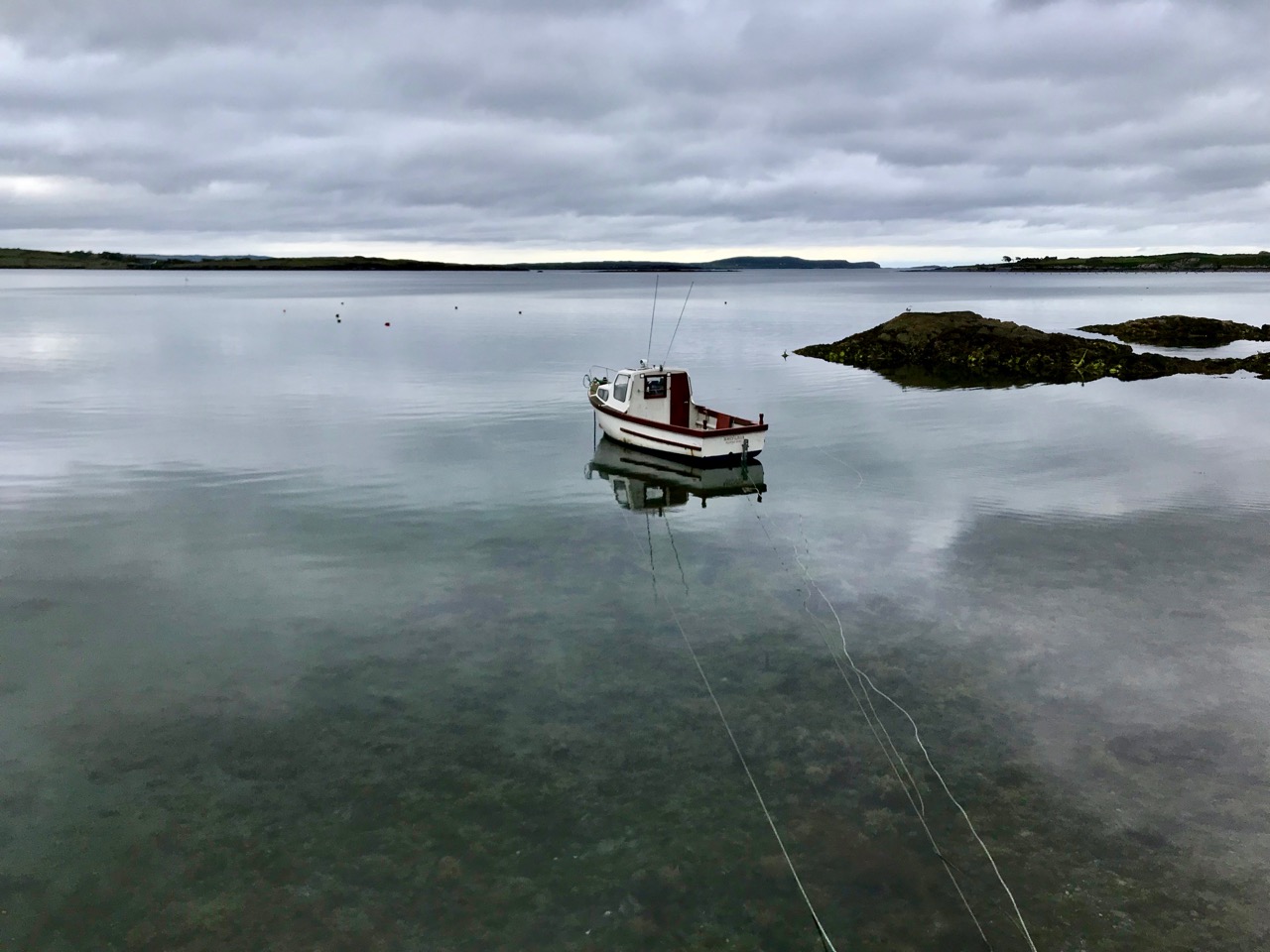
Waterscapes at Ballydehob, Schull and Dereenatra. Header: cloudscape over Cape Clear, Horse Island in the foreground

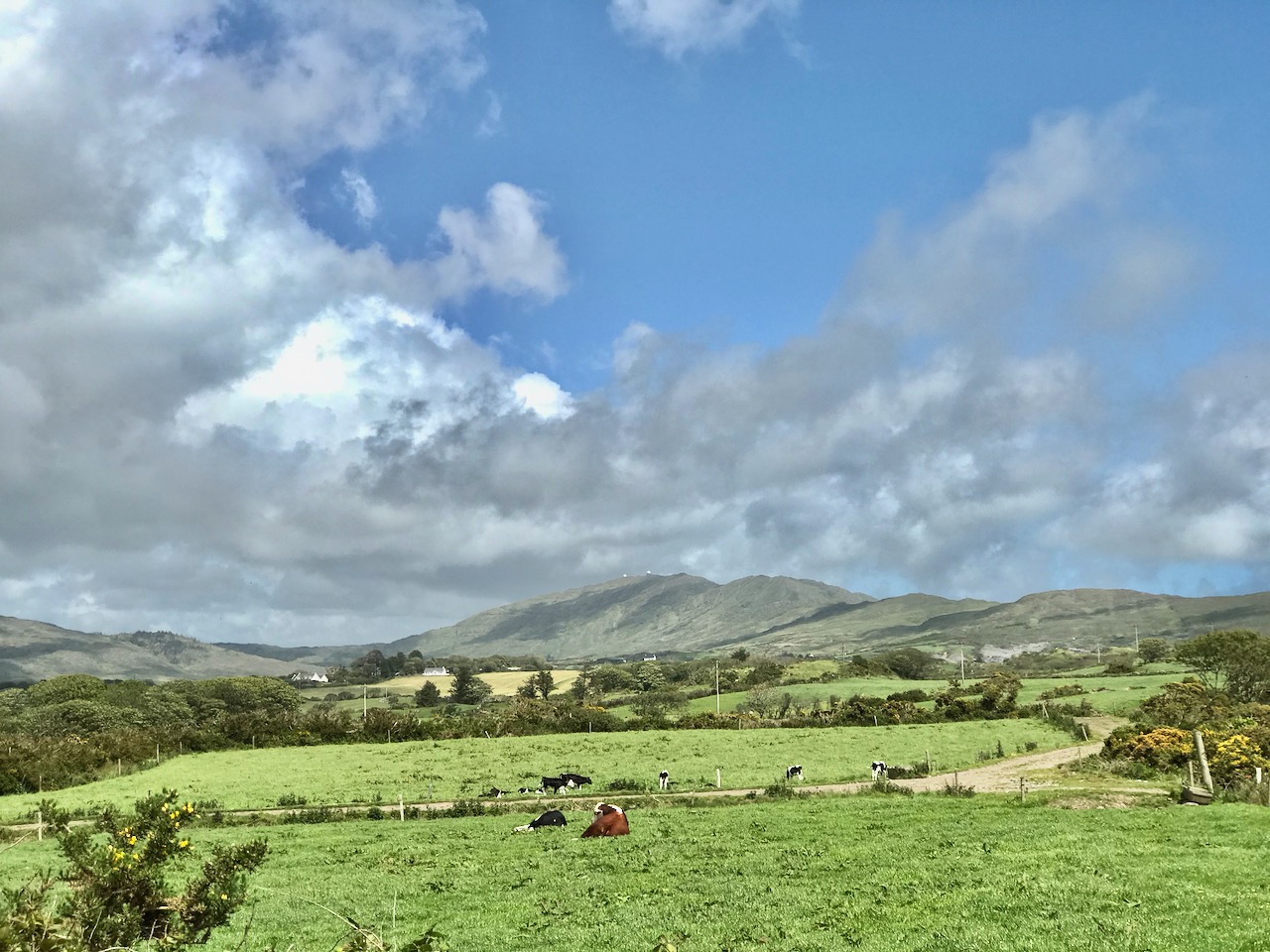
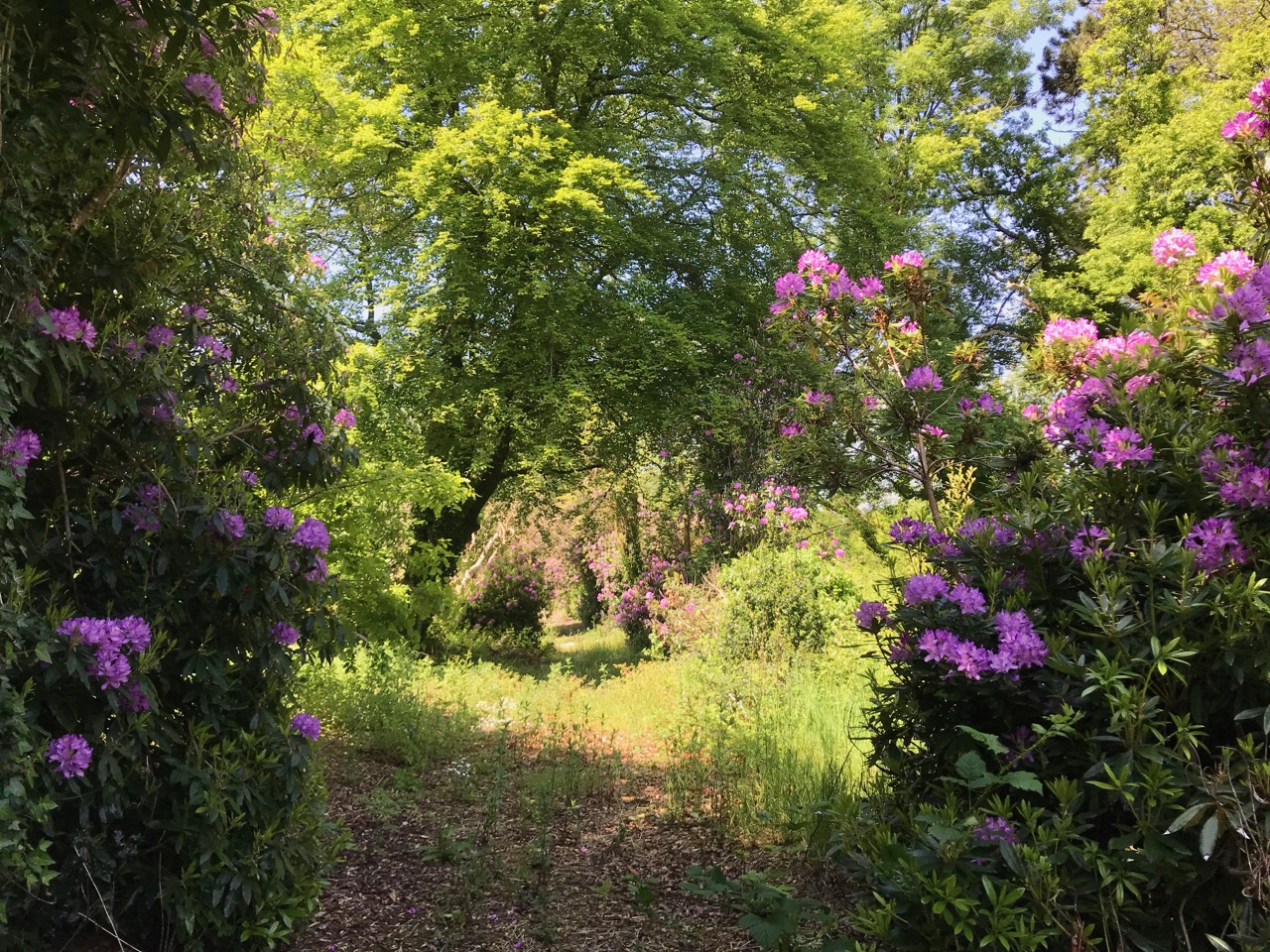
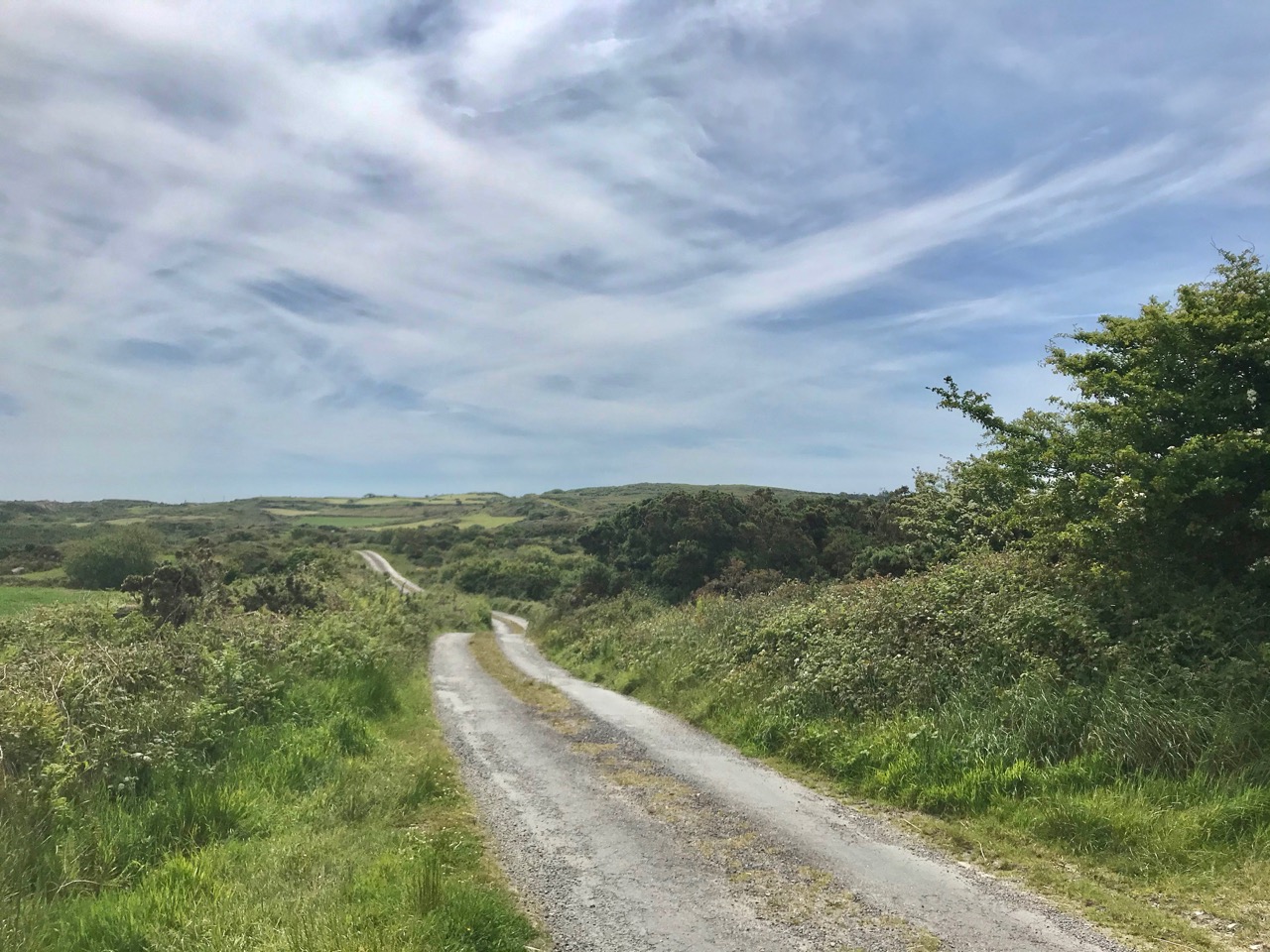
So, over the last couple of days I have wended my way around the boreens of Cappaghglass, Stouke and Ballydehob – armed only with my iPhone camera – to see what I can record to intrigue and delight you. I have looked, particularly, for the quality of light that the currently ubiquitous sun is casting on to our green fields and hedgerows, our evanescent skyscapes, and the waters of the bays that surround us. In Cornwall – where I spent many years – it was the quality of light that was all important to the artists who came to the little fishing communities of Newlyn and St Ives from the late nineteenth century, and even into the present day. They were searching for something which was and is missing in towns and cities: clear, unpolluted air, constantly infused with tiny droplets of water arising from the sea which surround that western peninsula. We have the same quality on our own Mizen Peninsula: it’s that moisture laden air which captures and refracts the light, enhancing clarity and colour – and our own artists always did and always will respond to that.

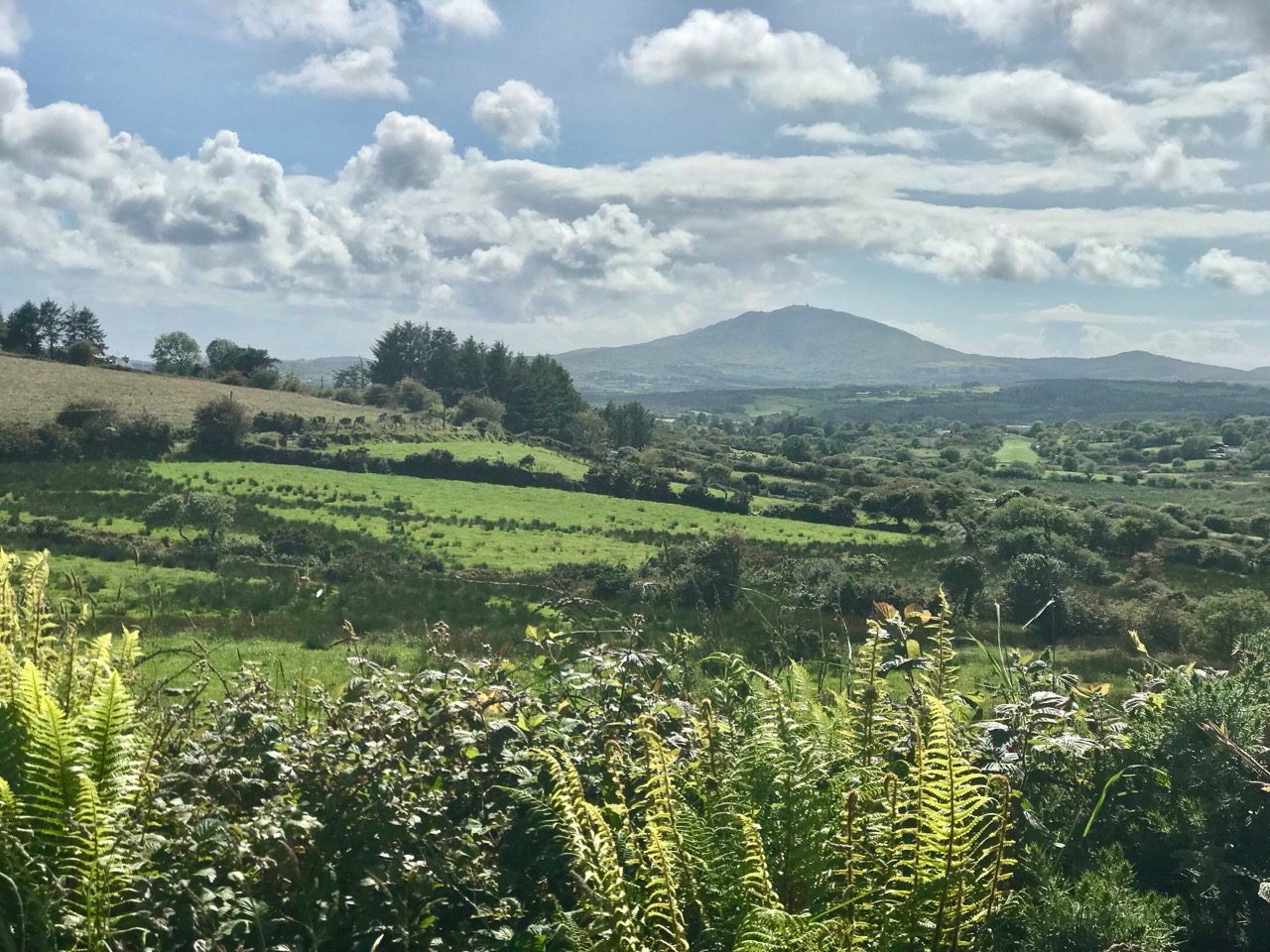
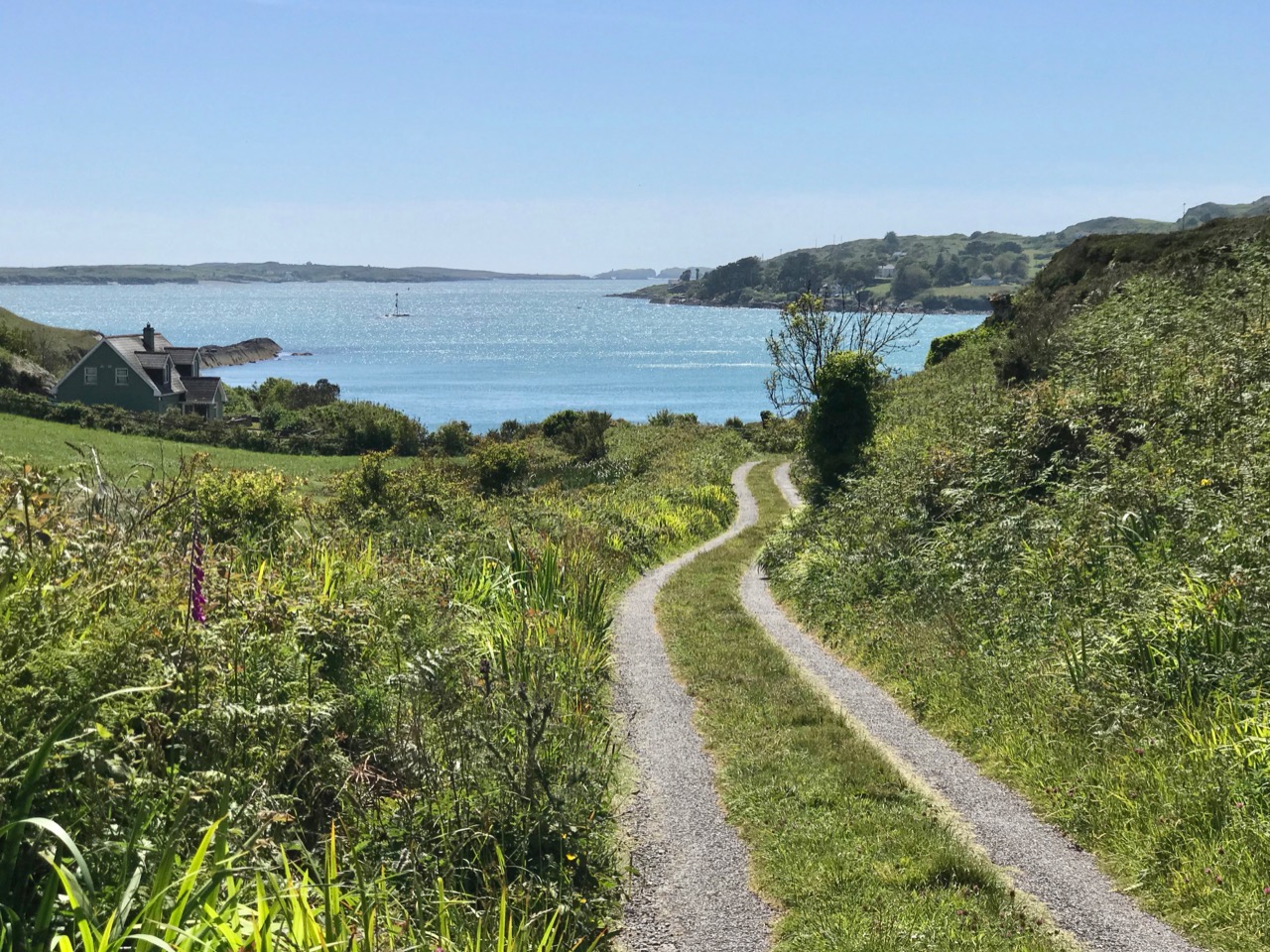
We sometimes drive further afield in West Cork, so that we can take our exercise with a change of scene. But all of the photographs here are relatively close to home. The clarity of the light is apparent: the detail of the distant hillsides is picked out even by the phone camera. The colours – all those greens and the blues of skies and water are true to life.

Our favourite views are often dominated by the distinctive profile of Mount Gabriel in the distance. This is the highest point of land on the Mizen, and must have been an important waymark throughout history, central to the orientation of travellers through this area, and probably imbued with significance and ‘stories’. My favourite is the one that says the Archangel had heard of the inherent beauty in the Irish countryside (highly believable to me!) and ‘touched down’ on the top of the mountain, leaving his footprint on the rocks. Here’s a post I wrote about Mount Gabriel – and its associated stories – six years ago.

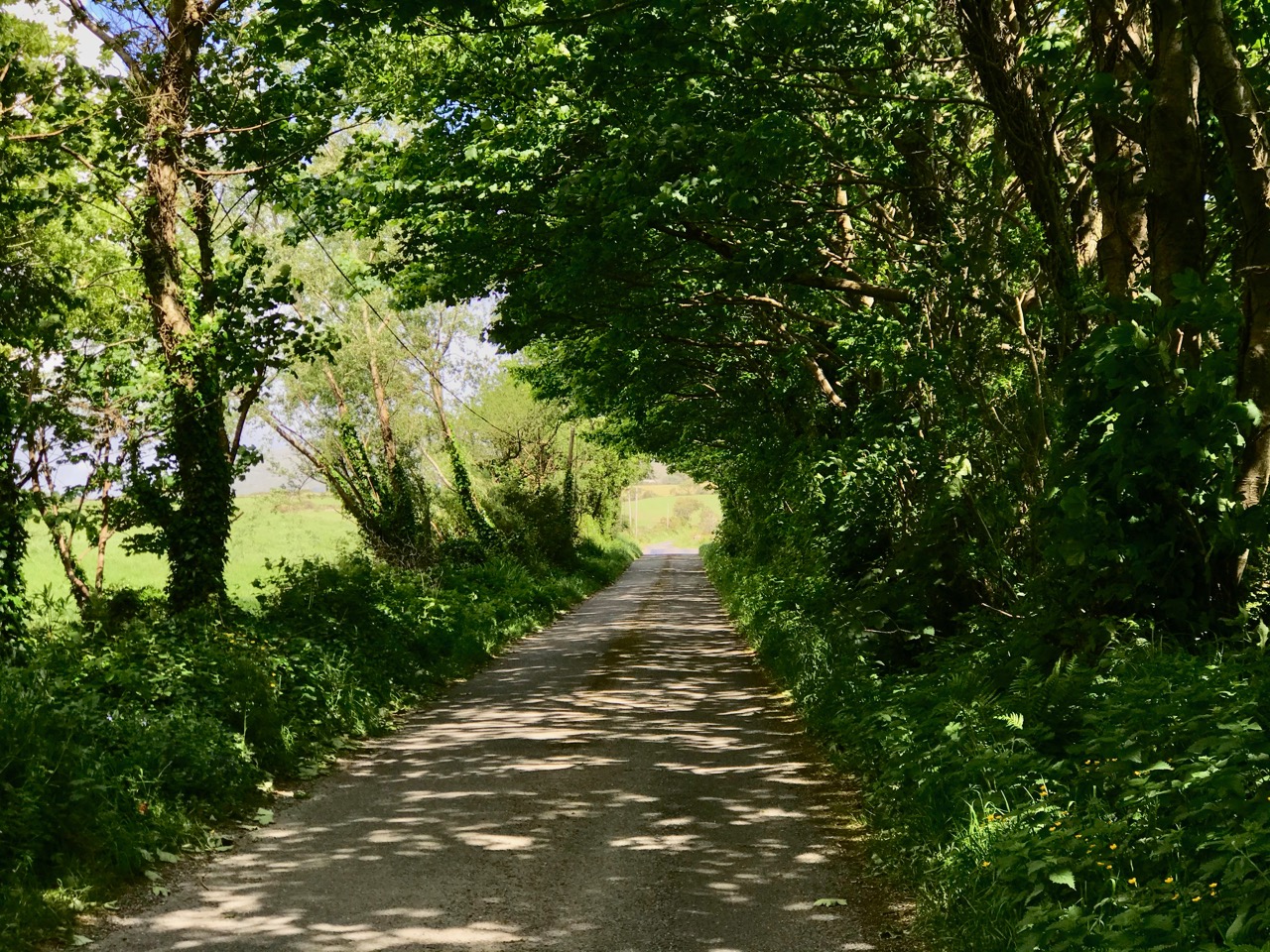
I don’t want to overdo the West Cork boreens (you can see lots more of them here), but I just can’t resist them! Perhaps it’s what they symbolise – our journey through life, pathways leading us on optimistically into our own futures? When we are exploring overgrown lanes, like the one in the middle picture above, there is a sense of excitement about what we might find through the trees or around the corner: in this case, we were led to an abandoned house. What mysteries are contained there: lives fully lived and now departed. The lower picture is the boreen that leads us home from Stouke to Nead an Iolair: always one of my favourites.

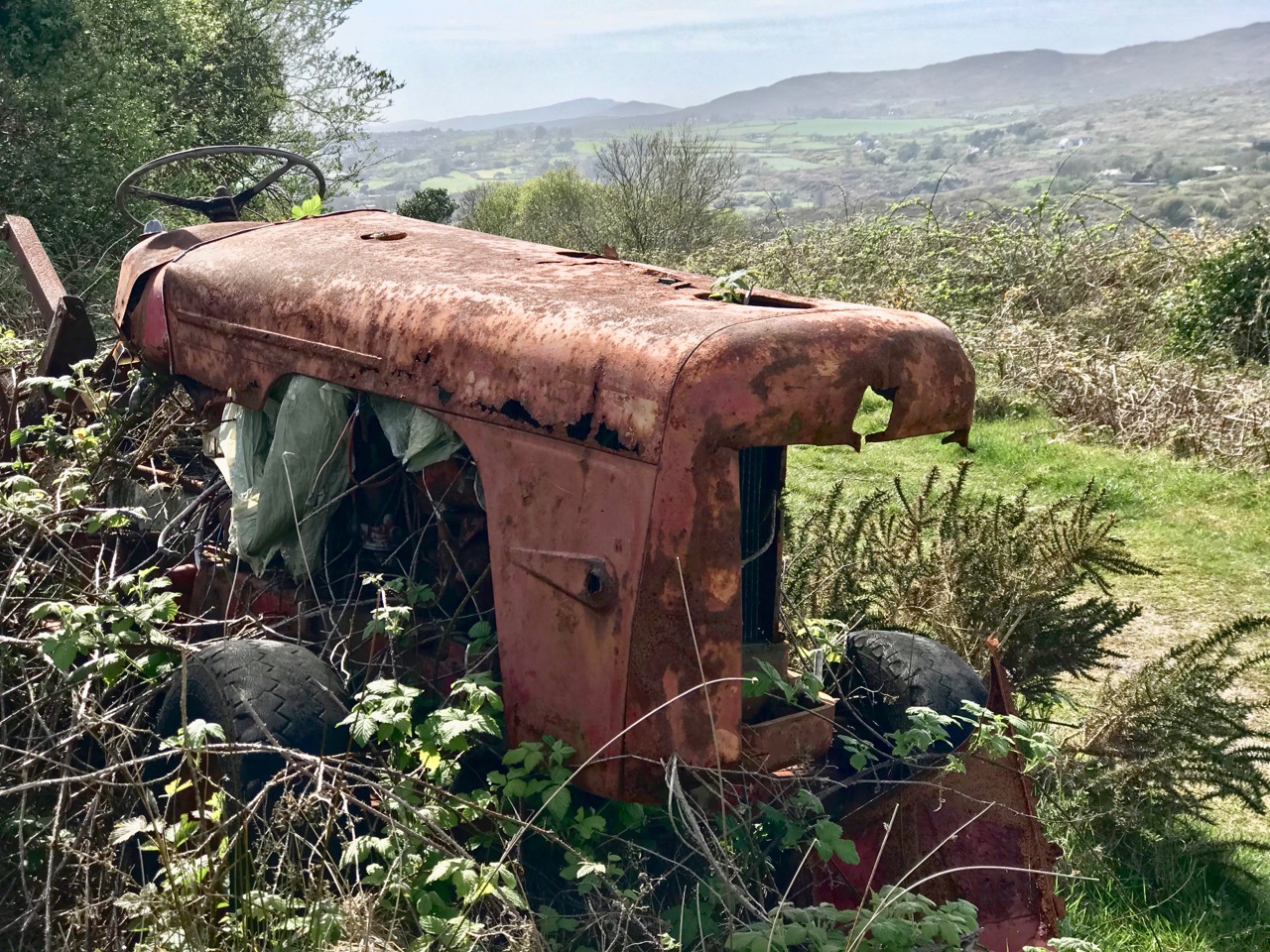
Upper – the colourful remains of an old tractor enhance (for me) the views from the Butter Road running out of Schull towards Ballydehob. Lower – this track is a highway leading down to the beach at Coosheen.

We look forward to the Covid19 restrictions being lifted, but it will be a while yet before travel constraints are removed. Even when they are, we will still appreciate what we have around us, and we won’t neglect the transcendent beauty of ‘our’ townlands and the sublime scenes that await us daily just a few steps from home.

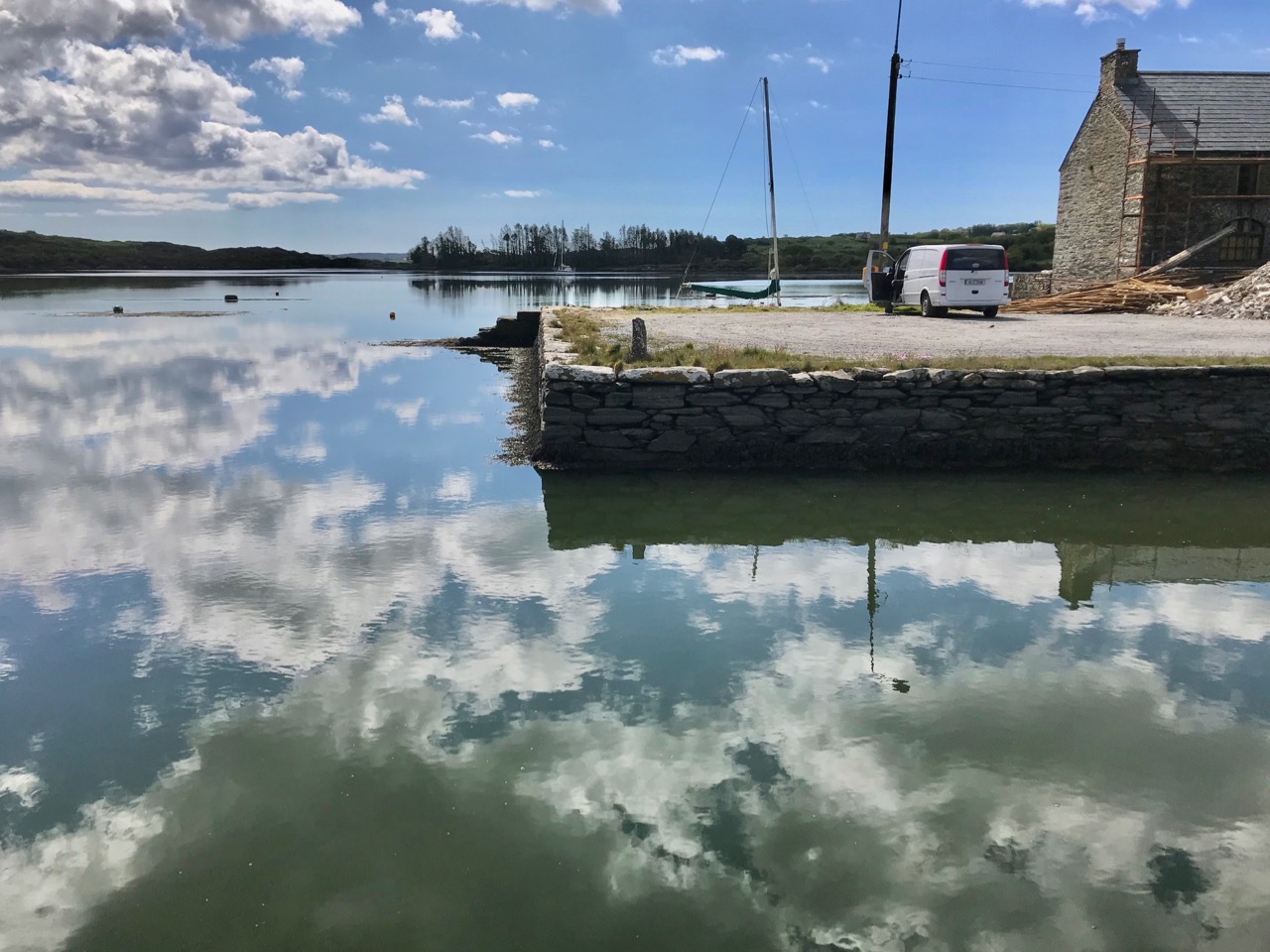
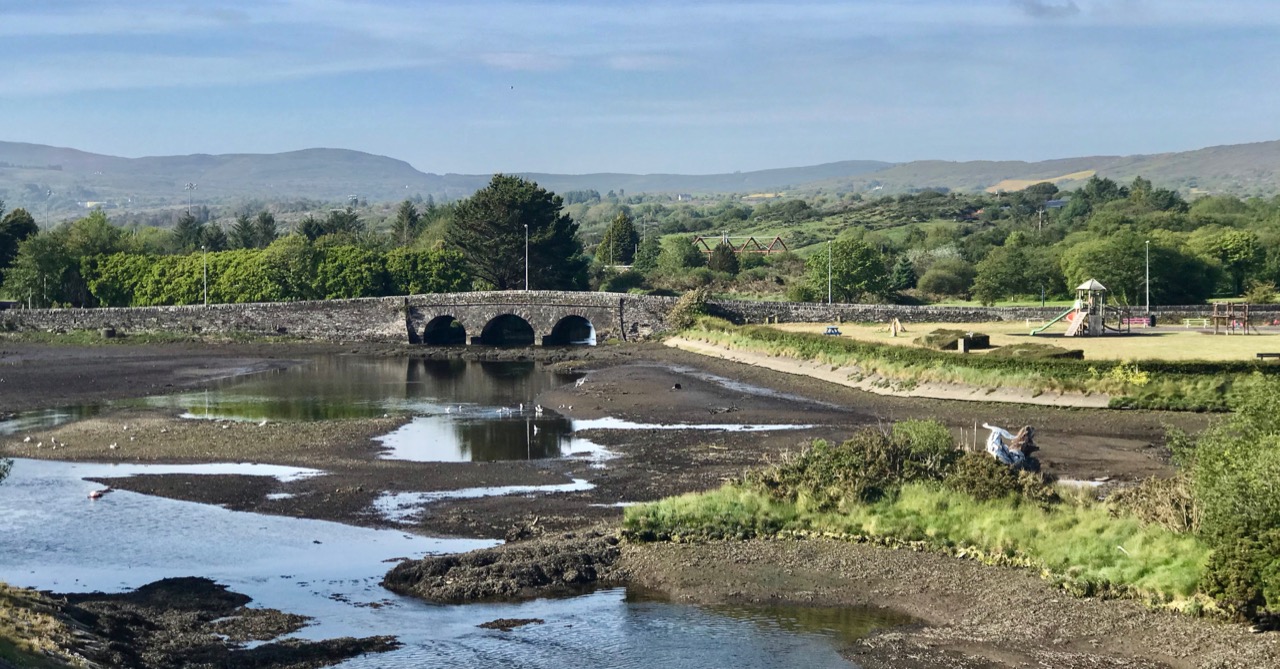
Back home: (upper) reflections by the once busy quay at Ballydehob with (lower) the road leading into Ballydehob passing over the three-arched bridge, overlooked by higher land to the north

If you want to read more about the artists in Cornwall who were influenced and inspired by the landscapes of that Celtic kingdom, read more here and here.

And for more about the West Cork artists’ community – there’s a website (and a museum) dedicated to their history here.