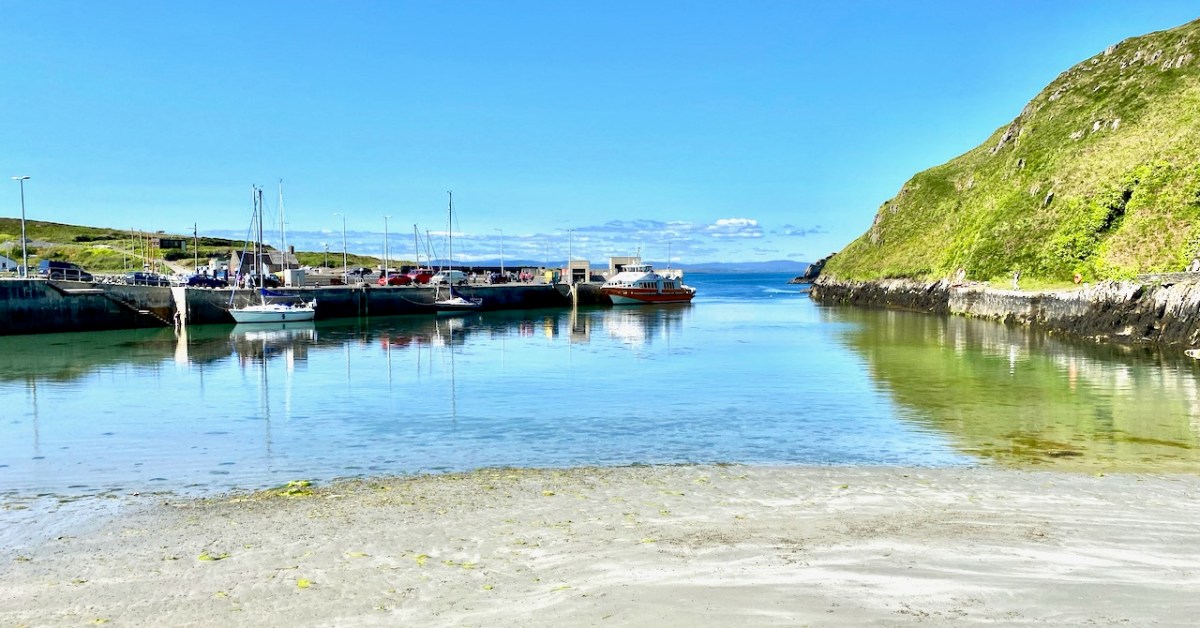
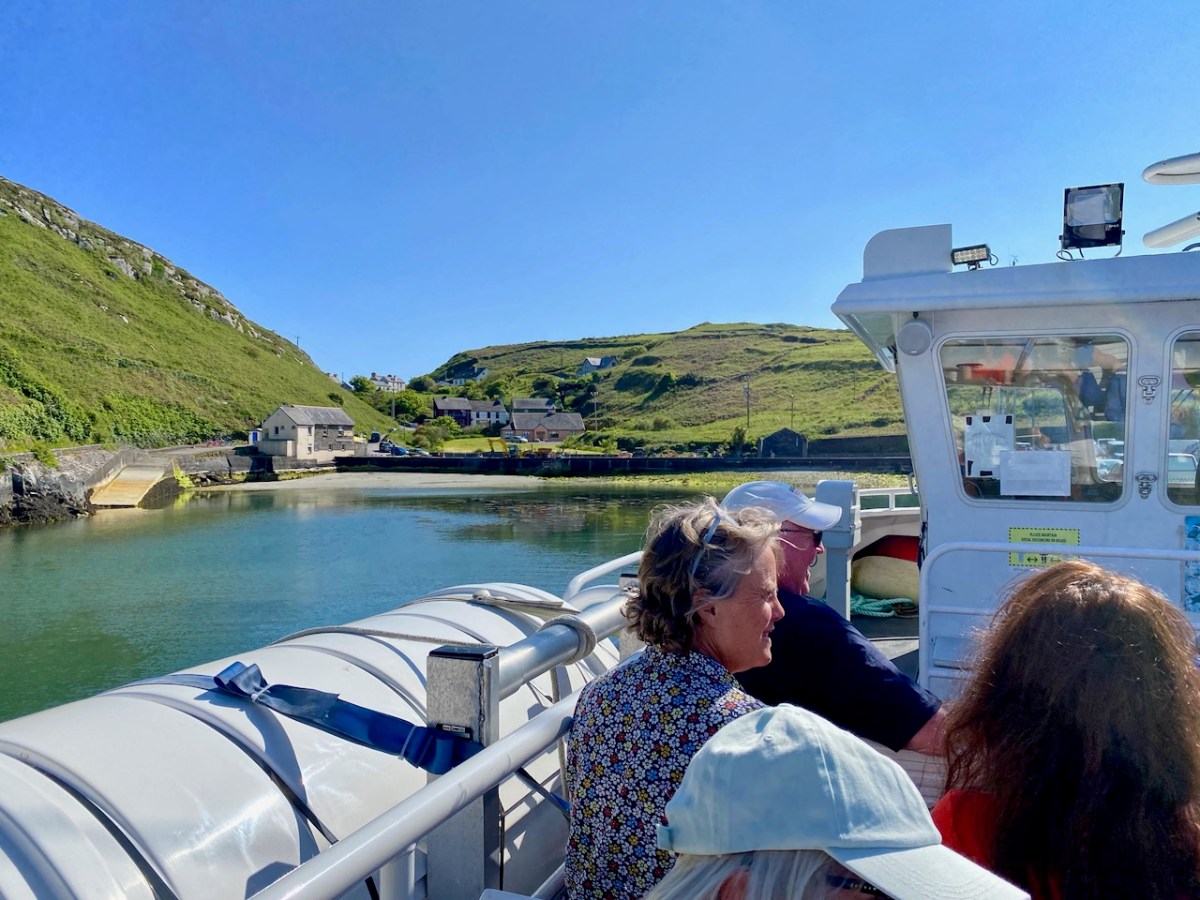
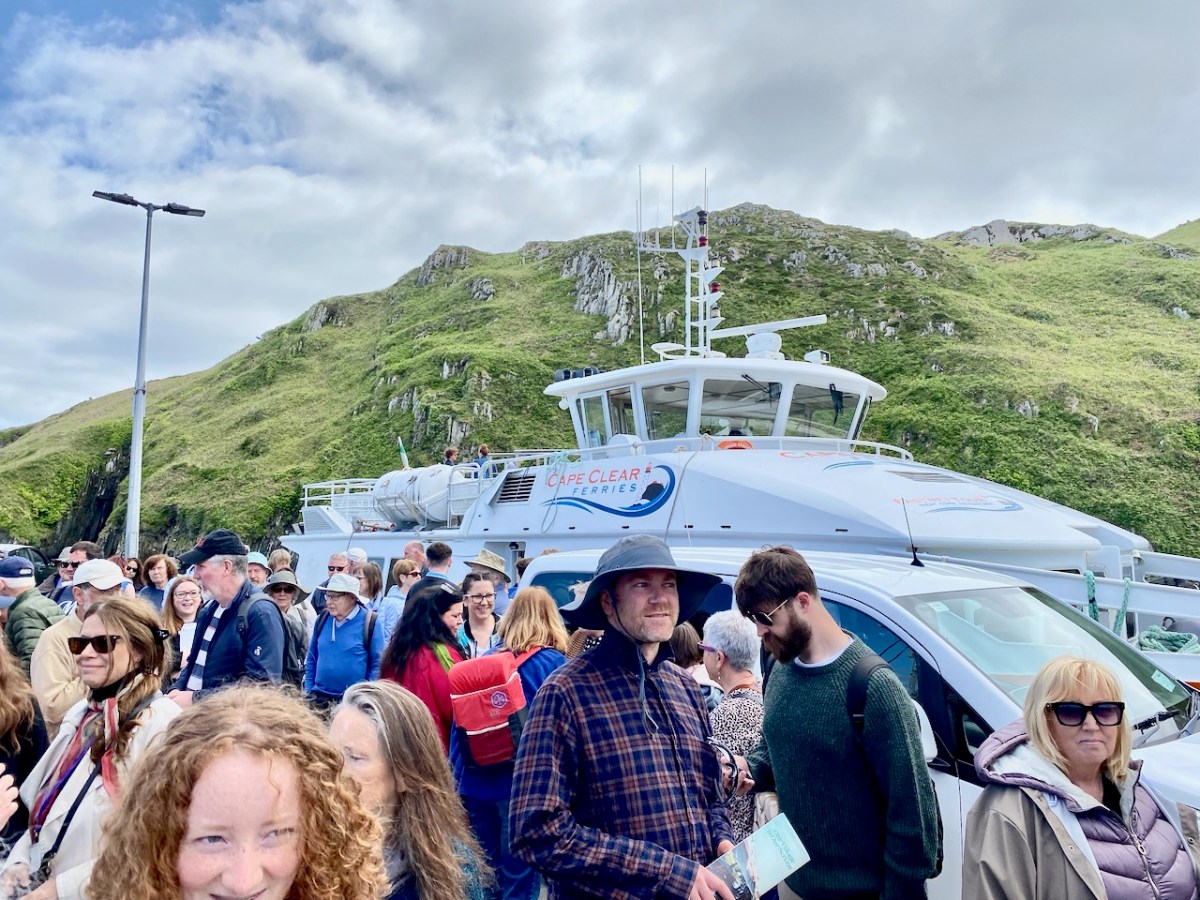
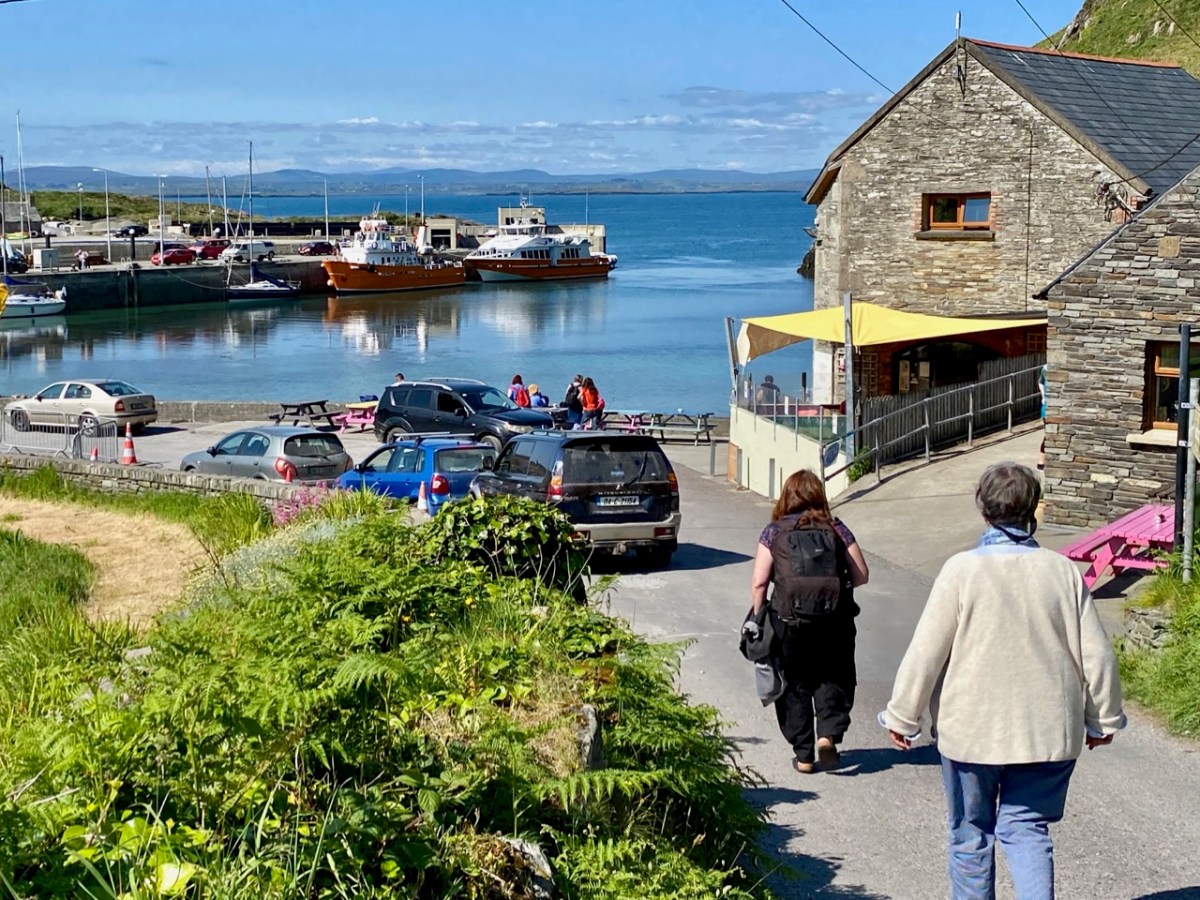
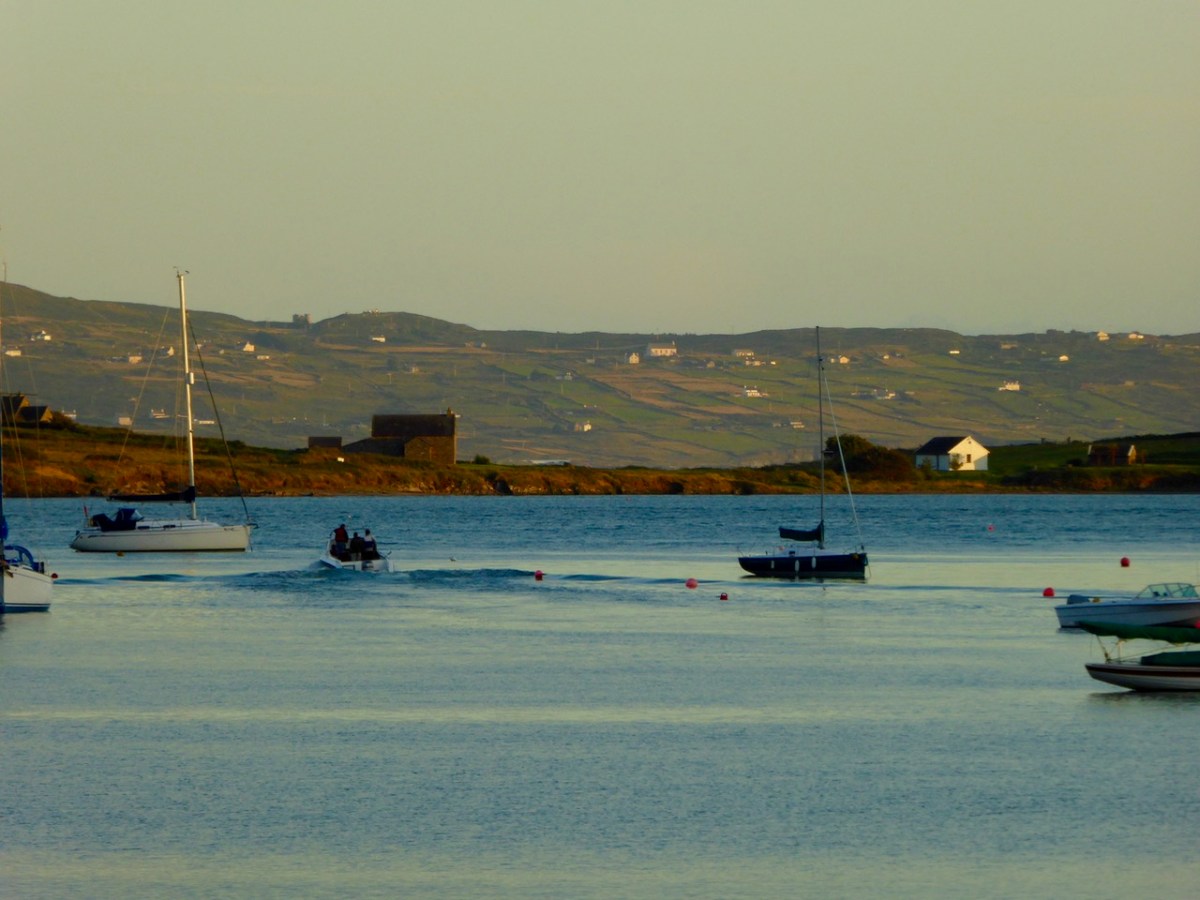
The island of Cape Clear is a constant in our daily view from Nead an Iolair. We don’t visit often enough… But this week the Fastnet Film Festival – based in Schull – had a day out on The Cape, and we went along for the excursion! That’s the harbour, above.
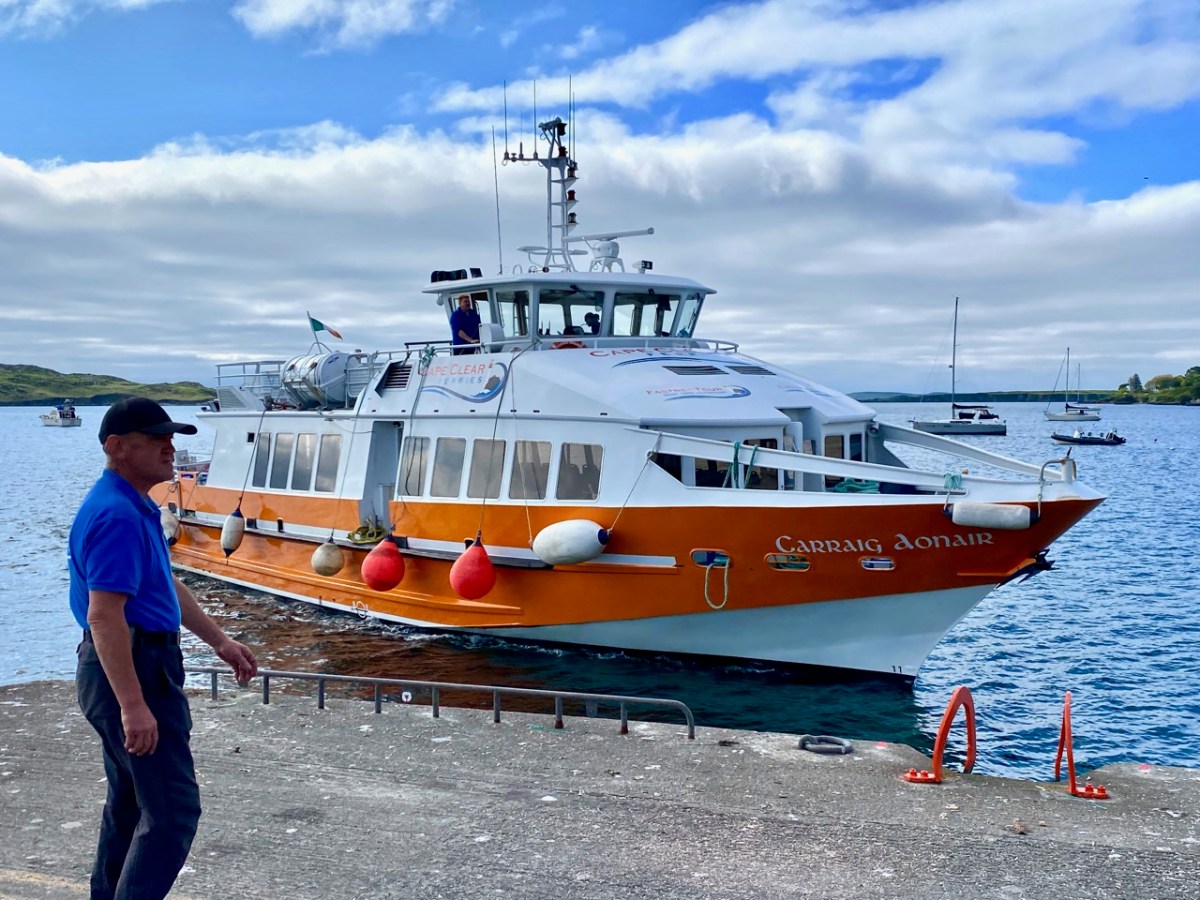
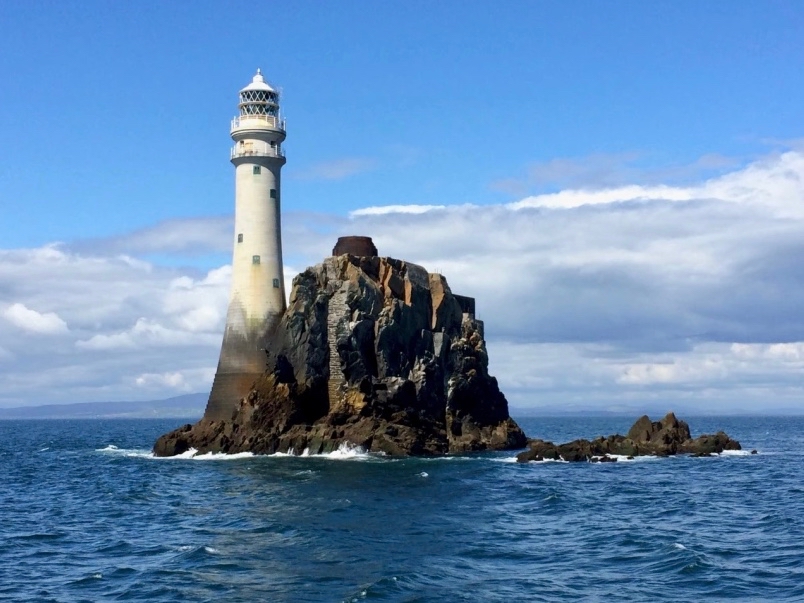
And this is Schull Harbour, where Cape Clear Ferries’ newest boat, Carraig Aonair, picked us up. The name is Irish for The Fastnet and means, literally, The Lone Rock. We have written about the lighthouse in previous posts.
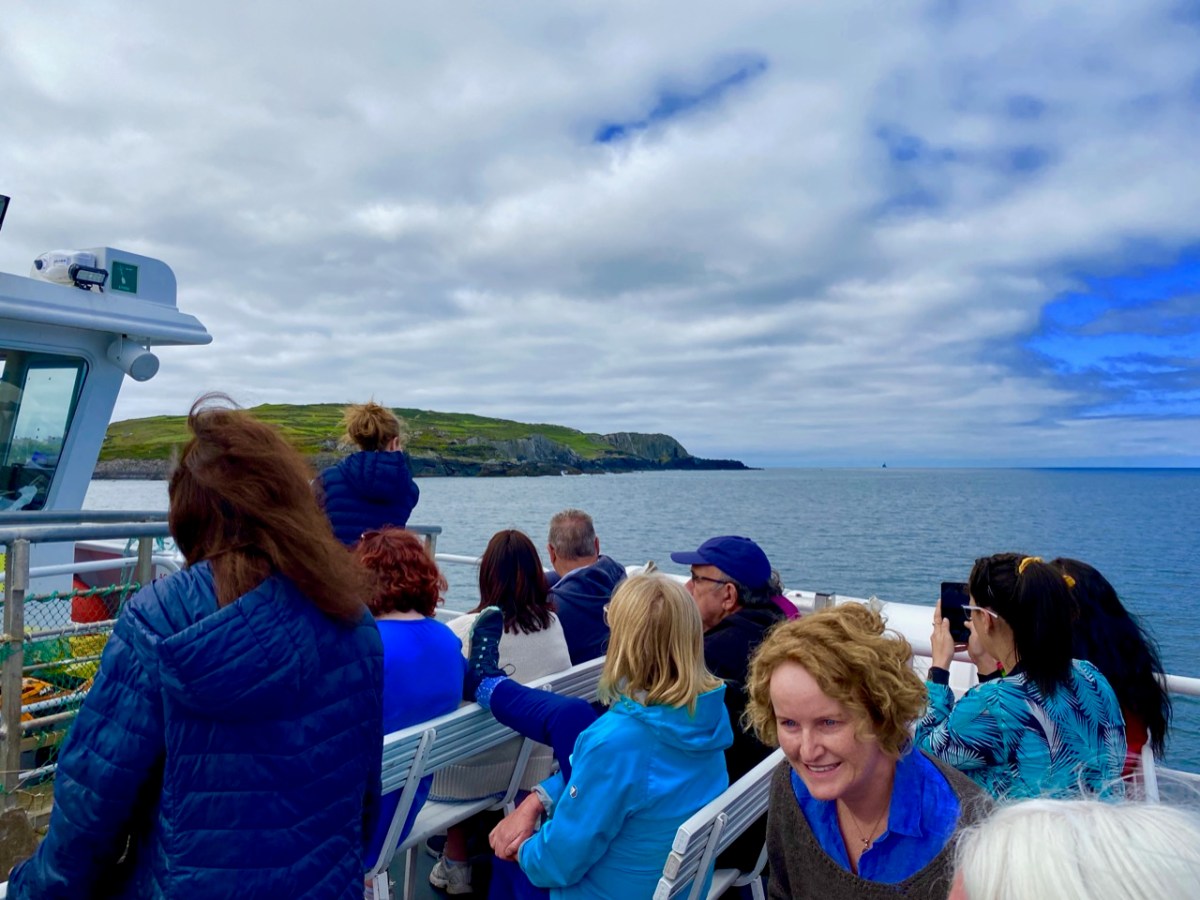
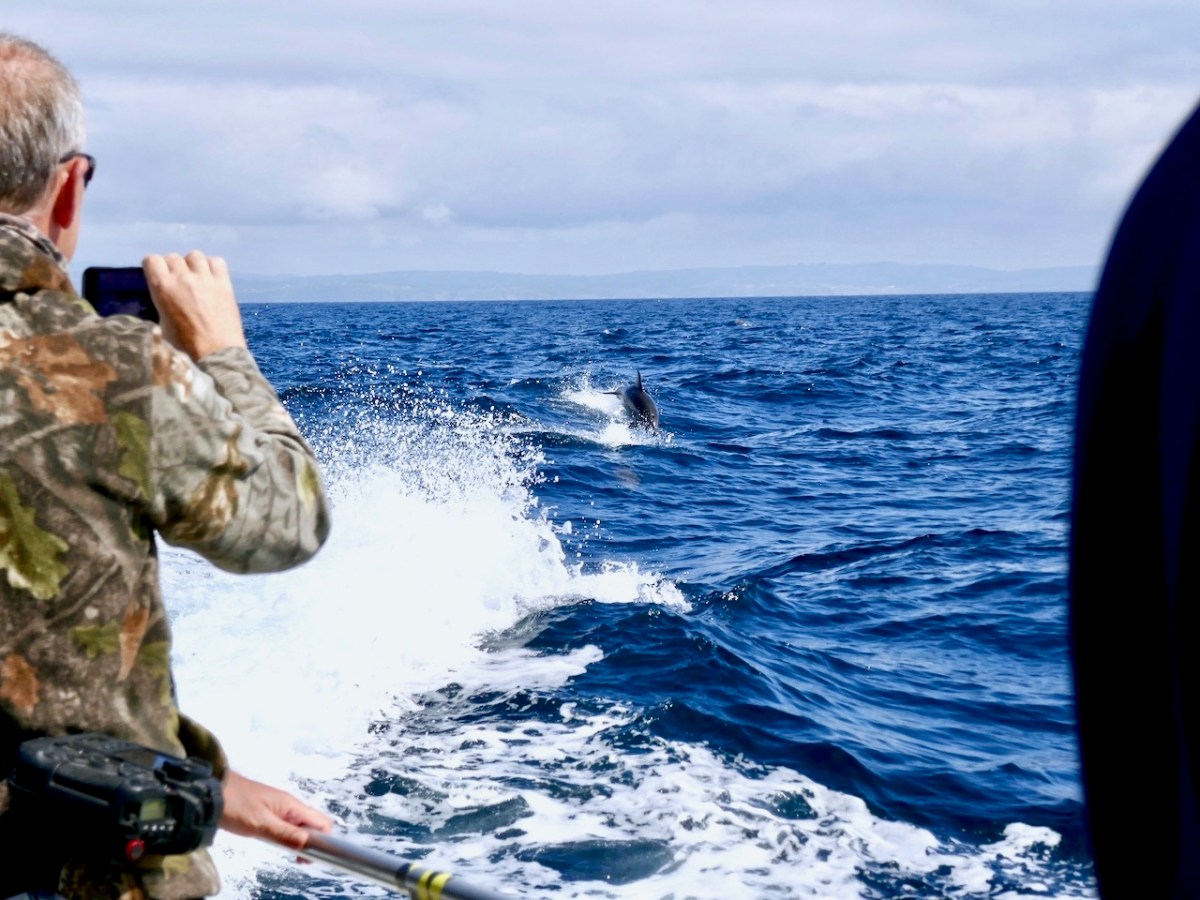
The dot on the horizon, seen here (above) from our ferry to Cape Clear, is the Fastnet Lighthouse. The crossing from Schull takes only half an hour and we were fortunate to have good weather and calm waters. The crowd on board was delighted by a diversion on the way – a pod of dolphins kept the boat company for a while.
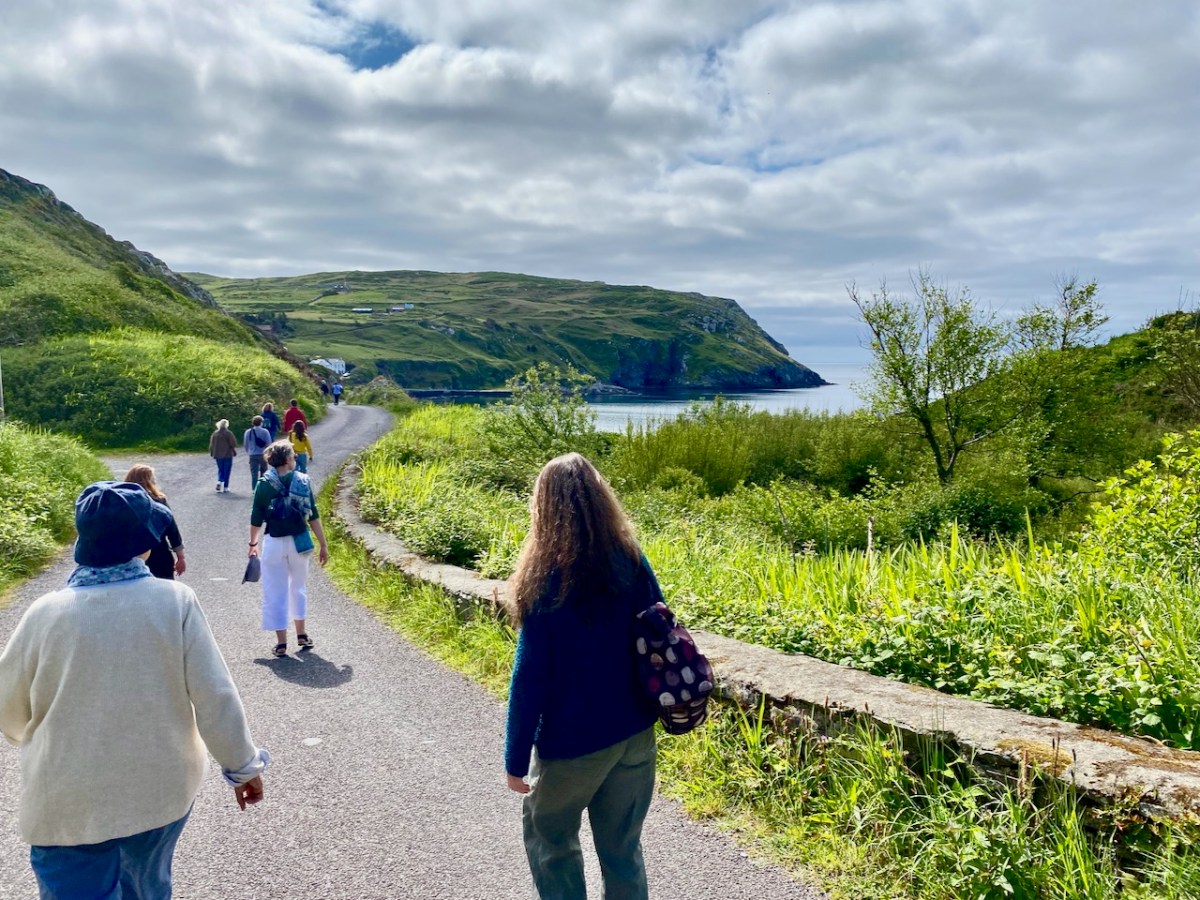
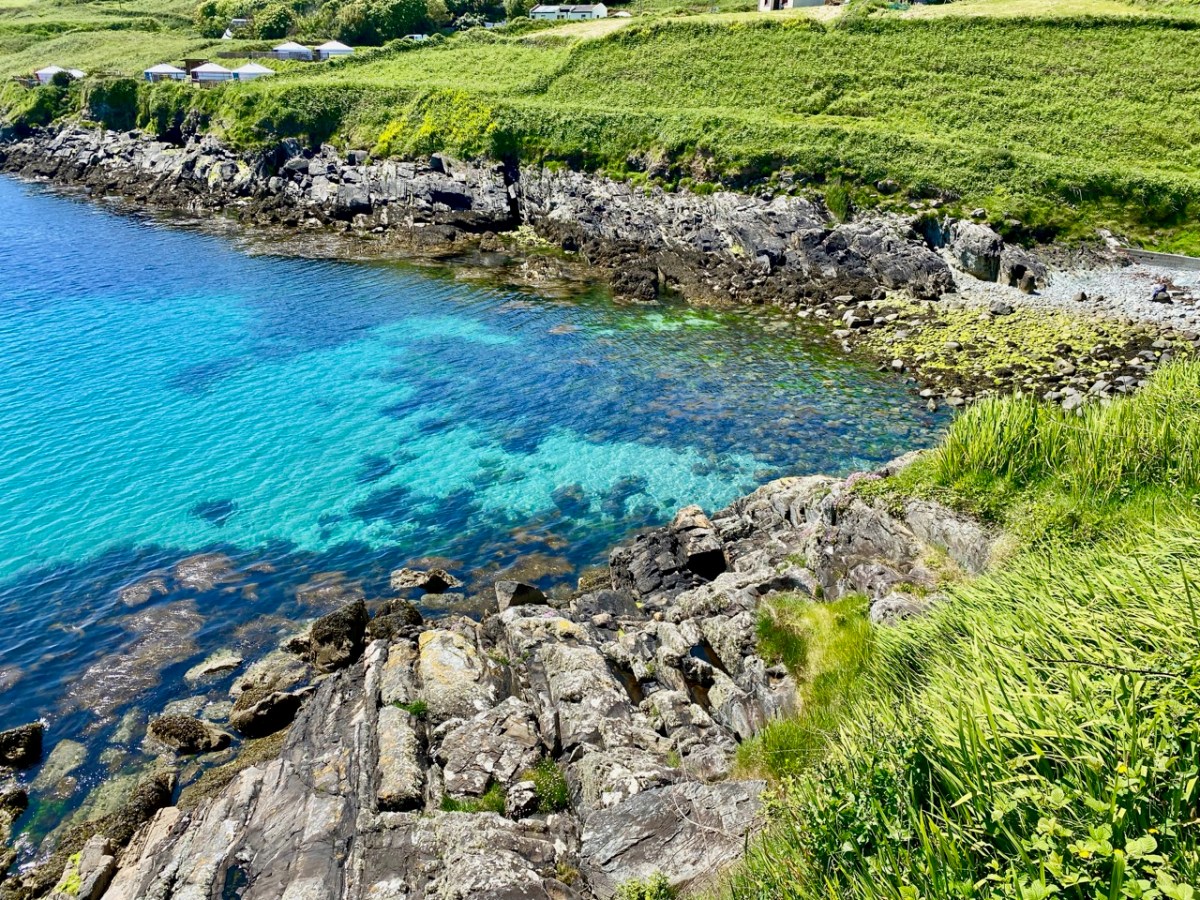
Arriving in the North Harbour we were looking forward to our Teanga na Gaeilge ar Oileán Chléire: an Irish Language Day on Cape Clear. First, we had a long hill to climb to reach an Halla Mór: a whole team of islanders were on hand to provide lifts in cars and buses. Some of us chose to do it the hard and steep way, but were rewarded by stunning views and azure water.
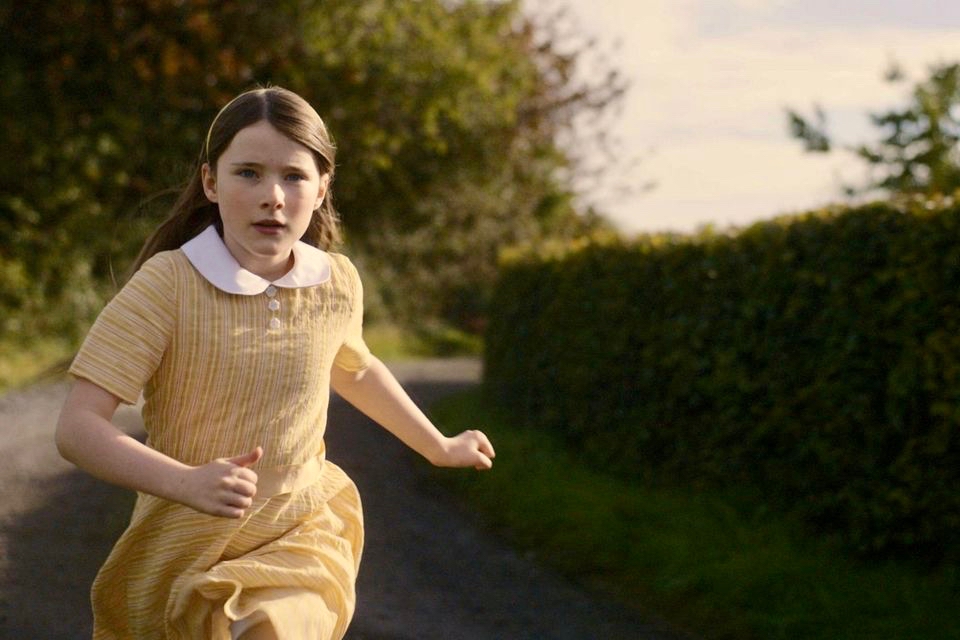
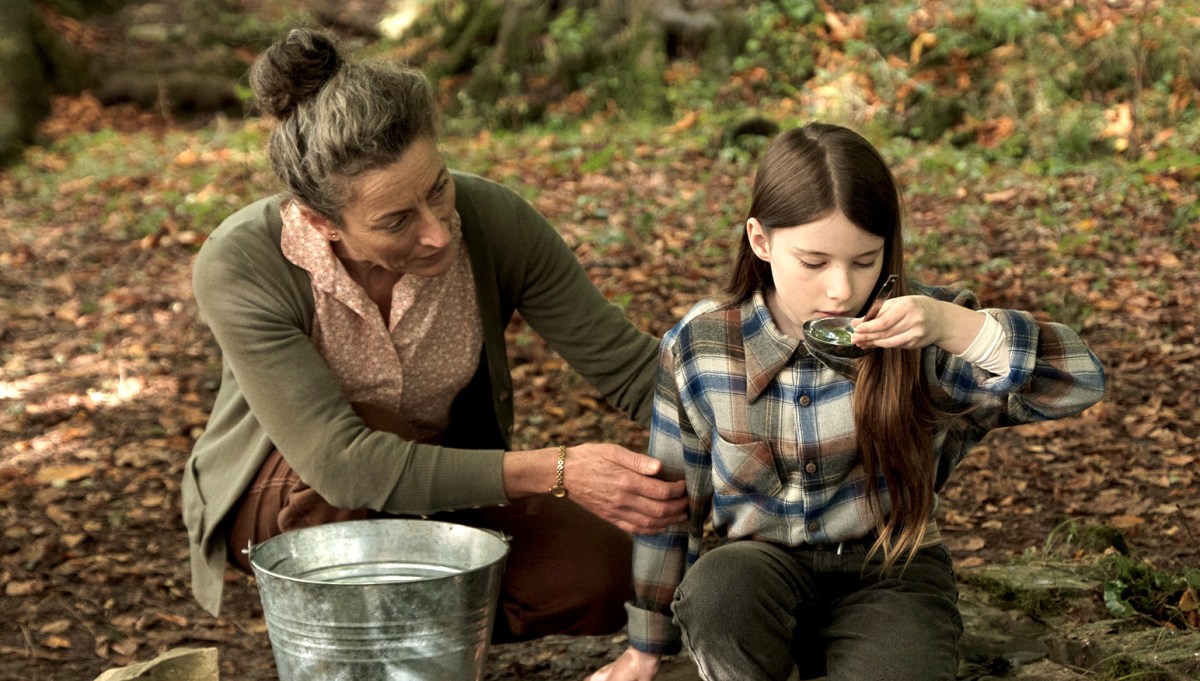
Our first film treat was An Cailín Ciúin – The Quiet Girl.
. . . Nominated for this year’s 95th Academy Awards in the ‘International Feature Film’ category of the Oscars, Colm Bairéad’s debut feature became one of the most lauded Irish films of recent years. Adapted from Foster, a short story by Claire Keegan, it centres on nine-year-old Cáit, a shy and withdrawn child who receives little affection from a family ruled by an uncaring patriarch. When she is sent to spend the summer with her aunt Eibhlín (Carrie Crowley) and her husband Seán (Andrew Bennet), she blossoms in their care. At the end of the summer, difficult decisions must be faced . . .
2023 Fastnet Film Festival Programme
Catherine Clinch is ‘The Quiet Girl’ in the film (above). Born in 2009, this is her debut role. Happily, she joined us for our day on the island. I was affected by the story in the film, as were many others in the audience. In fact, I don’t think I have been as moved by something on screen since I was taken to see Bambi at the age of five. Although not topping the Oscars ‘Best International Feature Film’ category (this went to All Quiet on the Western Front) it has rightly gained many other accolades. I think the most apt review I read said simply:
” . . . As beautiful as it is devastating . . .” (Boston Globe).
Carrie Crowley also deserves mention for her sensitive role as the aunt of The Quiet Girl. Crowley and Clinch – below.
This Irish language film was undoubtedly the highlight of the day, but there were plenty more moments, including short film viewings, coffee and good lunches, on Cape Clear. With some long-awaited summer weather to help us enjoy the island.
We had to be sure to arrive back at the harbour before the boat left at five. The alternative would be to sleep out under the stars – tempting! For very many reasons, this was a most memorable day.
Who was Gabriel Beranger and why was his work so important? And why have I added a question mark? All will be revealed.
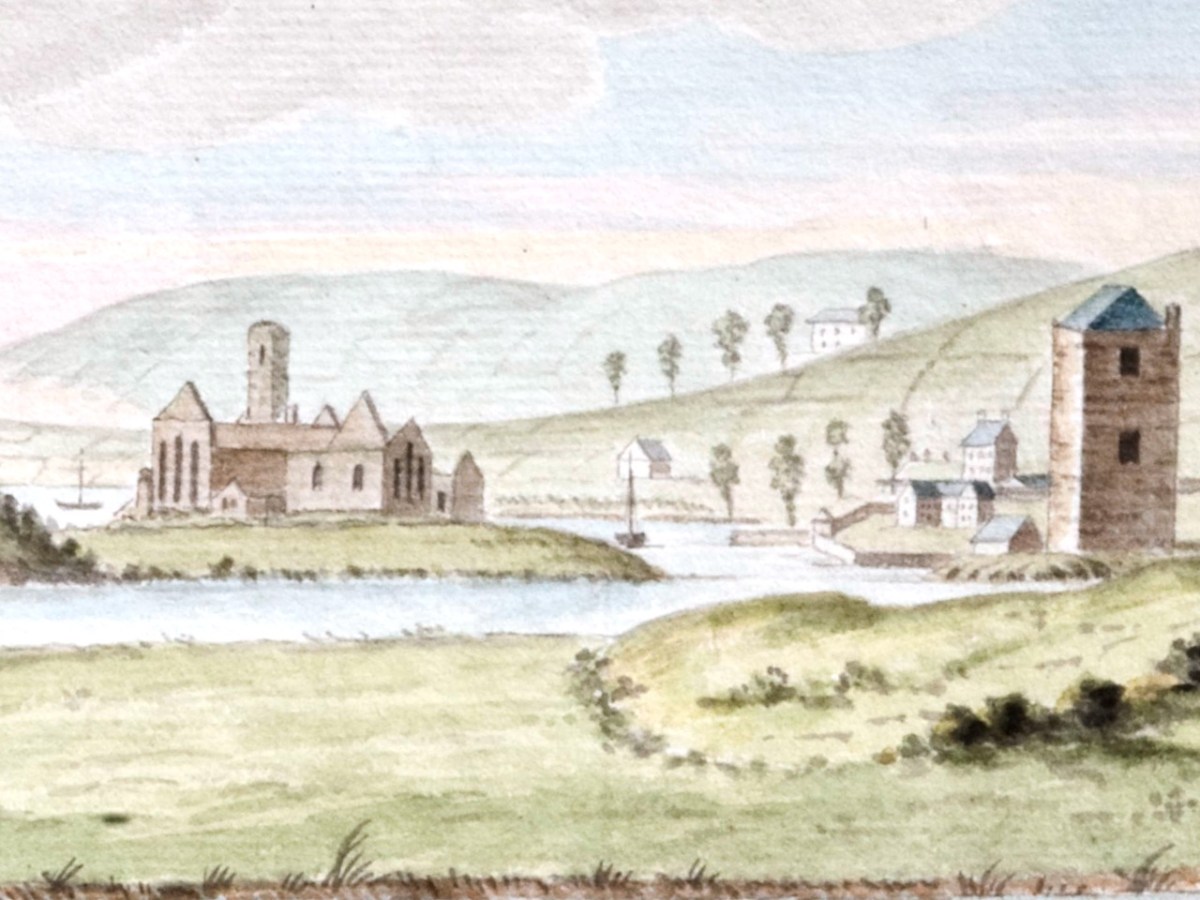
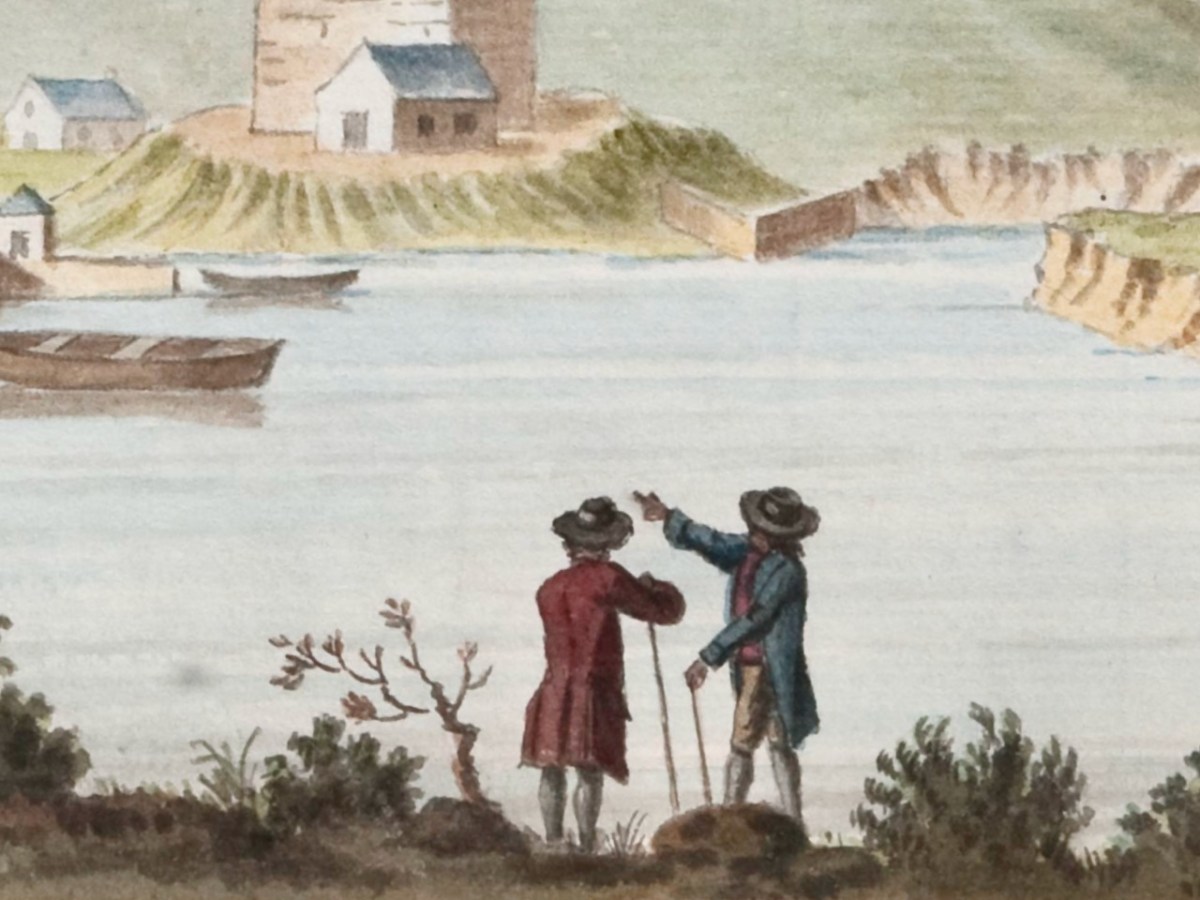
Timoleague Castle, abbey and town, co[unty] of Cork (RIA MS 3 C 30/68)
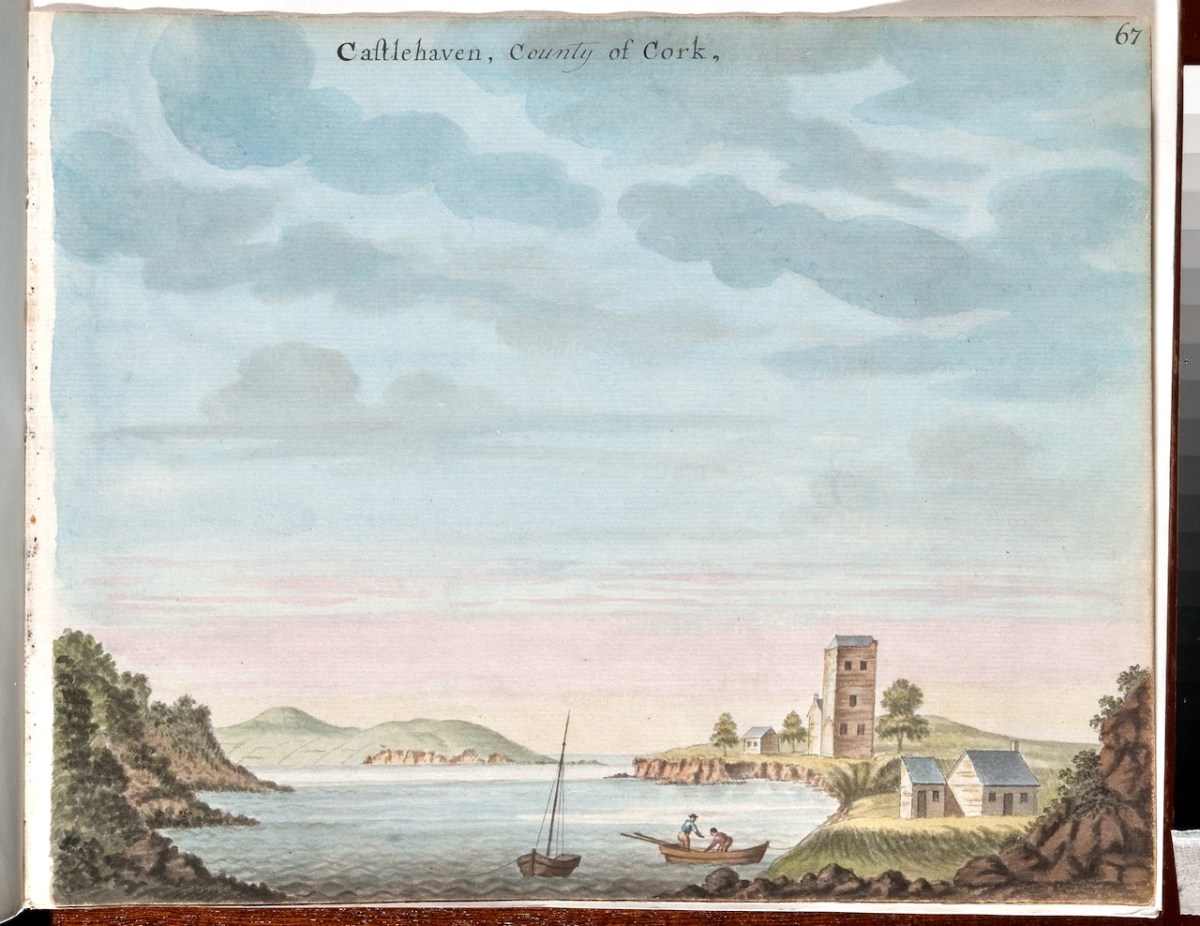
While we have several Beranger watercolours of Cork subjects, only two, Timoleague (above) and Castlehaven, are from West Cork*. They are the earliest painted depictions of each place, and as such represent incredibly significant records. Each one dates between 1770 and 1799. The description of the watercolour above says: A scenic view of Timoleague Castle, abbey, surrounding town and river [Argideen] Co. Cork. Two men, hauling a boat along the bay are depicted in the foreground of drawing.
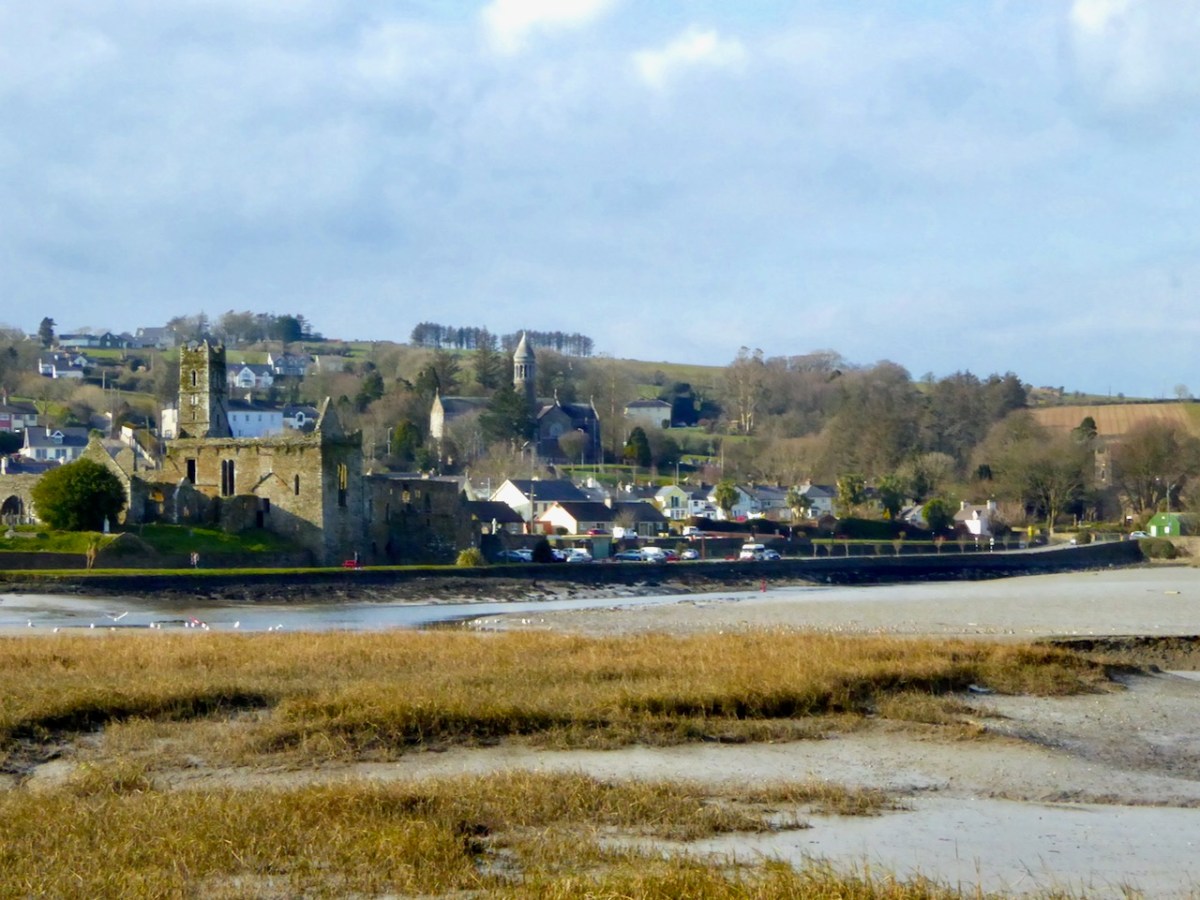
The Abbey (actually a Franciscan Friary) is easily recognisable, but the castle is nowadays hidden behind other buildings. There is no real sign of a ‘town.’
Here’s what it looks like nowadays.
There’s a second drawing of Timoleague, this time done from a different perspective and focussing on the Castle, which is surrounded by an extensive bawn wall.
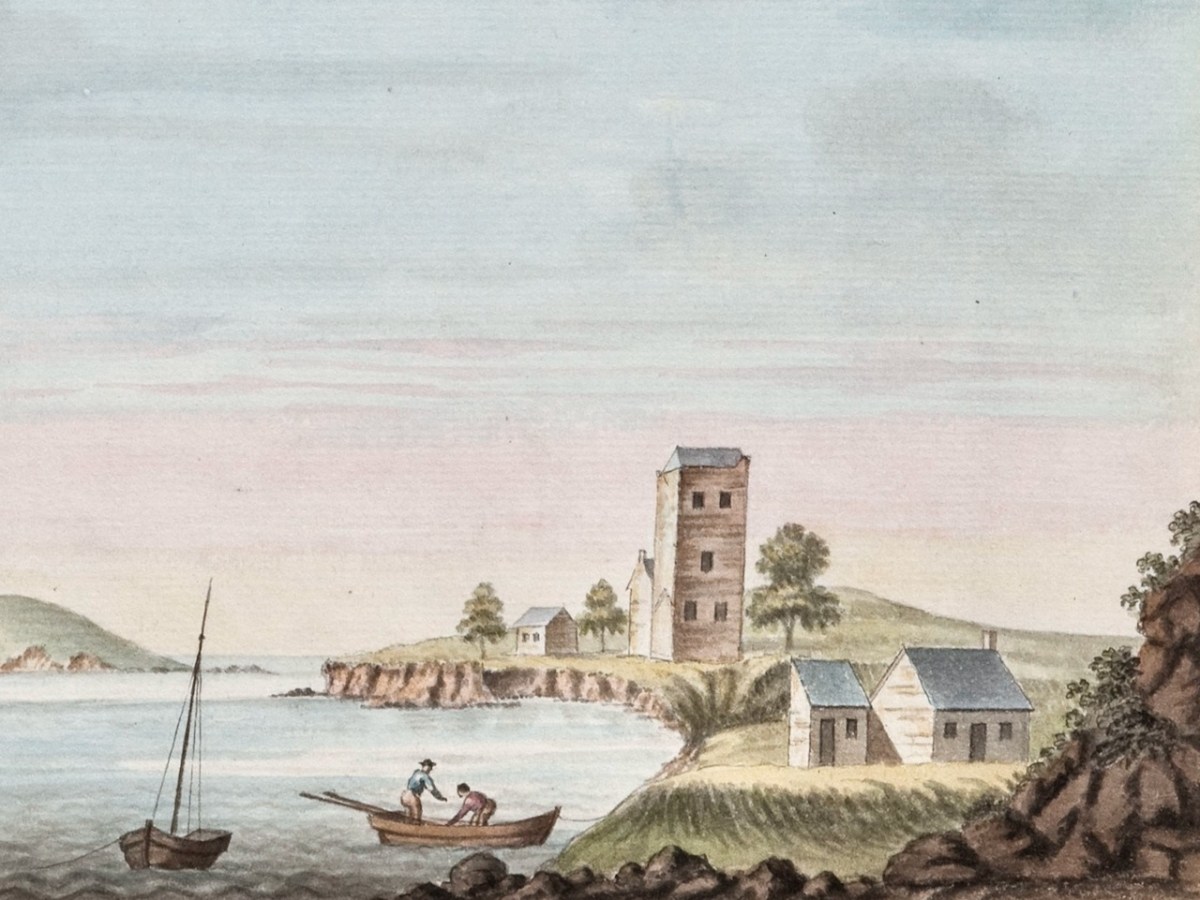
Now on to the watercolour of Castlehaven. It’s beautiful, I think. Importantly, it shows the tower house as complete, whereas it is nowadays only a stub, covered in ivy and brambles.
The church in Castlehaven graveyard is shown as a house rather than a church. The small addition to the left end of it may have been, according to Conor O’Buachaille of Gormú, a guardhouse, a feature of graveyards from the grave-robbing era.
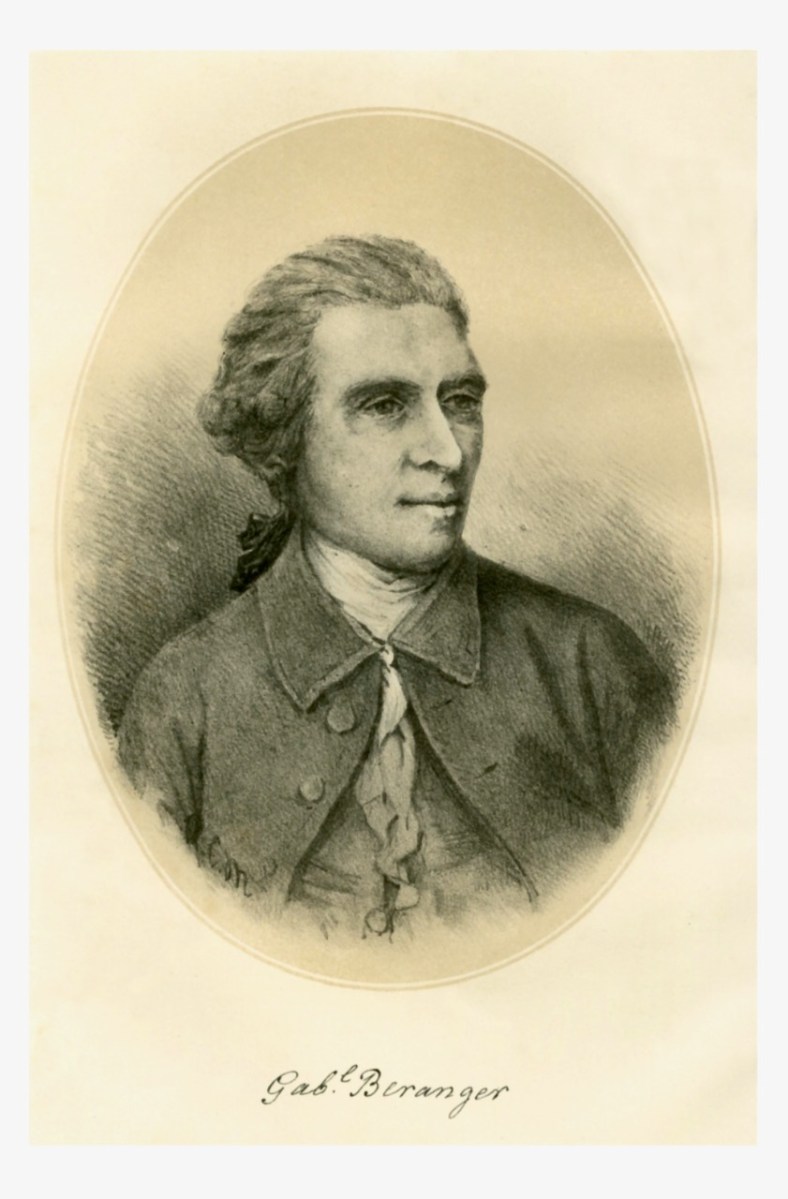
Gabriel Beranger , born in around 1729, was from a Dutch Huguenot background, but settled in Ireland in his early 20s. He was a printer and watercolourist who spent a lot of time travelling around Ireland and recording what he saw – often landscapes, but particularly anything of antiquarian interest. Wealthy patrons employed him for that purpose, since antiquarian pursuits were popular among the gentry. Helpfully, he kept notes along the way in a journal. The journal, Beranger’s sketchbooks and some of the watercolours came into the possession of Sir William Wilde about a hundred years after Beranger’s death, and we are indebted to Wilde for most of what we now know about the artist. Wilde wrote a series of posts based on this material for the The Journal of the Royal Historical and Archaeological Association of Ireland, now the Royal Society of Antiquaries of Ireland. Wilde took up a lot of space with his own theories about the antiquities themselves (he didn’t believe that round towers could have been bell towers, for example) but did manage to squeeze in some biographical and professional data about Beranger.
The good old Dutchman was spare in person, of middle height, his natural hair powdered and gathered into a queue; he had a sharp, well-cut brow and good bushy eyebrows, divided by the special artistic indentation; a clear, observant, square-ended nose, that sniffed humbug and took in fun; clear, quick, brown eyes; a well-cut, playful, dramatic mouth, eloquent and witty; not a powerful, but a chin quite congruous with the face. Well shaven, no shirt to be seen, but his neck surrounded with a voluminous neckcloth, fringed at the ends, a drab, rather Quaker-cut coat and vest for household purposes, and when out on sketching excursions he had on a long scarlet frock coat, yellow breeches, top boots, a three-cocked hat, and held in his hand a tall staff and a measuring tape. Like Woverman’s white horse or Petrie’s red woman, he frequently introduced himself in this remarkable but at the time not uncommon costume into his pictures. He was a keen observer of nature, men, and manners, and appeared to relish Irish fun, as indeed his dramatic cast of countenance, shown in the very good crayon drawing made by himself when about middle life, would indicate, and of which an admirable lithograph is appended to this biography.
Memoir of Gabriel Beranger, and His Labours in the Cause of Irish Art, Literature, and Antiquities, from 1760 to 1780, with Illustrations W. R. Wilde The Journal of the Royal Historical and Archaeological Association of Ireland, Fourth Series, Vol. 1, No. 1 (1870), https://www.jstor.org/stable/25506575
Of his art, this is what Wilde has to say:
He was a most painstaking artist, and a faithful delineator of antiquarian remains. He is said to have been self-taught, and this may account for the hardness of some of his drawings; yet no one of his time could draw an old castle, a cromlech, or a round tower better ; but his extended landscapes were not good, and more resemble plans than pictures. He particularly failed in trees and green fields. Had his observations and descriptions, and his drawings of Irish scenery and antiquities, been published eighty or ninety years ago, they would have caused archaeological study to progress in this country, and perhaps forestalled the opinions of subsequent writers.
Ditto
Then comes the part that is most pertinent to West Cork:
To each volume there is, at the commencement, a copious Alphabetical Index, followed by an ” Advertisement,” stating that ” the castles which com pose this collection I designed on the spot, except the following, which were communicated to me by various gentle men here undernamed, whose kindness I acknowledge with thanks,” &c. From this it would appear that besides his own drawings he obtained, with a view to publication, several others which I am inclined to think he copied with his own hand for the purposes of his work. Among the names of persons who contributed sketches, we find that of Colonel Charles Vallancey as the most conspicuous.
Ditto
Wilde (below, as a young man) died before he could finish his series on Beranger and the last piece was written by Lady Wilde, who occupied most of it with a paean of praise to her husband. William and Jane were at the forefront of the literary of antiquarian movements of their day, and are also, of course, remembered as the parents of Oscar.
There is, as it turns out, no record of Beranger having been in West Cork, although we know he took extended painting trips to several counties – including Wicklow (see my post Antiquarians loved Glendalough) and Sligo (Robert’s Discovering Carrowmore). What we are sure about is that General Charles Vallancey was here, first to manage the defence of southwest Ireland against the threat of French invasion, and then to make a series of grand plans to link West Cork to the rest of Ireland and to the world! I hope to write more of this in a future post.
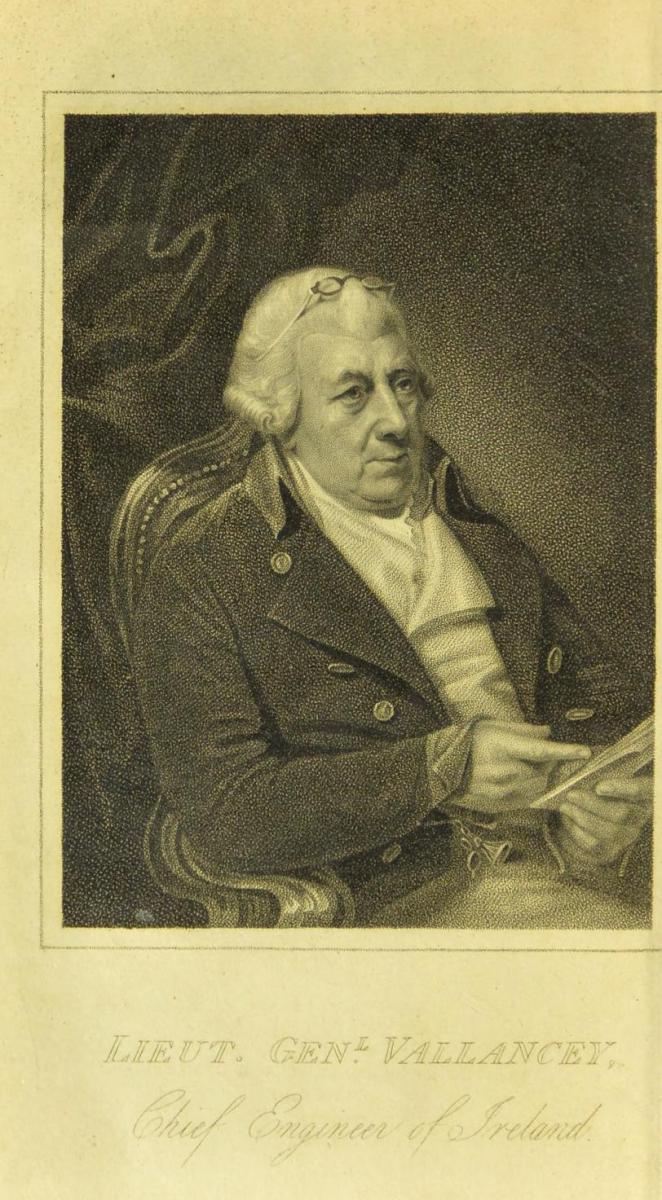
So – whose West Cork is this – Beranger’s or Vallancey? The answer is – both. In the Digital Repository, both are acknowledged as originators. Vallancey was a man of enormous energy and drive. He wrote several volumes of his Collectanea de rebus hibernicis, (available at the Internet Archive) and required illustrations for them – hence his patronage of Beranger, and others. The illustration above is from one of his Collectanea and so he must have wished himself to be depicted this way, as benign and intellectual. Love those little glasses! He was a scholar of Irish – one of the first to raise its profile as an ancient and beautiful language – and an antiquarian of the fanciful sort – forever banging on about druids and Chaldeans and coming up with far-fetched theories. Unfortunately, we don’t have Vallancey’s originals, so we can’t compare the accuracy of the drawings. While we know that Beranger’s reputation was for painstaking exactness, we don’t have the same information about Vallancey’s. To me, comparing it to places Beranger drew on the spot, the rendition of the castles looks a little approximate, especially the fenestration. Nevertheless, as illustrations of two places in eighteenth century West Cork, these watercolours are priceless.
One last detail and quote. Wilde was able to describe Beranger’s dress – that’s because he often put himself in the frame, to add human scale and interest. In his lively piece Beranger’s painted people – himself and others, Peter Harbison gives several examples. But we have our own, from the Timoleague Castle painting. There he is, in his long scarlet frock coat, yellow breeches, top boots, a three-cocked hat, and held in his hand a tall staff and a measuring tape. (Well, more or less.)
Do you know Timoleague and/or Castlehaven well? Can you add to the commentary on those painting? I’d love to have any comments you might have.
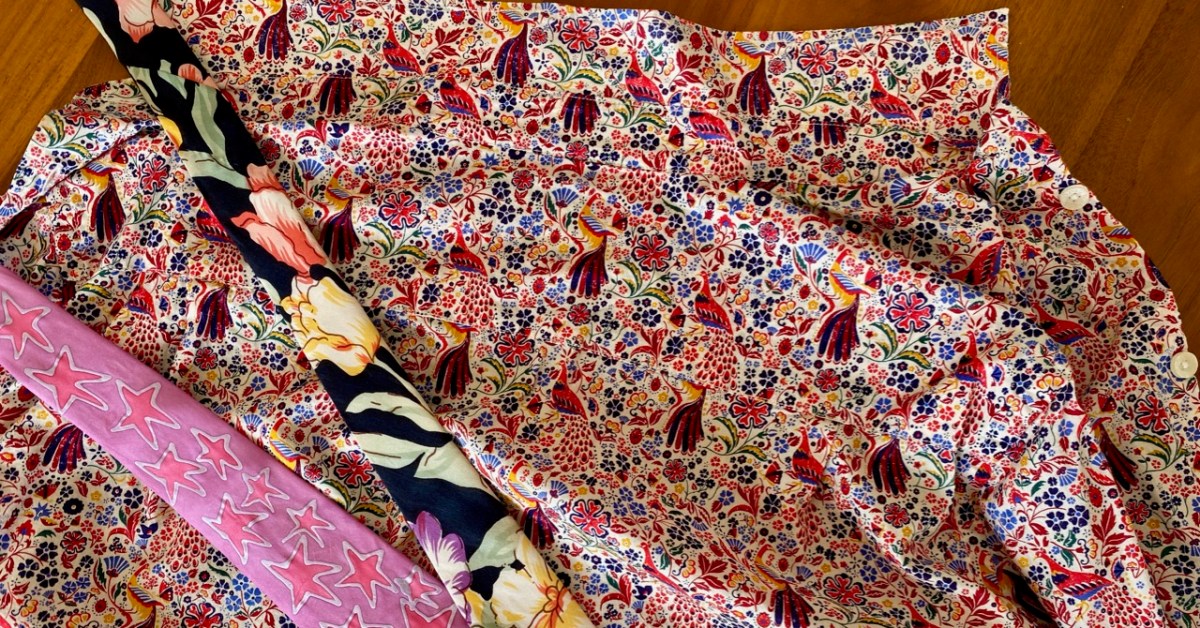
I was around in London in the early sixties, and was definitely part of the swinging Flower Power scene: beatniks, Beatlemania, Carnaby Street, flowery shirts and ties (I’ve still got some of them – below – stashed away in my wardrobe!) – the regulation Afghan coat (and its distinctive smell) . . . What I miss most, perhaps, is the purple velvet flared trousers: sadly an expanding waistline quickly did away with them.
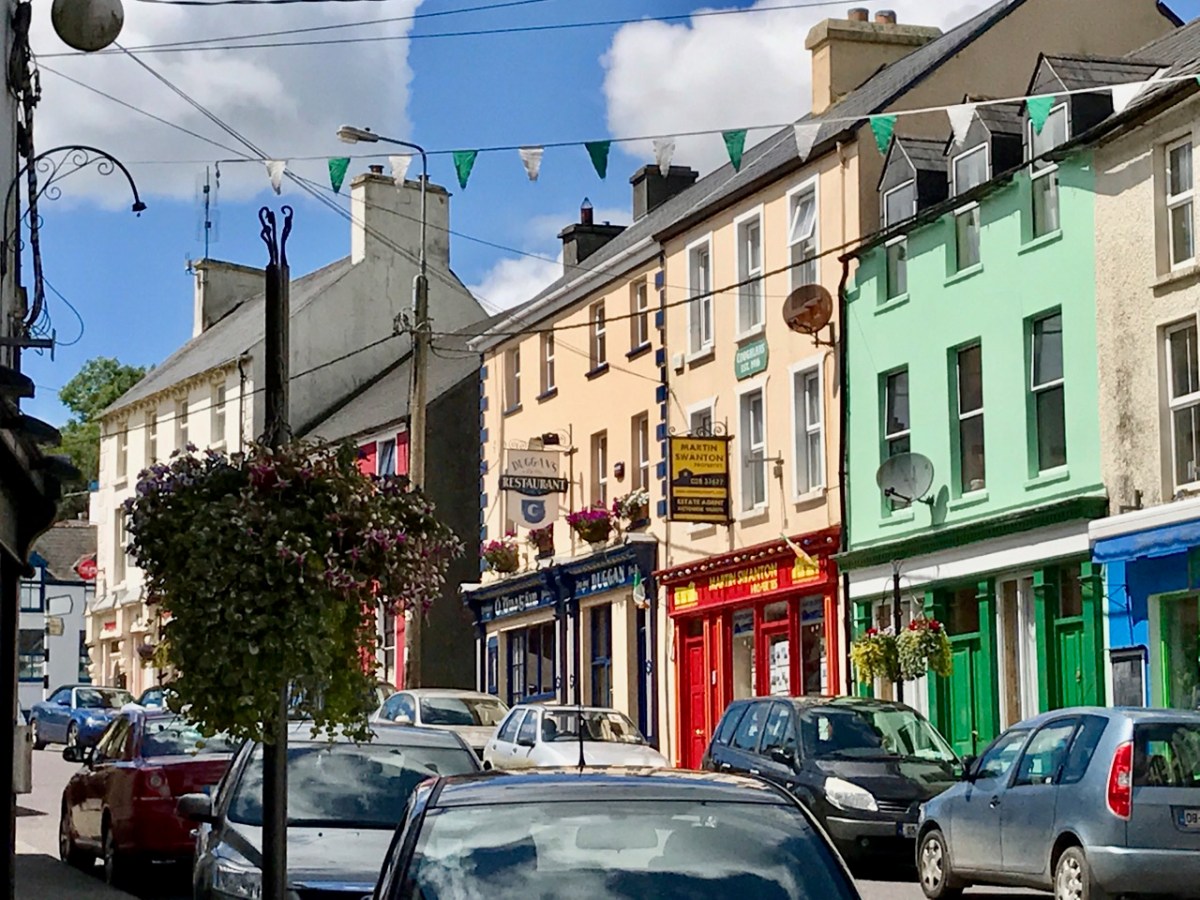
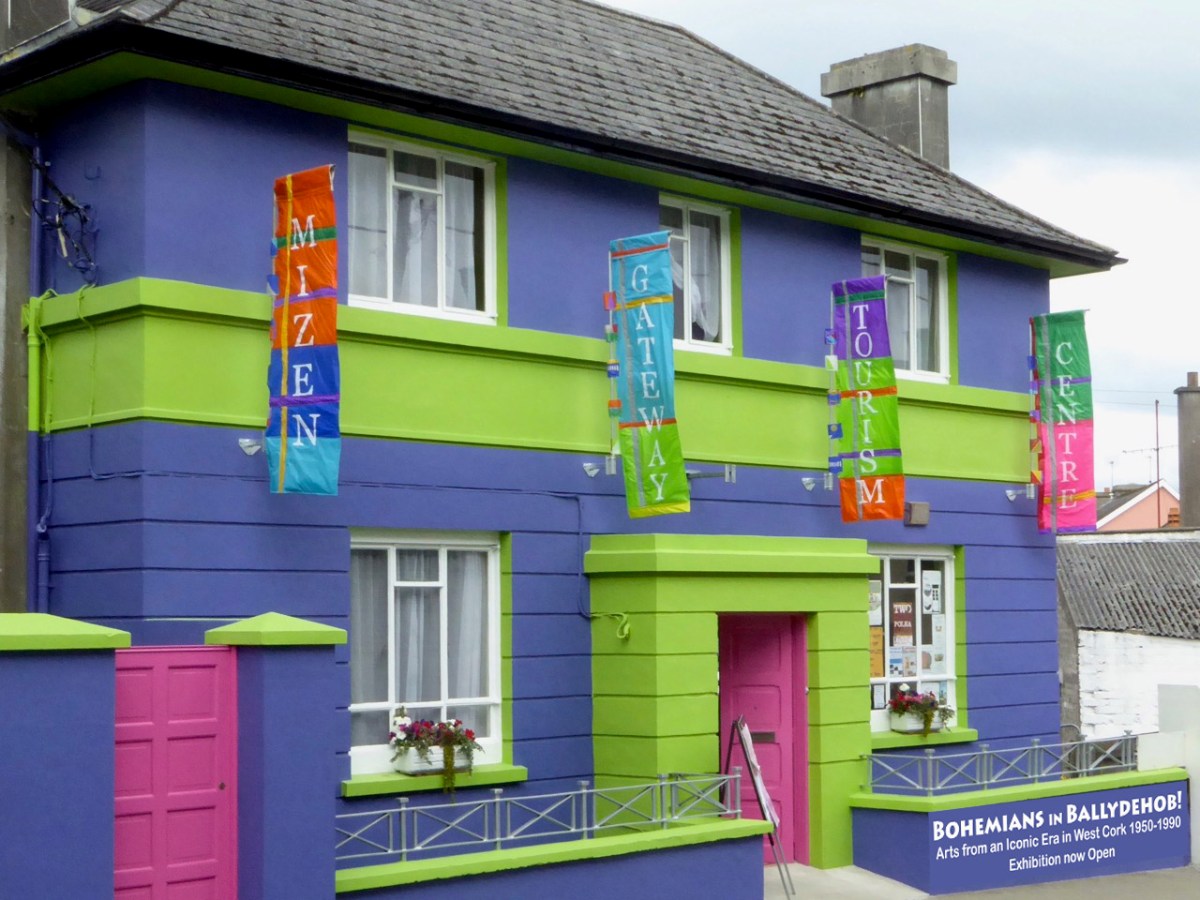
What is less well-known – in my generation at least – is the fact that there was a similar cultural phenomenon in one part of Ireland – our own West Cork! And it was centred on Ballydehob – that’s the main street, above. It’s a colourful village today – as it was then: well-suited to the cultural heritage which the artist community of the time imposed upon it. This building on the main street in those early days was particularly significant:
One of the artists who happened upon Ballydehob at that time lived on here to tell the tale (he still lives in the village and is still a working artist):
BREAKING NEWS: BALLYDEHOB IS DISCOVERED!
. . . During the early 1960s, a group of students at the Crawford School of Art in Cork, heard a rumour that something bizarre was happening in a village called Ballydehob. Here some vestige of Swinging London had taken up residence in a painted-up building called ‘The Flower House’. I was one of those students. We decided to investigate.
Since nobody owned a car, a parental vehicle must be ‘borrowed’. Somebody’s parent was away so this could be done without controversy. One of the know-it-all students announced that Ballydehob was in County Sligo and we would need money for petrol and have to camp when we got there. Nobody owned a tent. A forever-complaining student said that ‘He didn’t want to end up arrested as a vagrant and to have to sleep in a Garda station’. A few days later we left the Crawford en-route to County Sligo. Fortunately, a more astute student rummaged in the car as we were leaving the city for the West, found a road atlas and announced that Ballydehob was actually in County Cork, a mere two hours drive over the potholes. Tent-less or Garda station camping would not be required.
We arrived, we saw, we were astonished. Cork was then a darkly conservative place, ditto the Crawford and its staff members. What we found in Ballydehob was a house on the main street of the village with enormous flowers painted on the façade. It might have been in Chelsea or San Francisco. We entered to find a hive of creativity and alternative lifestyles. This was the world of women in flowing batik dresses, bearded men with bead necklaces and leather-thonged trousers. Even a cod-piece was observed. We sat in the café and drank coffee from the brownest of chipped brown ceramic mugs, ate inedible brownies and marvelled at the range of art and crafts being produced by this creative group.
This establishment, which seemed to have landed from another planet since the remainder of Main Street appeared to have experienced no visual or economic change from the images recorded in the black + white photographs of the 1900s, was run by two women, one German, the other English: Christa Reichel and Nora Golden. Here was a living example of William Morris’s dictum, ‘Have nothing in your homes that you do not know to be useful, or believe to be beautiful’.
Some ten years later, John and Noelle Verling (participants in that epic car journey) set up the Fergus Pottery in Dripsey outside Cork, later transferring it to Christa Reichel’s former premises in Gurteenakilla, Ballydehob, where it became a fixture of the creative community. A few years following, another member of the car-team, myself and Clair, came to stay with the Verlings, and also remained in the area, setting up an etching studio on the other side of Ballydehob.
Many of those who established the creative community of West Cork have died. Another generation has grown to maturity, further expanding the tradition of West Cork as a major and continuing centre of creative engagement in all of the arts, an epi-centre of delight. . .
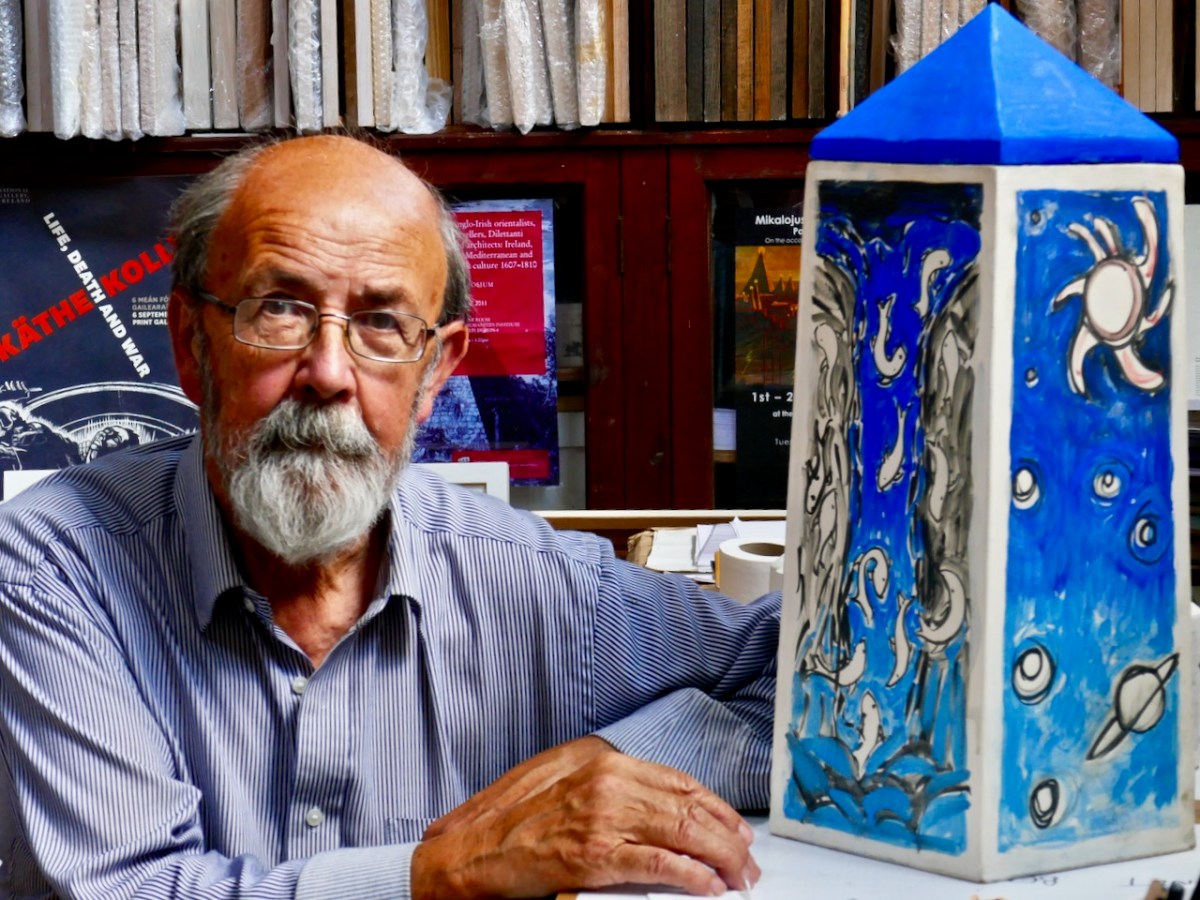
BRIAN LALOR
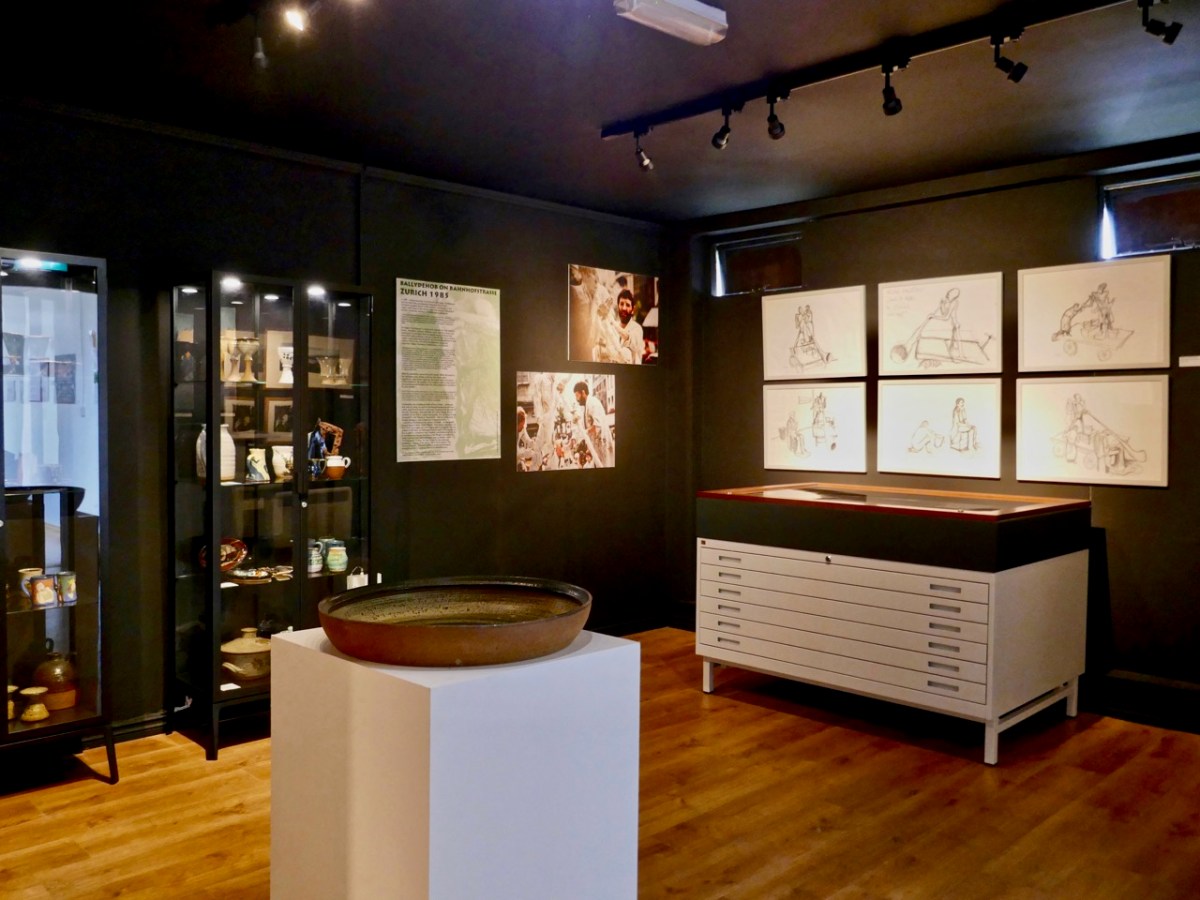
That’s Brian, in his studio today. Just a few years ago – in 2018 – he and I decided that that creative time in the village needed to be properly celebrated, and we gathered around us like-minded enthusiasts, and opened up the Ballydehob Arts Museum, using a room kindly donated by those who had taken over the disused bank building, right in the centre of town:
That’s the inside of the Museum above: its first exhibition opened in the summer of 2018. We had another the following year, then Covid stopped us until last year, when we featured Ian + Lynn Wright. This year’s exhibition also features a ‘couple’ of working artists: The Verlings– Noelle + John.
John Verling was a contemporary of Brian Lalor (who has written the account above), and they both studied architecture and art in London and at the Crawford in Cork. Brian has penned for us his memories of sharing a studio in London with John Verling:
THE PERILS OF A SHARED STUDIO, LONDON, 1967
. . . During the late 1960s, John Verling and I, then students of architecture in London, shared a quite substantial studio in one of the leafier areas of Kensington. The building, a large brightly lit interior behind a row of decaying Victorian villas (it might originally have been a Victorian studio, we never discovered) had many more recent uses and the first task on gaining possession was to somehow manage to get rid of what had been left behind by earlier tenants; office furniture, old matresses, much unidentifiable plumbing apparatus and a stuffed fox whose pelt had been consumed by moths, were among the challenging contents.
Conversation among acquaintances in our local, the Norland Arms, evoked interest from other drinkers, an English sculptor and a South African photographer who asked could they share the space and, very willingly offered a down payment on the rent. This was agreed and not long afterwards the studio became operational, with both John and myself busy creating in our new-found haven, with only the occasional appearance of our fellow tenants. John was at that point concentrating on elegant photomontages as well as complex drawings of Portobello costermongers and was extremely productive, while I was engaged in a substantial series of elaborate and brightly coloured timber constructions enhanced by scaffold clamps, in a latter-day Bauhaus manner. Time passed, various local artists called to view the work and admire the space. We were exhibiting successfully and the studio became in W H Auden’s phrase, ‘the cave of making’. Our fellow studio members failed to turn up and when occasionally encountered in the Norland, expressed embarrassment in being behind with the rent while offering a contribution to ‘keep their name in the pot’. This was an extremely satisfactory situation with individuals happy to subsidise the rent but too busy to actually attend the studio.
A chance encounter in the Norland brought another hopeful artist to our acquaintance, David O’Doherty, Dublin painter, he worked at the international telephone exchange. He came, he admired the studio, and invited himself to join. Fatally, we agreed. An accomplished portrait painter, he often had a sitter posed, but seemed happy to work on, undisturbed by the other occupants. Our new tenant was affable, expansive, a storyteller. He became a permanent fixture. Suddenly we realised that we were entertaining a cuckoo in our midst. O’Doherty had moved in permanently, camp bed, small stove on which there was always a fry-up in progress, an endless stream of visitors, large canvasses propped against the wall, and the catastrophic revelation of his other occupation; he was a keen traditional musician, devoted to the Uillinn pipes. Suddenly the space, ample for John and myself to pursue our work, had begun to feel like a home for the demented.
Gradually it became apparent that our studio, which a year before had been, in the midst of the city’s turmoil, as quiet and remote as a stylite’s pillar, had metamorphosed into Picadilly Circus with noise, air pollution and crowd control issues. The dream of having a secure place in which to create had floundered on the fatal choice of an individual whose concept of an ideal workplace was perilously close to Francis Bacon’s taste for irredeemable chaos. I bailed out, John lasted a little longer. And the completed series of brightly coloured scaffold-clamp constructions, what of them? Occasionally I received reports of their travels. Before he emigrated to Boston, O’Doherty sold them to a construction company and they were later spotted decorating the foyer of a social welfare office in Amsterdam. After that only blessed silence . . .
BRIAN LALOR
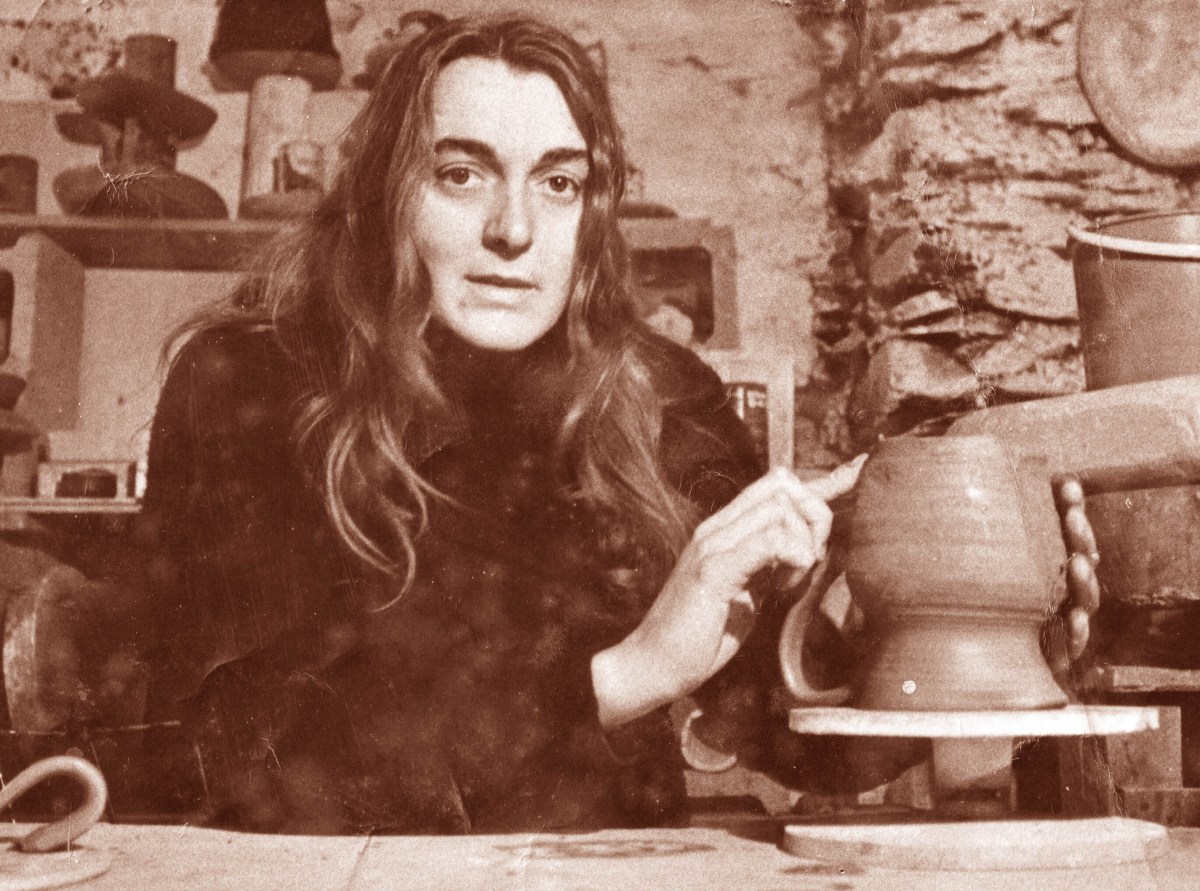
Noelle Verling (above) studied ceramics at Hammersmith College of Art. She and John met and married and – when they moved back to Ireland in 1971 – John & Noelle Verling established the Fergus Pottery in Dripsey in 1971 with Noelle as potter. She produced a wide range of domestic ware at Dripsey. When they moved in 1973 to Ballydehob to take over Christa Reichel’s studio, they adapted Reichel’s press-moulds and Gurteenakilla pottery stamp for their own work and from then on, traded as Gurteenakilla Pottery and latterly as Brushfire.
. . . The Verlings loved the windswept West Cork landscape and felt moved to record a disappearing environment. John’s paintings often depicted the doors, windows and walls of decaying buildings, repositories for the memories of past inhabitants, long gone. The windswept thorn tree is a familiar motif which connects John Verling with West Cork: the tree became his icon and frequently appeared in his paintings and on his ceramic work . . .
Alison Ospina – West Cork Inspires 2011
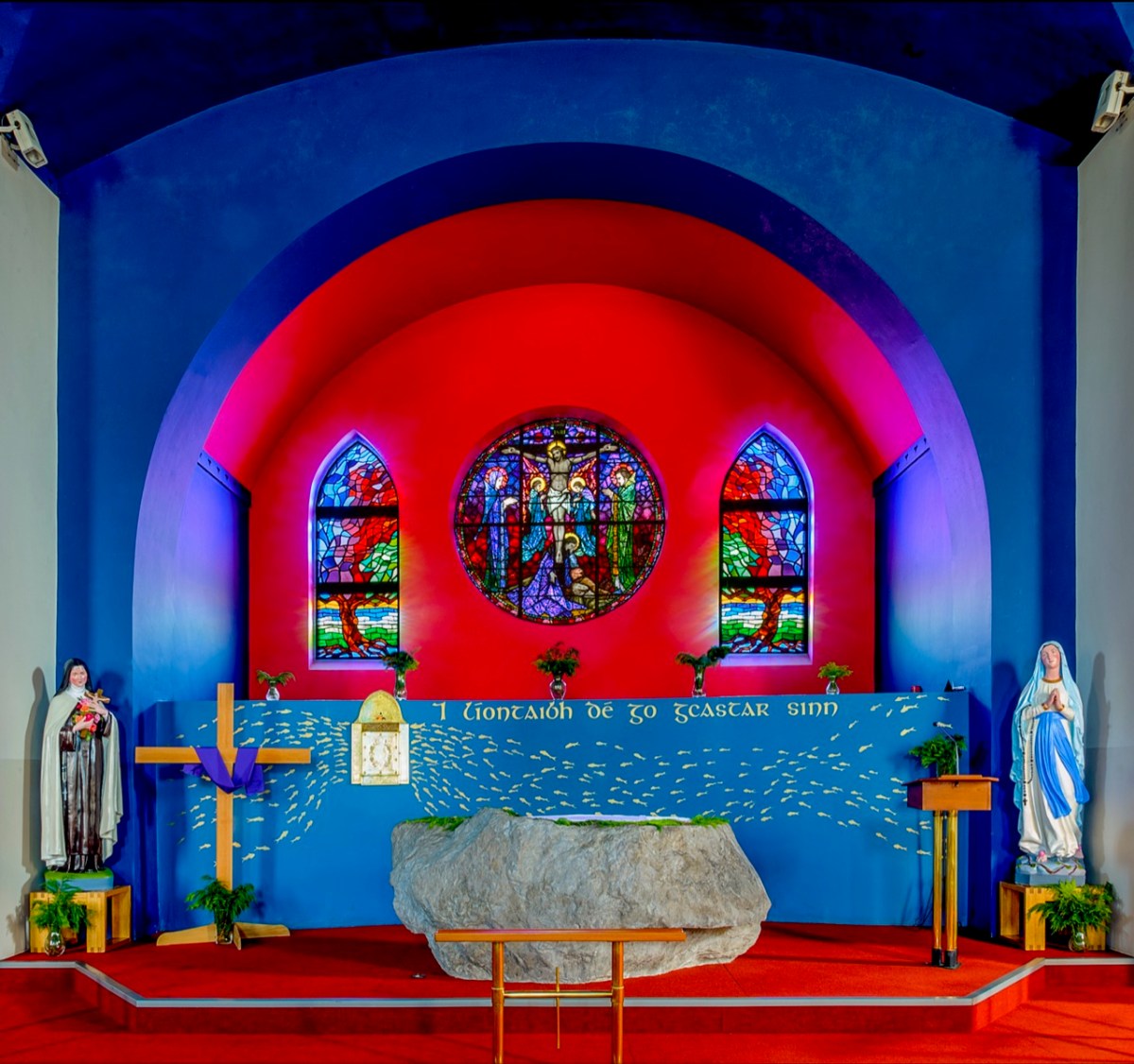
This is a rare photograph of John working on one of his favourite subjects: the gnarled thorn tree suffering from the ravages of harsh West Cork gales. Among the architectural work he undertook voluntarily was the reordering of the east end of St Bridget’s Catholic Church in Ballydehob. This was a major work.
. . . The gold fish hand drawn in the background of the altar and the depiction of one fish swimming against the shoal continues to evoke admiration from locals and visitors alike. He also designed the two ‘windswept thorn’ stained glass windows and etched the brass surround of the tabernacle. The Altar slab, composed of a vast monolith like the capstone of a dolmen, is a distinguished piece of sculpture and a tribute to his imaginative capacity . . .
Special thanks to Geoff Greenham for giving us this superb photo of St Bridget’s Church, Ballydehob.
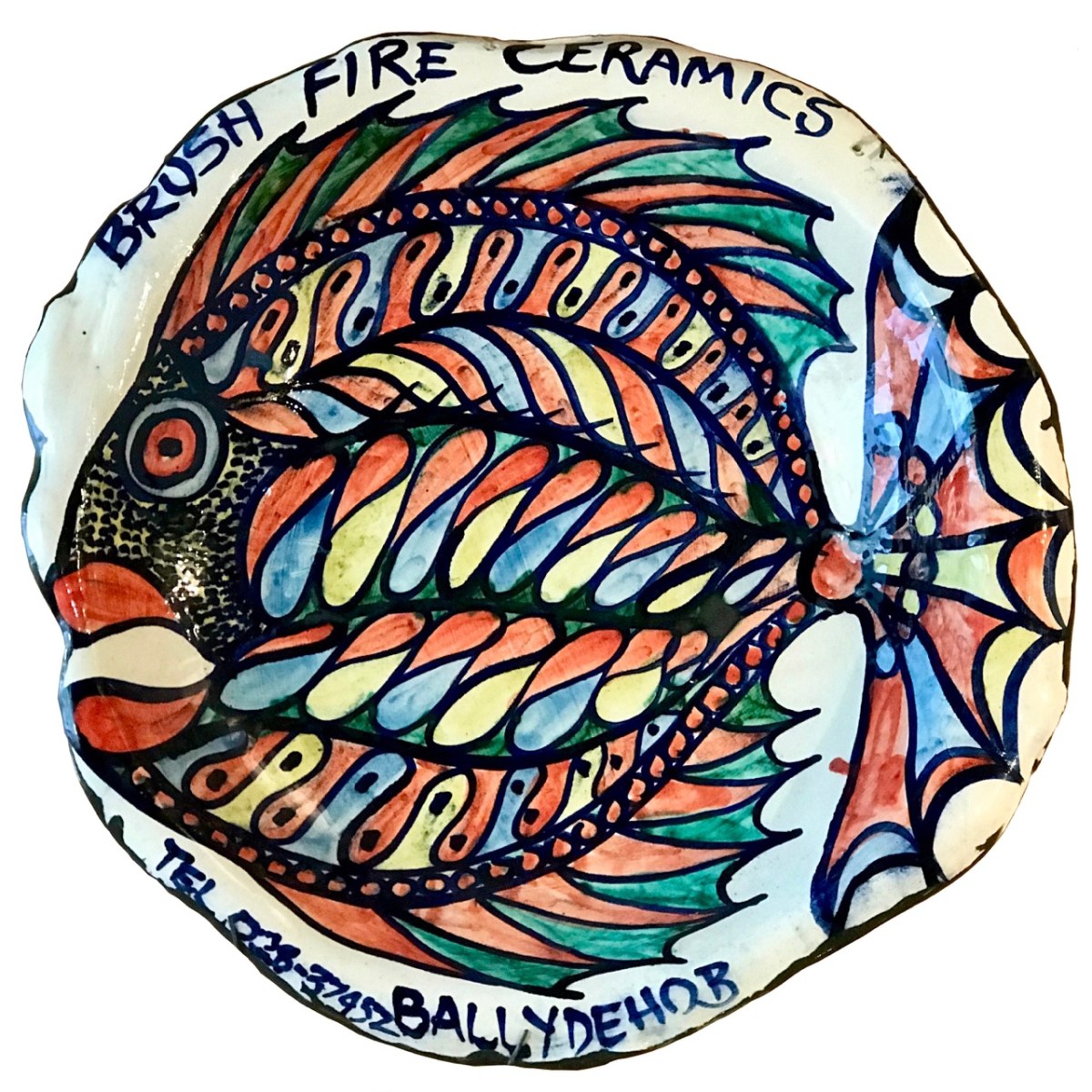
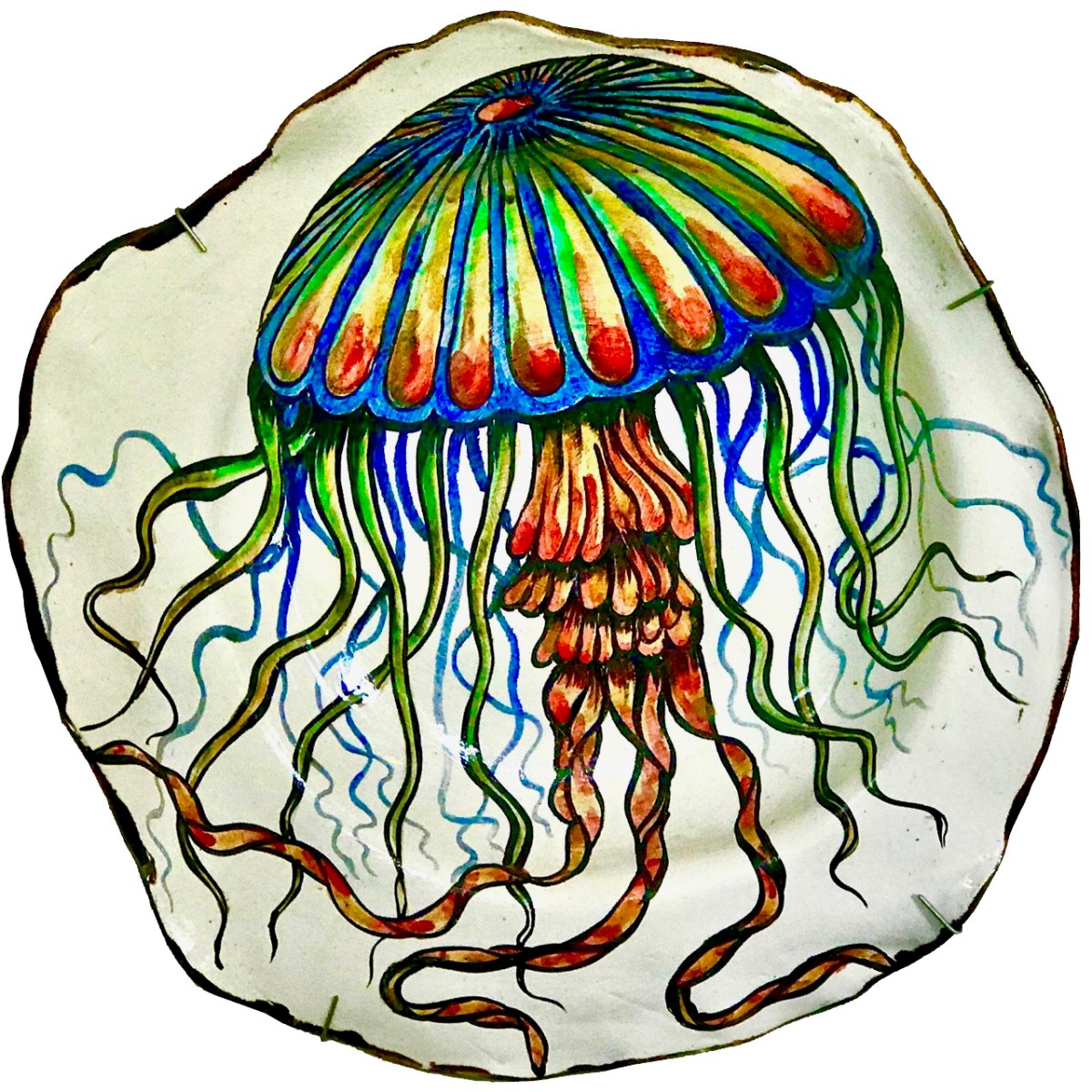
The sign for the Brush Fire Ceramics Pottery, created by Noelle and John. They successfully produced a large number of individual pieces, crafted and fired by Noelle, and decorated by John.
John Verling died in 2009. Noelle Verling is living in West Cork and has been extremely helpful in providing material and information for this exhibition. Without her we would have been unable to fully present this story.
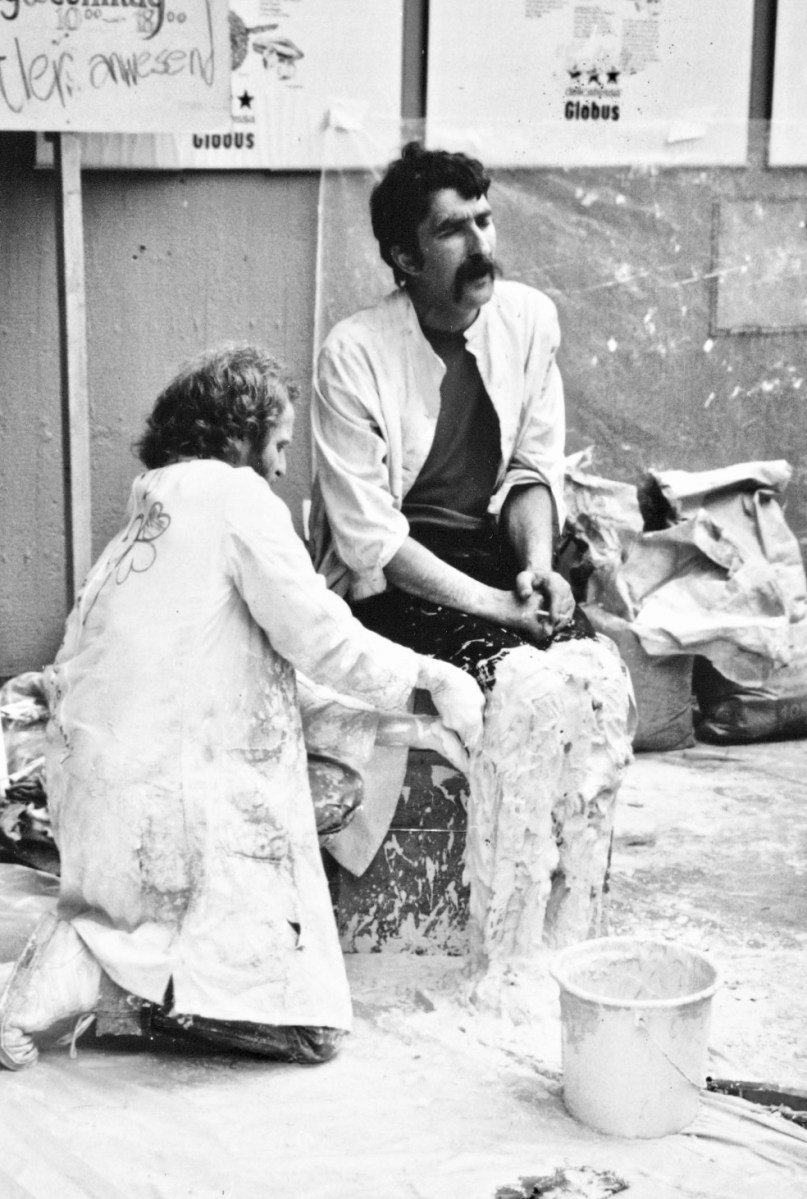
That’s John Verling in the picture above having his legs plastered by Ian Wright: this was part of a publicity stunt for the visit of a large group of West Cork artists to Zurich in 1985. John is also singing a folk song! You can read more about that particular enterprise here.
The Ballydehob Arts Museum is grateful to the town’s Community Council for providing the accommodation for the Museum. BAM is: Brian Lalor, Robert Harris, Sarah and Stephen Canty. Their combined knowledge and practical experience has ensured that our ambitions for this – our fourth exhibition – are fully realised.
Exhibition opens Jazz Festival Weekend in Bank House: Thursday 27 April @ 5pm, then Friday 28 April to Monday 1 May: 11am – 4pm. It will open with the Tourism Centre from June to September 2023
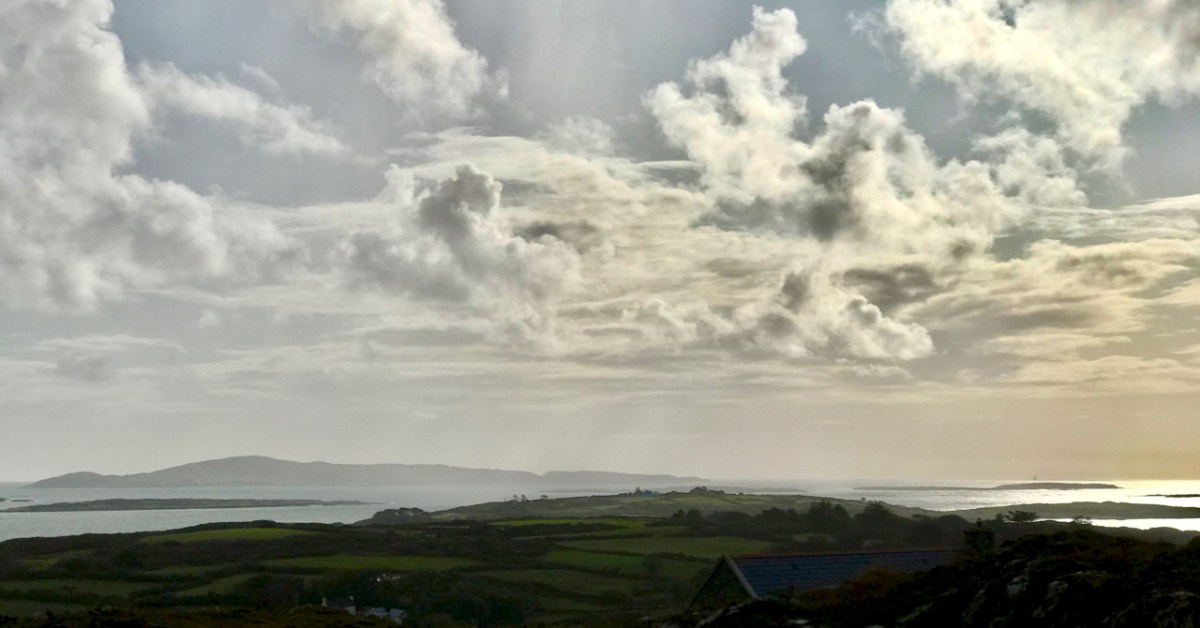
It’s March – an important month, in Ireland, for saints. This week we will celebrate St Patrick, of course. But there’s another – dare I say equally important – Irish saint whose day we have just passed by. That’s Saint Ciarán, and we are particularly keen to give him an airing, as he was born on Cape Clear, which we look out onto every day! That’s the view (above) from our home across Horse Island and Roaringwater Bay towards ‘The Cape’, which sits on the horizon under a wonderfully atmospheric sky. I also feel drawn towards Ciarán because his ‘day’ – March 5 – happens to be my birthday. And – as you will see – there’s another personal connection: I lived in Cornwall for many years, and that’s where some of my forebears hale from. Would you believe that this same saint is also the Patron Saint of Cornwall? Read on . . . But be aware that I have published this post before, several years ago – when RWJ publication day actually fell right on my birthday. I’m giving myself a day off the hard writing this week, as I have been recuperating from a little ‘op’ in Cork. Here goes:
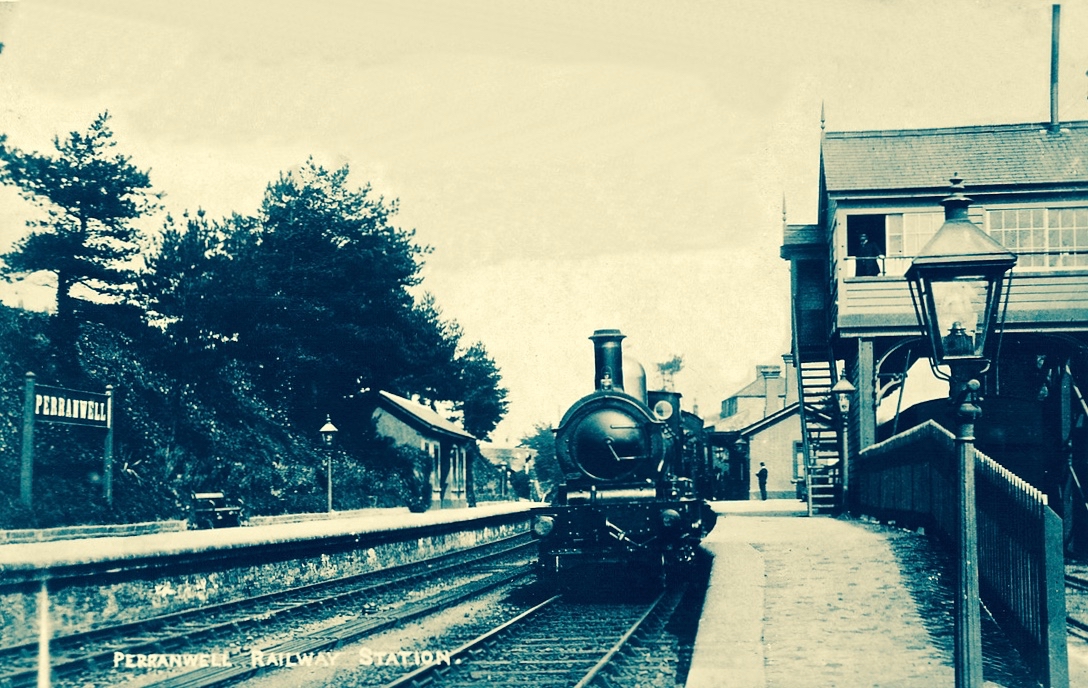
I was born in the first half of the last century. Early memories of the 1950s include the regular journeys my brother and I made as small boys on the mighty Atlantic Coast Express via Okehampton to visit, first, our sets of cousins on Dartmoor, and then beyond – via the even mightier Great Western Railway – to our cousins in the depths of Cornwall. The latter visits were particularly idyllic: the cousins (generations older than us) had a small farm and a herd of cows which they milked twice a day – by hand. Following this they cooled the milk in a big steel drum by stirring it with a propellor (we were allowed to do this) before pouring the precious liquid into bottles which were then sealed with silver caps using a rubber device which impressed on them the name ‘Cove Farm’. Then, together, we set out on bicycles to deliver the bottles to the doorsteps of every dwelling in the small village of Perran-ar-worthal.
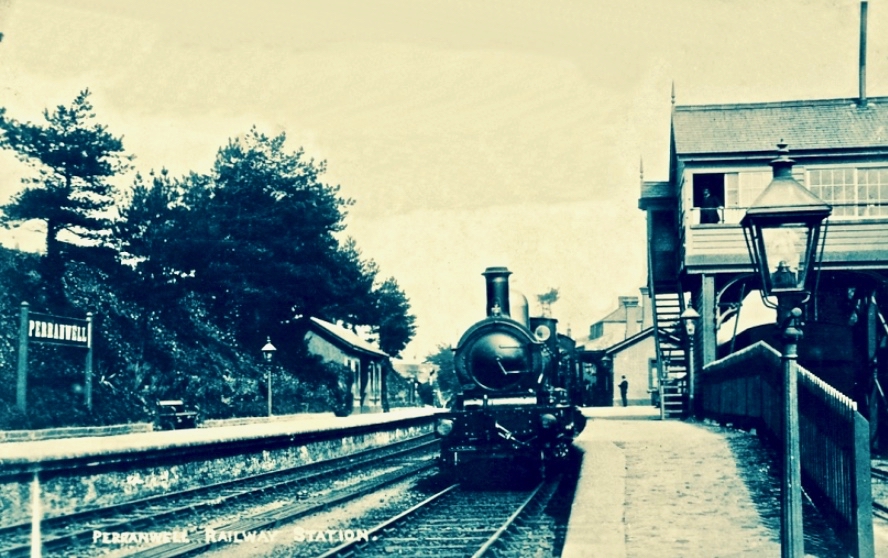
Perranwell Station 1950s – disembark here for Perran-ar-Worthal and Cove Farm!
Perran-ar-Worthal (in Cornish Peran ar Wodhel) means ‘St Piran’s village by the creek’. Who is St Piran? He is the Patron Saint of Cornwall and we’ve met him before, briefly, in my account of St Ciarán, who was born on Cape Clear, and was known as ‘The First Saint of Ireland’. Even before St Patrick arrived to start his missionary work in 432 AD, St Ciarán (according to some records born in 352 AD) had been at work converting the ‘heathen Irish’. Unfortunately, his efforts were not always appreciated and Ciarán was despatched from the top of a cliff with a millstone tied around his neck! The story is elaborated by Robert Hunt FRS in his Popular Romances of the West of England first published in 1908. I have the third, 1923 edition on my bookshelves. That’s Cape Clear below: possibly the very cliff (although not at all a tall one).
…On a boisterous day, a crowd of the lawless Irish assembled on the brow of a beetling cliff, with Ciarán in chains. By great labour they had rolled a huge millstone to the top of the hill, and Ciarán was chained to it. At a signal from one of the kings, the stone and the saint were rolled, to the edge of and suddenly over, the cliff into the Atlantic. The winds were blowing tempestuously, the heavens were dark with clouds, and the waves white with crested foam. No sooner was Ciarán and the millstone launched into space, than the sun shone out brightly, casting the full lustre of its beams on the holy man, who sat tranquilly on the descending stone. The winds died away, and the waves became smooth as a mirror. The moment the millstone touched the water, hundreds were converted to Christianity who saw this miracle. St Ciarán floated on safely to Cornwall; he landed on the 5th of March on the sands which bear his name. He lived amongst the Cornish men until he attained the age of 206 years…
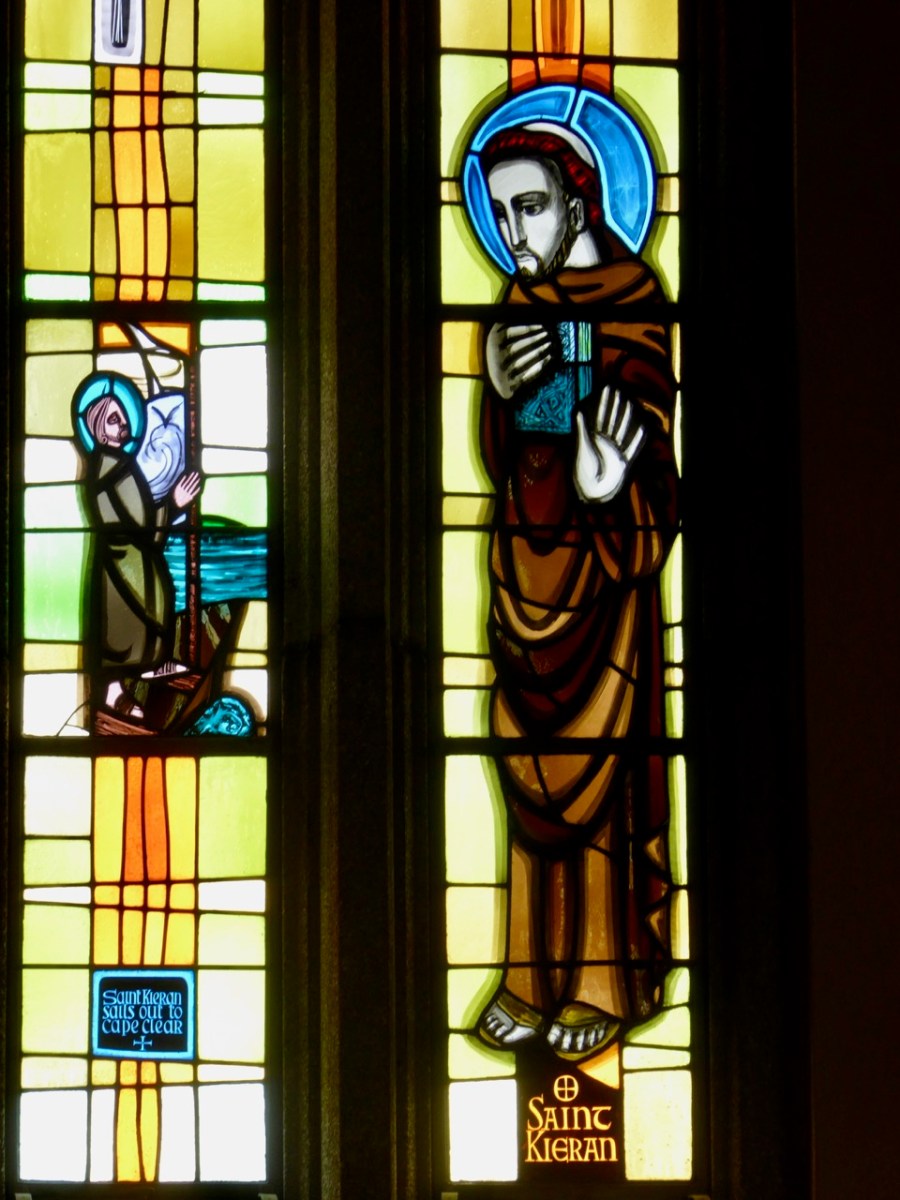
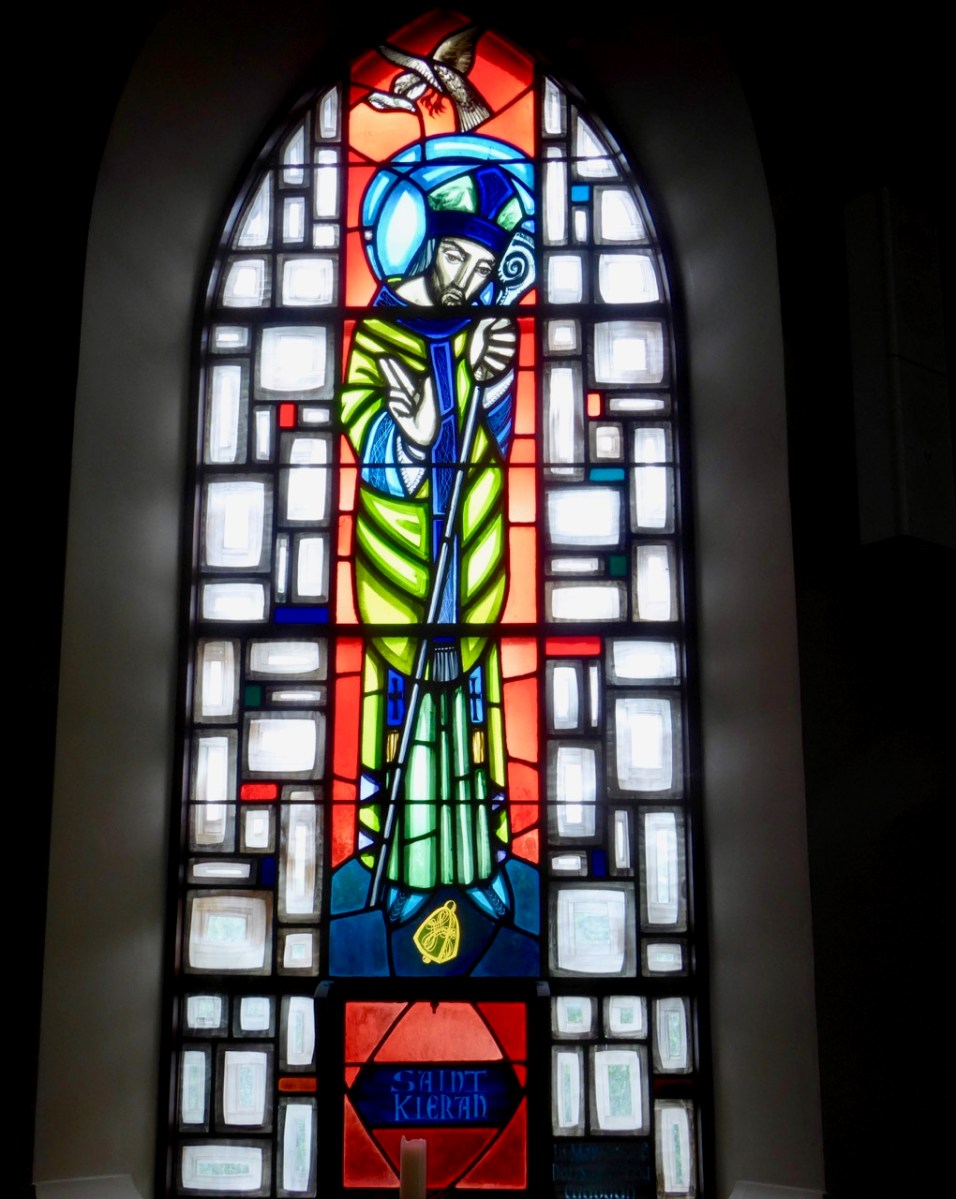
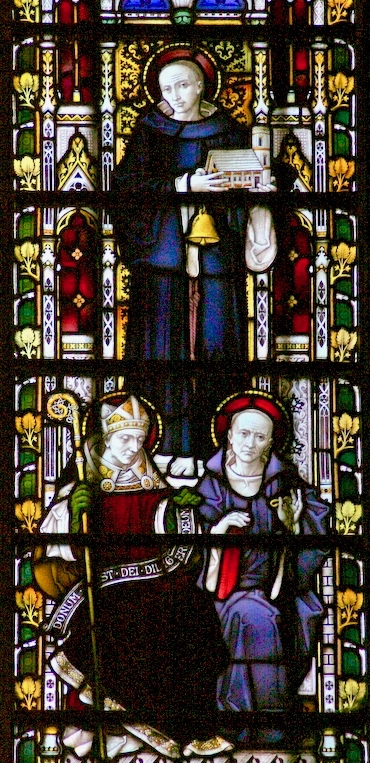
Left – St Ciarán celebrated in modern stained glass, in the church at Caheragh, West Cork; centre – Ciarán at Rath church, near Baltimore, and right – St Piran is the top figure (with church and bell) in this window panel from Truro Cathedral, Cornwall
So, what is the connection between Saints Ciarán and Piran? Apparently, they are the same person! Charles Lethbridge Kingsford reporting in the Dictionary of National Biography 1885 – 1900 (a 63 volume work!) states:
…PIRAN or PIRANUS, Saint, is commonly identified with Saint Ciaran of Saigir. The names Piran and Ciaran or Kieran are identical—p in Britain being the equivalent of the Irish k. The history of the two saints is in the main features the same, though the Irish lives of St Ciaran do not record his migration to Cornwall…
Many writers make the same assertion about the orthophony of the name but – to be fair – others, including some saintly hagiographers, do not agree, suggesting we are talking about two different saints. As someone who has a birthday on 5th March (today) – the Saint’s Day for both Ciarán and Piran – I have no doubts about the matter. Here’s another source that concurs with the view that they are one and the same saint – The Irish Ecclesiastical Record, Volume X (1874):
…The labours of St Kieran were not confined to Ireland. He passed several years on the western coast of Britain, and, as we learn from Blight’s “Churches in West Cornwall,” his memory is still cherished there. Four ancient Cornish parochial churches bear his name : these are Perran-zabuloe, or St Piran-in-the-sand; Perran-arworthal; Perran-uthnoe, situated near the coast opposite St Michael’s Mount, and St Kevern, or Pieran, which in Domesday-book is called Lanachebran. St Kieran’s holy well is also pointed out on the northern coast of Perran-zabuloe. The parish church of St Keverne stands in the district called Meneage, which terminates at the Lizard Point, the southernmost land of England. The name Meneage is supposed to mean, in the old Cornish dialect, “the deaf stone”, and the reason given for it is that, though there are several mineral veins or lodes in the district, on trial they have been found to be of no value, and hence are called deaf or useless. Tradition tells that St Kieran inflicted on the inhabitants, as a punishment for their irreligion, that the mineral veins of the district would be un-productive, and the old proverb is still handed down, “No metal will run within the sound of St Kieran’s bell”…
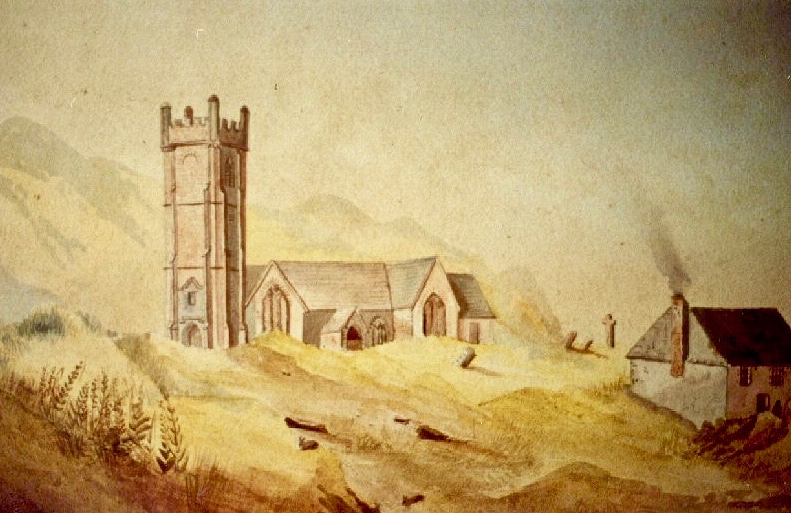
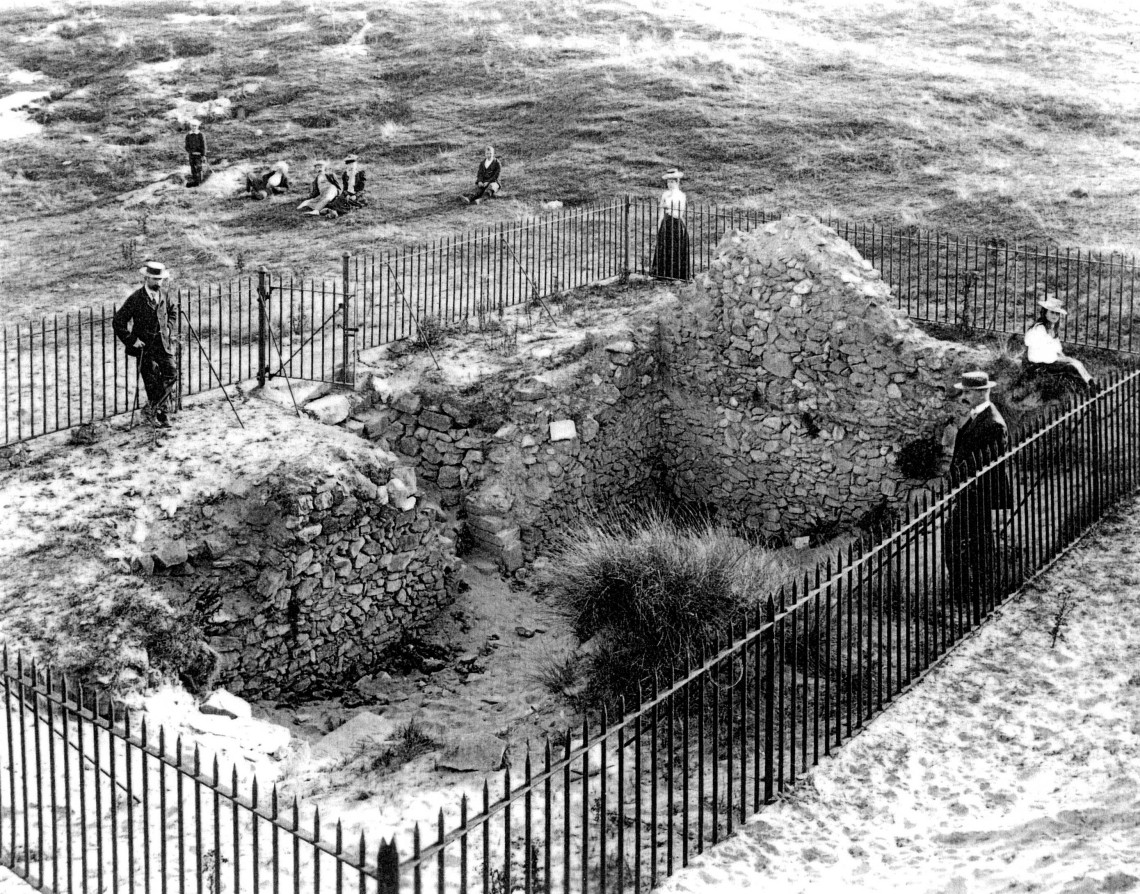
An early photo of St Piran’s Church which was built in the 12th century on the dunes at Penhale Sands, Perranzabuloe Parish, to replace the Saint’s original oratory which was buried by the shifting sands. The sands encroached on this church, too (the sands can be seen in the picture), and it was dismantled around 1800 and stone from the site was then used to build another new church two miles inland which was dedicated to St Piran in July 1805
To complement that little story of the saint in Cornwall, we have to visit Ossory, an Irish diocese which encompasses parts of Kilkenny, Laois and Offaly. There they also celebrate St Ciarán of Saigir on March the fifth: he is said to have returned from Rome after years of study, firstly visiting his native Cape Clear, then commencing his travels through Ireland until his bell rang of its own accord – this happened at a small hamlet in County Offaly, now known as Seir Kieran. There he set up a foundation, the remains of which are still visible – as is a holy well, a holy bush (bedecked with clouties) the base of a round tower, the base of an ancient high cross (now holding water which has curative powers) and a holy rock which was once said to have displayed the hand print and knee prints of the saint, now completely obscured.
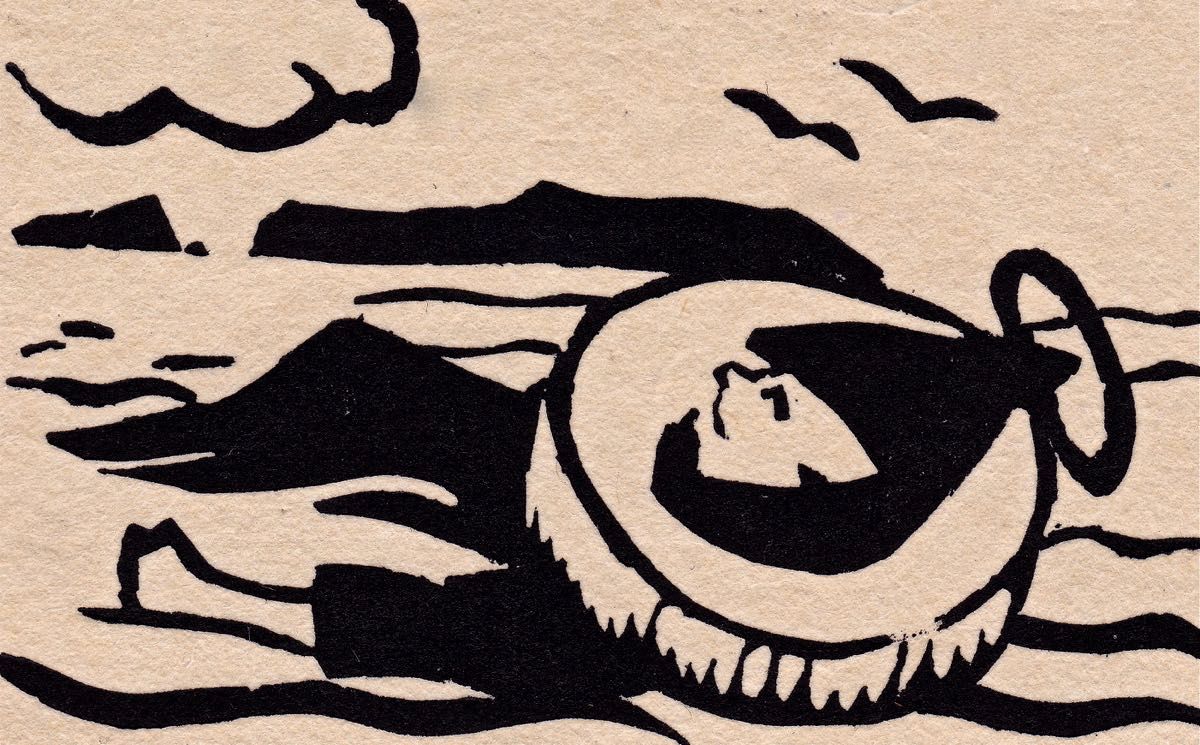
St Piran’s journey to Cornwall: “The millstone kept our man afloat” from The Discovery of Tin – a collection illustrated by Barry Cottrell
One of my favourite stories about St Piran tells of how he discovered tin smelting. He used as his hearth a piece of local stone; when he lit a fire on the hearth the veins of tin ore in the stone melted and a stream of silver ran out across the black rock, in the form of a cross. From that day to this the flag of Cornwall is a white cross on a black background, and Piran is also the patron saint of tin and tinners.
Just about now in Cornwall (March 5 2017) a great celebration is going on in honour of the saint. There will be a procession to the original oratory buried in the sands, led by the Grand Bard of the Cornish Gorsedd. Cornish flags – and the Cornish tartan – will be very much in evidence. The Cornish people have a great nationalistic spirit and have called for the 5th March to be an official public holiday. In a recent debate on Cornwall some interesting views were expressed on the place of Cornwall in a post-Brexit world, and the attributes of St Piran were symbolic of this – his inventiveness, his love of nature, and his belief in the inclusivity of all peoples in an international community.
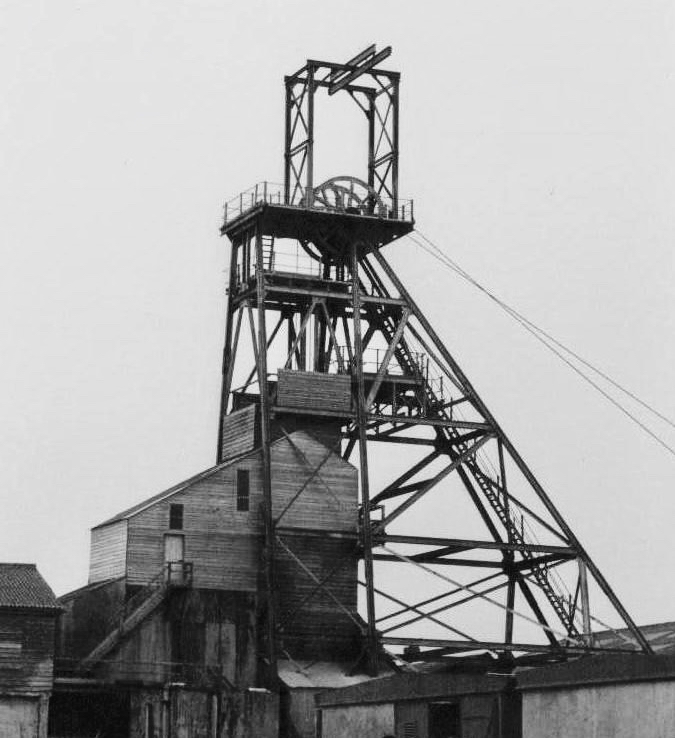
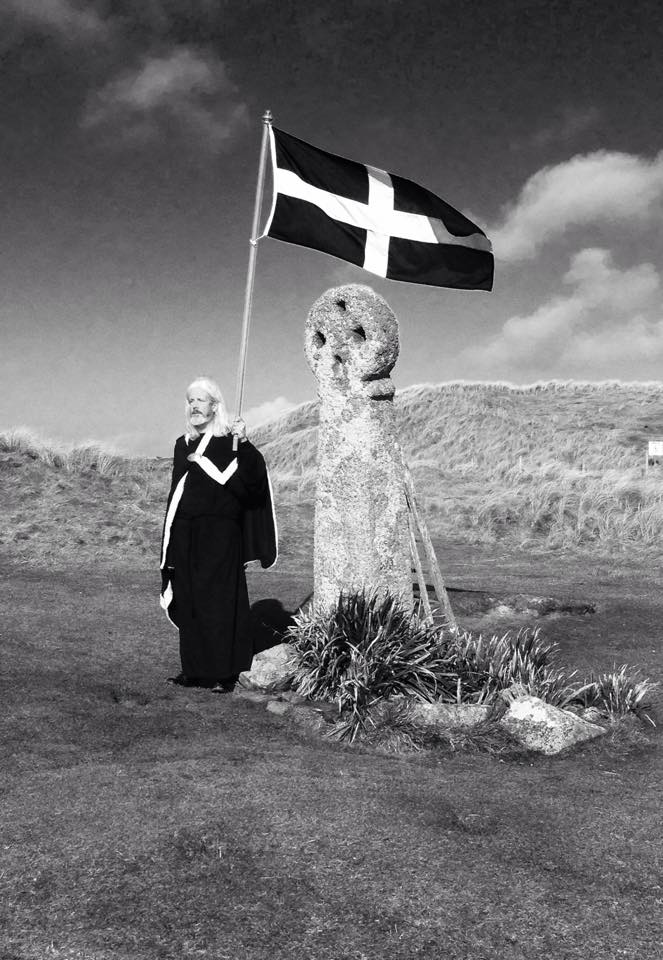
Left – Geevor Mine, in West Penwith, one of Cornwall’s last working tin mines, now a museum of mining; right – an incarnation of the saint: Cornish author Colin Retallick stands in front of St Piran’s ancient cross on the saint’s day
St Piran lived to a great age. They say in Cornwall that he was ‘fond of the drink’ and met his end by falling into a well when walking home from a party. I hope it was a holy well! Today, seventeen centuries after St Ciarán / Piran was thrown from the cliffs of Cape Clear I am looking out to that island: …the winds are blowing tempestuously, the heavens are dark with clouds, and the waves are white with crested foam… There have been so many links between Cornwall and West Cork, ever since the Bronze Age, when Cornish tin traders brought their metal to mix with copper mined above us here on Mount Gabriel. Watch out for more posts about these links between the two communities: links which would have warmed the heart of our shared saint!
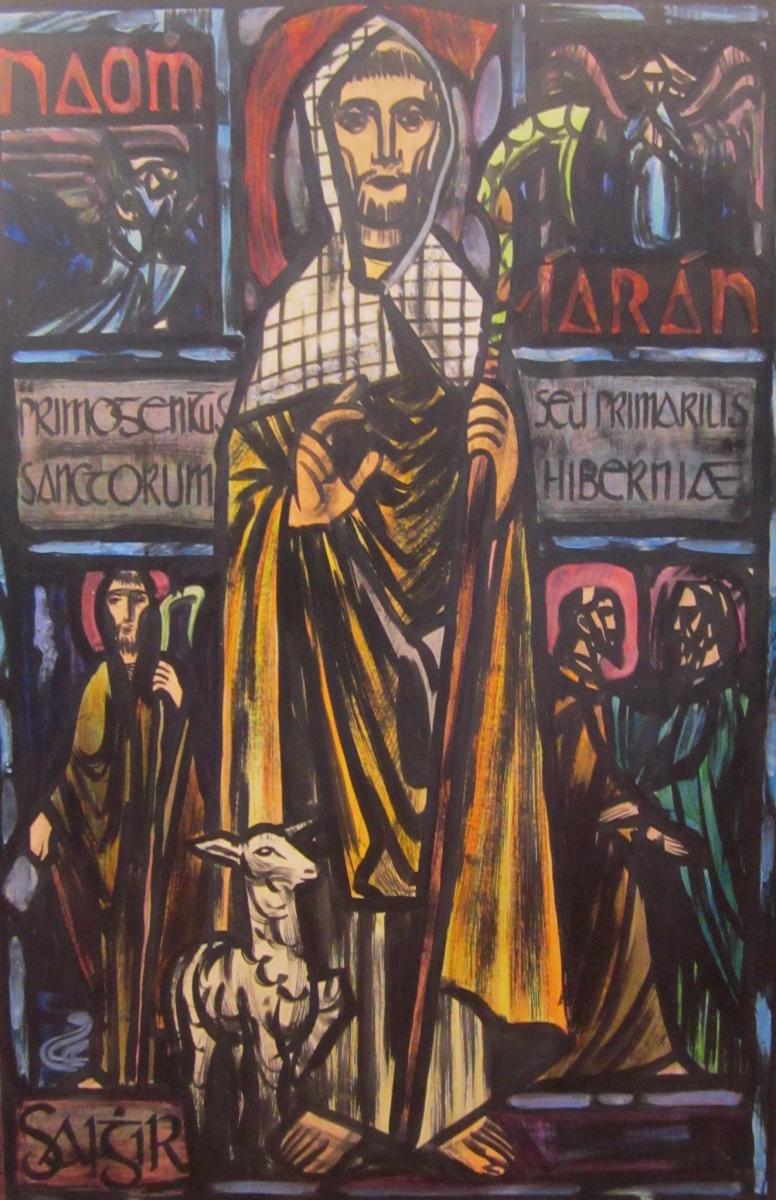
Below – St Ciarán by Richard King, painted for the Capuchin Annual in the 1950s
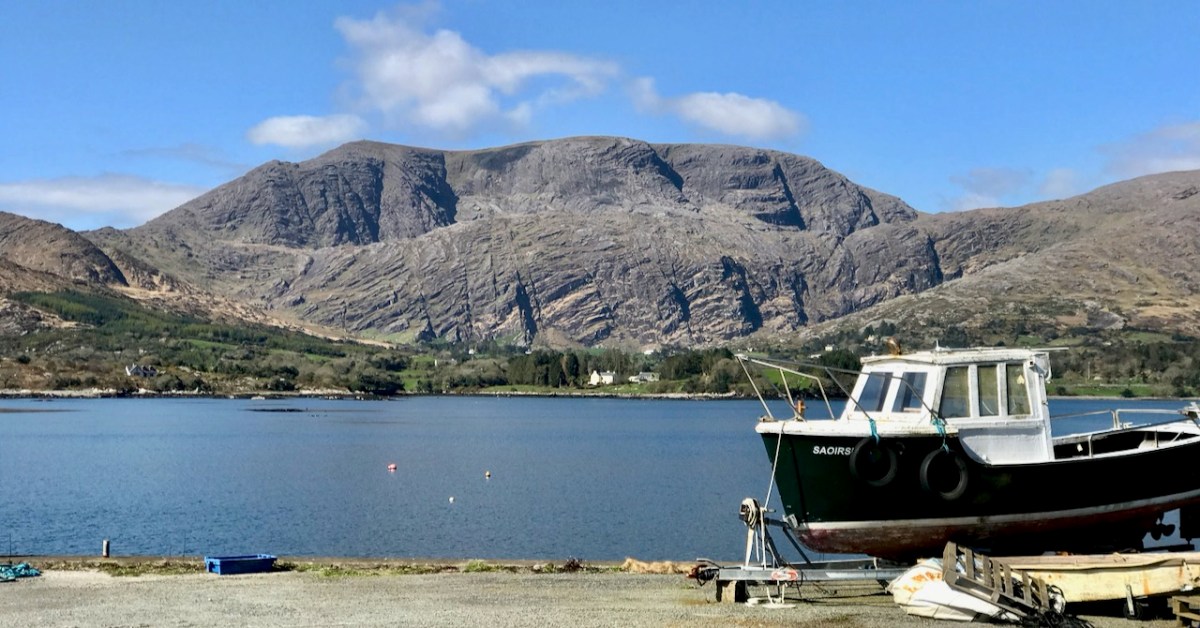
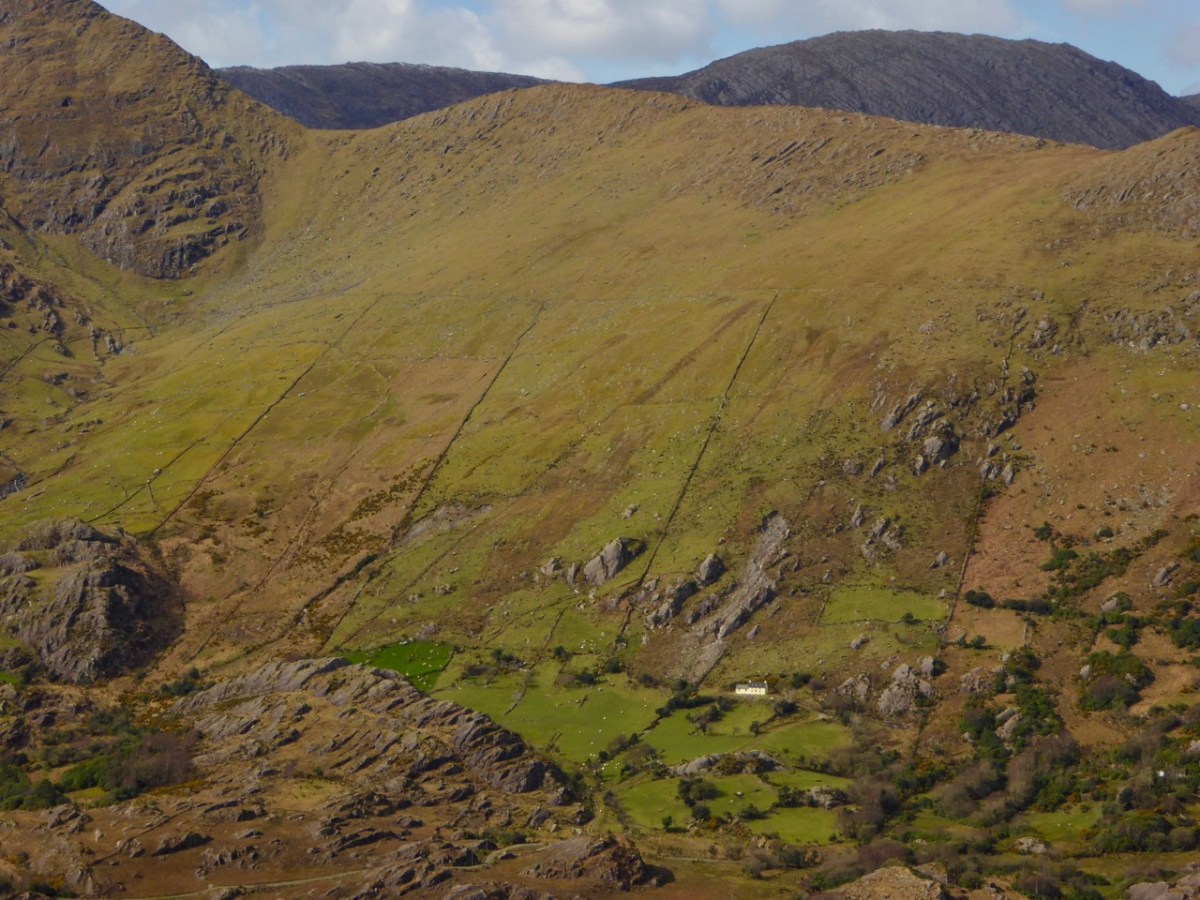
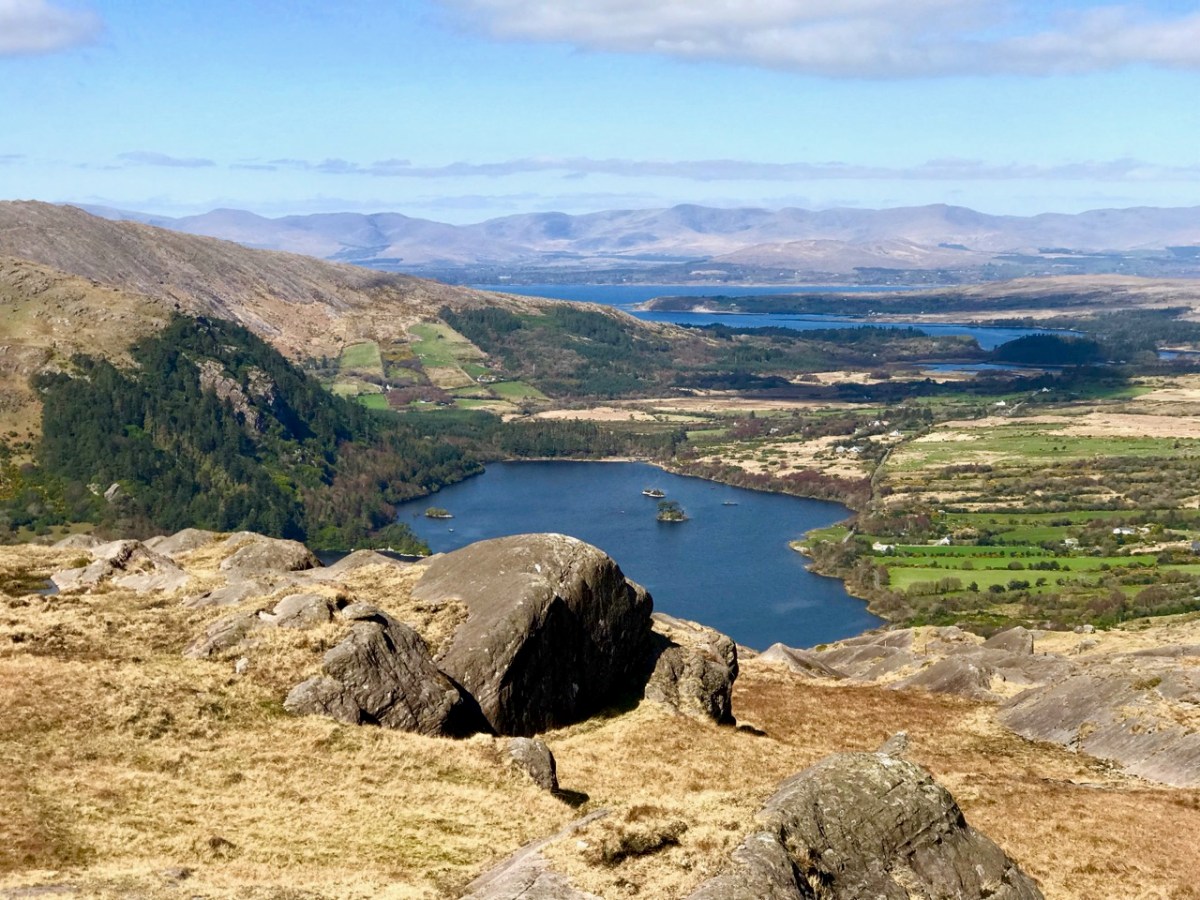
You know we love the beauty of West Cork, and we can’t resist the odd foray into all our neighbouring parishes. They are perhaps a bit wilder and higher, with markedly remote open spaces. So here’s a little wander on to the Beara Peninsula and beyond: I have raided our archive of photographs to enthuse us – and, hopefully you – to travel those roads in the coming spring. Firstly, have a look at this:
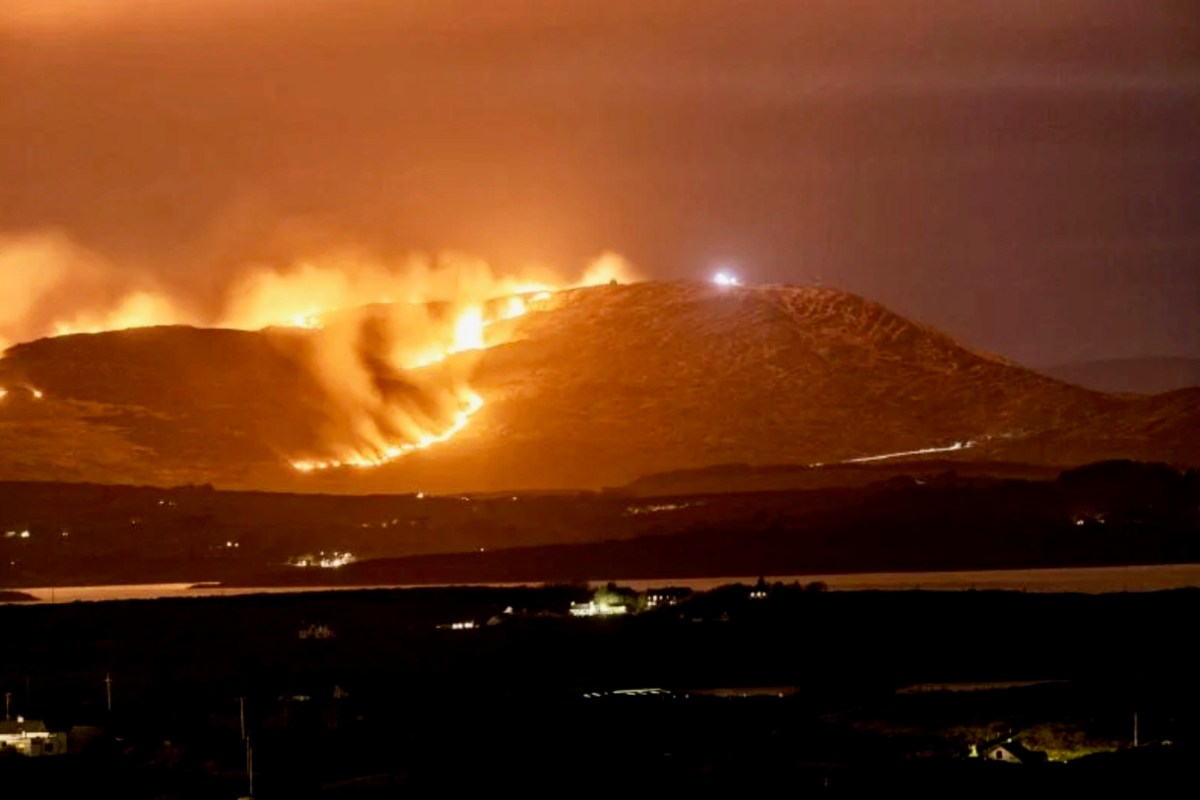
There’s a house down there, nestled under some spectacularly steep fields! This is to remind you that you have to up the scale a bit if you are stepping across the county boundaries. This Kerry landscape is such a contrast to our own seascapes and islands. We have our hills, of course: Mount Gabriel was in the news this week because of the gorse fires which lit up its summit. Such fires are allowed up until the first of March – by longstanding tradition – to clear the land and improve the grazing. It all seems a bit incongruous, though, when governments are planning to outlaw wood-burning stoves because they lead to poor air quality, and we are being advised by the HSE about the adverse health effects of air polluted by smoke and ash. Fire on Mount Gabriel 26 February 2023 – photo by Magnus Burbanks – courtesy Southern Star:
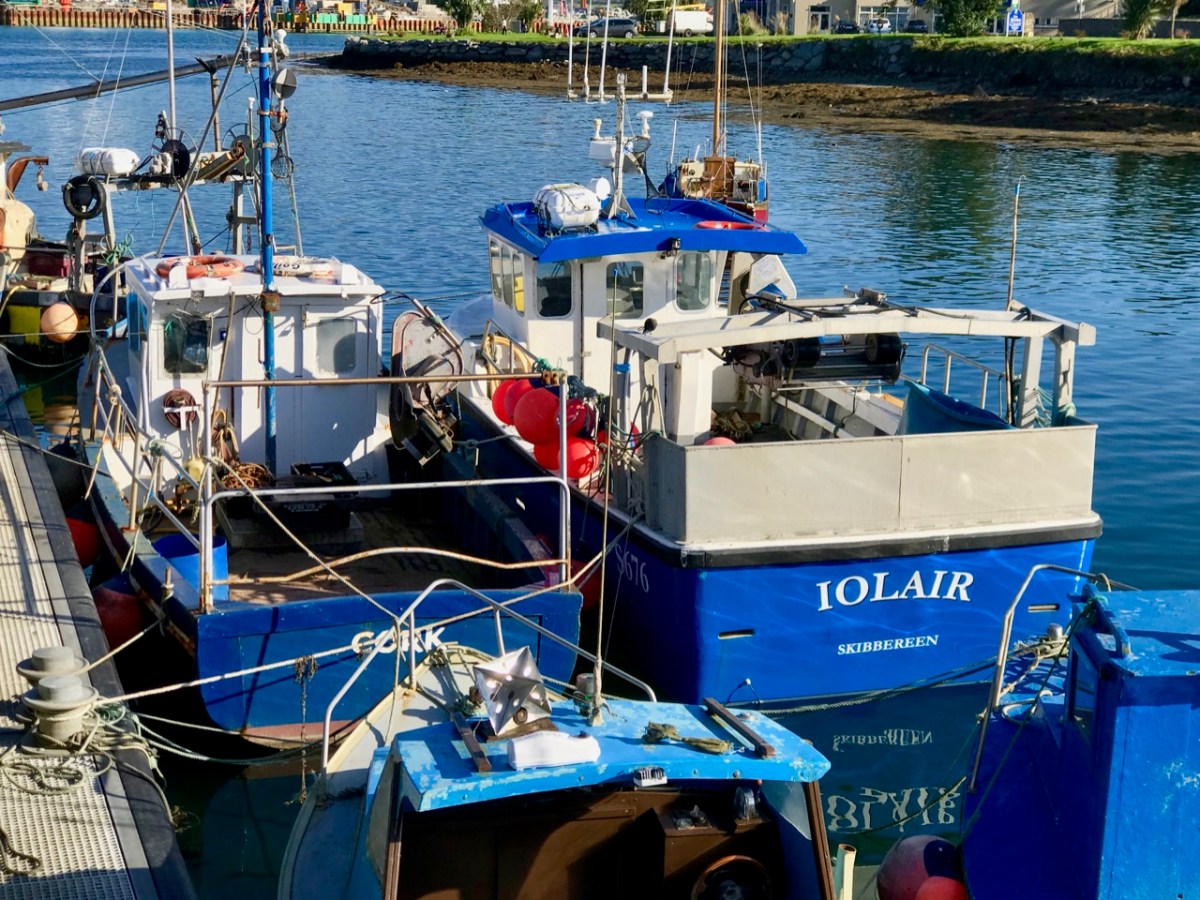
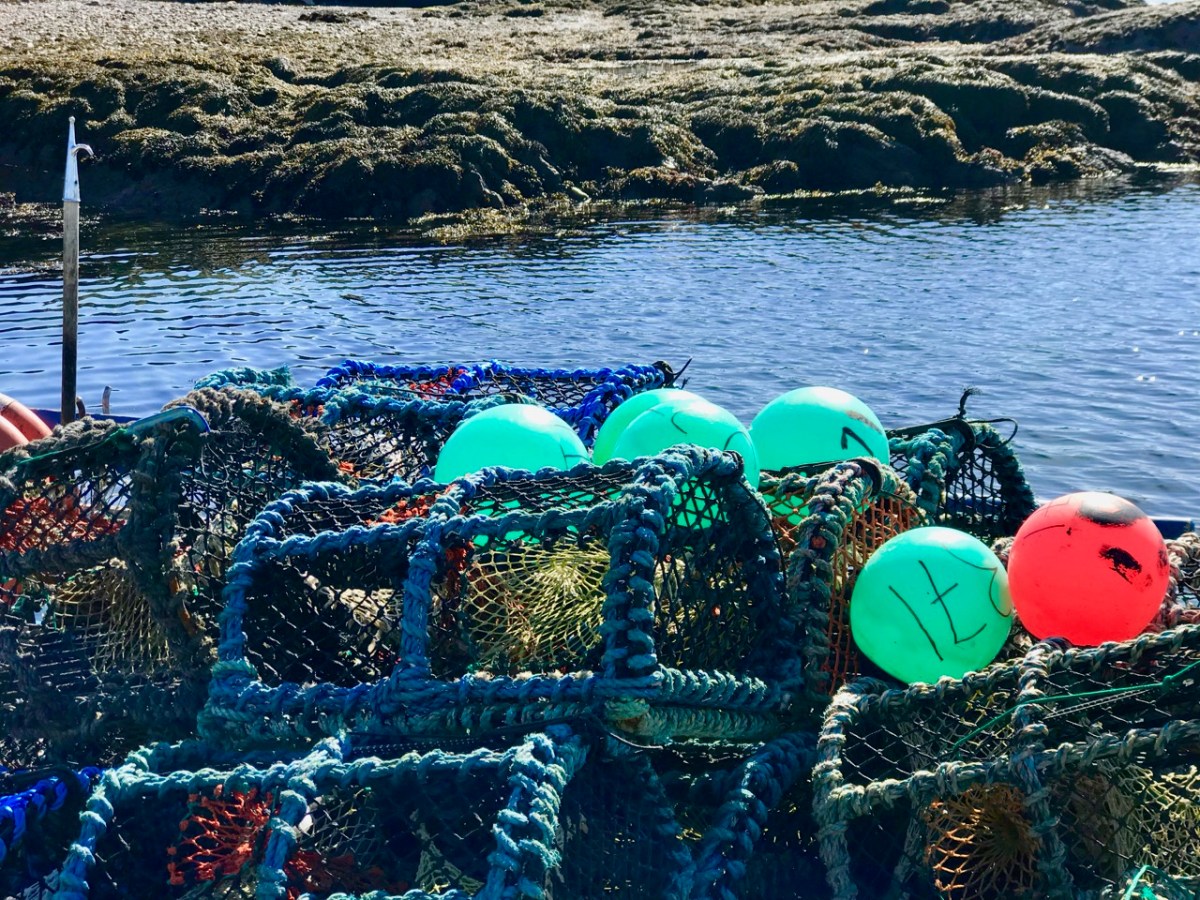
Let’s leave that argument – and the drama – for others to debate, and return to the colour and spectacle of our neighbours. Below are fishing boats tied up in Castletown-Berehaven. You’ll note that ‘Iolair’ is registered in Skibbereen. If this seems strange, remember that our West Cork town on the Ilen River is still the Port Of Registration for all shipping on the south-west coast of Ireland between the jurisdictions of Cork and Limerick. My recent post on the Ilen described Skibbereen as “. . . a settlement served by water . . .” with perhaps up to nine historic quays and a Custom House located within the town in its heyday of commercial vessels working on the river. Present day Shipping registrations are administered by Customs & Excise in Bantry, even though the prefix ‘S’ (for Skibbereen) is still used – a somewhat quirky anomaly: the Custom House in Skibbereen was closed in 1890!
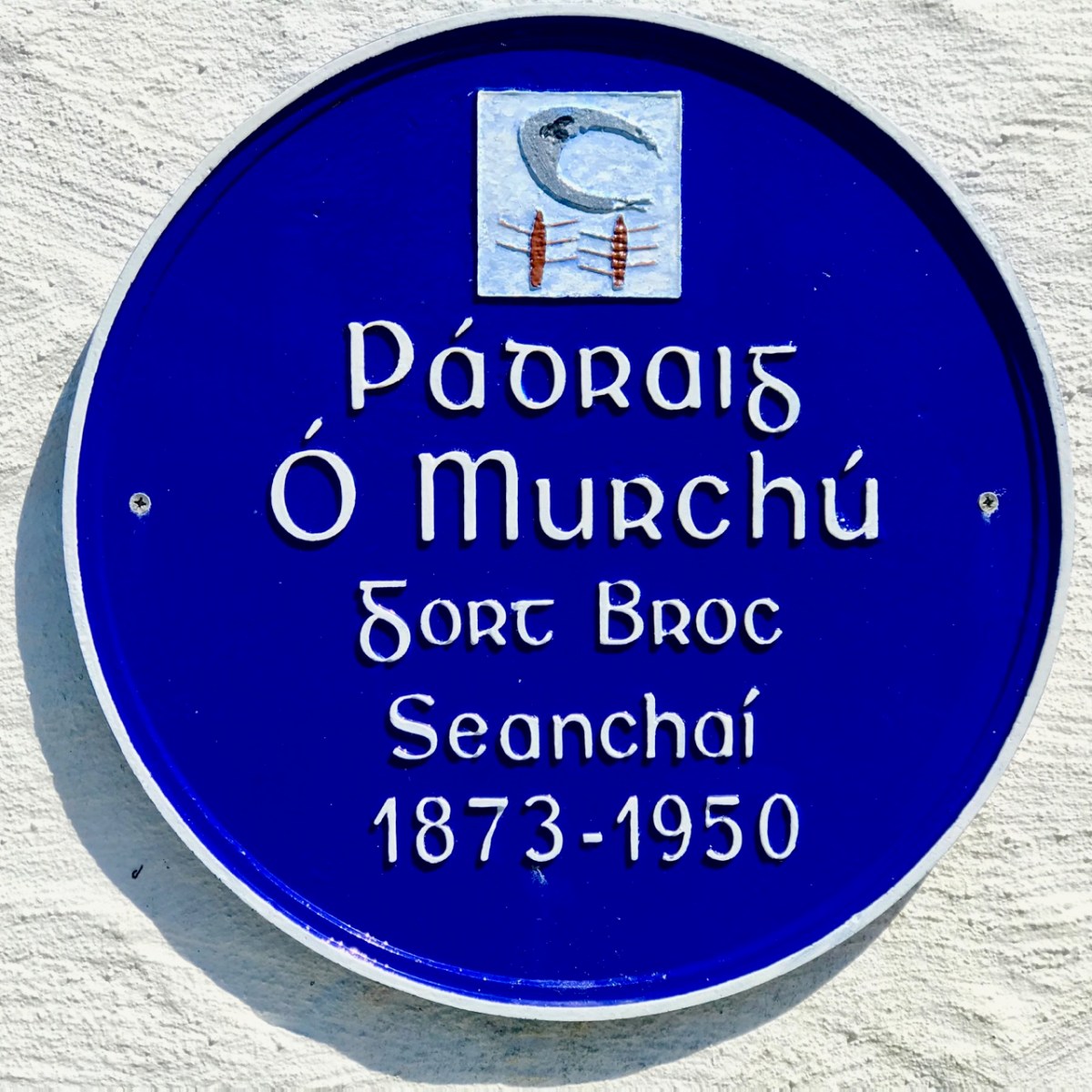
The people of the Beara Peninsula quite likely think of themselves foremost as an entity, rather than a mixture of Corkonians and Kerry people. In Eyries a Seanchaí – or storyteller – is celebrated: Pádraig Ó Murchú. His story is a somewhat sad one, certainly not untypical of many remote areas in Ireland. He was born in Gort Broc (Gortbrack, Co Kerry – north of Kenmare Bay) on 15 February 1873. His parents were Seán Ó Murchú whose wife Máire Harrington. (‘Caobach’) and he had four sisters and two brothers. Five of them, the boys and three of the girls, went to Butte, Montana. Seán died in Gort Broc at the age of 47 when Pádraig himself was a young boy. None of his forebears ever returned home but he would receive a letter every now and then from one of his aunts. Folklorist Martin Verling states that 707 men and 431 women emigrated to Butte from the parish of Aorí between 1870 and 1915. An account of how his great-grandfather, Seán Ó Murchú, settled in Kerry was taken down from Pádraig’s mouth (or Patsy as he was called): Seán was abducted by one of the ‘Cithearnaigh’ (a name given to certain Irish landlords in Beara) in Kerry and sold in France as a slave. When he managed to escape, he landed in Beara.
Commemorating Pádraig Ó Murchú in Eyries
Measles affected Pádraig’s eyesight so badly that he was given a blind pension; ‘flickering’ left him unable to read or write. He spoke English fluently, with Irish his native tongue. Until she died in 1923 his mother lived with him, and it fell to him to tend to her during the decline of old age. He earned his living by farming and fishing and was always in good health, apart from his eyesight. Writer and folklorist Máirtín Verling recorded memories of him from men who were young boys during Pádraig’s old age. Pádraig was part of a culture now vanished, and Verling states “. . . the day Pádraig Ó Murchú was lost as an old man – the habit of storytelling, and the habit of speaking Irish, died together in Béarra . . .”
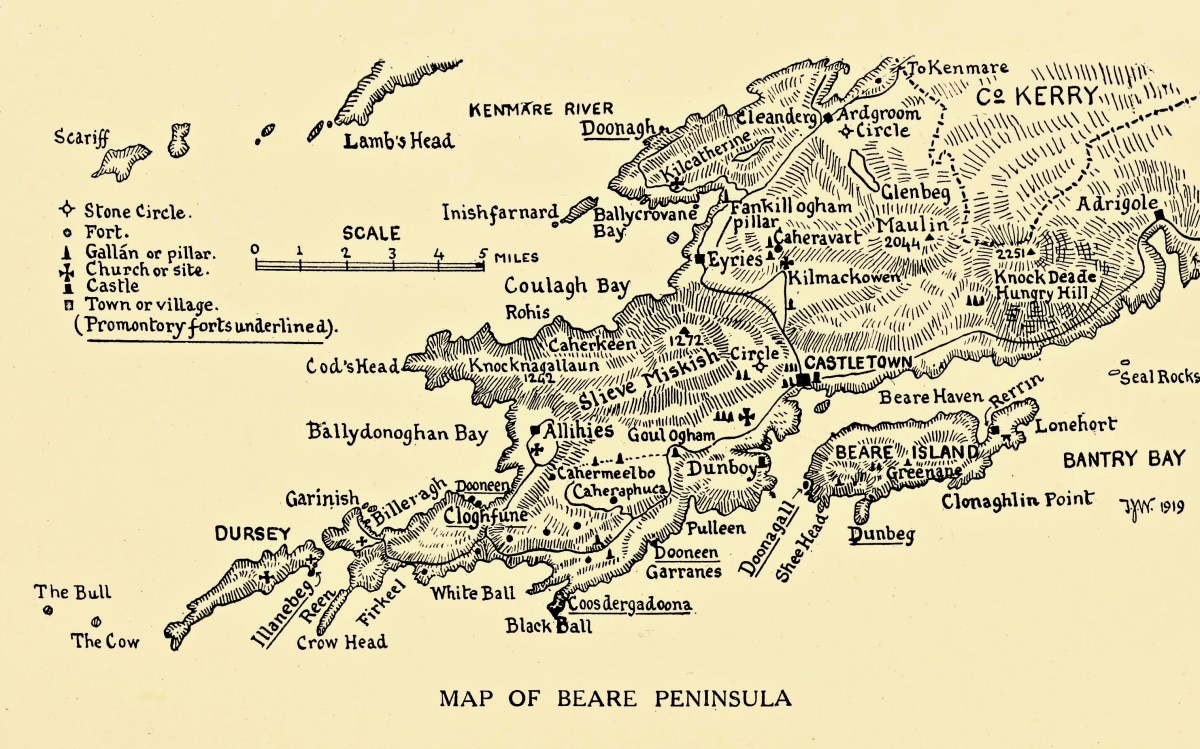
Map of the Beara Peninsula from the Royal Society of Antiquities of Ireland, T J Westropp 1919. Principal archaeological sites are indicated.
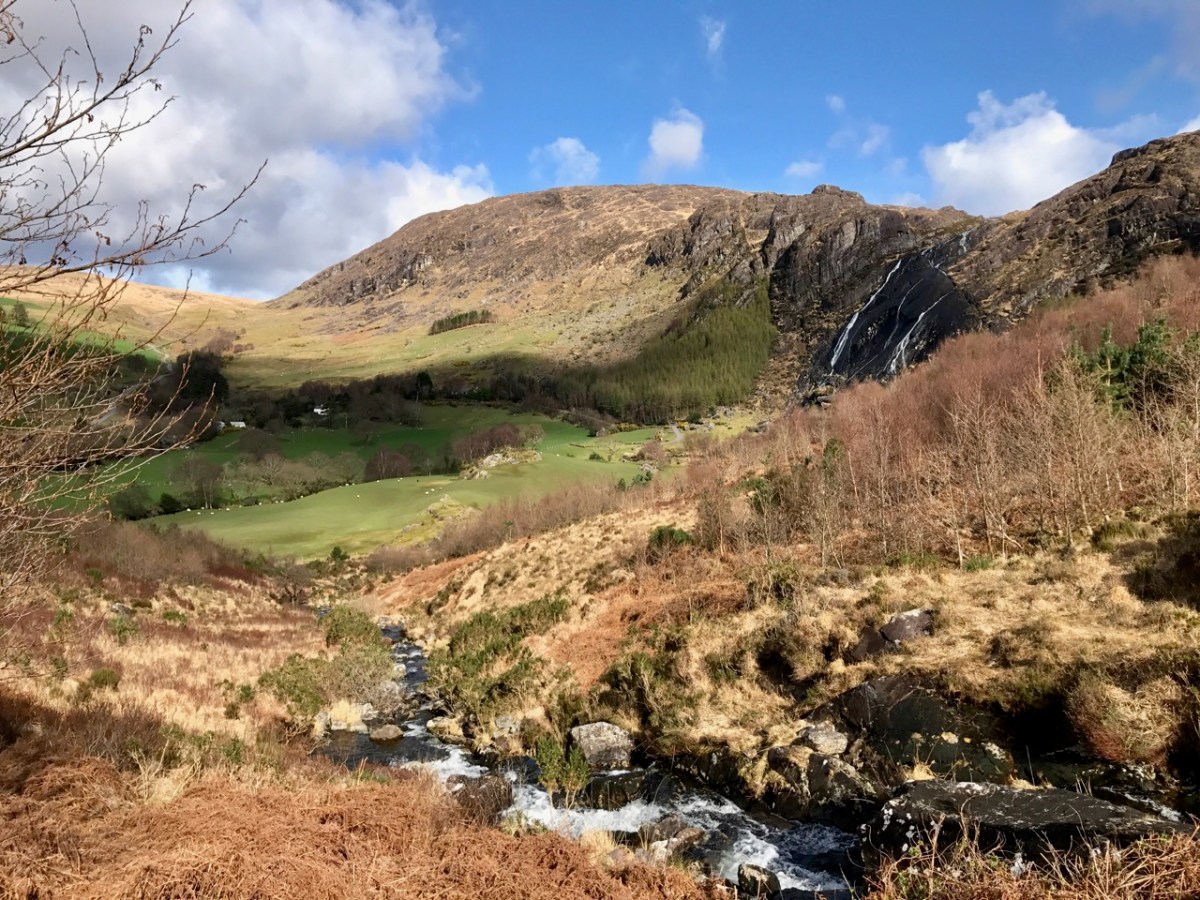
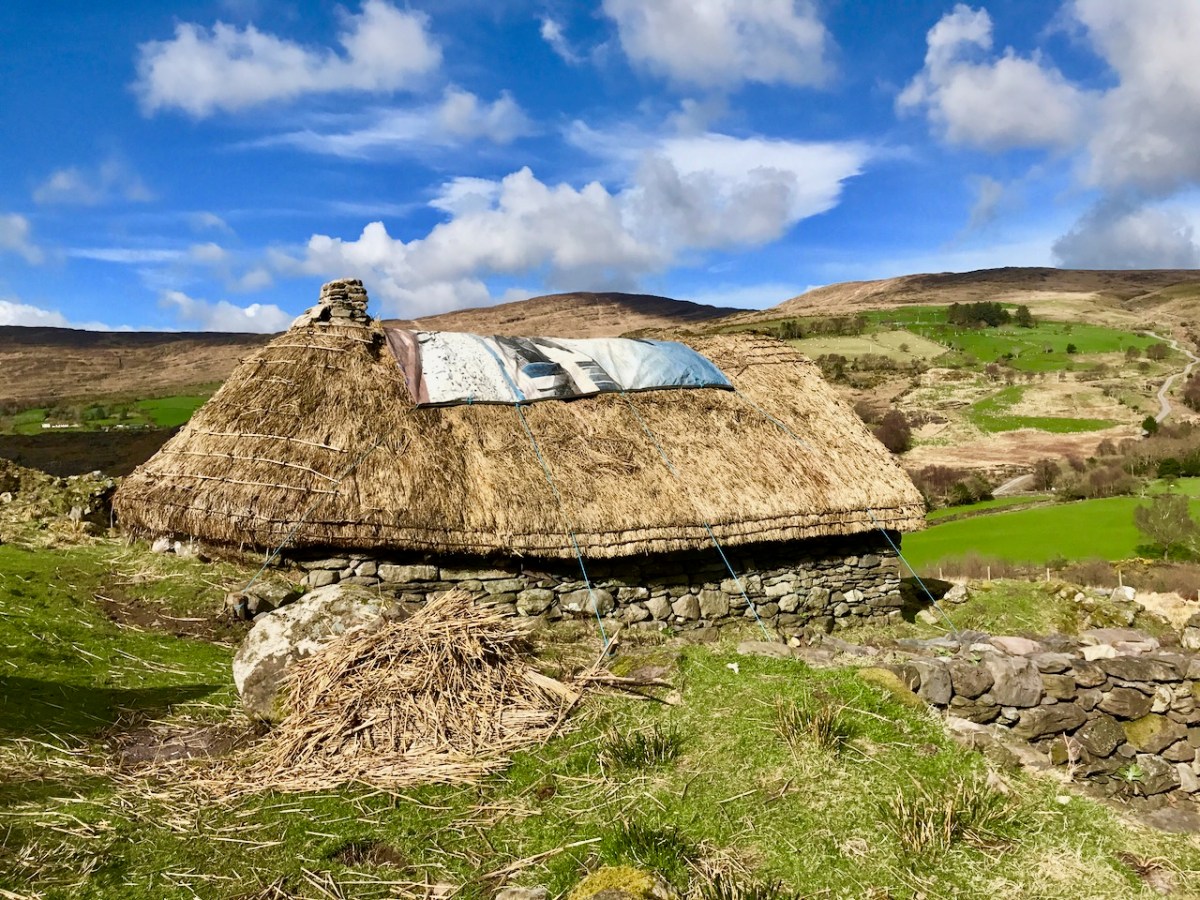
These Beara landscapes are typical of the remote grandeur of the territory. Human settlement has encroached upon it – the patchy forestry plantations above are unnatural and uninspiring – but there are sufficient wild prospects remaining to ensure that the all-embracing beauty can never be eroded. Plenty of living history remains in evidence.
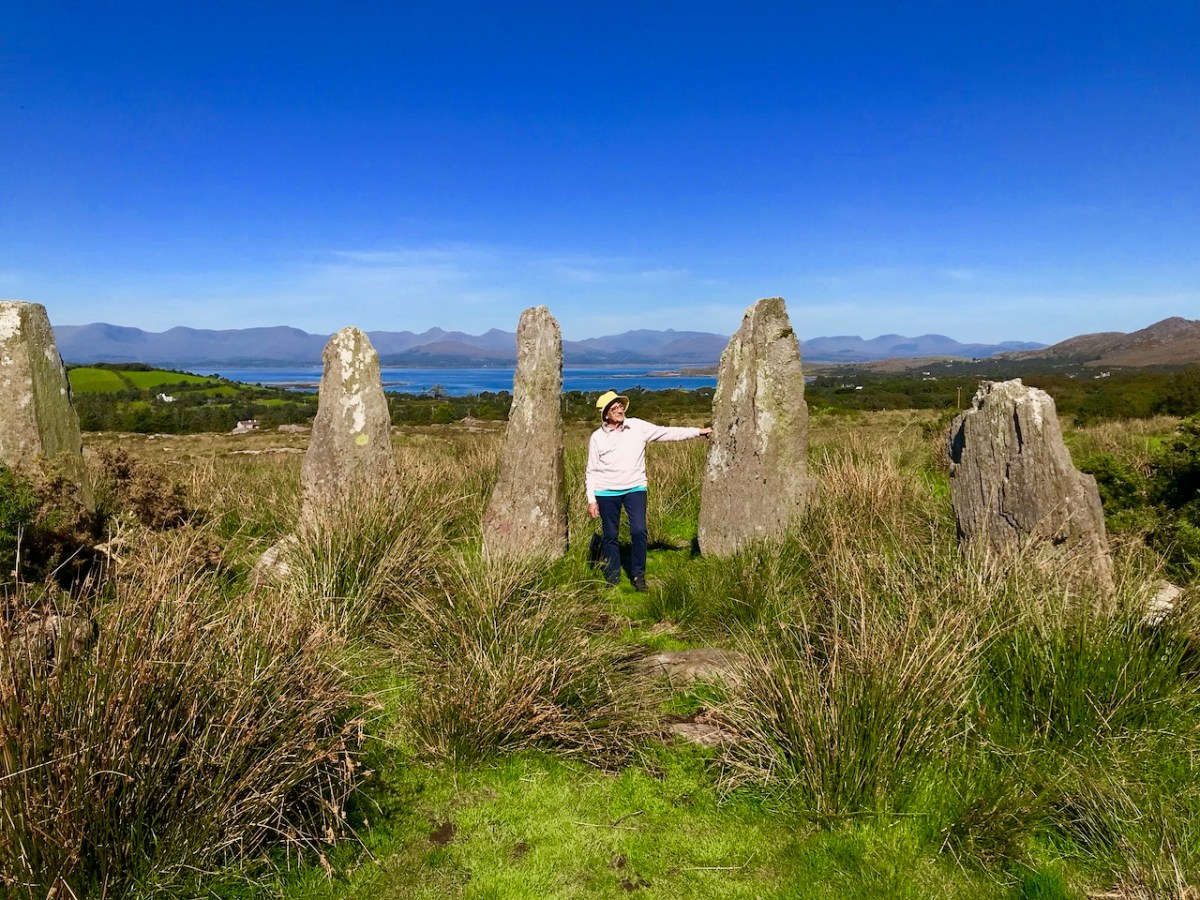
Archaeology, colour and community are all part of the local scenes on the Beara. The tourism industry is undoubtedly thriving, bringing fresh life with it.
We hope you will agree that the Beara – whether it’s Cork or Kerry – is deserving of a visit – and a stay: you have to delve deeply into the lifestyle and traditions. Enjoy!
(Above – the work of stained glass artist George Walsh. A visit to the little church in Eyries to take in more of this is a must)
We were saddened to hear recently of the death of Leda May. Hers was a familiar face in Ballydehob, where she lived for many decades. Her little pottery studio on The Parade has always been a landmark in the village:
Above – Brian Lalor and Leda May in the Ballydehob Arts Museum, 2019. Leda continued to work until her recent illness, and her blue porcelain ware is familiar to many of us in and around the community.
A documentary about Leda – ‘The Elephant & The Dandelion’, directed by Martin Daley, was made in 2015 – and is available to view here. Leda May was born in London, grew up in Suffolk, and studied ceramics at Hornsea College of Art in the 1960s. She was also drawn to the medium of stained glass which gave her the opportunity to create with colour. Here are two of her glass pieces (reproduced from the documentary film with thanks to the crew):
Leda was at first attracted to the culture and landscapes of India, but in due course Leda and her husband Bob set out in a converted ambulance ‘to visit all the potters in Ireland’, and arrived in West Cork in the late 60s, meeting Christa Reichel at Gurteenakilla. Christa encouraged them to set up their own pottery behind the Flower House: this was known as Luba Studios.
When the Ballydehob Arts Museum opened in 2018, Leda was among the West Cork artists celebrated, and she was always a supporter of the Museum, which has put on several exhibitions to date. The Museum is sited within Bank House, a colourful building owned and run by the community.
This dresser in a household within our village displays several examples of Leda’s work – and other works by Ballydehob’s creative community of artists:
We wish Leda farewell, knowing she has left behind her a legacy of original work which will always be appreciated. But she will principally be remembered as a gentle spirit and talented artist within her community.
Leda May at her wheel in Ballydehob in 1980. A retrospective of Leda’s work is currently being prepared and will be shown this year in the Blue House Gallery, Schull between Friday 28 April and Wednesday 17 May.
Welcome to the UCD Library Cultural Heritage Collections blog. Discover and explore the historical treasures housed within our Archives, Special Collections, National Folklore Collection and Digital Library













 Roaringwater Journal