Mizen Magic 8: The Altar

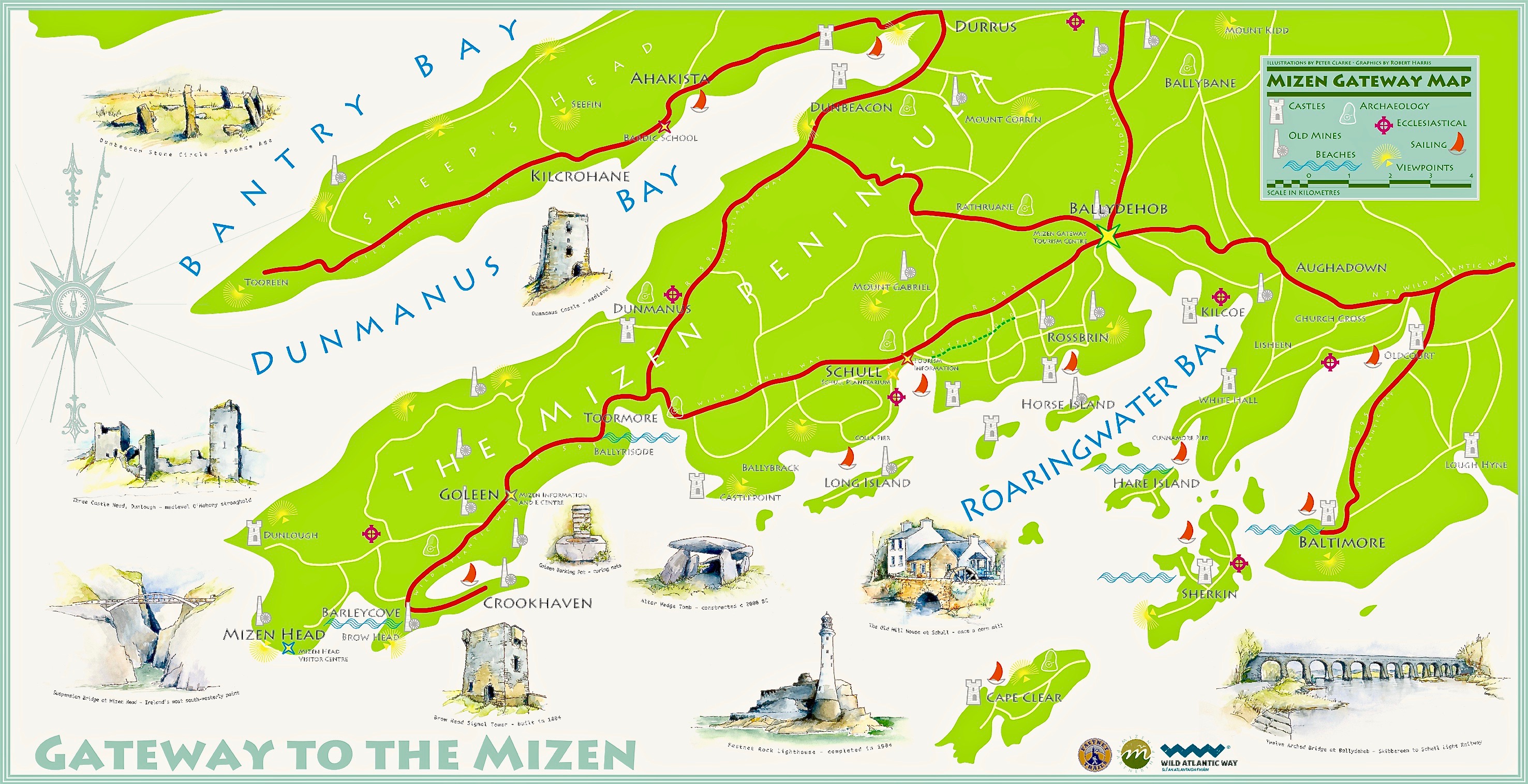
Here’s the Mizen Peninsula shown on a map drawn by Robert for the Bank House tourism centre in Ballydehob and embellished with Peter Clarke‘s exquisite watercolour sketches of just some of the places that should not be missed by visitors to West Cork . . .
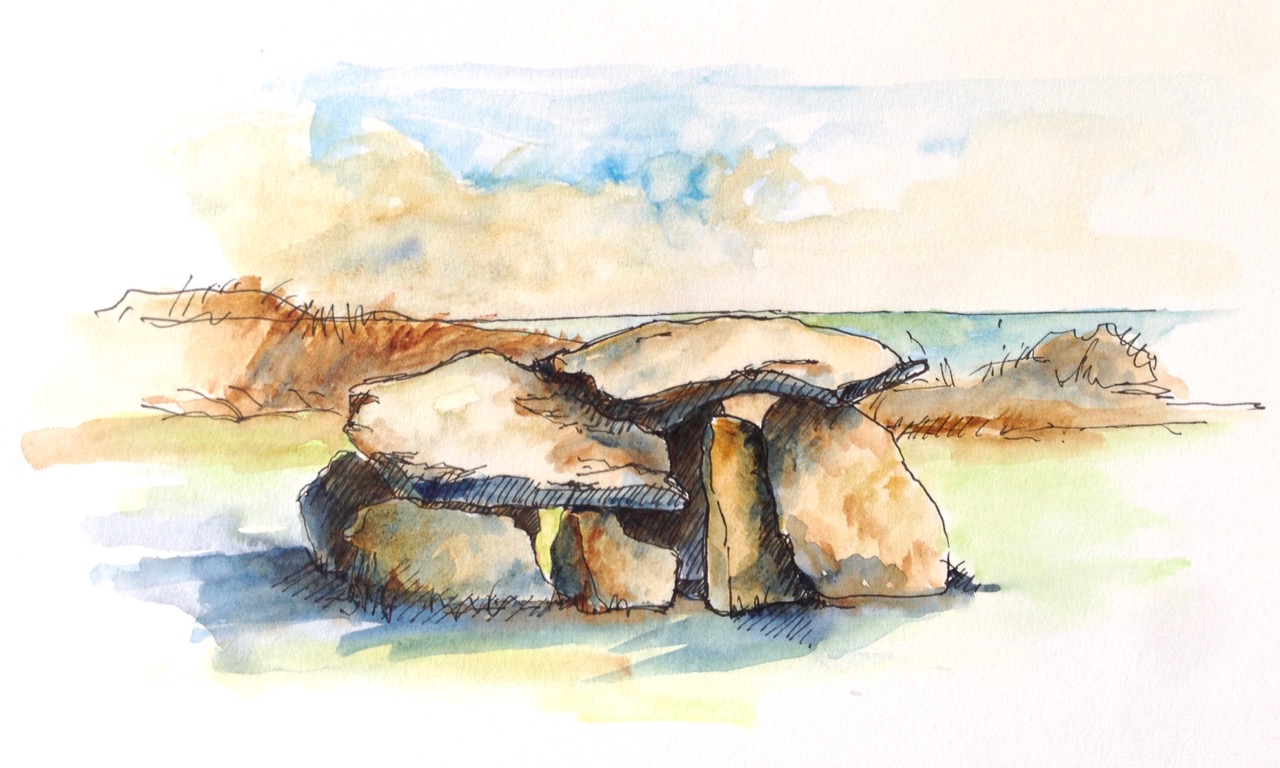
. . . And here is another rendering from Peter of one of the ancient sites that everyone goes past when travelling to the far west: possibly one of the most accessible pieces of archaeology on this section of the Wild Atlantic Way. It’s the Altar Wedge Tomb at Toormore Bay.
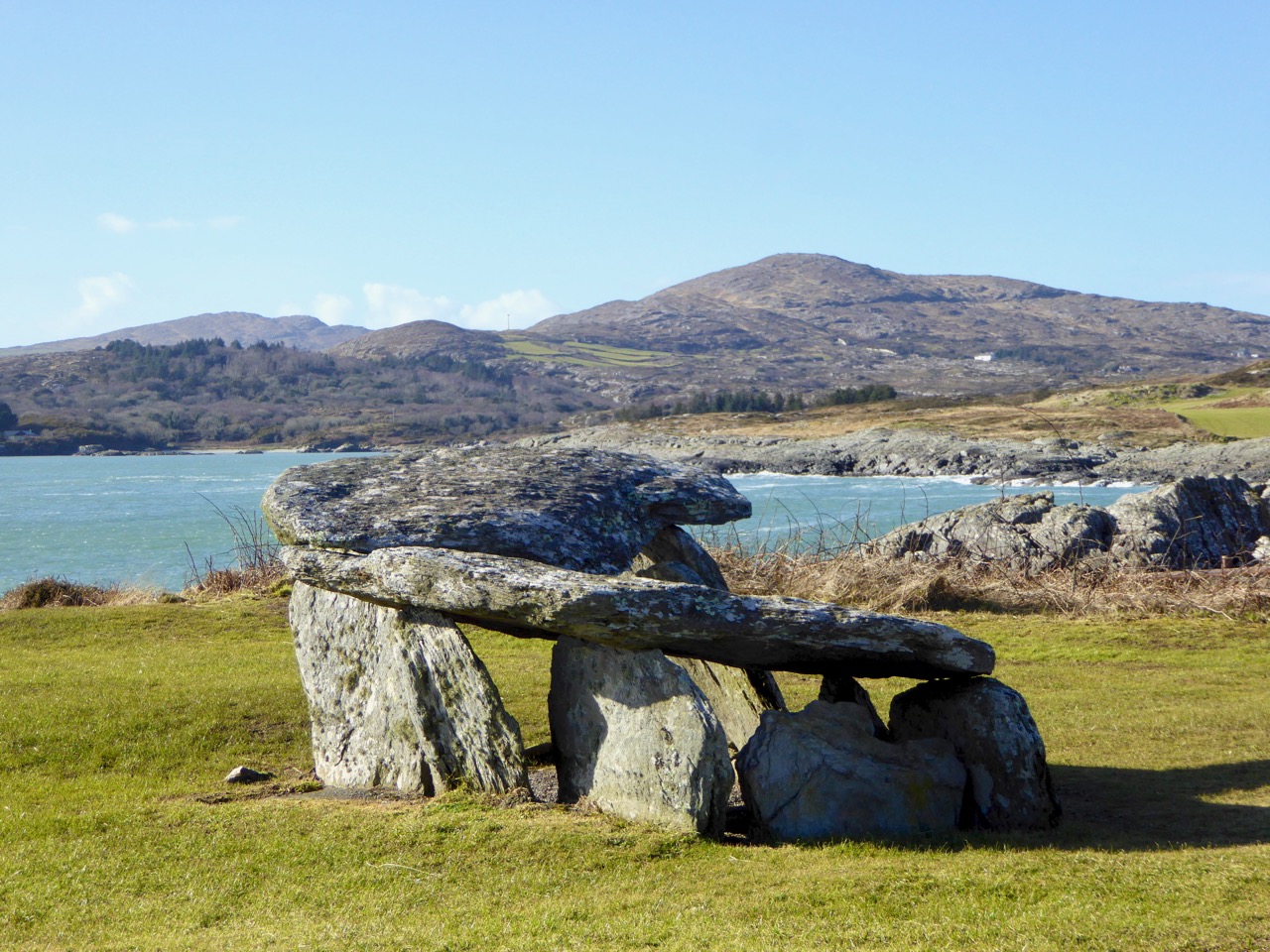
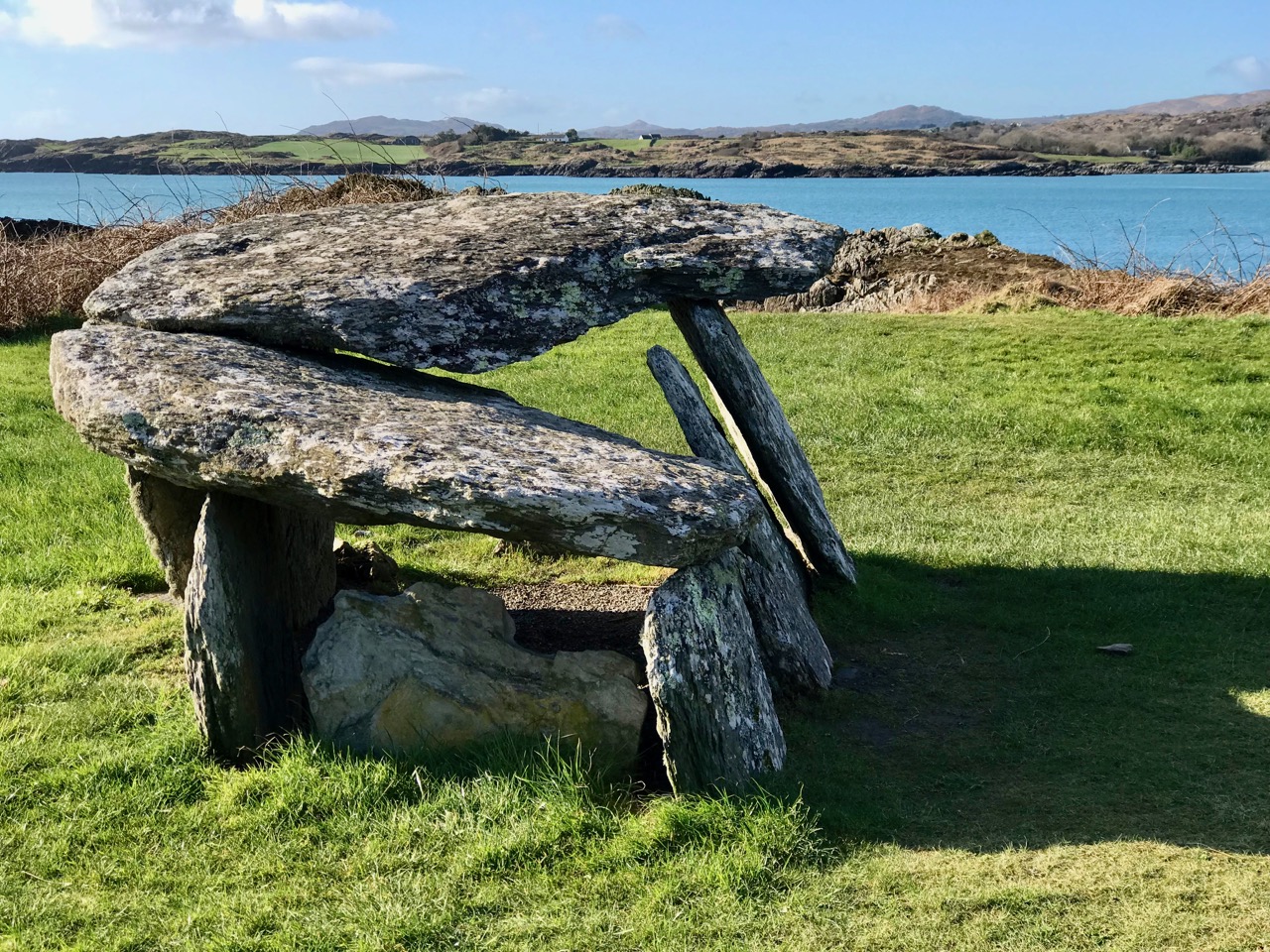
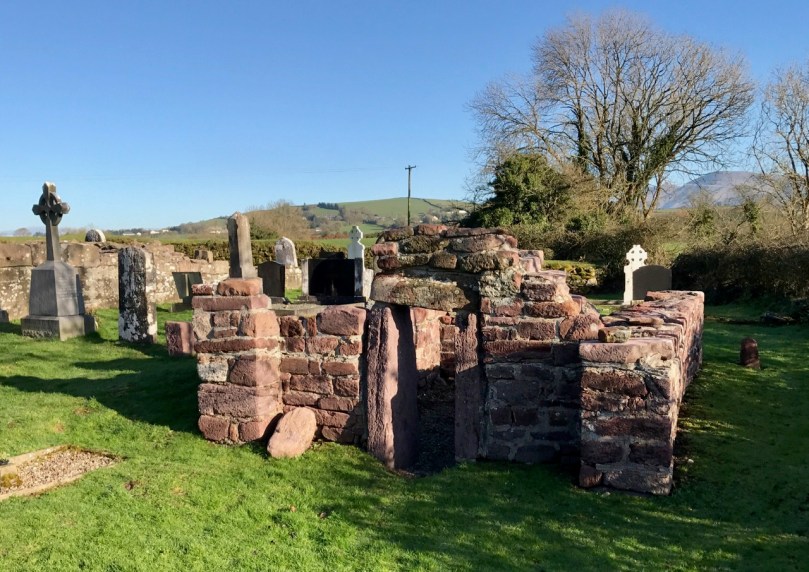
It’s early February, and Imbolc has passed. That means that Springtime has officially started here in Ireland. Sure enough, we looked out over a sunlit Roaringwater Bay this morning: soon we were heading out towards Goleen, Barley Cove and all points west. We stopped at The Altar and had it all to ourselves. You can see here that it’s orientated towards the Mizen Peak – that sharp little pyramid which is right on the centre of the picture – and lies to the west. For me, there’s a perfectly natural symbolism about placing the dead in a tomb that is aligned on the rising and the setting of the sun: that’s something we still do, several thousand years on!
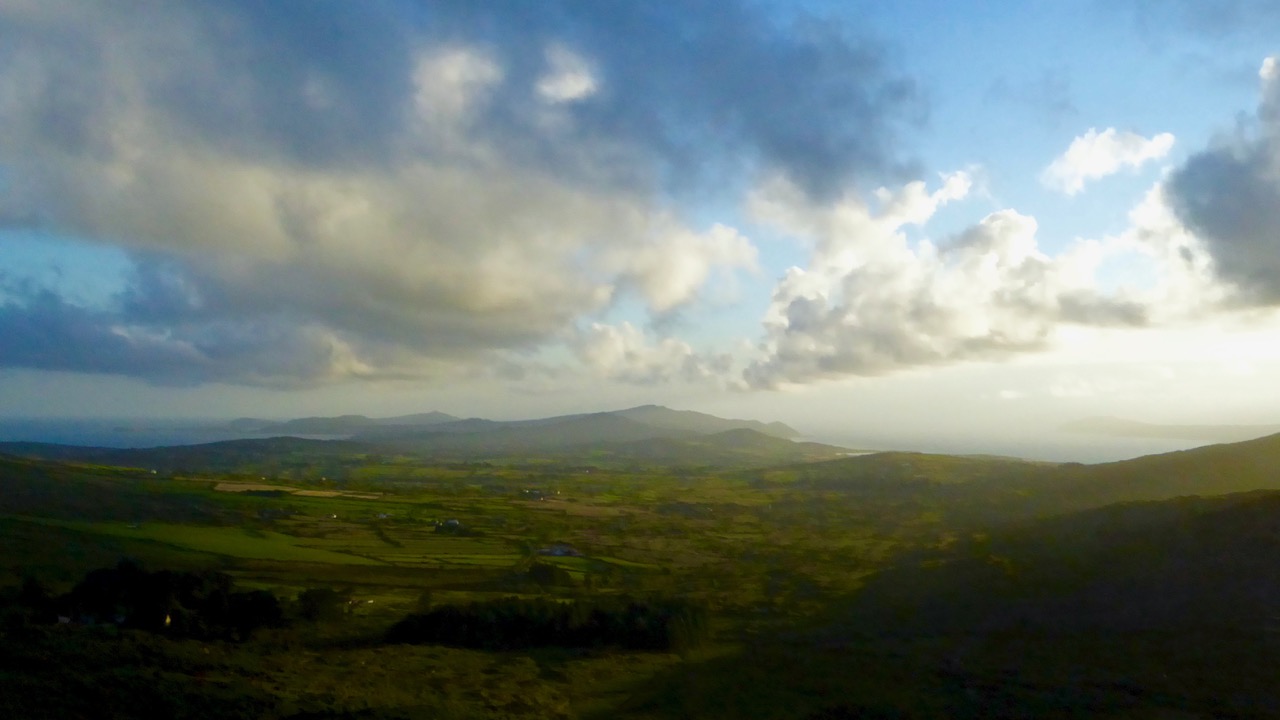
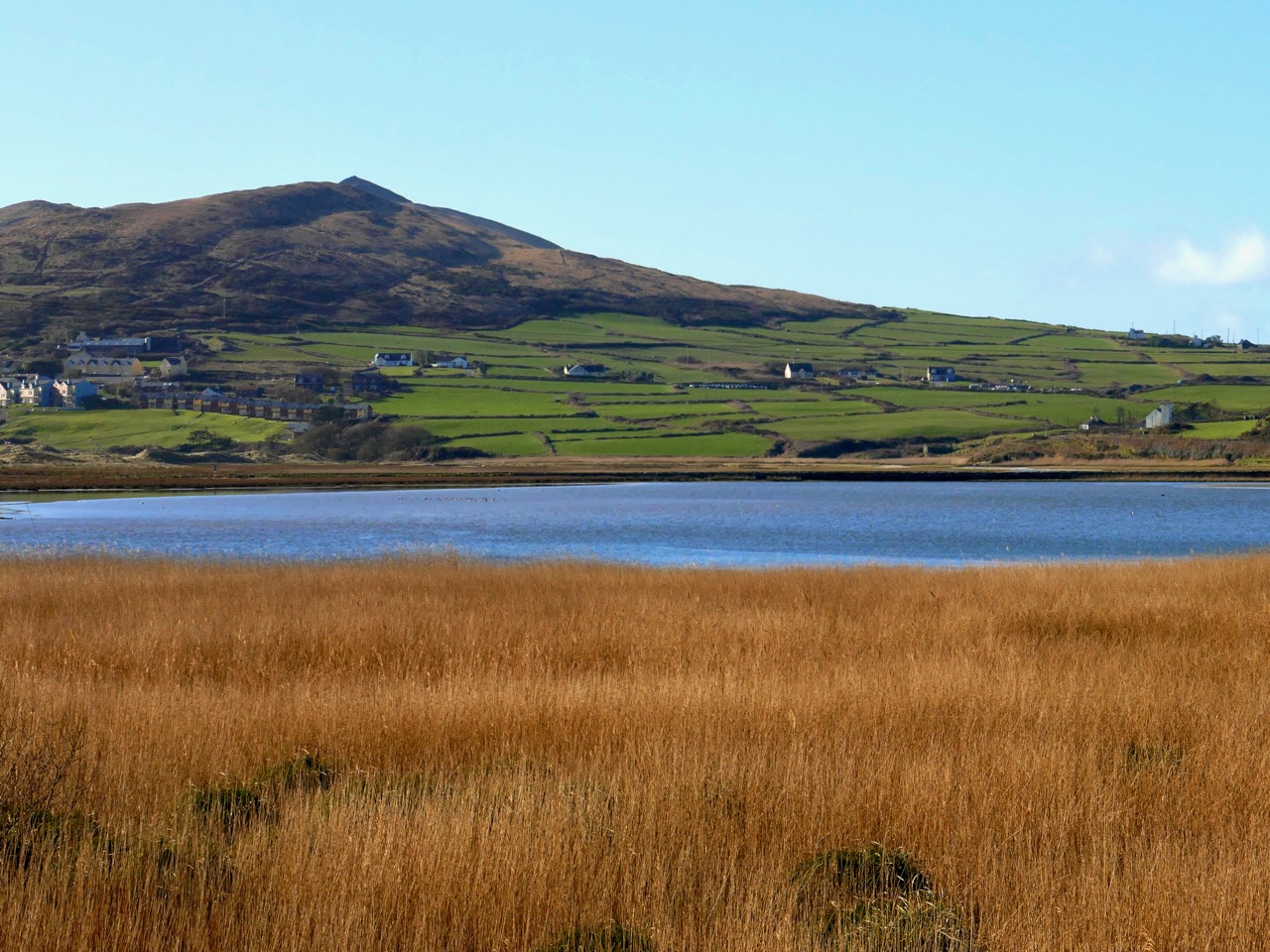
The upper picture, taken on the Winter Solstice, shows the Mizen stretching away from the heights of Mount Gabriel: the Mizen Peak is the little pointed blip just left of centre. The lower picture looks across the wetlands behind the sand dunes at Barley Cove, and was taken today in the Spring sunlight: the Peak is clearly visible as the highest point. I believe that our forebears attached great importance to high places, as many stone monuments and Rock Art often seem to be placed in the landscape with commanding views towards hilltops. Mike Wilson’s site Mega-What sets out his detailed studies of the orientation of ancient sites within the natural landscape. Here is his analysis of the setting of the Altar Wedge Tomb.

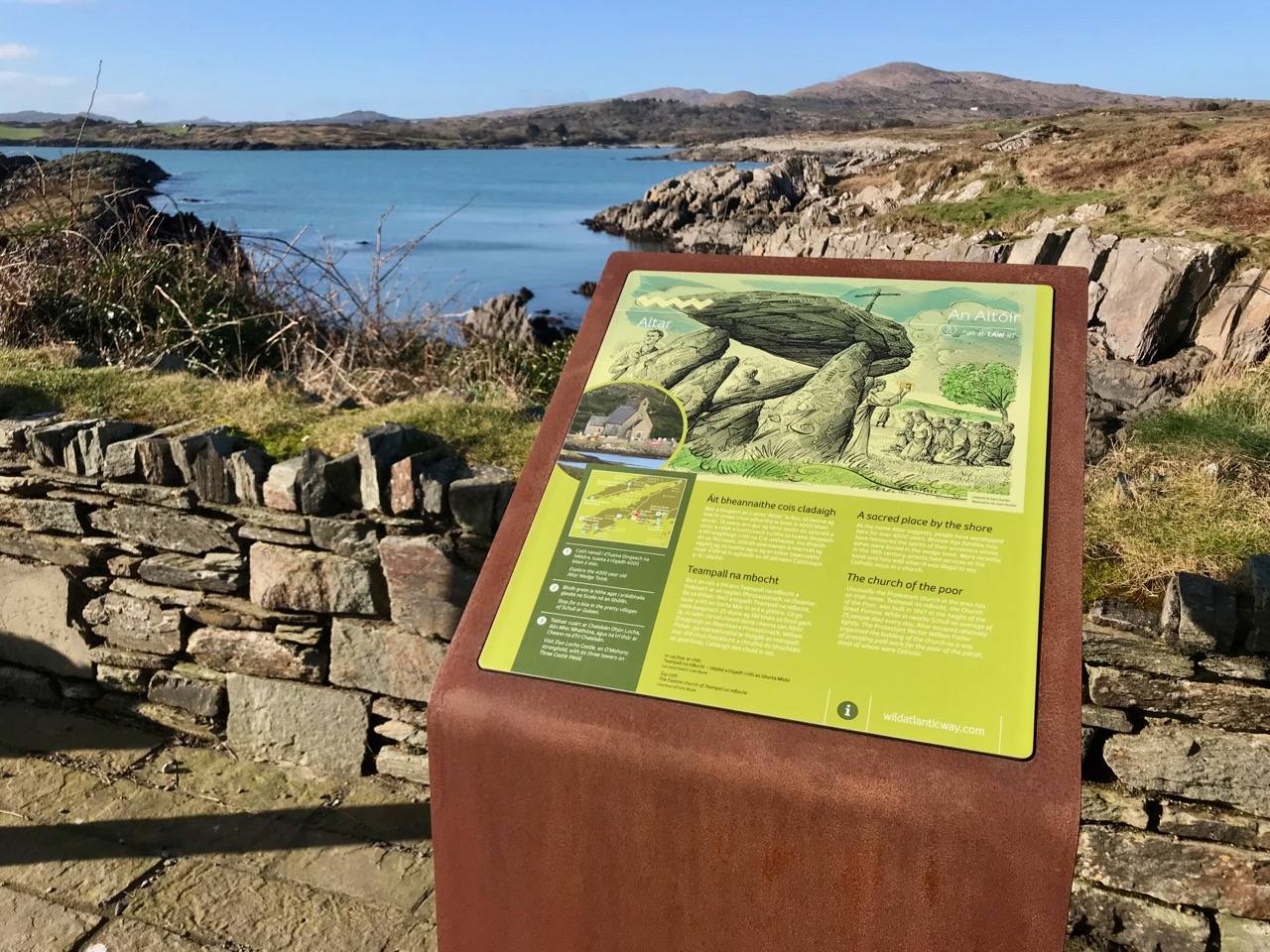
I am always alert for the ways in which our special sites are interpreted for us. I created a bit of a storm a while back when I commended the signage which has been put in place along the Wild Atlantic Way using visually strong corten steel elements (above left) supplemented more recently by (in my opinion) very well designed information boards. The image on the right above is from an earlier OPW board which explains the possible early use of the wedge tomb, while the images below show the new signage, which features the later use of the tomb as a Christian altar during the Penal times (hence the name: The Altar), with a drawing by Sam Hunter. I am struck by the way this monument has been a focal point for differing rituals spanning countless generations.
When writing about archaeological subjects I am always on the lookout for the way that antiquarians saw the sites which we are familiar with today. I had hoped that George Victor du Noyer – the subject of an excellent recent exhibition in Cork’s Crawford Gallery – might have drawn this wedge tomb when he travelled the country for the Ordnance Survey during the early nineteenth century: he may well have done, but the annotation and cataloguing of his vast legacy of work has yet to be completed and I have not found such a record. His drawings below are not of The Altar, but a portal tomb, Ballybrittas in County Wexford. Portal tombs (sometimes known as dolmens) share similarities with wedge tombs, but are earlier, dating from between 3000 BC to 2000 BC, while wedge tombs tend to be associated with the Bronze Age, which followed this period.

Cremated remains were found in Altar Wedge Tomb when it was excavated in 1989 by Dr William O’Brien, now Professor of Archaeology at UCC. We can never know exactly what the significance of these impressive structures was to those who built them. For me, I’m pretty sure that it was connected with their relationships to, and respect of, the landscapes which they inhabited, and which they invested with meaning. They must certainly have paid heed to the passing of the seasons and the continual cycles of nature, and their closeness to all of this must have given them an inherent knowledge of the paths of the sun, moon and stars. Above all, our ancestors had to understand and appreciate the environment around them, and make it work for them. In a practical sense, certainly, but also in terms of the stories they might pass on about the meaning of places.

Above – the magical landscape of the Mizen: we will never tire of it

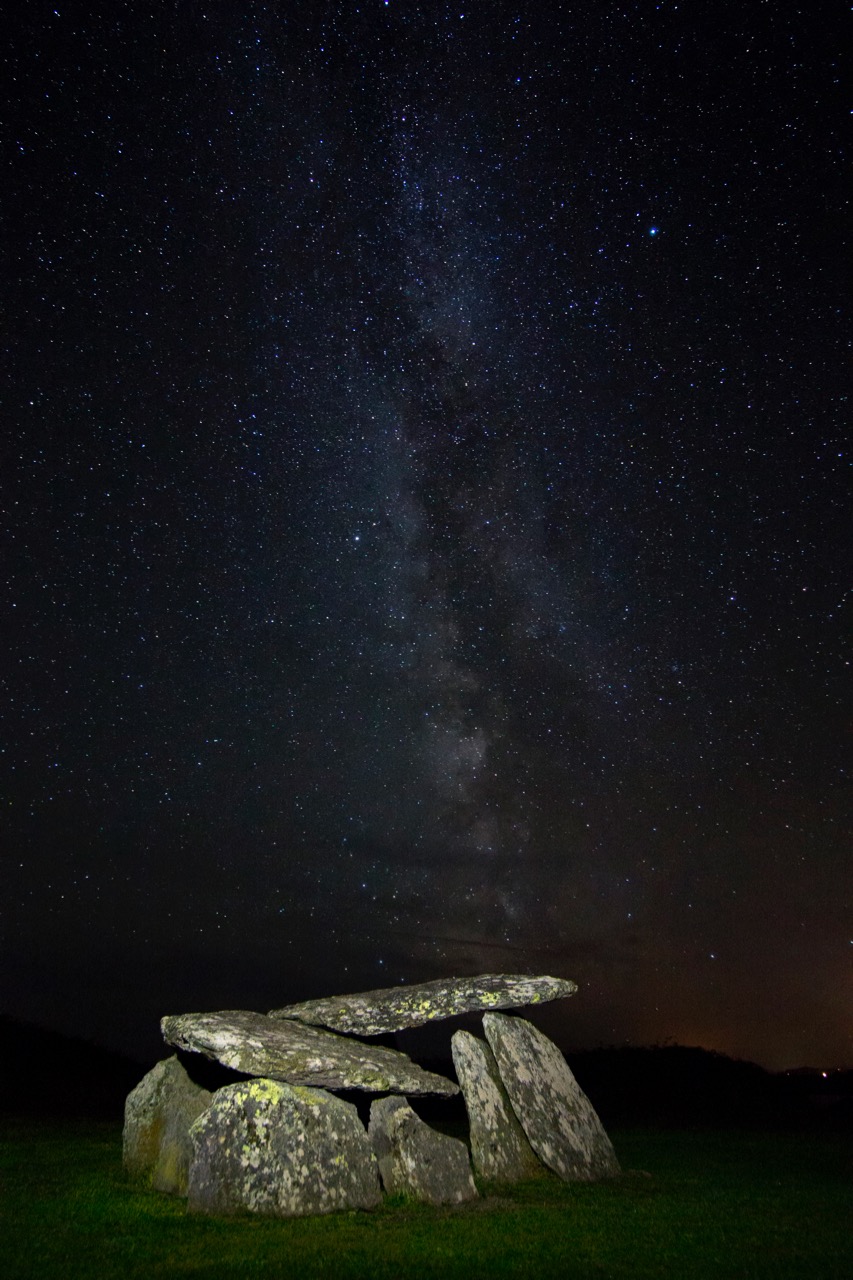
The tailpiece picture, which is from Wikimedia Commons, attributed to Lukeoc88, is a remarkable timeless view of a human construction in the setting of our Universe: Altar Wedge Tomb under the Milky Way.
Pagan and Pure

How does a prehistoric calendar mark turn into a pagan feast and then into a Christian saint’s day? This year, the cross-quarter day is Feb 3, yesterday: that is, the day that lies half way between the winter solstice and the spring equinox. Together with the solstices and equinoxes, the cross-quarter days divide the year into eight ‘months’ and they also establish the dates for the ancient festival days of Imbolc ( Feb 2, spring), Bealtaine ( May 1, summer ), Lunasa (Aug 1, harvest), and Samhain (Oct 31, start of winter). In fact, the actual cross-quarters times don’t fall always on those dates but close enough so they have become established as the festival days.

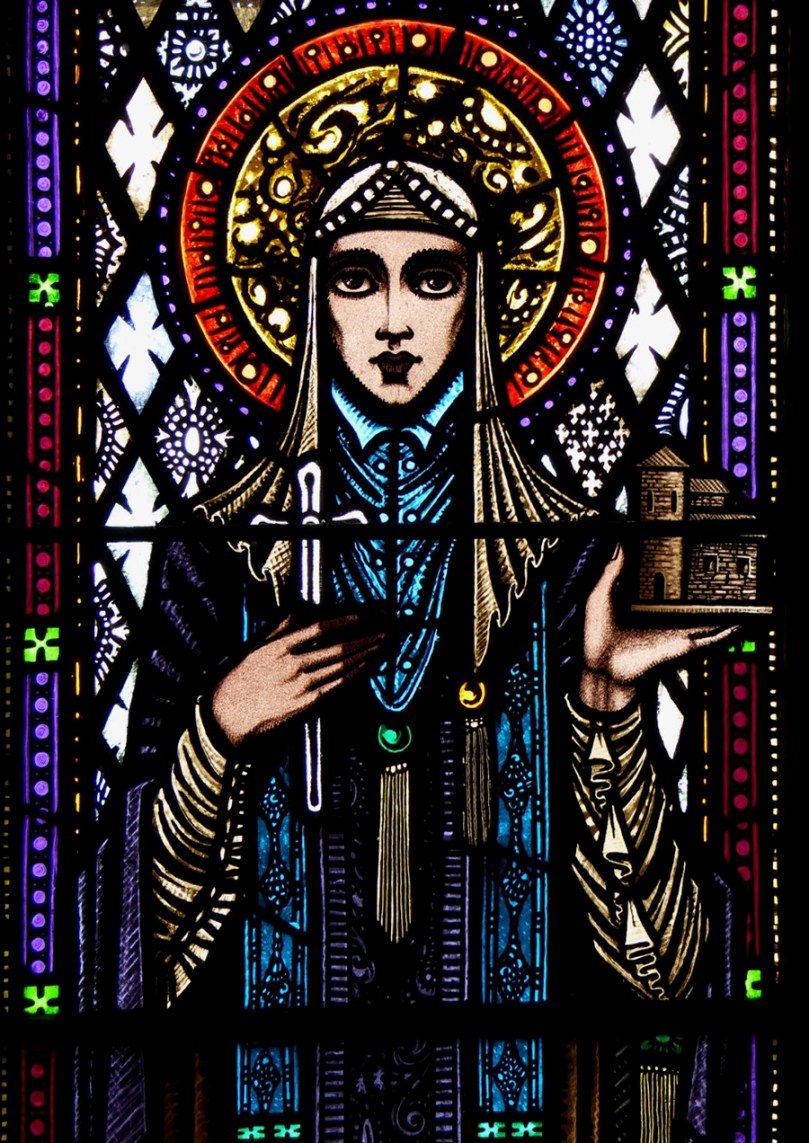
The Brigidine Centre in Kildare, run as retreat and contemplation house. The lead image in this post is a St Brigid stained glass window in Ballinrobe, Co Mayo

As so often happens when an ancient culture is Christianised, Imbolc became conflated with a saintly feast day, that of our own Saint Brigid, the female patron saint of Ireland. Brigid may have originally been a female deity, also called Brigid, or perhaps Danu. This is all controversial, of course – did the idea of the goddess or the idea of the saint come first, for example? Whatever the origins, the marking of the cross-quarter day turned into Imbolc the pagan festival, and finally into Saint Brigid’s Day, and all over the country we make St Brigid’s Crosses, leave a scarf out at night for her to bless, or, still, in Kerry, dress up as ‘Biddies’ and go from house to house, carrying a Brídeóg doll and singing and dancing in a ritual that must be as old as time.

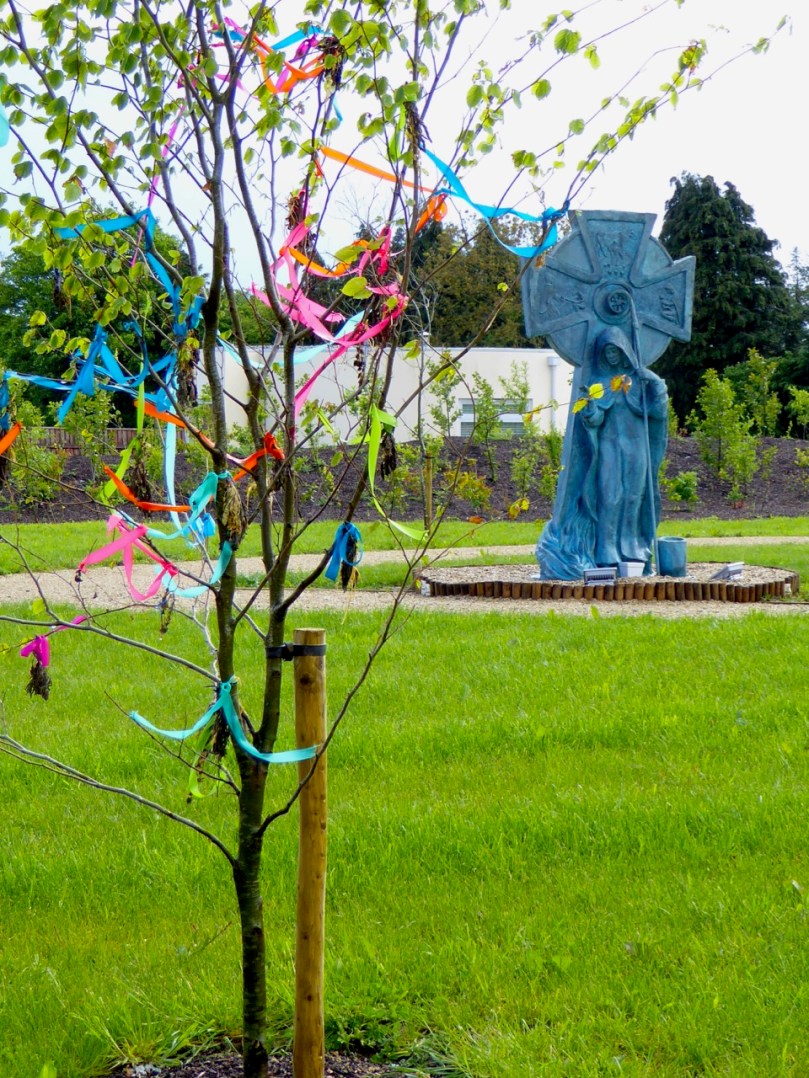
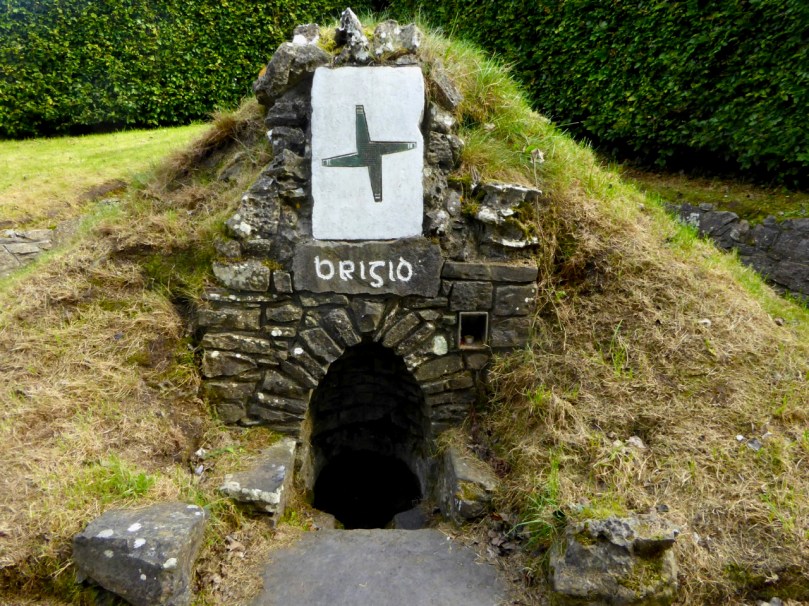
Another custom is to visit those holy wells that are associated with Brigid. Amanda has a special post on that – and is celebrating two years of holy well hunting!

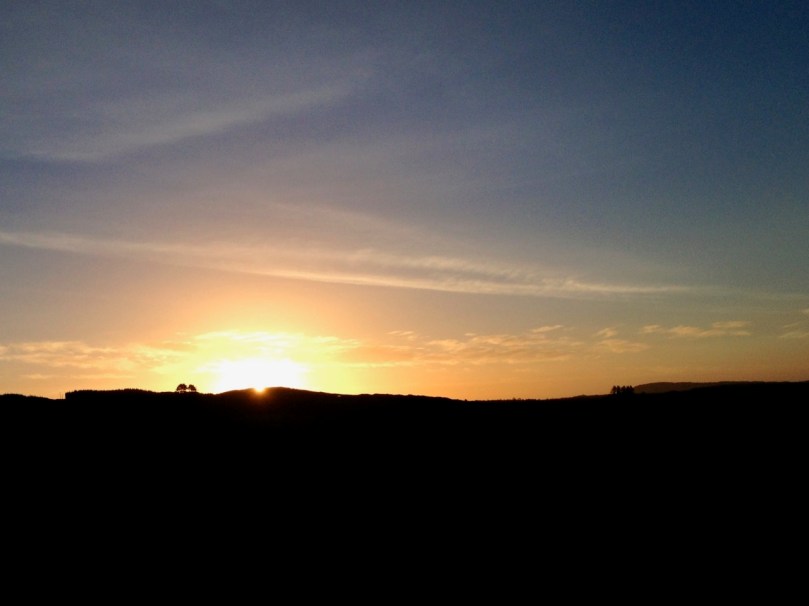
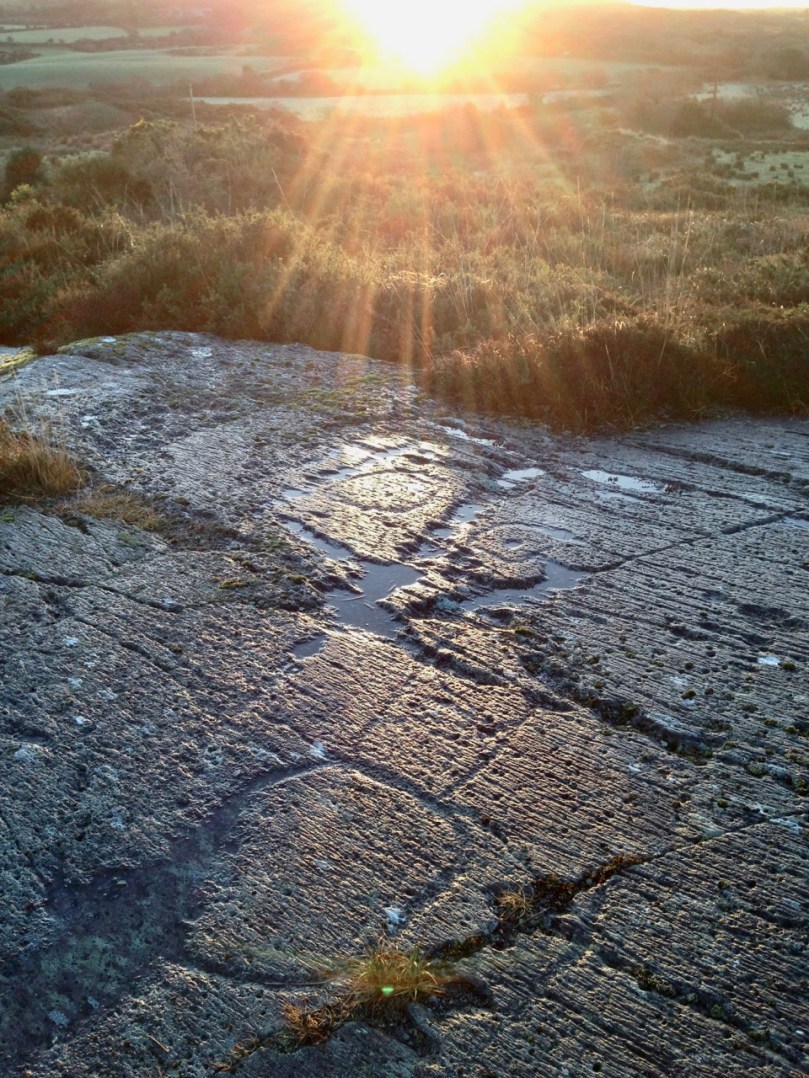
On one Imbolc that lives in our memories Robert and I arose early in the morning and went to watch the sun rise over a small prominence, standing on a piece of 5,000 year old rock art. Our account of that occasion is here, and below is the thrilling moment the sun rose, and lit up the ancient carvings.

Our friend, the poet Paul Ó Colmáin, from whom we take Irish lessons, used one of his own poems as a teachable moment this week, and I was struck by how perfectly it captures that sense of the turning year, the joy of sunrise, the deep embedding in our Irish souls of the ancient and the traditional and the embracing of both. I give the poem first in Irish. For those of you who do not speak it, you can take my word that the language is beautiful and contains nuances that his English version cannot capture, brilliant as it is.

Lá ‘le Bhríde

Dhúisigh an ghrian sinn

an mhaidin úd,

solas órga

ag stealladh

‘is ag scairdeach

isteach ar an urlár,

ag slaparnach

thuas na fallaí,

ag sruthlaíonn

an doras síor-oscailte isteach.

Níor thuigeamar

ar dtús

cad a bhí ag titim amach.

Níor aithníomar

torann buí na Gréine.

Ach chuimhníos

go tobann ar na bhfocail a dúraís,

mar dhraoi:

“Tiocfaidh an Ghrian thar nais ar Lá ‘le Bhríde.”

Agus d’árdaigh dóchas,

ársa, pagánaigh im’ chroí,

inár suí sa leaba,

Bríd nó Danú,

an lámh in uachtar ag an t-earrach,

bhí an geimhreadh, gruama thart.

“Tiocfaidh an Ghrian thar nais ar Lá ‘le Bhríde.”

Paul’s English version of the poem is given below. At the time he wrote it, Paul, his wife, the artist Marie Cullen, and their sons were living on the Great Blasket*, off the Dingle Peninsula, the only inhabitants of the Island.

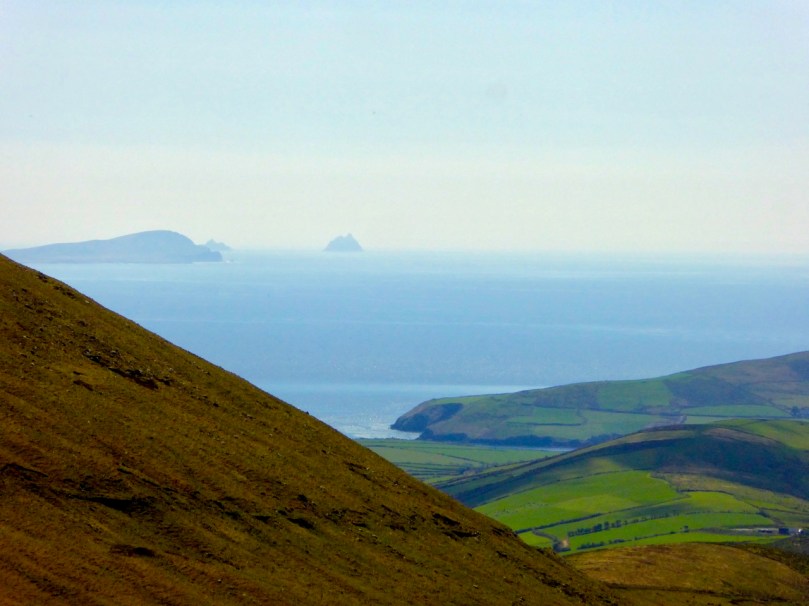
The Blasket Islands lie off the cost of Kerry, near the Dingle Peninsula. An Irish speaking enclave, it is now uninhabited

Winter was long on the Island, made gloomier by the fact that the sun, due to a combination of high ground and orientation, did not shine on their dwelling all winter.

The sun awoke us.

Like a fanfare

or a burst of wild laughter.

Playfully.

Unfamiliar.

Spilling in along the floor.

Splashing up the walls.

Streaming in through the ever-open door.

We didn’t – at first-  know what was happening,

Didn’t recognise the bright clamour of the sun.

Then we remembered the words

That you, druidlike, had spoken:

“The Sun will come back on St. Brigid’s Day.”

And a welling of Hope,

Pagan and Pure,

Came rising inside us,

Sitting in bed,

Brigid or Danú,

The Winter defeated:

“The Sun will come back on St. Brigid’s Day.”

We’ve turned the corner and spring is finally in the air. Today was golden and we spent it on The Mizen (see below). Thank you Brigid/Danu/Imbolc/ancient Calendar Keepers!

*If you’re ever in Kerry, make sure to visit the Blasket Centre

Fading Treasures

For me, Ireland’s greatest treasures are those that are shy of publicity. There’s nothing more rewarding than turning off the beaten track and negotiating a narrow boreen with a lush growth of grass down the middle and brambles scratching your car on either side to find – often by chance – a stunning piece of medieval architecture, perhaps just the fragments of a ruin in a field, but revealing the beauty of a decorated doorway or an ornately carved corbel. Always these items are discernible but fading. Their splendour – and the exquisite craftsmanship that created them – are manifest. But there’s a melancholy in these finds: you see them, and wonder at them, yet you ask: how many more generations will be able to appreciate these works of ancient hands?

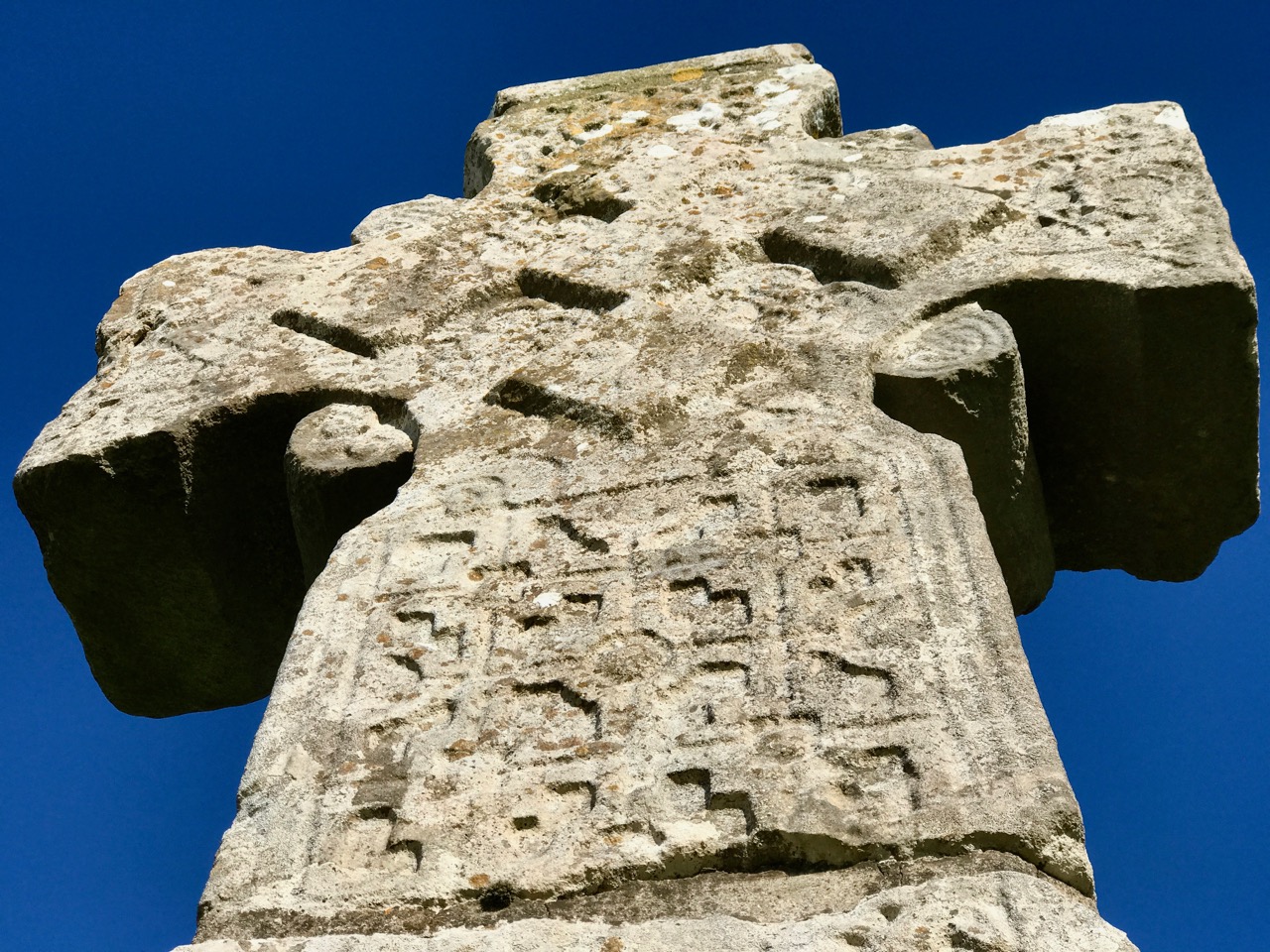
A classic case study would be the medieval high crosses. There are a remarkable number of these still intact on the island of Ireland, and many more fragmentary remains. We go out of our way to search for all these traces in our travels: some of those we have visited to date can be found through this link. It’s such a rich archive, and there are many more to be written up.

Above is St Cronan’s High Cross, Roscrea, Co Tipperary. As you can see, this example has been removed to an indoor location (Black Mills Heritage Centre), to protect it from further weather deterioration, although all the fine detail has been lost. In fact, this example has been assembled from sections of two different medieval crosses for purposes of display. I am an advocate of protecting these artefacts in this way, as acid rain and modern pollution seem to be accelerating the decay of the stone monuments. As in many cases with the protection measures, a high quality reproduction cross has been placed on the original site in the churchyard of St Cronan’s, just a few metres away. Have a look at my post on Monasterboice for a further discussion on the arguments for preservation of these monuments – and compare the condition of the as yet unprotected high crosses there with the wear and tear above.
While in Roscrea, you can take your own journey along a ‘secret track’ to find treasures. Visit Inis na mBeo (Island of the Living) at Monaincha, just a stone’s throw from the town: you are likely to be the only visitors there and can fully appreciate the solitude of the location while exploring a ruined Romanesque church and a reconstructed high cross (above). The monastic site was founded in the 6th century, and was then a true island, only accessible by boat; now you can walk to it. Not least of its attractions is the fact that you are immortal while you are there (so they say). Certainly, we came back alive, but I was concerned to read later that another tradition has it that when the now dry lough contained water, no woman or female animal could ever set foot in or cross it without dying instantly. (Below – looking along the remote trackway that takes you to the former Island of the Living at Monaincha).

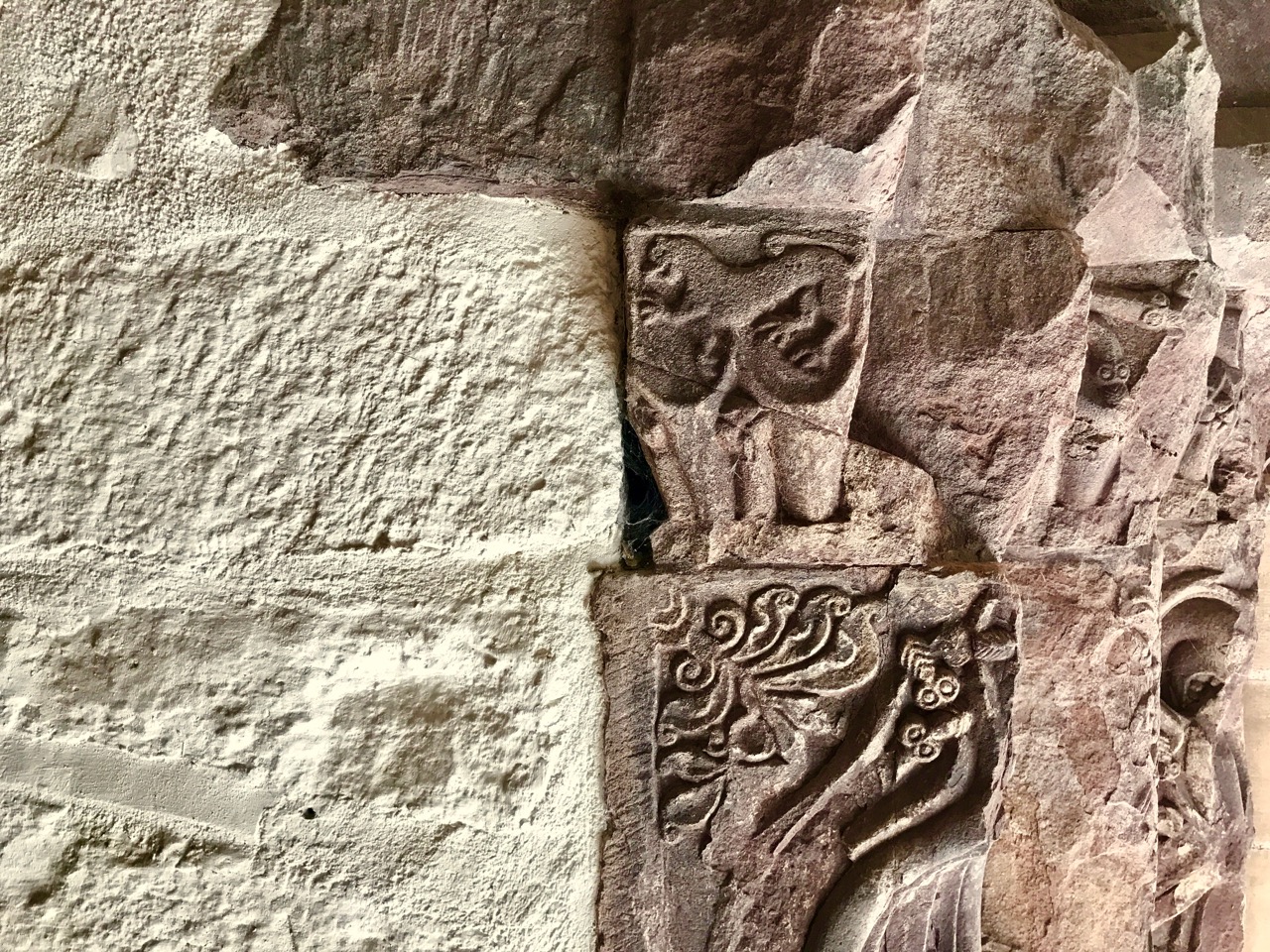
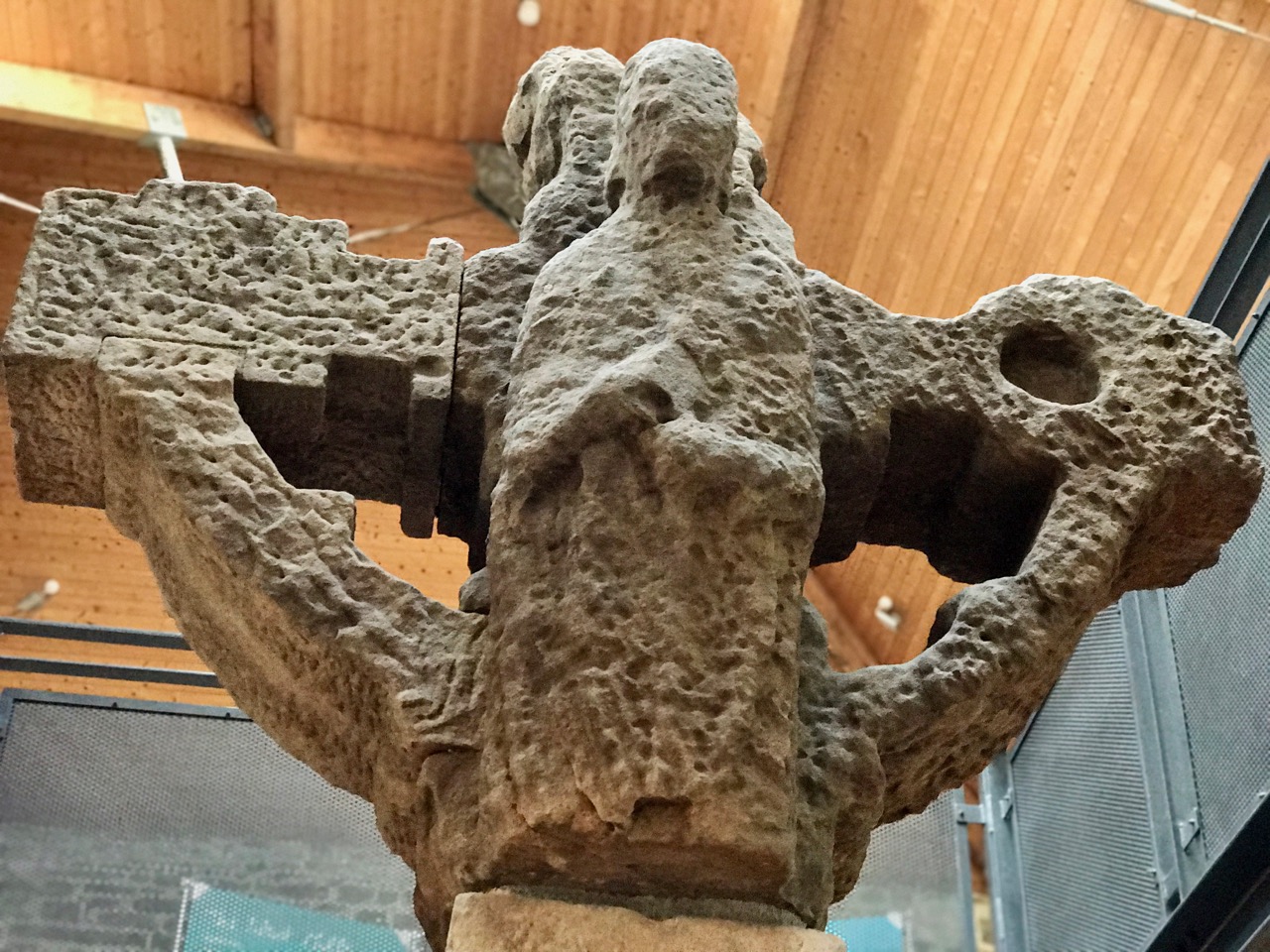
Another ‘rescued’ high cross can be found quietly located in the far less remote (but still a little unsung) Cathedral of St Flannan in Killaloe, Co Clare. Megalithic Ireland has a good account of the history of this cross, which can be seen in the images below (while the header picture at the top of this post shows exquisitely carved detailing from a Romanesque doorway in the same Cathedral):

. . . The High Cross in St Flannan’s Cathedral was moved to Killaloe from Kilfenora in 1821. Originally the cross stood on the highest point south of Kilfenora Cathedral, and became known as the cross on the hill. Dr Richard Mant who was appointed Bishop of Killaloe and Kilfenora in 1820, was appalled by the condition and lack of respect shown for the antiquities in Kilfenora. The cross, which had fallen in 1820, was sent to the Bishop the following year. He had it erected on the grounds of his residence Clarisford Palace. The cross was moved at a later date by a Bishop Ludlow and moved back within the Palace grounds in 1850. In 1934 the cross fell again and this time broke into three pieces. It was re-erected inside the cathedral and fixed against the west gable. In 1998 the cross was repaired and erected as a free standing cross. It stands over four metres high and bears a figure of christ in the centre of the head . . .

The White Cross of St Tola (images below) may not be on everyone’s list of things to see at Dysert O’Dea in Co Clare (you are more likely to be channelled to Corofin), but it’s easy to visit from the better known Romanesque monastery ruins: the ecclesiastical centre was founded by the saint in the 8th century. Cromwell’s forces destroyed the monastery and demolished the cross, but the cross was repaired by Michael O’Dea in 1683. The Synge family restored the cross again in 1871, and in 1960 it was temporarily dismantled and shipped to Barcelona for an exhibition on Irish art.

Clonmacnoise is likely to be on everyone’s list, and rightly so. It was one of Europe’s most important religious centres in medieval times. Ireland’s Ancient East website describes it thus:

. . . The whole of this early Christian site – including ruins of a cathedral, seven churches (10th–13th century), two round towers, high crosses and the largest collection of early Christian grave slabs in Western Europe – is a vast story in stone that keeps alive the spirit of Ireland as a Land of Saints and Scholars . . .

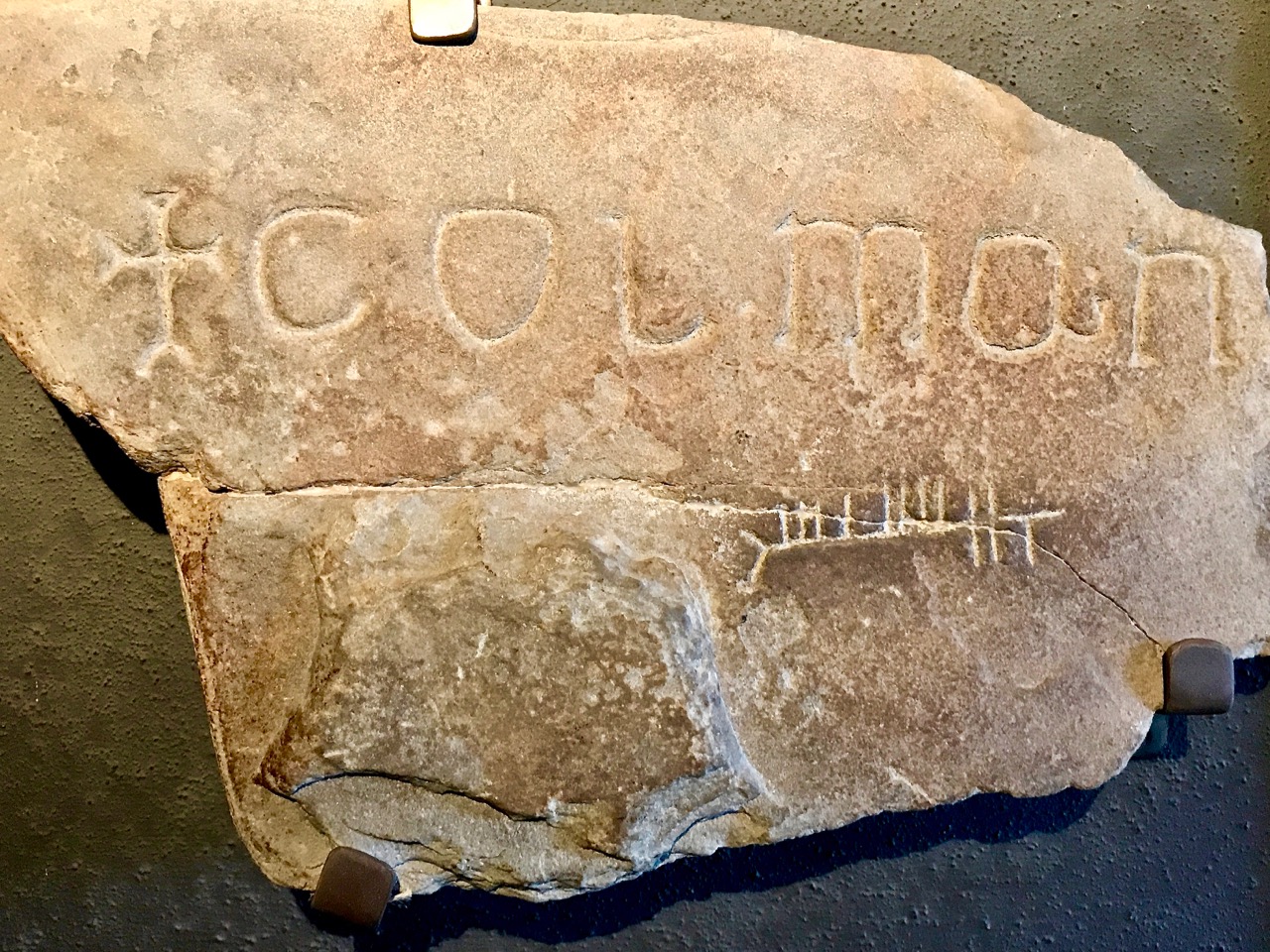
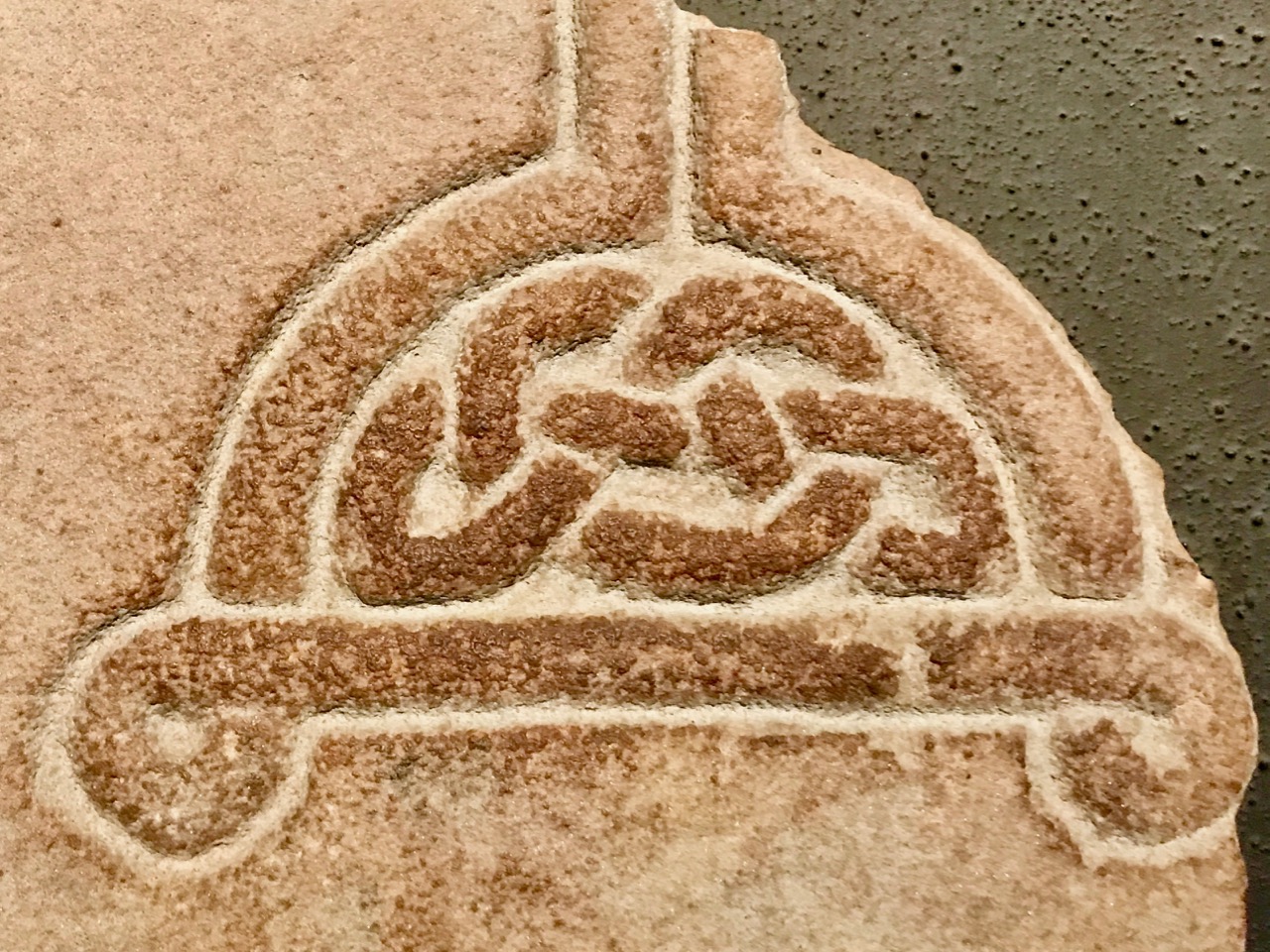
There are three conserved high crosses at Clonmacnoise – all are placed inside the visitor centre, while quality replicas are positioned on the original sites: this is a good exemplar of how to look after ancient stones and, while perhaps the seasonal crowds can be off-putting, I believe it’s the only answer for maintaining access to and displaying this valuable history. Ancient East mentions the important grave slab collection: after the high crosses (and, of course, Romanesque architecture) I feel these are the most beautiful representations of art and craftsmanship that connect us across the centuries to our remarkably focussed forebears.

These are just a few examples of the many grave slabs which are fortunately conserved at Clonmacnoise. But there are many more monuments that are less fortunate, albeit they may enjoy some sort of state care. There are just not enough resources to look after the huge historical heritage of Ireland: we can only hope that, in time, they will all be fully appreciated and that not too many treasures will fade away.

Robert Gibbings

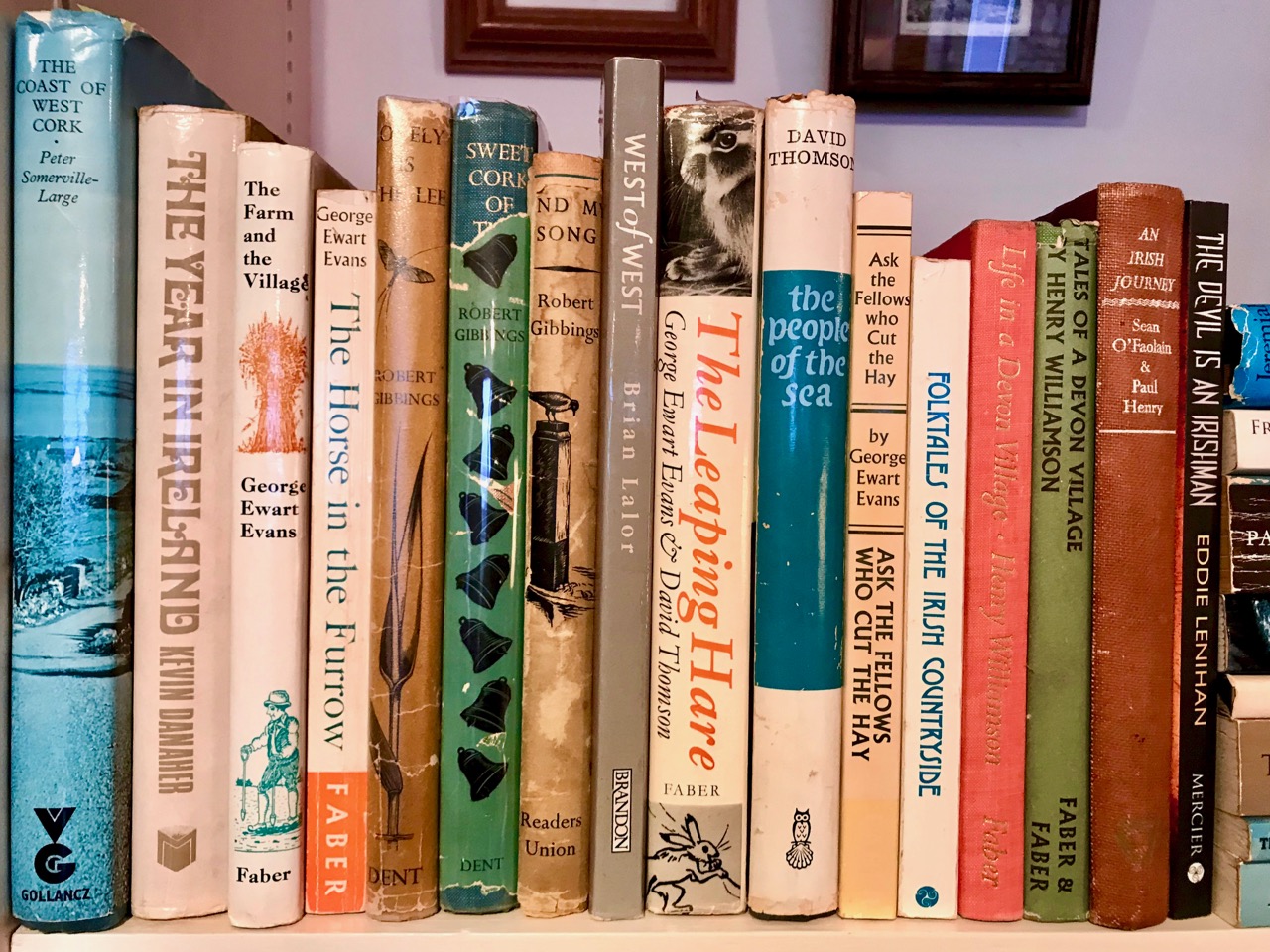
Our bookshelves in Nead an Iolair include some volumes which have travelled with me for the best part of fifty years. They include titles by George Ewart Evans, Henry Williamson, Brian Lalor, Peter Somerville-Large. Look carefully and you’ll also see some there by Robert Gibbings. Who is he?

A writer and illustrator, Gibbings was born in 1889 and died exactly sixty years ago, on 19 January 1958. He was a Cork man, raised in Kinsale, where his father became the Rector of St Multose Church. However, he was an inveterate traveller and lived most of his working life in England. Much of his work seems to exude ‘Englishness’ and – in an Irish Times article this week to mark the anniversary of his death, Alannah Hopkin writes:

People often forget that Gibbings was Irish. Brian Lalor, author of Ink-stained Hands, the definitive history of Irish print-making, was challenged by an English academic at a conference in Dublin in 2007, who refused to believe that Gibbings was Irish, as he had produced archetypal English landscapes. But his account of Gougane Barra, for example, confirms how deeply steeped in Irish myth and folklore Gibbings was.

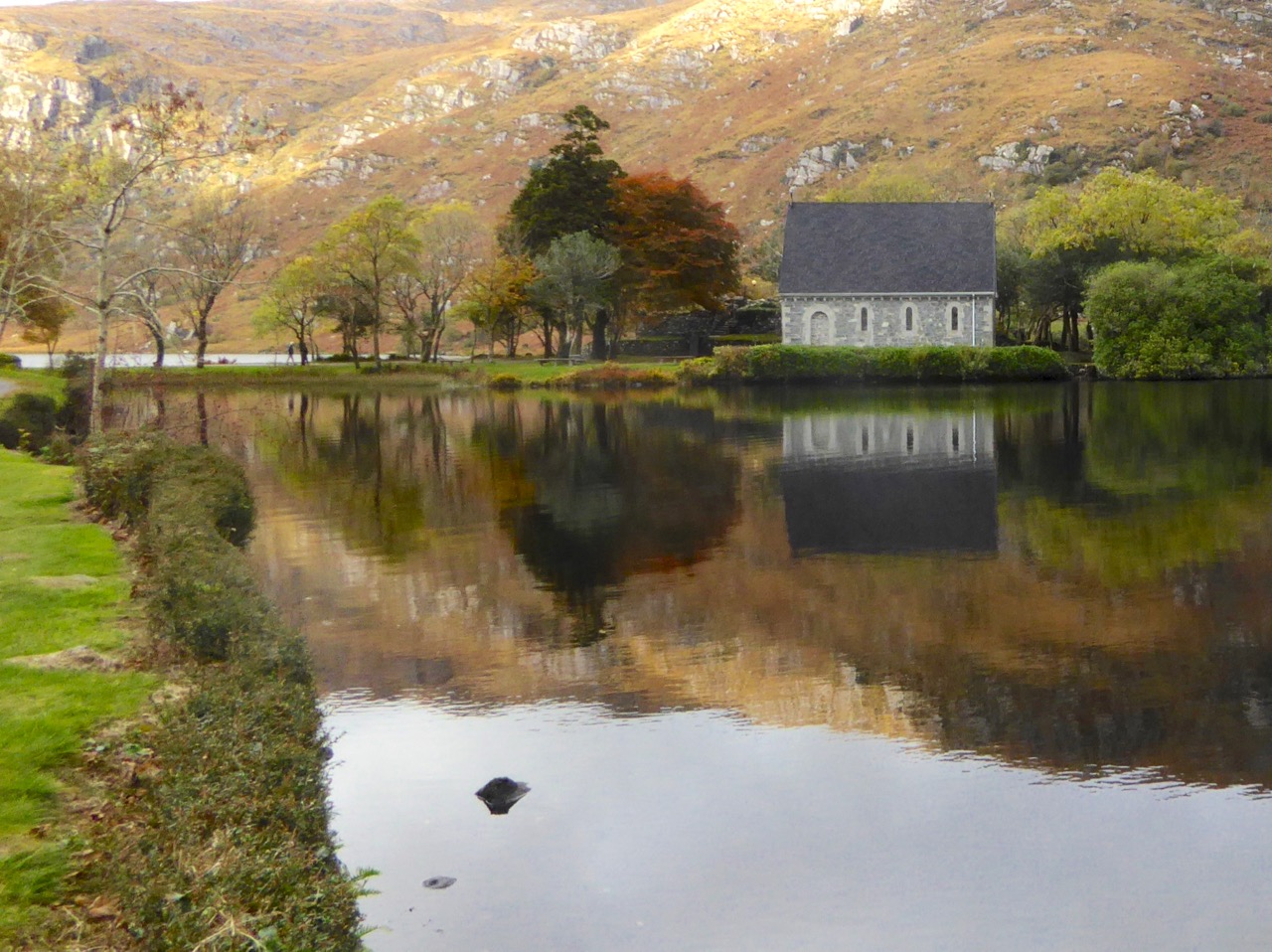
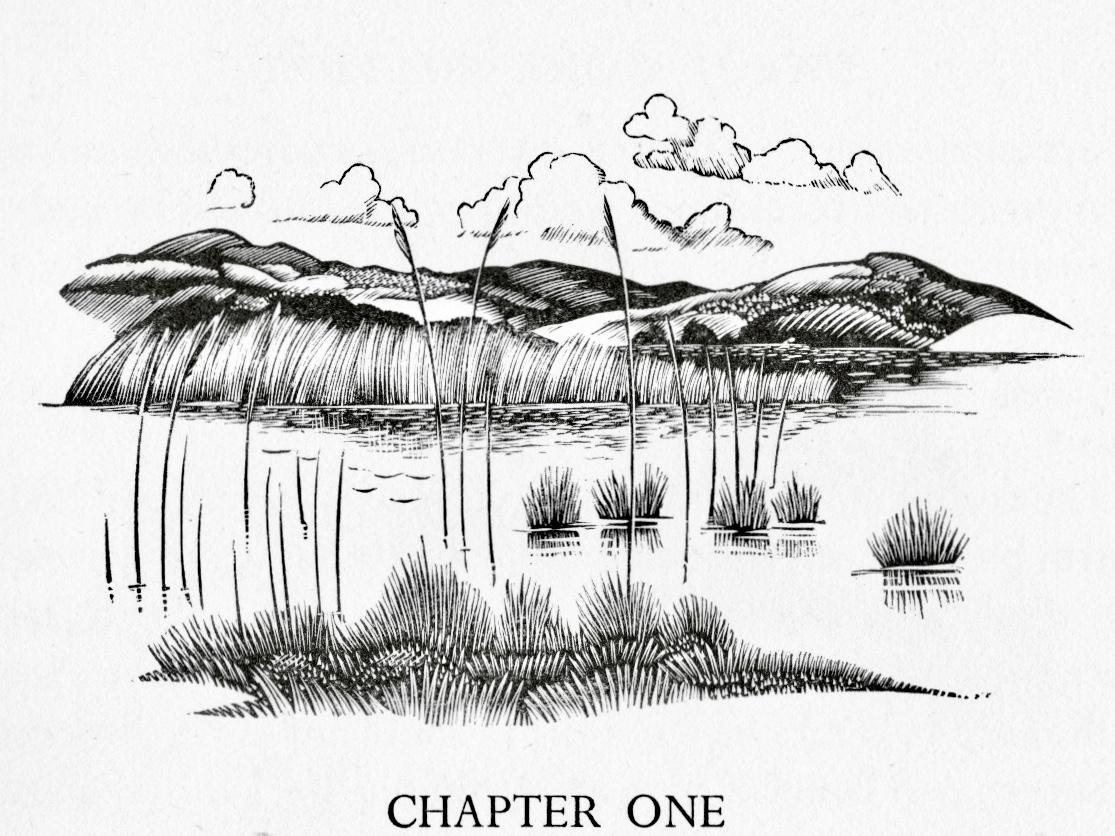
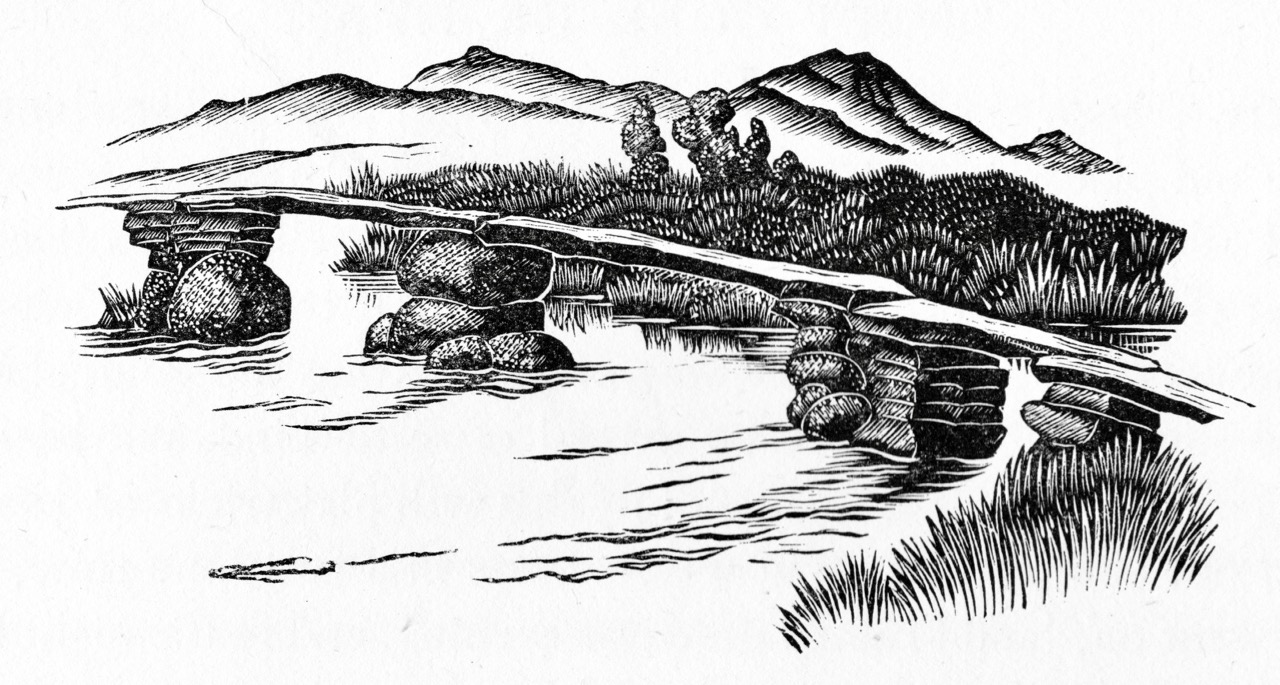
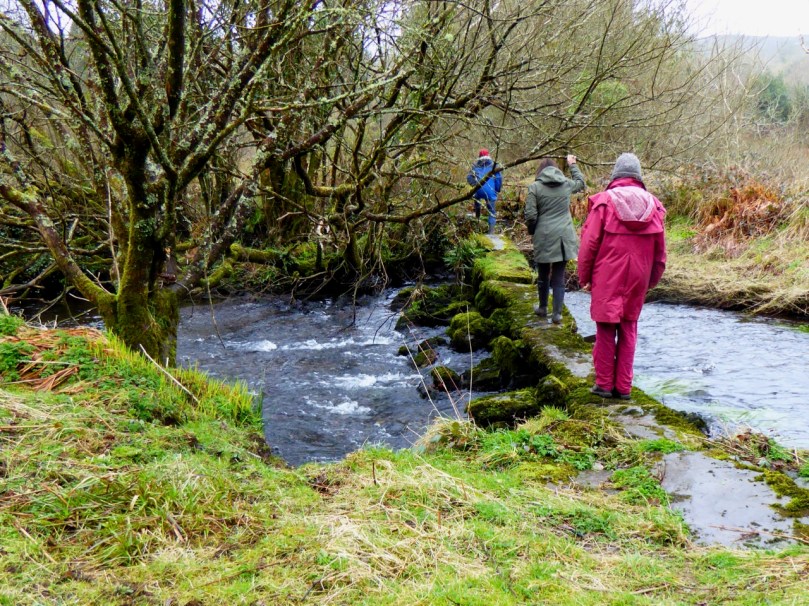
Gougane Barra in County Cork: upper image – the lake in the mountain. Centre – Robert Gibbings’ woodcut engraving of the lake which opens ‘Sweet Cork of Thee’ (1951). Lower image: a clapper bridge near Gougane – perhaps the same one which Finola illustrates in her post today

At the insistence of his parents, Gibbings studied medicine at UCC, although his ambition was to be an artist . . . writes Alannah Hopkin . . . While he enjoyed the scientific side of his studies, it soon became apparent that this big, soft-hearted man was unable to cope with the human suffering of his patients. His parents were apprehensive about his decision to be an artist, fearing, quite rightly, that it meant he would lead an unconventional life, looking at naked women, dressing untidily and consorting with social misfits . . . From 1911 he studied life drawing at the Slade in London. His contemporaries included Eric Gill, John Nash, David Jones and Mabel Annesley. He was advised to take wood-engraving classes; the technique perfectly suited his strong line and close observation of nature, which in this phase was lightly stylised.

Gibbing’s woodblock signature – used in the majority of his books – shows the tools of the wood engraver

The wood engravings of Robert Gibbings are exquisite: his eye is attuned to fine detail. His writing is also compelling: I suppose it reflects a nostalgia for past times and things gone, but it is also humorous and always tightly observant. He brings to life characters he has met in his travels.

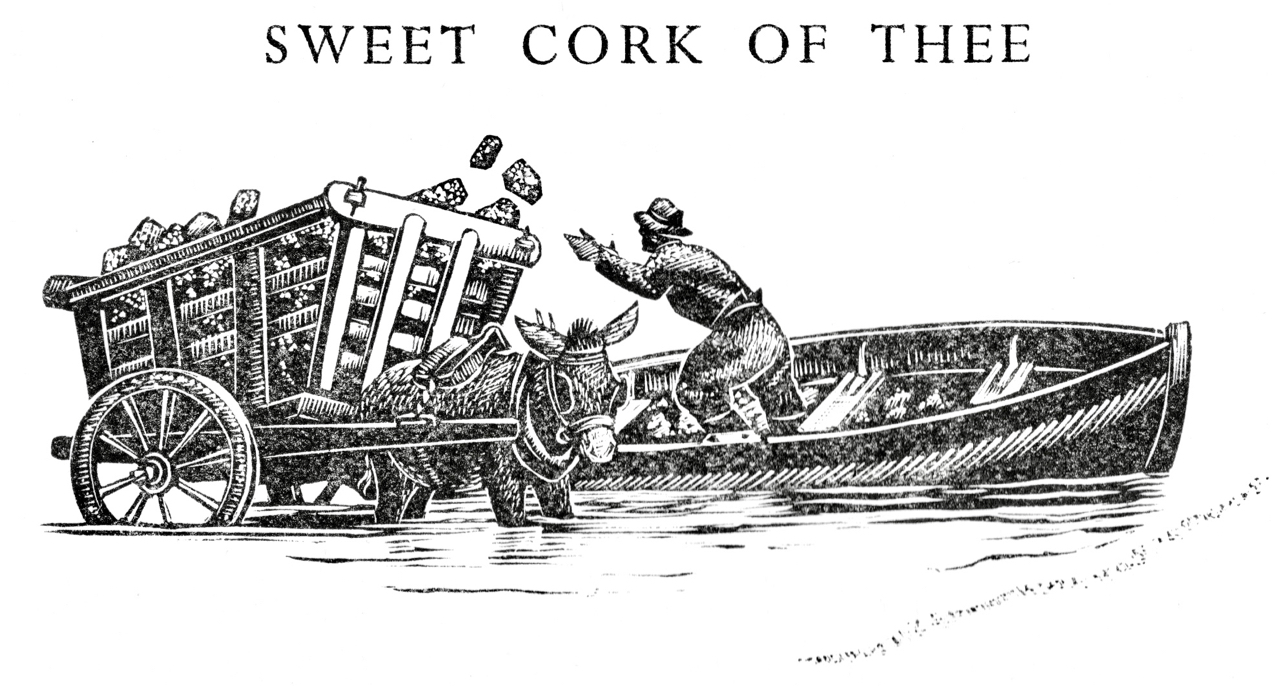
‘Paddy the Forge’ putting metal tyres on wagon wheels – from Sweet Cork of Thee

In the 1940s Gibbings attended the World Ploughing Contest, held for the first time in England, at Shillingford on Thames:

Bowler hats and highly polished riding boots had been the order of the day at the Arab Horse Show: here among the shires it was rubber-boots, corduroy caps, and hats of weathered tweed. ‘I think you’re Irish,’ said a man to me as I was admiring a pair of Pedigree Suffolks resplendent with brasses that told of former triumphs. ‘What gives me away?’ I asked. ‘The tilt of your hat,’ he said, ‘I can always tell an Irishman – he just sticks it on his head and forgets it. Look at some of these fellows – caps, hats, pulled up here, pushed down there – self-conscious all of them. Look at those two fellows in the pork-pie hats – I wouldn’t trust that one on the right, he wears his too straight, has to – it’s psychological.’ ‘Bishops wear their hats straight,’ I said. ‘Same idea,’ he answered. ‘Suggests the narrow path, only they keeps to it.’

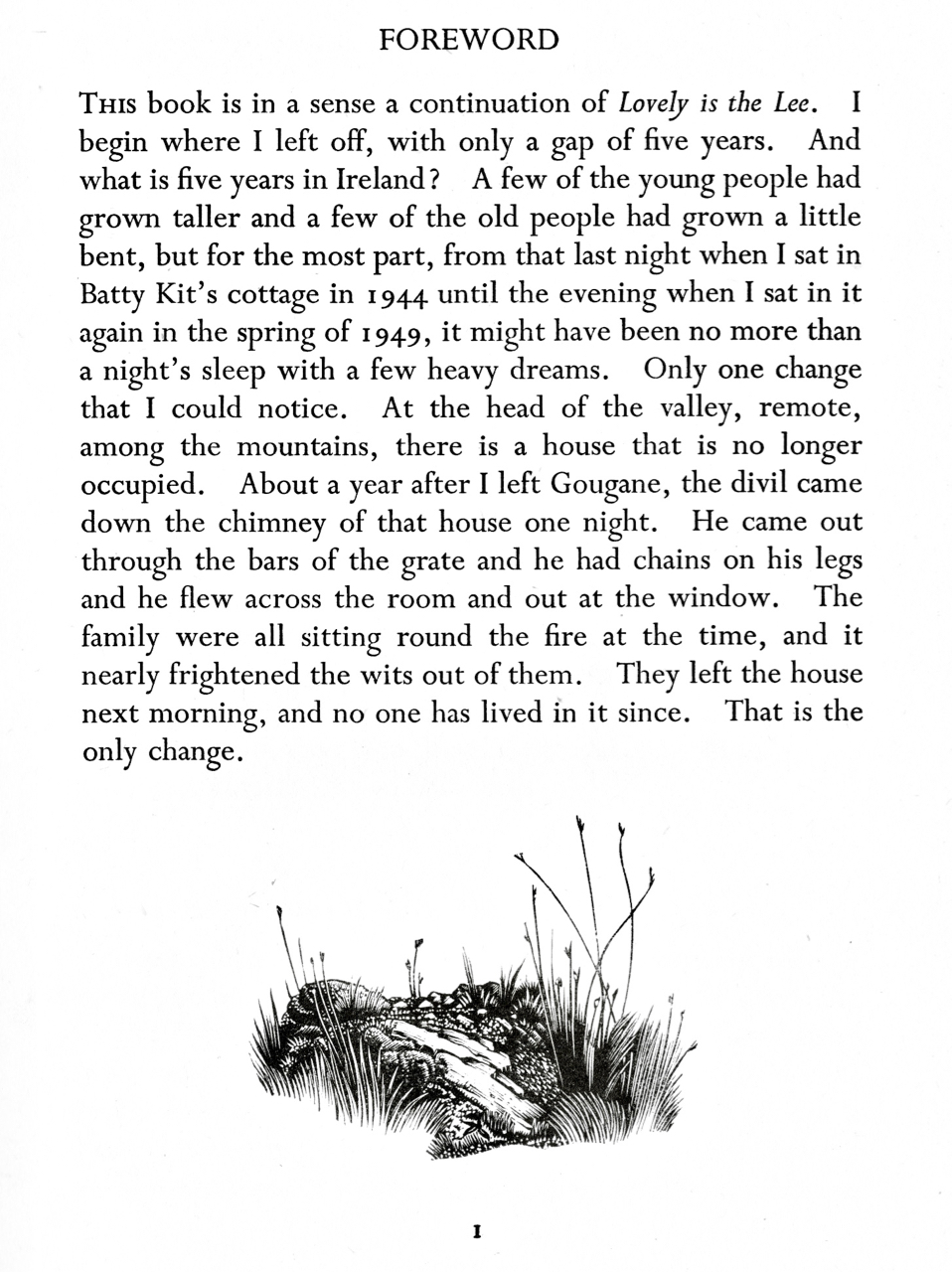
For Robert Gibbings, text and illustration were always of equal importance. Each page of his books is set out as an art work, to be enjoyed by the two senses of sight and feeling – the feeling engendered by his descriptive writing. Here is the Foreword to his second ‘Irish’ book – Sweet Cork of Thee:


The illustrated Foreword to Sweet Cork of Thee, the second of Gibbings’ books which describe his travels in the land of his birth

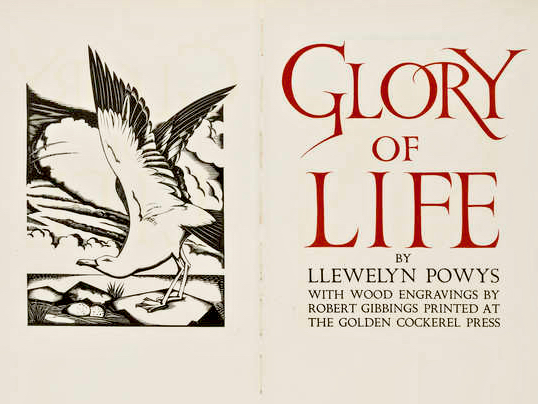
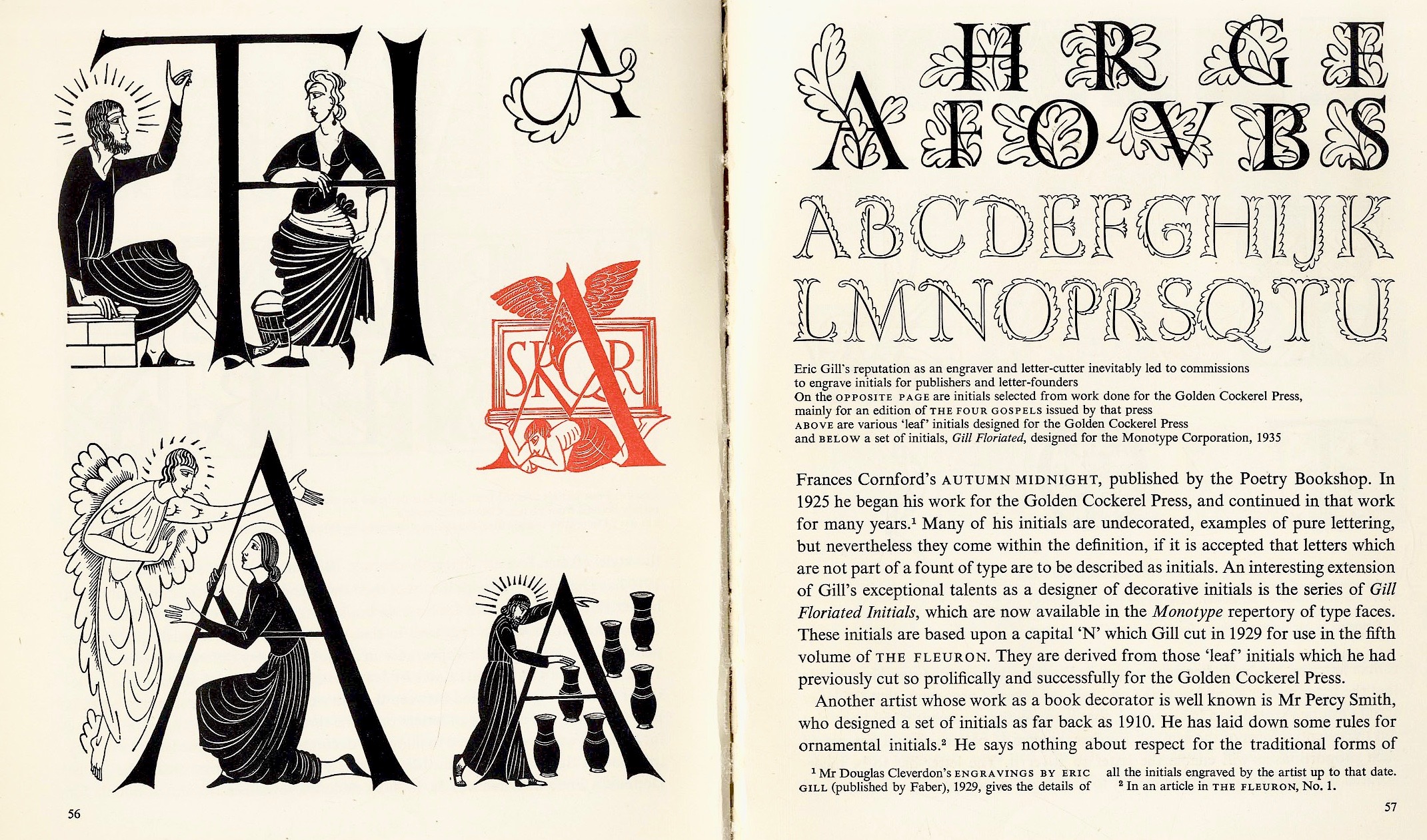
Throughout his life, Gibbings immersed himself in travelling and in art. His best known books are his ‘river’ books, beginning with ‘Sweet Thames Flow Softly’, published in 1940 and, at the end of his life, the sequel: ‘Till I End My Song’ completed in 1957: he died at the age of 68. The rivers he explored included the Thames, the Wye, the Seine and Cork’s River Lee. Between 1924 and 1933 he owned and ran the art-based Golden Cockerel Press. Founded in 1920, its earliest prospectus proclaimed:

This press is a co-operative society for the printing and publishing of books. It is co-operative in the strictest sense. Its members are their own craftsmen, and will produce their books themselves in their own communal workshops without recourse to paid and irresponsible labour.

Work from the Golden Cockerel Press: typefaces by Eric Gill

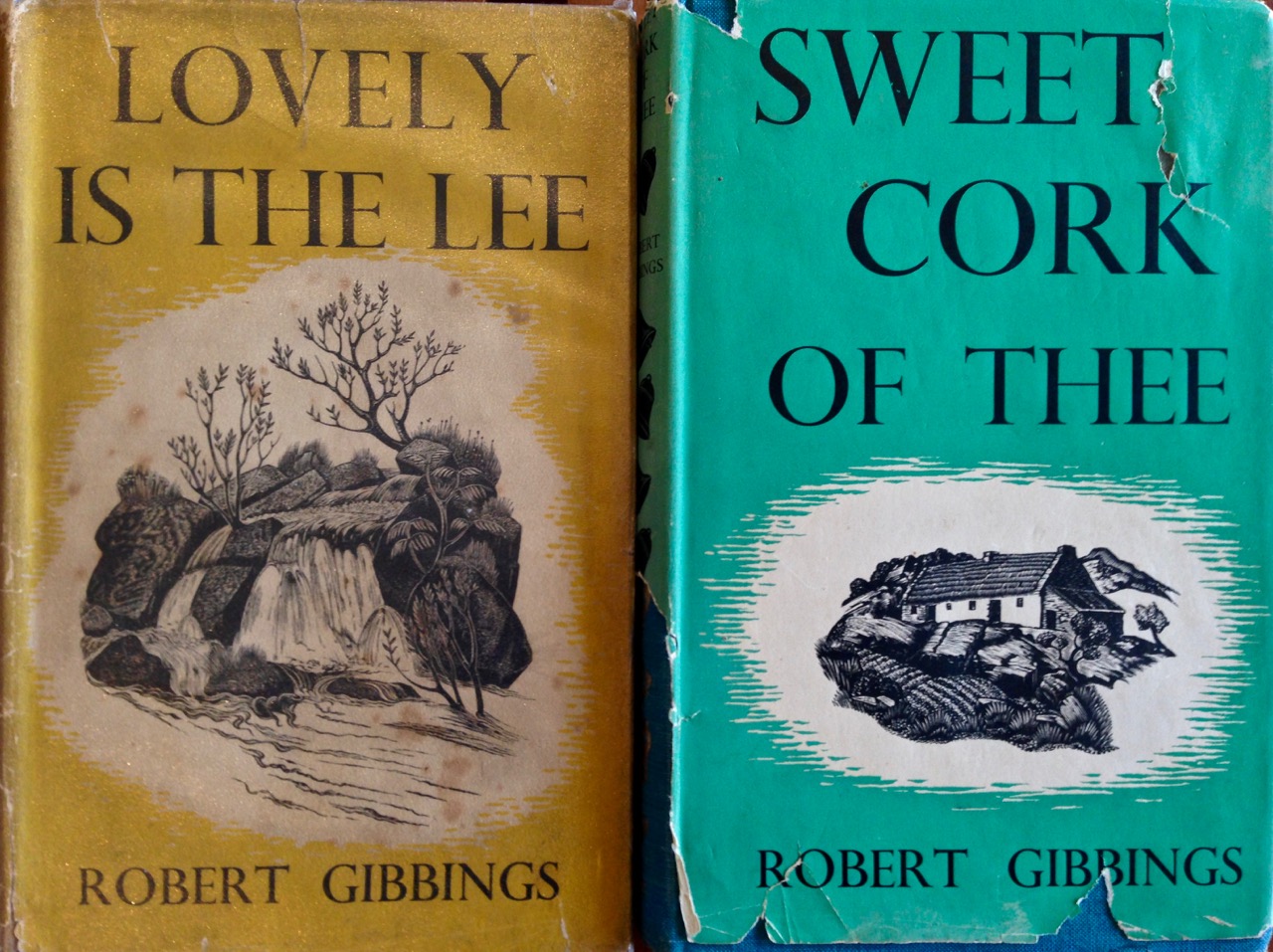
It is the two ‘River Lee’ books that will concern those interested in all things Irish. My copies (both first editions) were given to me by Danny who I first met when I moved to Devon in the 1970s. Danny was determined that I was going to fall in love with Ireland – and it didn’t take me very long! Eventually Danny – who hailed from Limerick but, like Gibbings, led a restless life during which he travelled the world – settled in Devon and then moved on to West Cork.

Danny gave me these books to encourage my interest in Ireland. At the time he told me that ‘these were all I needed’ to get to know his country. I think he was right!

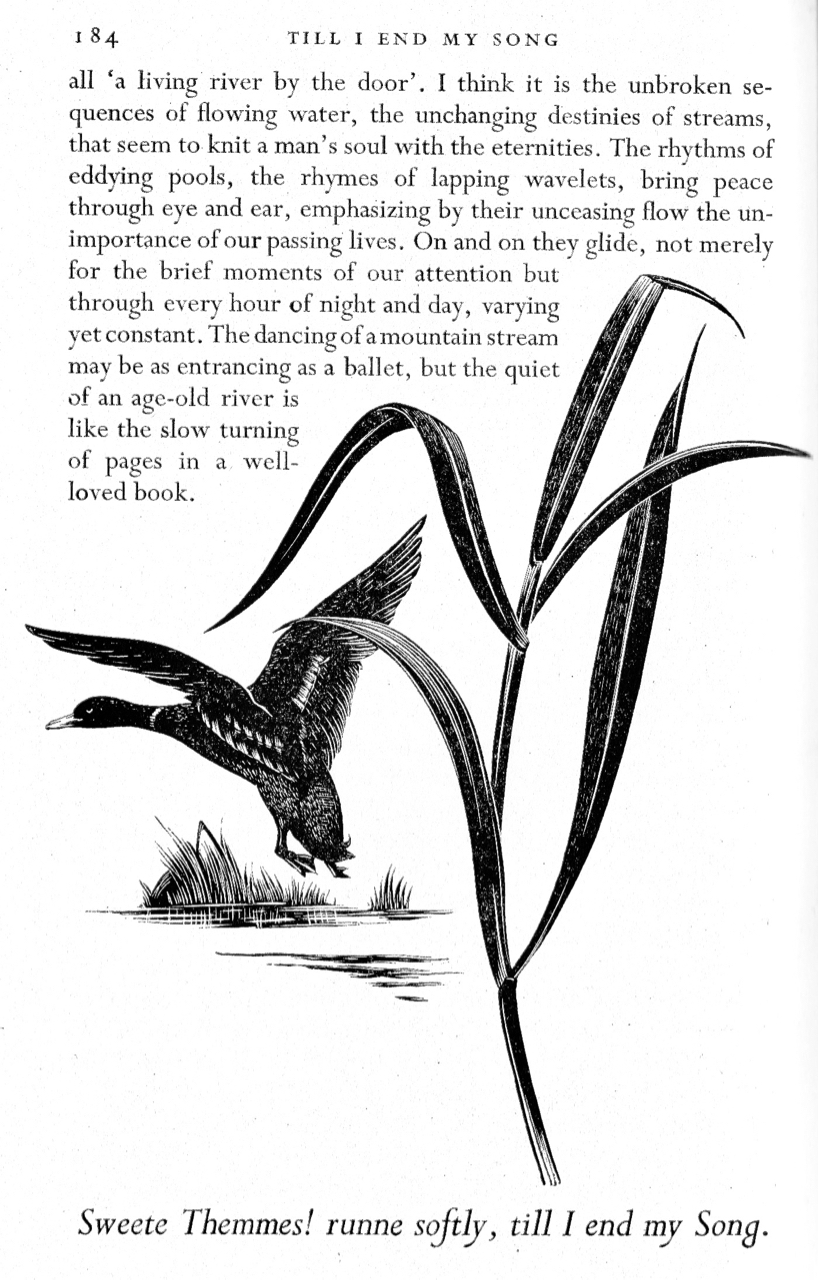
I encourage anyone who follows Ireland to read these books – and anyone who appreciates art to get to know the work of Robert Gibbings who died just fifty years ago. I will ‘play out’ the man by quoting these lines from his aptly titled ‘Till I End My Song’, and include an image of the last page of this, his final book.

Poets throughout the ages have sung of the peace of gently running streams. In the sacred writings a river is used constantly as a symbol of peace: ‘Then had thy peace been as a river’, ‘He leadeth me beside the still waters’. Throughout our own literature flows the timelesss tranquility of rivers. Spenser’s Prothalamion is borne on the waters of Sweete Themmes. The tortured mind of Swift longed for a river at his garden’s end. The gentler Stevenson wishes to all ‘a living river by the door’. I think it is the unbroken sequences of flowing water, the punching destiny of stream, that seem to knit a man’s soul with the eternities . . .

The Cork Heritage Book Series

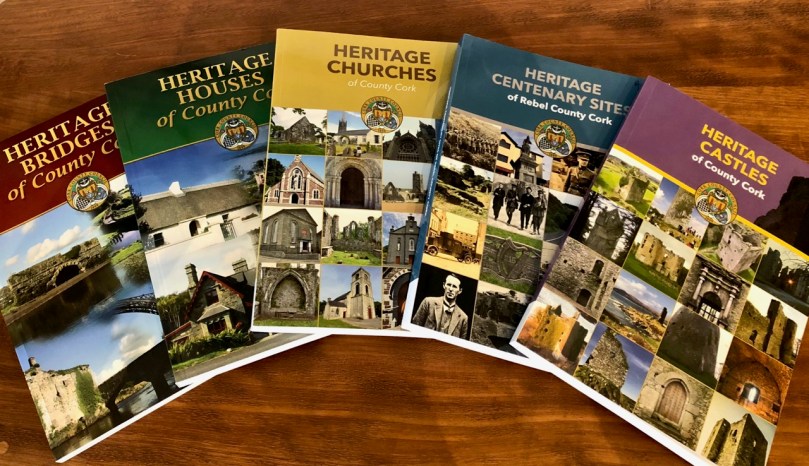
How do you set about exploring your local heritage? If you’re lucky enough to live in Cork, you have some marvellous resources at your fingertips. Today I want to focus on a set of books that are a comprehensive, affordable, richly illustrated, engagingly written compendium of our fascinating history – the Heritage Series.

Dunlough Castle, also known as Three Castle Head, is an unusual example of a fortified curtain wall dating to the 15th century. It’s also, as you can see, incredibly beautiful – it’s written up in the Castles book.

County Cork has a Heritage Office and a County Heritage Officer, Conor Nelligan. He’s a Tour de Force of Heritage, indefatigable, knowledgeable, and committed to communication and consultation. He pens a regular newsletter to local history associations and interested individuals alerting us all to upcoming events, grants schemes, talks, festivals, and articles of interest. Typically, when a new volume in the heritage series is contemplated, he will send out a call for submissions and contributions.

Glanworth Bridge: “Typical of medieval bridges the arch spans are appealingly irregular, increasing in width towards the centre.” It is purported to be “the narrowest and oldest public bridge still in everyday use in Europe.”

The result is a rich collection of photographs, local information, stories and legends, expert analysis and historical detail. What’s amazing is that each volume only costs ten euro! They are available in all the local bookstores, but if you don’t live in Cork you can buy them online from the Skibbereen Heritage Centre.

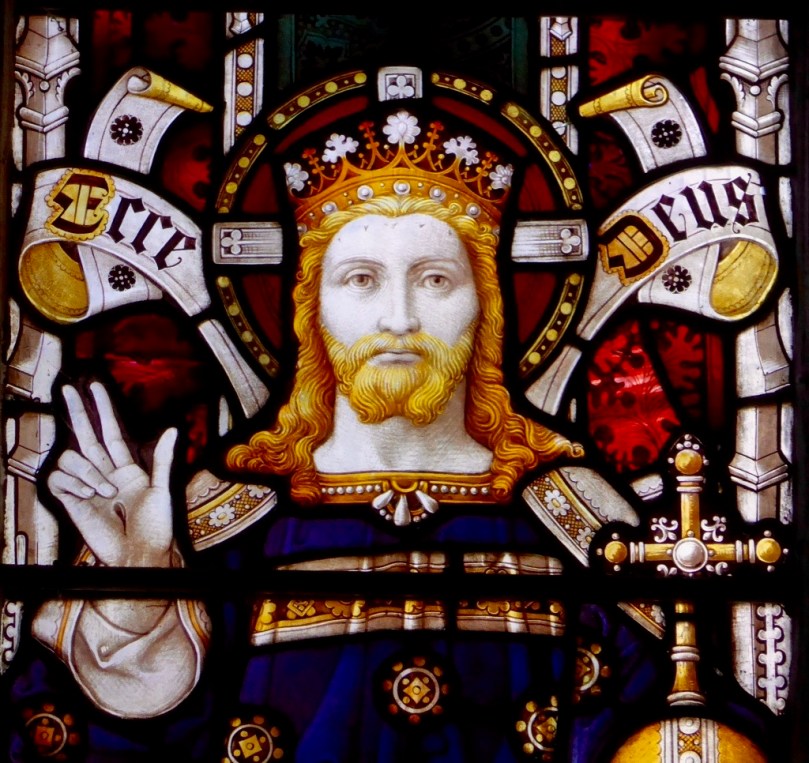
This is the extraordinary Church of the Ascension in Timoleague. I first found out about it from the Heritage Churches book and wrote about it in two parts, Mosaics and Maharajas Part 1 and Part 2. The Christ the King window is by Clayton and Bell and dates to about 1900

Each book has either a lead author or an authorial team, benefitting greatly from the expertise of the overseers and the one-off contributors. Conor and his colleagues Mona Hallinan, Cork’s Conservation Officer, and Mary Sleeman, the County Archaeologist, steer each project through to completion. The result rather than piecemeal is seamless, with the volumes following a pattern for the most part of an introductory historical and architectural context followed by ‘exemplars’ of castles, or bridges, or whatever the focus of that book. 

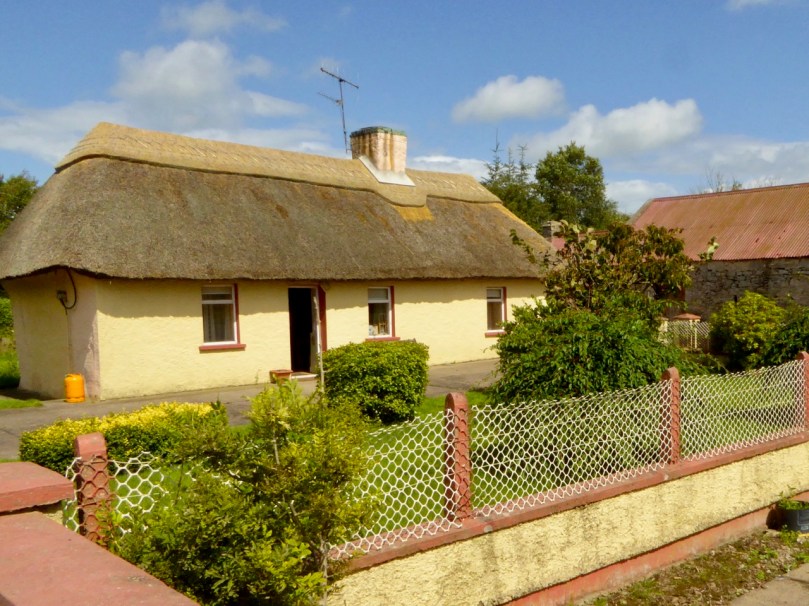
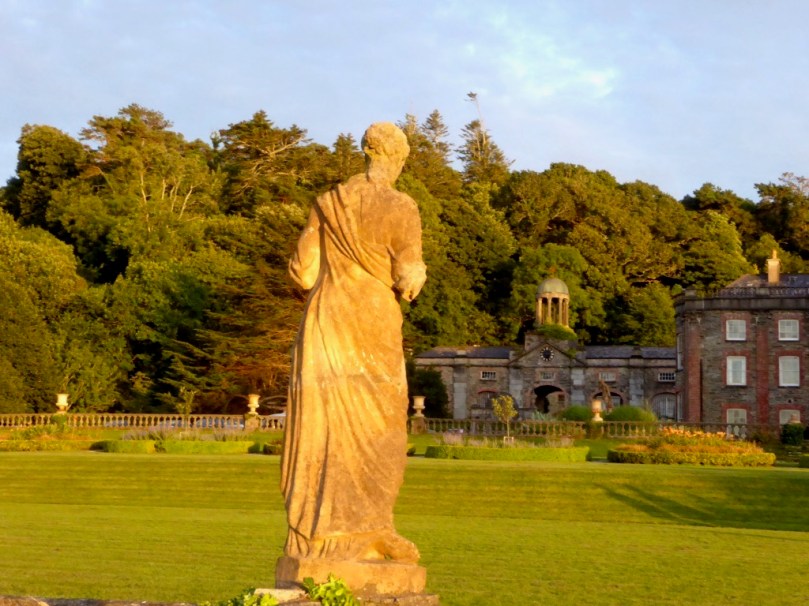
Heritage houses come in all sizes, from  traditional thatched cottage glimpsed in North Cork, to Bantry House bathed in evening sunlight

This layout gives it the convenience of a guidebook – wherever you are in Cork you can decide what to see and read up on it – while not sacrificing the the social and political background in which the buildings were constructed. They are our constant companions while out and about or when planning an expedition.

The oldest church in Cork, I think, Labbamolaga. Robert wrote about this wonderful site in Molaga of the Bees

And talking of expeditions, we want to see more of those bridges! I’ve been browsing through the bridge book, learning about abutments and piers and cutwaters, not to mention different kinds of arches, and I am dying to see more of those exemplars. So look out, Dear Readers, for a future post on heritage bridges.

A picturesque clapper bridge near Ballyvourney . Is this the same bridge that Robert Gibbings engraved in “Sweet Cork of Thee” – see Robert’s post this week!

Well done, Cork County Heritage Unit – you can be justly proud of this excellent series!

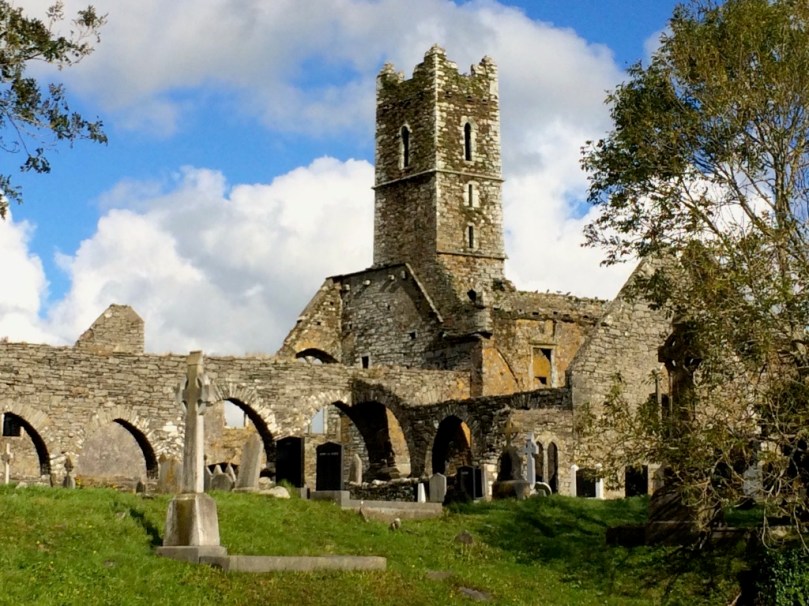
Timoleague Friary, read more about it here

Ireland’s Newest Stained Glass Window

It’s in Tralee, in St John’s Church – and it’s breathtaking!

It isn’t often that new stained glass windows are installed in Irish churches. In fact, depressingly, many churches fall into disrepair from lack of use and the windows break (or are broken). Nowadays we are more likely to be losing stained glass than gaining it. So it’s a huge cause for celebration when a community commissions a new piece. Hats off to Tralee!

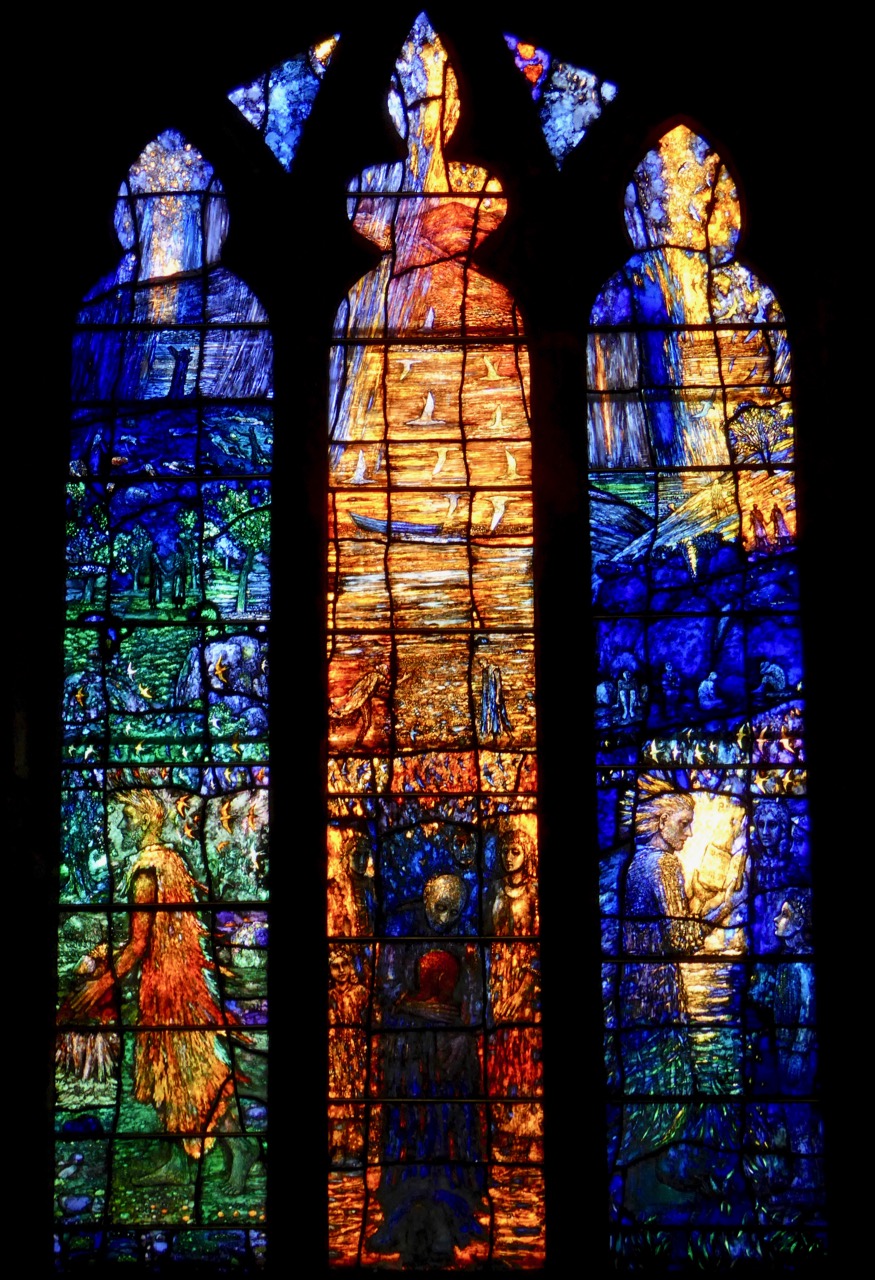
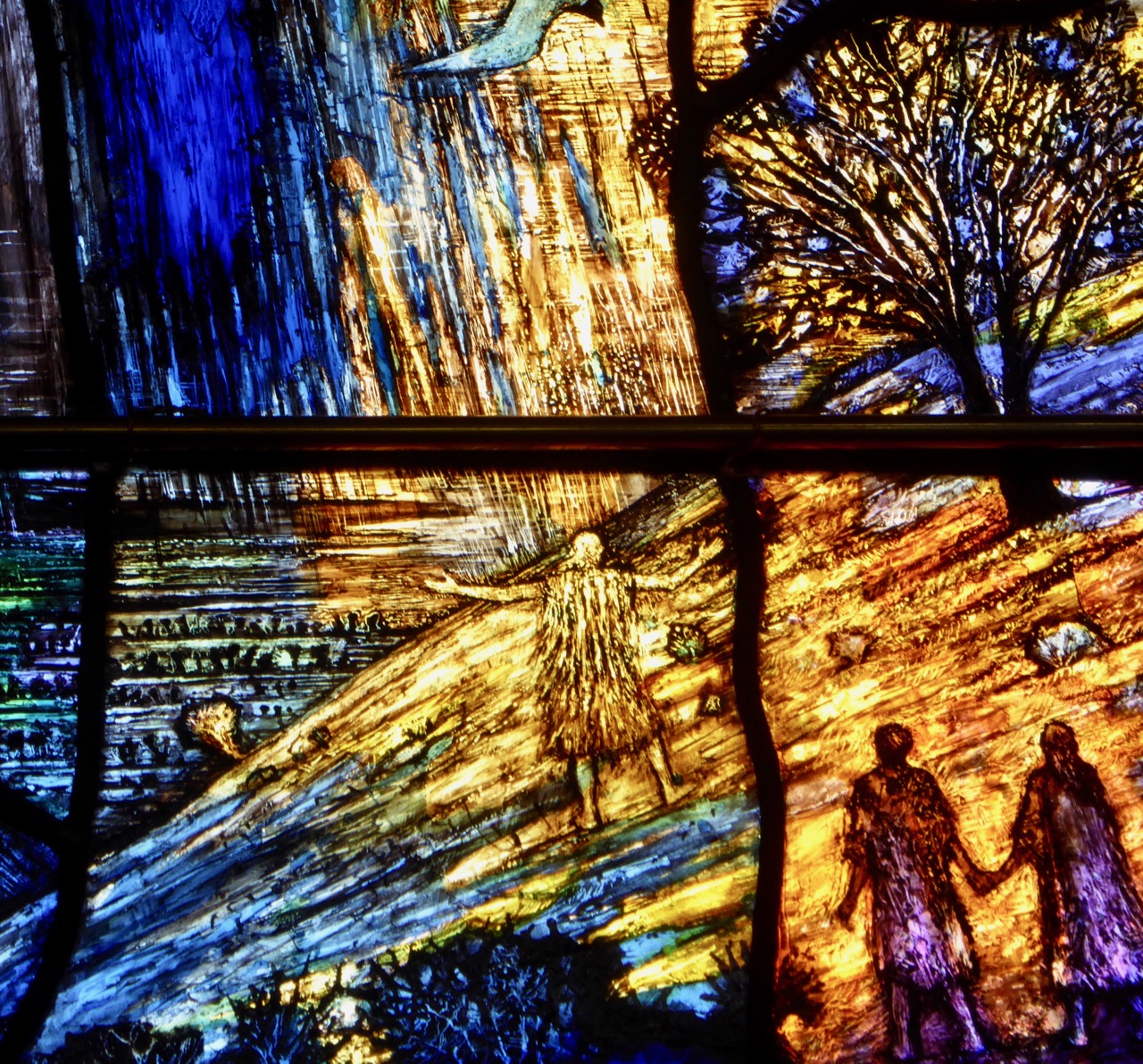
The Garden of Eden or an image of reconciliation: one of the window details

This window is out of the ordinary in many ways. Let’s start with who commissioned it, which leads us on to the theme. Although it’s installed in the Catholic church, it was a joint initiative of the Catholic and Church of Ireland congregations. There may be other windows that can claim that distinction, but I don’t know of them. (Readers?)

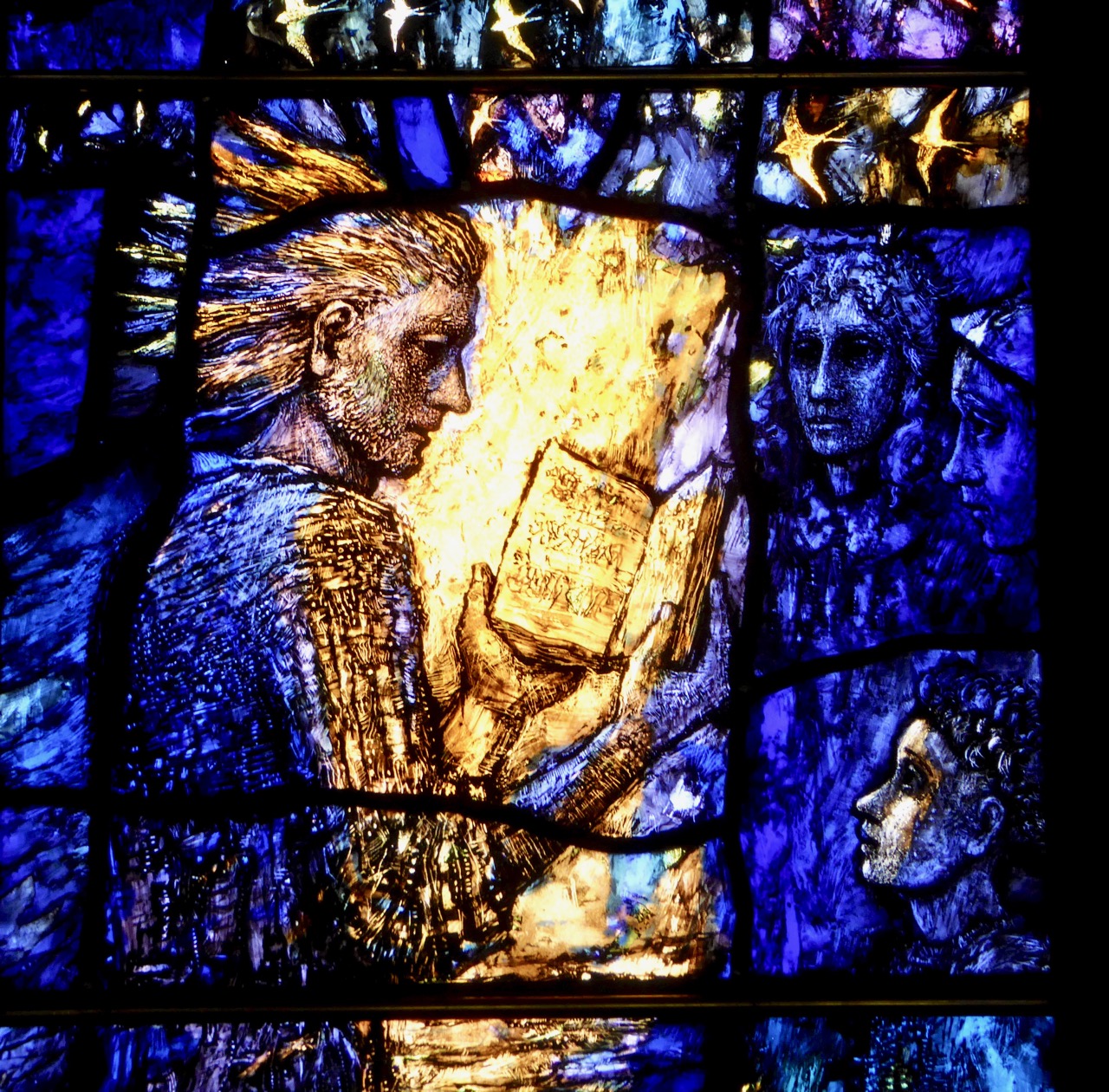
The theme is Reconciliation, and the central figure is the return of the prodigal son. The right panel is of Jesus reading from the Book of Isaiah and the left is of John the Baptist, patron saint of the church.

The father embraces his prodigal son

The Parable of the Prodigal Son is a natural choice to illustrate reconciliation, with the father embracing the son who has squandered his inheritance but returns home, contrite, to his family. Instead of punishing him (as his brother resentfully feels the father should do) his father embraces him, orders that the fatted calf be slain for a feast, and says, It was meet that we should make merry, and be glad: for this thy brother was dead, and is alive again; and was lost, and is found.

Jesus Reading from Isaiah is perhaps at one remove from a direct reference to reconciliation. It happened in Nazareth, his old home town, and he read at the behest of the elders. The passage is a beautiful one and points to ideas of love and healing, and perhaps to the real purpose of Christianity, no matter the denomination: he hath sent me to heal the brokenhearted, to preach deliverance to the captives, and recovering of sight to the blind, to set at liberty them that are bruised.

St John is the patron saint of the church 

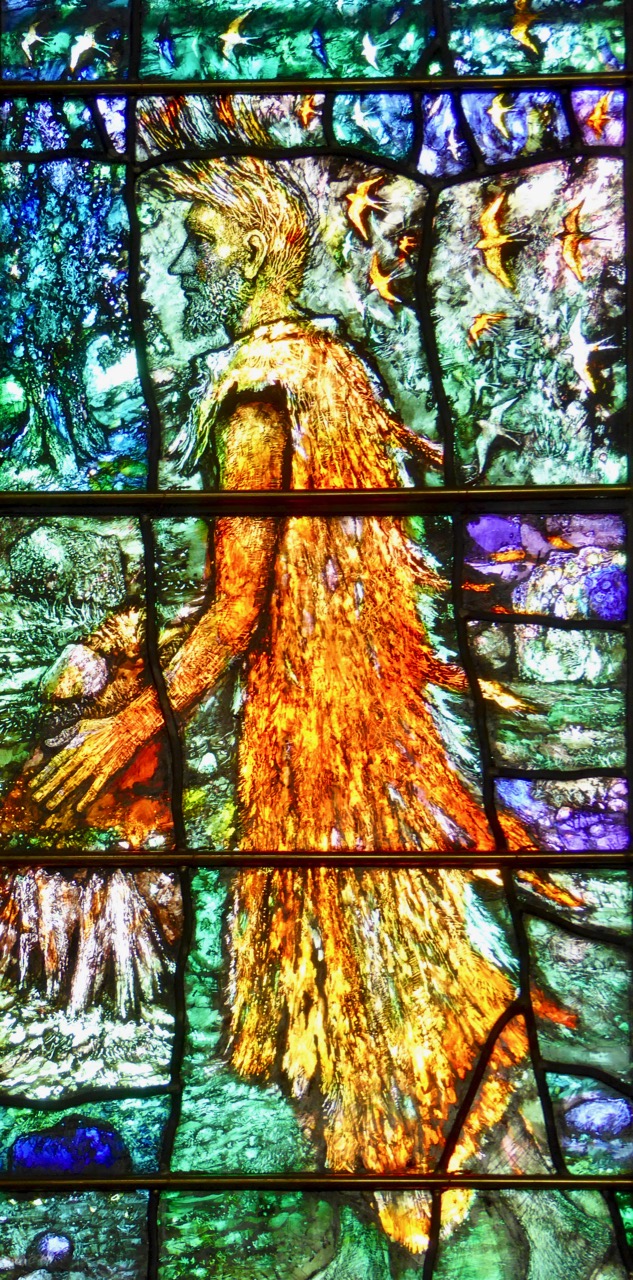
Possibly my favourite image is that of John. Usually, he is shown in the act of baptising Jesus, but here he is, the ascetic in his coat of camel hair, very much as he described himself, as a voice crying in the wilderness.

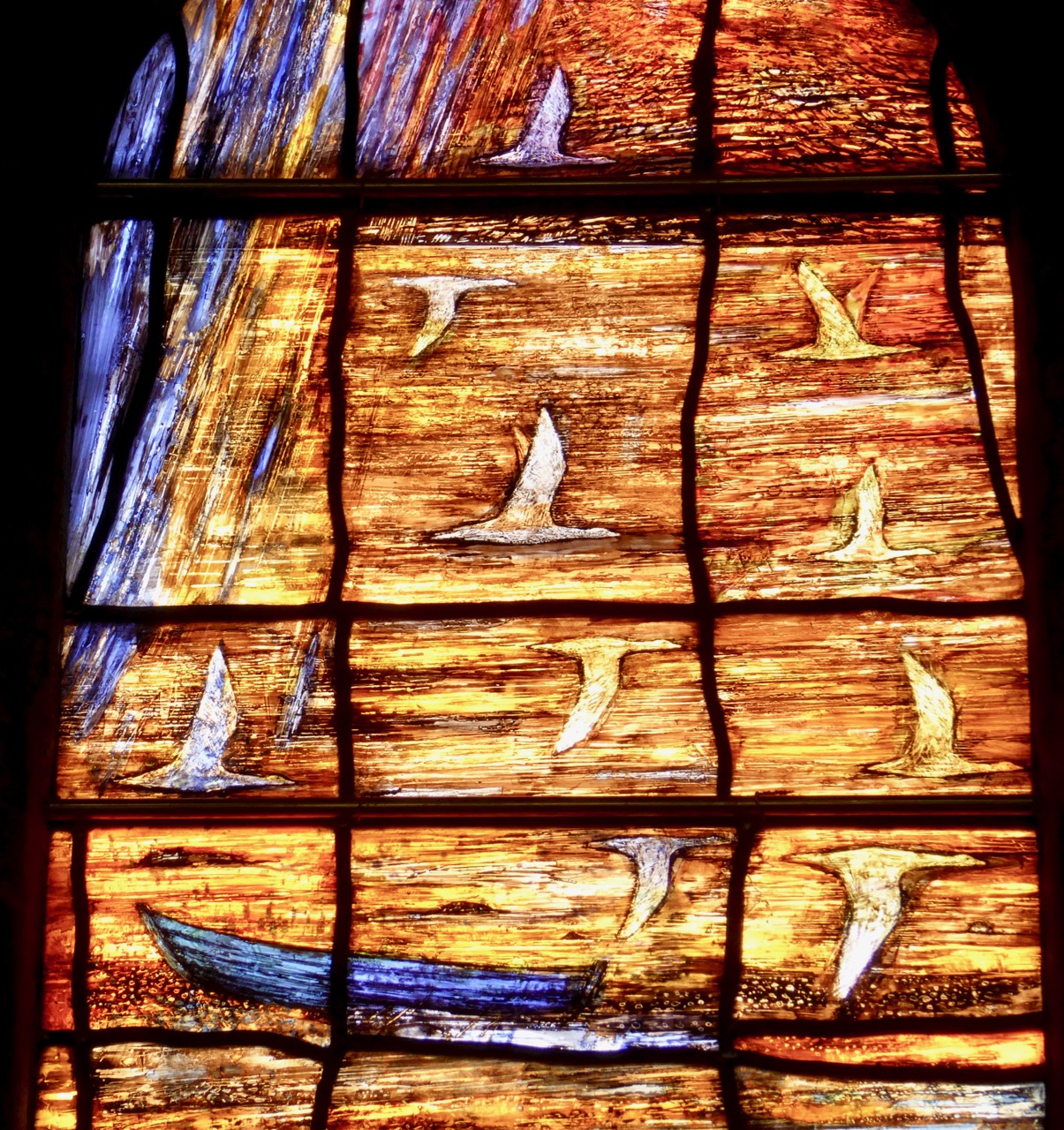
A myriad of tiny images fills the panels – figures holding hands (reconciliation), swallows (hope of spring, renewal), Tralee Bay, figures from Tralee history. . . there are even tiny names engraved where it is impossible to see them. Take a look at this video, where Tom Denny shows us some of those names.

Tom Denny? Yes – he’s the artist but the significance of that goes beyond the fact that he is one of Britain’s most eminent and respected stained glass artists, responsible for numerous windows in British churches. A browse of his website reveals the breadth and depth of his skill and the uniqueness of his style. The Tralee windows are typical – blazing with colour, filled with large and small figures and scenes that reveal themselves upon close inspection, rich and intricate, thoughtfully composed to draw the viewer into the subject of the panels.

Tralee Bay

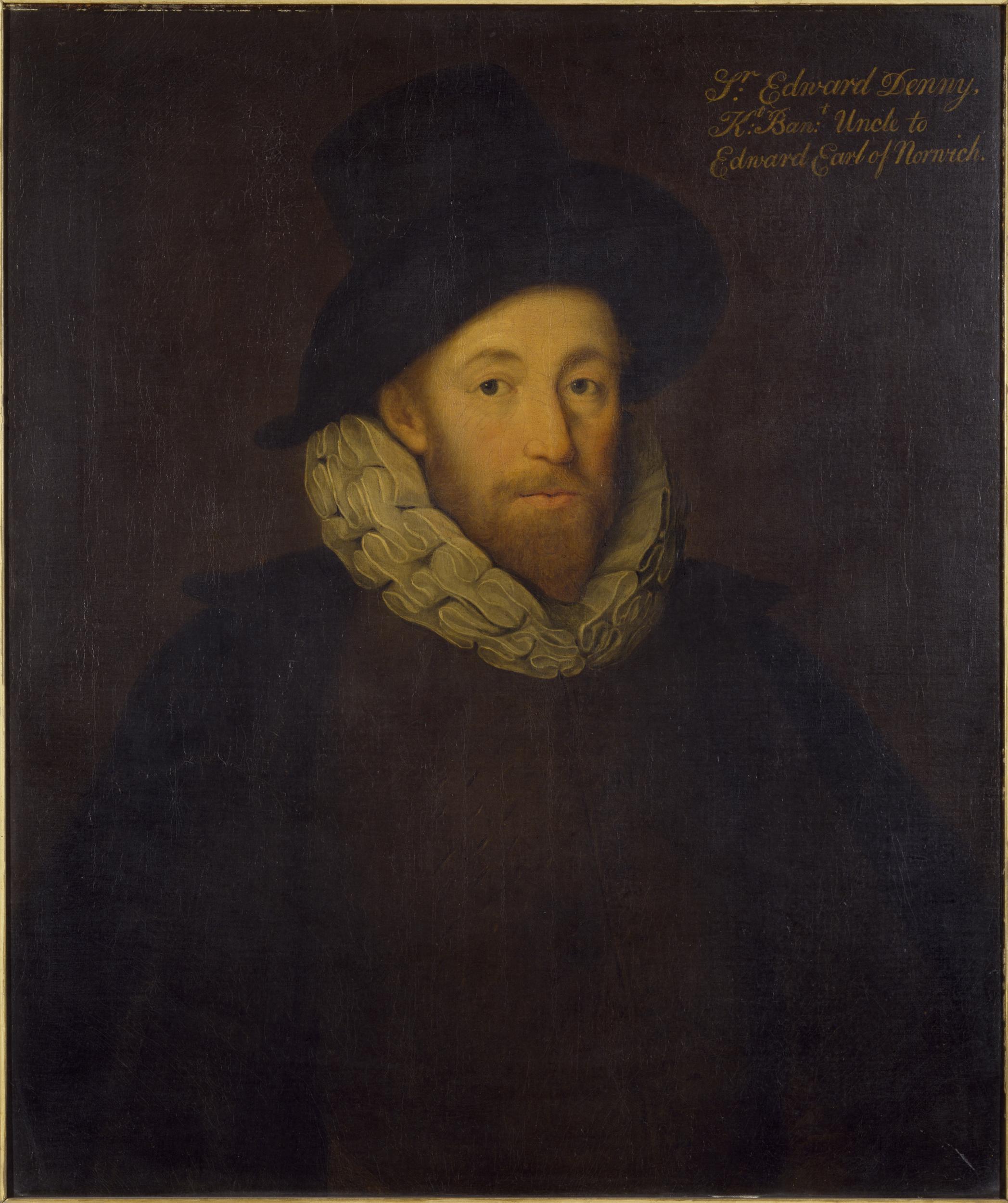
You see, the Denny’s came to Tralee as part of a British military expedition in the 1500s and the name is inextricably linked with the North Kerry area. Sir Edward Denny (1547 to 1599) was one of the architects and enforcers of the Plantation of Munster, and was rewarded with lands taken from the Earl of Desmond including Tralee Castle, a knighthood and the title of Governor of Kerry. Tom is a direct descendent. 

Sir Edward Denny. Image used with the permission of the Victoria and Albert Museum

The Denny’s stayed in Ireland for hundreds of years, branching out and acquiring land and estates. Eventually the family spent less time in Ireland and concentrated on their estates in Britain**. In Ireland, such a history as this is a complicated legacy, and Tom was eager to be part of the whole idea of a reconciliation window, donating his services to the project. Over twenty members of the Denny family came for the unveiling. This adds a rich and poignant dimension to the purpose of the window – reconciling the past with the present, and looking to the future. 

The father runs out to meet his returning son

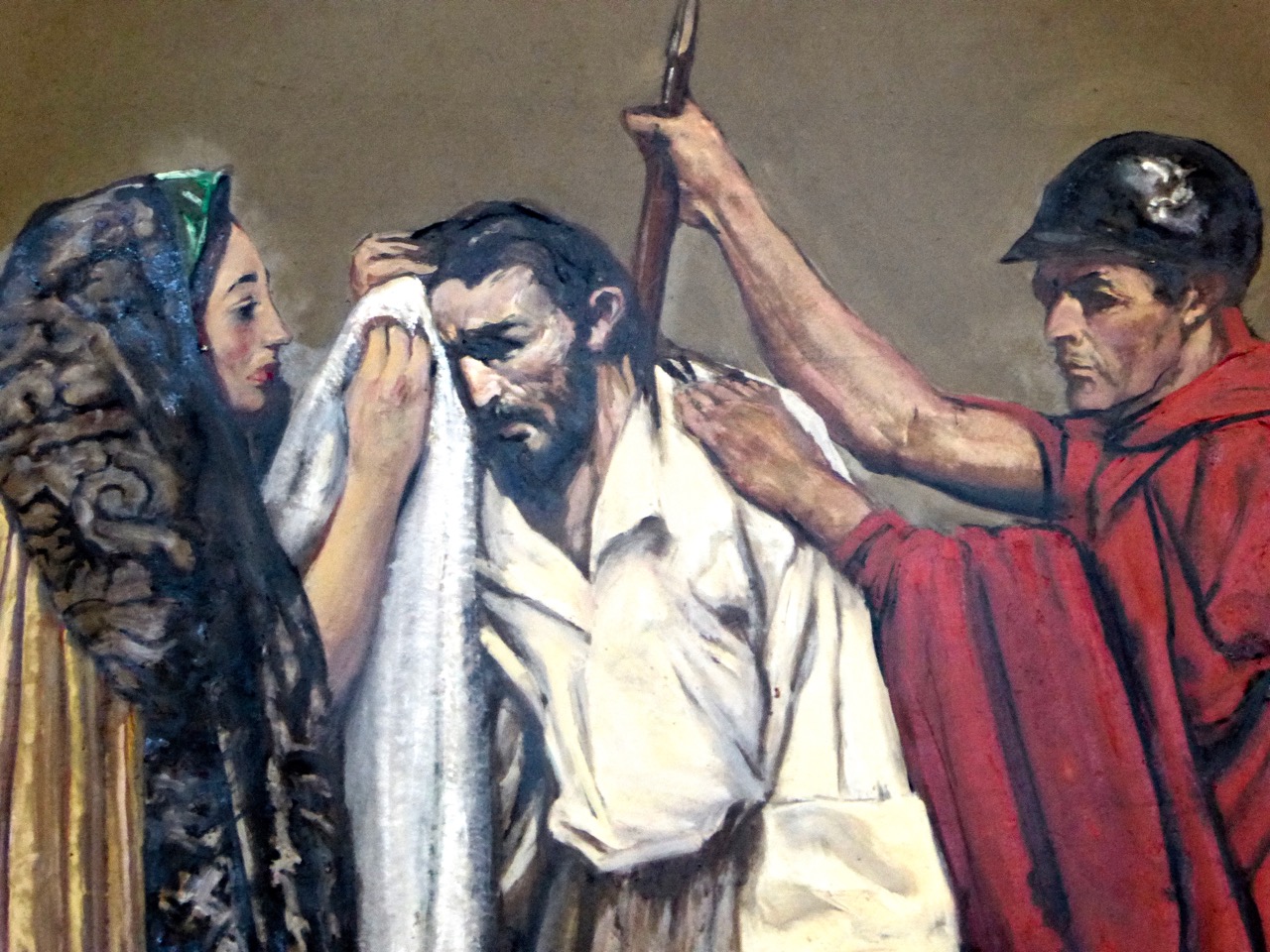
Finally, this magnificent work of art is only one of the many artistic delights of this Tralee church. They deserve a post of their own some day, but I will give you a sneak peek by telling you that the Stations of the Cross are by none other than the famous Irish artist, Sean Keating. Here’s a detail from just one of them.

My friend Eileen drew my attention to this new window.  So thank you, Eileen – as you can see I lost no time in making the trip to see it. I am SO glad I did.

**Edit: I got this wrong. There were no English estates. The Denny’s, along with many members of the Anglo-Irish landlord class, eventually lost their lands. In the case of Tom Denny’s grandfather, although he was a baronet he was also a clergyman,  living the life of an impoverished cleric dedicated to his church. The move to England was related to his church service. RTE has now screened their program on the window and it does a marvellous job of adding fascinating detail about the window and the history of the Dennys – mostly supplied by Tom himself.