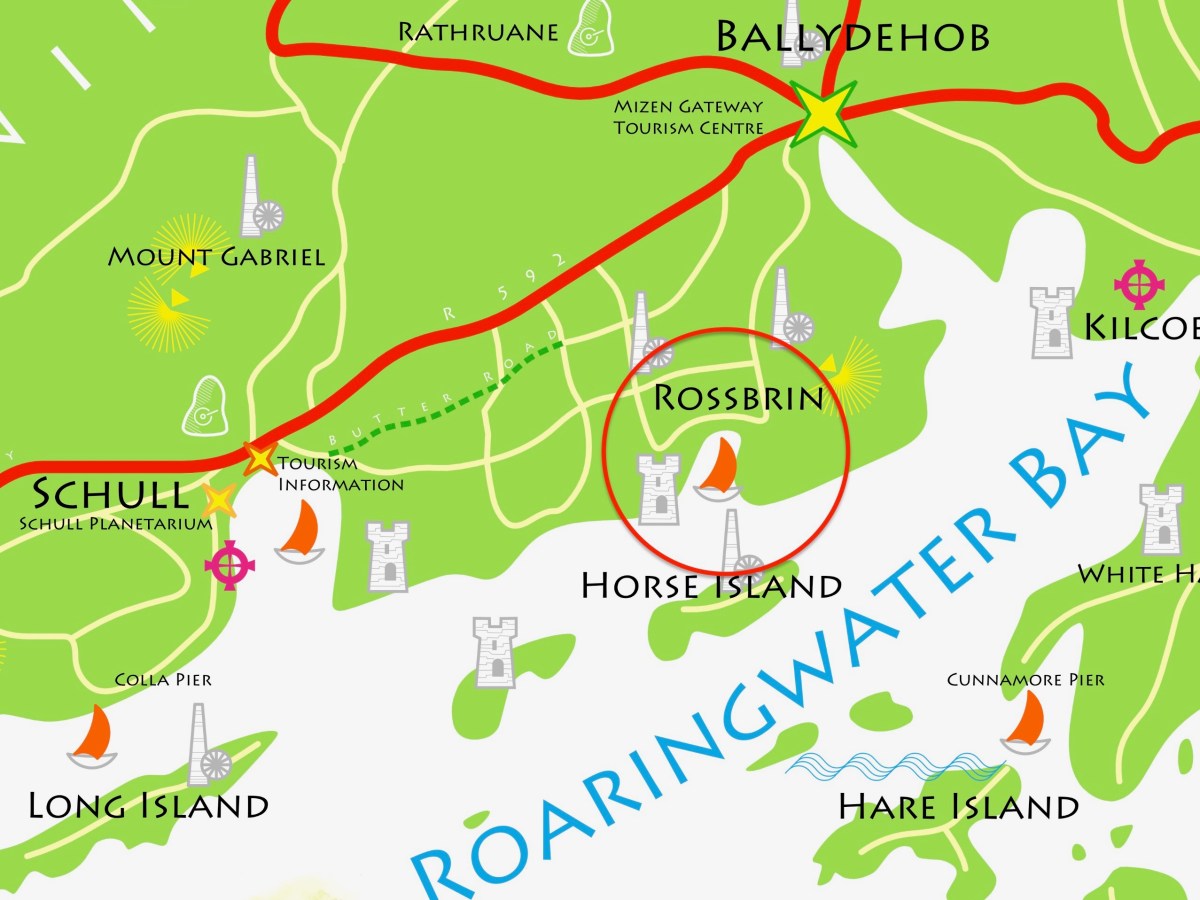
The weather so far this year is breaking records for coldness, wetness and evapotranspiration – while Earth as a whole continues to get warmer. In simple terms that means it’s not pleasant to wander too far from home. I decided to walk down to the shoreline of Rossbrin Cove – all of ten minutes – and see what the winter storms may have washed up: often an interesting diversion.
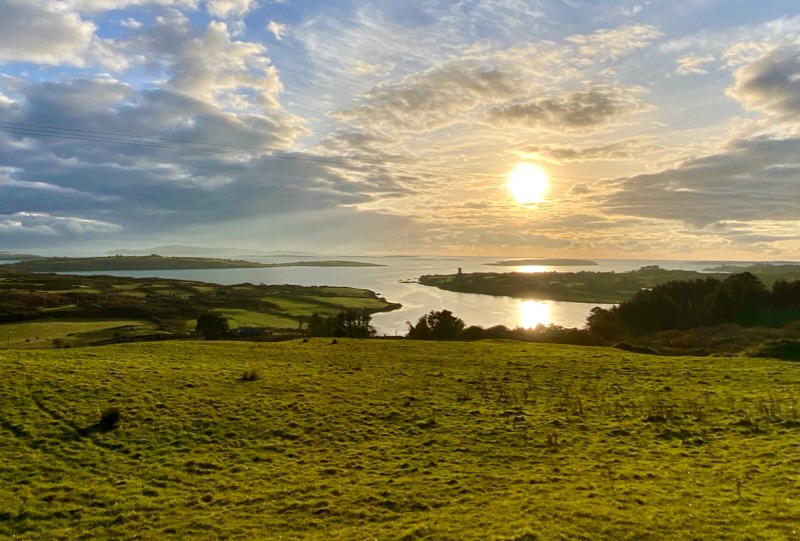
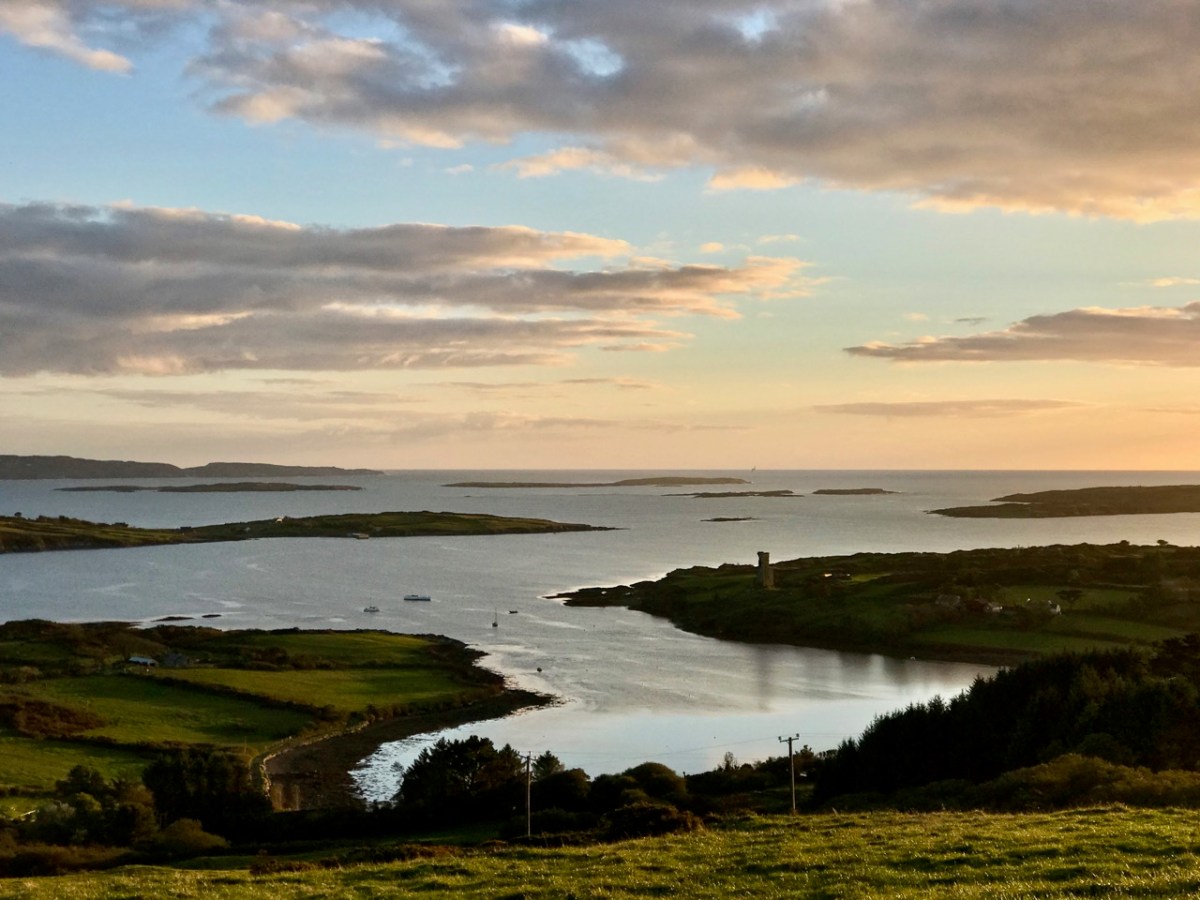
Above: looking down on Rossbrin Cove with some of the islands of Roaringwater Bay beyond. It is a natural harbour, and there is a thriving boatyard at the western end of it. The difference between low and high tides is around 2.5 metres on average, and much of the inlet dries out when it is at an extreme low. I timed my walk to arrive when the tide was fully down, as I wanted to explore the exposed mud-flats, with hopes of finding intriguing detritus.
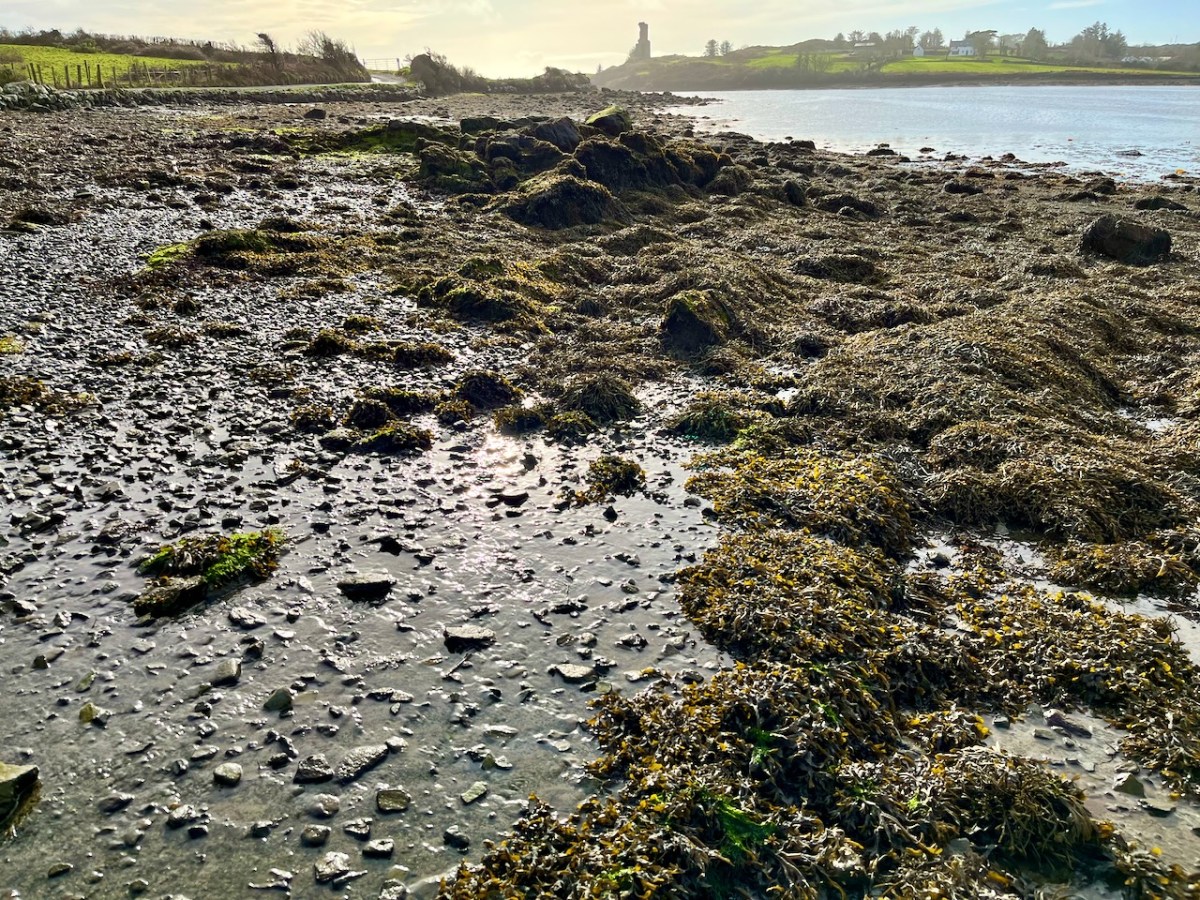
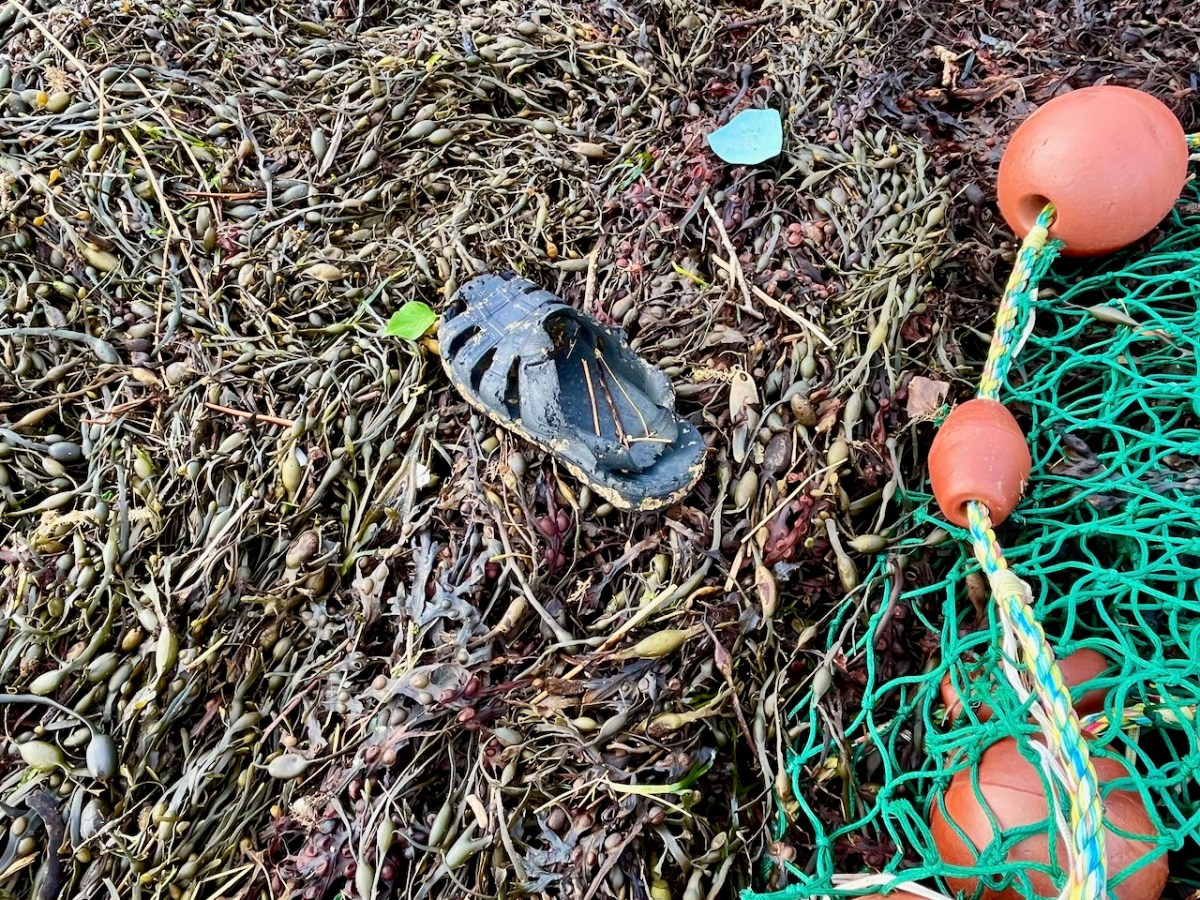
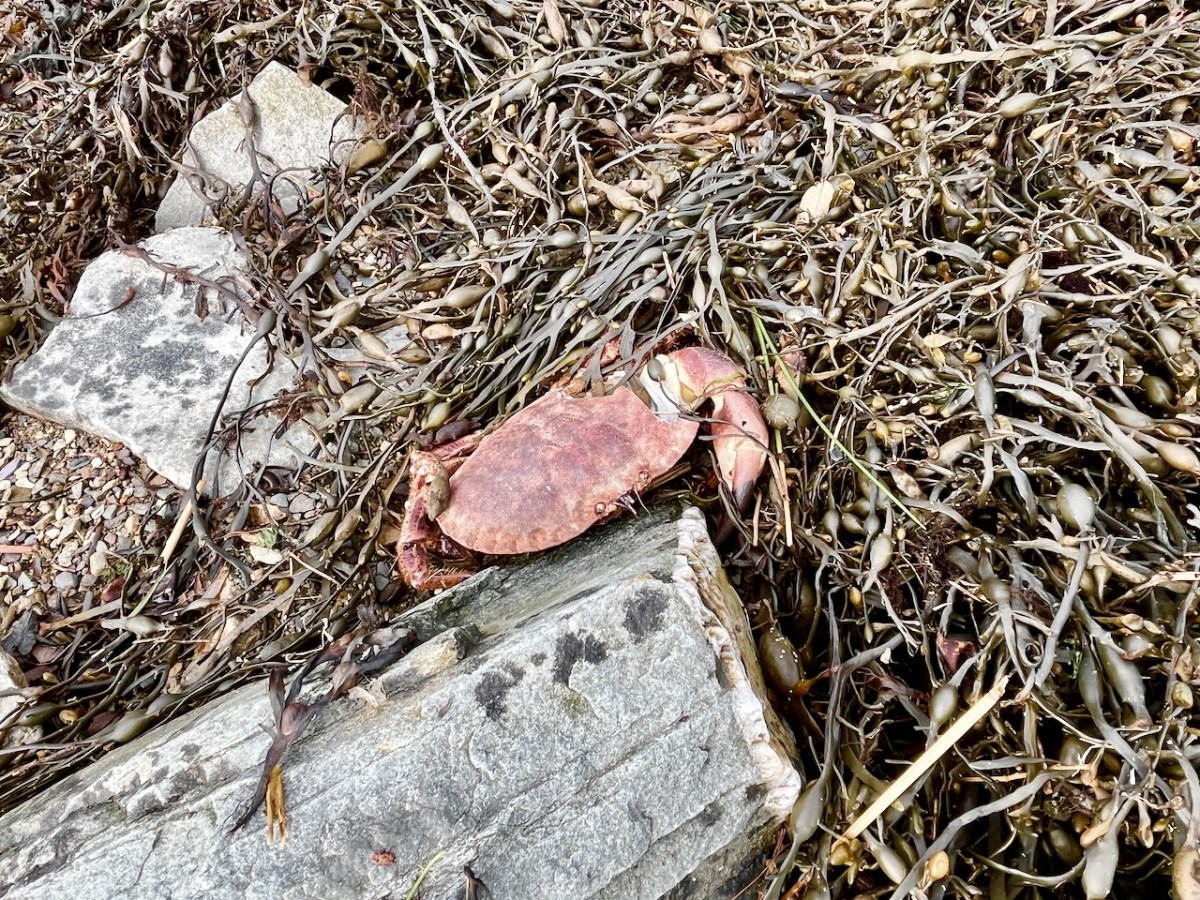
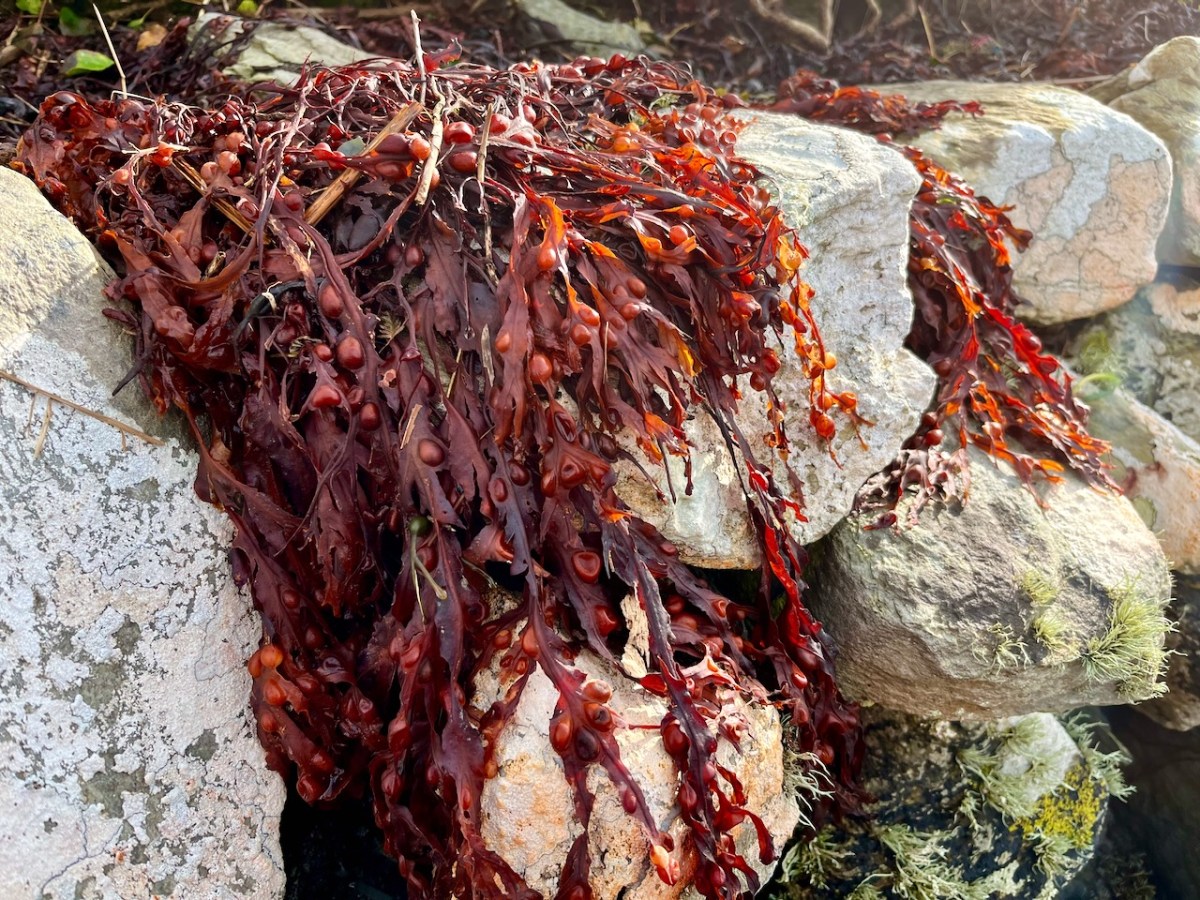
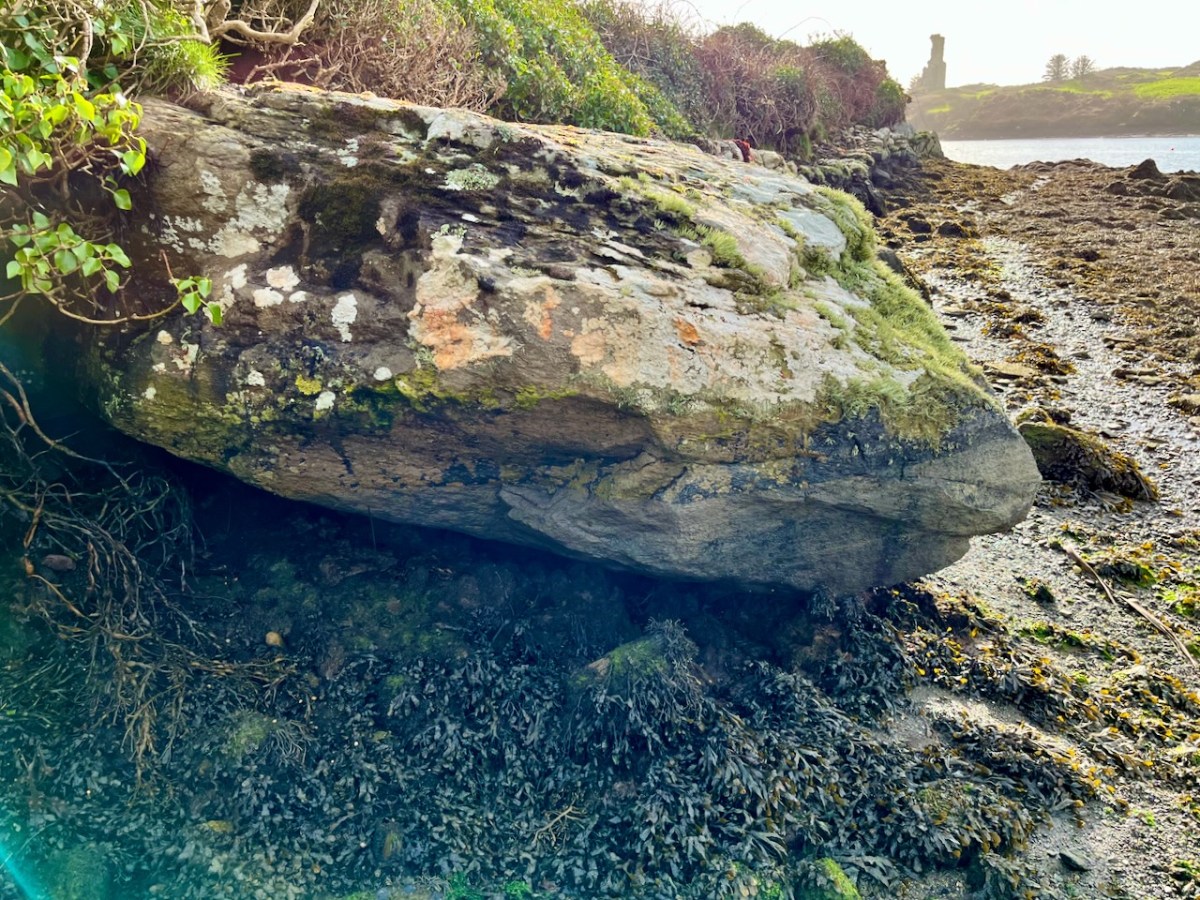
Not an inspiring start! In fact, as I continued my review, I noted that there was very little other than the natural environment – weather-worn boulders, skeletal shells and masses of seaweed – to disturb the order of things in Rossbrin on this February day. If our harsh storms had been of some positive effect it was perhaps to flush out any washed-up debris that might have accumulated in the winter – being now past St Brigid’s Day I consider it appropriate to call the season spring.
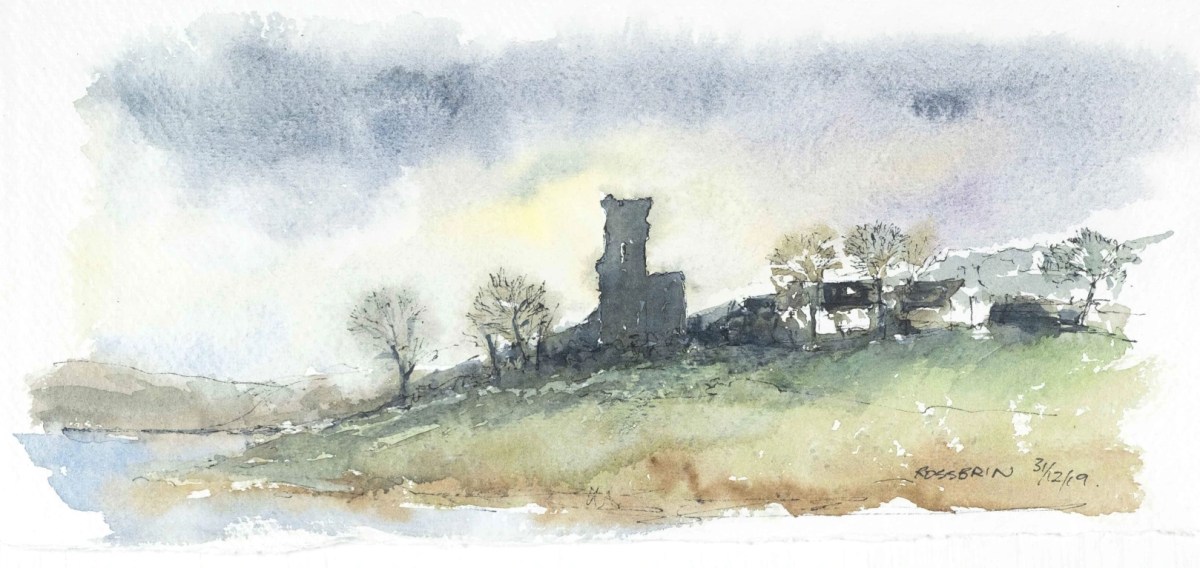
No matter that the exploration was superficially disappointing, the magic of this little bit of West Cork soon took over, and my mind was filled with the enormity of its history. There was a university here in medieval times: manuscripts were written here in the castle that has become a crumbling pile. Ravens and seabirds now rule over the stronghold. I walked on.
The margins of the cove are lined with ancient banks. At every turn there is a composition which a maestro could frame: I make do with a camera. Rossbrin inspired our artist friend Peter Clarke . . . Thank you, Peter!
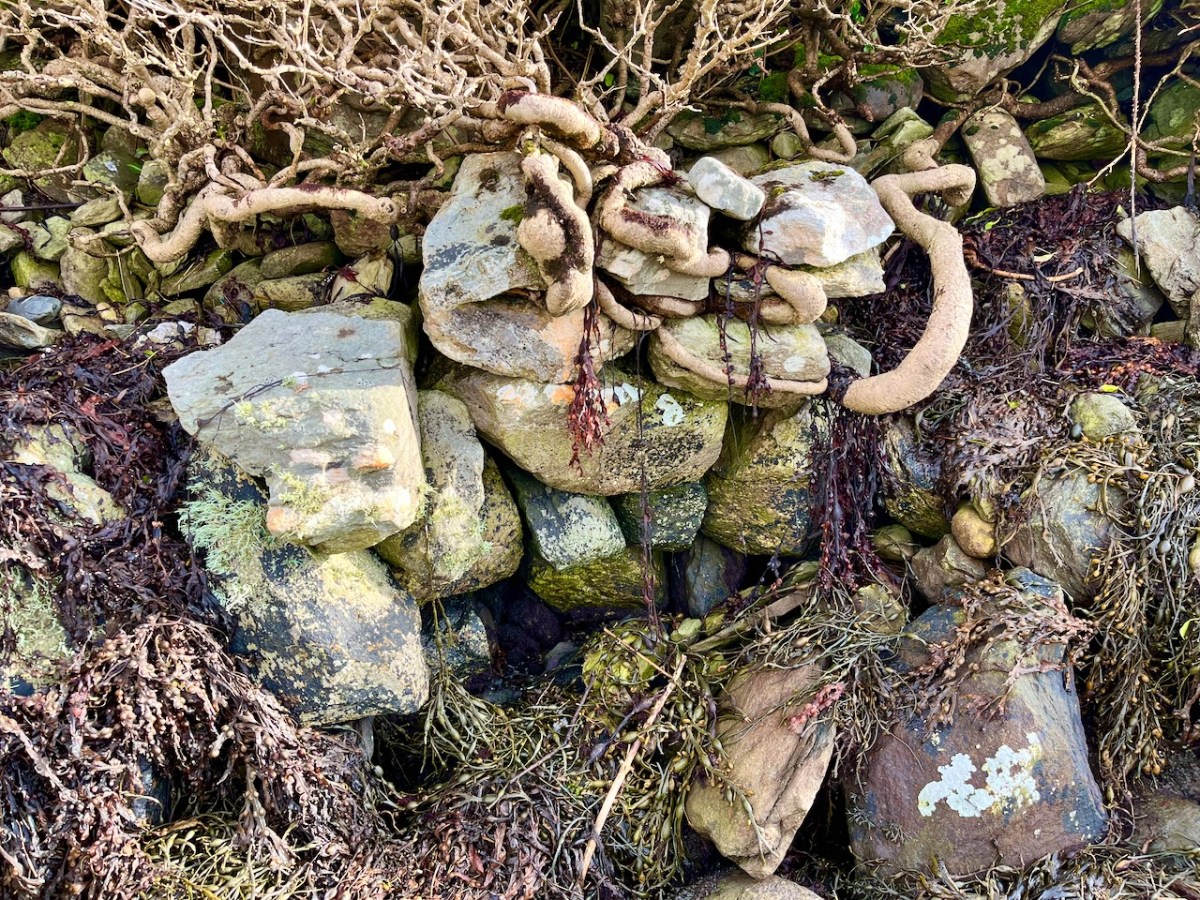
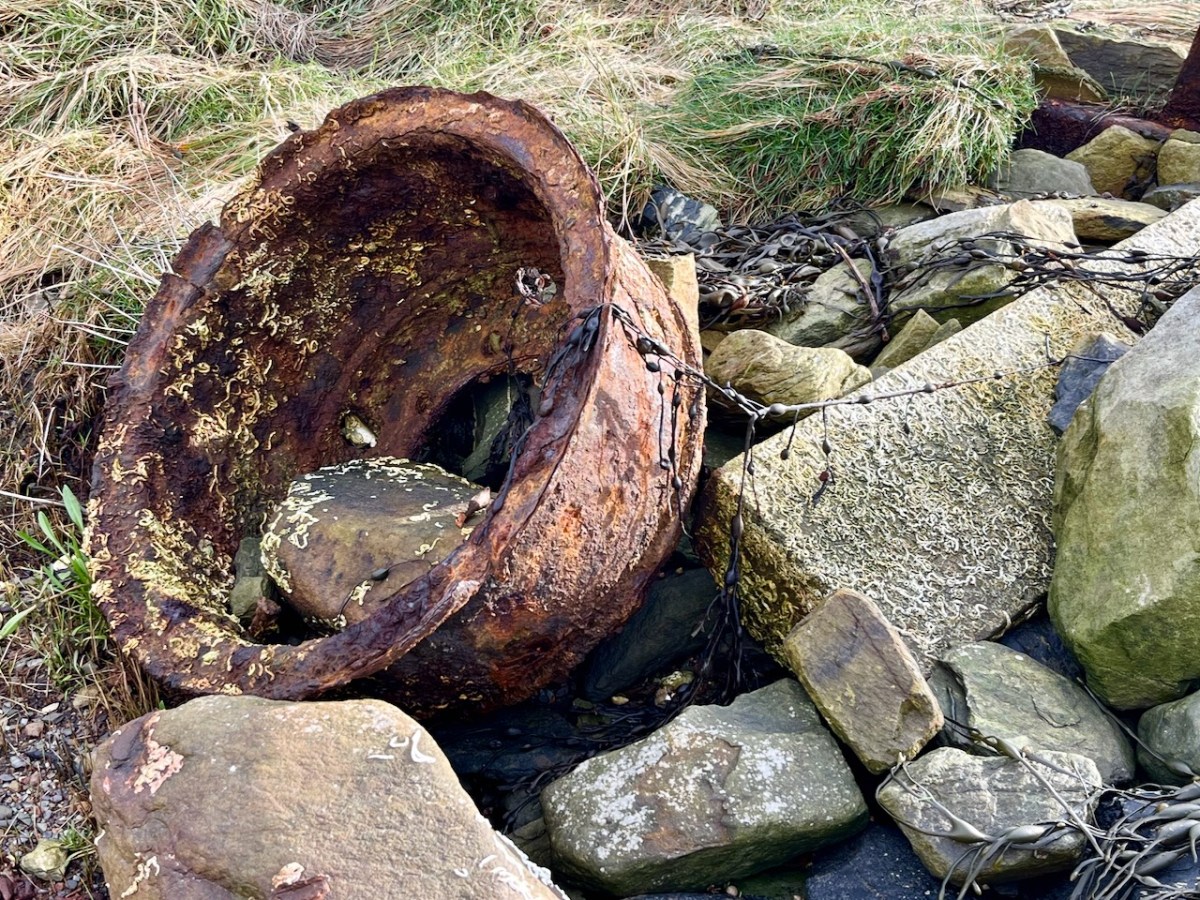
Evidence of more recent history: possibly a pot which was used in the process of tarring a clinker boat hull. No doubt vessels were built on these shores – and used to make basic livings. There is still fishing activity in and around the cove; mussel beds thrive in Roaringwater Bay; seaweed collection happens also. In summer months the deeper waters of Rossbrin are occupied by leisure orientated sailing craft. I enjoy the calm days of winter when there is hardly anything on the water. I watched a small flock of oystercatchers scurrying and foraging with their brilliant beaks, and then I turned for home.
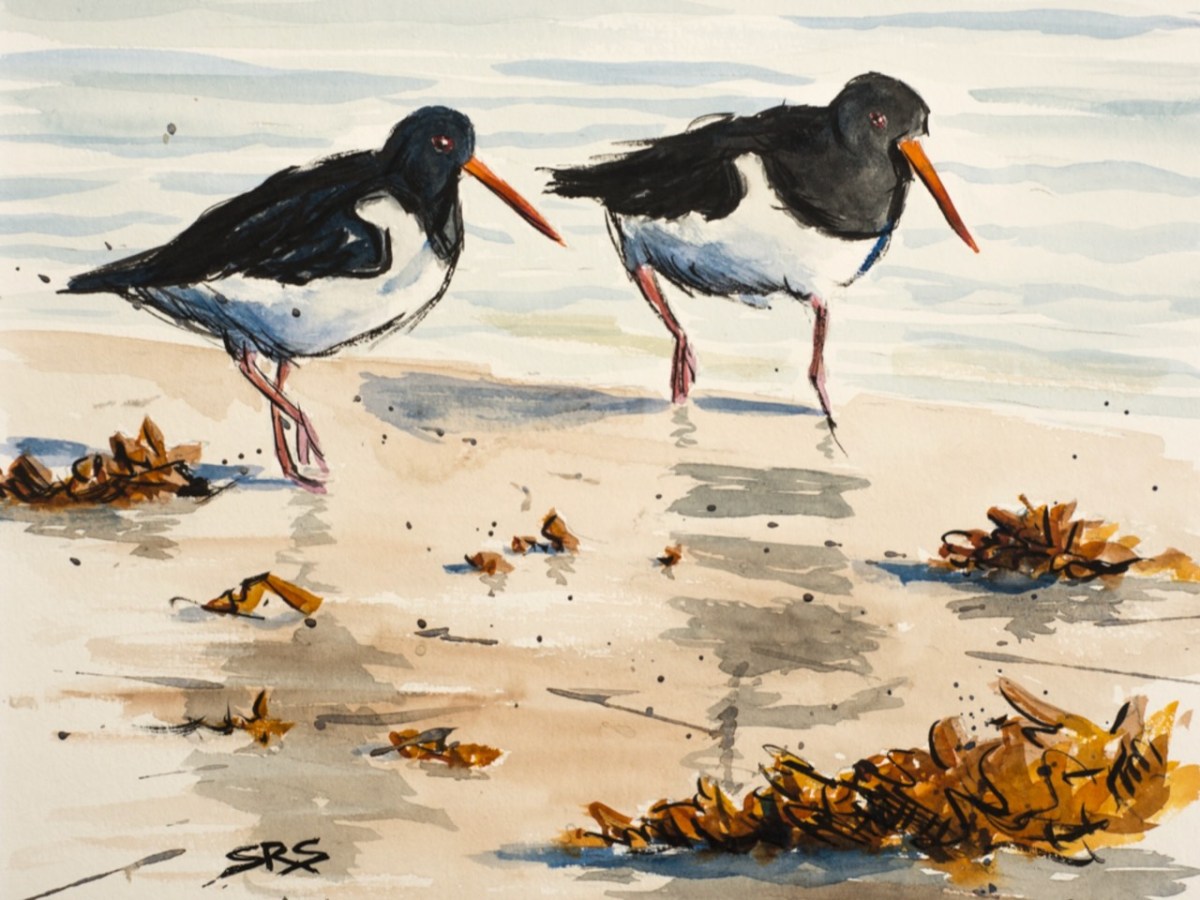
The Rossbrin oystercatchers were uncooperative, and wouldn’t let me photograph them. Instead I have imported this wonderfully atmospheric painting by Cornish based artist Steve Sherris. Thank you, Steve
We have posted extensively about Rossbrin Cove, its history and its people. Have a look at these:
It was a big day in Ballvourney yesterday: the public unveiling of two replicas of the 800 year old wooden figure that has been central to observances of St Gobnait on her day for as long as anyone can remember – we must be talking centuries! If you are not familiar with St Gobnait – or her celebrations – read my post here.
It’s actually St Gobnait’s Day today: the eleventh of February. As I write this, the congregation in the saint’s church will be venerating the 13th century wooden figure by ‘measuring’ her with ribbons. But also, for the first time, they will be able to view the two copies of that figure which have been made over the last few months. That exercise has been undertaken so that the figure itself could be fully studied because it is of great historical interest. There are other medieval carved wooden figures of saints surviving elsewhere in Ireland, but this is the only one that is still in regular active use.
. . . A medieval wooden image of Gobnait, kept traditionally in a drawer in the church during the year, is venerated in the parish church on this day. The devotion is known as the tomhas Gobnatan . People bring a ribbon with them and ‘measure’ the statue from top to bottom and around its circumference. This ribbon is then brought home and is used when people get sick or for some special blessing. The statue is thought to belong to the 13th c. A second pattern in honour of Gobnait was traditionally celebrated in Baile Bhúirne at Whit . . .
The above citation is taken from The Diocese of Kerry website, which sets out a comprehensive review of the saint and the activities which honour her. Here’s the measuring taking place a few years ago:
National Heritage Week 2023 explains the purpose of the project to replicate the carving:
. . . As patron saint of the parish, the statue provides a tangible link to the saint but importantly represents the long-standing living devotion to Gobnait. The wooden figure carved out of oak clearly depicts a female monastic. It was guarded over the centuries by the O’Herlihy clan, who were the ruling Gaelic lords of the Ballyvourney area during the medieval and late-medieval periods. It remained in the safe-keeping of members of the O’Herlihy family until they handed it over to the local parish priest in the late-19th century and it has been protected and kept secure by the Ballyvourney Church Committee ever since. The 3D project will comprise the digital scanning of the statue which in turn will enable a 3D generated wooden print out. A second replica will be hand carved as an integrative representation of how the statue would have looked originally before the centuries aged and tarnished it. The replicas will then be placed permanently on display in the Parish Church with information signage . . .
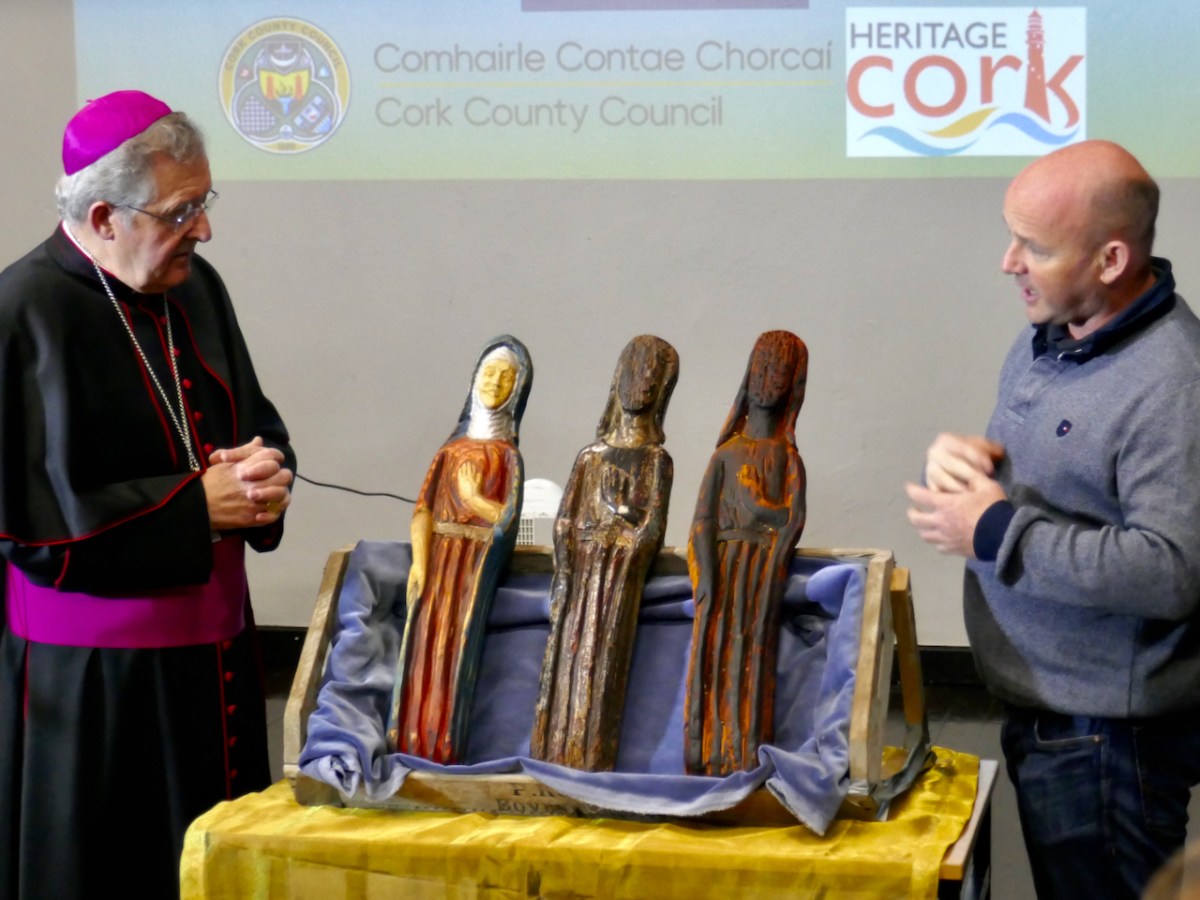
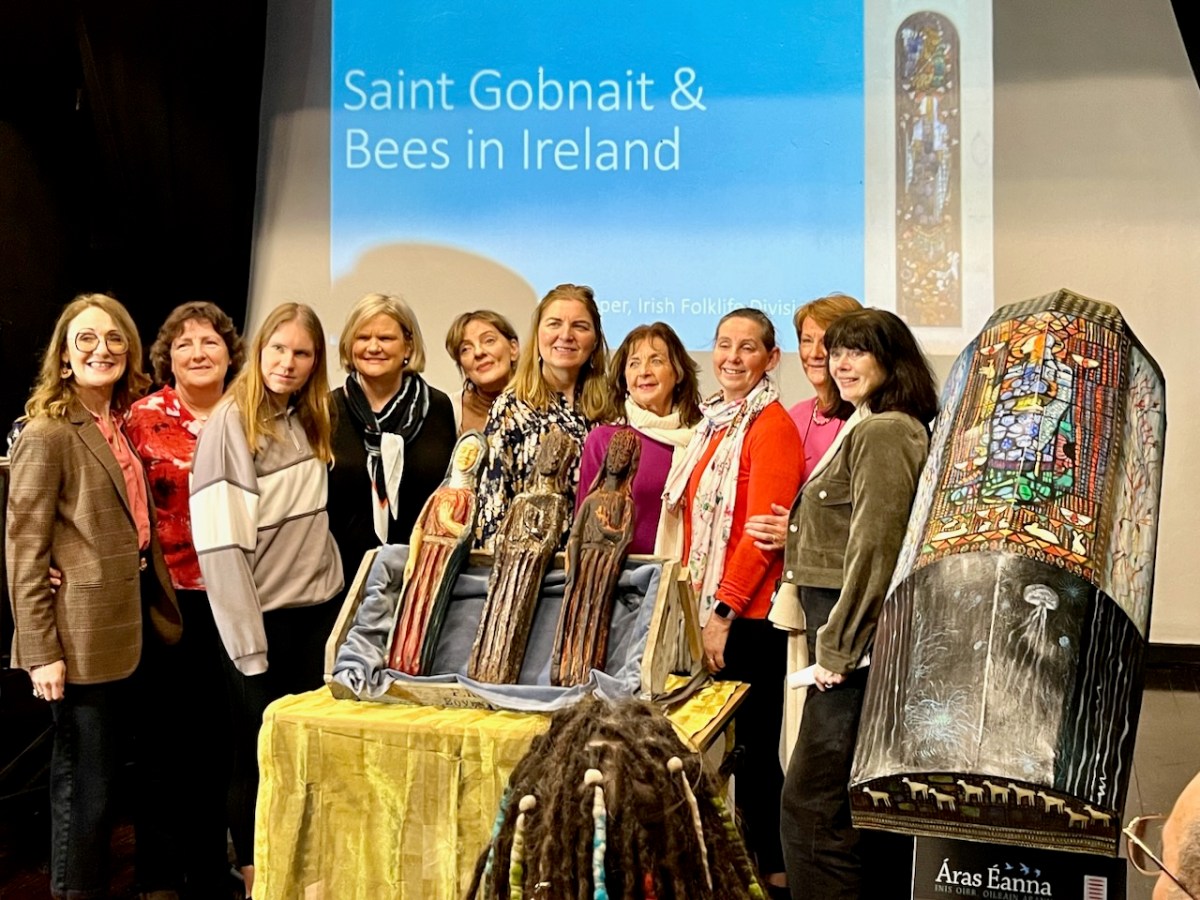
Above is a view of the original carving (in the centre) with the replica of that on the right. On the left is the ‘integrative representation’ – that is the carver’s interpretation of what the figure might have looked like when she first saw the light of day in the 1300s. On the left is Bishop William Crean – Bishop of Cloyne since 2013: he presided over the unveiling of the two replicas yesterday. On the right is John Hayes, of Special Branch Carvers in Fenor, Co Waterford. He was responsible for the carving project and has made an excellent job!
John gave us a presentation yesterday, after the unveiling ceremony, and we learned how he closely examined the original statue, taking detailed measurements and a full photographic survey. This enabled a Sketchfab 3D rendering to be produced: this became the basis for his work. During the examination he was able to find traces of paint, which enabled him to render the interpretative version with – very likely – a high degree of fidelity to the original.
I got the chance to talk to John and ask him about the timbers used for the original and the replicas. The original is of oak, and we don’t have a way of knowing where this came from. The replicas are of ash: this is a good material for stability and longevity. John had access to a good source of seasoned wood.
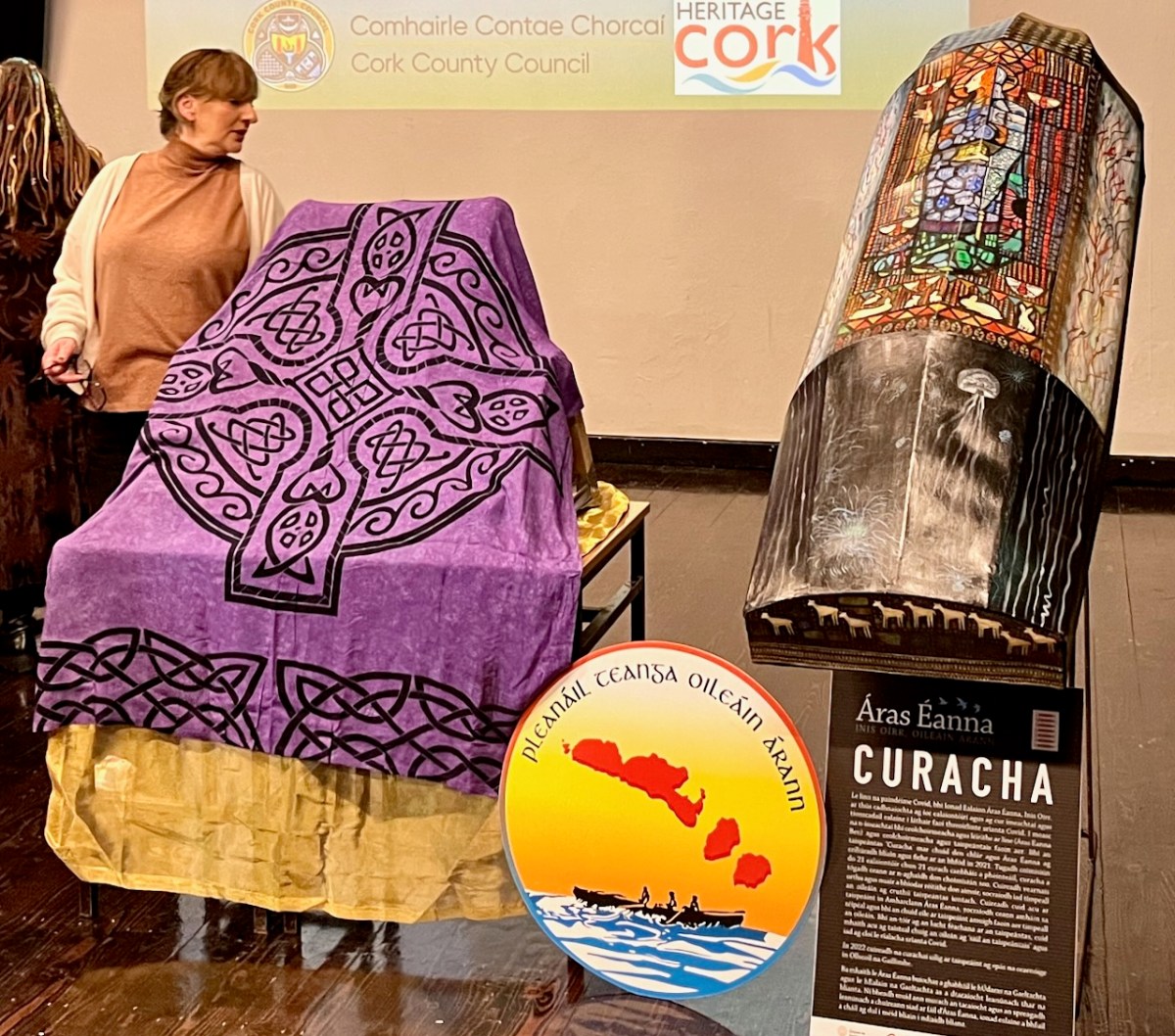
The day was a study day for St Gobnait, and encompassed a whole lot more than the unveiling of the replicas (they are waiting under the cloth- above – to be revealed)! Note the currach in the pic also: that’s another project – to establish a Camino tracing the route which Gobnait took as she travelled around Ireland from the Co Galway Aran Island of Inisheer, having been told by an angel that her life would be fulfilled when she saw nine white deer. She spent time in Dun Chaoin and Kilgobinet in Kerry, Ballyagran in Limerick, Kilgobinet in Waterford, and Abbeyswell and Clondrohid in Cork, before finally finding the deer in Ballyvourney. You can see those deer on the stern of the currach, above. There are at least eight holy wells in Ireland dedicated to the saint. Amanda has written extensively about Gobnait’s travels and – of course – about her wells.
There was also an excellent series of talks about Gobnait. Events took place in Ionad Cultúrtha an Dochtúir Ó Loinsigh, which is a great facility in the community. Here we are – together with our good friends Peter and Amanda (you have met them frequently on the pages of this Journal), - waiting for proceedings to begin:
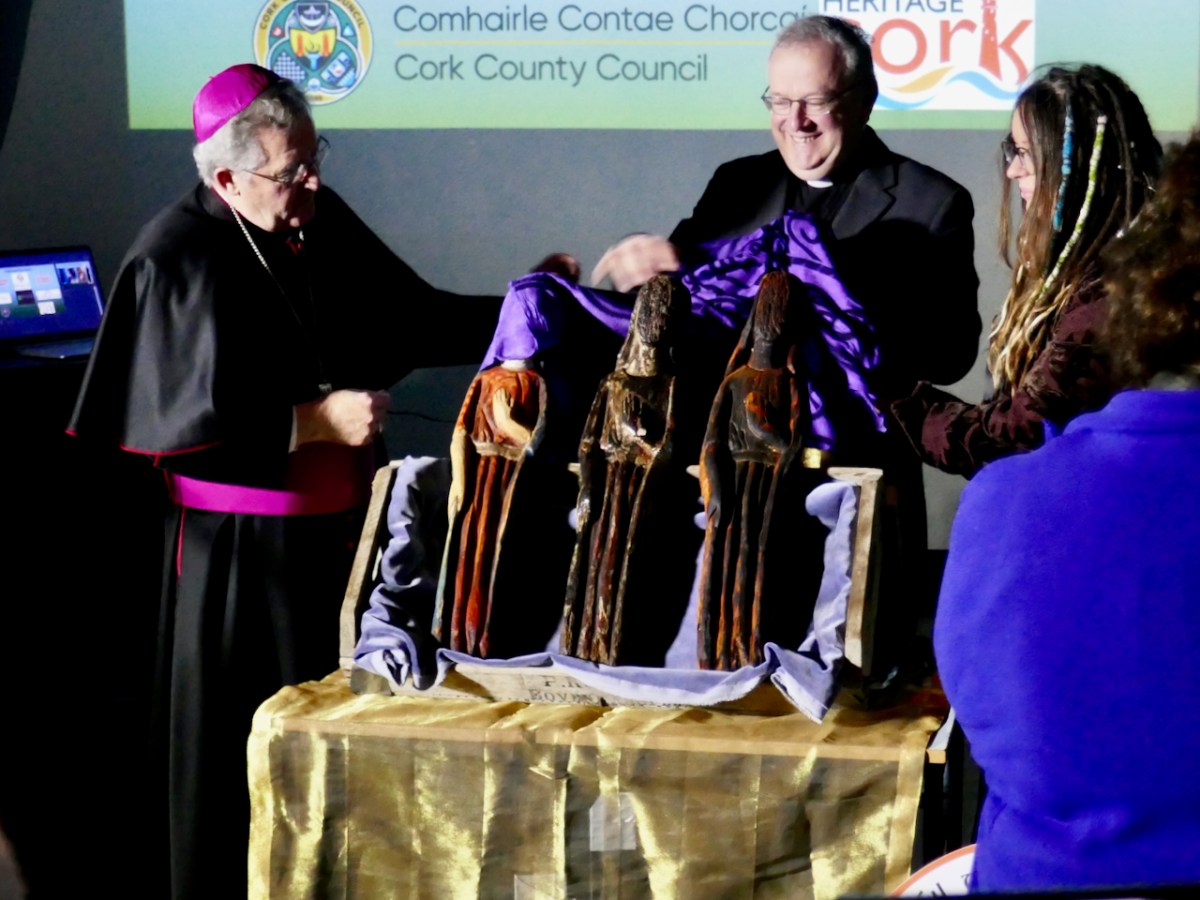
This is the moment of unveiling: the Bishop is accompanied by the Parish Priest – Very Reverend John McCarthy SP – and archaeologist Dr Connie Kelleher, National Monuments Service: she has played a significant role in this Ballyvourney project.
The decoration on the hull of the Camino Currach is based on the depiction of Saint Gobnait in the Harry Clarke window from the Honan Chapel, UCC. The bee image on the right reminds us that Gobnait is the patron saint of bees and beekepers. We enjoyed a comprehensive talk on bees by Peadar Ó Riada – who has first hand experience of the subject:
There were many more dimensions to the day. One of my favourites was when the audience was requested to produce anyone named Gobnait to be photographed with the carved figures. That included the variations of the name: Library Ireland (1923) (Rev Patrick Woulfe) gives these as Gobinet, Gobnet, Gubby, Abigail, Abbey, Abbie, Abina, Deborah, Debbie, and Webbie. Ten candidates stood up to be counted:
Thank you to Finola for providing many of these photos
There’s a concentration of prehistoric rock art around Castletownshend and I am currently writing a paper about that for the next issue of the Journal of the Skibbereen and District Historical Society. There are seven individual pieces of rock art: as part of the research I recently visited the one stone I hadn’t seen yet. Fortunately, we had the company and assistance of Conor Buckley of Gormú Adventures (been on one of his marvellous walks yet? If not, try this one, or this one or this one.) who, as a native of the area, knows everyone and introduced us to the landowner, the genial Bill O’Driscoll.
The townland is Farrandeligeen – isn’t that a wonderful name? A dealg is a spine or thorn or prickle, and therefore a deilgín is a small one of those. So it can be translated as the Land of the Thorns, which can be blackberries or blackthorns – and this being West Cork, probably both. An old saying is Is beag an dealga dhéanfadh braon – the tiniest thorn can cause big problems. Thorn in a hiking boot, anyone?
The land lived up to its name. Bill took us to where he knew the rock art was, and that’s when we encountered the deligeen bit. Fortunately he had a stout fork with him, and took to hacking and bashing his way through the thorns, while we stood back and offered encouragement. The first place proved unfruitful and he moved a few metres away and soon struck gold. Among the brambles, earth, gorse and general undergrowth there was a hint of something white. This turned out to be a bag filled with stones – the very bag he had put there to remind him that this is where the rock art was – but so many years ago that it had slipped his mind until now.
And so the stone gradually came into view until I could finally get down to clearing it off with my gloves. (I was sorry I hadn’t brought the red socks.) This stone is already in the National Monuments Records as a ‘Cupmarked Stone’ (CO151-013) and is described as having ‘at least ten cupmarks’. Bill told us that his father had said he remembered the stone standing upright – it had fallen to its present position flat on the ground since his father’s time.
For more on what a cupmarked stone is, and how it fits in to the general category of ‘Rock Art’, see my post The Complex Cupmark. For now, quoting from that post:
The cupmark is the most basic and numerous element or motif of rock art in Ireland and elsewhere. In the examples labelled rock art in County Cork, they occur with other motifs, principally concentric rings, sometimes with radial grooves, and a variety of curved or straight lines. They can be incorporated within a motif (as in cup-and-ring marks, rosettes, or where enclosed by lines) or they may be scattered, seemingly randomly, over the surface of the rock, between and among the other motifs.
. . . patterns of straight lines, or of rough circles or semi-circles, can be made out in several of the stones we have recorded to date.
Rock art is widespread across the Atlantic coast of Europe and is believed to date from the Neolithic, about 5,000 years ago. The cupmark as a motif, however, continued well into the Bronze Age, since we find it on wedge tombs and boulder burials. We do not know what the significance of the cupmark is, but it must have held a special meaning to the carvers since it persisted over time and space.
We got the rock cleared enough to identify the cupmarks and I put a button in each one to make sure it showed up – sorry, those are not gold coins. Some of the cupmarks are tiny. You can look at the cupmarks as a random scatter, or as in the quote above, you can see two groups, in which a cupmark is surrounded by a semicircle of four others.
It was hard to get the rock clean enough to see detail so I decided to carry out a photogrammetric survey, the object of which is to end up with a 3D image from 2D photographs. That involves taking LOTS of photos (in this case, 100) of the stone, working my way systematically across the surface of the stone at three different levels, keeping the camera settings consistent.
Conor had his drone with him – a new experience for us! He took photos and videos of the stone in its general location, capturing me doing the photogrammetry and also a good indication of the amount of undergrowth that had to be cleared out of the way before the rock came into view. (Thank you, Bill!)
I sent the photographs off to UCC, to the Department of Archaeology, where Nick Hogan generously processed them for me, using the Department’s specialised software. The results are fascinating!
First of all, it looks like there are more than just cupmarks on this rock. A long line stretches from the far left (in this image) cupmark to the right hand grouping. There is a hint of a circle around the bottom left cupmark. The three large cupmarks in the right grouping appear to be conjoined, and there is a line from from the far right cupmark to the end of the stone.
You can view the render in what is called Matcap, which creates it in a metallic view (above and below). On a grey day with no shadows, and still lots of mud on the stone, none of this was obvious to the naked eye. There is a possibility that these new elements, rather than being carved, are natural contours in the rock itself. We haven’t had time yet to go back and check this out more carefully, but we will have to do so – and update this post! If indeed the lines turn out to be carved, that fact will elevate the rock from a Cupmarked Stone to Rock Art. Watch this space.
We’re going back a few years to look at a piece of West Cork history: a shipwreck. The ship is the Kowloon Bridge, a Bridge class OBO (oil/bulk/ore) combination carrier built by Swan Hunter in 1973. She ended her days on the Stags Rocks, beside Toe Head in West Cork in 1986 (above – image courtesy of Irish Examiner). At the time, this was said to be ‘one of the largest wrecks in maritime history’.
A Bridge Class model (above – photo courtesy www.mikepeel.net). Six of these ships were built by Swan Hunter at Haverton Hill on the River Tees in County Durham, UK, between 1971 and 1976. Originally named English Bridge and subsequently – passing through various ownerships – this 54,000 tonne vessel was renamed Worcestershire; Sunshine; Murcurio; Crystal Transporter; and finally Kowloon Bridge. I’m tempted to think of the old folk belief that says changing the name of a boat is unlucky!
. . . Perhaps the most famous maritime superstition of them all is the idea that changing the name of a ship is bad luck. Legend has it that Poseidon, the Greek god of the sea, has a ledger in which he keeps track of the name of every sea-going vessel. Changing the name is seen as a challenge and as an attempt to try and out-smart him, which would incur his wrath. To avoid any bad luck, the original name must first be purged from Poseidon’s book in a de-naming ceremony, before the new one is adopted . . .
There she is, in her original incarnation and unladen (image courtesy of Tony Ecclestone, Swan Hunter). As you can see, a massive vessel. Her length was 295 metres and her beam 44.3 metres. She had a draft of 18.5 metres. In November 1986 the Kowloon Bridge – which she had then become – departed Sept-Îles, Quebec, bound for the River Clyde in Scotland. Her cargo was 160,000 tonnes of ‘marble sized’ iron ore pellets and crude oil.
The Atlantic crossing was particularly rough-going, and the vessel sustained some superficial damage. The decision (a fateful one) was taken to head for the nearest shelter on the east side of the ocean: the deepwater Bantry Bay, off West Cork’s coast. A Lloyds’ survey there showed that she had suffered ‘routine heavy weather damage’ and recommended that she remained anchored in Bantry Bay while temporary repairs were undertaken. Here’s a view of Bantry’s waterside in more benign days: Roaringwater Journal has reviewed the town in some detail.
Above is a RWJ view of Bantry Bay and Whiddy Island taken back in 2014. The island was the setting for another disaster in earlier years: on January 8, 1979, the French-owned tanker, Betelgeuse, exploded at the oil terminal, resulting in 51 deaths. Even now – 45 years on – new enquiries are being set up to establish the true facts surrounding that incident. Returning to our Kowloon Bridge story, accounts seem to vary. One says that on 22 November 1986 – having had the necessary repairs completed – the ship resumed her voyage and set out into the Bay; but she was plagued by continuing bad weather, and lost her steering gear. Another suggests that the problems included ‘deck cracking in one of her frames’: she was forced to leave port to avoid colliding with another tanker and – engine running astern – she lost her anchor and her steering controls. The decision was taken to abandon ship (still running astern) and Royal Air force helicopters rescued the crew. She headed out of the bay and into open waters, being driven also by storm-force winds. (Image below courtesy of Southern Star)
Kowloon Bridge left Bantry Bay and rounded the Sheeps Head and Mizen Head. A tug tried to intercept her, but was unsuccessful as this, also, sustained damage due to the adverse conditions. Coming close to Baltimore the combination carrier/tanker hit rocks and her engine stalled. She continued to drift eastwards, finally coming to rest on the Stags Rocks below Toe Head (header pic).
Despite efforts to board her and assess salvage attempts (images above courtesy Irish Examiner), in due course the ship broke her back and went under – although, according to local reports, her bow could still be seen for months afterwards. To this day she lies off the rocks, with her iron ore cargo surrounding her. Below: the view from Toe Head today and (lower) the Stags Rocks.
The breaking up of the ship caused the release of of 1,200 tonnes of fuel oil. This led to damage to local coves and beaches, with loss of income being suffered by the fishing and tourism industries. The incident happened in the days before The International Convention on Oil Pollution Preparedness, Response and Co-operation was set up: that came into being in 1990. Parties to OPRC are required to establish measures for dealing with pollution incidents, either nationally or in co-operation with other countries.
. . . Ships are required to carry a shipboard oil pollution emergency plan. Operators of offshore units under the jurisdiction of Parties are also required to have oil pollution emergency plans or similar arrangements which must be co-ordinated with national systems for responding promptly and effectively to oil pollution incidents. Ships are required to report incidents of pollution to coastal authorities and the convention details the actions that are then to be taken. The Convention calls for the establishment of stockpiles of oil spill combating equipment, the holding of oil spill combating exercises and the development of detailed plans for dealing with pollution incidents . . .
Trying to follow the subsequent story of the wreck, everything gets a bit murky. West Cork communities undoubtedly suffered as a result of the foundering. Debris and oil were washed up (image above courtesy Irish Examiner). ‘Hundreds of seabirds’ died according to local reports. Promises of compensation were made – and reneged on – by the Haughey government. But it was Cork County Council and its ratepayers who eventually bore the major costs of cleaning up, even though the ship had been fully insured (image below courtesy Irish Examiner).
Apparently, the wreck was purchased in December 1986 by a British scrap dealer, Shaun Kent. One report states he paid a million pounds for it – another states he paid one pound for it! An article in the UK Independent newspaper in August 1997 describes how he planned to use high power water jets to wash the iron ore pellets to the surface for recovery. Their value was said to be in the order of millions. He also intended to recover the steel hull and other elements. However, concerns were expressed locally and nationally that such a process so long after the event would adversely disturb the seabed and the stable micro-environment which has evolved over time. It is unlikely that such plans will ever be acted on.
Today, the wreck is an attraction to underwater enthusiasts (images above courtesy of Extreme Sports Cork): Nature has taken over the intrusion to the sea bed. During the various discussions which have ensued in the many years since the Kowloon Bridge came to rest on the Stags Rocks, the question has been raised: was the ship seaworthy in the first place? It is pointed out that a sister ship was MV Derbyshire. Originally named Liverpool Bridge, she was launched in 1975, the last of the six Bridge Class ships. With a gross register tonnage of 91,655 she had the greatest volume. In July 1980, Derbyshire also left port from Sept-Îles, Quebec, bound for Kawasaki, Japan. She was overwhelmed by a tropical storm, and sank in deep ocean, with the loss of all 44 lives on board. This was in fact the largest British ship ever to have been lost at sea (image below courtesy of shipsnostalgia.com).
The four remaining Bridge Class vessels saw long service, and were eventually scrapped, so there is no reason to suggest that the design was in any way faulty. I suppose we might say that it is mankind’s folly to create such huge machinery to bring cargoes across the world. We challenge Poseidon, and he has to take his share (image below courtesy of Bardo National Museum, Tunis).
As might be obvious by now, I am having fun playing around with DALL·E, the image-generating arm of ChatGPT. In its own words, DALL·E 2 is an AI system that can create realistic images and art from a description in natural language. I am experimenting by asking DALL·E to serve me up illustrations of St Brigid, and learning, in the process what it can do well, and where it seems to lack, well, a brain. On the whole it’s very impressive indeed, but also quite unreliable. Here are my requests and what I got in response – and notice how polite we are! Note also that DALL·E often responds with two images, but I usually only choose one of them to reproduce here.
ME: Can you design a Saint Brigid image for me, in the style of Harry Clarke, please?
DALL·E I can create an image inspired by the style of Harry Clarke, which would incorporate detailed, intricate patterns, rich colors, and a unique, stylized approach. Since Harry Clarke’s most recent work was after 1912, I’ll focus on aspects of his style like detailed stained glass art, with a gothic and Art Nouveau influence. For Saint Brigid, would you like her depicted in a specific setting or with certain attributes? Also, would you prefer a full-body portrait or a more focused image?
ME: Full body, with a lamp, oak leaves and a fox
DALL·E: Here are two images of Saint Brigid created in a style inspired by Harry Clarke. They feature her with a lamp, oak leaves, and a fox, all depicted in a detailed and vibrant manner characteristic of Clarke’s influence. Feel free to select the one that best suits your needs.
AI is trained by scanning all the images that it can consume on the internet, and obviously Harry Clarke has not yet been studied in detail by DALL·E – this image is nowhere close to his style. I award some marks for getting the attributes in there, and the early 20th century period art nouveau styling. What on earth is that caption, though, and what’s going on in her gown? On the whole, despite the halo, this illustration leans more to the Celtic Goddess end of the spectrum, and as you know I am not sympathetic to that version of her. Let me explain what I mean by that – there may well have been a Pagan or Pre-Christian Goddess figure with a name similar (we have Brigantia from Roman writings and the daughter of the Dagda from Irish mythology) but there is good evidence that the Saint Brigid we are talking about here was a real woman. A recent paper by Elva Johnston of UCD lays out the argument very well. Johnston says:
Brigit of Kildare is the first Irish saint to be celebrated in detail by Irish writers. Her cult enjoyed great depth and popularity. Nevertheless, Brigit’s very existence has been doubted; she has been recast as a pre-Christian goddess despite an overwhelming disparity in evidence . . . Brigit has been treated differently to Irish male saints, becoming a secondary character in her own biographies, reductively overshadowed by a barely attested goddess. It is time for a revitalised appreciation of Brigit as an actual woman, depicted by her first hagiographers as pushing against the grain of an elitist and patriarchal society.
I highly recommend this paper for anyone interested in learning more about the actual historicity. I also asked for a version of St Brigid in the style of a Rosetti Pre-Raphaelite painting and here’s what I got. Once again, although a beautiful depiction, it would be easier to see a Pagan Goddess reflection in this illustration than a devout saint. I decided to be more directive.
ME: can you create one that looks more like renaissance painting, depicting Brigid as a nun, with a church in the background
DALL·E: Certainly! For a Renaissance-style painting of Saint Brigid, I’ll focus on the distinct characteristics of that era: realistic proportions, a harmonious composition, and a depth of emotion and spirituality often found in Renaissance art. Saint Brigid will be depicted as a nun, with her habit and serene expression. The background will feature a church, possibly with architectural details reflective of the period, adding to the authenticity of the Renaissance style.
Here are two images of Saint Brigid depicted in the style of a Renaissance painting. In each image, she is portrayed as a nun, with a church in the background, capturing the essence of Renaissance artistry. Feel free to select the one that resonates most with your vision.
ME: The first one is a good start. Perhaps she could be older, and with her attributes, oak leaves, a lamp and a fox. Instead of the church, can you reproduce this St Brigid with only an Irish round tower in the background?
DALL·E: I’m glad to hear the first image is a good starting point. To modify it according to your suggestions, I’ll create a new image where Saint Brigid appears older, reflecting more maturity and wisdom. This change can be subtly conveyed through her facial features and expression, akin to the way a seasoned tree shows its age through deeper grooves in its bark.
Additionally, I’ll ensure her attributes are prominently featured. The oak leaves, symbolizing strength and endurance, can be woven into her attire or held in her hands, like leaves carried by a gentle breeze. The lamp, a beacon of light and guidance, could be in her other hand, casting a soft, illuminating glow. Lastly, the fox, a symbol of cleverness and adaptability, will be included, perhaps sitting loyally by her side or in a protective stance, akin to a faithful companion.
Hmmm – that round tower looks like something Rapunzel might be hiding out in. And – what on earth is that thing in the glass object? Love the fox and the lamp, though – and that little crucifix she’s wearing. She really does look like a wise old nun. In fact, I think she taught me.
ME: The last one is perfect – just one more modification, please, can you incorporate some Celtic interlacing or knotwork into the design
DALL·E: Absolutely! Adding Celtic interlacing or knotwork will infuse the image with a rich layer of cultural depth, typical of Irish art. This intricate detailing can be woven into Saint Brigid’s attire, the border of the image, or even subtly integrated into the background, including the structure of the Irish round tower. This will not only enhance the visual appeal but also pay homage to the rich heritage associated with Saint Brigid.
As with Harry Clarke, AI has not been trained on Irish round towers. Another issue with this image is that the fox’s head has been weirdly disconnected from his body. The interlacing looks more like basketweaving than anything else, but the richness of some of the details is impressive. I spent a lot of time asking DALL-E to refine this image to get a better round tower but I gave up after numerous failures and asked this instead.
ME: Please design an new image of St Brigid as an elderly nun with the following elements – a lamp, oak leaves, Celtic knotwork, and a romanesque-style church in the background
DALL·E: For this new image, I will design Saint Brigid as an elderly nun incorporating the elements you’ve requested: a lamp, oak leaves, Celtic knotwork, and a Romanesque-style church in the background. The image will capture the essence of an aged Saint Brigid, reflecting wisdom and serenity. The lamp will symbolize guidance, the oak leaves strength, and the Celtic knotwork will add a touch of cultural depth. The background will feature a Romanesque-style church, known for its semi-circular arches and sturdy appearance, providing a historical and architectural context to the scene.
ME: I like the left one – can you put in some colour and insert a small fox
DALL·E: I can create a new version of the image you prefer, incorporating color and adding a small fox to the composition. The addition of color will bring vitality and depth to the scene, and the fox, a symbol of cleverness and adaptability, will enhance the storytelling aspect of the image. Let’s see how this updated, colorful version with the fox turns out.
Jeepers – she’s aging before my eyes! I took a rest after that, but came back to it again later. The image at the top of my post came from this second session and is one of two (the second is below) that resulted from this request:
Please illustrate St Brigid in a flowing green cloak which spreads out behind her to create fields, with a medieval village in the distance.
I decided to try to illustrate some scenes from her life – stories taken from my previous blog posts about Brigid (you can read them by clicking this link). The first is a story from her childhood, concerning butter.
ME: St Brigid as a young girl churning butter, with other maids milking cows.
DALL·E: Here are two illustrations of St. Brigid as a young girl churning butter, set in a pastoral Irish setting. Around her, other maids are engaged in milking cows, all within the beautiful, green Irish countryside. This scene captures the simplicity and beauty of rural Irish life and St. Brigid’s early connection to service and the land.
Me: Thank you! Now, I would like an illustration of St Patrick anointing St Brigid as a nun, by putting the veil on her head. [I know it wasn’t St Patrick, but St Mel, but I wanted to keep it simple.]
DALL·E: Here are two illustrations depicting the moment St. Patrick anoints St. Brigid as a nun by placing a veil on her head, set inside an ancient stone chapel. This sacred and timeless scene captures the solemnity and grace of the ceremony, with St. Brigid kneeling in humility and determination.
But of course St Brigid was a bishop herself so I thought I would like to see what DALL·E made of that.
ME: St Brigid was recognised as a bishop and ruled over the ecclesiastical city of Kildare in the 6th century. Can you illustrate that?
DALL·E: Here are two illustrations depicting St. Brigid recognized as a bishop and ruling over the ecclesiastical city of Kildare in the 6th century. The scenes capture her majestic presence in bishop’s robes, holding a crozier, with the ancient city of Kildare and its community bustling with activity in the background. These images reflect the historical significance of St. Brigid’s role and the thriving spiritual community she led.
I tried several times to get DALL·E to remove the cathedral, but it was unable to do so, producing in all 8 different versions, all slightly different but all with an enormous church in the background – asserting each time that there was no church in the image. Here’s one version, in which the church gets even more enormous.
And here’s perhaps the strangest one – a cross between the Infant of Prague and a twee ye olde English village scene – and still with the enormous gothic cathedral!
I will finish with a final image, one of two generated when I said:
Me: I’m working on a piece about St Brigid of Ireland – her national holiday this year is Feb 5. Can you produce an image for me that celebrates that?
DALL·E: Here are two illustrations celebrating St. Brigid of Ireland for her national holiday on February 5th, set in an idyllic Irish landscape. Each image captures the essence of peace, heritage, and Irish culture, featuring St. Brigid in her iconic green robe, holding a lantern and staff, with a Celtic cross around her neck, amidst a beautiful backdrop of the Irish countryside.
I’ll leave it at that. I’d be really keen to hear what you, dear readers, think of DALL·E and its potential as a blogging tool.
St Brigid, according to some accounts, died in 524. Therefore, we are celebrating this year the 1500th anniversary of her death. Once again, I have gone back to primary sources for incidents from her life and am illustrating them with stained glass images. This year I have added as a source the famous Canon O’Hanlon’s Life, from his Lives of the Irish Saints Series, Vol 2, a work of overwhelming erudition.
The Patrick and Brigid window in Meath Hill, by George Walsh. I love that Brigid has precedence over Patrick in this enormous cruciform window
If you haven’t already done so, now is a good time to go back and read my 2022 post, St Brigid: Dove Among Birds, Vine Among Trees, Sun Among Stars and my 2023 post, Brigid: A Bishop in All But Name. In them, I explain what the original sources for the Life of Brigid are. They all contain similar accounts and may be ultimately based on a single source – the Life of St Brigid by St Ultán – and are laid out as a series of miracles that lead us from her birth to her death.
This is a detail from a window in Ballynahown, Co Westmeath, and is probably by Watson of Youghal. I like the clever way the oak leaves are used as frame and background
Many more miracles, legends, myths and stories accreted to her cult over the centuries. A good example of such a story is the one where she makes a cross from rushes – that one is nowhere to be found in the original Lives, but is an integral part of the folklore surrounding her, and therefore almost invariably found in her iconography.
This is a photo by Frank Fullard, used with permission and thanks. It is a simple treatment of St Brigid from Kilmaine, Co Mayo
She is associated with many places and numerous holy wells – just take a look at all the St Brigid’s wells Amanda has documented in Cork and Kerry. But of course it is Kildare that rightly claims her. Kildare (Cill Dara – the Church in the Oak Wood) is where she built her church and established her city. It is the origin of three of the attributes we see in many windows – a church, oak leaves and a lamp. (For the story about the Bishop’s Crozier, see the previous posts.)
Detail from the Brigid Window in Carrickmacross – she’s consulting with her architects
The Book of Lismore has this story about building the church:
Brigit went to Bishop Mel, that he might come and mark out her cityfor her. When they came thereafter to the place in which Kildare stands to-day, that was the time that Ailill, son of Dunlang, chanced to be coming, with a hundred horseloads of peeled rods, over the midst of Kildare. Then maidens came from Brigit to ask for some of the rods, and refusal was given to them. The horses were (straightway) struck down under their horseloads to the ground. Then stakes and wattles were taken from them, and they arose not until Ailill had offered the hundred horseloads to Brigit. And therewith was built Saint Brigit’s great house in Kildare, and it is Ailill that fed the wrights and paid them their wages. So Brigit left (as a blessing) that the kingship of Leinster should be till doomsday from Ailill, son of Dunlang.
Detail from the Brigid window in Sneem, Co Kerry, by Watson of Youghal
It was a large establishment. O’Hanlon says:
We are informed, that her Rule was followed, for a long time, by the greatest part of those monasteries, belonging to sacred virgins in Ireland; nearly all of these acknowledging our saint as their mother and mistress, and the monastery of Kildare as the headquarters of their Order. Moreover, Cogitosus informs us, in his prologue to her life, that not only did she rule nuns, but also a large community of men, who lived in a separate monastery. This obliged the saint to call to her aid, and from out his solitude, the holy bishop, S. Conlaeth, to be the director and spiritual father of her religious; and, at the same time, to be bishop of the city. The church at Kildare, to suit the necessities of the double monastery and to accommodate the laity, was divided by partitions into three distinct parts. One of these was reserved for the monks; one for the nuns; while a third compartment was intended to suit the requirements of the laity.
Harry Clarke’s 1924 window in Cloughjordan is of the Ascension with Irish Saints – this is a young St Brigid, holding her church
And what about the lamp? This is interesting, as its first appearance was not in any of the lives but in the writings of the notorious Giraldus Cambrensis, Gerald of Wales. He will get a post of his own in due course, but for the moment, if you are not familiar with him, there’s a delightful sketch of him and his writings about Ireland in the 12th century here.
Brigid window in Kilgarvan, Co Kerry, by Earley and Co
Here is his story about the sacred fire, now usually rendered as a lamp, as faithfully related by O’Hanlon:
Speaking of Kildare city, in Leinster, which had become so renowned, owing to its connexion with our glorious abbess, Giraldus Cambrensis says, that foremost, among many miraculous things worthy of record, was St. Brigid’s inextinguishable fire. Not, that this fire itself was incapable of being extinguished, did it obtain any such name, but, because nuns and holy women had so carefully and sedulously supplied fuel to feed its flames, that from St. Brigid’s time to the twelfth century, when he wrote, it remained perpetually burning through a long lapse of years. What was still more remarkable, notwithstanding great heaps of wood, that must have been piled upon it, during such a prolonged interval, the ashes of this fire never increased.
Another detail from the Watson window in Sneem
What is furthermore remarkable, from the time of St. Brigid and after her death until the twelfth century, an even number, including twenty nuns, and the abbess, had remained in Kildare nunnery. Each of these religious, in rotation, nightly watched this inextinguishable fire. On the twentieth night, having placed wood on its embers, the last nun said:” O Brigid, guard thy fires, for this night the duty devolves on thyself.” Then the nun left that pyre, but although the wood might have been all consumed before morning, yet the coals remained alive and inextinguishable. A circular hedge of shrubs or thorns surrounded it, and no male person dare presume to enter within that sacred enclosure, lest he might provoke Divine vengeance, as had been experienced by a certain rash man, who ventured to transgress this ordinance. Women only were allowed to tend that fire. Even these attendants were not permitted to blow it with their breath; but, they used boughs of trees as fans for this purpose.
This is the predella from the Brigid window in Moone, by the Harry Clarke Studios (see blow for the main panel)
All of the Lives and O’Hanlon’s account tell of Brigid’s many miracles in providing food and clothing for the poor, in healing sicknesses, in turning the hearts of evildoers to God, in freeing slaves, and in punishing those who are selfish or cruel.
However, the story I like best perhaps is this one from the Vita Prima:
In the same place also when saint Brigit was staying as a guest, a married man came with a request that saint Brigit should bless some water for him to sprinkle his wife with, for the wife actually hated the husband. So Brigit blessed some water and his house and food and drink and bed were sprinkled while his wife was away. And from that day on the wife loved her husband with a passionate love as long as she lived.
She may have been a nun, but she obviously served up a good love potion when the situation required it. This story is not only repeated in the Book of Lismore, but embellished, thus:
When he had done thus, the wife gave exceeding great love to him, so that she could not keep apart from him, even on one side of the house ; but she was always at one of his hands. He went one day on a journey and left the wife asleep. When the woman awoke she rose up lightly and went after the husband, and saw him afar from her, with an arm of the sea between them. She cried out to her husband and said that she would go into the sea unless he came to her.
The aged St Brigid by George Stephen Walsh, in Ballintubber Abbey – another image generously loaned by Frank Fullard
My final point for this post about St Brigid is the matter of where she is buried. Most authorities give this as Downpatrick, where she is laid to rest alongside Patrick and Columcille. However, a medieval legend grew that she went to Glastonbury in old age and died there. That is why she is venerated in Britain as well as in Ireland – the top photograph in this post is from the St Brigid window in Exeter Cathedral. Here’s the full window, in which she is flanked, for some reason, by St Luke and St John busily writing their gospels.
Here is another British window, this one designed by Nuttgens in 1952 for St Etheldreda’s Church in London. (Used with thanks under the Creative Commons License – original is here.) It’s a particularly good narrative window, showing the building of her church under the Oak Tree, her crozier, and two cows – there are many stories of milk and cows in the Lives.
But O’Hanlon is having none of the Glastonbury story.
We cannot receive as duly authenticated, or even as probable, severalassertions of mediaeval and more recent writers, who have treated concerning this illustrious virgin. It has been stated, that about the year 488, Saint Brigid left Ireland, and proceeded towards Glastonbury. There, it is said, she remained, until advanced in years, on an island, and convenient to the monastery in that place. Whether she died there or returned to Ireland is doubted. But, it seems probable enough, such a tradition had its origin, owing to this circumstance, that a different St. Brigid, called of Inis-bridge, or of Bride’s Island, had been the person really meant. She lived many years on a small island, near Glastonbury, called Brigidae Insula i.e., Brigid’s Bridge. This latter St. Brigid is said to have been buried, at Glastonbury.
This Brigid window is in Moone, Co Kildare from the Harry Clarke Studios. It features, as do many Brigid windows I have seen, a deer, but I can find no mention of a deer in any of the Lives. Perhaps one of our readers knows where the deer icon comes from?
I will finish with a quote from the Book of Lismore, which gives me the title for this post, and gives Brigid one of her most frequent soubriquets.
It is she that helpeth every one who is in a strait and in danger: it is she that abateth the pestilences: it is she that quelleth the anger and the storm of the sea. She is the prophetess of Christ she is the Queen of the South: she is the Mary of the Gael
I don’t know whose window this is – it’s from Ballybunion – but I love the composition
And a final image from Glynn, Co Wexford, because I love the pared-to-the-bone simplicity of this Richard King medallion..
Welcome to the UCD Library Cultural Heritage Collections blog. Discover and explore the historical treasures housed within our Archives, Special Collections, National Folklore Collection and Digital Library