Unseen

© Tomasz Madajczak

There’s a line early on in Unseen, the new dance piece by Tara Brandel and Stacey White of Croi Glan Integrated Dance Company, where the voice-over says that plankton are so tiny that they are invisible to us. But sometimes, the voice continues, they bloom in such vast quantities that they can be seen from space. 

This dance piece explores the role that plankton – in plant form (phytoplankton) and in animal form (zooplankton) – plays in the life of our planet. It underpins all life but is fragile and threatened  by the effects of climate change. We remain oblivious to this existential danger because plankton does not cry out for our attention.

© Tomasz Madajczak

That disconnect, between the vital nature of this organism versus how aware we are of it, proves to be an apt metaphor for how we depend on our bodies – taking them for granted until they force us to forge a new relationship with them. 

Stacey White is a Californian artist who now lives here in West Cork. She has partnered (in life and in art) with Tara Brandel, who has created this choreographed event, three years in the making. I have written about Tara’s dance before – in Bridge and in Dancing Cappaghglass. Tara is one of the people (more common, she tells me, than we all know) who was injured by the Covid vaccine. It was catastrophic for her, leaving her profoundly debilitated, unable to walk, with difficulty breathing and a racing heart. Her recovery and rehabilitation have taken three years so far and is ongoing. The irony is striking – Croi Glan specialises in an integrated approach to dance, working with both able-bodied and physically- and intellectually-challenged dancers. Up to now, Tara has been the dancer we would describe as ‘able’

© Tomasz Madajczak

The dance begins with Stacey painting in a corner and Tara asleep on the floor. Projections and voice-overs run throughout the dance, introducing images of plankton, water and tides. There is no music per se, and yet there is a sense throughout of an elemental soundtrack. 

© Tomasz Madajczak

As Tara slowly comes to life her hand movement echo the pulsating and twisting movements of the plankton we have seen on the wall behind her. We see her coming to grips with the challenges of rediscovering the body her illness has given her,  and hear her compare it to putting together a 3D jigsaw, as she strives to heal and to compile the disparate pieces into a coherent whole again. Stacey’s voice also gives us an insight into the profound disconnect that  epilepsy, or rather the drugs she has taken to address it, has created between mind and body. We see them support each other, Stacey (literally) guiding Tara’s faltering steps. 

© Tomasz Madajczak

Besides the projections, Stacey’s small plankton paintings fill the wall space behind the dancers, hung to echo the Gulf Stream and Atlantic currents. At one point during the dance she strews them about the floor and Tara carefully makes her way among them before seizing larger pieces of drawing paper to wrap around her body, as if drawing strength from a medium other than the physical.

© Tomasz Madajczak

As someone at home, away from the world, slowly trying to recover from profound weakness, Tara shows us that she feels unseen, locked away from our sight. Sufferers of vaccine injuries have to contend with the neglect of their plight by governments and health systems, who start by ignoring them and then throw enormous burdens onto already-ill people to ‘prove’ that what has happened to them is the fault of the vaccine.

© Tomasz Madajczak

But this is not a pity-me piece, it’s a profound meditation on what it is, and how it feels, to be unseen, and to have the very foundations of the life we take for granted – whether we are talking about our planet or our bodies – suddenly under threat. And ultimately it’s about the healing power of art to help us face those challenges.

© Tomasz Madajczak

I have no doubt this piece will have an afterlife after the two current scheduled performances. Uillinn’s (The West Cork Arts Centre) dance season, now in full, er, swing, reminds us that art comes in many forms, including dance. Like plankton, art blooms where the environment encourages it. Hardly surprisingly, given the quality of what we saw in Unseen, all the dance performances seem to be well subscribed, so run don’t walk if you want tickets for any of the other events over the next week or so – it goes to November 5th.

Thank you to Tomasz Madajczak for allowing me to use his outstanding photographs.

Bray Railway Station Murals

In a recent post I gave some examples of public art which can be seen on the railway station at Bray, Co Wicklow. I think this subject deserves a more comprehensive airing, so here we go! Just to recap, murals were originally painted here by Jay Roche and John Carter, who won a competition in 1987. Over the years the paintings deteriorated, and were replaced by the same team – assisted by Anthony Kelly and Eileen Maguire – with a very fine set of tiled murals. I’m recording the rest of these in this post, as I am so impressed by the overall work.

Each panel represents a decade in the line’s history. You’ll have to decide for yourselves which decade is which . . .

If only that newspaper headline was really true!

From Wiki Commons 2007: A Panel for Every Decade since 1850s in Bray Railway Station. These are the painted murals.

(Above) some of the painted murals in a fairly advanced state of decay: probably early 2000s. The tiled murals are loosely based on the subjects of the originals, but the artists have respected the variations that the change of medium calls out for:

I mentioned – in Taking Notes – that Brunel was responsible for the line that runs through Bray. Here he is, standing on Bray Station:

And here (above) – also one of the tiled murals on Bray Station – is a portrait of William Dargan. As you can see – considered ‘Father of the Irish Railways’ – Dargan lived from 1799 to 1867. He engineered over 1300 km of railways in Ireland. Working firstly in the UK he was an assistant to Thomas Telford, and oversaw the construction of roads and canals in the Midlands. He returned to Ireland in the 1820s and took an interest in promoting railways here. The first public commuter railway system in Ireland was designed and built by Dargan: it opened in 1834 and ran between Dublin and Kingstown, now Dún Laoghaire. The line as built was ‘standard gauge’ (ie 1,453mm between rails). This was converted to the ‘Irish standard’ of 1,600mm in 1857. The line extended south to Bray in 1854, and to Greystones the following year.

Isambard Kingdom Brunel, an engineer of Britain’s Great Western Railway, informed the Dublin and Kingstown Railway board that he was planning to build a line into South Wales and start a new sea route from Fishguard to Rosslare. He suggested a joint venture for a line from Wexford to Dublin. A coastal route from Bray (rather than inland) was chosen specifically because it would be scenically attractive for travellers. This led to engineering difficulties including tunnels and retaining structures which are still evolving to this day.

Brunel’s vision of a line going from the capital to Wexford and linking with a service of Irish Sea ferries has been fully realised, and is taken for granted. Let’s hope that this line is maintained and continues on far into the future.

I hope you have noticed how the design of the rolling stock has been changing as we go back through the decades. The representation on these murals is accurate, as far as I can see.

I was sorry to miss the sight of restored steam locomotives and carriages coming through Bray and Greystones on Sunday 24 September this year. Here’s a previous Steam Express visit to Wicklow in 2022 (courtesy Irish Independent):

Here in the West we did have some very singular railway lines – look at these posts: The Great Southern Railway: Headford Junction to Kenmare; Aspects of Baltimore; The Flying Snail and Tracking the Trains. Sadly, it’s no longer possible to travel by train in our region: all lines west of Cork City closed on 31 March 1961. Before that you could get to Skibbereen, Ballydehob, and Schull, Bantry and Baltimore and even, on a little branch line, to Timoleague and Courtmacsherry. Don’t we miss those opportunities?

Road Bowling Catch-Up!

There’s a man about to ‘loft’ a bowling ball. Pronounce it Bowling, to rhyme with ‘growling’: in the Irish language it’s Ból an bhóthair – I’ve also seen the term Long Bullets used. This is a match we watched close to home – here in West Cork – all of ten years ago. It’s amazing we haven’t visited the subject again until now. In fact, it’s quite a secretive sport: if you put yourself ‘in the know’ you will be aware when it’s happening. Otherwise it’s something which you may pass by chance on any of the myriad by-roads of our county – and others.

The sport is played mainly in the Counties of Cork and Armagh, although it may be encountered elsewhere in Ireland – in England, The Netherlands, Germany and – nowadays – in many of the United States. But you won’t find it on any Olympic Games timetable, and I’m not sure that it is ever televised: that would be a strange programme, as it’s challenging to follow and involves walks of many kilometres through tangled lanes and byways. Also, I don’t know whether any traffic laws are bent or broken in its pursuit.

Certainly, it has produced its champions.

Here’s one: Mick Barry. The photo is likely to date from around 1955. Mick was All-Ireland Champion on eight occasions between 1965 and 1975. He lived a long life – 1919 to 2014. But he is best-known for having established a record – on St Patrick’s Day 1955 – for lofting a bowl on to the 100 ft high parapet of the Chetwynd Railway Viaduct just outside Cork.

Above – the Chetwynd Viaduct in the 1960s, – after the line was closed, carrying a maintenance train, and – above that – a somewhat fanciful print of the same structure dating from a century before, together with the lead ball used by Barry. The same venue was the scene of another bowling spectacle thirty years later. In 1985 10,000 people showed up to watch a young German named Hans Bohlken loft a 28oz Road Bowl over the viaduct, using a portable ramp to improve his throw (images courtesy Cork Echo):

. . . In Irish road bowling the small iron and steel cannonball called a bowl is hurled down a 1 to 2-mile country lane. Throws can roll 250 or even 300 yards. Similar to golf, the player with the fewest throws to the finish line wins. Excitement builds as two evenly skilled players match each other shot for shot for more than a mile. Often, these memorable matches, called scores, are decided by only a few feet or inches’ distance past the finish line, both players with the same number of throws. The twists and turns of a narrow country lane, as well as the tilt of the road surface (the pitch and camber), provide a rich playing field for strategy and can spark spirited debate among the thrower, his coach and full-throated spectators . . .

WVROADBOWLING.COM

Finola drew my attention to a poem written by folk-poet Liam McGrath, who grew up in Skeaghanore, not far from us here in Nead an Iolair – and therefore as local a ‘folk’ as you could ever find. His work has been collected, but never widely published. Here is his commentary on the ancient pastime of Road Bowling:

Please dear Lord, forgive us all, for that boyish little sin,
When we dashed out from the Rosary, before that last Amen.
Could we only turn back the clock, to re-live those days of Yore,
In the Summer twilight of a Sunday ‘eve, to throw just one more score.

So clearly now each face I see, as we pass Jer Coughlan’s gate,
As the ladies from Ballydehob walked by, looking charming and sedate.
The finishing line was at Stouke cross, then a score the other way.
To stroll the streets of Ballydehob, our young hearts bright and gay.

When’re the twilight lingered on, we had many a thrilling score
’Til the last throw was decided, near Will Regan’s of Clashmore,
Sometimes we changed the venue, our choice, the old Church road.
But the skill and thrill remained unchanged, it was the bowler’s code.

A penny, tossed high in the air, a bowler called the toss.
The first bowl flew from the bowler’s hand, in a score to Raheen Cross.
From Bantry Cross to Skehanore, was also a favourite distance.
Such happy lads in the good old days, when nothing seemed a nuisance.

St Peter and St Patrick, went out for a little walk.
“What’s that iron ball, asked Peter, and who is that happy mob?”
“They are throwing a score, said Patrick, and they’re all from Ballydehob.”

I must conclude this little poem, ‘cause I know it’s getting late,
Only time for a score up Bantry Road, to Charlie Daly’s gate.
Just lofted that turn, near Berry’s house, and my wrist is feeling sore,
So I’ll down this pen, may we meet again, to throw just one more score . . .

LIAM MCGRATH – Died in Australia – 1990

(Above) The McGrath grave in Stouke graveyard, in the next townland above our home. Liam died in Australia and his ashes are interred here.

Under Sorrow’s Sign (Ireland 51 Years ago)

One of the ways in which Ireland of the Welcomes consistently sought to present an image of Ireland was through the lens of literature. As I said in a previous post on IOTW It showed us what others might find interesting about Ireland and therefore what we ourselves could be proud of. Ireland was so different then – but Ireland of the Welcomes was chronicling the emergence of who we are now. And all the best people wrote for the magazine, no doubt due to the canny and charismatic editor, Cork woman (and noted climber) Elizabeth Healy (below, from her obit).

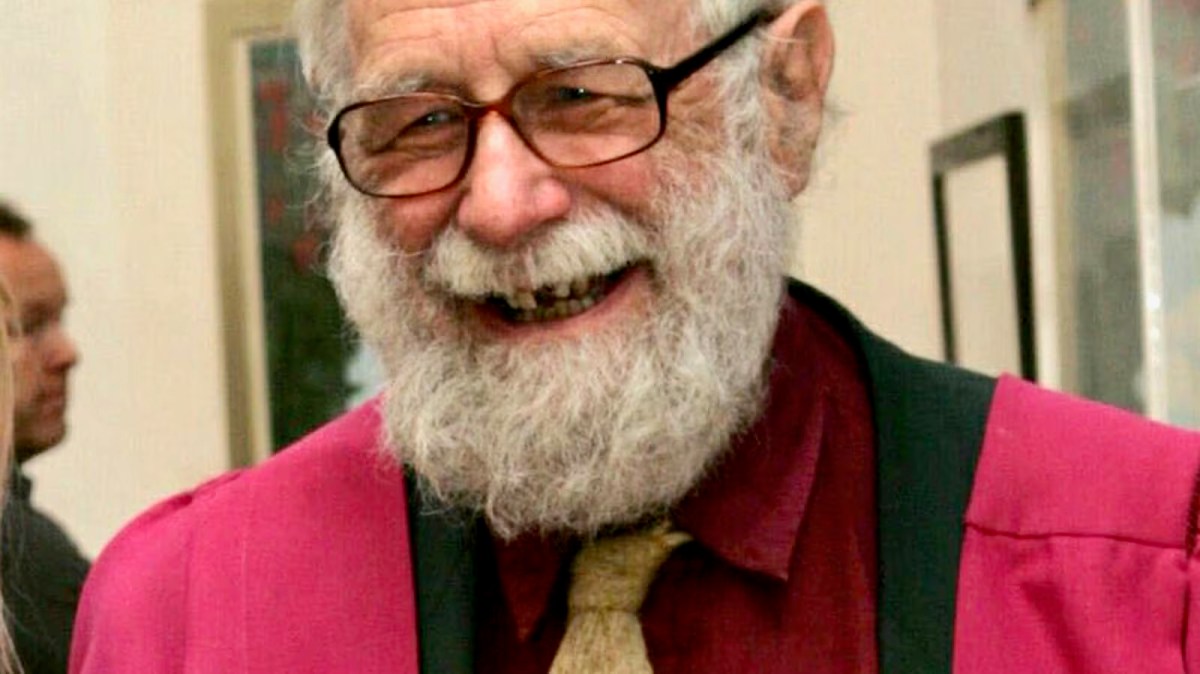
In this next series of post, rather than going chronologically through the editions of 1972, I am going chronologically through the eras of Irish literature that were the subject of articles, beginning with the Bards! John Montague, the distinguished poet, (that’s him at the top) wrote a piece in July/August called Under Sorrow’s Sign, which I give in full below. There’s a wonderful interview with him in the Irish Film Institute Archives. He said he spent many hours discussing the poem with his great friend Sean Ó Riada. I met Montague during his tenure at UCC in the 70s and I remember the adulation with which we all viewed Ó Riada, as he strolled through campus, so this piece was a personal memory-trigger for me. Robert has written about Sean Ó Riada here.

The poem is by Gofraidh Fionn Ó Dálaigh, Chief Bard of Munster, who died in 1387. Becoming a bard was a long and rigorous process, which is described in a quote in the article: 

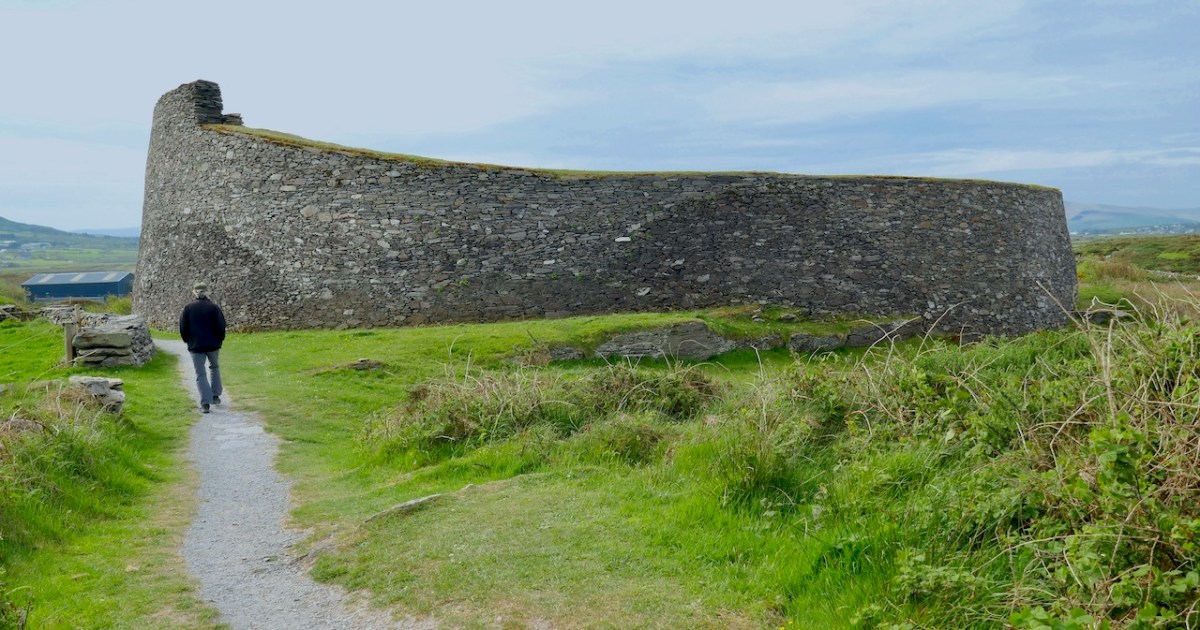
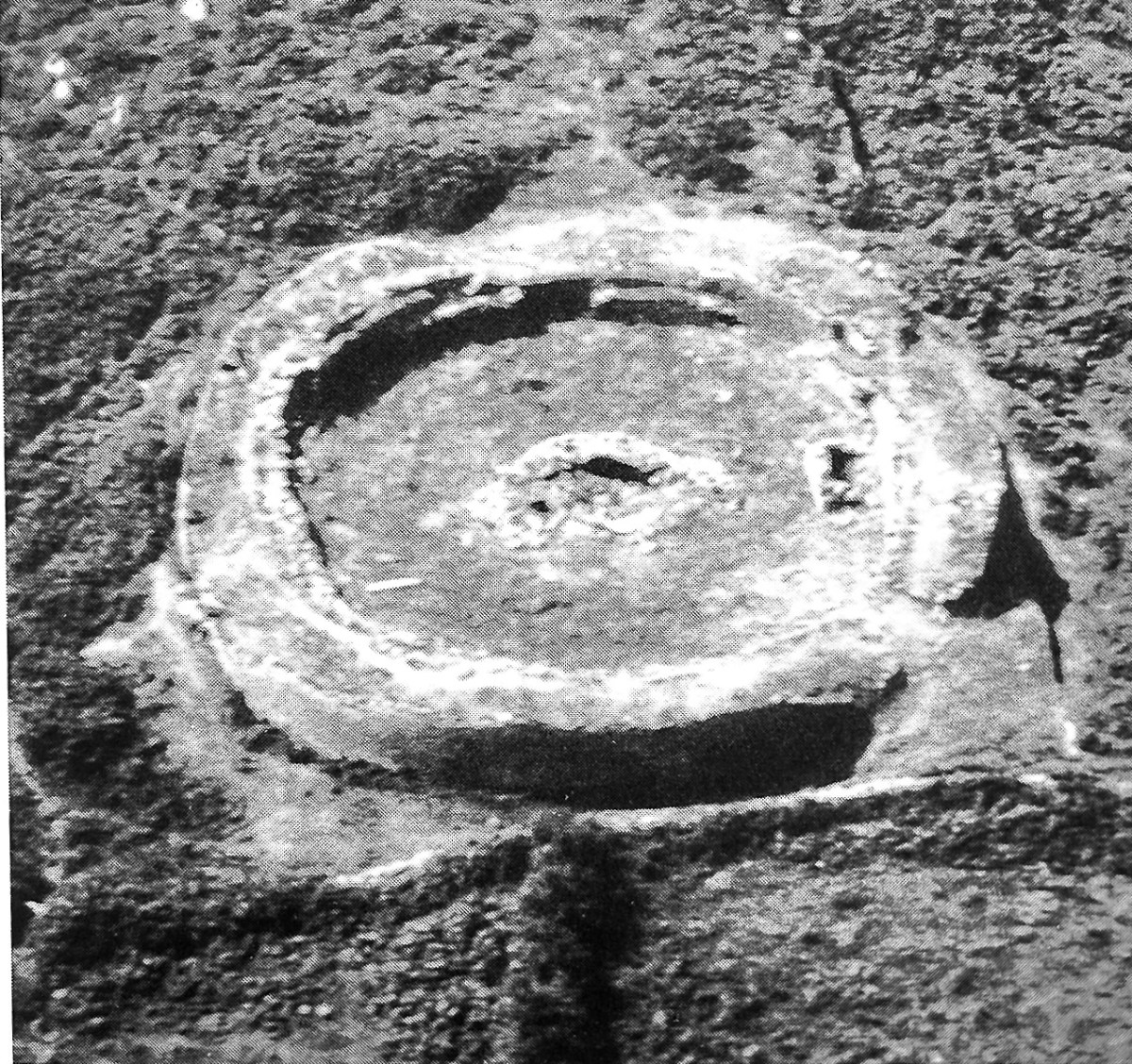
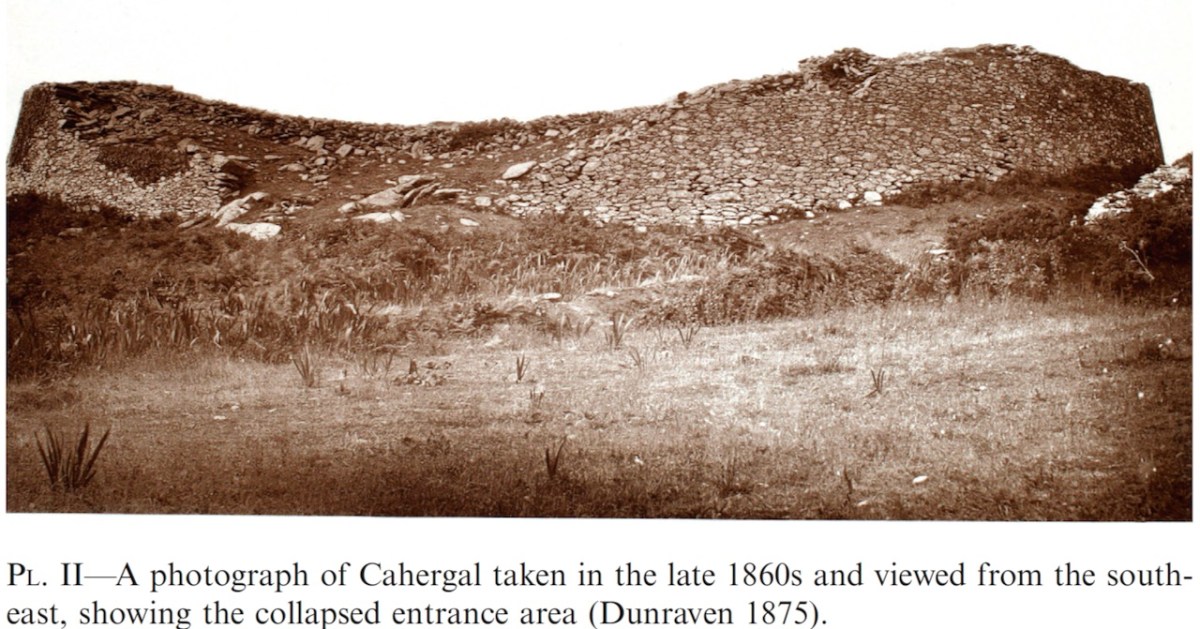
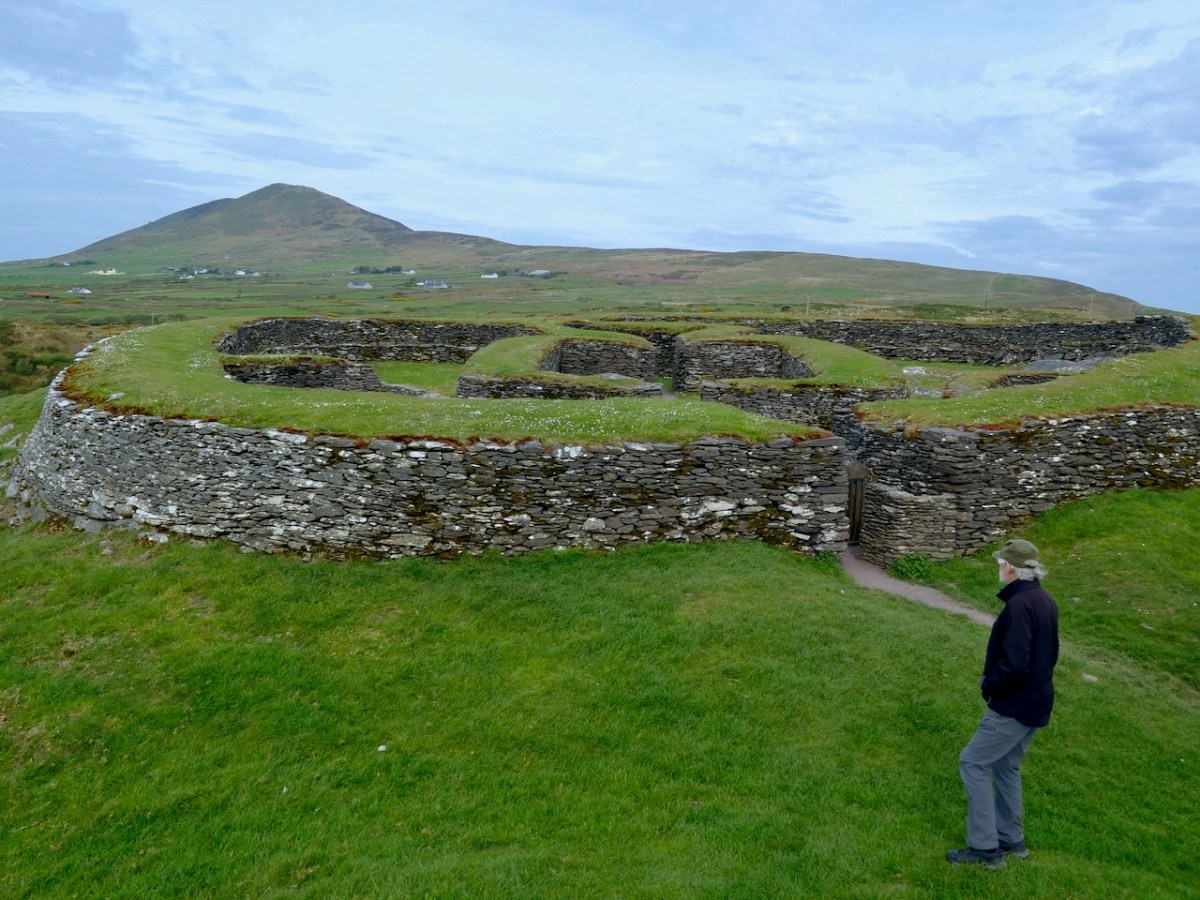
Here is what is believed to be the remains of one of those O’Daly bardic schools, this one on the Sheep’s Head. Perhaps Gofraidh spent part of his apprenticeship here, among his O’Daly kin.

The poem itself was intended to be declaimed by a professional reciter (a reacaire), accompanied by a harpist, as illustrated in this famous woodcut of MacSweeney’s Feast from John Derricke’s 1581 Image of Ireland. It shows the harpist and the reciter in the act of entertaining the head table. Note they are marked with a D.

Under the woodcut is a legend. For D the text reads:

Both Barde and Harper, is preparde, which by their cunning art,

Doe strike and cheare up all the gestes with comfort at the harte

The poem is, according to Montague, a metaphor for earthly existence. He concludes his piece by saying: O Dalaigh was from Cork, where O Riada now lies buried: Across six centuries, its bleak but Christian vision speaks as an epitaph. Here now is Montague’s translation.

Thoroughly depressed now? I’ll try to be more cheerful in the rest of this series.

Rob’s Autumn Soup

That’s Rob Krawczyk – our own Ballydehob Michelin starred Chef and owner of Restaurant Chestnut here in Ballydehob. He’s showing us how to make soup? I’m in!

The occasion was a fundraiser for the marvellous West Cork Feel Good Festival – a festival that’s dedicated to experiential workshops that offer moments of exploration, discovery and connection. There are events taking place all over West Cork, and the underlying theme is that of good mental health and wellbeing for all of us. This one was in the fabulous Levis’s where so much of the heart of Ballydehob is nurtured. (See my post about their famous shop counter, here.)

Rob is genial and casual – no hint of Master-Cheffy uppityness and not a tweezer in sight. West Cork is a foodie paradise and there’s a mantra that local cooks like to use – fresh food, simply prepared. And this was a masterclass in exactly that. There were 4 ingredients – tomatoes, oil, garlic and salt. That’s it.

What did I learn that I didn’t know before? First, and most surprising to me – roast the tomatoes, vine and all! Roasting brings out the flavour, and apparently the vine itself also contains buckets of flavour too. Chuck in a couple of cloves of garlic – no need to peel or cut them up. He buys his tomatoes from Lisheen Greens – one of our local producers of vegetables.  

How about seasoning? Rob used two kinds of salt, coarse and fine, and a generous amount of each. He also told us it was important to season at the end as well. I asked him about pepper – every video I watch on the internet has copious amount of salt and pepper added, and the Master Chef guys are always bleating on about seasoning. I personally use pepper very sparingly and in very few recipes, so I was curious. Rob made my day when he told me he doesn’t often use pepper, and when he does he adds it at the end. 

I said that one of the ingredients was tomatoes, and that’s correct. But there were two kinds – one kind was the fresh tomatoes on the vine that Rob roasted, the other was – canned! It’s important, he said, to look for good quality canned tomatoes that have been peeled – unpeeled can leave unpleasant bits in the soup. This one is available in Fields of Skibbereen.

Once the tomatoes have roasted, the canned tomatoes are added, everything is mixed and cooked in a big pot, and then processed in a blender or food processor to chop up the vine stalks and the garlic. Finally, it’s all strained through a sieve, tasted, and a last seasoning added. 

To serve it, Rob showed us how to make a brown soda bread. His tip – handle it as little as possible, only as much as you need to, to get all the dry and wet ingredients to come together. 

Of course, in the best tradition of here’s one I made earlier there was a big pot of soup on the hob, and lots of little loaves of brown bread with herbed butter. 

Delicious!!!

Leap and its Scarecrows

There’s a village in West Cork called Leap – say “Lepp”. Where does that name come from? As is often the case in Ireland, it all starts with a story . . .

Tradition had it that St Patrick never went west of Leap (in Irish that’s Léim Uí Dhonnabháin, which translates literally as The Leap of O’Donovan), and that’s the sign at the entrance to the village, above. It was St Ciarán of Cape Clear who did all the converting in our part of the world: read about him here. So when The O’Donovan, pursued by British soldiers ‘leaped’ over the deep gorge which you can still see to this day, he was escaping into a much wilder country. The gorge (this is as it looks today – below) divides the West from East Carbery. So difficult was it to pass “beyond the leap” in those old days, that it was said: “beyond the leap, beyond the law”.

Apart from O’Donovans Leap, the village is celebrated today for its associations with Hallowe’en, Ghosts, and Scarecrows. And we are approaching the time of year when these phenomena come to the fore. At the present time, a few shopfronts are being decorated, but there are plenty of Scarecrows waiting in the wings for their moment to arrive!

You can see that Leap – in West Cork – will be worth a visit once the festivities are in full swing: that will be between Monday 23 October and Sunday 5 November this year. Back in 2015 we visited the Leap Scarecrow Festival and wrote this post about it (click here). Interestingly, it became the most popular post we had published up to that time – it’s had around 3,250 views since it first appeared. Have a look at it now – but also remember to go to the village of Leap at the end of this month!