It’s time for another look at Ireland’s history, through the medium of early maps. We have previously examined the Down Surveyhere and here (the latter looked specifically at West Cork). You may remember that the project was instigated by Oliver Cromwell to catalogue the ownership of land given to British settlers after his invasion of Ireland which commenced in 1649. The Act of Settlement 1652 formalised the changes. We don’t like the recollection of those times, but we do find all early maps fascinating when we compare them to our present day topographical knowledge.
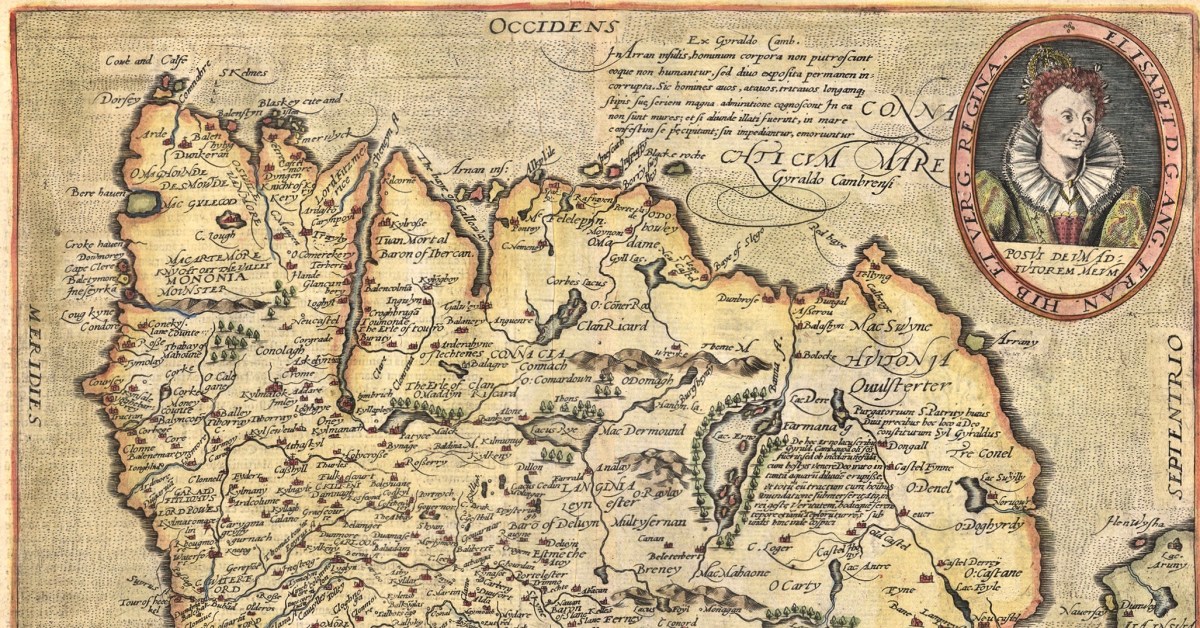
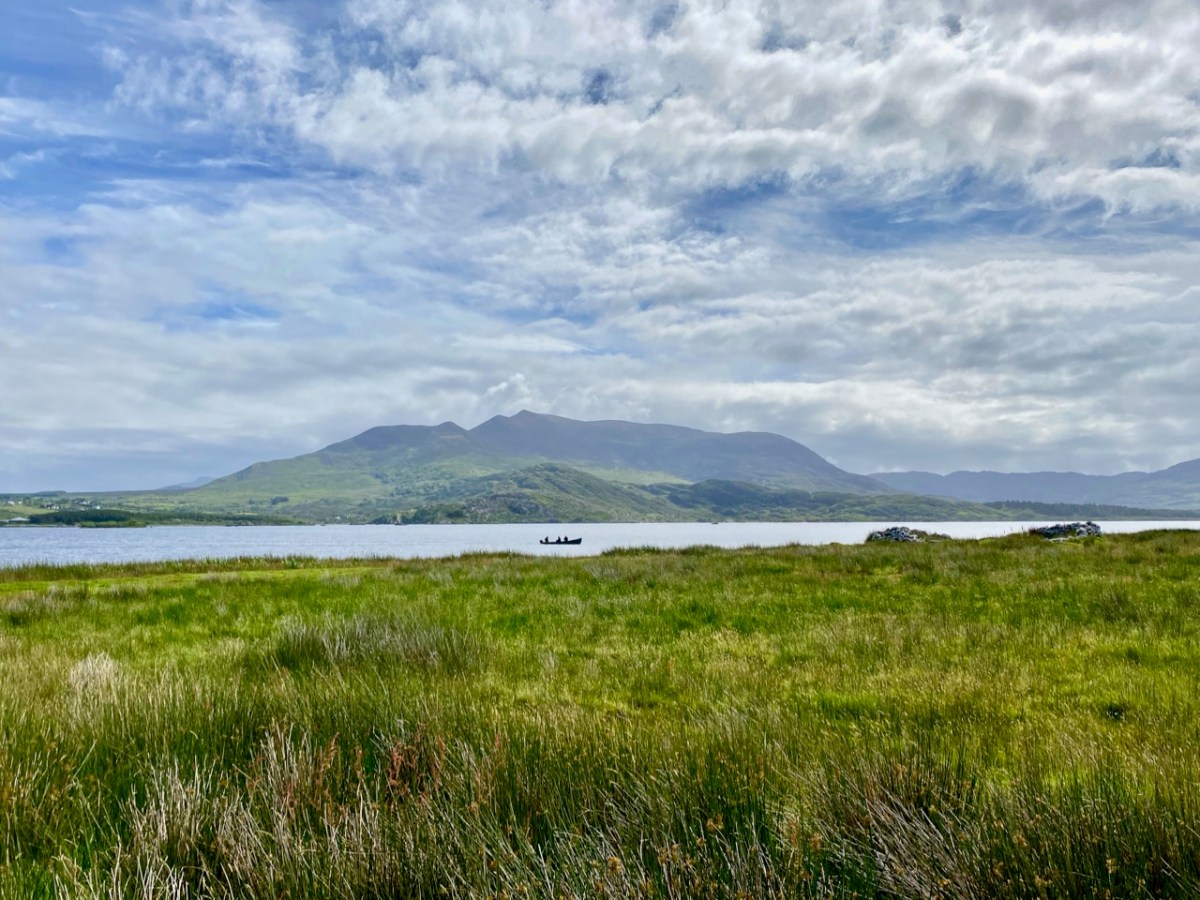
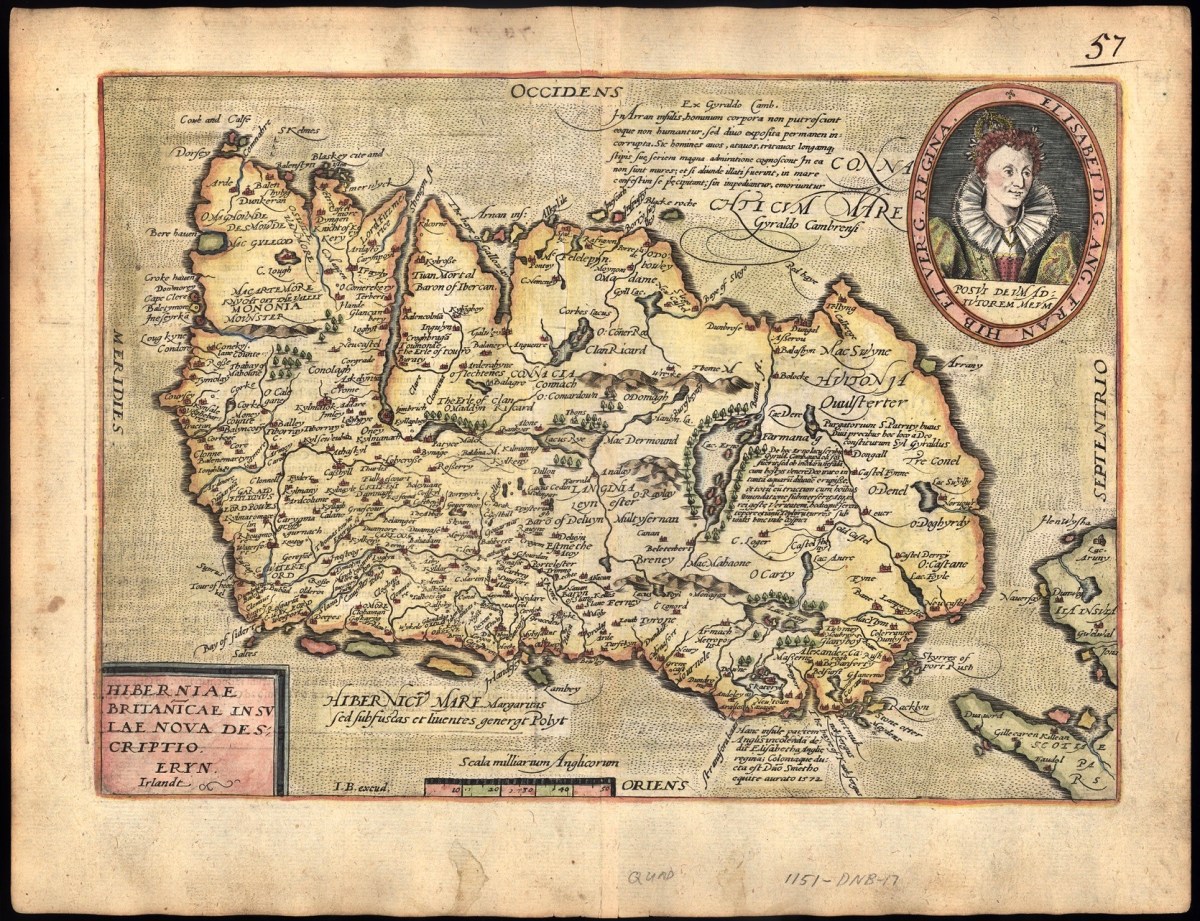
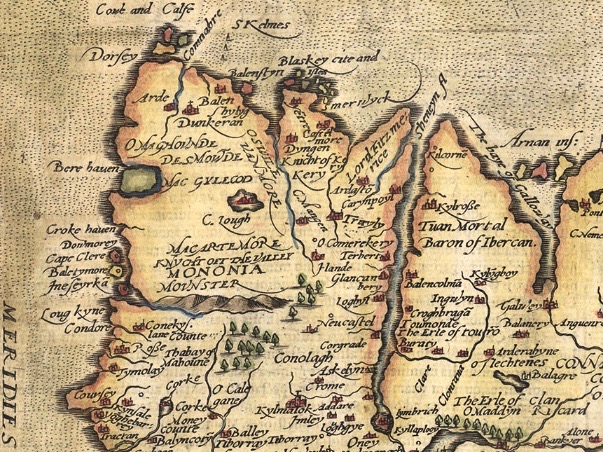
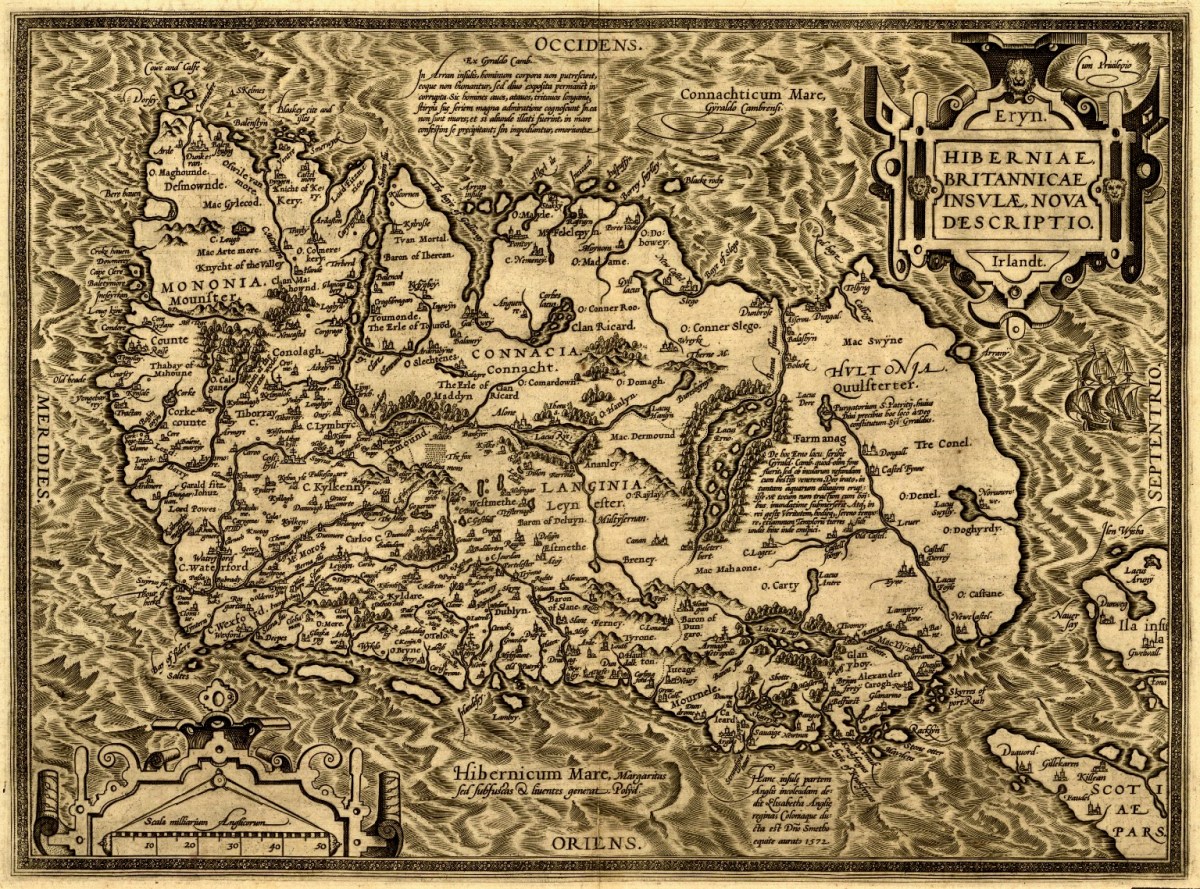
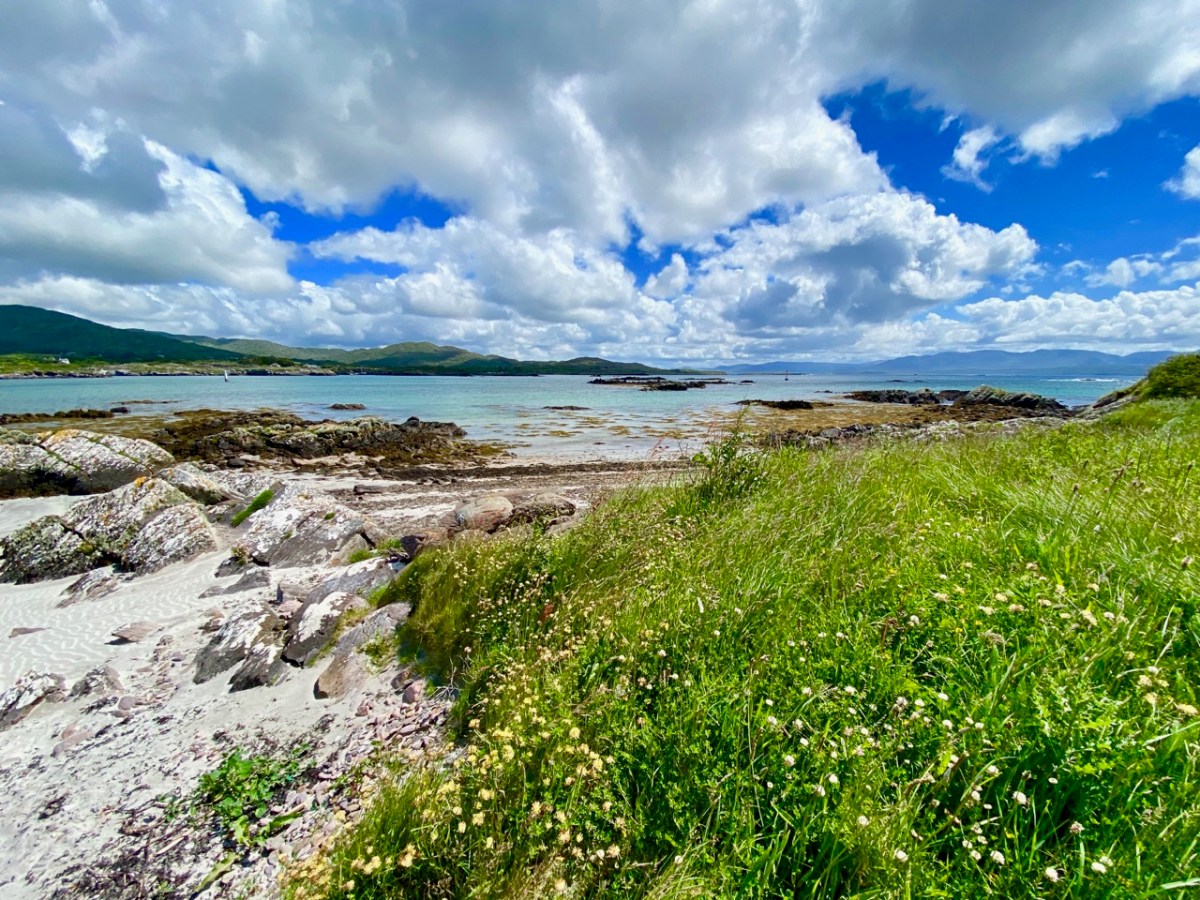
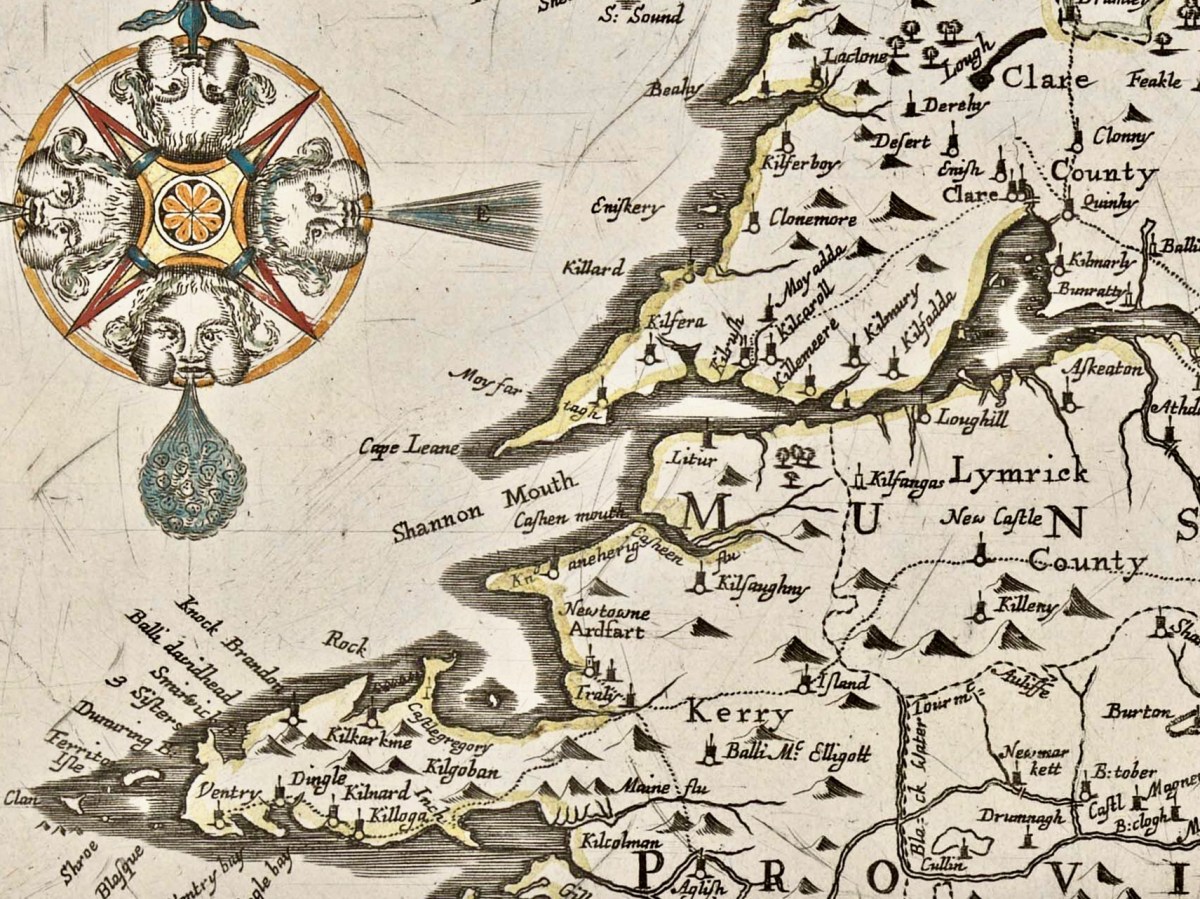
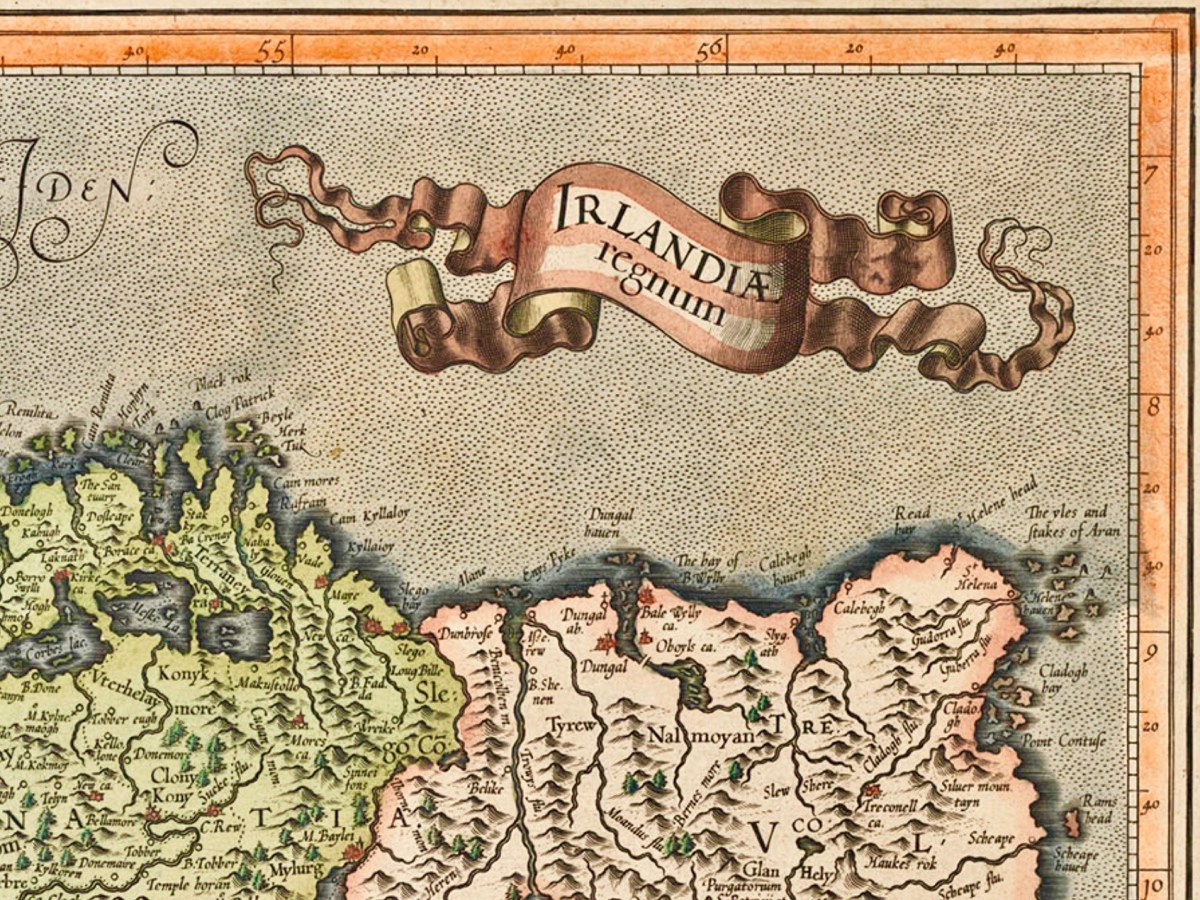
Kerry: it’s one of our favourite destinations. Visually spectacular, it offers a dramatic natural terrain of coastlines, mountains – and remembered history. Above is a view from Church Island, on Lough Currane near Waterville. The Down Survey gives us a mid-17th century aspect of the landscape, but there are earlier maps. The header is a part of Ortelius’ Theatrum Orbis Terrarum, published in many editions from 1570. Note Queen Elizabeth prominently displayed. Here’s the full page map (courtesy of the David J Butler Collection of Maps of Ireland):
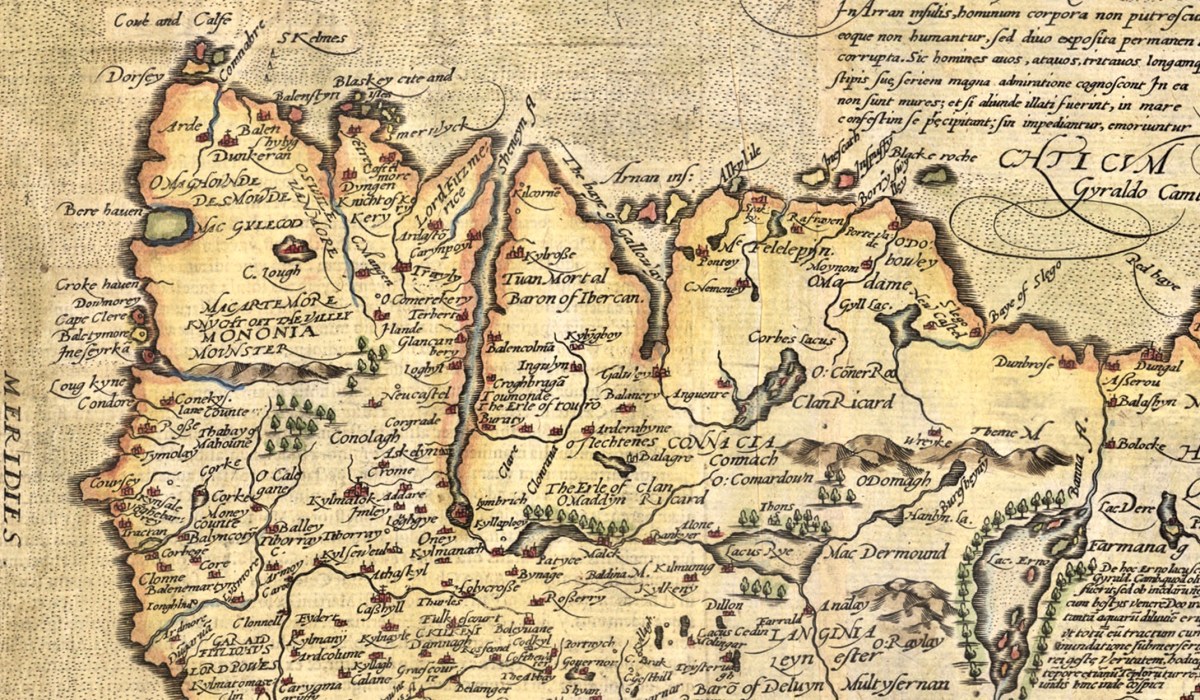
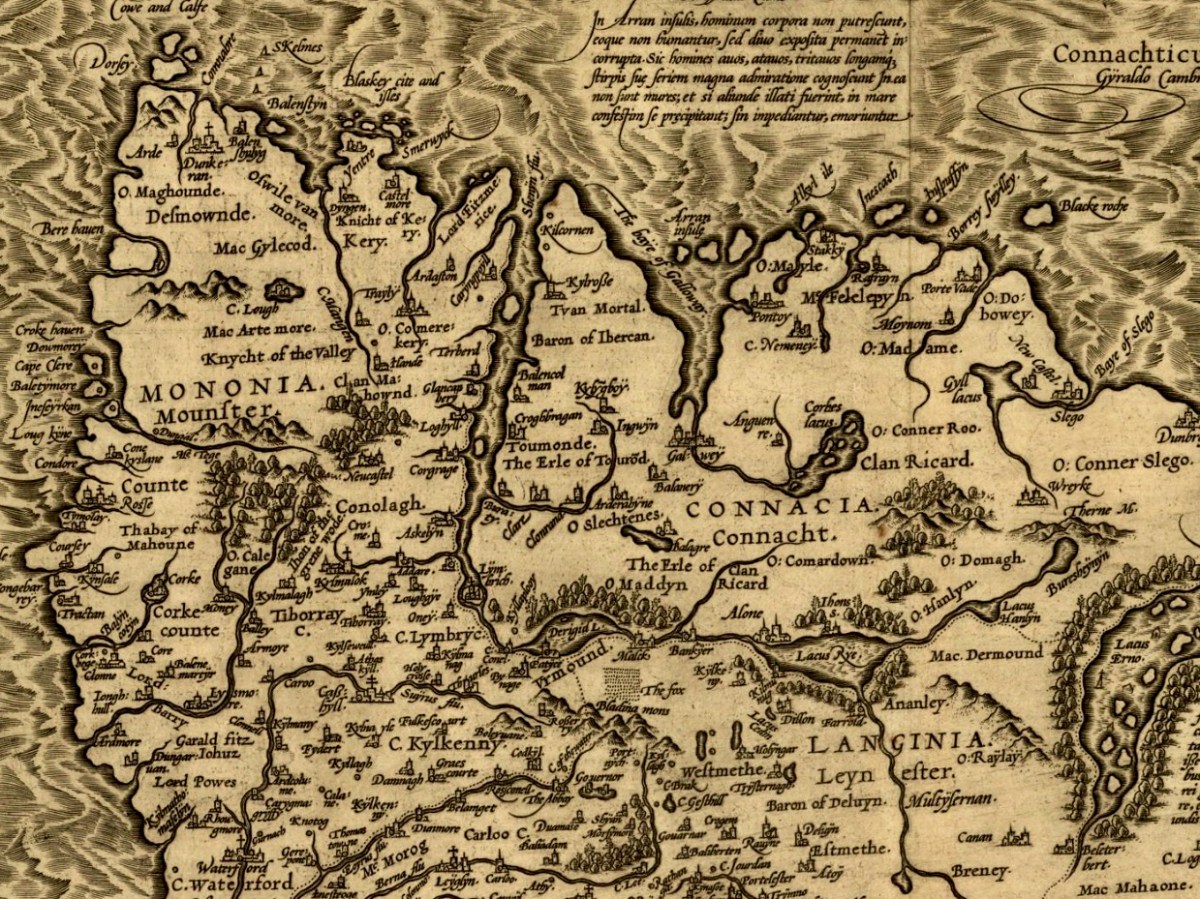
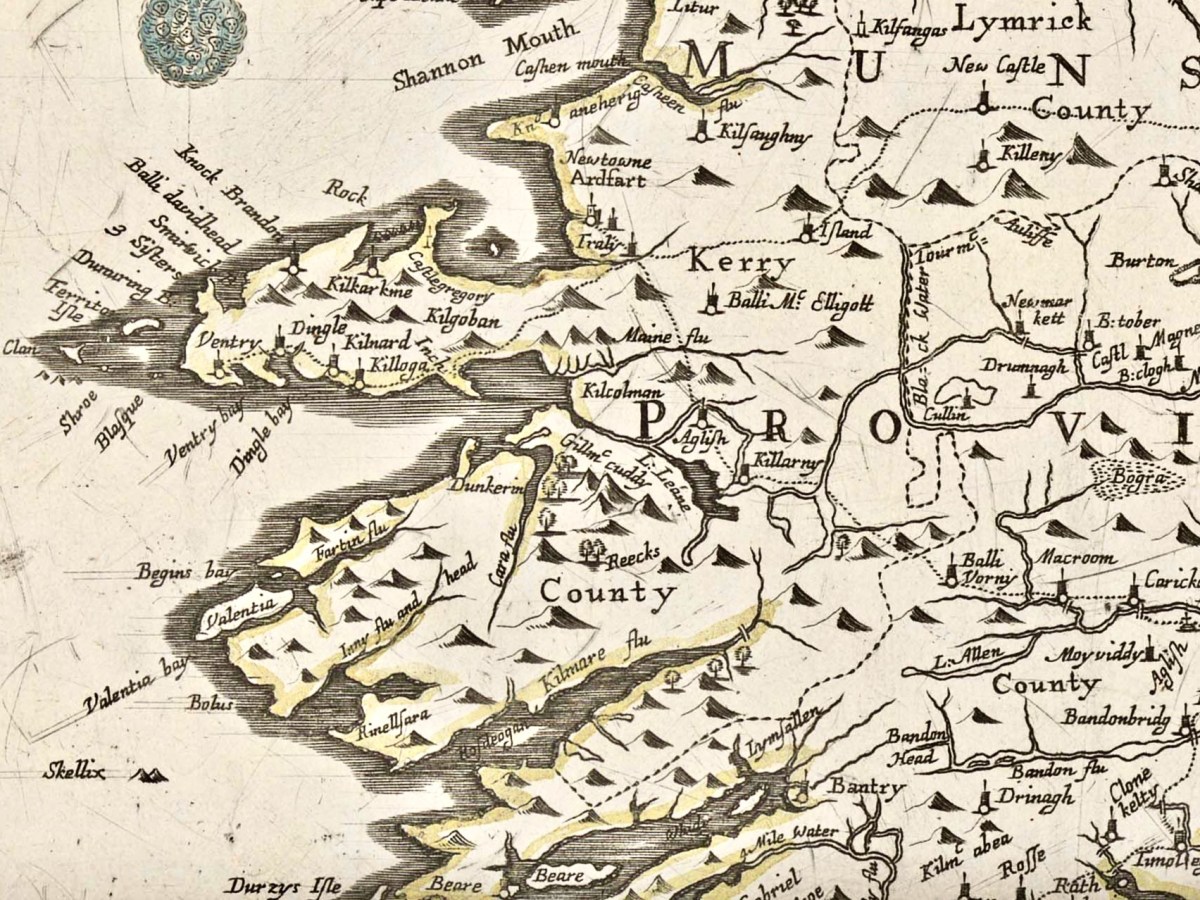
Above is an enlarged detail from the Theatrum Orbis Terrarum showing much of today’s Cork and Kerry counties. You have to get used to thinking through ninety degrees: it was the convention in many early maps to put West at the top of the image, and North to the right. Here you will see Roaringwater Bay over to the left. To make things easier, here is a much enlarged view of part of this map, although with some loss of definition:
You will recognise Dorsey (Dursey Island), Croke haven (Crookhaven), Cape Clere (Cape Clear Island), Baletymore (Baltimore), Tymolay (Timoleague), Kynfale (Kinsale), all within Movnster (Munster). Going round the corner we find Balenftyn (Valentia), Kery (Kerry), Trayly (Tralee), and many more, including names we cannot now relate to.
(Above) – here’s another pre-Down Survey map: Hiberniae, Britannicae Insvlae nova descripto, published by Abraham Ortelius (1527-98), a Flemish engraver. The map is thought to date from 1598 and is in the collection of The Library of Congress, Geography and Map Division, Washington, DC. Here’s a detail of the area which interests us today – again, many names can be recognised:
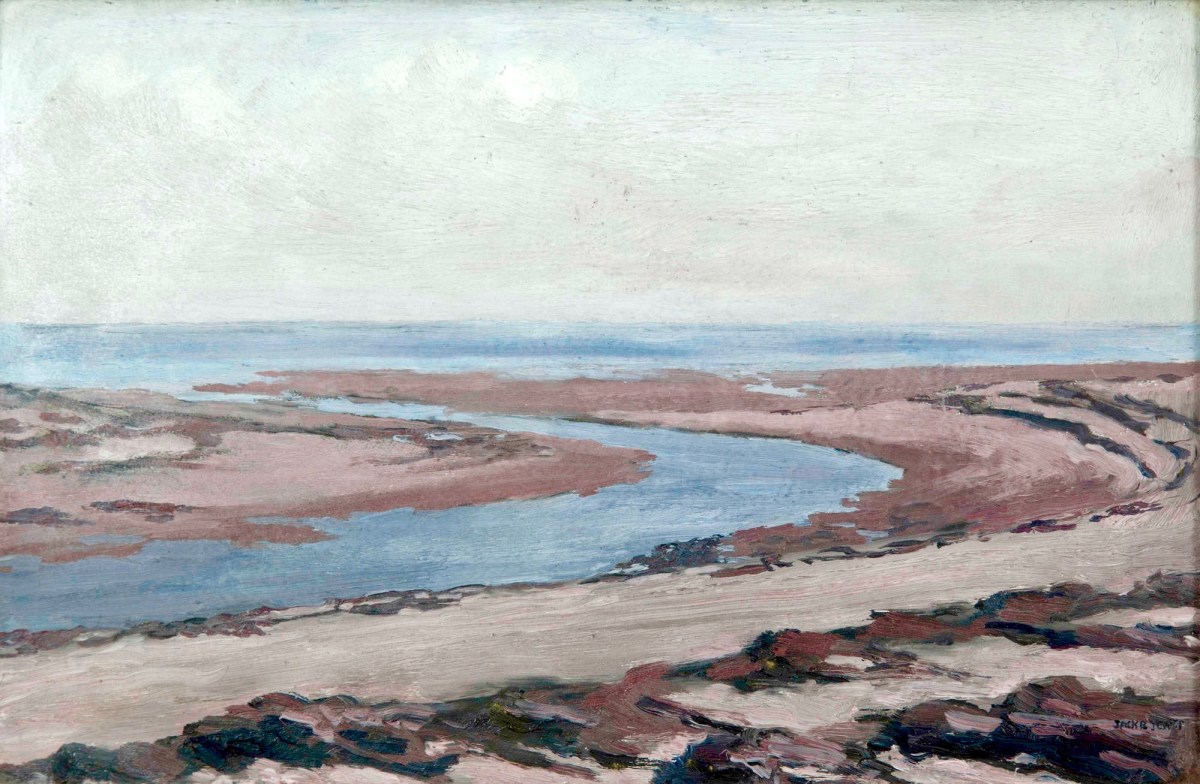
Another present-day Kerry scene: in fact a photograph from a friend’s garden. To add a further dimension to our review of Kerry through time, this Jack B Yeats painting – Kerry Landscape – dates from 1913 (current whereabouts unknown – it was offered for sale by Adams in 2016):
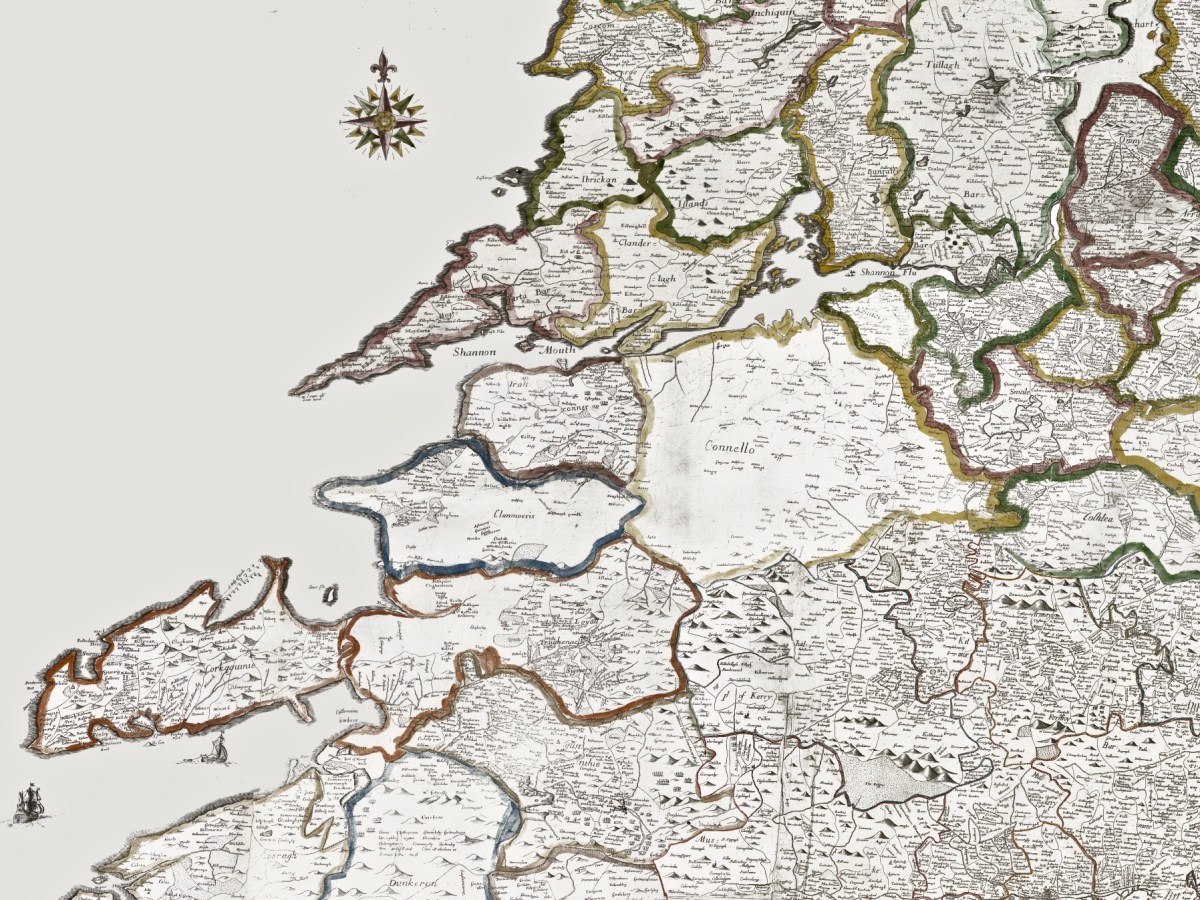
Getting back to The Down Survey, the following details are from the available survey documents which were taken in the years 1656-1658. They show parts of Clare, Limerick and Kerry:
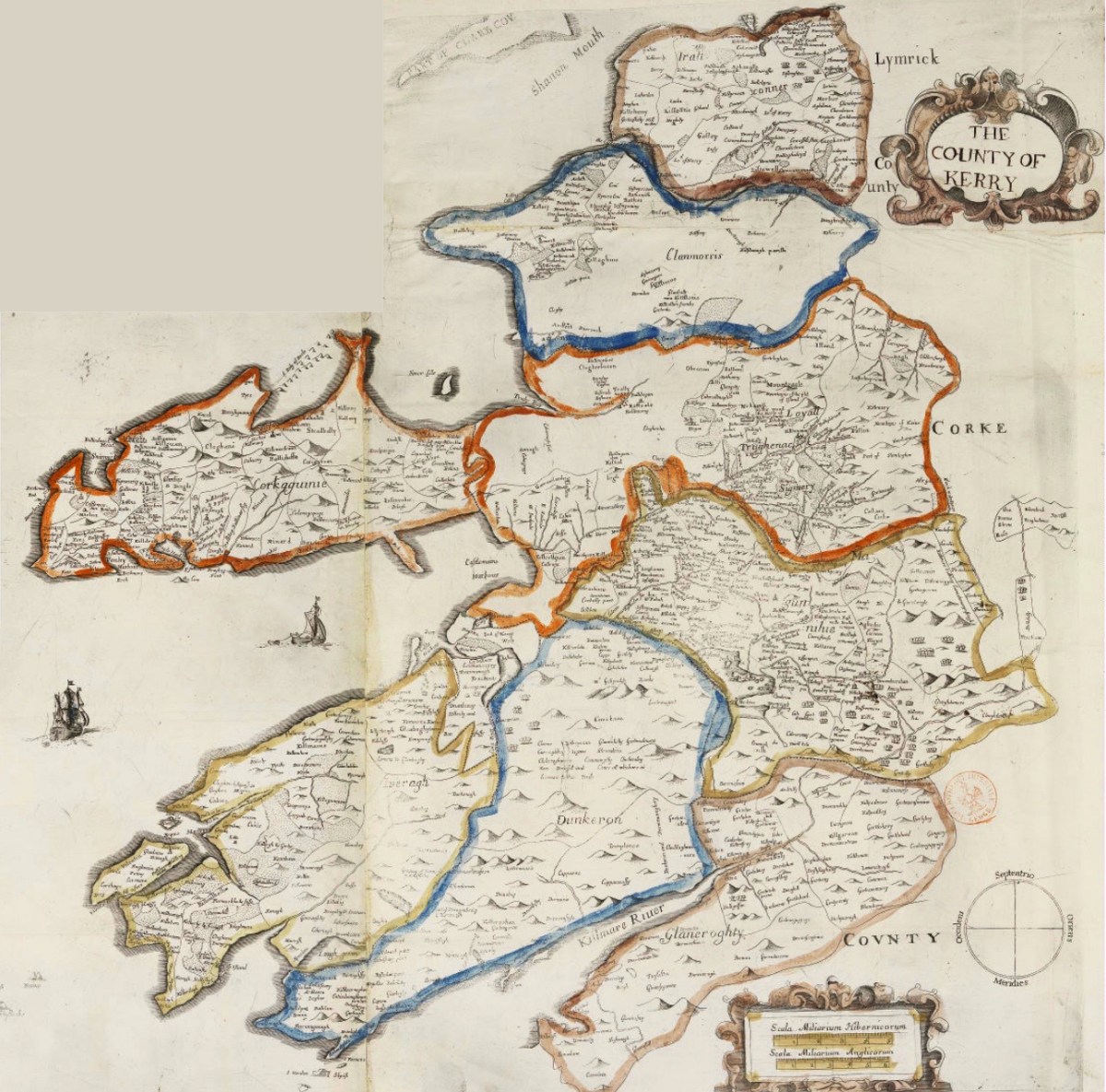
Here is a specific County map of Kerry in greater detail: it encompasses the land divisions spanning from Kenmare to the mouth of the Shannon (Down Survey GIS 1641 – 1670).
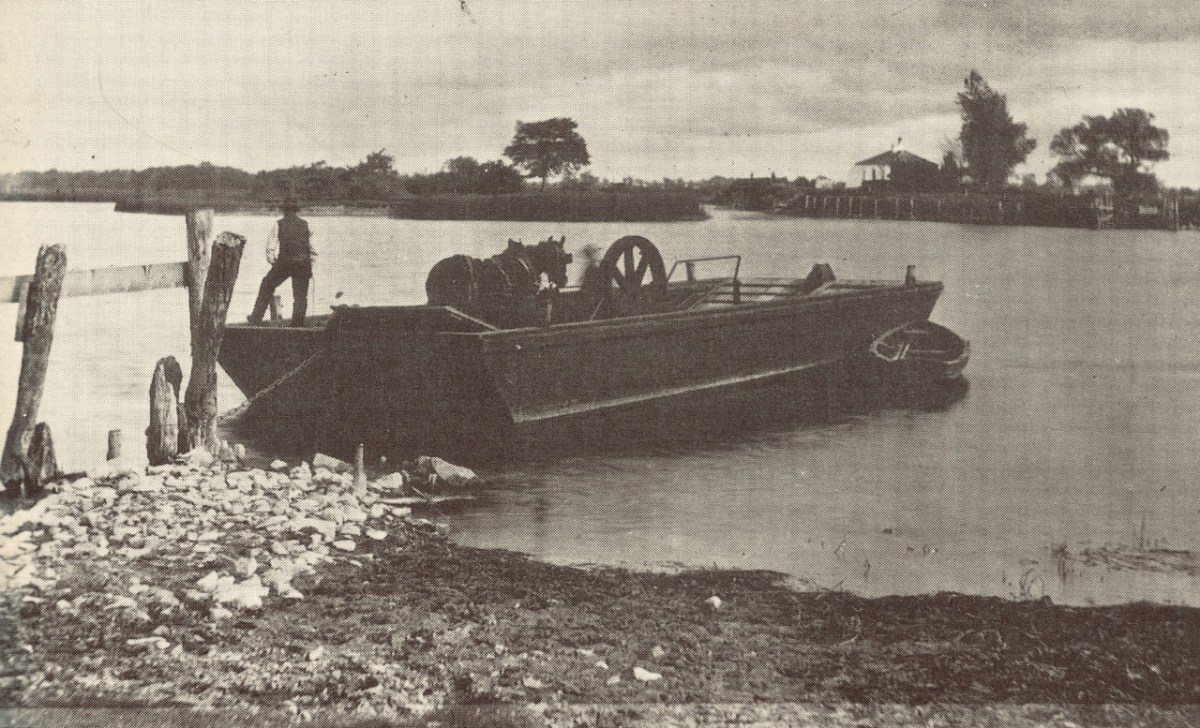
Above: a ferry across the Shannon, c1890. Below: this map is also from The Down Survey collection and is titled Landowner Map 1641 – 1670.
Before leaving this little outline of Ireland’s ancient western coastline, I can’t resist going back to the Twelfth century and to Giraldus Cambrensis (c 1146 – c 1223). Described as a Roman-minded Cambro-Norman cleric, Giraldus lived most of his life in Wales but visited Ireland in 1183 and 1185. He wrote descriptions of what he encountered there, and they are entertaining. Here are two examples: though not specific to Kerry, they are not geographically distant.
. . . There is an island called Aren, situated in the western part of Connaught, and consecrated, as it is said, to St Brendan, where human corpses are neither buried nor decay, but, deposited in the open air, remain uncorrupted. Here men can behold, and recognise with wonder, grandfathers, great-grandfathers, and great-great-grandfathers, and the long series of their ancestors to a remote period of past time . . .
Giraldus Cambrensis
. . . There is another thing remarkable in this land. Although mice swarm in vast numbers in other parts of Ireland, here not a single one is found. No mouse is bred here, nor does it live if it be introduced; when brought over, it runs immediately away and leaps into the sea. If it be stopped, it instantly dies . . .
Giraldus Cambrensis
Further Reading! Some past Roaringwater Journal posts which look at early maps and the West of Ireland can be found here and here.
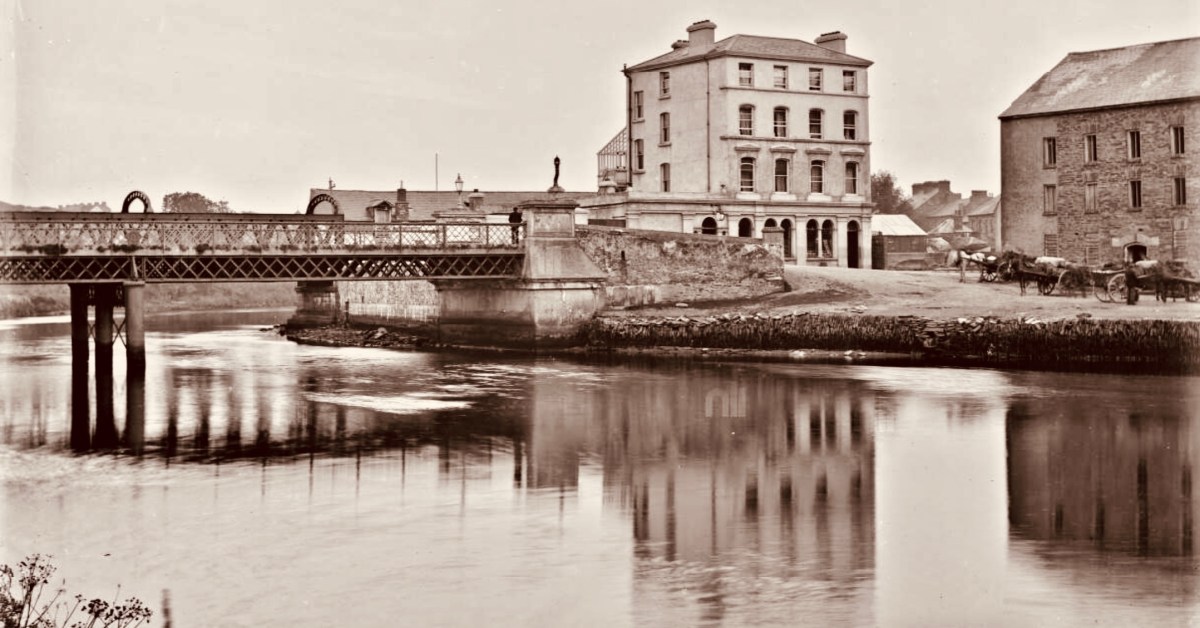
This photo of the West Cork Hotel beside the Ilen River, Skibbereen (courtesy of the NLI Lawrence Collection) captures a moment in time. It was taken in the very early 20th century – probably before 1910. Clearly seen are the hotel itself – opened in 1902 – the old iron road bridge which was superseded in 1964, and the railway bridge behind it carrying the line to Baltimore (which was opened in May 1893). That bridge still exists, of course, although the line closed in 1961. To the right of the photo is the Old Steam Mill, originally constructed as a flour mill by Thomas Marmion in the 1830s. This building stands on Steam Mill Quay.
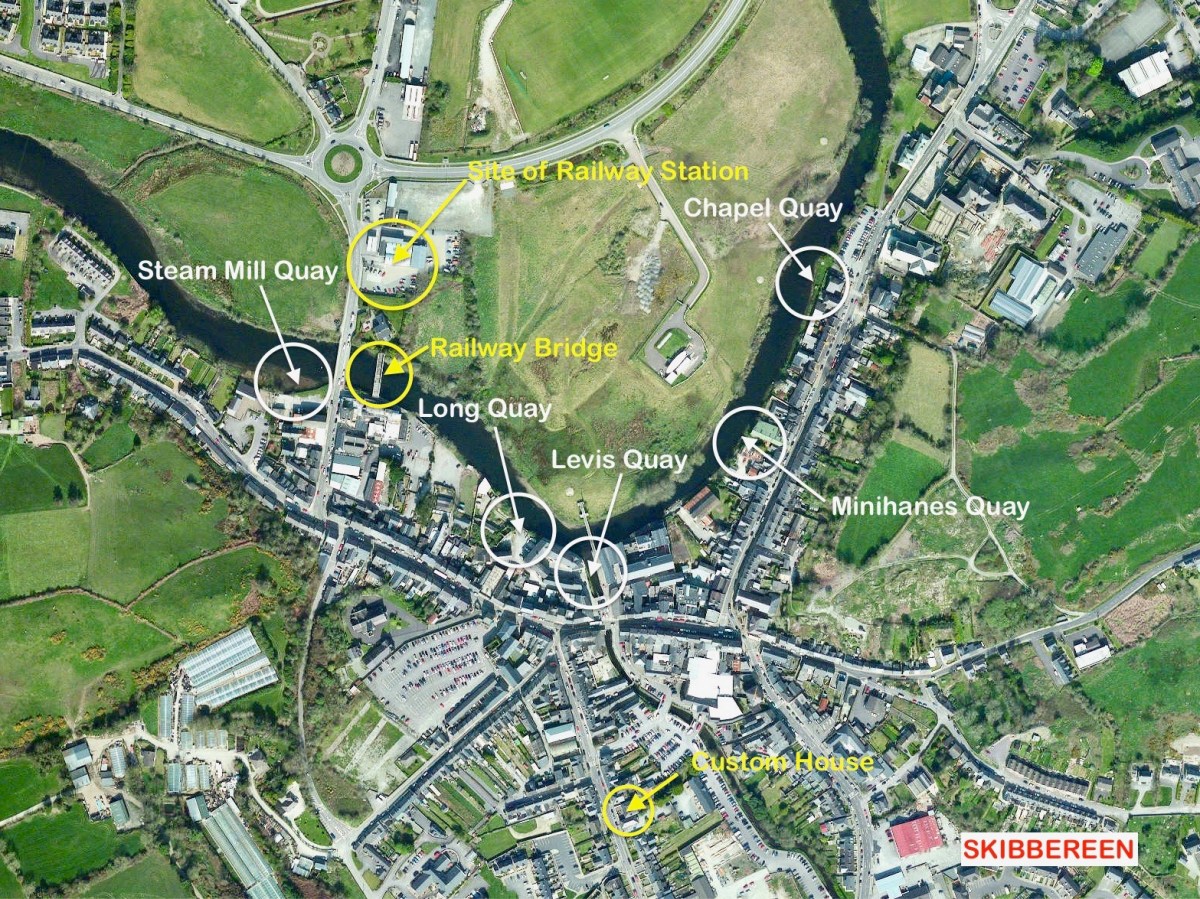
The Irish name for this town, an Sciobairín, is said to mean a small inlet for docking boats. Steam Mill Quay is the first of five quays which served the town, suggesting a period when the river itself (tidal to just north of the town) was the life blood of the community:
. . . Skibbereen was a settlement served by water. The River Ilen is tidal and in the early 19th century boats of up to 200 tons could navigate to Oldcourt, within two miles of the town centre. From there goods were transferred into ‘lighters’ (unpowered barges) and then brought into the quays where there were warehouses and a Custom House. Now, sadly, Skibbereen’s waterfront is a bit neglected and its active past shipping history is no longer obvious. Five historic quays have been identified along the river: Steam Mill Quay, Long Quay, Levis Quay, Minihane’s Quay and Chapel Quay . . .
Roaringwater Journal
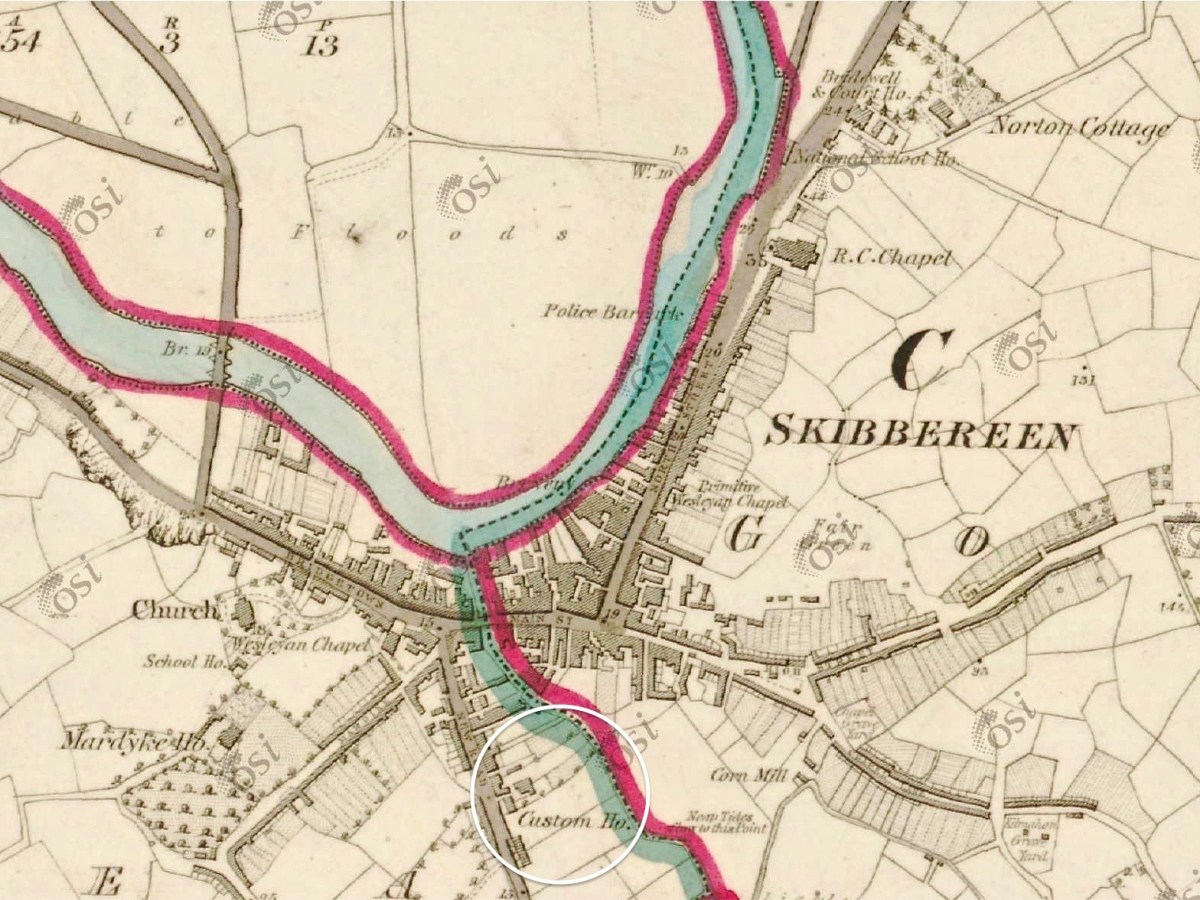
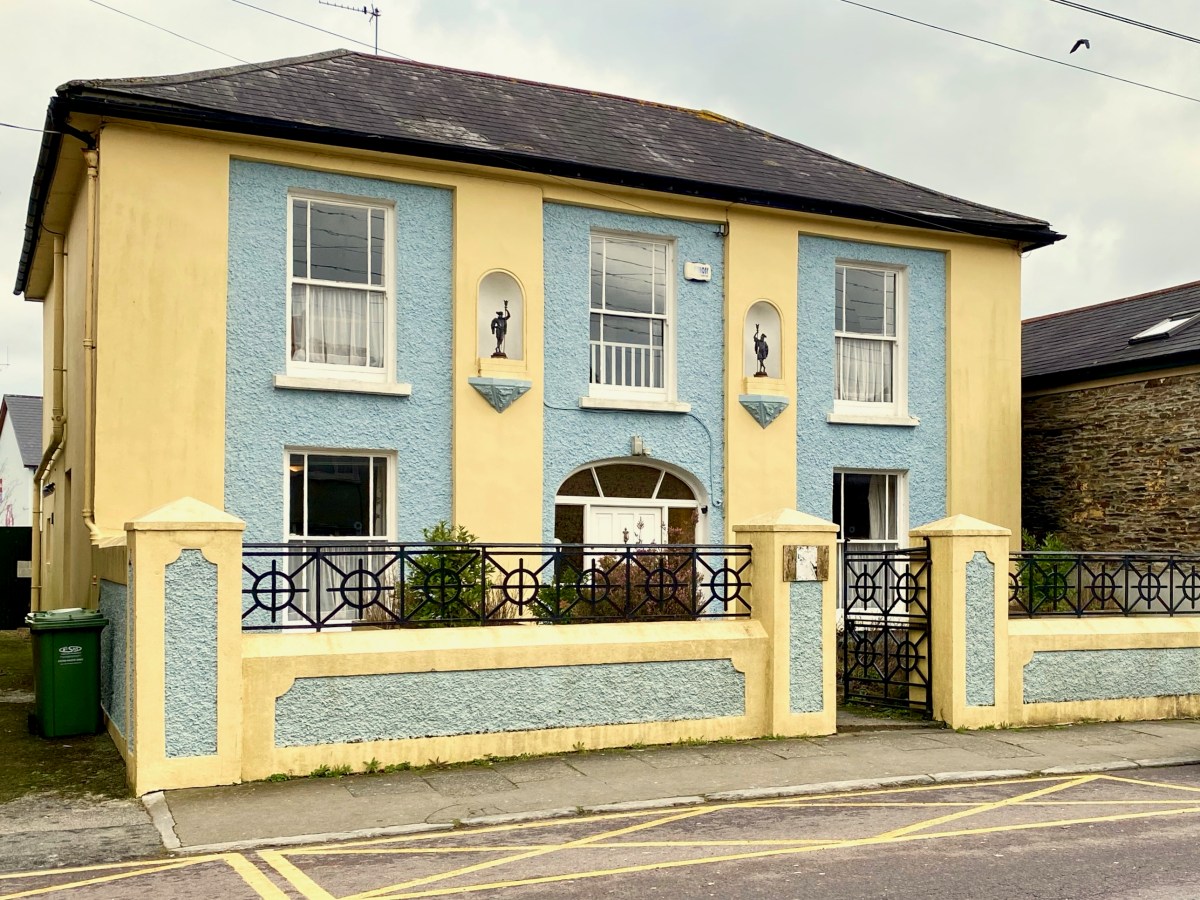
Here is the Custom House – now a private residence on Townshend Street. The first edition of the OS map (above the photo) marks the location. It’s a fine building, clearly of some standing, with its decorative niches and curved fanlight. The existence of this building in the town emphasises the historic significance of importation and trading of commodities, probably primarily by water transport, to Skibbereen when it was operating. I was surprised to find that Hansard – the official record of the actions of the British Parliament – has one entry pertaining to the Skibbereen Custom House. From it we learn that its business was transferred to Bantry in 1890, and that this was a cause of concern to some of the townspeople and local fishermen:
. . . DR KENNY (Cork, S) I beg to ask the Secretary to the Treasury whether he is aware that owing to the transference of the Custom House from Skibbereen to Bantry very great inconvenience and injury are caused to the Baltimore fishing industry; whether, according to existing Customs arrangements in Skibbereen. the Deputy Officer of Customs in that town is unable to give permission for the discharge of cargoes of ice absolutely essential for the preservation of the fish caught by the Baltimore fishermen, and also that it is impossible for him to obtain permission by telegraph from Bantry to do so, and whether, in consequence, steamers for conveying the fish have to wait at Baltimore the arrival from Bantry, 24 miles distant, of the Superintendent of Customs; and whether he will take steps to have abated the inconvenience complained of, by restoring the Custom House to the Skibbereen district?
Hansard record of Commons Sitting 08 May 1890 § 469
There is a further record giving the response by the then Secretary to the Treasury: it lacks sympathy!
. . . Mr. JACKSON (Leeds, N) I am informed that it is not the fact that very great inconvenience and injury have been caused to the Baltimore fishing industry through the transference of the principal Customs Offices for the Port of Skibbereen from Skibbereen to Bantry. The Board of Customs have ascertained that no delay has been caused by this change in the discharge of any vessels, nor need any delay or inconvenience be occasioned thereby, as the Officer of Customs still stationed at Skibbereen is now empowered to deal with any Customs business, there or at Baltimore, that may require attention, under exactly the same conditions as were in force previous to the change referred to. No occasion has, therefore, arisen for making any alterations in the. present arrangements . . .
Hansard record of Commons Sitting 08 May 1890 § 470
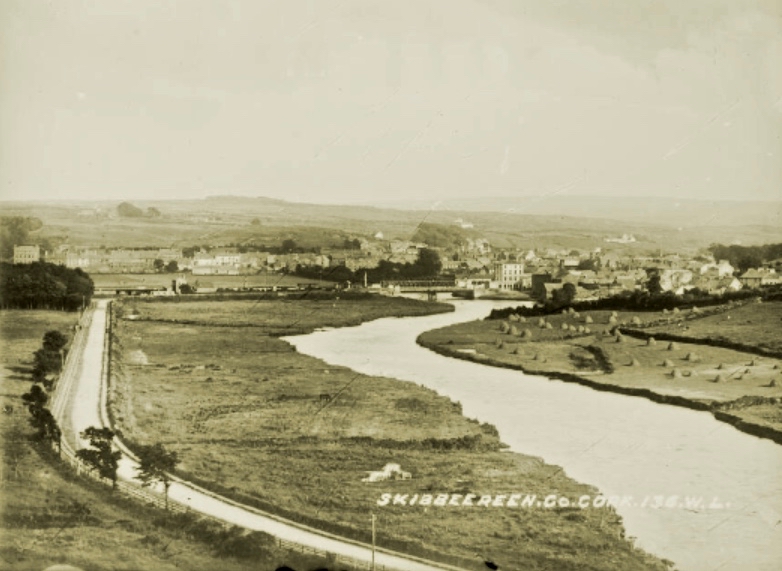
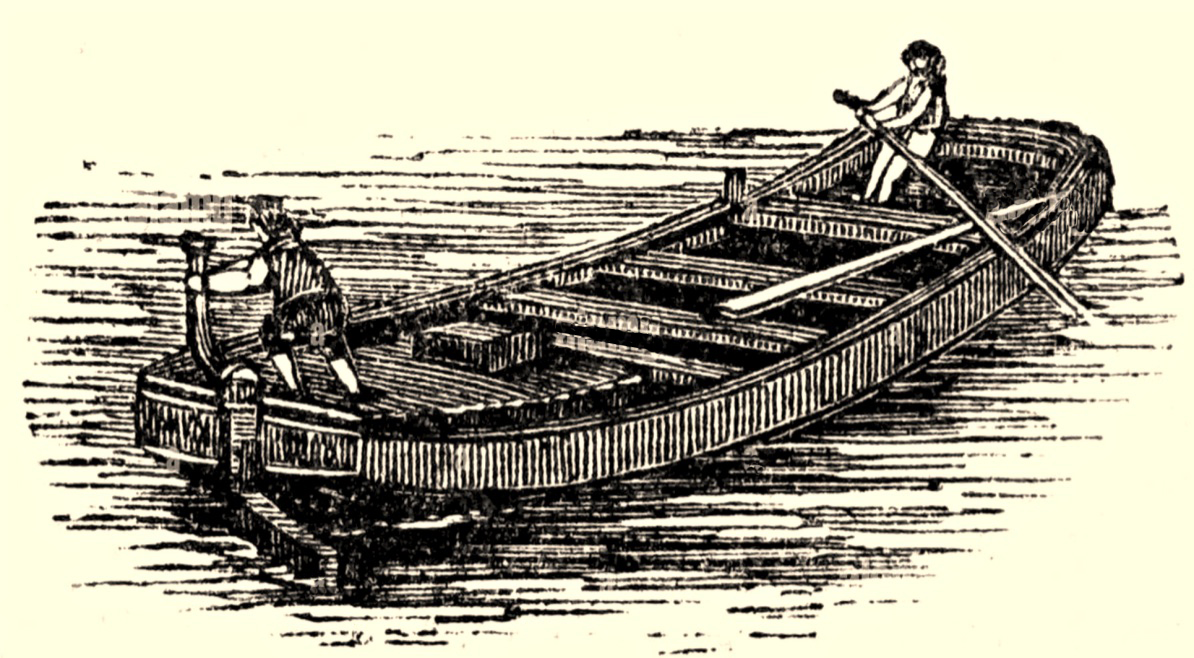
Here’s a distant view of Skibbereen from the west, probably taken in the early 20th century (courtesy of the NLI Lawrence Collection). On the left, the roadway (today’s N71 going from the town towards Ballydehob) has the track of the Schull railway (or – more properly – ‘tramway’) on its verge. The old bridge into town and the West Cork Hotel are visible, as they are in the header picture. What is noticeable is that there is no sign of any navigation of the Ilen River. I have looked carefully through over 200 early photographs of the town and it is the case that none shows any river craft. Hence my title today (and I apologise for taking a long time to get to this) The Elusive Lighters. We have no detailed records of any boats that used the river, and the quays, except that they were shallow-drafted unpowered barges. The term ‘lighters’ usually refers to ‘dumb’ boats (unpowered) used to offload cargoes from ships and transfer these to quays further inland. How were the Ilen boats built, and what did they look like?
Here’s a guess – something I found in an old engraving (not from anywhere in West Cork). The boat is being ‘poled’ or swept along by a figure with a large oar, while a ‘steerer’ handles the helm. It would almost certainly have been built from timber. After a coaster, steamer or sailing ship arrived and moored at Oldcourt, the cargo would have been offloaded to the lighter, which would have to await a rising tide before setting out for Skibbereen. The return journey would have to be carried out when the tide was falling.
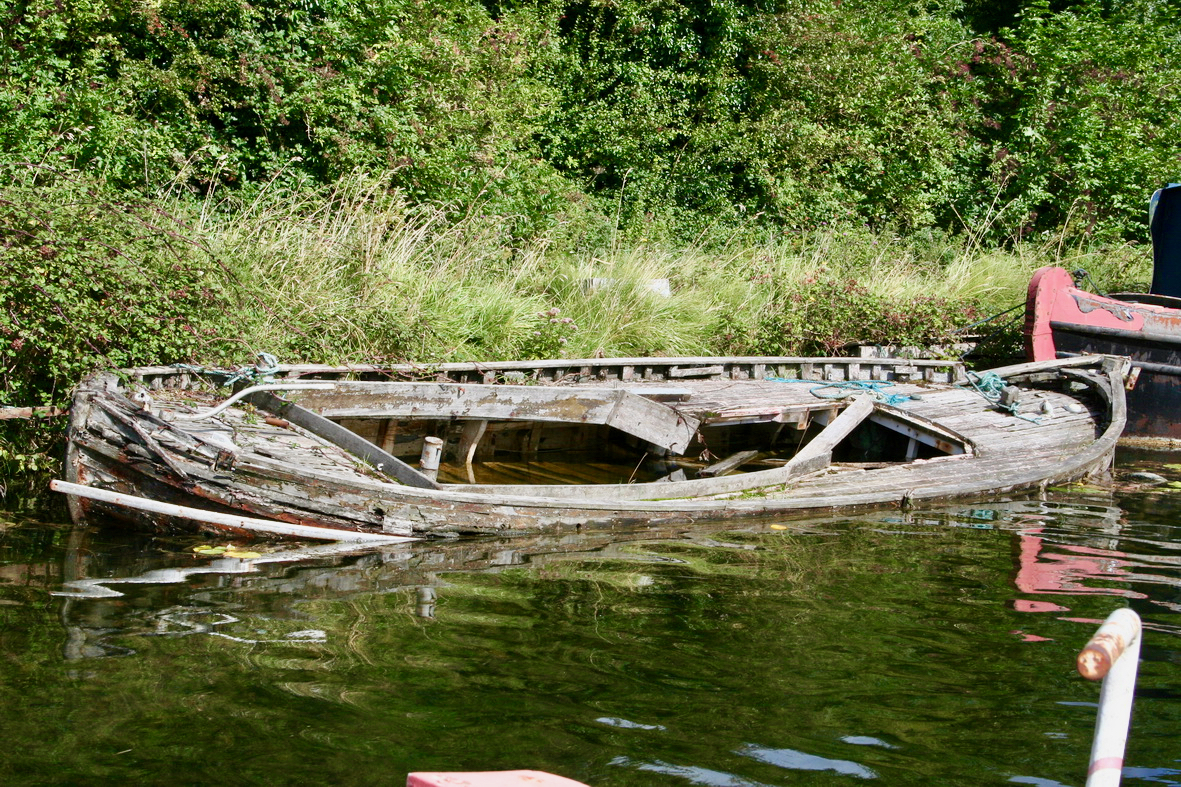
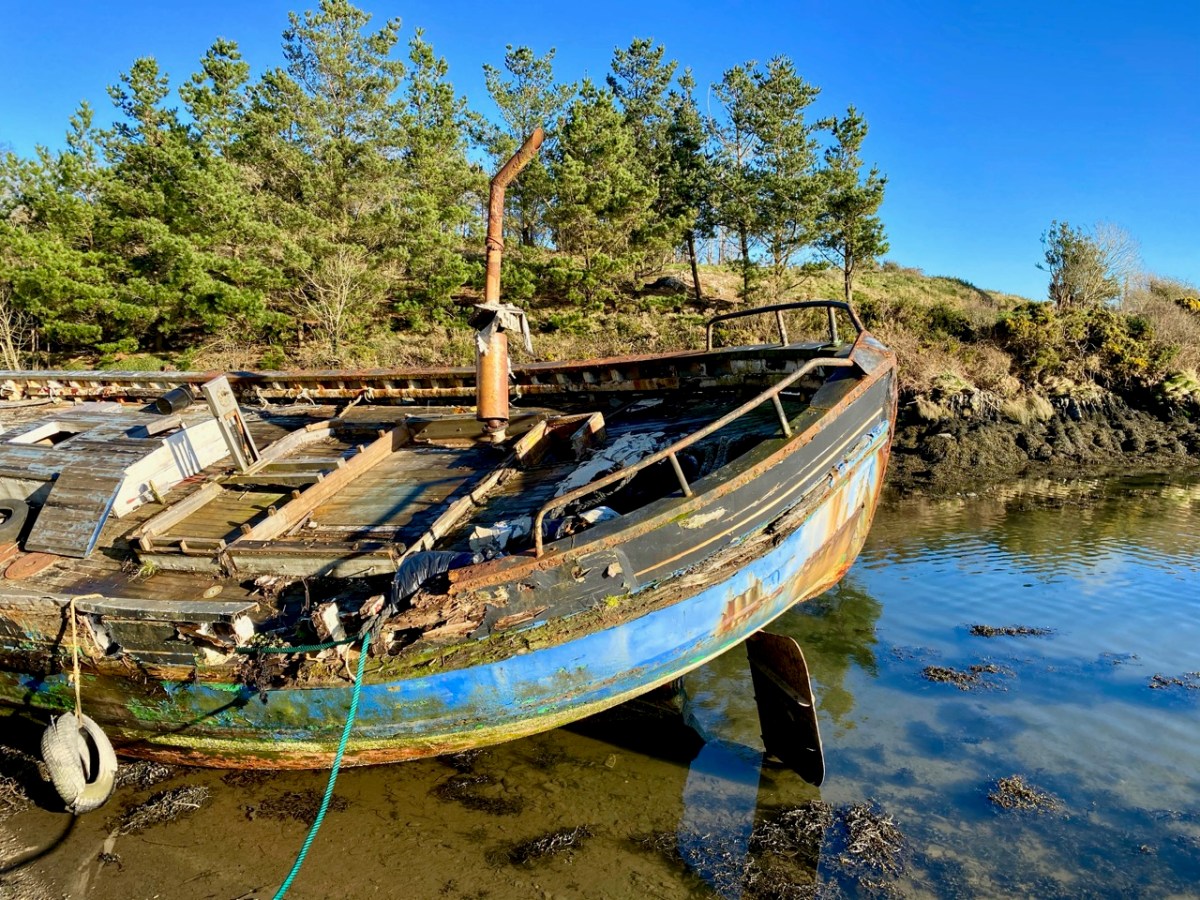
It would be great to find the remains of such a boat on the Ilen, but very little would survive of a working craft dating back over a century and a half. The wreck above is on the River Barrow Navigation at Lowtown. Here’s another old wooden boat which lay beside the tidal Ilen itself a few years ago: it may still be there!
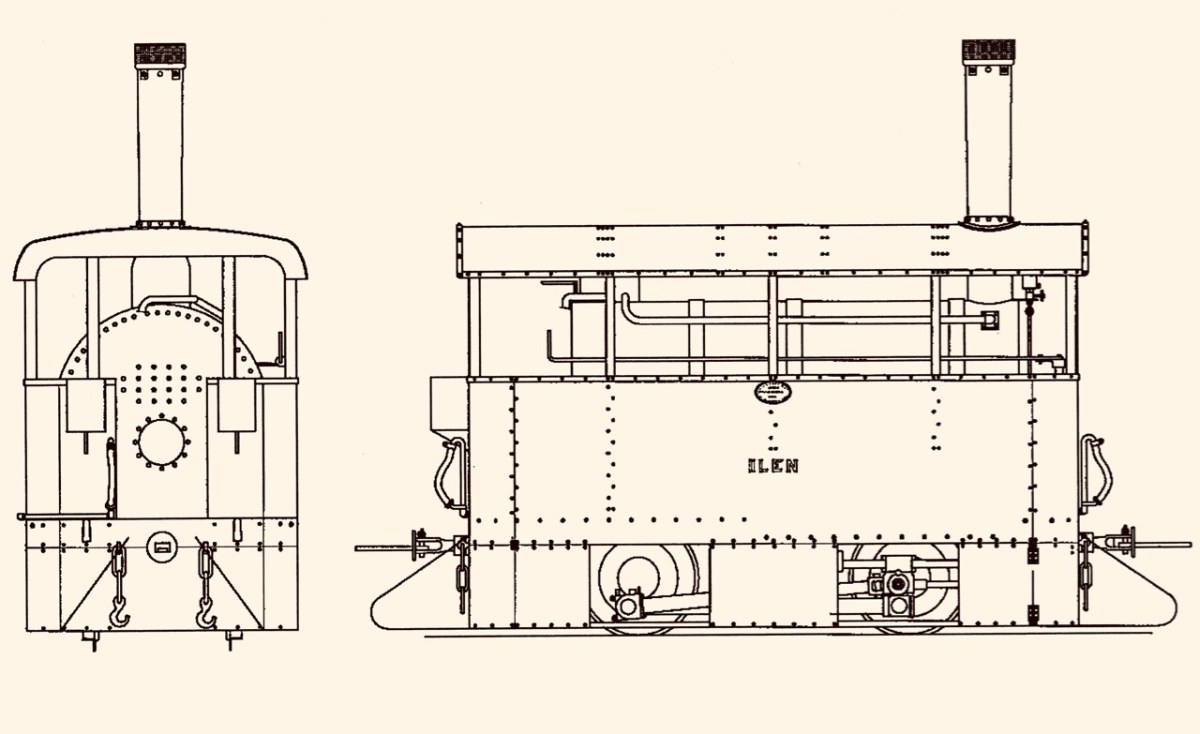
While my nostalgic soul would like to think that some trace might remain of the old Ilen boats and the quays that they served, I know that is unlikely. River traffic on the tidal Ilen would have been in its hey-day in the early part of the 19th century and would have been affected by the sufferings of the Great Famine which heavily hit Skibbereen. After some recovery, the arrival of the railway line from Cork in 1877 ensured that river trade could no longer survive: it’s ironic, perhaps, that the first locomotive on the Skibbereen to Schull tramway was named Ilen.
This post is the latest of a series that studies the full length and history of the Ilen River. Previous posts can be found here: Sweet Ilen : Sweet Ilen – Part 2 : Sweet Ilen – Part 3 : Sweet Ilen – Part 4 : Sweet Ilen – Part 5 : Sweet Ilen – Part 6 : Sweet Ilen – Part 7. Volume 18 of the Skibbereen Historical Journal (2022) includes an article Sweet Ilen – the story of a river: Part 1 – Source to Tide penned by myself. This is to be joined by a second part in this year’s Journal. Look out for it!
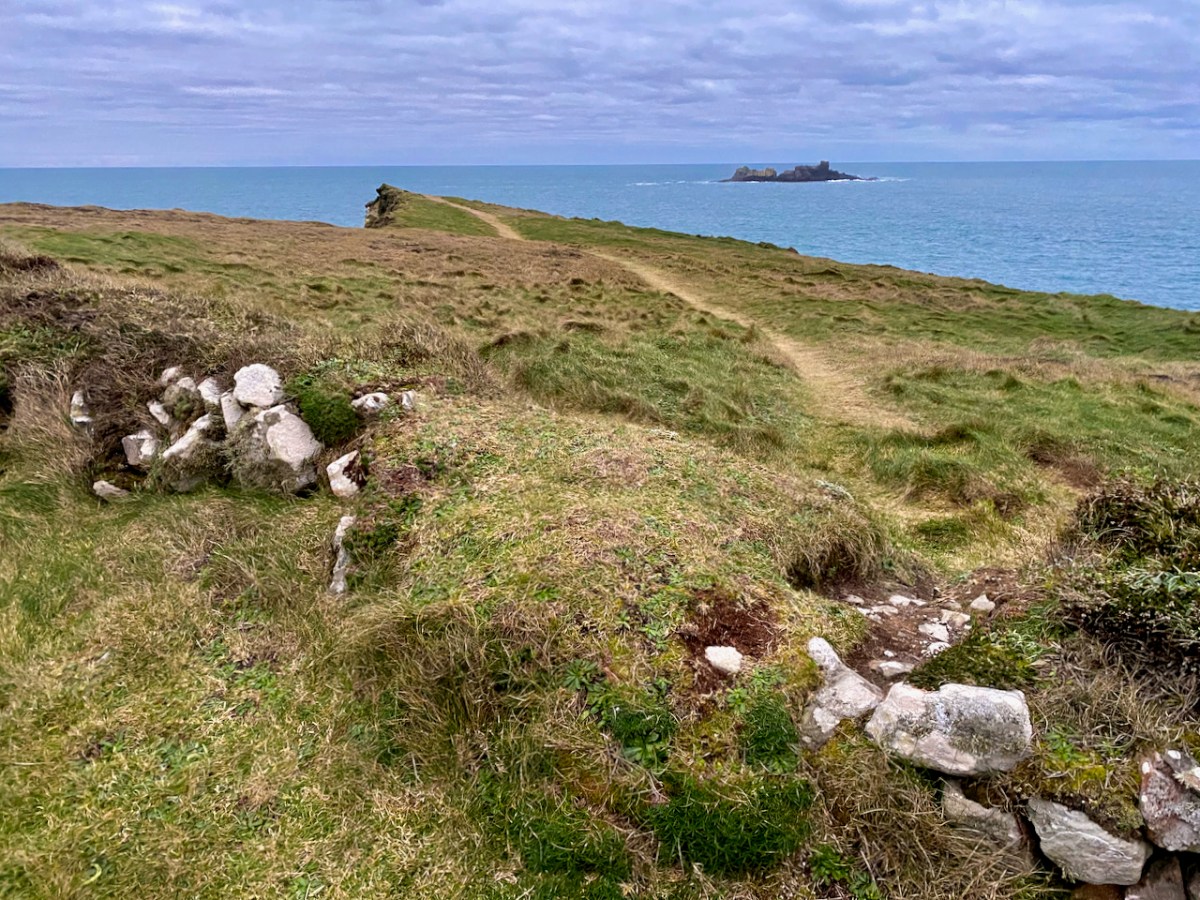
Toe head is dramatic and scenic – but romantic? Let me explain.
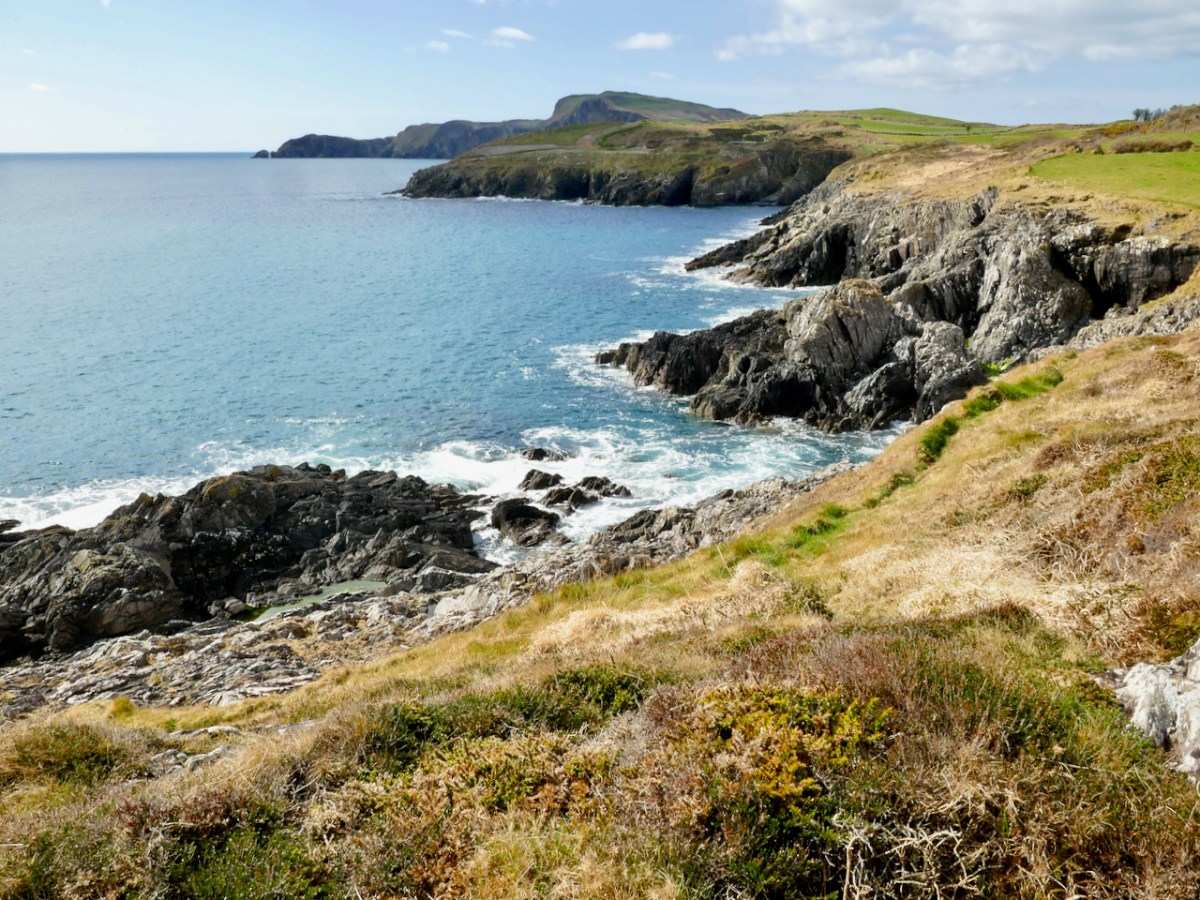
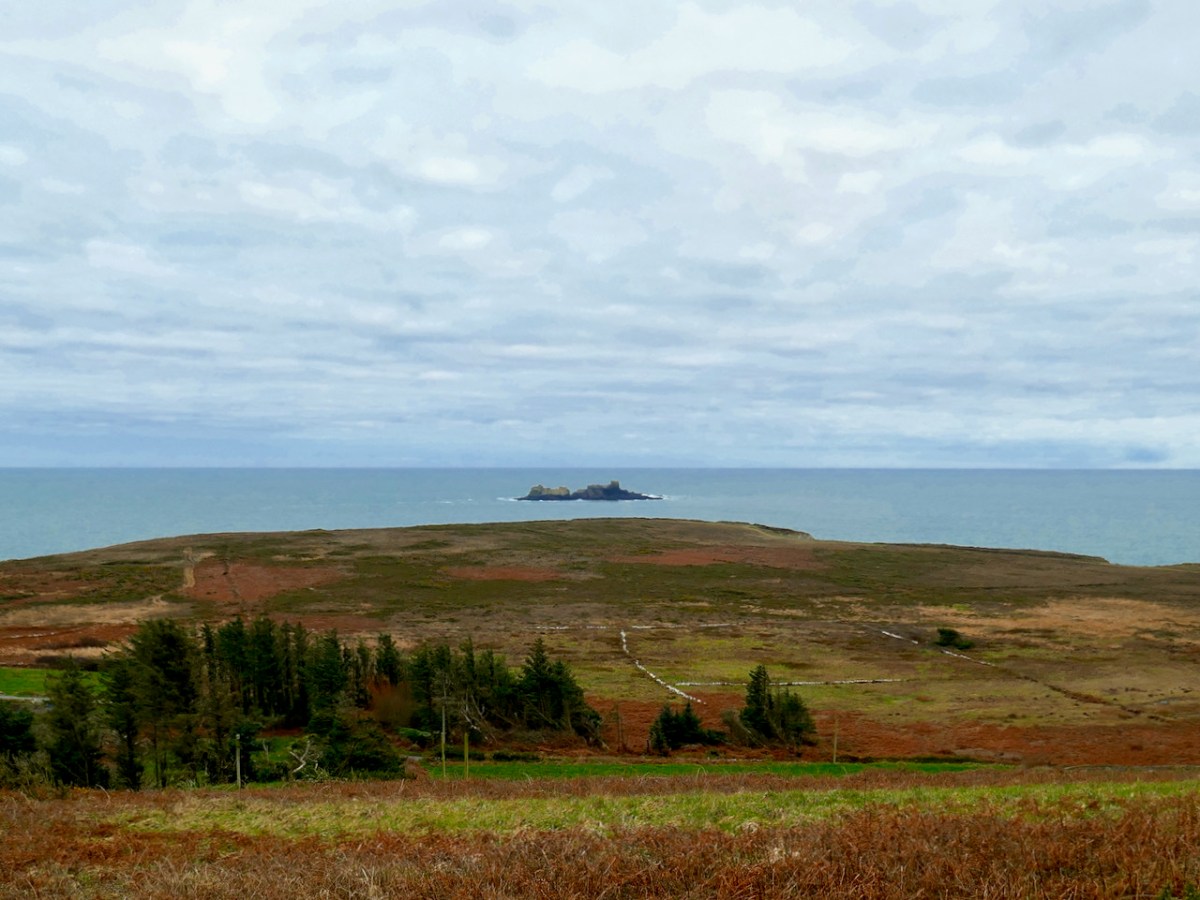
Conor Buckley – the dynamo behind Gormú eco tours – was offering a Romantic Sunset Walk on Toe Head in honour of St Valentines weekend. Who could resist? That’s Toe Head in the distance, above.
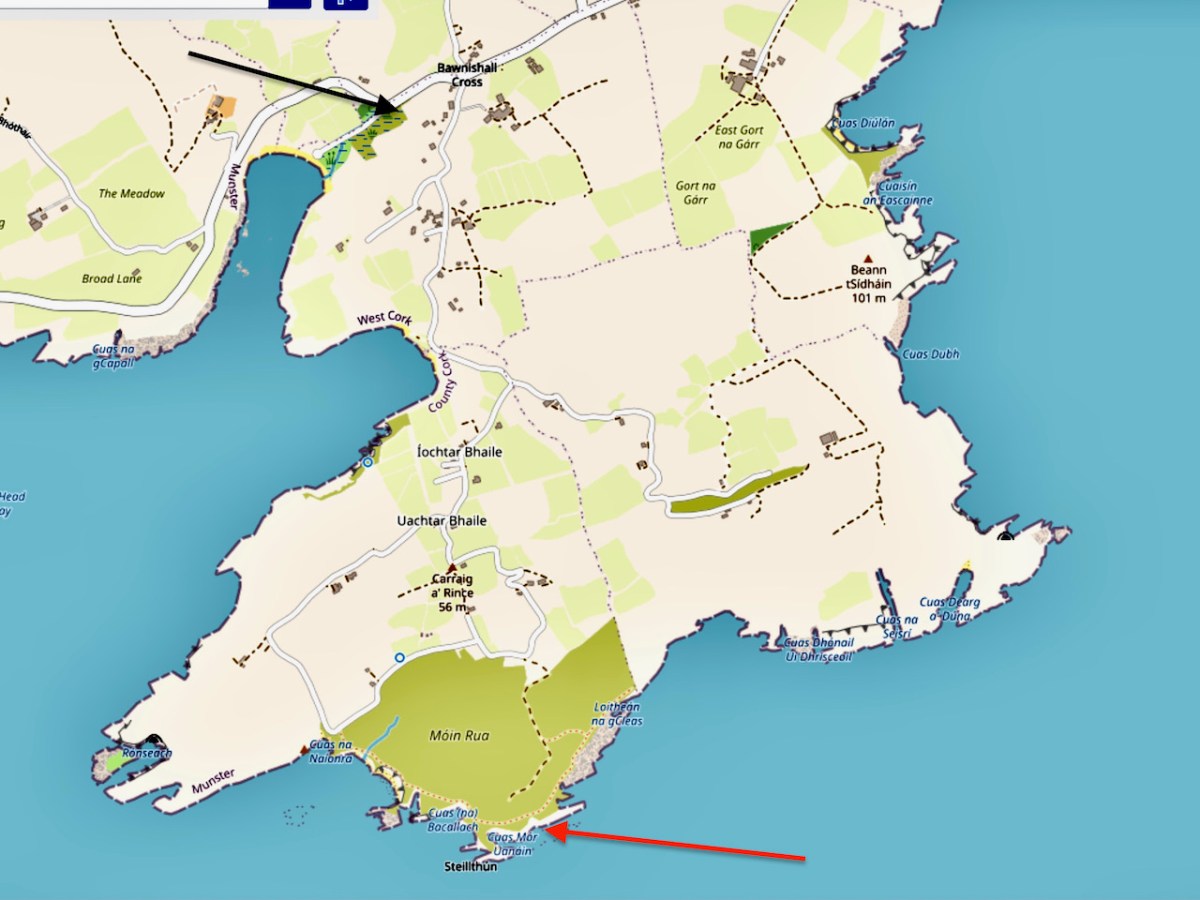
To us, in the past, Toe Head has been synonymous with the Signal Station – Robert has written about it here. But we’ve always known there’s a lot more to Toe Head than that and have been wanting to make a return trip, especially in the company of someone with lots of local knowledge. The black arrow above shows our starting point and the red arrow our destination.
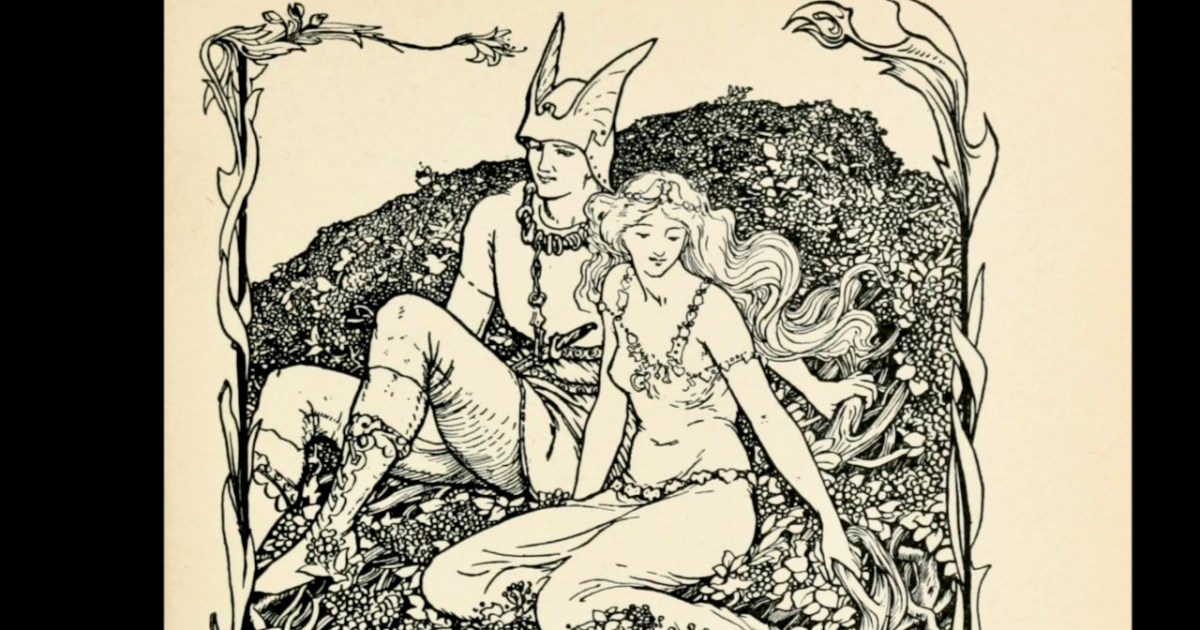
We met at the Lifeboat Station – it was Kathleen, John, Robert and I – and Conor started us off with an introduction to the story of Diarmuid and Gráinne, which he used as the organising theme for the whole walk. A Seanachie (pronounced shanakee) – an Irish story-teller – had told, about 100 years ago, of Diarmuid and Gráinne’s travels in West Cork. The star-crossed lovers are responsible for landmarks all over Ireland. They ran away together, escaping from the aged Fionn McCuamhaill (FinnMcCool), Gráinne’s intended husband, and rested in many places along the way. The dolmens or wedge tombs where they slept are often known locally as Diarmuid and Gráinne’s bed. I won’t recount the whole story here, as there are lots of accounts online: this is a good version.
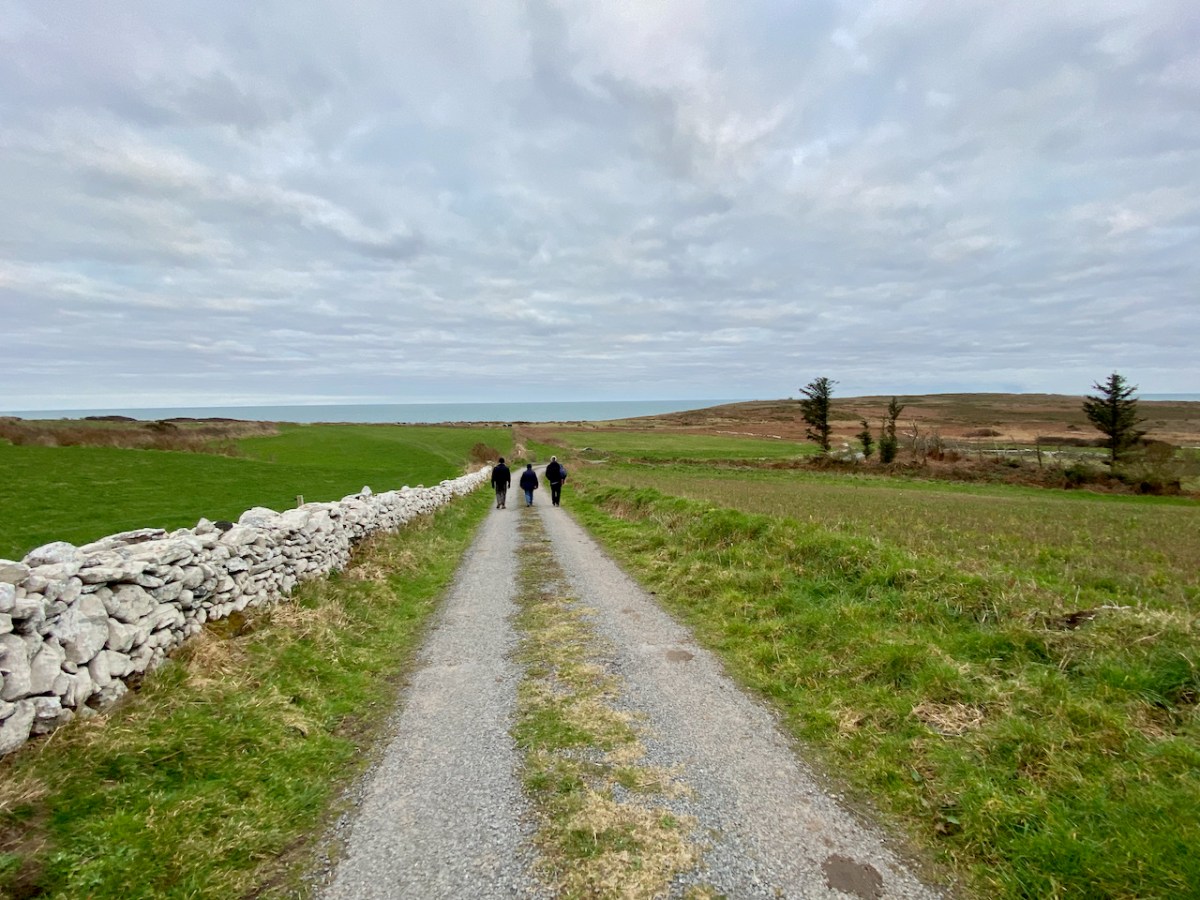
Our walk took us along quiet country roads and out to An Móin Rua – the Red Bog. Not really a bog, but a heath, and in the summer alive with colourful heathers and Irish Gorse, and the home of swooping and calling choughs.
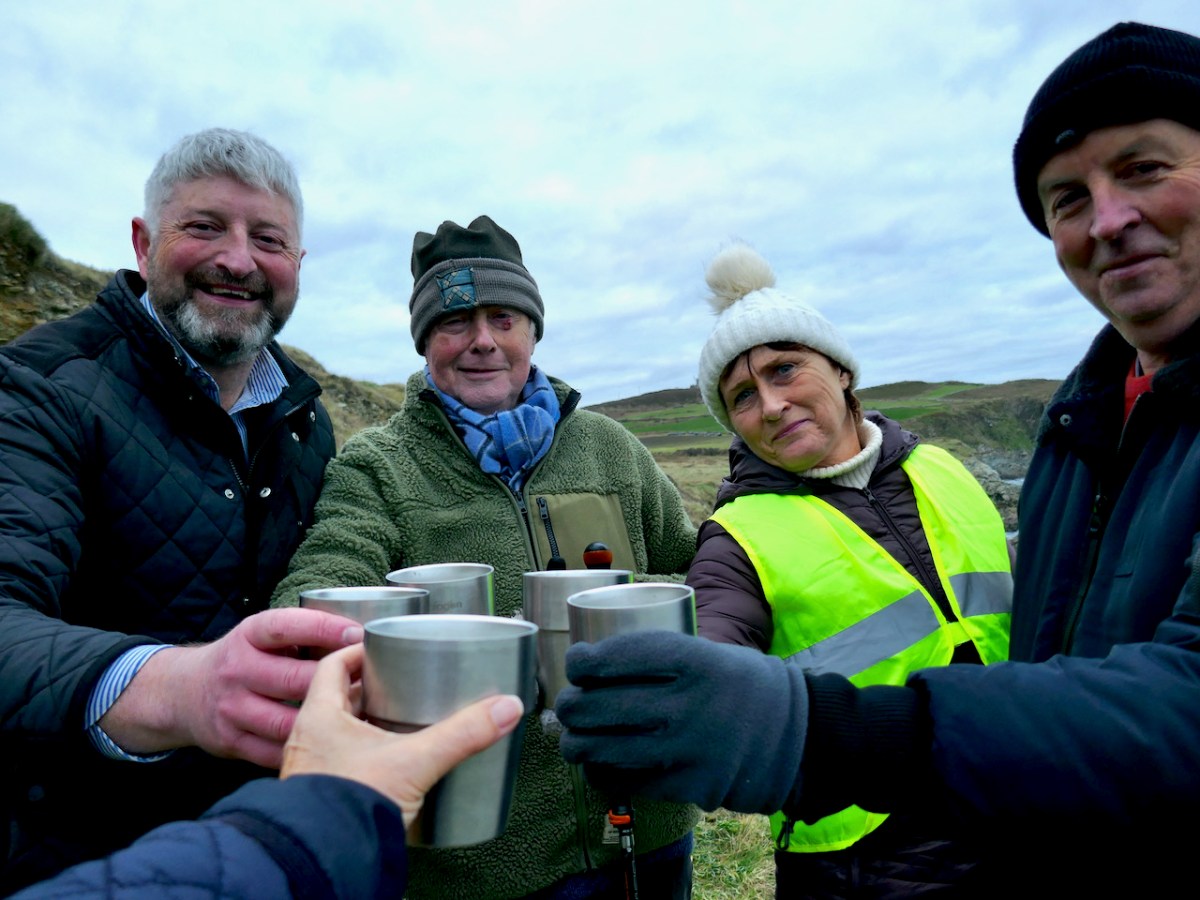
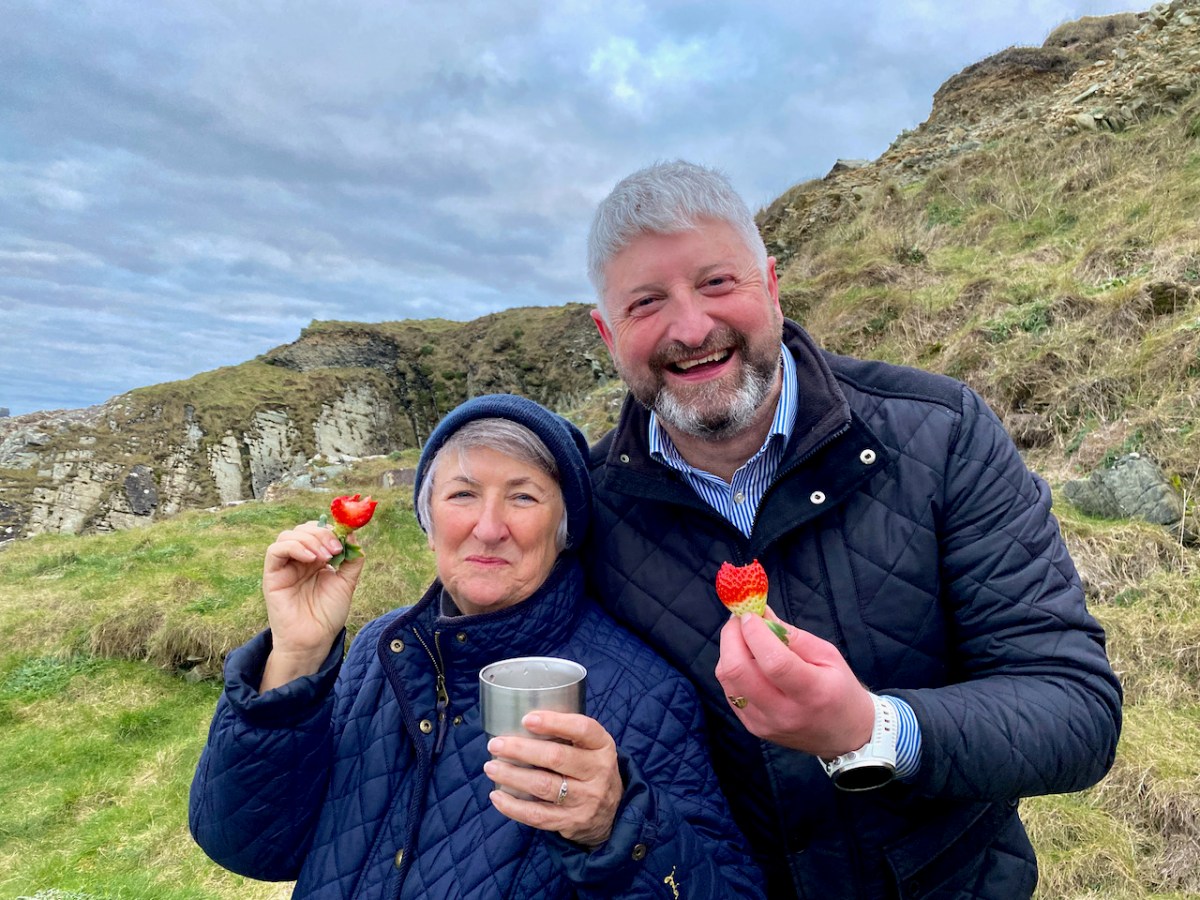
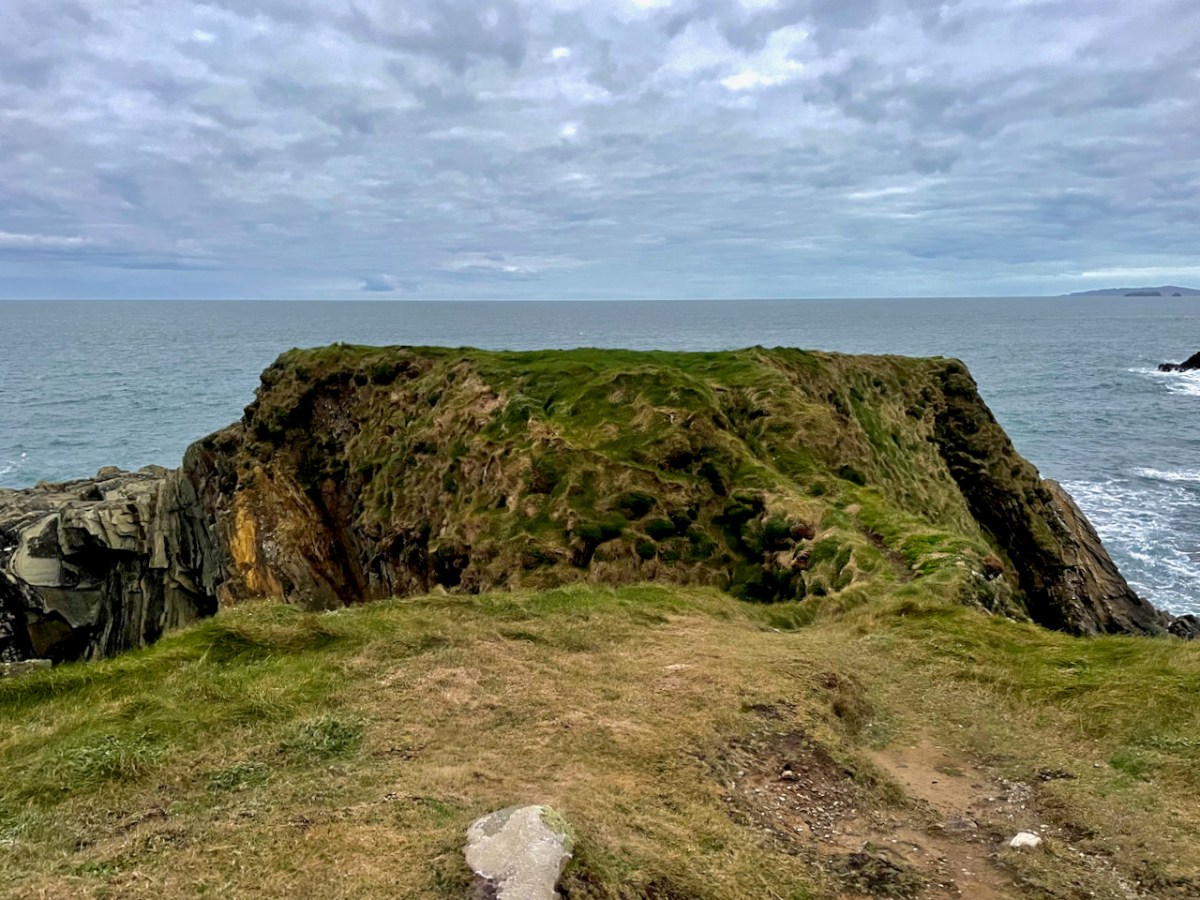
As we reached the place traditionally thought to be the leaba – bed – of Diarmuid and Gráinne, a sheltered spot with a natural clearing, Conor, in honour of the day that was in it, produced champagne, strawberries and chocolates.
We continued on, with a new part of the story every now and then, interspersed with lots of place name lore, and snippets about our surroundings and the ecology of Toe Head. The little crag below is called An Srón (pronounced shrone), which means The Nose. Not hard to guess why.
The next stop was at the EIRE sign, painstakingly restored now by a group of local volunteers.
These signs, spelled out in whitewashed stones, were placed all along the coast during WWII to alert German Bombers that they had overshot Britain and were approaching neutral Ireland.
Our last point of interest was a wonderful Promontory Fort, Dooneendermotmore – or Big Dermot’s Little Fort. I’ll be returning to this one in the future, as I am planning to retrace the footsteps of Westropp, who was the first to describe these coastal forts. As it happens, I will also be following in the wake of my old Professor of Archaeology at UCC, Michael J O’Kelly, as he excavated this site in the early 1950s.
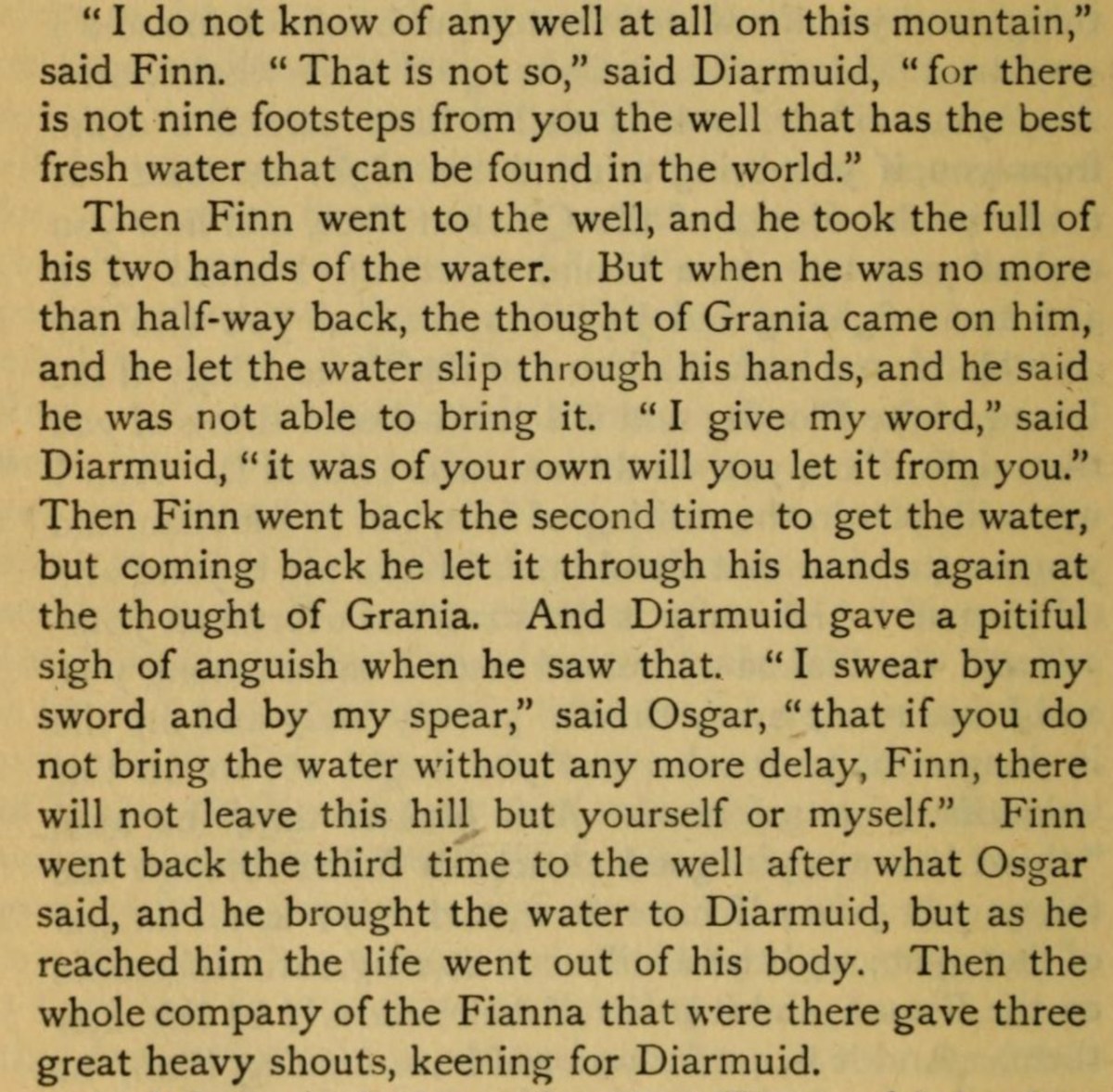
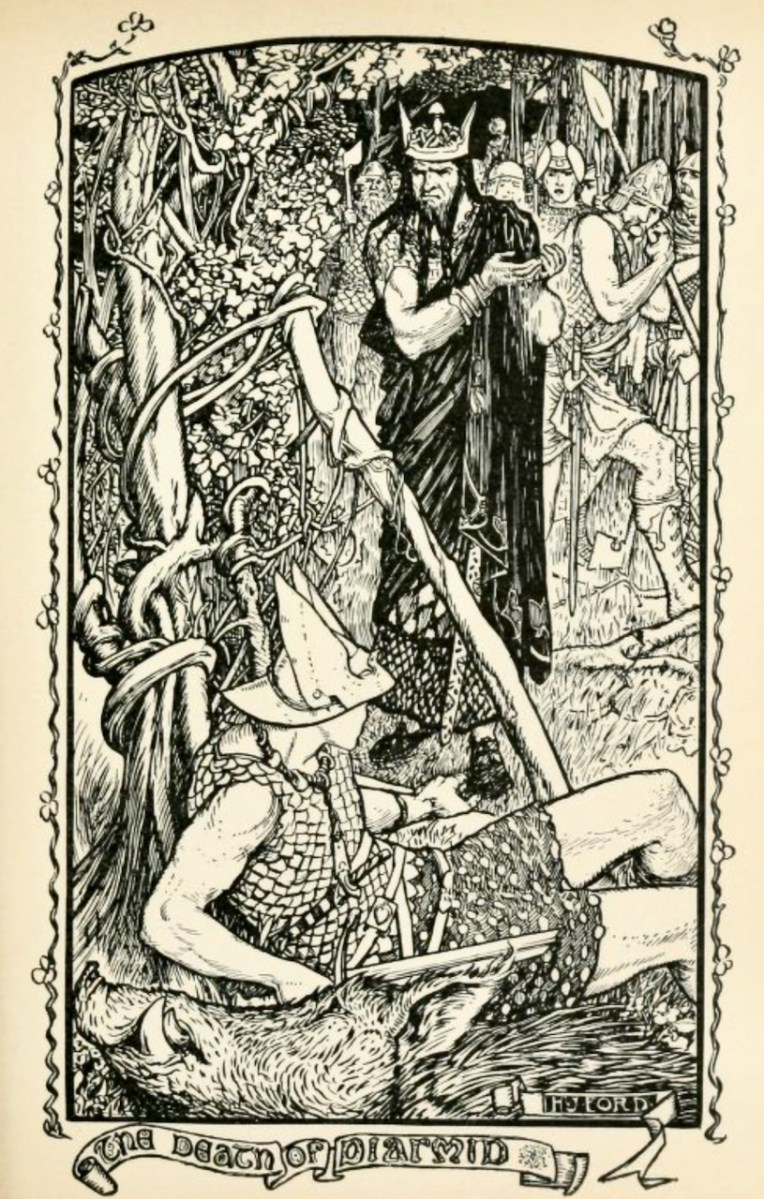
It was getting dark as we made our way back. Before we broke up, Conor told us the story of the Death of Diarmuid. The whole sad saga was originally translated by Lady Gregory. Above is an extract from her Gods and Fighting Men.*
The illustrations I’ve chosen above (and the one of Diarmuid and Gráinne at the start of this post) are both from Andrew Lang’s Book of Romance,* and are by Henry Justice Ford. Anyone else remember being entranced by Andrew Lang’s Fairy Tale books, with their wonderful illustrations, as a child?
I will leave you with an image of the leaba – the bed – of the lovers. Not a comfortable place to spend the night, but when you are being chased by Fionn MacCumhaill, you can’t be picky.
This year, I am taking the Vita Prima as my starting point. It’s the Life of Brigid that was written about the middle of the 700s. As we saw in my first post about St Brigid, a year ago, Cogitosus wrote his Life in about 650, about 125 years after the death of Brigid. So this Life, the Vita Prima, was written 225 years after her death – but there is sound evidence that it is was based on the writings of St Ultan, who died around 650. In fact, the author of the Vita Prima and Cogitosus may both have drawn from this common source. *
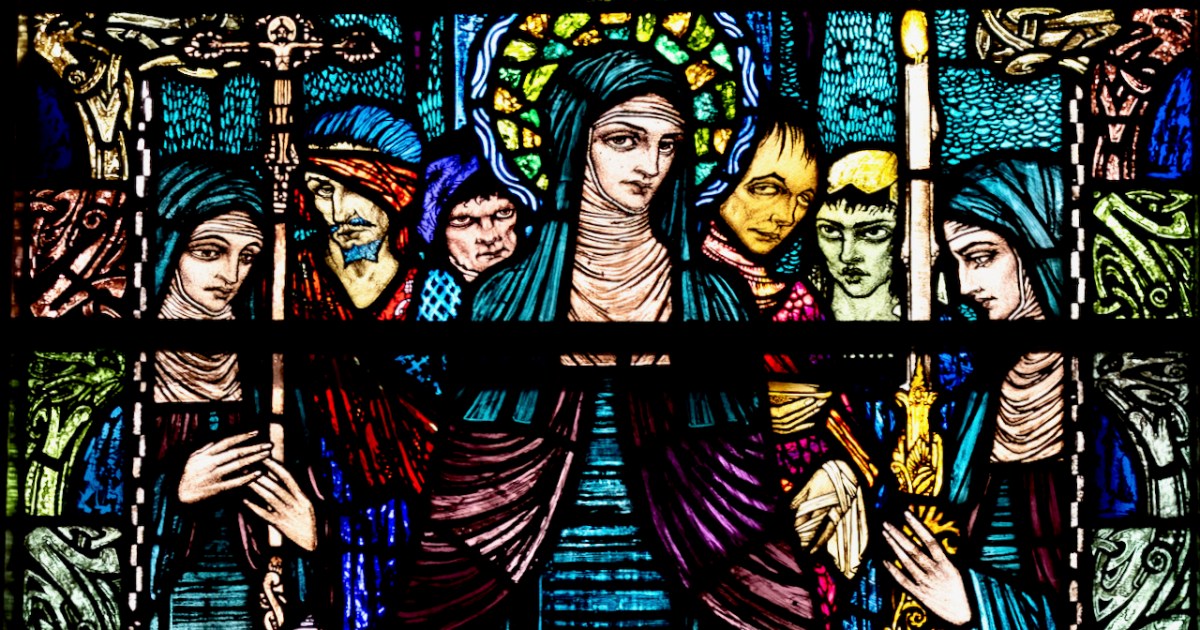
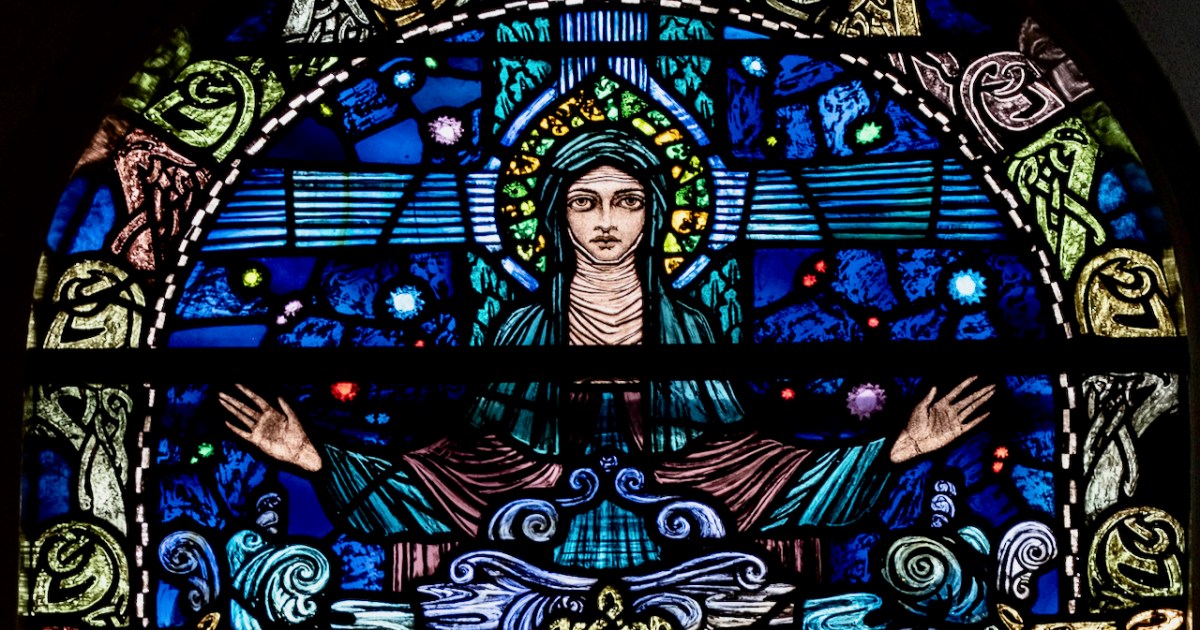
My illustrations are all taken from stained glass and all the images are my own except for the wonderful Kilrush window, kindly shared with me by the photographer, John Glynn. John has undertaken extensive new research on this window and is now convinced that it was mostly designed by Harry Clarke, even though it has been up to now designated as by his Studio rather than by himself.
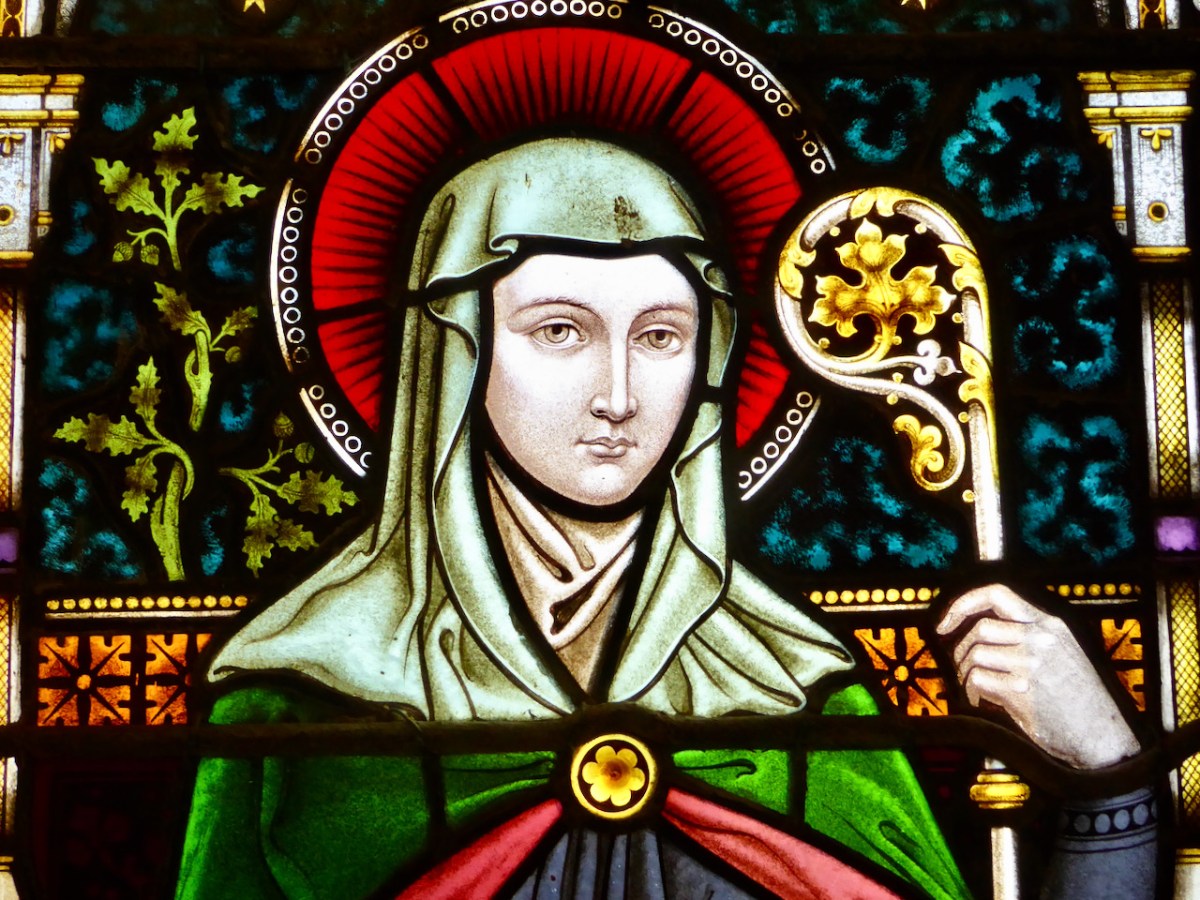
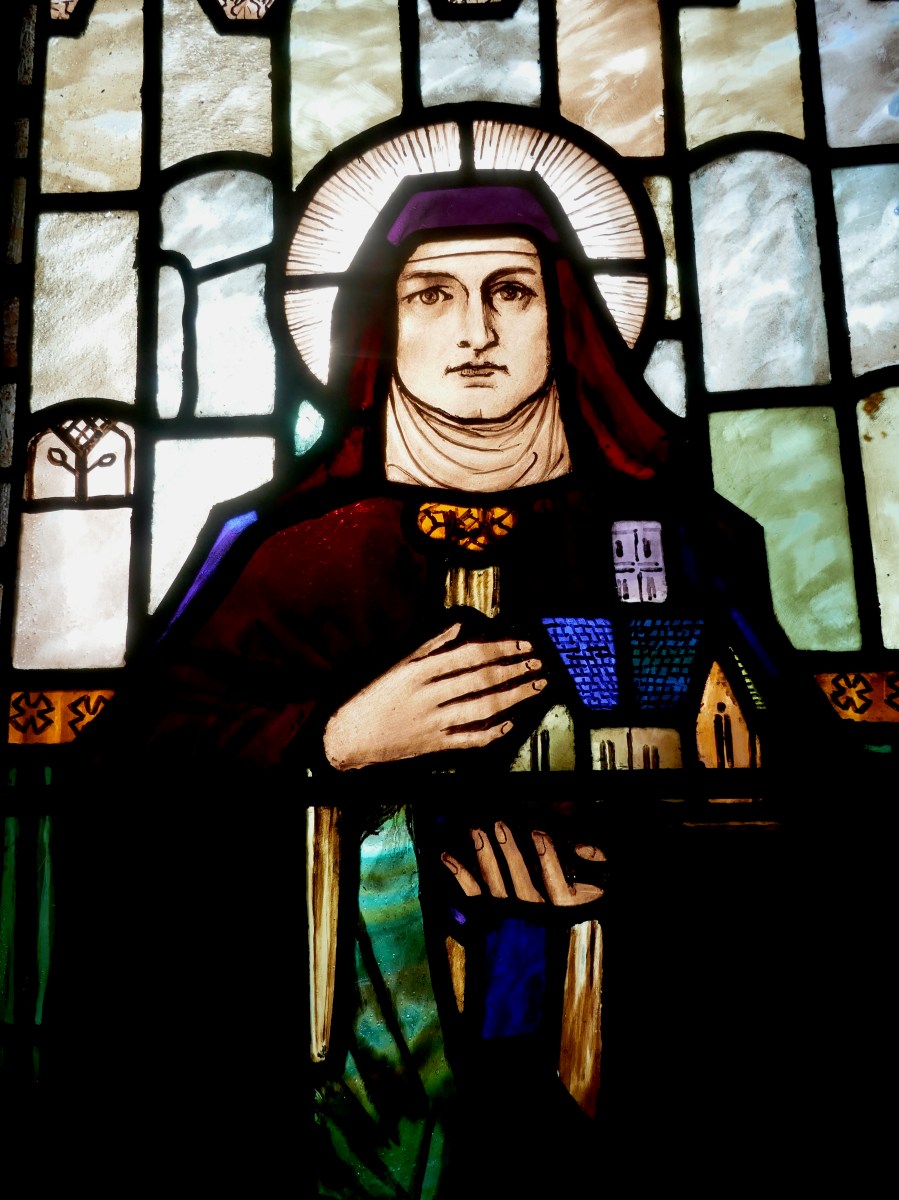
St Brigid, detail from St Fachtna’s Church, Rosscarbery, Co Cork, unknown artist
St Brigid – and yes, the evidence also points overwhelmingly to the fact that she was a real person – was born around 452 and died in either 524, 26 or 28, in her 70s. That means, by the way, that next year is the 1,500th anniversary of her death.
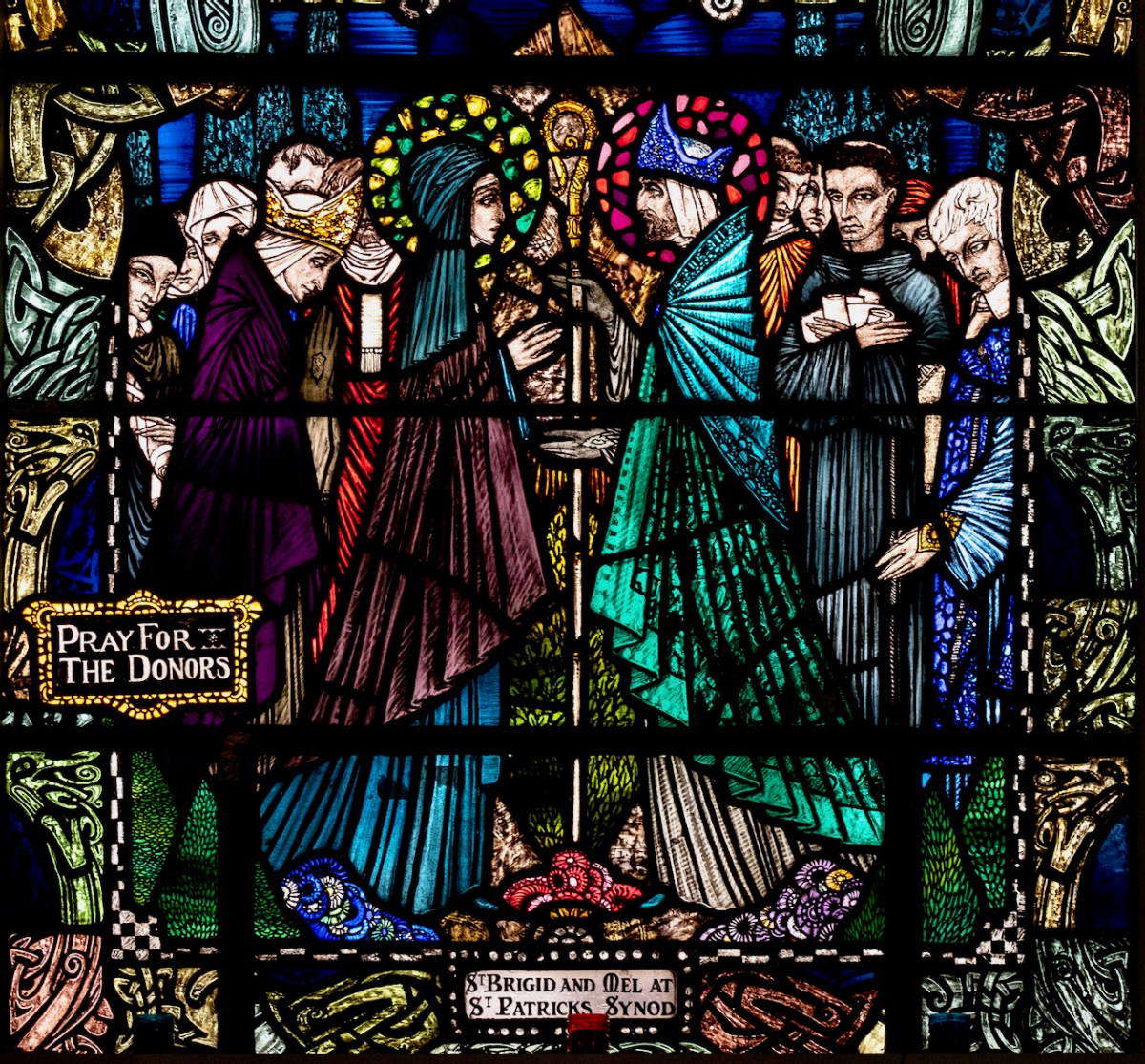
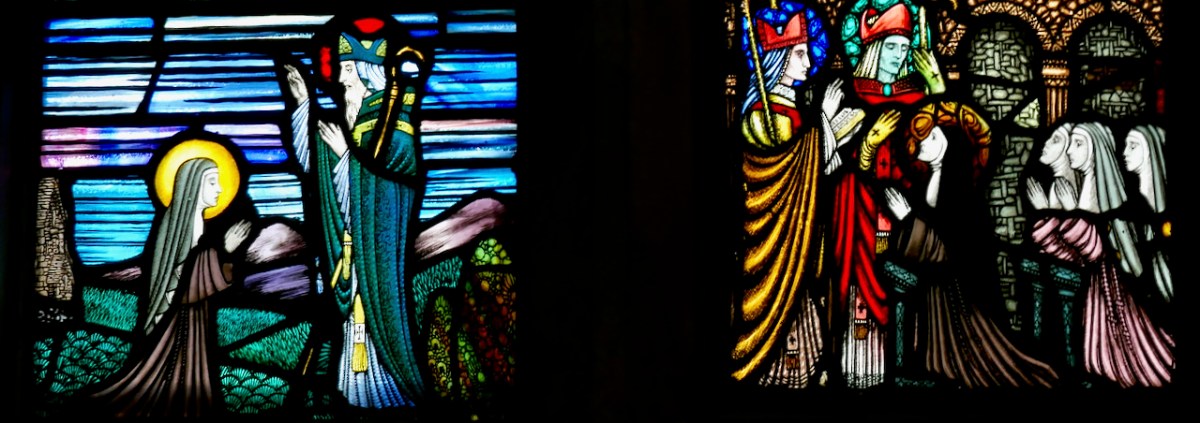
This version assigns her ‘veiling’ as a nun to Bishop Mel, but does not include the story of his accidentally making her a bishop. The image above shows him handing her a crozier, this referencing the story I included in last year’s post.
Then saint Brigit taking three nuns with her went to the territory of the Ui Neill to the two holy bishops, Mel and Melchu, who were disciples of St Patrick and lived in the towns of Mide. And they had a certain disciple called Mac Caille who said to Mel, ‘Look, there are holy virgins outside who wish to receive the veil of virginity from your hands.’
Then he ushered them into the bishop’s presence, and while bishop Mel was gazing intently at them, a column of fire suddenly appeared rising from Brigit’s head up to the very top of the church in which she dwelt. Then the holy bishop Mel placed the veil on saint Brigit’s head and when the prayers had been read Brigit bowed her head and seized the wooden foot of the altar in her hand and since that moment the altar foot has permanently remained fresh without any decay or blemish. And saint Brigit’s eye was healed forthwith when she received the veil. Then eight other virgins also received the veil together with saint Brigit and the virgins with their parents said, ‘Don’t leave us. Instead stay with us and make your home in these parts.’ Thereafter saint Brigit stayed with them.
Brigid’s veiling, Earley Studios, Drumcong, Co Mayo
The reference to eye healing, by the way, related to another story. When she was pressured to marry a man
Saint Brigit asked God to afflict her body with some deformity in order that men might stop paying suit to her. Thereupon one of her eyes burst and liquefied in her head. For she preferred to lose her bodily eye than the eye of her soul and loved beauty of soul more than that of the body.
Predella of Brigid window in Carnew, Co Wicklow
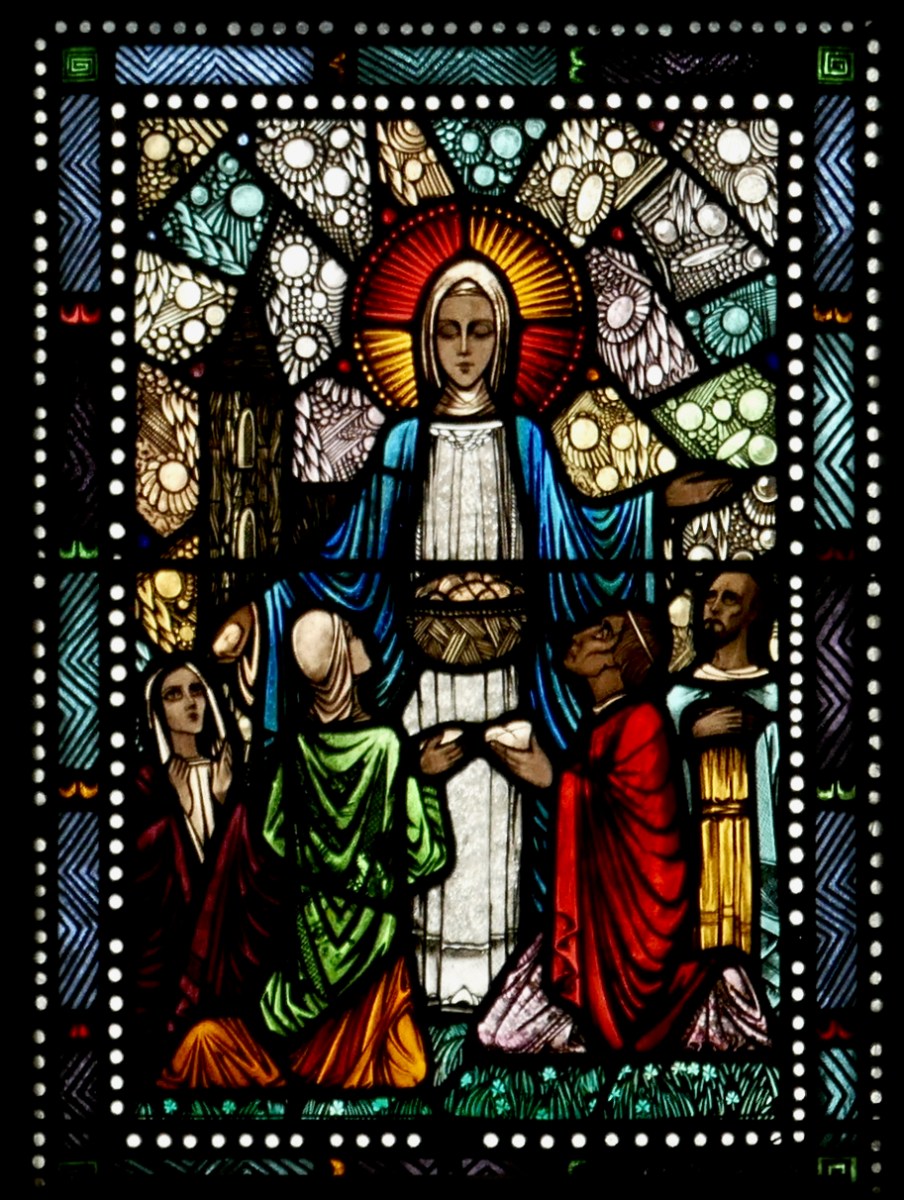
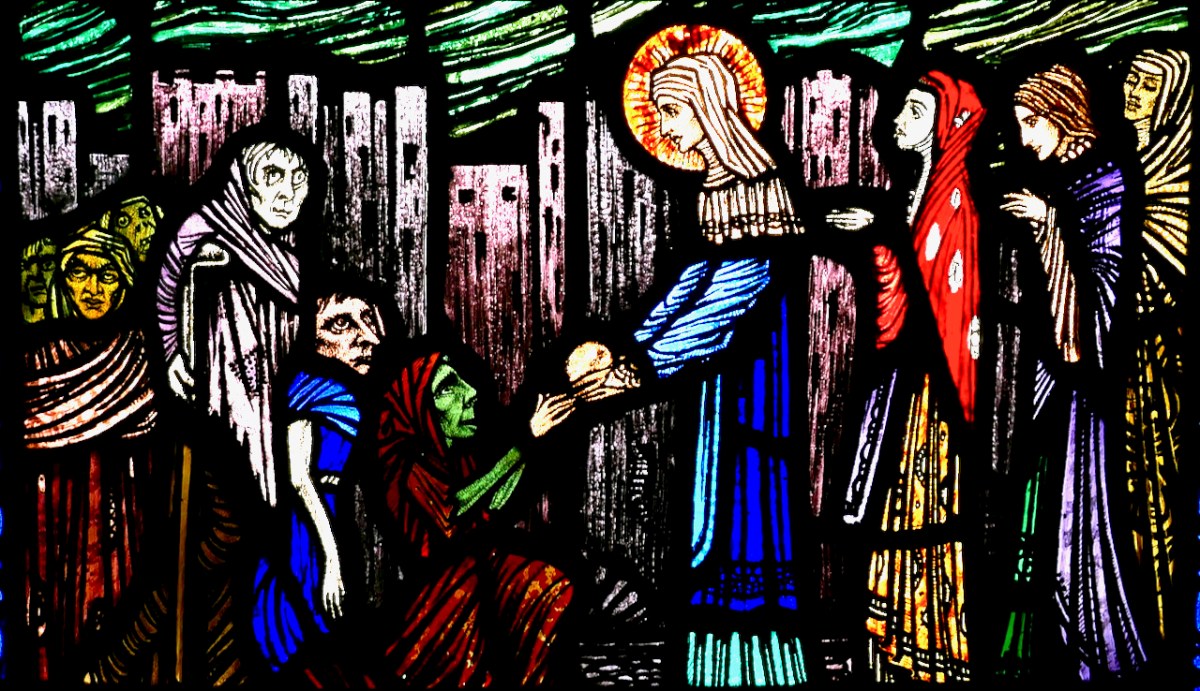
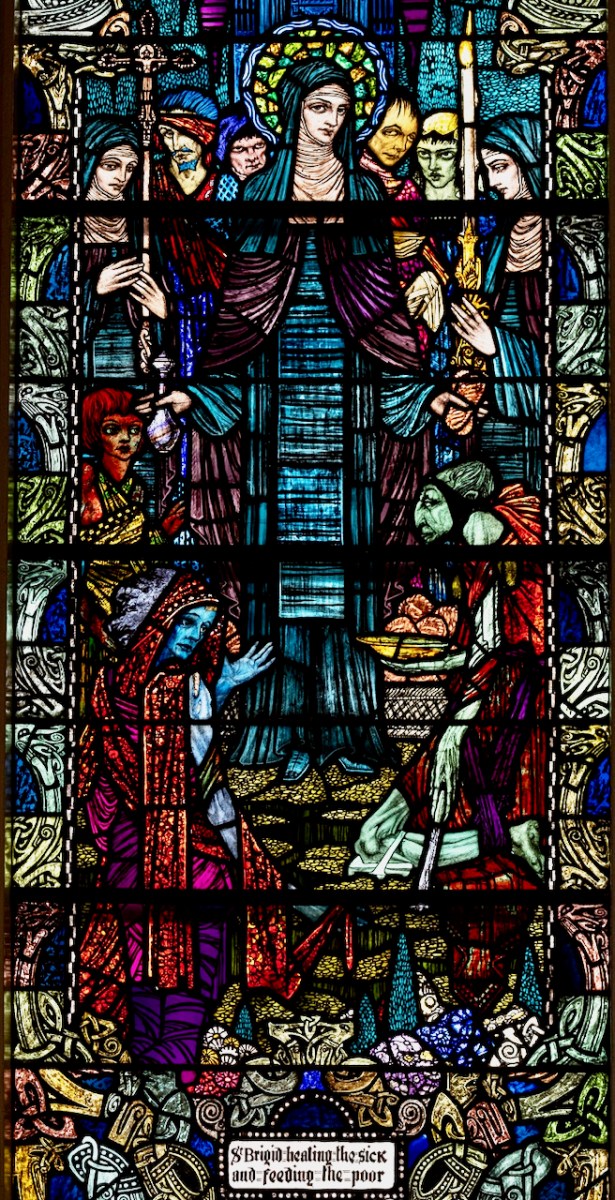
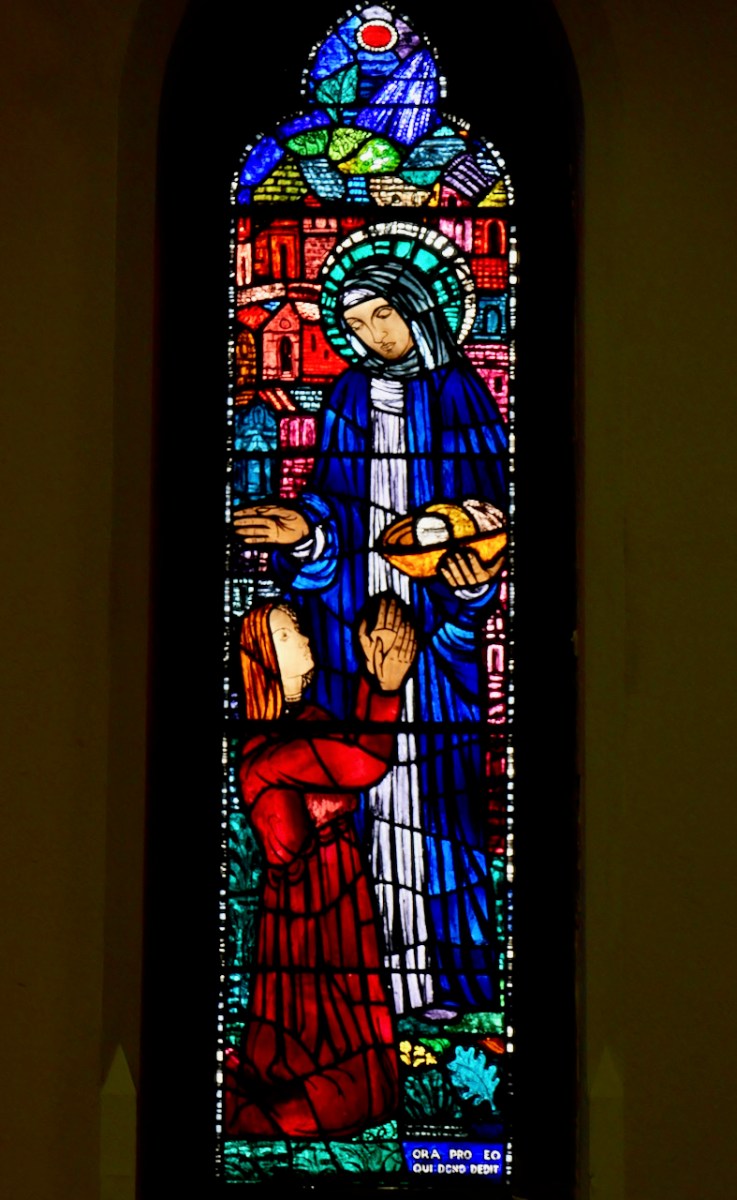
You’ll be pleased to hear I don’t have an illustration of this episode. But this book (like the Life in The Book of Lismore, see last year’s post) rather than a biography, is a relating of miracle after miracle. Many deal with her ability to provide food – bread, meat and beer – to hungry people (as above). Here’s just one:
At this time saint Brigit was a guest at the monastery of St Laisre. Now one day towards evening St Patrick came with a large crowd to put up at that monastery. Thereupon the local community was worried and said to Brigit, ‘What are we going to do. We don’t have food for such a large crowd.’ But Brigit said to them, ‘How much do you have?’ They said to her, ‘All we have is twelve loaves and a little milk and one sheep which we have cooked for you and your folk.’ But Brigit said, ‘These will be enough for the whole lot of us, for the sacred scriptures will be read to us, thanks to which will we shall forget about bodily food.’ Whereupon the two groups of people, namely, Patrick’s and Brigit’s, ate together and had their fill and the amount of scraps they had left over was greater than the supplies which St Laisre had offered them in the first place, and later St Laisre offered herself and her place to saint Brigit in perpetuity.
Knockainy, Co Limerick, window by William Dowling for the Harry Clarke Studios
She was also famed for her ability to heal – the blind, maimed, mute, paralysed, deranged, bulimic (I’m not making this up) and leprous all came to her in their afflictions and were healed. She healed the poor and the kingly equally.
Here’s an interesting instance of her using her powers to ‘heal’ a pregnancy:
Another day saint Brigit by the very powerful strength of her faith blessed a woman who had fallen after a vow of integrity and whose womb was pregnant and swelling and the conception in the woman’s womb decreased and she restored her to health and repentance without childbirth or its pangs. The woman was healed and gave thanks to God.
From the Brigid window, Collon, Co Louth, probably by the Harry Clarke Studios
The Vita Prima has Brigid and Patrick as contemporaries who knew each other and there are several stories of them together. Here is one:
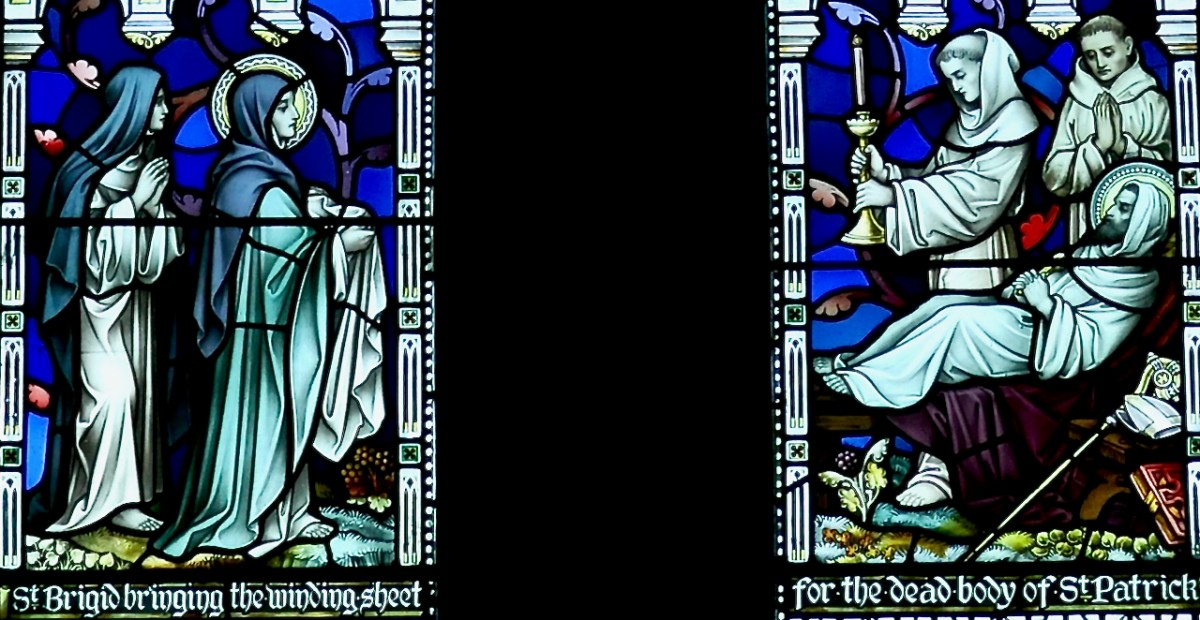
Patrick was preaching the word of God one day to the crowds and saint Brigit. Then everyone saw a very bright cloud coming down from the sky to the dark earth on a rainy day. Gleaming from an enormous flash of lightning, it paused for a little while at a spot nearby beside the crowd. Afterwards it went to Dun Lethglaisse where Patrick is buried. Lingering there a while longer the cloud then disappeared and the crowds did not dare ask what this extraordinary apparition meant but asked saint Brigit. And Brigit said, ‘Ask Patrick.’ When Patrick heard this he said, ‘You and I know equally well. Reveal this mystery to them.’ And Brigit said, ‘This cloud, in my opinion, is the spirit of our father St Patrick who has come to visit the places where his body will be buried and rest after his death. For his body will rest for a short while in a place nearby, and afterwards will be taken to be buried in Dun Lethglaisse and there his body will remain till the day of judgement.’ Then Patrick told Brigit to make with her own hands a linen shroud to cover his body with after his death, as he desired to rise to eternal life with that shroud. Brigit accordingly made the shroud and it was in it that St Patrick’s body was later wrapped and it is still in that place.
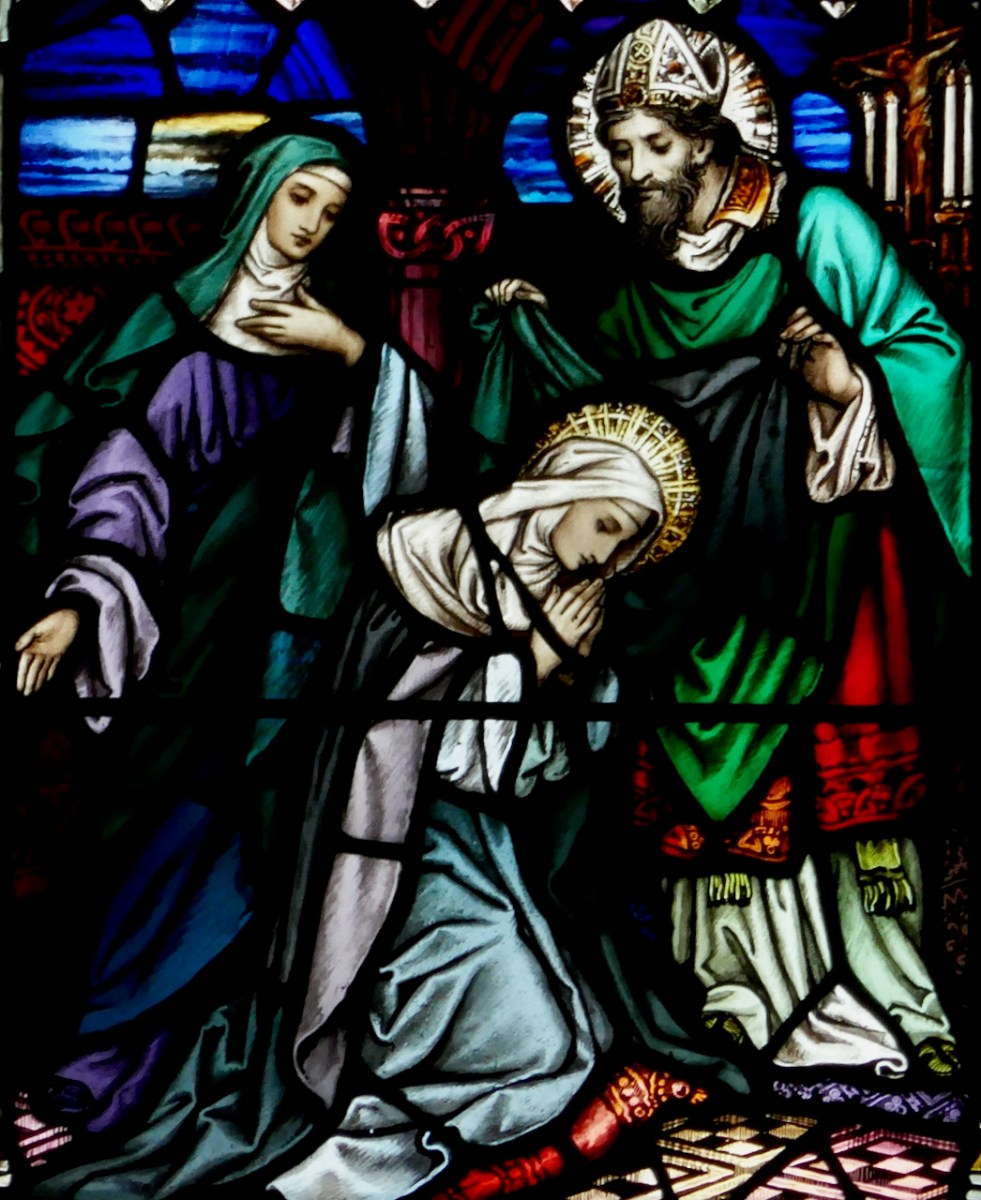
I have used St Brigid bringing the winding sheet for St Patrick in last year’s Brigid post, but here it is again. It’s from Killarney Cathedral and by Hardman.
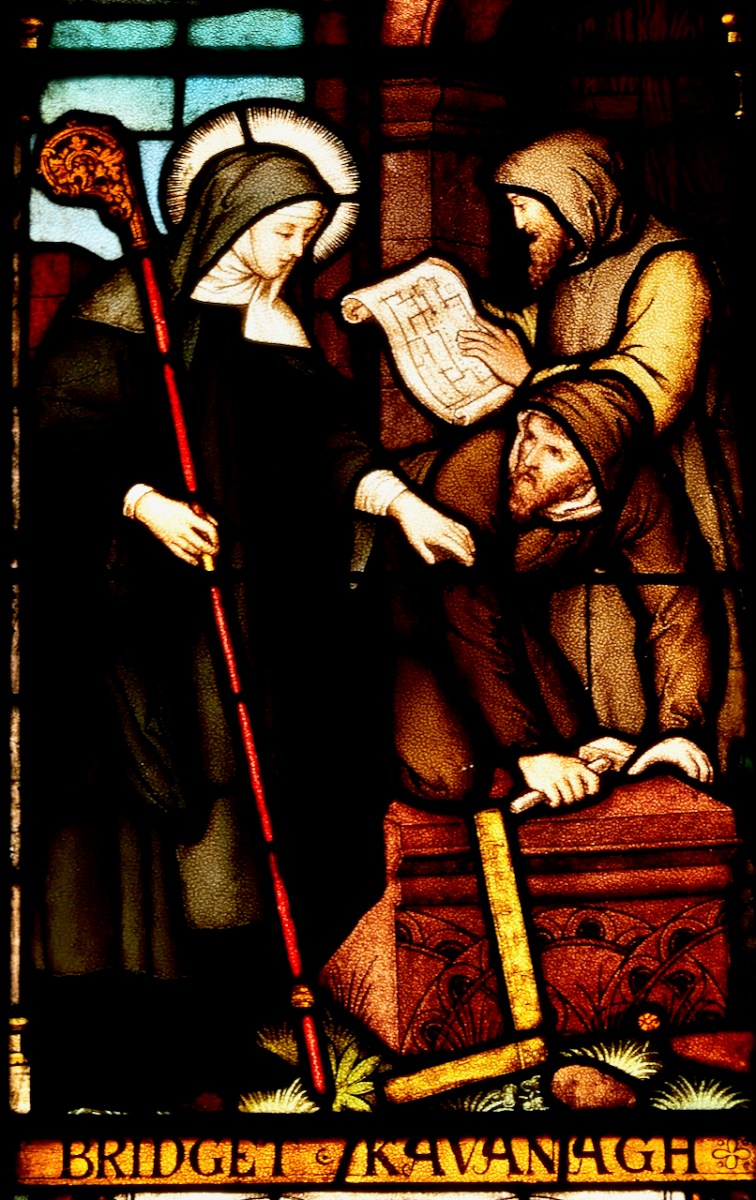
Interestingly, the Vita Prima contains only one direct reference to Kildare, where St Brigid established her foundation. Here she is instructing her masons in how she wants it built (as a 15th century church, apparently). This one is from Armagh Cathedral and I think it’s by Mayer of Munich.
The author of the Vita Prima brings us to the end of Brigid’s life in surprisingly modern language.
But after having fought the good fight and run a successful race, saint Brigit departed this life for the kingdom of heaven escorted thither by the ranks of angels and archangels and having been accorded a place amid the choirs of patriarchs and prophets and apostles and martyrs and confessors and virgins she now possesses everlasting joy with Christ to whom, with God the Father and the Holy Spirit, be praise and glory forever and ever. Amen.
This image of Brigid is from a window by Michael Healy, in the Bishop’s Palace in Monaghan
St Brigid, I am discovering, can be all things to all people – a pagan goddess for the New Agers, a saint for devout Catholics, and an empowering symbol of female leadership. While there has been much speculation (some of it offered as assertion) about her links with a pagan goddess, Brigantia, the evidence is very slight and the goddess connection mostly lies in the realm of conjecture, leaps of imagination and wishful thinking.
Evie Hone’s St Brigid, from Loughrea Cathedral
What the various writings about Brigid do point to is a powerful, benevolent and influential ecclesiastical woman who established a centre of devotion and learning and a city in Kildare, and whose cult spread across Europe in the centuries that followed her life. That, in itself, is more than enough, to mark her out as momentous, and worthy of commemoration. Here’s how Padraig O’Riain, the pre-eminent scholar on Irish saints, puts it:
For all her dubious origins, therefore, Brighid’s record shows that she stood alone among the women saints of Ireland, a rival in importance to Patrick and Colum Cille, an abbess whom all other abbesses revered, a bishop in all but name, of such high status that she came to be regarded, possibly as early as the seventh century, as “Mary of the Irish”.
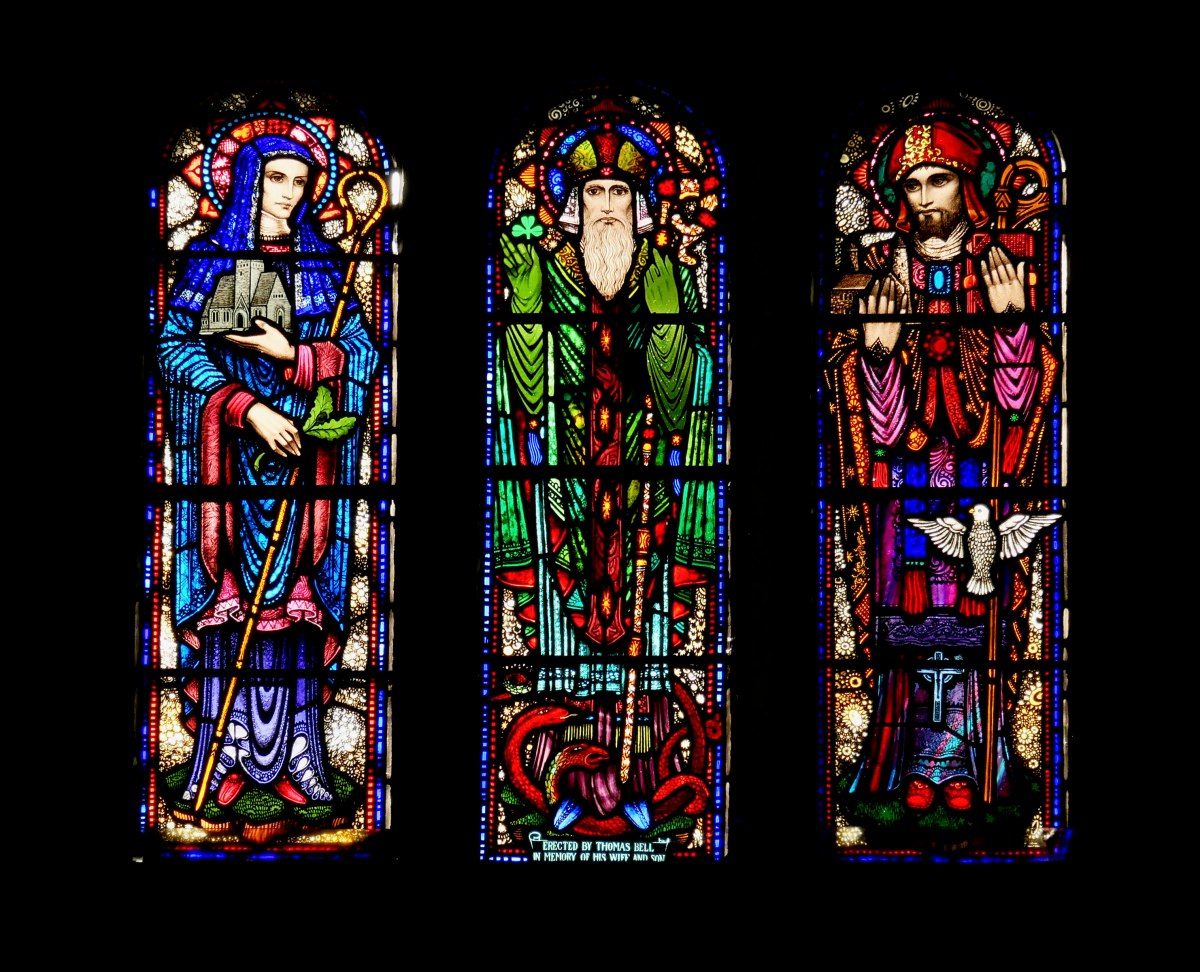
Brigid, Patrick and Columcille from Lusk, Co Dublin, by the Harry Clarke Studios
Therefore, tomorrow, Feb 6th, 2023, no matter which version of her you prefer, let us celebrate together our first National Holiday in her honour. She deserves it – finally!
*I am relying for this post on three main sources:
Vita Prima Sanctae Brigitae Background and Historical Value Author(s): Seán Connolly Source: The Journal of the Royal Society of Antiquaries of Ireland , 1989, Vol. 119 (1989), pp. 5-49 Stable URL: https://www.jstor.org/stable/25508969
St Brigid of Kildare, Life, Legend and Cult by Noel Kissane. Four Courts Press 2017
A Dictionary of Irish Saints by Pádraig Ó Riain. Four Courts Press, 2011
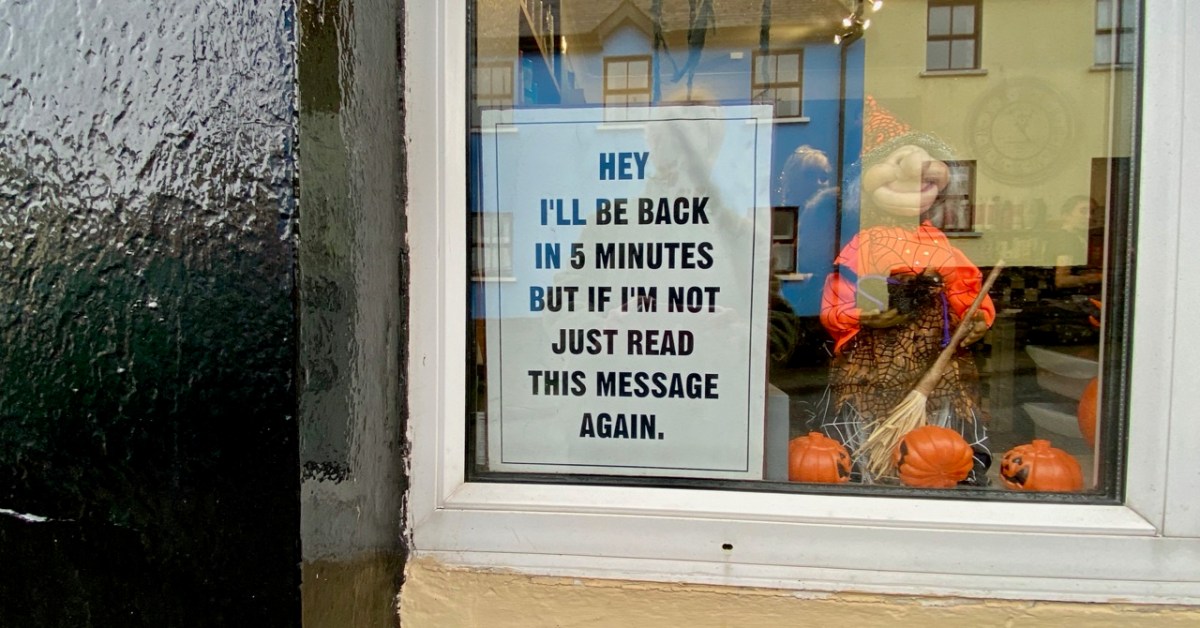
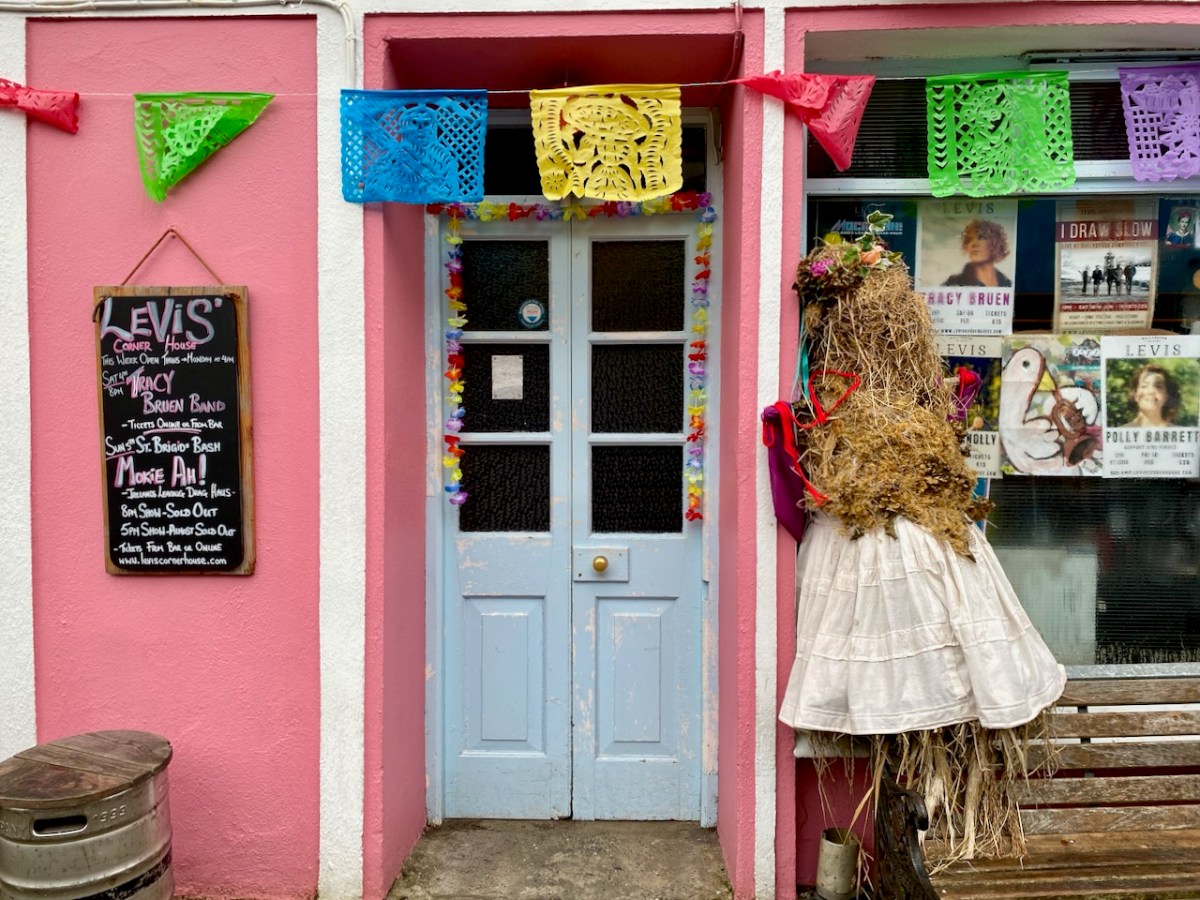
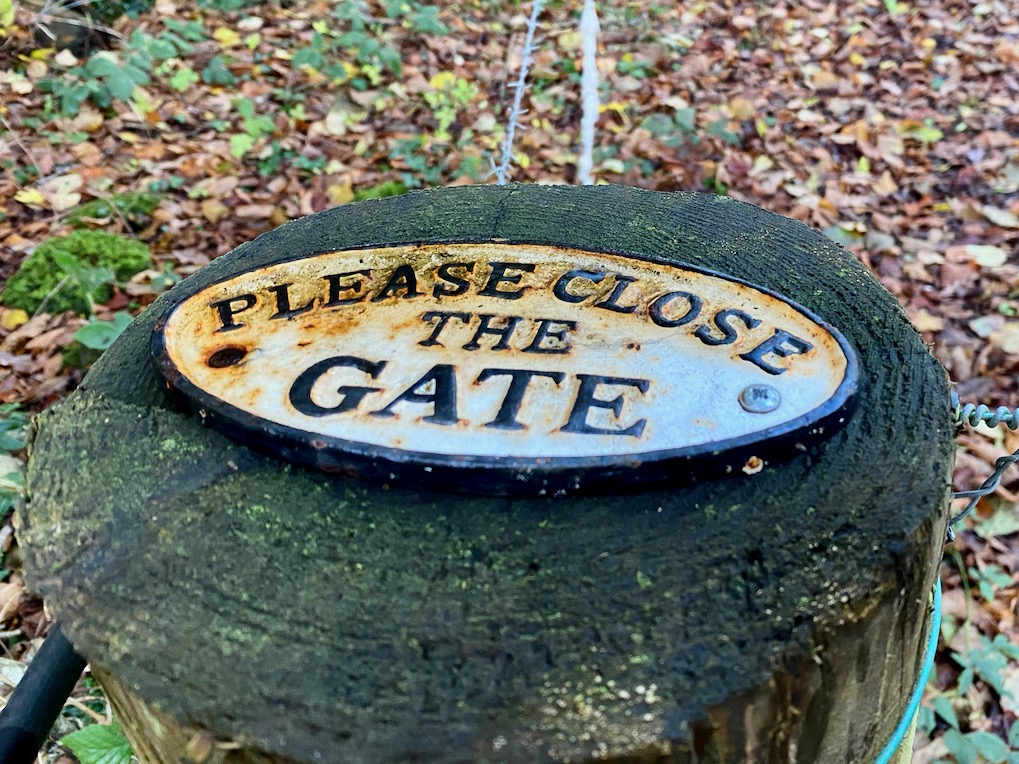
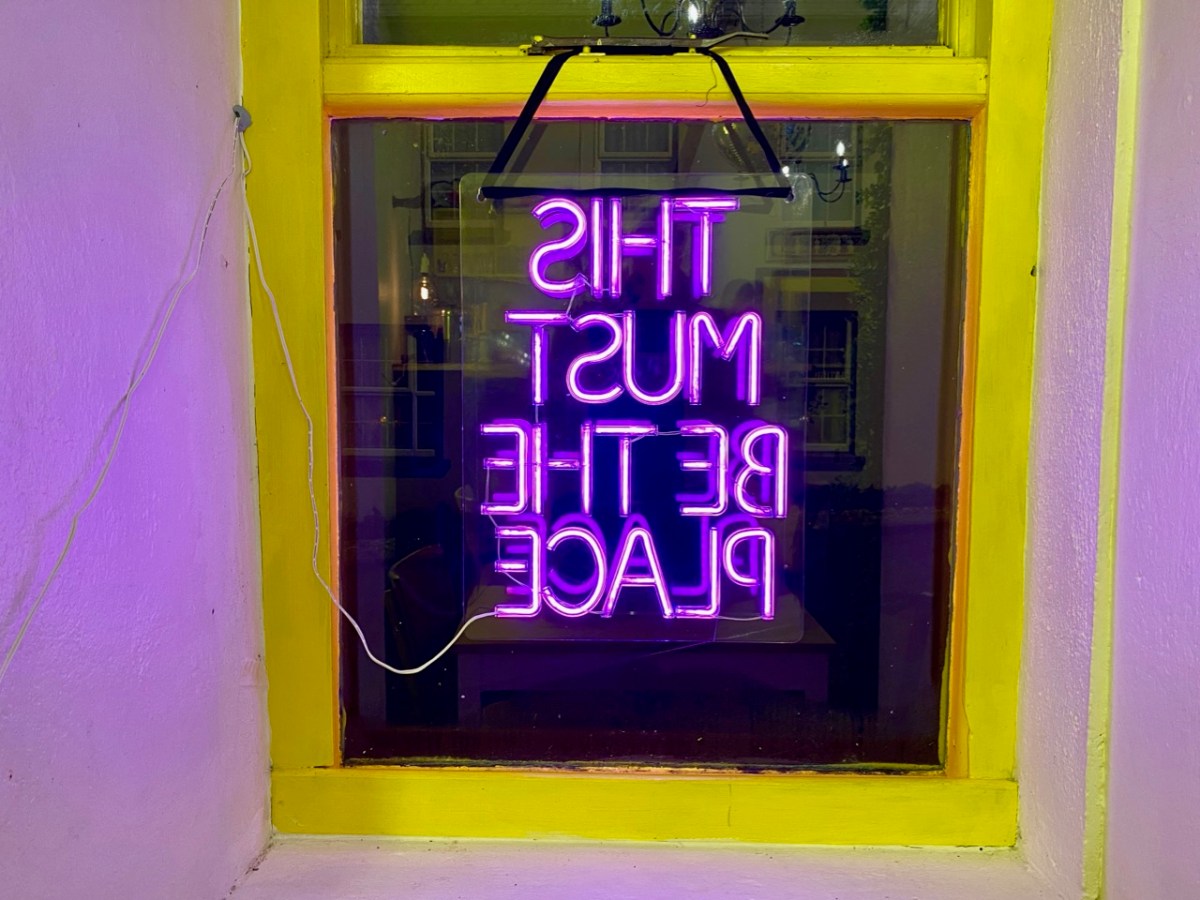
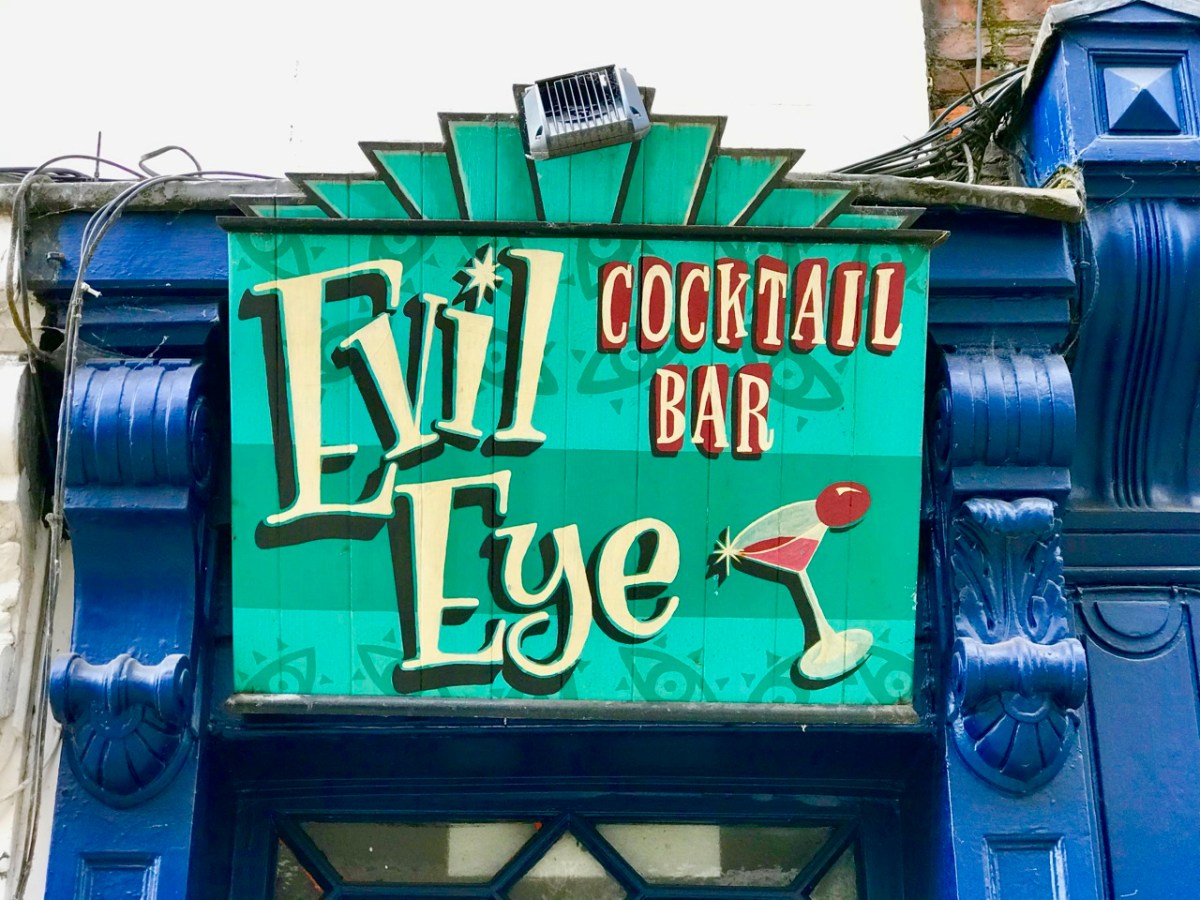
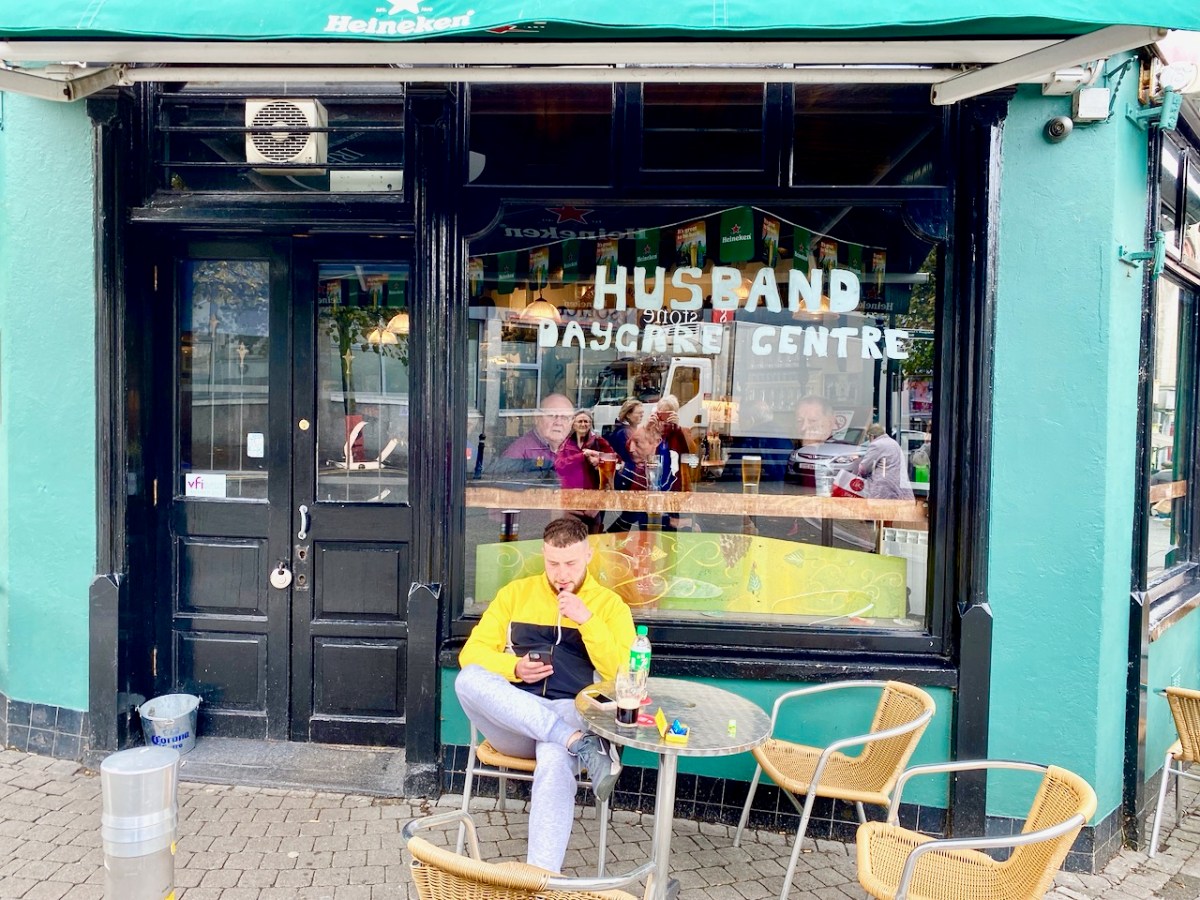
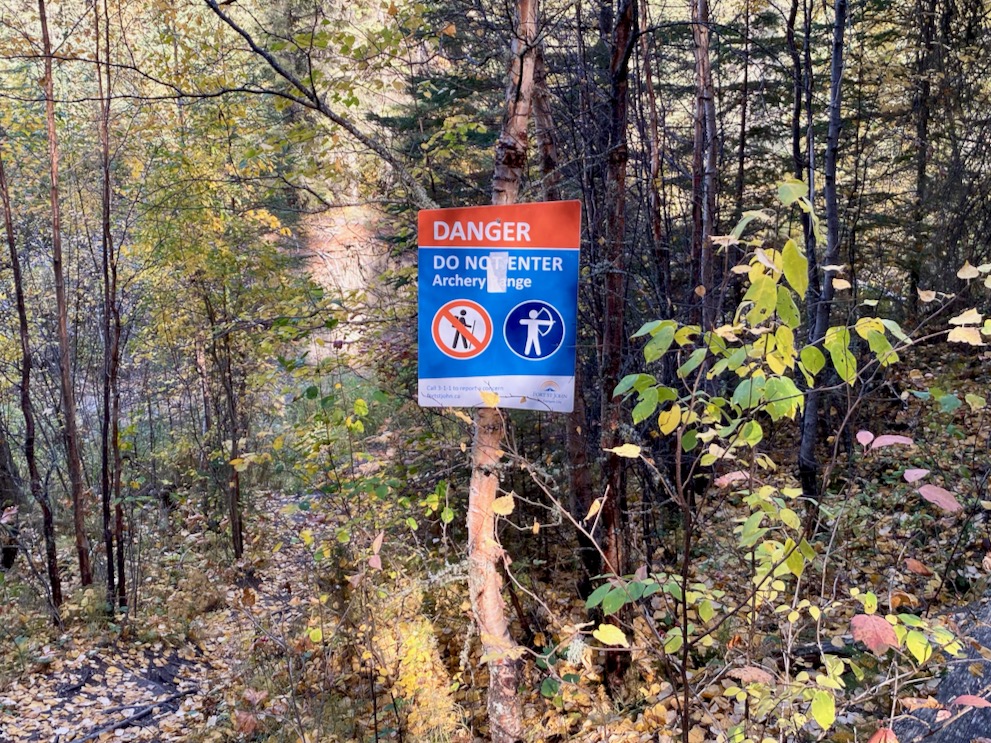
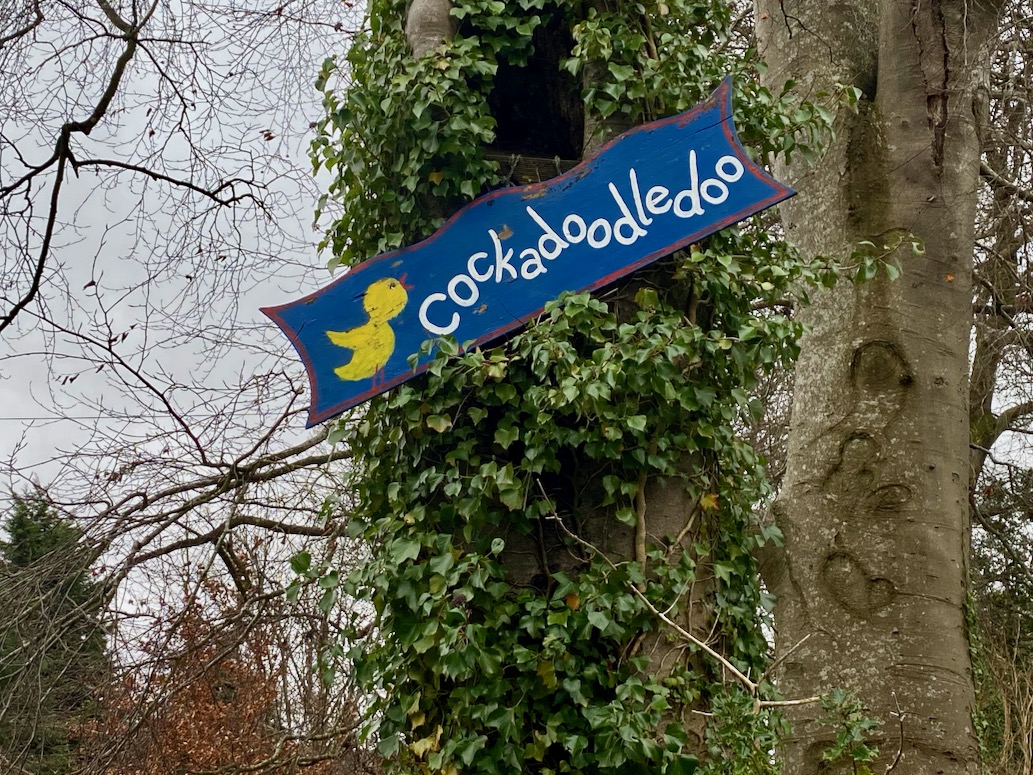
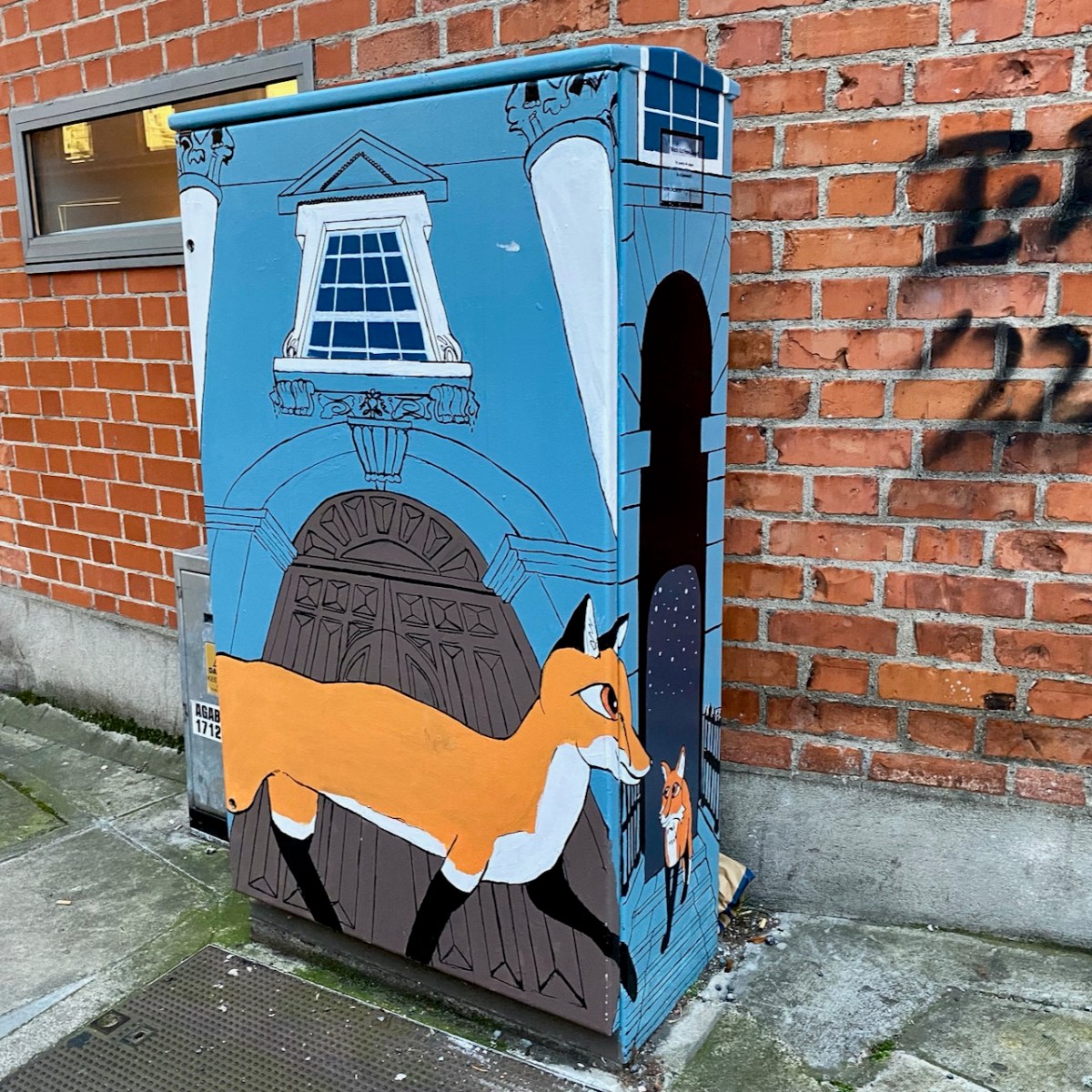
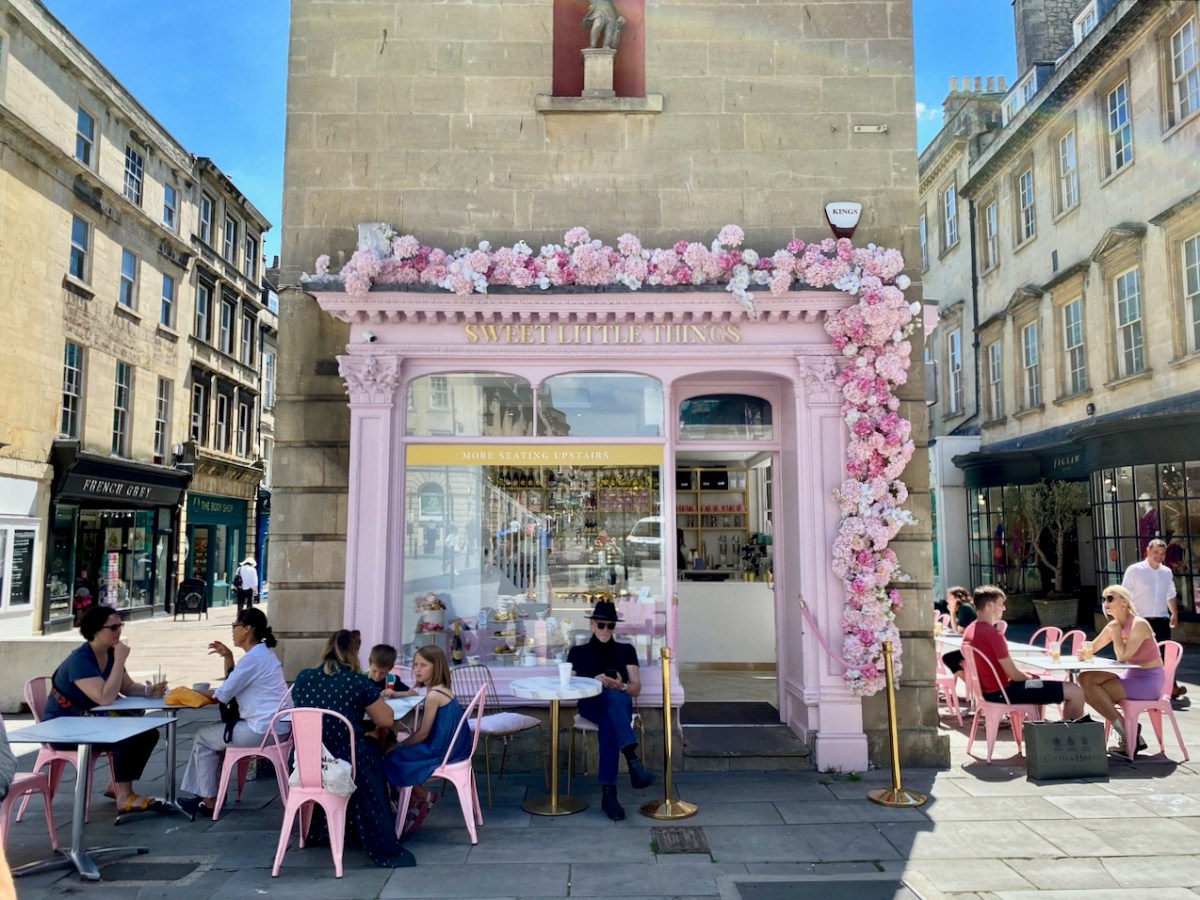
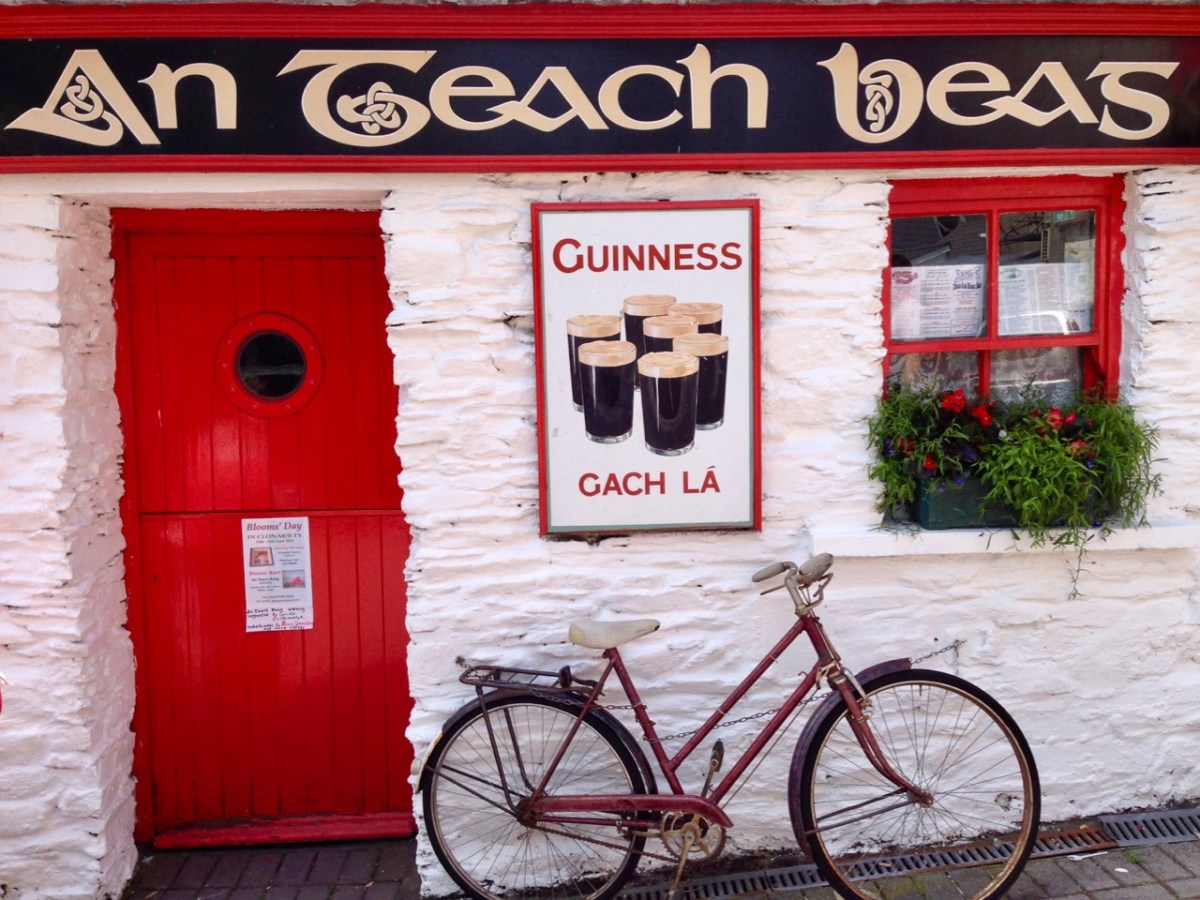
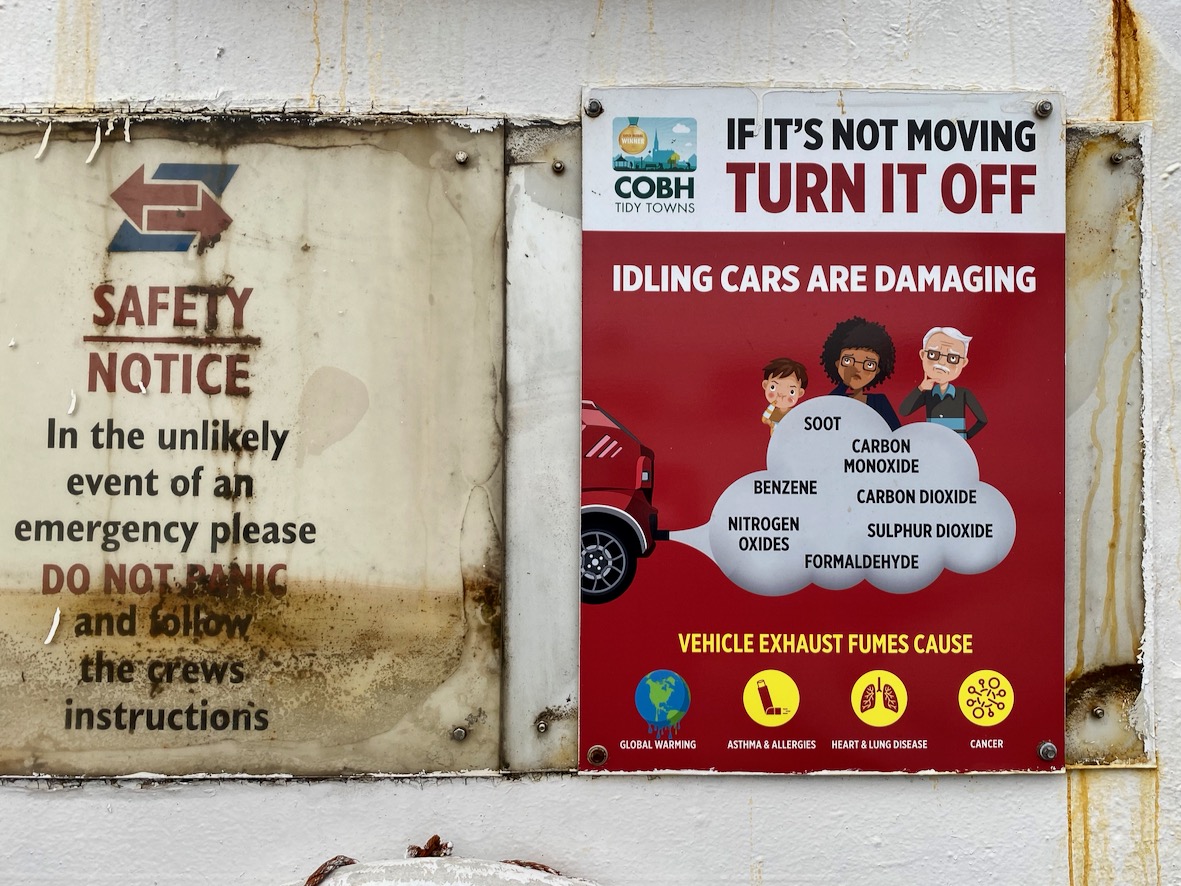
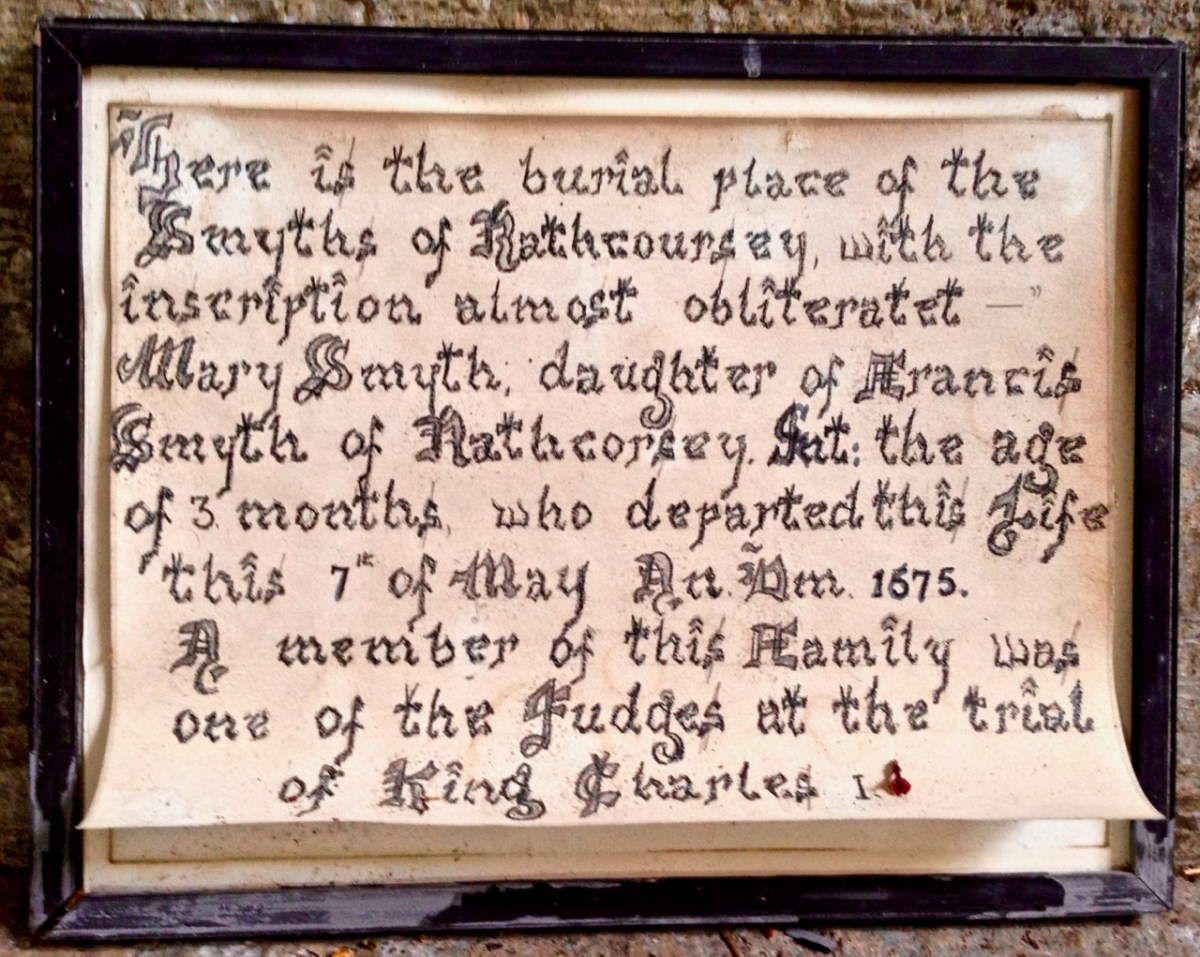
My collections of signs, posters and visual images expands all the time. If I see something quirky, I can’t resist a photo. I share these with you every so often. Today’s selection comes from far and wide: mainly here in Ireland (principally West Cork) with the odd stray from outside. I will only explain something if I feel an image demands it. The example above – from our own Ballydehob – certainly doesn’t, but the one below, which I also came across today in our little village, probably does.
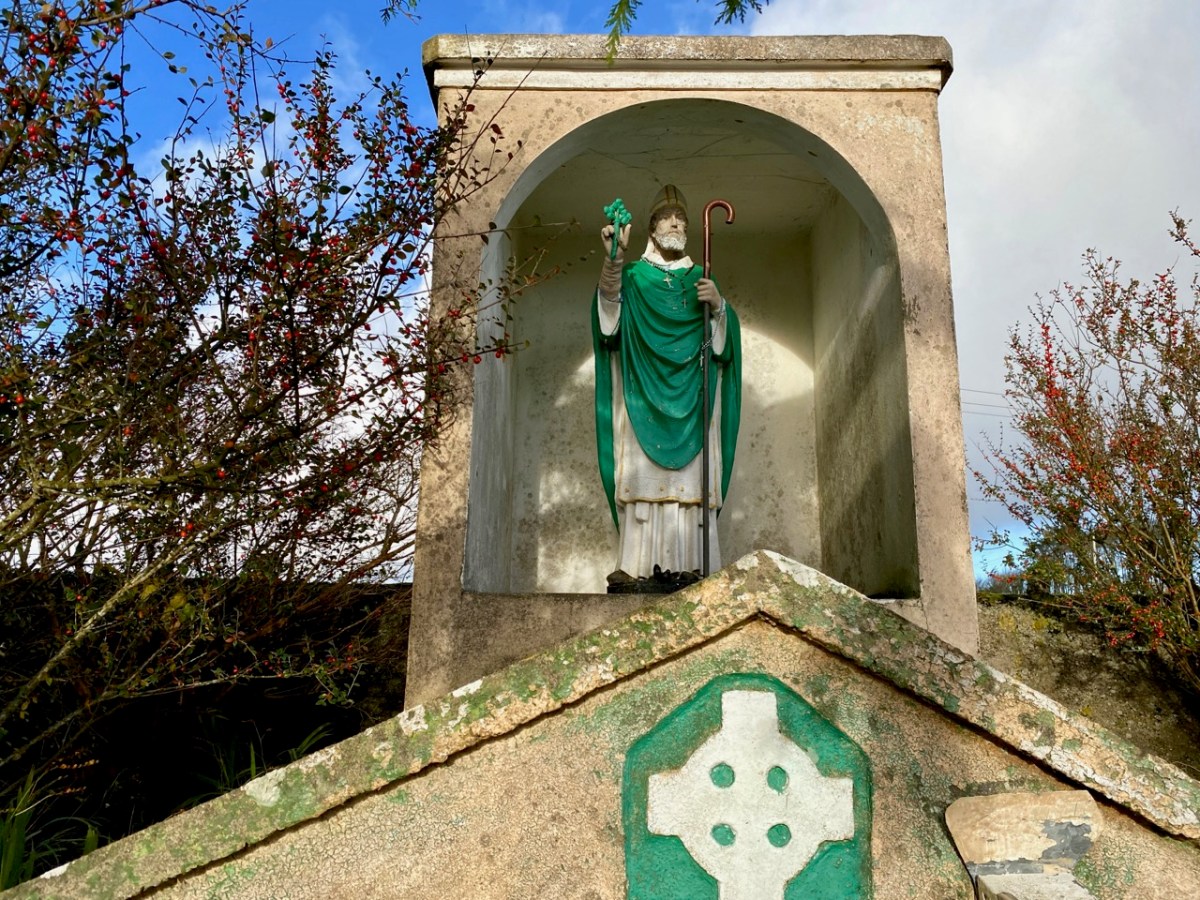
It’s a straw doll representing St Brigid. Often also known as Brídeóg, ‘Breedhoge‘ or ‘Biddy‘, it was once common to see these made to celebrate spring (which traditionally begins on her day, February 1st). This year Ireland has its first ever St Brigid’s bank holiday (tomorrow), to balance out St Patrick’s Day which we have always celebrated around his own feast, March 17th.
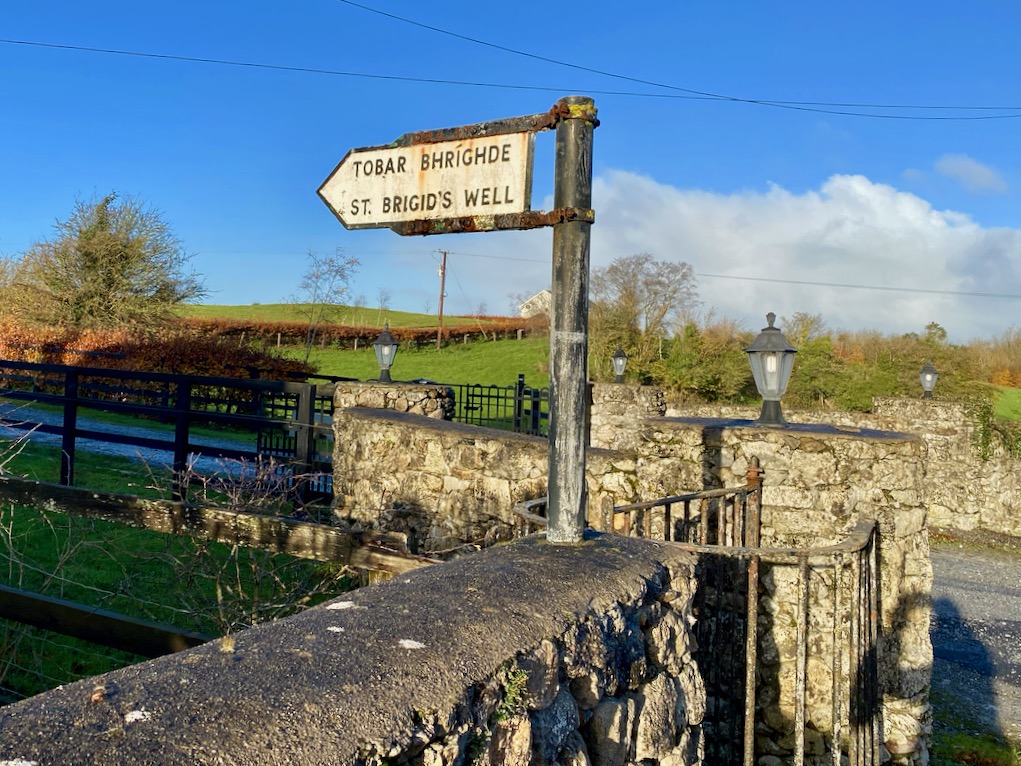
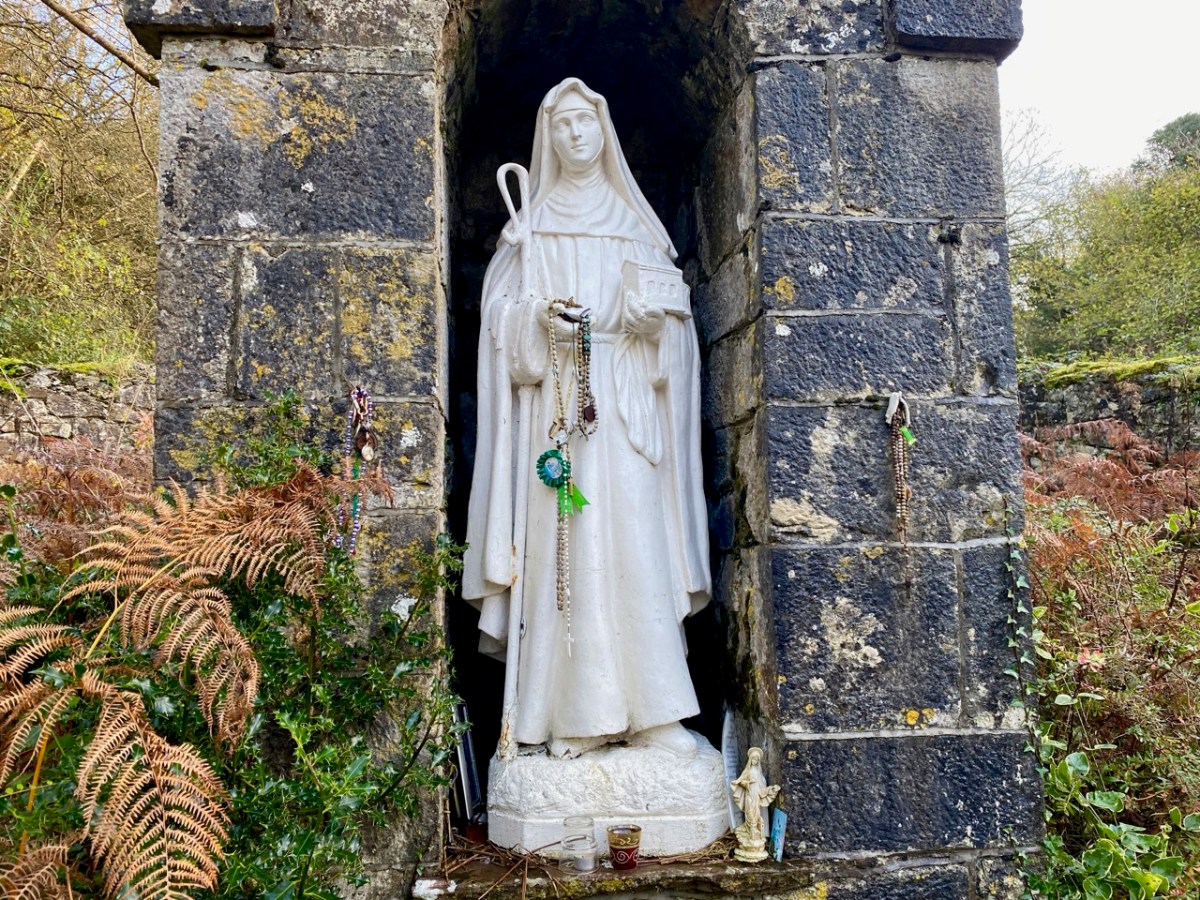
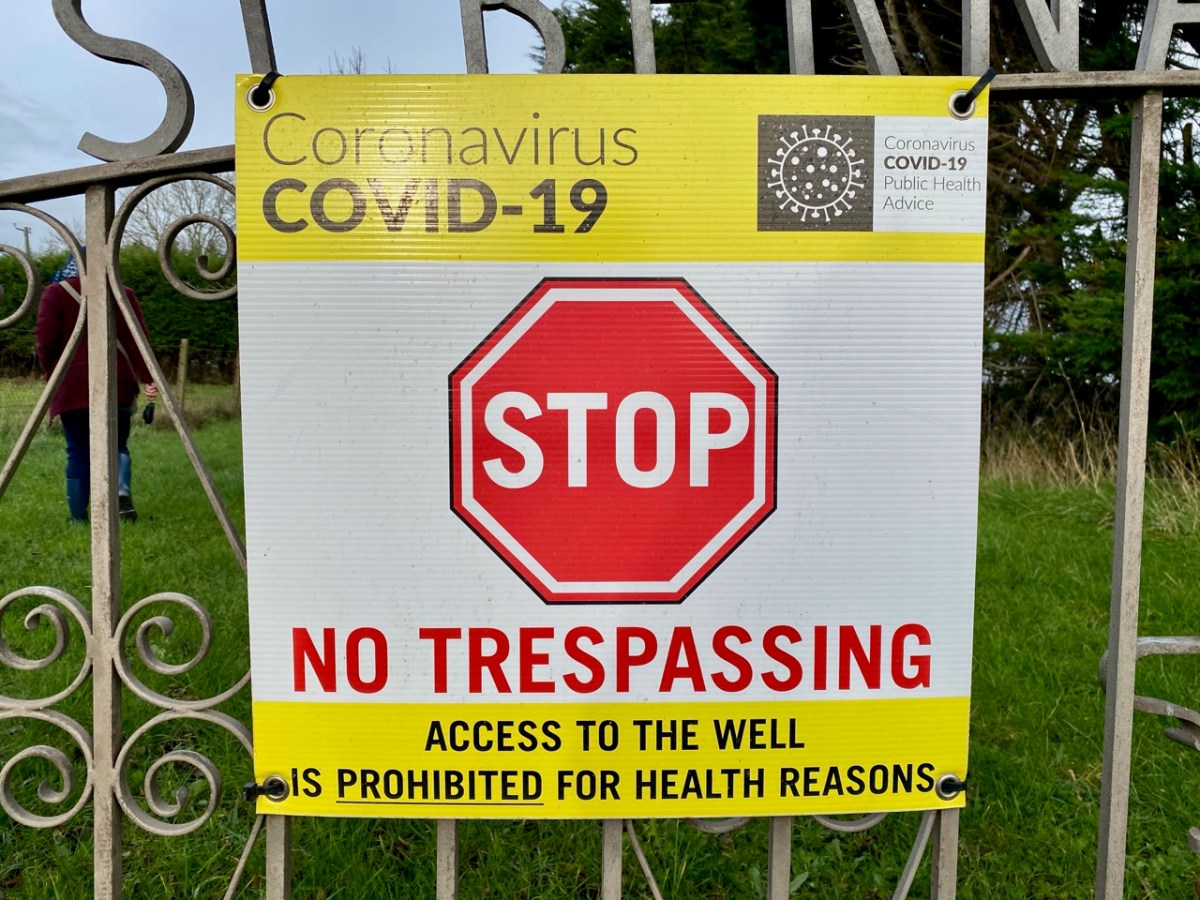
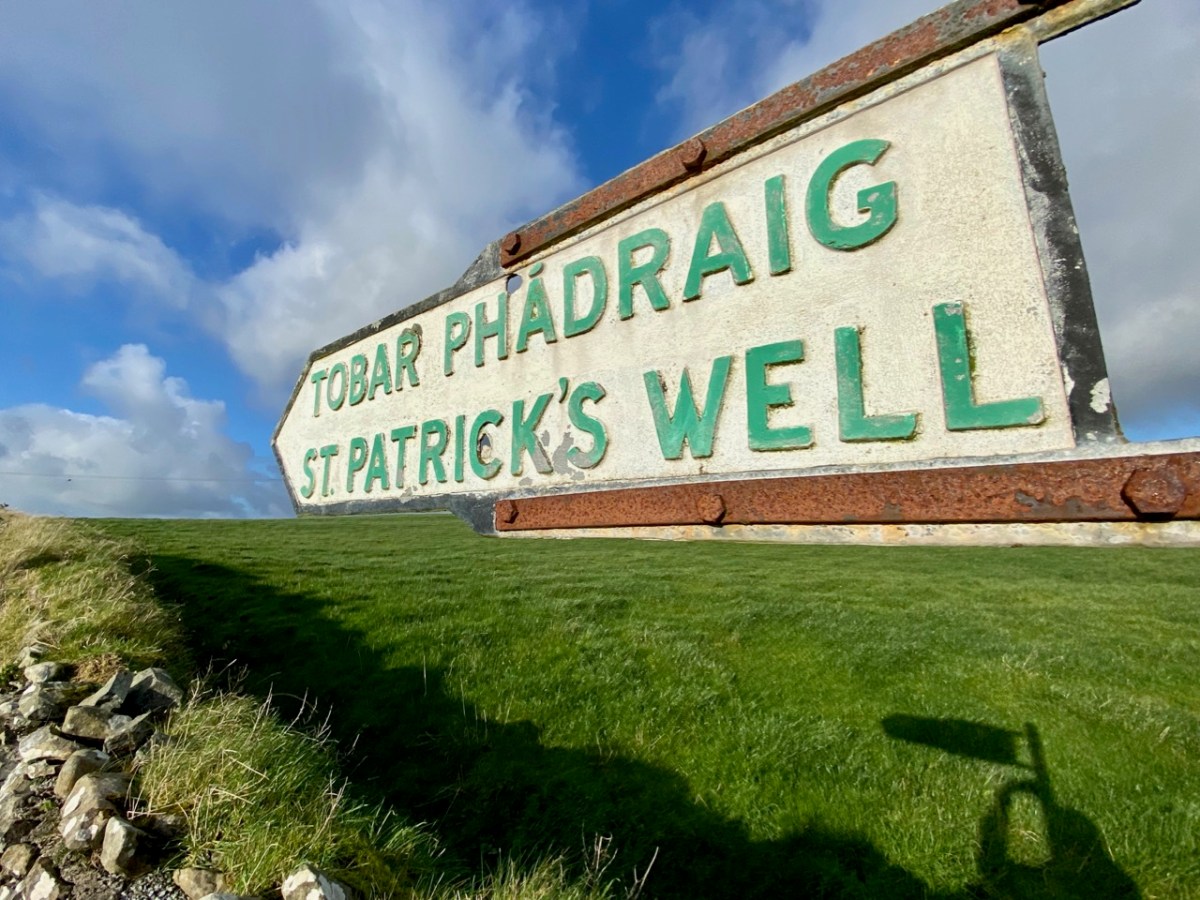
Let’s get back to signs. Wouldn’t you expect that one might visit a holy well for health reasons?
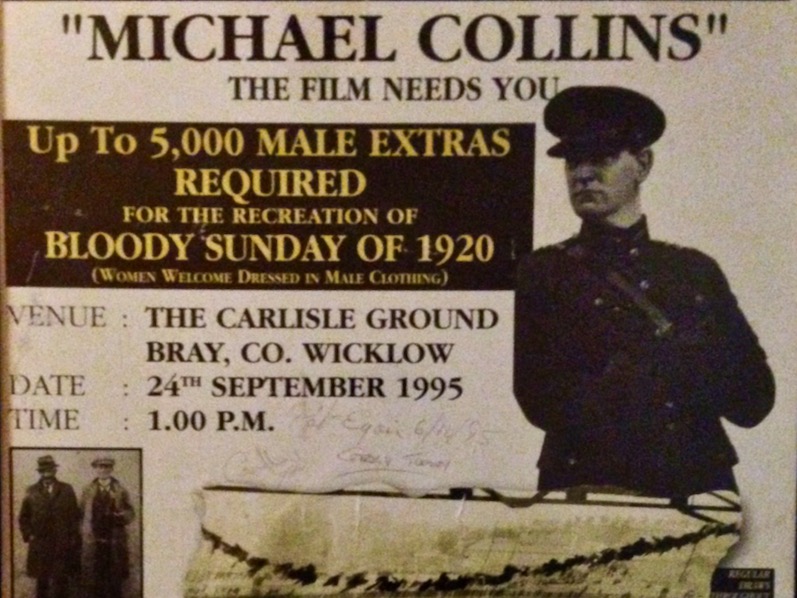
This surviving poster in Bray, Co Wicklow, somewhat irreverently makes light of the Bloody Sunday events of 1920. I can’t help being amused by the little insertion underneath Up To 5,000 Male ExtrasRequired – “Women Welcome Dressed in Male Clothing”.
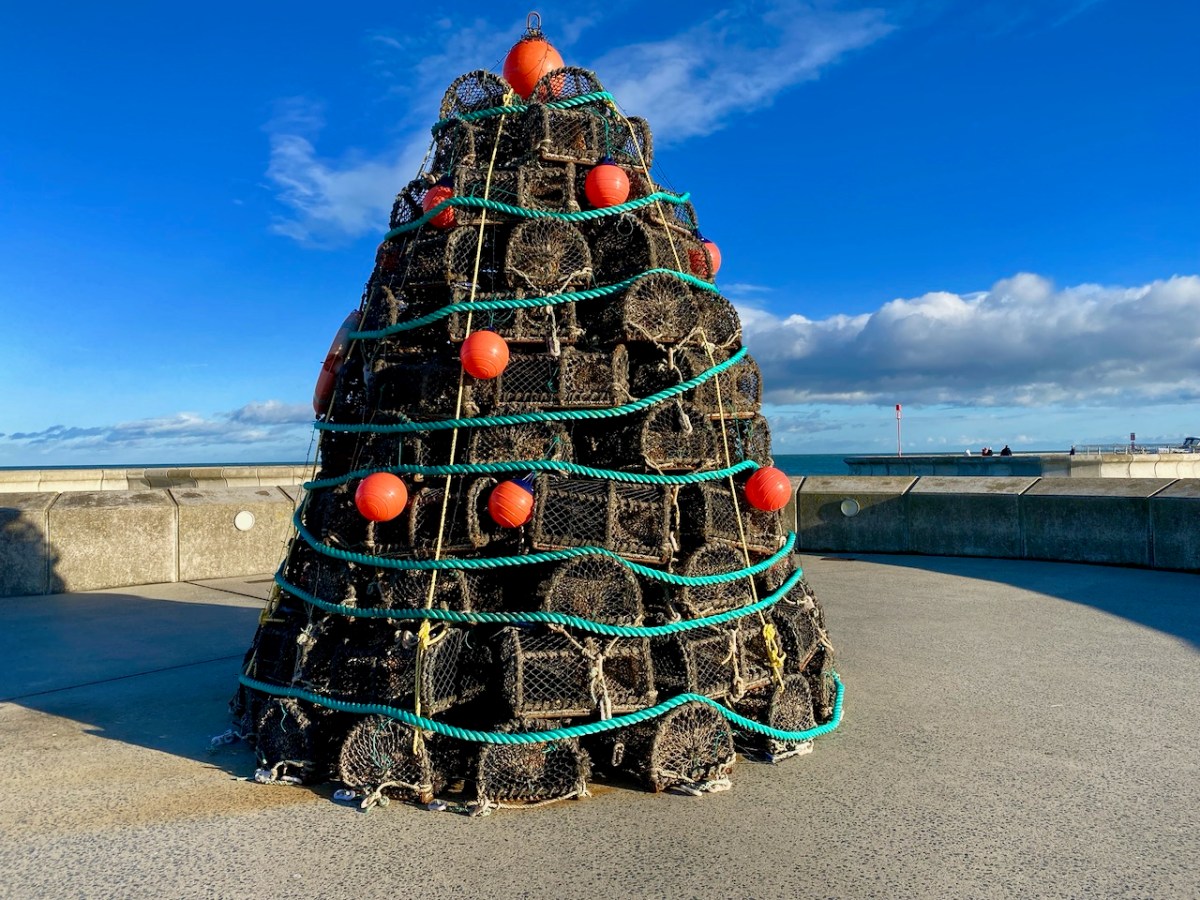
An impressive Christmas tree, built by the artistic fishermen of Greystones, Co Wicklow.
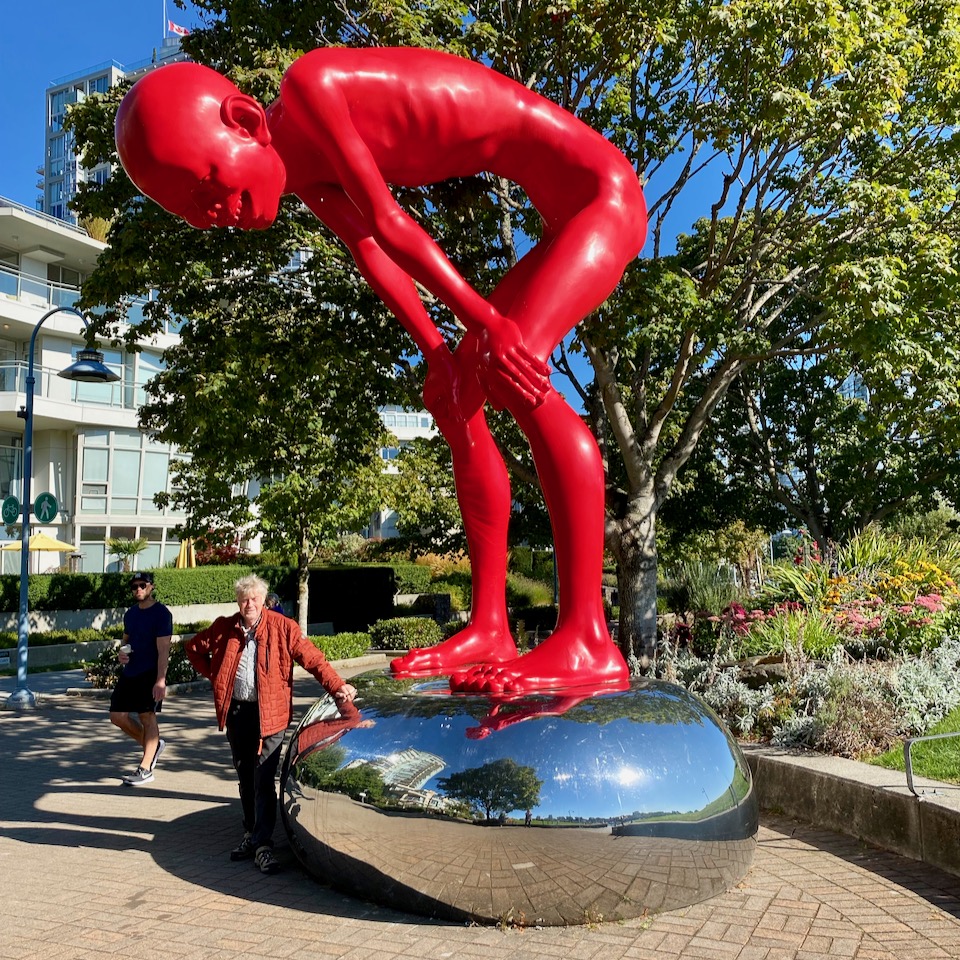
A long way from West Cork, we found this sculpture in False Creek, Vancouver last autumn. Titled “The Proud Youth,” the six metre high figure was created by Chinese sculptor Chen Wenling.
. . . Simple and truthful, this work creates a direct communication between man and nature, and initiates a sincere conversation between people and society. The cheeky expression and arresting pose are a celebratory call to the audiences, inviting them to embrace their inner child . . .
Vancouver Biennale
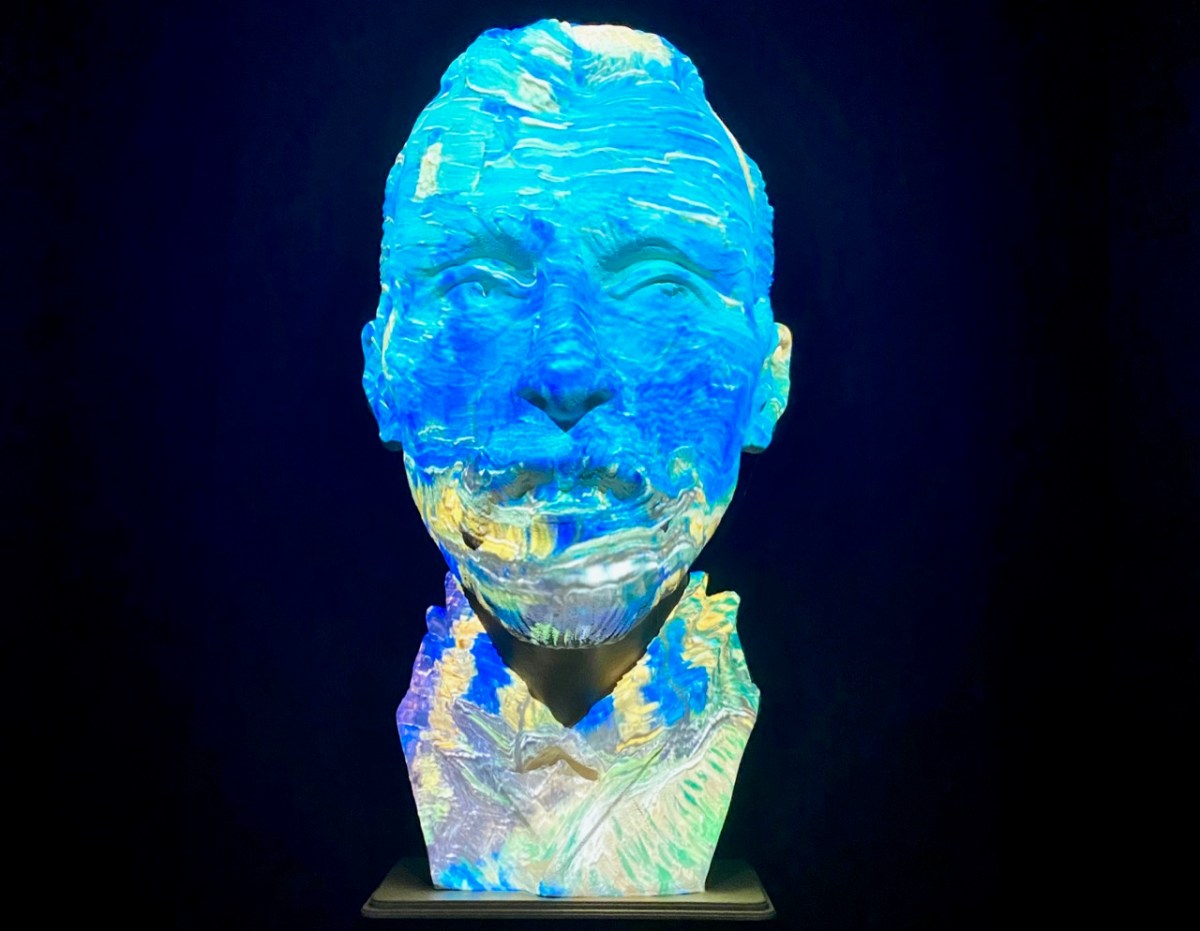
This may seem out of place, but we visited a Van Gogh exhibition while in Dublin recently. Described as an ‘Immersive Experience’ it is quite mind-blowing and we recommend the immersion if you are in the area.
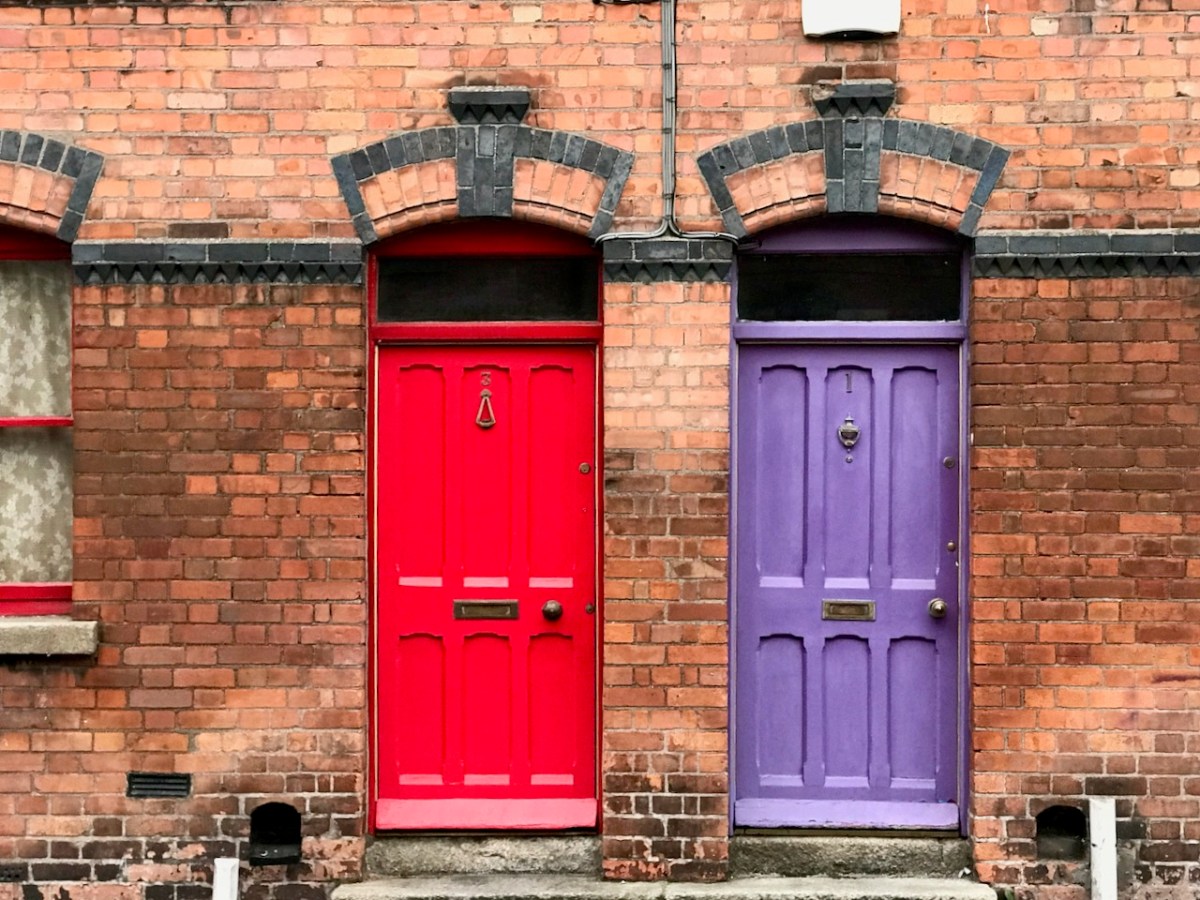
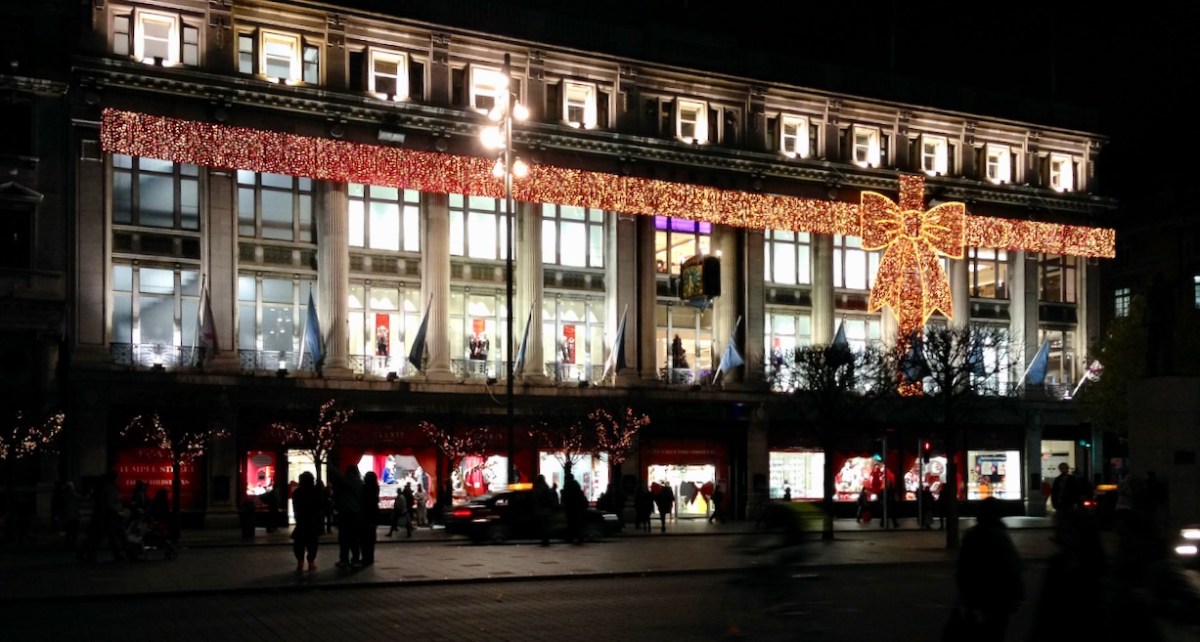
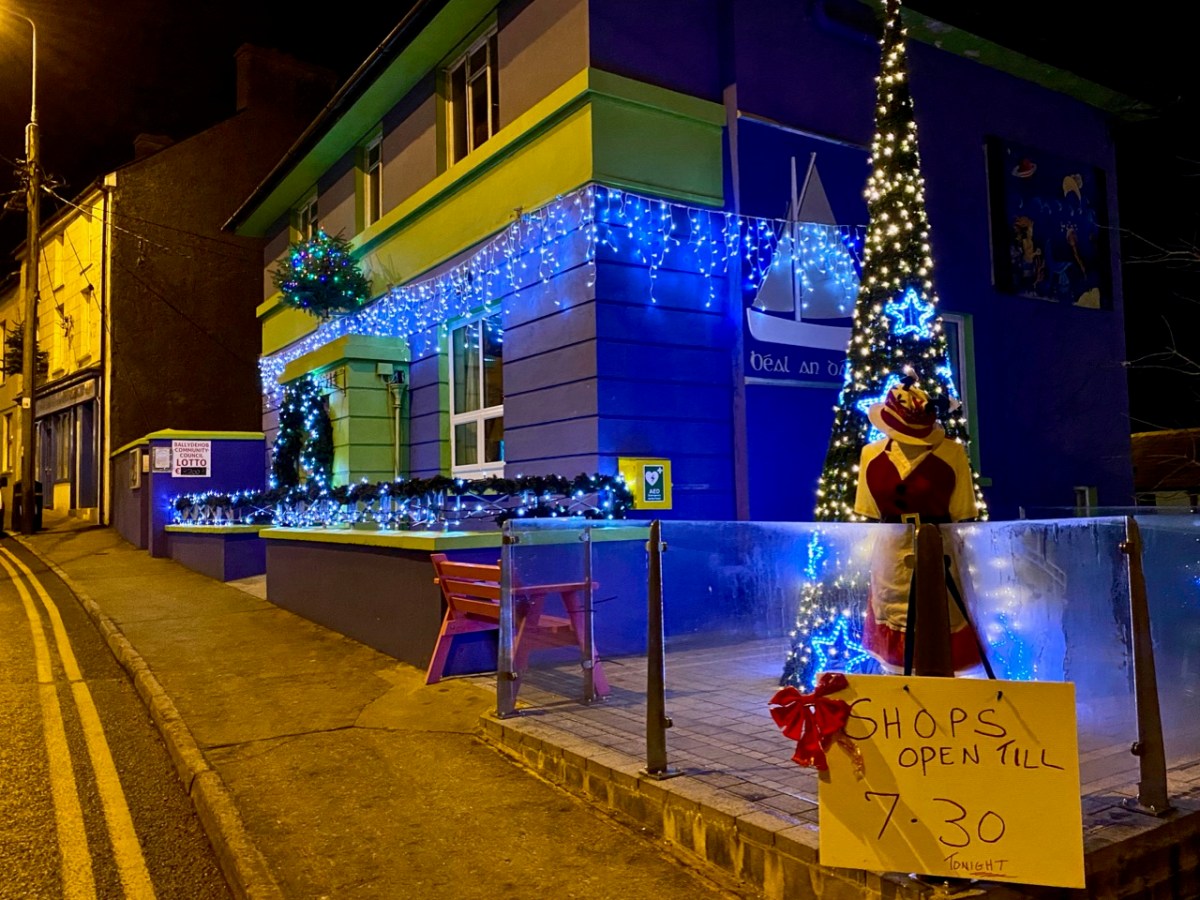
We’ll finish today with some shopfronts decorated for Christmas: in Dublin, and back in picturesque Ballydehob.
We’ve been reading a lot about this new method of generating text using Artificial Intelligence. Apparently, American universities are all of a twitter because students now have a new avenue for not doing the work themselves. An essay generated by ChatGPT is either indistinguishable from good work, or is readily identifiable, according to which account you are reading. We wondered how it would do at generating a blog post for us, so that instead of devoting our time to research, photography, and writing, we can lounge about drinking coffee and playing Wordle.
So – we set ChatGPT this task:
Write an 800 word blog post, illustrated, about the history of West Cork, in Ireland
Here’s what it came up with. What do you think? How accurate is it? Could we pass it off as one of our blog posts? What grade would you give us if it was an assignment for a history course?
West Cork is a region located in the southwestern part of Ireland, known for its rugged coastal landscapes, picturesque villages, and rich cultural heritage. The history of West Cork is a story of resilience, tradition, and change.
The earliest human settlements in West Cork date back to the Mesolithic period, around 8,000 BC. These early inhabitants were hunter-gatherers who left behind evidence of their presence in the form of flint tools and other artifacts. The Neolithic period, around 4,000 BC, saw the arrival of farmers who cleared the land for agriculture and built megalithic tombs and standing stones, such as the famous Drombeg stone circle.
The Bronze Age, around 2,000 BC, saw the arrival of metalworking and the construction of ring forts, such as the one at Cahergal, near Skibbereen. The Iron Age, around 600 BC, saw the arrival of the Celts, who brought with them their own language, culture, and traditions. The Celts established settlements and farms throughout West Cork, and their descendants continue to live in the region to this day.
The arrival of the Vikings in the 9th century AD brought about significant changes to the region. The Vikings established settlements along the coast, such as the one at Baltimore, and they also established trading routes that brought goods and ideas from Europe and beyond. The Vikings were eventually driven out by the Irish, but their legacy can still be seen in the place names and architecture of West Cork.
The Norman invasion of Ireland in the 12th century brought further changes to the region. The Normans established castles and towns, such as the one at Skibbereen, and they also established feudal systems of land ownership and governance. The Normans also brought with them new technologies, such as the water mill, which greatly improved agricultural productivity.
The 16th and 17th centuries saw the arrival of the English, who established plantations and brought with them new forms of religion, law, and governance. The English also brought with them new forms of industry, such as the linen and woolen mills, which brought prosperity to the region. However, the English also imposed harsh laws and taxes on the Irish, leading to widespread poverty and suffering.
The 18th and 19th centuries saw the rise of the Irish nationalist movement, which sought to end English rule and establish an independent Irish nation. The people of West Cork played a key role in this movement, and the region was the site of many important events in Irish history, such as the 1798 rebellion and the 1803 rising.
The 20th century saw the establishment of the Irish Free State in 1922, and the region of West Cork continued to play an important role in Irish politics and culture. The region also saw significant changes in its economy and society, as new technologies and industries, such as tourism and fishing, brought new forms of prosperity and opportunity.
Today, West Cork is a vibrant and diverse region, known for its natural beauty, rich cultural heritage, and friendly people. Visitors to the region can explore its many historical sites, such as the Drombeg stone circle and the Baltimore castle, and enjoy its many outdoor activities, such as hiking, fishing, and sailing. They can also sample the local cuisine, which is renowned for its seafood, dairy products, and traditional Irish dishes.
In conclusion, West Cork’s history is a story of resilience, tradition, and change. From the earliest human settlements to the present day, the people of West Cork have faced and overcome many challenges, and have always remained true to their culture and traditions. Today, West Cork is a vibrant and diverse region, rich in natural beauty, history and culture
Note- no illustrations. OpenAI can give you illustrations, but it’s a whole other process and I got too bogged down in the directions to go far with it. Instead, I asked ChatGPT the following question:
Q: where can I get good photographs of West Cork?
It responded by pointing me to stock photo sites, Instagram and other social media sites, travel sites and blogs. It added, helpfully,
You can also consider visiting West Cork yourself and taking your own photographs of the region. This can be a great way to capture unique, personal images that reflect your own experience of the area.
EDIT
Thanks so much to those who commented. If you don’t know much about the history of West Cork then it might appear that ChatGPT provided some ‘better than expected’ content. But a careful reading will show you that it provided information at a very generic and superficial level.
It was in fact full of errors. A few examples – Drombeg is not Neolithic; ringforts do not date to the Bronze Age; Cahergal is in Kerry, nowhere near Skibbereen; modern historians and archaeologists no longer believe a race called the Celts arrived in Ireland; there is no evidence of a Viking settlement in West Cork, let alone in Baltimore; the Normans did not establish Skibbereen, and we had water mills before they arrived; the idea that the English brought prosperity to the region would be disputed by many historians; the 1798 rebellion was not centred in West Cork; Nothing happened in Cork to support the 1803 rebellion.
Glaring omissions: The Famine does not merit a mention yet was the defining feature of West Cork history in the nineteenth century; Ditto the War of Independence and the Civil War for the 20th century, and the Munster Plantations and the Battle of Kinsale for the 17th.
All in all – a miserable failure. I would give this an F if it was handed in to me by a student. Some of you also commented on the stilted and formulaic language – this would tip off any teacher/professor, surely.
So – I don’t think we’ll be turning to ChatGPT to generate our content any time soon!
Welcome to the UCD Library Cultural Heritage Collections blog. Discover and explore the historical treasures housed within our Archives, Special Collections, National Folklore Collection and Digital Library

 Roaringwater Journal