Art, Noodles and World Championship Turnip Racing: West Cork in the Summer

We’ve been enjoying a week of laid back excursions, In Ballydehob and Skibbereen, as we take time this week to enjoy what’s around us in West Cork at this time of year.

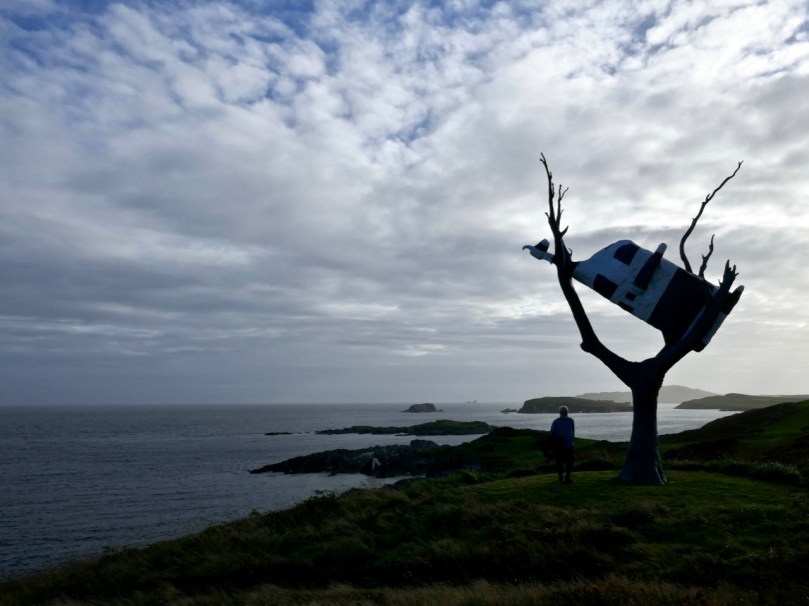
Top, above and below from the West Cork Creates Exhibition: Alison Ospina’s chaise with Anne Kiely textiles; Angela Fewer paintings; Trees by Jim Turner and Etain Hickey

There are always excellent art exhibitions in the summer – we have written this summer already  about the always interesting Blue House Gallery and Judi Whitton’s watercolours, the marvellous art trail in the Skibbereen Arts Festival and of course the Ballydehob Arts Museum’s current exhibition, Ballydehob on Bahnhofstrasse.

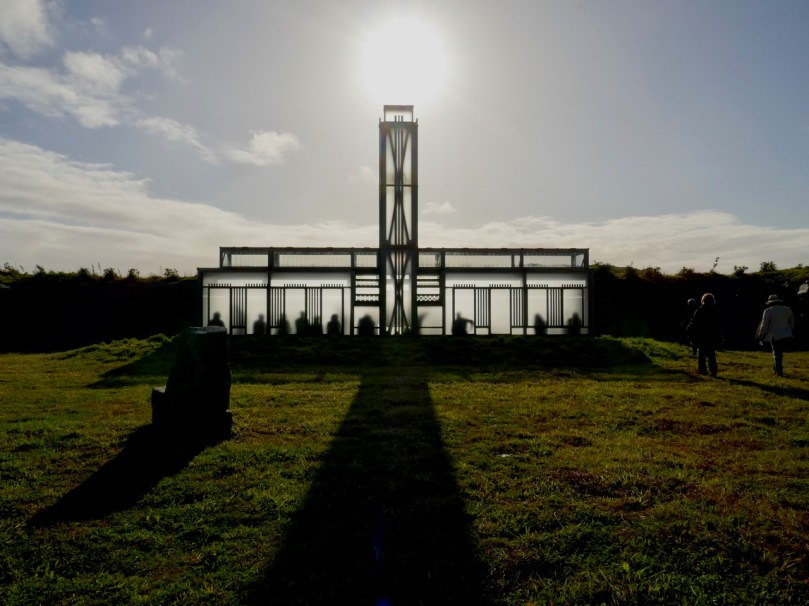
This week saw the opening of what’s always eagerly anticipated – the annual West Cork Creates exhibition on Skibbereen. Curated by Alison Ospina of Greenwood Chairs, this show brings together the best of West Cork arts and crafts in an exciting mix of styles and materials.

Lots of jewellery at the exhibition and among them is this unique dresser pendant by Michael Duerden

Next to it is Geoff Greenham and Melanie Black’s Creative Spaces, a photographic journey through the studios of artists currently practising in West Cork. It’s a great idea and feels like a real privilege to catch a glimpse inside these spaces.

The two images above are borrowed, with thanks, from the Blue House Gallery, where an earlier exhibition matched the studio images with pieces of art from each artist. The first shows Brian Lalor’s studio and the second is that of John Doherty.

And yes, I thought, somehow those spaces do reflect the art that comes out of them. I’ve tried to photograph artists’ studios myself in the last couple of years, so I know how difficult it is to capture the essence.

No studio needed when you paint en plein air. This is Damaris Lysaght at work at a site we wrote about in our post Mizen Magic 13: Dunmanus Promontory

Do catch these two exhibitions if you can. Then make your way to Ballydehob and take in the new space that is the Working Artist Studios, right on the Main Street. We’ve all been looking forward to the opening of this venture, previously situated in Skibbereen but now adding to the thriving streetscape of Ballydehob.

The grand opening was well attended! (The railings are not for the WAS but for the Turnip Races, see below)

Working Artist Studio is an innovative idea that melds gallery and performance space with studios for artists at reasonable rates. Pól and Marie are bursting with ideas and plans and it’s wonderful to see this shop and house, surprisingly roomy inside, so nicely re-purposed.

The opening exhibition was by Caoimhe Pendred (above), titled Hy Brasil – her ethereal take on the notion of the mystical Isle to the West. It was opened by none other than Tim Pat Coogan (below), the Irish historian, and Caoimhe’s grandfather.

But woman cannot live on art alone, and we were delighted to welcome back Bia Rebel Ramen to our village this summer after a stint at the Taste of West Cork here a couple of years ago. Brian and Jenny have made a name for themselves with top restaurant critics as the best place in Ireland for ramen.

The truck is set up to serve the food at Levis’s Corner house. They are only here for a few more days

They normally operate out of their food truck in Belfast,  but are on ‘holidays’ in West Cork. Some holiday – they are so busy that they run out of food on a couple of hours. What can we do to entice them to stay here permanently? This is the best ramen I have ever eaten, and having lived in Vancouver (Canadian home of Japanese food) that is saying something!

Did you know that Ballydehob hosts the World Championship Turnip Races? This Irish Times article in 2006 described it, and 13 years later it’s still going strong and still great fun, with Barry O’Brien (below in the pink shirt) doing the marshalling.

And to round out my week, a major thrill. I hitched a ride on my friend Jack O’Keefe’s Drascombe Lugger as he participated in the Ballydehob Crinniú na mBád. I wrote about this wonderful event a couple of years ago, but it was a whole other experience to be out on the water with the boats as they gathered at the mouth of Ballydehob Bay and then sailed up the estuary. See Robert’s post today, Ballydehob and Boats, for some more of my photographs of this event.

All around us summer is in full swing – we have just mentioned a tiny fraction of what’s going on. Why don’t you join us next year? We can’t guarantee good weather, but you won’t be bored!
Mizening

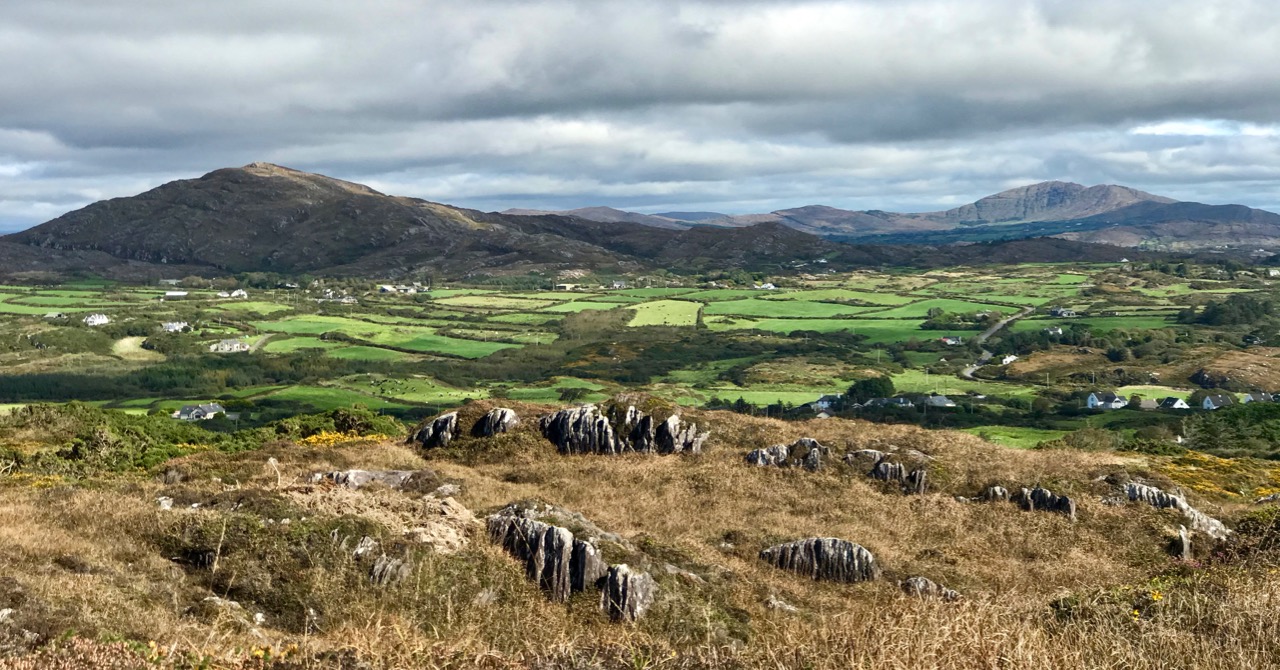
What do you do when a fine day dawns and you want something totally relaxing? You go Mizening, of course! OK, it’s not a real word, but it should be – for the act of wandering at will around our wonderful peninsula.

We’ve been tied up a lot lately with the West Cork History Festival – it was a great success, by the way, with a wide variety of speakers and topics. We really enjoyed leading two of the field trips, including one that involved much dodging rain showers. But now it’s time to get back to our true avocation – meandering lazily around our own patch of heaven.
So what follows is a record of a blissful day on the Mizen, doing not much of anything, drinking coffee, visiting new friends, observing the wildlife, popping into the Blue House Gallery – well, you get the picture.
Those new friends? Judi and Pete Whitton, both artists, with a home and Gallery near Schull. Judi and I felt we knew each other already although we had never met in person, just through the wonders of the internet. She has a gorgeous show, Easel in the Ditch, running at the moment (follow the signs from Lowertown) – we were bowled over by her beautiful watercolours.

Above – Newcourt Bridge – Judi had seen my post on this ‘hidden wonder’ of West Cork and had to paint it

Then it was off for a walk in the countryside. You think you’ve been down all the little roads before, but there are always surprises.

Cobwebs in an abandoned church

It’s August now and many of the flowers have finished blooming, but others have come along to take over and the boreens are still a delight.

We’ve had an invasion of Painted Lady butterflies. Normally, this is a phenomenon that happens once a decade, but it’s starting to happen more often now, and scientists feel it may be down to general climate warming. The butterflies are especially attracted to the Knapweed, which is abundant, although they have to compete with the bees for it.

We were seeing lots of dragonflies too, although they wouldn’t stay still enough to allow a photograph – I finally snuck up on this one (above, both images), which it turns out is a Ruddy Darter. Well named!

After more obligatory wildflower photography (example above, Eyebright), we dropped into Schull to see the latest Exhibition at the Blue House Gallery. Titled cleverly Blau Haus/Bauhaus, the downstairs show is based on the Bauhaus, the German arts, crafts and design school, founded a hundred years ago, that dragged us all into the twentieth century, .

A tiny taster of the Bauhaus-inspired pieces above – a detail from a tall fused glass and bronze collaboration by Angela Brady and Holger Lönze, and a teapot by David Seeger

Upstairs was an entirely different show – The Drawn Line, curated by Catherine Weld. I was particularly taken with this line drawing by Christina Todesco-Kelly, titled simply Satchel.

A lovely day! I did mention coffee, so I will end with a detail from Judi Whitton’s portrayal of our favourite local, place to get coffee (or lunch or dinner!) – Budd’s of Ballydehob. It captures so well what Mizening is all about and it’s the first thing we see as we approach Ballydehob from Nead an Iolair.


Writing on the Walls!

During our travels around Ireland I have been noticing – and recording – some very striking street art, particularly a number of eyecatching murals, such as the one above in Killorglin. If that place-name sounds familiar, it could be because I have mentioned in the past the town’s great event of the year – Puck Fair – which is taking place right now! But – you might say – that’s all about a goat, so why the honeycomb? I’m afraid I can’t answer that, but I can show you that goat, brilliantly painted on a nearby wall:

The month of August is called Lúnasa in Ireland. In past days, because it heralded the harvest – and, hopefully, a good one – it was an important time for festivals and fairs. On my bookshelf is a large volume (707 pages) all about The Festival of Lughnasa – subtitled: A Study of the Survival of the Celtic Festival of the Beginning of Harvest, written by Máire MacNeill and published in 1962. It’s one of the most comprehensive works on Irish folklore that I have yet come across. I started reading it two years ago, and haven’t finished yet! But I’m beginning to understand the significance of this season.

This one – half hidden in a passageway in Dalkey – reminds me of the works of Banksy, the elusive street artist in Britain, whose images are always political. I’m not sure if there’s a message behind the portrayal, but it was an unexpected find.

There’s a definite message in the one above, however: also in Killorglin. Some of the murals we have seen have been very arresting – impossible to ignore, in fact. These two (below) were seen in Waterford City – you’d think they are probably related to each other, but I can’t find out who made them (edit – I now know they were made by Smugone – see the comments to this post – many thanks, Dave). Waterford is THE place to see street art, during the Waterford Walls Festival between August 22nd and 25th this year. We might get along to that.

Anyone who was interested in my post of last week, illustrating Finola’s special window, might like to see this mosaic mural inspired by the Children of Lir story – it’s in County Antrim.

These murals are real works of art. Other murals are, perhaps, more decorative – with the purpose of brightening up an otherwise blank wall within a streetscape; or the means to get local information across. For me, all are collectible.

There are murals with connections to local lore and custom. The one below in Dingle has references to the curraghs of the Blasket islanders, while further down are aspects of Ireland’s  traditions and culture: mermaid and musicians.

Not forgetting poetry! Last week we saw the anniversary of the death of poet Francis Ledwidge: he died at Ypres in the Great War, on July 31st 1917 at the age of 29. There is a museum dedicated to him in the house where he was born in Slane, Co Meath, and this mural commemorates him:

Finola has written at length on present-day Ireland’s love of colour in towns and countryside. I’m all for it! Why not be vivid and exuberant, especially in a climate which has been noted for its propensity towards grey days (although I must say Irish weather seems to have take a turn for the brighter recently)? Let’s celebrate – get out the paint!

Art in the Landscape

I’ve always thought of myself as someone without an artistic bone in her body – although when you say things like that people always rush in to assure you that everyone has the potential to tap into an artistic streak if they just let themselves be free enough. Harumph, I say. But today they proved me wrong.

The idea for a workshop grew from the Ballydehob Arts Museum planning group. Robert has written a lot about BAM and so our readers know that it is a celebration of the iconic era when artists of all kinds settled in Ballydehob and turned it into a thriving centre of creativity. What animated those early artists? By their own accounts, it was the landscape around them, the light, the natural world they found here in West Cork. So why not try something based on that idea – and so the Art in the Landscape Workshop idea was born and to everyone’s astonishment it filled up right away, with a waiting list.

The day (today) started with an introduction to the artists of BAM by Brian Lalor (above), writer and artist and BAM Curator, who talked about the motivations and inspirations of the original group of artists and showed us some of their work, their use of earth tones and natural images.

Then it was out into the landscape itself – and we didn’t have to go far! Ballydehob is really fortunate to have, right in the village, leafy little roads with walls and hedgebanks loaded with wild plants. The leaders for this part were myself and Toma McCullim, artist and educator. (I’ve written about Toma before and her wonderful project 110 Skibbereen Girls.) Turns out, Toma is a bit of a herbalist – she knew culinary or healthful uses for much of what we looked at, while I filled in the rest with wildflower identifications and background. We walked, we talked and we gathered.

We almost dodged the forecasted rain and when it came Marie resorted to a tried and tested bit of protection

After lunch came the printmaking. Toma had assured us all that even if we had never done anything like this before, by the end of the day we would all go home with something we were delighted with. And it was true! She walked us through a seemingly simple, but actually quite sophisticated printmaking technique and then set us to work.

It was really fun to see the creative juices flowing, as well as the laughter and the chat. Before long everyone was covered in colourful (and thankfully water-soluble) paint and prints were starting to appear.

Louise and her botanical print

Some people took a long time considering compositions and produced two or three: others got into the swing of the process and produced many. And Toma was right – we were all delighted with our finished products.

Upper, Bobbins and her positive print and lower, Elizabeth and her negative one. Below, Annie with her china blue 

Everybody chose one print to leave behind. Those prints will go on exhibition during Heritage Week, including the one I made. OK, it’s not actually a Work of Art, but it felt great to be able to produce something that I’m proud of by working with material I love. Thank you, Toma, Brian and all the workshoppers for a great experience!

Moments on Heir

You will often find us visiting the inhabited islands of Roaringwater Bay. They are, after all, in full view of the panorama we see from our perch up here in Nead an Iolair (Eagle’s Nest), and easily accessible by regular ferry services. We like them because – who doesn’t enjoy a boat trip? Also, that little step from the mainland removes you to another world: places where life is lived a little differently, where you can feel slightly remote from the the most pressing issues of life, a little bit ‘on the edge’. Cape Clear, Sherkin, Long island – we have written about them all. And, today’s subject, Hare, or Heir: we have been there before but last week Finola was leading a wildflower walk on the island, and I went along for the ride, and a further exploration.

Colour on Heir: upper – Heir hedgerow, where wildflowers and garden escapees mix happily together; lower – Finola’s band of wildflower enthusiasts get caught up on the minutiae of the beach flora

It was a mixed, breezy day on the island, but dry for the group – two ferry loads and some furry four-footed minders to keep us all in order. Much time was spent poring over a myriad of plant species, some of which flourish on the West Cork islands more prolifically than on the mainland. I was interested in the land- and sea-scapes which changed quite dramatically with the movements of the tides.

Tides in and out: these two pictures near the wester end of Heir Island were taken within four minutes of each other!

A word about the island’s name: often seen on maps and signposts as ‘Hare Island’ (which of course makes my own long ears prick up!) it is supposed to have nothing to do with the animal. Today, the islanders will tell you that it derives from the past ownership of the lands by the O’Driscoll clan, and should be called Inis Uí Drisceoil (O’Driscoll Island) or Inis an Oidhre (Island of the inheritance – ie, of the O’Driscolls – or heir), hence the more usual modern name.

Yes, you can get pizzas and coffee on the island in the summer!

So is this island really a ‘Paradise’, as Finola called it in her earliest post? Undoubtedly! Away from the busy harbour it’s profoundly peaceful: bees, butterflies and wild birds are abundant. But it’s also haunted – as are the other islands of Roaringwater Bay. The past is always around you: reminders of a time when the population was far greater. The first official Irish census of 1841 showed a population of 358. The famine years caused fluctuations but in 1901 there were still 317 people living permanently on the island. Today this number has reduced to around 30 full-time residents, although there are many holiday homes on the island, and the summer population in present times can approach 150. This helps to support a cafe (above) and a restaurant (Island Cottage).

Island history: upper – Field of the Graveyard commemorates the burial of unbaptised children; lower – the Island School closed in 1976, when the resident population was around 50

Artist Christine Thery has been a full-time resident on the island for many years; her husband Gubby Williams helps with the ferry and has designed and built ‘Heir Island Sloops’. Christine is an active environmentalist and keenly involved in ensuring that Heir is sustainable and responsible in caring for its natural habitats; she was instrumental in organising Finola’s Wildflower Walk. Here is some of her work in her studio:

Heir is only a five minute ferry ride from Cunnamore Pier, yet the mainland seems a distant place once you are imbued with the innate atmosphere of island existence. The views from the north side of the island are dominated by Mount Gabriel, (pictures above). Five minutes – yet it seems such a step away from everyday life: long may beautiful Heir continue to support its fragile but tenacious resident population.

The Finola Window

You will all know about Finola’s interest in stained glass, and in particular her admiration of the work of artist George Walsh: she wrote an article about him in the Irish Arts Review this year. So I hatched a plan, together with George, to give her a window of her very own! Here it is, just installed in our house, Nead an Iolair. Not so long ago, Finola wrote another Irish Arts Review piece about Ireland’s newest stained glass window, and there’s a Roaringwater Journal post about it here. I think it’s safe to say – as of today – we have in our house Ireland’s new ‘newest stained glass window’! It’s an artwork with a story – several stories, in fact. I’ll tell you some of them.

This is George Walsh. He apprenticed in the world of stained glass under his father – also George – who apprenticed under Harry Clarke, so he has an eminent lineage. He worked with his father in the United States and Ireland, and eventually set up his own Dublin studio, where he has been prolific. Finola is currently visiting and cataloguing every one of his publicly accessible projects which can be seen on the island of Ireland: it takes us to some far-off and fascinating places. To date her list includes 61 buildings which have George Walsh windows, and it’s certainly not complete.  While most of George’s work can be found in churches, he has also produced a secular opus and our window has now added to that. George says that he enjoyed this commission because it was very different from so much of his work, but I guess that he always enjoys his work – you can tell by the exuberance, dynamism and sumptuous colouring of his pieces.

The Finola Window tells the story of our Finola, but is also about a famous Finola (or Fionnghuala – fair-shouldered) in Irish mythology: she is the heroine of The Children of Lir, one of Ireland’s most well-known ancient wonder-tales. Fionnghuala (above, being transformed into a swan) is the eldest of the four children of King Lir – the others are Aodh and twins Fiachra and Conn. Their mother, Aobh, died when they were young and the King remarried. Unfortunately, this is where the story turns into a wicked stepmother tale, as the King’s new wife, Aoife, becomes jealous of the children, and casts a magic spell on them. I hope you are keeping up with these names! Our Finola – a stepmother herself – has always been sensitive about negative portrayals of that position, so I asked George to play down the role of Aoife and in fact he has left her out of the window altogether. I’ll just let you know, however, that she received full punishment for her malice by being turned into a Demon of the Air – and she still hangs around on dark, haunted nights. Watch out!

All four children were turned into swans by Aoife, and their fate was to spend three hundred years on Loch Dairbhreach (a lake in Co Westmeath), followed by three hundred years on Sruth na Maoilé (the stormy Straits of Moyle between Ireland and Scotland), and a further three hundred on Inis Gluairé (an Atlantic island in Erris, Co Mayo). The swans kept their human voices and they spent much of their exile singing beautiful songs which became all the traditional music of Ireland.

George has skilfully woven into this window many elements of our Finola’s life: in the details above you can see Newgrange – where Finola dug as a student; Irish rock art – which was Finola’s main area of study as an archaeologist; my hands playing my concertina (all the musical notes are descending from the swans); eagles flying over Nead an Iolair; the Scholar and his Cat Pangur Bán (the Irish medieval poem is one of Finola’s favourites); St Brendan’s voyage (Finola is  a great teller of the tales of Irish Saints) and – of course (at my specific request) a golden hare! George Walsh has always been a master of detail, something we have particularly admired in his work. We feel he has excelled himself here. These images are some of the resources given to George while he was making the window:

Image gallery for George – top: Finola’s 1973 drawing of a piece of Kerry rock art; centre – the flight of the eagles over Nead an Iolair; lower – my hands playing music from the swans through my concertina!

I was privileged to see some of the work in progress in George’s studio earlier in the year. He showed me how he uses ‘flashed glass’ where a thin layer of coloured glass is melted on to clear glass. Acid etching is used to take off the coloured surface leaving a design. You can see where the etched piece (below) is being prepared to fit in the ‘jigsaw puzzle’ of glass shapes that will be joined by leading to form the final window.

Above – George’s ‘cartoon’ design sketch together with his explanation of the subject matter: these now hang close to the completed window in our house

The culmination of the Children of Lir story comes when St Patrick’s bell is first heard on the shores of Ireland (detail below), and Fionnghuala and her brothers are released from the spell. As they regain human form their bodies are aged and they have time only to receive baptism into Christianity before they crumble to dust.

Decorative borders, details and motifs abound in George’s windows and ours is no exception. It’s a bit like the marginalia in a medieval illuminated manuscript: your eye is constantly drawn to all the minutiae. We will never tire of looking at it. The panel is mounted in a west facing window in our study: when the sun comes around to that side in the evenings the whole room becomes alive with flowing colour.

Thank you, George, for so wonderfully fulfilling my vision of a window especially for Finola. I couldn’t imagine anything more fitting and she is – of course – over the moon! Here we are in George’s studio on the day of the ‘reveal’.