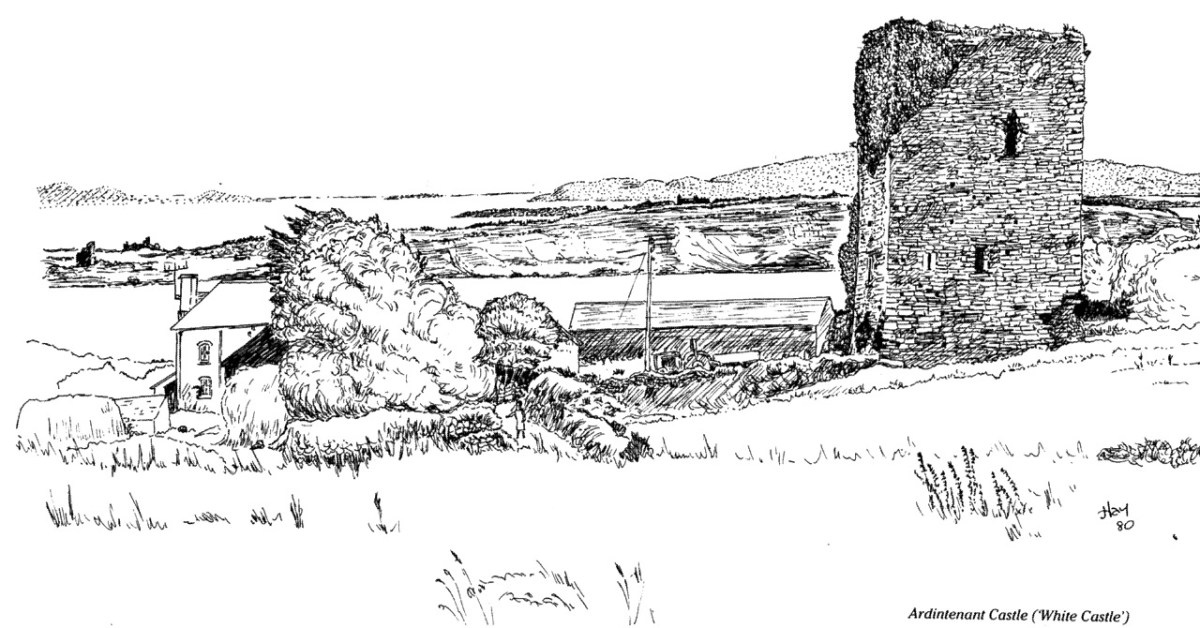
Ardintenant Castle

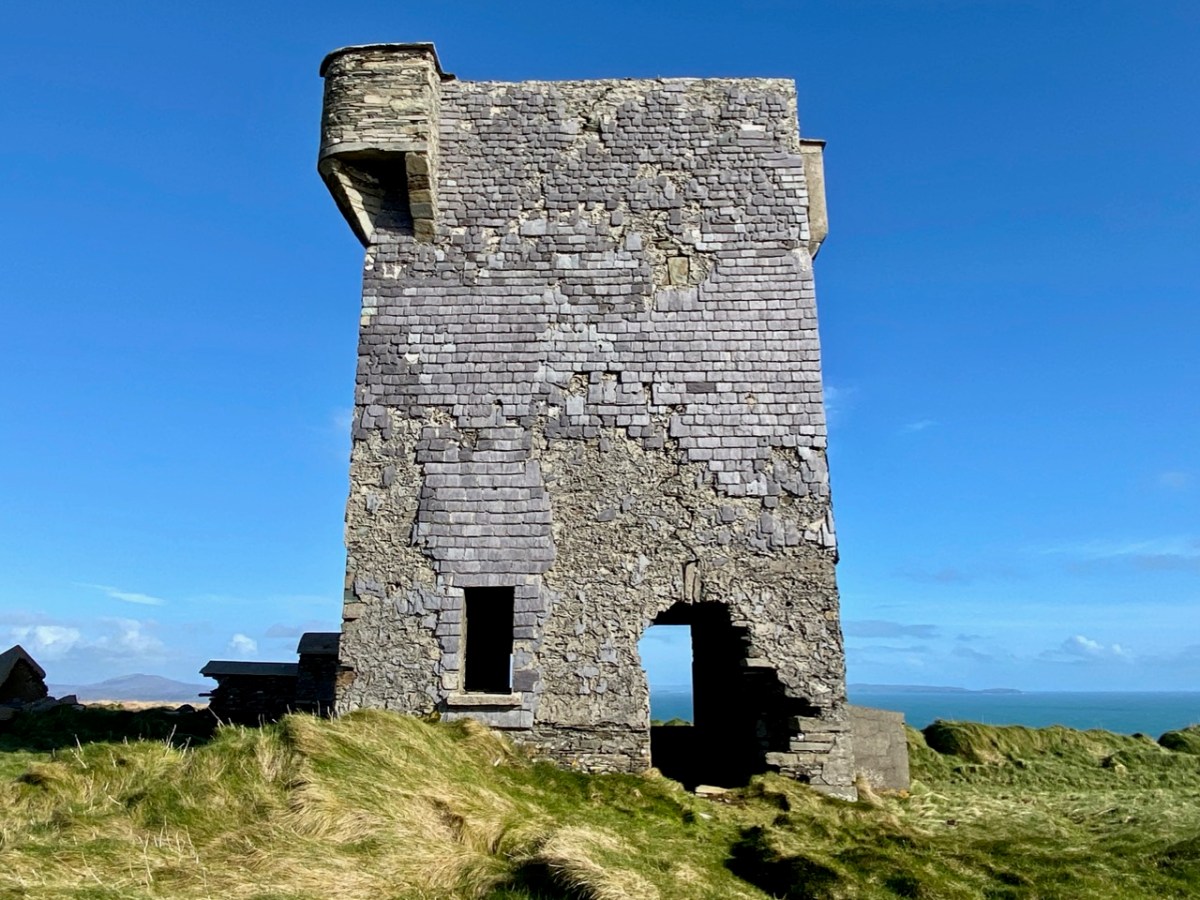
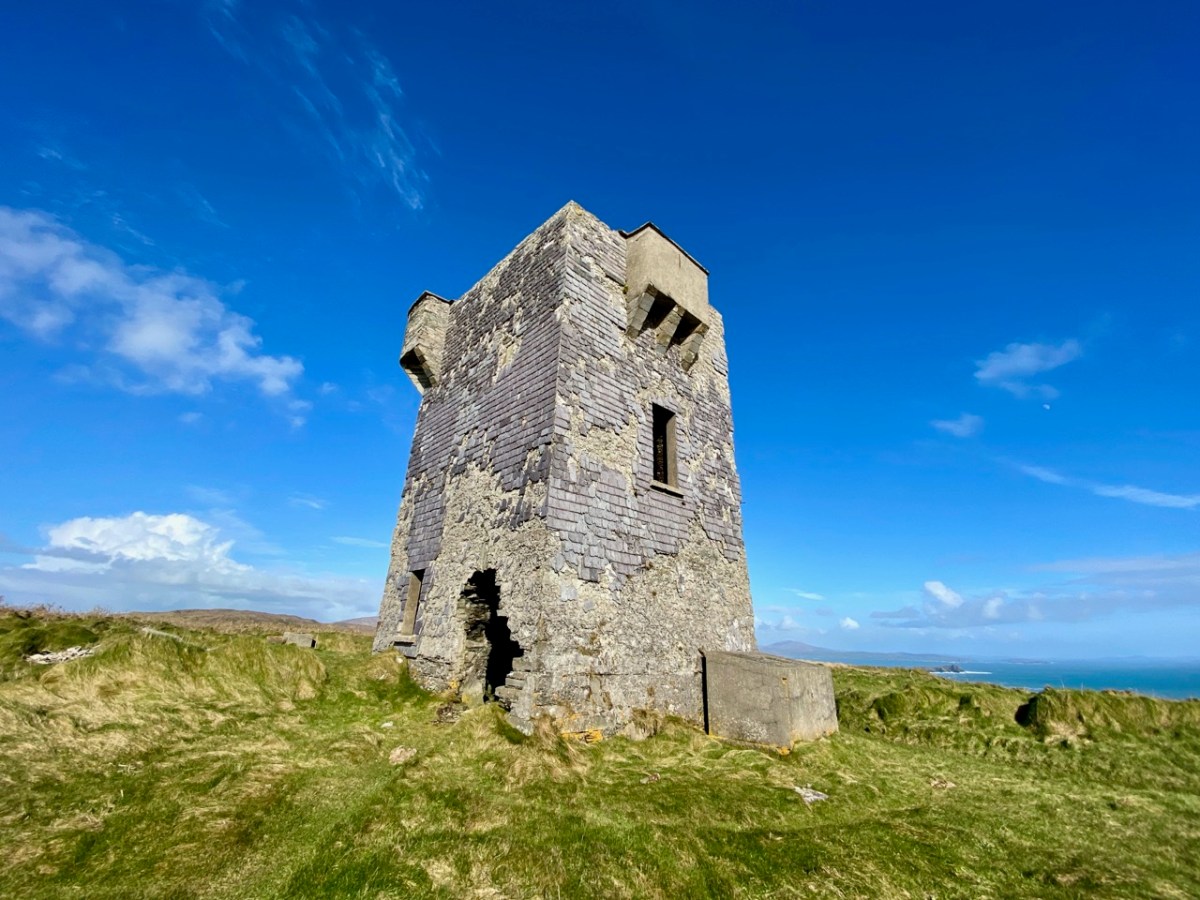
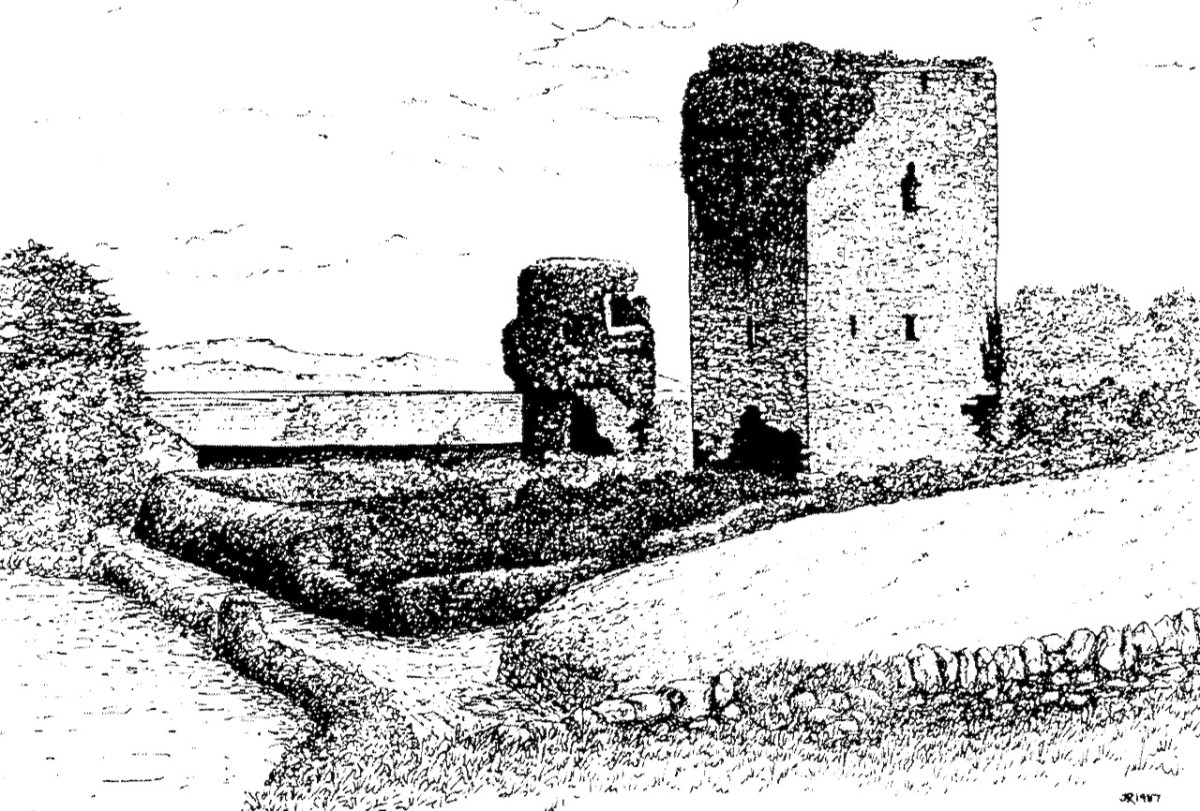
Home of the Taoiseach, or Head of the Clan, Ardintenant was one of the most important of the O’Mahony Castles of Ivaha (or what we now call The Mizen). Fortunately, it is relatively intact and we can observe and record much about it. The drawing above was done by James N Healy for his magnificent book on The Castles of County Cork. This post is another in my series on The Castles of Ivaha.
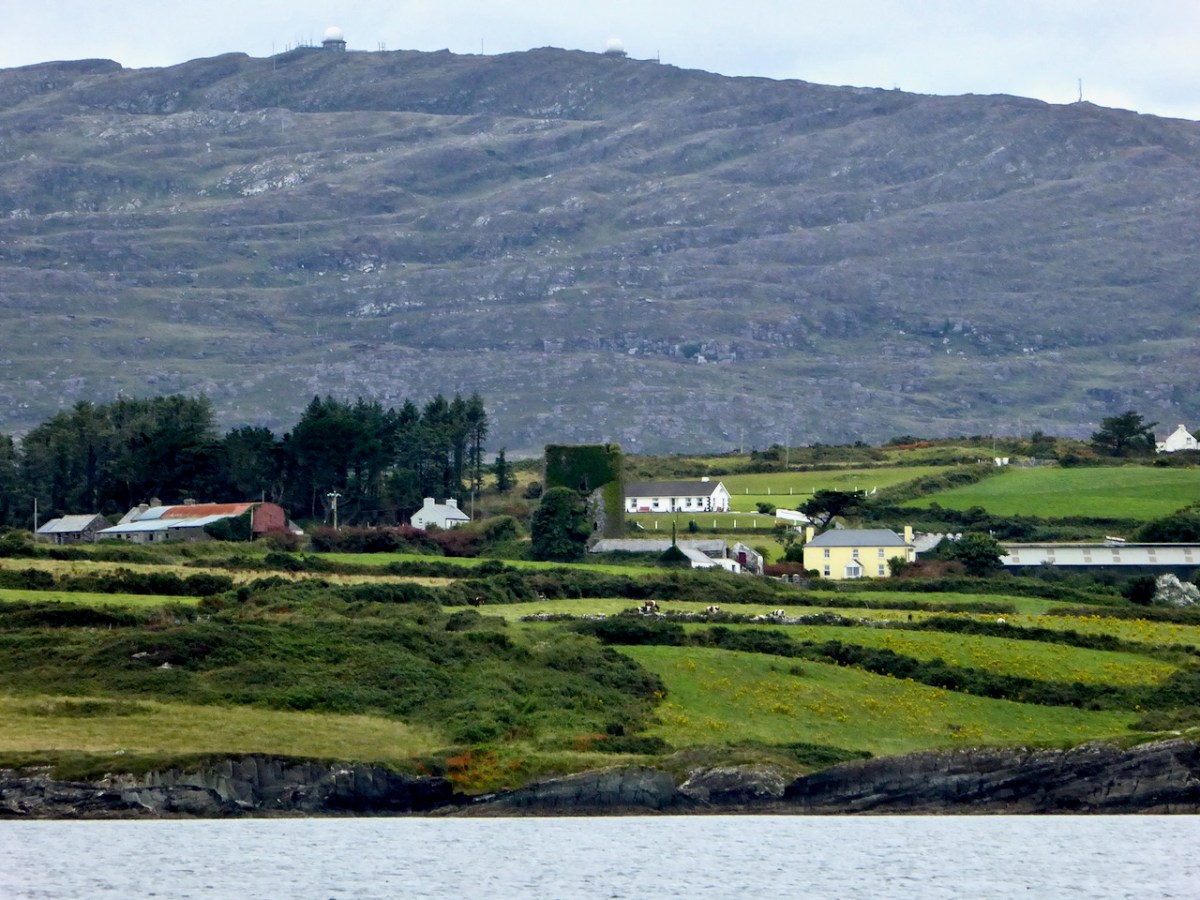
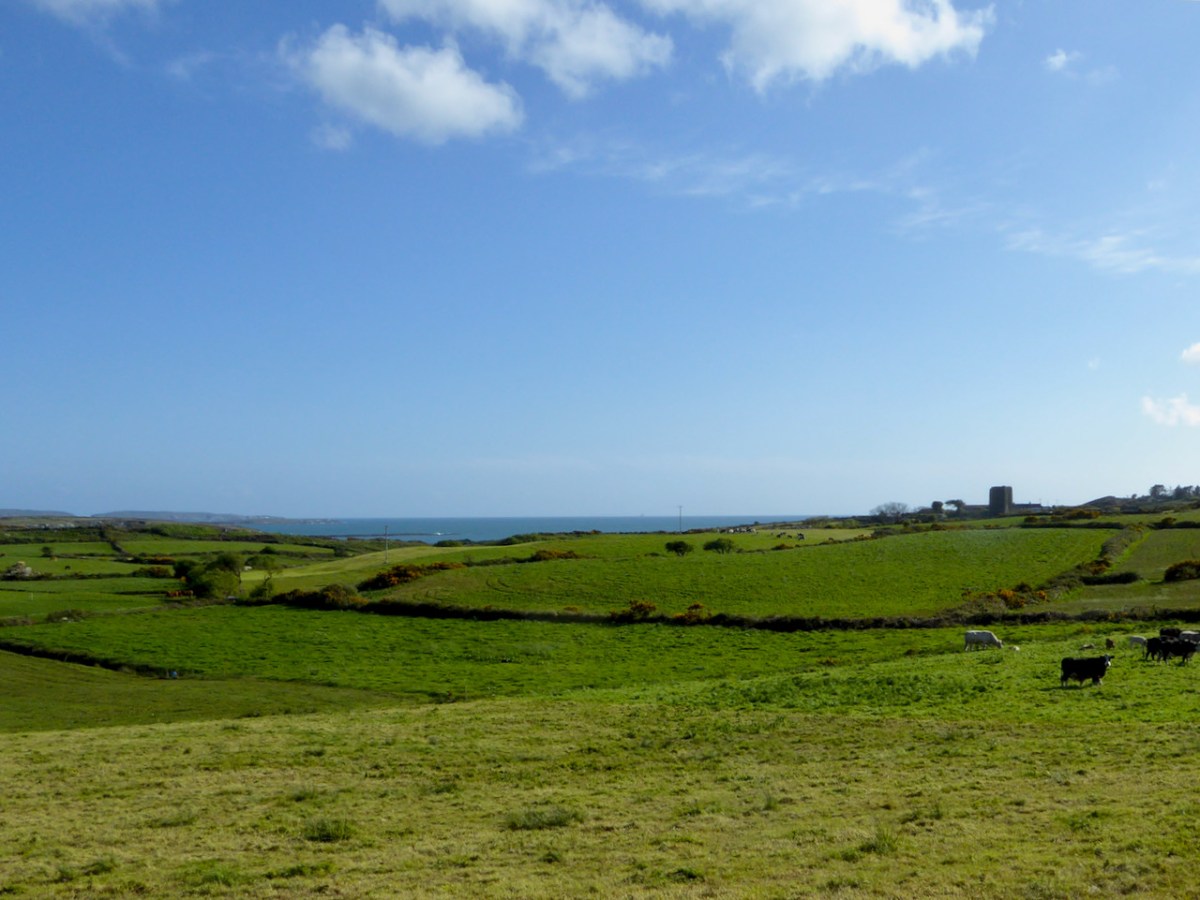
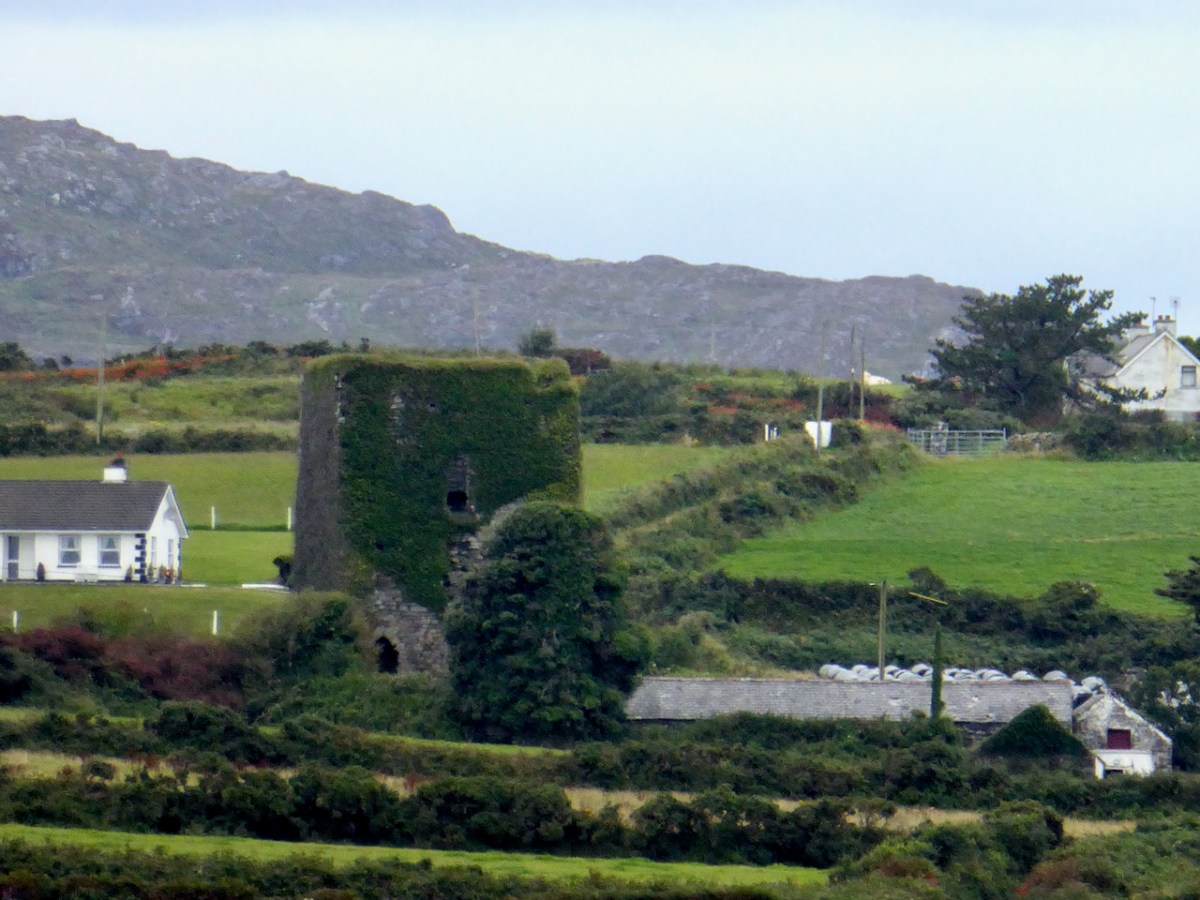
First the name – Ardintenant has been variously interpreted as coming from Árd an Tine (Ord on Tinneh, Height of the Fire), Árd an tSaighneáin (Ord on Tye-nawn Height of the Flash, or Beacon) or Árd an Tiarna (Ord on Teerna, Height of the High Chief). Any of these would be apt, since tower houses by the sea like this one (viewed from the sea, above) could be used as navigation beacons, possibly with a fire on the battlements. We also know that it was the residence of the head of the O’Mahony Clan, even though it was not the largest or most elaborate of the O’Mahony castles. Locally, it is also known as White Castle, which may refer to the white render that once made it stand out in the landscape (for more on render and castle colours, see the discussion on Kilcoe Castle). The photograph below demonstrates that it was prominent on the landscape and close to, although not right on, the sea.
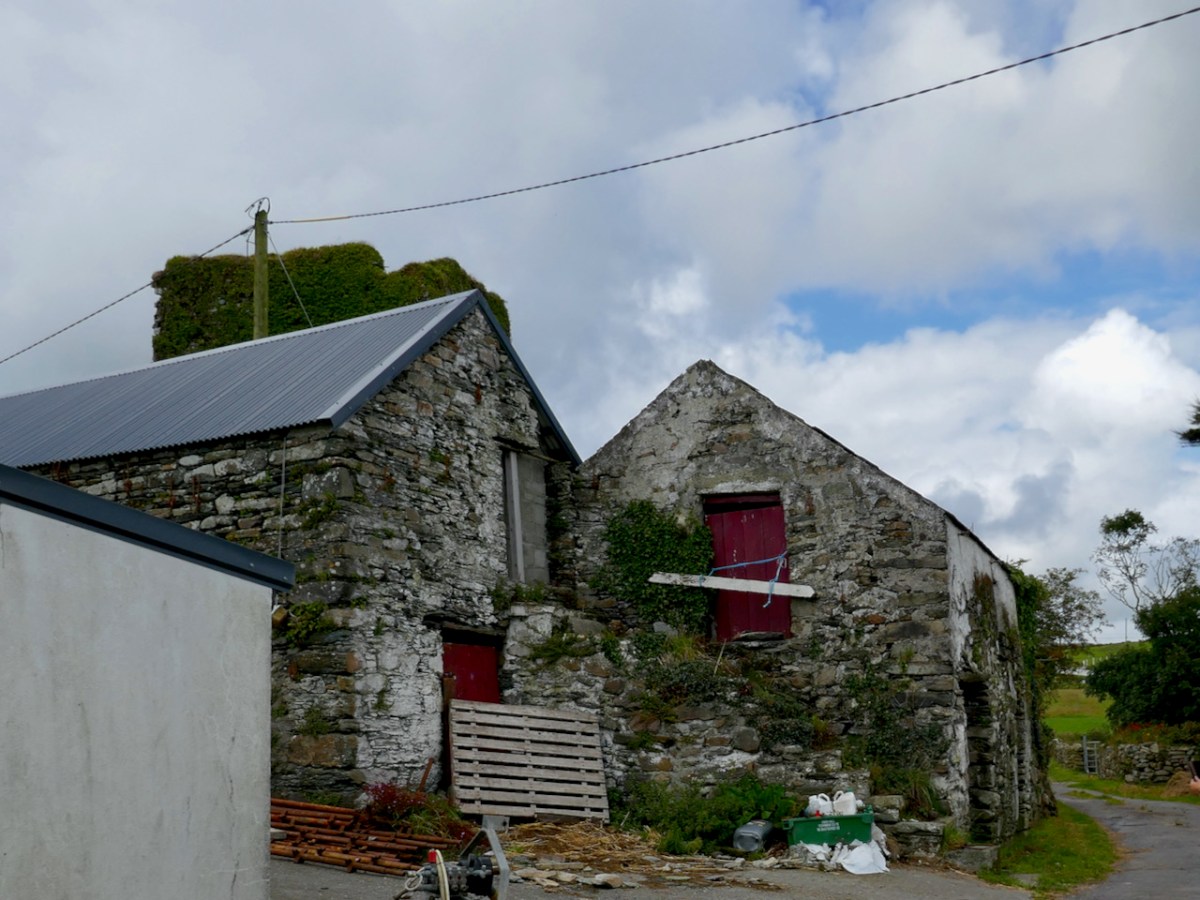
It now stands in the middle of a working farm, surrounded by stone buildings that are picturesque and notable in their own right.
Ardintenant is typical of castles built during the 15th century by Irish clan chiefs – wealthy and powerful and anxious to assert their claims on land and sea.

Dermot Runtach (the Reliable) succeeded in I400; his life and the lives of his sons spanned the Fifteenth Century. He was celebrated as a ‘truly hospitable man, who never refused to give anything to anyone’ . . . The period of 1400 -1500 was the most peaceful and prosperous period in the history of the clan. The Ivagha peninsula was protected by the sea on three sides and the family became wealthy from the exaction of dues from the continental fishing fleets; trade also enriched them, causing long-standing enmity with the citizens of Cork. Tradition relates that the majority of the O’Mahony tower houses in Ivagha were built by or for the sons of Dermod Runtach. The date of Dermod Runtach’s death is recorded in the Annals of Loch Cé as 1427.


THE TOWER HOUSES OF WEST CORK
MARK WYCLIFFE SAMUEL, 1998
Dermot Runtach’s sons were the castle builders. Conor Cabaicc succeeded his father in 1427 and remained Taoiseach for 46 years, embarking on an ambitious program of construction to provide castles for his sons and brothers, beginning with Ardintenant. He died in 1473, by which time probably all of the castles of Ivaha were built and occupied by various members of his derbfine (extended family). Cabaicc means of the exactions (or forced tributes), although it is possible that Conor was more benignly known as Cabach – meaning talkative. His brother, Fineen, the Táiniste (heir-in-waiting) built Rossbrin Castle, about which Robert has written, and which is the castle in our view at Nead an Iolair. Rossbrin and the remains of a small tower on Castle Island are both visible from Ardintenant.
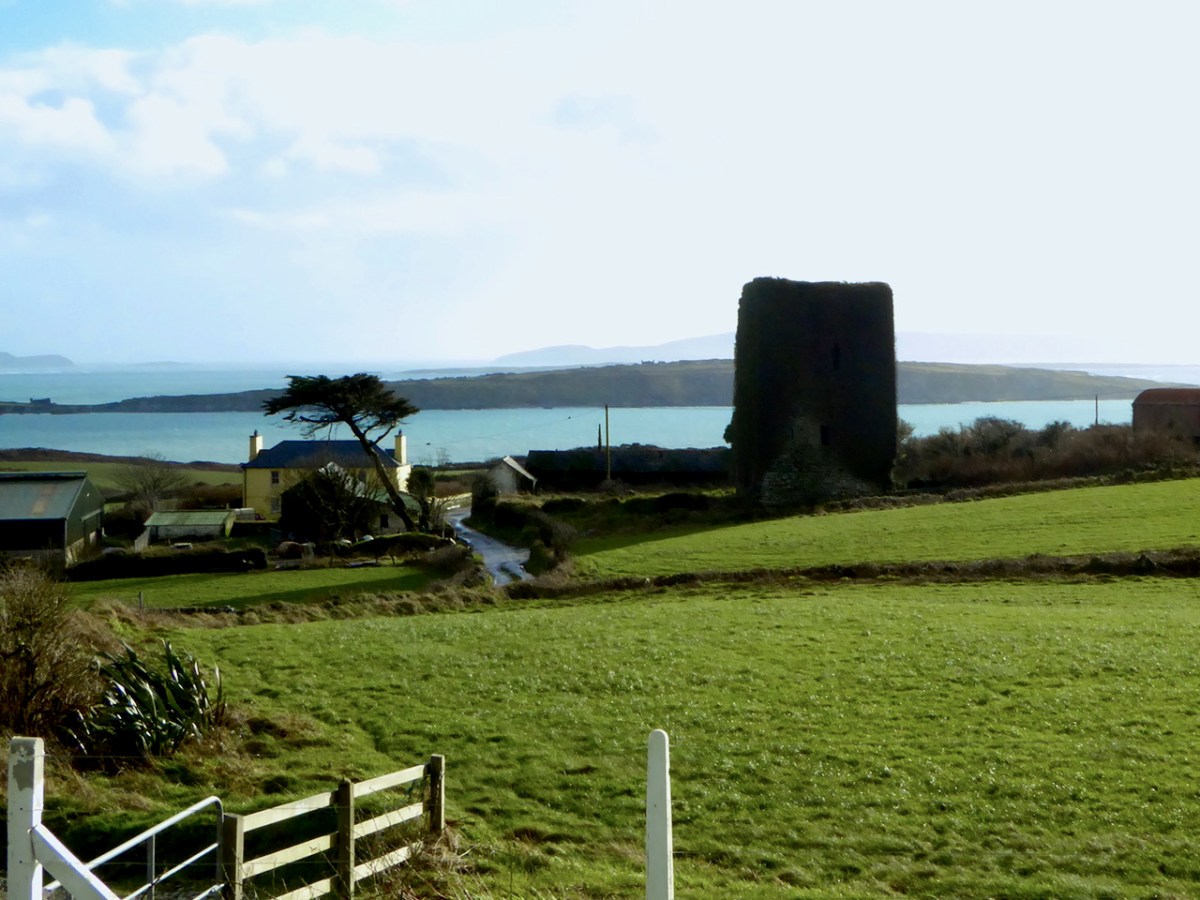
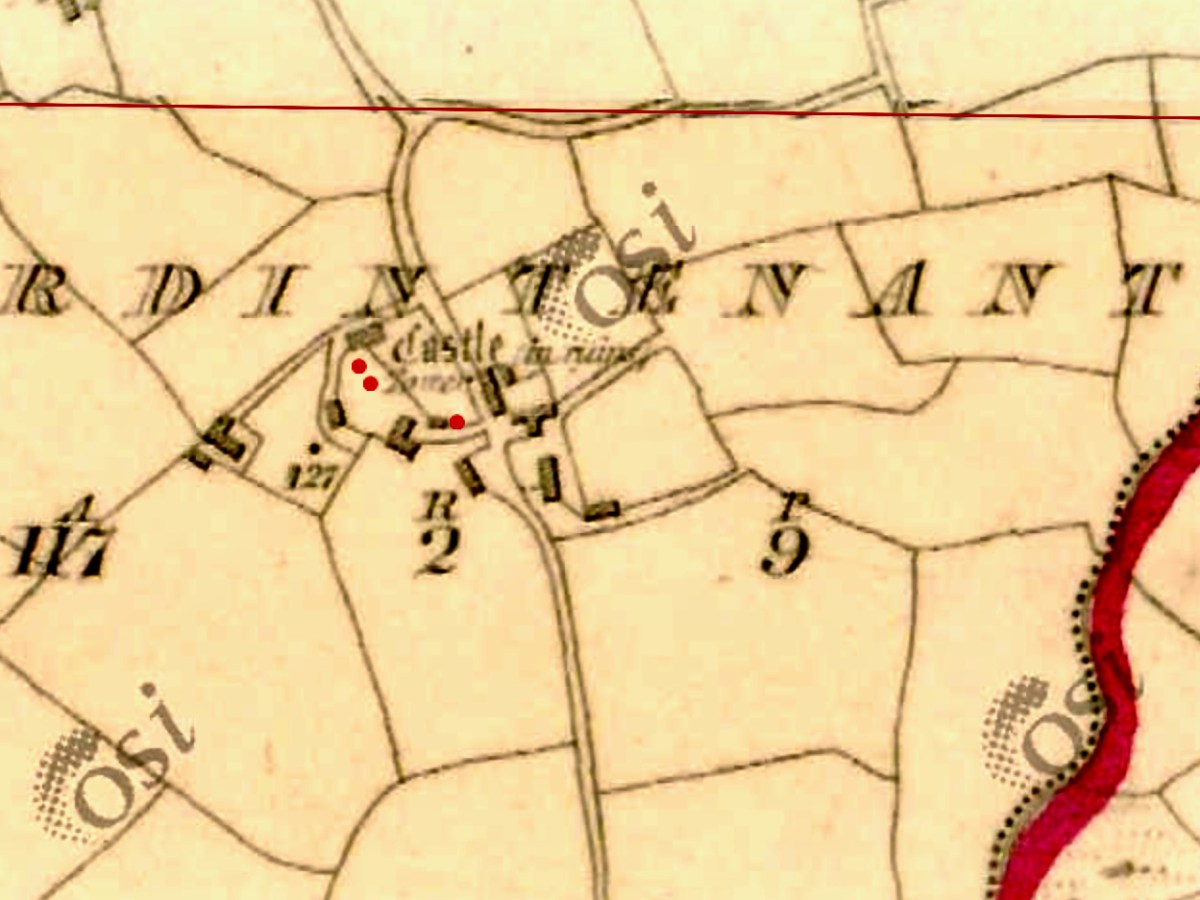
While there is evidence that other O’Mahony castles were built on pre-existing fortifications such as promontory forts (see Three Castle Head, for example) or ring forts, this is most visible at Ardintenant, where the ring fort can still be seen as a circular rampart around the tower house. You can make out part of it in the photo above. Another unusual feature is the survival of a single flanking tower, along the line of the ring fort and across from the tower house, although there may have been more than one originally, since the 1840s OS map shows what could be a second one – the leftmost building on the line of the ringfort below. Note that farm buildings also dot the site even at this early stage.
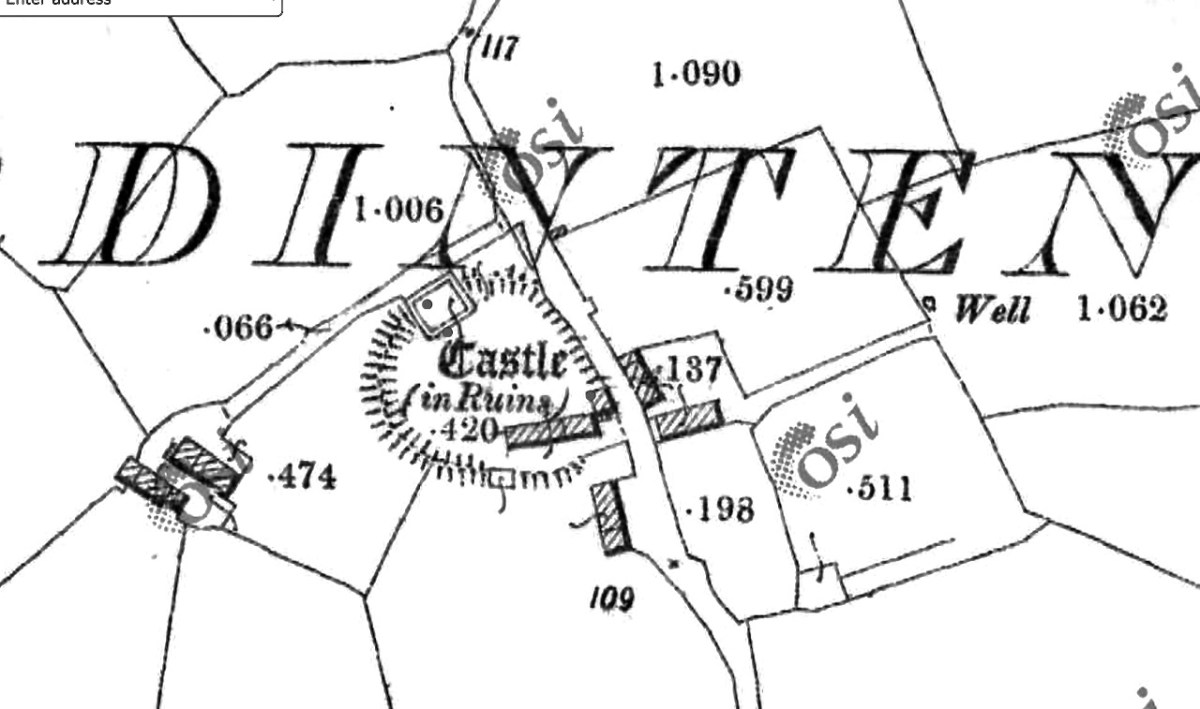
The possible second flanking tower had disappeared by the time the next series of maps were produced, around the 1890s. The farm buildings have changed as well.
In his marvellous paper on Ardintenant Castle in Mizen Journal 11, 2003, John Hawkes investigates the history and construction of the castle and provides elevation and plan drawings. I am grateful for his scholarship and thoroughness, which has informed the following description of what is left at this site, as well as provided illustrations.
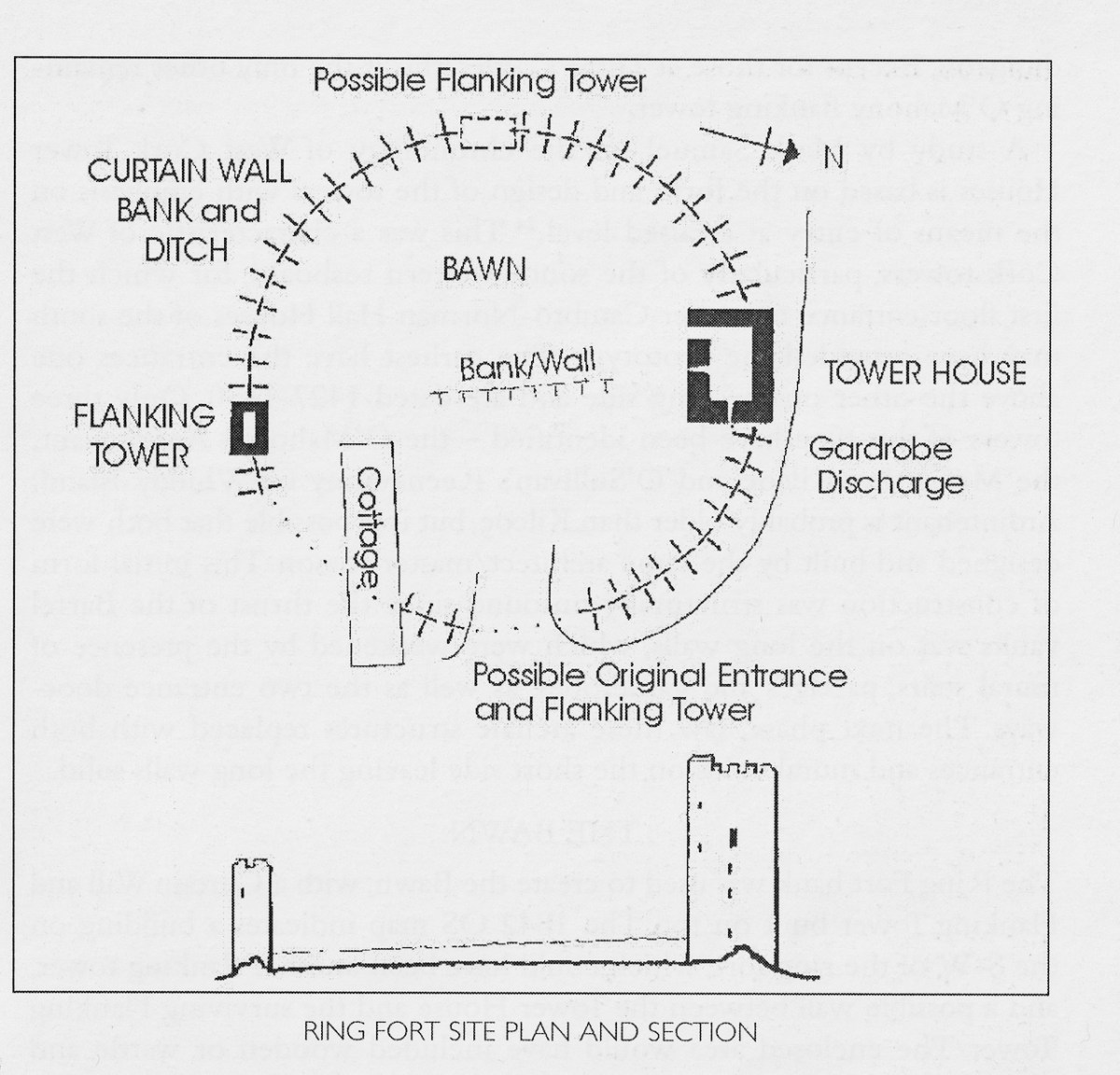
The presence of the ringfort raises an intriguing prospect since it appears that instead of the usual rectangular bawn, surrounded by a stone wall (see the illustration in this post), we have a round bawn, with the stone wall built on top of the bank of the ringfort. Although that stone wall is not obvious now, it is noted in the description of the ring fort in the National Monuments survey. Thus, what we have here is a hybrid ring fort/tower house – a sensible adaptation of a pre-existing fortification and a continuation of the site as a high-ranking residence. The National Monuments survey also refers to an external fosse, although traces of it are hard to see on the ground. If it was originally a substantial ditch, another possibility is that the bank was surrounded by a moat. 
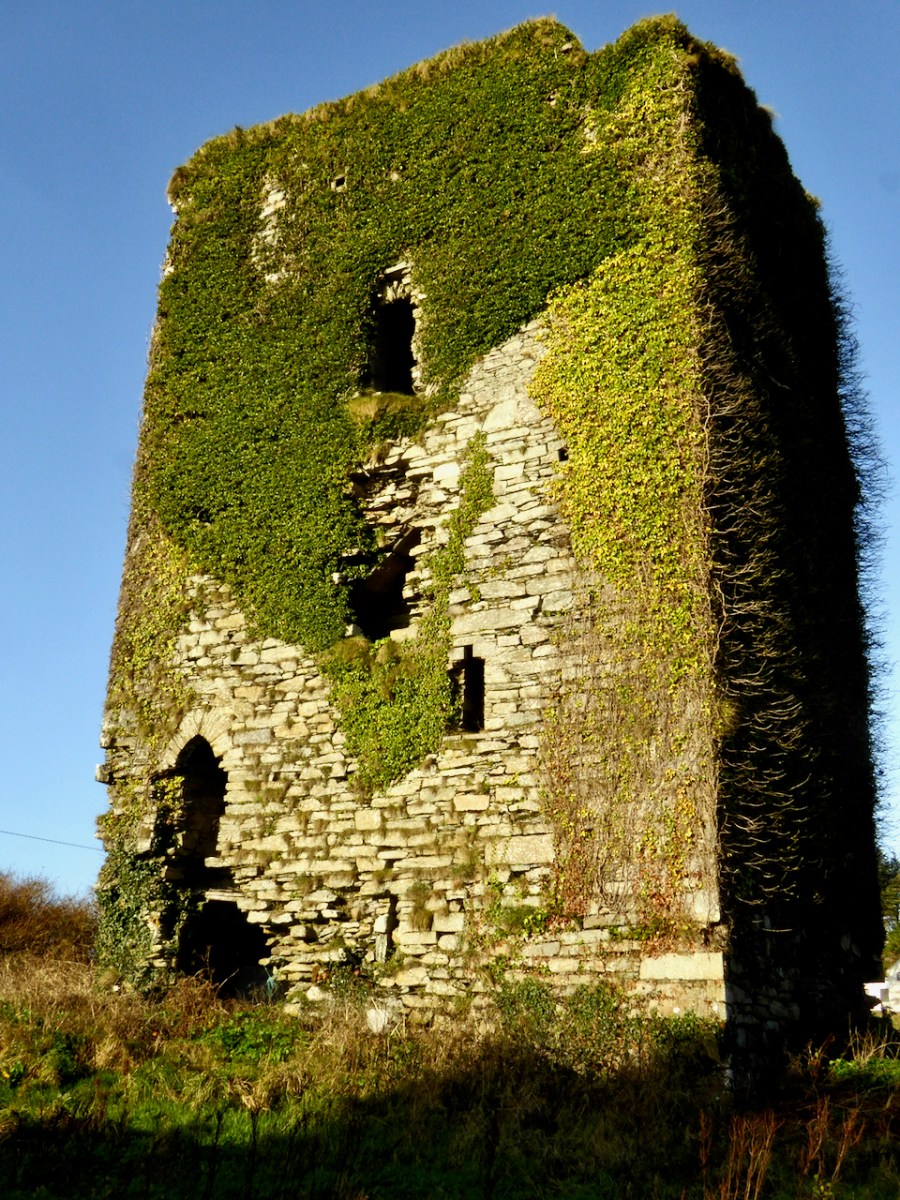
As with all of the O’Mahony Castles, Ardintenant is the type of tower house known as Raised Entry, that is, the ground floor door allows access to the public areas of the castle, while the door above it, originally accessed via a wooden stairway, gives on to a set of steps up to the private area.
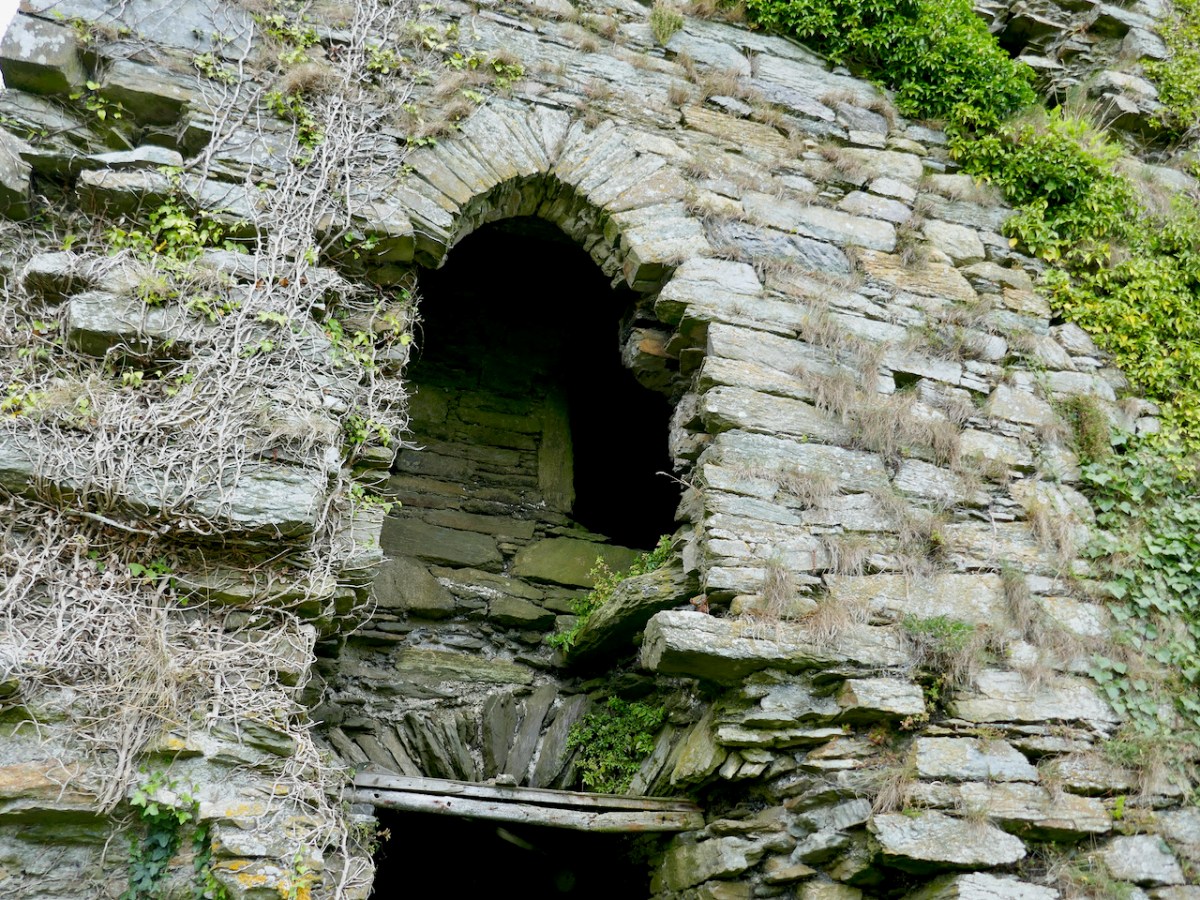
The first two-and-a-mezzanine floors are covered by a vault. This set-up was partly defensive – the upper floors could only be accessed through this raised doorway and staircase – and partly for security, in that the vault was a barrier should a fire break out on the lower floors. The doorway to the left leads to a garderobe, while on the right are two deeply splayed window embrasures.
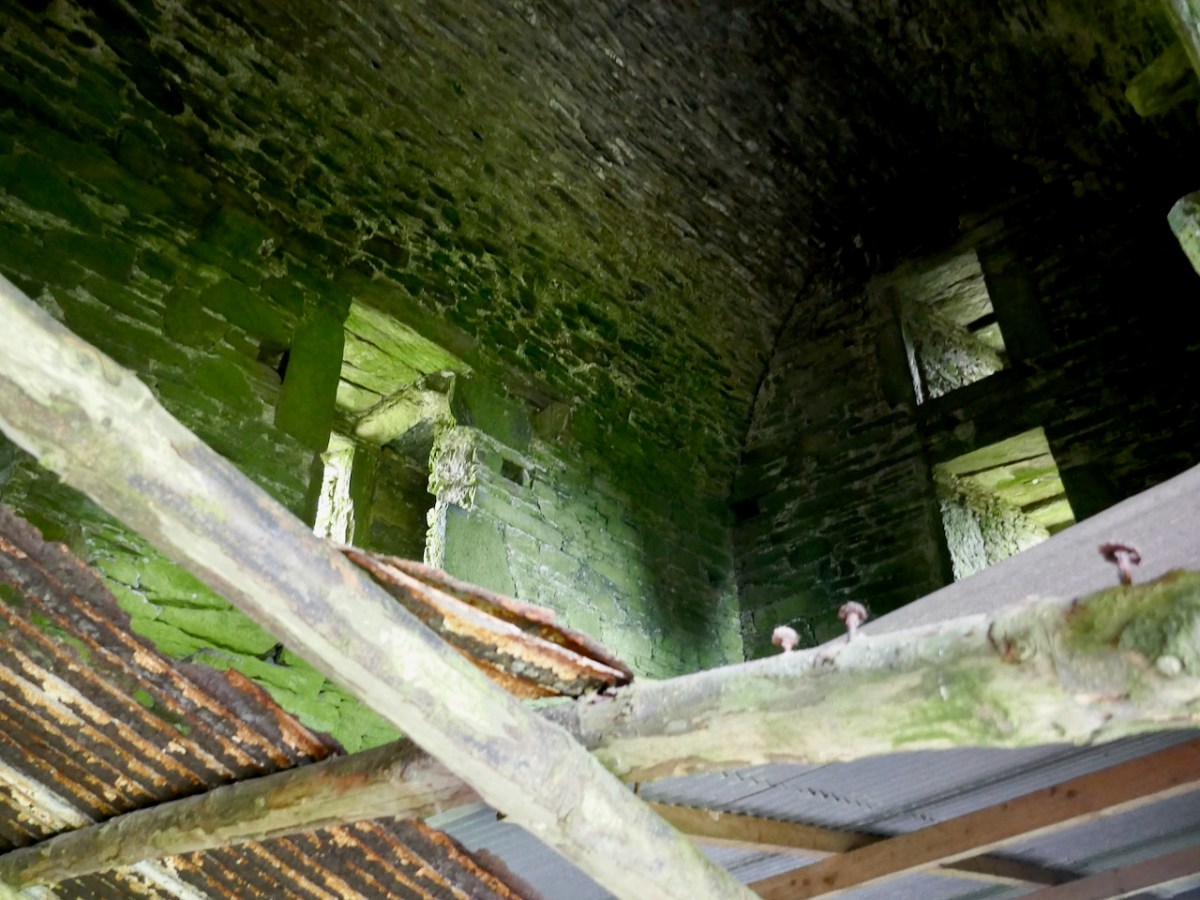
At Ardintenant, as with Dunmanus, the ground floor has been in use as a cow byre. It is normally impossible to access the upper floors, although those who have done so report that it is in good condition. That floor is reached by means of a mural staircase that rises from the raised entry.
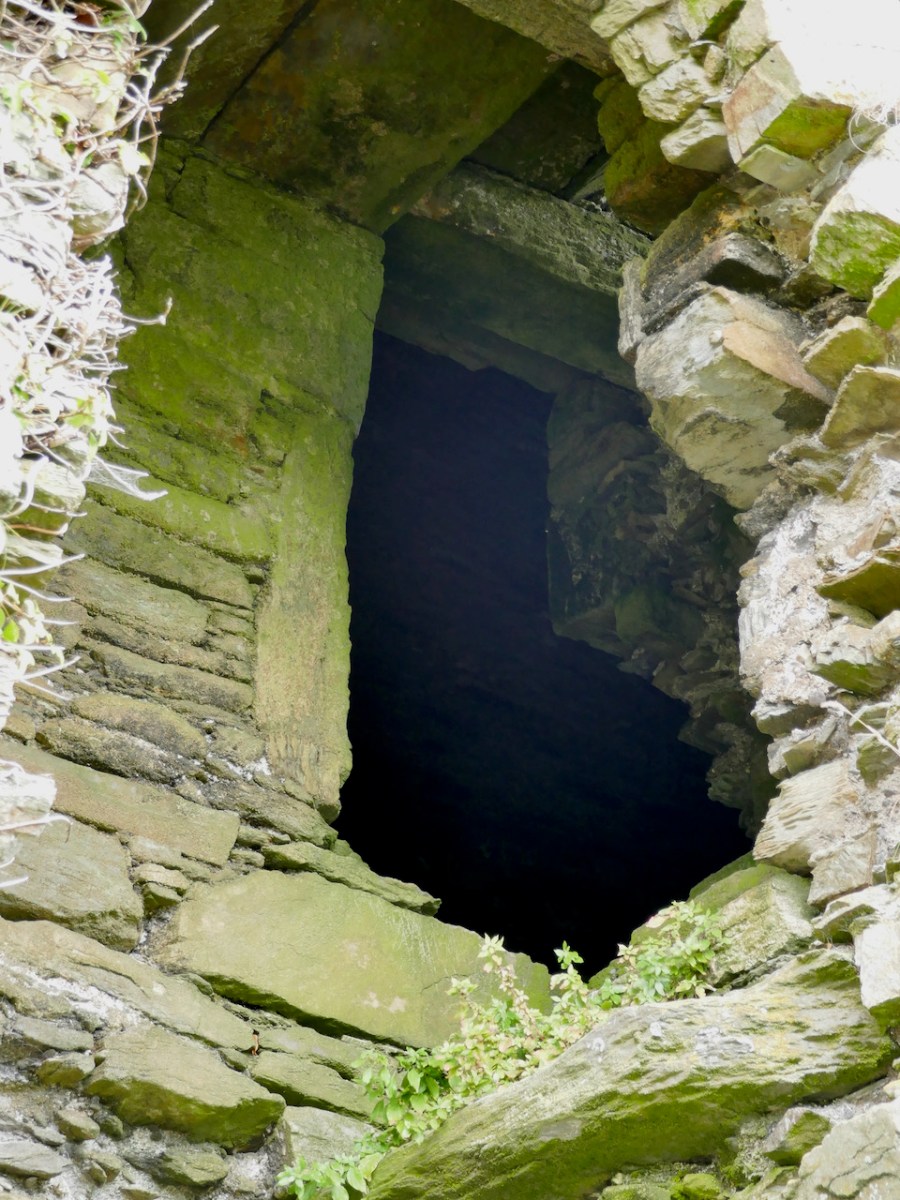
A second staircase, in this case a spiral, gives access from the upper floor to the wall walk. This was not a castle built for comfort – in common with the other 15th century O’Mahony castle it had no fireplaces and very few windows.
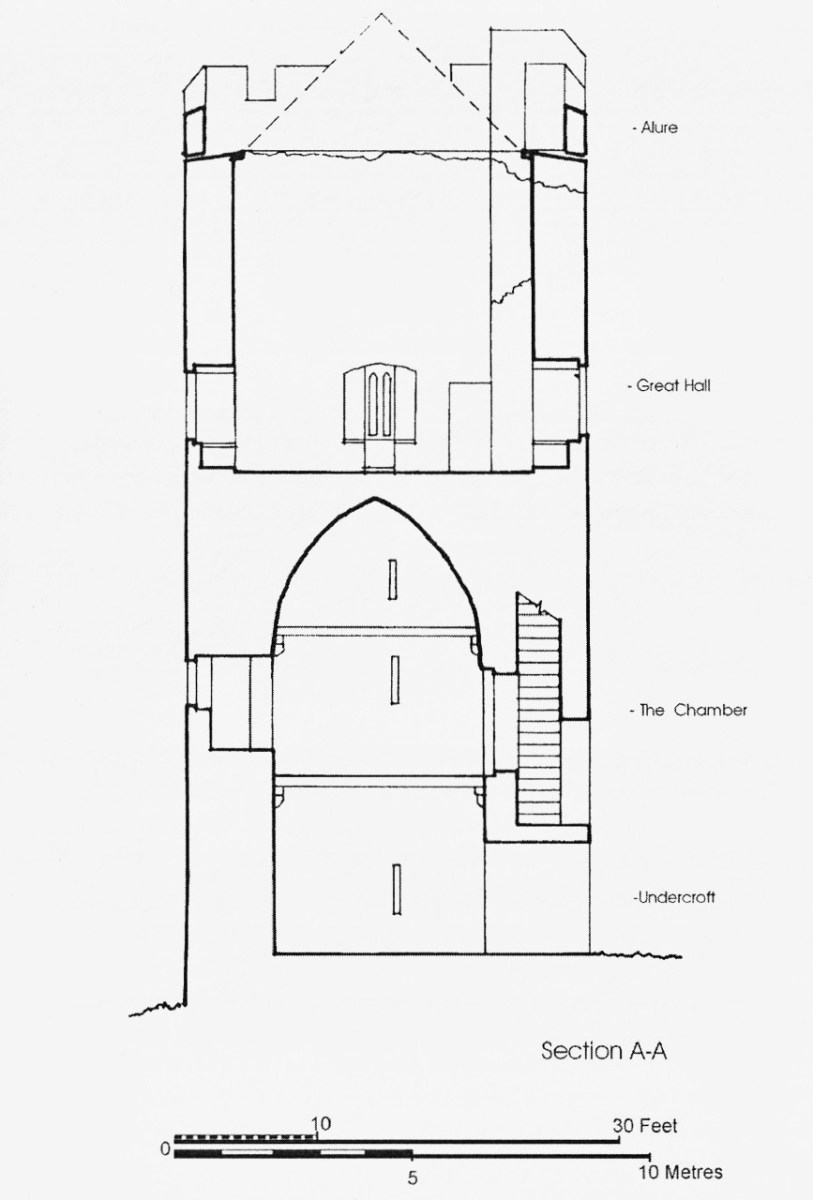
Above the vault was what Hawkes calls the Great Hall. One large room, accessed via the mural staircase, the only notable feature of which is are deeply splayed window with seats in the embrasure. Picture the Lady of the house seated here, trying to catch whatever light she could as she bent over her handwork. 
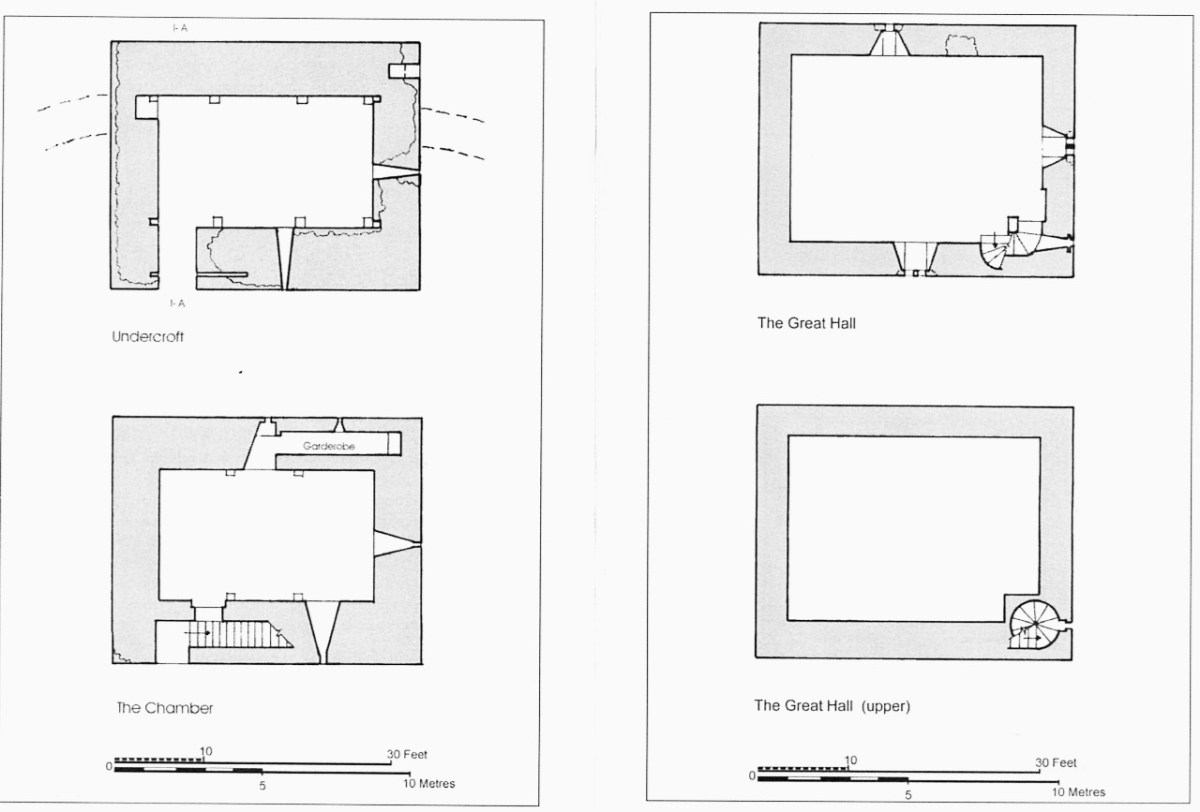
In one corner of the Great Hall, the spiral staircase led up to the wall walk (what Hawkes calls the Allure). While nothing remains of these battlements now, we can assume that there was a walkway around the roof, perhaps with Irish crenellations and a sentry box.
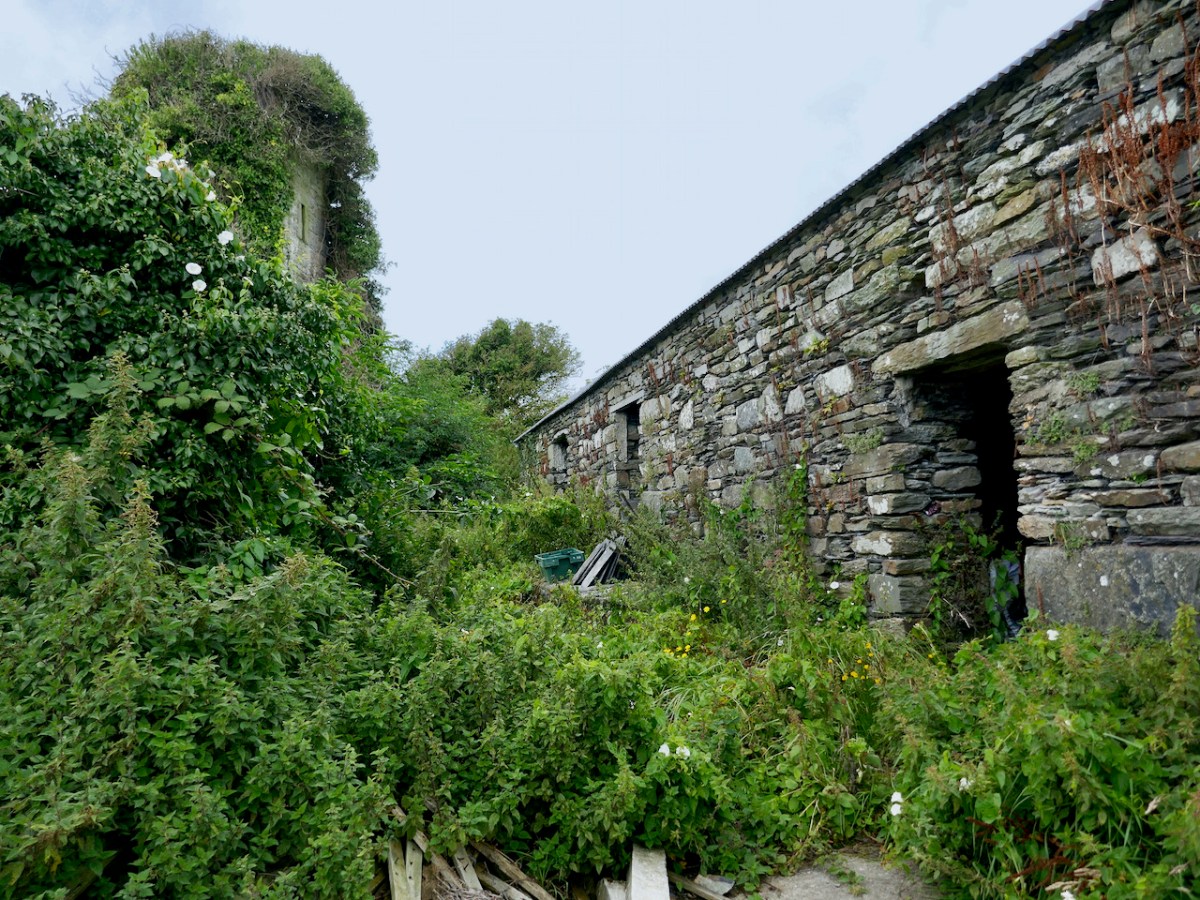
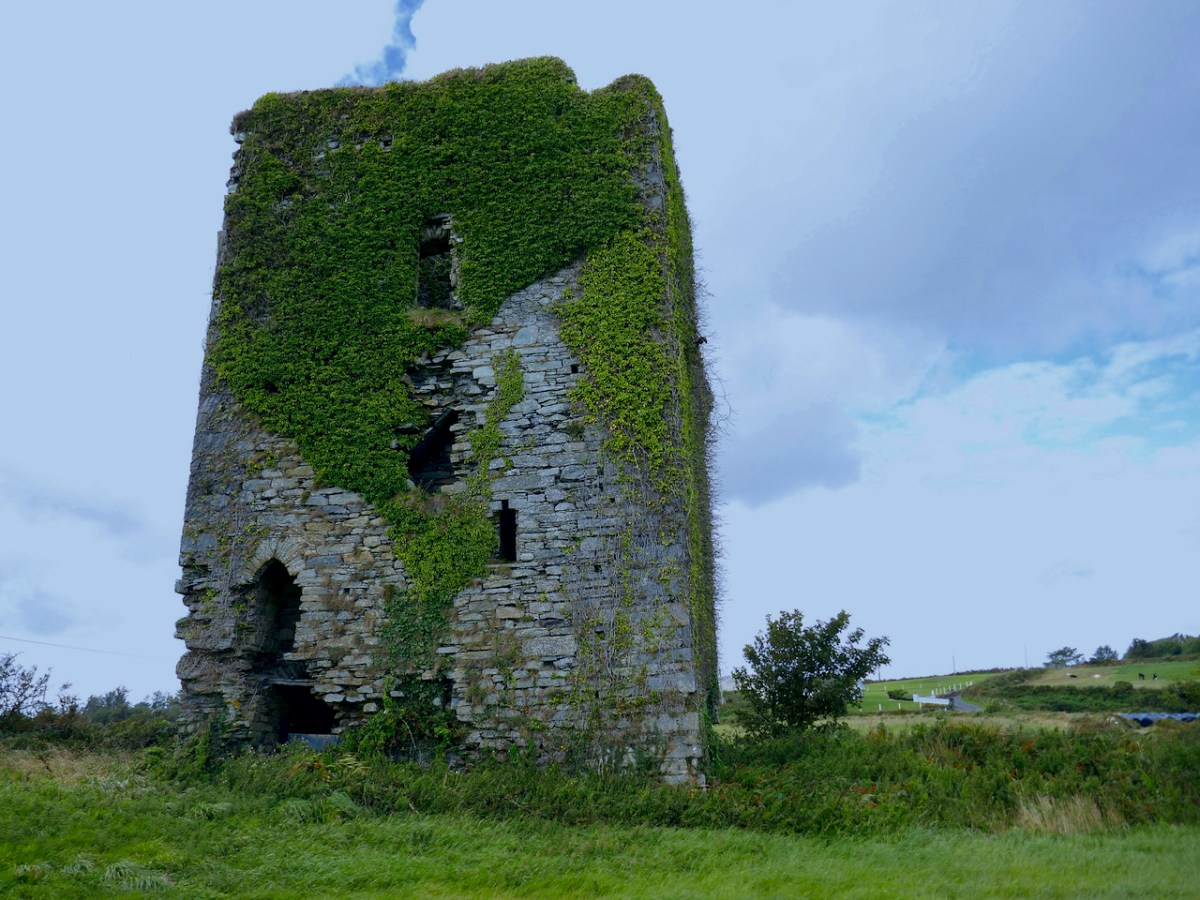
The flanking tower (above) is covered in ivy, so it’s hard to make out details. It may have looked a bit like the one Westropp called The Turret, at Dunlough.
It’s much smaller than the castle, rectangular, and three stories high. The illustration above, by Jack Roberts, indicates the relative sizes. The way in was from the level of the curtain wall and each floor was connected by a ladder, except for the wall walk/allure, reached by a spiral stone stairs. 
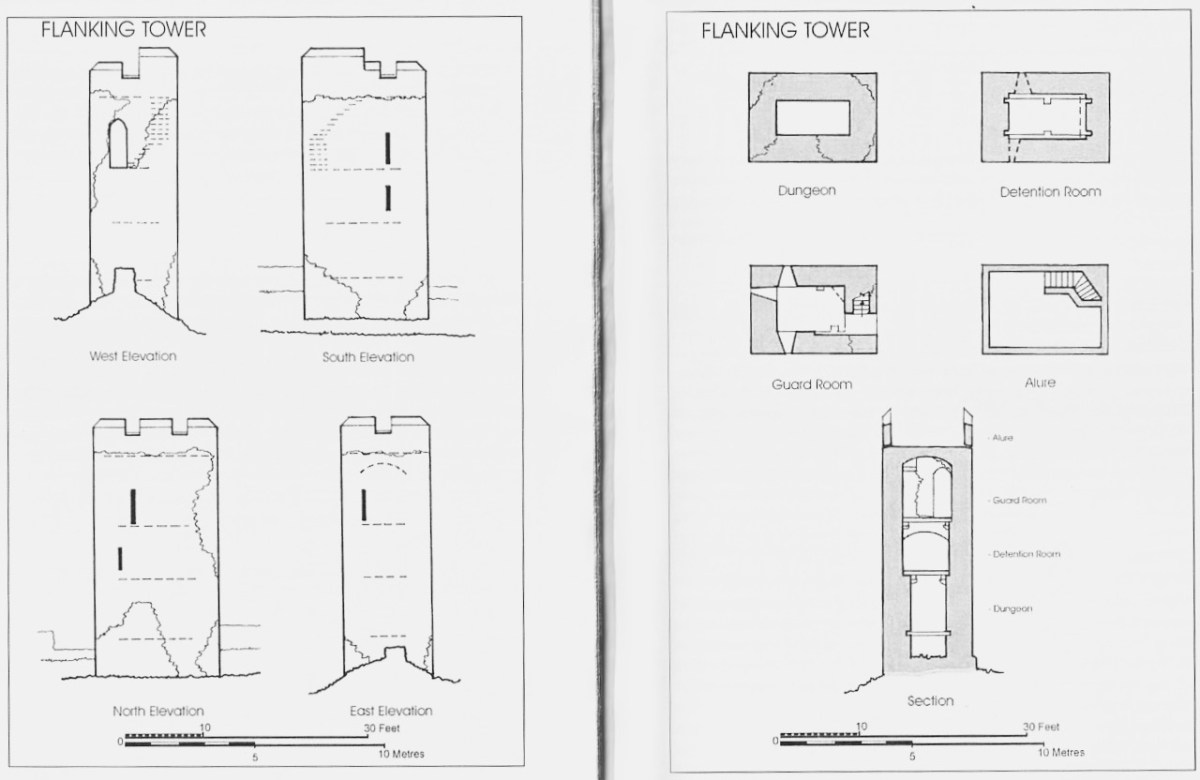
Hawkes tells us that “its function appears to have been to accommodate hostages.” He bases that on the absence of a ground level entry (the current hole on the ground level having been broken through in more recent times), so that the ‘dungeon’ was accessed through a trap door from the room above, which in turn he calls a ‘detention room.’ See my post on Dunmanus for a discussion of possible functions for rooms like the ‘dungeon.’
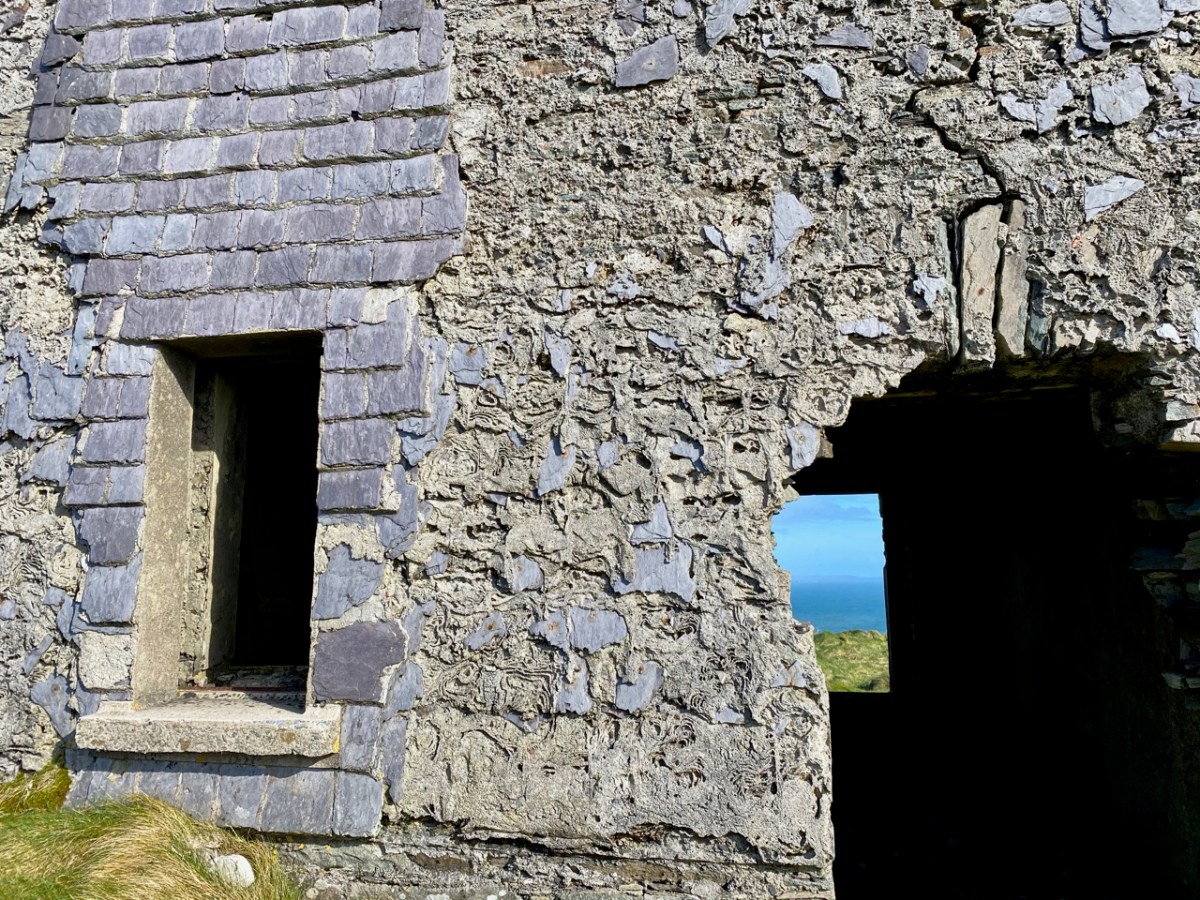
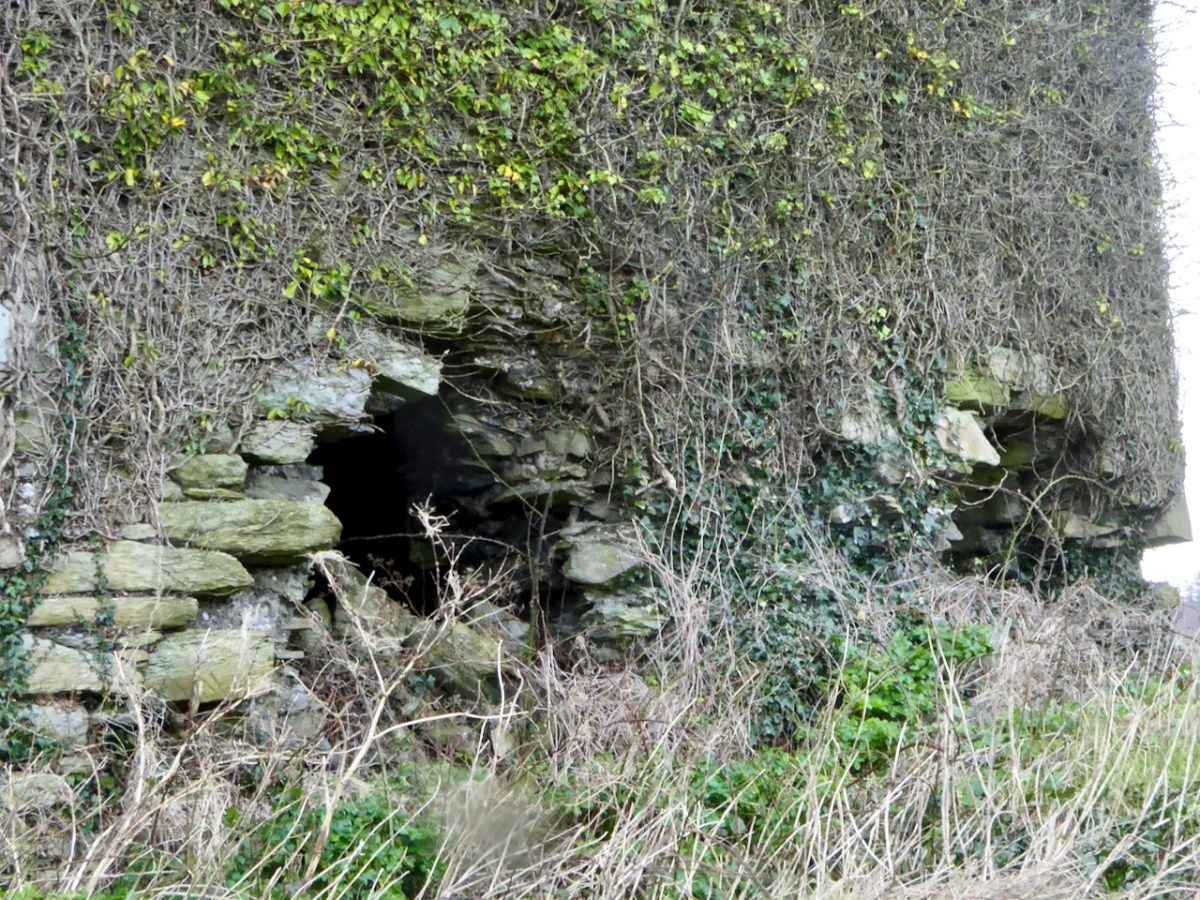
Ardintenant is still standing and intact, but a lot of the base batter – the broad stone base that gives it its strength and stability – is missing and holes have been punched through the walls in the past.
Along with the other extant O’Mahony castles, its continued survival cannot be taken for granted. It’s a listed monument on private land, and Ireland’s complicated heritage laws means that it can’t be deliberately damaged, but conversely, there is no onus on the landowners to conserve it at their own expense. All fingers crossed that it remains standing for ages to come.
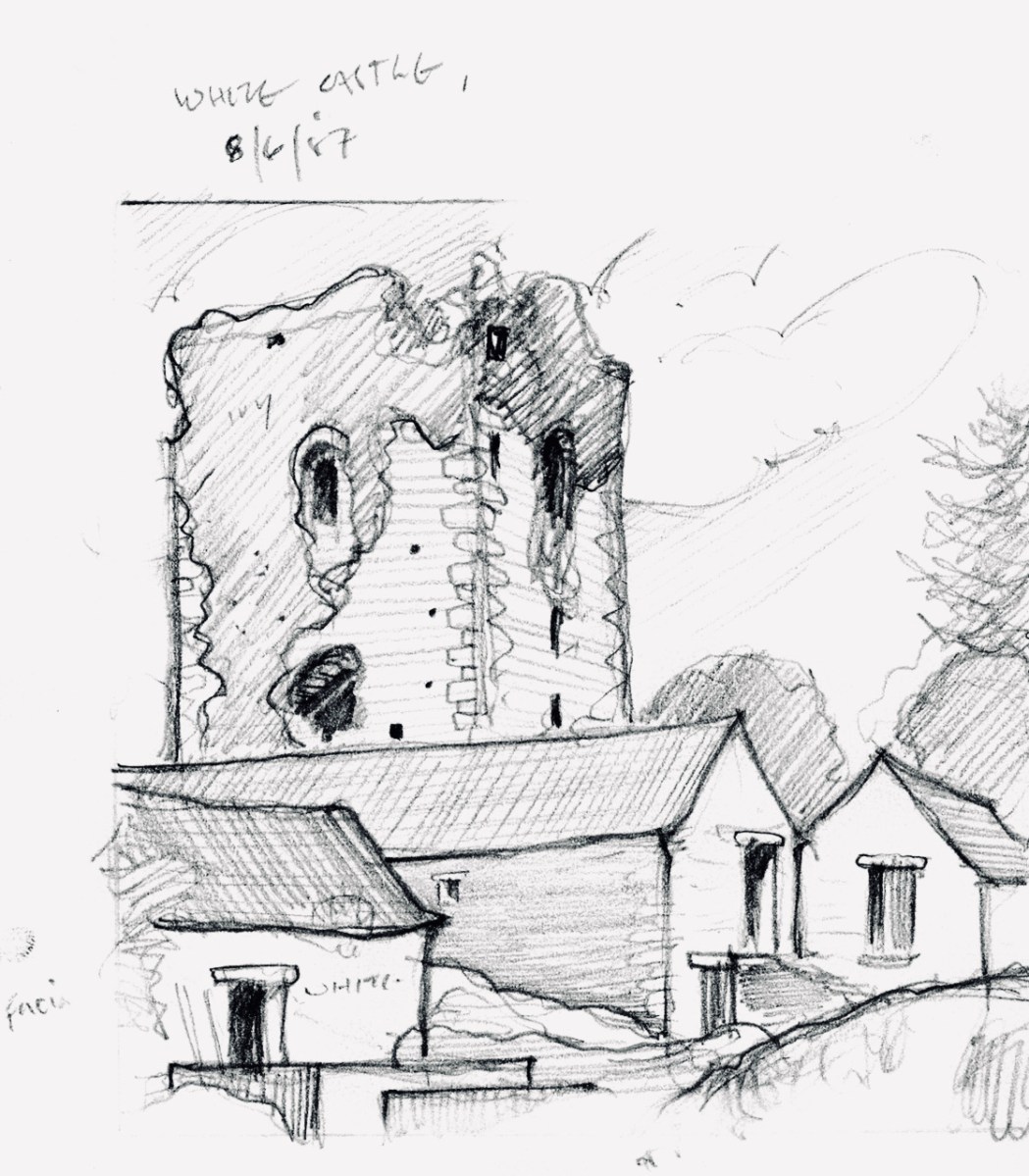
Brian Lalor’s sketch of Ardintenant Castle from 1987, from his field notebook

Working With Glass

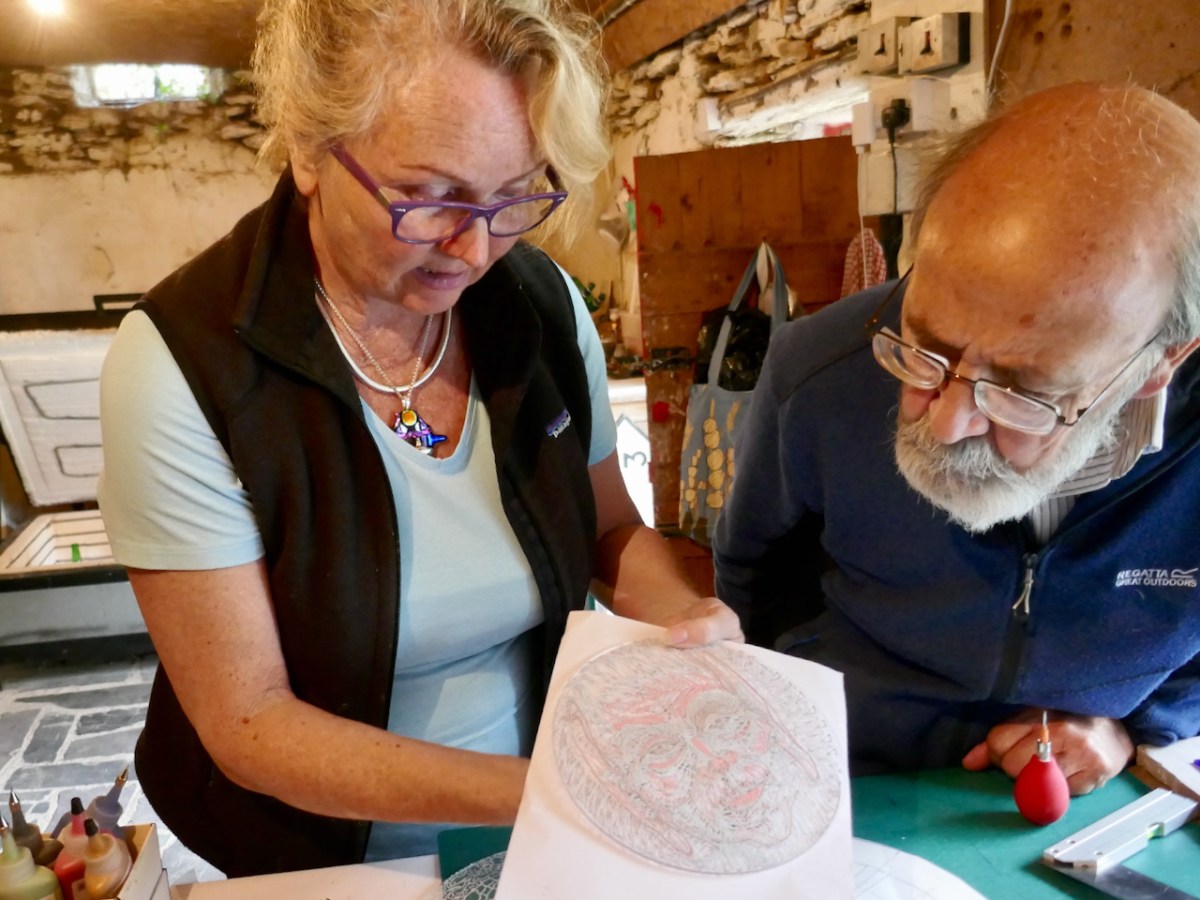
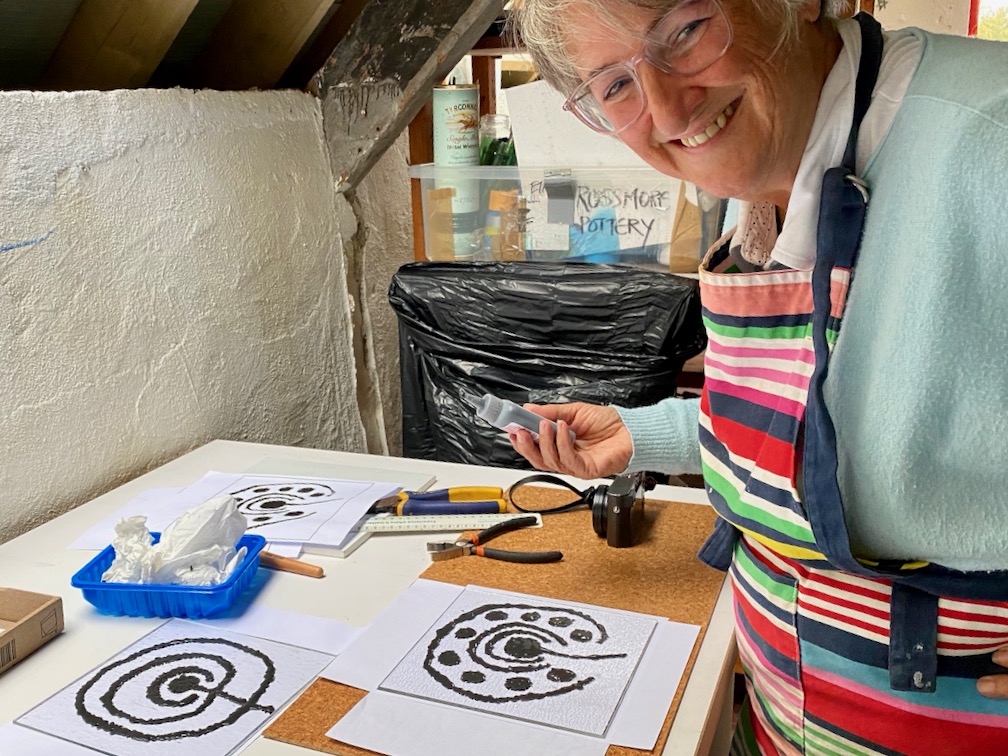
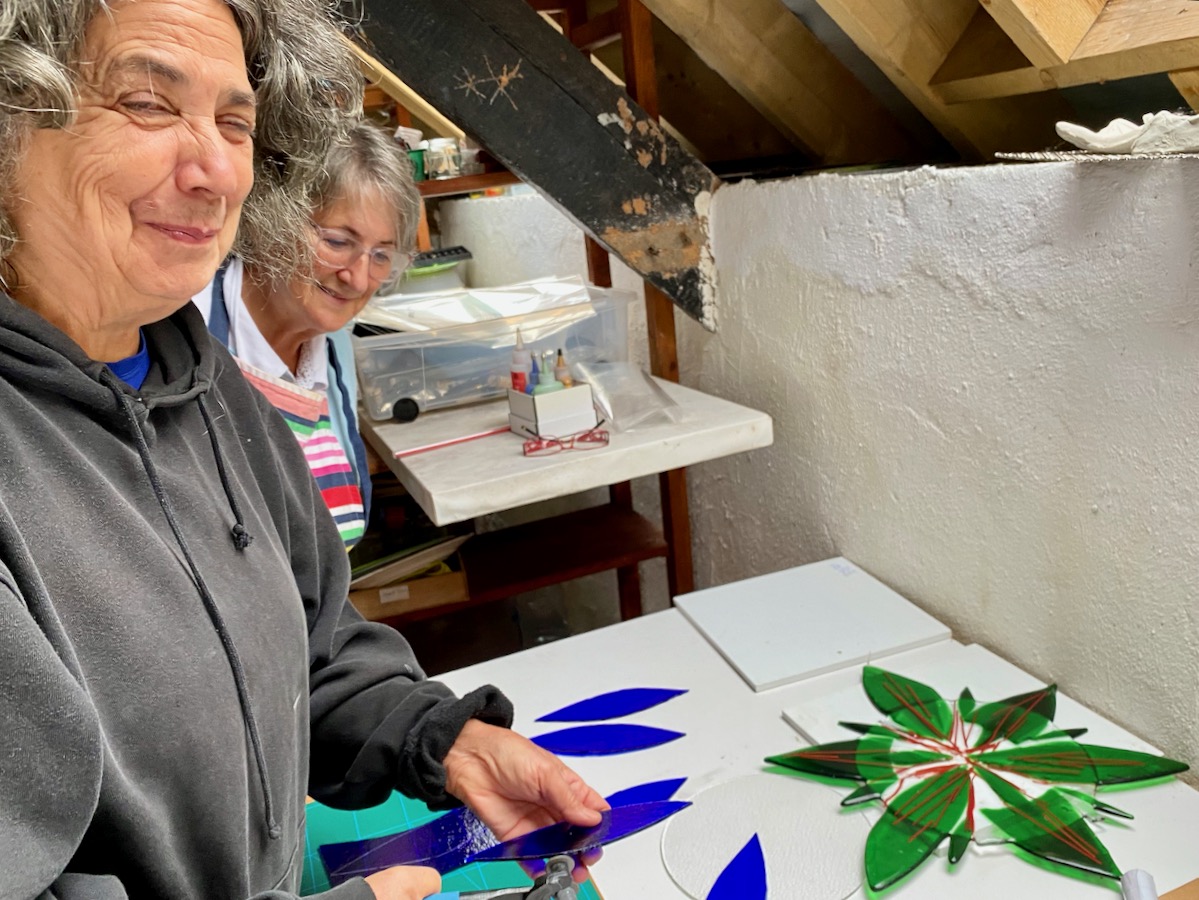
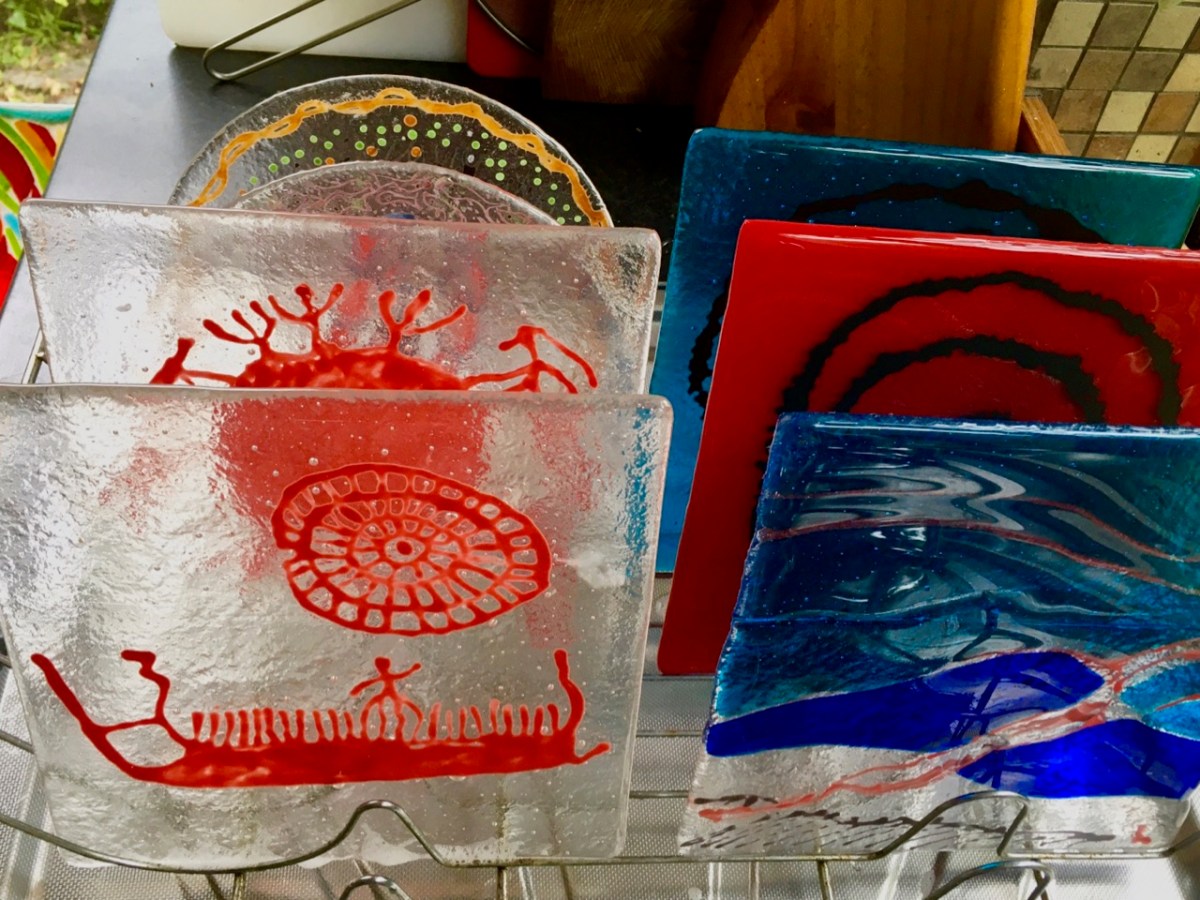
Finola and I went to a workshop on creative fused-and-painted glass. It was wonderful! We were guinea-pigs in that the glass artist – Angela Brady – was keen to try running an event and we were privileged to be invited, joining our friends Brian and Clair Lalor.

Top: that’s Angela introducing us to the medium of glass and showing us some of her own work. Centre: she’s encouraging Brian to turn his artist’s mind to the possibilities of the material. Above: Angela Brady and Robin Mallalieu (who are also architects) have taken over the former Brush Fire Pottery, just outside Ballydehob. This was the home and workplace of dynamic artists John and Noelle Verling, who bought the Gurteenakilla premises in 1973 and lived and worked there for very many years. John died in 2009 and Noelle now lives not too far away. To spend the workshop day in such hallowed surroundings added to the ambience, and could only have inspired us in our artistic endeavours!

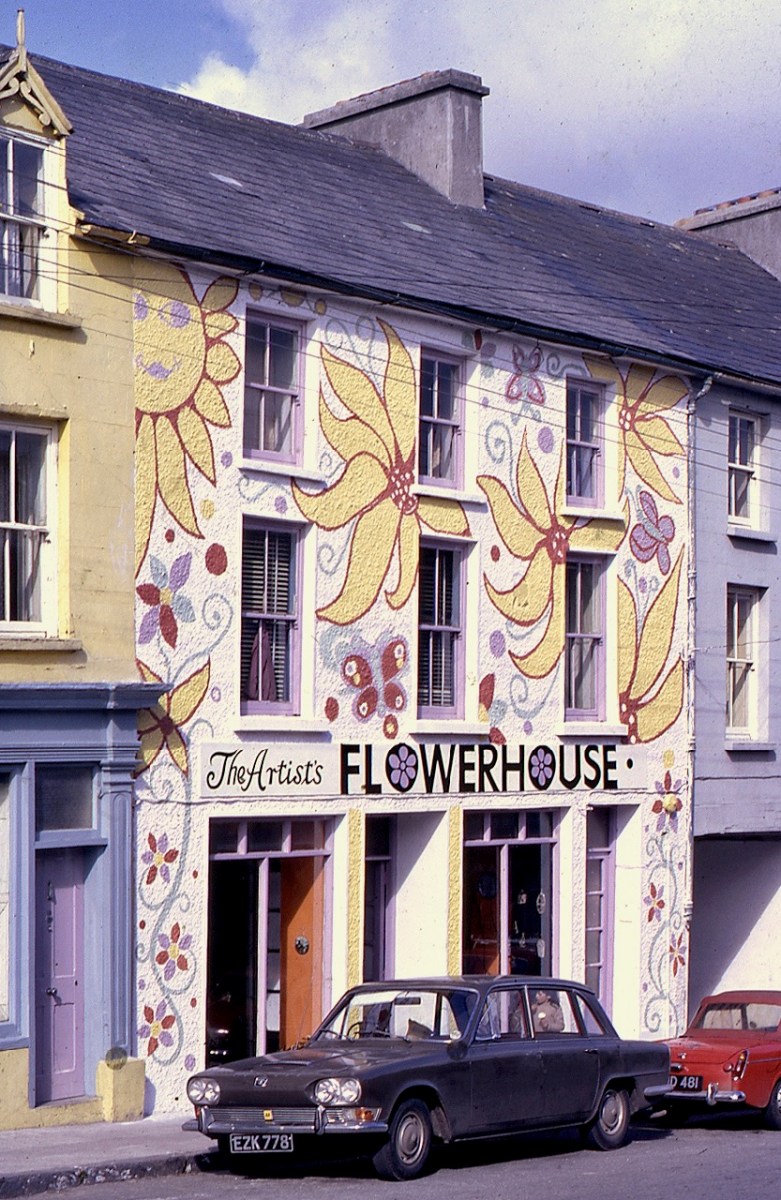
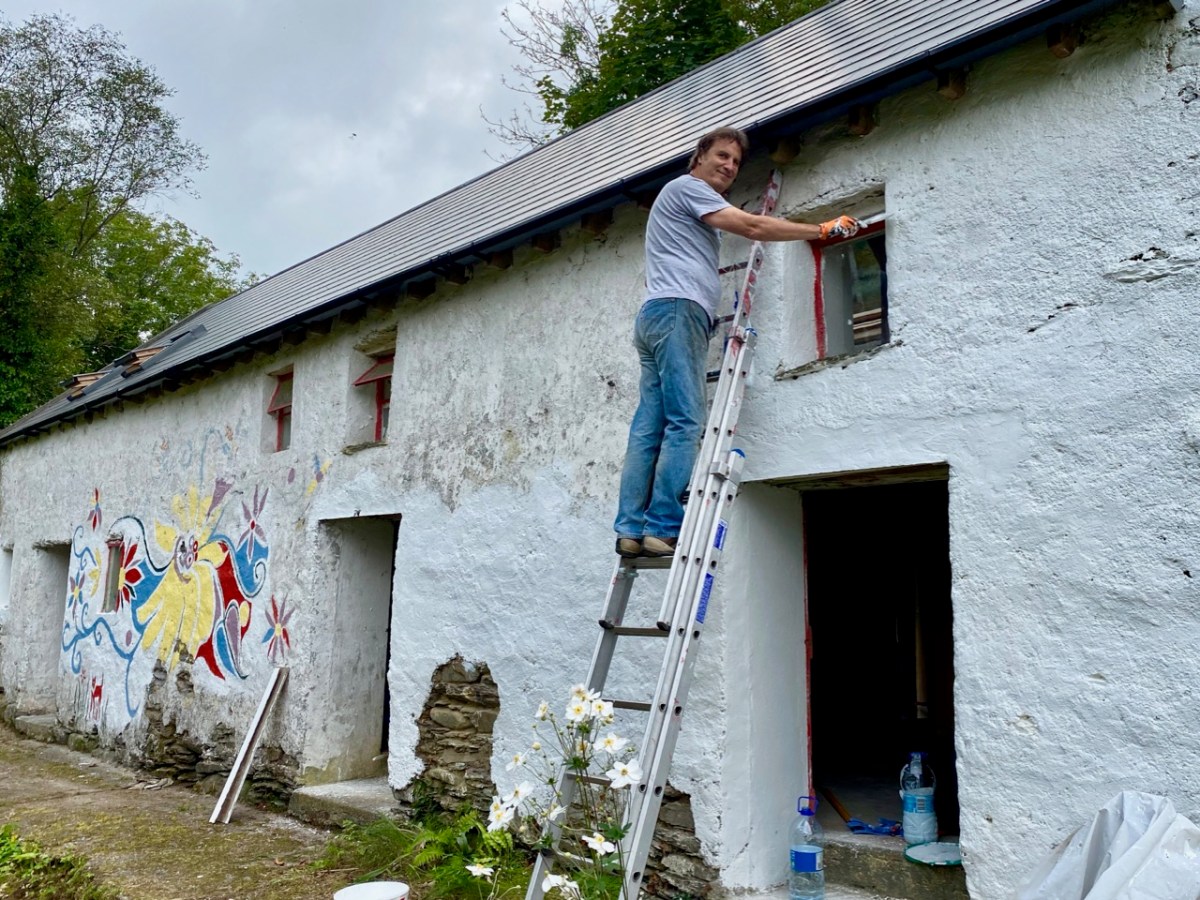
Back in the 1960s – the heyday of the Ballydehob Artists’ community – the pottery at Gurteenakilla was established by Christa Reichel who – together with her partner Nora Golden – went on to set up the Flower House on the main street in the village as a gallery and meeting place for the artists. They painted the vivid facade of the Flower House (the photo below dates from 1963, and is reproduced with the permission of Andrew Street): similar decorations were applied to the Brush Fire studio, where they survived and are now being restored by Angela and Robin.

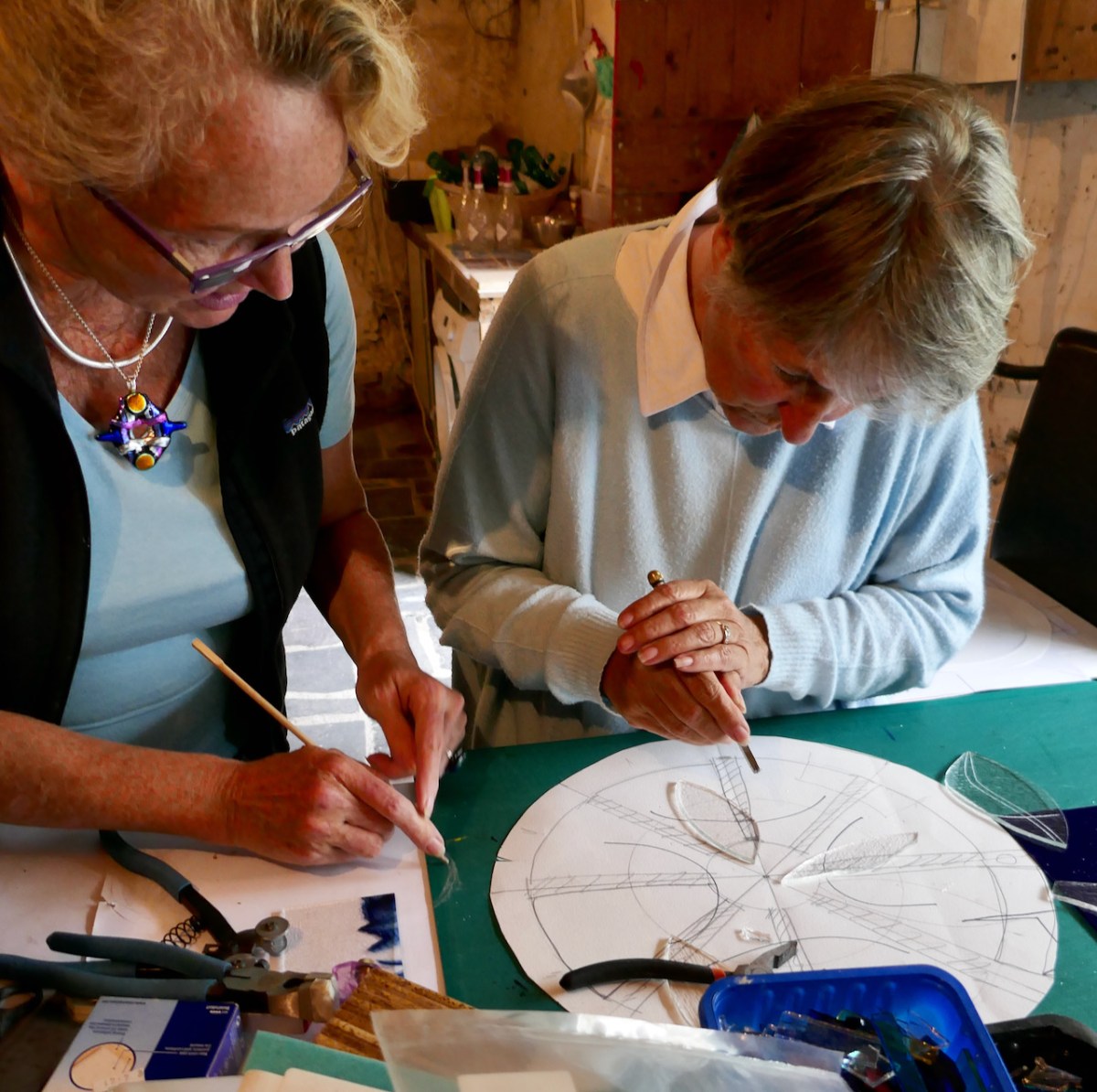
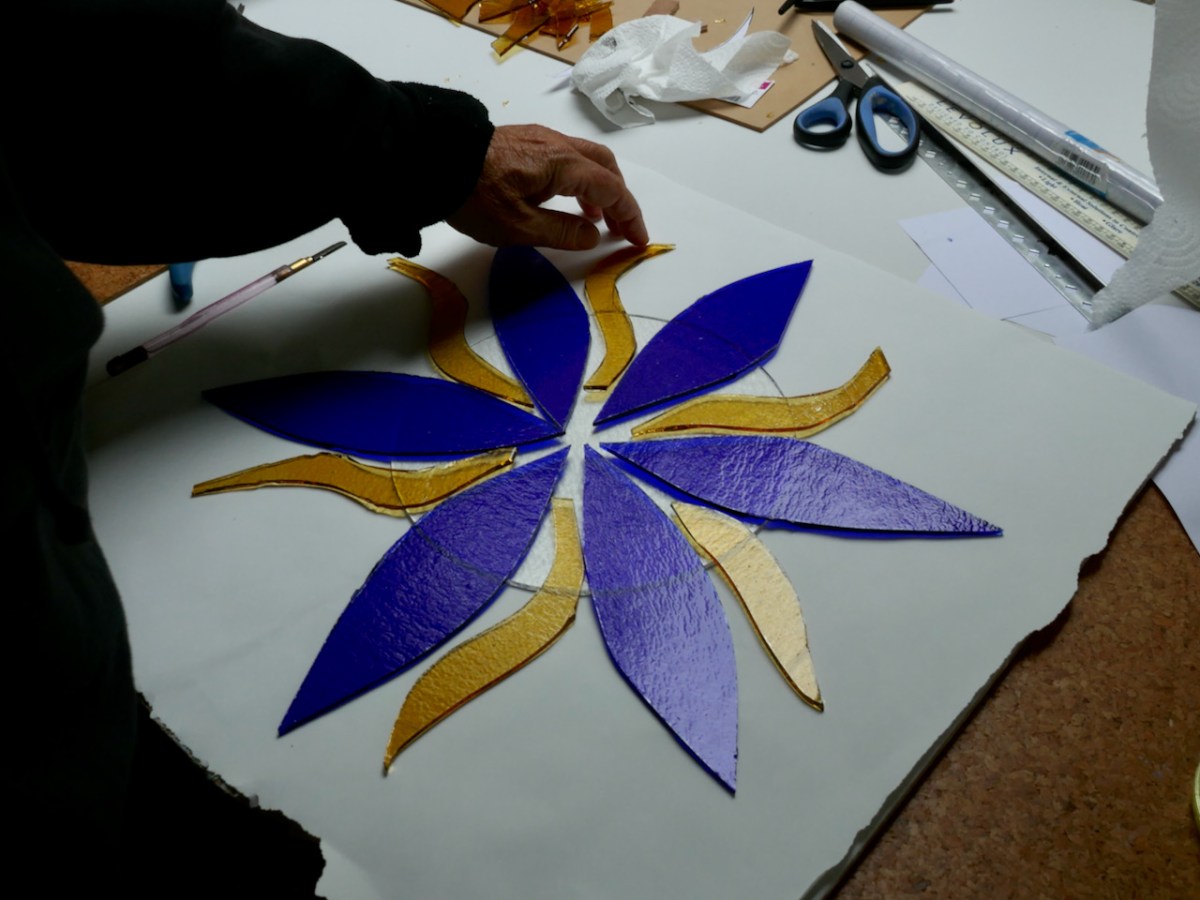
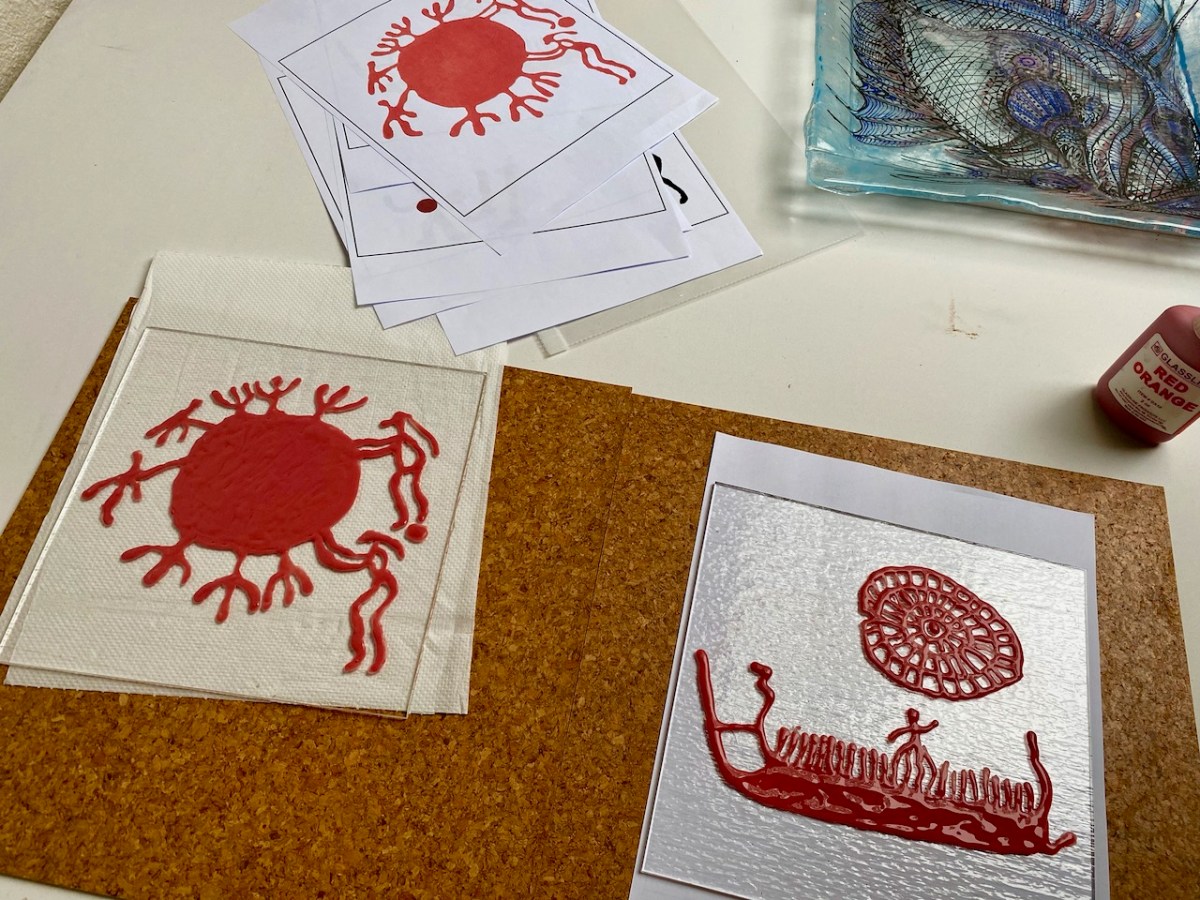
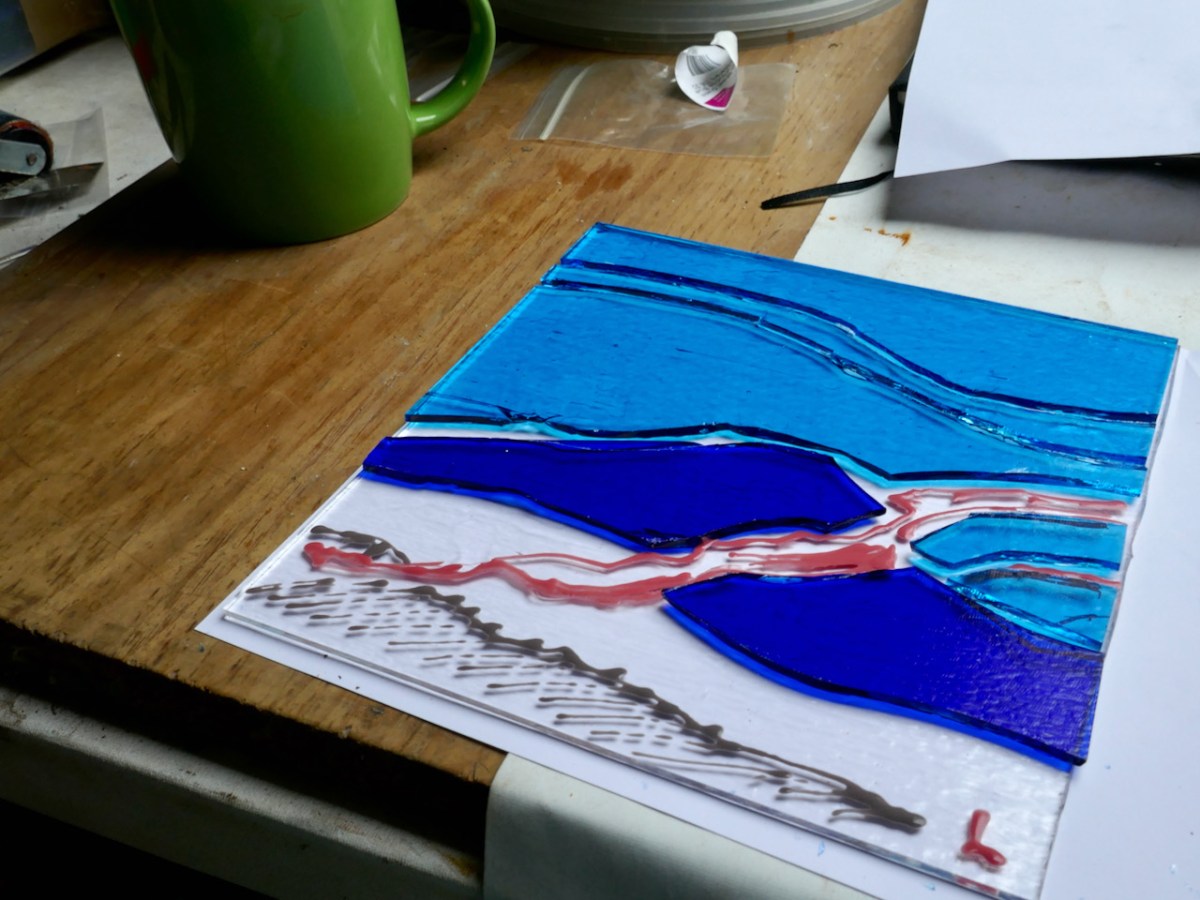
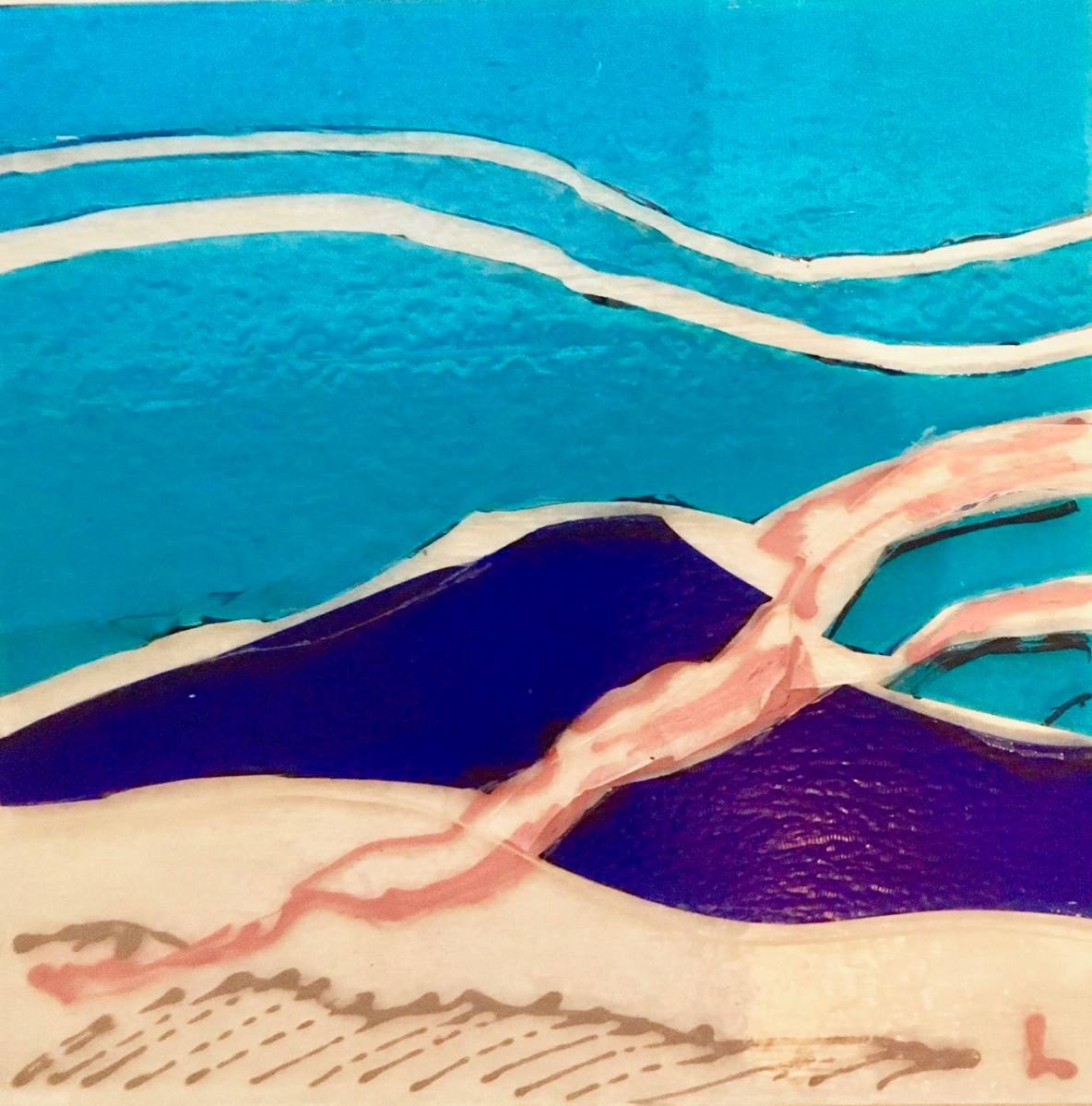
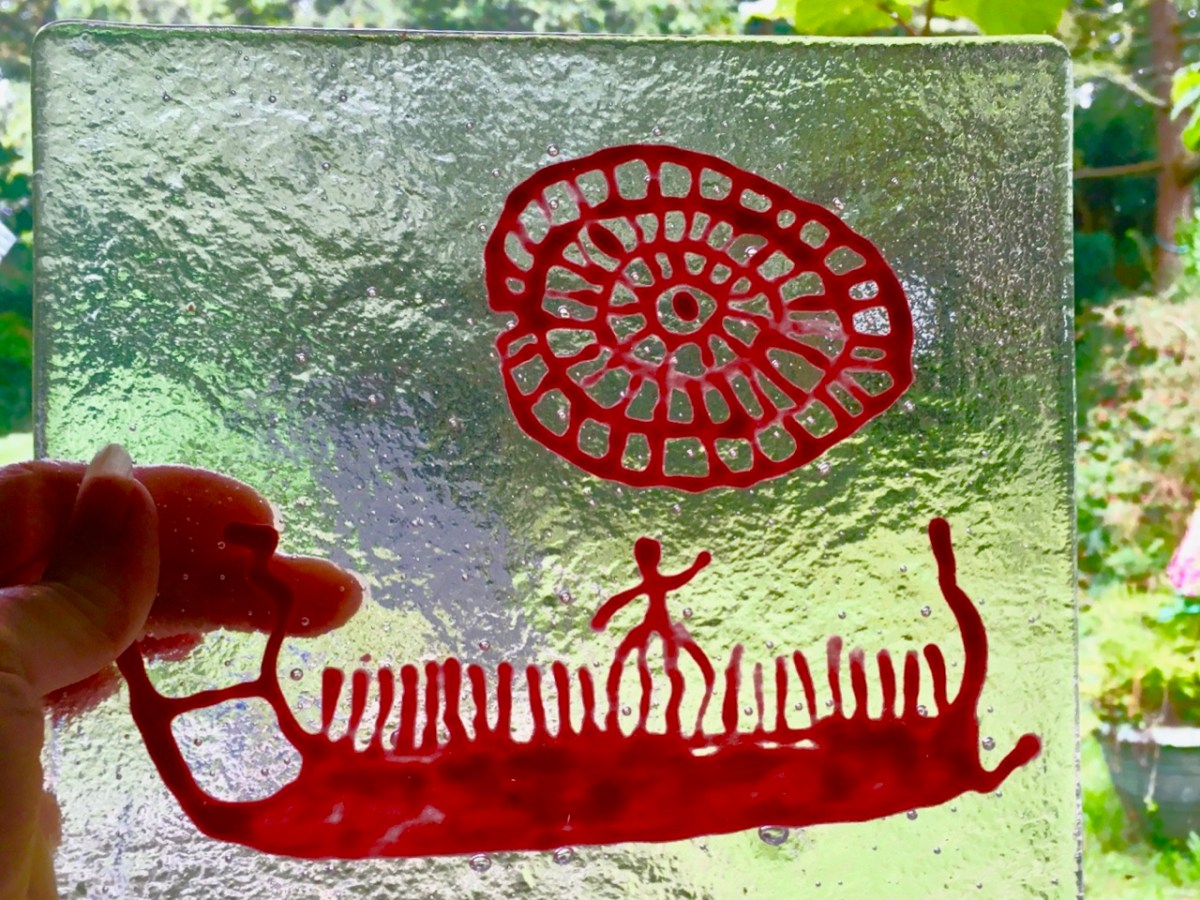
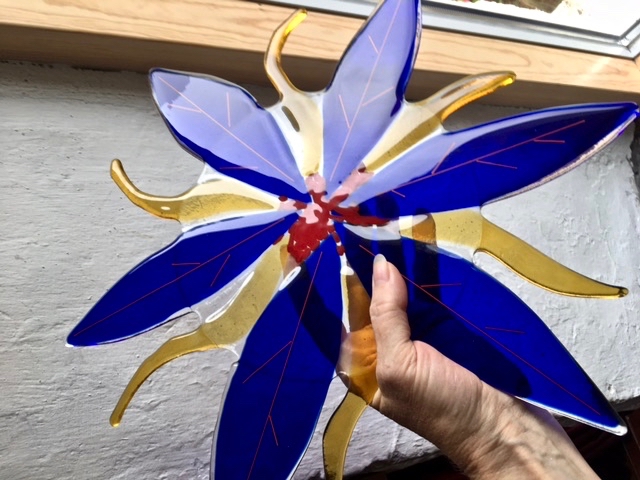
Below the Flower House picture is Nora Golden outside the studio at Gurteenakilla; and here are pics of Robin painting the studio building, and Angela’s restoration of the Reichel / Golden decorations. But back to the job in hand: in these venerable surroundings we learned how to cut glass, paint on it and prepare pieces for the kiln. We all had our own ideas: Finola and I decided to paint glass tiles with ancient motifs: Rock Art from Ireland and Scandinavia, some thousands of years old. Brian chose to use cut glass to enhance one of his exquisite sketches, while Clair was perhaps the most ambitious, planning a flower from cut pieces of glass which would require two sessions in the kiln to allow it to be ‘slumped’ to a three-dimensional shape. My view is that all the pieces were equally successful in their execution (but I am prejudiced!)

Top: Angela instructs Finola in the technique of cutting glass shapes, although Finola chose to use glass paint to reproduce some of her own Rock Art images traced during her studies in the 1970s. Above: Clair cuts and assembles a flower shape.

Top: my own pieces: on the left are attendants pushing the sun across the sky, while on the right is a ship carrying souls to the land of the Gods under a potent sun. All these Bronze Age images are found in Norway. Above, Brian working on his cut-glass sketch.

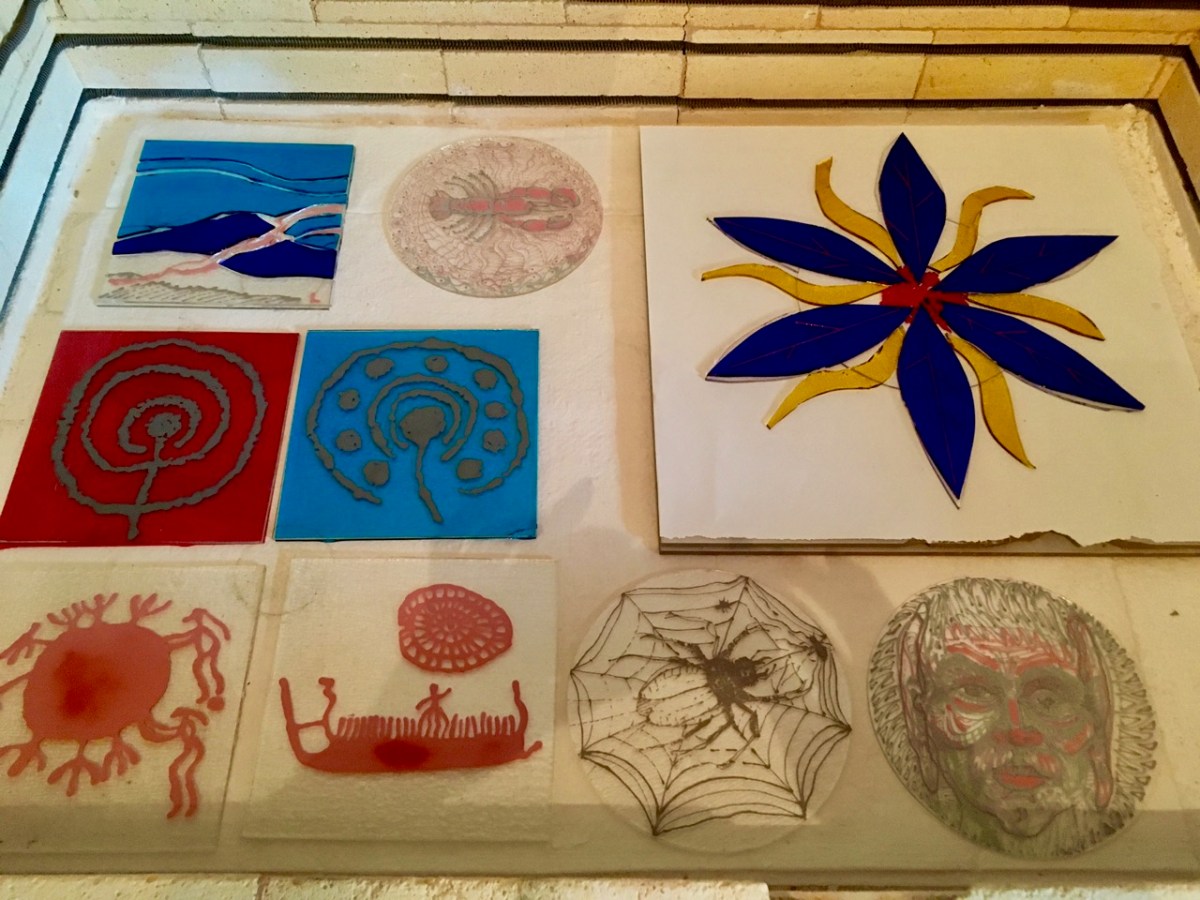
Artists at work in the studio – and the kiln room at Brush Fire. Before going in the kiln, we laminated our pieces with additional glass, to provide a stable background and – in some instances – colour. The firing is carried out overnight at a temperature of at least 760 degrees C. During that time the glass fuses and – hopefully – does not crack.. Angela was firing some of her own pieces at the same time: if you went to the West Cork Creates exhibition in Skibbereen during August of this year you would have seen many examples of Angela’s brilliant work, together with the work of other artists using glass as a medium.

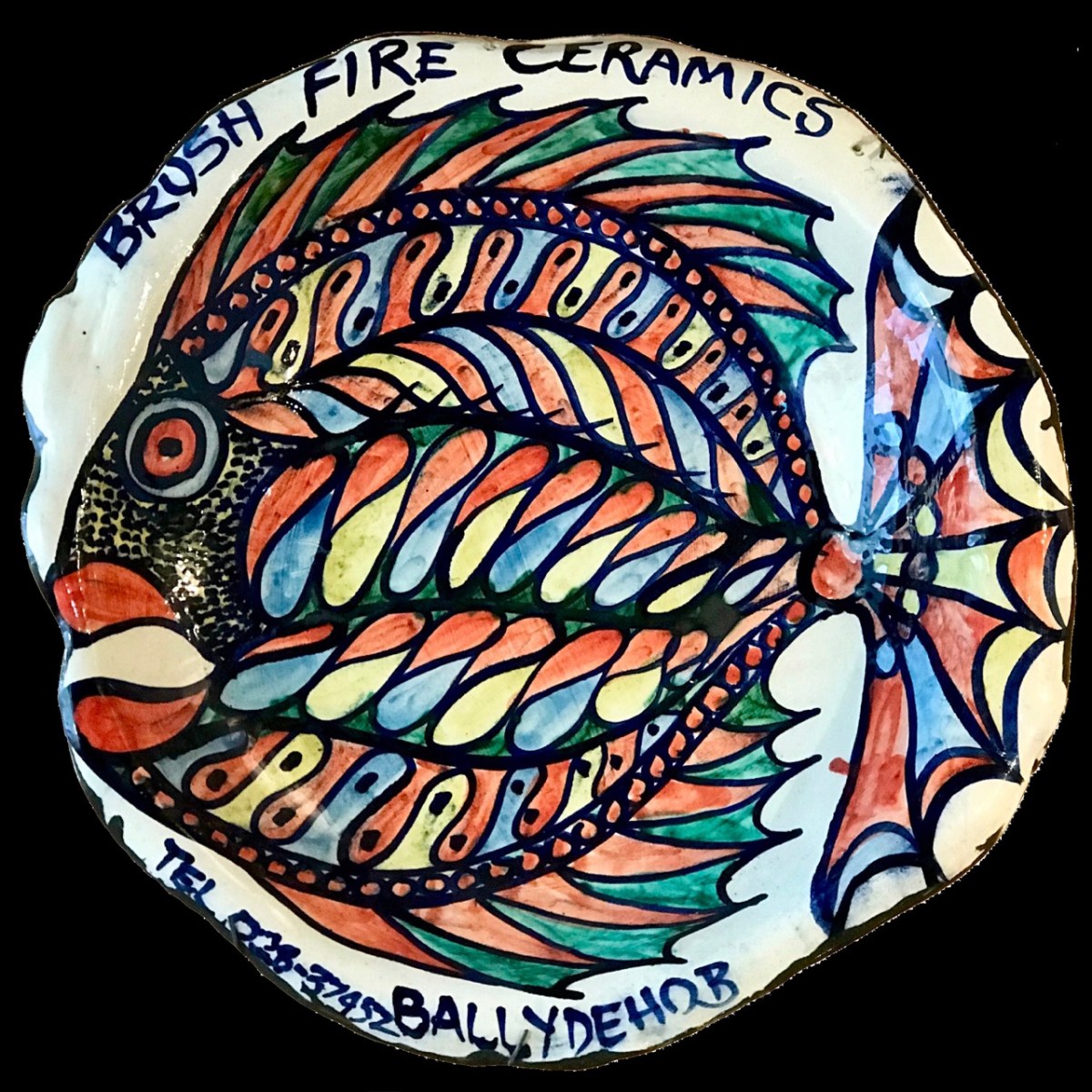
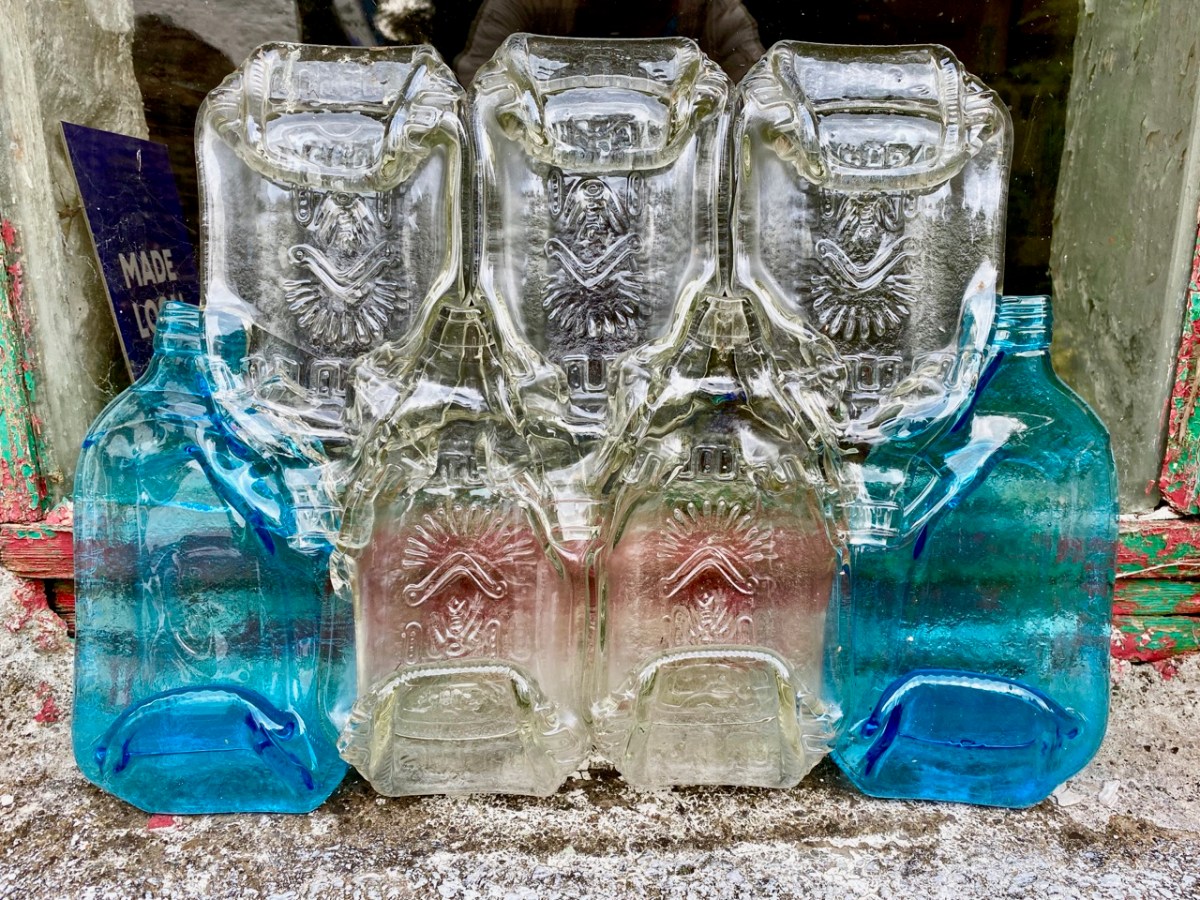
In Angela’s studio are many reminders of past times. John and Noelle Verling specialised in fish imagery – here’s the Brush Fire Ceramics sign that they made back in the day (above – since presented by Noelle to the Ballydehob Arts Museum), while above that is one of Angela’s glass pieces which pays due respect to her predecessors at Brush Fire. Below is a quirky example of Angela’s experimentation: she collected some interestingly shaped bottles from the recycling centre, and fused them together in the kiln:

The following day, Angela took our pieces out of the kiln once it had cooled, and washed them (above). Then we assembled at Nead an Iolair for the reveal. Thank you to Robin for the photos. Clair’s work had to be refired to allow it to ‘slump’, so that was unveiled later on.

Pieces (top to bottom) by Brian, Finola and myself. And – to finish as we started – Clair’s magnificent flower – before and after the second firing! Thank you to Angela for enabling each one of us to experience this most satisfying process. We would all like to take part again another day – and expand our new-found skills!

A Signal Success in Irish Engineering – Part 8: Brow Head

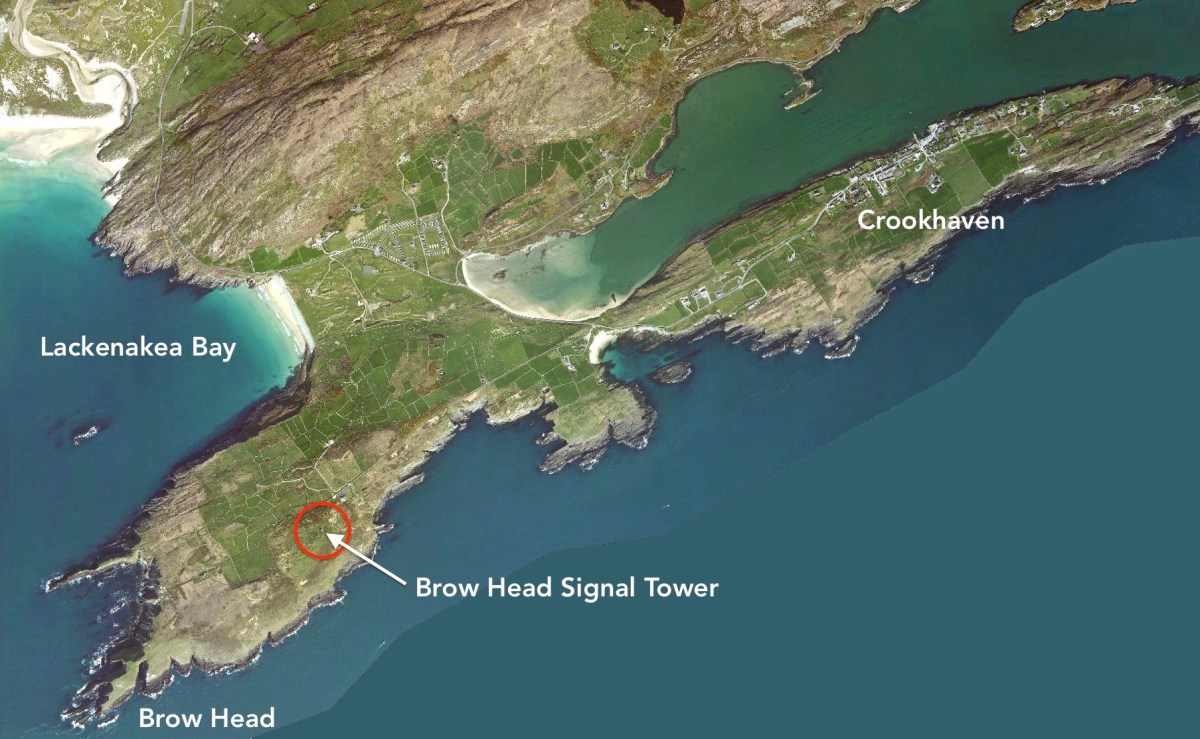
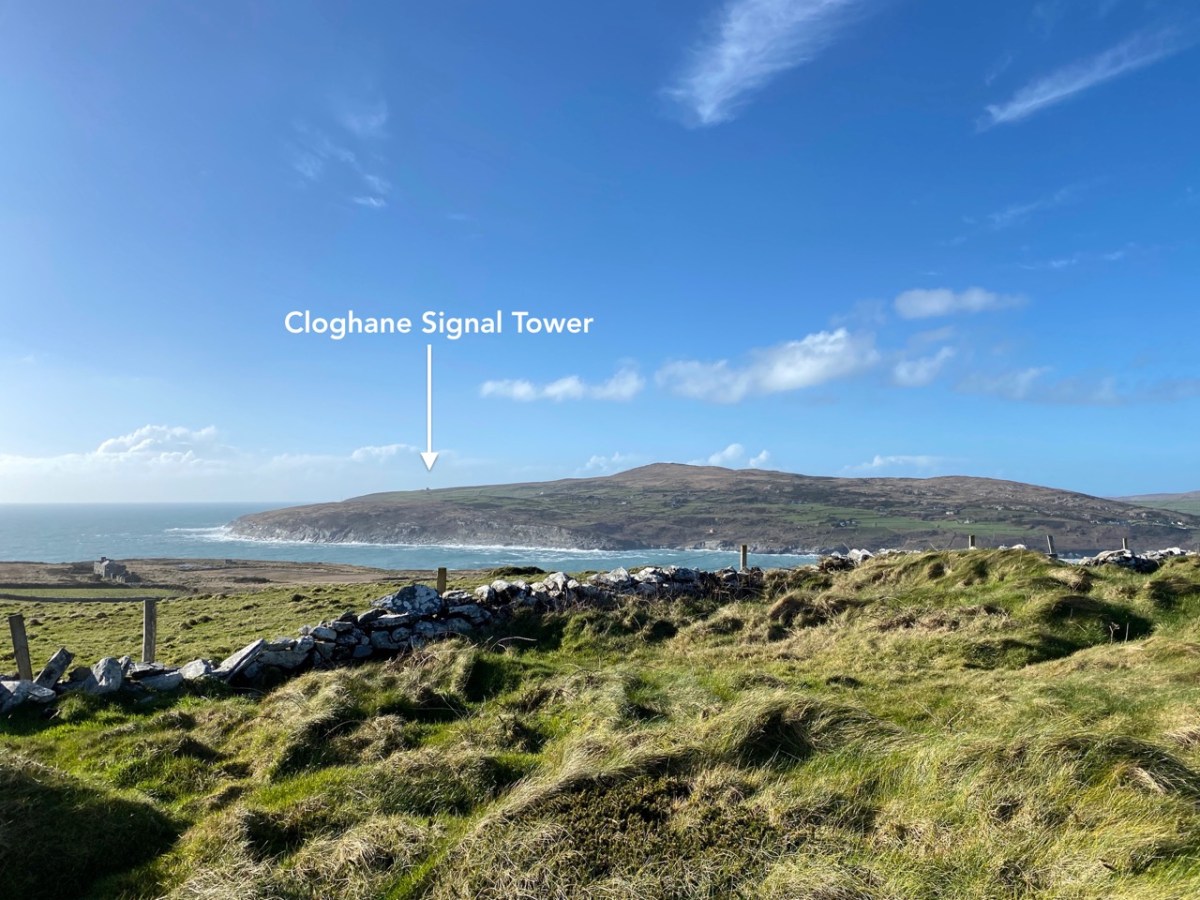
It’s surprising that it’s taken us eight episodes of this series to reach Brow Head, as it is one of the nearest to us, and one of the best preserved – albeit a ruin. It’s not far from the last one we explored: Cloghane, on Mizen Head. In fact, at 3.8km apart, these two towers are the closest of any in the whole system of signal towers around much of the coast of Ireland: 81 towers, each one generally in sight of two others.

Above – views north-west across to Cloghane, Mizen Head, from Brow Head. The lower photo is taken with a long lens. Cloghane is 3.8km away from Brow Head: it doesn’t sound very far but, as you can see from the centre picture here, it’s remarkable that telescopes were good enough, in the early 19th century, to make out visual signals in any great detail. Weather conditions were obviously an important factor in this. Below, the tower at Knock, Lowertown, near Schull, is some 19km away to the east. When we visited the vestigial Ballyroon signal tower, on the Sheep’s Head to the north, we could also clearly see across to Brow Head – a distance of about 17km.

Brow Head – the headland itself – has been the subject of a previous post on Roaringwater Journal. It has a remarkably diverse history: not only is it the site of the Napoleonic-era signal tower, but of industrial and scientific activity. There are the substantial remains of a nineteenth century copper mine (photo above): I noted that the Mine Captain here was Hugh Harris from Cornwall – and wondered if he was a relation – until I read that he was dismissed as ...an incompetent authority…! Most interesting, perhaps, are the ruins of a signalling station set up by Guglielmo Marconi – established in 1901.

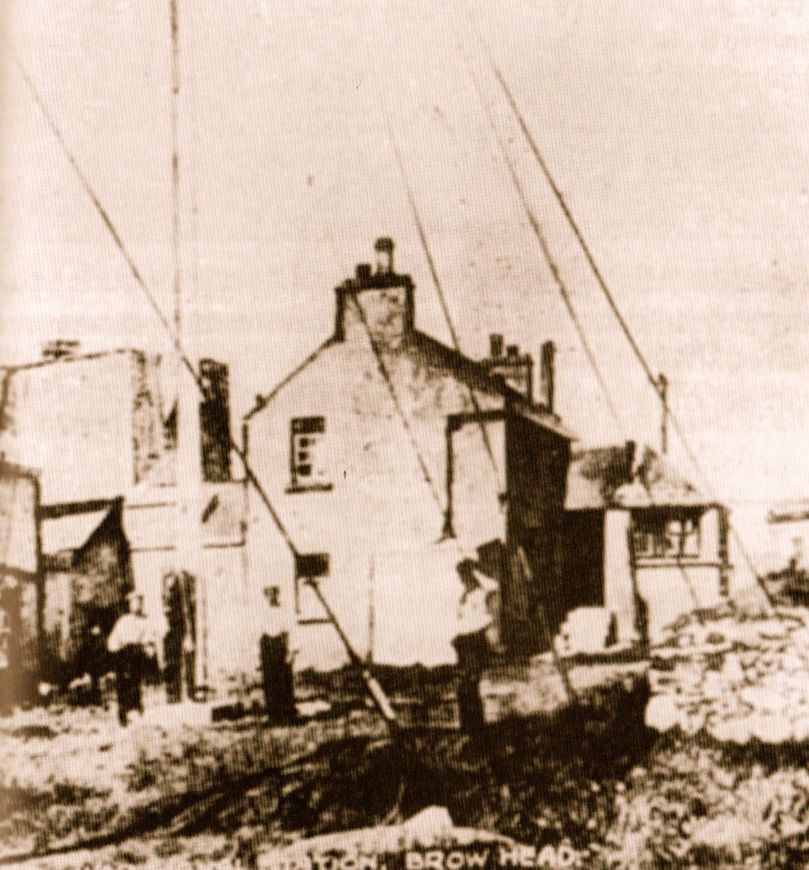
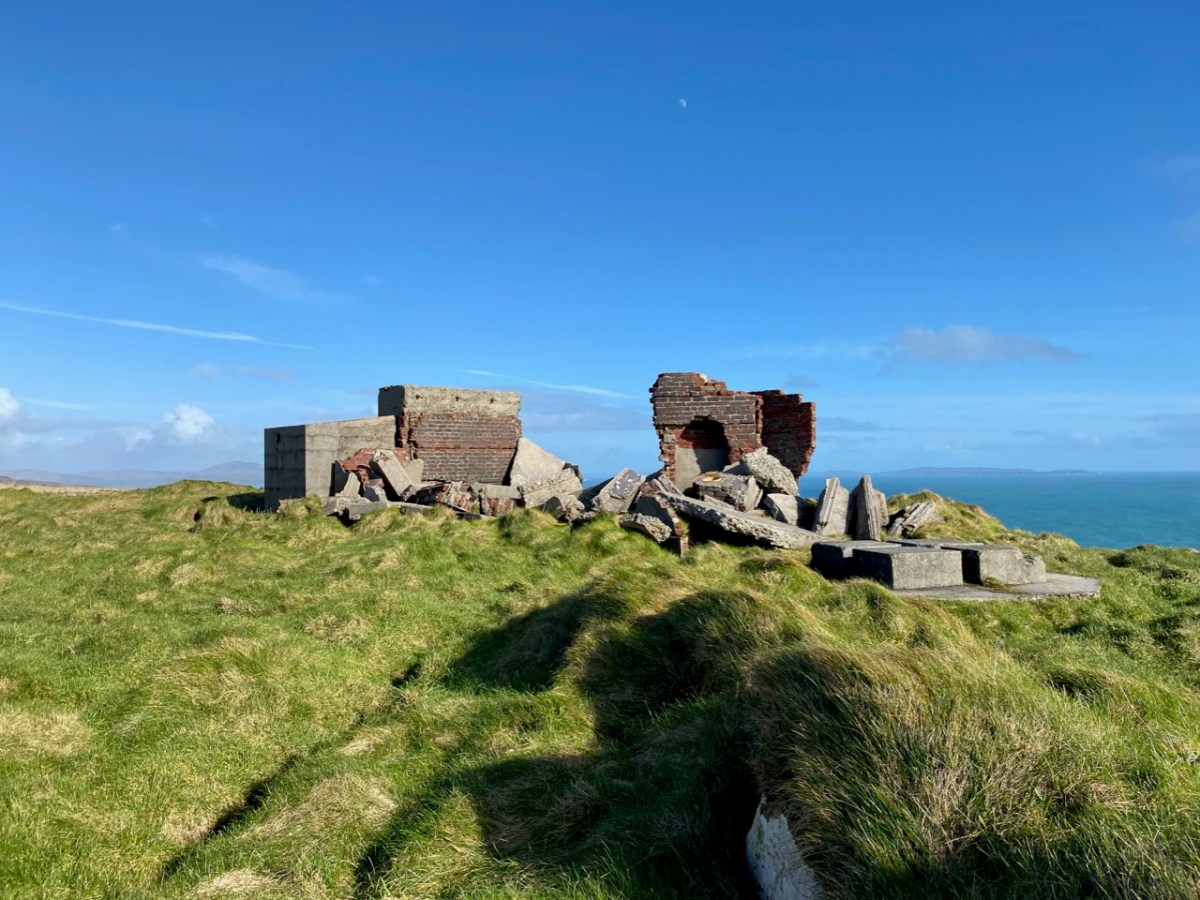
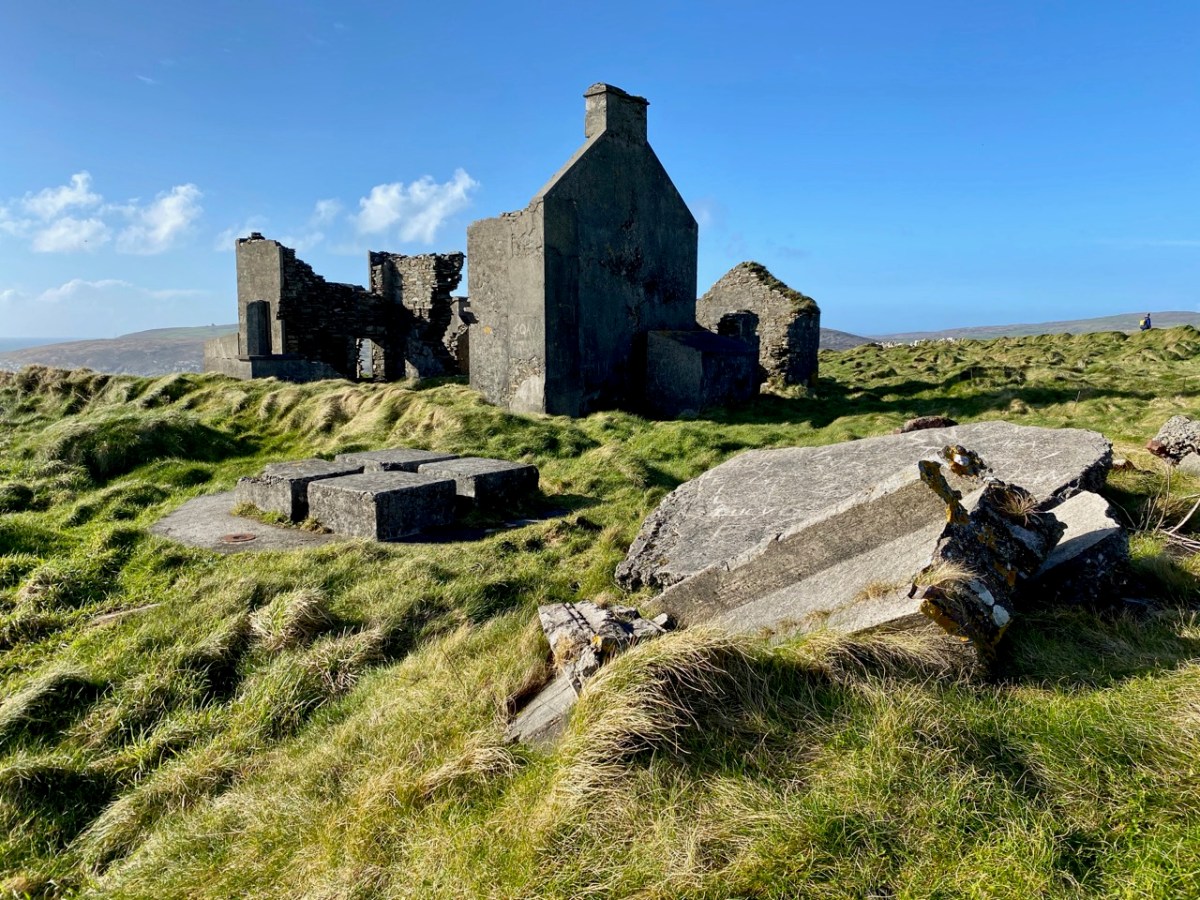
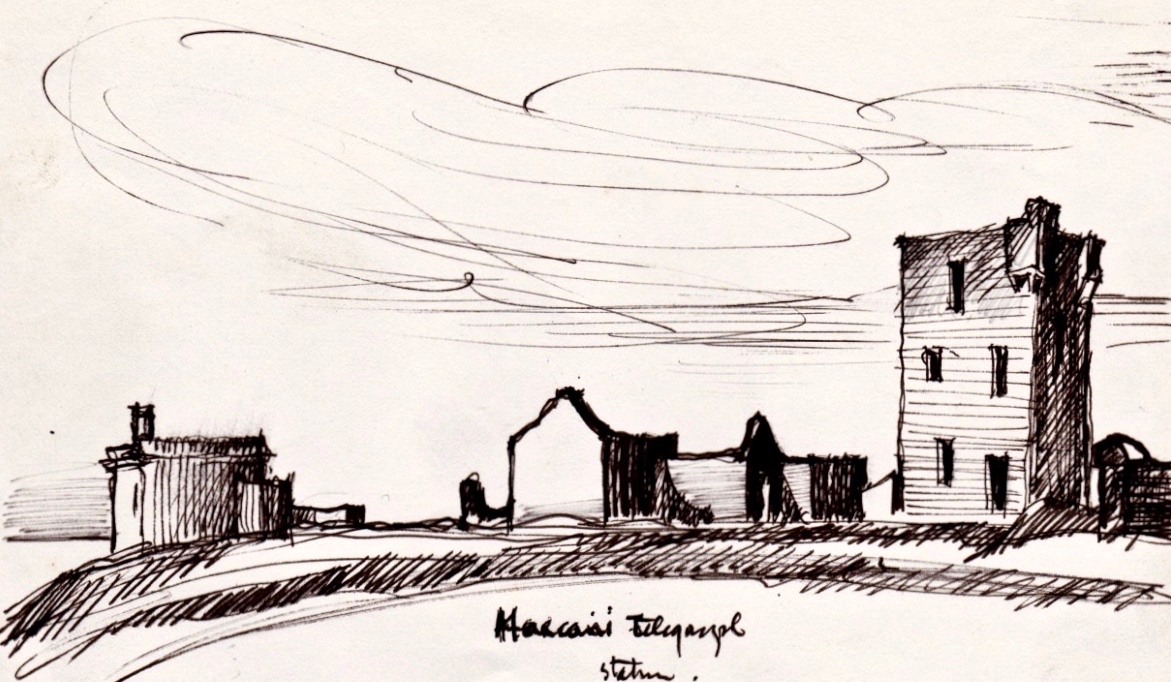
This photograph was taken in 1914. It shows the Marconi installation still in use: the signal tower is visible in the background, on the left. On the far right is a building which I take to be the electricity generating station, powering the telegraph. During the Emergency (1939 – 1945), a lookout emplacement was built to the south of the Marconi station: many of these were built around the coast, the majority sharing a site with a Napoleonic-era tower. Have a look here for more information on these comparatively recent structures.

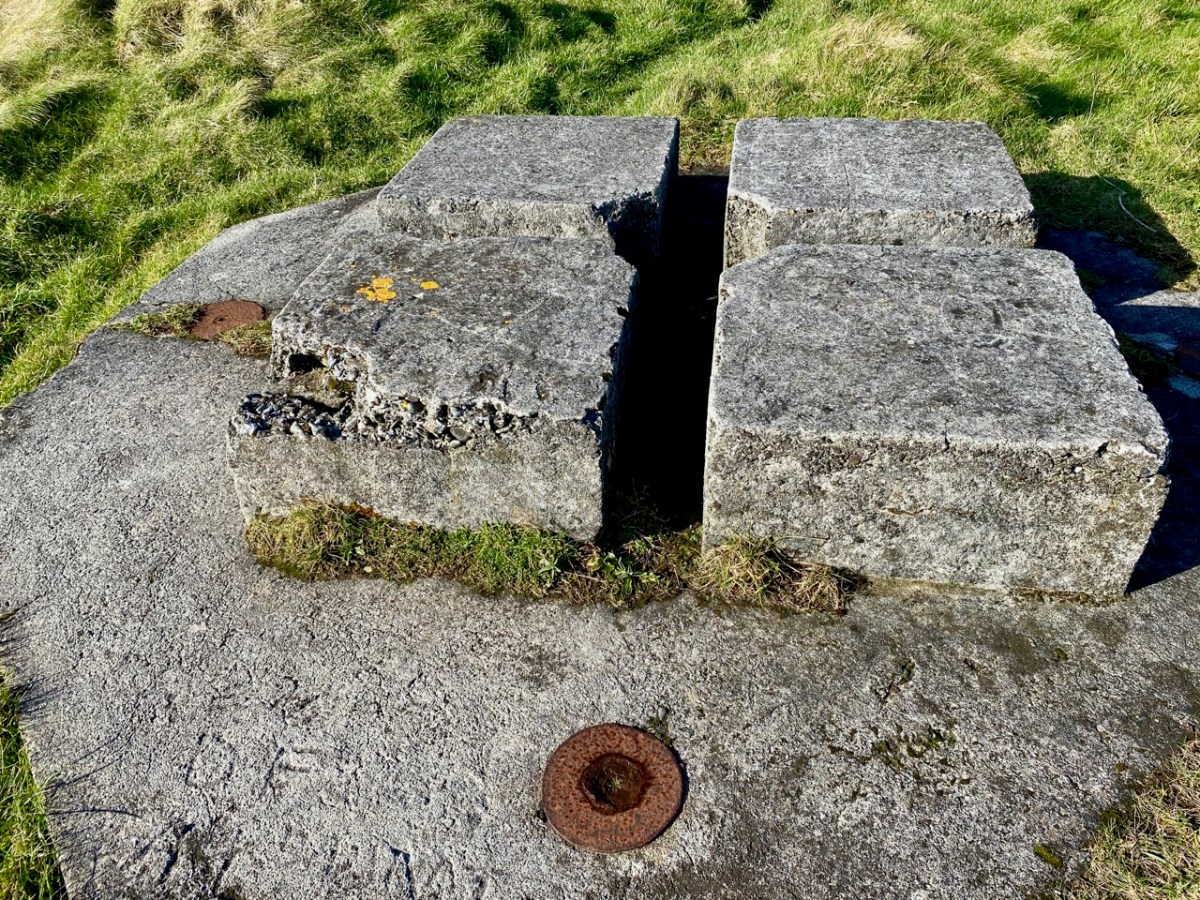
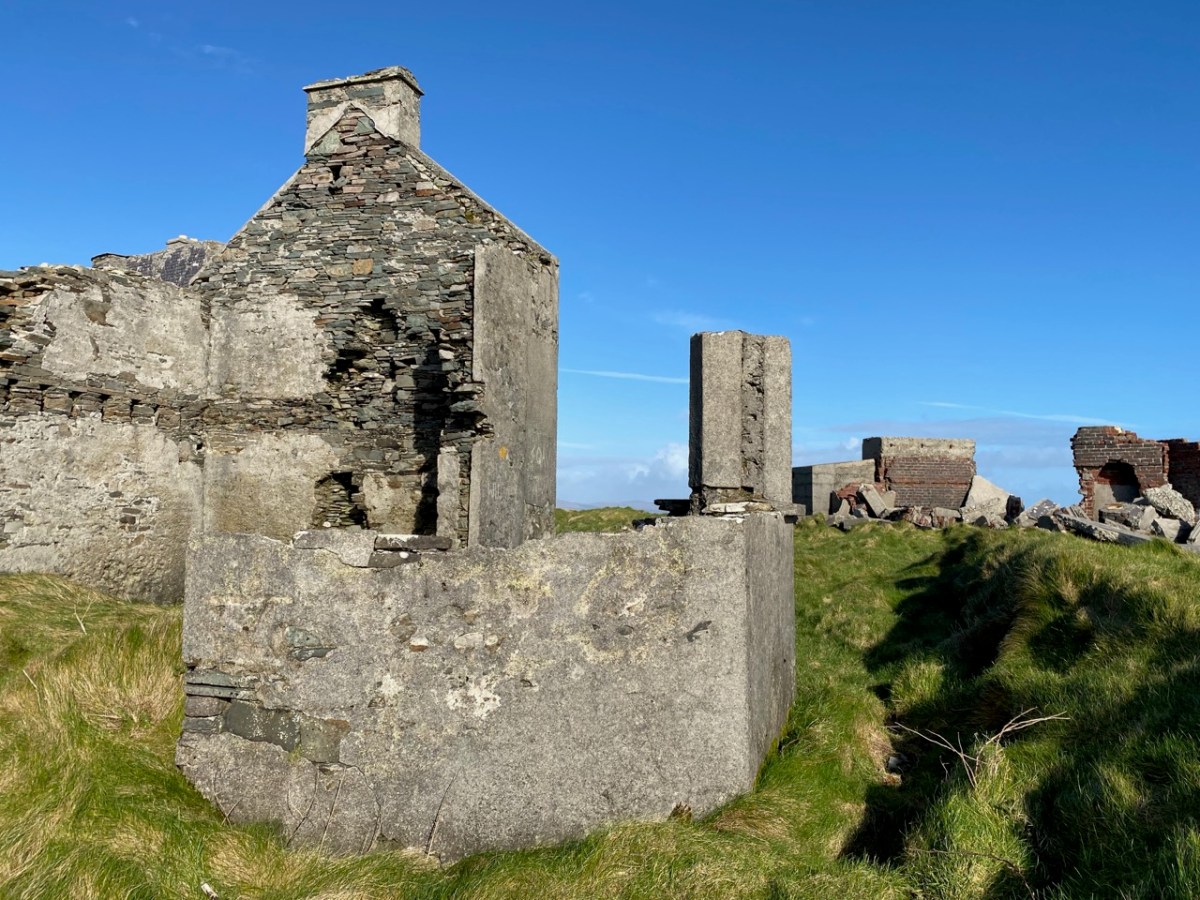
For this excellent drone picture of the Brow Head site, taken in 2017, I am most indebted to Jennifer & James Hamilton, mvdirona.com. Jennifer and James are intrepid adventurers, travelling around the world on their Nordhavn52 vessel. It’s well worth going to their website to see what they get up to: it makes our own travels in the West of Ireland seem a little humdrum… On the right of the photo is the 1804 signal tower; on the left is the Marconi station with – just in front of it – all that is left of the 1939-45 lookout post. On the right in the foreground is the generating station shown in the present day photo, below. Note, also, in all these images can be seen the four-block supporting base for the Marconi transmission mast.

What happened to these buildings? Here’s an account I received from a RWJ correspondent (very many thanks, Rachel), after I had published an earlier post on them in 2014 – it is based on contemporary newspaper articles during the Irish War of Independence:

. . . Brow Head was destroyed on the 21st August 1920 at 12:45 – 1am, having been raided less than 2 weeks earlier on the 9th August. All reports mention the use of fire; only some mention the use of bombs. Explosives had, however, been stolen during the earlier raid on Brow Head (they were used for fog-signalling). Due to delays in reporting, some articles suggest different dates for these events but I’m fairly sure the 9th and 21st of August are the correct ones. 9th August: Armed and masked men raid the station and take stores of explosives, ammunition, and rifles. There are conflicting reports over whether any wireless equipment was taken during this raid. 21st August: Reports that all buildings at Brow Head (war signal station, post office, coastguard) destroyed, either by fire, or fire and bombs depending on the article. Some reports say 40 men were involved, some 70, some 150, some 150-200. These men had masks and were armed with revolvers to cover the three or four guards, they were described as young and courteous. The raid is said to have taken 5 hours; all Post Office equipment was taken away, as well as other stores. Other wireless equipment was smashed. The raiders helped the guards move their furniture/belongings out before setting fire to the buildings . . .

Rachel Barrett

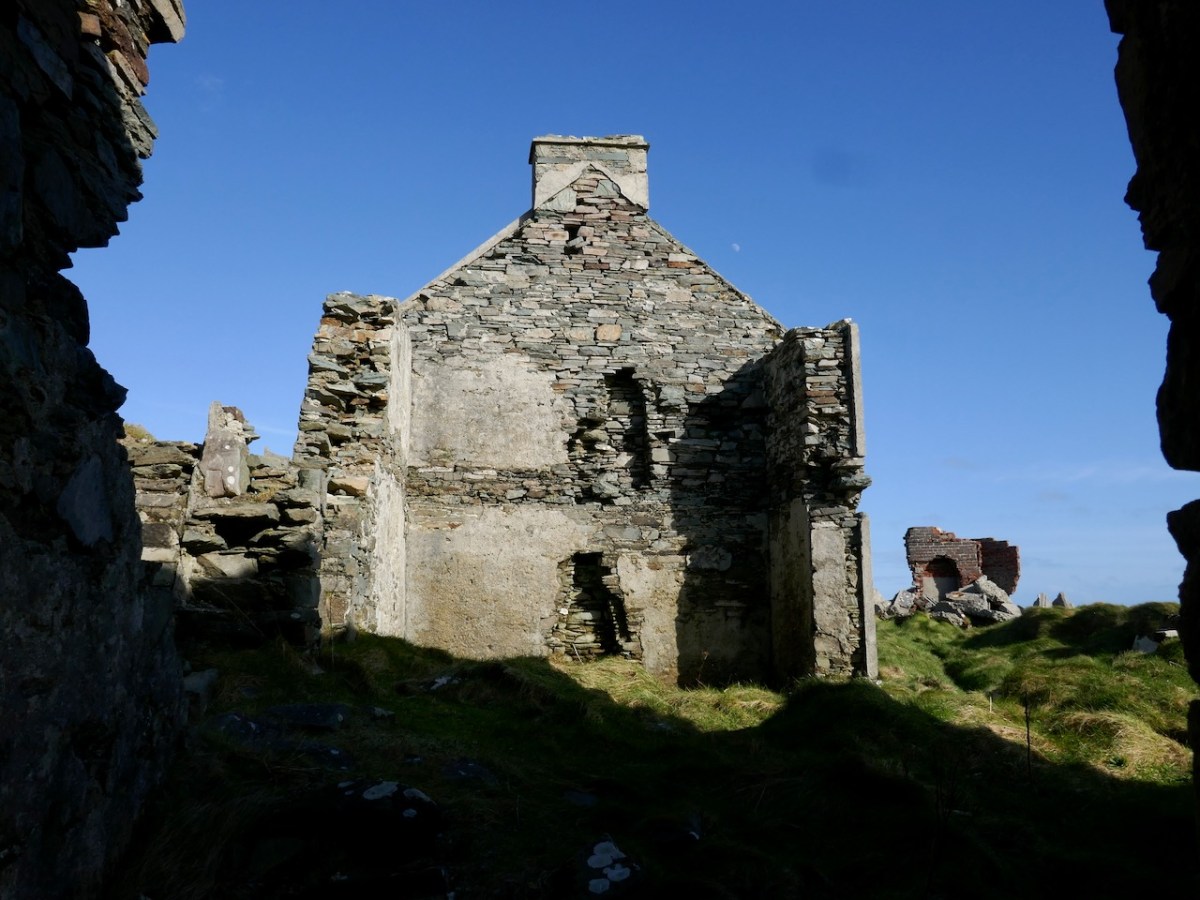
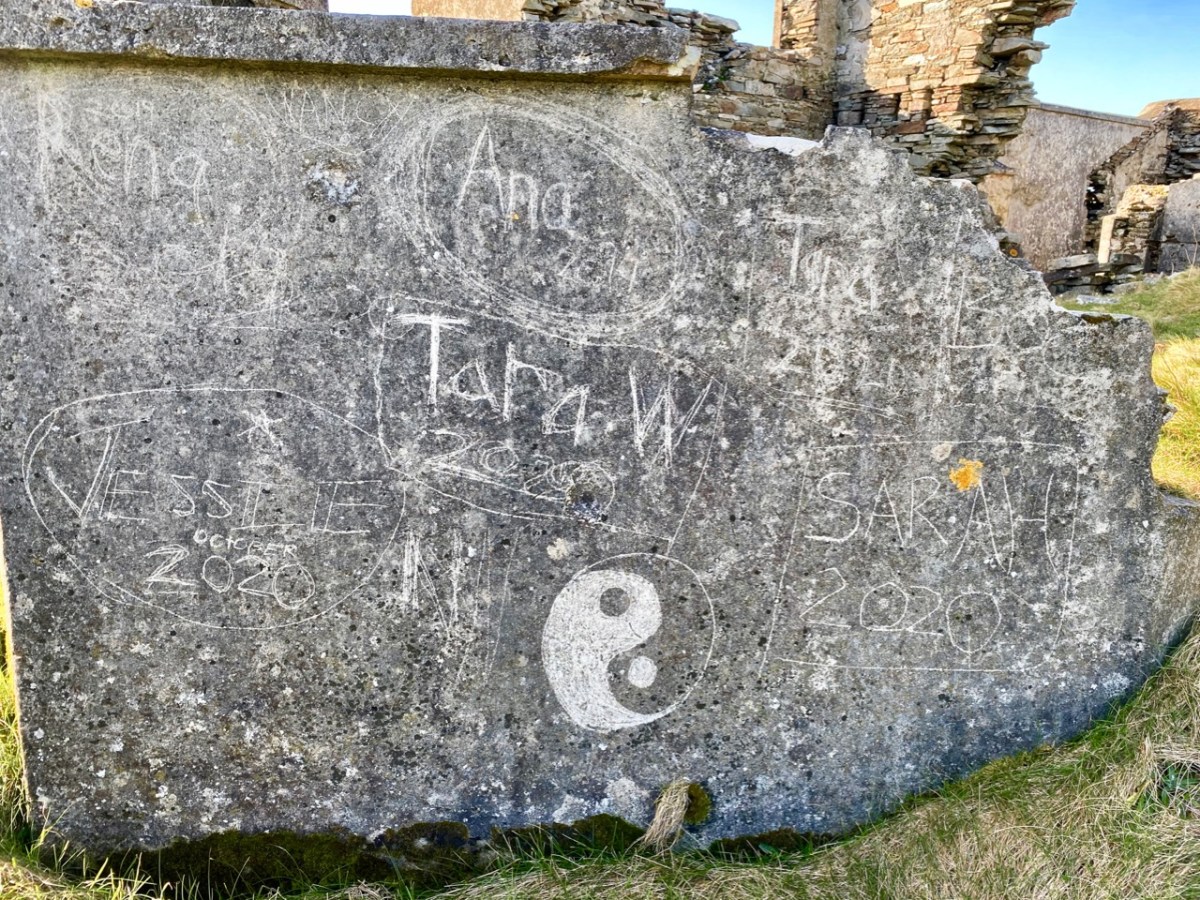
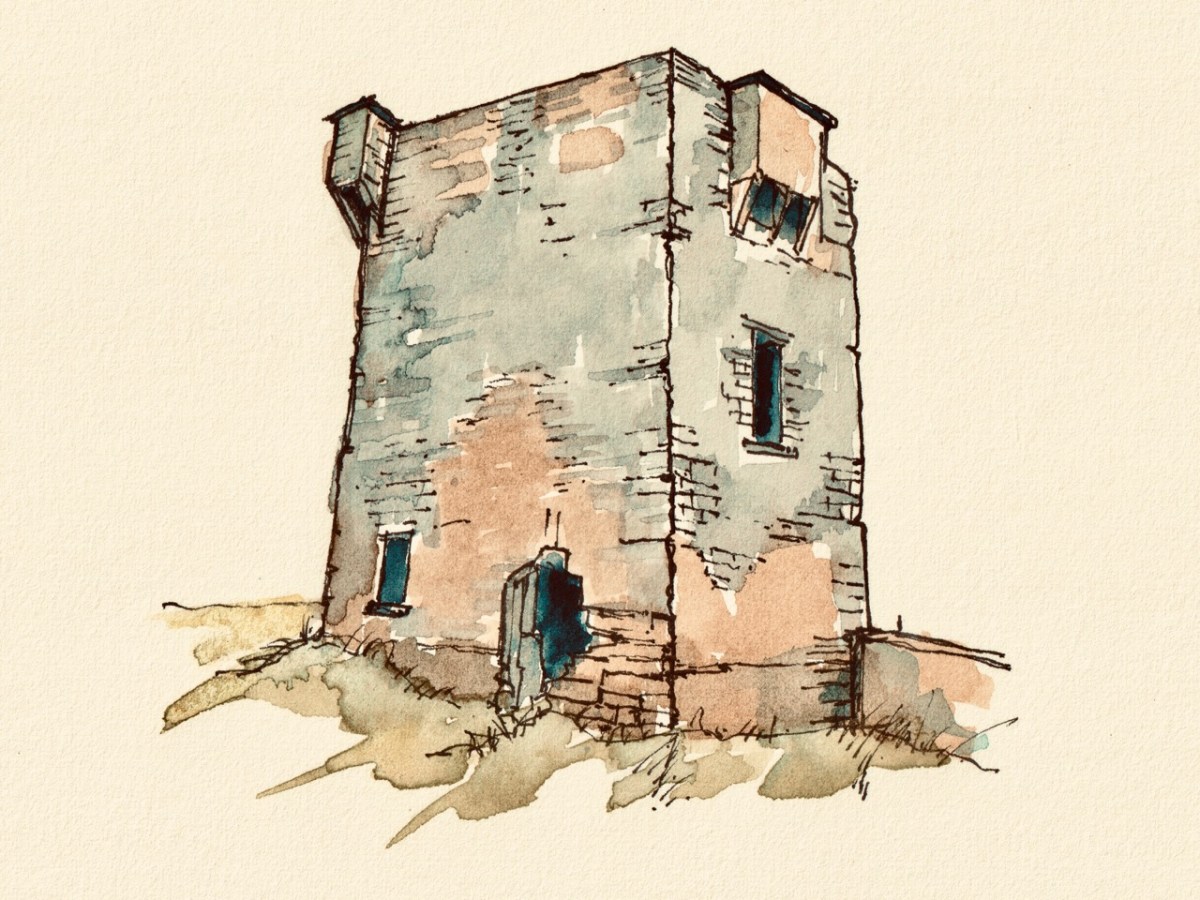
So far we haven’t said much about the 1804 signal tower itself. Although ruined, it is a good example, reasonably stable, and has survived two centuries of severe Atlantic gales remarkably well. All the elements are recognisable: projecting bartizans, slate hung external walls for improved weatherproofing, an intact roof and distinct internal features – and a little enigmatic graffitti. Compare all these with the other towers in our series so far (there are links at the end).

If you set out to visit the Brow Head site on a good day, you can’t do better than to park at Galley Cove – at the bottom of the long, steep access road (and beside the Marconi commemoration board and sculpture by Susan O’Toole) – and then walk up. You will enjoy continuously changing spectacular views in all directions, and you will begin to see the signal tower above you as you approach the brow of Brow Head.

West Cork based artist Brian Lalor visited the Brow Head site with the Mizen Field Club in 1984. His sketch of the buildings is an interesting record as it appears to show, on the left, the 1939-45 lookout post intact (below). Very little remains now, 37 years later (lower). I wonder what led to this particular piece of destruction?

I’ll finish off with another sketch view of the Brow Head signal tower: this is by Peter Clarke, who runs the excellent Hikelines site. Many thanks, Peter.

The previous posts in this series can be found through these links:

Part 1: Kedge Point, Co Cork

Part 2: Ballyroon Mountain, Co Cork

Part 3: Old Head of Kinsale, Co Cork

Part 4: Robert’s Head, Co Cork

Part 5: Downeen, Co Cork

Part 6: Dunnycove

Part 7: Cloghane, Mizen Head

Mizen Magic 19: Church of the Angels

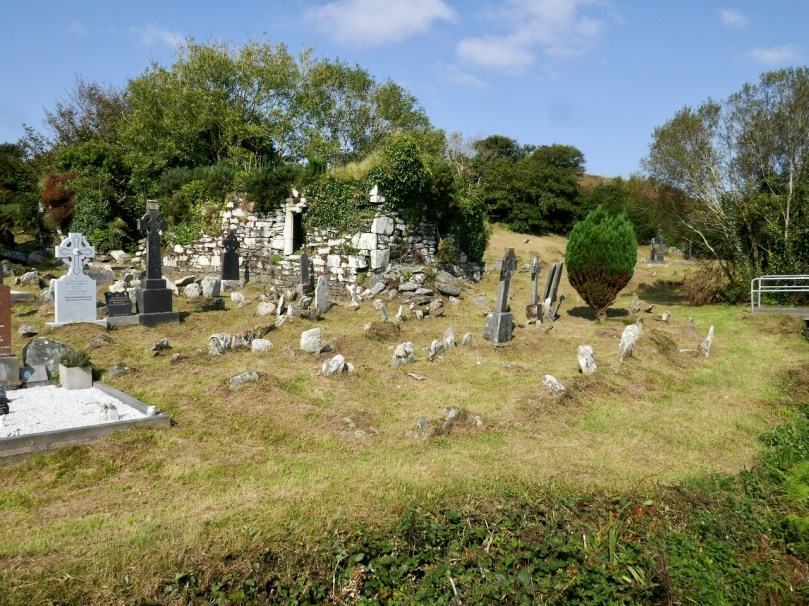
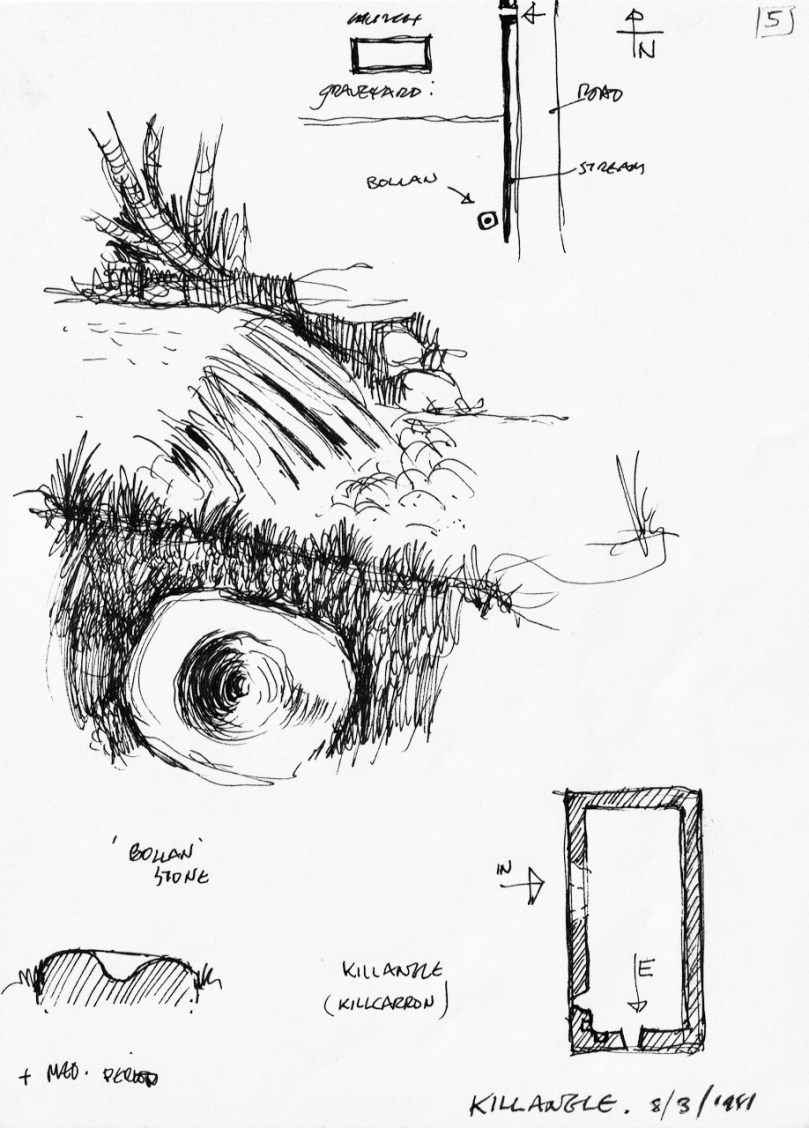
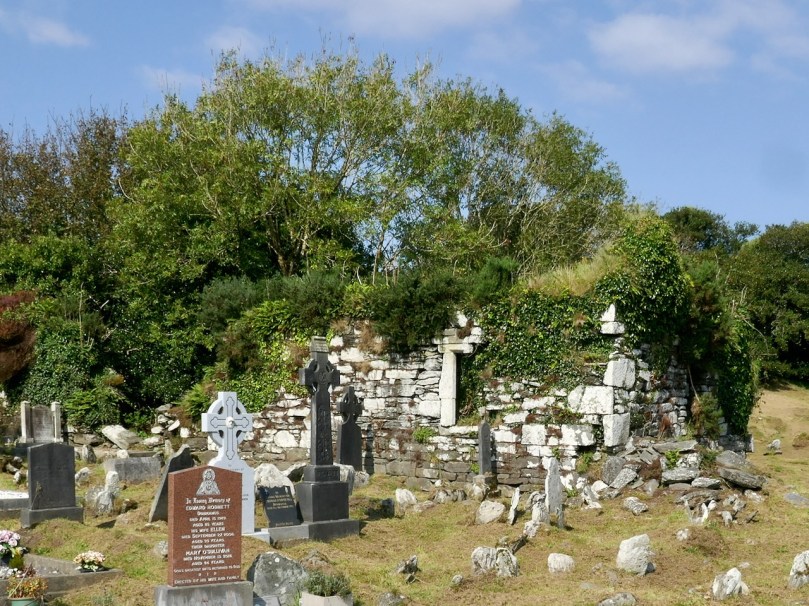
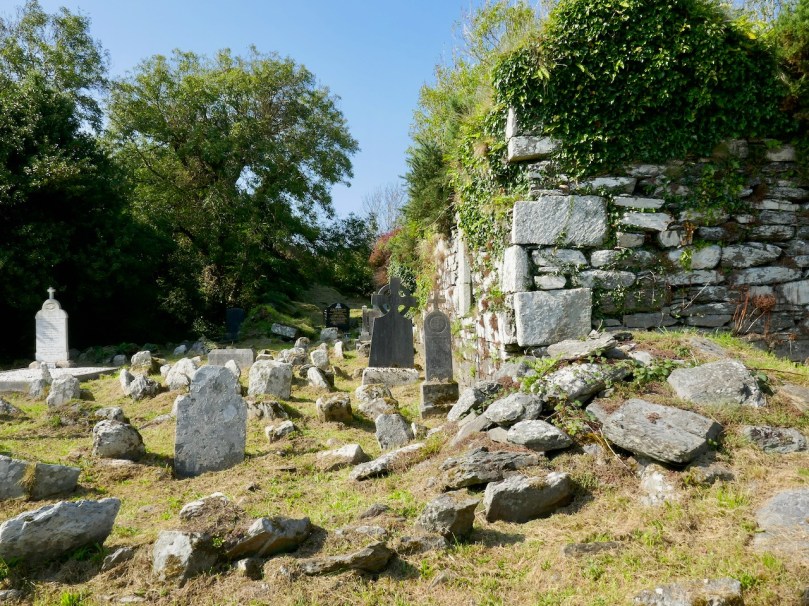
It’s called Cill Cheangail but that doesn’t make a lot of sense as cill is a small church and ceangail means to tie or fasten. But hereabouts people call it Killhangle (sometimes spelled Kilheangul) and now it’s clear – aingeal (pronounced angle) is the Irish word for angels. This is the Church of the Angels, reckoned to be Late Medieval (maybe fifteenth century) in date. For the exact location of this church, see my post Mizen Magic 17: The Delights of Dunmanus.

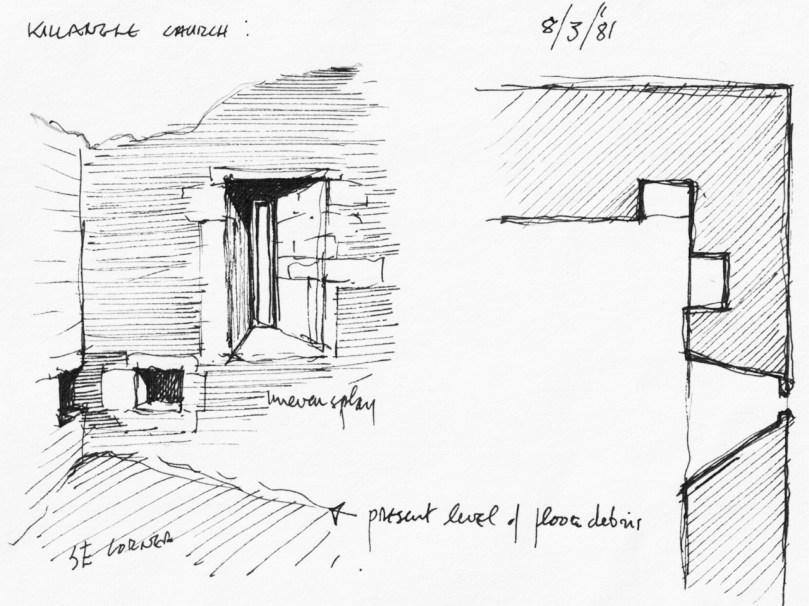
I am lucky to have Brian Lalor’s Sketchbook – quick records he made of his visits to  sites during field trips with the Mizen Historical and Archaeological Society in the 1980s. This kind of record is invaluable to show changes over time – the bullaun stone that Brian records in his sketch above can no longer be found.

Parish Churches, that is, churches built specifically to serve the people of the neighbourhood, rather than churches in monasteries to serve monks or friars, are a medieval phenomenon in Ireland. Along with the building of these churches came the practice of burial inside the church (for high-status individuals) or outside it (for the rest of us). Many of these burial grounds are in use up to the present day.

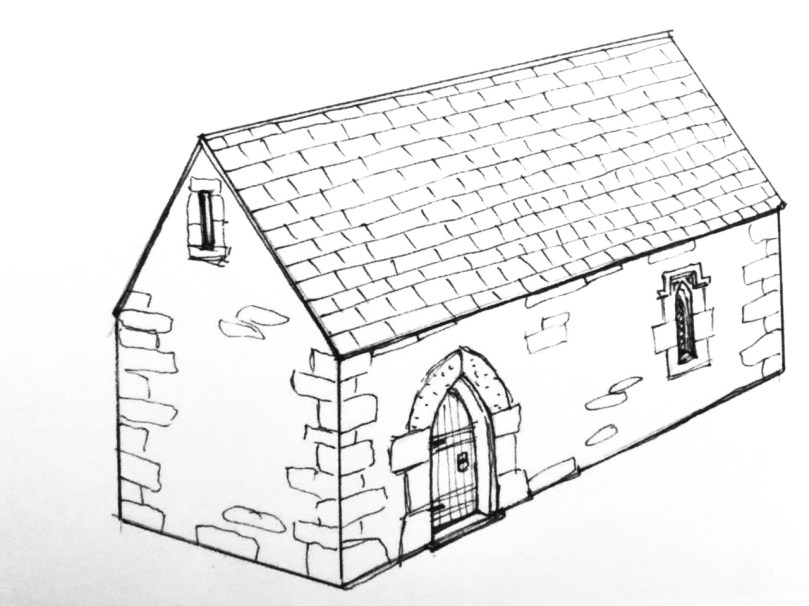
The church itself is in a ruinous state but enough remains to see some of typical attributes of a small parish church of this time, such as the one in the illustration (not by Brian) above. It’s a simple rectangular structure, oriented E-W, with the door in the south wall. Several small aumbreys (cupboards) are built into the south and east wall. There’s a window in the east wall which is missing almost all its dressed stone surround but we can surmise that it may have been ogee-headed.

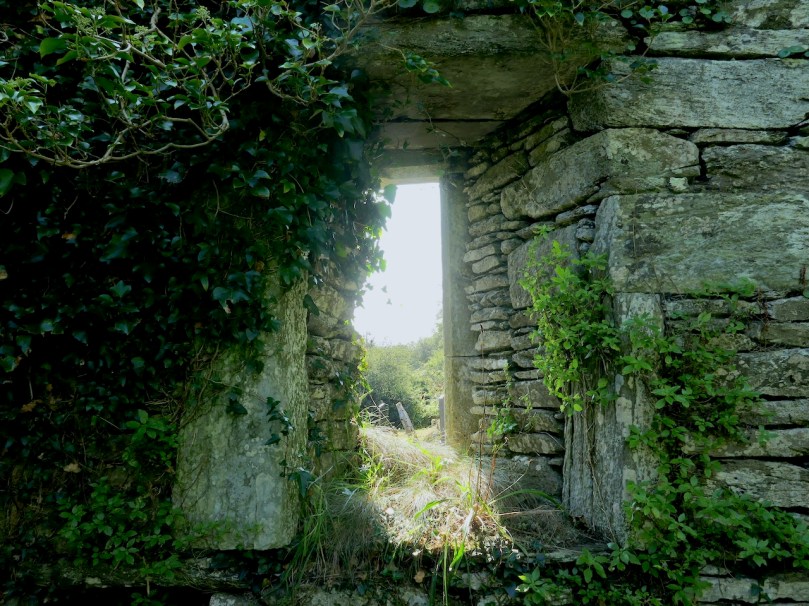
The other window is in the south wall and this is an interesting one – there’s a flat-headed lintel visible from outside and inside the embrasure is splayed unevenly to admit more morning light, especially in winter.

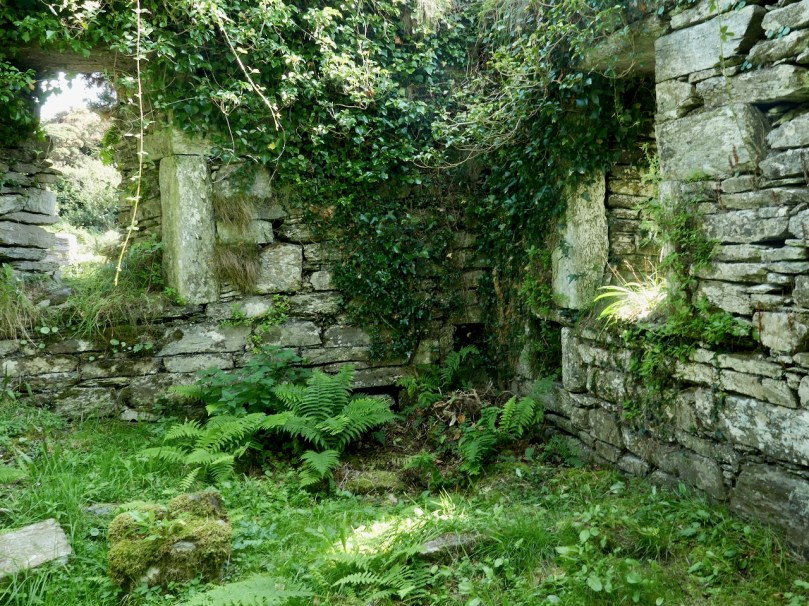
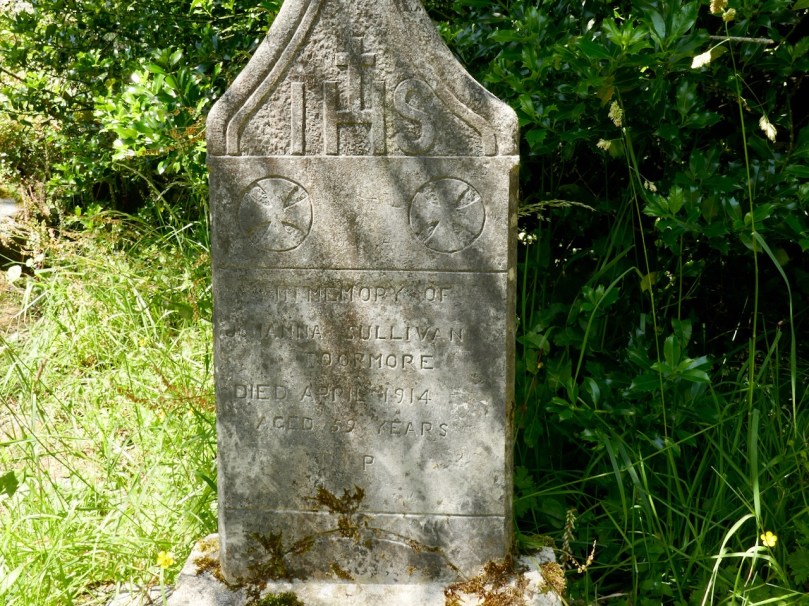
Most of the interior is filling up now with debris and a large holly tree and only one headstone is examinable. The style of this headstone is echoed in others outside, leading to the conclusion that it was the shape and decoration style favoured by a certain local stone carver. It’s quite a striking and elegant form.

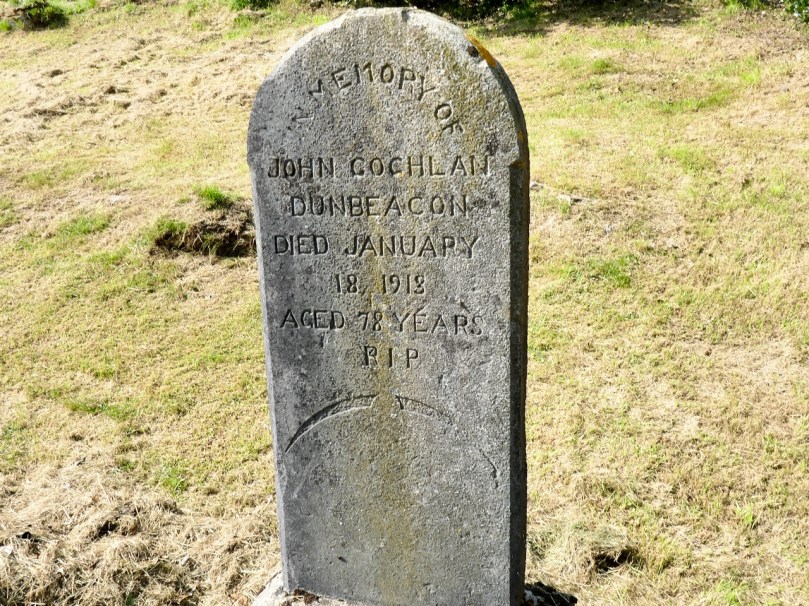
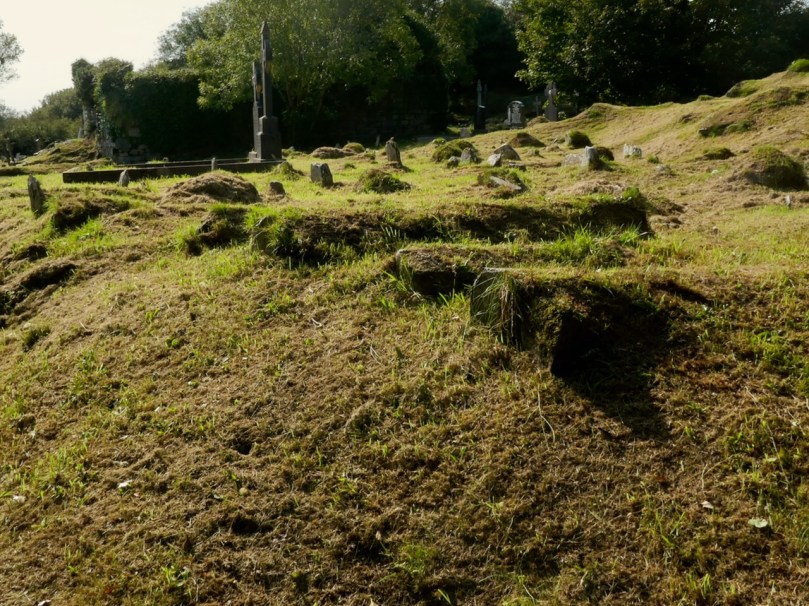
Most of the people buried in Killhangle could not afford a carved headstone. Instead, graves were marked with simple field stones. We are told that in times past old people could pick out the grave of a long-gone relative from a memory still held in the family of the size and shape of such field stones.

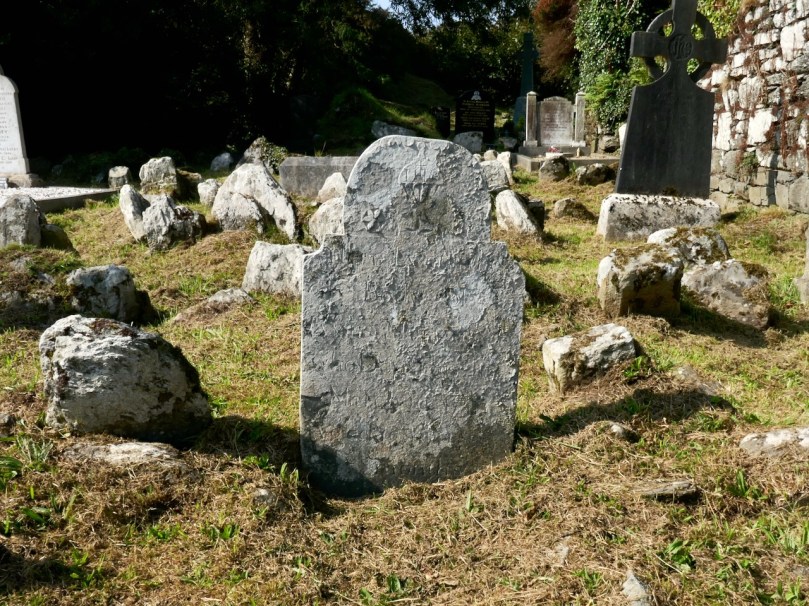
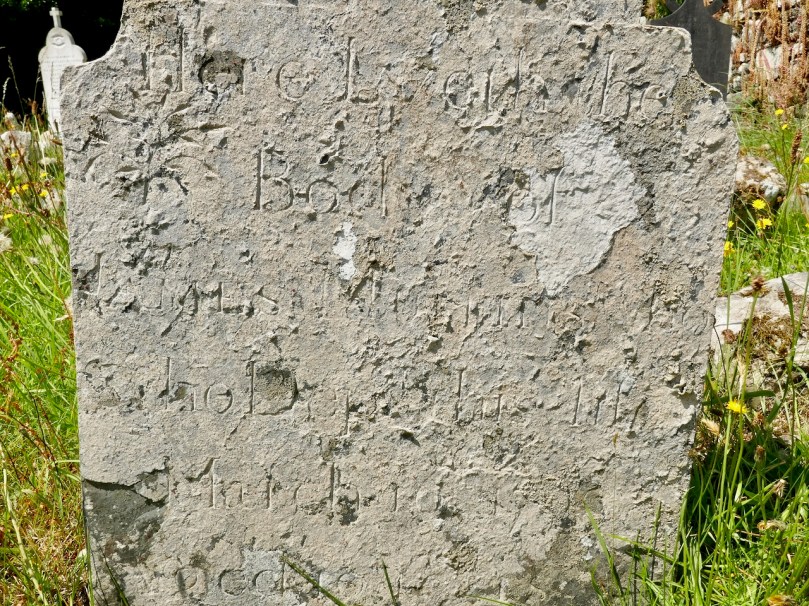
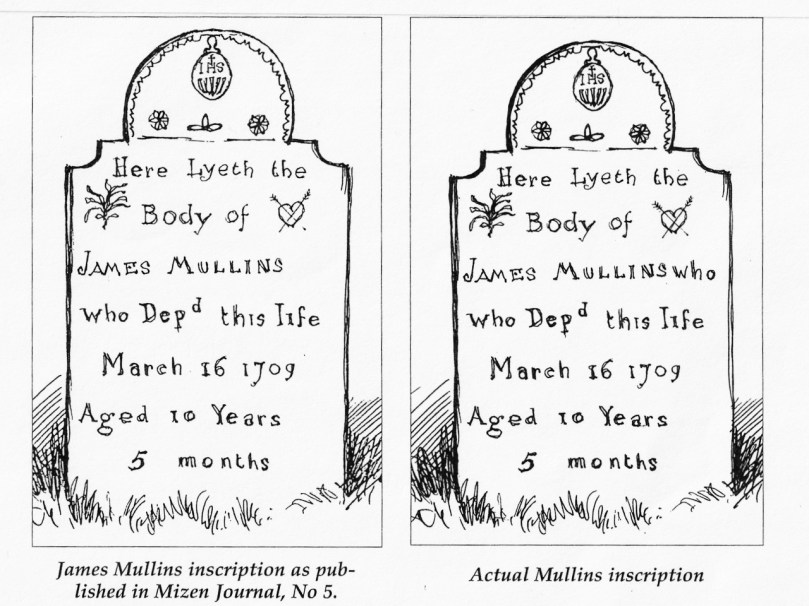
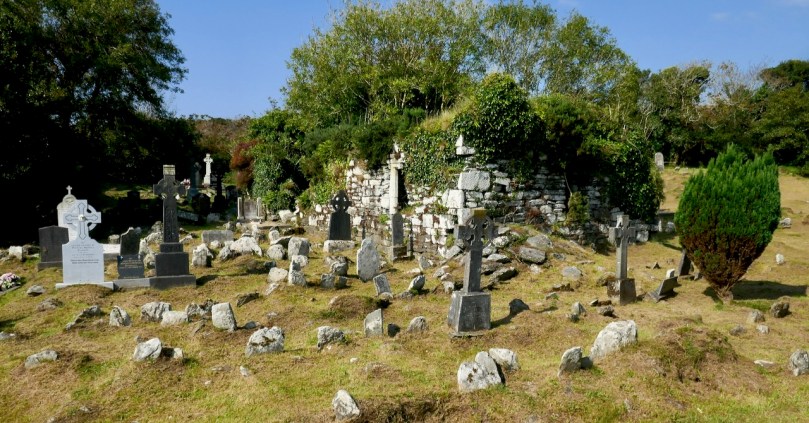
Inscribed headstones, for those who could afford them, did not become commonplace until the 18th century. Headstones dating to the 1700s are actually fairly unusual in West Cork so when Brian deciphered one in Killhangle, he recorded it (not an easy task – see how much lichen covers the surface now) and wrote up his findings for the Mizen Journal.

Alas, an eagle-eyed editor thought he had made a mistake in his drawing, by including the word ‘who’ twice and took it upon him/herself to eliminate the first ‘who’. This led to a second article titled ‘James Mullins Who Who” in which Brian restored the missing who and explained that Seventeenth and early eighteenth-century English usage on tombstone inscriptions favoured elaborate and often tortuous abbreviations and word arrangements in order to balance the lines of the inscription.

Poor little James was only 10 when he died on the eve of St Patrick’s Day in 1709. He must have been beloved indeed – a headstone all to himself when most people had none.

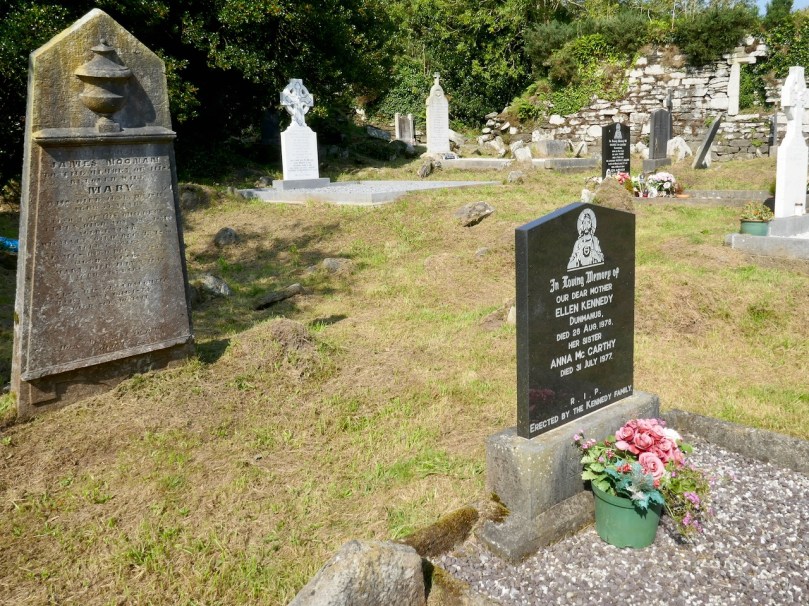
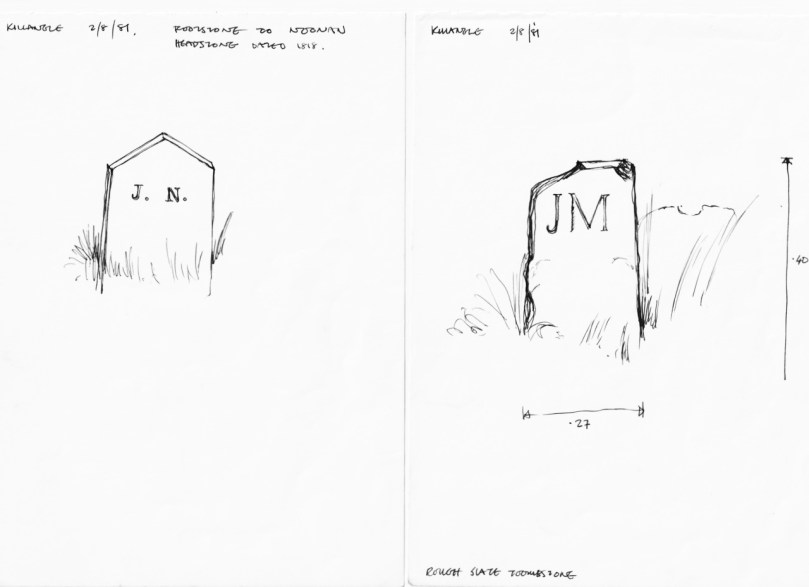
Another practise seen in Irish gravestones is the carved footstone. Where the footstone is engraved, it is usually with the initial of the person named on the headstone. In the example above and below, James Noonan first buried his beloved wife Mary. When he was laid to rest, his footstone was added, with his initials, J. N.  You can see the footstone at the bottom of my photograph, and Brian has illustrated it below along with another one with the initials J M.

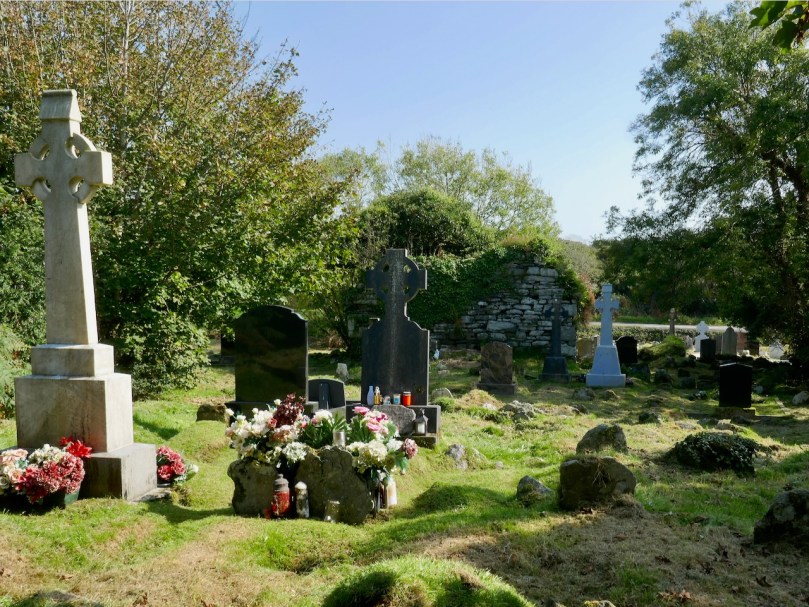
Killhangle is beautifully located, near the coast and with a rippling brook running through it. It is well looked after and several of the graves have flowers and evidence of recent visits.

It is obvious that local people respect and care for the last resting place of their family members. For them, this church truly is the Church of the Angels.

Thank you, Brian Lalor, for allowing me to use your sketches and pick your brains.

Cork, Part 2: Eiléan Ní Chuilleanáin

Like Brian Lalor, the poet Eiléan Ní Chuilleanáin*grew up in Cork in a house alive with art, scholarship and republican ideals, in a city yet to emerge into modernity. As a poet she returns often to the subject of Cork, immersed from childhood, as Brian, in its unique character. She has said . . . there is a poetry, and I include my own, which can only be written out of the sense of the absolute proximity of the real past, and the place which is home, from which history can be seen.

In a poem that begins ‘In the graveyards of the city’ she writes,

Tablets fixed on their boundary walls,
They are shouldered by tall square houses
Chimneys nodding to each other
Over the heads of gesturing
Angels, all back and no sex.

And we instantly see what she describes, although we hadn’t before.

In 2007 the poet and critic Thomas McCarthy wrote in the Irish University Review**:

The Gallery Press book, Cork, was certainly one of the most beautiful local books of 1977. Written to accompany Brian Lalor’s subtle, and sometimes very slight, drawings of Cork, the poems were full of a sunlit magic. The book itself, as an object, was one of Gallery Press’s finest hours. It marked a restoration of dignity to the world of Irish poetry publishing just at the moment when standards of production and presentation had begun to decline everywhere. I remember the display copies of the limited hardback of this book in the old Cork Craftsman’s Guild shop in Patrick Street: how fine it looked, how fitting it was that this volume of poems and drawings was displayed with the best ceramics and wood-cuts of the day. The opening poem is probably as complete an evocation of Cork as will ever get published:

The island, with its hooked
Clamps of bridges holding it down
Its internal spirals
Packed as tight as a ship
With a name in Greek or Russian on its tail
In a lingua franca of water –
And now the river, flat and luminous
At its fullest, images the defences:
Ribbed quays and stacked roofs
Plain warehouse walls as high as churches
Insolent flights of steps
Within are narrow lanes, man high
Flagged and flattened
By the prudent stonecutters, . . .

McCarthy concludes, It is a perfect description, pencil-like and deftly matched to the delicate drawings of Lalor. The latter give Ní Chuilleanáin free rein; they allow her to soar with that light method, the elusive and evocative, and even retiring, loose line.

Eiléan’s Cork of the 1970s is just as convoluted as Brian Lalor’s. In a 2008 essay***  she describes it thus:

There are gestures at consistency. But much of the city is a haphazard succession of buildings dating from a mixture of periods, still following the medieval pattern of streets and laneways, crammed on their island site, churches, markets and houses. On the hills that surrounded the town suburbs grew up: some respectable, terraces with British Army names recalling Wellington and Waterloo, inhabited by the officers from the barracks higher up again; some grim and filthy with names like Brandy Lane, Spudtown, Cat Lane. I still remember the smell of the lanes and tenements, the public houses and their truculent customers, the shadowy shawled women making off down an entry clutching drink or money with equal desperation.

One of her poems seems to translate these thoughts from prose. As McCarthy puts it, Psychologically and socially, Ní Chuilleanáin’s Cork is a complex and evasive place, made concrete only through the most intense observation

Geometry of Guilt, the windows
Broken or always empty;
Daylight sucked in and lost, a bird astray;
The knife edge of the street, blinded
Fronts of houses like a baconslicer
Dropping to infinity, down
Draughty quays and frozen bridges
And the facades are curves of seeping stone
As damp as a scullery
Or a child’s game of windows and doors arranged
Matching the caves of womb and skull

I will finish with another of McCarthy’s astute assessments of Eiléan’s work: Ni Chuilleanain maintains a psychic bridge between two cranky and petulant discourses, Dublin and Cork. Her poems have become that undelivered Golden Box, forever on its way from Cork to the good Dean, a box of poems which, when opened, reveals sunlight, cloisters, avenues, water channels, and sites of ambush.

We are soft-footed and busy as dogs
Disappearing down alleyways,
The faces I meet are warped with meaning.
We turn away from each other,
Our shoulders are smooth as the plaster veils of statues
That are turning their backs in the windows and doors.

As in the previous post, Cork, Part 1: Brian Lalor, all the drawings are by Brian Lalor and reproduced here by permission of the artist.

*Eiléan Ní Chuilleanáin is pronounced (approximately) Elaine Nee Quillinawn

**‘We Could Be in Any City’: Eiléan Ní Chuilleanáin and Cork Author(s): Thomas McCarthy Source: Irish University Review , Spring – Summer, 2007, Vol. 37, No. 1, Edinburgh University Press (Stable URL: http://www.jstor.com/stable/25517350

***Home and Places, in Home/Lands, A collection of essays commissioned by the International Writing Program at The University of Iowa to mark the third New Symposium held on the island of Paros, Greece, in May 2008.

Cork, Part 1: Brian Lalor

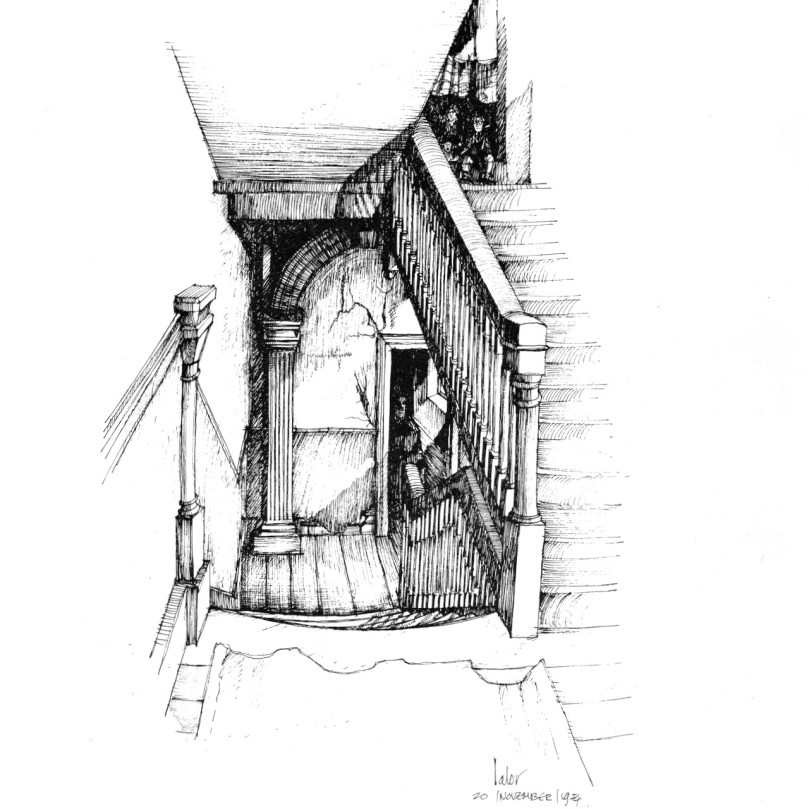
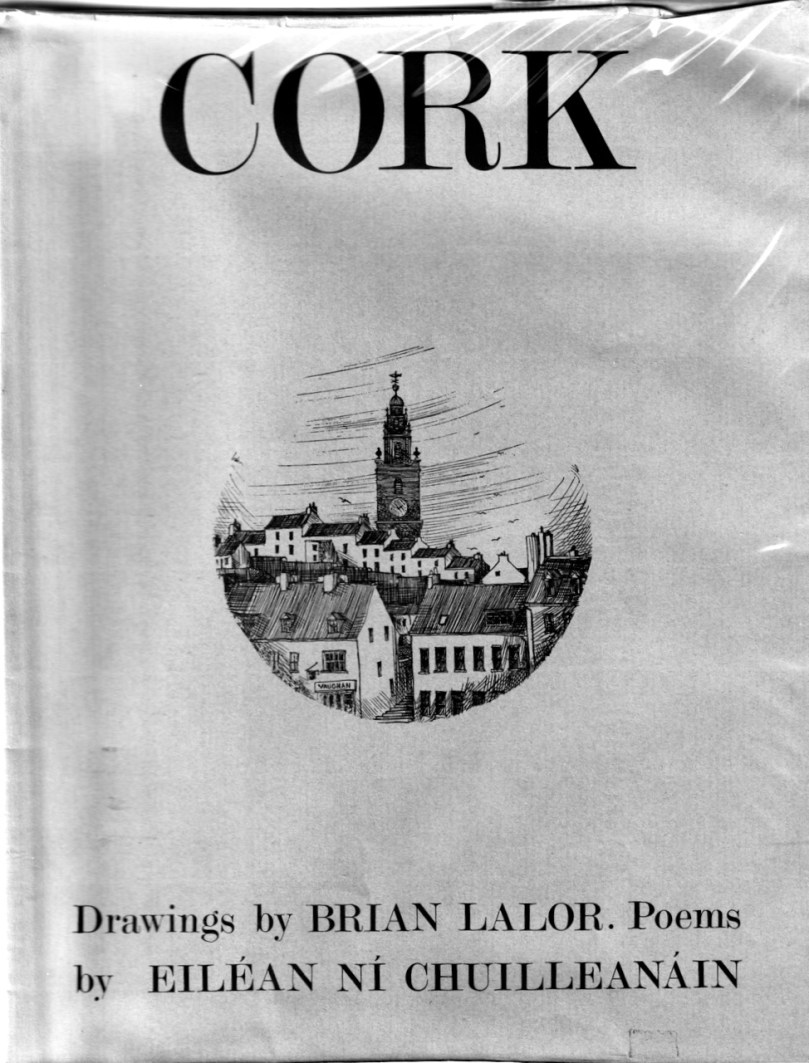
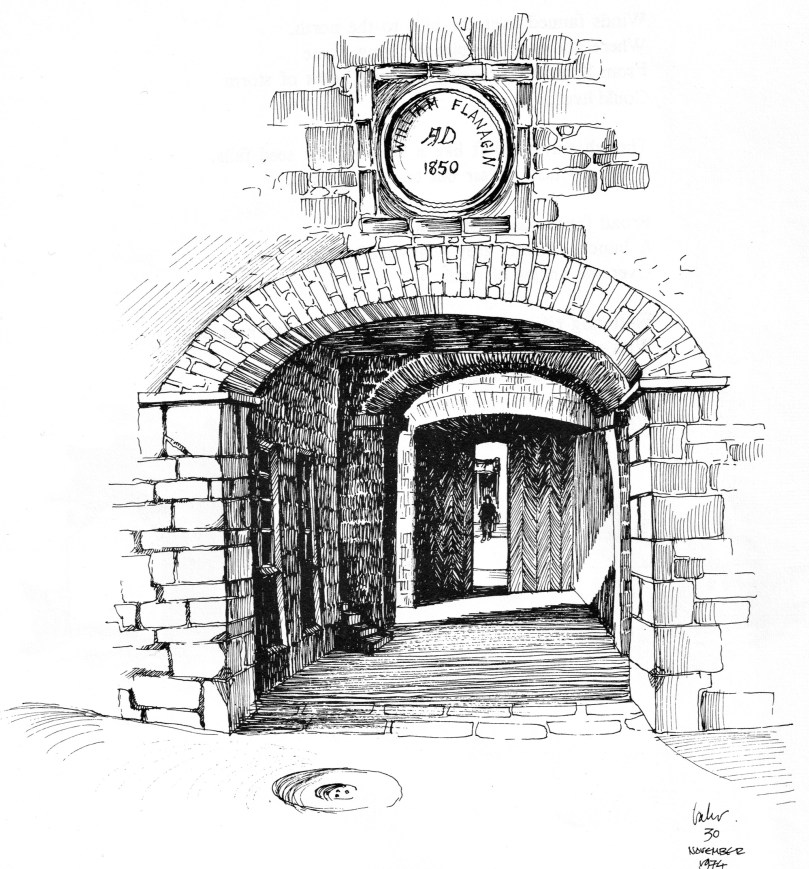
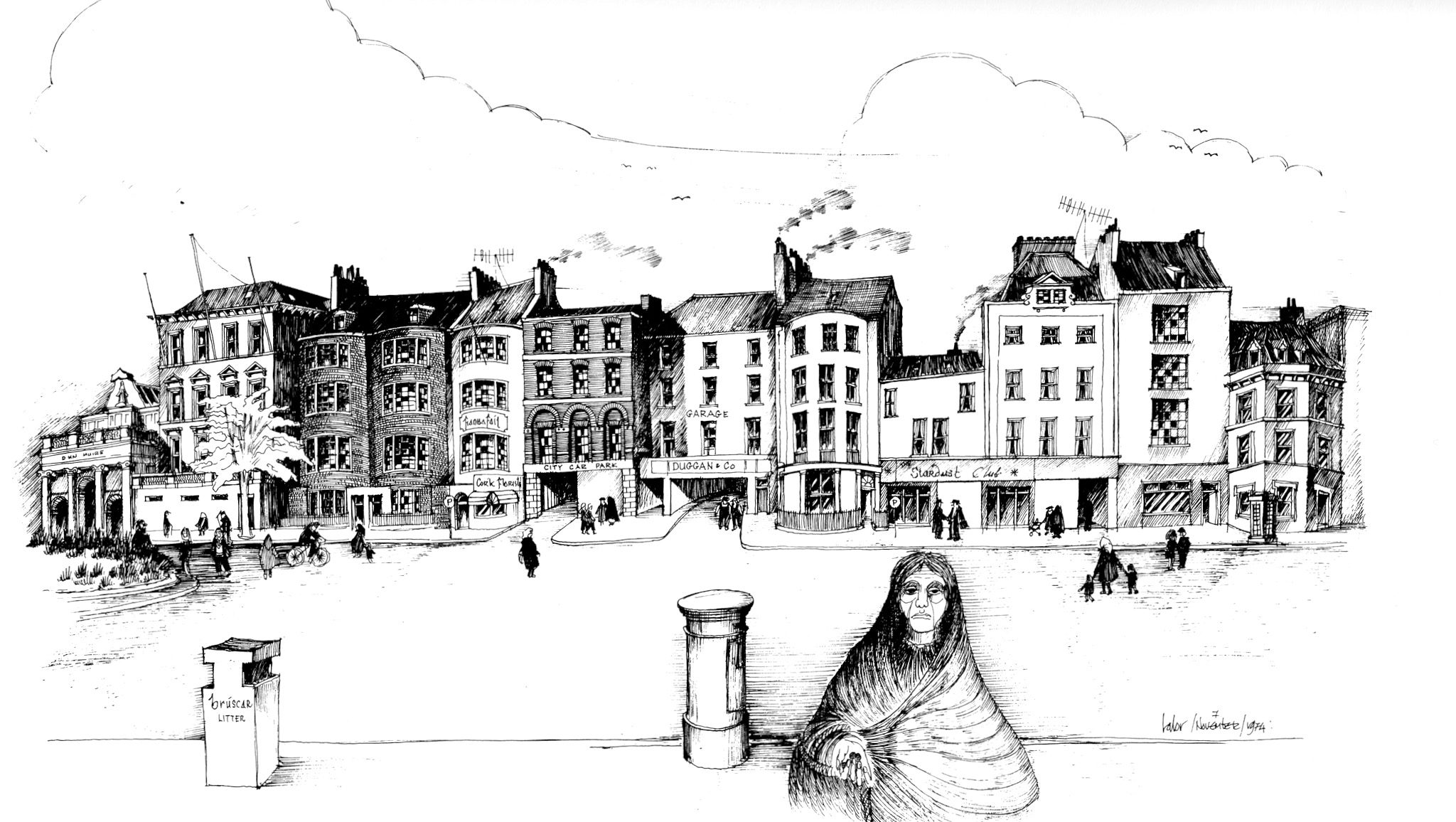
In 1973 and 1974 the artist and writer, Brian Lalor, made a series of drawings of Cork, his native city. These drawings were published by the Gallery Press in 1977, along with poems by the Cork poet Eiléan Ní Chuilleanáin, in a book simply titled Cork. Both poet and artist/writer were already established and both have gone on to forge distinguished careers in Irish art and literature.

Grand Parade

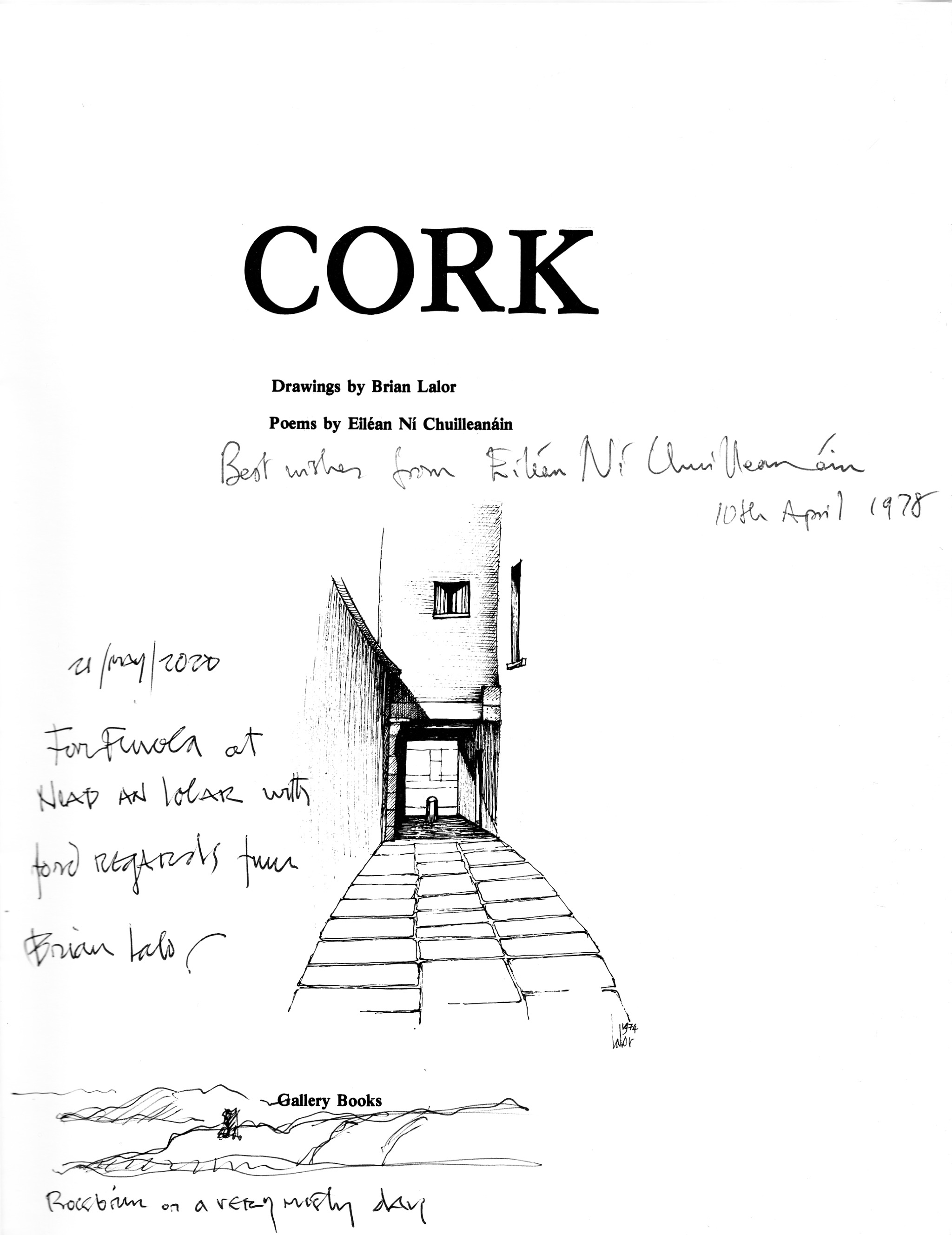
I have owned a copy of this book since 1978 – a birthday gift from my mother. Knowing of my love for the city of Cork, my home for seven years, she mailed it to me in Canada. I have cherished it ever since. The copy she posted to me was signed by Eiléan Ní Chuilleanáin. This year, seated in our living room overlooking Rossbrin Cove, Brian Lalor signed it for me too.

Brian’s drawings of his (and my) beloved Cork capture a city on the edge of modernising. He has graciously given me permission to reproduce some of his drawings in these posts and I will use his own words (from A Note on the Drawings at the end of the book) since they capture so much better than I ever could his fascination with the city and his intentions in recording its idiosyncratic character.

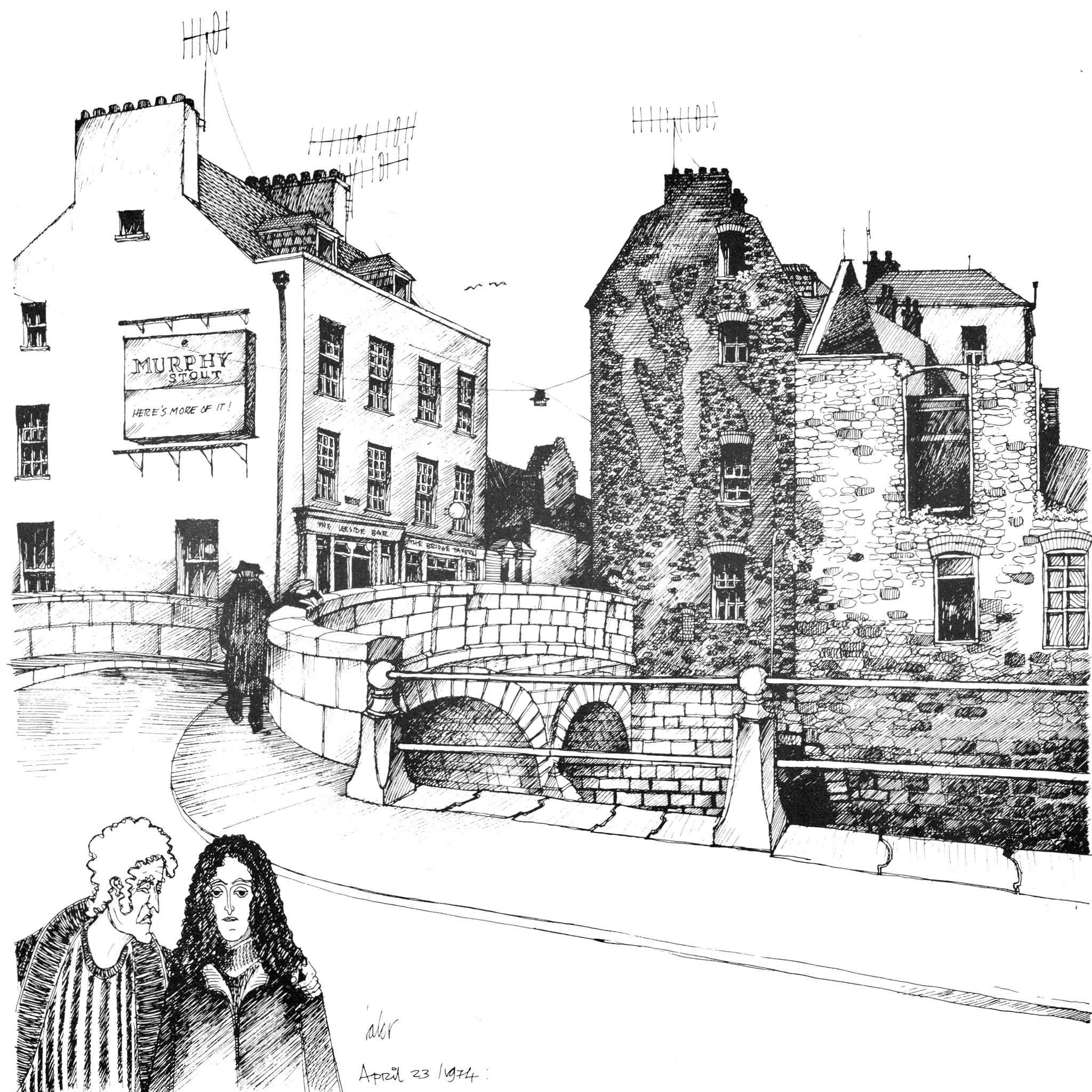
The South Gate Bridge. That couple looks familiar

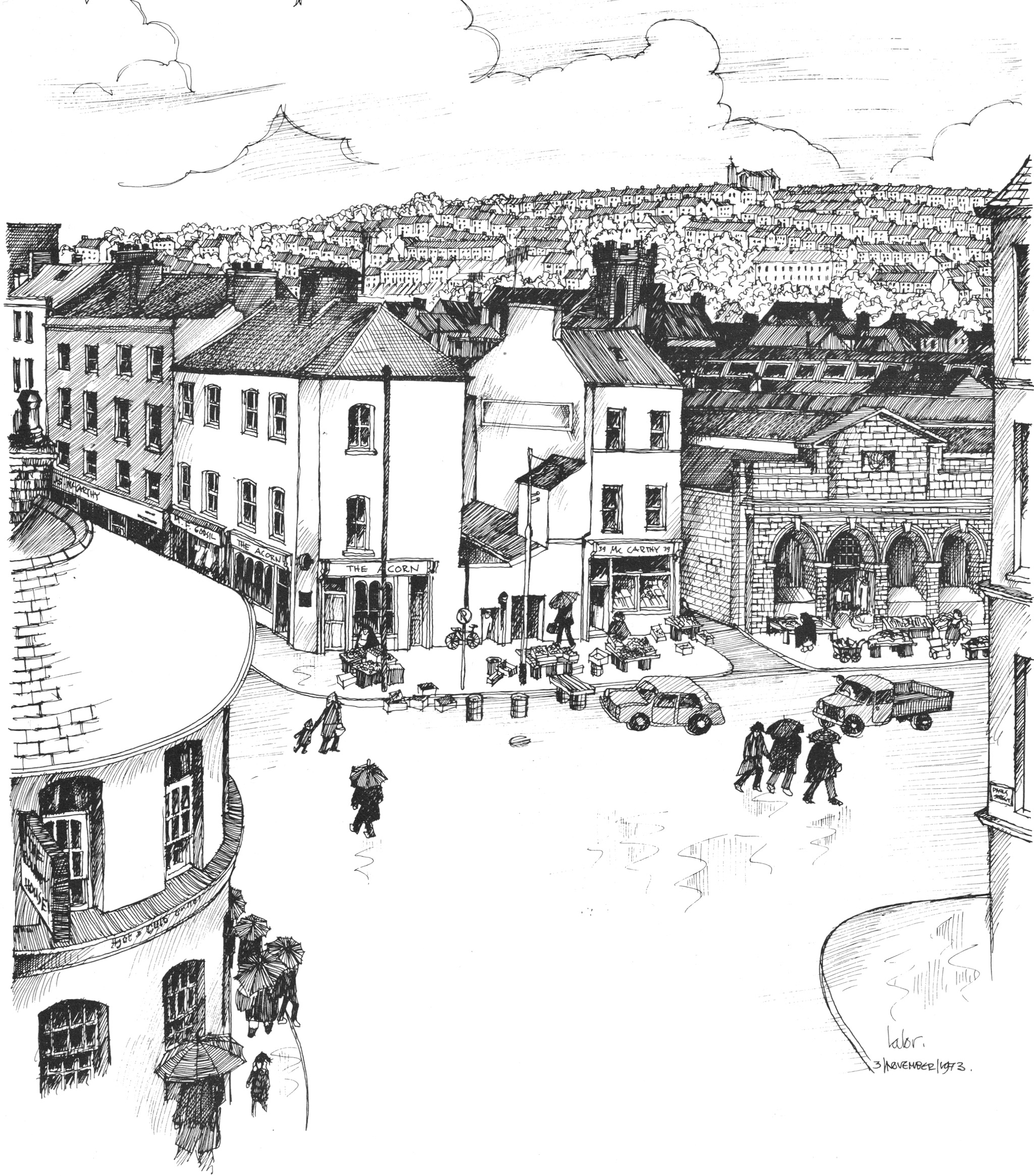
This collection of drawings developed as a result of a habit of many years, begun in Cork and fostered in Europe and the countries of the Eastern Mediterranean, a habit of of never passing a laneway, flight of stairs, courtyard or public building without investigating what secrets it might conceal, what historical or human curiosity might be within. Coming then to Cork in the early seventies and finding it a city reeling from the cataclysm of “urban renewal,” it seemed an appropriate time to attempt a record of the inconsequential details which made up the character of the place, while the opportunity still existed.

Upper: Paradise Place. Lower: Curry’s Rock. Older women still wore the traditional shawl in the early 70s and were known as Shawlies

This is not Cork seen from its public face but from above and behind, not just observed in its principal role as the second city of the Republic but sought out in all its idiosyncrasies and individuality. The monuments of Architecture, memorials to wealth and power, religious fervour and civic pride will not be found here, except when they creep in by accident for, avoiding the European grand manner, they block no vista nor crown a Summit. Rather, they lurk in unexpected places and just spring upon one, owing their location principally to occupying the sites of earlier ecclesiastical foundations. This latter fact is the clue to understanding the city of Cork, the link with the past. For it was in the periods of its earliest habitation that the considerations of commerce, security and the political existences of the time gave rise to what held as the nucleus of the city up to the present day.


Cornmarket Street

Cork was never a planned city; it grew organically from the meanderings of the River Lee through the marshlands of the depression between the surrounding hills. Its streets and by-ways follow today those of the middle ages, and the water channels which gave access from the early town to the outer expenses of the river basin. The line which runs from the Episcopal seat of Shandon to that of Saint Finbarr’s was the principal artery of the ancient city of Cork, as it is today nine centuries later. It is around this thread that the drawings are gathered. This line held the centre of all life within the city from its foundation in the tenth century, to the late nineteenth, and even today what is outside this line is peripheral to the soul of the city.

St Patrick’s Quay

Next week, the poetry. . .