The Melodeon

A personal perspective – by Robert – to celebrate St Cecilia, the Patron Saint of music, on her day: 22nd November

Girl with Melodeon

…My father played the melodeon
Outside at our gate;
There were stars in the morning east
And they danced to his music.

Across the wild bogs his melodeon called
To Lennons and Callans.
As I pulled on my trousers in a hurry
I knew some strange thing had happened.

Outside the cow‑house my mother
Made the music of milking;
The light of her stable‑lamp was a star
And the frost of Bethlehem made it twinkle.

A water‑hen screeched in the bog,
Mass‑going feet
Crunched the wafer‑ice on the pot‑holes,
Somebody wistfully twisted the bellows wheel.

My child poet picked out the letters
On the grey stone,
In silver the wonder of a Christmas townland,
The winking glitter of a frosty dawn.

Cassiopeia was over
Cassidy’s hanging hill,
I looked and three whin bushes rode across
The horizon — The Three Wise Kings.

An old man passing said:
“Can’t he make it talk” —
The melodeon. I hid in the doorway
And tightened the belt of my box‑pleated coat.

I nicked six nicks on the door’post
With my penknife’s big blade—
There was a little one for cutting tobacco,
And I was six Christmases of age.

My father played the melodeon,
My mother milked the cows,
And I had a prayer like a white rose pinned
On the Virgin Mary’s blouse.

from A Childhood Christmas by Patrick Kavanagh 1943; the photo of the girl is from the collection of Tomás Ó Muircheartaigh, who documented life in rural Ireland between the 1930s and the 1950s
Traditional musicians playing ‘squeeze boxes’ – top: Fred Pearce from Norfolk and Johnny Connolly from Connemara, both playing ‘The Melodeon’ – a single row instrument, while below: Jackie Daly from the Sliabh Luachra area (Cork / Kerry borders) and Joe Burke from Galway play the Irish Button Accordion

I have been playing the melodeon for well over 50 years: I should be a lot better at it than I am… My father didn’t play it: I didn’t even know that melodeons existed until I saw a secondhand one on sale in my local music shop when I was a teenager. I was fascinated by the look of it – it beckoned me; it was ten pounds, and in those days I earned seven shillings and sixpence a week from my paper round. Eventually I had saved enough to buy it, took it home and scratched my head over it.

Spot the difference: Robert then (playing a one-row melodeon) and now (playing a two-row button accordion – photo by Peter Clarke)

There’s a logic to playing a melodeon, but it’s not an immediately obvious one. Perhaps I’d better explain that a melodeon is one sort of accordion, and the definition varies depending what country you are in. I was in England then, and the term ‘melodeon’ there covers pretty well everything that has a button keyboard, bellows, and produces different notes when you move the bellows in or out; it doesn’t refer to a ‘piano accordion’ where the keyboard has – well – piano keys, and the movement of the bellows in either direction doesn’t make any difference to the notes.

Dermot Byrne and Steve Cooney

Expert Irish button accordionist Dermot Byrne, accompanied by Steve Cooney at a recent Baltimore Fiddle Fair event here in West Cork: Dermot is playing a rarely seen Briggs diatonic instrument

Now I am in Ireland and the term ‘melodeon’ only refers to an instrument with a single row of buttons on the keyboard; anything with more than one row is known as a ‘diatonic button accordion’, and you will probably most often come across the latter when listening to traditional music here, although nothing is ever simple, and there are a number of Irish players (including many really good ones) who play instruments with a single row of buttons.

Sharon Shannon

Sharon Shannon from Corofin, Co Clare has taken Irish button accordion playing to a different level: her concerts often include magical lighting effects and state-of-the-art electronic accompaniments

By chance, that first instrument that I saved up for had only one row, so it would be a ‘melodeon’ in both England and Ireland. I now tend to play mainly instruments with two rows, and I can’t stop calling them ‘melodeons’ even though that’s incongruous to players here.

Kerryman Seamus Begley – noted Irish accordion player and entertainer; in the right hand picture he is joined by concertina maestro Noel Hill at last year’s Corofin Festival, Co Clare

In an earlier post – The Clare Trumpet – I talked about concertinas, and the invention of those instruments by Charles Wheatstone in England, getting on for two hundred years ago. He took out a patent in 1829. In the same year Cyrill Demian – an Armenian organ and piano maker – filed a patent in Vienna for an ‘accordion’ which was exactly the same as today’s melodeon:

…In a box 7 to 9 inches long, 3½ inches wide and 2 inches high, feathers of metal plates are fixed… with bellows… even an amateur of music can play the loveliest and most moving chords of 3, 4 and 5 voices with very little practice… Each claves or key of this instrument allows two different chords to be heard, as many keys are fixed to it, double as many chords can be heard, pulling the bellows a key gives one chord, while pushing the bellows gives the same key a second chord…  many well known arias, melodies and marches, etc. may be performed similar to the harmony of 3, 4 and 5 voices, with satisfaction of all anticipations of delicacy and vastly amazing comfort in increasing and decreasing sound volume… it is easy and comfortable to carry and should be a welcome invention for travellers and parties visiting individuals of both sexes, especially as it can be played without the help of anybody…

martin connolly

Excellent accordion maker and mechanic Martin Connolly of Ennis tests out Robert’s Oakwood 

That’s true: the ‘squeeze box’ is one of those instruments which you have to learn to play just by doing it. Of course, you can get books of instructions – and you can get experienced players to help you get started – but in the end it comes down to instinct – and a lot of practice, preferably out of earshot of anyone else. You can pick up the diatonic system inexpensively by picking out tunes on a mouth-organ – which is a melodeon without the buttons or bellows!

Concertinas / melodeons / button and piano accordions are different instruments but all share certain characteristics including the means of producing a note through a vibrating ‘free reed’ – a small metal leaf held at one end in a frame. A bellows pushes or pulls air through the frame and the reed vibrates, producing a musical note. The size and weight of the frame and leaf governs the pitch of the note. The quality of metal used for the vibrating reed – its density, flexibility  and tempering – determines the overall sound quality of the instrument. The best instruments use hand made reeds.

Outside Rosies

Squeeze boxes in evidence in this recital from young members of Comhaltas Ceoltóirí Éireann outside Rosie’s, Ballydehob, during the Trad Festival

Enough of the technicalities! What matters is the music that can be got out of an instrument. I like the push-pull (bisonoric) squeeze boxes because you have to move the bellows so much to get the changing notes. This adds dynamics to the music: movement and rhythm. As so much of traditional music is used for dancing, this is a definite advantage – there is already ‘dancing’ in the music itself.

800px-Bourrée_d'Auvergne

There are so many really good traditional music players in Ireland: you will know that because of our reports on the festivals we go to. Who are the best players today of melodeons and diatonic accordions? You have to decide that yourself by going out and listening to as many as you can. Or, second best, you can stay at home and use the internet – Youtube is a seemingly endless resource. There’s also The Session, which is a very good site for finding tunes and discussions on music and musicians. I also recommend ITMA – the Irish Traditional Music Archive – an invaluable free resource of information including thousands of sound recordings, videos, images and manuscript collections all related to the music tradition here in Ireland.

post-436-1116811091

If you’re twisting my arm as to who are my melodeon ‘heroes’, I’ll reel off a list of players I would (and do) go out of my way to listen to: Johnny Connolly, Bobby Gardiner, Jackie Daly, Joe Burke, Seamus Begley, Dermot Byrne, Sharon Shannon… However, I seldom have to go far because they all seem to come, sooner or later (and often frequently) to our little corner of the world here in West Cork.

OLYMPUS DIGITAL CAMERA

Hail Cecilia!

O’Donovan Rossa – the First Terrorist?

Fiery Rossa

The world was shocked this week by appalling acts of terror. Terrorism is rightly and universally condemned in modern Ireland – and yet this year we celebrated the centenary of the death of a man whom many, including his fellow patriots, denounced as a terrorist in his lifetime while others hailed as a hero.

Our American and Canadian readers might be surprised at how relevant his story is to their own countries.

Rossa Prisoner

I write of course of Jeremiah O’Donovan Rossa of Skibbereen, the ‘Unrepentant Fenian’, whose state burial in 1915 was the occasion of a fiery speech by Patrick Pearse that is commonly seen as a catalyst to the 1916 Rising. In March Back in Time I introduced him and wrote about the awful background that turned him into a revolutionary – the death of his father from famine fever and his family’s eviction and departure from Ireland. To the end he refused to call the cataclysmic events of 1845 to 1850 a famine: there was no shortage of food, he pointed out, just a shortage of humanity. It fired in him a lifelong hatred of British rule which hardened through terrible treatment in prison and which he brought with him to exile in America, where he and his fellow Fenians were accorded a hero’s welcome.

The Cuba Five were so named for the ship that brought them to America. Courtsey Library of Congress

The Cuba Five were so named for the ship that brought them to America. Courtsey Library of Congress

The Fenian brotherhood Rossa joined in America in 1870 had organised several raids on Canadian communities during the 1860s and early 70s. All were unsuccessful, but resulted in loss of life and a worsening of relationships between Canada and America, seen as harbouring and tolerating Fenian activity. The raids involved hundreds of Fenians, many of them battle-hardened veterans of the American Civil War. (For more on the Irish in the American Civil War – the numbers and the stories will amaze you – see Damian Shiels’ meticulously researched blog and website.)

According to this article on the Fenian Raids:

Ironically, though they did nothing to advance the cause of Irish independence, the 1866 Fenian raids and the inept efforts of the Canadian militia to repulse them helped to galvanize support for the Confederation of Canada in 1867. Some historians have argued that the affair tipped the final votes of reluctant Maritime provinces in favour of the collective security of nationhood, making Ridgeway the “battle that made Canada.”

Fenian Raid on Canada

The Battle of Ridgeway, courtesy Library of Congess

Embracing this militaristic approach, Rossa became as notorious an extremist in America as in Ireland. He founded a newspaper, The United Irishman, to propagate his views and raise funds for his infamous skirmishing fund. This fund, in fact, was to pay for a bombing campaign carried out in Britain from 1881 to 1885, causing injuries and deaths (to civilians, including children) – and real terror.

One of the exhibits in Skibbereen this summer consisted of newpaper clippings from American newspapers about Rossa, amply testifying to his notoriety. The top right clipping consists of snippets about Well Known People – Rossa is listed alongside William Morris, Geronimo and the Csar Of Russia

In many ways O’Donovan Rossa encapsulates a central dissonance at the heart of Irish History: he was a passionate patriot who believed in armed struggle, while many of his contemporaries espoused a pacifist (see Michael Davitt as a prime example – he referred to Rossa as O’Donovan Assa) or parliamentary approach and saw Rossa’s campaign of violence as undermining their objectives. Now, in 21st Century Ireland, we are faced with the dilemma of how to deal with historical figures who are both important markers in the struggle for independence and echoes of a violent past many no longer wish to glorify.

The President of Ireland, Michael D Higgins opened O'Donovan Rossa Park in Skibbereen

The President of Ireland, Michael D Higgins opened O’Donovan Rossa Park in Skibbereen

In Skibbereen this summer Rossa was celebrated in several ways. We attended not just the March, but a play, two exhibitions, a lecture, and the grand opening of a refurbished park in Rossa’s honour by Michael D Higgins, the President of Ireland. In Dublin his 1915 state funeral and graveside oration were given a full scale re-enactment, attended by the President, the Prime Minister (Taoiseach) and many dignitaries.

We toured Glasnevin Cemetary on Dublin this summer. The tour included a re-enactment of Patric Pearse's oration at the grave of O'Donovan Rossa

We toured Glasnevin Cemetary on Dublin this summer. The tour included a recital of Patrick Pearse’s oration at the grave of O’Donovan Rossa

To give you a flavour for how Rossa is revered as a hero watch this YouTube clip – the ultra-nationalist ballad features Pathé News footage of the actual funeral.

But not everyone felt that it was appropriate for the Irish government to underwrite such commemorations. This was expressed well by the historian, Carla King writing to the Irish Times. She summed up thus:

…while O’Donovan Rossa is a figure for whom we can feel some pity, his philosophy, with its commitment to mindless and counter-productive violence, launched a tradition of which we should be ashamed.

Another historian, Marie Coleman wrote:

It was unclear whether the focus of the event was Rossa himself or the significance of the funeral as signifying the rejuvenation of republicanism as a precursor to the Easter Rising. If the former, the State’s endorsement of an archaic form of irredentist Irish nationalism will sit uncomfortably with many in 21st-century Ireland and with unionist opinion in Northern Ireland.

Another exhibition opening - this one at the Skibbereen Library

Another exhibition opening – this one at the Skibbereen Library

Like many Irish people growing up in the 50s and 60s I was brought up on stories of the epic Fight for Irish Freedom, although in my family’s case it was also complicated by ancestry on both sides of the divide. In that narrative, Rossa was one in a long line of heroic freedom fighters. To dig a little deeper still into the story of O’Donovan Rossa, I went looking for signs of the man himself around Skibbereen and found them in some surprising places.  My next post will relate to Rossa’s time in Skibbereen and the legacy he left in this West Cork town.

Our New Navigation Page

sailing day 1We now have over 250 posts, dating back to 2012, and it’s getting harder to find older information on Roaringwater Journal. Help was urgently needed, so your dedicated bloggers have pulled a few all nighters (OK not really – we’re too old for that) and produced – TA DAH! – a Navigation page.

Click on the Menu button (the left one in the header photo)  and click on Navigation. This brings you to our new Table of Contents. We’ve created four divisions, the first three about West Cork: PLACES TO SEE; THINGS TO DO (including child-friendly stuff); and ABOUT WEST CORK. The last division is ABOUT IRELAND. Each one has subdivisions and numerous post links.

Take a browse and tell us what you think. Suggestions for improvements are welcome. Now that we’ve set it up, we can keep this page updated as we go along.

Happy travels!

Happy travels!


November Dark

November Dark

Dramatic sky over Nead an Iolair on November Dark this year

The month opened with Snap-apple night and tales of pucás and little folk. From the rising of the moon on November Dark the mackerel would make their way to deeper water; it was the end of the seine season. With the crops all in and hill grazing finished, fires were set on the hills and preparations made for the winter. There was little employment for the months ahead… (from Northside of the Mizen by Patrick McCarthy and Richard Hawkes 1999)

I have mentioned this reference to ‘November Dark’ in previous posts but, apart from the Northside book, I have been unable to find any other allusions to the term – either on the internet (which is usually a sure source of every conceivable fact or fiction) or on our bookshelves (which are overflowing with volumes on Irish culture, traditions and folklore). According to McCarthy and Hawkes it points to the appearance of the November new moon: this year it occurred last Wednesday – the 11th – which was also Martinmas.

bookshelf

gallimaufry on the bookshelves at Nead an Iolair

Once, the day had particular significance: …With the rising of the moon from November Dark the mackerel made their way to deep water; it would be the end of the seining season. Most of the barrels of fish were collected by ships from September onwards. Limerick Steam coasters and ships from England and America anchored offshore, and the barrels would be taken to them. The faller boats took five to eight barrels per trip to the ships. They were hauled up by a derrick, two at a time, into the hold. Often 300 barrels would be loaded onto one ship… Although the barrels of fish were taken throughout the season by the fish buyers, it was on November Dark that the seine crews received their money… (from Northside)

Seining: the huer (top) watched for the arrival of the shoals and then signalled their location to the boats at sea; the lower photograph shows seine netting on the beach at Greystones, Co Wicklow

Historical evidence documents seining in the South West Coast of Ireland from County Waterford, to County Kerry, from the 16th century onwards. This was an important industry with Baltimore, Dunmanus, Schull, Sherkin, Kinsale, Bantry and Whiddy Island as centres, together with outlying curing stations called Fish Palaces or Pallices, of which there were significant numbers along the Southern coast. The fish – usually pilchards – were caught by means of a seine net: two boats, the seine boat and the so-called follower (locally called the ‘faller’) were used. The seiner, a large boat pulled by perhaps a dozen or more oars, carried the net, which was often 300–400 yards long. An experienced fisherman acted as a huer by directing fishing operations from a suitable vantage point ashore. From high land, the huer could see the shoals of pilchards clearly, and he alerted the seine boat, by shouting (the ‘hue and cry’) or making suitable signs as to the location of the shoal. Often the shoals were too far out to be seen from the land, and one of the crew – known as  a spyer – had the job of locating them from on board. On a given signal, the net was shot around the shoal by the seine boat, and in the meantime, the free end of the net was picked up by the faller, with a crew of perhaps five or six, pulling the ends of the net together. The footropes of the net were gradually drawn up until the fish were completely enclosed, and by means of baskets the fish were transferred from the net to the boats.

Tucking

Cornish ‘Tucking’ – gathering in the pilchards from the seine net – by the Newlyn School artist Percy Robert Craft: the original painting is in the Penlee Gallery, Penzance. As the seining season advanced, the Cornish boats followed the shoals to the west coast of Ireland

…After the season’s fishing all the nets were barked in a ceiler (a flat bottomed iron pot) at Dunmanus or Goleen… The ceiler would be full of boiling water and bark (a non-sticky type of tar), and the nets were steeped for a good spell. Barking drove out the salt and would preserve the cotton mesh for the next year’s fishing. The nets, when being repaired, were spread out in a field. In Dunkelly the field was called the Seine Field, and at Gurthdove it was at Willie’s Paircnafarriga. Only the experienced and older men were allowed to repair the nets, as the younger lads rarely had enough care for a job that had to be done so well… (from Northside…)

The Barking Pot at Goleen has been restored as a historic site: sadly the pot is no longer in use

Seining was used to catch pilchard, mackerel, herring and pollock off the Irish coast. A ‘Kerryman’ article by Ted Creedon in the Irish Independent back in 2003 gives a very comprehensive account of the living made in pre-war years – this is a short extract:

…Mike Séamus O’Sullivan of The Glen, St Finan’s Bay, was a member of the crew of the last seine boat to land a catch in South Kerry. Mike began fishing lobsters with his father when he left school aged sixteen.

“That was before the war and lobsters were making four shillings a dozen in those days, but when the war came the fishing really got going in these parts,” Mike told The Kerryman this week.

“We were catching mackerel, pollock, herring and they were cured and boxed at Renard Point before going by train to England. The seine boats were catching all mackerel in the war years and prices were about two shillings per hundred, but one day in 1942 an English buyer arrived at Renard Point and offered £3 a hundred!” Mike recalled.

“There was a fortune made in those days then and the local buyers put their prices up to £4 a hundred for the mackerel to keep the English buyer out!” he said…

mending nets

Mending the nets – in this case in a traditional Irish kitchen: a photograph by Tomás Ó Muircheartaigh, who documented life in rural Ireland between the 1930s and the 1950s. The Irish caption to this photo suggests that the net was damaged by a shark

We have been looking back through our archive of the photographs which we’ve taken here on or around ‘November Dark’ in past years. There’s quite a contrast: we have had times of golden sunsets and warm days when we could sit out, while this year has brought a period of wild storms and grey skies.

Mizen Sunset November

November evening

November contrasts: our view a year ago (above) and (below) in the last day or two, brief respite from a period of Atlantic storms

November Dark – have any readers a recollection of this term? We’d like to know – and record – memories of the day and its significance here in West Cork…

sad end for a seine boat

From Northside of the Mizen – the photo is captioned ‘A sad end for a seine boat’

Digital Skibbereen!

The Digital Week programme has appeared all over town...
The Digital Week programme has appeared all over town…

Who has ever heard of Percy Ludgate? And who would have thought that a man born in 1883 in a little West Cork town was a computer pioneer?

apple_i_computer620
Early ‘computing’ – Percy Ludgate (top left); a conjectural diagram of his invention; the Schicard calculator (known as Napier’s Bones), arguably the first mechanical calculator and created in 1623; the very first Apple computer (above)

In Skibbereen, now, everyone knows about him – because he has given his name to a new initiative which has swept the town. And – breaking news – National Digital Week has just taken over this modest community, doubling its population for a few days and bringing innovation and promise of much needed life and work opportunities.

Skibb busy street

21st century Skibbereen

Skibbereen has become one of the first towns in Ireland outside Dublin to create for itself a ‘Digital Hub’: a centre where businesses will have access to high-speed fibre broadband – something which is long overdue in rural Ireland. We all remember the promises rolled out in the Celtic Tiger years that every last corner of the island would be given access to state-of-the-art phone and internet connection so that businesses could operate competitively from small communities, thus ensuring their economic survival… Well, two decades later, this ‘last corner’ here in Cappaghglass is still waiting: our broadband is always slow and ‘down’ as often as it is ‘up’, and a mobile phone signal is non-existent – politicians take note, please! And this is not uncommon in all the remoter fringes of this land.

Everything that can be digital

All the more reason to applaud the initiatives now happening in Skibbereen. It’s only twenty minutes up the road from Cappaghglass, so perhaps there is hope that once real high-speed connectivity reaches that town some of its potency may dribble down the lines to us…

Finola and

Finola was particularly impressed that there was a day dedicated to female leaders in digital media – women who are ‘making the impossible possible’... Here Finola is mentored by Denise Brown, an Account Manager at Google

Skibbereen’s initiative is being led by local businessmen and women who want their own families – and the whole younger generation now growing up in rural Ireland – to have the opportunity of a viable working future without having to migrate to the cities or abroad – which is currently the norm. And they have no doubts that the future is digital; it is possible to run any sort of business nowadays online, and to compete in national and international markets from anywhere in the world, provided that the place is digitally ‘connected’.

Robert and Giacomo

Robert at a one-to-one clinic with Google’s Giacomo Gnecchi-Ruscone

Ireland has a long-running association with the digital world, probably for the very same reason that it’s now important for communities in rural Ireland to embrace it: we are a very small country with a tiny population trying to survive and make our mark in the huge world economy. Giants like Apple and Google have long had a big presence in the Irish Republic – partly because they get good tax deals but also because Ireland’s working community has made itself good at being digital.

google dublin

Google has a huge presence in Ireland: the Dublin office

Skibbereen’s John Field comes from a family which has made its mark on the town: the local central supermarket – still always called ‘Fields’ – thrives because it focusses on local producers and also provides a very good friendly shopping experience. John believes that West Cork producers are central to the new ‘Irish food culture’. Now he is a prime mover in the digital initiative and has donated a premises – that used to be the town’s bakery (one of the oldest in Ireland) – as the first Digital Hub to be fitted out. By chance (or not!) this premises is just around the corner from where computer pioneer Percy Ludgate was born.

img2.thejournal

A digital image of Field’s old bakery converted to the new Hub

Percy Ludgate was convinced of the importance of mathematical computing devices, and came up with his own design for an ‘analytical machine’ in 1909. He was well respected and lectured universities and learned societies in the early part of the twentieth century. He knew the work of Englishman Charles Babbage (1791-1871) who had built programmable calculating machines using a system of punched cards. Ludgate took a different approach: his design had all the elements of a modern computer – data storage, programmable data input, a printer, and an ‘operating system’. In theory, Ludgate’s automated engine would multiply two 20-digit numbers in under 10 seconds, and take two minutes to determine the logarithm of a number. It would also solve algebraic equations and geometric problems. It was to be powered by an electric motor, and the device would be ‘portable’ – a cube measuring about two feet on each side. Sadly, Ludgate did not live long enough to complete a prototype: he died from pneumonia at the age of 39. It’s great, though, that this whole 21st century digital project carries his name.

Mobile best practice

Last week’s venture involved a series of conferences and workshops designed to introduce anyone who wanted to attend to the concept of the Digital Hub – and to give insights into how the use of the superspeed technology could benefit all businesses. We attended – partly because we wanted to be in the know on the whole venture – but also because we could see how it would help us in producing this blog – and in getting it seen by more people! As with any business, it’s important if you have something to promote (in our case) or to sell (in the case of a producer), you need to know how to get your message across in the most accessible and attractive way. You also need to know that the message is getting to where you want it to be. This is where ‘Analytics’ come in. We already knew it was possible to see how many people were reading our blog and – more or less – where they came from. Now we have discovered that it’s possible to analyse a whole lot more about where our work is reaching, and who looks at what and for how long. This could be sen as frightening, I suppose, in a ‘Big Brother’ context, but it’s all anonymous and – in the end – it’s all just data. Anyone in commerce nowadays who has a command of that data will be best placed to make sure that their own business will offer what the markets seem to be looking for – and that’s what a thriving economy is all about.

SEO

A special mention has to be made of the many young people involved in this venture. In the digital world it seems that it’s the youth who are mentoring the not-so-young! Think – who are the most computer-savvy members of your family? Important faces here include Project Director Gráinne Dwyer and Corporate Development Director Callum Donnelly, seen here (far right and far left) with the rest of the team at the launch of the Ludgate Centre:

NO REPRO FEE Pictured at the 'sod turning' launch of the Skibbereen's Ludgate Hub at the old fields bakery on Friday 7th August 2015 Picture: Emma Jervis Photography
The ‘sod turning’ launch of Skibbereen’s Ludgate Hub at the old Field’s Bakery, August 2015 (Emma Jervis Photography)

One of the many great things about Ireland is that there’s always a creative side and a human side to every venture. So – after every day’s lecture sessions and masterclasses – it was time for relaxation and social activities. Skibbereen came up trumps, thanks in no small measure to one of the town’s most treasured human assets – Declan McCarthy. Declan runs the world-renowned Baltimore Fiddle Fair every year and also organises a whole raft of first class musical events in West Cork: with the help of many others during Digital Week he ensured the smooth running of quite outstanding evenings to turn minds away from digital matters. On the first night we had Jessie Kennedy’s Carbery Songs; then, on Friday, what could have been more inspiring than an evening in the Skibbereen Town Hall with our favourite traditional music makers Martin Hayes, Dennis Cahill and Kevin Burke? And this fabulous concert was broadcast live online right across the world! The following evening we were royally entertained again, this time by Sacha Puttnam, son of the renowned film maker Lord David Puttnam (remember Chariots of Fire – The Mission – the Killing Fields – Midnight Express?). Both Puttnams live here in West Cork (why would they live anywhere else?), and Sacha – ably accompanied by some local young musicians – gave us some superb renderings of film music from his father’s movies on the Skibbereen Town Hall grand piano (which, incidentally, was donated to the town by the family, having been played previously in 10 Downing Street amongst other venues). Behind it – on the big screen – we could watch stills from the movies – and there were orchestral accompaniments all synchronised digitally: again, everything was broadcast live to the world over the internet.

Puttnam and friends

Worldwide web broadcasts from Skibbereen: Burke, Hayes and Cahill (above) and Sacha Puttnam and friends (below) – anyone recognise the scene from War of the Buttons?

David Puttnam (below), who holds the honorary title Digital Champion for Ireland, is the chair of Atticus Education, an online education company based in Ireland which delivers interactive seminars on film and a variety of other subjects to educational institutions around the world. The Puttnam involvement in Skibbereen’s pioneering digital venture is therefore most apt.

imgBannerHome2

Keynote statement from Ludgate@Skibbereen: Digital will negate the conventional disadvantages of working and living outside cities; creating real jobs, real commerce while real people enjoy the superior lifestyle option of living in rural Ireland.

apple-logo11-248x300

Tower House Tutorial, Part 2

Oooh, it open - let's go inside!

Oooh, it’s open – let’s go inside!

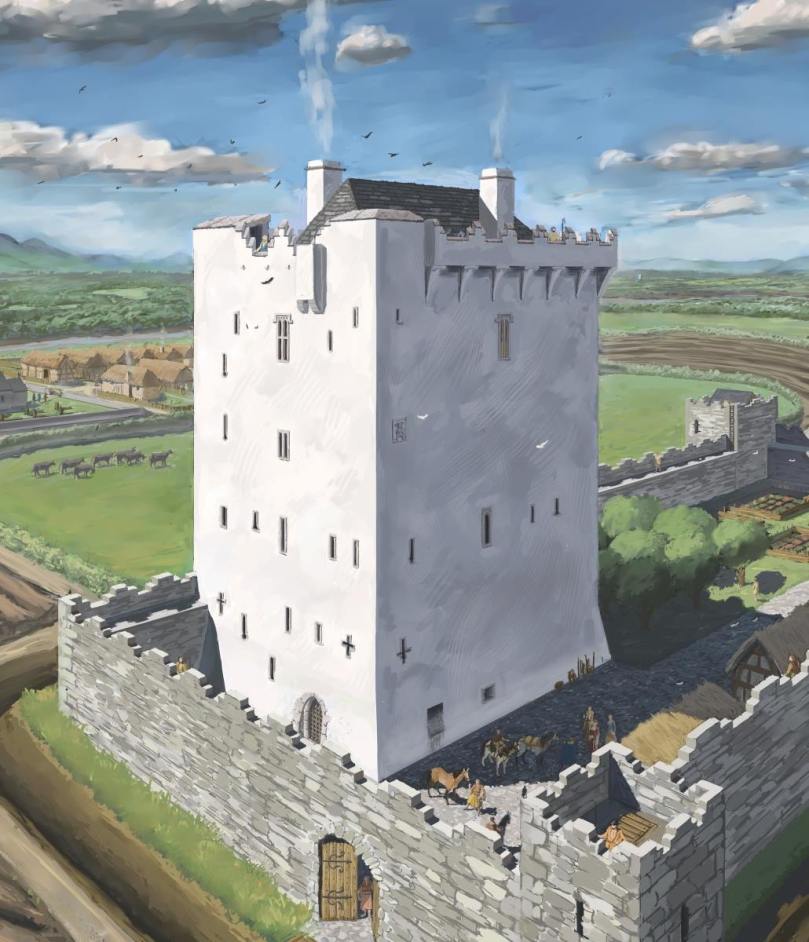
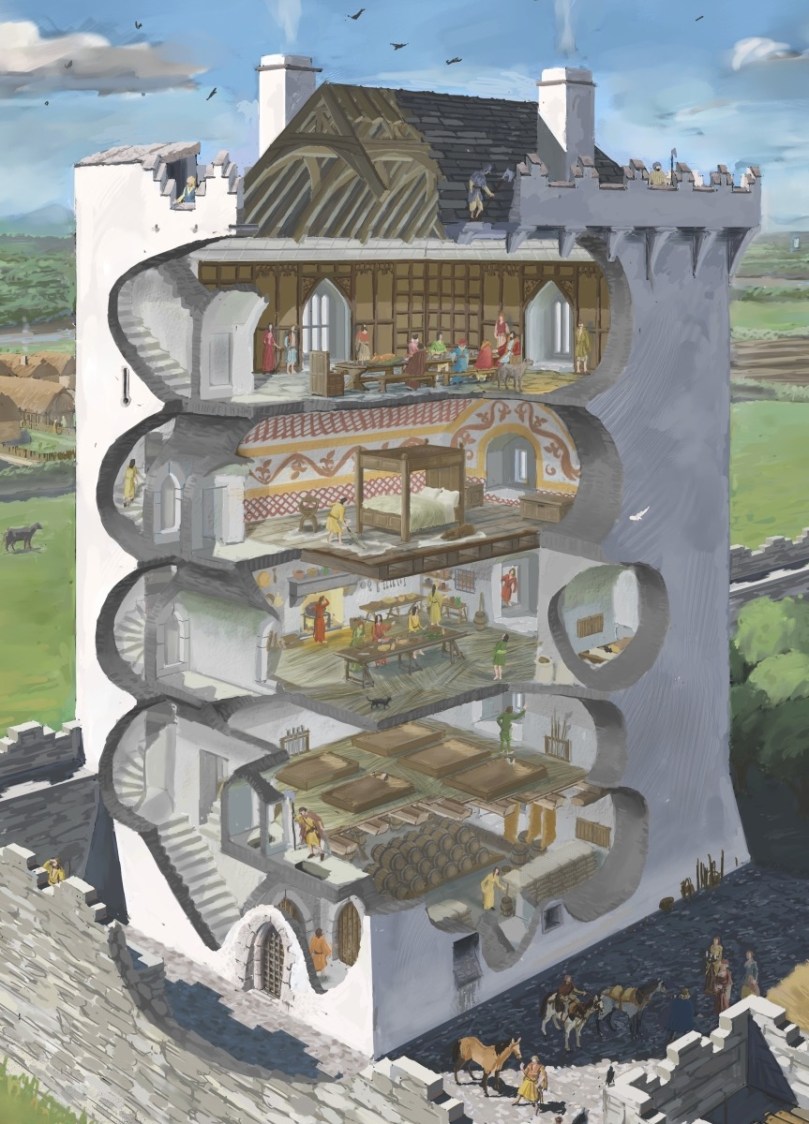
It’s time to move inside! Now that you are all experts in tower house construction from the outside, let’s go into one of these small castles and see how they were built.

Remember that a tower house was all about defence and thus many of the features you will find inside have much to do with an expectation of attack and little to do with comfort. This was all fine, of course, as long as weapons consisted of bows and arrows, swords and spears, and even muskets. But as soon as cannon appeared on the scene the tower house was doomed – even its thick stone walls were no proof against such a bombardment.

Raheen architecture

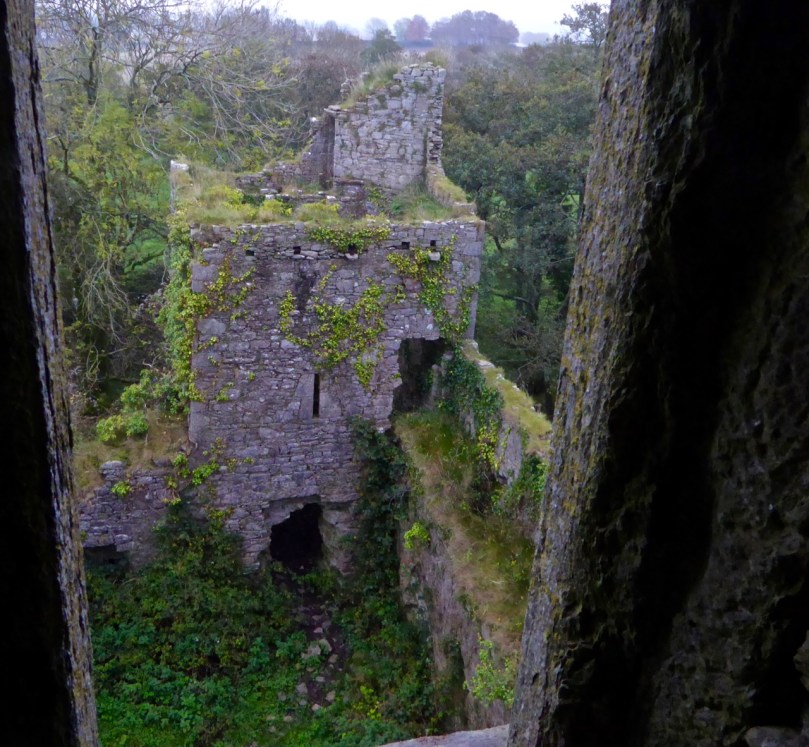
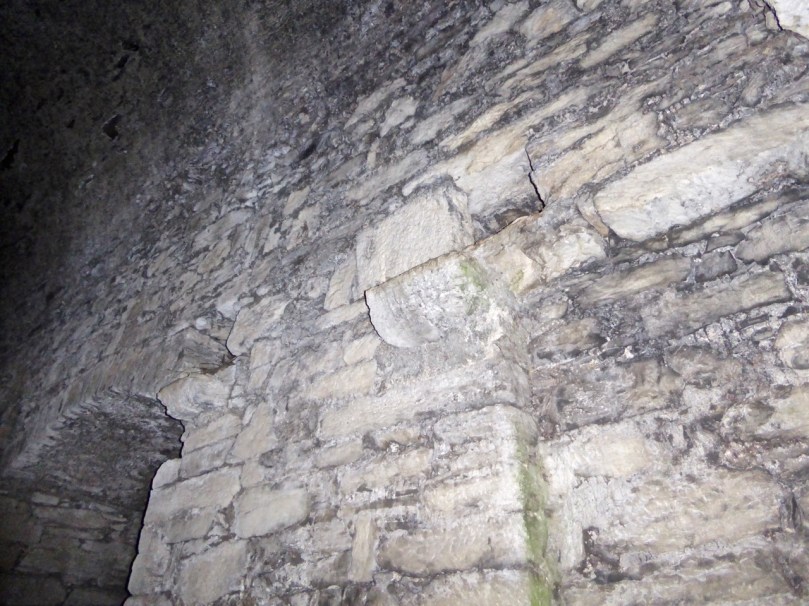
Ironically, having a wall or two blown away by cannons, as at Raheen Castle (by Cromwellian forces), above, allows us to see the internal construction of the castle. In the case of Raheen the lower floors were separated from the upper floor by an enormous barrel-vaulted ceiling.

Dunlough Castle - note the projecting corbel denoting a wooden floor, and the imprint of the wicker scaffolding on the ceiling mortar

Dunlough Castle – note the projecting corbel denoting a wooden floor, and the imprint of the wicker scaffolding on the ceiling mortar

These vaulted ceilings were wicker-centered. A scaffolding of wicker was erected first and a layer of mortar laid on top of that. Ceiling stones were laid on the scaffold and mortared into place and then the stone work was built up to provide the floor of the next story. When the scaffold was dismantled the impression of the wicker was left on the mortar – clearly visible in several of our examples here.

Floors were supported using projecting corbels and beams which fitted into sockets

Floors were supported using projecting corbels and beams which fitted into sockets

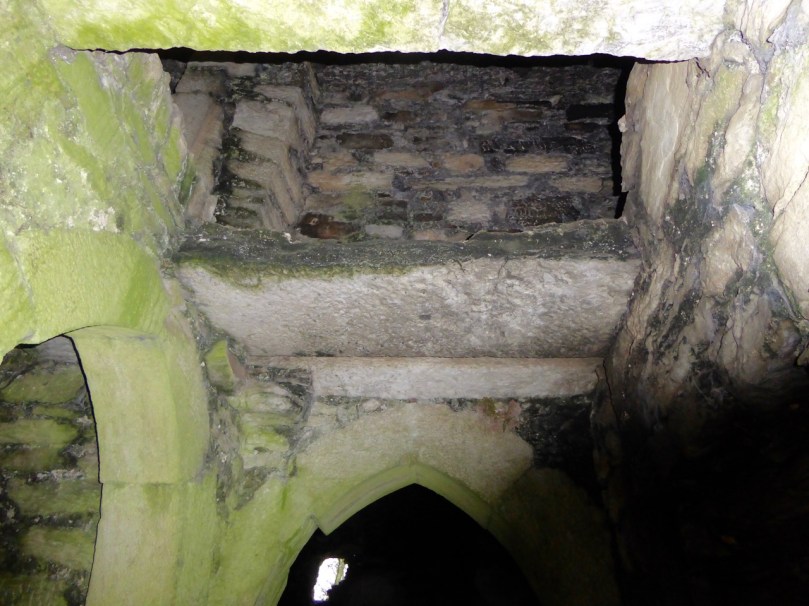
The entrance was often a raised entrance (see When is a Castle..?) with access via an outside wooden stairs that could be pulled up when necessary. Tower houses where the entrance was on the ground floor needed a defended access and this was often in the form of a small lobby, externally (as at Dunlough Castle) or internally, as at Kilcrea Castle. The door was secured with a heavy wooden bar, slotted into a bar-hole.

Look for a bar-hole behind the main door

Look for a bar-hole behind the main door

At Kilcrea we see that the lobby could be defended from each side and also from above, with the addition of a murder hole – literally a hole through with the inhabitants could throw rocks or boiling water down on those trapped in the entry.

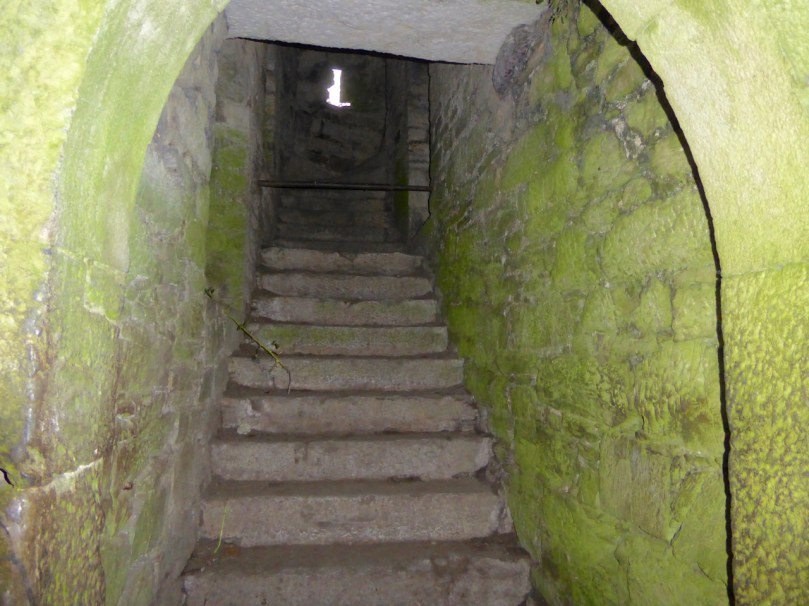
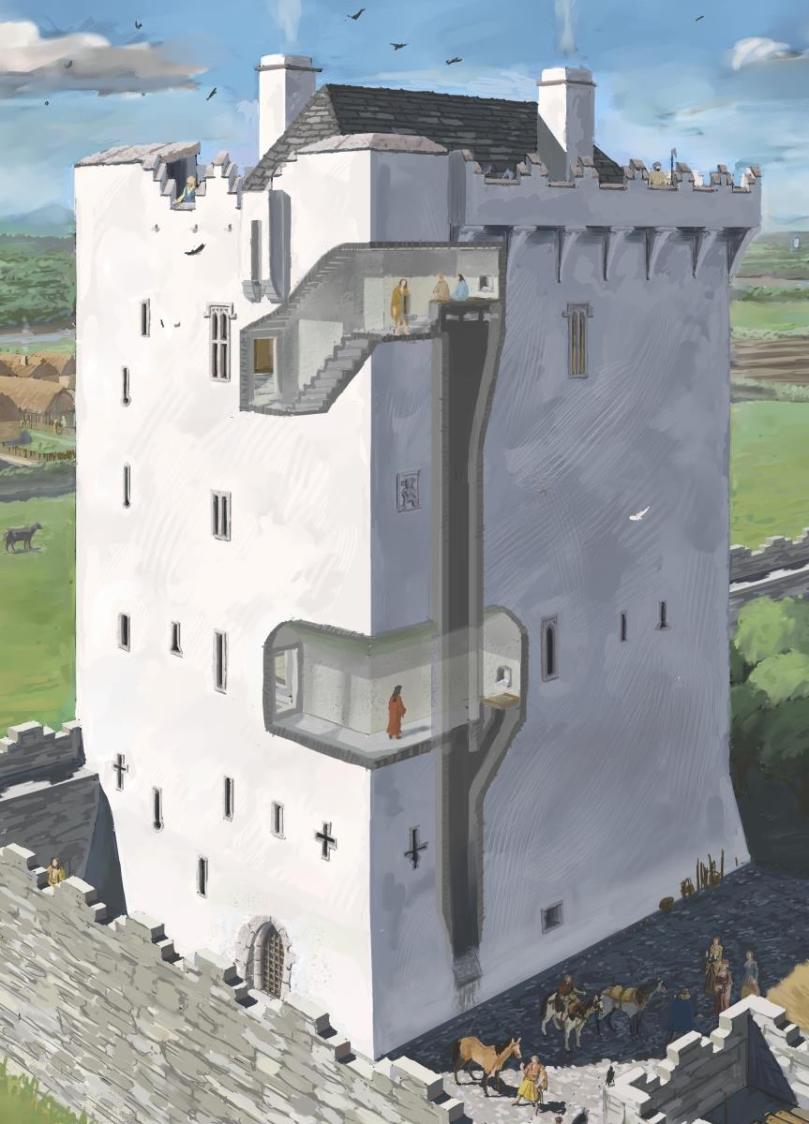
Each floor was accessed by a stairway. Although some very basic castles may have relied on internal wooden stairs leading from one floor to another, most staircases were accommodated inside the walls – thus they are called mural stairs.

Dún an Óir Castle on Cape Clear Island. The mural stair can be clearly seen

Dún an Óir Castle on Cape Clear Island. The mural stair can be clearly seen

Stairs were both straight or spiral and some castles had both. A straight set of stairs didn’t need a very thick wall, but a spiral stairs needed either very thick walls or a corner tower or projection. Building a set of spiral stairs was a highly-skilled task and not just because of the inherent difficulty of working with intractable stone.

Castle Donovan spiral staircase

Castle Donovan spiral staircase

They were usually built so that you ascended them clockwise, thus presenting more of yourself to defenders above, who could hold onto the newel post with their left hand and wield a sword in their right. It was important to make the steps slightly uneven too, so that an ascending attacker could trip easily if he didn’t watch carefully.

Dunlough spiral staircase

Dunlough spiral staircase

Windows had to be inserted to light the way but these could only be slits, to be used as arrow or gun loops when necessary. A cross-shaped loop was called a crosslet.

This crosslet provides light for a spiral staircase and allows an archer to shoot from inside the castle

This crosslet provides light for a spiral staircase and allows a defender to shoot from inside the castle

spiral stairsOne of the most beautiful examples of a spiral staircase we have come across is at Kilcrea Castle, near Aherla in Cork. While all such staircases* are impressive, the one at Kilcrea is a work of art. All the wall and sill stones are dressed to conform to the shape of the spiral and the sinuous progression of the newel and the steps is a joy to behold.

Kilcrea spiral staircase

The beautifully constructed spiral staircase at Kilcrea Castle. All the stones are dressed to fit the contours of the circular stairwell

The walls hold other items of interest too. Mural chambers, for example, may have served a variety of purposes from storage to dressing – some have loops for lighting but many have not. Cupboards were built into the walls to hold lights and valuables – a mural cupboard is called an aumbry.

Two mural chambers: left is a rectangular chamber with two aumbries (cupboards) and right is an L-shaped chamber light by a loop

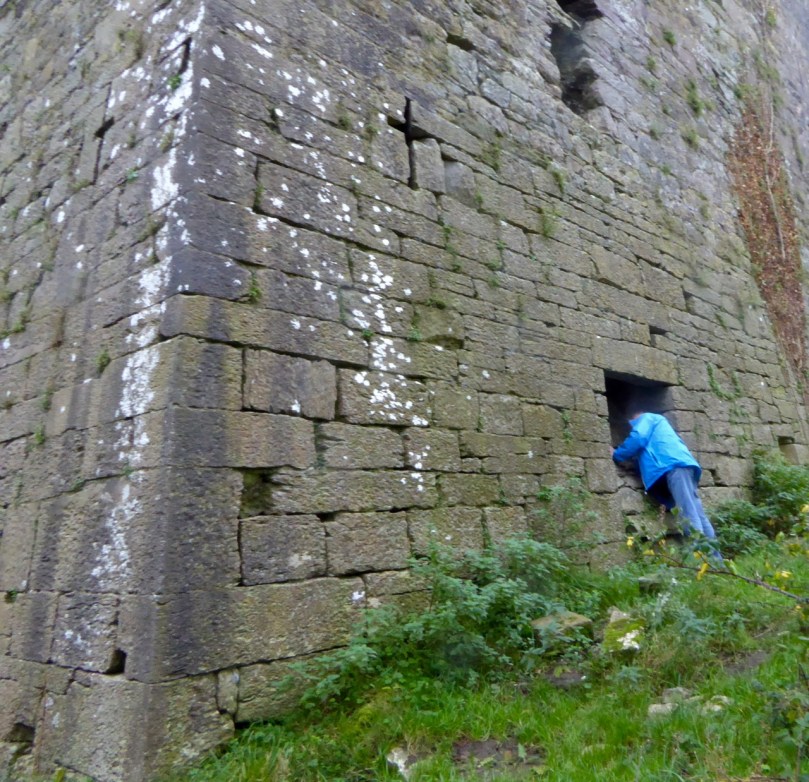
Garderobes (indoor toilets) are usually enclosed in a mural chamber for privacy (although not always!), with the garderobe chute extending down the wall to an external exit.

Dunmanus Garderobe chute
Upper: The garderobe at Ballinacarriga. Lower: Dunmanus Castle showing where the garderobe chute exits at the base of the castle

The lowest floor was often used for storage or for cattle and hence the floor was sometimes left in a natural state.

Castledonovan ground floor

Castle Donovan ground floor

The next floors were for administration and daily living activities of castle inhabitants and workers. Floors were wooden – corbels and beam sockets to support the floors show where the next level began.

Cullohill Castle - floor levels clearly visible, plus the addition of a later firepalce that obscures a window

Cullohill Castle – floor levels clearly visible, plus the addition of a later fireplace that obscures a window

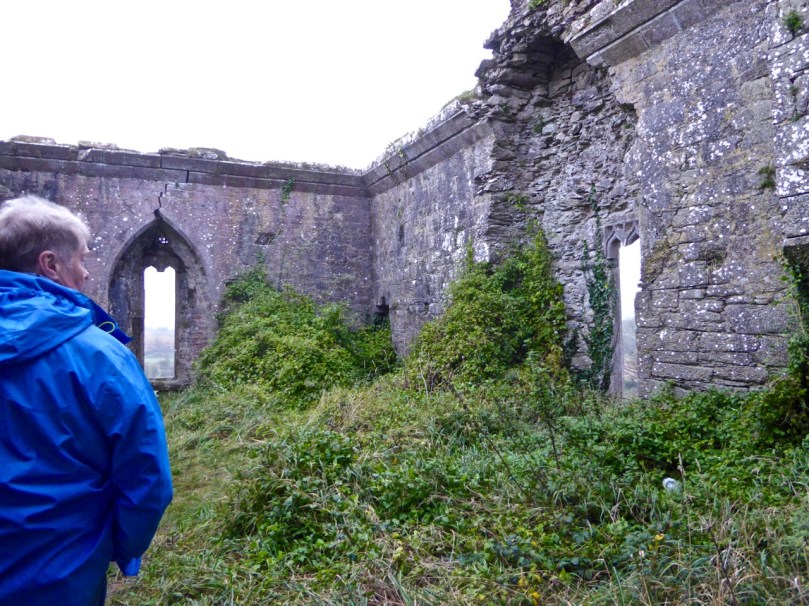
Fenestration (the arrangement of windows) was organised to emphasise defence – small windows and loops on the lower floors, larger on the top floor or solar. This was the private living quarters of the lord and his family, and a place where the women of the household could enjoy privacy and peace.

A fireplace from Castledonovan

A fireplace from Castledonovan

It was sometimes the only room in the castle to have a fireplace and generally speaking was the most comfortable room and therefore also used for entertaining.

Top floor, Kilcrea - the only floor with sizeable windows and more finely finished than the lower floors

Top floor, Kilcrea – the only floor with sizeable windows and more finely finished than the lower floors

If this floor had more than one room, the other might be called the great hall and be the entertainment space.

The Great Hall at Ballinacarriga. But what are we all looking at?

The Great Hall at Ballinacarriga. But what are we all looking at?

Ballinacarriga is unique in West Cork in that there are several carved window embrasures.

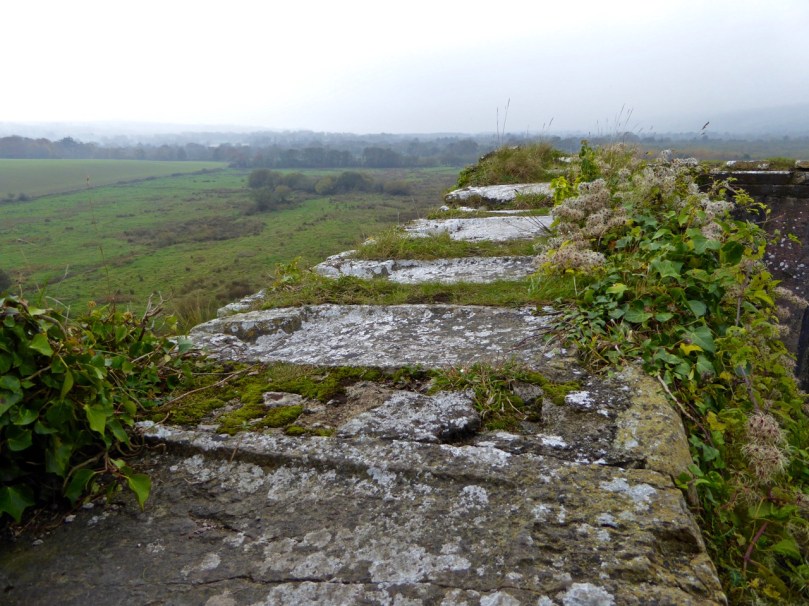
From the solar a stairway led to the battlements and wall walk. The roof could be made of timber, slate, or even thatch. The wall walk at Kilcrea had specially designed weepers to carry water away from the roof.

The wall walk at Kilcrea - note the weepers

The wall walk at Kilcrea – note the weepers

So there you are – next time you wander around a deserted castle in Ireland (we specialise in them!) you will be able to rattle off the proper terms for everything you see. The more you know, the more you appreciate the genius of our Medieval castle-builders.

Ballinacarriga Great Hall

Ballinacarriga Great Hall

I’ve learned so much doing these posts on castle architecture I am tempted to move on to abbeys – what do you think?

* The illustration of the newel stairs is from the Castles of Britain website. I believe it is from an Irish castle. That site also has an excellent glossary.