When in Youghal…

boyle header

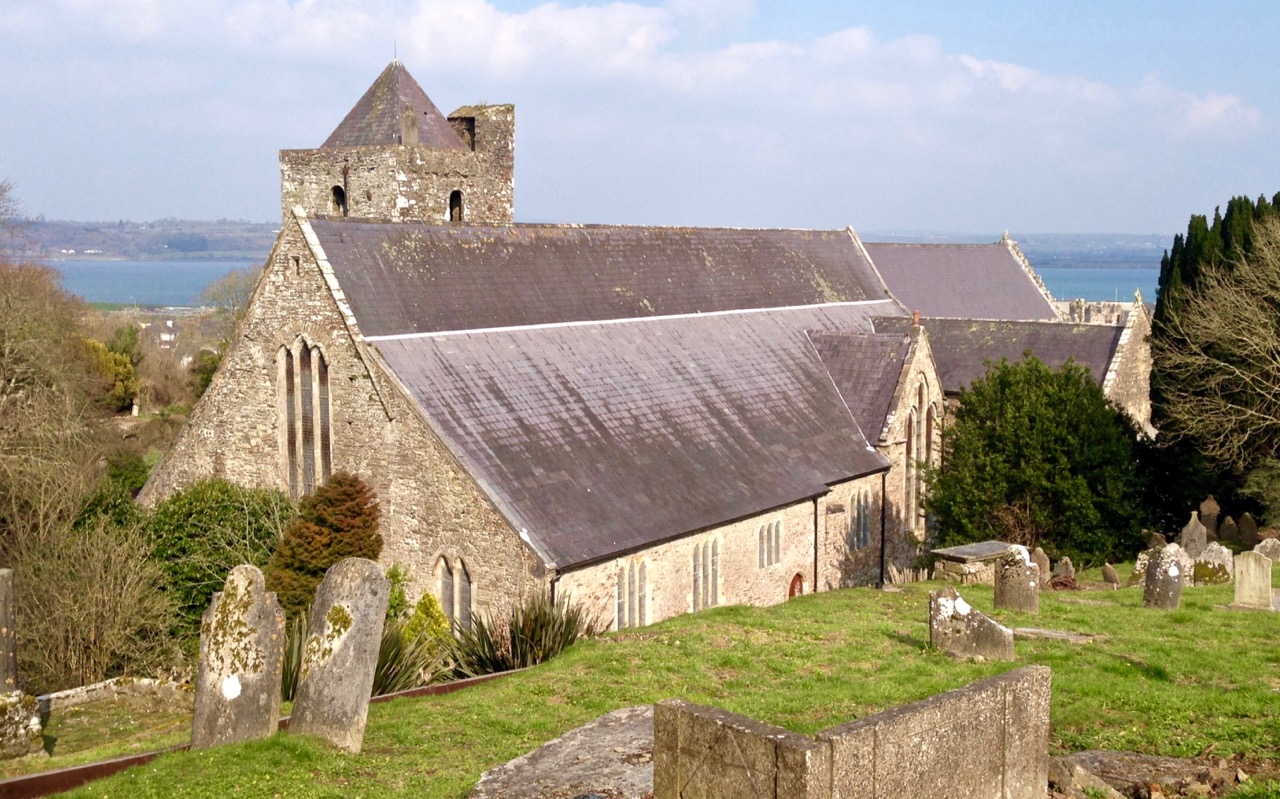
We spent St Patrick’s Day in Youghal – within County Cork but a long way from our own part of that territory. The place is falling down with history, and warrants an extended visit. Finola has written about the walled town and some of its architecture: I will be concentrating on the Collegiate Church of St Mary, a building that goes back a long way and is said to be on the site of the monastic foundation of Saint Declan, a fifth century contemporary – or even a predecessor of – St Patrick.

Saints by Harry Clarke: St Patrick, Ballinasloe (left) and St Declan, Honan Chapel (right)

The Vikings came to Youghal, and one stone slab in the church depicts a vessel from those days. There are so many other memorial stones, carvings and inscriptions that we spent hours in the building just trying to take them all in. I can only show you a taster and recommend you to go and see for yourselves.

longboat

Carving of a Viking longboat – can you see it?

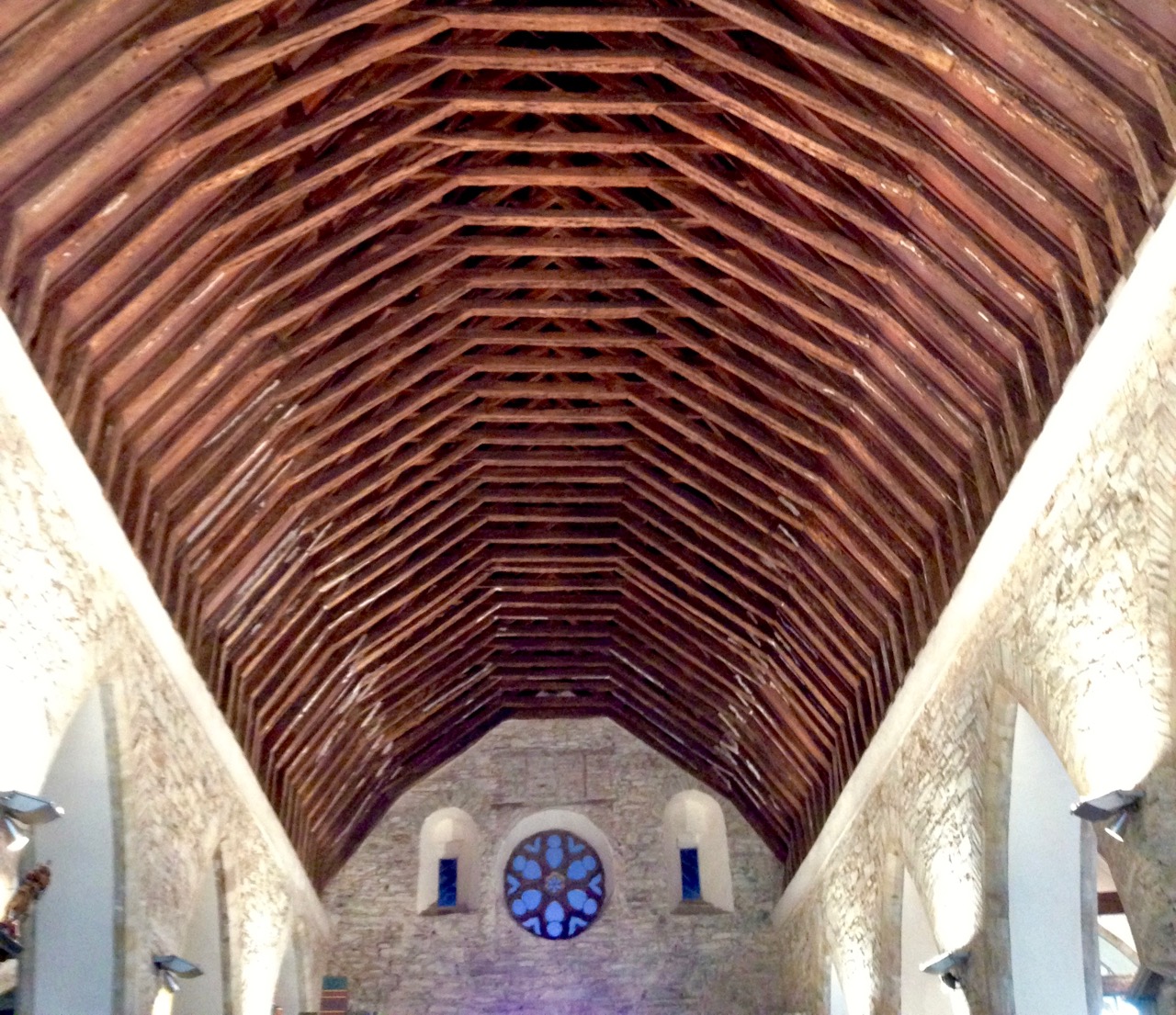
The structure of the present church deserves close study. It claims to be the oldest church in Ireland that has had continuous worship taking place – since the 13th century. Look firstly at the roof over the Great Nave: the timbers have been carbon dated to around 1170, although an intriguing hand-printed notice about this feature states …The roof of this church was put up there in 1220 by French labour, there are two german cathedrals roofed with Irish Oak and their walls bear the same masons marks as this church. They were all built by the same hands. Ireland was covered with oak woods in 1220, but saw mills were not invented until 1328. They had to pick each oak tree the same size, and with an axe skin and square it up. So each piece is a small oak tree – or Saplyn…

oak roof

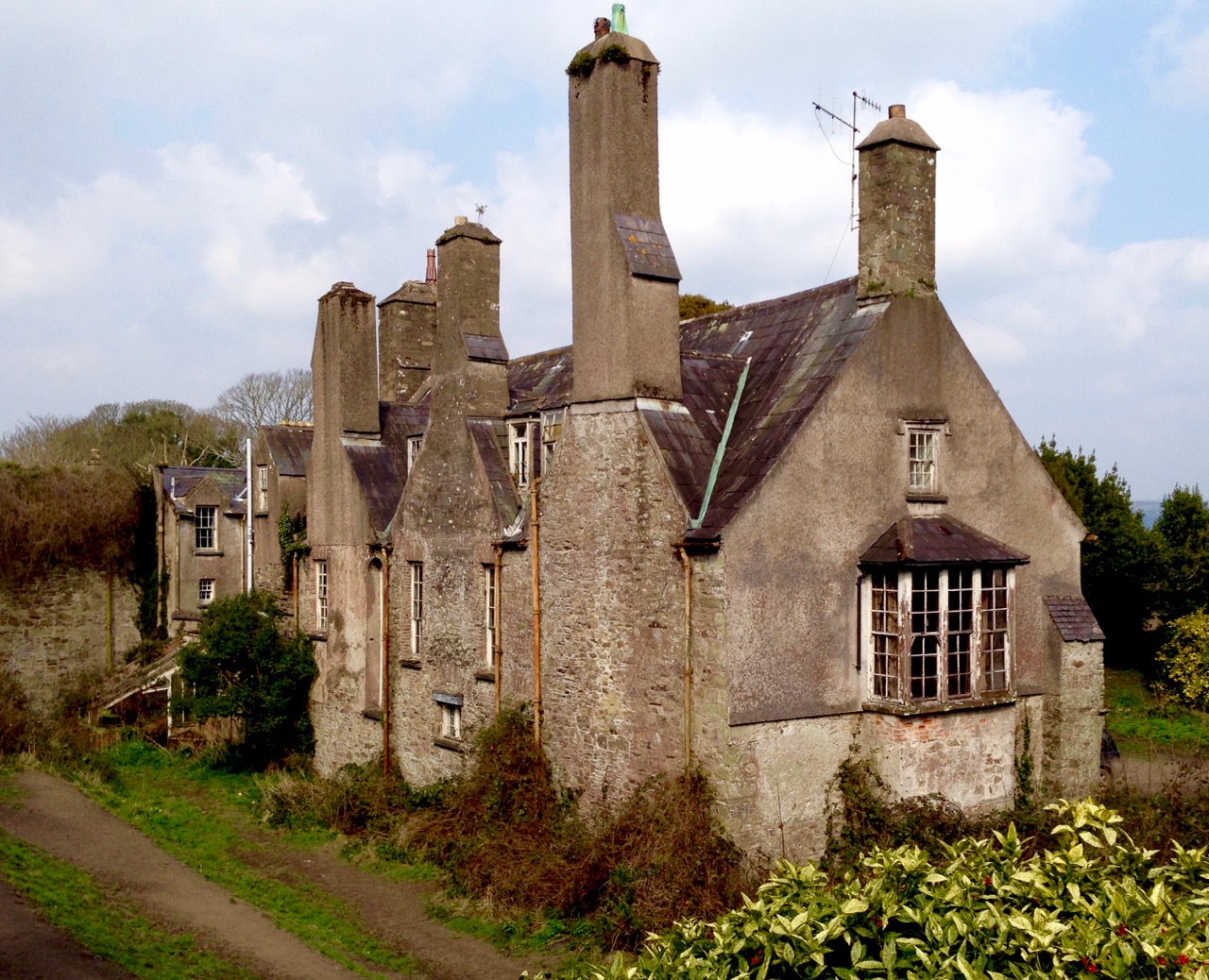
In 1464 St Mary’s was made a Collegiate Church, with the foundation of Our Lady’s College of Yoghill by the Earl of Desmond. It was served by a ‘ Warden’ of eight ‘fellowes’ and eight ‘singing clerks’. In the precincts of the church is the Warden’s House, known as Myrtle Grove. This also has a long and complex history: this article about Henry and Edith Blake – two of its colourful inhabitants (who are buried in its garden) is worth a read. Another former inhabitant of the house – and one of Youghal’s celebrities – is (or was) Sir Walter Raleigh.

myrtle grove 2016

Sir Walter Raleigh, once the owner of many thousand acres in Cork, including the whole settlement of Youghal – and his home, Myrtle Grove, in 1833 (top right) and seen today (above)

Myrtle Grove is said to be one of the oldest houses in Ireland: it remains in private ownership. St Mary’s Church itself is unusual in that it is in the guardianship of the state while also continuing as a place of worship.

st mary's church

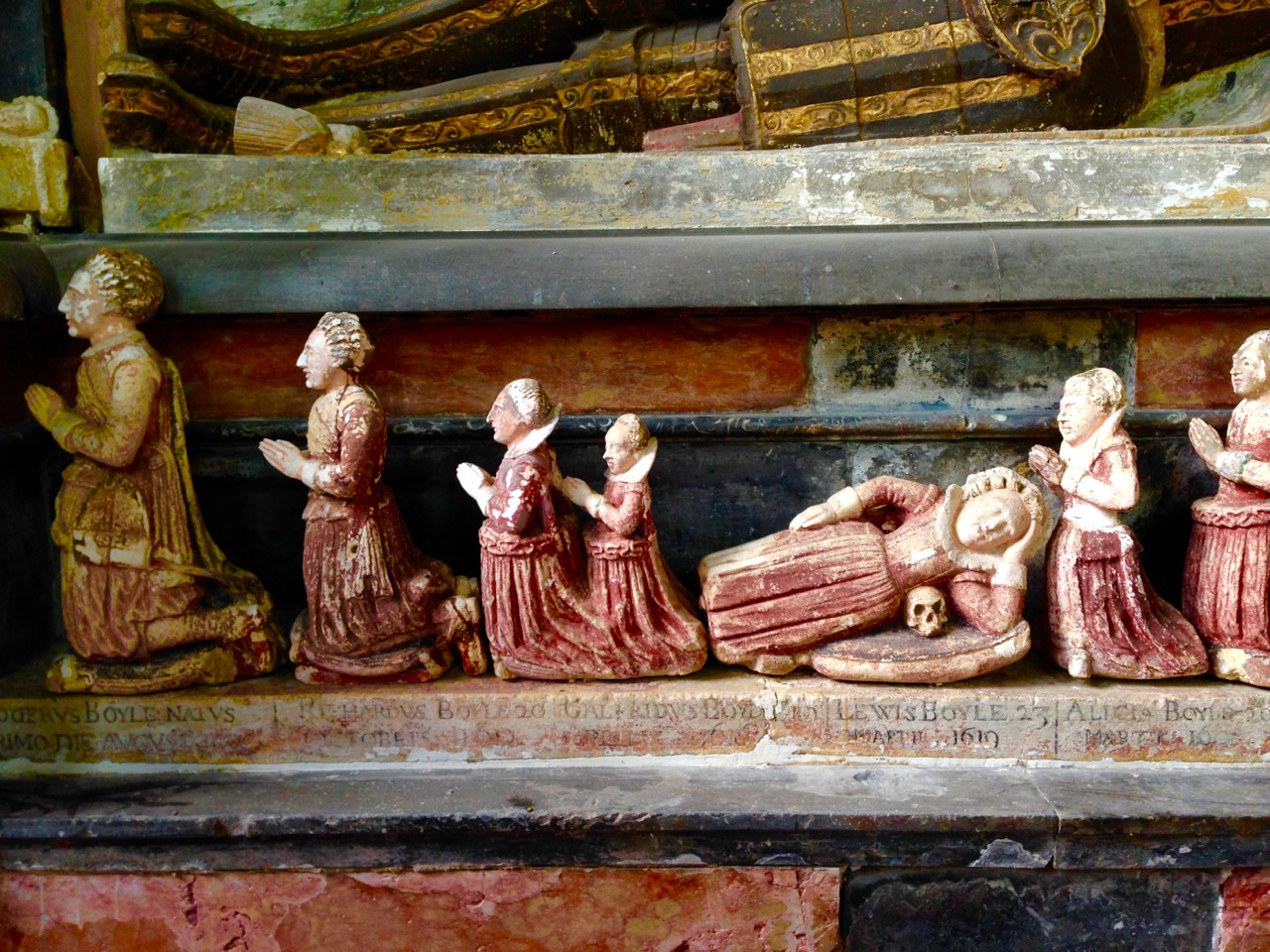
Another Youghal celebrity was Richard Boyle – the Great Earl of Cork (1566 – 1643). While Raleigh had acquired his estates during the English ‘plantations’ following the Desmond rebellion, Boyle, also an English incomer, was an entrepreneur and an opportunist. He invested in many ventures – mining, fishing, iron smelting and linen weaving – as well as studying law and pursuing his political career. He was appointed Clerk of the Council of Munster in 1600, became a privy councillor for the whole of Ireland in 1612, and, having found favour with Queen Elizabeth, was knighted and made Earl of Cork and Viscount Dungarvan in 1620. Eventually he was created Lord Treasurer of Ireland. He owned Bandon and designed and built Clonakilty, while also relieving Raleigh of all his estates – 42,000 acres – for the rather small sum of £1500. Boyle died in 1643 and is interred in a tomb he built for himself and his family in St Mary’s Church, Youghal. He is said to have been the richest man in the known world at the time of his death. Go and see his tomb – it is spectacular! Boyle had two wives and fifteen children by one of them: all – and Boyle’s mother – are included in the monument.

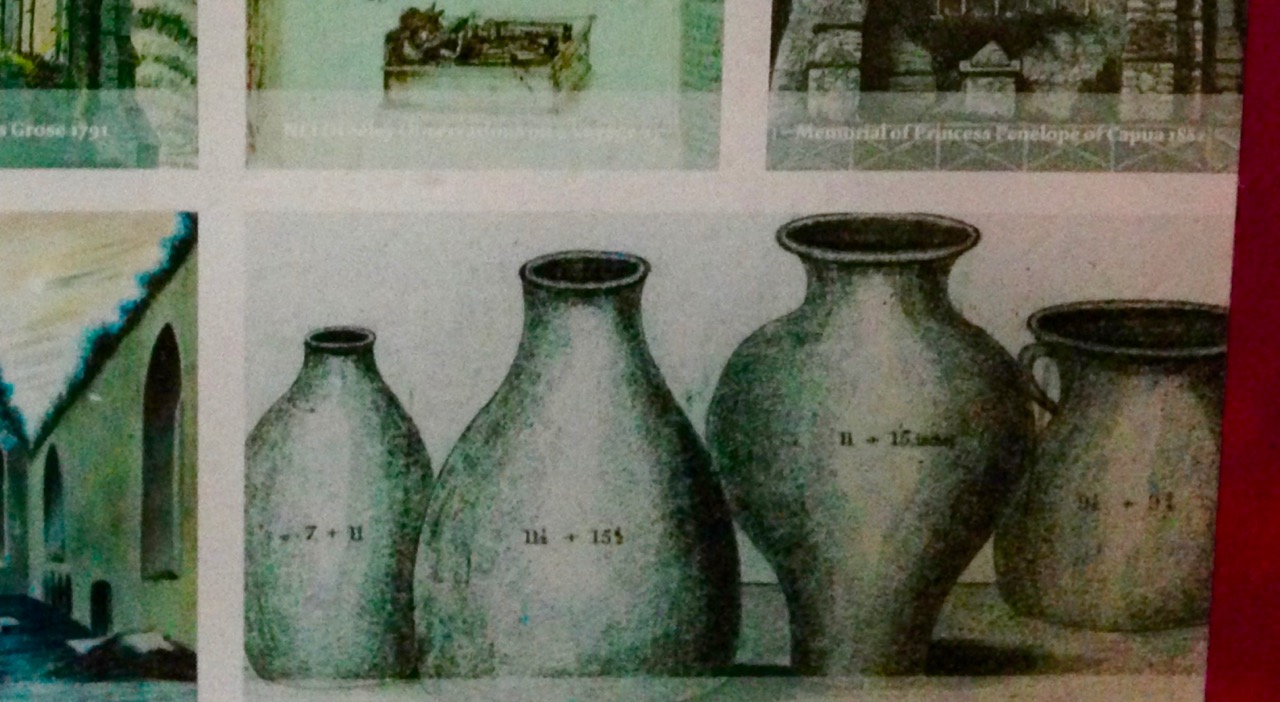
The Collegiate Church is one of the places where – in the middle ages – ‘acoustic jars’ were used to enhance acoustics. These ceramic vessels were placed in niches above the choir area: the niches are still there but, unfortunately, the vases are not.

acoustic jars

There’s a lot more to the fascinating story of this church. I’ll leave you with a visual round-up of some of the details that we found, all of which add to the interest and the richness of the place. You could call it a ‘medieval miscellany’ – I call it my Youghal Menagerie.

miscellany 17

Mosaics and Maharajas, Part 2

East Window

The more I look into the Church of the Ascension in Timoleague the more fascinating it becomes. Last week I concentrated on the mosaics and the story of the Maharaja, but what I failed to say is that the mosaic tiles were made by Minton, as were the encaustic tiles on the floor. Minton is known for its bone china but in fact it was also was the leading producer of British ceramic tiles during the 19th century.

Encaustic Tiles

The encaustic floor tiles as well as all the mosaic tiles were made by Minton

The windows were also produced by the most famous British stained glass artists of their day, as we shall see. Taken as a whole then, the architecture and decoration of this singular church leads us directly to Augustus Pugin, one of the giants of the Victorian Age, and locates it in the highest echelons of the Gothic Revival Movement. This hidden gem is even more of a jewel than I suspected!

Pugin

Who was Augustus Pugin? Born in 1812, son of a French emigré draughtsman and an English mother, Pugin trained in his father’s workshop, becoming proficient in design and drafting by aged 9. Conversion to Catholicism and a visit to Nuremberg in Germany convinced him that the greatest expression of church architecture was High Gothic and he set about challenging, and ultimately revolutionising, the prevailing design norms of the Victorian period. He was incredibly prolific and influential, such that today when we think about Victorian architecture and gothic revival, we are really thinking about the work of Augustus Pugin – even though he died in 1852 at the early age of 40.

The signature of the Warrington Stained Glass Company on the East Window

Pugin designed several churches in Ireland (mostly Catholic), especially in Wexford, where you can follow the ‘Pugin Trail’. (I don’t know who wrote the Wexford Pugin Trail brochure, but it is one of the best explanations of his style and influence that I have read.) While he did NOT design the Church of the Ascension, his influence is everywhere in evidence, along with the use of his favourite suppliers – Minton for the mosaics and tilework and Warrington, Lavers and Westlake, and Mayer for the windows.

Church interior looking east

Hallmarks of gothic revival: a beautiful hammer-beam ceiling, tall pointed windows with simple Y tracery, everything to lead the eye upwards

The real art of making stained glass in the medieval style had been lost and during the 18th century colour was mostly painted directly on the glass using an enamel technique. But part of the gothic revival ethic was to base manufacturing technology as closely as possible on the original so there was also a re-discovering of real stained glass processes where the colour was fired directly into the material and sections of glass were separated by lead. This art was revived in the 19th century by artists and craftspeople who studied medieval glass and learned through trial and error how to make it again.

The Presentation

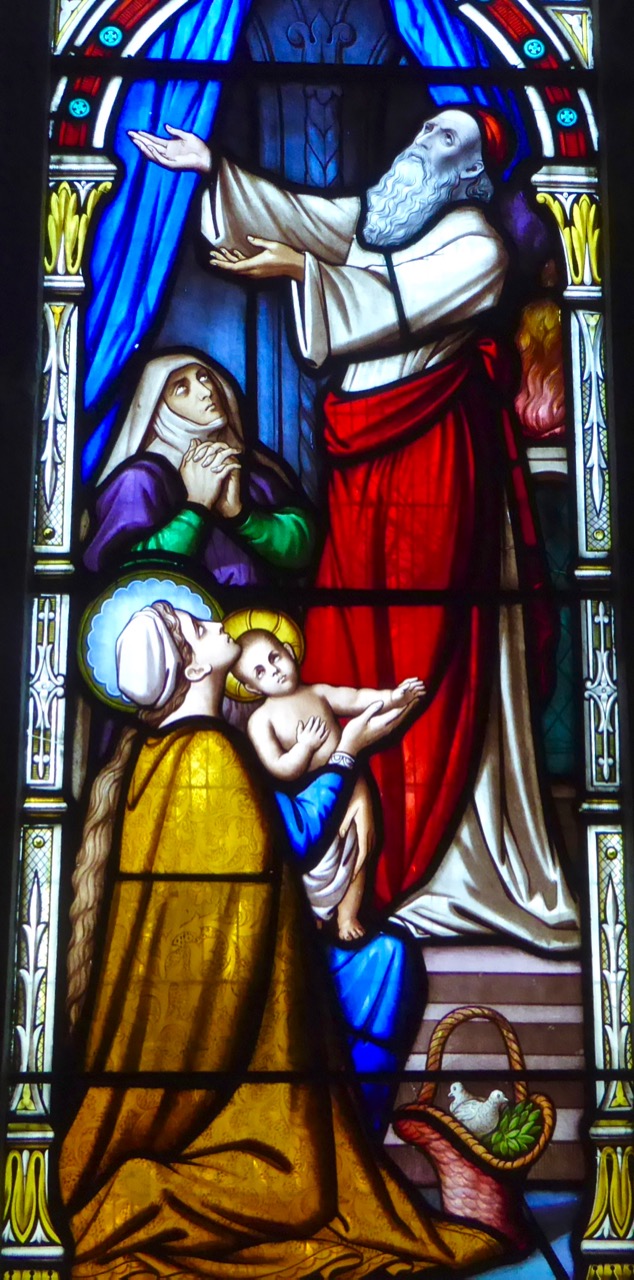
The Presentation, East Window

Let’s start with the East Window, the work of Warrington. William Warrington was one of the leading stained glass artists of his day. Like Pugin, he was a student of the gothic style and he strove to reproduce glass work as close as possible to medieval models. He had trained with his father as a painter of armorial shields, an influence that can be seen in his designs. He wrote a book in 1848 on The History of Stained Glass, but fell afoul of the group called the Cambridge Camden Society (or CCS) who had set themselves up as the arbiters of taste in all things related to church architecture. Partly this was the outcome of class prejudice: the CCS, all university educated men, did not believe that a “mere artisan” should be allowed to have an opinion of what they saw as their own exclusive preserve.

supplicants

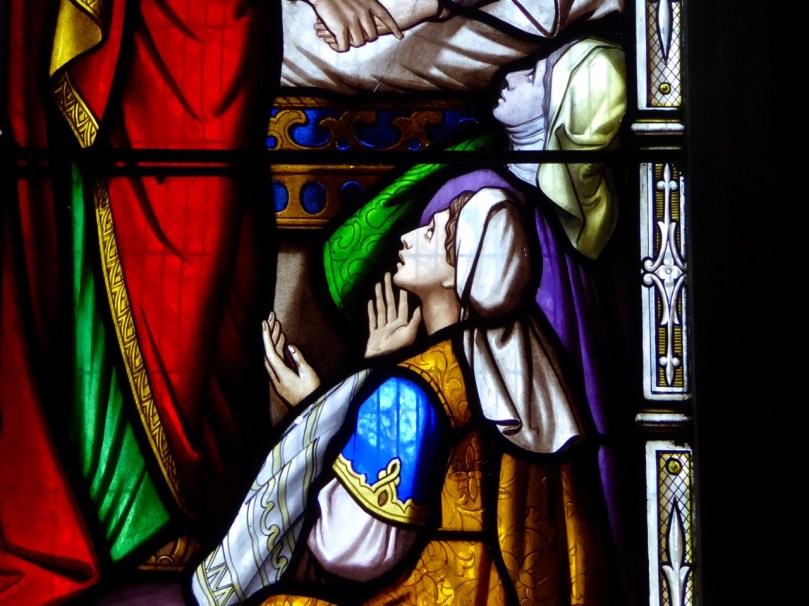
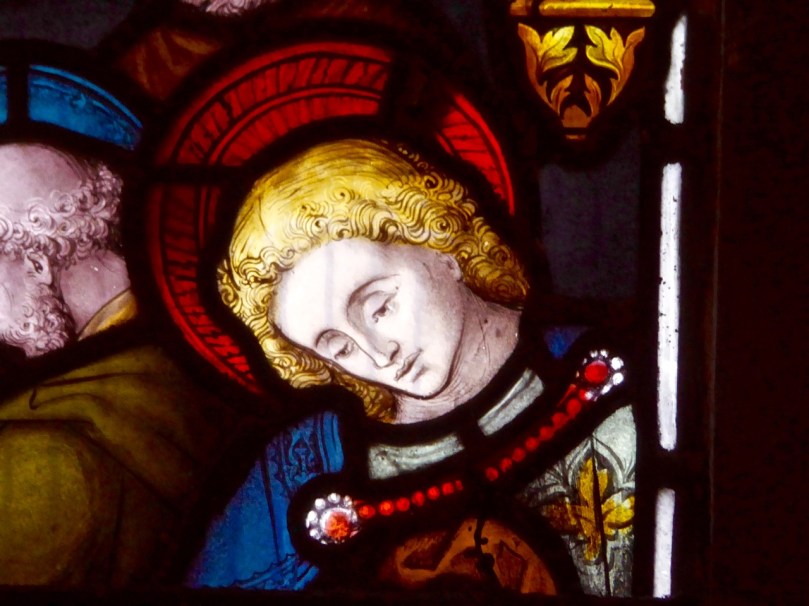
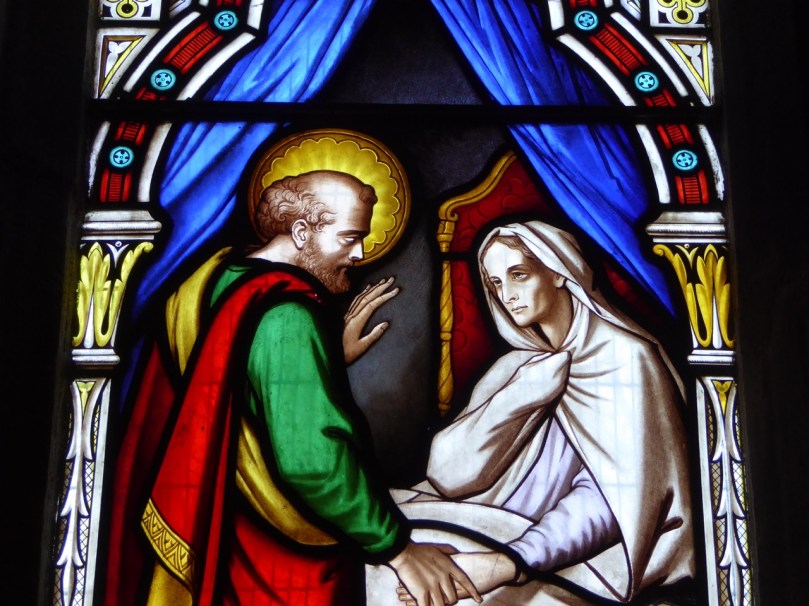
Detail from The Raising of Dorcas, East Window

By any standards, this is a beautifully executed window. According to the Wikipedia article, Warrington’s figurative painting strives towards the Medieval in its forms, which are somewhat elongated and elegant, with simply-painted drapery falling in deep folds in such a way that line and movement is emphasised in the pictorial composition. His painting of the details, particularly of faces, is both masterly and exquisite.

Raising Dorcas

The Raising of Dorcas, East Window. In this story, from the Acts of the Apostles, Peter prays over the dead body of Dorcas, who returns to life

This is all clearly visible in the East Window, a masterful set of three lights depicting the Crucifixion in the centre, Raising Dorcas on the left and the Presentation in the Temple on the right. Note the use of heraldic motifs above the main panels, and the tall medieval-style spires of foliage, all typical of Warrington glass.

East Window heraldic

For some reason, this was all too much for the Bishop of Cloyne when he came to consecrate the new chancel in 1861. Cloyne Cathedral itself was a true medieval building but much simpler in its interior decoration. The Bishop obviously had less sympathy with this new style of highly decorated church interiors and objected in particular to the East window, which he viewed as similar to the ‘graven images’ popular in the Catholic churches.

On the cross

He refused to conduct the consecration unless the window was covered in a cloth. The cloth, apparently stayed up a long time, and when it came down the window continued to attract opprobrium – it was even attacked and broken on at least one occasion! It’s hard to understand now how such a beautiful piece of devotional art could have inspired such an over-the-top reaction.

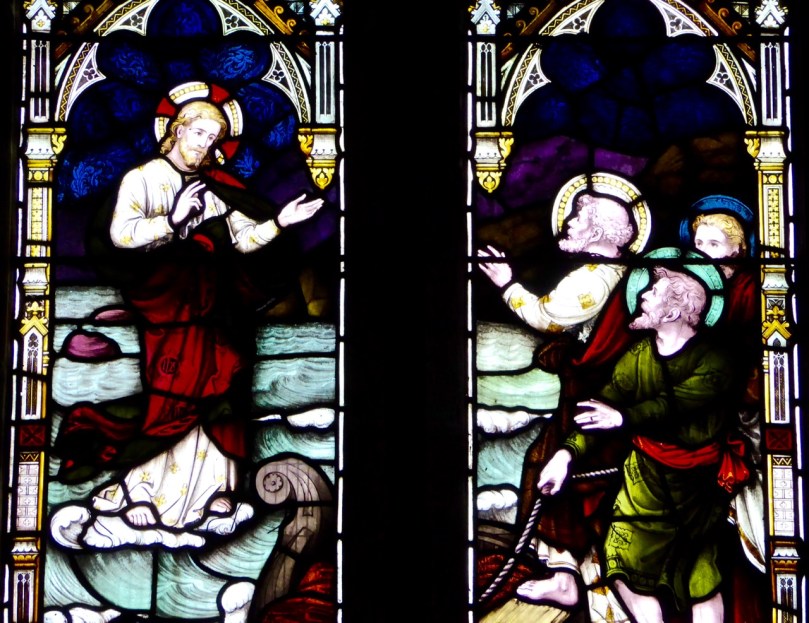
Jesus Walking on the Sea

The Sermon on the Mount by Lavers and Westlake

Three sets of windows in the nave are by Lavers and Westlake, yet another of the London-based stained glass firms that responded to the new demand for gothic-revival glass windows in 19th century Britain. Nathaniel Westlake was another scholar of stained glass, publishing a four volume work, A History of Design in Painted Glass, and also a decorative painter of wall and ceiling panels. He was considered one of the leading exponents of stained glass art with a style considered to be Pre-Raphaelite. He worked with William Burges for a while – the one who designed every aspect of St Fin Barre’s Cathedral in Cork – who recommended him to the firm of Lavers and Barraud. In 1868 he became their chief designer and was responsible for much of the success of the firm, which captured a large share of the booming stained glass industry. Unlike Warrington, however, Westlake did not clash with the CCS, probably because his partner, Lavers, was a member of that society.

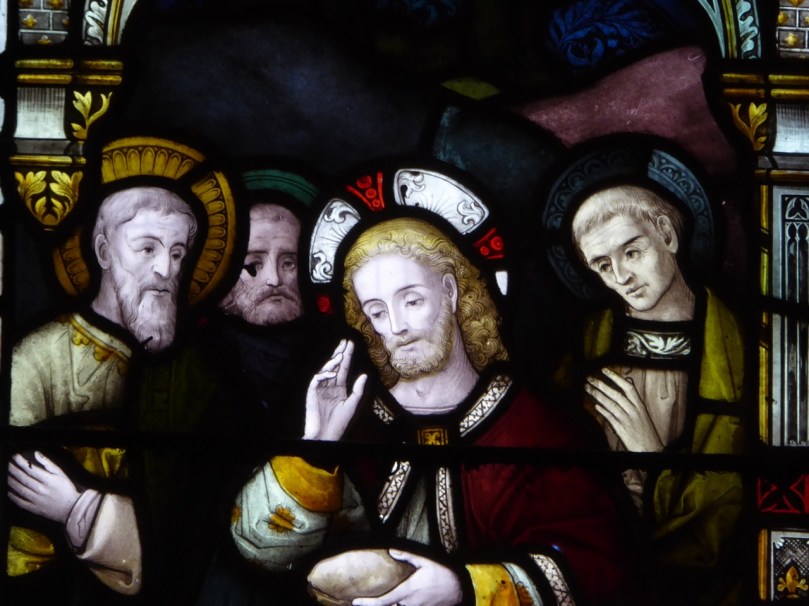
Loaves and Fishes detail

A detail from the Lavers and Westlake Loaves and Fishes window showing Westlake’s Pre-Raphaelite tendencies

The three windows by Lavers and Westlake are in the nave on the north and south walls. Those on the north wall depicts the Miracle of the Loaves and Fishes and the Sermon on the Mount. That on the south wall is of Jesus Walking on the Water.

Loaves and Fishes Detail

Jesus Walking on the SeaAbove, detail from the Loaves and Fishes. Below, Jesus Walking on the Water

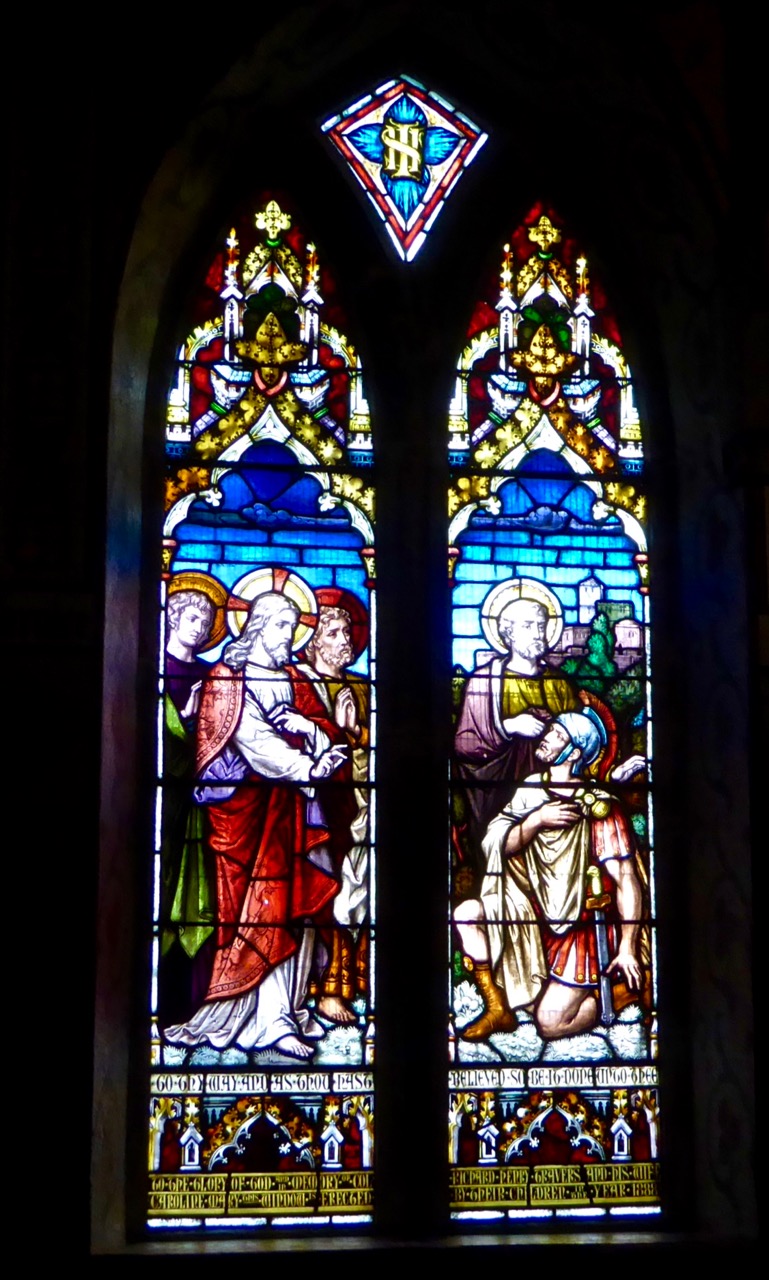
The final window on the south wall is by the firm of Mayer and the subject is The Good Centurion. Franz Mayer and Co was possibly the busiest stained glass company of all and are actually still in business under the name Mayer of Munich. The founder, Franz Mayer, started a company dedicated to “…a combination of fine arts, architecture, sculpture and painting…”. This firm was officially recognised by the Vatican so it was very popular with Catholic churches and there are many examples of Mayer windows throughout Ireland. In 1865 the firm opened a London branch, which supplied this window.

The Good Centurion

The Good Centurion, a window by Mayer of Munich and London

There are three more windows in the south transept, these ones by the firm of Clayton and Bell. They are very fine indeed and I particularly like the east and west window pair which depict, apparently, Life and Death, for their wonderful luminous colours.

Clayton and Bell windows, detail 

There are several more noteworthy features of this fine little church (the pulpit, the carved wooden furniture) but I think I will leave it at that for now. I’ve learned a lot about the Gothic Revival Movement through this exercise, and about some of its chief practitioners. I’ve been struck, as the reader might be, at how British (rather than Irish) the influences are in this church, but that of course was very much a function of the times. At some point I will write about the enormous Catholic church that dominates the village, with a view to showing how the great era of Catholic church building in Ireland finally led to an emphasis on Irish architecture and Irish artisans. For a very brief word on that, you can read my post A Tale of Four Churches.

Timoleague Three Churches

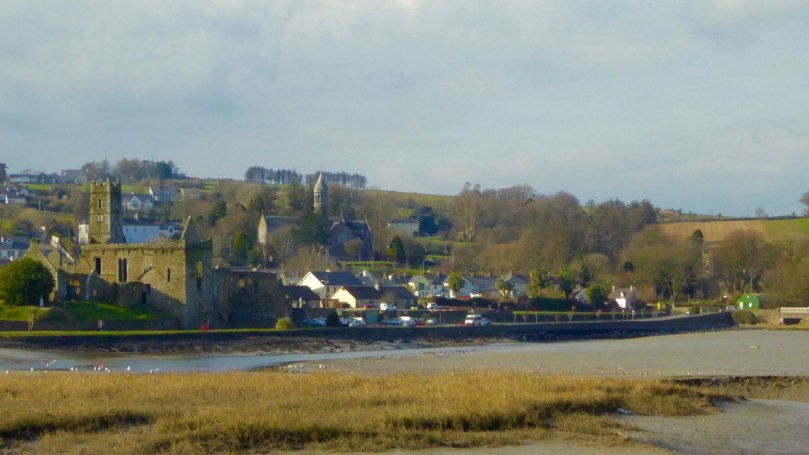
Timoleague. On the left are the ruins of the medieval friary, the Catholic Church dominates the hilltop, and the Church of the Ascension is behind the green building on the far right

And as for Augustus Wellby Northmore Pugin – you can learn more about this complex genius through the BBC Program Pugin: God’s Own Architect, available on YouTube.

Perspectives on Irish History

Occasionally we review books that we think will interest our followers. Here are two which I recommend without reservation: Victorian Dublin Revealed and The Green Divide. Both are by Michael Barry, an engineer, writer and publisher who hales from Ballydehob and now lives in Dublin: he describes himself as an author and transport consultant and has spent much of his career with Ireland’s railways. Michael recently penned an article for the Irish Times in which he set out the highs and lows of producing books here: …There is the pleasure of receiving in one’s hand, a new book, straight from the press: perfectly laid out, high quality, the illustrations perfectly printed. It is the joy of creating something worthwhile – it is almost like seeing a child just born… and, balancing that, the frustrations of a literary world where British publishing dominates: …It is a hard world out there, one may have the best book in the world, but if you don’t have contacts in the press or radio, one doesn’t get reviewed or interviewed… Having read these two books from Michael I can confirm that he is a perfectionist: his writing is faultless and authoritative but, more than that, he generates an enthusiasm for his subjects. Pick up either of these volumes and I guarantee you will be hooked. If there is a word – unputdownable – then that perfectly describes them both. I didn’t know that I was so fascinated (as I now am) by the Irish Civil War: The Green Divide makes such a good job of describing that awful part of Irish history in all its perspectives. It is eminently readable and brilliantly illustrated – there are 400 pictures which include contemporary images, documents and posters as well as the author’s own high quality photographs.

Very different, but equally compelling, the book on Victorian Dublin is, indeed, a revelation. The architect in me immediately wants to go out and see all these places – houses, halls, churches, industrial archaeology – which I never knew existed. The level of research is breathtaking. Mary Leland, in an effusive review for the Irish Examiner, puts it well: …If modern life in Ireland began in the nineteenth century, so did modern architecture. Michael Barry makes this point time and time again in a book of sometimes startling illustrations . Here are pictures to remind us of what we have been ignoring because they seem so commonplace or constant. Barry is his own photographer and has a pleasing eye for detail. He also has a nice sense of historic irony…

I am including a few extracts from both of these volumes: in their brevity they cannot do the books justice. I am hoping you will be inspired to look out for these in your local bookshops (or to ask that they get them in – as we need to keep our bookshops going…!) Michael Barry has written much more: you will find full details on his Andalus Press website – there’s a lot to explore there too!

From: The Green Divide…
Left: two National Army soldiers billeted in a rural cottage – Barry comments ‘If they are city boys, this glimpse of how people in the countryside lived probably came as a shock’. Right: a propaganda poster by Constance Markievicz – ‘this one adopts a mystical theme, depicting male and female Republican fighters as The Bodyguard of the Republic’
Left: Republican activity – removal of two rails – led to this derailment on 15 August 1922 along the banks of the River Slaney on the Dublin & South Eastern Railway: the locomotive of the down Night Mail ran on the sleepers for over 150 metres before turning over. Right: in Lough Mahon, Upper Cork Harbour, Republicans scuppered a dredging barge (distant) and the steamer ‘Gorilla’ to impede passage upriver.
Left: In July 1922, the Irish republican Army published this newspaper advertisement warning Dublin public house proprietors that their premises could lose their licences for plying soldiers with (too much) drink! Right: the ‘schloss-style’ former RIC Barracks at Caherciveen, Co Kerry, now a museum: it was set on fire during the Republican retreat from the town in August 1922.
From: Victorian Dublin Revealed…
Left: ceramic door surround in the National Museum, with carved door by Carlo Cambi of Siena; Cambi’s carvings adorn a wide range of Dublin buildings. Centre: ‘poetry in stone and iron’ – entrance gates to Howth Castle and Demense. Right: ‘heroic engineering’ – a pipe bridge over the Dargle River.
Older times. Left: the tram-yard at Dalkey. Right: oak vats in Vathouse 4 at the Guiness Brewery, 1980s; at the end of the nineteenth century it was the largest brewery in the world. ‘…They garner the succulent berries of the hop and mass and sift and bruise and brew them and they mix therewith sour juices and bring the must to the sacred fire and cease not day or night from their toil…’ – James Joyce, Ulysses.
‘A Byzantine jewel in the heart of the city’ – The University Church on St Stephen’s Green, established by John Henry (later Cardinal) Newman and designed by John Hungerford Pollen. It opened in 1856.

masonic hall

My personal favourite so far… the astonishing Grand Chapter Room in the Freemason’s Hall, Molesworth Street. The building, by Edward Holmes, dates from 1866. Evidently there is, within, an array of exotic rooms designed around fantastical themes. I can’t wait to get to see them! Will they let me in?

observatory

The South telescope at Dunsink Observatory, dating from 1868. Its 12 inch lens was the largest in the world when it was cast in Paris in 1829. The telescope mounting and rotating dome enclosure was provided by the Grubb Optical and Mechanical Works in Rathmines: ‘…the Grubb Works was a thriving hub of advanced optical technology during the nineteenth century. It produced astronomical telescopes which were exported all over the world…’ This telescope is still in working order.
Below: Michael Barry is gifted with an eye for detail: he spotted these three monkeys playing billiards on the elevations of Deane and Woodward’s Kildare Street Club (1859-61) – and wonders if it was a comment by the stone carvers on the rich and leisured denizens of the club?
three monkeys


Mosaics and Maharajas, Part 1

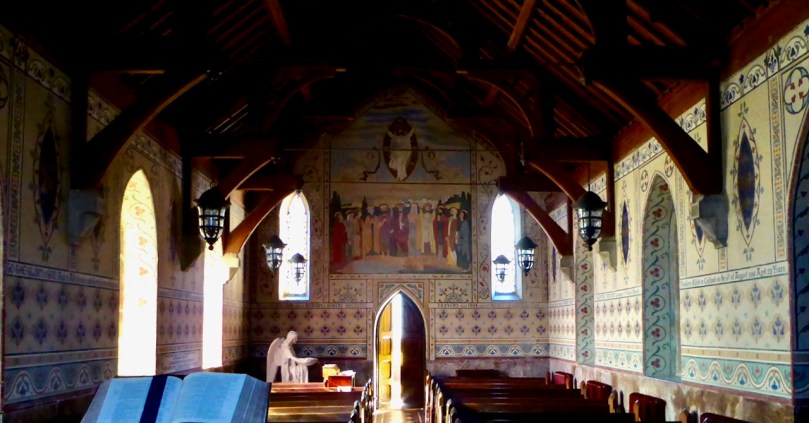
This week when we were passing though Timoleague I had a fancy to see inside the Church of the Ascension as I had heard it was ‘worth a look’.  Understatement of the century! What we saw was astonishing, beautiful, and overflowing with history and stories.

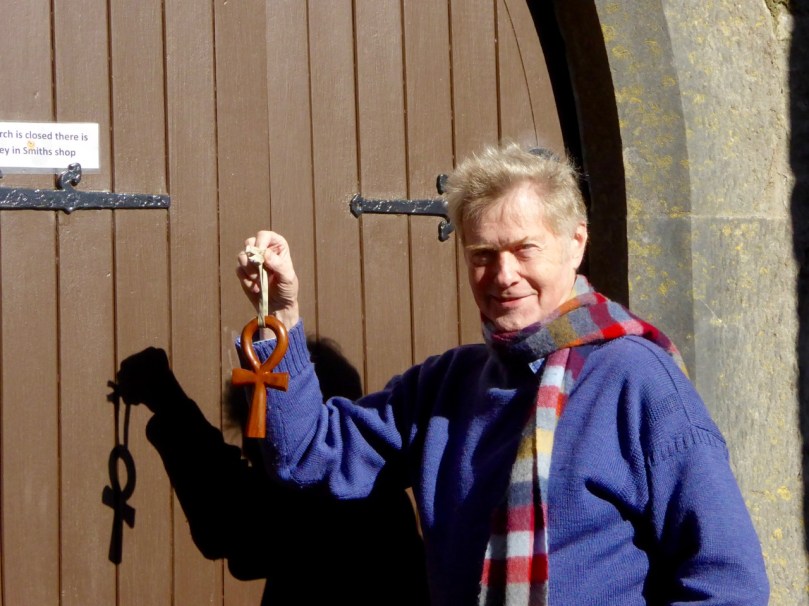
The key is kept at the Post Office on the main street – just ask

This Church of Ireland building is typical of the simple gothic revival style favoured by the funders – the Board of First Fruits. (Read more about this almost-forgotten organisation in a post from the always excellent Irish Aesthete.) Built from the ruins of an earlier (probably medieval) church it was consecrated in 1811 but enlarged later in the 19th century. The pointed-arch windows and the square tower with louvre vents are unremarkable features on the exterior, but open the door and step inside and you enter another world.

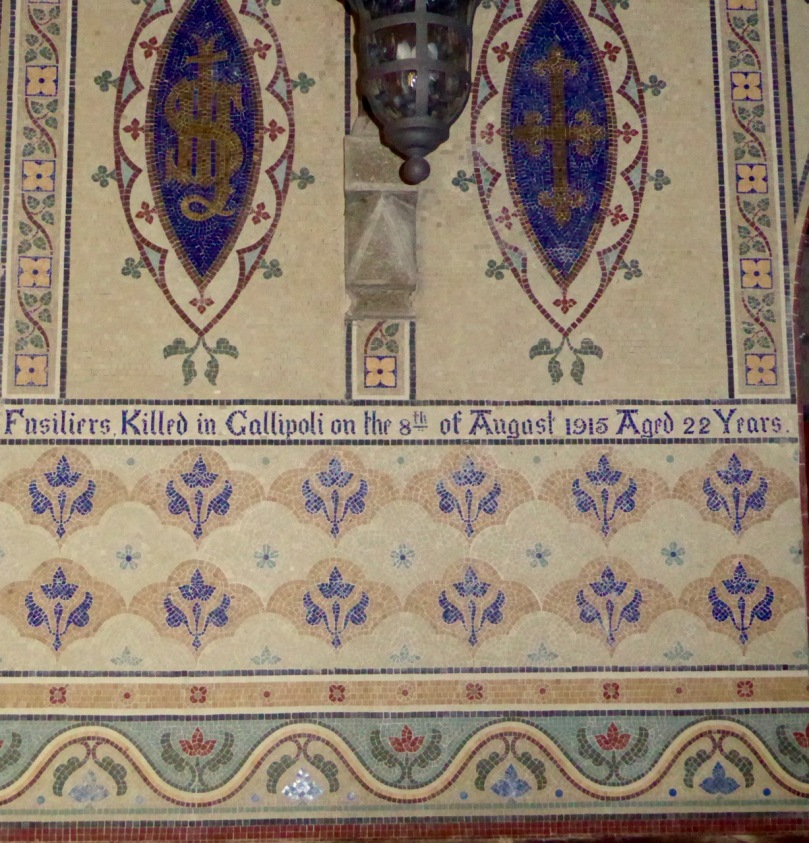
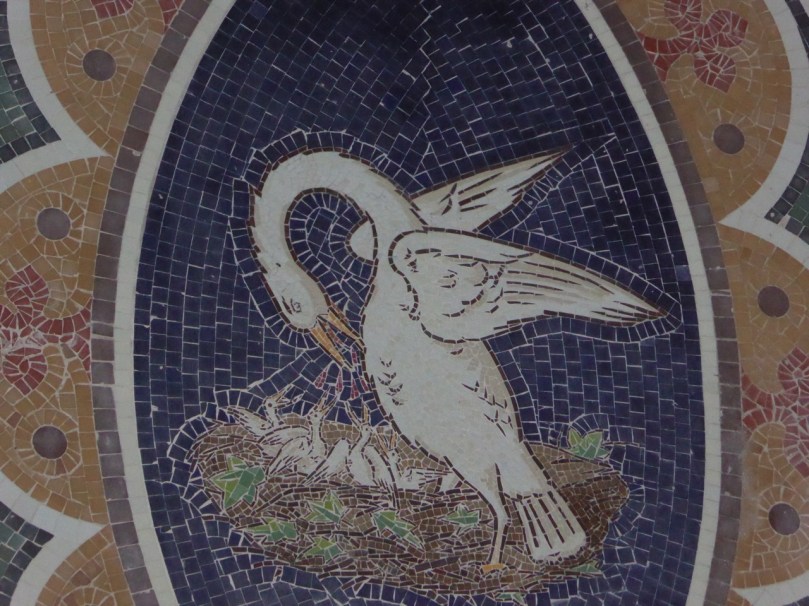
The mosaics are the most obvious (although by no means the only) glory of this church. Designed to commemorate members of the Travers family (yes, the same Travers whose memorials dot the walls of St Fin Barre’s) they cover the entire interior of the church, apart from the hammer-beam ceiling in the nave. They incorporate motifs in several traditions – Christian, Jewish and Islamic.

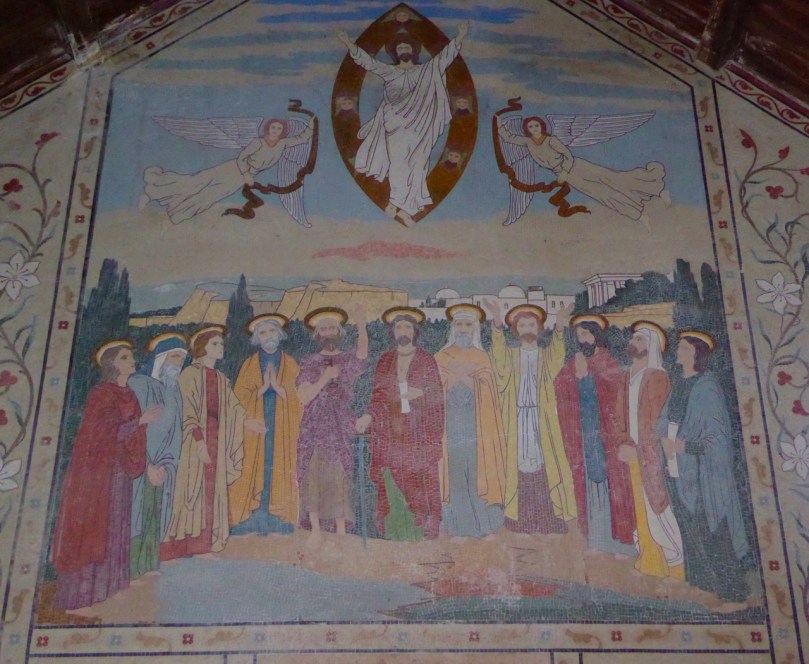
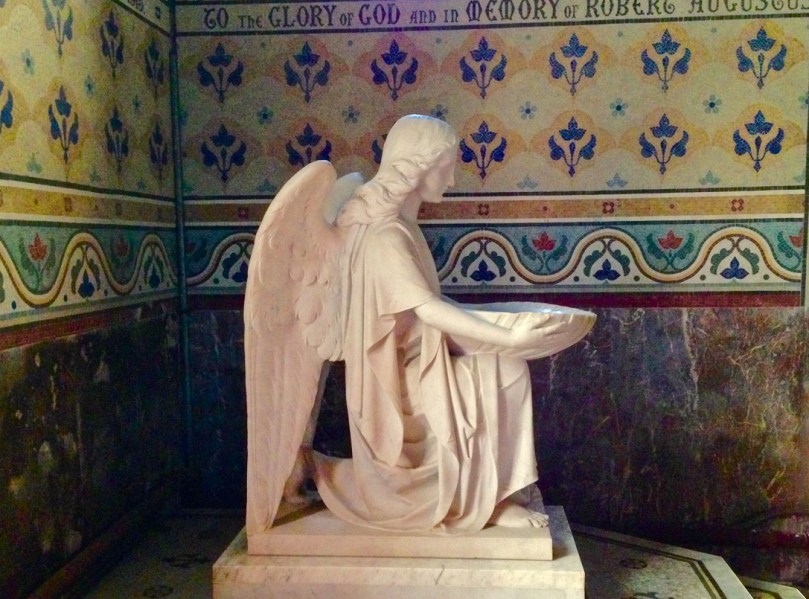
Above the west doorway is the Ascension scene – the apostles are rather conventional but I love their colourful robes and the flower borders. Below them is an angel font, similar to a pair in Tralee Cathedral, made of Carrera marble, with yet more mosaic detail.

Members of the Travers family are named in mosaic around the walls – Robert Valentine Travers of the Munster Fusiliers was only 22 when he fell at Gallipoli.

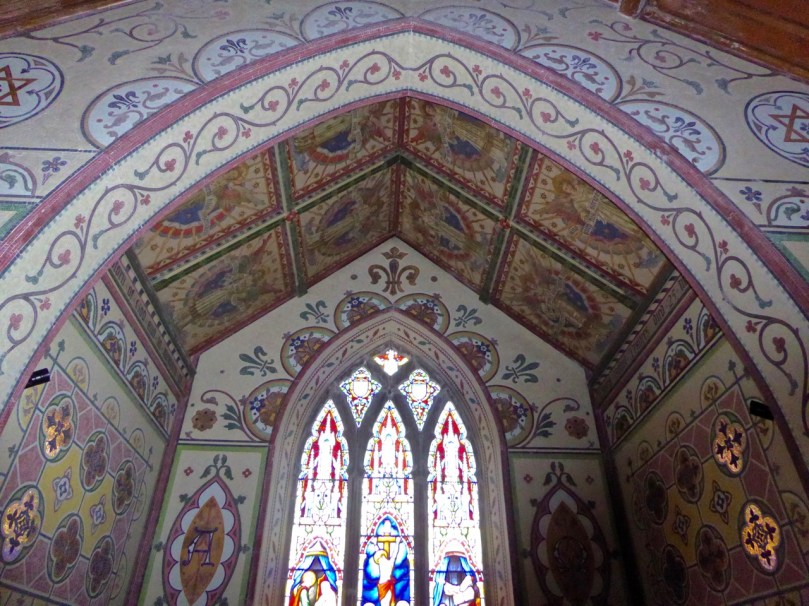
In the chancel, above the marble altar, the ceiling is covered in mosaic, as are the walls, some of which have been gold-leafed. The richness of the detail and the vision that dictated such a glorious conjunction of imagery and colour is jaw-dropping, and mark this little provincial church as part of the influential Oxford Movement of the Victorian era that aimed to return ornamentation and beauty to spaces of worship.

This is the great High Church and Low Church debate. A group called the Cambridge Camden Society promoted a return to gothic architecture: the classical style was seen as pagan, while the great gothic cathedrals of Europe represented the apex of Christian architecture. (More about this in the next post, which will concentrate on the stained glass.)

Installing mosaic is a time-consuming and expensive process – this one involved importing artisans from Italy and the parishioners eventually received help from an unexpected quarter. The final series of installations was paid for by an Indian Maharaja!

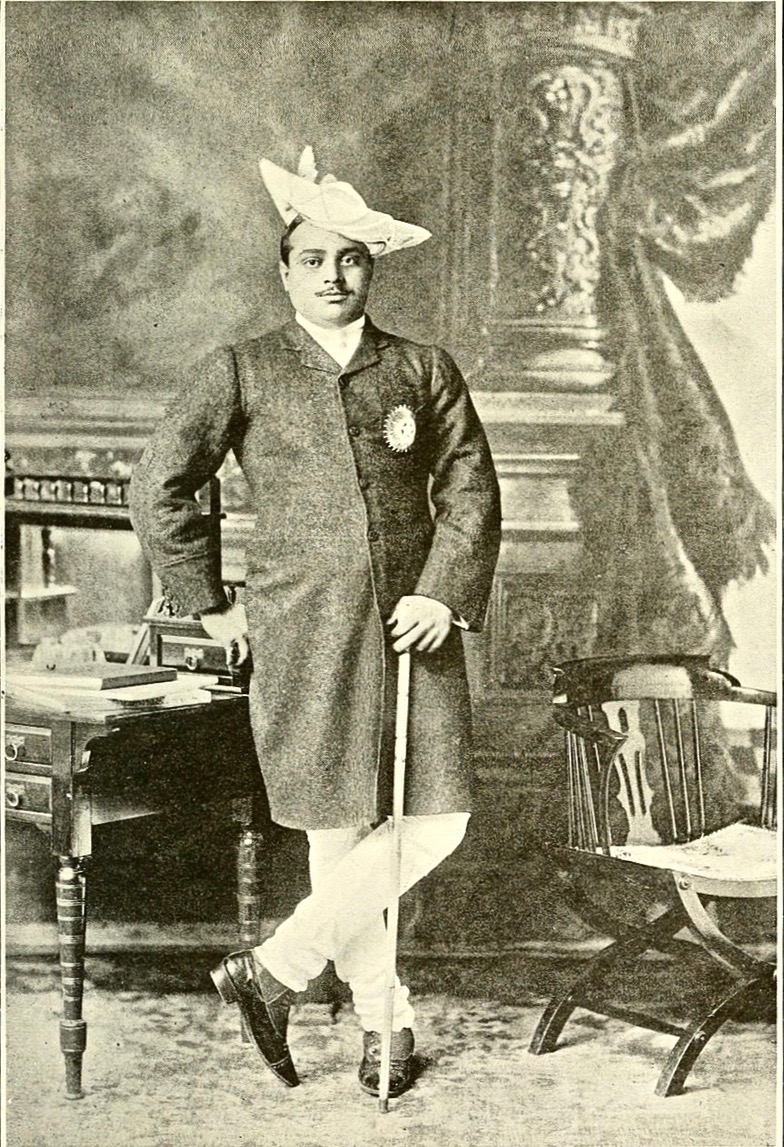
Madhav Rao Scindia was the Maharaja of Gwalior. He was wealthy and looking for places to  spend his money. What, you don’t believe that? Just read this story about the fabulous and secret treasure chambers of Gwalior. No – in fact, he was highly-educated ruler who did much to modernise his state but he was only 9 years old when he inherited the title.

The Maharaja in his prime

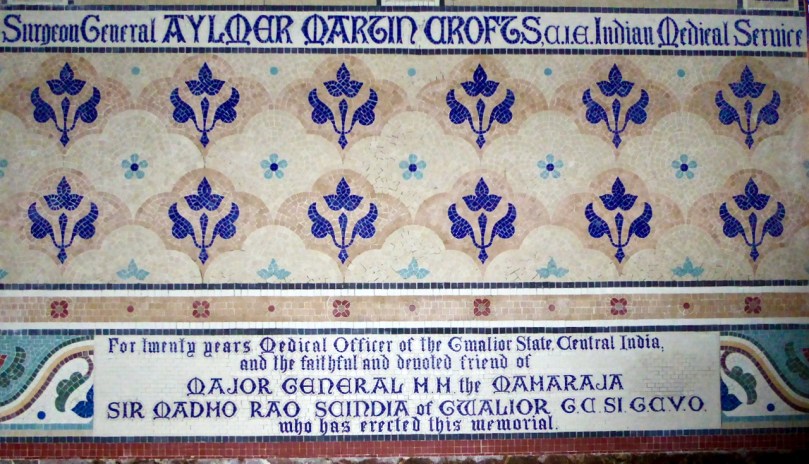
The British appointed as his surgeon and tutor an Irish doctor from Timoleague – Dr Martin Crofts. A long friendship grew, based on mutual respect (and shared tiger-hunting expeditions) and it is said that Crofts saved the life of the Maharaja’s son. 

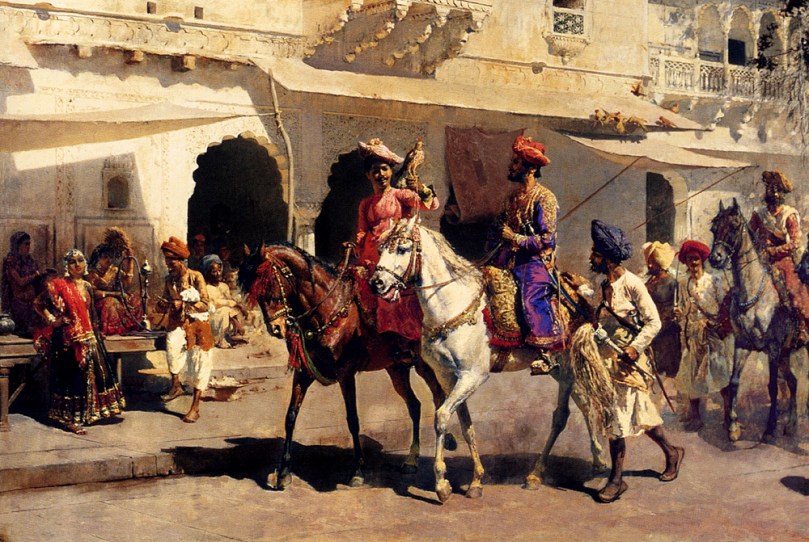
Leaving for the Hunt at Gwalior by Edwin Lord Weeks

When Crofts died suddenly in 1915, after only a year of retirement, and was buried in Timoleague the Maharaja funded the completion of the mosaics as a memorial to his friend and mentor.

Thus, a tiny and obscure church in Timoleague invokes not only a great architectural movement but, like the memorials last week, echoes of the Empire and an unlikely international friendship. But this is not the last of the story – next week we will explore the other glory of this little church, the stained glass windows. In their own way they also link Timoleague to the great artistic trends of their age.

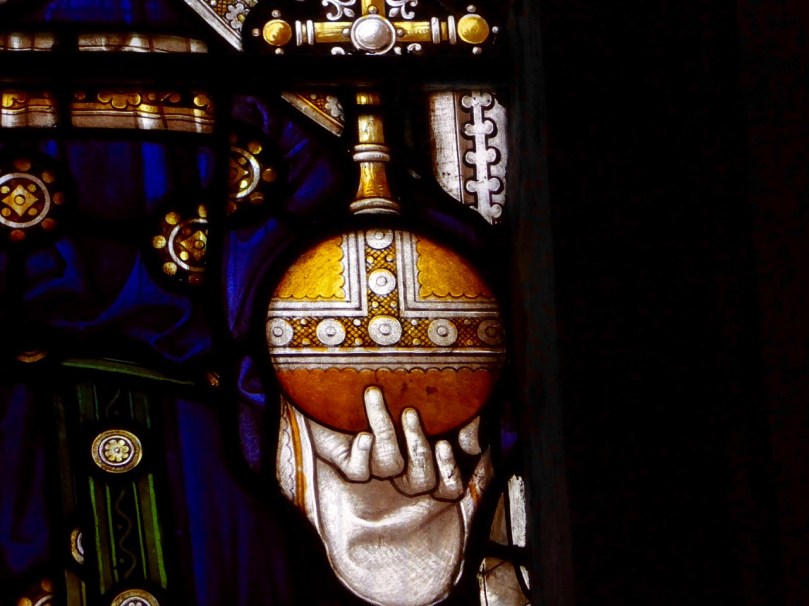
A detail from one of the windows

Part 2 can be seen here.

Illustrating the Tower House: A Guest Blog (sort of)

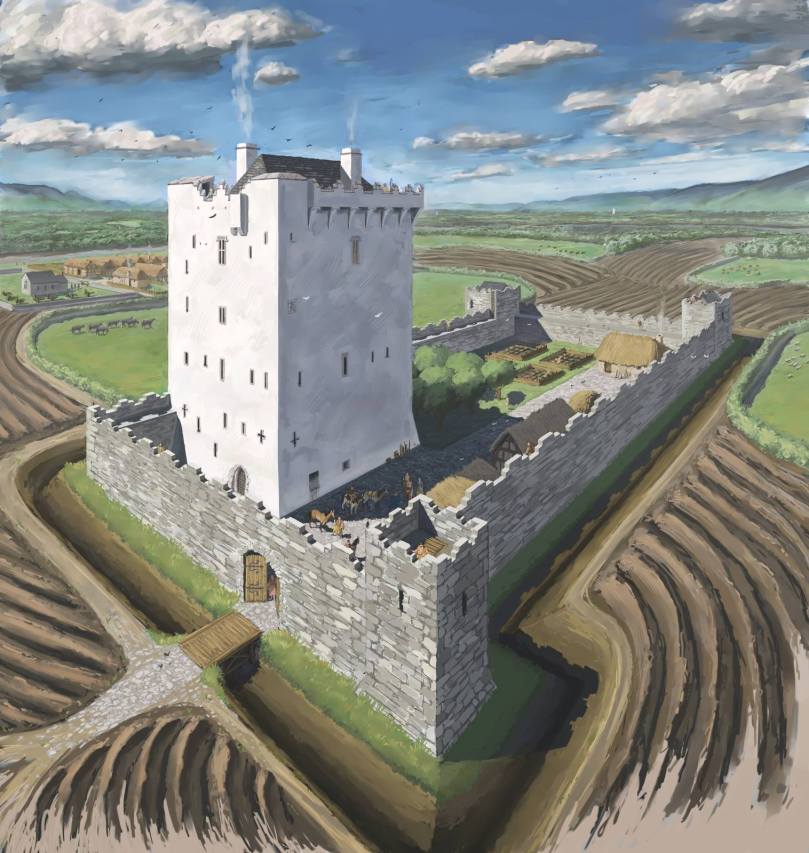
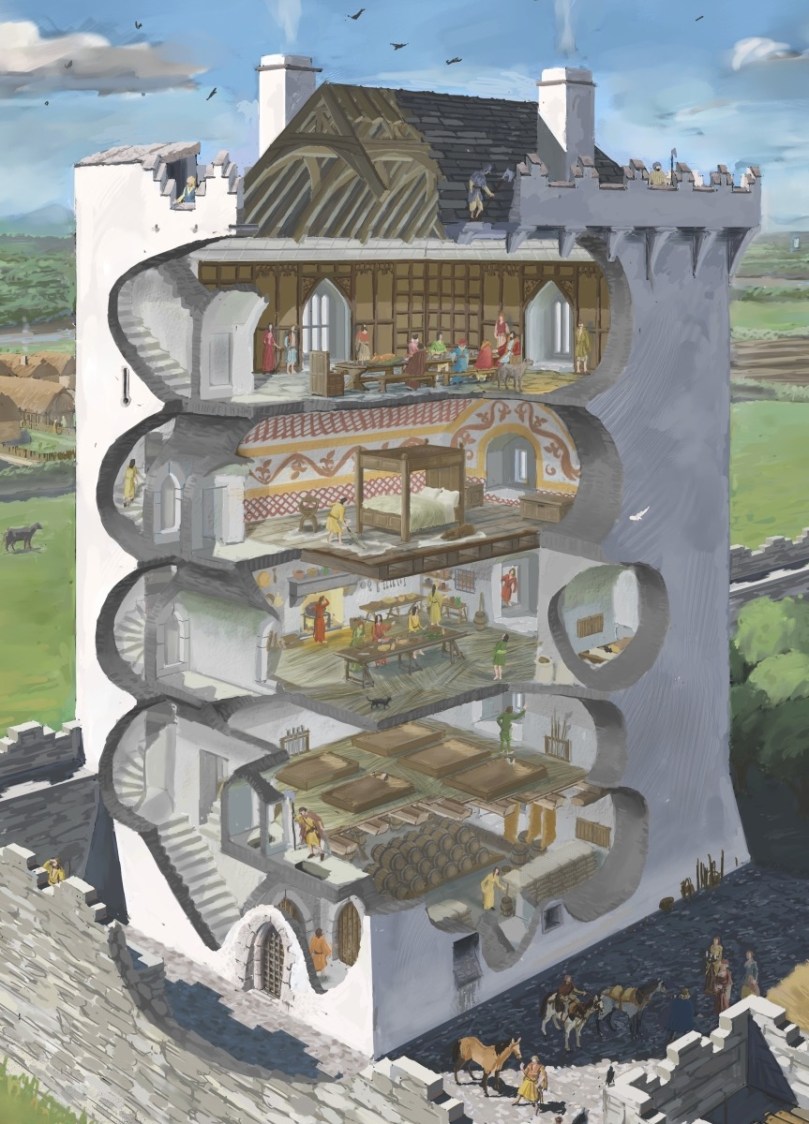
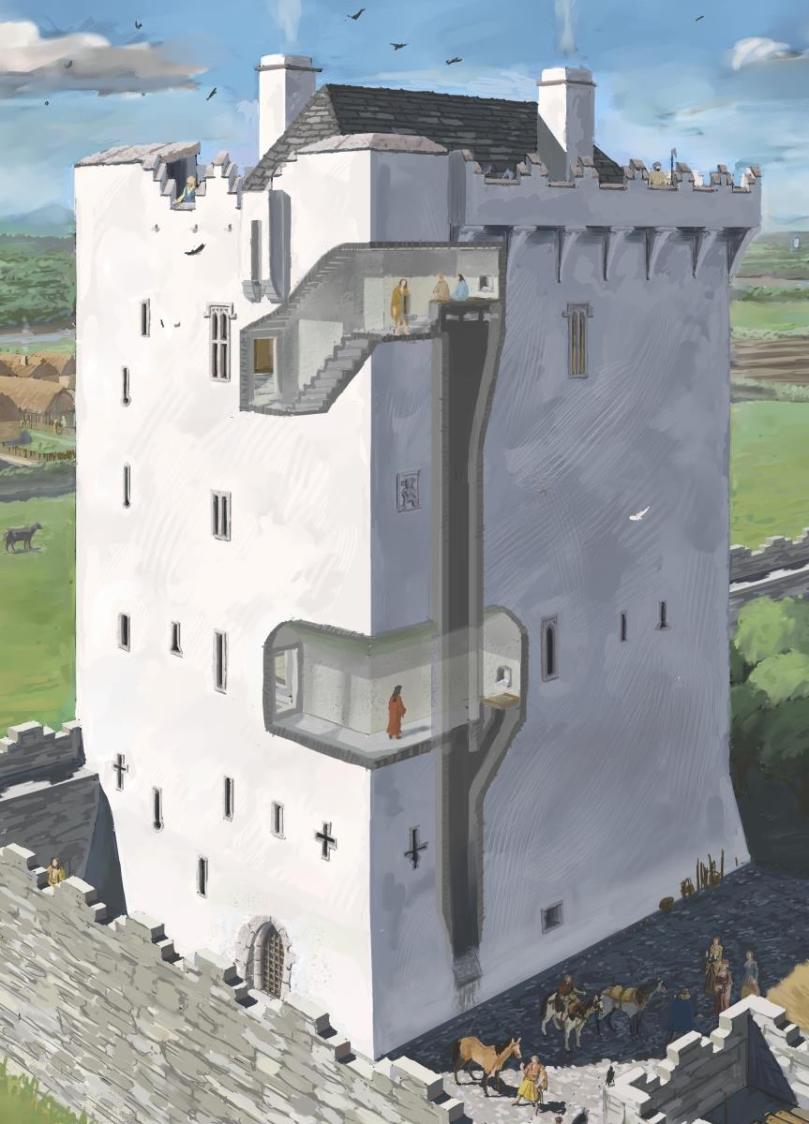
Tower House Full View

There’s this brilliant young man, JG O’Donoghue, who combines the best qualities of researcher and sketch artist to produce outstanding illustrations, especially of heritage subjects. I’ve been a fan of his on Facebook for a while, but recently I saw the full extent of his talent.

Path to a Castle

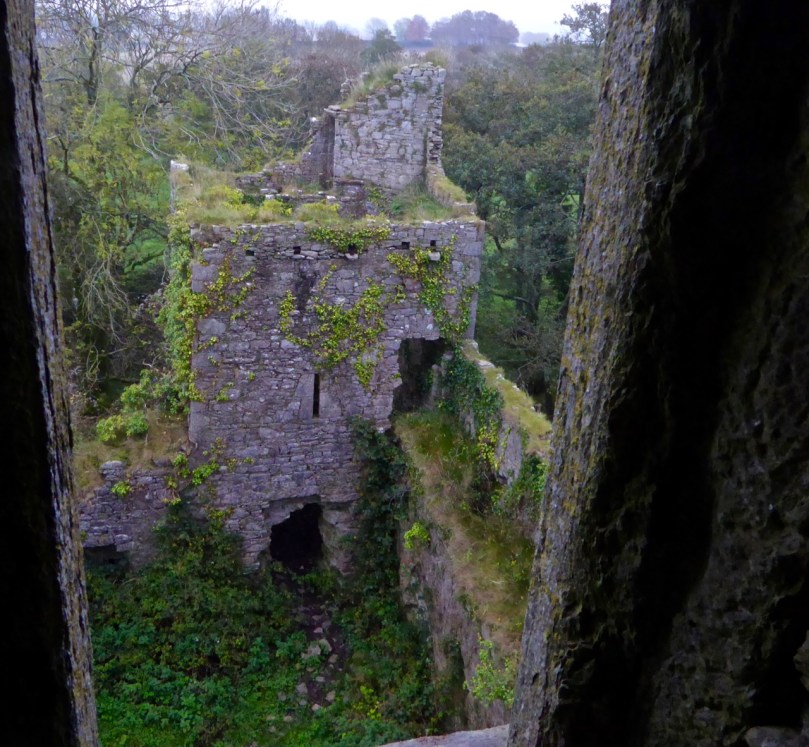
Kilcrea Castle, Co Cork

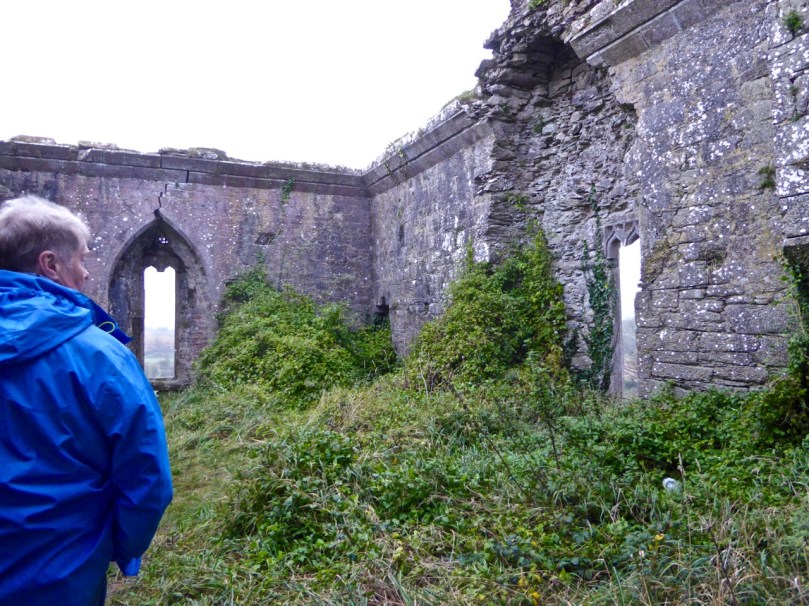
You see, he’s done this job on tower houses. I’ve been studying tower houses for a while, especially the tower houses of West Cork (see my posts here and here and here) and recently I gave a talk about them in Ballydehob. So I recognise accuracy when I see it, as well as a meticulous attempt to be true to both published accounts and his own close observations. He has generously allowed me to use his drawings in this blog post, as well as his own words, slightly edited to fit the length of a blog post. So this is not my post, really – it’s his, as you’ll see if you head on over to his own blog, or follow him on Facebook. Since much (but not all) of what follows is based on Kilcrea Castle, Near Ovens in County Cork, I have included some of my own photographs of that site, to give you a sense of what it looks like on the ground.

Above the main entry

JG Writes:

The Tower House

Tower houses are a type of late medieval Irish castle, believed to have originated around 1300, or sometime within the 14th century, but most are probably from the 15th to the 17th centuries. By the 17th century, this would have made Ireland the most heavily castellated part of the British Isles. The tower house signifies changes in Ireland: on one hand it shows a resurgence in Gaelic power in the west after years of decline following the coming of the Normans in the 12th century. On the flip side it is a sign of the collapse of centralised power in the form of the English monarchy and a rise in decentralisation.
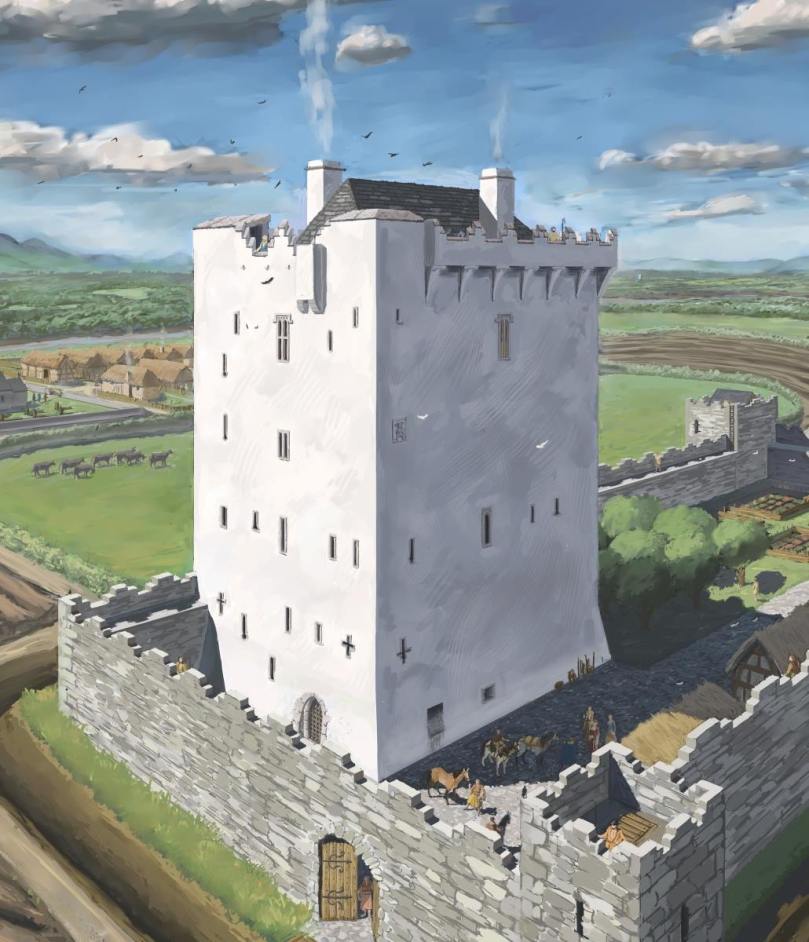
Tower House Closer View

One tower house in five has a bawn wall in Ireland. The bawn is the external wall you see attached to the castle shown here. The actual design of the tower house itself though is nearly entirely based on Kilcrea tower house, in Cork, my favourite tower house and one which I have visited a few times and read extensively on. The only changes to the overall design of Kilcrea was the inclusion of a second chimney for the kitchen room inside, and the machicolation. I added these elements so the castle would be more representative of tower houses as a whole. Also the crenellation (the regular gaps in the walls at the roof & bawn, which provided cover for archers) in the castle are a style specific to late medieval Ireland. The bawn crenellations are based off Blarney Castle.
Bawn Corner Tower

The bawn walls and corner tower

Notice as well how white the tower house is? This is probably how most tower houses would have looked, as they were coated with a substance called harling, a mixture of limewash and crushed pebbles. Because of this, commentators at the time often mention the white gleaming castles of the Irish, as you can imagine these would have been visible for miles around and been quite a symbol of power and prestige. You may also see the little figure on the dark side wall of the tower house: this is a sheela-na-gig, a type of sculpture common in Ireland at the time, this one is based off the one in Ballynacarriga Castle.

Ballynacarriga Sheelanagig

This is the sheela-na-gig from Ballynacarriga

Tower houses are believed to have been surrounded by mixed farming, some cereal with animal husbandry too as shown in the illustration. Often they are found associated with churches and friaries, some were even built attached to churches, and some probably weren’t too far from some sort of clustered settlement. Note as well the dry moat. Not all tower houses had moats, but some did, like Kilcrea, so I included it here.
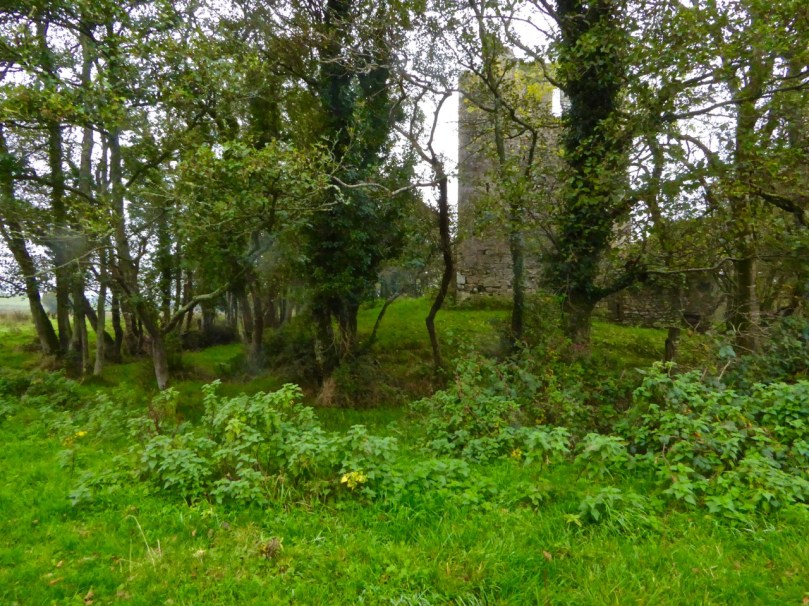
Moat at Kilcrea

Notice also the slight batter (where the wall comes outwards at the bottom to defend against a battering ram), also in the bawn towers, which is based on Kilcrea & Barryscourt.  As you can see though, the real bling in the tower house is the top of it, this is where most showing off happened with turrets, crenellations, chimneys, gabled/pitched roofs and machicolations, as shown here. Another place they showed off was the ashlar (fine finished masonry) windows. The top floor in Kilcrea was believed to be the hall, with the floor directly below the lord’s chambers. Hence they have the nicest windows, especially the hall floor, which had 4 large windows as shown.

Great Hall Window

One of the windows on the top floor

Also notice the variety of windows: some were narrow slits just for archers to fire from inside, others have the addition of a cross slit, which could be used by crossbows too and then there were others with either triangular or circular holes, these were for later fire arms. Some windows even had all three as shown here in the 1st floor window in the dark side of the tower house, the one closest to the light. All these windows, except for the decorative ones on the top floors, would have been splayed inwards allowing maximum cover for archers.

Inside the Tower House 
TowerInterio65-Internal

Ground Floor – here is a cellar, as in Stanihurst’s “house and castle” account of Mallow castle, 1584, “lower rooms whereof ar sellors vaulted over”. Here various food and drink would have been kept, perhaps not just for the castle itself but for the wider community, acting as a safe house for everyone’s goods in case of raids. The floor surface here is very basic and is just beaten earth.

Lower floors

1st Floor – I have made into a sleeping quarters. There is mention in the historical recorded accounts of tower houses that they were used for sleeping and that there were beds without curtains, and you could sometimes fit three people into them. So here I have shown some rudimentary beds, not just for guests, but also for the guards and servants. The 2nd & 1st floors are also covered with reeds, this would have often been what medieval floors were covered with according to medieval accounts, which then on occasion would have been swept out and replaced. This room also doubles up as a guardsroom, as this floor was probably the last line of defence before the attackers get into the rest of the castle, so I’d imagine weapons would have been kept here for ease of access.
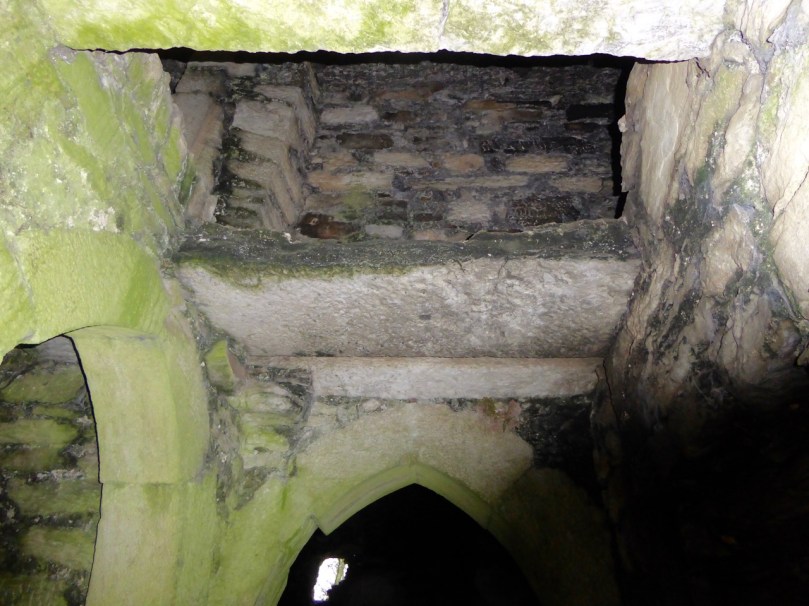
Kilcrea murder hole

Entrance lobby with murder hole above it

Murder Hole Room & Lobby – you will notice small rooms off both ground and 1st floors. In the ground floor this was the lobby, where for defence purposes, once you were past the main front door, you were greeted by two other strong doors, one to the rest of the tower house, another to the ground floor. Above this was the murder hole room, essentially a room with a hole in it, the reason for the dramatic name is that while you were trapped in the lobby between the two strong doors, you would be fired upon from above by muskets (apparently unlike what movies would have us believe, hot oil was rarely used). But in the day to day, these were probably used as a kind of door eye hole.
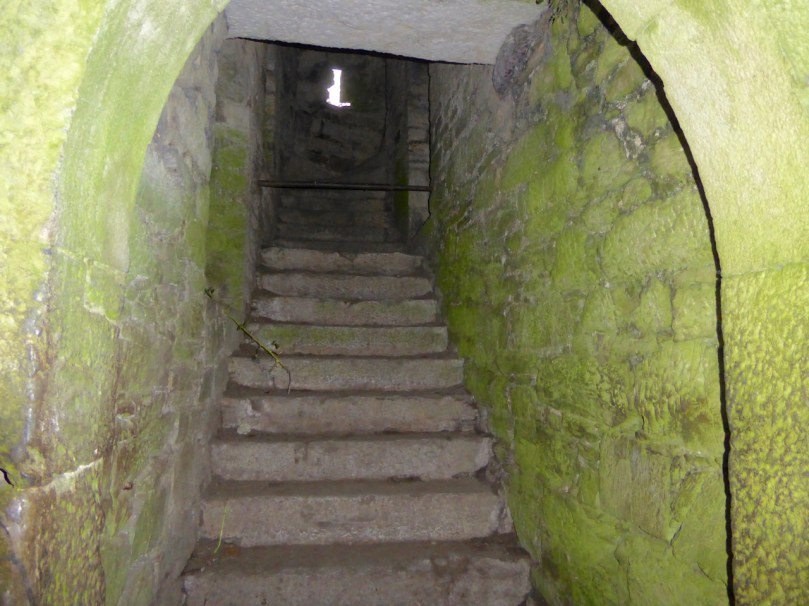
Mural stairs from Ground Floor

The mural stairs leading up from the main entrance. The bar across is said to be there to prevent a re-occurence of the time a cow wandered up to the second floor

Stairs – in a tower house usually started as a mural stairs to the left of the lobby entrance, these were then carried on by spiral staircases from the first floor up to the 4th floor, which then had another set of straight stairs leading to a small spiral stairs to the wall walk area. This was probably defensive in nature, so it was harder for the attackers to take the spiral stairs and wall walk. This last set of stairs was usually hidden within one of the window embrasures at the top floor, this was a common feature in southern Ireland.
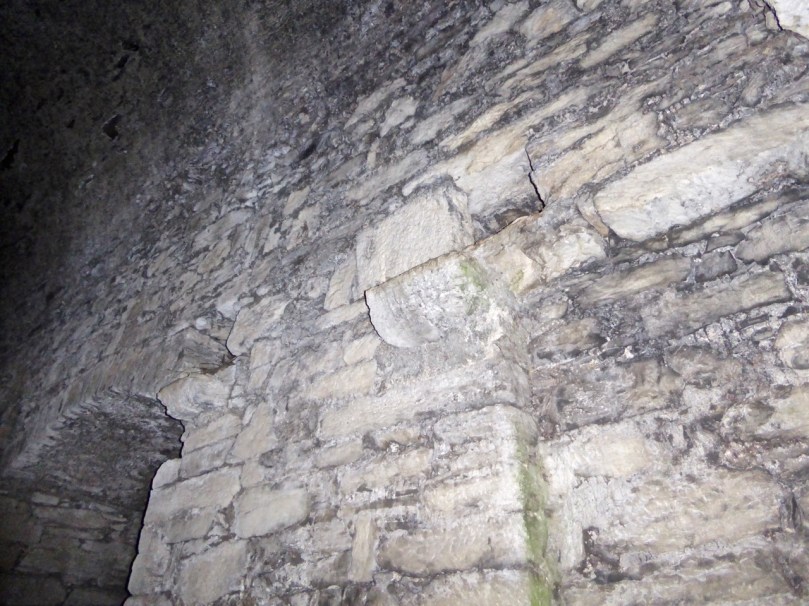
First floor window and corbels to support second floor

The ground floor with window embrasure to the left. Above it you can see the corbels which would have supported the first floor

2nd Floor – shows a kitchen with some sleeping quarters off in the mural chambers around the main room, these were L shaped rooms and could be accessed via the window embrasures of the main room. You can see one person leaning out of one such a door, having a word, while another person is sleeping inside another L shaped room.

Access to Mural Chamber, 2nd floor

Entrance to one of the mural chambers

Kilcrea’s main room was probably more sleeping quarters, but in some other tower houses which had fireplaces at this level there is speculation that these were the kitchens. Most kitchens would probably have been external though.

Upper floors

3rd Floor – Here I created the lord’s room: situated between two floors with fireplaces, this would have been quite a warm room. It shows a typical late medieval bed, chests used for storage and a Savonarola chair, or X chair, in front of the bed, these were quite common throughout Europe at the time, made in Italy. The third floor has its floor boards shown rather than covered, with the occasional fur. Also note the paintings on the wall. There is mention in some written sources that the Irish decorated their walls with branches: I found a piece of metalwork from late medieval Ireland with this very design, the Clogán Óir Bronze Bell shrine of St. Senan, which was early medieval with later alterations in the late middle ages. One side had a pair of dragons with floriated tails and above, branch and leaf ornament along the top, so I used that here, while the knot-work is based off other metalwork at the time.

4th Floor – This was the dining room. In the earlier periods there was always a large external hall to the tower house, made of non stone material, but as time moved on more and more of the the hall activities were taking place within the tower house. This dining room floor in Kilcrea had lovely large windows, not all of them surviving, some with double lights with ogee heads, as shown. I added a transomed triple ogee headed light as shown in the window on the left, which is typical of a late medieval tower house. These windows must have created quite a bright room. Rooms of this stature were probably decorated with ornate wood panelling as shown. No such panelling survives in Ireland, so these are inspired by ones in Britain. Generally tables at the time were long with benches and only really the lord would have had a separate chair. People ate with their hands, there were no forks yet in Europe and everyone had a personal knife with which to cut their food.
Kilcrea Great Hall

Roof – the 4th floor in Kilcrea had very thin walls, in comparison to the rest of the tower house, most likely to give it more space and air. The roof wasn’t gabled but hipped, resting on cornices as shown above the wood panelling. The roofs were often covered with tiles but many were probably thatched too. On the wall walk level, in the front, you can see there were holes at the bottom of the parapets. In Kilcrea some of the wall walk flagstones had chutes carved into them to drain away the rain. The other side (the shadow side) shows wall walk machicolations, which were extended floors with holes in the ground: these are based on Blarney Castle with its pointed corbels. Chimneys were also on the wall walk level and were to become display features in their own right, rising to great heights to carry smoke away but also to show everyone around how well the castle was heated (in later periods castellated houses had lots of chimneys as an extra form of bling).
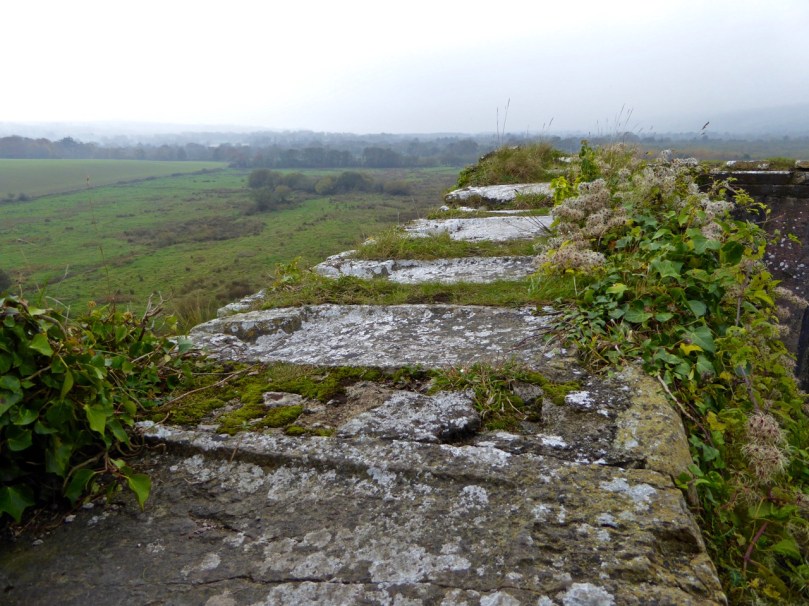
Wall walk

The Wall Walk, with flagstone chutes designed to carry off the rain

Garderobes

Usually tower houses had 2 garderobes, as did Kilcrea, one for public and another for private use. In the case of Kilcrea both were probably public, but the upper one accessed from the dining hall had 3 holes in it, so probably had wooden seats with three holes for 3 people to use at the same time.
Tower House Garderobes

This upper garderobe chamber also had a window with a slop stone, which were small drainage basins underneath windows, which were essentially urinals (often found on stairs). The garderobe on the 2nd floor, is one of the 3 L shaped chambers off the main room. Garderobes were normally at the ends of passages in both Anglo-Norman castles and tower houses, to give more distance between the rest of the house and the toilets.
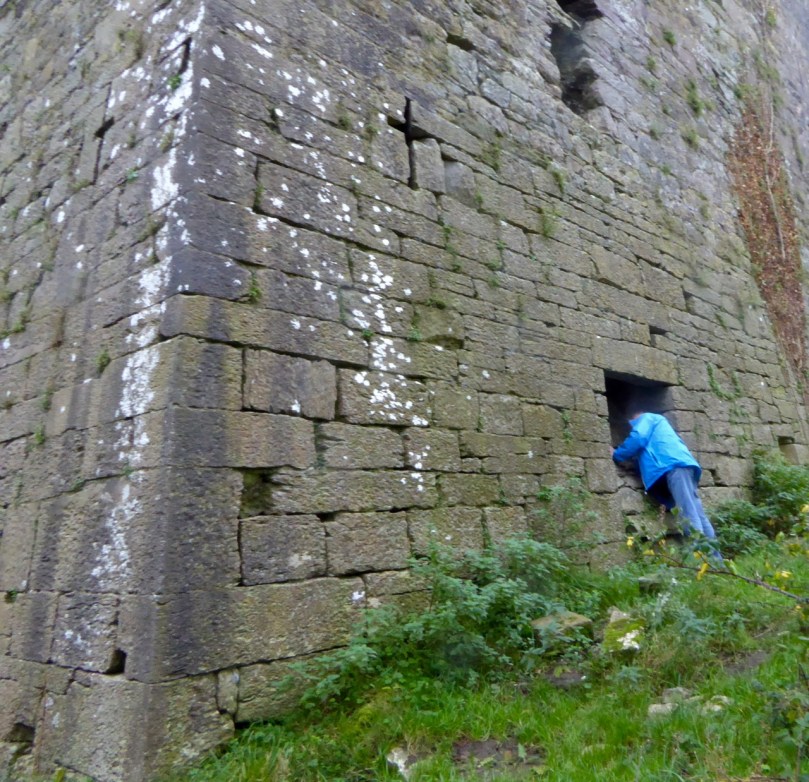
Inspector of Drains

Inspector of Drains

Thank you, JG – for your talent in representing medieval life and for your generosity in allowing me to feature your incredible drawings! Go raibh míle maith agat!

Showing the Way

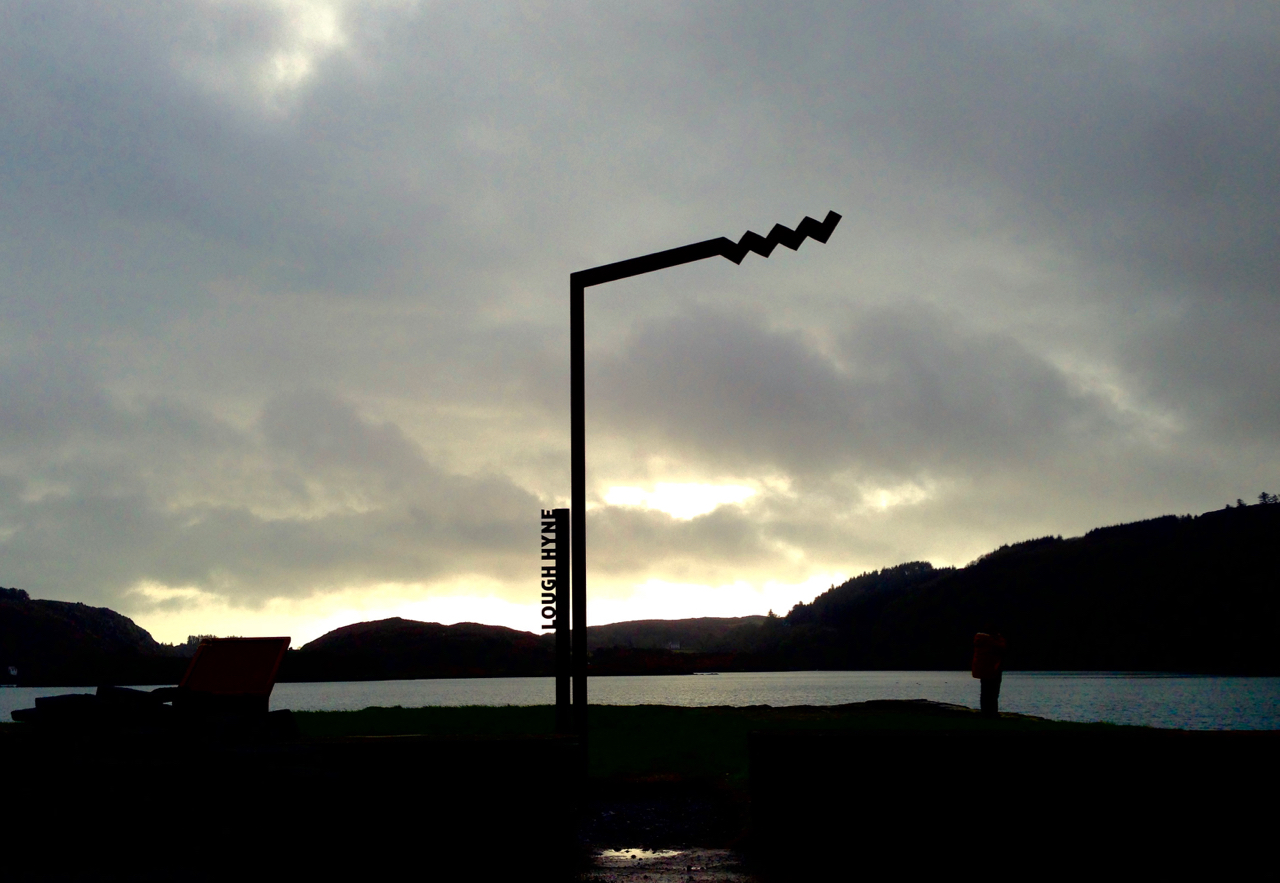
Loiugh Hyne signage

I’ve always been impressed with Ireland’s boldness when it comes to modern design – whether it be buildings, townscape or – today’s subject – signage. That’s probably because my working life was spent designing architecture mainly in England where the brief, too often, seemed to be to produce something that would look as if it had been around for a hundred years… I could never bring myself to turn out pastiche and, consequently, suffered many frustrations with clients and planning committees.

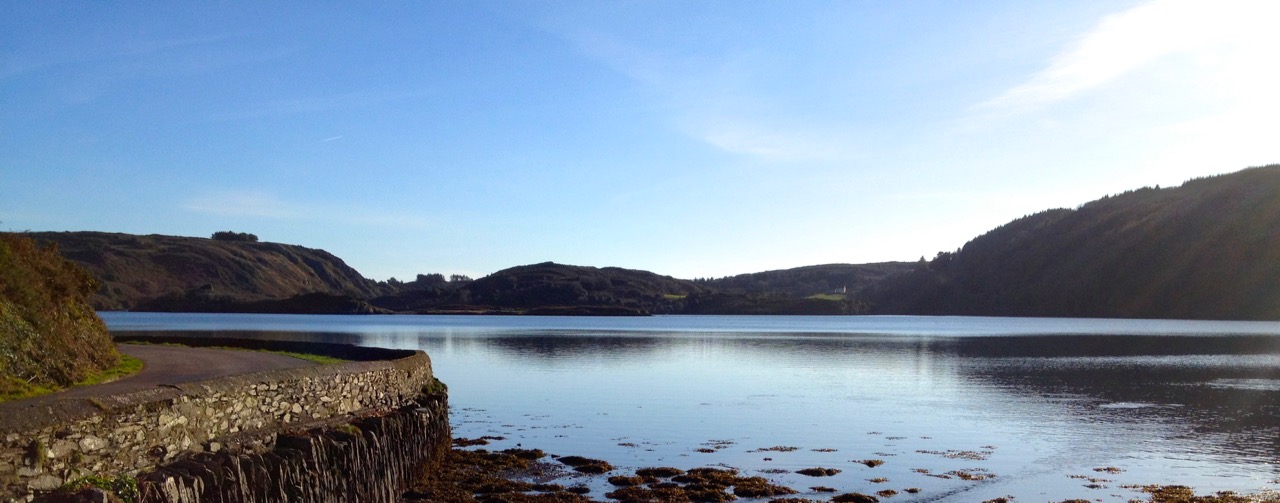
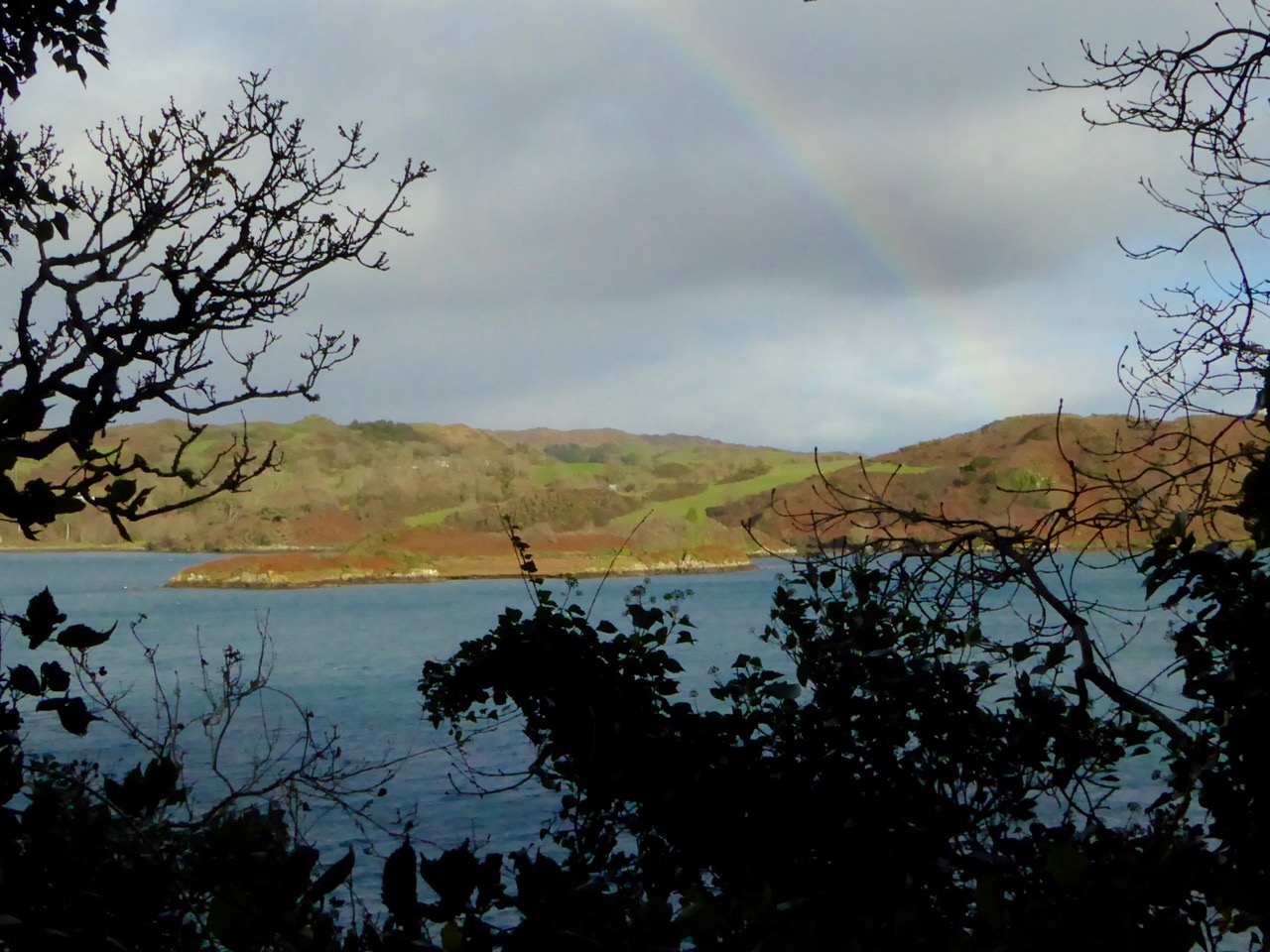
We have just been to see one of the new signs marking ‘Signature Points’ on the Wild Atlantic Way: it’s at Lough Hyne, a marine nature reserve just outside Skibbereen which we have mentioned many times before in our posts. The Lough was a freshwater lake until rising sea levels flooded it with salt water – probably during the time when the Bronze Age inhabitants were carving their rock art in the area. The lake is now fed by tidal currents that rush in from the Atlantic through Barloge Creek. It’s one of the places that we take our visitors to: it has a quiet, rugged beauty – and a fair share of holy wells in its vicinity.

Lough Hyne panorama

Island on Lough Hyne

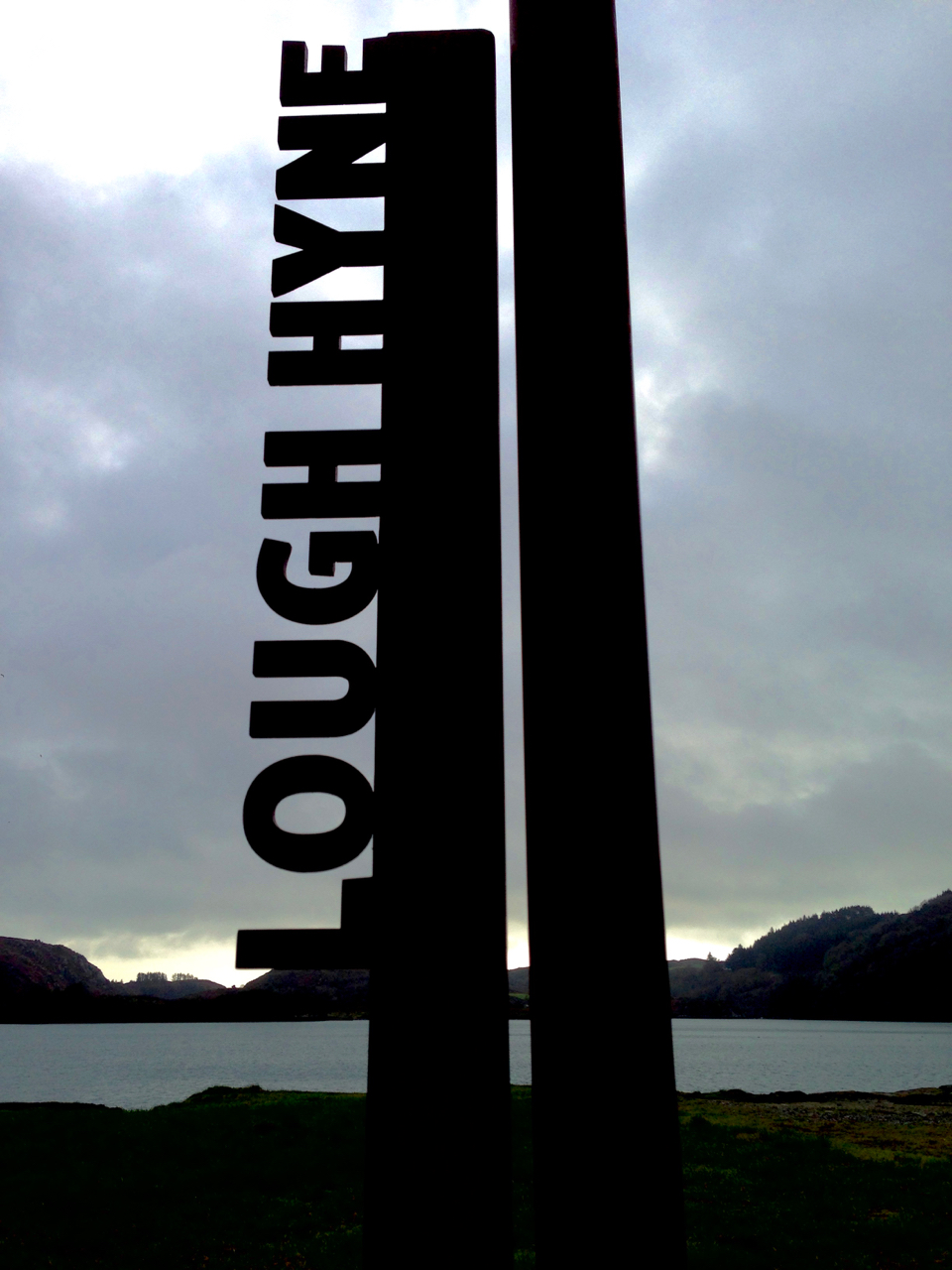
The new sign is everything I would want from a 21st century waymarker: it’s simple but distinctive – completely of its time; well made from a long-lasting modern material – corten steel (mentioned in a previous post). It could still be around for archaeologists of the future to discover a few thousand years from now as the surface will use the natural rusting process to create a permanently stable and very attractive patina. It’s a contemporary monument and – like the landscape around it – rugged.

The design incorporates the Wild Atlantic Way logo – very simply but subtly using a W, an A and a W. I commend Fáilte Ireland and their consultants in this project, Red&Grey Design. It’s worth looking at their website for a detailed description of the identity proposals and the way it all works.
I believe the new signs have received some bad press, with complaints that they are ugly and detract from the natural environments that they advertise. Generally, however they are being placed where there are already car parks, cars, railings, seats, litter bins etc: human activity. I don’t see any problem in adding distinctive and practical pieces of sculpture in such settings – a grand Irish initiative!

Hyne sign