William Burges and Saint Fin Barre’s

You may recall my delight in finding so much animal imagery in the Honan Chapel at UCC. In Cork City again this week we discovered another ‘menagerie’ – this time at the Cathedral of Saint Fin Barre. This Gothic Revival building is an architectural and artistic wonder – quite the most significant work that I have seen to date from the palette of English designer William Burges, who lived from 1827 to 1881. In fact it is an early work of his, resulting from an architectural competition which he won in 1863 (receiving a prize of £100). Unusually for an ambitious building such as a cathedral, it was finished in a relatively short time: the first services were held in 1870 – although completion of some of the detailed carving and decoration continued through to the twentieth century.

Everything in the cathedral was designed by William Burges: stained glass windows (74 of them, incorporating twice as many individual scenes); statuary (1,260 pieces of sculpture); brasswork, floor mosaics and wood carvings. Most striking for me is the complete coherence of the building: the genesis of the design work from a single mind – down to the very last constructed item – is visually obvious and I am, of course, professionally jealous that an architect was allowed to completely indulge himself to this level of detail, apparently without the intervention or censorship of clients, building inspectors or planning authorities! The cost of the building project overran its budget some tenfold…

Whole books could (and have been) written about this building and all its intricacies. In this short post I will concentrate mainly on the iconography, especially animal images, because it’s obvious that Burges shares my own enthusiasms for the natural world. There’s much more of this than I can illustrate here, and considerably more to the whole building that’s well worth seeing. I advise you to allow an afternoon – or a day – when you visit, if you want to really get to grips with everything.

A little about the man himself, although biographical information is scant: he was described during his lifetime as “short and fat” and “so near-sighted that he once mistook a Peacock for a man”. Lady Bute, wife of his greatest patron, wrote, “…Dear Burges, ugly Burges, who designed such lovely things – what a duck…” He was undoubtedly an eccentric, attending site meetings on occasion dressed as a medieval jester. Like many of his contemporaries he smoked opium (the overdoing of which is said to have contributed to his early death) and he was a friend of Oscar Wilde, James Whistler and – according to the architectural historian Joseph Mordaunt Crook – “the whole gamut of pre-Raphaelite London”.

Three views of the eccentric William Burges: portrait by Henry van der Weyde (left), dressed as a medieval jester (centre) and a caricature by Frederick Weekes (right)

Dante Gabriel Rossetti wrote a limerick on Burges’s childish nature:

There’s a babyish party called Burges,
Who from childhood hardly emerges.
If you hadn’t been told,
He’s disgracefully old,
You would offer a bull’s-eye to Burges.

It does appear that Burges was quite active in the world of London’s creatives in his day. Elected to the Institute of British Architects in 1860, in 1862 he was appointed to its Council and in 1863 was elected to the Foreign Architectural Book Society, the FABS, which comprised the RIBA elite and was limited to fifteen members. He became a member of the Atheneum Club in 1874, was a member of the Arts Club, the Medieval Society, the Hogarth Club, and was elected to the Royal Academy just before his death.
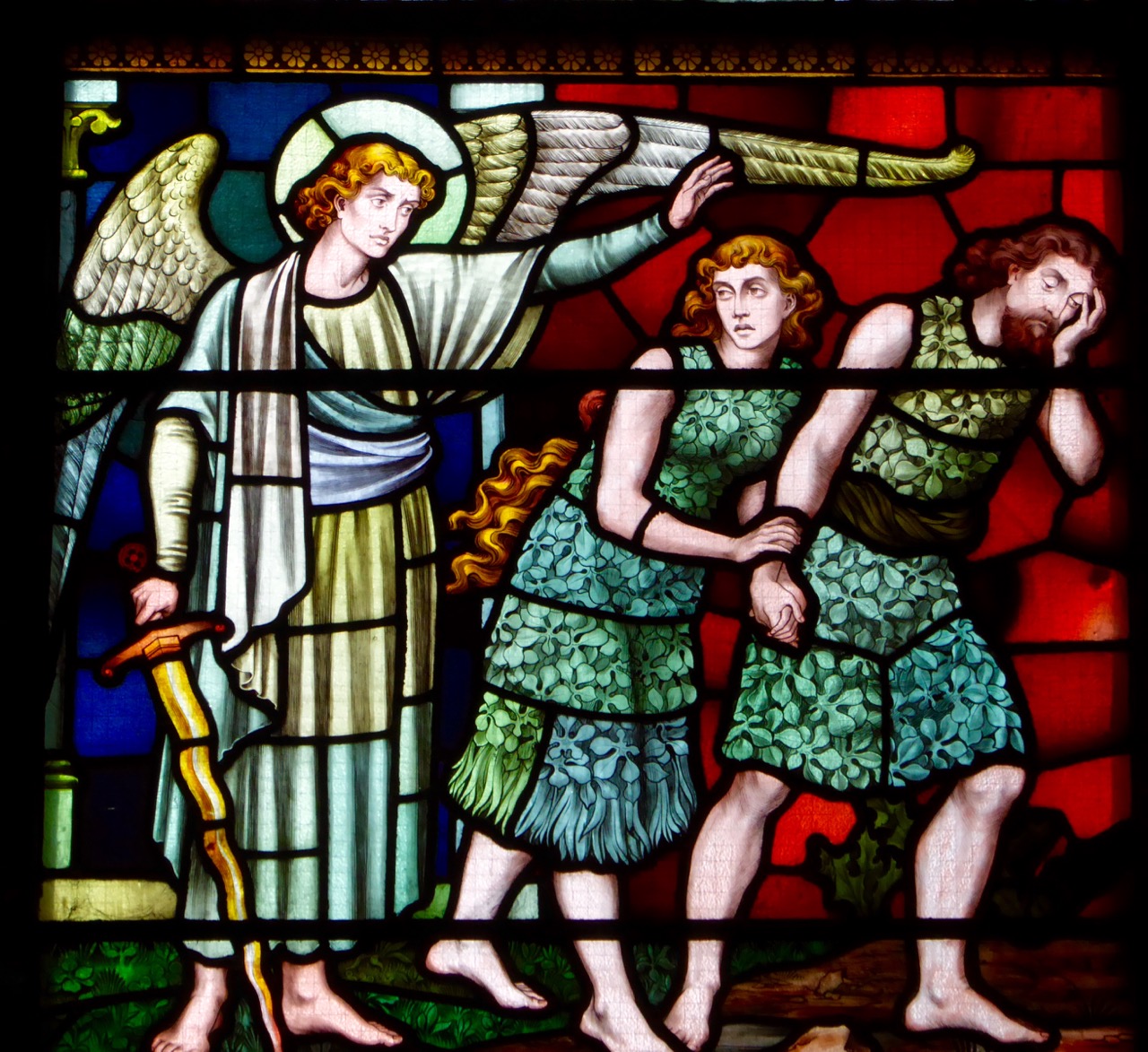
Paradise Lost

Poor William Burges received very little praise for his work, either in his own lifetime and for a long while afterwards. Gothic Revivalist architecture went out of fashion when the new century approached, and was often derided for its heaviness and over-elaboration. For a while Victorian art was under constant assault, critics writing of “the nineteenth century architectural tragedy”, ridiculing “the uncompromising ugliness” of the era’s buildings and attacking the “sadistic hatred of beauty” of its architects. In my own view they all failed to grasp the romance of the age, expressed so beautifully and particularly in the detailing of many of the buildings, among which the Cathedral of Saint Fin Barre stands supreme.

birdie 4


Impressions

Water worlds - in a Dublin park, above and in the wilds of West Cork, below

Water worlds – in a Dublin park, above and in the wilds of West Cork, below

water 2

It’s over two years since I had a round up of the odd, quirky – or perhaps just very Irish – things that catch my eye during our travels. I called that post Juxtapositions. Here’s another collection of images that have fascinated me enough to record them with the camera. As in Juxtapositions, I have tried to show these pictures in context where it counts – or just let them speak for themselves. Sometimes I’ve added a little text, perhaps to amplify why I have been attracted by certain Impressions

lion

lions

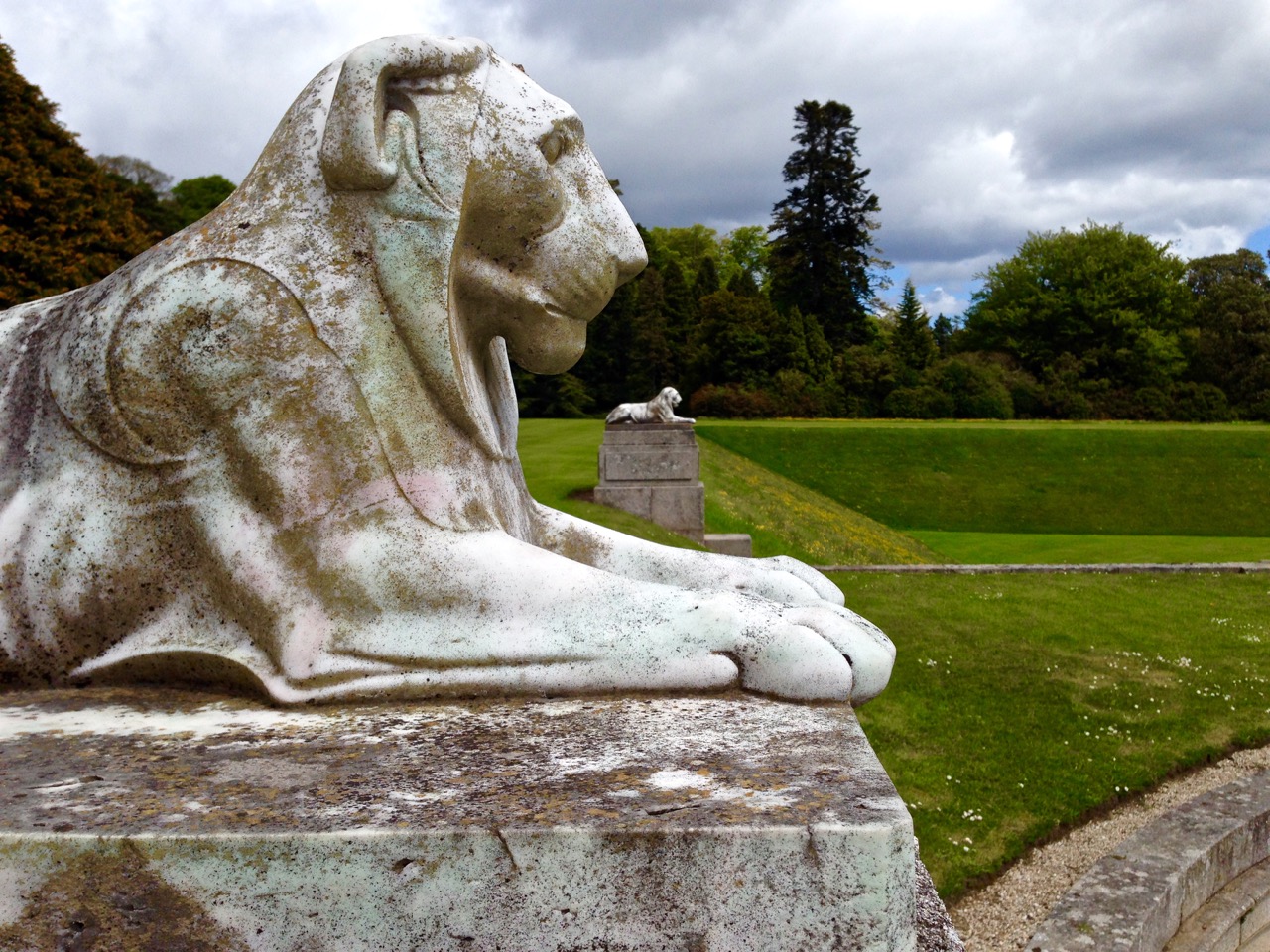
Gentrified Lions at Powerscourt, Co Wicklow, and a domesticated version, above

Some high things…

high

…and some little things…

little mary

pegs

fence

Startling Impressions…

Above left – an ancient stone cross in an urban setting, and – above right – the statue of Cúchulainn – a memorial to the 1916 uprising: an impossible-to-photograph icon in a poignant setting, the General Post Office building, Dublin. On the 24 of April (Easter Monday) 1916, about 2,000 Irish Volunteers and 200 from the Irish Citizen Army occupied the General Post Office as well as other important buildings in the city. They proclaimed the Irish Republic, read the Proclamation and raised the Irish flag for the first time. The British army shelled the GPO and other buildings. After a week’s fighting, the leaders of the rising surrendered: most suffered execution by firing squad. Many civilians died in the cross-fire. The guns and fires had destroyed much of the city and the GPO was in ruins. All this happened in Twentieth Century Great Britain…
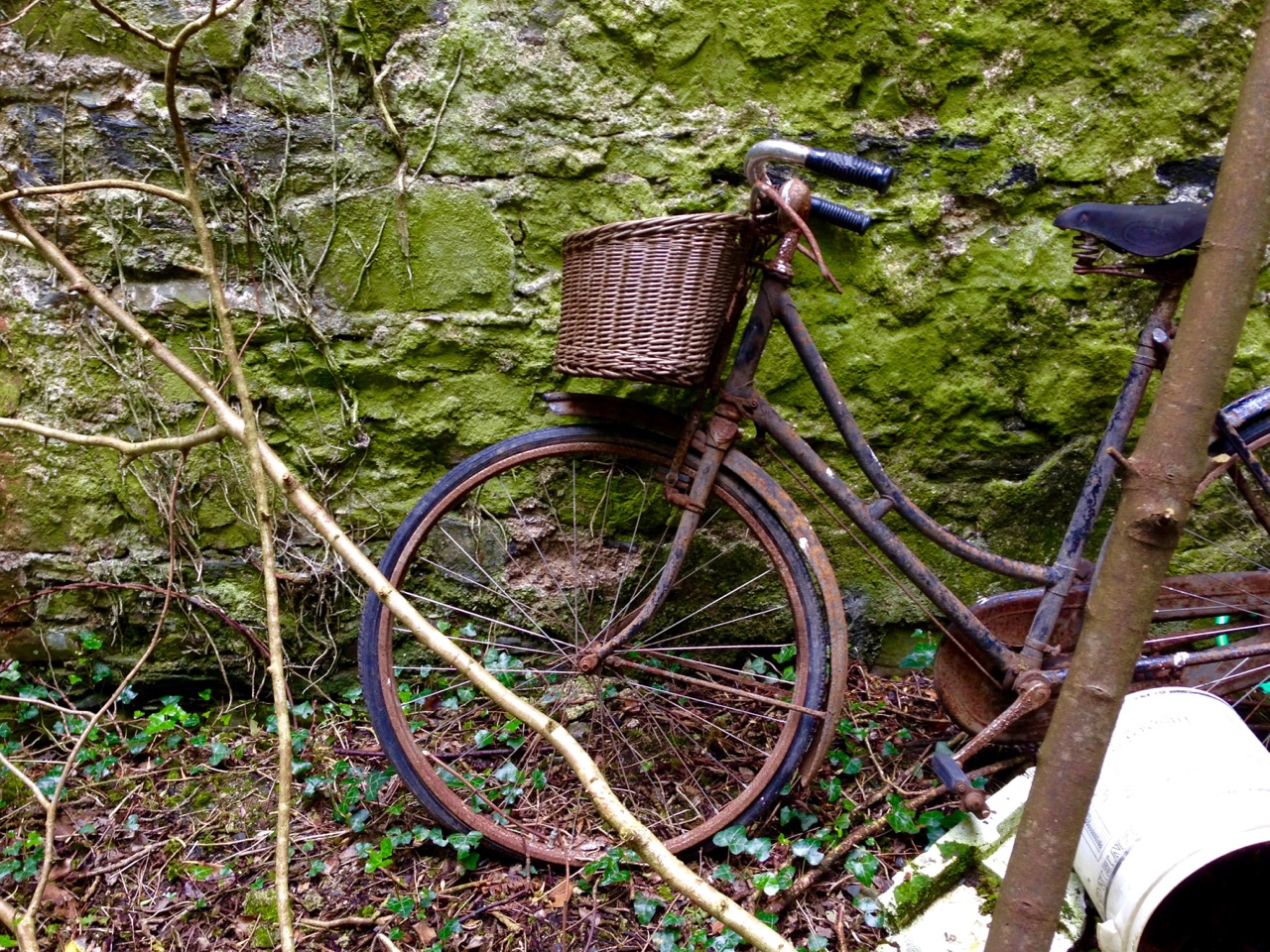
Rust and relics…

bike

corrugated

wavy line

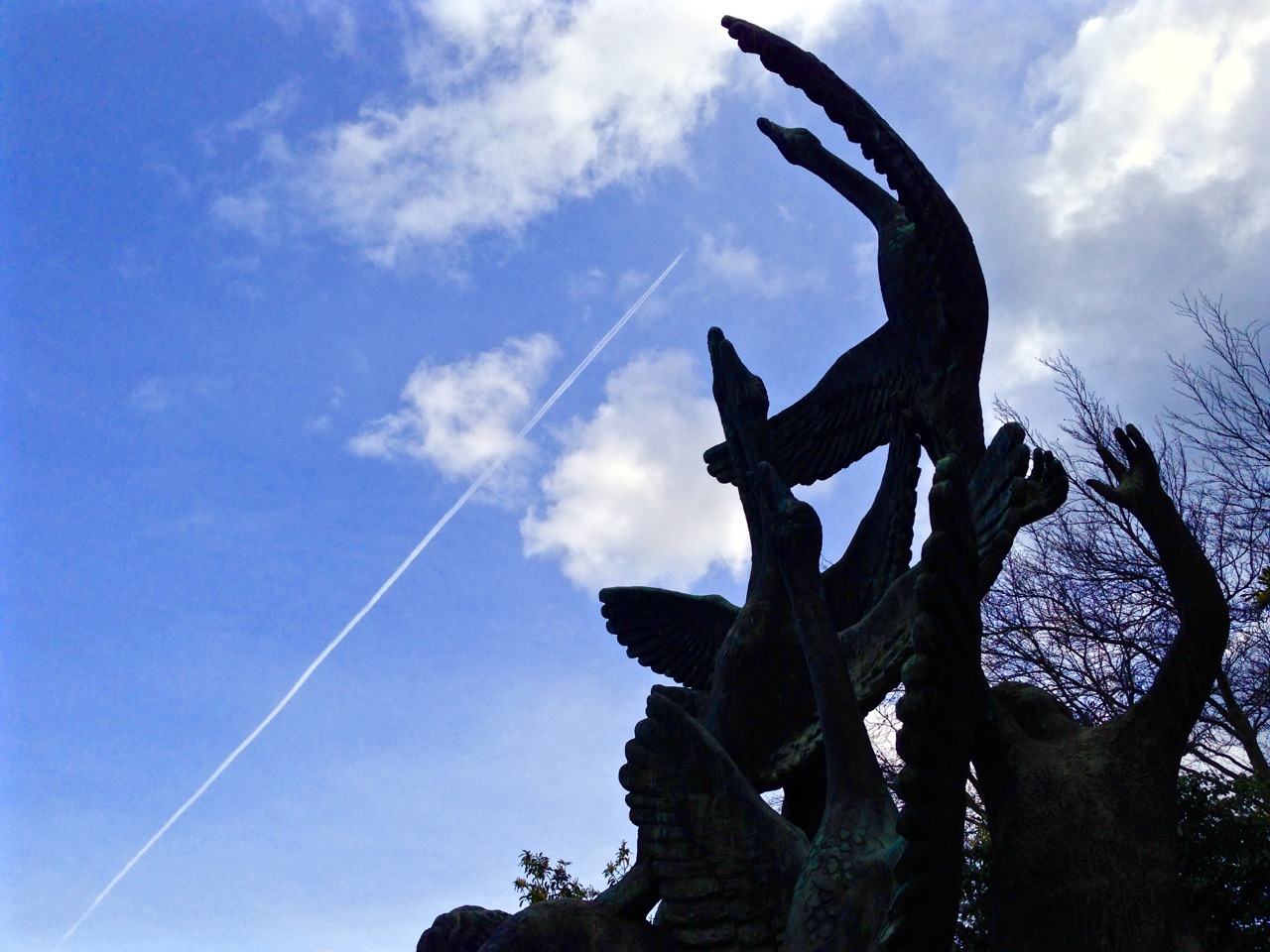
Ancient and modern…

The Children of Lir - sculpture by Oisín Kelly in the Garden of Remembrance, Dubiln

The Children of Lir – sculpture by Oisín Kelly in the Garden of Remembrance, Dubiln

Emerald Isle greens…

Art and ‘Nature Art’…

Seekers…

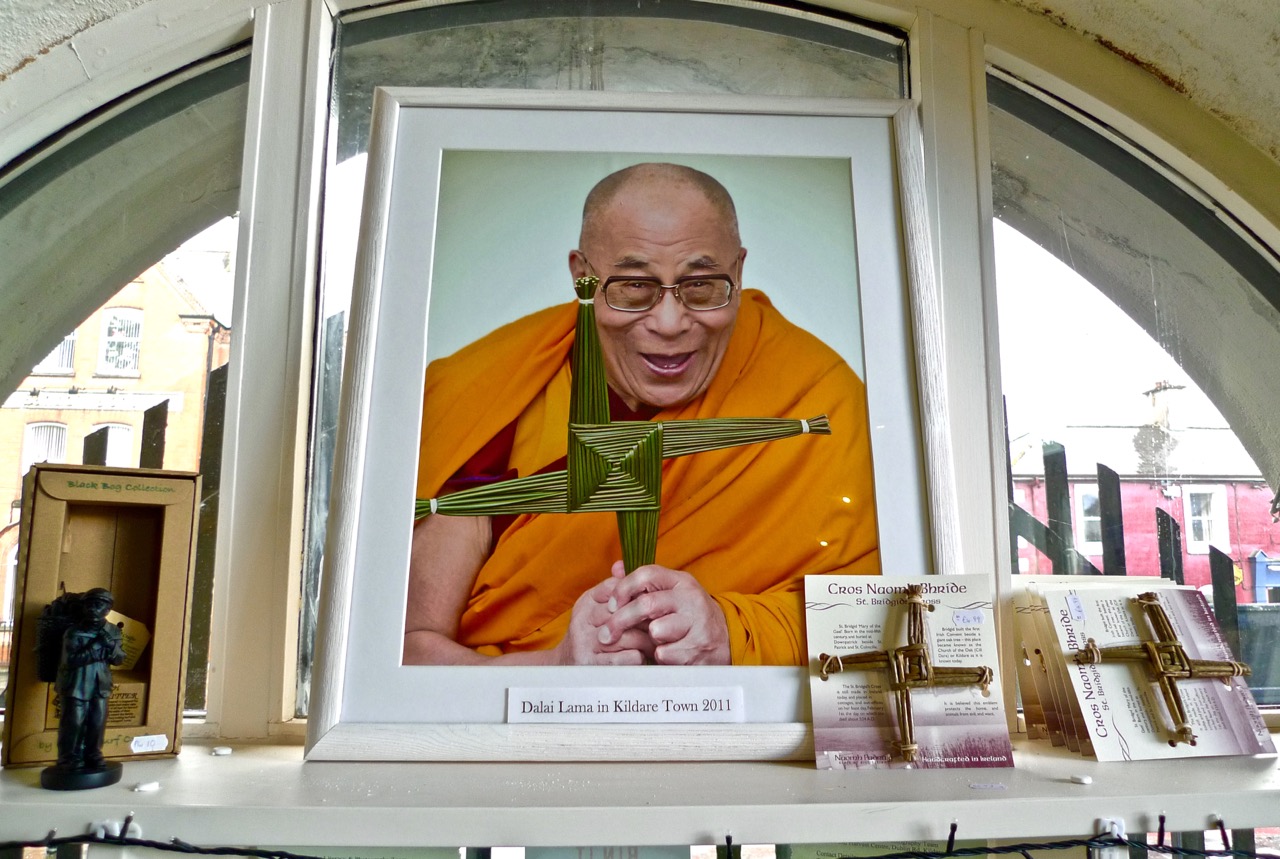
dali lama

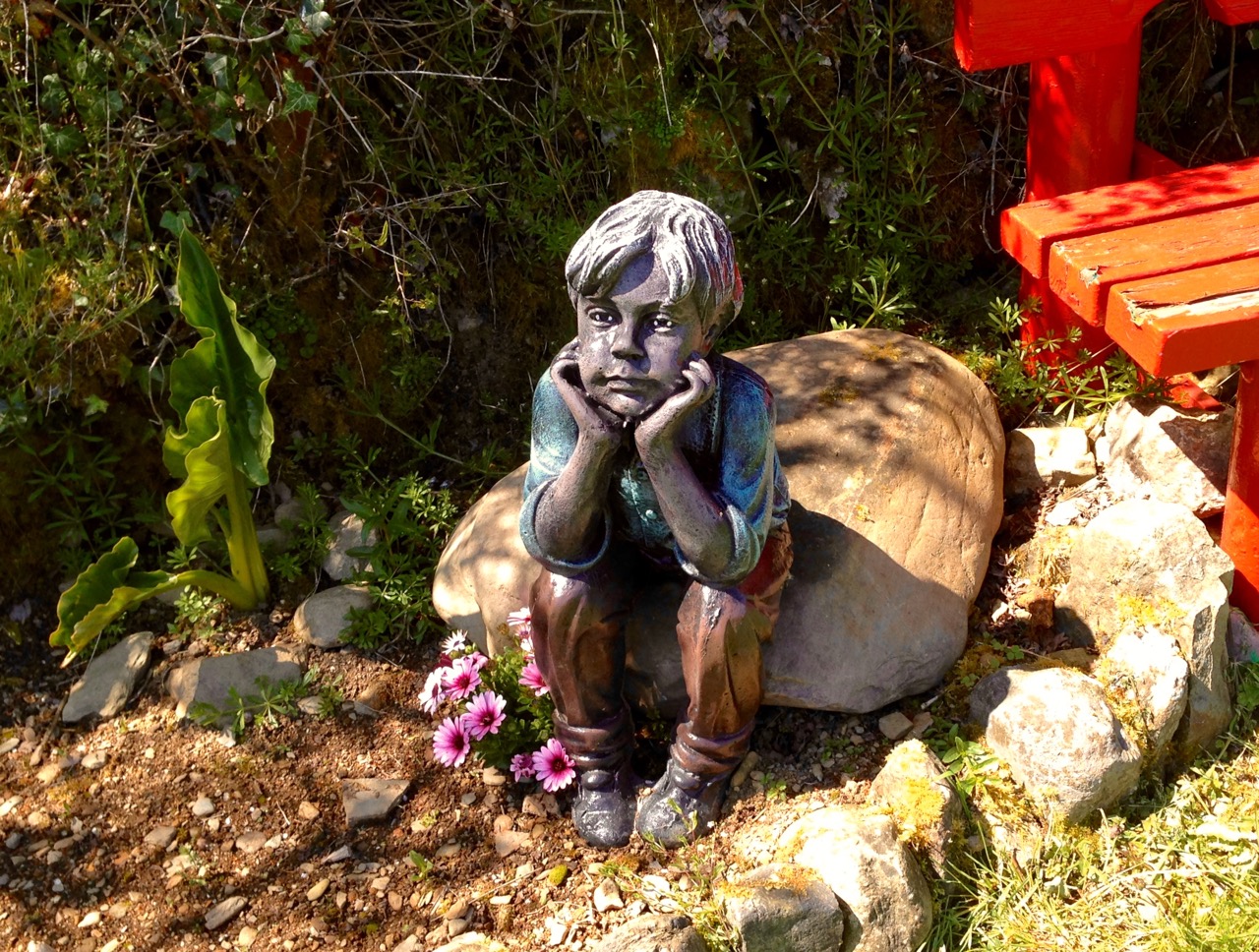
sitting

Lifeline…

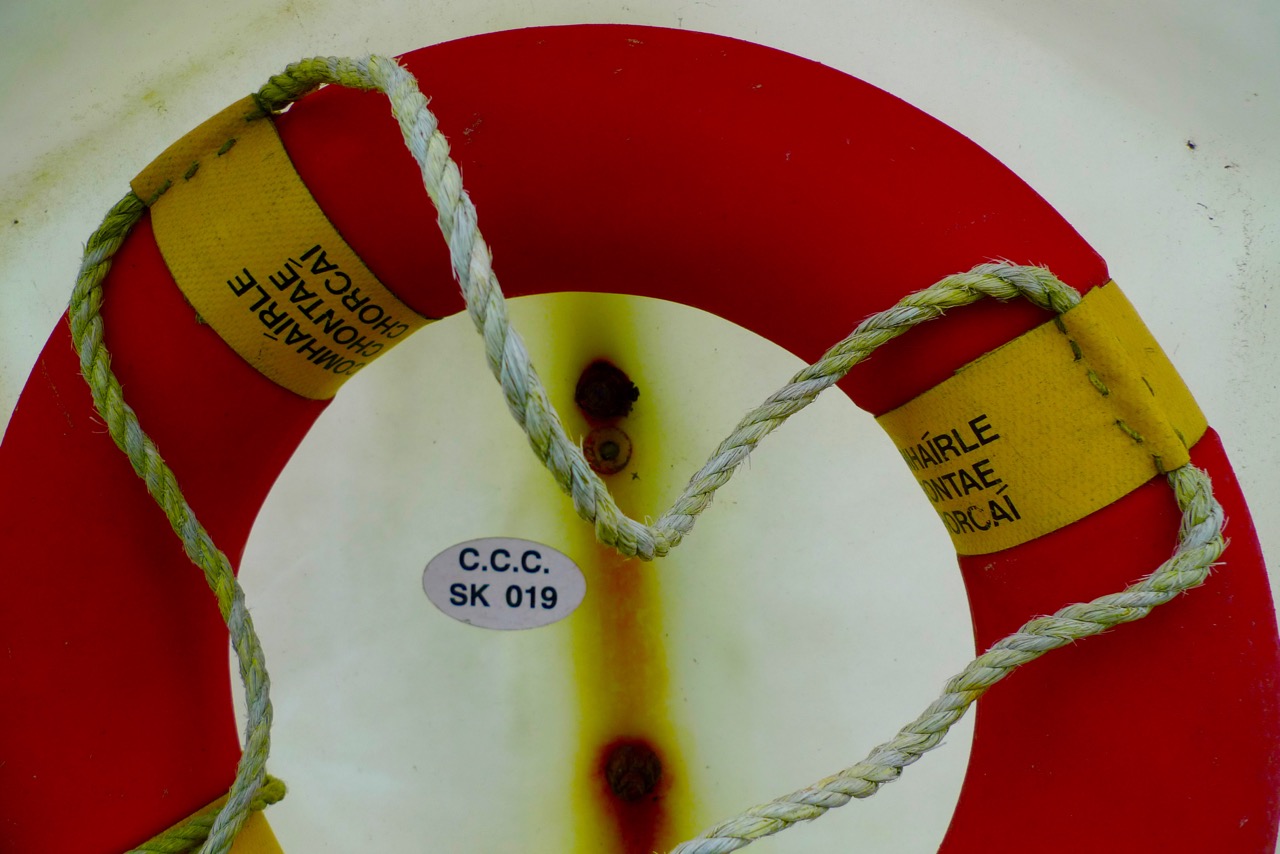
ring

The last word…

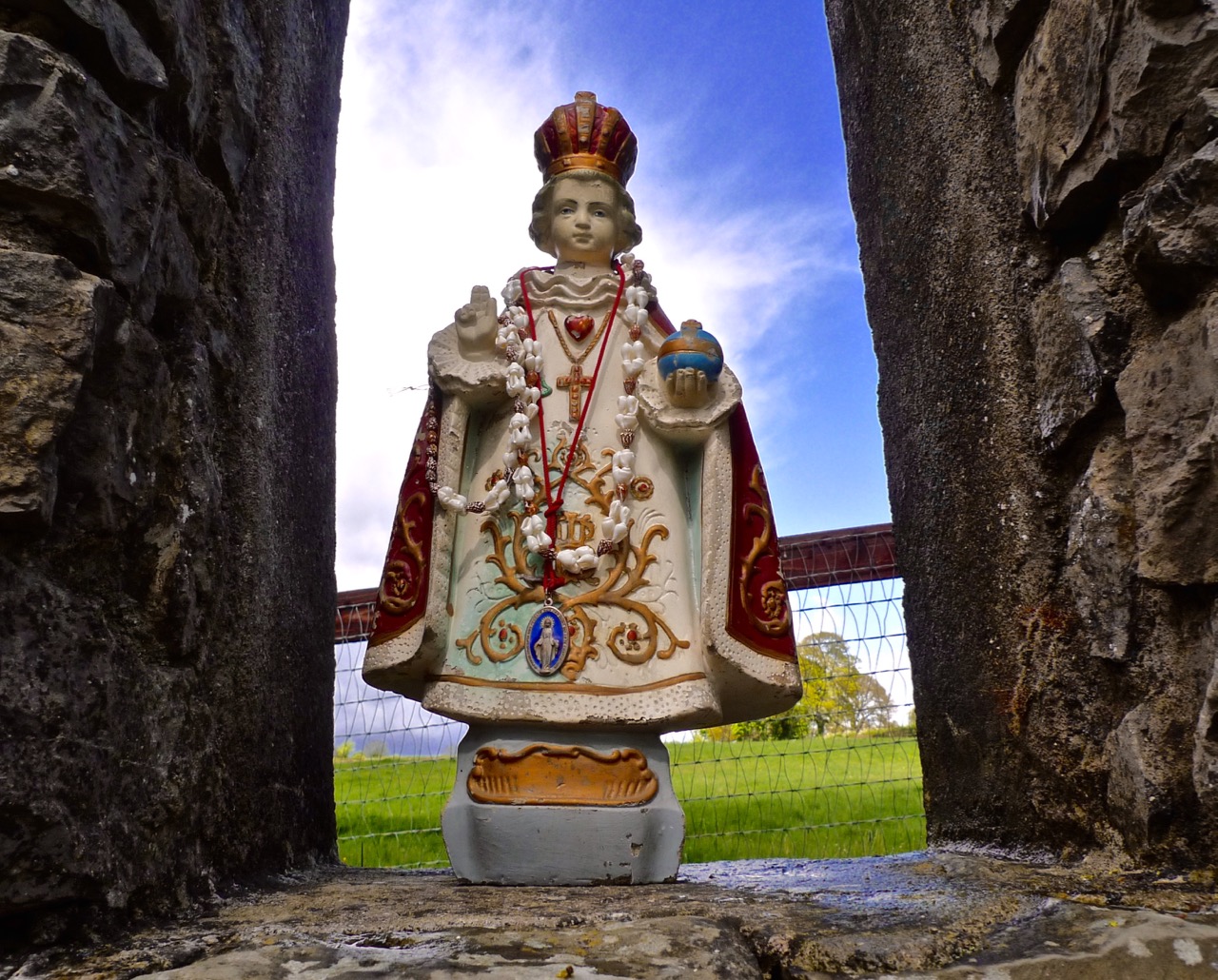
little saint

The Love Which He Bare Her

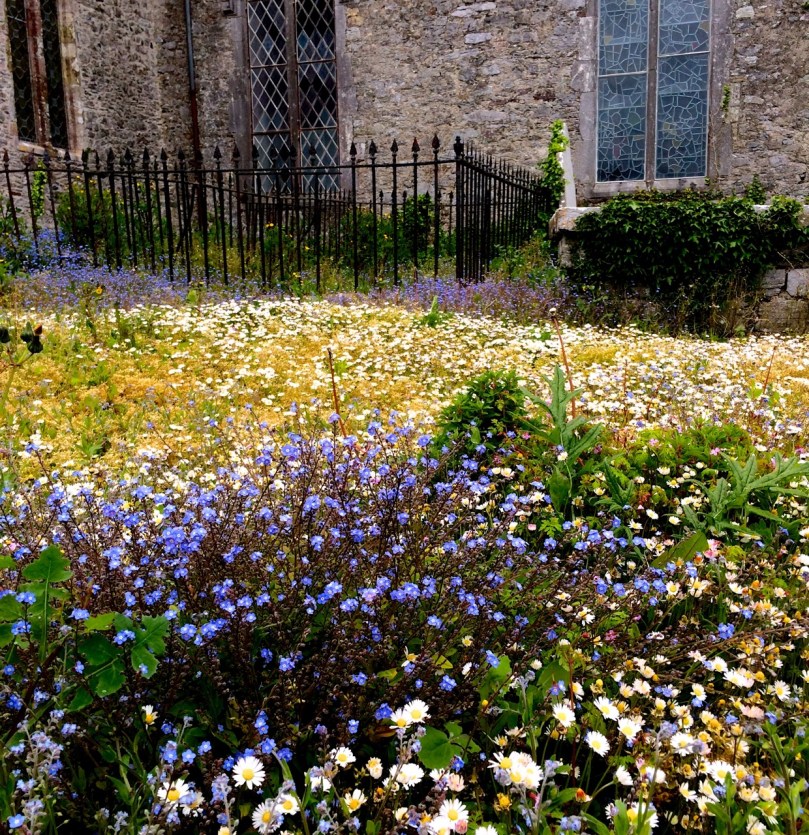
Nothing beats a romantic walk in a graveyard

Nothing beats a romantic walk in a graveyard

In honour of the upcoming St Valentine’s Day, and of course because it’s now officially spring, my thoughts have turned to love. As we travel, here in West Cork, and in Ireland generally, we have a habit of dropping into churches. I’ve been struck by the eloquence – the purple prose – of memorial inscriptions in many Church of Ireland  (Protestant) churches, dating from the 18th and 19th Centuries. Why only in those churches? There weren’t many Catholic churches in Ireland until after the Catholic Emancipation Act of 1829. In the wave of Catholic church building that followed that Act there are few examples of individual memorial tablets on the walls: instead, the walls are filled with Catholic iconography, such as the Stations of the Cross and statues of saints.

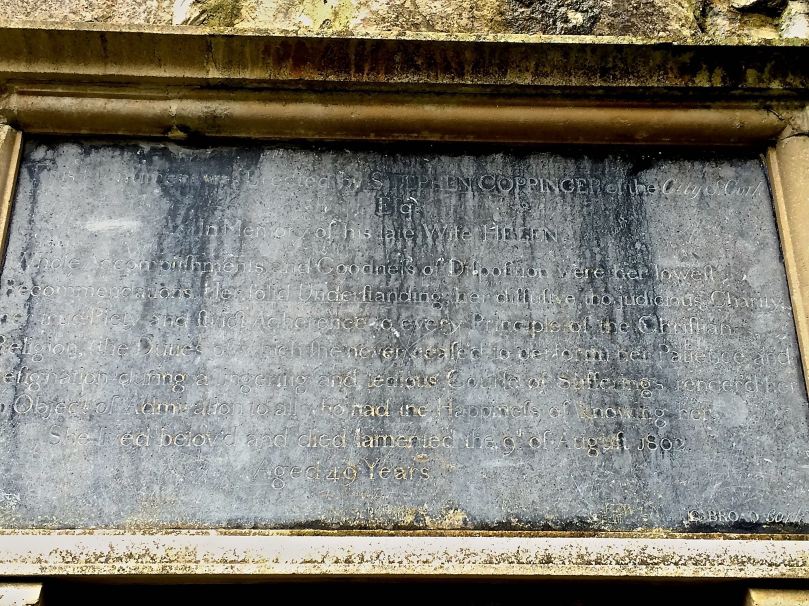
Although most memorial tablets commemorate men (particularly ministers, soldiers and noblemen) here and there you can find memorials to couples, or to beloved women, erected by their ‘disconsolate husbands’ or by a grateful parish. The first two below are from the ruined Muckross Abbey in Killarney. Here we found a stone erected by Stephen Coppinger of Cork, recounting the many virtues of his cherished Helen. The Coppingers were a Catholic family, one of whose members was the infamous Walter Coppinger of Coppinger’s Court.  Another, Elizabeth Coppinger of Barryscourt, in 1760 in defiance of the Penal Laws joined with Nano Nagle and five other Cork ladies in founding a Convent of the Ursuline order in Cork.

Helen Coppinger's memorial tablet

Helen Coppinger’s memorial tablet

Erected by Stephen Coppinger of the City of Cork in Memory of his late Wife HELEN Whose Accomplishments and Goodness of Disposition were her lowest Recommendations. Her solid Understanding, her diffusive, tho. judicious Charity, and strict Adherence to every Principle of the Christian Religion, the Duties of which she never ceased to perform, her Patience and Resignation during a lingering and tedious course of Sufferings, rendered her an Object of Admiration to all who had the Happiness of knowing her. She lived beloved and died lamented the 9th of August 1802. Aged 49 Years.

Also in Muckross Abbey we found this stone to Lucy Gallwey – so generally esteemed that the inhabitants of Killarney erected the memorial. A little sleuthing on my part discovered that Lucy was born Lucinda Grehan in Dublin, and that she and Christopher Gallwey had nine children.

Lucy Gallwey

Lucy Gallwey

Lucy

Wife of Christopher Gallwey of Killarney, Esq. This monument was erected By the inhabitants of Killarney and its neighbourhood to testify The deep sense of those amongst whom she lived And the Exemplary fidelity With which she discharged the relative duties of wife mother and friend as well as to perpetuate the recollections of the many benefits she conferred upon society and to hold up to the emulations of posterity her active useful yet unostentatious exercise of the most ardent charity directed by a singularly sound and well regulated understanding. She died the 14th of December 1829 aged 57

In St Patrick’s Cathedral in Dublin we came across this lovely plaque for Elizabeth, Viscountess Doneraile. (In the same Cathedral is an enormous memorial to the Boyle family built by Elizabeth’s great-grandfather Richard Boyle, Great Earl of Cork – but that’s a whole story in itself.) I love the wording of this one – not just that he loved her, but sincerely respected her.

Elizabeth, Viscountess Doneraile

Elizabeth, Viscountess Doneraile

      ELIZABETH, VISCOUNTESS DONERAILE

Wife of the Right Hon Hayes Sentleger, Lord Viscount Doneraile, Daughter of the Right Hon Joseph Dean, Lord chief Baron of the Court of Exchequer in 1715, and of Margaret Boyle, Daughter of the Hon. Roger Boyle, of Castlemartyr, in the County of Cork, Esq. She departed this life on the 3rd day of Dec, 1761, in the 59th Year of her age. She lived universally esteemed & died universally lamented. Her disconsolate husband, with whom she lived in perfect harmony forty Years, hath caused this Monument to be erected in testimony of the Love which he bare her, and as a memorial of his sincere respect for her many great & amiable Virtues.

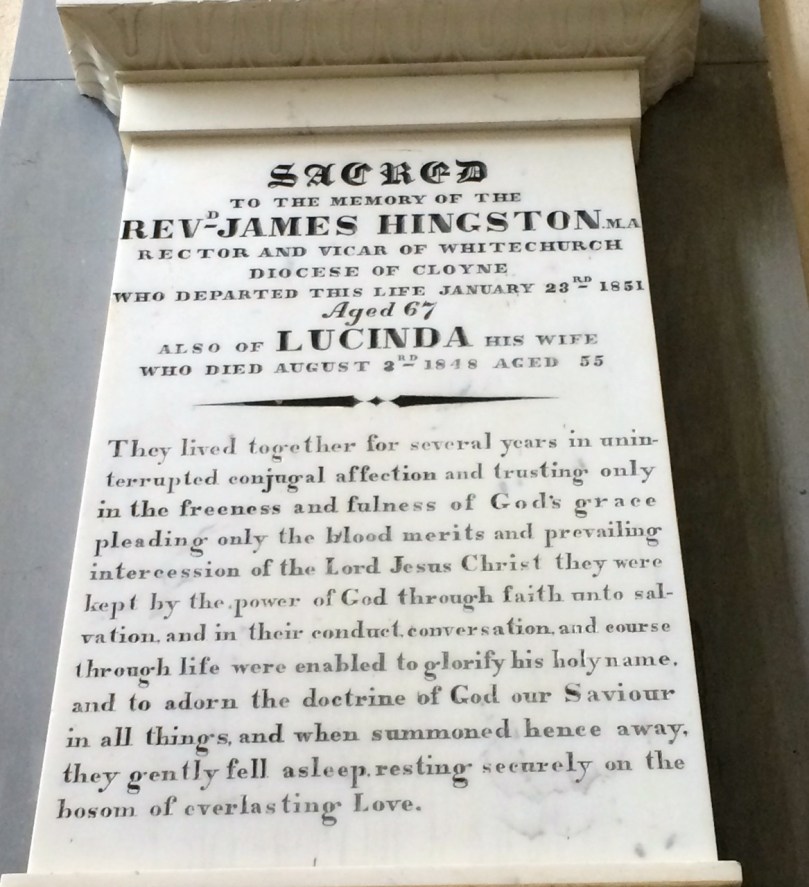
Here’s one from Cloyne. And what a lovely thought – to have years of uninterrupted conjugal affection and then to “gently fall asleep.”

James and Lucinda Hingston

James and Lucinda Hingston

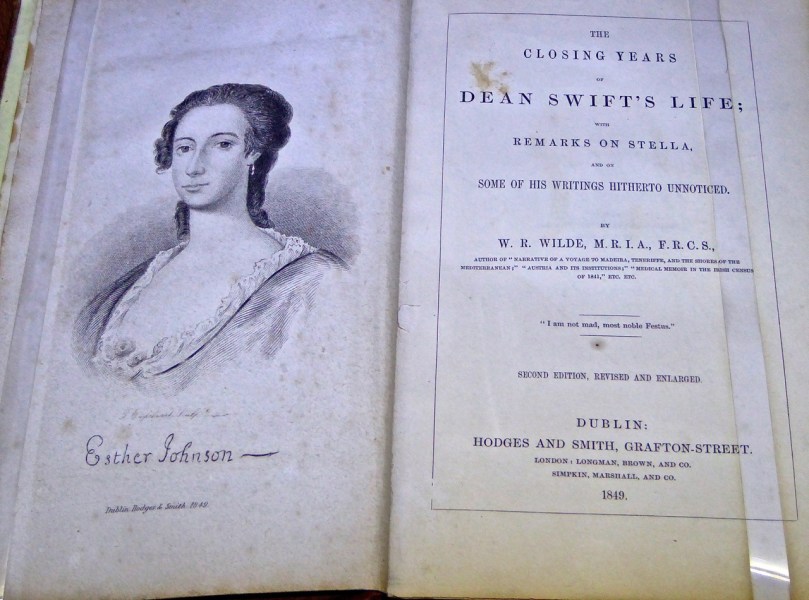
The final one is also from St. Patrick’s Cathedral in Dublin and it’s for Stella, whose real name was Esther Johnson, lifelong friend and companion of Dean Swift. At his request, he was buried alongside her.

Stella

Stella

Dear Reader, do you have a favourite memorial tablet erected by a disconsolate husband, or extolling conjugal affection? If you do, post them to our Facebook page – we’d love to see more of these.

Stella - Swift's Beloved

Portrait of Stella

I’m now busy composing a suitable epitaph for myself…let me see, er, amiable accomplishments Well regulated mind joined with admirable charity. The kindness of her disposition was matched only by the elevation of her thoughts. Natural perfections. Guess I’ll keep working on it. The emulations of posterity can wait a while.

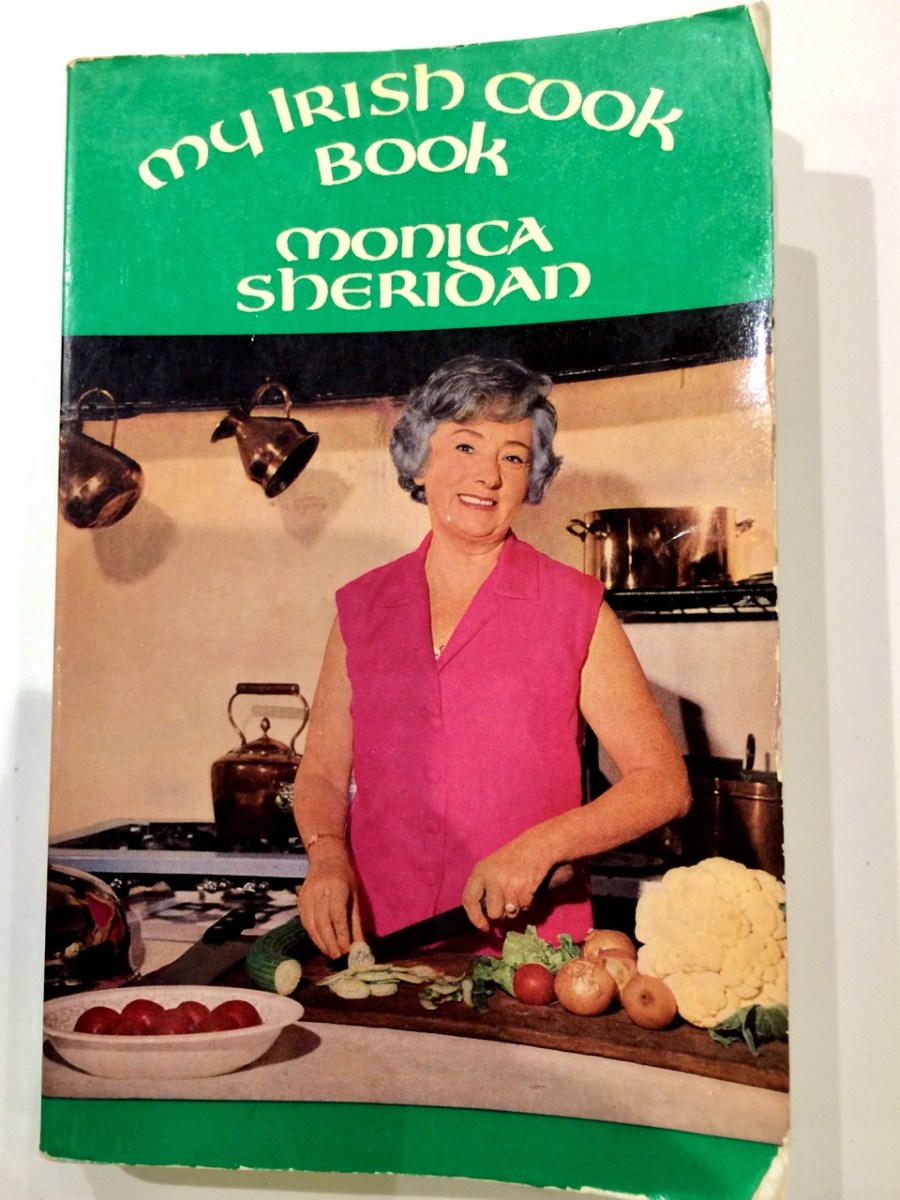
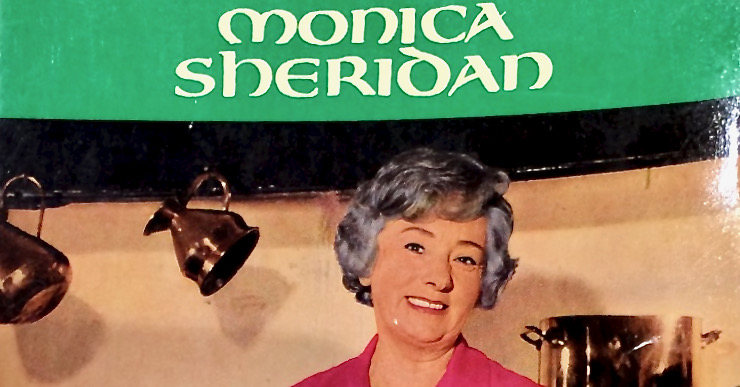
Monica Sheridan’s My Irish Cook Book

Last year I decided to make Christmas cake according to Monica Sheridan’s recipe, which I remembered from my childhood. A comment from a reader got me curious about her other Christmas recipes and I got out my dog-eared copy of My Irish Cook Book to look up how to make a traditional plum pudding. Fatal mistake! Instead of cracking eggs and and soaking fruit I have been chuckling over the book and insisting that Robert listens as I read bits out loud.

I have already posted about Monica’s Kitchen and the delights it contains. The audience for that book was the modern Irish home cook (assumed to be female) of the 1960s. My Irish Cook Book focuses on traditional Irish foods and recipes. The emphasis is on fresh ingredients and fairly simple cooking methods – the kind of thing we call Slow Food nowadays. But because it’s about Irish food it is also an extended piece of nostalgia, replete with dewy-eyed memories of her childhood and her trademark stories and trenchant wit.

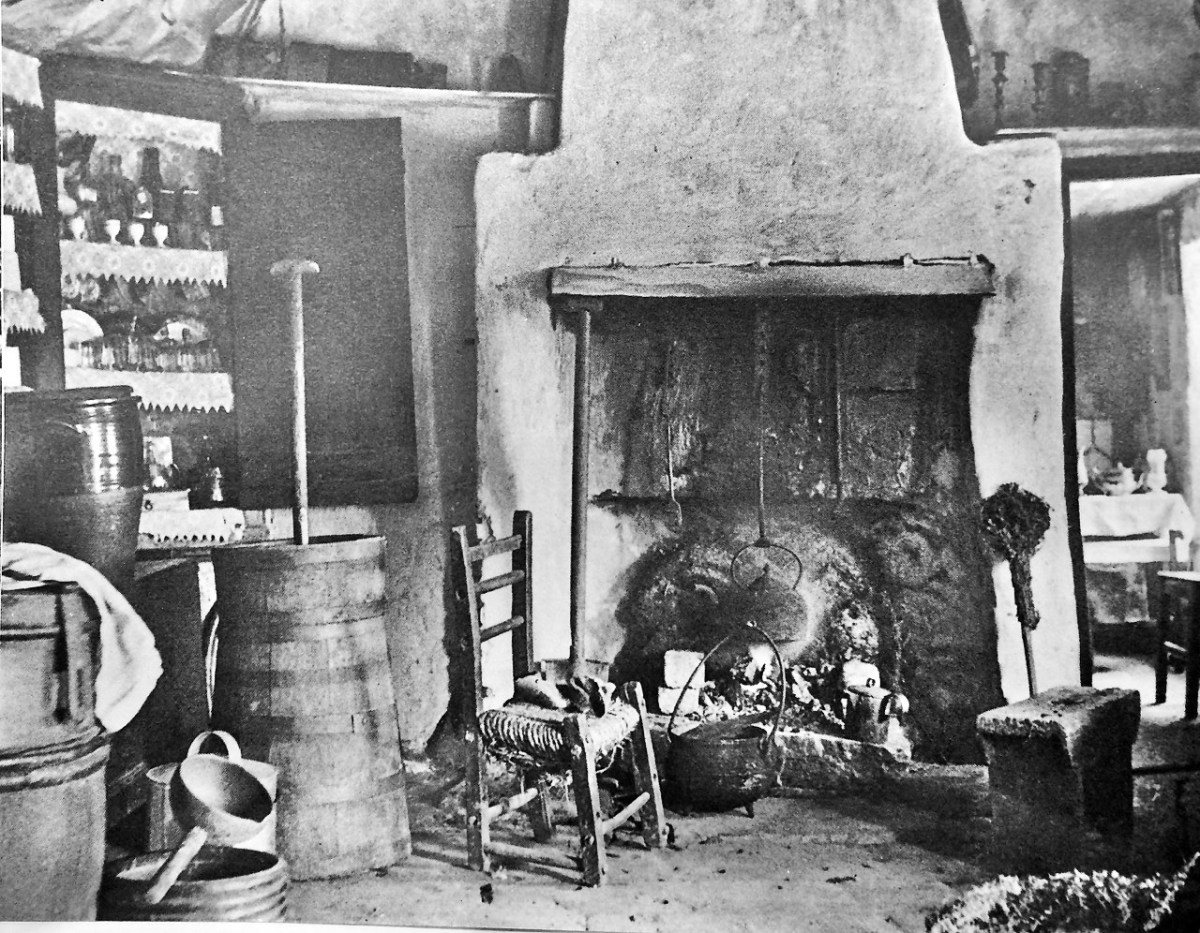
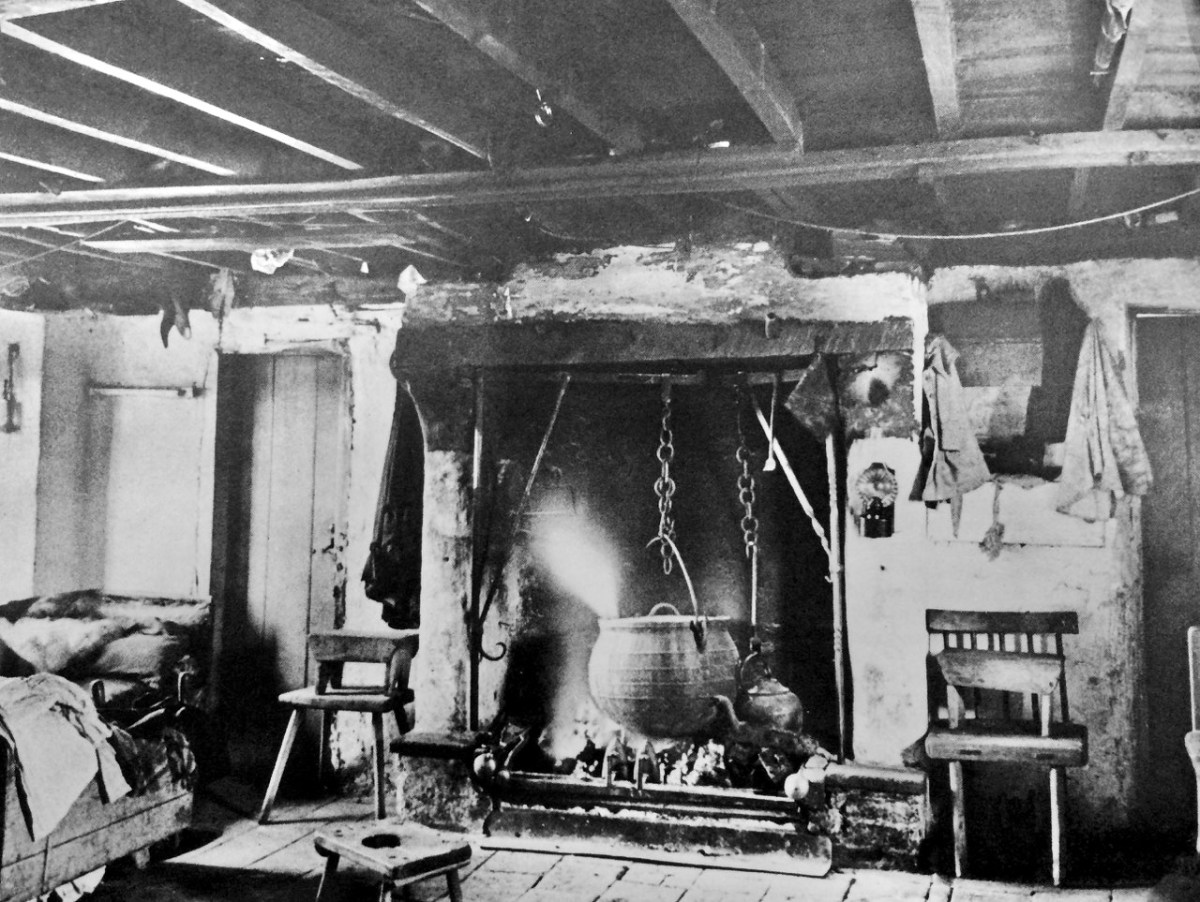
The book starts with an essay on the cooking traditions of her family, from her great-grandmother cooking stews in a bastable oven over an open fire, to her grandmother (who actually had running water from a tap!) to her mother who continued to churn her own butter, cure her own bacon, bake her own bread and make the most outlandish hats with feathers purloined from the cock.

The photographs above and below, by the way, are from my own copy of the book A Taste of Ireland by Theodora FitzGibbon – a book that deserves its own post one day. The photo above is labelled A traditional Irish Kitchen, about 1888, and the one below is of the ancestral home of US President William McKinley in Co Antrim.

Her soup chapter begins thus:

The Geography we learn at school tells us that Ireland has a moderate climate, warmed by the Gulf Stream without any great variations of temperature either in summer or winter. This is a flagrant piece of Celtic exaggeration…

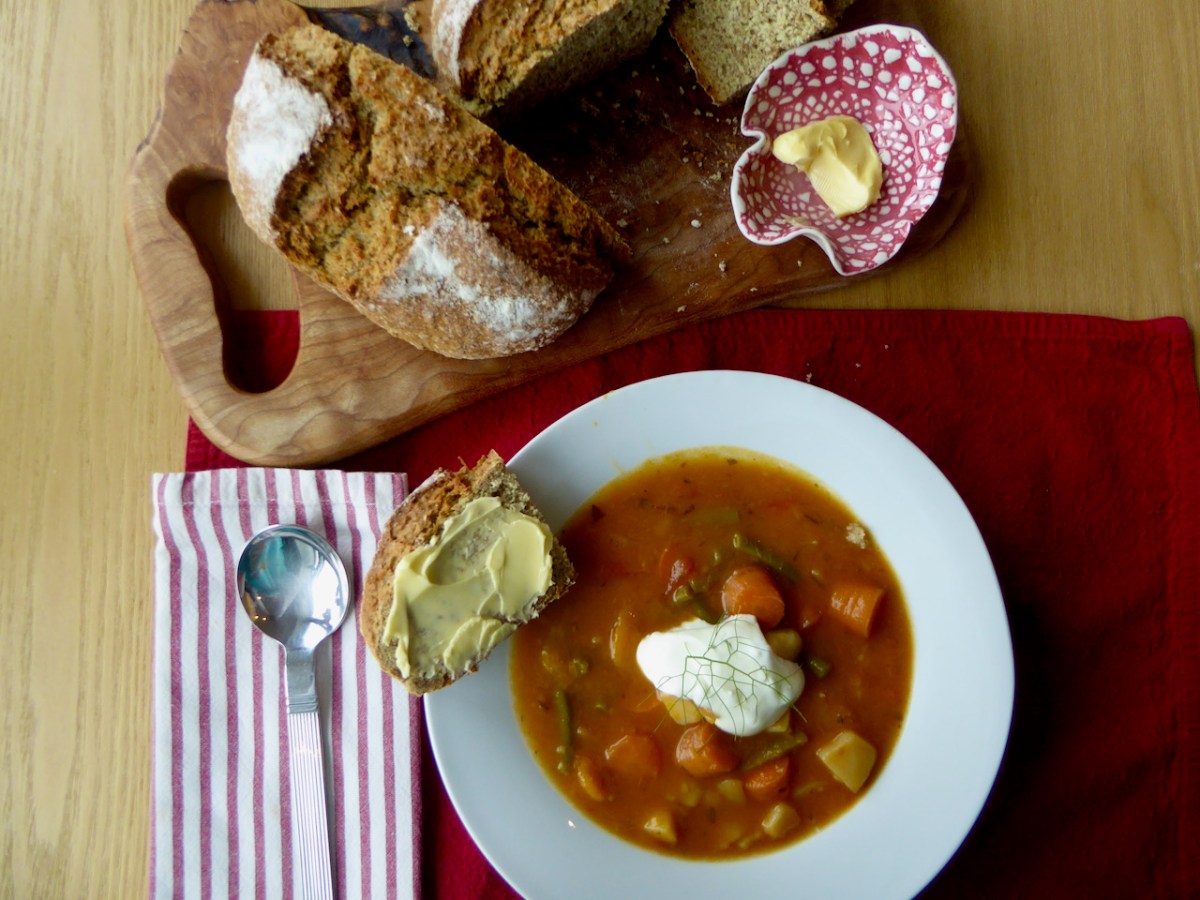
You wouldn’t be long in Ireland before realising that soup is an essential part of our daily fare. Like whiskey it is our internal central heating, raising the temperature of the body and thawing out the gastric juices so that they will be receptive to the delights that are to follow. Remember, in Ireland, except in the cities, domestic central heating is still a rarity (we are a credulous people and believe what we read in the geography books). We need soup to warm us.

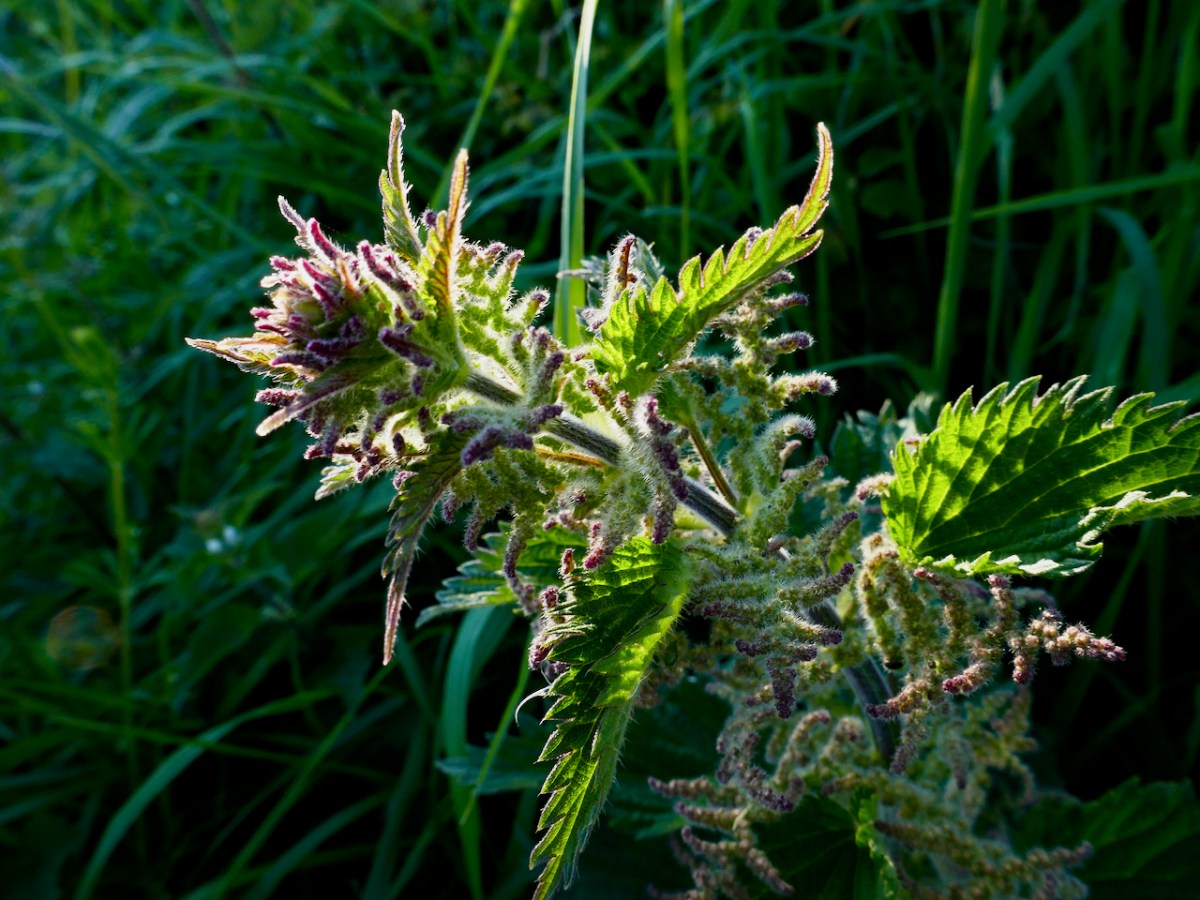
This chapter includes instructions for making a Nettle Tonic. This essentially involves boiling a pound of young nettles in water. Strain and drink a tumblerful, hot or cold, first thing in the morning. Guaranteed to put roses in your cheeks and a glint in your eye. Not pleasant, of course, but you must suffer to be beautiful.

This is the same pre-feminist era woman of Monica’s Kitchen: she gives the following directions for serving steak and fried onions.

Carve the steak by cutting it in thick slices along the grain of the meat. Give a good slice of the fillet to your most important male guest (all men are knowledgeable about steak – all that expense-account eating, I’m sure) and never you mind about his wife. The chances are she is so delighted to be away from her own kitchen stove she won’t mind what she gets.

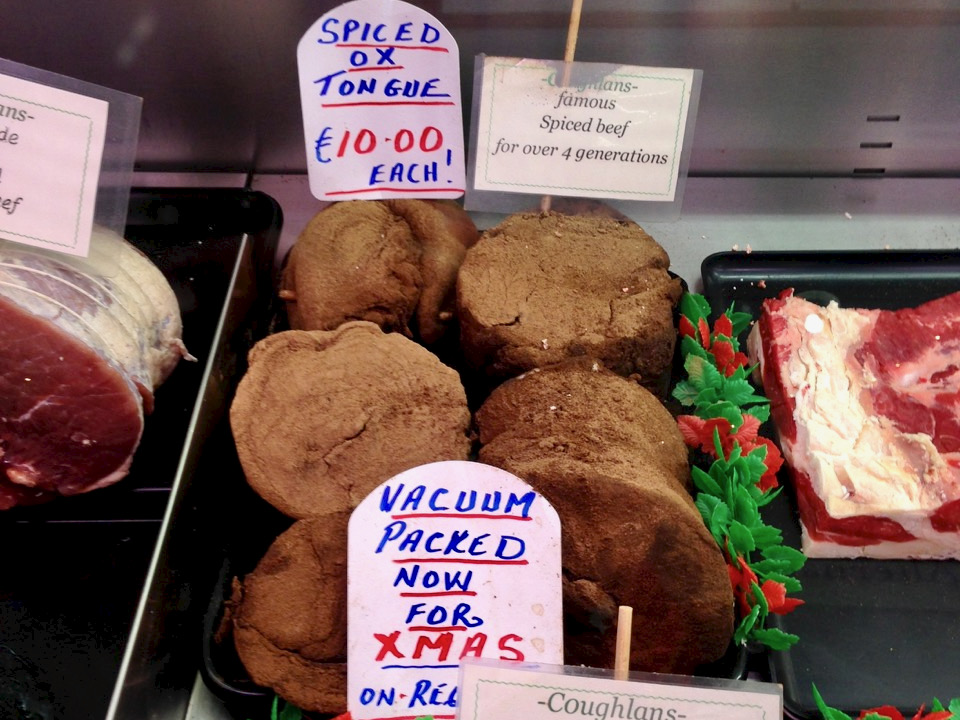
There are lots of recipes for offal, and indeed as children we ate lots of organ meats – although I drew the line at tripe and my mother finally relented after an epic battle of wills. Kidneys, tongue, liver, sweetbreads, heads, brains, cheeks…all get a look in.

Traditional Cork Christmas Meats at the English Market

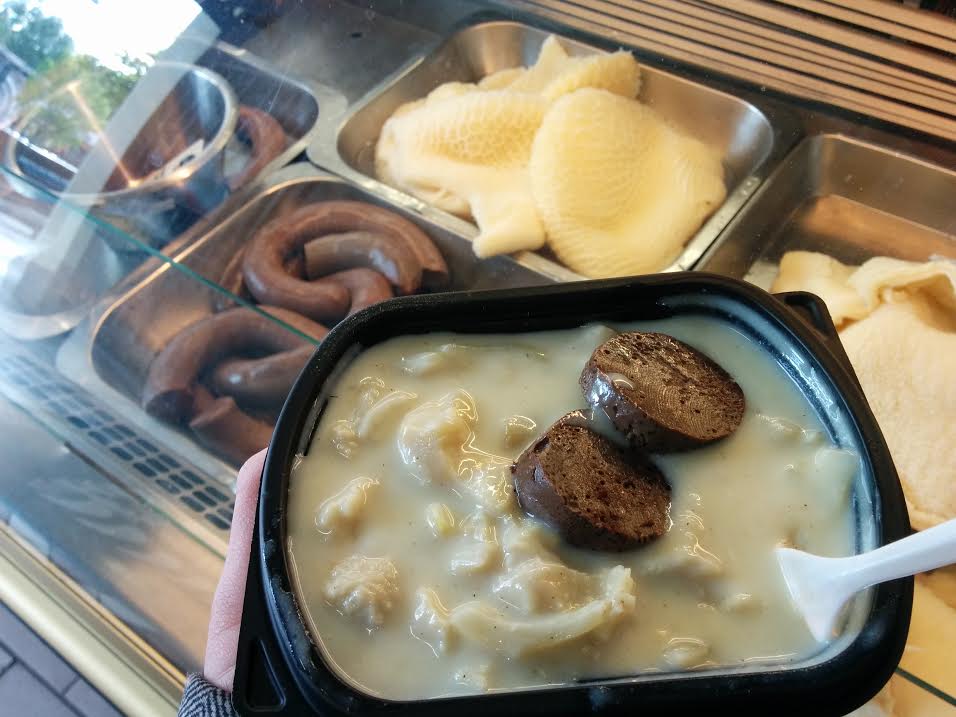
Some Cork specialties get special attention, like Skirts and Bodices. Bodices are pickled spareribs because they are like the boned bodices our grandmothers wore and skirts are the fluted trimmings that are cut away from the pork steak. Drisheens sound, er, appetising: They are made from sheep’s blood. In appearance they resemble a blown-up bicycle tyre, but they have a wonderful texture, like baked egg custard. Serve with butter, she recommends, flavoured with tansy. Crubeens, meanwhile, are pigs’ trotters. Crubeens should always be eaten with your fingers. They lose half of their magic if you attack them with a refined knife and fork. You will need a bath afterwards, of course, but their sweet savour is well worth the extra ablution.

Tripe and Drisheen courtesy of the Eat This Town blog

She finishes the pork section with the following: I will tell you an interesting thing about ham. The true ham epicure will always look for the left ham of a pig. It is considered more tender and delicate. You see, the pig scratches himself with the right leg and consequently exercises it far more. So now you know!

There are many recipes for poultry, some of which involve boiling the fowl, or, in the case of Uncle George’s Turkey, injecting cream into the breast with a syringe. Chickens, of course, must be young – a digression is called for: Describing a woman of certain age, my mother would often say, “She wouldn’t tear in the plucking” (young birds have very delicate skin that breaks easily with inept plucking) or, “A chicken of her age wouldn’t fall off the roost.” Mother had a tongue that would clip a hedge.

Monica in 1968, from the Australian Womens' Weekly
Monica in 1968, from the Australian Womens’ Weekly

When Monica talks about a soufflé (although she doesn’t provide a recipe) she says, it should rise gradually, like a careful civil servant, consolidating its position on the way up. She devotes five pages to talking about soda bread before she even gets to a recipe for it. But that recipe is one I used often, when I lived in Canada, before the days of the internet opened up a world of online recipes. I can attest that it’s a good one.

But, like Monica, I digress – my intention was to give her recipe for plum pudding. Alas, it is hardly a recipe – little more than a list of ingredients followed by instructions to mix it all together, put into greased pudding dishes, and boil for 5 hours. Like many of her recipes, it calls for booze – in this case a glass of whiskey (she has a whole chapter on ‘Drink’). So instead of detailing how to make the plum pudding I will leave you with her approach to serving it.

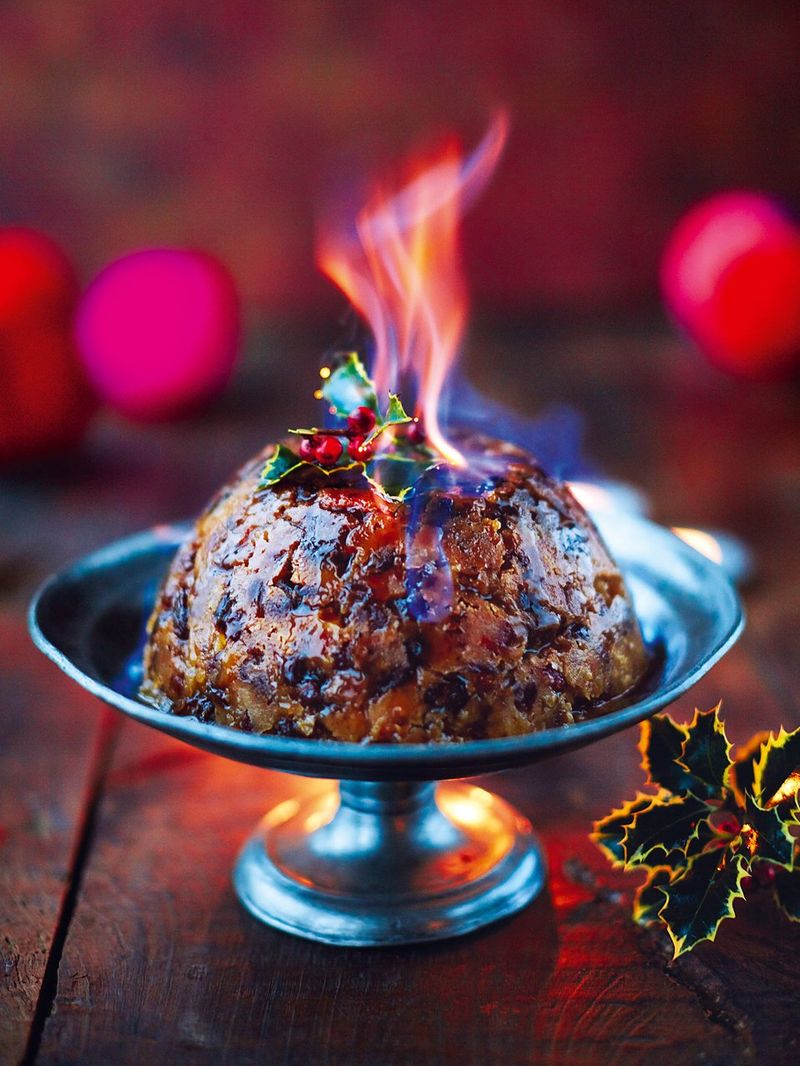
The most exciting thing about a plum pudding is the presentation. To capture the spirit of Christmas it must come to the table lapped in blue flames – and this can be quite tricky with the weak quality of booze nowadays. When I was young we always doused the pudding in poteen and you got a flame that would singe the rafters. To make sure of a good flame it is most important to warm the spirit (cheap brandy is better than whiskey) before pouring it over the pudding.

If you want to make a spectacular entrance to the dining-room with the flaming pudding held on high, this is what you do. Scoop out a hole in the top of the pudding and place half and empty upturned eggshell in the hole. Fill the shell with warmed brandy, ignite and move the dish to spill out the spirit as you enter the dining-room.*

I couldn’t resist this photo of a flaming pudding, which is from Jamie Oliver

In preparing this post I looked up lots of plum pudding recipes, then decided to buy one from my favourite market stall. But if you really want to make a traditional Irish one, Brenda Costigan’s mother’s recipe, from the Independent, looks like a wonderful, rich, boozy pudding that would have done Monica proud.

*Disclaimer: Roaringwater Journal will not be responsible for house fires caused by following these directions.

Footsteps

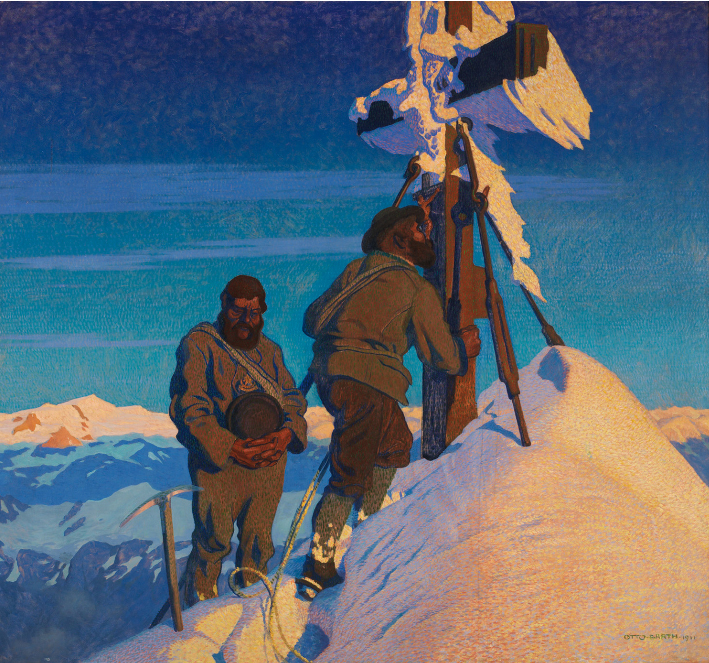
Morning prayers on the Großglockner, Otto Barth 1911

Morning prayers on the Großglockner, Otto Barth 1911

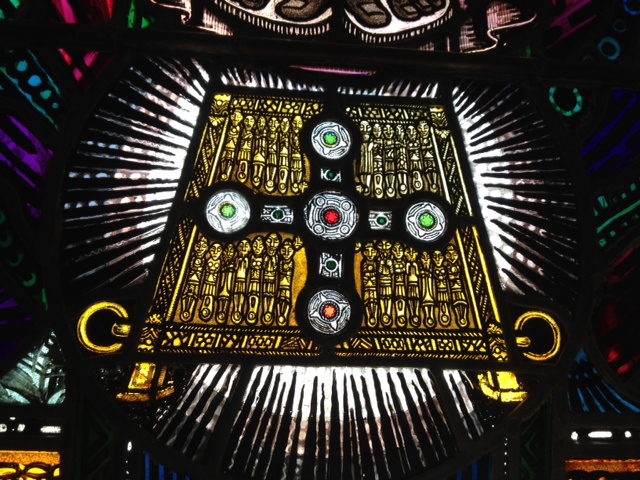
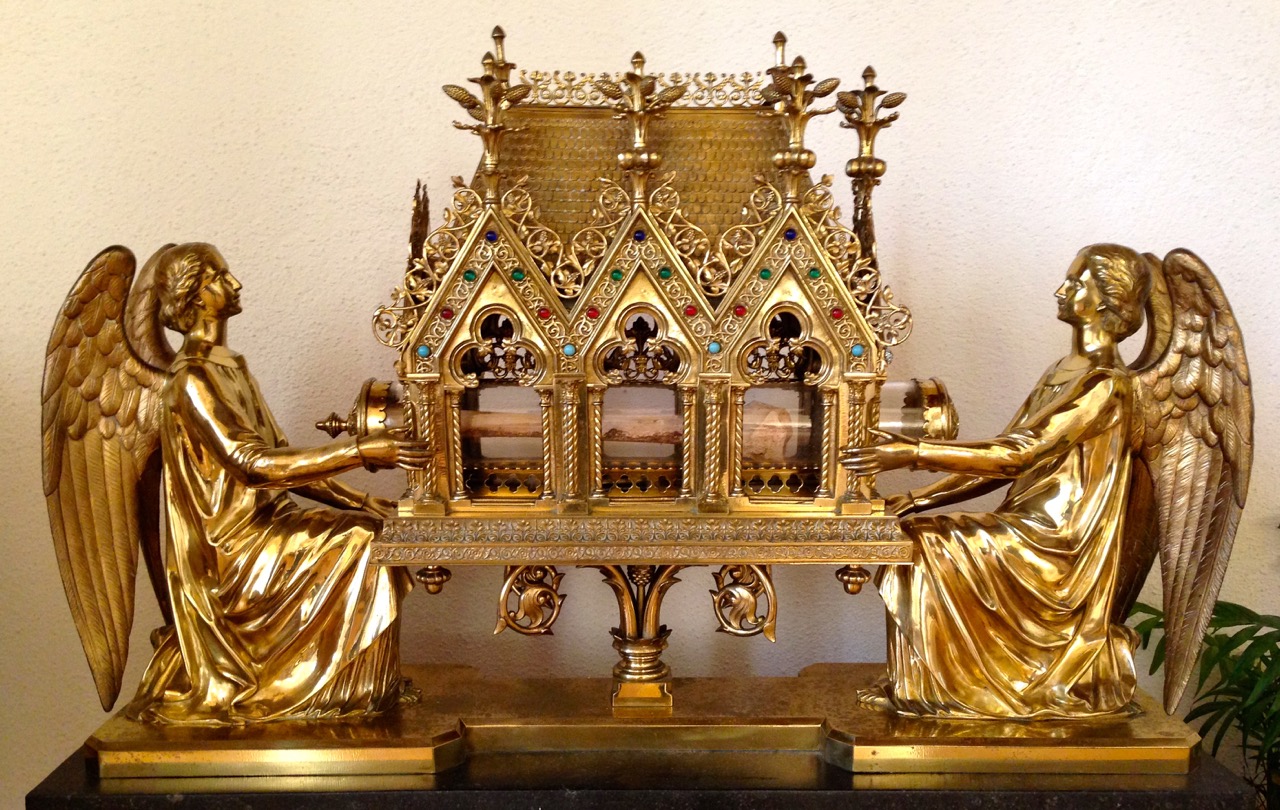
Is it us? We seem to be following in the footsteps of thieves and wreckers… Back in June 2012 we visited St Manchan’s Church, in Boher, Offaly and saw the splendid shrine of that Saint securely locked in an armoured glass case and mounted in front of the equally magnificent Harry Clarke window depicting him. That was at about 1 o’clock in the afternoon. We were shocked to hear on the news that evening that the shrine had been stolen at 1.30! Two men had taken just a few minutes to break open the case – in spite of alarms and cctv – and make off with the Saint’s remains…

We were relieved to hear the following day that the robbery had been bungled: the shrine was thrown out of the getaway car and landed in a bog: both it and the perpetrators were picked up by the Gardi. I wonder if perhaps the thought of what divine justice might be wrought from on high (from St Manchan himself, even) had put doubts into the minds of the thieves and diverted them from their intentions – whatever they might have been.

Harry Clarke's depiction of the Saint's shrine

Harry Clarke’s depiction of the Saint’s shrine

Nevertheless, the incident led to some considerable debate on whether the reliquary should be returned to the church – where the security was evidently lacking – or whether the original 1,000 year old artefact should be put into Ireland’s National Museum and the replica which happens to be there should be sent back to St Manchan’s. The Boher people campaigned vigorously against this – quite rightly in my opinion – and eventually, after some improvements to the arrangements in the church, the shrine has been restored to where it belongs.

winter

Carrauntoohil Summit – photo by Noel Mulcair: thejournal.ie

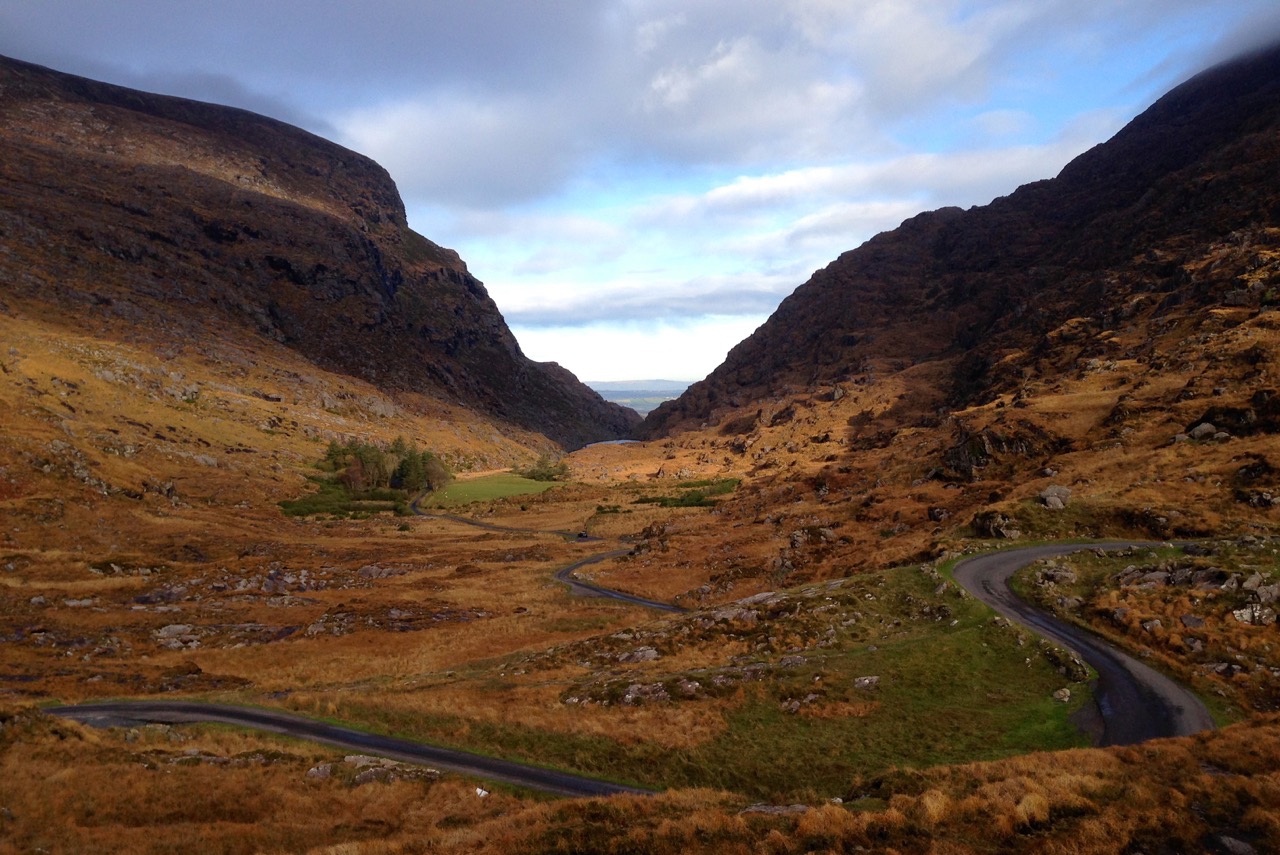
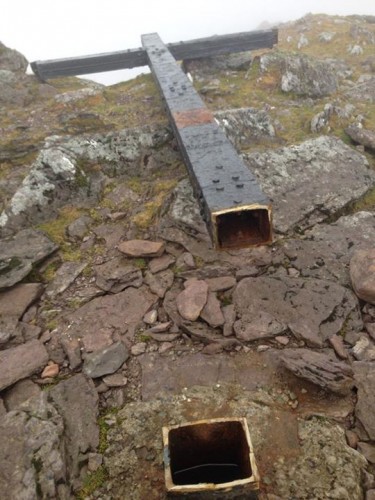
So there we were just a week or two ago, honeymooning in the shadow of Ireland’s highest mountain (although warmly ensconsed in a comfortable Kerry hotel) when we heard the news that, not far away, someone had climbed the mountain at night and felled the iron cross that had stood up there for many years, with an angle-grinder! Obviously some point was being made, although nobody was quite sure what that was at the time…

The Mountains of Kerry

Gap of Dunloe, in the shadow of Carrauntoohil


The cross is felled...

The cross is felled…

The Carrauntoohil incident sparked off a lively correspondence in The Irish Times. Many were indignant at the act of vandalism, while others took the view that there is no reason why wild places should be ‘sullied’ with religious symbols. Hmmmm… that’s a bit harsh, perhaps: crosses on mountain tops have a been around for a long time all over the world and, ever since prehistory, humans have marked their presence on the landscape with monuments of one sort or another. As you all know, the two of us are fascinated (obsessed might be a more appropriate word) by megaliths, tombs, circles and inscribed rocks – and these are preserved archaeological artefacts – it would be unthinkable for someone to get it into their head that a standing stone should be destroyed because it might have represented someone’s god. At the very least, surely, the subject should be aired and a democratic decision made by a public majority before any such action is taken. Indeed, the subject did get aired after the event and I gleaned that the majority of respondents felt that the iconic cross should not have come down.

Well, this story – like the St Manchan one, has had a happy ending. A group of volunteers has been up to the summit with block, tackle and welding equipment and the cross is back again.

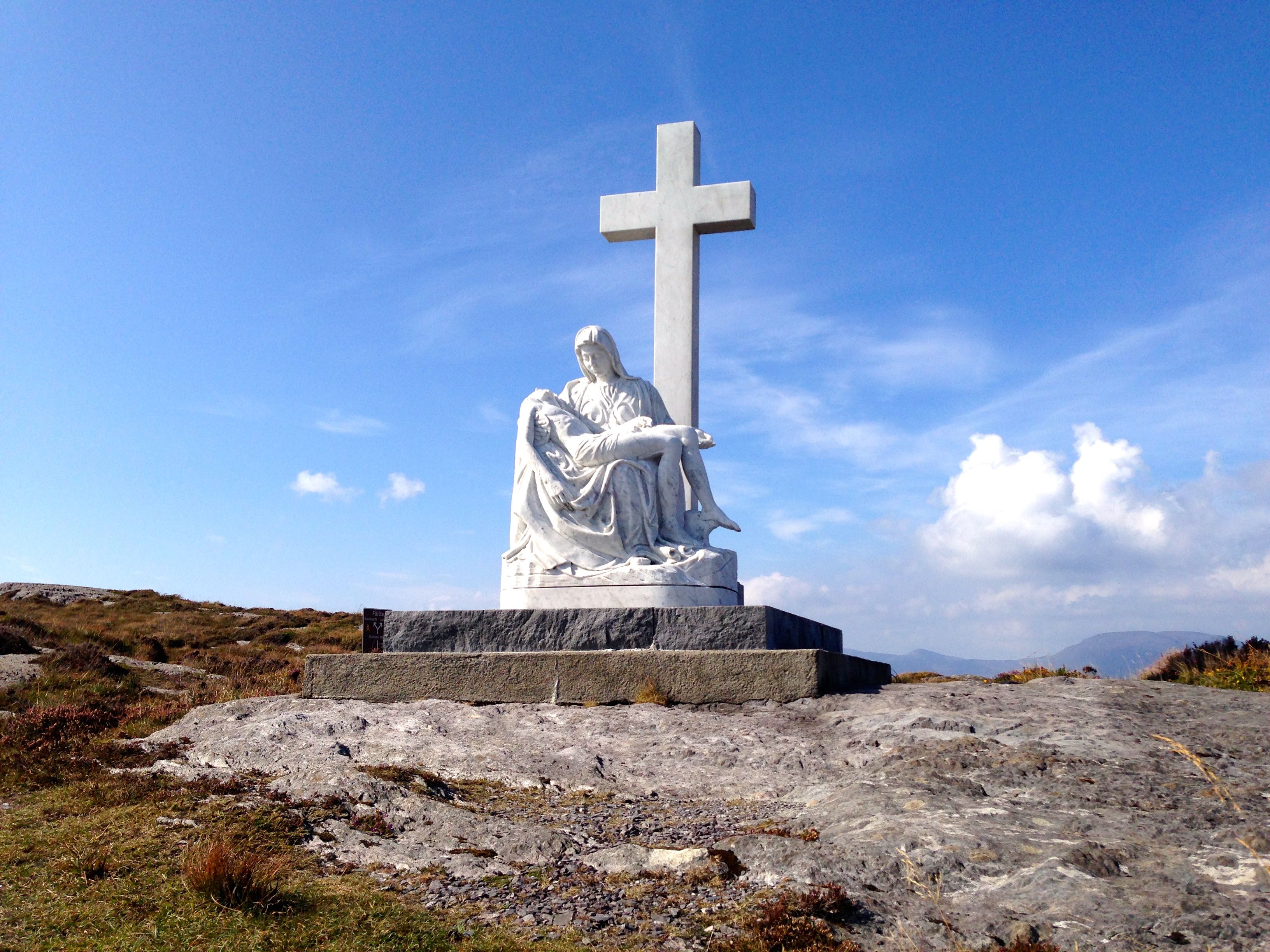
Ireland has many summits adorned with constructed pieces – ancient cairns and tombs, and more modern statues and symbols, not forgetting the wind farms which are another source of controversy. We are all part of human history and one of Ireland’s big attractions for me is that the history is so visible and accessible. In 1968 a white marble Pieta was placed high up on the Goat’s Path in Glanalin townland. It’s someone’s personal monument to a much loved father. In my opinion the melancholy statue enhances the wild place: I make a bee-line for it whenever I’m in the area – partly to enjoy the magnificent view but also, I have to say, because I am fascinated to see how many coins and offerings are put into the outstretched palm of Mary. Look here for a fuller description on the excellent website Sheep’s Head Places.

Hilltop Pieta

Hilltop Pieta

Given our experiences to date I worried a bit about our visits to Holy Cross Abbey and the Cathedral of St Mary and St Anne in Cork, where we came across the shin bone of Blessed Thaddeus McCarthy. But it seems to be ok: fair enough, the fragment of the True Cross was stolen from Holy Cross (it’s now been replaced with another), but long before our visit, while the saintly shin bone seems to have survived unscathed so far. I can’t help looking over my shoulder, though, when we visit such places. Ireland is full of enigmas…

thaddeus

Sacred shin bone – with Angelic guardians

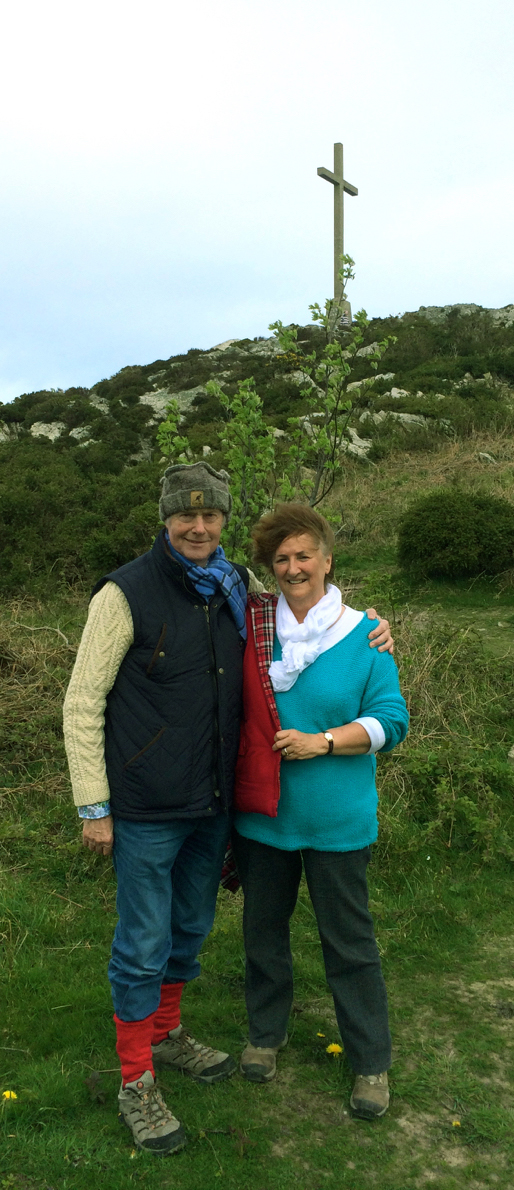
Finola's childhood haunts: the cross on Bray Head, Wicklow

Finola’s childhood haunts: the cross on Bray Head, Wicklow

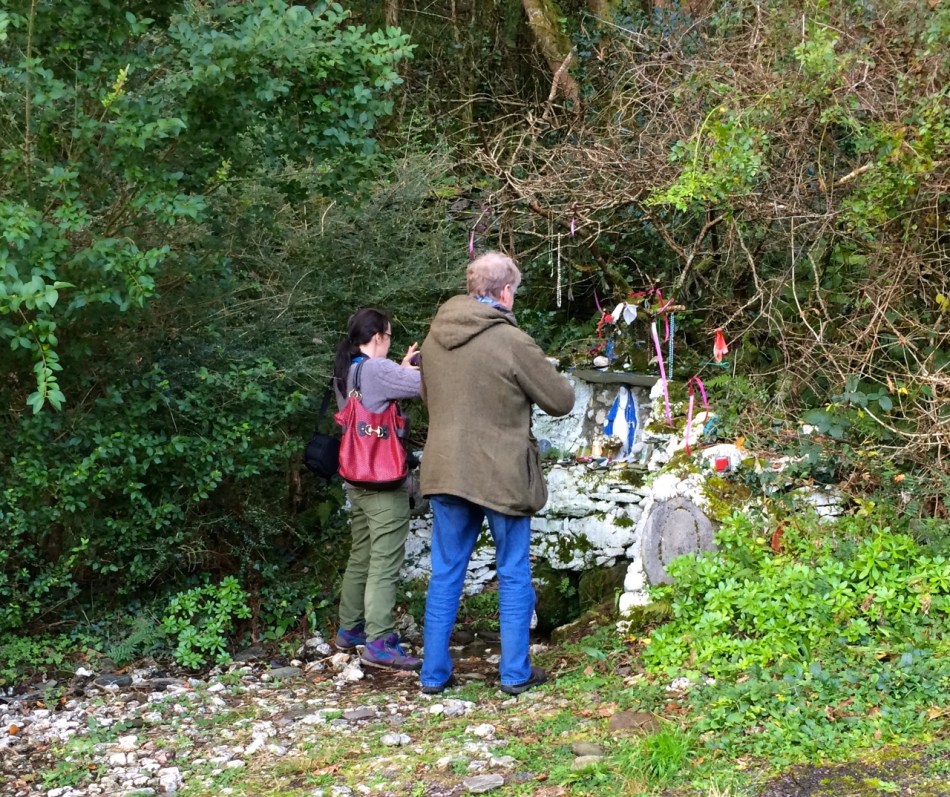
Three Pilgrims in West Cork

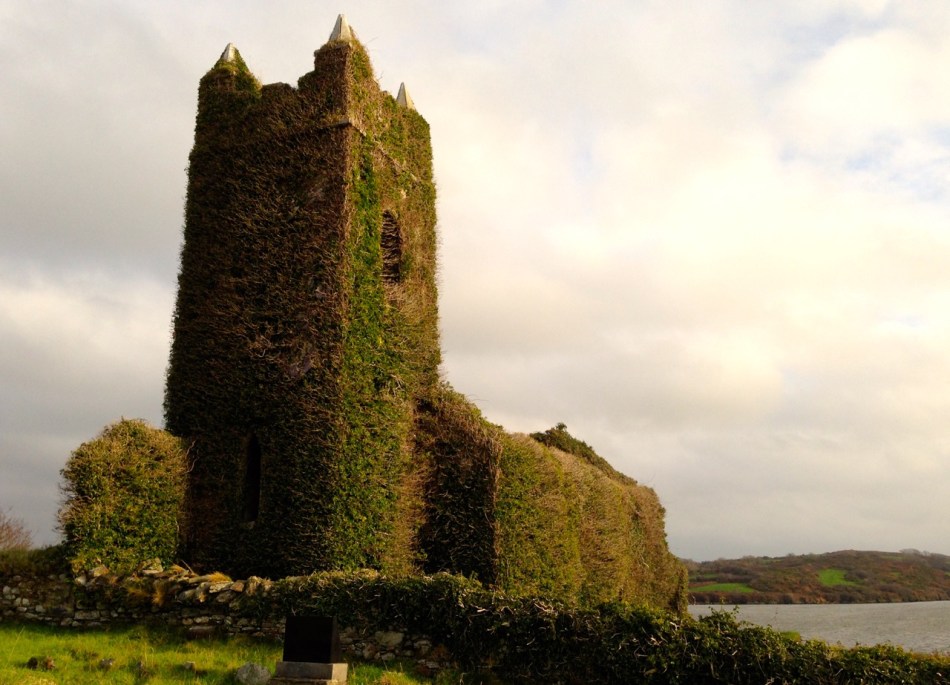
Glebe Church, on the Ilen River

Glebe Church, on the Ilen River

The guest speaker at this Thursday’s Skibbereen Historical Society meeting was Louise Nugent, speaking on the topic of Pilgrimage in Medieval Ireland. We became familiar with Louise’s work though her blog of the same title – a blog which manages to be consistently erudite and down-to-earth and entertaining all at once – and suggested her as a speaker. This also gave us the opportunity to meet Louise in person (she is as engaging and as knowledgeable as her blog) and, the next day, show her a little bit of our part of West Cork.

One of the great delights of following Louise’s blog is realising that the concept of pilgrimage – a spiritual journey undertaken for a variety of purposes – is still very much alive in Ireland. Local veneration of shrines, relics and holy wells is common and often involves a mass or prayers on special days. The “journey” involves going to the shrine, and sometimes moving around it in a set pattern or round. Larger scale pilgrimages, such as the annual trek up Croagh Patrick or a stay at Lough Derg in Donegal or a Novena at Holy Cross Abbey, transcend the local and attract pilgrims from around Ireland. In her talk, Louise also described the popularity of pilgrimage in Medieval times to holy sites outside Ireland such as York, Santiago de Compostela, Rome, or Jerusalem. Those who completed the Santiago Camino wore scallop shells to signify their pilgrim status, an image we had just seen the previous weekend in Cork in the Cathedral of St Mary and St Anne, where we came across a shrine to Blessed Thaddeus McCarthy. There was a statue, a painting, scrolls, but most fascinating of all a reliquary containing a leg bone! Blessed Thaddeus lived in the 15th Century and was appointed a bishop twice but was never able to take up his see because of the activities of the rival clan O’Driscoll.

On our day with Louise we concentrated on the area around Skibbereen. We started off by visiting the 18th Century Church at Glebe, on the banks of the River Ilen. The church and graveyard enjoy a picturesque and peaceful setting and a wander around the graveyard yielded interesting headstones.

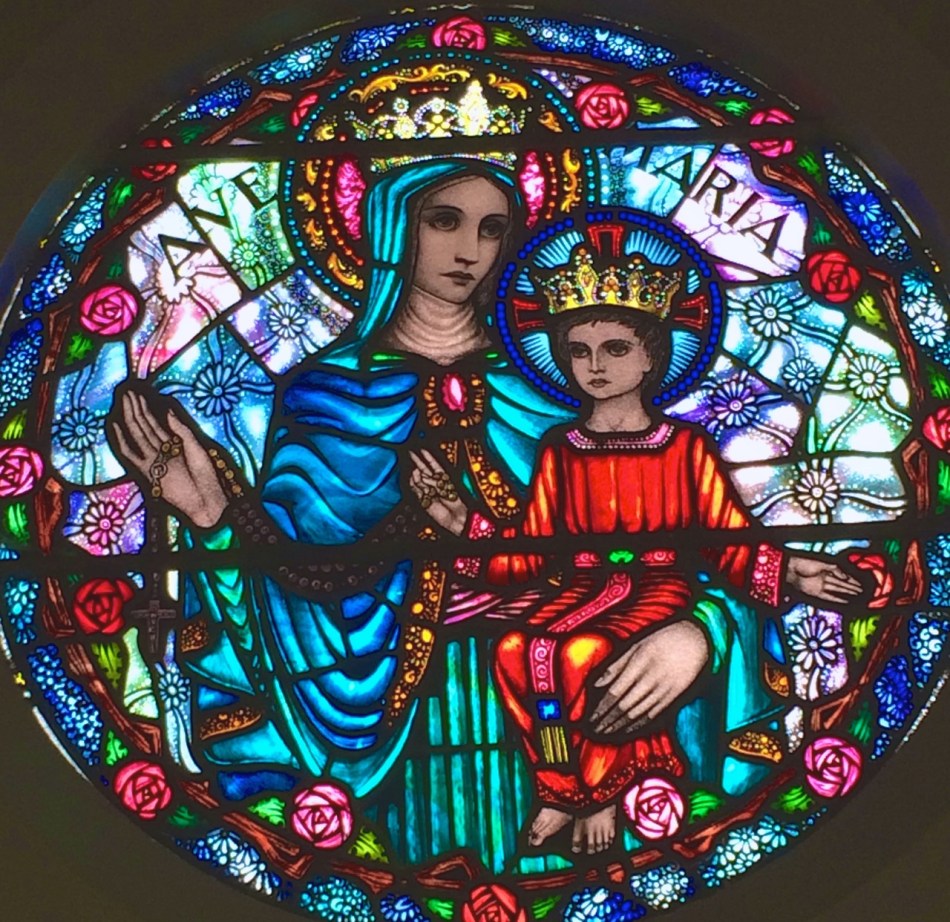
Holy Rosary Church at Aughadown, window detail

Holy Rosary Church at Aughadown, window detail

From there we went to the ruined medieval church at Kilcoe, stopping for a quick peak at the notable windows in the Church of the Most Holy Rosary at Aughadown. They deserve a fuller description at a future date, so for now I will include a detail from the rose window at the back of the church, designed and executed by the Harry Clarke studios in 1941.

The church at the tip of the Kilcoe Peninsula was already a ruin in the early 17th century. Although a simple rectangular structure, the pointed arched doorway and the tiny ogival windows mark it as medieval, perhaps as early as 14th or 15th century. Romantic and atmospheric as it is, it has the added advantage of a clear view of Kilcoe Castle, famously restored by Jeremy Irons and gently glowing in the afternoon light as we were there.

Two of the three pilgrims at a holy well

Two of the three pilgrims at a holy well

Louise’s special interest is in holy wells and several audience members the night before had come forward with information about local wells and the practices and beliefs associated with them. Two of the best known and most beloved local wells are situated close to each other at Lough Hyne. Robert is writing about these wells this week so I will leave the detailed description to him.

Our final stop was the village of Castletownshend and the Church of St Barrahane, filling two different functions. First, Louise had been to visit a holy well dedicated to St. Martin of Tours in Clare, and we wanted to show her the Harry Clarke window that Robert had described in his Martinmas post. Second, a trip to St Barrahane’s is always a pilgrimage of a different sort for me, as it is the final resting place of three of my heroes. The first two, of course, are the writing team of Somerville and Ross – more about them in this post. The third is Vice-Admiral Boyle Somerville, brother of Edith and a keen amateur archaeologist worthy of a post to himself in the future.

St Louis: detail of Harry Clarke window in St Barrahanes, Castletownshend

St Louis: detail of Harry Clarke window in St Barrahanes, Castletownshend

Come back soon, Louise – these two pilgrims have lots more to show you!