New Archaeology

Unexpected Discovery...

Unexpected Discovery…

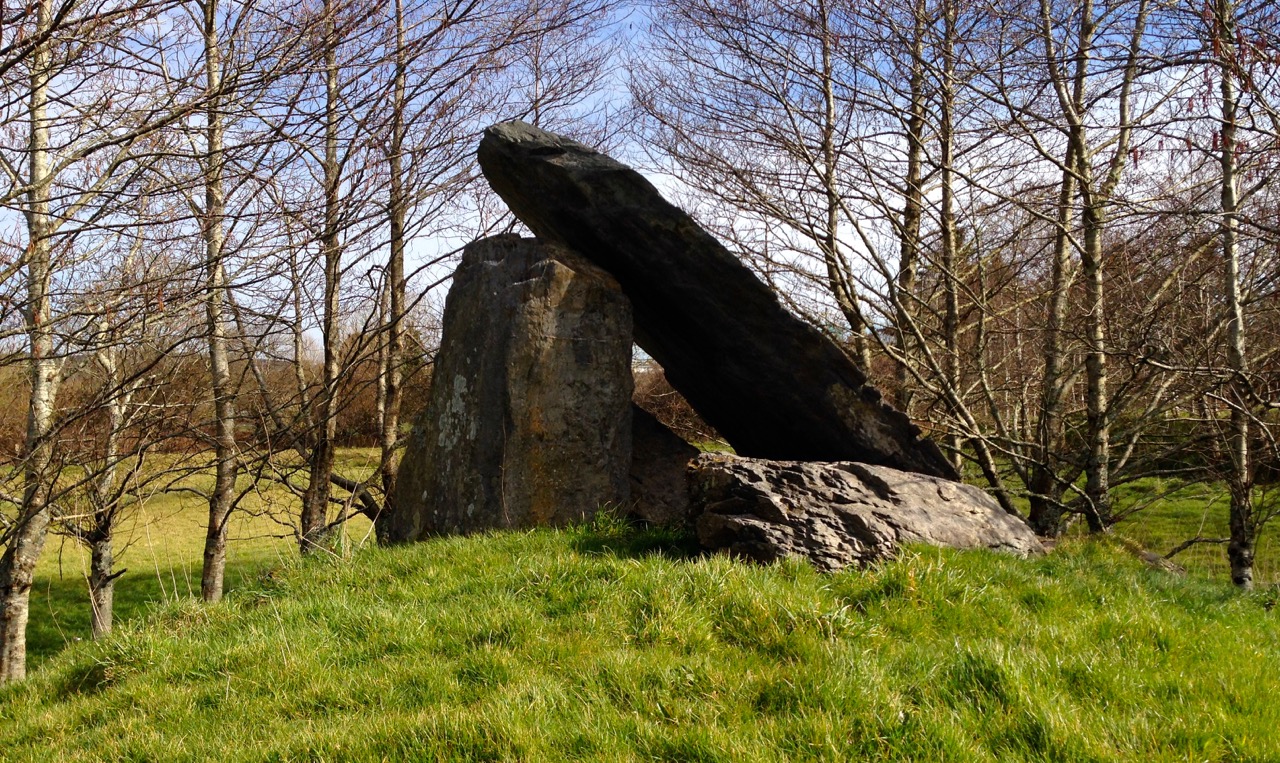
Wow! A hitherto unrecorded stone circle, a boulder burial, a gigantic standing stone and a dolmen… all found on a Saturday morning walk.

Ballydehob's Dolmen

Ballydehob’s Dolmen

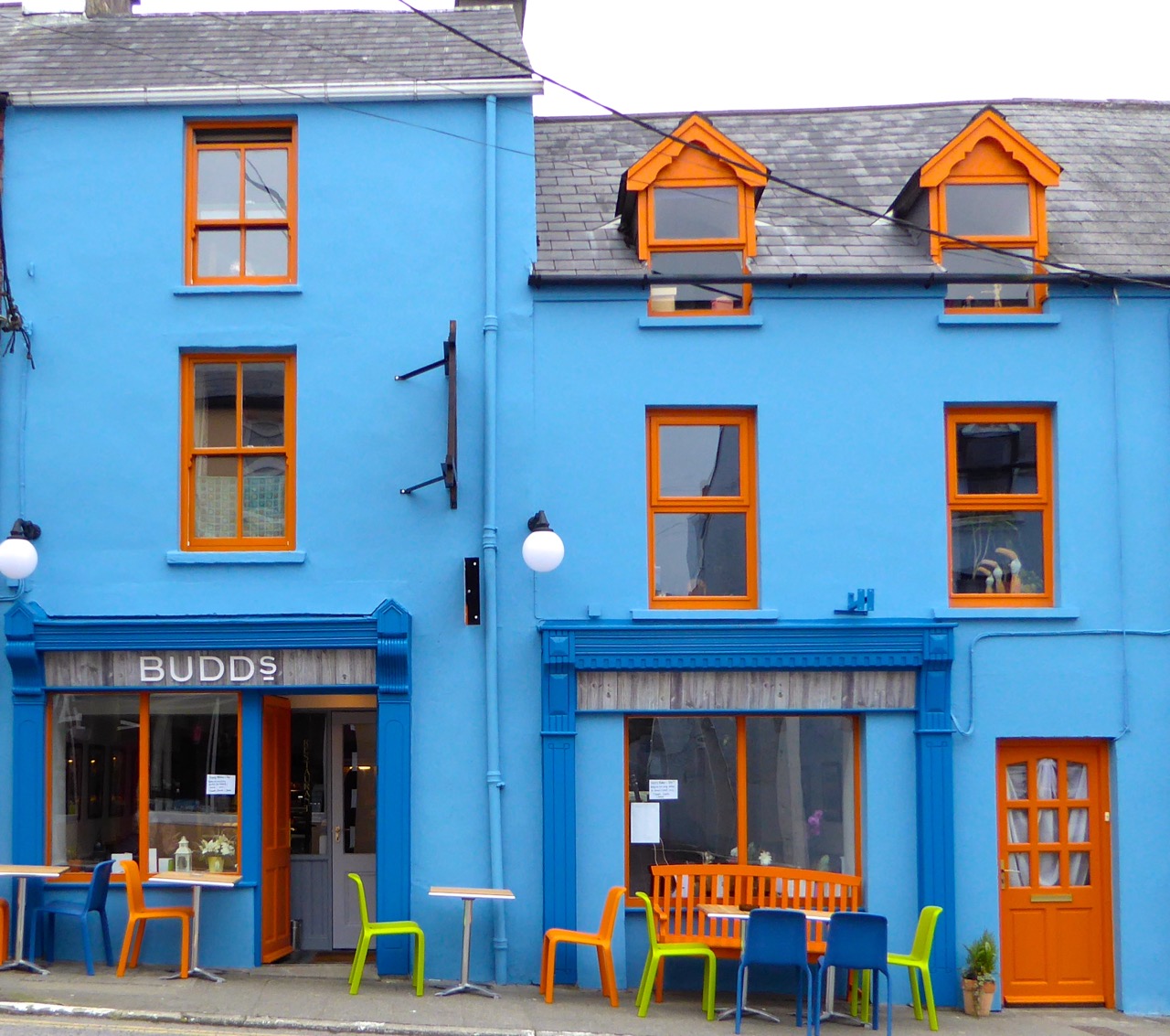
Budds

Our expedition began after a great breakfast in Budds – Ballydehob’s newest eating venue: try it out – it has an attractive cheerful atmosphere and the food is excellent. After this sustenance we set out to explore – for us – uncharted territory. Did we travel miles out into the wild hills of West Cork to find these remarkable pieces of archaeology? No, we walked a few metres down the road…

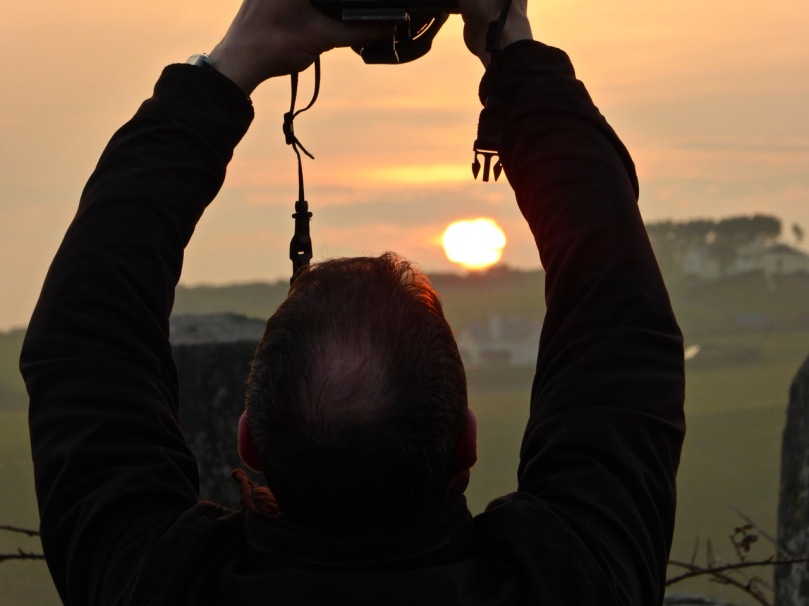
Time for the weekend paper - Robert takes to the Druid's Chair

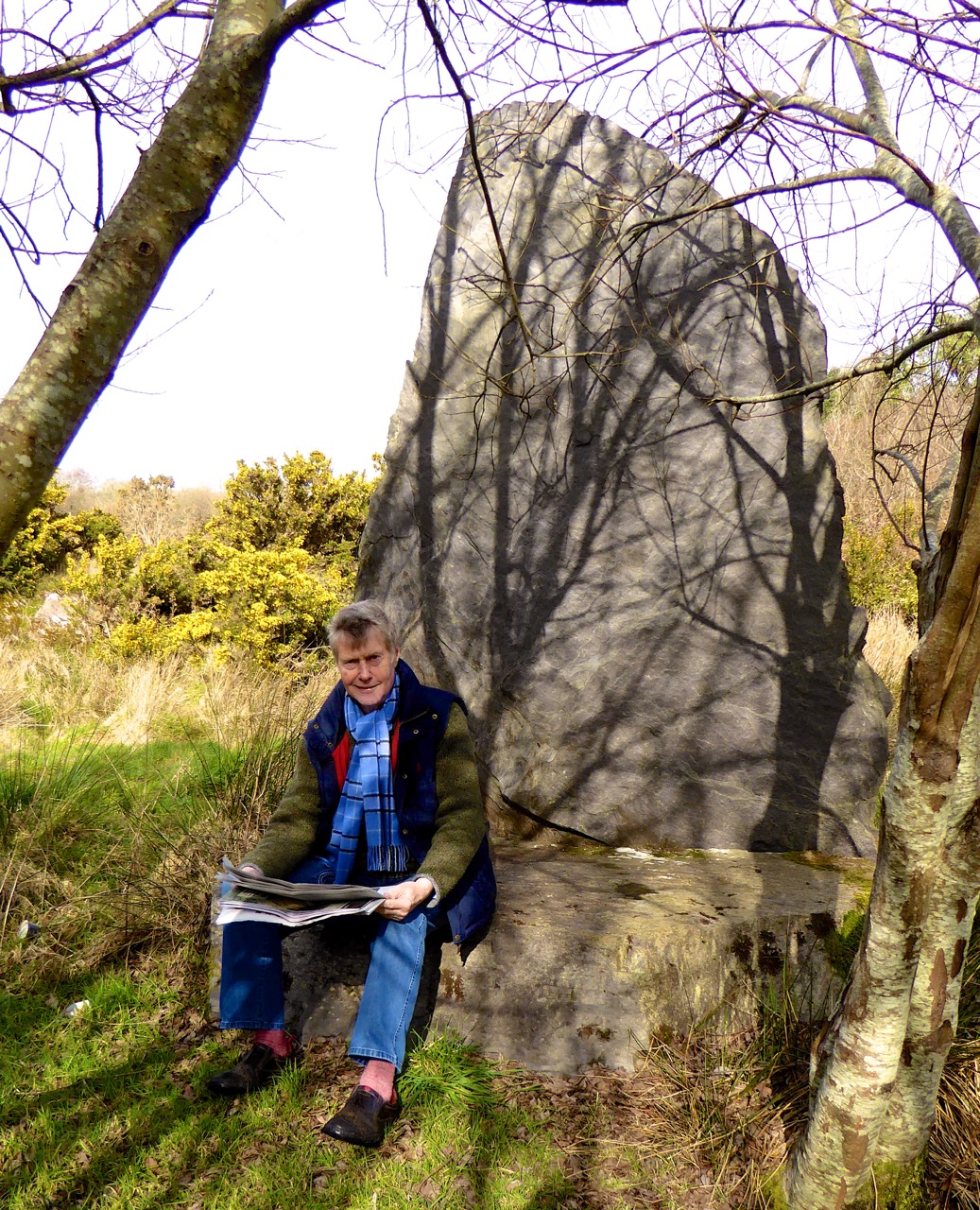
Time for the weekend paper – Robert takes to the Druid’s Chair

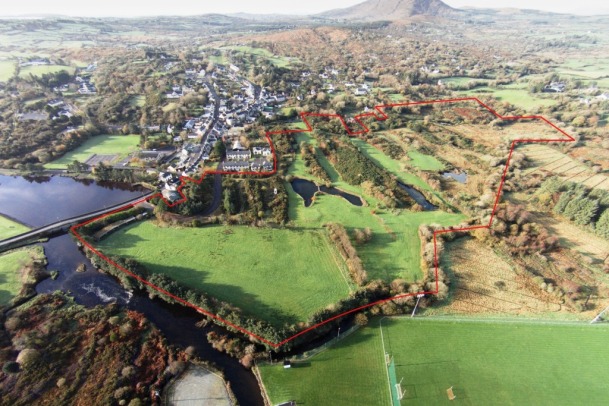
Right behind the main village street in Ballydehob is a spectacular example of twentieth century Irish history: a golf driving range with a prehistoric theme!

Aerial view of the site

Aerial view of the site

Ballydehob’s Golf enterprise came with the Celtic Tiger – and went when the Tiger collapsed. It’s now a site looking for a buyer – you could have it!

for sale

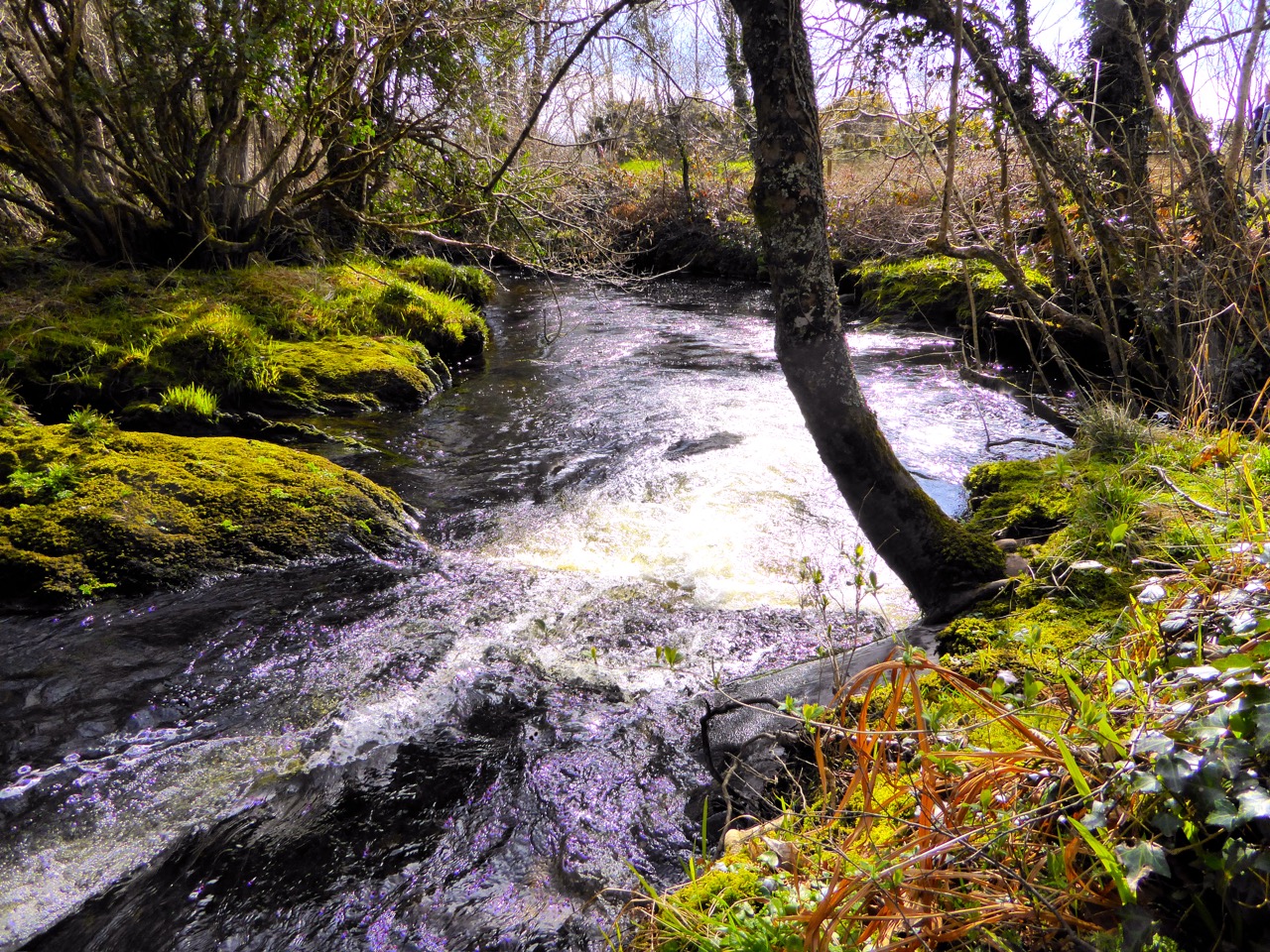
But we do hope that if someone does buy the site, then they keep all the features: the winding paths by the river, the parkland which feels so rural and secluded, yet is within a stone’s throw of the main N71 highway – and all the New Archaeology...

Riverside Walk...

Riverside Walk…

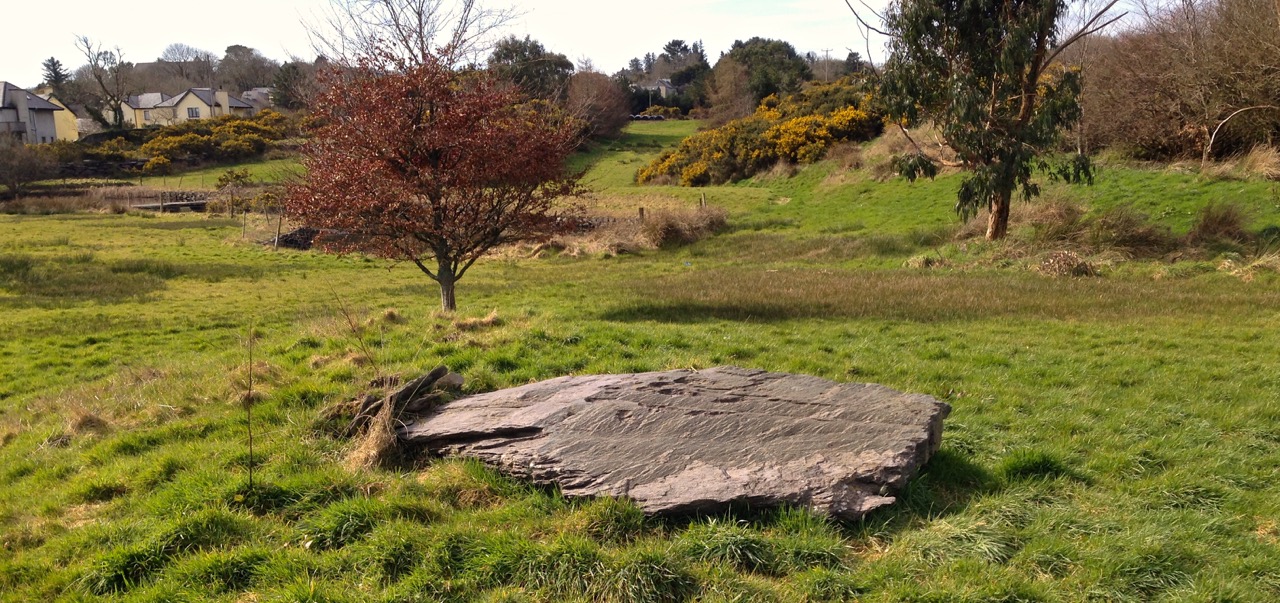
Boulder Burial...

Boulder Burial…

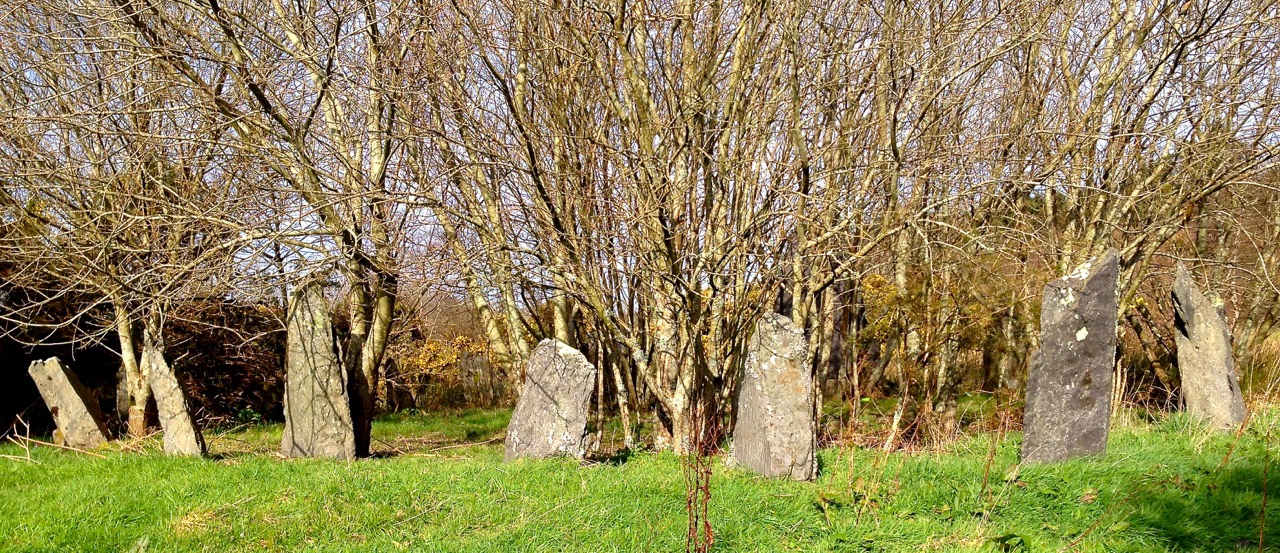
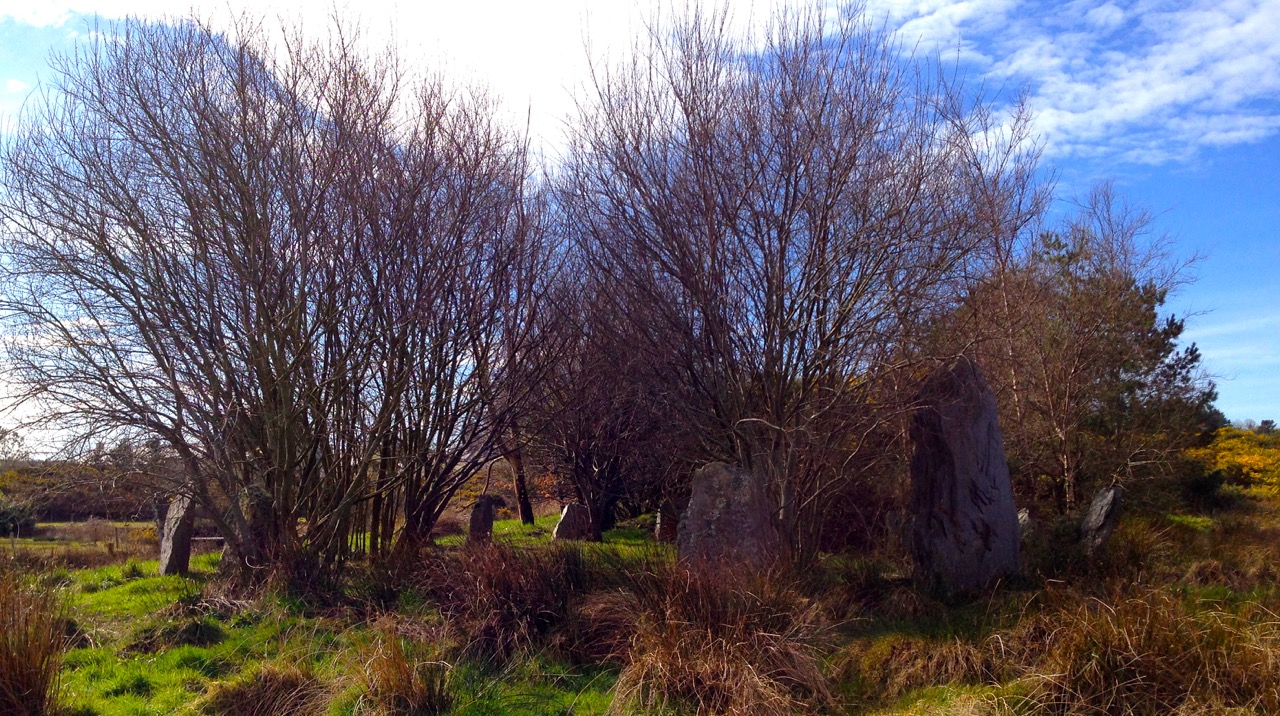
Circle within an 'ancient grove'...

Circle within an ‘ancient grove’…

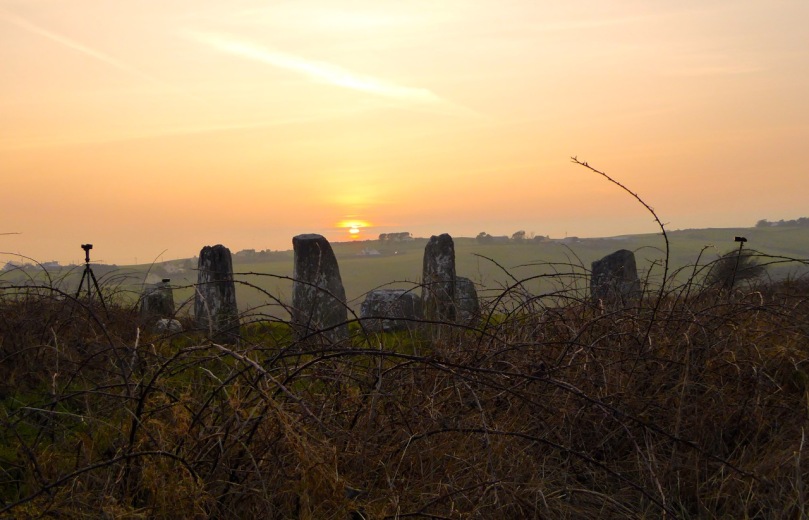
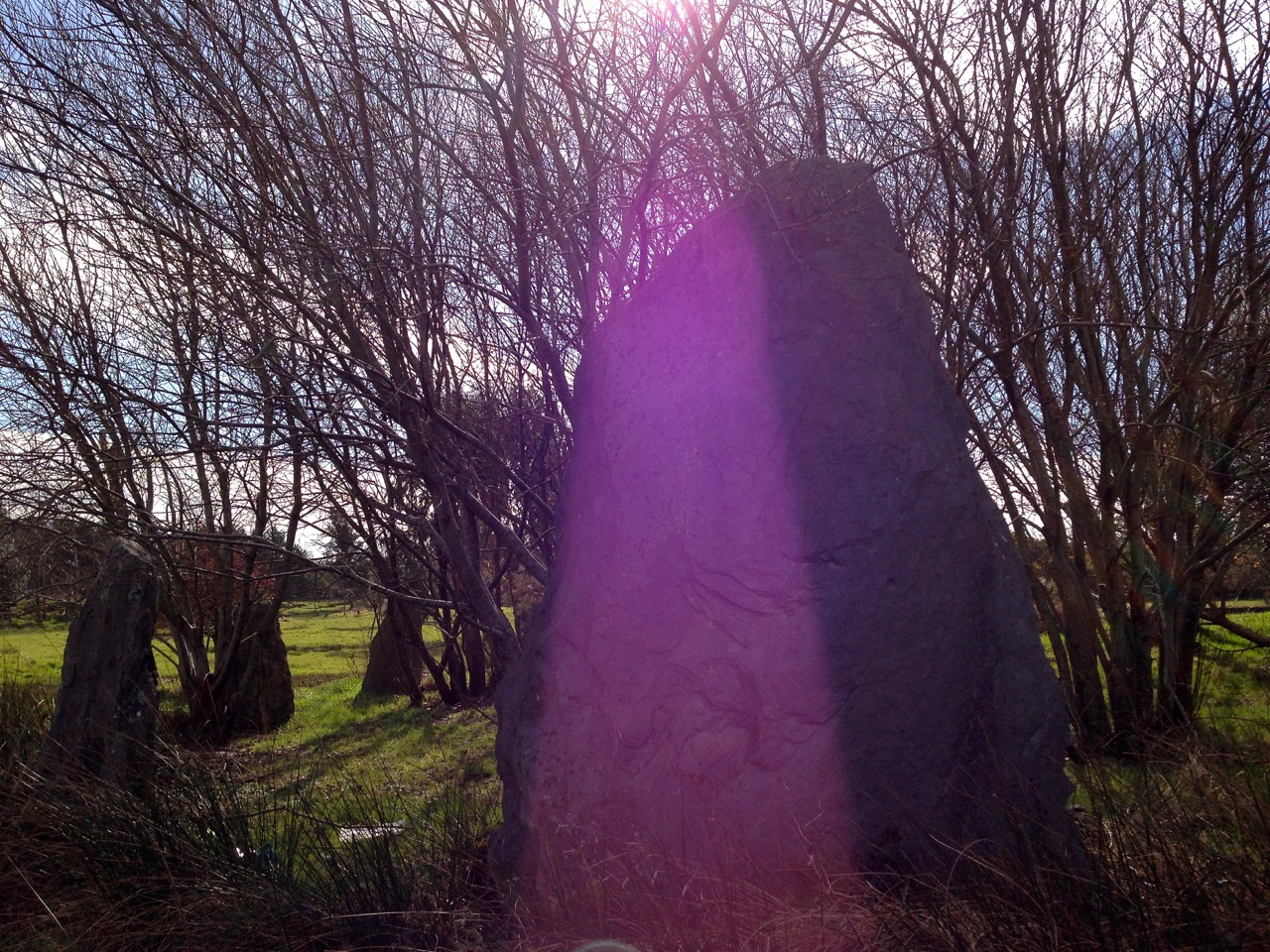
Megalith, enjoying a trick of the sun...

Megalith, enjoying a trick of the sun…

The unfortunate demise of the West Cork Golf Academy has left Ballydehob with an unofficial ‘town park’ – a very pleasant place to walk on a balmy spring morning. If only there was a way that this could become a permanent amenity for the community. But the land has a value and – presumably – potential for some worthwhile development. Who knows what the future holds? Meanwhile, we enjoyed our chance discovery of New Archaeology right on our doorstep!

PS – since publishing this post earlier today, I realise from comments received that some readers have been puzzled by it: rest assured that all this ‘new’ archaeology dates from the twentieth century – and was constructed as part of the golf project! They made such a good job of it that it could just prove very confusing for archaeologists of the future…

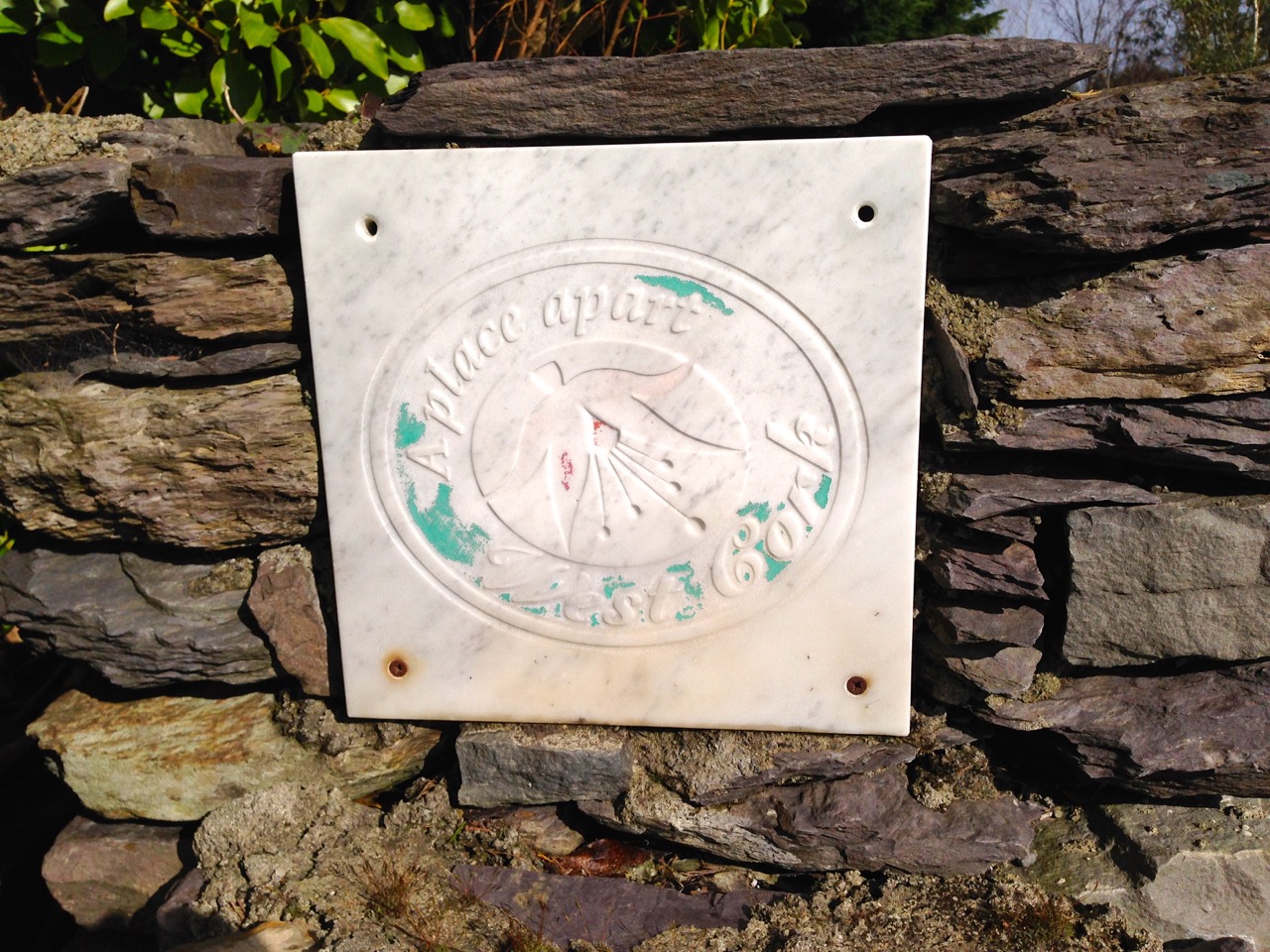
A Place Apart certainly - the Fuscia Brand labelling dating from better times

A Place Apart certainly – the Fuschia Brand labelling dating from vanished times

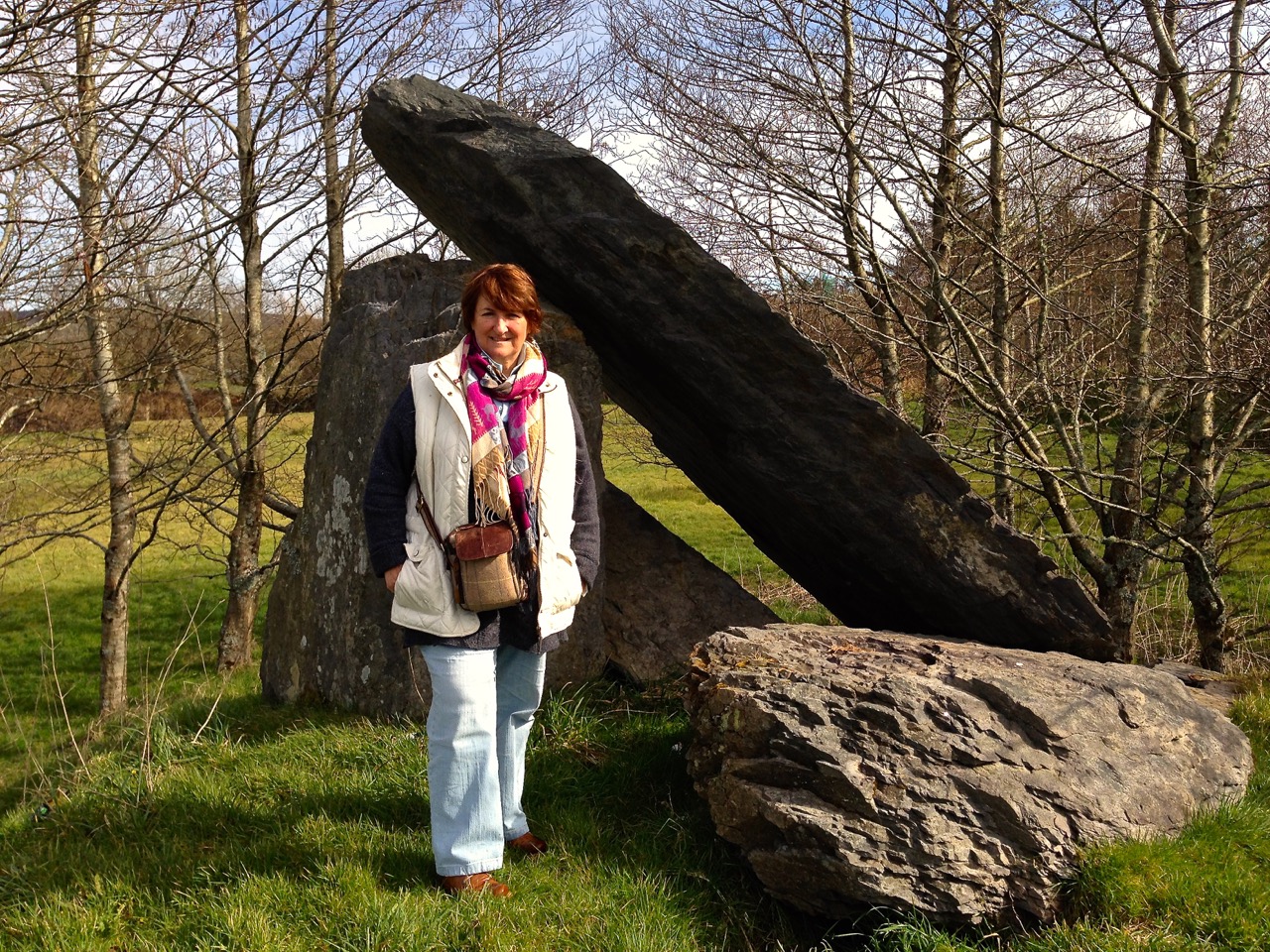
Finola enjoys the spirit of 'A Place Apart'

Finola enjoys the spirit of ‘A Place Apart’


The Deer Stalkers

Young Sika stag in the Glendalough Highlands

Sika stag in the Glendalough Highlands

Having spent many years in Northern Canada, surrounded by moose, elk, caribou and deer, I was intrigued to learn that Ireland also has a significant population of deer. The Red Deer is our only native species, preserved thanks to the work of private conservationists in Kerry and now reaching healthy population numbers. Fallow Deer are the ones you see in parks (like Dublin’s Phoenix Park), although there are lots of wild ones too, descendants of those introduced by the Normans in the 12th Century. Finally, there are Sika Deer, introduced by Lord Powerscourt in Wicklow for his demesne, but now numerous in wild herds in the Wicklow Mountains and elsewhere. Here in West Cork there are occasional sightings of both Red Deer and Sika Deer – including narrow misses by drivers.

Deer hunting has become a sport in Ireland and the licensing laws are constantly being examined and refined. Deer in parks are generally protected, and Red Deer may not be hunted at all in County Kerry. The Wild Deer Association of Ireland, an ‘independent, national organisation for deer management and conservation,’ represents ‘those involved  in deer management, deer stalking and people with an interest in the conservation and well-being of Ireland’s wild deer herds.’ Their excellent website is packed with information for any questions you might have about wild deer. Deer management is not uncontroversial in Ireland, as attested by a recent article in the Irish Times by naturalist Michael Viney.

Upper Lake, Glendalough

Upper Lake, Glendalough

Having grown up in Wicklow, I had become interested in the work of Fran Byrne, a wildlife and landscape photographer of the highest calibre, and when we saw that he was leading a Deer Photography Workshop in the Wicklow Mountains we jumped at the chance to enrol.

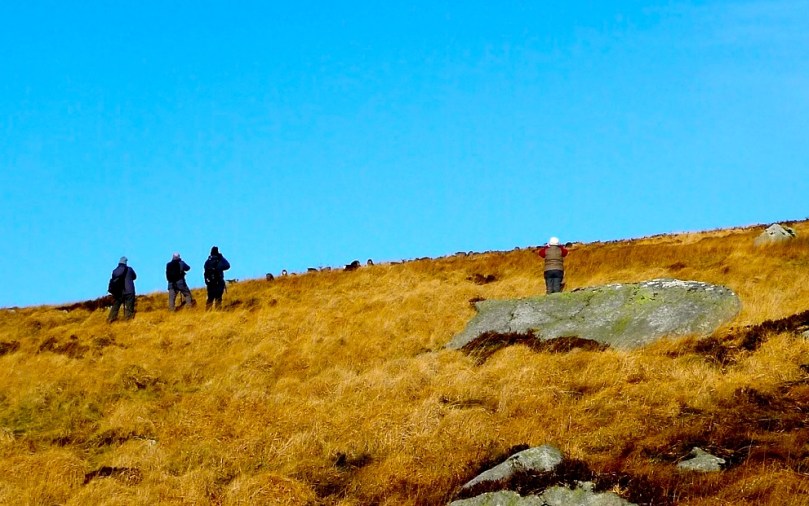
Deer on the horizon!

Deer on the horizon!

The word ‘workshop’ conjures up an image of earnest participants wearing name badges and writing on flipcharts, but Fran had warned us that this was not what we were signing up for. Having met our fellow participants (great group!) on Friday night, we gathered on Saturday morning, picked up our packed lunches from the hotel and set out, equipment in hand, to hike up to the highlands above the Upper Lake at Glendalough. (Glendalough, one of the most historic and beautiful places in Ireland, deserves its own post some day.) Once I saw our route I was glad to be carrying my tiny Panasonic Lumix camera rather than the enormous equipment of the other enthusiasts, because this was a HIKE.

Getting up to the head of the glen was arduous enough, but then we struck out across the trackless wild country. It was rough and wet, there was a biting wind (this was January, after all!) but Fran promised us that the deer, after recent snowfall, would be down from the higher ground and we had a good chance of sightings. And suddenly, there they were!

Stag and pricket

Stag and pricket

At this time of year the stags are rejoining the females and hanging out in herds. We saw male-only groups, females with young ones, and mixed groups. Our eyes gradually tuned in to the tell-tale white rumps moving through the bracken and rocks as we scanned the hillsides. Some of the deer, particularly one doe, seemed unbothered by our presence, others ran skittishly when we approached. I was grateful for the long lens on the Lumix, which allowed me to get some good shots where we couldn’t get too close.

Martin in full camouflage

Martin in full camouflage

Back at the hotel we downloaded our photos, Fran gave us pointers on processing the images and we admired each other’s captures. An excellent dinner and lots of chat later, we were all yawning after our exertions. But back we went again the next day, groaning and stiff but determined to get up to the high ground again.

After the clear blue skies of the previous day, we were presented with a mist that descended on us and worsened during the morning. Nevertheless, having taken  a different route we were rewarded again by good sightings.

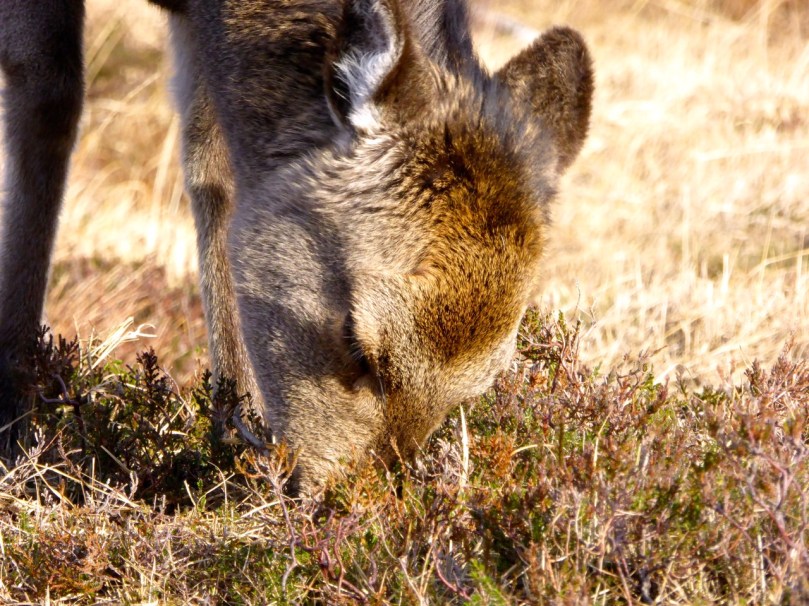
Hind feeding

Hind feeding

We were particularly lucky to be joined by Joe Murphy, a deer expert and leading member of the Wild Deer Association. He filled us in on the current state of Irish deer populations, what threatens them (their only predator is humans), modern management practices and hunting regulations. He also volunteered to climb above one small herd to see if they would move away from him and towards us. Unfortunately, a lone hiker heading up into the hills scattered them before they started down.

Two prickets

Two prickets

Browsing near the stream

Browsing near the stream

I’m not sure when I was last as footsore and achy as I was last Monday morning, but it was worth every creaking bone and every throbbing muscle. If you’d like to do the same, contact Fran Byrne through his Facebook page. And don’t worry, you won’t have to slog up the mountain to take a workshop with him as he also does woodland rambles and garden walks. Mind you, he did describe our exertions as “leisurely” at one point, so be prepared!

There are wild goats on the cliffs too

There are wild goats on the cliffs too

Whisperers

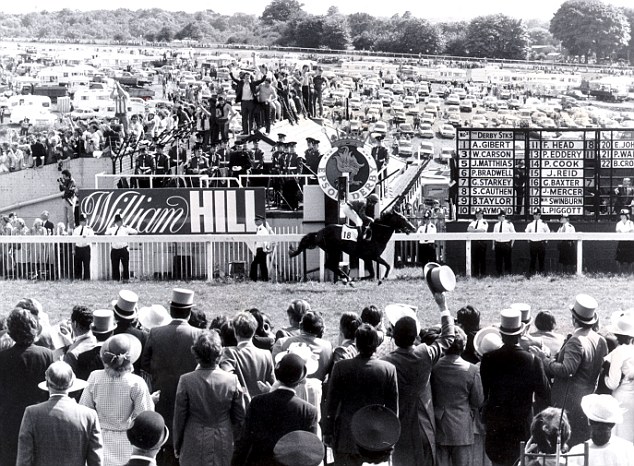
Shergar wins the 1981 Derby by ten lengths!

Shergar wins the 1981 Derby by ten lengths!

The skill of the Irish in breeding, training and riding horses is unbounded. These arts are swathed in folklore and storytelling as much as in reality. Take Shergar – record-breaking racehorse whose 1981 win was the longest margin in the Epsom Derby’s history: after an illustrious career the horse was kidnapped from Ballymany Stud, near The Curragh in County Kildare by masked gunmen – and never seen again. The incident has been the inspiration for conspiracy theories, books, documentaries, and a film.

You’ve all heard of the Horse Whisperer, a novel by Nicholas Evans which, in 1998, became a blockbuster film starring Robert Redford? Well, the term ‘Whisperer’ was around long before that, used to describe people who communicate with and train working horses. As far back as 1648 it was recorded that a Sussex horseman, John Young, had the art of controlling horses ‘…by means of the whisper…’ – but the most famous of the historical ‘Whisperers’ is a man from County Cork, James Sullivan. He was born in Mallow towards the end of the eighteenth century, ‘…an ignorant, awkward rustic of the lowest class…’ according to Mile’s Modern Practical Farrier, 1843. Sullivan ‘…gained the singular epithet of Whisperer by an extraordinary art of controlling in a secret manner and taming into the most submissive and tractable disposition, any horse or mare that was notoriously vicious and obstinate… He seemed to possess an instinctive power of inspiring awe, the result perhaps of a natural intrepidity, in which I believe the greater part of the art consisted… A faculty like this would have, in other hands, made a fortune; but Sullivan preferred to remain in Ireland…’

A woodcut by C F Tunnicliffe

A woodcut by C F Tunnicliffe

It’s worth quoting a little further from the story of this man from Cork, here from one of my much-thumbed books which I have carried with me for countless years – The Horse in the Furrow, by folklorist George Ewart Evans:

‘…Sullivan’s best known exploit was his taming of King Pippin, a notoriously vicious horse, at the Curragh in 1804. A man who had offered to put on his bridle had been seized by the horse and shaken like a terrier shaking a rat. He was saved only by the amount of clothes he had on his back. It appears that this was the custom of the Irish countryman to show off his wardrobe on occasions such as this, and if he had three coats he put them all on. After this incident they sent for Sullivan to subdue the horse. He shut himself up with him all night, and in the morning the horse was following him about the course like a well trained dog: he won a race at the same meeting…’

Another of my favourite writers whose many books pad out the folklore section of our library here at Nead an Iolair is Kevin Danaher. I can’t resist quoting from The Horseman’s Word in Irish Country People, Mercier Press, 1966:

‘…At the horse fair the buyer would look out for the characteristics of a good horse as laid down in the old saying: “…Three traits of a bull, a bold walk, a strong neck and a hard forehead; three traits of a fox, a light step, a look to the front and a glance to each side of the road; three traits of a woman, a broad bosom, a slender waist and a short back; three traits of a hare, a lively ear, a bright eye and a quick run against a hill…”

A first hand account of Whispering from Danaher’s childhood:

‘…It was at a fair in Rathkeale that I saw for the first and only time the strange power of the “horseman’s word”. A young colt, either through fear or perverseness, was prancing and kicking wildly when a boy of about seventeen walked in and fondled the horse’s nose, talking quietly. Immediately the colt became calm and the boy took the headstall and led him up and down as meek as a lamb. We were told that this boy, the son of an itinerant horse dealer, had the power to calm any horse. Some people said it was a hereditary secret in his family, others that he had learned it from an old Palatine farmer in the district who also had this strange gift. It was said, too, that as well as being able to quieten horses and break untrained animals in a matter of minutes, this boy could get a horse to stand still and not move for any force or persuasion until he or somebody else who had the power released it. There is no doubt at all that certain persons have this gift, not only in Ireland but all over the world, but no satisfactory explanation is forthcoming. In Ireland it is known as ‘cogar i gcluais an chapaill’ or simply ‘the whisper’ and its potency is held to lie in the words which are spoken in the horse’s ear…’

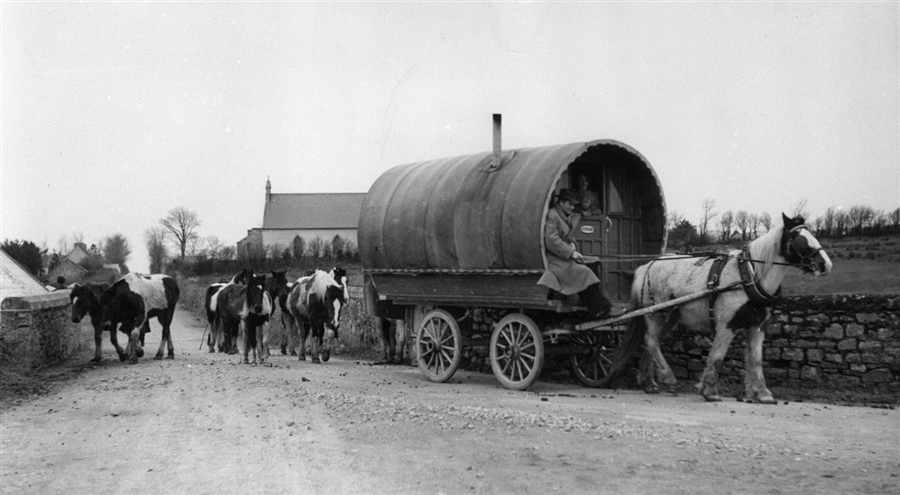
Irish Travellers, County Clare 1951

Danaher mentions an ‘itinerant horse dealer’. Today we might call them Gypsies or Travellers. In Ireland they are well-known for their skills in horsemanship, and for breeding a very particular type of draft horse, suitable for pulling the vardo and also for riding and sulkie racing. The horses are often piebald or skewbald. You may be sure that the Travelling fraternity are natural Whisperers!

The 'Gypsy Horse' is a light draft cob

The ‘Gypsy Horse’ is a light draft cob

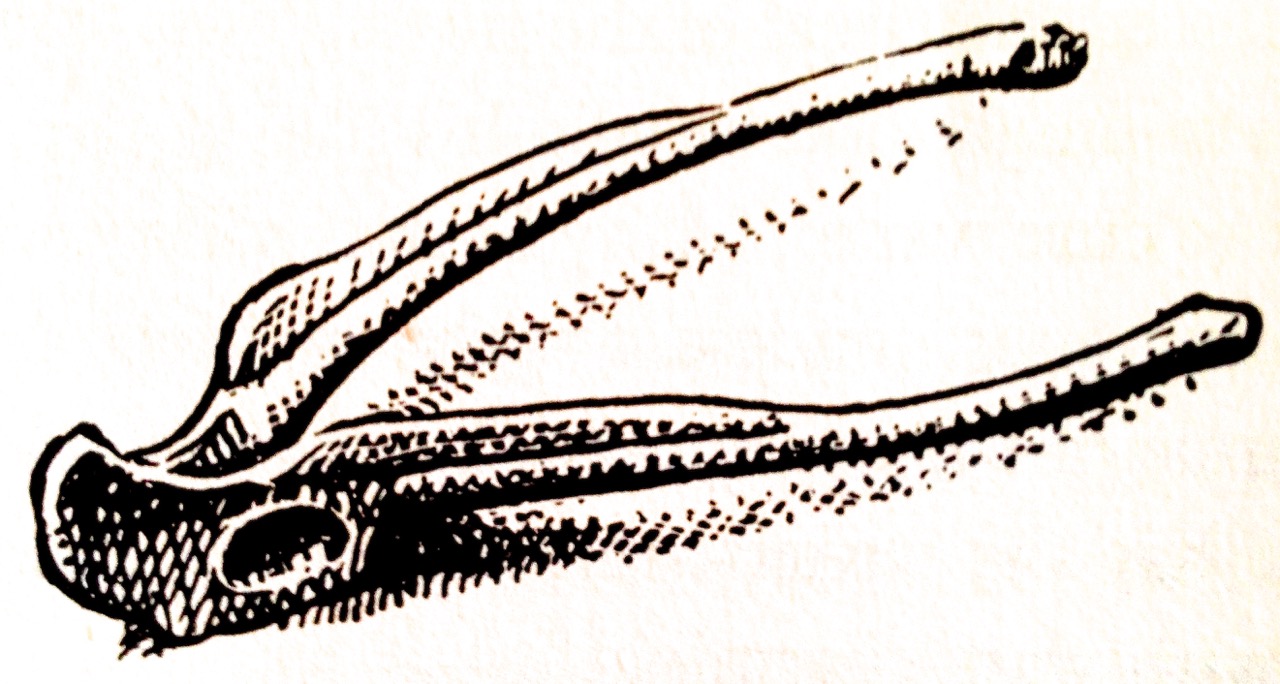
Both Evans and Danaher mention the Toadmen in their discussions. These characters would use divination to gain their power over horses. One such ritual was called the ‘Water of the Moon’, and was commonly practised in the East Anglian and Cambridgeshire regions of England. It required that the horseman kill a frog or toad and hang the body on a thorn tree until only the skeleton remained.  At full moon the man then had to take the skeleton to a running stream and throw it into the water.  One small forked bone would detach itself from rest and float upstream, and it was this bone from which the horseman would then derive power over horses.

The magical bone of the Toad...

The magical bone of the Toad… (Tunnicliffe)

Have a look at this clip from Canada – it’s not Ireland, but it’s about a modern day Horse Whisperer, and makes good watching…

Speed the Plough

Speed the Plough

In England today – the first Sunday after Epiphany – they ‘bless the plough’. I can’t find any mention of a similar tradition in Ireland, but please let me know if you are aware of one. It’s because the day marks the end of the agricultural holiday which follows Christmas: tomorrow is Plough Monday – the first day of the farmers’ working year – which has its own traditions. Ploughs were traditionally taken around with collecting boxes by mummers and molly dancers in parts of Eastern England, and in some places were used as a threat: if householders refused to donate to the participants their front paths would be ploughed up! Of course the ploughs used in these customs were all drawn by horses at one time – something that hasn’t died out yet: our friends Tim and Sandra keep their own working horses here in West Cork, and I’m quite sure they have mastered the art of Whispering for themselves.

philatelynews-irish-horse

Bird Diary

birds group wb

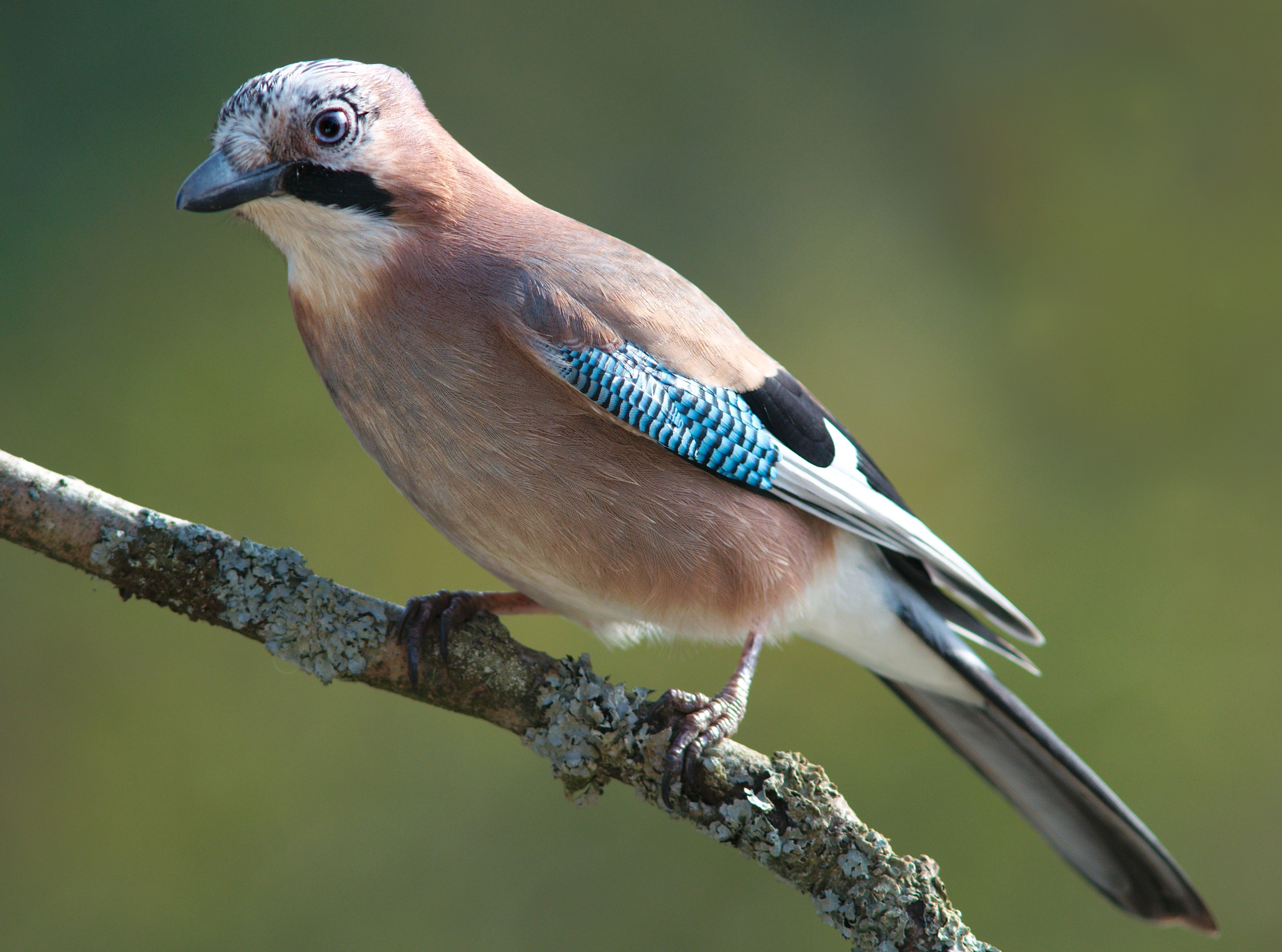
Since we started this blog, back in 2012, I have regularly written posts on the many bird varieties which we have around us on the coast of Roaringwater Bay. There are lots to add! Watch out for more entries in the future which will include some of our new arrivals. In the garden of Nead an Iolair the other day we were surprised by a male Sparrowhawk perched on the wall: the small birds all kept well away! Recently we’ve been visited by Jays, too – someone else the smaller birds shun, as it is partial to stealing eggs and young.

jay

Today I’m going to recap on our feathered companions up here. Remember – if you see something printed in blue on these posts you can click on it and it will link you to a new page on the subject mentioned.

Loons (sketches by Richard Allen)

Loons (sketches by Richard Allen)

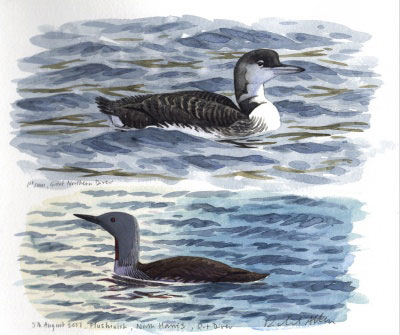
Almost a year ago I talked about the Great Northern Diver – or The Loon, as it is called in Canada. It’s only one of the many wading and shore birds which visit the unspoilt coastline in these parts. Watch out for future posts on Oystercatchers (which have already received a brief mention), Curlews, Gulls and Ducks, to name but a few.

Charm of Goldfinches - photo by Maurice Baker

Charm of Goldfinches – photo by Maurice Baker

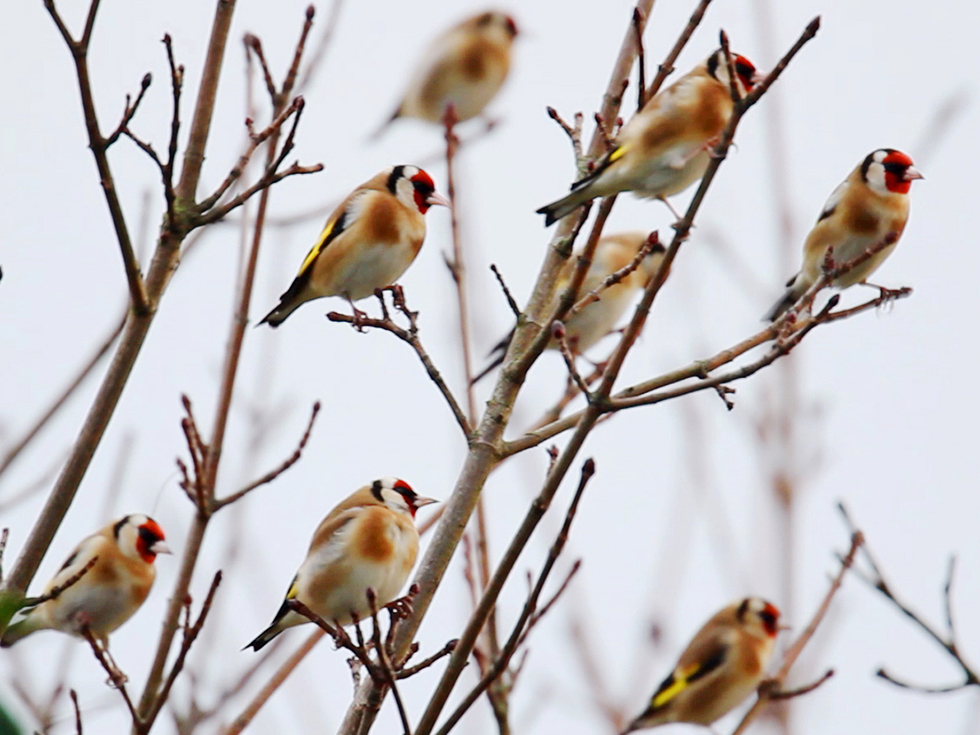
In November of last year I discussed the Charm of Goldfinches which visited the bird feeders in our garden. We saw nothing of them through the summer – in fact they were absent until this November, when a whole flock suddenly descended upon us in one day: now they are regular attenders again.

Fly-past at Ard Glas!

Fly-past at Ard Glas!

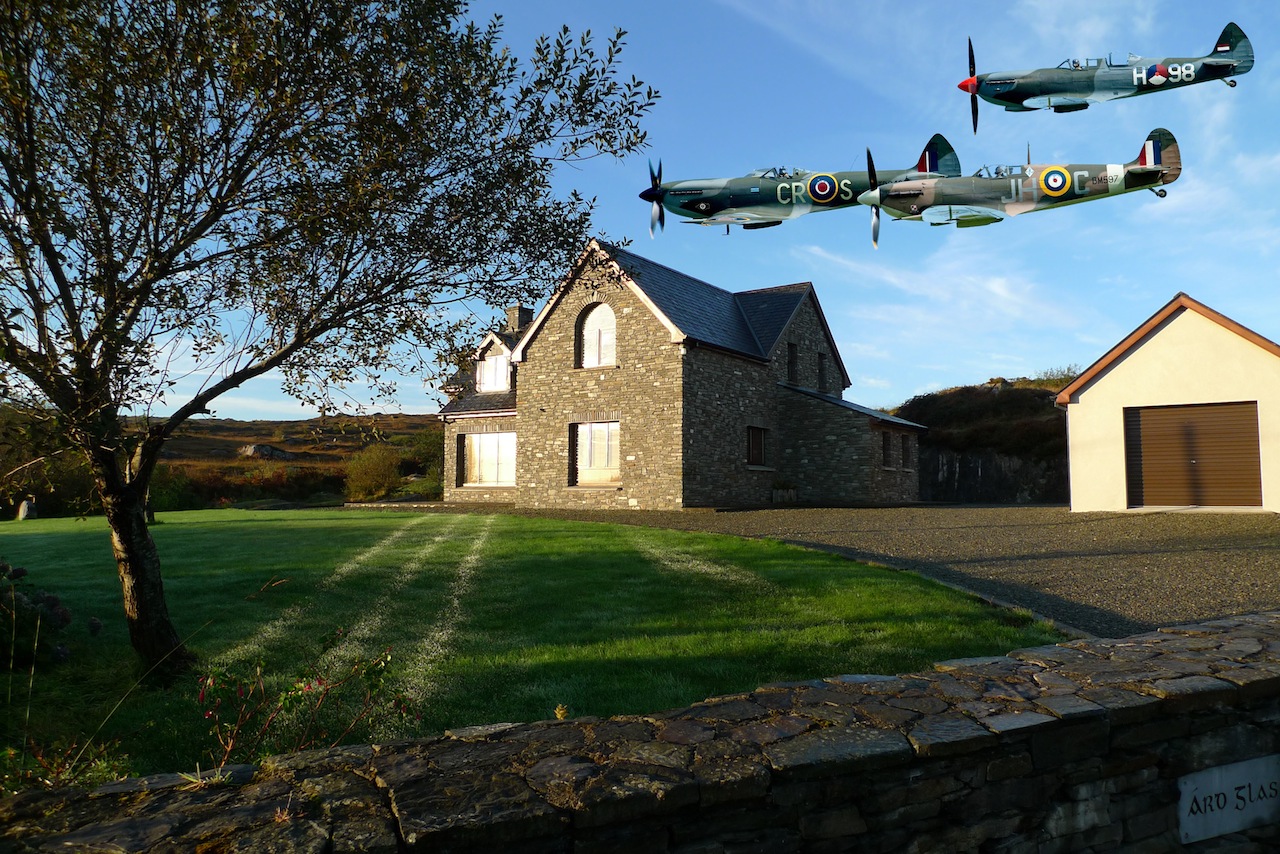
The very first bird post that I put on the blog was Aviation – and this was when we were renting Ard Glas. That was a general review of the birds that came to our luxurious new bird table which Danny made for us – now sadly demolished by Ferdia the Fox who is as fond of peanuts as the birds are…

heron

Since then I have introduced you to Old Nog the Heron – who flies over us quite frequently, made a passing reference to the Swans who live below us in the Cove (but see more below), and set out a whole lot of fact and folklore about the wonderful Barnacle Goose.

Legend of the Barnacle Goose

Legend of the Barnacle Goose

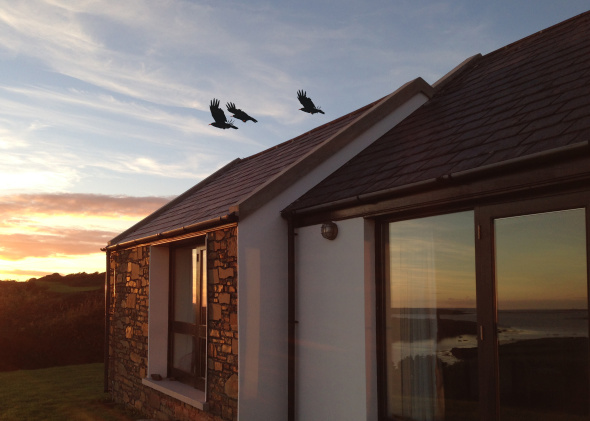
My favourite birds of all here are the Choughs. This is because they had died out in my home county of Cornwall (where they appeared on the coat-of-arms) when I lived there, although a programme to reintroduce them was started a few years ago and I was delighted to see a pair foraging on the coastline there just before I left. Imagine how pleased I was to discover that Choughs are resident all around Nead an Iolair! They perch on our roof, forage on our rocks and generally make themselves known to us through their distinctive cry of Cheeeeough

Choughs over Nead an Iolair

Choughs over Nead an Iolair

The seasonal bird of the moment is the little Wren. On St Stephen’s Day (26 December) this – the King of all the birds – has to take cover, because he is being hunted!

Troglodytes troglodytes

Troglodytes troglodytes

Wren Boys in Cork (Maclise 1843) and drawing by Jack Yeats

Wren Boys in Cork (Maclise 1843) and drawing by Jack Yeats

Amongst many other creatures, Swans are depicted in the Honan Chapel – that gloriously effusive celebration of stained glass and mosaic art.

Honan Chapel Swans

Honan Chapel Swans

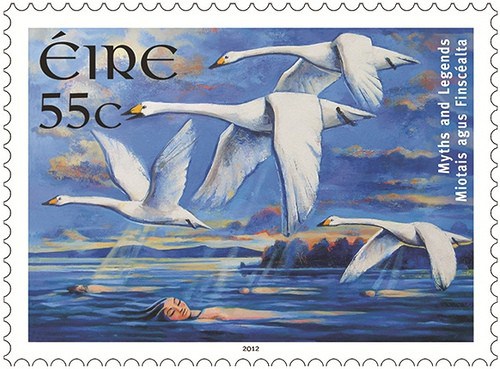
They are also well represented in Irish folklore – most prominently in the saga of The Children of Lir. Here the enchanted children are destined to live out one of their fates – 300 years in the cold, inhospitable Sea of Moyle:

stamp-children-of-lir

A Midwinter’s Tale

winter gales

We’ve established a little tradition for Christmas: we include a story, ideally to be read by candlelight huddled beside the stove just at the turning of the shortest days. Last year Finola wrote of childhood memories – Christmas in Dublin; the year before that I penned a version of a haunting Irish folk-tale. This year it’s my turn again, and I’m including a story which is based largely on events which really happened many years ago in the small Devon village where I lived. They bring to mind our own stormy winter which we survived earlier this year here in Nead an Iolair…

winter

Kathleen by Robert

Kathleen was a large woman alright.  If you saw her in the field, there was no mistaking her profile:  she always wore two coats, one on top of the other, and at the bottom they flared out like a church bell.  I never saw her without her great legs jammed into a pair of old wellington boots – except in chapel of a Sunday – and on her head was the same shapeless piece of faded red knitting, year after year after year.

Kathleen became a neighbour of ours soon after Mr Monihan’s passing.  – And there was a strange thing, too.  I never heard it from Kathleen’s mouth direct – but then I never heard her deny it either – but everyone in the village was sure enough of the story.  He had been a smallish man, I suppose; certainly, he was small by comparison with Kathleen.  They shared the marriage bed late in life, for he’d taken herself – a confirmed spinster – as his second wife long after his own children were out in the world.

Well, it was about two years into the union that Kathleen first noticed her husband’s night wanderings.  She would wake in the morning – so the story goes – and find him cold and shivering beside her, with the smell of the sea all around.  Time and again this happened, and because he would say nothing about it, she determined to find out what was going on.  A certain night they went to bed as usual; she lay quiet but kept herself awake by repeating the Our Father over and over into the bolster.  It came to the deepest part of the night, and Mr Monihan seemed to be peacefully asleep, while Kathleen was feeling very tired and wondering what she was about.  Suddenly, he started up, crept across the room to the door, and in a minute was out of the cottage.  He had paused only to put on his old black cape that always hung on the peg.  Just as quickly, Kathleen was out too, but she was careful to keep hidden away behind him.  Down the hill they went, through the sleeping village and out on to the beach, he walking so fast that she had some difficulty in keeping him in her sights.  Eventually, she lost him altogether in the rocks over by where the cliffs start.  She searched for an hour and then gave up, returning crossly to her bed.

In the morning he was back again, but cold and shivering as usual.  Kathleen went over to the peg by the door and felt his cape:  it was streaming wet, and flecks of sea-foam still clung to it.

Of course, Kathleen confronted him with the story and wanted to know what it all meant.  He just shrugged and claimed to know nothing of it; as far as he was concerned, he had slept all night in his bed and woke up in the morning as cold as any old man would be.  So there was a pretty poor state of affairs for Kathleen.  But she accepted it in the end, as we all accept the mysteries in our lives.  She did try to follow him again, but had no more success than before.  She closed her mind to it and denied its happening, even to herself.

A while after, he was gone altogether, and his black cape with him.  She waited a day and a night, then went down to the rocks to search for him.  He was never found, and everyone accepted that he was drowned while in pursuit of his trade, which was kelping.

After that Kathleen moved up the hill into the little thatched cottage across the lane from us, and took up the kelping herself.  I would often meet her coming across the sand of an evening, the great dripping net slung over her back and she bent with the weight of it.  Yet I never heard her complain, and she a widow so soon.

She was not companionless for long.  One of her husband’s daughters who lived away in the city with a family of her own fell on difficult times and sent her own son to stay with Kathleen.  This was a weak looking boy of about fifteen years old.  The arrangement was meant to help Kathleen as well as the mother, but I never once saw him lift a kelp net, and doubted if he was even able.  Instead, he followed her around like a dog, and seemed more of a worry to her than ever her widowhood had been.

What happened after was only learnt by the villagers in the course of time, and much of it hearsay in any case, as Kathleen always kept herself to herself.  She must have been aware of the stories that went about but was never known to confirm any aspect of them.  On the other hand, she never uttered against them, so they are probably worth the telling.  I saw little enough of the events myself, although I was aware at the time that Kathleen was in some way troubled.
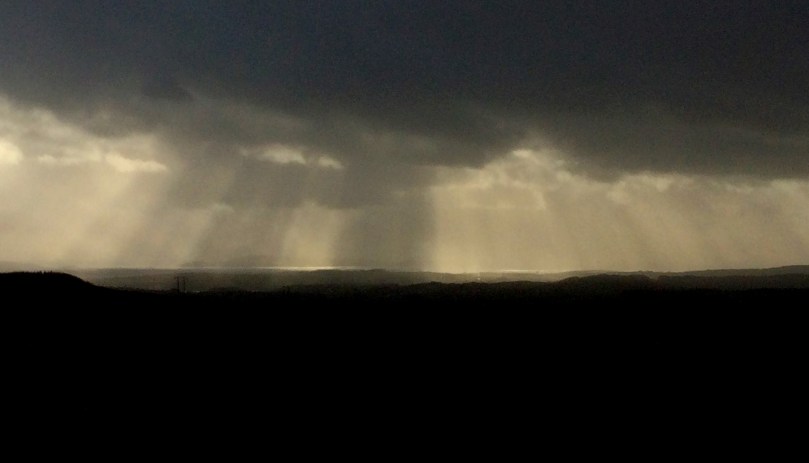
Storm clouds

It was late in the year; nights were long.  The cottage had only one bedroom – Kathleen’s – and the boy slept on a settle in the kitchen.  On our wild coastline, dawn is hailed not by a cock’s crow, but by the first wailing of sea birds that collect in huddled crowds over the off-shore rocks.  One of these winter mornings Kathleen was just stirring herself when she was startled to find the boy standing by her bed.  He had thought that she called him – somebody or something had called him – so he came from his place on the settle to see what was wanted.  She paid little enough heed of it the once, but when it happened again a second and a third night, well – then she started to worry.  On the fourth she stayed up, sitting herself in a hard chair by the embers of the hearth so that the discomfort of it would keep her awake.  She kept the Good Book beside her.  She was determined to wait the night out, but drowsiness overtook her and she suddenly awoke in the early hours to find the boy had sat bolt upright and was staring sharp at the cottage door.  He seemed not to hear her when she spoke but eventually came to, like one shaken out of a dream, and told her that – again – there had been the voice crying to him in the night.  She made light of it, and convinced him it was no more than the wind and the sea, but inside herself she knew there was something else.

After that, Kathleen could not rest easy without taking the precaution of fitting a large lock to the door which faced down the shore road – something she had never lived with all her life before – and when she went to her bed at night, the key was firmly under her pillow!

The solstice passed, and days grew longer.  Gales came, as they always do in January on our coast.  But in that year these were savage gales, far wilder than anything I had experienced in my lifetime.  The glass in the hall fell and fell again, until the little brass pointer was hard against its bottom stop.  We kept around our firesides, then, and listened to the storms hurling themselves against us, our windows and doors rattling and moaning from the wind wanting to tear us from our refuge.  Some days there would be a little respite, and we would venture outside to pick up the broken slates and chimney caps that littered the lanes and gardens.  At these times, we saw how the sea had thrown itself halfway up the village street as though angrily trying to reach out for our hillside homes, having already washed over those against the harbour.  There was no kelping could be done – the huts on the shoreline were in any case smashed and the nets all gone – but Kathleen could never be idle:  she feared for her roof and I watched her throw thick cords across the ridge of it, and lash them to great boulders at the eaves to weigh it down.  All this she did from ladders with the wind still high, she heaving the heavy rocks on her own while the boy stood under her, useless as a lame sparrow.

These lulls were short, and were each time followed by yet worse weather.  The peak of it came towards the end of the month, with a roaring wind that you could not stand up against.  It brought our chimney down, and the church steeple too, which went through the nave and ruined it.  A day and a night it lasted with us all crouching indoors, wondering what havoc we would find around us if ever we survived.

stormbow

The morning that followed after was, unbelievably, as quiet and as calm as spring.  There was not a breath of air moving; the wind seemed to have blown itself right away.  We crept out and viewed the devastation.  It was bad, but it could have been worse.  There would have to be a lot of roofing done, but generally the old stone walls had taken the battering well.  In the course of time we were thankful to discover that no-one in the village had suffered injury to themselves.  Like us, they had each one hidden away by the safety of their own hearth.  Kathleen was not so relieved however, and I realised her agitation as soon as I crossed the lane to find how she herself had fared.  She showed me where her door lay half in and half out of the tiny porch, as though it had been picked up in the night by some gigantic hand.  The rest of the cottage was undamaged, the roof intact under its protection.  But the boy was vanished.

We got together a search party as soon as it could be managed, and went after Kathleen who had gone straight down to the rocks at the end of the beach, close under the cliff.  All that day and all the next we searched, but never a trace we found.  I happened on an old black cape lying half in one of the pools but left it for the tide to take back again.

A few years have passed since these things occured.  The winds have never been as rough again as on that night when Kathleen’s boy was lost.  The village gradually got itself back to normal, and the sea has done its best to wash over the memories.  The cottage across the lane is unchanged, except that it has a new entrance door.  I often meet Kathleen striding across the beach with her loaded kelping nets:  I would like to ask her if she still locks herself in at night.

storm sea

The gale found us again this last January.  I lay in bed unable to sleep for the fury of it beating itself over the sea walls.  Or perhaps I did drowse – for I fancied that just before daybreak the storm dropped, and from beyond it there came a faraway sound unfamiliar to me, as of someone calling out of the night.  Calling my name.  I shook myself properly awake.  No, I could not still hear it; it must have been one of the sea birds on the islands shouting in advance of the dawn chorus.  In the morning I went down to the beach.  There was Kathleen as usual, pulling through the combings of the high tide with her long wooden rake.  I passed her by, and walked out to the end of the sands, where the cliffs begin.  I had thought that the sounds of the breaking surf would wash the night-cries from my ears or my head.  Yet they still rang clear inside me. I started, then, when I suddenly came upon two figures – they were two great black seals who when they saw me threw their heads in the air and cried out, and their cries were carried away by the wind over the village and over the hills.  I watched as the creatures slid back clumsily across the sand until the water took them.  Still they cried as they swam away, their snouts raised up through the racing froth.  At the far end of the beach I saw a small stooped figure – Kathleen it was – raise her hand briefly to her eyes to watch after them.

church tower

The church in Hatherleigh, Devon, destroyed by the hurricane of January 1990

Shenanigans

running fox

The word shenanigan (a deceitful confidence trick, or mischief) is considered by some to be derived from the Irish expression sionnachuighim, meaning ‘I play the Fox’. That’s by no means the only definition of shenanigan that you’ll find, but – for me – it’s a good one.

The Red Fox stops by Nead an Iolair on most days. He’s such a frequent visitor that he’s trodden a furrow across the lawn – which he follows meticulously in order to keep his feet dry: he’s a fastidious creature is our Ferdia.

It’s a bit unkind, perhaps, to always think that the Fox is up to some kind of shenanigans. That would be playing up to his reputation of being cunning or sly. Our Ferdia is pretty open about why he takes an interest in us – purely and simply, it’s his stomach. His patter is always the same: he stands at the window and presses his nose against the glass, managing to look somehow downtrodden or neglected (we know he isn’t at all – in fact his current winter coat is magnificent: not just red, but with a silver grey sheen, and his legs, paws and ears are a beautifully velvety black).

on the wall 2

The Irish word for Fox is Sionnach, and there are stories that this animal was brought over here by the Vikings, who reputedly used them for hunting. Now the tables are turned: in Ireland Fox hunting is a legal sport (which it no longer is in Scotland, Wales and England), and we have very occasionally seen The Hunt crossing the fields during our travels. If you read the highly amusing Irish RM by Somerville and Ross you will quickly gather that actually apprehending a Fox is something very rare for The Hunt: more usually it results in a loss of balance, life or dignity for the participants. This is probably a realistic picture: Edith Somerville was herself a MFH and therefore had considerable experience in the matter.

Well, Ferdia’s ploy usually works, and he frequently deprives us of the last morsel on our own plates. I’m sure I’ve heard him chuckling to himself as he disappears off into the fields clutching a bone or three. Foxes are good family animals: generations can live together for a few seasons, helping to look after the succeeding offspring – the collective noun for Foxes is A Skulk. Ferdia himself has got his act together: if we give him some scraps he’ll eat a good chunk first and then carry the rest off home – which I’ve worked out is quite a distance away. That’s fair enough: as Alpha Male and number one provider it wouldn’t do if he was debilitated with hunger.

We have on occasion seen Ferdia lead another Fox into the garden – either a wife or a daughter, but they are so nervous that their visits are rare and short. Ferdia, on the other hand, is totally confident that he’s got us wrapped around his little finger… In the summer he has been sitting out with us on the terrace, passing the time of day in a very relaxed fashion.

img4954Only yesterday I noticed our Fox sorting out some scraps on the lawn. Suddenly, there came into view two magpies. As I watched, one of them hopped around to the front of Ferdia and he stopped what he was doing to chase it away. Immediately, the other Magpie jumped in and took a good helping. Ferdia rushed at this competitor, and Magpie number One hopped in and had his share… From which I deduce that the cunning of Magpies is equal to that of the Red Fox.

In folklore, the Fox has a big presence. The animal is said to be able to foresee events including the weather and its barking is said to be a sure sign of rain (the only time we heard Ferdia bark was when we hadn’t noticed him standing at the window).

It is thought to be unlucky to meet a woman with red hair when setting out in the morning, especially if you are a fisherman. We may assume that the woman is a Fox in disguise.

There are legends about both St Ciarán and St Brigid finding and taming a Fox, and there are medieval carvings in churches showing Foxes: in one instance a Fox is in a pulpit preaching to Geese!

Where does the word Fox come from? One theory is that it derives from the French word faux – false. Interestingly there is also a possible link to the flower – Fuschia – so prolific in the Irish hedgerows. Theories abound, but we know that the Fox is above us in the night sky, in the constellation of Vulpecula – once known as Vulpecula cum Ansere – Fox and Goose.

Vulpecula

The story of Fox and Goose has been immortalised in what is reputedly one of the oldest folk songs in the English Language: The Fox or Daddy Fox. This version is from the 14th century:

‘Pax Uobis quod the fox,

‘for I am comyn to toowne’

It fell ageyns the next nyght

the fox yede to with all his myghte,

with-outen cole or candlelight,

whan that he cam vnto the town.

When he cam all in the yarde,

soore te geys were ill a-frede;

‘I shall macke some of youre berde,

or that I goo from the toowne!’

when he cam all in the croofte,

there he stalkyd wundirfull soofte;

‘for here haue I be frayed full ofte

whan that i haue come to toowne.’

he hente a goose all be the heye,

faste the goos began to creye!

oowte yede men as they myght heye,

and seyde, ‘fals fox, ley it doowne!’

‘Nay,’ he said, ‘soo mot I the

sche shall go vnto the wode with me;

sche and I wnther a tre,

e-mange the beryis browne.

I haue a wyf, and sche lyeth seke;

many smale whelppis sche haue to eke

many bonys they must pike

will they ley a-downe.’

2253385750

Here’s a more accessible version:

The fox went out on a chilly chilly night

He prayed to the moon to give him light

He had many many miles to go that night

Before he reached the town-o, town-o town-o,

Many many miles to go that night before he reached the town-o.

He ran ’til he came to a great big pen

Where the ducks and the geese were kept therein

He said a couple of you will grease my chin

Before I leave this town o, town o, town o

A couple of you will grease my chin before I leave this town-o.

He grabbed the grey goose by the neck

And he threw a duck all across his back

He never did heed the quivvy quivvy quack

Nor the legs all a dang-ling down-o, down-o, down-o

He never did heed the quivvy quivvy quack

Nor the legs all a dang-ling down-o.

Old mother Flipper Flopper jumped out of bed

Out of the window she pushed her little head

Cryin’ O John, O John the grey goose is gone

And the fox is away to his den-o, den-o, den-o

O John, O John the grey goose is gone

And the fox is away to his den-o.

Well, the fox he came to his very own den

And there were the little ones, eight, nine, ten

Saying Daddy you better go back again

‘Cause it must be a mighty fine town-o, town-o, town-o

Saying Daddy you better go back again

‘Cause it must be a mighty fine town-o.

Well, the fox and his wife without any strife

Cut up the goose without any knife,

They never had such a supper in their life

And the little ones chewed on the bones-o, bones-o, bones-o

They never had such a supper in their life

And the little ones chewed on the bones-o.

stamp