Midsummer Maunderings…

Beautiful Cappaghglass

Beautiful Cappaghglass

…or Life Seen Through a Lens… Things found, places visited, mainly in the environs of West Cork, often just a few steps from Nead an Iolair, although one or two are from further afield. We have been away in Tipperary this week, so these posts are ‘ones we have prepared earlier’.

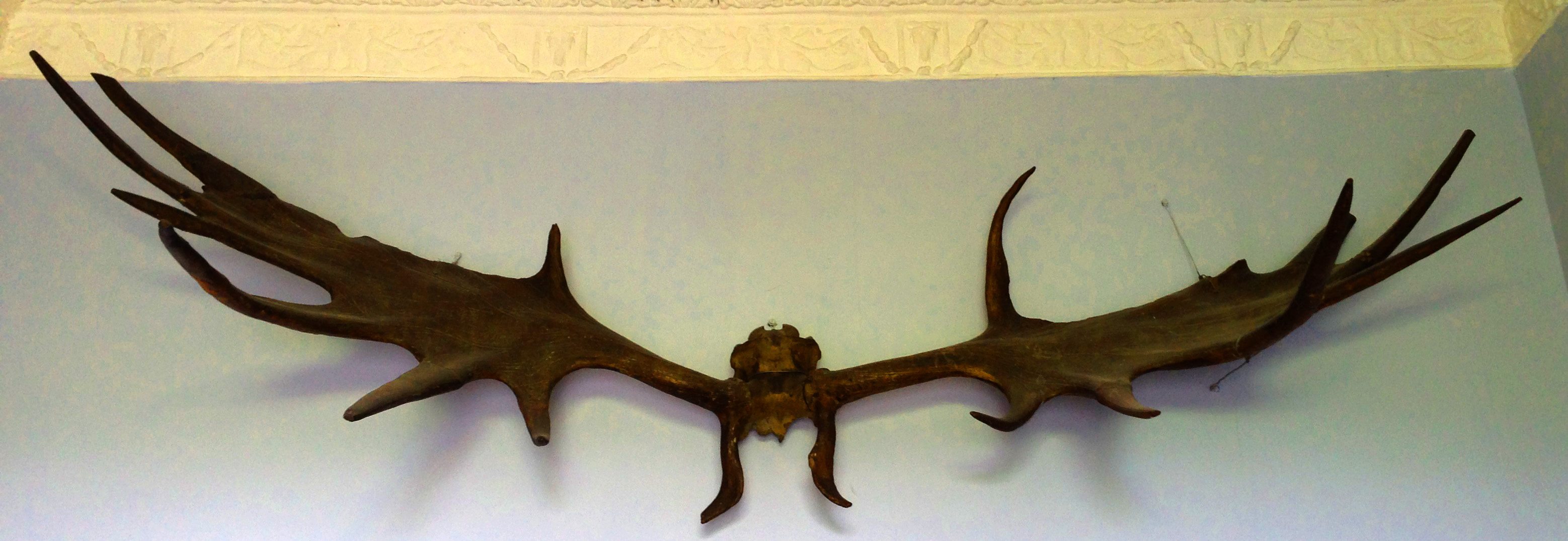
A reminder of Megaloceros - the extinct Irish Elk

A reminder of Megaloceros – the extinct Irish Elk, at Ballymaloe

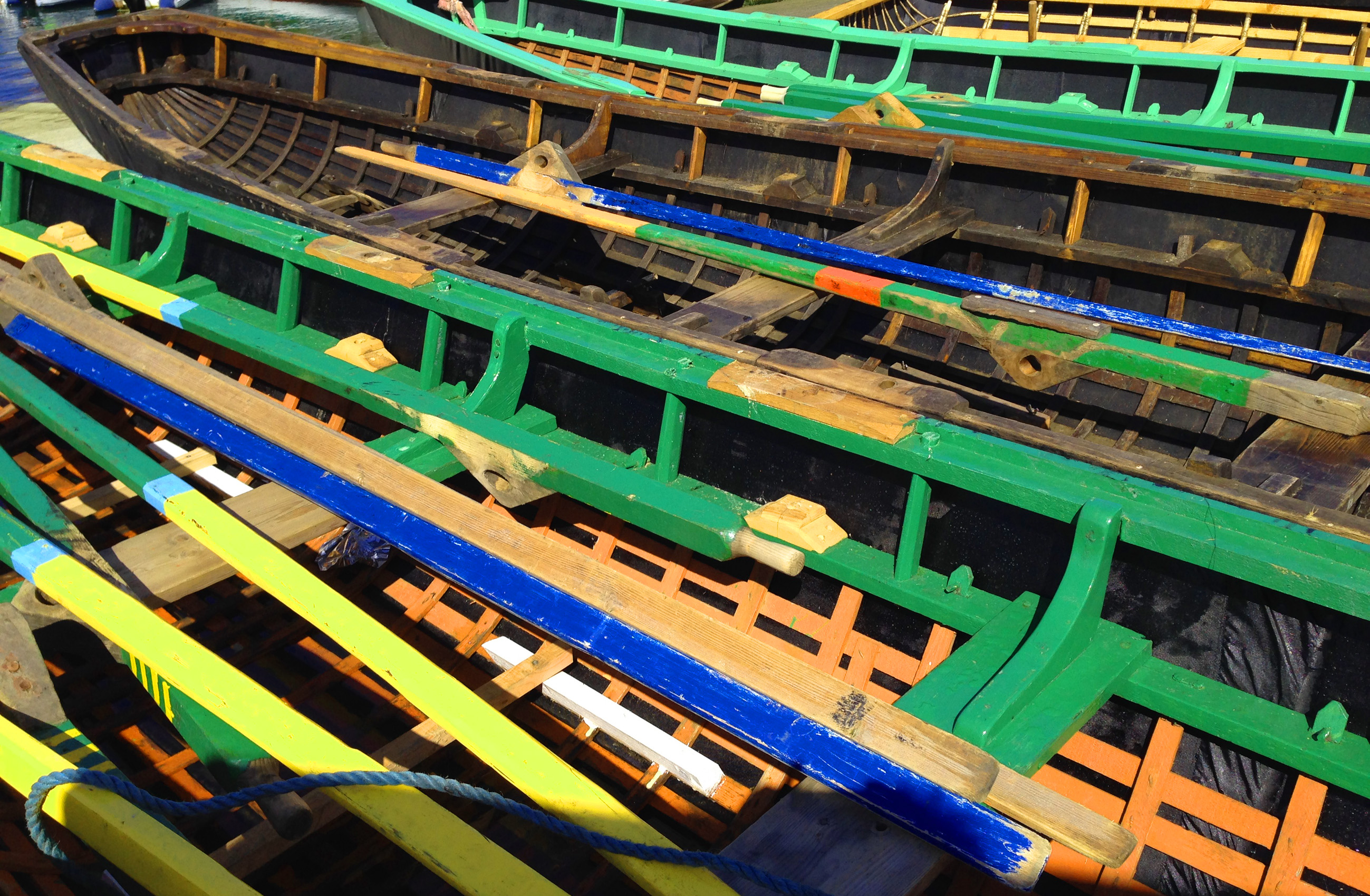
curraghs

Currachs at Baltimore

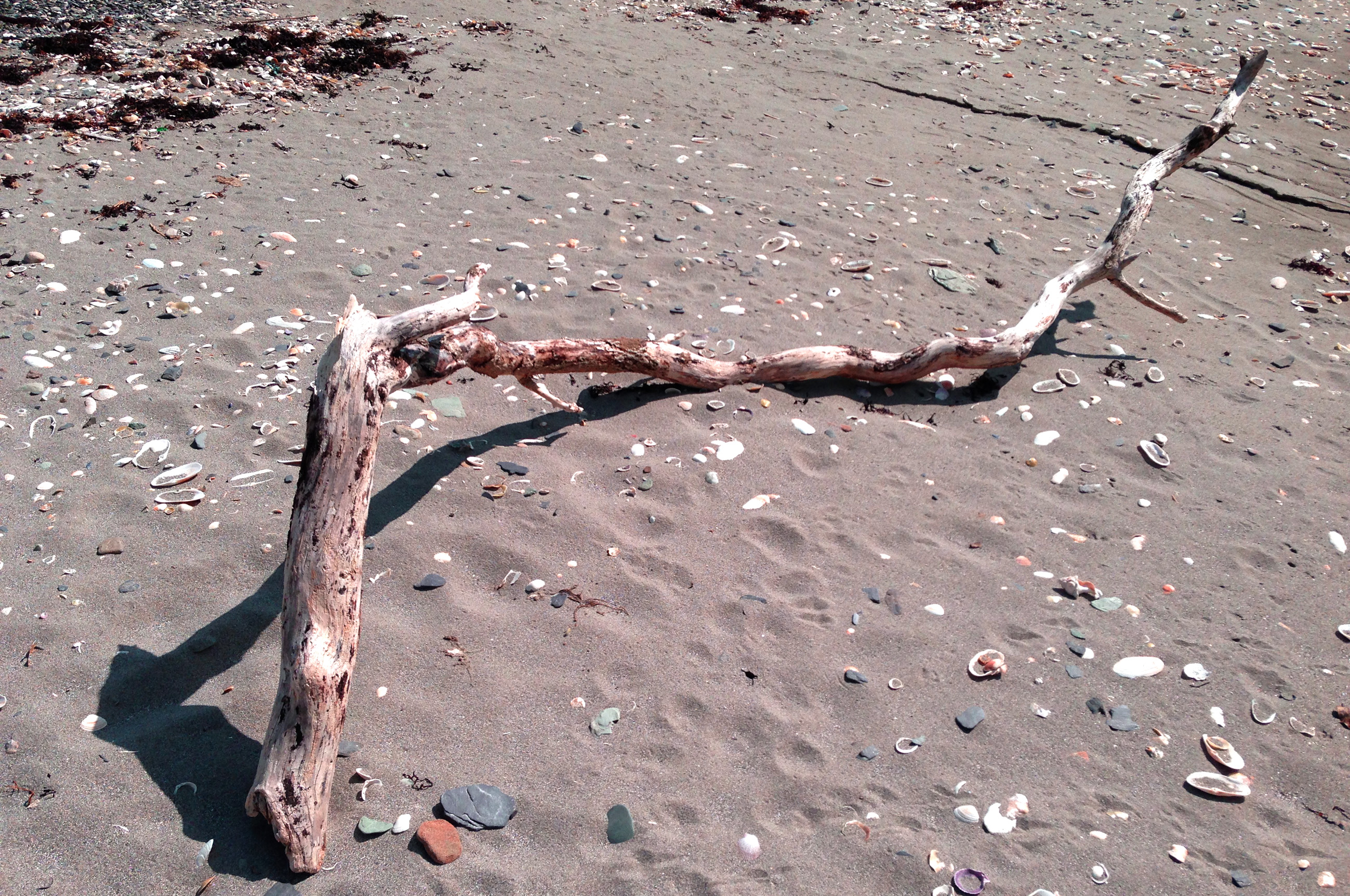
Shelly Beach - our local secret

Shelly Beach – our local secret

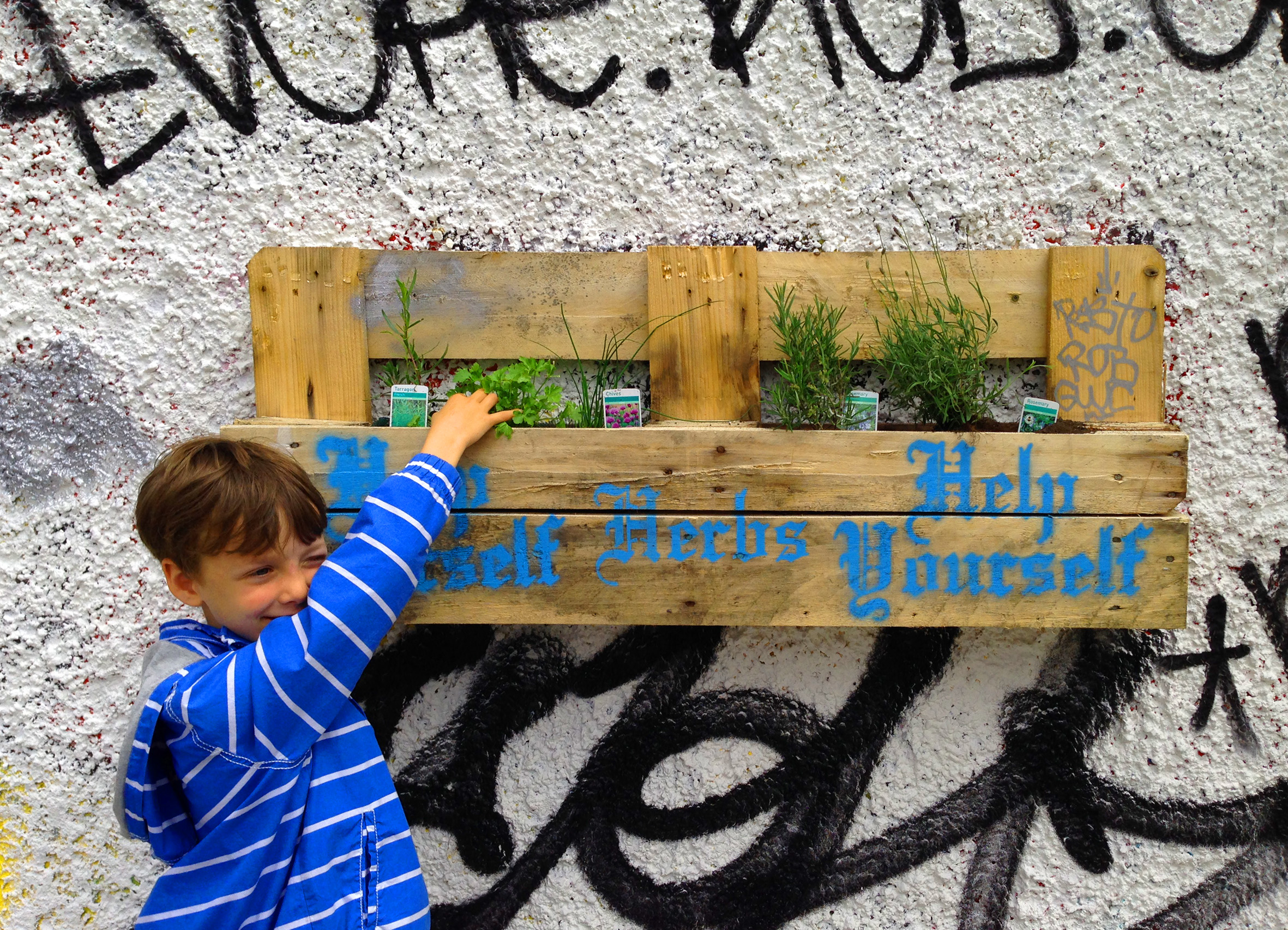
Hugo helps himself!

Hugo helps himself!

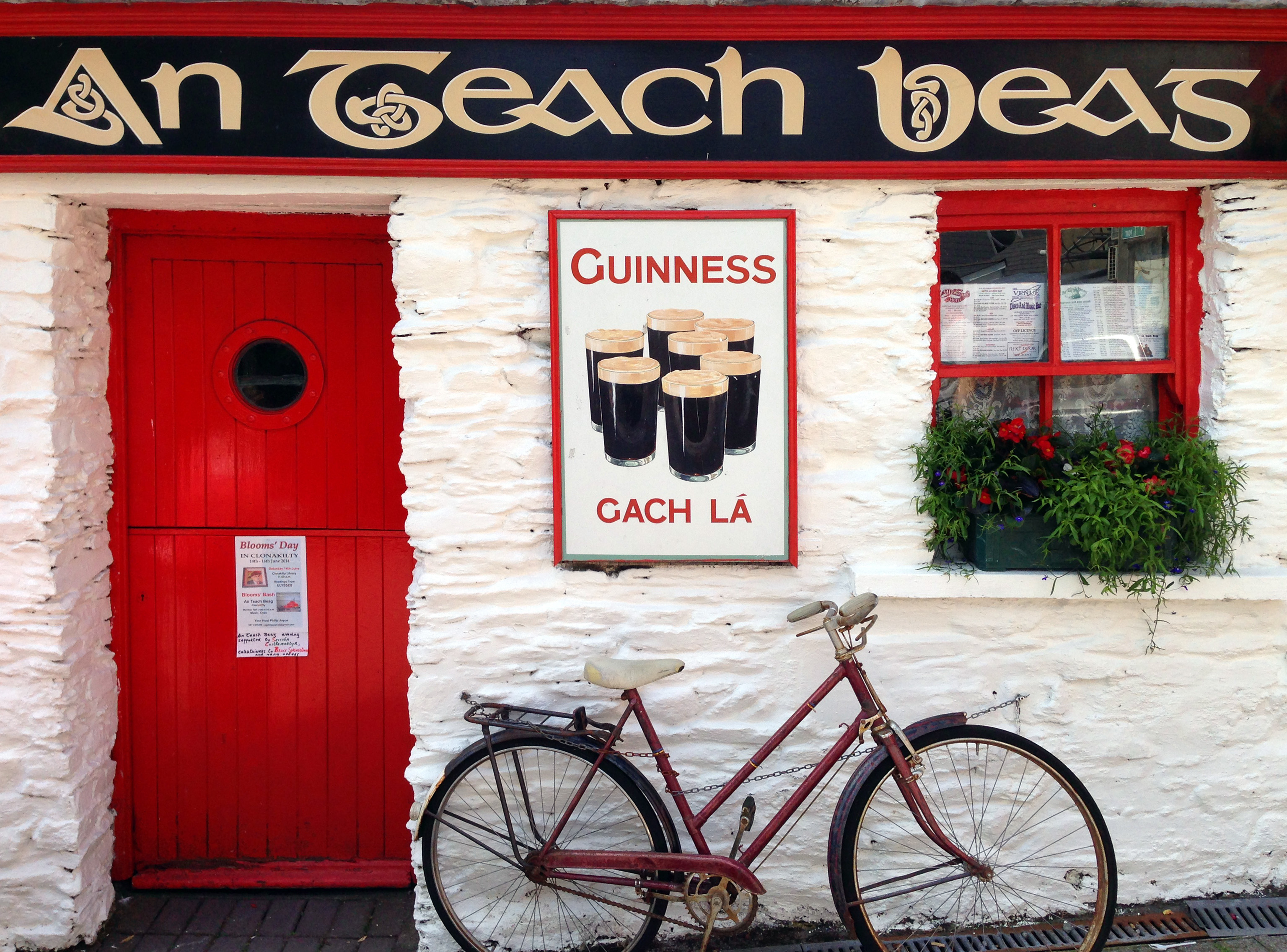
guiness

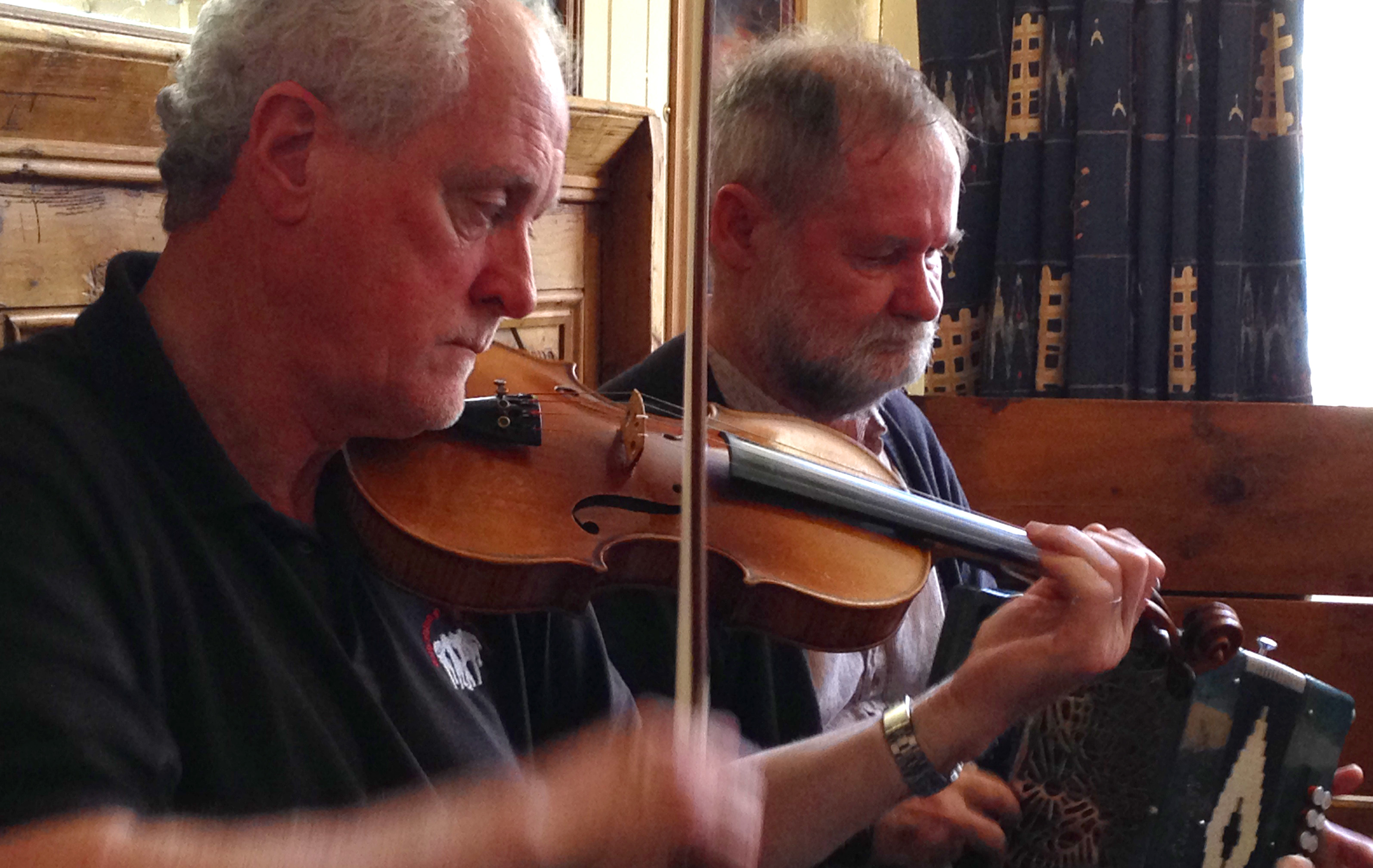
Maestros Matt Cranitch and Jackie Daly playing in Ballydehob

Maestros Matt Cranitch and Jackie Daly playing in Rosie’s

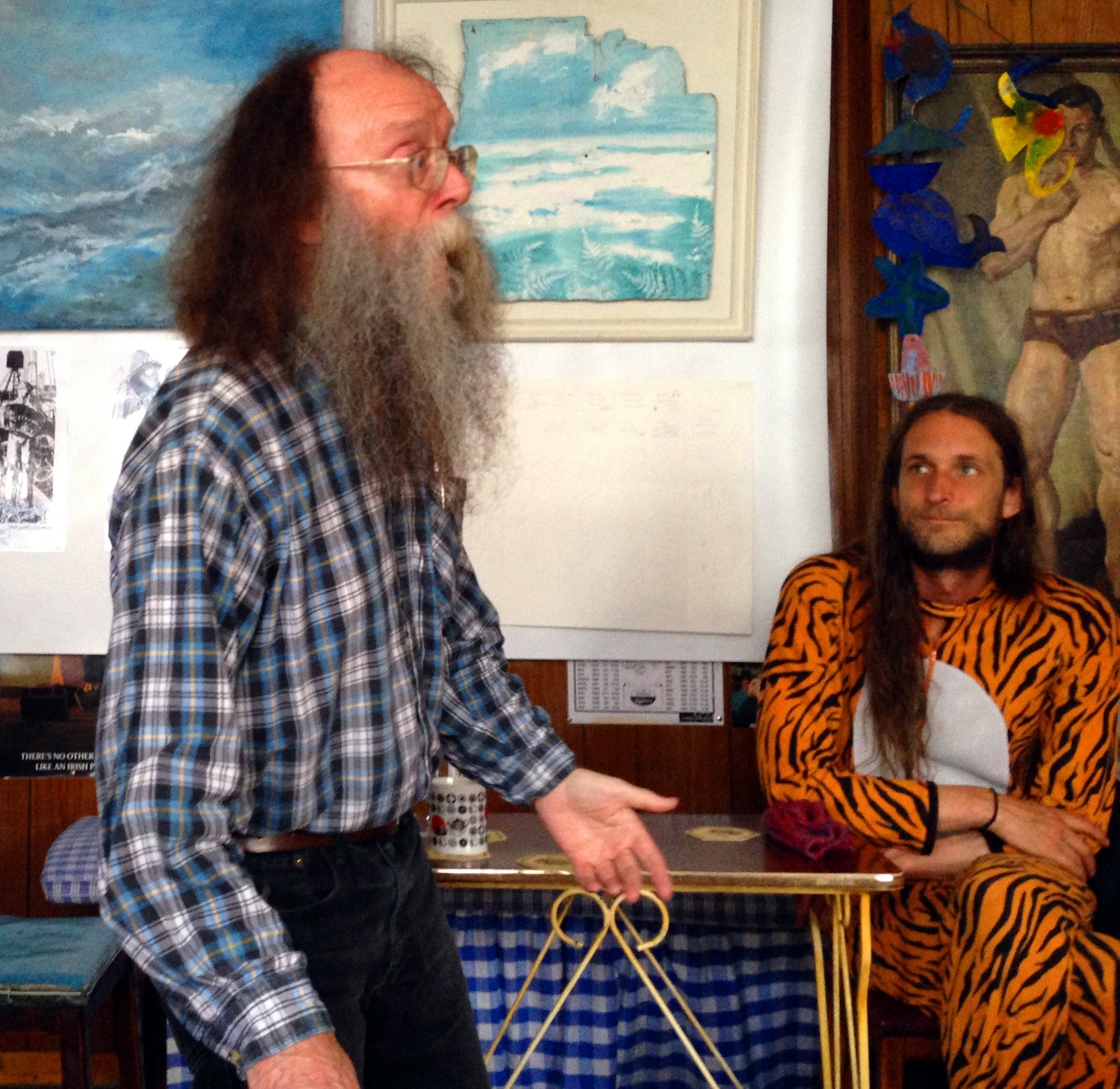
An ordinary day in Ballydehob - with seanchaí Eddie Lenihan

An ordinary day in Ballydehob – with Seanchaí Eddie Lenihan

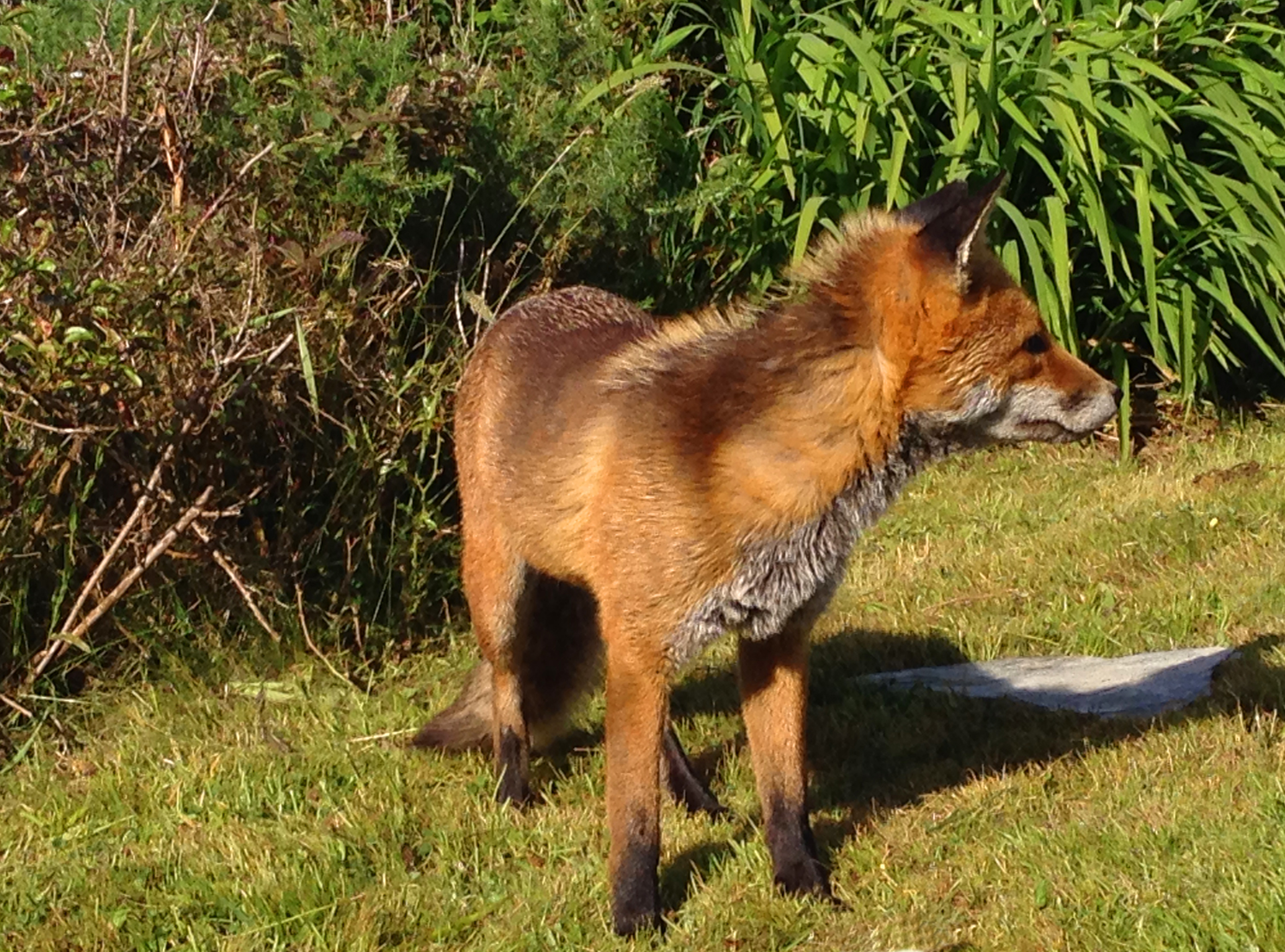
Ferdia - our garden companion

Ferdia – our garden companion

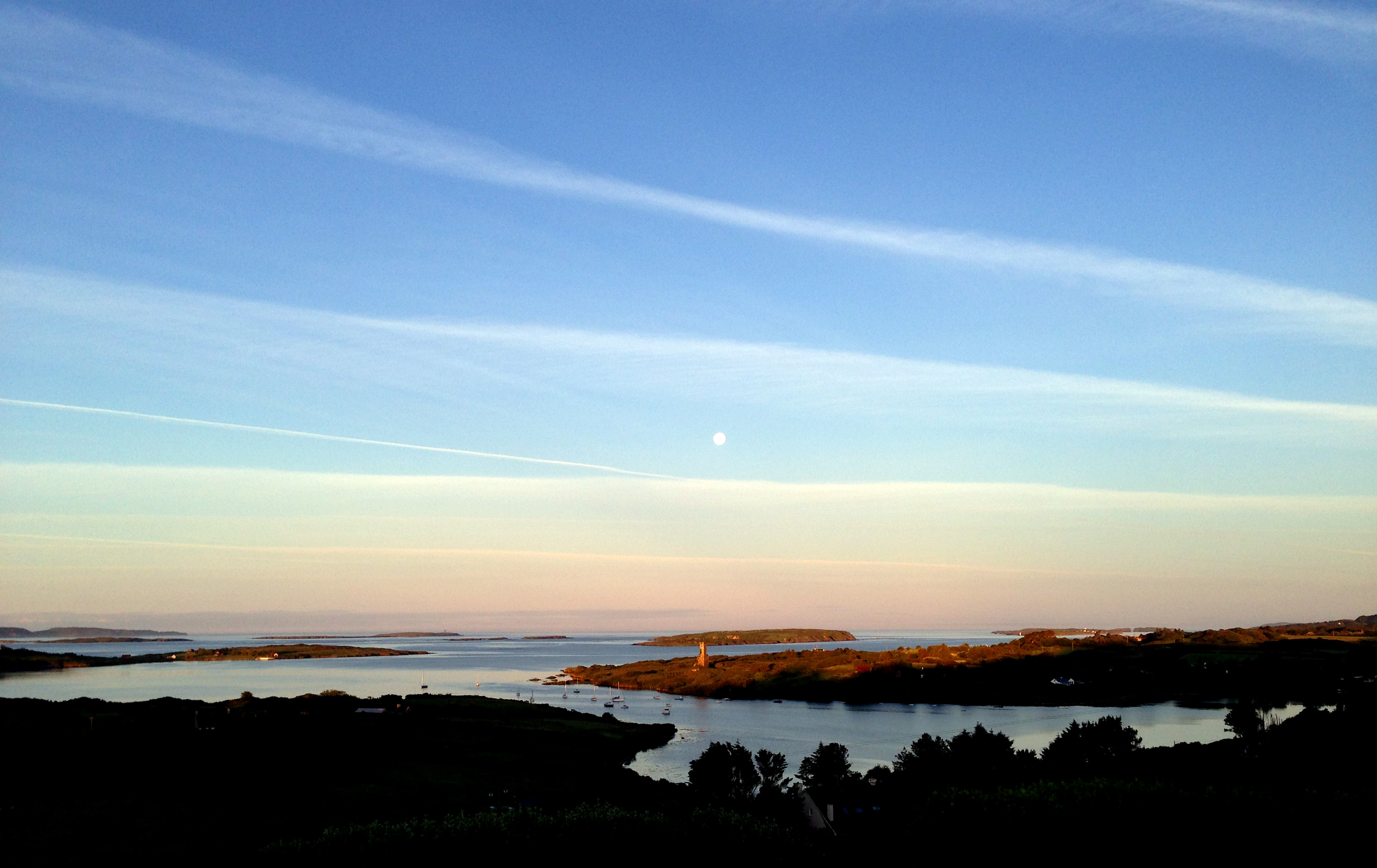
Dawn Moon over Rossbrin Castle

Dawn Moon over Rossbrin Castle

***

By the way… Dictionary definition of Maunder: to move or act in a dreamy, idle or thoughtful manner. Synonyms: wander, drift, meander, amble, dawdle, potter, straggle… Finola has only ever heard the word used in Ireland.

thady's

Thady’s window on the World

Mount Gabriel

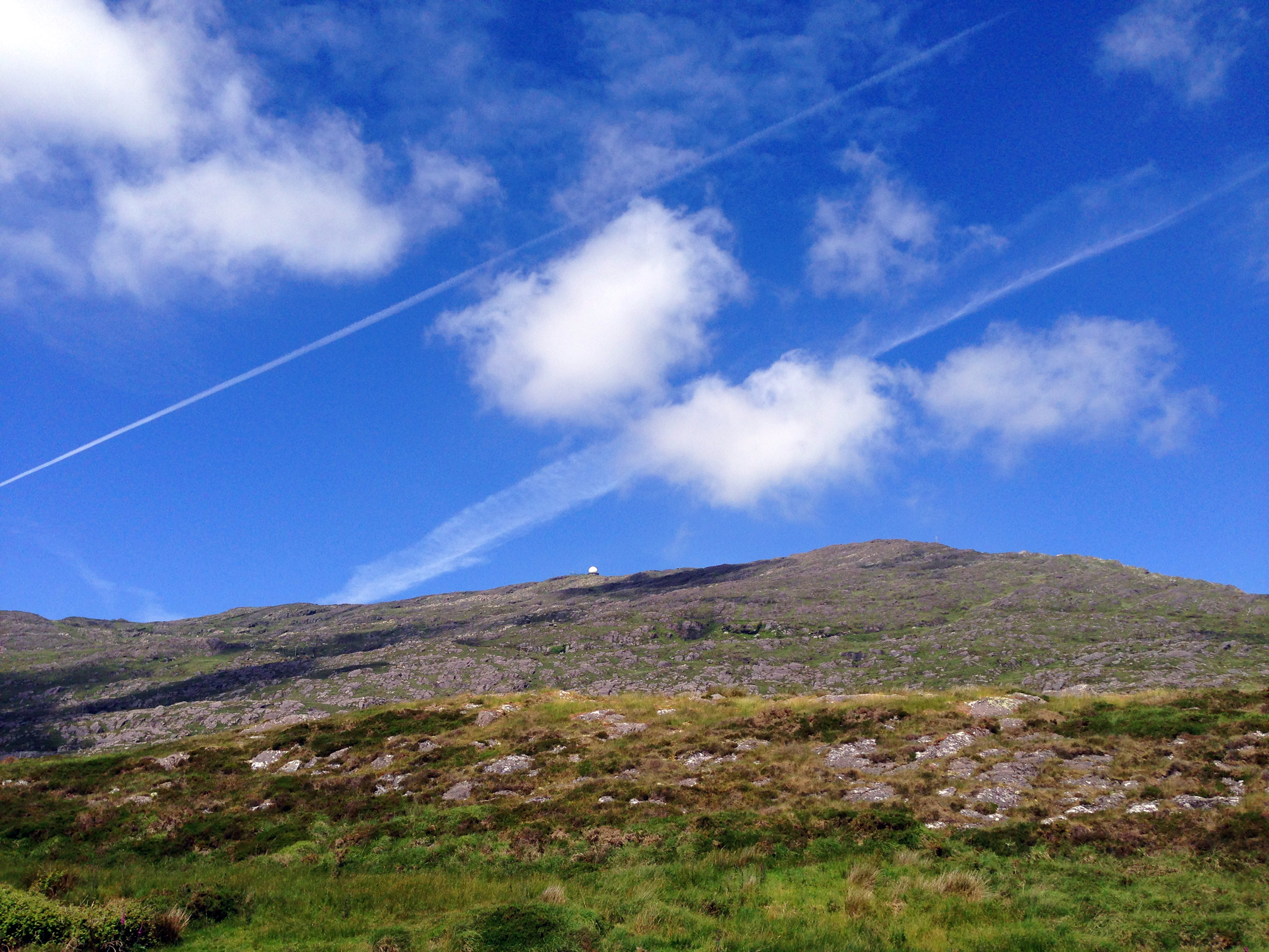
Trails over Mount Gabriel

Trails over Mount Gabriel

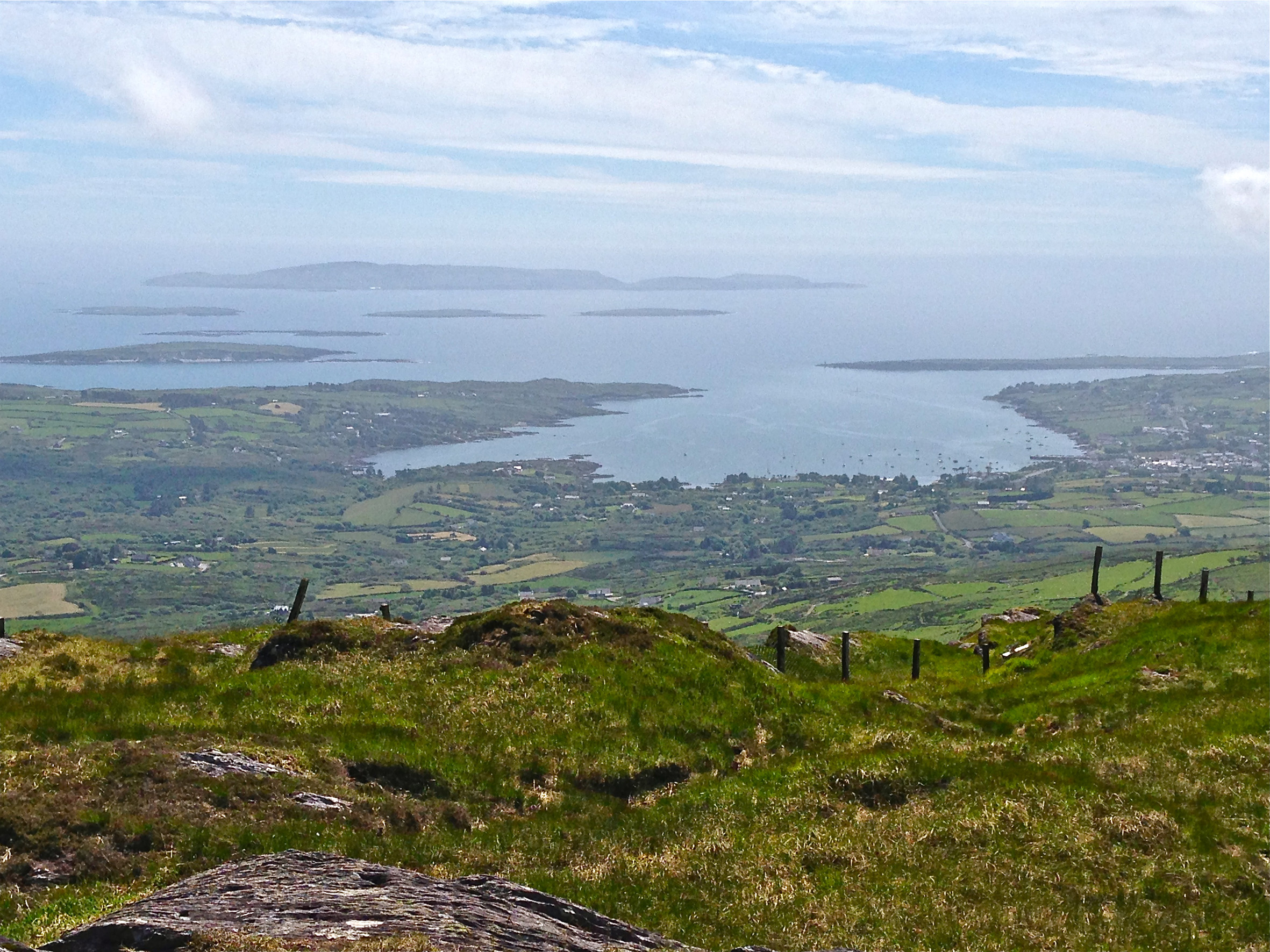
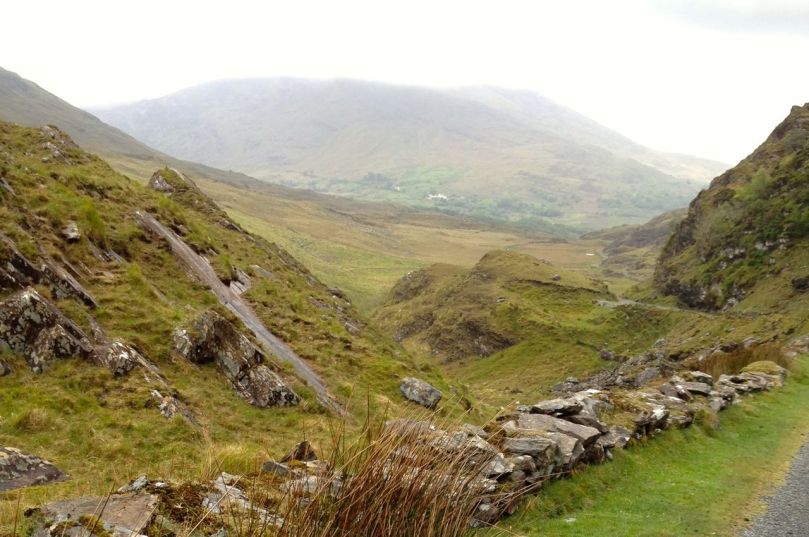
Only a few kilometres from Nead an Iolair – as the Crow flies – sits Mount Gabriel: at 407m elevation it’s the highest piece of land in West Cork. Cork mountains are dwarfed by those from Kerry: McGillycuddy’s Reeks has the highest peaks in Ireland, at over 1,000 metres. However, our own local mountain is nevertheless impressive and on a good, clear day provides a view not to be missed – to all points of the compass.

Looking west to the Mizen

Looking west to the Mizen

I spent a while researching why a mountain in the west of Ireland should be called Gabriel. There is no received opinion about this. I suppose there’s no reason why it shouldn’t be named after the Archangel himself: after all, we have Croagh Patrick (after St P) and Mount Brandon (after St Brendan) and many others: Ireland’s landscape is alive with place-names having religious connections, although such associations are likely to be fairly young. In Irish the mountain is Cnoc Osta – possibly ‘hill of the encampment’ – so there’s no clue there.

Roaringwater Bay

Roaringwater Bay

I did find this fascinating piece from the Church of Ireland Magazine, dated 1826 – written by John Abraham Jagoe, Vicar of Cape Clear …where I have no protestant parishioners… and Curate of Schull …where interspersed amongst moor and mountain, I have fifteen hundred Protestants, to visit and oversee… It’s well worth a verbatim extract:

‘…amidst these everlasting hills arose, in peculiar prominence, Mount Gabriel. Why, my lads, said I, is yonder mountain called such an outlandish name; one would think it was brought here by Oliver Cromwell, it has such an un-Irish – such a saxon name. O! says Pat, it is a pity that the blockhead is not here to tell the gentleman the story about this, for sure and certain such poor garcoons as the likes of us know little, and care not the tail of a herring for such old stories. And who, said I, is the blockhead? O, says my friend, the blockhead is an old man living up on the mountain, who, from his great memory, his knowledge of cures for cattle, charms against fairy-struck people, experience in bleeding, acquaintance with legends about the good people, the Milesians, and Fin McCoul, is called far and near, the blockhead.

My dear fellow, will you tomorrow bring me to that man; I would pilgrimage over all the hills in Cork and Kerry to get into chat with him: says I to myself, this is just the man that I want. Ah my good friend, do bring me to the blockhead to-morrow. Why yes to be sure, – but stay, can you speak Irish? Not a word, to my sorrow be it spoken. Well then go home first and learn Irish, for Thady Mahony can speak no other language. – Well boys, can none of you (as I cannot get it out of the blockhead) tell me about Mount Gabriel; O! yes, Sir, says Pat Hayes, my Godmother used to tell me it was called after the Angel Gabriel, who came, you know, from Heaven to deliver the happy message of mercy to the Virgin – ever blessed be her name. And so on his return, as he was flying back, he looked down upon Ireland, and as he knew that in time to come, this honest island would never part with the worship and duty it owes to the Mother of God, he resolved to take a peep at the happy land, that St Patrick was to bestow for ever on the Virgin. So down he came, and perched on the western peak of that mountain; the mark, they say, of his standing is there to this day, and his five toes are branded on the rock, as plain as if I clasped my four fingers and thumb upon a sod of drying turf; and just under the blessed mark, is a jewel of a lake, round as a turner’s bowl, alive with trout; and there are islands on it that float about up and down, east and north and south; but every Lady-day they come floating to the western point, and there they lie fixed under the crag that holds the track of the Angel’s foot…’

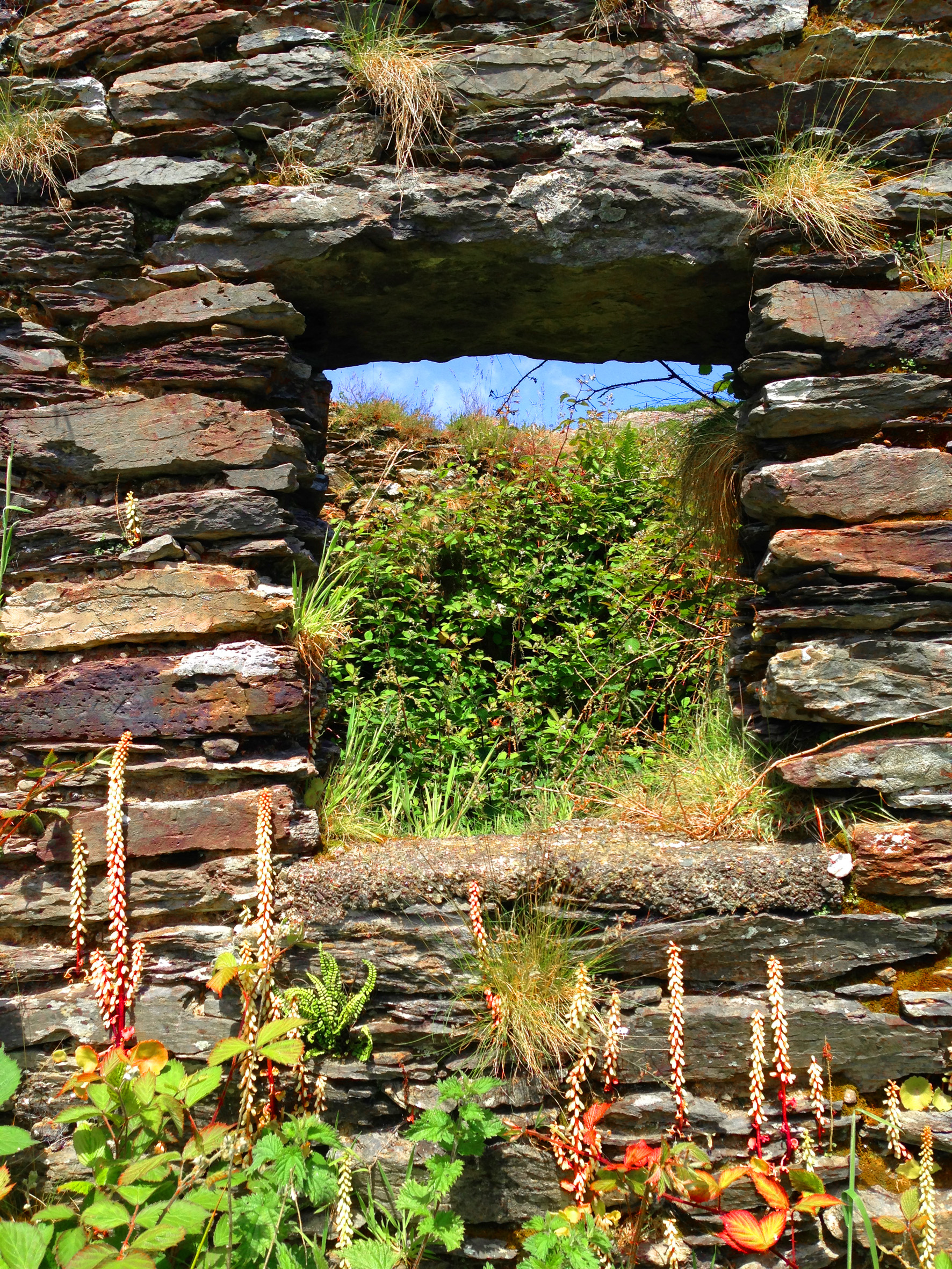
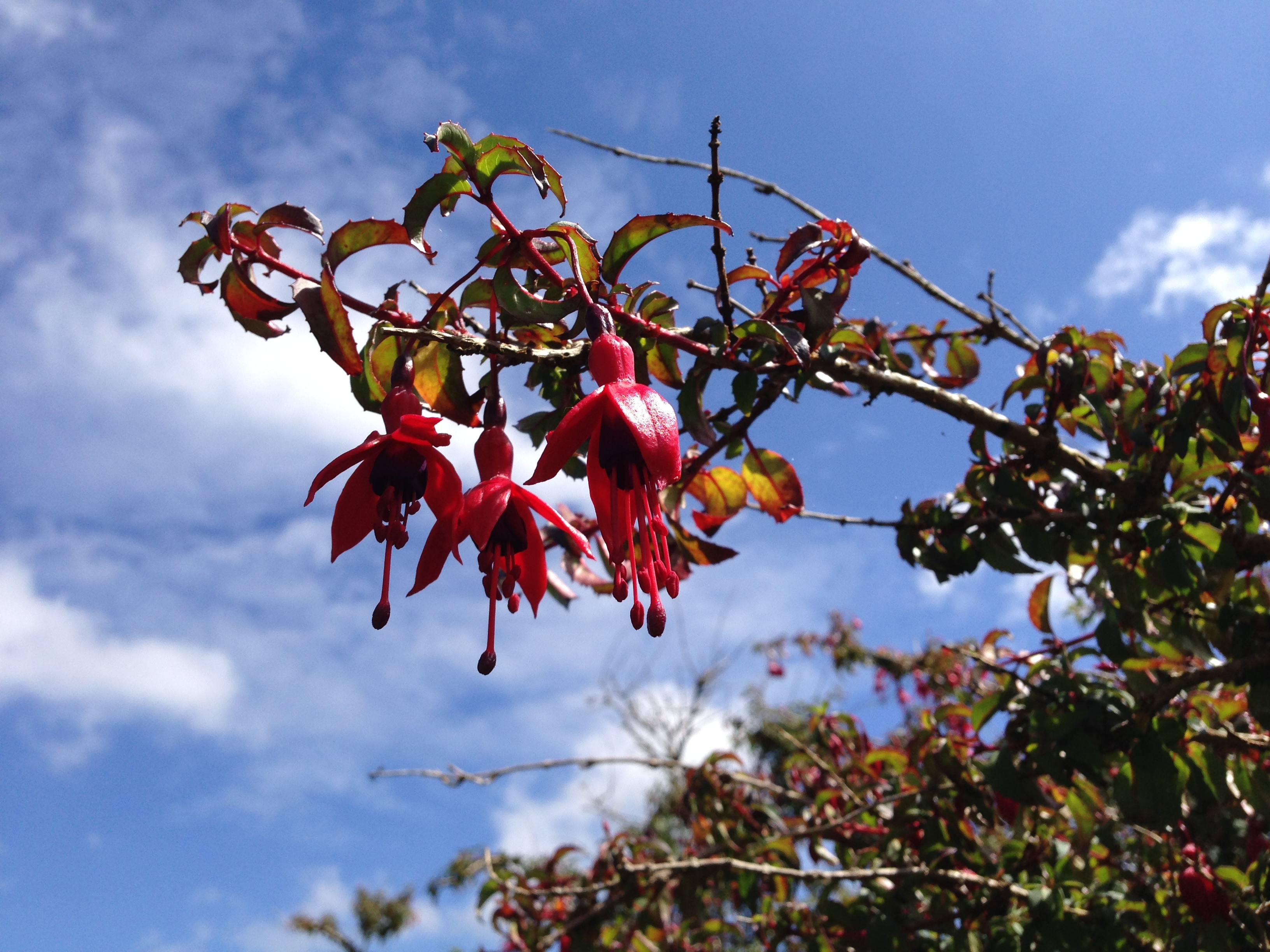
Hidden Glen Fuschia

Hidden Glen Fuschia

Well, there’s enough in those few lines to keep us going on field trips for some time to come! We did find, on the western slopes, a beautiful hidden valley holding the ruins of a one roomed cottage. I have convinced myself that this must have been the dwelling place of the blockhead Thady Mahony, who may once have been the keeper of all the secrets of the mountain. But we have yet to find the jewel of the lake with its trout and its miraculous floating islands, notwithstanding the Archangel’s footprint…

View from the summit

View from the summit

One other possibility for the name is a corruption of the Old Irish Gobhann – which means smith, as in a metal smith. Remember Saint Gobnaitt? She was the patron saint of ironworkers (blacksmiths) and her name is supposed to be rooted in Gobhann. There is also a Goibhniu in Irish mythology: he was the smith of the Tuatha De Danaan and forged their weapons for battle with the Formorians. So – Gobhann, Goibhniu, Gabriel…? Too much of a leap of faith? But it is known that Mount Gabriel was the site of extensive copper mining a few thousand years ago – remains of pits, shafts and spoil heaps can be seen:  so perhaps there just could be something more ancient inherent in the name.

golf ball

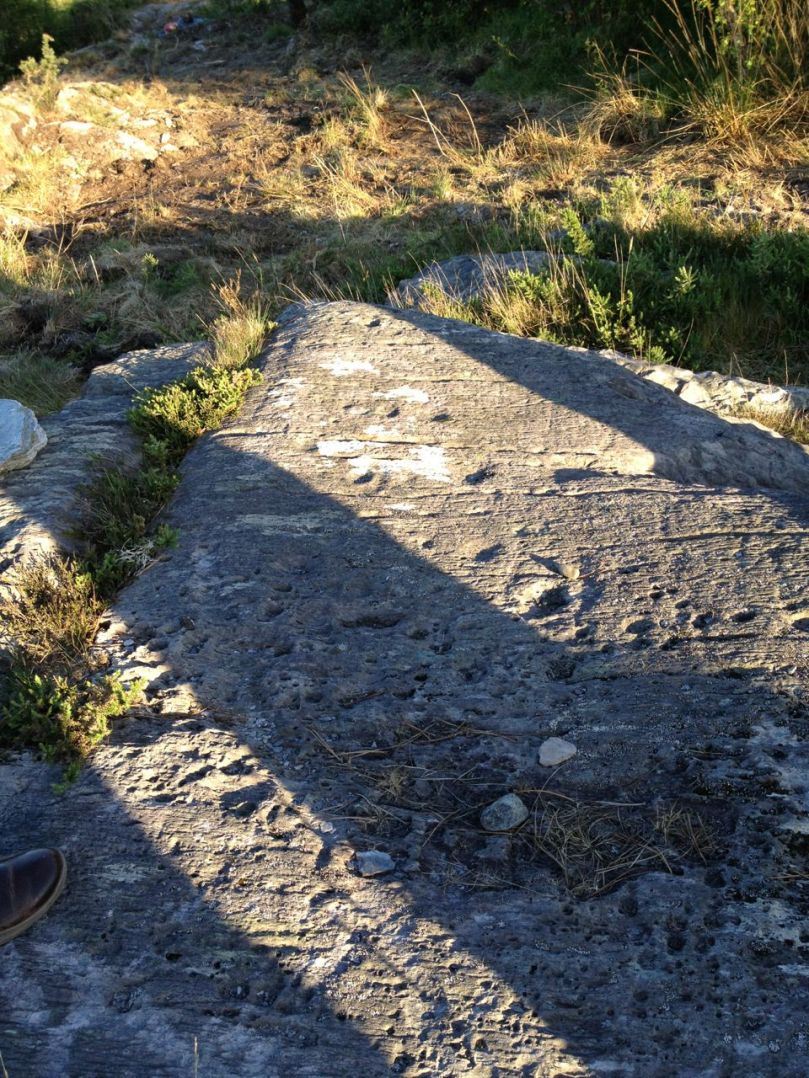
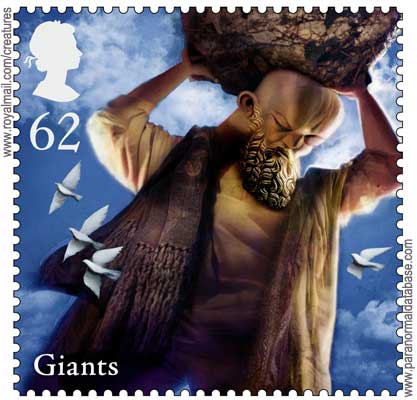
There is mythology attached to the Mountain: the Fastnet Rock was torn from the slopes and thrown into the sea by a giant; once we were searching for a piece of Rock Art within sight of the mountain and the landowner assured us that the carved stone had been thrown there by Finn MacCool (we didn’t find it).

giant stamp

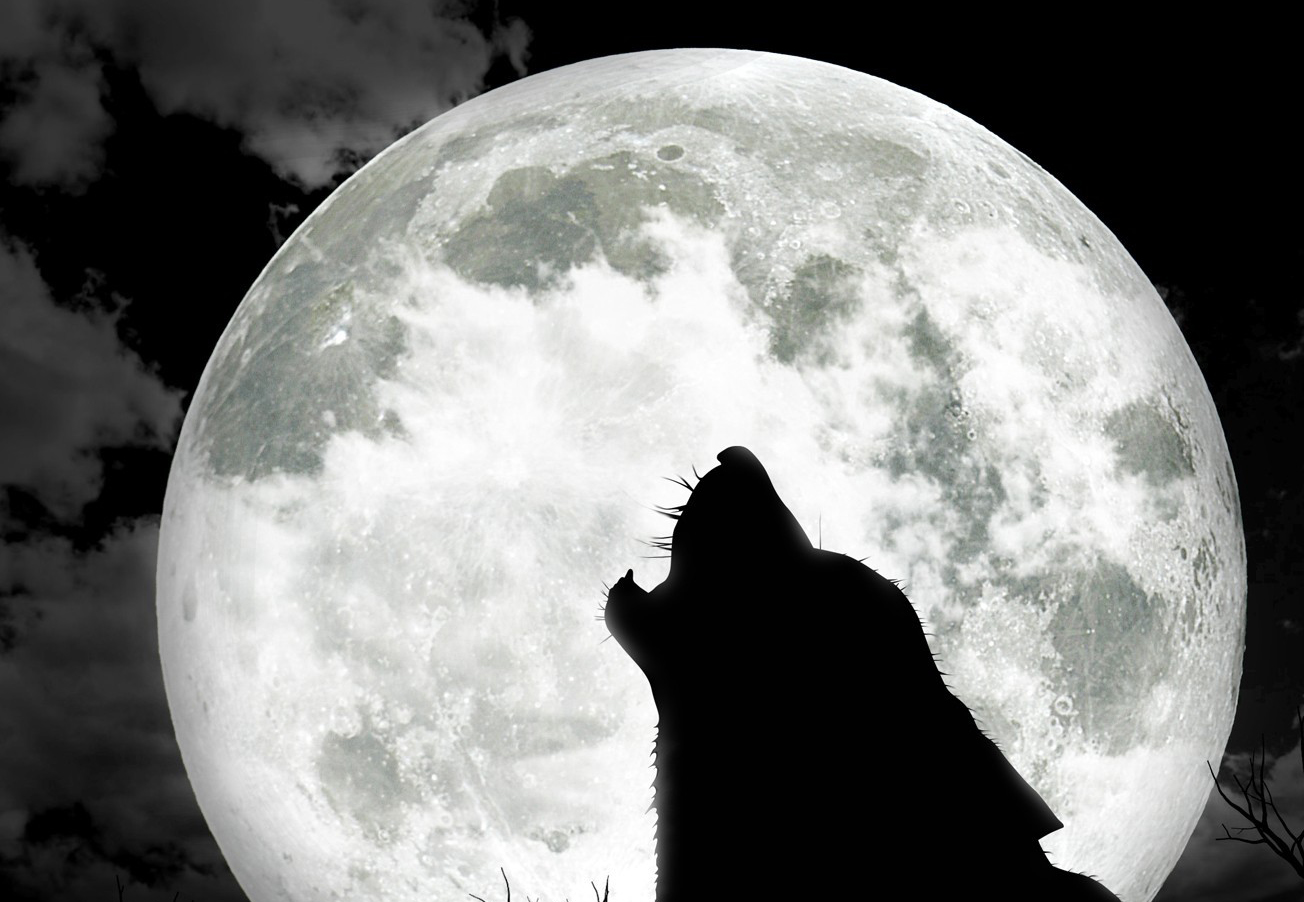
The story about Mount Gabriel that most captures my imagination is the suggestion that the last Wolves in Ireland inhabited the rocky landscape there back in the eighteenth century (although it’s true that several other places make the same claim). Until that time Wolves were commonly seen in the wilder parts of the land and feature in local stories and folklore. Interestingly they were often portrayed in a positive way and were sometimes companions of the saints. There are very few records of Wolves having maimed or killed humans, yet in 1653 the Cromwellian government placed a bounty on them – 5 pounds for a male Wolf, and 6 pounds for a female: worthwhile prize money in those days. This encouraged professional hunters and, coupled with the dwindling forest habitats, the fate of the animal was sealed.

grey wolf

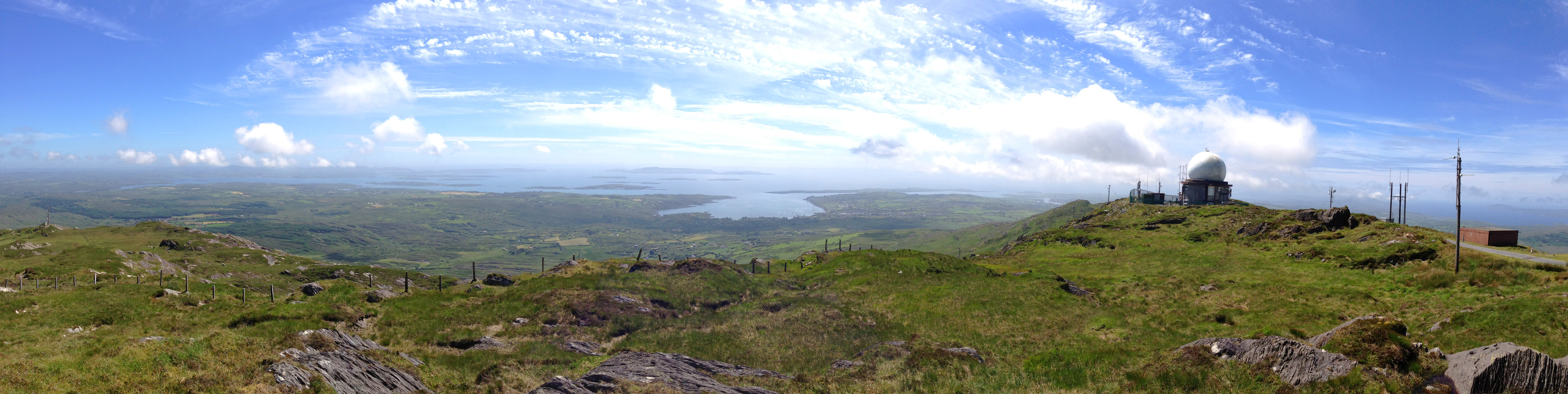
Mount Gabriel today is relatively benign, although it still has its remoter parts. The Irish Aviation Authority has kindly provided a road up to the summit, where sit the distinctive ‘golf ball’ radar domes and aerials of an Air Traffic Control installation. From these heights we can see Rossbrin Cove, Ballydehob, Schull and all the islands of Roaringwater Bay set out in a magnificent panorama – on a clear day.

iaa

Aerials and view to the north

Aerials and view to the north

Modern events have affected the mountain: a German plane crashed here in 1942, and in 1982 the Irish National Liberation Army bombed the radar station, believing that it was providing assistance to the North Atlantic Treaty Organisation, allegedly in violation of Irish neutrality.

IMG_3573

For us the mountain is a landmark and, like most of our view, its profile changes with the weather on a daily – perhaps hourly basis. As a repository of archaeology, human history, lore and nature Gabriel provides a rich resource.

Gabriel

Gabriel

Bridge

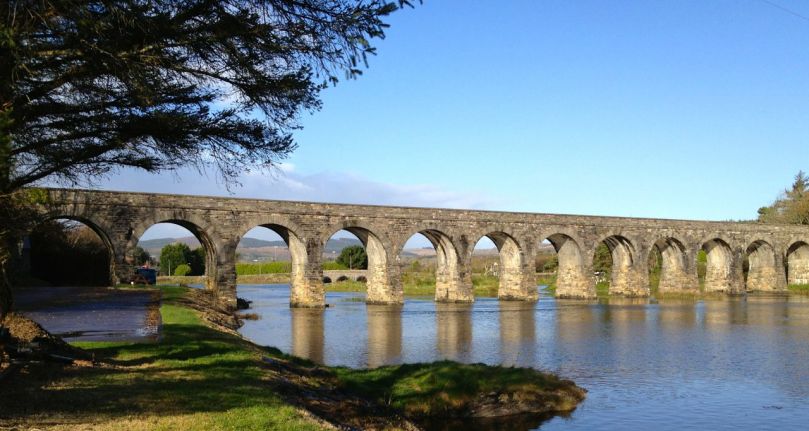
The Famous Twelve Arch Bridge in Ballydehob

The Famous Twelve Arch Bridge in Ballydehob

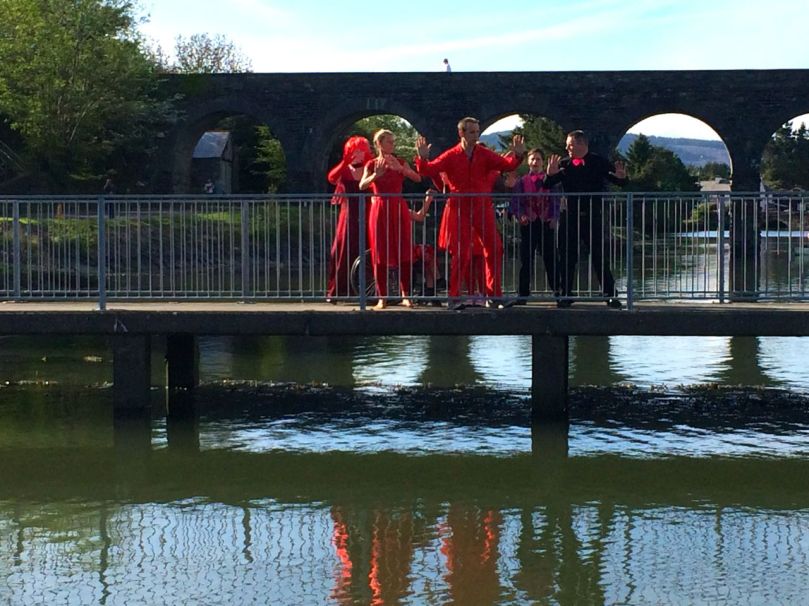
Recently, as part of the Ballydehob Country Music Festival (although the connection may be a little tenuous) we noticed posters going up around the town for a dance to be performed on the famed Twelve Arch Bridge. The dance company, Croi Glan (Kree Glan – pure heart) had more information on their website:

Professional dancers from Croi Glan, 5 musicians performing live, Croi Glan’s aerial dancers suspended from the bridge on rope and harness and aerial silks, and 40 West Cork Inclusive Dance Group community performers from COPE, CoAction and the local West Cork area, 25 of whom have intellectual disabilities, in a once-in-a-lifetime, hugely ambitious project directed by Tara Brandel, a native of Ballydehob.

Intrigued, I sought more information on Croi Glan. Here is a piece from TG4, the Irish language television station, that illustrates what the company is all about:

We arrived at the Pier to find that the whole of Ballydehob had turned out. The place was rocking, with live entertainment, gourmet hot dogs and a wine bar. While the morning had been overcast, by early afternoon the clouds had parted and brilliant sunshine added to the festive atmosphere.

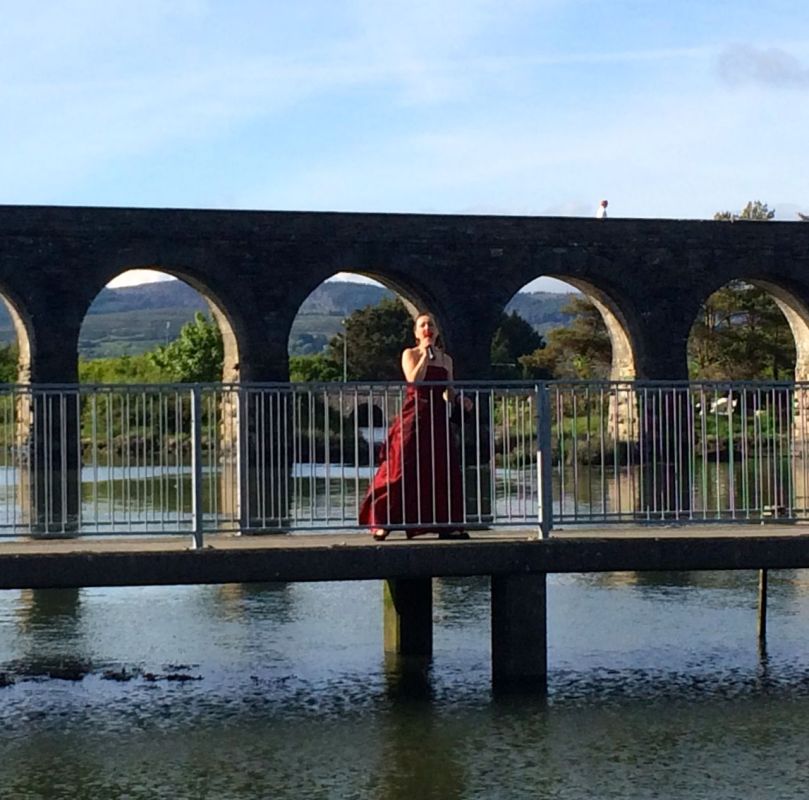
Siobhan Heapes

Siobhan Heapes

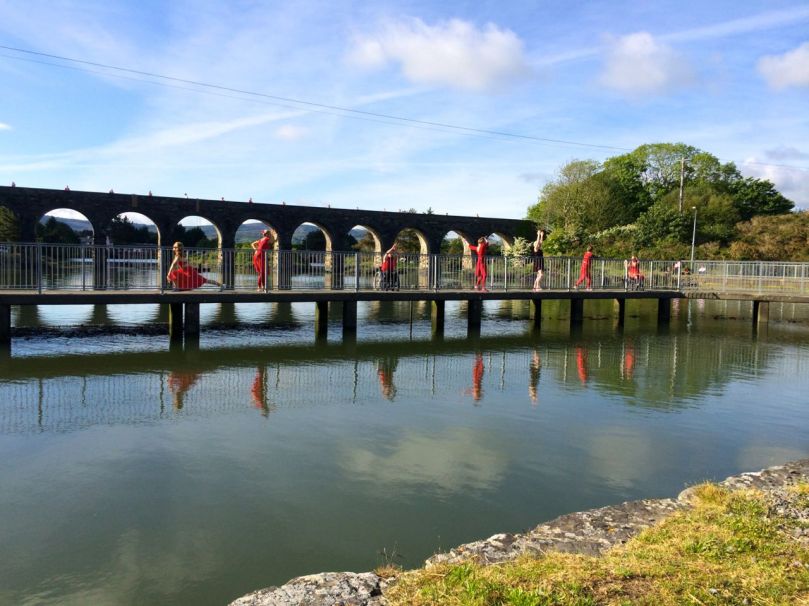
The dance started with a local singer, Siobhan Heapes, singing on the walkway over the water, calling the dancers. One by one and in groups they arrived on the walkway and we began to appreciate the diversity of the troupe – some professional and balletic, some in wheelchairs or with mobility difficulties, some with intellectual disabilities. Together, they told a story: a story of bridging and transcending differences, of supporting each each other, of honouring the part each played in the dance. 

The dance begins

The dance begins

The stage became larger and larger, as the dancers occupied the green spaces around the walkway, and then moved onto the bridge itself.

Using the whole space

Using the whole space

Two dancers were lowered over the bridge –  a heart-stopping moment – and then yellow silks unfurled and their bodies twined and moved with the silks as we watched entranced from the Pier and Siobhan provided the haunting musical background.

Aerial dance

Aerial dance

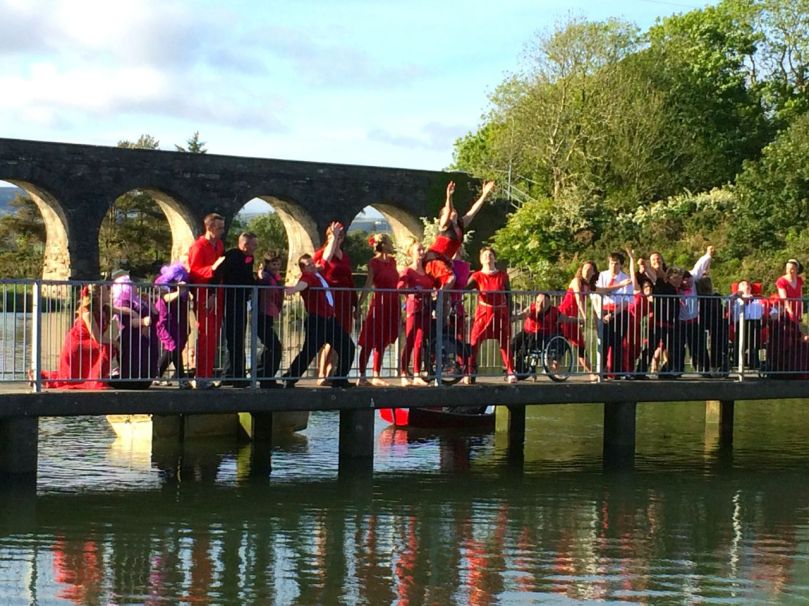
The finale had all the dancers back on the walkway for one final movement together of intense communication, lifting and balancing each other, paying a last homage to the theme of Bridge. And suddenly it was over and we erupted into possibly the most enthusiastic standing ovation I have ever been a part of. It was loud, it went on and on and then on some more. Some us were in tears, all of us were smiling and turning to each other and searching for superlatives to describe what we had just witnessed. 

Finale

Finale

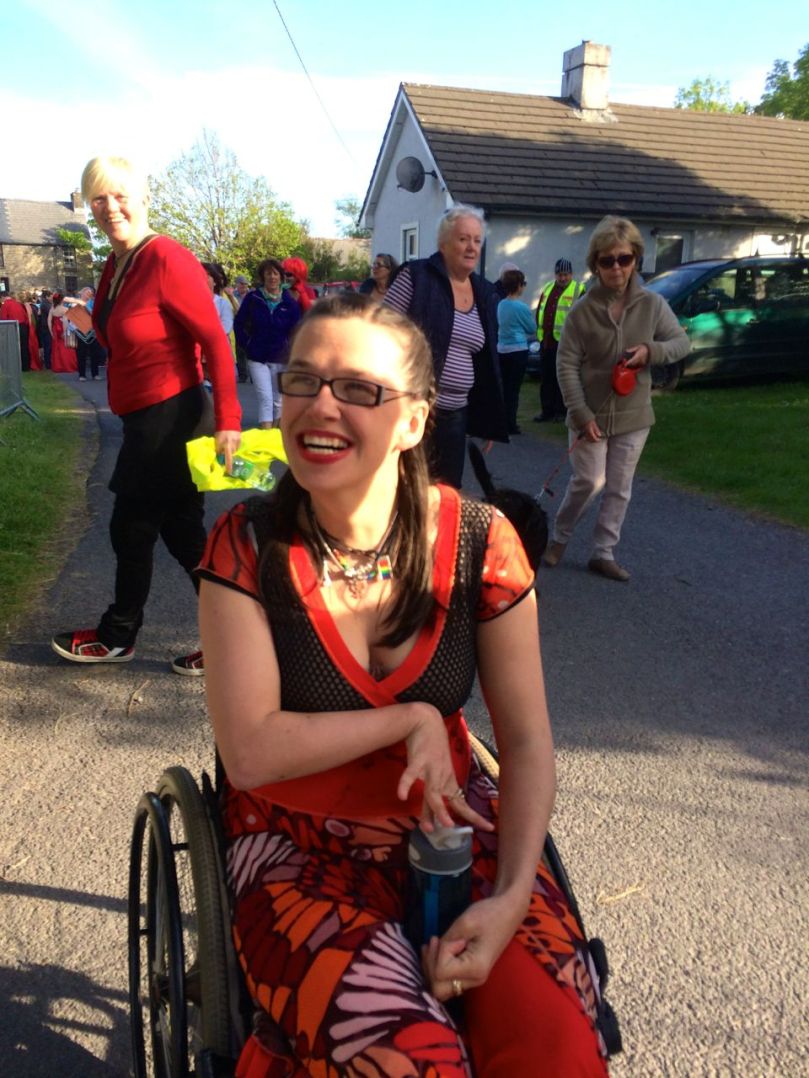
There were flowers, and speeches. Tara Brandel said she had “never been prouder to be from Ballydehob.” We lingered, chatted with the dancers, congratulated Tara (it was hard to get close to her) and her assistant choreographer, Mary. People took a long time to disperse – something had stirred us all in that way that makes you want to hang on to the feeling as long as possible.

Mary Nugent, Assistant Choreographer

Mary Nugent, Assistant Choreographer

Perhaps it was, as Tara explains in the YouTube video above, that when you watch a Croi Glan performance, you are operating entirely in your heart.

Off to Skibbereen!

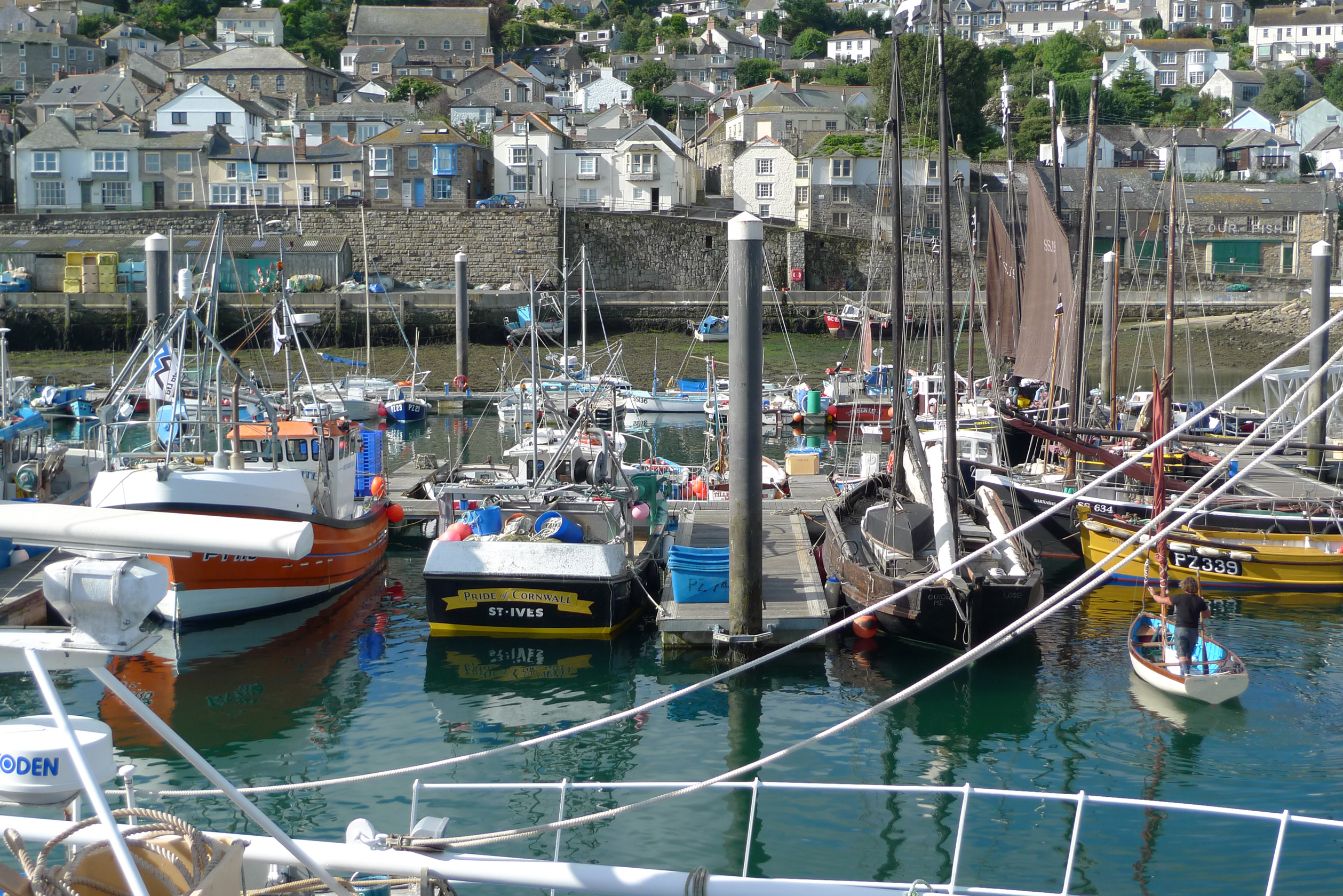
Newlyn Harbour, Cornwall

Newlyn Harbour, Cornwall

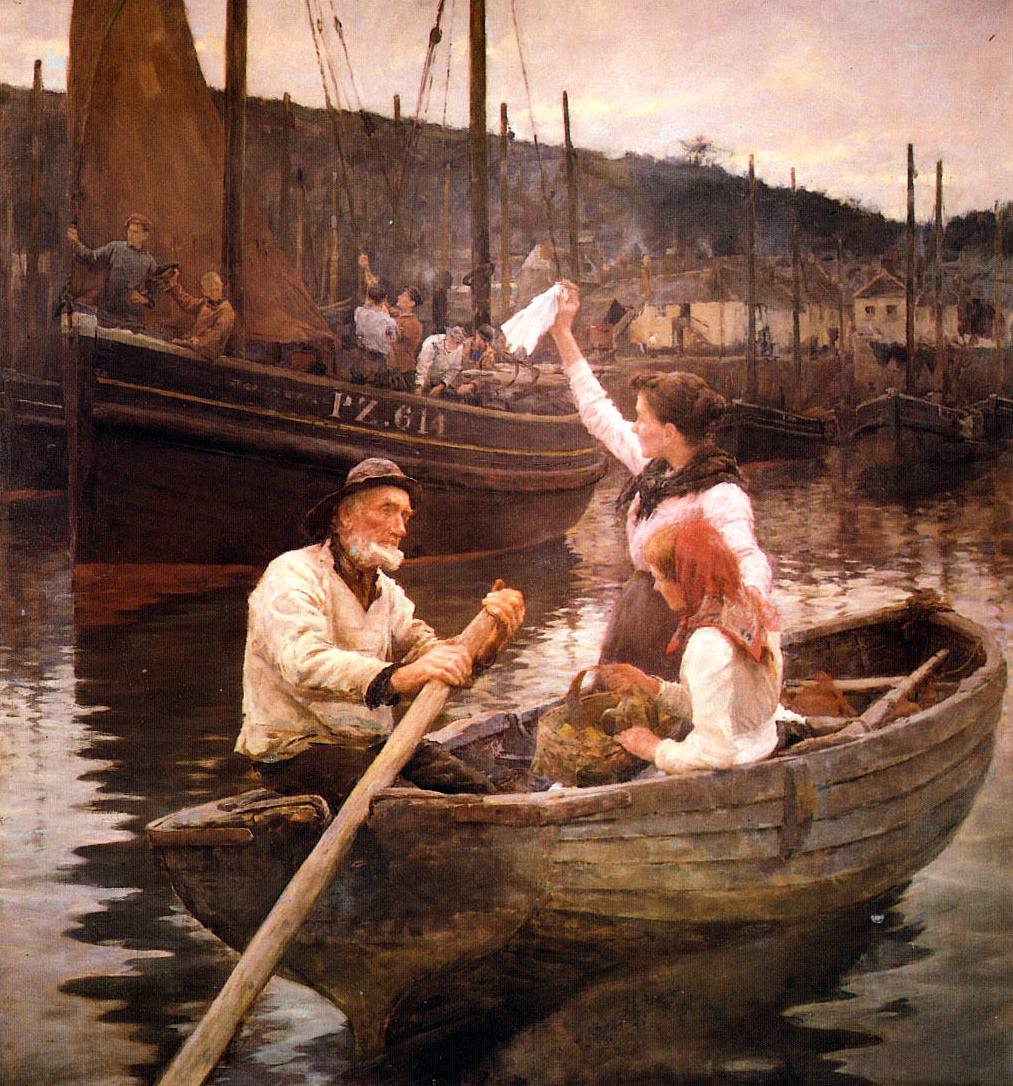
What’s the link between Newlyn in Cornwall – where I had a fisherman’s cottage for 20-odd years – and Skibbereen, our nearest town here in West Cork? The answer is ‘art’, and the painting below by Alexander Stanhope Forbes sums it up: Off to Skibbereen from Newlyn.

offtoskibb1

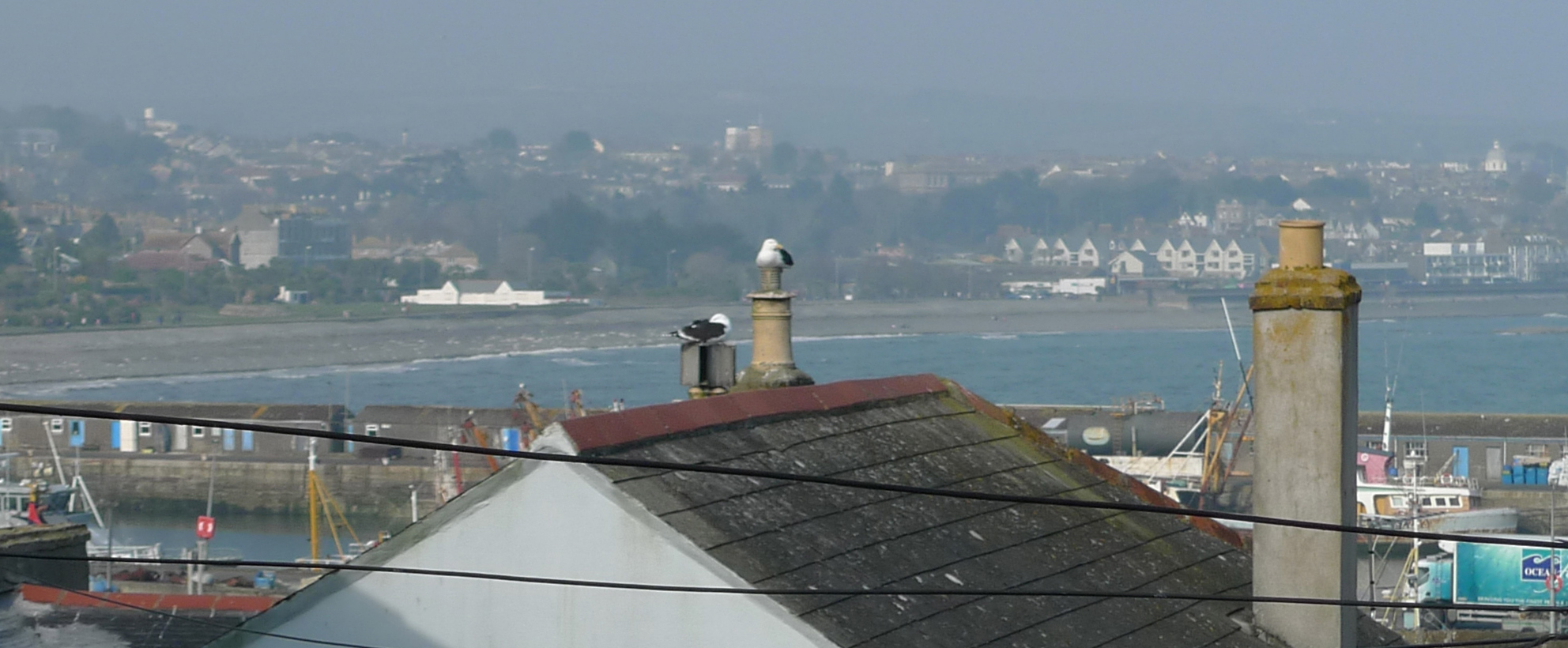
Stanhope Forbes was born in 1857 in Dublin and worked in the en plein air technique of painting, first in Brittany and then in Cornwall, where he settled and founded the Newlyn School of artists. He died in Newlyn (a day or two short of my first birthday) in 1947. If you want to see a collection of Newlyn School paintings visit the Penlee Gallery in Penzance: they are superbly detailed depictions of everyday life in a working fishing community during the late nineteenth and early twentieth centuries. En plein air was all about light, sun and clarity: the artists chose places where the light was at its best, usually close to the sea. My cottage looked out over Mounts Bay in West Penwith, on the far south western tip of Britain. Like the lugger in the picture I have crossed the Celtic Sea from Cornwall, and I now live on the far south western tip of Ireland.

View from my cottage in Cornwall

View from my cottage in Cornwall

I am intrigued by the Off to Skibbereen painting. It tells a story, but we can’t guess that story. It’s presumably PZ 614 that’s on its way to Ireland, and not the ladies in a small open punt with a basket of sandwiches… But why Skibbereen? Records show that from the 1820s Newlyn fishermen were chasing the Herrings off the coast of County Cork. On the whole the fishermen of Newlyn were active most of the year. In January and February they fished for Mackerel off South Devon, following the shoals westwards to Mounts Bay for the next couple of months. Then they moved to Irish waters for the Herring season, returning in July to catch Pilchards until December. They were away from home for weeks at a time so a departure could be a poignant time for their families.

Skibbereen at the end of the 19th century: can you spot the cat?

Skibbereen at the end of the 19th century: can you spot the cat?

Skibbereen was a settlement served by water. The River Ilen is tidal and in the early 19th century boats of up to 200 tons could navigate to Oldcourt, within two miles of the town centre. From there goods were transferred into ‘lighters’ (unpowered barges) and then brought into the quays where there were warehouses and a Customs House. Now, sadly, Skibbereen’s waterfront is a bit neglected and its active past shipping history is no longer obvious. Five historic quays have been identified along the river: Steam Mill Quay, Long Quay, Levis Quay, Minihane’s Quay and Chapel Quay. The Skibbereen Town Development Plan has this to say about them:

…Historic Quays – Comprising of old disused stone quays along the town side of the River Ilen between the two road bridges, these quays were once the primary means to transport goods and people in and out of Skibbereen. Some of the quays are in private ownership, others are unrecognisable and some have been blocked with stone and deposits. However,what is unquestioned is the historic significance and value of the quays and therefore their protection should be considered as part of this plan. In the past, communities and public bodies turned their back on water bodies but now the tide is turning in this regard. Therefore an opportunity presents itself … by ensuring that the quays are redeveloped as part of any proposal on adjoining land…

Building work progresses in Skibbereen

Building work progresses in Skibbereen

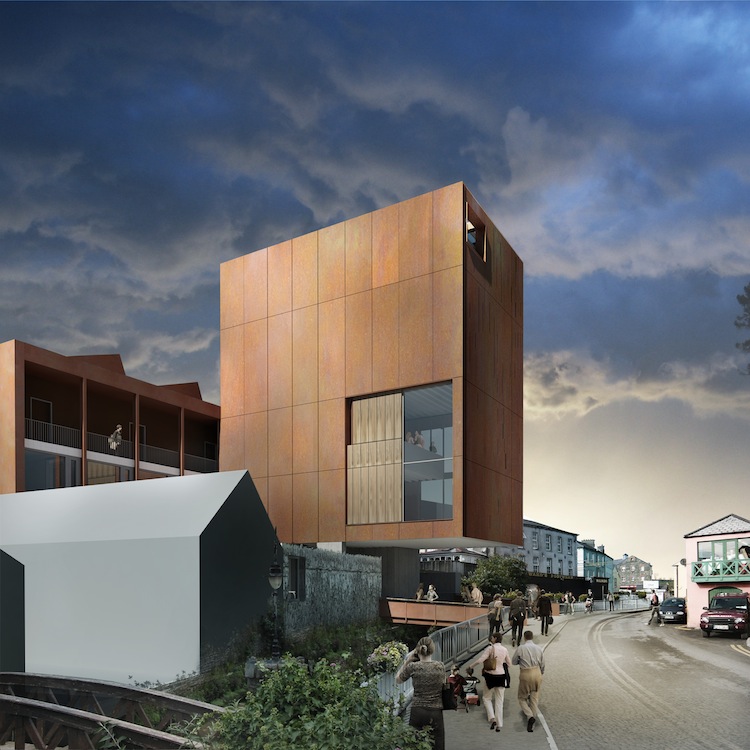
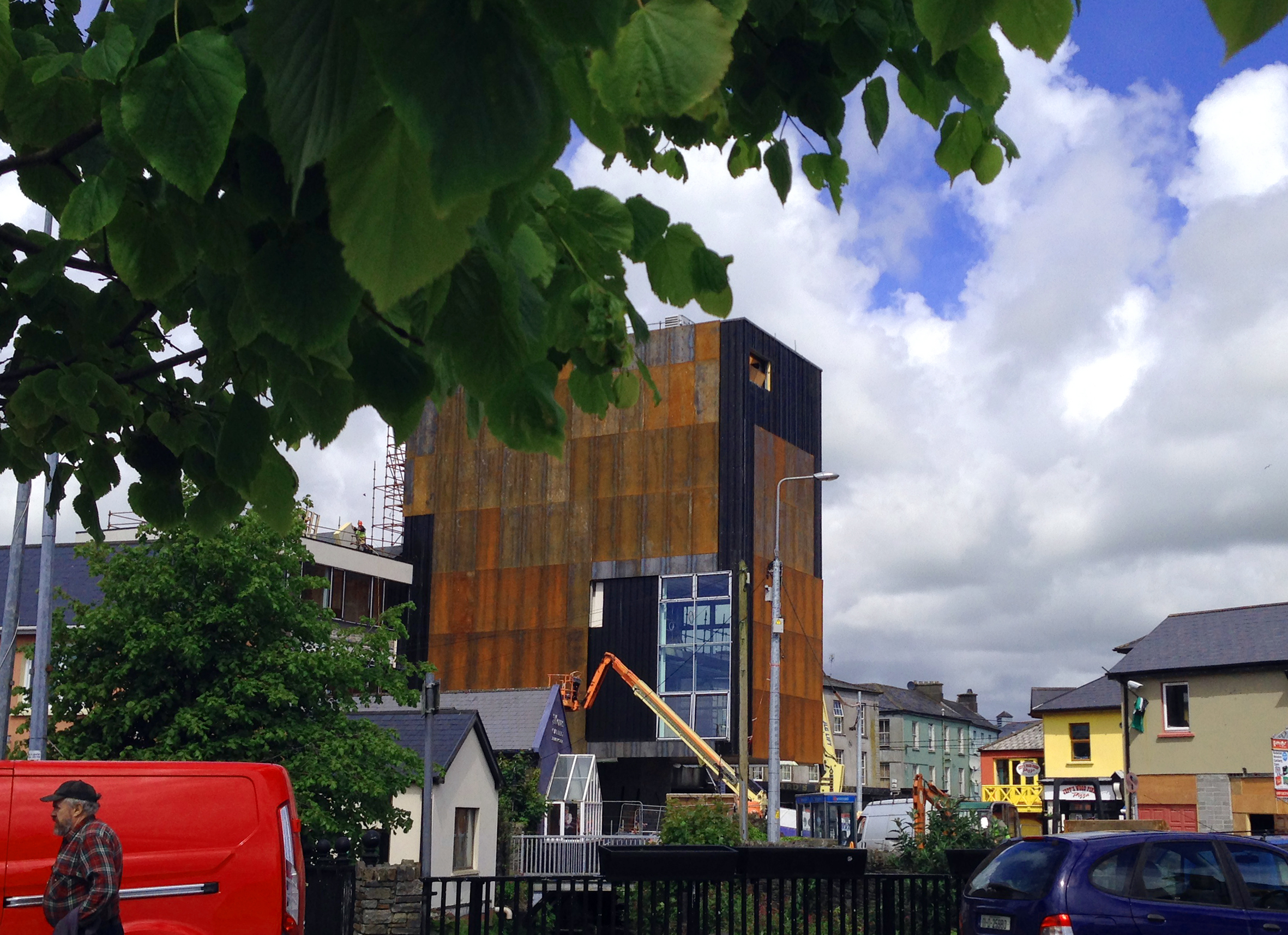
There is a new development going up in the centre of Skibbereen right now, just by the old Levis Quay. It’s on the site of a rather bleak four-storey warehouse structure (now demolished) known most recently as Wolfe’s Bakery. This new building is all about art – rather neatly for my thesis on the artistic links between West Cornwall and Western Ireland.

WCAC_north_view_final-sized

Competition Winner – Skibbereen’s new Arts Centre

The people of Skibbereen are very fortunate to have secured funding for a major arts building, especially in the present climate of austerity. The West Cork Arts Centre will house exhibition space and studio space for artists and social spaces for the community, including enhanced workshop, dance, performance and film club facilities providing a ‘centre for excellence’ in the visual arts at local, national and international levels. The building occupies the ghost of the earlier warehouse and is on five storeys, all fully accessible. Valuable extra space is cleverly gained by cantilevering a portion of the main block out over the Caol Stream. An international design competition was held for the design of the new centre, and this was won by Architects Donaghy and Dimond of Dublin. Visually the building is stunningly contemporary – and this works well in a small town with a diverse architectural language spanning many centuries. So often, new buildings are not allowed to be ‘of their time’ and resort to pastiches of older styles with the result that present day town centres can lack any dynamic character.

The building is being clad with a material known as ‘Corten‘. It’s actually rusted steel! It’s an attractive and durable finish which matures and stabilizes as time goes on. The appearance of a large rusty steel box in the centre of town is exciting some comment but – as always with anything new – judgement is best reserved until the project is completed. In my opinion it will add to the attractions of Dear Old Skibbereen and provide very welcome new facilities in the heart of this creative community. Well done Skibbereen!

Taking Shape - 21 May 2014

Taking Shape – 21 May 2014

Here’s an idea: several of the Newlyn School artists were Irish – or had Irish connections. Perhaps in West Cork we should put on an exhibition highlighting artistic links – old and new – between Cornwall and Ireland?

Wolfe’s Bakery – site of the new Arts Project

Cape Clear

Distant Cape Clear - with solar effects

Distant Cape Clear – with solar effects

Always in our view from Nead an Iolair are the many islands of Roaringwater Bay: sometimes they are referred to as ‘Carbery’s Hundred Isles’. The largest of them – and the furthest out into the Atlantic – is Cape Clear. From our vantage point in Cappaghglass it sometimes floats on the horizon like a great seal under brooding skies, yet with the clarity of summer skies every hillside cottage can shine like a white jewel. I visited the island for the first time last weekend, drawn to its isolation and history – and by its own Saint – Ciarán, born on this most southerly point of Ireland and preceding Saint Patrick by some generations as the ‘Apostle of Eirinn’.

ghaeltact

Cape Clear is a place apart. It is one of the Irish Gaeltacht areas – where Irish Gaelic is spoken as the first language. Oileán Chléire is the Island of Ciarán, and one of the first things to be seen after landing is an ancient stone by the quay – said to have been placed there by the Saint himself – and his holy well – while nearby are the ruins of an ancient church and burial ground.

Saint Ciarán’s life has inspired some colourful stories. Before he was conceived Ciarán’s mother (Liadán) had a dream that a star fell into her mouth. She related this dream to the tribal elders who were knowledgeable of such things, and they told her that she would bear a son whose fame and virtues would be known as far as the world’s end. Ciarán’s first disciples included a Boar, a Fox, a Brock and a Wolf: they all became monks and worked together to build the community.
An interesting find: Ciarán as a Celtic God by Astrella

An interesting find: Ciarán as a Celtic god by Astrella

An unusual incarnation of the St Ciaran / Piran legend!

An unusual incarnation of the St Ciaran / Piran legend!

The Saint is also recognised in Cornwall, where he is known as Piran (or Perran) – scholars argue that in some ‘Celtic’ languages the C sound is interchangeable with the P sound. Certainly there is a legend that the Heathen Irish tied St Ciarán to a millstone and dropped him into the sea – and he then floated across to Cornwall where he converted the Heathen Cornish. Whatever the basis of this, both Piran and Ciarán share the same Saints Day: March 5th – which is also my birthday – so that puts me firmly into the picture!

Writers in the past have commented on the island’s particular character:

“…The natives of Cape Clear are distinct in a great measure from the inhabitants of the mainland; they have remained from time immemorial as a separate colony, always intermarrying amongst themselves; so that we must regard them as amongst the most typical specimens at the present day of the old Milesian race. The name of nearly all the islanders is O`Driscoll or Cadogan, the later being only a sobriquet for the former. Baltimore and Cape were originally the stronghold of this family, the principal Chieftain, O`Driscoll Mór, residing in Baltimore. There can be no doubt that they were the aboriginal race residing along the sea-coast of Carbery. The isolated position of the island and its difficulty of approach, have kept the population in a comparatively antique state and distinct condition during the lapse of centuries, so far as nationality and descent. Until the year 1710 Cape was an established monarchy, and an O`Driscoll – the head of the clan- was always styled, “King of the Island”. They had a code of laws handed down from father to son. The general punishment was by fine, unless some grave offence was committed, and then the delinquent was banished forever to the mainland, which was looked upon as a sentence worse than death…’ (from Sketches in Carbery by Daniel Donovan,1876)

Dunanore – engraving by W Willes 1843

Our visit was organised by the Skibbereen and District Historical Society, and was masterminded by past Chairman Brendan McCarthy. He had arranged for the sun to be shining all day, and for the sea to be the calmest that anyone had known for years. A bonus was the presence of Dr Éamon Lankford – a knowledgeable and erudite local historian and toponymist whose projects have included setting up detailed place name archives for Cork County, Kerry, and Cork City. There are now over 200 large volumes of historic place name references and the work is still under way: examples from the city survey include Black Ash, Cáit Shea’s Lane, Murphy’s Farm, the Snotty Bridge, The Shaky Bridge, the Boggy Road, Tinker’s Cross, Skiddy’s home… Éamons unbounded energy has not stopped there – he has gone on to set up and run the Cape Clear Island Museum and Archive and written books on the Island’s people and landscape, on Saint Ciarán, on the Fastnet Rock, on Cape Clear place names- and has set up the Cape Clear Trail… Phew! We walked up the (very) steep hill to the Museum, which is housed in the restored old school building, and no-one could fail to be impressed by the sheer volume of information and artefacts it contains. Volunteers are needed to help run it through the summer months, so anyone fancying a bit of island life please make contact through the website. On our ferry trip from Baltimore and in the Museum Éamon kept us entertained and educated with stories, history and local lore.

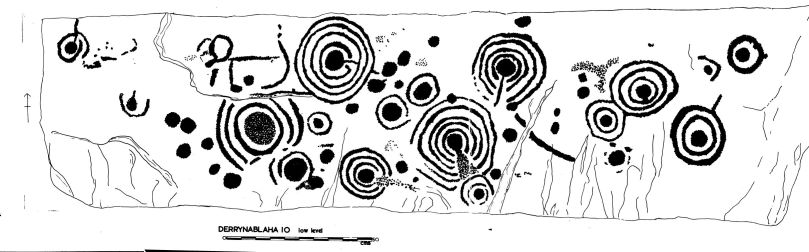
I was keen to visit the Museum because I knew it housed a replica of the passage grave art (carved stone) found on Cape Clear and now believed to have once been part of a passage tomb on the highest point of the island – Cill Leire Forabhain. In 1880 the original stone was turned up in a field and taken across to Sherkin by the then curate of that island to ornament his garden. He left Sherkin only a year later, and the stone became overgrown and forgotten. It was rediscovered in 1945 and given to the Cork Public Museum where it is now on display. The carvings on this stone are in the style of the other spectacular decorated stones in the Boyne Valley and at Loughcrew, rather than the simpler Rock Art we are working on in West Cork and Kerry (although this ‘simplicity’ is belied somewhat by the recent discovery at Derreennaclogh). Beside the replica stone in the Museum is a smaller piece of Rock Art, although debatably labelled as being caused by ‘solution pits’.
MV Cape Clear - built in Glasgow in 1939; went down in the Red Sea 1944

MV Cape Clear docked in Vancouver – built in Glasgow in 1939; went down in the Red Sea 1944

There is so much more to say about Cape Clear: it has given its name to a settlement in Victoria, Australia, supposedly named by gold miners from Ireland, and also to a number of ships built in Scotland. Talking of ships, the surroundings of the island have seen many a shipwreck: more than 50 wrecks have been recorded off Cape Clear between 1379 and 1944. This is partly because of the proximity to the notorious Fastnet Rock. FASTNET

We have to revisit Cape Clear again in the not too distant future, when we can devote more time to a full exploration of the island: it comprises 7 sq kilometres and 16 townlands. This time, however, it was down to the harbour for an excellent lunch before embarking on the ferry for the next stage of the trip to…. But that story must wait until another time!

harbour

For me, small island communities have a very particular feel: it’s not just the silence and closeness to nature, but a real awareness of how fragile, yet tenacious, the tenets of human existence / subsistence can be. As I write this, Cape Clear is romantically shrouded in mist out there over the bay: only the highest ridge, the cairn, the watchtower and the old lighthouse visible in grey silhouette. It’s a place that will pull us back across the water very soon.

today

Today’s view of the Cape from Nead an Iolair

Cloyne Connections

sir edward fanshawe 1856

During our anniversary trip to Ballymaloe (over the other side of Cork) we couldn’t resist a diversion to Cloyne, where Finola remembered having visited a round tower in her youth, just a few years ago. At that time it was possible to climb up inside the tower, after calling in at the local post office to collect the key. Round towers are a significant archaeological feature of Ireland and I like the enigma of them: no-one knows quite when they were built or why (a bit like Rock Art), but there are 65 of them still standing in the Republic in various states of repair. We proceeded to the post office to be told that it had been possible to climb up the tower up until ‘just a few years ago’ – now, health and safety regulations prevented it. Later, I read an account of someone who went to see this tower in 2004, 10 years before, and was told that it had been possible to climb up the tower ‘just a few years ago’… which shows that time and memory are relative.

tower

Although we were disappointed in our aspirations to climb the tower, our visit to the post office turned up a very friendly lady who said that she held the key to the adjacent cathedral, and would be pleased to let us go in there instead.St Colman's Cathedral at Cloyne - a print from 1853St Colman’s Cathedral at Cloyne – a print from 1853

Cloyne Cathedral: the worship area, a small part of the large building

Cloyne Cathedral: the worship area, a small part of the large building

An 11th century gilt bronze cross was found in the Cathedral grounds

An 11th century gilt bronze ‘pilgrims cross’ was found in the Cathedral grounds

The Cathedral of St Colman in Cloyne is well worth a visit. To this Englishman the term ‘cathedral’ conjures up images of Gothic magnificence with soaring spires, arches and intricate buttressing – and set picturesquely within a medieval city centre; this, however, is a humbler structure – although grand in size – constructed in 1250 and located in a somewhat overgrown graveyard in the back streets of a small East Cork town. For more detailed information on the cathedral, have a look at the excellent blog Pilgrimage in Medieval Ireland.

blue flowers

Every day you should learn something new, and until then I had heard nothing of St Colman: St Colman mac Lenene lived in the sixth century and was a friend of St Finbarr, who we have encountered previously. He founded his monastery in Cloyne in 560 here and the cathedral is built over a network of caves, now inaccessible but used in the penal days by priests as a secret underground link from Cloyne House to the Catholic graveyard in order to say mass for the people.

pye window

A window by artist Patrick Pye

Nor did I know anything about the Bishop of Cloyne whose alabaster effigy rests in the north transept of the cathedral, watchfully guarded by a wonderfully personable Lion: it all made me think about how I would like the world to remember me after I’m gone…

bishop b

George Berkeley, Bishop of Cloyne – with Guardian

You may know – or you may not – that it was Bishop Berkeley who gave his name to the University of California, Berkeley, although he gets a very scant mention on the University’s website. George Berkeley (correctly pronounced bark-lee) was born on 12 March 1685 in Kilkenny and was educated at Trinity College, Dublin, where he later became a lecturer in Greek. He was a radical thinker and philosopher whose best known achievement was the advancement of a theory he called Immaterialism, also known as Subjective Idealism. This theory denies the existence of material substance and contends that familiar objects like tables and chairs are only ideas in the minds of perceivers, and as a result cannot exist without being perceived.


He left the British Isles for the American Colonies in 1729, settling in Rhode Island but determined to found a Utopian city in Bermuda based in principles which he set out. One was: …for the better supplying of churches in our foreign plantations and for converting the savage Americans to Christianity… while …being in Bermuda would prevent the Native American youngsters from “returning to their brutal customs, before they were thoroughly imbued with good principles and habits.”

The 'Bermuda Group' - George Berkeley with his family on Rhode Island

The ‘Bermuda Group’ – George Berkeley with his family and friends on Rhode Island (John Smibert)

Berkeley’s social experiments didn’t get off the ground, mainly due to lack of funding, and he returned to London in 1732 and then to Ireland where he was appointed Bishop of Cloyne in 1734, a post which he retained until his death in 1752.

It's a long way to Indian Rock: Berkeley, California - named after the Bishop of Cloyne

It’s a long way to Indian Rock: Berkeley, California – named after the Bishop of Cloyne

George Berkeley wrote Verses on the Prospect of Planting Arts and Learning in America – inspired by the colonisation of the New World: …Westward the course of empire takes its way; The first four Acts already past, A fifth shall close the Drama with the day; Time’s noblest offspring is the last…  and it was these lines that were remembered when the city and University of Berkeley were founded in 1866. This Californian institution ‘…became a catalyst of economic growth and social innovation — the place where vitamin E was discovered, a lost Scarlatti opera found, the flu virus identified, and the nation’s first no-fault divorce law drafted…’

graves

From the time of Colman and Finnbarr Cloyne was a great centre of ecclesiastical power. Today the cathedral is a Church of Ireland (Protestant) house and in need of maintenance and repair – a problem for a small population of worshippers. The churchyard is overgrown, and a sanctuary for wild flowers; the ancient gravestones are leaning and barely decipherable. All in all, a place – like so many in Ireland – imbued with a fascinating history which embraces the world.

St Colman

St Colman