West Cork Speak: Lessons 5 to 7. And PRIZES!

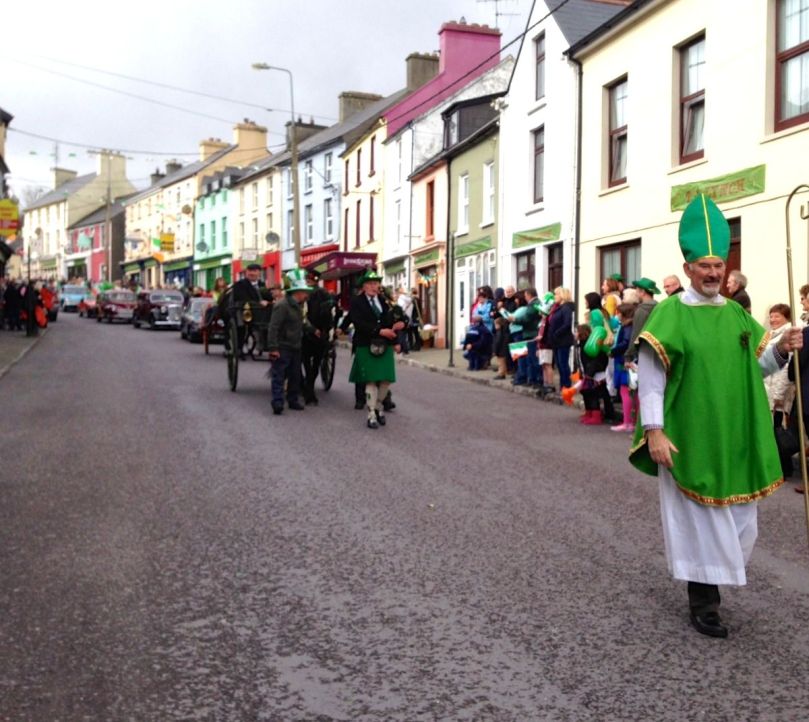
Here comes himself at the head of the parade

Here comes himself at the head of the parade

Time for the next lesson in how to sound like you’re from West Cork! In Lessons 1 and 2 we covered like and grand, now and so – versatile words that will take you a long way in any conversation around here. Then in Lessons 3 and 4 we looked at how you would frame your sentences in the conditional tense, and how to use the pronouns ye, and himself, herself and yourself. I hope you have been practising, in preparation for your visit. You ARE coming, right? Good – well so, you would need to be moving along to the next important steps in your language development. And to help you see where you’re coming, I will illustrate these lessons with pictures of the St Patrick’s Day parade last Monday in Ballydehob.

Vintage tractors galore

Vintage tractors galore

Lesson 5: In Fairness

Nothing distinguishes the West Cork denizen like the phrase in fairness. Occasionally rendered as in fairness, like or even to be fair, it is tacked on to the end of sentences with total abandon, whether it matches with the sense of what’s been said or not. If you meet someone on your walk, don’t be surprised to hear him say “’Tis a grand evening, in fairness like.” It’s as if it’s important to give God His due – He’s sent us lots of storms lately and endless days of rain, but sure, He’s doing His best to make it up to us now, isn’t He?

Sometimes you are left wondering about what’s not being said. If you hear “She’s a terrific dancer, in fairness,” you might wonder if there’s another part to the sentence, that has been left out – “even though she can’t sing,” maybe. But no, it’s probably just been added for some kind of emphasis, or to round out the sentence in some way. So go ahead, just drop it in here and there, and you’ll be grand.

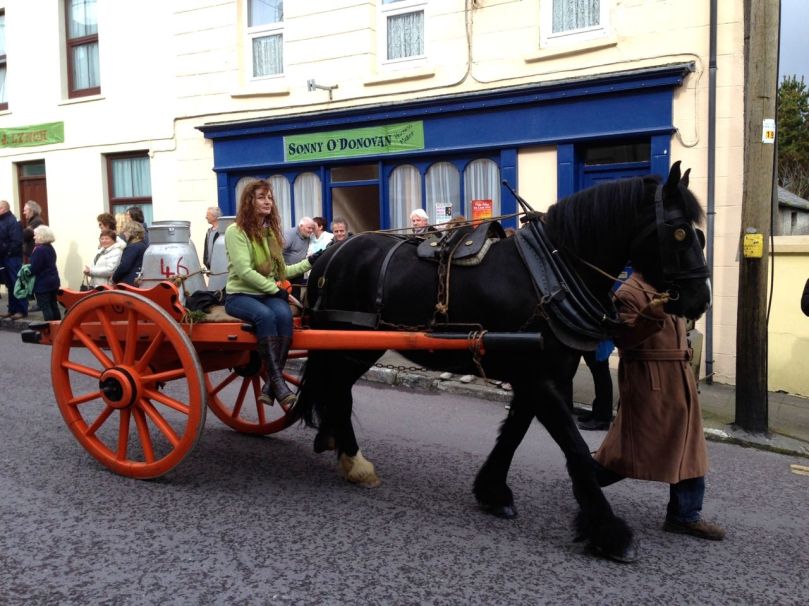
Going to the creamery

Going to the creamery

Lesson 6: Modifiers

Nobody in West Cork is very happy – no, we are happy out. And why wouldn’t we be, living in this beautiful place? We might also, if we have a lot to do, be busy out. If we badly need a pint, we might be thirsty out.

If using out as a modifier doesn’t trip off your tongue, try altogether instead. Or entirely.

We saw a good movie the other night. “It was great fun altogether.”

A recent story in The Examiner tells of a local hero, a student who found a toddler wandering late at night and made sure he was safe. Since the story is told mostly in dialogue, it’s an excellent example of Irish speech.

And the student, I think you will find yourself saying, “Wasn’t he a fine lad entirely?”

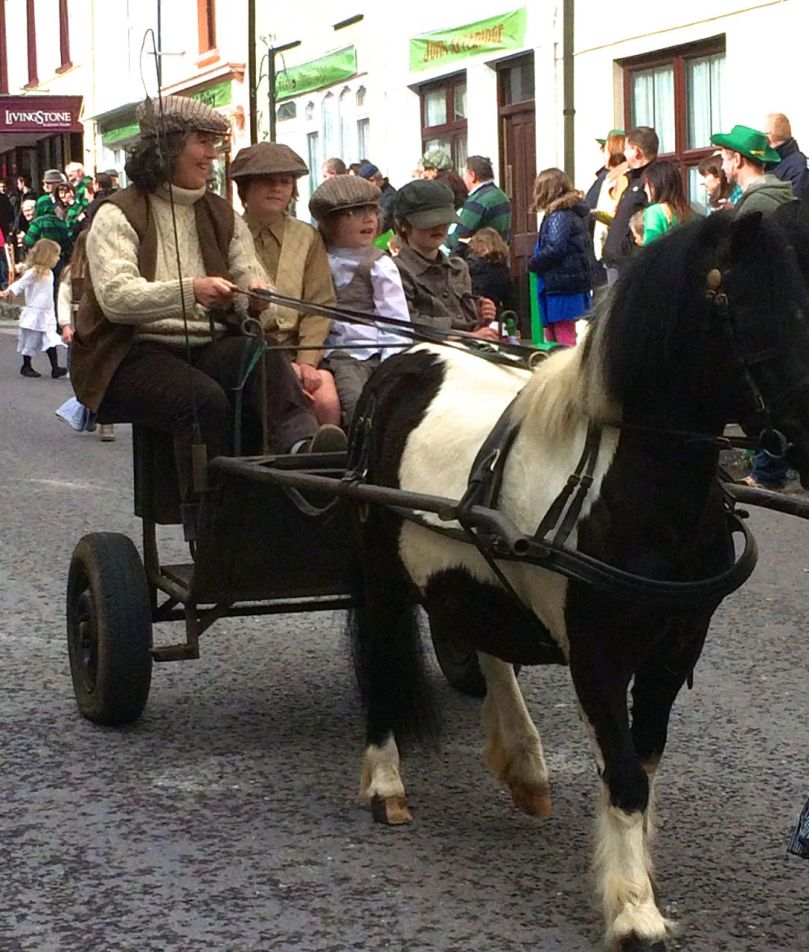
Don't they look happy out?

Don’t they look happy out?

Lesson 7: The diminutive

In Irish, the diminutive is formed by putting –ín (pronounced een) at the end of a word. We tell people that we live down a boreen (Irish word for road is a bothar, pronounced bo-her, and a bothairín is a small road). I’ve written about the children’s graveyards here: a cillín, pronounced killeen, actually means a small cill or church.

Some West Cork people routinely add -een to the end of a word to convey a sense of its size. Our landscaper asked if he should put the tools in our shedeen. Our neighbour, when I asked him about a certain piece of land said it was “nothing but a fieldeen.” You may well be asked by a waitress if you’d like a biteen more coffee.

Isn't that a grand careen?

Isn’t that a grand careen?

Now so – there you are! I think you might be ready to put all of that into practice.

Announcing our second ever COMPETITION (the first one was about place names). Your task, Dear Reader, is to construct a short conversation between two individuals. They are driving in opposite directions, but meeting on the boreen they roll down their windows to pass the time of day. The big topic of the moment is the St Patrick’s Day parade in the village and this, therefore, is the subject of their conversation. Reconstruct the chat, using what you’ve learned in the seven lessons so far, and your own imagination. An astute panel of judge will pick the winners and excellent prizes will be dispatched. Actually, prize-eens, in fairness. Good luck!

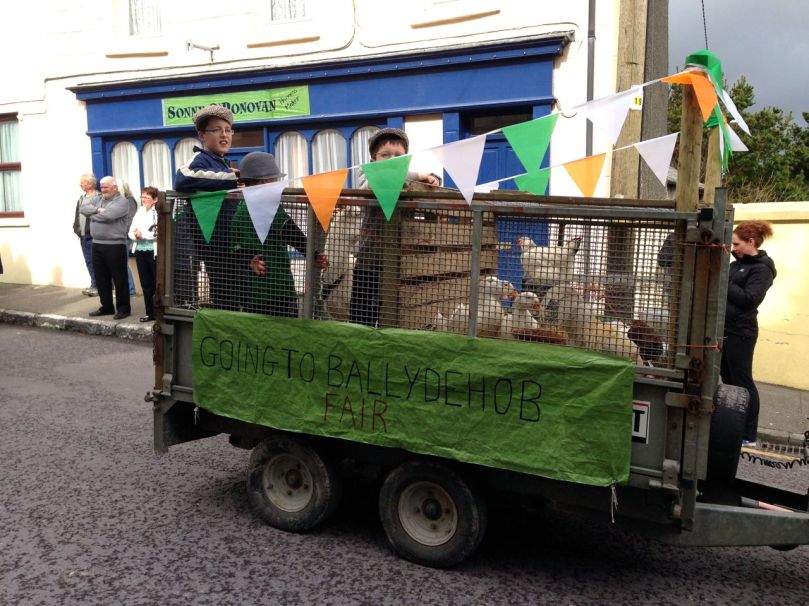
'Tis a lovely float, in fairness, like

‘Tis a lovely float, in fairness, like

Copper Country

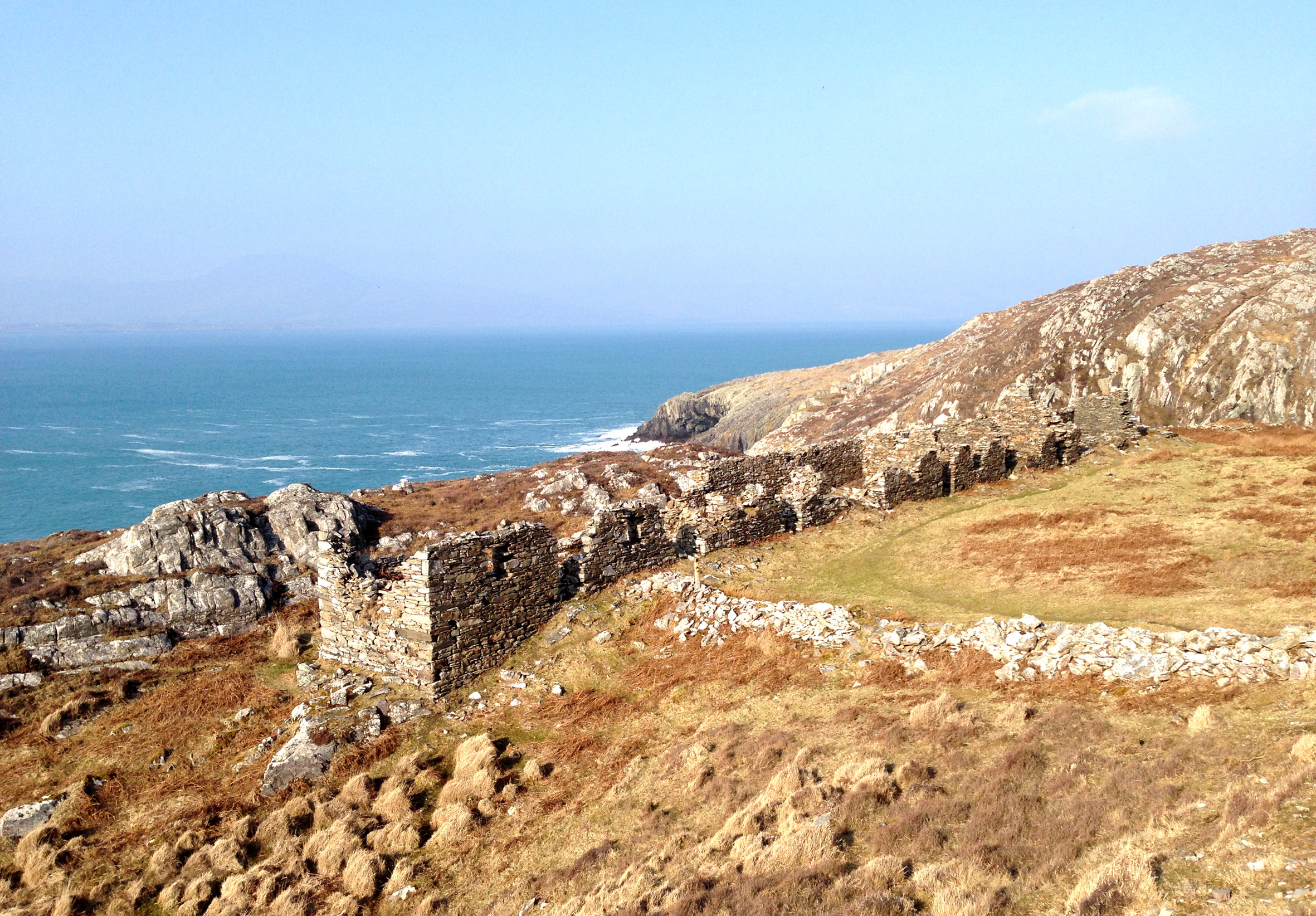
Sheep's Head Copper Mine: Cornish mineworkers' cottages

Gortavallig Copper Mine, Sheep’s Head: Cornish mineworkers’ cottages

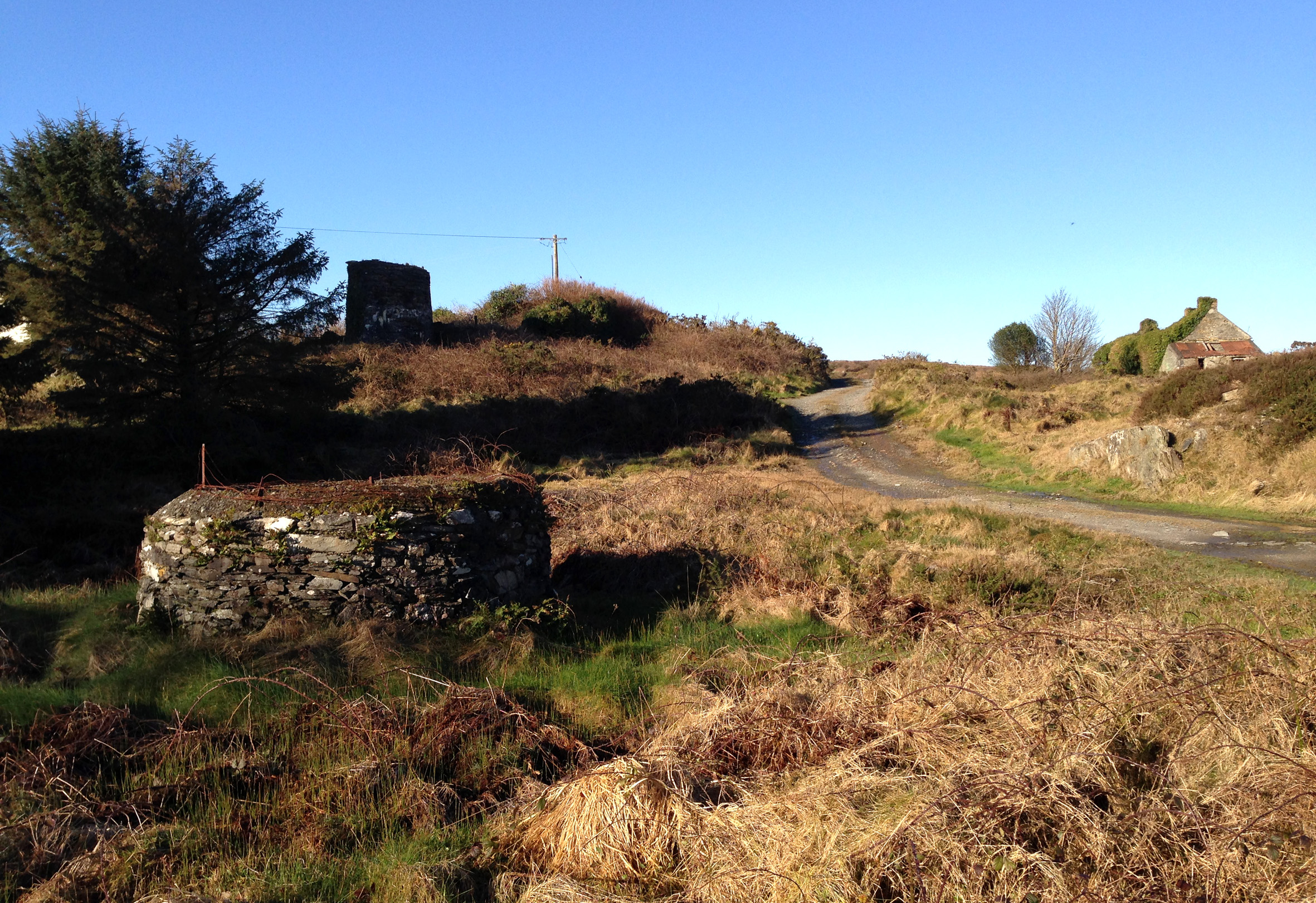
We live in the townland of Cappaghglass. I would love to say that the name derives from the metal that makes up much of its geology – copper, but Finola tells me that way of looking at it comes from my English accent: the Irish word for copper is Copair, while Cappa actually means meadow. Glas or glass means green so – prosaically speaking – we live in ‘Green Meadow’. However, as in so many cases, the history of this little bit of Ireland is writ clearly on the landscape and Cappaghglass is very much ‘copper country’.

Stub of 9th century Irish round tower? - No: 19th century copper mine workings in Cappaghglass. In front is the head of a shaft, behind is the remains of the mine chimney that fell in 2002; to the right are the old mine cottages

Stub of 9th century Irish round tower? – No: 19th century copper mine workings in Cappaghglass. In front is the head of a shaft, behind is the remains of the mine chimney that fell in 2002; to the right are the old mine cottages

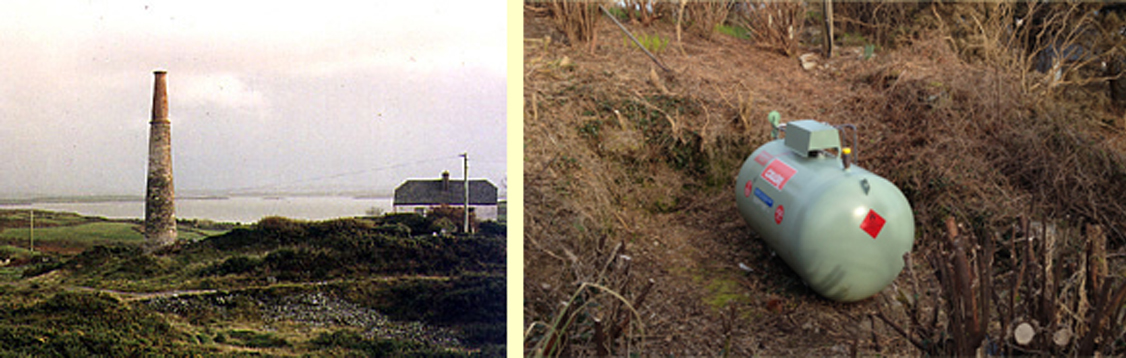
Our own house, Nead an Iolair, is built on territory that was once owned by a nineteenth century copper mine, and legend has it that our Calor gas tank is placed over an old mine shaft! We look out to Horse Island – one of Carbery’s Hundred Islands in Roaringwater Bay: it once supported a copper mine of the same period. Look at the photograph of the number of workers employed there at this time. Now there are merely a few holiday homes on the island.

Mineworkers on Horse Island: 19th century

Mineworkers on Horse Island: 19th century

Among the quiet fields and peaceful boreens our townland is strewn with evidence of the industry that once was here: old spoil heaps, barbed-wire protected shafts, supports for overhead ropeways and the base of a famous local landmark: the 20m tall Cappagh Mine chimney which came down in a lightning strike in 2002 which also severely damaged the Mine Captain’s House adjacent to it. Mining here commenced in 1820 and works ceased in 1874. Its best years were the decade 1863 to 1873, when 877 tons of bornite copper ore were produced.

cappamap2

Cappagh Mine: cross section, mine chimney (pre 2002) and our own mine shaft!

Cappagh Mine: cross section, mine chimney (pre 2002) and our own mine shaft!

***

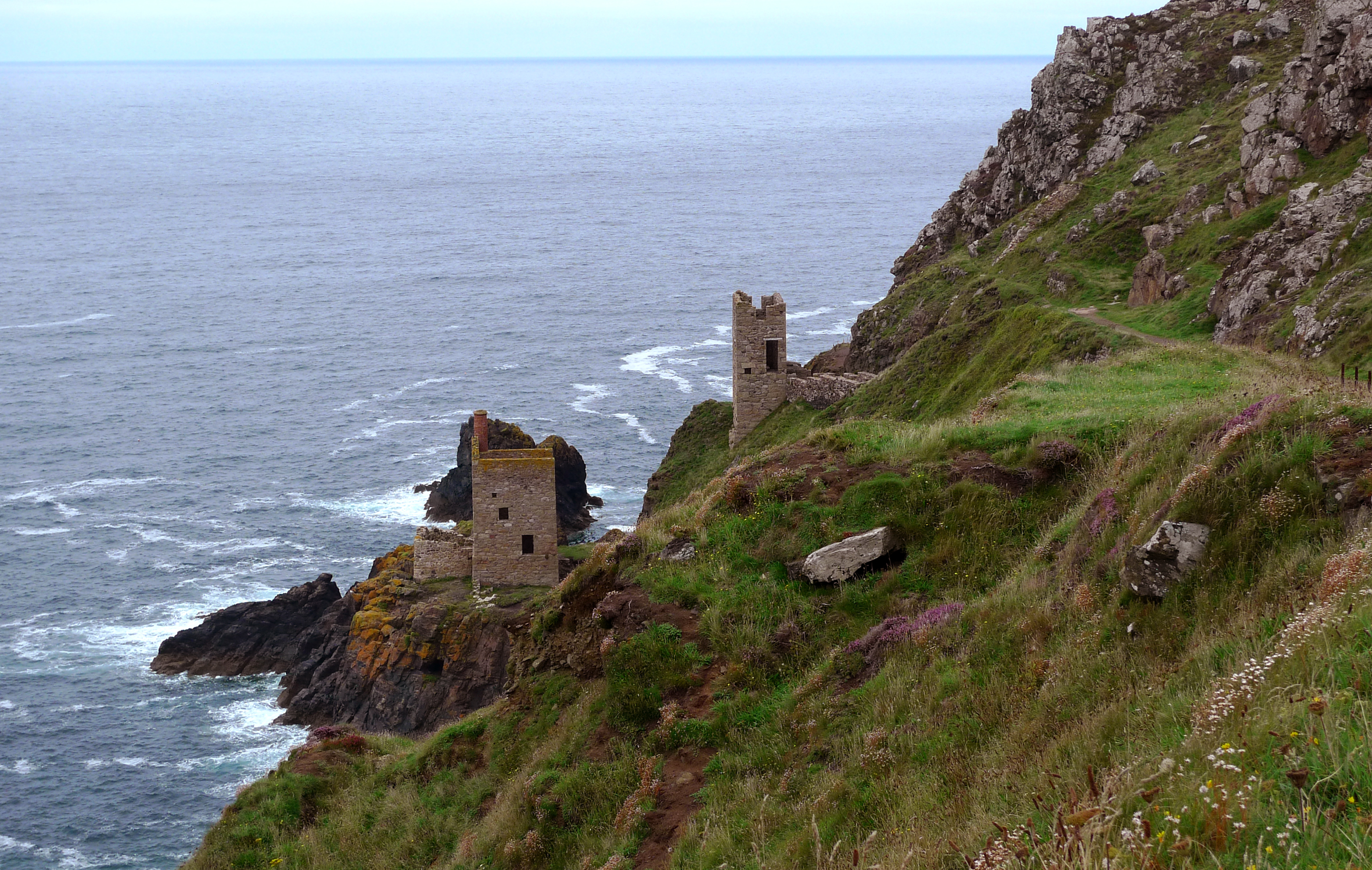
We went off to the Sheep’s Head last week – in idyllic weather – and were shown the Copper Trail by friends Peter and Amanda. It feels so remote out there, yet the place was a hive of industry when mining was at its height during the Victorian age. I was fascinated by the row of Cornish miners’ cottages there, and the similarity between this site and the cliff-edge setting of some of the mines in West Cornwall, Botallack in particular. When exploring these pieces of industrial archaeology in Cornwall I was always struck by the incongruity of the incredibly beauty of the places – set against the blue background of the Atlantic – with the hardship and danger of the working conditions that must have prevailed. Here in West Cork, as there in Cornwall, shafts and galleries extended out under the sea bed and the men toiled away in cramped and perilous conditions with the sound of the booming waters above them, while on the surface women (bal maidens) and children worked equally hard preparing the ore for crushing and smelting.

botallack

Botallack Tin Mine, West Cornwall - romantic site now, but less benign in earlier days

Botallack Tin Mine, West Cornwall – a romantic site now, but less benign in earlier days

Far longer ago than the nineteenth century, West Cork was being worked for copper ore. On the steep sides of our local Mount Gabriel there is evidence of copper mining dating back 3500 years to the Bronze Age. UCC Professor of Archaeology William O’Brien carried out research and excavations during the 1980s and traced a number of mine workings from this time. The extraction was a well organised process: a supply of  good roundwood had to be stockpiled and fires were lit against the rock face where traces of ore were apparent. A hot fire was kept burning for several hours followed by dousing in cold water (of which a good supply was also needed), causing the rock surface to fracture, and this disturbed face was hacked off with stone mauls allowing the accumulation of small quantities of  malachite. Constant working on good seams led to excavation into the mountain side, and some shafts have been found extending to several metres. Water ingress was a problem and it seems likely that a system of bailing or pumping was necessary. Eventually the drowned shafts were abandoned and, over time, they became filled with a type of blanket bog. This helped to preserve some of the wooden implements used and – presumably – discarded in them: hammer handles, wedges, picks and shovels as well as planks and ladders; also pine chips apparently used for illumination.

Bronze Age industrial landscape

Copper Country: Mount Gabriel – once the haunt of Wolves and miners

There’s a whole lot more to be said – about why metal was so important in the Bronze Age (wealth, in one word) and the whole context of distribution, trade and the technology of bronze itself: bronze production is only possible by combining copper ore with tin, and this was not available locally. In all probability our Cornish and Iberian cousins were making contact with Ireland’s metallurgists thousands of years ago. Interesting that the Rock Art we find in these same hillsides – and which could date from the same period – also has parallels in Britain, Brittany and Iberia.

Bronze Age industrial landscape?

Bronze Age industrial landscape?

The Southern Star

Banner

There’s so much going on here in West Cork. You could be out every night if you wanted to be, and  participating in as many community events as there are hours in the day. How do we keep up with it all? Easy – The Southern Star. It comes out every Thursday, and features a pull out Community section that details all the news from the towns and villages around West Cork. Births, baptisms, deaths, marriages and engagements are announced, and be-gowned university graduates are pictured with smiling parents.

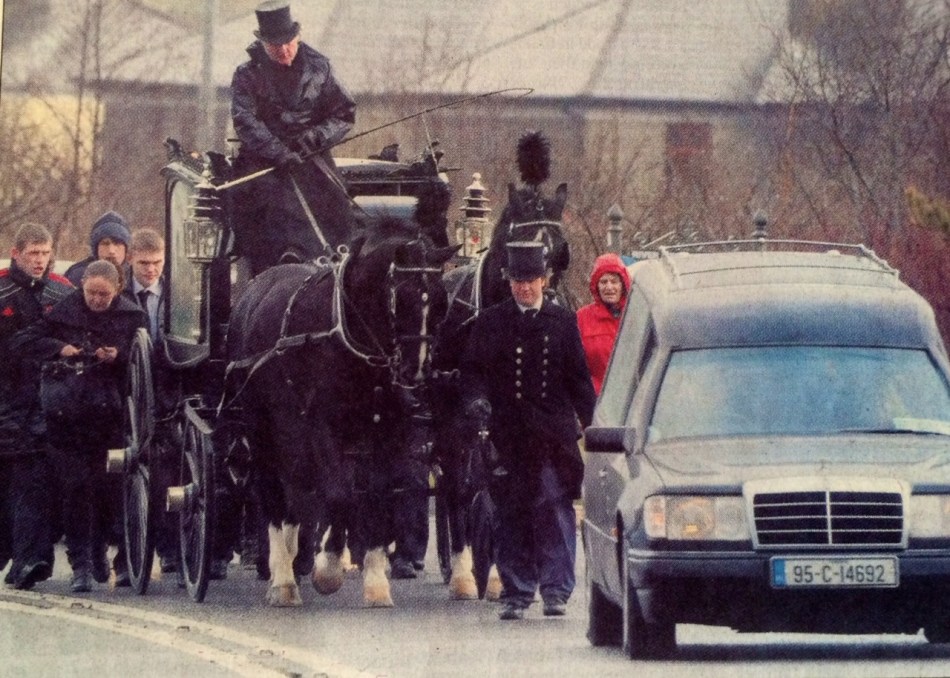
Recent funeral in Skibbereen

Competitions are legion – sometimes talent-based, and sometimes sporting, such as the Clonakilty Blackpudding Car Rally. But rural and farming pursuits such as ploughing competitions or agricultural conferences remind us that we are living in a part of the world that makes it living off the land. Recently a tillage seminar attracted large crowds in Bandon, while another one on calf-rearing had over 300 attendees in Timoleague. Cheval rides are often pictured – horse treks for charity from town to town or across golden beaches. A farmer recently put out an appeal for a missing cow:

The animal made good its escape from a farm in Jagoe’s Mills, Belgooly, on Friday, January 17th. The animal may be suffering from memory loss as it was last seen at the racecourse in Farrangalway, before evading capture and taking to the countryside in the Dunderrow area. This is an extremely prized animal.

The farming community has been up in arms recently over changes to the system of government grants known as “Single Farm Payments” and there have been huge turnouts at meetings, protests and rallies.

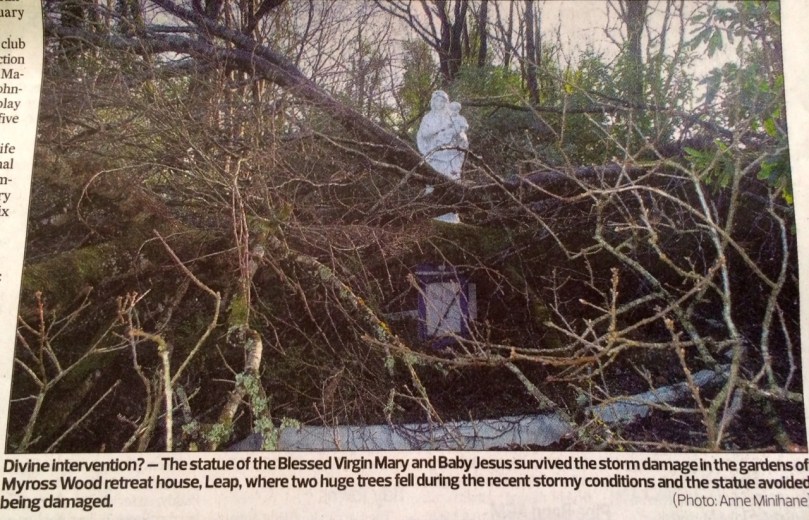
Divine Intervention at Myross

Divine Intervention at Myross

The ebb and flow of village life is chronicled in the Star’s Community pages. ICA (Irish Countrywomen’s Association) meetings are announced and later described. Local businesses close and the village say farewell to a pair of much-loved publicans. Community members gather to clean up a graveyard (…stone walls emerged and tombs reappeared after years of being buried in undergrowth. The little Huguenot chapel was cleared of saplings and briars…) or celebrate the opening of a new playground, to help neighbours affected by the recent awful storms or to hold a St Brigid’s Cross making session in the senior’s housing complex. West Cork people are upset about fluoride in their water and enthusiastic about the Men’s Shed Movement.

Getting news of cultural events

Getting news of cultural events

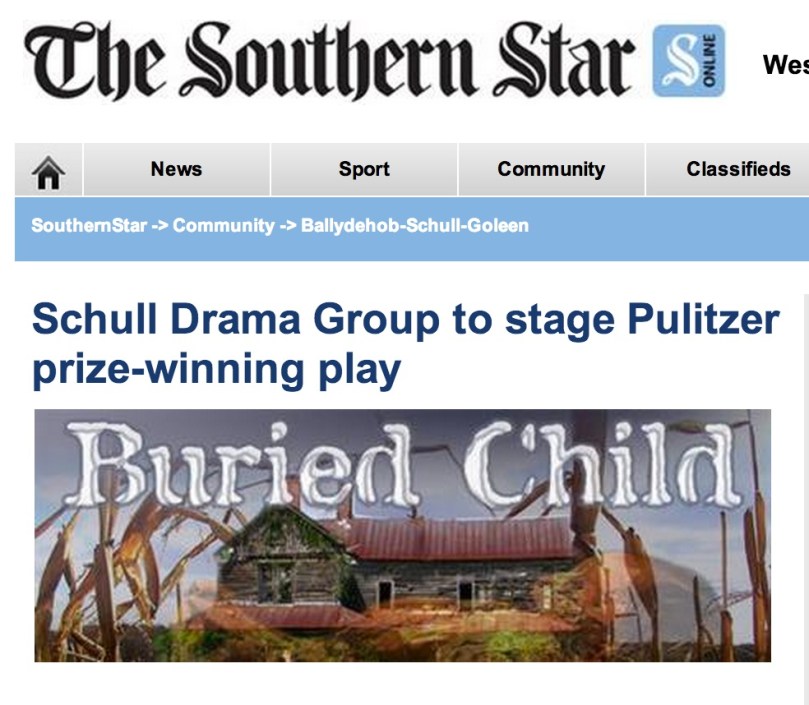
Reading the Southern Star is the only way to find out where Road Bowling events are taking place, or horse races. We comb through it looking for the upcoming meetings of the various Historical Societies, the concerts (from orchestral to traditional), the plays by the local drama groups (this weekend, Sam Shepard’s Buried Child in Schull), and the upcoming festivals. Ballydehob will hold its annual St. Patrick’s Day parade on March 17 (a national holiday here) and the theme this year is to recreate the 1914 Postal Directory of the village. We are witnessing the establishment here of an new national tourism initiative, the Wild Atlantic Way, and local communities are being asked to brainstorm how to get involved.

Daisy contemplates her strategy

Daisy contemplates her strategy

I will finish with one of my favourite recent items:

A Cowpat Challenge takes place at Kilmurry National School on Sunday, February 23rd. at 11am. Daisy the cow is coming to the grassy area in the playground which will be marked out into numbered squares. Whoever owns the square that Daisy decided to deposit the first cow pat into, wins a whopping €1,000.

We are posting early this week as we leave for a trip to Ireland’s west coast tomorrow. We still have no telephone or internet so this is coming to you through the kindness of neighbours who have given us access to their WiFi. Next post in two weeks – spring will have arrived by then. Right?

The Coast of West Cork

Coast of West Cork cover

Every personal library in West Cork, maybe in Ireland, has a copy of the book The Coast of West Cork by Peter Somerville-Large. First published in 1972, it is a classic of travel writing – amusing, learned, thoughtful – that still holds up as a fascinating portrayal of this part of the world. The photograph above is of the front cover of the book, signed by the author, that I brought with me to Canada when I emigrated in 1974. Forty years later, I am living on the very spot where this photograph was taken! It took me a while to figure this out, as the picture is actually reversed.

Peter Somerville-Large, now in his 80s, is still writing. He is connected to the old Castletownshend families (Edith Somerville was a relation and he mentions Townsend aunts) and was already very familiar with West Cork when he set out to tour it by bicycle in the spring of 1970. He takes every road, every byway and boreen, and describes in detail the scenery, the characters and the conditions along the way.

Grand road for cycling!

Grand road for cycling!

Far more than a travel diary, this is a comprehensive account of West Cork. Somerville-Large’s erudition is impressive. Either before or after his journey he spent many hours in the National Library, researching the history, folklore, archaeology and literature of the area and he weaves this knowledge seamlessly into his narrative. Because of his own personal background, he is able to include stories and anecdotes from the Big Houses of the gentry. A great aunt

“…remembered going down to a cellar which was filled with swords used to arm the tenants during the time of the Whiteboys and also with empty stone wine jars which had carried wine smuggled in from France. From this cellar there was believed to be a passage underground to the O’Driscoll Castle of Rincolisky, whose truncated remains are to be found in a neighbouring field…An earlier Townsend sent his…page down the passage to see if it was clear. The boy was never seen again.”

Castletownsend Castle

Castletownshend Castle

His affection for the place leads him to mourn the loss of population from the Islands of Roaringwater Bay.

“One by one the small islands became deserted…Only a few years ago I visited Horse Island, just opposite Ballydehob. The last people there, an elderly couple, were living all alone. It was summer, and the old man was sitting in a chair outside his house, his feet in a basin of water. His wife, behind him, fed hens. Next year, they were gone. The house, still intact and comfortable, stood empty, the linoleum in place, last year’s calendar on the wall. Down by the pier a plough had been thrown into the water where it looked like a gesture of despair.”

Looking across to Horse Island

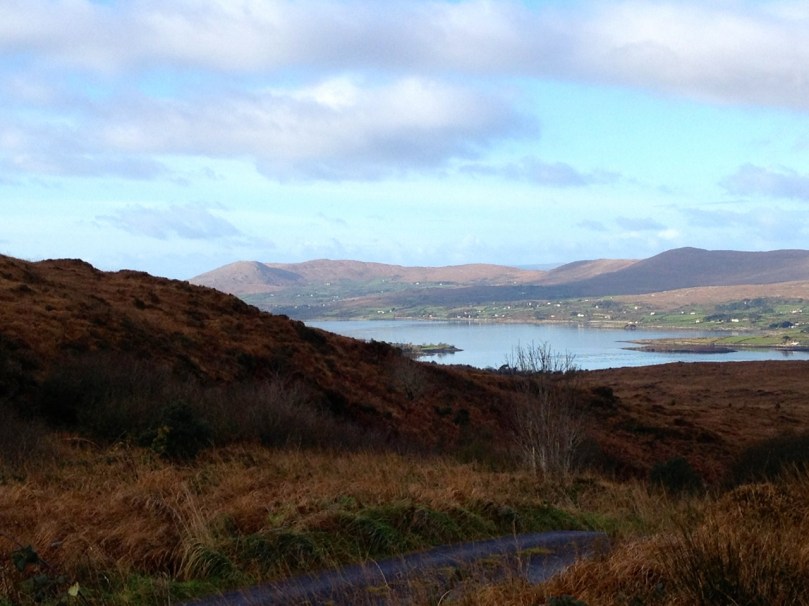
Looking across to Horse Island

He documents the importance of the creamery in the social life of the townlands, the old occupations of fishing and mining and the loss of such sources of income, the string of castles that dot the coast and the great irish families that built them, the “brash new bungalows” springing up around the scenic areas, the awful legacy of the famine, and the sheer beauty of the scenery. He is conscious of a way of life passing. Going out of his way to visit a sweathouse (a feature of the Irish countryside in times past) he ends up in the O’Sullivan’s kitchen, drinking whiskey and eating biscuits.

“Mrs. Sullivan told me that the valley was once thickly populated, and when she was a girl there had been sixty children at the school that closed last year. The way of life had gone with it…Once it had been a great place to live in, her husband said. There were monthly fairs at Ballydehob and Schull, and he had walked all the way to Bantry with the cattle and all the way back again.”

Deserted cottage

Deserted cottage

The parts I have quoted deal with the area around where we live, but the bicycle trip stretches from Clonakilty to the Beara Peninsula. Describing West Cork as it was in 1970, it is now an important historical document in its own right, alongside such accounts as Thackery’s Irish Sketchbook of 1879, or the Pacata Hibernia of 1633. Mostly, however, it is a charming, engaging and fascinating depiction of a special place.

Over the hill to Durrus

Over the hill to Durrus

The Stones Speak

derr scale dwg 06

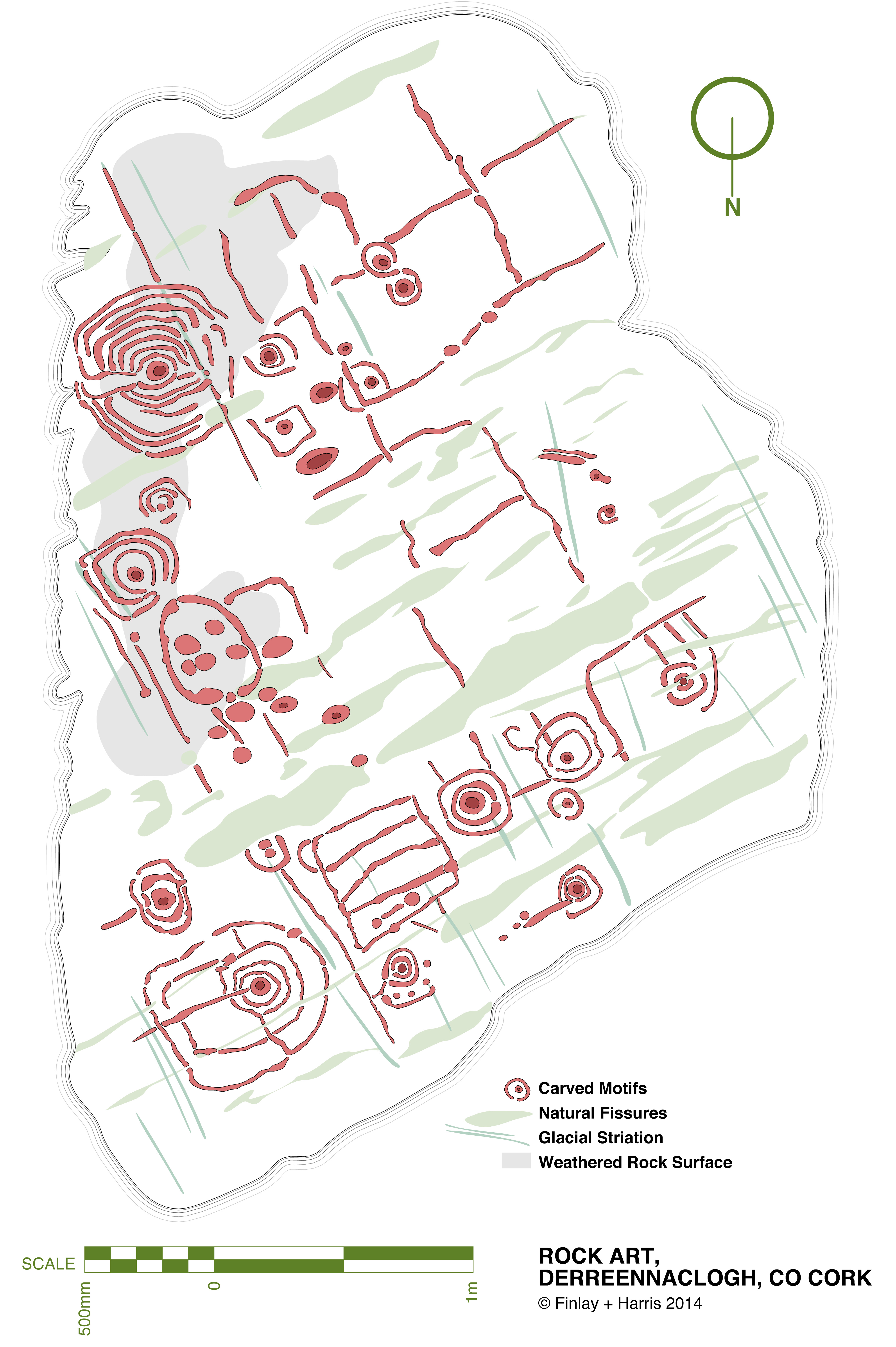
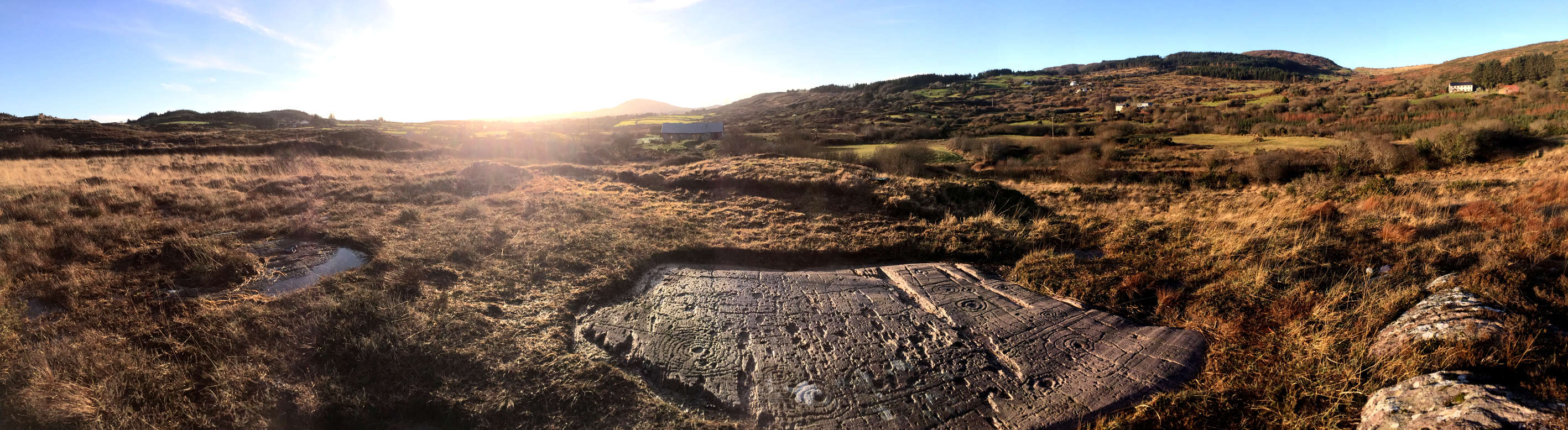
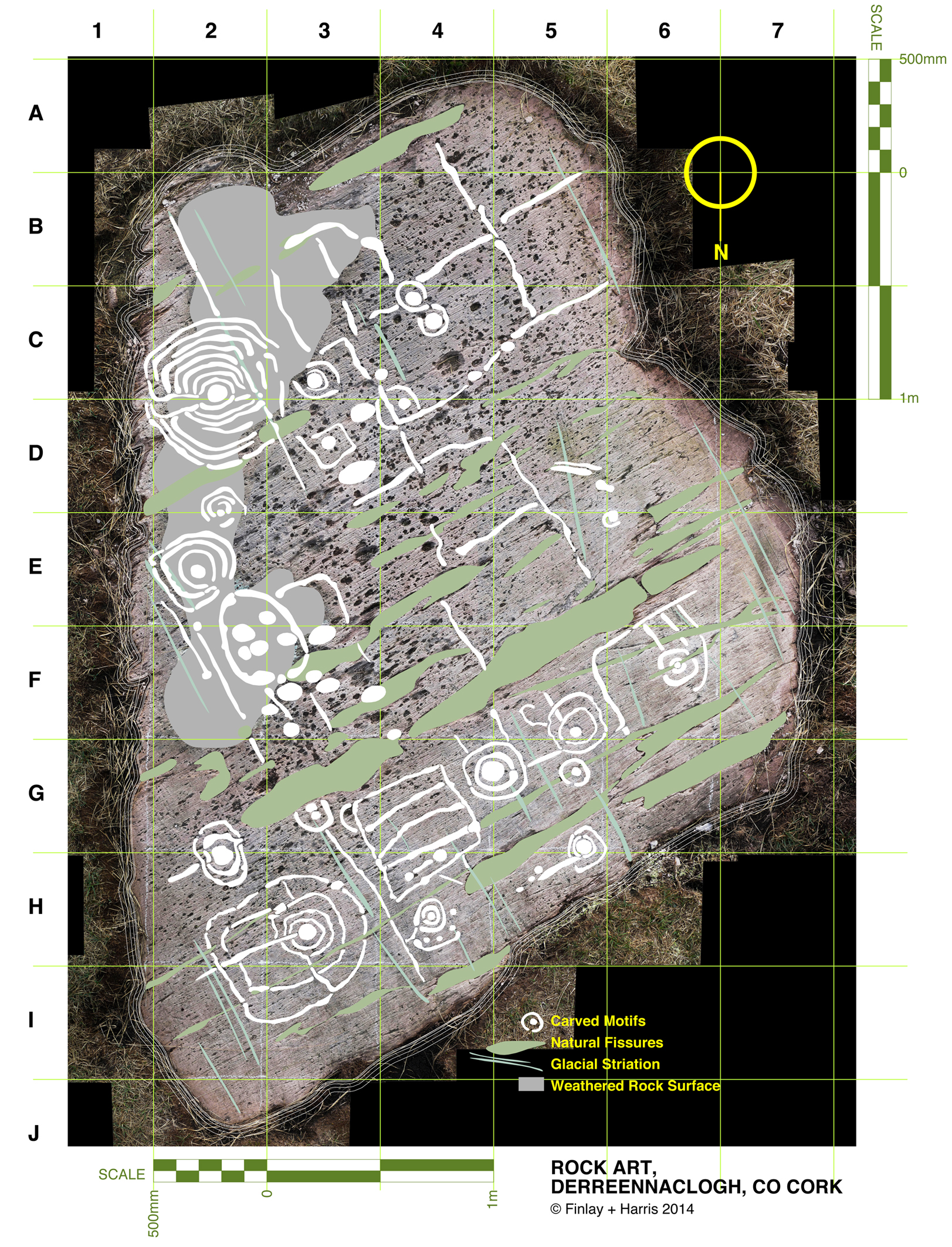
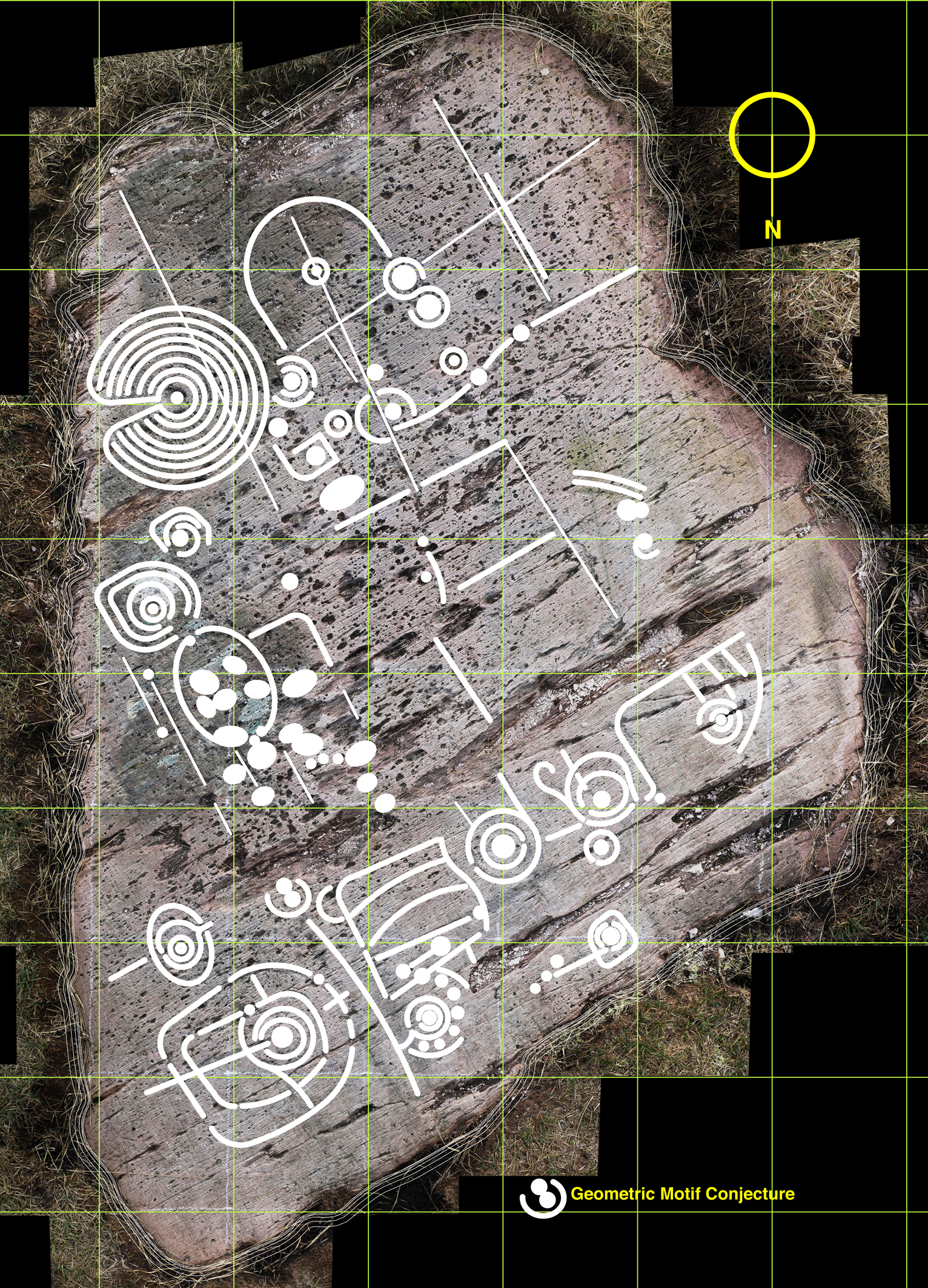
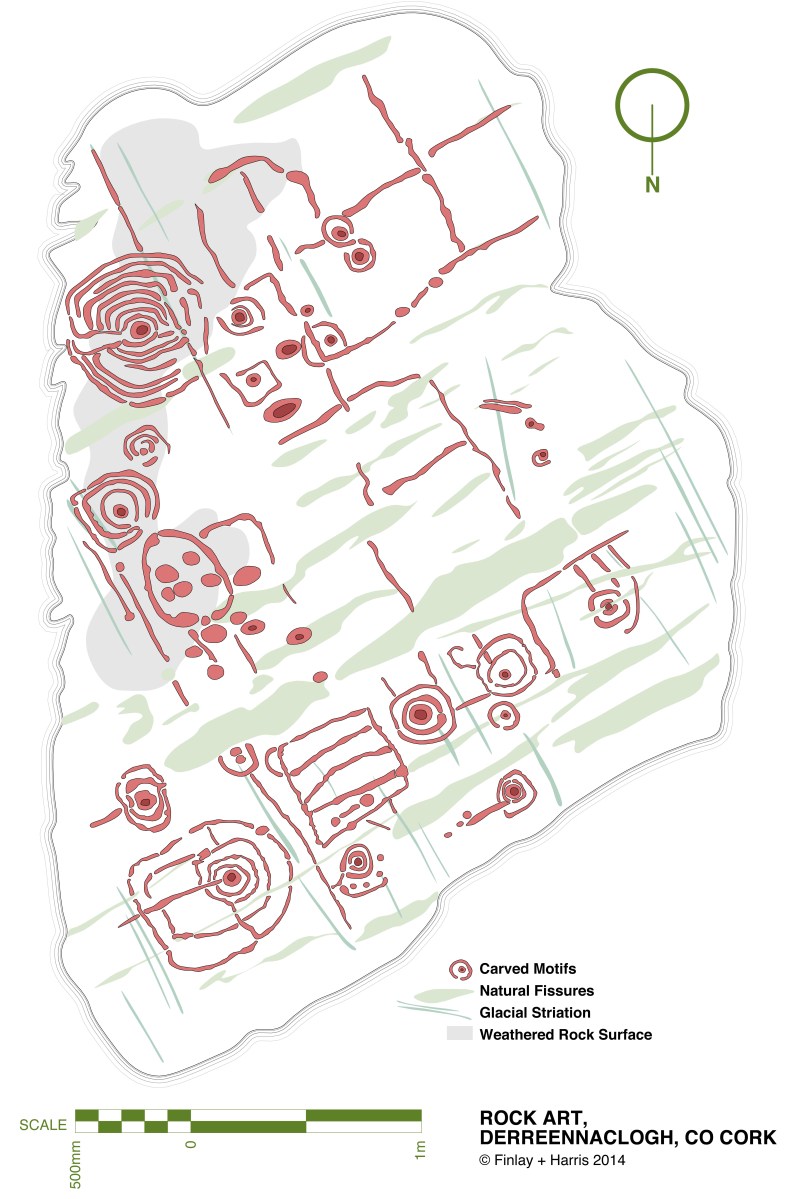
This drawing is a true scale representation of Rock Art on the horizontal surface of a large, earth-bound slab of sandstone in the townland of Derreennaclogh, Co Cork, Ireland. Archaeologists believe that carvings on this stone – and on very many others in Ireland and across the Atlantic coastline of Europe – were made by early farmers during the Neolithic or Early Bronze Age period, anywhere from 5,000 to 3,000 years ago. The carvings shown here were only discovered in the recent past: they had lain under a covering of peaty soil for hundreds or, perhaps, thousands of years and had therefore not suffered the natural weathering that many other examples of Rock Art exhibit. In one section – shown as ‘weathered rock’ on the drawing, the surface had previously been partly visible, and the curved lines which could be seen on this area led the finder of this piece to carefully pull back the overgrowth to reveal a remarkable Rock Art panel – perhaps one of the most complex and best preserved in Ireland.
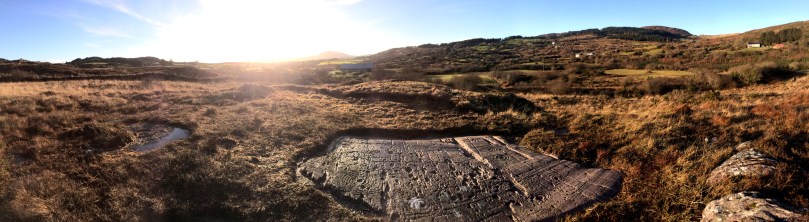
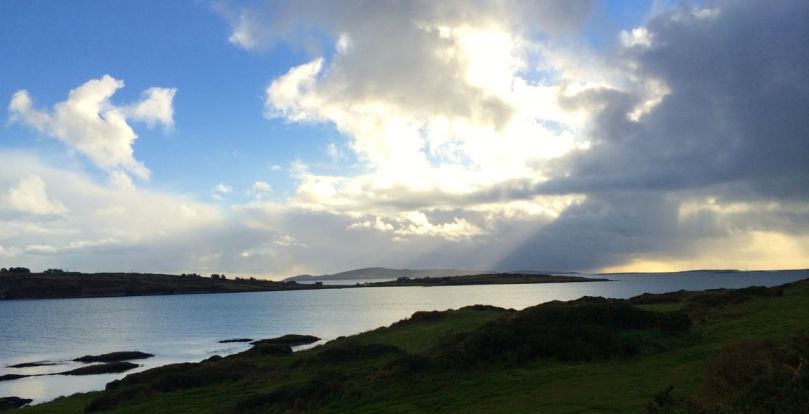
The rock at Derreennaclogh: Mount Gabriel is prominent on the western horizon

The rock at Derreennaclogh: Mount Gabriel is prominent on the western horizon

I have been working on this scaled drawing for nearly a year. This long period is partly because my life has been filled with other things (such as moving permanently to West Cork and buying a house which has needed some upgrading), but also because I have been devising a method to measure and record in fine detail the carvings on the stone without any adverse intervention to the rock surface. When my partner Finola was writing her thesis for UCC in 1973 – The Rock Art of Cork and Kerry – it was normal practice to chalk in the carvings and trace over them using a wrapping film, these tracings then being transferred to high quality mylar and photographed for reproduction. Now the codes for archaeological work have changed and it is no longer acceptable to use chalk or any ‘rubbing’ technique: the thinking is that this could damage the surface. There is a whole debate here on how to best preserve our prehistoric heritage – and no doubt there are those who would say that the Derreennaclogh stone – with its carvings in such a remarkable state of preservation – should never have been uncovered at all, or should perhaps be covered over again in a way that will ensure the retention of its markings in a pristine state, while hopefully allowing occasional access for viewing. These matters are being considered in other areas where Rock Art occurs, particularly in Portugal – where some examples are much visited and provided with interpretation centres – and Scandinavia, where many petroglyphs are protected by toughened glass.
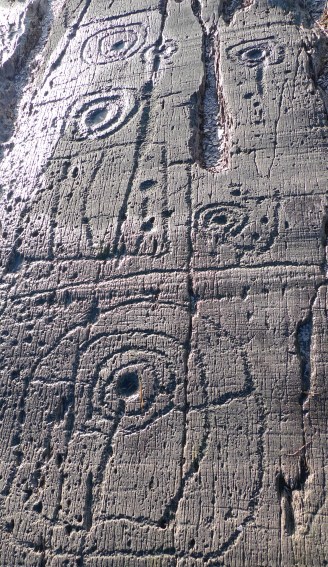
derr panel

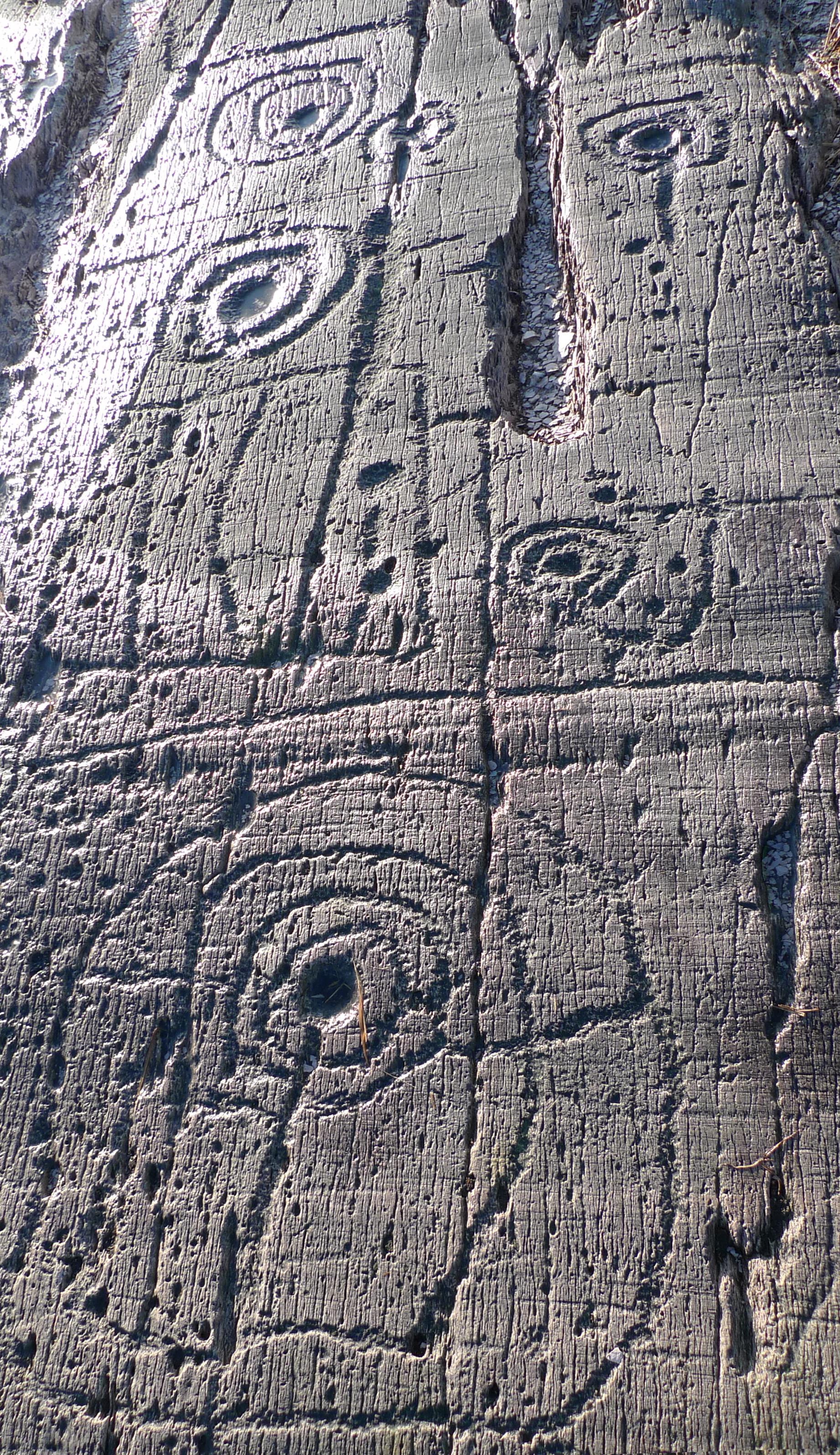
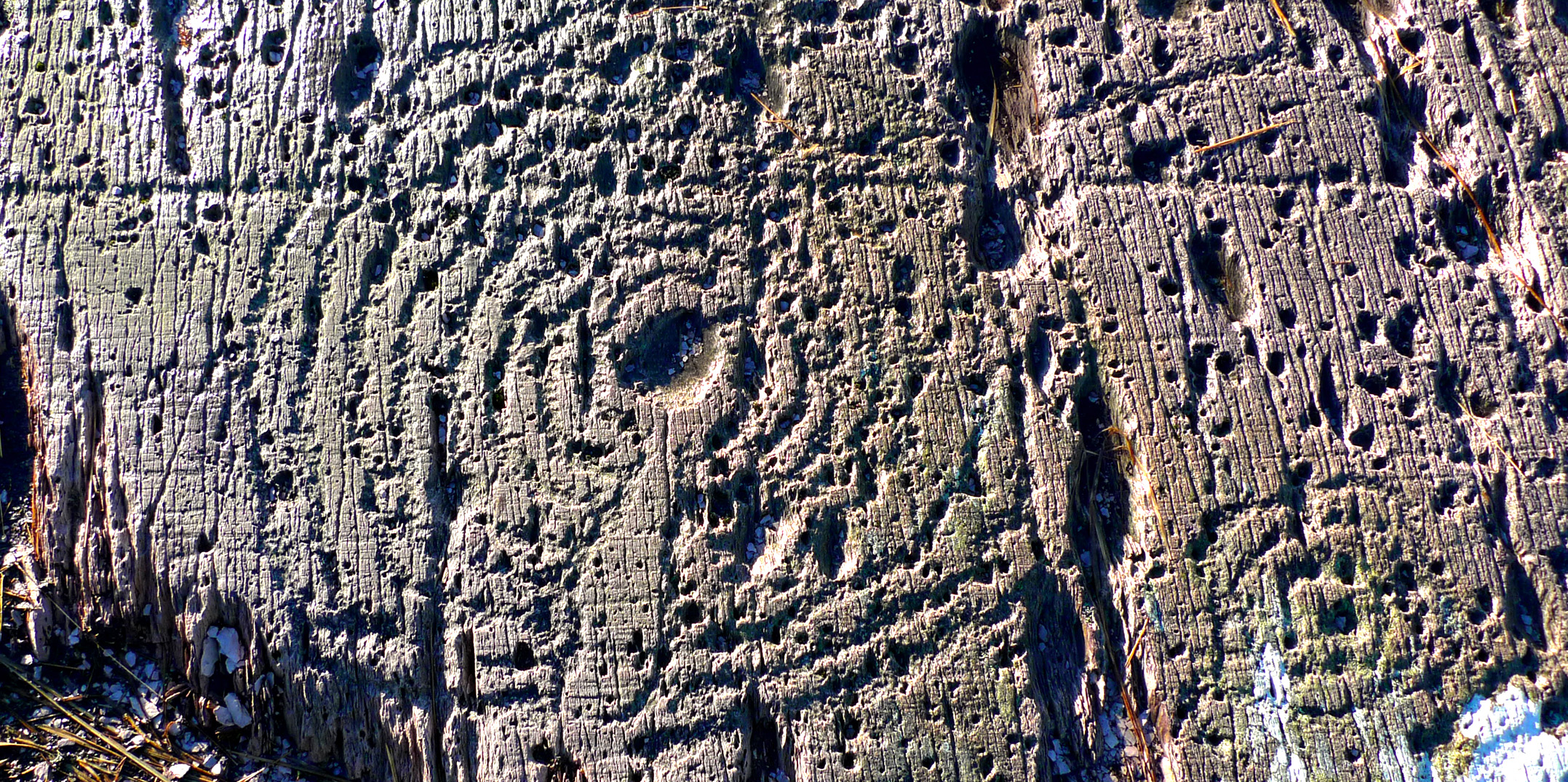
Motifs picked on the rock surface

I call my recording method, illustrated here, ‘visual rubbing’. It is not entirely without intervention, as I had to walk across the carved face of the rock, and place a camera tripod on the surface. I suppose this is a lesser evil when compared to some examples on open farmland where cattle walk freely across Rock Art panels or where – in places – rocks are being broken up to create new pastures: we have seen alarming signs of large excavator tracks passing right beside some good recorded pieces here in West Cork. Where the carved stones are listed in the Archaeological Record the landowner is always made aware that the monument is sacrosanct, but this does not guarantee practical conservation. Also, it may be argued that the topographical context of Rock Art is important (another debate) and that there should be restrictions in destructive activities to landscape in the vicinity of prime examples. Fortunately, the Derreennaclogh panels (there are two) are in bogland which is not currently grazed or used agriculturally.

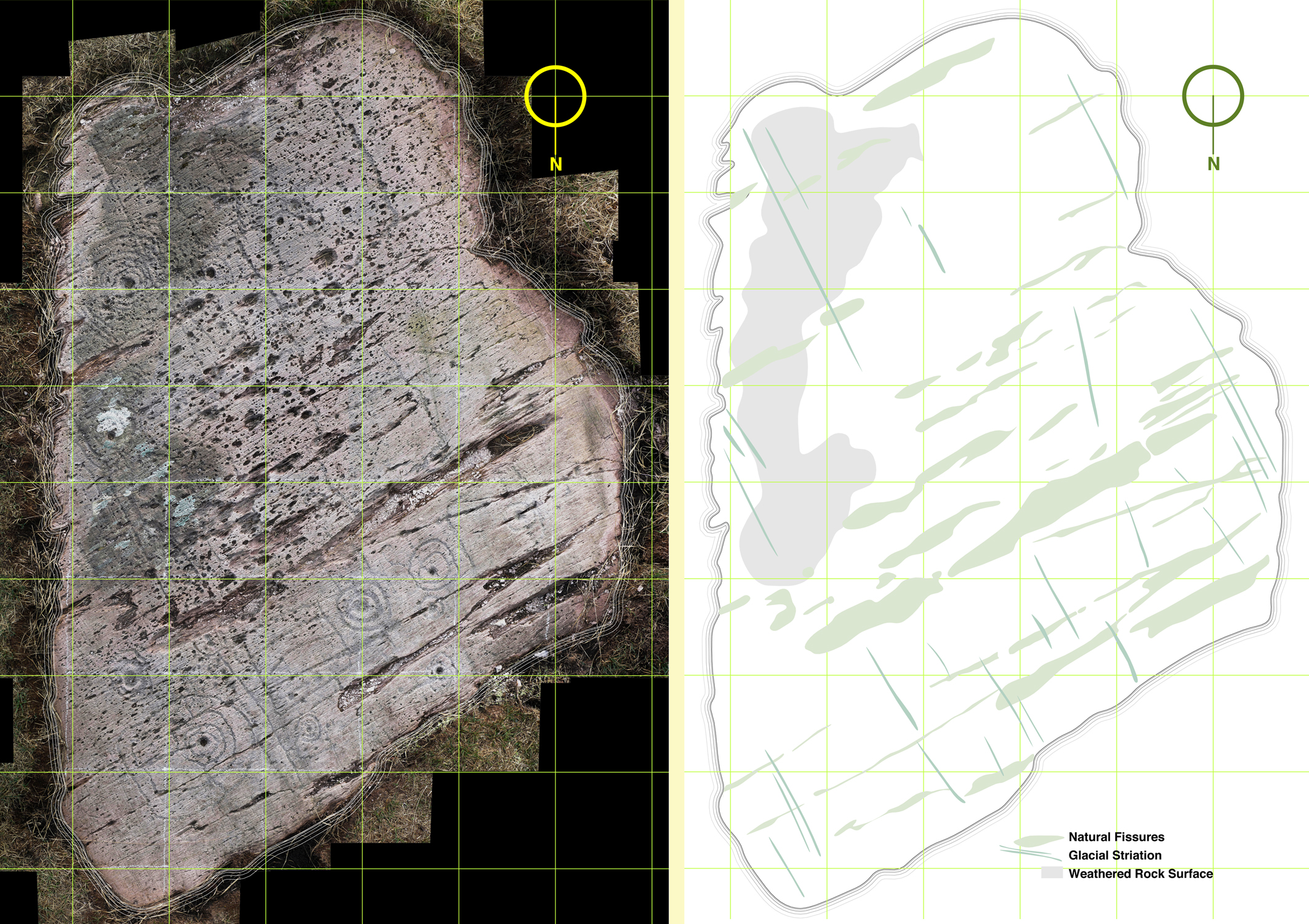
The rock measures about 3m by 4.5m at its extremities, and it was fairly easy to establish a 50cm grid using tapes. Fortuitously, one relatively straight side of the rock lies on a north – south line (magnetic north), and it was convenient to set my grid to compass orientation. The stone fills 55 of these grid squares and – using a Leica camera with a Vario-Summicron 2.8 lens – I took 55 high resolution photographs, each one centred on a grid square, and with the camera held a constant 1.5m above the flat rock surface. Back at the work station I stitched together all these photos using Photoshop, and this has given me a very accurate scaled base which is the bottom layer of the drawing I have subsequently created. My training as an architect has included using CAD techniques (Computer Aided Design), and I can trace very accurately the outlines of picked markings which show up on the photograph. The drawing is made as a digital file which can be reproduced physically to any size or scale, depending on the properties of the printer used. A CAD drawing can have any number of layers which can be switched on or off (or made transparent) to provide a matrix of information. My layers so far in ascending order are:

1   Photograph

2   Text and legends

3   Grid and grid reference numbers

4   Perimeter tracing of the rock

5   Tracings of the natural rock striations resulting from glacial movement (this appears to give the rock a definite directional ‘grain’)

6   Tracings of the natural rock fissures

7   Tracings of the rock carvings
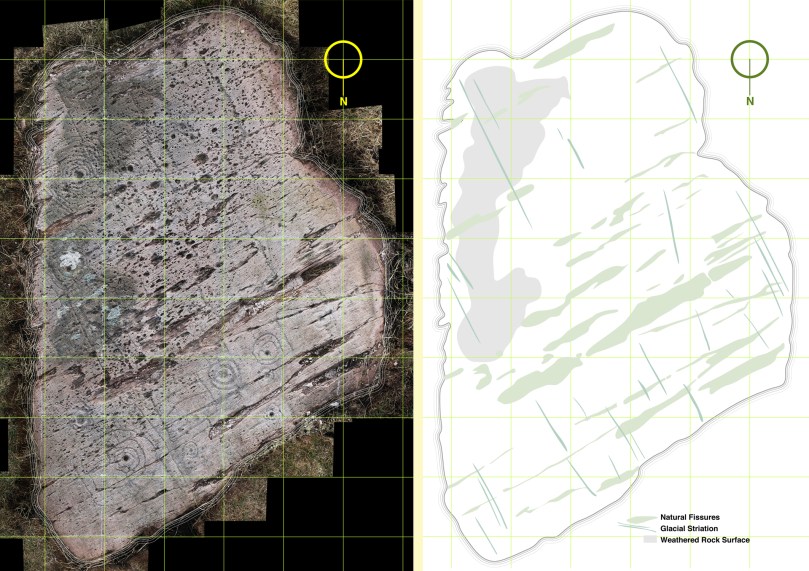
The composite photograph (left) and tracing of natural features on the rock (right)

The composite photograph (left) and tracing of natural features on the rock (right)

I have added layers (5a, 6a and 7a) so that I have the outline tracings of carvings etc, but also ‘fills’ to these outlines. All these layers can be given different colourings. I have the intention also to separate out motifs depending on ‘motif type’: for example, the Archaeological records for West Cork distinguish between ‘Rock Art’ and ‘Cupmarked Stones’. Cupmarks are the simplest form of motif, and the most prolifically spread. The Cupmark is a concave depression, often surrounded by one or more concentric rings, and sometimes with a radial groove from the ring to the outermost circle or beyond. ‘Rock Art’ can include any other motifs – rings, squares, figures of eight, dumb-bells: the rock at Dereennaclogh provides examples of all these and more. A drawing layer devoted just to cupmarks would be useful.
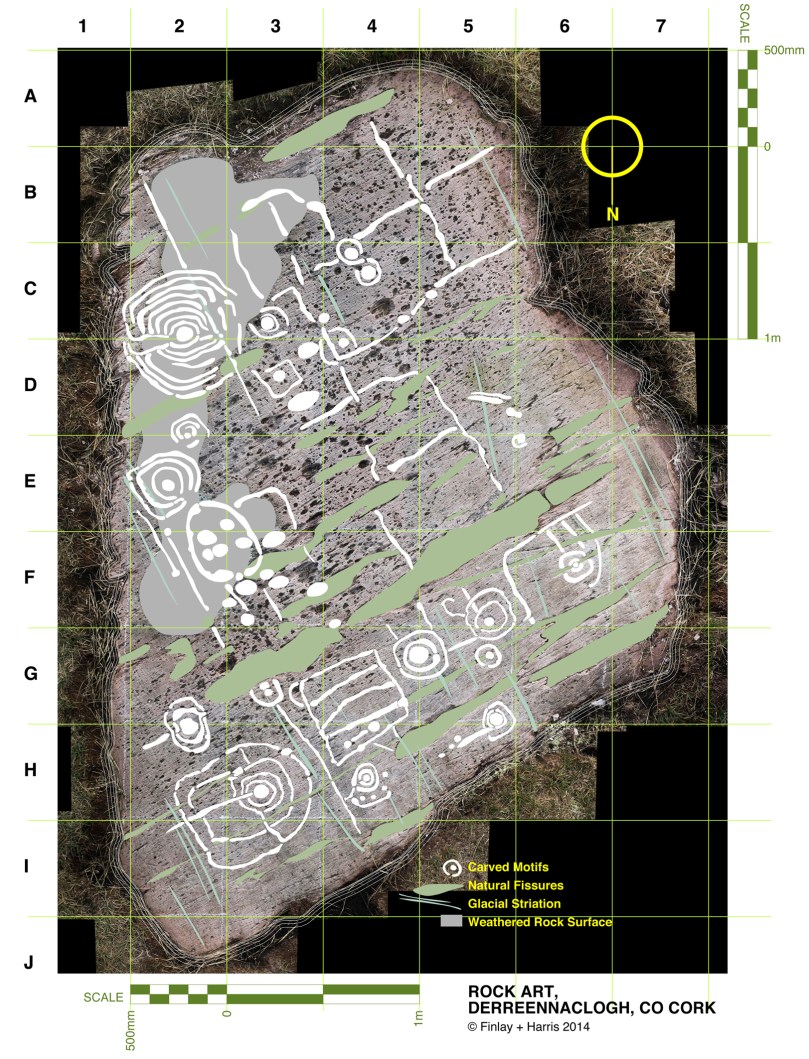
Motifs traced over the photograph

Motifs traced over the photograph

The motifs are ideally traced on a large screen, which enables the picking to be clearly seen: ‘picking’ means the hammer-on-stone technique of carving out the shapes. So far I don’t have a layer which includes information on the depths of the carved motifs. This would in any case be subjective and could only be done by taking a large copy of the drawing to the rock, measuring the depths of each mark and recording this ready for transfer to the file back at the workstation. This is a future job, and will involve a more selective coding to show the extent of picking graphically, It would in any case be academic and not necessarily a true record of what was carved, because of erosion and wear factors. Derreennaclogh is a valuable trial for developing these techniques as the carvings are on the whole in very good condition. It is not so easy on other examples: there is a further debate waiting on how it might be possible to retrieve information from a more heavily worn rock surface. Laser scanning surveys are showing up some interesting possibilities but better still would be an ability to analyse the body of the rock in a way that would show up the ‘attack marks’ from the original picking which would have altered the molecular structure of the surface. Laser scanning and this ‘attack’ recording technique (if it were possible) could both require the hauling of relatively expensive and relatively unwieldly equipment out into the field. My ‘visual rubbing’ technique is tabled as a method to be applied anywhere that is humanly accessible, and is within the capability of a retired CAD-adept draughtsperson with time on his or her hands.

There are drawbacks to the ‘visual rubbing’. One is the subjectivity of it. No rock surface is completely flat or smooth. There are striations, faults, pits and holes. Some of these resemble the carved motifs (particularly when the rock has been severely weathered), so I have to make decisions at all times as to what is natural and what isn’t, and also on where the actual edge of the carving is. Often it seems possible that the natural features of a rock influenced or informed any ‘design’ intentions. I’m sure many of my decisions are arguable. I can only say that my guesses are ‘educated’ by experience.
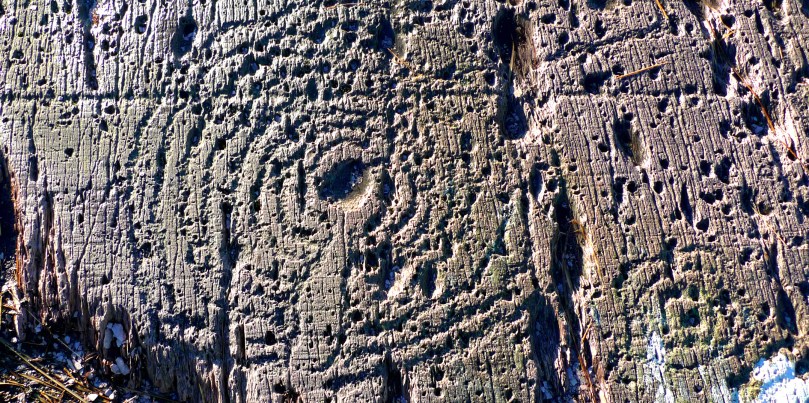
Cupmark with eight rings at Derrennaclogh

Cupmark with eight rings at Derreennaclogh

But this dilemma has led me to consider a further layer: intentions. I know this requires a leap of imagination and will seem bizarre – if not anathema – to trained academics, but when I am finely tracing some of the images I find myself asking what the carver originally set out to do in each individual case. So many of the marks are nearly geometric – concentric circles and parallel lines for example – but just don’t make it. Obviously there are limitations in the carving technique and you can’t rub out mistakes. Also it is interesting that some of the motifs seem to relate to natural striations and fissures – which is why I have shown the most prominent of these on separate layers. So here I am daring to have a ‘top’ layer which shows my interpretation of what the Rock Artist might have set out to do if he or she didn’t have the limitations of crud(ish) tools and materials. Please ignore this layer if you are not whimsically inclined – or a romantic. I am incurably romantic, and always still waiting for that moment when I am pensively standing on the rock and will be startled by the appearance beside me of a stray artist carver from 5,000 years ago. Miraculously we will be able to communicate – and, after that encounter, I will be able to provide the answer to the question that is always asked by voyeurs of prehistoric Rock Art: what does it all mean?
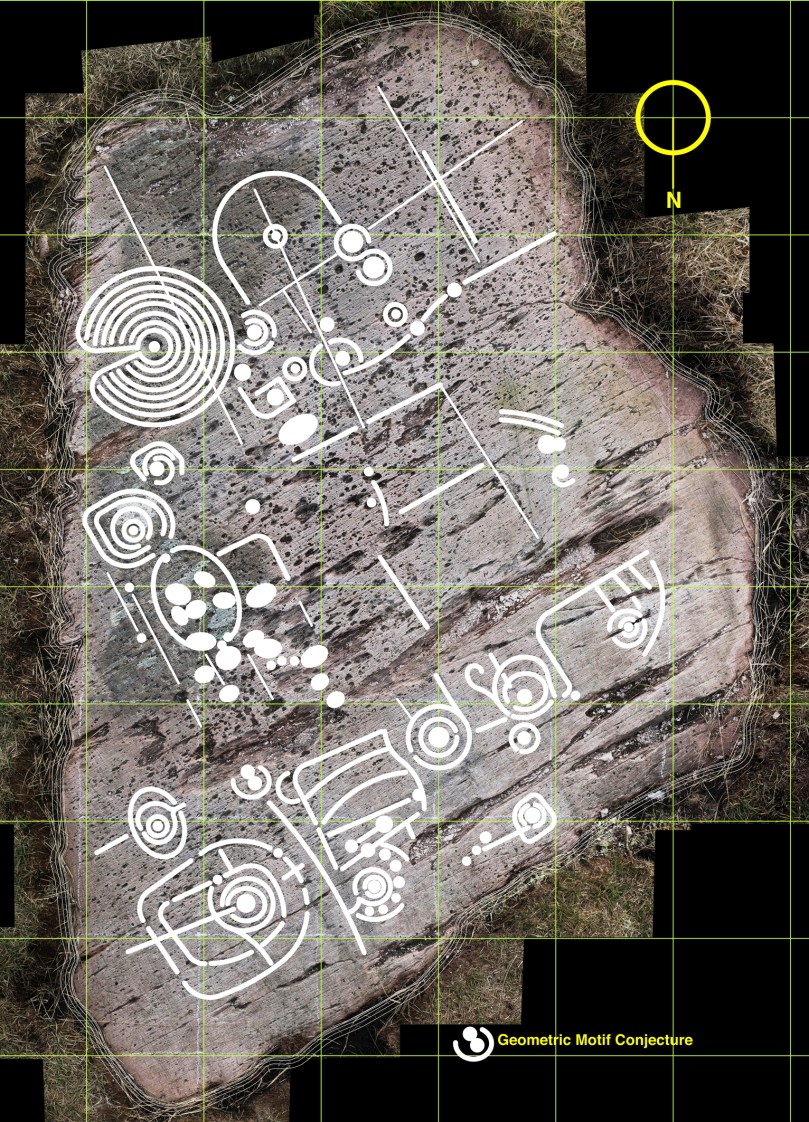
Whimsy - a conjectural geometric redrawing of the motifs at Derreennaclogh

Whimsy – a conjectural geometric redrawing of the motifs at Derreennaclogh

Stormy Weather

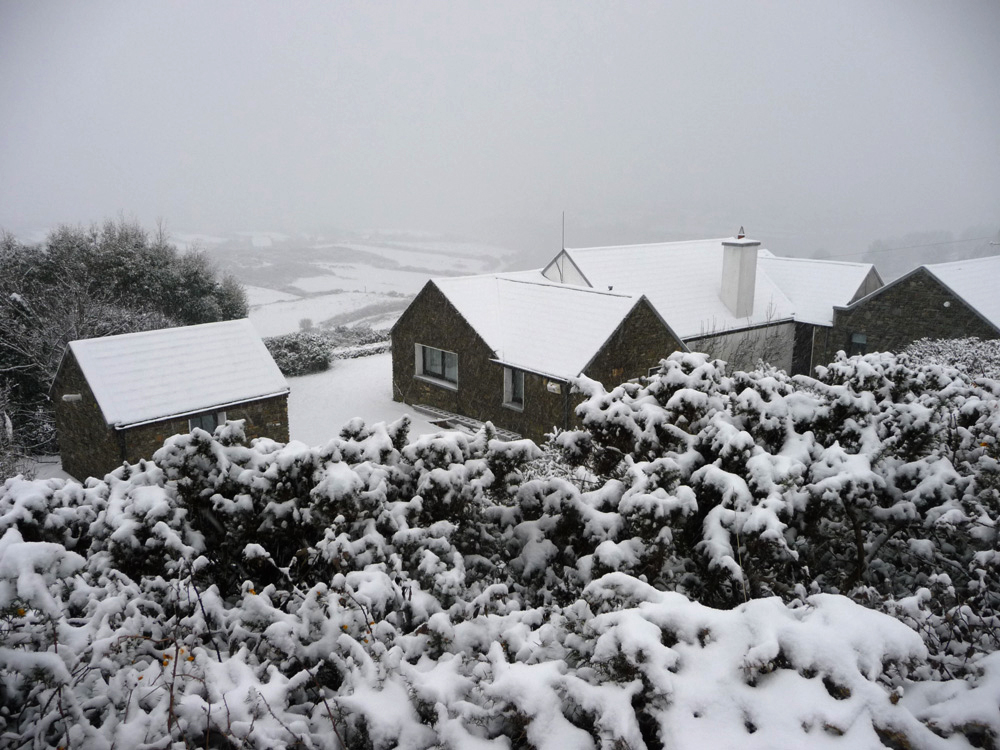
neadwinter

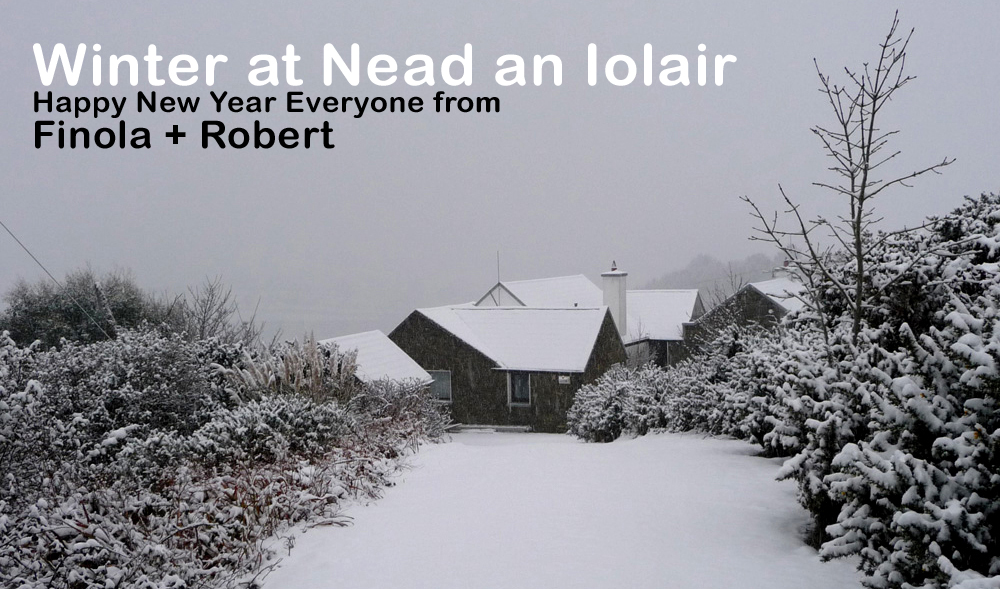
This picture of Nead an Iolair is here to create a seasonal feel: it was taken by our neighbour Dietrich in the Great Winter of 2010 – 2011 when the extremes were all about deep snow, frozen roads and frozen pipes, unusual for this little corner of the island normally kept mild by the Gulf Stream. This winter we have a different extreme – hurricane force winds!

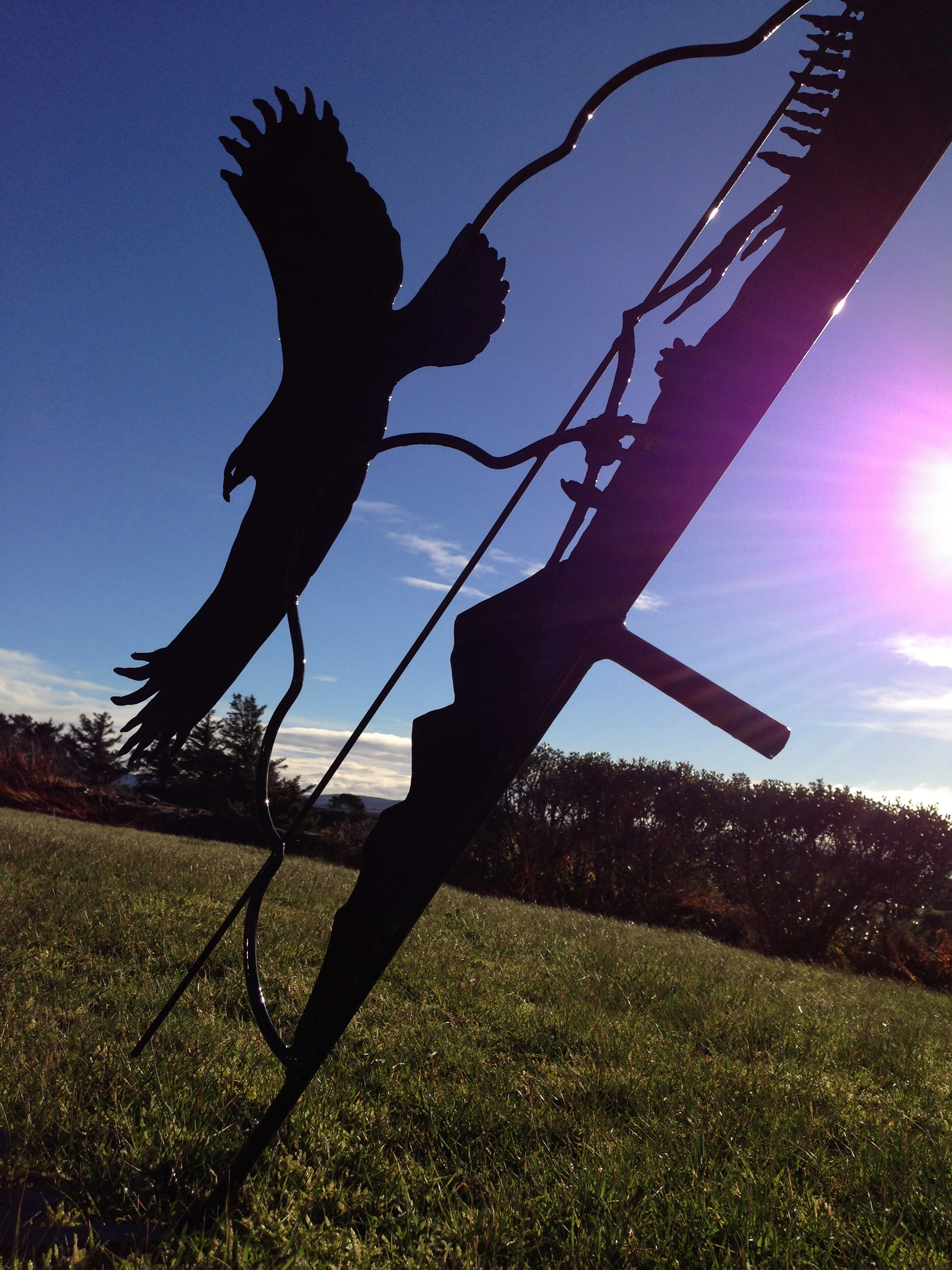
spiked

‘Hurricane’ on the Beaufort scale means wind speeds of 118 km/hour or more. We went to bed on St Stephen’s Day evening, having measured the wind speed outside as 87 km/h. That seemed wild to us: the trees were bent over and the salt laden rain and sleet were coming in horizontally and lashing our south west facing windows. It was hard to sleep: the slates were rattling loudly above us and the aerials and lightning conductors on our roof were shrieking and bending. The noises got louder and more terrifying as the night went on. I wanted to venture outside with my little hand-held anemometer but I couldn’t face it. The violent storm began to abate only in the early hours of the morning and, when we did creep out, it was to find some damage: two trees down in the haggart, sadly, and our beautiful weather vane collapsed. It was as well that we weren’t underneath when the flying Eagle and its sharply pointed arrow came crashing on to the lawn, just missing our door.
levissession

St Stephen’s Day Session, Ballydehob


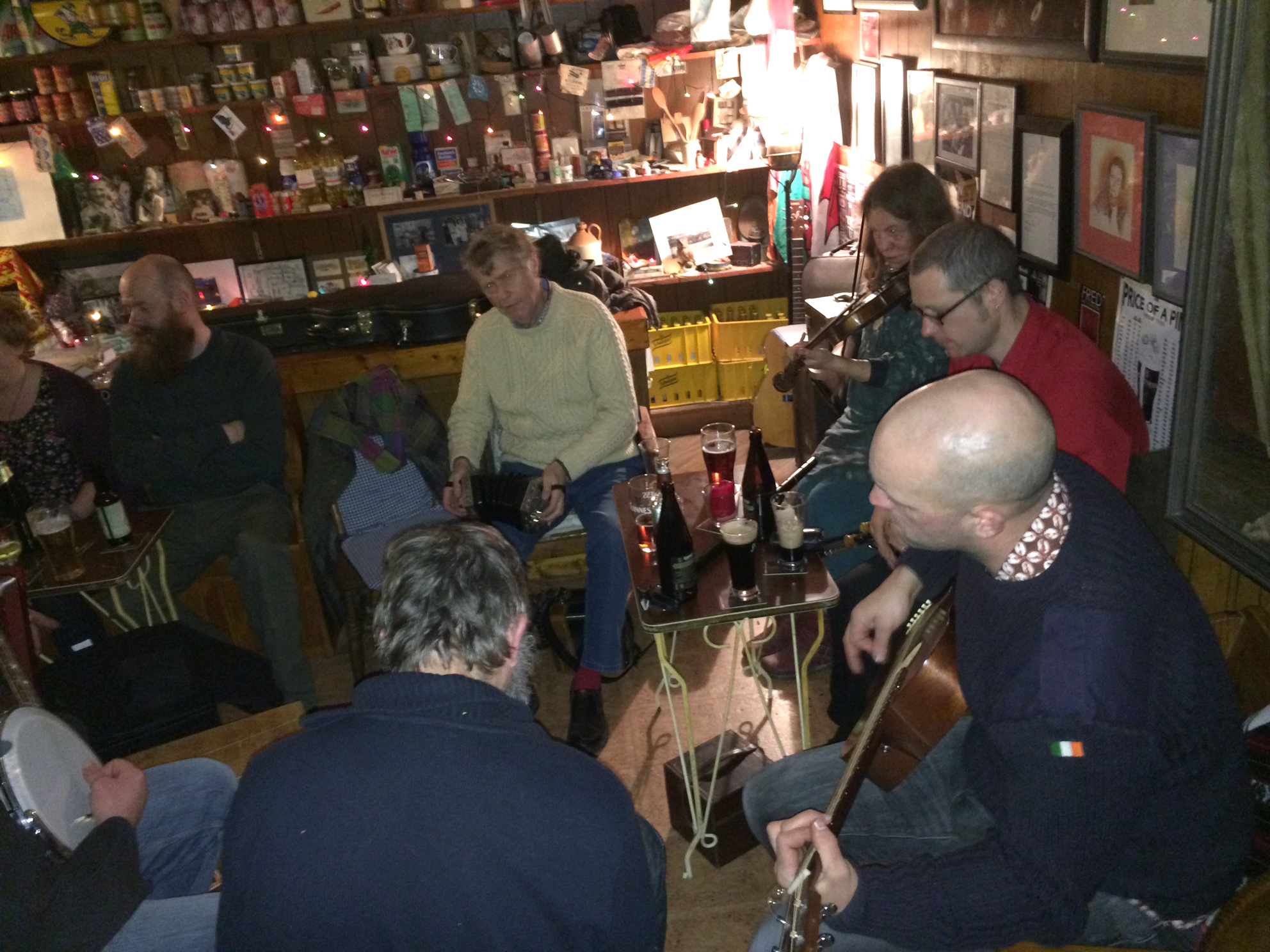
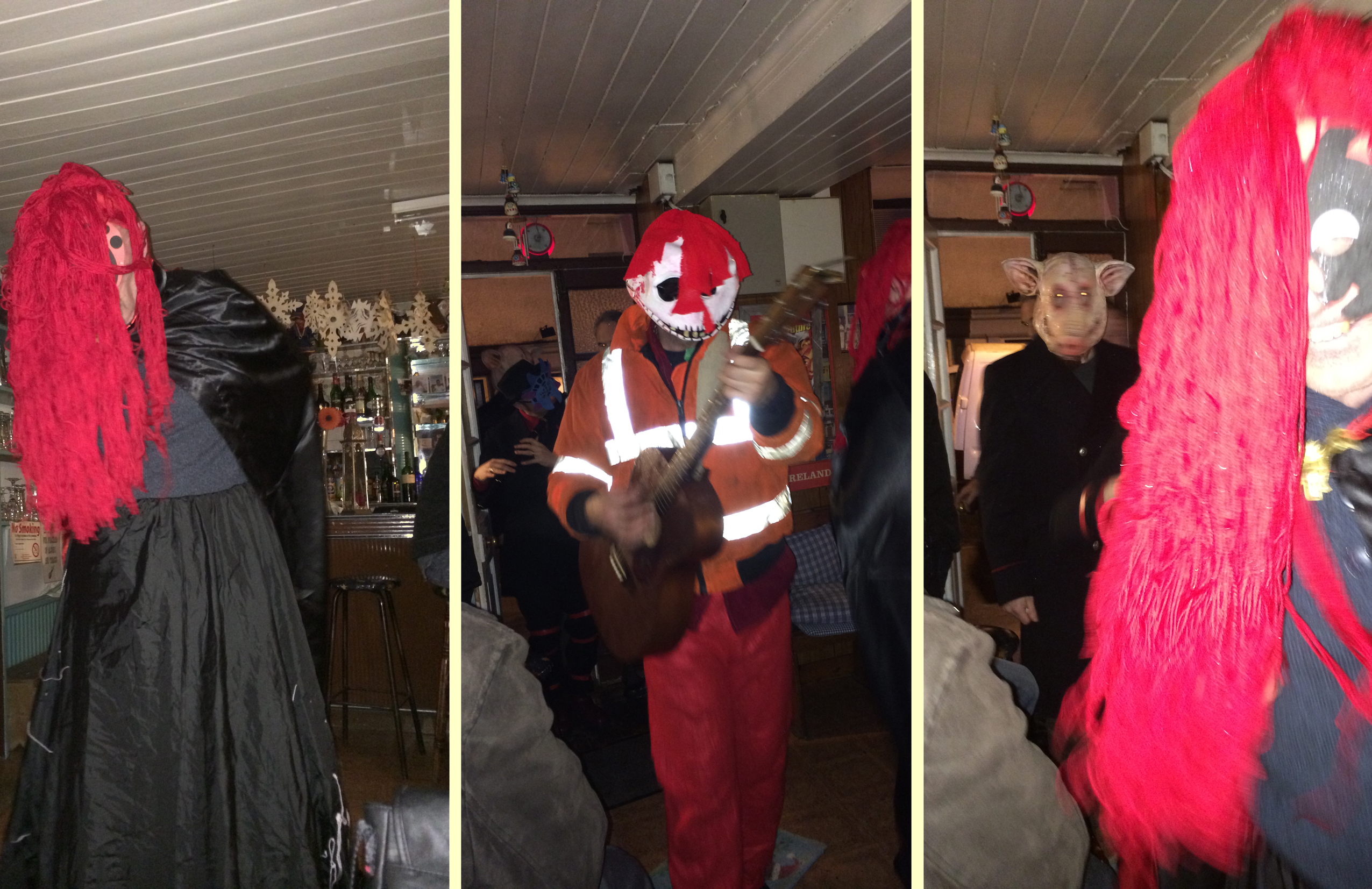
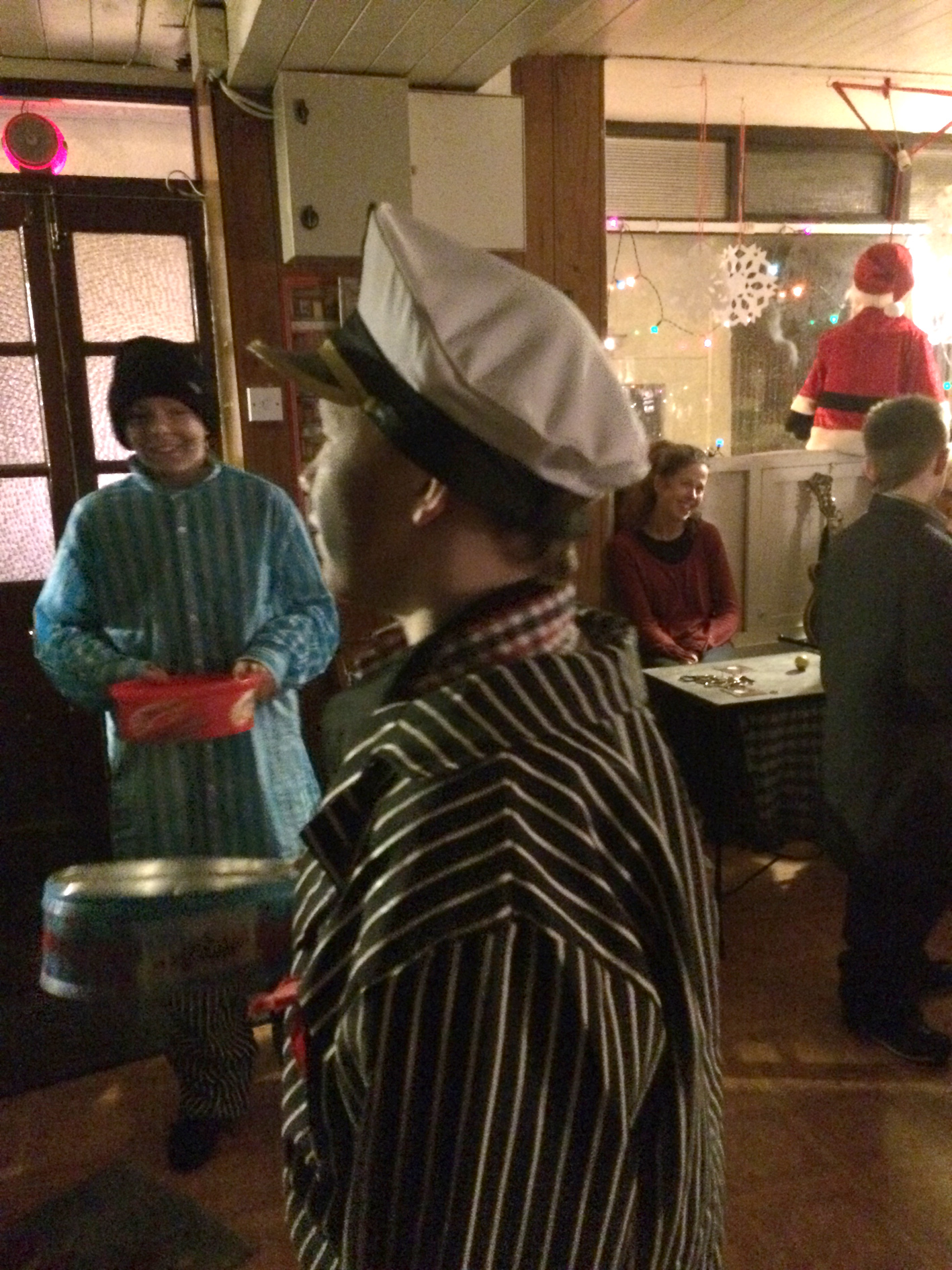
Earlier in the day we had enjoyed an unexpected visit by the Wren Boys to Levis’s pub, where we were involved in an improvised session. Two groups of Wren Boys in fact: the first an adult company with musicians, colourful costumes and bizarre masks, and the second a group of boys dressed in old coats turned inside out, pyjamas and sailor caps, carrying large collecting tins. All were welcomed and the festivities grew merrier as the wind strengthened.
wrenners

wrenboys

Keeping traditions going: outlandish Wrenners visiting Ballydehob – top – and local lads collecting in Levis’s Bar – below

As I lay in bed at the height of the storm I found myself worrying about our birds: how on earth could the Goldfinches, Chaffinches, Robins and Wrens (any Wrens who had escaped the St Stephen’s Day hunt that is) have survived that terrible gale – which stripped the bird feeders of everything moveable and the bushes and shrubs of their sheltering leaves? In the morning, there they were back again, and noisily demanding a refill which, naturally, I was delighted to provide.

message