Brian’s Sketchbook: The Signal Towers

Brow Head Buildings

We have received a unique and treasured gift – a sketchbook from the 1980s of prehistoric and historic sites around West Cork. It’s the work of our good friend, and national treasure, Brian Lalor, artist, writer and printmaker. For an overview of his style, check out the retrospective of his work at Graphic Studio Dublin. Or browse the long list of his books, including the magnificent Encyclopaedia of Ireland, which he edited.

Marconi Station, Brow Head

Brow Head: (above and below) on the right is the Napoleonic-era Signal Tower; the other buildings date mainly from the time of the Marconi Telegraph Station, taken from a different angle than the sketch above

Brian has studied both architecture and archaeology and to that adds the keen observant eye of the artist. As a result these sketches, although, as he explained, often hastily done during a brief visit to a site, are accurate, detailed and charming in equal measure. They were made on field trips with the Mizen Archaeological & Historical Society in the 1980s. This was an active society, publishing a well-regarded journal from 1993 to 2004 and leading regular field trips for members.

Brow Head ruined building

The sketches, just over 50 of them, were made for the most part between 1980 and 1987 so besides their intrinsic artistic value, they also constitute an important record of the state of the site 30 years ago, allowing us a comparison with its current condition. My intention is to visit (or re-visit) a lot of the sites, with his sketches in hand and show our readers both how beautifully Brian captured the structures or artefacts at the time and whether there are any changes visible from then to now. I decided to start with the Signal Towers on Cape Clear and Brow Head, and a third tower on Rock Island that may or may not be contemporaneous.

Wolfe Tone front

Theobald Wolfe Tone – detail of the statue in Bantry town square

In 1796 the French navy, partly at the invitation of Wolfe Tone and the United Irishmen, staged an unsuccessful invasion of Ireland, sailing into Bantry Bay. Several raids followed in 1798. Although all were quickly quashed, a panic about the possibility of a French invasion spread throughout Britain and Ireland. A series of Napoleonic-era fortifications and viewing towers were constructed around the coast in locations with panoramic views, and within sight of each other, to spot foreign shipping activity and raise the alarm. On the east coast, these mainly took the form of Martello Towers and were stocked with heavy armaments, but here in the south west defensible Signal Towers were built not to house artillery but as advanced-warning stations. Here and there they were complemented by batteries and other fortifications – but that’s a story for another day.

Cape Clear Signal Tower

The Cape Clear Signal Tower

Signal towers were built around the coast to the same plan – tall square towers with first-floor entrances and machicolations. From a distance, they look like the medieval tower houses I have posted about on several occasions but up close they are shorter and the windows are bigger. Internal staircases and partitions were made of wood, not stone and have generally not survived, so the signal stations are essentially shells. in both the Cape Clear and Brow Head example, the exterior slate cladding has survived remarkably well.

Brow Head Detail - signal tower

Brow Head Signal Tower – detail from Brian’s sketch

In his excellent article for the Irish Times, Nick Hogan describes the towers, how they were staffed, the accommodation provided and how the signalling was done:

The signalling system, referred to as an optical telegraph, required that each signal station be visible to its counterparts on either side. Sending a message involved raising and lowering a large rectangular flag, a smaller blue pendant and four black balls in various combinations along a system centred on a tall wooden mast. The stations also communicated with ships.

Cape Clear Towers

Signal Tower and Original Fastnet lighthouse, Cape ClearTop: Brian’s sketch of the Signal Tower and Lighthouse on Cape Clear Island, done in 1982; Below: how it looked in June, 2016, 34 years later

While many signal stations are lonely and isolated buildings glimpsed on distant headlands, abandoned since the mid-1800s, both the Brow Head and Cape Clear buildings had further phases of use. In Cape Clear a lighthouse was built in 1818 – a forerunner of the Fastnet Rock Lighthouse. It was so often shrouded in fog that it was abandoned in the 1840s. The buildings attached to the signal tower, built of brick and concrete, probably date to this period of occupation. The signal tower is built of stone, using techniques not far removed from medieval construction methods. The lighthouse provides a wonderful contrast, being built of cut granite blocks expertly measured, shaped and fitted. 

Cape Clear Deatil - Lighthouse

Cape Clear Lighthouse, detail from sketch

In June of 2016, when we visited, it looked exactly as it had to Brian and the Mizen field group – an indication, perhaps that somebody is looking after the site and that the few visitors who come (it’s quite a hike to get there) respect the heritage. [Edit: Since I wrote this, Brian has pointed out that in the Cape Clear Signal Tower there is a porch under the machicolation in his drawing that has since disappeared. The outlines of the porch can be clearly seen in the photographs of the signal tower.]

Cape Clear Lighthouse

Brow Head is easier to access, and as a result there is more graffiti in evidence, but the changes to the site since Brian’s sketch are more the result of time and climate than any damage by humans. This is a complex site with multiple periods of occupation. The signal tower is there, of course, looking exactly as it did in the 1980s. Beside it is a network of buildings dating from the the early years of the 20th century: this is what remains of the Marconi Telegraph Station. Read all about this in Robert’s piece on Marconi, In Search of Ghosts. Besides the Marconi Station a Second World War Look Out Post was occupied here in the 1940s – little remains of this small concrete building except the characteristic half-round shape and a section of wall.

Brow Head octagonal?

Finally, on Brow Head there is a mysterious building that Brian labels ’14 – ’18 Gun Emplacement. This building no longer exists, and the ruinous remains that litter the ground seem robust enough to fit this inscription. Or do they? So – a mystery, and obviously  more research needed on our part. If any of our readers can help – let us hear from you!

Brow Head Detail - gun emplacement

The last tower is on Rock Island. It is clearly visible from the Brow Head Signal Tower ( a requirement for the placement of signal towers) but, strangely, it is one of two very similar towers on Rock Island, and while they are similar to each other, they are quite different from the classic signal tower design. However, both the National Monuments site  and the National Inventory of Architectural Heritage listings name them as Napoleonic-era Signal Towers, and perhaps that is indeed what they are.

Rock Island Tower

Brian’s sketch of the Rock Island Signal Tower

However, in discussion with Brian, he pointed out that most of the buildings on Rock Island were developed as part of a major Coast Guard installation around the same time as the Marconi Station, and we wonder if there might be a connection – that is, that these are Coast Guard-related Watch Towers, rather than Napoleonic-era Signal Towers. Once again – more research needed! [Edit: See comment from Navtell in comment section, below.]

Rock Island Signal Station

Rock Island Second TowerThe two towers on Rock Island: similar to each other but quite different from the classic Signal Tower on nearby Brow Head

This is only my first foray into Brian’s Sketchbook. Look out for more posts in the future and in the meantime, join with me in being grateful that a precious resource like this survived numerous moves and that we have the opportunity to learn from it.

Cape Clear Detail - Signal Tower

The Cape Clear Signal Tower

The White Hound of Brigown

Saint Fanahan is venerated in Mitchelstown, Co Cork. A holy well, a college, a couple of medieval churches and lots of Mitchelstown boys, all bear his name. What’s incontrovertible, then, is that he is the patron saint of Mitchelstown. Or is it? He’s also know as St Fionnchú of Bangor (pronounced Finn Coo, meaning white or fair hound). Same guy. He succeeded the Abbot of Bangor, Comgall, but departed subsequently to end up near Mitchelstown.

Fanahan well from bridge

St Fanahan’s Well

But wait – he is also the patron saint of Blow-Ins! At least, that’s what a local man told us when we visited Fanahan’s holy well. Apparently, Fanahan came from the North of Ireland but eventually settled at Brigown near Mitchelstown in Cork. He wasn’t a local, so why not? We blow-ins deserve a patron saint, don’t we? He’s also probably the most muscular saint I’ve ever come across! He was a warrior-monk, famed for both his holiness and his strength in battle. No gentle, man of peace here!

Book of Lismore

How do we know about these early Irish saints? In Fanahan/Fionnchú’s case, we can rely on a Whitley Stokes bookcomplete Life, recorded in The Book of Lismore, a 15th century collection of hagiographies and histories. Take a look at this video to learn more about The Book of Lismore. We are fortunate that there are translations – the one I am using today was done by Whitley Stokes in 1890 and is available online. Stokes, a distinguished scholar whose work is still vital, uses a kind of high Victorian language that manages to be a noble translation of the original Old Irish. 

You might perhaps want to make a cup of tea at this point – this is going to take a little while – Fanahan/Fionnchú’s is quite a story. Ready now?

Even in the womb, Fionnchú had extraordinary powers, once saving his mother’s life by causing a cloak of darkness to surround her. A great future was prophesied for him that

He will attack the valourous, He will overwhelm the guilty,

He will seek crowned kings, He will be the tree of Tara’s correction,

Who will benefit Liffey, And profit Leinster.

In his youth he was fostered by Comgall, the Abbot of Bangor. Fionnchú performed several miracles while he lived with Comgall: So these are Findchua’s three miracles after he came to Bangor, to wit, making flagstones of the horses of the king of Ulaid; and raising the earth around the king to his knees; and burning his tutor’s cowl by the fury of his anger

Fanahan White Hound

The white hound, Cusson Sculpture in Mitchelstown

Fionnchú then spends seven years as Abbot of Bangor. After spending the seven years Fionnchú is expelled from Bangor and from the whole of Ulaid [Ulster] because of the scarcity of land. Then Findchua comes from Ulaid, from the north, till he came, through the urging of an angel, to the men of Munster and to their king, even to Cathal, son of Aed, to Cashel; and the king gives him a welcome and ordains to him his choice of land in Munster. Said Findchua: Tis not permitted to me to have land save in the place in which my bell will answer me without the help of any man. Said Cathal : Search Munster till thy bell answers thee, and the place in which thou shalt set up, thou shalt have without contention with thee.

Fanahan cross back

After many vicissitudes Fionnchú and his band finally settle down in the place where his bell answers him. His enclosure is arranged, and his houses are covered, and his households are allotted to the nine other townlands which the king of Munster had in residence.

The King of Déise’s son comes to see him and Findchua gave him, as a soul-friend’s jewel, his own place in heaven. So then there came to him seven master-smiths who dwelt near him, and they made for him seven iron sickles whereon he might abide to the end of seven years, so that he might get a place in heaven; for he had given his original place to the king of the Deisi. He blesses the smiths of that place, and left them continually the gift of handiwork, provided that they should perform or begin it in that place, and palm of masters to them. The smiths ask him to give their name to the place in reward of their work, that is, Bri Gobann (Smiths Hill). Fionnchú spends seven years hanging on his sickles, unable to touch the ground.

Fanahan head

Fanahan, from the Ken Thompson Sculpture at the holy well

He did get one break when he marched off to battle to save the armies of Niall of the Nine Hostages, who were being attacked by marauders. In Fionnchú’s rage sparks of blazing fire burst forth out of his teeth destroying all before him. Returning to Brigown, Fionnchú resumes hanging from his sickles. He also spends the first night with any new corpse brought to be buried at Brigown, emerging in the morning, and allows his body to be eaten by beetles. All these mortifications of the flesh cause his fame for holiness to spread far and wide.

Fanahan Garda Station

The Fanahan sculpture in Mitchelstown is by renowned artist Cliodhna Cussons

He performs various other miracles, including breast feeding a baby, Finntan, the son of Nuada, King of Leinster. Eventually, he goes off to battle for that king too. After that, the King of Ulster invades Munster (his wife wants the Munster kingship for her sons, and was not to be gainsaid, apparently) and the King of Munster, Cathal, sent for Fionnchú (no rest for the wicked!) because he promised me that, whenever stress of war should be on me, he would come with me to battle to help me, having with him the Cennchathach, even his own crozier.

Head at Fanahan well

This head has been inserted into a wall at the holy well. He looks like a victim of the Head Battler

The Cennchathach (head battler) was duly deployed in a great battle. The Ulster men roared and bellowed like stags in heat, and charge from the top of the hill. The cleric seeks the slope beyond them and leaves the hill to them. The Ulaid bent down eagerly to deliver the battle. When Findchua perceived that, he took them in that position and allowed them not to rise up beyond their knees, and breaks the battle upon them against the height. Therefore Findchua left the Munstermen, from that time forward till Doomsday, to defeat foreigners and every host besides when charging down a height; and verily this is fulfilled. [Note to self – must let the Munster Rugby team know this vital information.]

Brigown Church

The old abbey at Brigown is associated with Fanahan. A round tower once stood here but eventually burned down

Having performed several miracles, and been merciful to the remaining Ulster men, Fionnchú returned once more to Brigown. However, his peace was short lived as, you guessed it, ‘foreigners’ started to make life very difficult in Connaught, so of course, they sent for Fionnchú. Then through the mighty powers of the cleric a terrible heat seizes the foreigners there, in the midst of their camp, from the iron posts that stood all around the camp, so that on the morrow there was found of them nought save their bones and their remains amidst their camp, and showers of their weapons near them. Wherefore Cuil Cnamrois (Recess of Bone-wood) is the name of the place from that to this.

Well fund

Although the tributes were supposed to last forever, nowadays a polite sign asks for donation for the upkeep of the well

After each of these battles, Fionnchú receives tributes and rewards (milch cows crop up a lot, as do boars and cattle), so that the wealth of his settlement grew. Several other battles are recounted. During one, …the howling and rending of a hound possessed him in his valour on that day. Although no heroes save himself alone were fighting the battle, the foes would have been routed before him, for he cut off the foreigners equally with his weapons and his teeth. Wherefore the name Findchu clave to him, that is, like a cú (hound) on that day was he.

Finally, weary of warfare, he undertakes a pilgrimage to Rome where he spent a year doing penance. We are told nothing further about his life, except that it is recorded elsewhere that he died about 660AD.

eel

The eel, Cusson’s sculpture

A note at the end of this account of his life says The friar O Buagachain wrote this Life out of the Book of Monasterboice. A further note elsewhere says it was actually written in the Friary at Timoleague.

Fanahan's Causeway

A unique 700m dead straight, raised causeway leads to the holy well. This unusual feature may be medieval in date.

Many legends grew up about Fionnchú in time, while the name itself transformed into Fanahan, still a popular boy’s name in this area. His feast day is November 25, and it is marked by a Novena (nine days of prayer) before and after that day, when pilgrims visit the well and do the rounds. Because this is a dark time of year, and people come after work, a benefactor has installed lights along the causeway which get turned on for this period. Besides the story of the eel, the well is associated with cures – at one point there were crutches hanging beside the well. The Dúchas Schools Project has recorded some details of the well from the 1930s – even a photograph.

Dúchas photo Fanahan well

Some writers have pointed out the similarities of Fionnchú’s deeds to those of Cúchulainn, the great hero of the early Irish sagas. Like Fionnchú, Cúchulainn is named for a hound, and like him he performs legendary feats of strength in battle. Some have even pointed out the crucifixion analogy of his time hanging from the sickles, not to mention the implications of his nights in the otherworld with the corpses and his return from the dead.

Fanahan cross

Ken Thompson is the same sculpture who carved the marvellous Air India memorial on the Sheep’s Head

I think the sculptors capture him differently. Ken Thompson emphasises the holy man of the well, with the eel (sighting an eel is a common feature of holy wells – great good luck attends it) at his feet and his crozier held as any bishop would hold it. But he also suspends him on a cross and gives him a sword. He places (the surprisingly soviet-looking) sickle on the back of the sculpture, along with the bell that rang when he finally came to Brigown. Coming over the little bridge into the glade of the holy well, it’s a beautiful but interestingly ambiguous image that presents itself.

Cusson’s piece is all warrior and places him at the end of his life, perhaps contemplating in sorrow all the mayhem he has been part of. His crozier is between both hands, looking more like the Head Battler than a symbolic crook. It’s modelled on the medieval croziers in the National Museum, such as the one from Lismore. The White Hound (Fionn Cú) is one one side, the eel on the other. The figure is massive and solid, the gaze is faraway, the features grim. Every inch a warrior-monk.

Molaga of the Bees

bees!

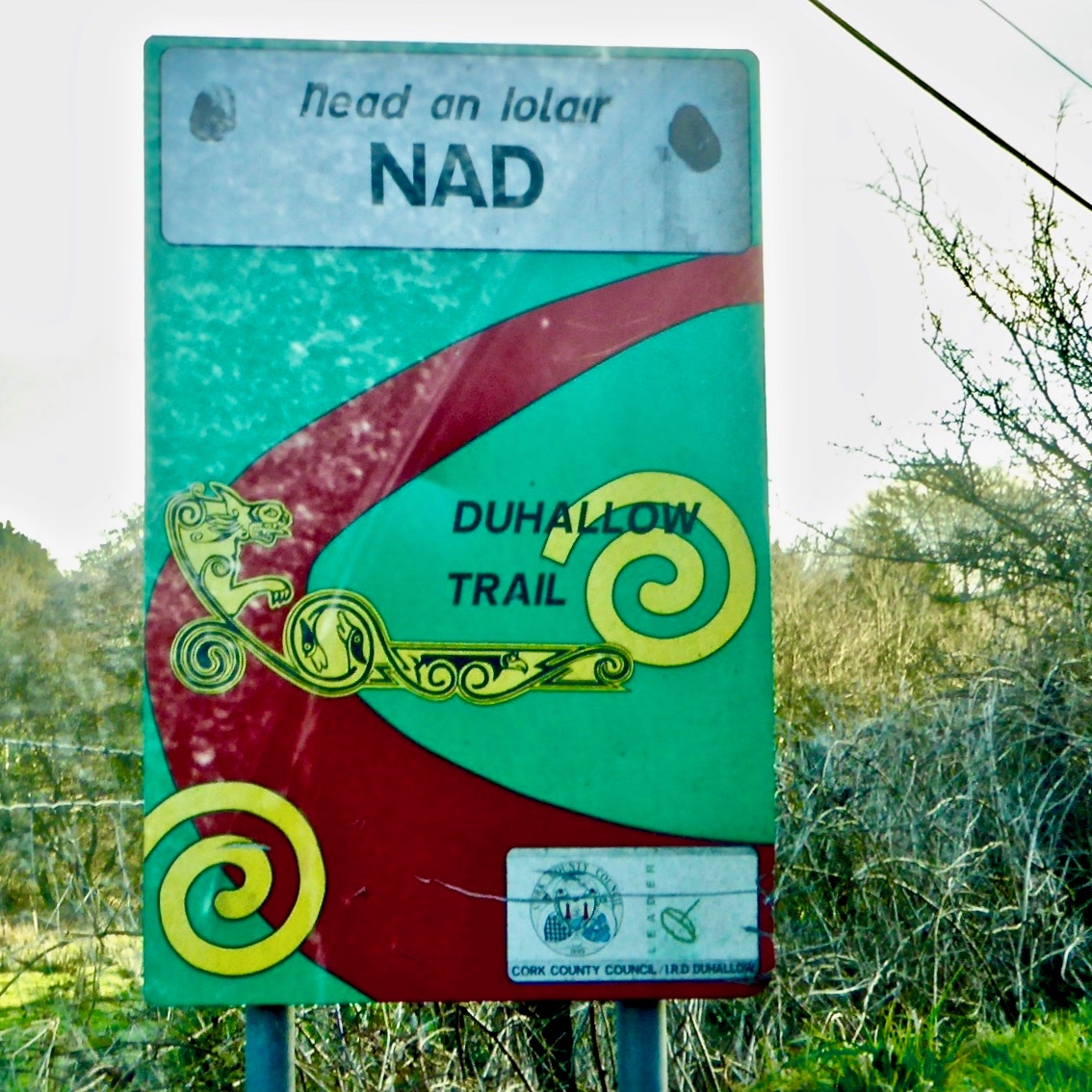
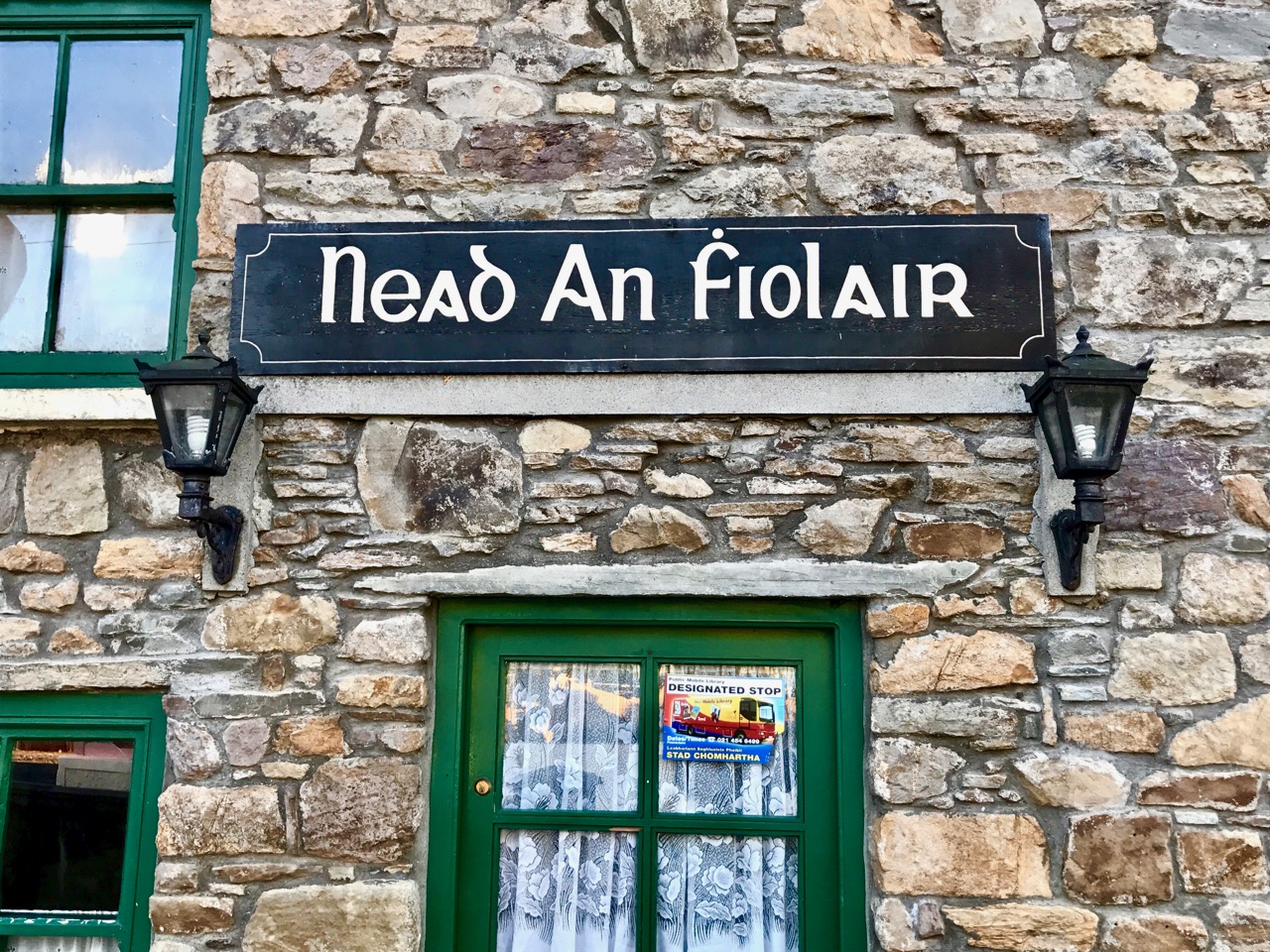
I know I’ve said this before – but, wherever you find yourself in Ireland there’s history on the ground, and a story to be found! Recently we ventured into North Cork: so large is this county that it is a good half a day’s journey from Nead an Iolair, here in the far west, to Mitchelstown, beyond which lie the wild frontiers of Tipperary and Waterford. The purpose of our journey was exploration – archaeology, history, folklore – and we found ourselves drawn back into the time of the Saints.

1400 AD

Artist’s reconstruction of the site at Labbamolaga as it might have looked in 1400 AD: the smaller building on the right is the saint’s original oratory, dating from the seventh century. Note the antae – the projecting stone walls on either side of the entrance, supporting the huge verges. These features represent the builders’ wish to recreate in stone the very earliest timber churches: in every age of Christian church building the aspiration was to hearken back to ‘the time of the Saints’, whatever era that might have been . The building on the left is a later medieval Parish Church known as Templemolaga (image from Dúchas – The Heritage Service)

Well off the beaten track we found ourselves at an ancient site known as Labbamolaga, in the townland of Labbamolaga Middle. Labba Mollaga: it means ‘the bed of Molaga’, who was a saint living in the 7th century. He is said to have founded a monastery on this site and the earlier building here could have been his original church.

7th c entrance detail

through the portal

A seventh century oratory? Upper picture shows the entrance elevation with its pronounced antae, and the doorway which seems to be constructed from monoliths. It has been suggested that these stones could have been robbed from the megalithic monument which lies in a field to the south of the site. The middle picture looks through the entrance to the prostrate stone against the south wall: this is known as Molaga’s Bed: tradition states that the saint would lie on this stone at the end of each day’s work. It is also said to be his burial place and has curative powers, particularly for rheumatism. The lower pictures show the saint’s bed in 1905 (left) and in the present day (right) with its strange carving, which has been described as a volute

The architecture is fascinating: here we have one of the few examples remaining in Ireland of this most ancient church form, albeit in a ruinous state. In 1975 a similar ruin in Connemara was reconstructed to its likely original form at St MacDara’s Island, Carna. This gives us some idea of what St Molaga’s oratory could have looked like.

The oratory on St MacDara’s Island – early photograph (left) and 1975 reconstruction (right)

The site at Labbamolaga has much more more to attract the curious. There are the nearby megaliths: we would assume they considerably predate everything else, yet local lore tells us that they are four villains who stole the chalice and holy relics from the saint’s oratory but were caught in mid-flight and were turned into four pillars of stone by him! A further legend noted by John Windele, the Cork antiquarian and historian, in the 19th century relates to a holy well which once existed – some say under the saint’s bed:

…There was formerly a beautiful well of clear spring water here, but one day an old woman profanely washed her clothes in it; that night the well disappeared and was seen never more…

stone alignments

stones in graveyard

Upper picture: four standing stones in a field (known as Parc a Liagain, ‘Swardy Field of the Pillar Stones’ to the south of the ecclesiastical site – supposedly petrified villains who robbed the monastery. Lower pictures: the monastery site has become a burial ground – strange and fascinating stones abound. The centre stone is an ancient looking Celtic cross; the circular pile is an enigma – burial vault or old well house? The site also once contained Cursing Stones, but these are said to have been removed

What of the saint himself? He has a recorded history: born in Fermoy of parents who were well past child bearing age (a miraculous sign), he travelled to Scotland and then to Wales, where he became a follower of St David. Returning to Ireland he founded monasteries at Timoleague, West Cork (the name means House of Molaga), and at this site in North Cork. Sources say that in Wales he learned the craft of bee-keeping, and a colony of bees attached itself to him on his journey back to Ireland: the same sources credit him with introducing bees to Ireland, but the earlier Saint Gobnait – patron saint of bees – also has this reputation. Some mixing of hagiographies here, perhaps. Also confusing is the information given in catholicireland.net which gives the name St Modhomhnóg as ‘Irish Saint of the Bees’ and tells a similar story, although this saint returned to Ireland from Wales (with bees) and set up a community in Bremore, near Balbriggan, County Dublin – today known as the Church of the Beekeeper but also connected with St Molaga, who is there said to have procured his bees from St Modhomhnóg. To add to the confusion, the feast day of Saint Gobnait is on 11 February, while that of Modhomhnóg is on 13 February.

molaga

We hadn’t realised until we unearthed these stories that we have the saint’s name in our larder! Our favourite honey is known as Molaga – we get it from our local supermarket. There is nothing on the jar to explain the name (this is one of various spellings), but the honey is distributed from Timoleague (the house of Molaga) in West Cork. There is much more to the story of this slightly elusive saint, perhaps to be told another day.

Many thanks to Brian Lalor for gifting us his copy of The Capuchin Annual 1944. It is wonderfully illustrated with cameos of monastic life drawn by ‘Father Gerald’: the header is one of these. The 1983 postage stamp illustration below is by Michael Craig

postage stamp

Cloondara Mill

The Mill apartments

…Across the canal bridge there was a large corn mill which had seen better days but which I was pleased to see was still at work. Moreover it was not, as our few surviving [British] watermills are, relegated by the milling combine to grinding cattle meal. Cloondara Mill was grinding 100 per cent extraction flour for the village bakeries of the district. As we walked over the bridge a small water-turbine was churning merrily, driving the dynamo which provided electric light for the mill and the miller’s house. But the great undershot wheel which drove the mill from the waters of the Fallan River, a tributary of the Shannon, was still and silent. I knew why because, from somewhere in the dim recesses of the rambling stone building I could hear the chip chip of a mill-bill tapping away like some busy woodpecker. This Irish miller, like the English country millers who I have been fortunate enough to meet, was obviously proud of his mill and was delighted by our interest. Having assured himself that the stones being dressed were out of gear, he insisted upon opening the sluice for our benefit, setting the giant wheel revolving with a rumble and surge that wakened the mill and which, via a complex of wooden gearing, shafts and pulleys, set screens and sieves shaking and revolving to the very top of the building…

(L T C Rolt Green & Silver George Allen and Unwin, London 1949)

millstone dressing

…There were four pairs of stones, two sets of ‘Peaks’ for meal and two sets of French Burrs for wheat. The runner of one pair of Peaks had been swung off the bedstone, and the dresser sat on a sack, legs astraddle, as he tapped away at the worn furrows with his bill. I had expected to find that the language of the miller’s craft was different in Ireland, but this was not so. Thus the stirrup and shoe which feeds the grain into the eye of the runner stone and whose cheerful clink clack contrasts with the rumble of the stones, our miller, like his fellows in England, called the ‘damsel’. In an earlier book I described how the miller of Minshull Mill in Cheshire used apple wood to renew the teeth of the wooden mill gearing. Here beech wood was used for this purpose…

Header photograph: Cloondara Mill, Richmond Harbour, 2016; above, photographs from Windmills & Watermills (John Reynolds, Hugh Evelyn, London 1970) showing a miller and his bills, working much as Rolt described in his book

We spent some weeks in the summer exploring the waterways of Ireland, following in the wake of Tom and Angela Rolt who had made a pioneering voyage in 1946, when the canals were in a state of decline. In fact, the Rolt’s boat Le Coq was the last to make the complete journey through the Royal Canal, which became derelict and finally closed in 1961. When they passed through Richmond Harbour in County Longford – the junction of the Royal Canal with the River Shannon – they paused to visit the corn mill at Cloondara: this mill ceased operations in the 1950s, not long after the Rolts’ visit.

Cloondara Richmond Harbour 1946

Richmond Harbour 2016

Upper photograph by Angela Rolt: Richmond Harbour in 1946 – the single boat is Le Coq. Lower photograph shows the same scene in 2016, seventy years later; the Royal Canal (which closed in 1961) has been fully restored, re-opening in 2010

We found Richmond Harbour to be a thriving small community; a boating centre which has benefitted from the restoration of its canal. Comparing the two pictures above – separated by a span of seventy years – the architecture of the place has hardly changed: only the buildings on the right seem to have been significantly updated, although they retain the structural form of their predecessors.

lock and mill

Forty Sixth Lock

The settlement retains its focus on the water, and there is evidence of some economic activity based around the canal harbour. I was particularly keen to see what had happened to the mill which Rolt describes in such detail; it remains, converted to an apartment complex. This seems to be an ambitious undertaking within such a small community: there are vacant apartments and signs that maintenance is falling behind in places, but it has to be a good thing that the project has respected and built on to the original industrial architecture. The impressive building is largely intact and continues to hold its original character, while some of the machinery has been retained to provide historical visual references.

apartment complex

This series has given me a fascinating project to research and record (there’s more to come!). I only wish the Rolts were still around – I would like to discover their own reactions to the evolution of Ireland’s waterways system in the years since they travelled here.


Spioróg, the Sparrowhawk

Spiro watchfulWe’ve been calling it Spiro from the Irish work for sparrowhawk – Spioróg (spuh-rogue). Ours is just one of the many sparrowhawks in West Cork – this is not a bird that is endangered in any way at the moment. They’ve been classed as secure. There was a decline back in the old DDT days, but the population has fully recovered since then.

Spiro head

Look at that raptor face – the hooked beak and the piercing yellow eyes

This is one ferocious hunter; but efficient, not so much. In fact, it catches about one bird for every ten it chases. Exhausting! We have watched it plummet from the sky to land on or beside our bird feeder. We’ve watched it chase birds into the bushes only to emerge battered but empty handed. We’ve never seen it actually catch something, although no doubt that will happen in time. When we suddenly see every bird at the feeder or on the ground disappear, we know the signal has been given and Spiro is around.

sparrow

Robin among thornsTop: an adult male sparrow keeps watch for Spiro. Bottom: Small birds, like this robin, will take refuge in thorn bushes. Sparrowhawks will go after them but often damage themselves in the process

Sparrowhawks rely on their agility to create the element of surprise. They will fly low on the other side of a hedge and at the last moment swoop up and over it to where birds have gathered on a lawn. Or they will catch them in flight, having used trees to hide in until the bird gets close enough. They can weave through branches like Ninjas, ducking and swooping with supreme manoeuvrability. In the open they flap and glide and never hover – it’s one way of telling them from kestrels.

Spiro looking left

They nest in wooded areas and their eggs hatch in May and June – about the same time the smaller birds hatch too. This means that they rely on a diet of fledglings to feed their young, and of course fledglings are easier to catch than adult birds.

Spiro Oct 2015

This is the smaller, darker, sparrowhawk – we think it’s the male

But it’s the male who goes after the fledglings. The female is larger – almost twice as large – and she hunts bigger birds such as pigeons and even pheasants. Females are paler too, so we think Spiro is a female. But we’ve seen a smaller, darker one too – must be the husband. We’ll call him Spirogín.

Spiro neck swivel

Like owls, sparrowhawks can swivel their heads to look behind them

A backyard feeder, such as we have, provides a source of small birds for sparrowhawks. So here we have unwittingly colluded with Mother Nature to help out Spiro and her family. We console ourselves that the birds of prey are important too and need to eat – but in fact, as I said, we have yet to witness a successful kill.

fledging sparrow

This recently-fledged sparrow is a prime target

Ireland's Birds CoverThe sport of falconry was introduced in Ireland by the Anglo-Normans, who arrived in the 12th century. In his wonderful book Ireland’s Birds: Myths, Legends and Folklore (The Collins Press 2015), Niall Mac Coitir tells us that the

…male sparrowhawk was called the musket and was traditionally the hawk kept by priests. The word musket was later used for a crossbow bolt and later still for the new invention of the handgun. Kestrels were the lowliest of falcons, used only by naves or servants. Nevertheless, they had a use, as they were traditionally kept near dovecotes to scare sparrowhawks away, because they would not bother the doves themselves. It was even said that pigeons would seek out a kestrel for protection if a sparrowhawk was about.

Most of the references from Irish folklore and mythology don’t specify what hawk is being talked about. The word for hawk, seabhac (show-ock, where ‘show’ rhymes with ‘cow’), is used generically. But Mac Coitir looks to the behaviour of the bird for clues to find sparrowhawks in Ireland’s great sagas. For example, in the Táin Bó Cúailnge (The Cattle Raid of Cooley) the warrior Cúchulainn warned his rival Fergus to stand aside or he would ‘swoop on you as a hawk swoops on little birds.’ 

Yellow finches

Our ‘little birds’ (green finches) keeping a wary eye open for Spiro

Robert talked about Spiro in his The Wild Side post, but we both thought she deserved a post of her own. Most of the photographs of the sparrowhawks in this post were taken, of necessity, very quickly and through a window, so I’ve had to work on them a bit. However, we were lucky enough to be lying in bed one Sunday morning when Spiro herself came and sat on the low terrace wall outside the bedroom window. She stayed for a while, alternately grooming and watchful.

Spiro Having a Scratch

We felt very privileged to be so close to such a fierce wild female.

Spiro on one foot

Landscaping – with Trish Punch

Brow Head

Brow Head silhouetted against the setting sun*

In our quest to bring you the best West Cork has to offer, we pepper our posts and our Facebook Page with photographs. After a great day-long course with Celia Bartlett (last year, highly recommended!) I managed to wean myself from the auto mode on my camera and have been taking pictures using the manual setting for more than a year now.

Rock Island

Rock Island and Crookhaven Inlet

And I’m hitting the wall again – knowing my camera is able to deliver so much more and that there’s a lot I need to learn about composition. So I signed up for a one-on-one workshop with Trish Punch and boy, am I glad I did!

Trish 4

This is Trish – she’s a professional landscape photographer who supplies images to Lonely Planet (Lonely Planet!) among other prestigious publishers and travel sites. She specialises in the Wild Atlantic Way and is currently pursuing a project to capture the islands along the Way. Take a look at her website and be prepared to do some serious drooling.

Crescent sky

We started at dawn and watched the light appear over Ballydehob Bay

But Trish is also an inspiring, encouraging, and organised teacher – and a lot of fun to be with. We had a great day together, starting at dawn and ending when the sun set. Throughout the day she encouraged me constantly to slow down, think about my shots, use the principles of good composition, really examine where the eye was being led in the frame and check the light. 

Schull Pier

This was taken on Schull Pier – the mooring bollard takes on a sculptural quality in the right lighting

I’ve been making all the classic mistakes, chief of which is to plonk the main subject right in the middle of the frame. I have also struggled with sharp focus, especially in low light, and Trish insisted on me using my tripod (something I have been reluctant to do – I don’t want to lug it around) and showed me how to use my timer to take the shot, since my camera won’t accommodate a cable or remote shutter release.

Barleycove Wetlands

Watching where the light comes from – these marsh grasses at Barley Cove glow golden in the low evening light

We were fortunate to have a really great day in December, with a long Golden Hour at each end. I’ve been practising what she taught me since then and I feel a little more confident each day. I hope you, our dear readers, will see a difference too, over time.

River Lee near Ballingeary 2

The River Lee near Inchigeelagh

We took a trip to Macroom the other day and I used the opportunity to practise what I learned with Trish. Mostly I just tried to slow down and think more about the composition of the shot. It was another amazing day with clear blue skies – but this time very cold with lots of frost where the sun hadn’t managed to penetrate.

Sunshine and Frost, West Cork

Sunshine and shadow on a frosty day in West Cork

If you’ve been thinking you’d like to improve your photography skills, give Trish a call or drop her an email. You can take one of her planned workshops or she can customise a day, or a weekend, for you no matter what level you’re at.

Coral House

House in the Shehy Mountains

Don’t be intimidated if you’re operating on the automatic settings or if you don’t know the difference between shooting in RAW or JPEG (I didn’t) – you’ll come away knowing a lot more about how to move forward in your skills. And you’ll have time in the open with lots of laughter and surrounded by incredible landscape – now what could be better than that?

Pass of Keimaneigh

Heading up to the Pass of Keimaneigh

*I took the first five photographs above on the day of the workshop (Dec 16) and the next five in the last two weeks.