Green & Silver

title

This book review has been a long time coming: I first read the book in 1963! I was still at school then, and I was given it as a prize for essay writing (although I have no memory of the essay). I chose Green & Silver because I was already familiar with the author – Lionel Thomas Caswall Rolt, more usually known as L T C Rolt or ‘Tom’ Rolt. I had found in the local library his first book – Narrow Boat – written in the late 1930s when the author and his wife were living and travelling through England and Wales on board a converted canal boat. At that time the canals of Britain were still in commercial use, although water transport as a way of life was declining. I was smitten with the romanticism of the nomadic life of the canal boatmen – and of Tom Rolt – and Narrow Boat is beautifully illustrated with woodcuts by Denys Watkins-Pitchford, which enhance the experience of reading this classic book (which has never been out of print). Sir Compton Mackenzie wrote “it is an elegy of classic restraint unmarred by any trace of sentiment… Rolt’s pen is as sure as the brush of a Cotman… Narrow Boat will go on the shelf with White and Cobbett and Hudson.”

Woodcuts by Denys Watkins-Pitchford which illustrated the first edition of  Narrow Boat by L T C Rolt, published by Eyre + Spottiswoode, 1944

When choosing my essay prize, therefore, it seemed perfectly natural to go for another of Rolt’s books. A brief foray through book catalogues (remember – there was no internet in those days!) brought to light Green & Silver, first published in 1949. I established that it was an account of a journey by the same author through the canals of Ireland. It was the cover as much as anything else that attracted me to the book – it stood out as something quite unusual; I little knew that the content would have a profound effect on me, instilling an immediate yearning to visit the land across the Irish Sea, about which I knew very little.

Left – the bookplate pasted into my first edition of Green & Silver (it’s now in print again); right – the exuberant dust cover which attracted me to the book, painted by Evelyn Hunt

It was, however, to be a dozen years before I first visited Ireland (and then it was more a search for music than the canals), but Rolt’s works as a whole (he wrote more than 50 books) cemented in me an enduring interest in engineering, industrial archaeology, and, specifically, water transport. I spent my youthful leisure time campaigning to restore canals, physically digging them out of dereliction and even building lock gates with oak beams and elm boards using traditional techniques. Within a few years of reading Rolt I had acquired and restored my own boat and followed in his wake, spending a year travelling over the British canal system and writing a new book about their engineering and architecture.

canal port

Green & Silver is illustrated with photographs taken by Angela Rolt on the journey through Ireland. They are a valuable and evocative record of life just after the ‘Emergency’ years of the Second World War. Here is the Rolts’ borrowed boat – Le Coq – at Robertstown, on the Grand Canal: pleasure boating was virtually unheard of in rural Ireland in those days and the voyagers seemed much troubled by groups of children who gathered whenever they moored up, all demanding to see – and board – the ‘yacht’

Tom and Angela Rolt faced many challenges in their journey – well documented in the book. They set out to navigate the Shannon, starting at Athlone, to the entrance of the Grand Canal at Shannon Harbour; along that canal to Dublin, then up the Royal Canal to rejoin the Shannon at Tarmonbarry and exploring the river northwards as far as Lough Allen, also taking in the River Boyle. The final part of the journey to Athlone crossed Lough Ree. The ‘Emergency’ years and their aftermath saw restrictions on the availability of fuel: this affected the Rolts’ plans, although they did complete their journey. They encountered commercial traffic on the Grand Canal – some horse drawn – and a little on the Royal Canal, which became derelict shortly after their travels. Le Coq was probably the last boat to complete the circular journey in the twentieth century: after significant efforts by the Inland Waterways Association of Ireland (founded in 1954) the Royal Canal has been fully restored to navigation and reopened in 2010.

navigable waterways

From Green & Silver: a map of the navigable waterways of Ireland at the time of the book’s publication in 1949

This book is full of descriptive detail and observation of the ways of life and the people that Tom Rolt encountered: every page fascinates. It’s hard to pick out any one section to exemplify the writing style, but here is an extract describing a visit to a corn mill at Cloondara in County Longford close to Richmond Harbour, the junction of the Royal Canal with the River Shannon (the mill ceased operations in the 1950s, not long after Rolt’s visit):

…Across the canal bridge there was a large corn mill which had seen better days but which I was pleased to see was still at work. Moreover it was not, as our few surviving [British] watermills are, relegated by the milling combine to grinding cattle meal. Cloondara Mill was grinding 100 per cent extraction flour for the village bakeries of the district. As we walked over the bridge a small water-turbine was churning merrily, driving the dynamo which provided electric light for the mill and the miller’s house. But the great undershot wheel which drove the mill from the waters of the Fallan River, a tributary of the Shannon, was still and silent. I knew why because, from somewhere in the dim recesses of the rambling stone building I could hear the chip chip of a mill-bill tapping away like some busy woodpecker. This Irish miller, like the English country millers who I have been fortunate enough to meet, was obviously proud of his mill and was delighted by our interest. Having assured himself that the stones being dressed were out of gear, he insisted upon opening the sluice for our benefit, setting the giant wheel revolving with a rumble and surge that wakened the mill and which, via a complex of wooden gearing, shafts and pulleys, set screens and sieves shaking and revolving to the very top of the building…

Cloondara

Angela Rolt’s photograph of Le Coq moored at Richmond Harbour, Cloondara – ‘derelict warehouses and empty cottages’

…There were four pairs of stones, two sets of ‘Peaks’ for meal and two sets of French Burrs for wheat. The runner of one pair of Peaks had been swung off the bedstone, and the dresser sat on a sack, legs astraddle, as he tapped away at the worn furrows with his bill. I had expected to find that the language of the miller’s craft was different in Ireland, but this was not so. Thus the stirrup and shoe which feeds the grain into the eye of the runner stone and whose cheerful clink clack contrasts with the rumble of the stones, our miller, like his fellows in England, called the ‘damsel’. In an earlier book I described how the miller of Minshull Mill in Cheshire used apple wood to renew the teeth of the wooden mill gearing. Here beech wood was used for this purpose…

grand canal boat

guiness

keeper and family

More of Angela Rolt’s photographs from the book: top – Peter Farrell’s working boat on the Grand Canal; centre – the Beirne family outside their inn at Battlebridge, close to the entrance of the abandoned Lough Allen Canal. Le Coq was the first boat to visit Battlebridge in seven years! Bottom – the Lock Keeper and his family at Draper’s Bridge, Royal Canal. The Rolts were always impressed with the generosity of the lock-keepers, particularly on this little-used waterway: they were constantly plied with milk, potatoes and scallions – ‘enough to sink the boat’…

Rolt was at heart an engineer: on leaving school at 16 he took a job learning about steam traction, before starting an apprenticeship at the Kerr Stuart locomotive works in Stoke-on Trent. Railways were in his blood as much as canals were. Thus he couldn’t leave Ireland without a journey on the West Clare Railway – then one of the last surviving narrow gauge railways in Ireland – and the subject of a song written and – famously – sung by Percy French, which includes the refrain:

…Are ye right there, Michael, are ye right?
Do you think that we’ll be there before the night?
Ye’ve been so long in startin’
That ye couldn’t say for certain’
Still ye might now, Michael
So ye might!

The Rolts’ journey on the line from Ennis is well documented in Green & Silver:

…We consigned the bulk of our luggage direct to Limerick to await our arrival there next day, and booked a first class ticket to Kilrush. We might as well enjoy this protracted journey in the maximum of comfort and seclusion. The little train, the only one of the day, was standing in the bay, and we settled ourselves into a compartment that was a period piece in itself. The seats were covered with black American cloth well studded with buttons. Braided arm rests (were they ever used?) were looped over the door pillars, and the captions of the ancient and faded photographs over the seat backs were hand written in painstaking copper-plate. To do justice to such an interior I should, I felt, be wearing a deer-stalker and an ulster…
The West Clare Railway: left – a photograph by Angela Rolt from Green & Silver showing L T C Rolt in a first class carriage on their journey from Athlone and – right – a stamp issued by the Railway Company for the ‘conveyance of single post letters by railway’

L T C Rolt was heavily involved in a movement in Britain to ‘save’ the declining canal system and in May 1946 the Inland Waterways Association was founded with Robert Aickman as chairman, Charles Hadfield (the canal historian) as vice-chairman and Rolt as secretary. Since that time the IWA has successfully campaigned to secure the restoration of many threatened waterways, and even to build some new ones in Britain. Sadly, within 5 years, Rolt had fallen out with the IWA over ideology, and was expelled from its membership. But Rolt moved on and campaigned to prevent the closure of the Talyllyn narrow gauge railway in Wales. He was involved in its resurrection as the first ‘preserved’ railway line in the world. His name is commemorated on one of the restored locomotives operating on the line: fittingly this engine began life working for Bord na Móna, the company in Ireland created by the Turf Development Act of 1946. The company is still responsible today for the mechanised harvesting of peat and uses narrow gauge railways: formerly steam driven, the lines now use diesel traction. The Tom Rolt (formerly nicknamed Irish Pete) was one of three 3 ft (914 mm) gauge 0-4-0WT well tank locomotives built by Andrew Barclay Sons + Co, an engineering workshop founded in 1840 in Kilmarnock, Scotland.

Tom Rolt Loco

Tom Rolt, the former Bord na Móna locomotive now reconstructed and operating on the Talyllyn narrow gauge railway in Wales, at Tywyn Wharf (photograph courtesy Optimist on the run)

Following in the footsteps of L T C Rolt I wrote my own book on canals and it was published in 1969. The publishers, Hugh Evelyn of London, asked Rolt if he would write an introduction to the book. In the event he was unable to do so, passing the job on to Charles Hadfield. I was sorry not to have a ‘hero’ of mine endorsing the volume, but in my preface I mention my indebtedness to him for introducing me to the world of navigable waterways. Tom Rolt died in 1974 and he won’t know that I am also indebted to him for introducing me to Ireland, now my home.

Into the Woods

Pools

Glengarriff Woods – serene, beautiful and incredibly diverse

The second (now annual) Ellen Hutchins Festival has just concluded in West Cork. We wrote about this exciting new festival last year in the post Ellen Hutchins: The Short and Remarkable Life of Ireland’s First Female Botanist. This year there were all sorts of events and activities once again but we were able to participate only in one, a guided walk through Glengarriff Woods. Robert and I agree that we learned more about plants in that three hour walk than we had in most of our lives to date!

Teaching 2: Guelder Rose

Padraig pauses in front of the Guelder Rose (see below for more on this species)

Our guide and educator was Dr Padraig Whelan, a former Chief Scientist at the Charles Darwin Research Station on the Galapagos Islands, and now with the School of Bio, Earth and Env Sciences at UCC. Erudite and encyclopaedic in his understanding of individual species and in the interactions between the living organisms in the woods, Padraig’s talk was riveting. Nothing was above our heads, everything was explained in the simplest terms, but we came away with something approaching a profound appreciation for biodiversity. (Padraig is also camera-shy – I am honouring his request not to use full photographs of him.)

Howard Fox

Dr Howard Fox, the lichen expert

Along on the walk also, and contributing on the way, were Dr Howard Fox of the Office of Public Works, who had earlier given a sold-out two day workshop on Lichens, Algae, Fungi & Bryophytes (mosses and liverworts), as well as Clare Heardman, a Conservation Ranger with the National Parks and Wildlife Service, and Madeline Hutchins, great great grandniece and biographer of Ellen.

St Patrick’s Cabbage – there are three varieties of it here

The talk started with an outline of what makes Glengarriff Woods such a special habitat. It’s the rain, of course, combined with a mild climate, that leads to the perfect conditions for a temperate rain forest. We learned that these woods are home to many Lusitanian species that are mysteriously only found here, or on the Iberian Peninsula. One of these is St Patrick’s Cabbage, a member of the Saxifrage family. The attractive flowers had finished, but you can see what they look like here. In Irish they are called Cabáiste an Mhadra Rua, or Fox Cabbage. Nobody yet knows how plants that grow in Spain and Portugal managed to flourish in the south west of Ireland, skipping France and Britain entirely on their traverse, but it’s probable that they arrived after the last ice age.

Strawberry tree

Another Lusitanian tree we encountered was the strawberry tree, which apparently is a member of the heather family, but grows to tree height in our West Cork climate. There was some discussion about the edibility of the fruit – it’s supposed to taste fig-like, but only one person present had tasted it and wasn’t recommending the experience. The examples we saw hadn’t ripened yet – it really does have the hue of a strawberry once fully ripe.

Walkers reflected

Walkers are reflected in the stream that flowed along our route

A second theme of the walk was ‘alien’ species – those non-native plants that have colonised the area as a result of importing activities. In this regard, the Glengarriff Woods are facing a double whammy – the botanic gardens at Garnish, and the arboretum at Ardnagashel, ironically started by the Hutchins family. Padraig pointed us to a young myrtle tree as an example of just such an alien intruder – they belong in Chile and Argentina, not in Ireland.

Myrtle grove

The Myrtle Grove at Ardnagashel

The culprit, of course, is the famous Myrtle Grove at Ardnagashel, which we visited last year and where myrtle trees imported by a Hutchins ancestor flourish. In Glengarriff it was threatening to take over all the available space for trees and measures had to be undertaken to limit them, as they create so much shade that little can grow underneath them. It was painstaking work, but there are now very few growing actively in the Woods and they can be eliminated more easily.

Bog Myrtle

Bog Myrtle

Interestingly, there is a native myrtle – the Bog Myrtle, an aromatic shrub. We passed around crushed leaves to inhale the woodsy scent. According to my favourite wildflower source, Bog Myrtle was used to flavour beer before the advent of hops.

Fuchsia Montbretia and blackberries

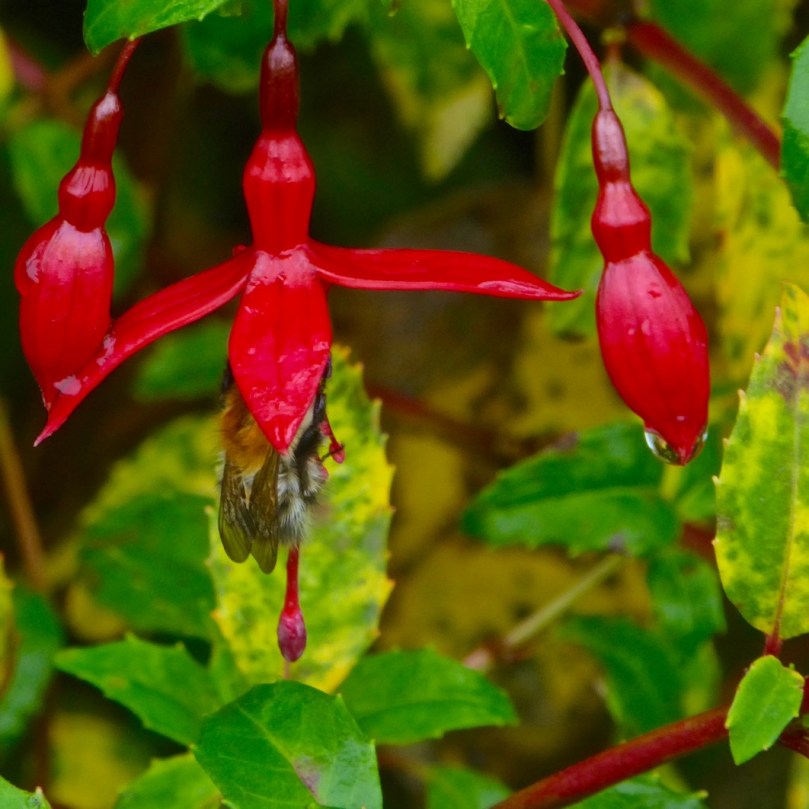
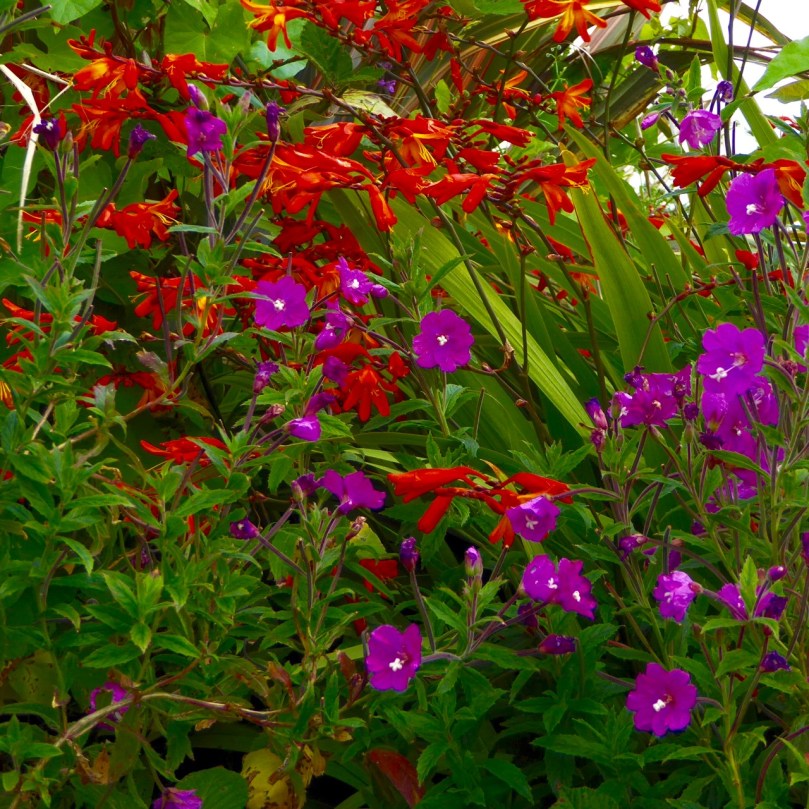
Fuchsia and Montbretia (or Crocosmia) flourish in the West Cork Hedgerows, but are actually alien species

Ironically also, the colourful and attractive wayside flowers that we think of as quintessentially West Cork, Fuchsia and Montbretia, are introduced species. Rhododendron was introduced in the 19th century and is considered a terrible threat to native species in Kerry. The same is true for Gunnera (that giant rhubarb disaster that has colonised vast tracts of Connemara), and Griselinia (ubiquitous for hedging). None of them would have been known to Ellen Hutchins. As Clare Heardman pointed out, Ellen recorded over a thousand plants, with no mention of them.

Holly Flowers

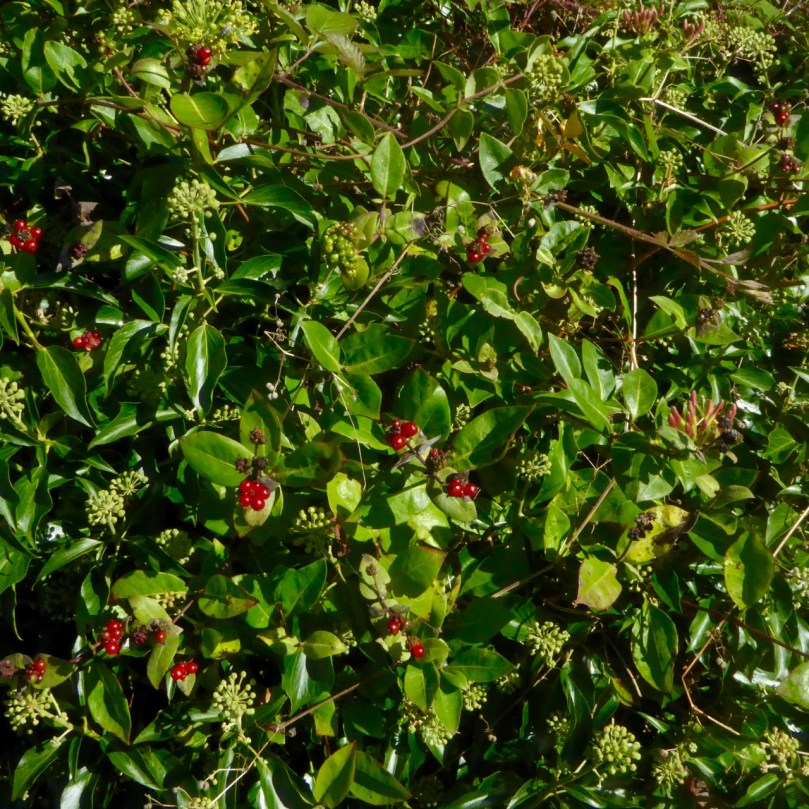
Ivy is just on the brink of flowering – we found one open bud after much searching

A third theme was the inter-dependence of species, both floral and faunal. About now, ivy starts to bloom, just as other flowers finish, and the ivy flower becomes an important food source for bees, moths, butterflies and other insects, such as hover flies. Unfortunately, ivy gets a bad rap for its habit of covering and damaging archaeological sites, such as medieval castles and churches and I wouldn’t have been sympathetic to it before our walk. Now I look at it in a whole new light. Pollinators also depend on holly, and the berries can also be a food source for field mice.

Royal Fern

The Royal Fern – an unusual native fern

There are a huge number of native plant species in Glengarriff Wood, and the conservation work that goes on there is of national importance. Padraig pointed out the filmy ferns that grow here and are rarely found in the rest of Ireland. He also showed us the native Royal Fern, which is unusual in that the spores grow not on the underneath of the fronds but on separate stalks.

filmy ferns

Filmy Ferns

Howard introduced us to a macro-lichen that, because the underneath bears a resemblance to lung tissue, was once tried as a cure for breathing ailments. Lichens, of course, are normally microscopically tiny, so an enormous one like this is rare, and exciting to visiting lichen-specialists. Like ivy, I gained a new appreciation for lichens – up to now, my normal emotion in regards to lichen has been frustration, since it functions to obscure rock art and stone carvings.

Large lichens like this one are very unusual, but Glengarriff Woods provide perfect conditions for them

Glengarriff Woods has preserved meadowland as well as woods. Important species use this habitat, such as the hairy wood ant and frog species that may be specifically Irish.

Meadow

The meadow

There was more, much more, but I will mention only one – the Guelder Rose tree. The dense and intensely red berries provide winter food for birds, but the flowers make it an attractive shrub in the early summer. There are some growing wild in the hedgerows just below us here along the Fastnet Trail Rossbrin Loop. I hadn’t been able to identify it until now. Pointing out that it would make a wonderful and ornamental garden plant, Padraig made a plea to us to insist on such native varieties when we develop our own gardens.

Guelder Rose Flower, June

A Guelder Rose tree found near our house in early summer

Throughout the walk, we meandered by the river that runs through these woods. It’s an important factor in the lush growth here, carrying high acidity levels from the bogland above. It’s also beautiful, serene and musical, adding immeasurably to the pleasure afforded by a walk in this woodland national treasure.

Still and Moving stream

Thank you to the Ellen Hutchins team for yet another fascinating botanical adventure!

By the stream

Cycling the Sheep’s Head

Group at Ahakista

The joy of cycling! The fresh air! The wind in your face! The sun on your back! The sights, the sounds, the smells! Wait – those killer hills! The wobbly legs, the burning lungs! No problem – we have Kalkhoffs!

Is  that enough exclamation marks for any decent blog post? And what on earth is a Kalkhoff?

DSC_0073

Sheeps Head light
Above, a Kalkhoff electric bicycle and below, the Sheep’s Head – the perfect combination

Earlier this year we cycled the length of the Sheep’s Head and back, all of us on electric bicycles, mostly Kalkhoffs. The day was organised by Patrick Murray and Helen Guinan of City View Wheels in Cork, and a masterpiece of organisation it was, featuring stops for coffee, lunch and a pint at the end of the day, followed by a lovely dinner in the Maritime Hotel in Bantry.

stopping for the view

Riding an electric bike has revolutionised cycling for me and for many others. Let’s face it, West Cork is nothing but hills, and huffing and puffing up one of them, pushing a bike, can take the joy out of a day’s adventure. But with some battery-powered help, you can stay on the bike and arrive at your destination still able to breathe.

The Old Creamery at Kilcrohane is a great place for lunch

It’s like having the wind at your back, giving you a gentle push when you need it. It’s still a work-out (you don’t stop peddling) but it just makes the whole venture doable. No, more than doable – pleasurable!

Lighthouse Loop

Sheeps Head LighthouseAbove: This is as far as you can drive or ride on the Sheep’s Head – after this, it’s a goodly walk to the lighthouse (below)

The Sheep’s Head is the perfect destination for a day’s cycling – incredibly scenic, lots of places to stop for refreshment, lots of things to see and do along the way, and relatively flat. Note that word relatively – if you start at Durrus and cycle along the south side to the end of the road and back, you don’t climb over any mountains but you do gain considerable altitude – enough to ensure that you deserve lunch by the time you reach Bernie’s Cupán Tae.

up the last hill

The good news is that it’s mostly downhill all the way back to Durrus.

Leaving Cupán

It  was a congenial bunch and the day was full of chats and laughter. As the ‘locals’ in the group, it was lovely to be able to show off West Cork. We made a detour down to Lake Faranamanagh and told everyone about the Bardic School and the King of Spain’s sons.

sheeps head view


Lake Faranamanagh
The Sheep’s Head , Lake Faranamanagh

When you’re cycling with a group you can’t really stop to take photos whenever you want, so the photographs in this post are a mixture. Photos of the day itself were taken either by Patrick (thank you, Patrick!) or by me, while general photographs of the Sheep’s Head come from my own collection and were taken at various times of the year. They will give you a feel for what’s to do and see along the way.

Air India Memorial Site


Top: The beautiful and moving Air India Memorial site at Ahakista; bottom: Critters encountered along the way

We were blessed with a lovely day for our bike trip. But then, as you know, the sun always shines in West Cork. And sure, if it doesn’t, you can hole up in a pub and sing, or stay home and cook up some fresh eggs from the happy hens at Faranamanagh.

eggs

If  you love to get out on a bicycle but aren’t the iron-man type, fear not – there is life after lycra!

road into Durrus

And if you just want to explore the Sheep’s Head, bike or no bike, take a look at our post on Walking the Sheep’s Head Way or head on over to Living the Sheep’s Head Way, the website of the Sheep’s Head and Bantry Tourism Co-operative, for lots of information the peninsula and places to stay. Or take a browse through The Sheep’s Head Way for all the walking routes – it’s the website of the voluntary committee that takes responsibility for the way-marked trails.

convoy

rainbow over mizen from Sheep's Head

Summer Markets

Long Island

Our West Cork markets – Skibbereen, Bantry and Schull – are thriving. Each has a distinct character and all of them are fun for wandering, browsing and buying.

Top right: A basket of scotch eggs from West Cork Pies; bottom left: April Danann from Rebel Foods

Skibbereen Market on Saturday mornings has become the iconic foodie market of West Cork. Everyone goes – it’s a social occasion as much as a shopping trip. Yesterday, Darina Allen of Ballymaloe breezed through when I was chatting with Eithne McCarthy, and rumour had it that Saoirse Ronan had been spotted earlier.

Eithne

Everybody loves Eithne McCarthy’s home made cakes, breads, jams and chutneys.

There’s music and coffee and crepes and bean burgers and sausages and cupcakes and scotch eggs and anything else you can happily munch on as you wander.

Many stall are devoted to locally produced and artisan foods. Perhaps the best known is Gubbeen, famous for cheese and smoked meats, but not far behind is West Cork Pies, Brown Envelope Seeds, April Danann’s Rebel Foods (wild, foraged and fermented), and Union Hall Smoked Fish.

Fingal

Top: Fingal Ferguson of Gubbeen; Lower left: Union Hall Smoked Fish; Lower Right; Madeline McKeever of Brown Envelope Seeds

But there’s also a whole array of stalls selling chocolates, baked goods, chutneys and pickles, free range eggs and the hens who lay them, vegetables, honey, vinegars, sausages, quiches, berries, olives, seaweeds, and more cheese.

It’s not just food, of course. There are flowers and bedding plants, wooden chairs, magic wands, dolls, jewellery, wool, carved bowls, antiques, books, junk, and yes, knitted tea cosies.

The Schull market is much smaller but has many of the same stalls. Schull is the quintessential tourist town – heaving in the summer – and the market here goes from Easter to October. It’s on Sunday mornings and has a lovely, casual, local vibe, with people dropping down after mass and everyone getting caught up on the latest news.

Schull Crowds

Like Skibbereen, it’s madly busy, so expect to queue and just enjoy the ambience and the music.

Cheese Queue

Bantry, on Friday mornings, is the largest market. Although there are some of the same food stalls, it seems to attract different vendors than the other two. This is the market where people shop for second hand goods, curios and collectibles, tools, carpets, clothing, work boots, trees and shrubs, and Michael Collins posters.

Bantry Market

A visit to West Cork wouldn’t be complete without making a trip to the market. Heck – make it to all three of them!

Vials

Champions for Ireland

wolfhounds

Irish Champions – ancient warriors, wolfhounds and rain at the Tailteann Games 1924

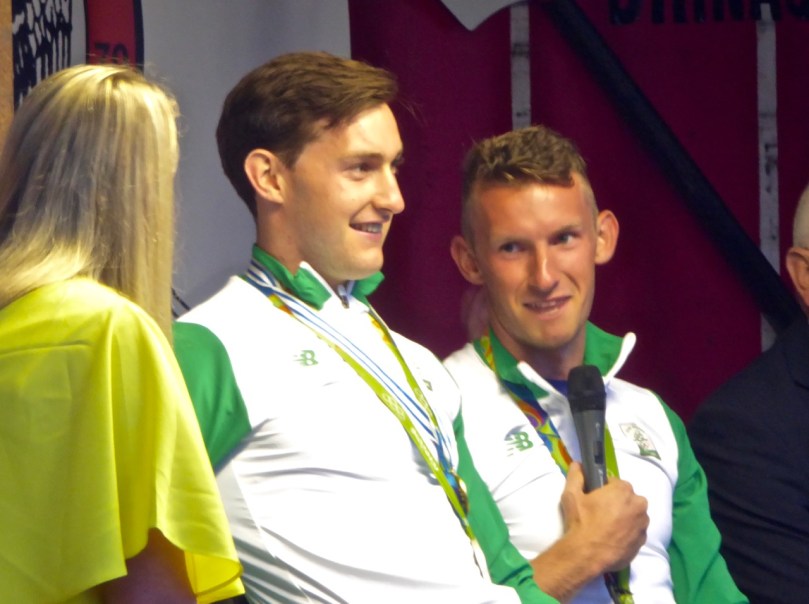
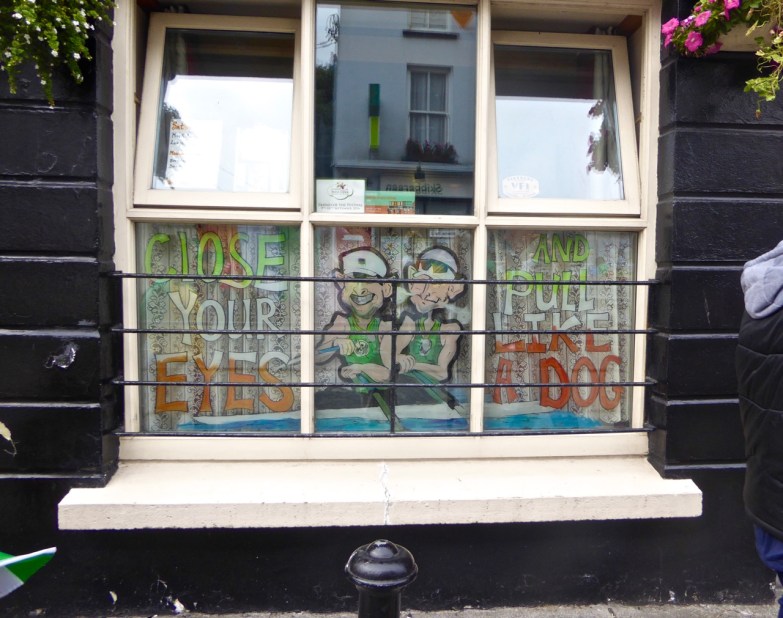
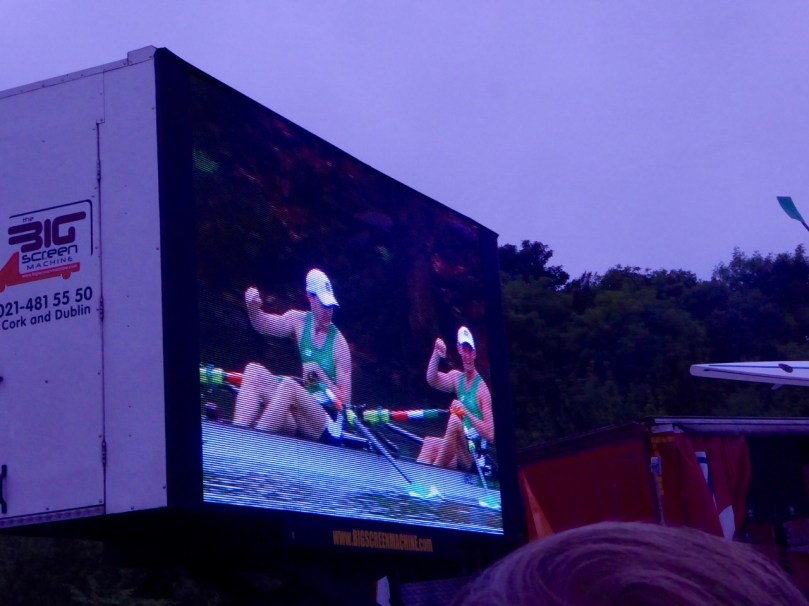
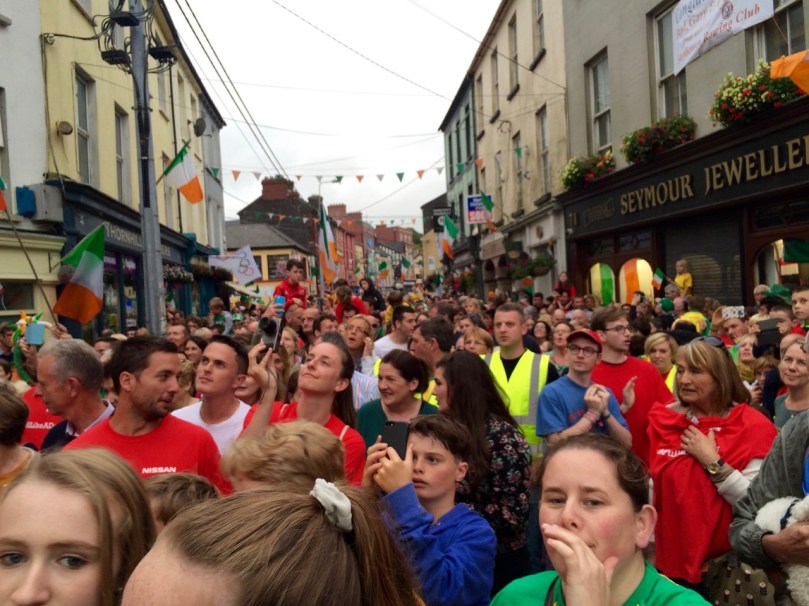
We heard hearty cheers coming across the water on Friday, when Ireland won the Olympic silver medal in the Lightweight Men’s Double Sculls Final. The cheers we heard were not coming from Rio, however (although there were plenty there), but from Lisheen, the tiny West Cork parish that’s just around the corner from us. That’s where Gary and Paul O’Donovan hail from. We think they have declared a public holiday there in honour of the two rowing brothers who, prior to this title, won gold at the European Championships in Brandenburg in Germany this year – the first Ireland rowing crew to become European Champions. This success set me looking at the records of Irish Olympic achievements over the years.

NGI 941

The Liffey Swim by Jack Butler Yeats, painted in 1923. Courtesy National Gallery of Ireland

Independent Ireland was represented at the Olympic Games from 1924 onwards. No Irish athletes won medals in 1924 but Jack Butler Yeats won a silver medal for the above painting and Oliver St John Gogarty won a bronze medal for literature in that year. Did you know that between 1912 and 1948 competitions in the arts were part of the Olympic Games? For a small nation Ireland has made its mark in the games: in Melbourne in 1956 Irish athletes and boxers won 5 medals between them – a gold, a silver and three bronze, and in London in 2012 boxers, athletes and a showjumper won 6 medals – a gold, a silver and four bronze. 1996 was a memorable year when, in Atlanta, Michelle Smith won 3 golds and a bronze for swimming.

An original cover from the 1924 programme for the Tailteann Games, an artist’s perception of the ancient games and (right) two medals struck for the Games

While researching this information I came across Tailteann Games. The word is pronounced ‘tell-tin’. The eleventh century Lebor Gabála Érenn (the Book of the Invasions of Ireland) states that the games were founded by Lugh Lámhfhada, Lugh of the Long Arm – the first High King of Ireland – as a mourning ceremony for the death of his foster-mother Tailtiu. Lugh buried Tailtiu underneath a mound in an area that took her name and was later called Teltown in County Meath, not far from the Hill of Tara. It’s perhaps significant that the games took place around the festival of Lughnasa – at the beginning of August. Accounts vary as to the historical periods in which the games were held: some say as early as 1800 BC, while a more generally accepted dating seems to be from the 6th to the 9th centuries AD: the festival died out after the Norman invasion but was later revived as the Tailten Fair, consisting of contests of strength and skill, horse races, religious celebrations, and a traditional time for couples to contract ‘trial’ marriages. These were allowed under Brehon Laws: couples could meet and live together for a year and a day – at the end of this time either party could end the marriage on the ‘Hills of Separation’.

Presumably these photographs are from the ‘Opening Ceremony’ of the 1924 Tailteann Games held in Croke Park

While the 1924 Olympics were being held in Paris (where Finola’s grandfather was a member of the Irish team) a revival of the Tailteann Games was held in Croke Park, Dublin. This ‘meeting of the Irish race’ or ‘Irish Olympiad’ had been announced by Éamon de Valera in Dáil Éireann in 1921 to celebrate the founding of the Irish Free State, but the event was delayed because of the Anglo-Irish War and the Irish Civil War. Organised by the Gaelic Athletic Association (GAA), it was open to all people of Irish birth or ancestry. Participants came from England, Scotland, Wales, Canada, the USA, South Africa and Australia as well as Ireland. 

image

Note the media presence at the 1924 Tailteann Games: newsreel cameras mounted on to motor vans  

Tailteann Games were held again in 1928 and 1932. The name survives today as Rás Tailteann, which is an 8 day international cycling race around parts of Ireland. This race has run every year since it was founded in 1953 and has developed into a much sought after event by professional and amateur teams from many parts of the world: it is able to award qualifying points that are required for participation in Olympic Games and World Cycling Championships.

Fireworks_at_the_First_Tailteann_Games_August_15,_1924

No modern games ceremony would be complete without a fireworks display: (top) this unusual photograph shows the fireworks at the 1924 Tailteann Games. (Lower left) a 1958 poster for the Rás Tailteann. (Lower right)  We watched this year’s Rás Tailteann on the road to Ballydehob. (Below) Paul and Gary O’Donovan – West Cork lads in Rio on Friday added a 2016 Olympic Silver to their many achievements (photo afloat.ie)

brothers

‘Will the Hare’ – and the Mizen Olympics!

street market

…In ancient Ireland the festival of the beginning of the harvest was the first day of Autumn, that is to say, it coincided with 1 August in the Julian calendar. This has continued in recent tradition, insofar as Lúnasa or Lammas-Day was still taken to be the first day of Autumn; the gatherings and celebrations connected with it were, however, transferred to a nearby Sunday, in most parts of Ireland to the last Sunday in July, in some places to the first Sunday in August… The old Lúnasa was, in the main, forgotten as applying to the popular festival and a variety of names substituted in various localities, such as Domhnach Chrom Dubh, Domhnach Deireannach (Last Sunday), Garland Sunday, Hill Sunday and others…

making the stack

All the photographs in this post are from the collection of Tomás Ó Muircheartaigh who travelled and photographed the west of Ireland during the 1930s, 40s and 50s and is an invaluable documentary of the times in which he lived. Generally, the locations of the photographs are not noted, and very few are likely to be specific to the Mizen: they do however record life as it would have been lived at that time in all the rural areas

Today we celebrate Lúnasa – the festival of the bringing-in of the harvest. Kevin Danaher (The Year in Ireland, Mercier Press 1972) wrote (above) about what he observed in the middle of the last century, when things were already changing and many of the old customs were, as he notes, ‘in the main forgotten’, although still talked about. What changes do we see in Ireland, a few generations on?

seascape

Northside of the Mizen by Patrick McCarthy and Richard Hawkes was written in 1999 (Mizen Productions) and is a collection of memories and stories still being told then about traditional life in this westerly part of of the country:

…The heat of the summer was eased by the cooling breezes from the Atlantic. It was busy on land and sea, with seine fishing by night and fish curing and farming by day, but there was always time for scoriachting, games and dance, sometimes on Carbery Island or across Dunmanus Bay…

…Once in the year Carbery Island was the location for a dance and in settled weather the Northsiders could shout across and give the signal to the people of Muintir Bháire to meet at Carbery Island. As many as forty-five people in three boats would cross Dunmanus Bay to the White House, and a good crowd of men and women from Bear Island would also come to the dances. They were great hearty people. Ann Daly from Kilcrohane and Agnes O’Donovan of Dunkelly played the melodeon…

I like the idea of the Northsiders shouting across the water to the residents of the Sheep’s Head, two miles away! I wonder if they would be heard nowadays?

horse race

…There were competitions at Dunmanus for swimming, running, jumping and weight lifting, and you could be sure that the Northsiders were well represented in each of the events. ‘Will the Hare’ (William McCarthy of Dunkelly Middle), was good at the long jump and the running races and would often win and bring great honour to the Northside. It was said that ‘Will the Hare’ got his name by catching a hare on the run! It was also said that when you blew the whistle to gather the men for seining, by the time you had finished, ‘Will the Hare’ would be at Canty’s Cove waiting!

boat race

…Wild John Murphy would take the lads to the Crookhaven Regatta which was held on The Assumption (15th August). It was a long pull around the Mizen but a good time was had by all. The Northsiders were great with the oars, but it was hard to beat the Long Island crews in the boat races…

(Danaher): …In very many localities the chief event of the festival was not so much the festive meal as the festive gathering out of doors. This took the form of an excursion to some traditional site, usually on a hill or mountain top, or beside a lake or river, where large numbers of people from the surrounding area congregated, travelling thither on foot, on horseback or in carts and other equipages… Many of the participants came prepared to ‘make a day of it’ bringing food and drink and musical instruments, and spending the afternoon and evening in eating, drinking and dancing…

picnic

…Another welcome feature of the festive meal was fresh fruit. Those who had currants or gooseberries in their gardens, and this was usual even among small-holders in Munster and South Leinster, made sure that some dish of these appeared on the table. Those who lived near heather hills or woods gathered fraucháin (‘fraughans’, whortleberries, blueberries) which they ate for an ‘aftercourse’ mashed with fresh cream and sugar. Similar treatment was given to wild strawberries and wild raspberries by those lucky ones who lived near the woods where these grow… A number of fairs still held or until recently held at this season bear names like ‘Lammas Fair’, ‘Gooseberry Fair’, ‘Bilberry Fair’…

market in town

One interesting custom was the driving of cattle and horses into the water. This is mentioned in the 1680s by Piers in his Description of the County of West-Meath:On the first Sunday in harvest, viz in August, they will be sure to drive their cattle into some pool or river, and therein swim them; this they observe as inviolable as if it were a point of religion, for they think no beast will live the whole year thro’ unless they be thus drenched; I deny not but that swimming of the cattle, and chiefly in this season of the year, is healthful unto them…

at the fair