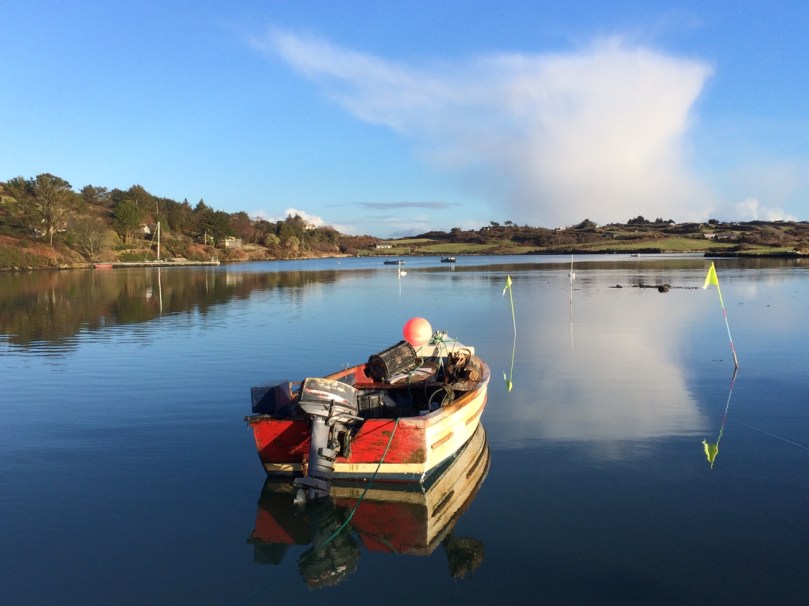
Fastnet Trails: Rossbrin Loop, Part 2

Start this walk at the Rossbrin boat slip

Start this walk at the Rossbrin boat slip

A joint post by Finola and Robert

In Part 1 of this trail post, we took you around the first leg of the Rossbrin Loop trail, which we have broken into two shorter rambles.

This one is steeper and climbs higher, but it’s full of interest and you can take it as easy as you like. For this walk, you park at the Rossbrin boat slip, at the eastern end of Rossbrin Cove.
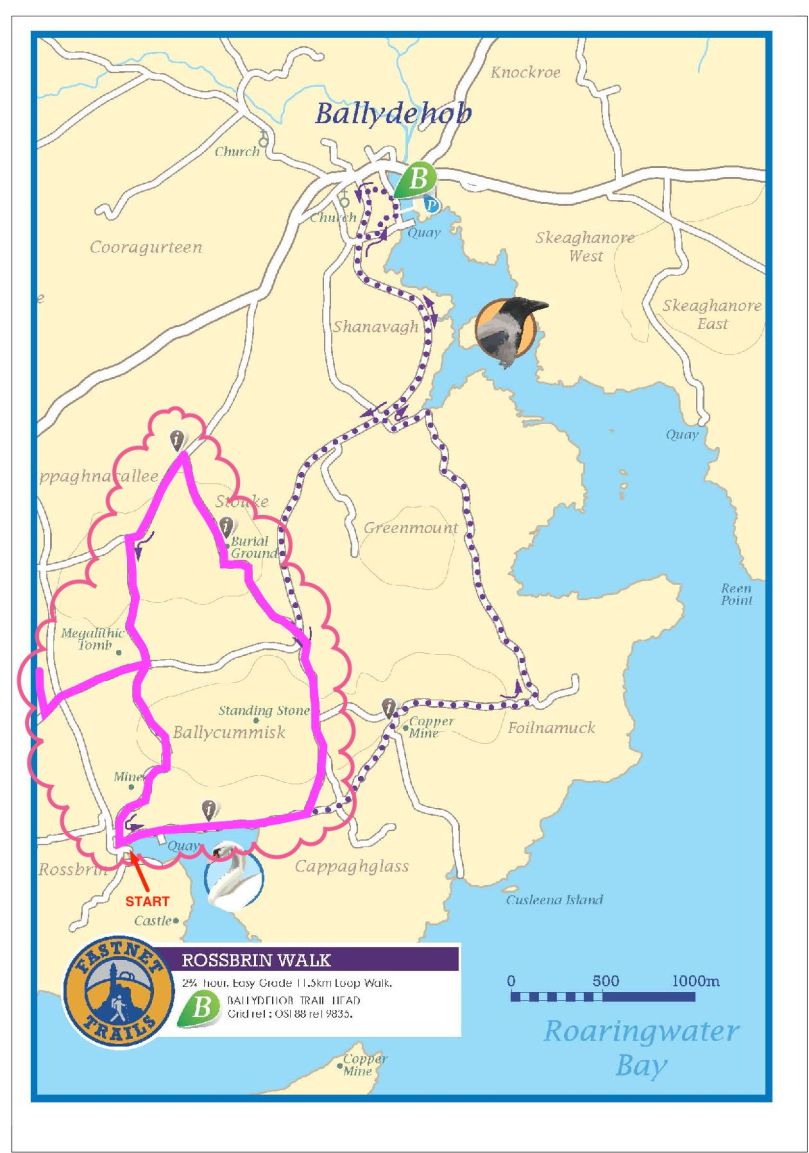
Rossbrin trails route revised Export

You won’t need off-road boots and you can take the dog. Give yourself two to three hours, depending on whether you decide to do the detour to see the wedge tomb. This is a nice, rambling pace, with lots of time to stop and chat to anybody you meet, admire the wonderful views, take lots of photographs, and maybe indulge in a picnic along the way. 

The first hill affords lovely views back to Rossbrin Castle

The first hill affords lovely views back to Rossbrin Castle

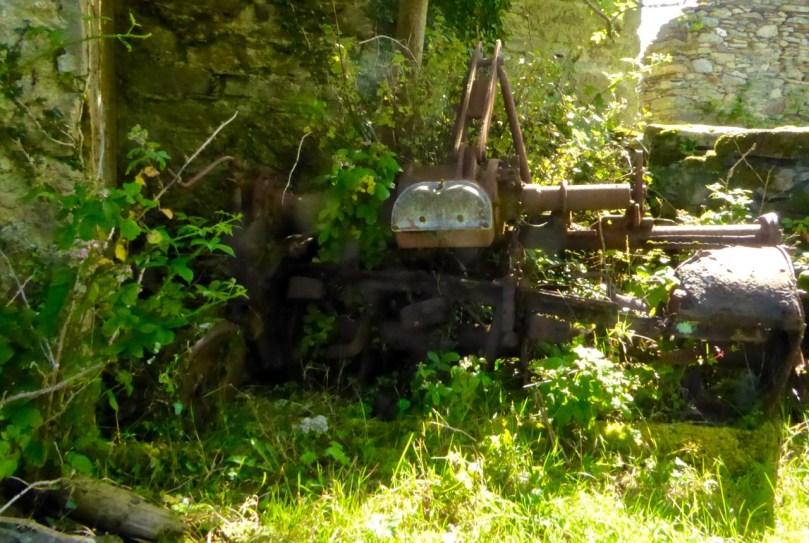
Set off north and turn right after the boat yard and then left up the hill. As you ascend you will see the remains of old mine workings to your left. The earliest records of mining at Ballycummisk refer to 16 tons of ore raised in 1814 and 42 tons in 1815. In 1838 a shaft was sunk 20 fathoms, mainly through barytes and shale. In 1857, 174 tons of ore were sold, mainly copper. By 1861 the mine was recorded as being ‘one of the best developed and very satisfactorily worked.’ The ‘Lady’s Vein shafts’ are marked on the OS 6” map. The Ballycummisk Mining Company worked the mine from 1872. In 1878 a section down to 228 fathoms was noted, but in the same year the mine was recorded as ‘abandoned’. Nowadays some concrete pillars and the slag heap are the most visible remains of the once thriving mine-site.
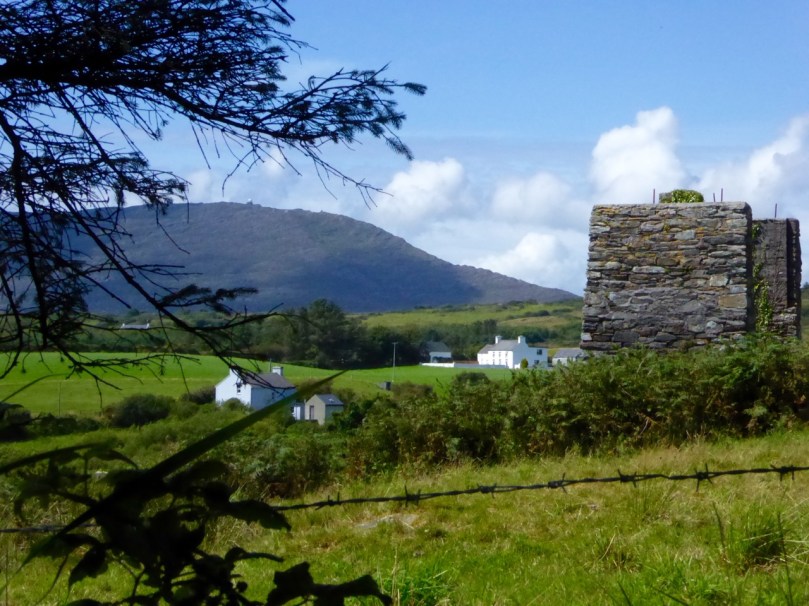
Old Mine site

There are extensive views over the countryside beyond the old mines

At the top of the hill, where you will find a sign to the riding stables, turn left and head through the townland of Ballycummisk with pleasant country views to the west. Once you get to the crossroads you may see a little wayside stall selling vegetables on the honour system. If you’ve brought a backpack, this would be a good place to stock up on carrots, potatoes, or yellow tomatoes.
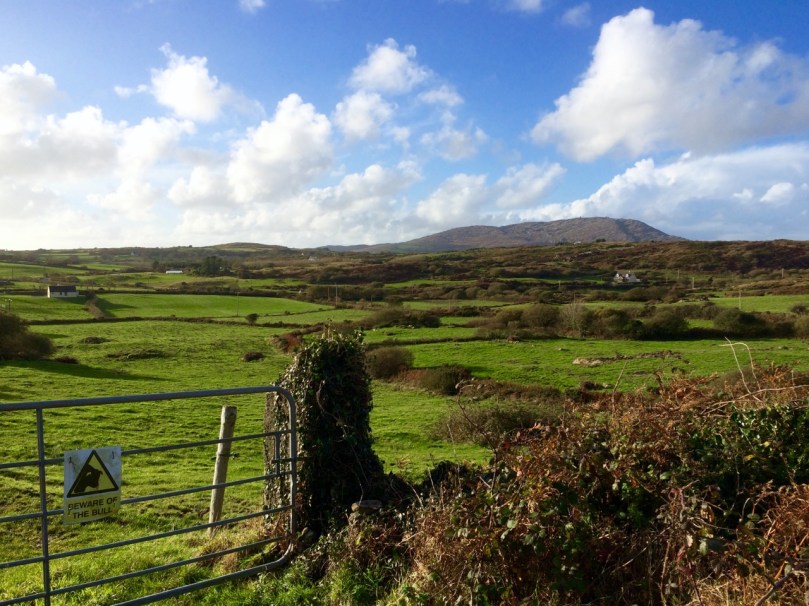
Beware of the bull

Wayside StallAt this point, we recommend a detour to see the Kilbronogue wedge tomb. Turn left and walk until you reach the next crossroads. Go straight through the crossroads and a short distance on you will see a lay-by on the right side of the road. Step over the wire and find your way up the path that has been generously maintained by the landowner. In early summer this path is awash with ox-eye daisies. It meanders up through a birch plantation until you emerge in a small clearing to find the wedge tomb.
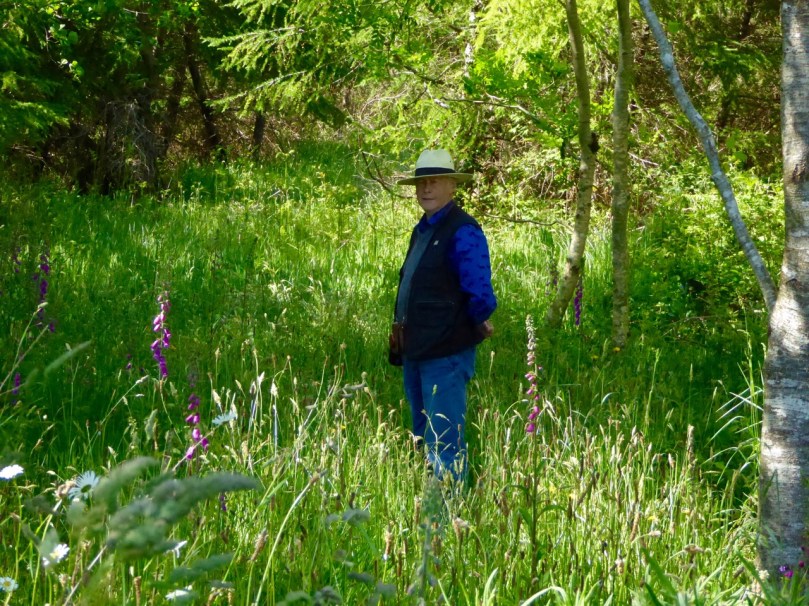
Path to wedge tomb, Kilbronogue

Like most wedge tombs, this one is orientated to the west – take a look at our post Wedge Tombs: Last of the Megaliths for lots of information on this class of Bronze Age monuments. This is a lovely example, and we are grateful to Stephen Lynch for ensuring its wellbeing and providing access to it.
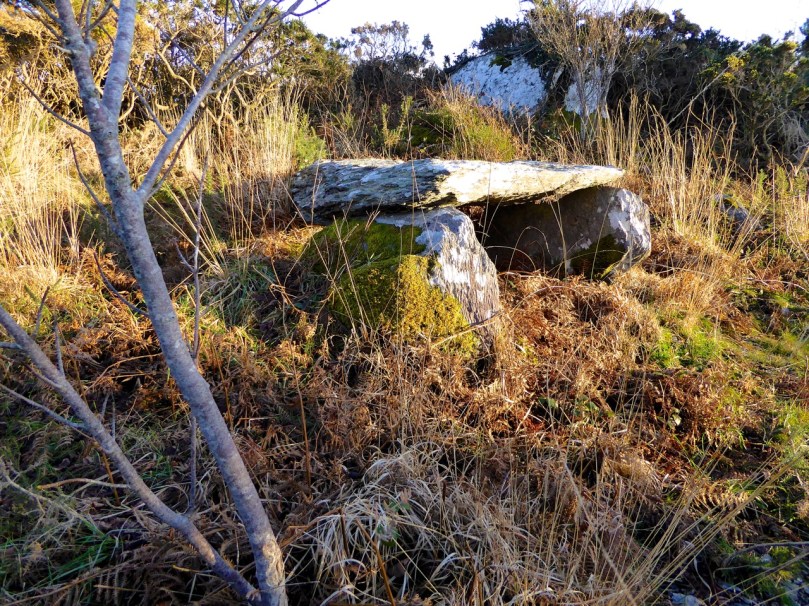
Kilbronogue Wedge tomb

Retrace your steps to the second cross roads and turn left up the hill, turning right when your reach a T junction, and then take the left fork at the Y. This is a pleasant country road – farmland stretches on either side, with ruined or abandoned houses dotted here and there among the neat modern farmhouses with their colourful paint and bowery entrances.

In spring and summer the hedgerows are heady with wild flowers of every variety.

Turn right again at the next junction and you will come shortly to the beautiful and atmospheric Stouke burial ground. Although we have read that there are the ruins of an old church in this graveyard, we have never found it. But there are other items of great interest here, the traditional burial place of many island dwellers. In the centre you will find the grave of two priests, Fathers James and John Barry, who were parish priests here during the time of the famine. According to the Historic Graves listing for Stouke  “Sarah Roberts who is buried here in this tomb, died at an early age… worked as a housekeeper for the parish priest… When his sister died and was also buried here, Sarah’s coffin was in perfect condition. She was reburied with the parish priest even though she was not a Catholic. People of the parish come to pray at this tomb on the 24th June at John’s Feast Day.”

A little way to the right of this grave is a rock, partially covered by heather, that contains a bullaun stone, known locally as the Bishop’s Head. Once again, according to the Historic Graves entry, “The bishop was confirming children in a nearby church. Red coats came in and beheaded the bishop.”

Amanda photographs the bullaun stone

Amanda photographs the bullaun stone

There are offerings of coins in jars at the bullaun stones, and at the priests’ grave. Leave one too, along with a prayer or wish for a loved one.
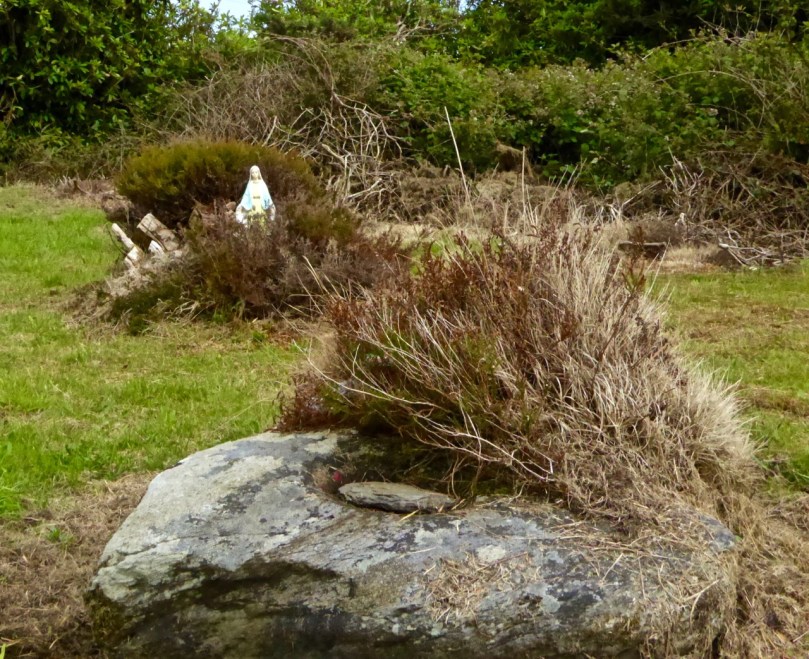
Bishops Head bullaun stone, Stouke Graveyard

Bishop’s Head bullaun stone, Stouke Graveyard

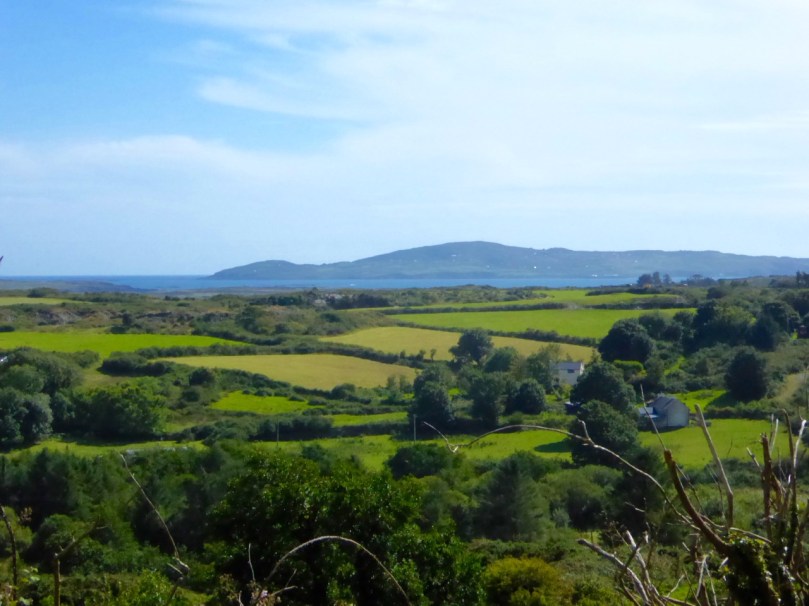
From Stouke the road drops down to a cross roads. Go straight through and start to climb again up to Cappaghglass. Ignore the left turn and carry on until you reach a Y junction. Take the right fork, pass all the ripe blackberries (if you’re able) and as you crest the hill the whole of Roaringwater Bay is laid out before you. Few views in the country can equal this one for sheer scope: all the islands in Carbery’s Hundred Isles come into view, The Baltimore Beacon gleams on its rocky outcrop to the east, while the Fastnet Rock sits sturdily on the horizon, and the Mizen Peninsula stretches away to the west.
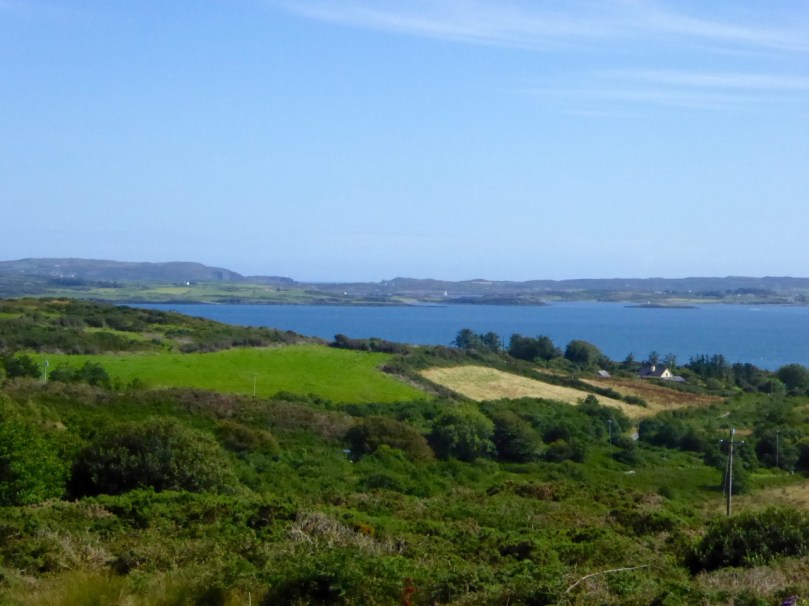
Roaringwater Bay from Cappaghglass

Descend the steep hill, turning right at the T junction, and meander down to Rossbrin Cove.
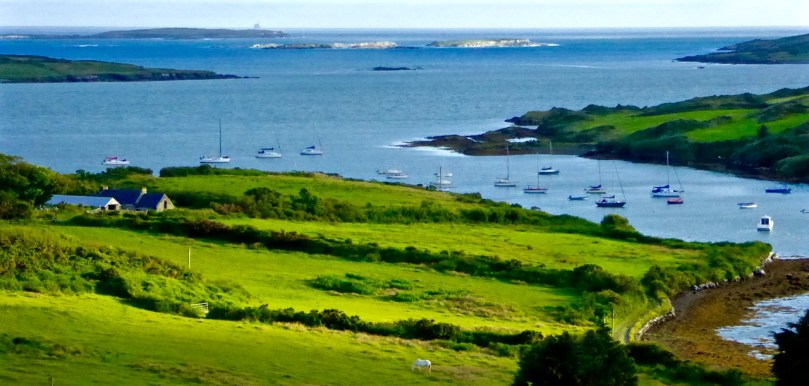
Shaft of Sun

Now a peaceful boat harbour, Rossbrin in the 15th Century was the domain of Finghín O’Mahony, the Scholar Prince of Rossbrin, a man who used the riches extracted from taxes paid by Spanish and French fishermen to fund a centre of learning here in Rossbrin where scribes and learned men wrote and translated books which still exist today. The ruined section of the castle still standing gives little evidence of the erudite court that was once respected throughout Europe. A fish ‘palace’ for processing pilchards once provided employment to the people of Rossbrin, but little trace remains of it, or the holy well at the shore that once attracted those seeking cures for their ailments.

Kayaks at Rossbrin Cove

If the weather’s warm and the tide’s in, this is a good spot for a dip. No? Well, a photograph, then. 

We hope you’ve enjoyed the two Rossbrin Loop walks – do let us know how you got on.
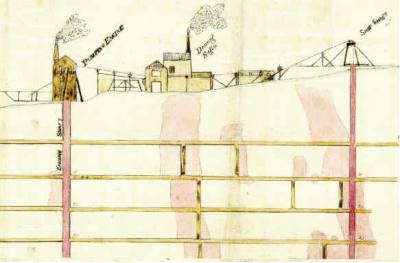
Ballycummisk Mine
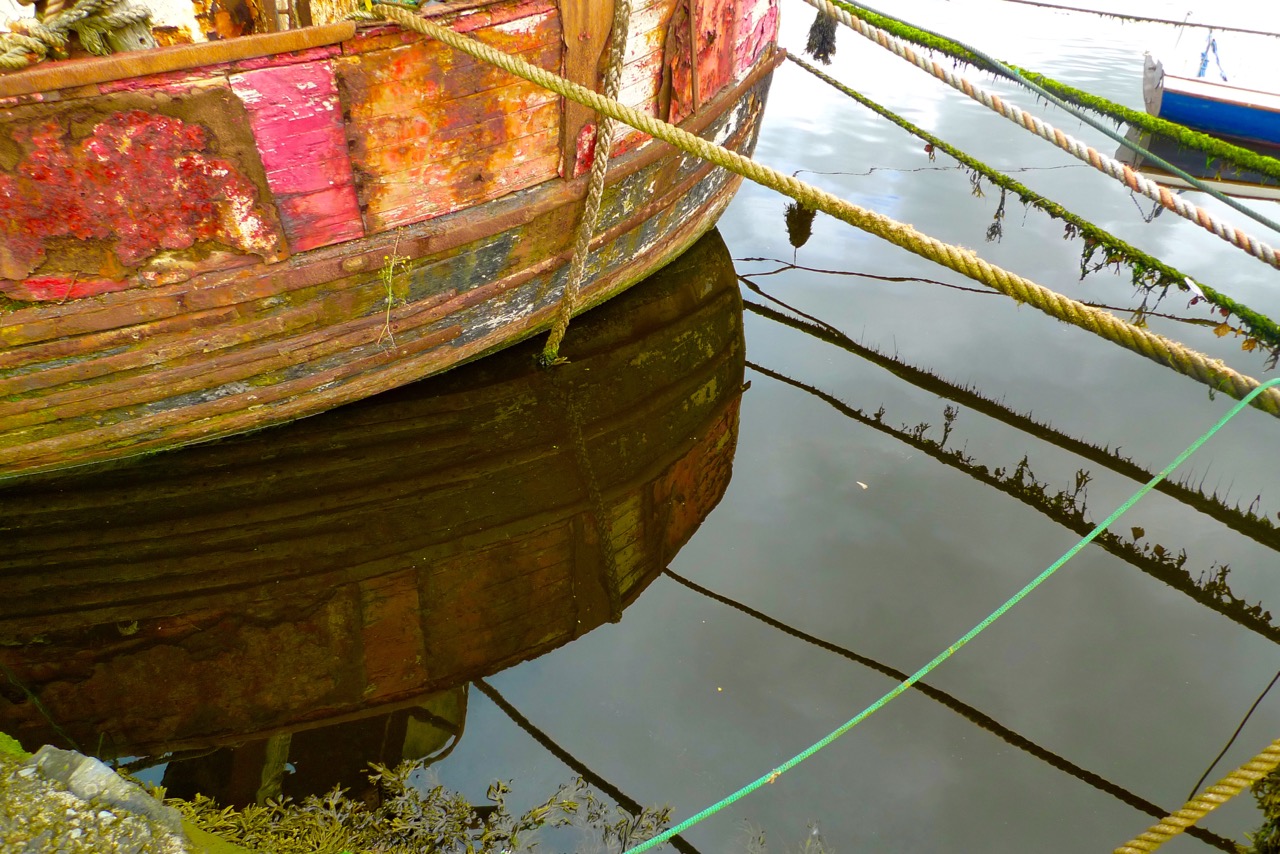
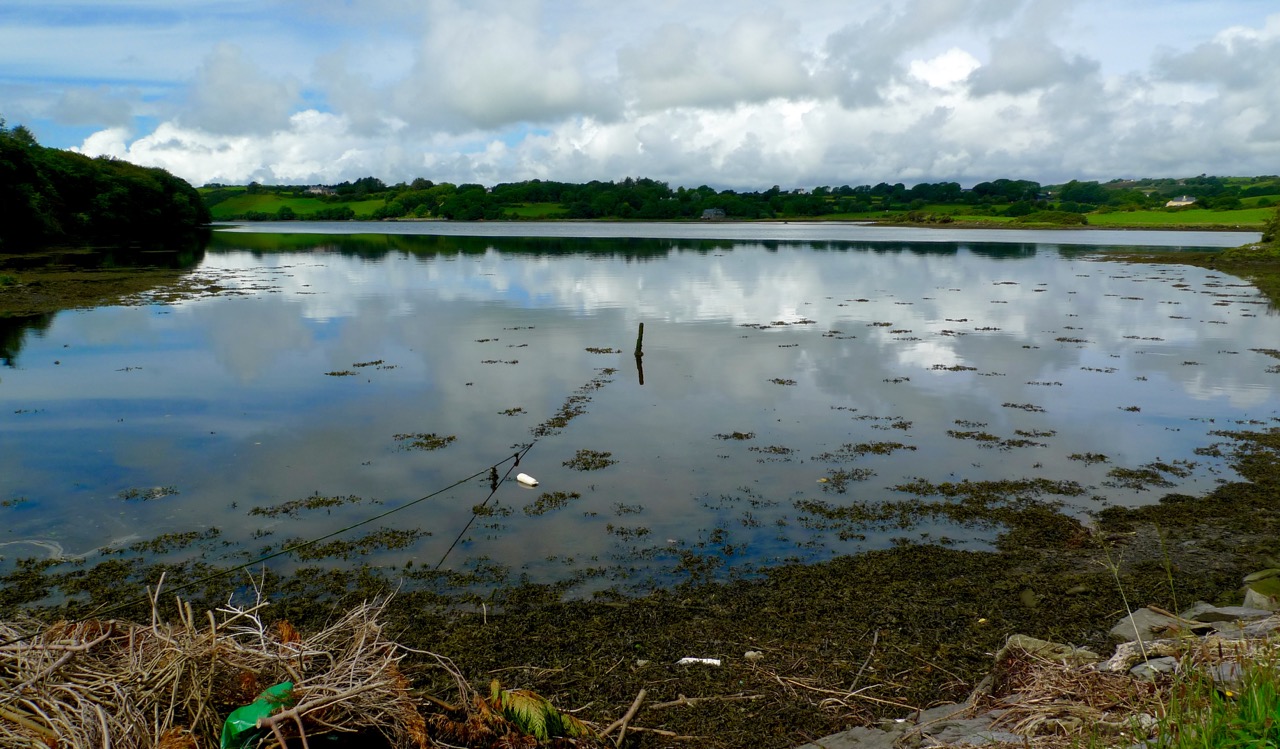
Ballycummisk Mine
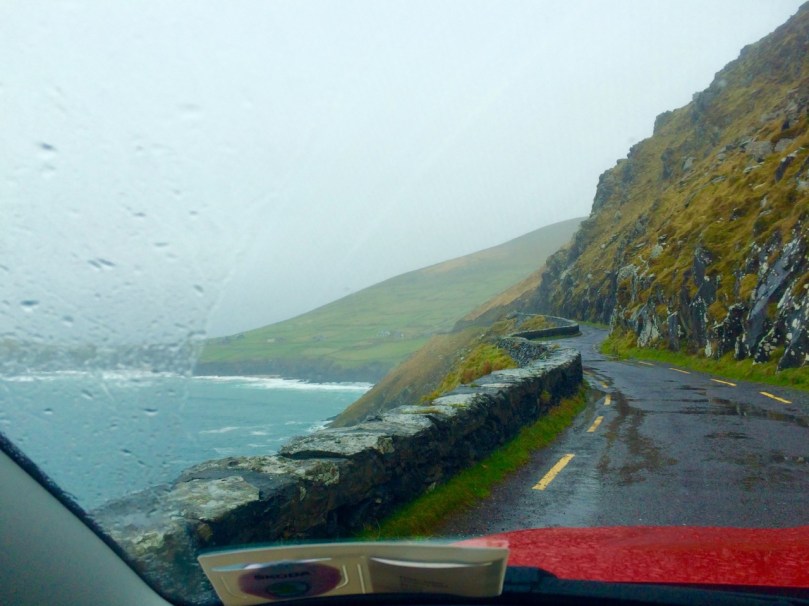
Oldcourt

red hull

…At Oldcourt a boat-building yard flourished within the walls of an old O’Driscoll castle overlooking the pier and river. Schooners and steamships used to anchor at this spot, the highest point they could travel up the river. Here their cargoes of coal and other supplies were unloaded and placed on specially built lighters with a small draught that would be poled along a further sluggish turn or two upstream to the pier at Skibbereen. In this way cargoes of cattle were brought up by islanders to be sold at the market… (description of the townland of Oldcourt from The Coast of West Cork by Peter Somerville-Large 1974)

gentle Ilen

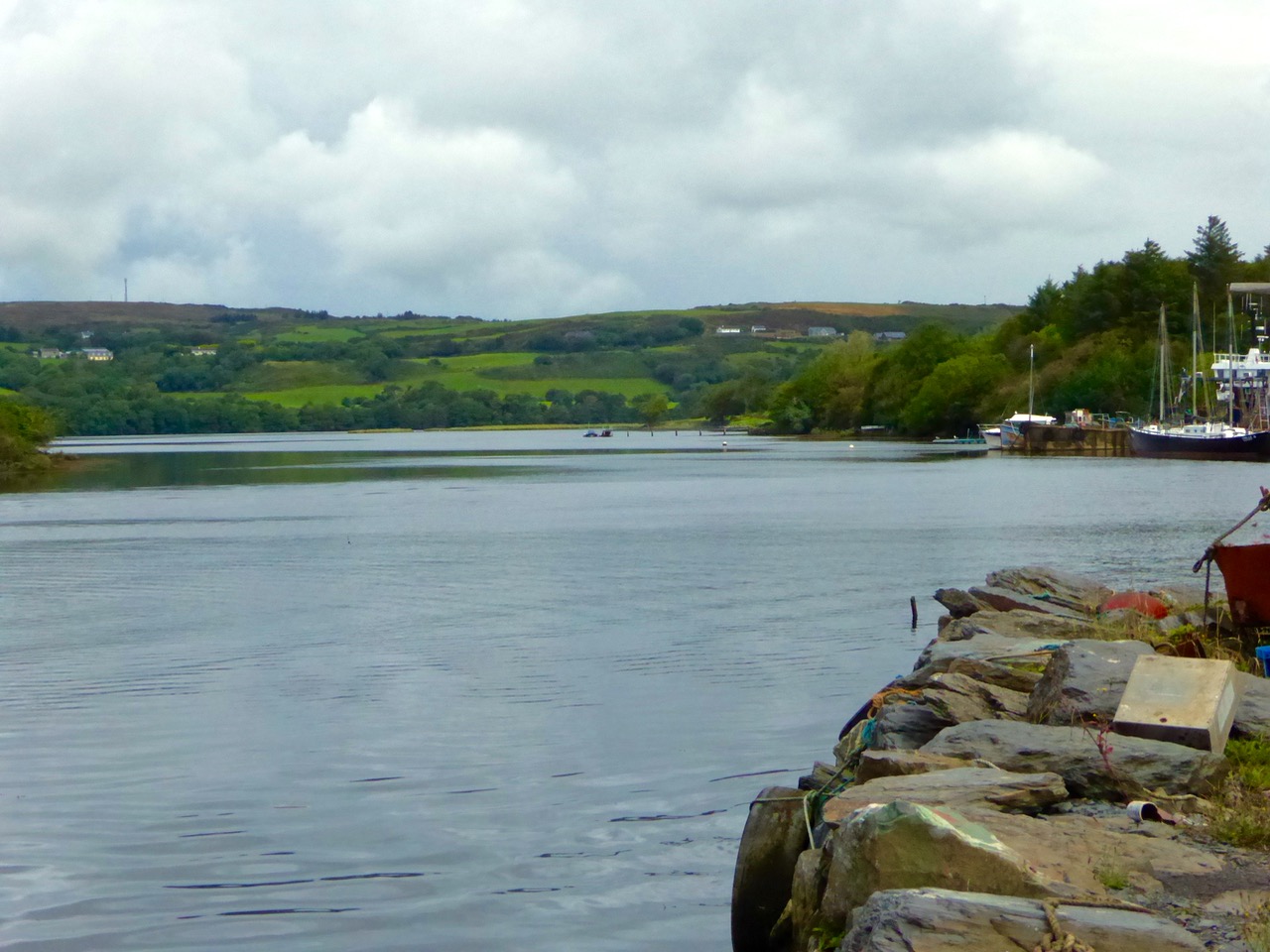
The tidal River Ilen making its lazy way out to Roaringwater Bay on a late summer evening has a melancholy beauty: it is wide and slow and – mid tide – is a perfect mirror to the sky. The sounds of Oystercatchers and Curlews coming over the water always bring thoughts of autumn: the harvest is ready to cut, the verges are brilliantly orange with the montbretia and the hedges purple-red and weighed down with fuscia.

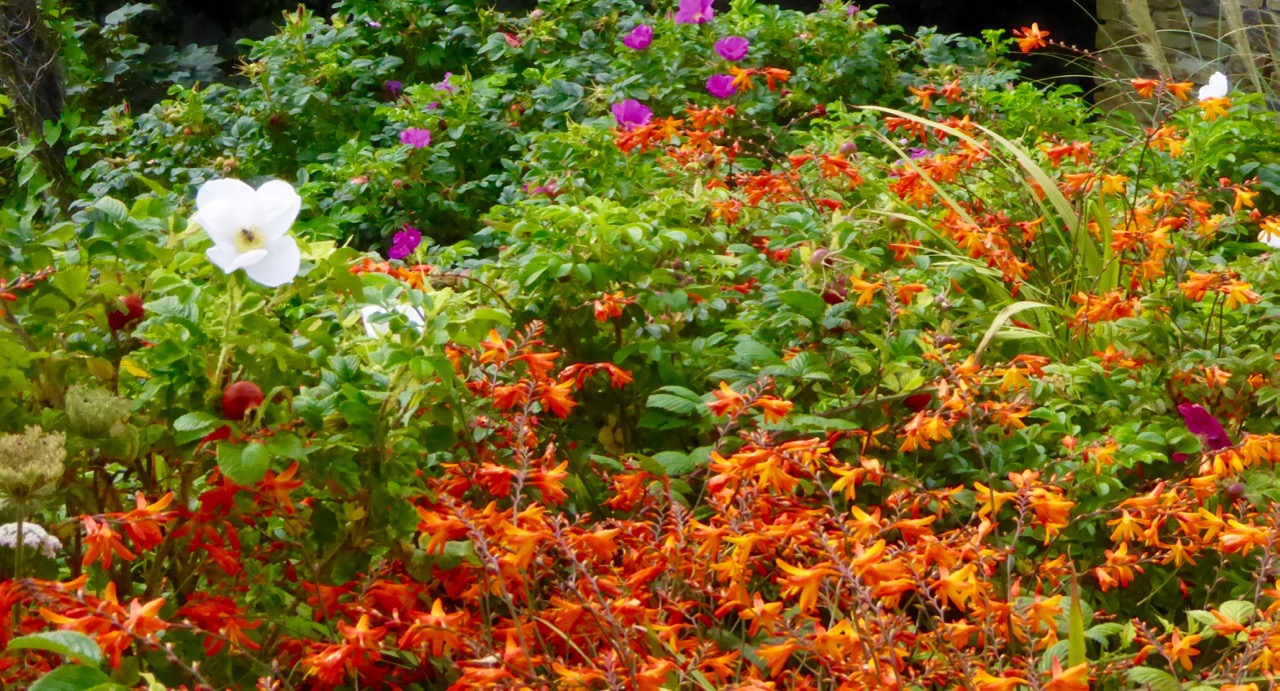
Montbretia

wide river

We went down to Oldcourt to seek out history and atmosphere. We knew that it had once been a transport hub for the transhipments of goods and we wanted to see what might be visible from those earlier times. It was the river Ilen (pronounced eye-len) that gave birth to Skibbereen following a pirate raid on Baltimore in 1631. According to Skibbereen historian Gerald O’Brien …in the wake of the shock of that – the most daring pirate raid mounted against Britain or Ireland – a small number of survivors rowed upstream to resettle in the safety of the Ilen Valley. The role of this river-borne migration from Baltimore [was] a factor in the foundation of Skibbereen… (Journal of the Skibbereen and District Historical Society, Vol 7, p 91).

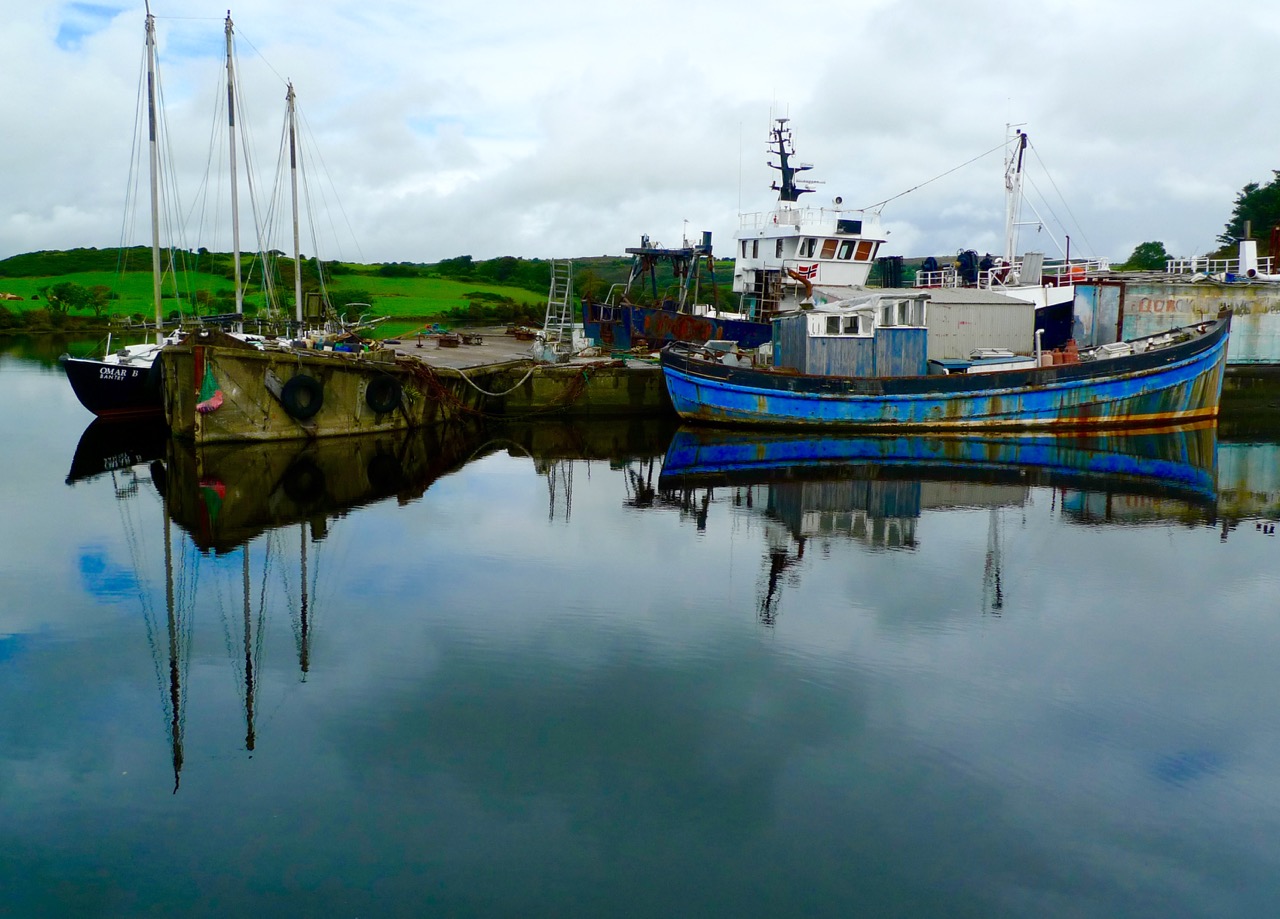
reflections

beyond the bridge

rust

We found atmosphere a-plenty. On the upstream side of the wide inlet where the transhipment quays were sited is a streamlined modern boatyard where sleek yachts are wintered and serviced while, opposite and downstream, is a far more eclectic establishment surrounding and embracing the remains of the medieval castle and bawn: this is Hegarty’s‘…one of Ireland’s last surviving traditional boatyards…’

birdie in circle

Our aim was to search for the old quay and the medieval buildings which had been part of the castle demesne, but we were fascinated to pick our way through boats of all kinds – classic, sailing, fishing, ferrying – and boat paraphernalia: here an old decapitated wheelhouse, there a collection of masts, everywhere ropes and tackle…

green ropes

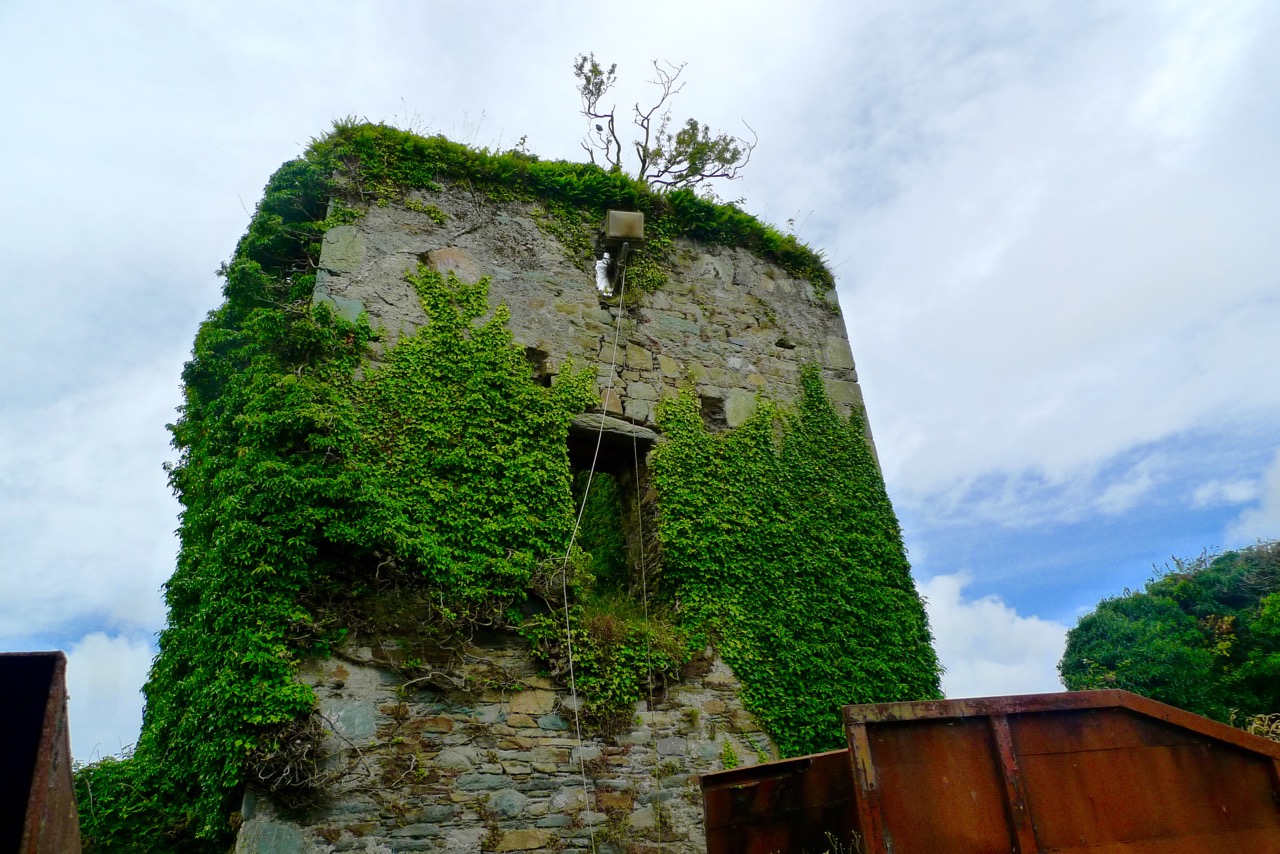
Oldcourt Castle is a tower house standing four storeys high but originally at least one storey higher, once surrounded by a bawn, some ruins of which remain. It was an O’Driscoll clan castle, probably dating from the 15th century, and was captured by English forces after the Battle of Kinsale in 1601.

Old Court Castle

Ilen and Castle

Part of the castle bawn was used as a grain store up to comparatively modern times: now it houses a fascinating boat restoration. The story begins with Connor O’Brien (1880-1952) whose ketch, the Saoirse, took him on a circumnavigation of the world between 1923 and 1925. On this journey he stopped off at Port Stanley in the Falkland Islands. The islanders were so impressed at the way the Saoirse rode the waves that they asked O’Brien to arrange the building of a similar boat. This was the Ilen, named after the river and estuary and registered at the port of Skibbereen in February 1926. She was 56 feet in length overall with a beam of 14 feet and a displacement of 45 tonnes. Connor set sail in August 1926 from Cape Clear, arriving at Port Stanley in January 1927 where he handed it over to the new owners, The Falkland Islands Company, in exchange for £1,500. There she remained until the early 1990s, carrying cargoes of stores, mail, passengers and sheep. Limerick man Gary McMahon found it abandoned on one of the islands and determined that it should return to its homeland for restoration. There was great excitement when he sailed the ketch back into Baltimore in 1998.  The refitting of this eighty-two year old vessel in the old bawn at Hegarty’s, Oldcourt, is now the centre of an educational project allowing people to experience first-hand the ancient skills of wooden boat building.grain store

ilenframesThe old grain store – formerly part of the Castle bawn – now houses the restoration project of the AK Ilen (above – courtesy of Roeboats)

Such a hive of activity at OIdcourt today… Echoes of busy days gone by when the schooners were arriving with their cargoes bound for the growing town of Skibbereen.

Ilen postage stamp

Irish Roads

Heading towards the light

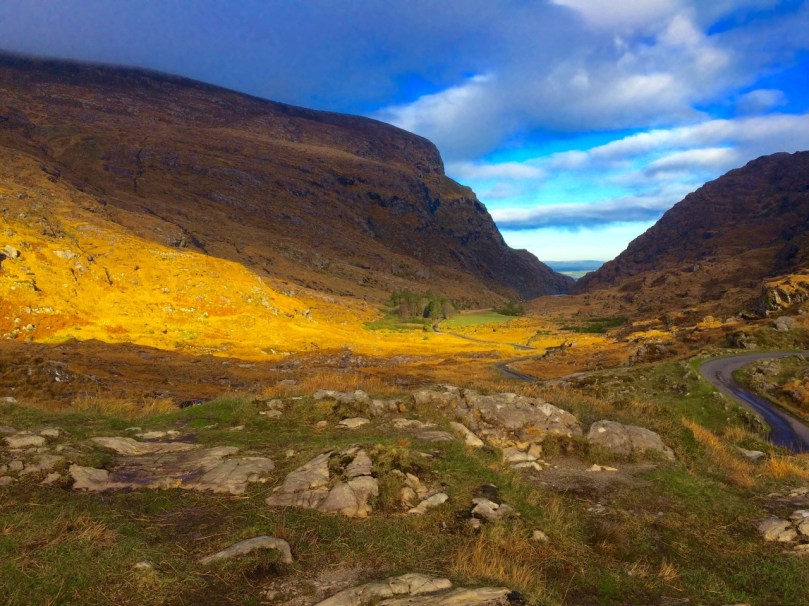
Driving the Gap of Dunloe in Kerry – it can only be done in winter.

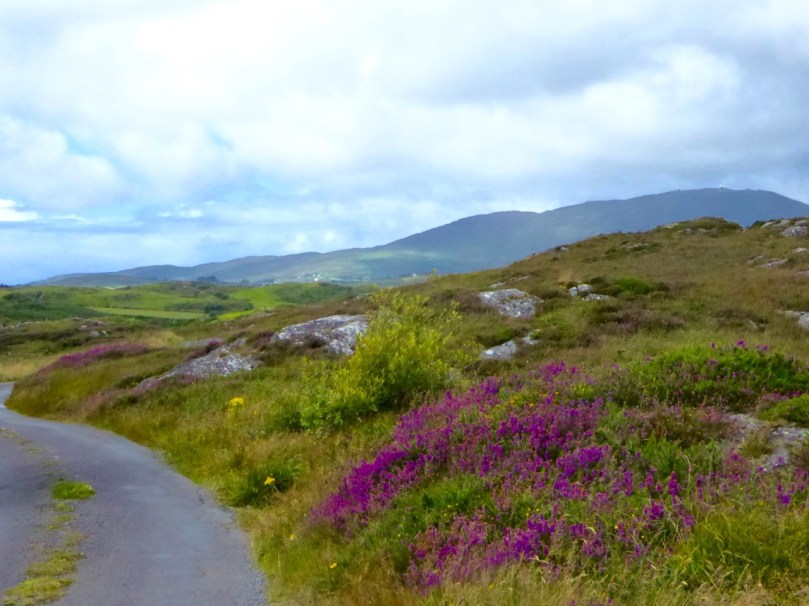
To give you a flavour of what it’s like to drive in Ireland, I’ve put together a few of my favourite photographs of the roads we’ve travelled. Sometimes I wonder if we will get to the point where we take for granted the spectacular scenery which is such an everyday occurrence for us, but then we find ourselves pulling over once again to wonder at the wild landscape, the grandeur of the mountains, the way the sea cuts deeply into the sandstone cliffs, the old castles and ruins that dot the fields – and we know that we will never tire of Irish roads.

This slideshow requires JavaScript.

I’ve chosen only photographs that have roads in them, so you can get the feel of travelling in Ireland. And yes, it does rain in Ireland and the clouds come down and cover everything and then driving isn’t as much fun. Find a pub to hole up in, wait a while, and try a prayer to St Medard

Dingle

Of course some  of you, dear readers, do this every day, like we do, so tell us your own favourite Irish roads – or share a photograph on our Roaringwater Journal Facebook page if you like.

This slideshow requires JavaScript.

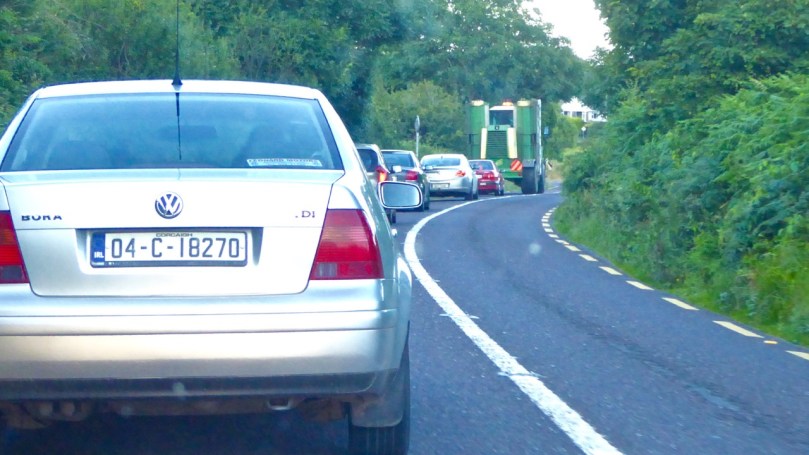
Obstacles are common – so don’t drive too fast along the rural roads as you never know what might be around the bend.

Tractor pace

And there’s no point in being in a big hurry…
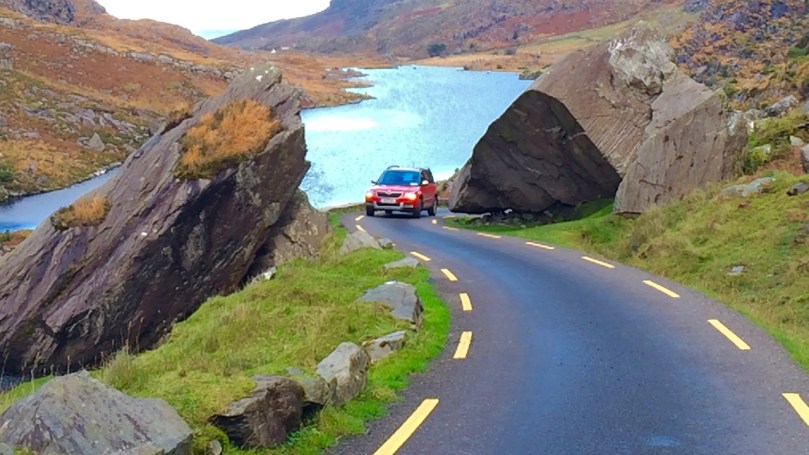
Only room for one at a timeThere’s only room for one at a time

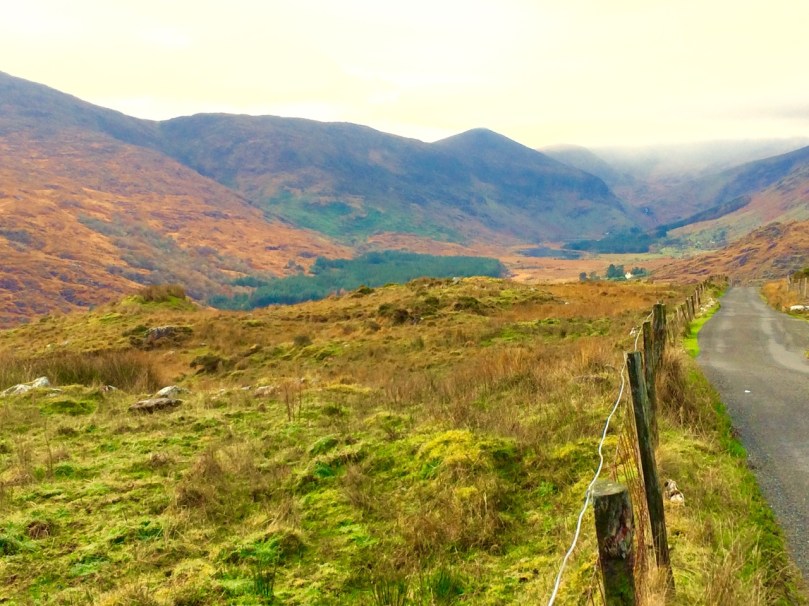
We do have freeways/motorways in Ireland, and tolled highways, and congested city streets with honking traffic. Our advice is to get off the highways and out of the cities as soon as possible. Get on this road, for example, that runs through the Black Valley in Kerry, and see where it takes you.

Black Valley, Kerry

Happy driving in Ireland!

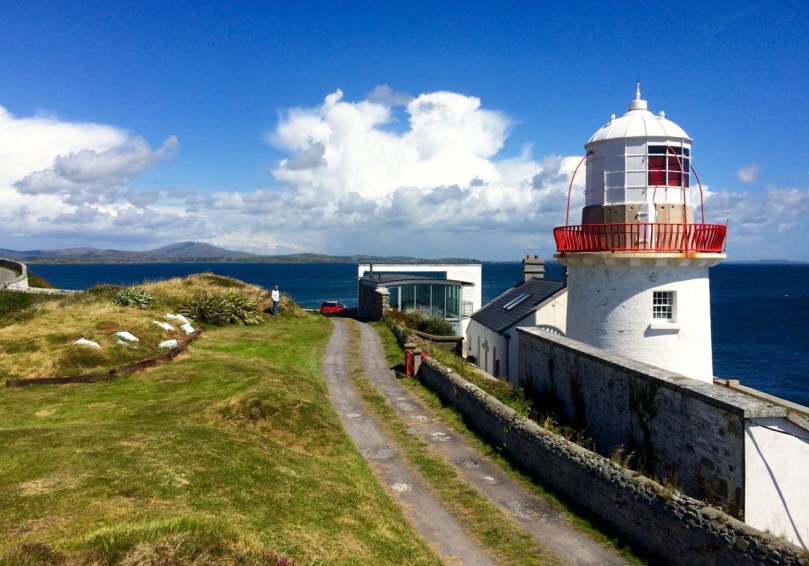
By the lighthouse

Fastnet Trails: Rossbrin Loop, Part 1

A joint post by Robert and Finola

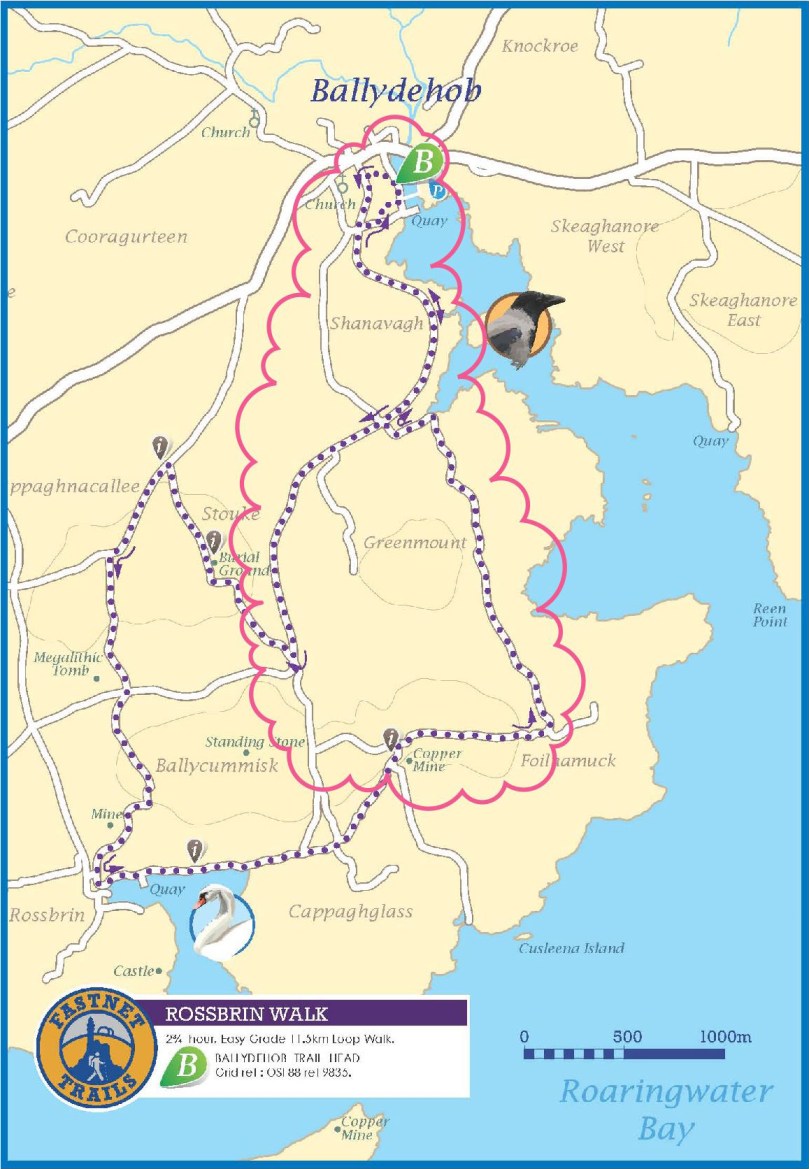
In Robert’s post about the Fastnet Trails, we introduced you to this new trail system, and in particular to one of the delightful walks – the Lisheenacrehig Loop. Today’s post is about another of the walks – the Rossbrin Loop. This walk is all on country boreens, so you can wear your ordinary walking shoes and take the dog if you like but keep him on a leash and stick to the road. You will pass other dogs on the way, as well as fields of livestock.

The high road

You can do this whole walk as laid out in the brochure. It’s just under 12km and will take you at least three hours, but probably more if you like to stop to explore, take pictures, have a chat along the way. Oh, and see where it says ‘easy grade’? Take that with a pinch of salt – this walk will give you a good work out as it takes you from sea level to 70m (230ft) and back again.

Rossbrin Trail 1

But we know that many of you like to take an easier pace and, like us, might find a 12km loop a bit intimidating, so we’ve decided to give you another option. We will lay out a 2-walk option for you, beginning with Walk 1 now, and we will do Walk 2 in a future post. We provide our time estimate for a meander rather than a march. And – a disclaimer: our suggestions depart slightly from the official Fastnet Trail and have not been sanctioned by that group. Where you depart from the marked trail, you walk at your own risk.

Walk 1: Ballydehob, Greenmount, Foilnamuck, Cappaghglass, Ballydehob

Time: 2 to 2.5 hours (with diversion)

Level: Easy but some steep stretches

Take: Binoculars and camera

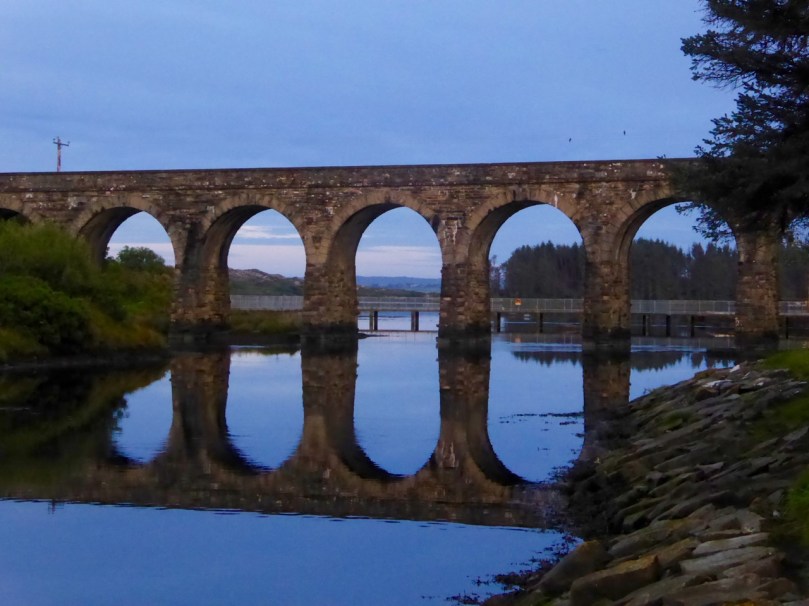
Twelve Arch Bridge

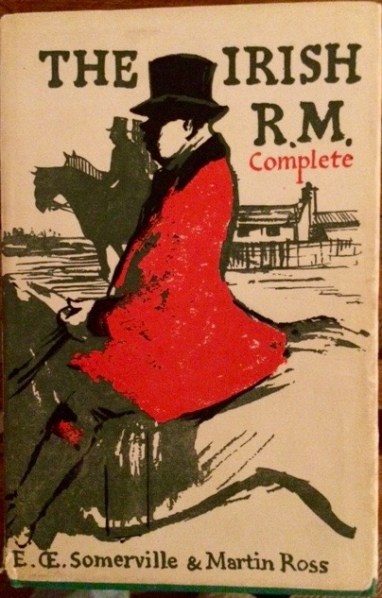
Park in the Ballydehob car park just east of the river estuary and start by taking the lovely nature walk that takes you over the 12 Arch Bridge. This beautiful structure was once part of the West Carbery Tramway and Light Railway. A train ran across this bridge from 1886 to 1947 – Robert has written about The Flying Snail that traversed West Cork, but for a real flavour of what it was like read Poisson d’Avril in Somerville and Ross’s The Irish R.M. Here’s the first paragraph:

The Irish R.M.The atmosphere of the waiting-room set at naught at a single glance the theory that there can be no smoke without fire. The stationmaster, when remonstrated with, stated, as an incontrovertible fact, that any chimney in the world would smoke in a south-easterly wind, and further, said there wasn’t a poker, and that if you poked the fire the grate would fall out. He was, however, sympathetic, and went on his knees before the smouldering mound of slack, endeavouring to charm it to a smile by subtle prodding with the handle of the ticket-punch. Finally, he took me to his own kitchen fire and talked politics and salmon-fishing, the former with judicial attention to my presumed point of view, and careful suppression of his own, the latter with no less tactful regard for my admission that for three days I had not caught a fish, while the steam rose from my wet boots, in witness of the ten miles of rain through which an outside car had carried me.

Ballydehob Quay saw brisk trade in the days before the Bay silted up. The lovely old Pier House once functioned as a coal warehouse. 

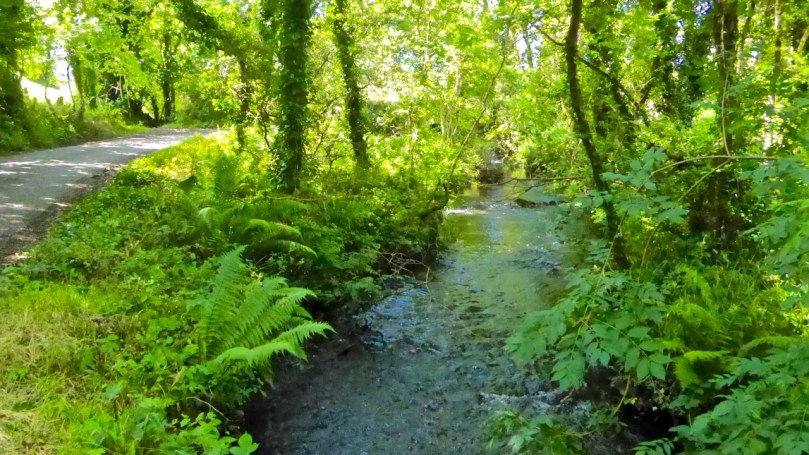
Greenmount Stream

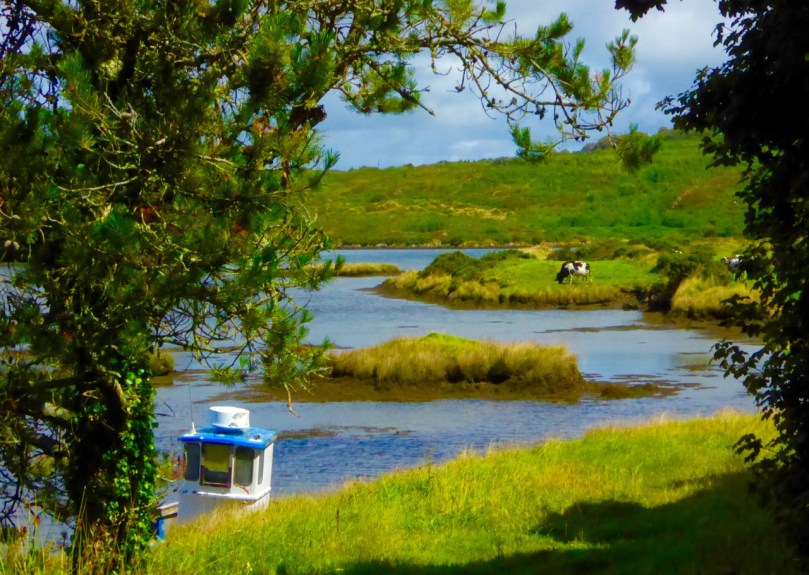
Following the walkway, you emerge by the school and turn left on to the Greenmount Road. This can be a busy stretch, so be careful along here. Once you get to the turquoise shed, turn left. Here you find yourself beside a burbling stream that empties into Ballydehob Bay at a small and picturesque pier. This and others like it were busy piers in the old days, serving the fishing boats as well as the sand boats that worked these waters, dredging sand to be used as fertiliser and building material. Nowadays this little inlet seems hardly navigable and the same blue and white boat has been moored here for a long time.

Greenmount Quay

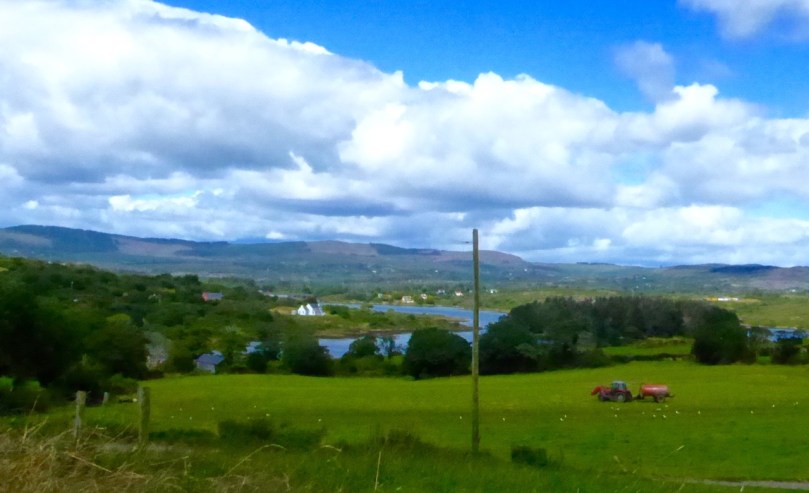
The road climbs steadily up now past working farms. Looking back towards Ballydehob you can see the Bay and even the 12 Arch Bridge in the distance.

Pastoral

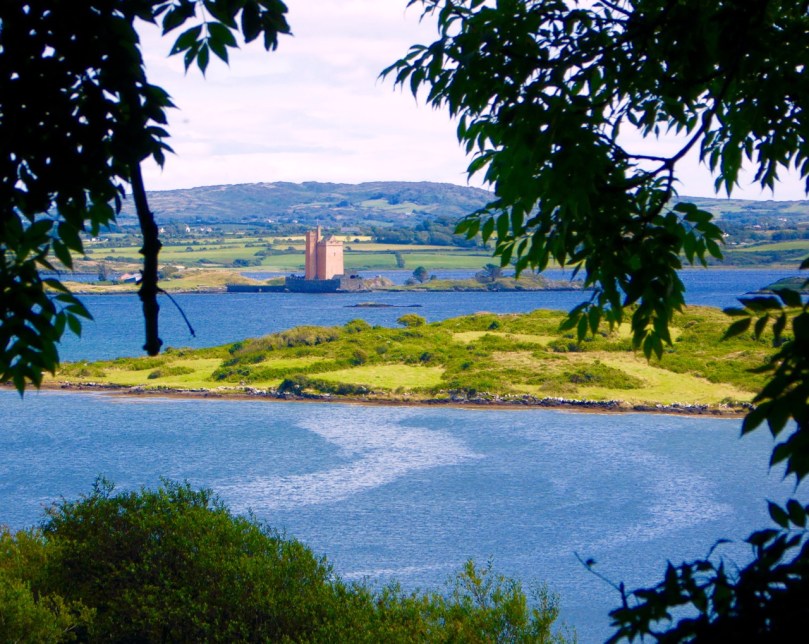
As you round a corner your view changes  and Kilcoe Castle comes into view. Now home to Jeremy Irons, who has restored it beautifully from a complete ruin, it was a classic 15th century tower house owned by the McCarthy Clan. So well was it situated and defended that the inhabitants were able to hold out for two years in the aftermath of the Battle of Kinsale (1601). Situated on a tiny island and glowing a soft amber colour, it is a beloved landmark in these parts.

Kilcoe Castle from Greenmount

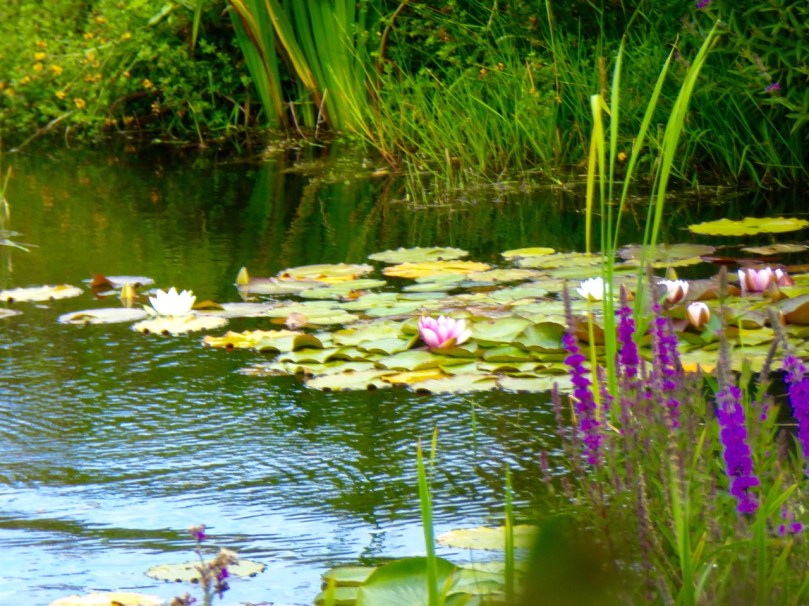
Below you is a shallow bay that is a haven for shorebirds and seals. If the tide is out linger a while and use your binoculars to see what you can pick out along the tidal flats below you. If you’re lucky the seals might be out along the rocks, sunning themselves. Once underway again, you’ll pass an old cottage on the left. A recently-dug pond in its garden is already full of water lillies.

Water lillies

Continue now along the narrow boreen and brace yourself for the climb to the highest point  of the walk. No longer on leafy lanes, you are now walking on a bare plateau with panoramic views in all directions. The whole of Roaringwater Bay gleams before you. To the east, towards Kilcoe, lie the mussel beds that now dot this part of the Bay. Sherkin Island and Cape Clear are on the horizon, as is the Fastnet Rock. Ahead of you is the looming shape of Mount Gabriel, dominating the skyline as it does in so many parts of West Cork.
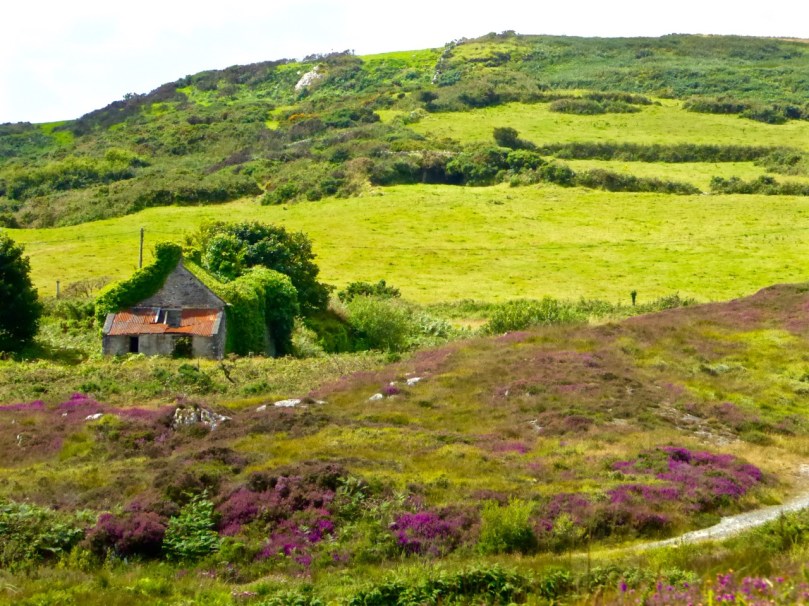
Fields of Cappaghglass

If you look carefully here you will see that the gorse and bracken barely conceals the outline of tiny field walls. There was a large population around here once and a thriving industry. Read Robert’s piece, Copper Country, for more about the mining activities of Cappaghglass. There are a few clues left – the stump of a large chimney that once provided a prominent landmark but that was felled by lightning can still be seen.
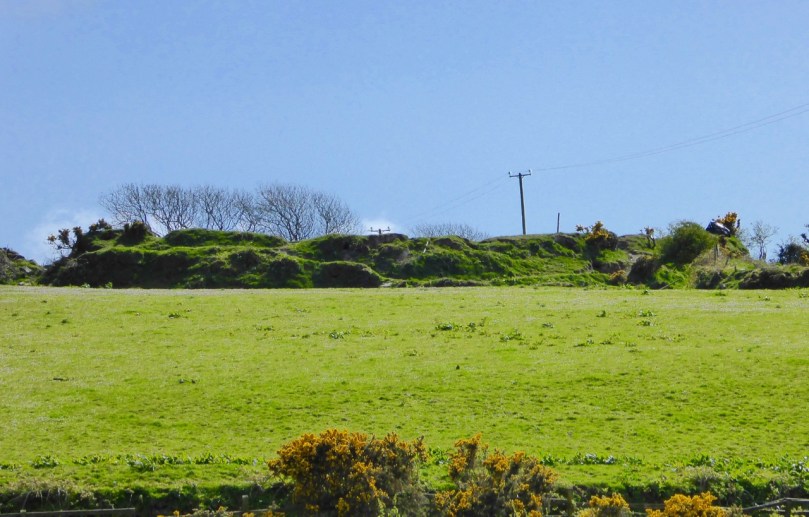
Rust and heather

Don’t turn left here (as the trail map wants you to) but instead continue straight on and turn right at the T junction and descend to the crossroads. From the crossroads you can go right and follow the road back to Ballydehob. But if you still have the energy and want to prolong the walk a little, there a diversion here that is worth considering. Turn left and climb the hill until the road flattens out. About 500m from the crossroads look up and to your left and you will see the silhouette of a large ring fort. A tiny green lane leads up to it between some houses but it is on private land.  

Ballycummisk Ring Fort

Irish ring forts generally date to the Early Medieval period – this one may be between 1500 and 1000 years old and would have been the enclosure of a farm house. A wooden fence on top of the earthworks would have kept wolves out and animals in. But the prominent position of this one also meant that it would have been a high-status dwelling. There are hints of a fosse (an outer ditch), which was a defensive feature, and reports of a souterrain, or underground passage, situated in the middle. The ridges of lazy beds – the traditional potato-growing grooves – cross the interior of the fort, indicating that this ground was used to feed a family until the area was de-populated in the aftermath of the famine. There is a large standing stone, known locally as Bishop’s Luck, above the ring fort. This could be Bronze Age or even older.

Textures

It’s an easy walk, downhill all the way, back to Ballydehob. You’ll be more than ready for a coffee and cake in Budds or a lovely bowl of soup in the Porcelain Room by the time you get there. Tell them the Roaringwater Journal sent you.

Wall E lurking

See you next time for Walk 2.

The Gift of Harry Clarke

The Gift

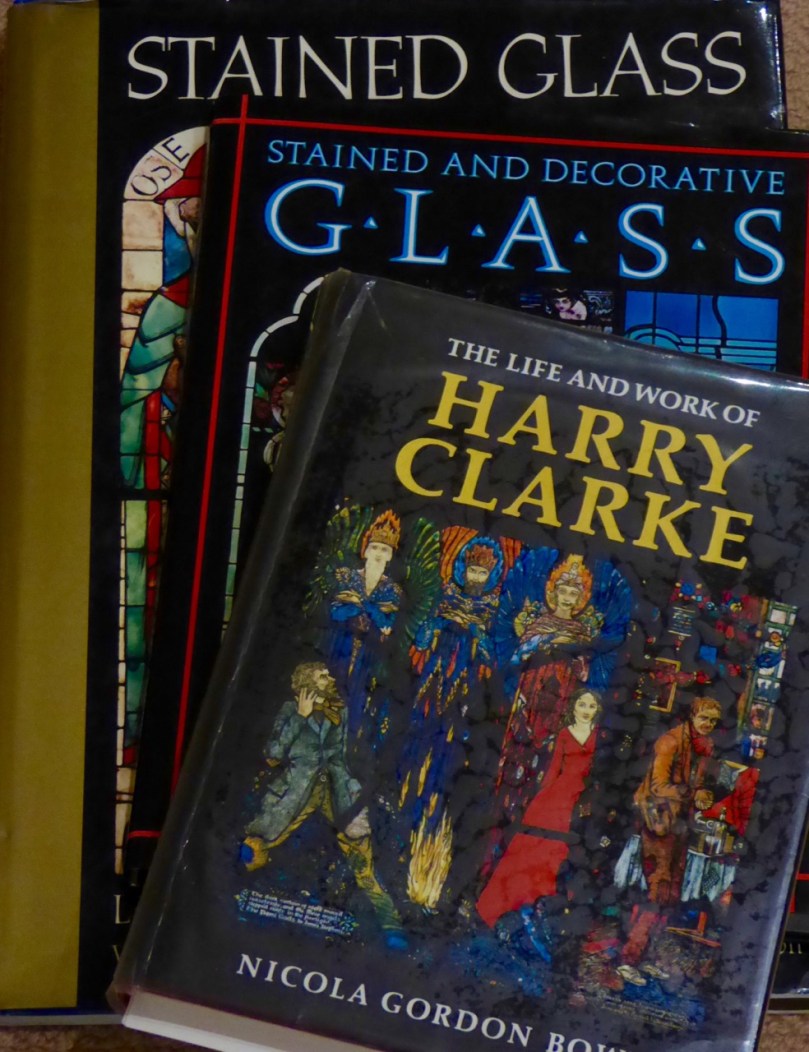
This post was inspired by a gift from my oldest and dearest friend – three books on stained glass passed on to me because he is moving from his home of the last 65 years, a home in which I spent much happy time. A loyal reader of our blog, he knows of my  enthusiasm for stained glass, an obsession I shared with his late wife, the wonderful Vera, whom I still carry in my heart.

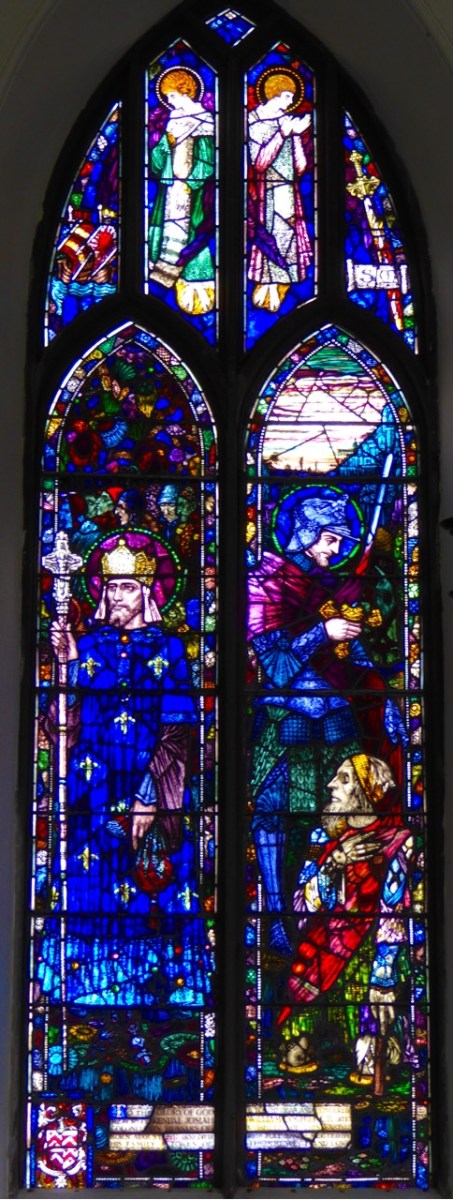
The Kendal Coghill Window, Church of St Barrahane, Castletownshend, Co Cork

The Kendal Coghill Window, Church of St Barrahane, Castletownshend, Co Cork

One of the books is the exhaustive and erudite study of Harry Clarke by Nicola Gordon Bowe. The other two are more general, although each of them devotes a section to the work of Harry Clarke. My initial intention was to look at Harry Clarke as a illustrator, with special reference to his portraiture, using a variety of windows as examples. I may still do that in the future. However, I’ve decided that for now, just one window perfectly illuminates what I want to say about Harry Clarke this time. It’s a window we have both used before in posts (Robert in his Martinmas piece, and I in a couple of places) – the Kendal Coghill window from St Barrahane’s in Castletownshend. Through this window I hope to show you the unique genius of Harry Clare, but also how he drew from life and from great art to create his stained glass panels. (For more on Harry Clarke’s life, see my previous post, The Nativity – by Harry Clarke.)

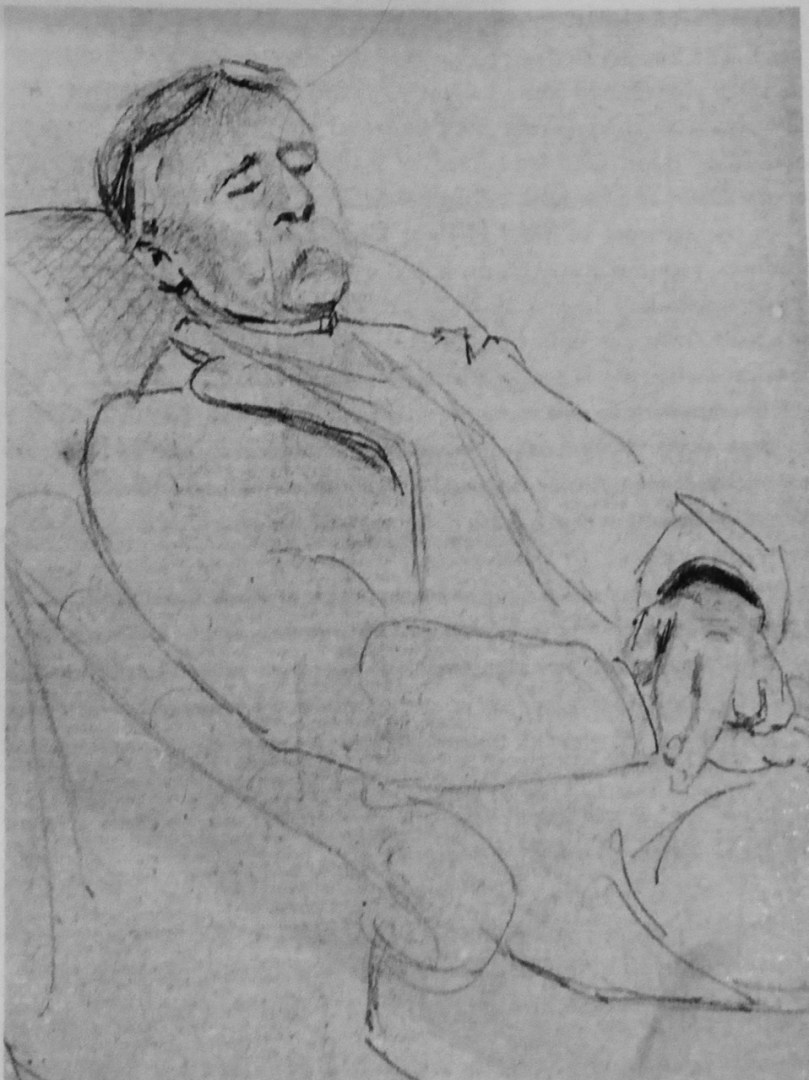
Kendal Coghill, drawn by his niece, Edith Somerville

Kendal Coghill, drawn by his niece, Edith Somerville

Who was Kendal Coghill? He was born and bred in Castletownshend, Edith Somerville’s uncle and a distinguished soldier, rising to the rank of Colonel. He served in India, where he took a kindly and active interest in the young Irish soldiers in his regiment. One of his melancholy duties was writing to their mothers to advise of their deaths. He was also “excitable and flamboyant”, writes Gifford Lewis in her excellent book, Somerville and Ross: The World of the Irish R.M.. As one of the leaders of the amateur spiritualist movement in Castletownshend he introduced Edith and her brother Cameron to automatic writing. By all accounts he was generous and warm hearted and it was his compassion that the window was to emphasise. The two subjects were chosen carefully – Saint King Louis IX of France, and St Martin of Tours. Coghill could trace his ancestry to King Louis, famed for his beneficence, and St Martin was the patron saint of soldiers.

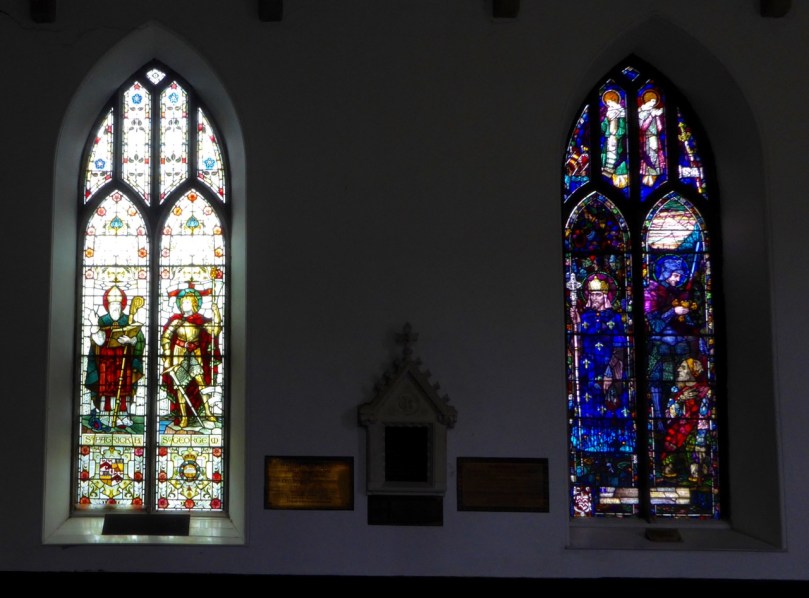
Contrasting styles

Contrasting styles

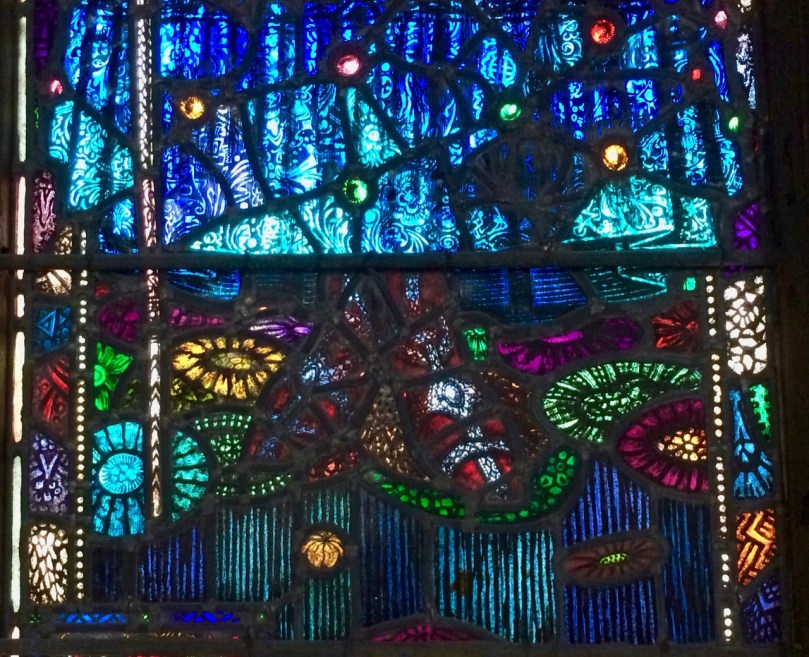
The first thing that strikes you upon entering St Barrahane’s is the contrast between this window and the others (by Powells of London) on the south side. Alongside the conventional Powells the Clarke blazes with colour and with detail. Every square inch is individually worked, there are no repeated patterns or conventional scrolls. Examine the borders, for example, filled with abstract and colourful motifs, never recurring.

St Louis detail: each motif in the border is uniquely designed and coloured. The robe intrudes in front of the border, lending a £D effect.

St Louis detail: each motif in the border is uniquely designed and coloured. The robe intrudes in front of the border, lending a 3D effect

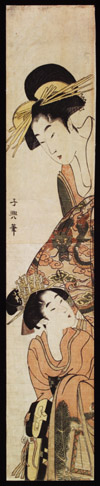
chokiHarry’s habit of placing figures at different heights adds visual interest to the side-by-side panels and may have been influenced by Japanese pillar prints, which were also a major factor in the design aesthetic of Frank Lloyd Wright. A church window is by its very nature long and narrow and the design challenge this poses had first been explored by Japanese artists whose woodblock prints were hung vertically on walls, or fixed to house posts. Contrast the static, forward-facing, identically scaled figures in the Powell window with the dynamic composition of the Clarke panels. The St Martin figure, in particular contains two figures and manages to tell a whole story, like this example of a pillar print.

The choice of the window and the management of the commission rested with Edith Somerville. Harry Clarke stayed with her in Drishane while executing the final placement and she liked him very much. Beside the Kendall Coghill window which is the subject of this post there are two other Clarke windows in St Barrahane’s. But St Barrahane’s, as Gifford Lewis explains, is not…”typically Protestant. High Church, Anglo-Catholic influence is in restrained evidence besides the astounding blaze of Clarke’s windows. Jem Barlow, the medium, claimed that at a service one Sunday in St Barrahane’s the spirit figure of Aunt Sidney appeared, caught sight of the Clarke windows, started, then exclaimed “Romish!” and dissolved.”

Above St Louis,

Above St Louis, “a parade of the poor and diseased”

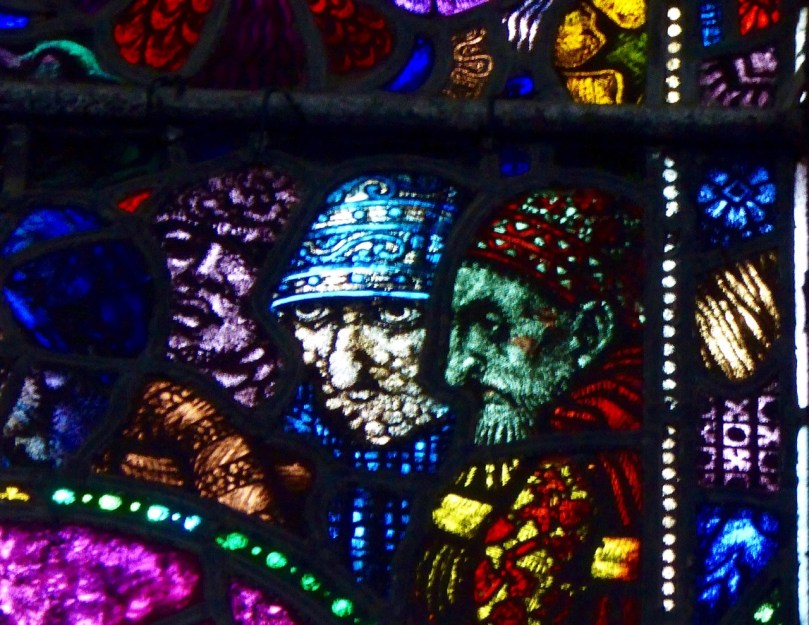
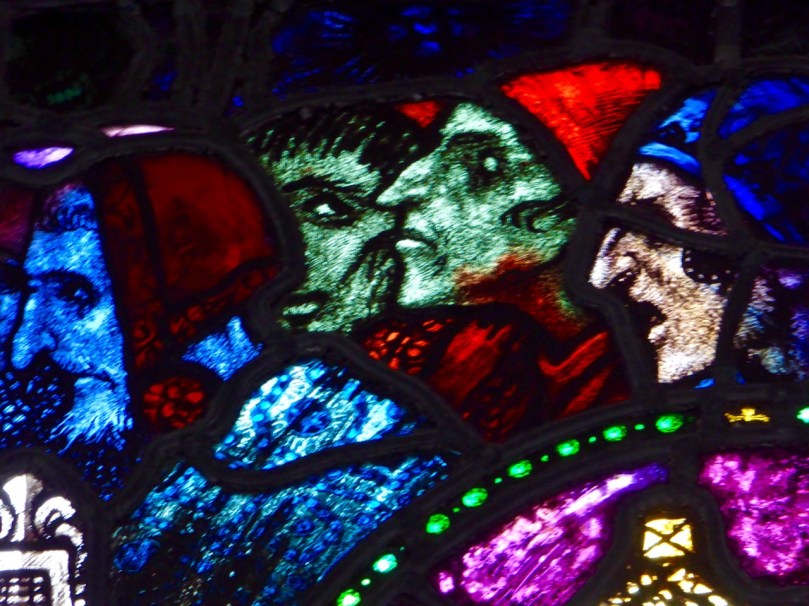
Saint Louis occupies the left panel. He is depicted with an alms purse in his left hand and a crucifix instead of a sceptre in his right hand. Look carefully – above him are the poor and sick that were the objects of his constant charity. Here’s what Nicola Gordon Bowe has to say about this section of the window:

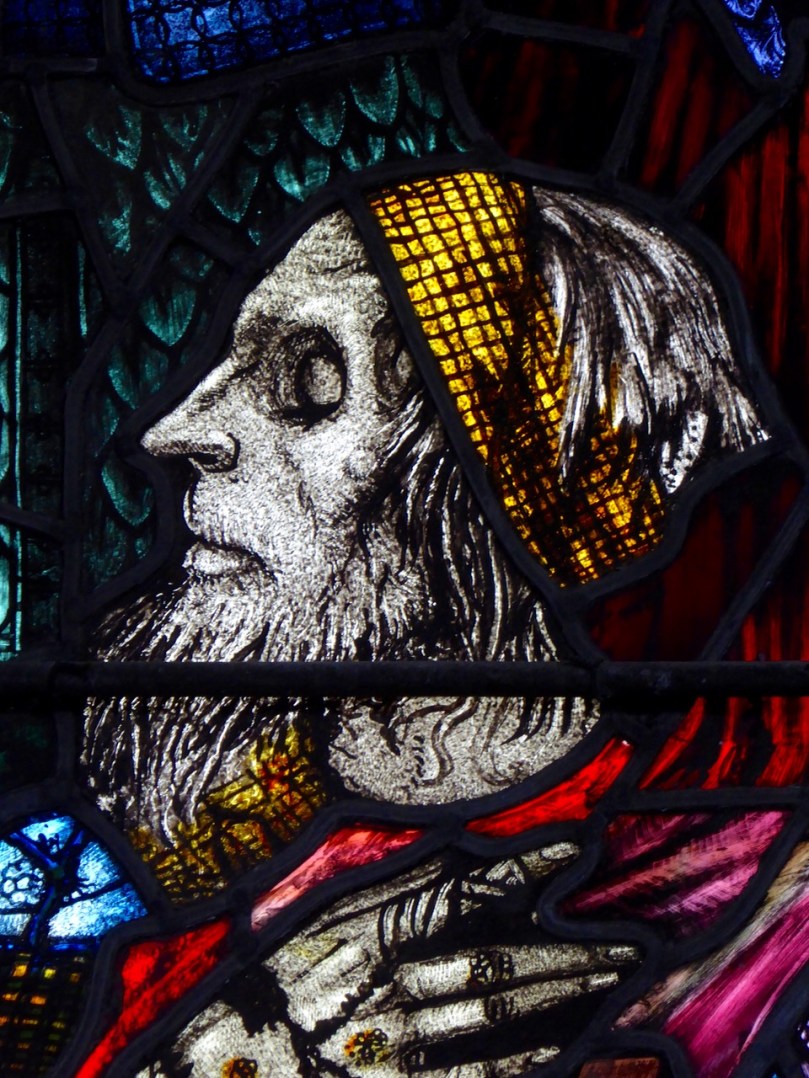
Dimly visible…is a small procession of the heads and shoulders of the poor and diseased who used to feed at his table. These again show Harry’s unique ability to depict the gruesome, macabre and palsied in an exquisite manner…The seven men depicted, old, bereft, angry or leprous, are painted on shades of sea-greens and blues, mauves and grey-greens, in fine detail with strong lines and a few brilliant touches, like the grotesque green man’s profiled head capped in fiery ruby, the leper helmeted in clear turquoise with silver carbuncles, and the aged cripple on the right in ruby and gold chequers.

Poor men

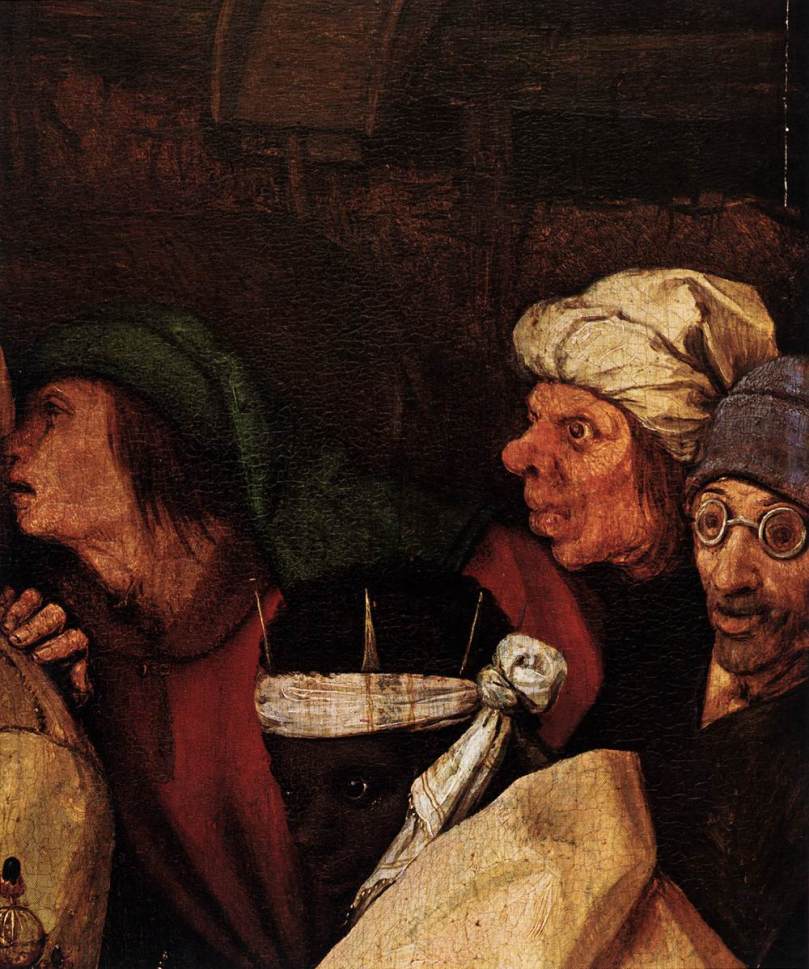
This section, it seems was likely influenced by a painting that Harry was familiar with from visits to the National Gallery in London – Pieter Bruegel’s Adoration of the Kings

Detail from Pieter Bruegel's Adoration of the Kings

Detail from Pieter Bruegel’s Adoration of the Kings

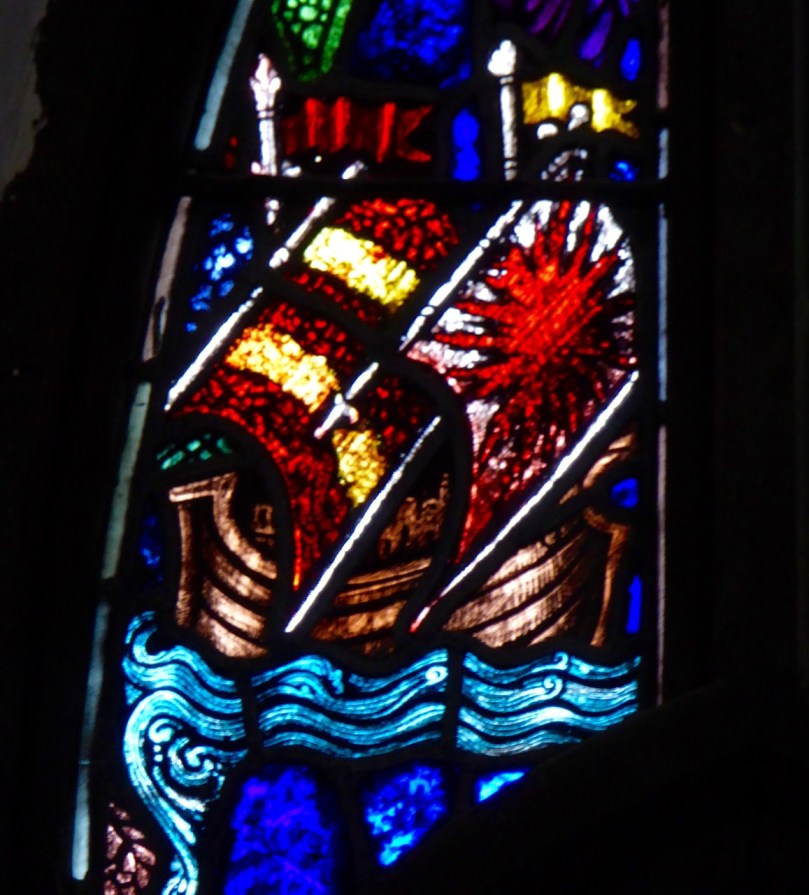
The ship in which he sailed to the crusades is depicted above King Louis.

Ship

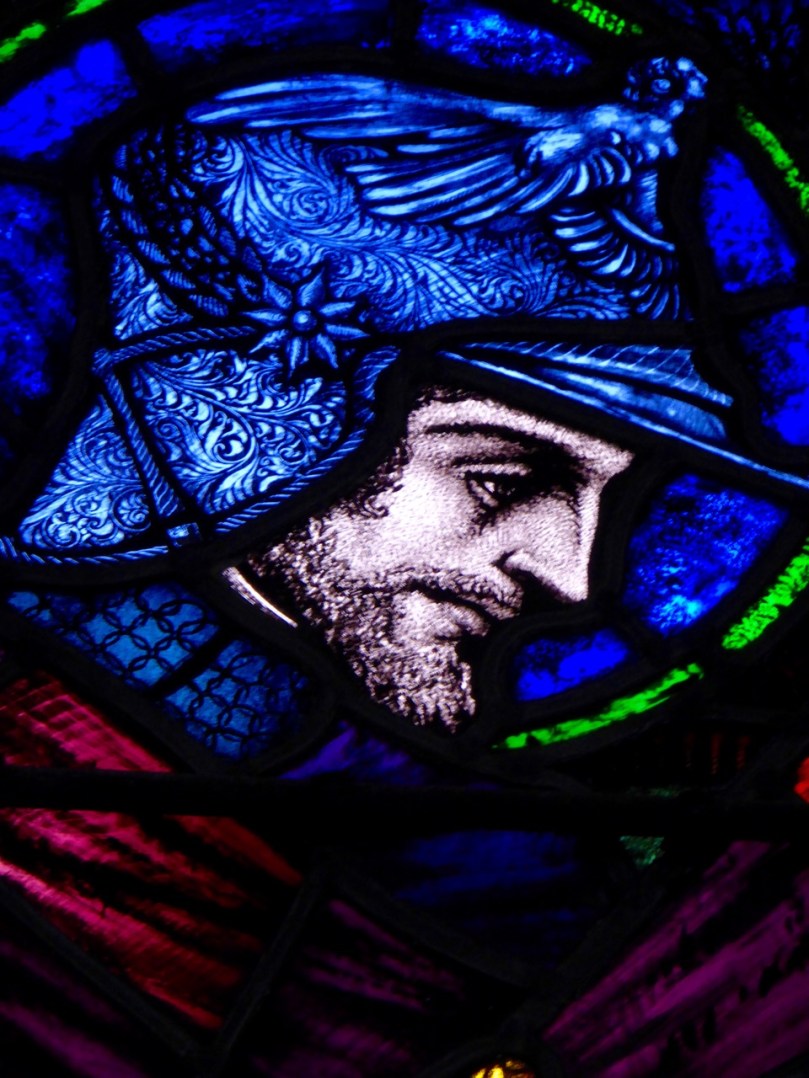
Saint Martin, in the right panel, is depicted in the act of cutting his cloak in two, to give half to a beggar. Martin’s face is archetypal Clarke – the beard, the aquiline nose, and the large eyes filled with compassion for the beggar.

St Martin of Tours

St Martin of Tours

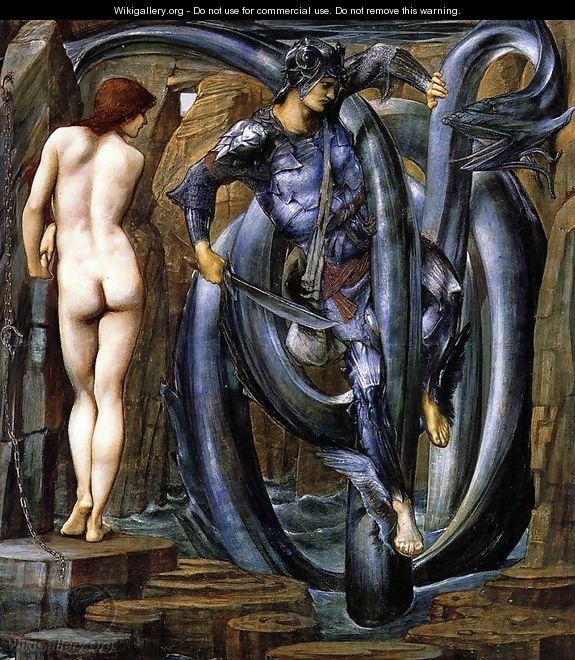
The helmet is worth a closer look. First of all, it is beautifully and finely decorated in the niello style, and second, it is topped with a tiny figure, sphinx-like, with long wings. Nicola Gordon Bowe points to the influence of Burne-Jones here, to the helmet worn by Perseus in The Doom Fulfilled.

Burne Jones' The Doom Fulfilled

Burne Jones’ The Doom Fulfilled

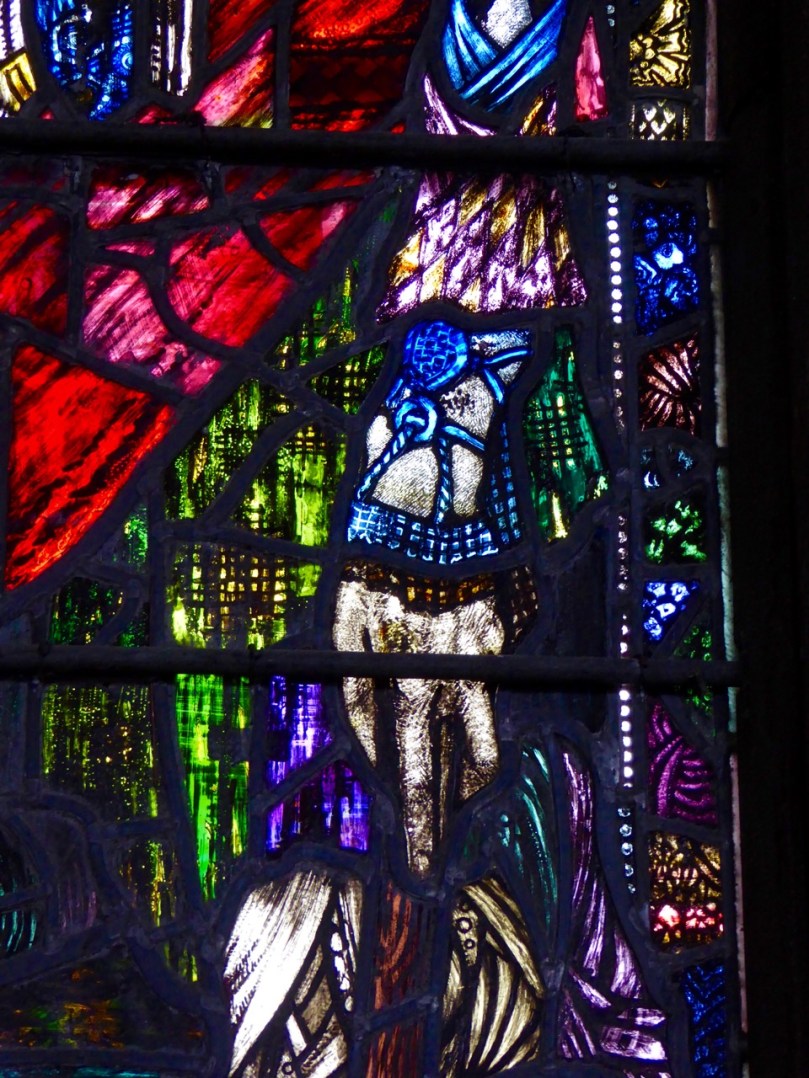
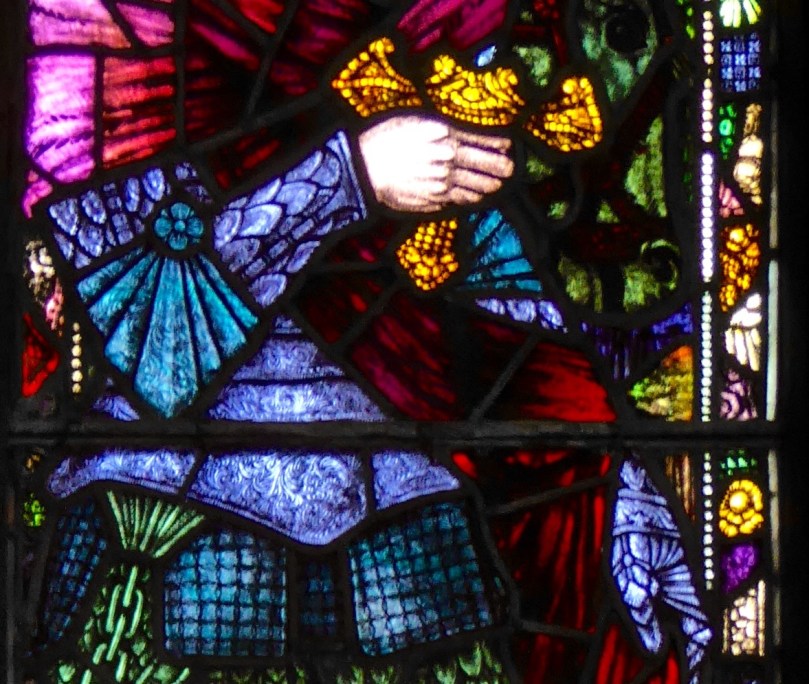
Clarke also found his inspiration in life drawing. He used himself for a model occasionally, but also ordinary people from the streets of Dublin. The beggar may have been based on one familiar to him. His face is dignified despite his wretched condition and his patches are rendered in as exquisite detail as is the Saint’s armour.

Beggar

The beggar may have been based on a familiar Dublin figure

The beggar's hand

The beggar’s hand

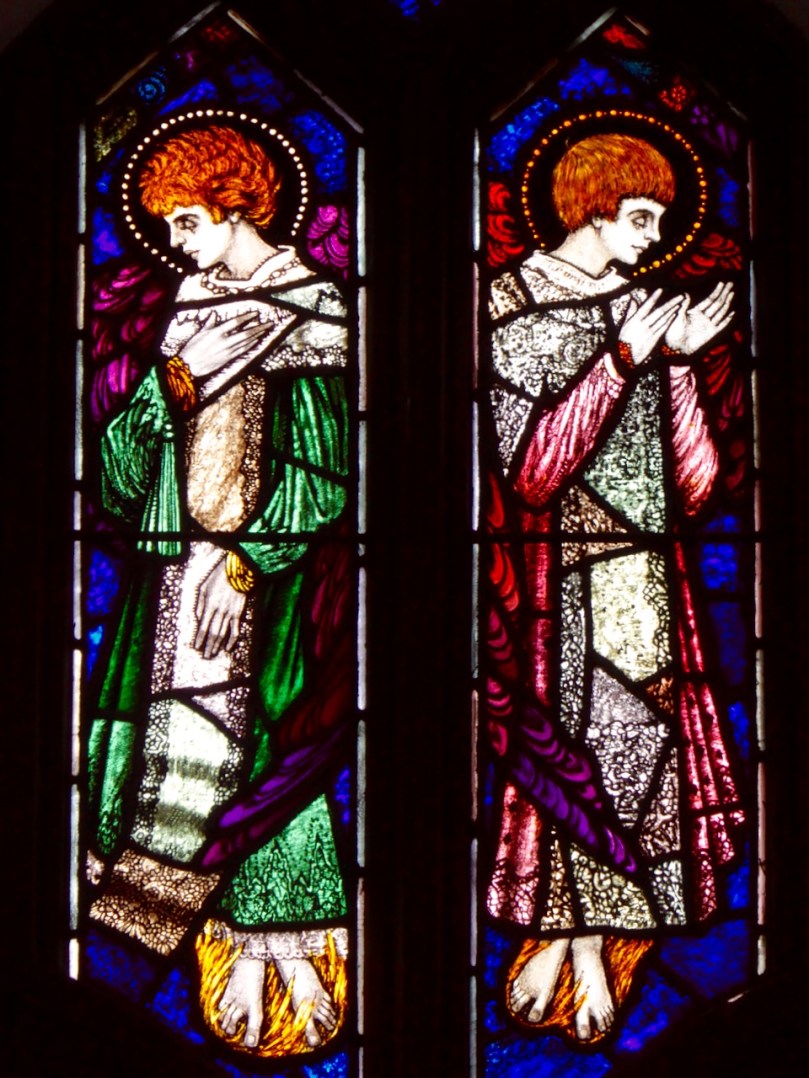
Finally, at the very top of the window two haloed figures look down. Harry Clarke had a thing for red hair and this is a perfect example of how he used that preference to good effect. Once again, although the figures are similar in size, there is no repetition – these are no ‘standard’ angels – each has his own wonderful garments and stance.

Red haired angels

Stained glass artists typically sketch their designs on paper first and these images are referred to as cartoons. Harry Clarke’s cartoons for the Coghill windows must still exist. Nicola Gordon Bowe describes them as drawn “loosely in thick charcoal, the design boldly expressed with detailing and shading minimal, but still conveying a good idea of how every part of the window would look.” The finished window, she says, “reveals a new freedom of treatment, the painting on the glass reflecting the free drawing of the cartoons.” This is an artist and craftsman working at the height of his powers – an interesting subject for the question that Robert poses in his post this week.

Saint Martin, armour detail

Saint Martin, armour detail

West Cork Creates

We were bowled over by the latest exhibition to open in Skibbereen on Saturday: West Cork Creates. It shows collaborations between local craftspeople, visual artists, photographers and designers – combining their skills and expertise to produce exciting, original work.

test pieces

Top picture – The Great West Cork Obelisk (see below) is featured by the entrance to the gallery; above – fired test pieces from the obelisk project

Here’s a riddle: what’s the difference between an artist and a craftsperson? If you have a definitive answer please tell me, because this is a debate that will last forever… Grayson Perry contributes to the discussion in this Guardian piece, starting provocatively with:

…I see the craft world as a kind of lagoon and the art world in general as the ocean. Some artists shelter in this lagoon, because their imagination isn’t robust enough to go out into the wider sea…

Grayson Perry makes pots, so is he an artist? Well, presumably the British art establishment thought so as they gave him the Turner Prize in 2003, the first time it had gone to a ‘ceramic artist’.

More from the obelisk project and – right – Brian Lalor, one of its creators

Where does that leave us? Is someone who makes flowerpots an artist, because a flowerpot might be an attractive object? Where do you place something like the Book of Kells? It’s a functional object – the four Gospels lavishly illuminated – created in medieval times by many different hands. Yet it’s unique, overflowing with stunning visual images, beautiful and priceless. It’s a wonderful example of collaboration between the functional craft of the scribes who penned the texts and the minds of the (undoubted) artists who produced the decorations around those texts: perhaps they were the same hands.

Left – metamorphosis of two of Alison Ospina’s Greenwood chairs and – right – Dee Forbes, President and Managing Director of Discovery International, formally opening the exhibition

What about Finola’s subject for today, Harry Clarke – artist or craftsman? Stained glass is not ostensibly functional (except, perhaps to change the quality of the light coming through a window) yet the making of it is a craft requiring a lengthy apprenticeship and a garnered knowledge of specific materials and their use. I have no doubts: walk into St Barrahane’s Church, Castletownshend, and be dazzled by the Clarke windows there. They are inspired: true art. Harry Clarke designed and made these windows, so he was artist and craftsman rolled into one.

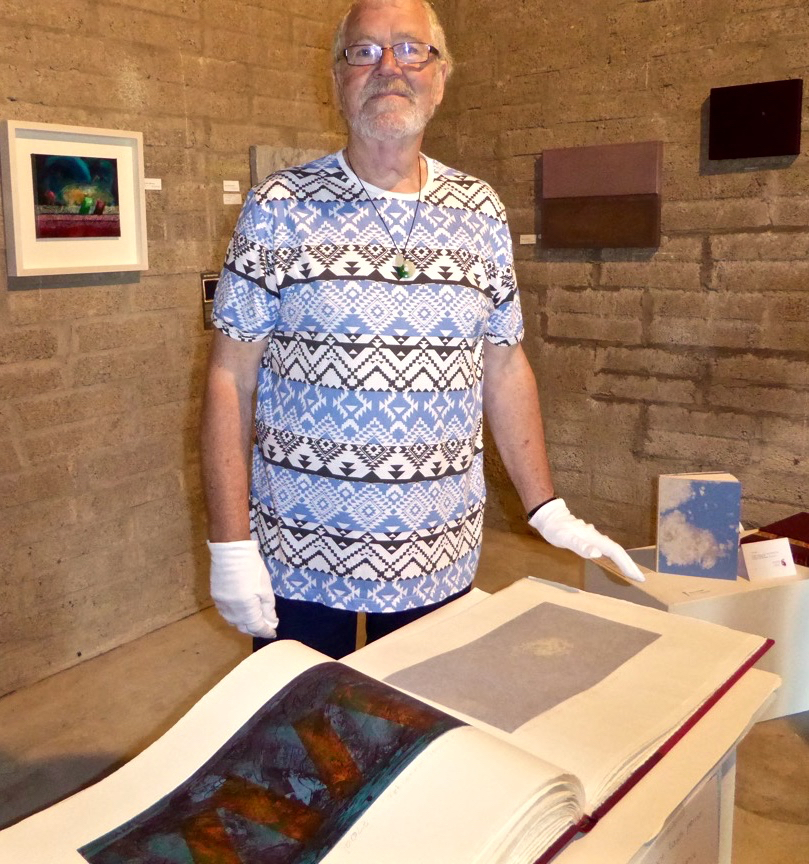
book of printsArtist and printmaker Coilin Murray with The Big Book

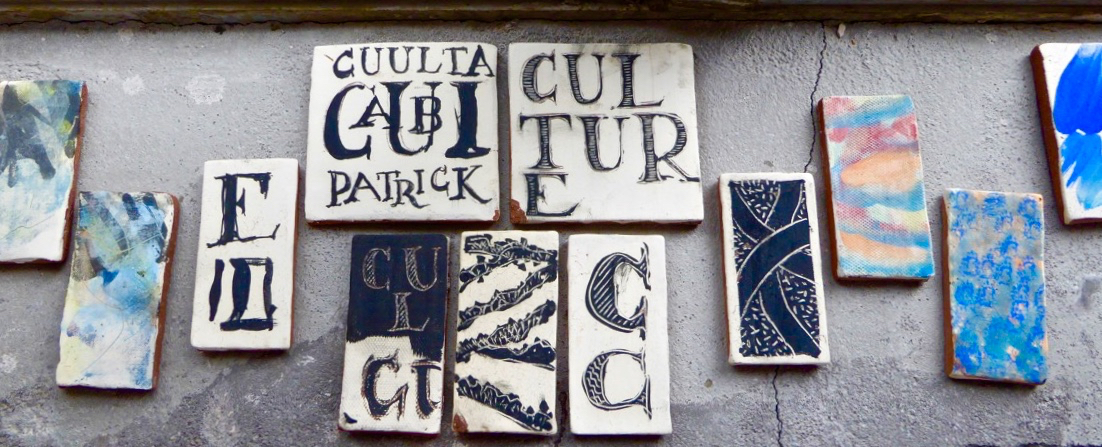
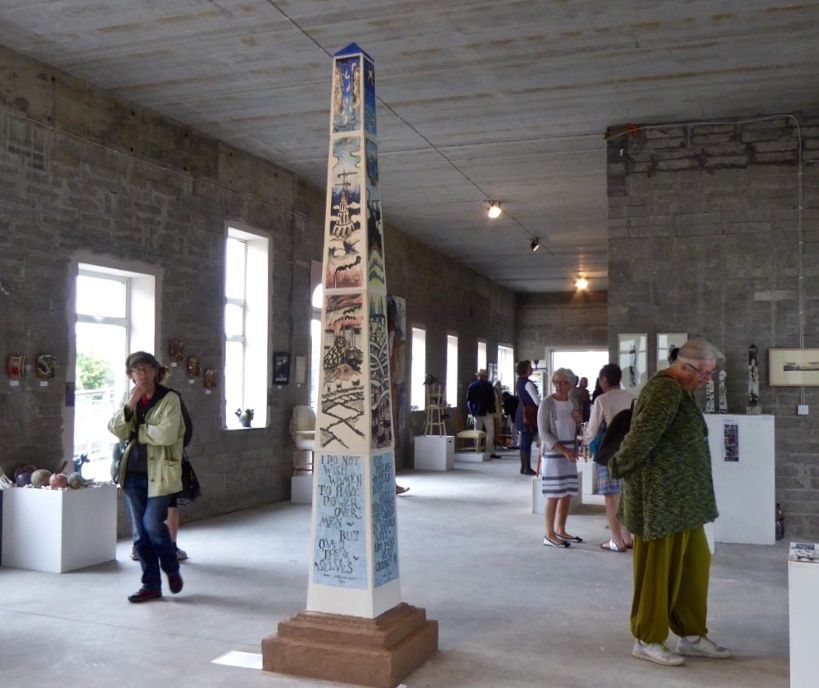
For me West Cork Creates (part of the Taste of West Cork Food Festival) demonstrates conclusively that you can’t differentiate between art and crafts. As you enter the gallery you are immediately presented with an iconic piece – The Great West Cork  Obelisk – which stands almost three metres high. It is a collaboration between two minds and two sets of hands: Brian Lalor and Jim Turner. Brian we have met before in the pages of our blog: he is a true polymath. He writes (prolifically), he produces art (prolifically), he has been an architect and an archaeologist. Jim is a ceramic sculptor of renown. Egyptian ‘obelisks’ are commemorative monuments of the Pharaohs and they usually carry a lengthy inscription praising the deeds of some significant individual.

obelisk in context

The Great West Cork Obelisk

This one is constructed from four terracotta sections made by Jim in his Clonakilty studio and fired in a specially constructed kiln. The base inscriptions are all quotations, two from social philosophers and two from writers, all concerned with the state of society. Brian’s images derive from these, from the contemporary world and from the local environment. The artists’ statement says: Obelisks may be the new round towers of the landscape… (remember that Brian has written the standard work on Ireland’s medieval round towers). I agree: I’d love to see this work prominently displayed in a public place locally – and many more like it. The obelisk absorbed our attention for a good half an hour, delaying us from moving on to the rest of the exhibition: it’s a show stopper!

Alison Ospina and – right – one of her Greenwood stools painted by Etain Hickey 

There are chairs and stools: functional objects to be sat upon. But you’d think twice about sitting on these. They are initially examples of the work of Alison Ospina who uses coppiced hazel to make distinctive seating, but they have been transformed by others (painter, sculptor and felt maker) into works of art which will primarily be looked at and appreciated.

for sale

The gallery space includes a sales area where you can buy the work of the participating exhibitors

There are thirteen collaborations in the exhibition including stone sculptor and furniture maker; metal sculpture and photography; basketmaker and visual artist; painter and felt maker; painter and boatbuilder; cutler and jeweller, all based or working within West Cork… This is just a taster – we have to go back and catch up on the other genres and artists and perhaps write a further blog post. The exhibition runs for five weeks from 8 August to 10 September at Levis’s Quay in the centre of Skibbereen, and is open from Mondays to Saturdays between 11am and 6pm. Be sure to get there – you won’t be disappointed: watch out for the gallery talks, too.

Sculptor Helen Walsh collaborates with photographer Rohan Reilly

Once you have seen the exhibition, you might like to comment and add your contribution to the artist / craftsperson debate.

wooden sun