All the Trimmings

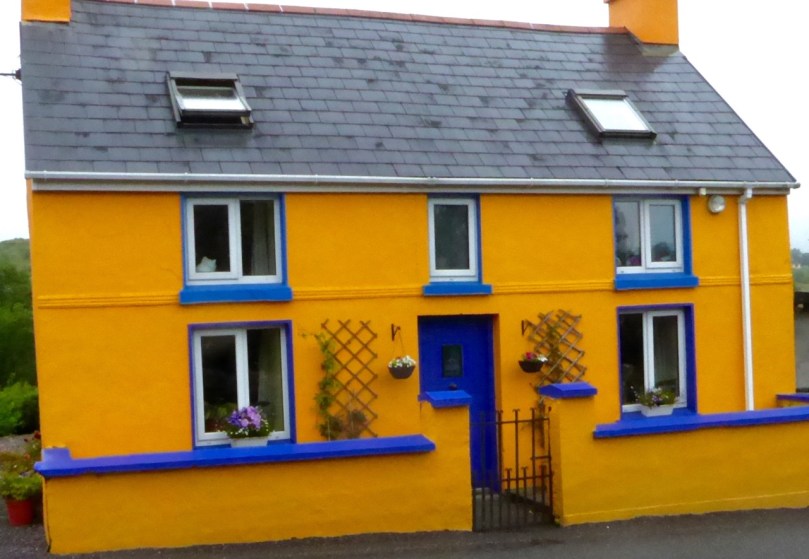
Near Dunmanway

In my two previous posts on our wonderful West Cork colourful houses, A Lick of Paint and An Extra Lick of Paint, I’ve concentrated on overall house colour and on how that colour stands out in the landscape or the streetscape. Since that second post was written, in March, two of the most colourful houses I photographed have been re-painted, both in shades of khaki. Am I chronicling an endangered species? I hope not!

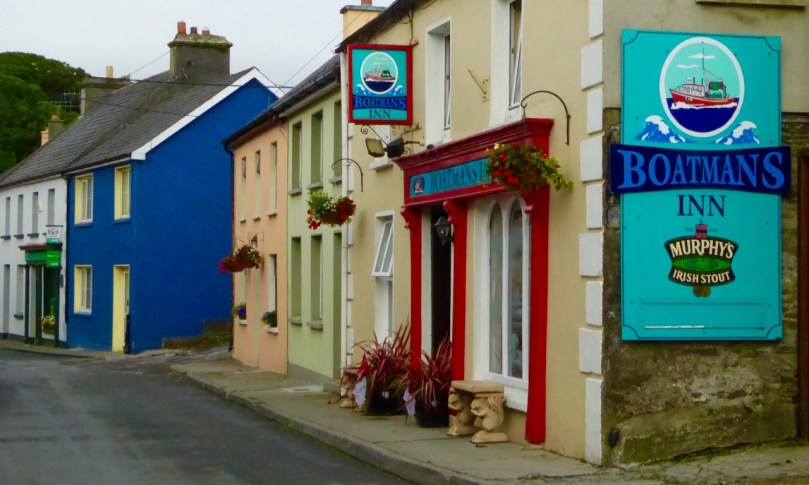
Boatmans

So in the spirit of celebrating our colourful tradition, I am devoting a post to the trim choices – the window surrounds, the doors and the chimneys, the shop fronts – that add to the vibrancy and delight of our neighbourhoods, villages and countryside.

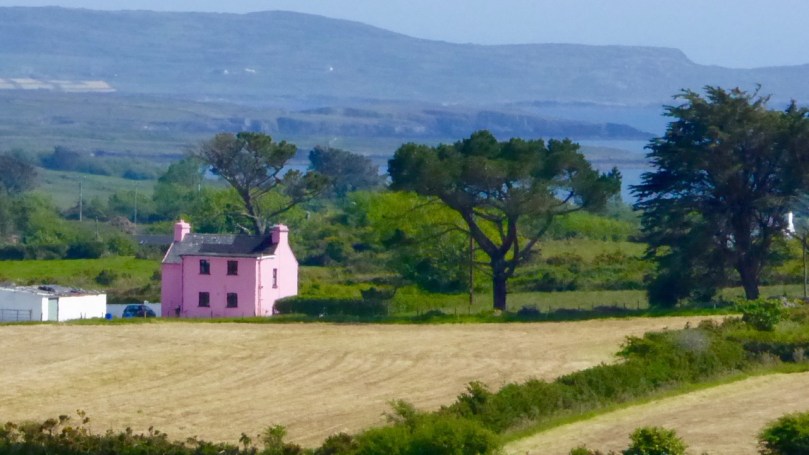
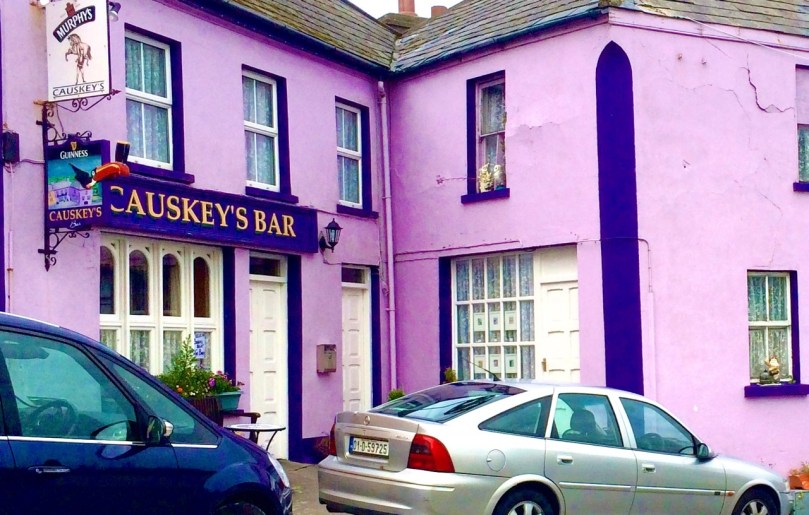
VERY VERY PINK

The most common trim choice is white and often that seems the only, or perfect, choice. Or perhaps the safest. It certainly provides a lively contrast to a bold colour.

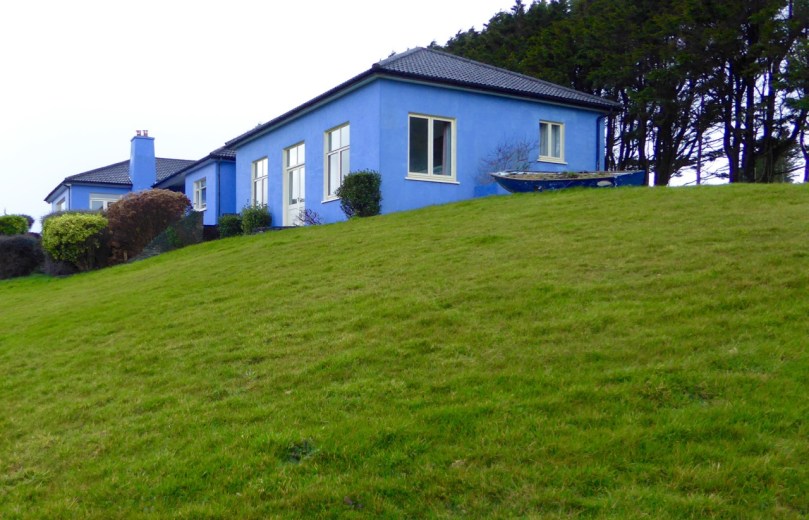
Marine blue

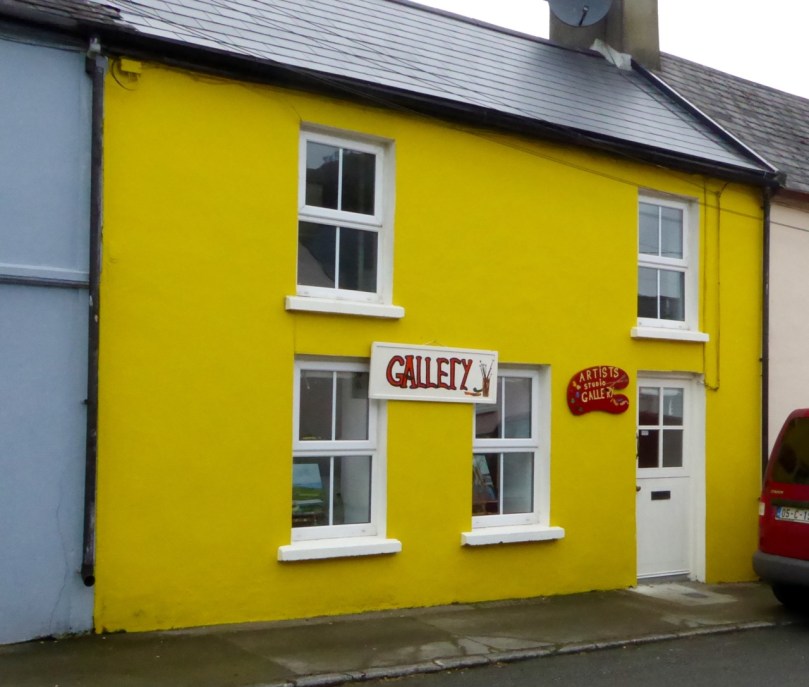
Orange you glad to see me?Gallery, Union HallWhite and bold-colour contrast can also look charming the other way around – white walls and colourful trim.

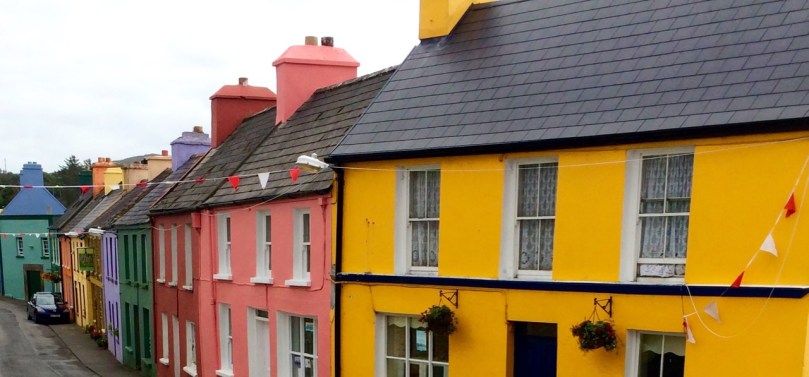
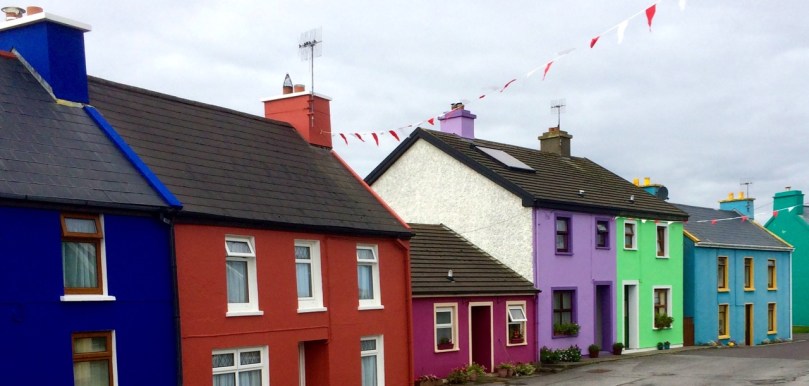
However, the juxtaposition of two bold colours, or even three, for walls and trim is irresistible.

Purple on Mustard

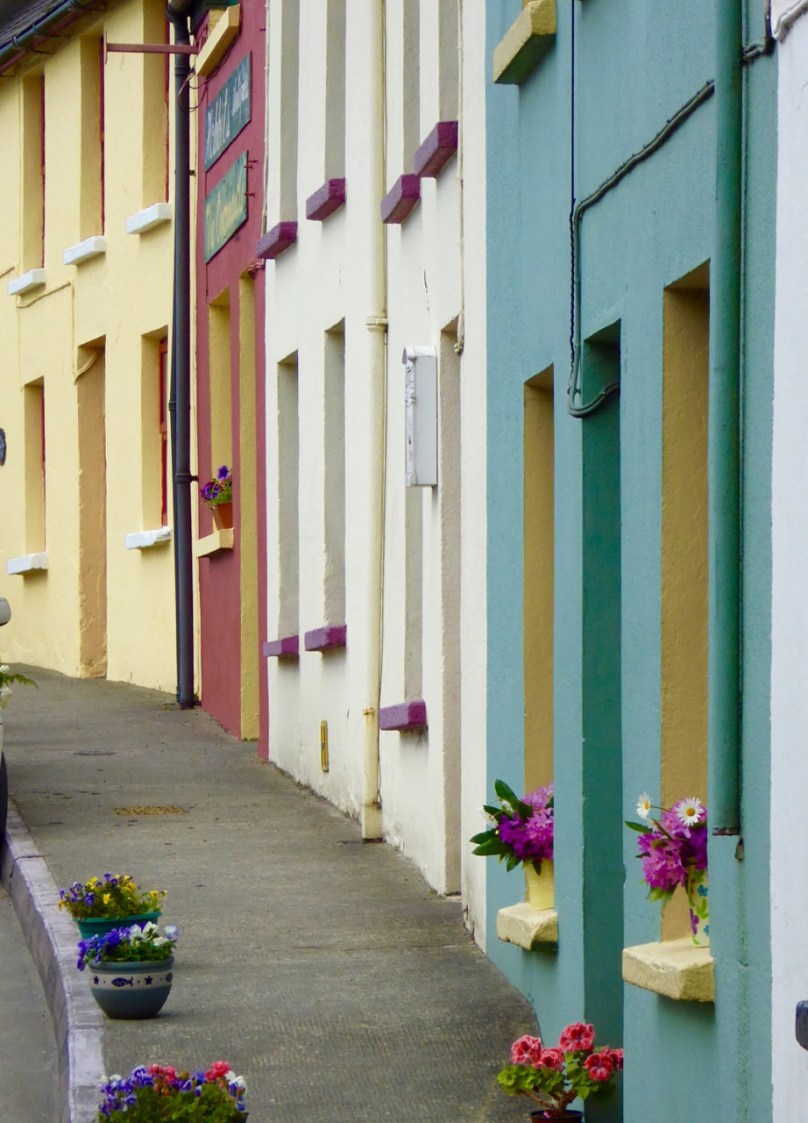
Windows are a natural focus for colour. Sometimes the frame and the surround is painted the same colour and sometimes two colours are employed, both contrasting with the wall colour.

Ballydehob windowsills

A local tradition seems to be to paint the chimneys the same colour as the walls, although occasionally the trim colour is used instead. I particularly like the chimneys in Eyries on the Beara Peninsula. Note the jaunty use of the trim colour on the chimney pots, on the second-to-last house in the lower photograph.

Eyeries Chimneys

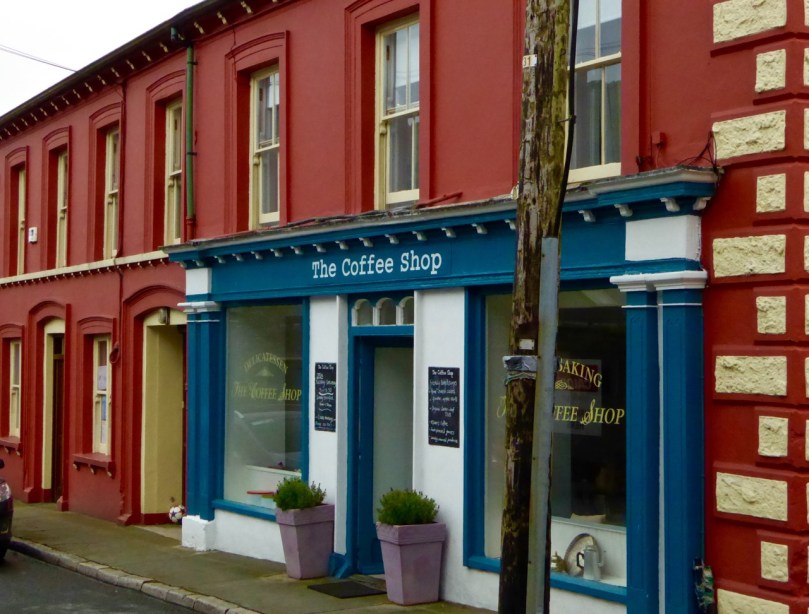
chimney trimMany traditional village or town commercial buildings here are masonry, with the shop-fronts in painted wood. A few examples here – although traditional shop-fronts deserve a post to themselves at some point. I also include cafés, restaurants and pubs in this category.

Causkey's

The Coffee Shop Union Hall

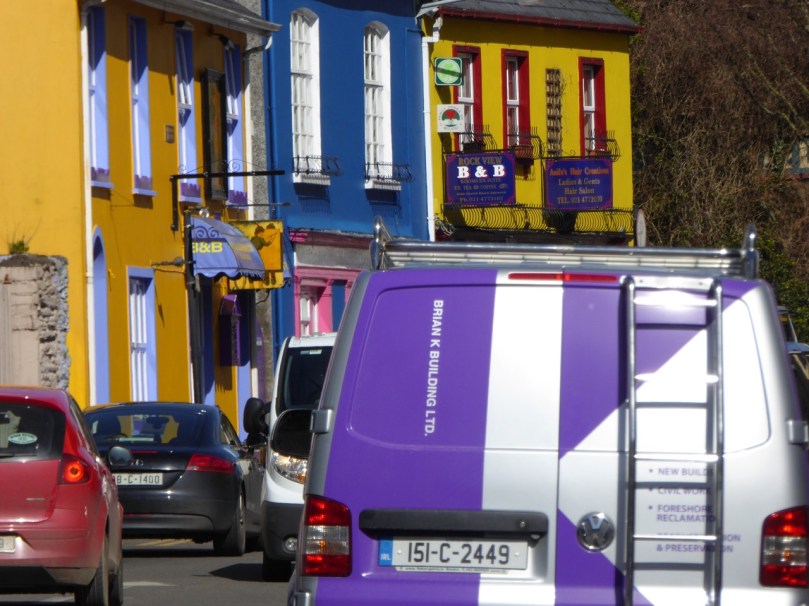
Kinsale is a cornucopia of colour! Herewith just a few examples of what you’ll find if you wander its streets.

Van

Trim colour is often used to good effect on garden walls and gate posts in addition to the house. Here’s a fetching example from near Union Hall .

Swedish

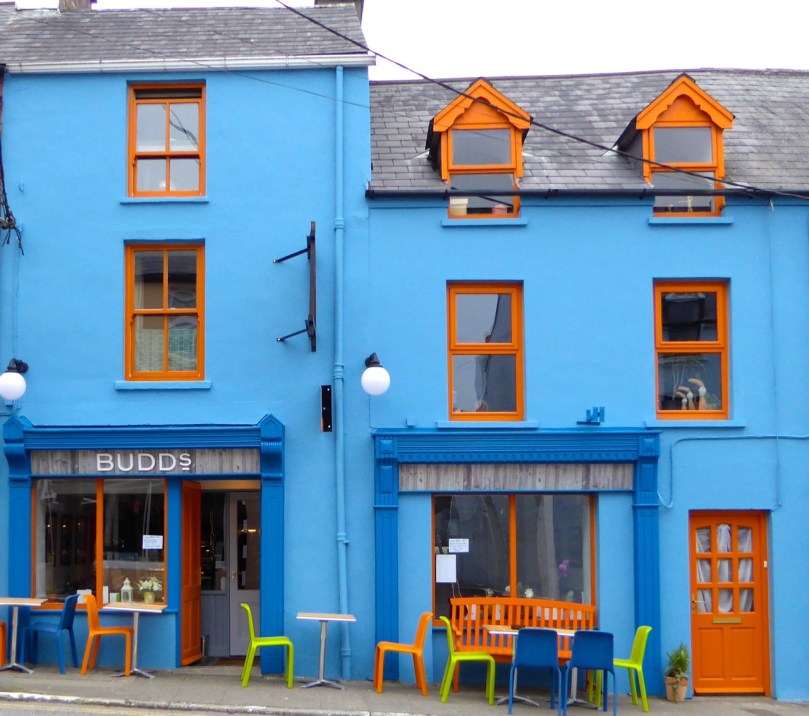
So – what do you think, Dear Reader? Do you have a favourite among these examples? Do you have any photos of your own to share? If so, comment below, or drop by our Facebook Page and vote for the one you like best. I will finish with one of my own current favourites and an exuberant addition to Ballydehob.

Budds

A Tale of Four Churches

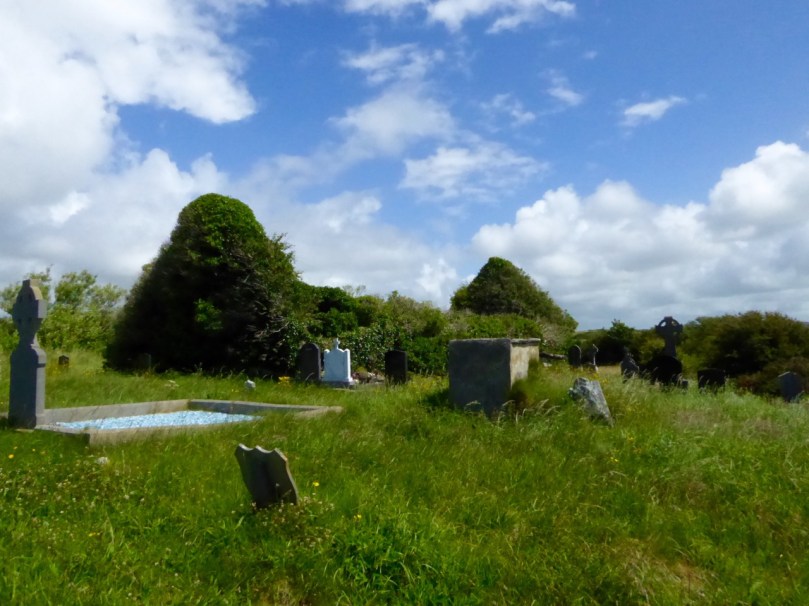
Kilcoe Medieval Church

Kilcoe Medieval Church

Kilcoe is a magical place. The story of its four churches leads us from the dawn of Christianity in Ireland through turbulent times and many centuries when religious differences and sectarian strife marked all aspects of life in Ireland.

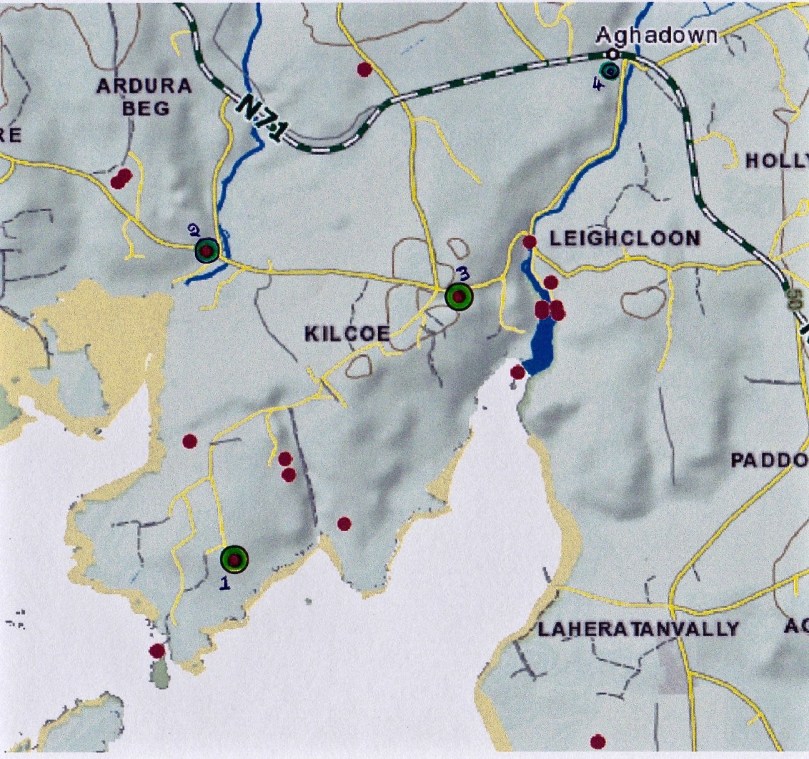
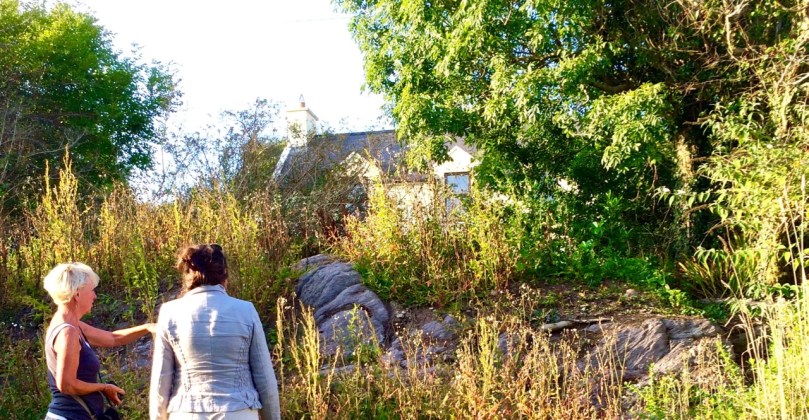
The four churches: 1, Kilcoe Medieval Church  2, Mass Rock 3, Kilcoe 19th Century Church 4, Kilcoe Modern Church of the Most Holy Rosary

The four churches: 1, Kilcoe Medieval Church. 2, Mass Rock. 3, Kilcoe 19th Century Church. 4. Kilcoe Modern Church of the Most Holy Rosary

We love going down to the Medieval church at Kilcoe or wandering the boreens along the Roaringwater River. Those boreens are now part of the Fastnet Trail Network and last weekend, at the Launch, we were treated to a talk about the locality from Fr Patrick Hickey, Parish Priest of Timoleague and a noted scholar of West Cork History. This blog post was inspired by that talk – thank you, Fr Hickey!

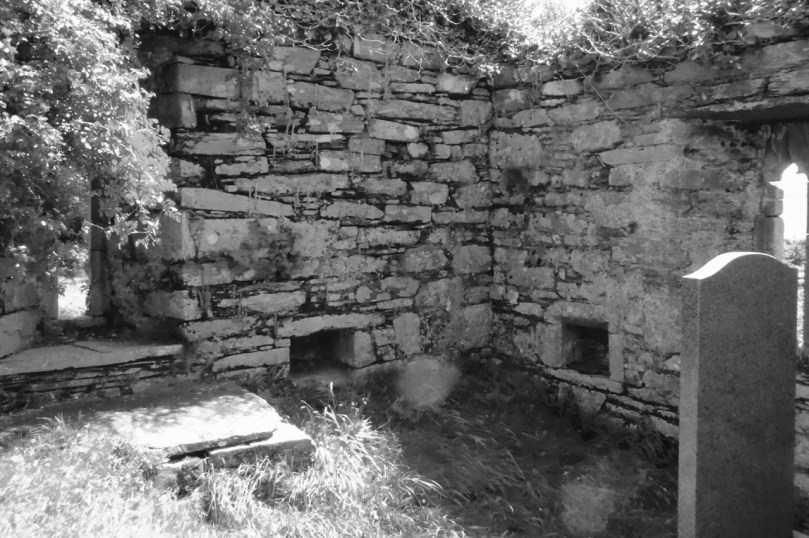
Inside the church, showing the ogival windows, the altar, piscina or stoup, and a small recessed cupboard

Inside the church, showing the ogival windows, the altar, piscina or stoup, and a small recessed cupboard

Kilcoe gets its name from St Coch, a nun said to be a colleague of St Ciarán of Cape Clear, who preached Christianity in Ireland before St Patrick, in the 5th Century. It is possible she founded a church here, but what we do know is that one was built in Medieval times – a building that still exists although the ivy is doing its best to take it over.

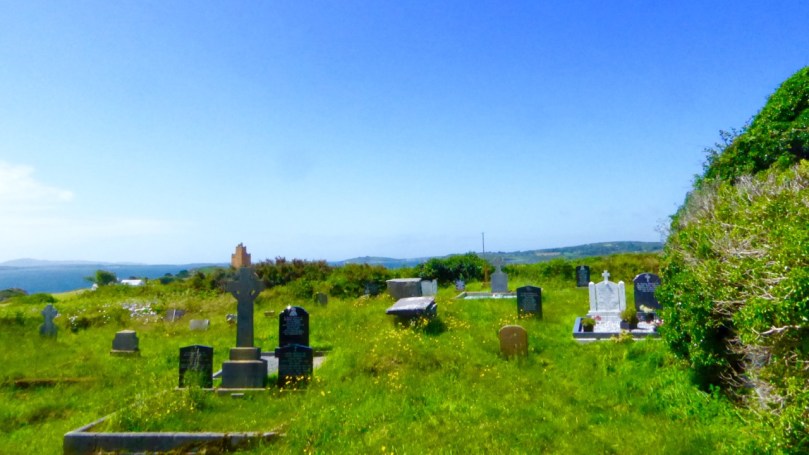
It’s a beautiful and atmospheric place, on the water, overlooking Roaringwater Bay. Two castles are in view: Kilcoe and Rincolisky, a McCarthy and an O’Driscoll Castle respectively. Each has a fascinating history that deserves a post of its own sometime. Some special features remain in this ruined church – windows with carved ogees, a lovely arched doorway, a piscina (for washing vessels) or stoup (for washing hands), a recess for storing vessels and the remains of a possible altar.

We don’t know exactly when this church was built or by whom, but we do know it was in ruins by 1615. Perhaps it was destroyed by the same forces that laid siege to Kilcoe Castle after the Battle of Kinsale in 1601 – a period that marked the end of the Old Gaelic Order in West Cork.

The Medieval church, with Kilcoe Castle in the background.

The Church, with Kilcoe Castle in the background

The rise of the Protestant Ascendancy class in the aftermath of that fateful battle privileged the Church of Ireland (transplanted Anglicanism) over the Catholic faith and a series of new laws, gradually getting harsher, were designed to suppress ‘Romanism’. This culminated in the enactment, in 1695, of the infamous Penal Laws. While attendance at mass was initially tolerated, churches could only be built from wood and away from roads. Eventually, priests were expelled from Ireland and after that mass had to be held in secret, with priests moving from hiding place to hiding place. At Roaringwater Pier Fr Hickey talked of the typical cargo of the smuggling ships that plied their trade from there: each ship to arrive from France would be carrying tobacco, brandy – and a priest!

From this period we find the Mass Rocks scattered around rural Ireland, identified on the basis of local tradition. The one at Ardura Beg is just up from a tiny pier that would have offered possibility of a quick escape. Many stories have come down of lookouts warning of the approach of the ‘red coats’ and the miraculous ways in which priests would make their escape. (See here and here for examples.)

Sheona and Amanda examine the mass rock at Ardura Beg

Sheona and Amanda examine the mass rock at Ardura Beg

Places of worship must be located where they are accessible and the first two are close by the sea, which afforded the easiest travel routes in Ireland for most of its history. However, roads were constructed eventually and the next two churches were located along these new routes. The first one, we’ll call it the Old Church, was built along the new road that led from Skibbereen to the Beara Peninsula. After 1778 the anti-Catholic laws were gradually relaxed, although it was not until 1829 that full Catholic Emancipation was won by Daniel O’Connell. The Old Church was probably built around 1800 and was a simple ‘barn-style’ edifice which served an impoverished and famine-stricken populace for a hundred years.

Left, the Old Church near Roaringwater Pier. Right, an example of a simple ‘barn style’ church in West Cork

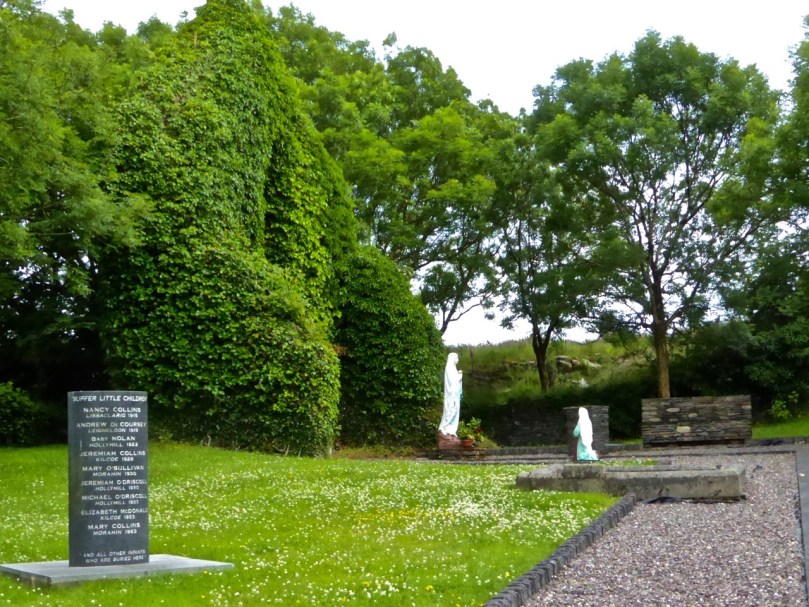
By the turn of the 20th Century it was deemed unfit for purpose. Nowadays it is a gentle green space, lovingly tended and in use as a grotto. Children were buried there – it was not a cillín, but a consecrated graveyard – and a memorial remembers them now.

Grotto and Chirdren Memorial. A place for contemplation

Grotto and Children’s Memorial. A place for contemplation

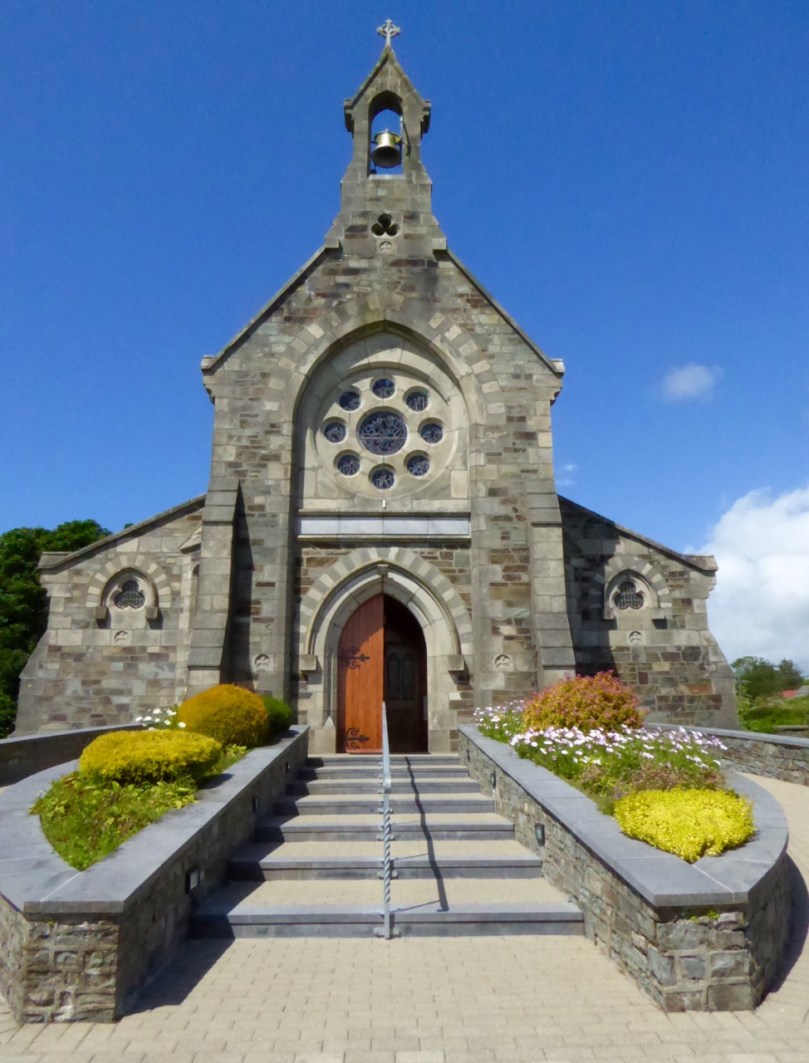
Catholic Emancipation ushered in a long period of church building by the newly-confident Catholic majority. The new road from Skibbereen to Ballydehob was constructed at the end of the 19th century and the New Church was built there in 1905, right beside the bridge over the Roaringwater River.

Kilcoe Church and Bridge

Bridge over Roaringwater River

The two styles of churches common at the time were Neo-Gothic, Influenced by continental cathedrals, and Hiberno-Romanesque which took its inspiration from the Early Medieval Romanesque style of Old Ireland and featured wonderful doorways and round towers. The Kilcoe New Church, the Church of the Most Holy Rosary, was built in the Neo-Gothic style, with a large rose window at the eastern end.

Kilcoe, Church of the Most Holy Rosary

Kilcoe, Church of the Most Holy Rosary

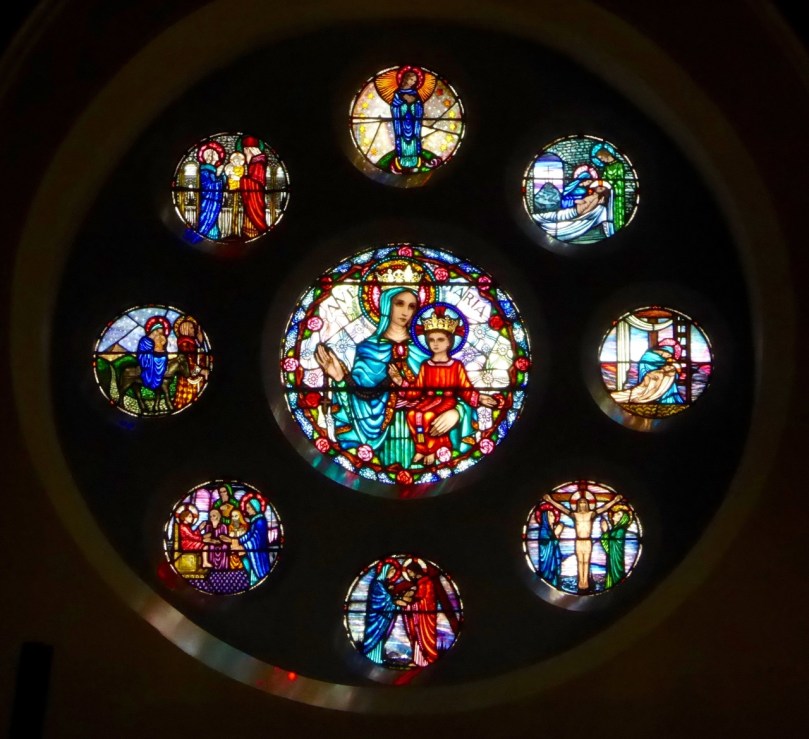
Originally the side-aisles did not have seats – poorer people could stand there for mass, while those who could afford a penny would occupy the pews. As the church fund grew, thought was put into ornamentation and stained glass was commissioned for several windows. The rose window was executed by the Harry Clarke Studios in 1943 and shows scenes from the life of Christ and of Mary.

The Rose Window, by the Harry Clarke Studio

The Rose Window, by the Harry Clarke Studio

The Altar and side windows were the work of Sarah Purser’s Tower of Glass. The choice of stained glass – from Dublin-based Celtic Revival artists rather than the English or Continental firms that supplied most church glass at the time –  was a choice that demonstrates the nationalistic feelings that were rife in West Cork at the time.

Irish History is written large on her landscape. In this one small area – these sites are within a couple of kilometres of each other – we see encapsulated sixteen hundred years of history, starting with St Coch and ending with the latest incarnation of a church at Kilcoe. Their beauty and their peaceful settings have been hard won. They should serve to remind us that peace and tolerance must always be cherished and safeguarded.

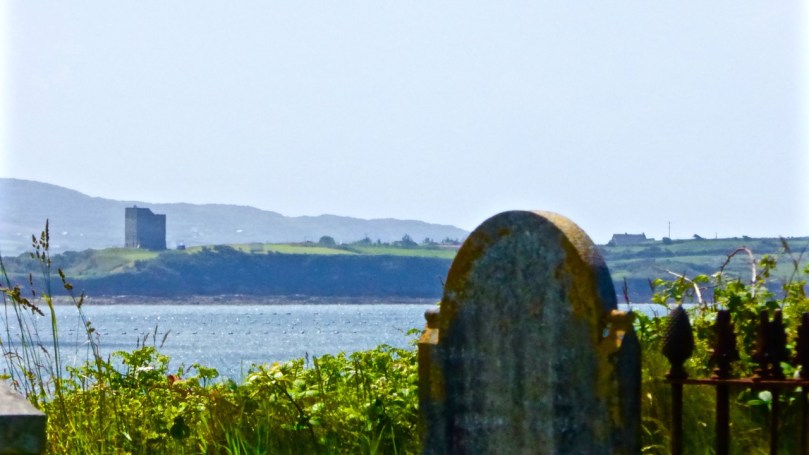
Rincolisky Castle from Kilcoe Medieval Church

Rincolisky Castle from Kilcoe Medieval Church

A Grand Job!

uillinn name

Here’s a riddle: what’s the connection between rusty steel and the President of Ireland? The answer – Skibbereen! Skibbereen on a summer afternoon in June, in fact…

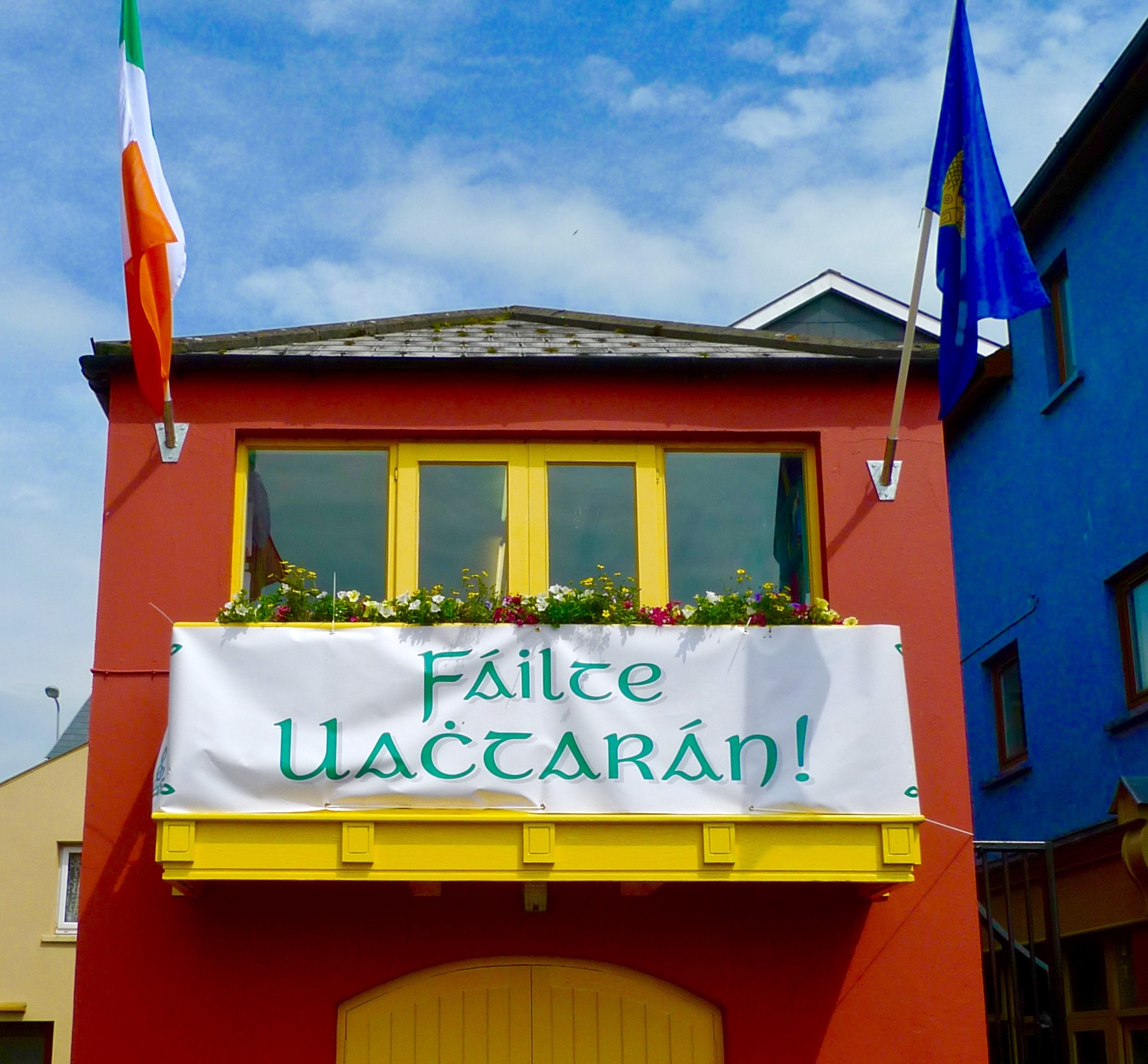
Welcome, President!

Welcome, President!

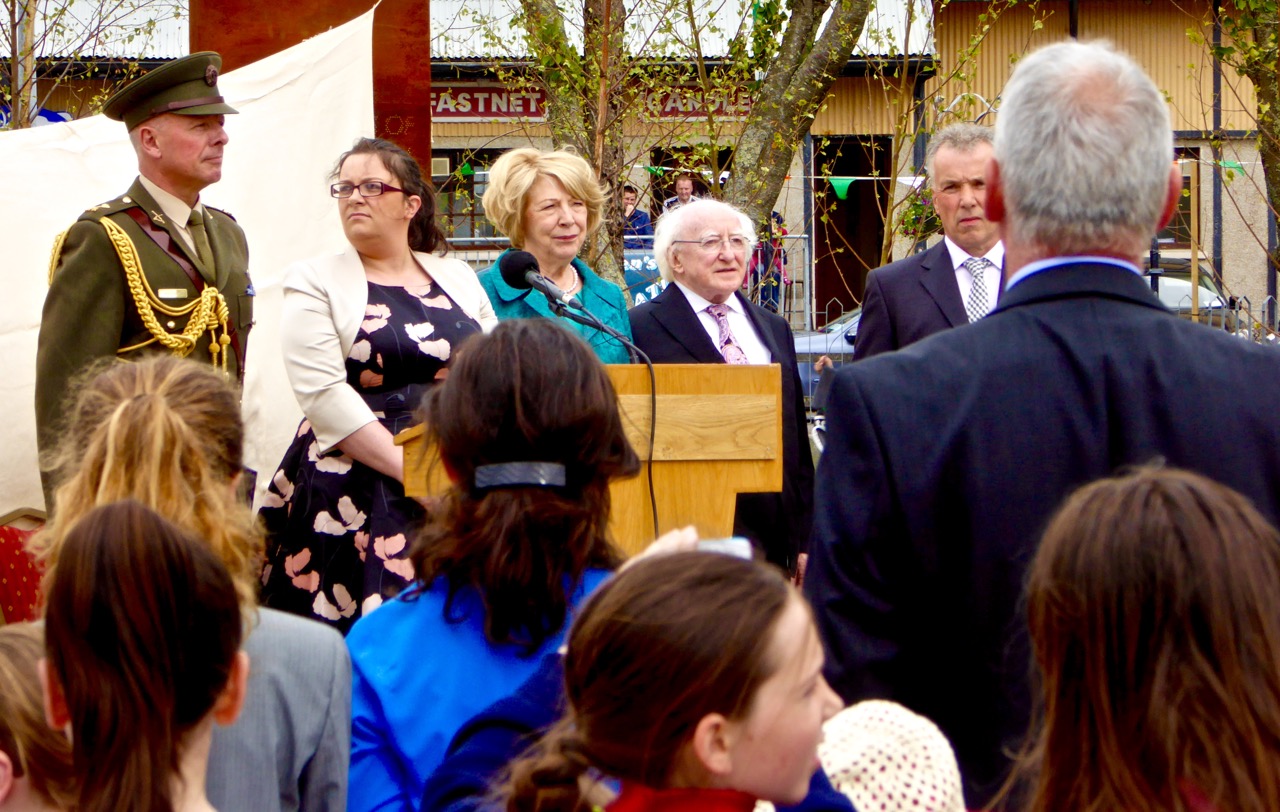
This week the President was in West Cork and on Thursday he came to Skibbereen. Before I lived in Ireland I was pretty ignorant as to the role the President plays in the life of the Republic. It’s not a political position – nothing like the American President, for example: although officially ‘head of state’ the Irish President has no powers – the executive running of the country is entirely in the hands of the government. Instead, the President of Ireland – Uachtarán na hÉireann – acts mainly in a ceremonial capacity and is very visible in civic life. There are always buildings to be opened, institutions to be founded, statues to be unveiled, speeches to be made, important visitors to be hosted… 

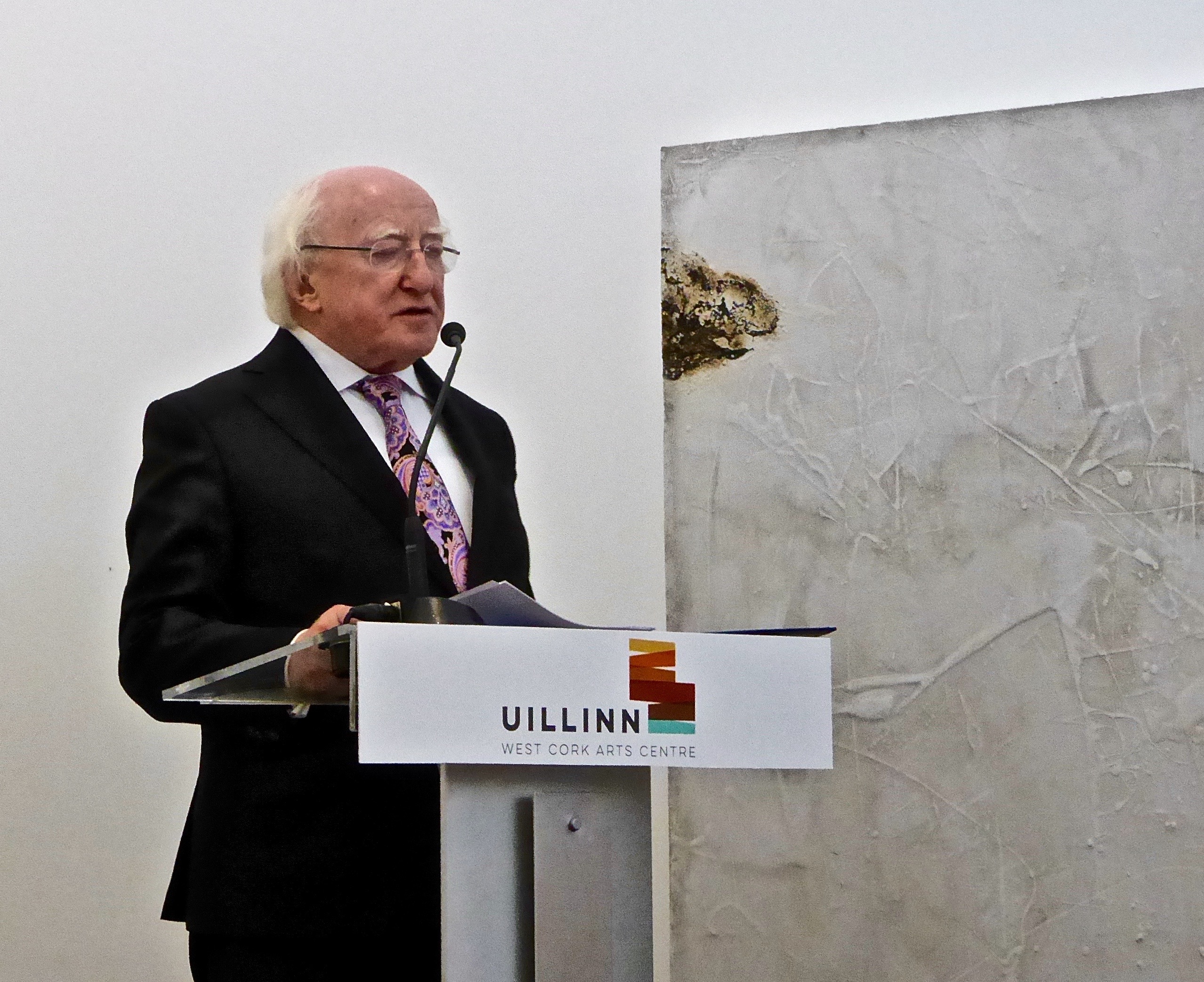
President Michael D Higgins formally opening Skibbereen's new Arts Centre

President Michael D Higgins formally opening Skibbereen’s new Arts Centre

Presidents can either be chosen by popular consensus or elected by a vote of all Irish citizens. Michael D Higgins was elected in October 2011 and his tenancy will run for seven years. Following this he can serve a further term if he and the people so wish. A Limerick man, Michael D (as he is usually known) is well liked: he’s had an impressive career in public life – academic, lecturer, professor, politician, poet, sociologist, author and broadcaster. He served as Minister for Arts, Culture and the Gaeltacht and was President of the Labour Party for many years. He is the first Irish President to have made a state visit to the UK.

His first appointment in Skibbereen was to open Uillinn – West Cork’s new Arts Centre: that’s where the rusty steel comes in – partly… Regular readers of this blog will know all about this building. It was controversial while under construction, mainly because of the Cor-Ten steel cladding to its prominent five storey tower. Cor-Ten or ‘weathering steel’ is a material consisting of alloys which encourage a rust-like patination on exposure to weather, forming a fully protective coating over a number of years. In fact, the weathering process takes about as long as one term of office of an Irish President! I know many people disagree (although I think some are coming round…), but I find the ‘rusty’ finish very attractive, and I like the fact that the appearance keeps on changing in an organic way.

I was impressed with Michael D’s speech: he’s an enthusiast for all the arts and emphasised how important this modern building is – not just for Skibbereen but for the whole of West Cork. The site – right in the centre of town – had been a bakery for generations, and the President pointed out the analogy between the essentials of bread, fundamental food for the body, and the arts – food for the soul.

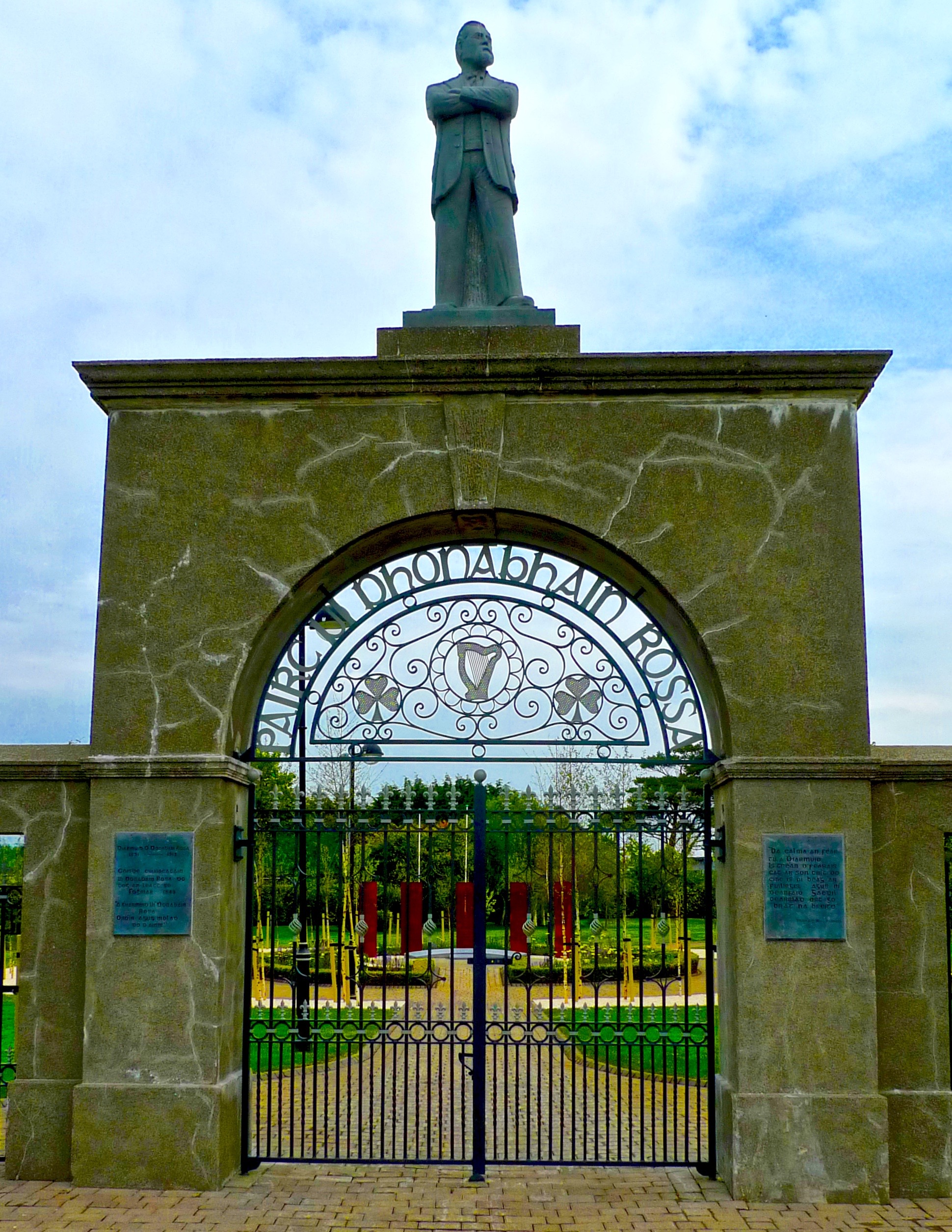
'Presidential Salute' in the O'Donovan Rossa Memorial Park

‘Presidential Salute’ in the O’Donovan Rossa Memorial Park

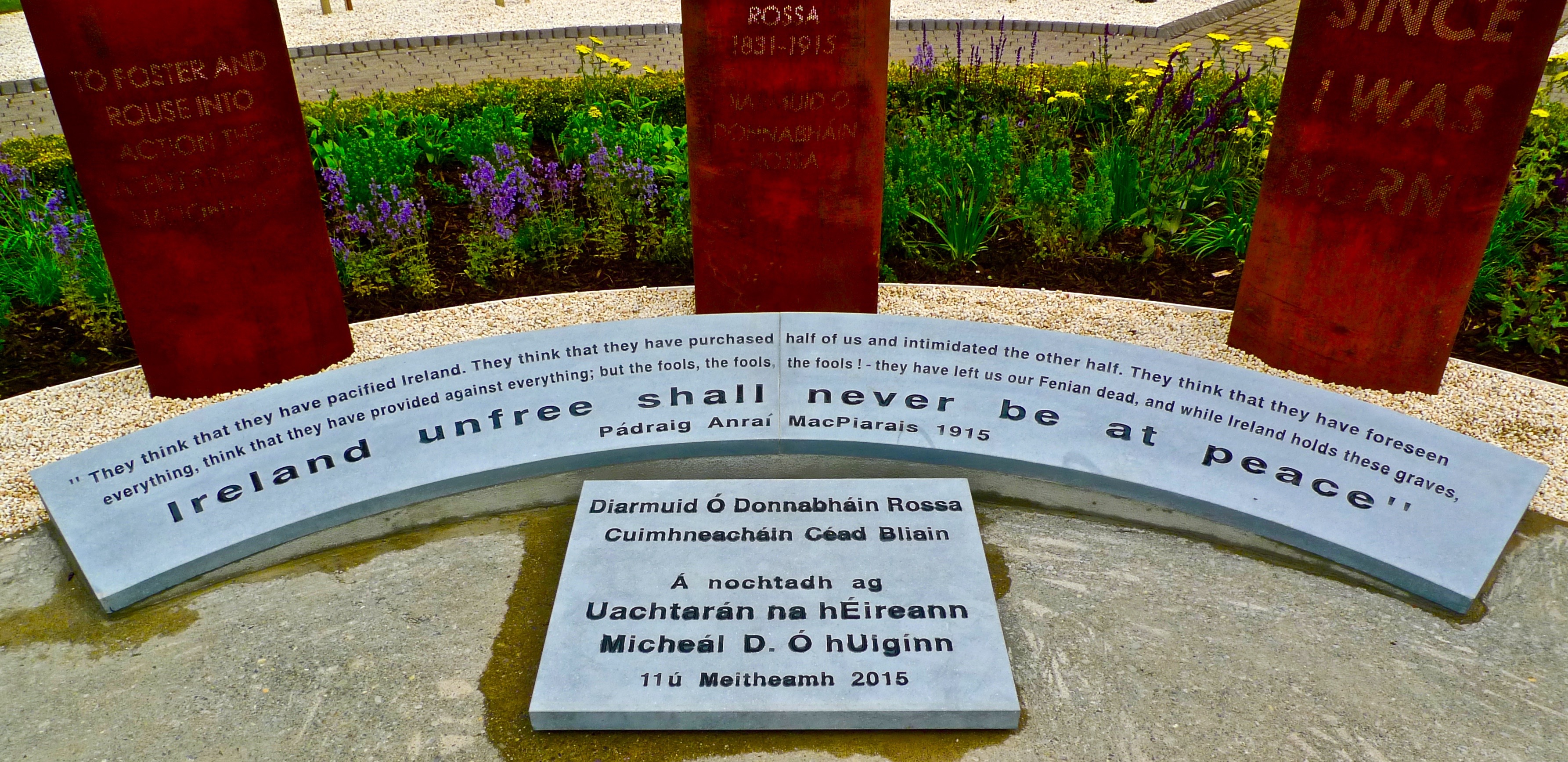
Next item on the afternoon’s agenda was a visit to the park: the President was to unveil a new memorial to Jeremiah O’Donovan Rossa – a local hero who had links with Skibbereen. Finola has mentioned him previously and is currently working on a post about him: July this year marks the centenary of his death. O’Donovan Rossa fought for Ireland’s freedom, just as Michael Davitt did (I wrote about him last week). The President gave a passionate speech emphasising the debt that the Ireland of today owes to those campaigners of yesterday, and I was pleased to hear him mention Davitt specifically.

Ready for the unveiling...

Ready for the unveiling…

New commemorative sculpture in Skibbereen's O'Donovan Rossa Memorial Park

New commemorative sculpture in Skibbereen’s O’Donovan Rossa Memorial Park

I think the new memorial is a great piece of modern commemorative art: it’s rusty steel again! Five columns are placed in the centre of a garden, each telling something of the hero’s story. You have to work to see all the images: they are made by perforating the ‘weathering steel’ sheets. It’s very effective because it can’t be ignored – you just have to stop and work it all out. I commend the artist – but nowhere can I find any mention of who that is! I’m still searching…**

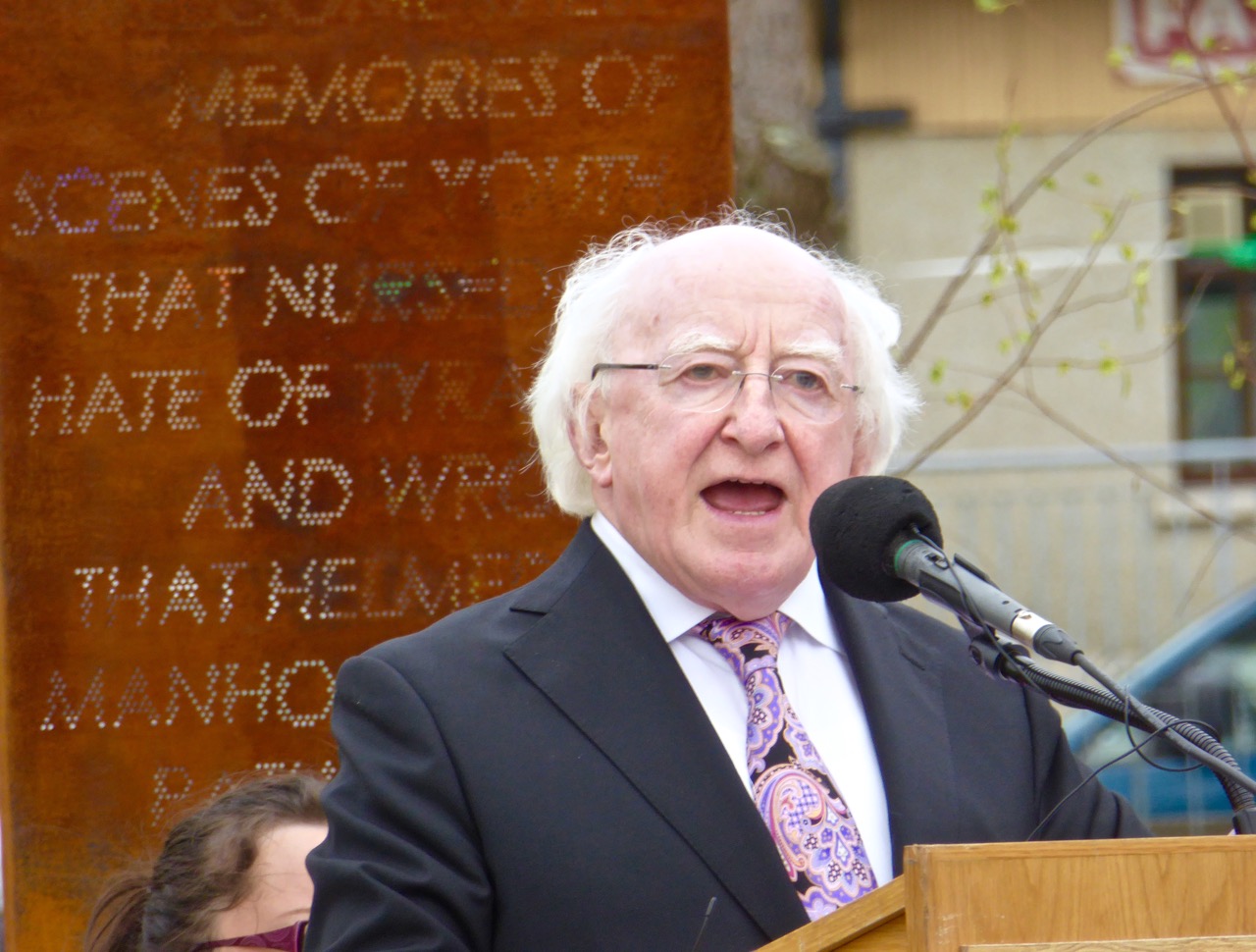
President Higgins speaks out with passion about freedom fighter Jeremiah O'Donovan Rossa

President Higgins speaks out with passion about Ireland’s freedom fighter Jeremiah O’Donovan Rossa

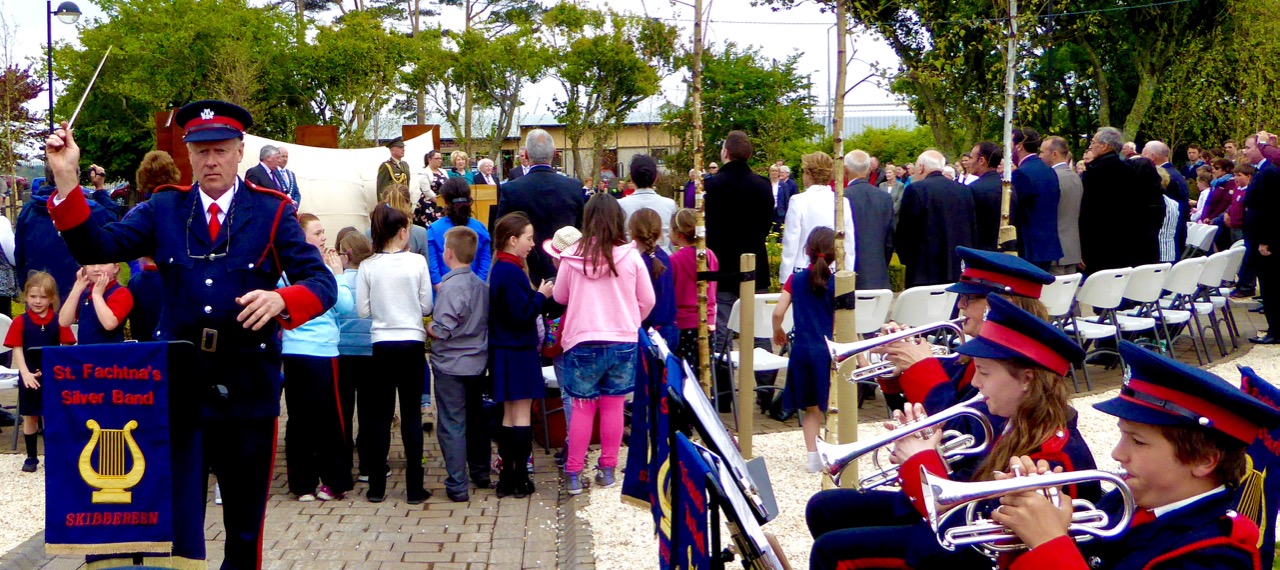
Michael D is a fluent speaker in Irish. He slipped easily between English and Irish while giving his orations – and made it sound so simple! The sun almost shone, the crowds were in good spirits, and the Band played. The rusty steel was looking good. All in all, the visit of Ireland’s President to Skibbereen was a grand job

gate

We have now heard from Graepels Perforators in Kinsale letting us know more about the monument. Here is their message: We worked with Giulia Vallone (now Senior Architect at Capital Projects Implementation Unit CPIU) and Orla Higgins (Cork County Council Architect) to create the memorial. We teamed up with Cork County council to create it.

Irish Farming – 6,000 Years Ago

The Céide Fields Visitor Centre

The Céide Fields Visitor Centre


How did we farm in Ireland in Neolithic times? Turns out, much as we do now!

We’re just back from an inspiring trip to Mayo, the highlight of which was a visit to the largest Neolithic site in the world – the Céide Fields (pronounced Kay-jeh, for our non-Irish readers).

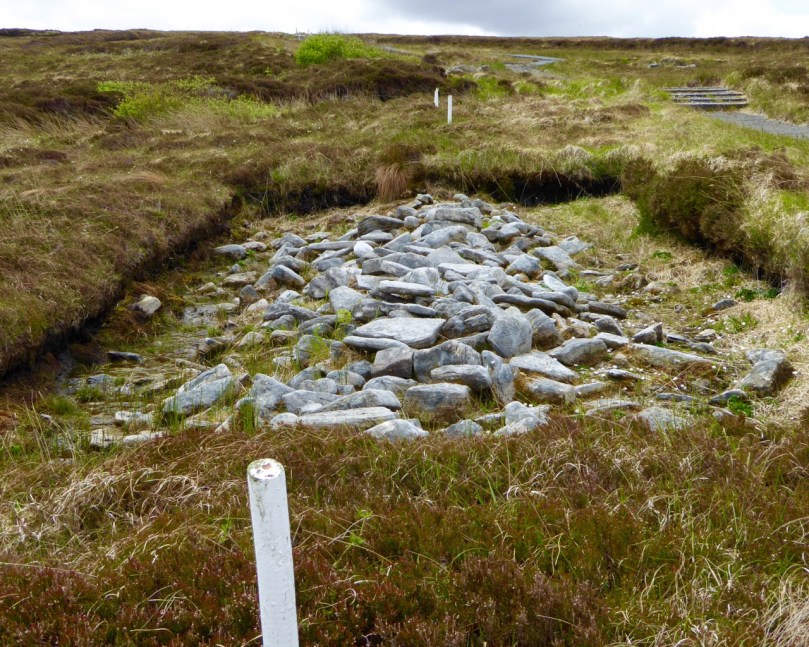
Collapsed field walls under the bog. The white stakes mark the line of the uncovered wall

Collapsed field walls under the bog. The white stakes mark the line of the uncovered wall

When we think of the Neolithic (or New Stone Age, or Early Farming) period in Ireland, we automatically think of the megalithic tombs – spectacular sites like Newgrange and Loughcrew, or the smaller portal tombs, like Poulnabrone or Arderrawinny. But how did these people make their living? What were their daily lives like? We found the answers, going back almost 6,000 years, at the Céide Fields.

The extent of the fields around the Visitor Centre

The extent of the fields around the Visitor Centre

The Céide Fields is an extensive system of enclosures, stretching for kilometres from the sea over the hills, used for livestock farming. Occasionally, besides grazing fields, there is evidence for corrals, grain-growing, and farmhouses. In fact, much like we see around us in West Cork nowadays, people lived in their own farmhouses, surrounded by their fields, within sight of their neighbours.

This enclosure surrounded a farmhouse

This enclosure surrounded a farmhouse

Society was cooperative – it had to be, in order for such an enormous network of fields to be constructed. And life was peaceful: there is no evidence of defensive structures. The weather was warmer than now – warm enough so cattle could graze outside all winter – and there was enough land and food for everyone.

They quarried rocks for fences and for structure like court tombs

They quarried rocks for fences and for structure like court tombs

They had a spiritual life, building their own version of megaliths – the Court Tombs. We were fortunate to meet the manager of the Céide Fields site, Gretta Byrne, who gave us directions to Rathlackan Court Tomb – a site she had excavated. Court tombs are a type of chambered tomb, generally oriented towards the east and featuring a forecourt at the front of a long mound that covered the chambers. Rathlackan is a fine example, with three chambers and a nicely preserved forecourt. It took a highly organised society to build a complex structure such as this.

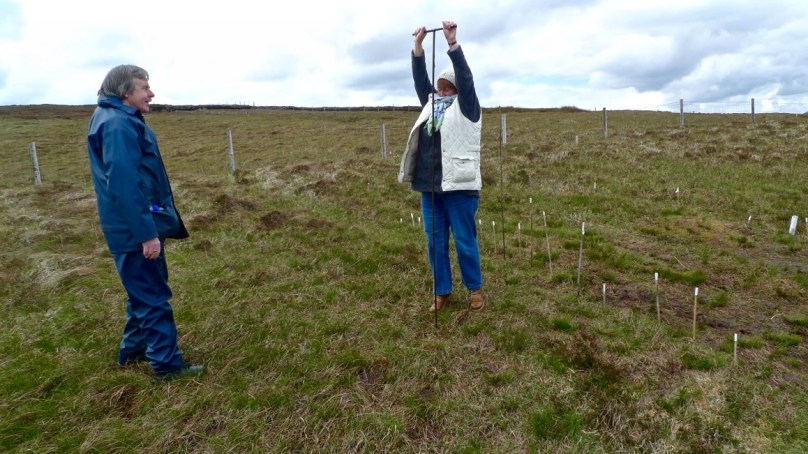
In the 1930s a local schoolteacher, Patrick Caulfield, first discovered what were clearly pre-bog collapsed walls when cutting peat in the deep blanket bog that covers this part of Mayo. Decades later his son, Seamus, now an archaeologist, headed the investigations that led to the realisation of how extensive the field system was. Mostly this was done by probing – sending a thin metal bar down through the soft peat until it hit a rock. This technique was so successful that miles of walls could be charted without the need to excavate. Excavation focussed on uncovering small sections of wall and features like enclosures and house-sites.

I take a hand at probing

I take a hand at probing

About 5,200 years ago, a combination of climate change and forest clearance led to the development of the blanket bog that covers the land today and ultimately forced these Neolithic people, after 500 years of successful farming, to abandon their fields. The ecology of bogland and the conditions that create it are the subject of some of the museum exhibits and also of the excellent guided tour that covered two hectares behind the Visitor Centre.

A section of wall disappears under the bog

A section of wall disappears under the bog

If you find yourself in this part of Ireland, do plan a visit to the Céide Fields. Take some bug spray – although they weren’t in evidence when we were there, the Céide midges have a reputation for ferocity. Enjoy the display in the award-winning Visitor Centre first and fortify yourself with a coffee and cake.

This pine came from the bog

This pine came from the bog

Once outside, as you walk along beside the ancient stone walls, look across the valley towards Downpatrick, and marvel at the continuity of a way of life – small cattle farms among stone-walled fields – that began almost 6,000 years ago.

This scene, in Galway, could have happened 6,000 years ago in North Mayo

This scene, in Galway, could have happened 6,000 years ago in North Mayo

We’ll let Seamus Heaney have the last word. His poem, Belderg, was inspired by the Céide Fields:

When he stripped off blanket bog

The soft-piled centuries

Fell open like a glib;

There were the first plough-marks,

The stone-age fields, the tomb

Corbelled, turfed and chambered,

Floored with dry turf-coomb.

A landscape fossilized,

Its stone wall patternings

Repeated before our eyes

In the stone walls of Mayo.

Looking towards Downpatrick Head from the Visitor Centre

Looking towards Downpatrick Head from the Visitor Centre

High Drama!

tower in context

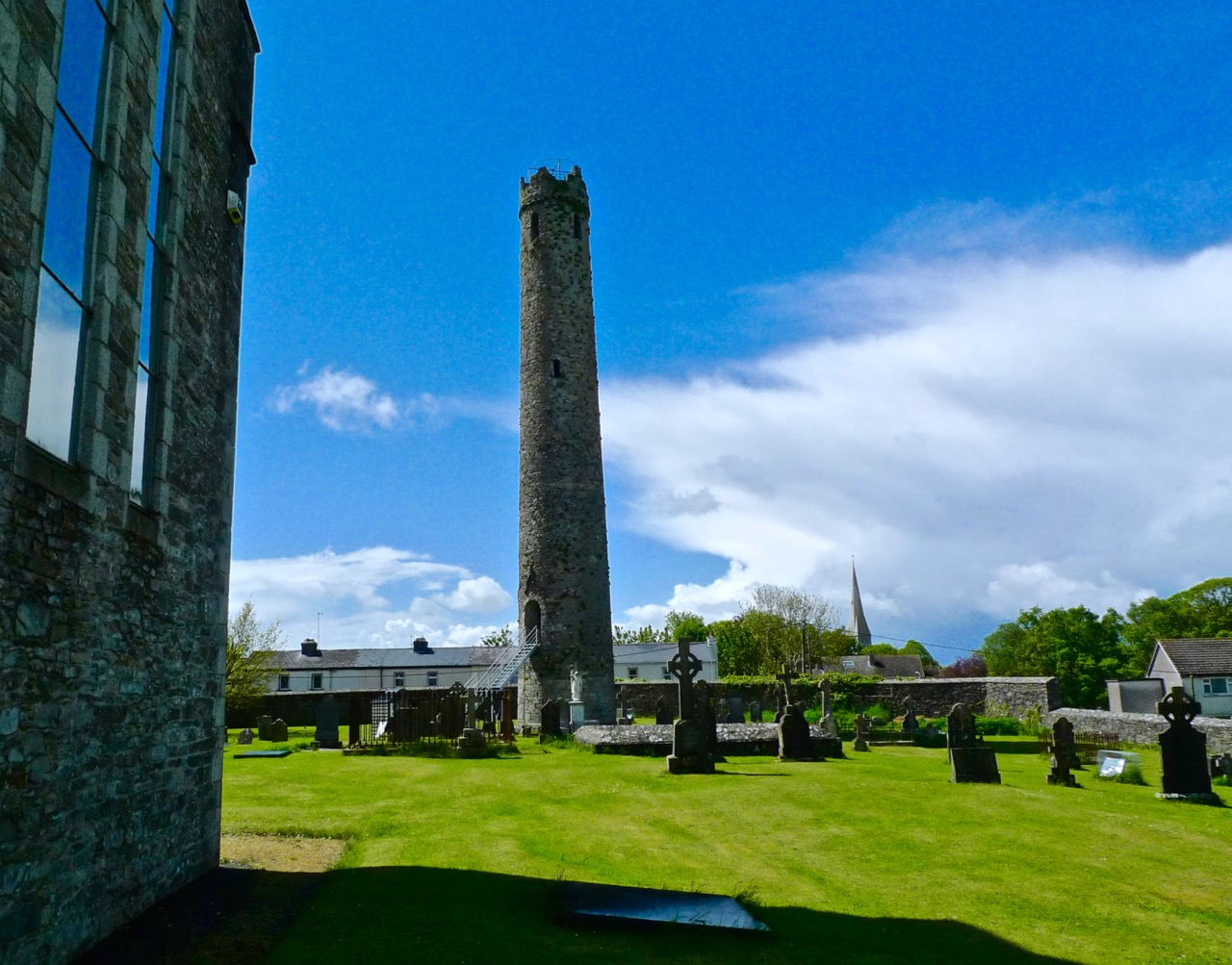
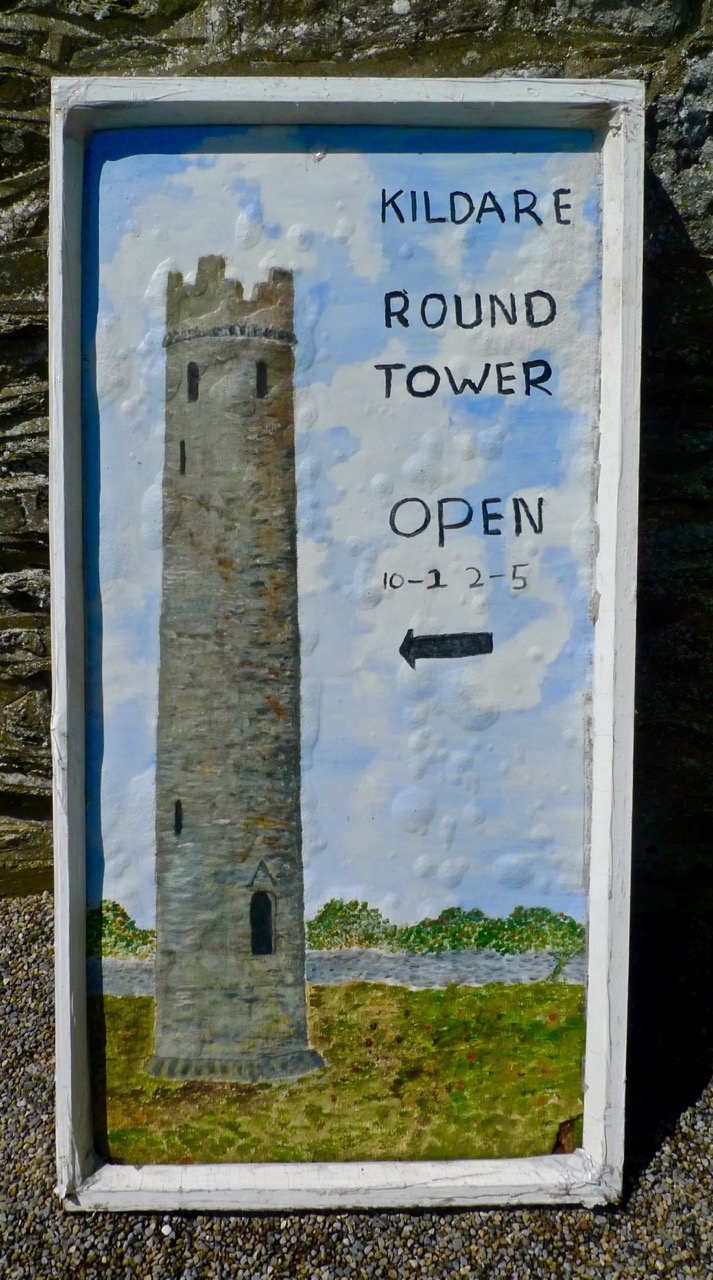
If you suffer from vertigo or claustrophobia – or both – then you won’t want to follow us in the adventure we had this week while returning from a visit to Dublin: climbing to the top of an Irish Round Tower! Overcoming any tendencies we might have had towards these phobias, we arrived at the roof of the 32.6 metre high Kildare tower and marvelled at being able to stand on the summit of a piece of architecture over a thousand years old. Kildare has the second highest Round Tower still extant in Ireland: the highest is at Kilmacduagh, Co Galway, at 34.9 metres; however, Kildare now lacks a conical cap, which it might once have had. If so, it would just tip in as the highest of all the towers.

Kildare Round Tower: note the battlemented top - probably added in an 18th century restoration, the romanesque doorway and the granite base. The upper stonework is limestone and sandstone

Kildare Round Tower: note the battlemented top – probably added in an 18th century restoration, the romanesque doorway and the granite base. The upper stonework is limestone and sandstone

The print above – dating from 1788 – shows the ruins of St Brigid’s Church, which was fully restored as a Church of Ireland Cathedral a hundred years later. We looked down on this from our vantage point atop the Tower – and had a good view of the (also restored) Fire Temple where a perpetual flame, lit by the Saint, was kept burning for hundreds of years, finally being extinguished by the shenanigans of Henry VIII.

Looking down on Kildare Cathedral, with St Brigid's 'Fire Temple' in the grounds

Looking down on Kildare Cathedral, with St Brigid’s ‘Fire Temple’ in the grounds

You’ll have heard me talk about St Brigid many times: she’s second only to St Patrick in the Irish Martyrology. In fact, as probably the most influential woman in Irish history, I’m going to declare her as quite the equal of St Patrick: she’s often enough described as one of the Patron Saints of Ireland. You will also know that she is surrounded by folklore and traditional customs, such as the making of her Cross on her day, the First of February.

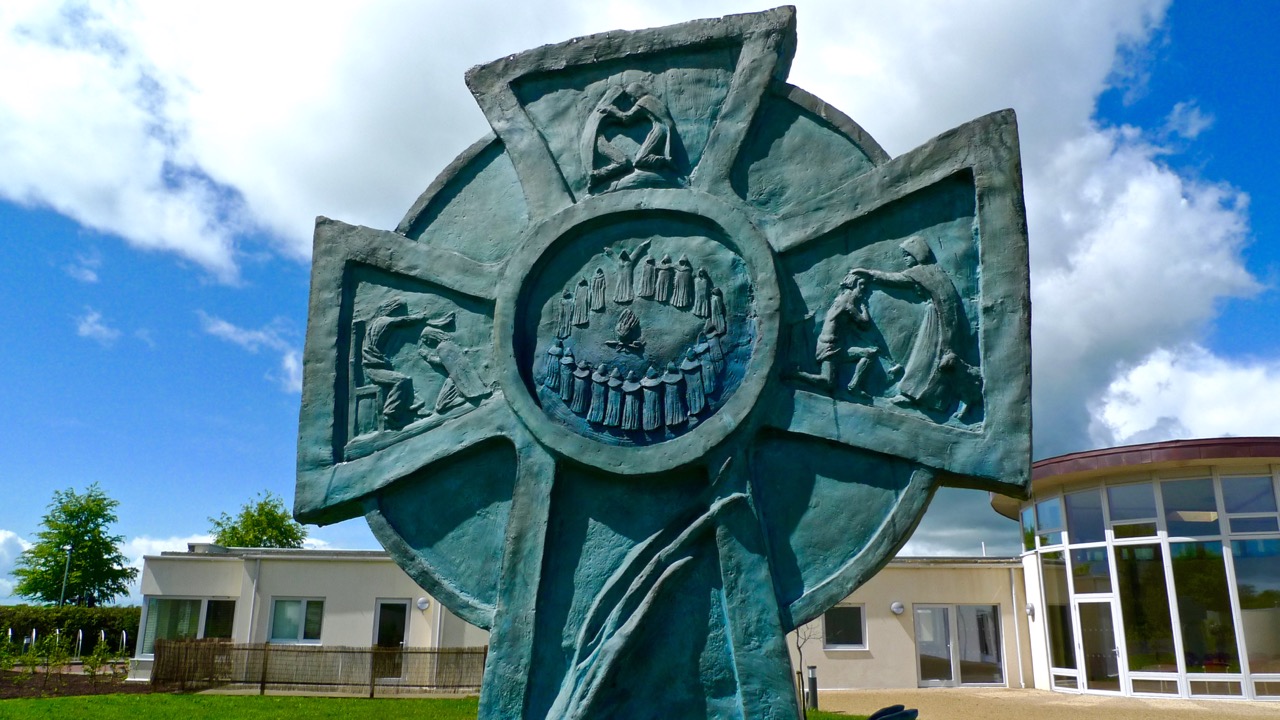
St Brigid’s Cross – left, at her Holy Well and right, a textile in the Solas Bhride Centre, Kildare

Back to the adventure (although the whole day was adventurous!) – climbing the tower was hard going. There were a series of near-vertical ladders to be negotiated: each one took us to a higher timber platform, six floors in all. At the top of each ladder we had to squeeze ourselves through a narrow opening; this, and the confines of the tower interior – only two metres or so across – certainly challenged the claustrophobiac in me.

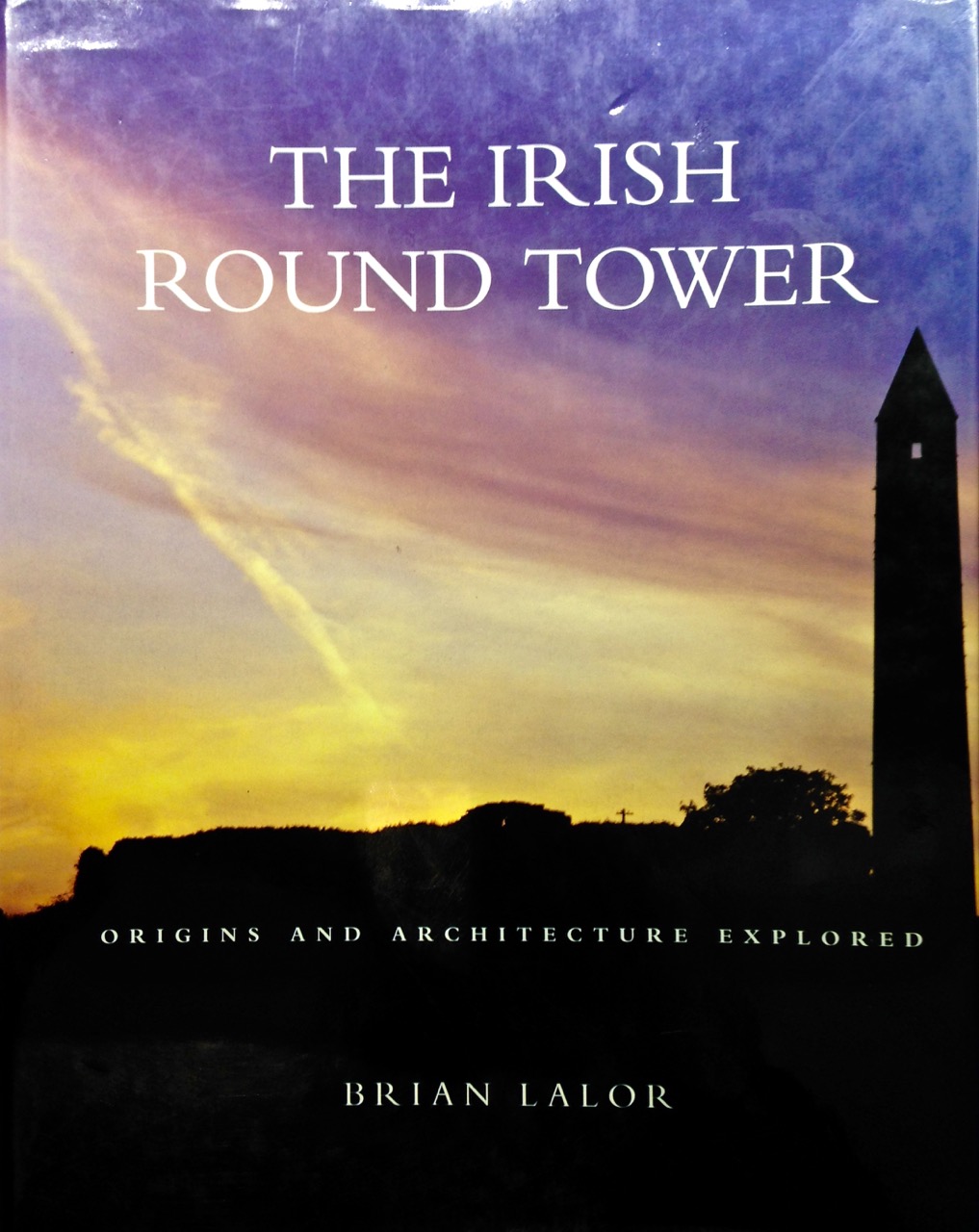
The restricted space also made us question some of the theories about the uses of these towers, which are always located at ecclesiastical sites. The definitive work on them is, as it happens, written by someone who also lives in West Cork – just a little distance from Nead an Iolair: Brian Lalor. Brian has led a very full life, involving architecture, archaeology, sketching and printing (his etchings are exquisite). He is also the author of a number of books, many of which are on our own shelves, including The Irish Round Tower, published by The Collins Press, 1999 and 2005.

lalor

Brian is unequivocal in his assertion that the primary purpose for round towers was to house the monastery bell. He also suggests that a secondary function would be as a safe storage place for the monastic treasures: the entrance door was always raised at a considerable height above the surrounding ground level, requiring steps or a ladder to gain access. In the times when they were constructed they would have been visually impressive – and could be seen from a great distance. They would have acted as signposts for travellers who might have been searching for the hospitality which monastic communities always offered. Brian discounts some of the more bizarre theories for the towers – for example, that they might have been places of safe refuge for the monks if under threat of attack by Vikings – or that they are simply phallic symbols! Lastly, Brian considers – and gives some credence to – the idea that the towers were monumental buildings of prestige and local aristocratic patronage: certainly, they required considerable expense and effort to construct.

centre entrance

As is often the case with our days out, one adventure led on to another. When we came down from the tower we found that St Brigid’s Cathedral had closed for lunch. But we knew that the Saint’s trail also involved a Holy Well and we had heard that there was a new building devoted to the work of Brigid just outside Kildare.

Solas Brhíde Centre

Solas Brhíde Centre

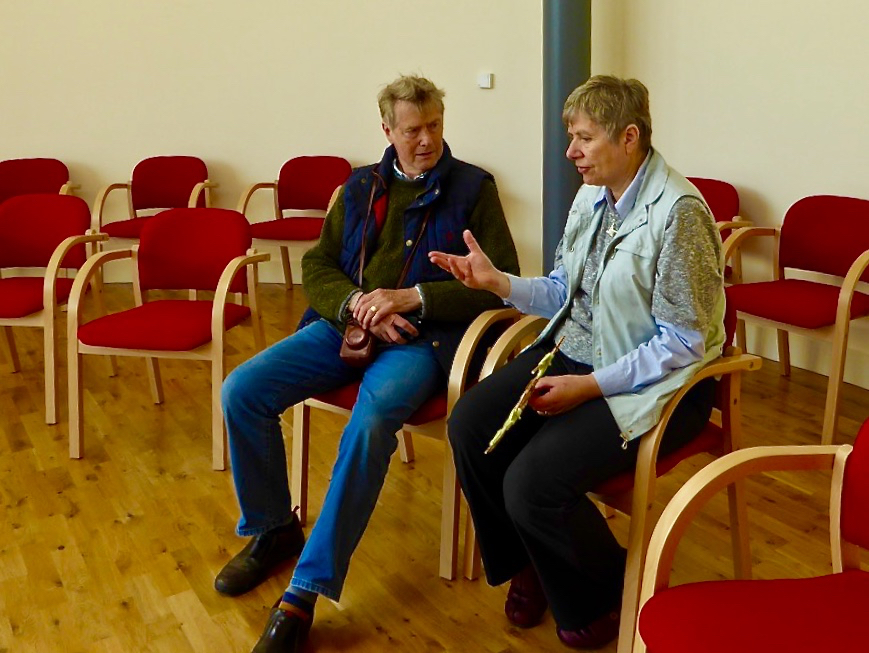
Robert with Phil, one of the Sisters who conceived the project

Robert with Phil, one of the Sisters who conceived the project

We were very impressed with the Solas Bhríde Centre: a small group of Brigidine Sisters has put together the project to build a Christian Spirituality Centre which unfolds the legacy of St Brigid and shows that it is still relevant in the present day. We were shown around the Centre by one of these Sisters, Phil, who pointed out that Brigid was attuned to the natural world and would have appreciated that the new building (designed by Solearth Ecological Architecture) is conceived on ecologically sound terms using sustainable materials and techniques which care for the wellbeing of the Earth. The plan of the building is appropriately inspired by the shape of a St Brigid’s Cross.

Architect's drawing of the newly completed building

Architect’s drawing of the newly completed building

The next stop on our itinerary was the nearby Holy Well – a popular place of pilgrimage and veneration on St Brigid’s Day:

Finally, we arrived back at the Cathedral. I’m always a little disappointed by restorations – particularly those which were carried out in Victorian times; nevertheless there are some impressive features. The possibly twelfth century font is one of them (below left), and another has to be the hidden Sheelagh-na-gig under the lip of Bishop Wellesley’s tomb (below right). I reached under to feel this little carving, and was then told by the Cathedral’s guardian that anyone who touches the effigy is ensured everlasting fertility!

The excellent Heritage Centre opposite the Cathedral entrance is informative about the town’s history and the important connections with this special Saint. There is much more to be discovered – and written – in respect of St Brigid, and other places in Ireland which are connected with her still to be visited. Do go to Kildare and, at the very least, suspend your phobias sufficiently to allow you to climb the ancient Round Tower. But make sure you go between May and September – and not during the lunch hour…

tower poster

Trading Up in Tudor Times: Fortified Houses in West Cork

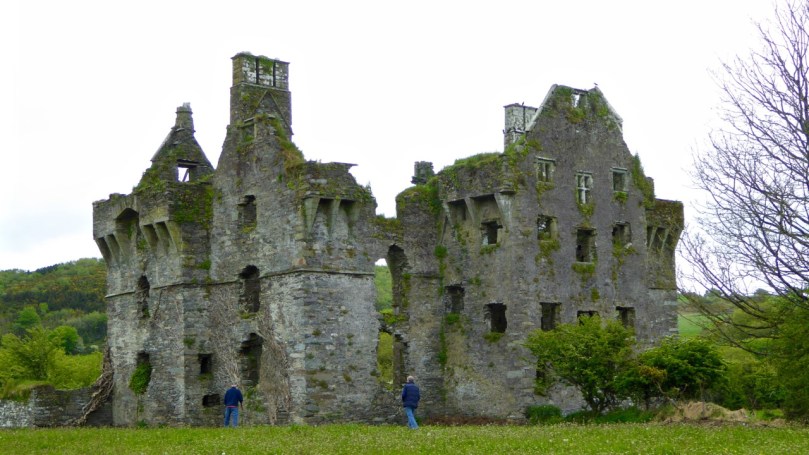
Coppinger's Court, Ballyvireeen, near Rosscarbery

Coppinger’s Court, Ballyvireeen, near Rosscarbery

Fortified houses are a distinctly Irish phenomenon. The Tudor period in Britain ushered in a great era of house building with many distinctive features. But England was a peaceful place – the owners of these great houses did not expect to be attacked. Tudor Ireland was a very different environment: life was still dangerous and conflict between the native Irish and the planter class, or between Irish clans, was common.

Machicolations at Coppinger's Court

Machicolations at Coppinger’s Court

Up to the end of the 16th century the castle/tower house was the residence of choice of the powerful – a tall stone keep mainly focussed on defensive features and horribly uncomfortable to live in. (See When is a Castle..? for a complete run-down on tower houses.) These new houses emphasised the horizontal rather than the vertical, and were built with comfort in mind. However, they incorporated some of the defensive features of the tower houses – they were “fashionable but defendable.”

Mullioned windows

Mullioned windows

In Ireland they represented “a public display of power and wealth…[and] a long-term investment in their owner’s regional future and were monuments to an aspiration for an English and Continental house style suited to local Irish conditions. On a basic level  the construction of a fortified house represented the owners desire to modernise and Anglicize.” These quotes and much of the information that follows is taken from The Fortified Houses of County Cork: Origin, Fabric, Form, Function and Social Use of Space, by Joe Nunan, who has generously made it and related material available on his website.
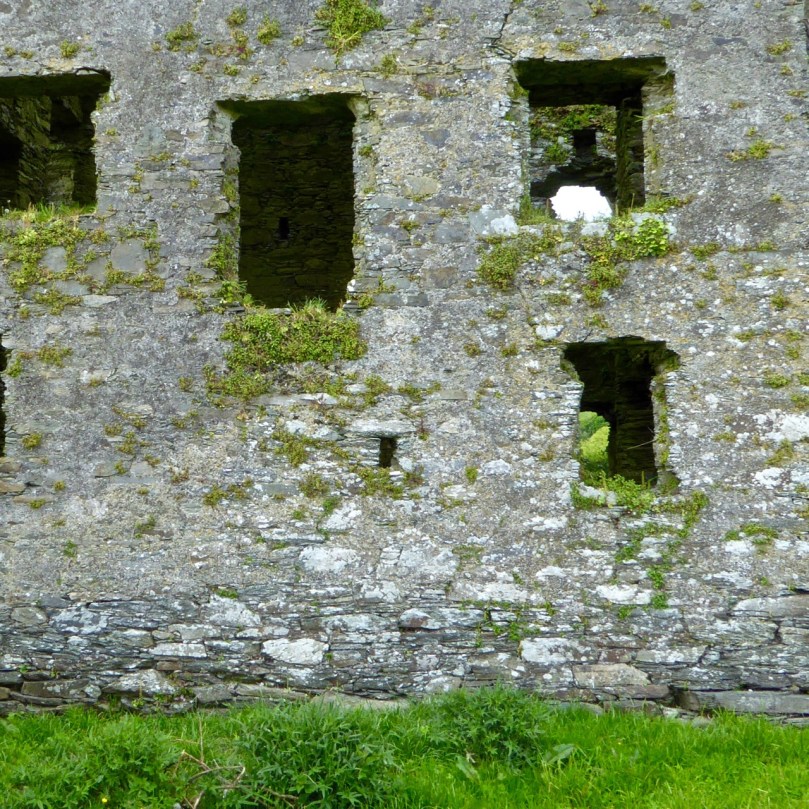
Gun loop at ground floor level, Coppinger's Court

Gun loop at ground floor level, Coppinger’s Court

Fortified houses were built of stone but all internal floors, stairs and partitions were of wood. Defensive features included machicolations, bartizans, wall walks, gun loops, corner towers or wings to provide for flanking fire. They were built starting about 1580 up to about 1650.

Tower and Bartizan, Reeandisert

Tower and Bartizan, Reenadisert

There are four (or five, if you include Baltimore Castle) surviving fortified houses in West Cork. The one that is most accessible (should you wish to visit) is Coppinger’s Court, in Ballyvireen townland near Roscarbery. It is also one of the most magnificent examples of this type of dwelling in Ireland. Some of the mullions remain in upper windows, and a sharp eye will spot gun loops in the outer walls. The machicolations are particularly fine, with impressive cut stone supports. This was the home of the infamous Sir Walter Coppinger, whose plan was to build a complete settlement around him in this lovely spot on the banks of the Roury River. He was a despot who got rich through clever manipulations of mortgage documents and he was said to hang his enemies from a gibbet from one of his windows.
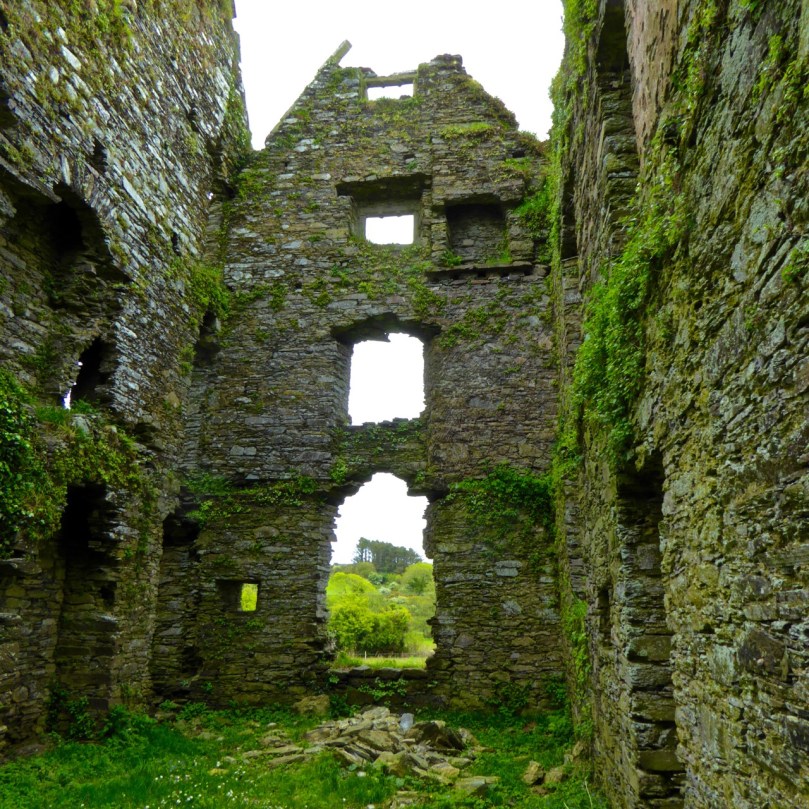
The chimney on top of this wall has fallen - note the pile of stones on the ground.

The chimney on top of this wall has fallen – note the pile of stones on the ground

The house was so awe-inspiring in its time that the legend developed that it had a window for every day of the year, a chimney for every week and a door for every month. The house was eventually attacked and ransacked in 1641 and has sat in ruins ever since. Sadly, one of the magnificent chimneys fell down in the storms of early 2014. Evidence of a bawn wall remains, with possible outdoor cooking areas.
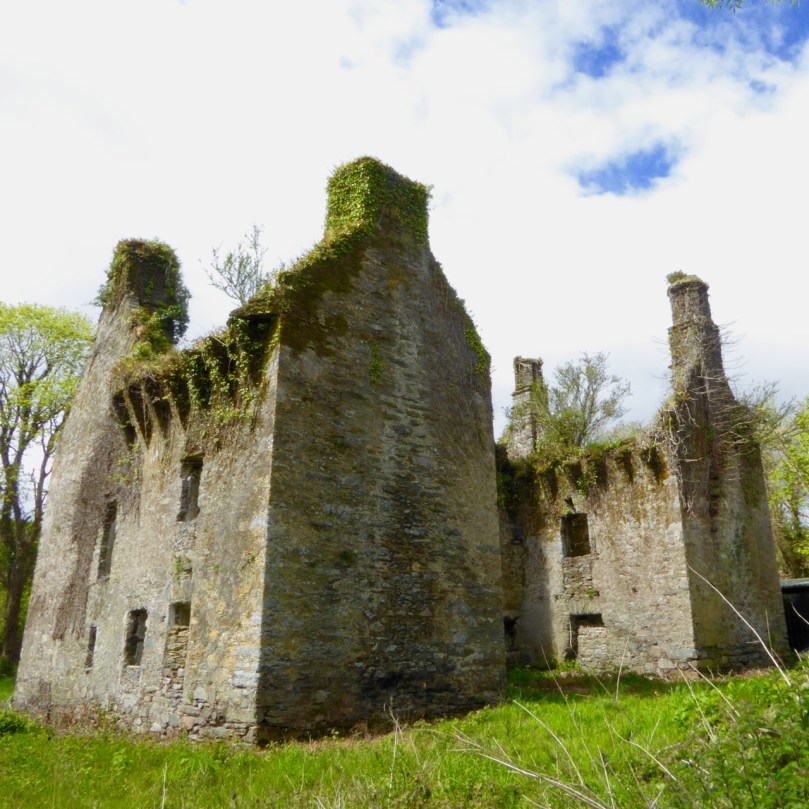
Gearhameen - a U shaped plan

Gearhameen – a U shaped plan

The fortified house at Gearhameen near Durrus, built by the MacCarthy Muclaghs, provides evidence of the comfort that these new ‘castles’ provided. The household work was done on the ground floor – large kitchens contained huge fireplaces, and in this house we can see the main kitchen fireplace had a bread oven to one side and a slop hole for sweeping out leftovers to the pigs, who must have been in an attached pen (the smell!).
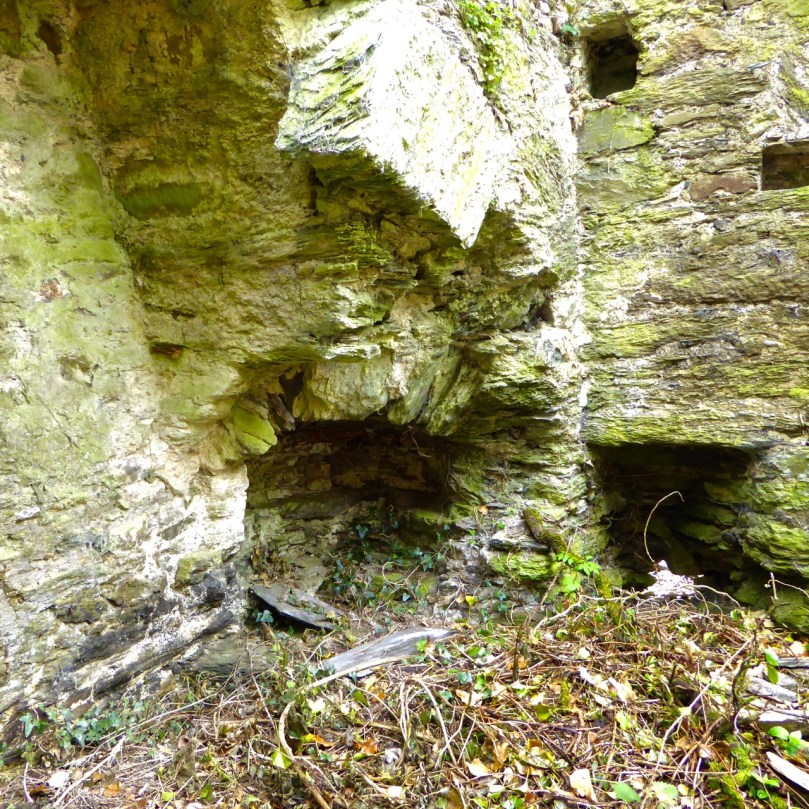
Large ground floor fireplace with bread oven

Large ground floor fireplace with bread oven

The first and second floors have large fireplaces, with magnificent herringbone chimneys still intact (and hosting nesting choughs).

Rather than the machicolations we see at Coppinger’s Court, corbels on the outside walls probably supported wooden or stone platforms.
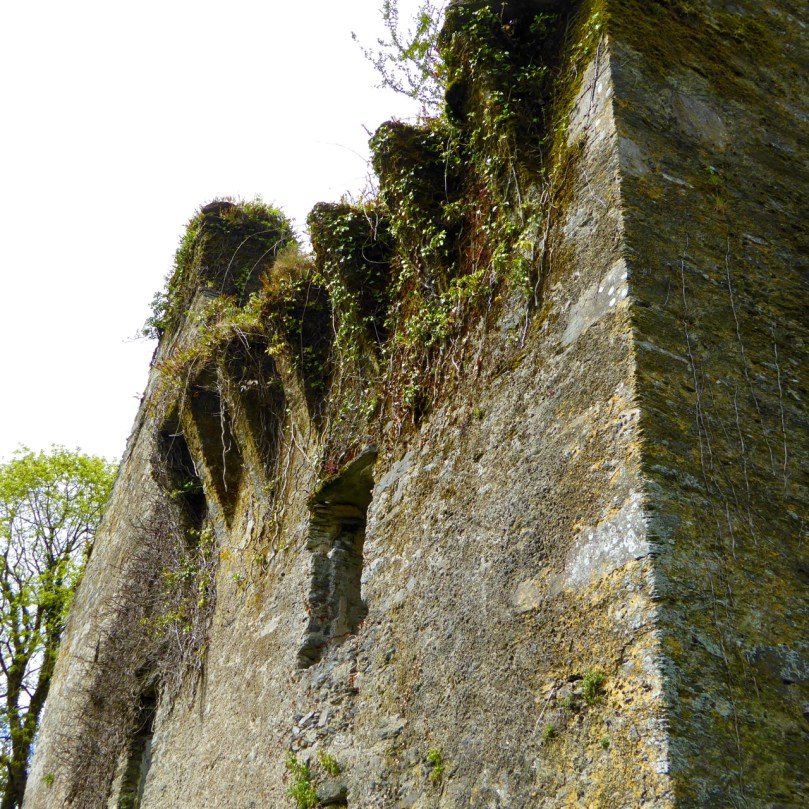
Corbels supported a platform for defenders

Corbels supported a platform for defenders

Like Coppinger’s Court, the outer walls still stand to their full height, but the loss of a keystone above one arch, and the consequent development of a large crack above it, bodes ill for that section of the wall.
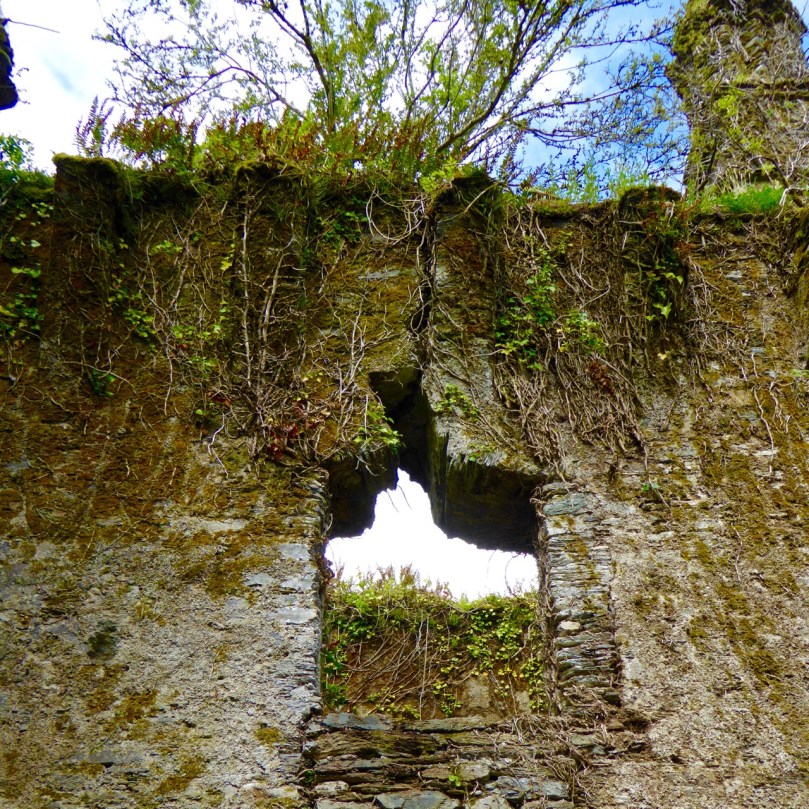
Missing keystone

Missing keystone

The house at Reenadisert, near Ballylickey, has been built onto and within over the centuries, serving as a modified dwelling place and as farm buildings. It was the stronghold of an O’Sullivan and has an impressive bartizan on one of the external towers. It is in a very ruinous state inside – the eeriness is enhanced by an enormous crows’ nest that has fallen from inside one of the chimneys to rest on the ground. There is evidence of a basement but this cannot be accessed.
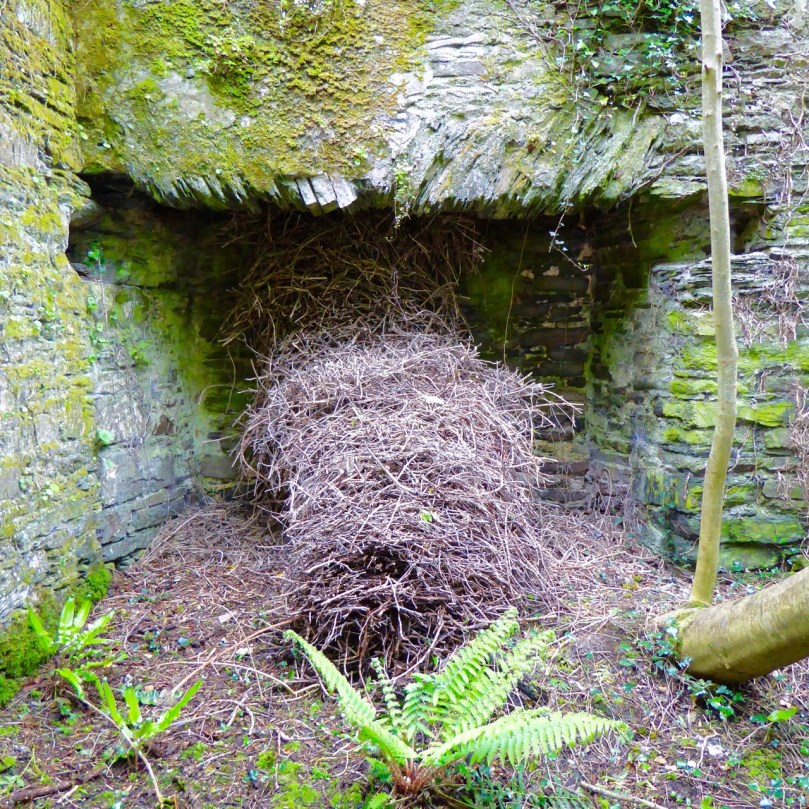
Fallen nest

Fallen nest

The house at Aghadown, home to the Becher family, consists only of one wall with attached towers. Ivy has threatened to take over most of it – I love Leask’s description of ivy – “destructive green mantle beloved of the sentimentalist.” Through it one can make out traces of the slate that once hung on the wall above the ground floor, the outline of corbels at roof level, and a string course between the ground and first floor.
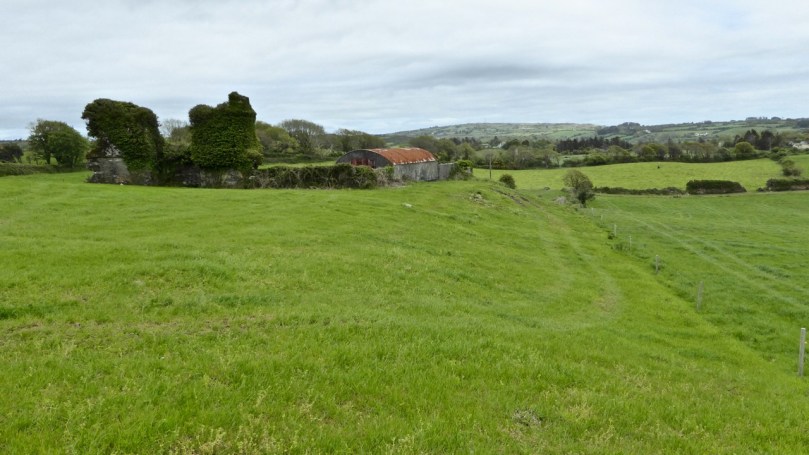
Aghadown Fortified house occupies high ground with a commanding view

Aghadown Fortified house occupies high ground with a commanding view

Interestingly, Dún na Séad Castle in Baltimore, home of the O’Driscolls, is described as a fortified house in the National Monuments Inventory. It possesses aspects of both a tower house and a fortified house – in this photograph you can see the corner bartizan, a gun loop, and the long, rather than tall, shape.
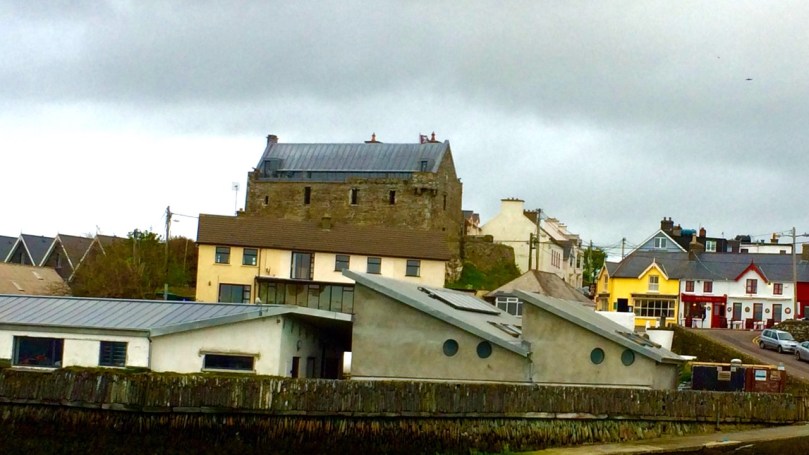
Dún na Séad or Baltimore Castle

Dún na Séad or Baltimore Castle

For a comparison of the two types of edifices, take a look at Leamanagh in Clare – here a 17th century fortified house has been literally tacked on to a 15th century tower house.
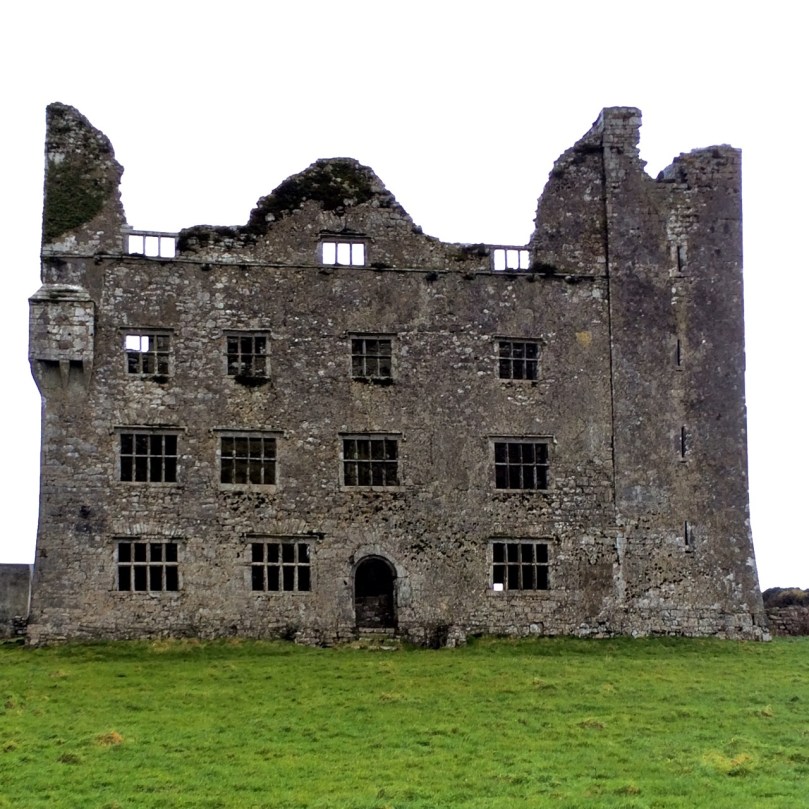
Leamanagh, in County Clare

Leamanagh, in County Clare

Joe Nunan provides useful summations of Irish fortified houses. Among other points, he says the following:

The fortified houses built in Co. Cork had a unique Irish architectural quality and a distinct southern English look and feel; the result of contacts built up between both regions, politically through plantation-immigration and economically, through trade with the port and fishing towns of Waterford, Cork, Kinsale, Youghal and Baltimore. The social changes that took place in Tudor England were reflected in architectural form by the elites in that society and it was the latter who spearheaded the Munster plantations. They were noblemen who viewed Munster as another region within a larger England and it was through these individuals that the initial architectural influence of the many gabled, oblong country manors with circular, square, rectangular and hexagonal corner-towers was introduced into Co. Cork.

Reenadisert

Reenadisert

We are lucky to have these fine examples of  fortified houses in West Cork still. However, all of them apart from Baltimore Castle are in a perilous state of dereliction.  Gearhameen’s owner has tried to stabilise the building and stave off collapse but all of them may eventually succumb to the natural ravages of time. That’s a sad thought.