What do we need for Christmas? More books! Where will we put them? We’ll figure that out later. (You know who you are.) Or are you stuck for ideas on what to get other people? Or someone has asked you for a hint on what to buy for you?
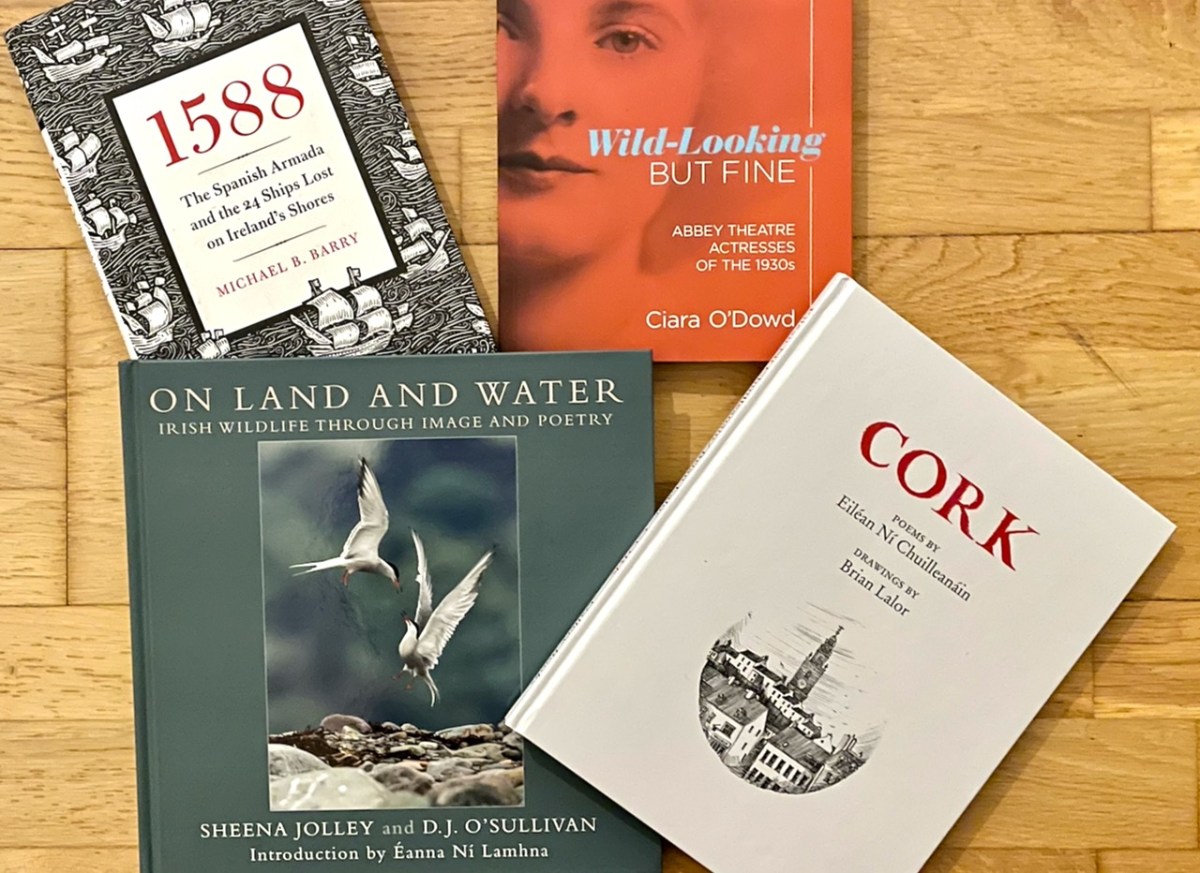
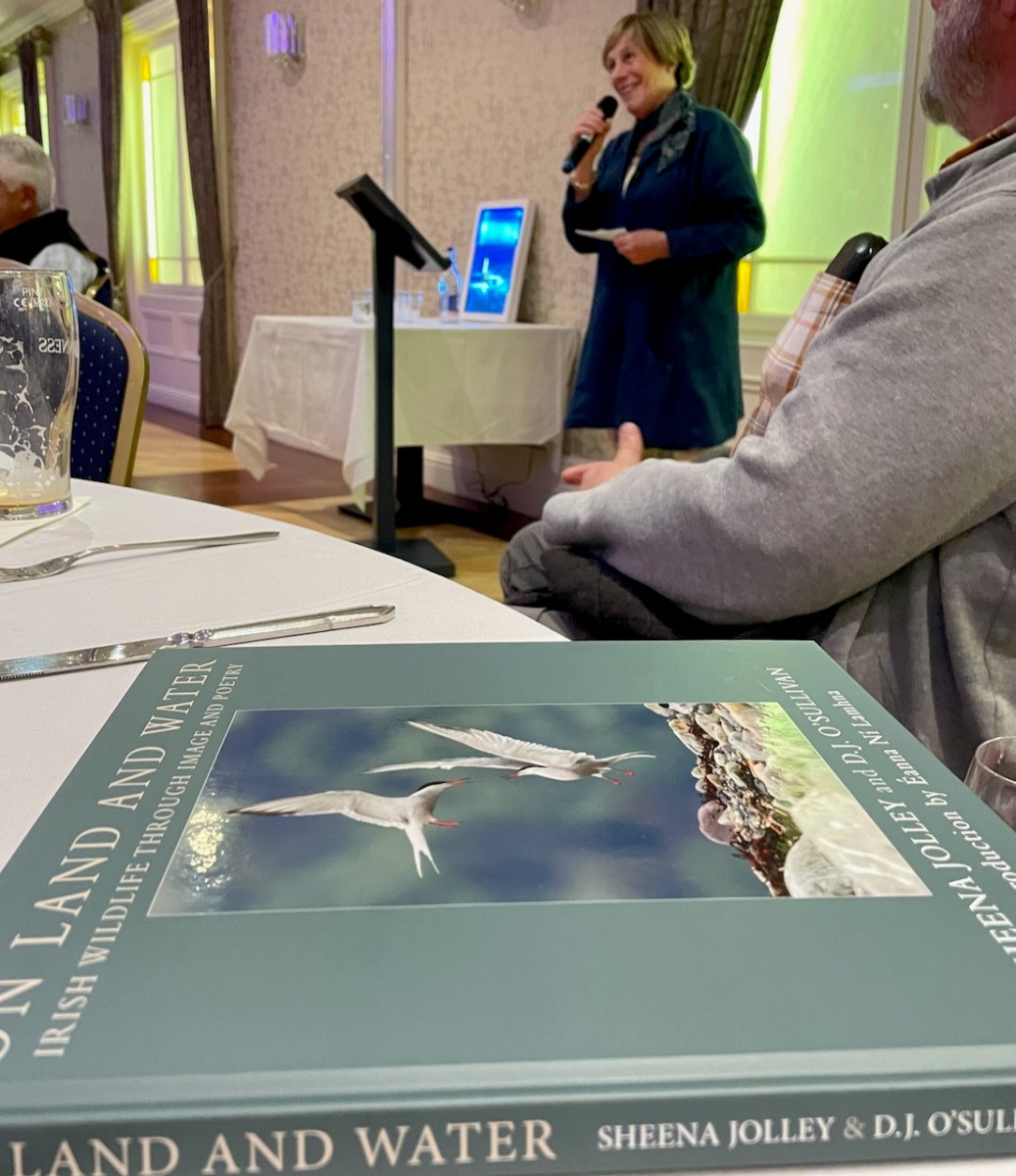
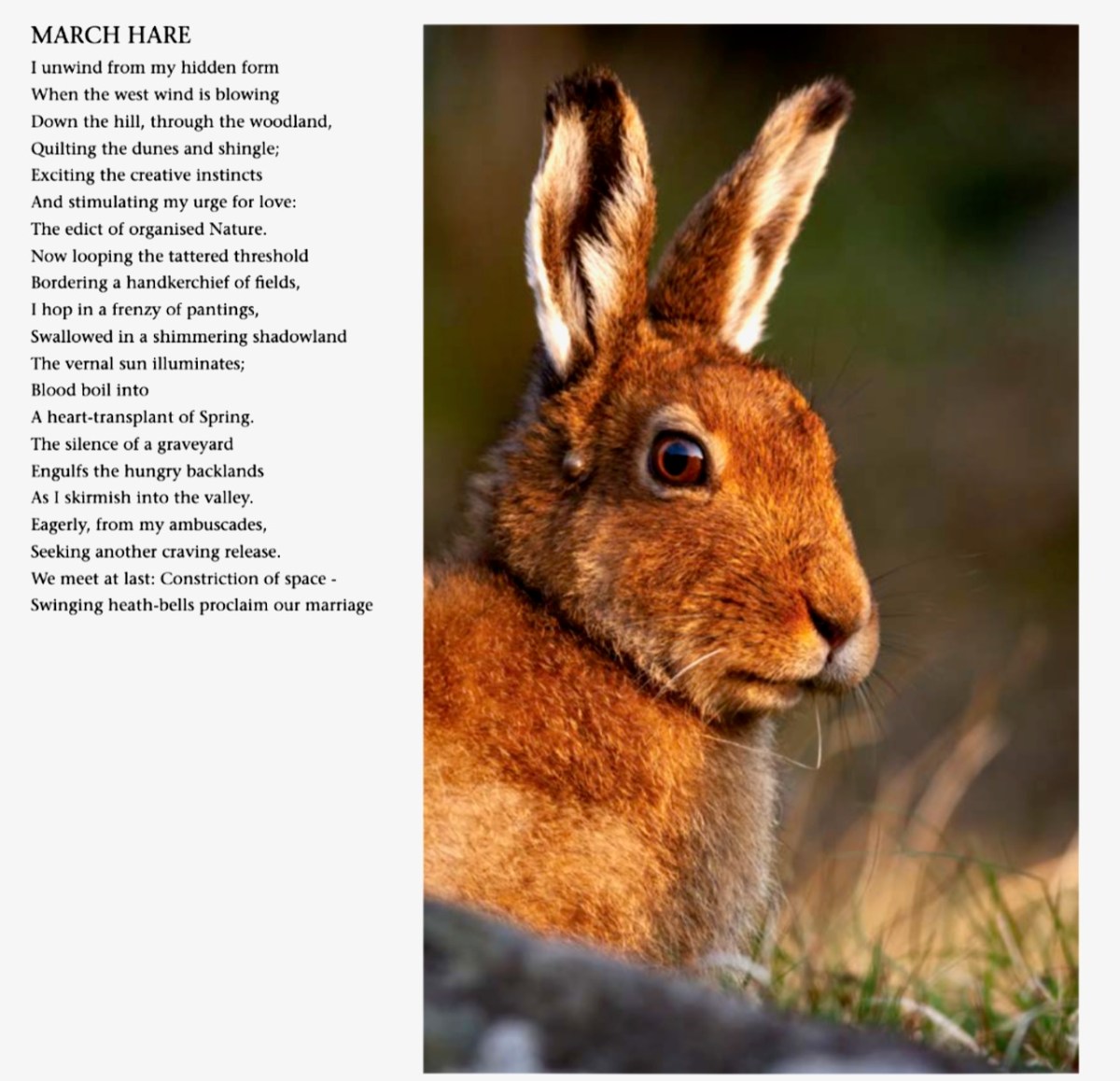
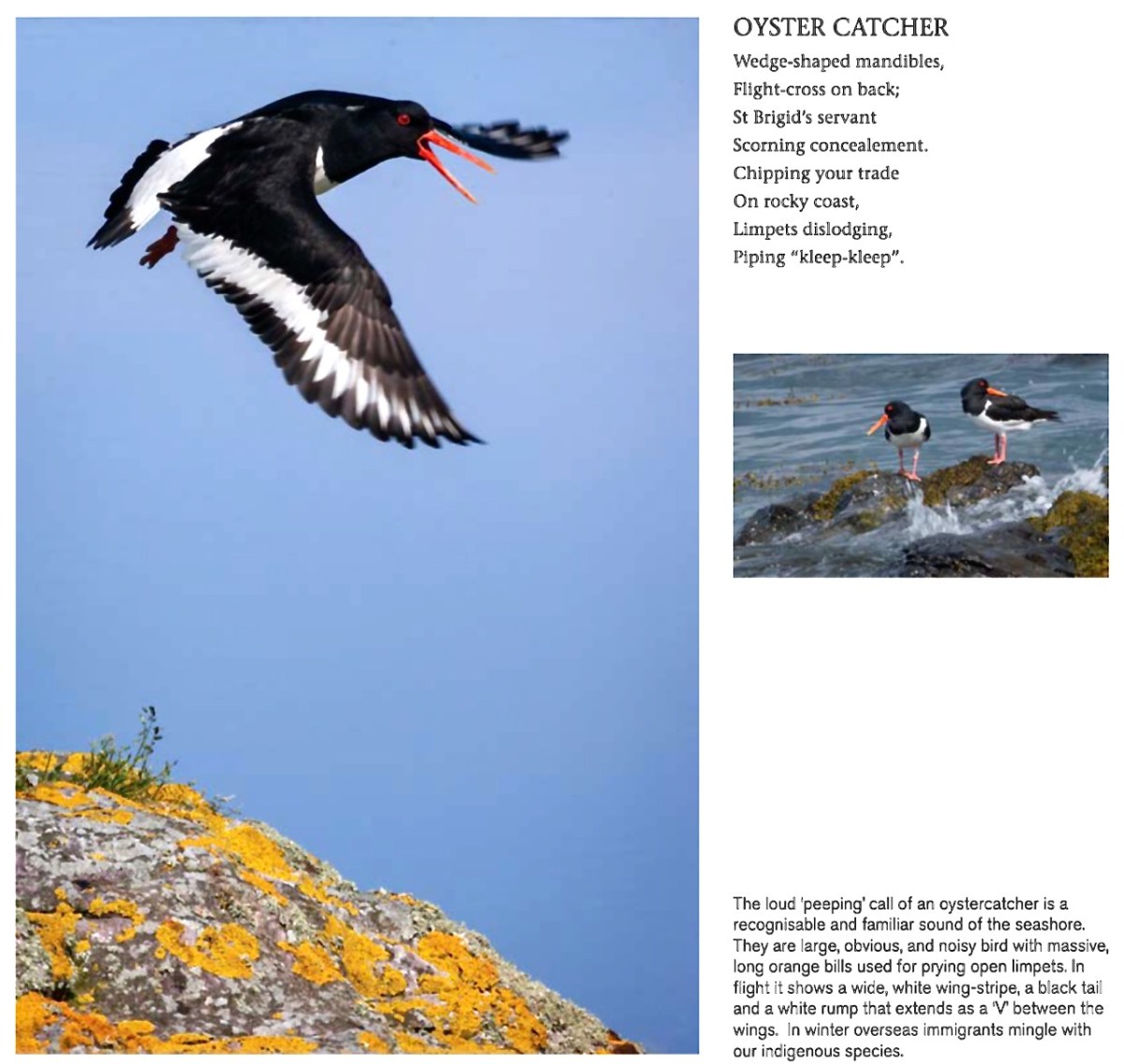
So here are my recommendations for your wish list this Christmas, and I am doing you a favour because I’m keeping it to four. I have a personal interest in all of them – but I am of course completely unbiased. The first is On Land and Water, a truly beautiful production from Menma Books (available through their website or in bookstores) that combine the poetry of lighthouse keeper DJ O’Sullivan, and the exquisite wildlife images of renowned photographer Sheena Jolley.
I cannot overstate what a lovely production this is. DJ O’Sullivan spent his life in close communion with the birds and sea-creatures of Ireland’s remotest places. He writes with the insight of one who has honed his observations skills through long hours and days.
Sheena is one of Ireland’s top wildlife photographers. At the launch in Skull we were all transfixed by her relation of what that takes – being dropped off on an uninhabited island with your equipment and food, and making the boatman promise he will remember to come back for you in a couple of days. Then getting up before dawn and being ready for that golden light when the animals stir.
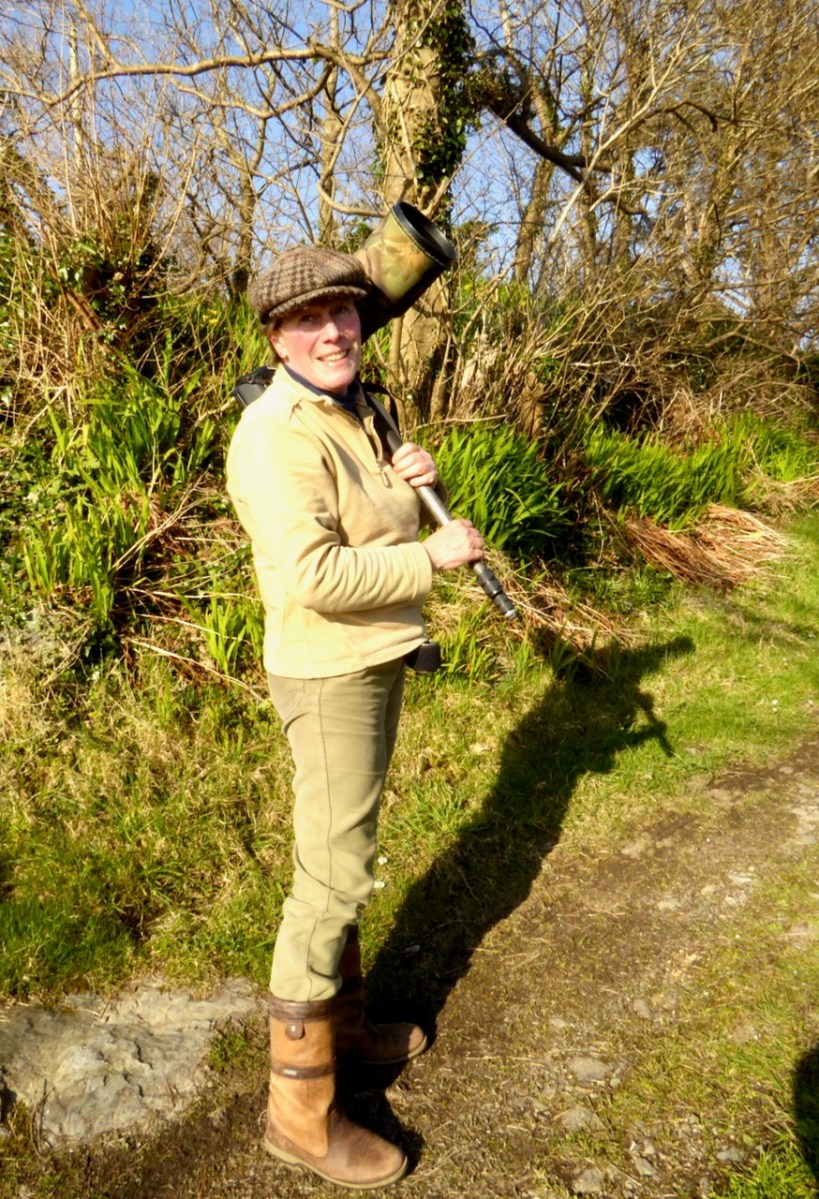
This is Sheena out to photograph some choughs
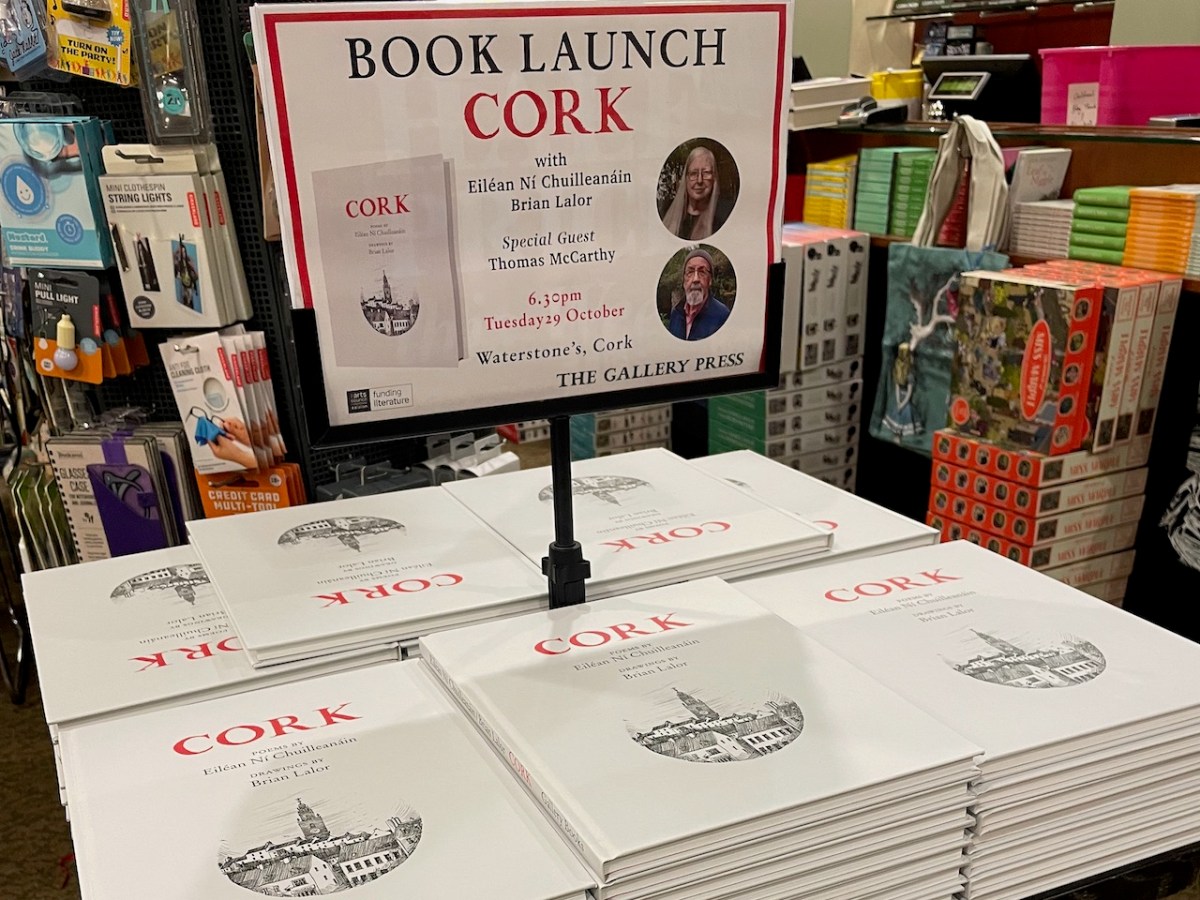
Besides the photographs, Sheena provides text that describes the creatures, their habitats and habits. This is the kind of book you will dip into over and over. And the same is true of my next choice – Cork by the artist Brian Lalor and the poet Eiléan Ní Chuilleanáin.
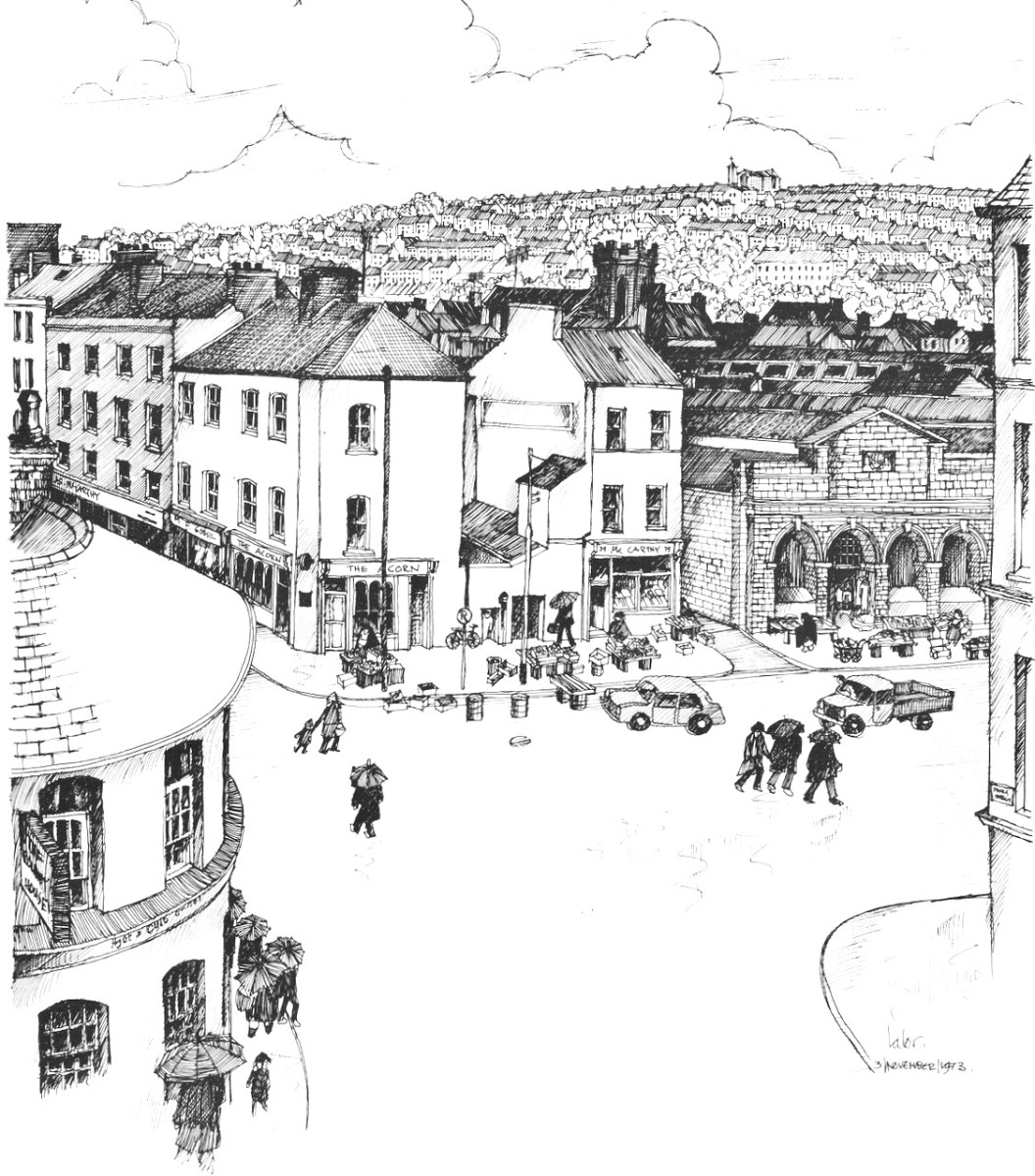
I have written about this book before – four years ago, in a two-part post titled Cork, Part 1: Brian Lalor and Cork, Part 2: Eiléan Ní Chuilleanáin. At that time, I was writing about a treasured gift given to me by my parents in the 70s – the amazing news is that 50 years later the book has been re-issued! It was launched (re-launched!), in a revised edition, in Waterstones in Cork at the end of October. Both Brian and Eiléan were there!
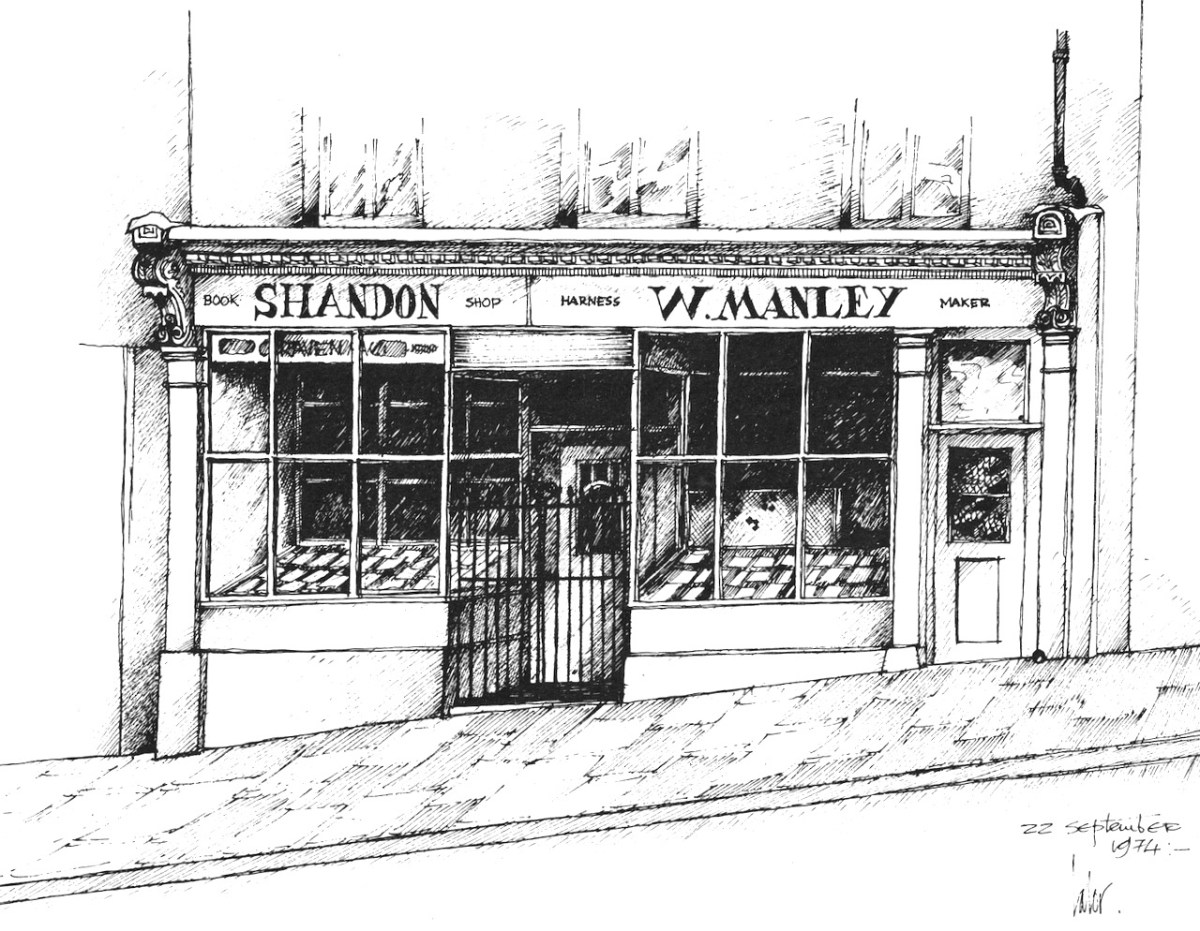
Take a look at the two posts above for a real flavour of what this book is all about. If you have ever lived in Cork, or even if you’ve visited, this is the book for you.
Wild Looking But Fine, by Ciara O’Dowd is my next recommendation. You might remember my post about Ciara and the chocolate box of letters between my mother, Lilian Robert Finlay, and other people associated with the Abbey Theatre. Eight years, and one child, later, Ciara’s book is finished and my brother and I attended the launch in Dublin. Ciara’s account of how difficult it was for women in 1930s Ireland to forge a professional and autonomous life is riveting. In her review of the book in Books Ireland, Jane Brennan asks, Why don’t we know more about their lives and achievements? Why, for example, is Ria Mooney not more widely remembered as the renaissance woman she was? Why had I never before heard of Aideen O’Connor (but am well acquainted with the name and reputation of her husband Arthur Shields)?
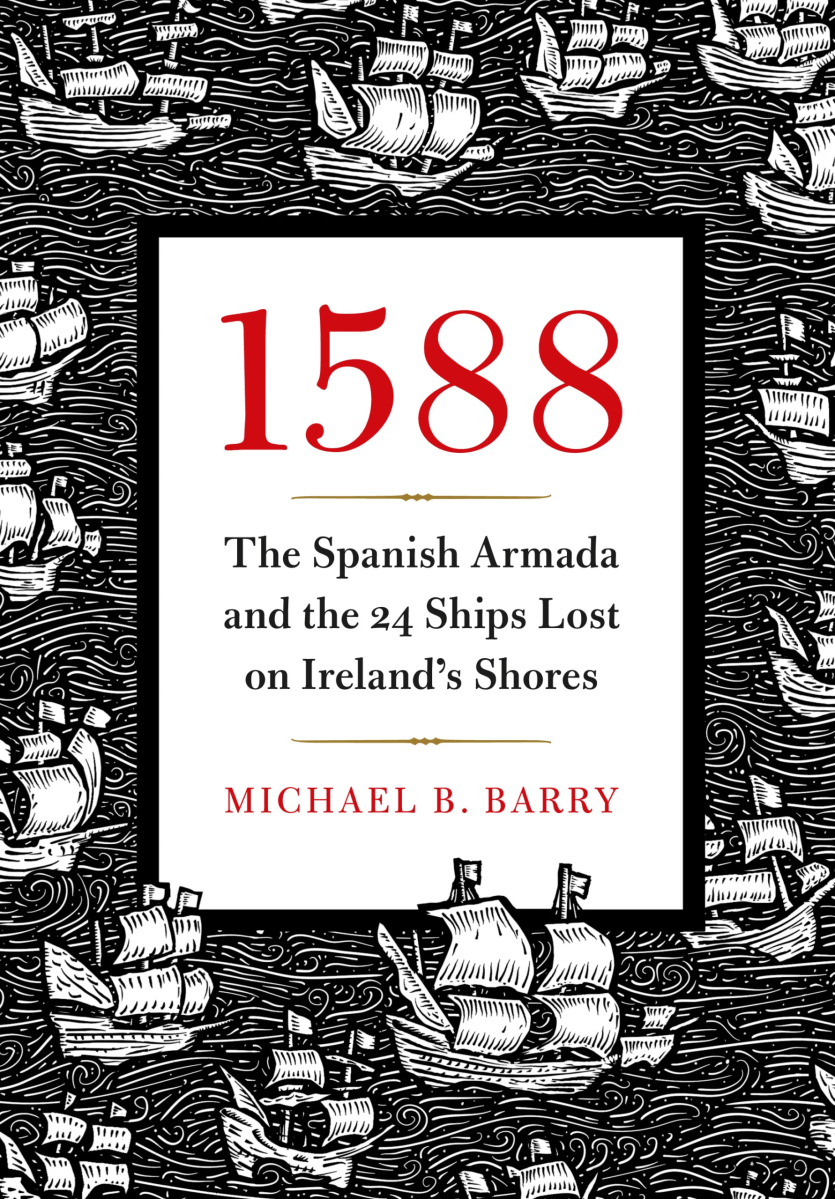
The thing is, the story of the Spanish Armada was taught to us through an English lens. Prepare to have everything you thought you knew questioned and turned on its head. That’s because Michael has done his research in Spanish and Irish sources and, as is his wont, (see this post from eight years ago about his books) the book is profusely illustrated with lots of images sourced from unusual archives as well as his own fine photography.
The books are all available from their publishers or in all fine bookshops. You can think me in the New Year, once your loved ones have taken the hint and bought you one or all of the above.
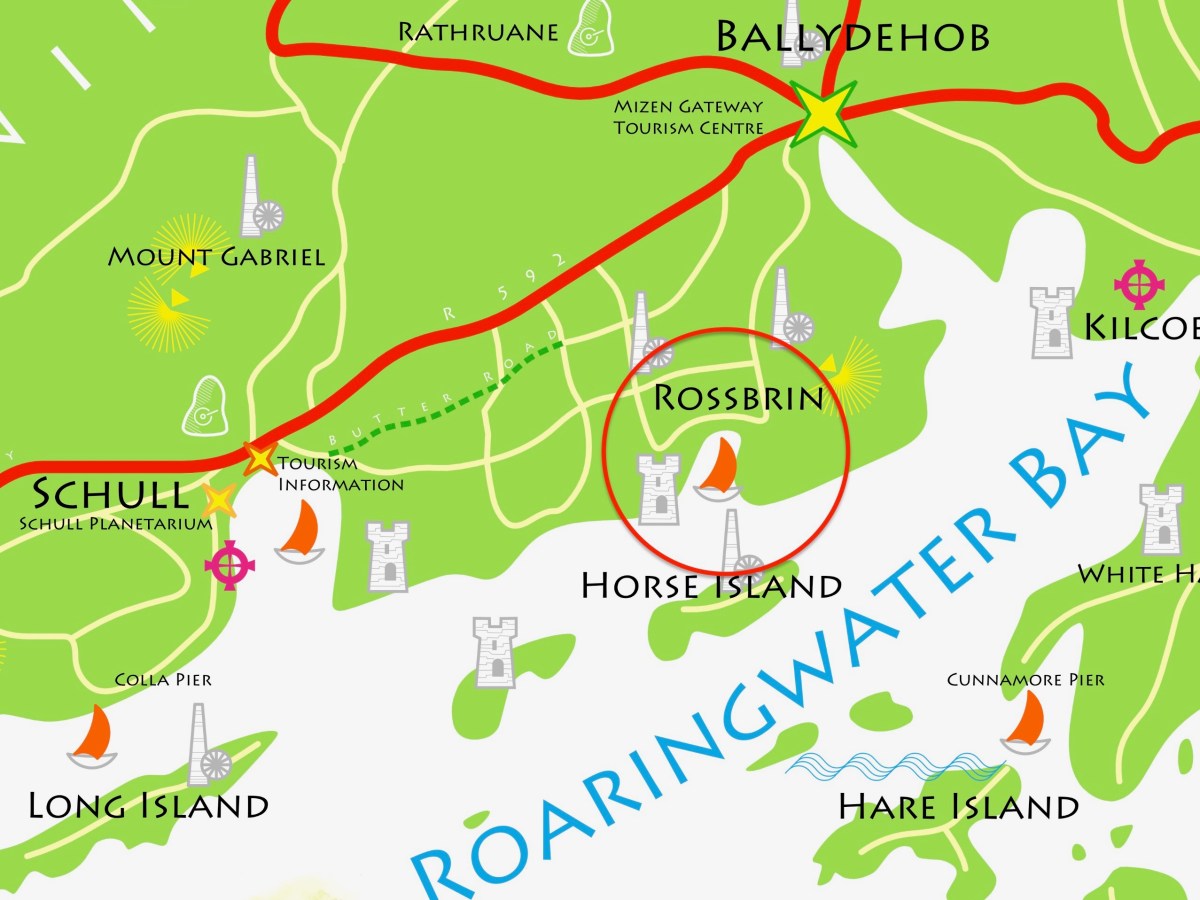
The weather so far this year is breaking records for coldness, wetness and evapotranspiration – while Earth as a whole continues to get warmer. In simple terms that means it’s not pleasant to wander too far from home. I decided to walk down to the shoreline of Rossbrin Cove – all of ten minutes – and see what the winter storms may have washed up: often an interesting diversion.
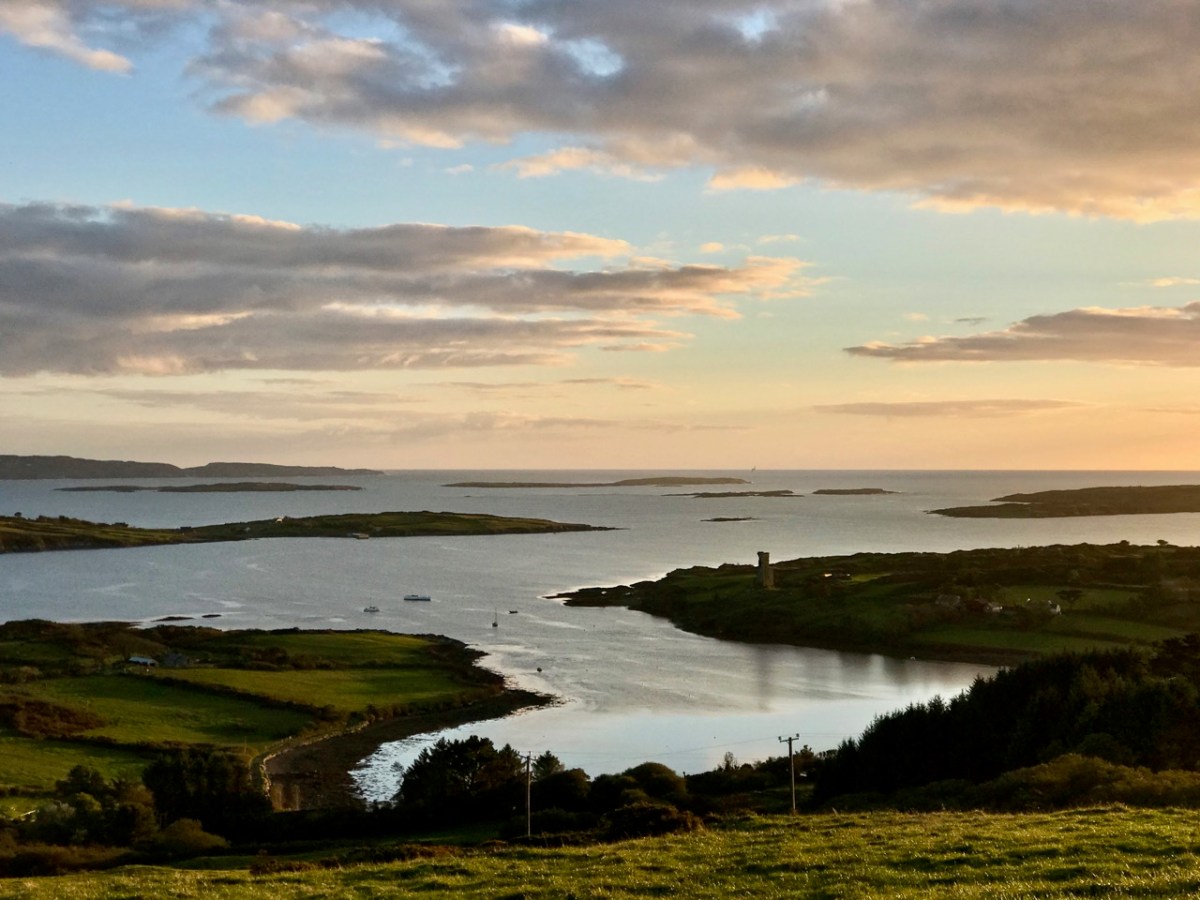
Above: looking down on Rossbrin Cove with some of the islands of Roaringwater Bay beyond. It is a natural harbour, and there is a thriving boatyard at the western end of it. The difference between low and high tides is around 2.5 metres on average, and much of the inlet dries out when it is at an extreme low. I timed my walk to arrive when the tide was fully down, as I wanted to explore the exposed mud-flats, with hopes of finding intriguing detritus.
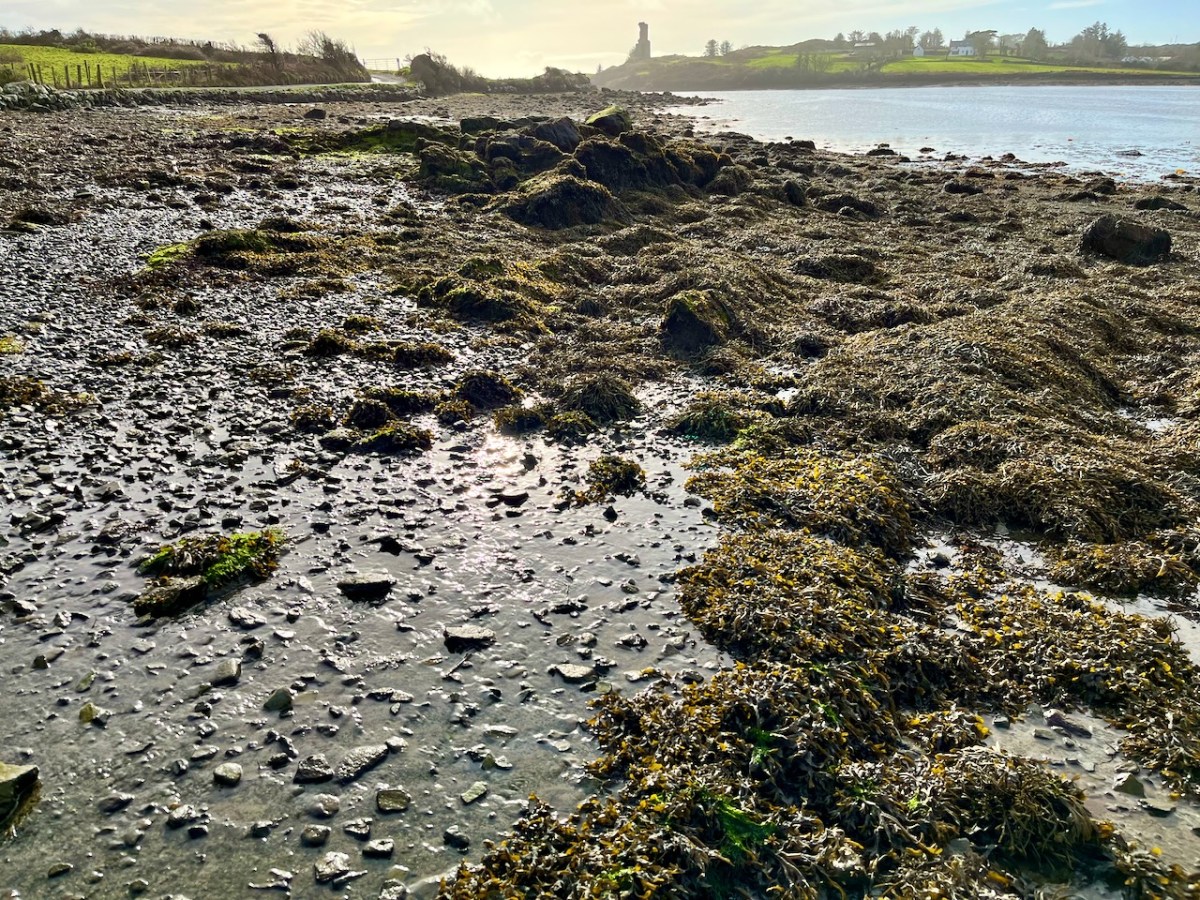
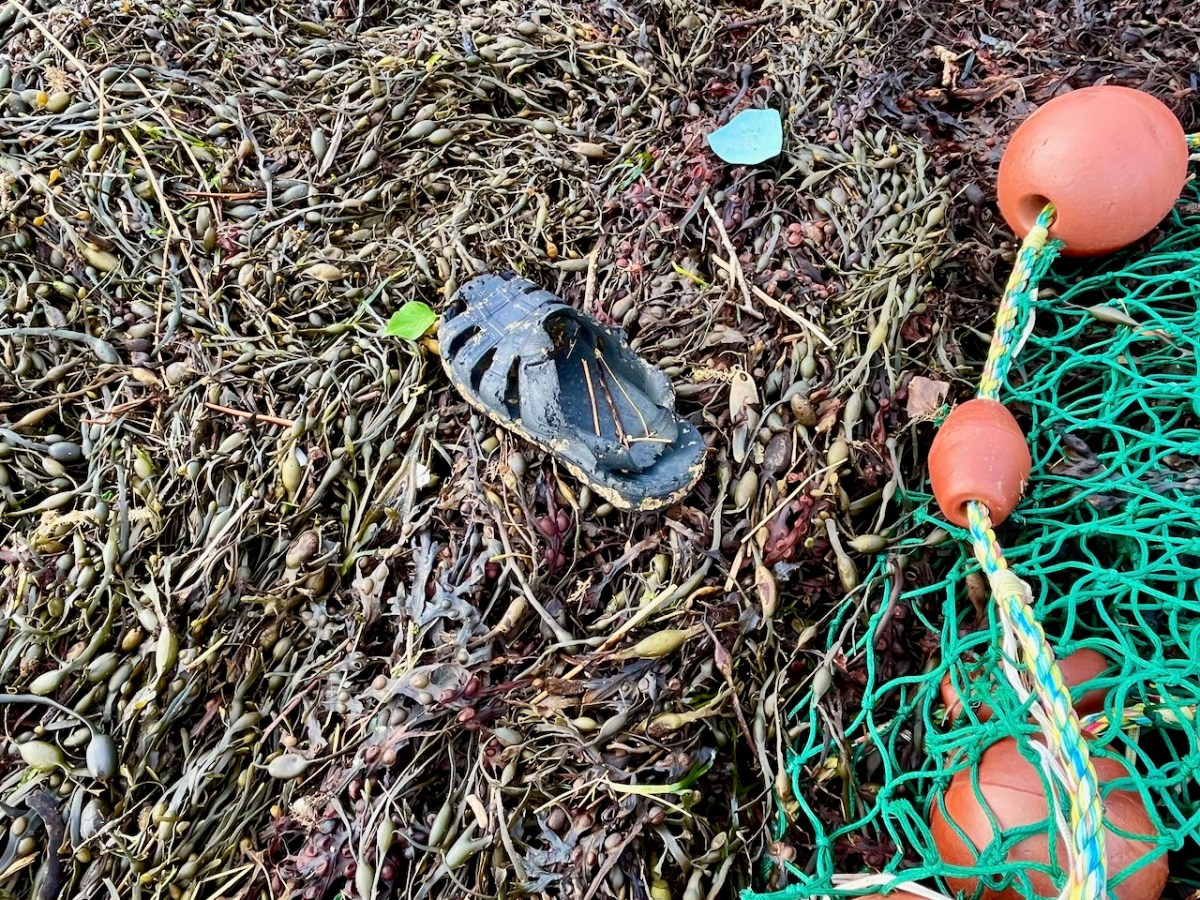
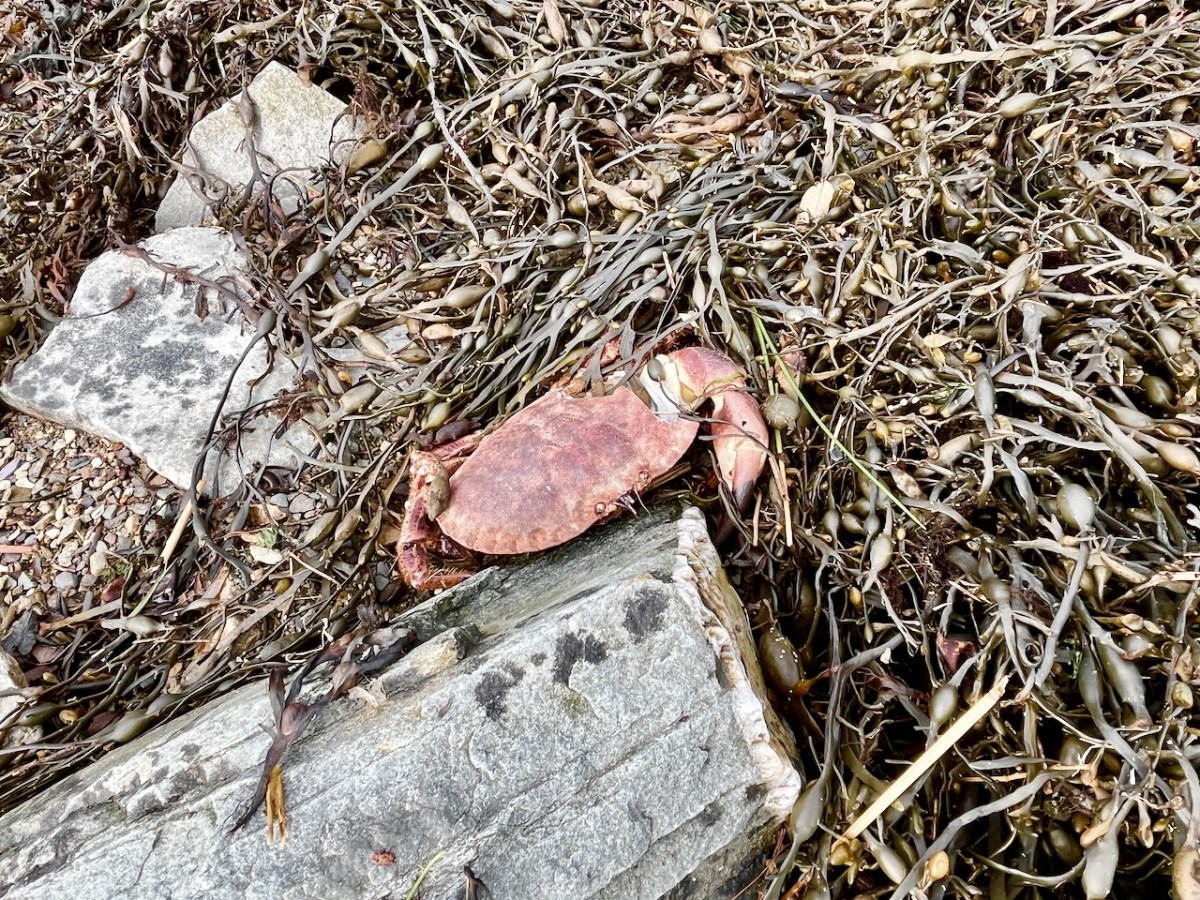
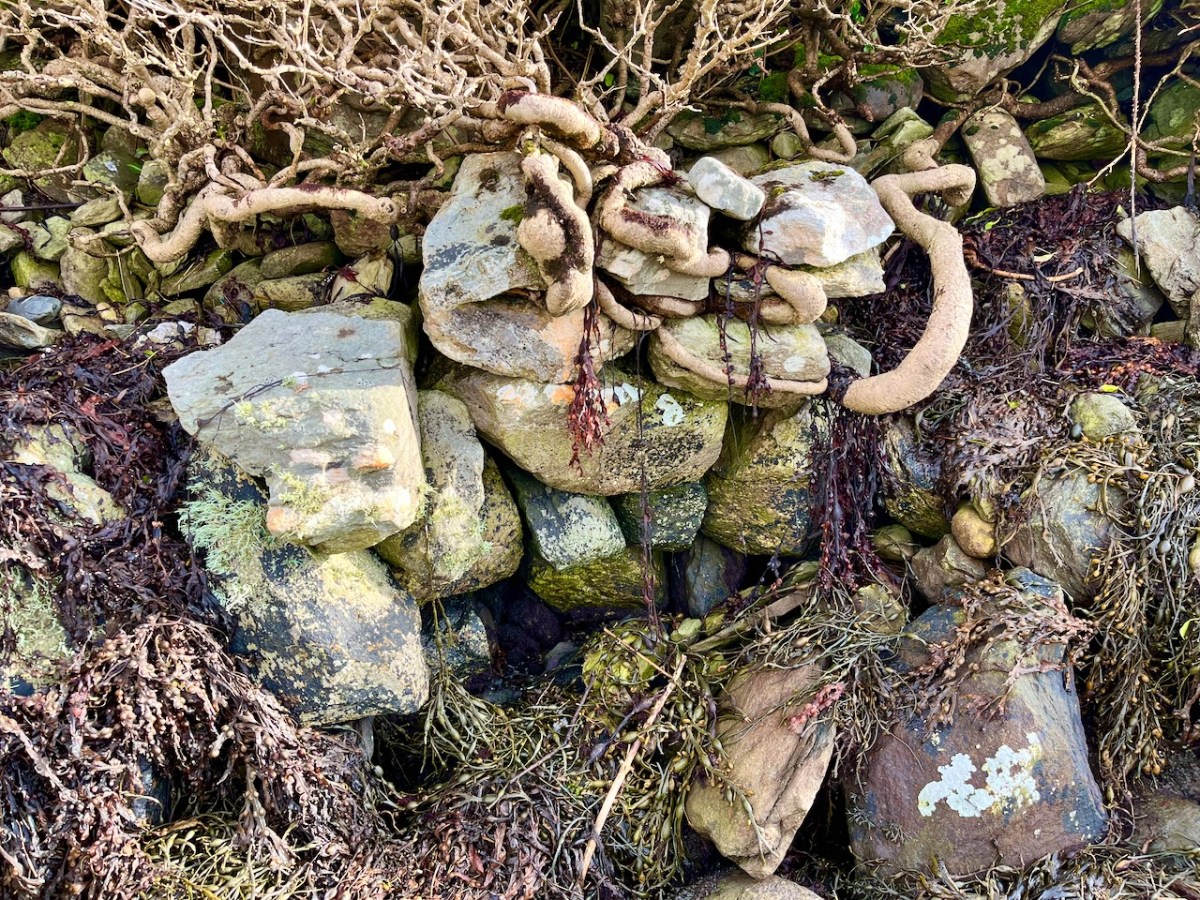
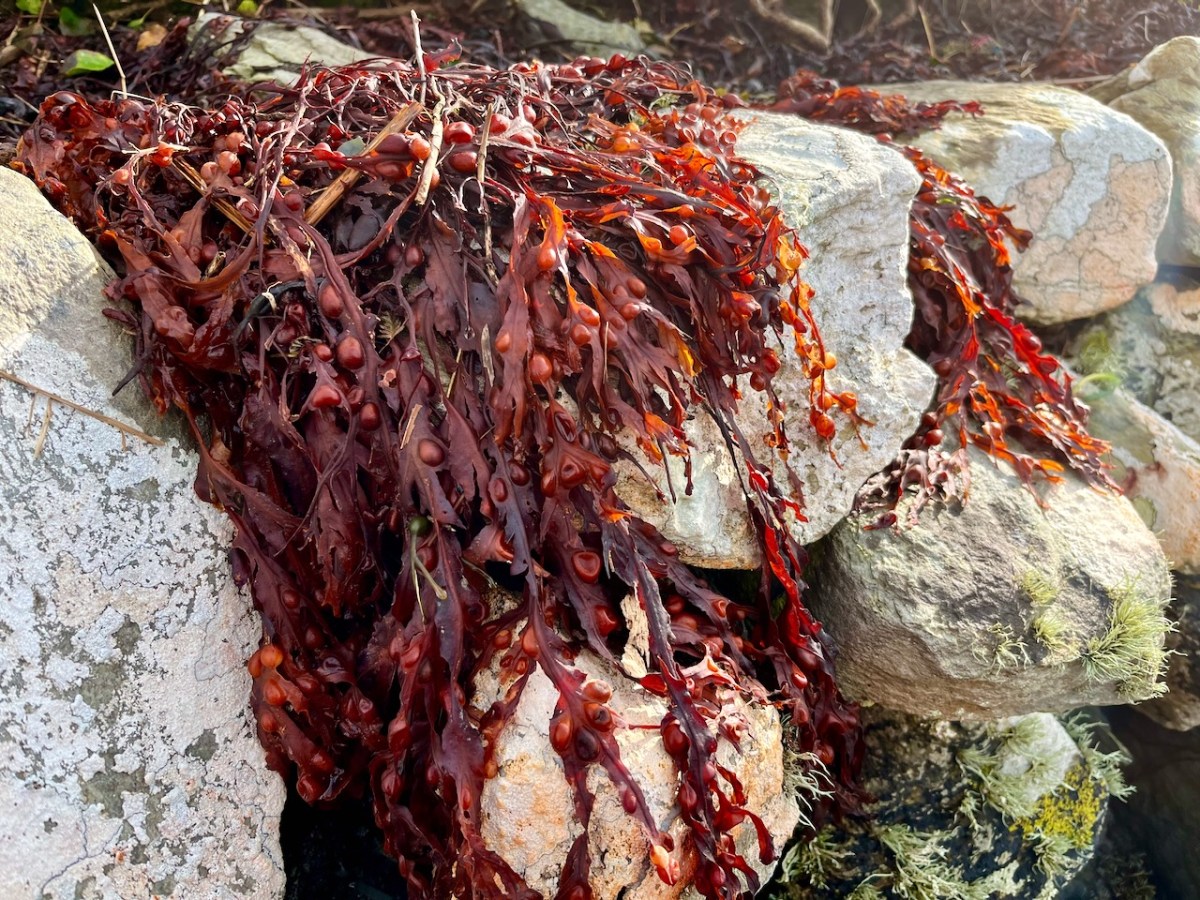
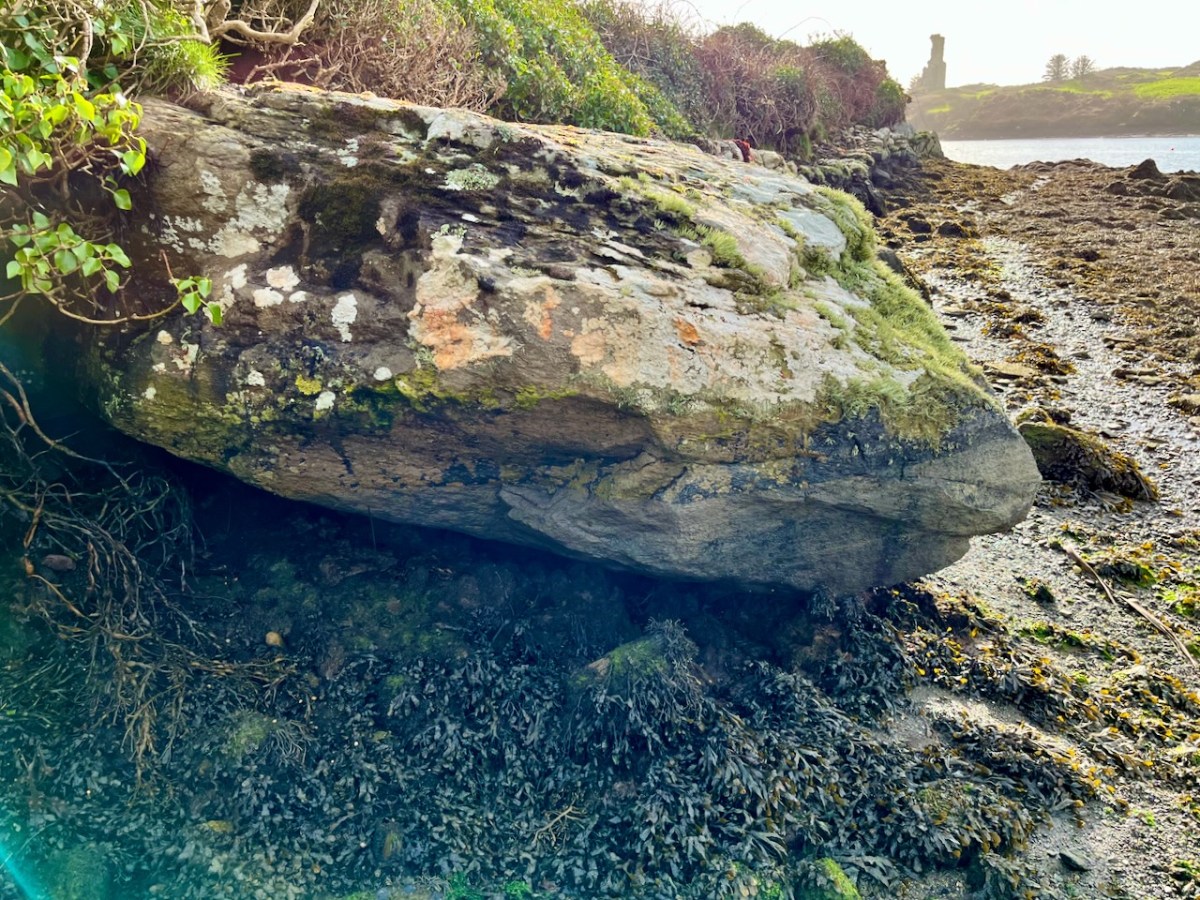
Not an inspiring start! In fact, as I continued my review, I noted that there was very little other than the natural environment – weather-worn boulders, skeletal shells and masses of seaweed – to disturb the order of things in Rossbrin on this February day. If our harsh storms had been of some positive effect it was perhaps to flush out any washed-up debris that might have accumulated in the winter – being now past St Brigid’s Day I consider it appropriate to call the season spring.
No matter that the exploration was superficially disappointing, the magic of this little bit of West Cork soon took over, and my mind was filled with the enormity of its history. There was a university here in medieval times: manuscripts were written here in the castle that has become a crumbling pile. Ravens and seabirds now rule over the stronghold. I walked on.
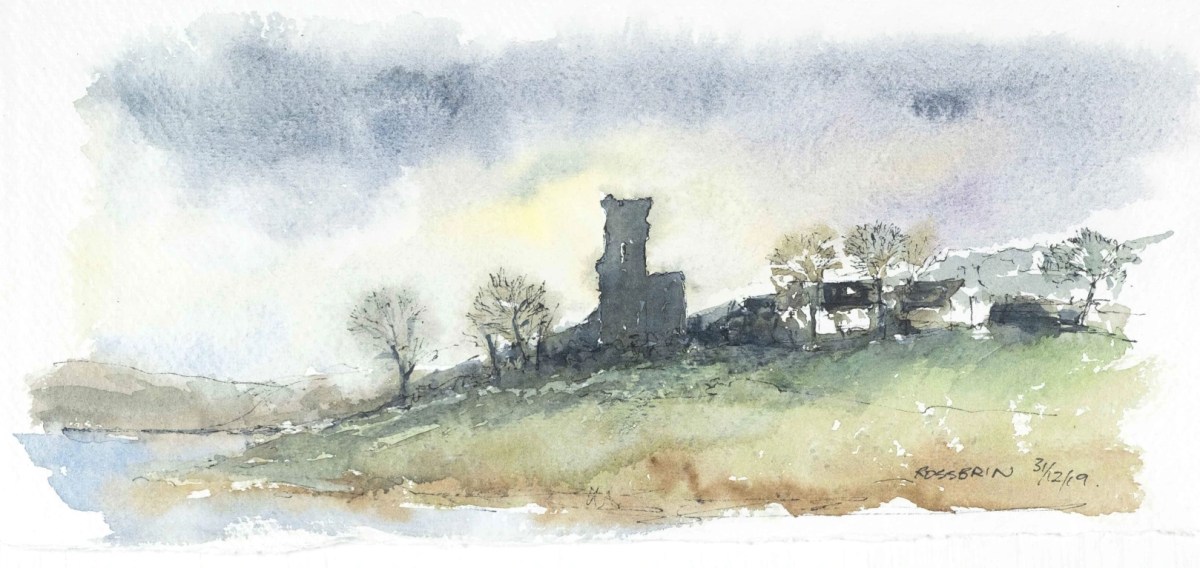
The margins of the cove are lined with ancient banks. At every turn there is a composition which a maestro could frame: I make do with a camera. Rossbrin inspired our artist friend Peter Clarke . . . Thank you, Peter!
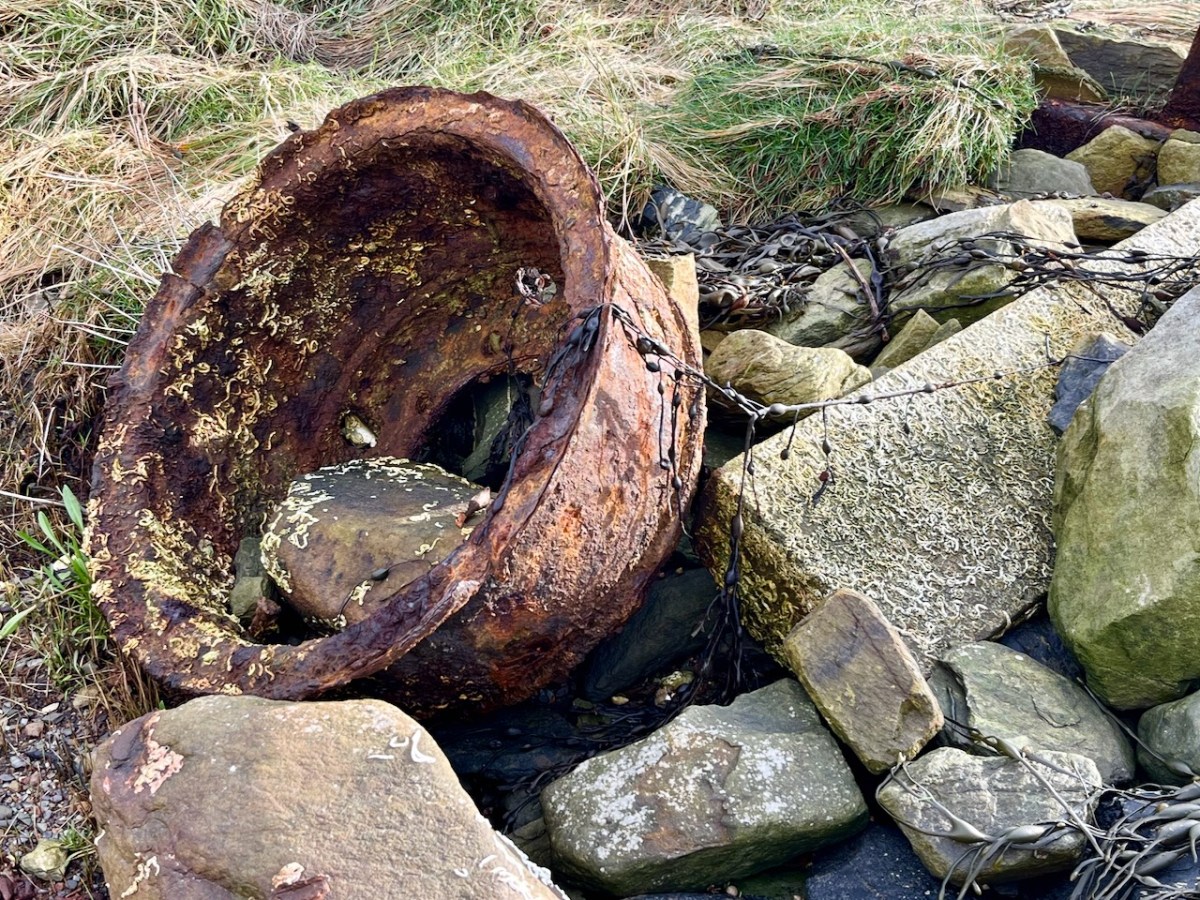
Evidence of more recent history: possibly a pot which was used in the process of tarring a clinker boat hull. No doubt vessels were built on these shores – and used to make basic livings. There is still fishing activity in and around the cove; mussel beds thrive in Roaringwater Bay; seaweed collection happens also. In summer months the deeper waters of Rossbrin are occupied by leisure orientated sailing craft. I enjoy the calm days of winter when there is hardly anything on the water. I watched a small flock of oystercatchers scurrying and foraging with their brilliant beaks, and then I turned for home.
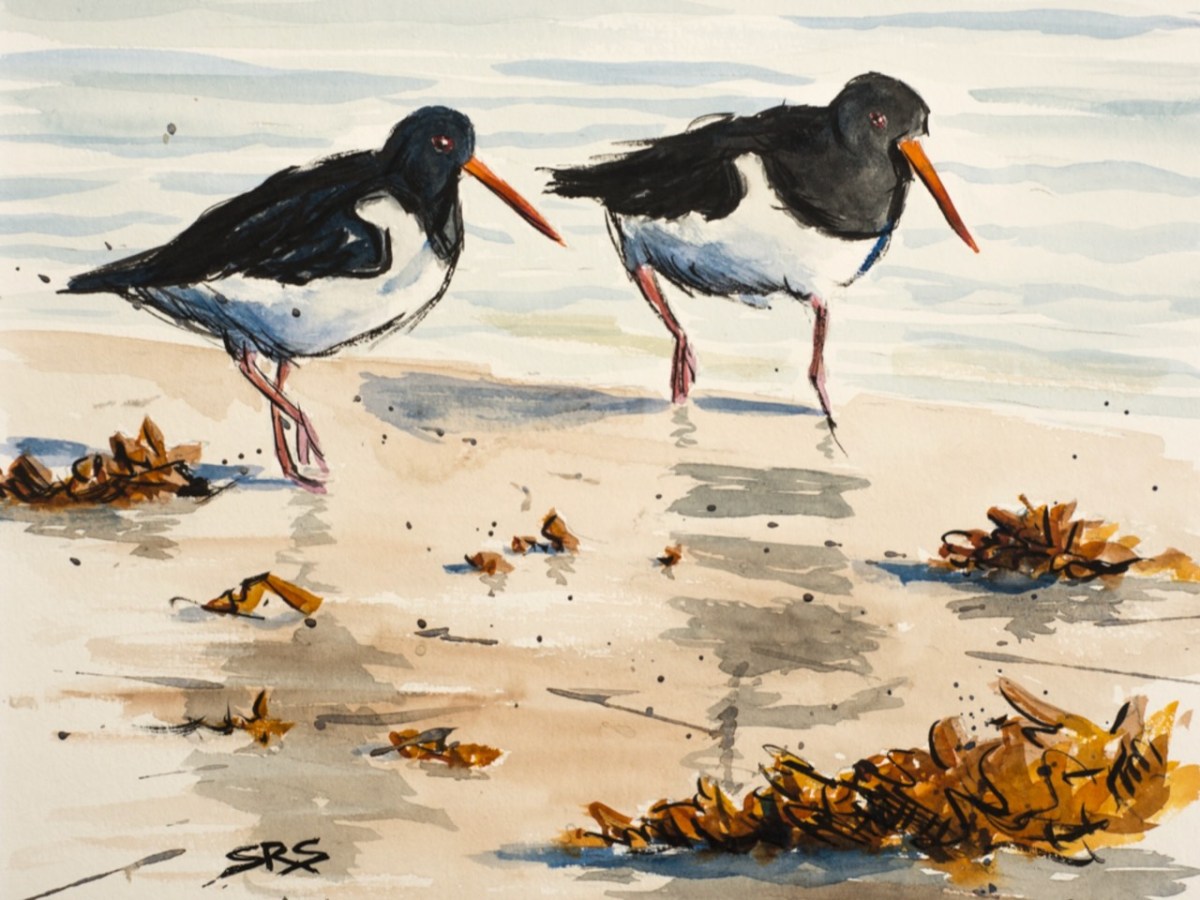
The Rossbrin oystercatchers were uncooperative, and wouldn’t let me photograph them. Instead I have imported this wonderfully atmospheric painting by Cornish based artist Steve Sherris. Thank you, Steve
We have posted extensively about Rossbrin Cove, its history and its people. Have a look at these:
It was a big day in Ballvourney yesterday: the public unveiling of two replicas of the 800 year old wooden figure that has been central to observances of St Gobnait on her day for as long as anyone can remember – we must be talking centuries! If you are not familiar with St Gobnait – or her celebrations – read my post here.
It’s actually St Gobnait’s Day today: the eleventh of February. As I write this, the congregation in the saint’s church will be venerating the 13th century wooden figure by ‘measuring’ her with ribbons. But also, for the first time, they will be able to view the two copies of that figure which have been made over the last few months. That exercise has been undertaken so that the figure itself could be fully studied because it is of great historical interest. There are other medieval carved wooden figures of saints surviving elsewhere in Ireland, but this is the only one that is still in regular active use.
. . . A medieval wooden image of Gobnait, kept traditionally in a drawer in the church during the year, is venerated in the parish church on this day. The devotion is known as the tomhas Gobnatan . People bring a ribbon with them and ‘measure’ the statue from top to bottom and around its circumference. This ribbon is then brought home and is used when people get sick or for some special blessing. The statue is thought to belong to the 13th c. A second pattern in honour of Gobnait was traditionally celebrated in Baile Bhúirne at Whit . . .
The above citation is taken from The Diocese of Kerry website, which sets out a comprehensive review of the saint and the activities which honour her. Here’s the measuring taking place a few years ago:
National Heritage Week 2023 explains the purpose of the project to replicate the carving:
. . . As patron saint of the parish, the statue provides a tangible link to the saint but importantly represents the long-standing living devotion to Gobnait. The wooden figure carved out of oak clearly depicts a female monastic. It was guarded over the centuries by the O’Herlihy clan, who were the ruling Gaelic lords of the Ballyvourney area during the medieval and late-medieval periods. It remained in the safe-keeping of members of the O’Herlihy family until they handed it over to the local parish priest in the late-19th century and it has been protected and kept secure by the Ballyvourney Church Committee ever since. The 3D project will comprise the digital scanning of the statue which in turn will enable a 3D generated wooden print out. A second replica will be hand carved as an integrative representation of how the statue would have looked originally before the centuries aged and tarnished it. The replicas will then be placed permanently on display in the Parish Church with information signage . . .
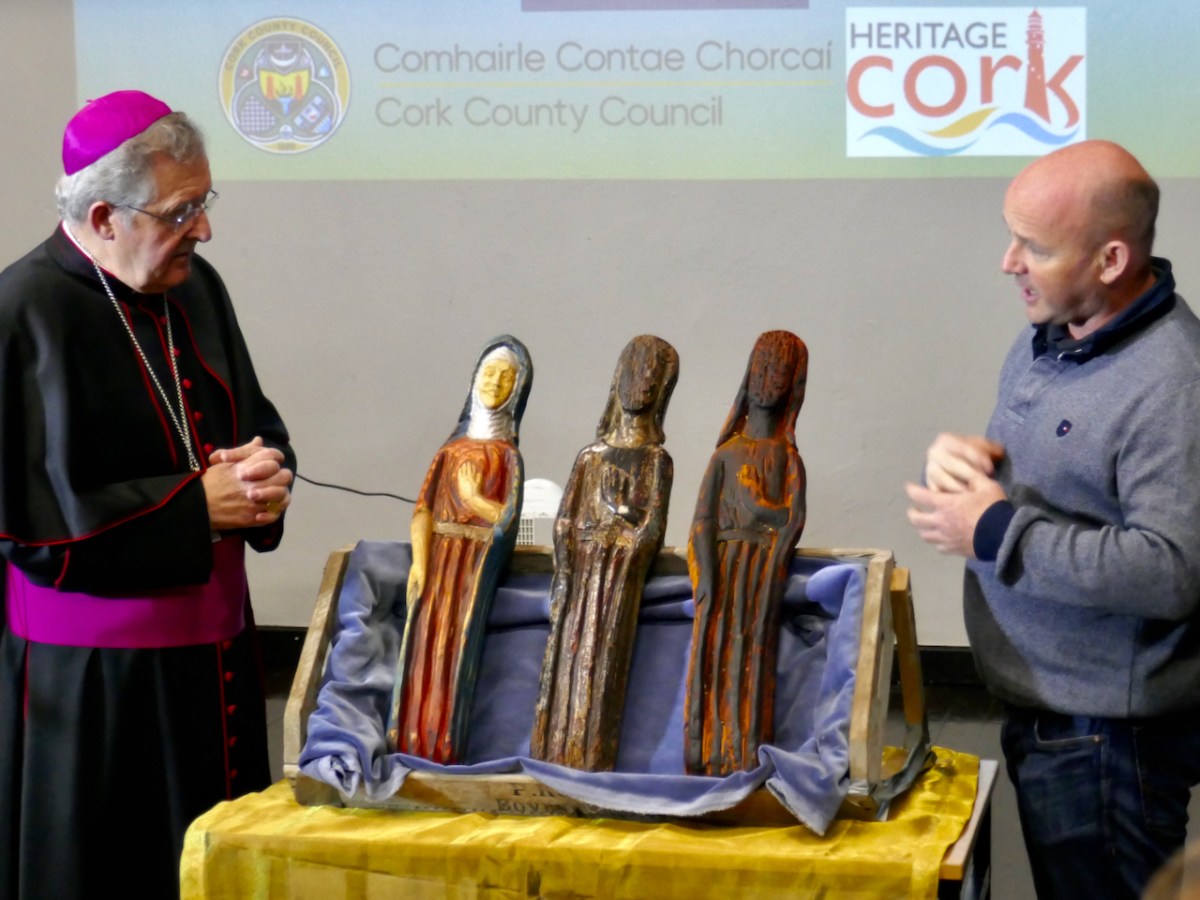
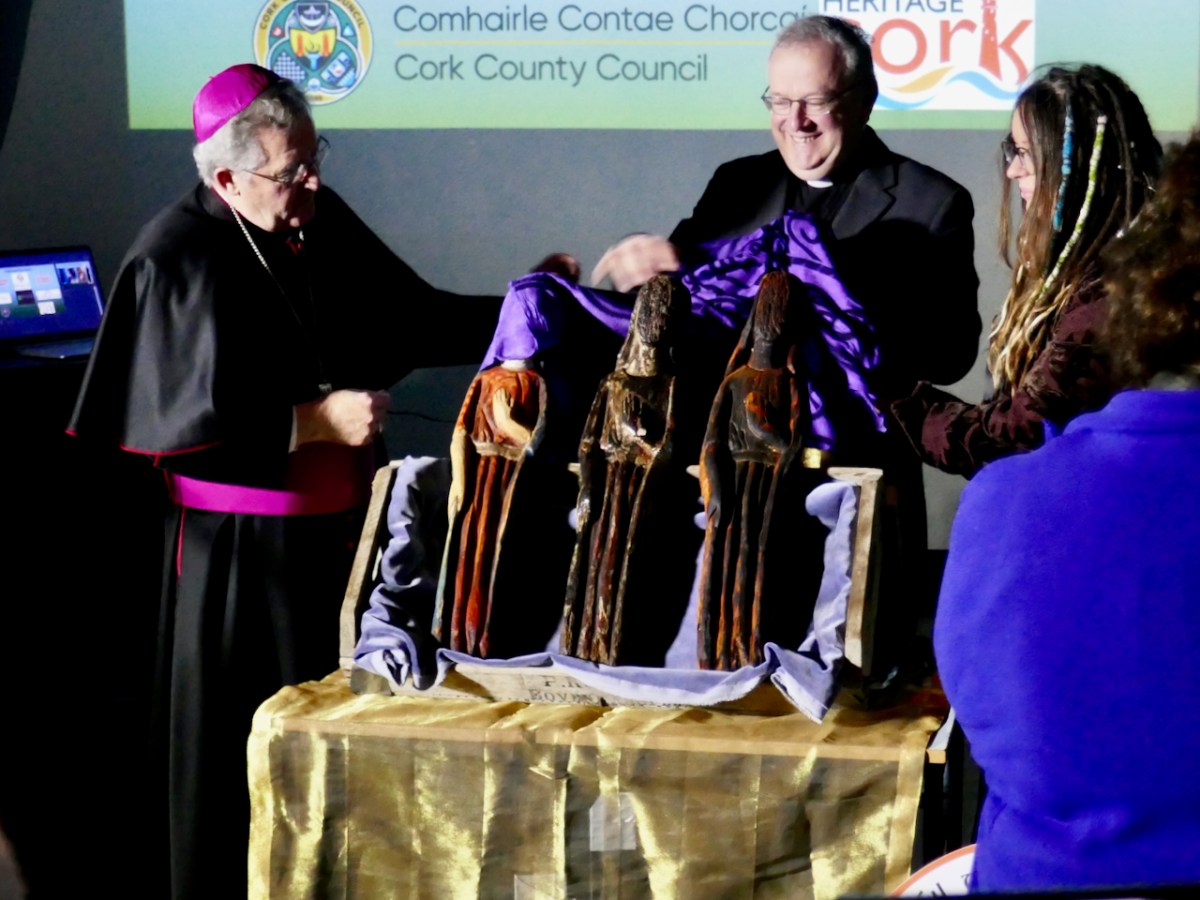
Above is a view of the original carving (in the centre) with the replica of that on the right. On the left is the ‘integrative representation’ – that is the carver’s interpretation of what the figure might have looked like when she first saw the light of day in the 1300s. On the left is Bishop William Crean – Bishop of Cloyne since 2013: he presided over the unveiling of the two replicas yesterday. On the right is John Hayes, of Special Branch Carvers in Fenor, Co Waterford. He was responsible for the carving project and has made an excellent job!
John gave us a presentation yesterday, after the unveiling ceremony, and we learned how he closely examined the original statue, taking detailed measurements and a full photographic survey. This enabled a Sketchfab 3D rendering to be produced: this became the basis for his work. During the examination he was able to find traces of paint, which enabled him to render the interpretative version with – very likely – a high degree of fidelity to the original.
I got the chance to talk to John and ask him about the timbers used for the original and the replicas. The original is of oak, and we don’t have a way of knowing where this came from. The replicas are of ash: this is a good material for stability and longevity. John had access to a good source of seasoned wood.
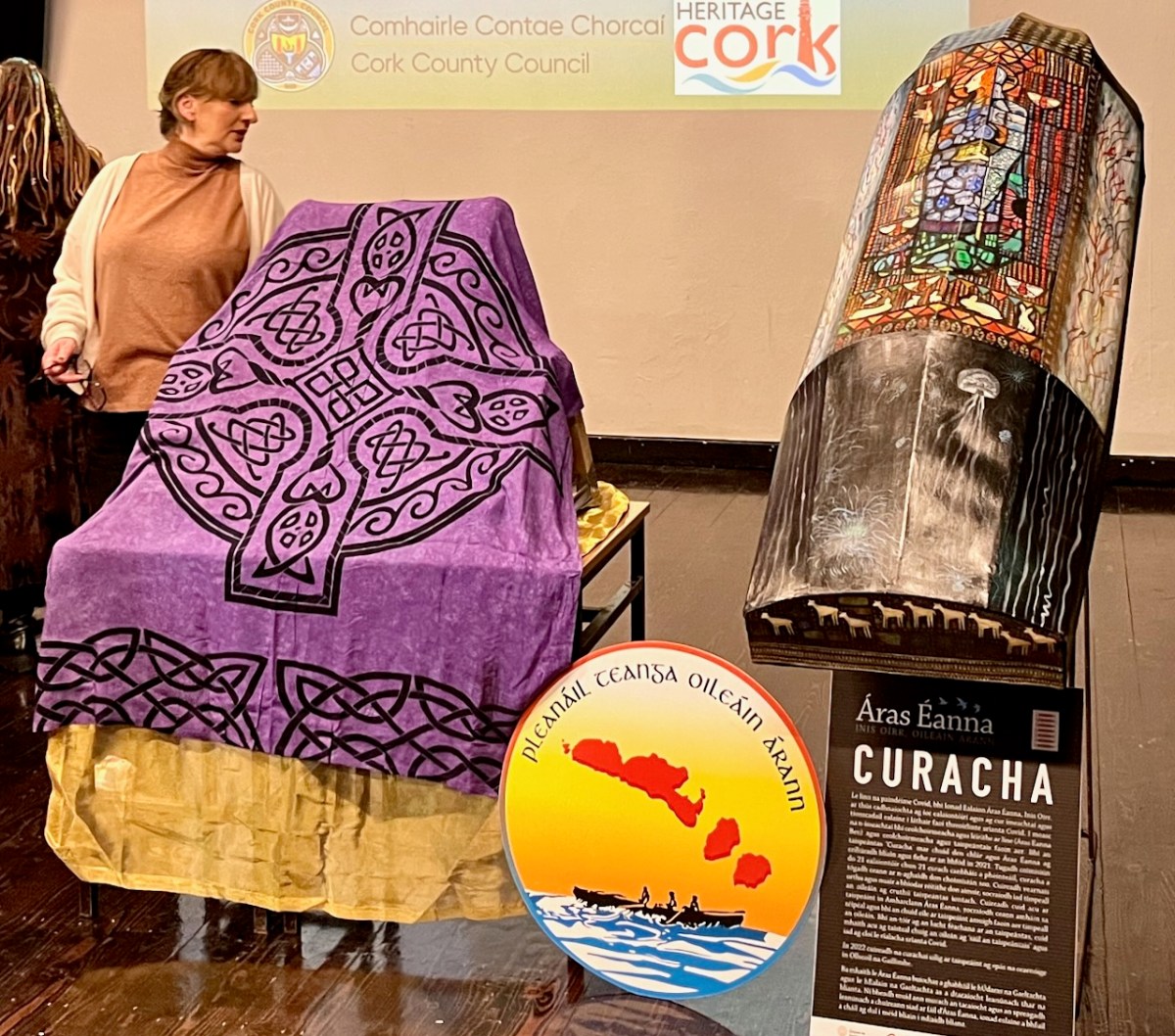
The day was a study day for St Gobnait, and encompassed a whole lot more than the unveiling of the replicas (they are waiting under the cloth- above – to be revealed)! Note the currach in the pic also: that’s another project – to establish a Camino tracing the route which Gobnait took as she travelled around Ireland from the Co Galway Aran Island of Inisheer, having been told by an angel that her life would be fulfilled when she saw nine white deer. She spent time in Dun Chaoin and Kilgobinet in Kerry, Ballyagran in Limerick, Kilgobinet in Waterford, and Abbeyswell and Clondrohid in Cork, before finally finding the deer in Ballyvourney. You can see those deer on the stern of the currach, above. There are at least eight holy wells in Ireland dedicated to the saint. Amanda has written extensively about Gobnait’s travels and – of course – about her wells.
There was also an excellent series of talks about Gobnait. Events took place in Ionad Cultúrtha an Dochtúir Ó Loinsigh, which is a great facility in the community. Here we are – together with our good friends Peter and Amanda (you have met them frequently on the pages of this Journal), - waiting for proceedings to begin:
This is the moment of unveiling: the Bishop is accompanied by the Parish Priest – Very Reverend John McCarthy SP – and archaeologist Dr Connie Kelleher, National Monuments Service: she has played a significant role in this Ballyvourney project.
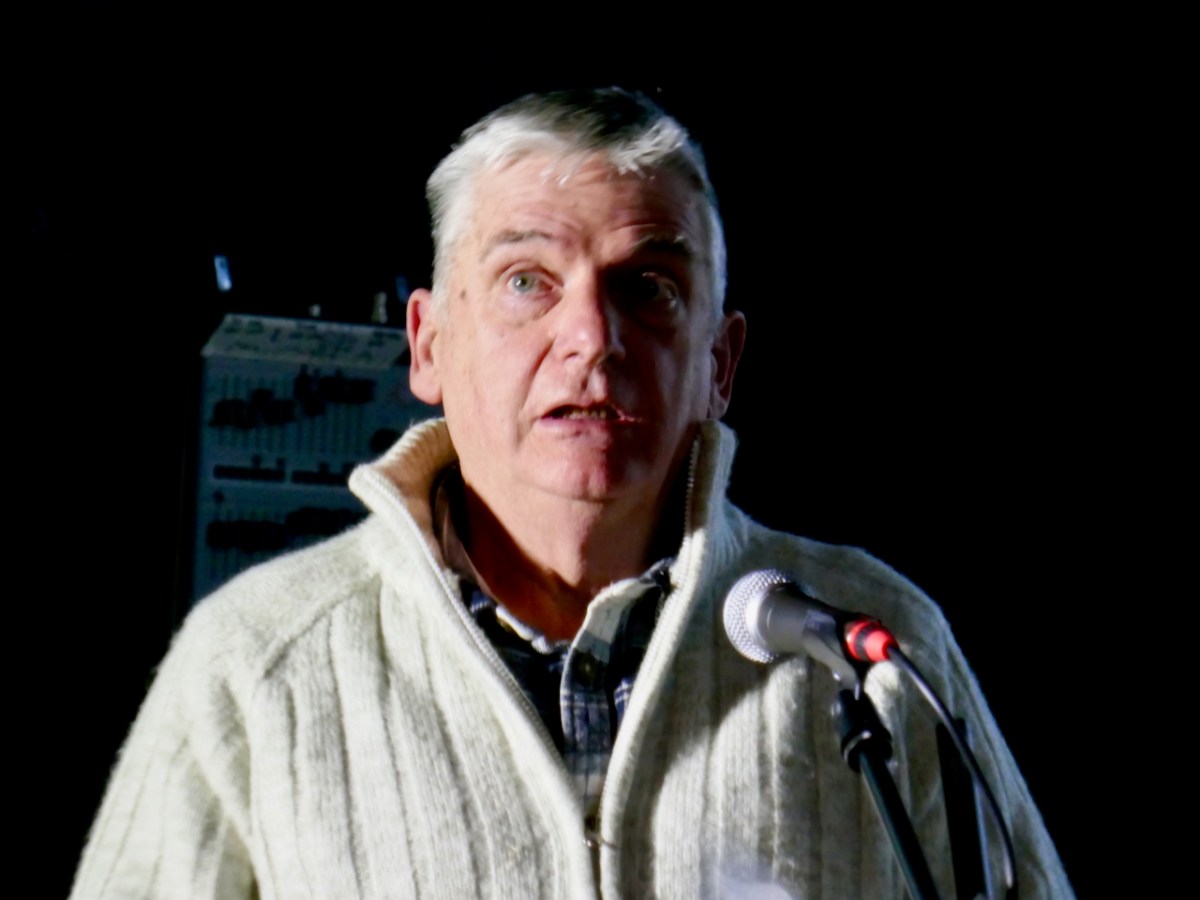
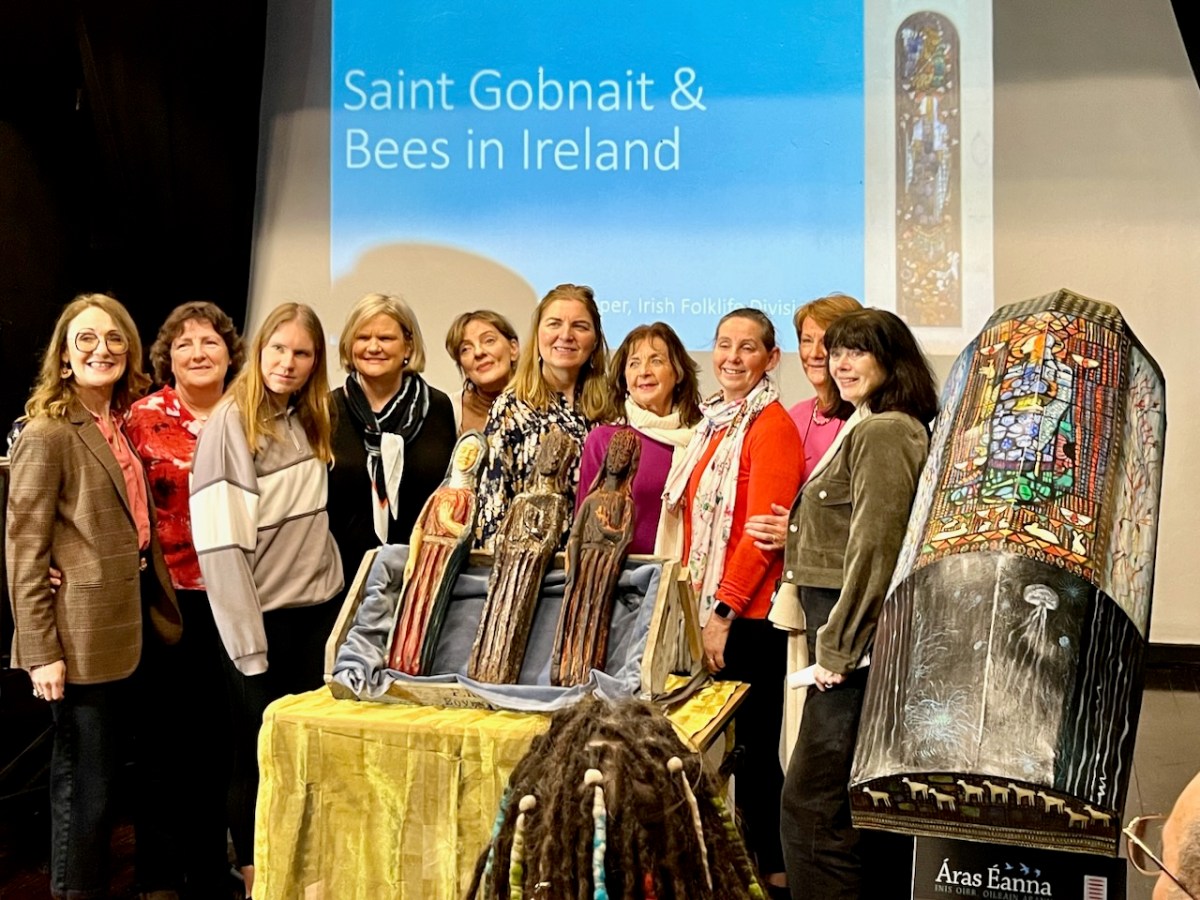
The decoration on the hull of the Camino Currach is based on the depiction of Saint Gobnait in the Harry Clarke window from the Honan Chapel, UCC. The bee image on the right reminds us that Gobnait is the patron saint of bees and beekepers. We enjoyed a comprehensive talk on bees by Peadar Ó Riada – who has first hand experience of the subject:
There were many more dimensions to the day. One of my favourites was when the audience was requested to produce anyone named Gobnait to be photographed with the carved figures. That included the variations of the name: Library Ireland (1923) (Rev Patrick Woulfe) gives these as Gobinet, Gobnet, Gubby, Abigail, Abbey, Abbie, Abina, Deborah, Debbie, and Webbie. Ten candidates stood up to be counted:
Thank you to Finola for providing many of these photos
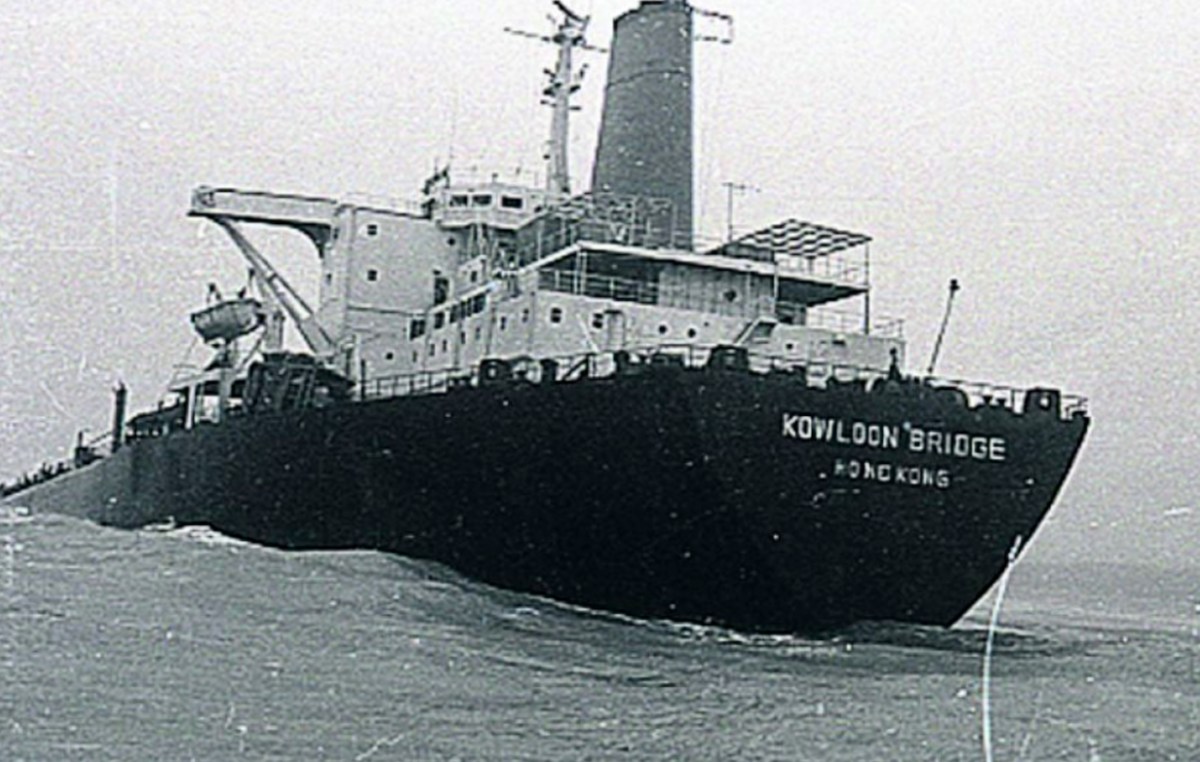
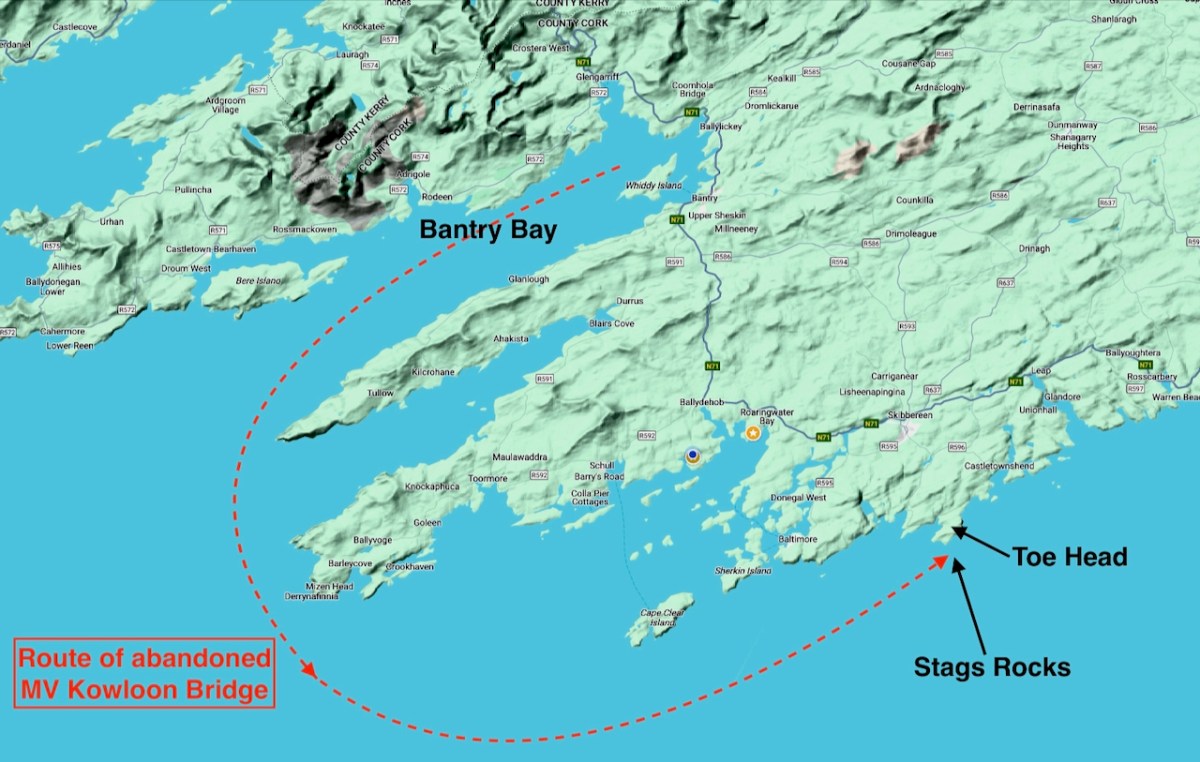
We’re going back a few years to look at a piece of West Cork history: a shipwreck. The ship is the Kowloon Bridge, a Bridge class OBO (oil/bulk/ore) combination carrier built by Swan Hunter in 1973. She ended her days on the Stags Rocks, beside Toe Head in West Cork in 1986 (above – image courtesy of Irish Examiner). At the time, this was said to be ‘one of the largest wrecks in maritime history’.
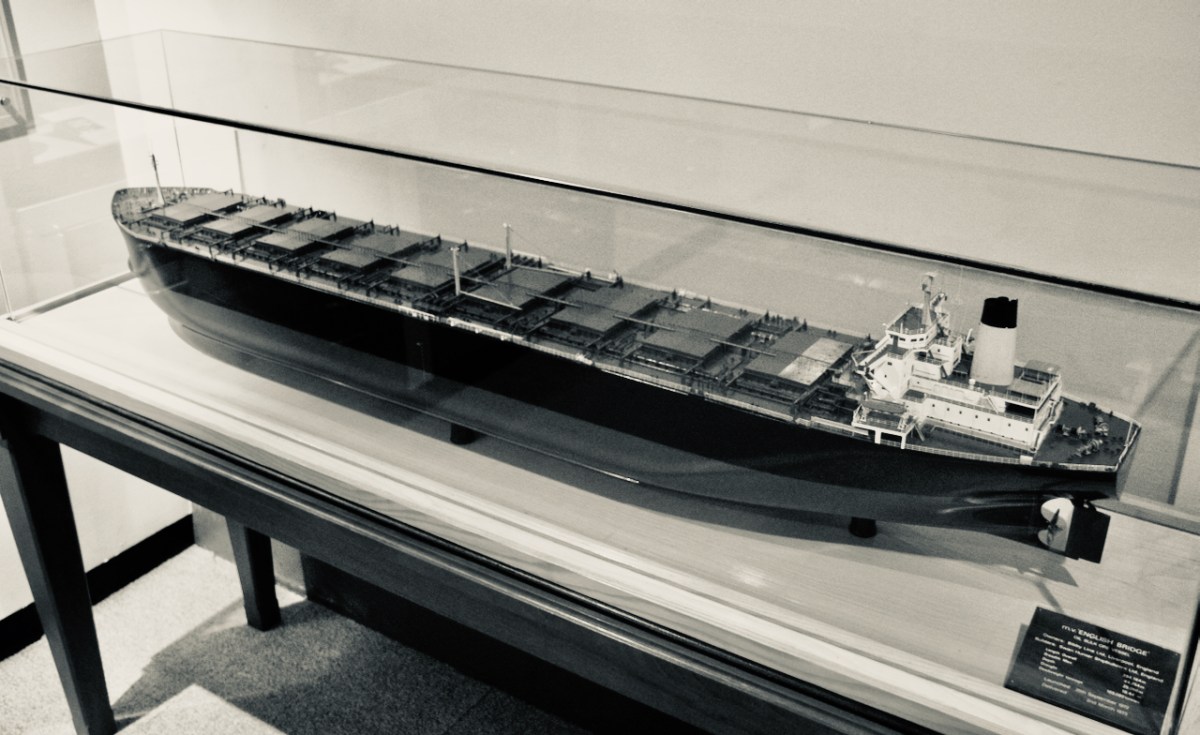
A Bridge Class model (above – photo courtesy www.mikepeel.net). Six of these ships were built by Swan Hunter at Haverton Hill on the River Tees in County Durham, UK, between 1971 and 1976. Originally named English Bridge and subsequently – passing through various ownerships – this 54,000 tonne vessel was renamed Worcestershire; Sunshine; Murcurio; Crystal Transporter; and finally Kowloon Bridge. I’m tempted to think of the old folk belief that says changing the name of a boat is unlucky!
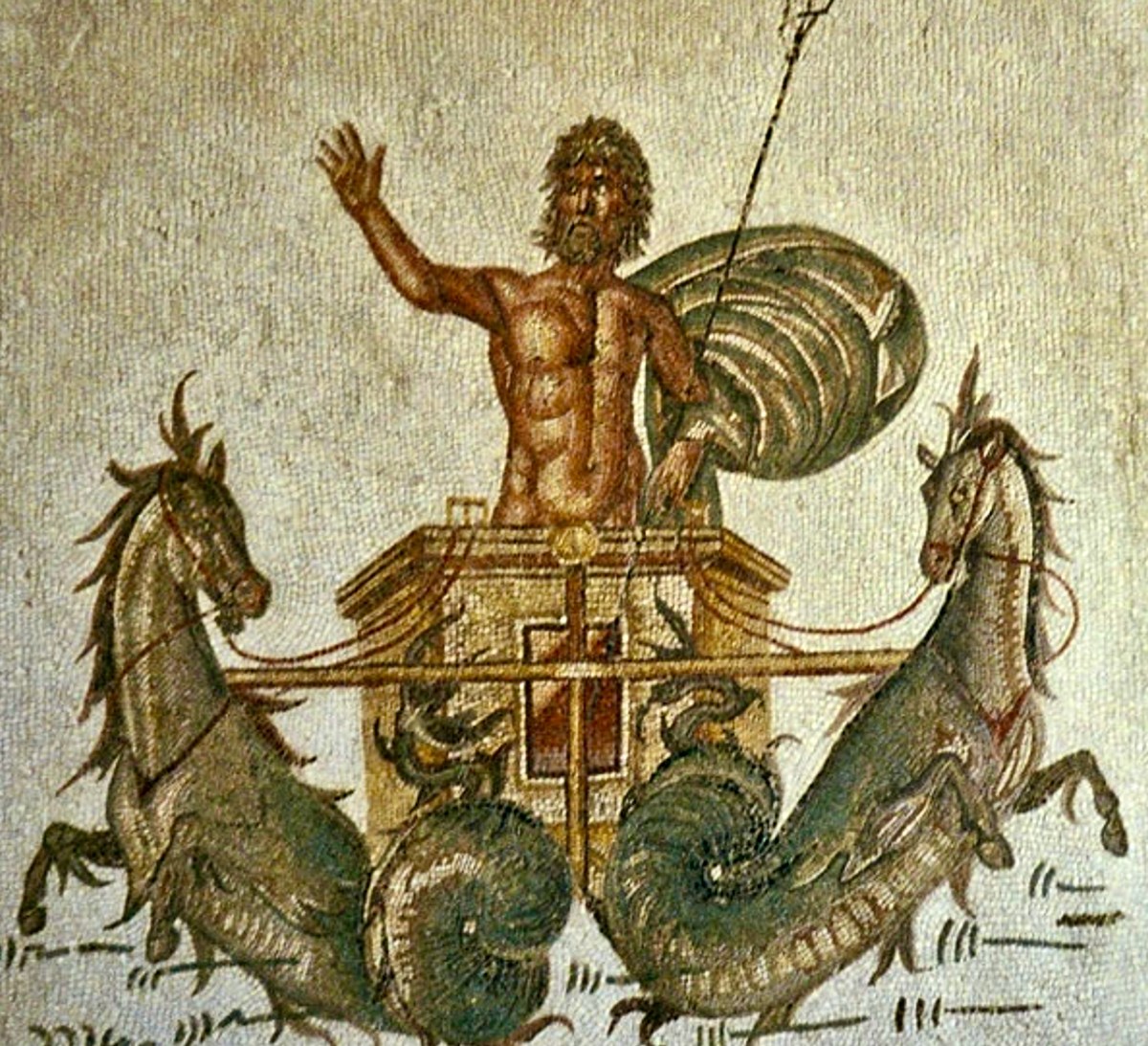
. . . Perhaps the most famous maritime superstition of them all is the idea that changing the name of a ship is bad luck. Legend has it that Poseidon, the Greek god of the sea, has a ledger in which he keeps track of the name of every sea-going vessel. Changing the name is seen as a challenge and as an attempt to try and out-smart him, which would incur his wrath. To avoid any bad luck, the original name must first be purged from Poseidon’s book in a de-naming ceremony, before the new one is adopted . . .
There she is, in her original incarnation and unladen (image courtesy of Tony Ecclestone, Swan Hunter). As you can see, a massive vessel. Her length was 295 metres and her beam 44.3 metres. She had a draft of 18.5 metres. In November 1986 the Kowloon Bridge – which she had then become – departed Sept-Îles, Quebec, bound for the River Clyde in Scotland. Her cargo was 160,000 tonnes of ‘marble sized’ iron ore pellets and crude oil.
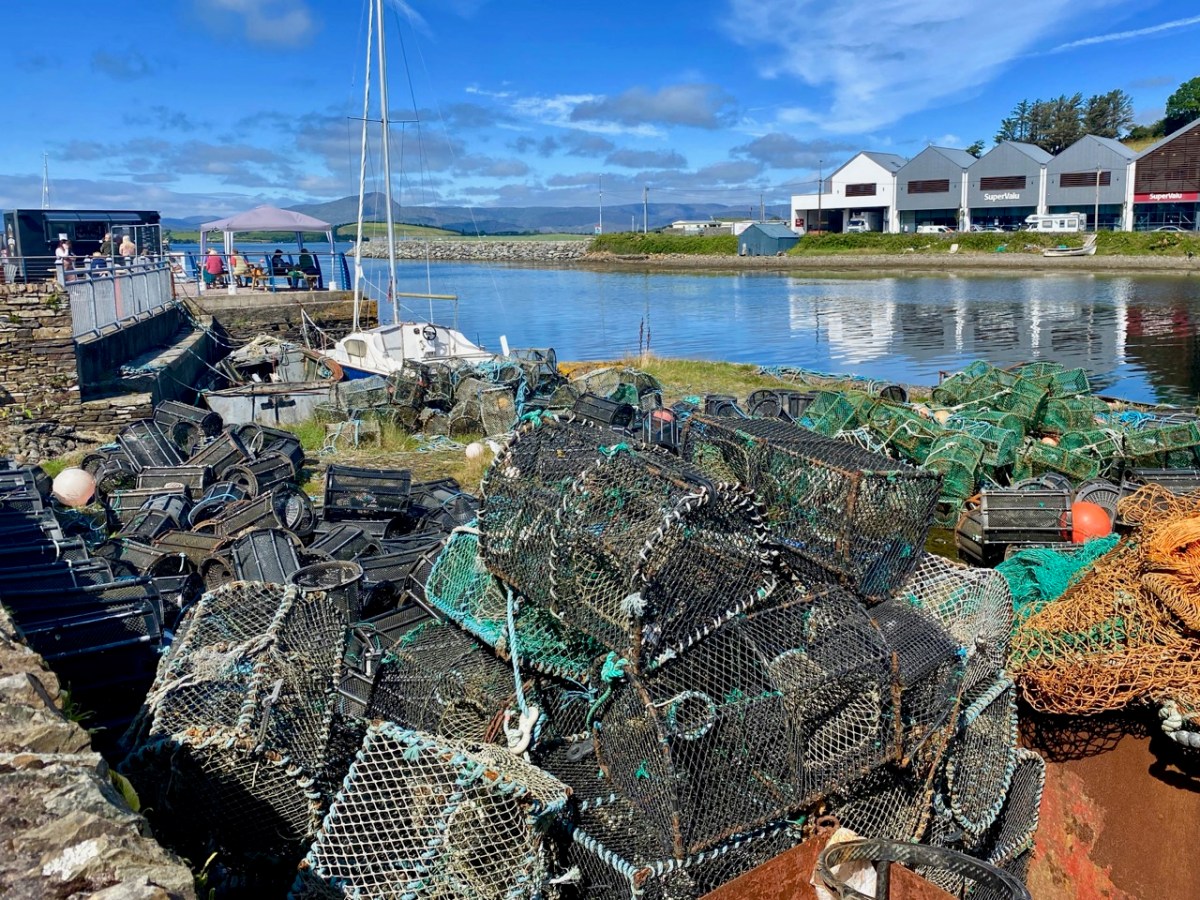
The Atlantic crossing was particularly rough-going, and the vessel sustained some superficial damage. The decision (a fateful one) was taken to head for the nearest shelter on the east side of the ocean: the deepwater Bantry Bay, off West Cork’s coast. A Lloyds’ survey there showed that she had suffered ‘routine heavy weather damage’ and recommended that she remained anchored in Bantry Bay while temporary repairs were undertaken. Here’s a view of Bantry’s waterside in more benign days: Roaringwater Journal has reviewed the town in some detail.
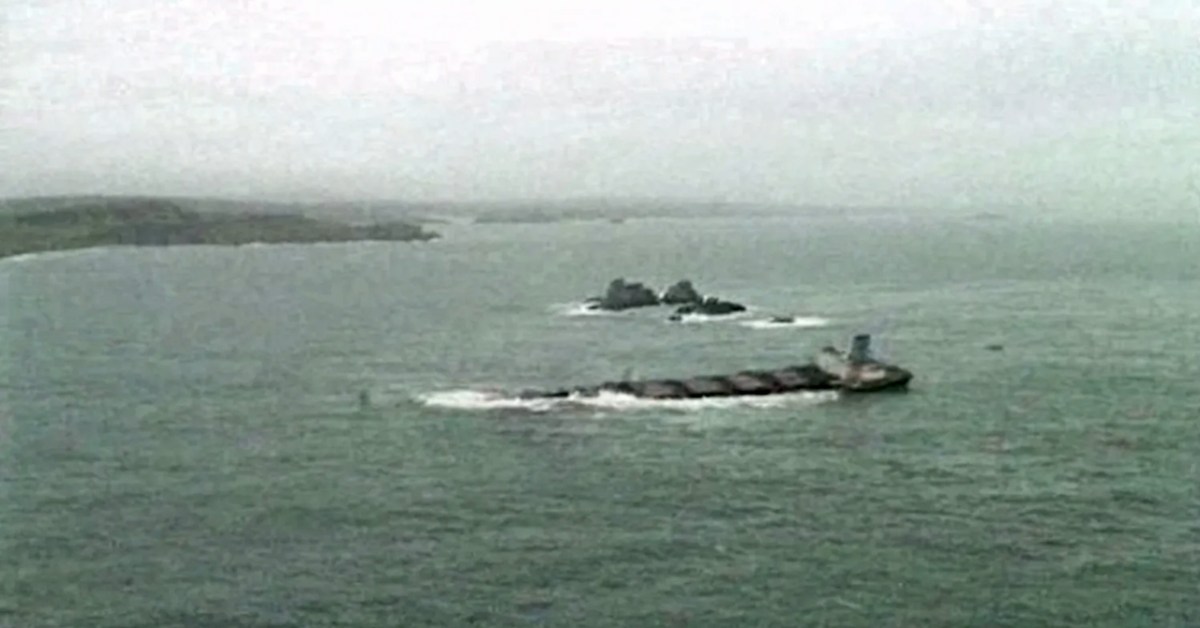
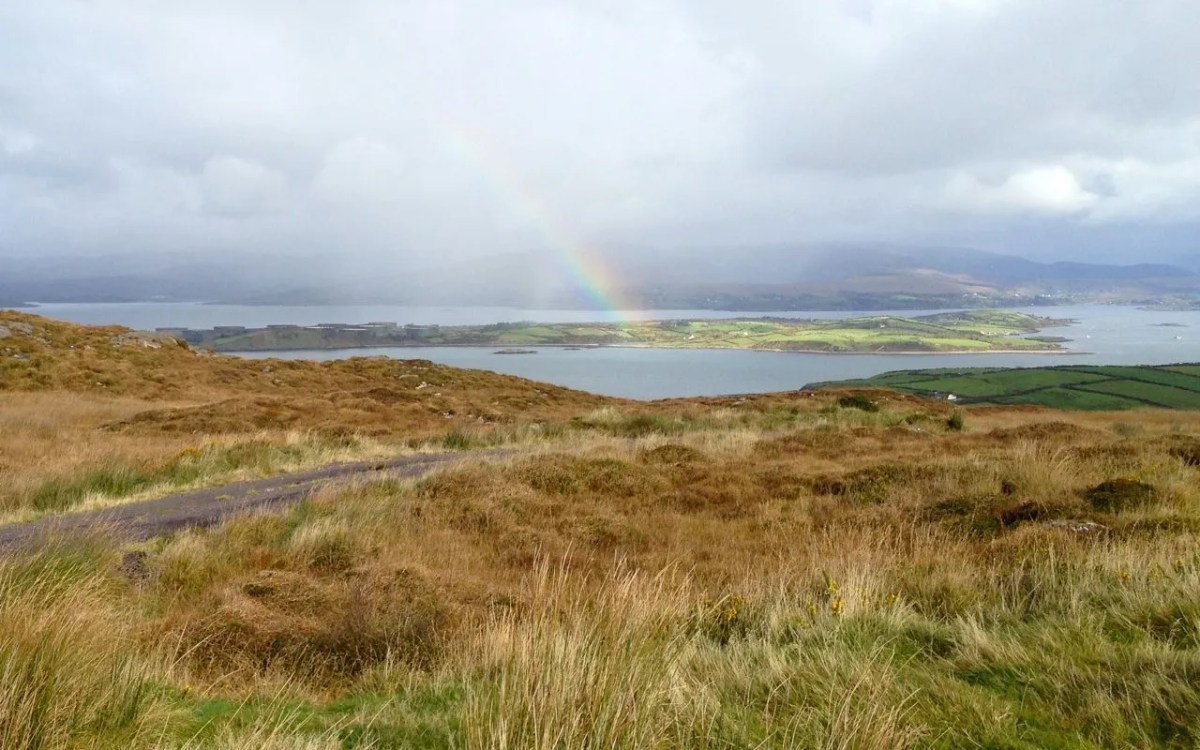
Above is a RWJ view of Bantry Bay and Whiddy Island taken back in 2014. The island was the setting for another disaster in earlier years: on January 8, 1979, the French-owned tanker, Betelgeuse, exploded at the oil terminal, resulting in 51 deaths. Even now – 45 years on – new enquiries are being set up to establish the true facts surrounding that incident. Returning to our Kowloon Bridge story, accounts seem to vary. One says that on 22 November 1986 – having had the necessary repairs completed – the ship resumed her voyage and set out into the Bay; but she was plagued by continuing bad weather, and lost her steering gear. Another suggests that the problems included ‘deck cracking in one of her frames’: she was forced to leave port to avoid colliding with another tanker and – engine running astern – she lost her anchor and her steering controls. The decision was taken to abandon ship (still running astern) and Royal Air force helicopters rescued the crew. She headed out of the bay and into open waters, being driven also by storm-force winds. (Image below courtesy of Southern Star)
Kowloon Bridge left Bantry Bay and rounded the Sheeps Head and Mizen Head. A tug tried to intercept her, but was unsuccessful as this, also, sustained damage due to the adverse conditions. Coming close to Baltimore the combination carrier/tanker hit rocks and her engine stalled. She continued to drift eastwards, finally coming to rest on the Stags Rocks below Toe Head (header pic).
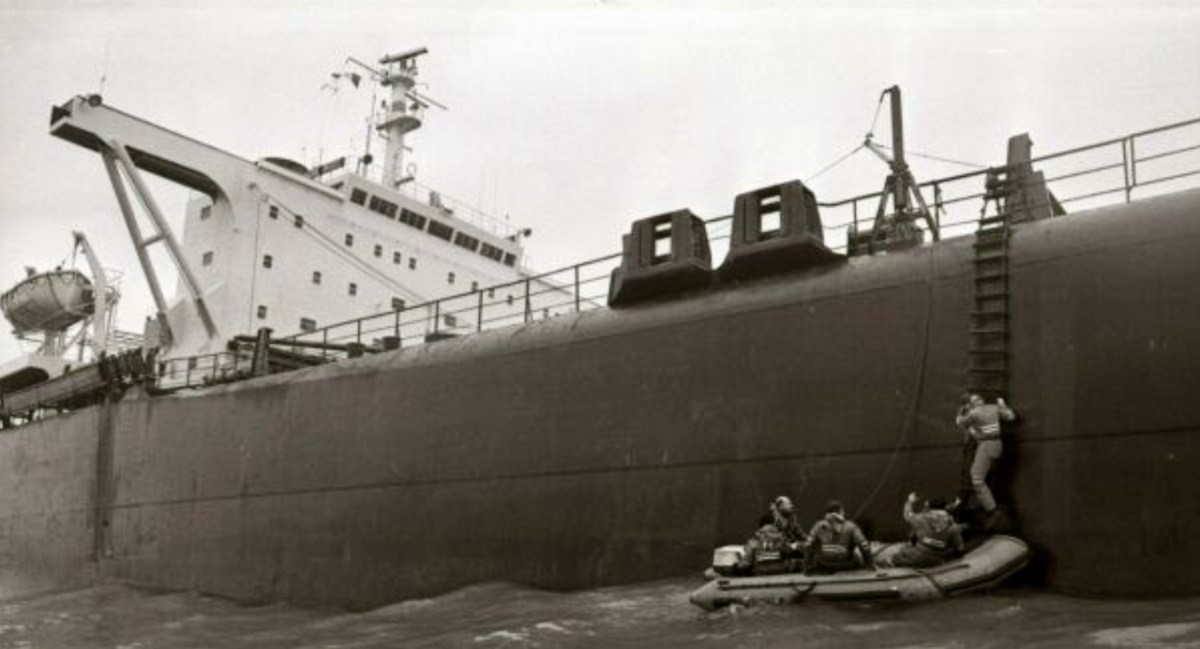
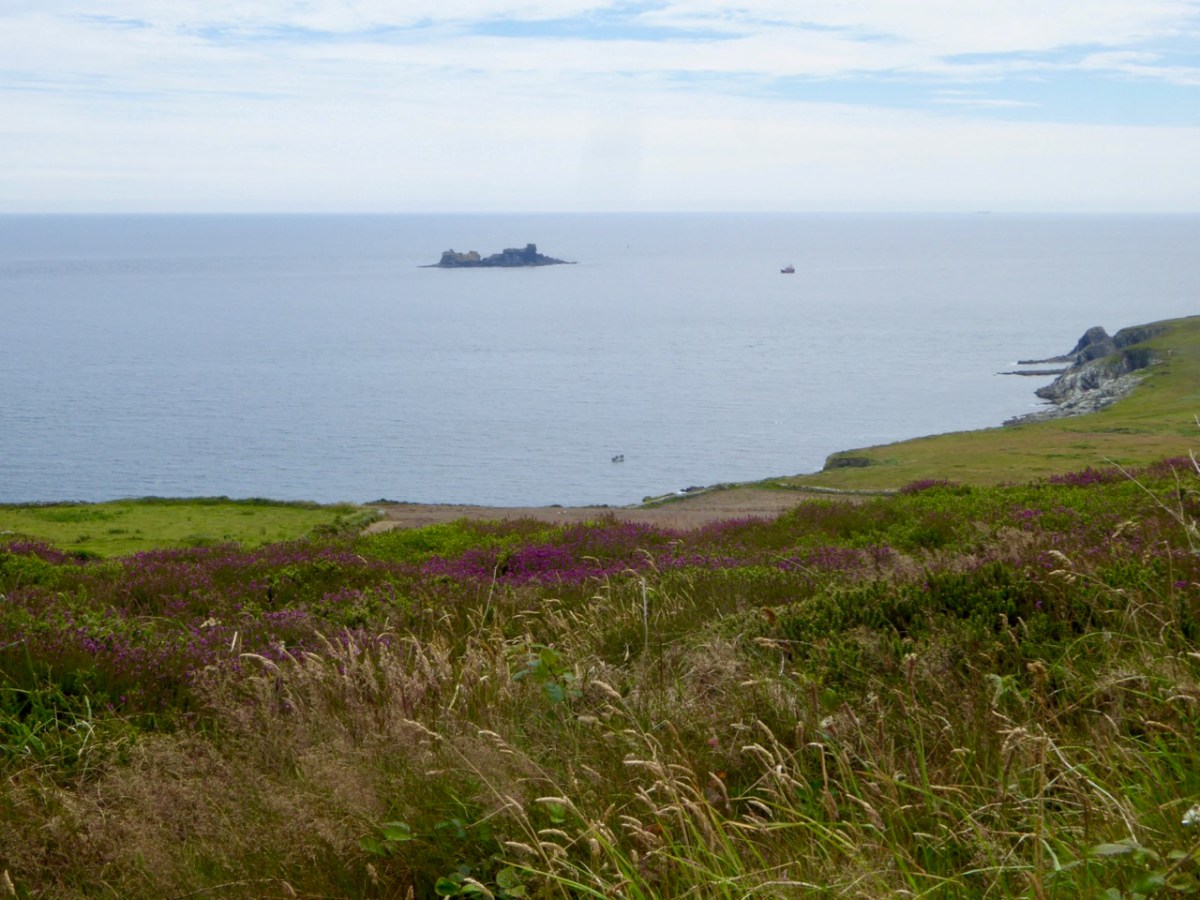
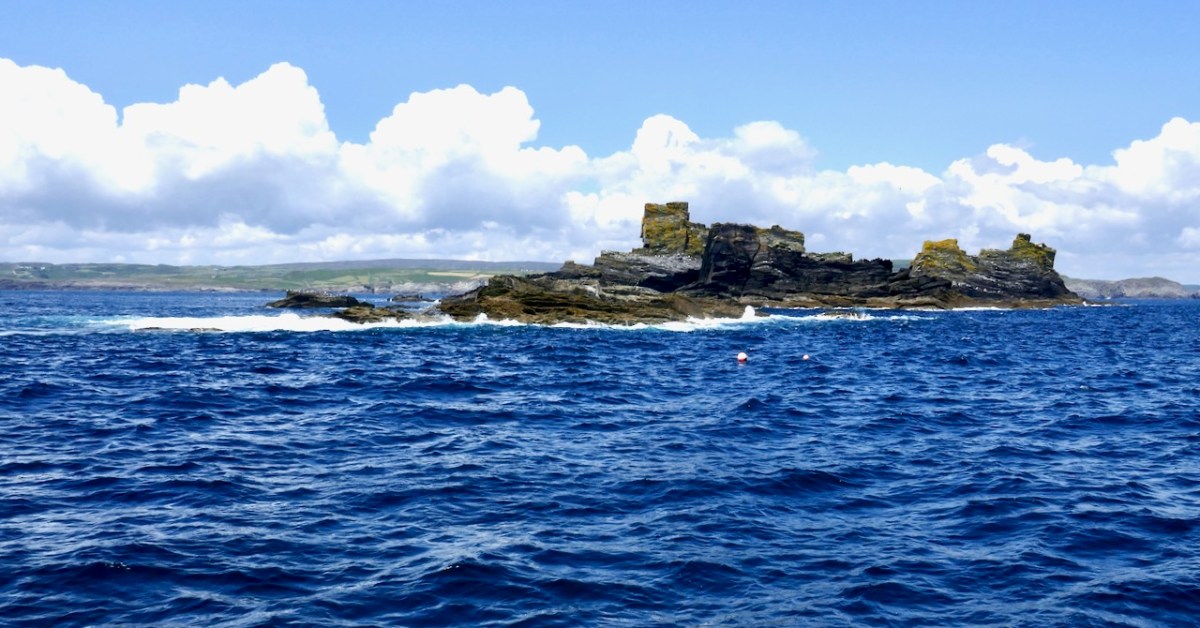
Despite efforts to board her and assess salvage attempts (images above courtesy Irish Examiner), in due course the ship broke her back and went under – although, according to local reports, her bow could still be seen for months afterwards. To this day she lies off the rocks, with her iron ore cargo surrounding her. Below: the view from Toe Head today and (lower) the Stags Rocks.
The breaking up of the ship caused the release of of 1,200 tonnes of fuel oil. This led to damage to local coves and beaches, with loss of income being suffered by the fishing and tourism industries. The incident happened in the days before The International Convention on Oil Pollution Preparedness, Response and Co-operation was set up: that came into being in 1990. Parties to OPRC are required to establish measures for dealing with pollution incidents, either nationally or in co-operation with other countries.
. . . Ships are required to carry a shipboard oil pollution emergency plan. Operators of offshore units under the jurisdiction of Parties are also required to have oil pollution emergency plans or similar arrangements which must be co-ordinated with national systems for responding promptly and effectively to oil pollution incidents. Ships are required to report incidents of pollution to coastal authorities and the convention details the actions that are then to be taken. The Convention calls for the establishment of stockpiles of oil spill combating equipment, the holding of oil spill combating exercises and the development of detailed plans for dealing with pollution incidents . . .
Trying to follow the subsequent story of the wreck, everything gets a bit murky. West Cork communities undoubtedly suffered as a result of the foundering. Debris and oil were washed up (image above courtesy Irish Examiner). ‘Hundreds of seabirds’ died according to local reports. Promises of compensation were made – and reneged on – by the Haughey government. But it was Cork County Council and its ratepayers who eventually bore the major costs of cleaning up, even though the ship had been fully insured (image below courtesy Irish Examiner).
Apparently, the wreck was purchased in December 1986 by a British scrap dealer, Shaun Kent. One report states he paid a million pounds for it – another states he paid one pound for it! An article in the UK Independent newspaper in August 1997 describes how he planned to use high power water jets to wash the iron ore pellets to the surface for recovery. Their value was said to be in the order of millions. He also intended to recover the steel hull and other elements. However, concerns were expressed locally and nationally that such a process so long after the event would adversely disturb the seabed and the stable micro-environment which has evolved over time. It is unlikely that such plans will ever be acted on.
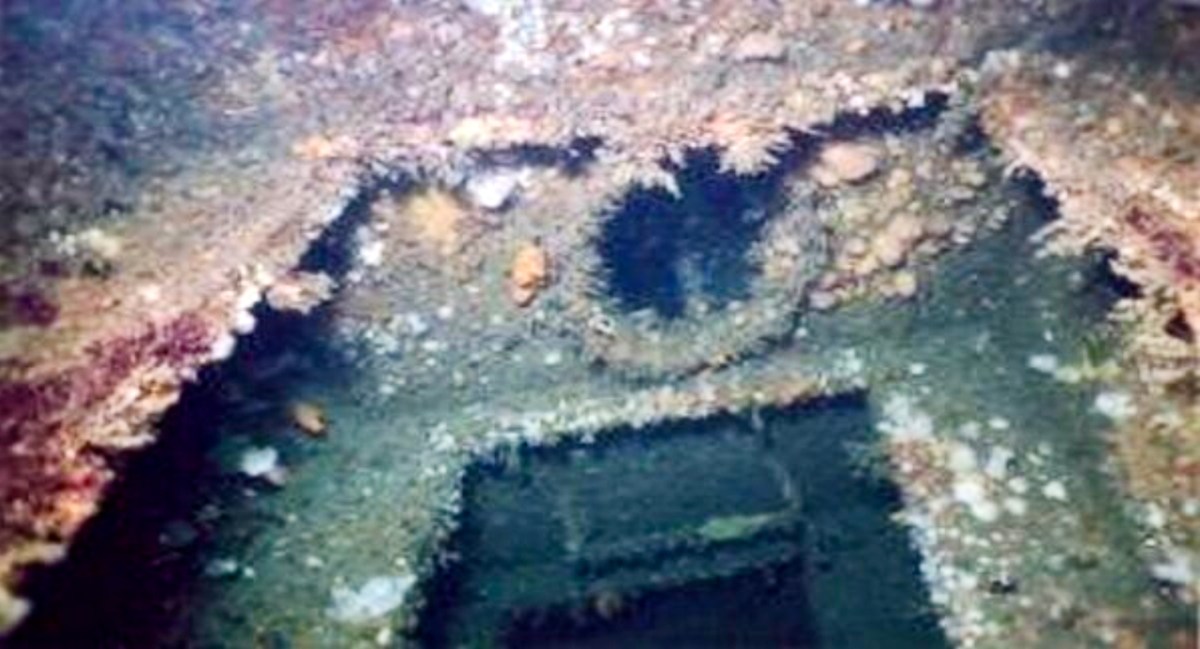
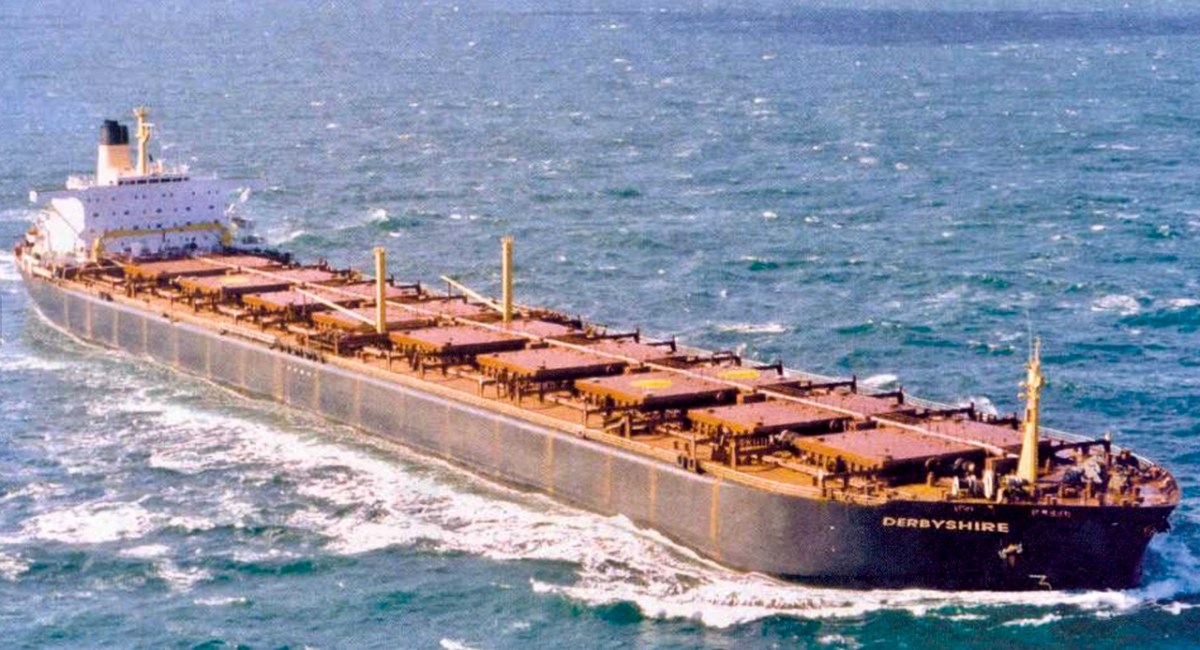
Today, the wreck is an attraction to underwater enthusiasts (images above courtesy of Extreme Sports Cork): Nature has taken over the intrusion to the sea bed. During the various discussions which have ensued in the many years since the Kowloon Bridge came to rest on the Stags Rocks, the question has been raised: was the ship seaworthy in the first place? It is pointed out that a sister ship was MV Derbyshire. Originally named Liverpool Bridge, she was launched in 1975, the last of the six Bridge Class ships. With a gross register tonnage of 91,655 she had the greatest volume. In July 1980, Derbyshire also left port from Sept-Îles, Quebec, bound for Kawasaki, Japan. She was overwhelmed by a tropical storm, and sank in deep ocean, with the loss of all 44 lives on board. This was in fact the largest British ship ever to have been lost at sea (image below courtesy of shipsnostalgia.com).
The four remaining Bridge Class vessels saw long service, and were eventually scrapped, so there is no reason to suggest that the design was in any way faulty. I suppose we might say that it is mankind’s folly to create such huge machinery to bring cargoes across the world. We challenge Poseidon, and he has to take his share (image below courtesy of Bardo National Museum, Tunis).
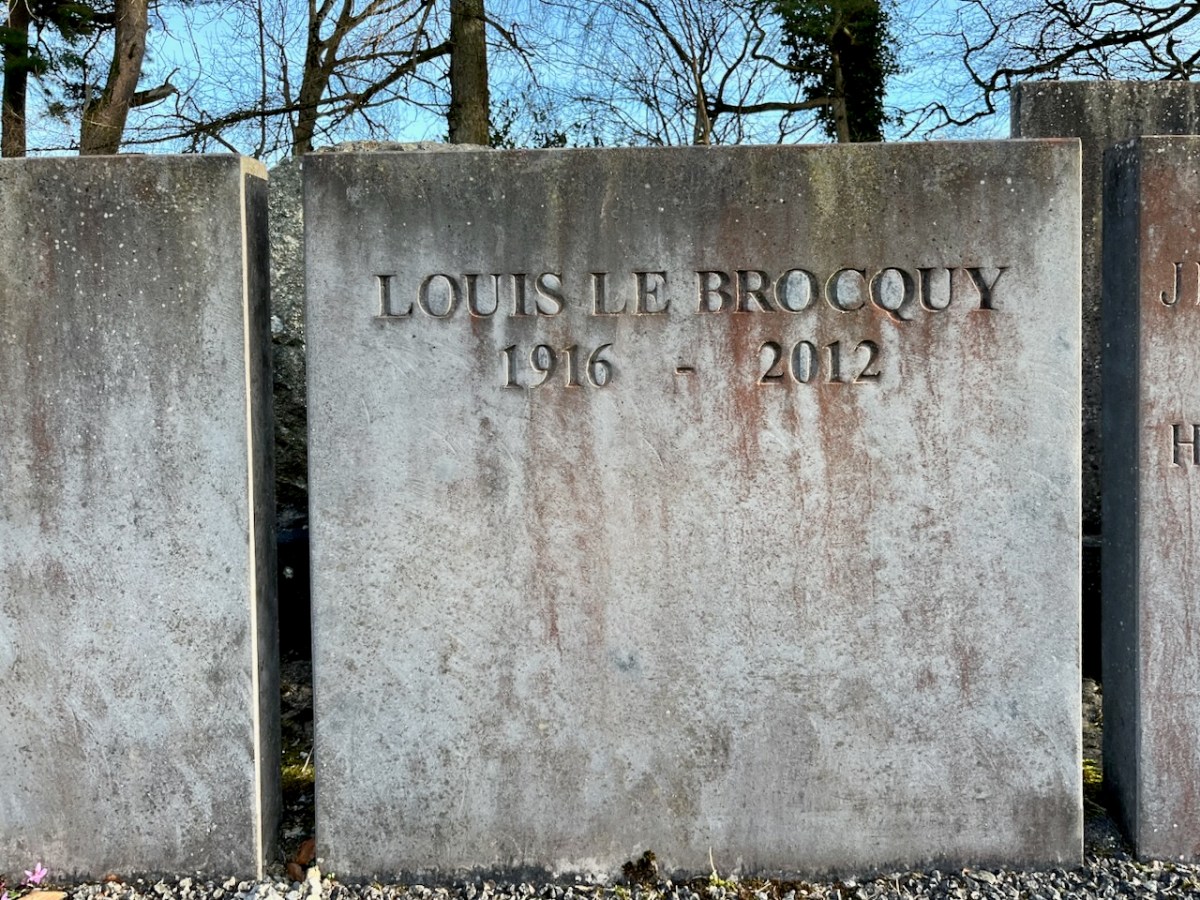
Adam and Eve in the Garden is an Aubusson tapestry, from the Atelier Tabard Frères et Soeurs (artist website) designed by Louis le Brocquy and dating from 1951-52. Le Brocquy was born in Dublin in 1916 and led a long life which included travelling extensively across continents, always completely engaged in art. He died in Dublin in 2012. On his death, President Michael D Higgins said: ”Today I lament the loss of a great artist and wonderful human being whose works are amongst this country’s most valuable cultural assets and are cherished by us all. Louis leaves to humanity a truly great legacy.” In 2002 the National Gallery of Ireland acquired le Brocquy’s painting ‘A Family’ – the first work by a living artist admitted to its permanent collection.
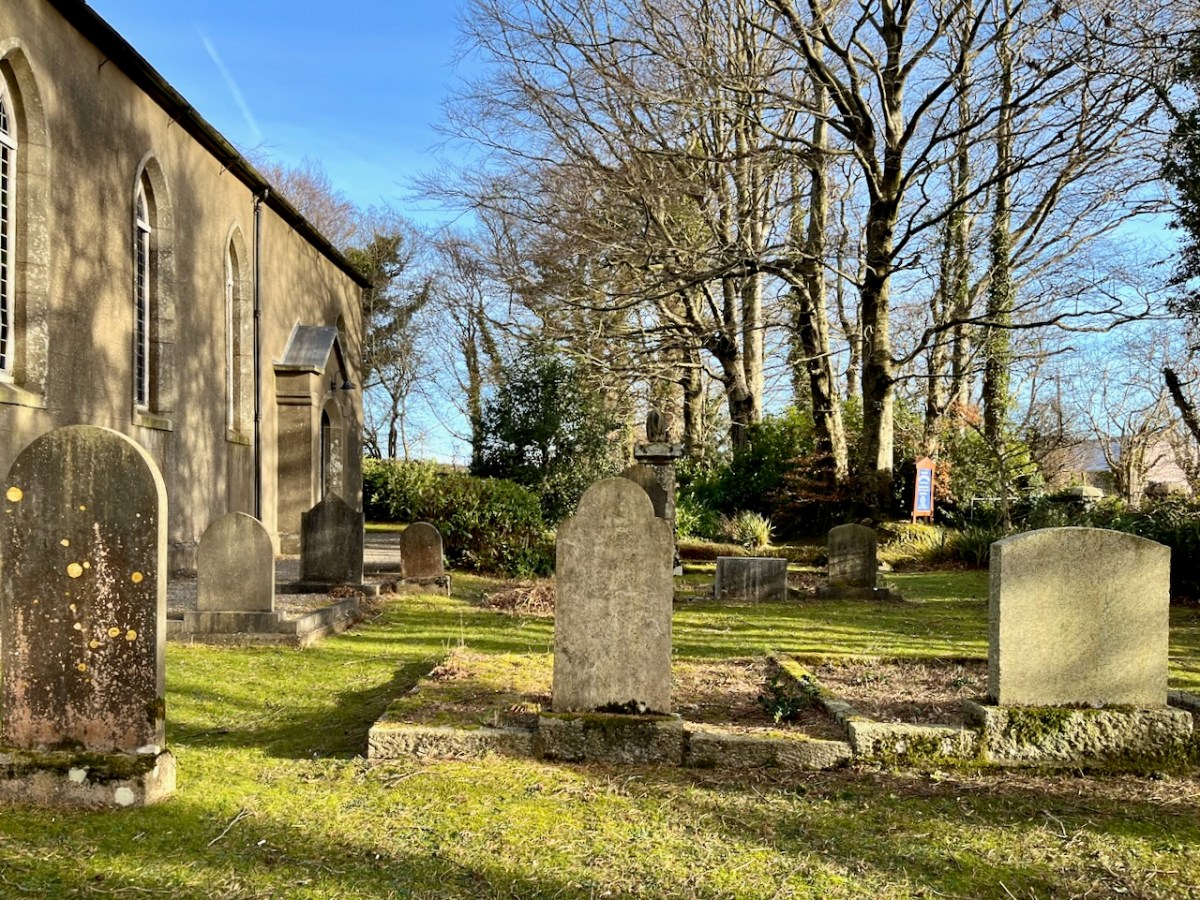
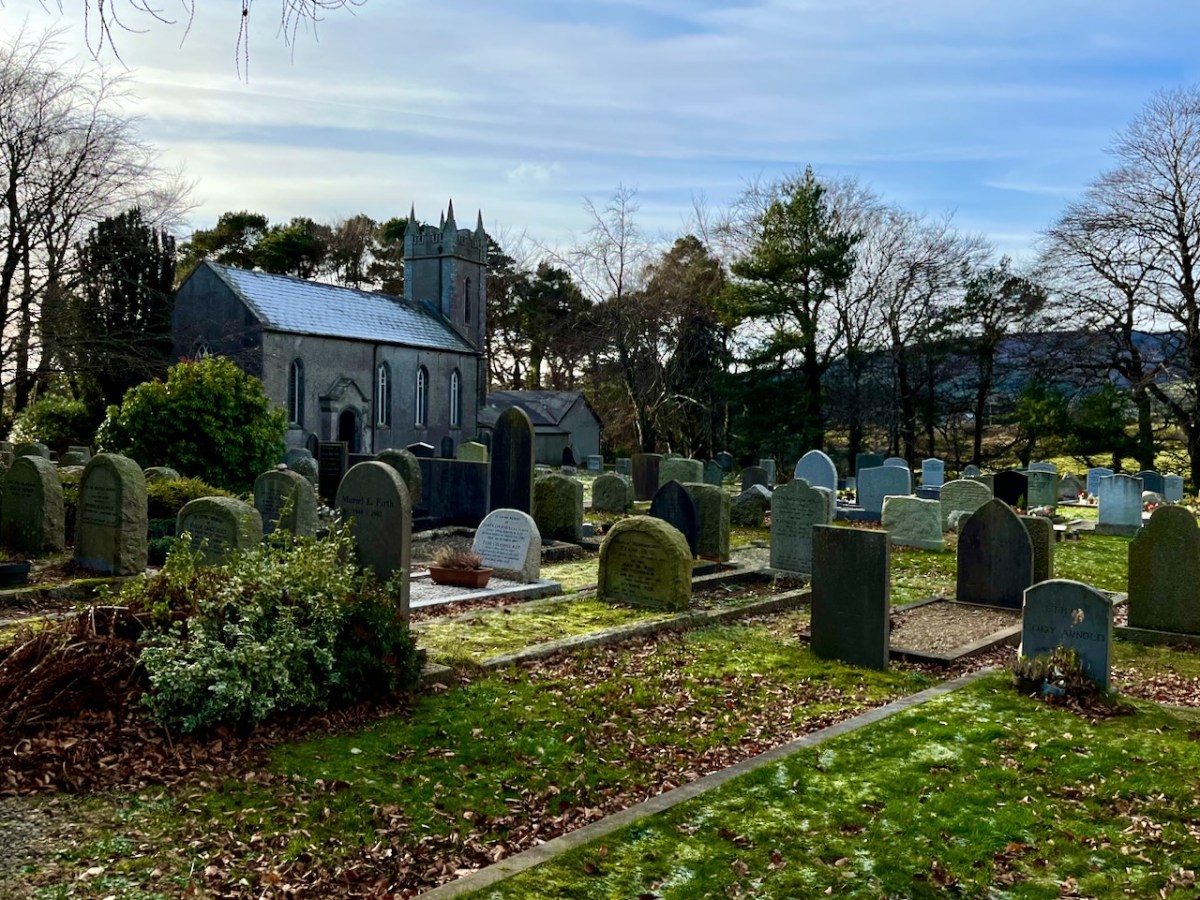
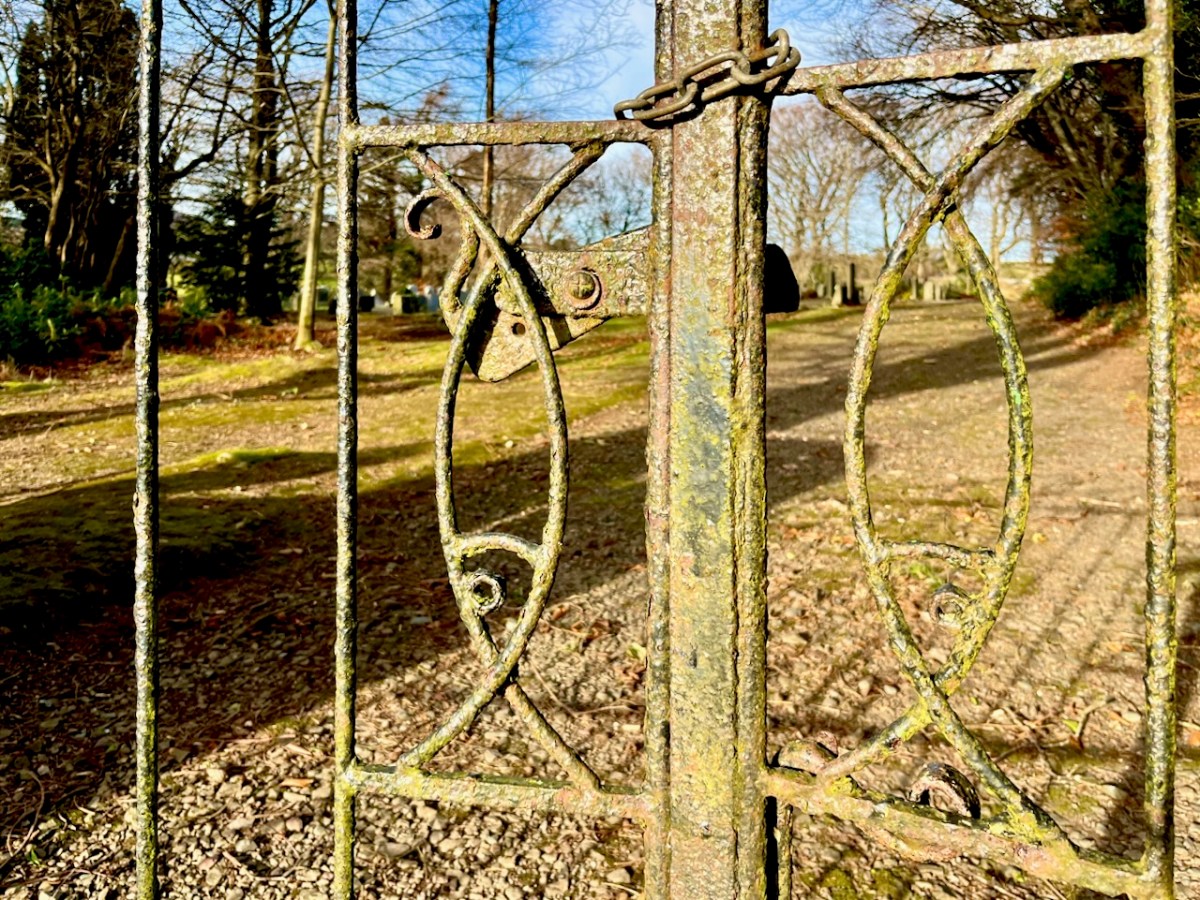
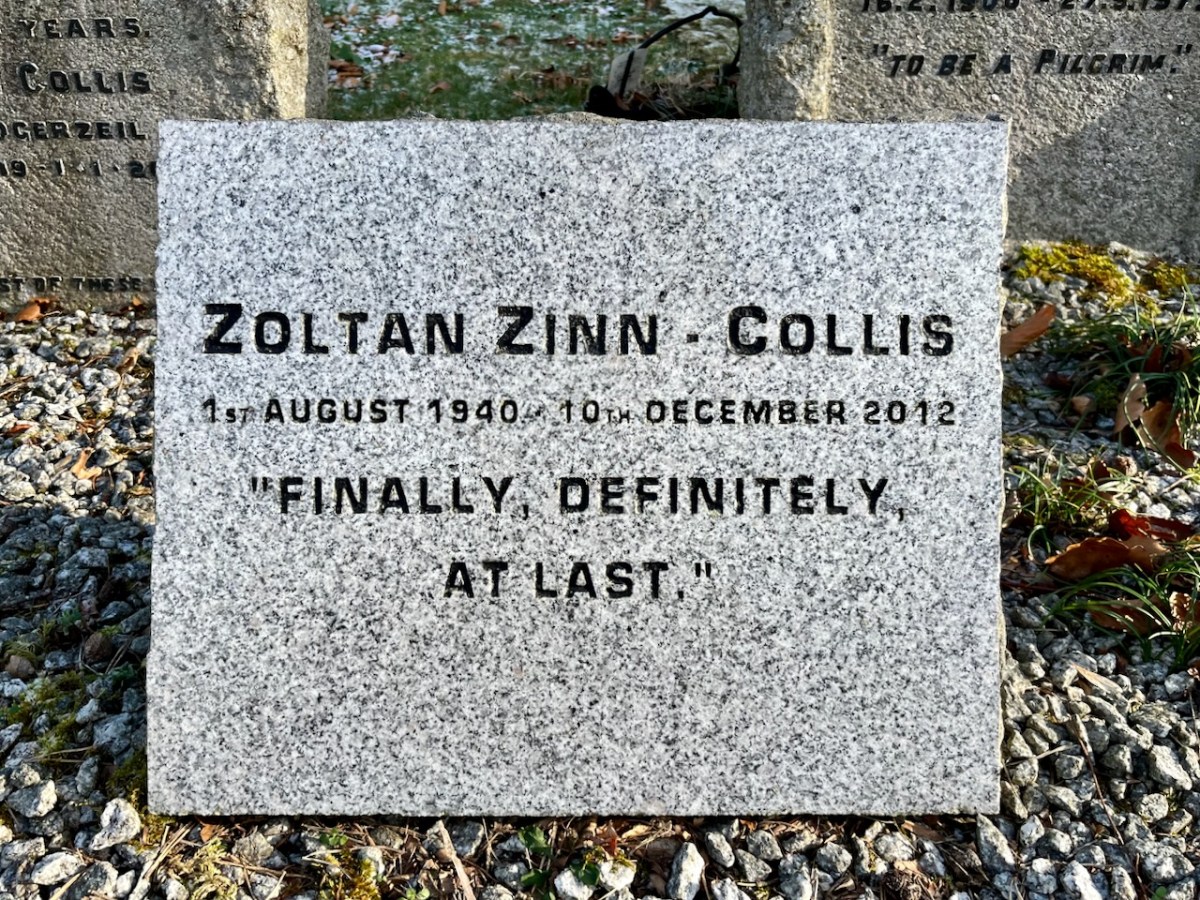
While out exploring the byways of rural County Wicklow, we chanced upon le Brocquy’s burial place. It’s in the little Church of Ireland graveyard at Calary. We had never heard of it before but – as we reconnoitred – the realisation dawned upon us that this is a very special site. Le Brocquy is probably the most eminent artist interred in these grounds, but he is only one of very many who have presumably chosen to spend eternity in this remote but extremely beautiful corner of rural Ireland. The views towards the not-too-far-away mountains are dramatic.
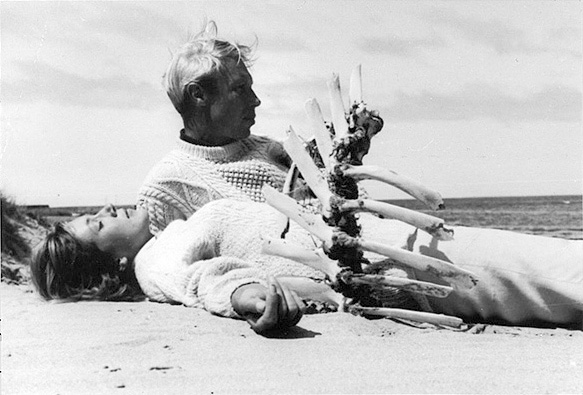
Le Brocquy’s wife, Anne Madden was born in London in 1932 to an Irish father and an Anglo-Chilean mother, and is still living. Madden spent her first years in Chile, where her Father owned a farm. Madden’s family moved to Corrofin, Ireland when she was ten years old. During the 1950s she met le Brocquy who was then working in London. They married in Chartres Cathedral in 1958 and set up house and studio in Carros in the south of France, where they remained until 2000. The empty plot at Calary beside Louis is presumably saved for her: she will add significantly to the artistic distinction of this community. The plot to the south of him is taken by Anne’s mother – Esther Madden Simpson – and brother – Jeremy Madden Simpson.
Anne Madden and Louis le Brocquy, 1974 (public domain). From that year onwards the family spent long summers on the Beara Peninsula.
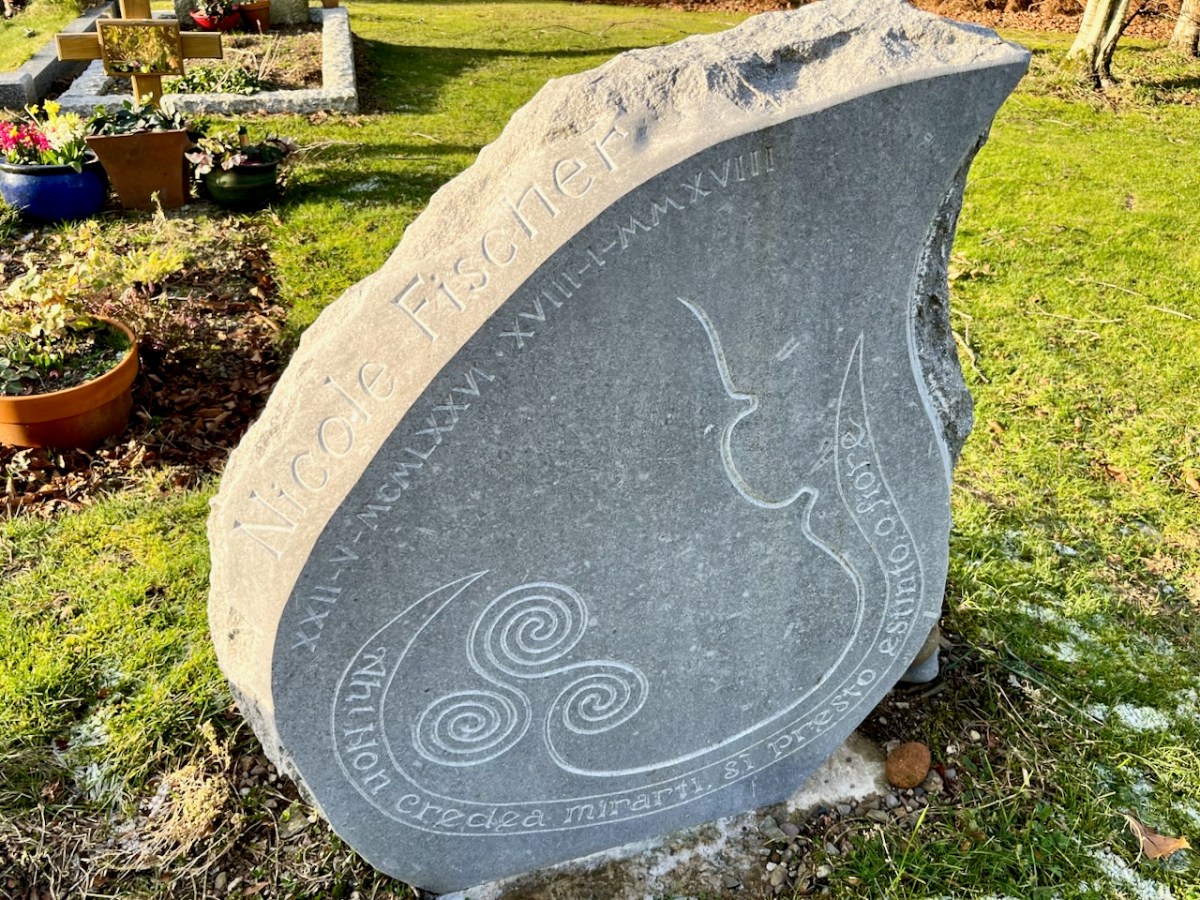
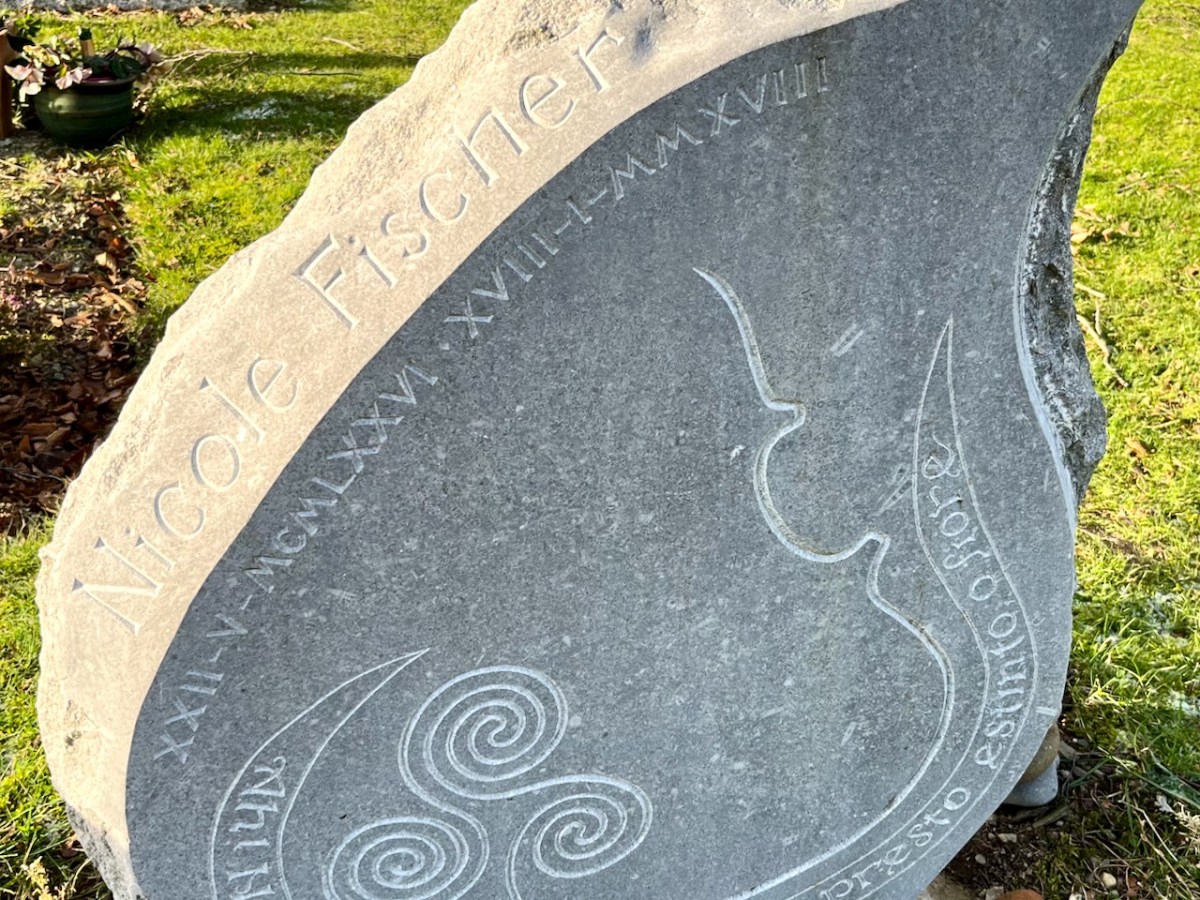
A relatively recent gravestone added to Calary is this one, dating from 2018. It remembers Nicole Fischer, a viola player with the RTE Concert Orchestra and the Amici String Trio. Sadly, her death occurred when she was in the prime of her life.
This impressive and beautiful gravestone is the work of Wicklow sculptor Séighean Ó Draoi. There are a number of unusual markers within this site: every one tells a story, of course.
Maurice Carey led a distinguished life in the Church of Ireland. He served as Dean of Cork from 1971 to 1993, when he retired, and in retirement returned to his native Dublin where he was in charge of St John’s Church, Sandymount. While in Cork, Dean Carey presided over a period of great change in St Fin Barre’s Cathedral and he was instrumental in setting up the St Fin Barre’s Study Centre. He also achieved much in the musical and liturgical life of the cathedral. “. . . His freshness of mind contributed greatly to this success and he was kind and helpful to younger clergy at the start of their ministry . . .” (obituary).
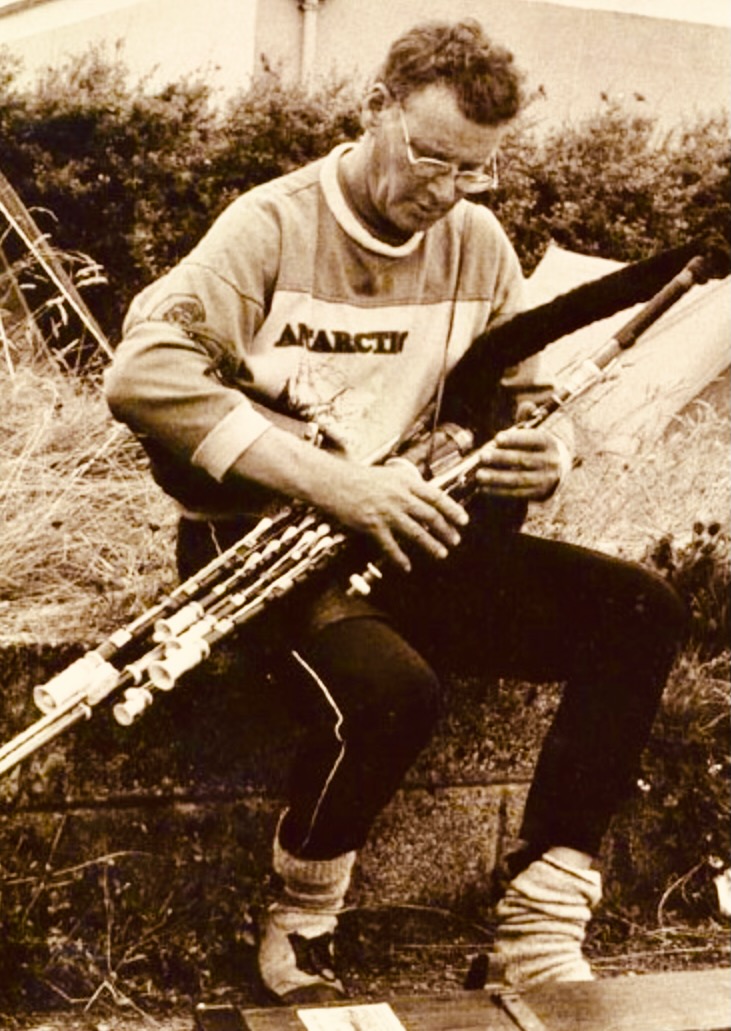
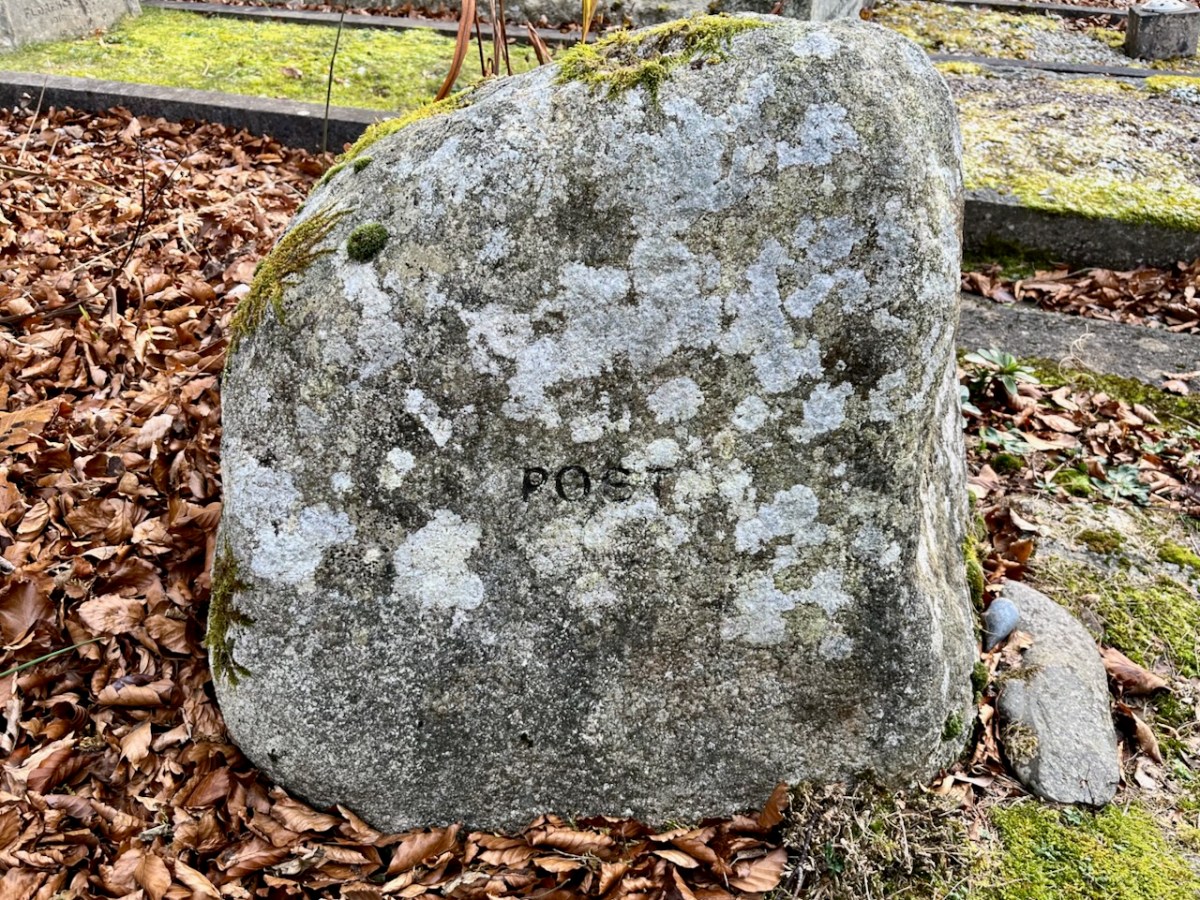
This stone belongs to Ronnie: Ronald James Wathen, who was born in 1934 and died before his time, in 1993. He was famed as a poet but also climbed mountains – and played the Uilleann pipes (https://www.discogs.com/artist/365089-Ronnie-Wathen):
The poet’s printed obituary sums up a notably eccentric life:
. . . I feel there may be a ‘most individual and bewildering ghost’ glaring with mock ferocity over my shoulder, a restless shade who would never forgive me if I tried to bury him with platitudes. Ronnie Wathen was quite spectacularly different: unpredictable, provocative, abrasive yet stimulating in argument, generous with himself, always able to see and articulate the quirky side of life. In Ireland Ronnie’s first poems appeared and many slim volumes were to follow. He had a most splendid, if unruly, facility with words. Usually he employed them seriously but he also loved frolicking with them, standing them on their heads just for fun. He wrote about anything and everything that caught his fancy, as a poet should . . . the last I saw of Ronnie was when he strode off up the road to do a kindness to an old friend. I must end with a grumble. Ronnie was an insomniac, never known to leave a party until very late. His parting prank was to quit the party of life far too early, at the age of 58, just to tease I like to think. It was a cruel jest . . . he held his final party at the little church of Calary, below Sugarloaf Mountain, in the verdant lap of his beloved Wicklow Hills. On that sunny autumn afternoon many, many friends crowded the church, farewells were spoken in prose and verse, laments welled up from three of the finest pipers in Ireland and a lone fiddler knelt by the open grave and hauntingly played the restless Ronnie to his rest . . .
Mike Banks
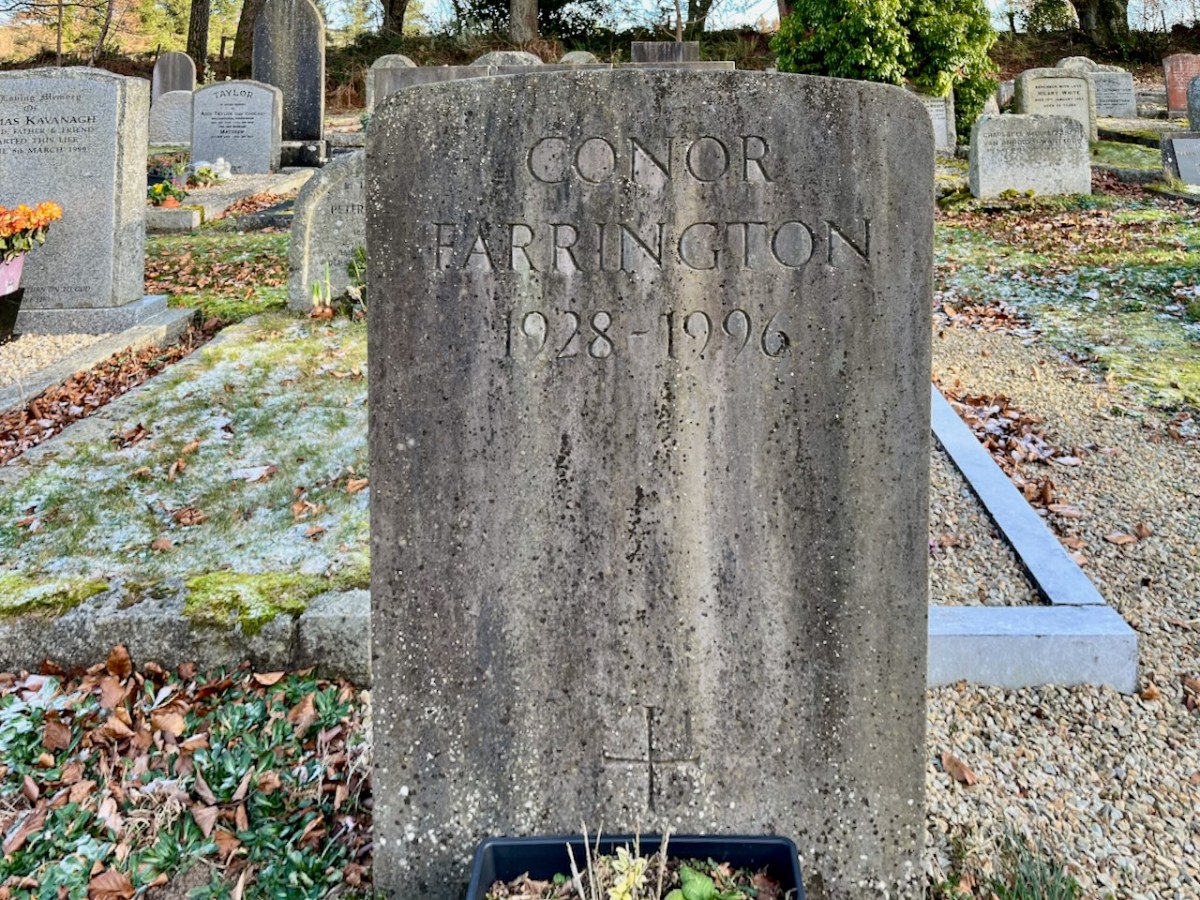
Conor Anthony Farrington was born in Dublin in June, 1928. His distinguished career included writing a number of plays for radio and theatre. Notable, certainly, were: Death of Don Juan (1951), The Tribunal (1959), The Good Shepherd (1961) and The Ghostly Garden (1964). ‘The Language of Drama’ in The Dubliner (July-August 1962) concludes the following: “…there are three reasons for a ‘radical alteration in the language of drama’ – viz, ‘the audience’s reason’, the ‘actor’s reason’, and ‘the dramatist’s reason’ – since ‘it is actually by means of particular words and phrases that he discovers his character’…” In later years appeared a collection of short stories (Cork: Fish Publishing 1996).
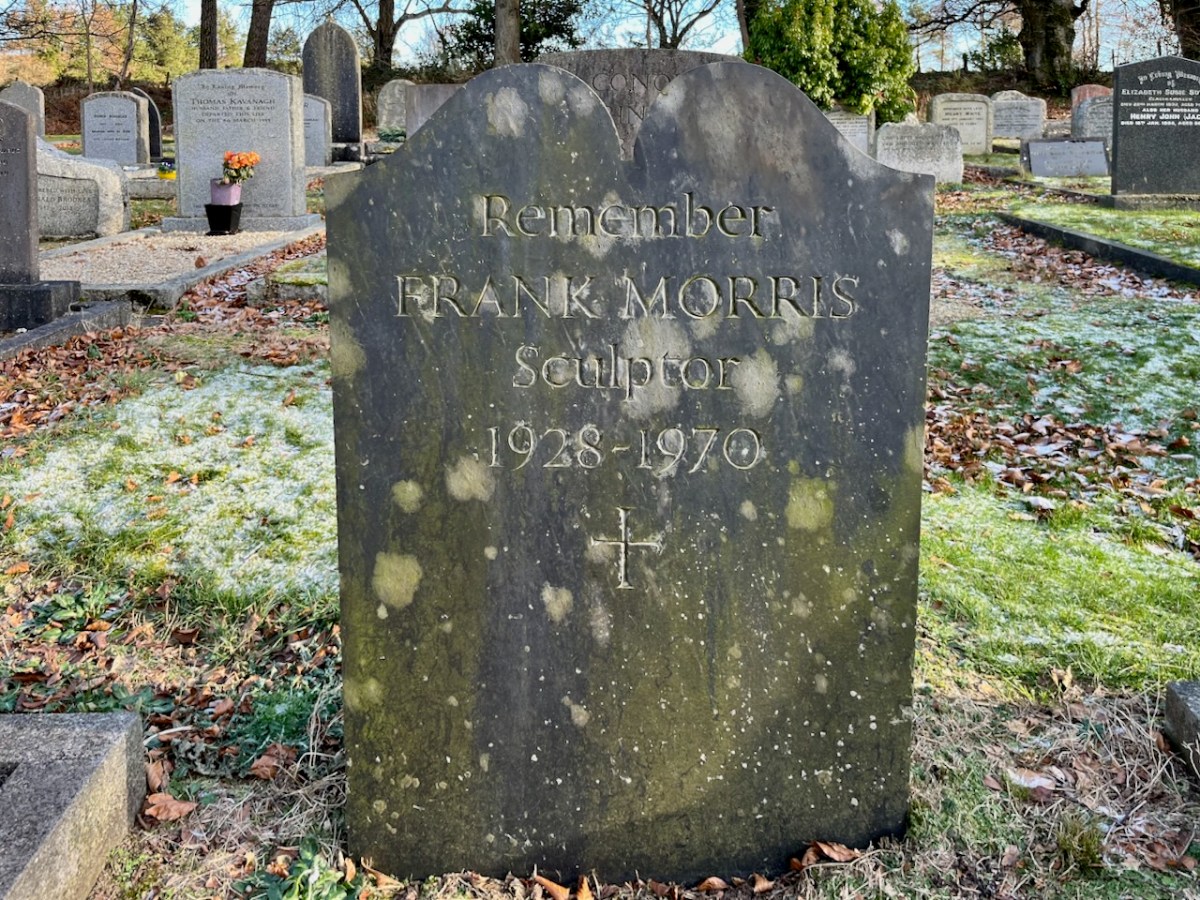
Another effectively simple slab remembers the sculptor Frank Morris, born in Arklow, Co Wicklow. He spent some years working with the Irish Forestry Department: while there he became a skilled wood-carver. The Dictionary of Irish Biography states that “. . . Carving for him was akin to peeling an onion to reveal the form within . . .” He also developed skills in sign-writing and letter-cutting. Have a look at his magnificent beaten copper door in the Holy Redeemer Church in Dundalk:
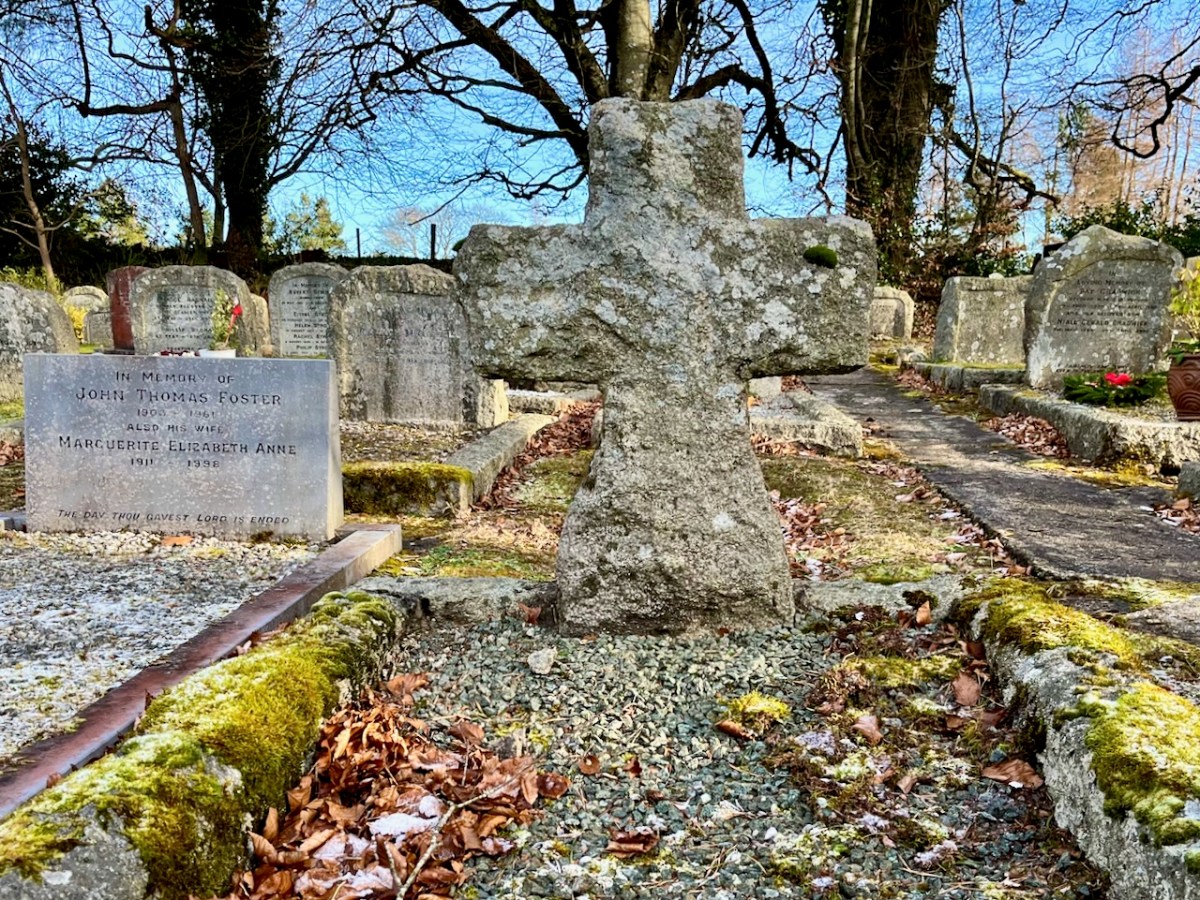
It’s interesting to find a Jewish grave in a rural Irish parish: Evelyn and Bruno Achilles (above and below).
In the 1930s The Schools Folklore Collection produced some memorable notes about the parish of Calary:
. . . Glasnamullen is our town land and there are nine families in it. Calary is the name of our parish. There are about twenty-six people in this townland. Sutton is the most common name in this district as their are four in Glasnamullen. All the houses in our town land is slated, but there are three or four thatched houses outside the townland. This place is called Glasnamullen as long as anyone can remember. Mr Arthur Sutton is seventy six, he lives in Glasnamullen, but Mr Fortune is one hundred and Mr Stokes is eighty six. They dont know any Irish, but they are great for telling stories in English. When my father was small he used to get Mr Stokes to tell him stories. Mr Fleming told me a story about Mr Byrne, The Paddock, Kilpedder. Once upon a time a man was cutting down a hawthorn tree in an old fort and as soon as he did a wind rose and took it away and over his head were thousands of birds. No one ever knew where the hawthorn went to, but everyone said that the fairies must have done it. They never plough the land owing to that. St Kevin is said to have blessed a little well beside a river in Ballinstowe. Every one goes and drinks it when they have colds. It is also said it has the power to cure sore eyes. There are pieces of cloth on the bushes around it left by people whose eyes were cured . . .
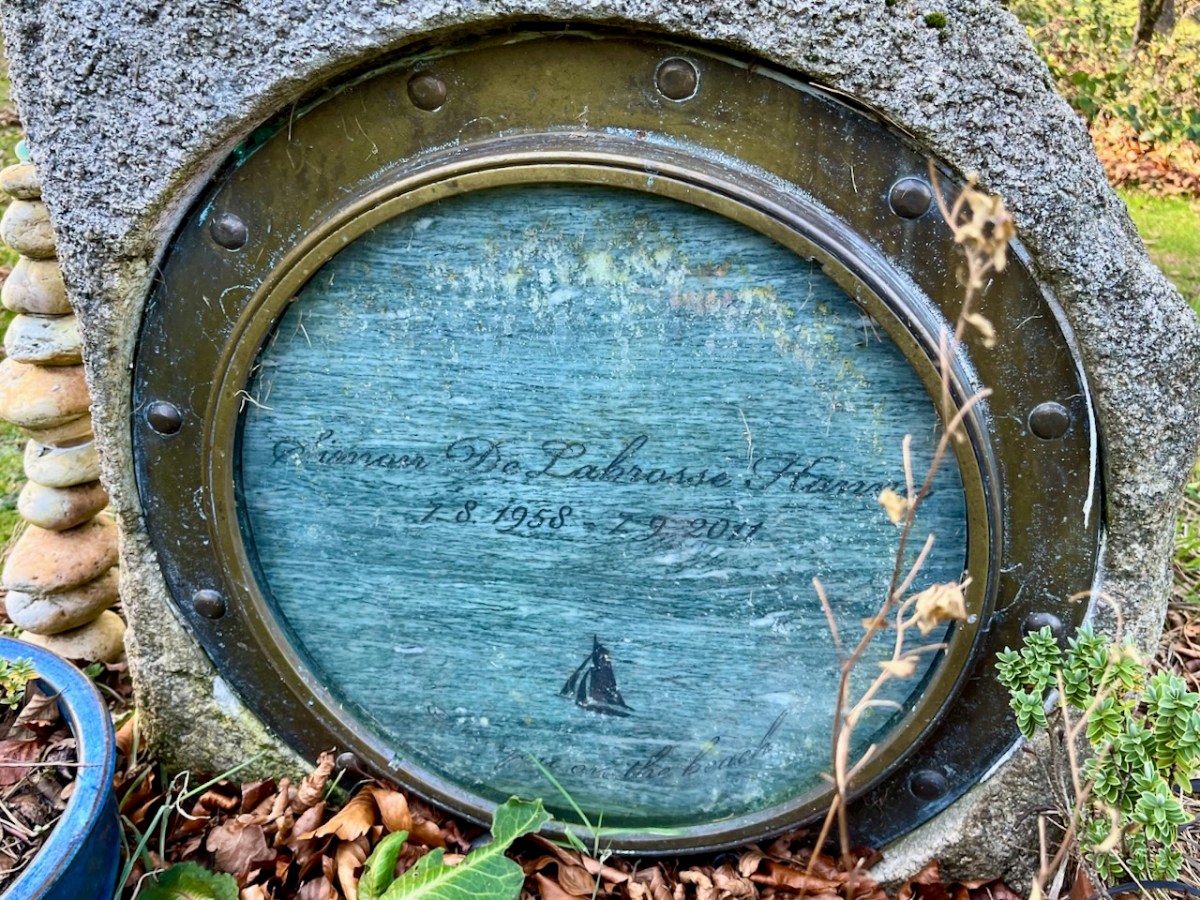
I have concluded that this fairly recent grave (2011) is in memory of a mariner. You can see that the inscription is within a porthole – and there is an illustration of a sailing boat. After much searching, I came across a funeral notice – here is a brief summary:
. . . HANNA Simon (late of Bray, Co Wicklow, formerly of New Zealand) – September 7, 2011, suddenly, son of Meg and the late Pat Hanna and brother of Tim, Mike, Pete, Kristin and Jane; sadly missed by his partner Sonja (McEnroe), her daughter Tali and her partner Danny, his sons Rowan, Aiden, Kieran and their mother Ann, his mother, brothers and sisters, extended family and many friends. Reposing in the factory workshop, Mill Lane, Bray from 4pm to 9pm tomorrow (Sunday). Removal on Monday to Calary Parish Church arriving for a Funeral Service at 2.00 o’clock followed by interment in the adjoining churchyard . . .
Funeral Notice
This is not an exhaustive account of the graves in Calary: it’s a selection only. Hopefully it’s sufficient to send you in this direction if you find yourself over in the east. It’s a beautifully atmospheric place. Let’s finish where we started – with a Louis le Brocquy tapestry. This is: Garlanded Goat 1949-50, Aubusson tapestry, Atelier Tabard Frères et Soeurs (artist website).
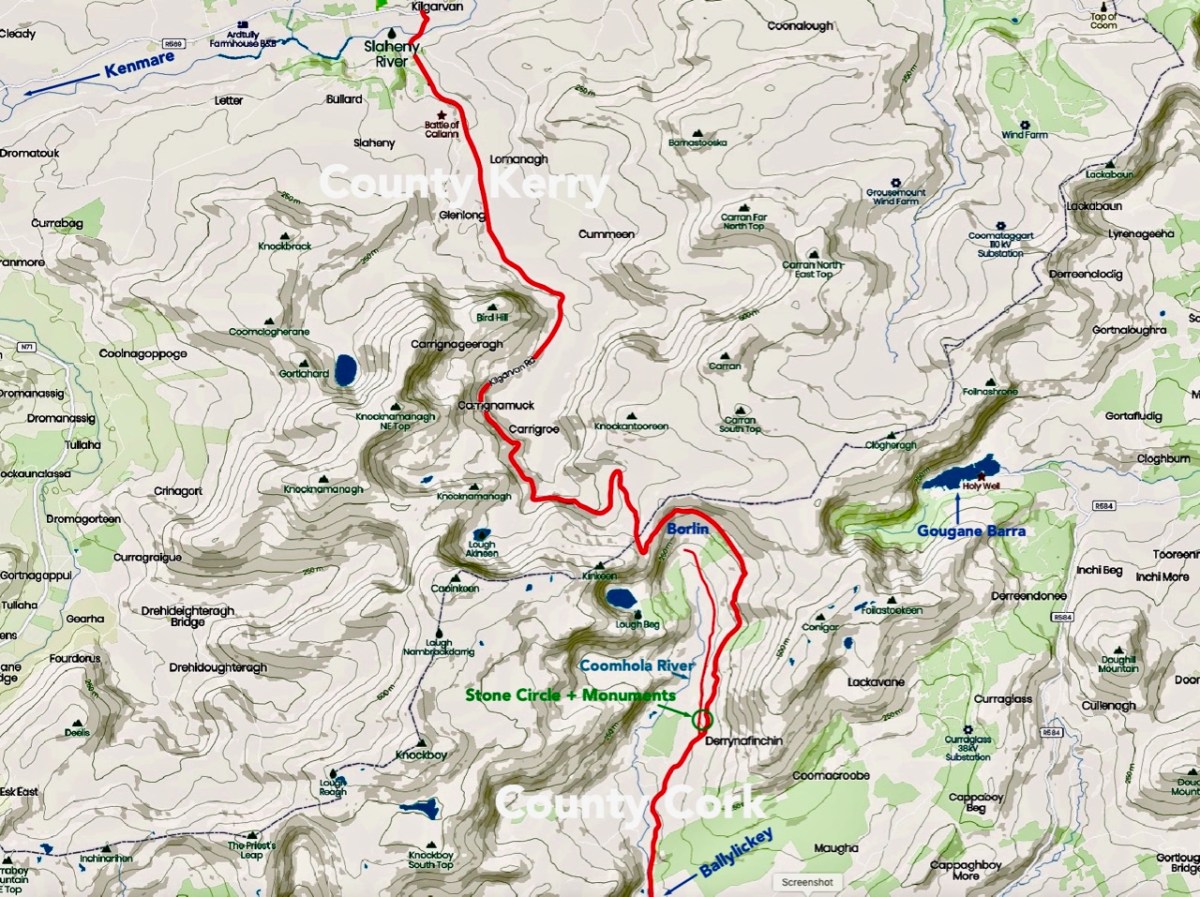
We have certainly travelled this route many times – it’s our favourite way of getting from Kenmare home to West Cork. Assuredly not a direct road, but spectacular – and you’ll hardly see a soul. Here’s a map – the road is in red:
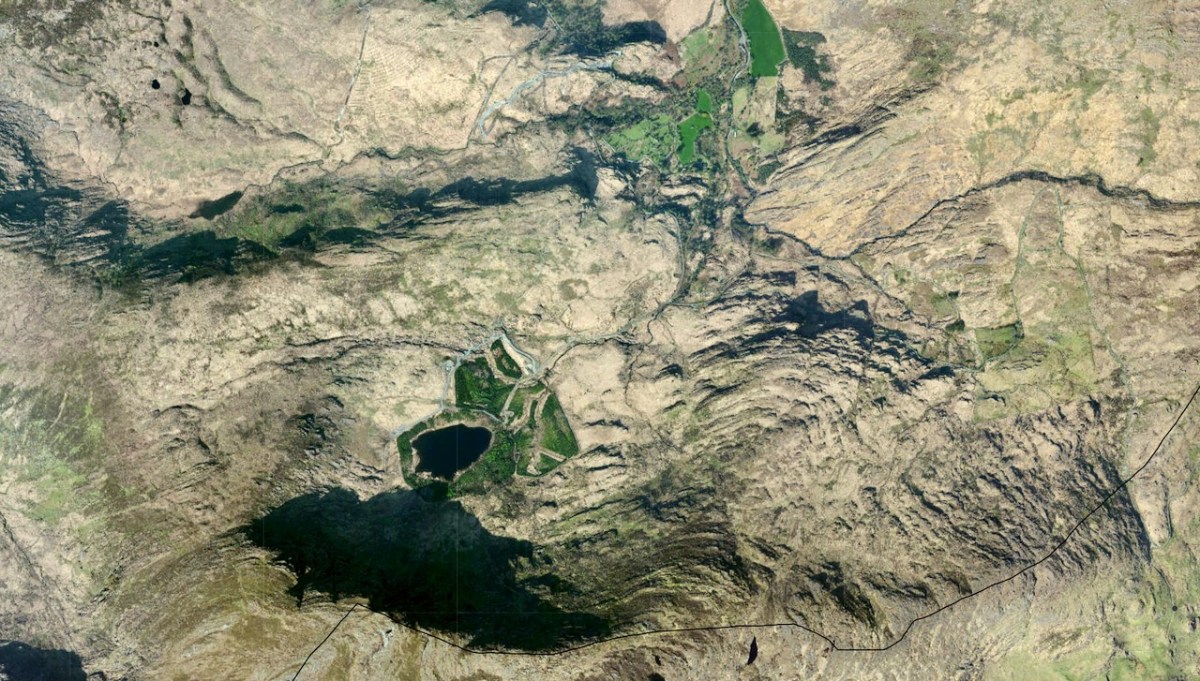
And here (below) – a sculptural abstract – is the nature of the terrain which the satellites spy on – looking straight down!
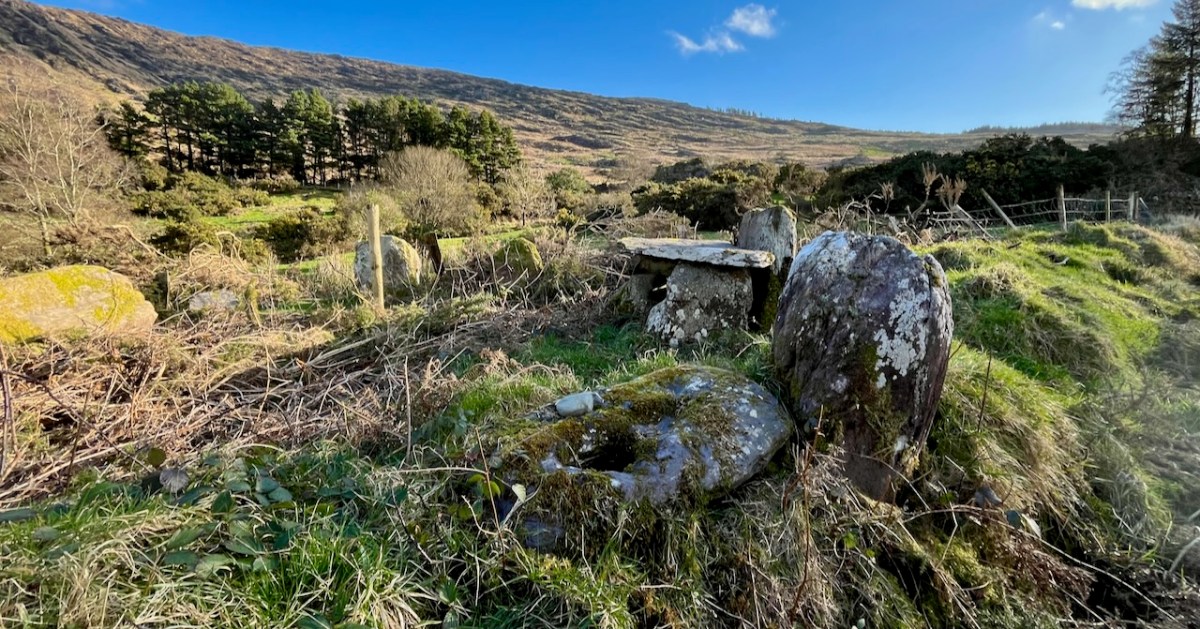
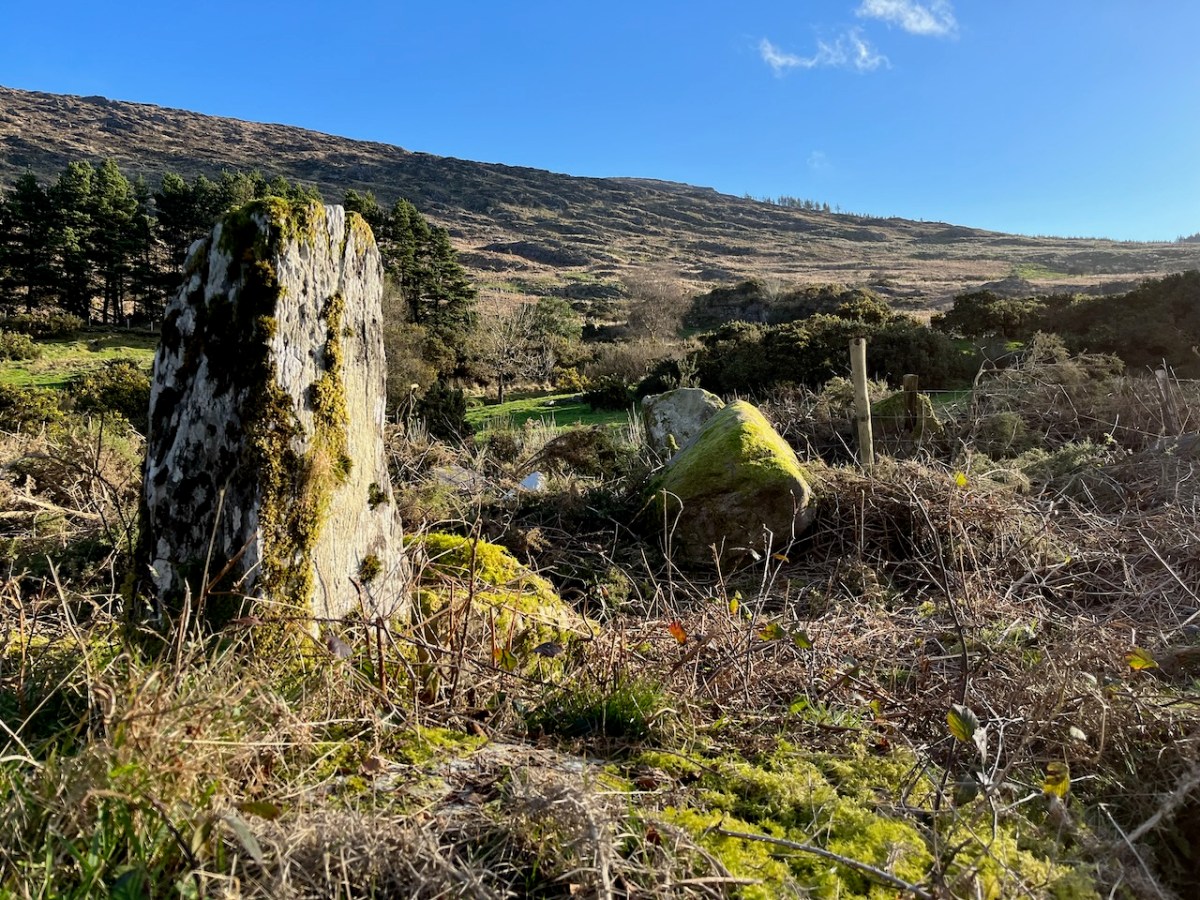
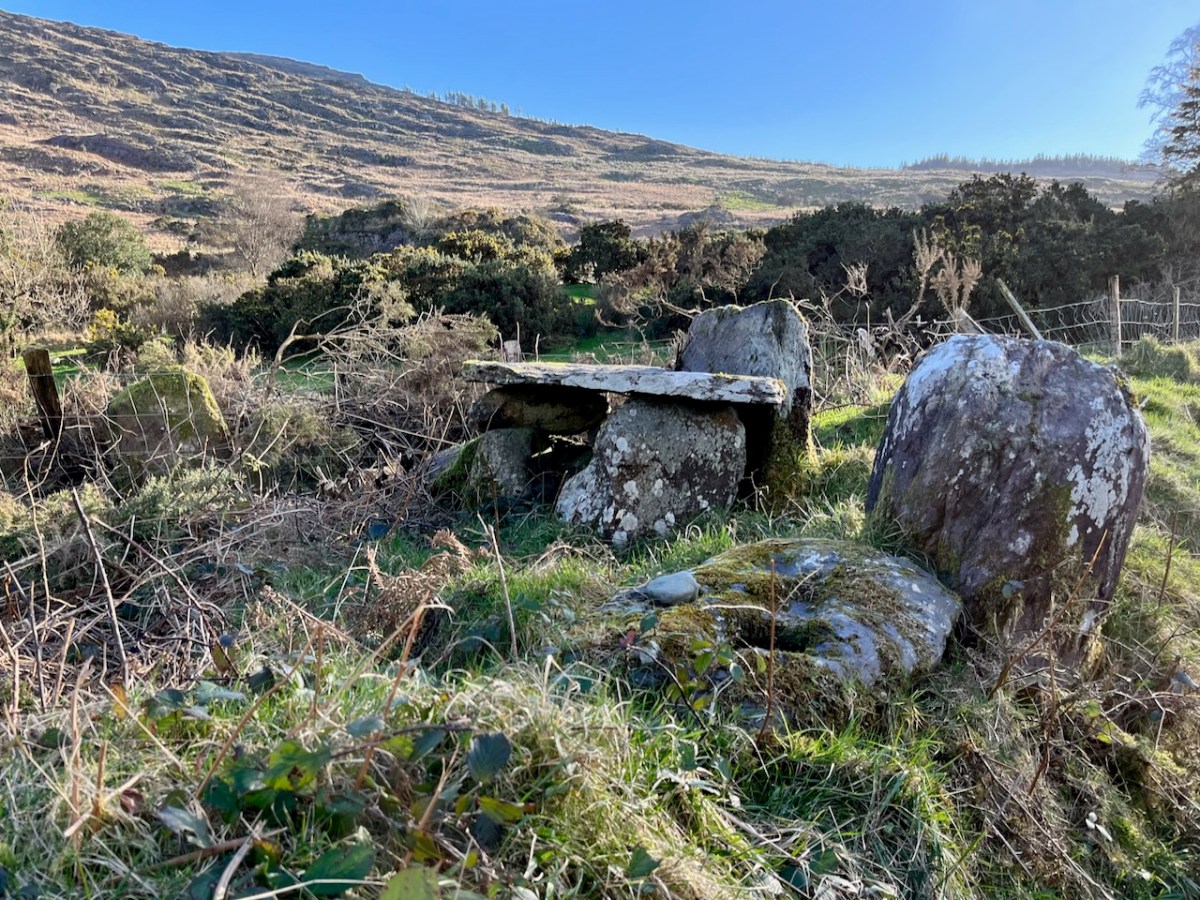
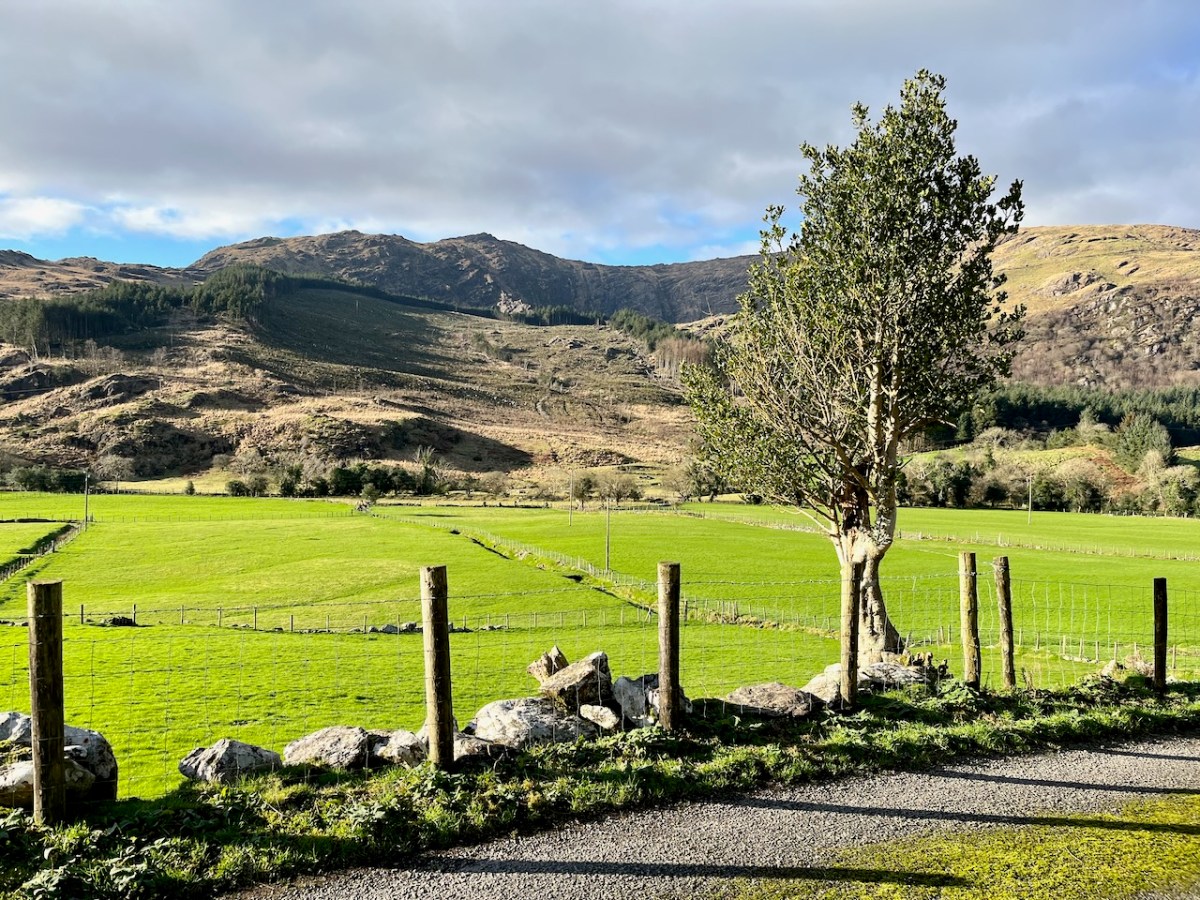
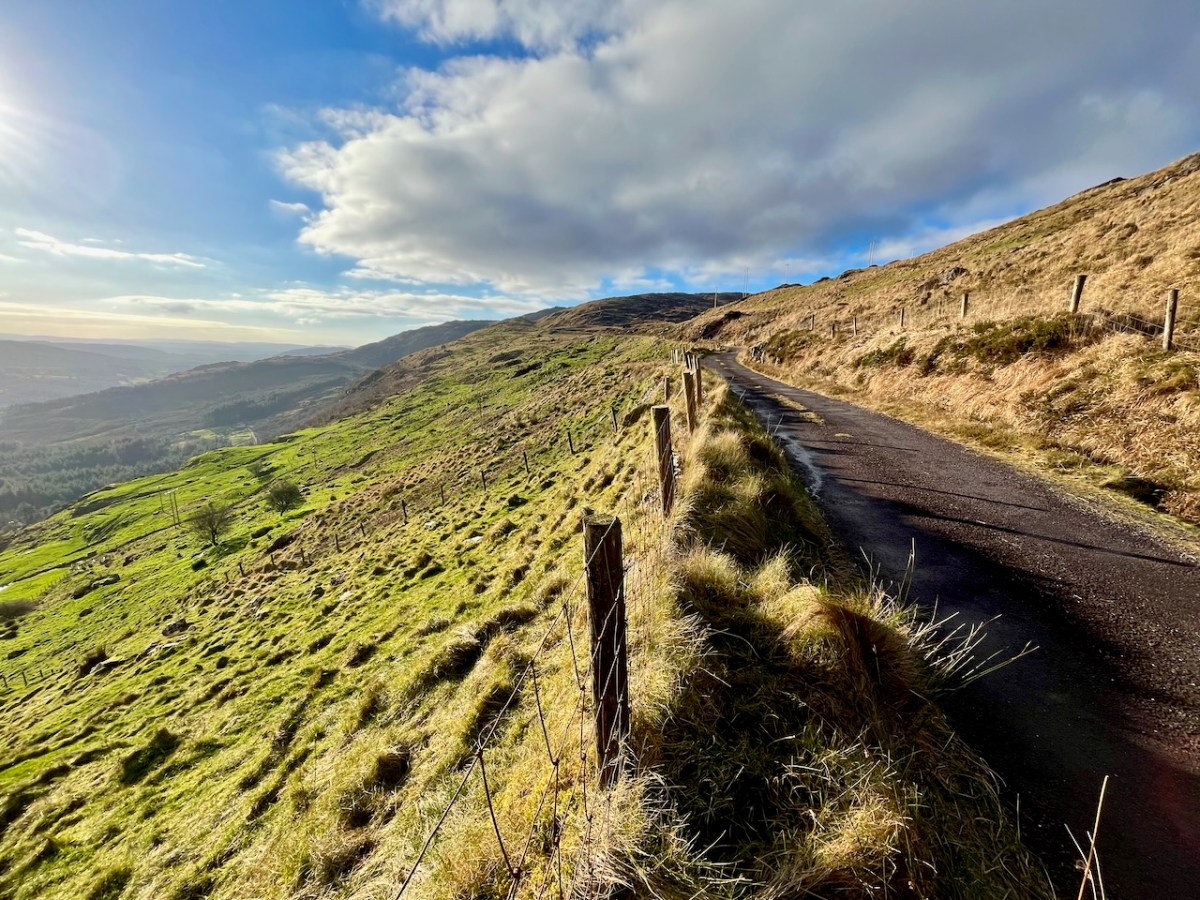
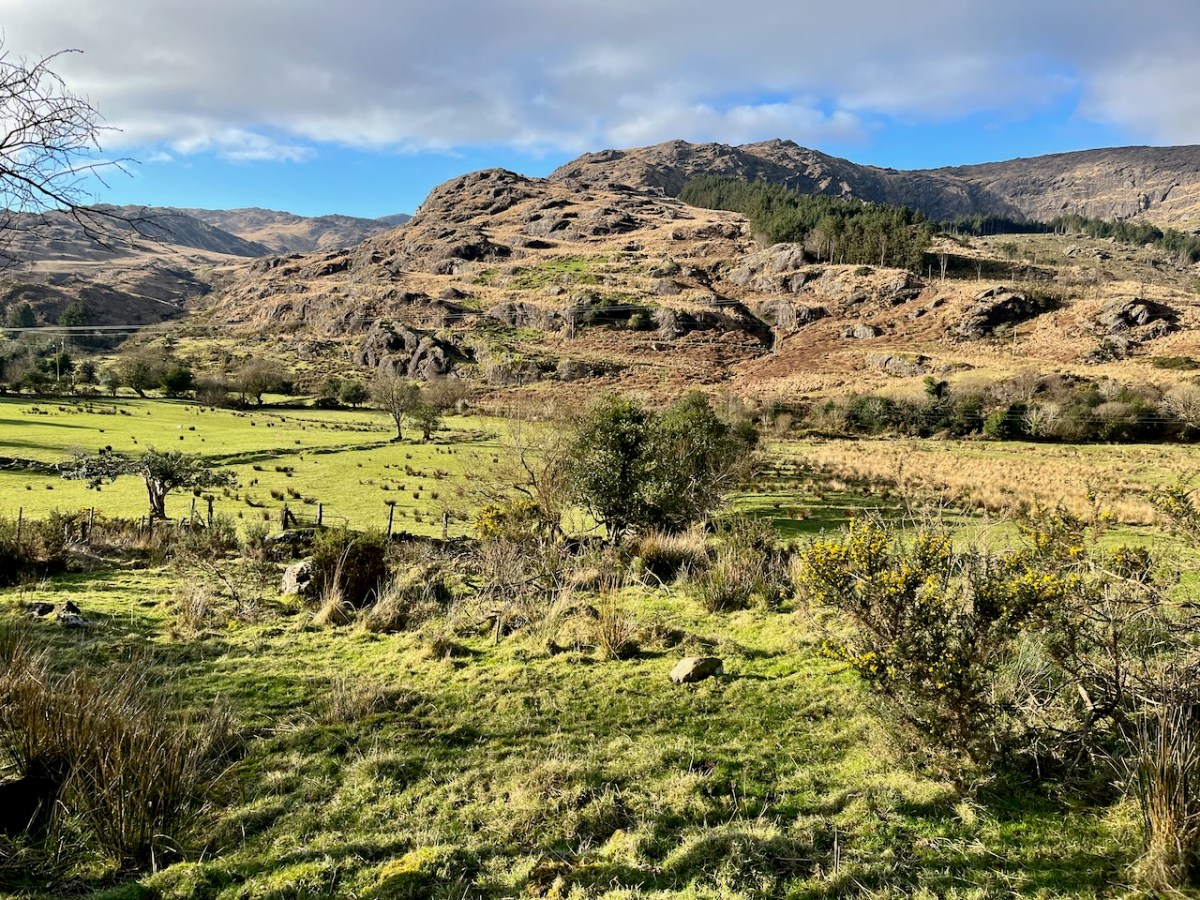
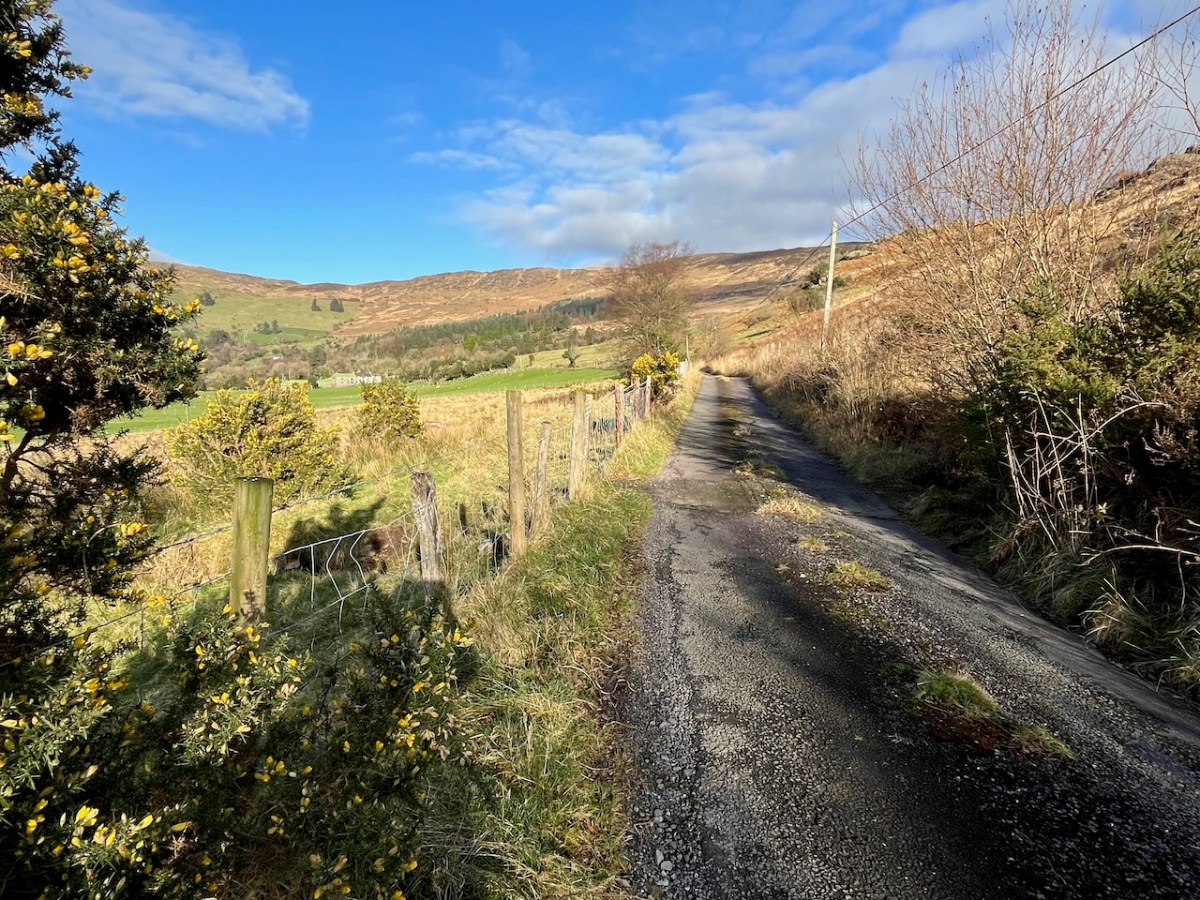
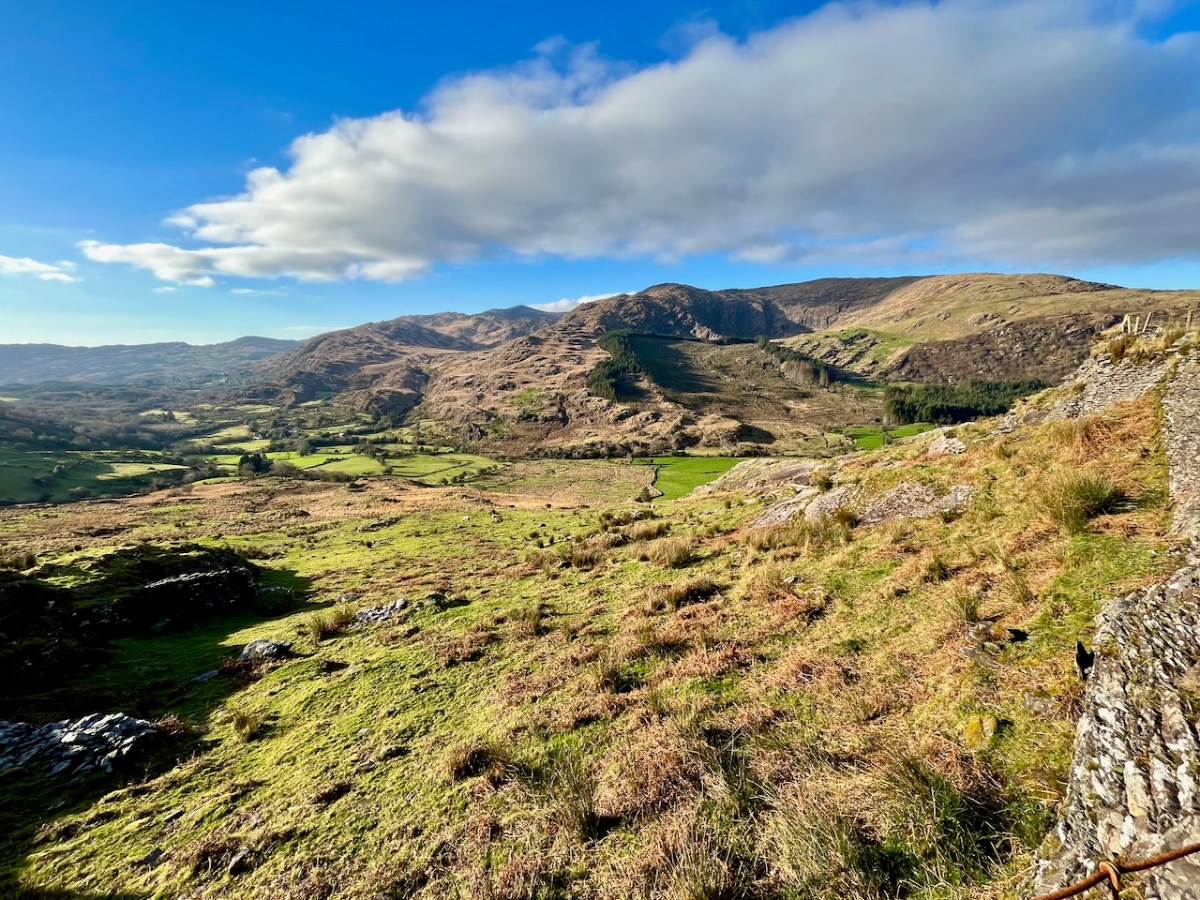
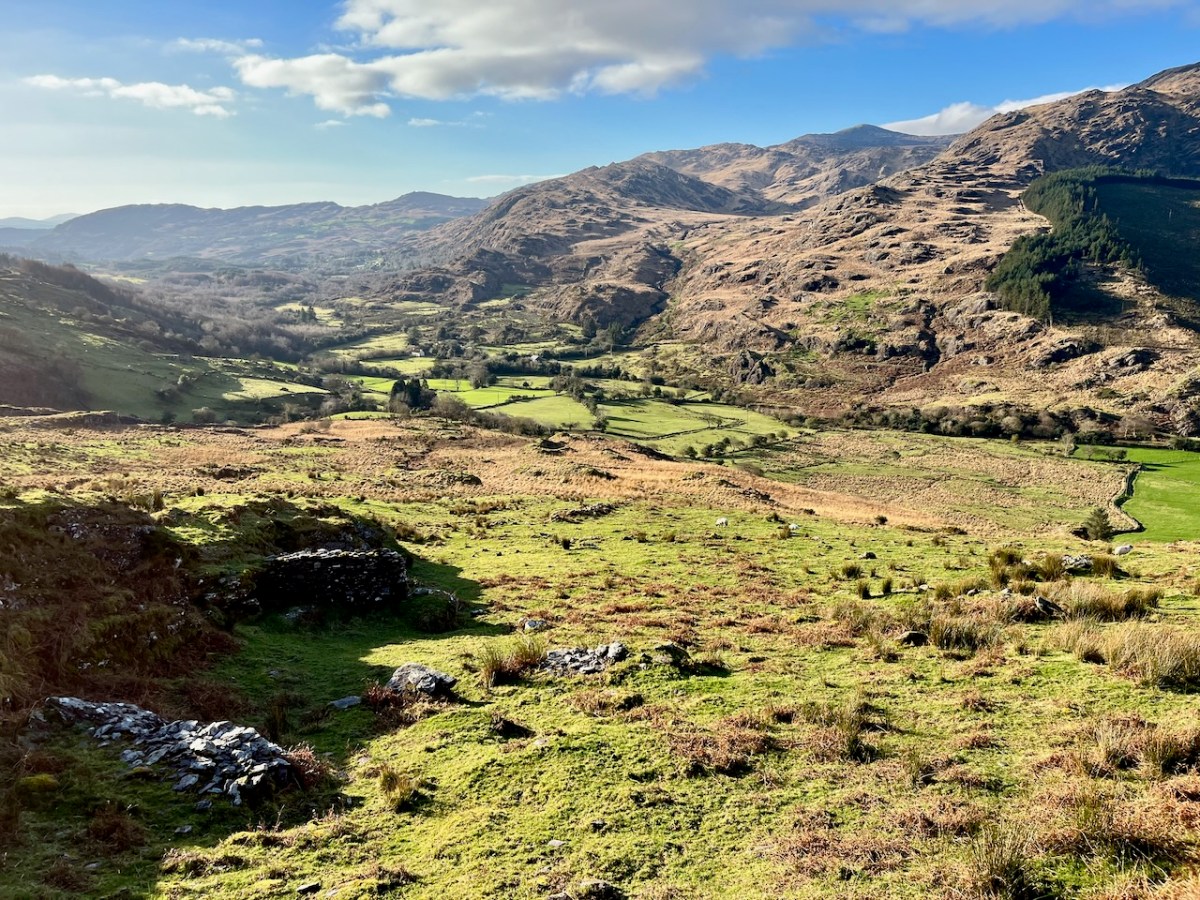
We passed over this high road that skirts the valley on an idyllic January day early in the new year (2024). For the first time, we also traversed the full length of the lane that goes into the heart of the vale, only serving scattered houses and farms. This goes by a complex stone circle and Mass Rock in the townland of Derrynafinchin – or Doire na Fuinseann. The group – also featured on the header – has been fully described by Amanda’s post Derrynafinchin: a bullaun, Mass rock & stone circle from a couple of years ago. Well worth a read!
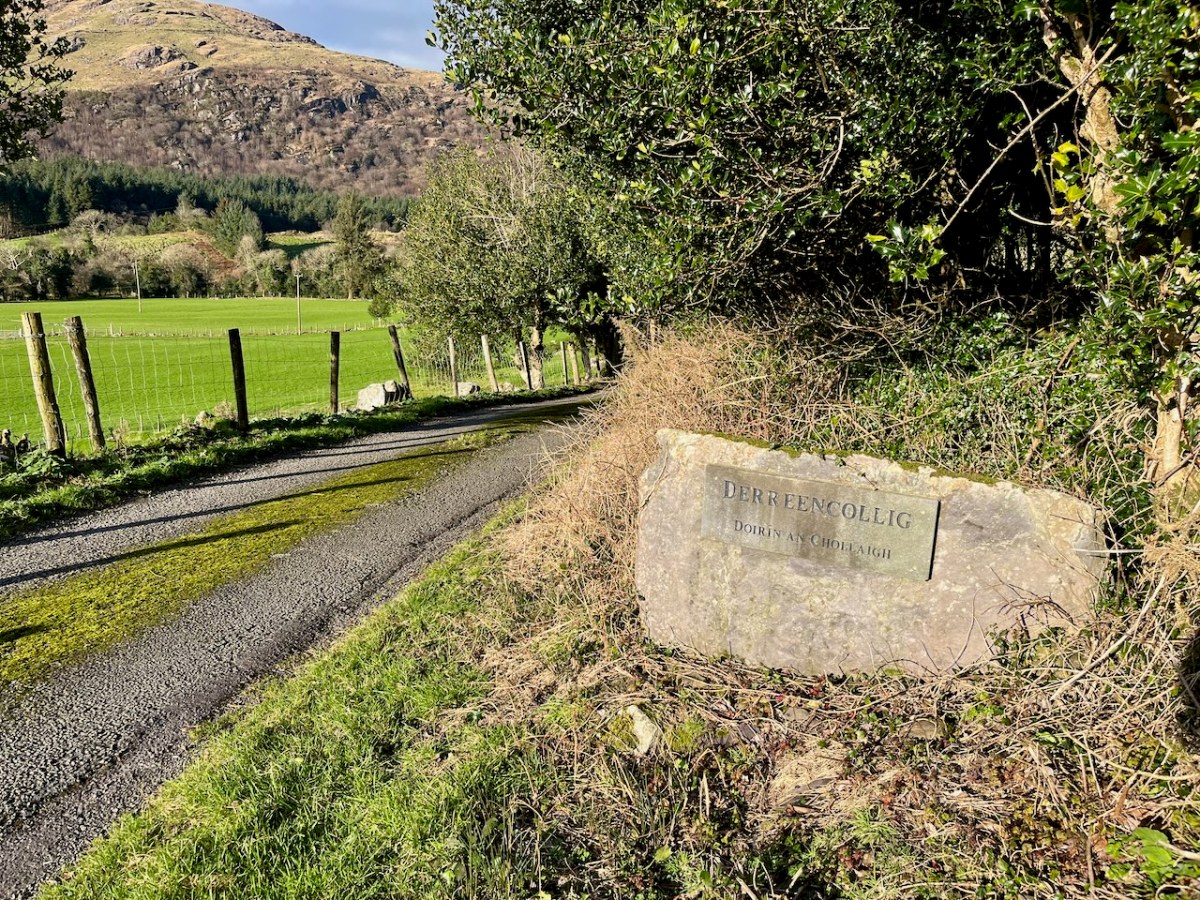
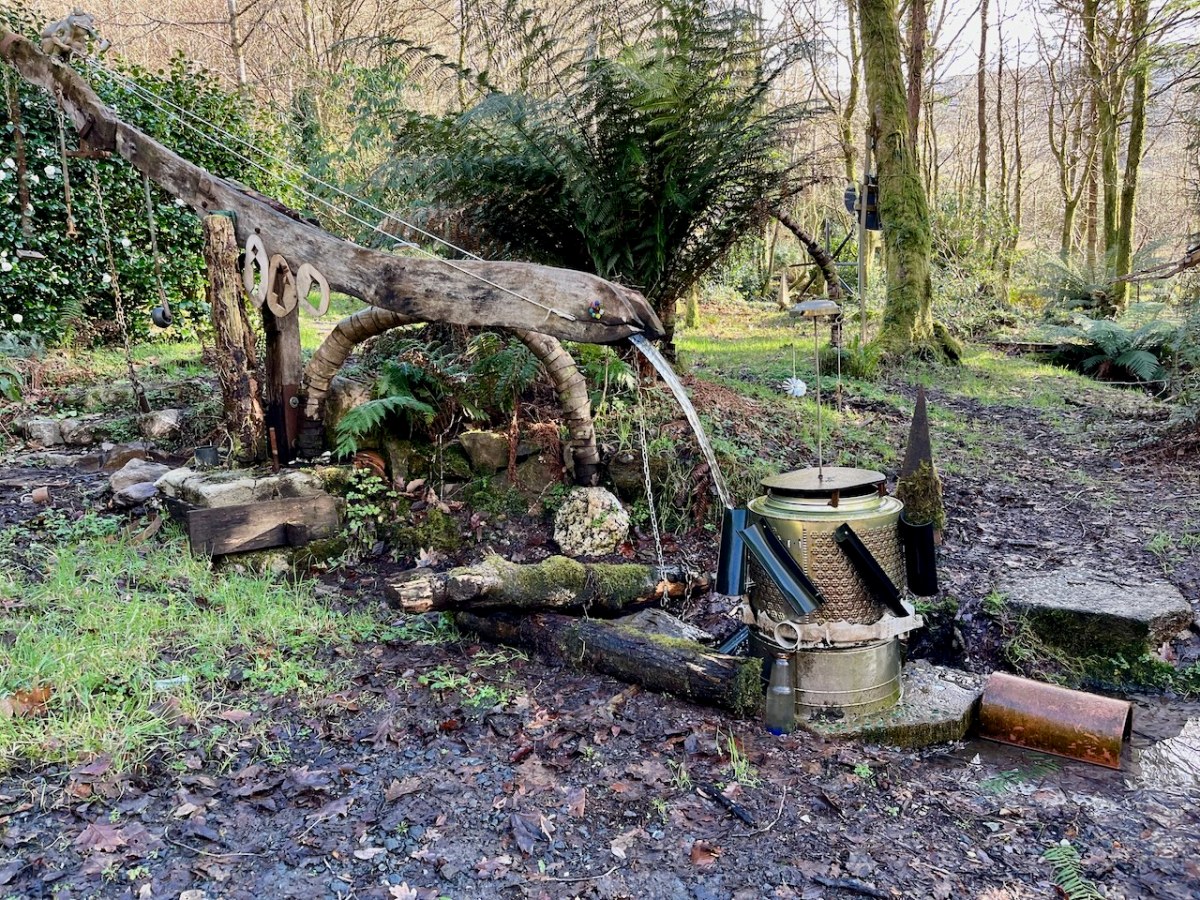
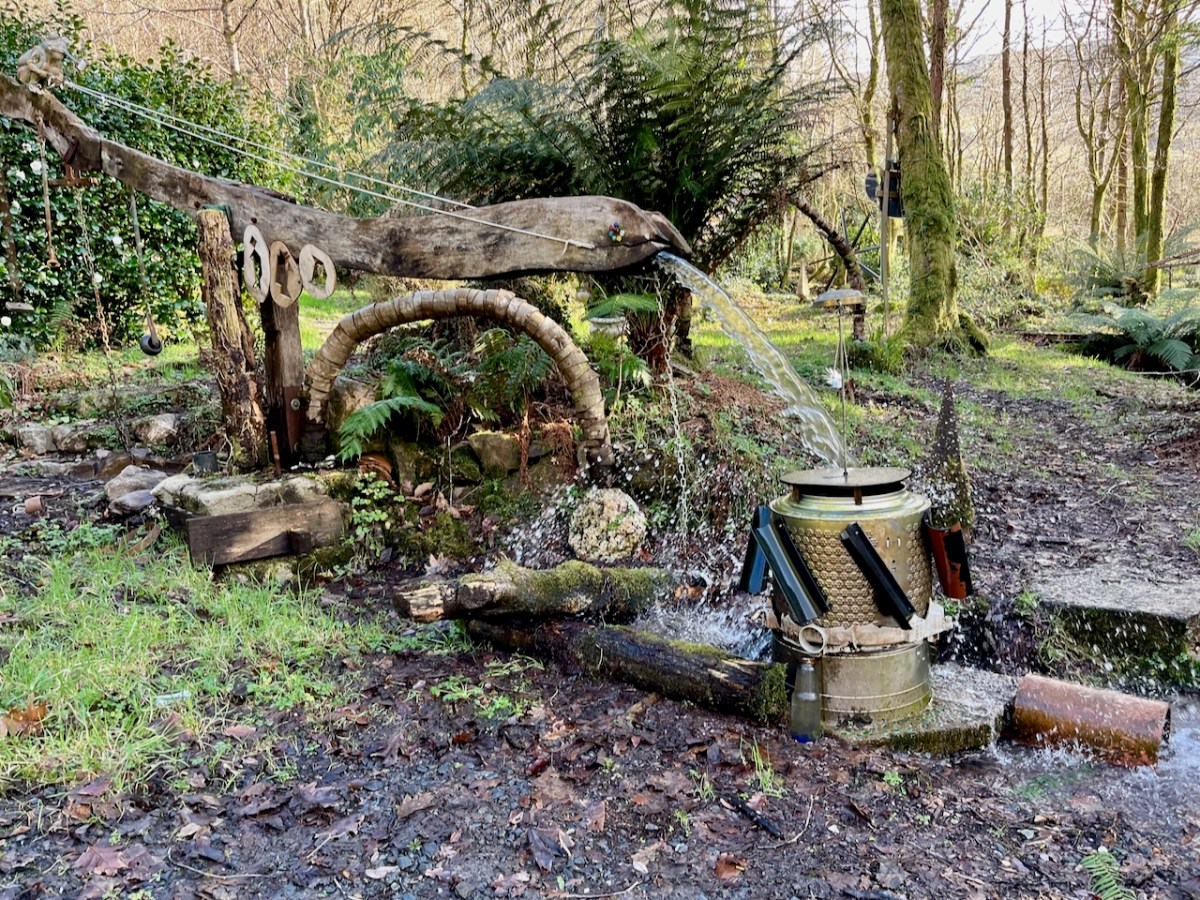
The little lane also passes into the townland of Derreencollig. We were intrigued by some kinetic sculptures we found beside the way: we did not come across the artist, nor anyone else on this part of the journey.
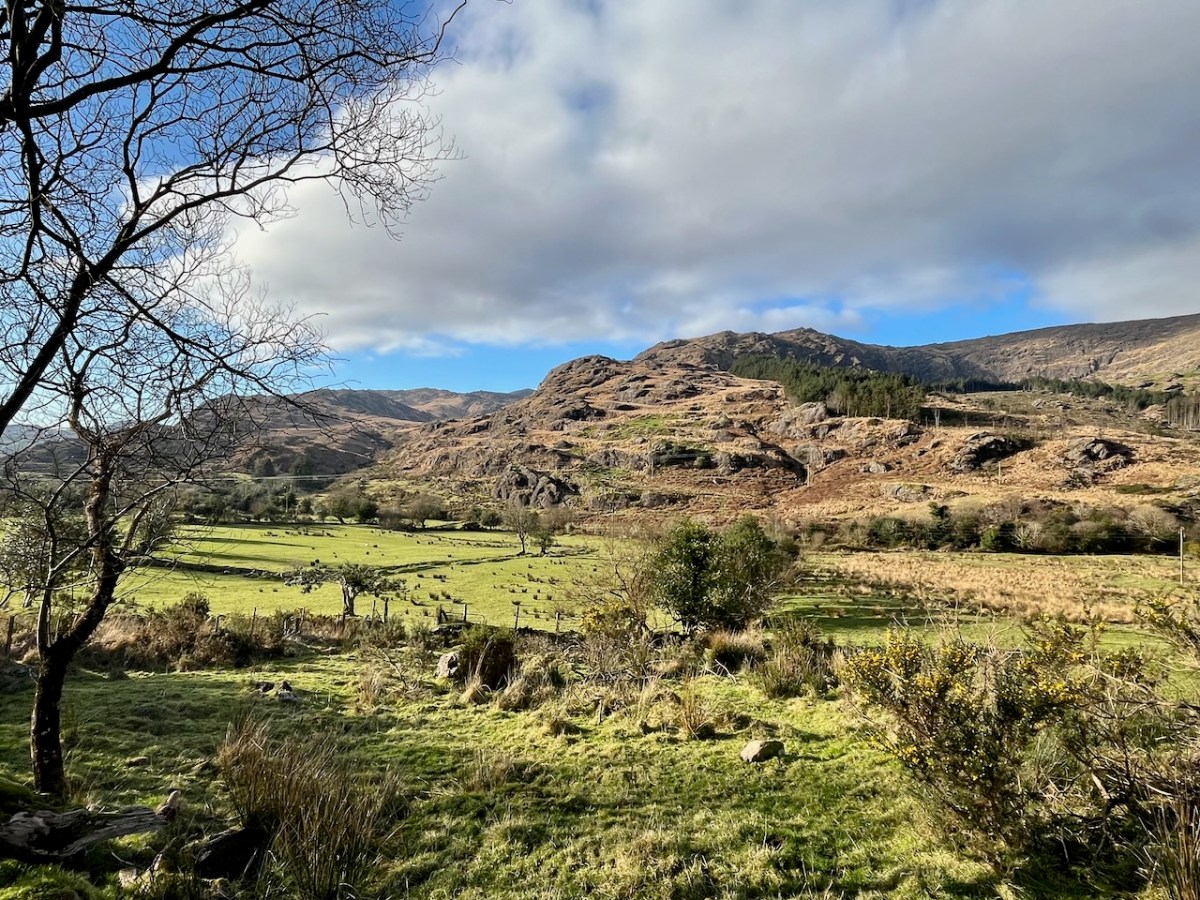
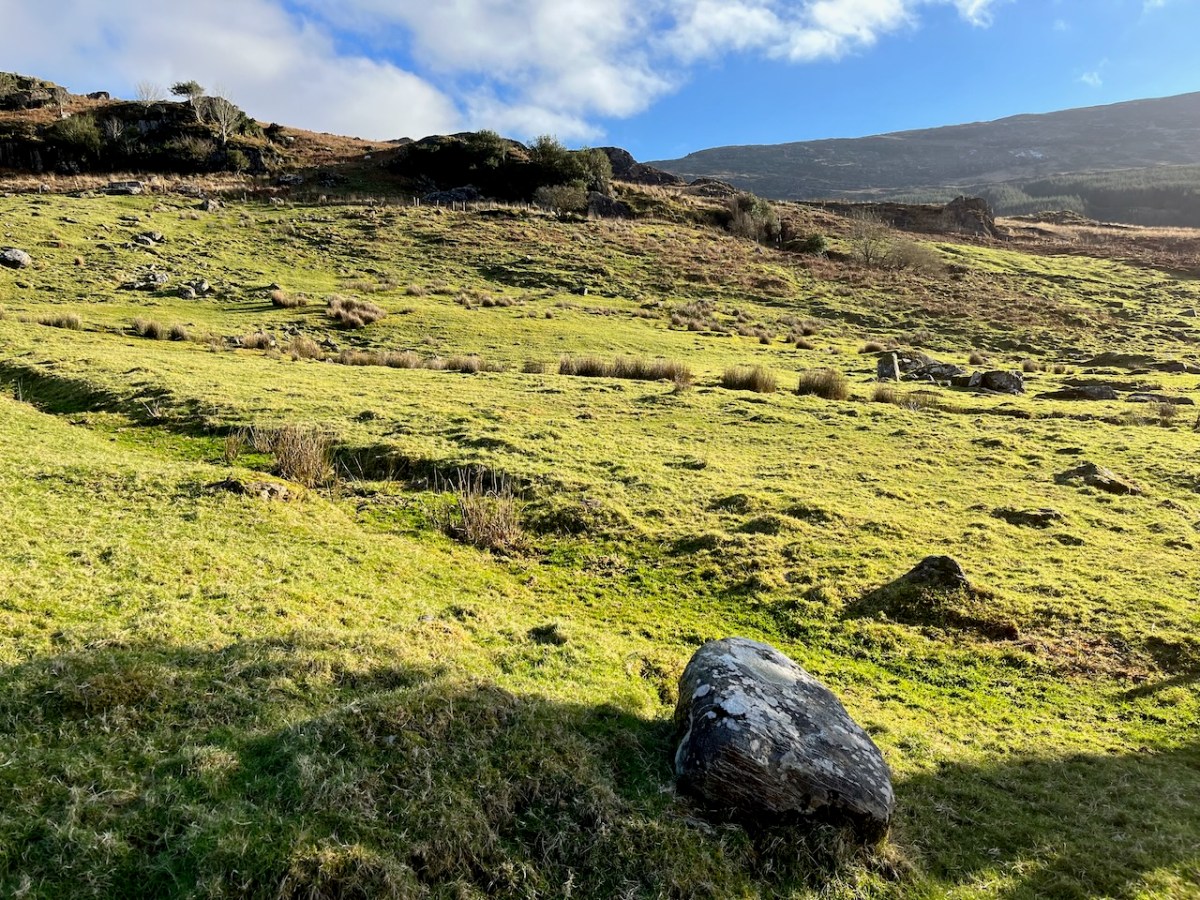
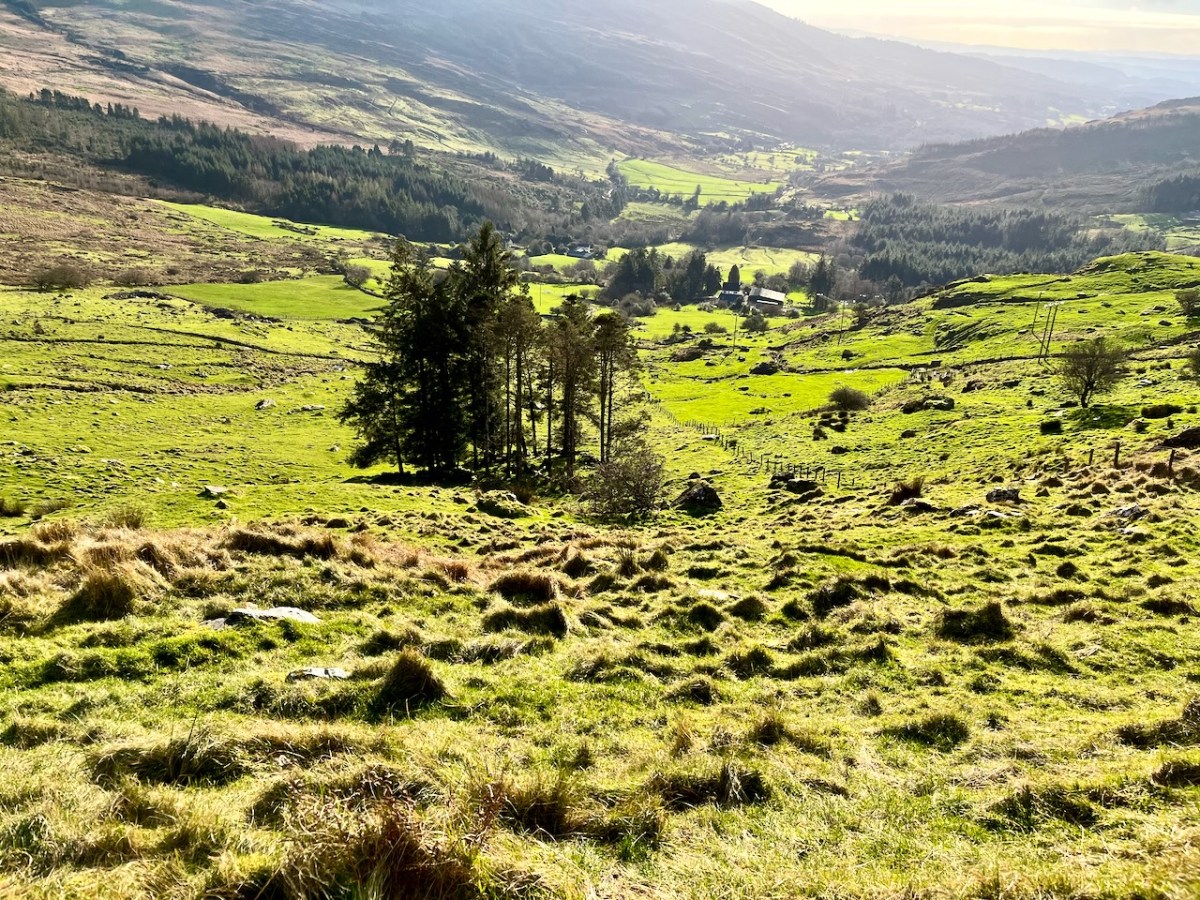
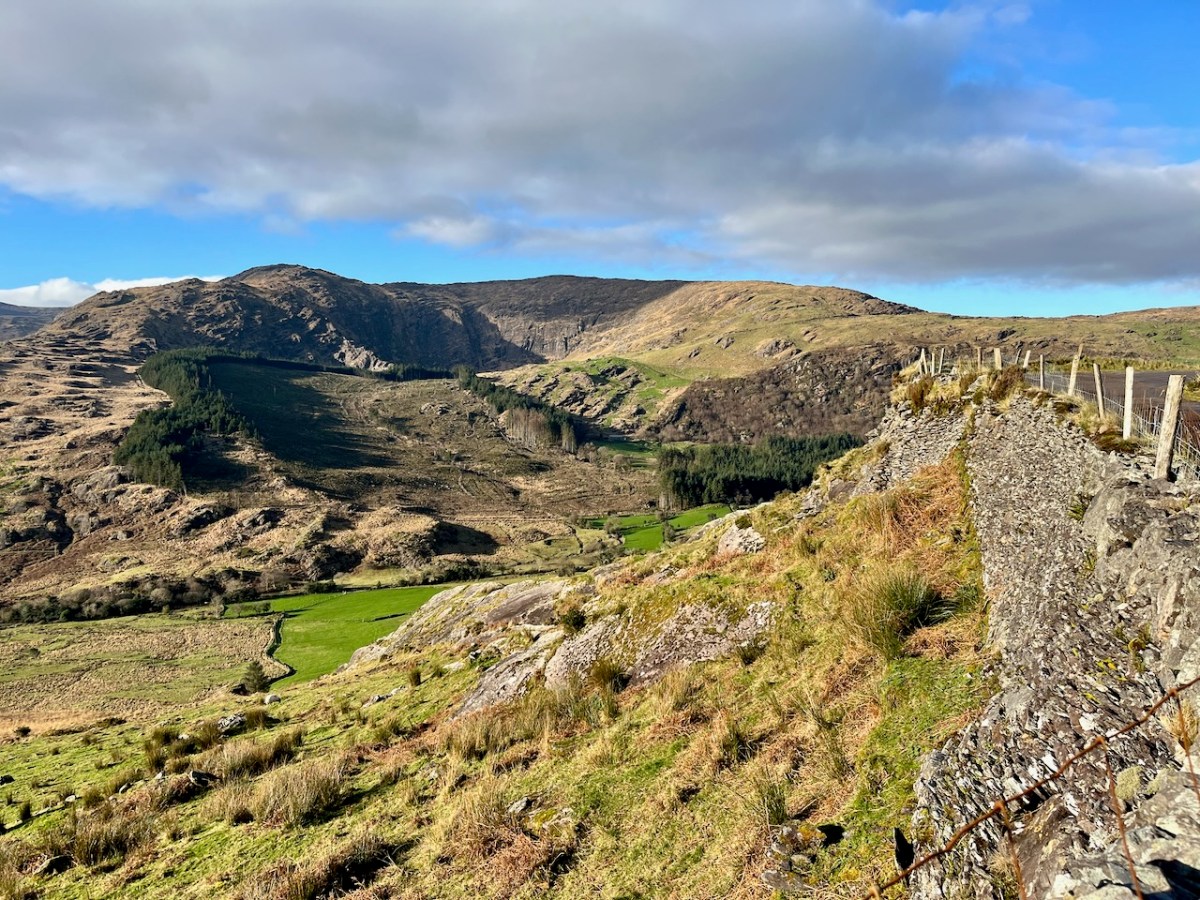
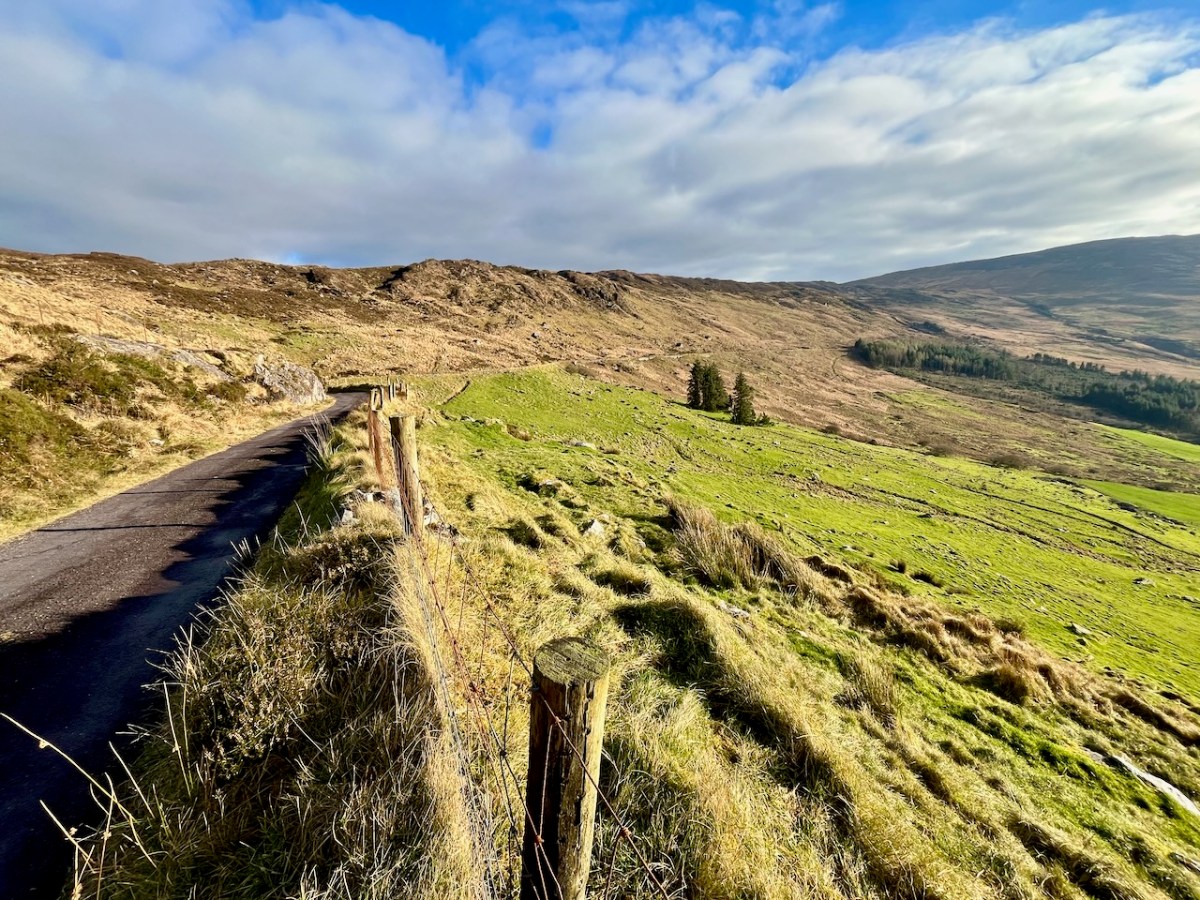
The views into this remote townland and its few habitations is seen from the minor road that follows the contour at high level, heading for Bantry.
If you find our minor roads tricky, then stick to the main ones. But, if you are not in a hurry, you couldn’t do better on a day of winter sunshine than to traverse the gentler, secret ways.
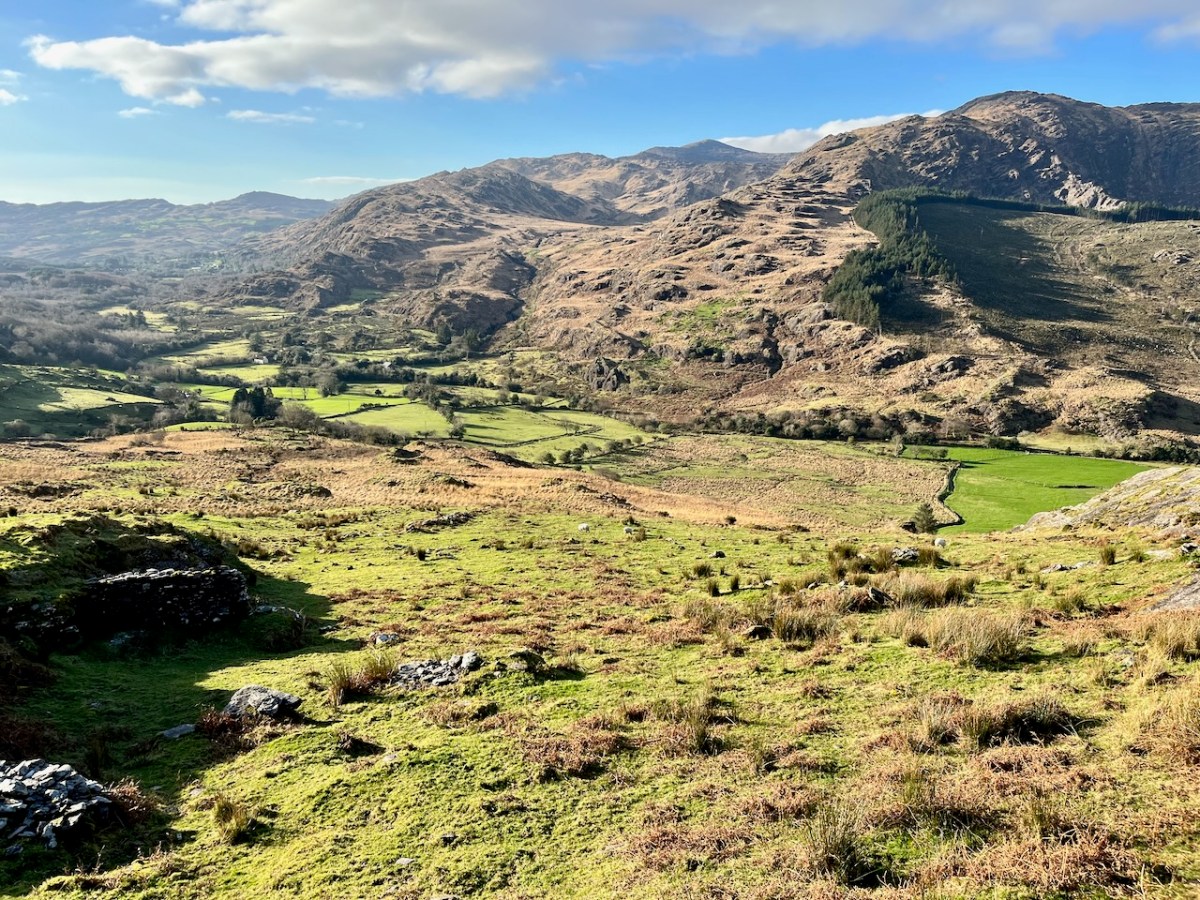
Description is hardly needed in this little topographical diversion. I’m not sure where else in the world you could find your senses as satiated as here in West Cork (and Kerry!). Travel on!
To my mind there’s no more satisfying way of journeying: keep to the crags and cornices of the high tracks.
Welcome to the UCD Library Cultural Heritage Collections blog. Discover and explore the historical treasures housed within our Archives, Special Collections, National Folklore Collection and Digital Library






























 Roaringwater Journal