Cormac’s Chapel: The Jewel in the Crown (Part 2)

I said I’d be back in a week and it’s been a year! I’ve been working my way through a series of posts on Irish Romanesque architecture (see the bottom of this post for the list so far) and last October I wrote the first of a two part post on Cormac’s Chapel, the Romanesque jewel on the Hill of Cashel in Co Tipperary. Since this is part 2 (unless you’ve read it before and have an amazing memory) go back there now and read up on the Chapel and its history, as well as my detailed description of the exterior.
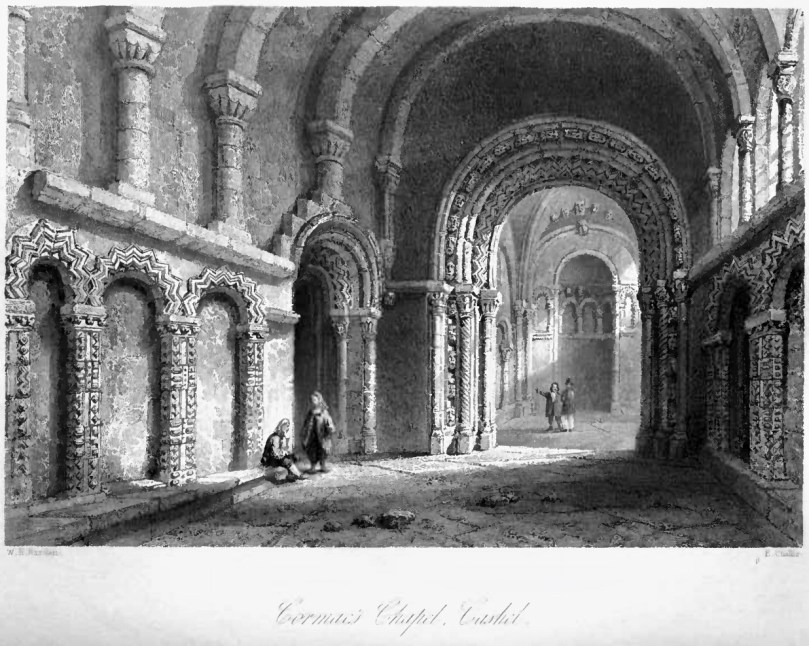
Illustration by W H Bartlett from The Scenery and Antiquities of Ireland by Joseph Coyne and Nathaniel Willis

Right, done that? Great, then come on inside. I was fortunate to visit Cashel last year, when the Chapel was open and I could spend as long as I liked taking photographs inside. This followed many years when it was closed – a conservation measure necessary to address the dampness which plagues stone-roofed buildings. During this open period it was noted that the number of visitors, all emitting carbon dioxide, was having a detrimental effect on the interior, so now it is only accessible during a guided tour and for a limited stay inside. Hopefully, this post will help you see things that you might miss during a short visit, or even items that those excellent guides might not cover.
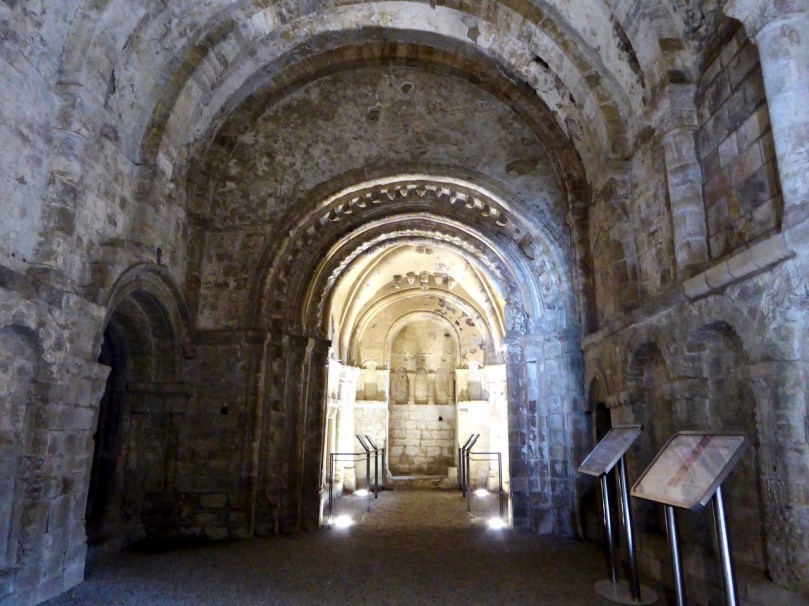
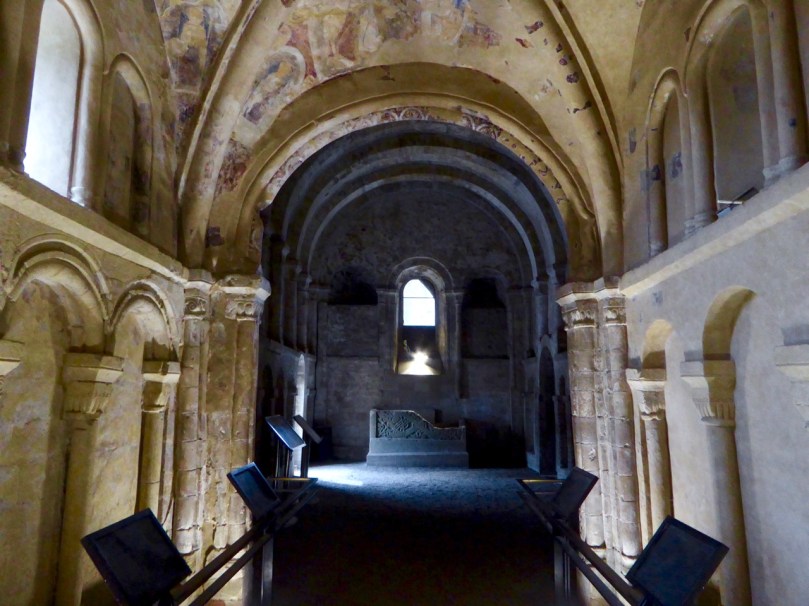
The interior, looking towards the chancel

This was a royal chapel, used for high ceremonies and built to enhance the prestige of King Cormac. When we think of such edifices, our mind probably pictures a cathedral, but large churches were still in the future in Ireland in the first half of the twelfth century and Cormac’s chapel, although small by European standards, was not outside the normal dimensions of Irish churches of the period. What was important was not its size, but the extraordinary attention to detail and decoration that went into its construction. Moreover, it had a second storey, under the steeply pitched roof. Although we are not completely sure what the functions were of that upper level, it effectively doubled the space available to its users.
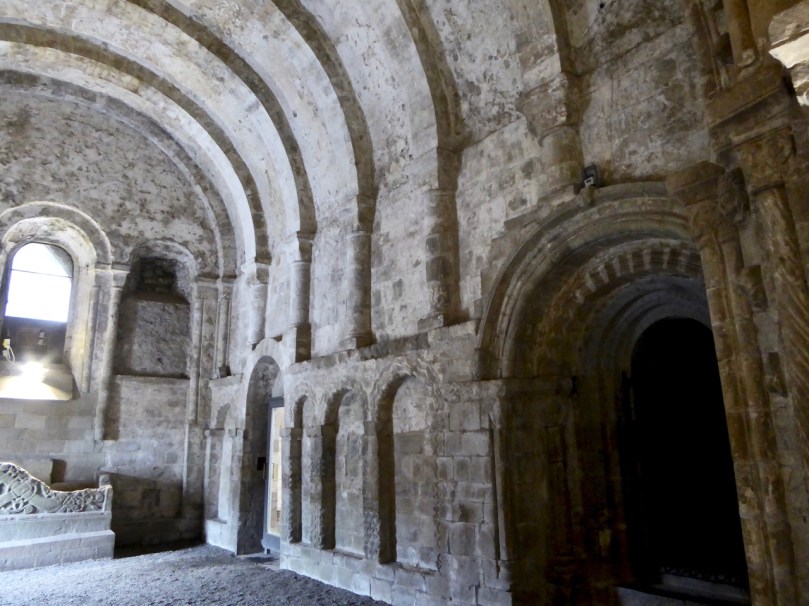
The north wall – note the blind arcading and barrel vaulted celing with parallel ribs, and the ornate door that leads to the second storey

Inside, the chapel is a nave and chancel structure, common among Romanesque churches, the only difference being the altar projection at the end of the chancel. The upstairs is accessed through the two square towers (see Part 1) and an ornate door in the north wall opens to a spiral staircase leading up to that floor (not accessible to the public). The size of this door and its elaborately carved orders speaks to its importance in some ceremonial way – O’Keefe says it tempts us to imagine the enactment inside Cormac’s Chapel of some ritual of procession involving relics.* In contrast, the north and south doors, the main entries to the nave, which are ornate on the outside, are relatively plain on the inside.
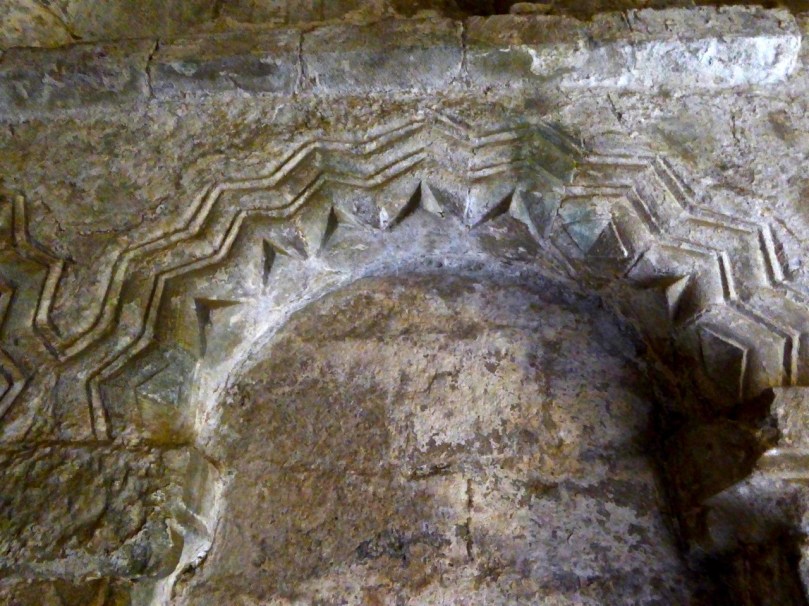
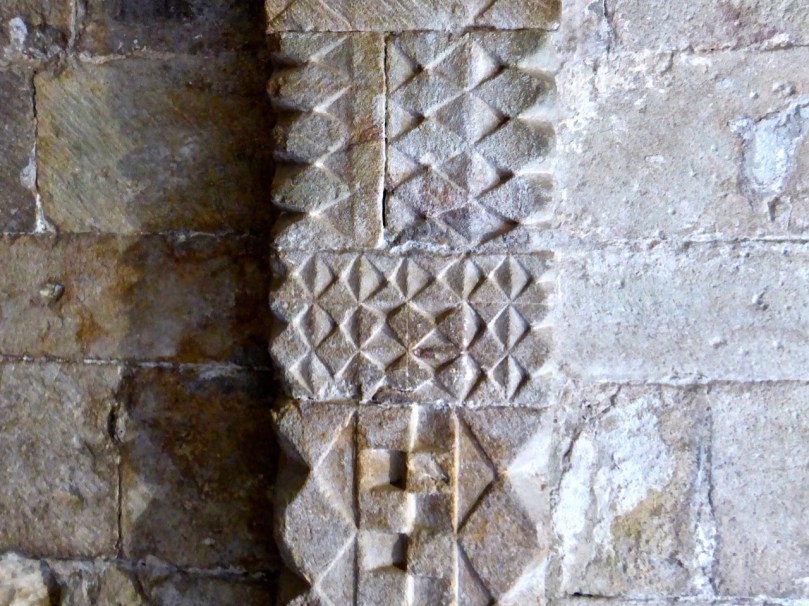
The nave is barrel vaulted, with parallel ribs running across the ceiling. The walls have blind arcades up to half their height, topped by a string course and a series of columns to support the ribbing. The blind arcade arches are carved with chevrons (above) while the columns between the arcades have irregular checkerboards of chevrons, lozenges and petals (below). The west wall has three windows on its upper stage, although only the middle one admits light now.
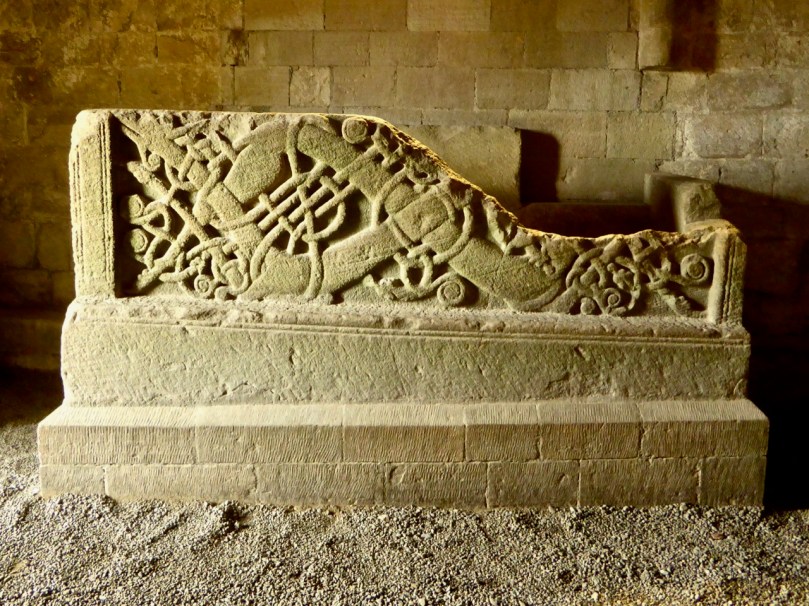
Beneath those three windows is a fragment of a large stone box, often described as a sarcophagus, wonderfully carved in the ‘Urnes’ style – a Scandinavian tradition of intertwined animals. Tradition has it that this is the tomb of Cormac himself, and certainly this carving style, although very different from what is found in the rest of the chapel, is probably contemporaneous with it. It was moved to the chapel from the later, Gothic, cathedral, where it was found. Whatever its use, it is a magnificent artefact, the work of a master craftsman.
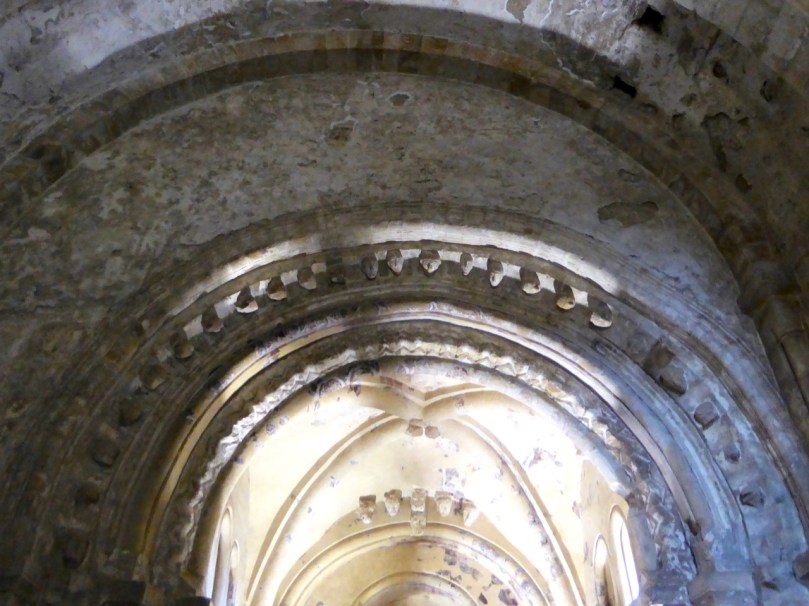
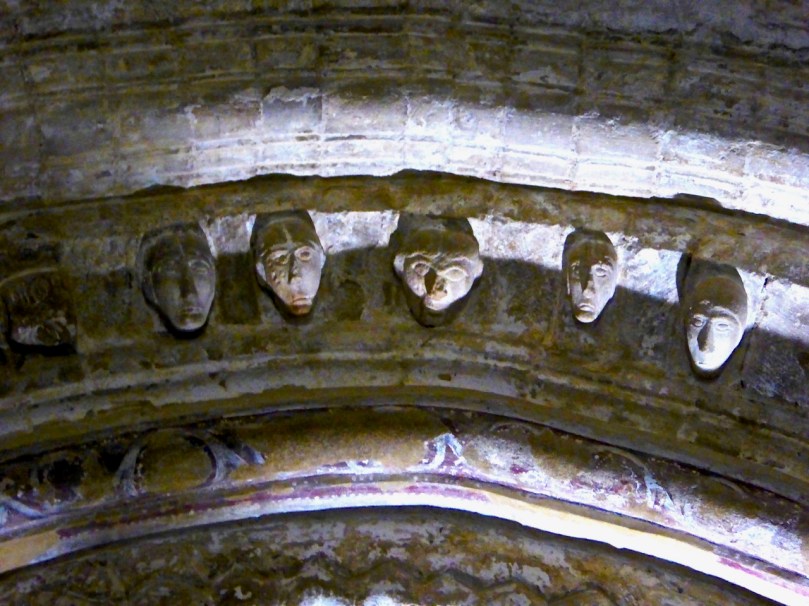
At the east end of the nave is the chancel arch with four orders. The archivolts of the first order mainly consist of carved heads, each individual and striking. Some are more time-worn than others, but the features can be clearly discerned in many.
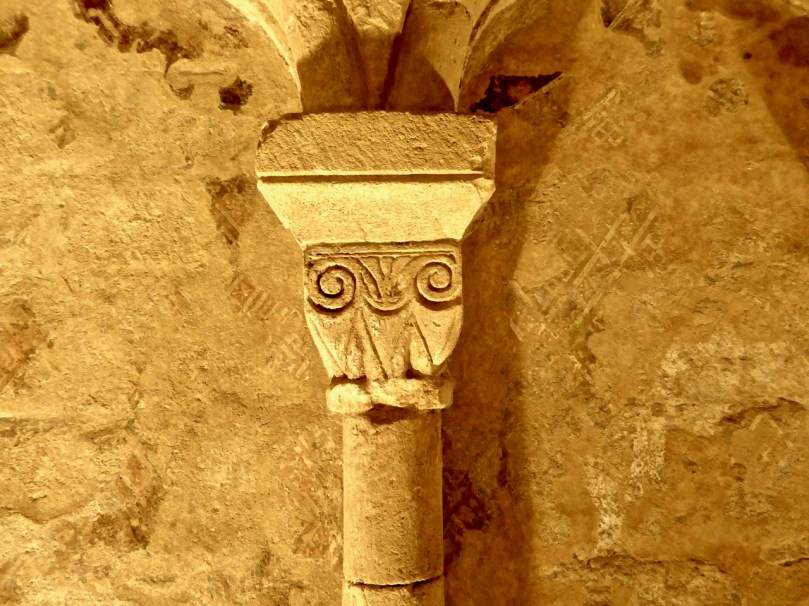
The chancel is also rib-vaulted, like the nave, but this time the ribs intersect at a central point, rather than being parallel. Like the nave, the walls have blind arcading above which are further arches and window-openings. Capitals are decorated with scrolls and scallops.
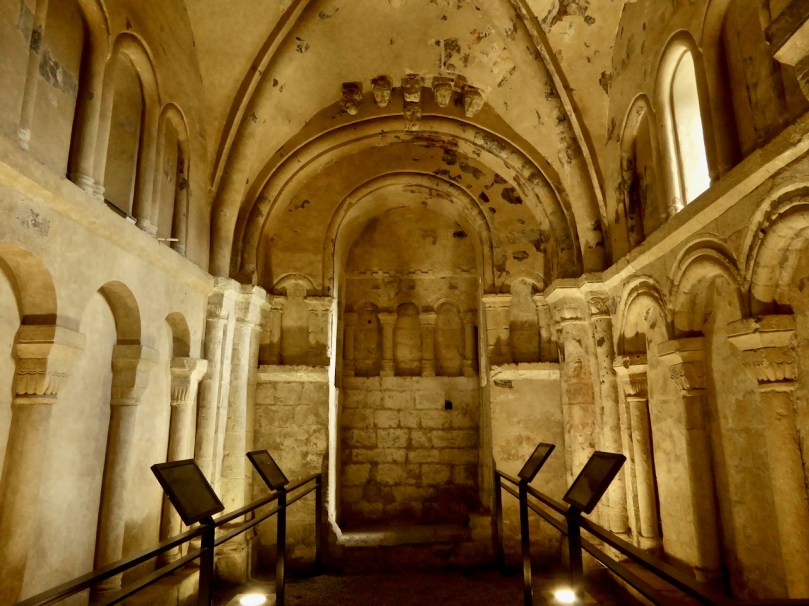
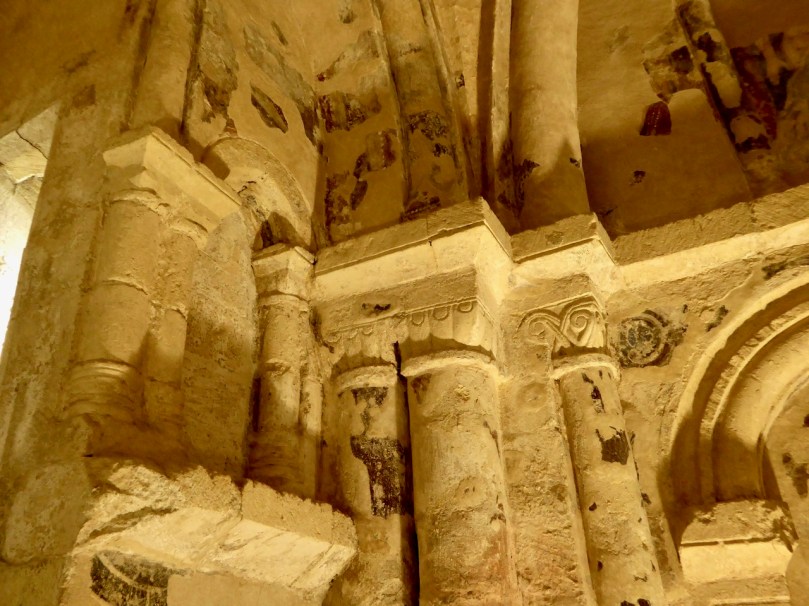
A final arch spans the projection which held an altar. The arcading in this final section is quite elaborate, and two deeply splayed windows provide light to this area.
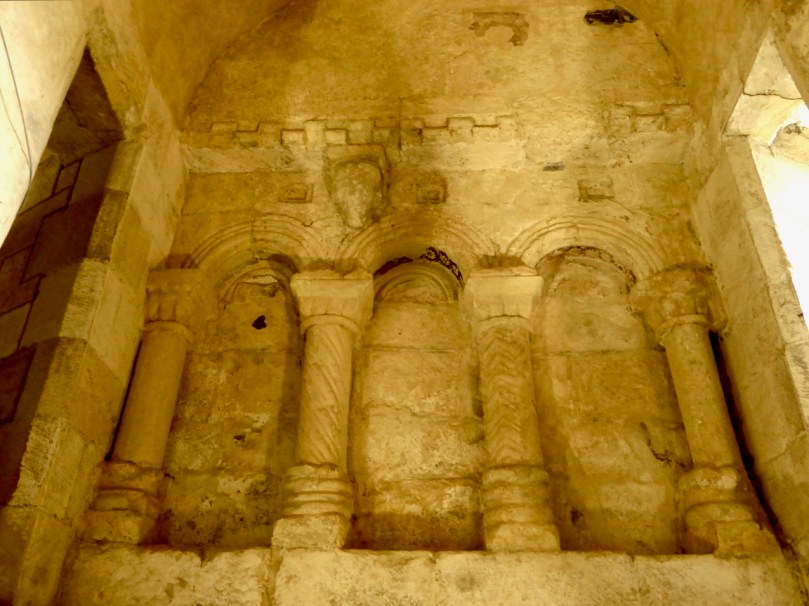
Once in the chancel area, which has been well lit, you can start to appreciate the vestiges of paintings that would have enlivened the interior of Cormac’s chapel. A conjectural reconstruction of the artwork is provided in an explanatory panel – the chapel must have looked magnificent and colourful indeed. Preserving these precious fragments has been a tremendous effort.
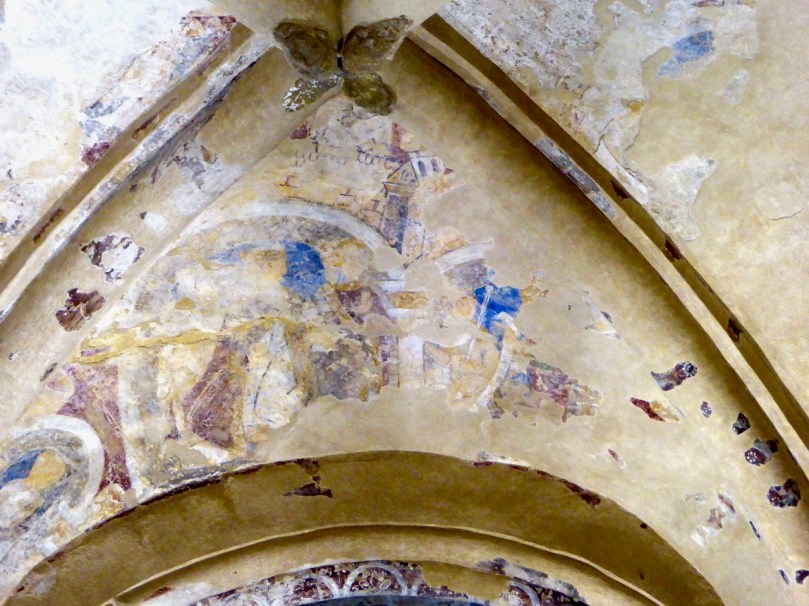
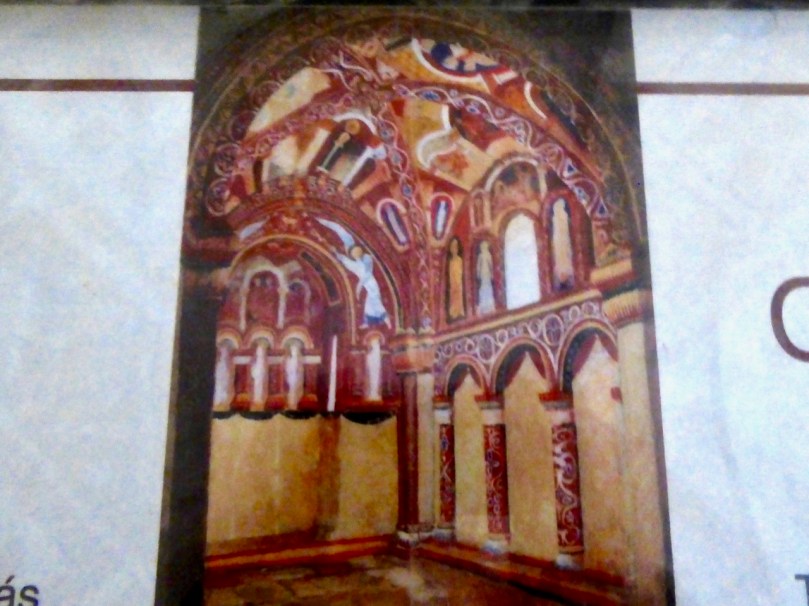
Finally, stand in the nave and take a careful look around – you will see that the chancel is offset to one side of the nave. While some authors have suggested this as a decision to change dimensions midway through the building process (Dermot Bannon’s nightmare) and others have ruminated about mistakes, O’Keefe demurs. It makes a lot more sense, he says, to interpret Cormac’s Chapel as built to plan, and to suggest that the nave widens on the north side to reflect and accommodate the visual spectacles of procession involving both north-side doorways.

Sketch by Richard Lovett, from his Irish Pictures. The ‘offset chancel is clearly seen in this illustration

There you have it – the glorious high point of Irish Romanesque architecture inside and out. If you haven’t been to Cashel yet, there’s a treat in store. And if you have, well, go again, and make sure to sign up for the guided tour that includes Cormac’s chapel.
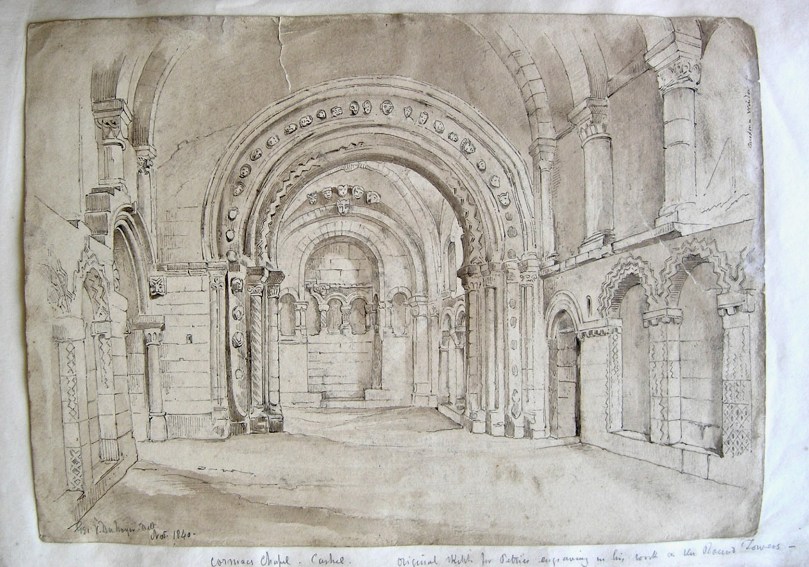
The interior of Cormac’s Chapel sketched by George Victor duNoyer for George Petrie**

Previous posts on Irish Romanesque architecture

Irish Romanesque – an Introduction

Irish Romanesque 2 – Doorways

Cormac’s Chapel: The Jewel in the Crown (Part 1)

*Once again, I relied heavily on Prof Tadhg O’Keefe’s manuscriptRomanesque Ireland: Architecture and Ideology in the Twelfth Century, which he has generously uploaded to Academia.

**George Victor Du Noyer, “Cormac’s Chapel Cashel. Original sketch for Petrie’s engraving in his book on the Round Towers. Geo V Du Noyer. Delt Nov 1840,” Royal Society of Antiquaries of Ireland, accessed October 21, 2018, http://rsai.locloudhosting.net/items/show/22213
Bumper Crop!

It’s the end of the summer – and harvest time. Over the months I have been gathering in yet more signs and curiosities from our journeys around Ireland. It’s now time to show off a few of them . . .

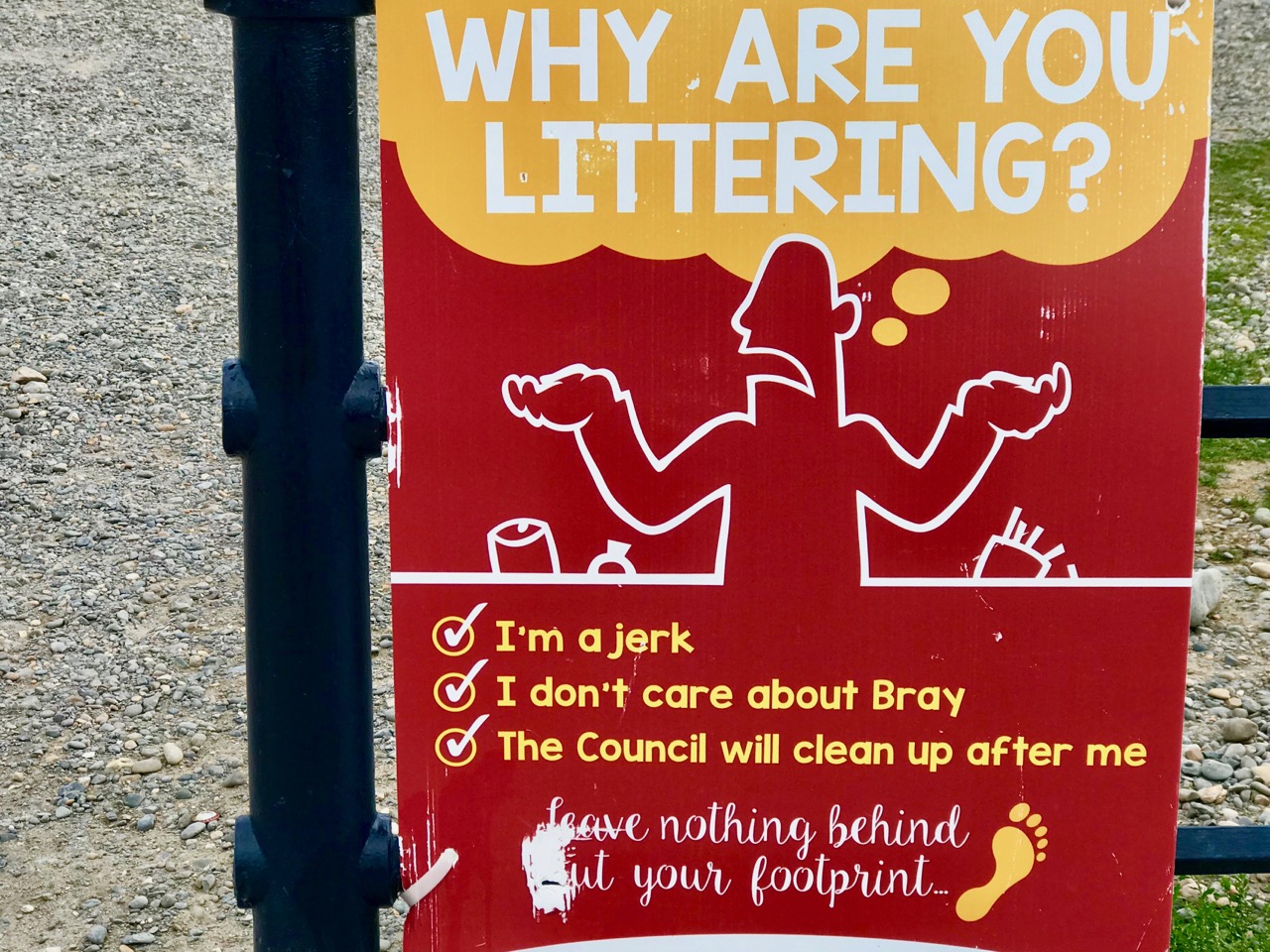
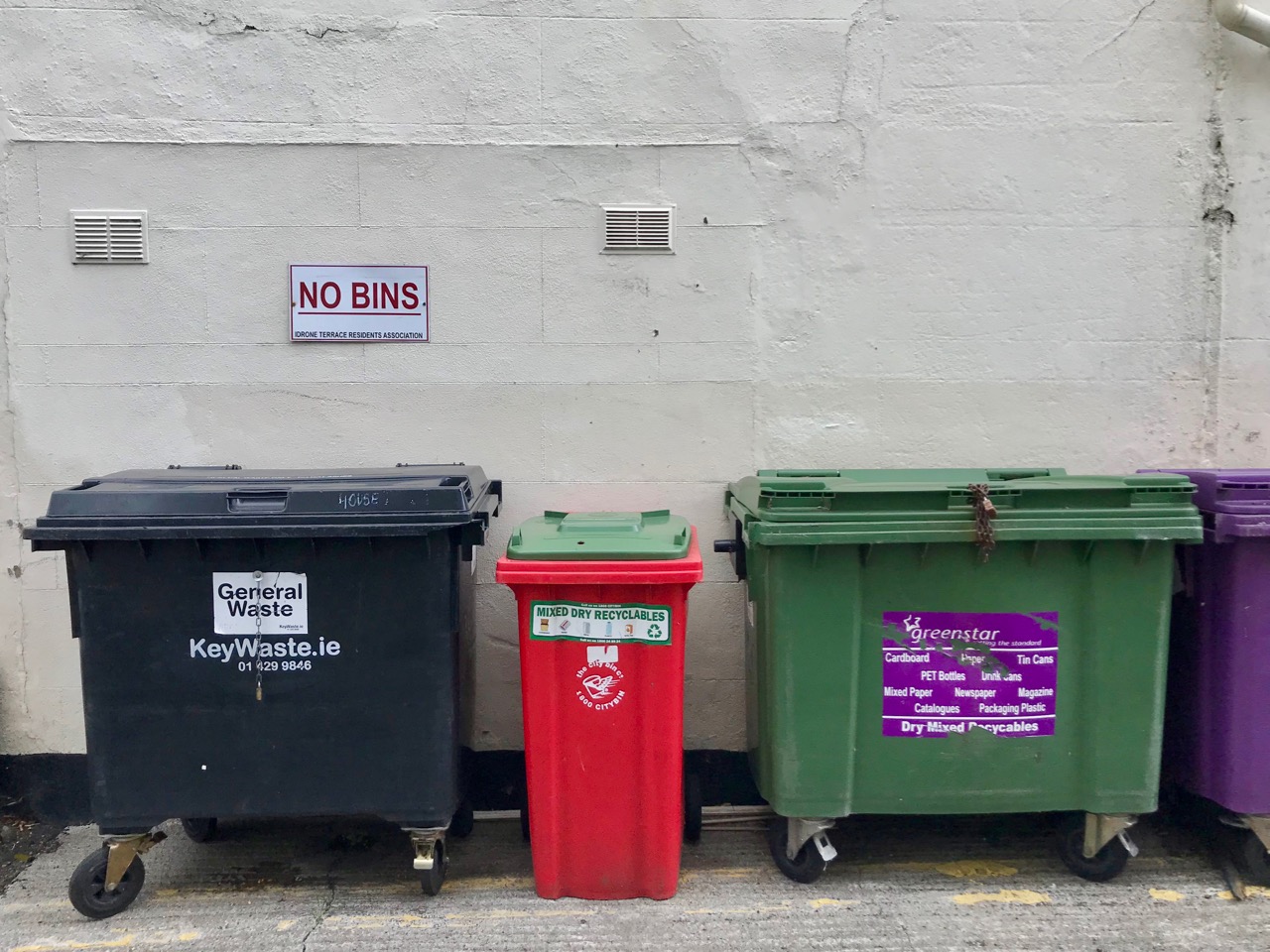
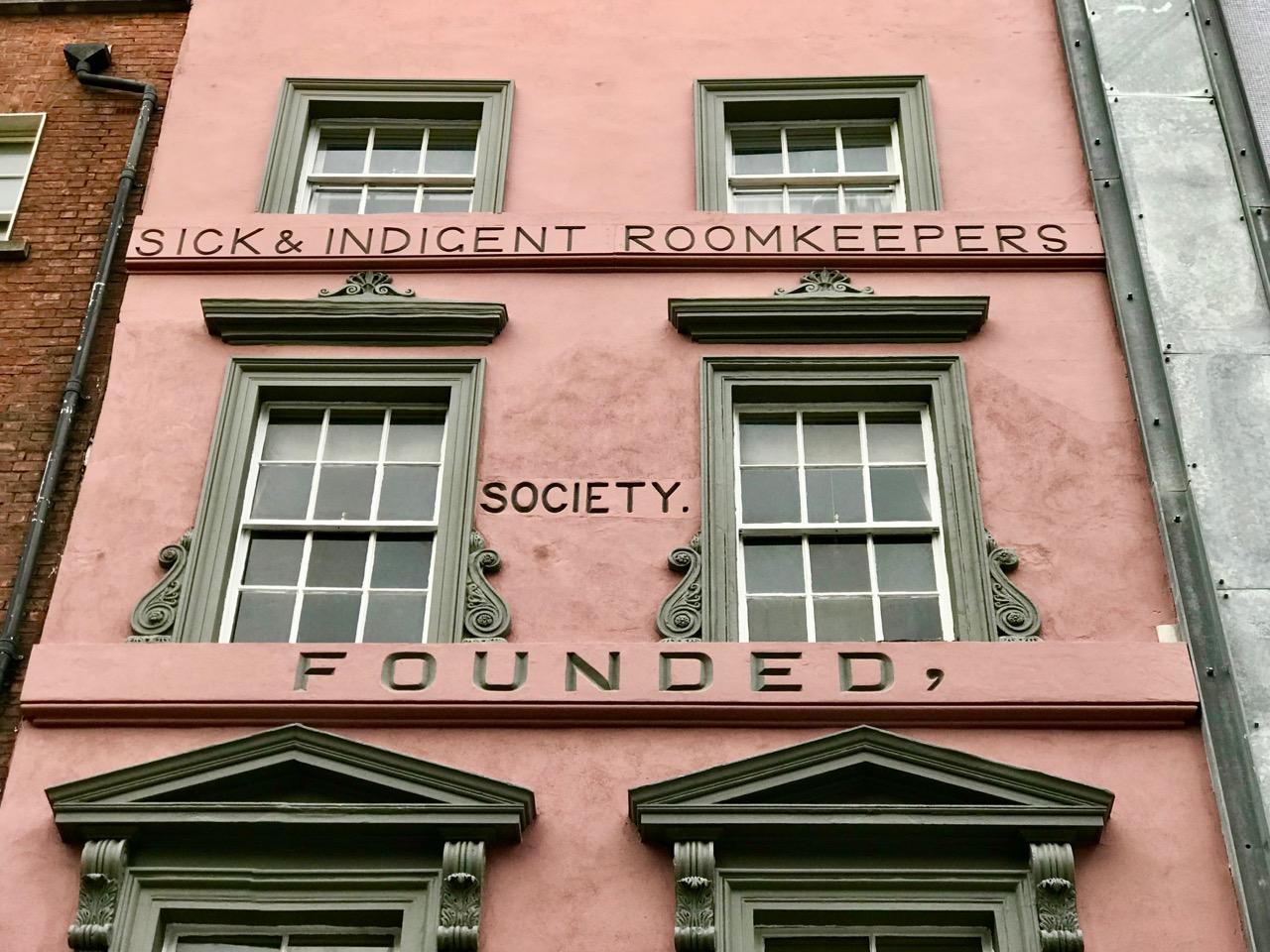
Some are obvious – and intentionally humorous; many are simply puzzling or inexplicable. Hopefully, most are at the very least entertaining. They don’t require a great deal of comment. But it’s certainly fertile ground for gleaning. Wherever you find yourself, take a good look around you: there’s a bumper crop out there.

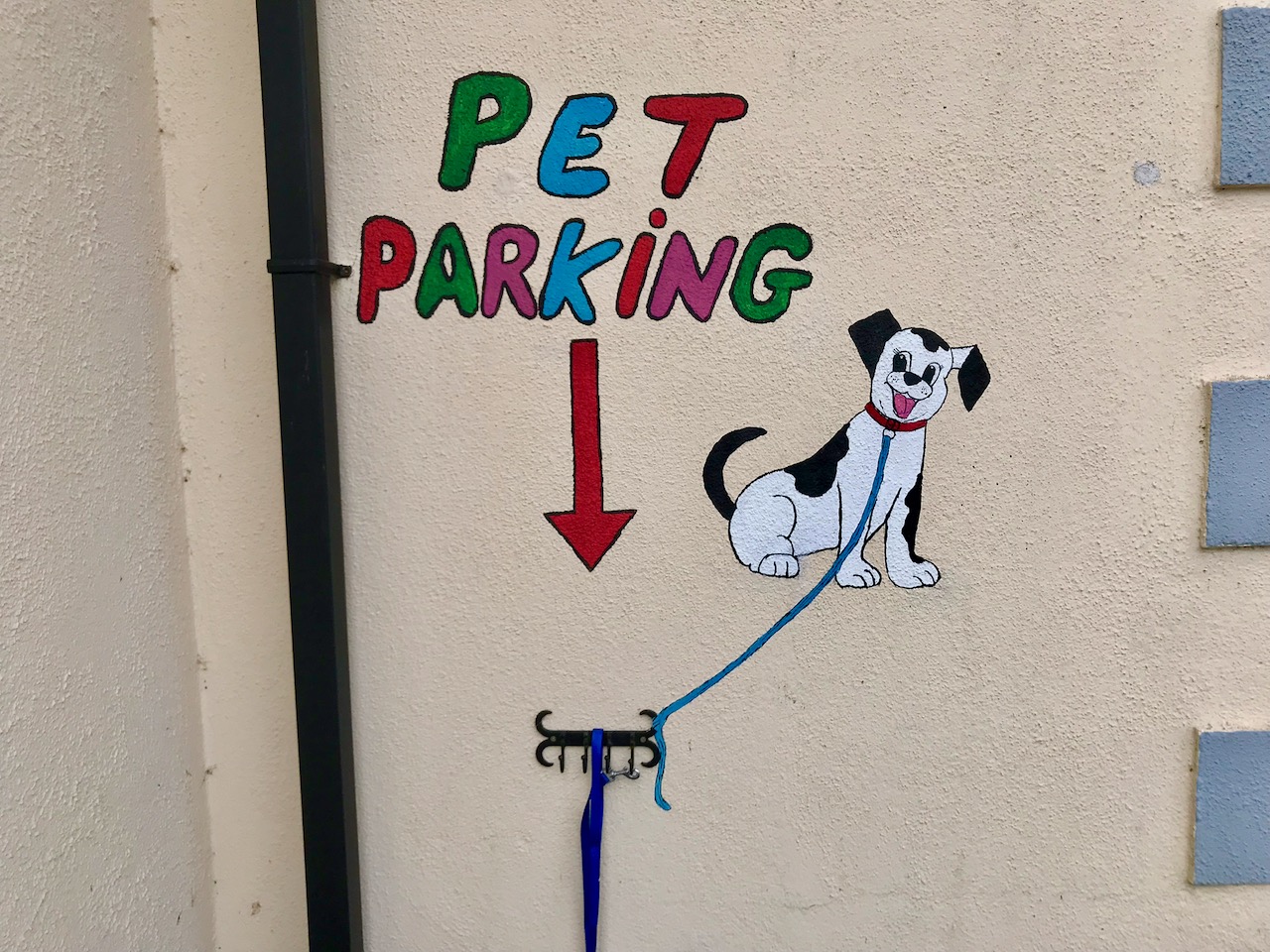
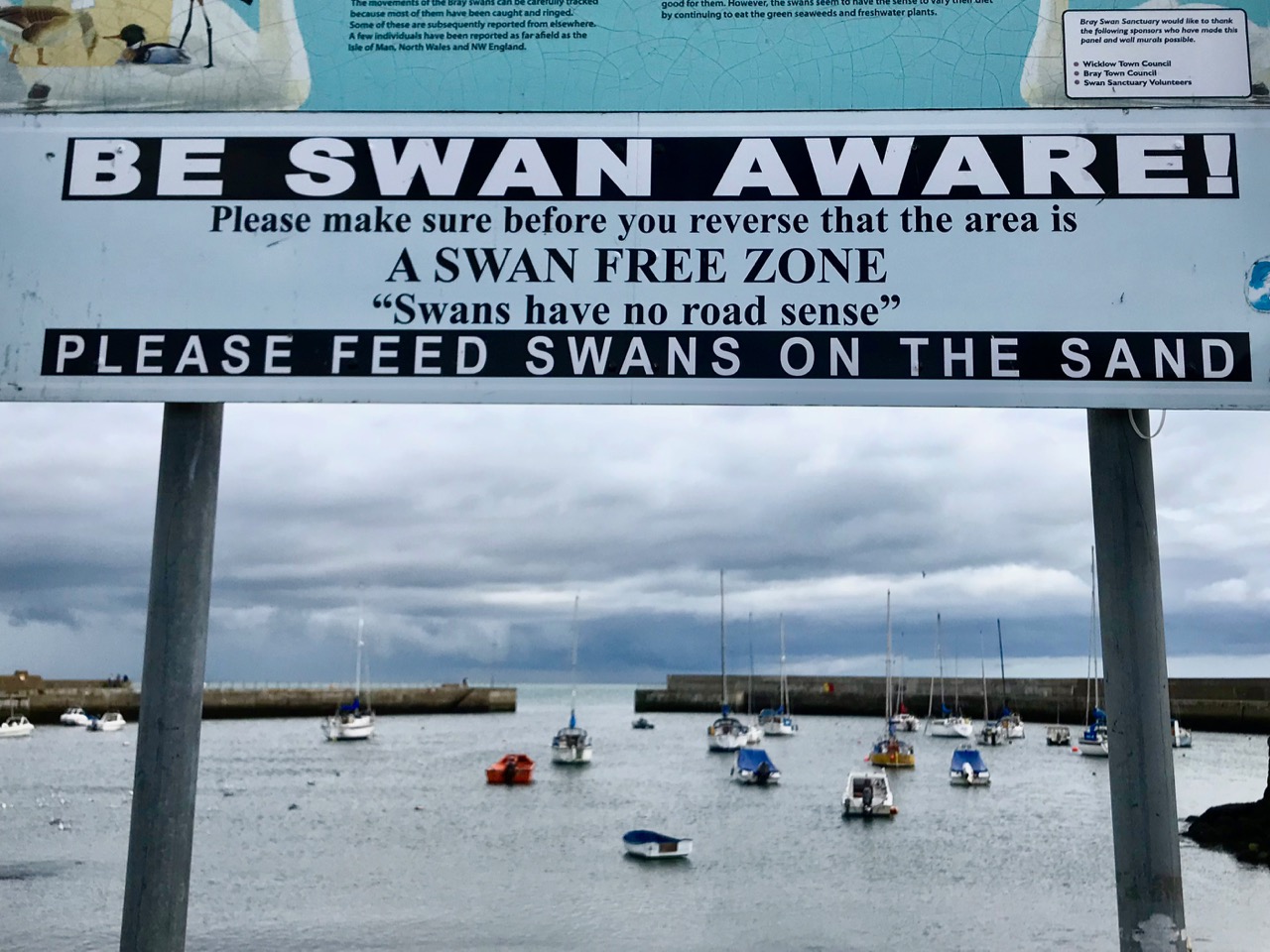
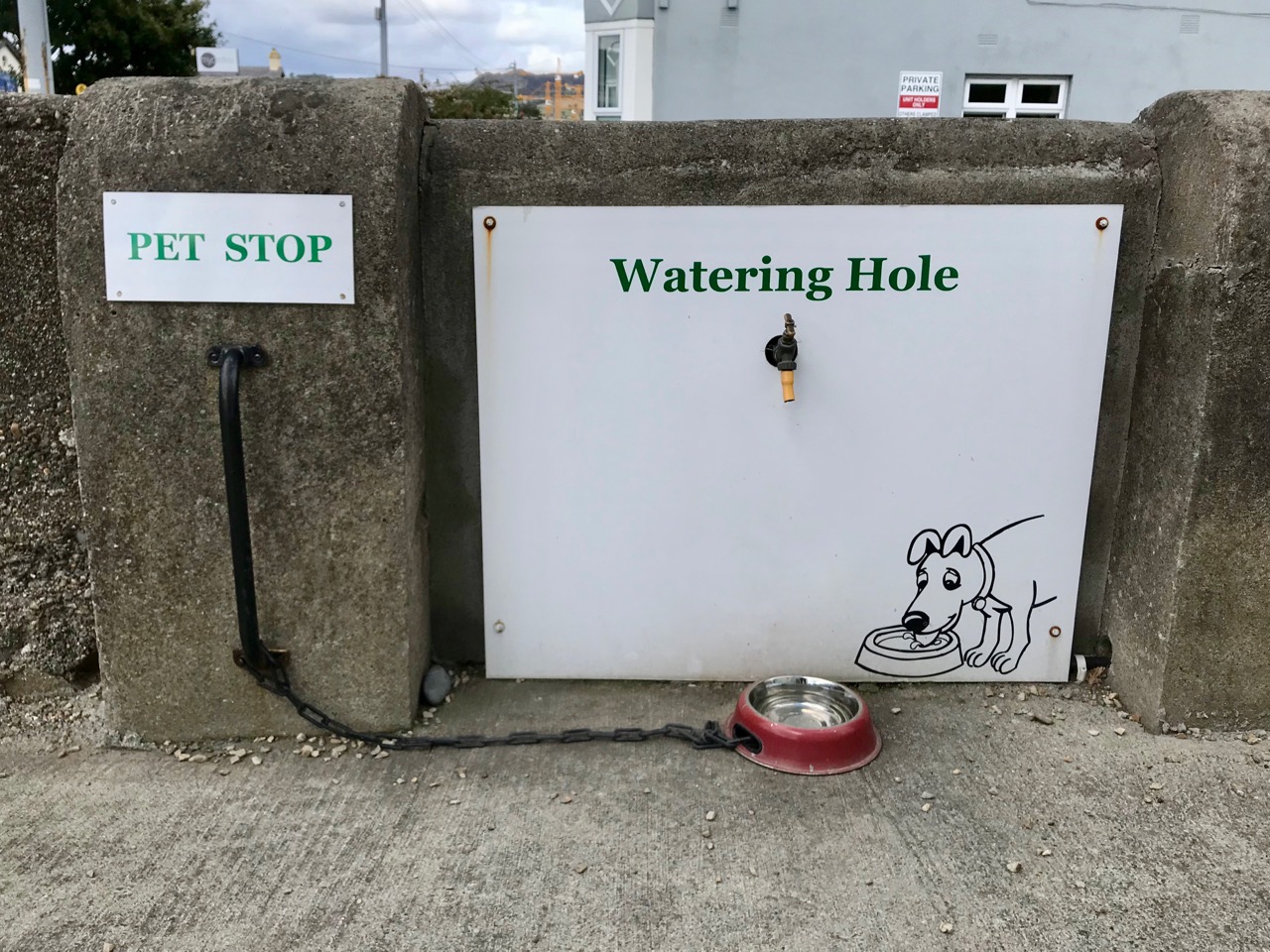
When you start ‘collecting’ signs, themes seem to emerge. Just over the last few days the animal kingdom has come to the fore:

Well, that’s enough of that theme for now – although there are more ‘pets’. To finish off, another miscellany – and I’m keeping some good ones back for another day.

Evie Hone and the Modernisation of Irish Stained Glass

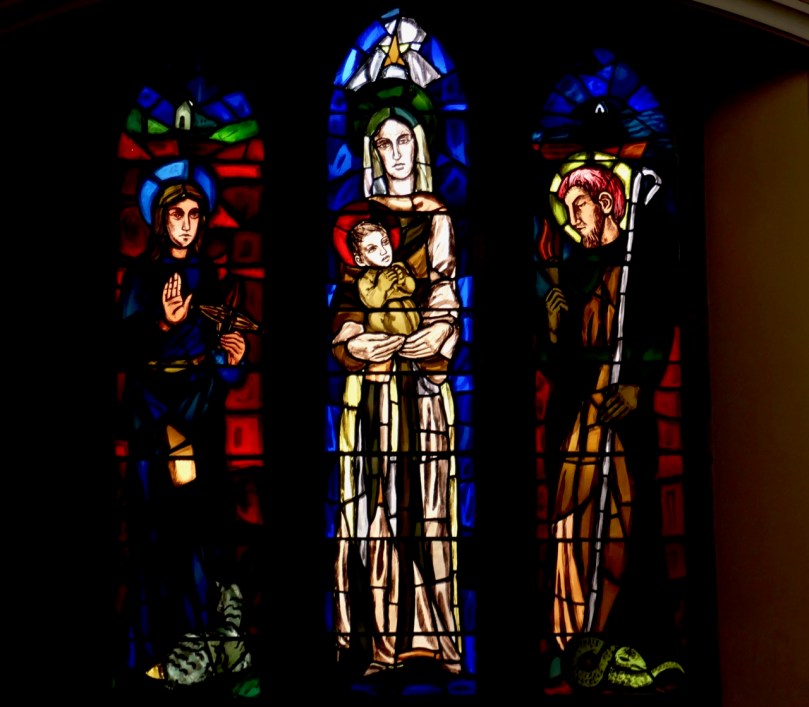
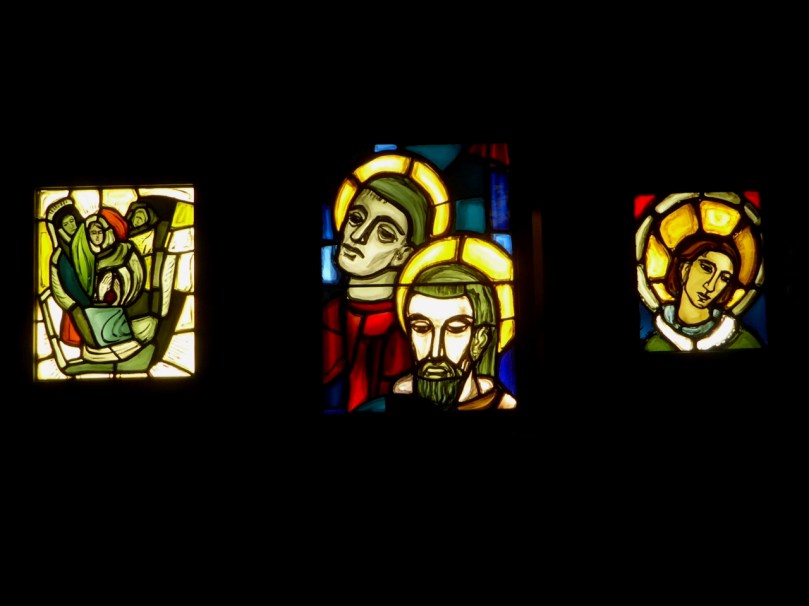
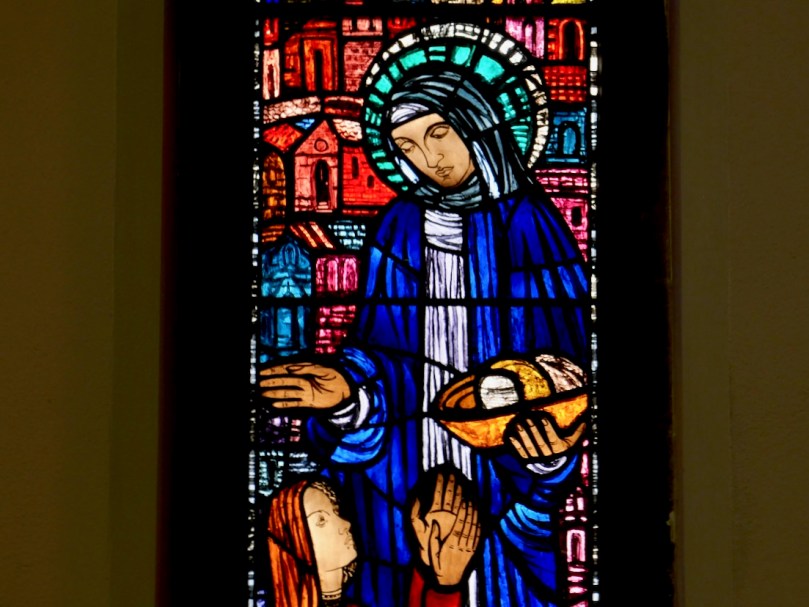
This is an Evie Hone window from Blackrock in Dublin – Bridget, Mary and Jesus, and Patrick. Evie Hone is one of our greatest stained glass artists and helped to move the practice of stained glass into a more modern direction. To appreciate this, it is helpful to know a little of her background.

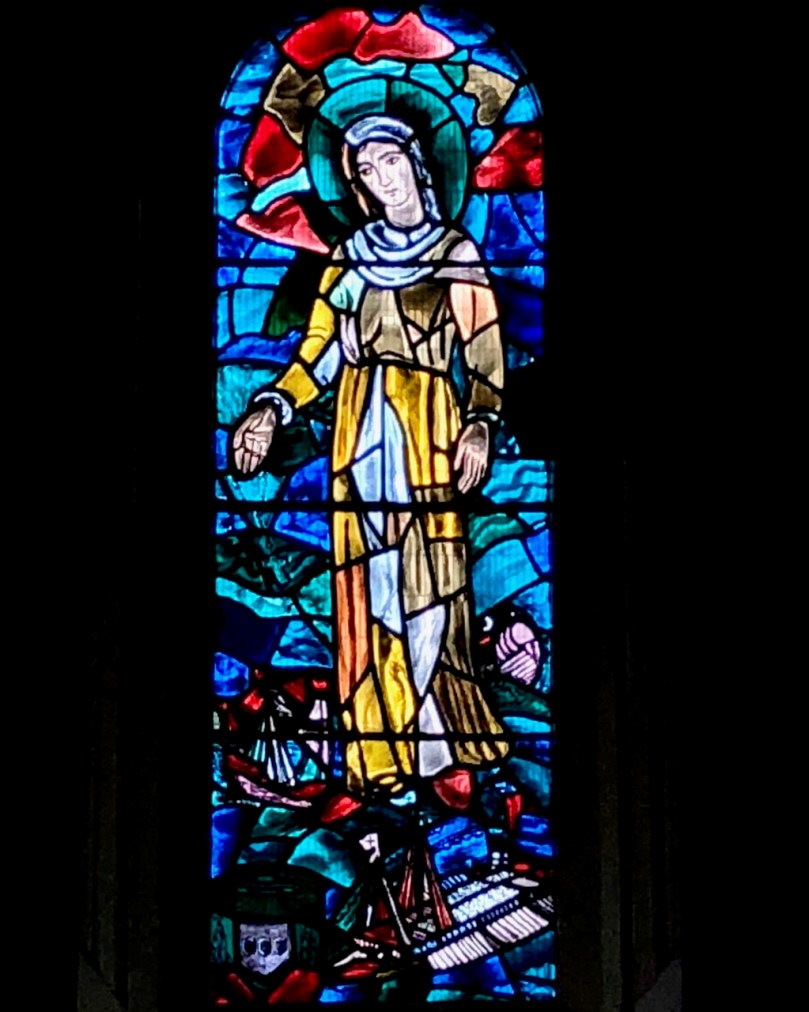
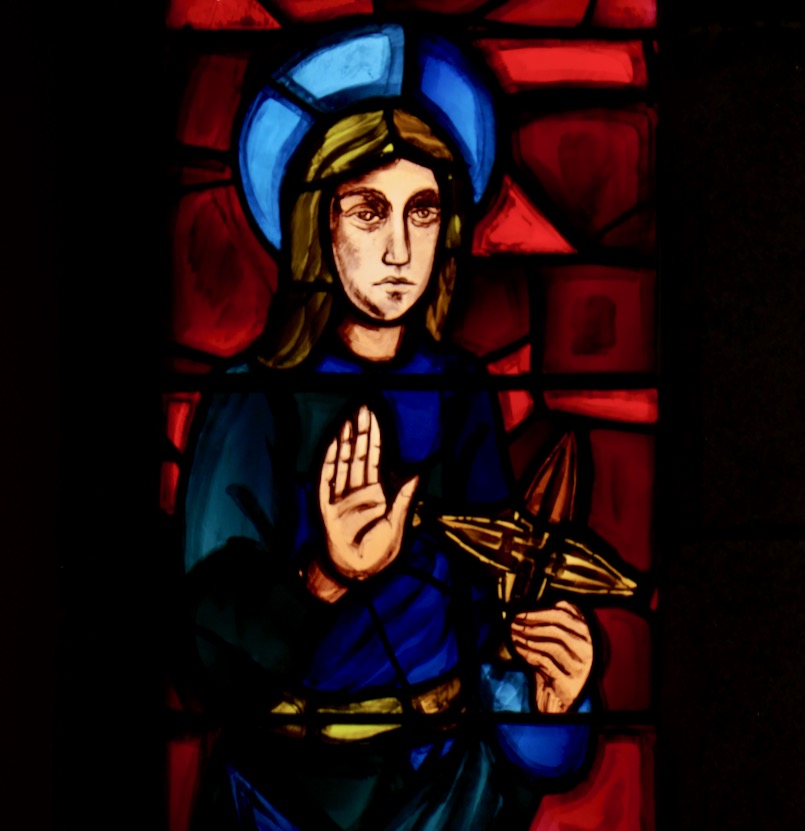
Our Lady of the Rosary, completed in 1948 for the Catholic Church in Greystones, Co Wicklow. While the figure is not cubist, the influence of that style is discernible

She was born in 1894 Dublin, a member of the extended Hone clan of painters and artists. A childhood accident left her disabled and in pain but also set the course for her life’s work by providing the consolation of sketching. She studied in Britain, Ireland and Paris, where she came under the influence of the Cubists, and also met her great friend and fellow-modernist, Mainie Jellett.

The Good Shepherd, also from Greystones

The two women applied to exhibit at the Royal Hibernian Academy but it was dominated by male traditionalists who refused to allow cubist paintings to be shown. They responded by exhibiting elsewhere and by starting a new organisation (the Irish Exhibition of Living Art, or IELA) for those interested in modern art. At first critics ridiculed this new style of painting but young artists were enthusiastic and gradually she and Mainie “introduced modern art to Ireland.”*

Evie Hone stained glass on display in the new, and very popular Stained Glass Room in the National Gallery

Evie was deeply spiritual, at one point joining a community of Anglican nuns and eventually converting to Catholicism. Moving away from painting to stained glass she trained under Wilhelmina Geddes and eventually joined An Túr Gloine in 1935. Her stained glass work was never strictly cubist, although the influence was traceable, but it was thoroughly modern.

This is her Bridget window for Loughrea Catherdral, completed while she was a member of An Túr Gloine and at the beginning of her development as a stained glass artist. It is noticeably a more conservative and less modern treatment  – contrast it, for example with Bridget from the Blackrock Church

Nicola Gordon Bowe, in her entry on Evie Hone in The Encyclopedia of Ireland (edited by Brian Lalor) says of her work for An Túr Gloine, she was designing and painting mostly figurative windows using a powerfully innovative vocabulary of deep smouldering colour and loose expressionist brushwork.

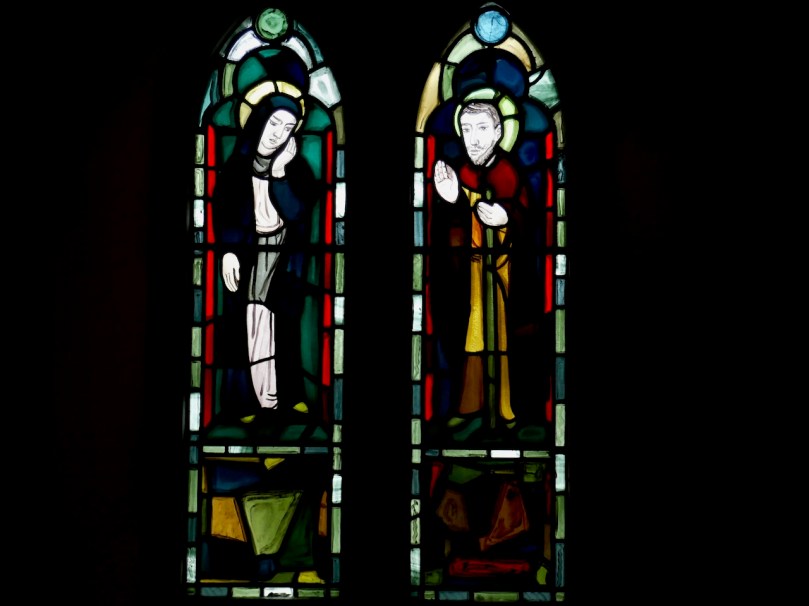
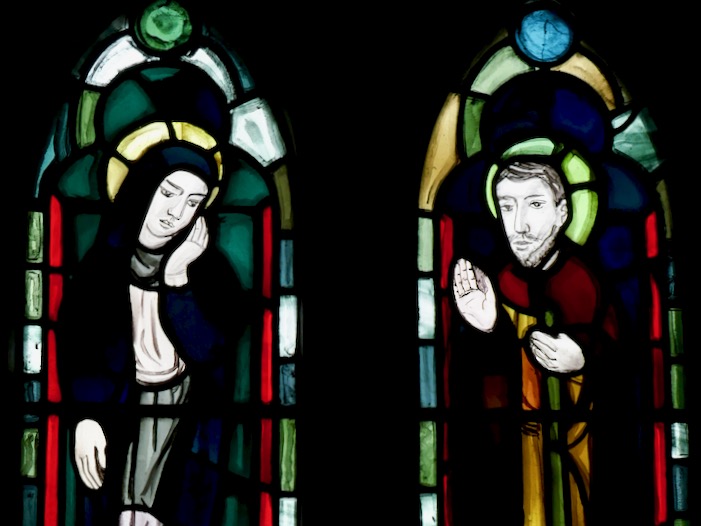
Two small windows from Cloughjordan Church (Co Tipperary) depict Mary and Joseph. These windows were among her last, and are beautiful in their restrained style and subdued palette

From 1944 she worked in her own studio at Marley Grange in Rathfarnham. Gordon Bowe, again: In ten densely packed years she introduced a new, loosely painted, resonantly coloured, and sombrely religious treatment. We are fortunate that a short documentary recorded this period on her life and work. It also functions as a primer on stained glass!

View the documentary here

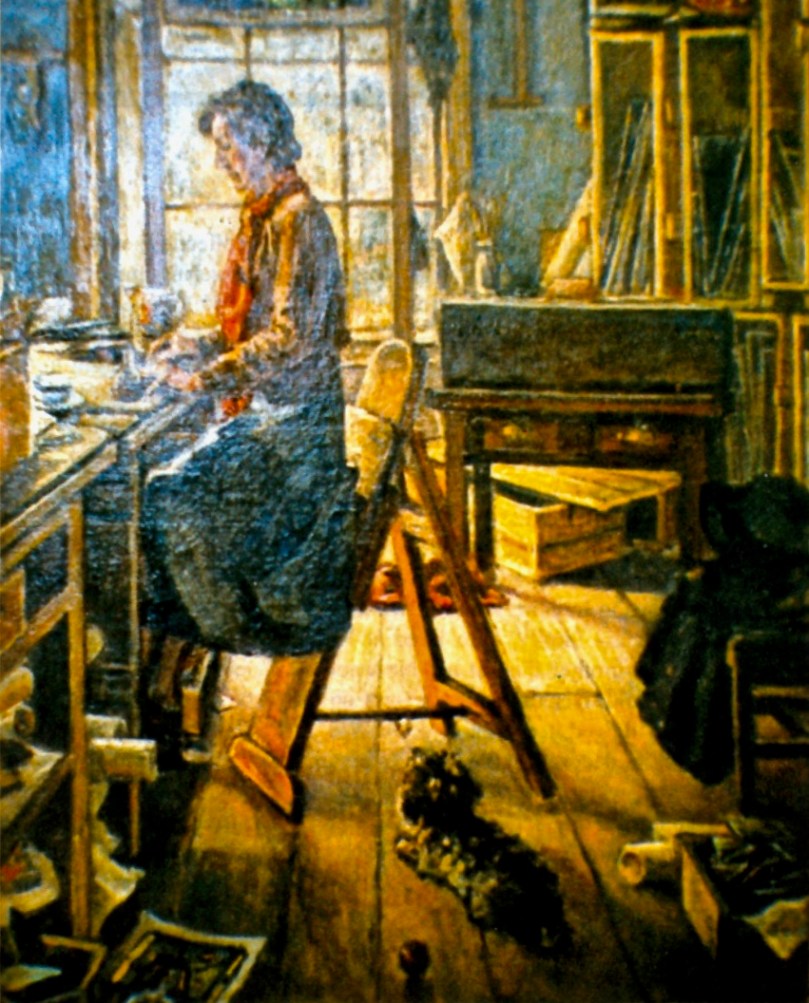
About the same time, in 1952, her friend and fellow-artist, Hilda van Stockum painted her in her studio, capturing her complete absorption in her work. This image comes from Marie Bourke’s paper* and is a copy of a photograph from a National Gallery Catalogue. The original painting is in the National Gallery.

What is most striking about her work, in contrast to her colleagues at An Túr Gloine, is how painterly it is. Using a restrained palette, with occasional bursts of bright colour, she creates quiet and reverential portraits of her sacred subjects. Modernity is obvious, but she herself claimed that the major influence on her work was medieval Irish carvings. If this was true, it was certainly mediated through an expressionist sensibility.

Bridget – detail from the Blackrock window

Evie Hone died in 1955. She has left an impressive legacy of paintings and stained glass windows. I have only used photographs that I have taken myself of windows that I have visited, but there are many more waiting to be explored.

* The quote, and also the photograph of the painting of Evie Hone in her Studio are from Evie Hone in Her Studio: Hilda Van Stockum’s Portrait, by Marie Bourke, in Studies: An Irish Quarterly Review, Vol. 86, No. 342 (Summer, 1997), pp. 165-174.  The paper is available on JSTOR

Out in the Field

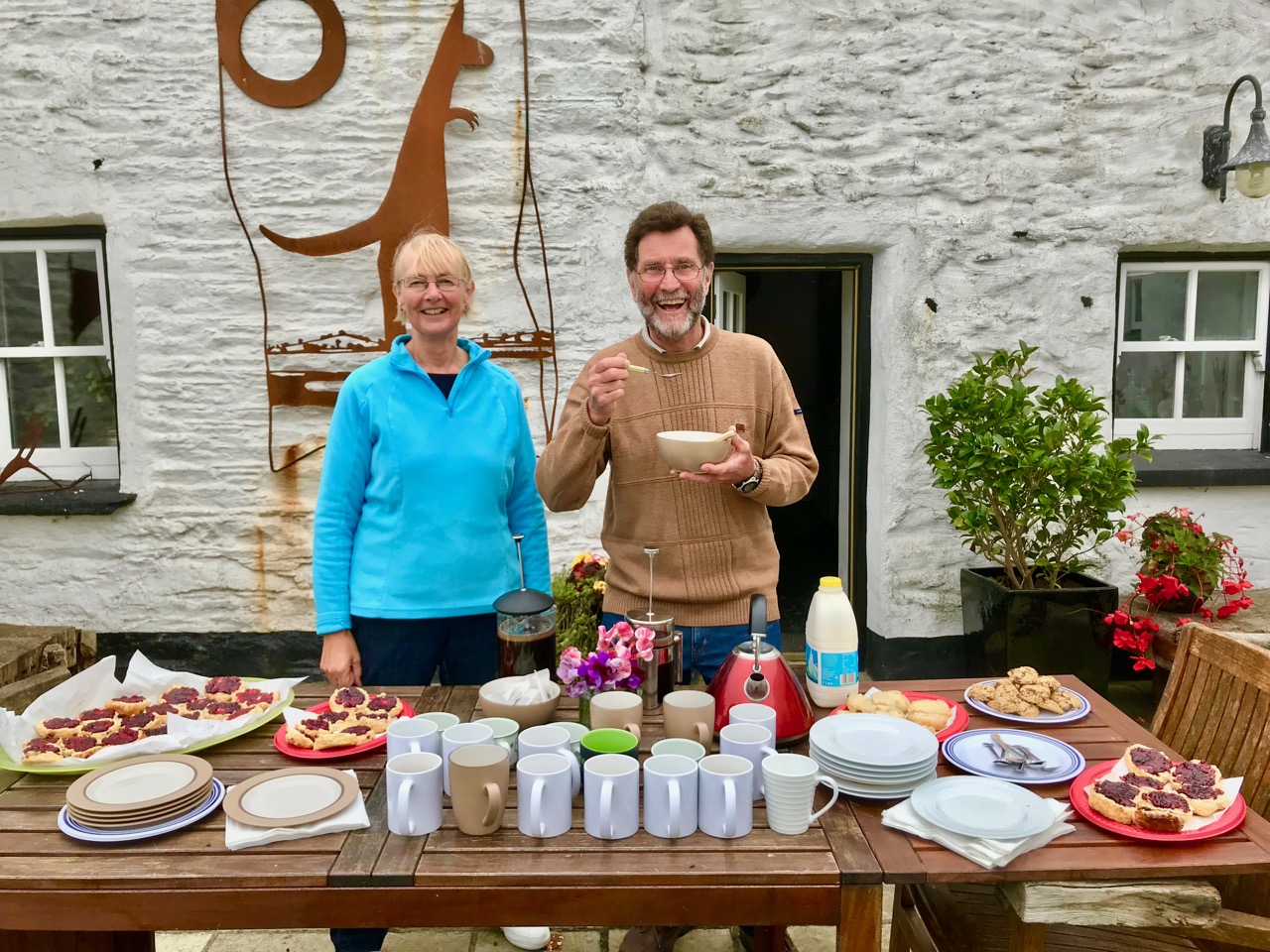
During the West Cork History Festival field trips, led by Roaringwater Journal last week, treats were in store. Many thanks to volunteers Jenny and Ray who worked hard to provide the refreshments (and who baked the scones!) on Friday’s ‘Art and The Great Famine’ excursion, which arrived at Reen Farm in time for tea.

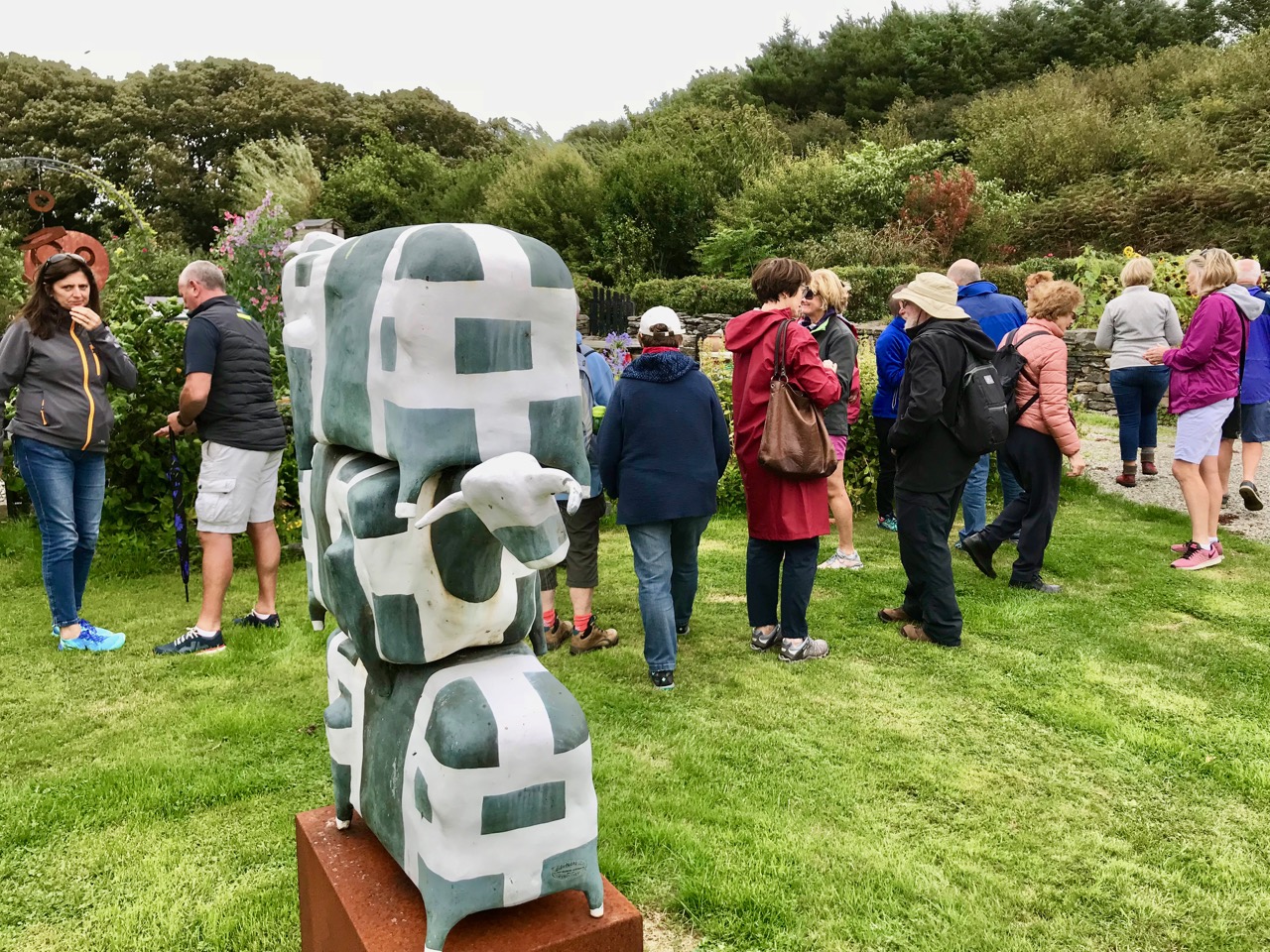
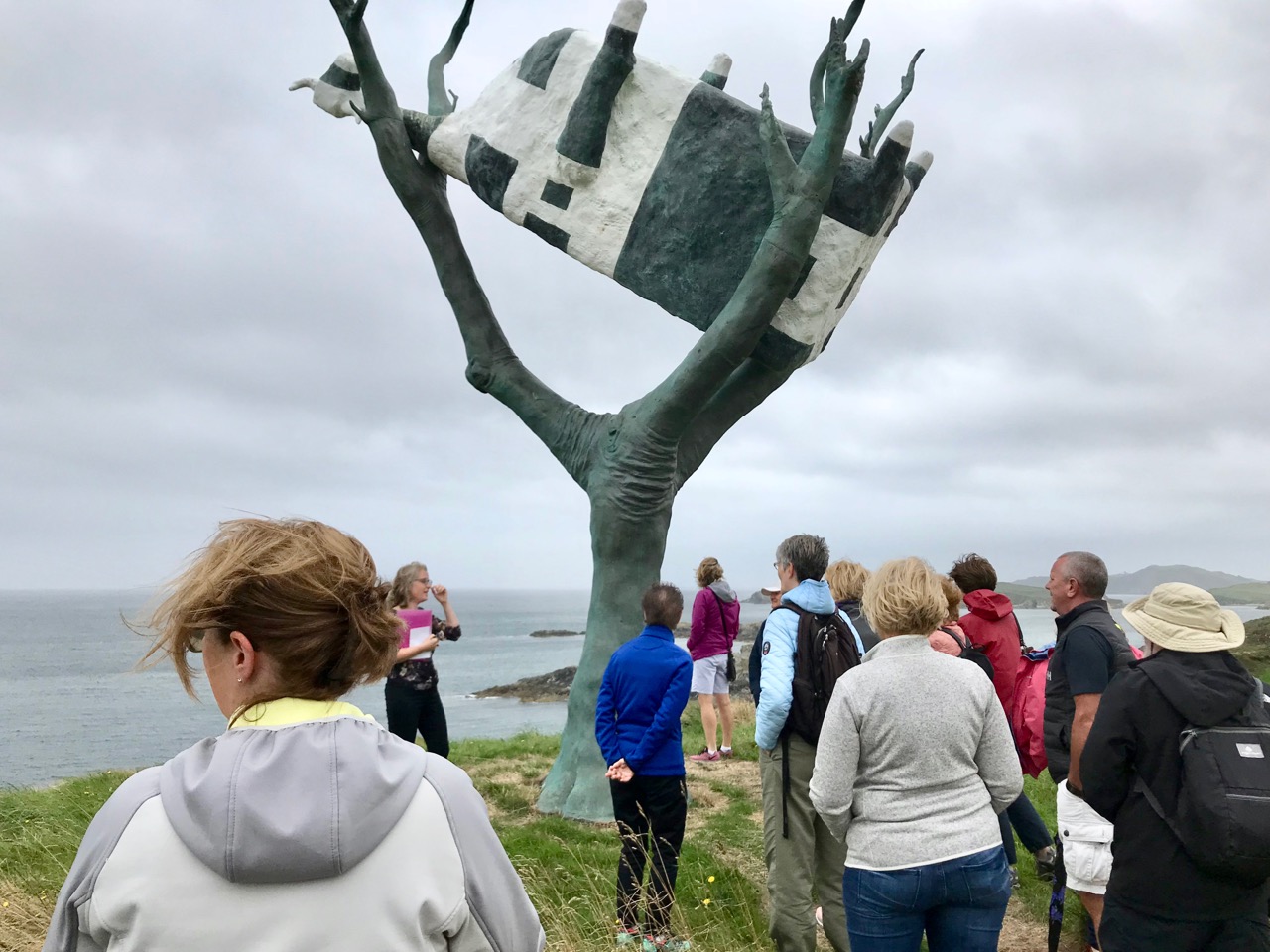
Artist John Kelly‘s cows are abundant at his home at Reen, and the experience of the connections with this unique place and Famine times were admirably and sensitively presented by Siobhan Burke of West Cork Experiences (she’s on the left, facing the bronze tree, below).

The day included organised visits to the 110 Skibbereen Girls project at the old workhouse site in Skibbereen – where we were given a presentation by artist Toma McCullim – and a guided tour by West Cork Arts Centre’s Zenda Williams of the Coming Home – Art and The Great Hunger exhibition at Uillinn, followed by a visit to the mass famine graves in Abbeystrewery, where Philip O’Reagan of the Skibbereen Heritage Centre explained the site’s enormous significance. Just as well we had those scones to bolster us up!

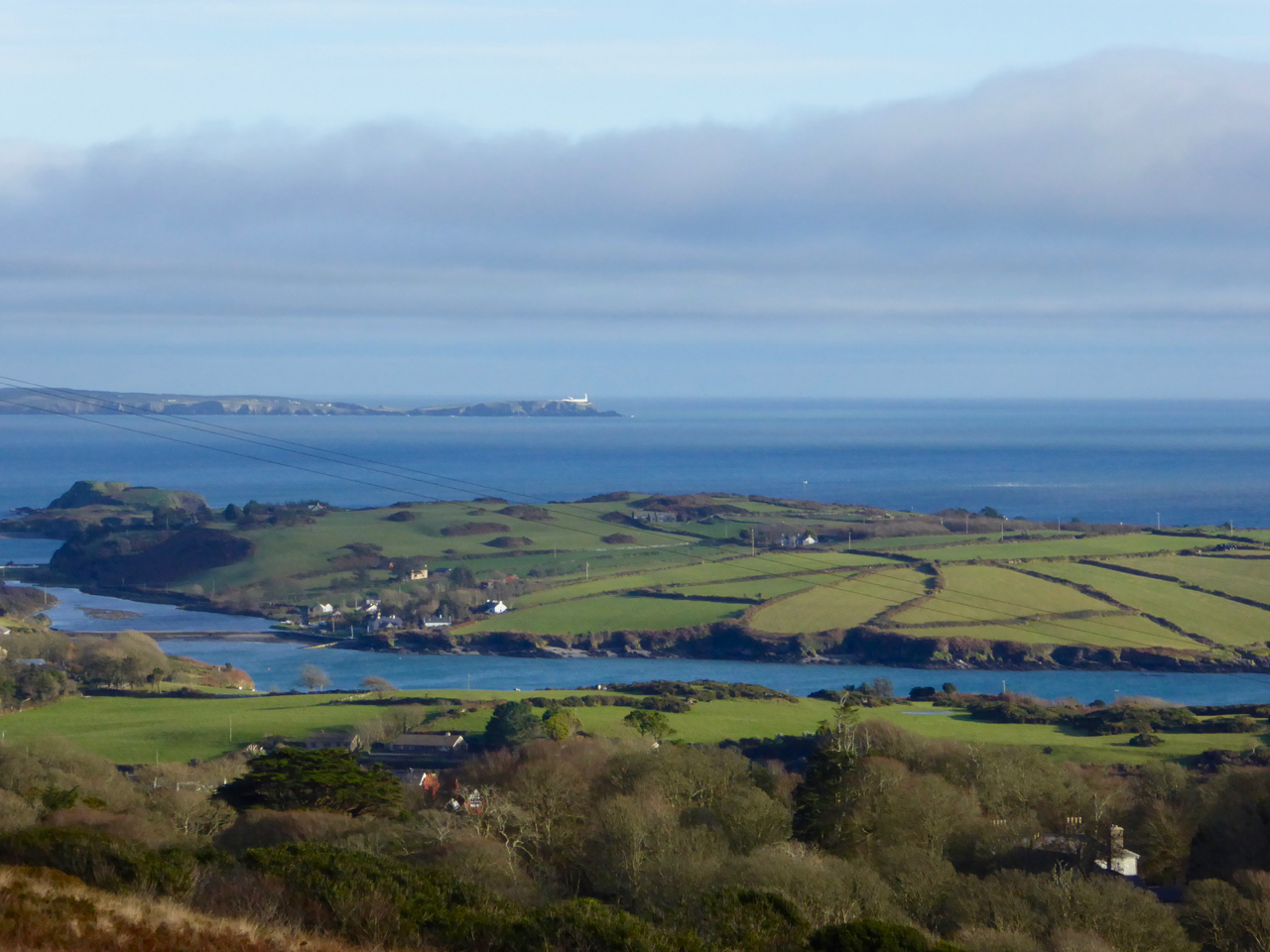
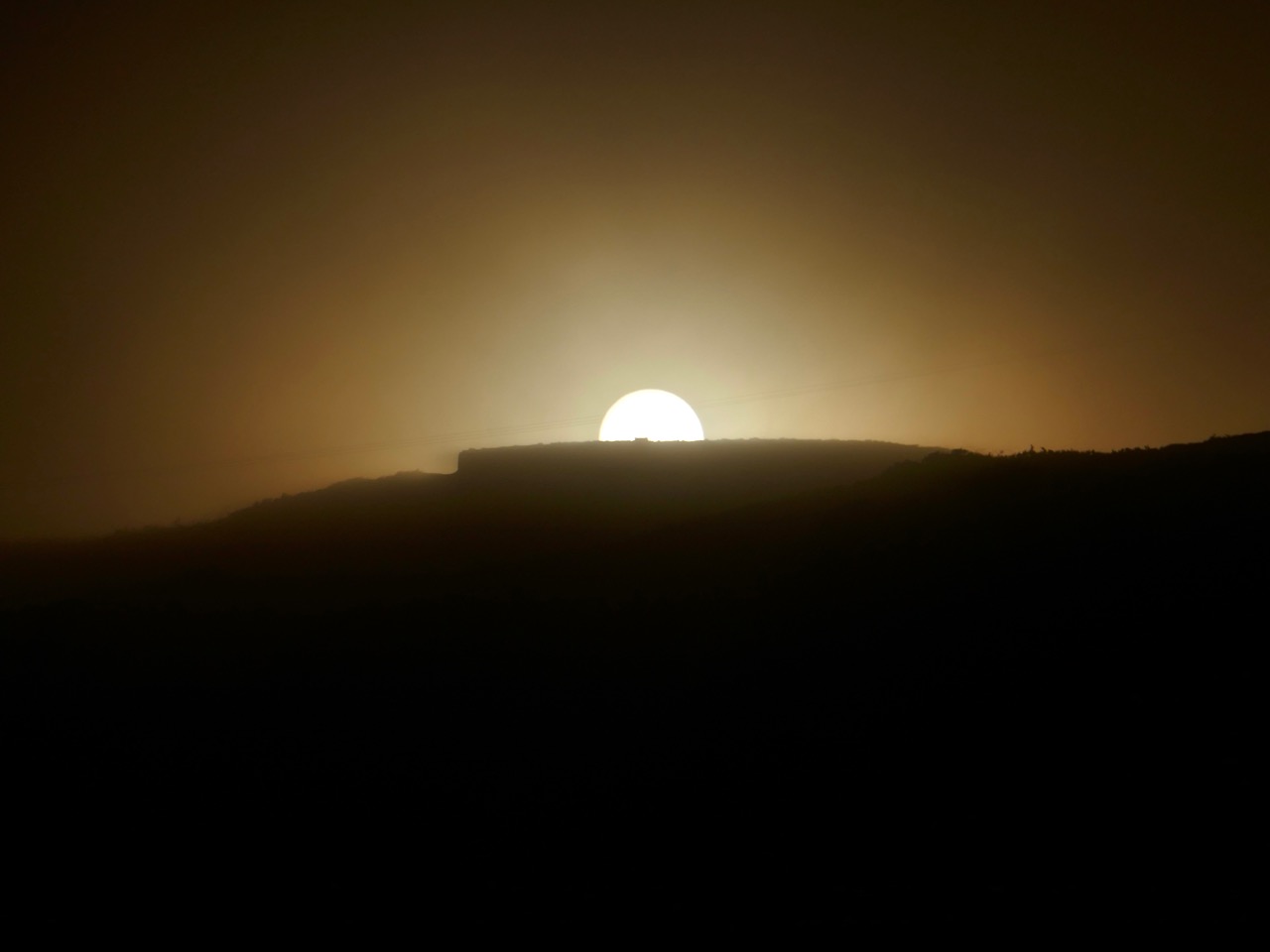
On the previous day we began the ‘West Cork Archaeology’ tour at Knockdrum Fort, where – in benevolent weather – you get the most spectacular views (above). Finola talked about the Rock Art on the site, which takes it back in time perhaps 5,000 years, and she also explained about the alignment with the Bealtaine sunset discovered by Boyle Somerville, described here – and which we witnessed ourselves earlier this year (below).

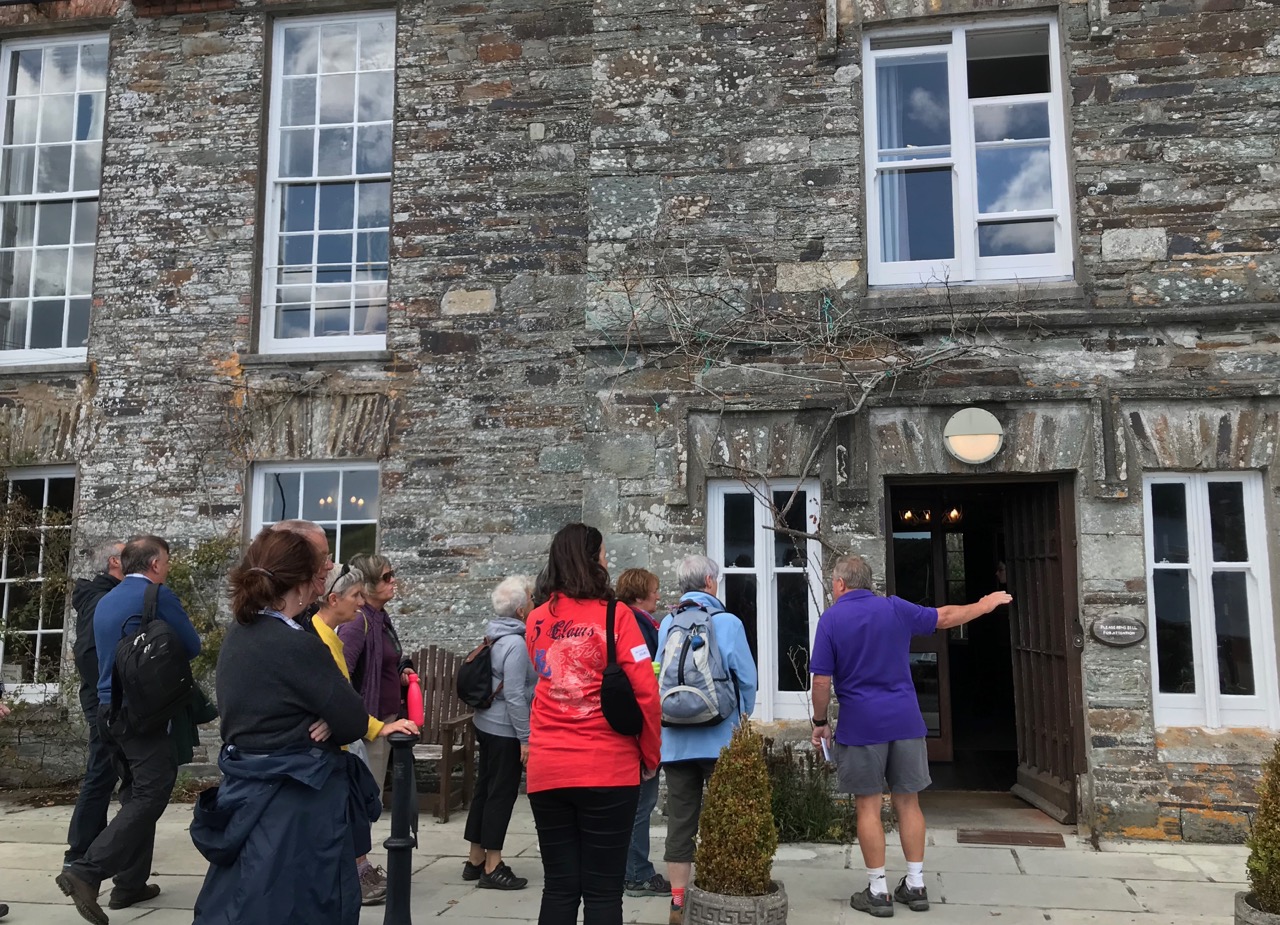
Highlights of that day’s expedition also included an entertaining time at Castletownshend hosted by George Salter-Townshend (below, he’s leading us into the Castle which has been owned by his family since medieval times).

After more on archeoastronomy from Finola, at Drombeg Stone Circle (above), a further treat was in store at Castle Salem, near Rosscarbery, where we were given a tour and talk by its owner Peter Daly (below).

We were delighted to be given the opportunity to provide this ‘lead-in’ to the History Festival weekend itself which – as last year – was a roaring success. If you didn’t go to it, take a look at the festival programme, and see what you missed!

Because our time has been taken up with the festival we haven’t written any posts this weekend. Normal service will be resumed next week. I can’t resist finishing off with another look at John Kelly’s sculpture garden at Reen.

Bohemians in Ballydehob!

My first visit to Ballydehob wasn’t until around 1990. I remember being struck by how busy a place it was then – I only wish my memories from nearly 30 years ago were clearer. I now know, of course, that this vibrant little community has a history of being a cosmopolitan creative hub of the arts going right back to the middle of the last century. It’s a fascinating story, and Ballydehob is celebrating it by establishing an Arts Museum and permanent collection, with the first exhibition opening this week in Bank House: please come!

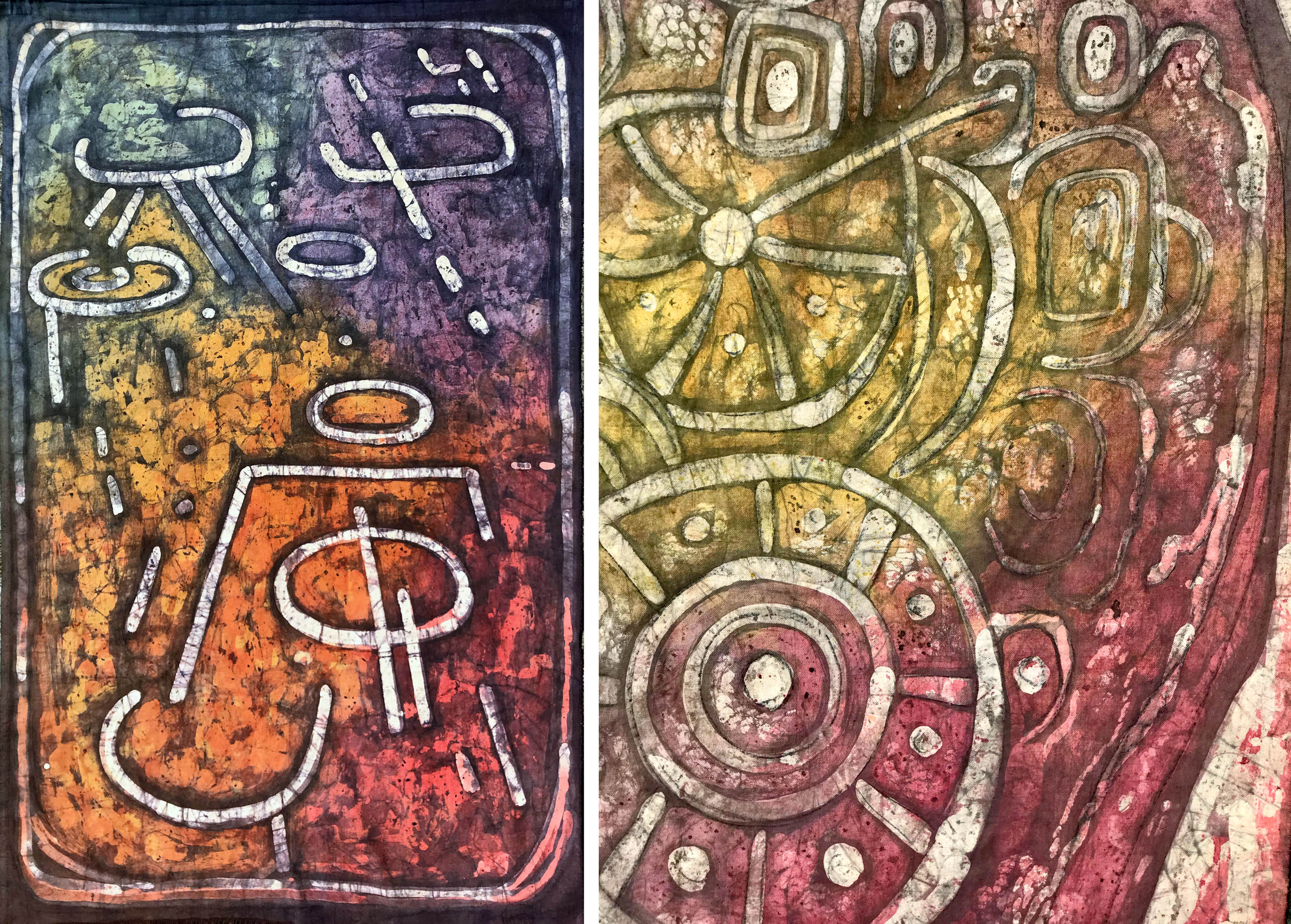
Above: two batiks by Nora Golden. Left – The Rock of the Rings (rock art at Ballybane West) and right – detail from a work depicting Loughcrew-type passage grave art. Nora and her partner, Christa Reichel were early arrivals on the arts scene in Ballydehob. In the 1960s Christa bought a farmhouse and set up the region’s first studio pottery in Gurteenakilla then, with Nora, opened the ‘Flower House’ in the centre of the town: you can see it illustrated in the exhibition flyer at the bottom of this post. All this is well documented in the excellent book by Alison Ospina (herself a talented furniture maker) ‘West Cork Inspires’ (Stobart Davies, 2011).

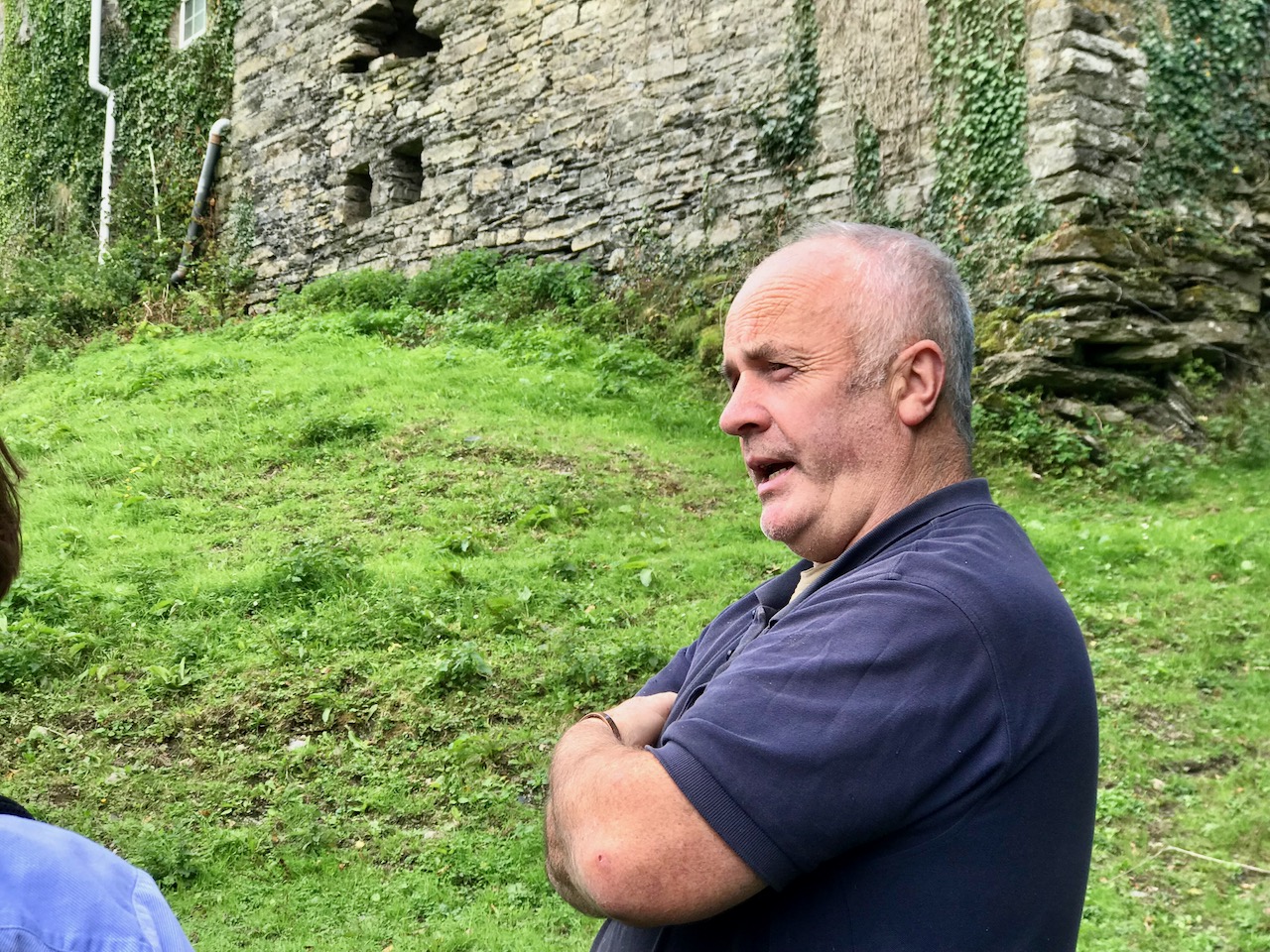
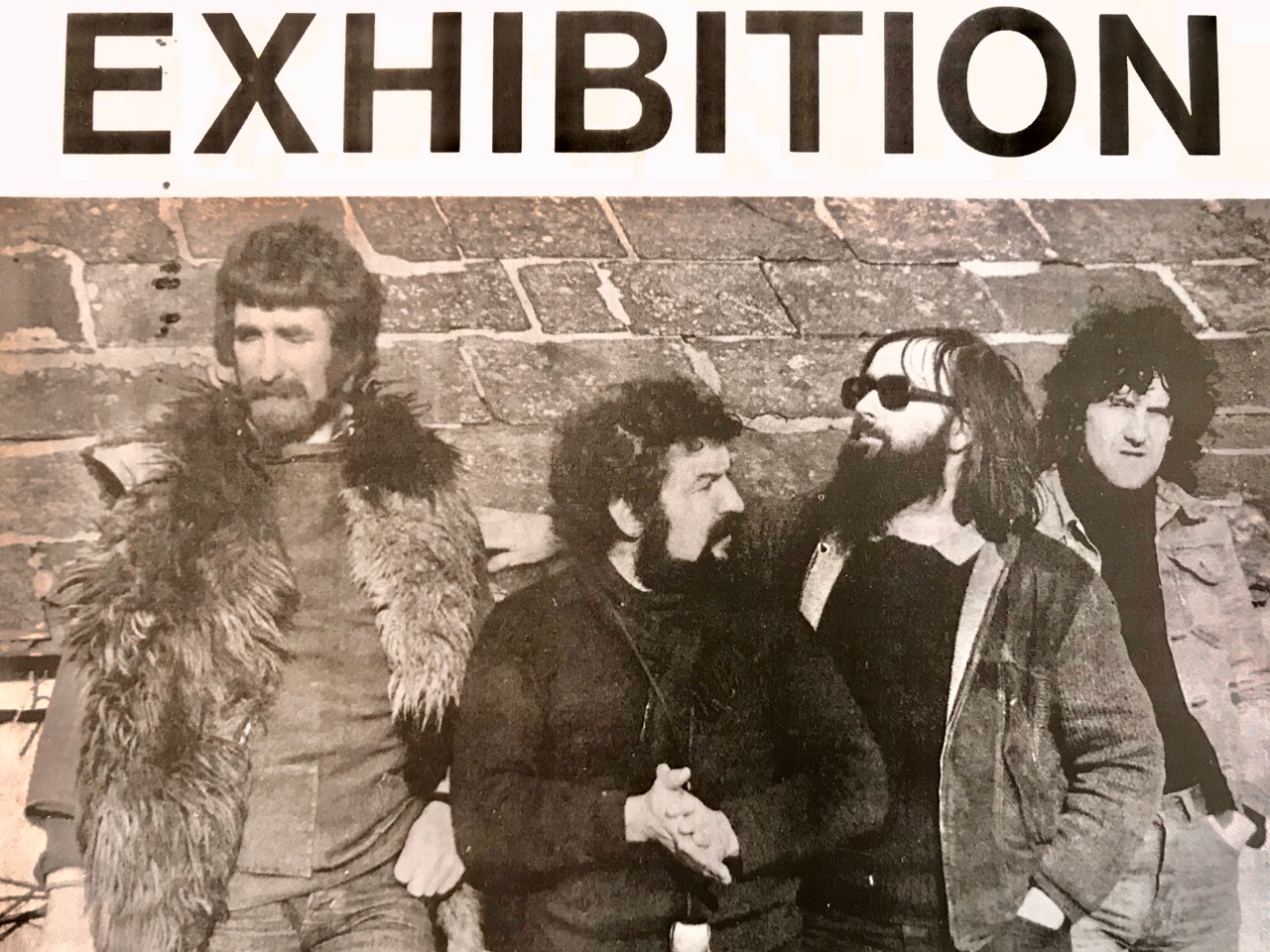
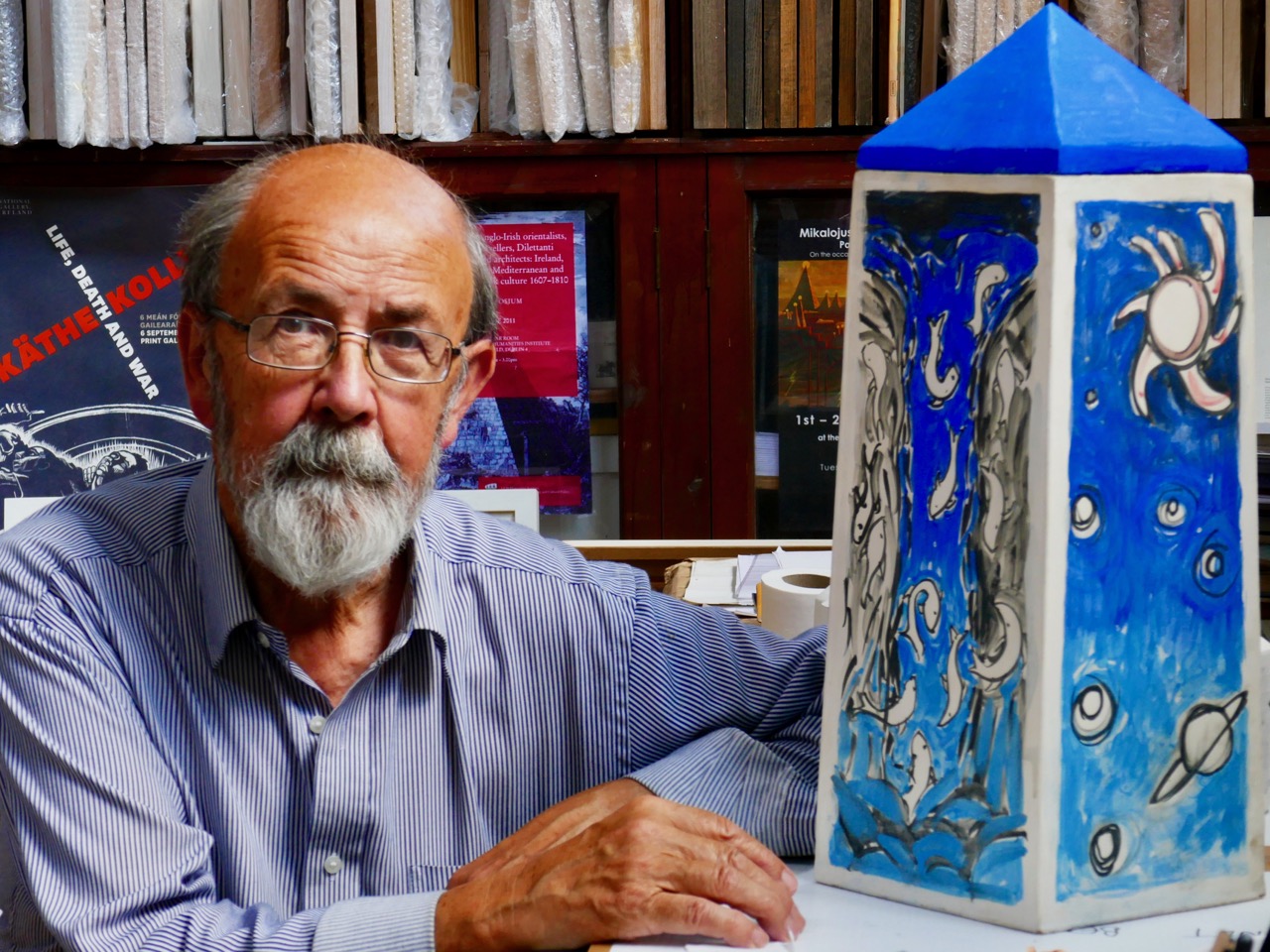
These denizens of 1970s Ballydehob are not a Heavy Metal band (to my knowledge) but in fact four important artists who had settled here: John Verling – artist, ceramicist and architect,  Pat Connor – ceramic sculptor, Brian Lalor – artist, writer and printmaker, and David Chechovich – watercolourist. They are wearing the uniform of the time. Here’s Brian Lalor in his studio today (photo by Finola) – you can certainly see the similarity . . .

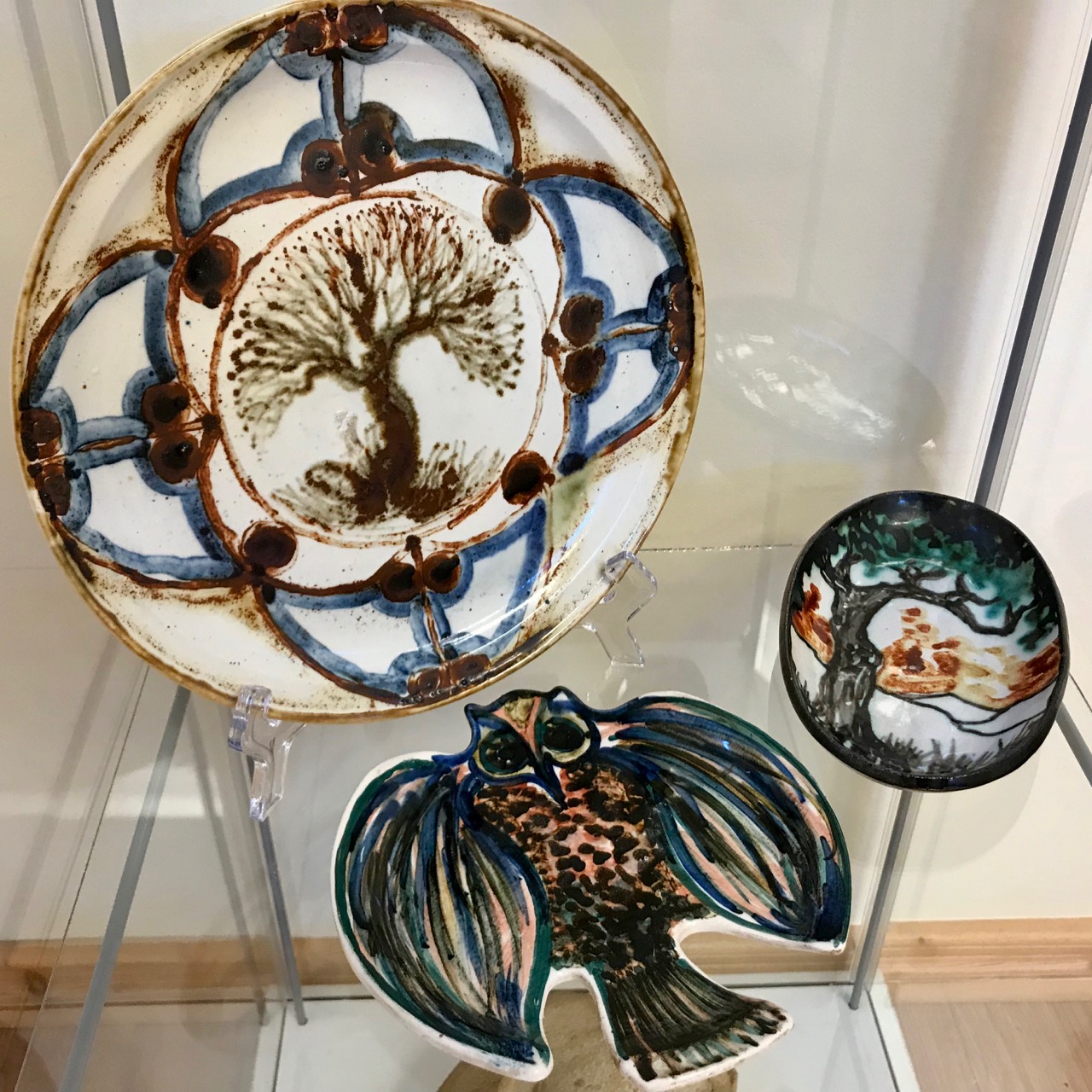
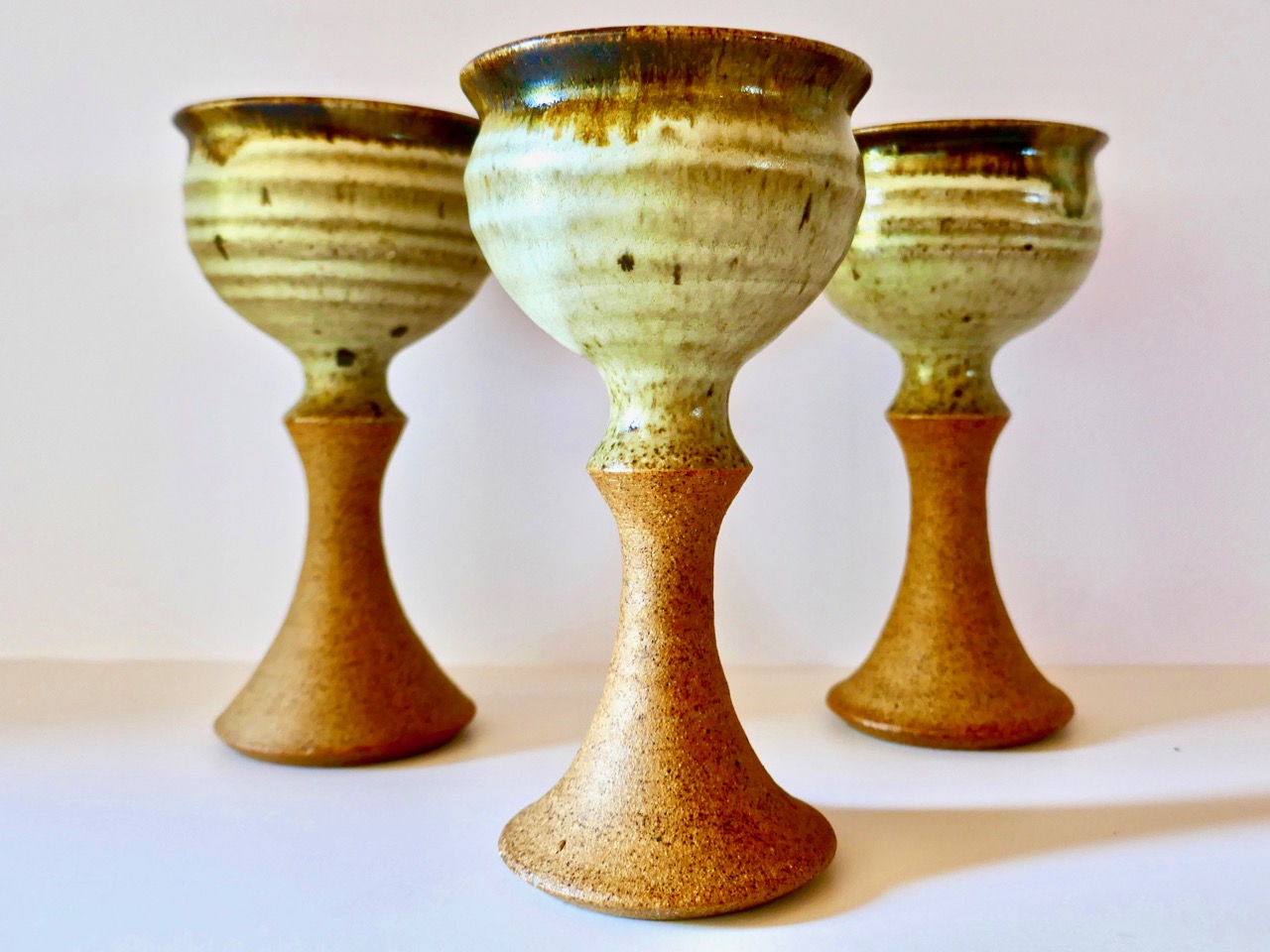
Brian still lives near Ballydehob, and is the mastermind and Curator of the new collection. And, if you can begin to see it all fitting together, John Verling (on the left in the exhibition poster above) took over the Gurteenakilla Pottery with his wife Noelle and together they produced striking ceramics, examples of which are in the header photograph.

Gurteenakilla is lived in today by Angela Brady, an artist who works with fused glass. She is also an architect. And – she’s performing the most important task of opening the first exhibition in our new Arts Museum on Friday. Finola wrote about Angela and other artists who contributed to the 7 Hands show on the pier in Ballydehob two years ago: have a look at her post and see if you recognise any other names.

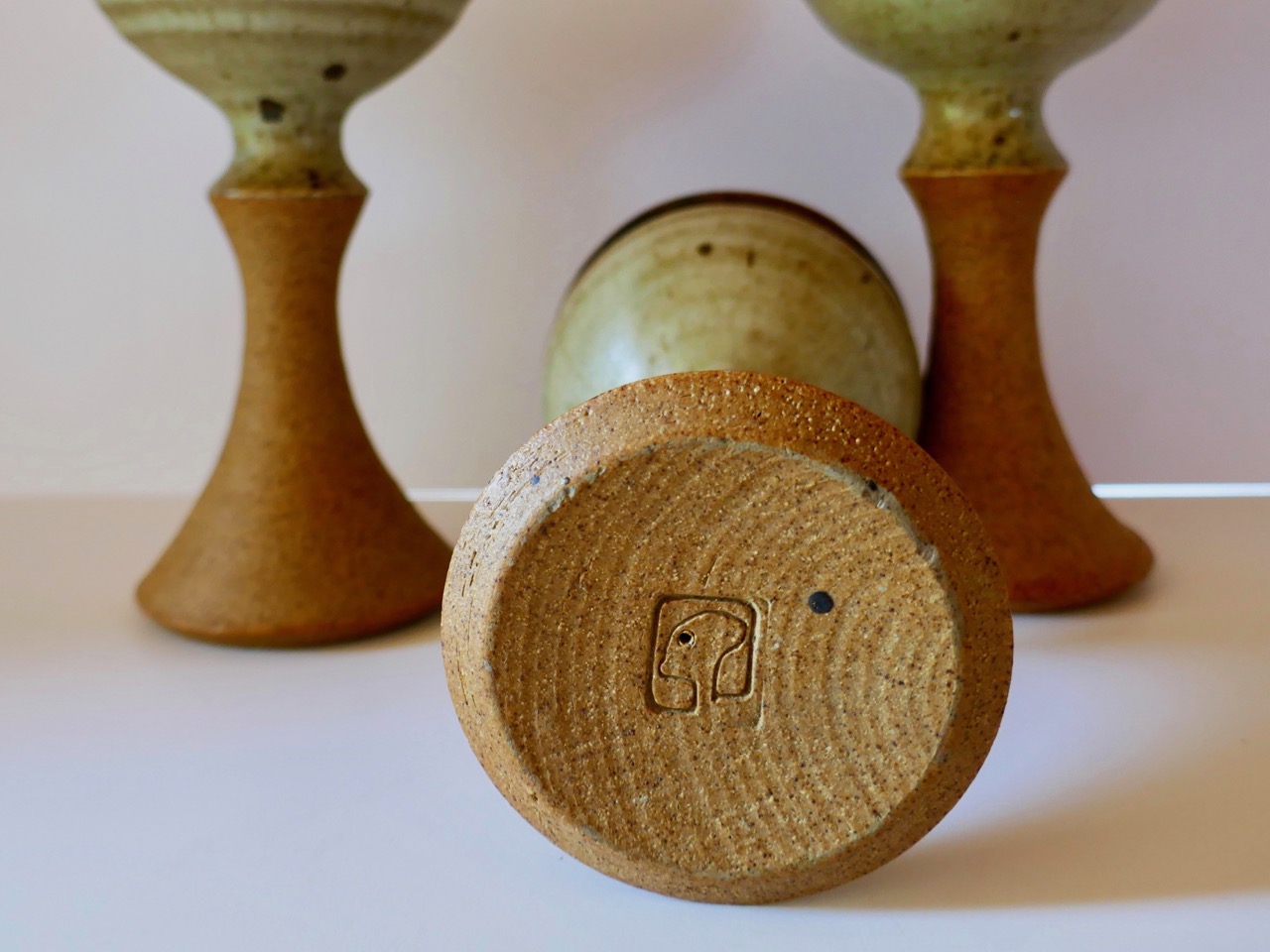
Beautiful stoneware goblets by Pat Connor, who is well represented in the collection. His maker’s mark is a memorable graphic. Another well known West Cork ceramicist represented here is Leda May, who with her husband Bob found Ballydehob in the late 1960s when they were invited by Christa Reichel to set up a pottery behind her own shop. Leda is still working in the area today, producing very fine painted porcelain ware (an example of which is shown below).

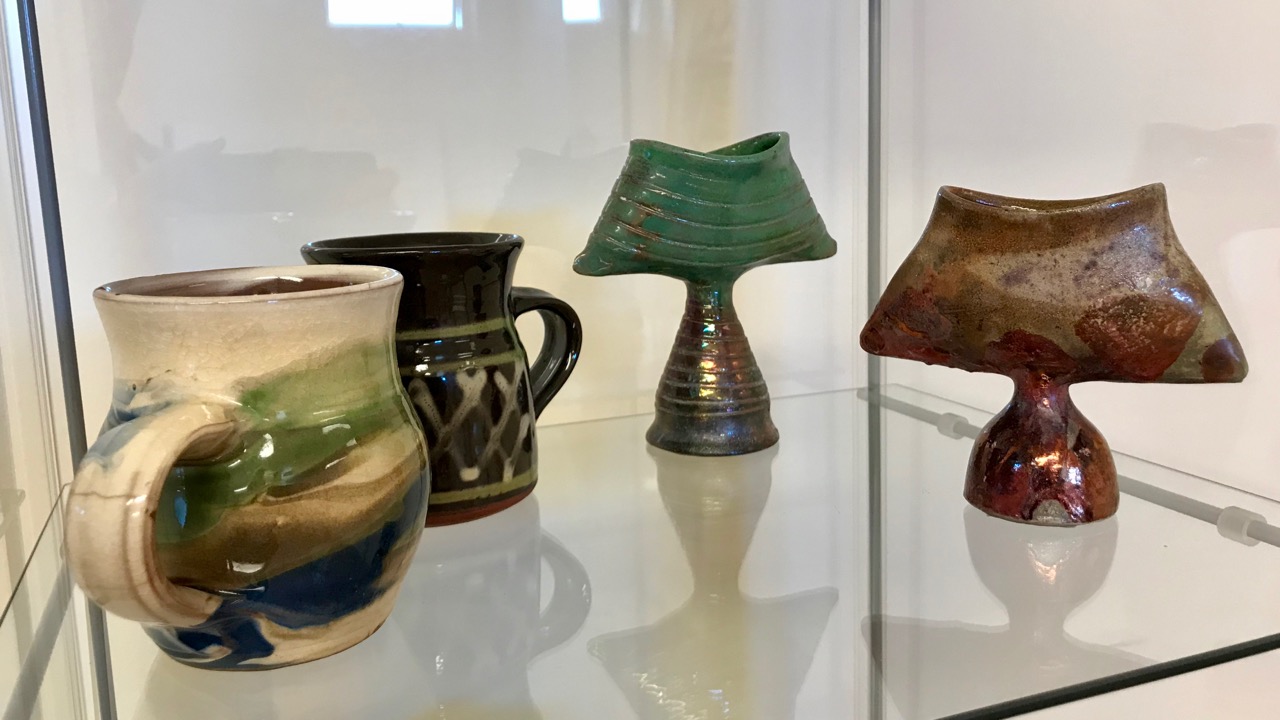
Above, from the exhibition – two earthenware mugs by Etain Hickey and Jim Turner, Rossmore Pottery 1983 and two Raku lustreware pieces by Jim Turner 1982. There are more stories to be told – to add to Alison’s comprehensive volume: the rise and fall of the Cork Craftsmans Guild, establishing the West Cork Arts Centre, exhibitions in far-flung places including Zurich, enigmatic repousee work – as yet we can’t trace its history . . . But all that is for another day, once the Ballydehob Arts Museum (BAM) is under way.
Below, posters by Brian Lalor and Repousee work by Shirley Day.

So here’s yet another reason to come to West Cork! This ‘taster’ exhibition starts on 10 August and continues through Heritage Week and Ballydehob’s Summer Festival until 26 August. We have to commend our Community Council in Ballydehob who are giving us the space in Bank House – right in the town centre (the former AIB Bank building) which they acquired for the permanent enjoyment of the local community. Also we have benefitted from Cork County Council who have given us a grant under the Creative Ireland Programme to help get the whole project off the ground. And most of all we have to thank local people who have freely donated pieces for the permanent collection – all will be acknowledged when the Museum is up and running.

Bohemians in Ballydehob! opens at 6pm on Friday 10th August at Bank House, Ballydehob

The Soul Expands with Beauty

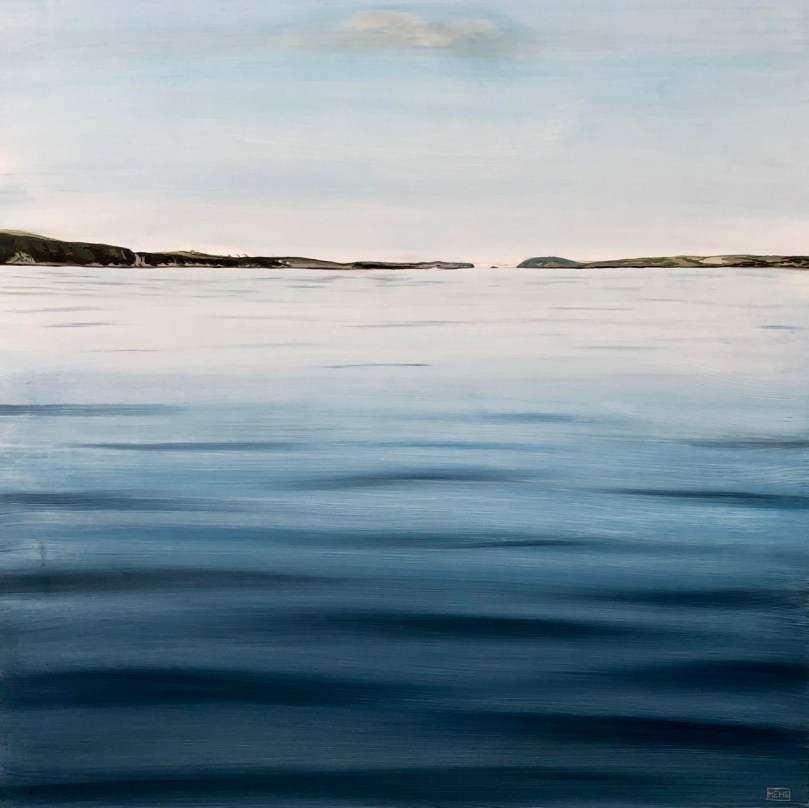
We are so lucky to live in a place where the arts are valued as a necessary part of life and where we can attend art exhibitions, concerts, theatre, readings, film screenings. It all comes together every year at the Skibbereen Arts Festival. It somehow manages to combine fun, entertainment, wonder and beauty (like this West Cork seascape by Harriet Selka, above).

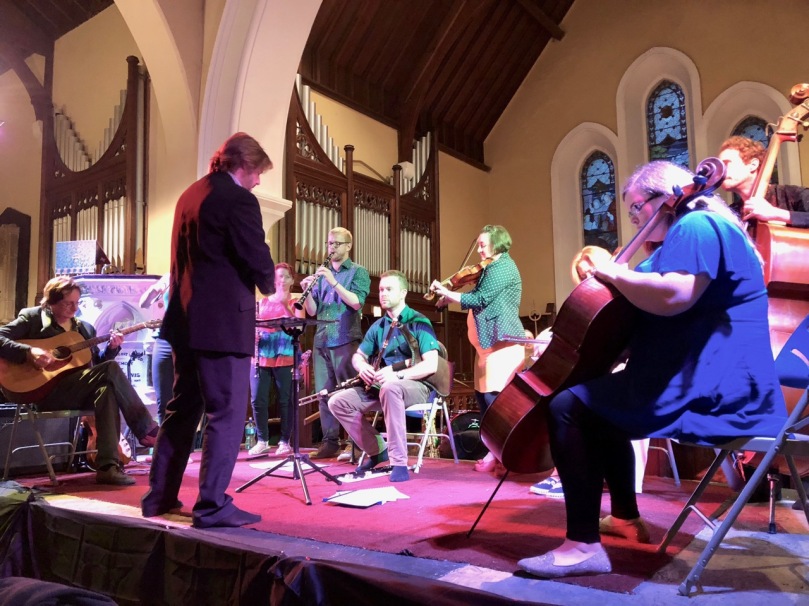
The Irish Memory Orchestra also enthralled us one evening – they play traditional and commissioned pieces entirely by memory.

Last time we wrote about this festival we said it was ‘hitting its stride’. This time the phrase that came to me was ‘it’s going from strength to strength.’ What a marvellous line up it was! You can see the whole program online and look at the sheer variety of experiences that we lucky West Cork folk got to pick from. A standout for us this year was the concert lineup, the art exhibitions and the poetry events.

Roseanne Cash and John Leventhal

It started off with Roseanne Cash, daughter of Johnny. You might think – what? Country Music? I know that’s not everyone’s taste, although I have a soft spot for it myself. But Roseanne sings a wonderful mix of Appalachian Folk, bluesy ballads and her own material along with the classics of country. She has a gorgeous voice and a husband accompanist and they both play a mean guitar. Here she is singing one of her father’s songs along with a touching tribute.

Skibbereeen was only her only other Irish stop besides Dublin and she came because of a line in Johhny’s song Forty Shades of Green (did you know her wrote that? I didn’t) that refers to Skibbereen. Watch him singing it at a concert in Dublin back in the days of Big Hair. It was Roseanne’s closing number, and predictably it brought the house down. She was in tears. We were in tears.

Something completely different a couple of nights later – The Chronicles of the Great Irish Famine is from the formidable talents of singer-songwriter Declan O’Rourke, backed up by an excellent group of musicians that includes John Sheahan of The Dubliners. Declan has been working on this song cycle for years. He describes it “an attempt to bring fresh air to an unhealed wound, and to remind the Irish people of what we have overcome.” There’s a good overview of the project here and you’ll witness Declan’s unique voice and engaging personality. The subject matter was tough – we are in the middle of a major Famine commemoration event here this summer and we are becoming more familiar every day with its horrifying stories. Having written about the Coming Home Exhibition and the 110 Skibbereen Girls Project already, we found this concert to be poignant and powerful.

Lúnasa have long been recognised as one of the best Irish groups performing traditional music today and we’d been looking forward to this one very much. The bonus was the addition of Natalie Merchant as their special guest. I’ve been a fan for a long time and it was a great pleasure to see her in person. That voice! Take a listen.

She sang this one for us and Lúnasa transformed before our eyes into this amazing back up band. Imagine a version where instead of just guitars the harmonies are provided by a flute, an uillinn pipes, a fiddle, a guitar and a double bass. Magic.

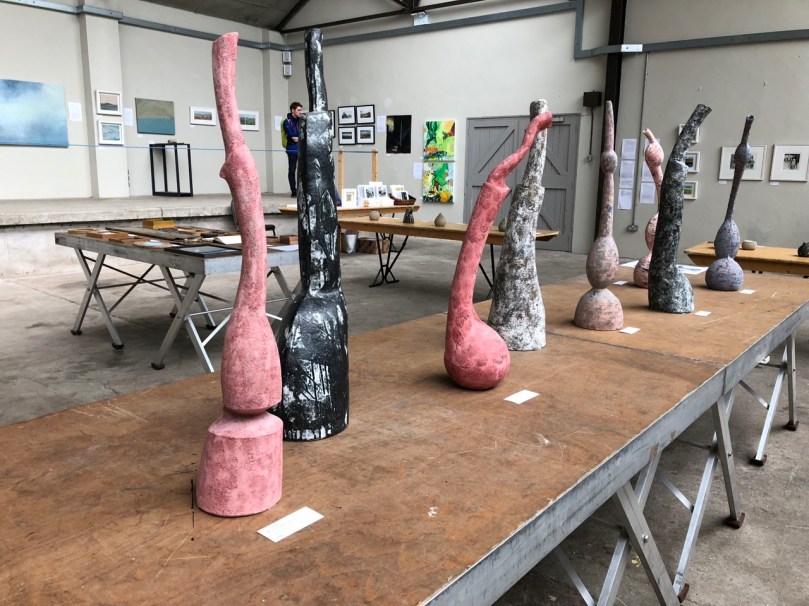
Jim Turner’s ceramic pieces catch the eye at Anseo

We took a day to do the Art Trail. There’s a couple of large exhibitions including one curated by Catherine Hammond that Robert wrote about a couple of weeks ago. The other large show was called Anseo (on-shuh meaning ‘here’). Each artist was asked to write a statement addressing how he/she responds to living/being in West Cork and it was revelatory how different each one was – both the statement and the art.

Helen O’Keefe’s Neighbours – Long Island

But there were also hidden gems all over the place – in converted empty stores, in back rooms and unused office space. I enjoyed Sonia Bidwell’s quirky pieces constructed from fabric and found materials, upstairs in Lisheen’s House. Her Veronica is below.

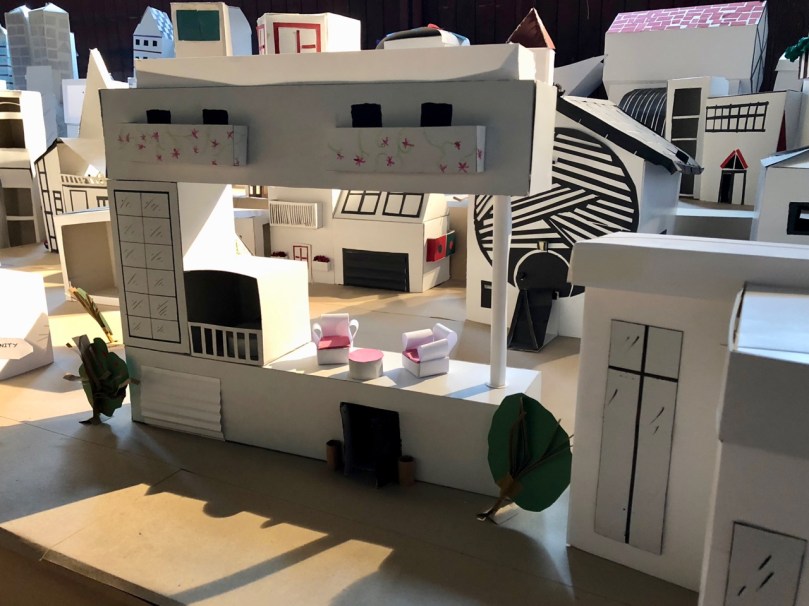
School children had participated in a ‘City’ project where they explored design and architecture and built their own cities. It was fun and relevant and, in fact, mighty impressive what they had accomplished!

A local group of fabric artists, Wild Threads, had taken over a space near the supermarket to mount an exhibition of sea-themed work called ‘Littoral.’ As expressed in the program – ‘For some this means intimate vignettes of everyday views and for others it is the colourful explosions that Mother Nature throws at us.” It had never occurred to me that you can paint with fabric until I encountered the work of this group. It’s both a constraining and liberating medium, and the results were varied, imaginative and beautiful!

Piece by fabric artist Sam Healy

I can’t finish without a word on the poetry. While there were several events, the one that made the most impact on me was the launch of two new books by Pól Ó’Cólmáin and James Harpur. I’ve written about Pól before and used his poem in my post Pagan and Pure. This time it was a book, The Silence Unravelling, of Haiku and Tanka – just a few words to capture a moment, a feeling. I hope to use some of them in a future post – they’re brilliant. 

Pól Ó Colmáin – here not reciting his poetry but performing some of his songs

James Harpur is one of Ireland’s most distinguished poets. He’s a member of the Aosdána, an affiliation of artists whose election is based on a distinguished, creative and considerable body of work. He read from his new book The White Silhouette. Here is an extended quote from his Book Of Kells series of poems, this section dealing with Gerald of Wales, Geraldus Cambrensis, who comes to see the book.

Beauty is not so much a thing

as a moment, unrepeatable,

although the moment needs the thing

as a flame needs a wick

or images a page.

Or it’s a streak of lightning

connecting heaven to earth

whereby in a flash we breathe

the enormity of something Other

beyond our tiny grasping selves

and fill our lungs with it,

before the dark returns again.

The soul expands with beauty –

it cannot help itself; our task in life

is to prevent it shrinking back.

Janet Murren’s Creaky Stairs. I love her multi-layered atmospheric constructions