The Circus Comes to Town!

We are spoilt for entertainment...

We are spoilt for entertainment…

When I saw this poster I hurried down to the Community Hall to see the Big Top setting up. There was no Big Top – this touring circus wisely uses village halls and other ‘solid’ venues during the winter months. Nevertheless, I wasn’t disappointed – any circus is a nostalgia trip for me. In another lifetime (it seems) I travelled far and wide to get to The Circus: even as far as Romania, where I had many adventures – but that is another story…

Circus in a box...

Circus in a box…

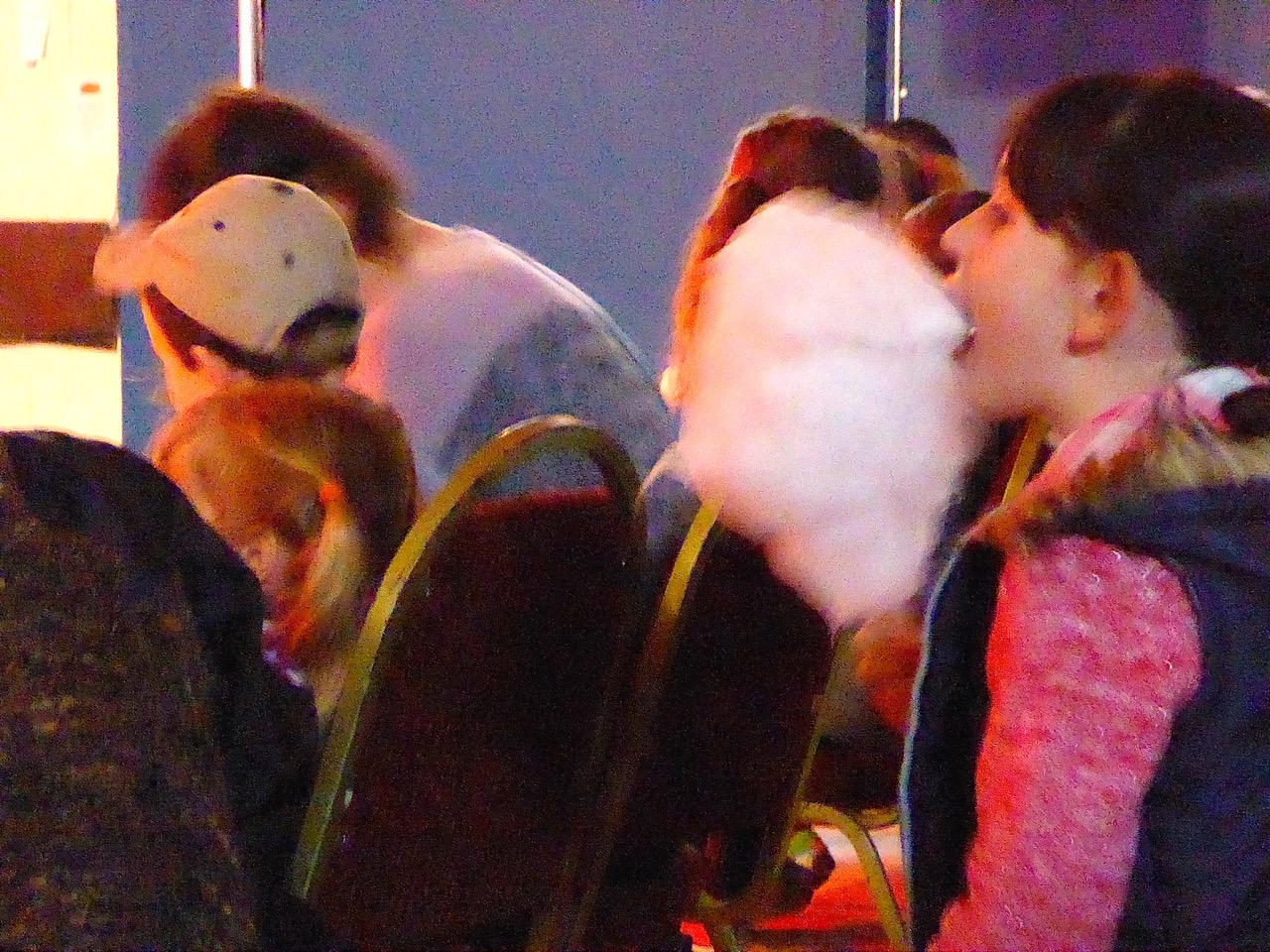
I have always been fascinated by how The Circus works. It’s an evanescent thing: here today and gone tomorrow. All the hard labour and the human skills fall on fewer and fewer shoulders nowadays, and you are likely to notice the person selling you tickets – and popcorn and candyfloss – later dressed in glitter and enthralling you with balancing feats and juggling fire in the Ring, which they had already been hard at work unpacking from the trailer and assembling at an early hour to transform the utilitarian interior of the local hall into a surreal palace of entertainment.

candy floss

This was certainly the case with Circo Corvenieo – we saw only two faces – but many different costumes – throughout the high quality two-hour performance. After a bit of research, I discovered that one of these two was Brandon Corvenieo, descended from an illustrious dynasty: the families of Corvenieo and McCormick have been associated with Circus and live entertainment since the early eighteenth century.

Corvenieos Circus in 1926 (Corvenieo Family Archive)

Corvenieo’s Circus in 1926 (Corvenieo Family Archive)

Brandon’s forebears ran a large touring circus in Ireland in the 1920s – one which included a full circus band: the last time I saw such a band was at the Blackpool Tower Circus many years ago. Circo Corvenieo relied on sophisticated electronics for sound and light – more easily managed on a scaled down touring show.

The show may have been compact – but it was spectacular! And admirable, in bringing first class skills to rural Ballydehob. The five chair tower balancing act had us on the edge of our seats, while the quality of juggling was impressive – you don’t often see five clubs or six rings being wielded as expertly as this outside of the most expensive venues. In some ways I thought that it’s a shame the audience was so young: small children would not have realised the years of practice required to achieve these professional performances. However, it may perhaps whet their appetites for later career choices… The highly skilful three tier Rolabola was something I had never seen before and – as always – the fire juggling, eating and breathing acts were transfixing: all this, and unicycling and stilt walking as well!

The ‘Father of Circus’ is recorded as Philip Astley (1742-1814), a former cavalry Sergeant-Major turned showman. During his military service he had displayed a remarkable talent as a horse-breaker and trainer – perhaps he was a Whisperer? Upon his discharge and return to London, Astley found there was a living to be made in equestrian demonstrations. In 1768 he set up an indoor amphitheatre (with a circular performing space) and The Circus as we know it was born!

Astley's Amphitheatre, 1807

Astley’s Amphitheatre, 1807 (Capon, V + A)

We know, of course, that in Ireland’s history horsemanship has always been practised and respected. It was also the case that riding skills and training provided profitable entertainment back in those times. Circus seems to have taken off in a big way all across Europe in the 1700s, providing employment for acrobats, rope-dancers, and jugglers, interspersing their acts between equestrian displays. Another addition to the show was ‘…a character borrowed from the Elizabethan theatre, the clown, who filled the pauses between acts with burlesques of juggling, tumbling, rope-dancing, and even trick-riding…’

show business

Thank you, Corvenieo’s, for bringing the spirit of The Circus back to our corner of Ireland – I gather this is the first time in 19 years you’ve been to West Cork… I think we gave you a good audience (I counted between 60 and 70 full seats): please come back in the summer, and bring the Big Top! Meanwhile, I’ll go out to the shed and dust off my fire juggling clubs – I only ever managed three; now I’m feeling sorry that I left behind my tall unicycle and my high stilts.

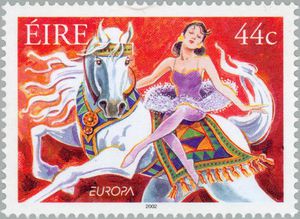
CEPT--Circus-1

CEPT--Circus

From Skibbereen to the Moon Part 2: Ellen and Aubrey Clerke

Ellen

In my post From Skibbereen to the Moon I wrote about the Clerke family of Skibbereen, but particularly about Agnes, who became one of the foremost astronomers and science writers of her day. But Agnes was one of a trio of remarkable siblings, each of who distinguished themselves as intellects and writers and I wanted to learn more about her sister, Ellen, and her brother, Aubrey. In the process, I came up with questions that reach into the heart of Skibbereen, and Irish, history.

Bridge Street, Skibbereen

Bridge Street, Skibbereen

But first – the Clerke (pronounced Clark) family: all three siblings grew up in Skibbereen, above the bank that their father managed. They lived through the Famine: John Clerke was one of the subscribers to the soup kitchen relief effort. After moving away in 1861, and apart from the years the women spent in Italy, the family lived together for the rest of their lives.

It was, by all accounts, an harmonious and supportive household. The three were devoted to their parents and they encouraged and nurtured each other’s scientific and literary pursuits. Aubrey coached Agnes in mathematics when she needed to move to a higher level of understanding in her astronomy studies, and the siblings accompanied each other to the various astronomical and geographical societies that each belonged to. Ellen was the stronger of the two sisters (Agnes’s health was poor from childhood) and also the more social. According to Lady Huggins account, she played the guitar and sang well, she liked to ride and she “pulled a good oar.”
Fable and Song

While Agnes wrote mainly (although not exclusively) about astronomy, Ellen was more literary in her leanings, publishing extensively in the areas of poetry and criticism and writing in three (at least) languages. The book for which she should be most justly remembered is Fable and Song in Italy. Ellen’s objectives with this book were twofold: to trace the influences on popular Italian song and to to introduce English readers to Italian verse. In order to do this she must have possessed an encyclopaedic knowledge of the great Italian poets and the ability to translate Italian verse to English verse. This had to be an incredibly difficult undertaking, not least because she was translating archaic Italian into a more contemporary language (that is, of her own time) in order that the “beauties” of the verse would not be “disguised by the obsoleteness of the language.” She begins in the Renaissance with the Fifteenth Century Boiardo, author of Orlando Innamorato, a classic of European chivalric literature. Her account of the piece Charlemagne’s Tournament from Orlando is complete with the story itself, discursive asides about the numerous characters and translations of selected verses.

From Fable and Song in Itlay

From Fable and Song in Italy, Ellen’s best work

She moves on to Boccacio, author of the Decameron. Crediting him with “giving the metrical romance an established place in literature” she asserts that he “supplied the poetry of the future with its main outlet of expression…” She provides many pieces of translation and compares his verbose style to Chaucer’s (an admirer of Boccacio) more succinct phrasings, tracing the influences of the Italian on the English poet with great skill and using numerous illustrations. She has a chapter on The Hercules Saga and on the verse letters of the poet Ariosto; she describes the potent roles played by Dante and Petrarch in Italian verse; she works her way through a chapter on  Italian Folk Songs to finish with a discourse on Manzoni and Modern RomanticismIt’s a tour de force, showing a strong intellect operating at the height of its powers. But it’s also fascinating in that, as a devout Catholic with a Victoria sensibility, she deals with the sometimes hot and overblown romantic verse in a calm and often wryly humorous way, noting for example that despite all the chivalry and elevation of romantic love, Ariosto’s real estimation of women was evidently “very low,” as he  “alternates between raillery and panegyric.”
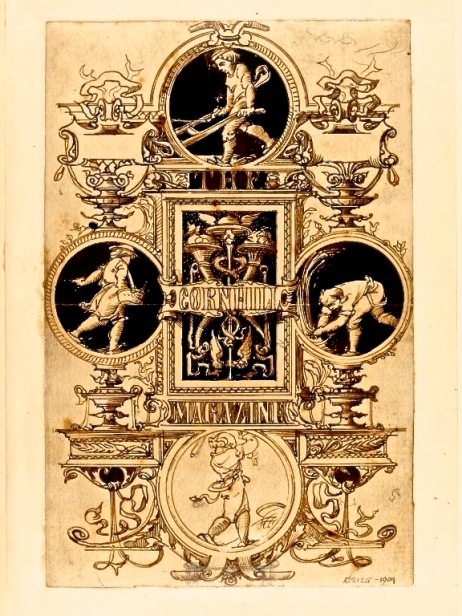
Everyone who was anyone wrote for he Famous Cornhill Magazine

Everyone who was anyone wrote for the Famous Cornhill Magazine

Ellen wrote for various magazines, especially The Tablet (a Catholic periodical which she also helped to edit), the Cornhill Magazine and the Dublin Review (another influential Catholic journal, actually published in London). Although she never reached the stature of Agnes in astronomy, she was likewise interested in that subject and wrote two monographs on Jupiter and on Venus. A review of Jupiter and his Systems calls it a “capital little pamphlet” (it was 40 pages) and says it presents “a complete popular account of our present information regarding this planet and its satellites…in an interesting and straightforward way, equally removed from dullness and from the faintest traces of “smart writing.”” She wrote literary studies in German and she studied Arabic to the extent of using original Arabic texts in her research. She was a highly regarded member of the Manchester Geographical Society (which admitted women!). One of her pieces for them was about Australian aborigines which was described as a “striking refutation of the generally held belief about them”. Another one of her journalistic essays was about the dock labourers strike of 1889 in which she displayed her understanding of economics, her insistence on factual information (she used extensive statistics) and her empathy for low paid workers and their families, although in general her politics were conservative.
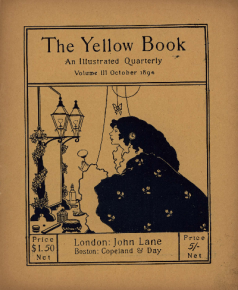
Cover by Aubrey Beardsley, Poem by Ellen Clerke

Cover, Aubrey Beardsley. Poem, Ellen Clerke

Ellen’s venture into fiction was not, alas, as well received as her journalism and science writing. Just before she died she published her only novel, Flowers of Fire. I have found a single review, which pans it. “This story is interesting,” it states, “as proving that neither Polish conspiracies nor Neapolitan courtships can fill the dreary void left in a novel by the absence of men and women…[The characters] are distinguished from each other only by some external badge, such as yellow hair or a hot temper, and by the single hard black line that marks off the good characters from the bad.”

I couldn’t find the text of Ellen’s novel online, but I did come across a poem she translated from French, with the same title. It was published in The Yellow Book – a very smart quarterly with cover designs by Aubrey Beardsley. I have appended the poem to the bottom of this post. 

Aubrey St John Clerke, like his sisters, was brilliant. He won gold medals at Trinity in Mathematics and in Science and was awarded a “studentship” of £100 per year – “the highest honour obtainable at the Degree examination.” Although trained as a scientist, he chose to make his career in law, in which profession he became a specialist in land and property law and wrote books on the land law and conveyancing and articles for magazines, such as one for the Dublin Review of 1880 on ‘The Land Question and Law Reform.’ 

These books and articles on buying and selling land were more than simple treatises on conveyancing: they were a significant contribution to Irish and British law, since a series of Land Acts, beginning in 1870 were passed, designed to transfer the ownership of property from the large landowners to the Irish people who lived and worked on it. Each Act improved on the one before, but all were complex and there were no precedents to depend on. But Aubrey did not confine himself to law and wrote on other topics too. At one point, in 1878, all three Clerke siblings were in print. According to Mary Brück’s biography of Agnes, Aubrey’s contribution was a piece in the Quarterly Review “on a political question in which he showed himself a staunch Unionist and Anglophile.”

It’s interesting to note, in this regard, that when the Clerkes lived in Skibbereen, in the Bank House on Bridge Street, O’Donovan Rossa, the Fenian leader, was running a business further up the same street. Did John Clerke, in his capacity as the Bank Manager, have dealings with Rossa (who ran into financial difficulties with his seed business)? How did the conservative Clerkes feel about the Phoenix National and Literary Society that Rossa founded with the aim of liberating Ireland ‘by force of arms.’ How usual or unusual was it for staunch Catholics, such as the Clerke siblings, to be committed unionists and anglophiles? How would Aubrey feel, do you think, if he knew that the other memorial plaque on Bridge Street is to honour the memory of a Fenian? 

Redcliffe Square, home to the Clerkes in London

Redcliffe Square, home to the Clerkes in London

Agnes and Ellen died within months of each other. Aubrey was the youngest of the family and the last to survive, living on alone in the grand house in London, becoming in the end reclusive. I can find no photograph of him or of his father: in this family it is the women who are most remembered. To his credit, Aubrey never seemed to resent that, remaining proud of and devoted to his two extraordinary sisters always.


Flowers of Fire

A Translation, by Ellen M. Clerke

FOR ages since the age of Chaos passed,

Flame shot in torrents from this crater pyre,

And the red plume of the volcano’s ire

Higher than Chimborazo’s crown was cast.

No sound awakes the summit, voiceless, vast,

The bird now sips where rained the ashes dire,

The soil is moveless, and Earth’s blood on fire,

The lava—hardening—gives it peace at last.

But, crowning effort of the fires of old,

Close by the gaping jaws, for ever cold,

Gleaming ‘mid rocks that crumble in the gloom,

As with a thunderclap in hush profound,

‘Mid golden dust of pollen hurled around,

The burning cactus blazes into bloom.

First Foot

‘…According to local folklore the first foot was planted on Irish soil at Donemark on the shores of Bantry Bay in 2680 BC…’

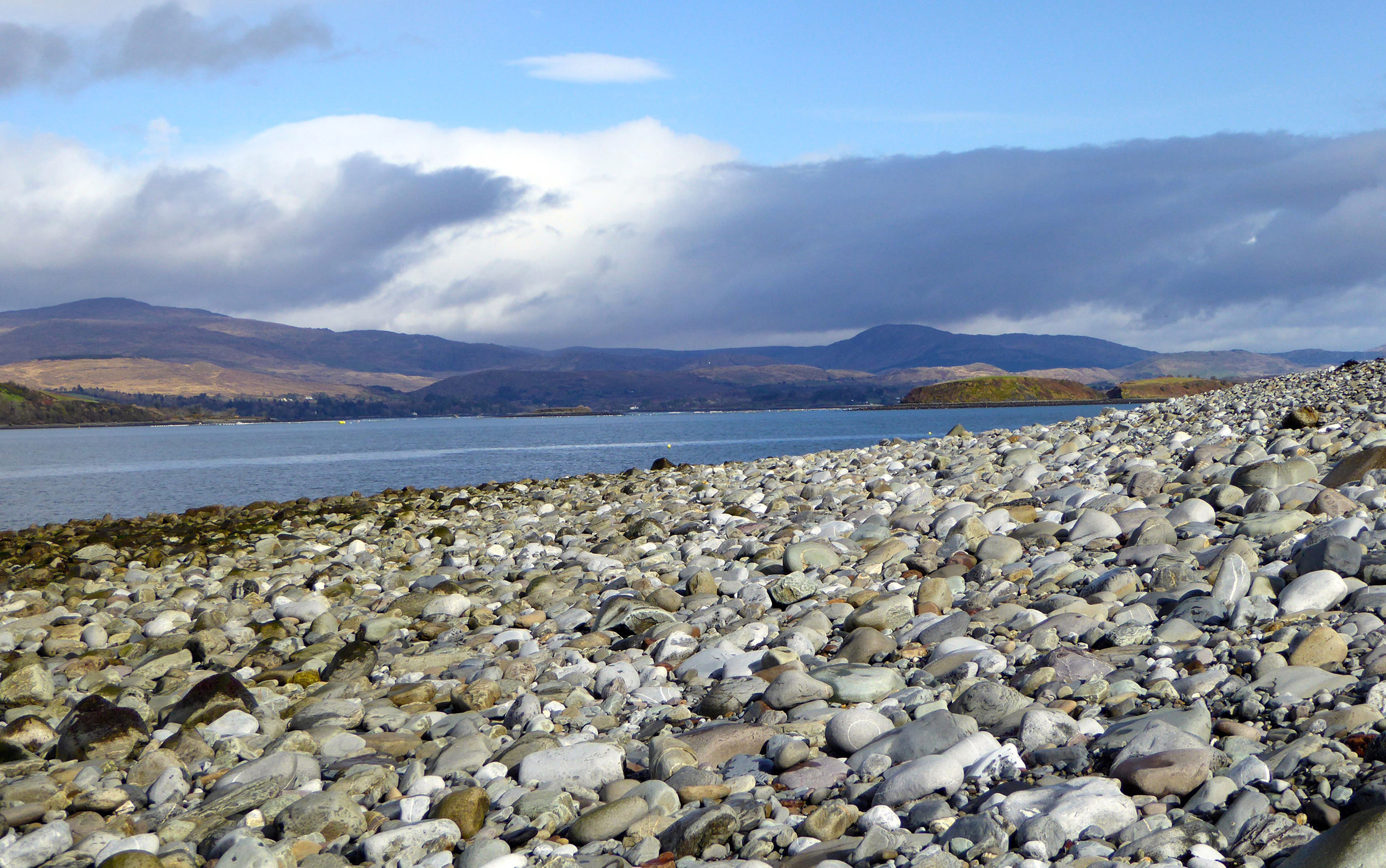
Ireland's first arrivals passed by this pebble beach on their way to Donemark

Ireland’s first arrivals passed by this pebble beach on their way to Donemark

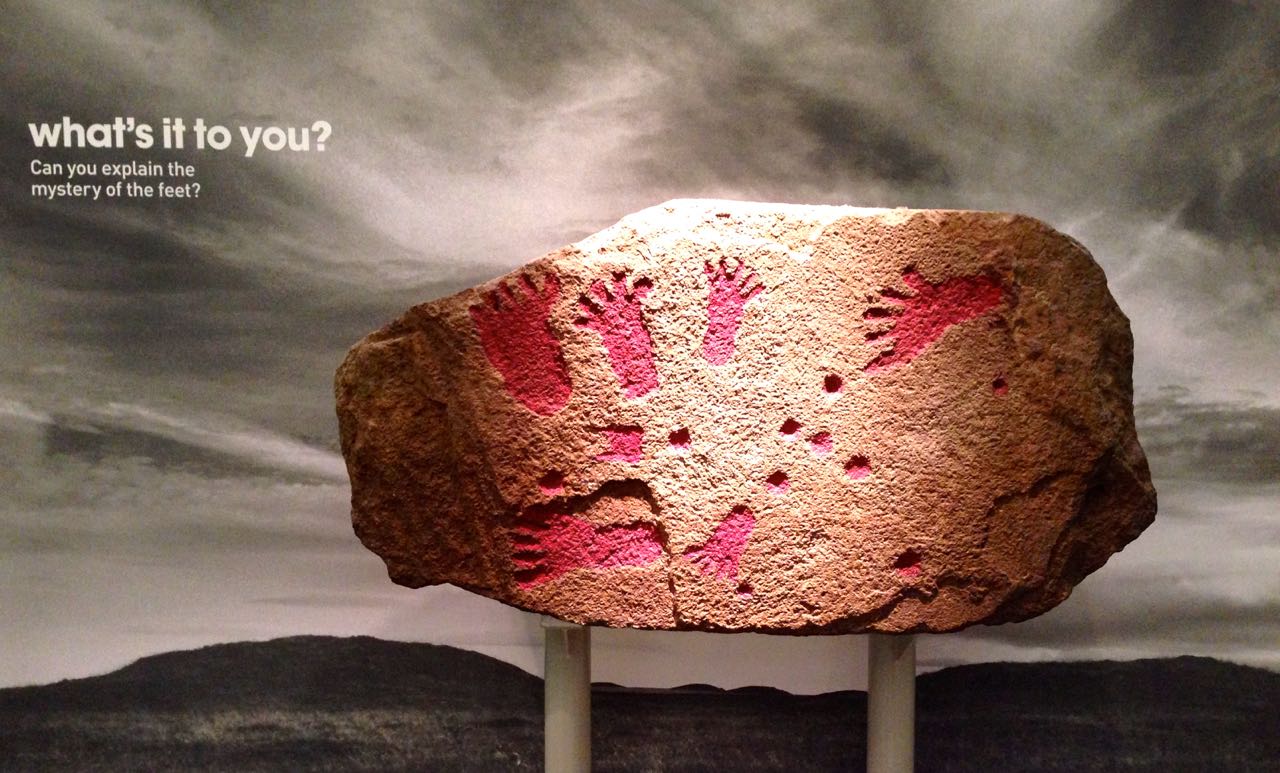
This statement (from Fuchsia Brand’s leaflet on Heritage) was guaranteed to send me scurrying for my history books. And – yes – I found many references to the event: an event which, to my mind, was surely one of special significance for Ireland: the first human ever to have set foot in this land – it must have deserved commemoration… Surely, there must at the very least be a plaque marking the spot? For a moment I wondered if this could be the long sought explanation for the enigmatic piece of Rock Art that’s on display in Bristol’s Museum & Art Gallery – the carving is about the right age…

Bronze Age Footprints in Bristol's museum

Bronze Age Footprints in Bristol’s museum

So, a similar example of Petrosomatoglyphia is what I was hoping to find on the shores of Bantry Bay, a mere stone’s throw from our home here in Cappaghglass. But – before that expedition – let’s just go back to the history for the moment. Back – in fact – to the Lebor Gabála Érenn (The Book of the Taking of Ireland), which was written down in the 11th century and – allegedly – based on earlier source material. It takes a bit of wading through: I used a commentary edited and translated by R A Stewart Macalister and published by the Irish Texts Society in Dublin in 1938, but it’s well worth the effort. There’s a lot I had never understood before about the earliest history of the people of Ireland.

lebot gabala book frontispiece

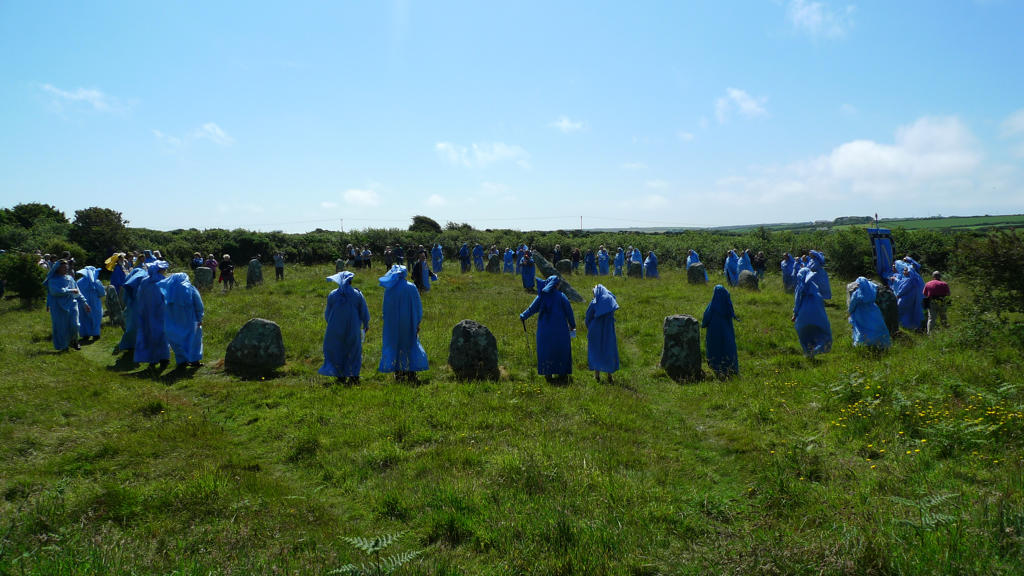
It’s a long story… The book is a collection, in five protracted parts, of all the poems and traditions which had been written and learned by the Bards, telling the history of their nation. There’s a lot of repetition: like the Gospels there are several versions of each episode and it’s a bit dizzying to try to get a clear overall picture of events. So, settle down and imagine the visiting Bard you have given hospitality to in your tower house on a winter’s night is regaling you with tales of your ancestors.

A Meeting of Bards (at Boscawen-Un Stone Circle, West Penwith, Cornwall

A Meeting of Bards (at Boscawen-Un Stone Circle, West Penwith, Cornwall)

Everything has to go back to Noah, who was only allowed to take with him on the Ark his own sons and their wives. One of his sons, Bith, had a daughter – Cesaire (or Cessair). As she had to stay behind so also did her father, but they built their own ships, three of them, and set sail with two other men and a large company of women, looking for a land which ‘knew no sin’ because it had never been populated: there they would settle and aim to re-found the human race in a green and fertile place. Their voyaging took them to many parts of the known world and they came eventually to the north of Spain – which we know today as Celtic Galicia. Cesaire knew that this wasn’t the Utopia they were seeking but she climbed to the top of a very tall tower and, in the far distance, she spotted Ériu – ‘…where no evil or sin had been committed, and which was free from the world’s reptiles and monsters…’

Cesaire would have needed a tower like this to catch a glimpse of Ireland from northern Spain...

Cesaire would have needed a tower like this to catch a glimpse of Ireland from northern Spain…

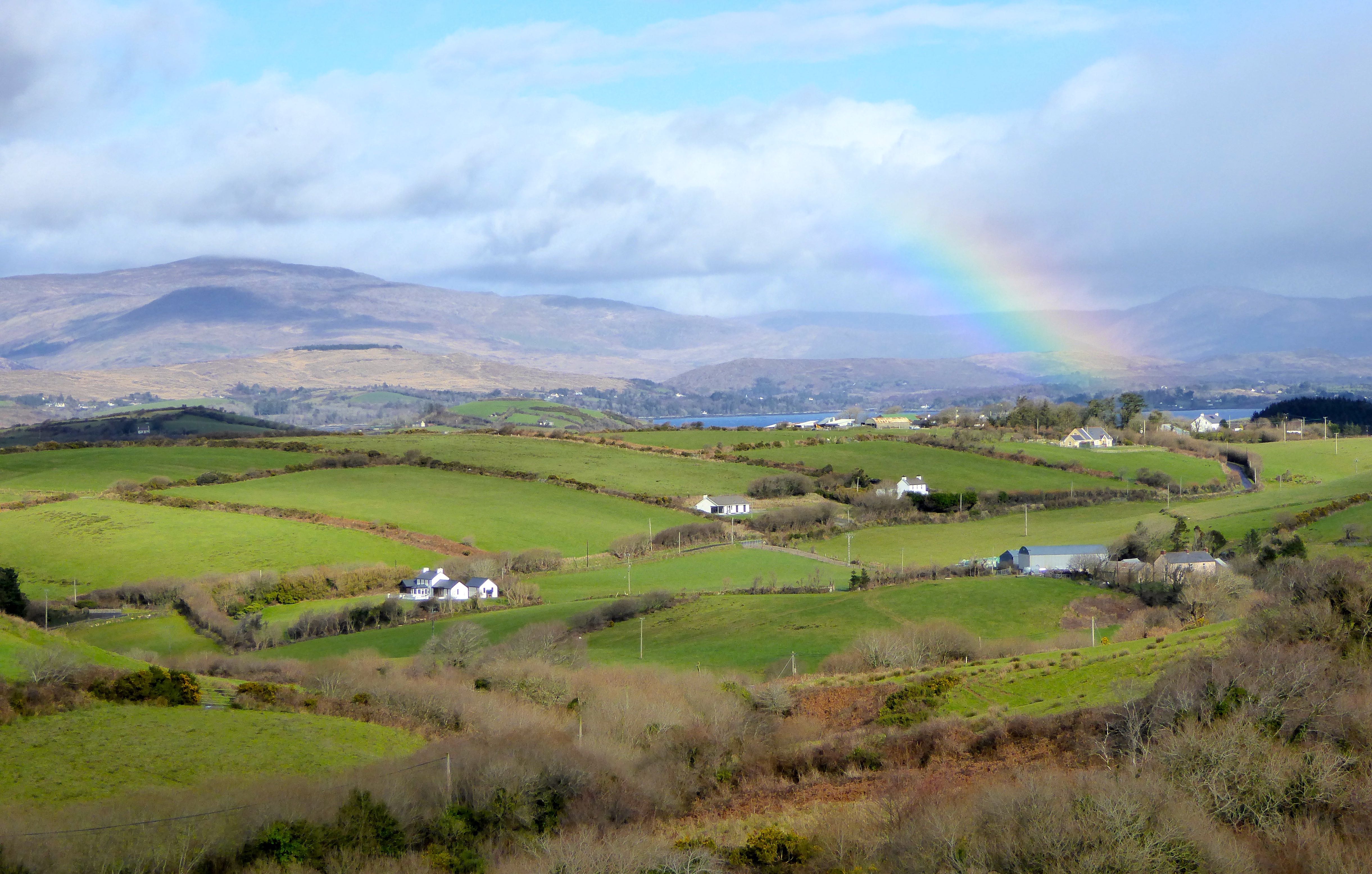
And so it was, forty years before the Great Flood engulfed everything, Cesaire’s expedition sailed up to the mouth of the Mealagh River, passing on the way the most beautiful landscapes they had ever seen – landscapes that we are fortunate to see every time we set out to explore our own new horizons.

Bantry Bay - the landscape today

Bantry Bay – the landscape today

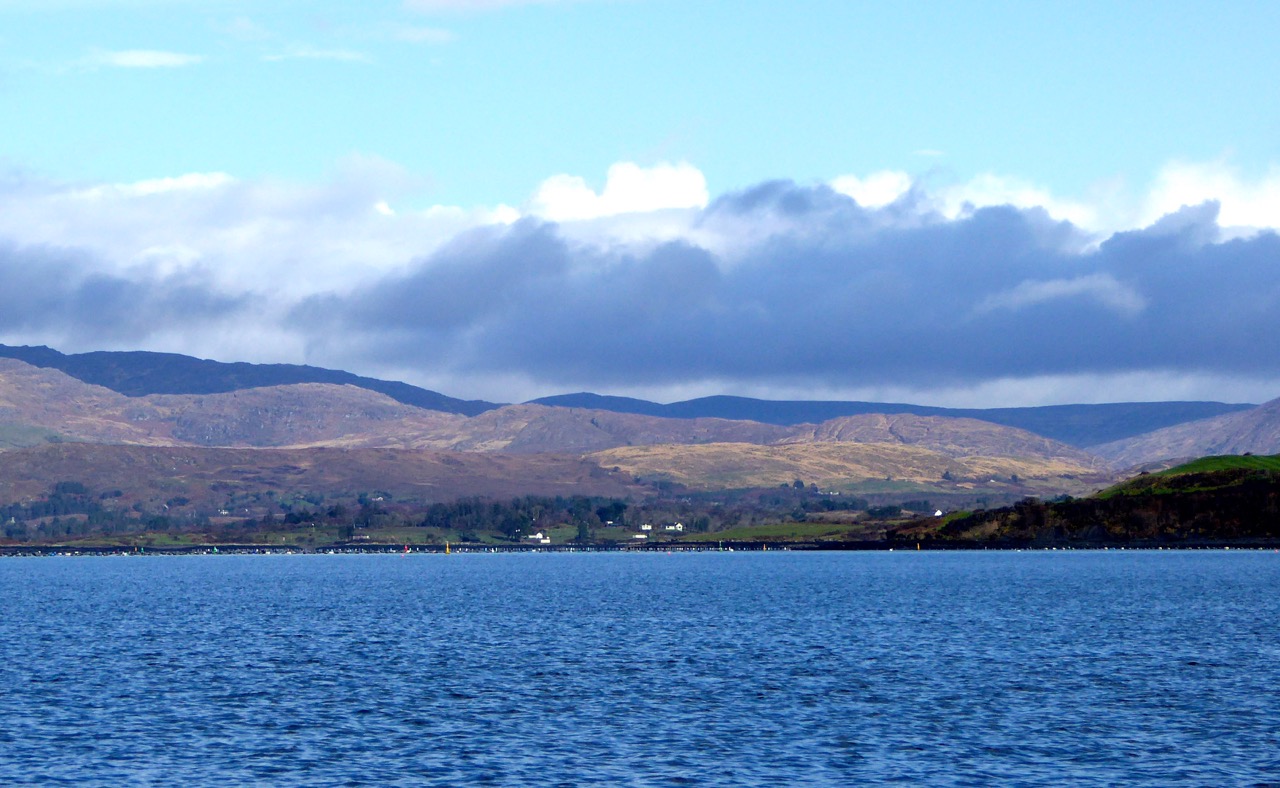
Now it was time to glimpse for ourselves this remarkable site – Dún na mBarc – the place of the boat – (Donemark -Dunnamark Townland) in the parish of Kilmocomogue. We drove up the unremarkable N71 through Bantry town and turned in to its attractively situated golf course, then made our way down to the shore. Disappointingly, that is also unremarkable: it’s got a brooding, although not unattractive atmosphere about it. We came there at low tide and saw mud-flats – alive with foraging birds, including a very fine Old Nog – the huge stones of a disintegrating quay, and distant views to the Sheep’s Head and Beara Peninsulas.

Landing Place? At Donemark

Landing Place? At Donemark

Old Quay at Donemark

Old Quay at Donemark

.

Alas, there were no footprints, no plaque, no signification of the very important history of this site: there was only our imagination to fill in the gaps. I could envisage Cesaire’s Bronze Age boat (only one survived the full journey) making its way up the azure waters admiring the emerald green of the landscape and passing by some of Ireland’s most dramatic scenery. They landed on ‘…a Saturday, the fifteenth day of the moon at Dun na mBarc…’

Kerry Mountains

Mountains of West Cork

We did find a single commemoration of this event: in the tranquil gardens of the National Learning Network Centre, which is not far from the mouth of the river. It is a work of art, made in 2013 by the students of the Centre, under the guidance of Michael Ray and the auspices of the West Cork Arts Centre – you may remember both from this recent post. Voyage of Stories’  recalls that pioneering arrival in the form of a boat sculpture made of steel, copper and glass and set up over a pool. The glass tiles tell of invasions and emigrations both ancient and modern in Irish and English. It’s a good way to commemorate the journey and those early settlers, we thought.

'Voyage of Stories' at Donemark

‘Voyage of Stories’ at Donemark

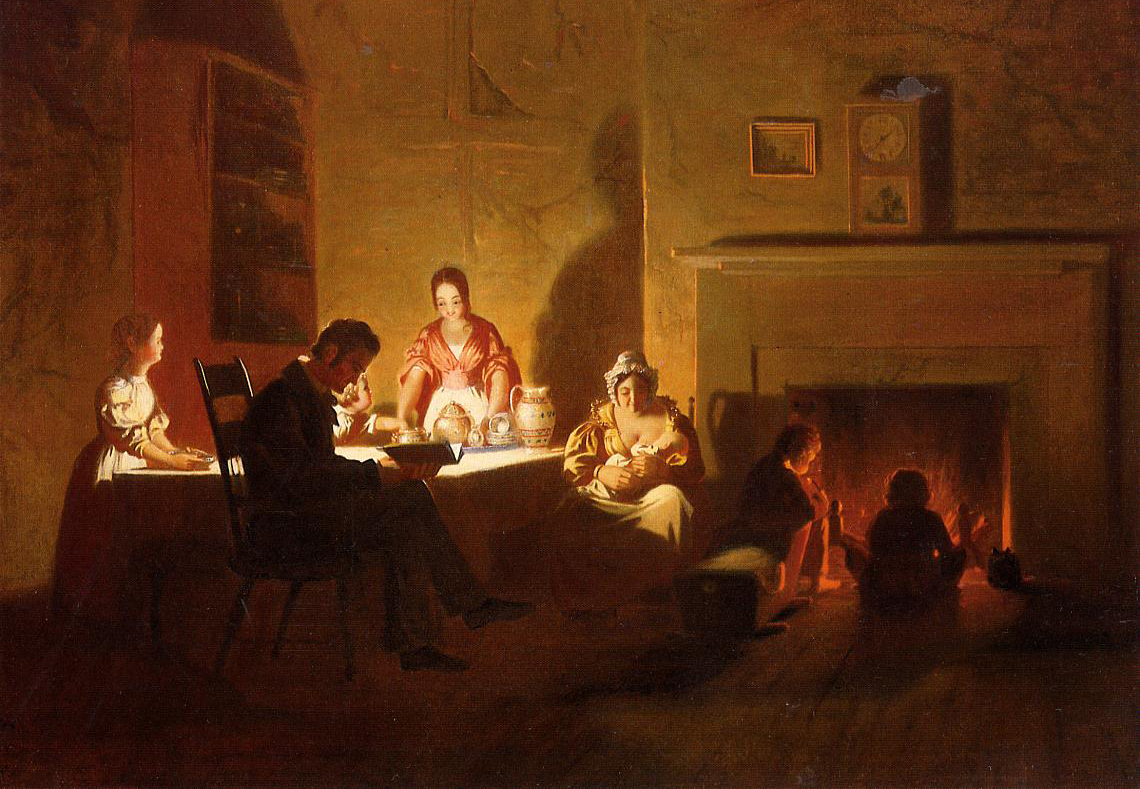
Now, Finola – at my side and wearing her Archaeologist’s hat – is tutting at my unquestioning acceptance of the dating of this milestone in Ireland’s history, bearing in mind that the passage graves at Newgrange, Knowth and Dowth appear to be some 5,000 years old and – she says – there were people living in Ireland earlier than that! But my view is that there’s history, and there’s story… Well, perhaps history is always someone else’s story but give me a good tale any day, especially one woven with adventure and romance and told at the fireside.

Family Life (Caleb Bingham 1845)

Family Life (Caleb Bingham 1845) New Orleans Museum of Art

So now you know all about Cesaire, who was the first to step from that frail vessel which had travelled all the way from Egypt in those far off days. But perhaps I should also tell you a little more: the three men on that voyage faced the prospect of serving no less than fifty women between them if they were to populate this new land. The Lebor Gabála Érenn is quite frank about this: ‘… Ladra, the pilot, from whom is Ard Ladrann named he is the first dead man of Ireland before the flood. He died of excess of women, or it is the shaft of the oar that penetrated his buttock. Whatever way it was, however, that Ladra is the first dead man in Ireland…’ while Bith – Cesaire’s father – was already aged before the voyage and also passed away soon after. That left one man – Fionntán – who was so frightened by the prospect of facing all those women alone that he ran away and hid in a cave. There he changed into a Salmon and survived the Flood which, sadly, overcame Cesaire and her companions. The shape-shifting Fionntán went on to live for five and a half thousand years (by my reckoning that means he’s still alive!) and recorded all of Ireland’s history (including at first hand the account of Cesaire’s voyage) – which he then taught to the Bards of Ireland so that it would be taken out into the world…

But all that is for another day!

made harbour

When is a castle..?

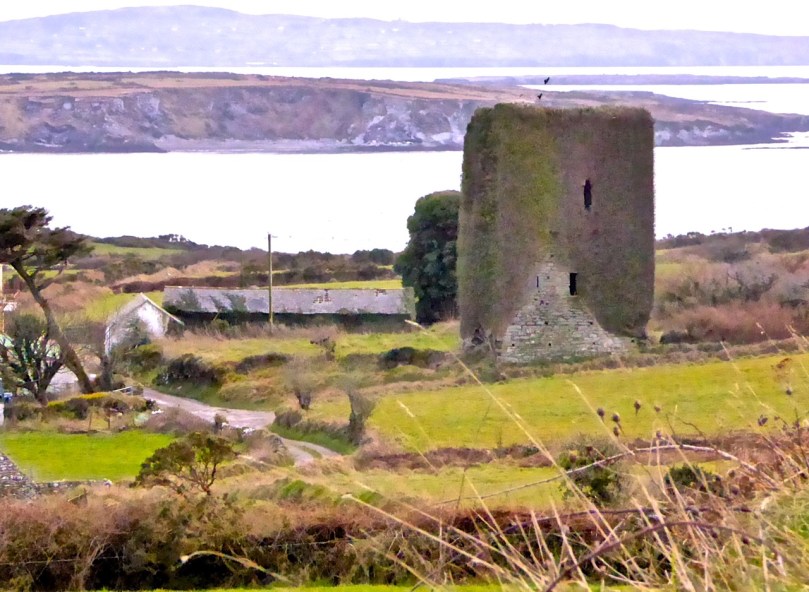
Leamcon Castle

Leamcon Castle (Black Castle)

…not a castle?

Answer: When it’s a Tower House. Maybe.

Harold Leask first published his classic Irish Castles in 1941, and it was subsequently revised and reprinted several times. My own copy was bought in the late 60s and accompanied me to Canada and back. Leask’s book was the first comprehensive work on the subject – a work of erudition but thoroughly readable with charming pen-and-ink illustrations. 

Leask insisted on the use of the term tower houses for small simple castles and described them thus:

They are simple oblongs with four walls, subtly battered, rising sheerly from a bold base-batter, to parapets which are crenellated in the Irish fashion. A small turret, at one corner, generally above the staircase, rises to a greater height than the rest of the building, while within the parapets are the two gables of the roof. Very often a small machicolation projects from the parapet and commands the entrance doorway below…

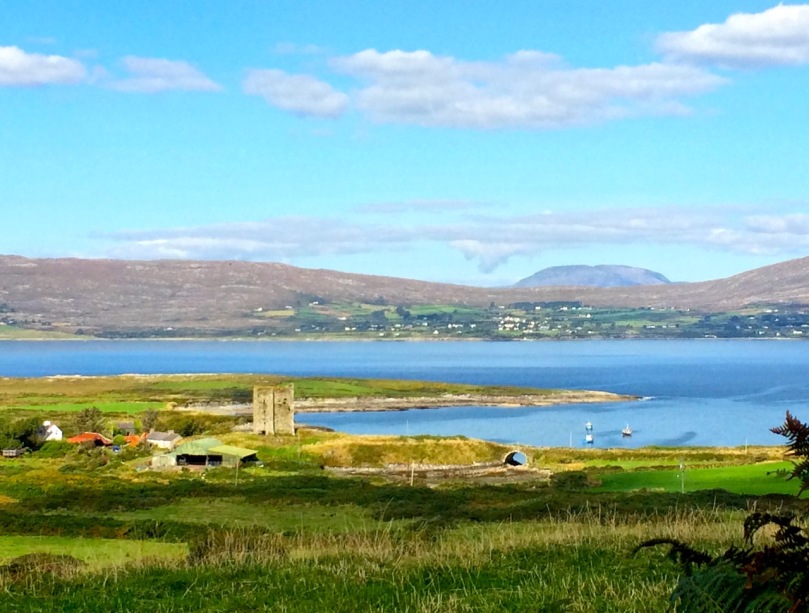
Ardintenant Castle

Ardintenant Castle (White Castle). It sits on top of an earlier ring fort.

In researching for this post the other main source I consulted was a doctoral thesis by Mark Wycliffe Samuel, The Tower Houses of West Cork. More recent (1998), it concentrated on the castles of this area and is packed with detail about the ones we see around us here in Roaringwater Bay and on the Mizen Peninsula, from Baltimore (Dún na Séad) in the east, to Cape Clear Island (Dún an Óir) to the south and Three Castle Head (Dunlough) to the west.

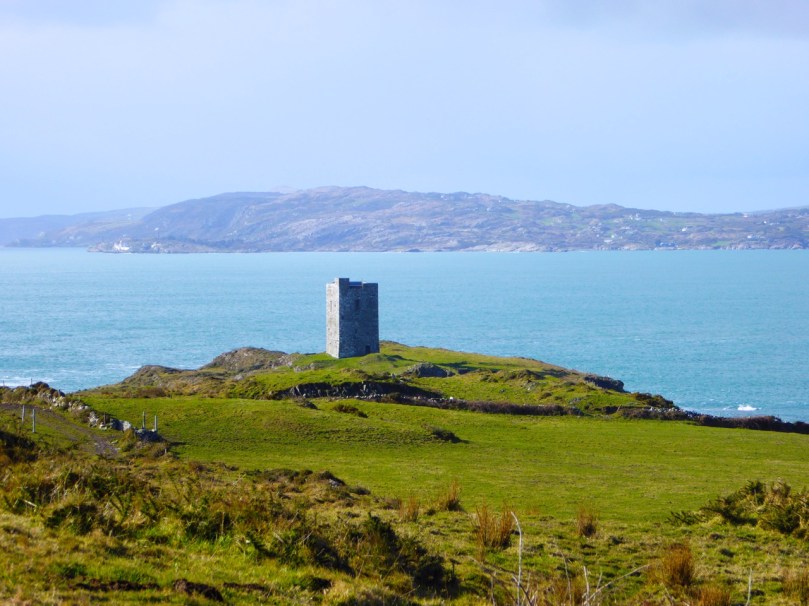
Dunlough Castle, known as Three Castle Head

Dunlough Castle, at Three Castle Head

These simple towers were quite different from the enormous and elaborate military castles that cemented Anglo-Norman power all over Ireland after the invasion of 1169, such as Trim in County Meath, or Cahir in Tipperary. Tower houses were built in what Leask calls a ‘great building revival’ from about 1440 into the 1600s. In what may be the forerunner of the European Grants system, Leask says many of the earliest ones were built as ‘£10 Castles’. A statute of 1429 offered every liege man of our Lord the King…who chooses to build a castle or tower sufficiently embattled or fortified..to wit twenty feet in length sixteen feet in width and forty feet in height or more, that the Commons of the said counties shall pay to the said person to build the said castle or tower ten pounds by way of subsidy. Although this statute seems to have been applicable only in certain counties (mainly around the Pale) it established a pattern for tower building which was adopted, with variations, all over Ireland.

Dunmanus Castle

Dunmanus Castle

The Roaringwater Bay and Mizen towers fit this pattern very well. They were not, however, built by the Anglo-Normans – West Cork was too remote and beyond their reach. They were built by the great Irish chiefs of the O’Mahoney, the McCarthy and the O’Driscoll clans and probably replaced earlier strongholds such as promontory forts (as at Dunlough), large ring forts (Ardintenant) and stone forts/cashels (such as the one at Knockdrum). These chiefs became wealthy through their control of the fisheries, through piracy, and through tribute exacted from those who occupied their traditional territory. At least one of them (Rossbrin) became famous as a centre of learning and scholarship during this time. Of the ones I will describe in this post, all are situated at the sea. or close to it, with commanding views over their territory and sometimes within sight of each other.

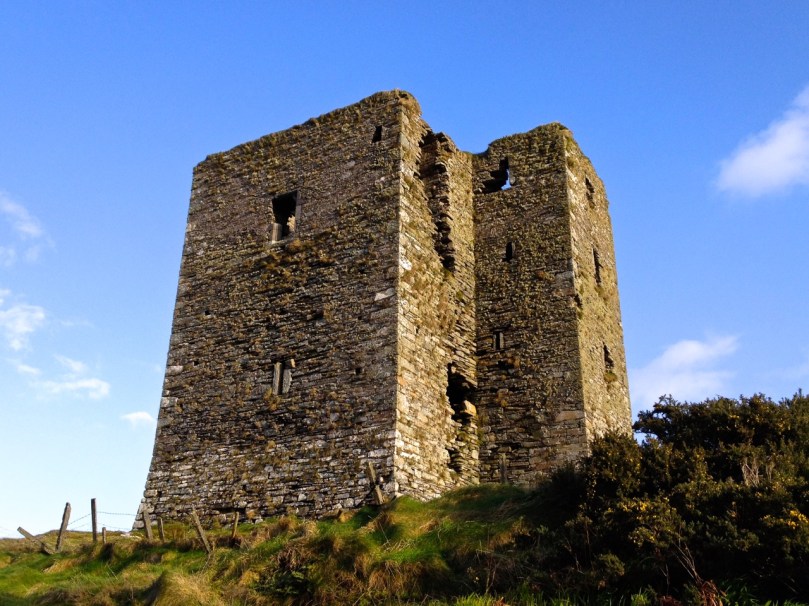
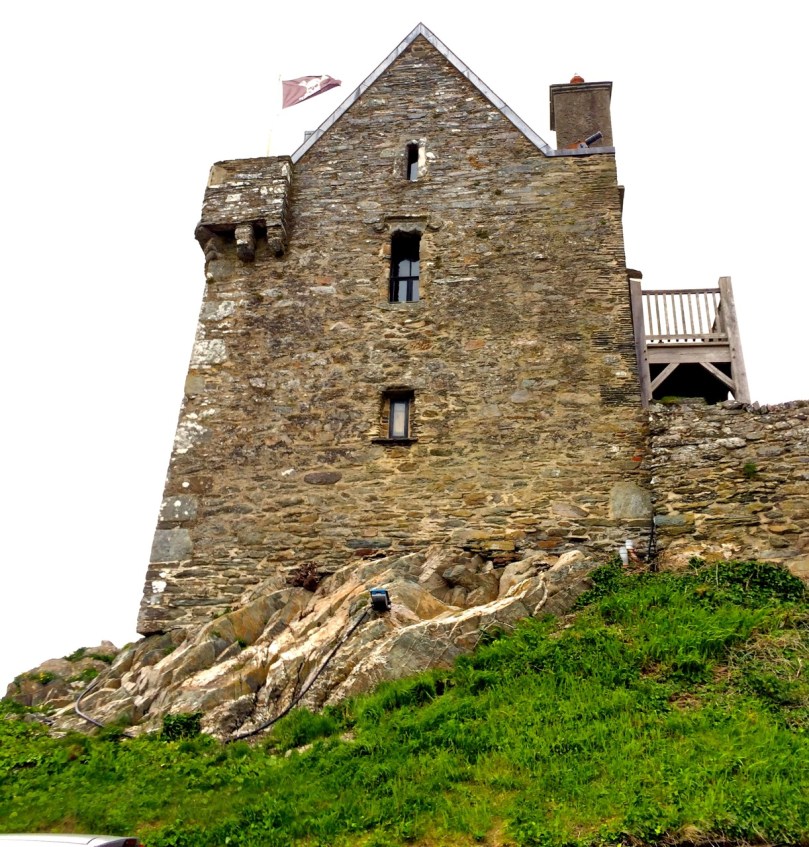
Leamcon, known as Black Castle

Leamcon, known as Black Castle. Notice the base-batter in this picture and the first one below.  The lowest level is the widest (battered) with the walls sloping in above this base

The power of these great Irish households lasted until the 1601 battle of Kinsale when the Irish forces under Hugh O’Donnel and Hugh O’Neill (with Spanish help) were defeated and an enormous re-conquest and re-colonisation began under Elizabeth and continued unabated under the Stuarts and, most disastrously, under Cromwell.

Each tower in this area was built in the same manner, which Samuel refers to as the Raised Entrance type of tower. There were two entrances, one on the ground floor and one on the first floor. The ground floor room was for cattle and the doorway was therefore as wide as would admit a cow.

A glimpse inside the raised entrance at Ardintenant

A glimpse inside the raised entrance at Ardintenant

The raised entrance (directly above it, or staggered to the left or right) was only wide enough to admit one person at a time – a defensive feature. This entrance either led into the first floor room or (since the ground floor room could have a lofty ceiling) onto a landing where a staircase led up to this room and then continued up through the wall (usually the thickest wall of the tower) to the upper floors. The first floor room was mainly used for storage and had either no windows or very small slits.

Dunmanus, with its additional turret. The top windows were always the largest.

Dunmanus, with its base-batter and additional turret. The top windows were always the largest

The second floor room was often the principle chamber, where all the main activities of the family took place – living, eating, meeting, administrating, celebrating (music and poetry were highly prized by these chieftains). If there was a third floor it contained the solar, or private chambers for the women of the household.

Barrel vaulted ground floor room at Dunmanus. Note access to stairwell.

Barrel vaulted ground floor room at Dunmanus. Note access to stairwell.

Construction techniques varied – some were superbly constructed of cut stone while others used a lot of rubble to build up the insides of walls. Putlogs, or holes where scaffolding timbers were insert, are clearly visible in several of the towers. The lowest floors were of course the thickest – the base-batter provided a solid foundation and the walls sloped inwards from it. The top of the tower allowed for thinner walls, and therefore also bigger windows (although none were large).

A garderobe (toilet) was a feature of the top two floors, with a chute out to the outer walls. In towers with additional turrets (Kilcoe, Dunmanus, Leamcon) the garderobe and sleeping chambers were sometimes contained in that turret, or the spiral stairs wound up through it. While most towers had stone spiral or straight staircase, some appeared to access each floor by means of ladders – there is no evidence for permanent wooden staircases.

The ground floor room (the byre) was often vaulted and this feature is still clearly visible in the most intact towers. Above that, the floors were of timber, sometimes with trapdoors for lifting up supplies. Presses (cupboards) consisting of niches in the walls may have contained lanterns or have been used to store valuable items.

There were no fireplaces in these towers. Fires were lit on flagstones laid on the wooden floors and the smoke rose to the tall ceilings and escaped out the small windows. In addition to this level of discomfort there is a contemporary account (quoted by Leask) which describe the primitive living arrangements in some of the towers: They have little furniture, and cover their rooms with rushes, of which they make their beds in summer and straw in winter. They put rushes a foot deep on their floors and on their windows [embrasure floors?], and many of them ornament their ceilings with branches.

But not all chieftains lived in a primitive way. Samuel uses the available evidence to construct a picture of life at Togher, one of the towers he studied, and it’s not hard to picture Fineen O’Mahoney, Scholar Prince of Rossbrin, in such a setting.

We can form a picture of the principal chamber in use: Tadhg an dúna or Togher’s principal chamber was probably furnished with imported furniture, pewter plate and cutlery and was panelled with ornately carved timber. His family, his bard, …clerk, lawyer, priest and physician, as well as members of the derbfine [extended clan] such as cavalrymen could eat there. They could sit with the chieftain to one side of the principal salt cellar, while others sat ‘below’ it… Servants prepared food out of sight ‘below stairs’. Bardic musicians, soothsayers, gamblers and others would be admitted as honoured guests, but the household ward and servants ate in the kitchen/ward room.

Although its name means Fort of Gold, today Dún an Óir on Cape Clear Island looks remote and forbidding

Although its name means Fort of Gold, today Dún an Óir on Cape Clear Island looks remote and forbidding

Similarly, Dún na Séad (Fort of the Jewels) Castle in Baltimore, seat of the wealthy O’Driscolls (they also had Dún an Óir (Fort of Gold) on Cape Clear Island), was

a centre of administration for trading activities and collection of taxes from foreign traders frequenting the port. In the middle and later-middle ages therefore, the O’Driscolls enjoyed a prosperous lifestyle. Lavish gatherings took place in the ‘great hall’ of Dún na Séad castle and a well-documented feast in 1413 is said to be one of the earliest records of people dancing in Ireland. This documentary evidence is supported by archaeological finds from recent excavations of the Dún na Séad site, which reveal the presence of late twelfth to fourteenth century pottery from the Saintonge region of France, and reflect the lucrative trade links between Baltimore and Europe at this time.

Dún na Séad Castle, Baltimore

Dún na Séad Castle, Baltimore. Note corner machicolation.

Defensive features were built into all the towers. Besides raised and restricted doorways and hard-to-manoeuvre narrow or spiral staircases, all had a roof ‘wall walk’. Three of the towers (Dún an Oir, Kilcoe and Leamcon) are either inaccessible or accessible by a bridge and there is evidence that connecting ground was deliberately demolished to accomplish this. Windows were small and could be boarded up. Projecting machicolations, especially above entrances or at corners were used, as can be seen at Dún na Séad Castle in Baltimore. Crenellations (notched or serrated ramparts) look like our traditional ideas of battlements. At Kilcoe they may have helped that castle withstand over a year of attack and siege after the Battle of Kinsale.

Kilcoe Castle. Note crenellated battlements and pitched roof.

Kilcoe Castle. Note crenellated battlements and pitched roof

So, should we call them Tower House, or Castles? How about £10 Castles? Archaeologists and historians prefer the more exact phrase tower houses, but castles they are on the maps and in our everyday speech. And if, like us, you are lucky enough to have one in your view, castles they are in our hearts and minds.

Our view to Rossbrin Castle

Our view to Rossbrin Castle

A Murmuration

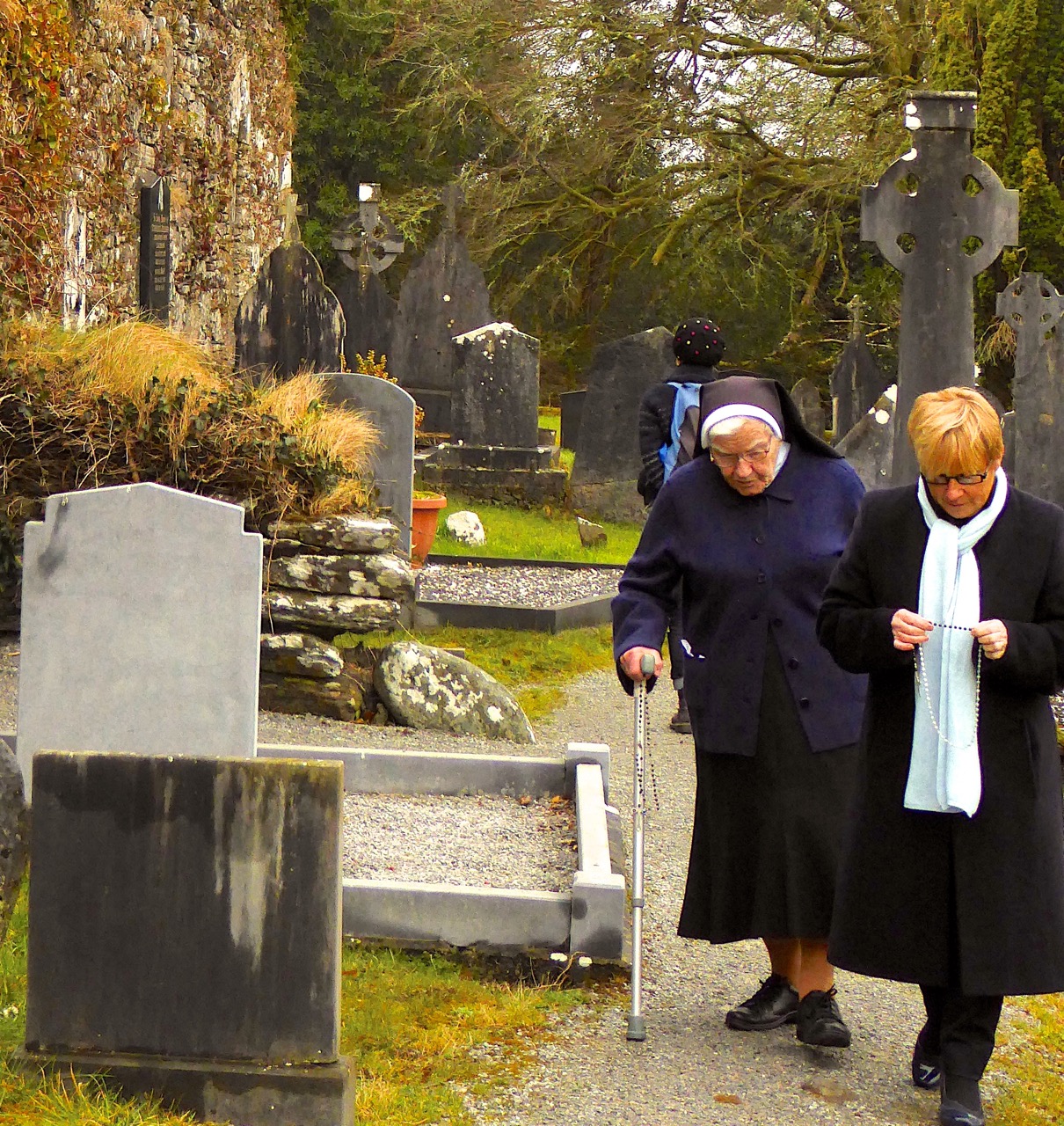
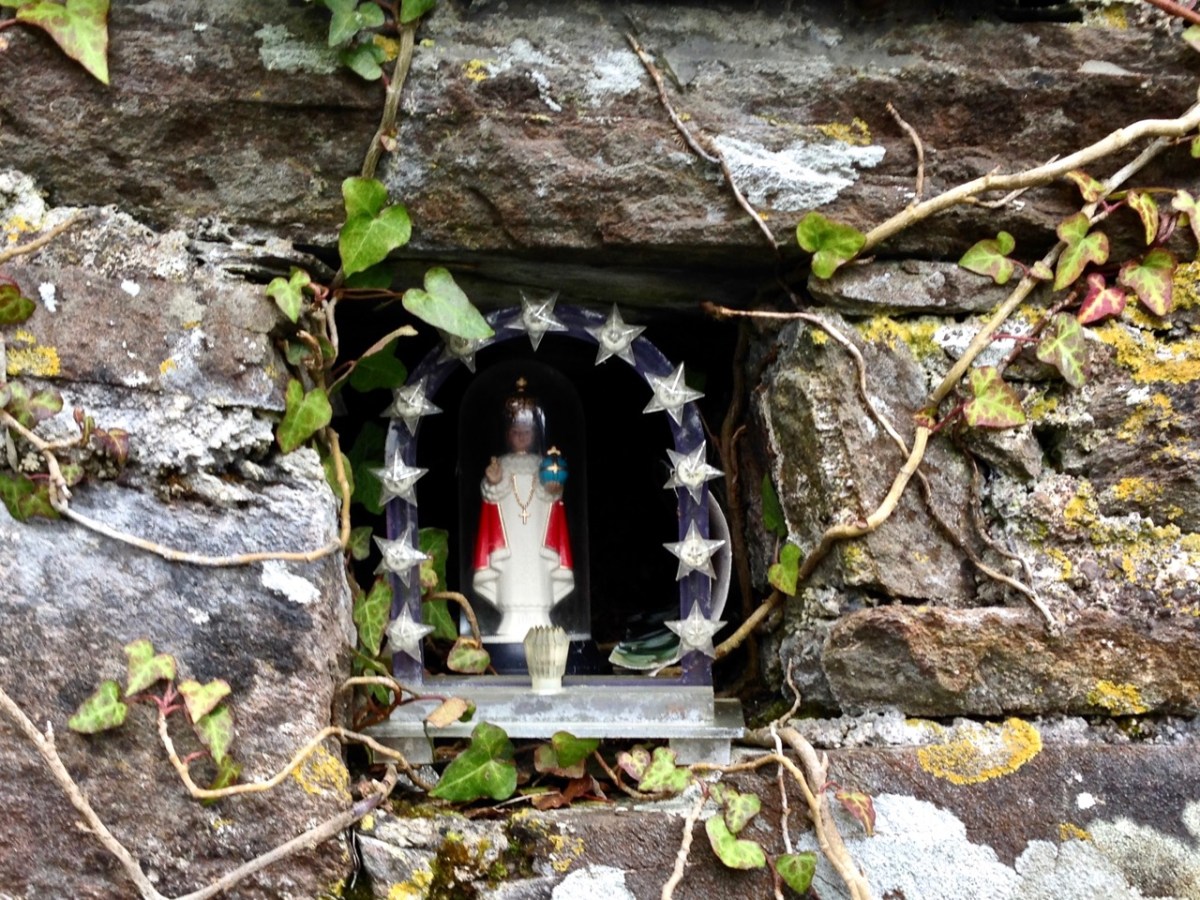
We stood still and listened: the air was filled with humming – Bees swarming in February? But no… it was the murmuring of the pilgrims saying the decades of the Rosary by the grave of St Gobnait…

Making the Rounds at Saint Gobnait's Shrine on the Feast Day
Making the Rounds at Saint Gobnait’s Shrine on the Feast Day

We travelled up into the Muskerry Gaeltacht on Wednesday – 11 February: the Feast Day of Saint Gobnait. It’s a fair journey, and we felt that we had really gone into another world: we crossed over the Mountain of the Fairy – that’s my interpretation of the Shehy Mountains (Shee is Fairy) – others say the Irish Cnoic na Síofra means ‘hills of the animal hides’. For the first time in my life somebody – a passer by – addressed me in Irish… “An bhfuil hata agat le spáráil?” they said – “Have you got a hat to spare?” (I think it was a wry comment about the headgear I was wearing on the day).

Wrapping the ribbons

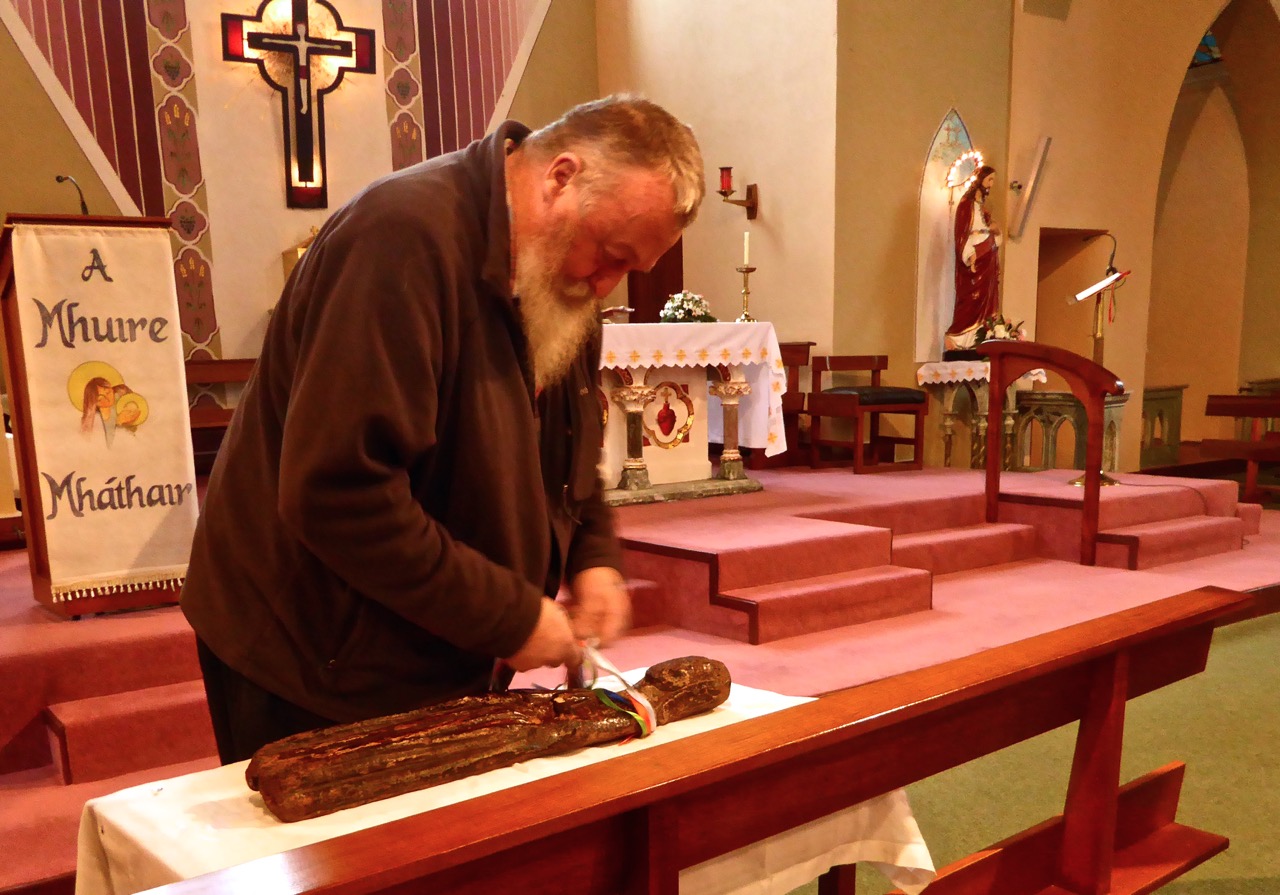
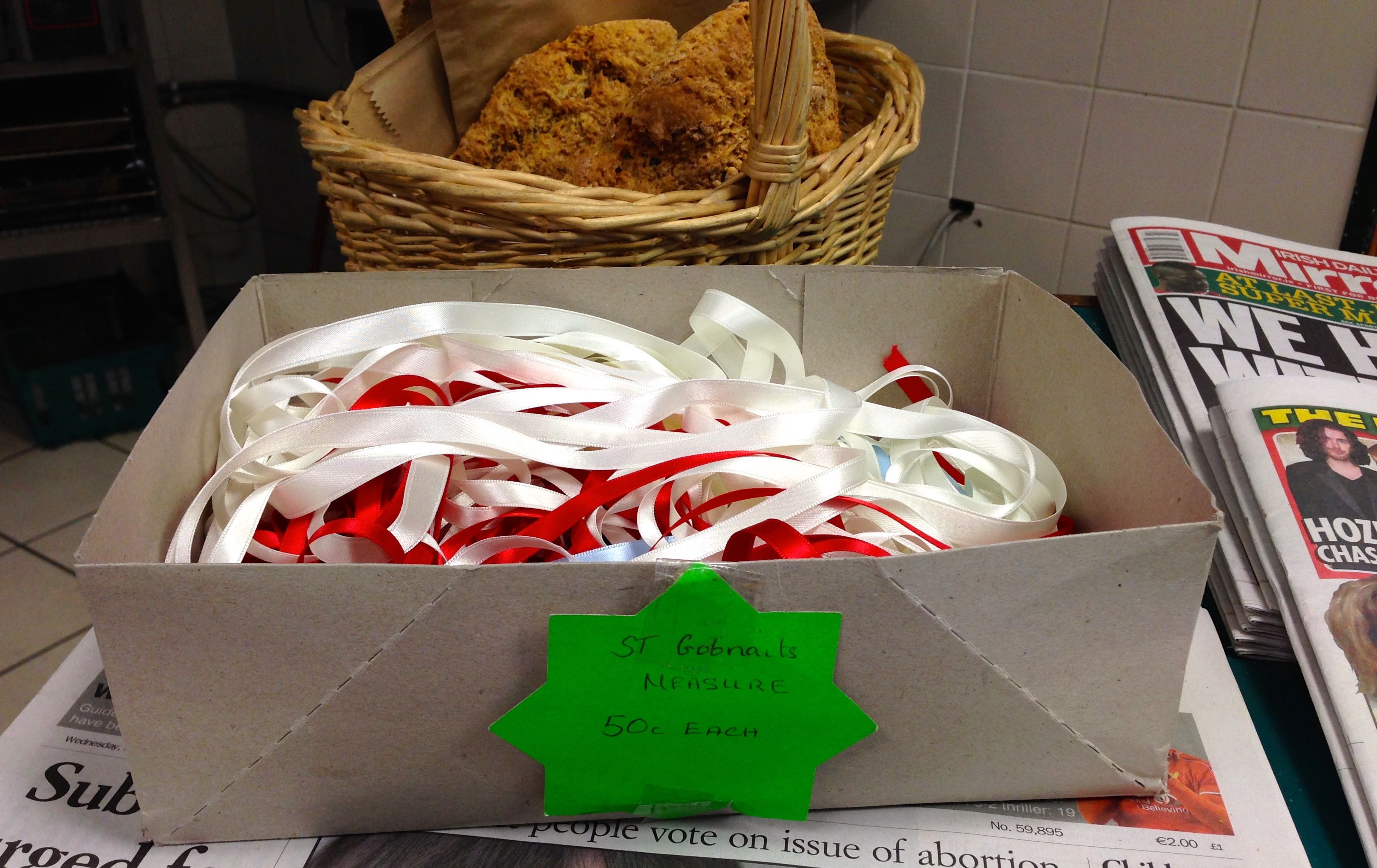
Our goal was Saint Gobnait’s Church in Ballyvourney, where the Mass was to be heard celebrated in Irish. Also, we wanted to see the 13th century wooden statue which is brought in to the church on this day. When we arrived there was already a queue to buy ribbons and ‘measure’ them against the statue. In fact, it was quite an intricate ritual: first you wrapped your ribbons around the neck of the statue, then around the feet. Some did the same around the stomach – others passed the ribbons under the body of the statue and rubbed them along the surface. Many people kissed the statue and some picked it up and made the sign of the cross with it. We joined in and came away with a clutch of ribbons, now blessed by Saint Gobnait and imbued with health-giving and good-fortune-bringing properties.

Making the 'Measures'
Making the ‘Measures’

The church was completely full for the Mass (it was also broadcast outside), which was celebrated by two Priests and a very robust men’s choir – beautiful singing in Irish. It was an uplifting experience, even though I hardly understood a word. A friendly atmosphere imbued all who were there, and excitement was in the air. Afterwards, we visited the statue again and then headed for Saint Gobnait’s Holy Well, her grave and the ruins of her ancient church, where the ‘Rounds’ were being performed all day. That’s when we heard the humming – it should have been Bees: this Saint has always been associated with them, and her statue which overlooks the pilgrimage site (and which was carved by Seamus Murphy in 1950) is decorated with Bees and with a Deer. This is also part of her story: when she was travelling through Ireland looking for a site to establish her community she was told she must continue on her way until she met with nine white Deer. She found them in Ballyvourney and that’s why in our time the little settlement flourishes on this February day.

We heard that there is another Holy Well, hidden in the woods just outside the town and seldom visited. This is known as Tobar Abán – Saint Abban’s Well. That saint seems to be closely associated with Saint Gobnait although not much is known about the lives of either of them – they lived back in the sixth century.

In the local shop
In the local shop

A visit to the Post Office provided us with the information we needed to get to this intriguing sacred site: walk over the bridge, go into the fields and look for a lone oak tree on the distant boundary – this marks the point where a trackway leads up through the woods. We made our way across a muddy pasture; the oak tree was prominent enough, and the track – but once inside the wood everything was quite densely overgrown. We would never have found it without the instructions, but we also had the help of red and white ribbons tied to trees and posts in strategic places – they had been there for some time: we wondered who set them up?

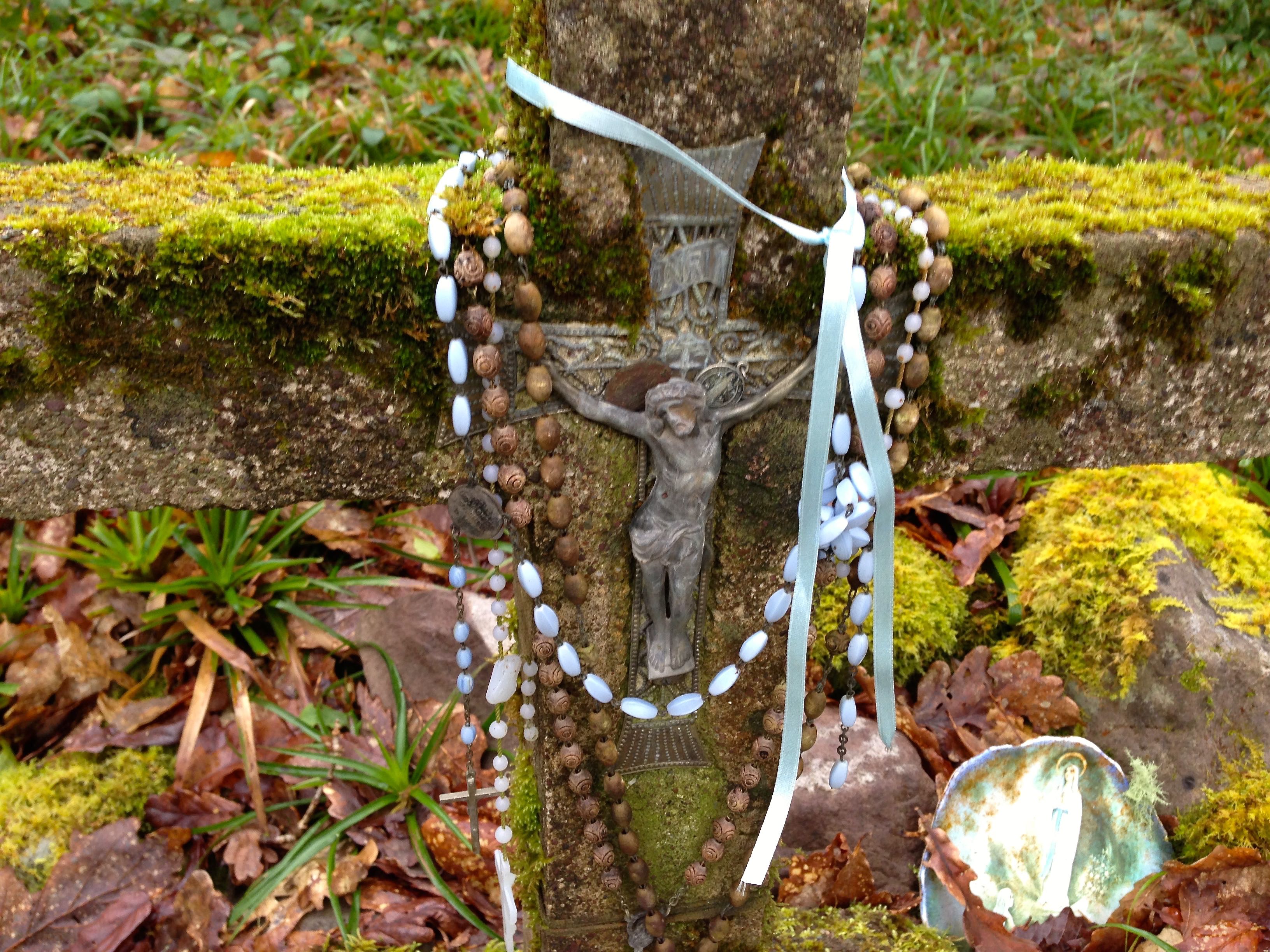
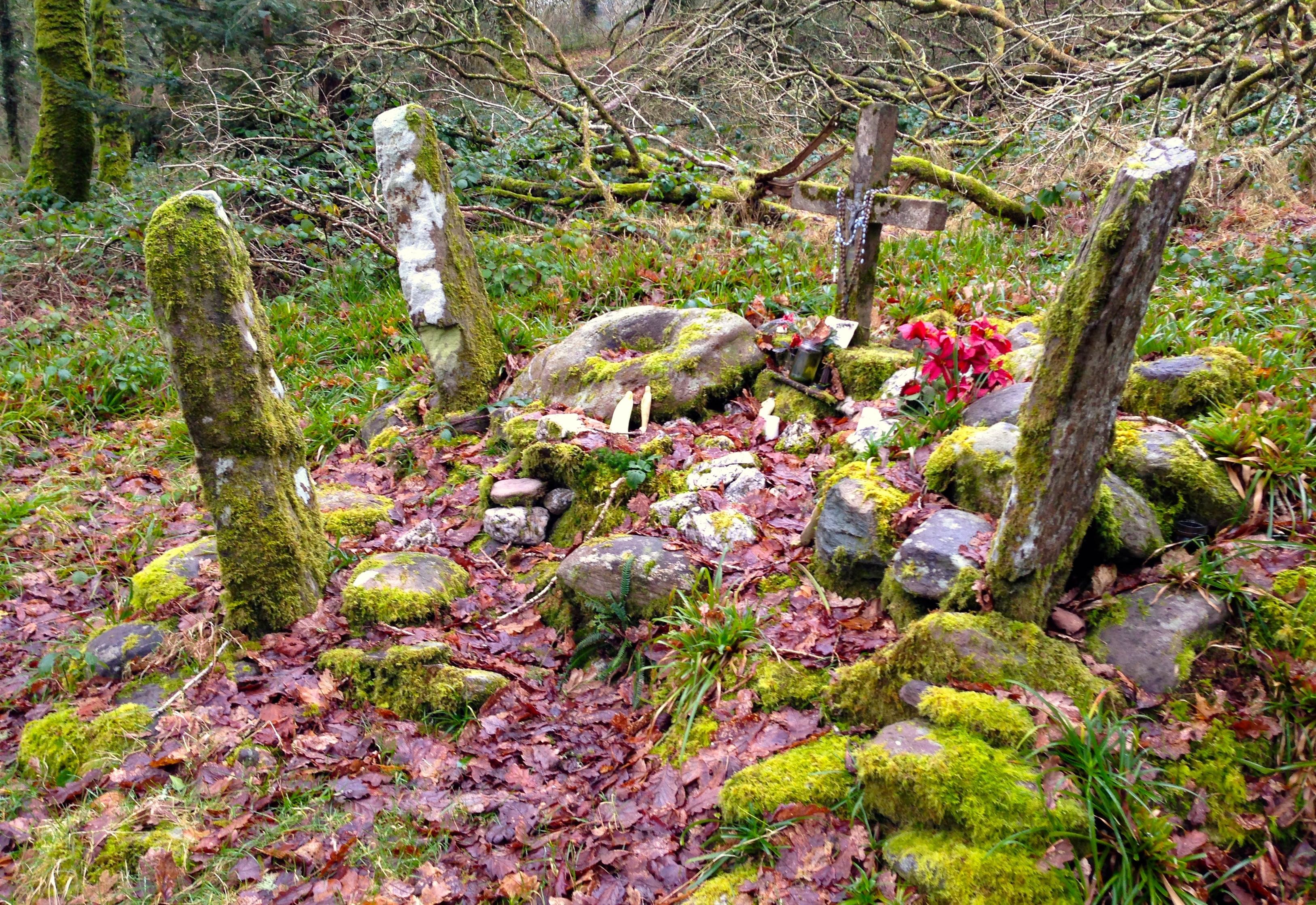
Tobar Abán is a wonderful site – a lonely outpost of religious sanctity but, for me, probably the most beautiful of all the holy places I have visited in Ireland so far. It’s an unexpected find: set away from everything, deep in an ancient oak wood, silent, still – one could imagine that it has always been like this, passing through generations of turbulent history and yet untroubled by it. Archaeologically it appears to be a cist with a cairn of stones built around it: this would imply pre-Christian origins. The lid of the cist (a burial chamber or repository for bones) is not visible – possibly it is under the large ballaun stone which rests on top. Above this is a small, relatively modern concrete cross embellished with offerings, beads and ribbons: other icons and objects are scattered around the site. The whole mound has a boundary defined by three standing stones, one of which is inscribed with ogham. Everything is covered in a layer of moss which seemed to exude a luminescence in the moist shade of the wood.

crucifix

Saint Abban (or Abbán moccu Corbmaic) seems to have been active in many parts of Ireland, and tradition has it that he lived for three hundred years. The stories that are important here are the ones that link him with Saint Gobnait. It has been said that he founded a monastery in Ballyvourney before she arrived, and that he was her mentor and gave the foundation to her. Some say that Abban and Gobnait were brother and sister. Most important, perhaps, is the tradition that Abban had a cell or church just outside Ballyvourney and that he was buried in that cell when he died in 520. Could it be his grave that we found?

Saint Abban's Shrine - cell - or grave?
Saint Abban’s Shrine – cell – or grave?

Saint Abban’s Well is a little distance from the cist, and is quite unassuming, especially compared to the elaborate wells around Saint Gobnait’s old church. It is merely an opening in a rock set in the ground: an old tray covers it and keeps the leaves out, and a wooden box beside it contains some cups and plastic bottles for collecting the water.

Tobar Aban - Saint Abban's Well
Tobar Abán – Saint Abban’s Well

As we were making our way back across the fields we were surprised to see a lady in a red coat walking with a stick towards us. “Did you find it?” she asked. We assured her we had found the well and the shrine. “And did you see his bones?” she continued, “Last time I was there I lifted up the lid and saw the Saint’s bones inside…” We watched her go off towards the woods; when I looked back again she had disappeared.

Cist, Bullaun and standing stones

There’s so much about the day: the journey across the Mountain of the Fairy; the Irish Mass and the ritual of the ribbons involving a 13th century wooden figure; the Rounds and the humming of the Saint’s Bees; the magical shrine in the woods – and I really do wonder about that lady in the red coat…

Offering at the Shrine of Saint Abban

The Irish Valentine

sun cove

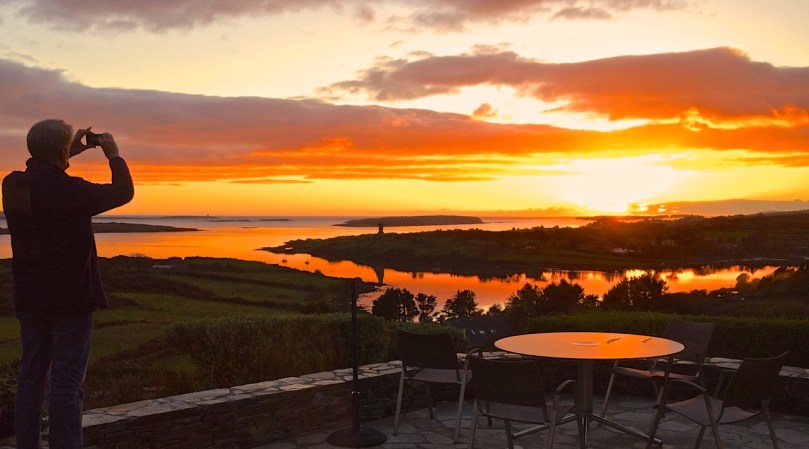
February evening in Rossbrin Cove

I was surprised to discover Saint Valentine in Ireland…

You mean in a card shop – or a flower shop?

No – I mean the real Saint Valentine – his remains are in the Church of Our Lady of Mount Carmel in Whitefriars Street, Dublin: we were there last week.

carmelite church

That can’t be true – Saint Valentine was a Roman – martyred, I believe, in the 3rd Century.

He was, of course: Emperor Claudius had him beaten to death and then beheaded on 14th February 269. Valentine and another Saint, Marius, had secretly married young couples, which was against the law.

Why was it against the law?

Because Claudius II (Claudius the Cruel) was engaged in many bloody and unpopular campaigns and was having a difficult time getting soldiers to join his military forays. He believed that the reason was that Roman men did not want to leave their lovers or families. As a result, Claudius cancelled all marriages and engagements in Rome.

So it’s because of Valentine’s clandestine activities that he is the patron saint of love?

old card

That’s certainly a possibility. There are many other things associated with Saint Valentine’s Day which may have contributed to its continuing celebration.

Such as?

In ancient Rome, 14th February was a holiday to honour Juno – the Queen of the Roman Gods and Goddesses, also known as the Goddess of women and marriage. The following day, 15th February, began the Feast of Lupercalia. On the eve of that festival the names of Roman girls were written on slips of paper and placed into jars. Each young man would draw a girl’s name from the jar and they would then be partners for the duration of the festival.

irish roses

Let’s get back to Saint Valentine in Ireland…

Well, it all centres around a famous Irish preacher, John Spratt. It was he who built the Whitefriars Street Church. He went to Rome in 1835 where ‘…the elite of the city flocked to hear him and he received many tokens of esteem from the doyens of the Church…’ One such token was given by Pope Gregory XVI: the remains of Saint Valentine!

Is this genuine?

It seems to be. The Pope also sent with the relics a letter of authenticity, written in Latin, which still exists:

‘…To all and everyone who shall inspect these our present letters, we certify and attest, that for the greater glory of the omnipotent God and veneration of his saints, we have freely given to the Very Reverend Father Spratt, Master of Sacred Theology of the Order of Calced Carmelites of the convent of that Order at Dublin, in Ireland, the blessed body of St Valentine, martyr, which we ourselves by the command of the most Holy Father Pope Gregory XVI on the 27th day of December 1835, have taken out of the cemetery of St Hippolytus in the Tiburtine Way, together with a small vessel tinged with his blood and have deposited them in a wooden case covered with painted paper, well closed, tied with a red silk ribbon and sealed with our seals and we have so delivered and consigned to him, and we have granted unto him power in the Lord, to the end that he may retain to himself, give to others, transmit beyond the city (Rome) and in any church, oratory or chapel, to expose and place the said blessed holy body for the public veneration of the faithful…’

That’s remarkable. This must be a very popular shrine?

Nowadays it is – but no one was very interested in it in the time of Father Spratt and the relics were put away in a cupboard and forgotten.

Until?

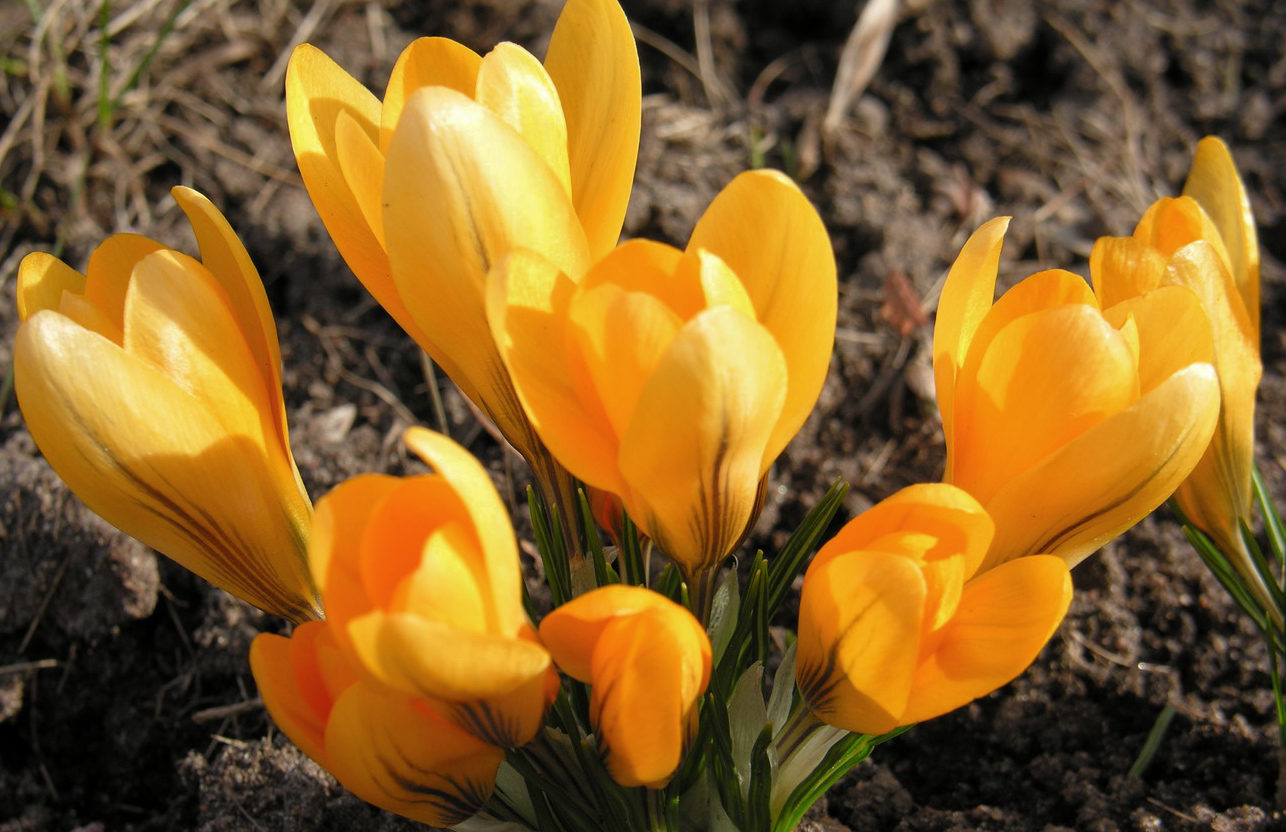
Until around 1950 when the present altar and shrine were constructed to house them. The statue of Saint Valentine that is there now was carved by Irene Broe and depicts him in the red vestments of a martyr and holding a crocus in his hand.

What happens there on the Saint’s Day?

Couples come to the Eucharistic celebrations which include a Blessing of Rings for those about to be married. On the feast-day, the Reliquary is removed from beneath the altar and is placed before the high altar in the church and there venerated at Mass.

You must have a legend about Saint Valentine?

A rather nice one, actually – and it explains the crocus…

When Valentine was imprisoned in Rome for his Christian beliefs his jailer had a daughter – Julia – who had been born blind. The jailer asked Valentine if he could cure the blindness. Valentine couldn’t promise this, but he did offer to teach the girl: he read stories of Rome’s history to her; he described the world of nature to her; he taught her arithmetic and told her about God. She saw the world through his eyes, trusted in his wisdom, and found comfort in his quiet strength.

On the eve of his execution Valentine asked the jailer for a paper, pen and ink. He wrote a farewell note and handed it to the jailer to give to Julia. He urged her to stay close to God, and he signed it ‘…From Your Valentine…’ His sentence was carried out the next day, 14th February. When the jailer went home, he was greeted by his blind daughter. The little girl opened the note and discovered a yellow crocus inside. As the girl looked down at the crocus she saw brilliant colours for the first time in her life! The girl’s eyesight had been restored.

crocus

That’s wonderful! So now I can tell everyone that St Valentine’s resting place is in the Emerald Isle…

Well….

Yes?

Well, perhaps you ought to know that the remains of St Valentine are also said to be held in Rome, Prague, Poland, France, Vienna, Malta, Glasgow, Birmingham (UK) and even in Missouri – among other places…

Saint Ferdinand’s, Florissant, Missouri also claims relics of Saint Valentine

Saint Ferdinand’s, Florissant, Missouri also claims to hold relics of Saint Valentine

Oh no! That certainly puts a dampener on Ireland’s claim.

Not really – it’s certainly not unusual for a Saint’s relics to be spread around Christendom: a little veneration goes a long way.

Has anyone ever looked inside the reliquary in Whitefriars, Dublin?

No – it was a condition of the gift that the seals should never be broken, and they haven’t. Personally, I’m very happy with the idea that St Valentine – or some of him at least – rests contentendly there: I shall visit him whenever I’m passing

An Post Valentine stamp for 2015

An Post Valentine stamp for 2015