Lichens and Little Things in the Woods

The wonderful Ellen Hutchins Festival for 2019 has just finished – now in its fifth year and going from strength to strength in celebrating all the aspects of botany that Ellen practised. You can read about Ellen in my post Ellen Hutchins: The Short and Remarkable Life of Ireland’s First Female Botanist. We participated again in 2016 and I wrote about our fascinating walk Into the Woods with Pádraig Whelan and Howard Fox.

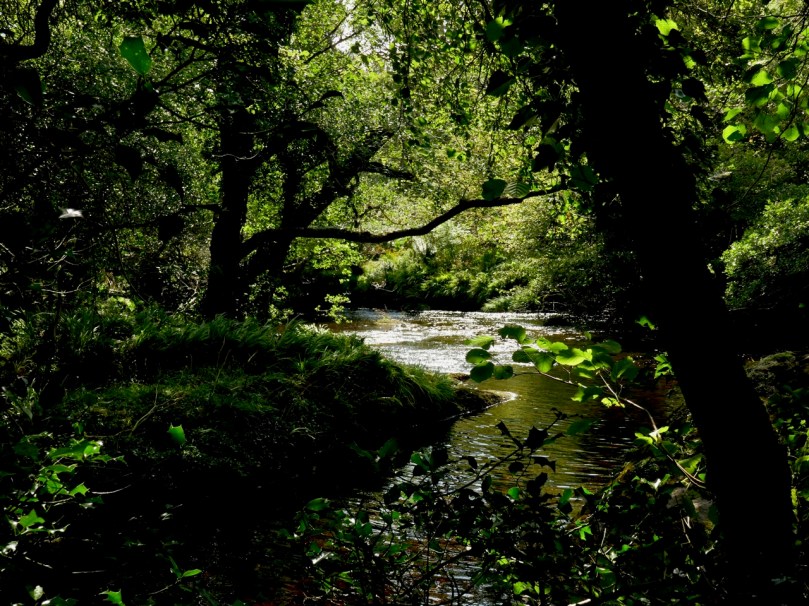
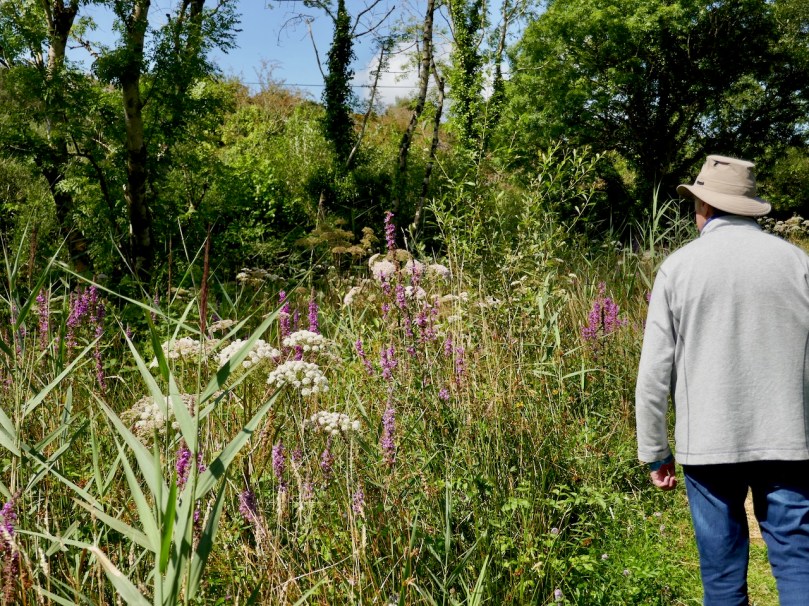
This year there was the same wide variety of botany-related activities, including an impressive array of events for children. We attended (above) a talk by Madeline Hutchins (Ellen’s GGG-Niece) about her life, with an emphasis on her letters and a talk on letter writing of the period by Carrie O’Flynn and then, last weekend, a Lichen Walk in beautiful Glengarriff Woods (first photograph, top).  Been there yet? If not, you’re missing a real treat.
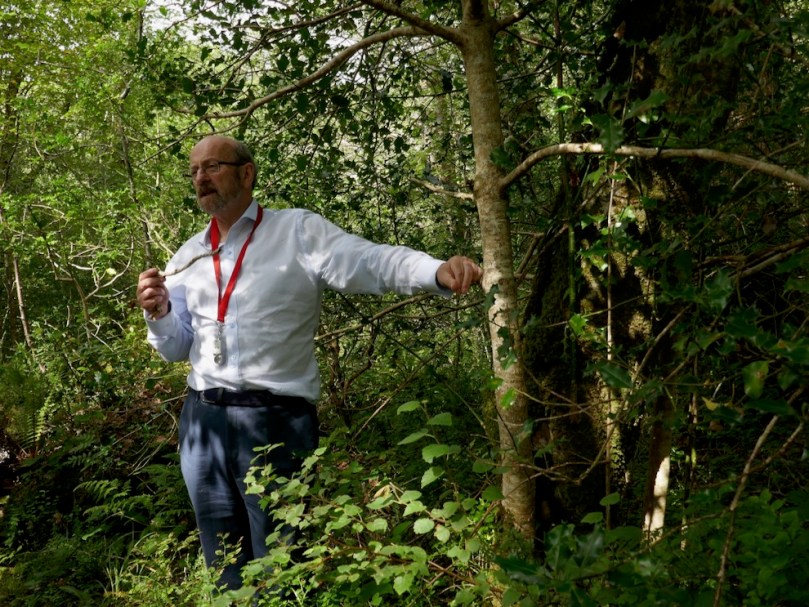
The focus of the walk was lichen of course (apparently it is acceptable to say lyken or litchen so take your pick) with Paul Whelan (above). Paul has a website at Lichens of Ireland which seems to be down for maintenance, but there’s another one, Irish Lichens, run by Jenny Seawright, which I’ve been using and finding easy to follow, especially for a neophyte like me. But even though the subject was lichens, once you enter the woods it’s easy to get distracted by other things, so for me the day was as much about the insects and flowers that we saw (sorry, Paul) on our short, but incredibly rich, walk.

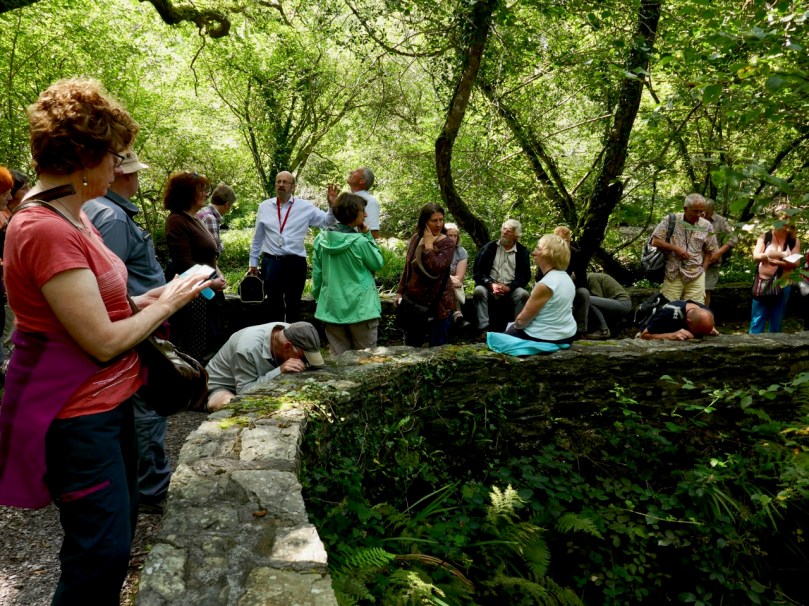
What are these people doing? This is how close you have to get, with a hand lens, to see the tiny patches of lichen on the rocks of the bridge

So what is a lichen? It’s a fungus, but one that works with another organism (usually green algae but sometimes a cyanobacteria) to produce something neither can do on their own. Since lichens can’t photosynthesise, they depend on the other organism to do that. The fungus contributes by consuming dead matter and this mutually beneficial and necessary relationship is called symbiotic.

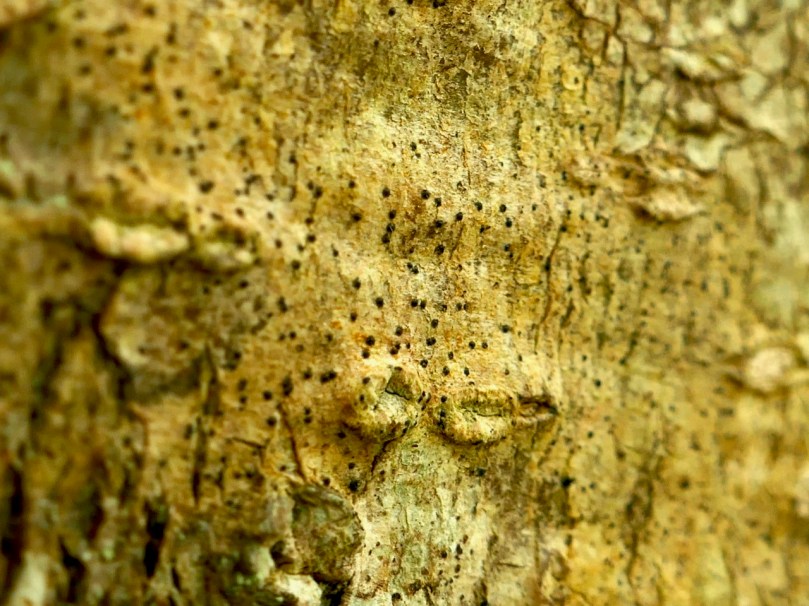
And this is what we were seeing

The lichen body is called a thallus, and it produces spores (which is how it reproduces) through an apothecium (which looks like a tiny cup) or a perithecium (which looks like a tiny volcano). We saw mostly lichen with perithecia on our walk, some of which were just tiny black dots.

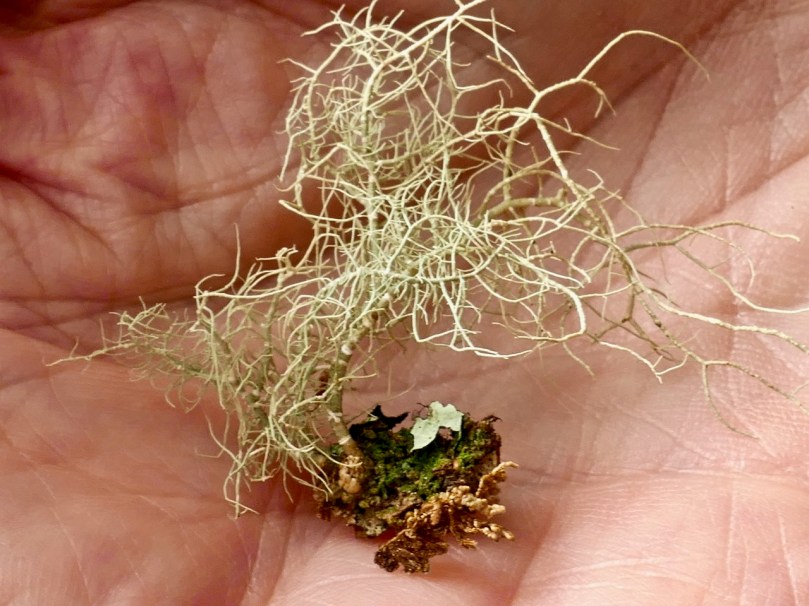
We also saw some foliose lichens – leaf like things such as the one immediately above, although you had to get very close with a hand lens to even see the leafy structures of some of them. Others were bigger and more obvious – these Usnea lichens (below) are like tiny bonsai leafless trees and attach to rocks and trees by a single contact point.

I had already written (in my post Miniature World) about the Cladonia Lichen such as the Devil’s Matchstick, and now that I know a bit more about lichens I’ve been browsing around our own garden and I found some on a rock wall (below) – not only Devil’s Matchsticks but the ones called Pixie Cups as well.

And the ‘other things’ on the walk? Clare Heardman from the National Parks and Wildlife Service, who seems to know about the whole gamut of wild organisms, was excited to see a fly land on Robert’s back. No ordinary fly, it turns out, but a Dark Giant Horse Fly (Tabanus sudeticus) – the largest and heaviest fly in Europe! We know it’s a female by the space between her eyes (males have no space) and it’s the female that bites and sucks your blood. One source I consulted says: Unlike insects which surreptitiously puncture the skin with needle-like organs, horse flies have mandibles like tiny serrated scimitars, which they use to rip and slice flesh apart. Charming, but fortunately she flew away before inflicting that on Robert.

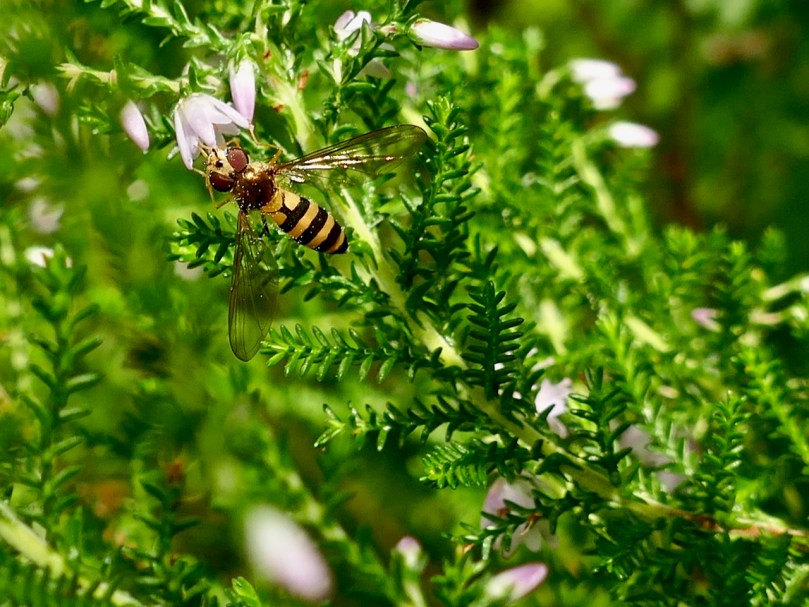
Nearby, another fly was feeding on some Ling Heather, this time a hoverfly. Trying to identify hoverflies is a head wreck, there are so many different types, but I think this one is called parasyrphus lineola, one of the little forest hoverflies that like a conifer environment. Hoverflies are next to bees in importance as pollinators – it’s not that they carry as much pollen, but they are so busy and make so many visits to flowers that they do a sterling job. They also keep aphid populations under control.

You can see the dusting of pollen on this hoverfly

When we arrived at the pond Paul showed us the Usnea lichens – one tree over the water was entirely decorated with them, although they also like to grow on rocks as well. They belong to the Fruticose Lichens and on his website he describes them thus: Fruticose lichen appear tufted and shrubby and are usually erect or pendant and attached to the substrate at a single point. Filamentous lichen are soft and hair-like and some form felt-like mats comprised of very fine filaments.

The pond itself was alive with water striders, amazing little creatures that walk on water. A little Googling led me to this short video about how exactly they accomplish this, and what they live on (don’t watch if you’re squeamish).

As I was watching them, my eye was caught by a flash of brilliant blue and down came a damselfly to rest on one of the long reeds overhanging the pond. It was the aptly named Beautiful Demoiselle and a male, which has the striking metallic blue colour. This reed was its perch, from which it guarded its territory and kept an eye on passing edible insects, leaving it to chase them and then return. (There’s a good Wikipedia page on them.)

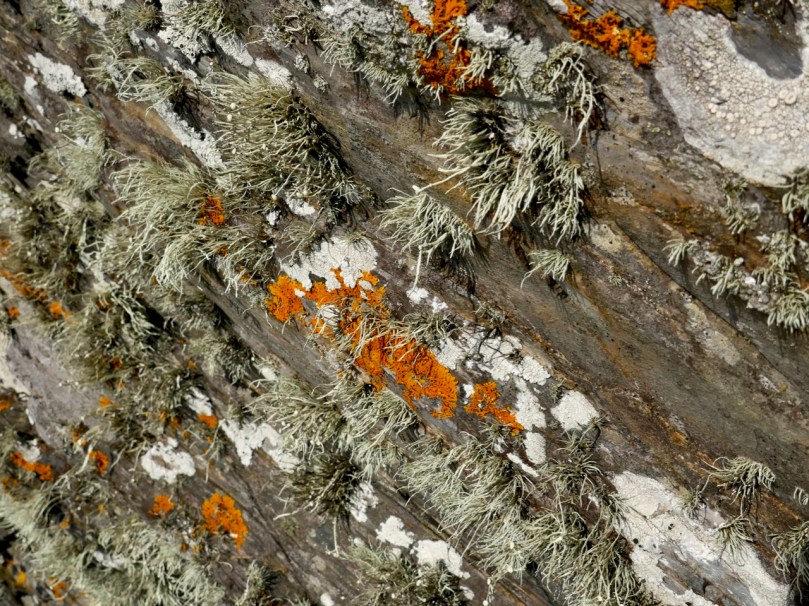
It was a great walk, all in all, and we can’t now go anywhere without checking out our surroundings for lichen. On a walk on Long Island yesterday I was attracted to the patches of bright orange and white lichen on the rocks. Here’s what I saw, at a distance and close up:

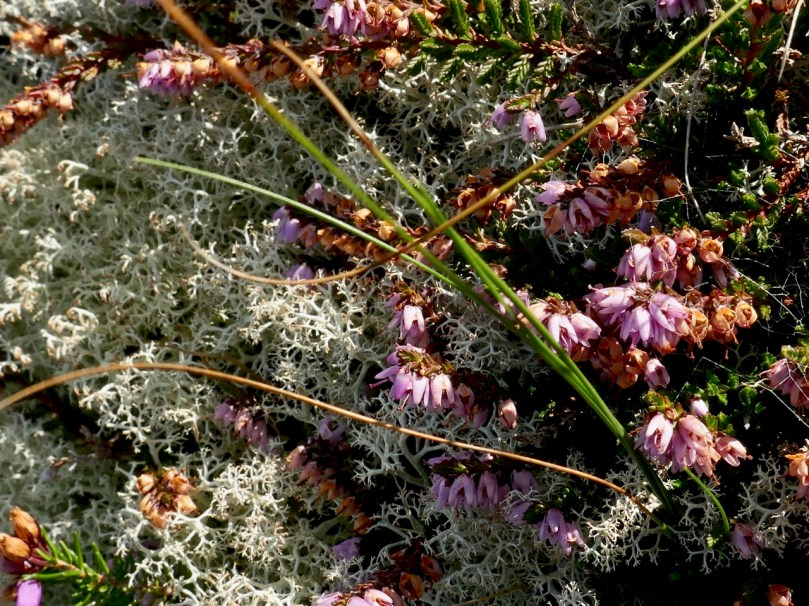
I was also delighted to see heather and lichen growing on one rock surface, and very attractive it looked together. The lichen might be one of the Cladonias, but please correct me if I’m wrong.

My previous feelings for lichen were all negative, since they obscure rock art and headstones, but now – have we caught the lichen bug? I hope not, since it already takes me an hour to walk around the block, stopping to look at flowers. What do you think, Dear Reader – is there any hope for us?


Rossbrin Calendar

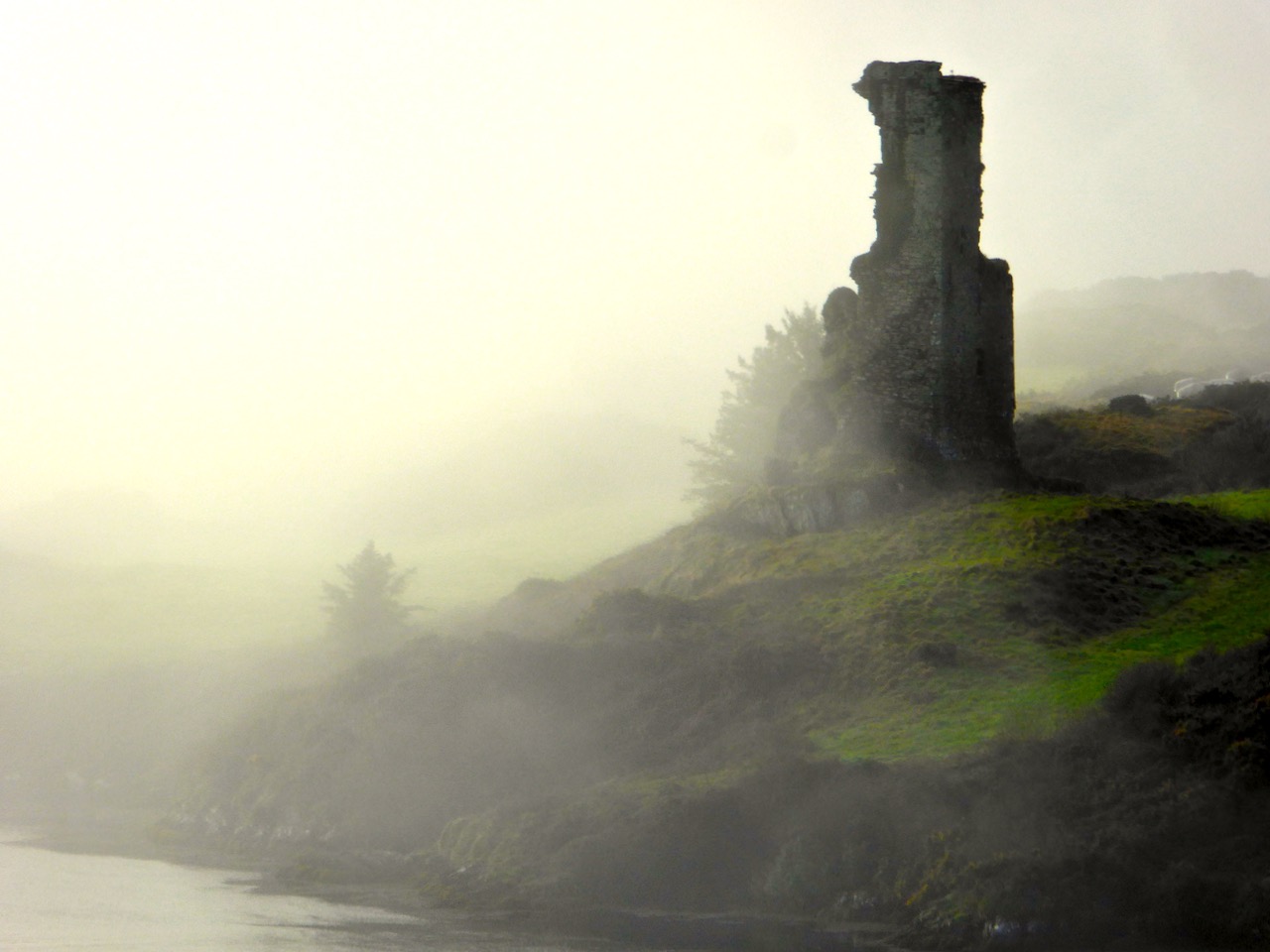
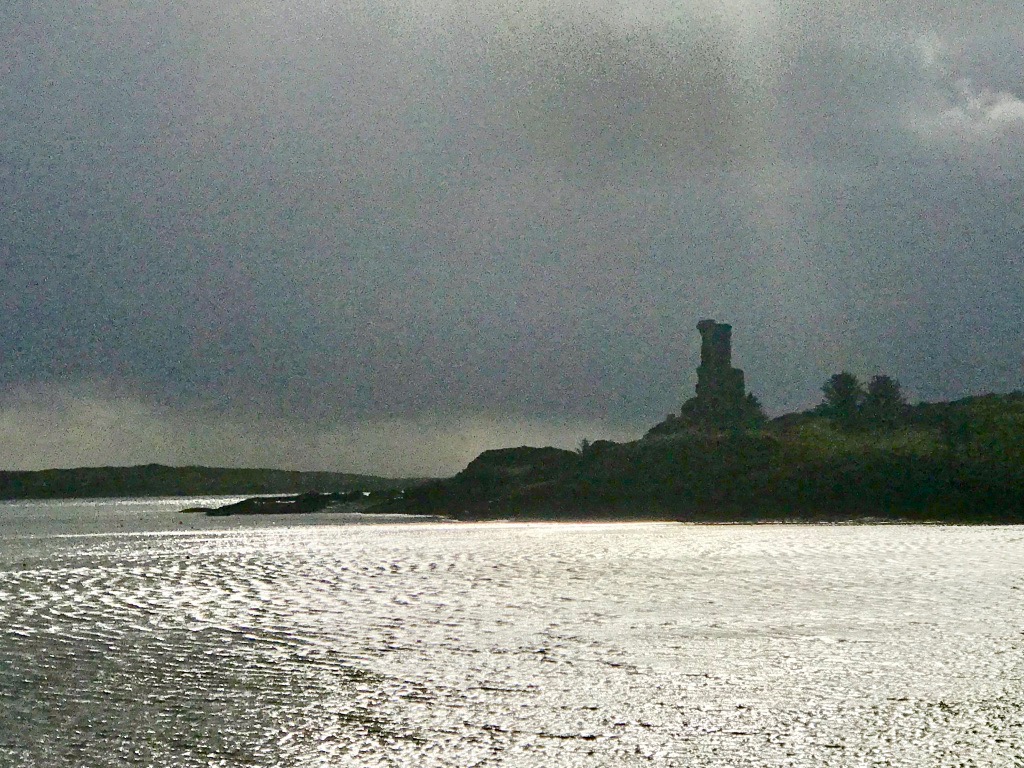
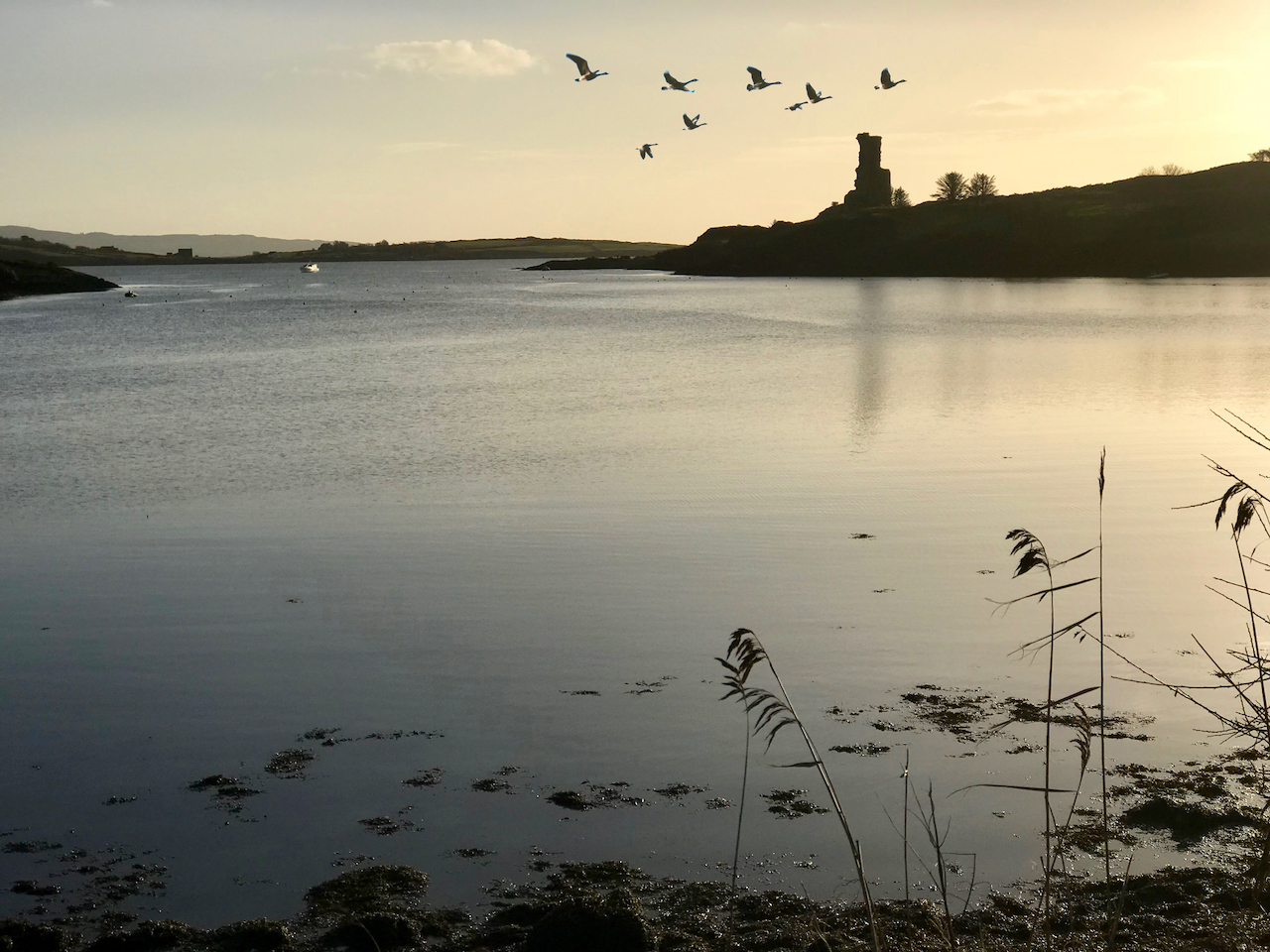
We know Rossbrin Cove intimately – more so than any other part of West cork. That’s because it’s right on our doorstep, and there is seldom a day when we don’t walk or drive along the Cove; and, even if we fail to get out, the views from our windows at Nead an Iolair will always be looking down on the Cove and its castle. I conceived the idea of sorting through all our pictures and selecting a ‘calendar’ of Rossbrin, taking us consecutively through the months of the year so that we can follow the seasons and the changes that every day brings. That’s Rossbrin Castle above, a view taken in January – which can often be atmospherically misty. But the picture below was also taken in that month, when we explored an abandoned house in the environs of Rossbrin: just as atmospheric in its own way – and bursting with a story to tell . . . But we’ll never know it.

Low tide at Rossbrin, taken from the pier and looking towards the boatyard – an important aspect of the Cove as the winter laying-up and maintenance of pleasure boats brings all-year-round life to the area and provides a livelihood. The picture above was taken in February, on a good clear day. In the middle distance you can just make out a wrecked boat uncovered by the receding water: this is the ‘Flying Foam’ – still rather enigmatic – which I wrote about a little while ago. We expect our strongest gales in February, and the picture below was taken when storm clouds began to gather.

March can also be a month when the weather is inclement (above), but we had a surprise in 2018 when snow covered the land around us (below) – a climatic event seldom experienced in Roaringwater Bay, which is more usually kept mild by the Gulf Stream. That’s Castle Island beyond the Cove – once inhabited (and with its own castle which you can see in the picture) but now just used to run sheep and cattle.

You can see how quickly the weather changes in West Cork: Rossbrin Castle Farm is enjoying blue sea and skies in April, and the gorse is in bloom, showing that love is in season! In the detail below, at the edge of the Cove and also in April, we can see the new spring growth beginning to overtake last year’s seed-heads.

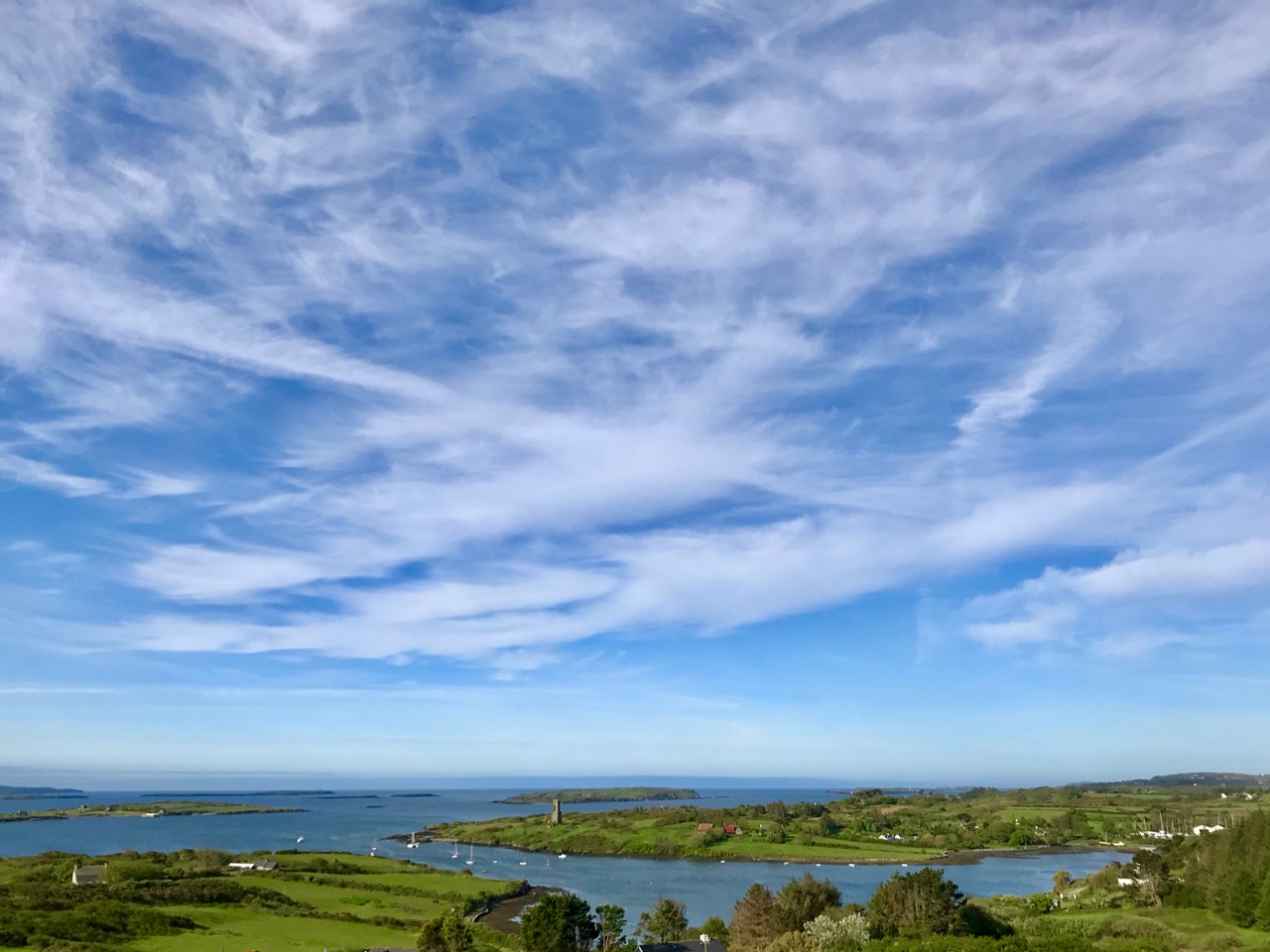
By the time May arrives, boats are already being taken out of winter storage and are anchored in the Cove. We get fabulous skyscapes perched up here above Rossbrin, and these mares’ tails herald windy weather ahead.

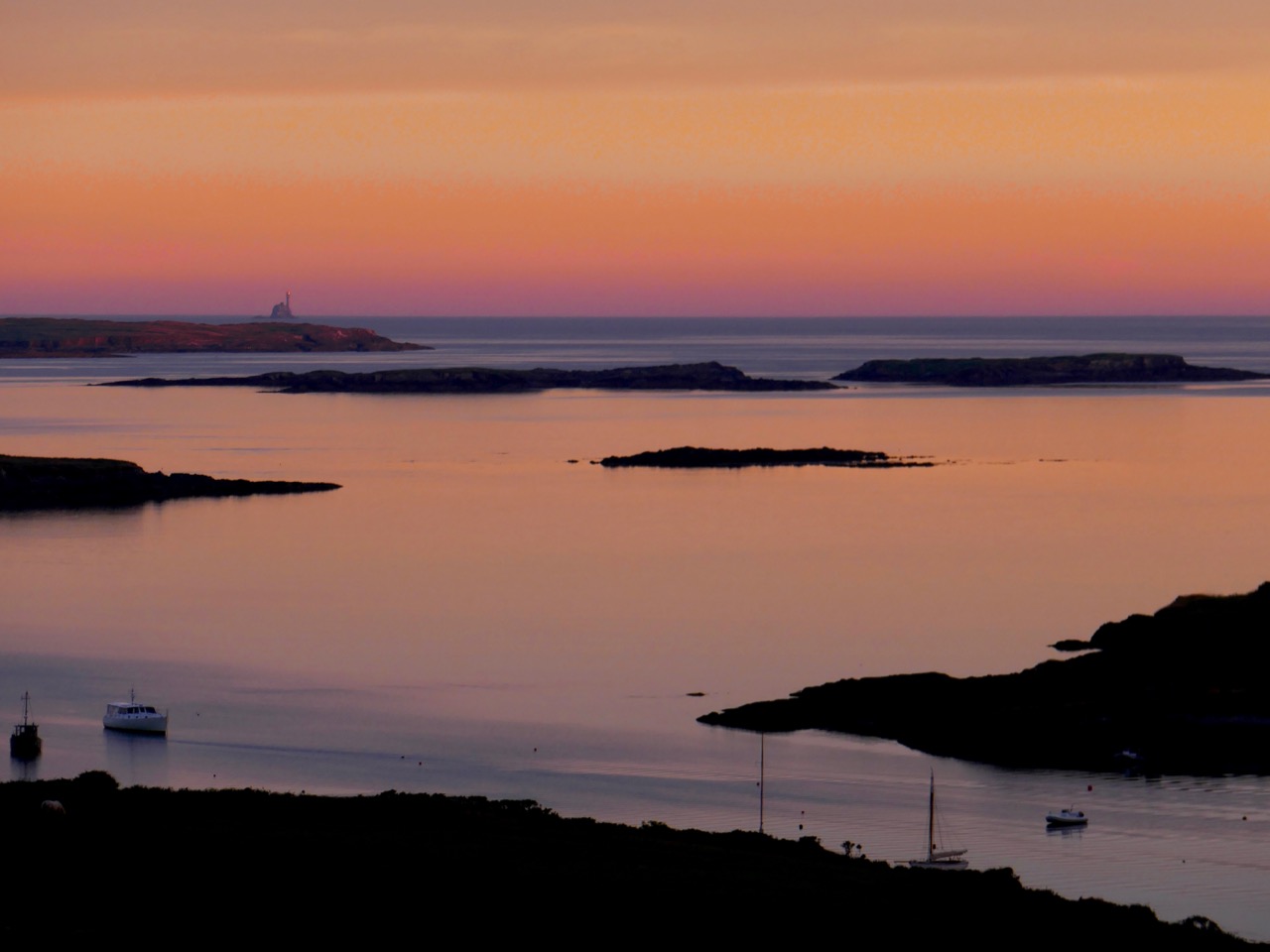
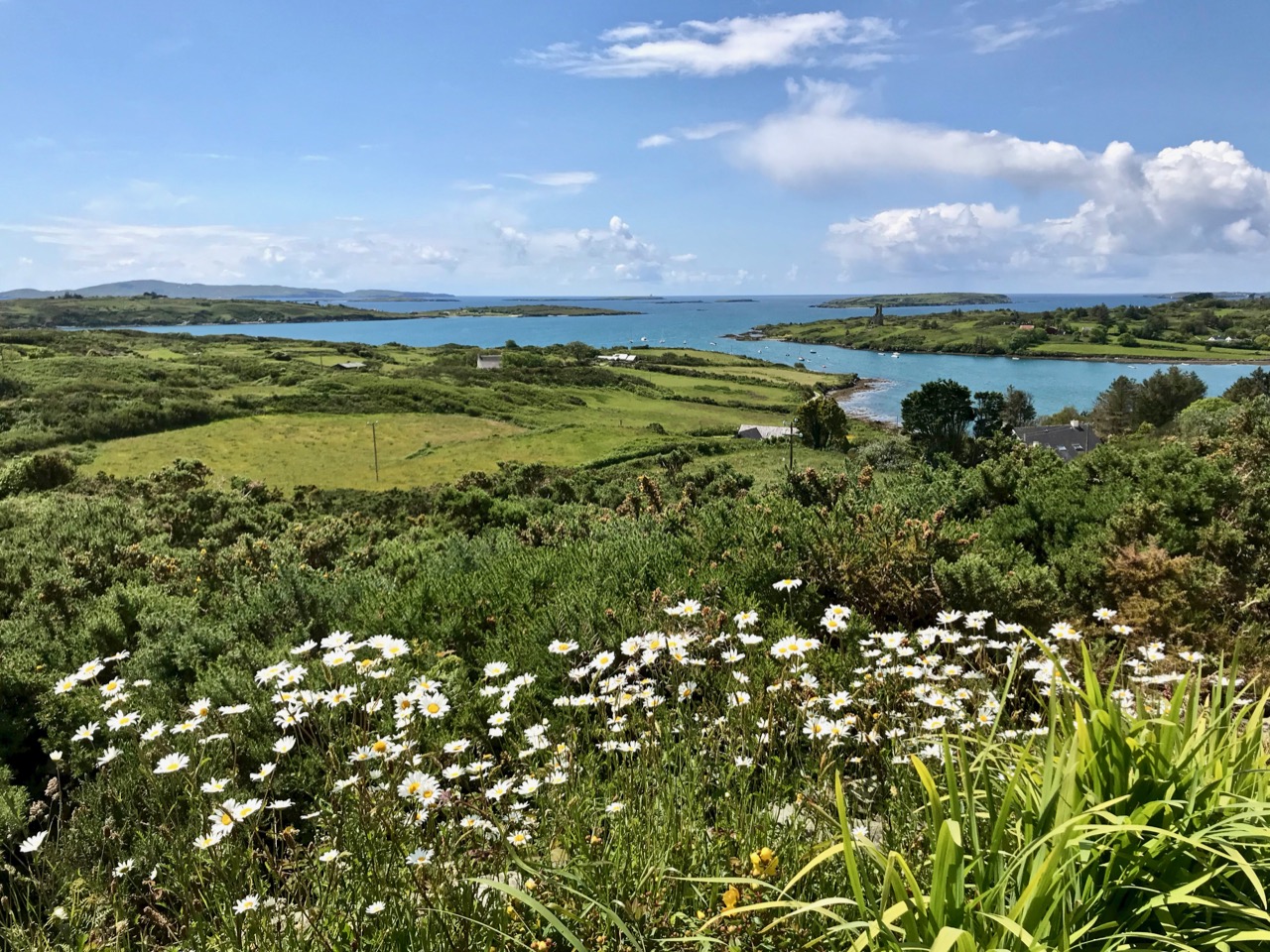
This is one of my favourite pictures – taken by Finola from Nead an Iolair in June. Late evening sun paints the sky and sea in almost implausible colours – although the photo has not been doctored. The whole effect beautifully outlines the Fastnet Rock lighthouse on the horizon with some of Carbery’s Hundred Isles silhouetted as if floating; Rossbrin is in the foreground. By day you can see that wildflowers are abundant this month (below).

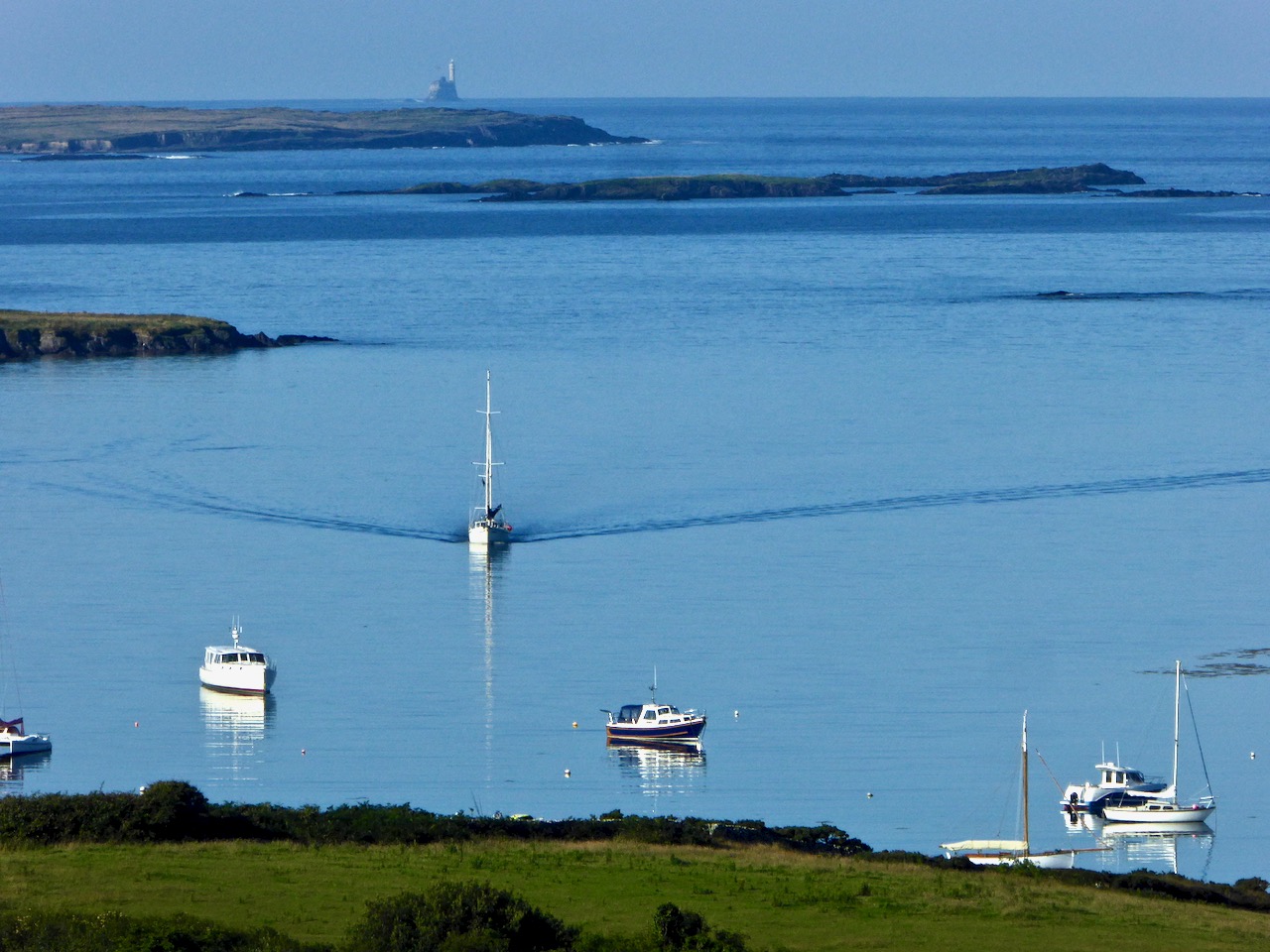
The sea in July is at its bluest. Here is Roaringwater Bay out beyond the shelter of Rossbrin on a calm day. There is hardly a ripple on the surface, except for the elegant wake of the yacht motoring in.

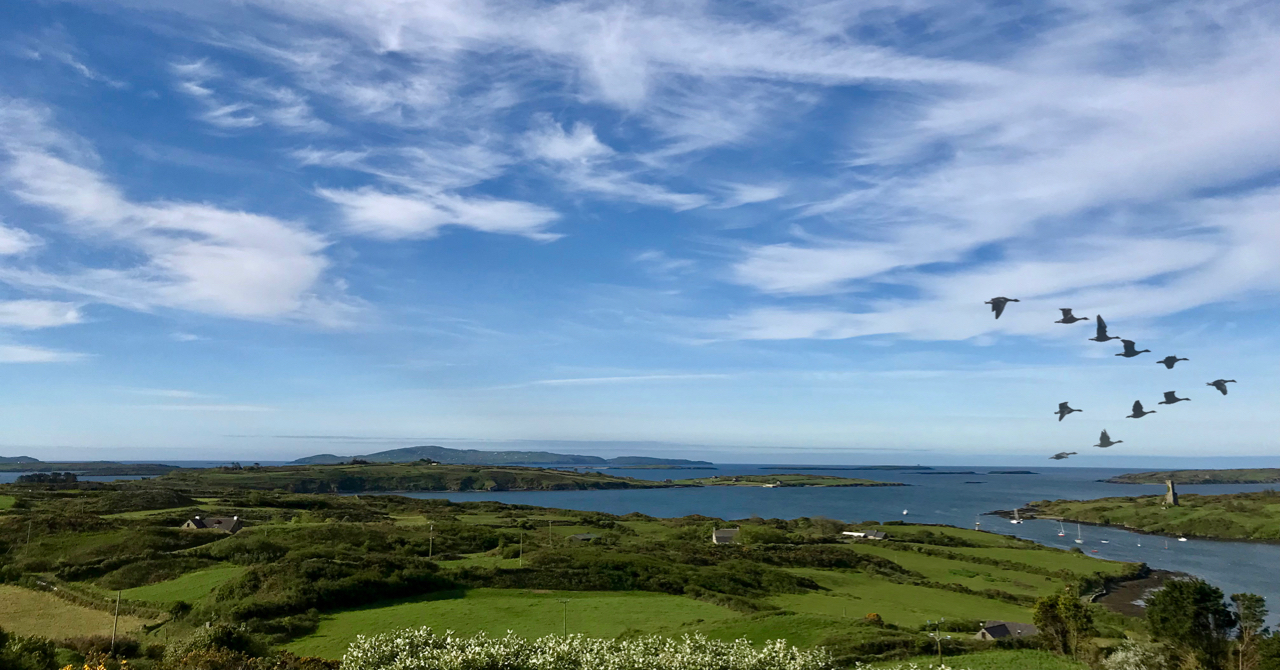
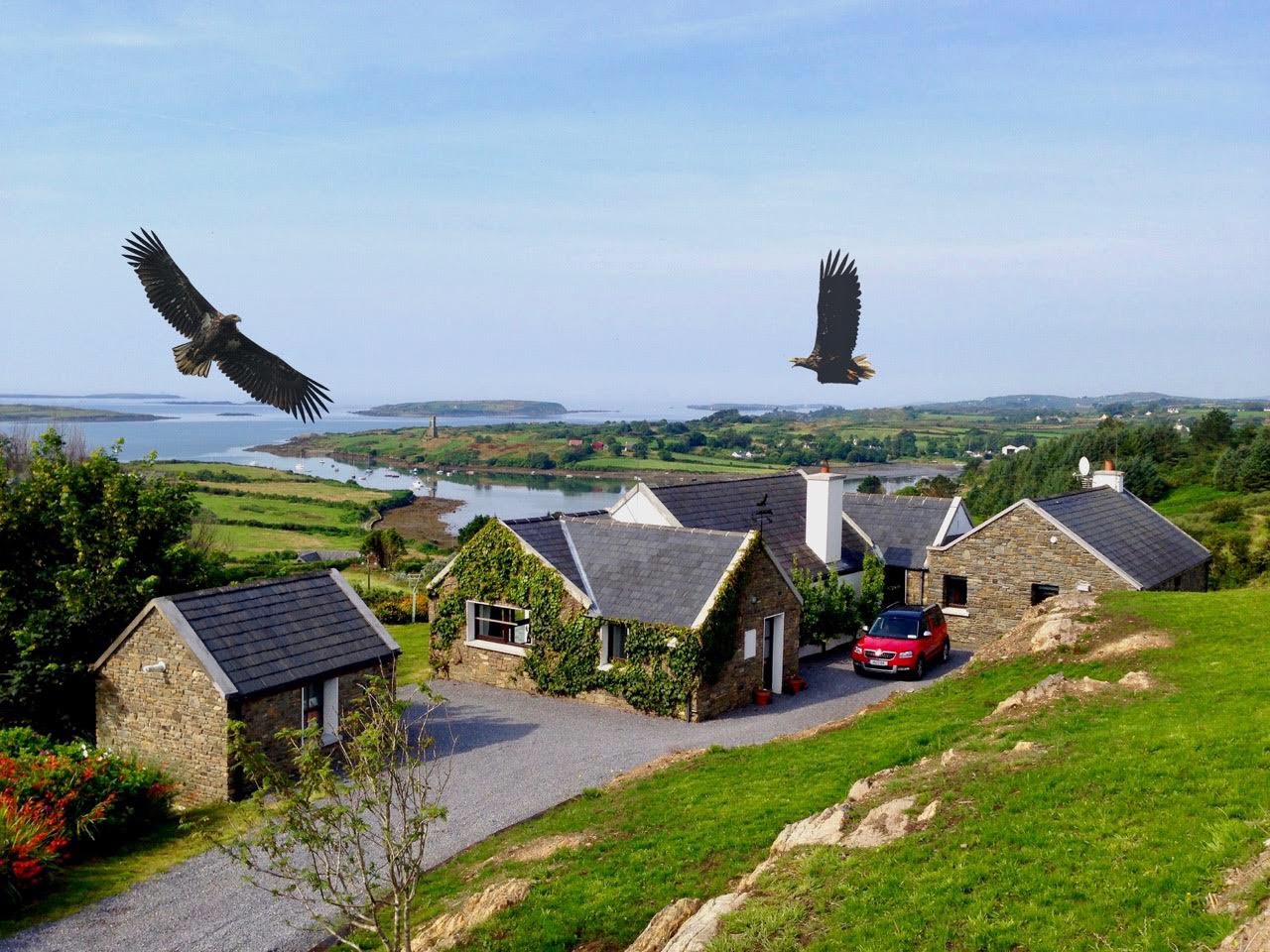
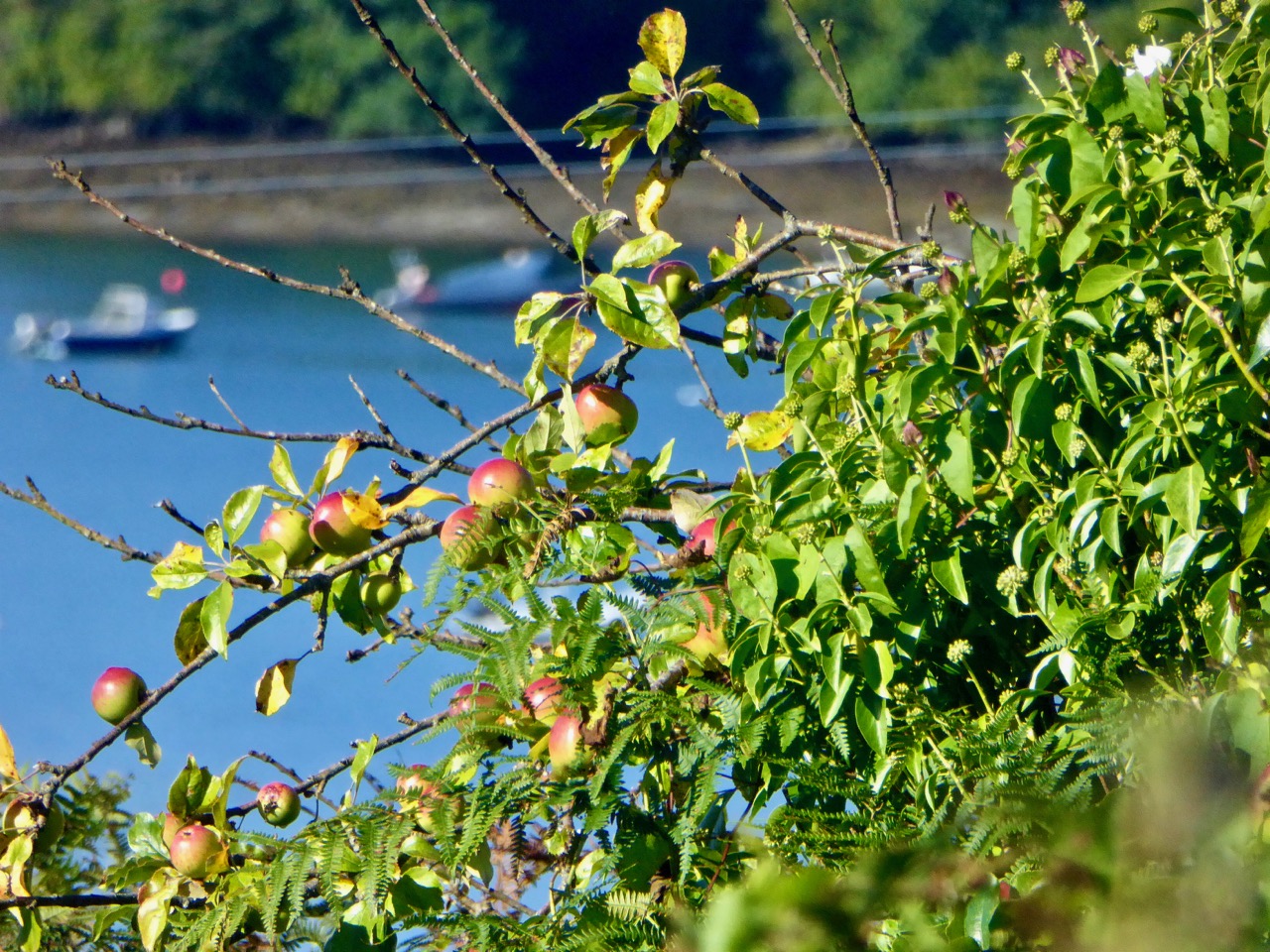
Nead an Iolair – our house – taken in August. You can see that Rossbrin Cove is central to our view out over the Islands. The name of the house means ‘Nest of the Eagle’, and the birds have obligingly flapped their way into the photo, courtesy of Photoshop. White-tailed Sea Eagles do survive in Kerry – not too far away – and they have occasionally been seen in West Cork. Once they were common across the west of Ireland. Below is another August picture – a wild apple tree close to the shore of Rossbrin.

I couldn’t resist adding this picture to the August tally (above): it’s an abandoned post box set into the wall of the old Rossbrin School, now closed. The school building survives as a private house and retains some of the architectural features of its previous use.

This magnificent machine is a remote-controlled boat-lift and was photographed on the large slipway which is at the western end of the Cove, last September. The Cove is a natural harbour and has been used as a resource for sheltering fishing boats and providing facilities for fish processing since medieval times. This post outlines how ‘fish palaces’ worked: there was at least one here in Rossbrin.

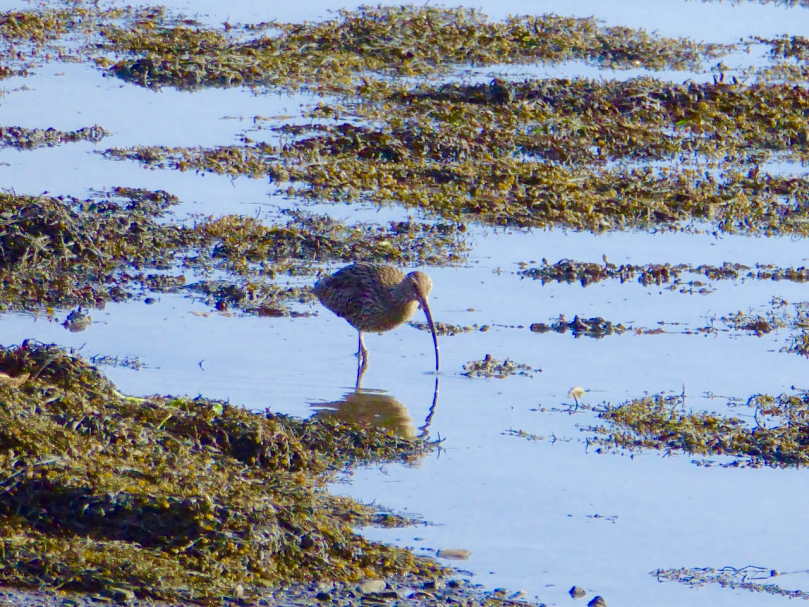
By October most of the boats have been taken off their moorings (above), and the weather changes again. We sometimes have the first of the winter storms this month, although it can equally be benign. Autumn brings with it dramatic skies and sunsets – and a feeling of melancholy, because the holiday houses down by the water are empty and shuttered for the onset of winter. But the weather can continue to surprise and November sunshine (below) can be as warming as any other time of year. It’s a good time for us to watch out for the wading birds – such as the curlews – who come in close to shore and forage on the mud flats.

And so we come to the end of the year in Rossbrin. This has been a fairly random selection of images, picked out because each was taken in a particular month. We know how fortunate we are to live in this rich and constantly changing environment. Not only are we surrounded by nature, but the immediate history is alive with stories – of Fineen O’Mahony, the Scholar Prince of Rossbrin, who lived at Rossbrin Castle in the 15th century and surrounded himself with a university of monks and scribes and made a fortune out of fishing dues – and of Sir William Hull and the Great Earl of Cork who exploited Rossbrin in the 17th century, also for fish. Now we look down on a sparsely populated townland and the bay beyond it: it’s a most beautiful place to know and to live in. For December I have chosen a classic view of the castle with a wintry sky and late sun creating patterns on the half-tide.

Mizening

What do you do when a fine day dawns and you want something totally relaxing? You go Mizening, of course! OK, it’s not a real word, but it should be – for the act of wandering at will around our wonderful peninsula.

We’ve been tied up a lot lately with the West Cork History Festival – it was a great success, by the way, with a wide variety of speakers and topics. We really enjoyed leading two of the field trips, including one that involved much dodging rain showers. But now it’s time to get back to our true avocation – meandering lazily around our own patch of heaven.

So what follows is a record of a blissful day on the Mizen, doing not much of anything, drinking coffee, visiting new friends, observing the wildlife, popping into the Blue House Gallery – well, you get the picture.

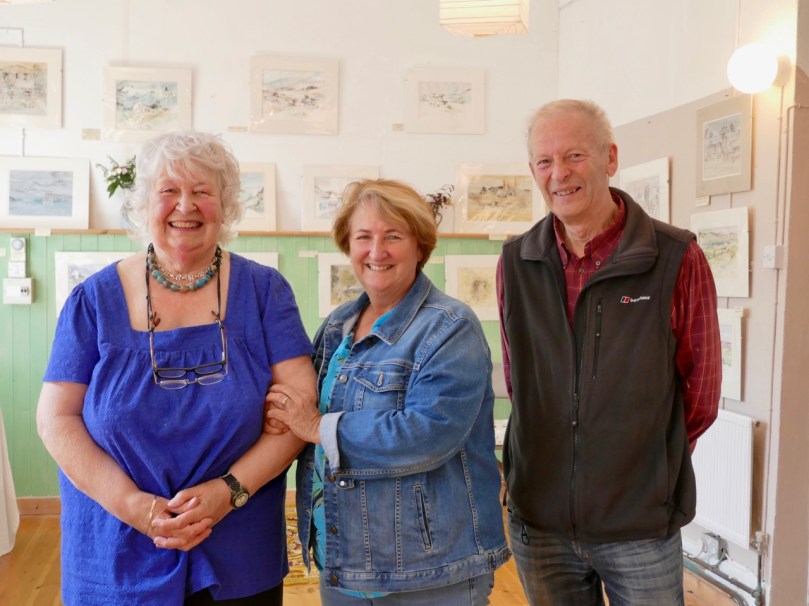
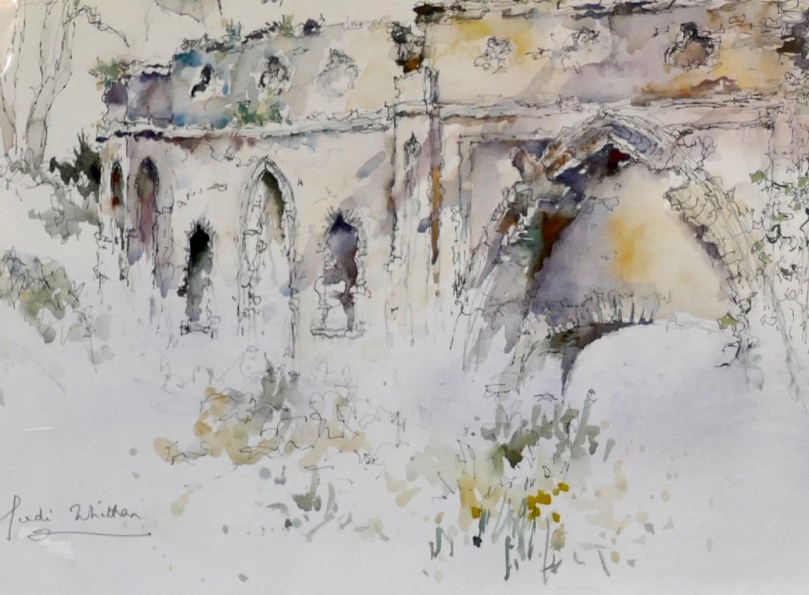
Those new friends? Judi and Pete Whitton, both artists, with a home and Gallery near Schull. Judi and I felt we knew each other already although we had never met in person, just through the wonders of the internet. She has a gorgeous show, Easel in the Ditch, running at the moment (follow the signs from Lowertown) – we were bowled over by her beautiful watercolours.

Above – Newcourt Bridge – Judi had seen my post on this ‘hidden wonder’ of West Cork and had to paint it

Then it was off for a walk in the countryside. You think you’ve been down all the little roads before, but there are always surprises.

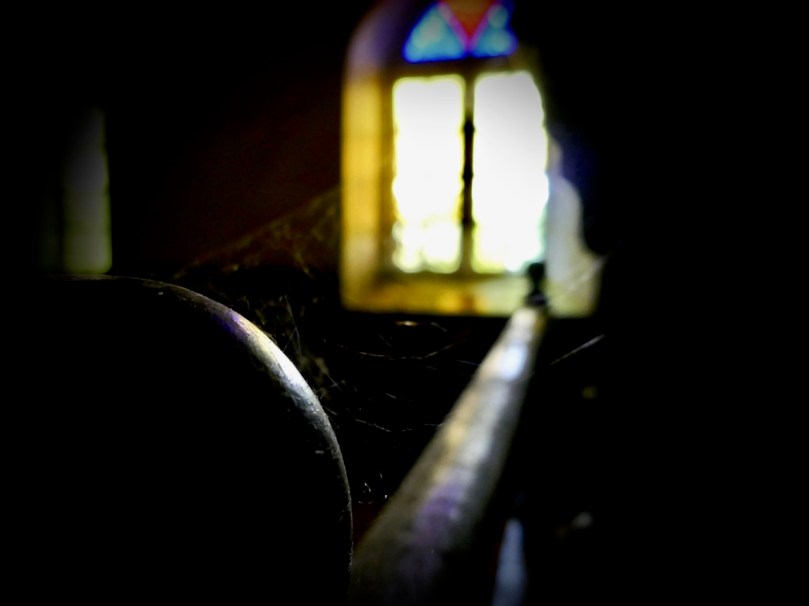
Cobwebs in an abandoned church

It’s August now and many of the flowers have finished blooming, but others have come along to take over and the boreens are still a delight.

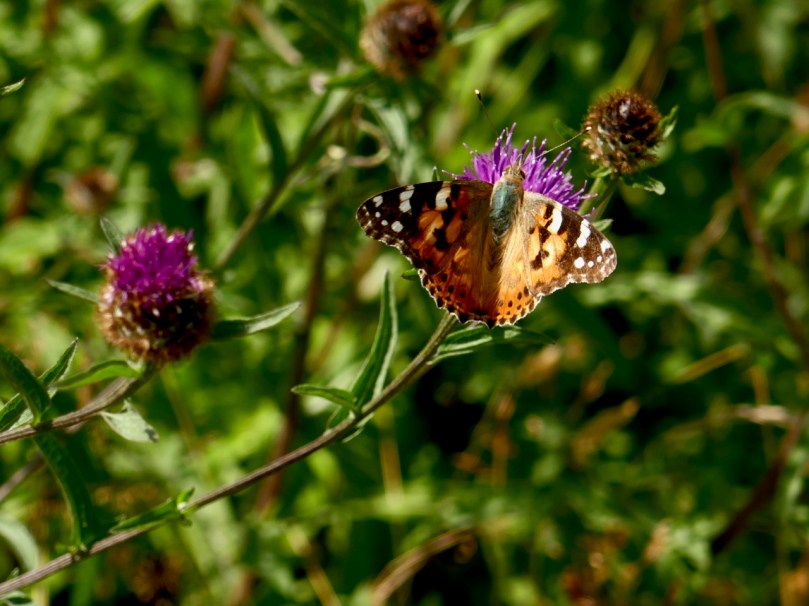
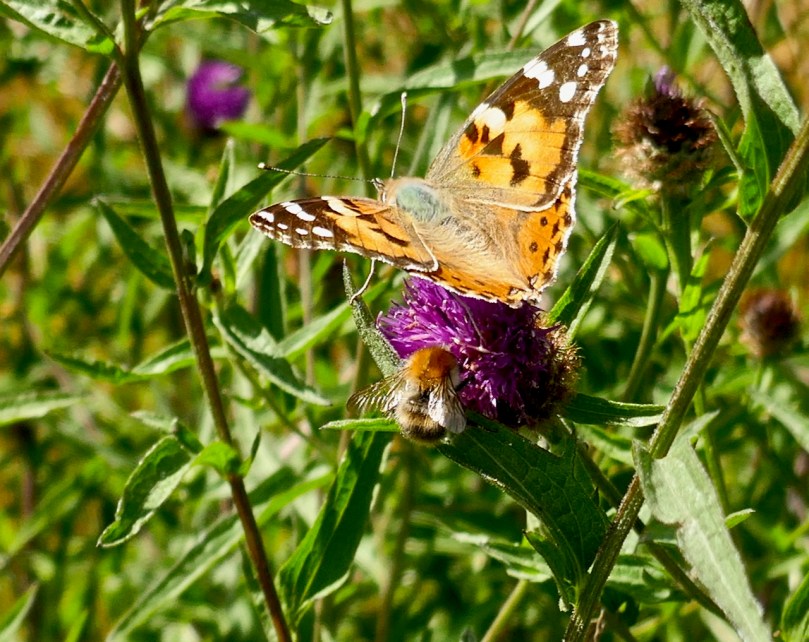
We’ve had an invasion of Painted Lady butterflies. Normally, this is a phenomenon that happens once a decade, but it’s starting to happen more often now, and scientists feel it may be down to general climate warming. The butterflies are especially attracted to the Knapweed, which is abundant, although they have to compete with the bees for it.

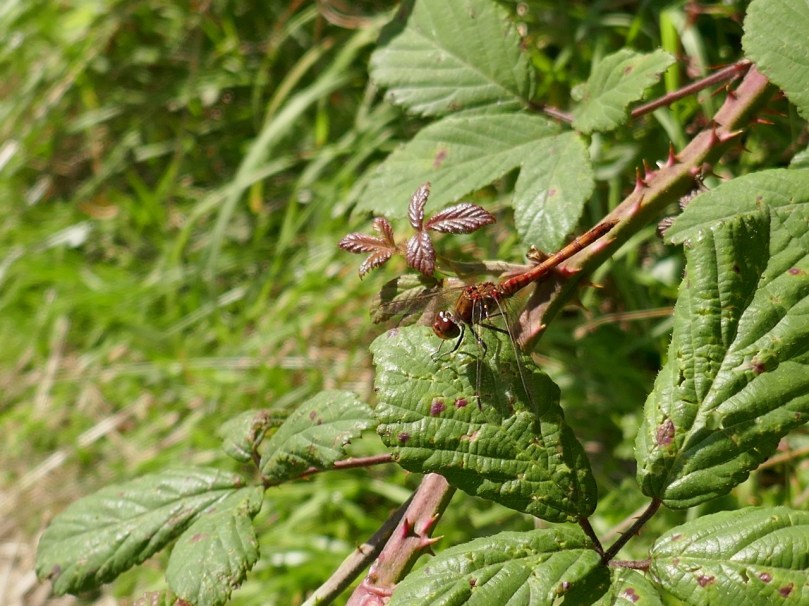
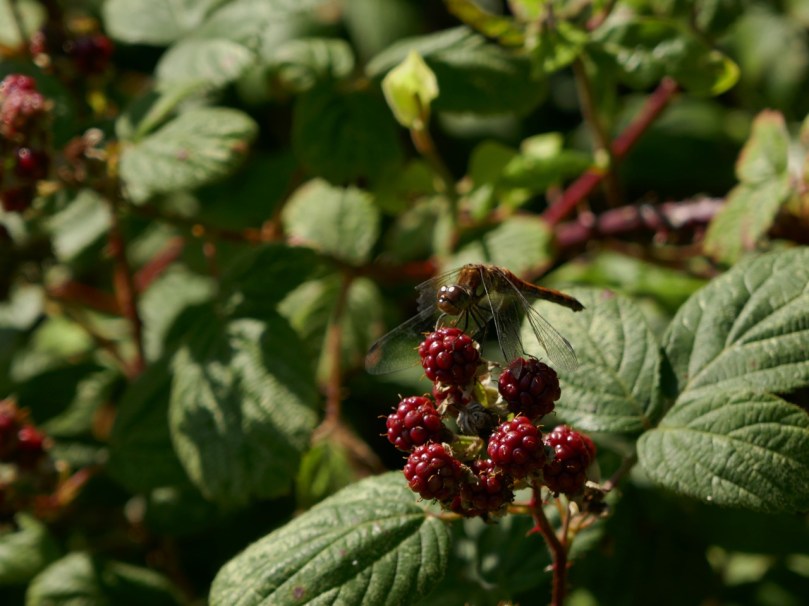
We were seeing lots of dragonflies too, although they wouldn’t stay still enough to allow a photograph – I finally snuck up on this one (above, both images), which it turns out is a Ruddy Darter. Well named!

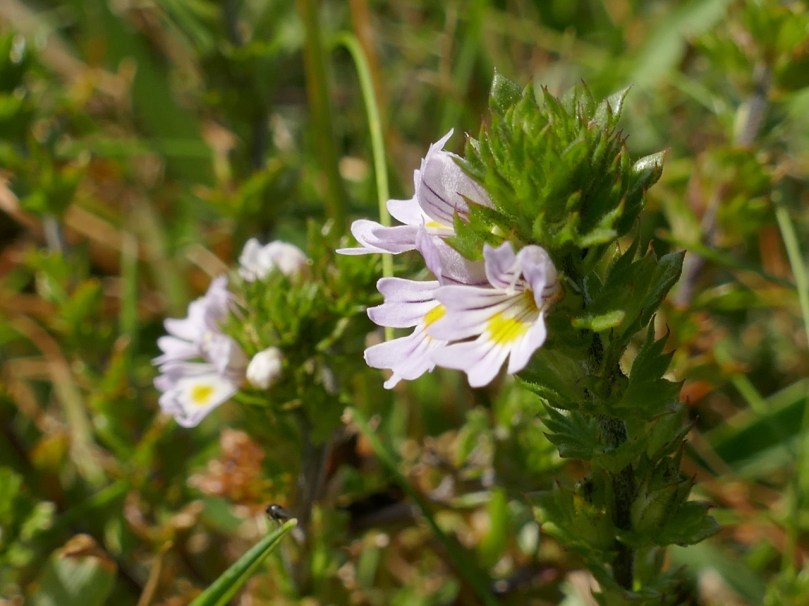
After more obligatory wildflower photography (example above, Eyebright), we dropped into Schull to see the latest Exhibition at the Blue House Gallery. Titled cleverly Blau Haus/Bauhaus, the downstairs show is based on the Bauhaus, the German arts, crafts and design school, founded a hundred years ago, that dragged us all into the twentieth century, .

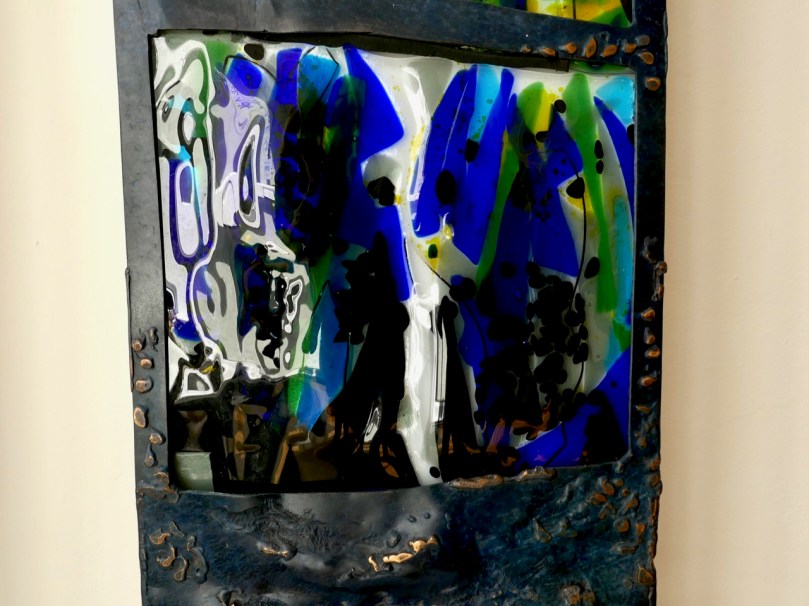
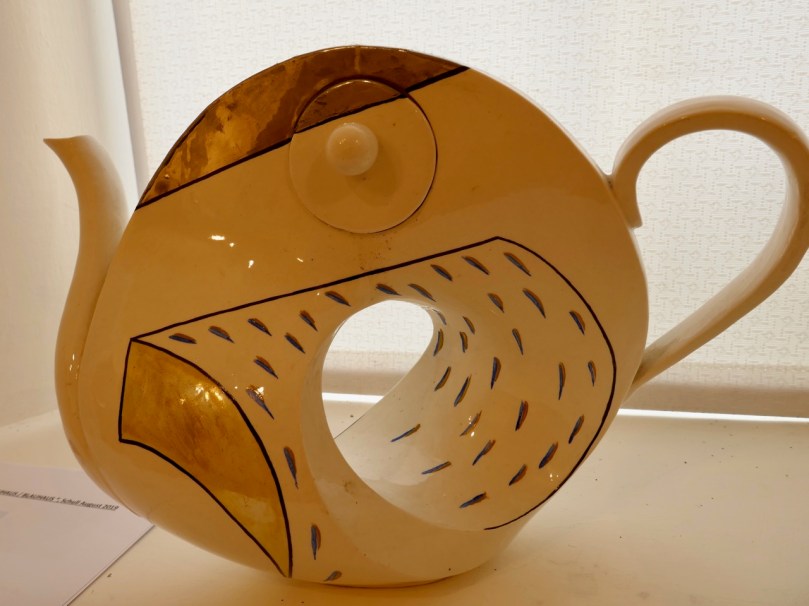
A tiny taster of the Bauhaus-inspired pieces above – a detail from a tall fused glass and bronze collaboration by Angela Brady and Holger Lönze, and a teapot by David Seeger

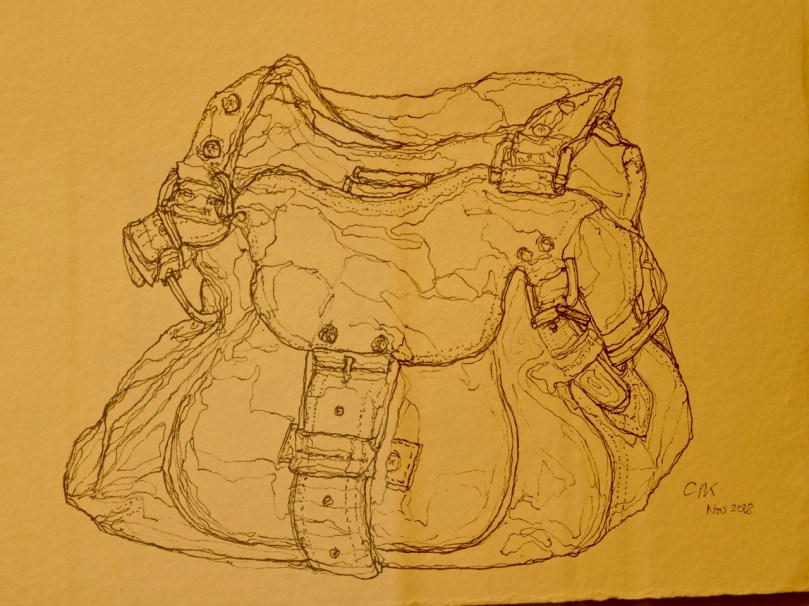
Upstairs was an entirely different show – The Drawn Line, curated by Catherine Weld. I was particularly taken with this line drawing by Christina Todesco-Kelly, titled simply Satchel.

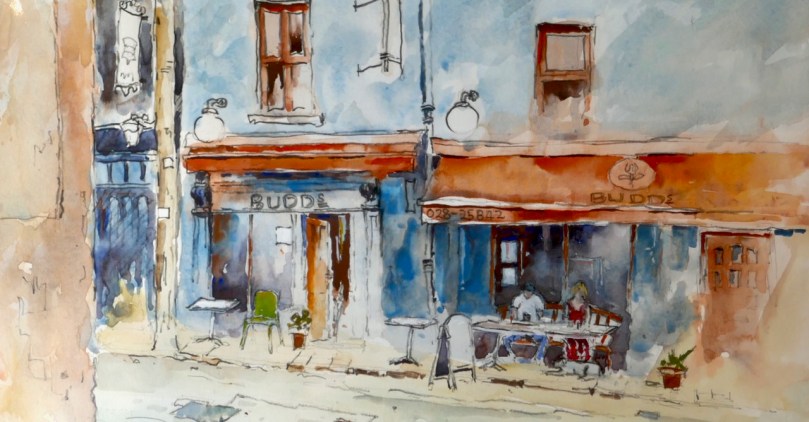
A lovely day! I did mention coffee, so I will end with a detail from Judi Whitton’s portrayal of our favourite local, place to get coffee (or lunch or dinner!) – Budd’s of Ballydehob. It captures so well what Mizening is all about and it’s the first thing we see as we approach Ballydehob from Nead an Iolair.


Art in the Landscape

I’ve always thought of myself as someone without an artistic bone in her body – although when you say things like that people always rush in to assure you that everyone has the potential to tap into an artistic streak if they just let themselves be free enough. Harumph, I say. But today they proved me wrong.

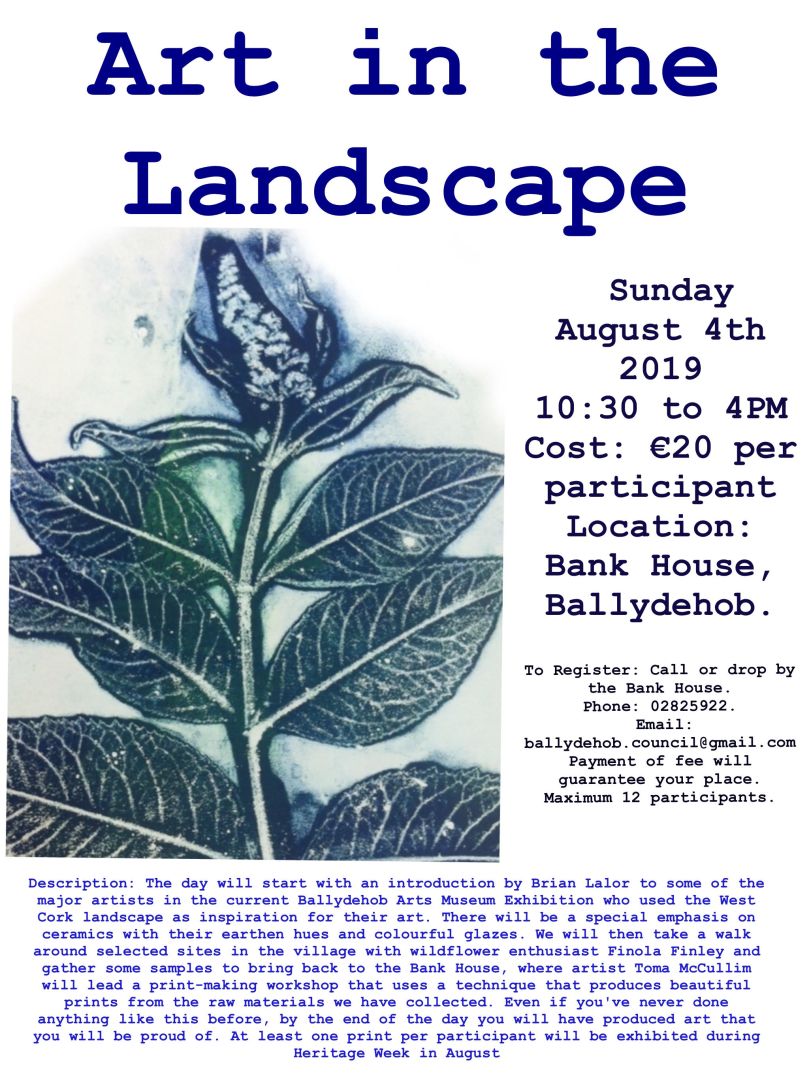
The idea for a workshop grew from the Ballydehob Arts Museum planning group. Robert has written a lot about BAM and so our readers know that it is a celebration of the iconic era when artists of all kinds settled in Ballydehob and turned it into a thriving centre of creativity. What animated those early artists? By their own accounts, it was the landscape around them, the light, the natural world they found here in West Cork. So why not try something based on that idea – and so the Art in the Landscape Workshop idea was born and to everyone’s astonishment it filled up right away, with a waiting list.

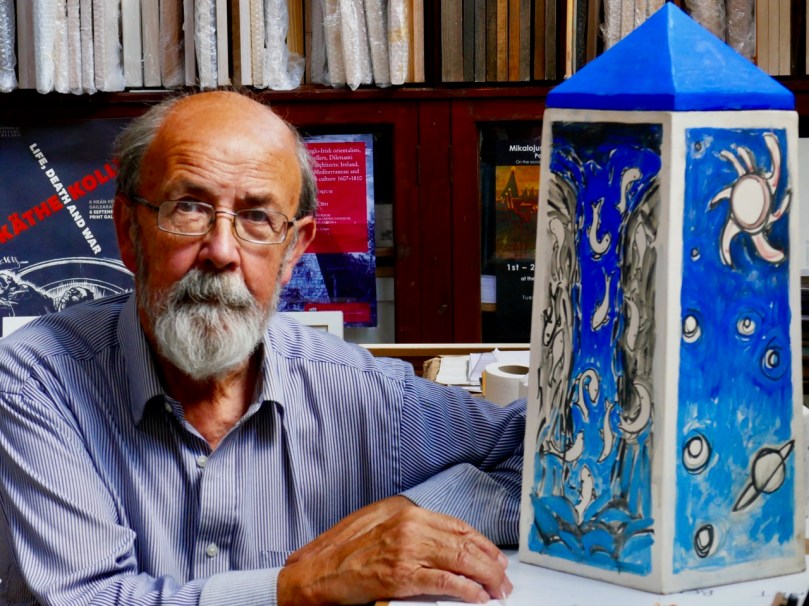
The day (today) started with an introduction to the artists of BAM by Brian Lalor (above), writer and artist and BAM Curator, who talked about the motivations and inspirations of the original group of artists and showed us some of their work, their use of earth tones and natural images.

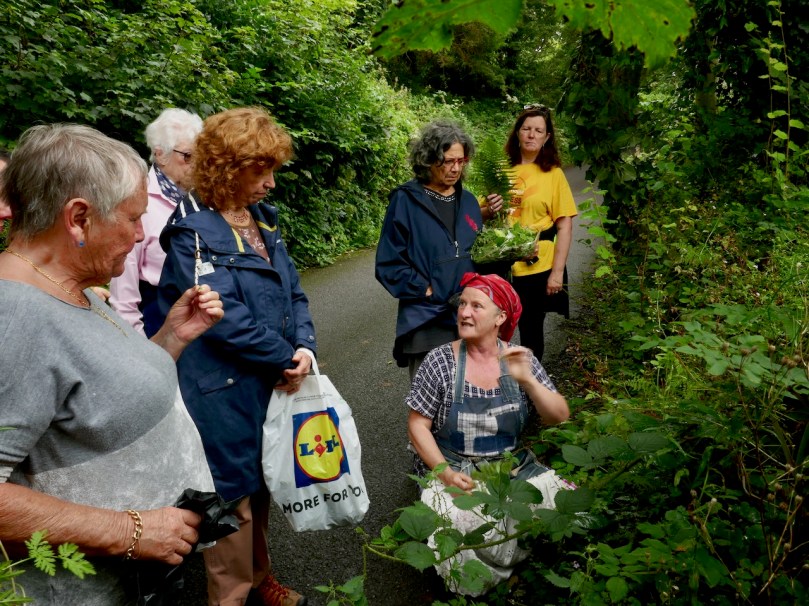
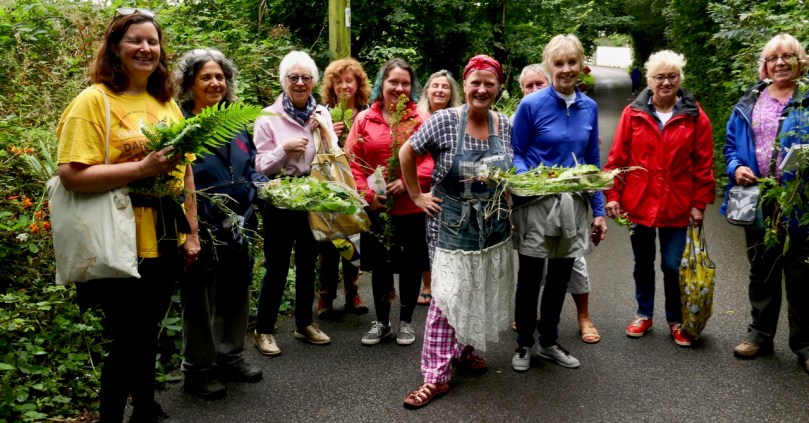
Then it was out into the landscape itself – and we didn’t have to go far! Ballydehob is really fortunate to have, right in the village, leafy little roads with walls and hedgebanks loaded with wild plants. The leaders for this part were myself and Toma McCullim, artist and educator. (I’ve written about Toma before and her wonderful project 110 Skibbereen Girls.) Turns out, Toma is a bit of a herbalist – she knew culinary or healthful uses for much of what we looked at, while I filled in the rest with wildflower identifications and background. We walked, we talked and we gathered.

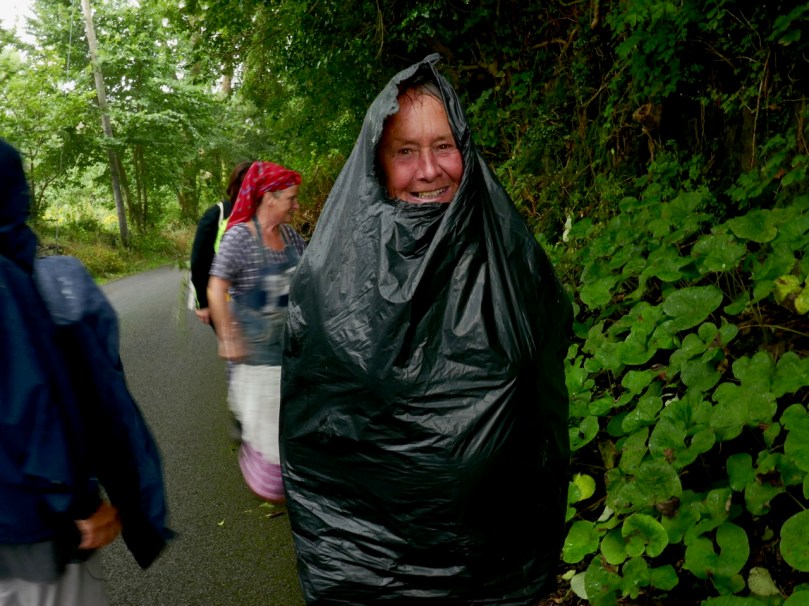
We almost dodged the forecasted rain and when it came Marie resorted to a tried and tested bit of protection

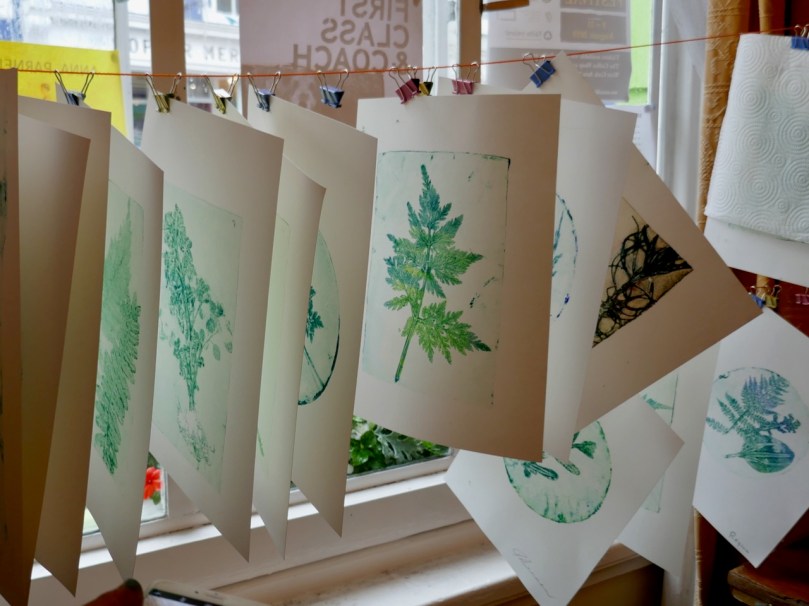
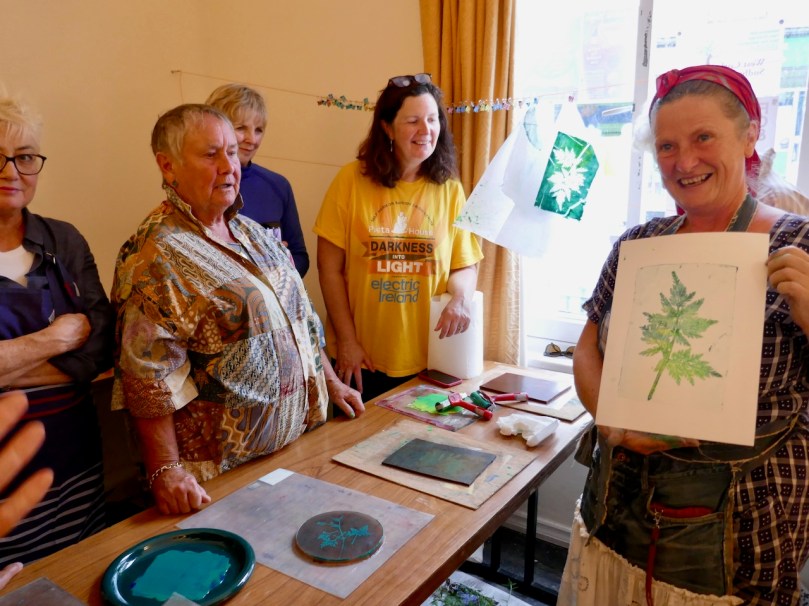
After lunch came the printmaking. Toma had assured us all that even if we had never done anything like this before, by the end of the day we would all go home with something we were delighted with. And it was true! She walked us through a seemingly simple, but actually quite sophisticated printmaking technique and then set us to work.

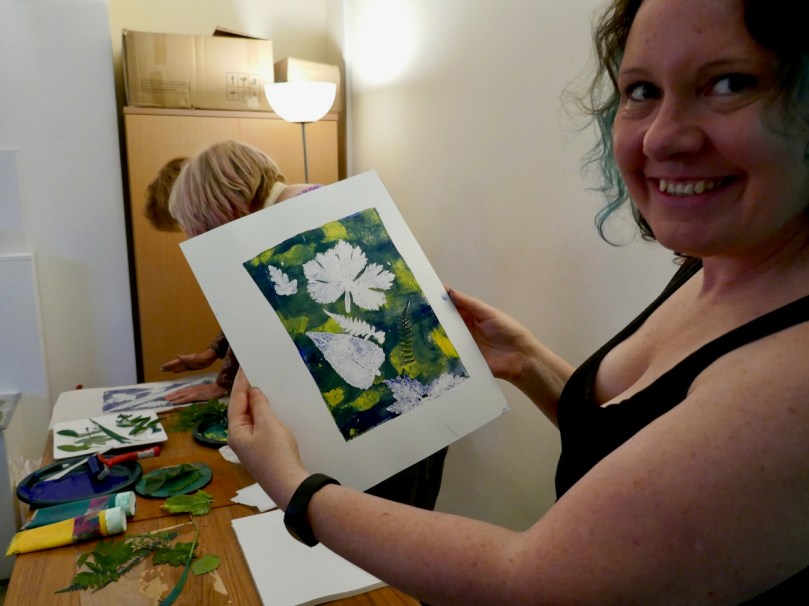
It was really fun to see the creative juices flowing, as well as the laughter and the chat. Before long everyone was covered in colourful (and thankfully water-soluble) paint and prints were starting to appear.

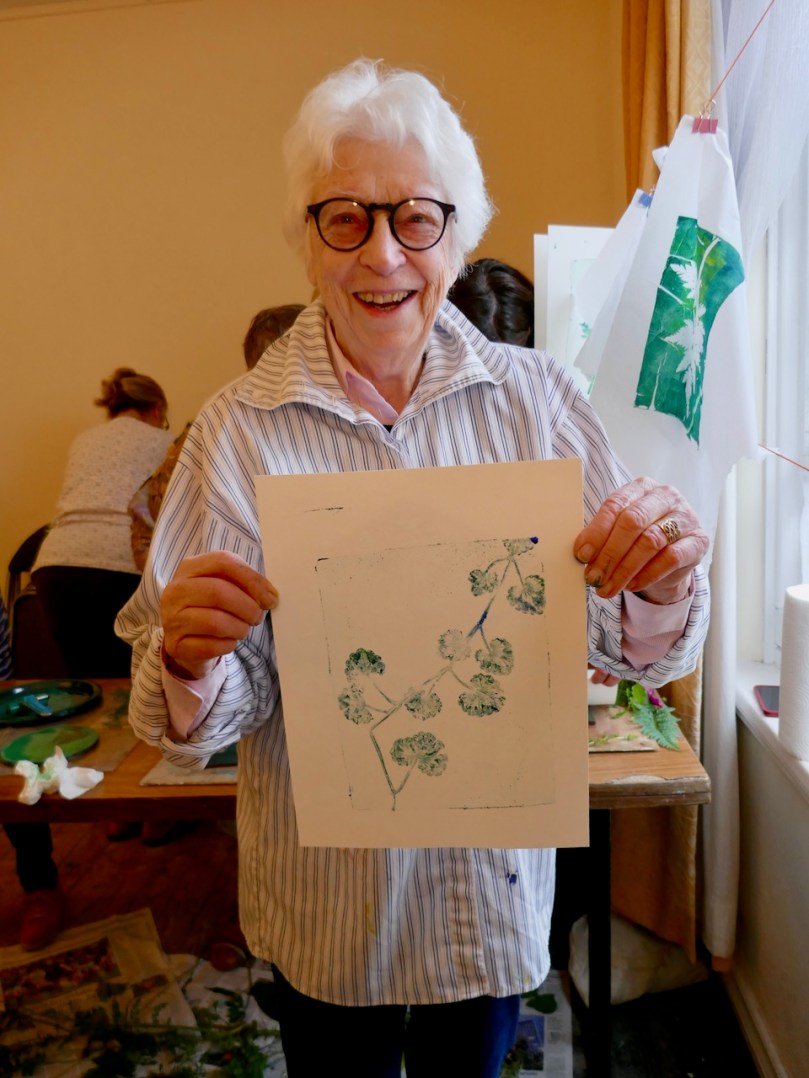
Louise and her botanical print

Some people took a long time considering compositions and produced two or three: others got into the swing of the process and produced many. And Toma was right – we were all delighted with our finished products.

Upper, Bobbins and her positive print and lower, Elizabeth and her negative one. Below, Annie with her china blue 

Everybody chose one print to leave behind. Those prints will go on exhibition during Heritage Week, including the one I made. OK, it’s not actually a Work of Art, but it felt great to be able to produce something that I’m proud of by working with material I love. Thank you, Toma, Brian and all the workshoppers for a great experience!

Moments on Heir

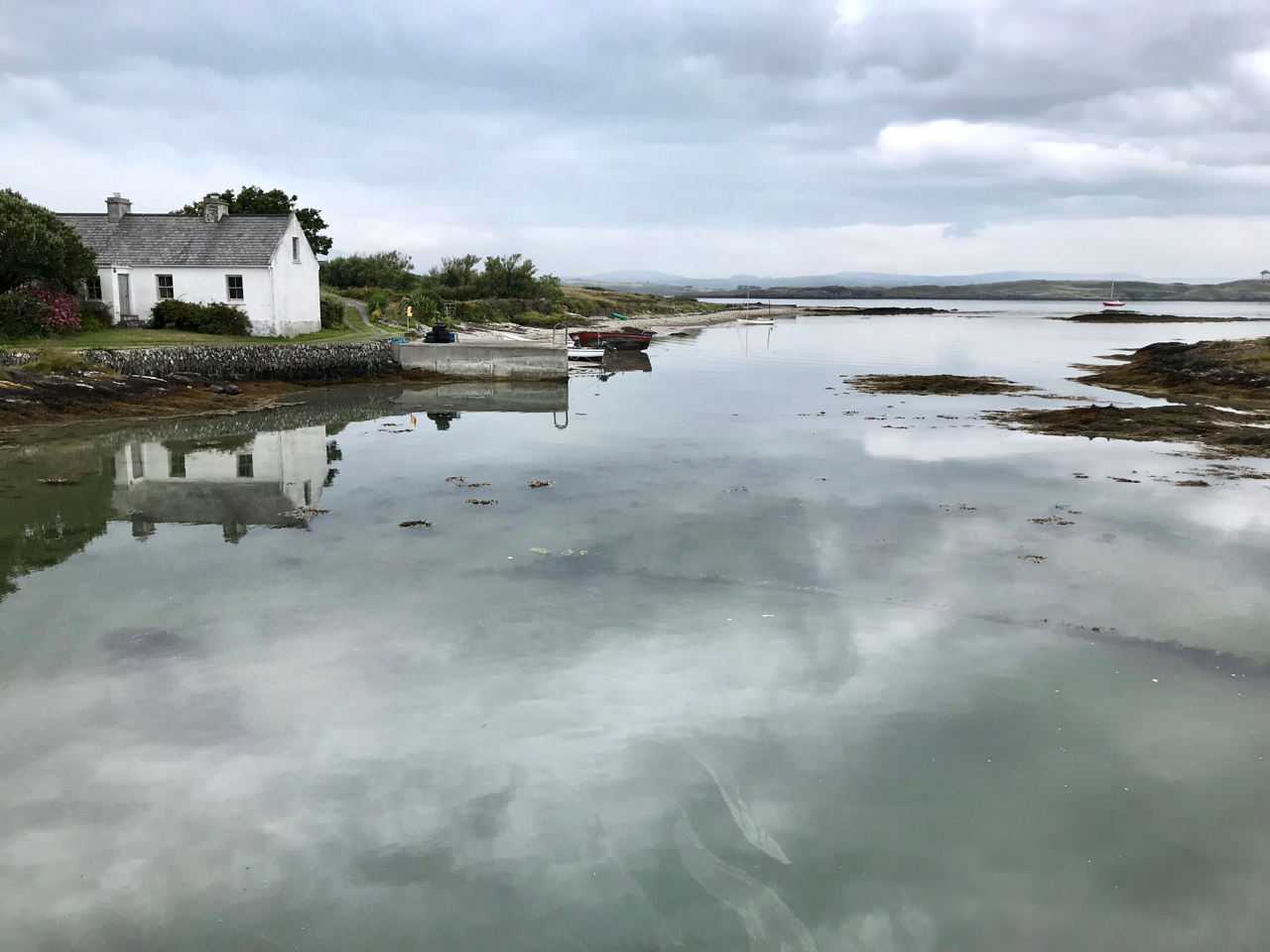
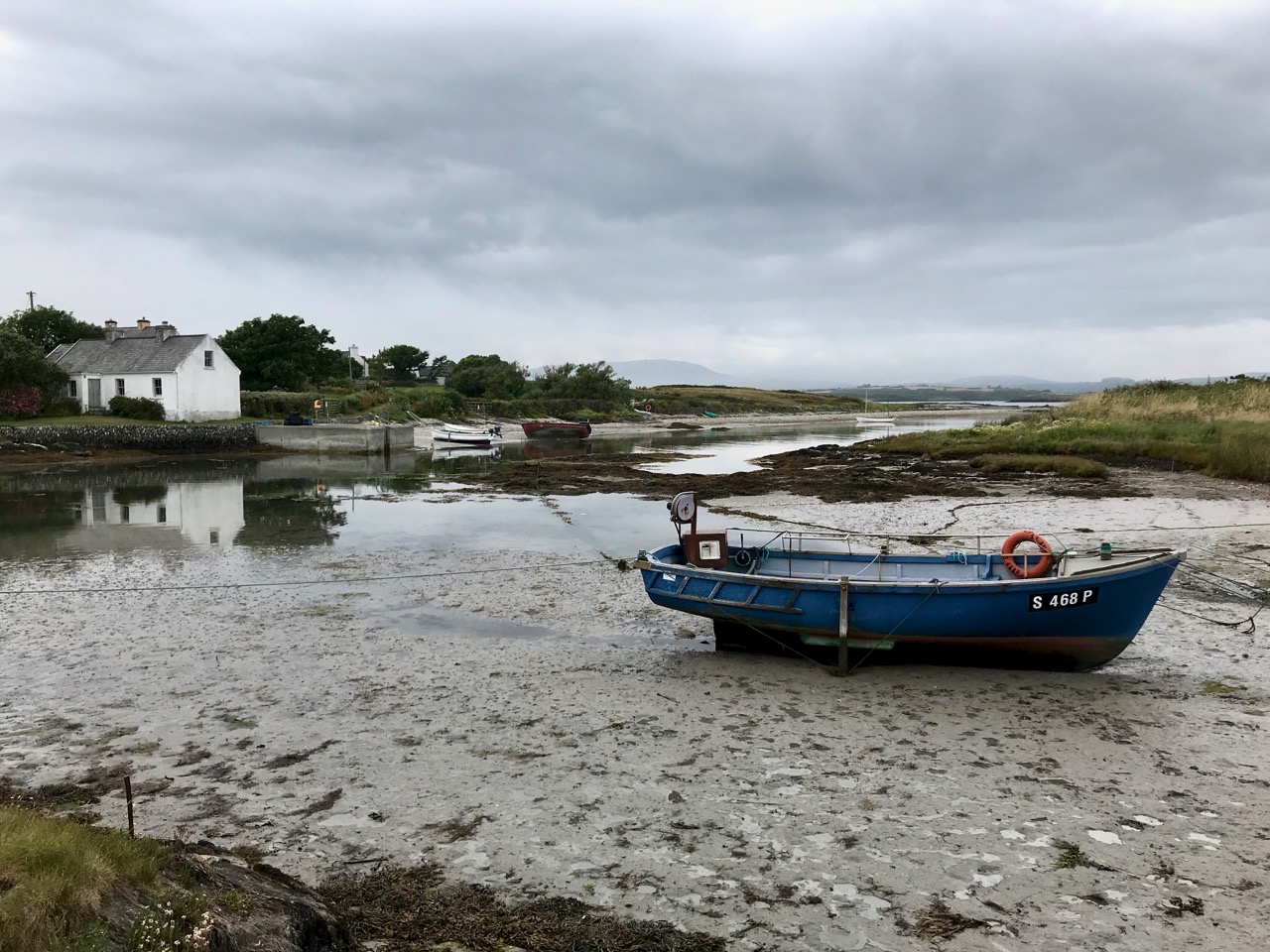
You will often find us visiting the inhabited islands of Roaringwater Bay. They are, after all, in full view of the panorama we see from our perch up here in Nead an Iolair (Eagle’s Nest), and easily accessible by regular ferry services. We like them because – who doesn’t enjoy a boat trip? Also, that little step from the mainland removes you to another world: places where life is lived a little differently, where you can feel slightly remote from the the most pressing issues of life, a little bit ‘on the edge’. Cape Clear, Sherkin, Long island – we have written about them all. And, today’s subject, Hare, or Heir: we have been there before but last week Finola was leading a wildflower walk on the island, and I went along for the ride, and a further exploration.

Colour on Heir: upper – Heir hedgerow, where wildflowers and garden escapees mix happily together; lower – Finola’s band of wildflower enthusiasts get caught up on the minutiae of the beach flora

It was a mixed, breezy day on the island, but dry for the group – two ferry loads and some furry four-footed minders to keep us all in order. Much time was spent poring over a myriad of plant species, some of which flourish on the West Cork islands more prolifically than on the mainland. I was interested in the land- and sea-scapes which changed quite dramatically with the movements of the tides.

Tides in and out: these two pictures near the wester end of Heir Island were taken within four minutes of each other!

A word about the island’s name: often seen on maps and signposts as ‘Hare Island’ (which of course makes my own long ears prick up!) it is supposed to have nothing to do with the animal. Today, the islanders will tell you that it derives from the past ownership of the lands by the O’Driscoll clan, and should be called Inis Uí Drisceoil (O’Driscoll Island) or Inis an Oidhre (Island of the inheritance – ie, of the O’Driscolls – or heir), hence the more usual modern name.

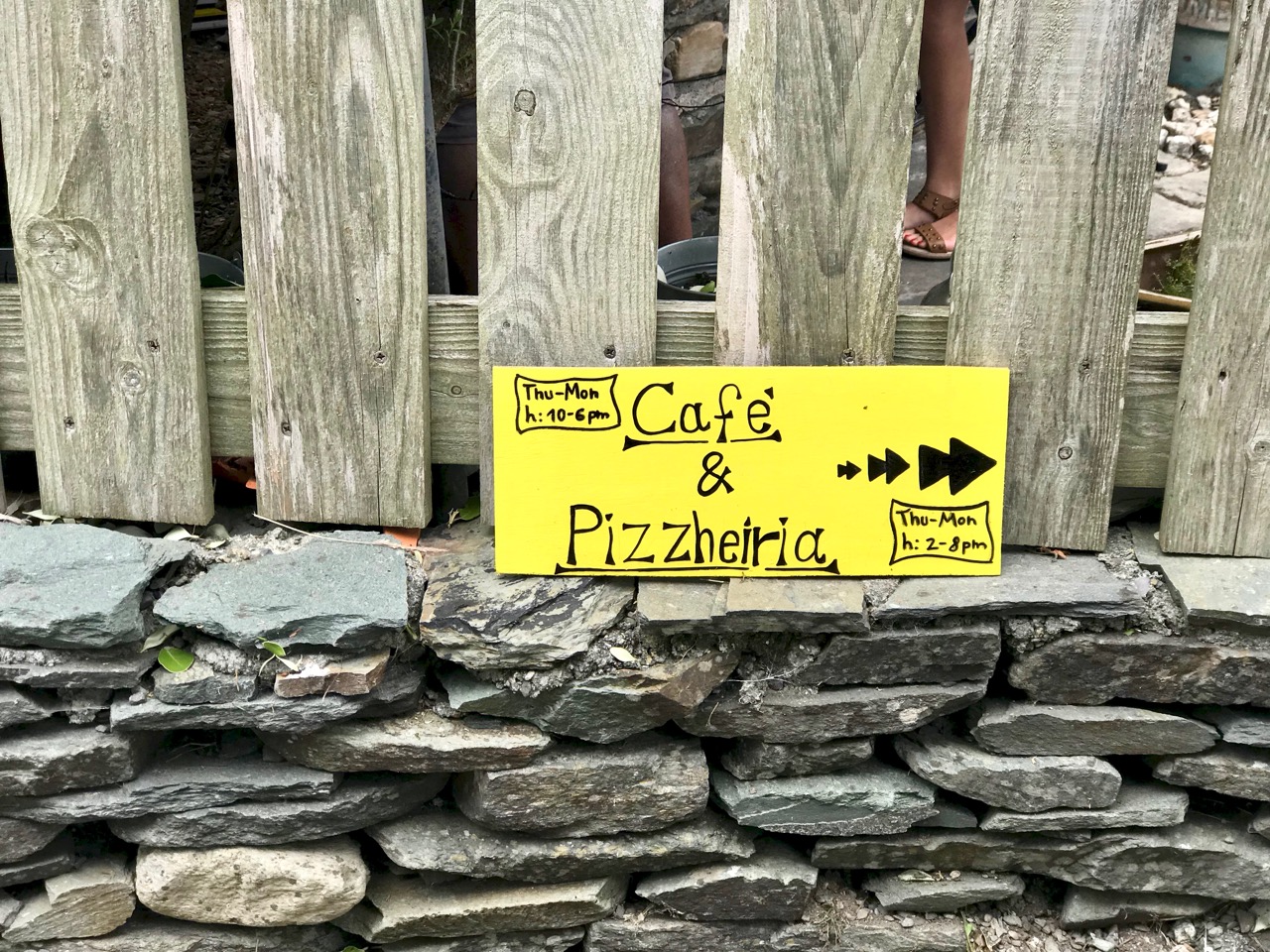
Yes, you can get pizzas and coffee on the island in the summer!

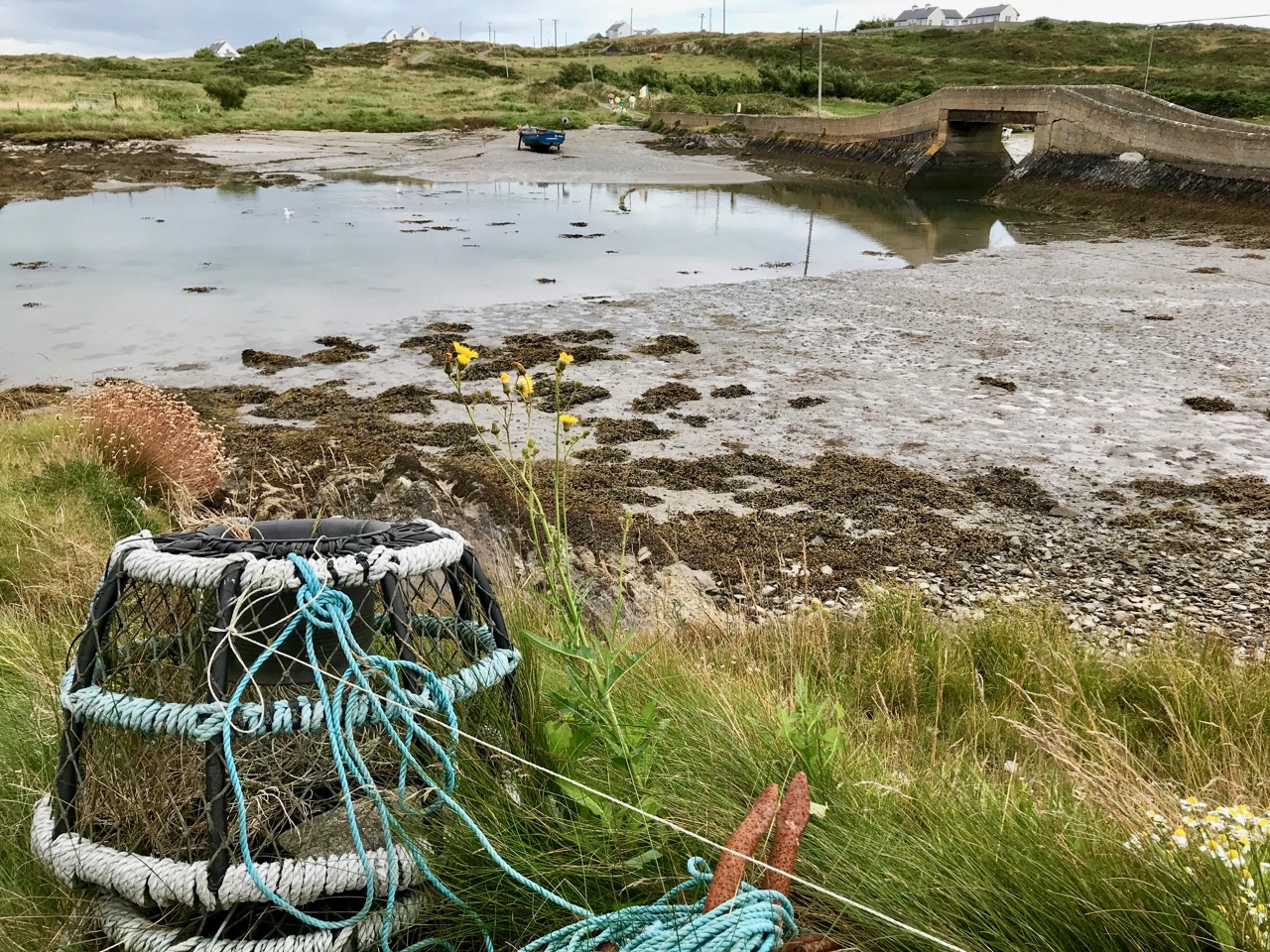
So is this island really a ‘Paradise’, as Finola called it in her earliest post? Undoubtedly! Away from the busy harbour it’s profoundly peaceful: bees, butterflies and wild birds are abundant. But it’s also haunted – as are the other islands of Roaringwater Bay. The past is always around you: reminders of a time when the population was far greater. The first official Irish census of 1841 showed a population of 358. The famine years caused fluctuations but in 1901 there were still 317 people living permanently on the island. Today this number has reduced to around 30 full-time residents, although there are many holiday homes on the island, and the summer population in present times can approach 150. This helps to support a cafe (above) and a restaurant (Island Cottage).

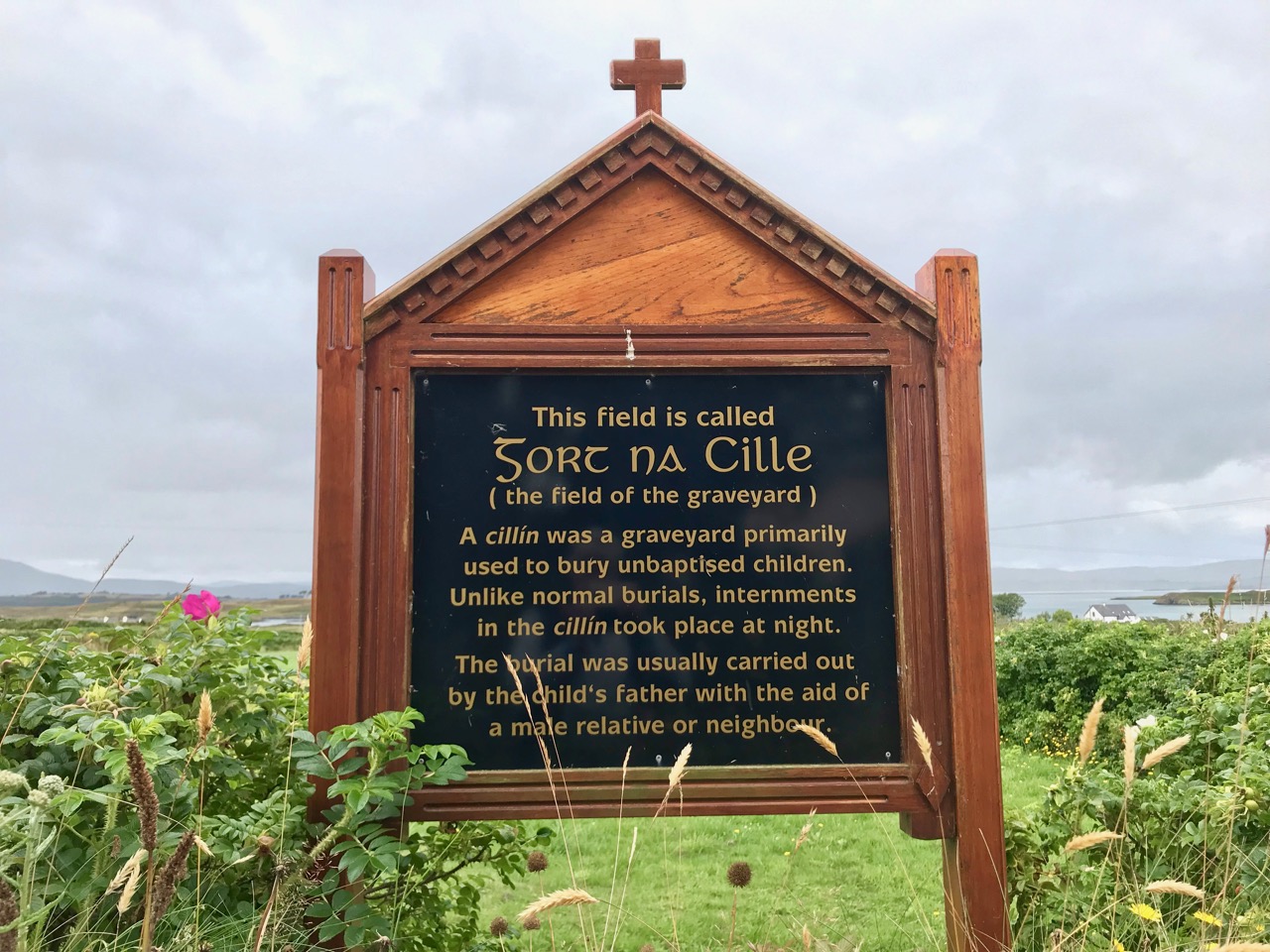
Island history: upper – Field of the Graveyard commemorates the burial of unbaptised children; lower – the Island School closed in 1976, when the resident population was around 50

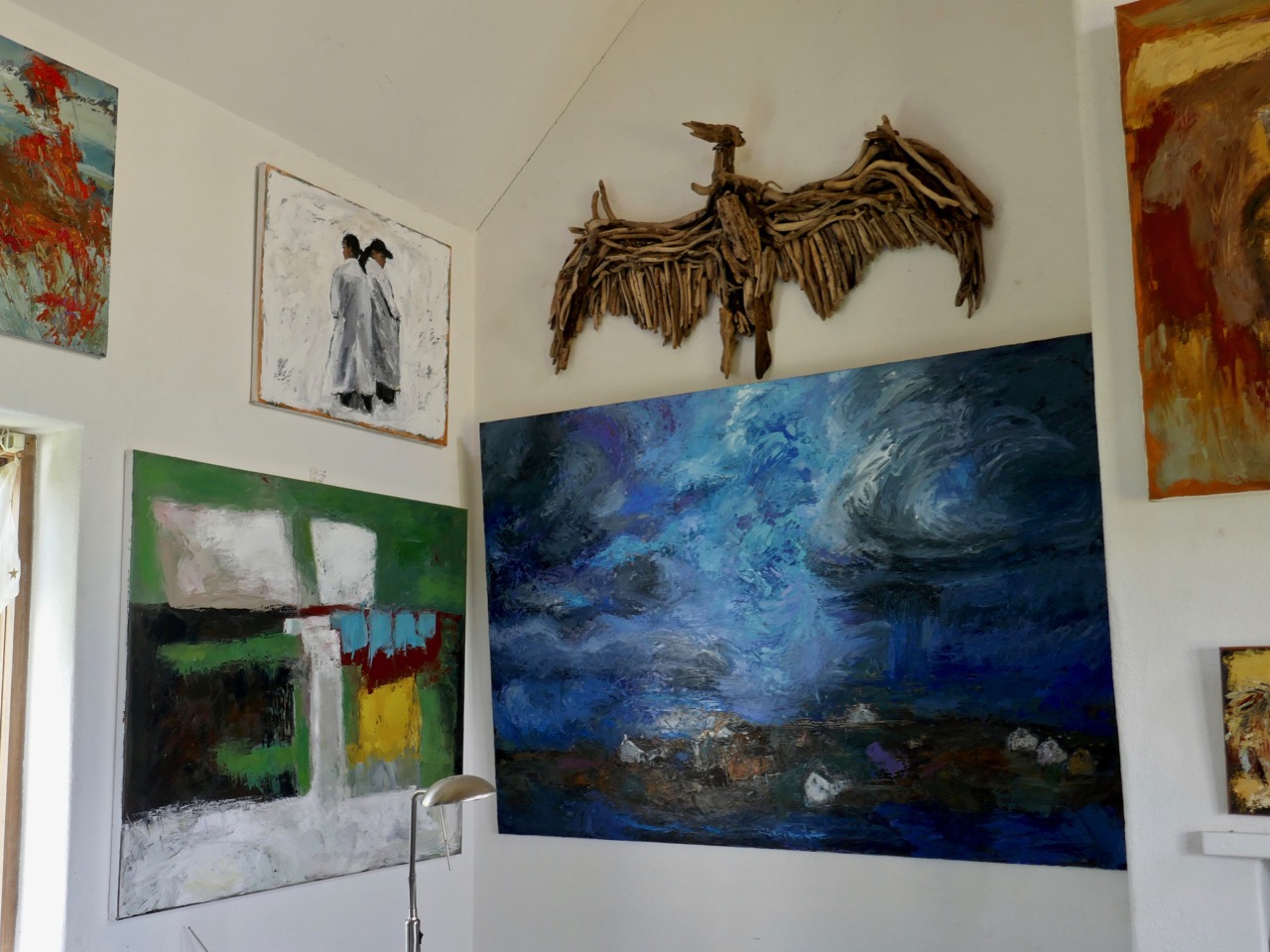
Artist Christine Thery has been a full-time resident on the island for many years; her husband Gubby Williams helps with the ferry and has designed and built ‘Heir Island Sloops’. Christine is an active environmentalist and keenly involved in ensuring that Heir is sustainable and responsible in caring for its natural habitats; she was instrumental in organising Finola’s Wildflower Walk. Here is some of her work in her studio:

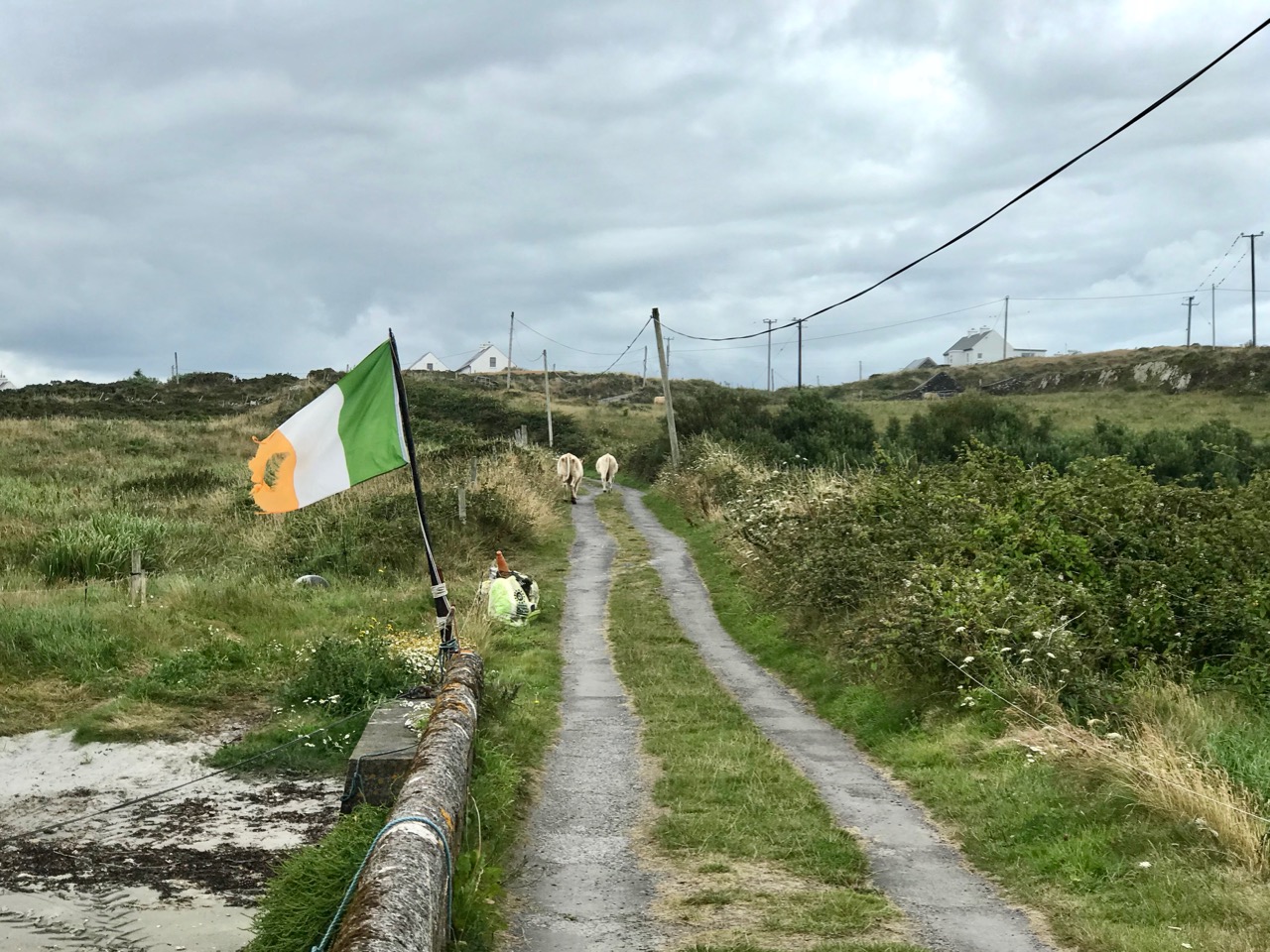
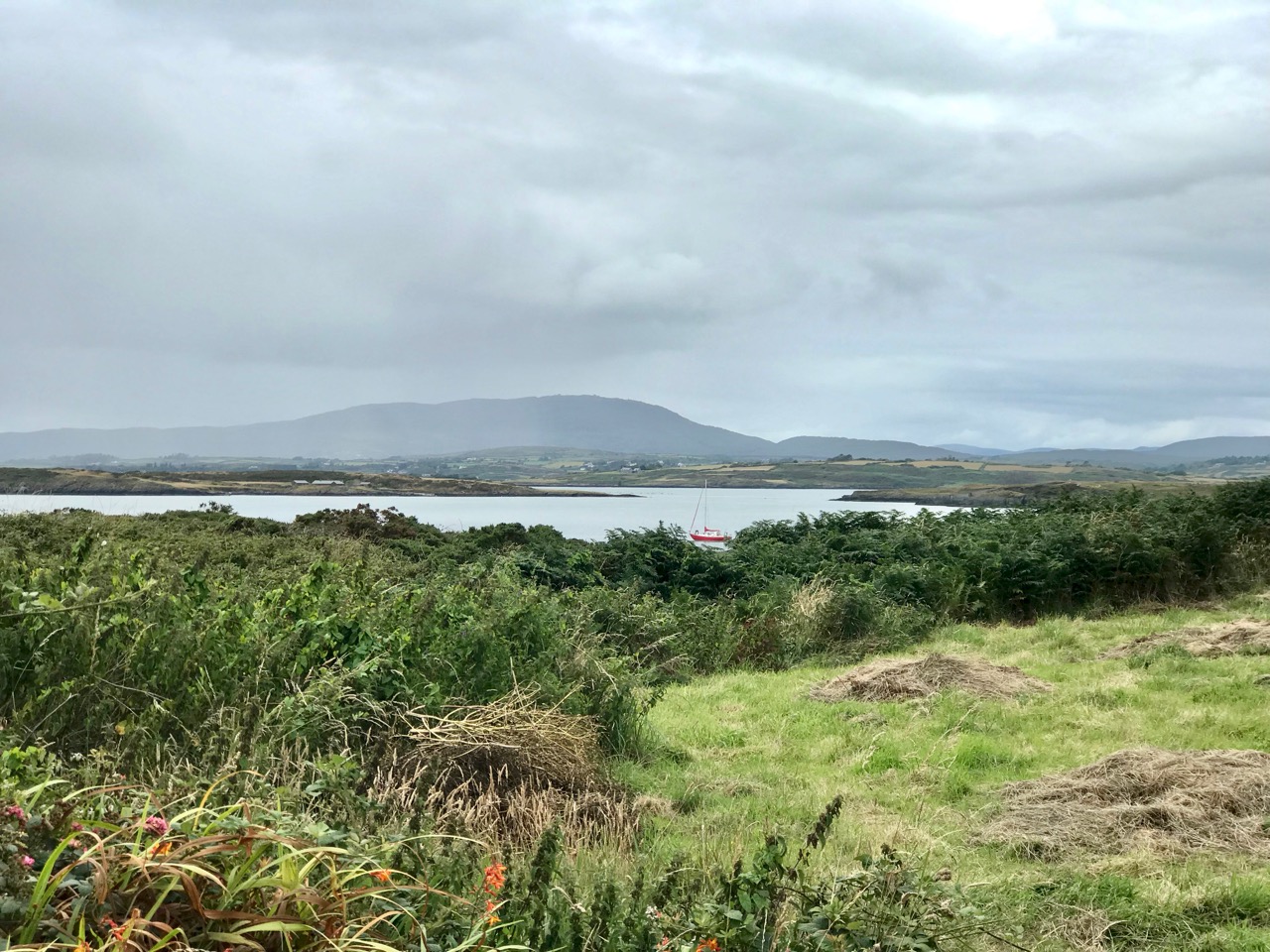
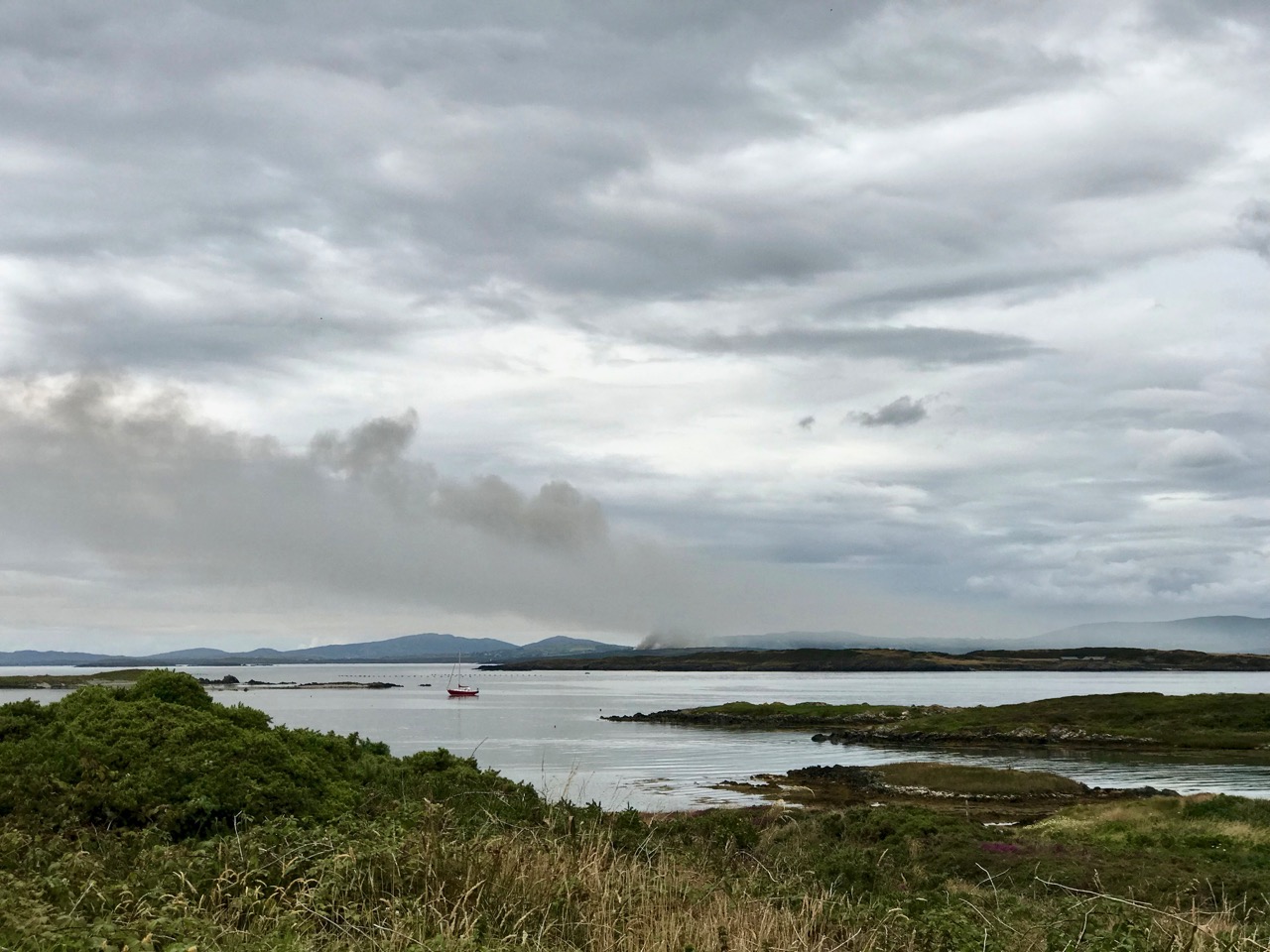
Heir is only a five minute ferry ride from Cunnamore Pier, yet the mainland seems a distant place once you are imbued with the innate atmosphere of island existence. The views from the north side of the island are dominated by Mount Gabriel, (pictures above). Five minutes – yet it seems such a step away from everyday life: long may beautiful Heir continue to support its fragile but tenacious resident population.

Industrial Archaeology in Crookhaven

Roaringwater Journal has featured Crookhaven many times. This far south-western outpost of Ireland has layers of history: thousands of years ago people lived in this area and made marks on the rocky landscape while countless generations of seafarers forged a ‘haven’ from the naturally sheltered ‘crook’ of land upon which the settlement is based. Even into the twentieth century pioneering technological advances were being made in Crookhaven: in the early 1900s Marconi sent some of the world’s earliest radio communications from Brow Head to vessels in the Atlantic shipping lanes.

Header – the ‘old quarry’ dominates the landscape to the north of Crookhaven Harbour. Above – looking across the harbour from the ‘quarry quay’ towards Brow Head, one of the scenes of operation of Marconi in Ireland

I am fascinated by all traces of industrial history: for me it’s ‘modern archaeology’: some of it might survive long enough to puzzle historians of the far future. I couldn’t ignore, therefore, the huge steel and concrete structures which line the R591 road which approaches Crookhaven when travelling from Goleen. They are built into the hillside above the road, and tie in with a substantial stone quay which has been constructed below it.

The quay which was presumably built to serve the quarry to the north of Crookhaven: the village can be seen across the water

Looking at the construction of this quay, and particularly the wear on the masonry steps leading down to the water, it would be reasonable to assume that the quay predates the concrete and steel structures which abut the road above it – by a long way. You might suppose that such significant edifices would have a history attached to them which would be easy to find, either from local informants, or in written or electronic record. However, I have so far drawn a blank. Well – not quite: there are countless identical references in contemporary accounts of Crookhaven to ‘…the old roadstone quarry on the side of the mountain, which provided metalling for the roads of Wales until 1945…’ I did find one variant, a caption to a general view of the area: ‘…Looking up to the roadstone quarry along the north shore of Crookhaven Harbour. The quarry was a source of gravel for Welsh tarred gravel roads until the 1930s…’

The quay below the ‘roadstone quarry’ is a paradise for industrial archaeologists and photographers! It must have had generations of users, up to fairly recent times, all of whom have left behind traces of their presence, but no solid history. I’m hopeful that readers of this post might be stirred to recall stories or memories – or even point me to some documented history to explain the provenance of this little piece of the complex West Cork jigsaw. *In fact, I have received information since this post was published – see the last paragraph.

I’m borrowing this photograph of the Crookhaven quarry from the log of the MV Dirona, with thanks to Jennifer and James Hamilton, who hail from Victoria, British Columbia and are currently cruising the world in their Nordhaven 5263 vessel. They explored the south west coast of Ireland in June 2017 and, from the water, took this perfect view of the quay, the ‘roadstone quarry’ and the mountain face above it, from which the stone has been extracted. The rock face could have been worked for stone before the 20th century, although we don’t have hard evidence for this: in September 1846 a road was proposed between Rock island and Crookhaven, and the county surveyor provided an estimate of £1,857. Prior to this, the road which had been built by Richard Griffith, civil engineer for Munster, extended as far as Rock Island, and passage from there to Crookhaven itself could only be made by water. The 1846 road is today the R591 which passes below the quarry. It would be reasonable to suppose that locally available stone suitable for roadmaking could have been used, and the quarry may have had its origins at this time. The construction of the adjacent quay could have been contemporary with this early use of the quarry, but the huge concrete and steel structures we see today are certainly an incarnation of the quarry workings in the early 20th century.

One of the fascinations of old industrial sites is the way they are taken over by nature if left relatively undisturbed. This one is no exception. There is a monumentality here which is being eroded and softened as time goes by. What does the future hold? Interestingly a -presumably serious – proposal was made in a not-too-long-ago iteration of the Goleen & District Community Council Development Plan:

PROPOSALS

2.24 The old roadstone quarry-works at Crookhaven Harbour should be developed as an amenity – perhaps a hotel with a restaurant with observation deck at the top…

Hmmm… notions of grandeur there, perhaps – and little regard for practicalities, but it shows the power of imagination! I think it’s far more likely that the area will remain in its present state for many years to come and, perhaps, attract a level of ‘industrial architecture tourism’. Incidentally, it’s not too far away from the site of a fish palace run by William Hull and the Great Earl of Cork in the early seventeenth century: the remains of this are there to see to this day, although almost entirely returned to nature.

Below – a now impassable tunnel under the road connects the quarry workings with the quay; nature entangled with the leftovers of human activity

NOTE: in 2020 our friend, local historian and expert photographer John D’Alton of Schull has contacted Roaringwater Journal with some updated information about the Crookhaven quarry. John tells us that the quarry was never owned by the Roadstone Company. That was incorporated in 1949 by the Roche brothers who operated out of Dublin from the 1930s, but never operating this far south and west. John also adds that the company that operated the Crookhaven quarry was the Browhead Granite Company Limited, incorporated in London in 1917. The quarry opened for business in 1928 and closed in September 1939. It was this company that contracted for the construction of the impressive structure still there today. The company exported stone to various ports in England in particular, London especially, and Ipswich, among others, supplying stone for road surfaces. The Granite company was a successor to the Browhead Copper Mining Company that despaired of finding copper in mineable quantities in far West Cork. Interestingly, the structure is one of the earliest examples of this type of reinforced concrete construction in the country, the original Mizen (Cloughan Island) Bridge being another.

Many Thanks, John, for finding and sharing such detailed information which has been lacking until now!

Endpiece – the old workings and quay are directly opposite the centre of Crookhaven – here’s a view towards the quarry from the village: