Tiny Ireland

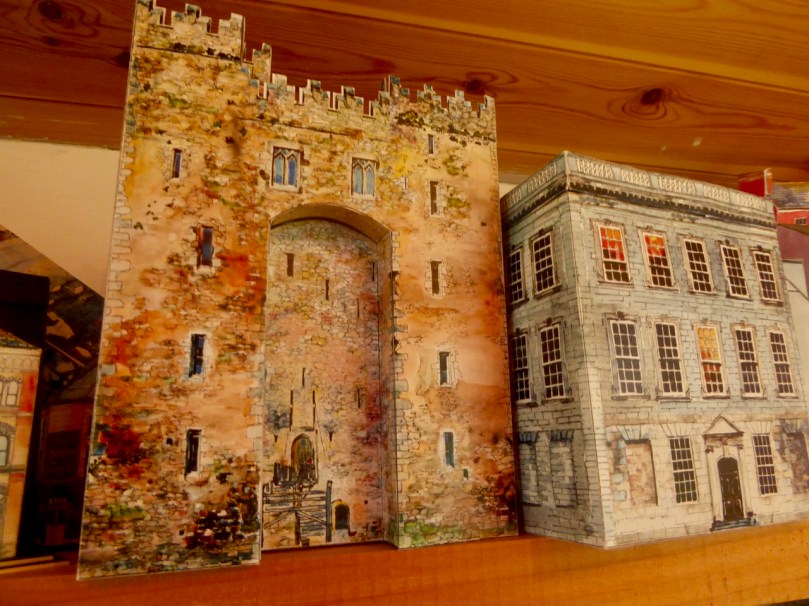
Bunratty Castle

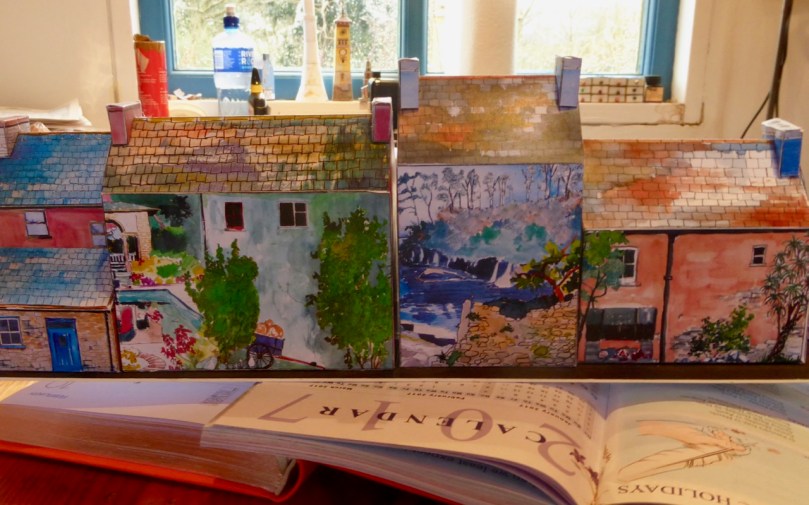
If you live around here or have visited Ireland you’ve seen them in all the best gift shops: Tiny Ireland – those intriguing paper models of Irish buildings and towns that make the perfect gift.

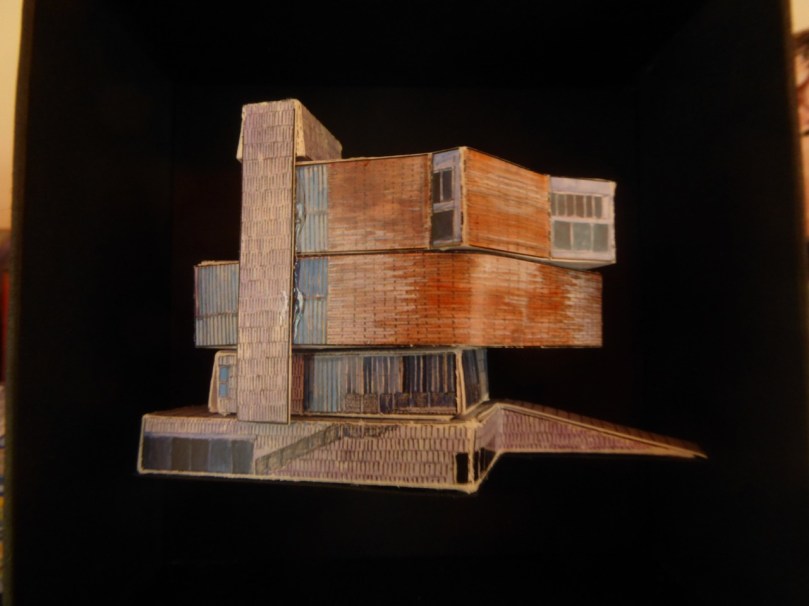
Top photograph: Bunratty Castle. Above: Skibbereen, the model and the real thing, and Tiny Cobh

They say that a true craftsperson makes it look easy. But this week we visited Tiny Ireland in her studio and found out first hand just how much talent and research and imagination goes into every single detail.

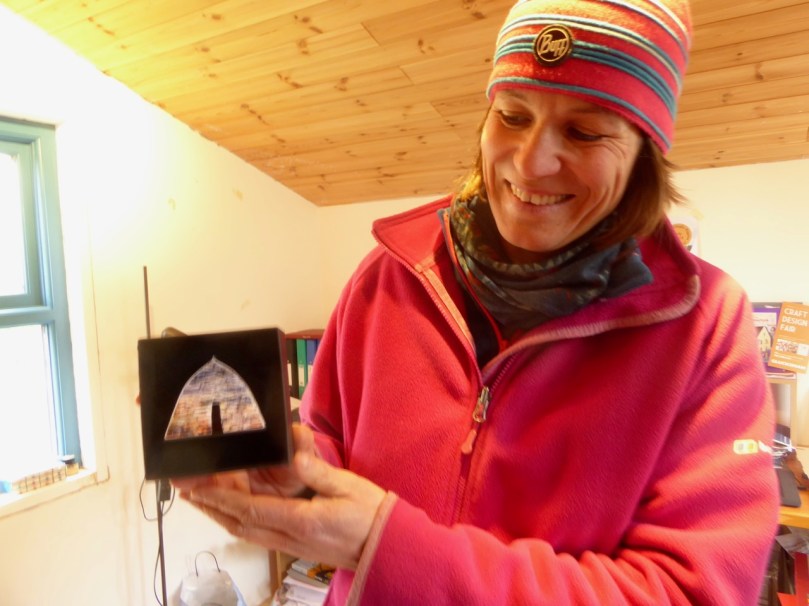
Anke with boxed Gallarus

Anke shows us her Tiny Gallarus

And who is Tiny Ireland? Meet Anke Eckardt. She’s lived here in West Cork since she was a little girl, plays a mean tin whistle, is an artist, a master joiner and boat builder and joint owner with Rui of West Cork Boats. The idea for Tiny Ireland came to her when she made some paper models with and for her son Fionn to complement his train set. That was ten years ago. She has been making models ever since, but devoting herself seriously to it for the last five years.

Designer at work – Anke in her studio. Full marks for anyone who can guess the pub she’s working on.

Anke starts with familiarising herself with the town or village. She wanders round with her camera, talks to everyone, gets a feel for the place, and then does extensive research on the history of the area. In the case of West Cork, like any other native she already knows every inch of it – the stories, the atmosphere, the iconic buildings, the colours and contours of the landscape. She tries to capture that same sense of place wherever she goes.

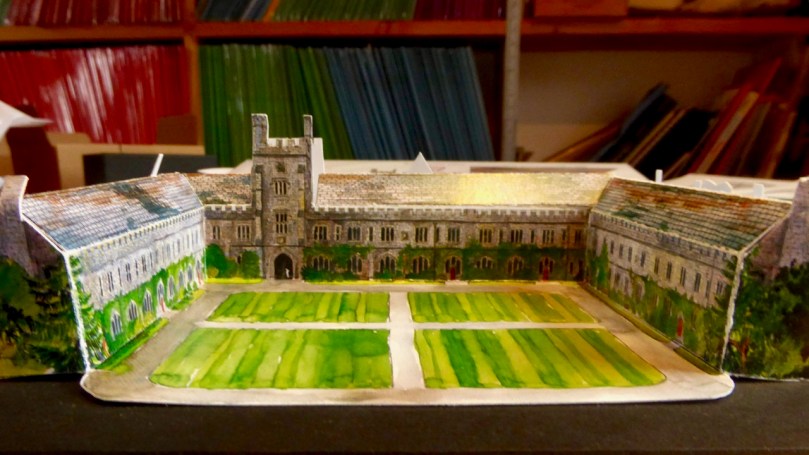
UCC

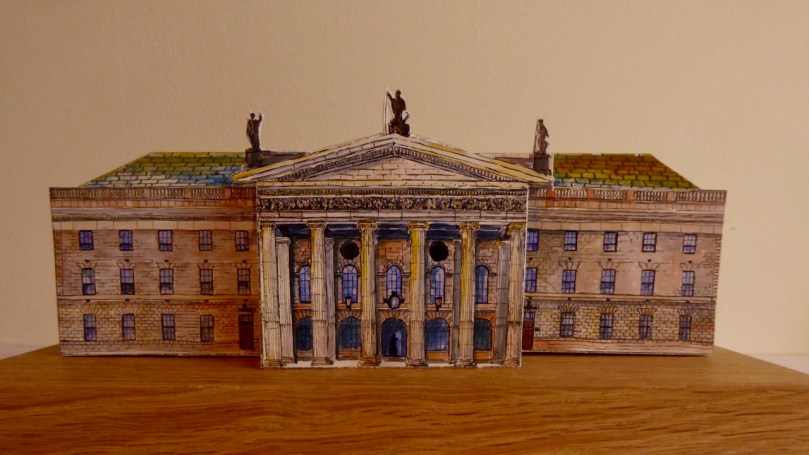
GPOTop: Both Anke and I went to University College Cork and the Quad holds a special place in our hearts. Bottom: Anke’s contribution to the 1916 commemorations – the General Post Office in Dublin

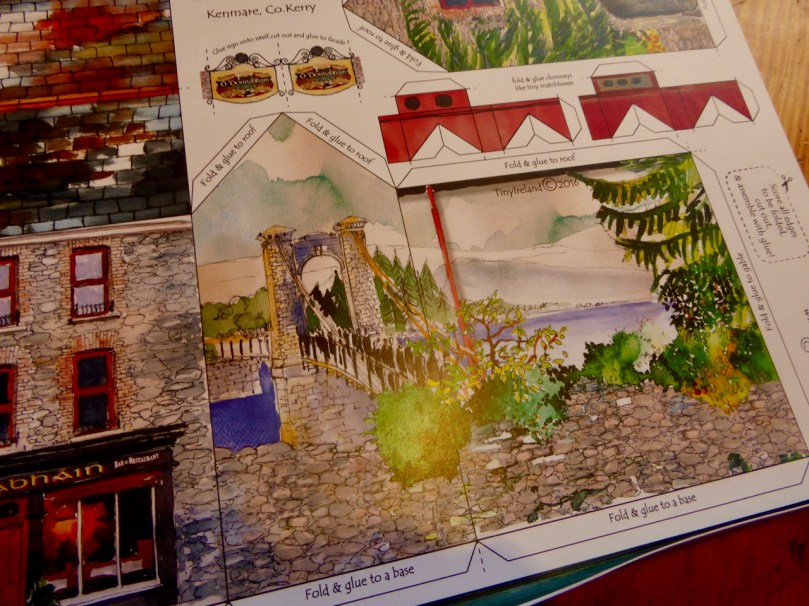
Back in the studio she decides on which buildings to use and starts drawing and painting and figuring out what should go where on the model and what extra details to include. Each building occupies one sheet in the kit. Anke wants each sheet to be a beautiful object in itself, to be poured over before you even start the scoring and cutting process. Can you imagine the cleverness it takes to construct even one building? Add to that all the little details that go into making it unique and contributing to its cultural and geographic character.

Glucksman Gallery in box

Not just traditional buildings! Here is the ultra-modern Glucksman Gallery at UCC

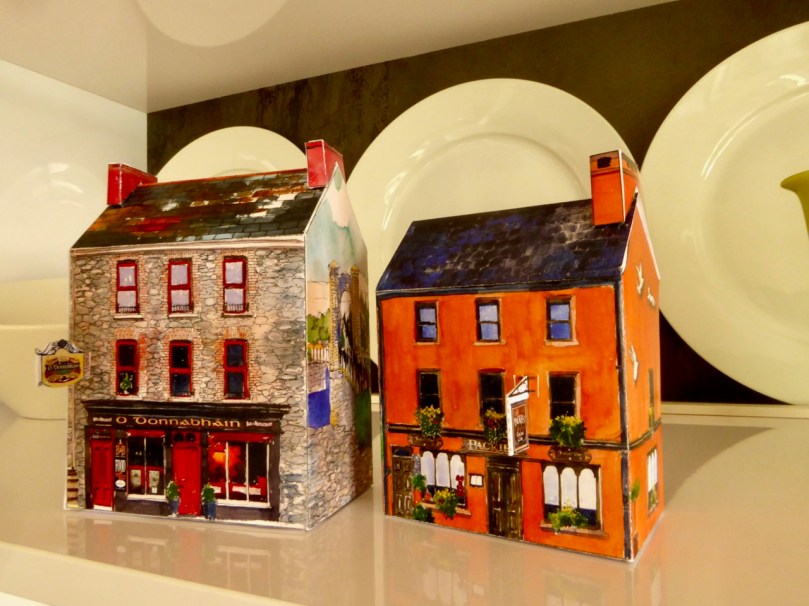
We came home with a Tiny Kenmare kit so that we could experience the assembly process first hand. Not only was this great fun but it gave us additional insights into both the craft of model making and the lovely additional details that Anke has inserted into each piece – details that extend the model into little bits of history.

Robert assembles Packie’s Pub

The second Kenmare building we assembled was O’Donnabháin’s pub and guest house (pronounce it O Dunn-eh-vawn’s). Look around the side – Anke has added the image of a funeral coming over a suspension bridge. Curious, I looked up what this was all about and found that Kenmare did indeed have the first suspension bridge ever built in Ireland – read an amusing account of its history here – and that the funeral was a real one, that of an IRA man murdered by the Black and Tans in 1921.

Kenmare Funeral

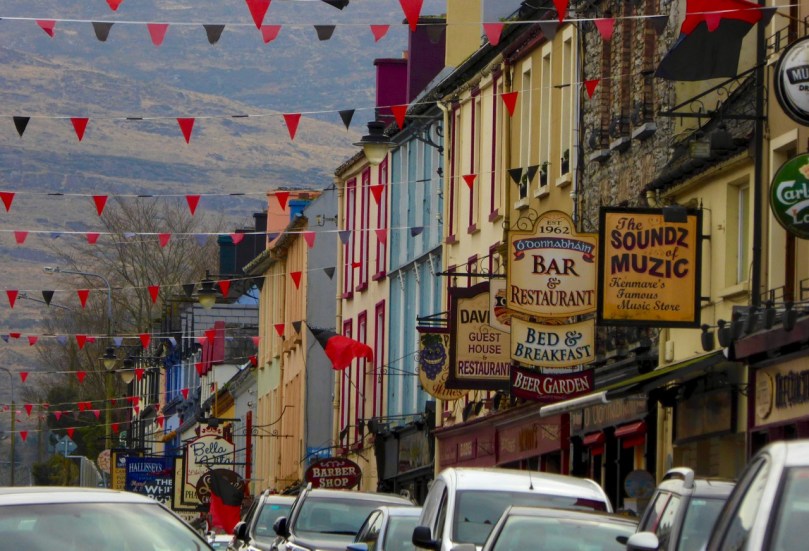
On the shelfKenmare is as scenic and colourful as any town anywhere has a right to be. It’s a great shopping town too, with wonderful cafes and pubs, and right on the justly-famed Ring of Kerry.

Colourful Kenmare 1

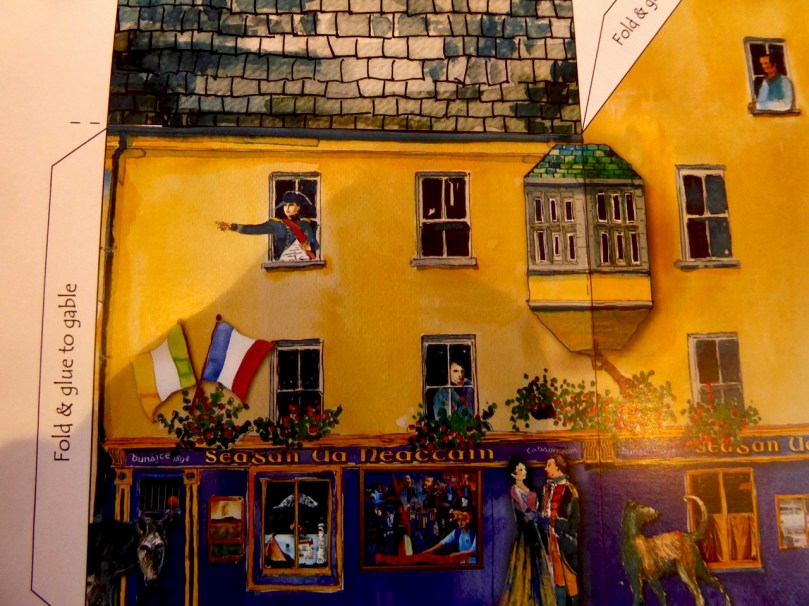
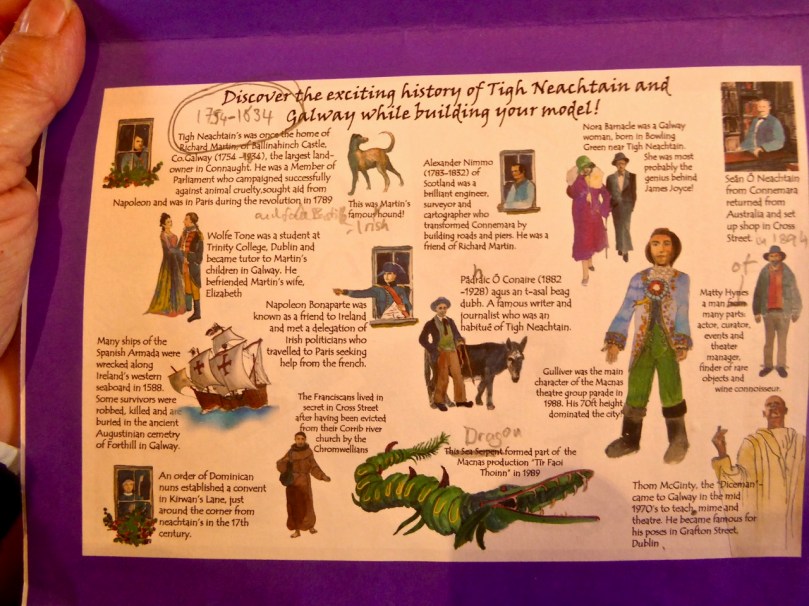
Every model Anke makes is unique and delightful. Individual pubs, shops, castles, etc are often made at the request of the owner. Here’s one for Tigh Neachtain in Galway. Anke showed us a draft of the Explanation sheet that goes with it. It’s an object lesson in how one building can encompass the story of a town. Richard Martin, by the way, is better known to history as Humanity Dick.

Tig Neachtain

Tig Neachtain ExplanationFor tourists, Tiny Ireland models make the perfect gift, light and packable and chock full of the real Ireland. For all of us, making one engages us in a creative act that comes out of the rich imagination and artistic talent of Anke Eckardt.

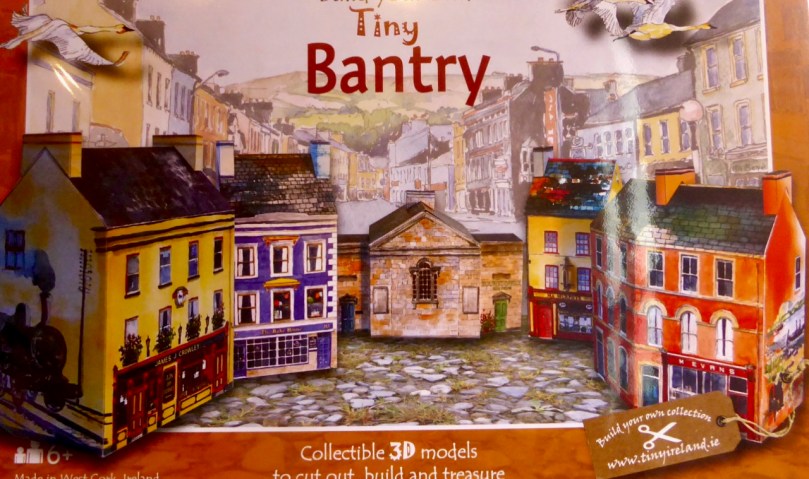
Tiny Bantry

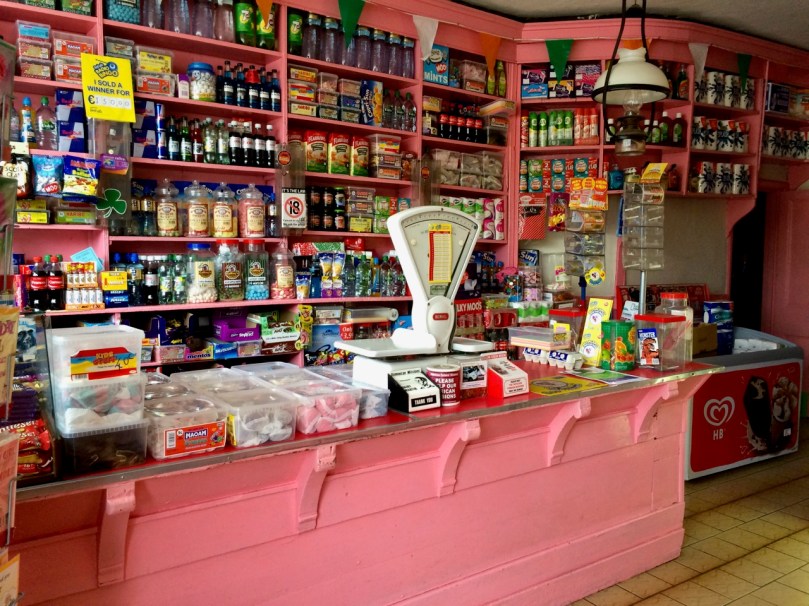
Evans InteriorTiny Bantry – note Miss Evans traditional shop on the right. Here’s what it’s like inside. For more on this and other traditional Irish shops, see Shopping for Memories

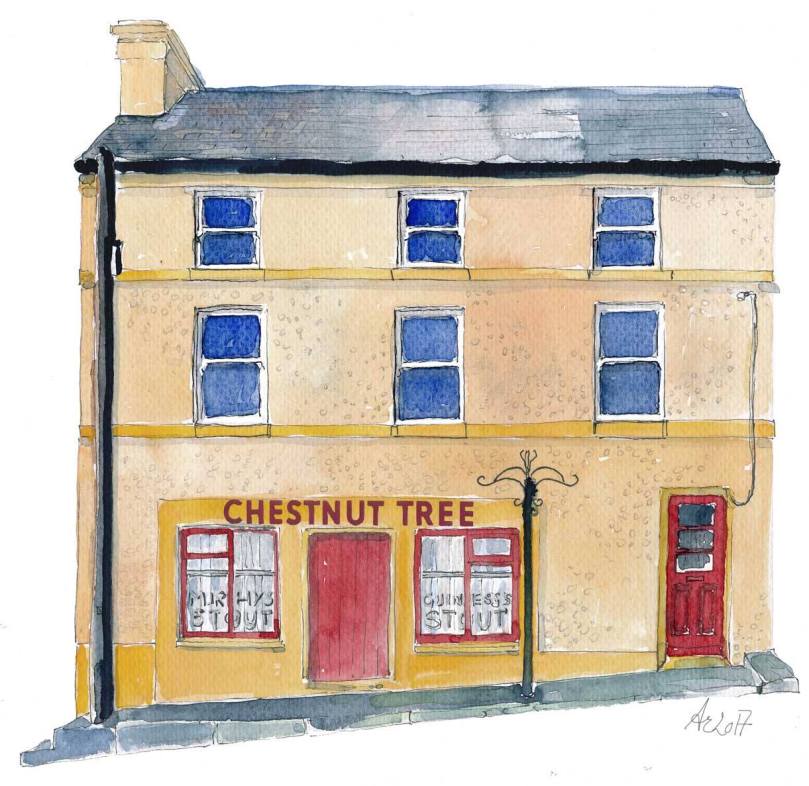
And it’s not just models. Recently Anke has started to produce charming watercolours of the traditional shops and pubs she loves. We in Ballydehob have loved her posts on our wonderful old shopfronts. Here’s an example – Just drive down our main street and you can’t miss The Chestnut Tree.

chestnut-tree

Happy cutting and glueing!

Around the back

The First Viral Sensation: How a Pre-Raphaelite Painting Inspired a Generation

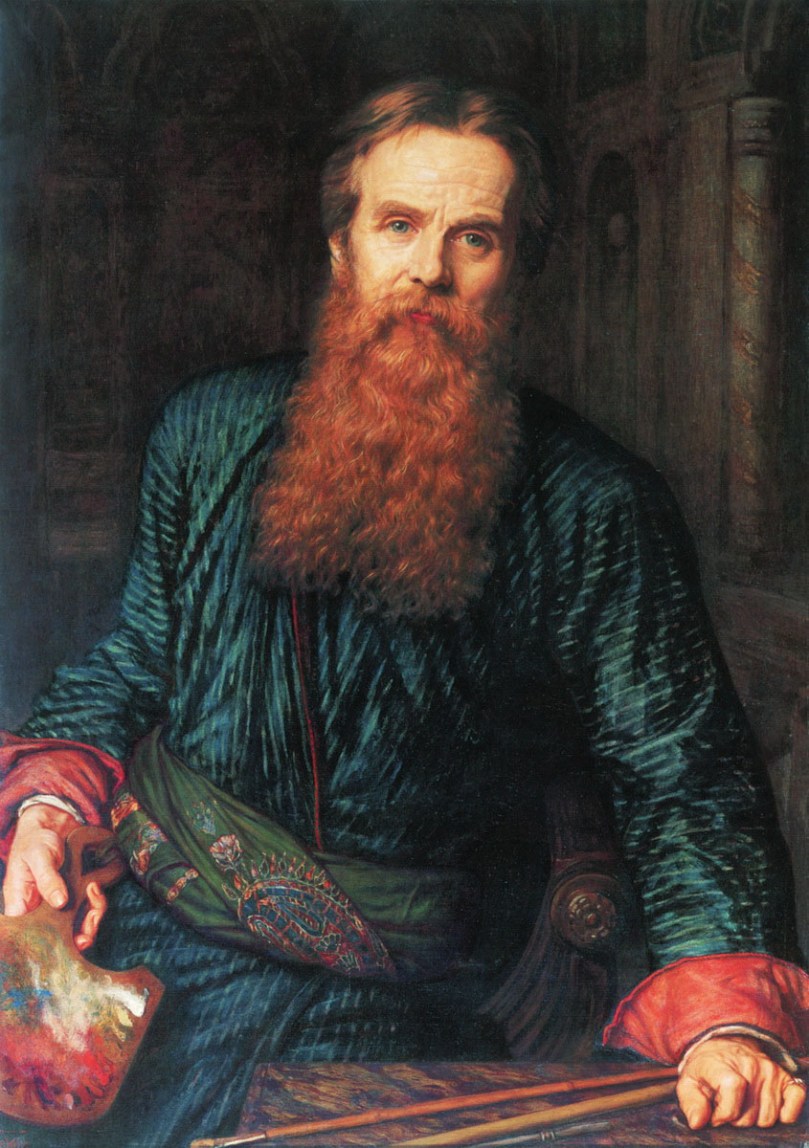
william_holman_hunt_-_selfportrait

Holman Hunt, one of the three founders of the Pre-Raphaelite Brotherhood

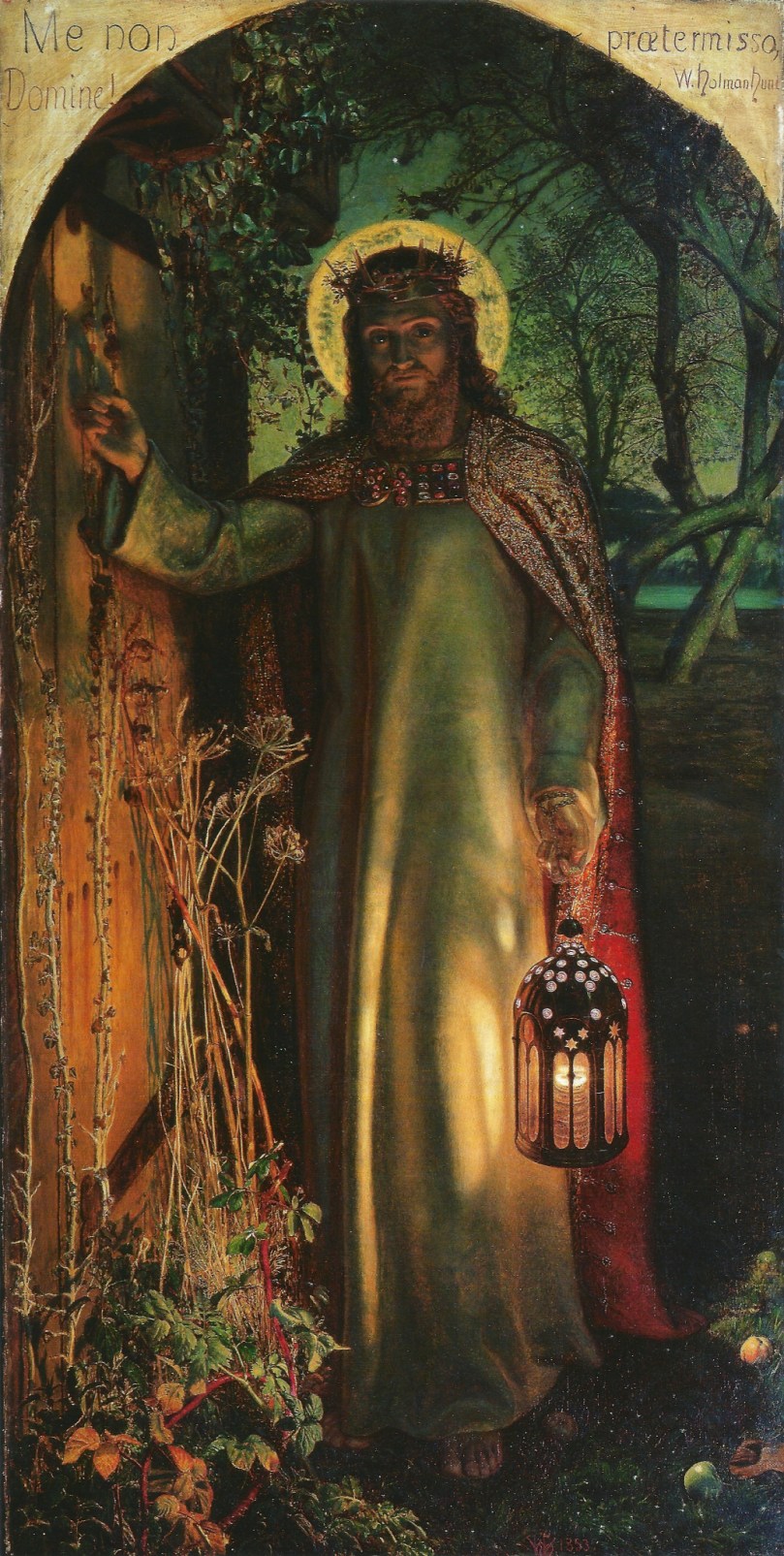
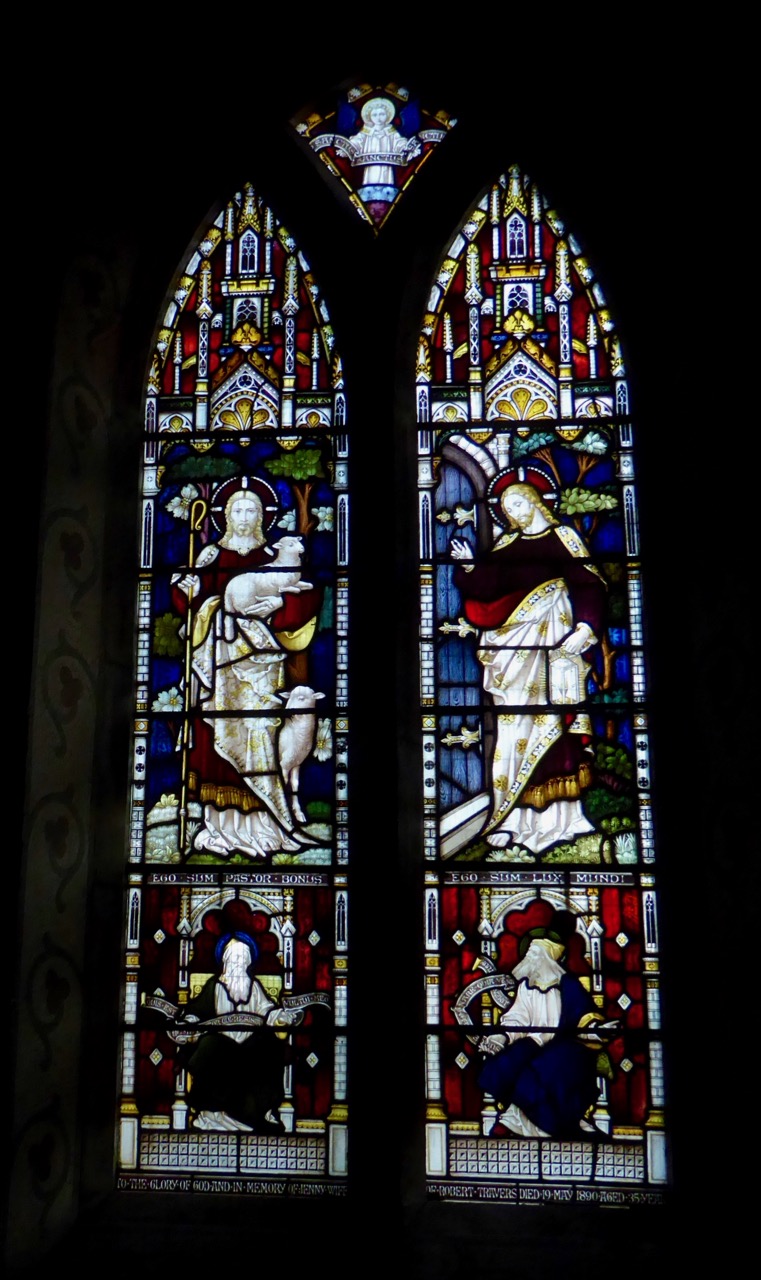
In preparing for an upcoming talk of stained glass in West Cork, I was struck by a single image that seemed to crop up again and again. The image was described as The Light of the World, or occasionally as Christ Knocking at the Door.

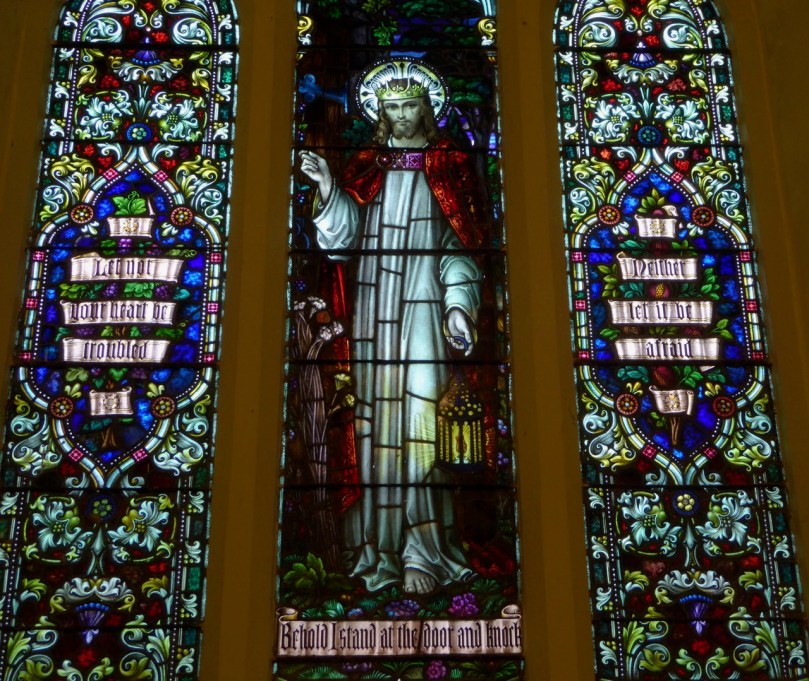
St Matthias Light of the World by Clokey of Belfast 1945

Christ as the Light of the World. This window, by Clokey of Belfast is in St Matthias Church of Ireland in Ballydehob

Curious, I searched online to find out more about the window and discovered to my astonishment that the painting upon which the window was based was The Light of the World by the Pre-Raphaelite painter Holman Hunt and, in the words of Robert Fulford, although…Hardly anyone today admires The Light of the World as art…it remains a historic moment in mass culture, the beginning of the great age of reproduction, the first image that millions of people knew intimately, and often loved.

hunt-light-of-the-world1

Holman Hunt’s Light of the World. It was based on Revelation 3:20 Behold, I stand at the door, and knock: if any man hear my voice, and open the door, I will come in to him, and will sup with him, and he with me.

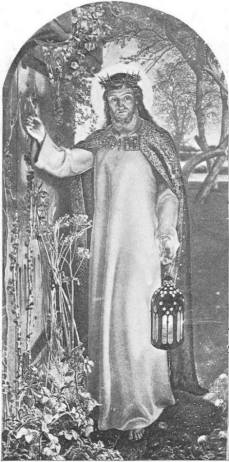
Hunt’s first version light-of-the-world-engraving(he eventually painted three) was begun in 1851 and was widely admired. But it was two other media that carried it to the status of international icon. The first was engraving (left) – the photography of its age in its ability to convey images to a mass audience – and the second was stained glass, just coming into its heyday as a result of recent innovations in church architecture and decoration.

The painting toured the world and attracted enormous crowds wherever it went. It is estimated that four fifths of the population of Australia viewed it, for example. Fulford describes it thus: In Melbourne in 1906 visitors stampeded, anxious to see it the moment it was open to the public. But if the crowd was rowdy at first, Maas writes, soon “an air of reverential awe descended on the gathering.” Men removed their hats, voices fell to a whisper. Some people stood or sat gazing at it for hours. A few visitors fainted. Later it toured South Africa and in 1907 returned in triumph to Britain and its final destination, St. Paul’s.

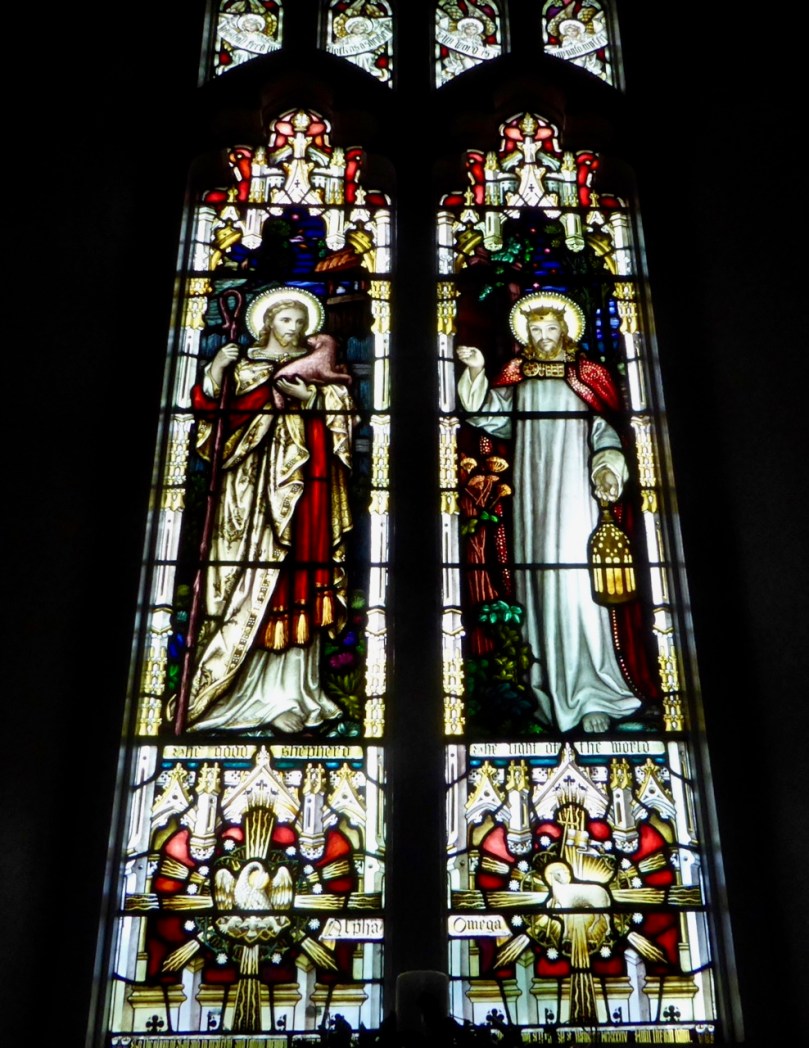
Rosscartbery Light of the World Mayer 1934

This window in Rosscarbery Cathedral is by Mayer of Munich. Christ as The Light of the World was often paired in a two-light window with Christ as the Good Shepherd

How to explain the appeal of this image? Holman Hunt himself gives us a clue. Writing in The Victorian Web, George Landow states that Hunt …believed that The Light of the World created its symbolic language in precisely the same way that men had formed language to express abstract and spiritual ideas. The important point is that, since the symbolism derives from what he takes to be essential habits of mind, it would be immediately comprehensible to any audience, because such “natural” symbolism does not require any knowledge of iconographic traditions. It appears he was correct, since the symbolism employed in the painting spoke directly to masses of people who took its message to heart and hung engravings and reproductions in their homes.

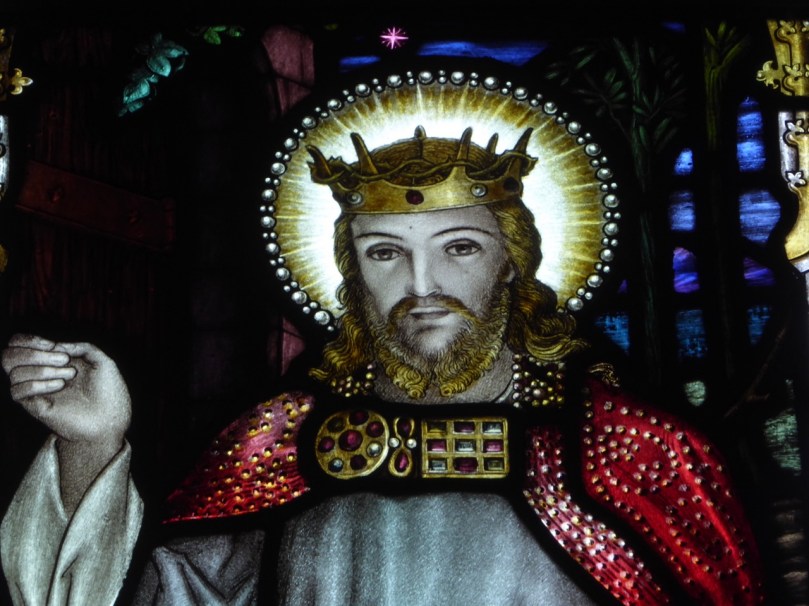
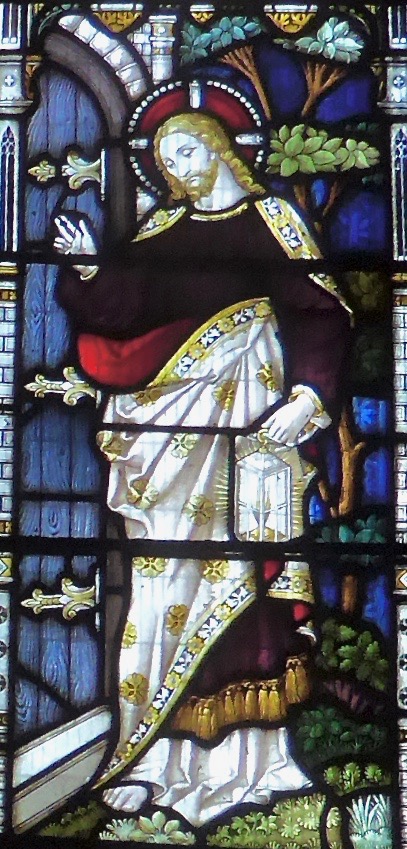
Rosscarbery Cathedral Light of the World detail

Detail from the Mayer window

And in their churches. In its listing of the glass in Church of Ireland churches, the website Gloine* lists 70 examples of Light of the World windows and a few others labelled Christ Knocking at the Door. Of these, about 65 are modelled directly on the Holman Hunt painting. Most of the stained glass studios are represented in the list – it was such a popular request that every studio had to have it in its catalogue. While there are more windows devoted to, for example, the Resurrection, or the Four Evangelists, they are all quite diverse representations, rather than being based upon a single original source. A similar list does not exist for Catholic churches, but it is unlikely that the Light of the World would be as prominent in them, mainly because most stained glass windows in Irish Catholic churches are later than the high point of popularity for Hunt’s painting.

Timoleague Good Shephard and Light of the World, 1890 Clayton and Bell

This window by Clayton and Bell dates from 1890 and is in the Church of the Ascension (C of I) in Timoleague

So here’s a challenge for you, Dear Reader. Have you seen this image in stained glass, or elsewhere? Were you familiar with the painting and aware of its impact? Do you have photos, stories or memories to share? Or is this an image that had its moment, particular to its day and time, and then disappeared from our consciousness like so many others have, before and since?

Timoleague Good Shephard and Light of the World, 1890 Clayton and Bell Detail

Detail from the Clayton and Bell window in Timoleague

*My grateful appreciation goes to Dr David Lawrence and the website Gloine – Stained glass in the Church of Ireland. This is a magnificent resource that contains information on almost every stained glass window in almost every Church of Ireland building in Ireland and Northern Ireland. It is awe-inspiring in its scope and erudition. The site lists two more examples from West Cork, Durrus and Caharagh.

Nest of the Eagle

eagles over nead

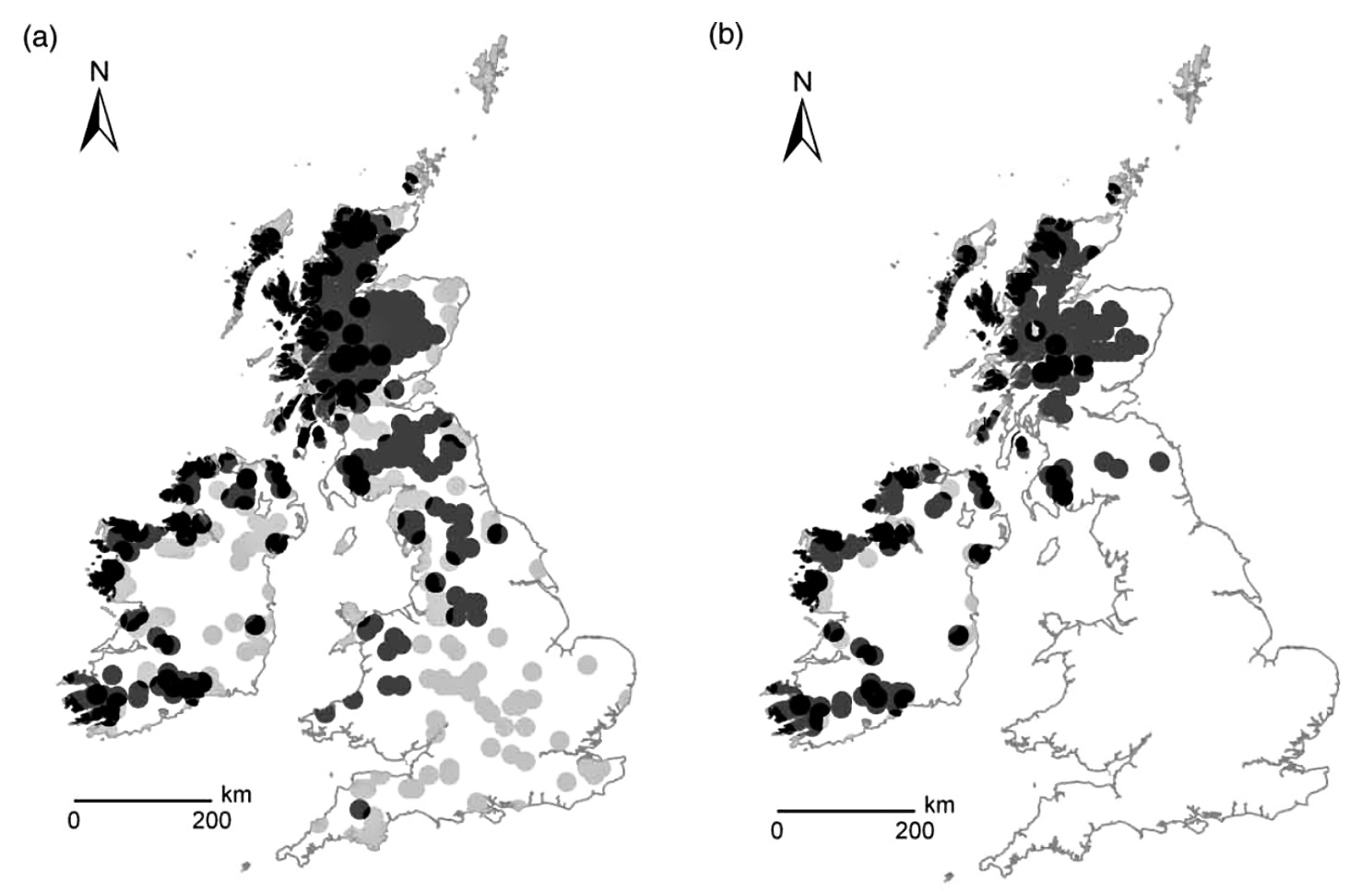
Nead an Iolair – that is the house we live in, here in the townland of Cappaghglass, West Cork. That’s it, in the picture above, with a pair of eagles flying overhead… We don’t see them very often. Well, in truth, we haven’t seen them at all – this is a bit of photographic magic – and wishful thinking. Nead an Iolair – our Irish readers will know that this means Nest of the Eagles – is a perfect name for the site, suspended way up above Rossbrin Cove – a good lookout with higher ground behind: exactly the right environment for the big birds. There were undoubtedly eagles here once – and in various other parts of Ireland – but when and how many? As with most things nowadays, someone has carried out the research and there’s a study available online. It’s worth a read, but I can summarise the main points: analysis of place-names and documentary evidence from the last 1500 years enabled the following diagrams to be drawn up:

eagles data

Data from The history of eagles in Britain and Ireland: an ecological review of placename and documentary evidence from the last 1500 years – Evans, O’Toole and Whitfield, RSPB Scotland 2012. Diagram (a) is 500AD and diagram (b) is 1800AD. The dots show Golden Eagle locations in dark grey, White-tailed Eagle locations in light grey and overlapping of both species in black

The diagram shows that White-tailed Eagles have lived here on the Mizen Peninsula 1500 years ago, and both species have been located a little further up the west coast as recently as 200 years ago. In 2001 fifty young golden eagles were released in Glenveagh National Park, Donegal, in an attempt to reintroduce the bird to Ireland. In a similar project to reintroduce white-tailed eagles,  one hundred of the birds were brought from Norway to the Killarney National Park between 2007 and 2011, and up to September 2016 thirteen chicks have survived. The aim is to get at least ten chicks flying from their nests each year. Six white-tailed eagle chicks have flown from their nests in Ireland in 2016, making it the most successful year yet; one of these chicks was born near Glengariff, which is only just over the hill from us in terms of an eagle’s range. So we remain ever hopeful that the white-tailed eagles (sometimes known as white-tailed sea eagles) will soon make their way down here to Nead an Iolair – attracted, perhaps, by the name. We’d be very pleased to see them circling overhead – they are the largest birds on Ireland’s shores. Already our bird feeders attract avians of all shapes and sizes, and they generally get along fine with each other, although the smaller birds do make themselves scarce when Spioróg turns up!

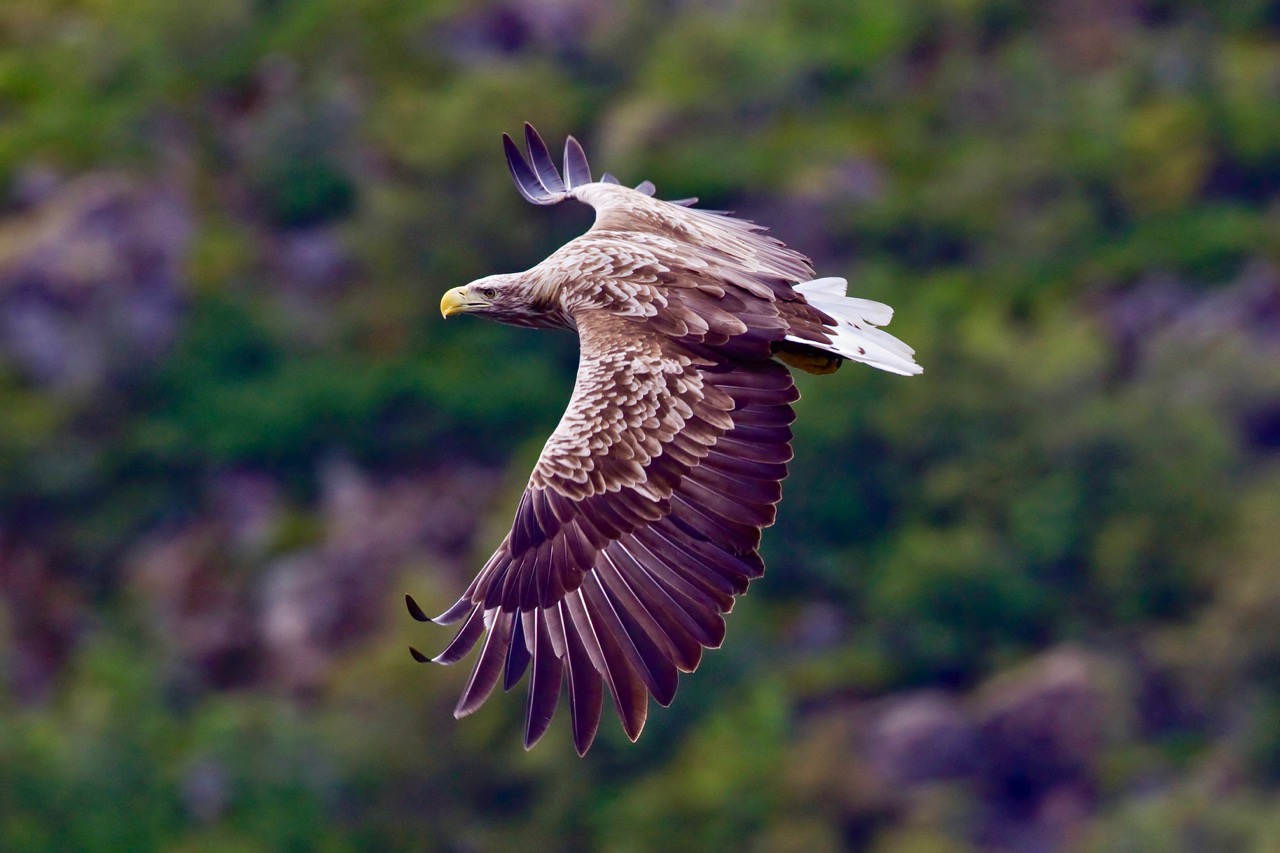
White-tailed sea eagle

A superb photograph of Haliaeetus albicilla – the white-tailed eagle or white-tailed sea-eagle, by Yathin S Krishnappa (via Wikipedia Commons). This was taken in Svolvaer, Norway – geographical source of the birds that were reintroduced into Killarney National Park within the last decade

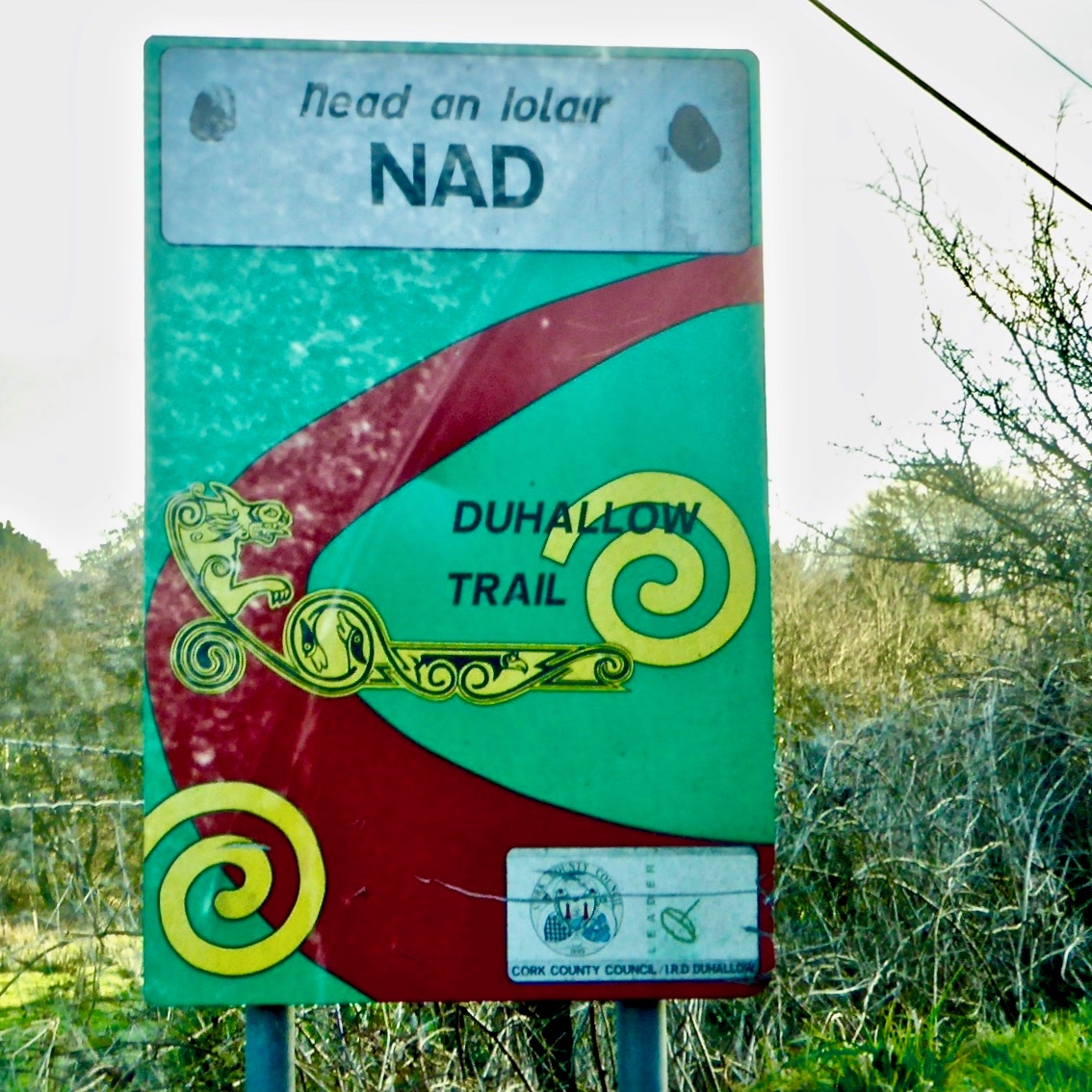
Whenever we are on our travels we look out for the word Iolair (eagle) in place-names. We found one in Duhallow, a Barony in Cork County, just north of the wonderfully named Boggeragh Mountains. In fact we were alerted by signposts directing us to Nad or Nadd (nest) and found ourselves in a tiny settlement which was determined to point out its links with the eagles.

nad road sign

eagle on post 2

large eagle's nest sign

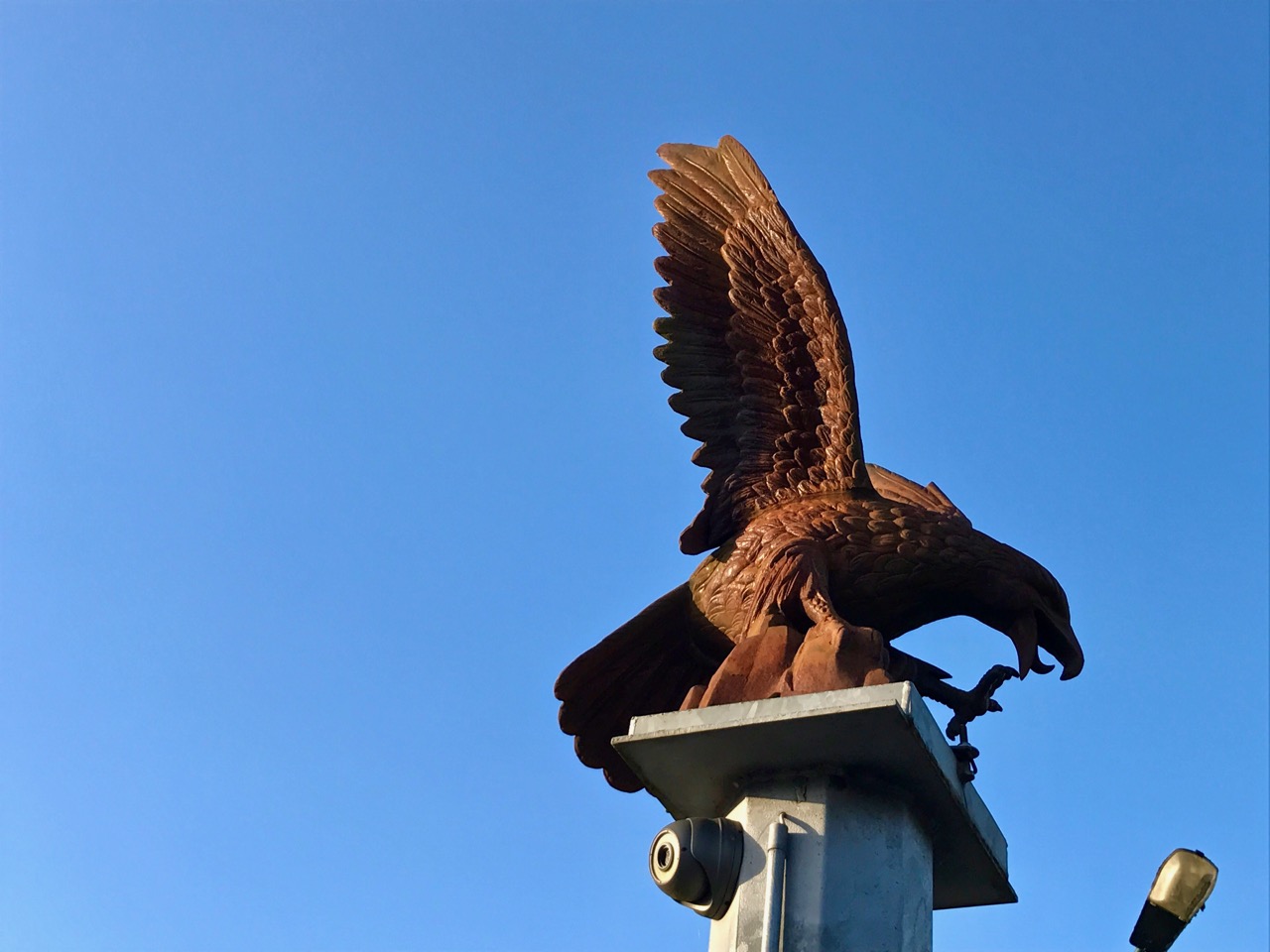
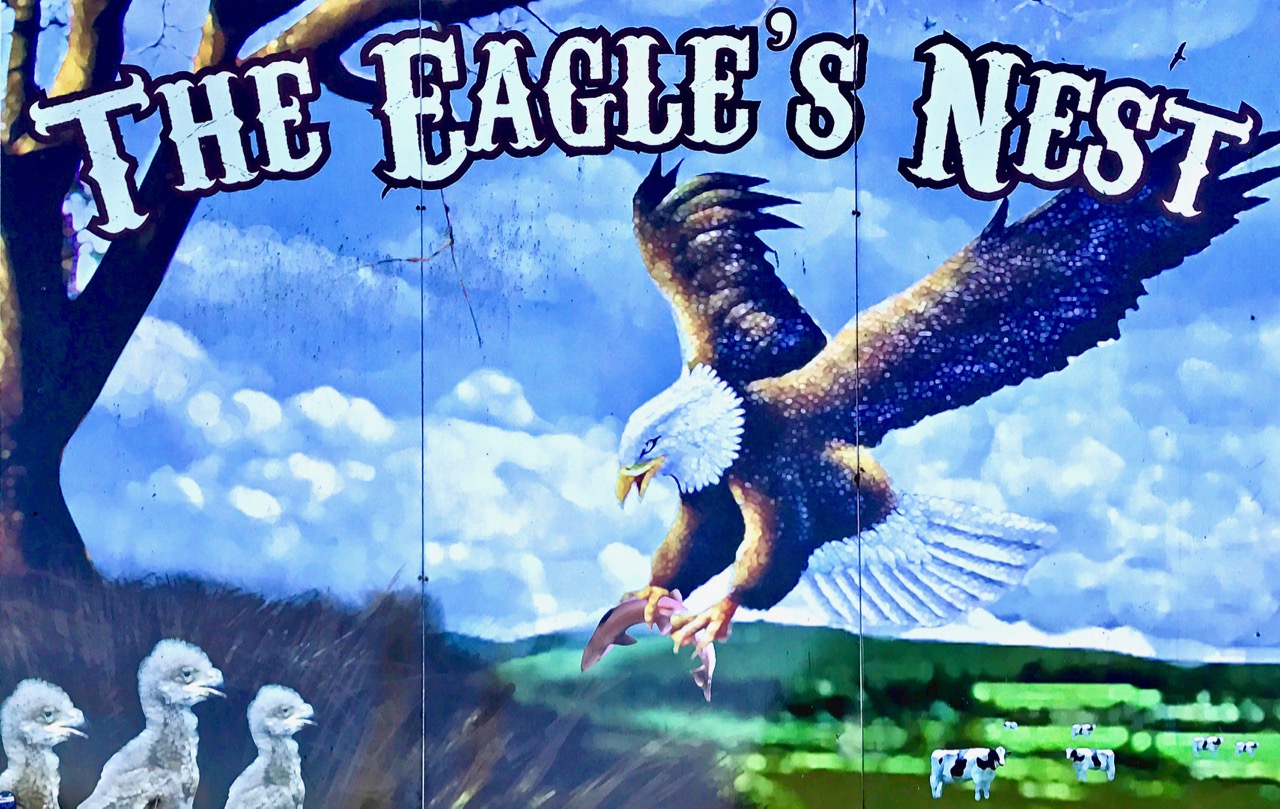
The village of Nead an Iolair in Duhallow, North Cork makes its associations with eagles very clear. The pub is named The Eagle’s Nest, and there is a fine sculpture of the bird sitting Nelson-like on a column beside it

Besides these features the village has a poignant memorial dating from the struggle for independence: a reminder of harsh realities still within living memory. The words that stand out are May God Free Ireland.

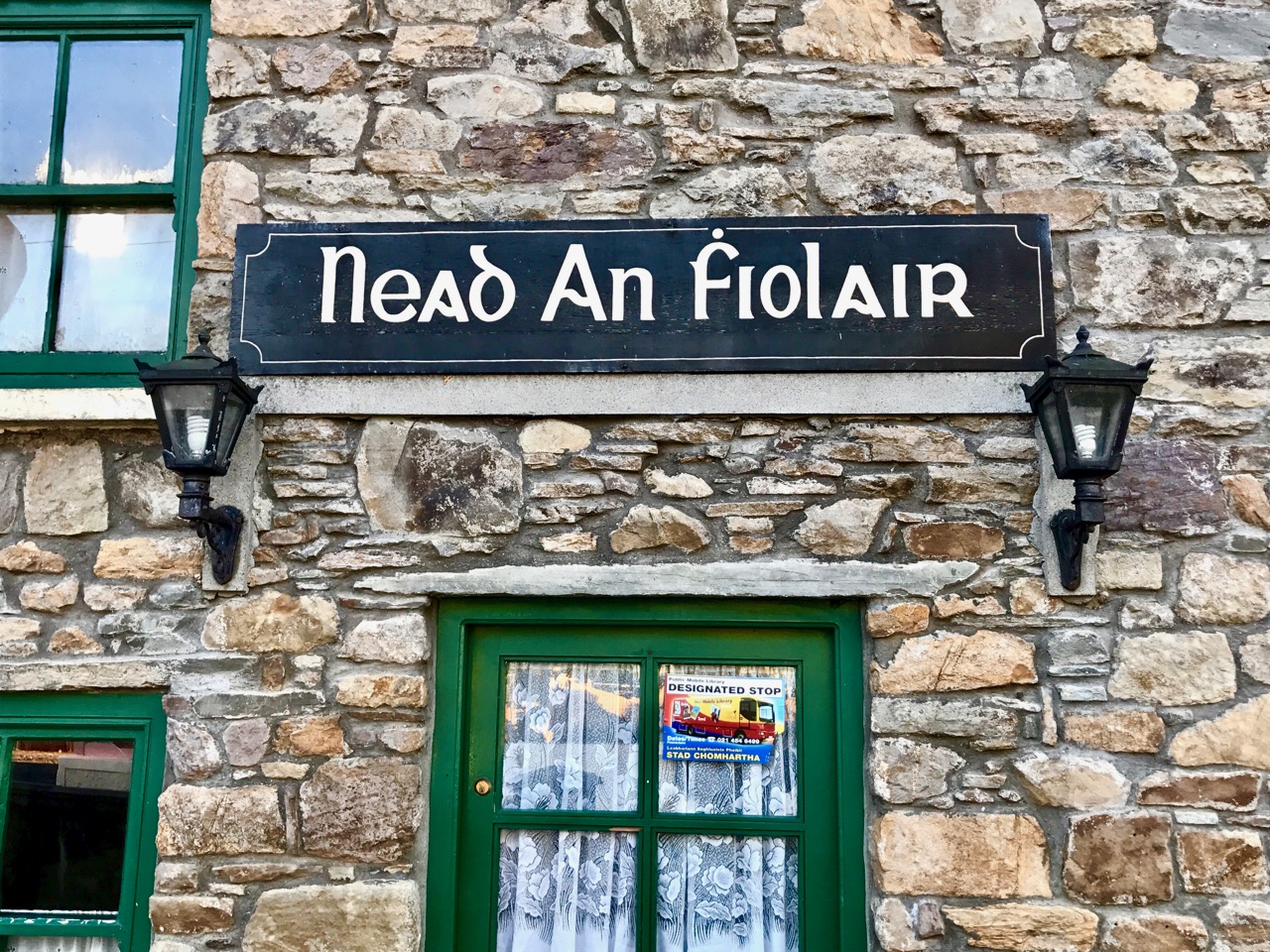
Back to the eagles and – in an interesting diversion into semantics – we noticed that the name over the door of the pub is in old Irish script and has introduced an additional character to the word Iolair – it looks like an ‘f’. Finola tells me that the use of the accent over that ‘f’ – which is known as a búilte – serves to silence the letter. In modern script it would be converted to ‘fh’: so fhiolair would still be pronounced ‘uller’. But we can’t find any precedent for using the word in this form. Perhaps an expert in Irish language can help us here…?

nead an fiolair

Regular readers will be aware that I am always on the lookout for links between Cornwall and the West of Ireland (and there are many). Interestingly, Nead an Iolair is one of them. Just outside St Ives, on the north coast of Cornwall, is a superb house, also called Eagle’s Nest. It was the family home of Patrick Heron, one of the influential St Ives School artists. When I lived in Cornwall I frequently passed by the house and was always impressed with its location – like us now, it is high up above the coast with a commanding view over the myriad small fields and out to the ocean. I always thought I would like to live there, because of that view… Now I have my own Eagle’s Nest – and I couldn’t be more content.

eagles Nest cornwall

Looking across the Cornish moorlands near Zennor, towards Eagle’s Nest – photographed by the artist Patrick Heron, whose home this was

Scissors Cut Paper Wrap Stone – a Review

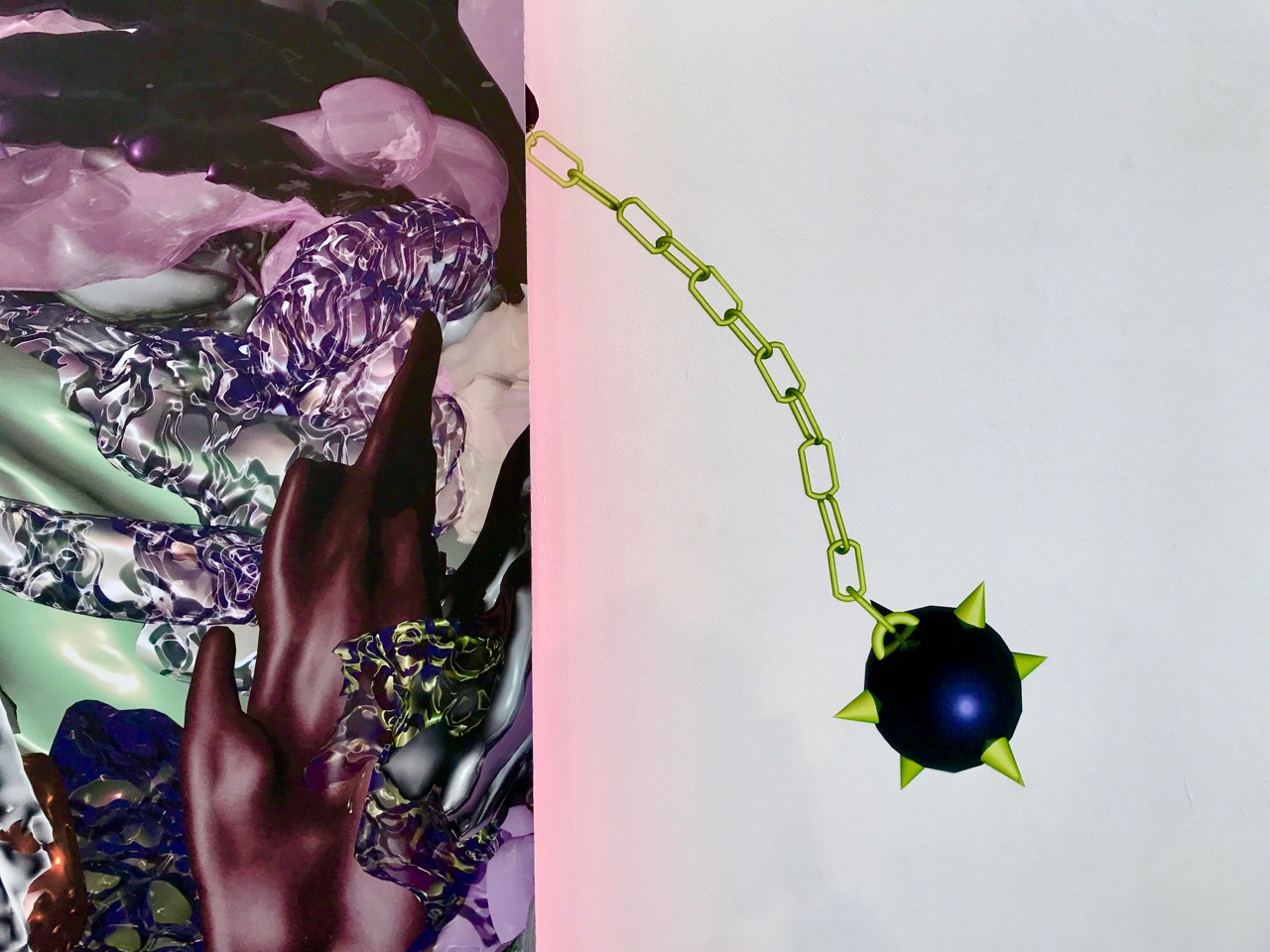
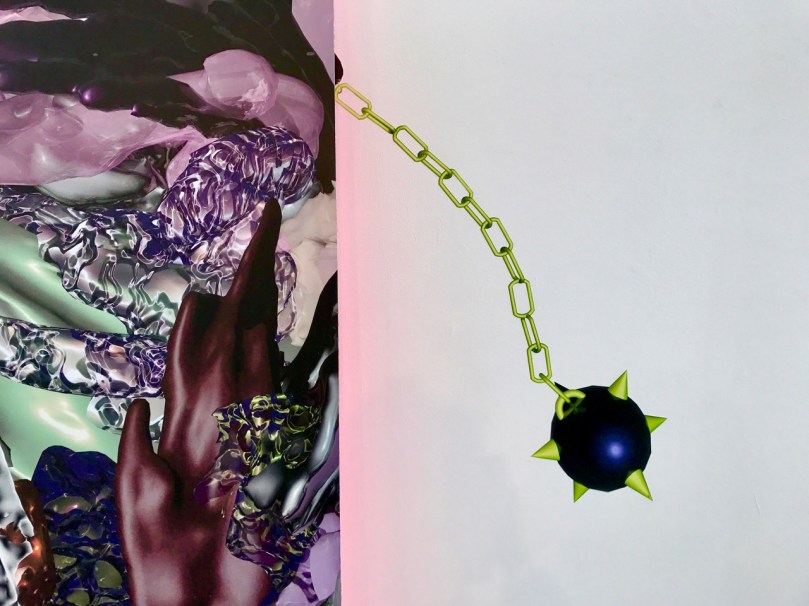
ball graphic

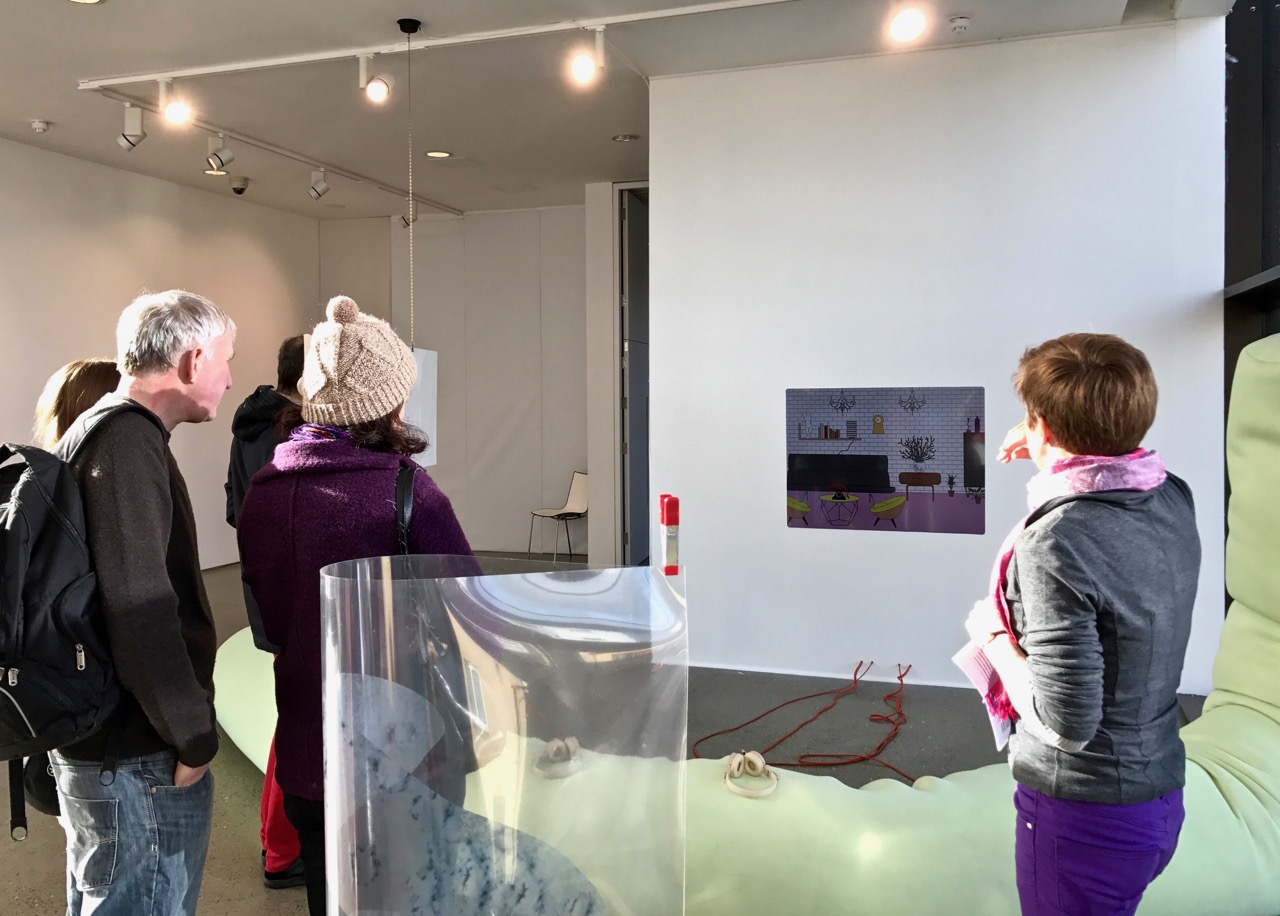
The current exhibition at Uillinn, the West Cork Arts Centre gallery in Skibbereen, is a ‘must’ for anyone interested in contemporary artistic expression – but be aware it’s challenging. Having seen the exhibition being assembled before the opening I decided that I would visit it twice – firstly without giving myself any prior knowledge of the subject matter – and then once more, following a gallery tour led by Alison Cronin of Uillinn and a gallery talk by Jennifer Mehigan, one of the participating artists.
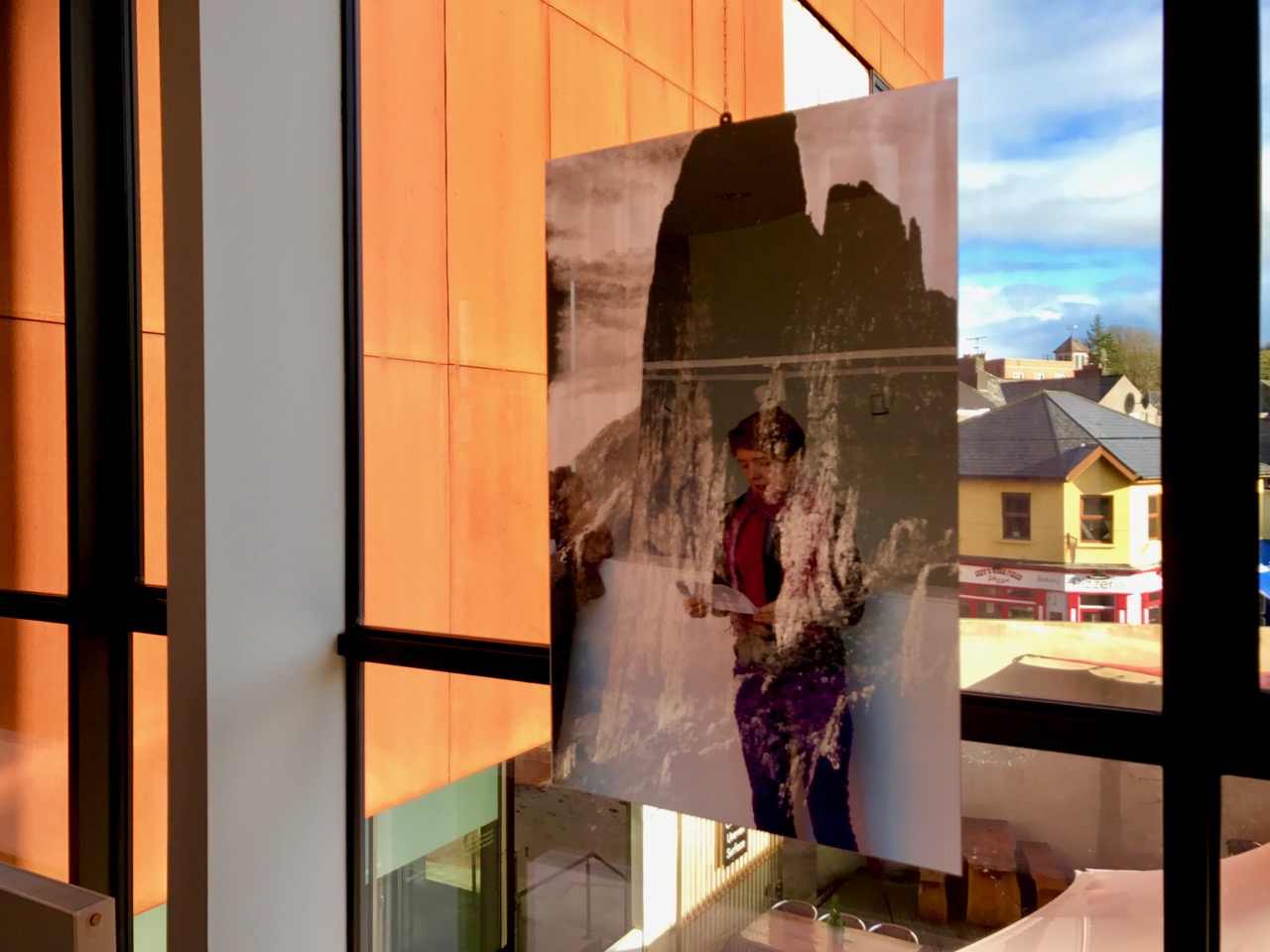
large reflection

I’m very concerned, nowadays, by how ‘art’ is presented, especially ‘art’ which seems divorced from traditional expectations (painted pictures, sculptures etc). I’m fine with all fresh forms of art – and frequently excited by them – but I sometimes wonder whether our artists think about their communication with us… Do they feel that the work should in every way be self-explanatory (we will come away fully informed just by looking at, taking in and understanding the work) – or should their sometimes complex ideas and presentations be explained by accompanying texts, gallery tours, catalogues etc? So I tend to approach every new exhibition with an open mind, hoping for clarity but – firstly – looking for impact from the work. I suppose, at my age, I still think of ‘art’ as being something which should initially stir me, excite me or overwhelm me just through the visual sense: I’m perfectly happy to stand back and look through complex layers of understanding (if necessary) to find the reason for the existence of the artwork, provided it has initially given me that excitement – or whatever emotion – because it will then have drawn me in and made me curious. Some contemporary exhibitions do leave me flat and unstimulated (not many!) and then I have no desire to probe them any further: for me they have failed, but that’s only me, I know. Ultimately, ‘art’ is probably the most subjective of cultural expressions. And that’s all good!
spectators 3

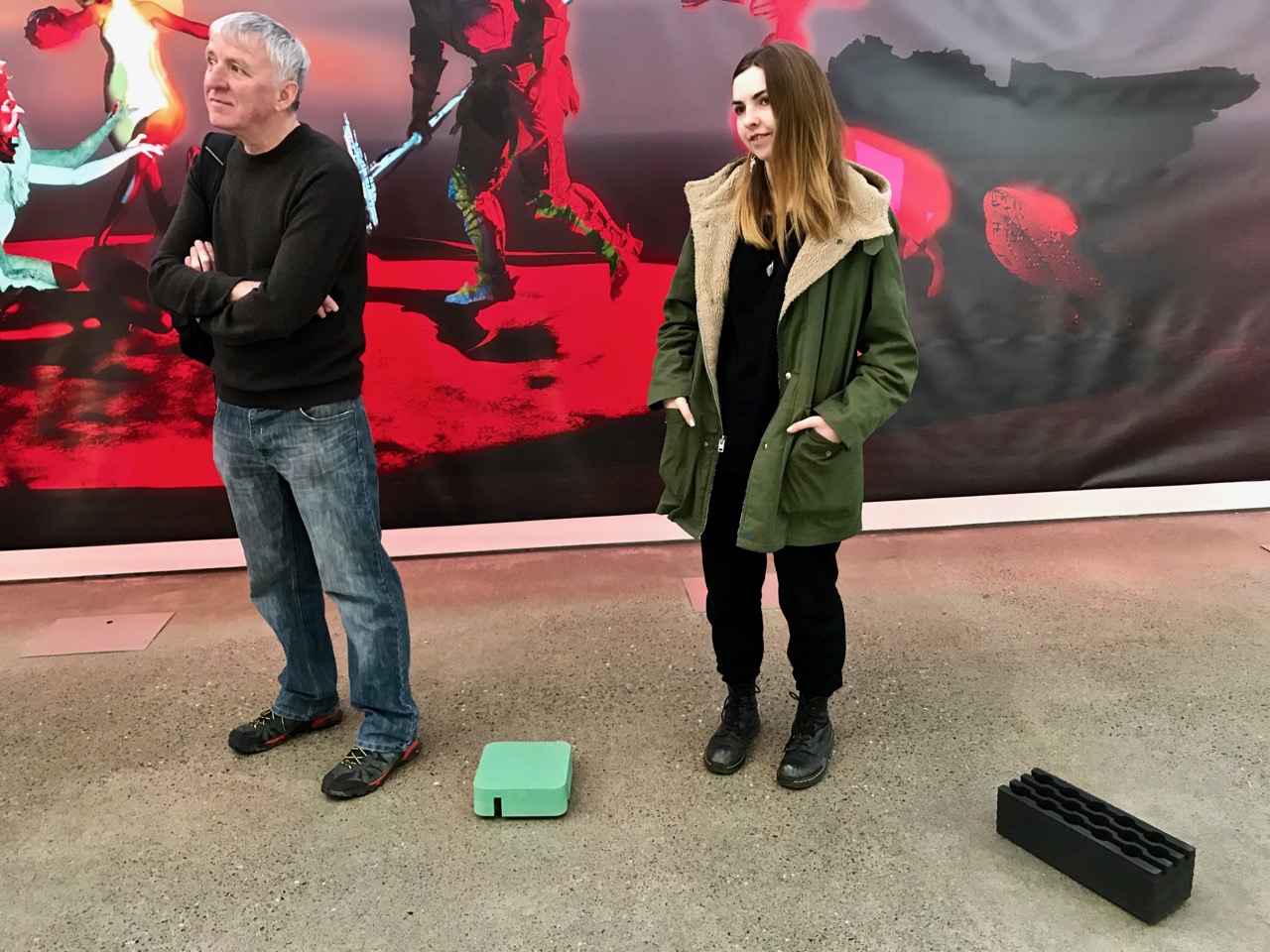
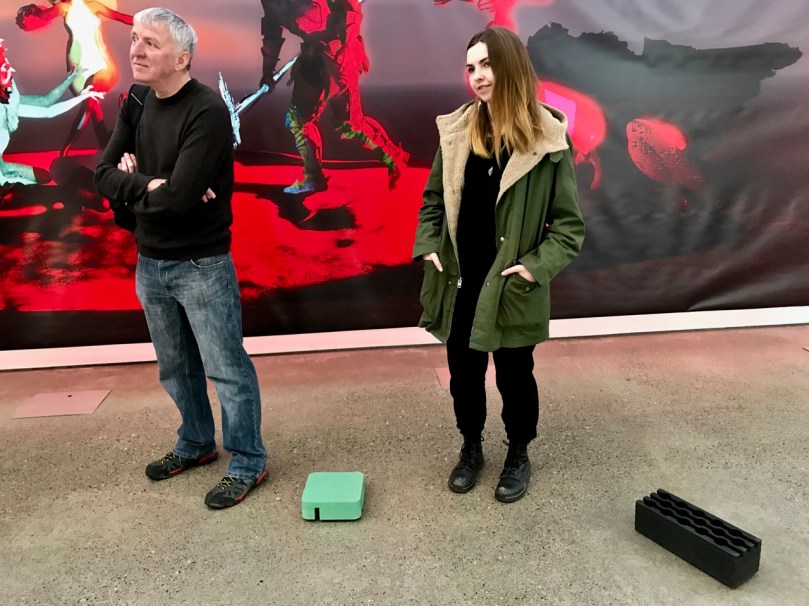
John Russell’s huge backlit print – and two of Eva Fàbregas’s beasts that move around the gallery floor, apparently with a life of their own! 

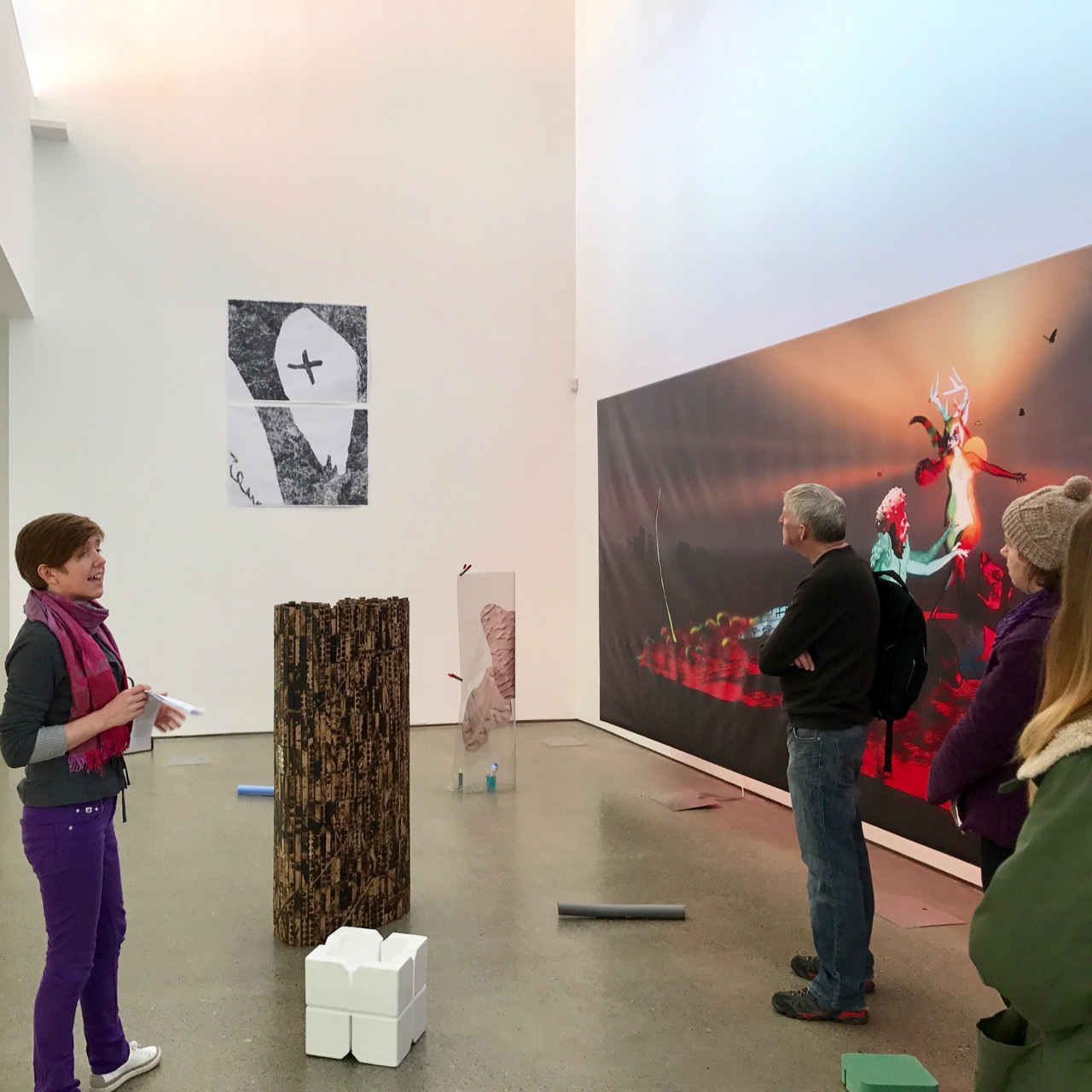
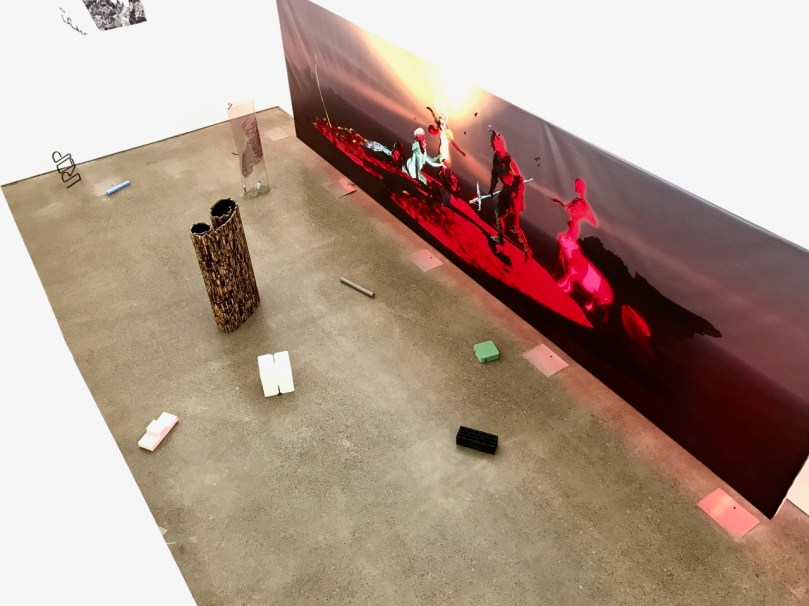
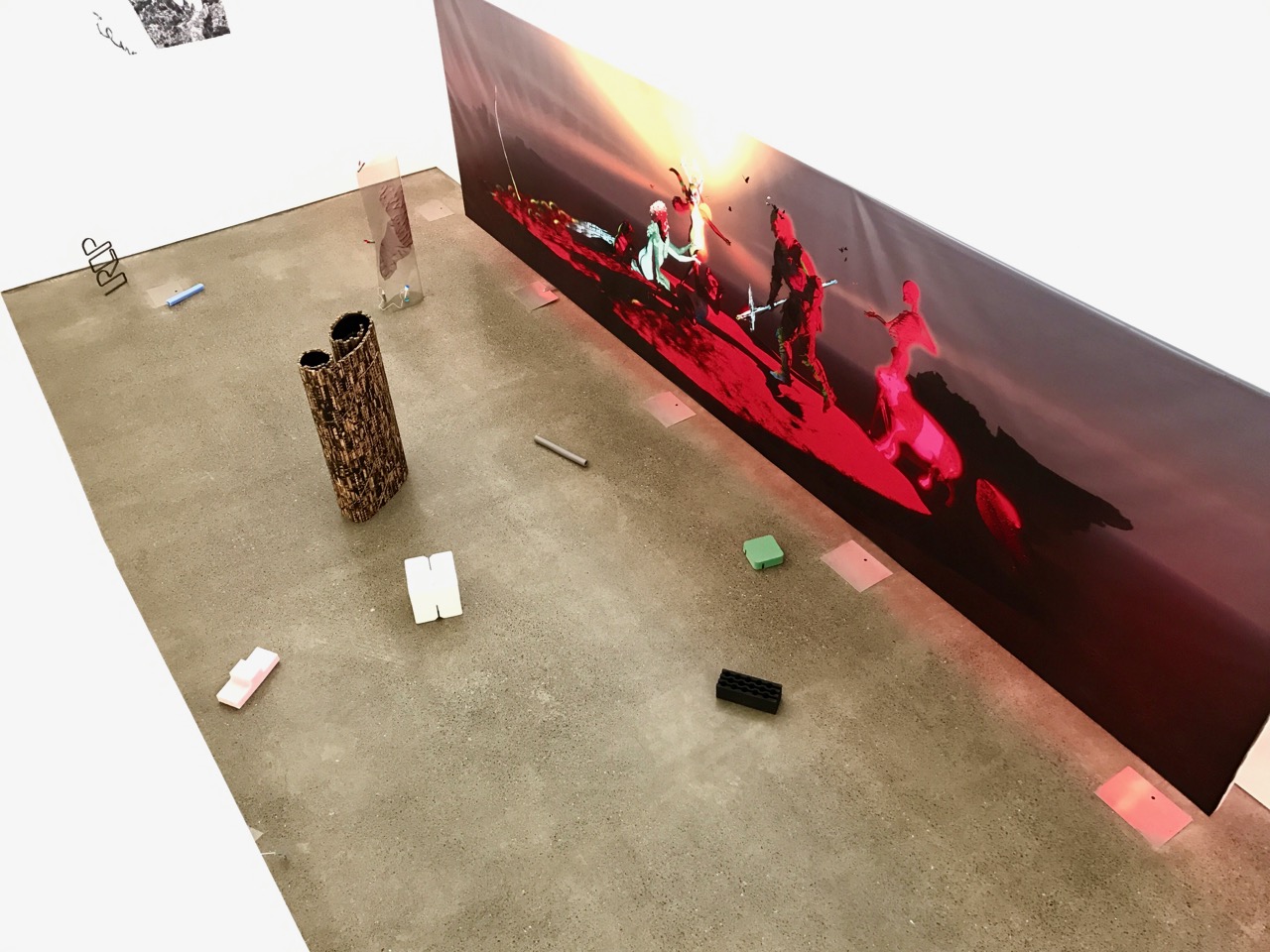
So – how did I react to my initial, completely unguided, tour of Scissors Cut Paper Wrap Stone? I’m pleased to say that I was stimulated – and positively so. I’m always attracted visually by large scale, colour, and things out of the ordinary: that gives you some clues! There are certainly unexpected experiences here. You walk into the first gallery and are hit with a huge print vibrating off the wall, its boundaries emphasised by coloured light behind it. It’s a riot of red – half-human and half- beast figures in a sort of Star Wars tableaux. But then, once you have taken that in you realise that the floor is alive – crawling with more strange beasts that look as though they have had another life as something mundane and practical and are now reincarnated to follow you around the gallery – perhaps to threaten you. What are they? Gallery assistant Kevin enlightened me when he came in to dismantle and repair the mechanics of one of these errant aliens: they are all made from packaging materials fitted with electric motors, and their trajectories across the gallery floor are completely random, referencing, perhaps, their previous lives travelling unsung and unrewarded all around the world. It’s funny how we give life to inanimate (but in this case animate) objects that appeal to us: perhaps it’s a jump back to childhood days when we made things from cereal packets and egg boxes but were then convinced that we had breathed existence into the monsters, dragons, spaceships, princesses (maybe) that we produced. Talking to the gallery staff I was fascinated to hear that some visitors were absolutely convinced that these pieces of mobile packing were imbued with very sophisticated artificial intelligence and really did follow them around and confront them! Remember, this was still before I had any knowledge of the intentions or stimuli behind the exhibits.
balcony capture

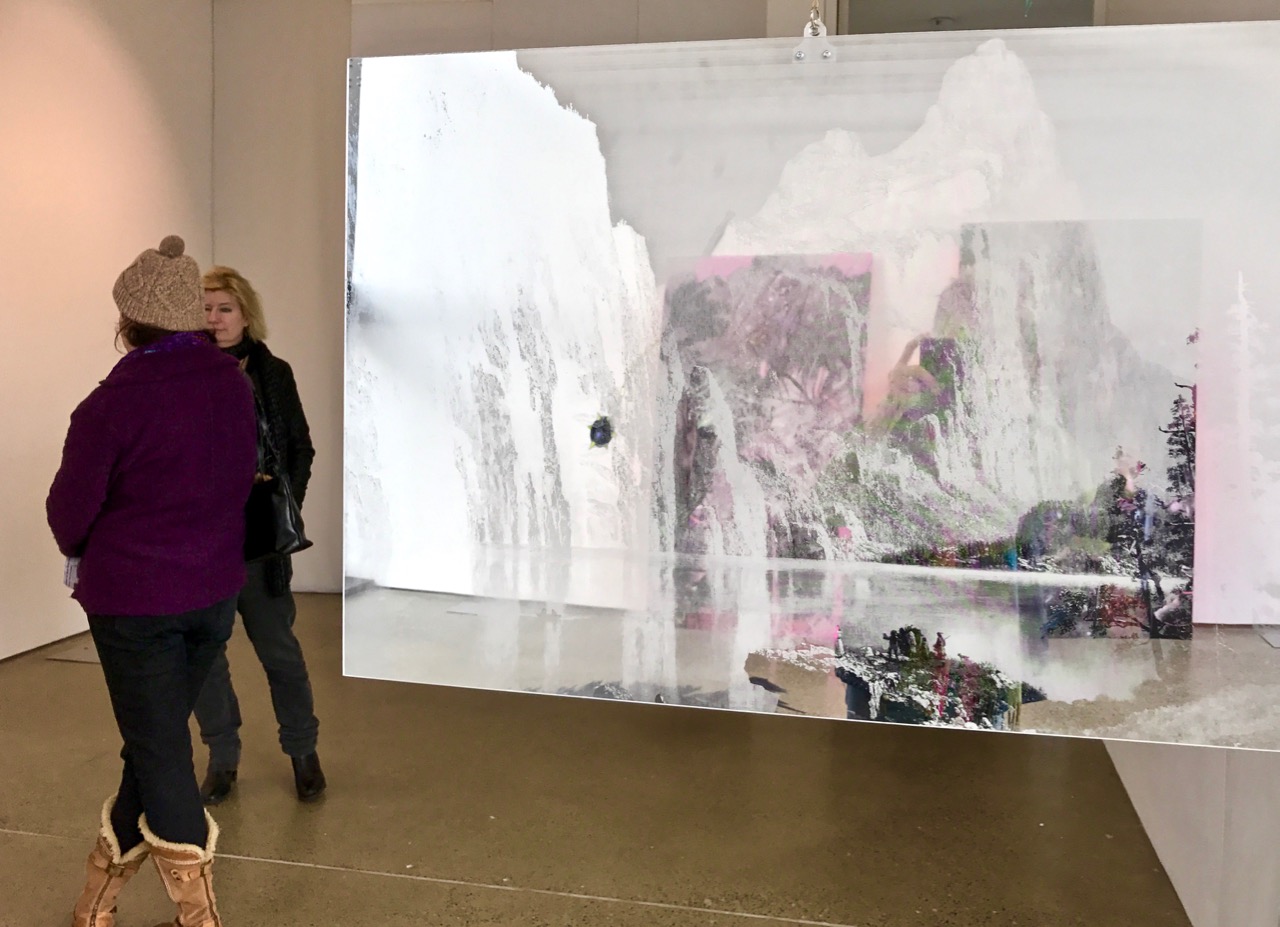
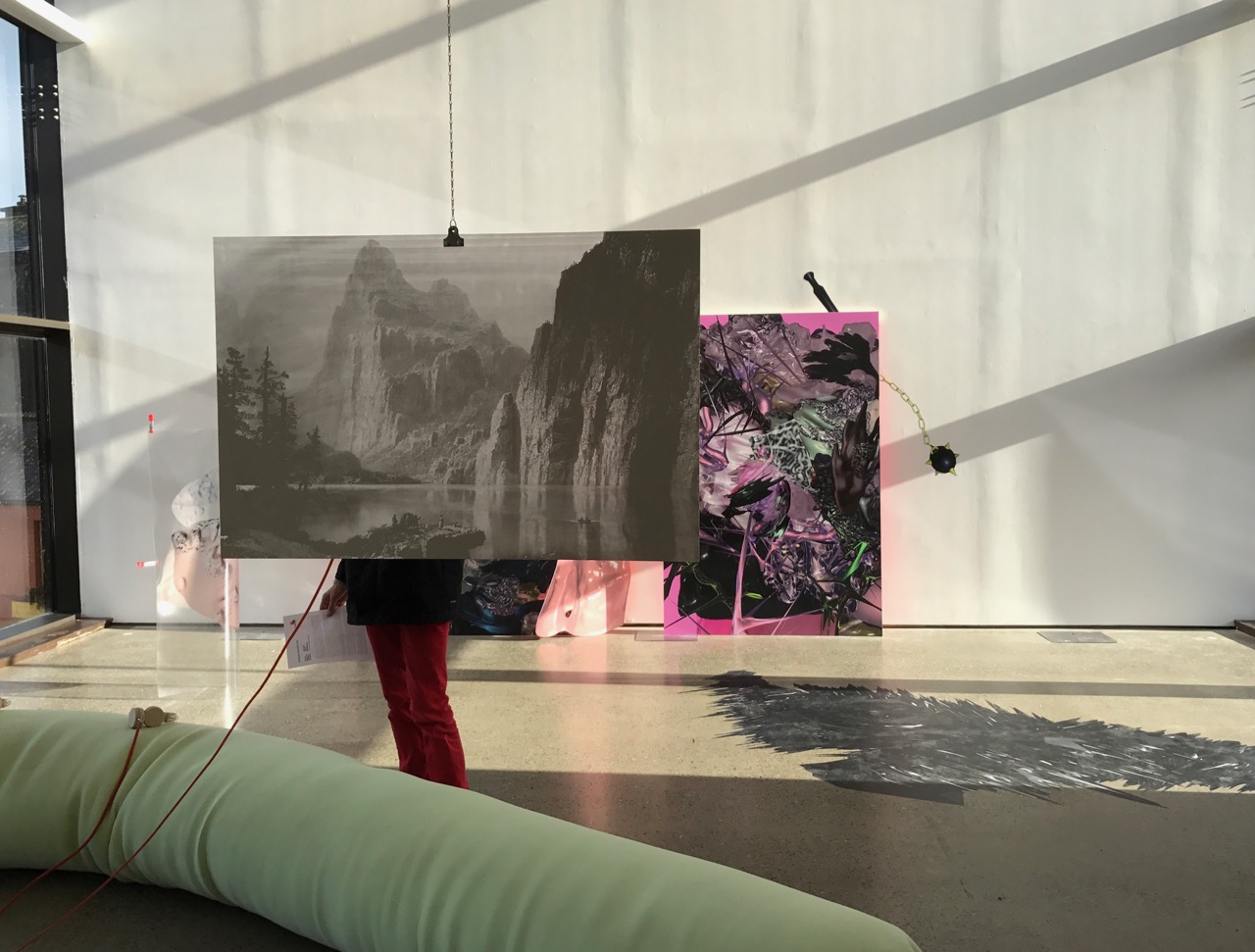
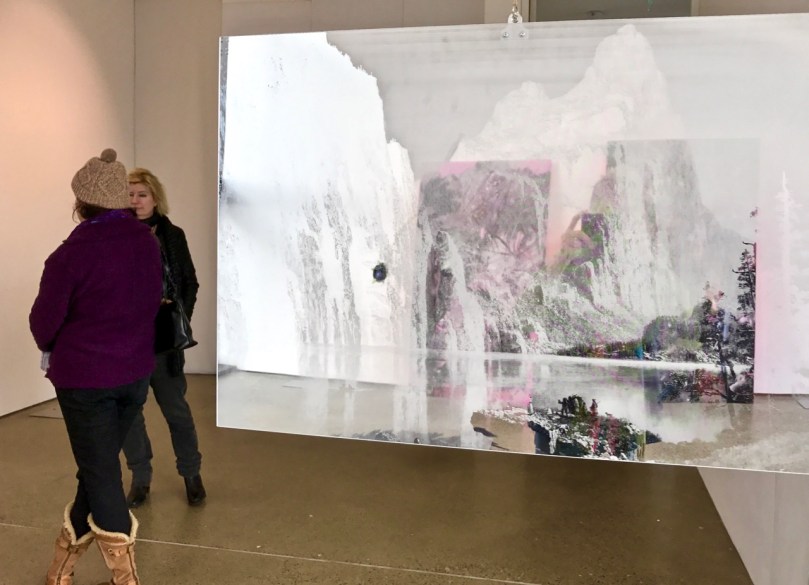
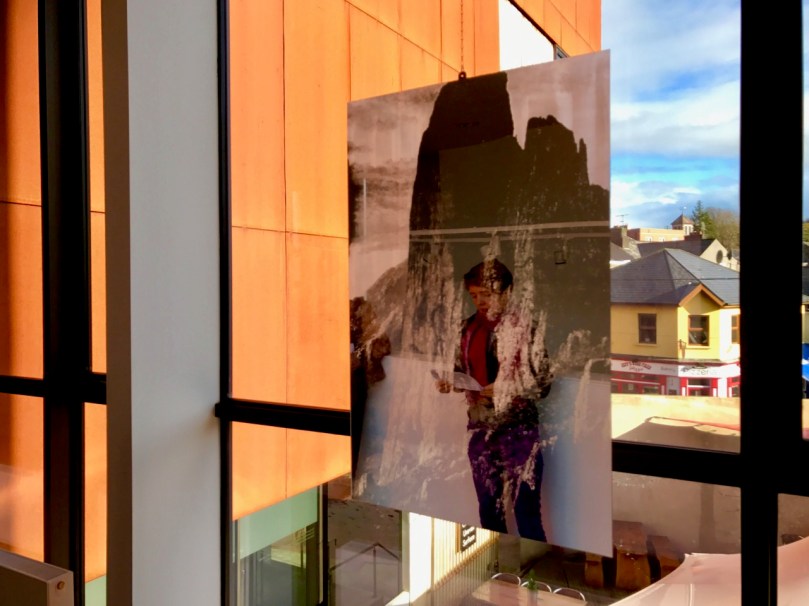
Moving upstairs to the second gallery I found the walkway obstructed by rotating panels of some material (was it glass?) that seemed to be engraved with semi transparent images: they looked like iconic landscape scenes. As I watched, I realised that at certain points in their spinning I was able to see through them, but at the same time also see reflections on their surfaces – of me, of the gallery, of the view through the windows… I liked these very much, and the dymanic nature of their movement and the unpredictable refractions and reflections. I was keen to know how their conception fitted into what I had seen previously downstairs, but I couldn’t guess.

The spinning panels – ‘Orphan Transposition’ – are by Alan Butler and feature acrylic panels laser-etched with images of Yosemite National Park: they also have an intentionally accidental life of their own through the changing surface reflections

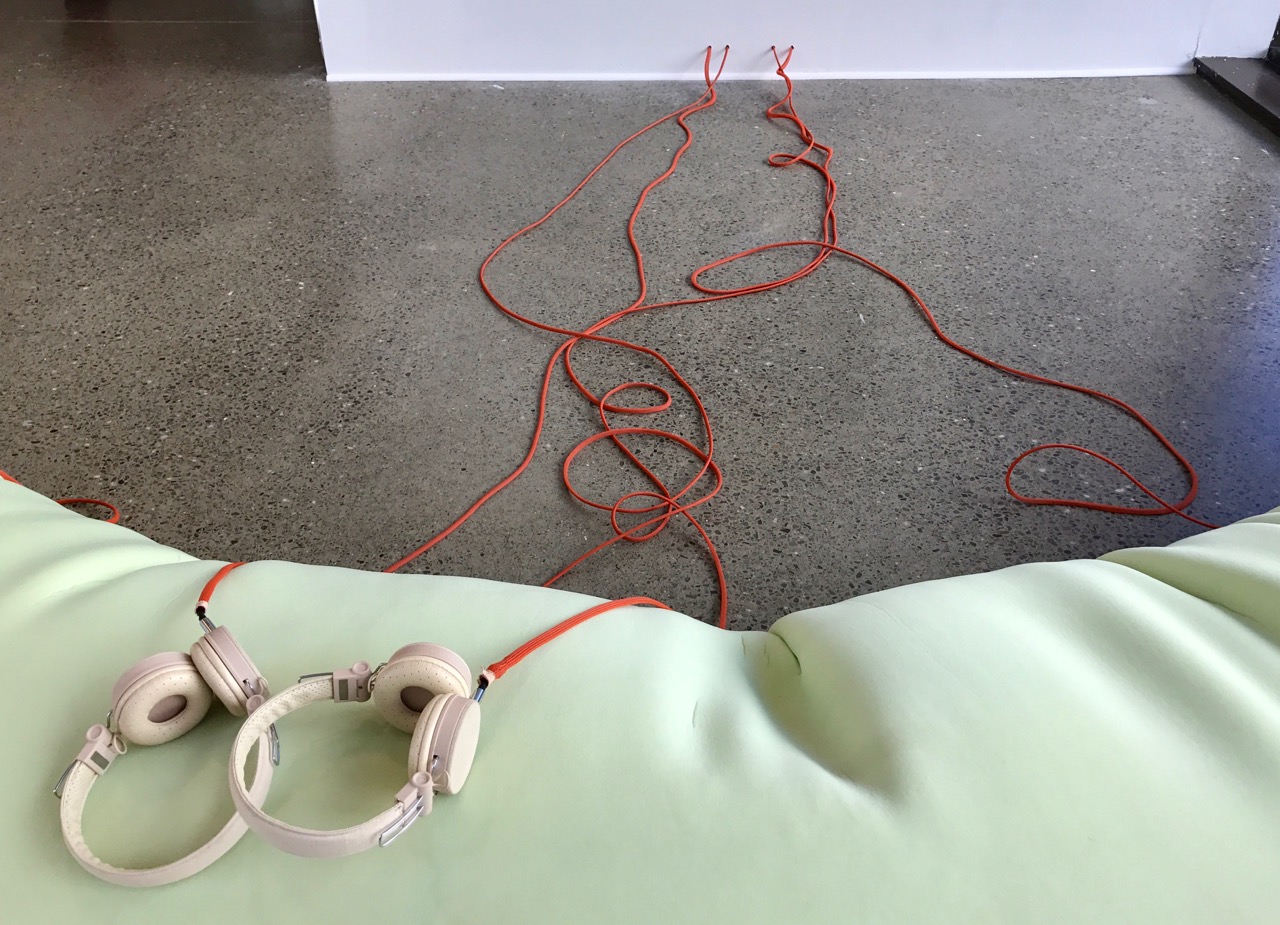
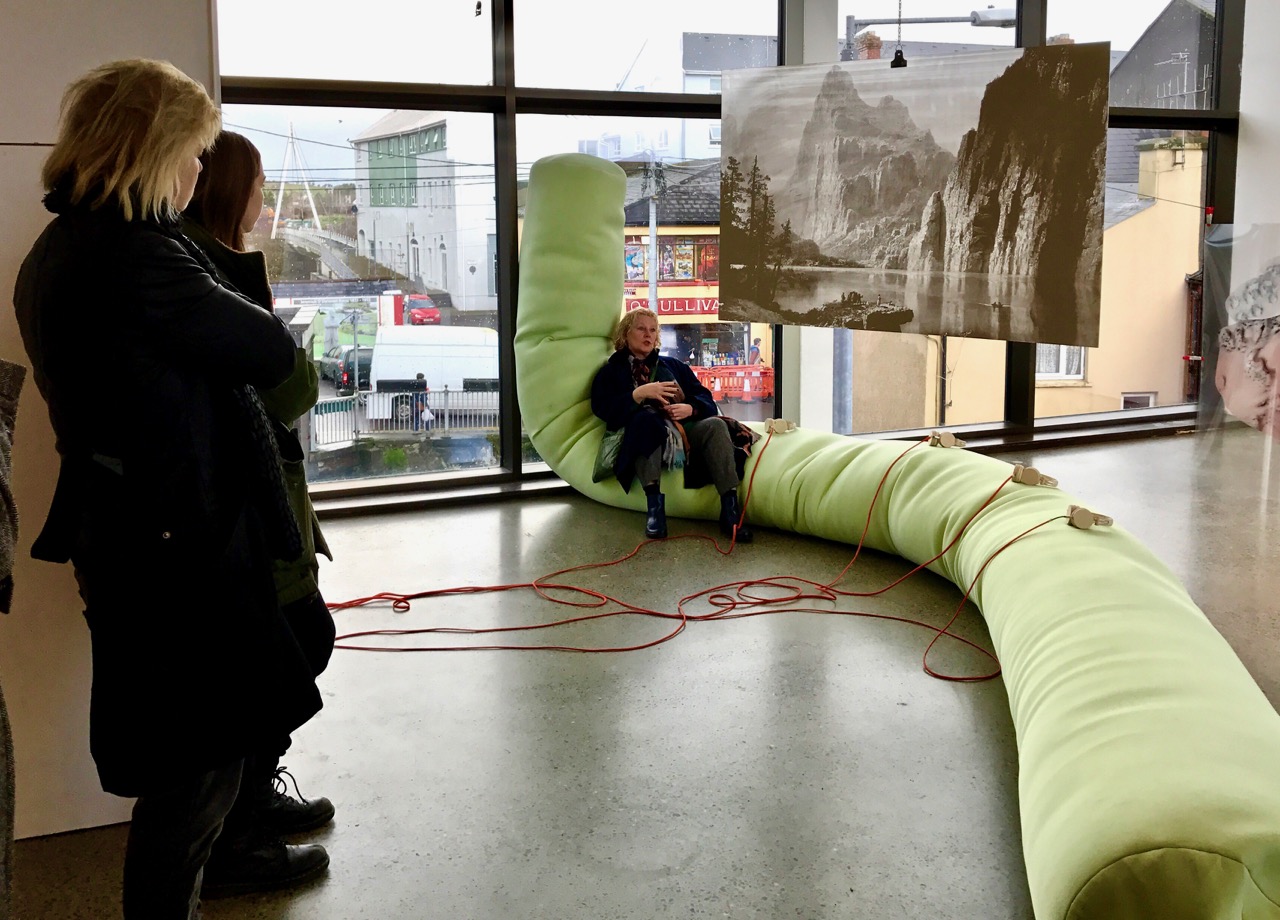
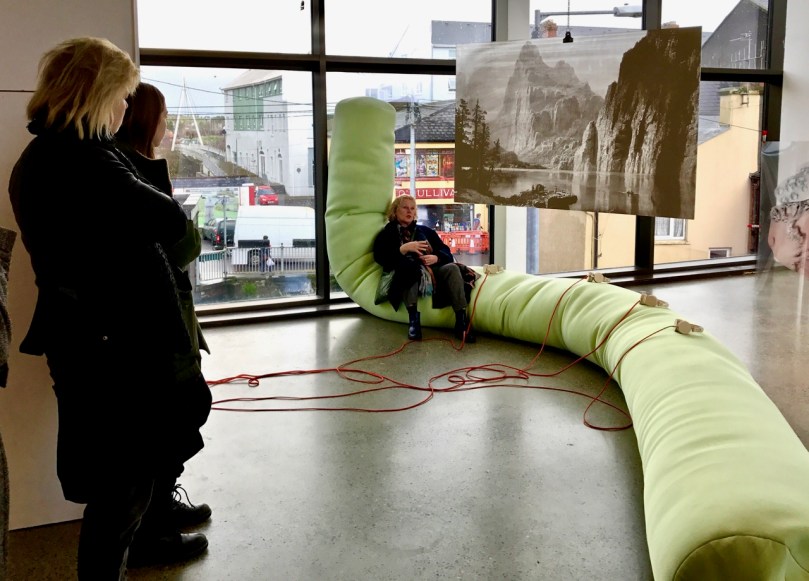
The second gallery held more surprises – and delights. Approaching through a narrow corridor I could see layers: more big, colourful panels on the far wall, more hanging, spinning sheets of opaque transparency, and a very contrasting soft, organic shape seeming to slither across the floor. As I came closer I realised that this shape was not slithering – or moving at all, disappointingly: it was a way of seating people in front of a screen, and was linked in to an array of very funky ‘designer’ headphones (white) by a jumble of thick, red chords.
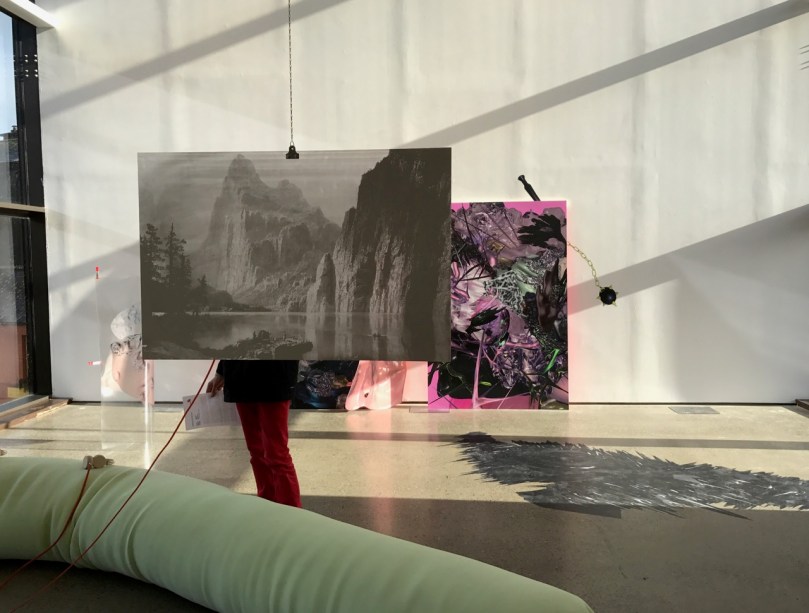
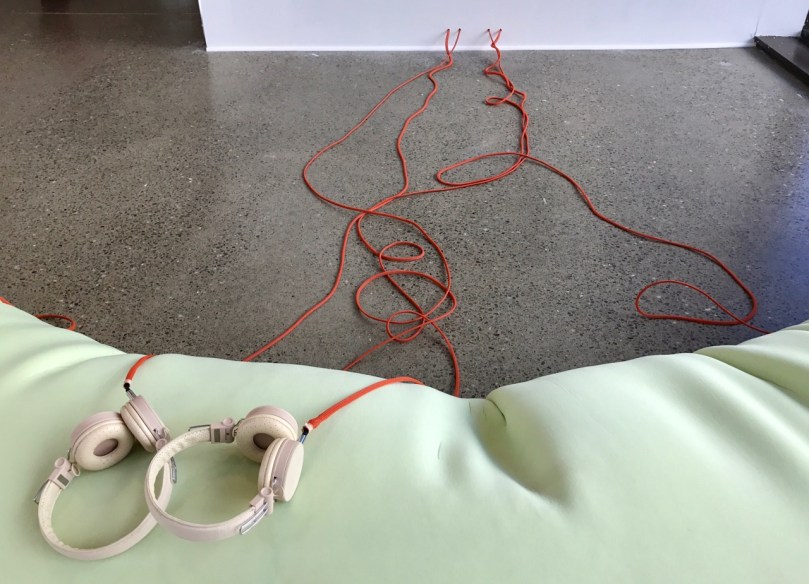
upper gallery close

phones and cables 2

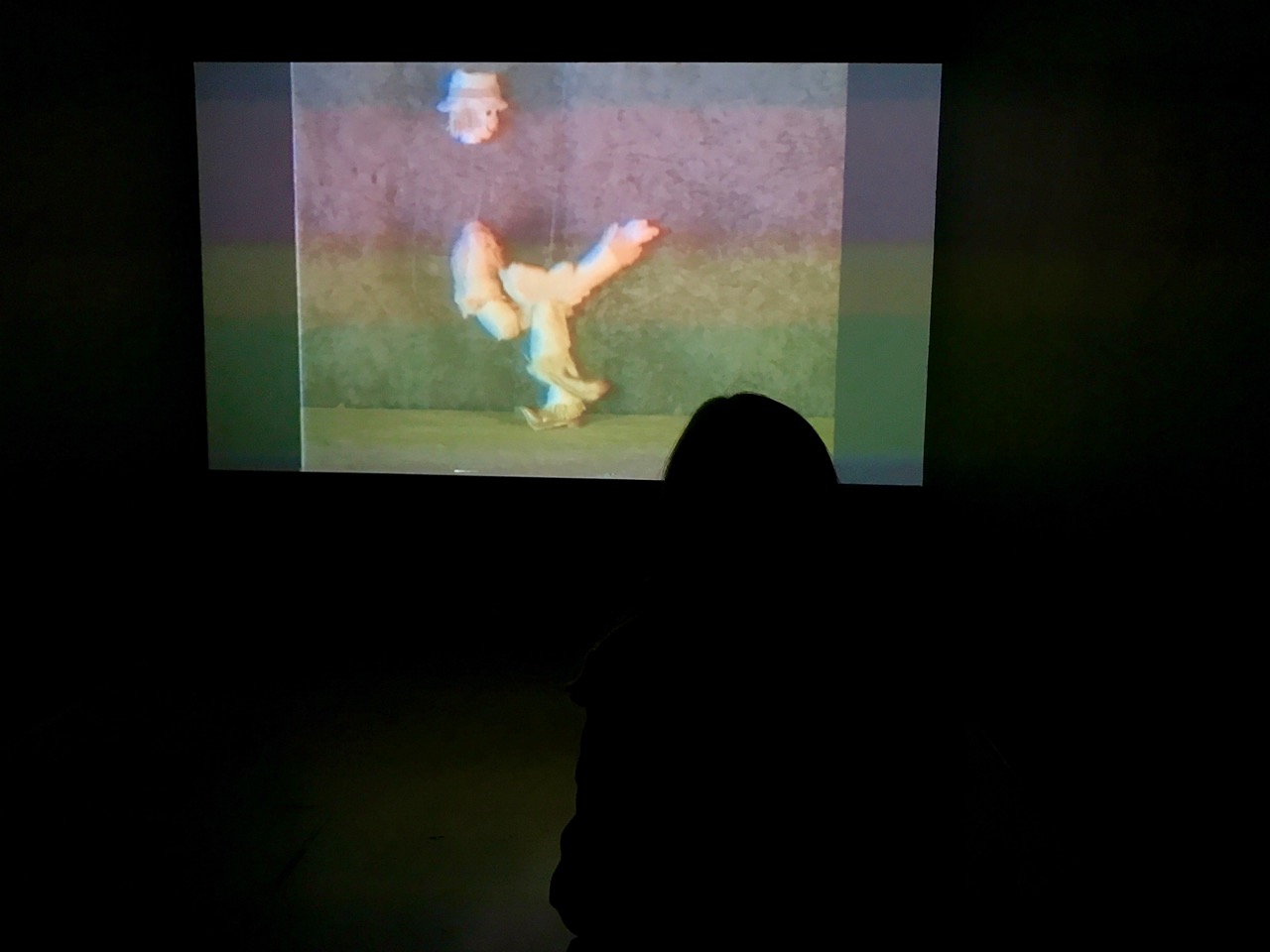
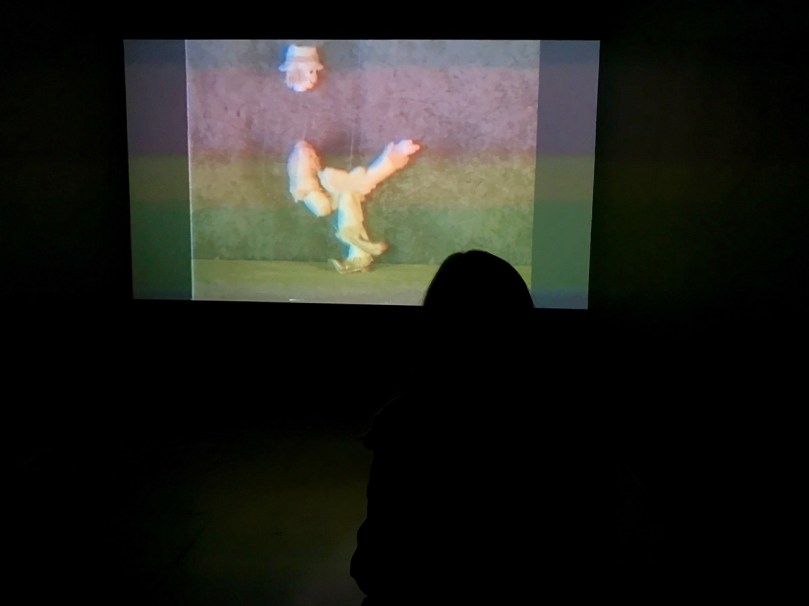
I sat and watched the ‘show’ – and listened to clunky music and a strange commentary – and then realised I was completely out of my depth! I had no clue what was going on. My attempt to experience the exhibition without any preparation or foreknowledge had failed. This applied to all the other work in the upper gallery also: superb large graphics on the walls and floors, printed acrylic sheets suspended on smart steel stands, and, in a darkened cubicle, a film of puppets which reminded me completely of ‘Bill and Ben the Flowerpot Men’! Now, how many of you remember them, dear readers? I don’t suppose any of the contributing artists are of my generation – so, is that pure coincidence? Anyway, I could not feel a sense of connection between the exhibits: but I liked the experiencing of them, nevertheless.
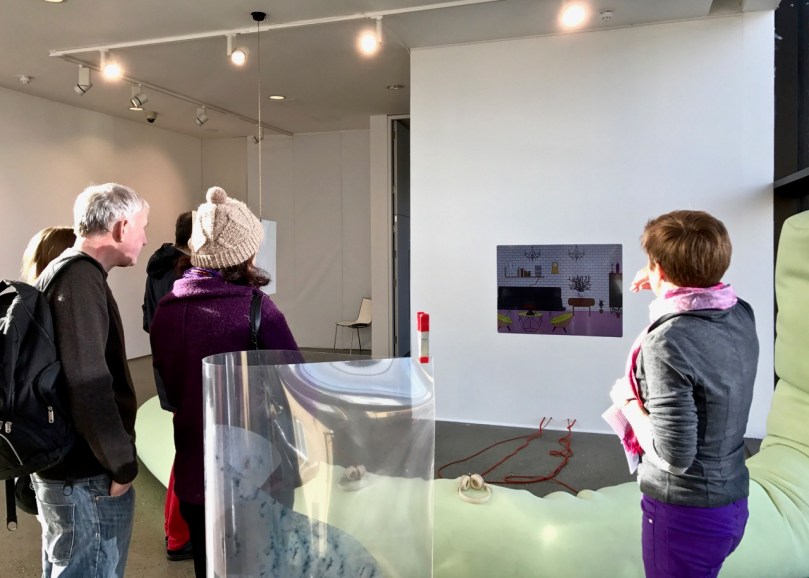
okea projection

puppet show

Upper – Eva Fàbregas’s The Role of Unintended Consequences (Sofa Compact) – which can be enjoyed on the comfort of a squishy serpentine furniture sculpture – and, lower – puppets feature in Andrew Norman Wilson’s Reality Models

It all began to come together and make sense when I took the gallery tour and artist talk (having first read an accompanying written commentary). Wonderful!  The title of the exhibition – Scissors Cut Paper Wrap Stone – which I only knew as a childhood game (and one which I played with my own children) is also the title of a science fiction novella written by Ian McDonald (from Belfast) in 1994. It’s evidently something of an iconic work for those who follow the genre (I don’t particularly, although I have read a little sci-fi). I now know that the participating artists were asked to familiarise themselves with the book and respond to it in a way which they feel comments on our present times: there was no collaboration as such between the artists on the overall exhibition (as I understand), but the curators have put the work together in a way that does begin to set out a narrative.
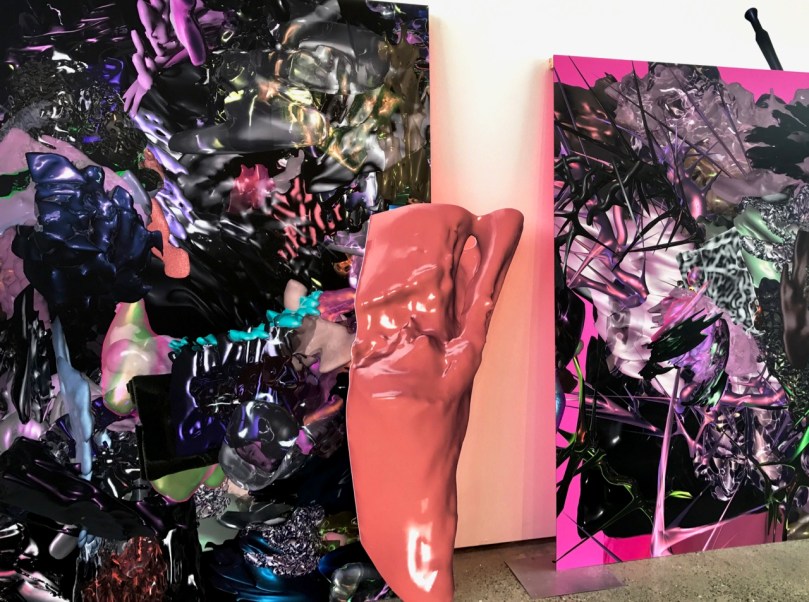
digital panels

In the optional (€12) catalogue that accompanies the show, Alissa Kleist & Matt Packer (the curators) write an introduction. I was struck by this paragraph:

…From an artistic perspective, Scissors Cut Paper Wrap Stone [ie the book] can be read as a wishful fantasy of artistic power. It describes visual art without recourse to the systems of academic analysis and understanding that have defined the art-history books for the past century and more; instead it promises an encounter with art that frees the ‘rapture’ that Jean-Francois Lyotard describes as being harboured within art itself: an art that hits us straight to the core of our physical being…
cow pic 3

Wow! isn’t that what I was trying to say about my approach to new exhibitions – looking for impact from the work, being stirred, excited or overwhelmed before having any understanding of it? It’s a wonderful way of putting it: …the ‘rapture’ harboured within art itself… Suddenly, I realise that I’ve approached this exhibition exactly as the curators would want me to: first I have the visceral experience, then comes the understanding! Or is it that I have now walked into the exhibition and become a part of it?

Back to the book (via the catalogue):

…In the book, McDonald tells the story of a young student, Ethan Ring, who develops the ability to create digital images that bypass rational thought and control the mind of the viewer…

I’m worrying now – am I being controlled by the digital images in the exhibition?

…Ethan develops a technology of ‘fracters’ – mind-controlling images that have the power to heal, cause pain, induce tears or ecstasy. The utopian promise of this image technology is short-lived as Ethan finds himself blackmailed into employment by the ‘Public Relations’ department of the ‘European Common Security Secretariat’, who demand that he uses the fracters for the purposes of interrogation and assassination, as and when they require…

This is frightening stuff. The book was written in 1994 but in our own time we are suddenly being confronted by concepts of ‘fake reality’ – and aren’t we shocked by governments who seem to be veering off into nonsensical directions, apparently against the wishes of the public majority? Suddenly, I’m seeing an uncanny relevance which these artists – inspired by the concept of the book – have made to our own predicaments. From the catalogue again:

…In a way that is typical of the cyberpunk genre of science fiction, Scissors Cut Paper Wrap Stone is written with the strategy of combining prosaic everyday miseries with the ‘cognitive estrangement’ of a world that has been accelerated beyond our control…
cow stuff

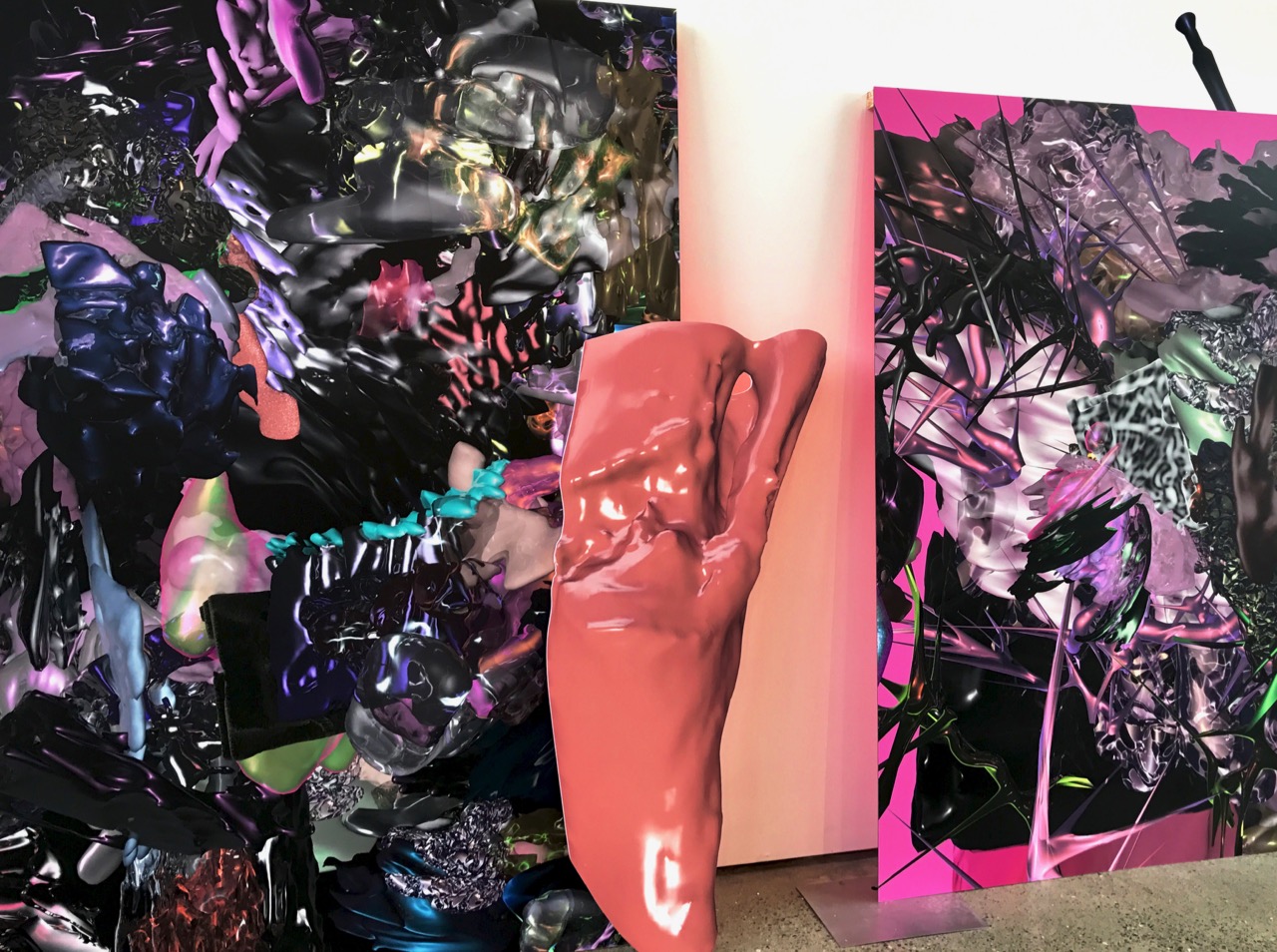
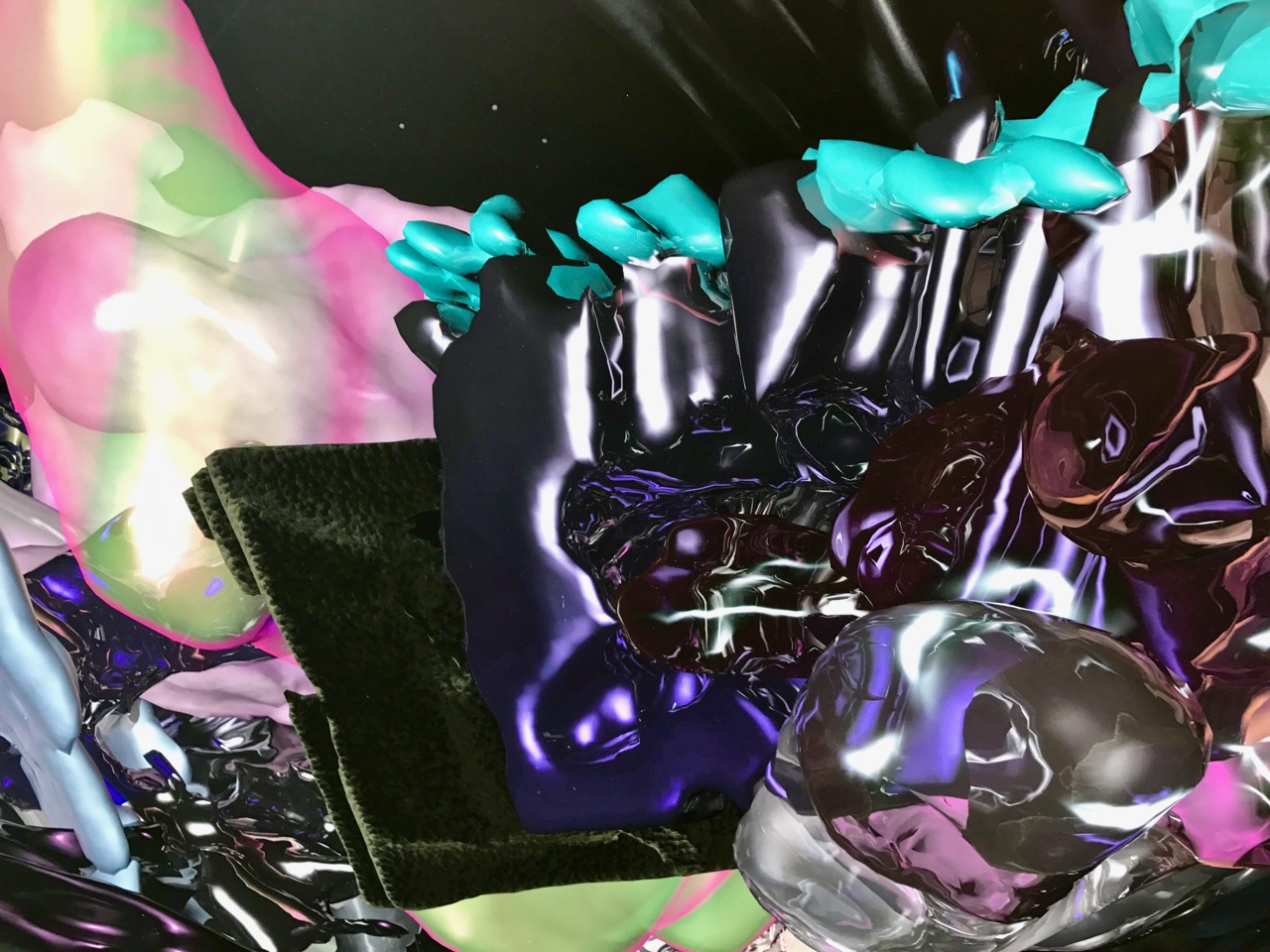
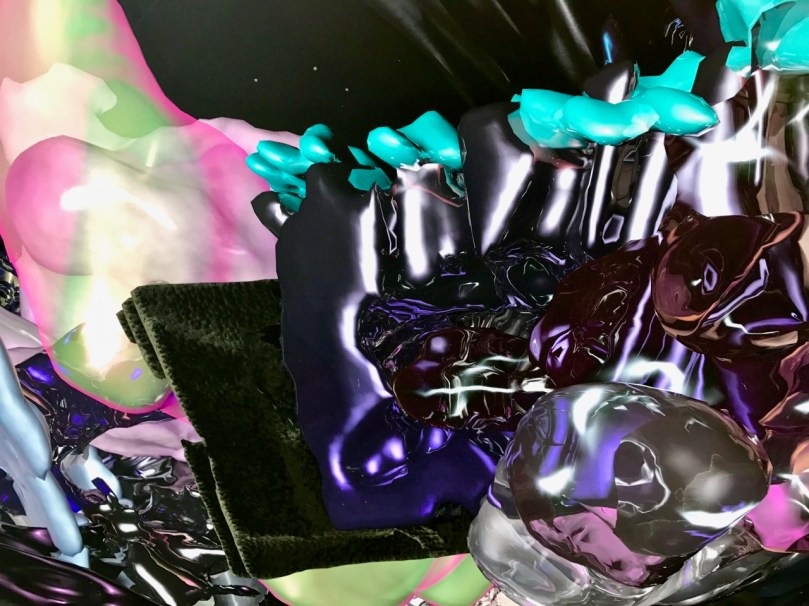
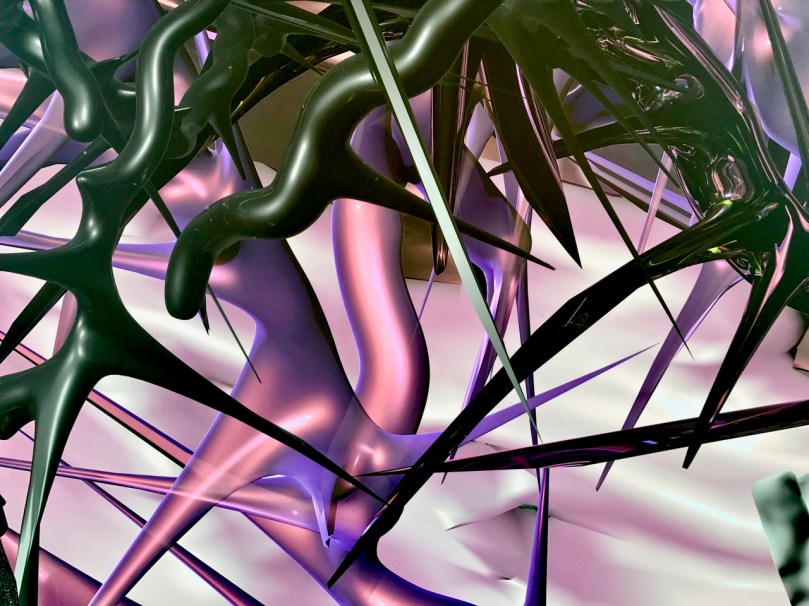
A detail from one of Jennifer Mehigan’s stunning prints made from collages of three-dimensional digitally generated models: this one illustrates the Bovine Spongiform Encephalopathy virus – better known as Mad Cow Disease

Lastly, I should mention the gallery talk by Jennifer Mehigan. She has only been involved in the Uillinn, Skibbereen, iteration of this show. Knowing that now, I think the overall exhibition will have been considerably poorer without her contribution. I think my strongest instant reactions (rapture?) have been to her large digitally produced panels. Now that she has explained their conception I am even more impressed. She asked us to consider the cow…

The cow is an unnatural beast. Human intervention keeps it permanently fertile so that it produces food for us. It gives us its milk: it dies for us. But also – again through human intervention – it eats itself. This generates the Bovine Spongiform Encephalopathy virus – better known as Mad Cow Disease. This kills humans. Be afraid…

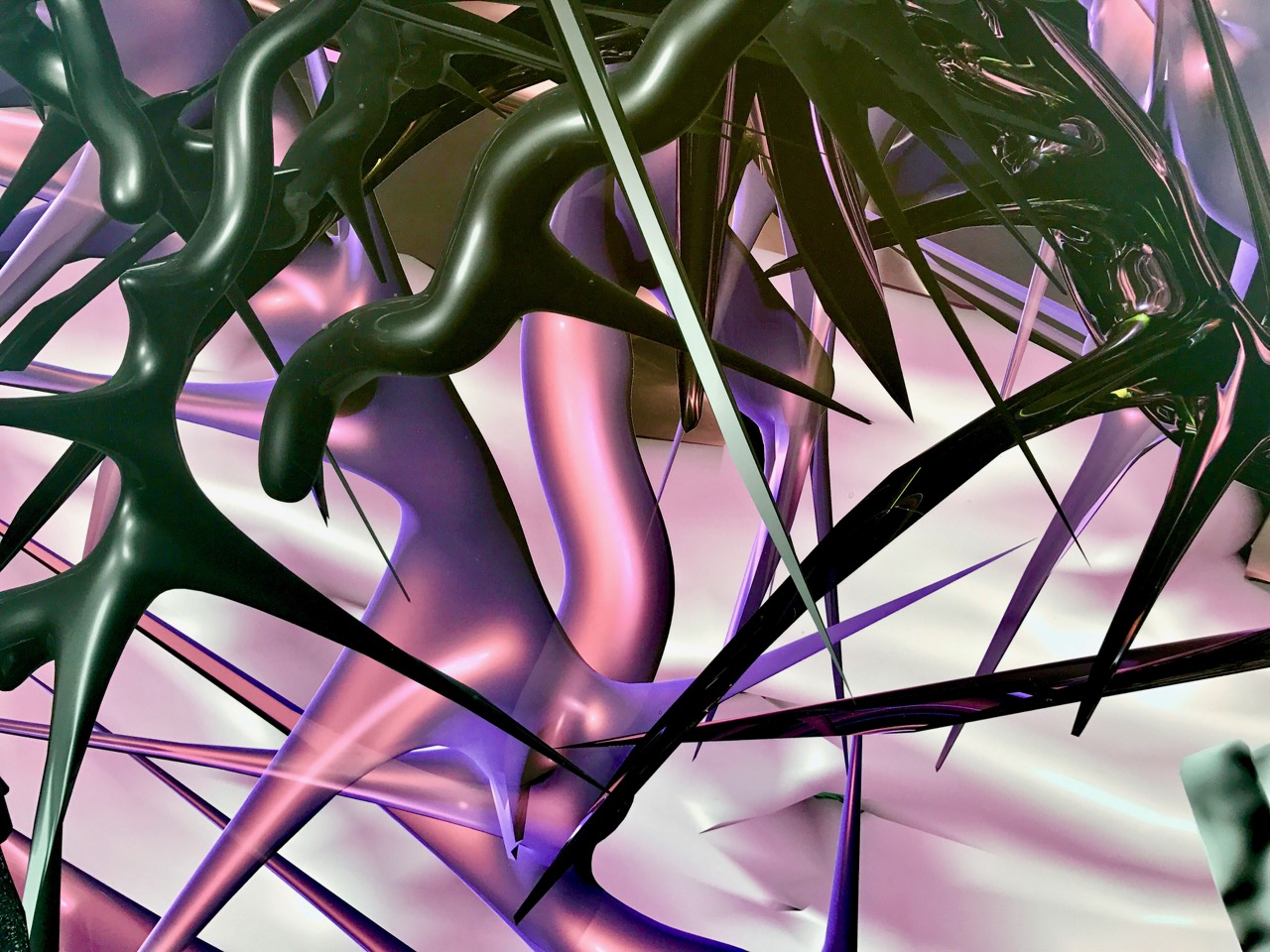
Jennifer’s gorgeous panels are made using a highly complex technology – 3 dimensional modelling software. With this software she has constructed a cow’s stomach, bacteria found inside the human gut, the mad cow disease virus, and Drombeg Stone Circle (that’s the link to human intelligence). She’s put all these things together into bizarre, visually stunning collages and presented them to us as compelling two-dimensional images leaning up against the end wall in Uillinn where they sparkle and shine in the sunlight: we are seeing the fracters and, behind them, the government departments who are manipulating world perceptions of reality.
from above

Powerful images from a strong exhibition. Step beyond the images and we see power – or a commentary on power. Statements are being made here – perhaps subversively – about the world in which we live today. That’s great – that’s art.
resting

The exhibiting artists are: Alan Butler, Pakui Hardware, Jennifer Mehigan, Andrew Norman Wilson, Clawson & Ward, Eva Fàbregas, John Russell

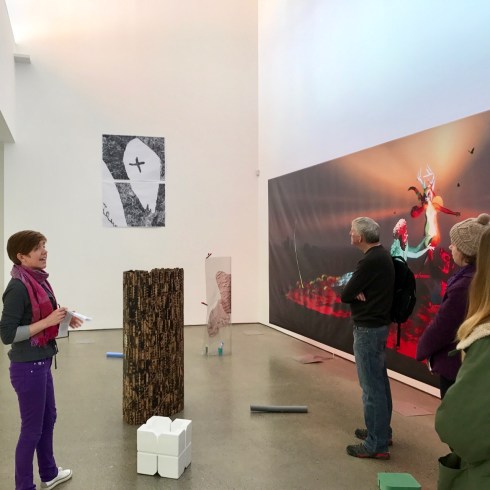
Scissors Cut Paper Wrap Stone is on at Uillinn, Skibbereen until 25 February 2017. The gallery is open Mondays to Saturdays from 10.00am to 4.45pm: there are guided gallery tours on selected Saturday mornings – check with Uillinn: enlightening and well worth attending! Here’s Alison Cronin in action:
in the gallery

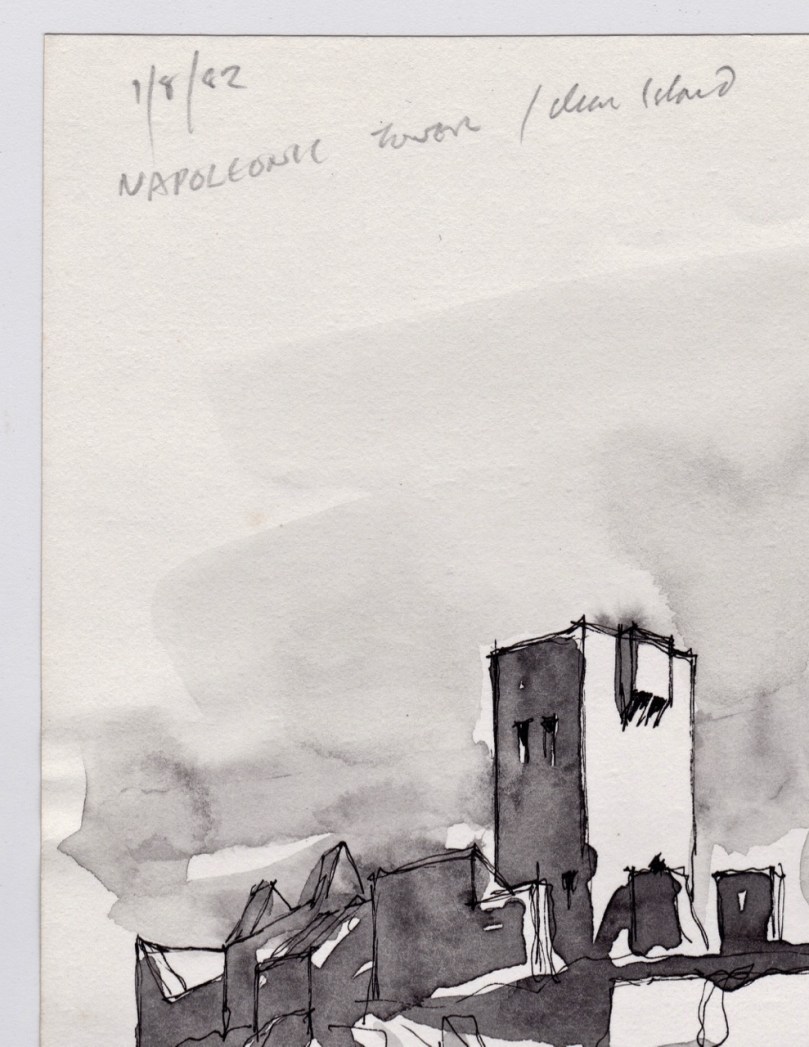
Brian’s Sketchbook: The Signal Towers

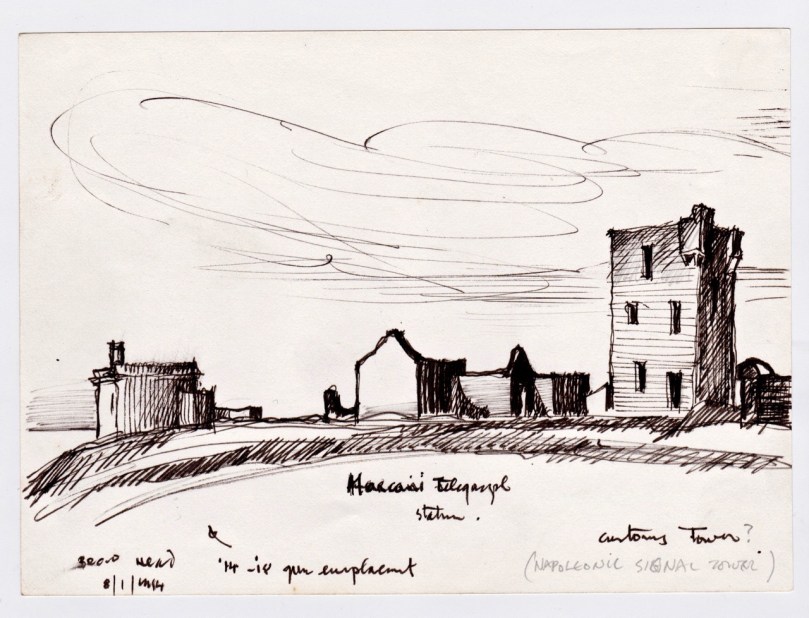
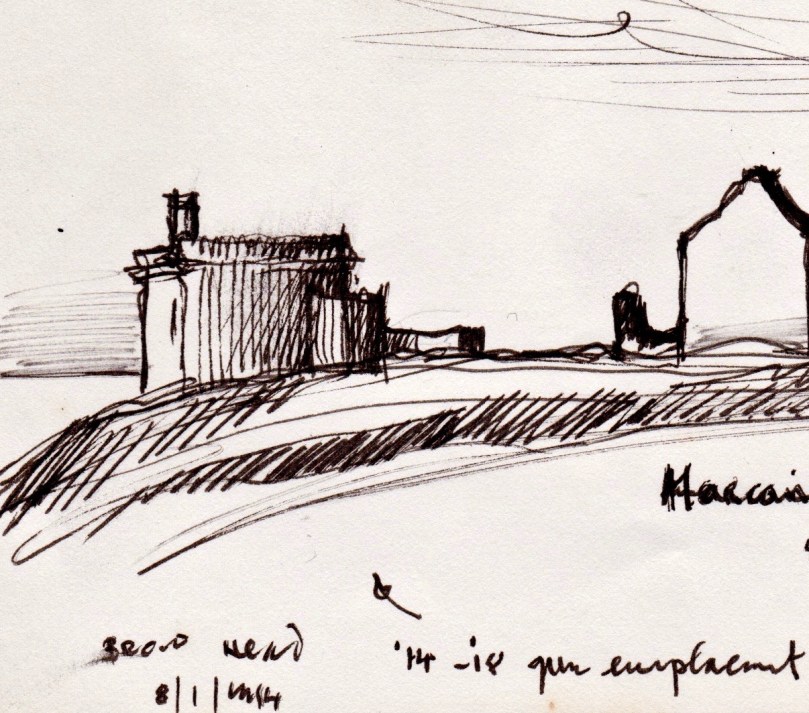
Brow Head Buildings

We have received a unique and treasured gift – a sketchbook from the 1980s of prehistoric and historic sites around West Cork. It’s the work of our good friend, and national treasure, Brian Lalor, artist, writer and printmaker. For an overview of his style, check out the retrospective of his work at Graphic Studio Dublin. Or browse the long list of his books, including the magnificent Encyclopaedia of Ireland, which he edited.

Marconi Station, Brow Head

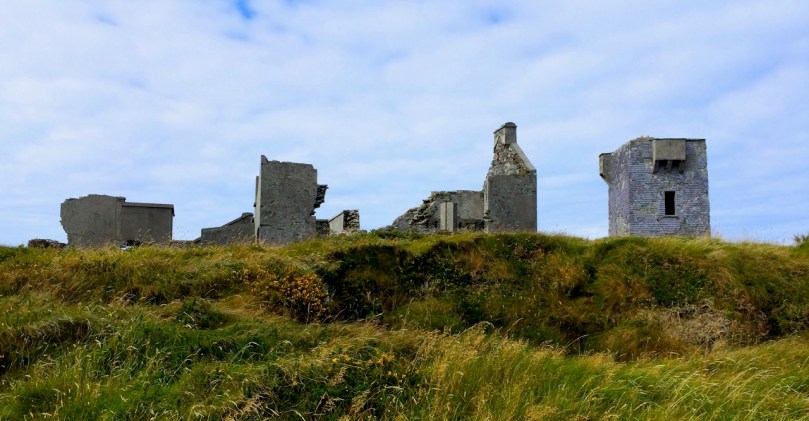
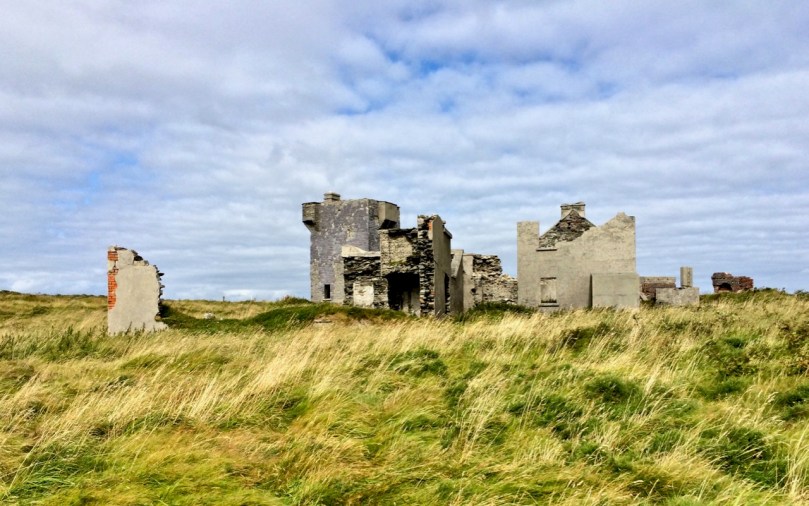
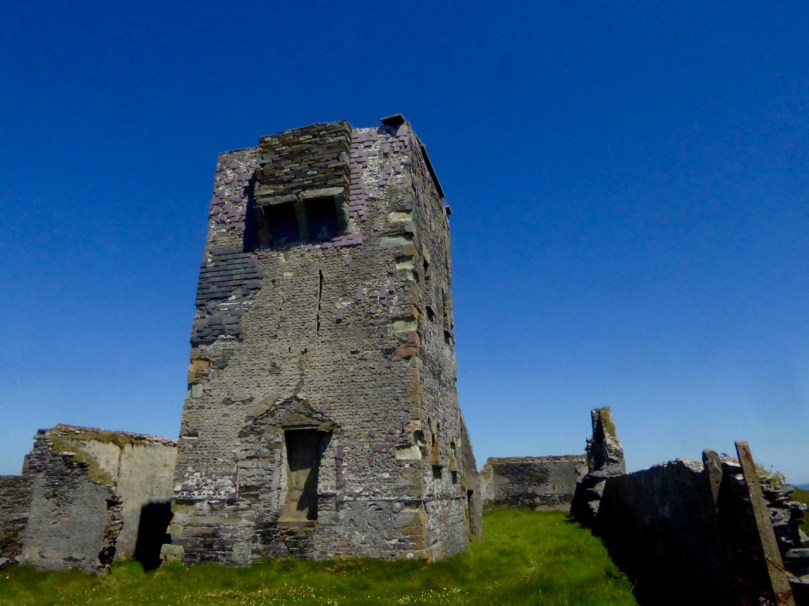
Brow Head: (above and below) on the right is the Napoleonic-era Signal Tower; the other buildings date mainly from the time of the Marconi Telegraph Station, taken from a different angle than the sketch above

Brian has studied both architecture and archaeology and to that adds the keen observant eye of the artist. As a result these sketches, although, as he explained, often hastily done during a brief visit to a site, are accurate, detailed and charming in equal measure. They were made on field trips with the Mizen Archaeological & Historical Society in the 1980s. This was an active society, publishing a well-regarded journal from 1993 to 2004 and leading regular field trips for members.

Brow Head ruined building

The sketches, just over 50 of them, were made for the most part between 1980 and 1987 so besides their intrinsic artistic value, they also constitute an important record of the state of the site 30 years ago, allowing us a comparison with its current condition. My intention is to visit (or re-visit) a lot of the sites, with his sketches in hand and show our readers both how beautifully Brian captured the structures or artefacts at the time and whether there are any changes visible from then to now. I decided to start with the Signal Towers on Cape Clear and Brow Head, and a third tower on Rock Island that may or may not be contemporaneous.

Wolfe Tone front

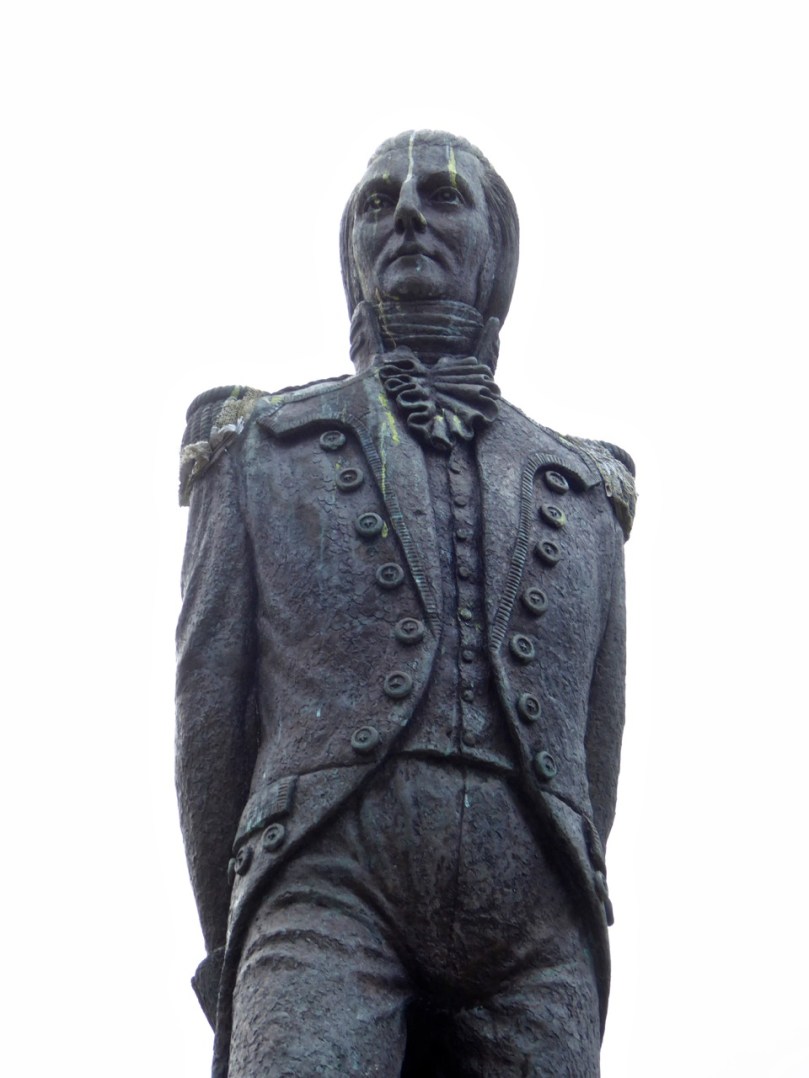
Theobald Wolfe Tone – detail of the statue in Bantry town square

In 1796 the French navy, partly at the invitation of Wolfe Tone and the United Irishmen, staged an unsuccessful invasion of Ireland, sailing into Bantry Bay. Several raids followed in 1798. Although all were quickly quashed, a panic about the possibility of a French invasion spread throughout Britain and Ireland. A series of Napoleonic-era fortifications and viewing towers were constructed around the coast in locations with panoramic views, and within sight of each other, to spot foreign shipping activity and raise the alarm. On the east coast, these mainly took the form of Martello Towers and were stocked with heavy armaments, but here in the south west defensible Signal Towers were built not to house artillery but as advanced-warning stations. Here and there they were complemented by batteries and other fortifications – but that’s a story for another day.

Cape Clear Signal Tower

The Cape Clear Signal Tower

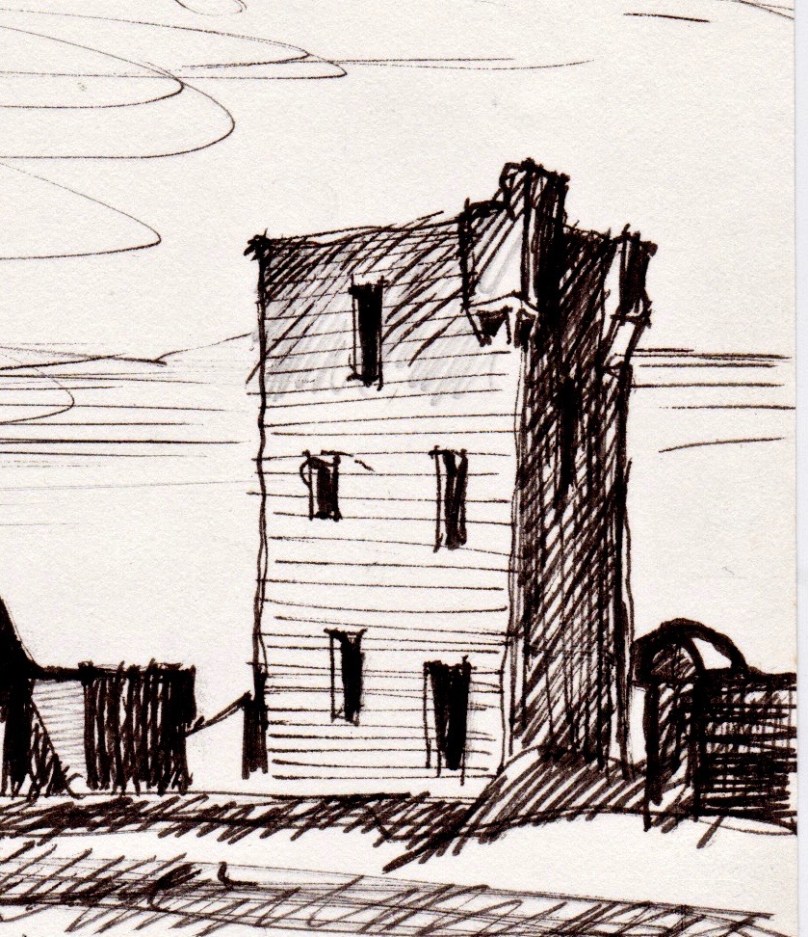
Signal towers were built around the coast to the same plan – tall square towers with first-floor entrances and machicolations. From a distance, they look like the medieval tower houses I have posted about on several occasions but up close they are shorter and the windows are bigger. Internal staircases and partitions were made of wood, not stone and have generally not survived, so the signal stations are essentially shells. in both the Cape Clear and Brow Head example, the exterior slate cladding has survived remarkably well.

Brow Head Detail - signal tower

Brow Head Signal Tower – detail from Brian’s sketch

In his excellent article for the Irish Times, Nick Hogan describes the towers, how they were staffed, the accommodation provided and how the signalling was done:

The signalling system, referred to as an optical telegraph, required that each signal station be visible to its counterparts on either side. Sending a message involved raising and lowering a large rectangular flag, a smaller blue pendant and four black balls in various combinations along a system centred on a tall wooden mast. The stations also communicated with ships.

Cape Clear Towers

Signal Tower and Original Fastnet lighthouse, Cape ClearTop: Brian’s sketch of the Signal Tower and Lighthouse on Cape Clear Island, done in 1982; Below: how it looked in June, 2016, 34 years later

While many signal stations are lonely and isolated buildings glimpsed on distant headlands, abandoned since the mid-1800s, both the Brow Head and Cape Clear buildings had further phases of use. In Cape Clear a lighthouse was built in 1818 – a forerunner of the Fastnet Rock Lighthouse. It was so often shrouded in fog that it was abandoned in the 1840s. The buildings attached to the signal tower, built of brick and concrete, probably date to this period of occupation. The signal tower is built of stone, using techniques not far removed from medieval construction methods. The lighthouse provides a wonderful contrast, being built of cut granite blocks expertly measured, shaped and fitted. 

Cape Clear Deatil - Lighthouse

Cape Clear Lighthouse, detail from sketch

In June of 2016, when we visited, it looked exactly as it had to Brian and the Mizen field group – an indication, perhaps that somebody is looking after the site and that the few visitors who come (it’s quite a hike to get there) respect the heritage. [Edit: Since I wrote this, Brian has pointed out that in the Cape Clear Signal Tower there is a porch under the machicolation in his drawing that has since disappeared. The outlines of the porch can be clearly seen in the photographs of the signal tower.]

Cape Clear Lighthouse

Brow Head is easier to access, and as a result there is more graffiti in evidence, but the changes to the site since Brian’s sketch are more the result of time and climate than any damage by humans. This is a complex site with multiple periods of occupation. The signal tower is there, of course, looking exactly as it did in the 1980s. Beside it is a network of buildings dating from the the early years of the 20th century: this is what remains of the Marconi Telegraph Station. Read all about this in Robert’s piece on Marconi, In Search of Ghosts. Besides the Marconi Station a Second World War Look Out Post was occupied here in the 1940s – little remains of this small concrete building except the characteristic half-round shape and a section of wall.

Brow Head octagonal?

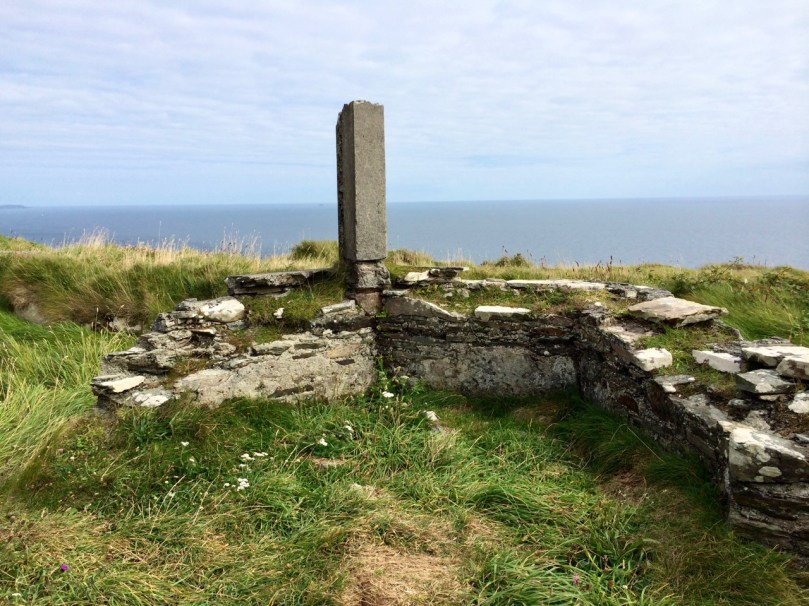
Finally, on Brow Head there is a mysterious building that Brian labels ’14 – ’18 Gun Emplacement. This building no longer exists, and the ruinous remains that litter the ground seem robust enough to fit this inscription. Or do they? So – a mystery, and obviously  more research needed on our part. If any of our readers can help – let us hear from you!

Brow Head Detail - gun emplacement

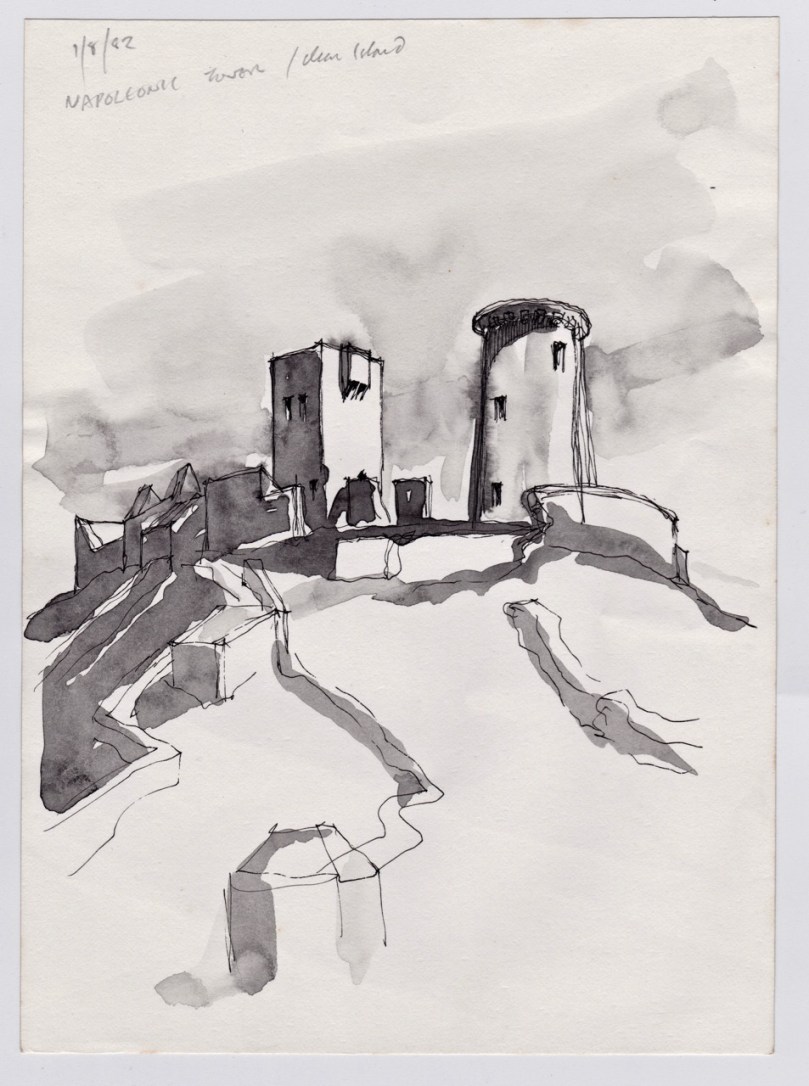
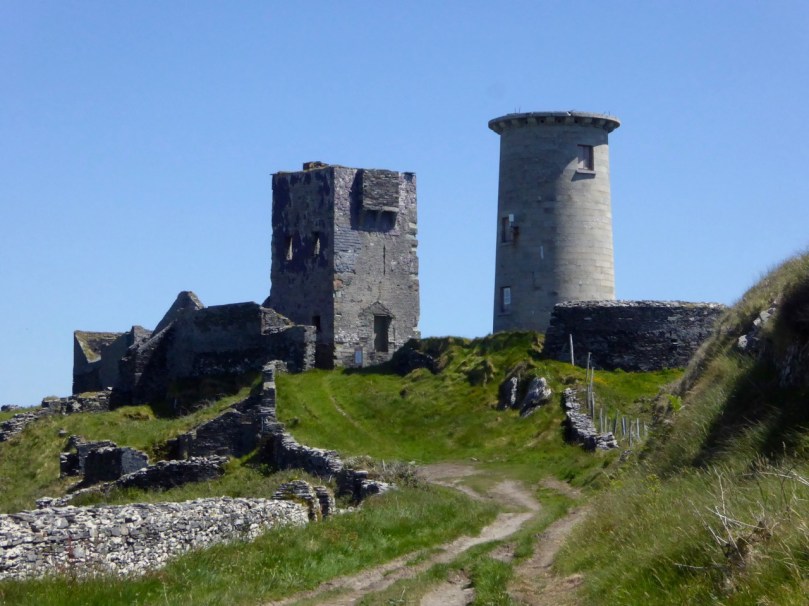
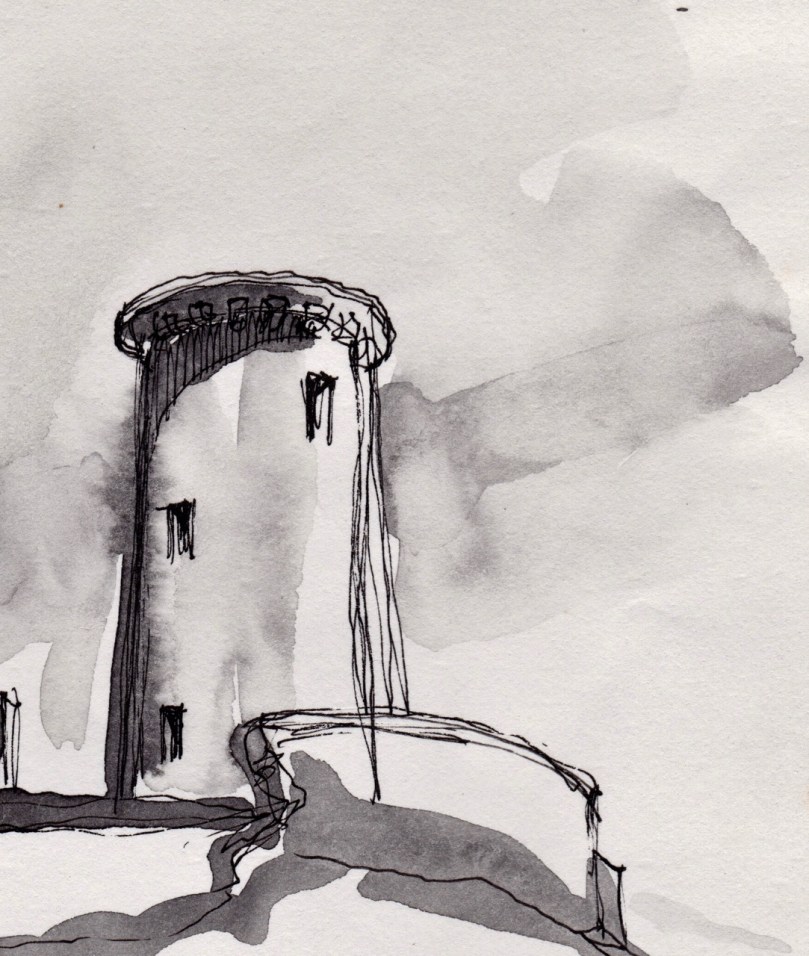
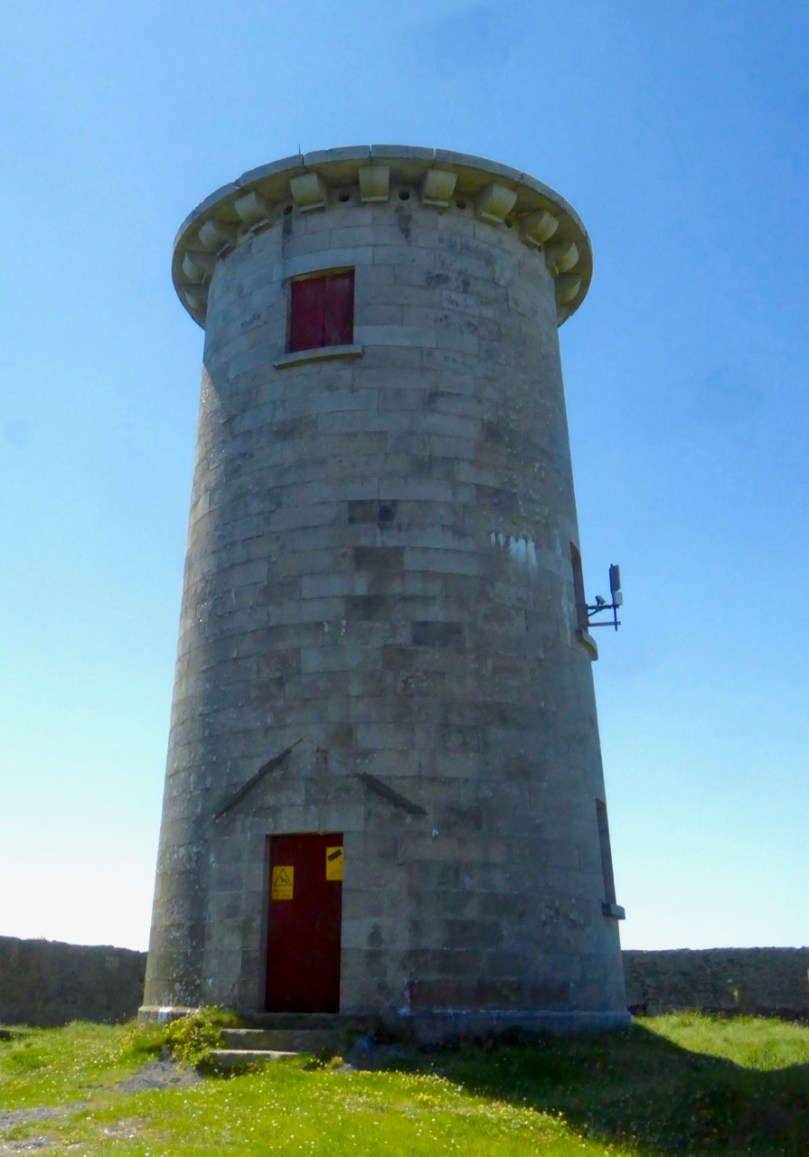
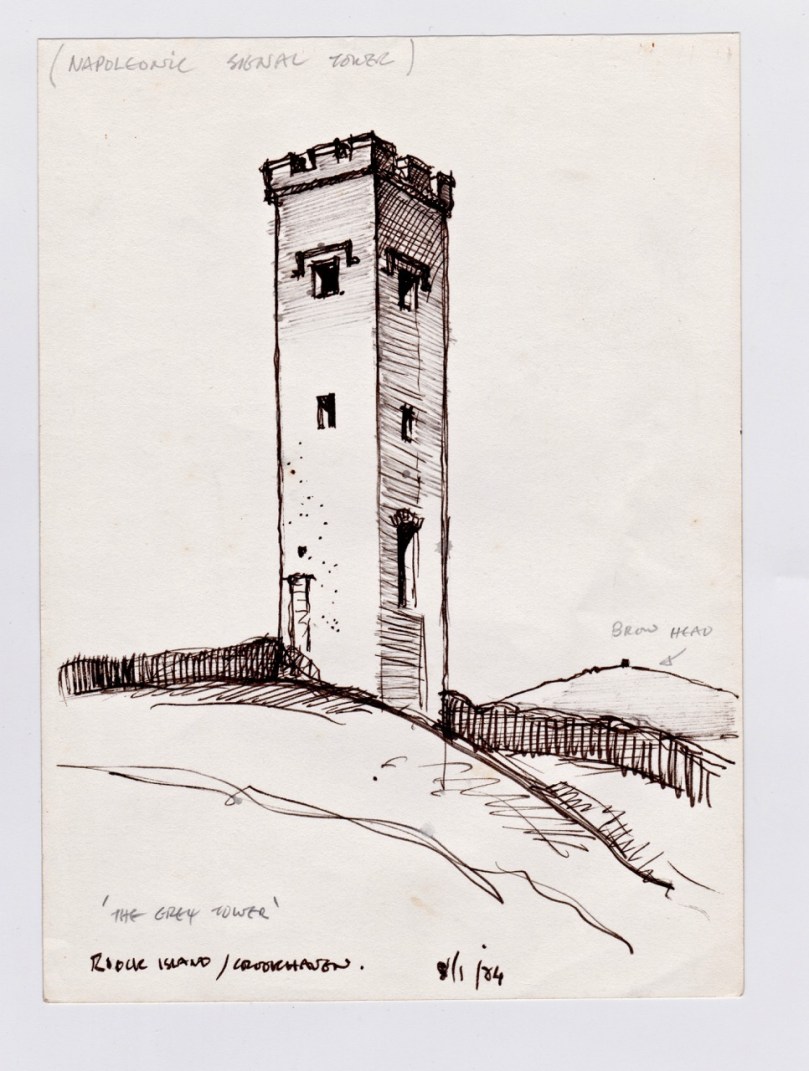
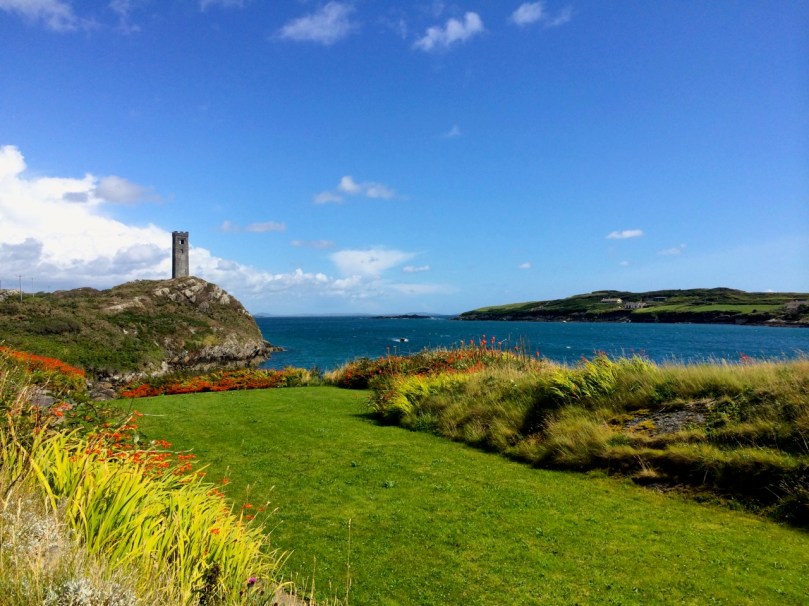
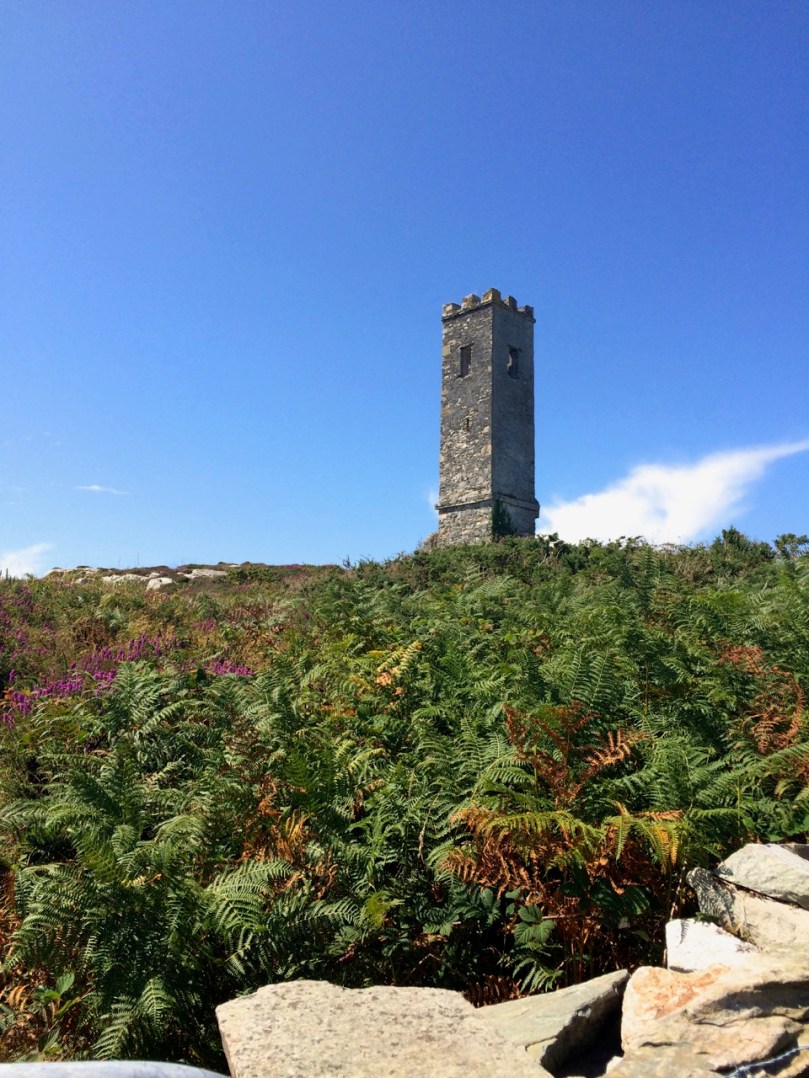
The last tower is on Rock Island. It is clearly visible from the Brow Head Signal Tower ( a requirement for the placement of signal towers) but, strangely, it is one of two very similar towers on Rock Island, and while they are similar to each other, they are quite different from the classic signal tower design. However, both the National Monuments site  and the National Inventory of Architectural Heritage listings name them as Napoleonic-era Signal Towers, and perhaps that is indeed what they are.

Rock Island Tower

Brian’s sketch of the Rock Island Signal Tower

However, in discussion with Brian, he pointed out that most of the buildings on Rock Island were developed as part of a major Coast Guard installation around the same time as the Marconi Station, and we wonder if there might be a connection – that is, that these are Coast Guard-related Watch Towers, rather than Napoleonic-era Signal Towers. Once again – more research needed! [Edit: See comment from Navtell in comment section, below.]

Rock Island Signal Station

Rock Island Second TowerThe two towers on Rock Island: similar to each other but quite different from the classic Signal Tower on nearby Brow Head

This is only my first foray into Brian’s Sketchbook. Look out for more posts in the future and in the meantime, join with me in being grateful that a precious resource like this survived numerous moves and that we have the opportunity to learn from it.

Cape Clear Detail - Signal Tower

The Cape Clear Signal Tower

Molaga of the Bees

bees!

I know I’ve said this before – but, wherever you find yourself in Ireland there’s history on the ground, and a story to be found! Recently we ventured into North Cork: so large is this county that it is a good half a day’s journey from Nead an Iolair, here in the far west, to Mitchelstown, beyond which lie the wild frontiers of Tipperary and Waterford. The purpose of our journey was exploration – archaeology, history, folklore – and we found ourselves drawn back into the time of the Saints.

1400 AD

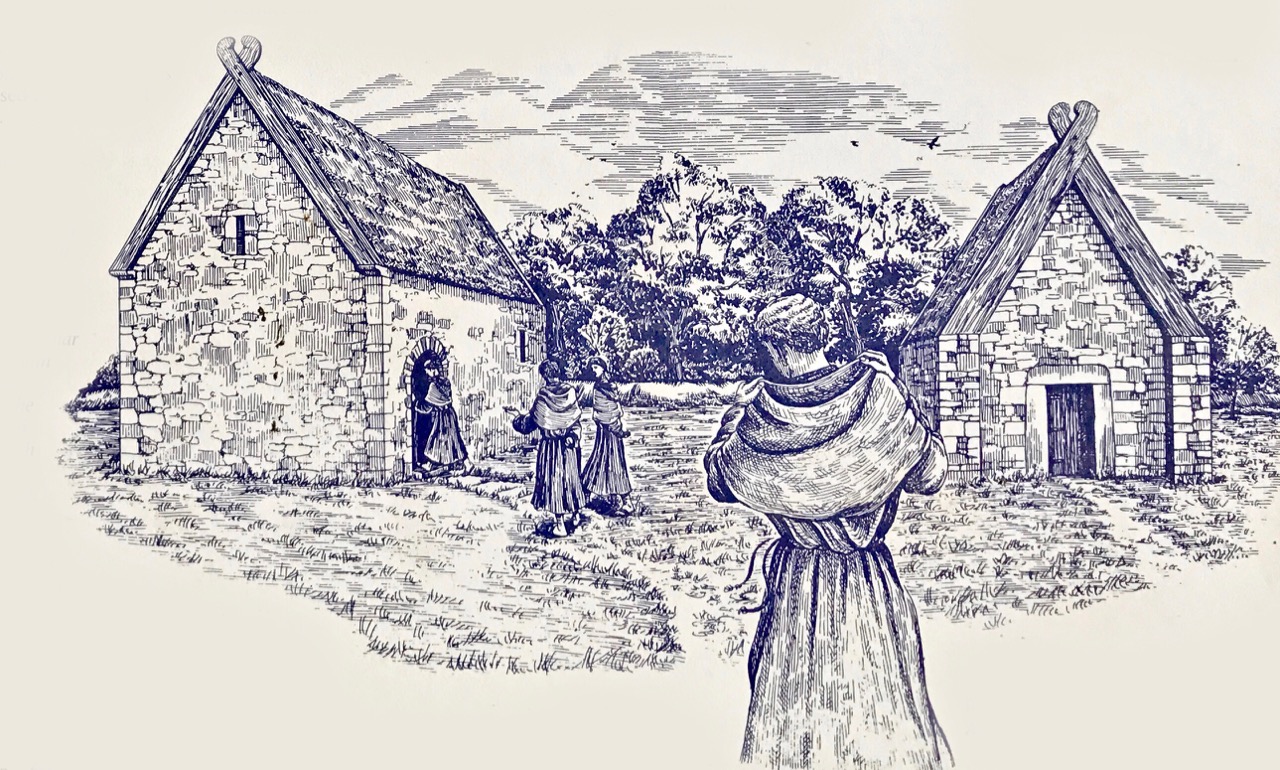
Artist’s reconstruction of the site at Labbamolaga as it might have looked in 1400 AD: the smaller building on the right is the saint’s original oratory, dating from the seventh century. Note the antae – the projecting stone walls on either side of the entrance, supporting the huge verges. These features represent the builders’ wish to recreate in stone the very earliest timber churches: in every age of Christian church building the aspiration was to hearken back to ‘the time of the Saints’, whatever era that might have been . The building on the left is a later medieval Parish Church known as Templemolaga (image from Dúchas – The Heritage Service)

Well off the beaten track we found ourselves at an ancient site known as Labbamolaga, in the townland of Labbamolaga Middle. Labba Mollaga: it means ‘the bed of Molaga’, who was a saint living in the 7th century. He is said to have founded a monastery on this site and the earlier building here could have been his original church.

7th c entrance detail

through the portal

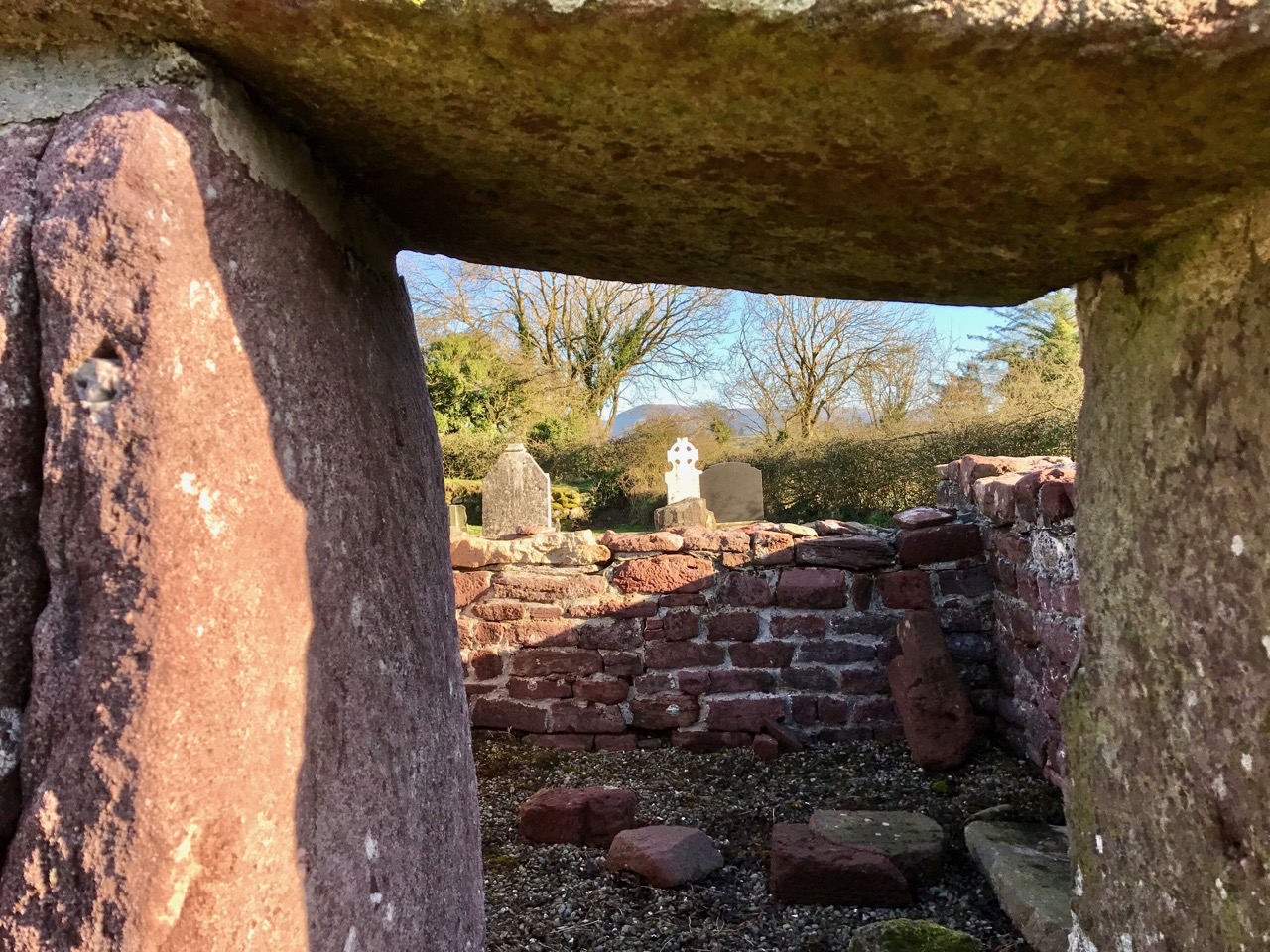
A seventh century oratory? Upper picture shows the entrance elevation with its pronounced antae, and the doorway which seems to be constructed from monoliths. It has been suggested that these stones could have been robbed from the megalithic monument which lies in a field to the south of the site. The middle picture looks through the entrance to the prostrate stone against the south wall: this is known as Molaga’s Bed: tradition states that the saint would lie on this stone at the end of each day’s work. It is also said to be his burial place and has curative powers, particularly for rheumatism. The lower pictures show the saint’s bed in 1905 (left) and in the present day (right) with its strange carving, which has been described as a volute

The architecture is fascinating: here we have one of the few examples remaining in Ireland of this most ancient church form, albeit in a ruinous state. In 1975 a similar ruin in Connemara was reconstructed to its likely original form at St MacDara’s Island, Carna. This gives us some idea of what St Molaga’s oratory could have looked like.

The oratory on St MacDara’s Island – early photograph (left) and 1975 reconstruction (right)

The site at Labbamolaga has much more more to attract the curious. There are the nearby megaliths: we would assume they considerably predate everything else, yet local lore tells us that they are four villains who stole the chalice and holy relics from the saint’s oratory but were caught in mid-flight and were turned into four pillars of stone by him! A further legend noted by John Windele, the Cork antiquarian and historian, in the 19th century relates to a holy well which once existed – some say under the saint’s bed:

…There was formerly a beautiful well of clear spring water here, but one day an old woman profanely washed her clothes in it; that night the well disappeared and was seen never more…

stone alignments

stones in graveyard

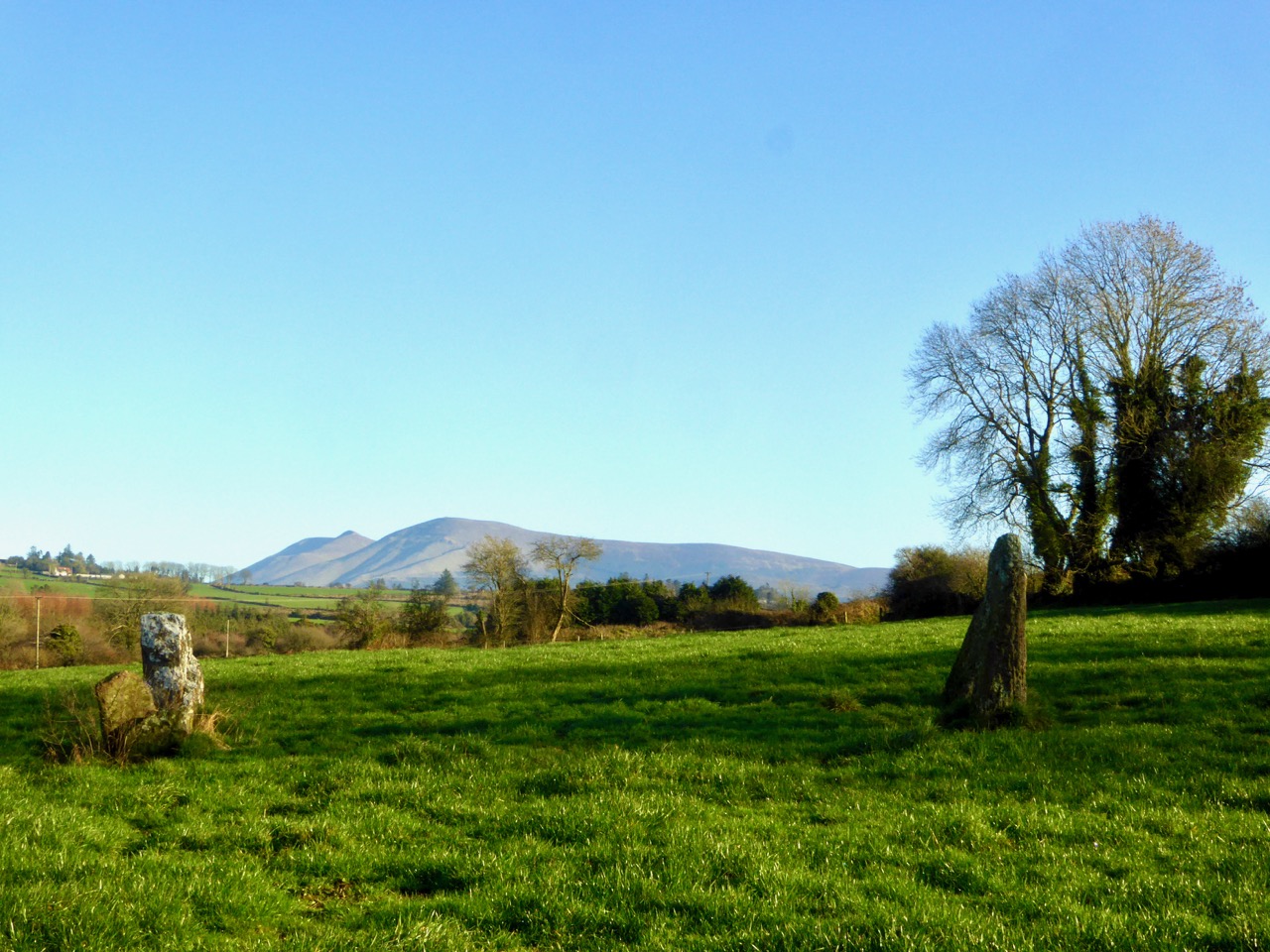
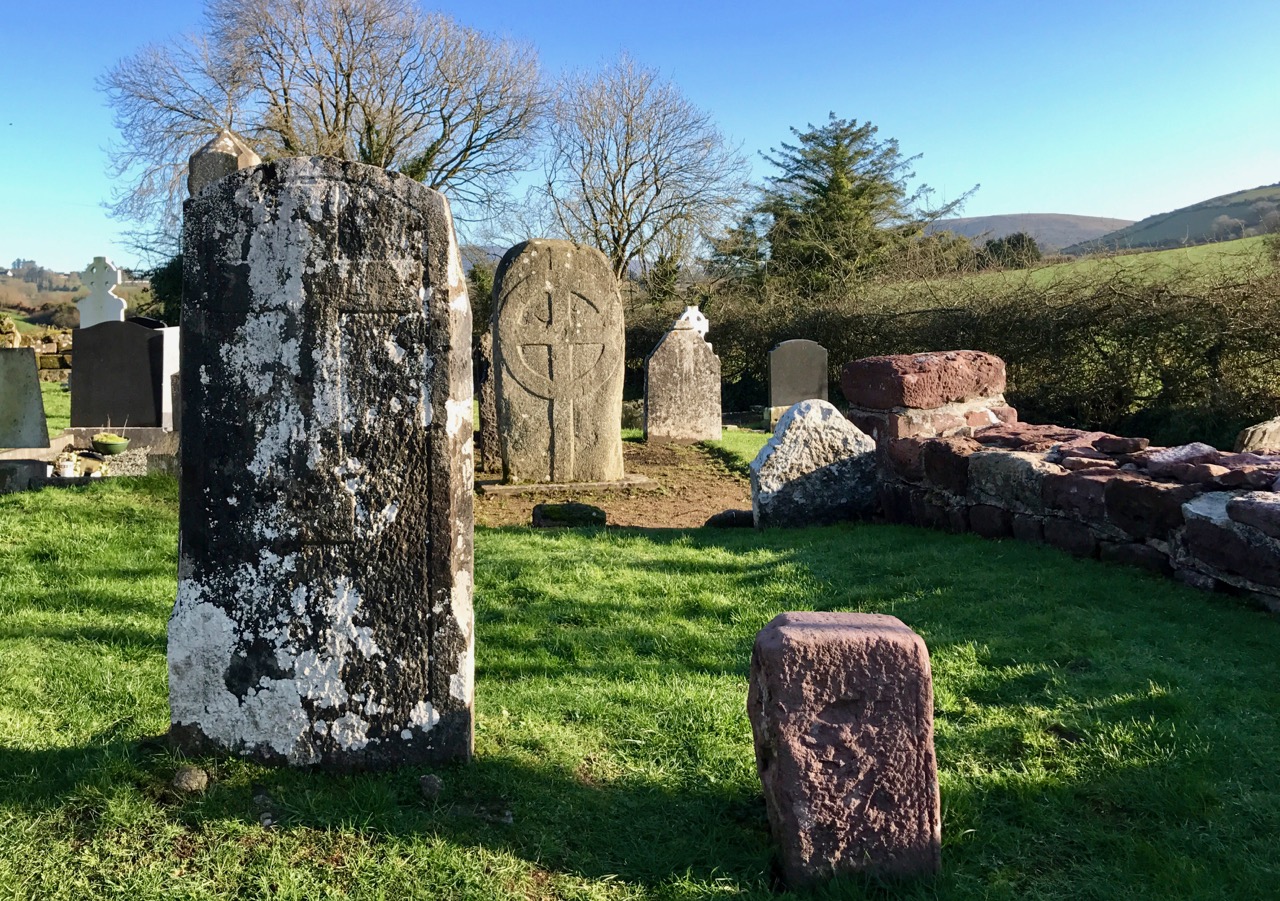
Upper picture: four standing stones in a field (known as Parc a Liagain, ‘Swardy Field of the Pillar Stones’ to the south of the ecclesiastical site – supposedly petrified villains who robbed the monastery. Lower pictures: the monastery site has become a burial ground – strange and fascinating stones abound. The centre stone is an ancient looking Celtic cross; the circular pile is an enigma – burial vault or old well house? The site also once contained Cursing Stones, but these are said to have been removed

What of the saint himself? He has a recorded history: born in Fermoy of parents who were well past child bearing age (a miraculous sign), he travelled to Scotland and then to Wales, where he became a follower of St David. Returning to Ireland he founded monasteries at Timoleague, West Cork (the name means House of Molaga), and at this site in North Cork. Sources say that in Wales he learned the craft of bee-keeping, and a colony of bees attached itself to him on his journey back to Ireland: the same sources credit him with introducing bees to Ireland, but the earlier Saint Gobnait – patron saint of bees – also has this reputation. Some mixing of hagiographies here, perhaps. Also confusing is the information given in catholicireland.net which gives the name St Modhomhnóg as ‘Irish Saint of the Bees’ and tells a similar story, although this saint returned to Ireland from Wales (with bees) and set up a community in Bremore, near Balbriggan, County Dublin – today known as the Church of the Beekeeper but also connected with St Molaga, who is there said to have procured his bees from St Modhomhnóg. To add to the confusion, the feast day of Saint Gobnait is on 11 February, while that of Modhomhnóg is on 13 February.

molaga

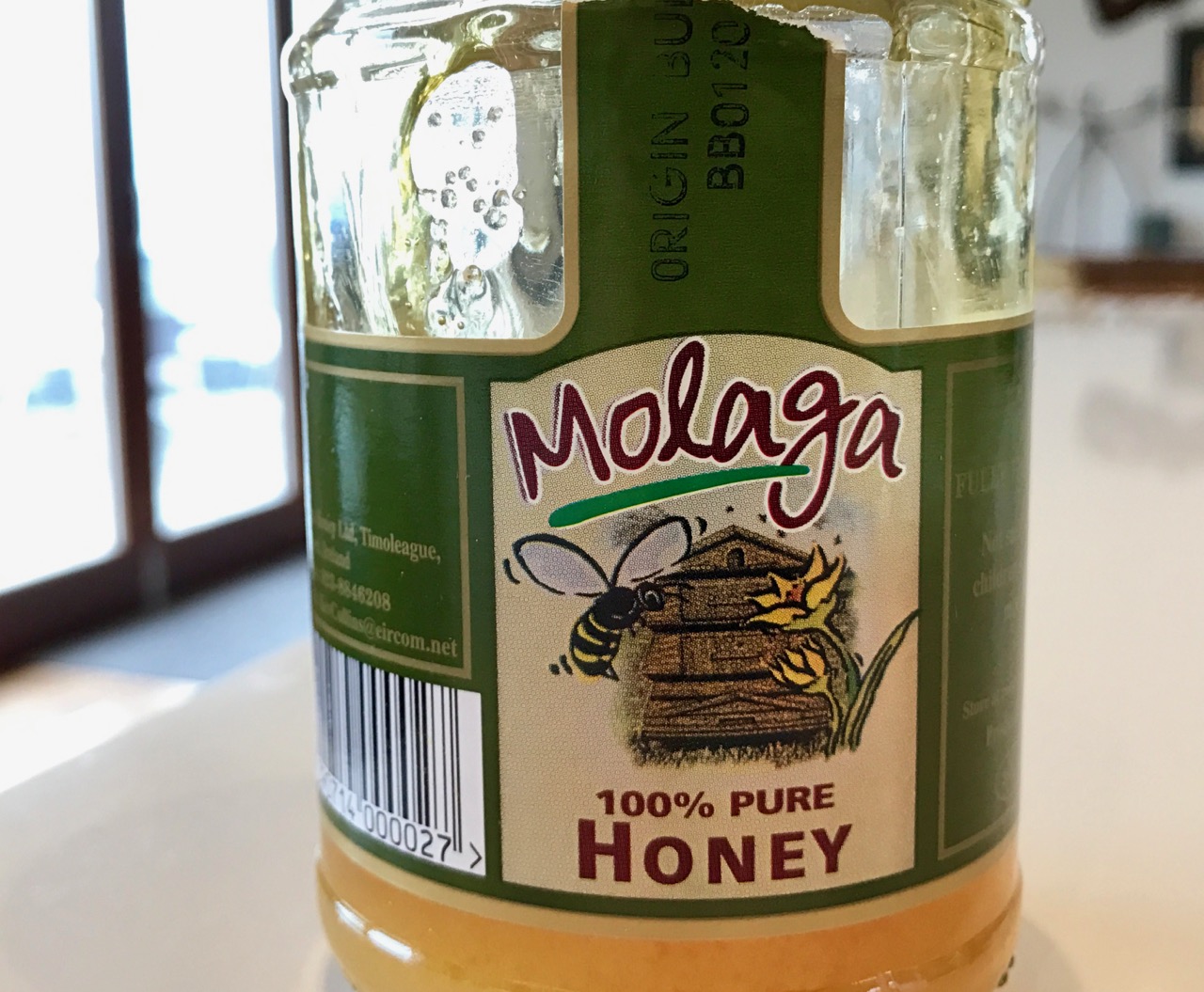
We hadn’t realised until we unearthed these stories that we have the saint’s name in our larder! Our favourite honey is known as Molaga – we get it from our local supermarket. There is nothing on the jar to explain the name (this is one of various spellings), but the honey is distributed from Timoleague (the house of Molaga) in West Cork. There is much more to the story of this slightly elusive saint, perhaps to be told another day.
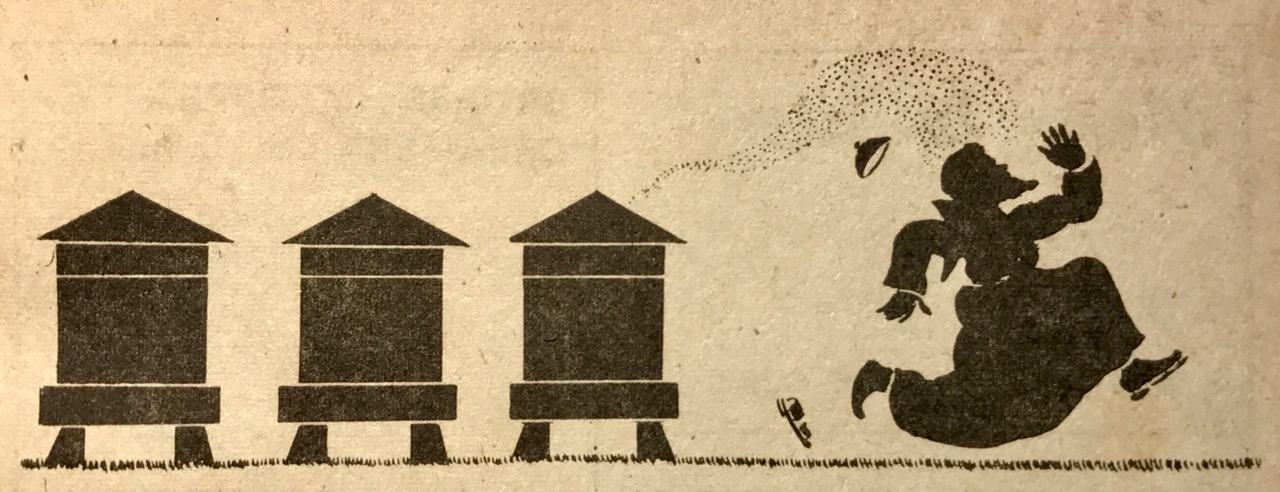
Many thanks to Brian Lalor for gifting us his copy of The Capuchin Annual 1944. It is wonderfully illustrated with cameos of monastic life drawn by ‘Father Gerald’: the header is one of these. The 1983 postage stamp illustration below is by Michael Craig

postage stamp