Priests and Poets, Part 1

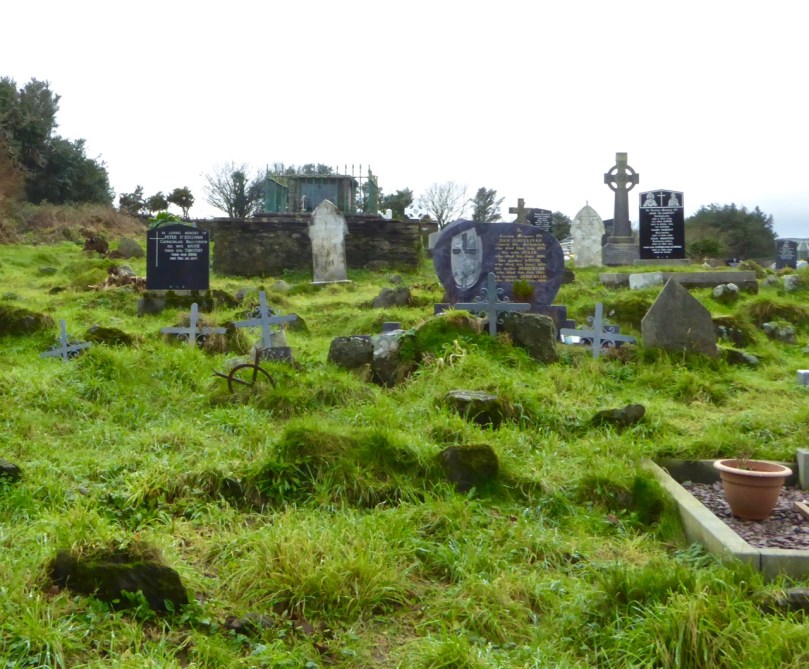
outlookOften, while walking the Fastnet Trails, I stop to wander around the old graveyard at Stouke, near Ballydehob. I am struck each time by the lonely beauty of the site, on an elevated hillside with vistas of the countryside and distant hills. I have also come to realise that this one small place resounds with echoes of the past – a past that in Ireland seems always so intricately woven into our present that it can never be ignored or forgotten.

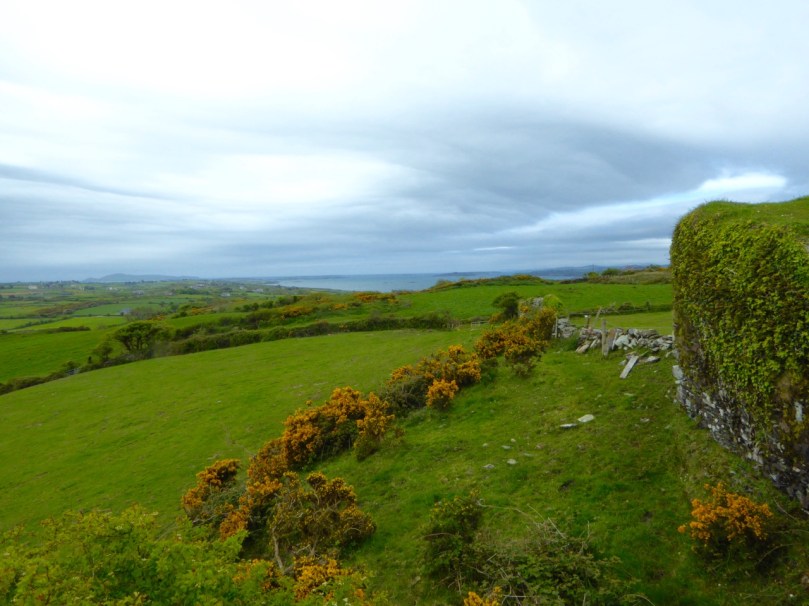
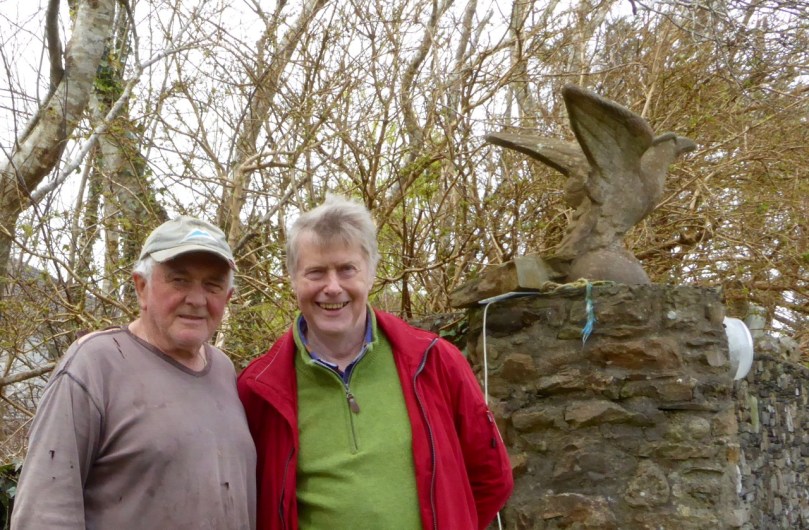
From the wall

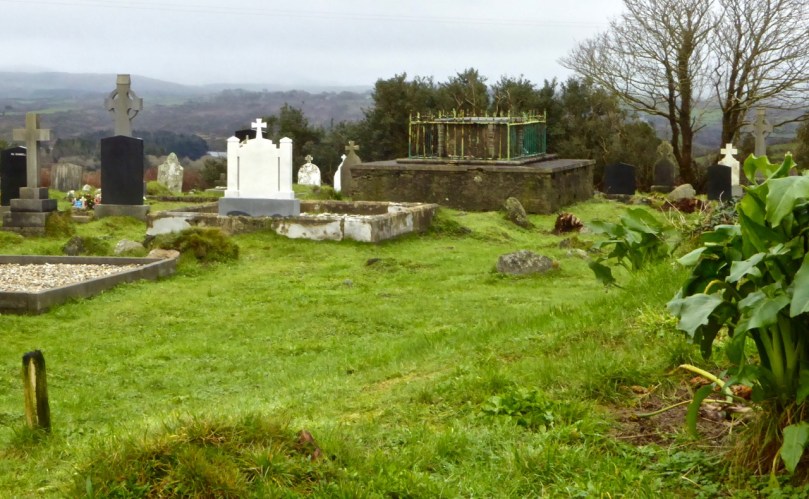
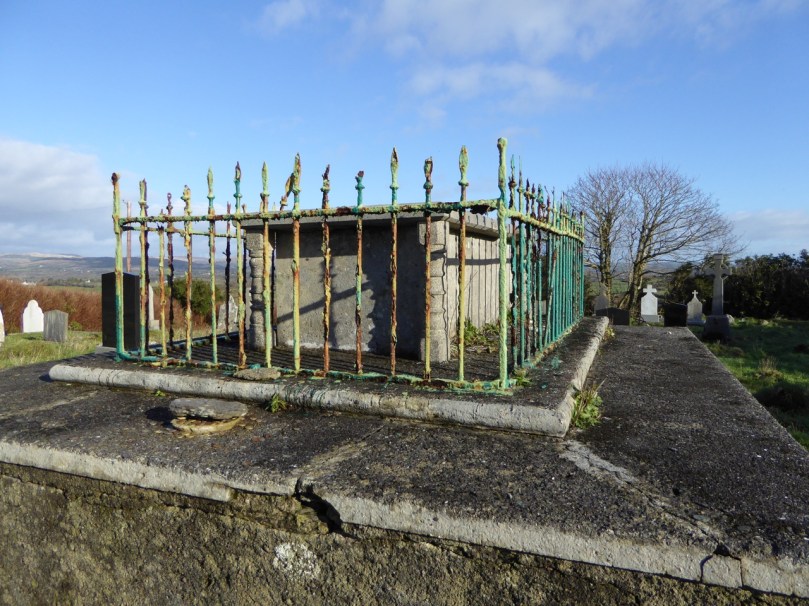
The Barry tomb dominates the graveyard

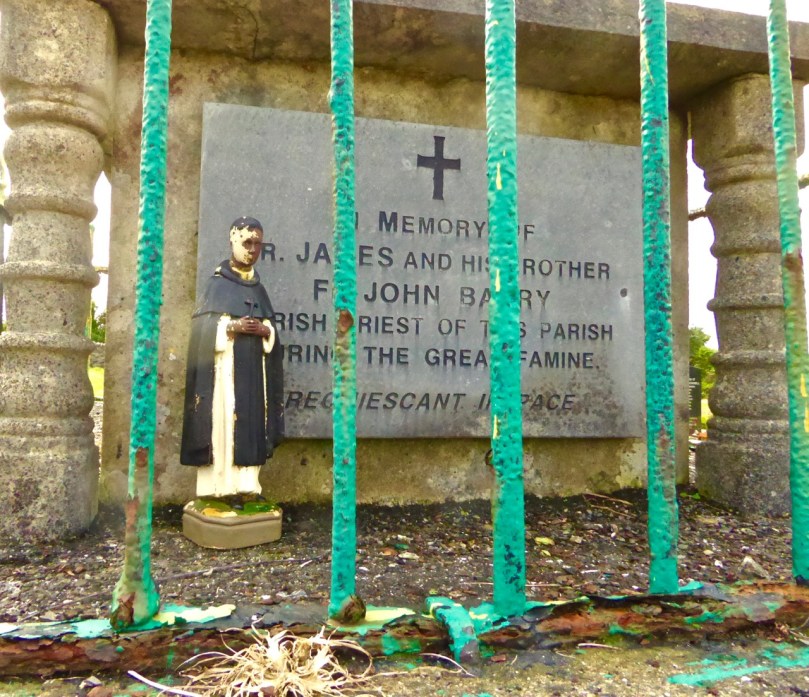
There is much to say about Stouke Graveyard and my theme of Priests and Poets but I will start with one grave in particular and leave the rest to a second post. This is the grave of Father James Barry, his brother, Father John Barry, their sister, Margaret, and their housekeeper, Julia Roberts. I have mentioned this grave before briefly, but I have now had an opportunity to look at it more closely.

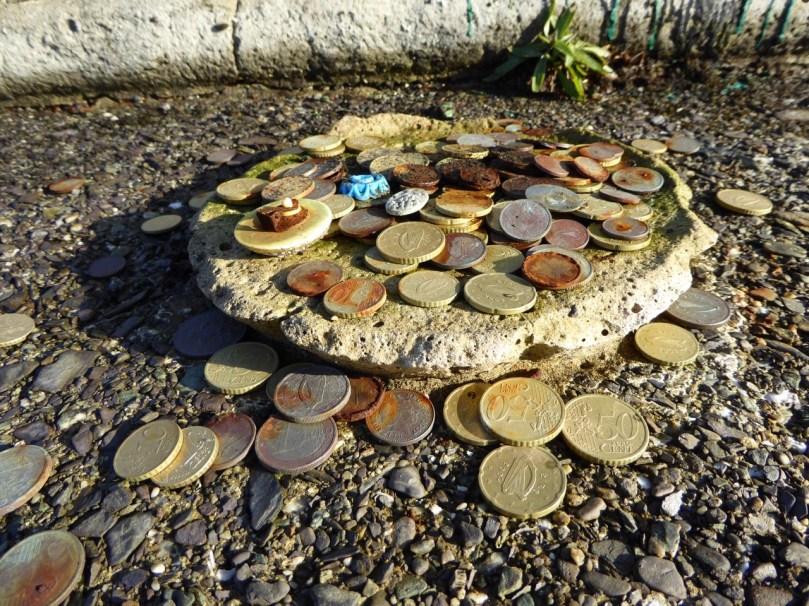
offerings

Coins and tokens have been left on the tomb

Why does this large chest tomb occupy the most elevated and central place in the graveyard? Why are coins and tokens left as offerings on it? Why, according to notes made by the Historic Graves Project, do people come to pray here on St John’s Day (June 24th) every year? Although I didn’t find all the answers, researching the questions led me to Father James Barry, Parish Priest of Schull before and during the Great Famine.

Frs Barry, Stouke

James was obviously a man of learning and compassion, and one who was called upon locally to be a spokesperson and advocate for his flock. Even before the Famine he gave evidence to boards of inquiry about the conditions in West Cork, pointing out the miserable diet, lack of proper clothing and housing, poor prospects for employment, the uncertainty of a lease being continued, the lack of compensation to tenants when lands were taken to build new roads, the desire of many to emigrate and the good account they gave of their experiences in their new homes.  He would have read their letters to them, since many of his parishioners were illiterate – his remarks focused on the many advantages of the New World, including a pointed reference to the absence of tyranny. In what seems like a very modern concern with income inequality, he commented on how the rich got richer as their tenants’ lives became ever more difficult. (Reported in British Parliamentary Papers)

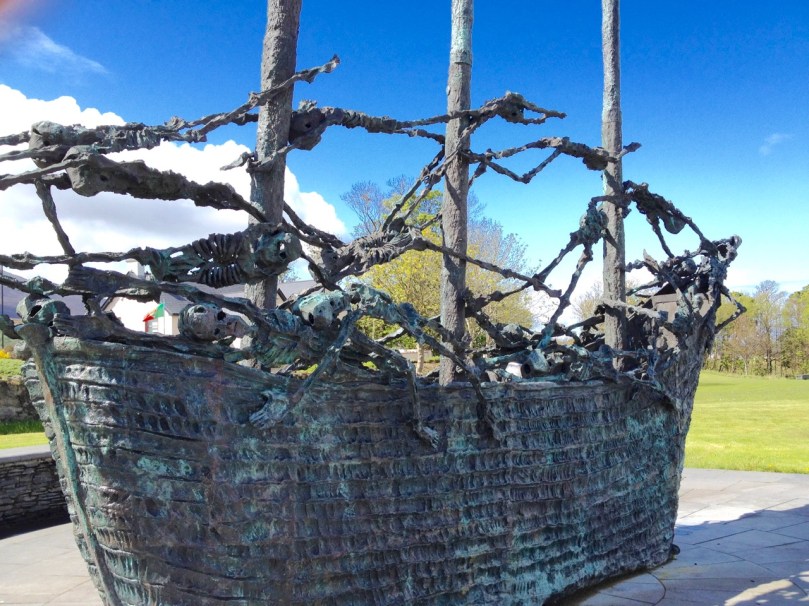
Famine Memorial at Murrisk

The Famine Memorial at Murrisk in Mayo. The ‘coffin ships’ that carried a generation of people to North America were notorious but for those who chose to go the voyage was preferable to the nightmare of famine at home

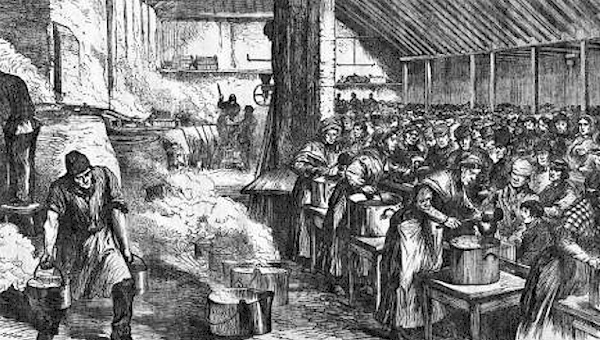
During the Famine, he and his brother, Father John, also of Schull parish, worked to help establish soup kitchens but insisted that more than soup be served, since the soup was not nutritious enough. Called eating houses, these places fed many people who would otherwise have died, and replaced the hated and ineffective Board of Works schemes that put weak and starving people to hard labour so they could buy their own corn, thus supposedly salvaging their dignity and rescuing them from the evils of pauperism.

soup-kitchen1

Famine Soup Kitchen

The efforts of the eating house committees crossed religious boundaries and appear to have been effective in slowing the rates of starvation to such an extent that in one of his depositions James states that “deaths were now so few that the slide-bottomed coffins were no longer in use.”

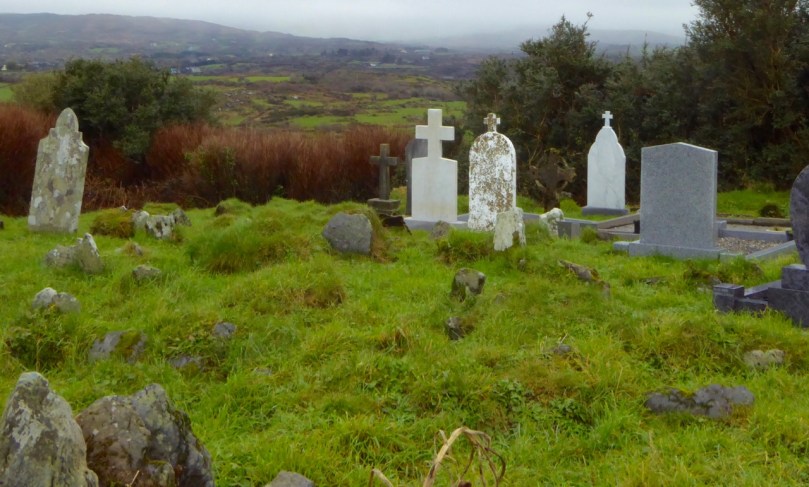
Among the unmarked graves

Many unmarked graves dot the Stouke graveyard, some no doubt dating to the Famine years

James advocated tirelessly for his parishioners, through giving information and evidence and through submissions to authorities. His anger is unconcealed when he describes his visit to the village of Kilbronogue near Ballydehob: Fever consequent upon starvation was spreading among the clusters of cabins…the townland  [will] soon be at the immediate disposal of the head landlord, Lord Bandon. There will be no need of extermination or of migration to thin the dense swarm of poor people…; this will take place without his lordship’s intervention or agency, I hope, to a better world. Indeed his words were prophetic – there is no longer a village in Kilbronogue.

Trench’s book, Realities of Irish Life, is available online. The illustration is of an incident in which tenants are down on their knees begging for a reduction in rent.

Fr Barry acted as a guide for William Steuart Trench, a controversial land agent who later described his visit to the famine-stricken area of Schull in the book Realities of Irish Life (available to read online). In cottage after cottage he found families sick, dying or dead. The account is heart-rending. It led me to wonder if James Barry could have been the model for Peter Gilligan in WB Yeats’ poem The Ballad of Father Gilligan.

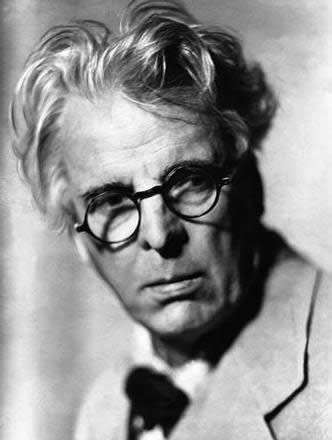
yeats2The old priest Peter Gilligan
Was weary night and day;
For half his flock were in their beds,
Or under green sods lay.

Once, while he nodded on a chair,
At the moth-hour of eve,
Another poor man sent for him,
And he began to grieve.

‘I have no rest, nor joy, nor peace,
For people die and die’;
And after cried he, ‘God forgive!
My body spake, not I!’

He knelt, and leaning on the chair
He prayed and fell asleep;
And the moth-hour went from the fields,
And stars began to peep.

They slowly into millions grew,
And leaves shook in the wind;
And God covered the world with shade,
And whispered to mankind.

Upon the time of sparrow-chirp
When the moths came once more.
The old priest Peter Gilligan
Stood upright on the floor.

‘Mavrone, mavrone! the man has died
While I slept on the chair’;
He roused his horse out of its sleep,
And rode with little care.

He rode now as he never rode,
By rocky lane and fen;
The sick man’s wife opened the door:
‘Father! you come again!’

‘And is the poor man dead?’ he cried.
‘He died an hour ago.’
The old priest Peter Gilligan
In grief swayed to and fro.

‘When you were gone, he turned and died
As merry as a bird.’
The old priest Peter Gilligan
He knelt him at that word.

‘He Who hath made the night of stars
For souls who tire and bleed,
Sent one of His great angels down
To help me in my need.’

‘He Who is wrapped in purple robes,
With planets in His care,
Had pity on the least of things
Asleep upon a chair.’

Although this is an unusual poem for Yeats (he was not a Catholic and he did not often publish simple quatrain-based ballads) it reflects his interest in the Irish stories he collected and loved. It was a favourite, as you can imagine, of the nuns who taught us English, combining as it did ease of memorisation,  the religious fervour they hoped to inculcate in their convent classrooms and the unassailable respectability of having been composed by Ireland’s Nobel Laureate.

Brothers' grave

But back to the grave…the priests’ housekeeper, Julia Roberts, who died in 1838 was the first to be buried here. James and John’s sister, Margaret, died at the height of the Famine in 1848 (although we do not know if her death was in any way associated with this event). The Historic Graves record contains this intriguing note: When his sister died and was also buried here Sarah’s (should be ‘Julia’s’) coffin was in perfect condition. She was reburied with the parish priest even though she was not a Catholic.

James went on to serve as Parish Priest of Bantry and died in 1853. James’ brother, John was apparently similarly active but not much has survived recording his life. He took over from James as Parish Priest in Schull, where he served until his own death in 1863.

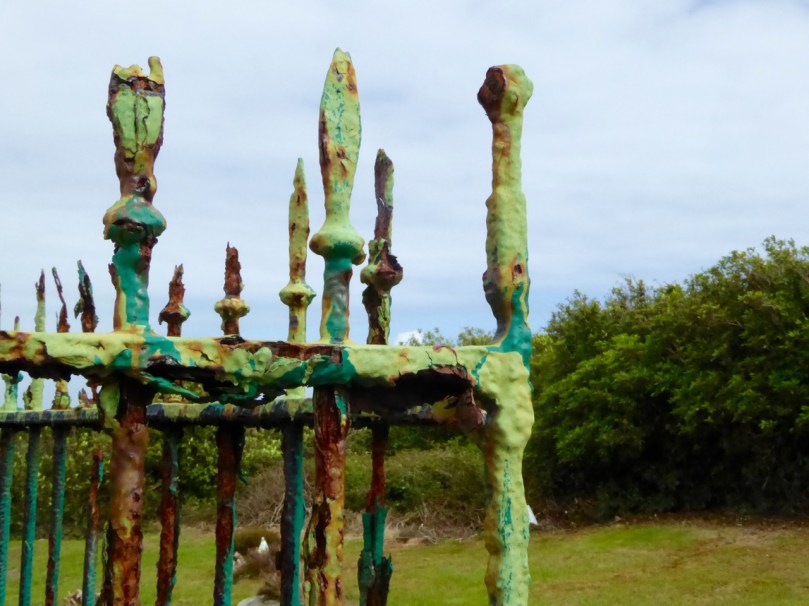
railings

Next week I will continue my tour of this wonderful spot – and we’ll have a little more poetry – although from a different source.

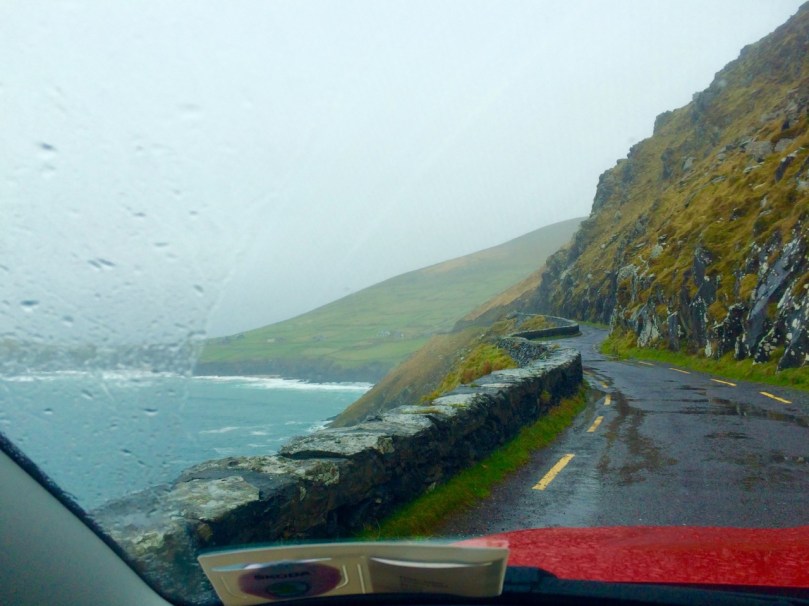
Irish Roads

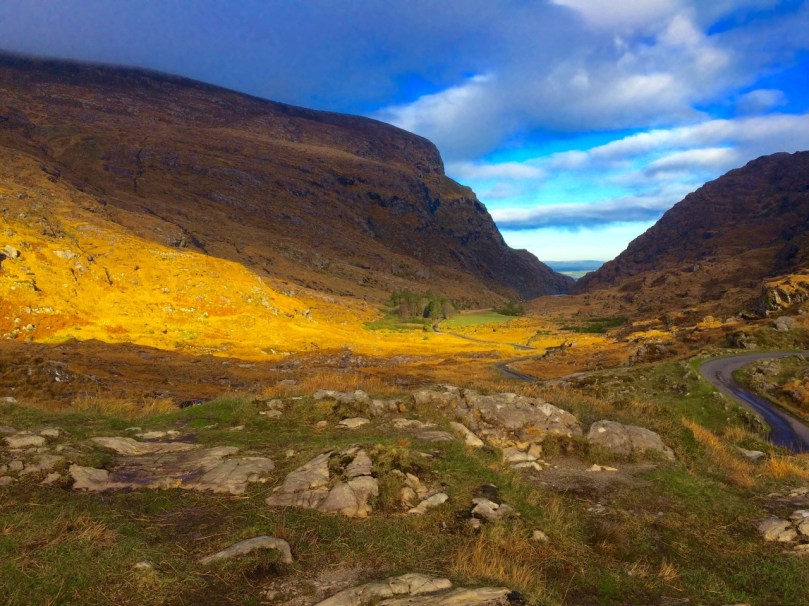
Heading towards the light

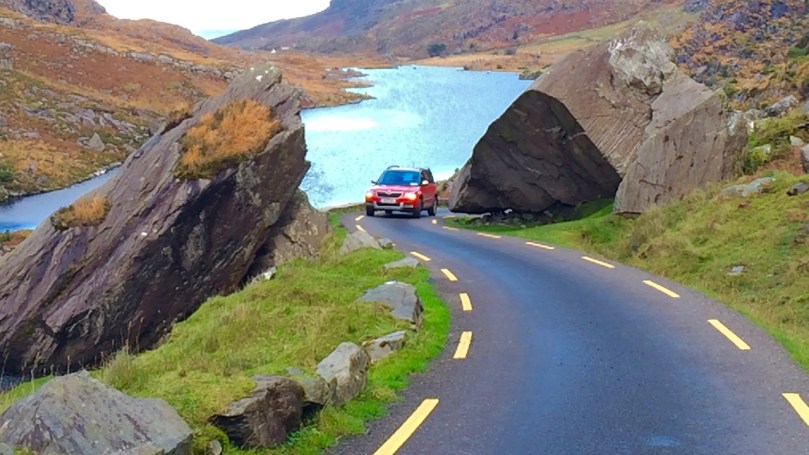
Driving the Gap of Dunloe in Kerry – it can only be done in winter.

To give you a flavour of what it’s like to drive in Ireland, I’ve put together a few of my favourite photographs of the roads we’ve travelled. Sometimes I wonder if we will get to the point where we take for granted the spectacular scenery which is such an everyday occurrence for us, but then we find ourselves pulling over once again to wonder at the wild landscape, the grandeur of the mountains, the way the sea cuts deeply into the sandstone cliffs, the old castles and ruins that dot the fields – and we know that we will never tire of Irish roads.

This slideshow requires JavaScript.

I’ve chosen only photographs that have roads in them, so you can get the feel of travelling in Ireland. And yes, it does rain in Ireland and the clouds come down and cover everything and then driving isn’t as much fun. Find a pub to hole up in, wait a while, and try a prayer to St Medard

Dingle

Of course some  of you, dear readers, do this every day, like we do, so tell us your own favourite Irish roads – or share a photograph on our Roaringwater Journal Facebook page if you like.

This slideshow requires JavaScript.

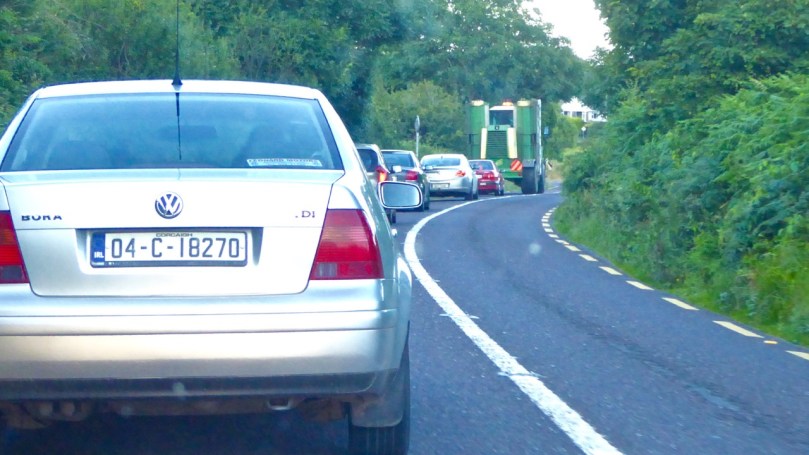
Obstacles are common – so don’t drive too fast along the rural roads as you never know what might be around the bend.

Tractor pace

And there’s no point in being in a big hurry…
Only room for one at a timeThere’s only room for one at a time

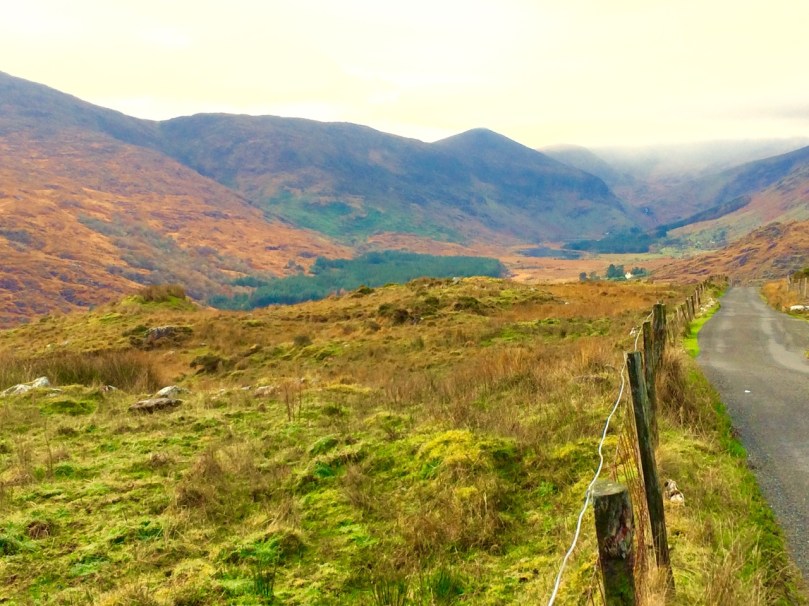
We do have freeways/motorways in Ireland, and tolled highways, and congested city streets with honking traffic. Our advice is to get off the highways and out of the cities as soon as possible. Get on this road, for example, that runs through the Black Valley in Kerry, and see where it takes you.

Black Valley, Kerry

Happy driving in Ireland!

By the lighthouse

A Carnivore in West Cork

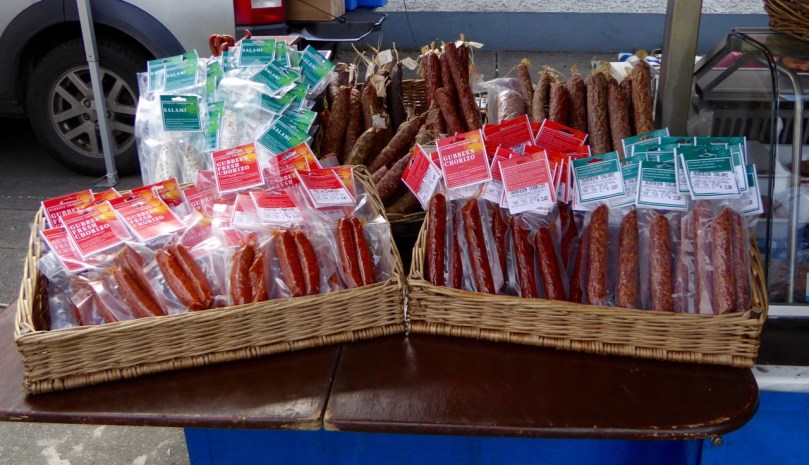
Gubbeen's Chorizo and Salami

Gubbeen’s Chorizo and Salami

Why am I writing about meat?

Well, for starters, Robert and I are omnivores. Given that I do eat meat (walk away now, all my vegetarian friends!) I want it to be good quality and tasty. I want to know where it comes from and how it was raised. Living in a large Canadian city, I was aware that here and there there was a butcher shop – either an old-fashioned hanging-on-for-dear-life shop in a traditional neighbourhood, a stall in one of the large markets, or latterly a smart shiny artisan establishment staffed by trendy young men in striped aprons. But, like everyone else, I didn’t have time to drive across town to seek out places like this and just bought my meat in the supermarket.

One of the things that surprised me, coming back to live in small-town Ireland, was that butcher shops are alive and well and thriving still – even if there is also a large supermarket in the town.

They are a friendly lot, these butchers. They love to offer advice on how to cook the meat you’re buying, or to give suggestions for dinner. They will cut a piece exactly as you want (wafer thin for stroganoff) or disappear into the back and reappear with a huge haunch because you want something that isn’t on display (shanks, with the marrow intact), or trim every last ounce of fat off a joint. “Years ago,” one butcher told me, “all cuts were sold with bone and fat. But, sure, you have to move with the times.”

Over the years there have been lots of exposés and scandals about the provenance of meat sold in Europe (horse meat, anybody?) and concerns about foot-and-mouth and other diseases, but our local butchers know the source of all the meat they sell, down to the farm it came from, or the herd. “It’s from our own farms,” one butcher told me, indicating an area north of Skibbereen where contented cattle spend their days in lush green fields.

Micheál Daly of Skibbereen - the meat comes from their own farms

Micheál Daly of Skibbereen – Daly’s meat comes from their own farms

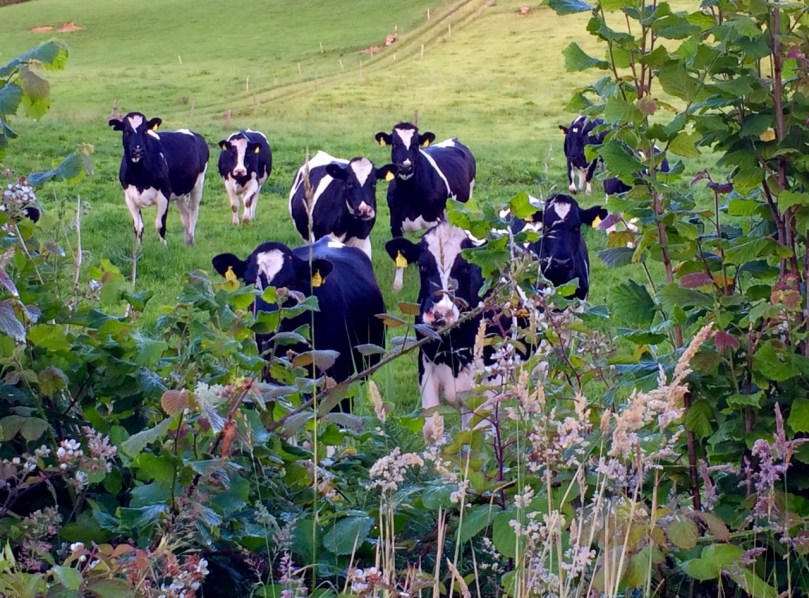
“We get our lamb from out by Fohorlagh” said another. We know the cattle spend their lives grazing on rich grasses – we are surrounded by them in Nead an Iolair – and we think that’s the secret to the taste. We don’t want to eat meat that’s been factory bred and fed.

Happy cattle in the field next door

Happy cattle in the field next door to us

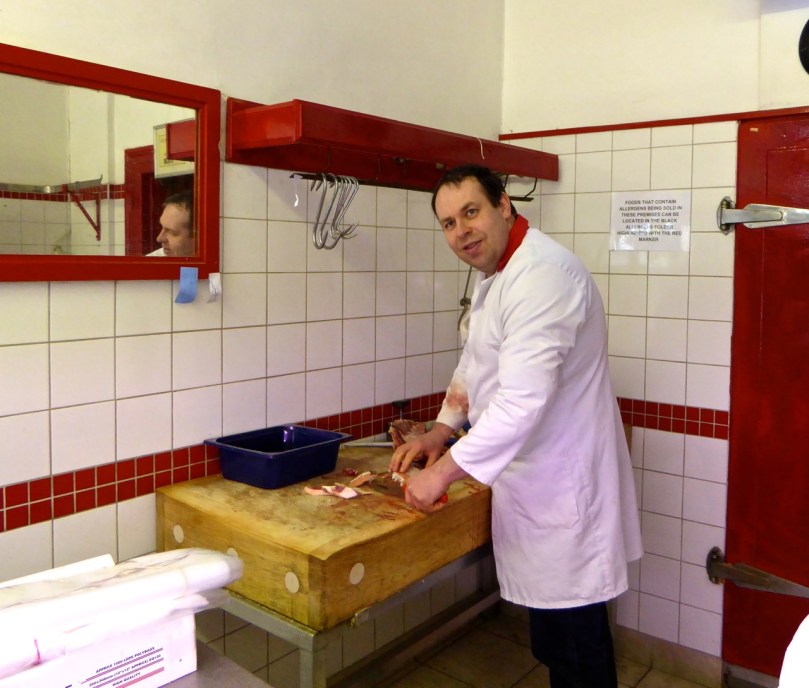
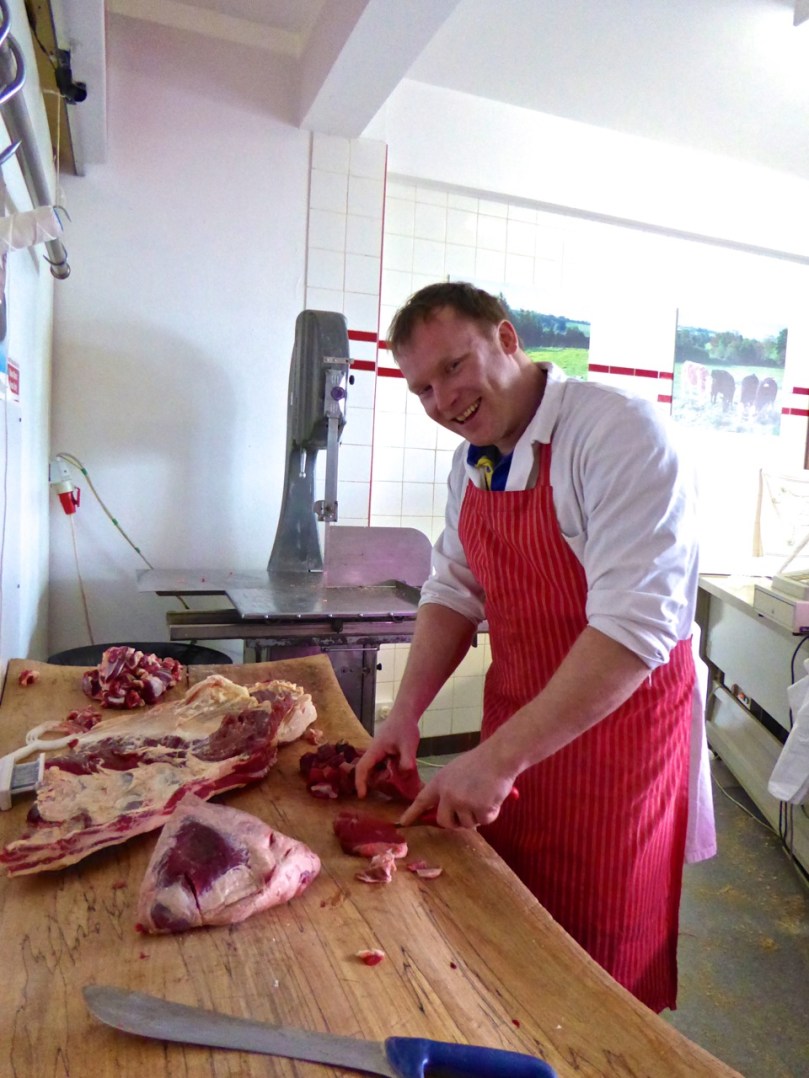
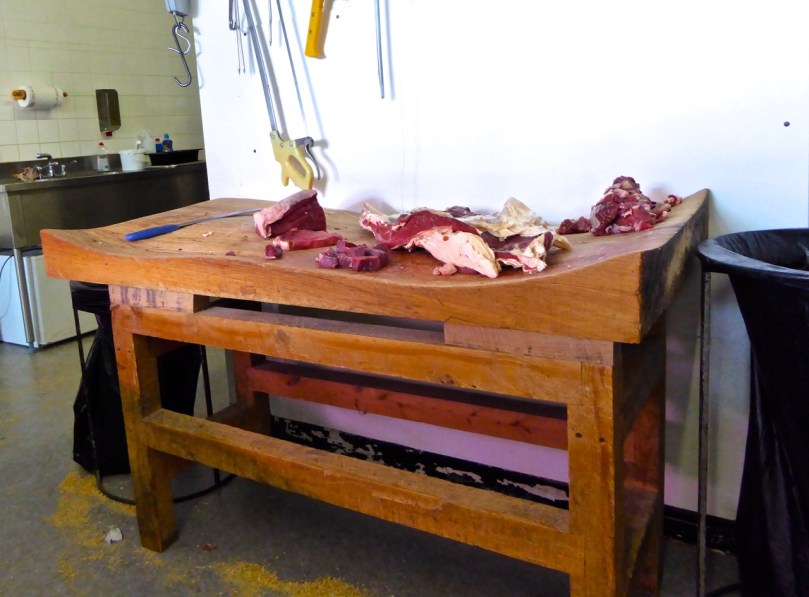
Most of the local butchers work on well-worn wooden butcher blocks. I’m fascinated by these – they seem like such old technology and indeed some have switched to dense plastic blocks. But the ones who still use the wooden ones tell me that lots of research has been done on them and that they are as safe as or safer than plastic.

John Barry, our local butcher in Schull, working at his 40 year old butcher's block

John Barry, our local butcher in Schull, working at his 40 year old butcher’s block

Time worn beauty

Time worn beauty

As our readers know, the food scene in West Cork is terrific. At our Saturday market in Skibbereen we have a great choice of artisan meat products. We get our breakfast sausages from Frank Krawczyk – he was a charcuterie pioneer here before any of us knew the meaning of the words.

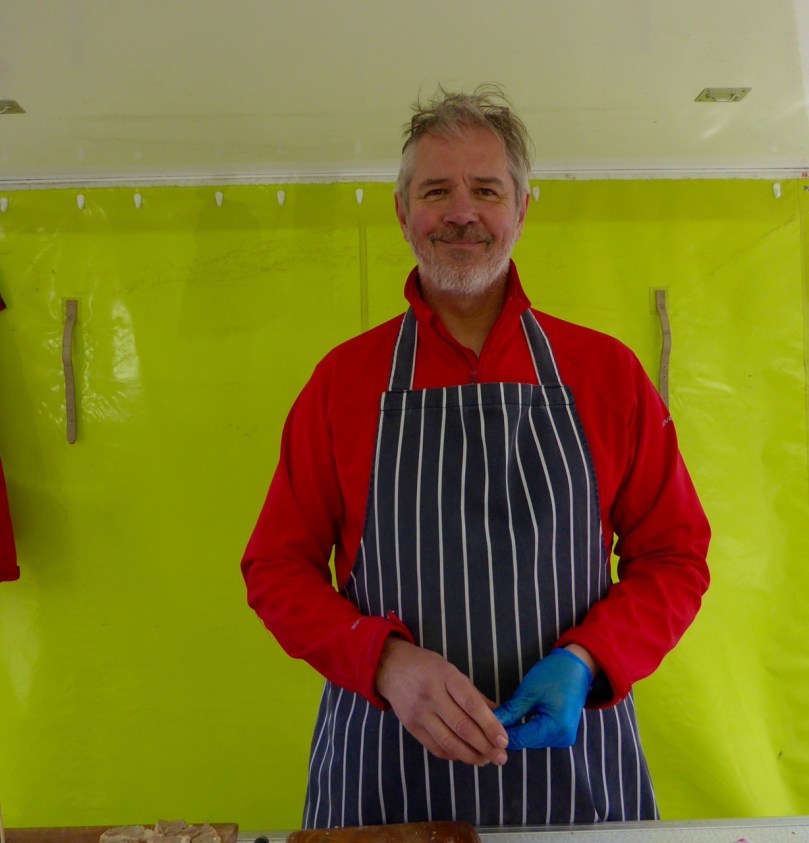
The fabulous West Coast Pies is our go-to resource for pork pies, scotch eggs, gourmet dinner pies (chicken and leek, beef bourguignon) and wonderful salmon quiches. They do lots of vegetarian stuff too. Paul is so insistent on the quality of his pork that he has decided to raise his own and is now an organic pig farmer on top of everything else.

Paul Phillips of West Cork Pies

Paul Phillips of West Cork Pies

We met Avril Allshire of Rosscarbery Recipes at a recent concert, serving her uber-delicious black pudding swirls. We loved them so much she told us where to find the recipe and so we made up a batch ourselves. Yummers! (And I am not normally a black pudding fan.)

And of course there’s Gubbeen! They’ve been making cheeses forever, award-winning and delectable, and built a smokehouse to produce a smoked version of their famous farmhouse cheese. From there, Fingal Ferguson has produced an array of chorizo and salamis that are firm favourites with all the locals. We buy his bacon and hams – we always cook an enormous one at Christmas and have to book it weeks in advance.

Read about Gubbeen’s food philosophy on their website – it might be the most profound expression of the importance of real food you will find anywhere.

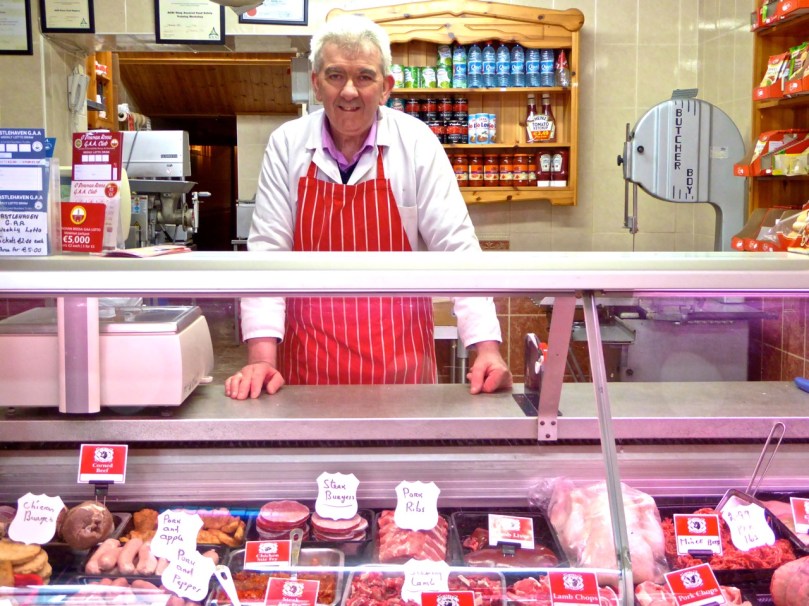
Andy O'Sullivan of Skibbereen. He's been a butcher all his life and says the 5 year apprenticeship offers excellent training.

Andy O’Sullivan of Skibbereen. He’s been a butcher all his life and says the 5 year apprenticeship offers excellent training


Showing Off West Cork

This is how you sightsee in West Cork!

This is how you sightsee in West Cork!

Ladies and Gentlemen, meet Susan Byron! Susan is the face behind Ireland’s Hidden Gems, a custom travel service for visitors to Ireland, and she and I met last year when Robert and I spent a week in Clare. Susan loves nothing better than to hop in her car and take off for a few days to some part of Ireland she wants to explore or re-explore. There are very few places she hasn’t seen, but I soon discovered that the Sheep’s Head was one of them. She has been to the Mizen before but hadn’t seen some our OUR hidden gems. In short order we decided that a visit must be organised, and a couple of weeks ago she arrived, bearing Burren lamb, bottles of wine, and an infectious enthusiasm to see everything.

The 17th century Bardic School

The 17th century Bardic School on The Farranamagh Loop walk

Now if someone who runs a bespoke travel agency wants to see your piece of paradise, well, you’re going to put your best foot forward. Fortunately, this isn’t a problem in West Cork – it’s pretty well a fail-safe place to show off. Susan spent her first day whale watching (something we promise ourselves to do soon) and exploring the area east of Skibbereen. On day two and three she was all ours and we spent the first day on the Sheep’s Head and the second on the Mizen.

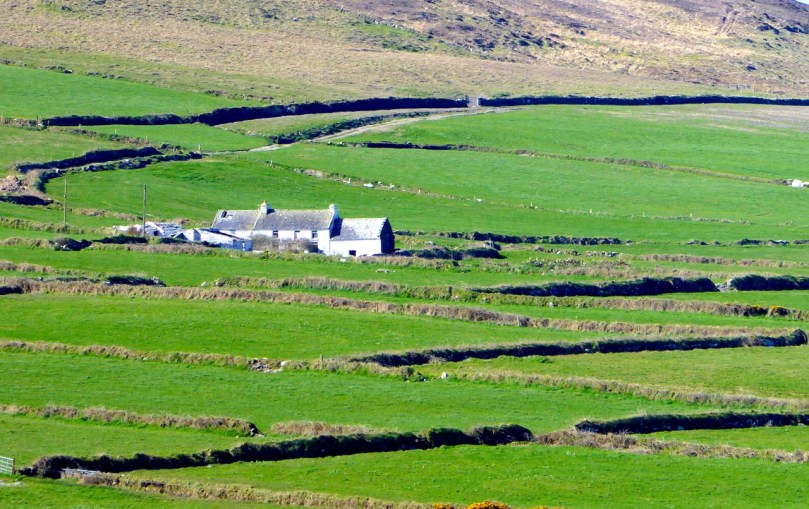
Mizen farm

Mizen farm

First of all, travelling with Susan is a hoot. She’s got a hot car, a ready laugh, an inexhaustible supply of stories, insatiable curiosity, and a real passion for Ireland. She is amazingly well-read – she knew the dates of the castles before I could tell her and was already familiar with what most tourists want to to see and do in West Cork. So this was a cheerful, companionable time of exploration, chatting, coffee and scones, hiking and sightseeing.

Our Sheep’s Head day took in two loop walks – the Farranamanagh loop and the lighthouse loop. We started off in drifting mist but the sun came out in the afternoon and soon we were shedding coats and applying the sunscreen. After a stroll around the lovely Farranamanagh walk (famous for its 17th century Bardic School) we had lunch in The Creamery in Kilcrohane and browsed in the Sheep’s Head Producers Market. We bought eggs from a farmyard, said hello to contented alpacas, and took innumerable photos of the killer views.

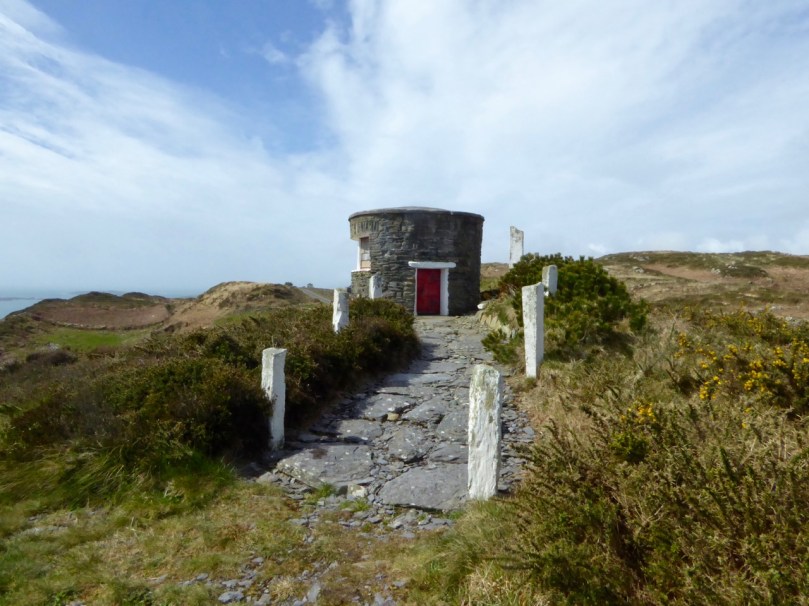
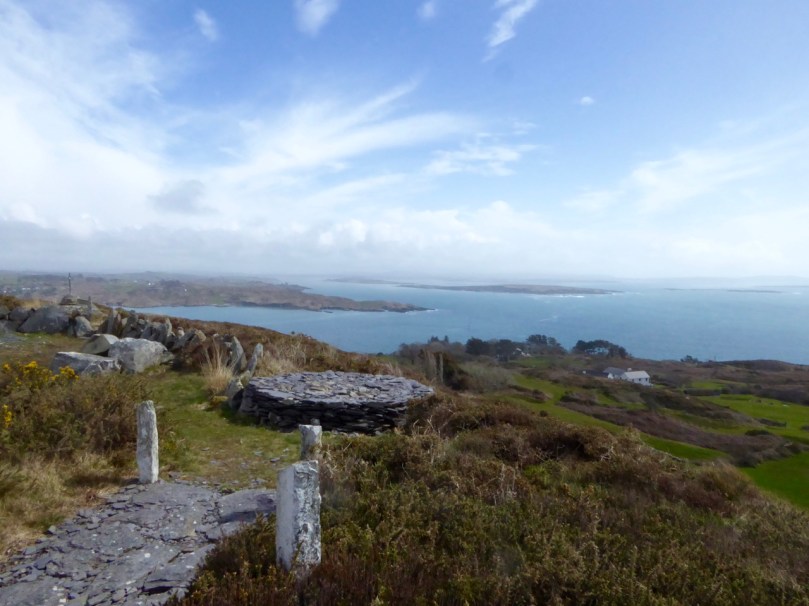
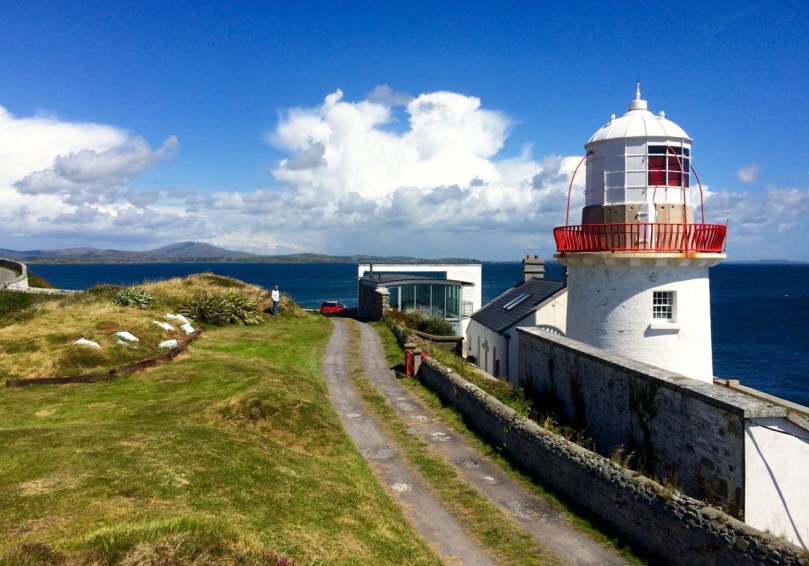
The Lighthouse Loop offers unparalleled vistas at the end of Sheep’s Head – south to Mizen Head and the sweep of the West Cork coastline, and then, as you round the end, north to the Beara and to the Iveragh Peninsula (Ring of Kerry) beyond it. The trail has some steep sections and clings to a cliff edge for part of the northern stretch. It, and the Farranamanagh Loop are but two of the many waymarked trails that crisscross the Sheep’s Head. Each is as rewarding as the next and you could easily spend several days exploring this one Peninsula.

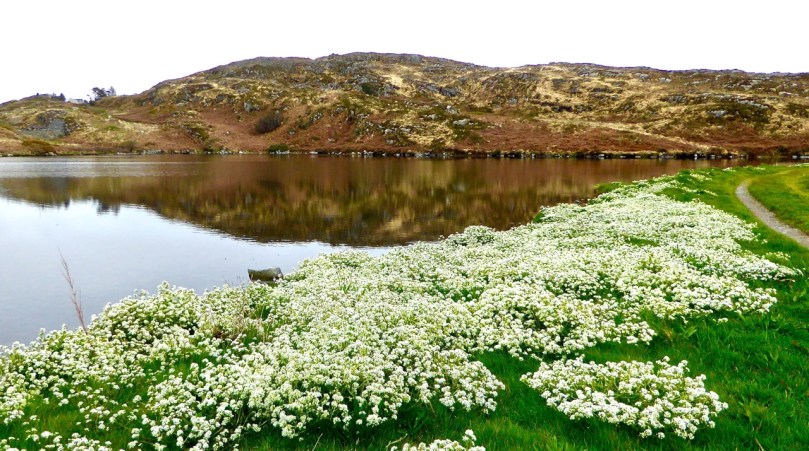
Lake Farranamanagh

Lake Farranamanagh

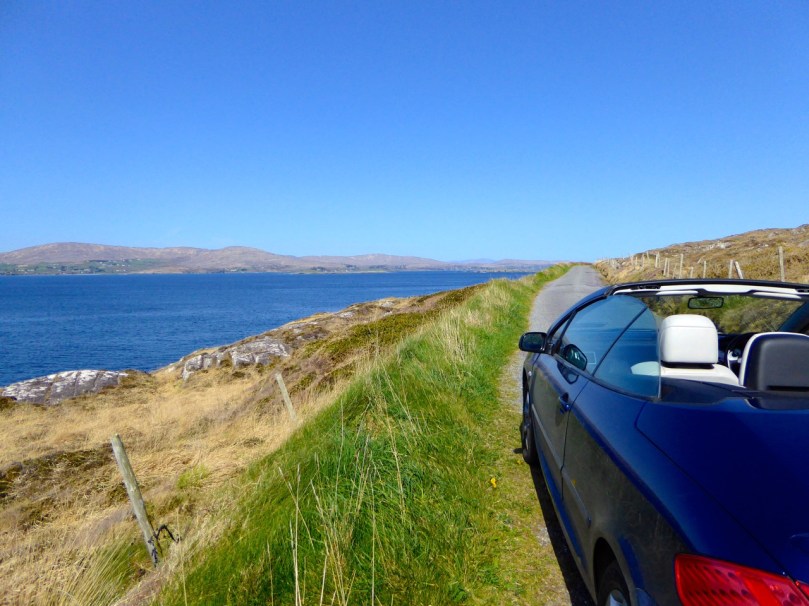
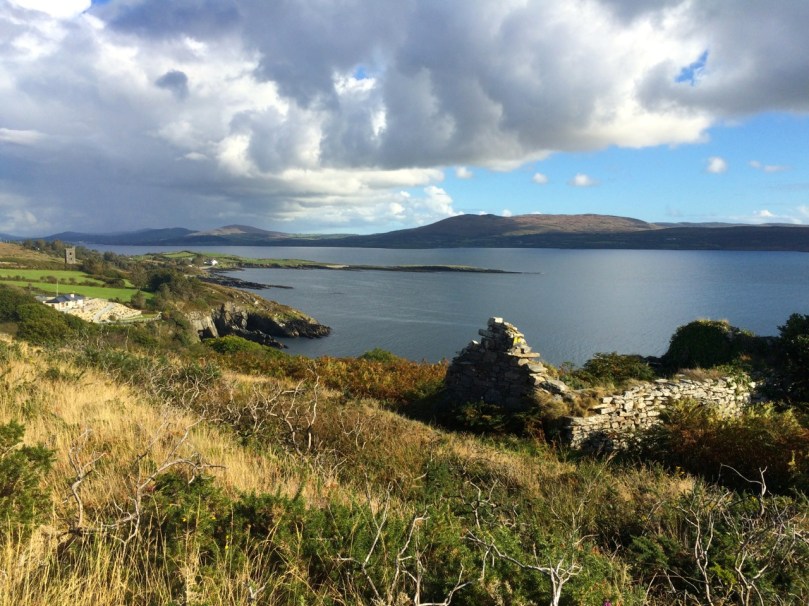
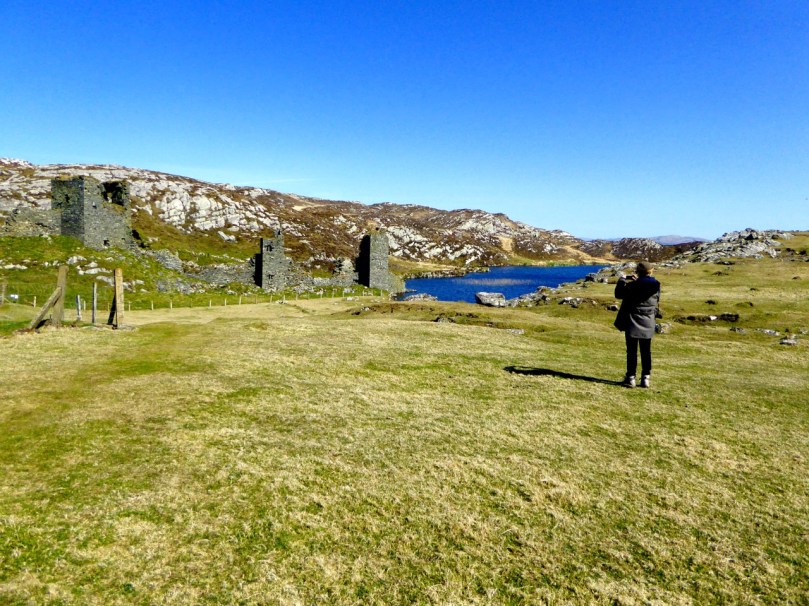
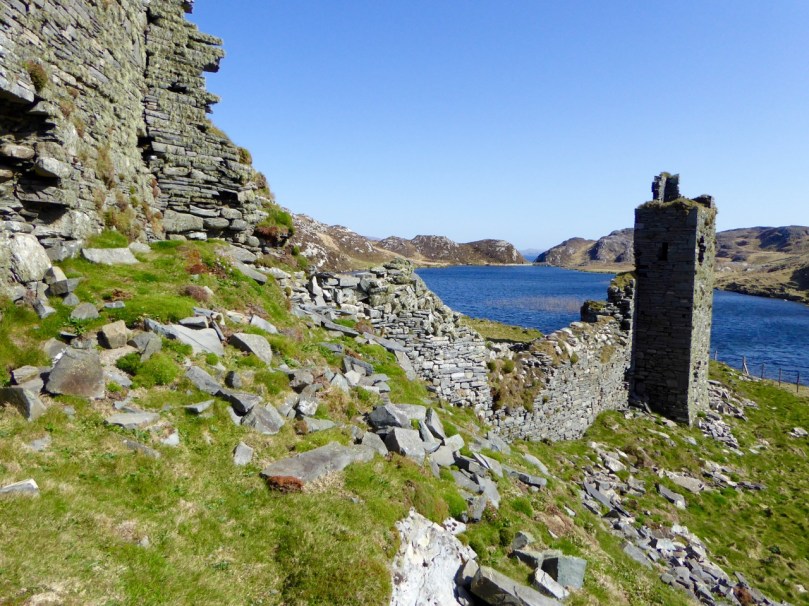
The Mizen, of course is OUR peninsula and we are always delighted to introduce it to friends. The weather was brilliant so we were able to drive in Susan’s cool car with the top down. (In my next life I want to come back as a blonde with a convertible.) Three Castle Head was at its most spectacular, with the water that deep azure blue that people who don’t live here have a hard time believing is real.

The Three Castles: it's love at first sight for Susan

The Three Castles: it’s love at first sight for Susan

The curtain wall and the lake

The curtain wall and the lake

Spring was bustin’ out all over so the air was heady with wildflowers and the fields full of newborn lambs. The drive on the north side of the Mizen is as jaw-droppingly gorgeous as any stretch of road in Ireland – the only difference is that it’s empty. We met not a single car, which enabled us to stop where we pleased to survey the scenery or take photos.

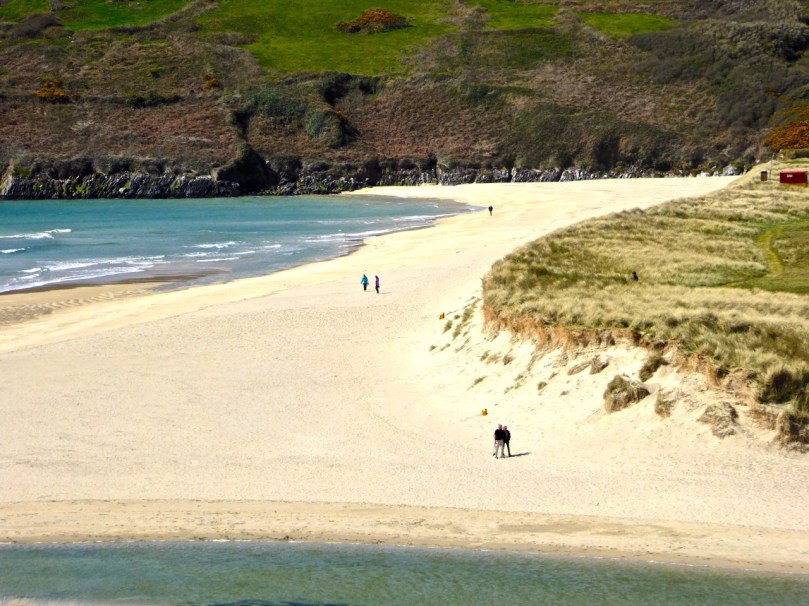
Barley Cove Beach

Barley Cove Beach

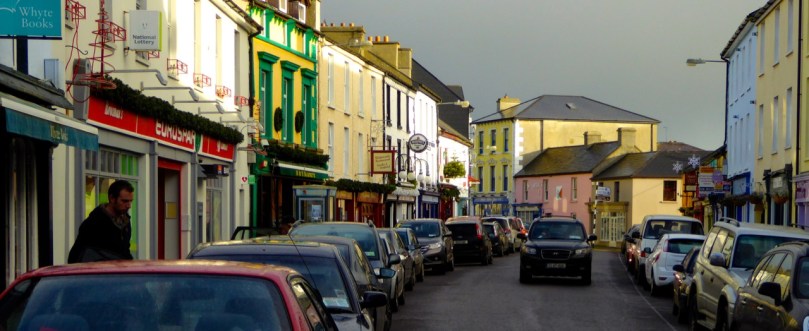
Susan wound up her time by conducting some retail therapy in Schull. No better place!

Schull, colourful village with great shopping

Schull, colourful village with great shopping

She has posted numerous photographs on her Facebook page and even used the phrase “possibly the most beautiful place I have ever been….” about Three Castle Head. That’s how I feel about that magical place – but when someone who has seen everything Ireland has to offer says it, maybe, just maybe, I’m not delusional after all.

Susan at the cairn. Three Castle Head on the Mizen

Susan at the cairn. Three Castle Head on the Mizen

An Extra Lick of Paint

Old vet clinic, Schull

Old vet clinic, Schull

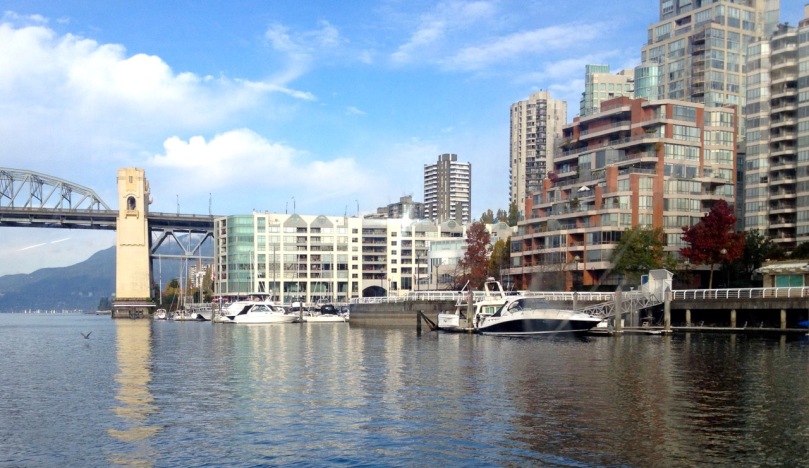
I used to live in Vancouver, on Canada’s west coast. It’s a beautiful city by any standards: gleaming high-rises, miles of seaside walkway, and snow-capped mountains lending a dramatic backdrop. I loved it, but when I looked through my window mostly what I saw was concrete and steel – and no colour! I had to escape up into the mountains or out to the Fraser Valley to get in contact with nature and feed my soul.

Where I used to live

Where I used to live

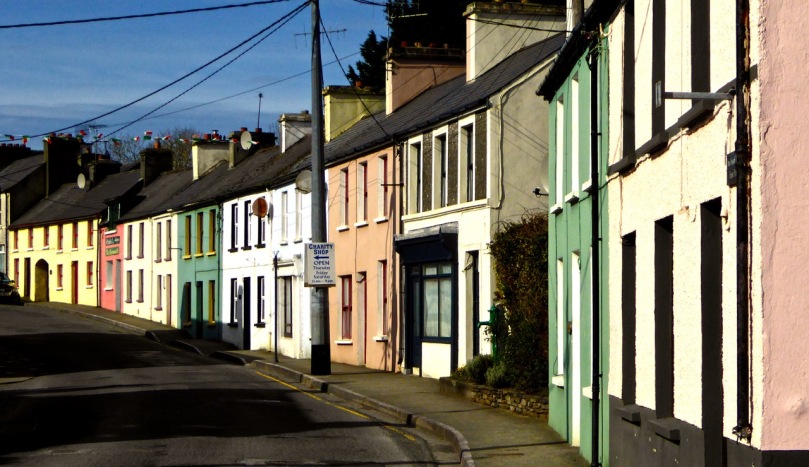
Where I live now

Where I live now

In West Cork, my soul is fed every day, every time I look out the window of our house, every time I stroll through our village of Ballydehob. That’s down to our rural setting, of course, and the magnificent scenery, but a huge part of it is about colour. I’m a colour person, I guess: I respond to it and crave it. I can certainly appreciate a quiet tasteful palate of greys or beiges, or any of the million variations of off-white when I see them. But left to my own devices I’d quickly have a chunk of candy apple red in there, or chairs the colour of daffodils, or a wall in a vivid pink. As Lady Gaga says, I was born that way.

Why is that woman taking my picture?

Why is that woman taking my picture?

And so I find living in rural Ireland a constant source of delight and inspiration. No country was ever this green, surely! Now the gorse is starting to bloom, turning the hillsides into a blaze of yellow. And every few kilometres along the road is another village or town full of colourful houses competing with each other for my attention. But before we get to the villages, here are some glimpses of houses just off the main roads as you drive those kilometres.

A Lick of Paint mainly featured houses out in the countryside, but for this post I wanted to show you some of my favourite houses in our nearby towns and villages: Ballydehob, Bantry, Skibbereen and Schull.

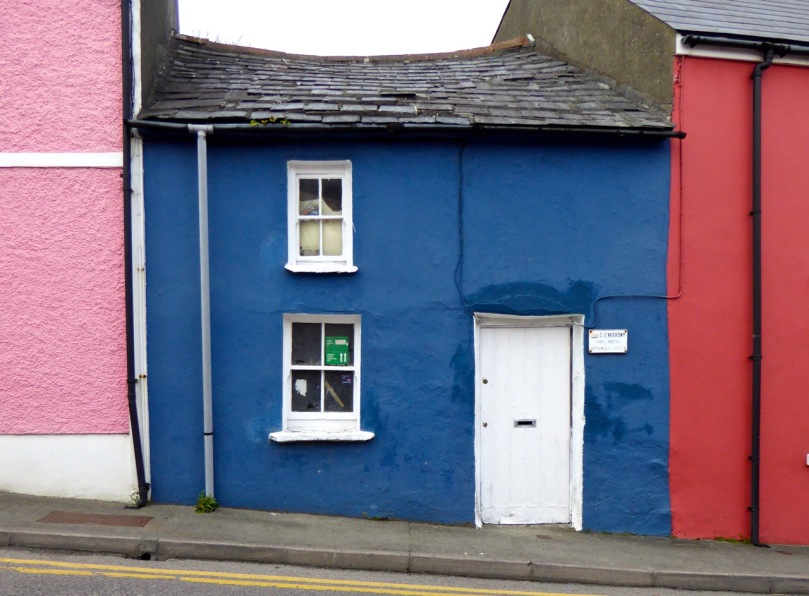
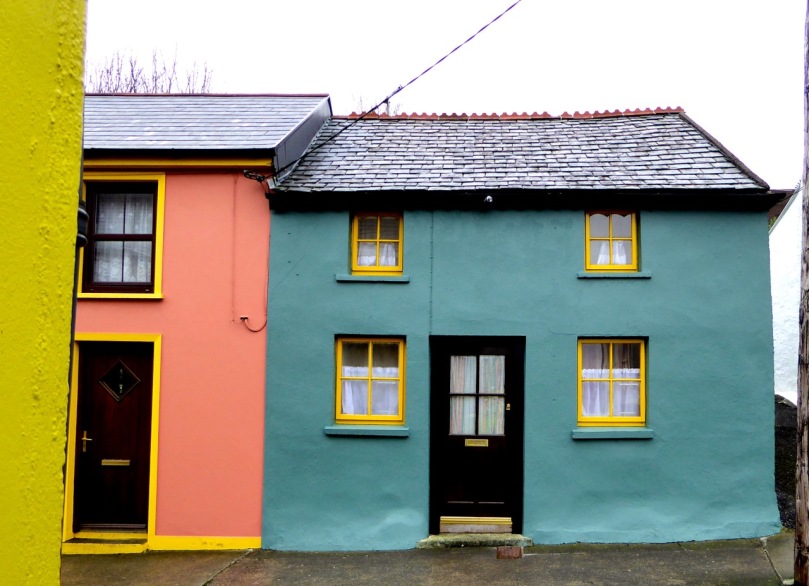
On the outskirts there are new estates of identical houses, of course, all painted in identical shades of cream. But in the steep and windy streets behind the shops you find little old terraced houses lovingly done up, the walls, doors and windows all in contrasting hues and with knife-edge divisions of colour between neighbours.

Skibb town house 2

Skibbereen townhouse

It can be like walking through a giant Rubik’s Cube (ok, that dates me) or one of those kaleidoscope tubes.

In his book, West of West, published in 1990, Brian Lalor captures my own experience growing up in a sea of grey. He says:

The nineteenth-century photographs of villages and farms show an unrelieved grimness of stone, cement and clay. Whitewash relieves this picture, though frequently this rendering has degenerated into a leprous greyness indicative of neither hope no prosperity. Colour has a symbolic relationship with the state of economics in rural Ireland. The last 20 years have seen the introduction of modern synthetics, bringing vivid tones not previously to be found here. Affluence and the EC have brought, as to the Aegean, a flight from the spartan virtues of white and cream…

Whatever the reason – prosperity, a sense of fun, a wish to lighten the spirits, the influence of the Tidy Towns Competition, an affinity with the colours of the wildflowers in the hedgerows, competition with the neighbours, the need to describe how to identify a house when street numbers are confusing or absent – I am grateful for it. It’s one of the things that makes rural Ireland unique and charming – and it feeds my soul.

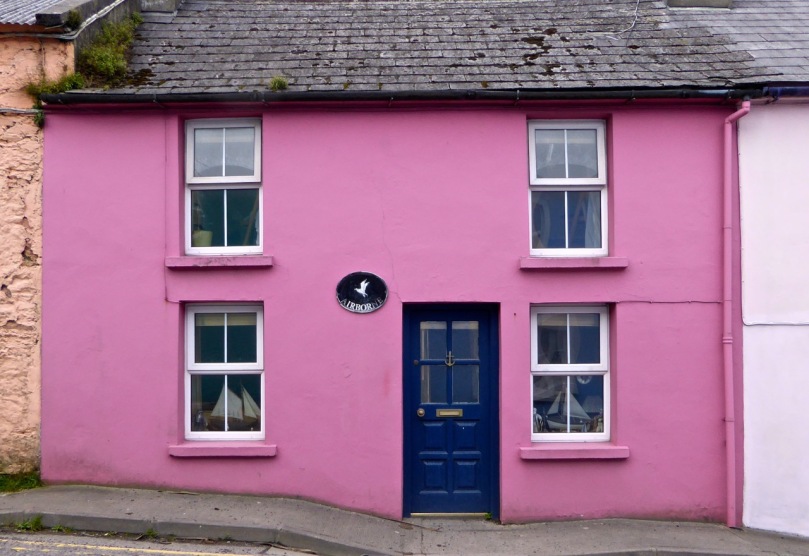
Airborne, Schull

Airborne, Schull

The Gables of Ballydehob

The Gables of Ballydehob


Whyte Books/Now AnnaB’s Bookshop

How inviting is this!

So inviting!

Since this post was published, Whyte Books has changed name and ownership. It is now AnnaB’s Bookshop – and we are happy to report it is as charming and wonderful as ever under its new owner, Katarina.

Do you have a favourite bookshop?

Of course you do! We all have one – THAT bookshop where you feel welcomed; where it never matters how long you browse or if you actually buy something; where knowledgeable staff can recommend a good book for your father or your grandchild; where you can sit with a nice cup of tea and a slice of something delicious as you browse through book reviews or escape from the rain; where they can order stuff for you and the process doesn’t feel like a soulless internet transaction.

Sheila

Herself

We have THAT bookshop, here in Schull. It’s called Whyte Books, presided over by the charming and cultivated Sheila Whyte. Sheila is typical of many of us who have made West Cork our home. She grew up in Dublin but spent most of her adult life in Australia. She fell in love with Schull on a holiday here, she fell in love with bookstores wherever she travelled, and when the time came to put it all together, well, we were the winners.

Sheila had a vision of what she wanted – a place that would become a hub of reading and intellectual activity in the area and she has worked hard to create just that. There’s a nook for kids and a space for young adults, besides all the little corners and seating areas where you can while away a pleasant hour with your nose in a book and your hand curled round a cuppa. She holds poetry readings, promotes and launches local books (a recent example is Gubbeen by Giana Ferguson) and hosts a monthly book club.

This week Whyte Books hosted the first ever session of The Moth in the South West. The Moth is new to Ireland although story telling is definitely not! A cultural phenomenon, The Moth got started in New York but is based on the idea of neighbours getting together on the porch to tell stories after it gets dark and the moths come out. Stories must be first person narratives, true, told not read, and last no more than ten minutes. About 20 of us gathered upstairs: there were candles and wine and laughter and stories and a promise to make it into a regular event. All the ingredients, in fact, that make Schull such a vibrant community and locate Whyte Books at the beating heart of that community.

books and books

books and books

We are so lucky to have a great bookshop here! It’s a tough business these days, so take a break from buying online – go buy the latest Must Read at your local bookshop. At Whyte Books, I can guarantee that if it’s not on the shelves they can get it for you. And while you’re at it, have a coffee…and maybe one of those yummy little chocolate thingies.

Browsing upstairs

Browsing upstairs

By the way, I’m not the only one who loves this shop. It’s been voted Best Bookshop in Munster, featured in a beautiful video,  and even people who happen by rave about it