Celebrating George Walsh

Robert and I are just back from a magical celebration in Dublin – the launch of a solo show by the stained glass artist George Walsh, at the Trinity Gallery. It was a joyful occasion and a huge success. As one of the organisers said afterwards, “It’s a long time since there was a queue outside a Dublin gallery for an exhibition.” The piece above, Ancestral Fields, is a good example of the vibrant and glowing glass – stained, fused, painted – on display.

At the exhibition opening at the Trinity Gallery: Imelda Collins and Loretto Meagher, Gallery Owners, Janet and George Walsh, Yours Truly and Eamonn Mallie (Photo by Stephen Walsh)

This month, my piece on George was published by the Irish Arts Review – I have been waiting for that to come out, and for this exhibition to open, before I write too much about him in the blog. It’s been difficult to sit on it all, because I’ve been studying his work seriously now for a couple of years, growing more and more entranced with every window.

The March 2019 Irish Arts Review, featuring my 6 page article about the art of George Walsh

Regular readers of the blog, or our Facebook Page followers, will recognise George’s work right away from the occasional image we share on either platform. We ‘discovered’ him on a trip to the Beara five years ago, and have been encountering his work all over the place ever since, initially by chance and more recently as part of a concerted effort to document his body of work for a specific project – more on that project later.

Saints, from a window in Kilcummin, near Killarney

Researching and writing the Irish Arts Review article has been a fascinating journey, as it involved capturing images of George’s work, interviewing colleagues and gallery owners, and most of all getting to know George and Janet as I peppered them with questions and as Robert and I spent time in their company.

George apprenticed with his father who, in turn, had apprenticed under Harry Clarke. They (father and son) worked together and separately both in the United States and in Ireland, producing wonderful windows for several studios and finally, in George’s case, settling down in Ireland and going out on his own. George’s son, Stephen, also an artist and currently living in London, is developing a website to showcase George’s work – visit it here as a work-in-progress – and also runs an Instagram feed full of gorgeous images.

George is inspired by Venice – another exhibition piece

George has collaborated with several architects to design and decorate new churches. His work with Holly Park Studios is breathtaking, demonstrating as it does what can be achieved when a project is conceived with stained glass as an integral part of the design from the start.

This screen door is but one of the stained glass pieces in the award-winning Church of the Holy Family in Belfast designed by Holly Park Studio. The mosaic flooring is by ceramic artist Laura O’Hagan, whom I was delighted to meet at the opening

But even where windows have been added over time (as is more normal in church architecture) George’s work shines and is instantly recognisable. First of all, his windows blaze with colour. What I have discovered by spending time with them is that he has this amazing ability to convince you that he is using primarily bold and primary colours but in fact any section taken at random in any of his windows reveal a host of colours, many of them subtle and gentle – it’s the way his choices of colour combine that result in the vibrancy and energy that are so typical of his windows.

The second thing is his complete mastery of his chosen artistic medium – glass. Perhaps this is best revealed in the complexity of the leading. Only an artist that has been classically trained in stained glass techniques could produce such incredibly complex images.

Larger expanses of a single colour (always painted and textured in subtle and not-so-subtle ways) are balanced by areas of the window is which each colour is a tiny sliver of glass, all cut and shaped in different ways and all leaded together to produce a final exciting effect. Just this week I stood in front of a Last Supper (below), which George had decided to depict in a field of wheat. The wheat occupied more than a third of the window and I estimate that it contained hundreds of different pieces of glass, all separated by twisted and swirling lead lines. it spoke to a level of skill and experience, a practice of perfectionism, and an acceptance of nothing less than the full realisation of the vision that only dedicated artists attain.

Finally, he is as comfortable with the transcendent as he is with the everyday. While most parishes want specific sacred images, he also makes himself familiar with the area so he can convey that sense of place that is so characteristic of his windows.

Above: Moses in the basket, Galway Cathedral. Below: St Catherine of Alexandria, from St Maur’s Church in Rush, Co Dublin. Catherine is shown with her usual attributes – the martyr’s palm, the sword which was the instrument of her death and the wheel which was used to torture her. But the Catherine Wheel is also a firework – called after St Catherine’s torture wheel, and George has introduced a subtle reference to that in his depiction of the wheel 

He loves to add in quirky little items that keep you searching through the windows for things that make us smile – pterodactyls and construction cranes, butterflies and elephants, rats and hares, flowers and insects, beehive huts and Brendan with his whale, a postman on a bicycle, water that flows from window to window around the church.

Above: A reference to church renovations. Below: A mouse and a fly are both characters in the story of St Colman Mac Duagh, and these little critters are from his Kilmacduagh window in Tirneevin, Co Galway

Lately I have come to recognise his model for his Madonna and Child images – in one of his explanations of his windows he refers to the “tender figure of motherhood” and that is exactly what he captures – and the Marian figures always manage to look remarkably like Janet.

And the ultimate project? My friend and relation-by-marriage, David Caron, is bringing out a second edition of the Gazetteer of Irish Stained Glass, and George is to be included. The first edition, long out of print, was written by David, and by Nicola Gordon Bowe and Michael Wynne, both of whom have passed away. The original Gazetteer listed the works of Harry Clarke and the artists associated with An Túr Gloine (The Tower of Glass). David will update this with a listing of artists of the mid- and late-twentieth century who chose to work in stained glass (many of them worked in other media as well) and who made a significant contribution to the art form.

This window is in the National University of Ireland, Galway, Chapel of St Columbanus. It depicts a conversation or debate between students and God

If you’d like to follow David’s progress, he maintains a great Instagram feed as he tracks down stained glass windows all over the place. It’s at Irish Stained Glass and it’s always got something new!

Some of George’s windows are simply enormous. This one is in the Augustinian Church in Galway City

I have taken on the task of documenting George’s windows for this new edition. I’m only part way through my quest – I have several more on my list and keep discovering new ones all the time. George has been amazingly prolific, so much so that he hasn’t kept track of all his windows, so if any of you out there know of any, let me know. I don’t think you will have any difficulty recognising a ‘George Walsh’ if you find one!

George, Imelda and Loretto outside the Gallery (Photo by Stephen Walsh)

Drop into the Trinity Gallery on Clare Street in Dublin if you are in the area – the exhibition runs until the 19th of March. But if you can’t make it to that, there are at least two examples of his work in West Cork – the famous Eyeries windows that turned us on to all this in the first place, and a more recently discovered set in the little country church of Darrara, near Clonakilty.

St Michael window from Darrara, near Clonakilty

I will leave you with one of George’s exhibition pieces, below, just to remind you that there is more, much more, to stained glass that what we see in churches. It is a complex medium, difficult to master, but so rewarding in the hands of a true artist/craftsman. This one was titled Masks and reflects his love of all things Venetian.
 

Saint Manchan, his Miraculous Cow, and his Shrine

I was in the little two-horse train which labours west from Clara to Banagher and the outlook was desolate. There was another chap in the carriage. He sat hunched up in the corner with his nose to the window. One glance convinced me that it was useless to say anything and there the two of us kept on staring rather lovingly at a wilderness of bog stretching away to the Slieve Bloom Mountains. It seemed to me that there was a kind of promised land on the other side. On past a few scattered farm houses some grey boulders and the ruins of a church. I found myself thinking dismally enough of the tourists. After all what do they get? Just ruins, ruins and more ruins – the saddest ruins in Europe. Then suddenly I heard my friend of the opposite corner speak in a mournful kind of way with his nose still glued to the window – “That’s Leamanaghan, a quare kind of place, decent people, too, the best in the world, people who’d give you all the milk you could drink but wouldn’t sell a drop of it for all the gold in Ireland and it’s all by raison of a cow, Saint Manchan’s cow.”


(St Manchan By Tomas O’Cleirigh, Midland Tribune 27th April 1935)

Upper – Finola is featuring the work of stained glass artist George Walsh this week. We were fortunate to find his portrait of Saint Manchan and his cow in the  little church at Baher , Co Offaly, on our travels. Centre – The Church of Saint Manchan

(From Robert’s diary, 2012) – St Manchan had a Cow, a miraculous animal that was always in milk, and the people of Leamonaghan had the milk for free (and, to this day, will not charge anyone for a pint straight from the herd). We tramped through a field of cows as we searched for St Manchan’s holy well: they gazed at us with some disdain. The well is a curious affair – old stones, concrete and rather ugly. The water is alive with tadpoles. We were tentative as we sampled the rank, slow moving stream – but it gave us the gift of credulity!

This detail from the Harry Clarke Studio window at St Manchan’s Church (dating from 1931) shows the miraculous cow

I went through a storm of real Irish rain to see Leamanaghan that very evening. It is four miles from Ferbane in County Offaly and hidden away in a vast bog region which is dotted with scattered boulders of magnesian limestone. The general depression is summed up in the name – Liath Manchan – the grey land of Manchan. Aye! The grey, lonely, chill land of Manchan. Saint Manchan lived here and died in AD 664. That might have been only yesterday, however as far as the good neighbours are concerned because he is the one subject over which every man, woman and child can get really voluble. I was taken to see the ruins of his church and then down to his well and heard how when you are sick you should pray here, walk three times round it and then go back and leave a little present for the saint himself in the window of the church . . . I was told that on the 24th January when all the rest of the world works, the people of Leamanaghan just take a holiday and make merry because it would be the unpardonable sin to think of work on their Saint’s day.


(Tomas O’Cleirigh, 1935)

The twelfth century shrine of St Manchan securely displayed in the church today, with the Harry Clarke Studio window behind it

St Manchan died in a plague which he had asked God to bring on his sinning people. After his death, his herdsmen – Bohooly (from which the name Ua Buachalla – or Buckley – is derived) found it necessary to call upon the Saint to help recover the Community’s cattle, which had been stolen by raiders. Manchan duly appeared, but one of his faithful herdsmen was so overjoyed to see his old master again that he threw his arms around him. This he should not have done, as he was a mortal sinner: the Saint fell into a heap of dry bones, but the cattle were recovered. We learn that Manchan’s bones were gathered up and taken to Clonmacnoise, where a fine casket was made to house them, out of yew wood, bronze and gold. Nearly a thousand years later we stumbled on this same shrine in the little church at Boher which carries the Saint’s name, with a glorious representation of itself shining out from a Harry Clarke Studio window set behind it. It resided in a case of armoured glass, alarmed and watched by cameras  – incongruous…. and ineffective: the day after we saw it there the shrine was stolen in broad daylight, evidently after only a few minutes’ work. (Robert’s diary, 2012)

It’s wonderful that we can see the actual reliquary containing St Manchan’s bones returned to the church at Boher, Co Offaly, close to the ruins of the monastery at Leamonaghan which the Saint founded in the seventh century. Although it has suffered some damage over the centuries, the detailing is exquisite: it is one of Ireland’s finest medieval treasures 

They have all kinds of stories about the good saint but the best one of them all explains why Leamanaghan people don’t sell milk. Here it is: Saint Manchan had a cow – a wonderful cow that used to give milk to the whole countryside – good, rich milk for which no charge was ever made by the saint. Then, the people of the neighbouring Kil Managhan got jealous and watched for their chance. One fine day when Manchan was absent they came and stole the cow and started to drive her along the togher through the bog back home to Kil Managhan. The good cow, suspecting something was wrong, went backwards and most unwillingly, fighting, struggling and disputing every inch of the way. Now she’d slip designedly on the stones: again she’d lie down but every where she went, she managed to leave some trace of her rough passage on the stones of the togher. The marks are there to this day, – hoof marks, tail marks – every kind of marks and the chef-d’oeuvre of them all has a place of honour at the entrance to the little school. Alas! In spite of that very gallant resistance, the cow was finally driven to Kil Managhan. There, horrible to say, she was slain and skinned.


(Tomas O’Cleirigh, 1935)

The shrine wonderfully depicted in the Harry Clarke Studio window at St Manchan’s Church, Boher

Prior to being housed in the church the shrine had rested in an ancient chapel. This burned down, but the shrine was rescued and then was kept in a thatched cottage nearby: legend has it that the ruin of this cottage became the unprepossessing holy well that we had found . . . Miraculous cows; plagues; holy wells; a modern theft – St Manchan’s bones do not rest lightly in his casket. The stories tell that Manchan was a tall man with a limp. When the shrine was sent to the British Museum some years ago for refurbishment, the experts examined the bones and proclaimed that they belonged to a tall male who had suffered from arthritis. (Robert’s diary, 2012)

Remarkably, St Manchan’s Shrine has been exactly replicated. This full-sized copy of the reliquary is in the National Museum of Ireland: all the ‘missing’ figures and details have been restored. The drawing dates from 1867, and is a plate in a book titled The Towers and Temples of Ancient Ireland by Marcus Keane MRIA. In that book it is said that the copy belonged to Sir William Wilde, and it may well have been commissioned by him. It is likely that the Harry Clarke Studio modelled their version of the shrine on the replica, rather than on the original

In the meantime, the saint returned, missed his cow, and straightaway started in pursuit. He succeeded in tracing the thieves by the marks on the stones and arrived just at the moment when she was about to be boiled. He carefully picked the portions out of the cauldron, pieced them together, struck at them with his stick and immediately the cow became alive again. She was every bit as good as ever, too, except that she was a wee bit lame on account of one small portion of a foot which was lost. She continued to supply the milk as before, and, of course, no charge was made by the saint. Ever since the famous custom still lives on, and good milk is given away but never gold by the loyal people of Leamanaghan. Now, can any lover of the grand faith of Medievaldom beat that?


(Tomas O’Cleirigh, 1935)

A detail of the original Shrine in St Manchan’s Church

There’s one more piece to this Saint’s story: the fame of his miraculous cow grew and the people of neighbouring Kilmonaghan were jealous, and sent out some rustlers to drive the cow over into their own parish. The cow proved reluctant and stalled and slipped all the way, leaving hoof marks on the many stones that lay on the road. Those marks are still on the stones to this day (they say) and the Saint was able to follow her tracks and recover her. (Robert’s diary, 2012)

Saint Manchan, depicted in stained glass: Harry Clarke Studio (left) and George Walsh (right). Both can be seen in the church at Boher, Co Offaly

The very old vellum books state that Manchan of Liath was like unto Hieronomus in habits and learning. I can well believe it. Some distance away from the church is the little rectangle cell which he built for his mother – Saint Mella. Cold, austere and with no window, you get the shivers by even looking at it. There is also a large flag-stone on the togher leading from the well, and they say the saint and his mother used to meet here every day and sit down back to back without speaking a word because the saint had vowed never to speak to a woman!


(Tomas O’Cleirigh, 1935)

The Mass Rock – revisited

This post was originally published way back in 2014 but I have updated it with a few new photographs and edited the text slightly.

An raibh tú ag an gCarraig? / Were You at the Rock?

nó a’ bhfaca tú féin mó grá / Or did you yourself see my love,

nó a’ bhfaca tú gile, / Or did you see a brightness,

finne agus scéimh na mná? / The fairness and the beauty of the woman?

This beautiful song speaks to a revered tradition in Irish history and folk custom – the mass rock. During the period of the Penal Laws (late 17th and first half of 18th Century) when the practice of Catholicism was outlawed, parishioners would gather at a secret location to attend mass. The priest travelled from community to community in disguise, a lookout was posted, and mass was celebrated on a lonely rock far from the reach of the law. The song encodes the message that the people still find ways to attend mass, despite the harsh prohibition against it.

Mass rocks are often in remote locations, such as this one in Kerry, or the lead image on the Beara

Dr. Hilary Bishop, in her excellent website Find a Mass Rock says, As locations of a distinctively Catholic faith, Mass Rocks are important religious and historical monuments that provide a tangible and experiential link to Irish heritage and tradition. She also points out that, because of the imperative for secrecy, mass rocks are difficult to find.

This stained glass window shows mass at a mass rock, with a lookout posted to keep an eye out for the redcoats

We certainly experienced this when we set out for a day of mass rock hunting. Working from a list generated from the National Monuments Service database we spent a day on the Sheep’s Head and the Mizen and had trouble finding all the rocks on the list. One, if it was still there, had disappeared under impenetrable layers of gorse. A second rock was last recorded in the 1980s: residents were no longer familiar with it.

One of our favourite holy wells, at Beach on the Sheep’s Head, also incorporates a mass rock. Mass is celebrated here every August

Knowledge of mass rocks has passed down from generation to generation. In the deep countryside, the sites maintain a mystique and a sense of the sacred. We’ve written about the mass rock and holy well at Beach, where Mary conjured up a blanket of fog to confuse the English soldiers and allow the priest to escape. At Beach and at our first stop, the mass rock at Glanalin on the Sheep’s Head Way, mass is still celebrated.

The Glanalin rock (above), and the one we visited on the Beara Peninsula, are good examples of the remote locations typical of many mass rocks, high on a hillside or hidden in an isolated valley. You can picture the procession of worshippers, in ones and twos, slipping silently through the bracken, pausing to make sure they are not being watched, climbing higher, following an overgrown trail, arriving at the meeting place where the hushed crowd awaits the arrival of the priest.

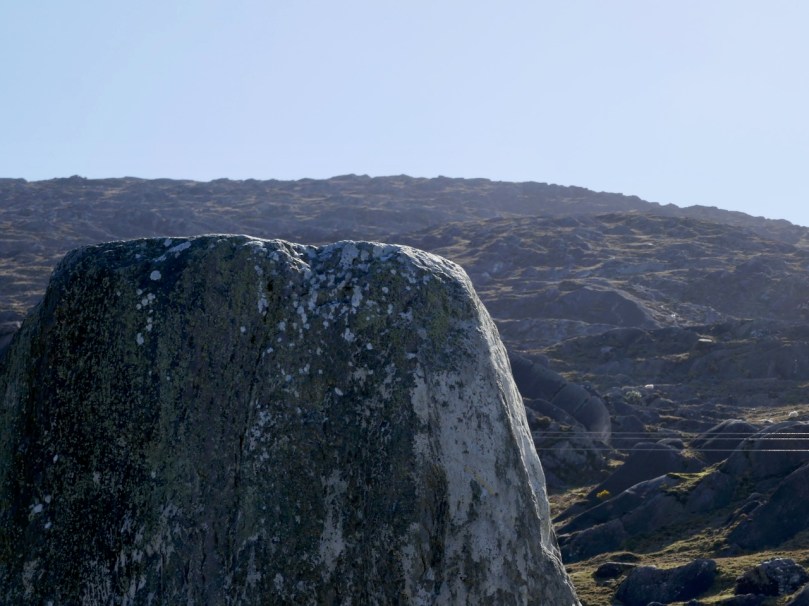
One of the rocks we found (above) looked for all the world like a fallen standing stone – and that’s probably what it was. (I wonder if I should go to confession, though – I’m sure that sitting on a mass rock would qualify as at least a venial sin.)

A mass rock that is easily visited is the one at Cononagh Village (above), right at the side of the main road into West Cork, the N71. This site is beautifully maintained – Cononagh is obviously proud of its heritage: signage and flowers invite the passerby to take a closer look.

The mass rock we visited last year, at Foherlagh, has a commanding view of the surrounding countryside. This one even had a small scoop-out in the rock, identified as a holy well

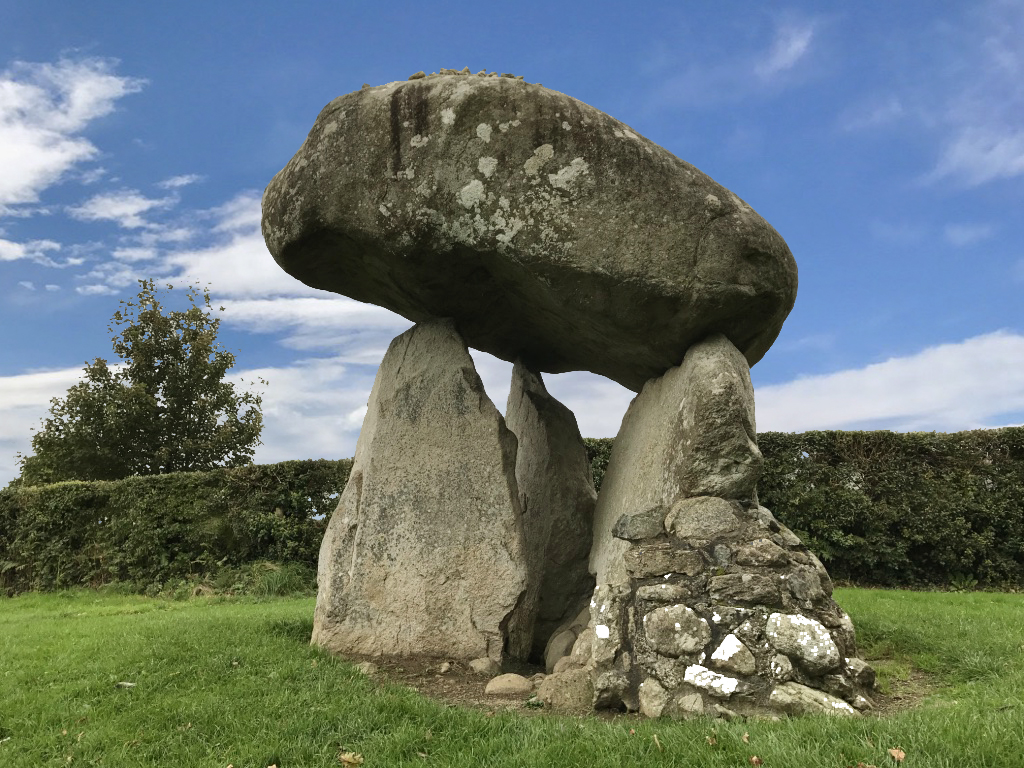
Another easily accessible site is Altar, at Toormore. This is a wedge tomb, probably over 4,000 years old and excavated in 1989. It remained in use through the Bronze Age and into the Iron Age. Dr. William O’Brien, in Iverni, says of this site: …over time this tomb came to be regarded as a sacred place, housing important ancestral remains in what was a type of community shrine. How fitting, then, that the flat capstone of the Altar wedge tomb became, in the Penal Days, a mass rock. And how intriguing to think of the continuation of this sacred space over the course of thousands of years.

But perhaps our favourite of all the mass rocks we have visited is the one at Castlemehigan. We wrote about it here. It started out life as a cupmarked stone perhaps in the Neolithic, then probably got converted into a bullaun stone in the Early Medieval period, before finally serving as a mass rock – and it has all the stories to go with its long history.


‘Flying Foam’

A recent post – Fish Palaces and How They Worked – discussed the history of the fishing industry in the south west of Ireland, and focussed on our own Roaringwater Bay. There’s an ‘extra’ story following on from that – well worth the telling, but frustratingly incomplete.

The header picture (courtesy of the National Maritime Museum, Greenwich) shows a ‘dandy-rigged nobby’, a traditional fishing vessel built on the Isle of Man during the second half of the nineteenth century. The photograph above shows such a boat, also from the Isle of Man. ‘Nobbies’ like these came to form the basis of a fishing fleet centred on Cape Clear and Baltimore, provided by the benefice of ‘the wealthiest lady in Victorian Britain’ – Baroness Angela Burdett-Coutts (1814 – 1906). Here she is, below.

Angela Burdett-Coutts was just twenty-three when in 1837 she gained an inheritance of around three million pounds (roughly one hundred and thirty million pounds in today’s money) from her Grandfather, which she immediately directed to good causes. According to the Dictionary of National Biography

In 1862 Father Davis, the parish priest of Rathmore, co. Cork (now Baltimore), appealed to her for aid on behalf of the people of the south-west of Ireland, especially in the district of Skibbereen, Crookhaven, and the Islands of Cape Clear, Sherkin, Hare, and the Calves, which had never recovered from the sufferings of the famine years 1848 and 1849 . . . Her chief work was to revive and extend the fishing industry of the south-west coast. She advanced large sums of money, on a well-devised scheme of repayment out of profits, to provide the fishermen of Baltimore and the Islands with the best fishing-boats that could be built, and fitted them with modern and suitable gear. In the course of five years the new fishing fleet of Baltimore was valued at 50,000 pounds . Much of the capital was in due course repaid; and Father Davis used all his influence to keep his parishioners scrupulously to their engagements. In 1884 she paid her first visit to the district and was everywhere welcomed with enthusiasm. With the assistance of Sir Thomas Brady she soon afterwards helped to inaugurate a fishery training school for 400 boys at Baltimore. The school was opened by her on 16 Aug 1887, when she was received with bonfires on the wild hill-sides, and flags flew from every cottage down the coast from Queenstown to Baltimore.

Fish processing on the quay in Cape Clear, nineteenth century

By 1900 fishing in West Cork was in its heyday, with an annual turnover of £100,000. Between 1880 and 1926 Baltimore was the largest fishing port in Ireland and 78 fishing vessels were registered locally. By 1907, after the North Pier had been built, the fleet was so numerous that you could, it was said, walk to Sherkin across the decks of the boats!

Looking across to Sherkin Island from the Cove, Baltimore, today

A further version of the story appeared in Ireland’s Own Magazine, in September 2018, narrated by Eugene Daly:

My father, Mícheál Ó Dálaigh, was born on Cape Clear in 1910, the eldest of four children. When his father Eugene died in 1920, he quickly had to take over the part of breadwinner and at a young age became a fisherman . . . The people of Clear, often known as Capers, had for many generations always been fishermen. On Cape Clear one is aware of the all-embracing sea. In the 1880s, through the work of Father Charles Davis, a £10,000 loan was granted by the English philanthropist, Baroness Angela Burdett-Coutts. With those loans they bought ‘dandies’, 50 to 60 ft long made in the Isle and Man and later in Baltimore Fishery School. By 1920 there were up to forty of these boats fishing out of Trá Chiaráin, the island harbour. Some of the musical names for these boats include Sarah Gale, Guiding Star, Carbery Queen, Jasmine of Downings etc . . .

What is of interest to us is that – according to local tradition – there is the remains of one of the ‘nobbies’ or ‘dandies’ in Rossbrin Cove, just below where we live in Nead an Iolair. You’ll have to look at low tide: you can just make out the scuttled boat in the picture above, on the right in the middle distance. In the view below the wreckage is clear.

It was our near neighbour, Michael John, who told us that this was one of the Burdett-Coutts boats, and that it was named ‘Flying Foam’. He also remembered hearing a poem or recitation about the boat and its fate at some time in the past but – in spite of many enquiries locally – I can as yet glean no further information. Frustratingly, this is where the story is left hanging in the air . . . Perhaps a reader of this journal might have the memory and can enlighten us? We would love to find the poem!

Abhainn na Seangán – River of the Ants!

What’s in a name? In Ireland – quite a lot, usually, although the meaning often takes some searching out. Perusing Ordnance Survey Ireland sheet 85 on a late February afternoon when the sun miraculously appeared and lit up a countryside ripe for exploration, my eye was drawn to a river running through the hills to the east of Bantry: Owennashingaun. How could you overlook such a name? And how could you not be intrigued by the Irish place-name which must have preceded it before the surveyors put their anglicisation to it: Abhainn na Seangán? Even better was the discovery of the meaning of this name: River of the Ants!

Our byway heading into the hills

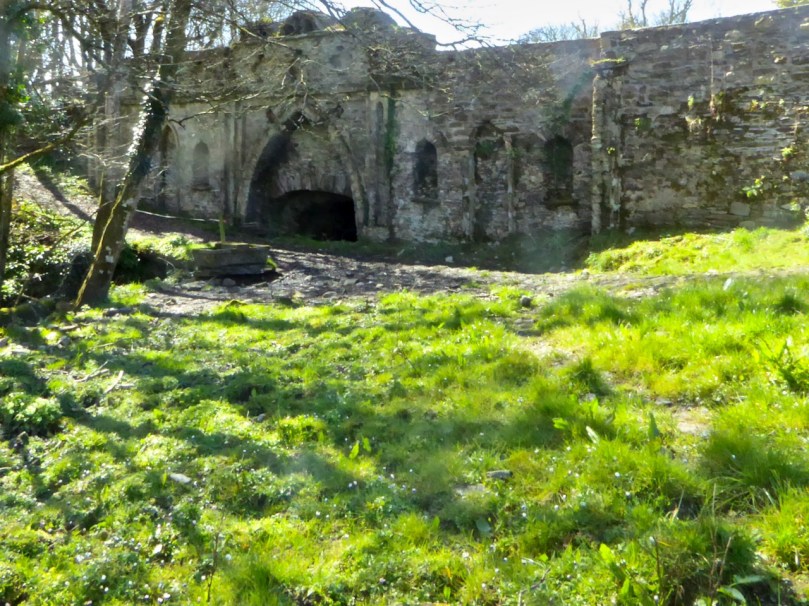
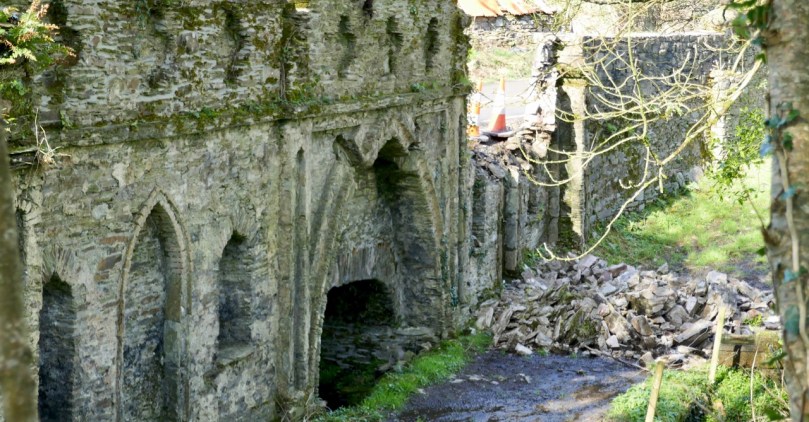
With high expectations we set out, with Finola at the ready with her camera. As with all West Cork locations, Abhainn na Seangán is but a few paces from Nead an Iolair, as the crow flies. Pausing only to pick up our friend Gill in Ballybane West along the way, we were soon heading north for the foothills of Mullaghmesha (Irish: Mullach Méise – Summit of the Altar).

Turning north at the Cullomane Crossroads on the R586 we almost immediately crossed the Owennashingaun River (I’ll use the Anglicised version as that is what usually appears on the map). Here it’s just a gentle, straight watercourse which follows the main road until it picks up the Ahanaclaurshee Stream (Irish: River of the Harp) and then becomes the Ilen River, which flows on through Skibbereen and eventually reaches the sea at Baltimore.

Glens, farms and distant highlands on our road heading for Mullaghmesha

We skirted two smallish peaks – Sprat Hill and Knocknaveagh (Irish:Cnoc na bhFiach, wonderfully ‘The Hill of the Ravens’) – before reaching the townland of Tralibane, an important Irish landmark as it was here that Captain Francis O’Neill was born in 1838. He travelled the world and had a colourful life of many adventures before being elevated to the role of Chief Superintendent of Police in Chicago in 1901. O’Neill came from a musical family in his West Cork childhood and is best known today as one of the most successful collectors of Irish Traditional Music. Here is a post I wrote about The Chief back in 2014.

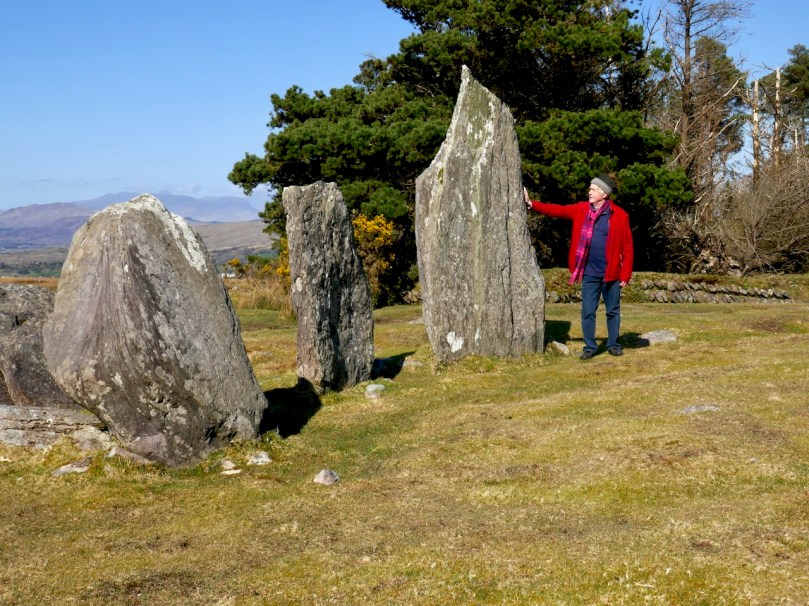
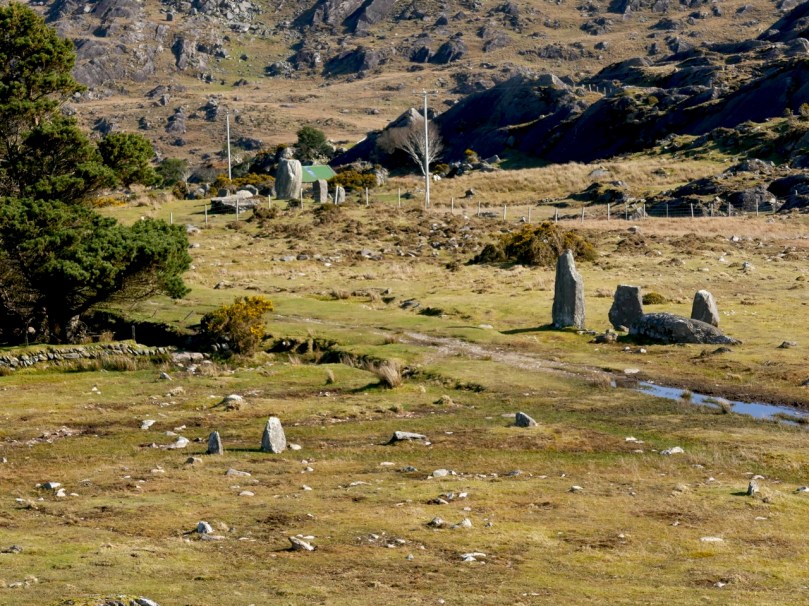
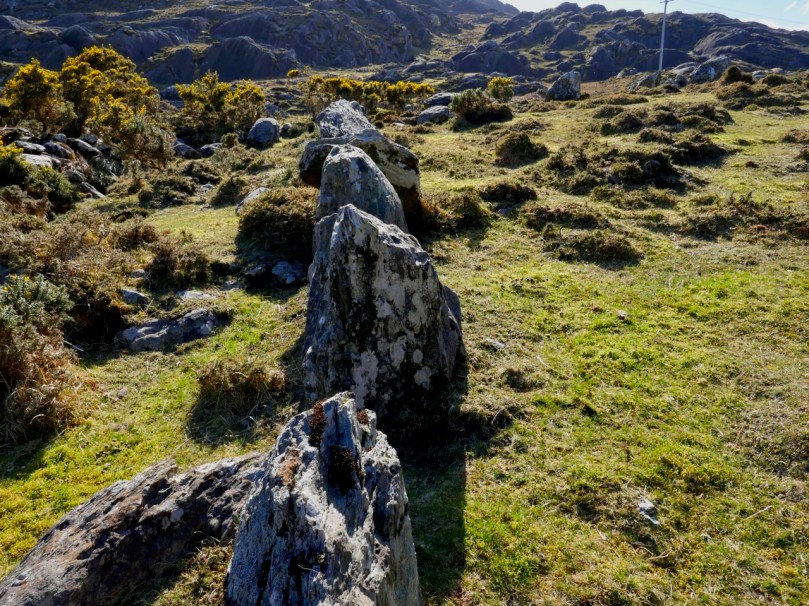
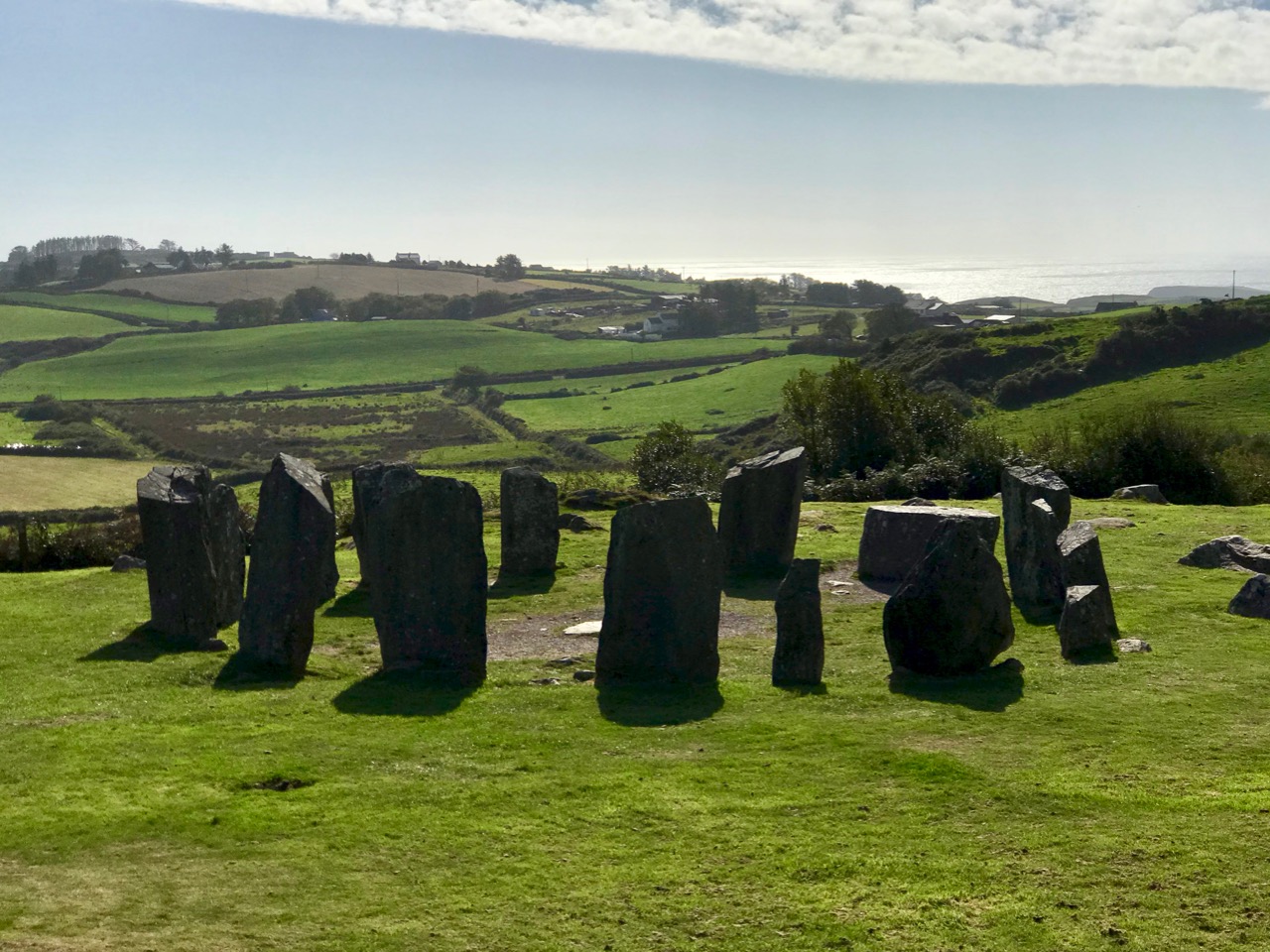
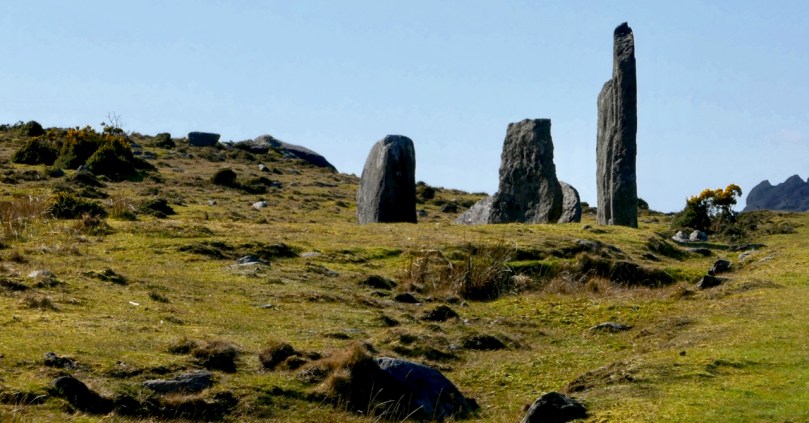
From Tralibane we travelled north-east on deserted boreens, through a soft, green landscape of glens and standing stones (see the header picture), gradually rising towards more distant highlands, until we encountered again the ‘River of the Ants’. The source of Abhainn na Seangán is on the slopes of Mullaghmesha, whose peak is at 495 metres: we didn’t make it up there to look for the altar: a destination for another day. The name of the river remains enigmatic: I searched the excellent resource www.logainm.ie and found an archive record there dating from 1840 which gives the translation as: ‘river of the pismires’. I then had to look up ‘pismires’, which is evidently from early English:

1350 – 1400: Middle English pissemyre, equivalent to pisse to urinate + obsolete mire ant, perhaps Scandinavian (compare Danish mire, Swedish myra) cognate with Dutch mier; pejorative name from stench of formic acid proper to ants

There was nothing untoward with the smell of the river as we followed it – and we didn’t see any ants! So the mystery remains. Surely there must be a story embedded in local knowledge or folklore which could enlighten us?

Upper – sweeping views began to open up as the road climbed towards Castle Donovan; centre – the iconic ruined castle, which was taken into the care of the State in 2000 and has since received major stabilisation and renovation; lower – a splendid piece of signage at Castle Donovan – every possible disaster has been foreseen!

The ruin of Castle Donovan is as fine as any in West Cork, and is fortunate to be in permanent State care. Set on a plateau with the mountain rising behind it, it is an impressive focal point in the landscape, which can be seen for miles around. We passed by the castle and headed up on a rough, winding way: looking back, the silhouette of the tower house stands out with benign West Cork rolling pasture as a prepossessing backdrop.

The road very quickly becomes a true mountain pass, and an early evening haze seemed to hang over everything as we skirted the east side of Mullaghmesha. We hardly saw a soul on our whole journey, but we were eyed warily by sheep who plainly considered us intruders on their territory.

On the north side of the mountain we entered the Mealagh Valley, and were reminded of our recent adventures travelling through the Yellow Gap. Finding our way down to the lowlands again, we took our last look at the River of the Ants at Dromore, and bid it a fond farewell. In spite of its unfathomable name, it had taken us on a grand exploration. Give it a try for yourselves!

Upper, the distinctive church at Dromore, with its pencil-thin ’round tower’ and, above, our last view of Owennashingaun

Treasure in a Country Church – Samuel Forde

Recently I stumbled across a reference to paintings that had been moved from Skibbereen Cathedral to a small country church – St Barrahane’s Catholic Church in Castlehaven on the road between Skibbereen and Castletownshend. The paintings were moved because the large church in Skibbereen was undergoing renovation. 

While some records indicate that this may have been in the 1840s or 1850s, in fact the more likely date is that they were moved to facilitate the 1881 to 1883 major re-furbishment in the Skibbereen Cathedral in which a semi-circular chancel was built to accommodate the altar, with stained glass windows behind it. However, it is possible that the paintings were not hanging behind the altar, but on a side wall, in which case the date of 1840s would be correct since this was when the side galleries were added. What we do know is that they were painted in 1826 over the course of three days in November.

Forde’s Self-Portrait (Portrait of the Artist). Image: © Crawford Art Gallery, Cork. Photo: Dara McGrath

We know this from the artist’s diary. And the artist? None other than Samuel Forde, the re-discovered Young Raphael of Cork, who died two years later at the tragically young age of 23. While Forde had never been totally forgotten, he was hardly a household name. But a few years ago, two brilliant young researchers, Michael Waldron and Shane Lordan stopped to contemplate his unfinished masterpiece, Fall of the Rebel Angels, in the Canova Casts Hall in the Crawford Gallery in Cork, and were overwhelmed with a desire to know more about its creator. This led them on a journey they could never have predicted, to curating an exhibition, writing the catalogue for it, and becoming the experts on Samuel Forde.

Sketches by Forde, shown in the Samuel Forde Project blog. The photographs are by Michael Waldron and the sketches are © Crawford Art Gallery

Along the way, they wrote a blog about their discoveries, and I refer you to that blog for their charming and engaging account of their initial encounter with Forde and their growing sense of him as the least-known member of a golden circle of Cork nineteenth century artists, a circle that included Daniel Maclise and John Hogan, preceded and influenced by James Barry. The blog also documents what is known about ‘our boy Sam’ as they came to call him, his life circumstances, his influences and his untimely death. Michael and Shane have also written on Forde for the Irish Arts Review.

A detail from the Fall of the Rebel Angles, from Michael and Shane’s article for the Irish Arts Review, Winter 2013. © Irish Arts Review

Incredibly, the triptych is the only finished painting we know of by Samuel Forde, apart from his self portrait. Most of his other extant work consists of sketches, studies for his Fall of the Rebel Angels, a monochrome ‘bodycolour’ (a type of watercolour) and of course his great but unfinished Fall. We know he painted theatre sets and also ceilings, but none of these have survived.

A Vision of Tragedy by Samuel Forde. This is a mono ‘bodycolour’ and may have been designed for a theatre wall or ceiling. Read more about it here. It is reproduced with permission, © Victoria and Albert Museum

The triptych was commissioned by the church in Skibbereen, who asked another painter to do it. But that painter was more comfortable with miniatures, so passed on the commission to Forde, who produced it in one enormous and sustained burst of energy, using the skills he had acquired as a theatrical set painter working with distemper.

The central scene is the Crucifixion, flanked by Mary on the left and Patrick on the right. The Crucifixion is assured and emotive, depicting Christ on the cross with the Three Mary’s (his mother, her sister Mary the wife of Clopas and Mary Magdalene – based on John 19:25). The Virgin Mary has collapsed into the arms of her sister, while Mary Magdalene weeps at Jesus’s feet.

To their right is a figure that is interpreted as John, although John is usually depicted as young and smooth-faced. This figure, however, is bearded, elderly, and strikingly apparelled in a turban and long red robe. Perhaps Forde’s influence here is one of Tintoretto’s Crucifixions, in which a similarly turbaned figure is presented.

In looking for a possible model for the turbaned figure in Forde’s Crucifixion, I came across this Tintoretto. We know that Forde as a boy studied and copied classical paintings from books of prints 

The Mary painting on the left shows her as she is in the crucifixion scene, but with a crescent moon and a snake under her feet. The snake represents evil, of course, and is a common element of Marian imagery – take a look at the next grotto or church statue of Mary that you come across. The moon is from Revelations 12:1And there appeared a great wonder in heaven; a woman clothed with the sun, and the moon under her feet, and upon her head a crown of twelve stars. This is the same verse, by the way, that describes the fall of the angels – a subject that was to occupy Forde as he worked on his great unfinished canvas.

St Patrick is shown in his episcopal robes, with snakes slithering away, carrying his crozier and wearing his bishop’s mitre. Close examination of the canvas reveals that the Mary and Patrick paintings were intended to to be framed as ovals (as with his self-portrait) rather than rectangular. They were, apparently, conserved in the 1970s but look as if they may need some attention again.

What a treasure to discover in a small country church! If Samuel Forde had lived there is no doubt his career would have been as illustrious as that of his contemporaries Maclise and Hogan. Michael and Shane hope that more of his works will turn up in the future. Meanwhile, you can view Fall of the Rebel Angels in the recently and marvellously revamped Canova Gallery at the Crawford, and marvel that in quiet Castlehaven, by a series of circumstances, there exists such a testament to the Young Raphael of Cork.