Whiddy Island

Whiddy Island from Sheeps Head

Whiddy Island from Sheep’s Head

On a sunny Sunday in March, we were lucky to find out about a guided tour around Whiddy Island and enthusiastically signed up. Our guide, Tim O’Leary, runs the ferry to the island and its only pub, the Bank House. He is a native Islander and extremely knowledgeable about the island’s history, traditions, stories, flora and fauna. 

Off to Whiddy Island on a beautiful day in March

Off to Whiddy Island on a beautiful day in March

It was a gorgeous day for a tramp – a good thing as it’s a six mile walk – and the weather allowed us to drink in the glorious views and to stand at various spots listening to Tim as he shared stories of life on the island.

Whiddy Island Graveyard

Whiddy Island Graveyard

In the graveyard he told us about the island tradition of burial: a coffin has to be lifted from the boat at a particular quay and laid on a special coffin rock. From there it is shouldered uphill to the burial ground by four men of the same last name as the deceased. Nothing but human power can be used on the long uphill climb, or to dig the grave or conduct any part of the service. “We will carry this tradition on,” he said, “as long as we can.” The burial ground itself is part of an ancient ecclesiastical site and commands views across the island.

View out to Bantry Bay from the Island high point

View out to Bantry Bay from the Island high point

We learned that many island families made a good living in times past from fishing and fish processing, and it still an important part of the economy, although now mussel beds have replaced fishing lines and ‘pilchard palaces.’

Tim shows us the 'hairy rope' used to grow mussels. Mussel beds ring the Island.

Tim shows us the ‘hairy rope’ used to grow mussels. Mussel beds ring the Island.

The land was famous for being fertile and one historical document talks about the earliest potatoes always being grown on Whiddy. All this activity supported up to 800 people but like many places in West Cork the population was decimated by the Great Famine. Now, fewer than 30 people live here year round.

The Island can no longer support a school

The Island can no longer support a school

We walked up to the remains of O’Sullivan Beare’s castle, which functioned more as a prison than a dwelling as it housed those who needed to be ‘encouraged’ to pay the taxes he imposed for fishing rights. We explored the area that had once been a thriving American Air Force base for a brief period at the end of World War I – nothing remains except acres of concrete and memories of the vibrant life that the service personnel brought to this small community. Other defensive structures exist on the island too – several ‘batteries’  with huge guns were built after the French invasion of 1796 but alas they are too unsafe to visit.

O'Sullivan Beare's stronghold

O’Sullivan Beare’s stronghold

The west end of the island contains enormous tanks that now house the Irish national oil reserves. It was built as a Gulf Oil terminal in the late 60s and was the scene of a horrifying accident in 1979 when an explosion sank a French tanker, the Betelgeuse, and 50 people lost their lives. The enormous tanks, behind their barbed wire barriers, loom darkly against the landscape, a permanent reminder of this awful tragedy.

The oil tanks at the west end of the Island

The oil tanks at the west end of the Island

Take the ferry across to Whiddy Island any time and hike around the hills and the beaches. But if you can, catch one of Tim’s guided walks, and finish with a well-deserved pint in the Bank House at the end of the day.

There's nothing like a guided tour with Tim!

There’s nothing like a guided tour with Tim!

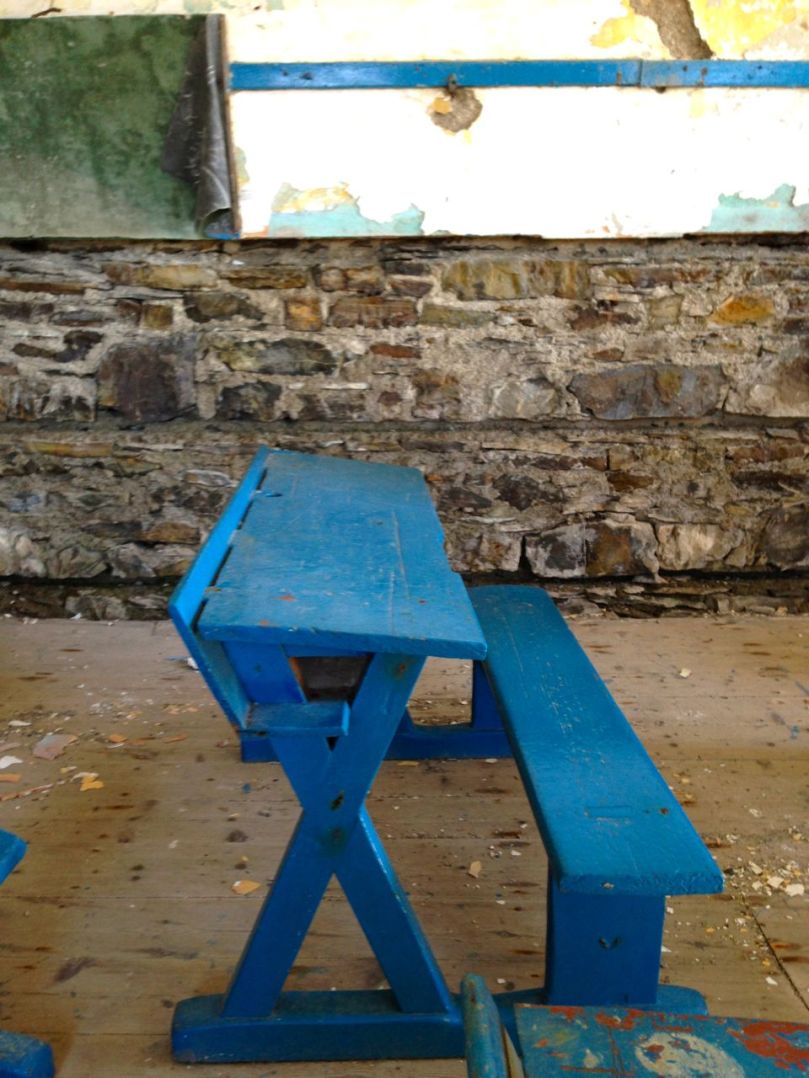
One thing, though…when Tim sat in this desk back in the day, his teacher forgot to teach him about distances. So just take it with a grain of salt when he tells you there’s “only another half mile to go.”

desk

A note on the West Cork Speak Competition! Deadline extended to the end of next week. Only one entry so far, so don’t be shy and get those conversations in!

Equinox at Bohonagh

Sunset over the recumbent, Spring Equinox 2014

Sunset over the recumbent, Spring Equinox 2014

We don’t normally post midweek, so this is a special edition, coming to you courtesy of the spring equinox. In my post Ancient Calendars, I explained about the orientation of the stone circles of West Cork. Bohonagh, just outside Rosscarbery, is oriented east-west. On the spring equinox, if you stand behind the recumbent, you will see the sun rise between the portal stones. If you stand behind the portal stones you will see the sun set behind the recumbent.

Around here, there is no guarantee that sunrise or sunset will be visible, due to the variable weather conditions, so you have to watch the forecast carefully. This week, sunshine was forecast only for Tuesday the 18th, so that is the day these photographs were taken. Curiously, this is also the day, according to my calendar, when sunset and sunrise divide the day into two equal halves. The official equinox, however, happens today: March 20th 2014.

Equinoctial sky

Equinoctial sky

The top photograph shows the moment when the sun set across the valley, sinking down directly above the recumbent as seen from between the portal stones. The second photo is taken from further down the hill, after the sun had disappeared. Silhouetted are the stone circle, especially the tall portal stones, and to the left, the boulder burial. Finally, I have included an image showing the east-west oriention.

east-west orientation

east-west orientation

We felt very privileged to be witnessing this event, thousands of years after the builders had planned it. With us earler in the day were Amanda and Peter, and you can see Amanda’s description of the site here.

Copper Country

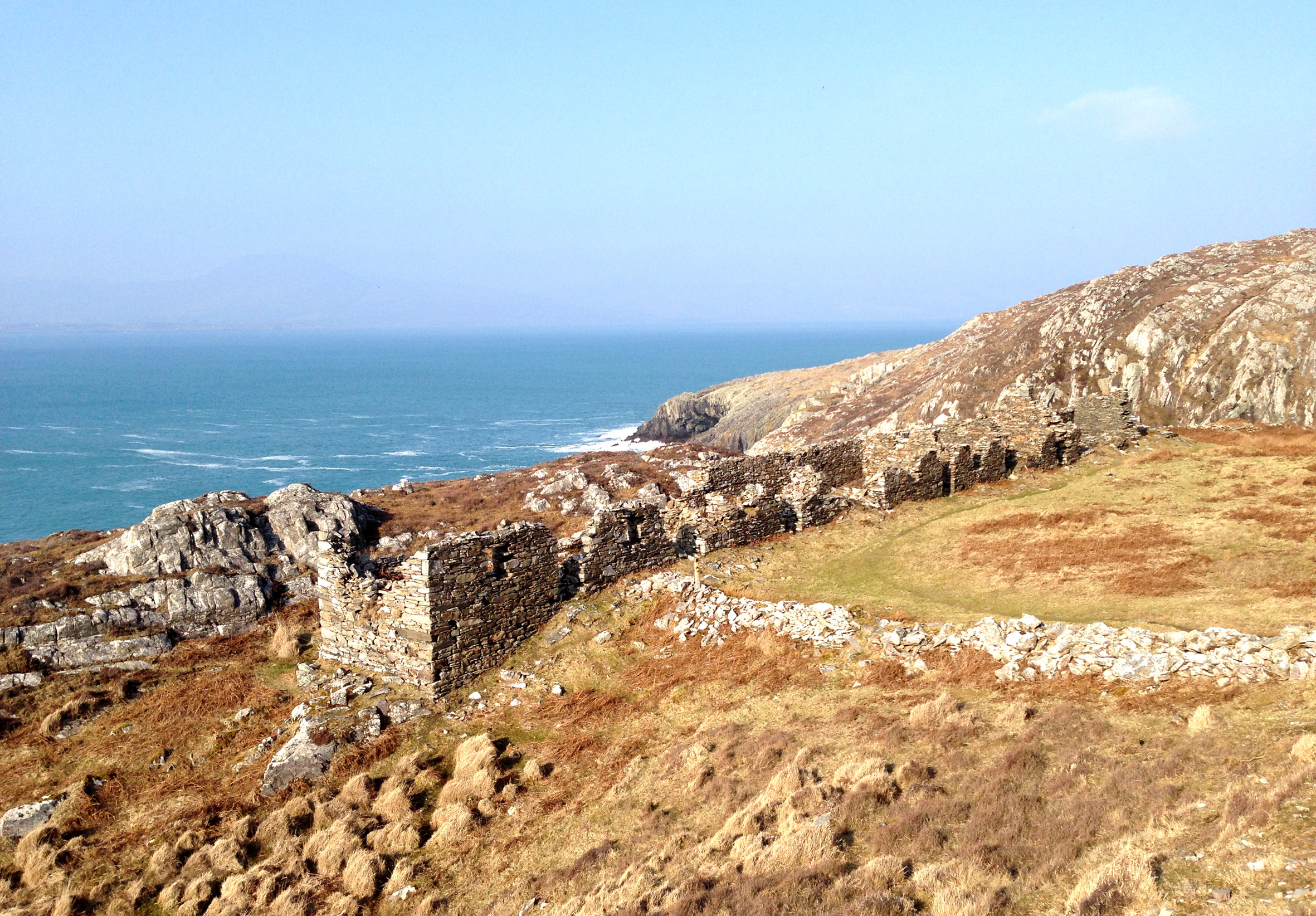
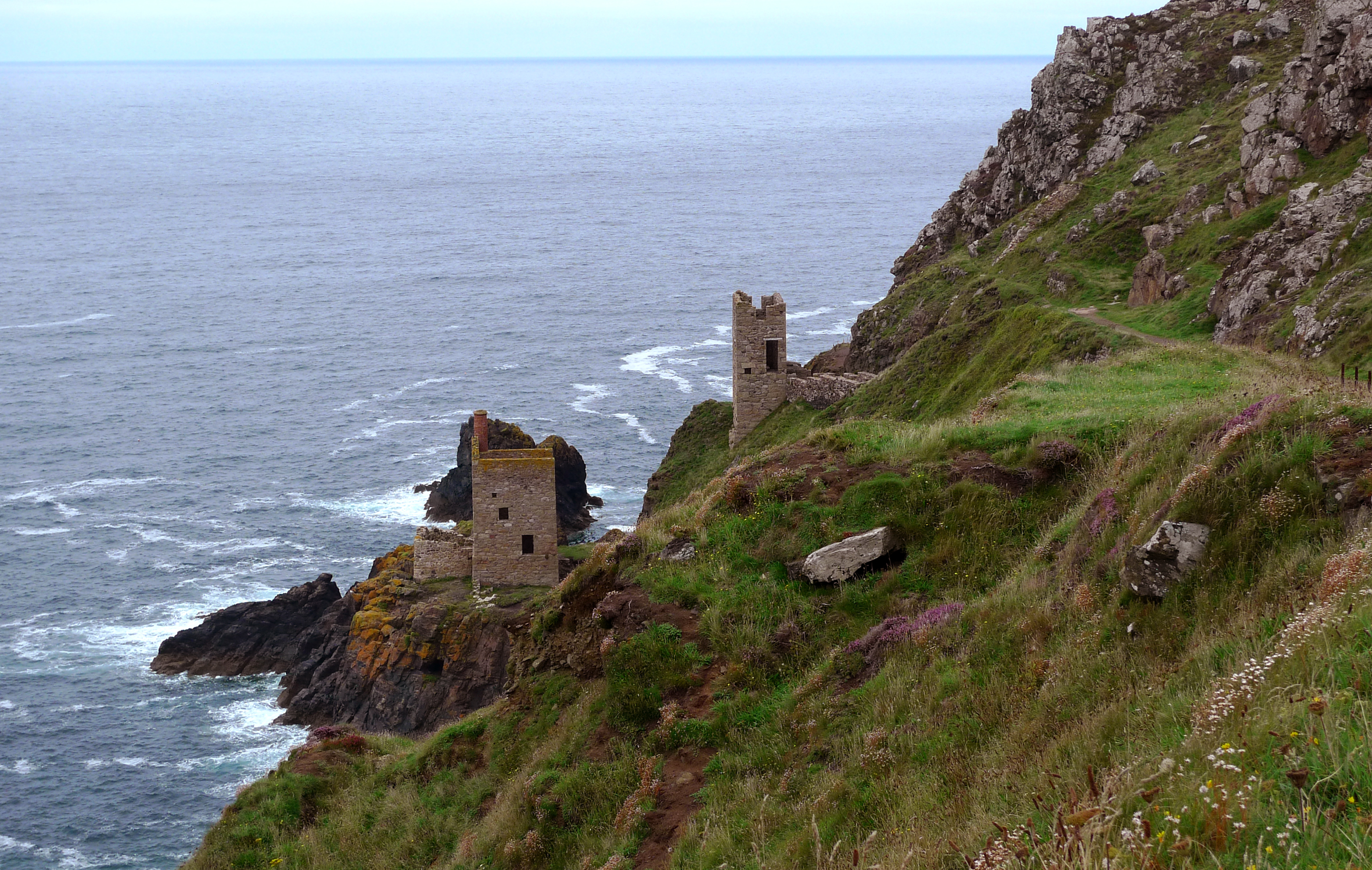
Sheep's Head Copper Mine: Cornish mineworkers' cottages

Gortavallig Copper Mine, Sheep’s Head: Cornish mineworkers’ cottages

We live in the townland of Cappaghglass. I would love to say that the name derives from the metal that makes up much of its geology – copper, but Finola tells me that way of looking at it comes from my English accent: the Irish word for copper is Copair, while Cappa actually means meadow. Glas or glass means green so – prosaically speaking – we live in ‘Green Meadow’. However, as in so many cases, the history of this little bit of Ireland is writ clearly on the landscape and Cappaghglass is very much ‘copper country’.

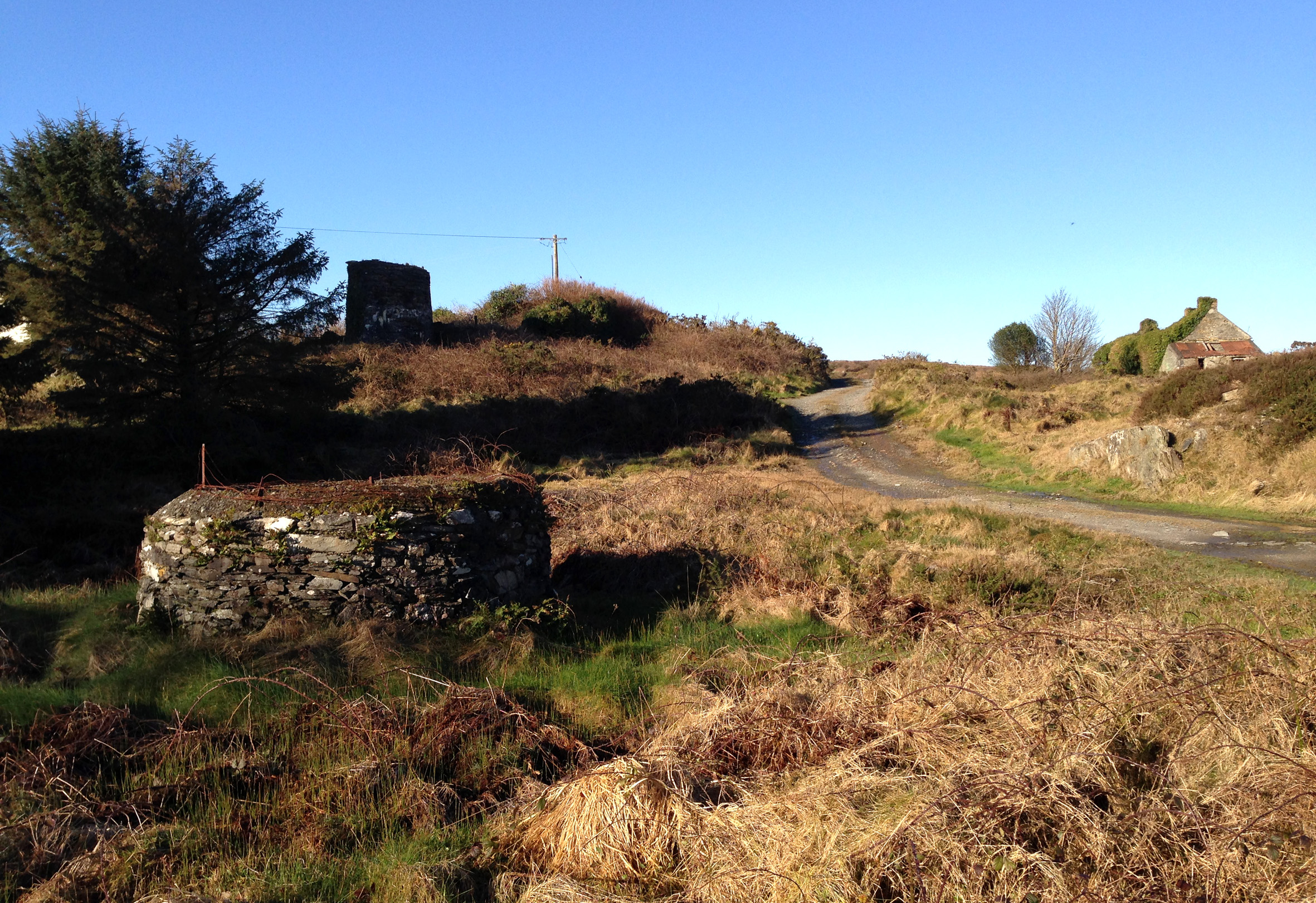
Stub of 9th century Irish round tower? - No: 19th century copper mine workings in Cappaghglass. In front is the head of a shaft, behind is the remains of the mine chimney that fell in 2002; to the right are the old mine cottages

Stub of 9th century Irish round tower? – No: 19th century copper mine workings in Cappaghglass. In front is the head of a shaft, behind is the remains of the mine chimney that fell in 2002; to the right are the old mine cottages

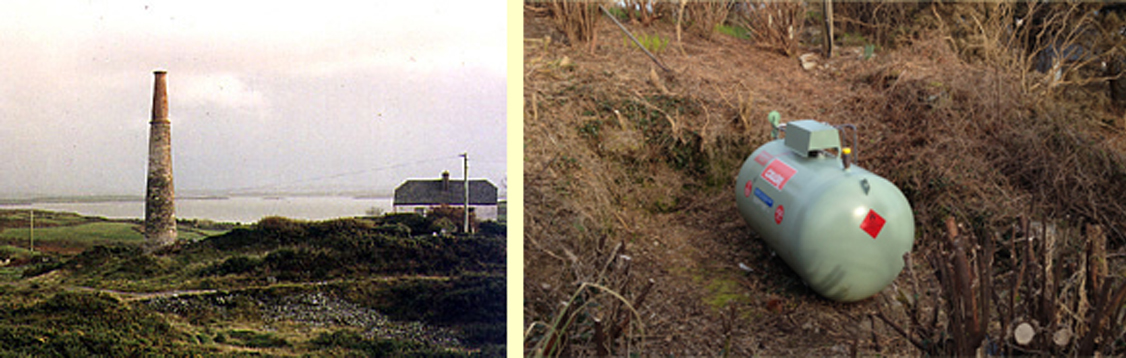
Our own house, Nead an Iolair, is built on territory that was once owned by a nineteenth century copper mine, and legend has it that our Calor gas tank is placed over an old mine shaft! We look out to Horse Island – one of Carbery’s Hundred Islands in Roaringwater Bay: it once supported a copper mine of the same period. Look at the photograph of the number of workers employed there at this time. Now there are merely a few holiday homes on the island.

Mineworkers on Horse Island: 19th century

Mineworkers on Horse Island: 19th century

Among the quiet fields and peaceful boreens our townland is strewn with evidence of the industry that once was here: old spoil heaps, barbed-wire protected shafts, supports for overhead ropeways and the base of a famous local landmark: the 20m tall Cappagh Mine chimney which came down in a lightning strike in 2002 which also severely damaged the Mine Captain’s House adjacent to it. Mining here commenced in 1820 and works ceased in 1874. Its best years were the decade 1863 to 1873, when 877 tons of bornite copper ore were produced.

cappamap2

Cappagh Mine: cross section, mine chimney (pre 2002) and our own mine shaft!

Cappagh Mine: cross section, mine chimney (pre 2002) and our own mine shaft!

***

We went off to the Sheep’s Head last week – in idyllic weather – and were shown the Copper Trail by friends Peter and Amanda. It feels so remote out there, yet the place was a hive of industry when mining was at its height during the Victorian age. I was fascinated by the row of Cornish miners’ cottages there, and the similarity between this site and the cliff-edge setting of some of the mines in West Cornwall, Botallack in particular. When exploring these pieces of industrial archaeology in Cornwall I was always struck by the incongruity of the incredibly beauty of the places – set against the blue background of the Atlantic – with the hardship and danger of the working conditions that must have prevailed. Here in West Cork, as there in Cornwall, shafts and galleries extended out under the sea bed and the men toiled away in cramped and perilous conditions with the sound of the booming waters above them, while on the surface women (bal maidens) and children worked equally hard preparing the ore for crushing and smelting.

botallack

Botallack Tin Mine, West Cornwall - romantic site now, but less benign in earlier days

Botallack Tin Mine, West Cornwall – a romantic site now, but less benign in earlier days

Far longer ago than the nineteenth century, West Cork was being worked for copper ore. On the steep sides of our local Mount Gabriel there is evidence of copper mining dating back 3500 years to the Bronze Age. UCC Professor of Archaeology William O’Brien carried out research and excavations during the 1980s and traced a number of mine workings from this time. The extraction was a well organised process: a supply of  good roundwood had to be stockpiled and fires were lit against the rock face where traces of ore were apparent. A hot fire was kept burning for several hours followed by dousing in cold water (of which a good supply was also needed), causing the rock surface to fracture, and this disturbed face was hacked off with stone mauls allowing the accumulation of small quantities of  malachite. Constant working on good seams led to excavation into the mountain side, and some shafts have been found extending to several metres. Water ingress was a problem and it seems likely that a system of bailing or pumping was necessary. Eventually the drowned shafts were abandoned and, over time, they became filled with a type of blanket bog. This helped to preserve some of the wooden implements used and – presumably – discarded in them: hammer handles, wedges, picks and shovels as well as planks and ladders; also pine chips apparently used for illumination.

Bronze Age industrial landscape

Copper Country: Mount Gabriel – once the haunt of Wolves and miners

There’s a whole lot more to be said – about why metal was so important in the Bronze Age (wealth, in one word) and the whole context of distribution, trade and the technology of bronze itself: bronze production is only possible by combining copper ore with tin, and this was not available locally. In all probability our Cornish and Iberian cousins were making contact with Ireland’s metallurgists thousands of years ago. Interesting that the Rock Art we find in these same hillsides – and which could date from the same period – also has parallels in Britain, Brittany and Iberia.

Bronze Age industrial landscape?

Bronze Age industrial landscape?

A Week in Clare

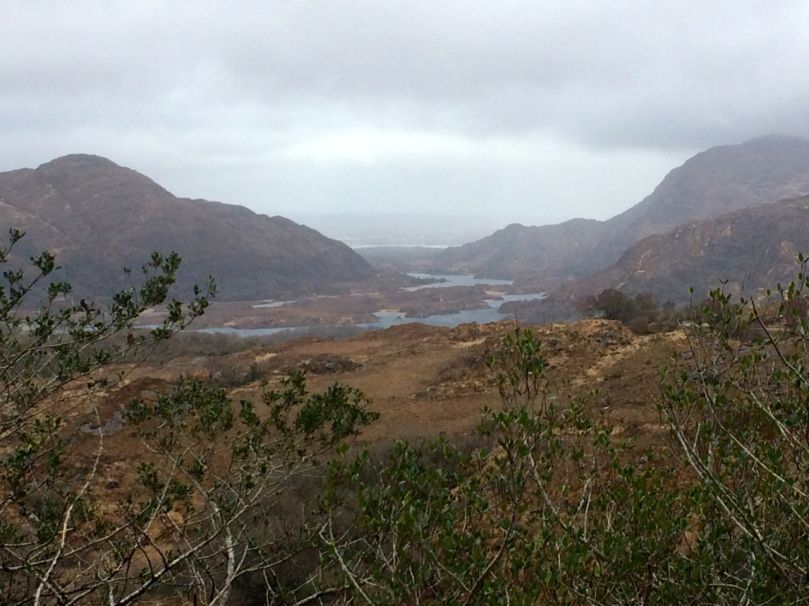
Even on a cloudy day, the Lakes of Killarney are breathtaking

Even on a cloudy day, the Lakes of Killarney are breathtaking

From West Cork, the whole of the southwest of Ireland is within easy reach. Killarney is an hour and half straight north, through magnificent mountain scenery. Another hour brings you to Tarbert, on the banks of the Shannon Estuary. Take the ferry across to Killimer, and you’re in County Clare. For the trip last week, our lodging was a beautiful holiday home in Liscannor, owned by a generous friend. It’s about half way up the County, right beside the famous Cliffs of Moher – an ideal base for exploring Clare.

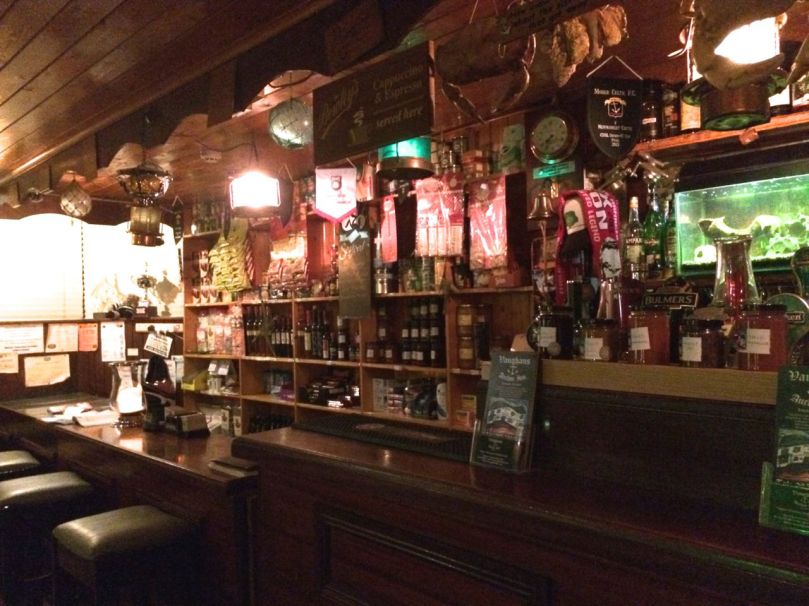
Anchor Inn, Liscannor. Best food in Clare!

Anchor Inn, Liscannor. Best food in Clare! This is the bar/grocery section.

While Robert attended the annual Noel Hill Concertina School I became a tourist. Clare is an astoundingly fertile area for geography, history, archaeology and culture and a wonderful place to spend time exploring with a map and guide book. I highly recommend The Burren and the Aran Islands: Exploring the Archaeology, by Carleton Jones – one of the best guides of its kind I have ever used. I was also lucky to have met a new friend online recently, Susan Byron, and in Clare I met her in person. The brains behind Ireland’s Hidden Gems, she gave me all kinds of great advice, along with lashings of tea and apple pie, about how to spend my time here.

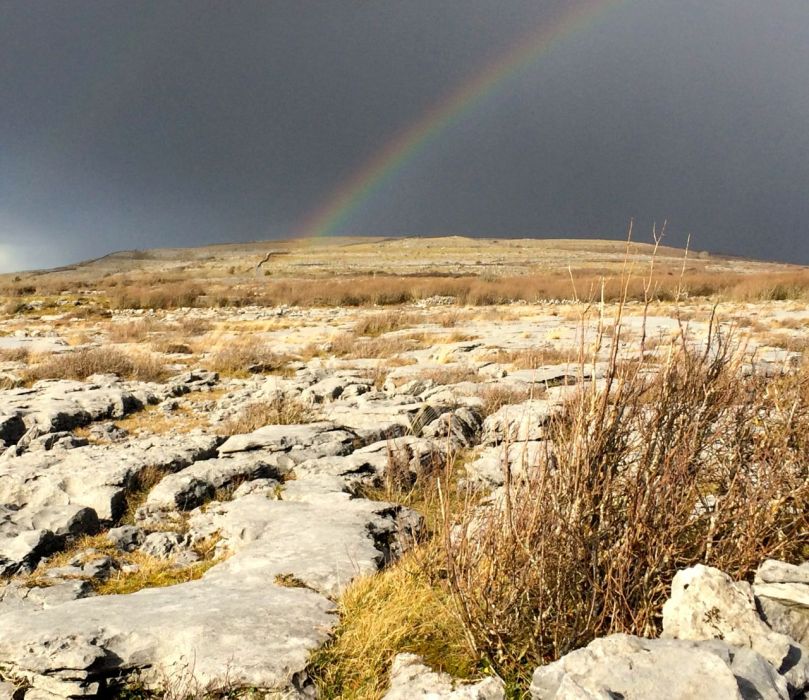
Burren Landscape

Burren Landscape

For this visit, I confined my travels more or less to the area known as The Burren, which occupies the northern third of the county. It is a striking landscape of bare limestone hills – a karst formation full of caves and limestone ‘pavements’ and home to many species of rare and colourful wildflowers. No flowers yet – it’s still too cold. Too cold for other tourists too, so I had most places to myself. It rained and it hailed and the winds blew mightily, but in between the sun shone enough to imagine it was really spring. And if I got too cold, well, I retreated to the nearest friendly pub with a roaring fire and a pot of tea.

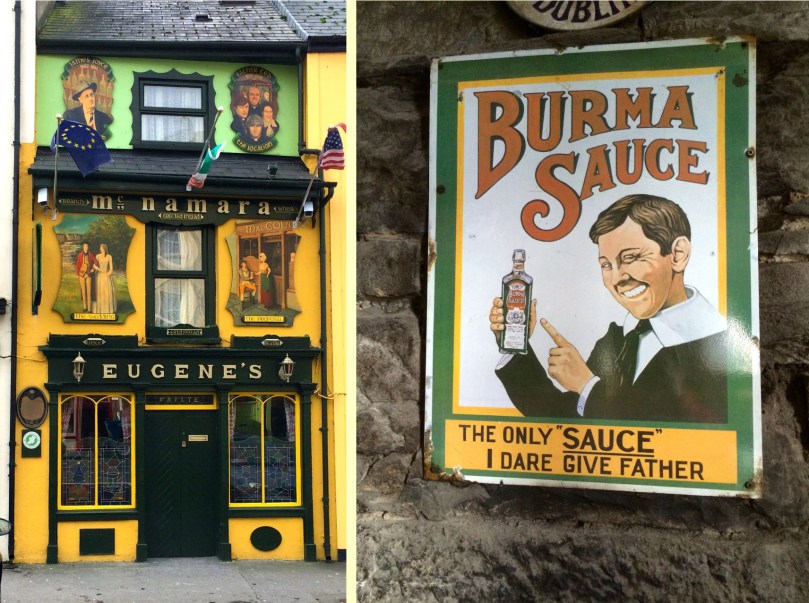
Eugene's Pub in Ennistymon/old ad in Valughan's in Kilfenora

Eugene’s Pub in Ennistymon/old ad in Vaughan’s in Kilfenora

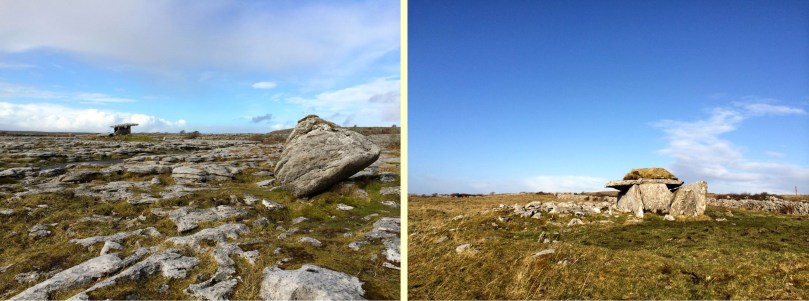
The photographs I have chosen are a small selection of the sites I visited. One of the most iconic of all irish prehistoric sites is Poulnabrone portal tomb (what used to be called a dolmen). I don’t think it’s possible to take a bad photograph of it. Not too far away is Parknabinnia wedge tomb, another example of a neolithic stone monument. In researching this one on the internet I came across a recording on the excellent Voices From the Dawn site of an interview with 88 year old Paul Keane. Mr Keane’s story, familiar to us all over Ireland, illustrates how the beliefs of country people have kept these sites safe from depredation over many centuries.

Poulnabrone and Parknabinnia

Poulnabrone and Parknabinnia

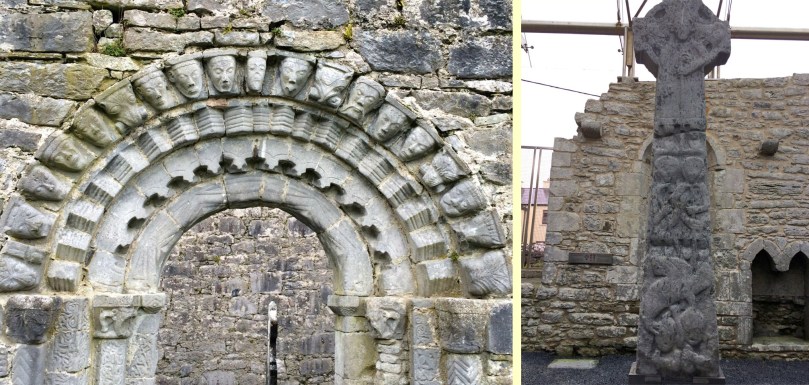
Medieval ruins abound in Clare. I went twice to Corcomroe to admire the stonework, to Dysert O’Dea (one of the most impressive Hiberno-Romanesque doorways I have ever seen, ruined abbey, round tower, an unusual high cross and 15th century castle) and Kilfenora, where the crosses are stored in the ruined church under a glass roof.

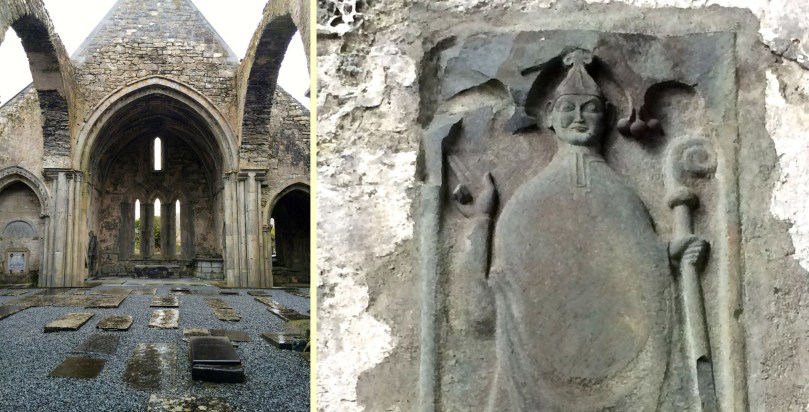
Corcomroe Abbey. 13th Century Cistercian Monastery

Corcomroe Abbey, 13th Century Cistercian Monastery

I also took in, although I have not illustrated, a church in Killinaboys with a sheelenagig (more on sheelanagigs in an upcoming post) and one in Noughaval to view the ‘cyclopean’ masonry. I spent a fruitless couple of hours, as the light was fading, trying to find a way to visit a particular stone cashel but had to give up – there’s lots to see but not everything is signposted, close to a road, or down a grassy boreen.

Dysert O'Dea and Kilfenora

Dysert O’Dea and Kilfenora

Robert has written about the incredible music scene we were part of in Clare, something that is also accessible to anyone who visits. The wonders of Ireland- no matter where you go, there’s so much to do and see! If you’re coming, try to fit in some time in Clare.

Finally – a piece of whimsy. Indulge me….

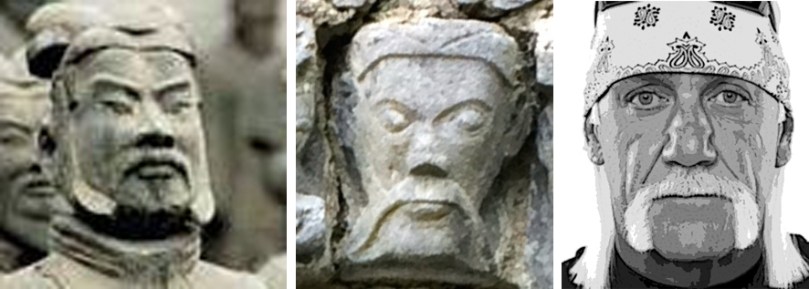
First century BC Chinese head from the Terracotta Warriers; 12th Century Irish head from the Dysert O’Dea Romanesque doorway; 21st Century American head from Wrestlemania.

Just sayin’…

Dysert Fu1

The Workhouse

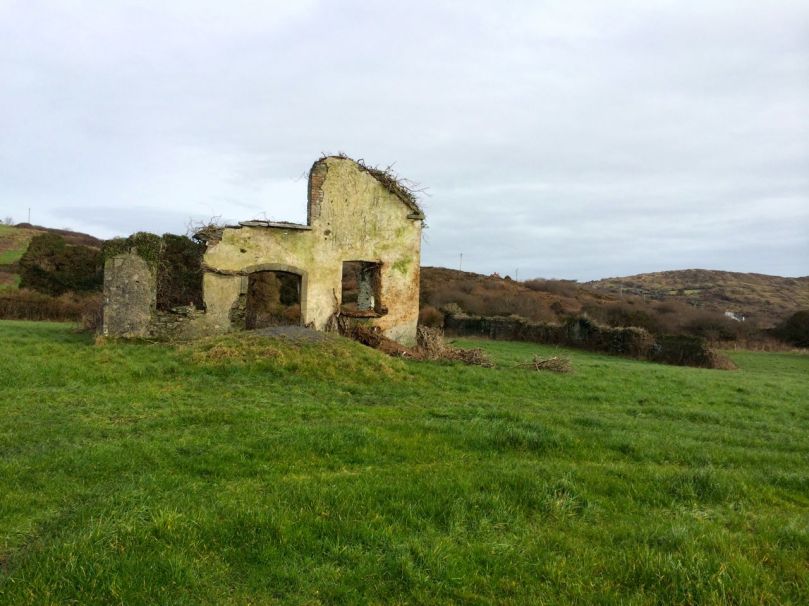
The ruins of the Schull Worhouse

The ruins of the Schull Workhouse

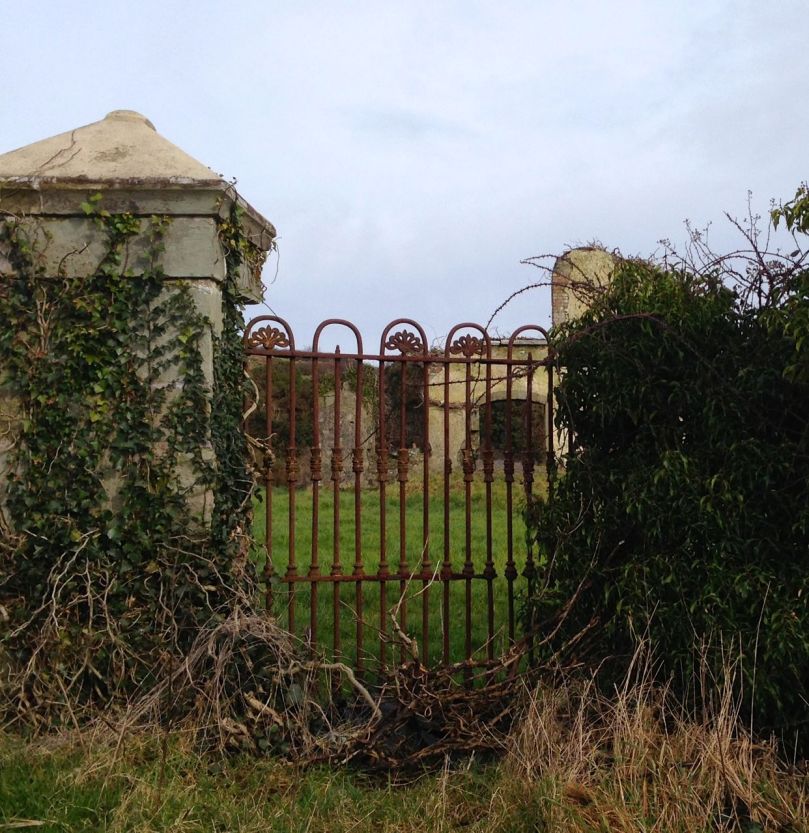
Of all the old ruined or abandoned buildings that dot the countryside of Ireland, one type has the distinction of being the most hated – the workhouse. Many have disappeared: most of the West Cork workhouses have been pulled down or completely rebuilt as community hospitals. A few hints remain – a wall here, a shed there. The workhouse in Schull, although in a ruinous state, has managed to maintain enough of a presence to remind us of its former role in the community. Surrounded by a high stone wall, you can still see parts of the administration building where inmates were admitted, remains of the dormitories and the hospital.

Administration Building and Entrance to the Workhouse

Administration Building and Entrance to the Workhouse

We wander around a lot of ruins here in West Cork, but this one is different. No good feelings emanate from these walls. Instead, an aura of decay and sadness lies thick upon the site. We found ourselves exploring in silence, contemplating the misery that was the inevitable condition of those who entered.

Schull Workhouse Plan

Schull Workhouse Plan

Workhouses were built throughout the nineteenth century in Ireland. The philosophy of charity prevailing at the time dictated that the workhouse must represent the absolute last resort of the desperate – those who could no longer feed, clothe or house their families or themselves. Once admitted, families were separated and might never see each other again. All inmates were assigned hard labour, although some rudimentary schooling was provided for children. There was no comfort, little sanitation, crowded conditions and meagre allowances of food.

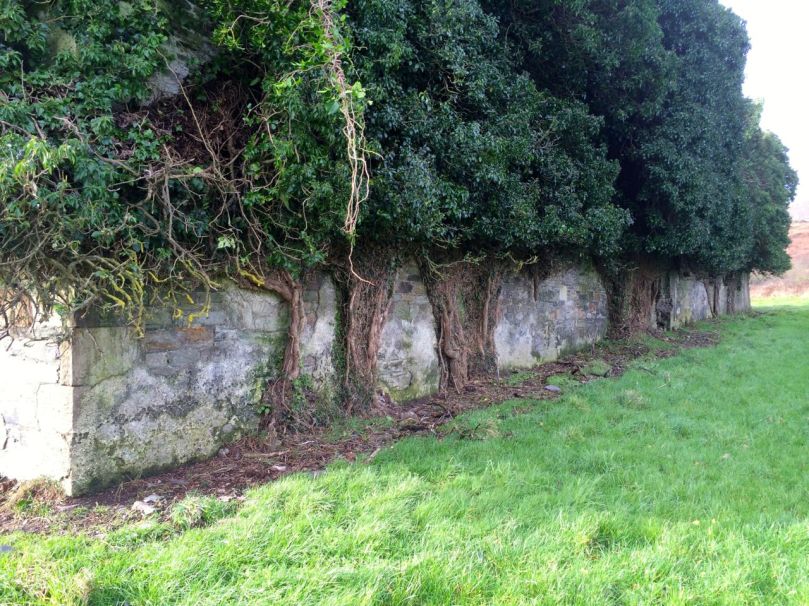
One of the most intact spaces

One of the most intact spaces

The Irish Workhouse Centre in Portumna has an excellent website if you want to learn more about the Irish context, but the site that dwarfs all others in the sheer amount of information is The Workhouse: The Story of an Institution, created and maintained by Peter Higginbotham. He makes the point that not all was bad about workhouses, that many workhouses in Britain provided inmates with sanctuary, life-saving treatment and skills. This is not their reputation in Ireland, however, where their memory evokes dread and abhorrence.  Part of this is rooted in their response to the Great Famine of 1845-49. Established to provide Inside Relief many of them initially turned away those who came to the gates asking not to be admitted but to be fed. For those inside, conditions at this time were appalling. As an example, the Durrus History Blog records the report of a Dr Stephens on a visit to the Bantry Workhouse in 1847.

A kitchen, perhaps?

A kitchen, perhaps?

The workhouse in Schull was not built until 1851, in the aftermath of the Famine. It was burned down in 1921 during the War of Independence (there’s an account here), as were many workhouses, to prevent it being used as a barracks by the British army. When the Irish Free State was established, one of the first acts of the new government was to abolish the despised workhouse system and transfer its responsibilities to a new Ministry of Health.

The hospital wing?

The hospital wing?

All Irish workhouses were designed by the same man, to one plan, you can get a better idea of how the Schull workhouse might have looked on the Irish Workhouse Centre website. An exception to this sameness was the Durrus Grainstore, pressed into service as an auxiliary workhouse at the height of the hunger for a couple of years.

Durrus Grainstore. Photo by Amanda Clarke of Sheep's Head Places.

Durrus Grainstore. Photo provided by Amanda Clarke of Holy Wells of Cork

The Stones Speak

derr scale dwg 06

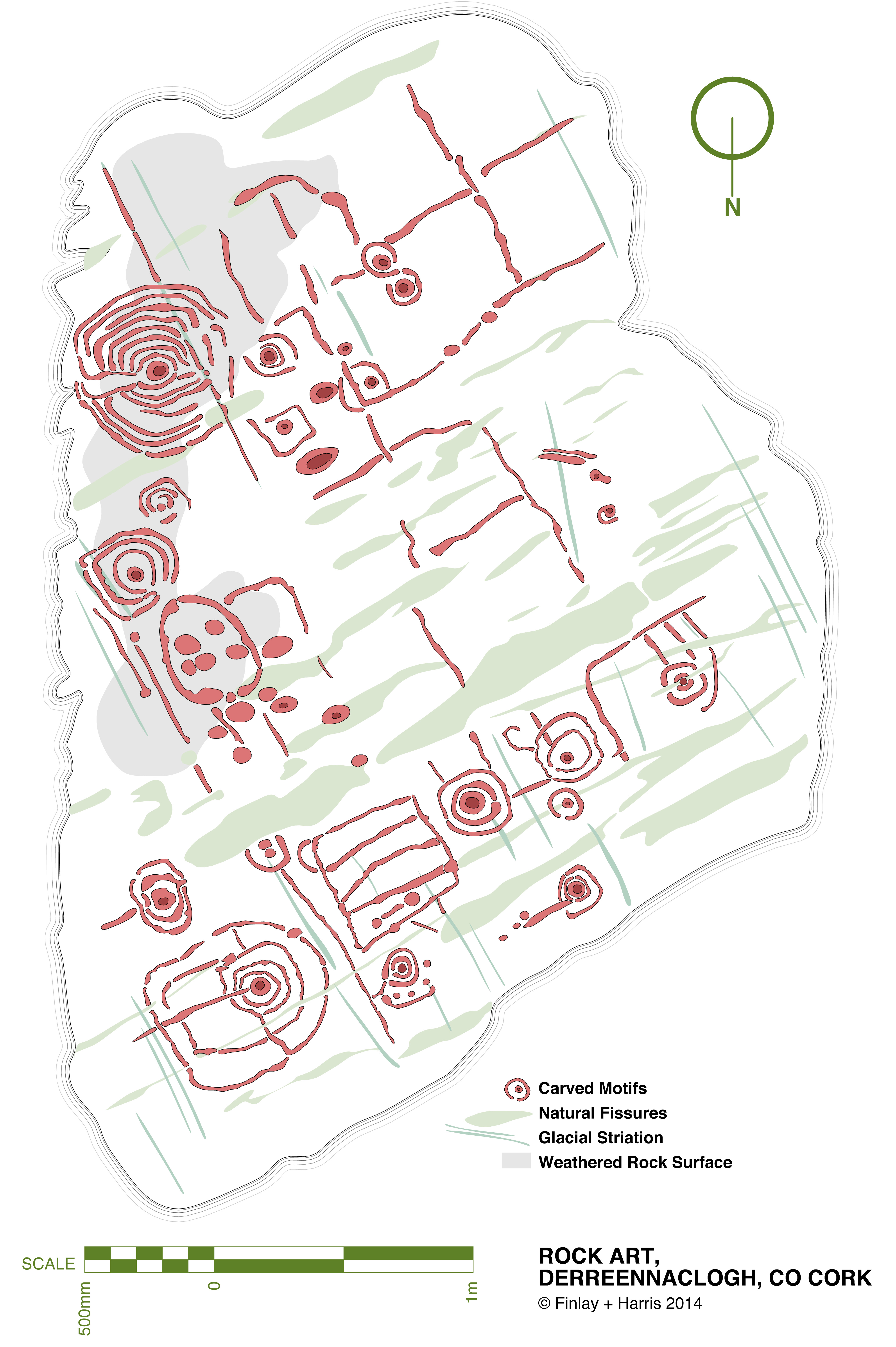
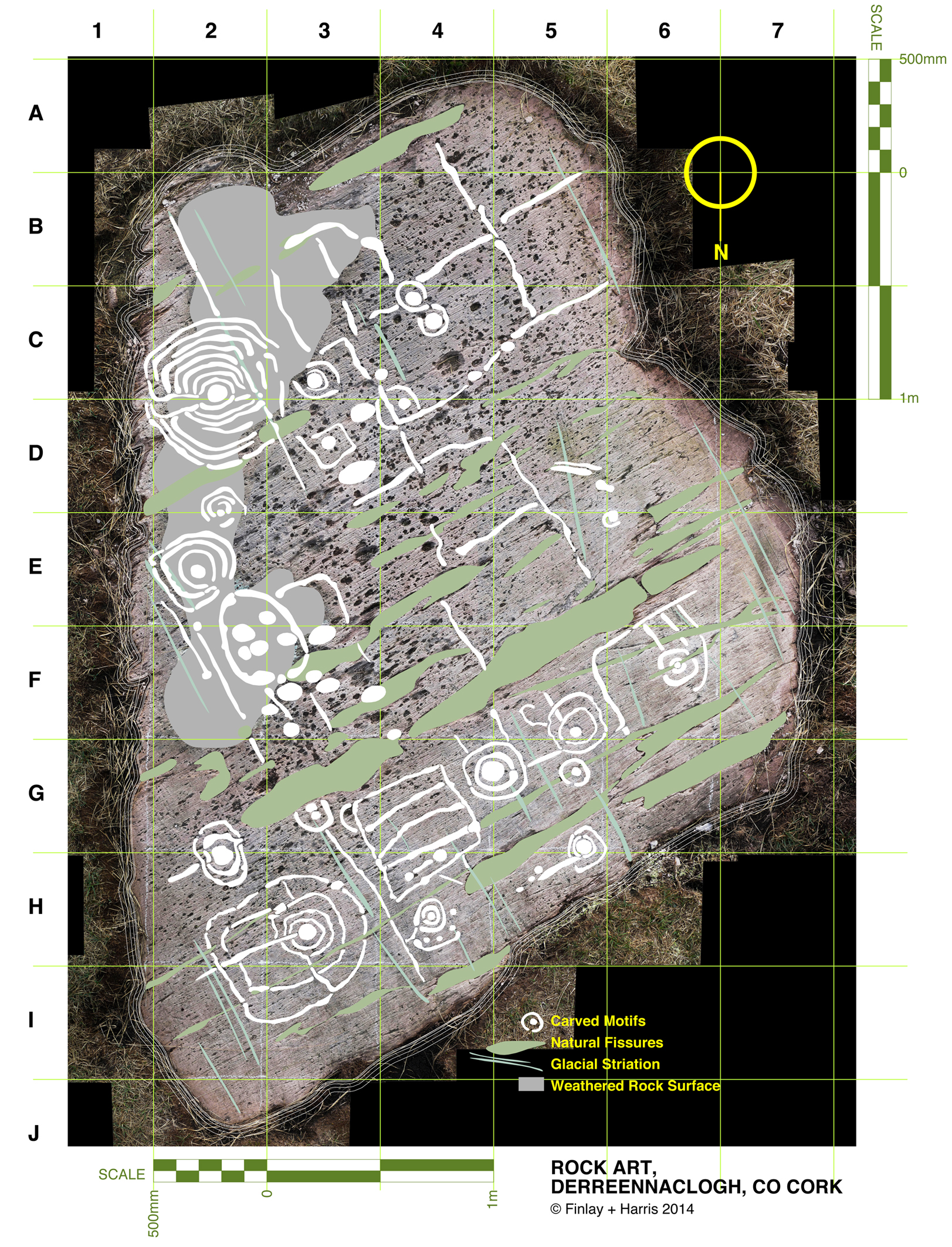
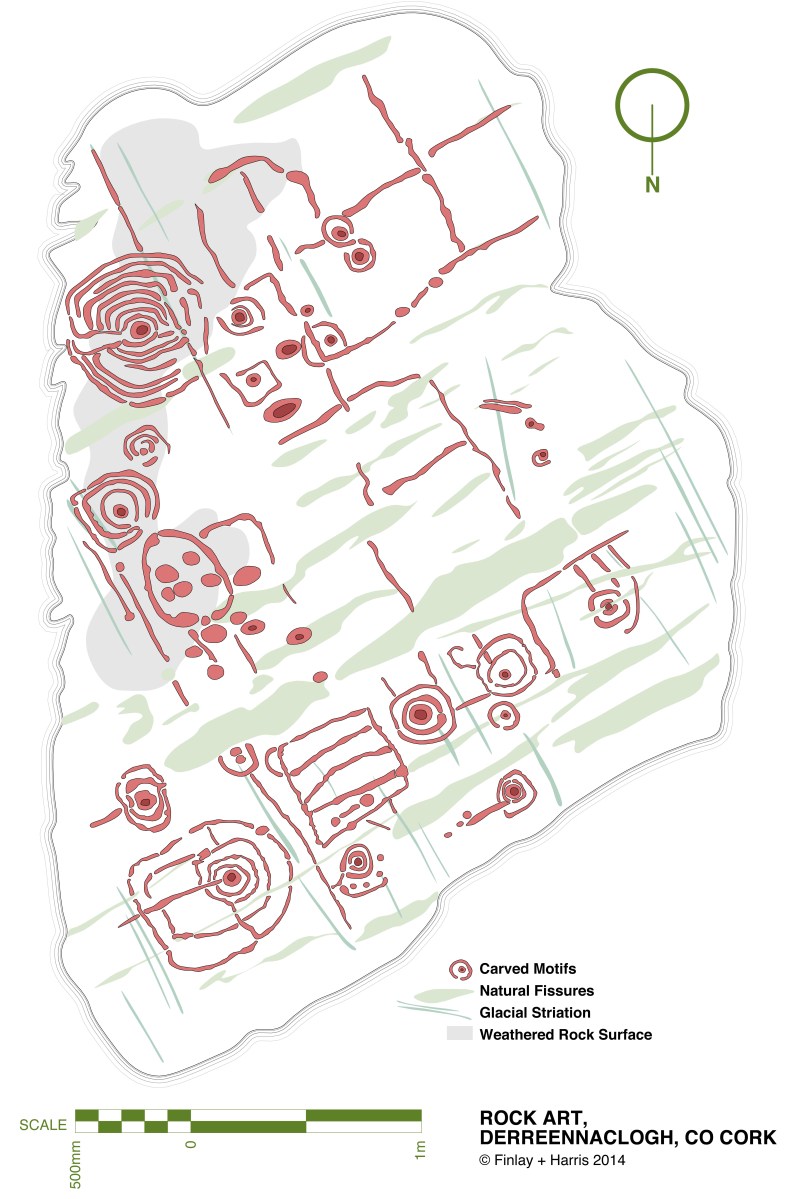
This drawing is a true scale representation of Rock Art on the horizontal surface of a large, earth-bound slab of sandstone in the townland of Derreennaclogh, Co Cork, Ireland. Archaeologists believe that carvings on this stone – and on very many others in Ireland and across the Atlantic coastline of Europe – were made by early farmers during the Neolithic or Early Bronze Age period, anywhere from 5,000 to 3,000 years ago. The carvings shown here were only discovered in the recent past: they had lain under a covering of peaty soil for hundreds or, perhaps, thousands of years and had therefore not suffered the natural weathering that many other examples of Rock Art exhibit. In one section – shown as ‘weathered rock’ on the drawing, the surface had previously been partly visible, and the curved lines which could be seen on this area led the finder of this piece to carefully pull back the overgrowth to reveal a remarkable Rock Art panel – perhaps one of the most complex and best preserved in Ireland.
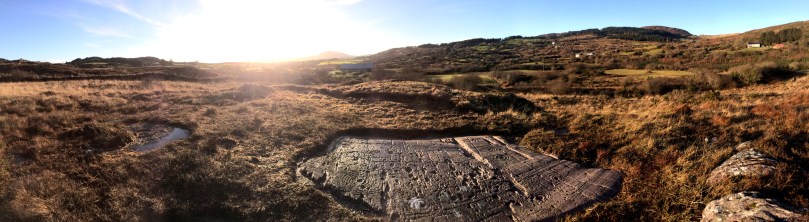
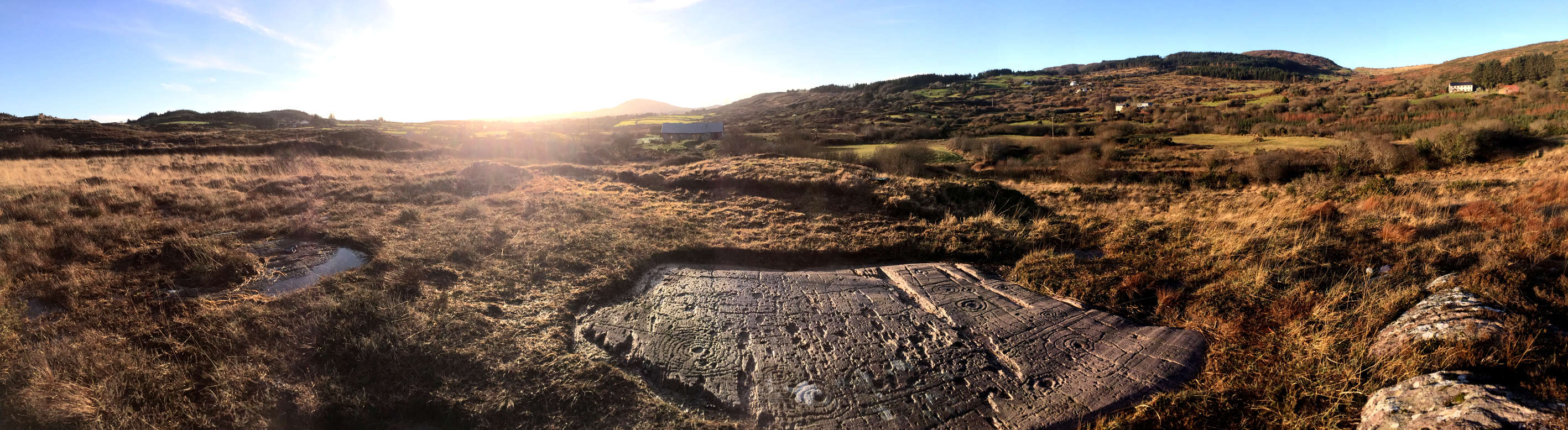
The rock at Derreennaclogh: Mount Gabriel is prominent on the western horizon

The rock at Derreennaclogh: Mount Gabriel is prominent on the western horizon

I have been working on this scaled drawing for nearly a year. This long period is partly because my life has been filled with other things (such as moving permanently to West Cork and buying a house which has needed some upgrading), but also because I have been devising a method to measure and record in fine detail the carvings on the stone without any adverse intervention to the rock surface. When my partner Finola was writing her thesis for UCC in 1973 – The Rock Art of Cork and Kerry – it was normal practice to chalk in the carvings and trace over them using a wrapping film, these tracings then being transferred to high quality mylar and photographed for reproduction. Now the codes for archaeological work have changed and it is no longer acceptable to use chalk or any ‘rubbing’ technique: the thinking is that this could damage the surface. There is a whole debate here on how to best preserve our prehistoric heritage – and no doubt there are those who would say that the Derreennaclogh stone – with its carvings in such a remarkable state of preservation – should never have been uncovered at all, or should perhaps be covered over again in a way that will ensure the retention of its markings in a pristine state, while hopefully allowing occasional access for viewing. These matters are being considered in other areas where Rock Art occurs, particularly in Portugal – where some examples are much visited and provided with interpretation centres – and Scandinavia, where many petroglyphs are protected by toughened glass.
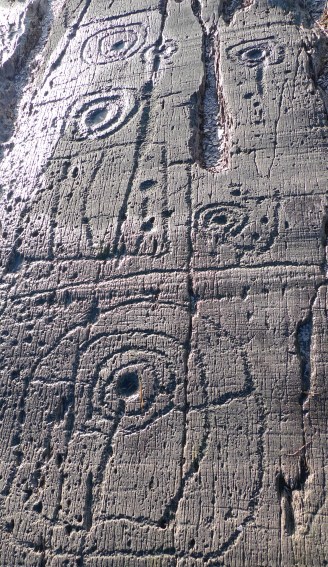
derr panel

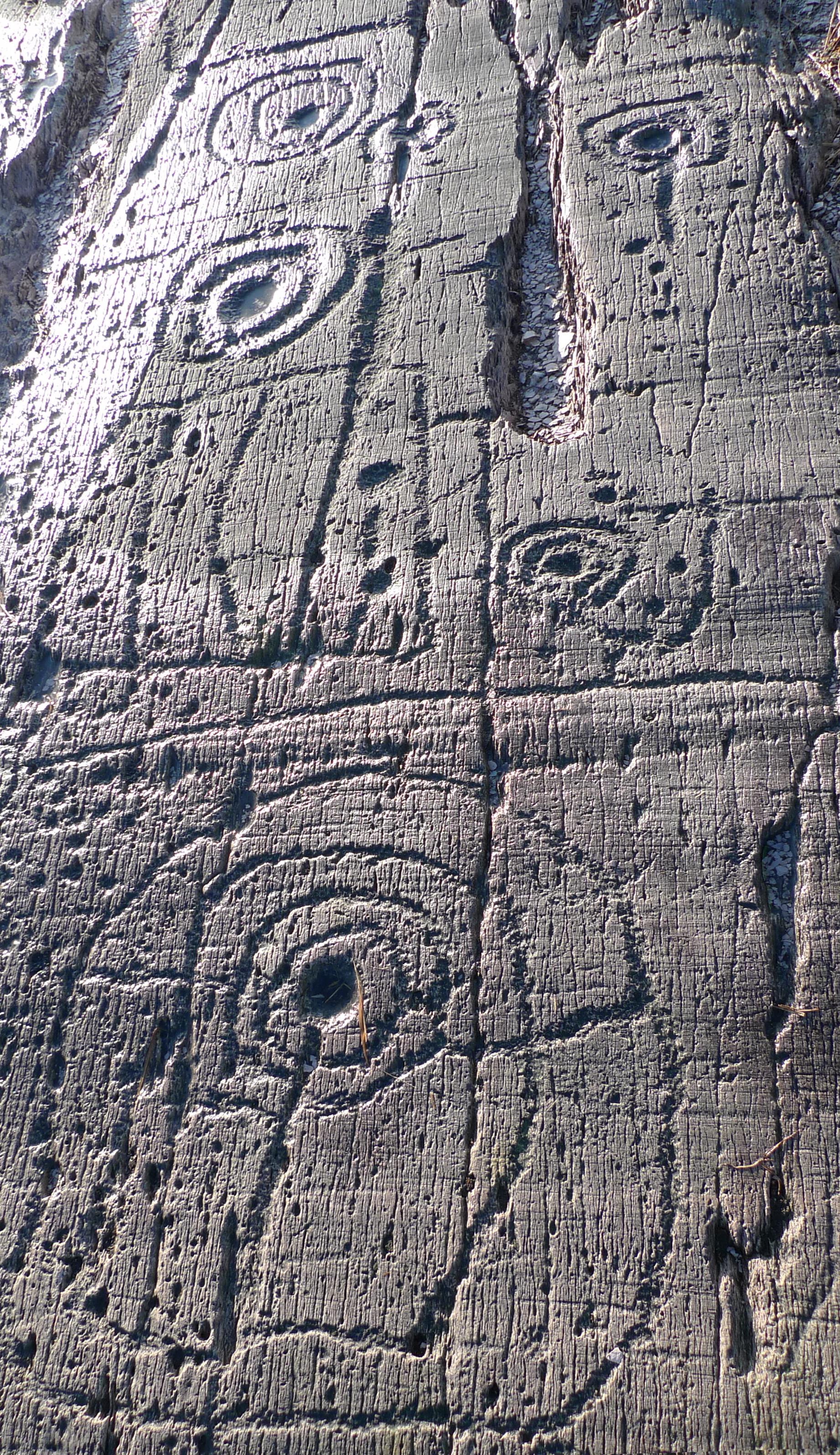
Motifs picked on the rock surface

I call my recording method, illustrated here, ‘visual rubbing’. It is not entirely without intervention, as I had to walk across the carved face of the rock, and place a camera tripod on the surface. I suppose this is a lesser evil when compared to some examples on open farmland where cattle walk freely across Rock Art panels or where – in places – rocks are being broken up to create new pastures: we have seen alarming signs of large excavator tracks passing right beside some good recorded pieces here in West Cork. Where the carved stones are listed in the Archaeological Record the landowner is always made aware that the monument is sacrosanct, but this does not guarantee practical conservation. Also, it may be argued that the topographical context of Rock Art is important (another debate) and that there should be restrictions in destructive activities to landscape in the vicinity of prime examples. Fortunately, the Derreennaclogh panels (there are two) are in bogland which is not currently grazed or used agriculturally.

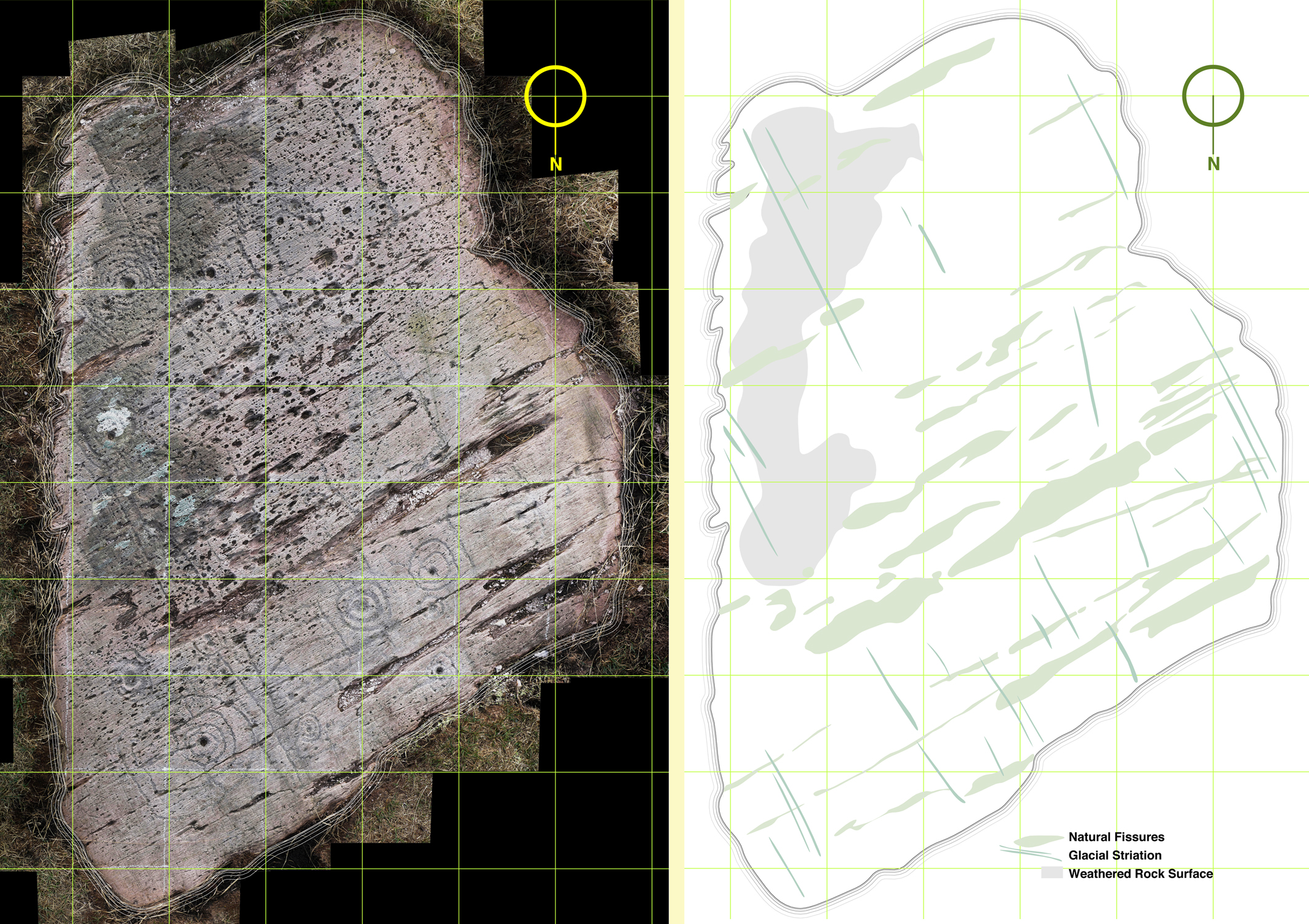
The rock measures about 3m by 4.5m at its extremities, and it was fairly easy to establish a 50cm grid using tapes. Fortuitously, one relatively straight side of the rock lies on a north – south line (magnetic north), and it was convenient to set my grid to compass orientation. The stone fills 55 of these grid squares and – using a Leica camera with a Vario-Summicron 2.8 lens – I took 55 high resolution photographs, each one centred on a grid square, and with the camera held a constant 1.5m above the flat rock surface. Back at the work station I stitched together all these photos using Photoshop, and this has given me a very accurate scaled base which is the bottom layer of the drawing I have subsequently created. My training as an architect has included using CAD techniques (Computer Aided Design), and I can trace very accurately the outlines of picked markings which show up on the photograph. The drawing is made as a digital file which can be reproduced physically to any size or scale, depending on the properties of the printer used. A CAD drawing can have any number of layers which can be switched on or off (or made transparent) to provide a matrix of information. My layers so far in ascending order are:

1   Photograph

2   Text and legends

3   Grid and grid reference numbers

4   Perimeter tracing of the rock

5   Tracings of the natural rock striations resulting from glacial movement (this appears to give the rock a definite directional ‘grain’)

6   Tracings of the natural rock fissures

7   Tracings of the rock carvings
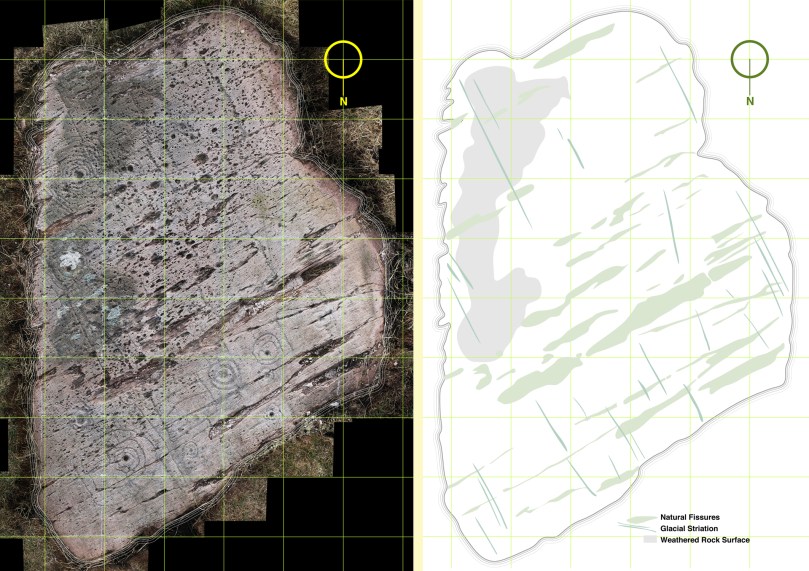
The composite photograph (left) and tracing of natural features on the rock (right)

The composite photograph (left) and tracing of natural features on the rock (right)

I have added layers (5a, 6a and 7a) so that I have the outline tracings of carvings etc, but also ‘fills’ to these outlines. All these layers can be given different colourings. I have the intention also to separate out motifs depending on ‘motif type’: for example, the Archaeological records for West Cork distinguish between ‘Rock Art’ and ‘Cupmarked Stones’. Cupmarks are the simplest form of motif, and the most prolifically spread. The Cupmark is a concave depression, often surrounded by one or more concentric rings, and sometimes with a radial groove from the ring to the outermost circle or beyond. ‘Rock Art’ can include any other motifs – rings, squares, figures of eight, dumb-bells: the rock at Dereennaclogh provides examples of all these and more. A drawing layer devoted just to cupmarks would be useful.
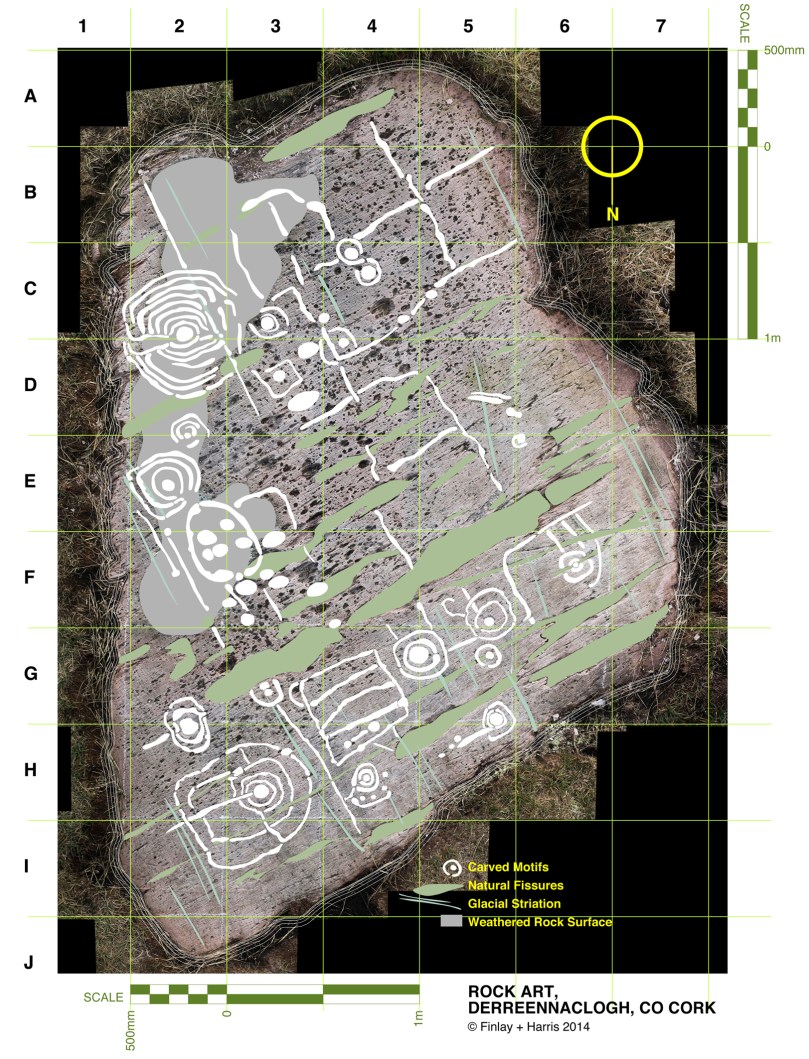
Motifs traced over the photograph

Motifs traced over the photograph

The motifs are ideally traced on a large screen, which enables the picking to be clearly seen: ‘picking’ means the hammer-on-stone technique of carving out the shapes. So far I don’t have a layer which includes information on the depths of the carved motifs. This would in any case be subjective and could only be done by taking a large copy of the drawing to the rock, measuring the depths of each mark and recording this ready for transfer to the file back at the workstation. This is a future job, and will involve a more selective coding to show the extent of picking graphically, It would in any case be academic and not necessarily a true record of what was carved, because of erosion and wear factors. Derreennaclogh is a valuable trial for developing these techniques as the carvings are on the whole in very good condition. It is not so easy on other examples: there is a further debate waiting on how it might be possible to retrieve information from a more heavily worn rock surface. Laser scanning surveys are showing up some interesting possibilities but better still would be an ability to analyse the body of the rock in a way that would show up the ‘attack marks’ from the original picking which would have altered the molecular structure of the surface. Laser scanning and this ‘attack’ recording technique (if it were possible) could both require the hauling of relatively expensive and relatively unwieldly equipment out into the field. My ‘visual rubbing’ technique is tabled as a method to be applied anywhere that is humanly accessible, and is within the capability of a retired CAD-adept draughtsperson with time on his or her hands.

There are drawbacks to the ‘visual rubbing’. One is the subjectivity of it. No rock surface is completely flat or smooth. There are striations, faults, pits and holes. Some of these resemble the carved motifs (particularly when the rock has been severely weathered), so I have to make decisions at all times as to what is natural and what isn’t, and also on where the actual edge of the carving is. Often it seems possible that the natural features of a rock influenced or informed any ‘design’ intentions. I’m sure many of my decisions are arguable. I can only say that my guesses are ‘educated’ by experience.
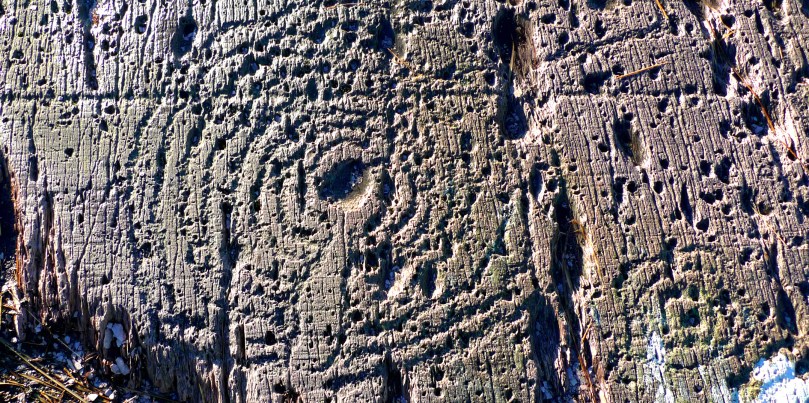
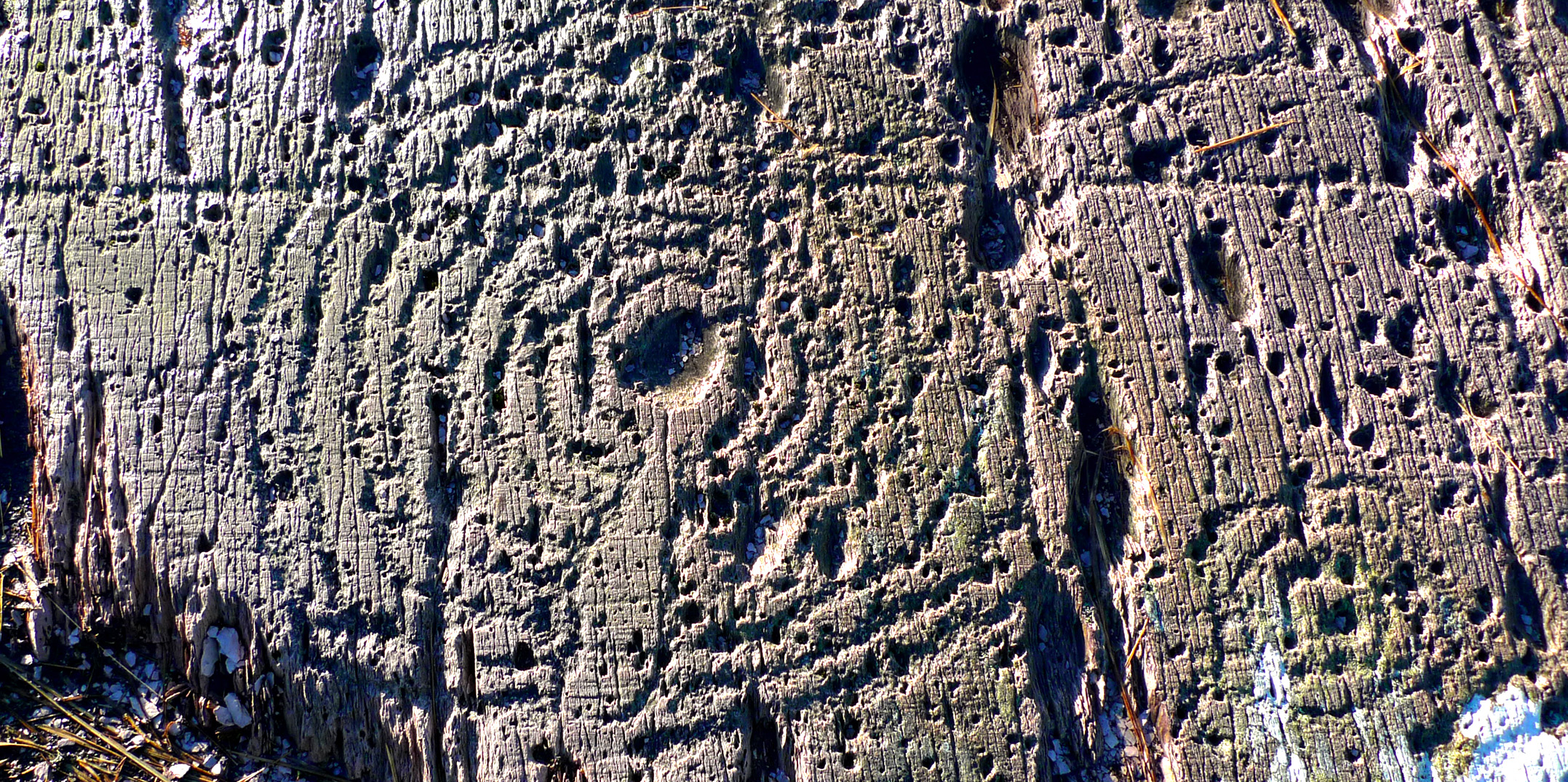
Cupmark with eight rings at Derrennaclogh

Cupmark with eight rings at Derreennaclogh

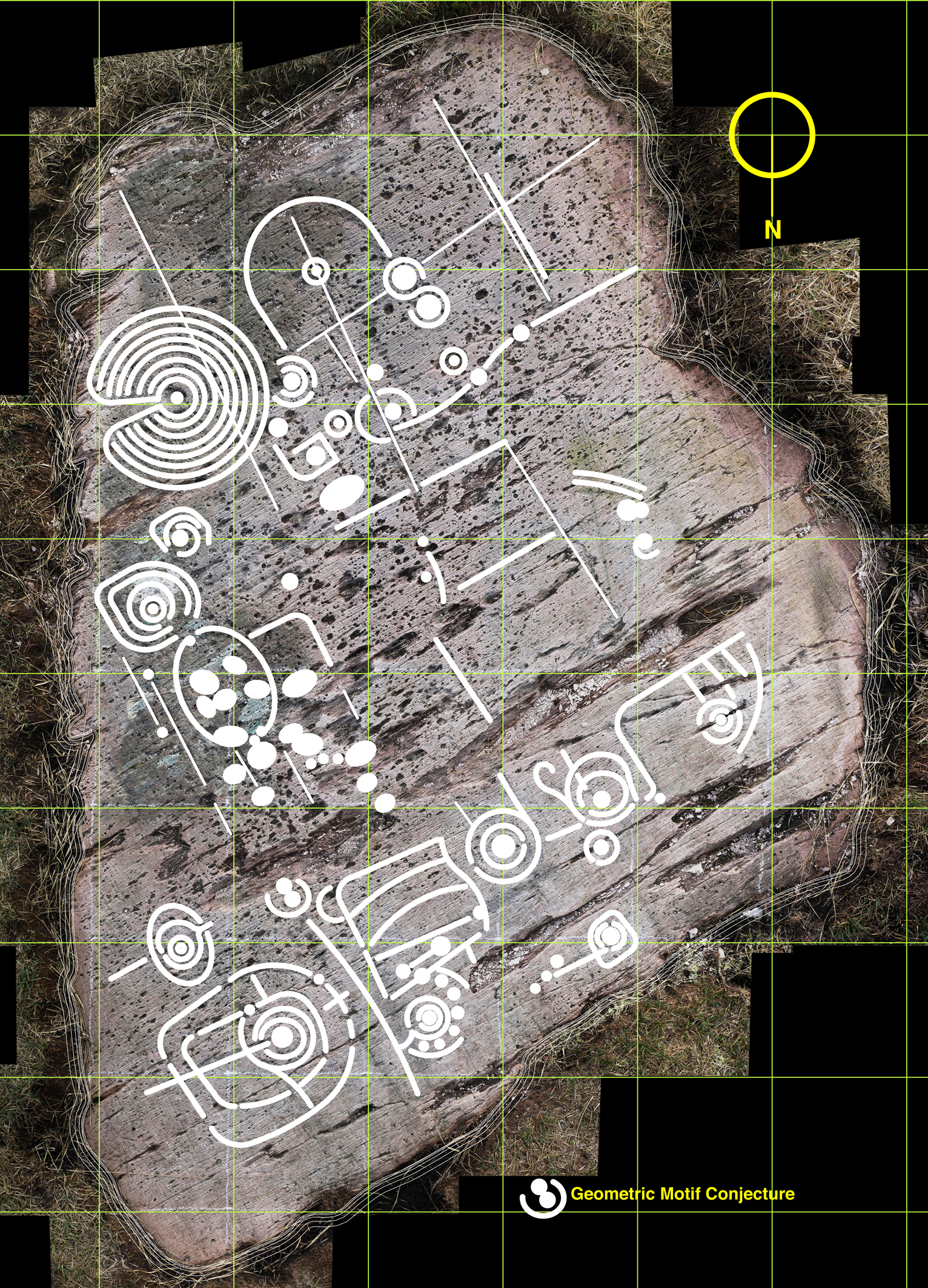
But this dilemma has led me to consider a further layer: intentions. I know this requires a leap of imagination and will seem bizarre – if not anathema – to trained academics, but when I am finely tracing some of the images I find myself asking what the carver originally set out to do in each individual case. So many of the marks are nearly geometric – concentric circles and parallel lines for example – but just don’t make it. Obviously there are limitations in the carving technique and you can’t rub out mistakes. Also it is interesting that some of the motifs seem to relate to natural striations and fissures – which is why I have shown the most prominent of these on separate layers. So here I am daring to have a ‘top’ layer which shows my interpretation of what the Rock Artist might have set out to do if he or she didn’t have the limitations of crud(ish) tools and materials. Please ignore this layer if you are not whimsically inclined – or a romantic. I am incurably romantic, and always still waiting for that moment when I am pensively standing on the rock and will be startled by the appearance beside me of a stray artist carver from 5,000 years ago. Miraculously we will be able to communicate – and, after that encounter, I will be able to provide the answer to the question that is always asked by voyeurs of prehistoric Rock Art: what does it all mean?
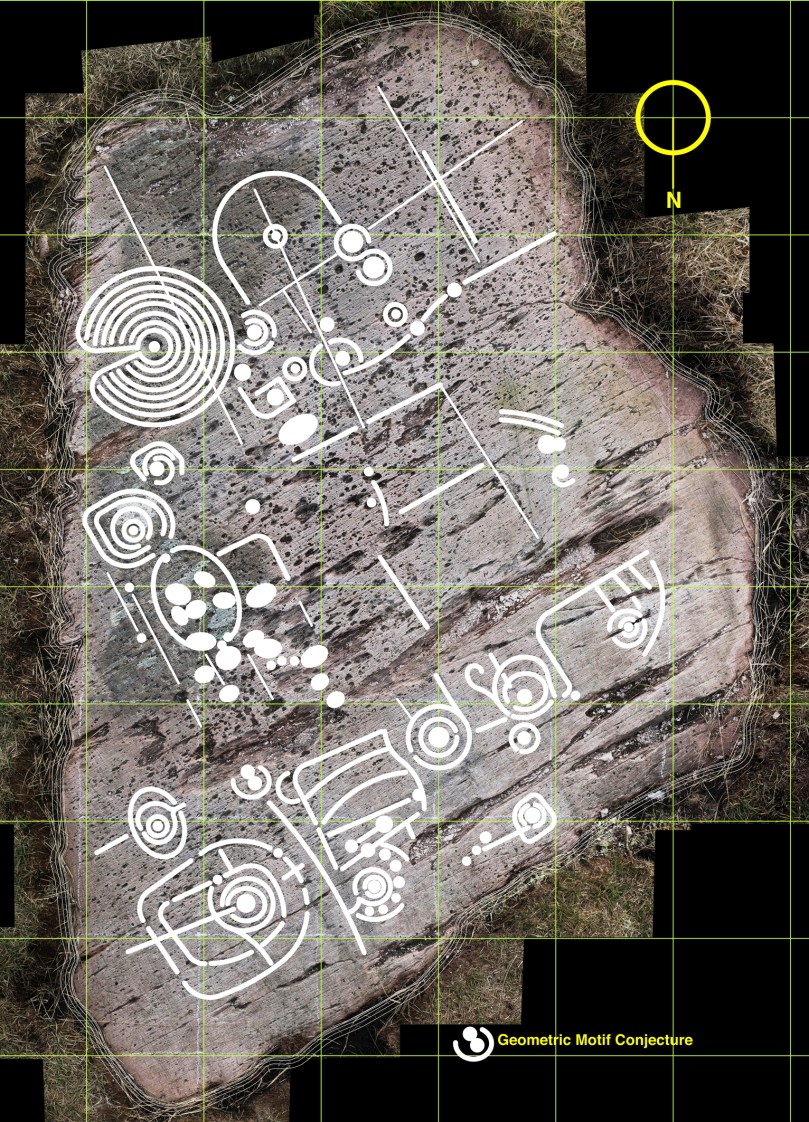
Whimsy - a conjectural geometric redrawing of the motifs at Derreennaclogh

Whimsy – a conjectural geometric redrawing of the motifs at Derreennaclogh