Murphy Devitt in Cork, Part 2

In Murphy Devitt in Cork Part 1 I introduced you to the main players in the Studio – Johnny Murphy, Róisín Dowd-Murphy and Des Devitt. Together they set about doing something entirely new and different in stained glass in Ireland, bringing with them their art training, their modern aesthetic sensibilities, and their deep knowledge of and commitment to their craft.
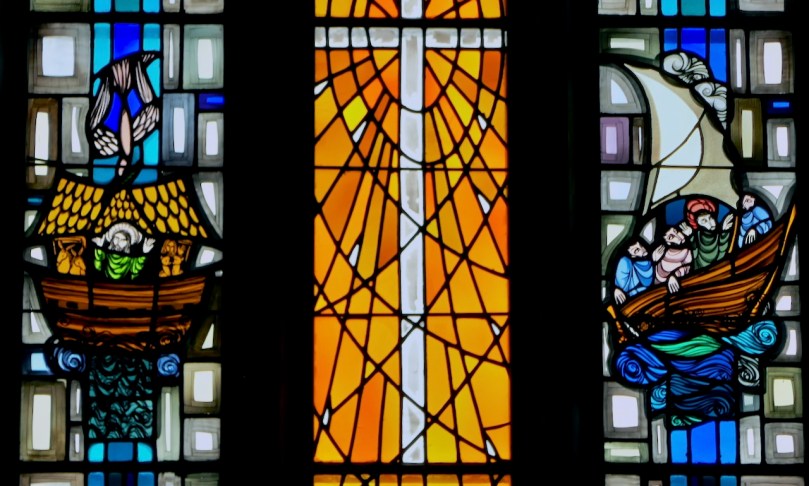
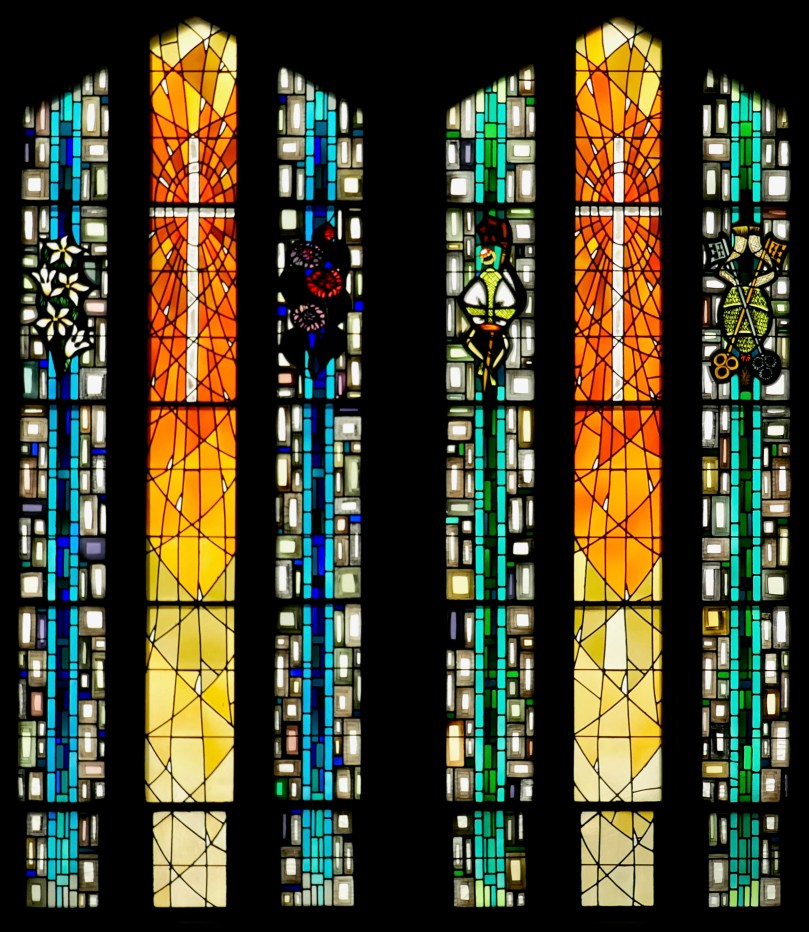
Both photographs above are from the Church of St Michael, Blackrock, Cork. The windows comprise large areas of breakouts with small images placed in the top half. A close up of the pictures chosen for this window reveal Noah’s Ark and Christ Calming the Waters (Contrast this with our final photograph in this post, which is in Caheragh)

Although the Studio was dissolved as a business in 1985, the three continued to work together in a loose arrangement, often under the heading of Des Devitt and Associates. This creative partnership went on for over 50 years: it was so finely attuned that Johnny could describe his vision over the phone and Des knew how to actualise it.
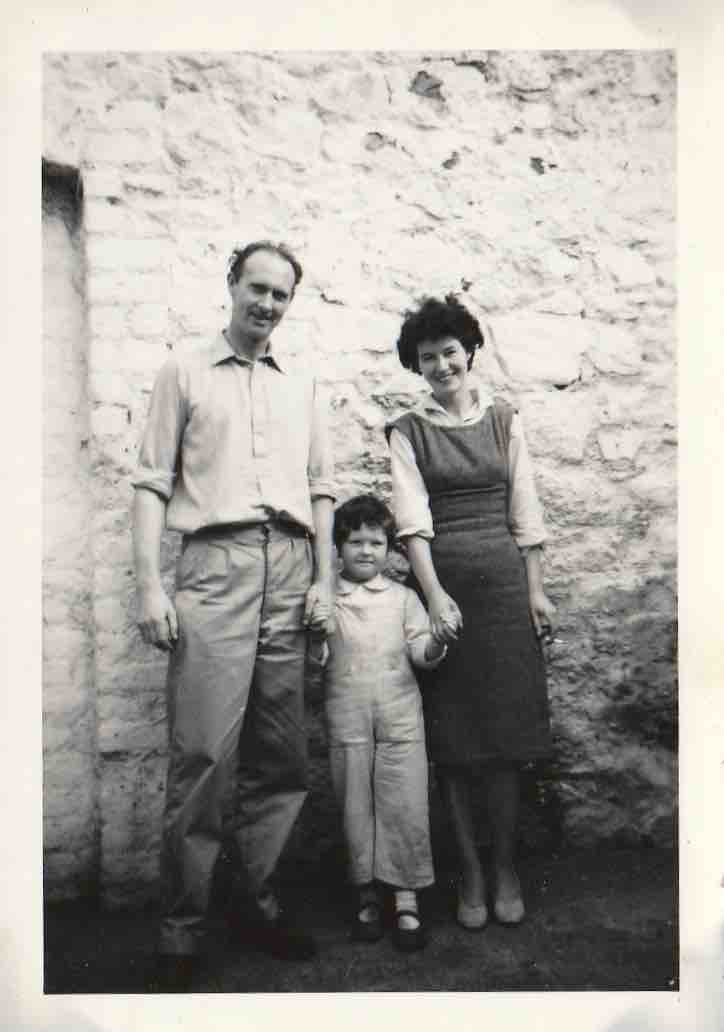
Johnny, Réiltín and Róisín – Réiltín was already a fixture in the Studio at this age

Everyone was pulled into the slipstream – Réiltín Murphy had to stand on a box to reach the drawing table when she started out first. Anthony Devitt* was just a kid when Des warned him not to fall off the scaffolding or his mother would kill him. They all loved it, as did the endless stream of students from the National College of Art, where Johnny was now teaching, who came to help in the summer or to learn how to paint on glass or assemble windows. Other artists came to help when the pressure of work got too much – Terry Corcoran, Rosaline Murphy (not related) Celia Harriss, Paul Britton, Ann Fitzgibbon, Michael Biggs, Michael Timlin to name some.
The only different window at Blackrock is this one, and it’s pure Roisín. There was a fire in the church and this window was rescued and re-installed in a side room once all the new windows were installed by Murphy Devitt Studios. We don’t know what the original ones were like, apart from this one

Johnny was the main designer, hugely respected by Róisín, Des and everyone in his orbit. His was the overall vision for a whole scheme for a church or for a one-off window. Róisín was happiest left to paint, either from Johnny’s designs or from her own – she was a painter at heart and exhibited into her 70s.
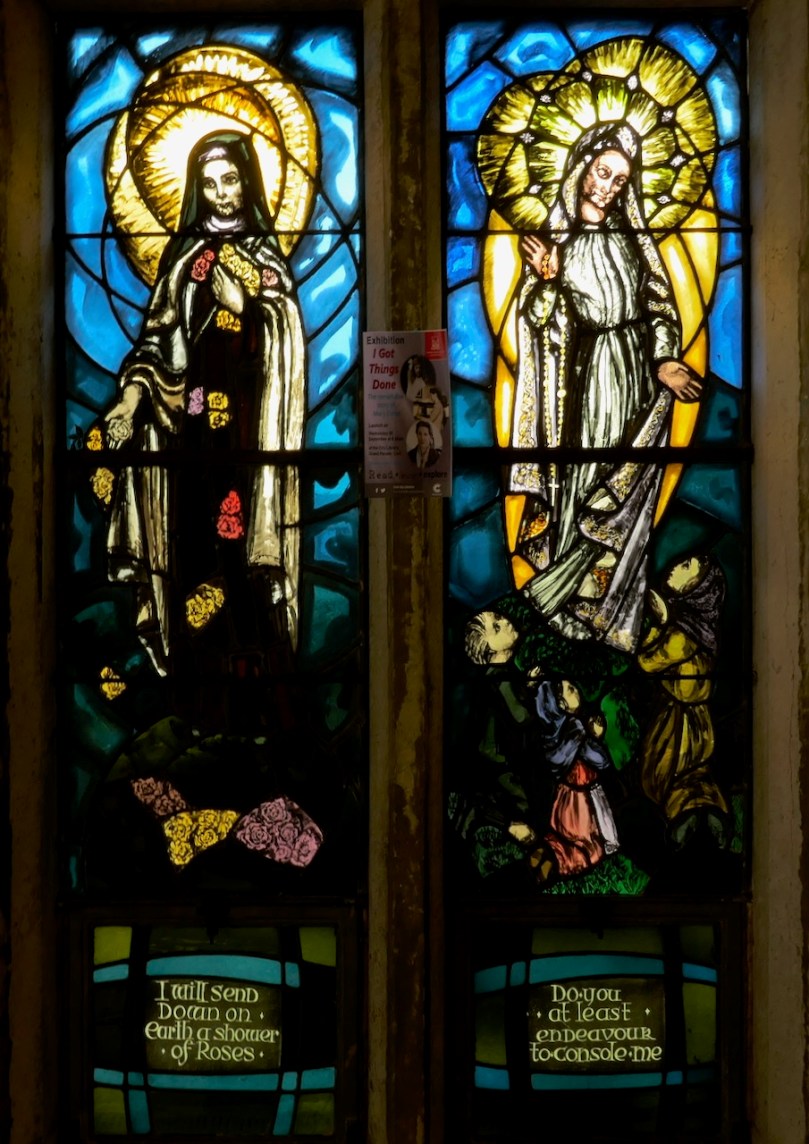
This window is a whole family project. It dates from 1974: Róisín painted the figure, Johnny did the little scene of Gougane Barra and Réiltín did the lettering. It’s in a convent chapel in Crosshaven, now closed and inaccessible. The photograph is published with the permission of the Presentation Order. 

Des had a couple of years of art college under his belt too but his genius lay in management and in translating Johnny’s designs (or sometimes just thoughts) into finished windows. He pitched for business, kept the budget under control, delivered work on time and ran the Studio in a completely non-hierarchical way that would be the envy of many a modern management guru. All of them read voraciously, educated themselves in progressive art theories and in how the spiritual could be expressed in glass. Perhaps this isn’t so difficult when the subject is the Passion, or the Life of Christ, or a particular saint like Francis. But many churches requested non-figurative windows, whether for budgetary reason or out of preference. Here the challenge became creating a space that suggested the transcendent, without the aid of obvious imagery.
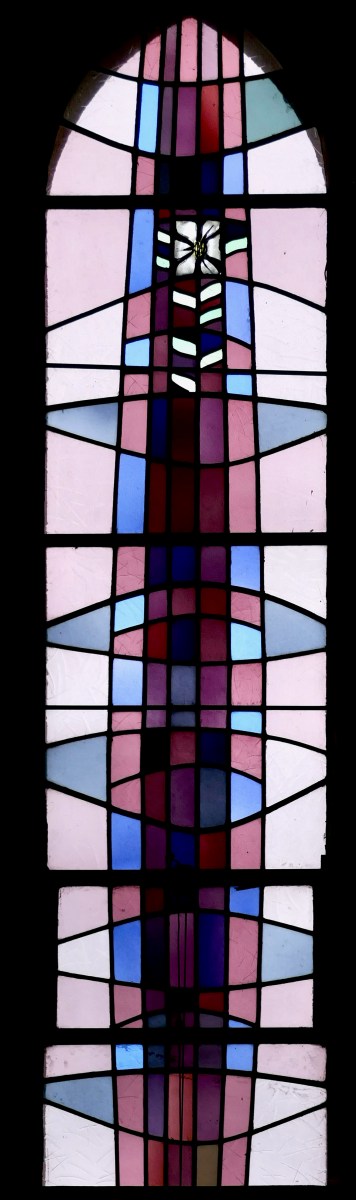
In the same chapel are many windows that are either entirely non-figurative or with small hints of symbolism. This one looks like the lilies often carried by St Joseph

These mostly or entirely non-figurative windows became one of the hallmarks of Murphy Devitt Studios, instantly recognisable, and capable all by themselves of creating an atmosphere of drama or tranquility. An oval becomes the window to the soul, a series of them leads the eye upwards, thus capturing the notion of the elevation of thoughts and prayers. A sunburst denotes the glory of creation, light falling from heaven.
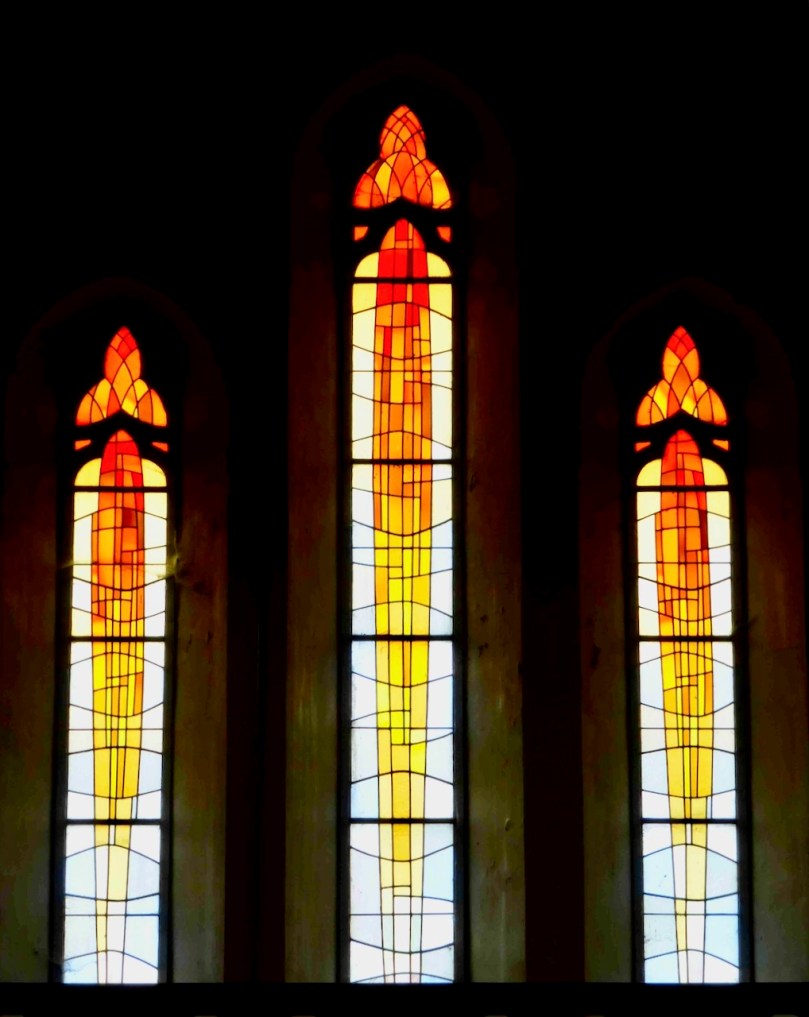
Ballyhooly Church has all non-figurative windows. This photograph is courtesy C Cashman and R Gem

Some have small elements within them that are complete pictures, mostly Christian symbols, sometimes mere hints. There were favourites – I’ve seen similar ones crop up here and there, although their context leads to fresh treatments. Some churches are a mixture of figurative and non-figurative. Although it’s not in my remit for these posts, if you are near Dun Laoghaire visit St Michael’s church and marvel that expanses of ‘coloured glass’ can create such a calm and devotional atmosphere.
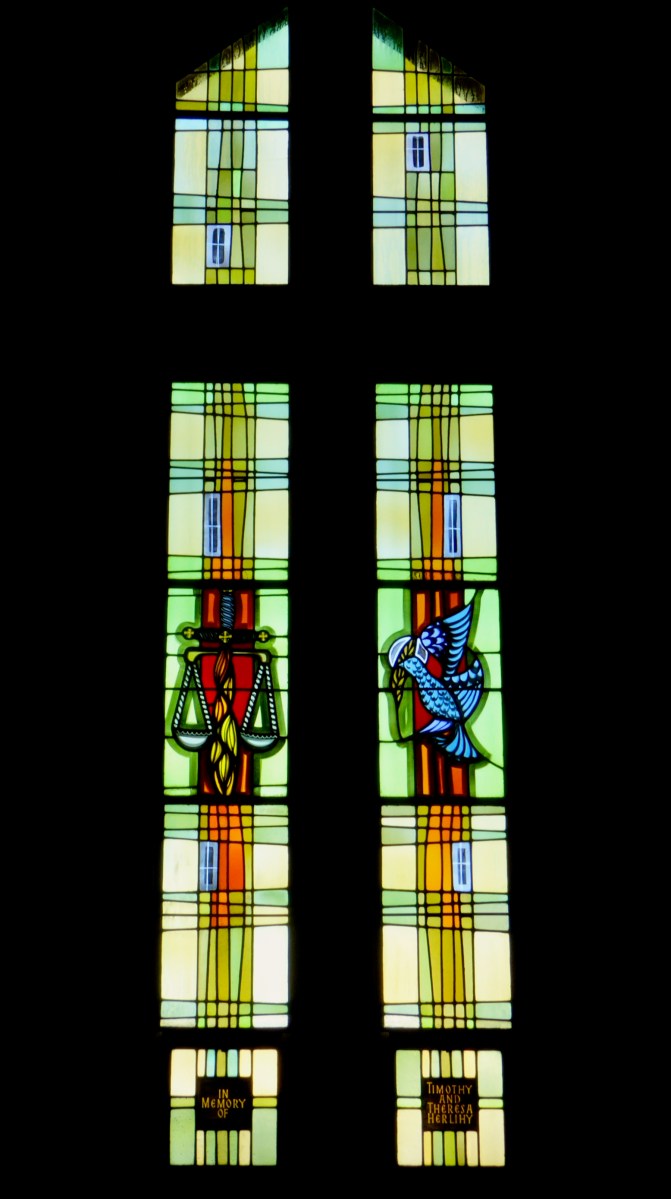
Caheragh Church has a mixture of figurative, non-figurative and non-figurative-with-symbols. This window is one of the latter

Anyone who visits Irish churches knows that what we want in them are our own saints – Patrick and Brigid certainly, but after that they must be local. So along with every other stained glass artist who ever worked in Ireland, Johnny had to study the hagiographies of our obscure legendary saints and satisfy a demanding congregation familiar with the stories.
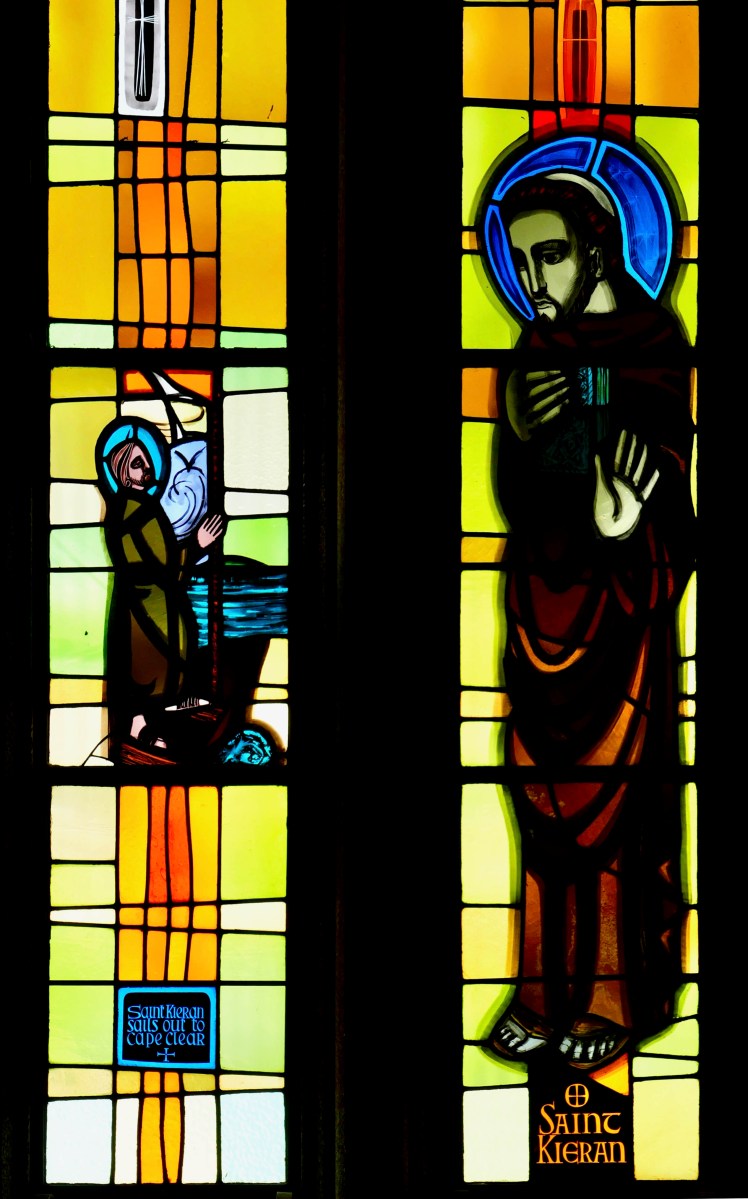
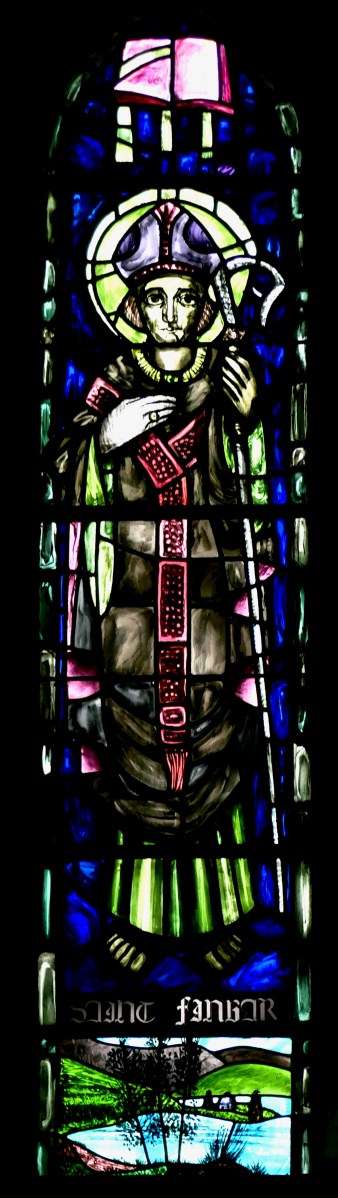
St Kieran of Cape Clear is one of our treasured West Cork saints

At Caheragh (north of Skibbereen) and Rath (just outside Baltimore) in West Cork two small rural churches demonstrate how well he succeeded. The windows in each are quite different, although both were completed in 1963. In Caheragh the figures are situated in the lovely wavy-lined breakouts that we saw Murphy Devitt use to such effect in Mayfield, in tones of red and yellow.
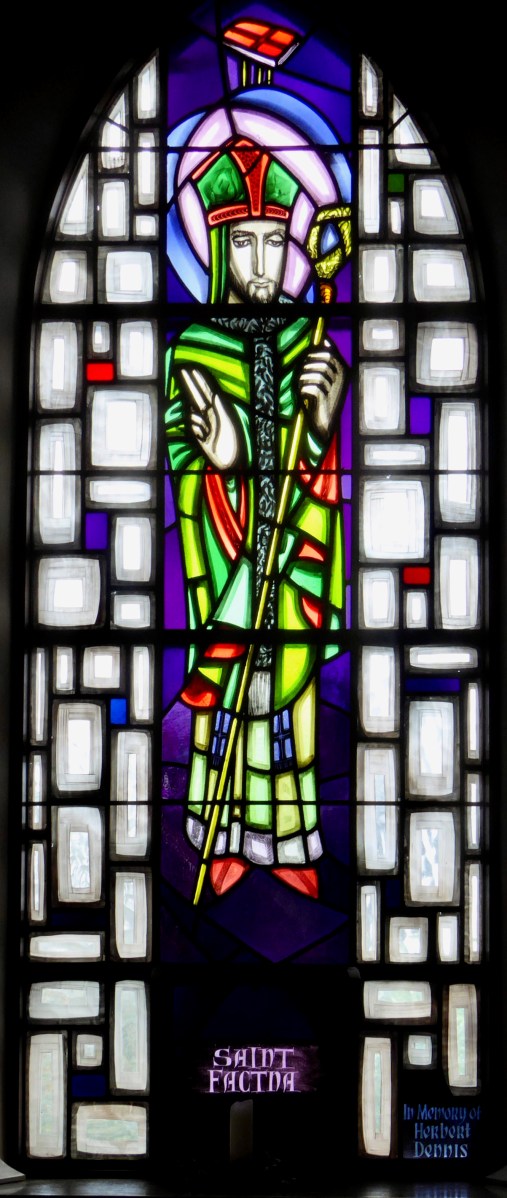
And here is St Facthna of Rosscarbery

In Rath we see the introduction of a new breakout design, the square or rectangle with grey shadow around the edge, seeming like a solid glass brick. It’s another Murphy Devitt innovation, used to great effect in many of their windows. They used it again the following year in Blackrock (see above).
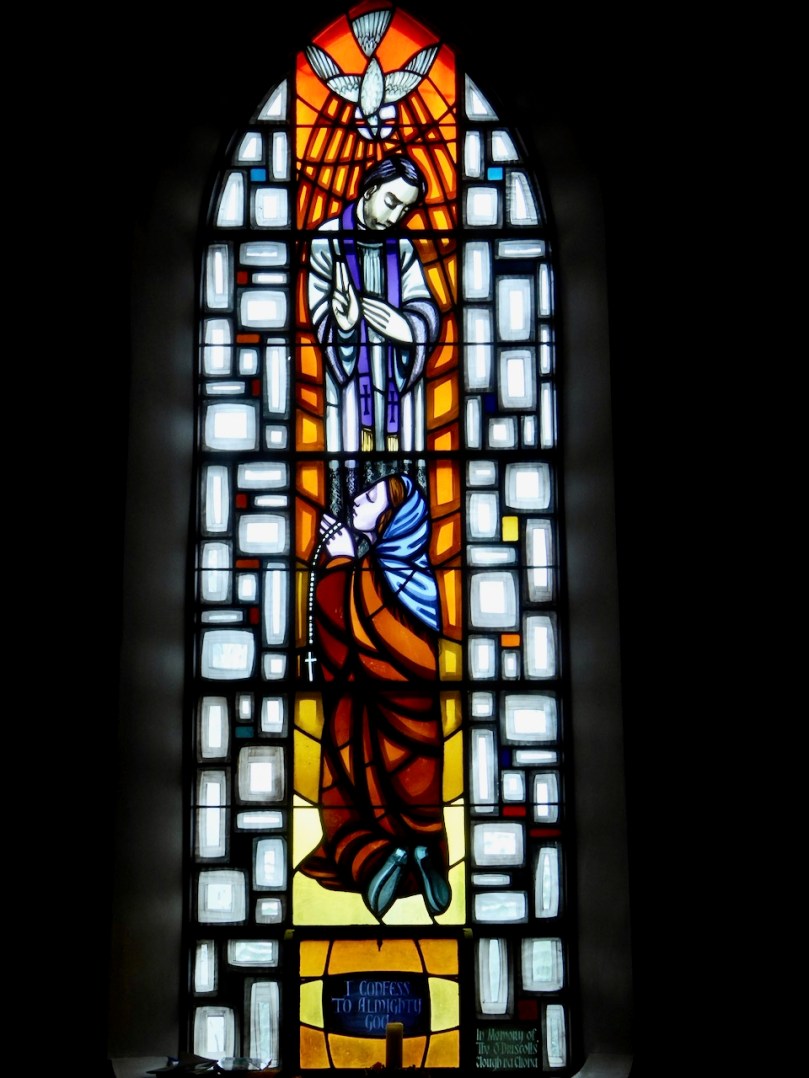
The Sacrament of Confession gets the Murphy Devitt treatment in Rath

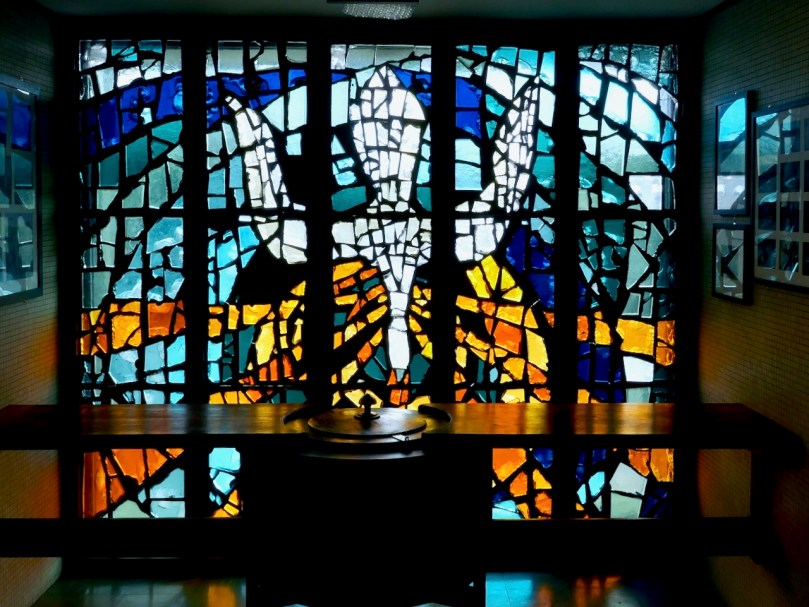
A stained glass technique that was introduced to Ireland in the 60s was that of Dal de Verre. Blocks of coloured glass were faceted to increase their reflectivity (this was done by knocking spalls of glass from the edges and surface of the blocks) and then cemented together with resin, and sometimes concrete. Dal de Verre enabled actual walls of glass to take the place of masonry and to create dramatic expanses of colour as an integral part of construction, rather than as windows.
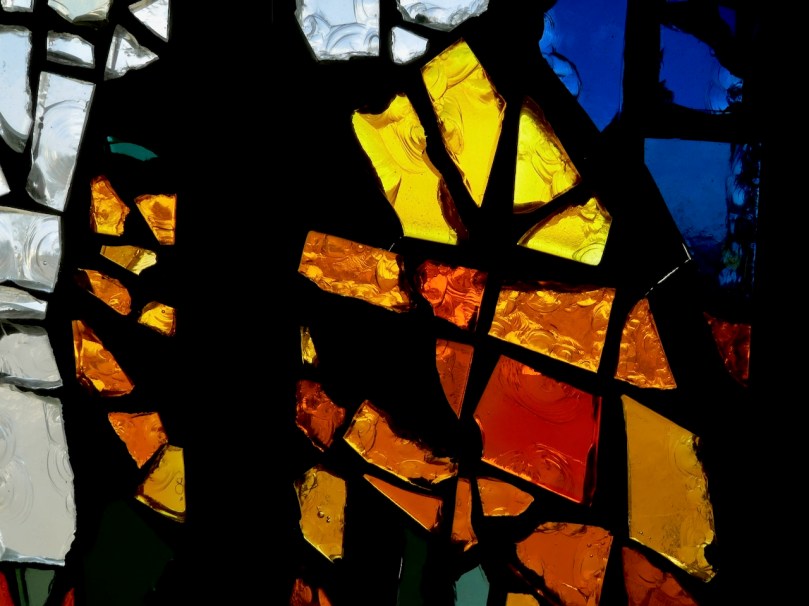
Chunks of coloured glass, faceted for additional refraction, float in a bed of resin. This is a detail from the Lowertown window below

Murphy Devitt were early adopters and we have one of their examples in Cork, at Lowertown, just outside Schull. It’s a dove of peace/Holy Spirit creating a glowing corner in the baptistry.
I still have two churches to tell you about, in Rochestown and in Mallow. They deserve their own post, and that will conclude this series. See you next week.
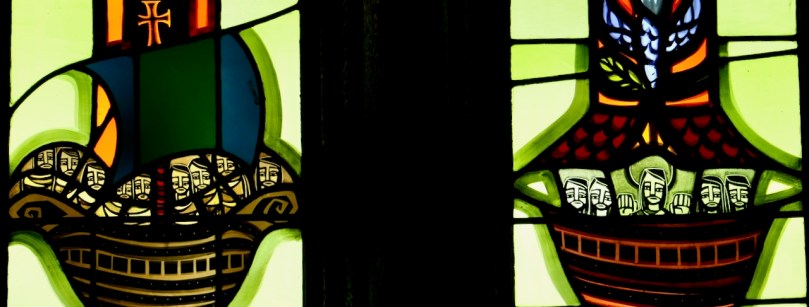
From Caheragh, across a two-light window, an image of Christ calming the storm. Traditionally, Christ is shown in one boat with the 12 apostles. However, Rembrandt famously included himself in his depiction of this scene, so I am tempted to think that Johnny is in there somewhere, since there are thirteen apostles in the boats

Part 3 is here.

*This post benefitted greatly from information generously shared by Anthony Devitt.
Murphy Devitt in Cork, Part 1

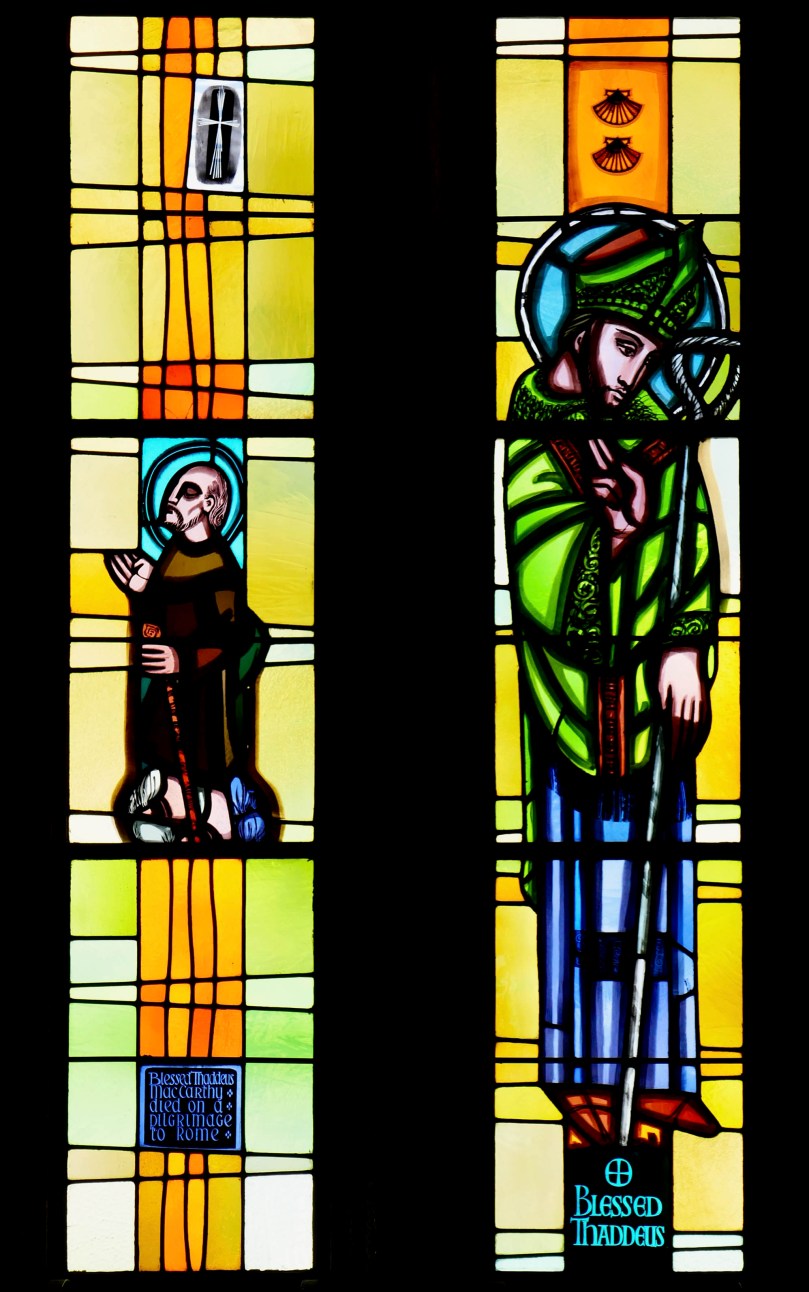
A couple of years ago I visited the Catholic church in Caheragh, just north of Skibbereen, specifically to look for an image of Thaddeus McCarthy about whom I was researching at the time (see my post Thaddeus McCarthy, the Bishop Who Never Was). As I stepped into the church it was immediately obvious that the stained glass was not the usual traditional images based on renaissance paintings that I had been seeing in most of the churches I had been in. No, what greeted me (above is the Thaddeus window) was something entirely new and different – modernist, colourful, idiosyncratic, painterly, beautifully designed and expertly executed windows, each one identified as the work of Murphy Devitt of Dublin and installed in 1963. I fell in love.

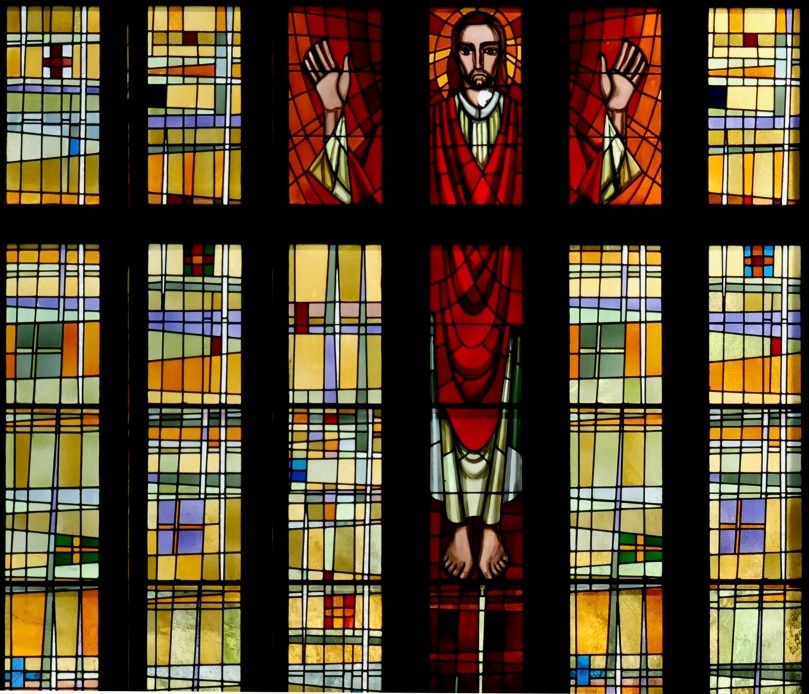
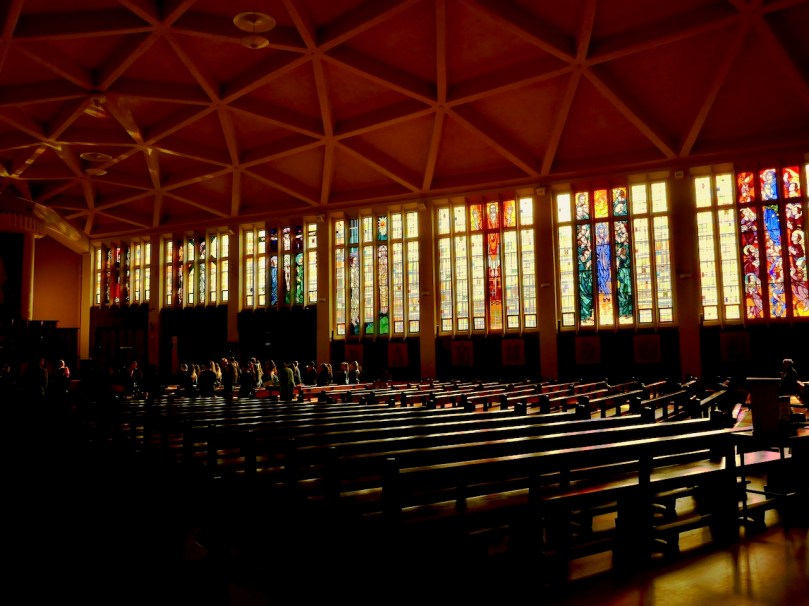
The stained glass windows in the rest of this post (except for one) are all from the Church of Our Lady Crowned, in Mayfield, Cork. This one represents the Risen Christ

There are Murphy Devitt windows in ten Cork churches, and why not? Johnny Murphy, after all, was a Cork boy, brought up in the city and starting his art education at the Crawford School of Art in the 1940s when the life-drawing classes still revolved around the Canova casts. He was a standout student, winning a scholarship to the National College of Art in Dublin. There he met a fellow student, the beautiful Róisín Dowd, whose parents had fled the Belfast blitz to settle in Dublin. Together and separately, they travelled to Paris and Rome, doing what art students do – visiting galleries and studios, studying centuries of European painting, absorbing and responding to those influences (think Botticelli for Róisín, Klimt for Johnny), finding their artistic voices and refining their own styles.

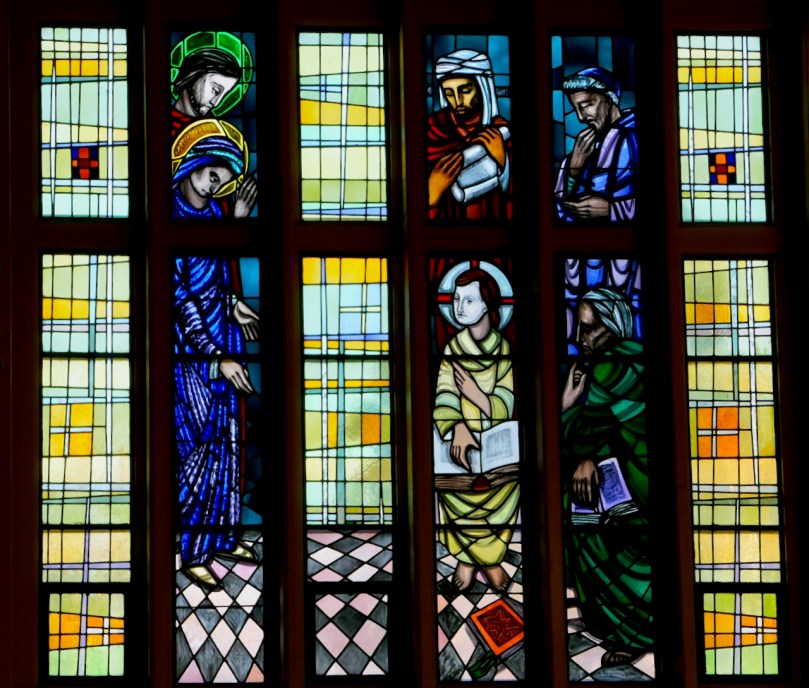
The Presentation in the Temple (detail)

Returning home, they had to wait for several years to marry. Their daughter Réiltín suspects that Grandfather Dowd insisted on Johnny having gainful employment and that may have been why he joined the Harry Clarke Studios in 1952 and began to seriously study the craft of glass painting. Harry Clarke died in 1931 but his studios carried on making stained glass until the 1970s. There was plenty of work for anyone in the ecclesiastical provisioning business as new churches were going up all over the country to serve the burgeoning, and pious, population.

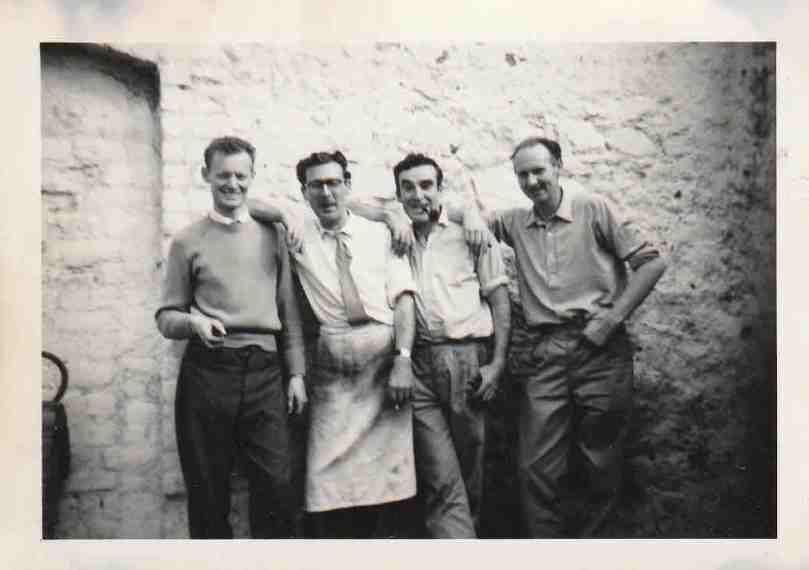
Dessie Devitt, Paddy McLoughlin, Mickey Watson and Johnny Murphy in their busy studio in the 60s

One of the glaziers Johnny worked with at the Harry Clarke Studios was John Devitt, universally known as Des or Dessie. Becoming fast and lifelong friends, they decided to strike out on their own, taking some of the men from the HC Studios with them. It was the late 50s and they couldn’t have picked a better time. Working from a mews in Monkstown and later a custom-built studio in Blackrock, they started to tender successfully for new commissions. This also allowed Johnny and Róisín, who now joined them as well when she could escape motherly duties, to develop their own unique approach to designing and painting stained glass, very different from what had become a somewhat hidebound atmosphere at the Harry Clarke Studios. For an example of what I mean by that, and to illustrate the contrast with MD, take a look at my post Time Warp, featuring a set of Harry Clarke Studio windows from the late 1950s. Below is a detail from one of them – far, indeed from the genius of Harry Clarke himself.

Detail from a Harry Clarke Studio window in Drimoleague. Although this window is interesting for lots of other reasons, the quality of the glasswork and the artistry of the painting had declined over the decades since Harry’s death. 

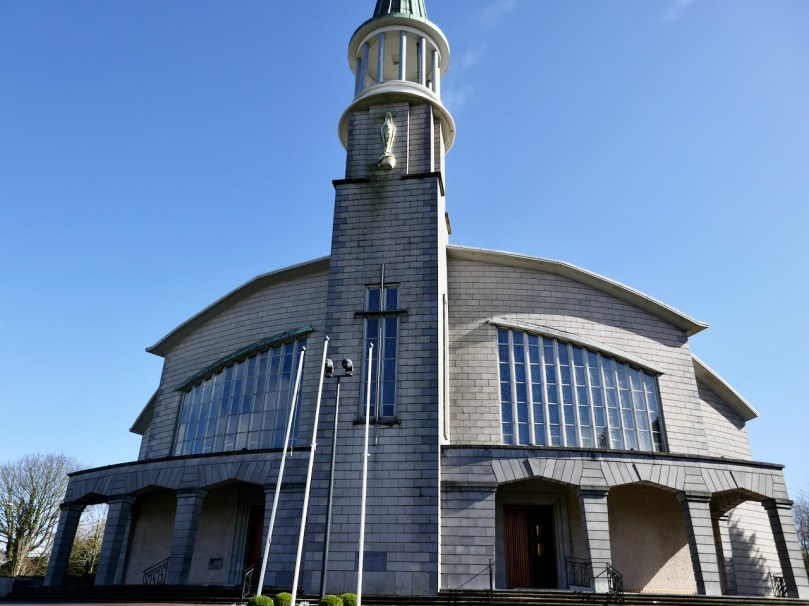
What Johnny always called their ‘first big break’ came with the Church of Our Lady Crowned, in Mayfield, Cork, completed in 1962. According to The National Inventory of Architectural Heritage:

Our Lady Crowned Roman Catholic Church was built to the design of J.R. Boyd Barrett’s firm and when completed in 1962 comprised the final of five new churches constructed to the north side of Cork city and named after the five Glorious Mysteries of the Rosary. The design and construction of the roof is of technical importance while the extensive stained glass windows, from the workshops of Murphy & Devitt in Dublin, are of particular artistic merit.
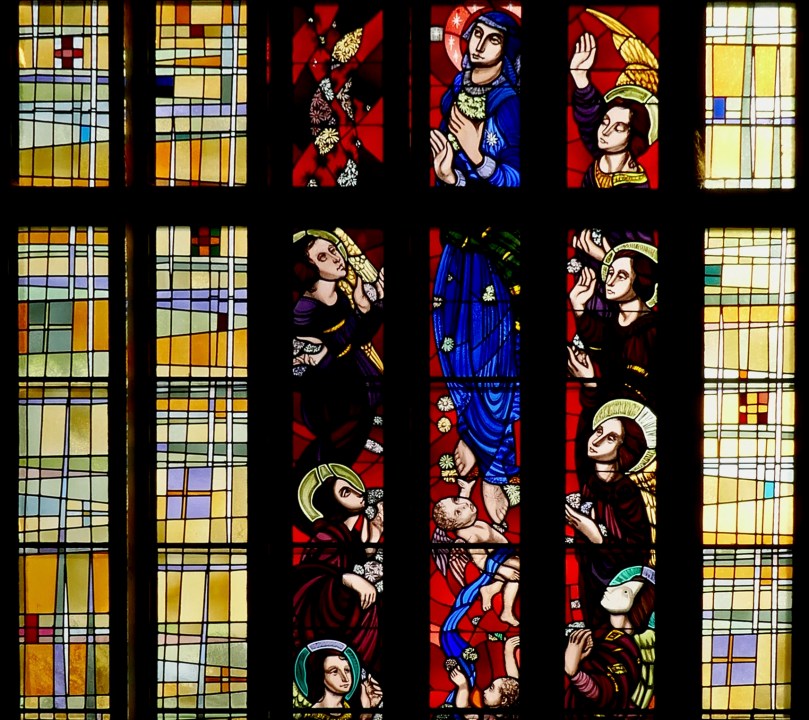
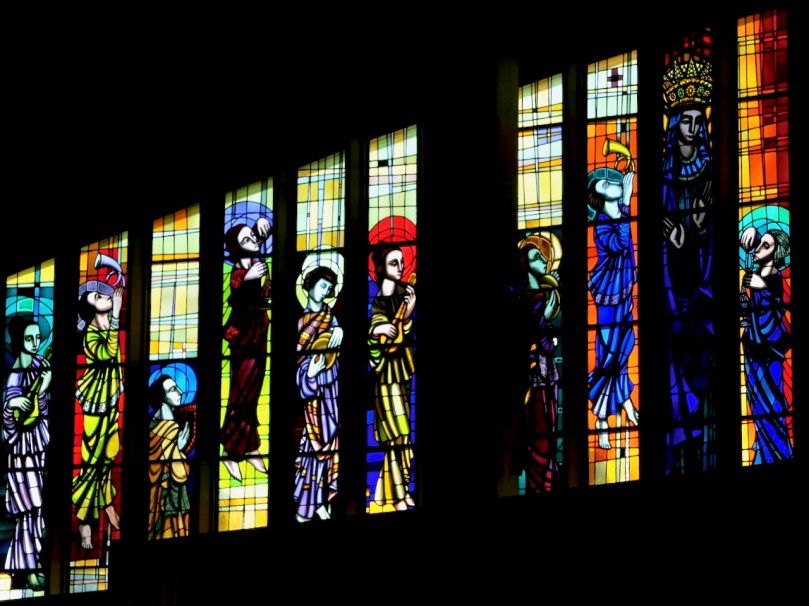
Too often, stained glass windows are one-off commemorative objects, mounted in an available opening. But when you see a whole scheme of windows in one church, designed to fit and complement the architecture throughout the building, the effect can be breathtaking. And so it is with Our Lady Crowned. The church is wedged-shaped, with enormous glass panels occupying at least half the space. Scenes from the Life of Christ range around the walls, from the Annunciation to the Crucifixion and Epiphany, with the huge area over the main door taken up with a choir of angels heralding the crowning of Mary on one side and Christ on the other.   
The day we visited the church was full of children preparing for their Confirmation

When I told Réiltín Murphy*, Johnny and Róisín’s daughter, that Our Lady Crowned was my favourite of the Cork MD churches, she responded that it was her parents’ favourite too. It’s not hard to see why – it’s a triumph of imagination, artistic vision, craftsmanship and above all collaboration. As I get more familiar with MD windows the distinction between a Johnny Murphy window and a Róisín Dowd Murphy window is sometimes quite clear: Johnny’s style is more angular, with loose dark brushstrokes, strongly marked facial features, heads tilted at an angle, while Róisín’s figures are more curvy and flowing, with greater attention to fabric and to musical instruments. Réiltín characterises the difference thus: Róisín’s figures, I always think, are too busy to pose for their photo while Johnny’s are usually quietly aware of just who they are and what they symbolise.

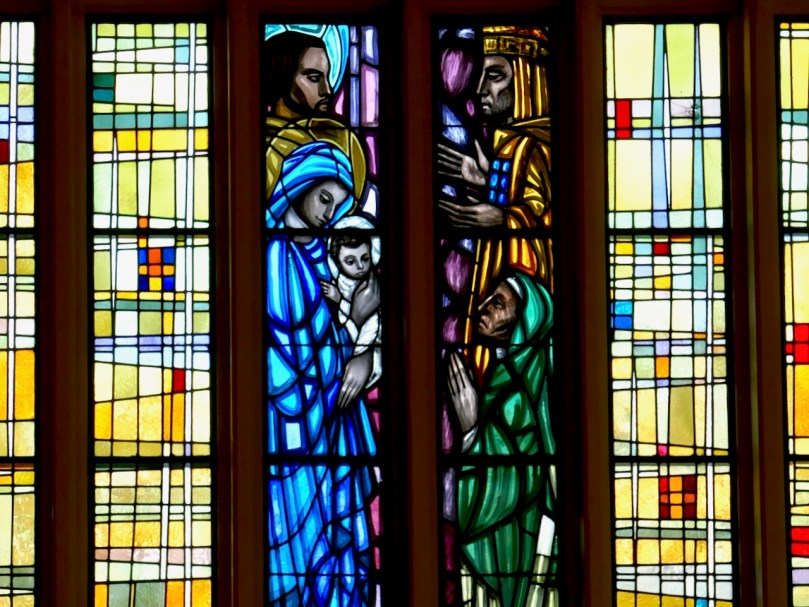
Nativity, Presentation and Jesus in the Temple windows

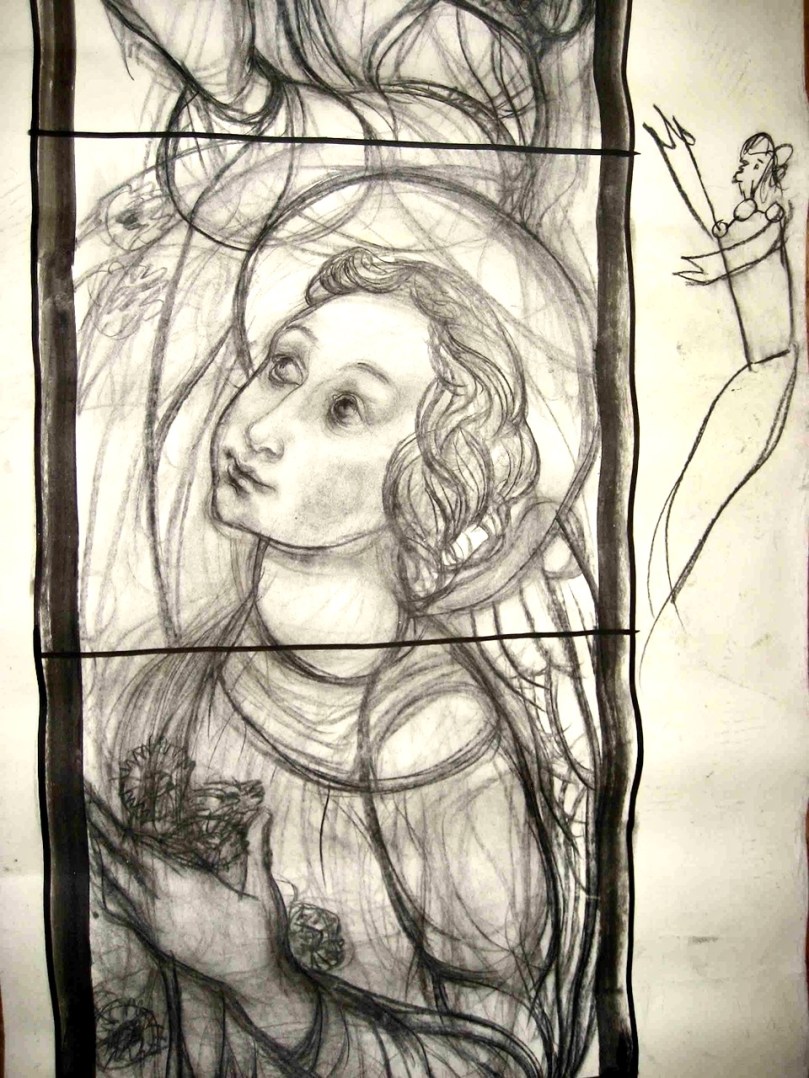
In Mayfield, all those elements are present: at first glance it’s impossible to tell where Johnny leaves off and Róisín begins. But we do have evidence, in the form of an original cartoon, that links Róisín directly to the Assumption window and once you see that, you see her hand in other places too – the heavenly choir, for example, has many of her hallmarks.

Róisín’s cartoon for the second angel from the bottom on the right, and the finished window

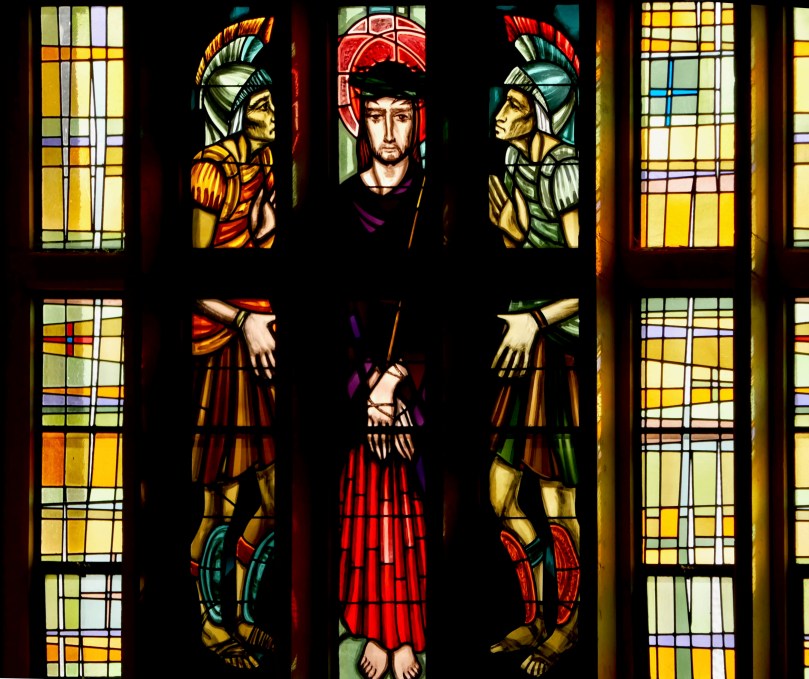
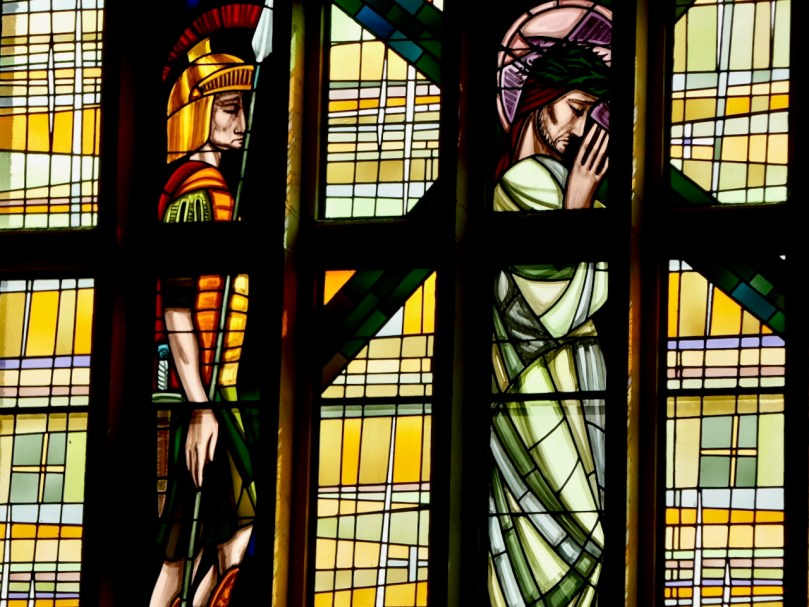
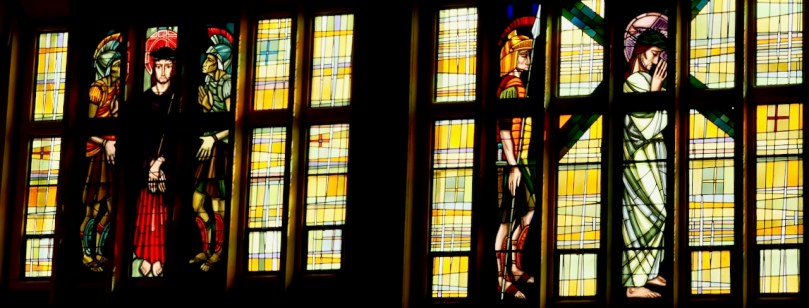
I am tempted to see Johnny in the passion images – the sombre figure of the suffering Jesus (below) exudes a quiet power alongside the mocking soldiers.

But many of the windows defy easy analysis. Look at the Nativity window (below), for example, and see if you can figure out whose hand is where. Complicating all this in Murphy Devitt windows is that when times got busy they took in extra artists to help with the workload.

In this window note how the ‘break-outs’ (the areas of coloured glass) are used to separate two long panels, which are then unified at the top. The composition, which manages to include all the major figures in two tall narrow panels, is impressive, as is the integration of those panels with the break-outs.

As with most of their commissions, Johnny was the one who sketched out the overall design and decided on the ratio of figurative panels to ‘break ups’, those areas of coloured glass that allow the eye to rest between scenes, to register the passage of time between events. Non-figurative schemes became important elements in the Murphy Devitt style – more about  them later, but for the moment note the highly original way in which the expanse of coloured glass are treated. Nobody else was doing anything like this at the time – it was a unique and beautiful Murphy Devitt innovation.

In this window, the Finding of Jesus in the Temple, the separating device is the break-out panel and the unifying device is the floor

Not for Murphy Devitt the regular quarry glass with its dependable lozenge shapes, or static grids of straight lines. Johnny loved the wobbly, the wavy and and the irregular. Réiltín says, He was interested in music: the fugue, he said, whereby the same melody/image is played in different keys – his abstracts are often flipped, turned, twisted to be similar but not identical. He loved glass as a painting medium. He loved its kinetic effect in its flaws, its trees moving outside, its changing light/colours from passing clouds, its seeming to be alive.

A window where the break-outs serve as background, with the two main figures occupying panels and the cross stretching across the space

It’s a lot easier to cut regular shapes and fit them together, of course, but you don’t need an expert for that. This is where Dessie Devitt came into his own as a master glazier. Choosing the glass to match the colour scheme, assembling it all harmoniously, cutting and leading the thousands of pieces that went into a scheme like this – none of it would have been possible without Dessie Devitt and the men who worked alongside him.

The heavenly choir, above  one side of the main door, with Our Lady Crowned on the right. Below is a detail from the other side

By all accounts it was a charmed workplace, a happy environment where everyone worked hard but where laughter and The Chat abounded. Des in particular was gifted with the ability to recognise the absurd and could hardly leave the studio without coming back with an entertaining story.

About the same time as Mayfield, Murphy Devitt won the commission to design a set of windows based on the Canticle of St Francis for another Cork church, this one attached to a Cappuchin Friary. We’ll take a look at that one and some others next week. For the moment, the Mayfield church will serve as an introduction to Johnny, Róisín and Des, their modern aesthetic and their collaborative approach.

*Many thank to Réiltín Murphy for much of the background information, for answering all my questions and for additional photographs, including the people pictures and Róisín’s cartoon.

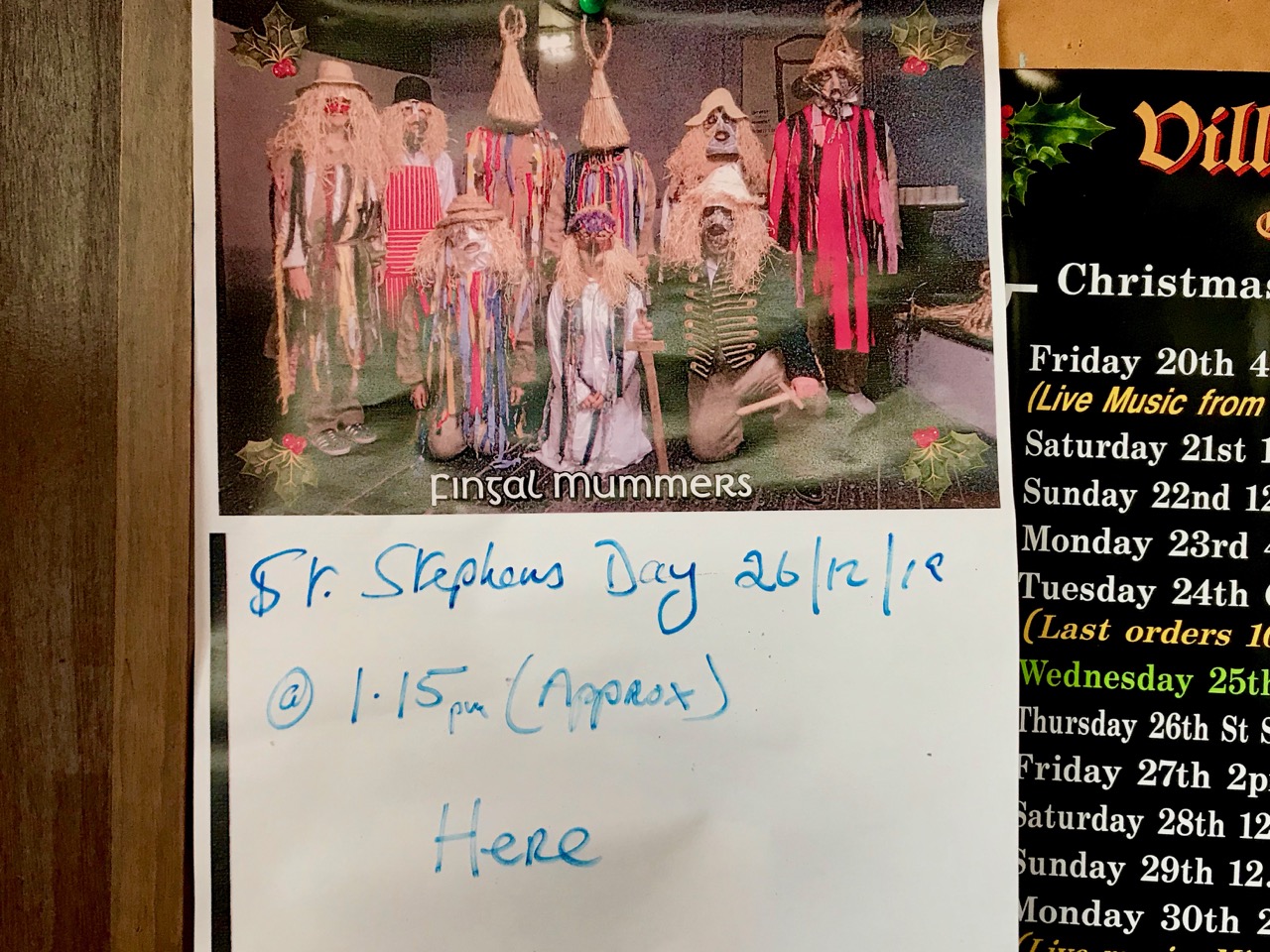
Fingal Mummers

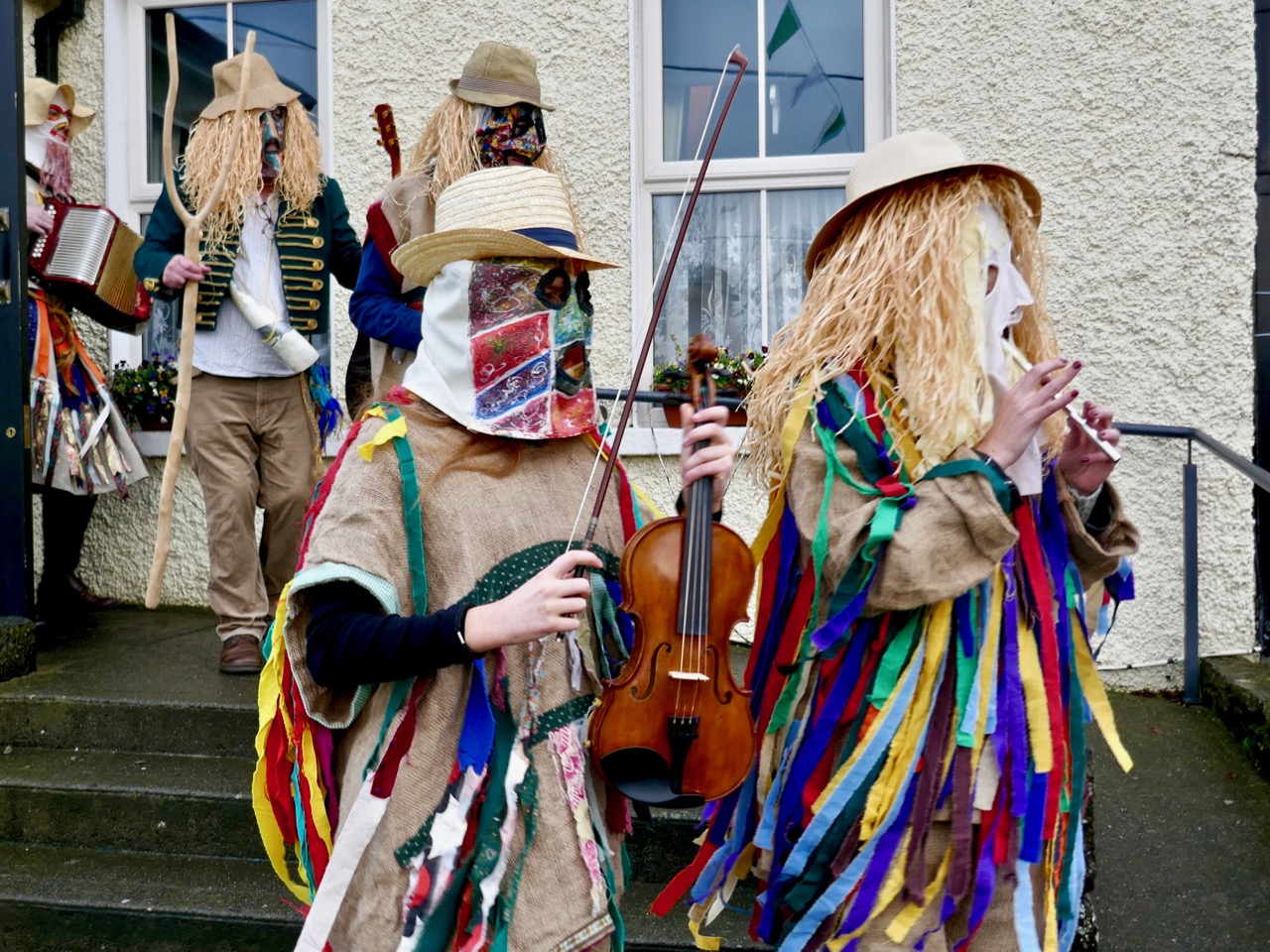
On Stephen’s Day we went up to Fingal County to see the Mummers – it’s a mere hare’s leap from Nead an Iolair. Until 1994 there was no county of Fingal: the area was part of Greater Dublin. Since that time this county has recorded the highest birth rate and population increase of any community in Ireland. Why? I would like to suggest that it’s because Fingal has , for countless generations, been the home of a Mummers tradition.

On our new green last evening here was presented the drollest piece of mummery I ever saw in or out of Ireland. There was St George and St Dennis and St Patrick in their buffle coats and the Turks likewise and Oliver Cromwell and a doctor and an old woman who made rare sport till Beelzebub  came in with a frying pan upon his shoulder and a great flail in his hand threshing about him on friends and foes, and at last running away with the bold usurper whom he tweaked by his gilded nose – – and then came a little Devil with a broom to gather up the money that was thrown to the Mummers for their sport. It is an ancient pastime they tell me of the citizens . . .

This account of Mummers in Cork is supposed to date from 1685, and is found in a manuscript collection in the Library of Trinity College Dublin, lodged by Thomas Crofton Croker in the 1840s. It is probably the earliest recorded portrayal of the custom in Ireland or Britain. Three hundred and thirty four years after this description of ‘an ancient pastime’ was written down, recognisably the same ‘mummery’ is happening every year across these islands around midwinter.

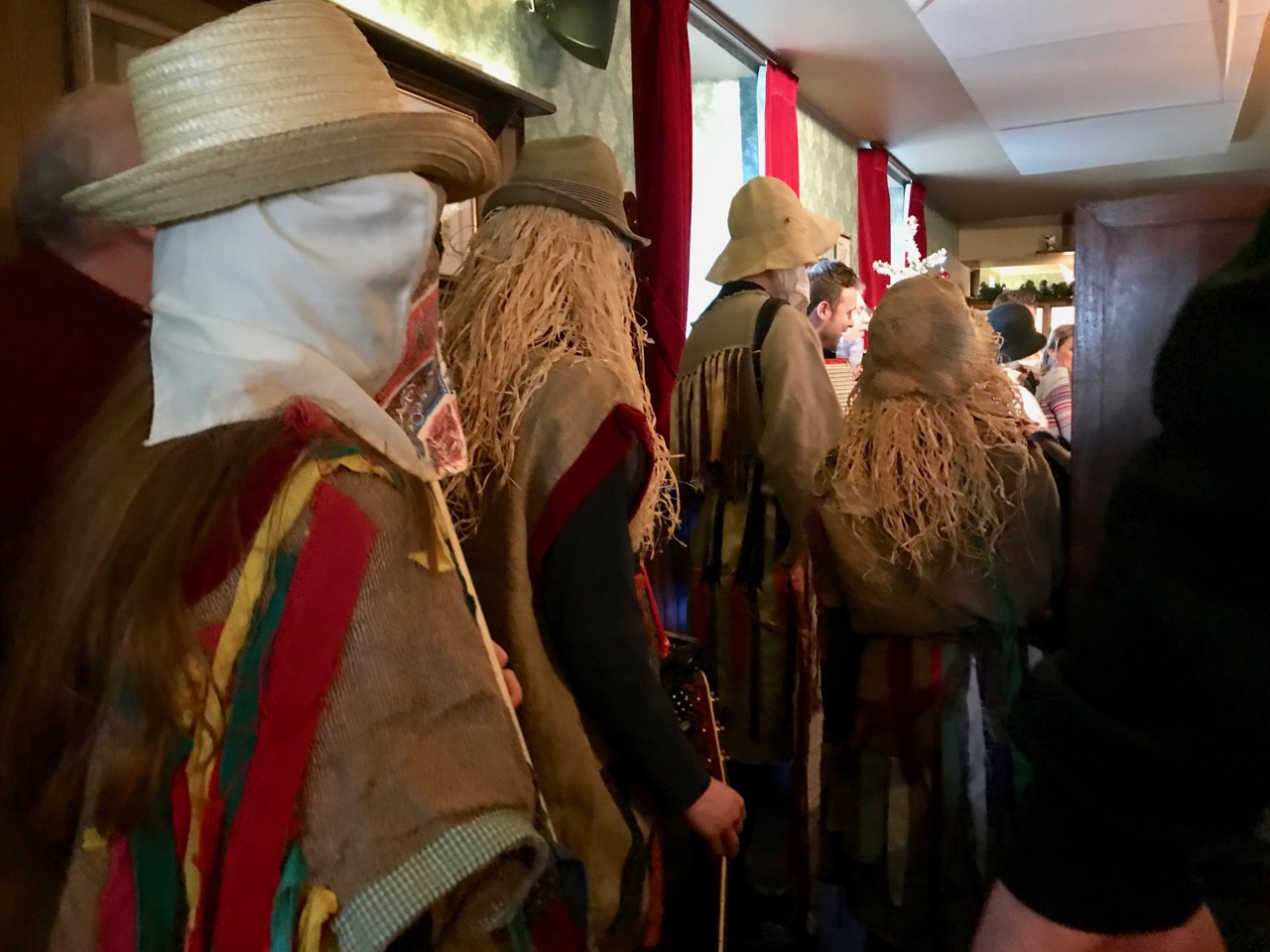
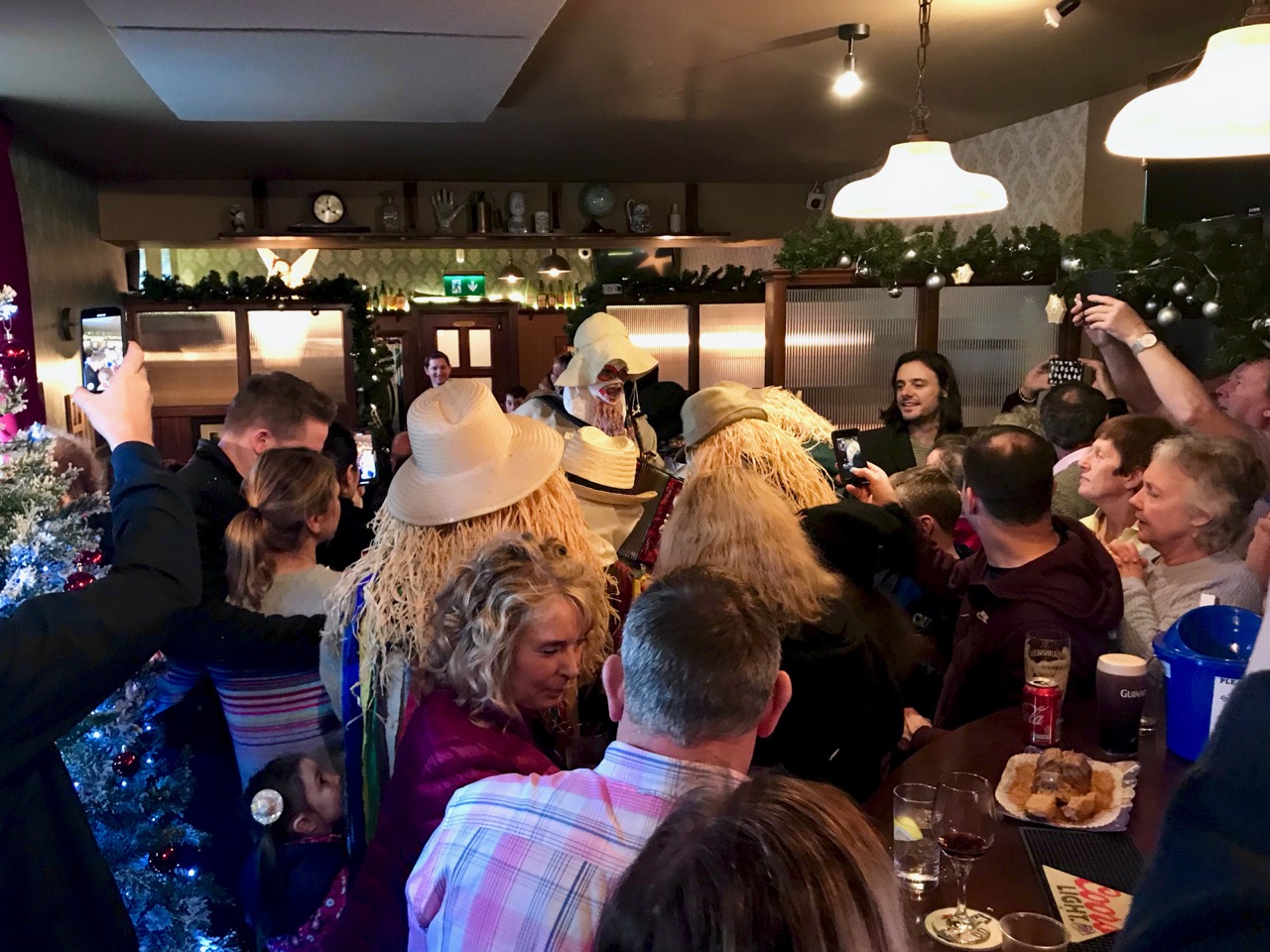
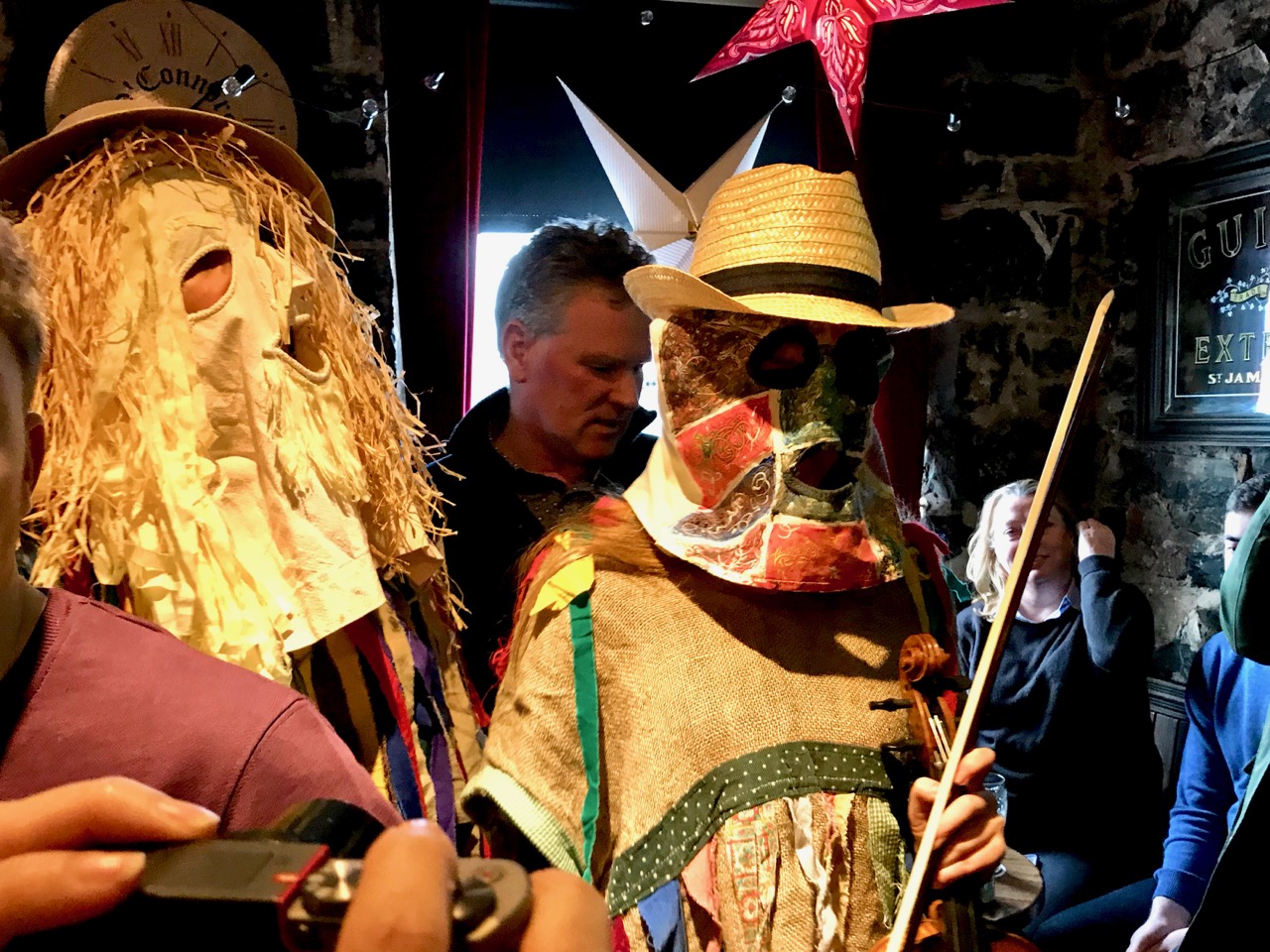
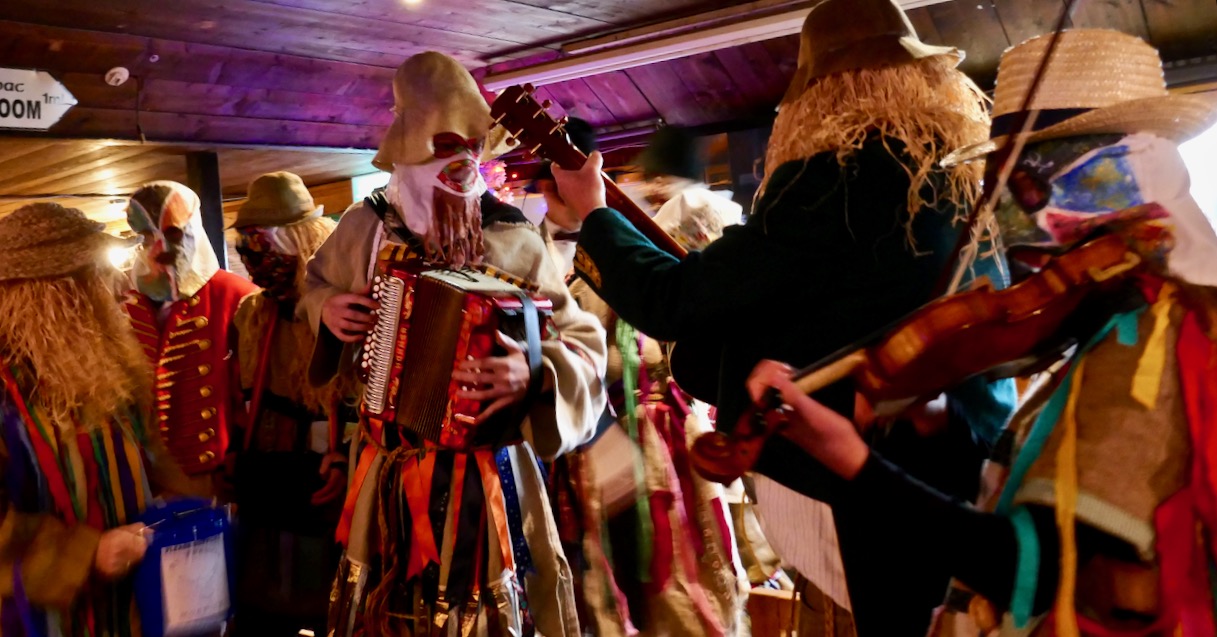
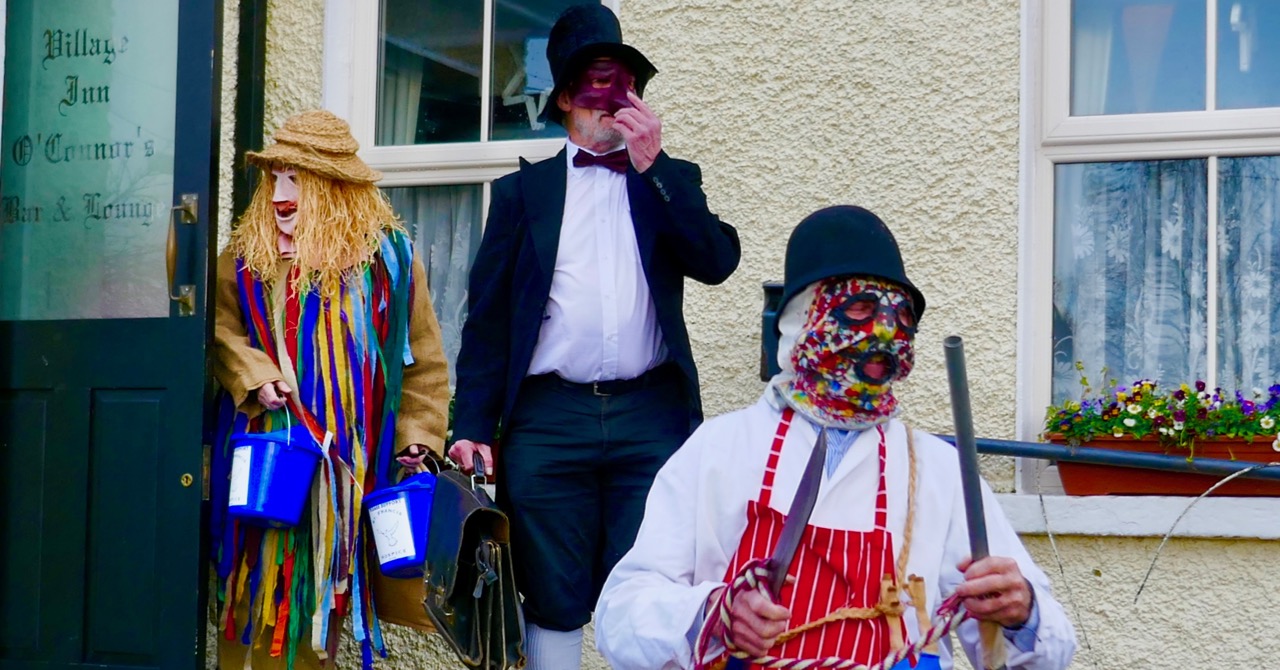
The Fingal Mummers ‘entering in’ (above). Following a revival in the 1950s, this group travels around several towns and villages on Stephen’s Day, performing their play to crowds who gather to see them. We tracked them down to their starting point, O ‘Connors Inn, Ballyboughal, which seemed a quiet little settlement until we walked through the door of the pub and realised that every resident of the village – and quite a contingent of visitors – was crammed inside waiting expectantly for the visiting players. The excitement was tangible, and everyone was in good spirit, enjoying the Christmas cakes, puddings and treats that were being freely handed around.

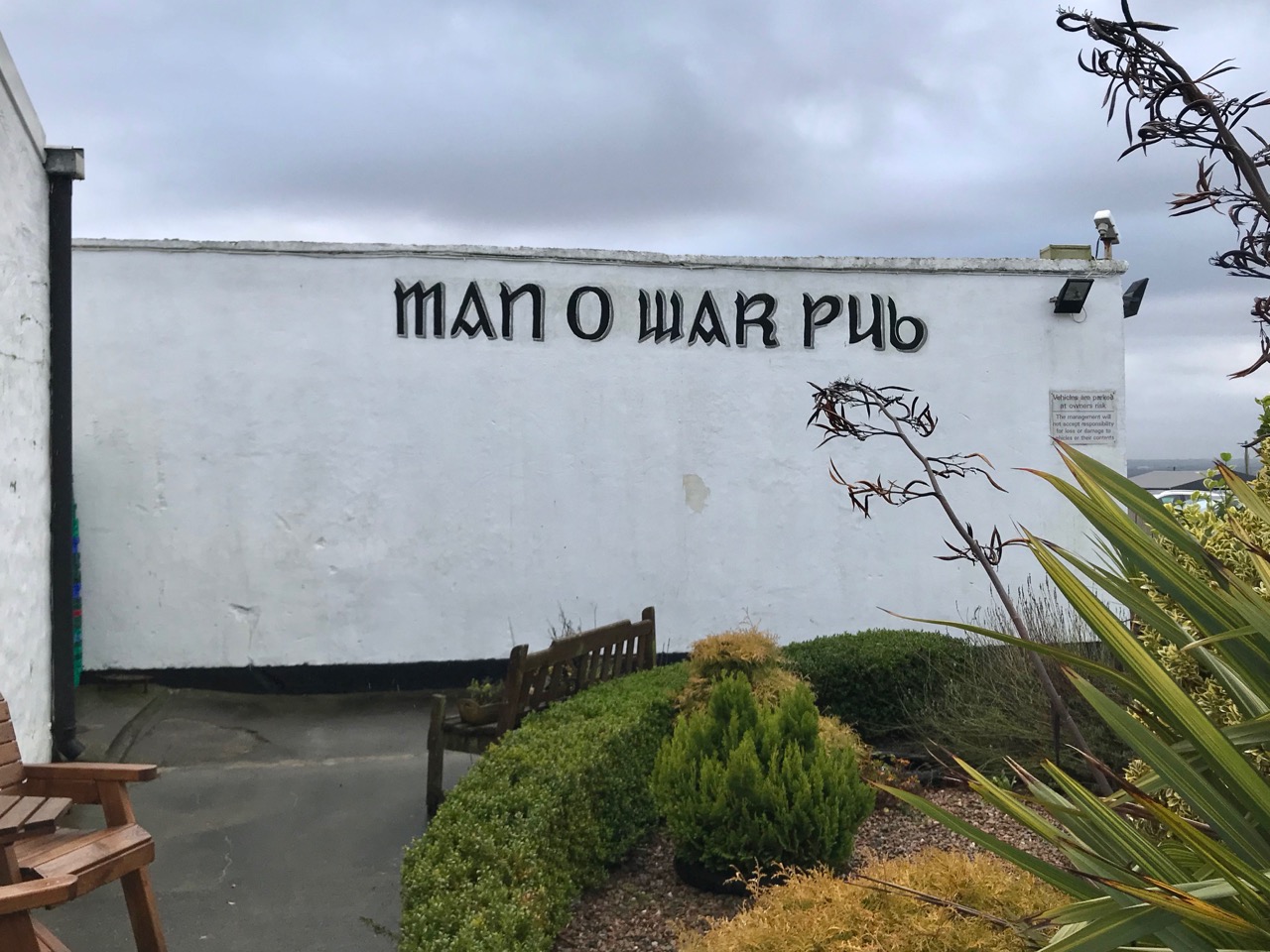
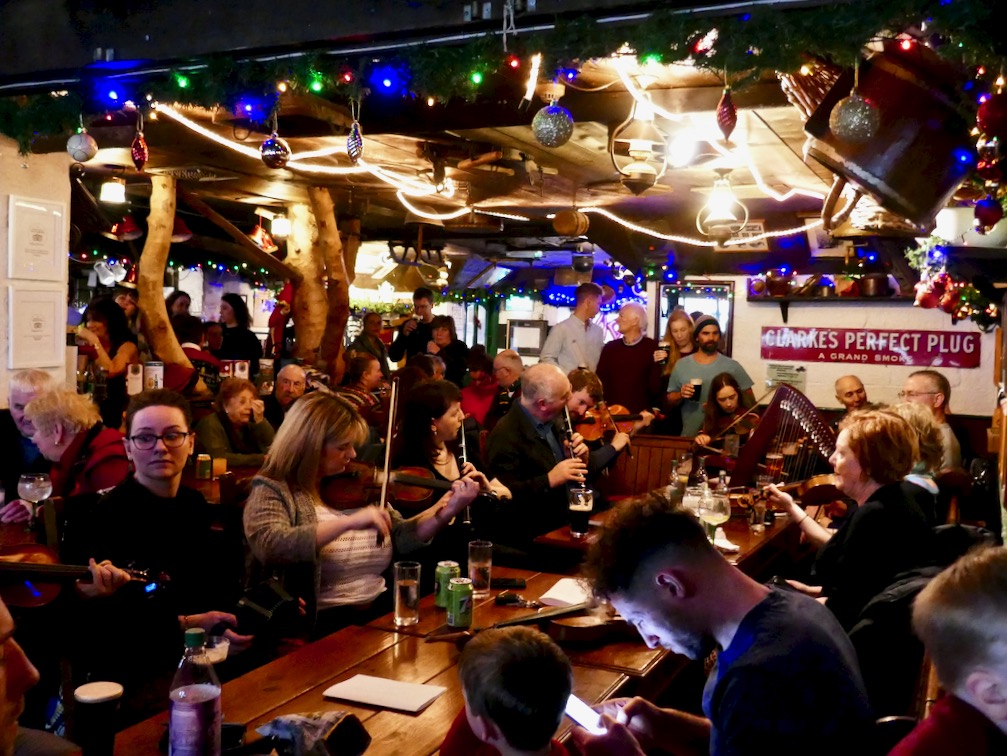
It seemed that the visit to O’Connors was a purely ritual appearance, as the crowds and the noise were too overbearing to permit a performance of the play. There was music and singing, but the group eventually moved on – with us following – to the next venue: Man O’War! This bar, which also gave its name to the scattering of houses around it, was evidently established in 1595 and became a toll point on the turnpike section of the main Dublin to Belfast road in the 1700s. The road has long since been superseded and is now a quiet lane. The pub, however, has grown in size and reputation and, on Stephen’s Day was packed: a large number of musicians was seated around an enormous table, and post-Christmas festivities were in full swing, with an air of expectancy leading up to the arrival of the Mummers.

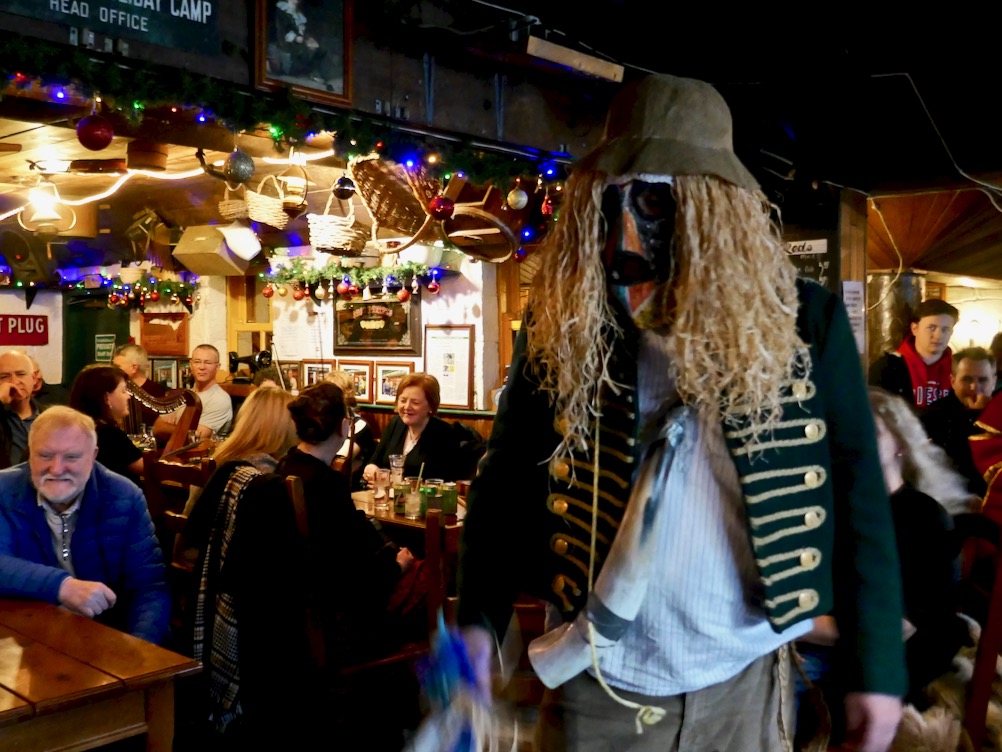
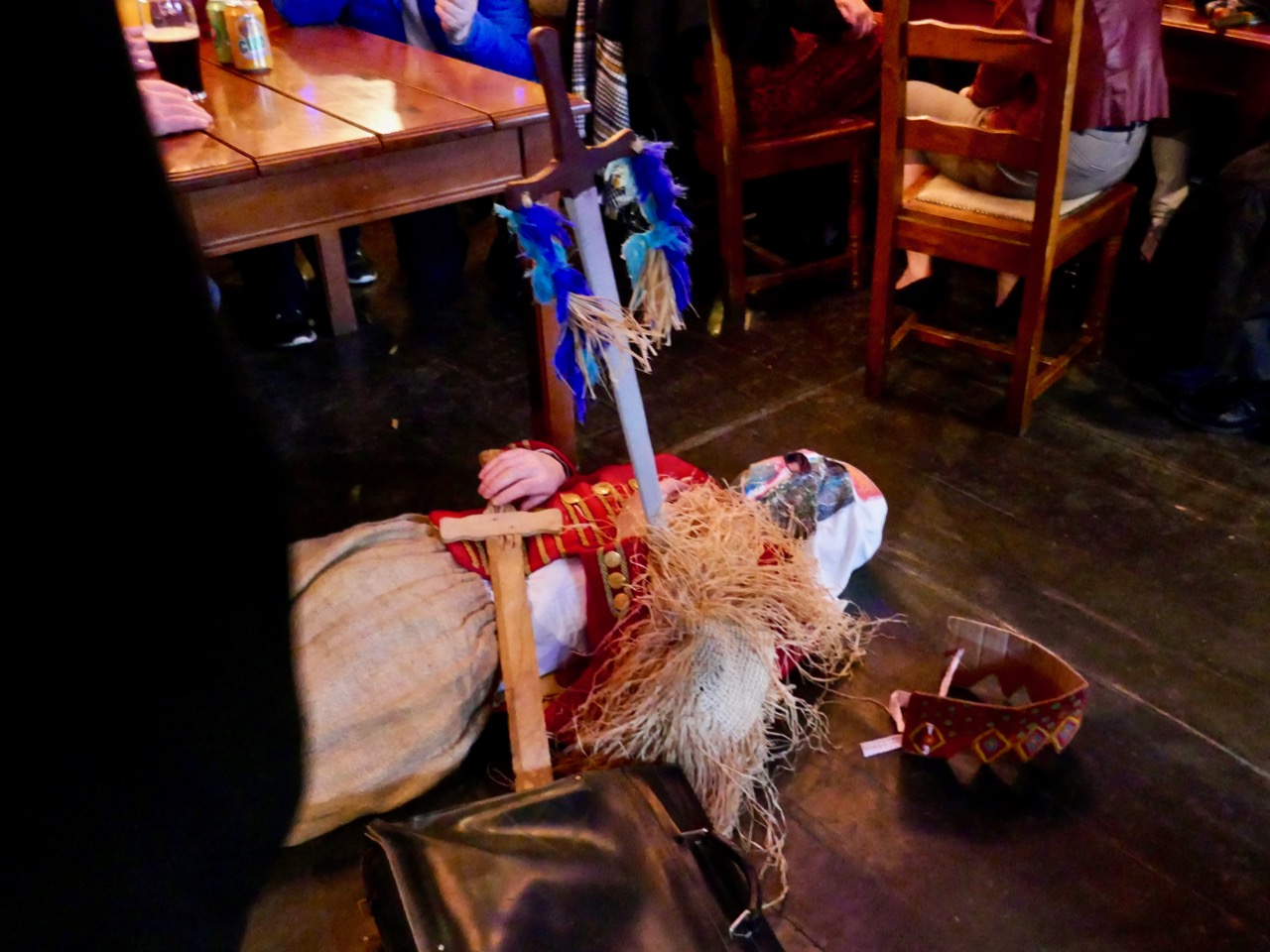
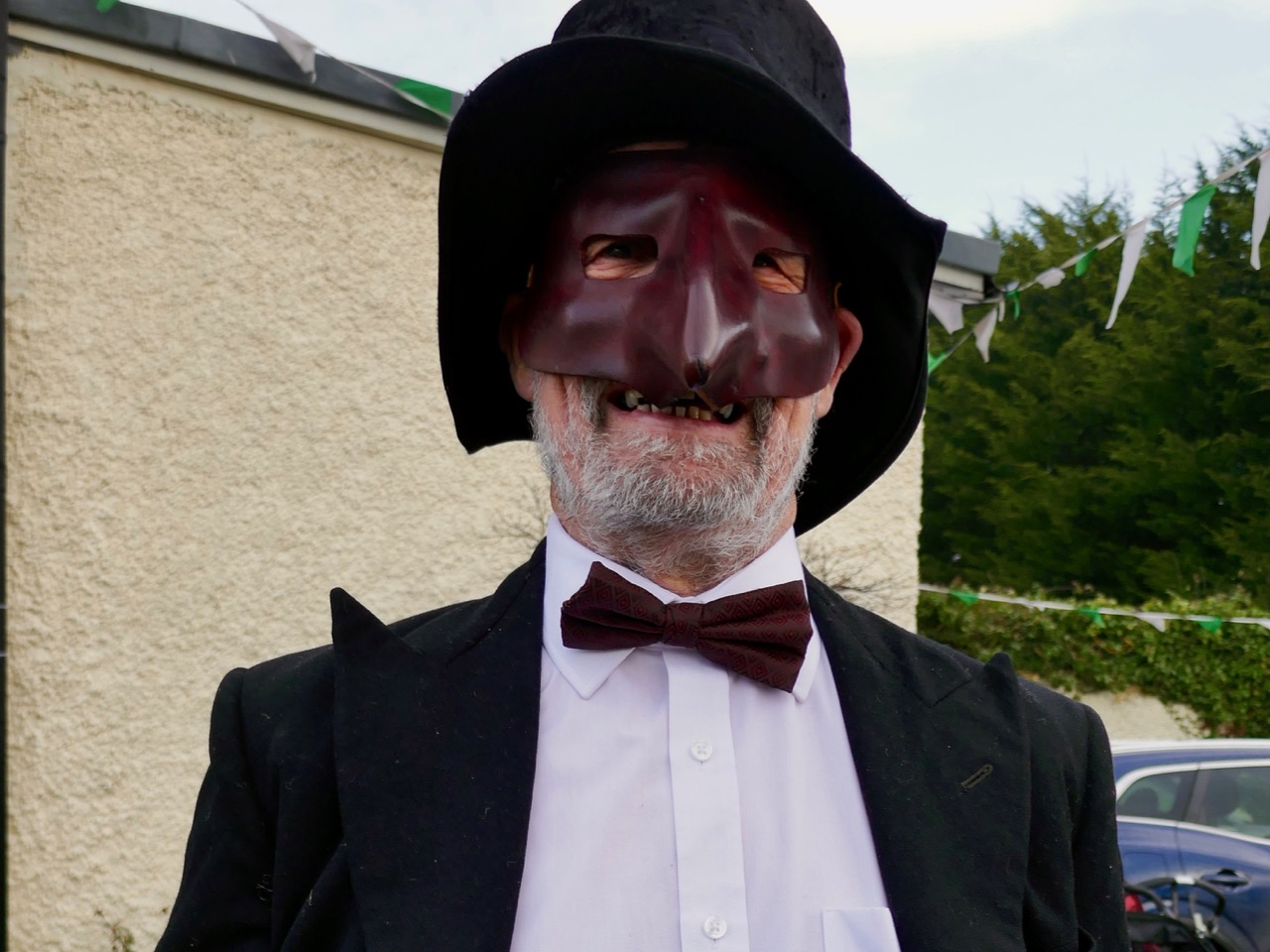
It was at Man O’War that we saw the Fingal play performed. There are around a dozen characters, which include St Patrick, Prince George, The Doctor, The Butcher, Jenny Wren and Beelzebub. The main protagonists, Patrick and George, fight with swords until the former kills the latter (obviously!). A quack doctor is brought in and raises George to fight another day. There is considerable humour, innuendo and – always – music and dance. A most important aspect, however, is the appearance towards the end of the play of a character – Slick-Slack – who carries a large family on his back (usually dolls and teddy bears).

From upper picture – heroes Patrick and George, fiercesome Doctor and musicians

For me, it was just slipping back to old times: from when I could barely walk we attended the Mummers play at Crookham Village in Hampshire, England, every Boxing Day, and I absorbed the tradition into the rhythm of 1950s life. Here are the Crookham Village Mummers around that time:

A mid 20th century photograph of the Crookham Mummers, Hampshire: could the little boy on the right be me? The characters in this play, left to right – Roomer, Slasher, Trim Tram, Doctor, Turkish Knight, King George, Old Father Christmas

Into adulthood I never questioned the existence of the Mummers: they were just an essential part of Christmas – like carols, bells and reindeer. As soon as I was able, I joined the Mummers myself and now, after decades of performing it, carry the complete play in my head (the Hampshire version of it, anyway). It was only when my interest in folklore became academic that I asked myself: what is all this about? And then I became aware of the significance of mummery in the traditional cultures of northern Europe, Scandinavia – and beyond – and saw its place and relevance to the season when the sun gets to its lowest point and then has to be encouraged back again: cold and darkness have to be replaced in the natural cycle with light, warmth and regeneration. The old spirit of winter has to be supplanted by the young fertility character who carries his wife and (large) family on his back. In Fingal that is Slick-Slack; in Hampshire it is Trim-Tram who rounds off the performance:

In comes I, Trim-Tram, left hand press gang: press all you bold fellows to sea to fight the French and Spanish. Although my name be Jolly Jack, wife and family on my back – although my family be but small, I thinks myself best man of all . . .

Trim-Tram fights with Old Father Christmas and kills him, causing some consternation to younger members of the audience. Trim-Tram concludes:

Ladies and gentlemen, see what I have done: killed my poor old Father Christmas, just like the setting sun. So, while I sits and takes my ease, good people – give us what you please . . .

At which point the hat is passed around, giving the watching crowd a chance to partake of the ‘luck’ which the Mummers bring to the communities they visit.

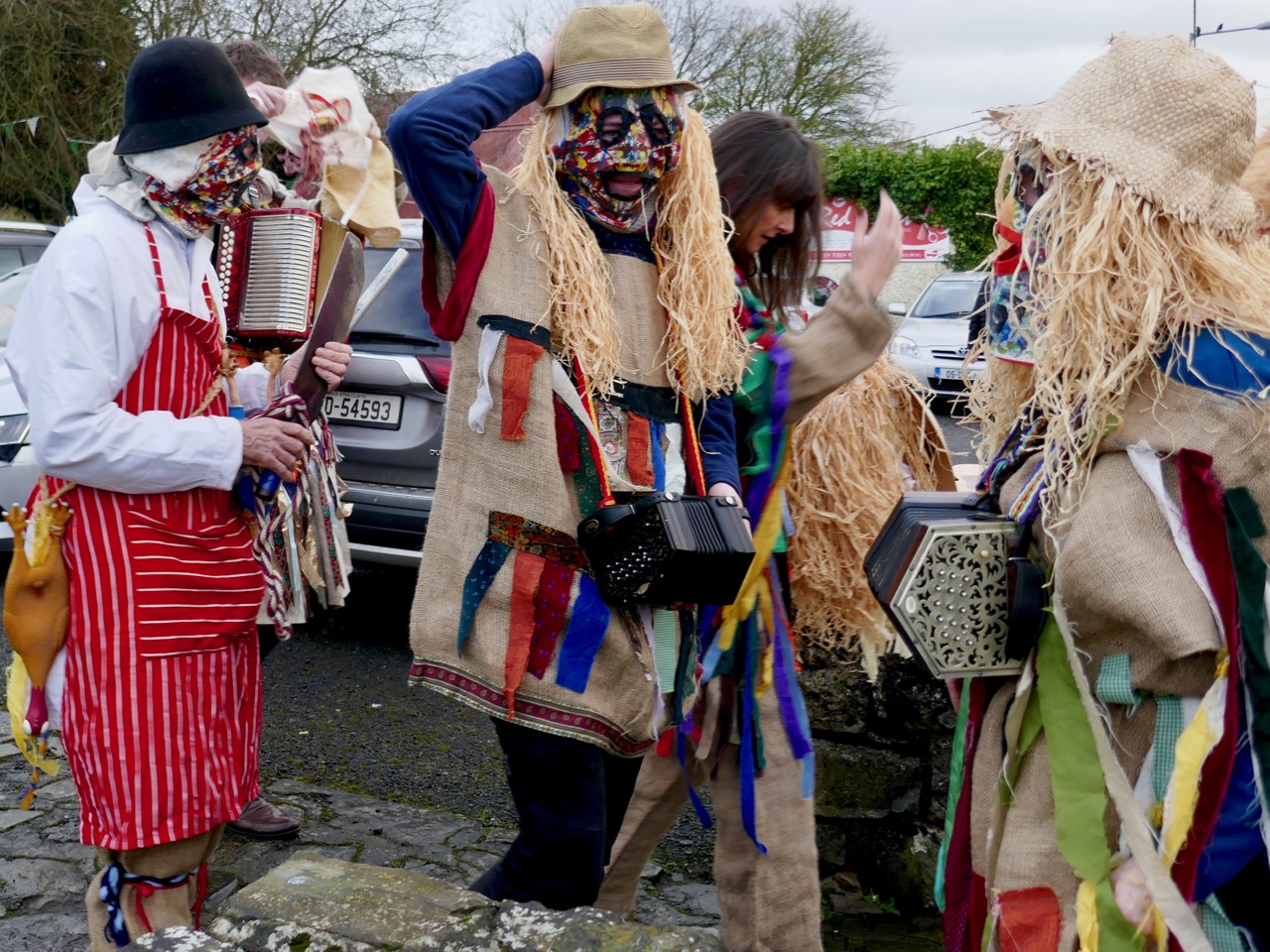
The Butcher is on the left – replete with carving knife and turkey!

Masks and straw headpieces are common in the Irish Stephen’s Day traditions. Remember the workshop we had in Ballydehob a few weeks ago? That was in preparation for a Wranning there this Christmas just gone. Unfortunately, we couldn’t magic ourselves to be in two places at once on the day, so we will have to wait for next year’s event. Meanwhile we were very happy to have the Fingal experience. Long may that county continue to hold on to the luck, and perpetuate its fecundity!

Mizen Mountains 2 – Lisheennacreagh

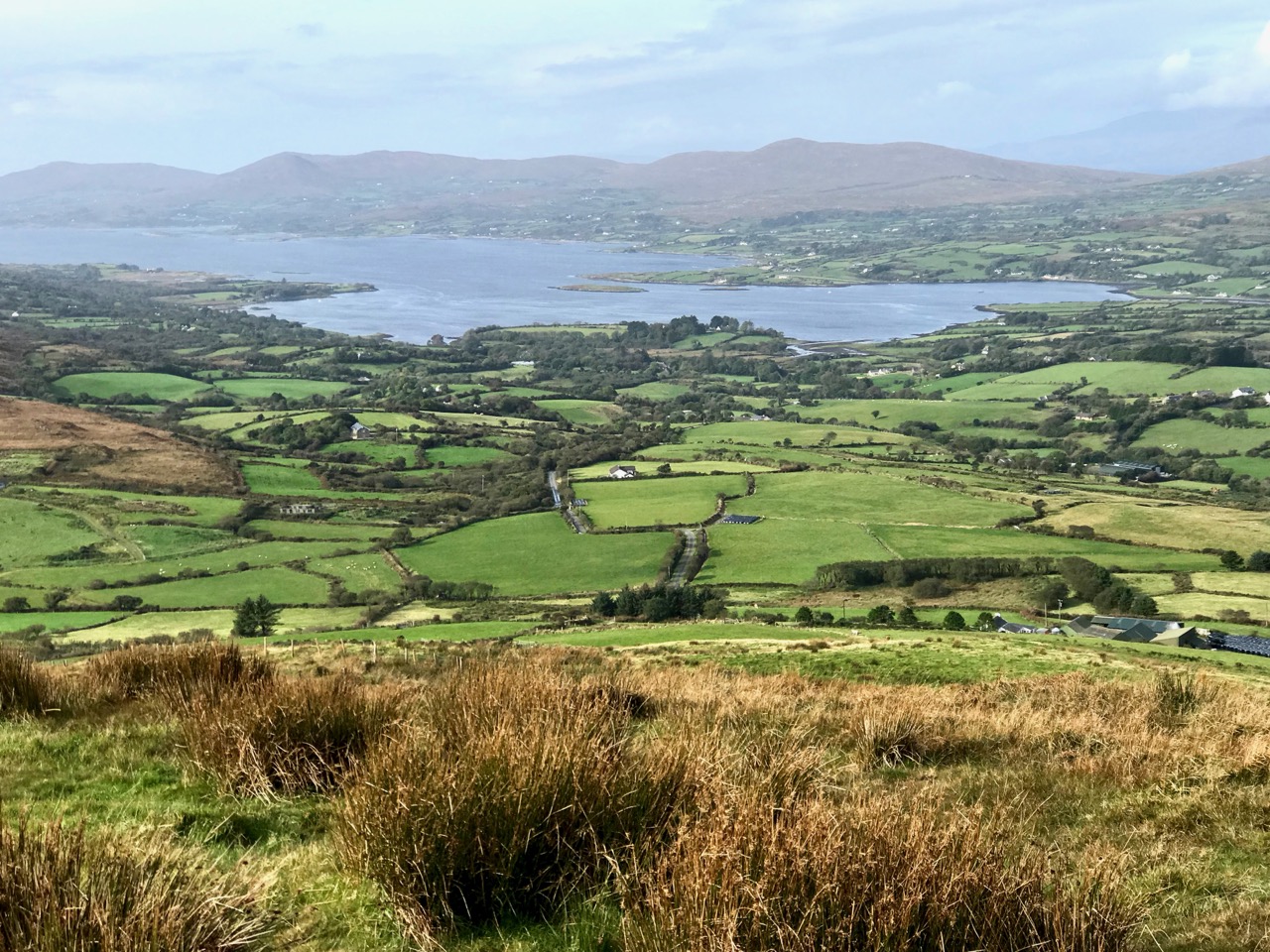
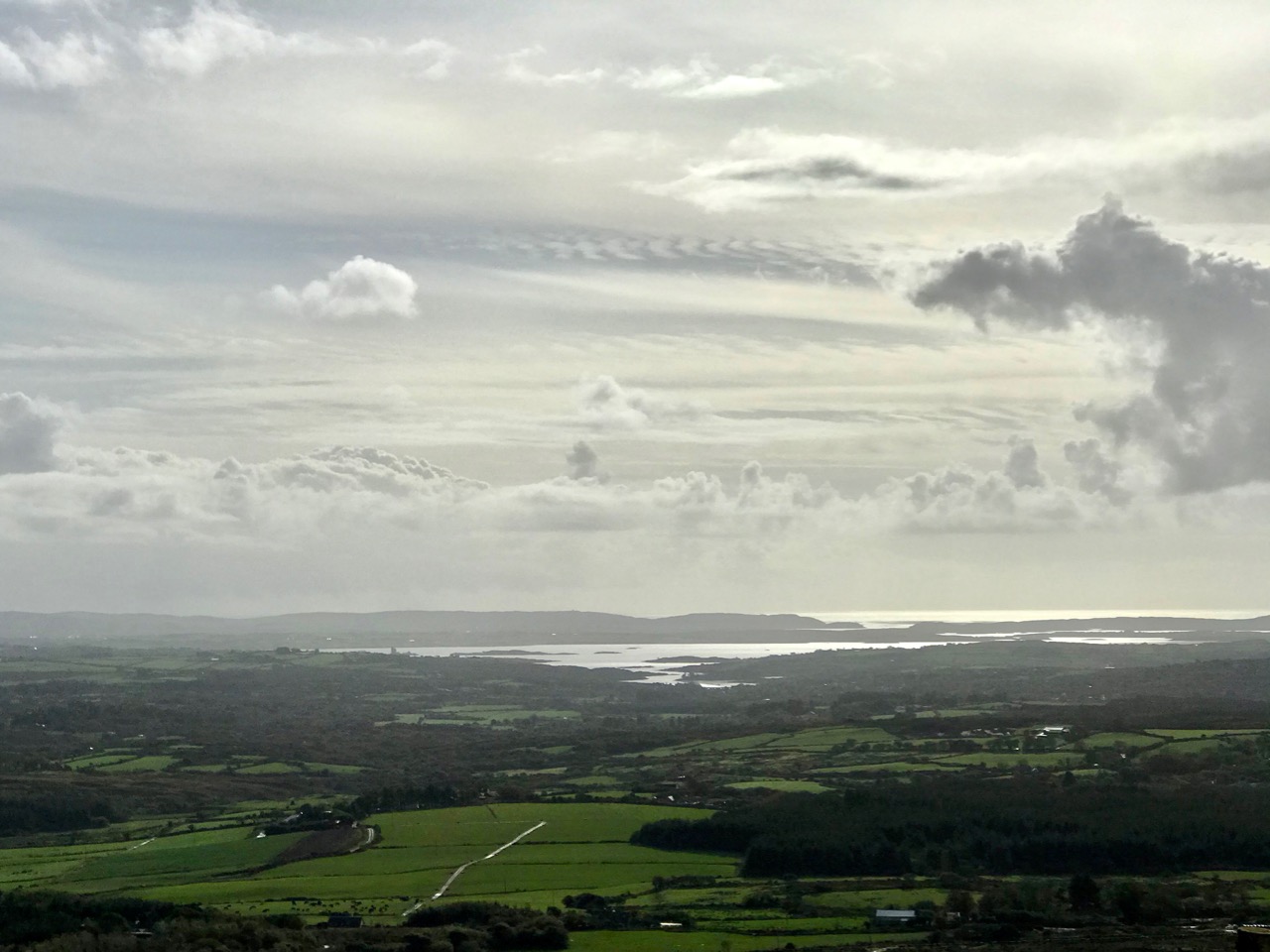
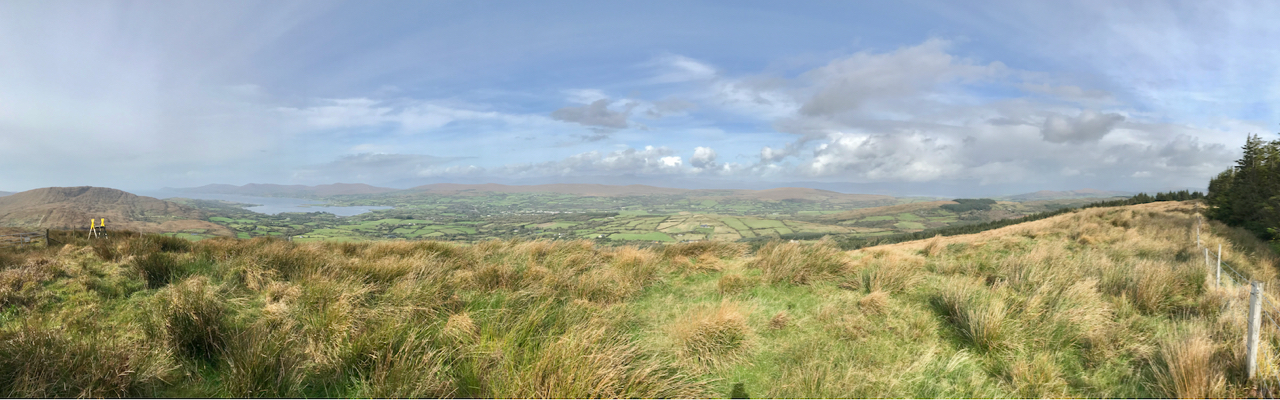
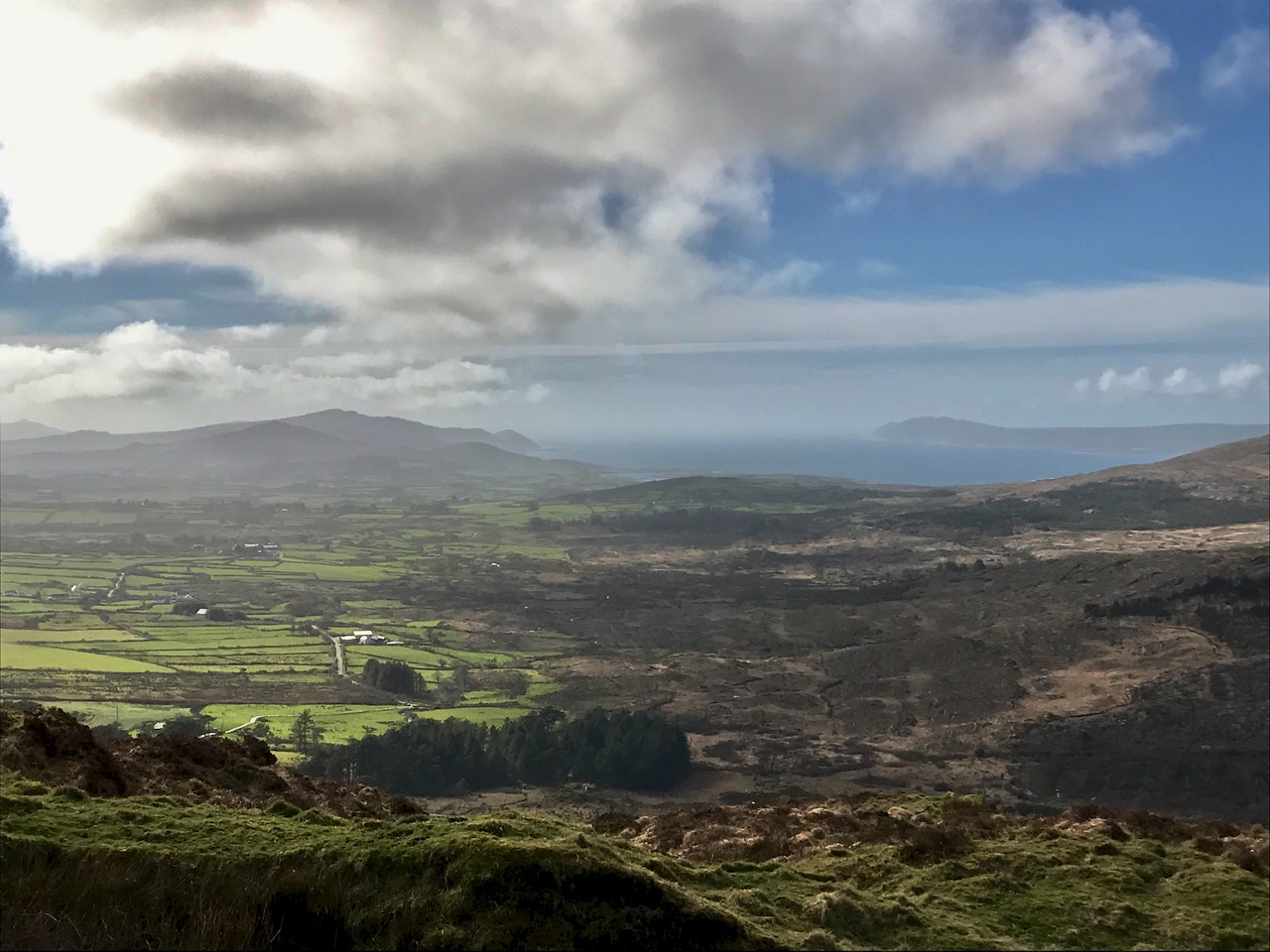
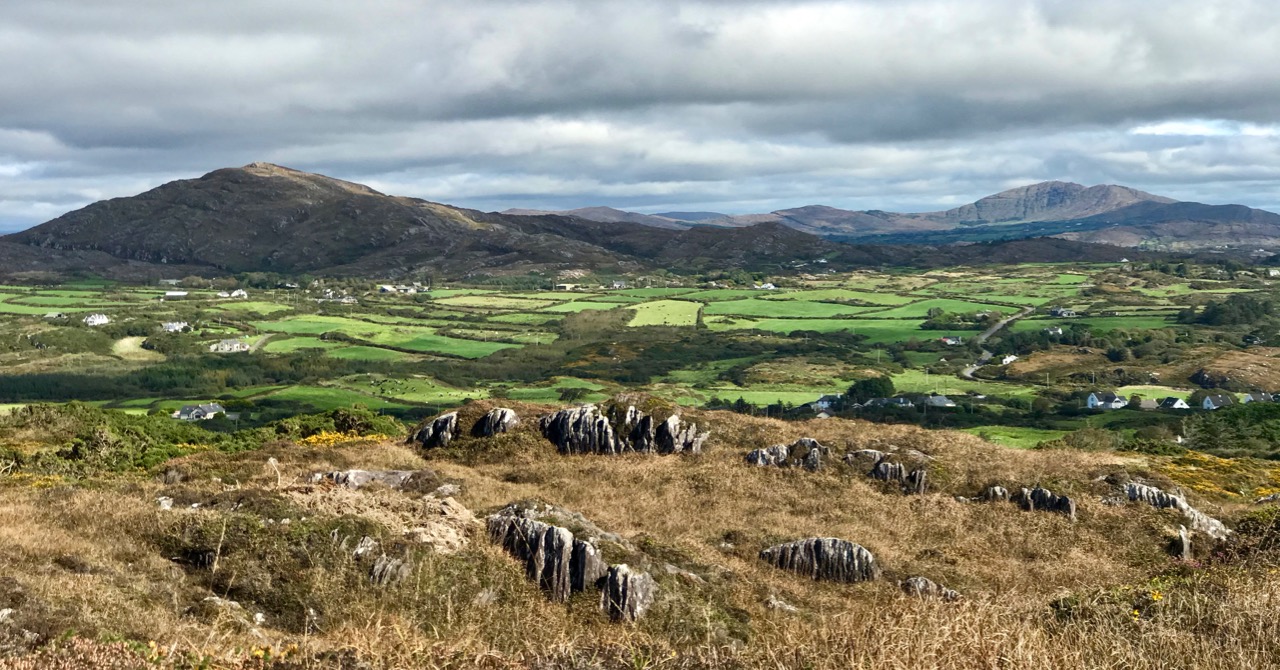
In this series I’m visiting and recording all the ‘mountains’ on the Mizen Peninsula in West Cork. I’m defining a mountain as any summit over 200m above sea level. If I hear you crying out ‘shame!’ – as a mere 200m peak can’t possibly be a mountain – then I can say our country is defined by its undulations, and here in the far west of Ireland all our outcrops, however modest, are dramatic and offer striking views over the landscape, such as the one above which looks north-west across Dunmanus Bay towards the Sheep’s Head, seen from this week’s climb.

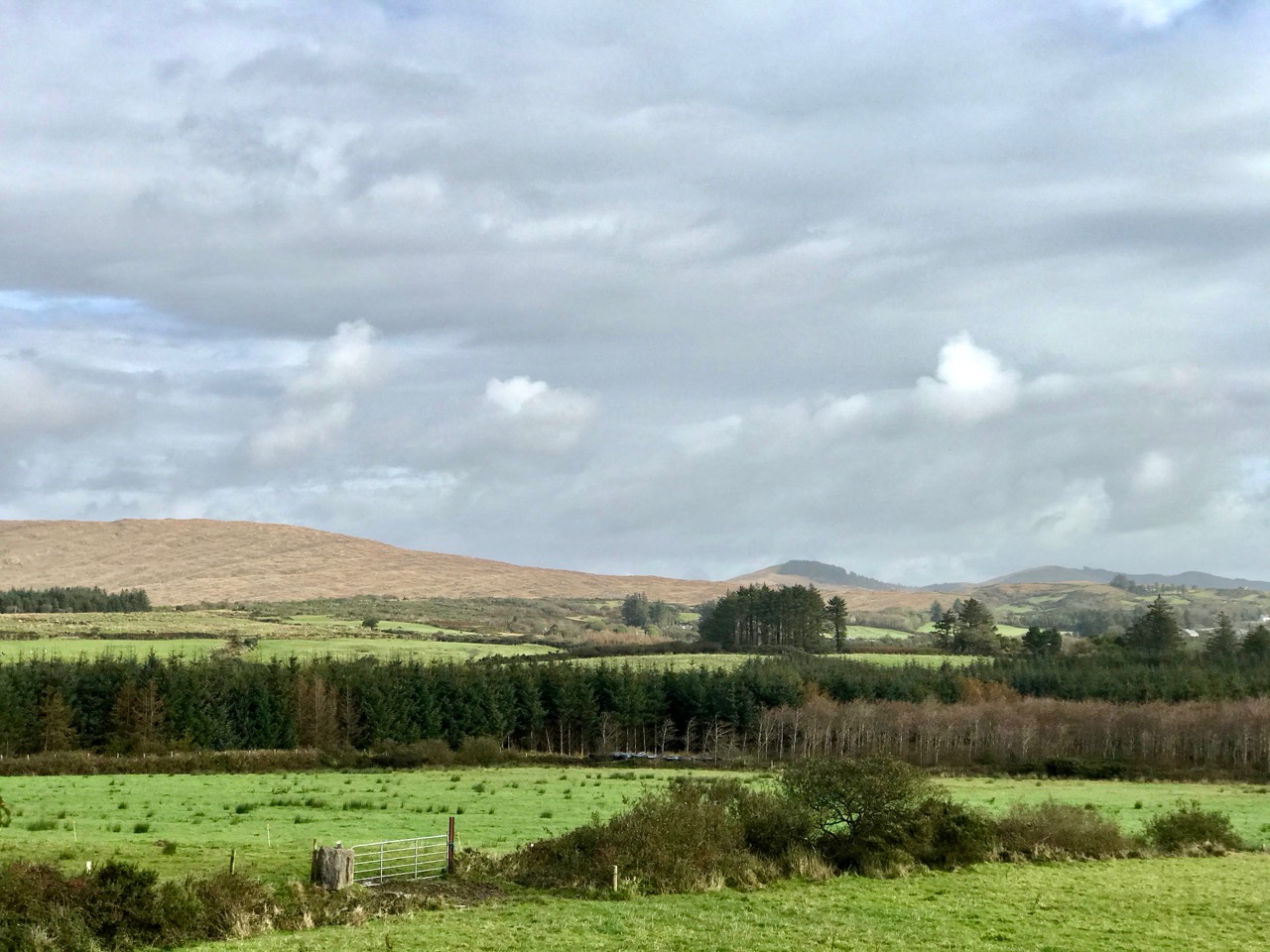
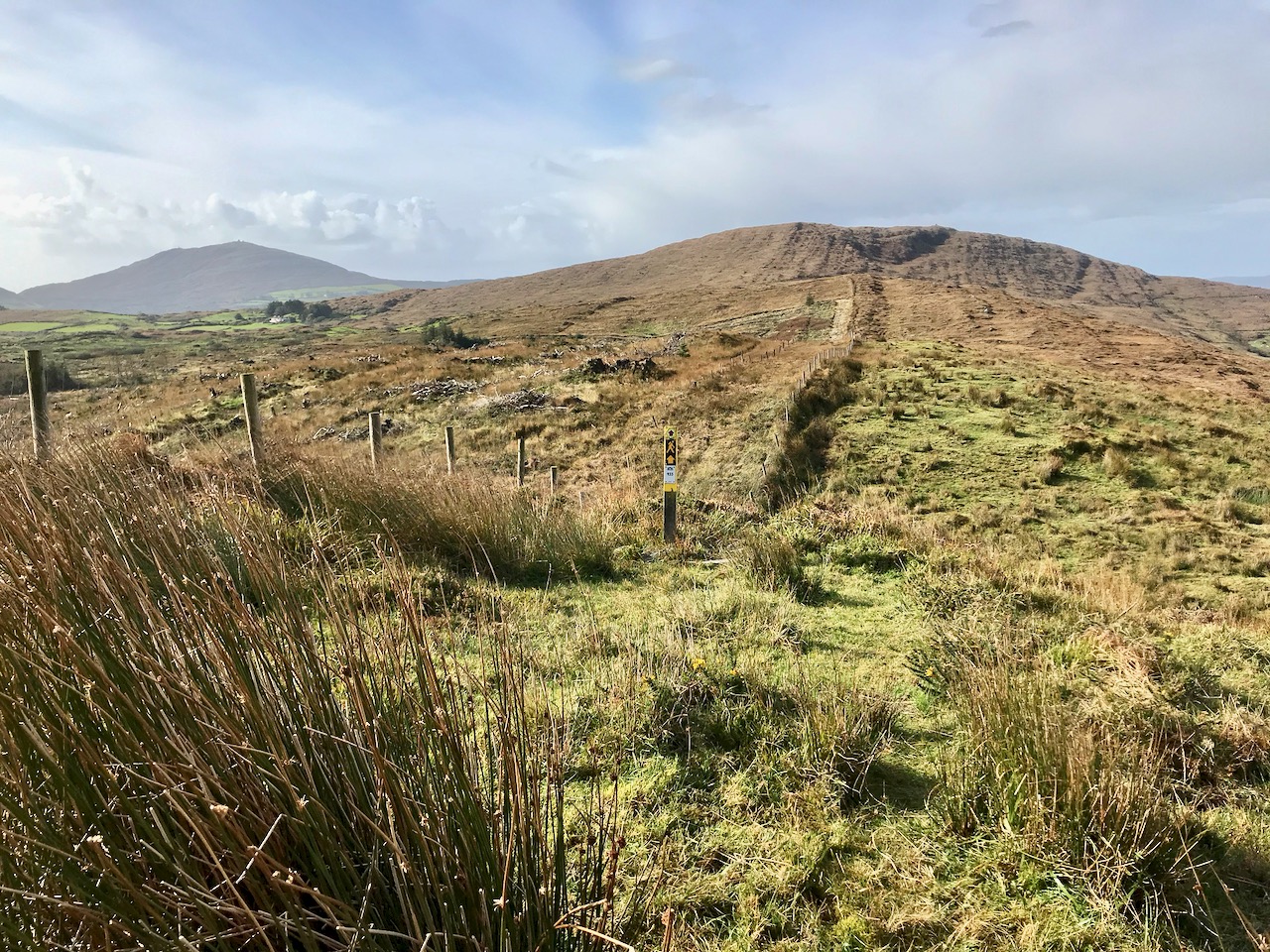
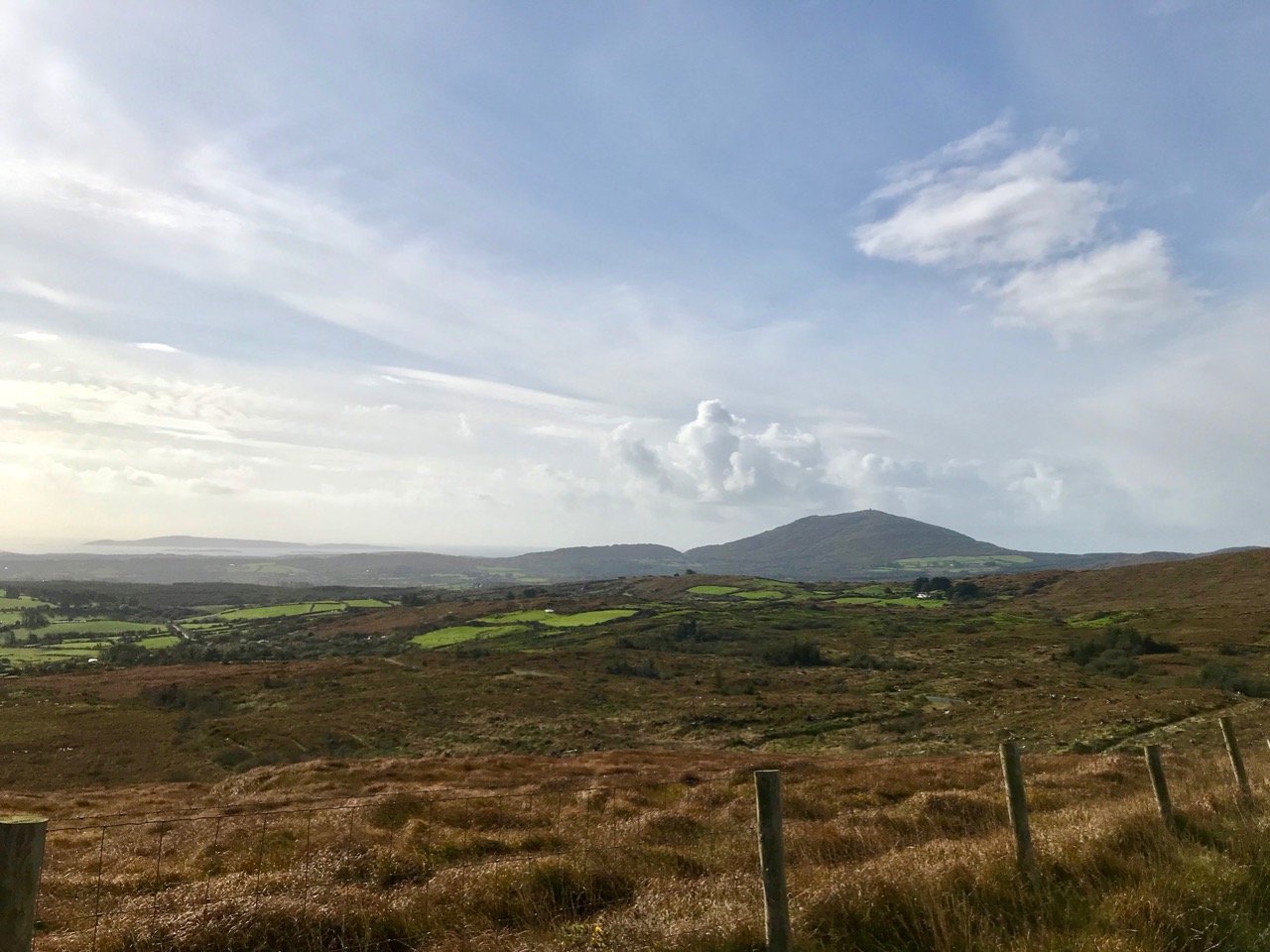
Upper – approaching the ridges from the Schull direction, the three peaks of Corrin (left), Lisheennacreagh (centre) and Derrylahard (right) are set out before us. Lower – a closer view: Lisheennacreagh is on the left: its summit is hidden behind the forestry plantation

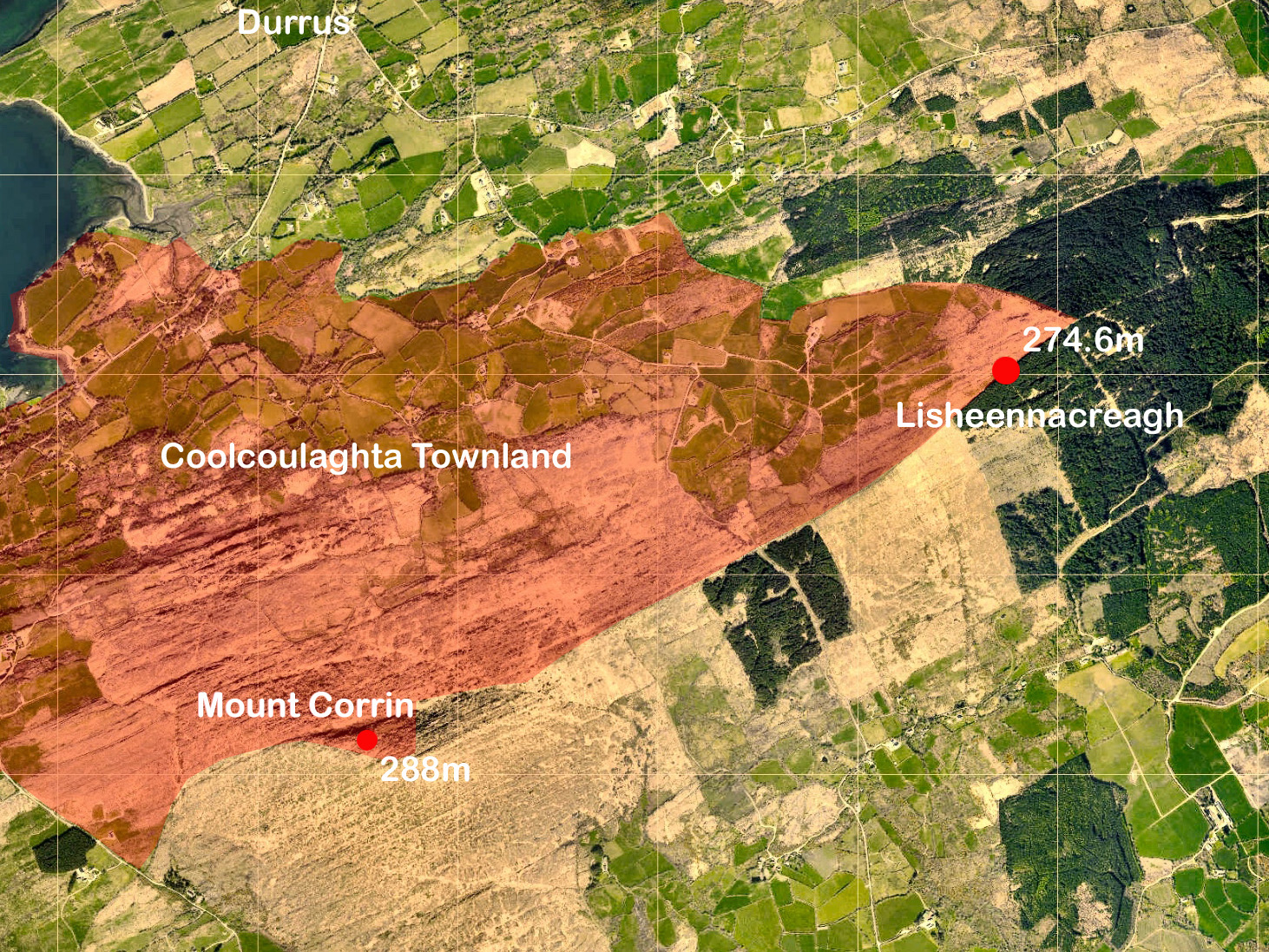
Last week we explored at the western end of the peninsula, where Knockatassonig – at a height of 204m – only just crept into our ‘mountain’ category. This week – much further to the east – we are more secure, as my chosen destination comes in at 274.6m. It’s actually higher than it looks as neighbouring Mount Corrin (no doubt about that one!) peaks at 288m, and appears much more of a climb from below. Today’s summit is not named on any map, so I’m probably courting controversy by calling it Lisheennacreagh, after the townland in which, by my calculations, the highest point is located. Have a look at the aerial view below:

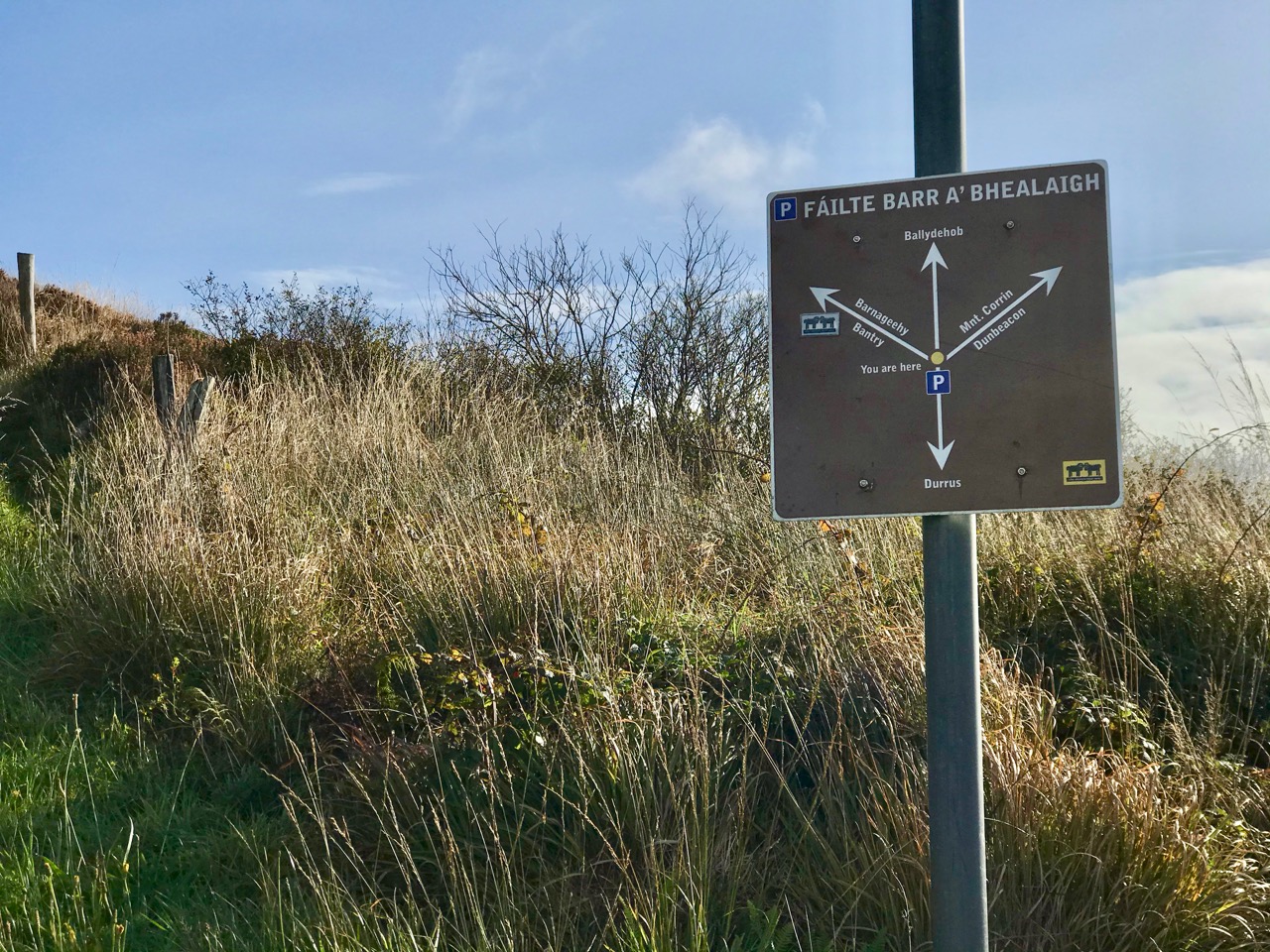
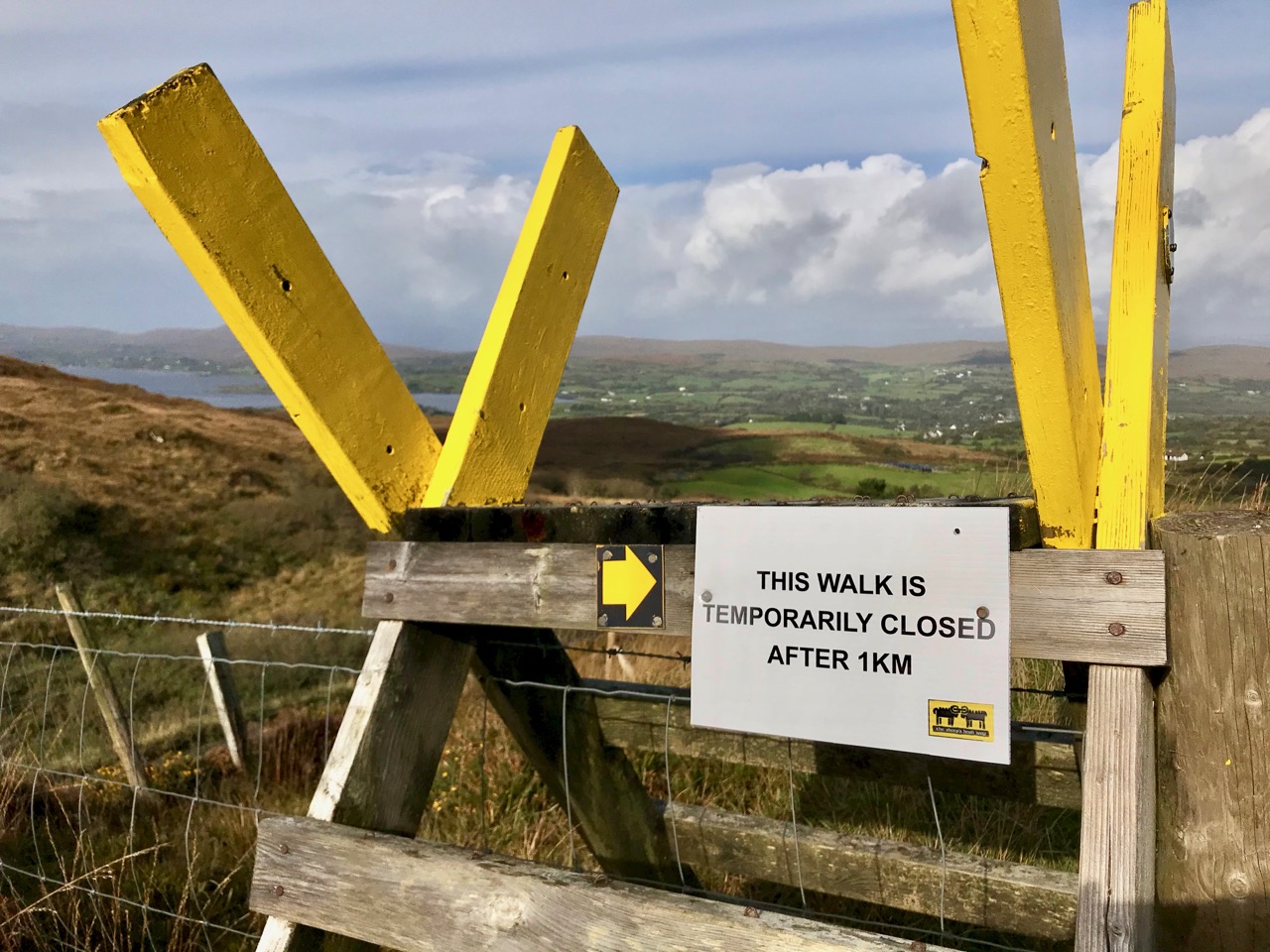
The pink shading shows the outline of part of the large townland of Coolcoulaghta, the southern boundary of which takes a sinuous course to include the summit of Mount Corrin. Over in the east, however, our high point is exactly on the boundary between the townlands of Coolcoulaghta and Lisheennacreagh – a boundary which is physically defined at that point by a substantial fence, whose course – part of the Sheep’s Head Way Mt Corrin Loop route – we followed all the way up to this summit from the designated car parking area on the Rathuane to Durrus road. After much on-site pondering, I decided to give the summit to Lisheennacreagh, as Coolcoulaghta townland already claims Corrin!

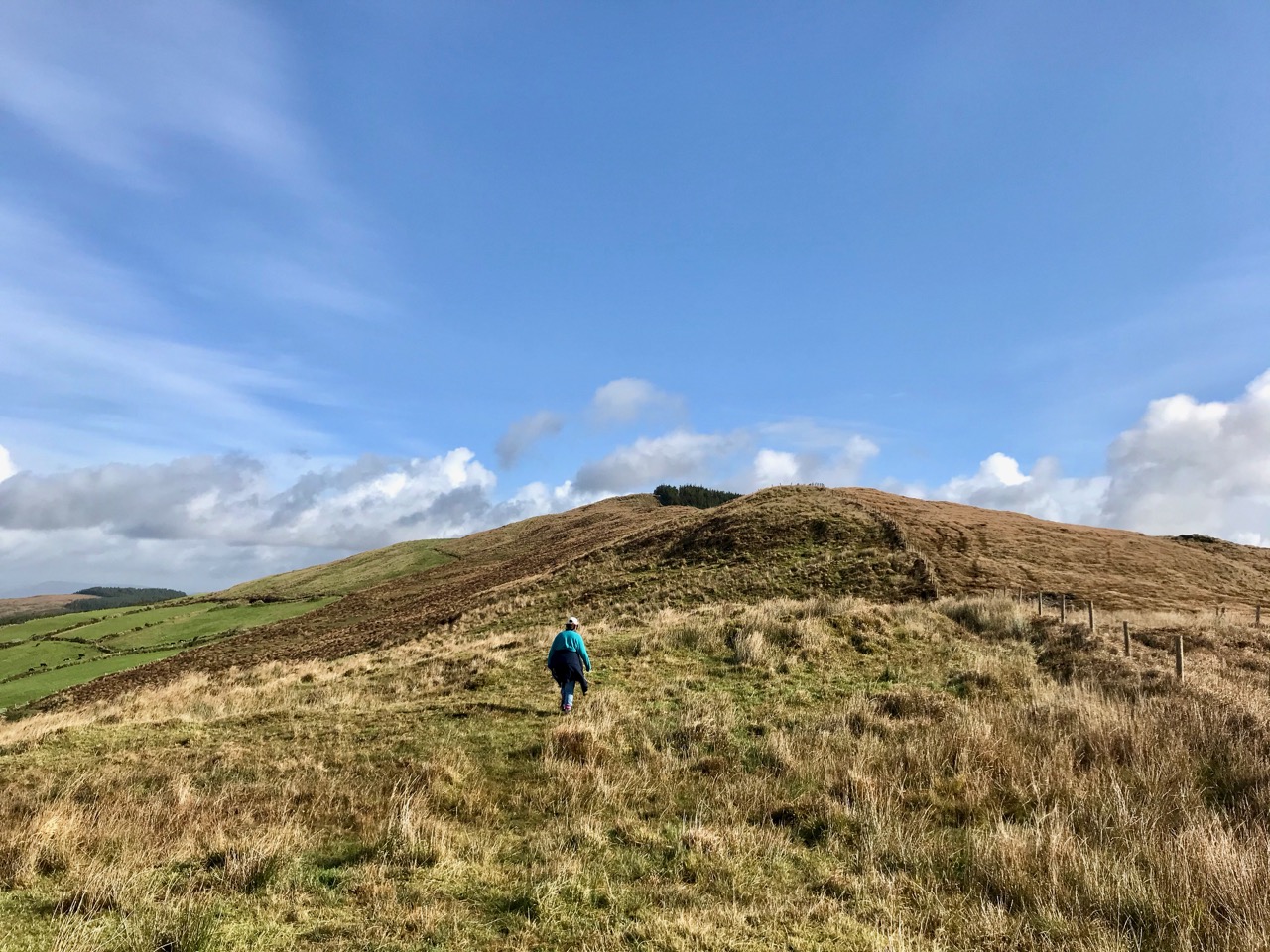
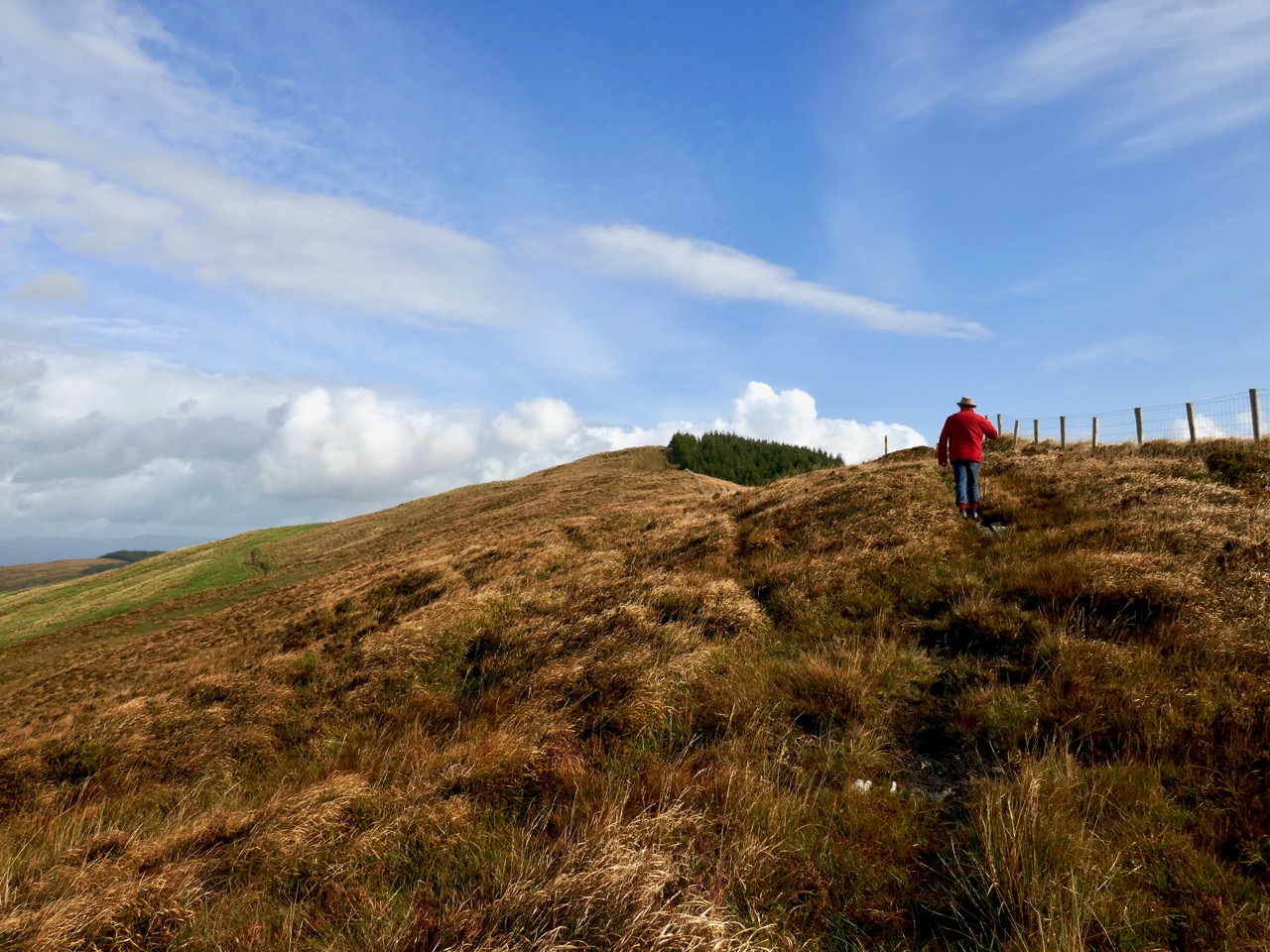
Upper – Finola is heading out for the high ground: the summit is in the far distance, beside the forestry plantation. Lower – looking back from the ascent, high Mizen summits are set out: Corrin is in front of us and Mount Gabriel is in the distance to the left

According to the place name records surveyed in 1841, Lisheennacreagh (Irish Lisín ne Cré) means Little fort of the preys or plunders – I was hoping I might find some traces of ancient earthworks on this summit, but there is nothing visible: buried deep in the inaccessible forest is a scheduled monument, described as a hachured univallate enclosure with a diameter of 22m. In fact it’s not possible to complete this loop walk at all, as the way to the next high point – Derrylahard, 301.7m – passes through heavy forestry, but access has been blocked by storm damage earlier in the year.

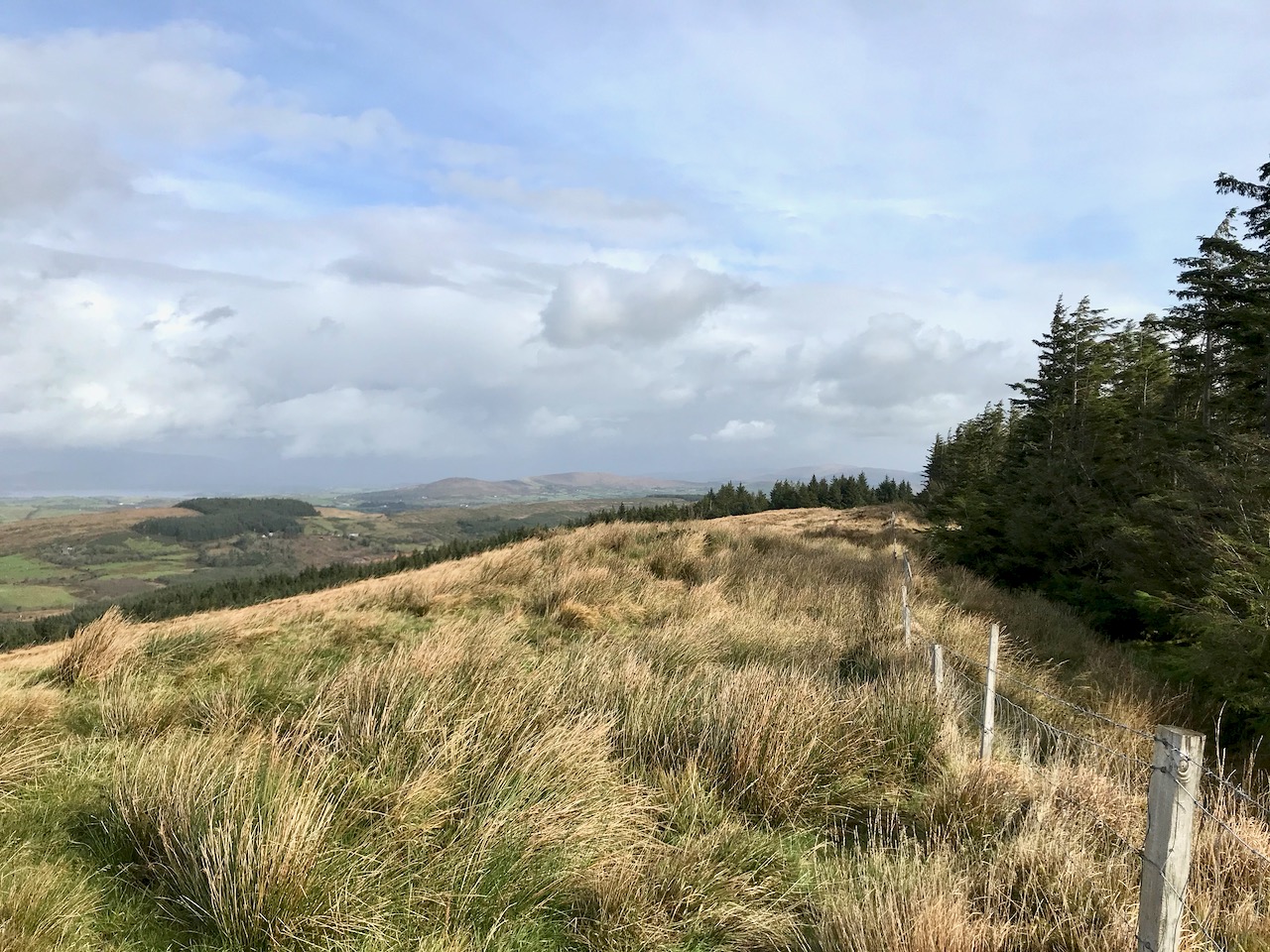
Above – autumnal shades of rough grazing continues all the way over the summit: you can go only as far as the next section of forest. Our companions on the walk were just a few ponies

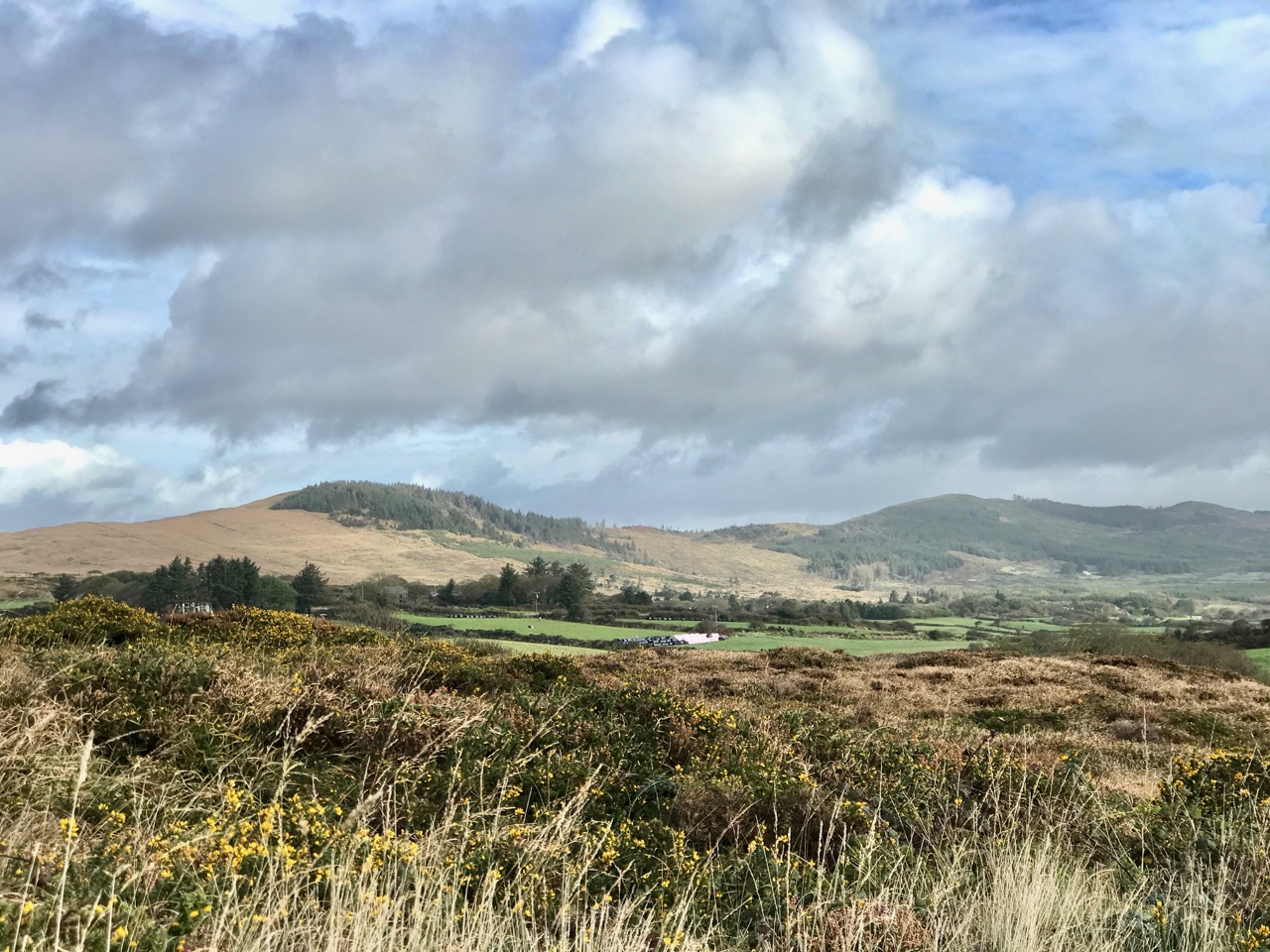
It may seem a fairly featureless walk, but it was well worth the efforts for the superb views in all directions. We were lucky with the day: the mild weather this year has continued right through September and well into October. The mixture of blue skies and scudding clouds emphasises the contours, shadows and natural features, wherever you look.

Rewarding views from the Lisheennacreagh climb: upper – looking across Roaringwater Bay to Baltimore; lower – Cape Clear in the far distance, with another view of Gabriel, the most dominant feature of our Mizen landscape

I found some entries from the Duchas Schools Folklore Collection, for Durrus School. I could not find anything specific to Lisheennacreagh, but I liked this introduction to ‘My Native Townland’ from Brenda MacCarthy dated May 9th 1938:

I live in the townland of Coolcolaughter away out in the country, far from any stuffy unpleasant town or city, and almost two miles from the village of Durrus. My home is at the foot of the mountain in a quiet peaceful valley where my father tills, and sows, and reaps, from dawn to dark year in year out, happy and prosperous, and thankful to God for health and existence . . .

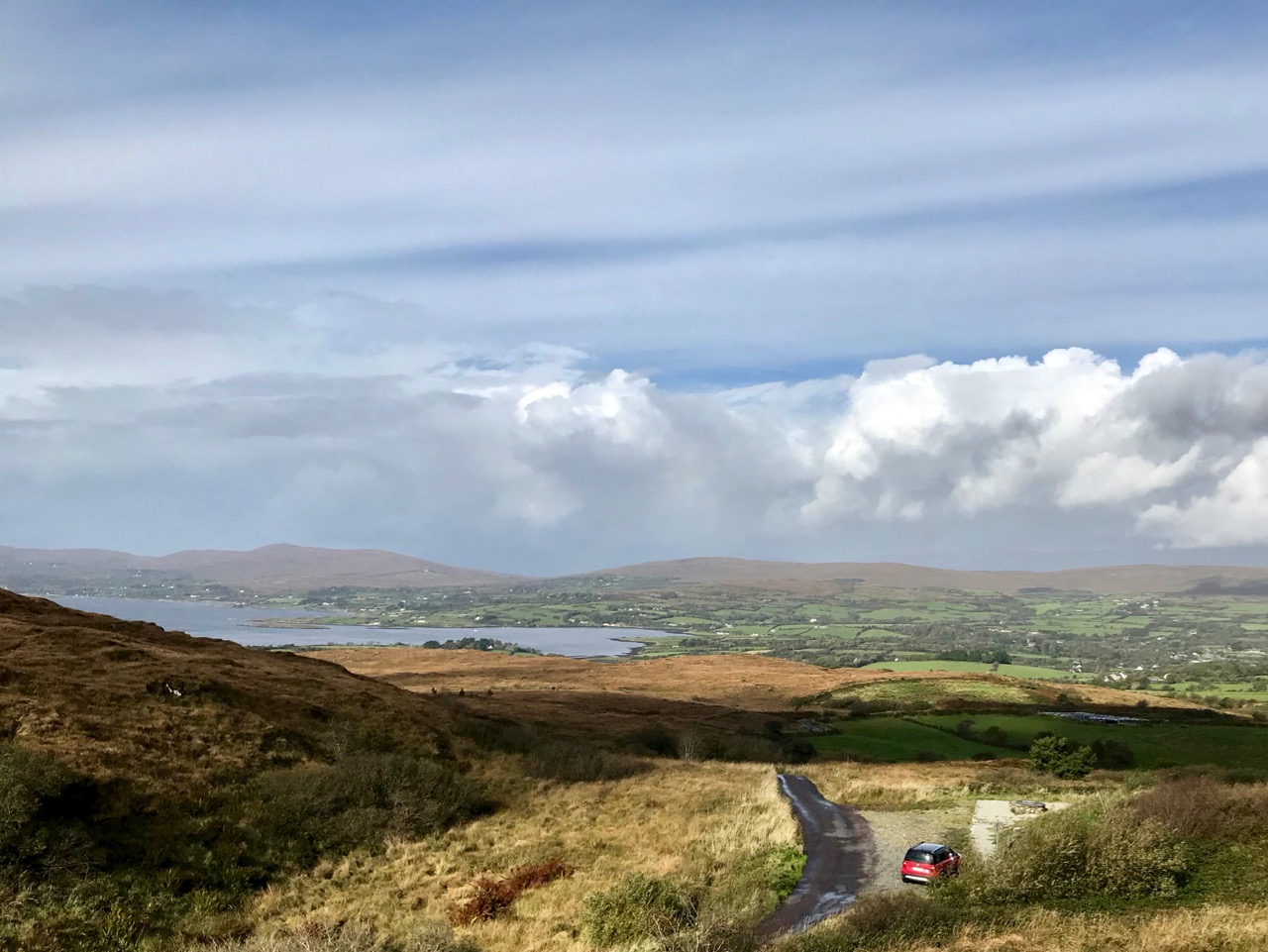
One aspect of Lisheennacreagh is that it is one of the more accessible peaks. There’s a place to park your car (with a fine view looking out to Durrus!), good signage and waymarks. Once the path is repaired beyond this summit, you can go on to Derrylahard (which will be the subject of a future post) and complete the loop by going round Glanlough to Durrus, then back over Corrin – a marathon 17km in all. Choose a good day and you couldn’t hope for a more inspiring hike.

Good accounts of this route and the whole Sheep’s Head system of trails can be found in Amanda and Peter’s book Walking the Sheep’s Head Way – Wildways Press, 2015. Also, have a look at this Living the Sheep’s Head Way post.

Mizen Mountains 1 – the Hill of the Foxes

The first day of October seemed ripe for starting a new project. It was also a beautiful, rich, blustery autumnal day – ideal for heading to the remotest uplands. I have always been drawn to high places: there’s something romantic about seeing the coastal landscape laid out below your eyes, especially in these western wildernesses where bare rock, gorse and heather intertwine with history: ancient farmsteads, ruined cottages and impossibly isolated forgotten quays, seemingly abandoned along our most rugged shores.

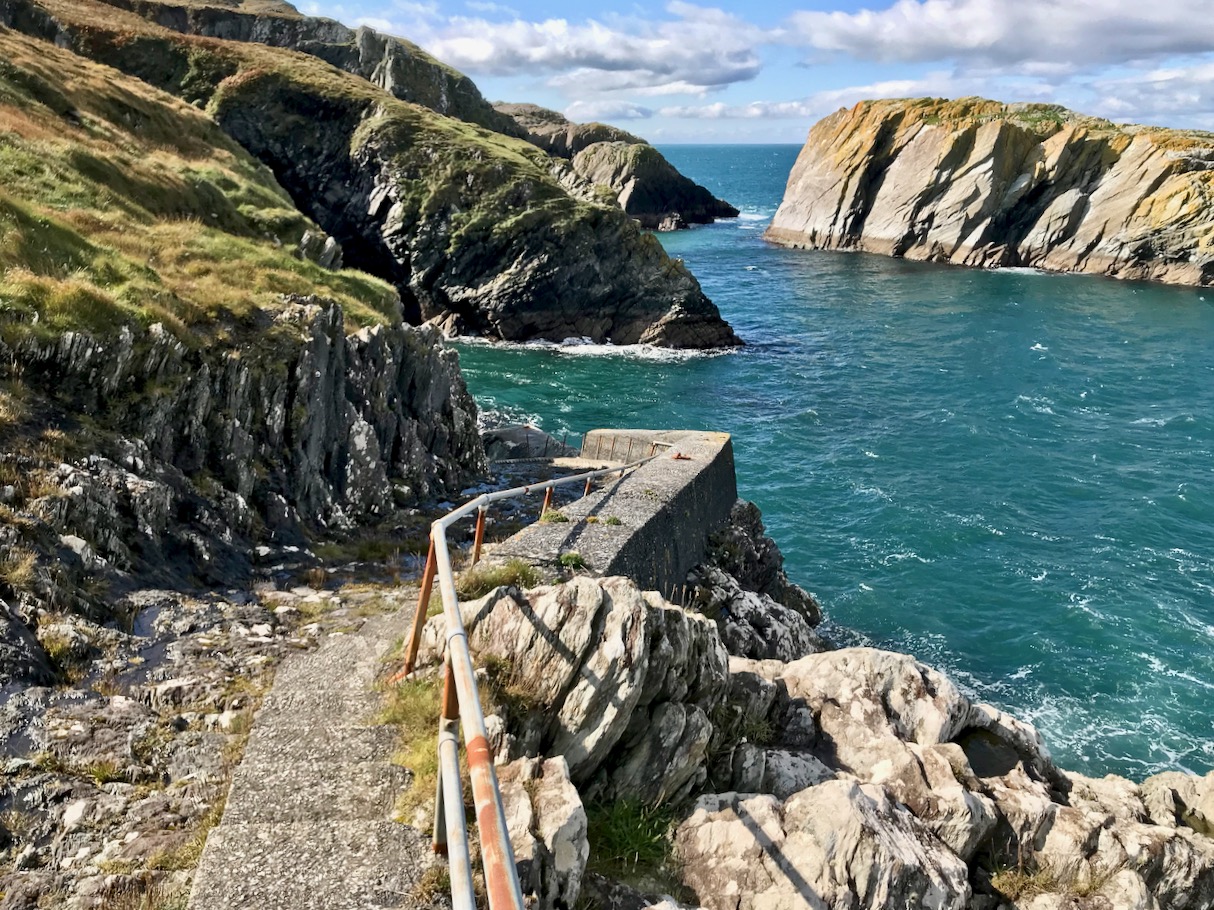
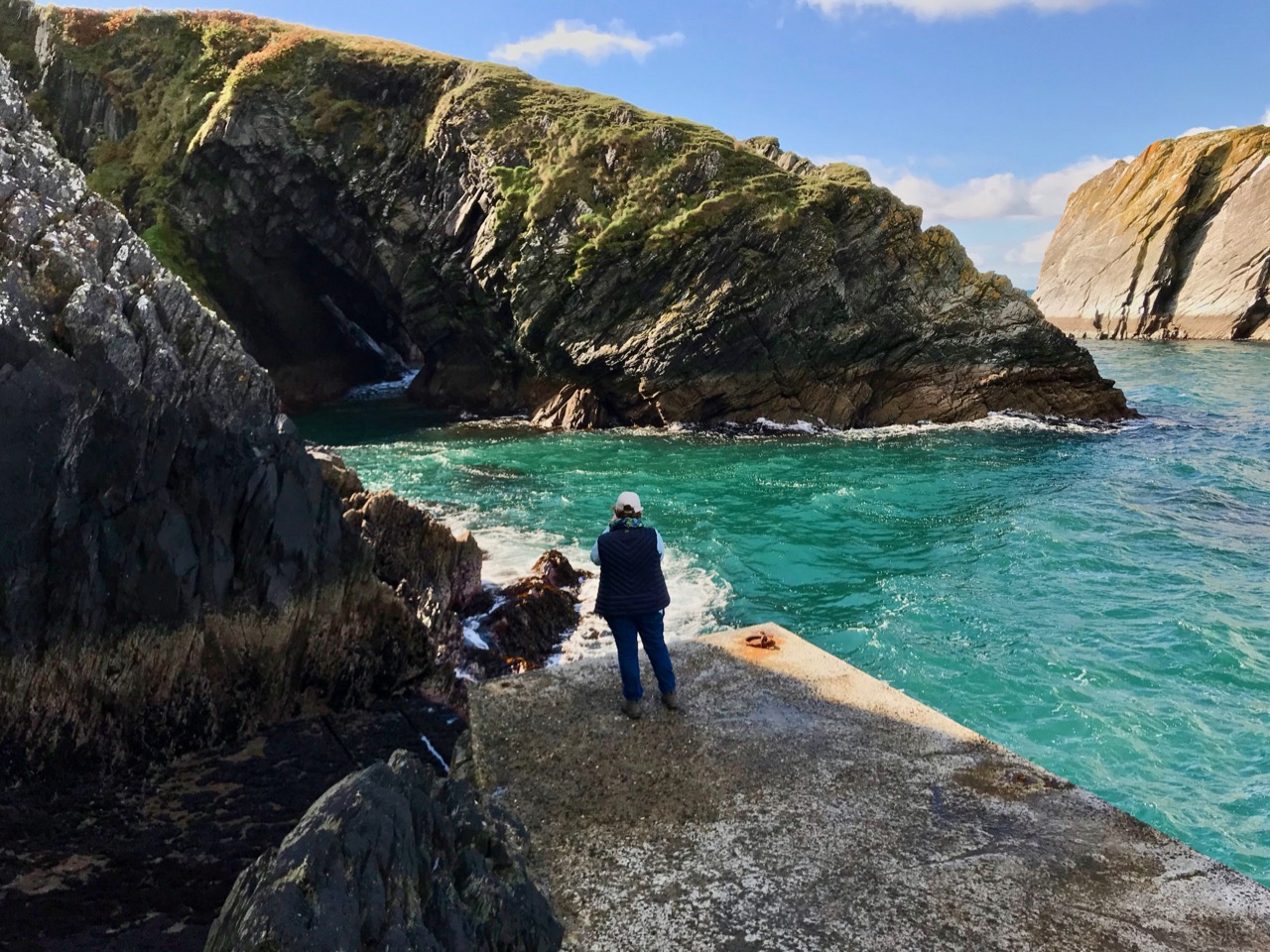
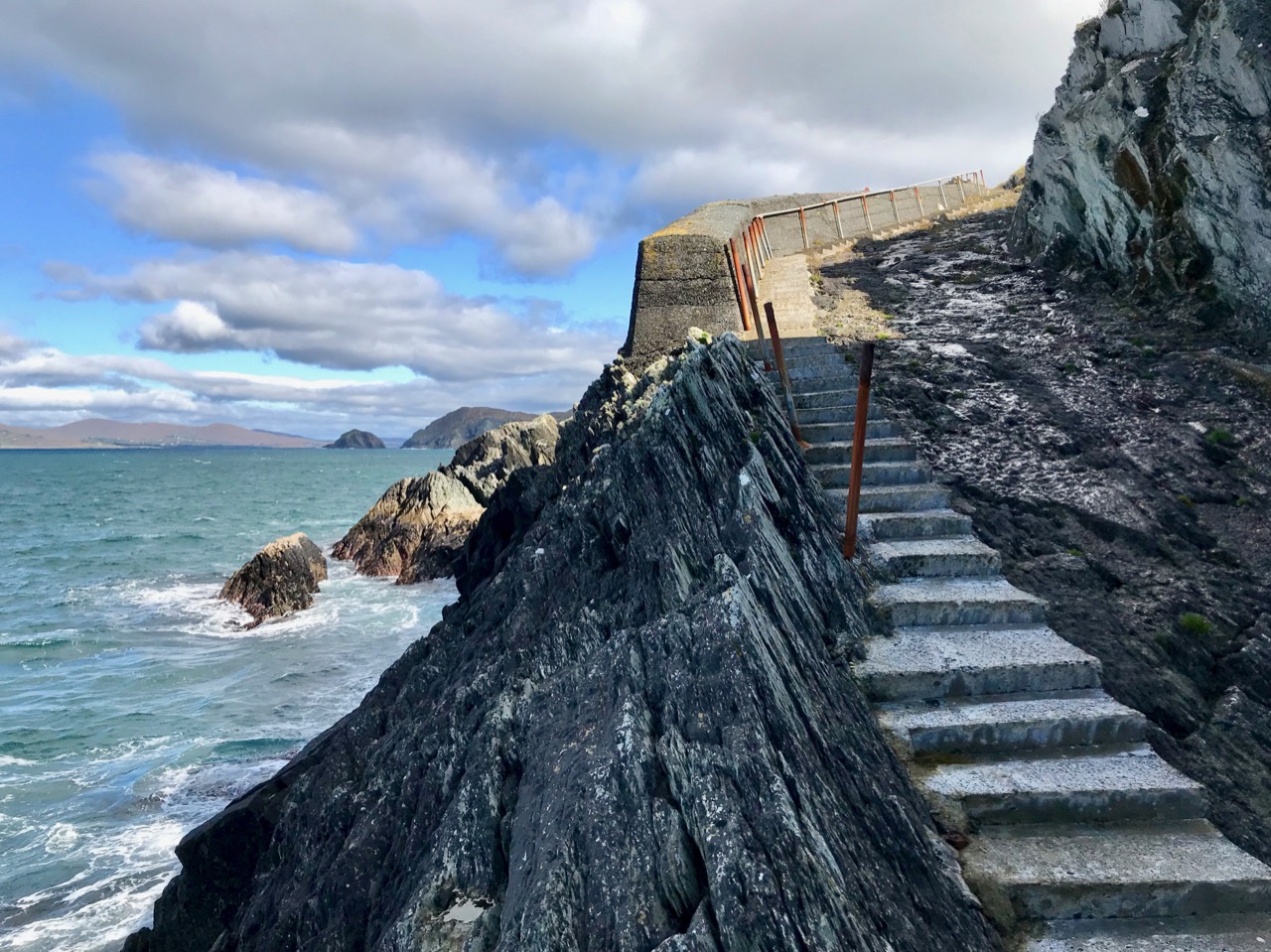
Header – Toor Island just off the mainland close to the west end of the Mizen Peninsula: the high ground beyond is the peak of Knockatassonig. Above – it’s a most remote and wild place for a pier, but Toor Quay is still accessible from a winding, overgrown footpath and 107 concrete steps: today it’s only the occasional haunt of anglers

This project – Mizen Mountains – sets out to explore all the peaks on our westernmost peninsula. Are they mountains? It all depends on the context, and your perspective. Mizen’s loftiest outcrop – Gabriel – is 400 metres above sea level. Quite modest (Kerry’s MacGillycuddy’s Reeks claim the country’s highest summit, Carrauntoohil, at 1,038 metres), yet when you do look down on the spine of our peninsula from above, it’s all rocky crags and ridges pushing upwards towards the heavens, while at the edges the mountains fall precipitously towards the sea. It’s great, dramatic country, calling out for exploration – and there’s nothing we like better than finding new ways to discover this land and all its stories.

The view to the western end of the Mizen Peninsula, seen from the slopes of Mount Gabriel. The Sheep’s Head is across to the right

50 years ago the writer, Peter Somerville Large, set out to travel the western peninsulas of Ireland on a rusty bicycle purchased for the purpose in Skibbereen. I like the introduction he gives to his book The Coast of West Cork, first published in 1972, and still in print – it serves my own project well:

. . . I set out into the country. The sun had filtered through after rain, making the tarmac steam with moisture and sending up towering clouds off the mountains into the sky. Cattle stood motionless in the boggy fields and water dripped from the leafless sycamores . . . I travelled along the coast of West Cork, through Carbery, from Clonakilty to Roaringwater Bay with its fringe of islands and castles, and north to Bantry and the Beare peninsula. Much of the land near the coast consists of bog and mountain with headlands like lines of slanting spears thrust into the Atlantic. But there are parts that are sheltered, with a tropical lushness that is partly ascribed to the benign influence of the Gulf Stream. Ruins are soon covered with thick ivy and it takes only a few trees or slips of fuchsia to make a protective wall. Some valleys and hillsides have pockets of moss-covered oak-trees which are survivors of the ancient forest that covered the country three hundred years ago . . . From Goleen the old road wound high over a ridge before dropping down to Crookhaven. Almost all the land was rocky around Knocknamadree; The quilted shadows of clouds passed along the high ground over to the sea . . .

Satellite view of the rocky landscape towards the western edge of the Mizen: Knockatasonnig is a barren peak

I have set the bar at the 200 metre contour line – anything above that is, for me, a mountain! So I will be traversing the terrain in search of all the eminences above this elevation on the Mizen, looking specifically at topography and any traceable history and folklore specific to these ‘mountains’. But I will also be talking about our journeys to these destinations: you know how fond we are of getting ‘off the beaten track’. Every new exploration is invariably a revelation! This time around, we are going west – almost as far as is possible on this peninsula – to the townland of Knockatassonig, which peaks at 204 metres.

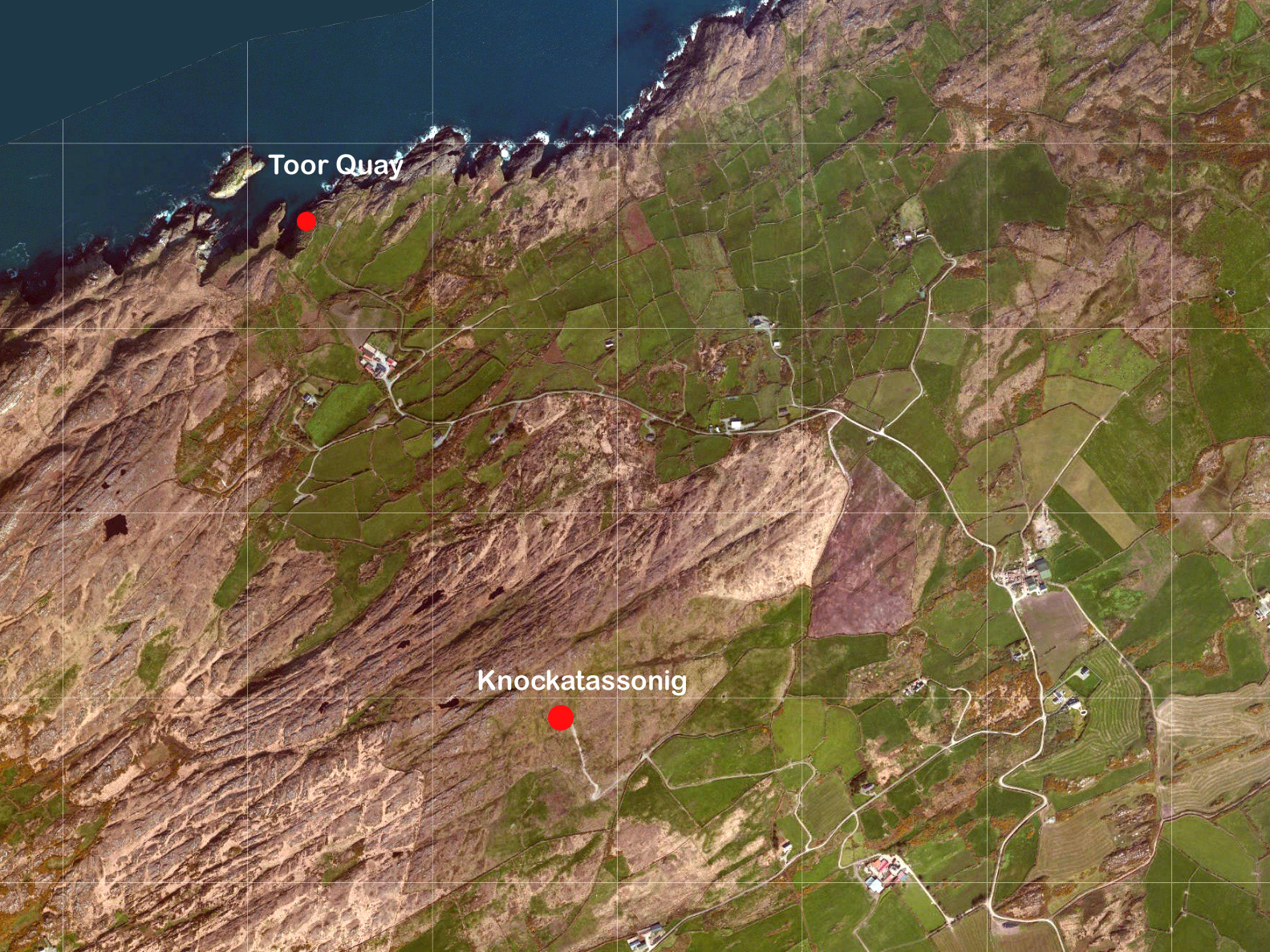
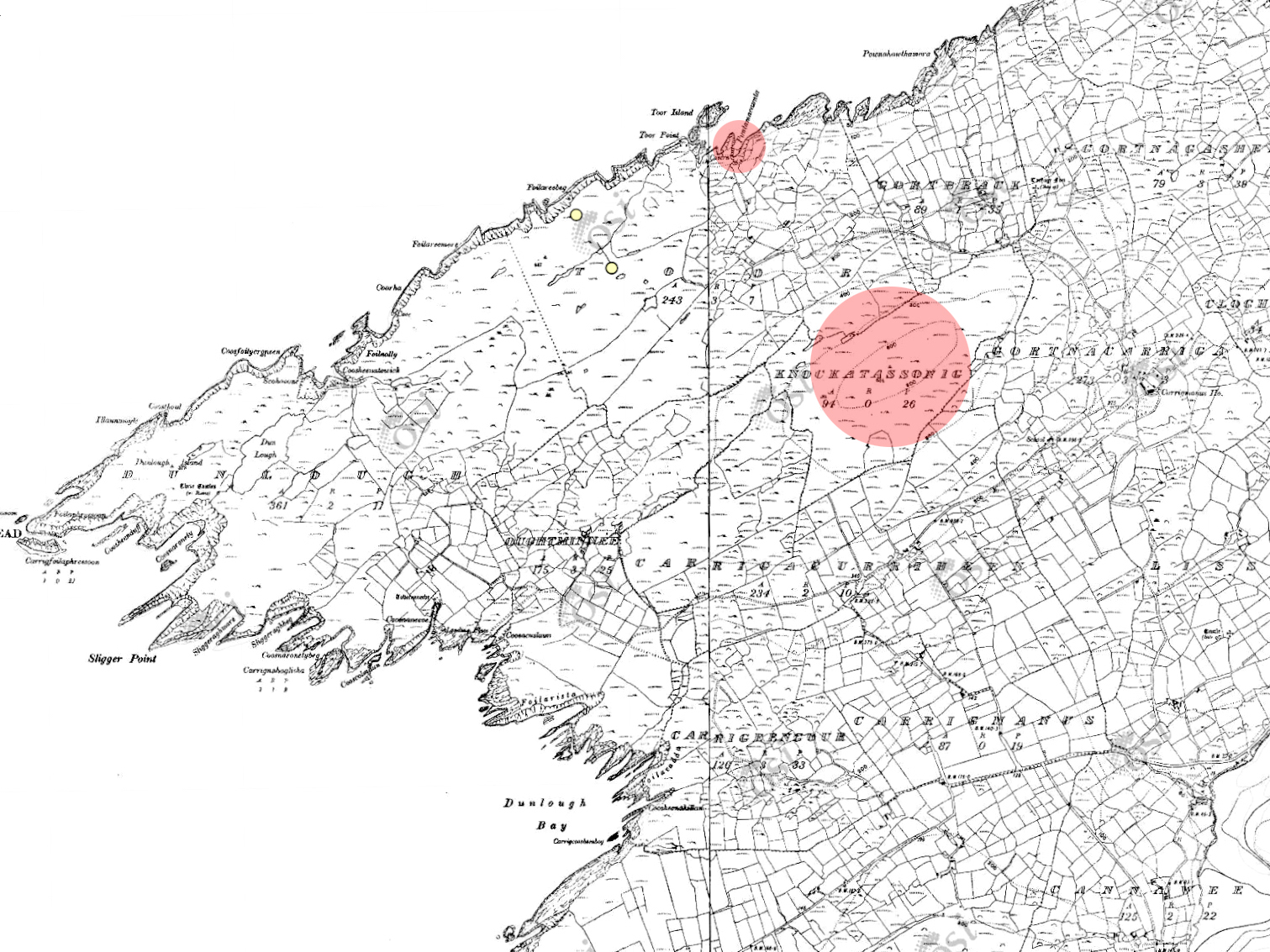
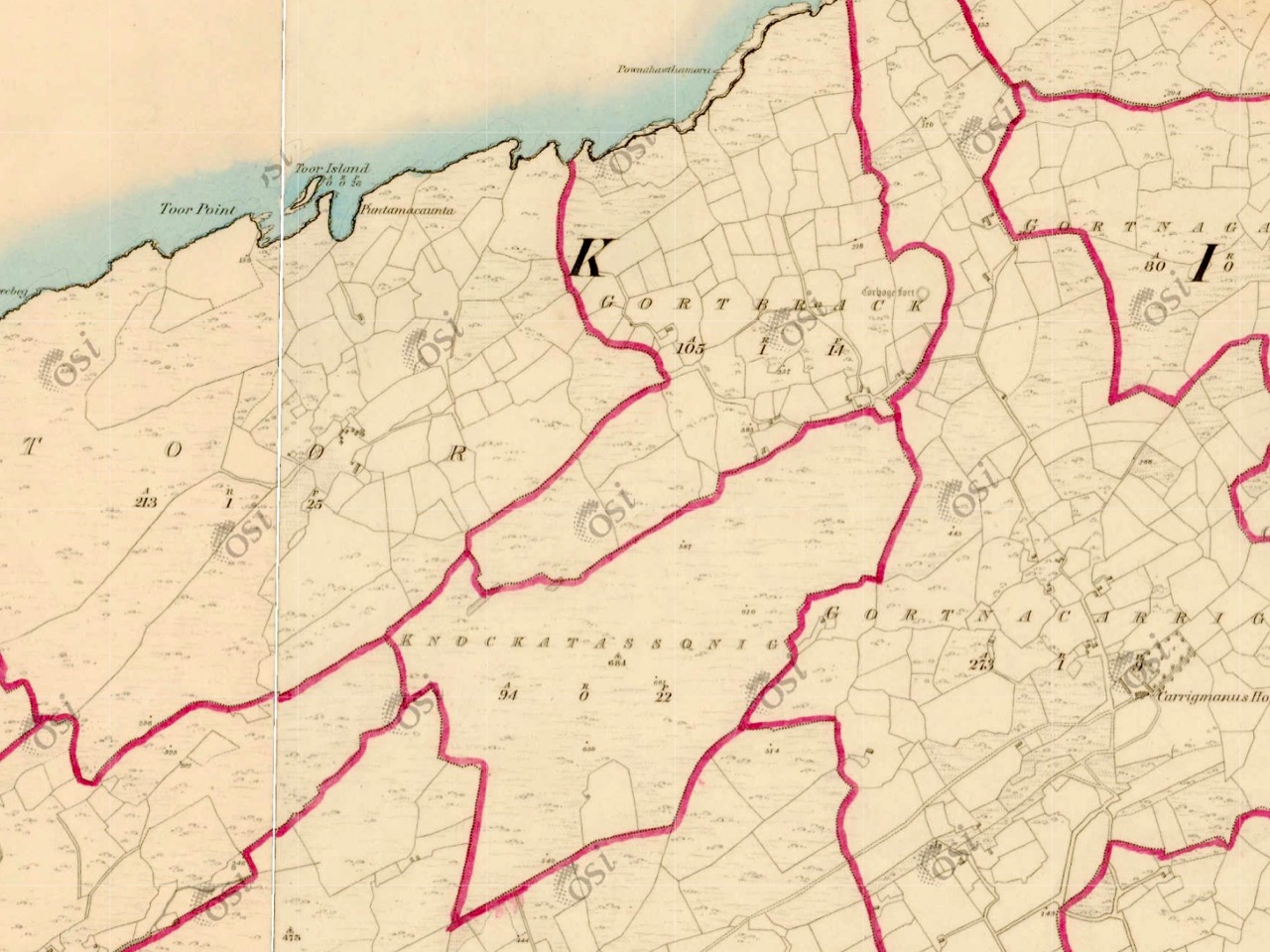
Top – the 25″ Ordnance Survey map, locating Toor Quay and Knockatassonig. Lower – the earlier 6″ map outlining the townlands

Knockatassonig is a curiosity. It’s a townland which doesn’t seem to have any habitation – and possibly never did. The 6″ map, above, was originally surveyed in 1846 and is valuable in outlining the townland boundaries at that time. It may be that in pre-famine times there were dwellings in the area: Ireland was much more heavily populated in those days, even in places like this which seem so remote today. But sometimes the townland names are particularly useful to us because they can tell us something of the history, which would have been passed on aurally through the generations until the maps were made.

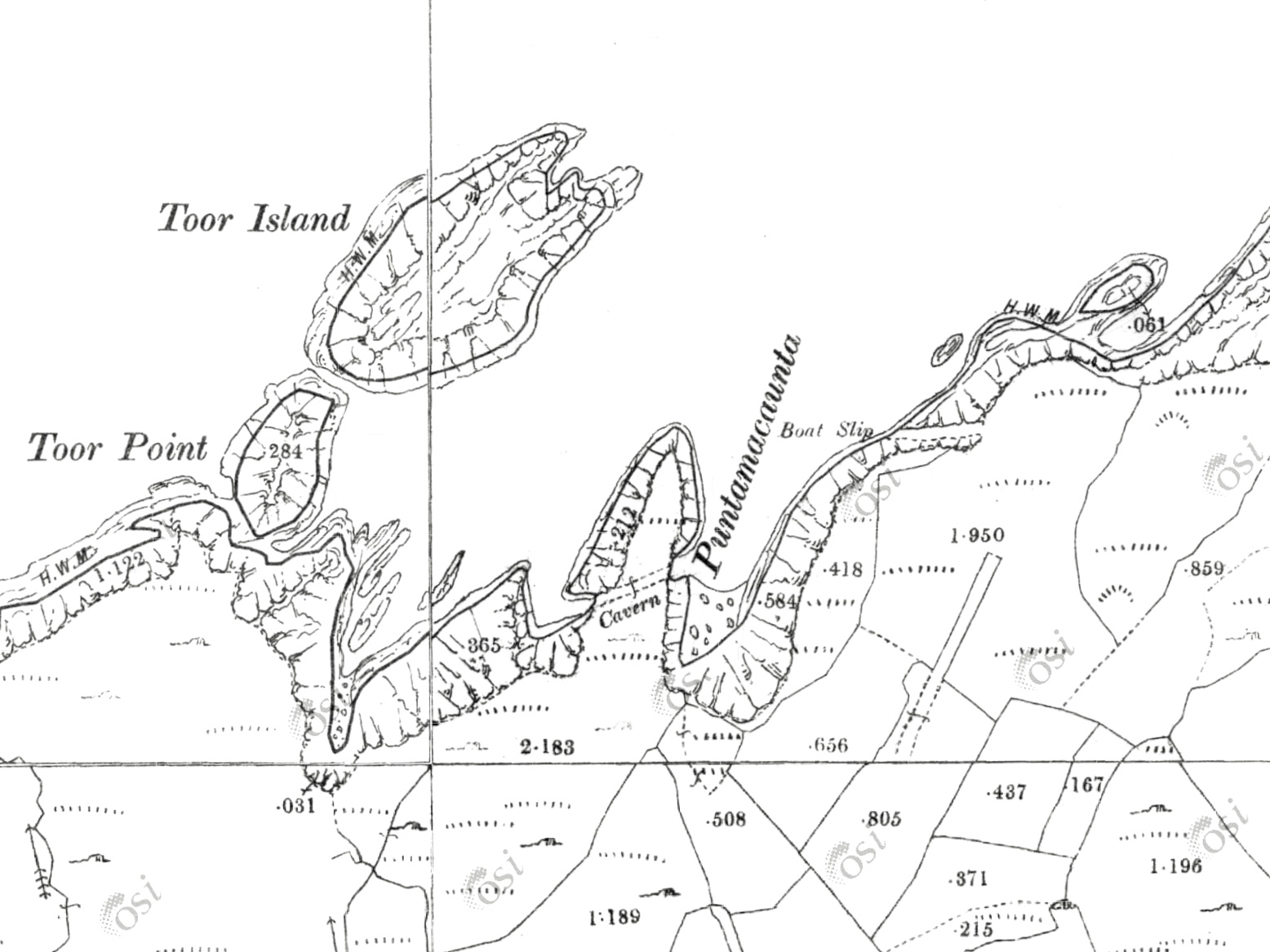
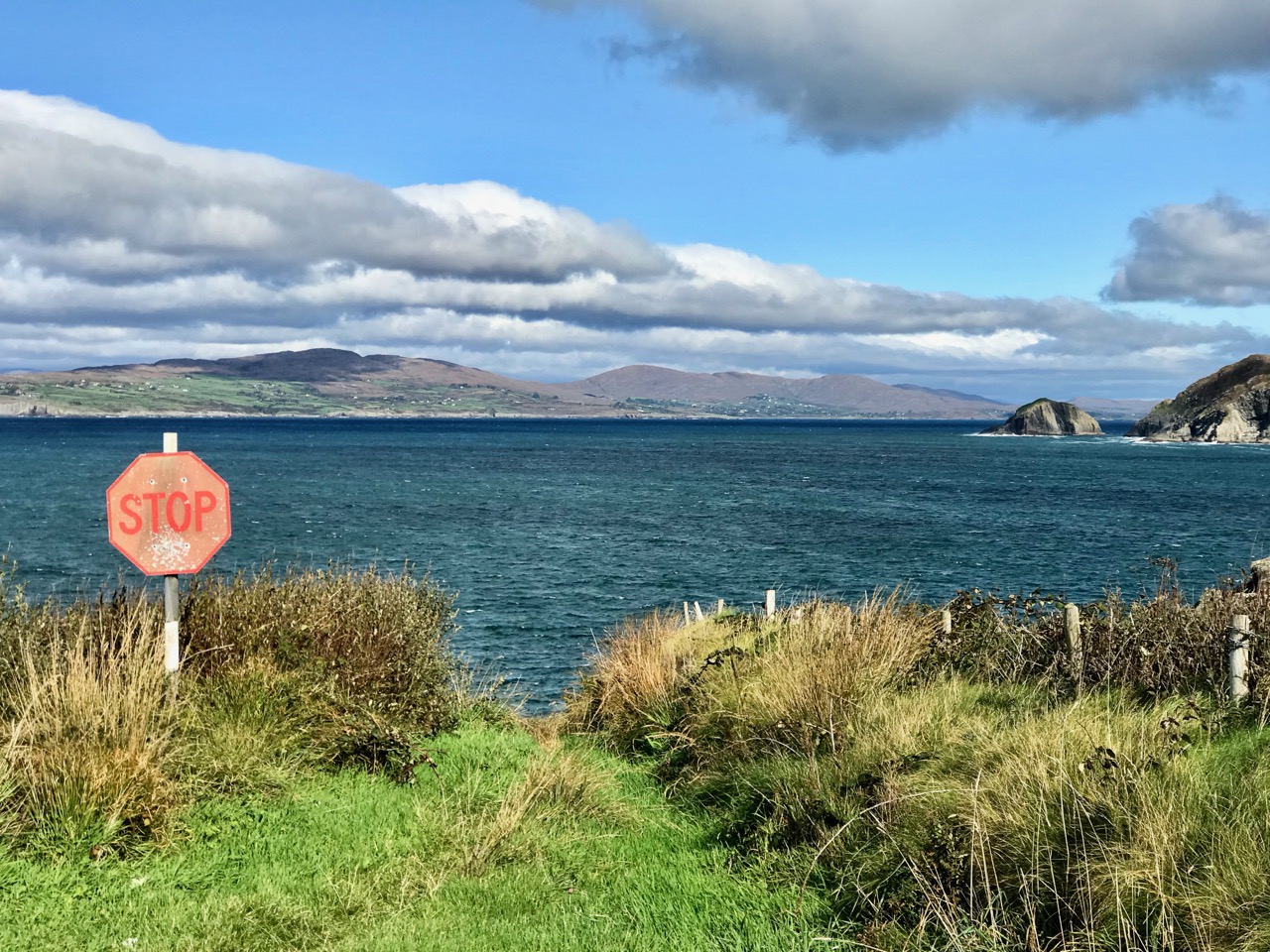
Upper – detail from the 25″ map, showing the ‘Boat Slip’ at Toor. The map was presumably surveyed before the present pier was made; the slip has been cut into the solid rock and launching boats there must have been a treacherous business. Lower – today, a steep, narrow boreen can be negotiated as far as the Stop sign! An overgrown footpath goes on down to the sea and quay. The mountains seen over the water are on the Sheep’s Head

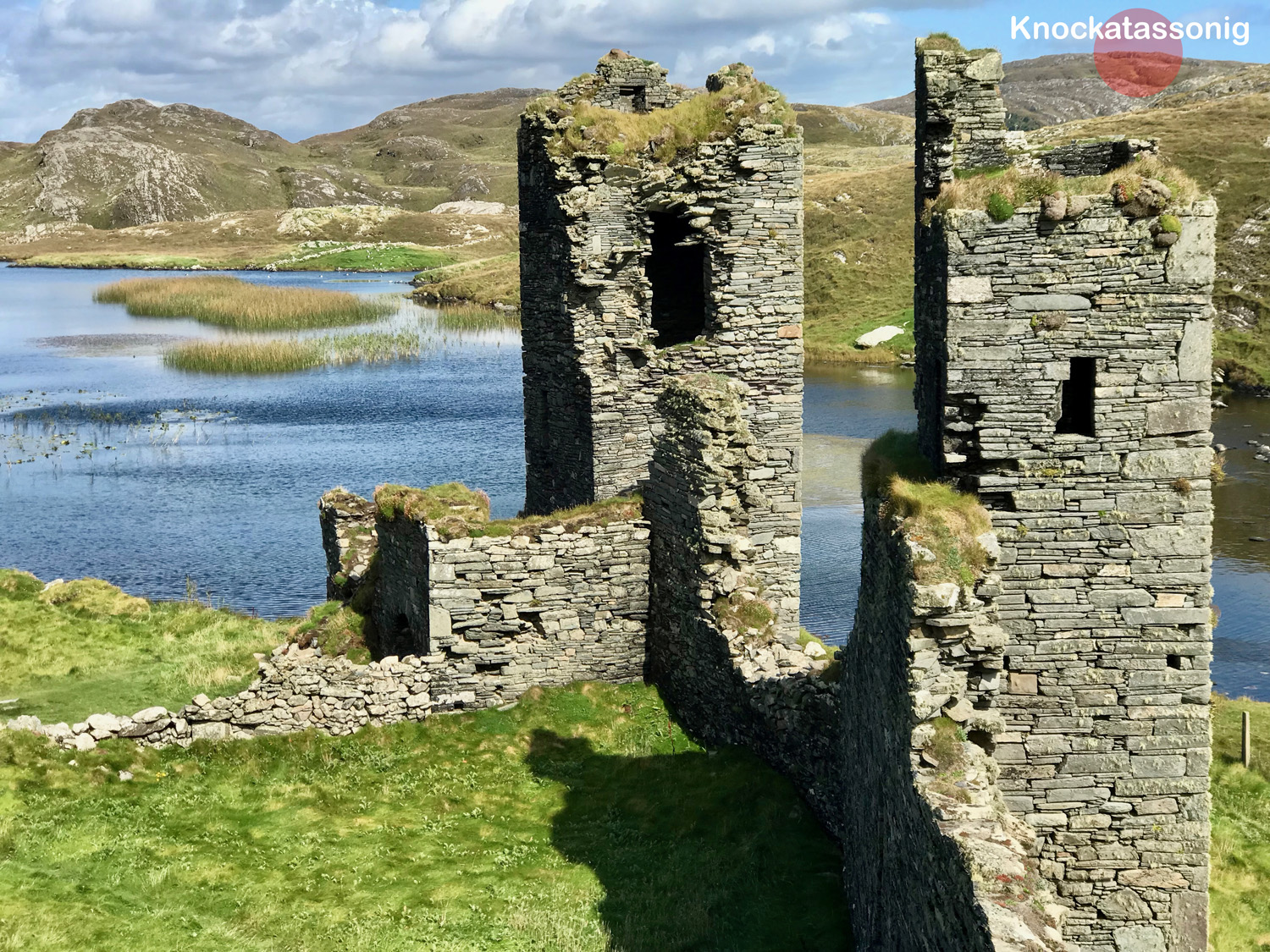
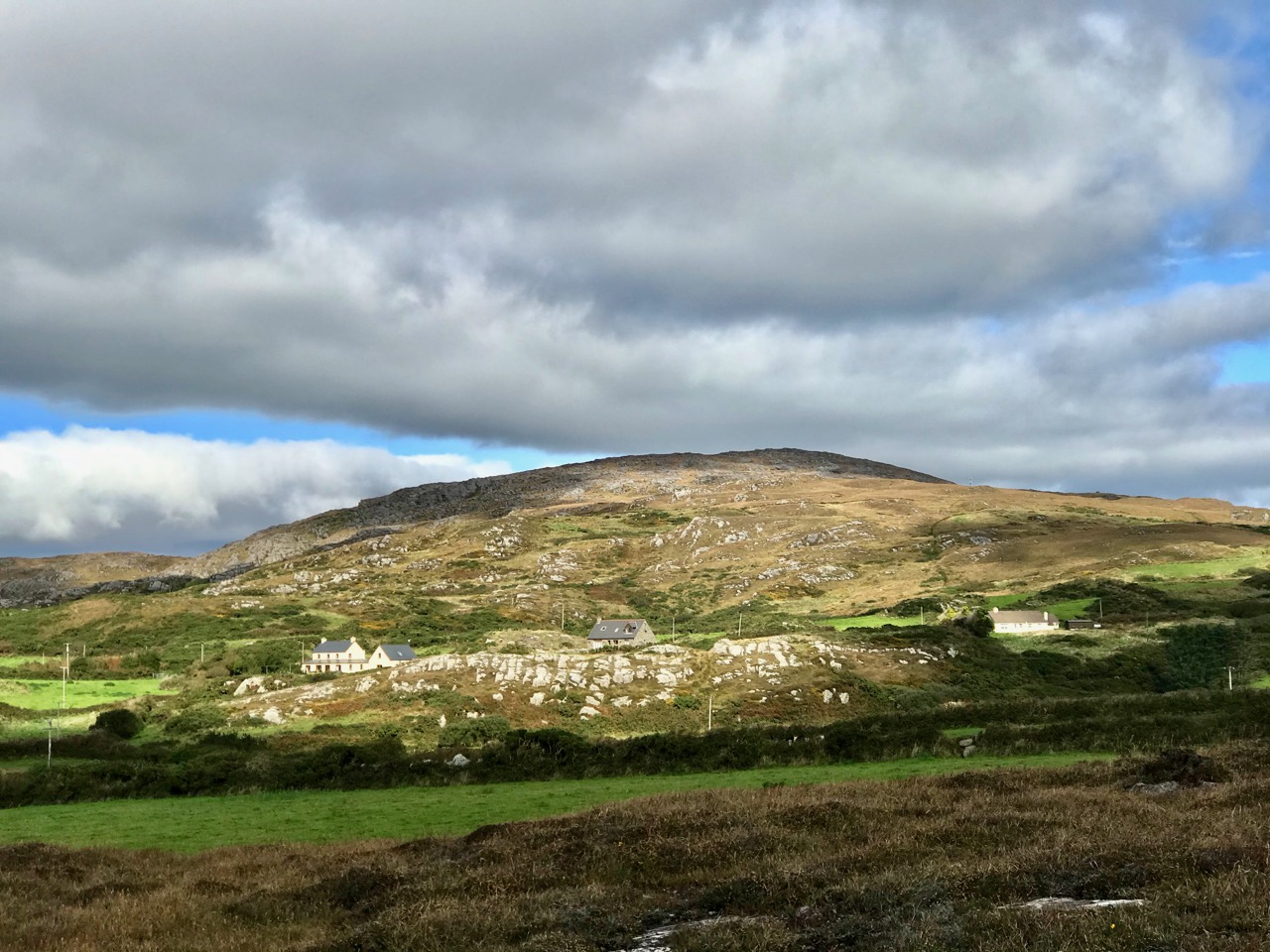
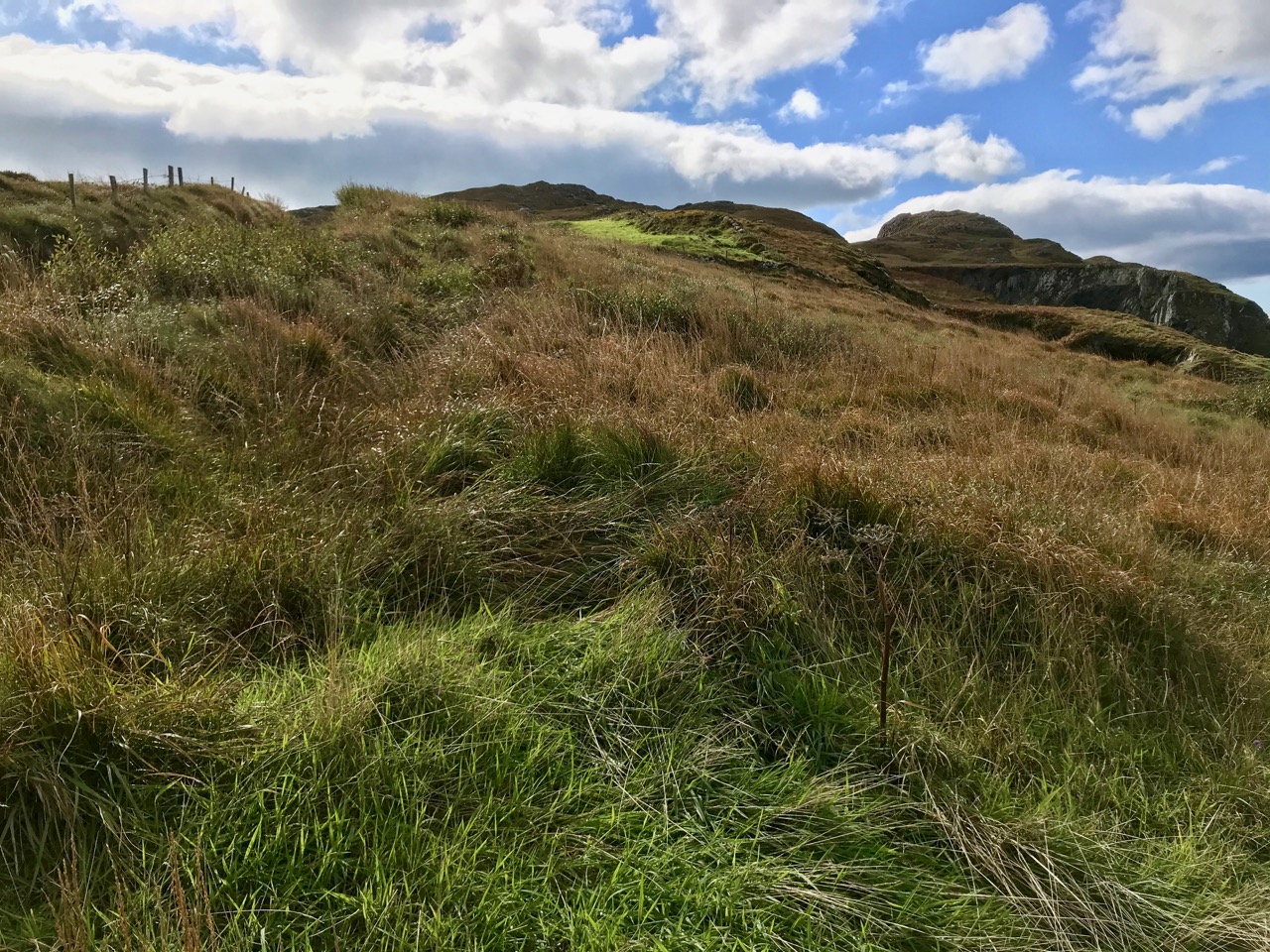
So far we haven’t talked much about the ‘Mountain’ of Knockatassonig. This summit is very visible, but virtually inaccessible at this time of the year due to bracken and spiky fences. It can just be seen on the left in the header picture: that’s taken from the footpath which goes down to Toor Quay. Like most of the Mizen peaks, Knockatassonig commands good distant views. It should be more approachable in the winter months. Although it’s hard to get to, it can be seen from several places on the Mizen, including Dunlough. The photo below shows the peak on the horizon beyond the ruins of Three Castle Head:

Here’s a view of Knockatassonig summit seen from the south-west side, taken from the small road that goes down towards Toor.  The view below shows the complex profile of the summit seen from the north

In looking at the peaks of the Mizen I intend to explore and uncover – where possible – any extant memories of stories or local lore relating to them. As far as Knockatassonig goes, I have found nothing recorded, other than the name, which is shared with the townland. So what does it mean? Well, it’s not clear, but the logainm website suggests ‘The hill of the Englishman’, and compares this name to the entry for Corr na Seirseanach in Co Monaghan ‘The round hill of the Englishmen’ or ‘The round hill of the mercenaries or hired soldiers’. Well – that’s a surprise . . . and a bit hard to reconcile with the unpopulated landscape we see today in this part of West Cork. The Monaghan version of the name can be supported by political events dating from the early 1300s: it’s hard to relate these to any activities we are aware of on the Mizen, but Irish history is a complex thing – as are place-names. When Finola heard the name she thought it meant ‘The hill of the foxes’: a direct translation into the Irish of that would be Knock an tSionnaigh. Townland names were often written down in Anglicised form by surveyors whose ears may not have been attuned to the Irish nuances. I’m voting with Finola on this one: there’s sure to be a good few foxes in that landscape!

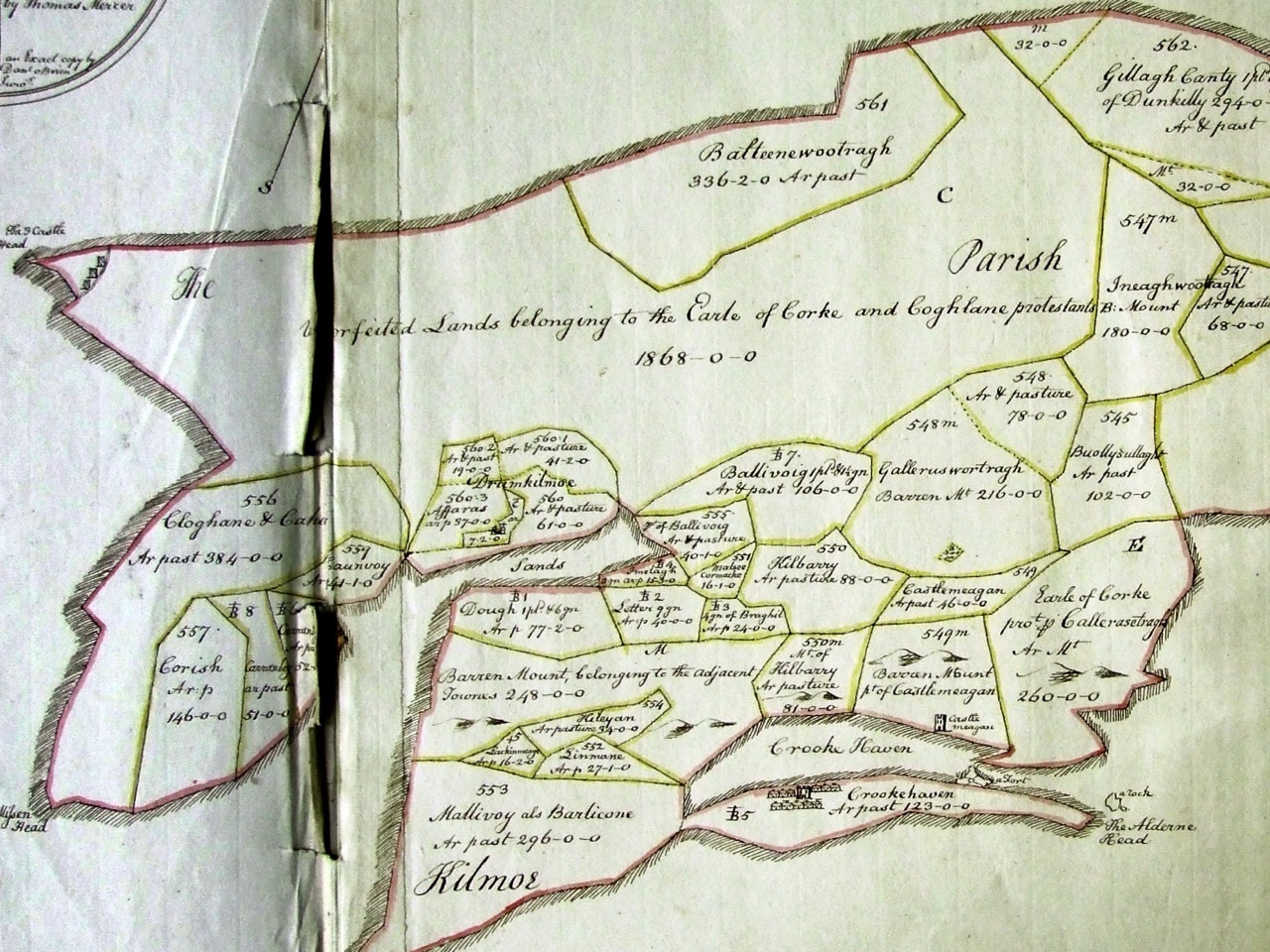
Here’s an earlier source of information on Irish names: the Down Survey. Undertaken between the years 1656 and1658, the Down Survey of Ireland is the first ever detailed land survey on a national scale anywhere in the world. It sought to measure all the land to be forfeited by the Catholic Irish in order to facilitate its redistribution to merchant adventurers and English soldiers. The extract above details the Parish of Kilmoe at the end of the Peninsula: note Three Castle Head depicted at the far left. The survey does not give modern townland names but we can work out where the Knockatassonig peak would be – in the section labelled Unforfeited Lands belonging to the Earle of Corke and Coghlane protestants  In which case, of course, not only the present day townland of Knockatassonig but all those around it could reasonably be termed ‘ . . . of the Englishman . . .’ Food for thought?

Below – peaks of the Mizen: many will be the subjects of future posts

The Marvel of Margaret Barry

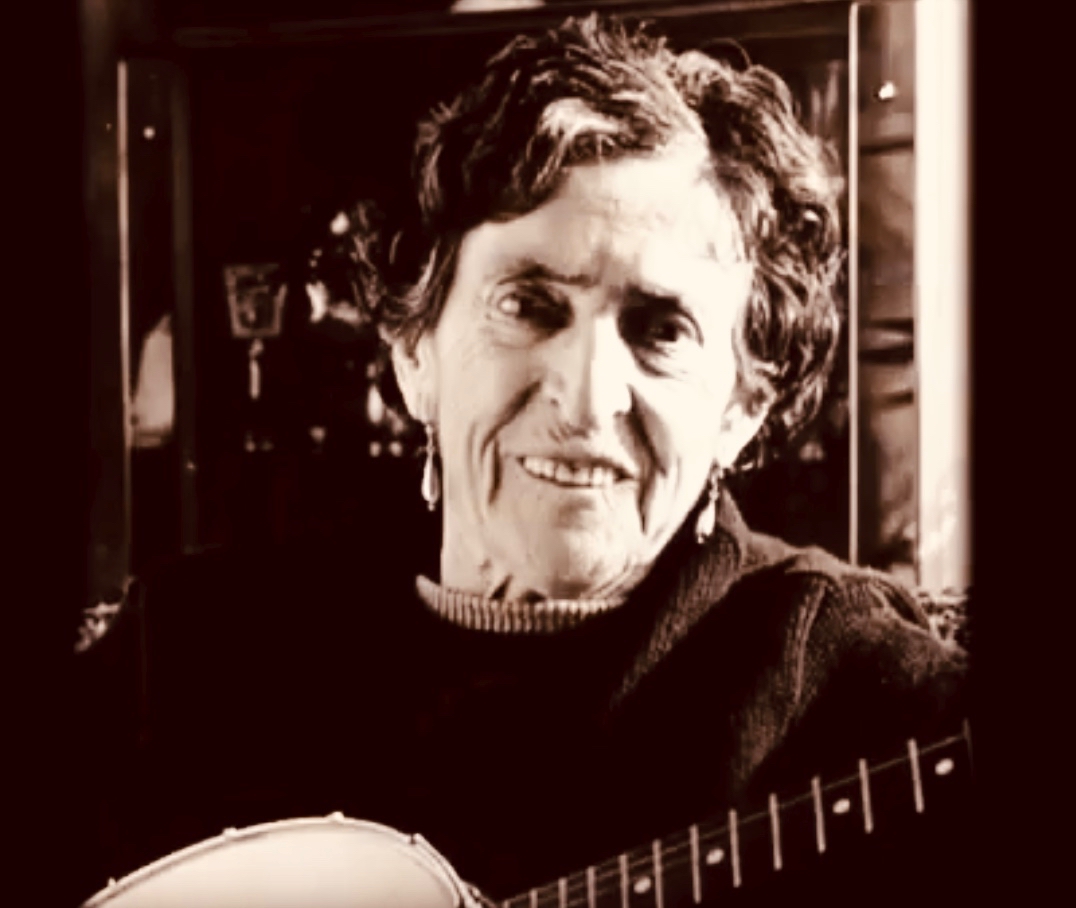
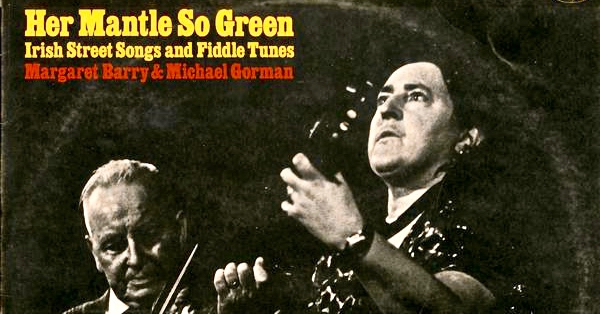
When I was in my college years, I lived on the fringes of London. It was the 1960s and – among many other cultural stirrings – there was a burgeoning Irish traditional music scene, in and around Camden Town. The Irish community in the capital had been thriving since the 1950s, when London was being rebuilt following the Blitzes of the recent war. Although not a close follower of Irish music at that time I had taken up the squeeze-box, and, curious enough to hover at the edges of The Music, was fortunate to briefly encounter many singers and players who are now considered legends. One of these is Margaret Barry, seen above in her later years and, below, when she was first becoming established as an Irish traditional music performer.

If you ever saw (and heard) Margaret Barry, you would never forget her. Her voice is unlike anyone else’s. She was born in the City of Cork, and has the distinctive accent of that place, whether she is speaking or singing. I find it completely compelling, but I can understand that it’s not to everyone’s taste. Nevertheless, whatever your own views, her story is fascinating – and at the same time a valuable social commentary on aspects of twentieth century Ireland. Margaret was born in 1917 – on New Year’s Day – and died in 1989. She made a living from music – and spanned the spectrum from obscure street performer to lauded professional much in demand on radio and television, performing in venues which included London’s Royal Albert and Festival Halls and New York’s Rockefeller Centre.

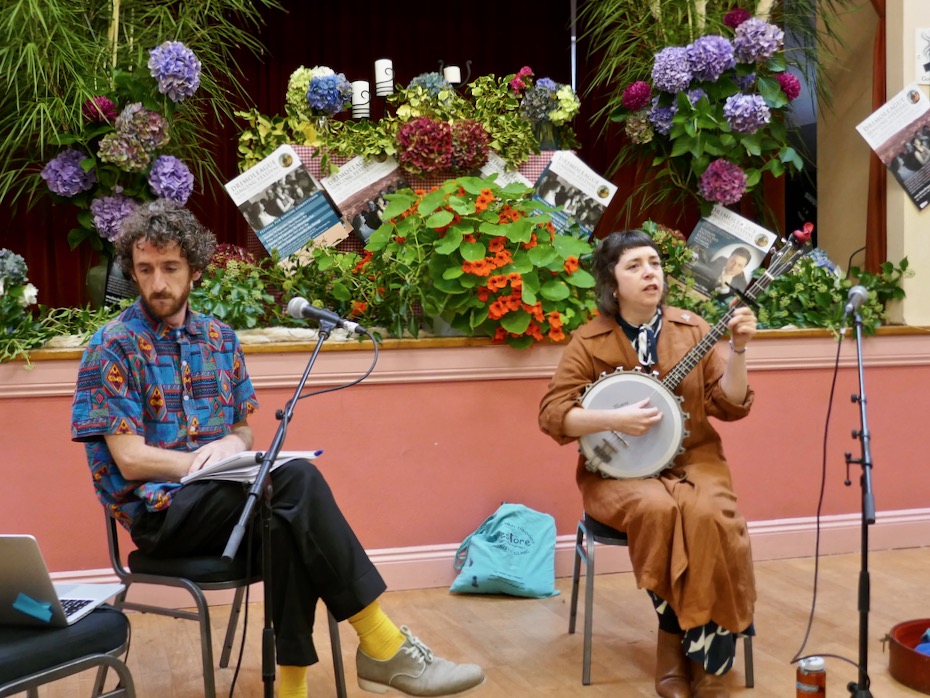
The reason I’m writing about Margaret Barry today is that she was the subject of a talk given at this year’s Drimoleague Singing Festival: “…A celebration of the human voice in the heart of West Cork…”, now an established annual event held around the feast day of Cork’s patron saint, St Finnbarr, September 25th. It’s great that Ireland’s special saints – who ‘kept alive civilisation’ during the otherwise Dark Ages in pre-medieval Europe – are still living and celebrated in traditional culture, which encompasses literature, art, music and folk tradition. Yesterday’s talk, in a crowded hall, was presented by Jason Murphy and Lisa O’Neill (pictured above mid-talk, with Lisa – Singer in Residence at this year’s Festival – giving her own extraordinary rendering of one of Margaret Barry’s songs). It’s worth watching the following YouTube video of Lisa singing a version of ‘The Galway Shawl’ to give you an idea of Margaret’s characteristic style as interpreted by Lisa, and sealing her own authority on the perpetuation of The Music:

Because Margaret Barry is a legend, it’s inevitable that the life and exploits of this lady from Cork have become imbued with folklore. This can happen very quickly in Ireland! Jason – a radio documentary maker – and Lisa – who has studied Margaret’s work – set out to shed light on the reality of her life, times and travels. The talk is work in progress – look out for a comprehensive programme coming up on RTE Radio soon. The talk in no way diminished Margaret Barry’s status and renown in the folk music world, but it did question some of the hitherto accepted accounts of her life. For example, when I first became interested in her singing over fifty years ago, I gleaned (mainly from notes on the sleeves of LPs) that she was from travelling stock, and that’s something you’ll still find quoted in practically every contemporary account of her life. According to Lisa and Jason, however, she came from musical families in Peter Street, Cork. Her mother’s father – Bob Thompson – was an accomplished uilleann pipe maker and player who was married to a Spanish Guitarist and singer. Living through hard times, Bob had to temporarily pawn his own uilleann pipes but lost them when a fire broke out in the pawnshop: he did not play again for ten years! Margaret’s parents and uncles were street singers and musicians, her father earning a precarious living playing the violin in silent-era cinemas and with dance bands. 

Another invariably quoted story is that she left home at 16 with nothing but a bicycle and a banjo tied to her back with string as she set off to busk her way through the harsh streets of Ireland. It’s an engaging picture, but probably simplifies a complex situation. Margaret’s mother died when she was only twelve years old, and soon afterwards her father married a girl not very much older than she was. It’s likely that she did decide to go off and fend for herself – and during her lifetime she did travel around Ireland, sometimes in a horse-drawn caravan, but she had also become interested in the musical traditions she experienced around her and took every opportunity to learn songs from every source, to teach herself to play the fiddle and banjo – and also to use her own talents to earn money wherever she could, and to survive. Here’s her own account of those times, recorded by American musicologist Alan Lomax in the 1950s:

Alan Lomax left a valuable collection of information on ethnic musical cultures from America, Africa and Europe, which he and a dedicated team collected over many years. Much of the collection is available online in the archive of the Association for Cultural Equity. Amongst the publications of the Association is a CD of Margaret Barry singing and talking about her life, which can currently be purchased as a download.

Margaret succeeded in her chosen life of itinerant song performer and always said that she had enjoyed it, regardless of the often hard times. She certainly achieved notoriety and featured in programmes on TG4 and RTE in her lifetime. She had a long-term relationship and musical partnership with the Sligo musician Michael Gorman, whose fiddle playing features on many of the recordings made of her. It seems appropriate to include here this 1965 recording of Margaret accompanied by Michael, singing ‘Still I Love Him’:

The talk we heard in Drimoleague on Saturday was a tour-de-force by Lisa and Jason, reviving my own interest in Margaret Barry, the ‘street singer’ from Cork (also known as ‘Queen of the Gypsies’, a title she was happy enough to embrace, whatever the true circumstances of her ancestry). To finish this post, here’s one of her songs for which she is, perhaps, best known: ‘She Moved Through the Fair’. Margaret was once asked if this tune had come to her from her traveller background: she is said to have replied that she had learned it from a recording of Count John McCormack…