A Signal Success in Irish Engineering – Part 7: Cloghane, Mizen Head

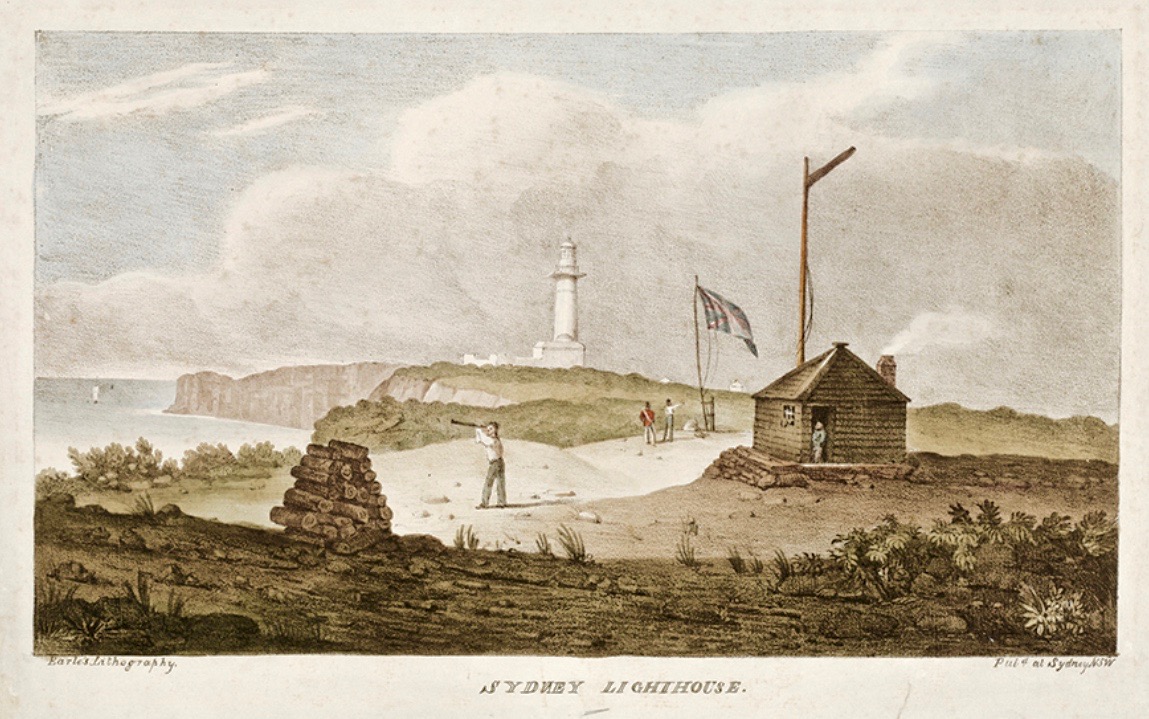
It’s a long way from West Cork, Ireland, to Sydney, Australia! And I’m not suggesting that signals could travel that far in the early 19th century . . . But I couldn’t resist putting up this engraving when I found it while researching signal towers generally as it is in fact an exemplary view with which to head up this – the seventh of our explorations into a fascinating subject. It has everything: the signal station itself, built on a prominent headland with a lighthouse nearby; a ‘telegraph’ mast and a flag mast for signalling; a man with a telescope looking out for a signal coming in – and a pile of logs with which to make a beacon fire to communicate urgently at night! The only difference, in fact, between the Irish stations and this ‘colonial’ one on the other side of the world is the building material. In Terra Australis (the name used for that continent until 1824, and meaning ‘southern land’) it was timber, whereas in Ireland the towers were of masonry and constructed with elements resembling medieval tower houses.
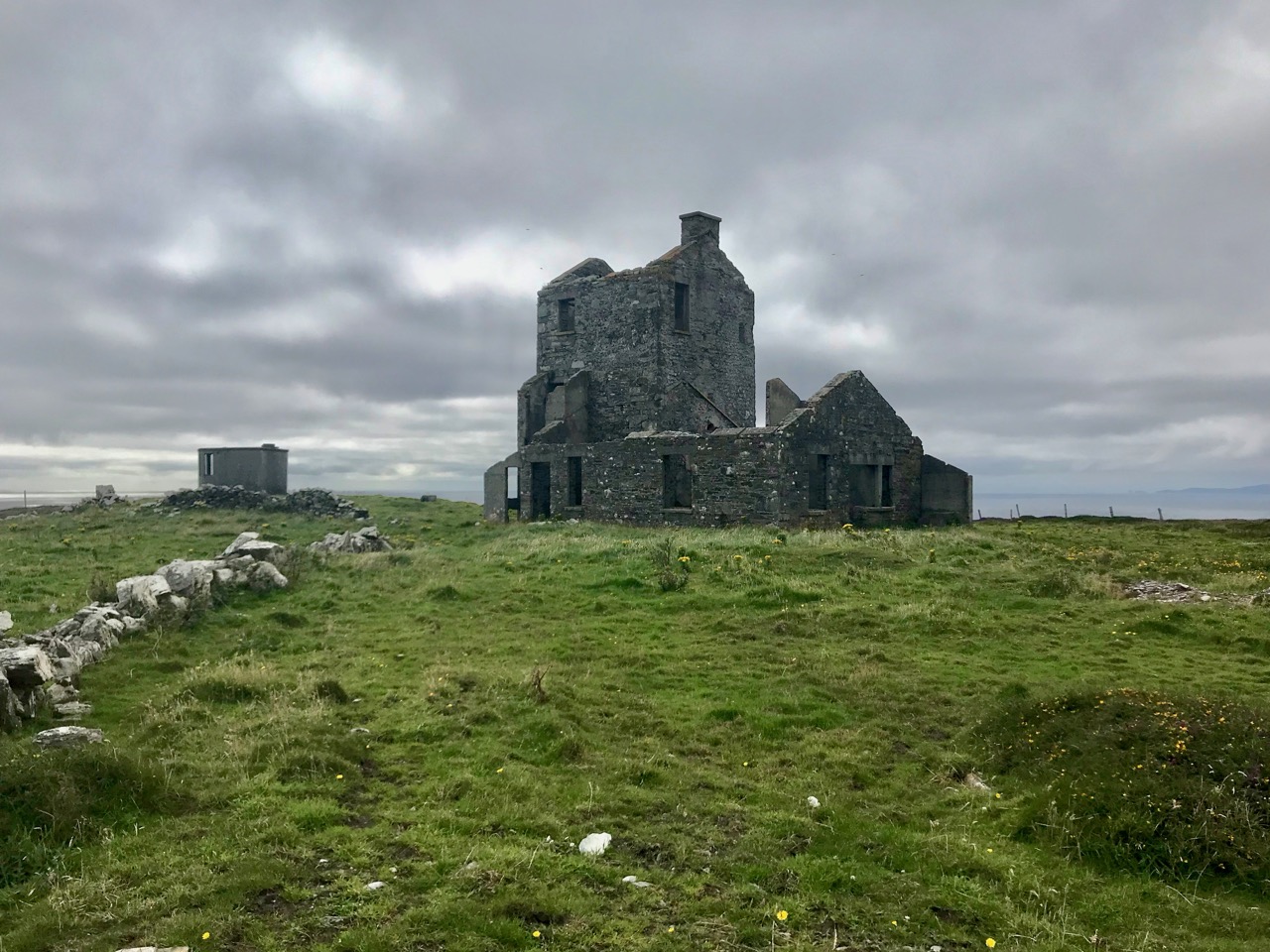
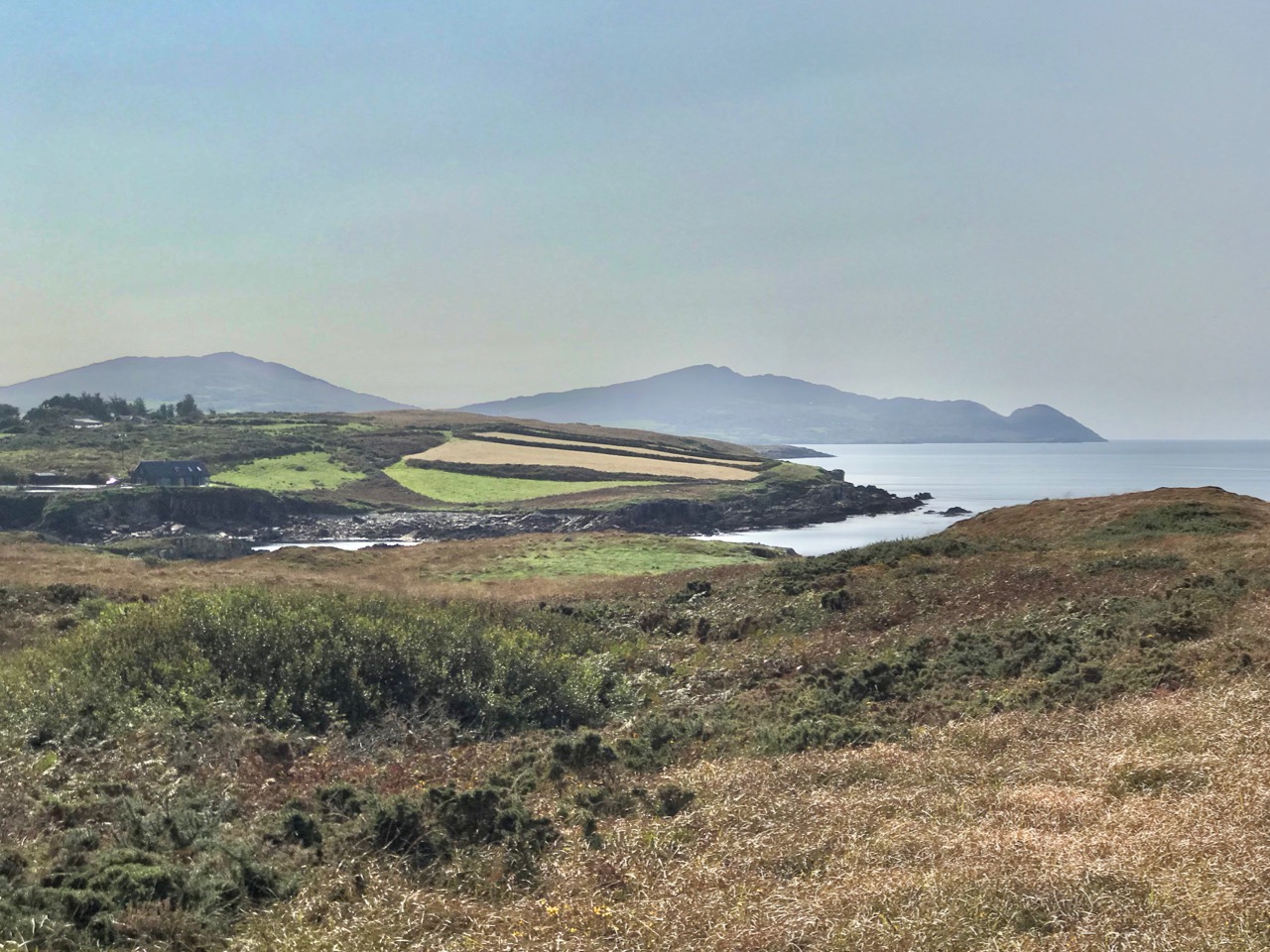
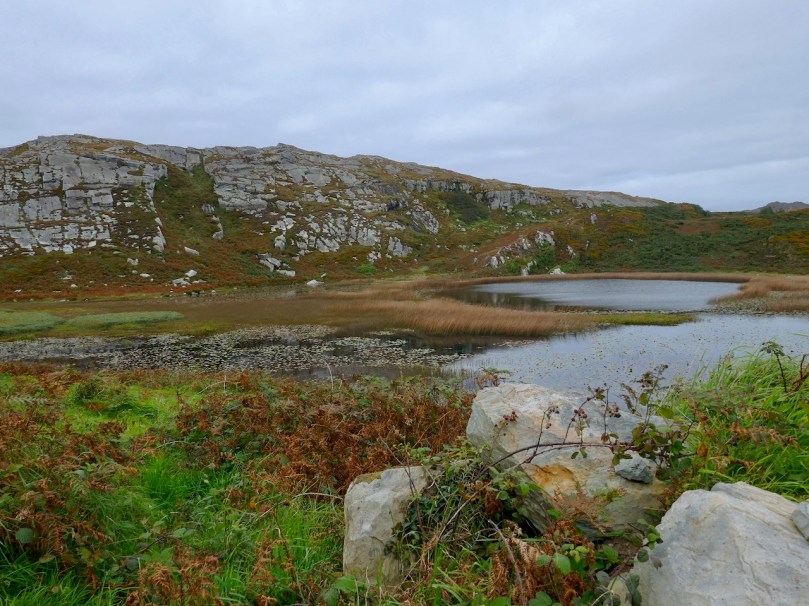
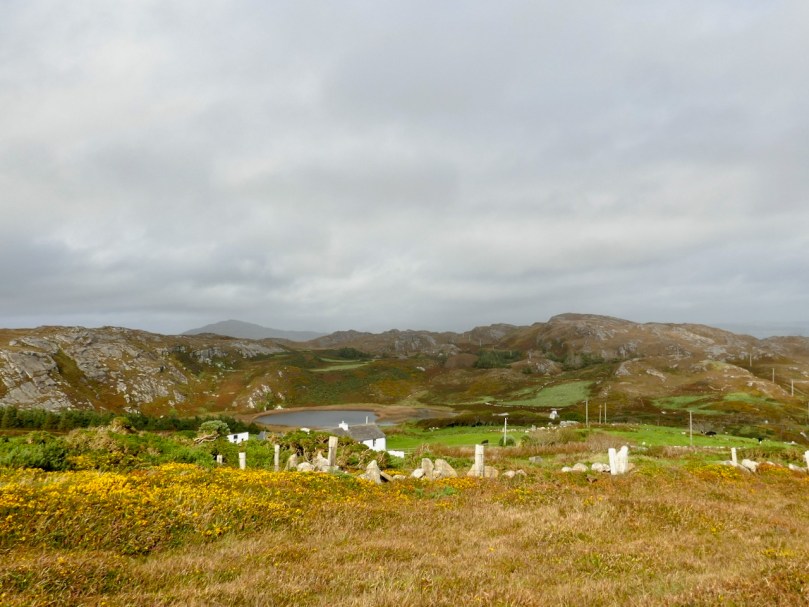
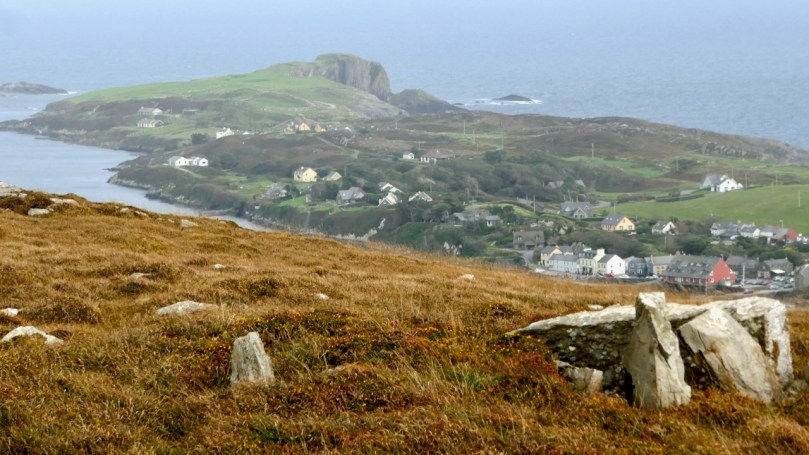
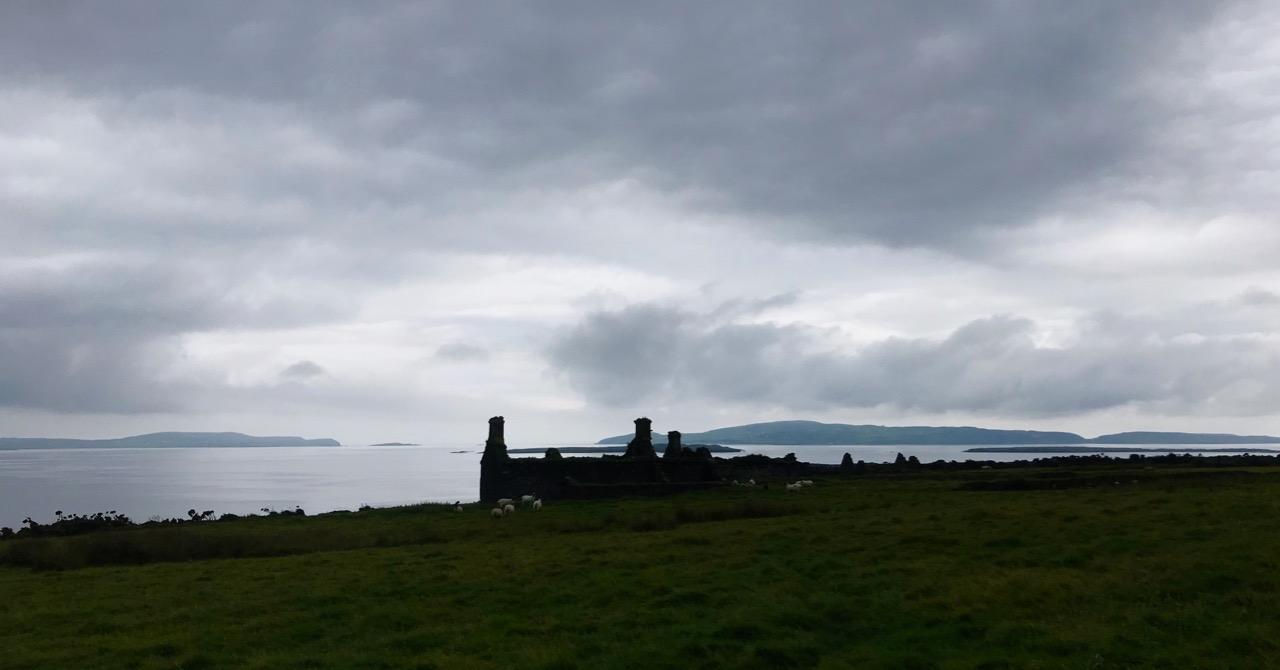
But it’s fair to say that today’s foray into the story of the Irish Napoleonic-era signal towers also has everything. Perched on Ireland’s most southwesterly point – Mizen Head in the townland of Cloghane – this site is one part of a craggy, indented promontory which is scattered with historical elements.
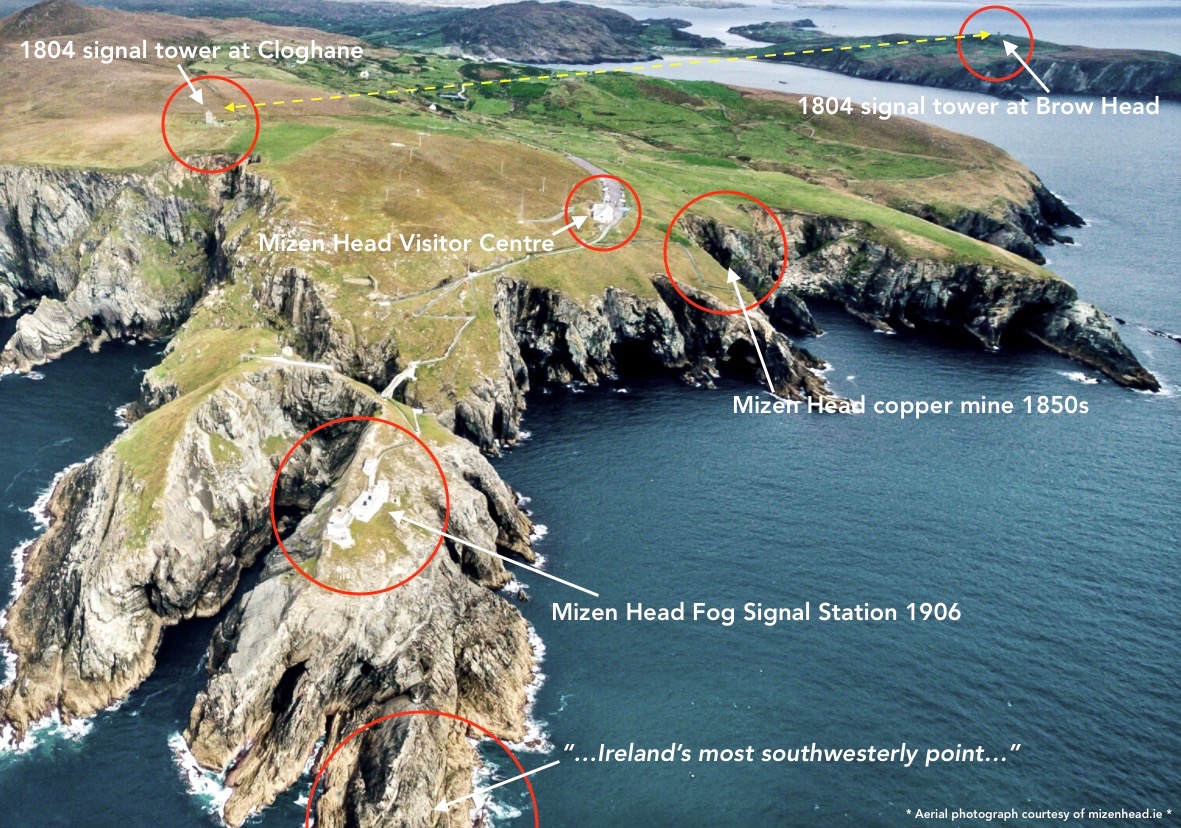
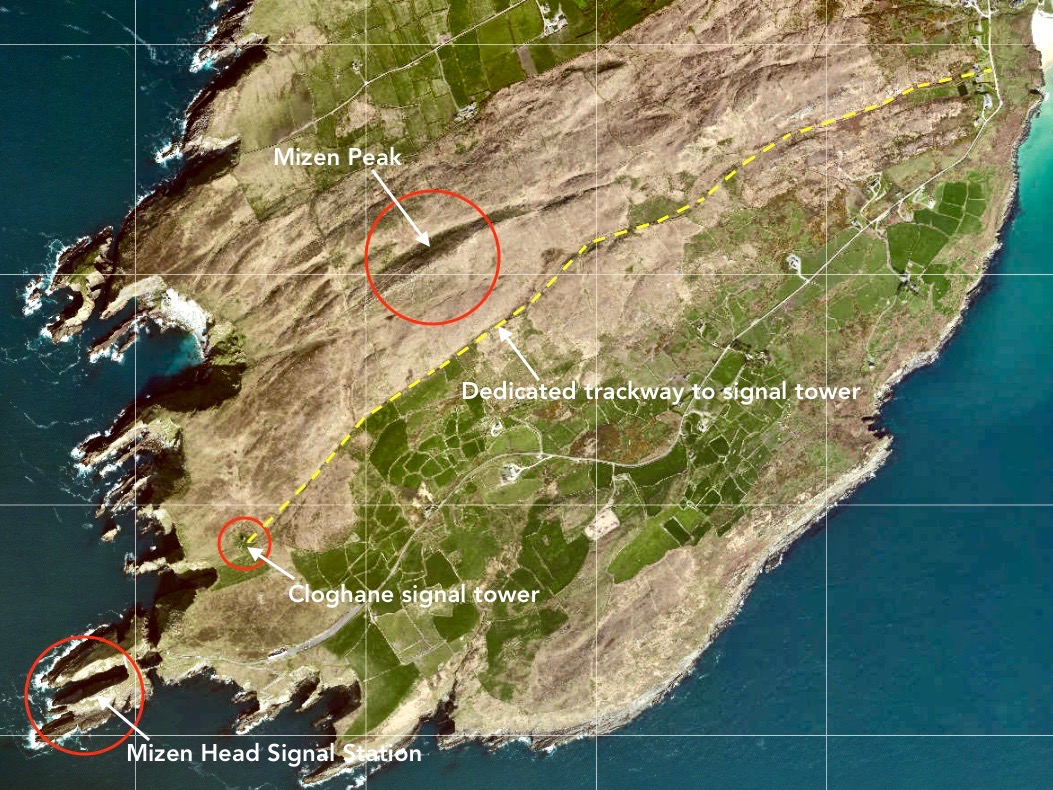
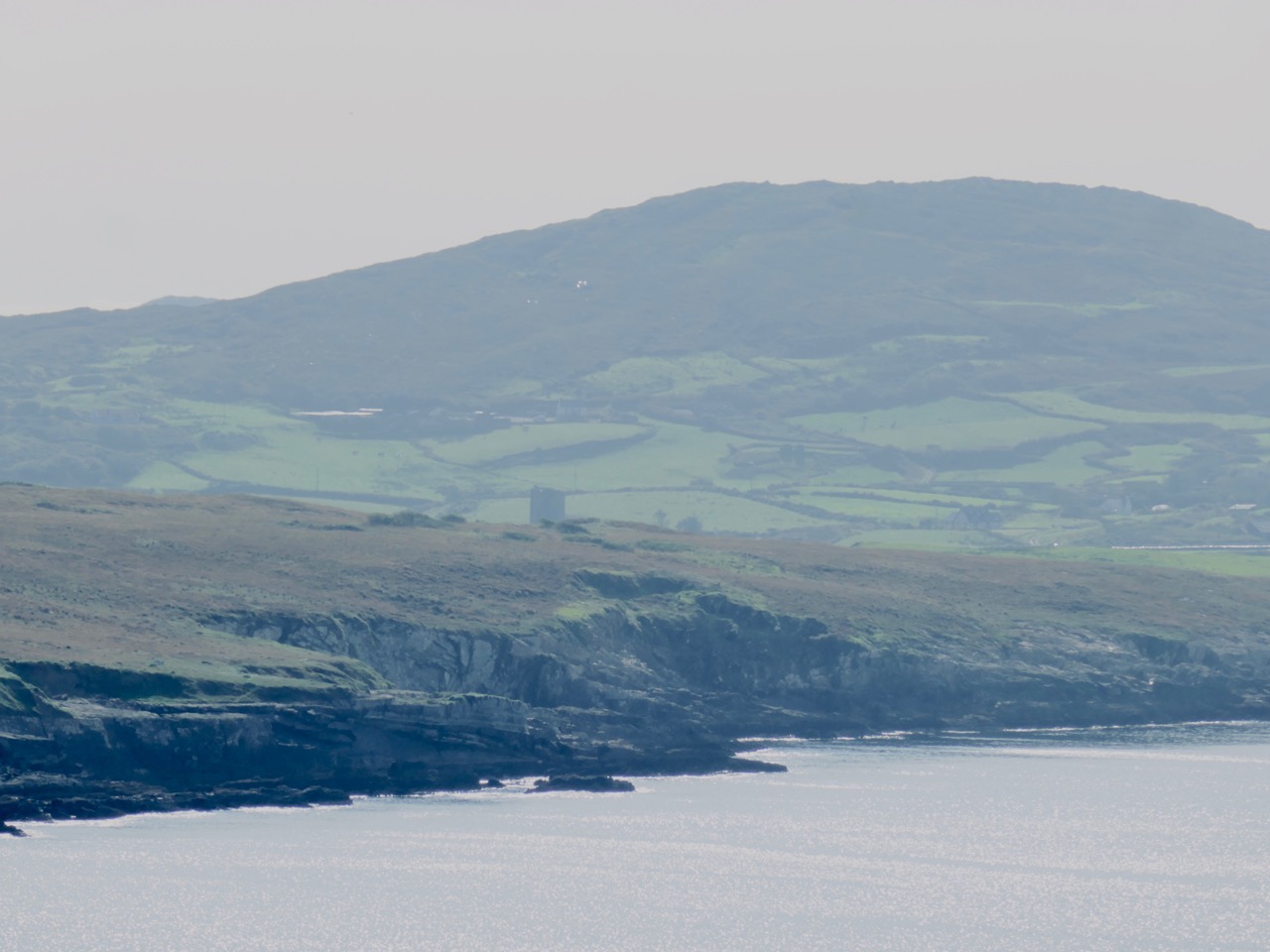
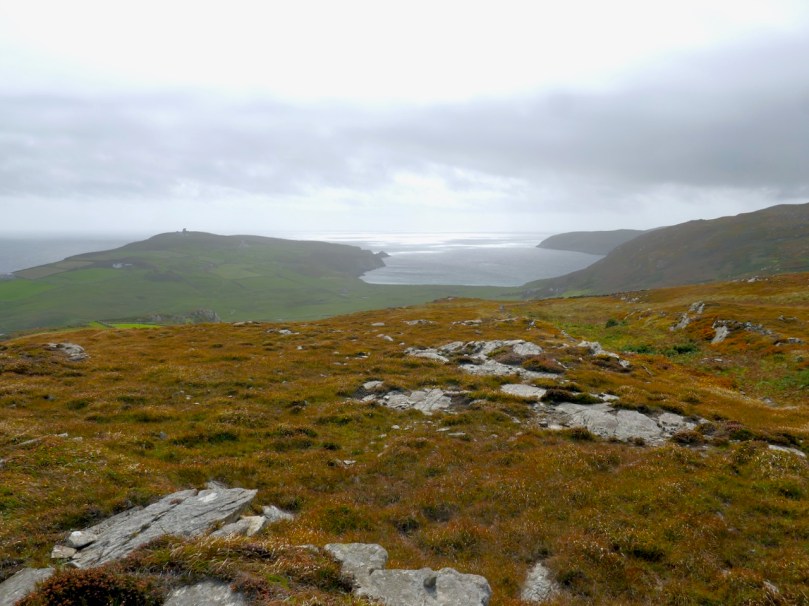
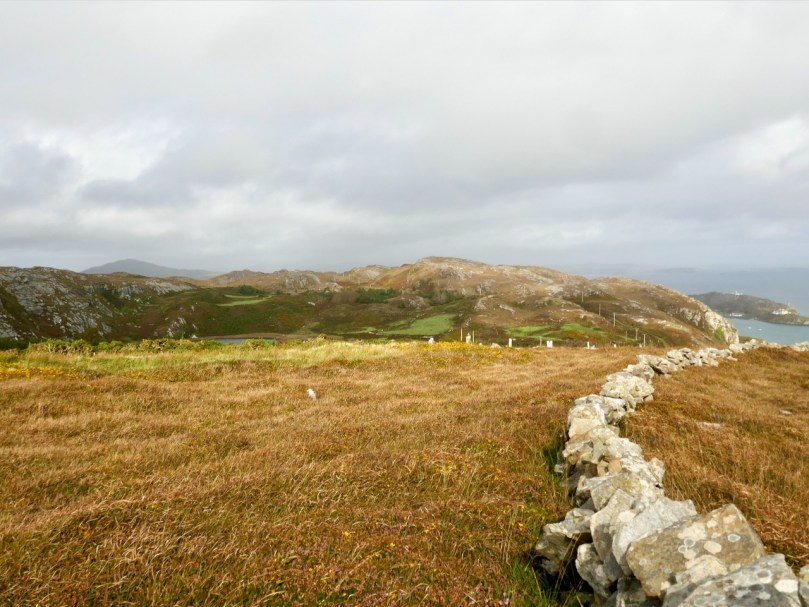
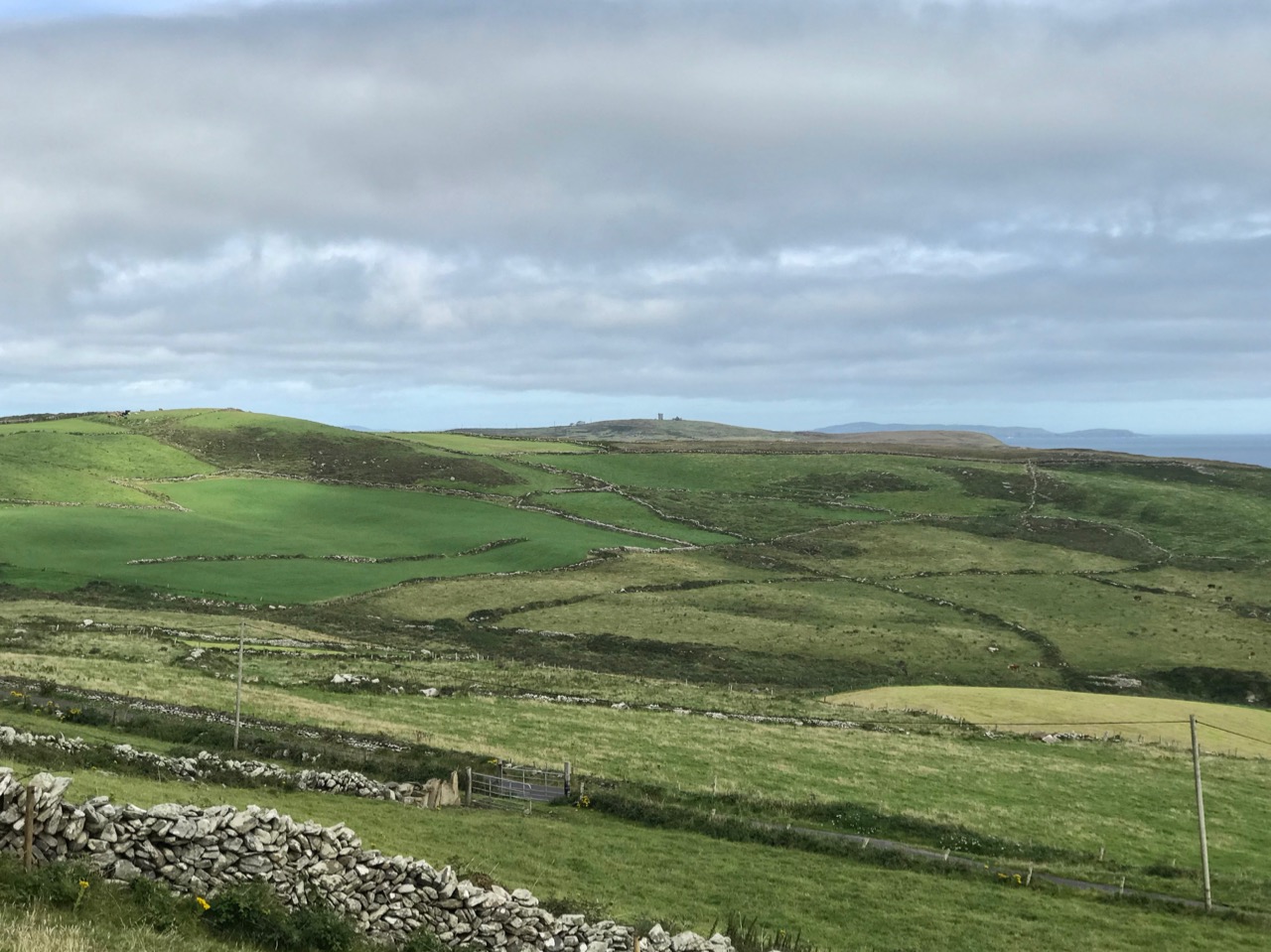
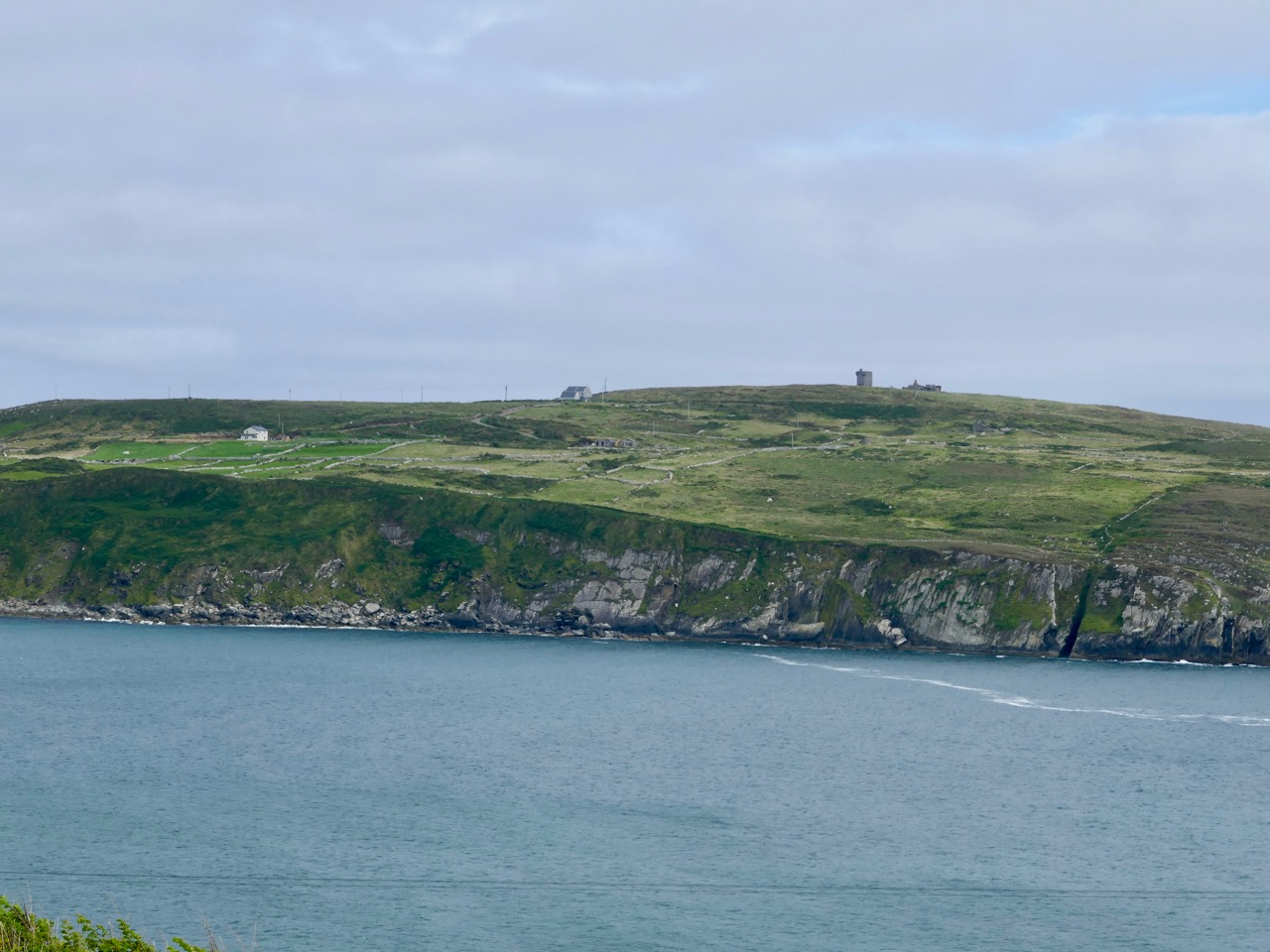
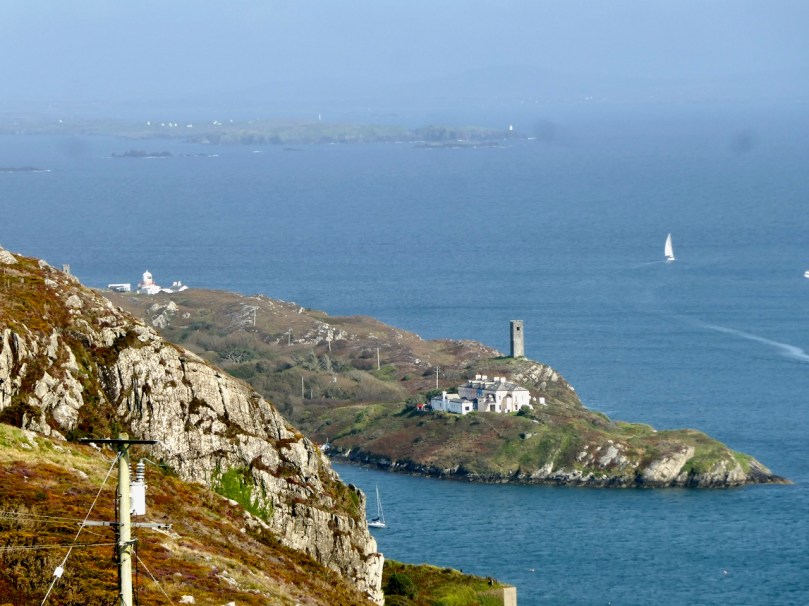
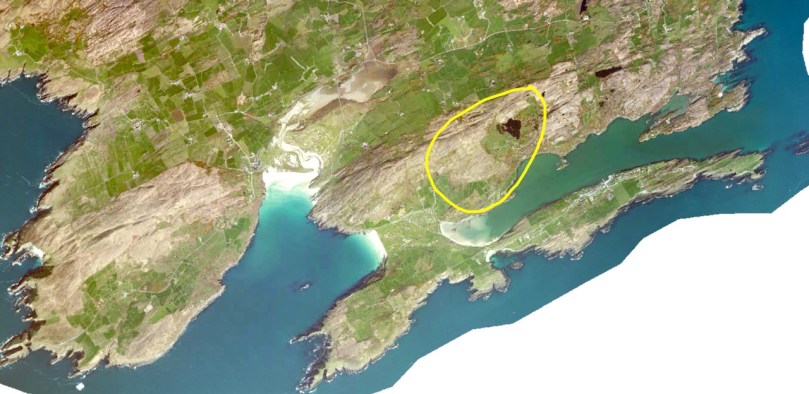
I have tried to illustrate a history time-line graphically by superimposing some of the significant sites on an aerial view (above – courtesy of mizenhead.ie), although even this does not tell the full story. Apart from an undated promontory fort in the north of the townland the signal towers are the earliest elements, specifically dating from 1804 and part of the network of 81 towers around the whole coast of Ireland which we have been charting in our posts. Interestingly, the two towers shown on the top of this view – at Cloghane and Brow Head – are the closest together of any around the coast, being only 3.8 km apart. The average distance between towers is 13.5 km, while the maximum distance is 36.9 km (between Ballydavid and Kerry Head in Co Kerry): we have not yet explored those sites. Here are two views from Cloghane across to the signal tower at Brow Head:
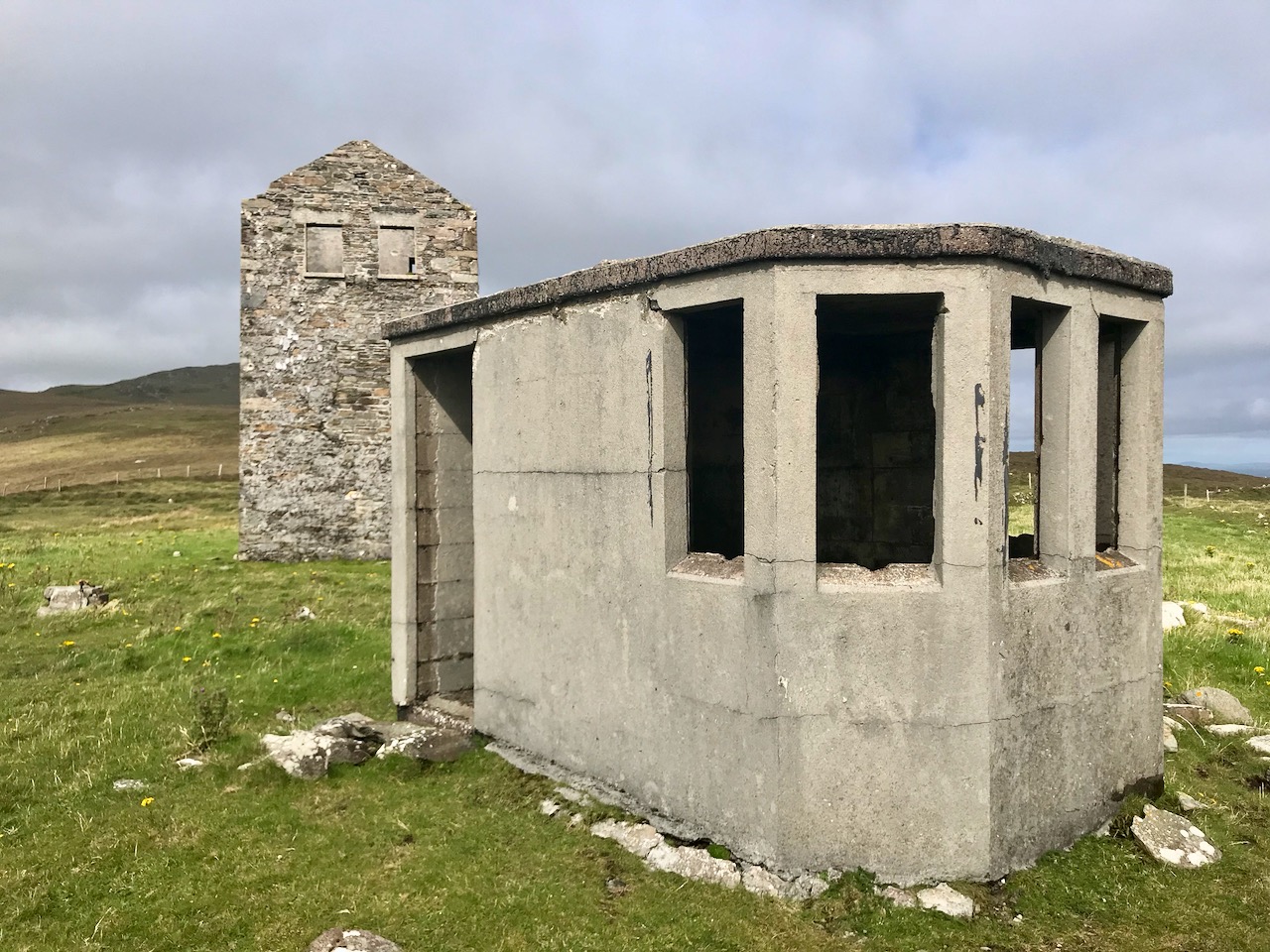
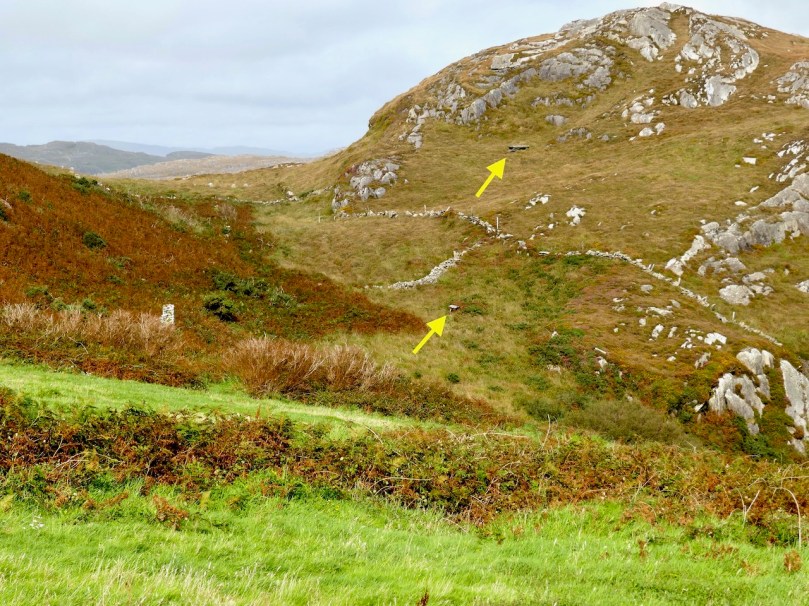
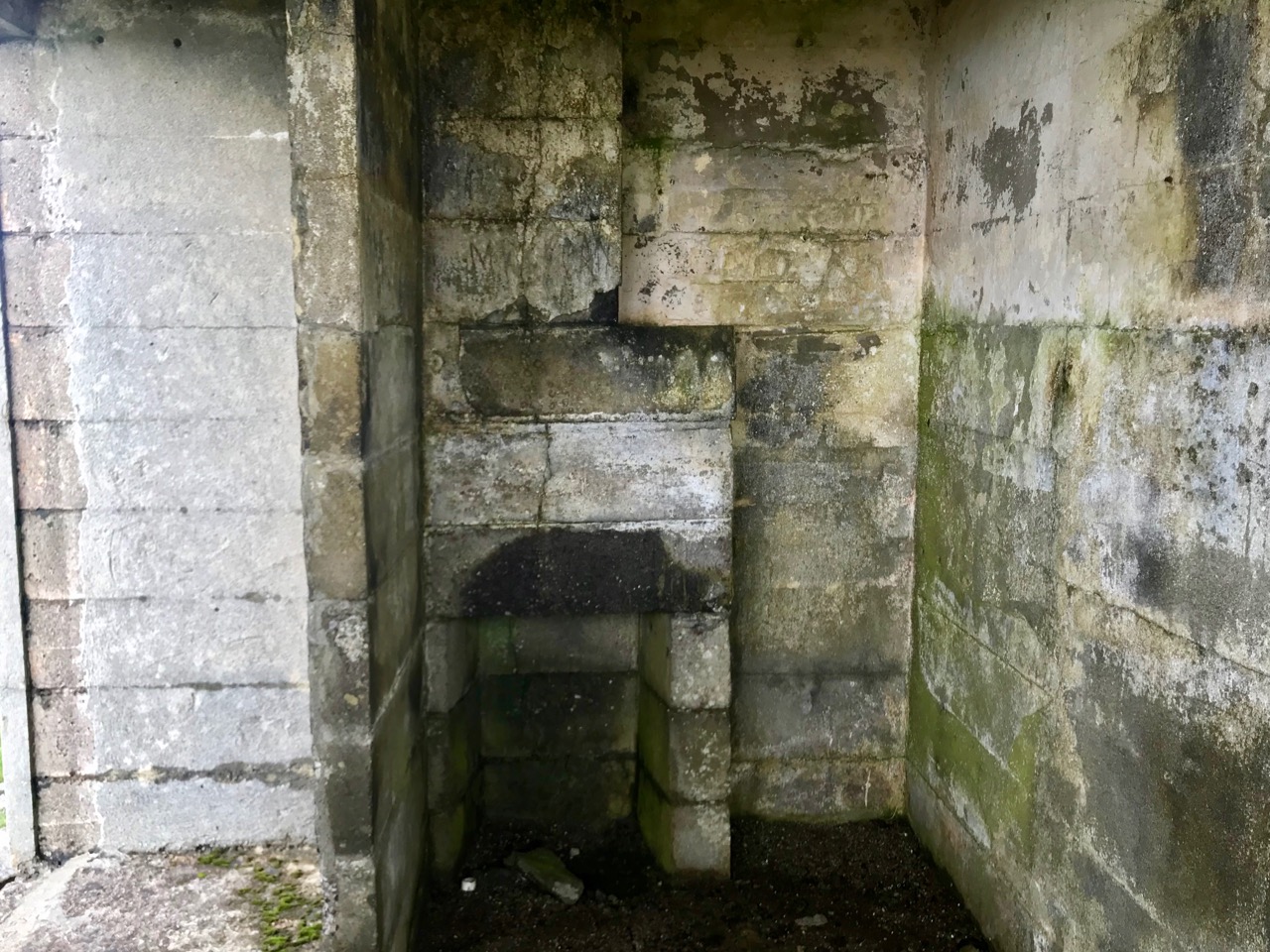
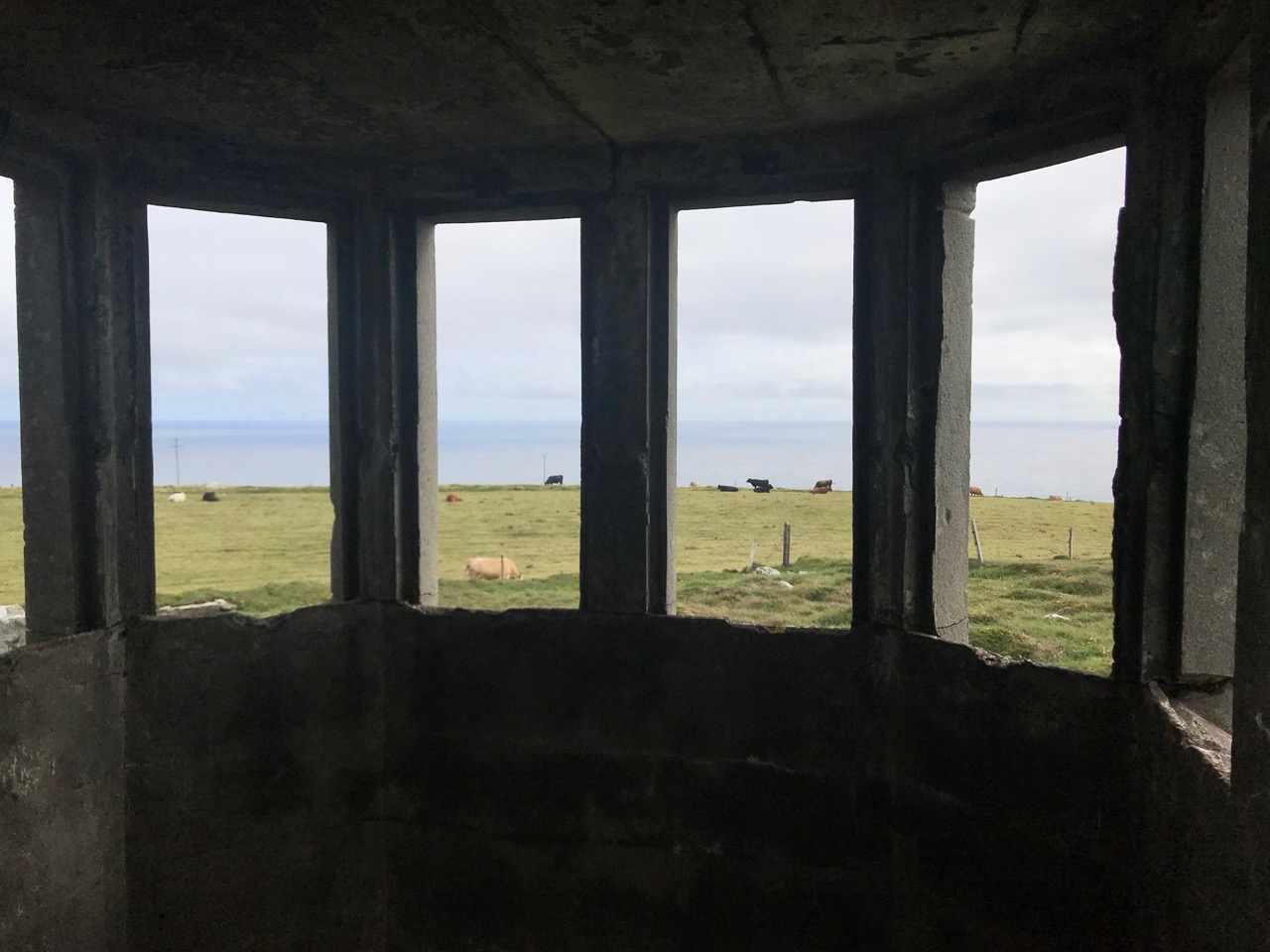
A feature at Cloghane which doesn’t show up on the aerial view is this Second World War lookout post, built close to the early signal tower around 1942. 83 of these structures were built by the Irish Defence Force to monitor activity at sea, many of them relating to Napoleonic-era sites for obvious reasons: these locations had already been selected for their inter-visibility and the panoramic views which they commanded. We have encountered these ‘Emergency-era’ posts previously at Kedge Point, Baltimore, and Ballyroon Mountain, Sheep’s Head (see the full list of links at the end of this post). We shouldn’t get diverted, but if you want to know more about these here is an excellent creative presentation on them carried out in 2014 by Tim Schmelzer of Vienna – particularly, I recommend that you view the first of the videos: it’s wonderful! The LOPs were designed by Howard Cooke RIBA of the Irish Office of Public Works in 1939 and I was fascinated to see that the design achieved recognition (‘posthumously’) from the National Inventory of Ireland Buildings Archive. The posts were cramped, damp and minimal, but apparently at least equipped with small fireplaces:
Mizen Head has drama: there is no land beyond this place until you reach America. And, if you are approaching Ireland from the south or west, Cloghane will be your first landfall. But it’s a dangerous coastline, particularly in stormy weather or at times of poor visibility. Hardly surprising, then, that a fog signal station was established on the furthest point in the early 20th century, under the jurisdiction of the Fastnet Rock Lighthouse. This was initially only a foghorn, powered by explosives: a light was not placed there until 1959.
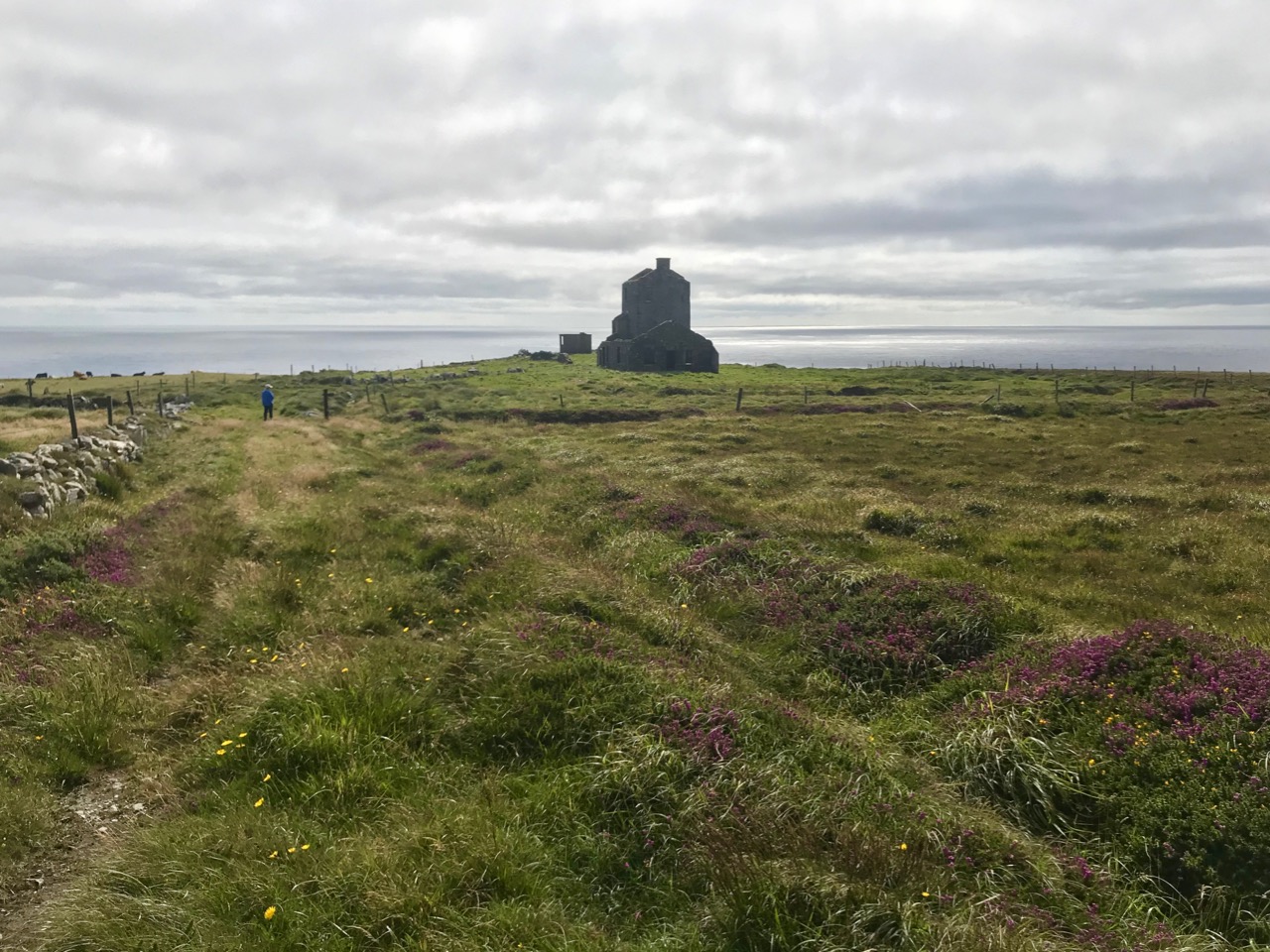
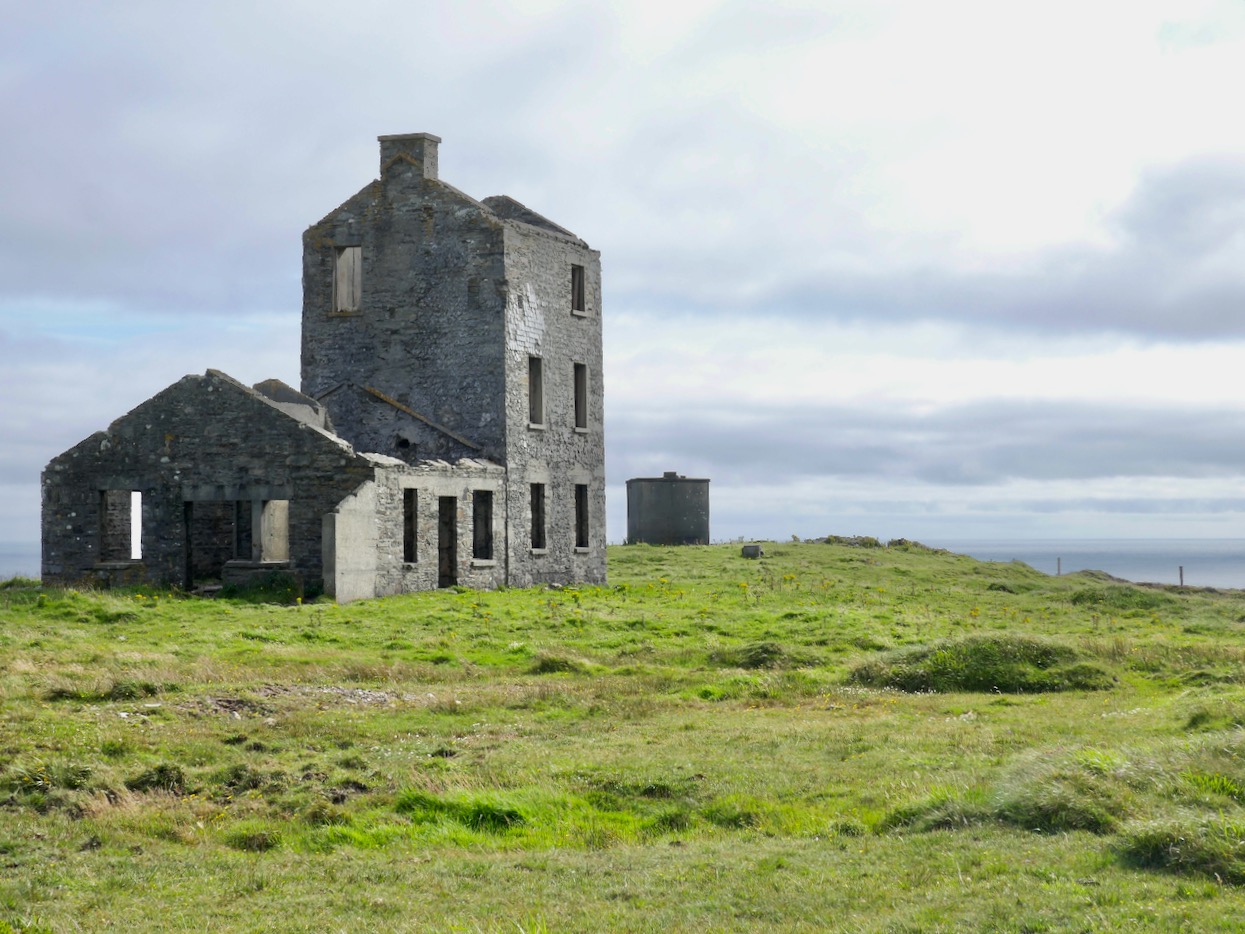
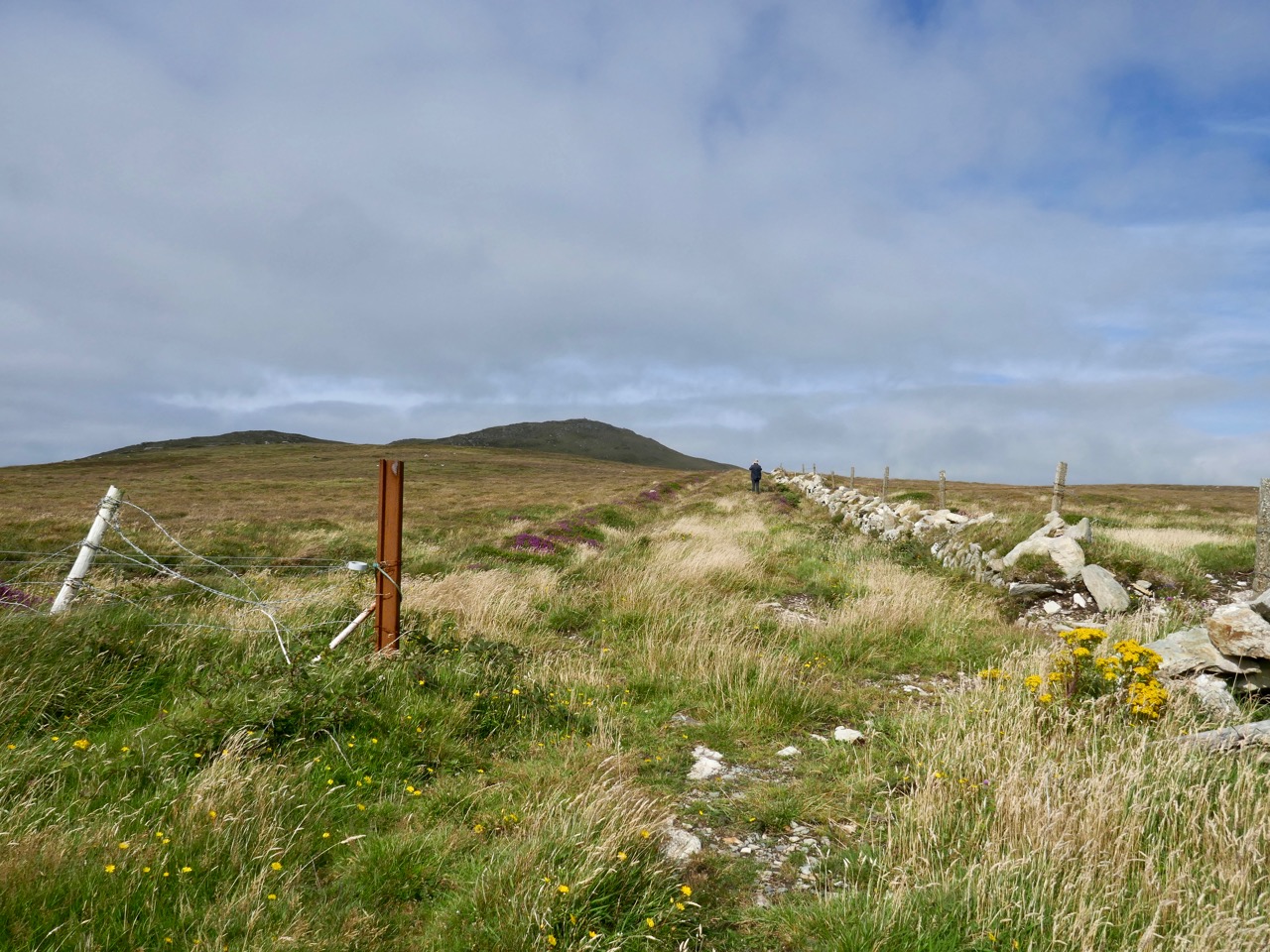
That this signal tower is the virtually identical ‘twin’ of the one we explored at Robert’s Head must be significant, as both are unlike the general pattern we have seen elsewhere: a simple ‘defensible’ structure some 6m square with flat roof, parapets, machicolations and bartizans. My conclusion at Robert’s Head was that the tower had been substantially rebuilt to incorporate upgraded accommodation, perhaps for use by the Coast Guard which was formally established in 1822. Comparing it now with the Cloghane structure it seems more likely that these might both have originated as larger, better appointed buildings. I wonder if this could be because of the relative remoteness of both sites, which would not be easy to populate and service from any nearby community. It was a long trek to Cloghane: the original dedicated trackway, some 2.7 km long is still defined on the landscape, and passes under the 232m high Mizen Peak.
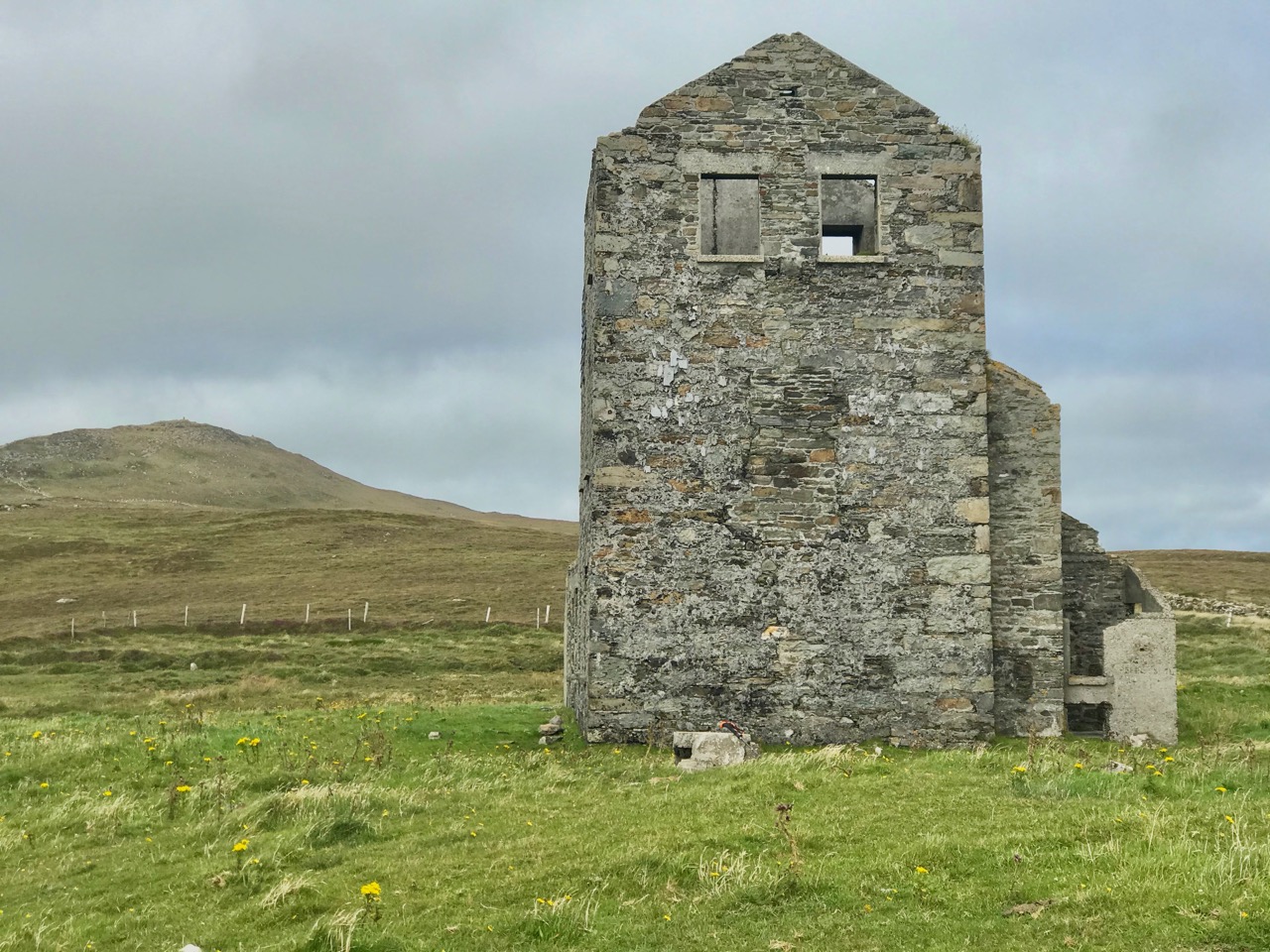
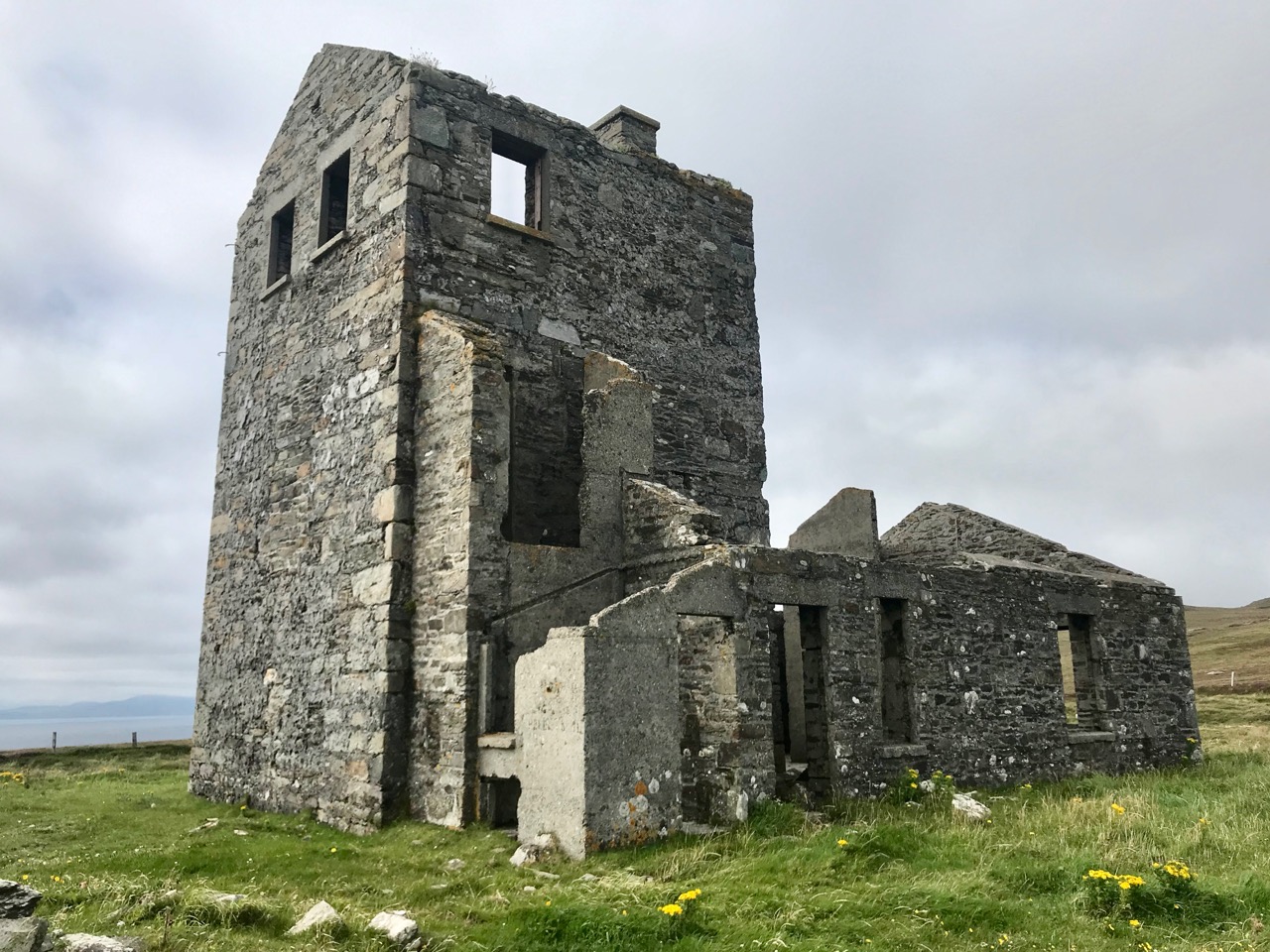
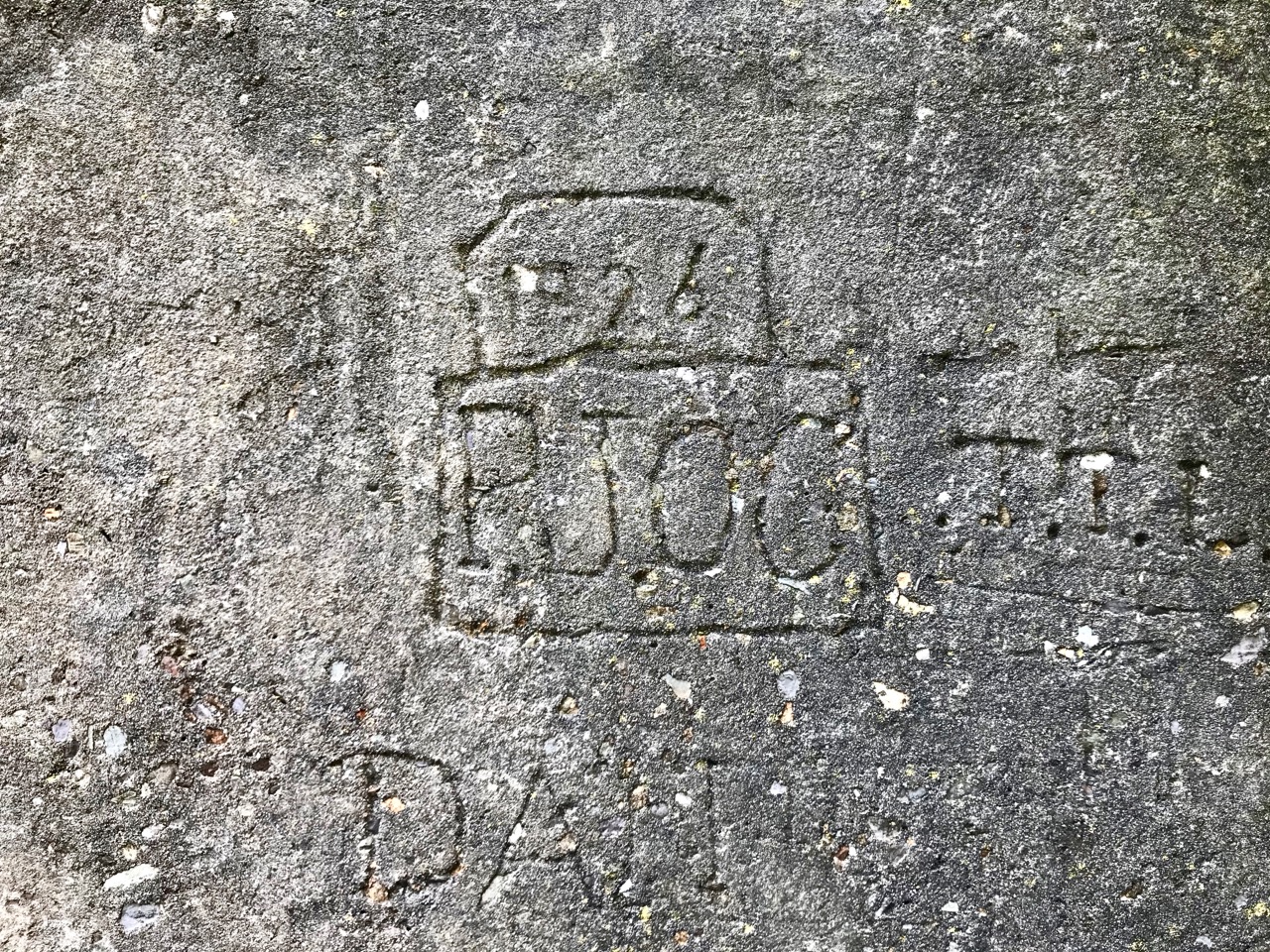
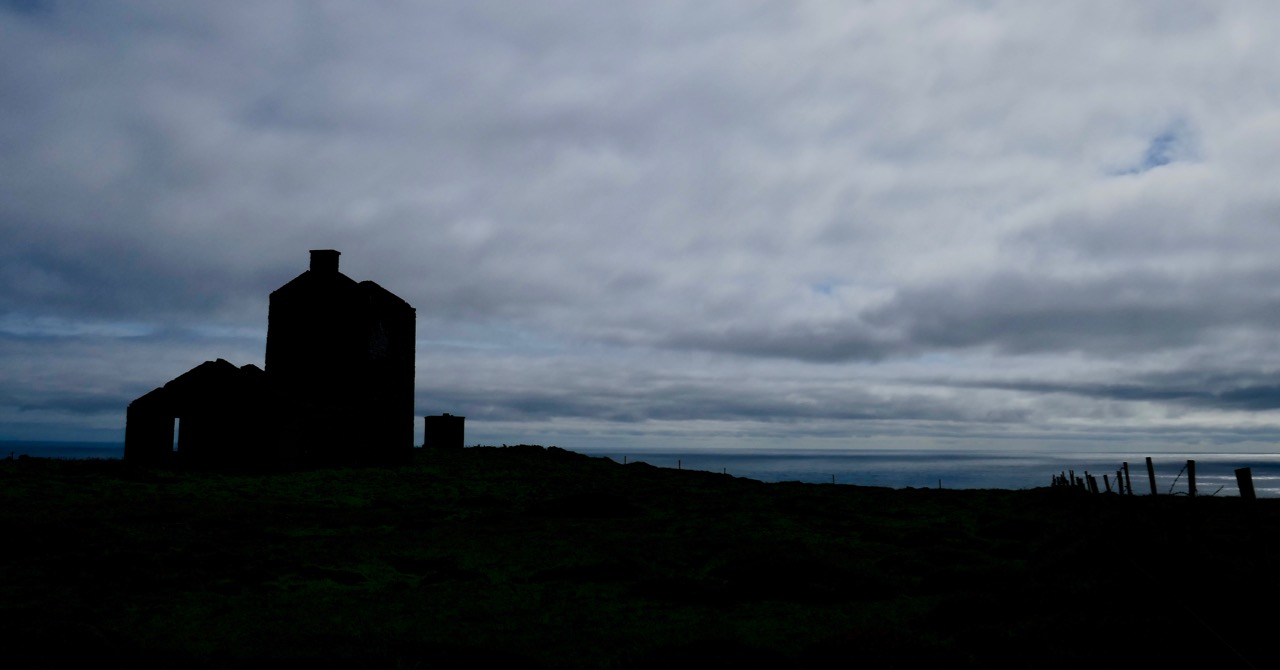
The signal tower at Cloghane is in reasonable condition considering its age and the long period of abandonment (many of the towers went out of use after 1812 although some – possibly including this one – were revived and adapted for use by the Coast Guard). Many visitors have left their marks over the years, and some of the graffiti is intriguing! There is also some vestige of the timber casement frame remaining in one of the window openings: surprising considering the level of exposure to severe storms at this remote site.
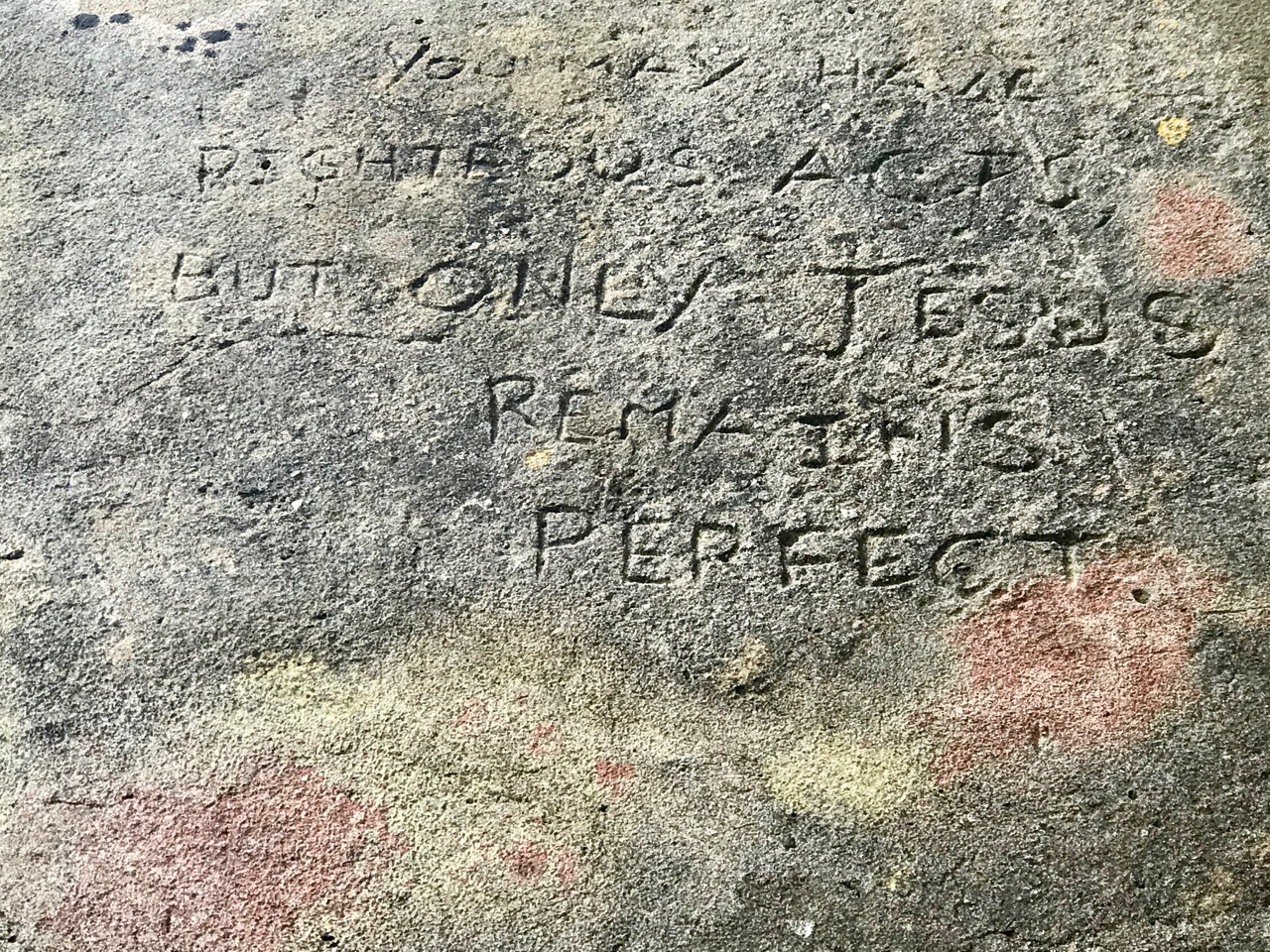
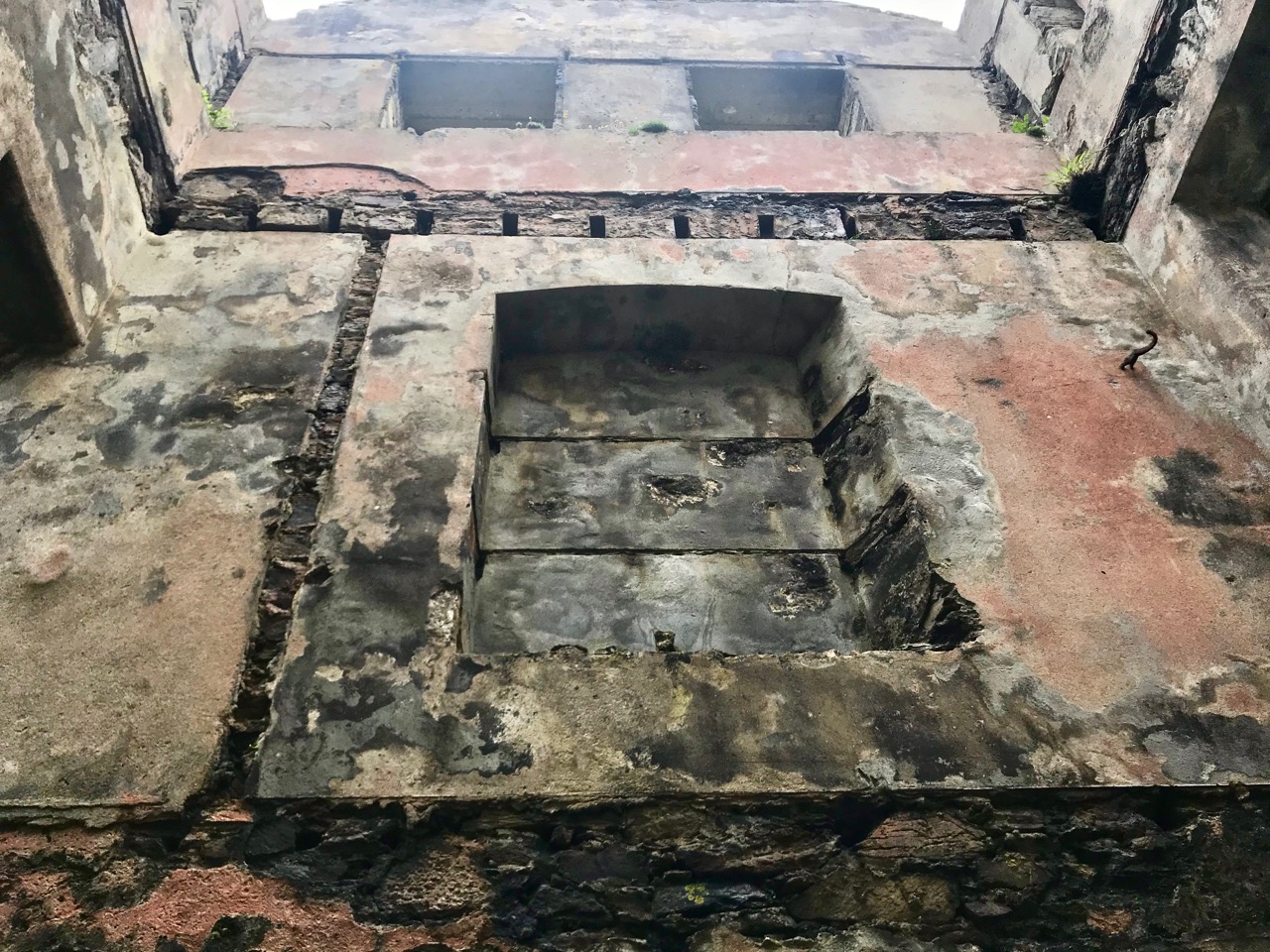
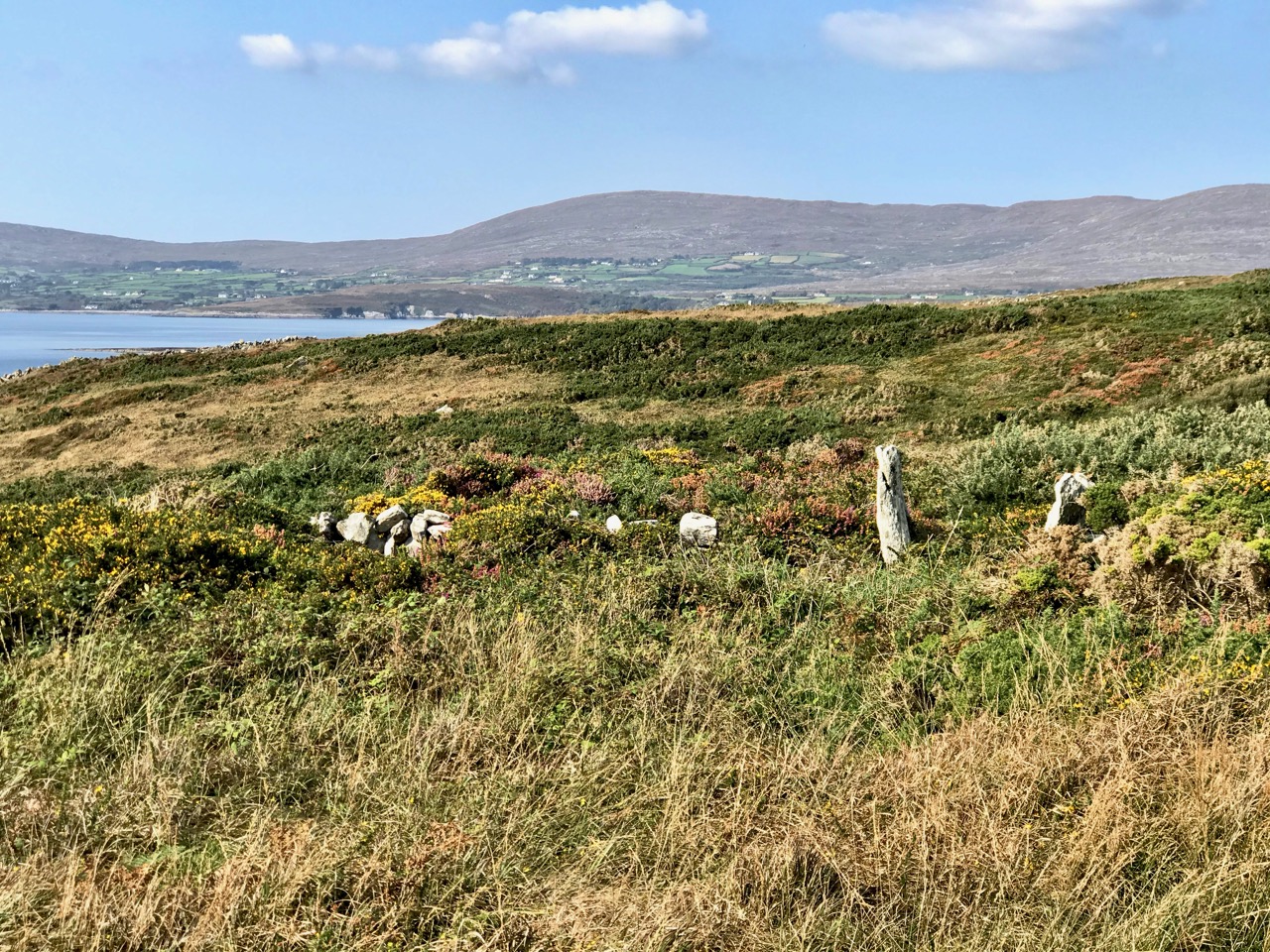
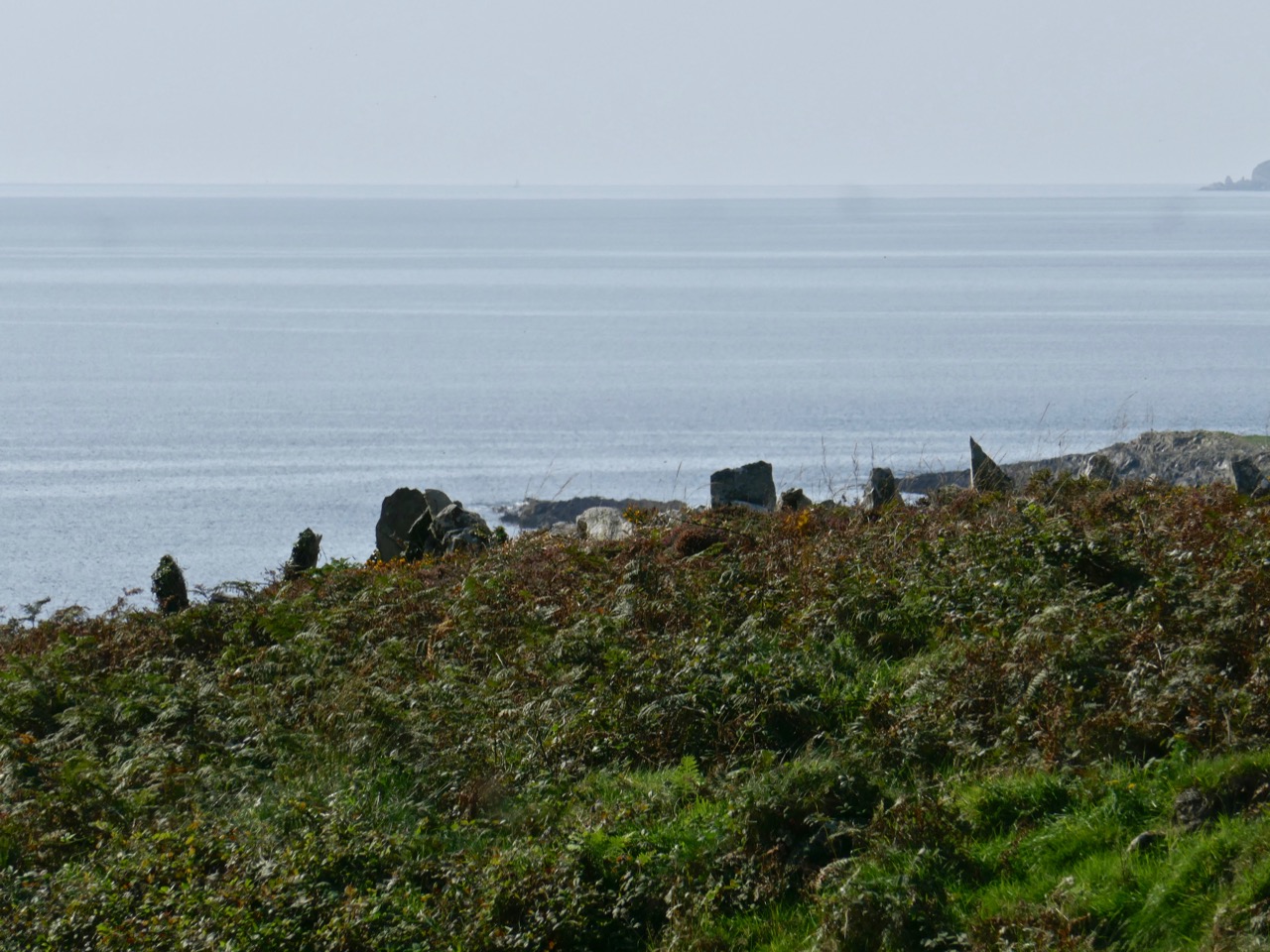
There’s a conundrum at this site that I want to share with you. A little distance to the south of the signal station building is a grouping of stones which are easy to miss at first glance, Have a closer look:
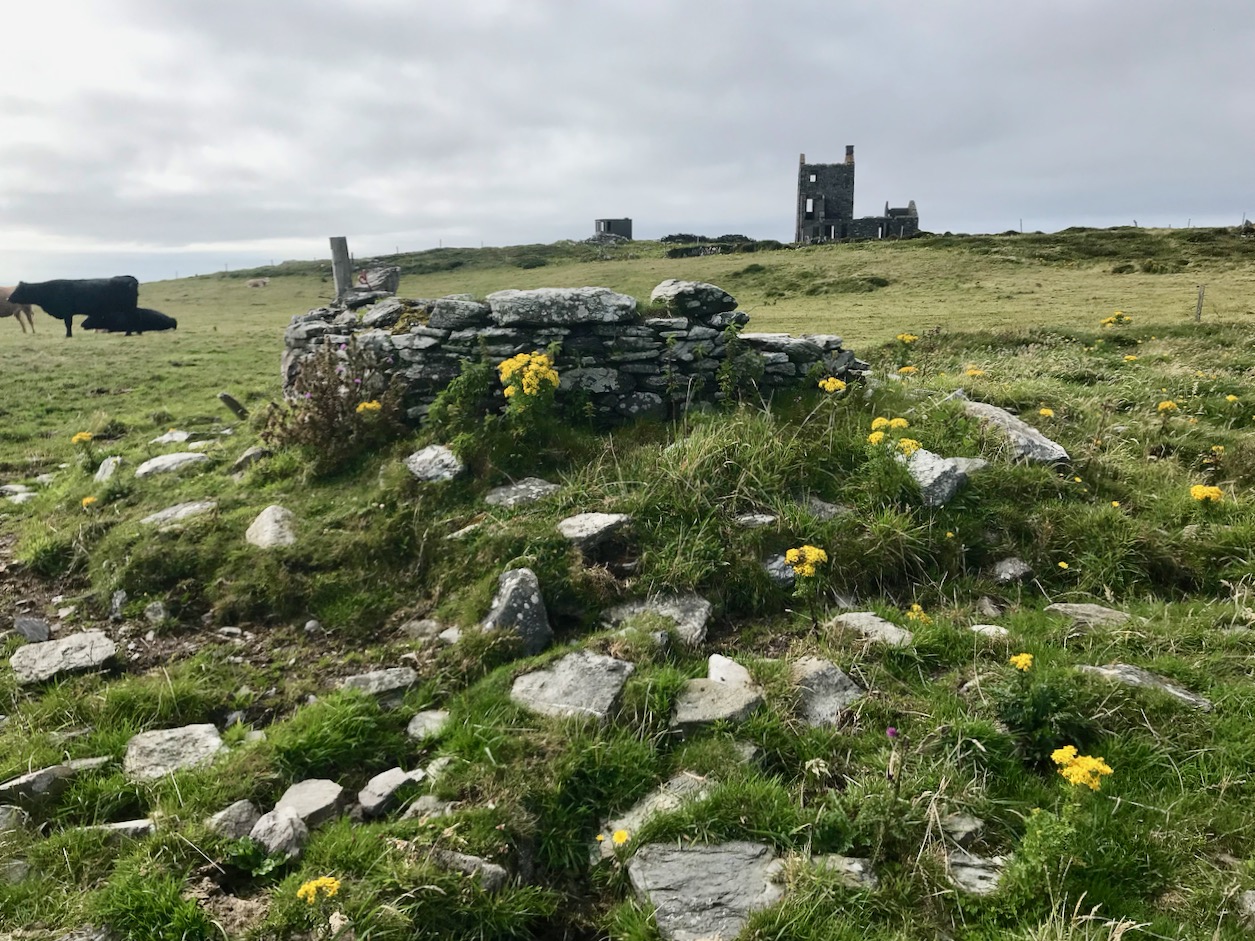
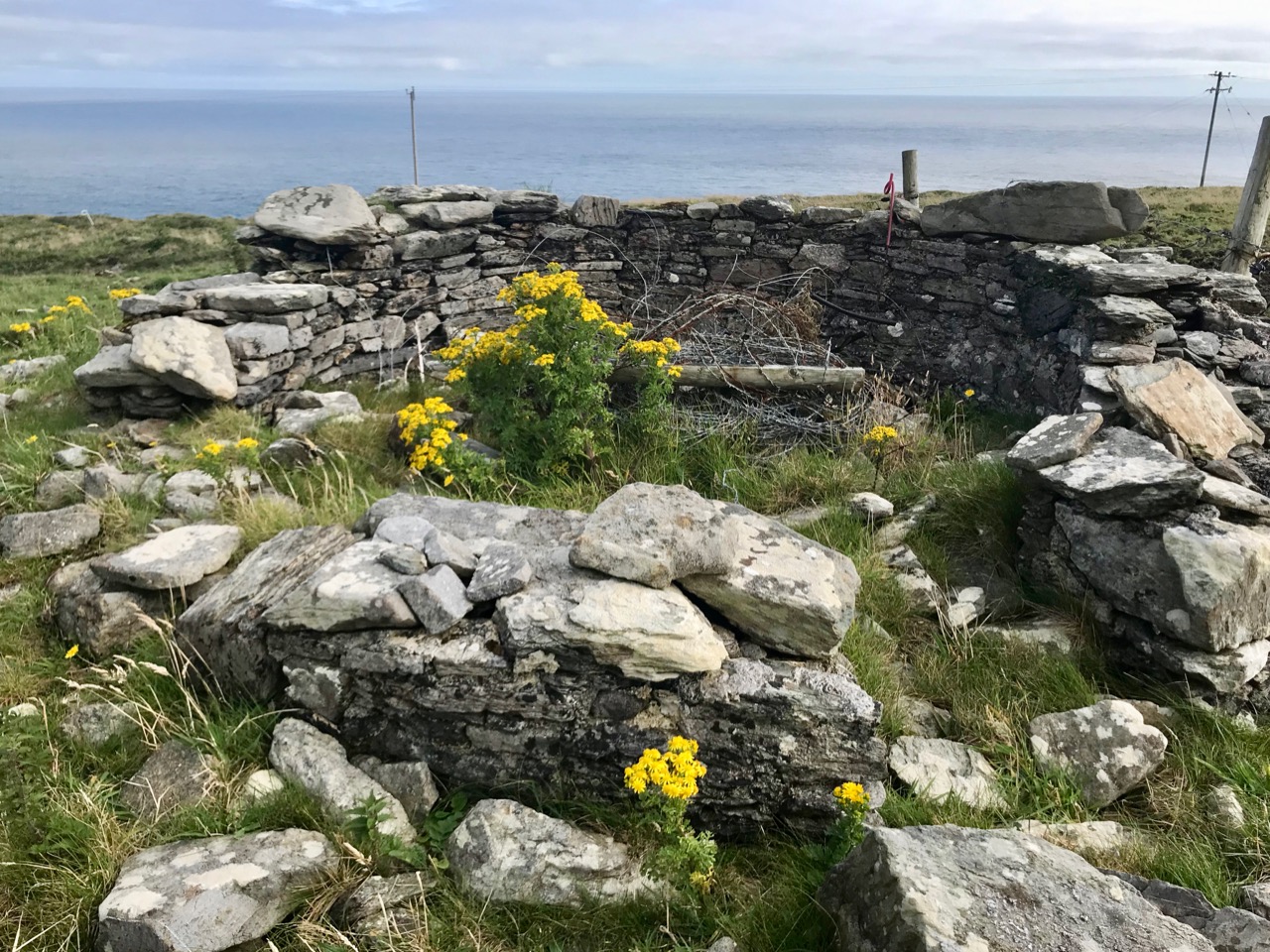
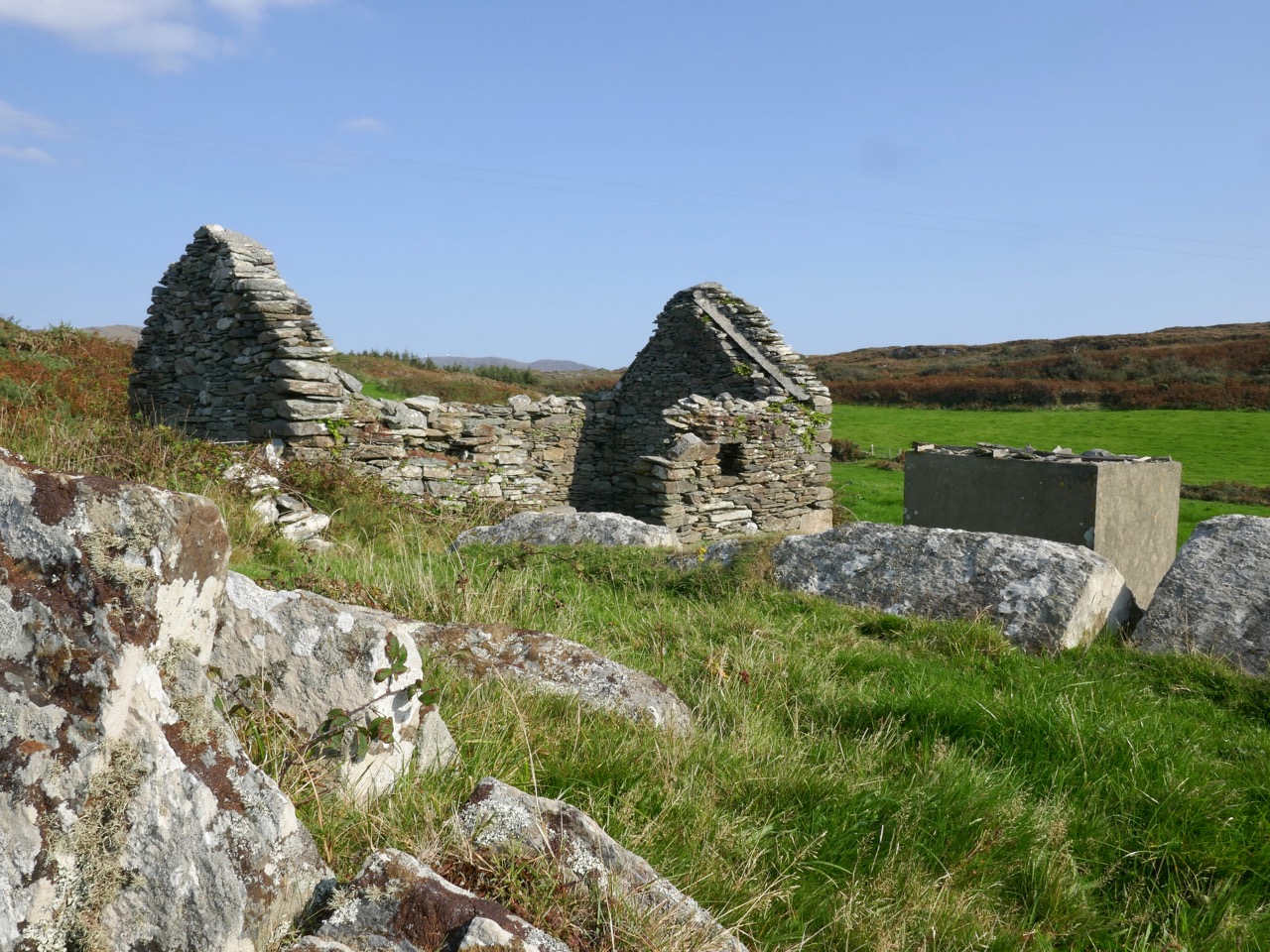
It’s the base of a circular building, or enclosure – a few metres in diameter. Archaeologists amongst you might think in terms of round towers but we can discount that in this desolate location. It does not seem to relate to the signal station buildings, either in terms of architecture (it gives the impression of being rougher and, perhaps, earlier) or usage. With regard to its age, it shows up as a feature on the early 6″ Ordnance Survey map:
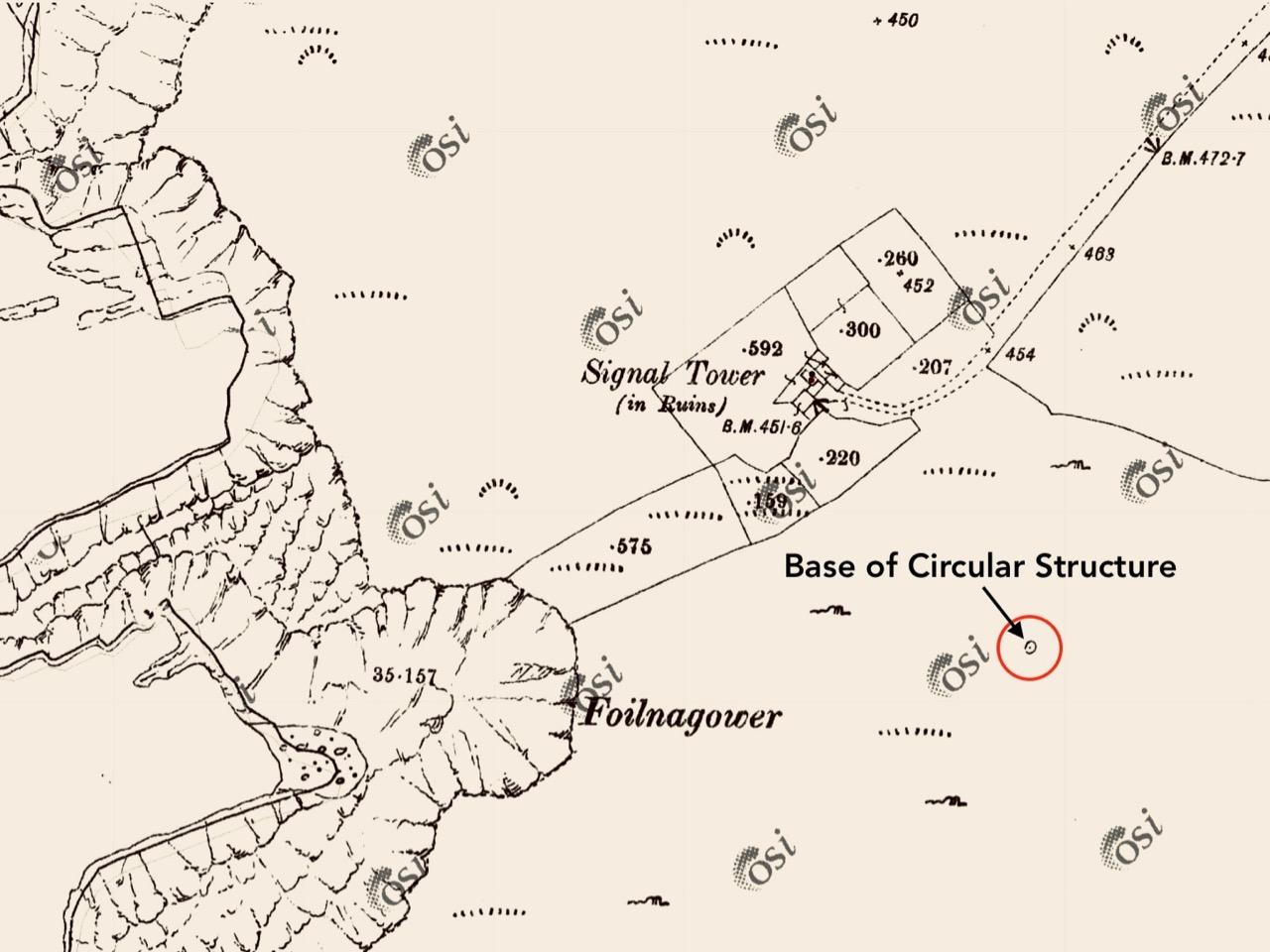
What might it be? A mine chimney? But the Mizen Head Copper Mine was a long way from here (refer to the annotated aerial view). The size and shape resemble a gunpowder magazine which we came across at Dhurode Mine, on the north side of the peninsula. The only reason for having a gunpowder store at a signal station would be for a fog signal operated by explosives, as was the case at the Fog Signal Station lower down the Head, built in the early twentieth century. This is clearly much earlier. The dreamer in me pictures, rather, a hut lived in by a medieval hermit, supported by a local monastic settlement to keep beacons burning on Ireland’s headlands in perpetuity. Like the round towers, these were signals to travellers in ancient times that here might be found a haven. For seafarers, perhaps, this one signalled the gateway to a fertile land of enlightenment.
The previous posts in this series can be found through these links:

Part 1: Kedge Point, Co Cork

Part 2: Ballyroon Mountain, Co Cork

Part 3: Old Head of Kinsale, Co Cork
Part 4: Robert’s Head, Co Cork
Part 5: Downeen, Co Cork
Part 6: Dunnycove

Mizen Magic 19: Church of the Angels

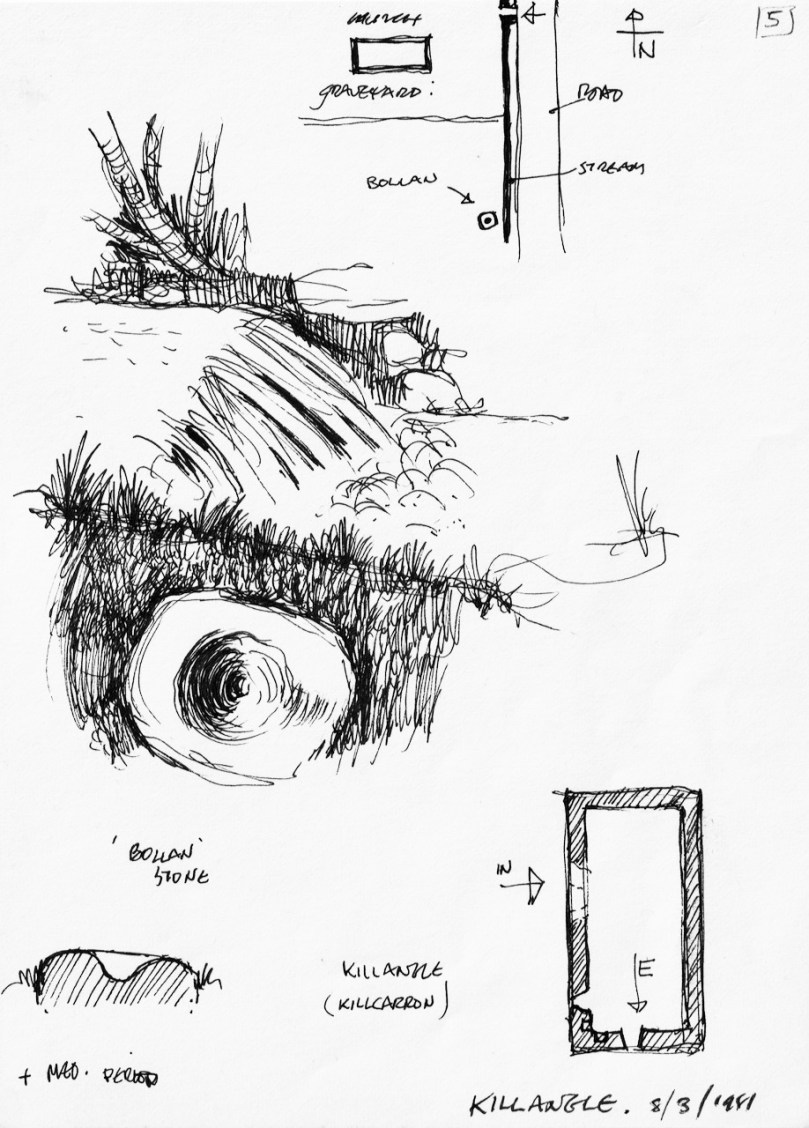
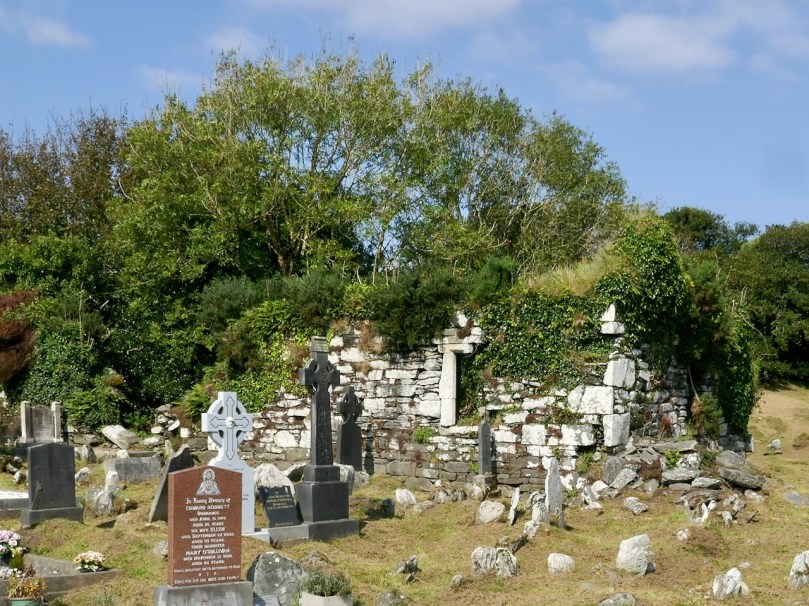
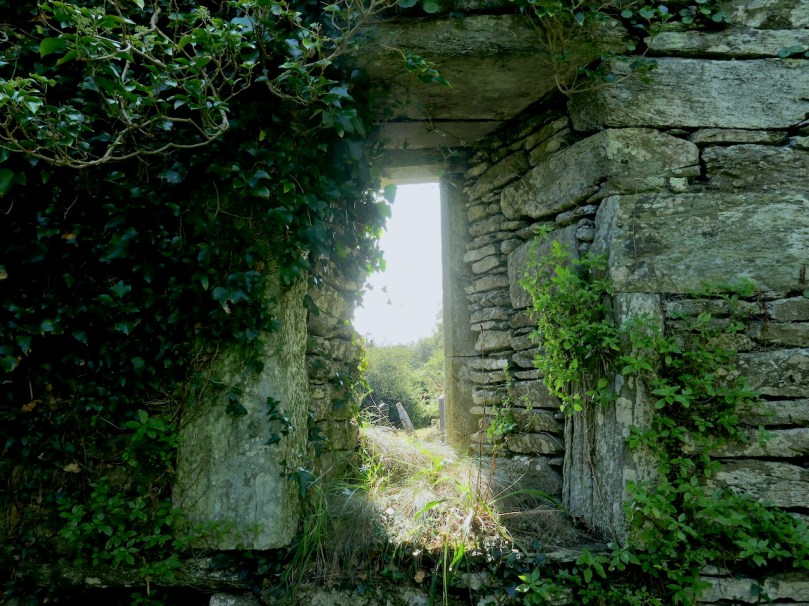
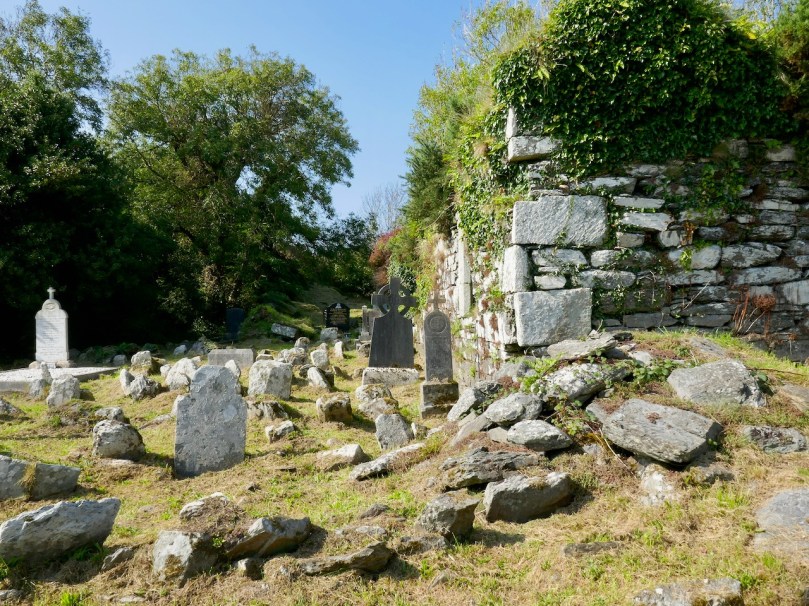
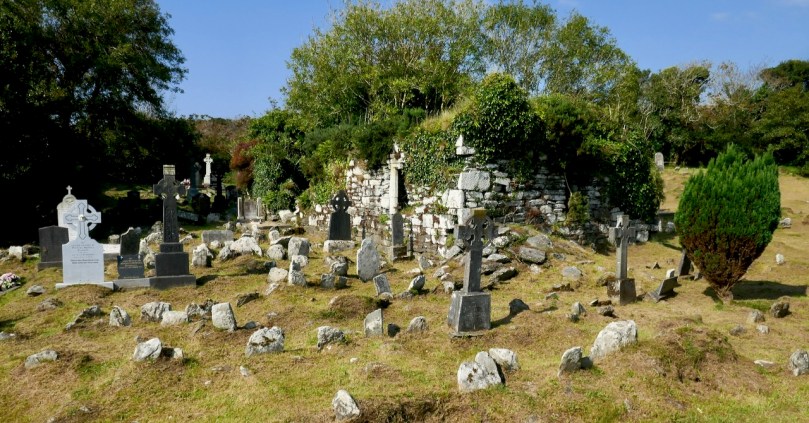
It’s called Cill Cheangail but that doesn’t make a lot of sense as cill is a small church and ceangail means to tie or fasten. But hereabouts people call it Killhangle (sometimes spelled Kilheangul) and now it’s clear – aingeal (pronounced angle) is the Irish word for angels. This is the Church of the Angels, reckoned to be Late Medieval (maybe fifteenth century) in date. For the exact location of this church, see my post Mizen Magic 17: The Delights of Dunmanus.

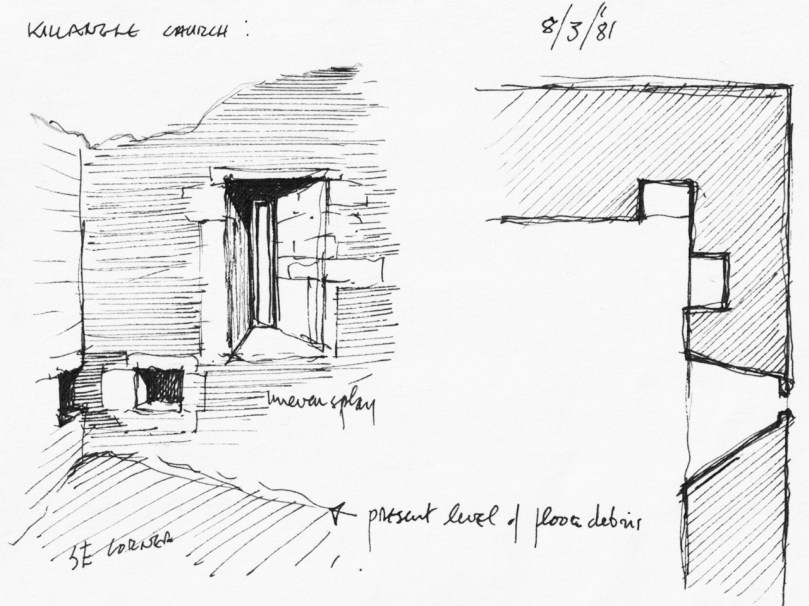
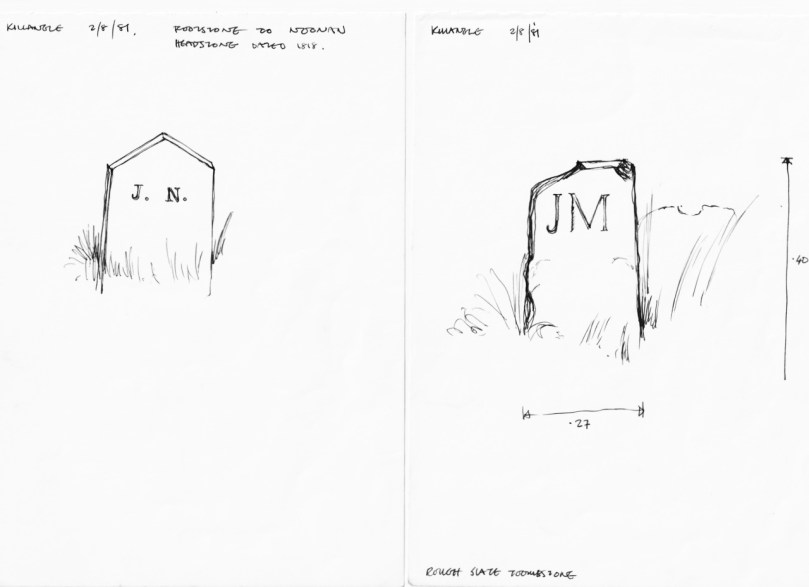
I am lucky to have Brian Lalor’s Sketchbook – quick records he made of his visits to  sites during field trips with the Mizen Historical and Archaeological Society in the 1980s. This kind of record is invaluable to show changes over time – the bullaun stone that Brian records in his sketch above can no longer be found.

Parish Churches, that is, churches built specifically to serve the people of the neighbourhood, rather than churches in monasteries to serve monks or friars, are a medieval phenomenon in Ireland. Along with the building of these churches came the practice of burial inside the church (for high-status individuals) or outside it (for the rest of us). Many of these burial grounds are in use up to the present day.

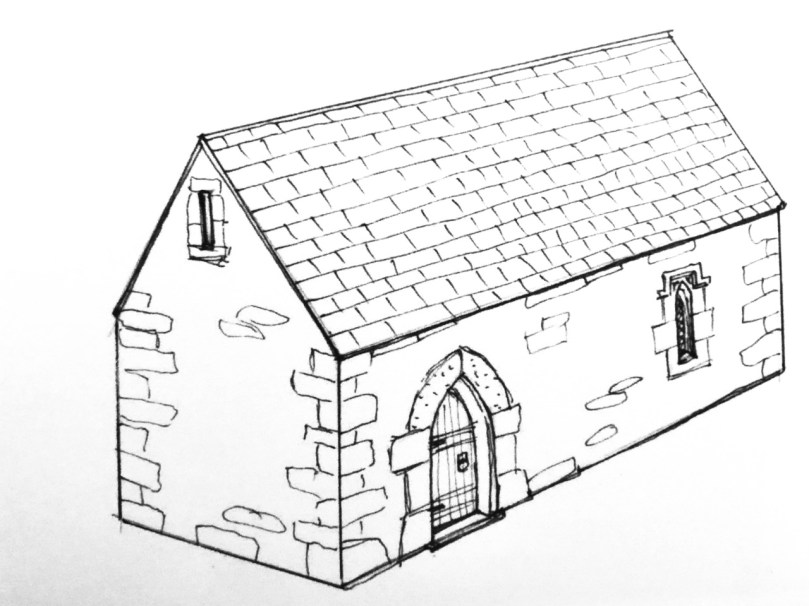
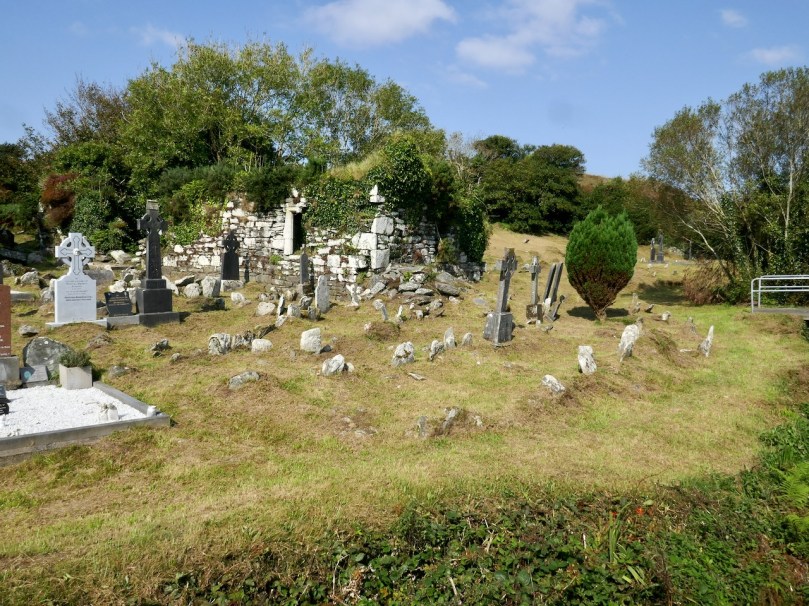
The church itself is in a ruinous state but enough remains to see some of typical attributes of a small parish church of this time, such as the one in the illustration (not by Brian) above. It’s a simple rectangular structure, oriented E-W, with the door in the south wall. Several small aumbreys (cupboards) are built into the south and east wall. There’s a window in the east wall which is missing almost all its dressed stone surround but we can surmise that it may have been ogee-headed.

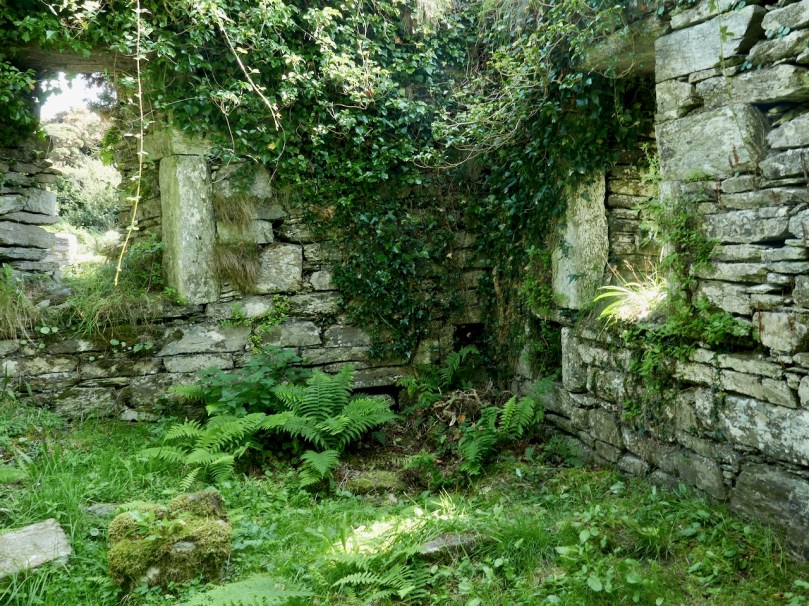
The other window is in the south wall and this is an interesting one – there’s a flat-headed lintel visible from outside and inside the embrasure is splayed unevenly to admit more morning light, especially in winter.

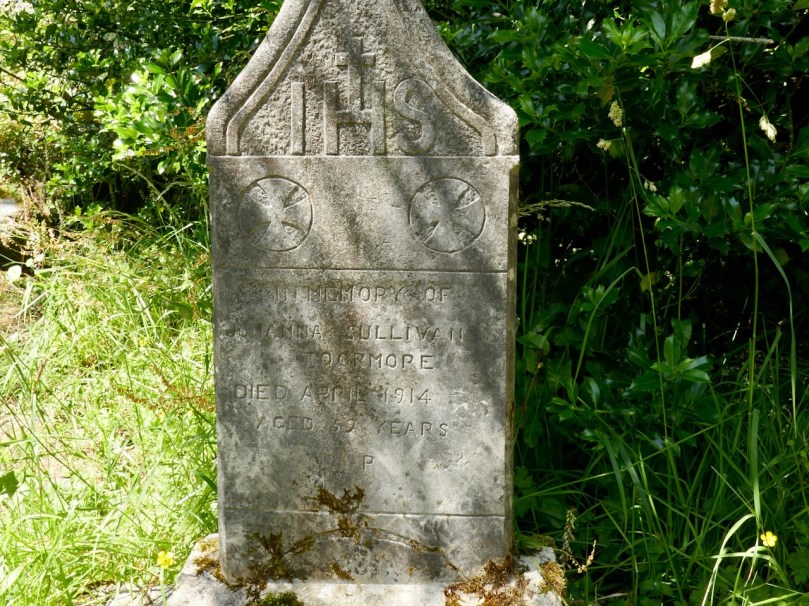
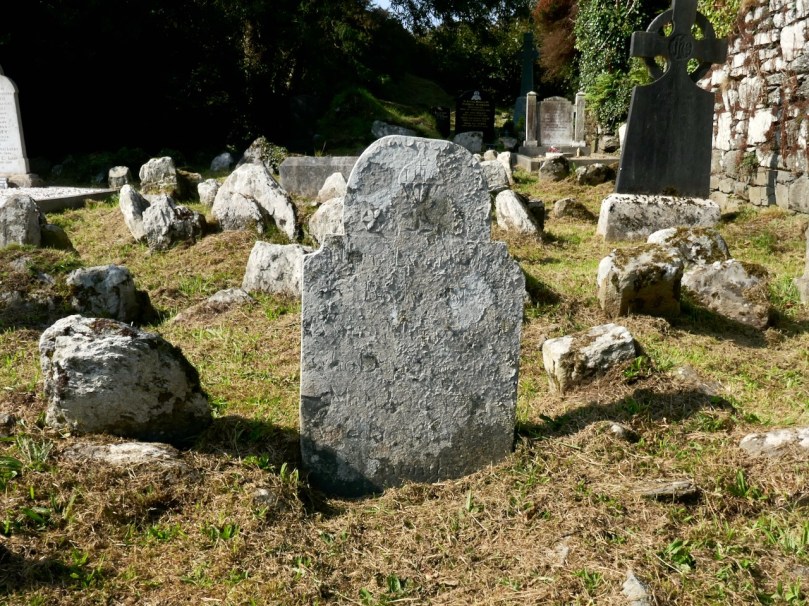
Most of the interior is filling up now with debris and a large holly tree and only one headstone is examinable. The style of this headstone is echoed in others outside, leading to the conclusion that it was the shape and decoration style favoured by a certain local stone carver. It’s quite a striking and elegant form.

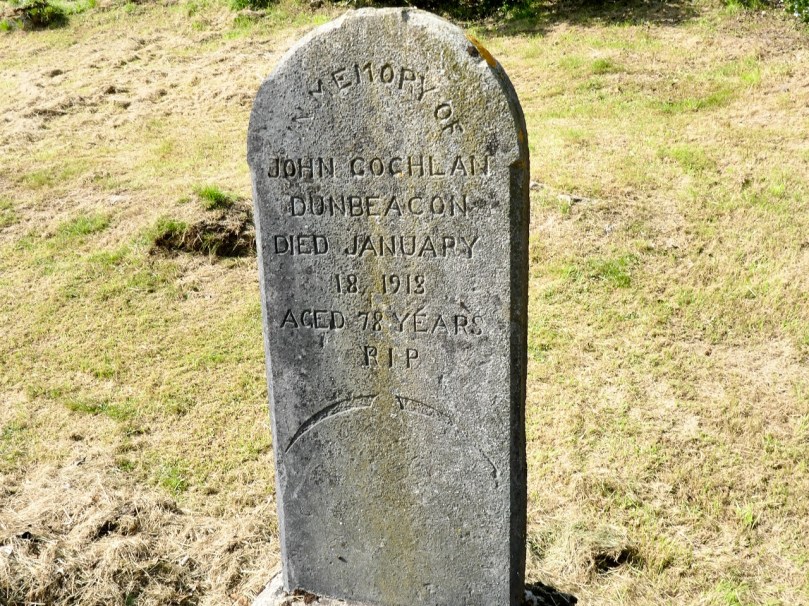
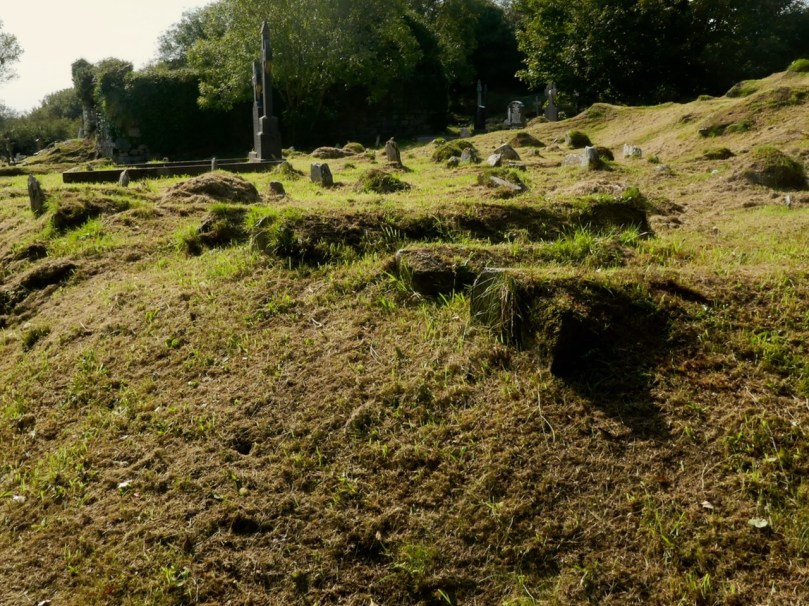
Most of the people buried in Killhangle could not afford a carved headstone. Instead, graves were marked with simple field stones. We are told that in times past old people could pick out the grave of a long-gone relative from a memory still held in the family of the size and shape of such field stones.

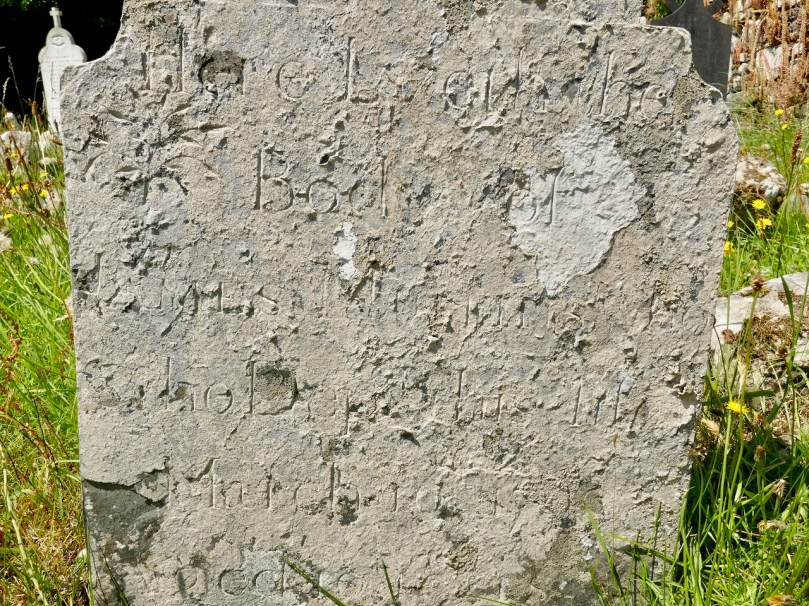
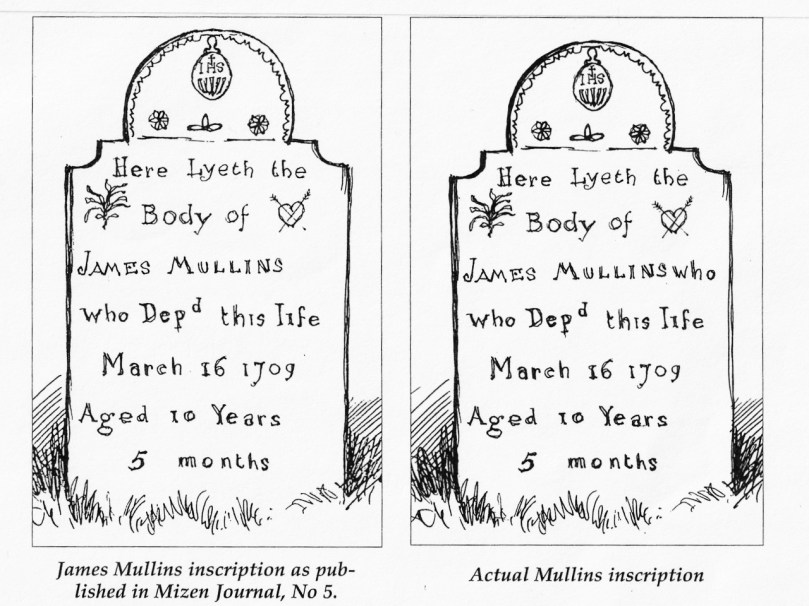
Inscribed headstones, for those who could afford them, did not become commonplace until the 18th century. Headstones dating to the 1700s are actually fairly unusual in West Cork so when Brian deciphered one in Killhangle, he recorded it (not an easy task – see how much lichen covers the surface now) and wrote up his findings for the Mizen Journal.
Alas, an eagle-eyed editor thought he had made a mistake in his drawing, by including the word ‘who’ twice and took it upon him/herself to eliminate the first ‘who’. This led to a second article titled ‘James Mullins Who Who” in which Brian restored the missing who and explained that Seventeenth and early eighteenth-century English usage on tombstone inscriptions favoured elaborate and often tortuous abbreviations and word arrangements in order to balance the lines of the inscription.

Poor little James was only 10 when he died on the eve of St Patrick’s Day in 1709. He must have been beloved indeed – a headstone all to himself when most people had none.

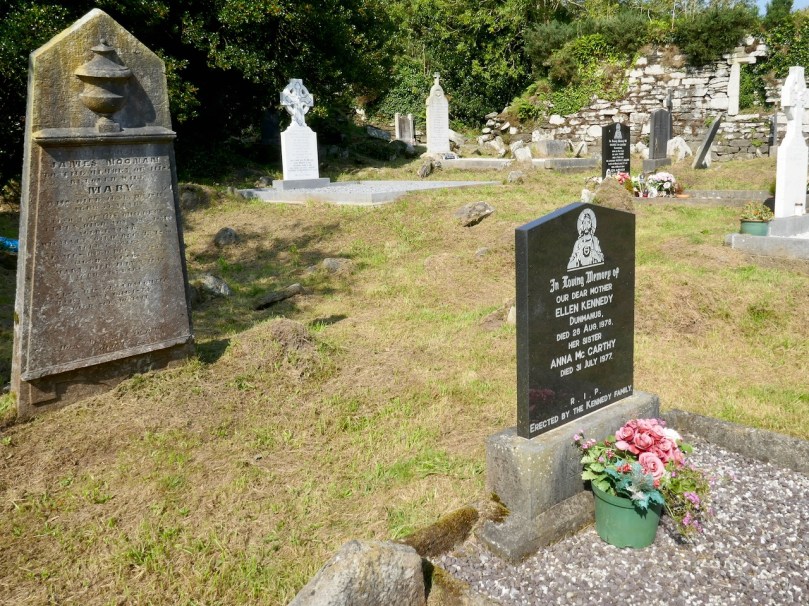
Another practise seen in Irish gravestones is the carved footstone. Where the footstone is engraved, it is usually with the initial of the person named on the headstone. In the example above and below, James Noonan first buried his beloved wife Mary. When he was laid to rest, his footstone was added, with his initials, J. N.  You can see the footstone at the bottom of my photograph, and Brian has illustrated it below along with another one with the initials J M.

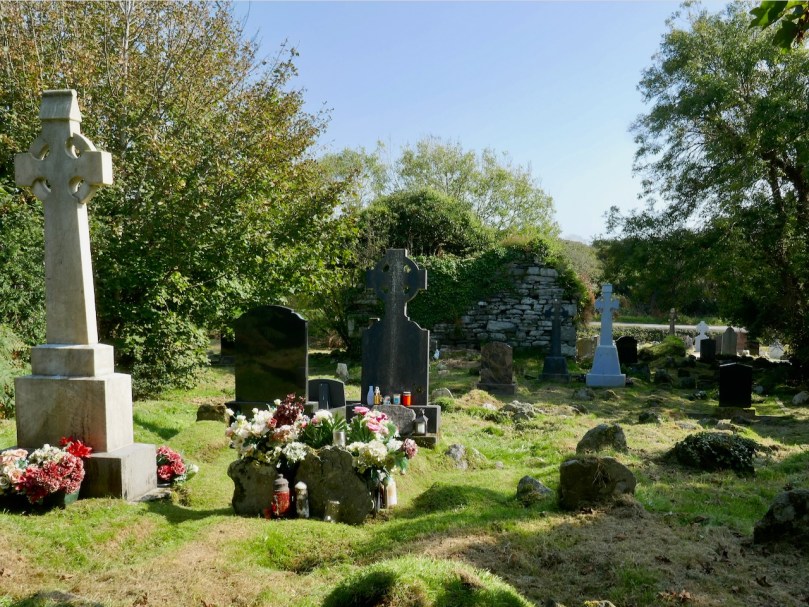
Killhangle is beautifully located, near the coast and with a rippling brook running through it. It is well looked after and several of the graves have flowers and evidence of recent visits.

It is obvious that local people respect and care for the last resting place of their family members. For them, this church truly is the Church of the Angels.

Thank you, Brian Lalor, for allowing me to use your sketches and pick your brains.

Mizen Magic 20: Ballyvonane Headland

Twenty Mizen Magic posts . . . The whole of the Mizen is magic and magnificent – at all times, in all seasons. It doesn’t matter where we go, we will find things to photograph and write about: landscape, history, the remnants of lives lived generation after generation, and new life – art, creativity. We have on our doorstep a cornucopia – an inexhaustible resource.

In late September, close to the autumn equinox, Nature has chosen to be compassionate to the human denizens of West Cork. In these benighted Covid times we are having exceptional long, warm and calm days, inviting us to take to the hills and headlands to shake off the wretchedness of bad news and the miasma of melancholy that it might bring. We in the far west remain free to roam unfettered, for now, and Roaringwater Journal is committed to bringing you the good news of fresh pathways to be trod and fine vistas to be unfolded.

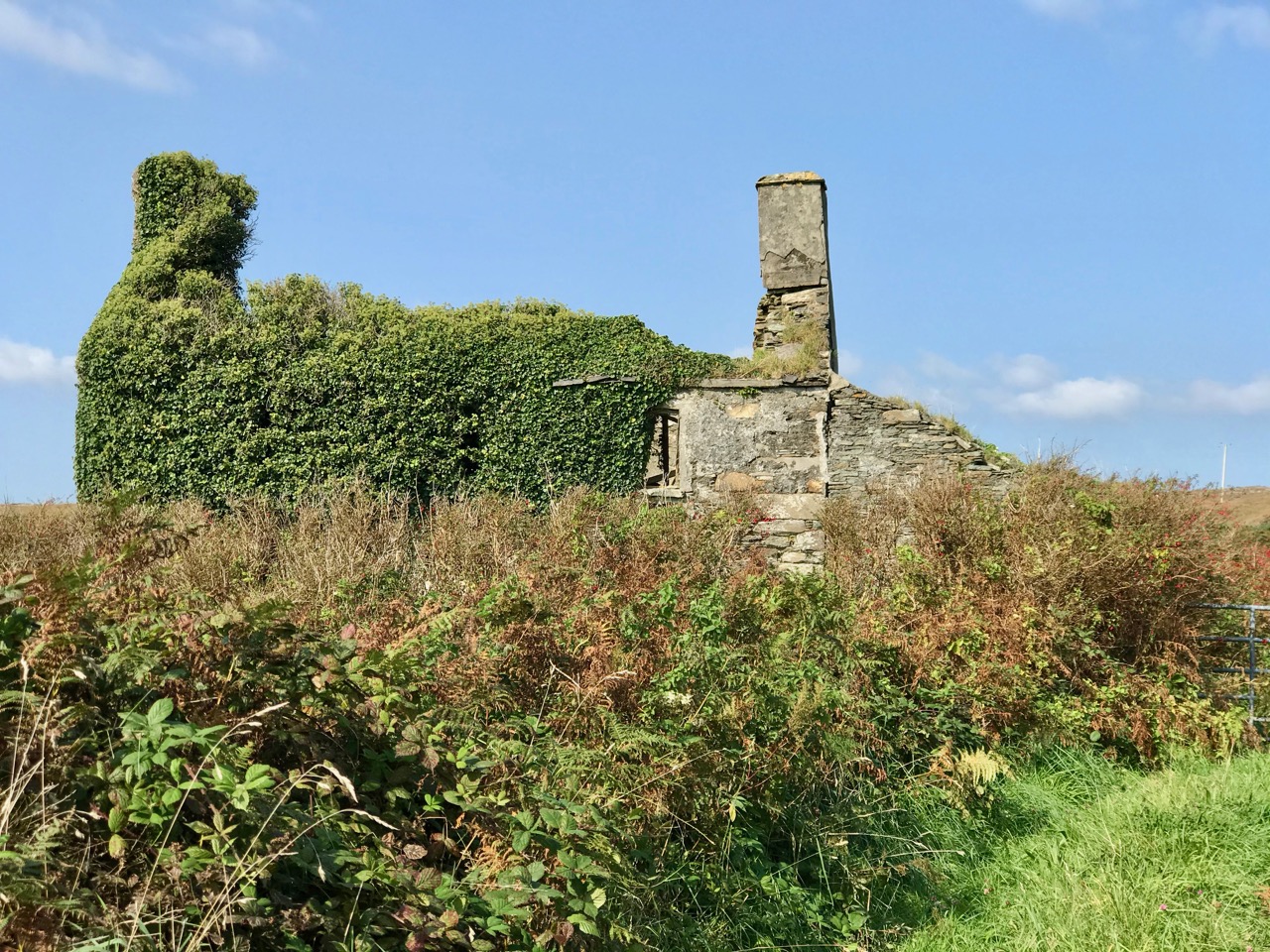
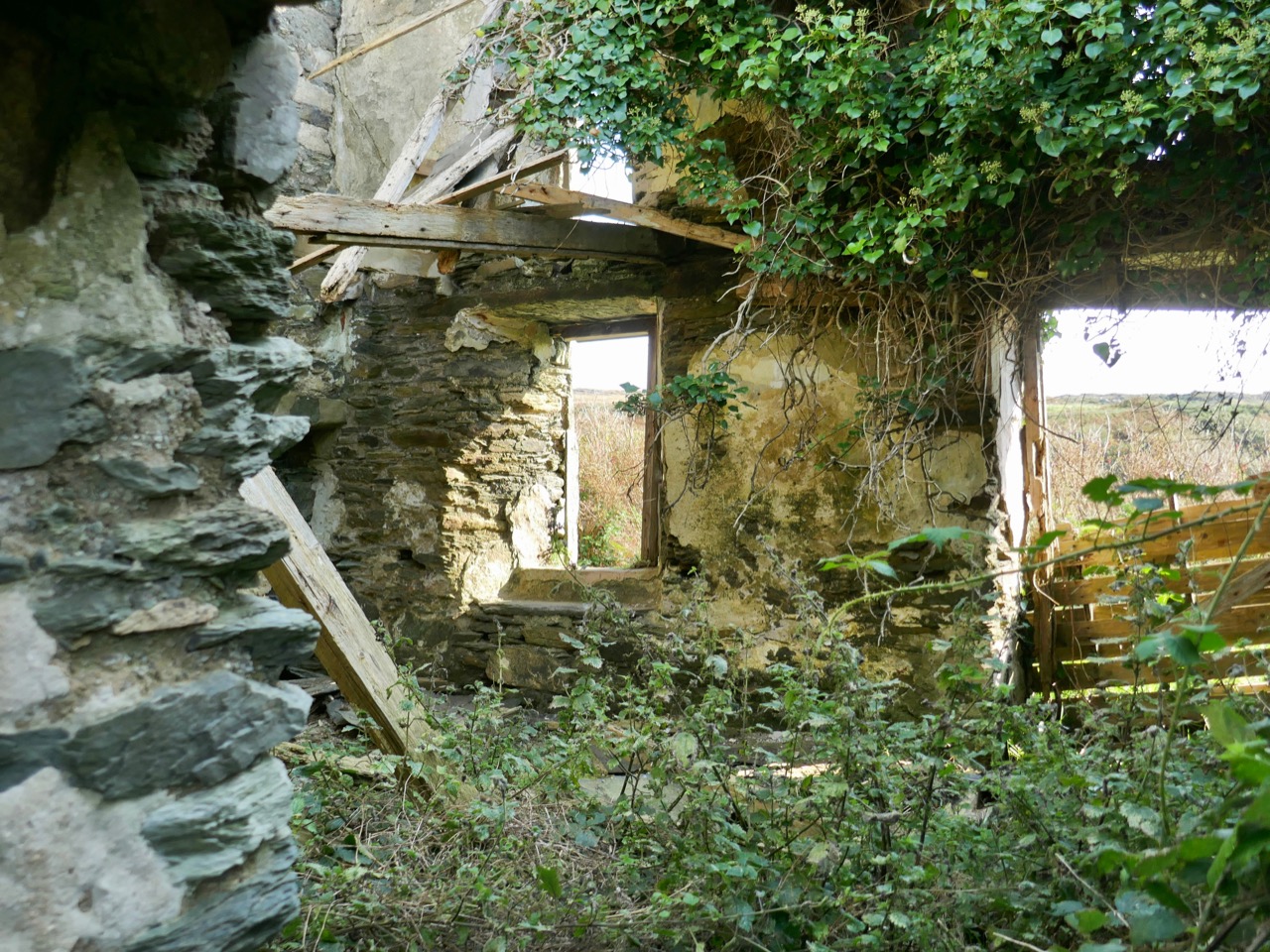
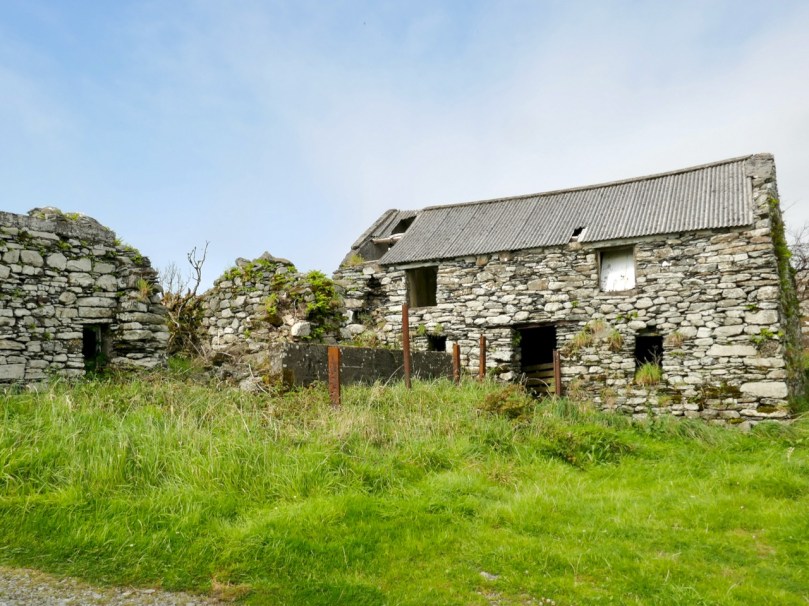
At the beginning of the track is this imposing ruin: we wondered when it had last been occupied

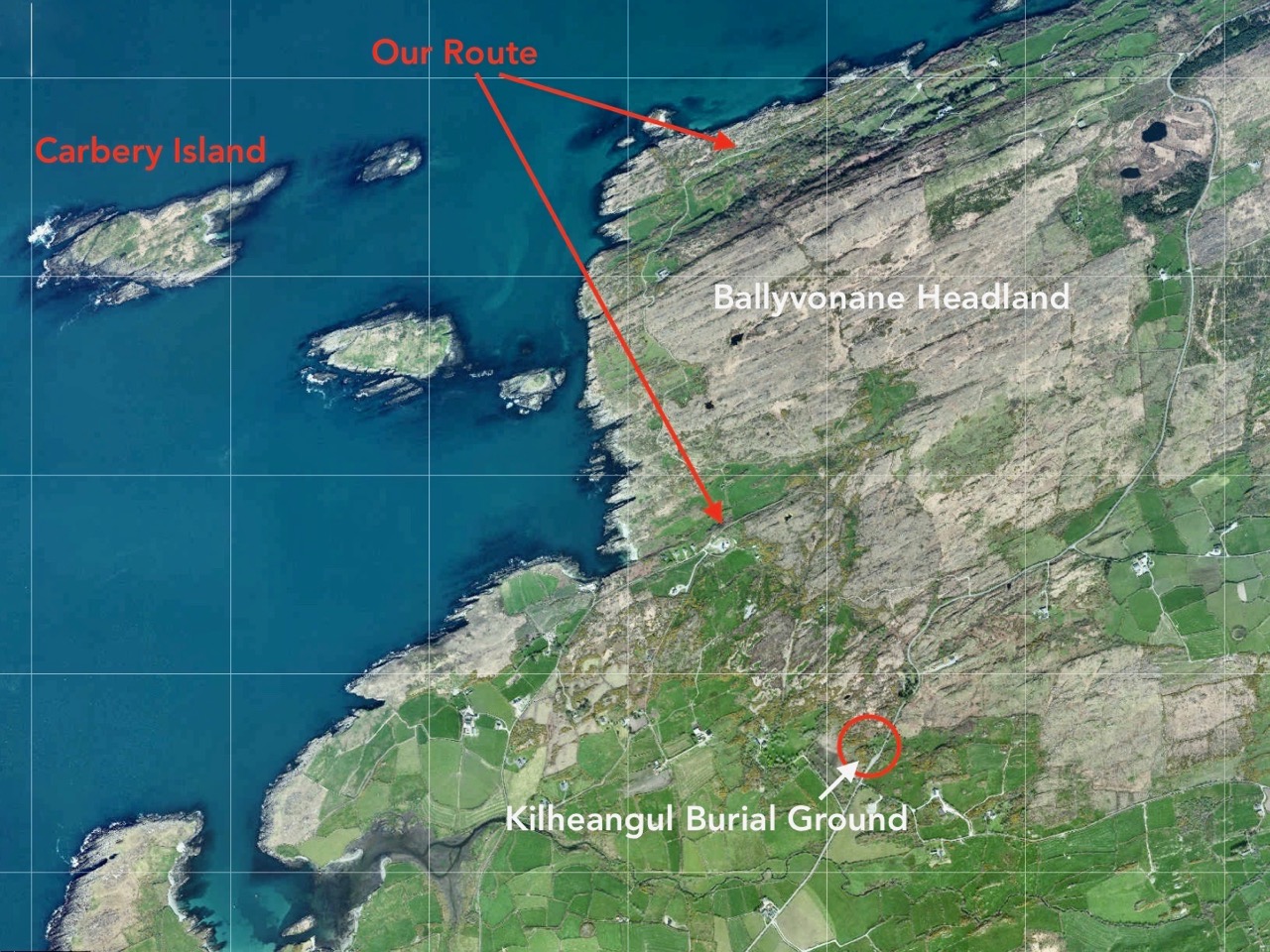
Today we thought we’d finish something we started back in February: Delights of Dunmanus described how we set out to walk a trackway marked on the map going over the headland in the townland of Ballyvonane. In fact we didn’t make it: winter storms had flooded our way near the start of the track and – after getting hopelessly lost trying to go around the flood we had to give up. Finola graphically set out our probable route on that day (in blue – we were aiming to take the red path!)

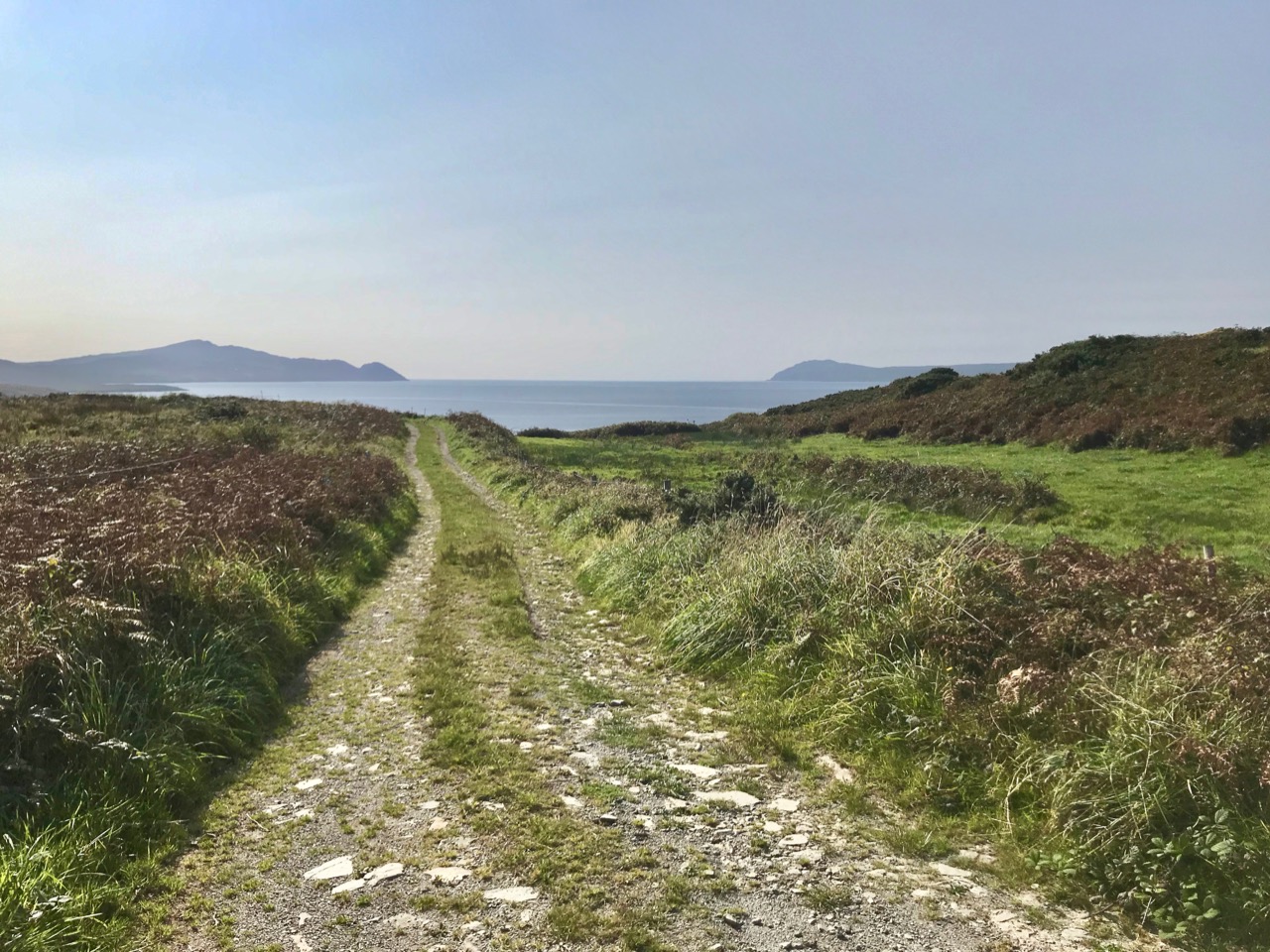
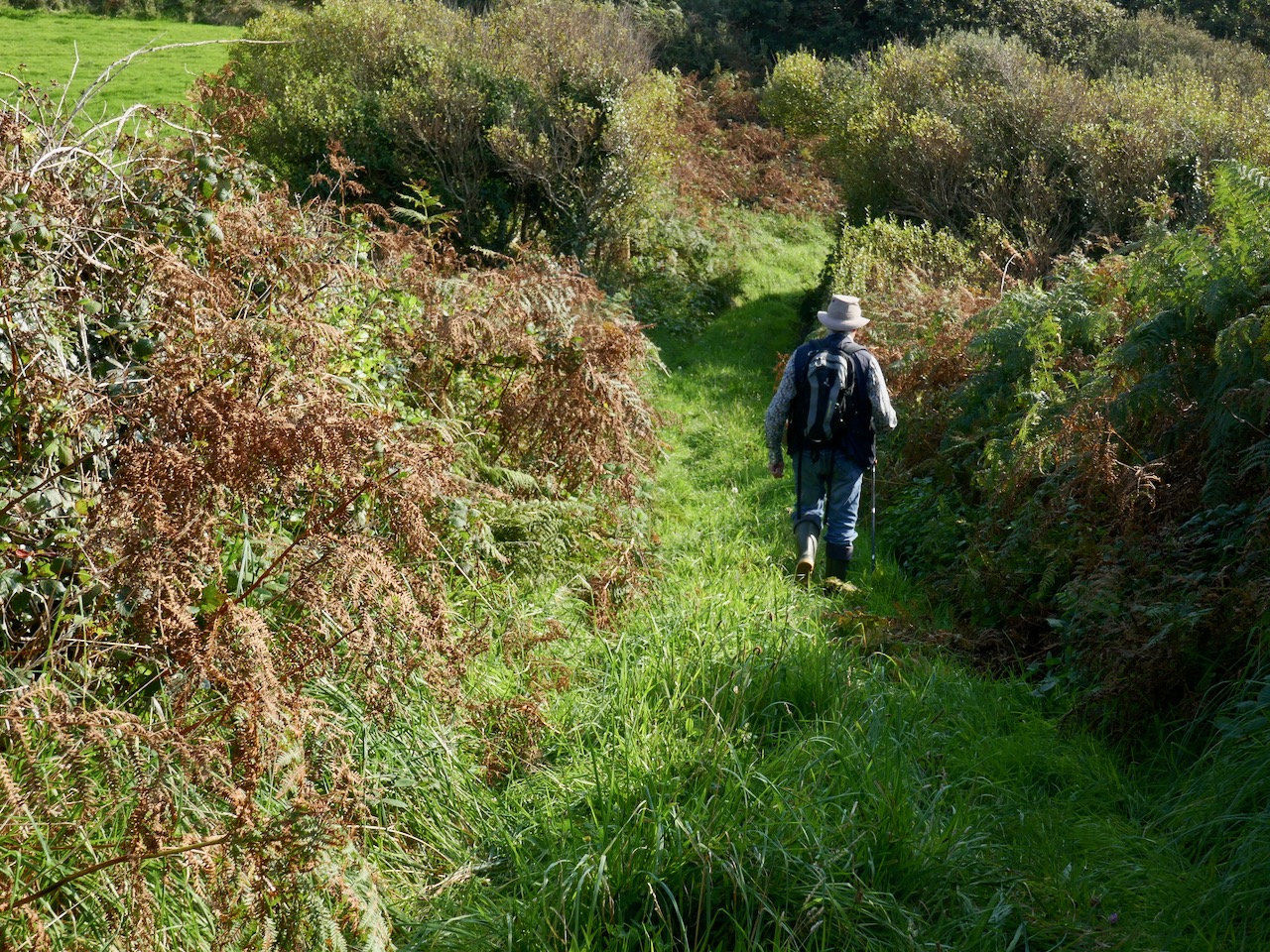
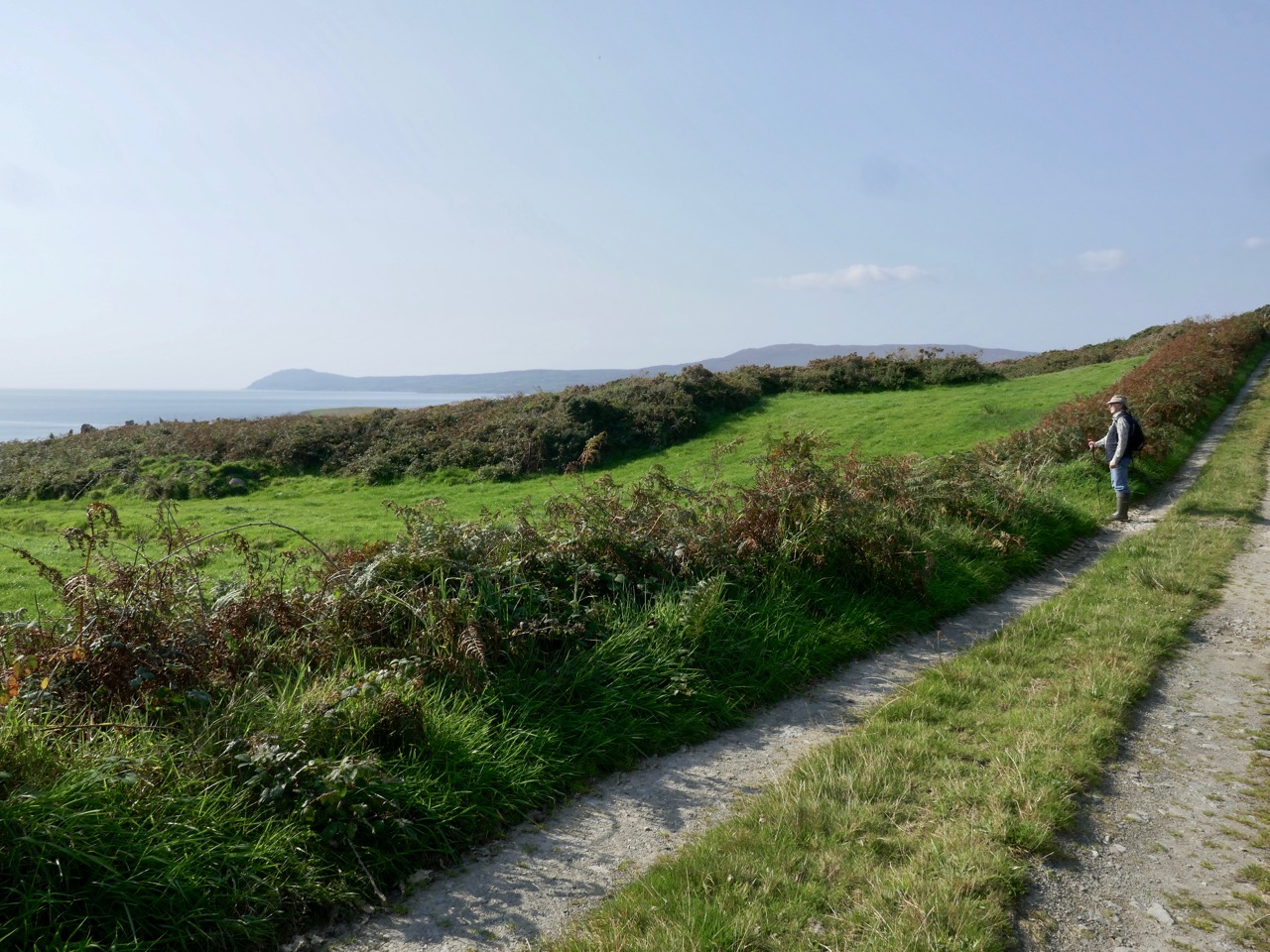
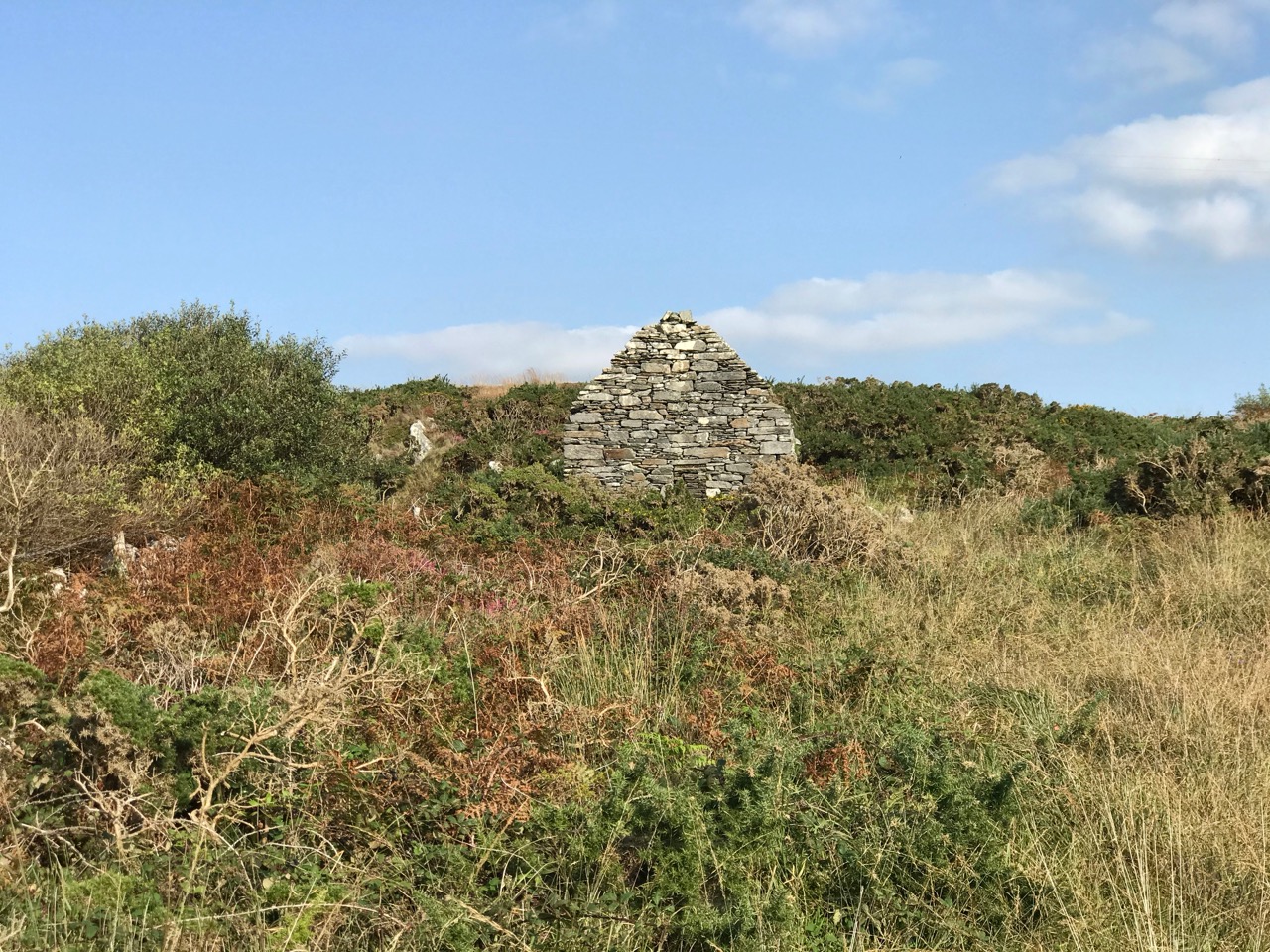
Today we were determined: we donned boots which would withstand a substantial flood. In the event they were quite unnecessary as the land was dry. We felt secure, though – but hot. After the first few hundred metres – which is the old way leading to a ruined house and now much overgrown – the path became well defined and easy to follow. We passed many signs of human intervention on the landscape: skeletal cottages and field boundaries which looked like rows of standing stones. The fields themselves were empty, however: we saw only one living creature the whole way. That was a wood pigeon that clattered noisily out of the bushes as we passed.

This section of the path was completely flooded when we attempted to follow it in February!

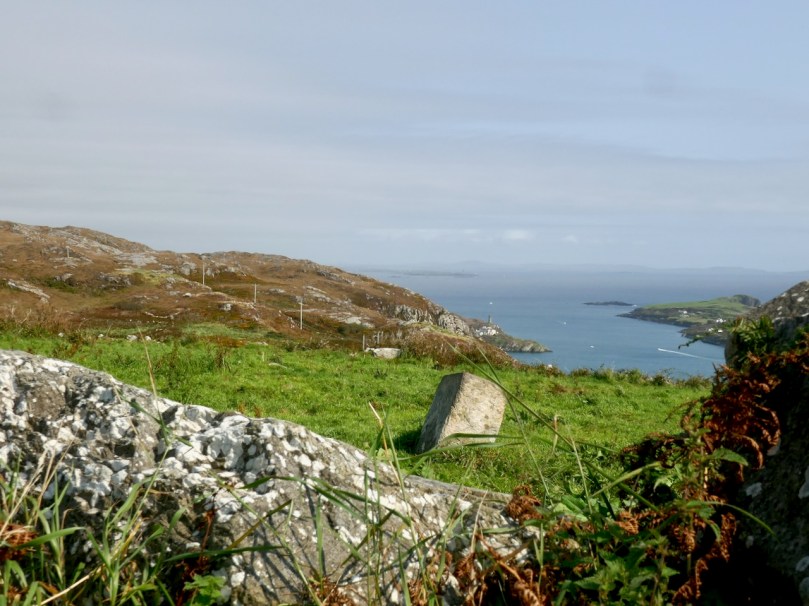
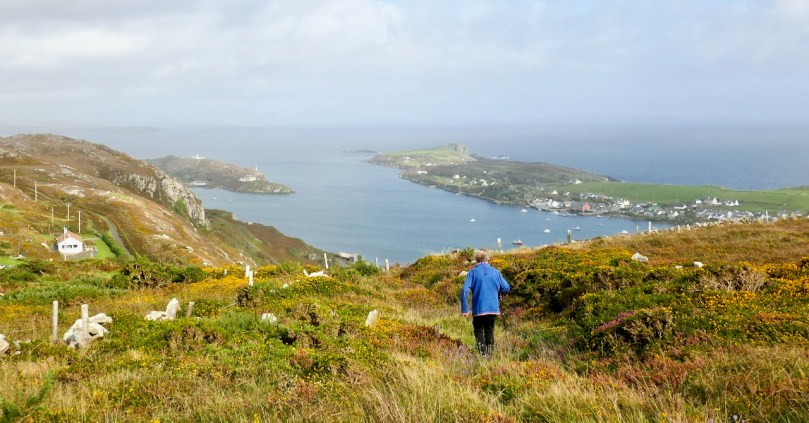
The journey was rewarding because of the wide views out across Dunmanus Bay with the Mizen and the Sheep’s Head flanking either side. There was quite a haze over both peninsulas arising, perhaps, from distant gorse fires.

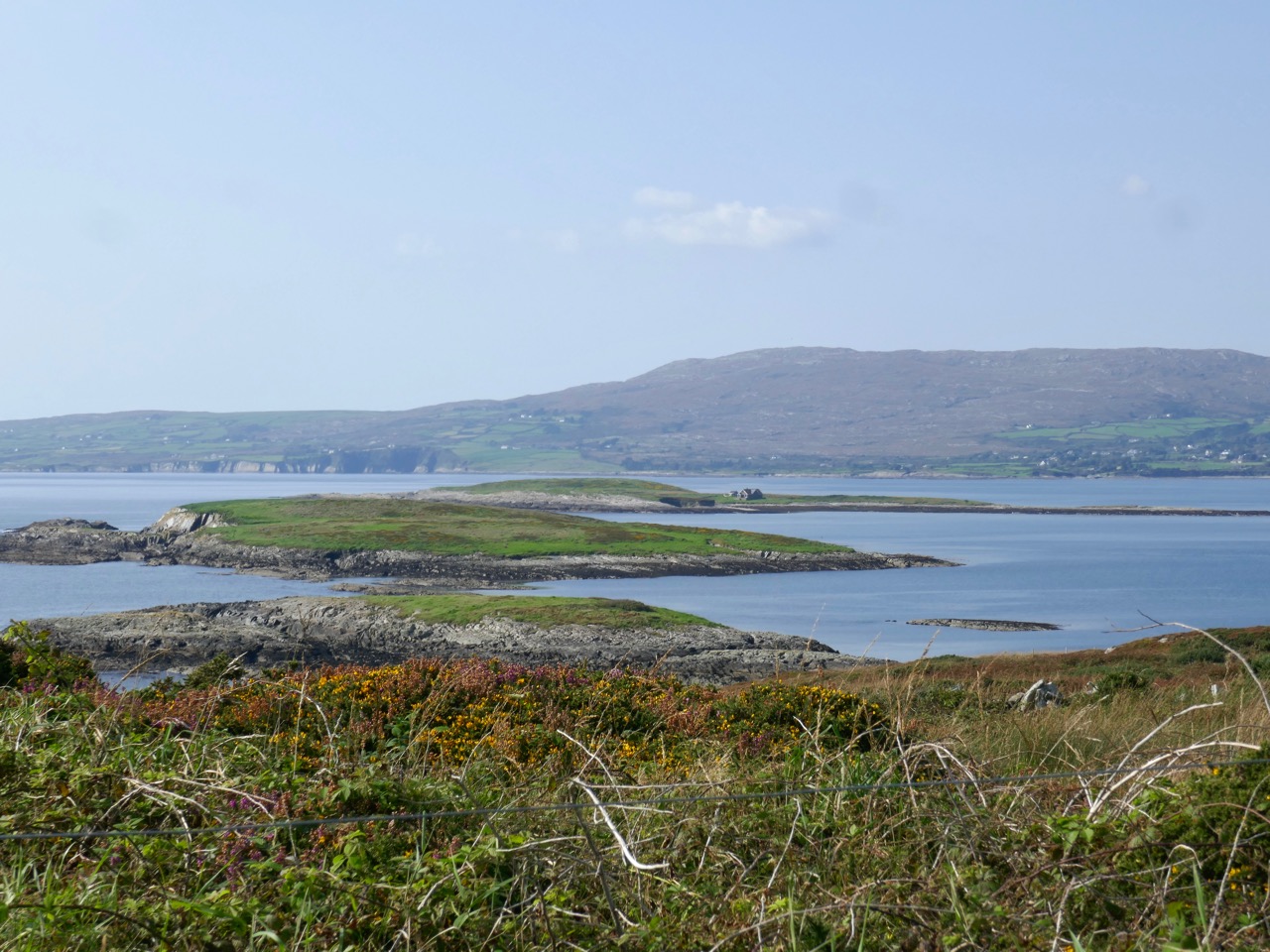
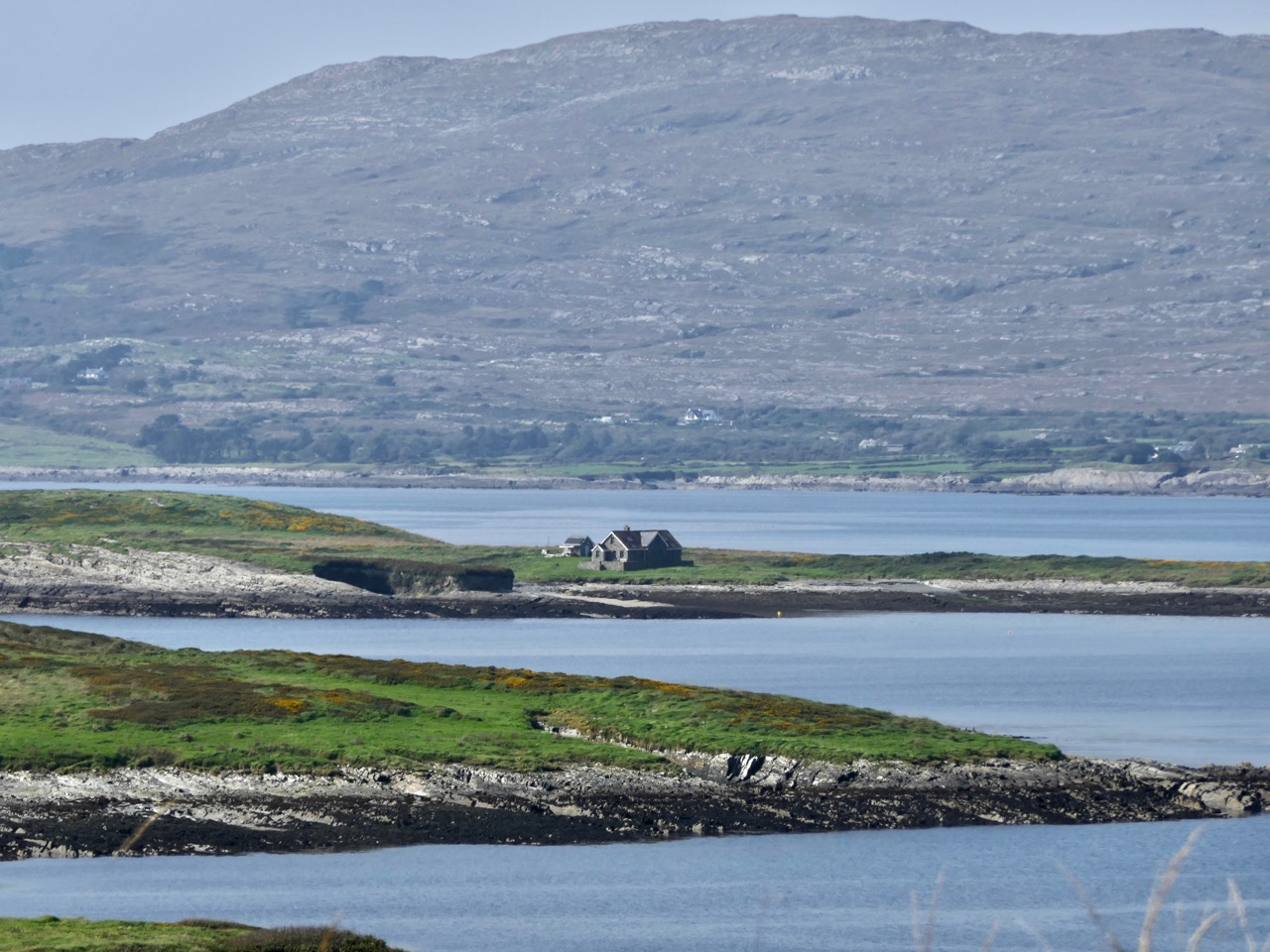
Passing abandoned cottages which had the aura of ancient temples we rose up to the higher ridge commanding the best views. We could clearly see Carbery Island to the west: this has a lonely modern residence on it. Close by are the other islands in this group: Cold Island, Furze Island and Horse Island. Lusk Island and Scurvygrass Island are some way off to the north.

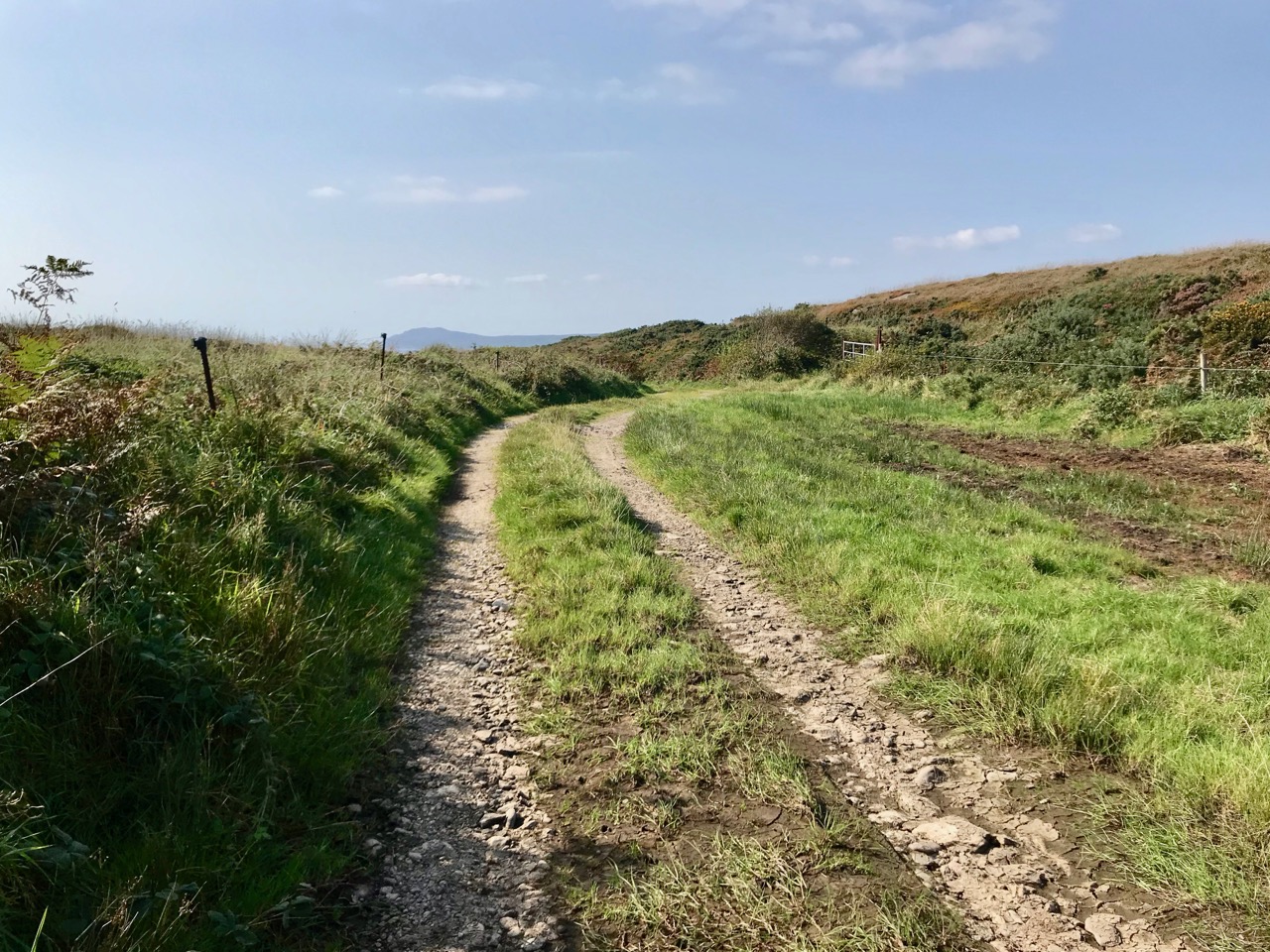
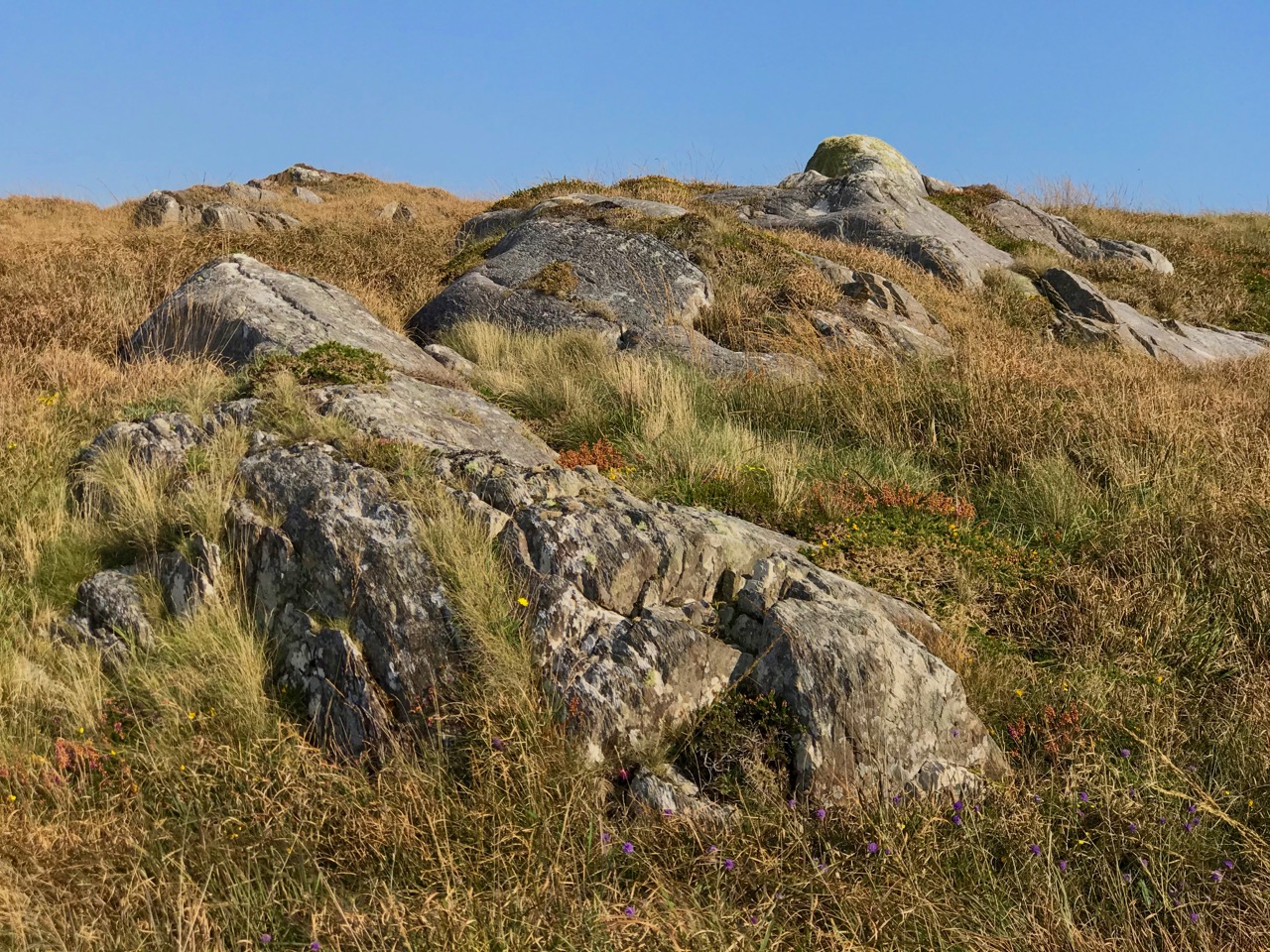
Each turn in the trackway opened up fresh views, and new dimensions, to the bay below us. Some may consider this landscape featureless, but a moorland scattered with large loose and earthfast rock formations – some resembling megaliths, but clearly natural – is my own favourite. Look at the map above to see how far the rock outcrop extends . . . In my mind’s eye it’s the work of giants.

Unlike many of our journeys into the West Cork landscape, this one had no clear end, there was no destination, no historic or archaeological feature that we had set out to find. There was just a turn in the trackway at the northernmost point of the headland and then the trackway continued on to became a boreen and, finally, a road leading back through Ballgibba North and the R591 (where Kilhangle is sited – see Finola’s post). We could have made a big loop of it, but there wasn’t enough time in the day that was in it. In any case, returning on the same path was no hardship and gave us more time to indulge in the tranquility of a way less trod, and in the sublime peace of an afternoon spent in remote places.
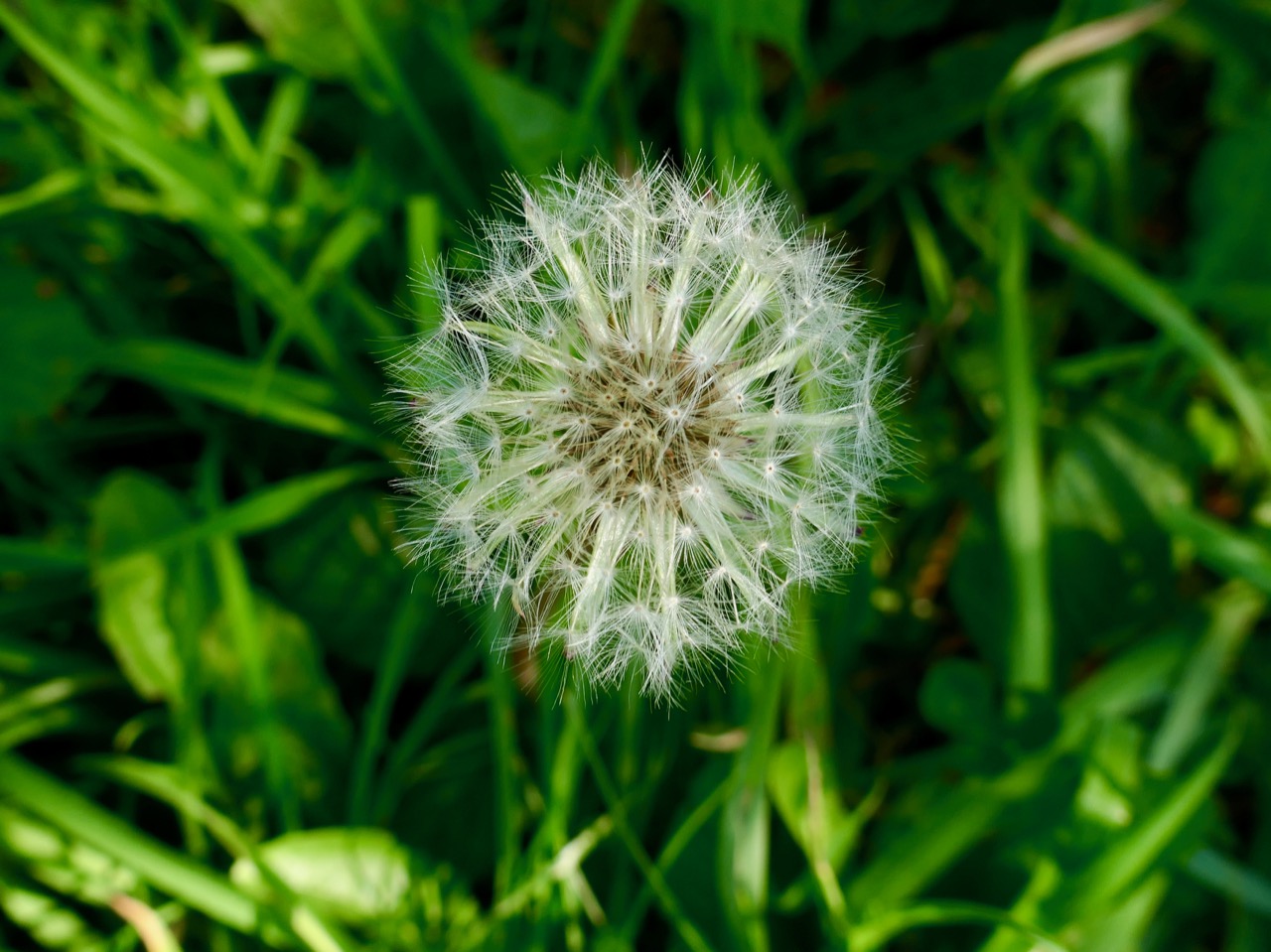
The autumn hasn’t quite come upon us yet, but some signs have started to appear. One is the ‘dandelion clock’ (did you call them that as children?). Finola challenged me to find the ‘perfect’ one, with the promise that, if I did, she would provide the ‘perfect’ photograph. I found perfect, and then perfecter, followed by perfectest. Here’s Finola’s promised rendering:

Mizen Magic 18: The Prehistoric Landscape of Arduslough

There are parts of West Cork that seem to hold within them all the memories and markers of eons. Such a place is Arduslough, on the high ground across from Crookhaven (below, map and photo) and west of Rock Island (above).
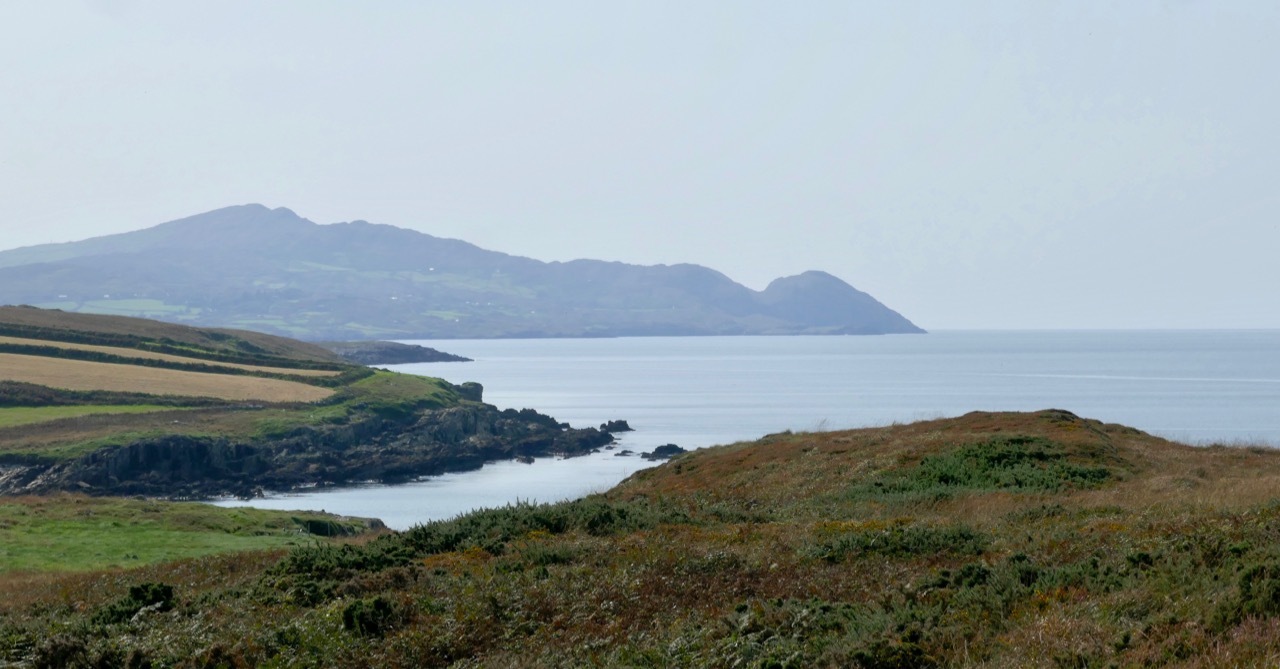
Technically, the places we explored are in three different townlands – Tooreen, Arduslough and Leenane, but mostly they fall within the boundaries of Arduslough. The name has been variously translated – Árd means high place and Lough means lake, both of which seem appropriate, but in fact the placename authority, Logainm, renders it as Árd na Saileach meaning High Place of the Sallies, or Willow Trees. Not much in the way of willows is obvious now, but the lake is certainly central to your view in the townland.

The Lake is the source of drinking water for Crookhaven and is the home, according to a story collected in the late 1930’s, of. . .

. . . an imprisoned demon of the pagan times. He is permitted to come to the surface every seven years on May morning and addresses St. Patrick, who is supposed to have banished him, in the following words “It is a long Monday, Patrick”. The demon does not speak in the English but in the vernacular. The long Monday refers to the day of General Judgement. Having expressed these words his chain is again tightened, and perforce he sinks to the bottom of the lake for another period of seven year His imprisonment will not expire till the last day.

We saw no sign of the demon and the lake looked remarkably untroubled, with its floating islands of water-lilies.

For a relatively small area, Arduslough abounds in archaeological monuments – there are four wedge tombs, three cupmarked stones, a standing stone and a piece described as either an Ogham Stone or Rock Scribings, depending on what you read. The remains of old cabins dot the landscape too, reminding us that this was a much more populous place before famine and emigration decimated the population.

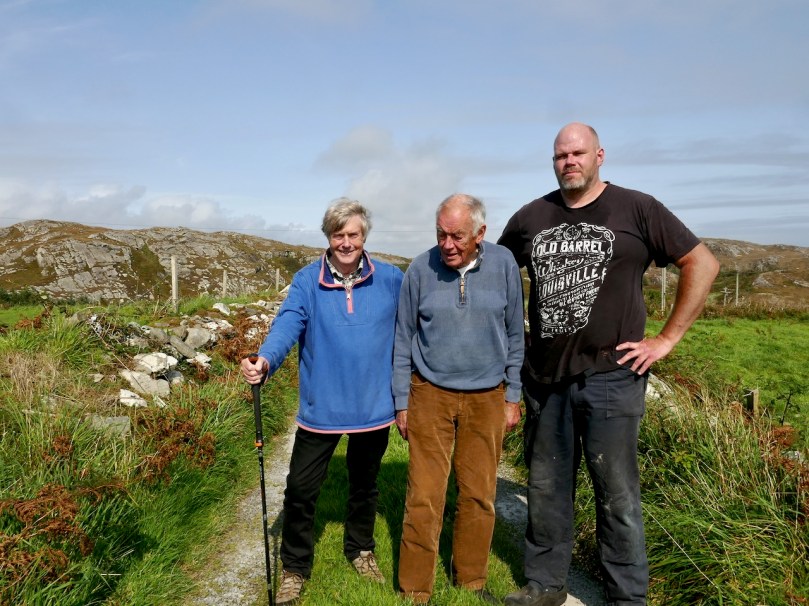
The standing stone, and Robert with Jim and Ciarán O’Meara

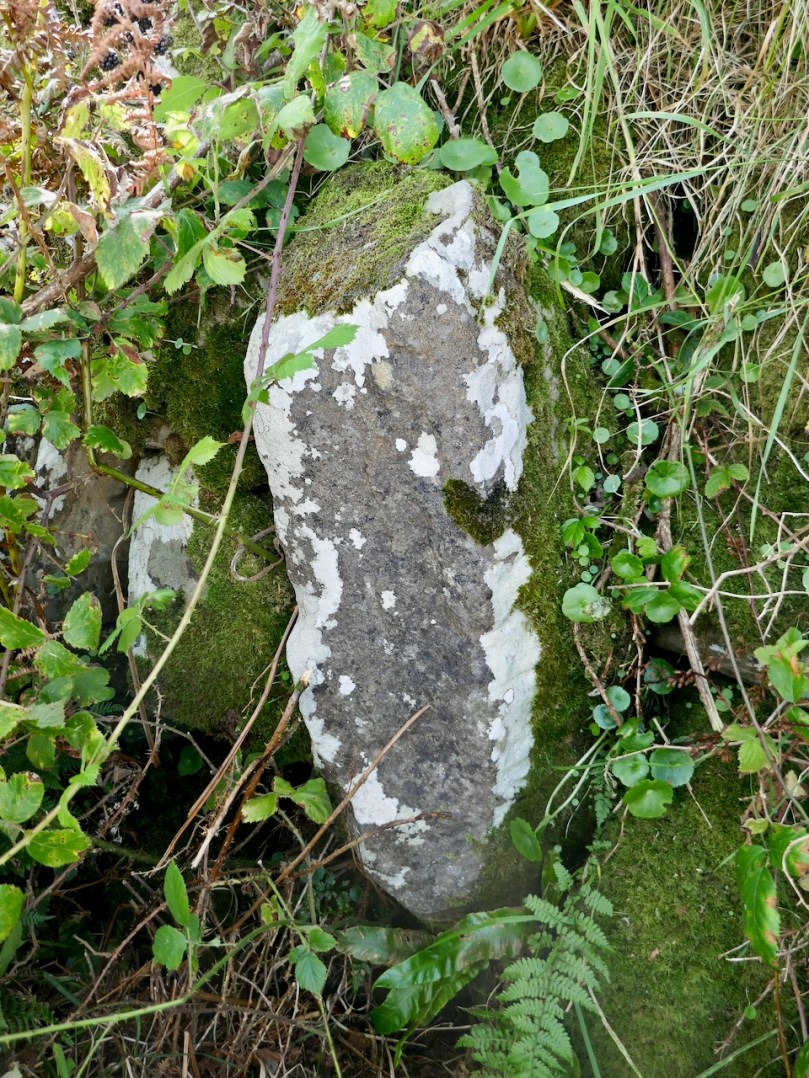
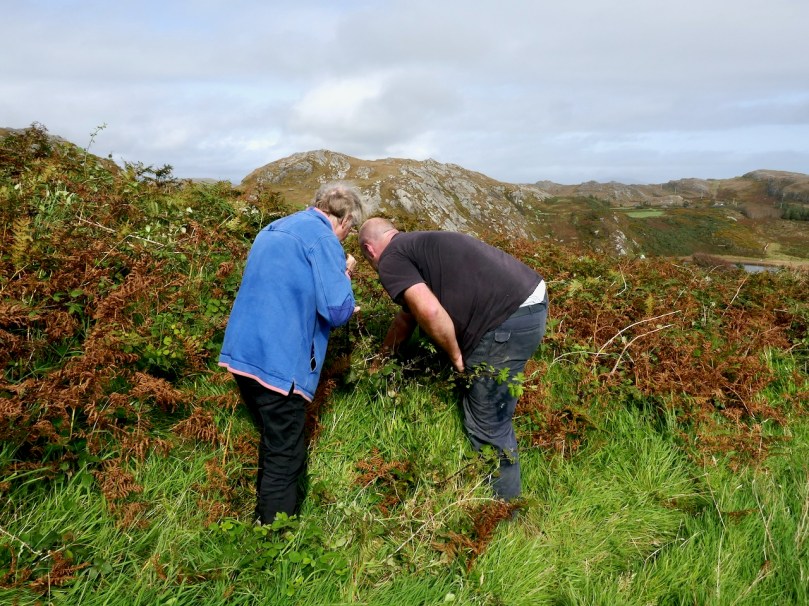
Arduslough is the home of esteemed local historian Jim O’Meara, who grew  up in Goleen but spent most of his adult life teaching in Belfast. We met up with Jim and his son Ciarán, who very kindly offered to show us the Ogham stone. It was so well hidden under layers of brambles and bracken, and built into a field fence, we would never have found it on our own.

It is impossible to say if it is real, or even false Ogham, as it is heavily weathered and lichened, but if we turn again to the School’s Folklore Collection, we find this entertaining account of it:

There is a stone in Arduslough, a townland on the hill to the north of Crookhaven, on which are very old characters or ancient writing. It is very difficult to discern these markings now as the centuries during which they were exposed to the weather have obliterated them. The following story explains the origin of them.

In ancient times there lived in Toureen a man named Pilib. He informed on some party of Irish soldiers who were hiding in the heather there. The enemy came on them and burned the heather round them in which the soldiers perished. The stone was erected in this spot and the event was recorded on the stone. Years passed and the language underwent a change. In later years the people did not understand what was recorded on the stone, and went to the Parish priest asking him to interpret it. He translated it as follows – ‘that every sin will be forgiven but the sin of the informer Pilib an Fhraoich [Philip of the Heather].

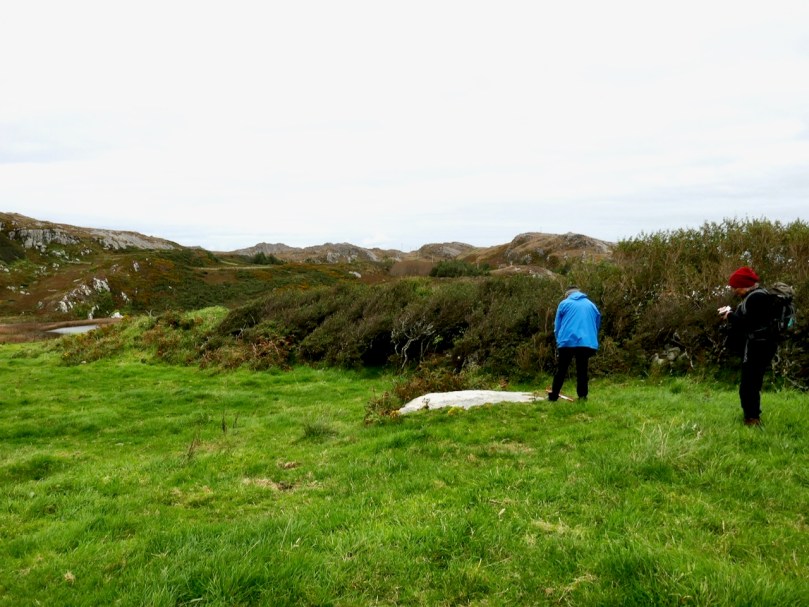
We had previously located one of the three cup-marked stones, including a visit a couple of days earlier with Aoibheann Lambe of Rock Art Kerry (below). Ciarán thought he might be able to find another one, but extensive searching and bracken-bashing failed to turn it up.

The folklore collection is full of references to mass rocks, druid’s altars, and giant’s graves, as you would expect from the number of Bronze Age wedge tombs recorded in this area. (For more on Wedge Tombs, see my post Wedge Tombs: Last of the Megaliths.) Two of them are situated on the slope above the lake (below) and we left them for another day. A third is hard to spot and indeed we didn’t.

We headed up to the high ground west of the lake to find the one that local people still call the Giant’s Grave. What a spectacular setting this is! First of all, you are now on a plateau with panoramic views in all directions. West lie the two peninsulas of Brow Head and Mizen Head and the boundless sea beyond.

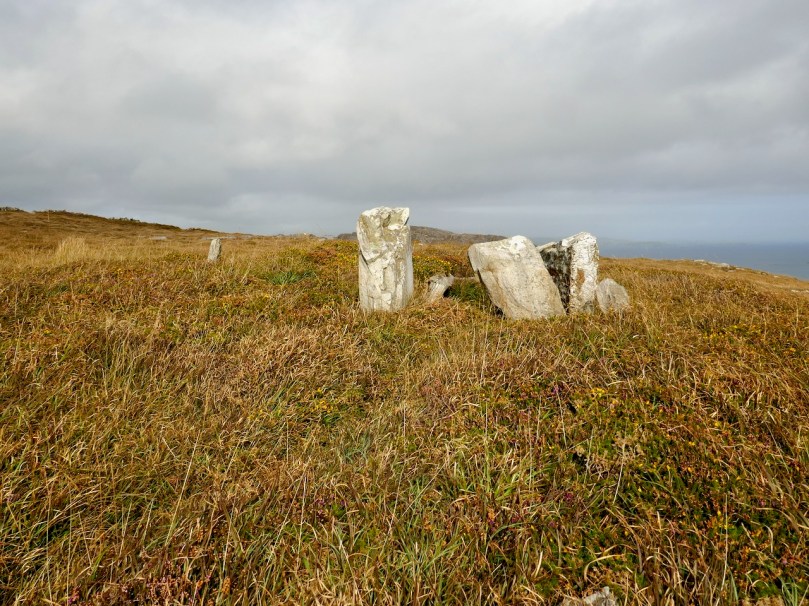
This is heathland, covered in heather and Western Gorse – a colour combination that has the power to stop you in your tracks – and traversed by old stone walls.

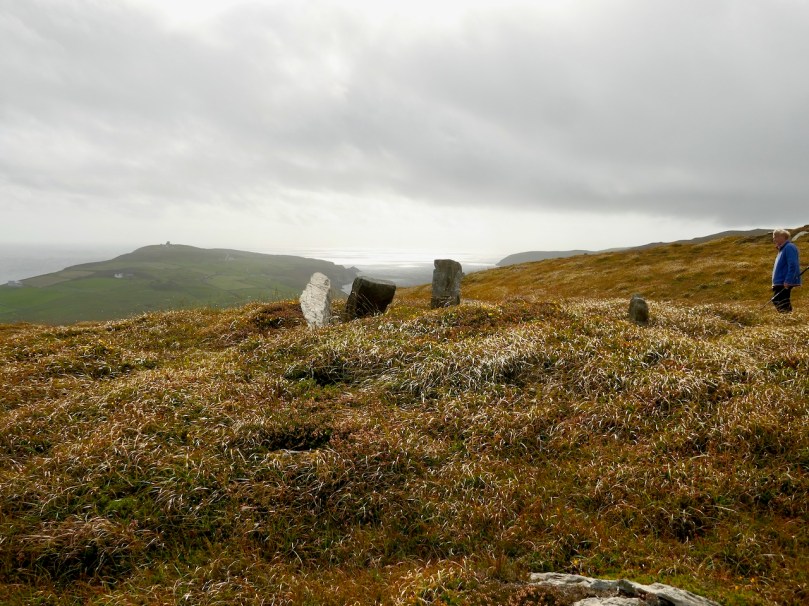
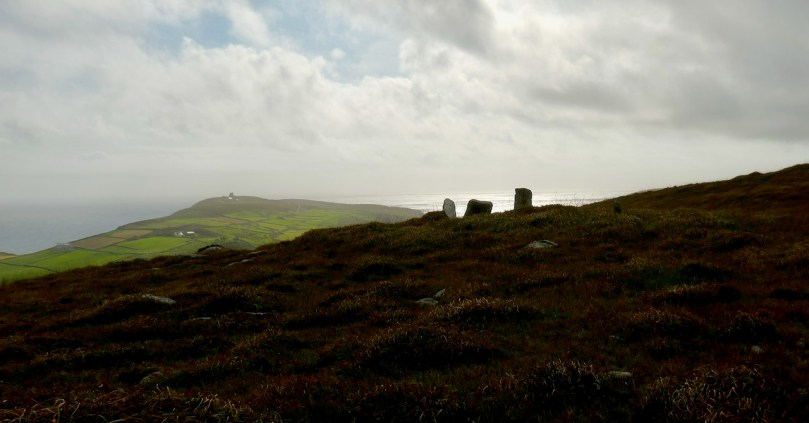
From this colourful bed the stones of the Giant’s Grave arose, pillars silhouetted against the sky. It’s actually in the townland of Leenane, just outside the boundary of Arduslough. When Ruaidhrí de Valera and Seán Ó’Núalláin conducted their Megalithic Survey in the 1970s they commented that the tomb was ‘fairly well preserved’ and  ‘commands a broad outlook to the south and east across the sea to Cape Clear and Roaringwater Bay.’ They interpreted what was there as a wedge tomb, although with some uncommon features.

First of all, they said the tomb was ‘incorporated’ within an oval mound. While mounds are known for wedge tombs, they are unusual and most of the Cork examples, included excavated ones, show no trace of a mound. Stones sticking up here and there, protruding from the mound, they interpreted as cairn stones.
Secondly they noted two tall stones on the north side of the tomb – one is still standing and clearly visible (above and below) – whose function was ‘uncertain.’

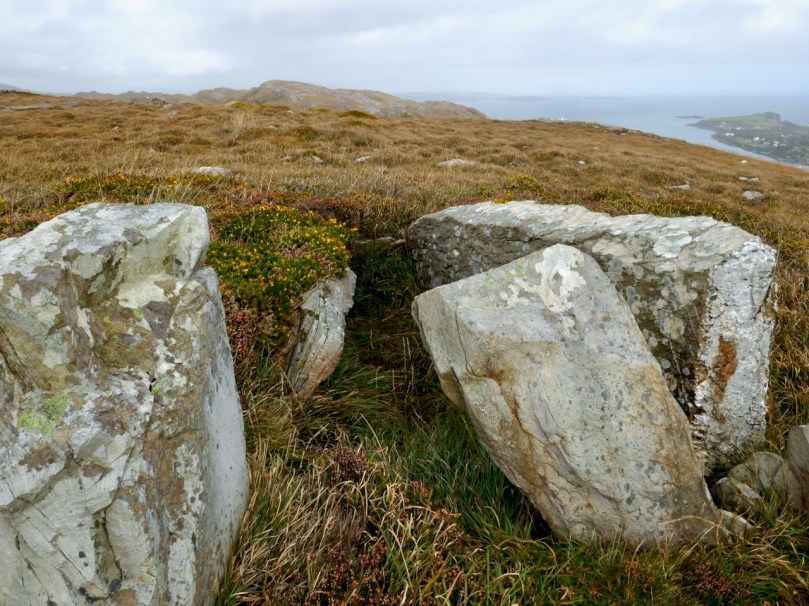
Two tall stones at the south west end (above) seemed like an ‘entrance feature.’ Our own readings at the site indicated that the orientation was to the setting sun at the winter solstice, a highly significant direction to where the sun sets into the sea.

So – an unusual wedge tomb. Elsewhere in their report de Valera and Ó’Núalláin state repeatedly that a hilltop setting and a rounded mound are consistent with passage graves. However, at the time no passage grave had been identified this far south and they were thought to have a more northerly distribution. Since then, two have been identified in County Cork – one at the highest point on Cape Clear, which is visible from this site, and one in an inter-tidal zone between Ringarogy Island and the mainland. Perhaps it is worth considering whether, rather than a wedge tomb, this site may be a passage grave, like the one that Robert writes about this week in Off the M8 – Knockroe Passage Tomb or ‘Giant’s Grave’.
Whatever we label it, this Giant’s Grave is a spectacular site. It’s not hard to imagine, up there, that Neolithic and Bronze Age farmers were just as awe-stricken as we were with the magnificence of the surroundings. Tending their herds, they marked the seasons with the great movements of the sun and moon, and commemorated their dead with enduring stone monuments. More recently, people invested the landscape with myth and stories. Walking the hilltops, you know you are in the footsteps of all who went before.

Castle Island Explored – Part 1

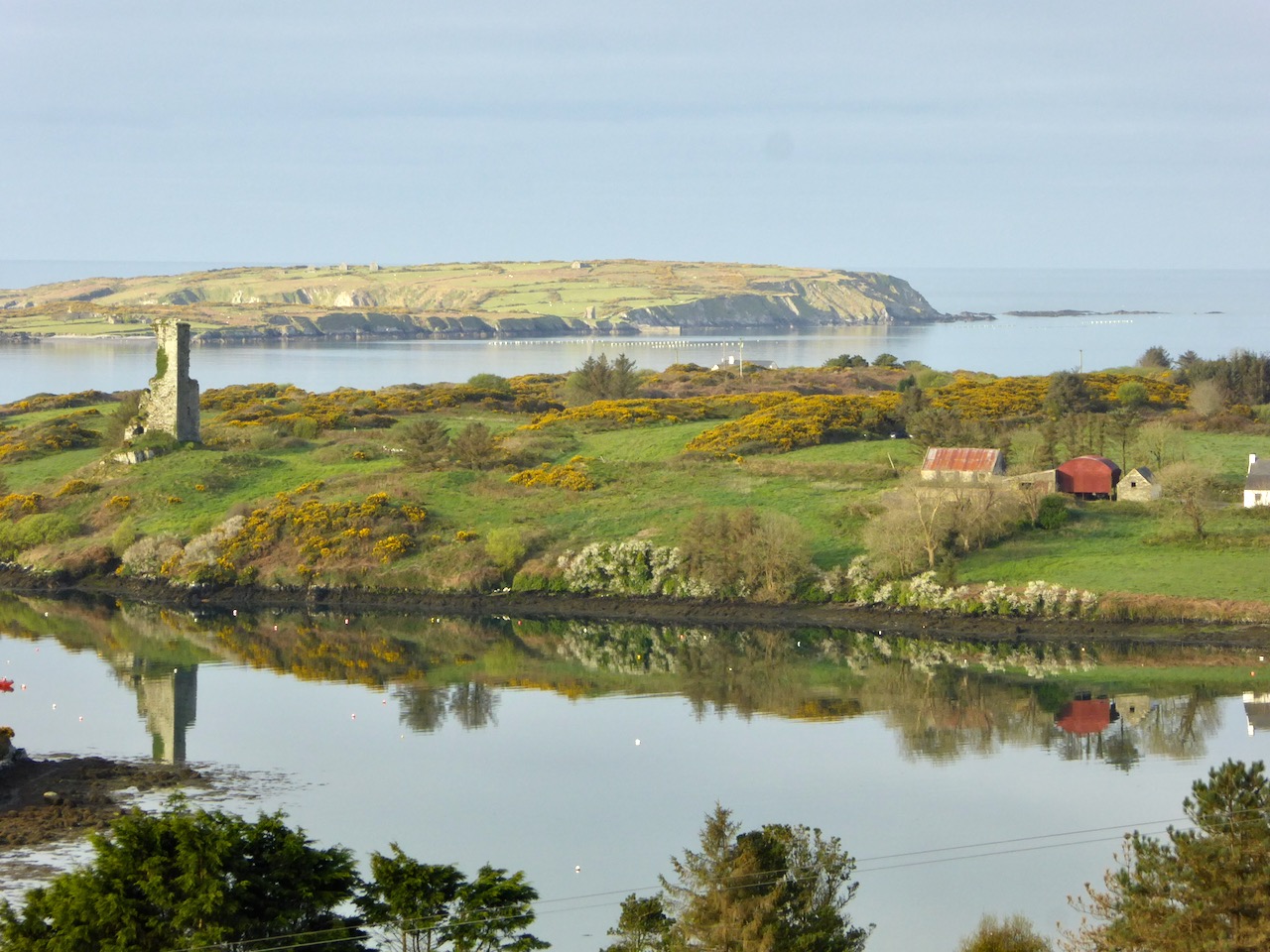
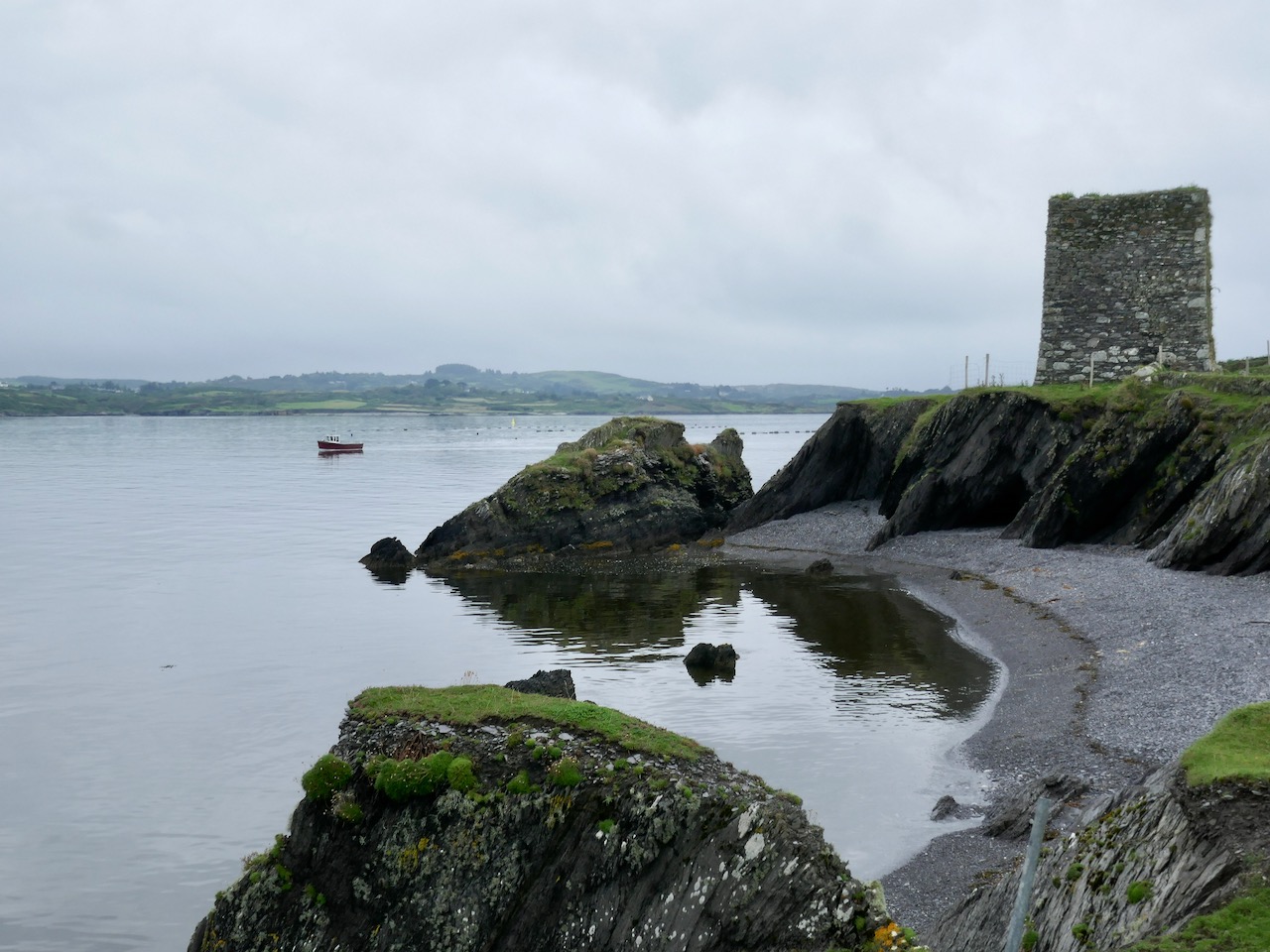
In this early spring photograph, taken from our Eyrie at Nead an Iolair, you can see Rossbrin Castle in the foreground. Beyond it lies Castle Island, uninhabited and slightly mysterious, but with clear traces of former occupation including a medieval tower house, a substantial quay and several abandoned dwellings. As we look over this island every day, we have long held an ambition to visit it, recently fulfilled when we were offered a lift out there on our good friend and neighbour’s fishing boat.

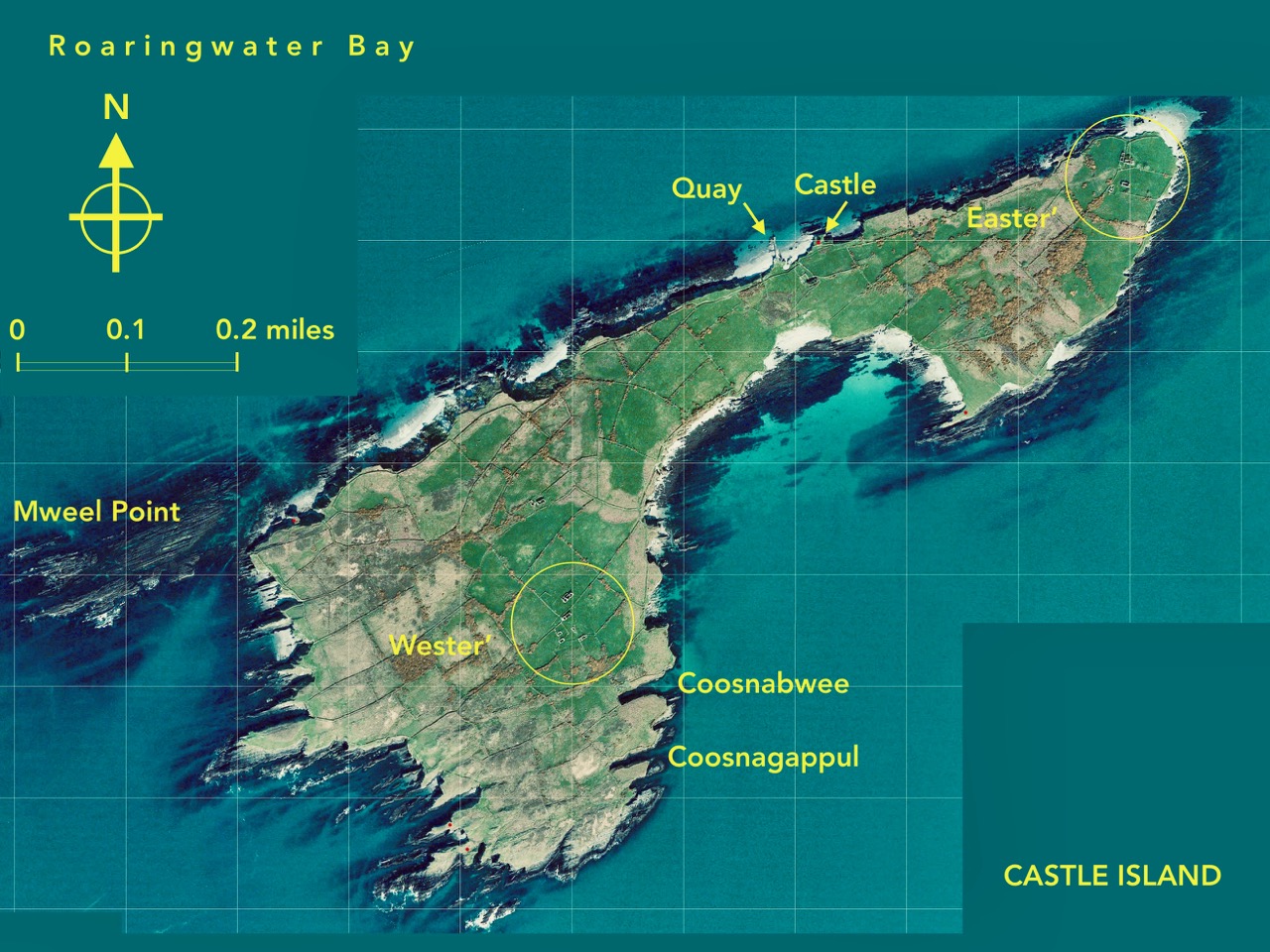
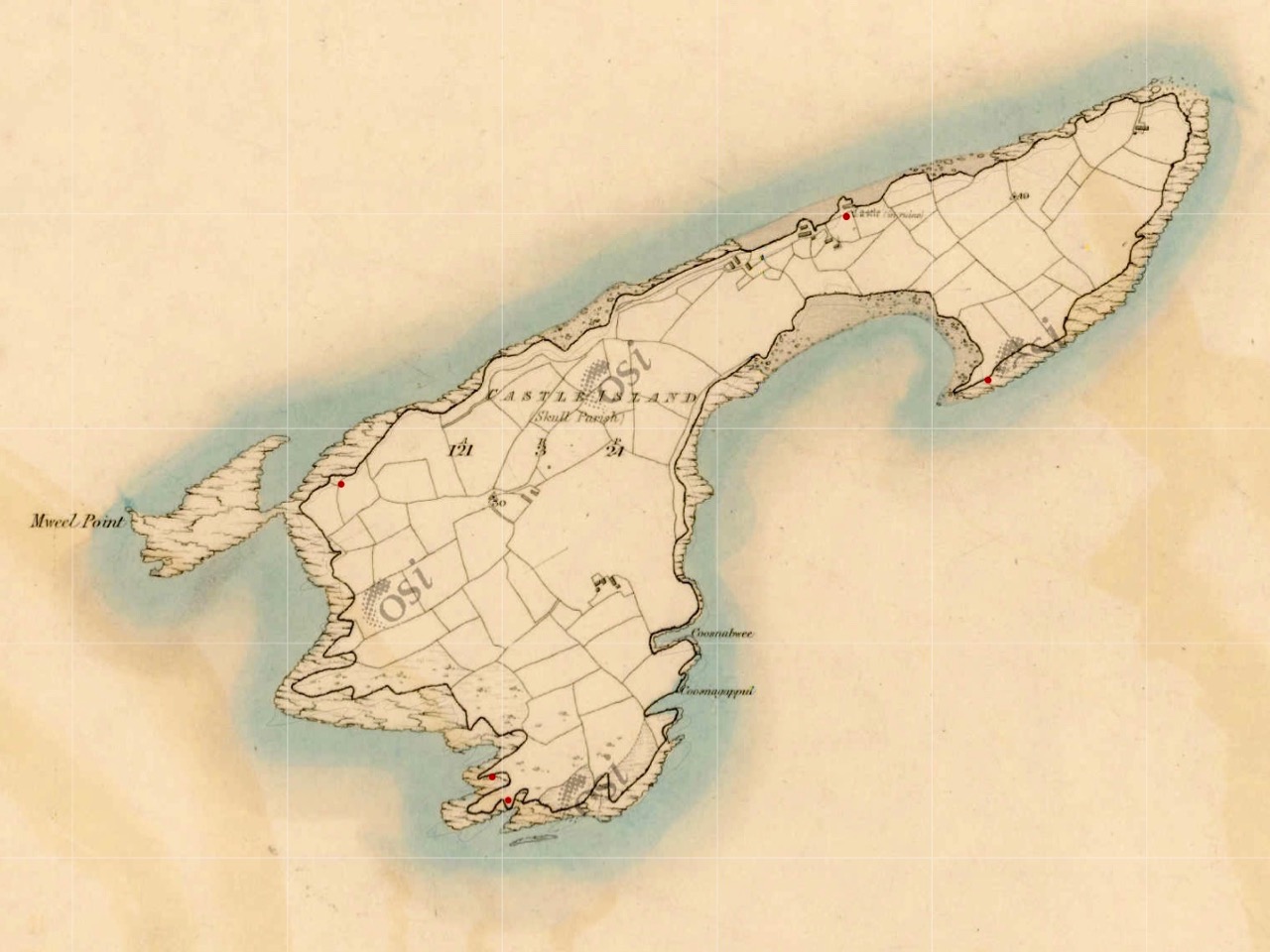
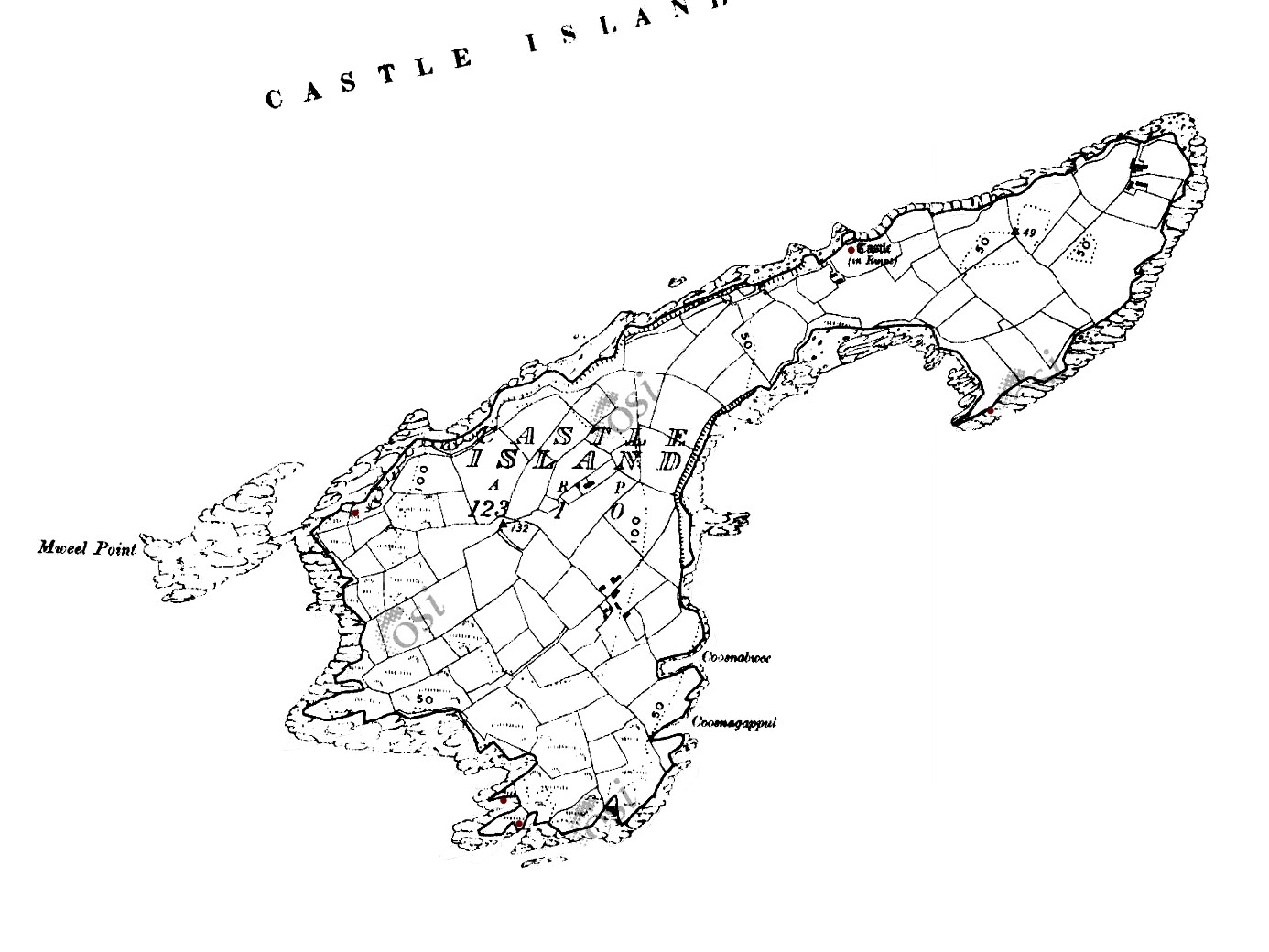
This map shows the scale of the island – just under a mile in length, and occupying 123 acres of mixed land. The main settlements – of Wester’ and Easter’ – are shown, as are the Quay and the Castle. It’s interesting to compare the two Ordnance Survey plans (below): the first 6″ edition was drawn up between 1829 and 1841, and the second one is the 25″ edition, drawn between 1888 and 1913. You can clearly see how the fields have changed, with new boundaries created in the later survey. Presumably this was due to an increase in population resulting in more clearances of rough land.

Both these maps show the Castle – said to date from the 15th century and one of the chain of O’Mahony fortresses that are strategically situated around this most south-westerly part of the Mizen. Of that clan we can find the following written by W O’Halloran in 1916:

Dr Smith says – these Mahowns derive their pedigree from Kean Mc Moyle More, who marrid Sarah, daughter to Brian Boru, by whom he had Mahown, the ancestor of all the sept. It is from this Kean the village of Iniskeen, in Carbery, has its name, and from this sept the Bandon is sometimes called Droghid Mahon. Mahon was the ancestor of the Mahonys, or O’Mahonys . . . The O’Mahonys, whose stronghlad was in the neighbourhood of Bandon (Drohid Mahon), were the first to encroach on the territory of the O’Driscolls. This occurred long before the Anglo-Norman invasion. They possessed themselves of the western portion of Corca Laidhe called Ivahah, which comprised the parishes of Kilmoe, Schull, Durrus, Kilcrohane, Kilmacougue, and Caheragh. They had fourteen strongly built castles . . .

Early Irish History and Antiquities and the History of West Cork, W O’Halloran

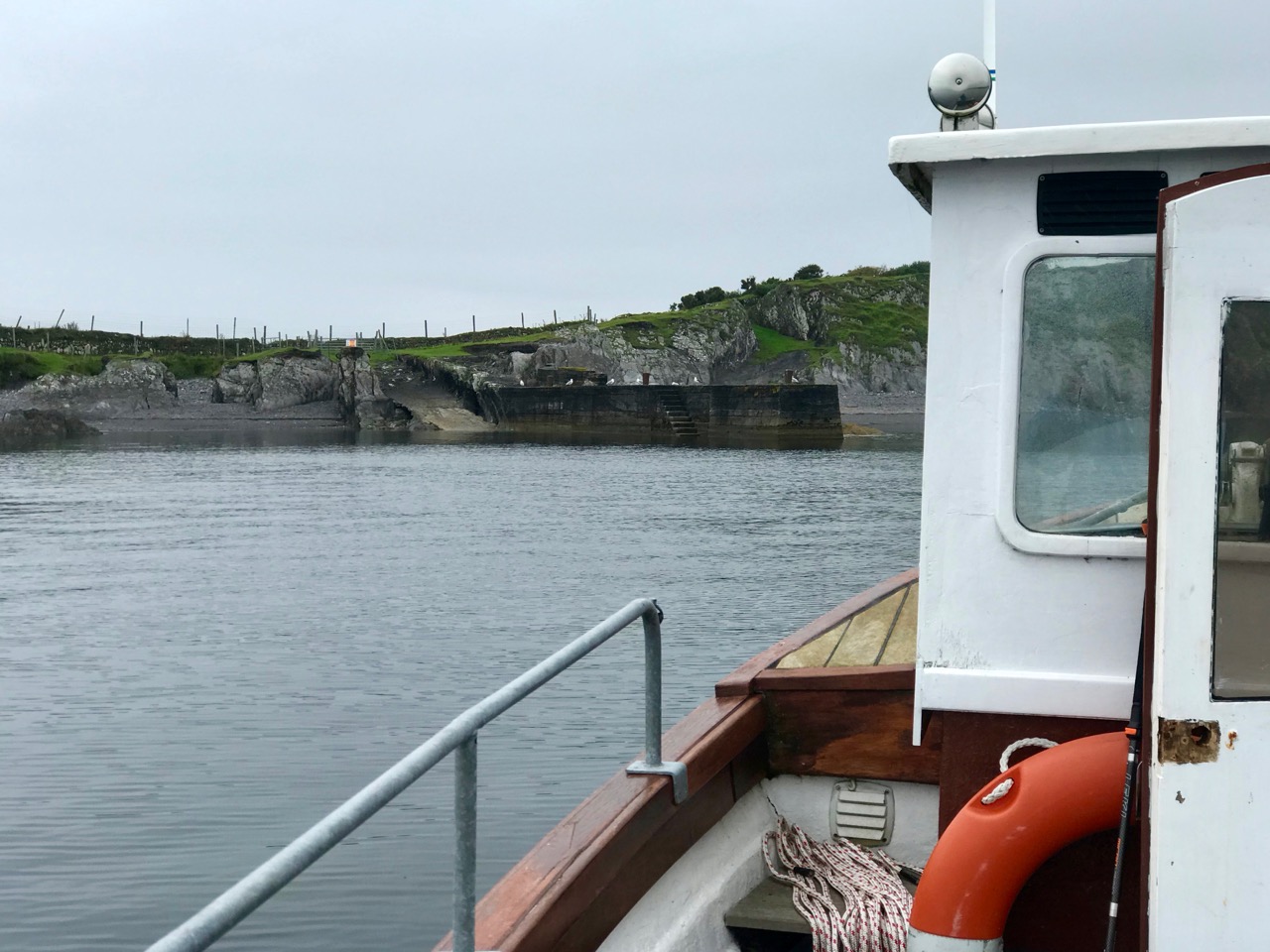
The M V Barracuda approaches Castle Island on an atmospherically damp day in late August. The quay itself seems to have been constructed  during the time of the Congested Districts Board from 1892 to 1922. It is a substantial structure and the investment in that time suggests that there was a significant community living and working on the island to justify it. However, a number of sources assert that Castle Island was “. . . home to a community of approximately 15 families who were last resident on the island up to the year 1870 . . .” Our own observations of the abandoned dwellings on the island led us to the conclusion that, although now significantly deteriorating, these habitations must have been in use more recently than this.

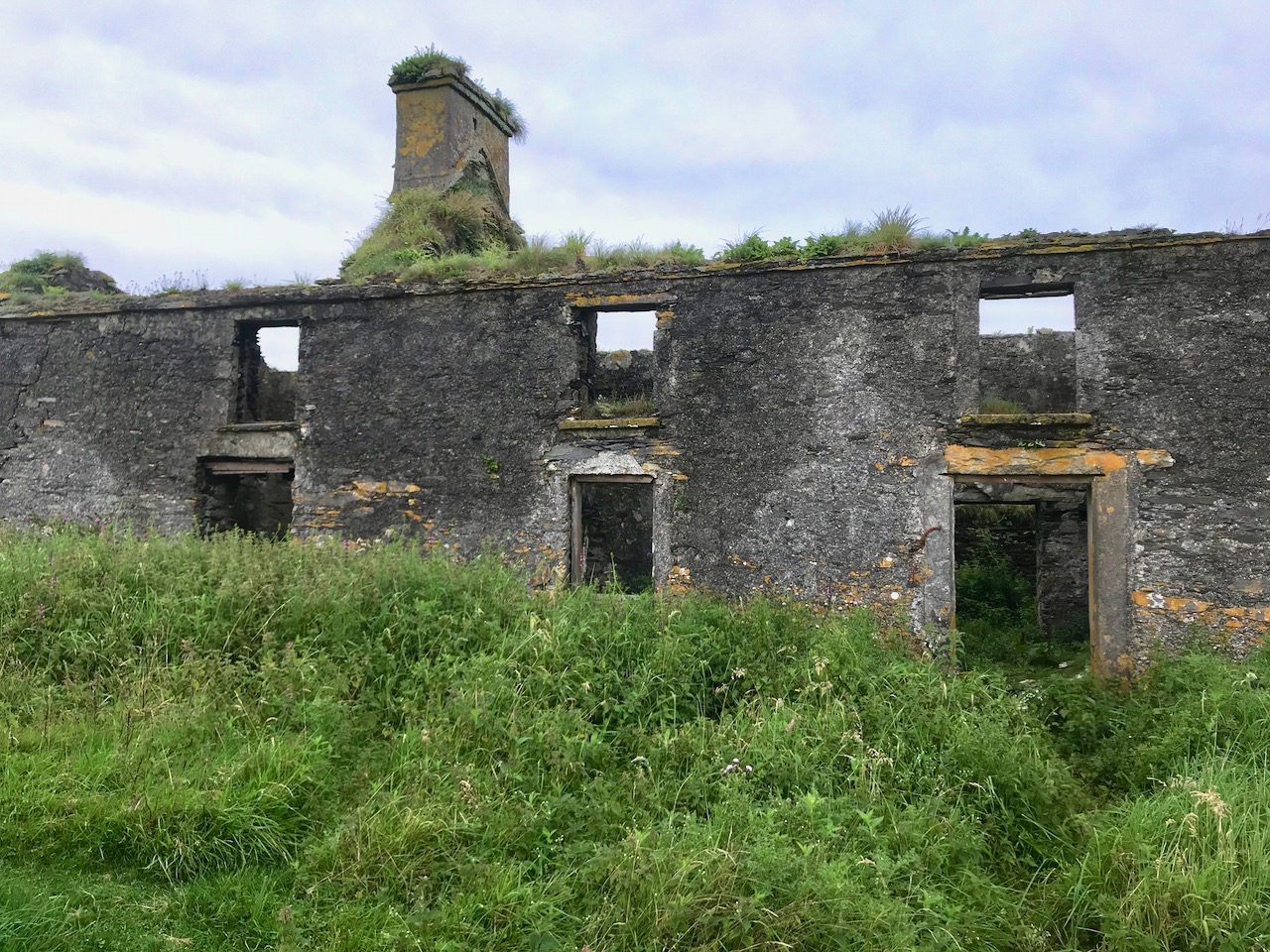
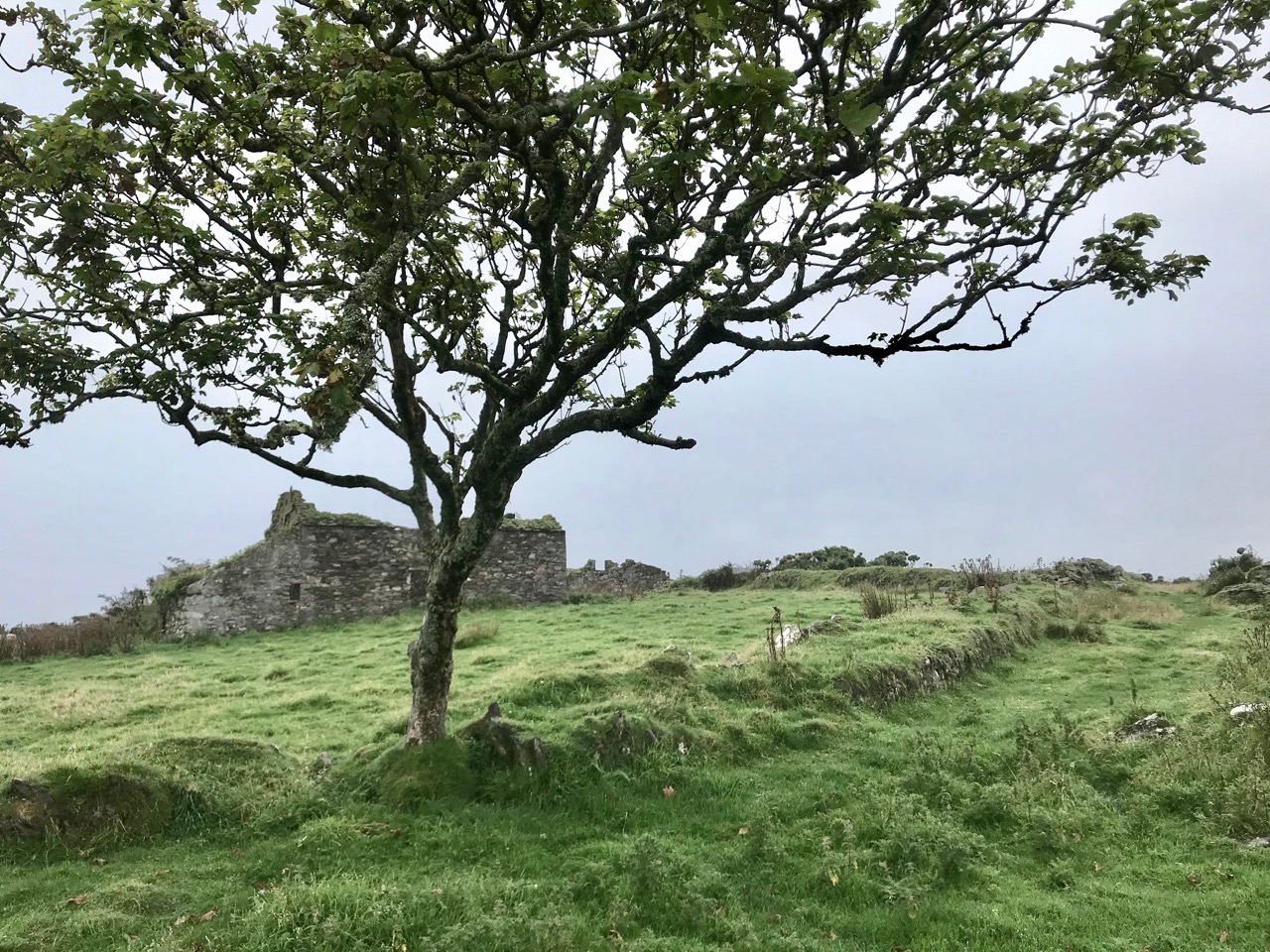
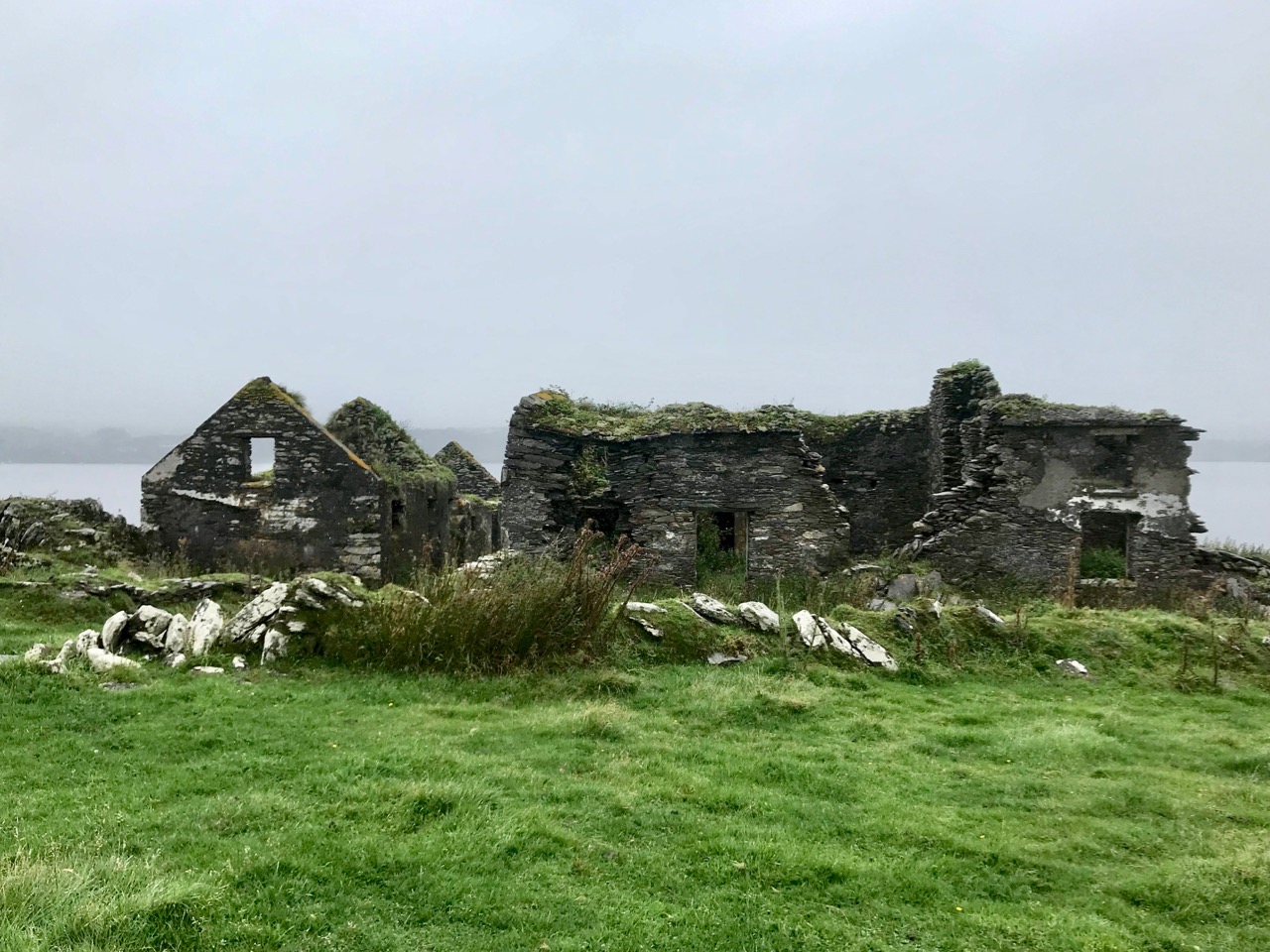
Examples of now-ruined houses, barns and boreens on Castle Island. These are not ‘cabins’ or even cottages, but significant homesteads. Some – including the large residence in the upper picture – have the vestigial remnants of timber door and window frames, unlikely to have survived in place in this harsh environment for 150 years.

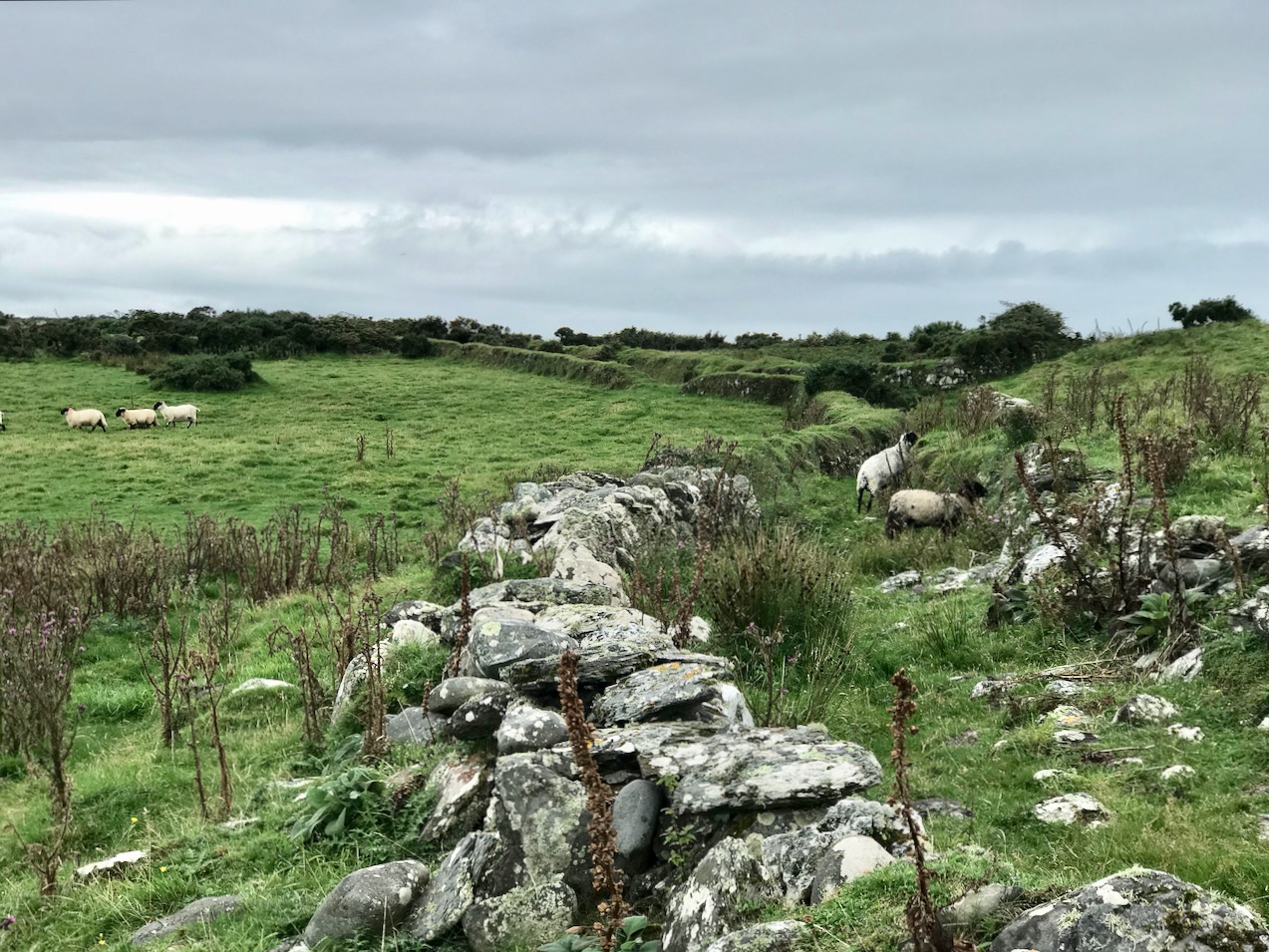
A community of sheep roams unhampered by fences or boundaries, and Finola absorbed how nature has taken over and populated the landscape in spite of wild winters and lack of shelter: we counted precisely two and a bit trees on the whole island!

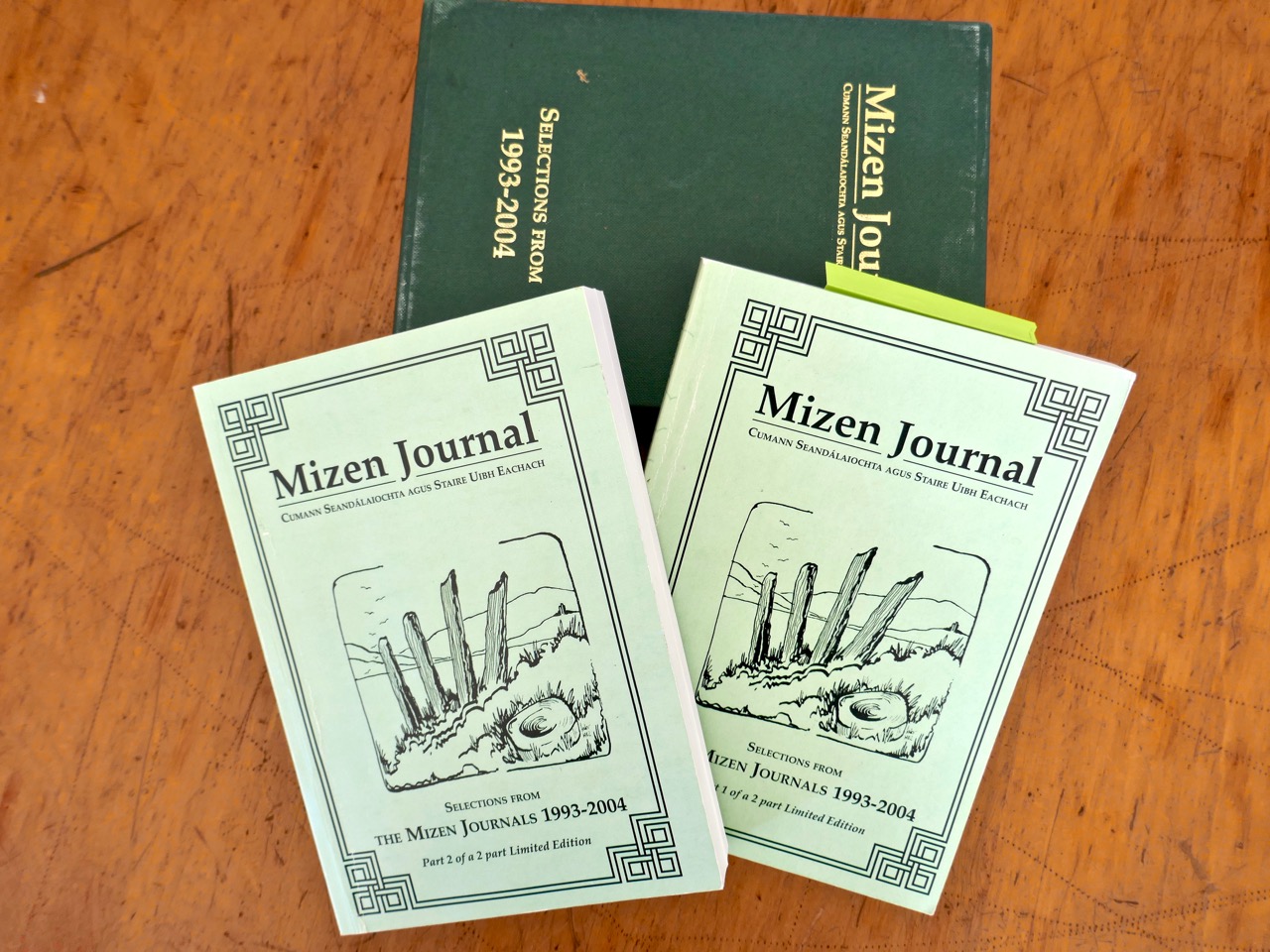
The story of this island is somewhat overlooked generally – one of the reasons we were so keen to visit. In our library, however, we are fortunate enough to have some copies of the Journals of the Mizen Archaelogical and Historical Society – now out of print. That Society was active for thirty years between 1979 and 2010, and produced a dozen journals gathering important historical research by mainly local people. Here’s a post we put together when our good friend Lee Snodgrass – a leading light in that organisation – passed away recently.

In that Journal we have found two articles about Castle Island. One – by Anthony Beese – explores the local placenames, and the other – by Liam O’Regan – speaks of The Castle Island Evictions 1889 – 90. This latter clearly shows that the island was inhabited in the late nineteenth century (apparently contrary to current popular thinking). Also, following those evictions, many of the tenants returned later and it seems very possible that some islanders remained in situ into the twentieth century. Both Journal articles have stories which need to be told, and I will attempt to do that in a later Roaringwater Journal post. For now, however, you will have to be content with . . . the story so far . . . which tells of our voyage of discovery to the island on an overcast day in the summer.

Sanctifying the Landscape: Holy Year Crosses in Ireland

In 1950 Pope Pius XII declared a Holy Year – and galvanised Ireland. It was the height of a certain time of Catholicism in Ireland – fervent, highly-organised, state-sanctioned – and the Pope’s decree was embraced with enthusiasm.*

First of all, what is a Holy Year? It’s a year of special devotion and penance, and a year in which, through following certain prescriptions, you can gain a Plenary Indulgence. Sounds a bit medieval, doesn’t it? But the concept of a Plenary Indulgence isn’t quite the same as the Cash-For-Forgiveness schemes that brought about the Reformation – you earn it, rather than buy it, and it gives you a Time Off For Good Behaviour Card to shorten your sojourn in Purgatory. As you can imagine, this is an attractive proposition for an ardent believer, steeped in all the ritual and dogma of Catholicism – and that described almost all of us in 1950s Ireland.

A wonderful short film about the 1950 Holy Year in Rome

The Holy Year itself involved many rituals. The Pope declared it open by knocking on the first of four Holy Doors in Rome and finished it by sealing up the door again at the end. Pius XII encouraged those who could to make a pilgrimage to Rome.

In response, Ireland mounted a National Pilgrimage, led by the President, Seán T O’Ceallaigh. Take a look at how British Pathé covered this event. Aer Lingus laid on specific flights: A special return fare of £54 from Dublin or Shannon to Rome, valid for 30 days will apply during the Holy Year. Passengers may travel via London, Paris or Amsterdam and may break their journey at any scheduled stopping place en route provided that the stopover is specified at the time of booking.

The Post Office issued a special Holy Year set of Stamps (above). The national radio station started its tradition of playing the Angelus every day – still going strong despite frequent calls for a more inclusive time marker. Everything about the official Government position telegraphed the statement – We are a Catholic Country.

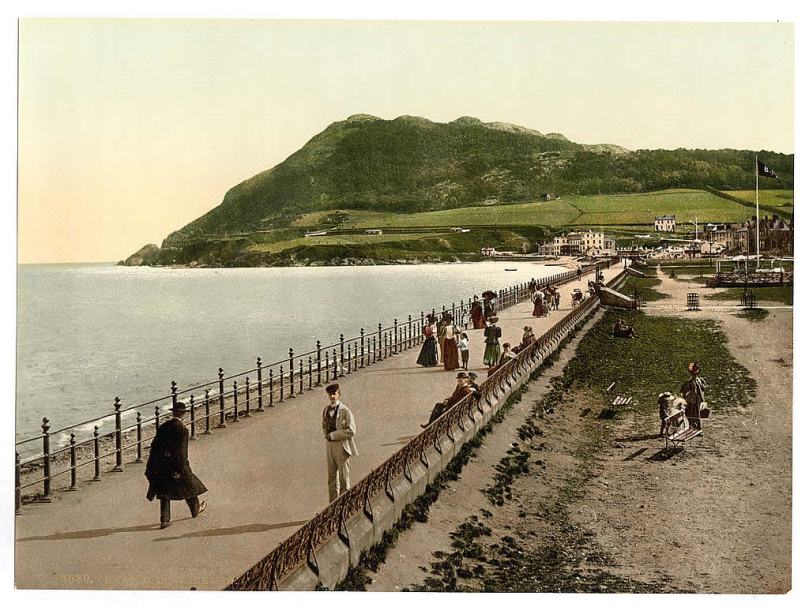
Edwardian Bray, Co Wicklow – the famous Promenade is there but no cross yet

But how did this ultra-Catholicism manifest itself in individual communities? Besides specially organised missions, sodalities, novenas and parades, many towns and villages decided to mark the year by erecting monuments. Somehow the notion of hilltop crosses became The Idea of the day – perhaps it was suggested by John Charles McQuaid as a suitable mark of respect. And all over Ireland plans got underway to erect tall crosses on top of the local prominent landmark.

The Bray of my childhood, with the cross now in place, as it is today (Thanks to Bray – Did You Know…? Facebook Page)

Many (most?) of these 1950 crosses have survived and have become imbedded in our consciousness as a ‘natural’ (in the sense of ‘expected’) feature of our Irish landscape. Few today remember the impetus which led to their erection. At the time, there were fund-raising drives and committees and huge ceremonials attached to the actual situating of the crosses.

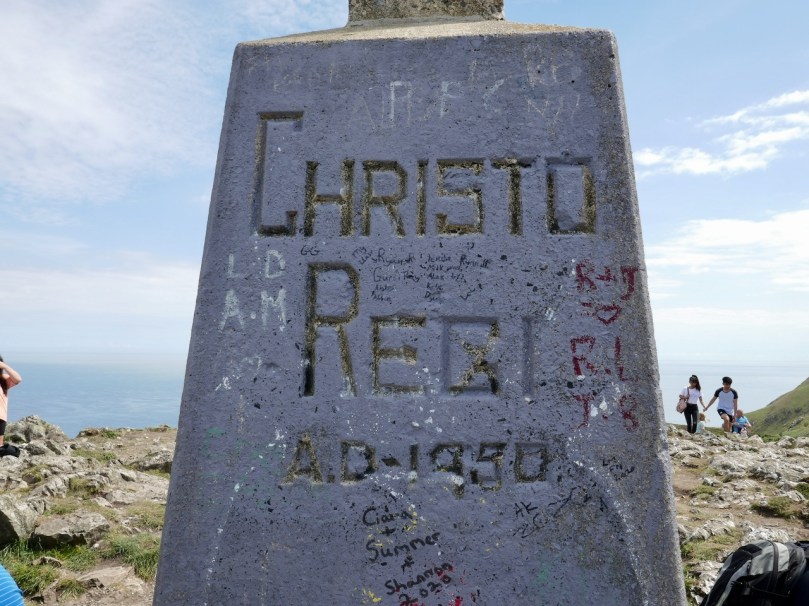
The Bray Head Cross: one of several routes up to it; the 1950 plinth; a popular spot

We have visited several of these crosses lately. I grew up in Bray and as anyone who has ever been there knows, the town is dominated by Bray Head, and Bray Head is dominated by its Holy Year Cross. It’s become the thing to do, to walk up to the cross – there are at least four ways up to it and they’re all spectacular. Sitting at the base of the cross enjoying a well-earned rest, we reminded ourselves that when it was erected over 5,000 people attended the blessing ceremony.

More recently, here in West Cork, we walked up to two crosses, the first at Knockaphuca on the Mizen (above and below). The Knockaphuca walk (it’s fantastic!) was the subject of Robert’s post a few weeks ago. The cross here is a replacement for the original wooden one that had rotted away, finally falling way back in 1968. The memory of the cross was still strong in the community, though, and the local GAA club conceived of a project to re-erect it in 2011 as a symbol of hope and re-assurance in these challenging times and a call to prayer in our hour of need. The challenging times was a reference to the global recession, which hit Ireland badly and ended the reign of the Celtic Tiger.

The volunteers took things a little further than they would have in 1950 and carried up with them an array of solar panels. Thus, this is a very modern re-incarnation of the traditional Holy Year Cross – a glow-in-the-dark model. They called it The Cross of Hope and as such it recalls the beacons that lighted many a weary sailor’s way into safe harbour.

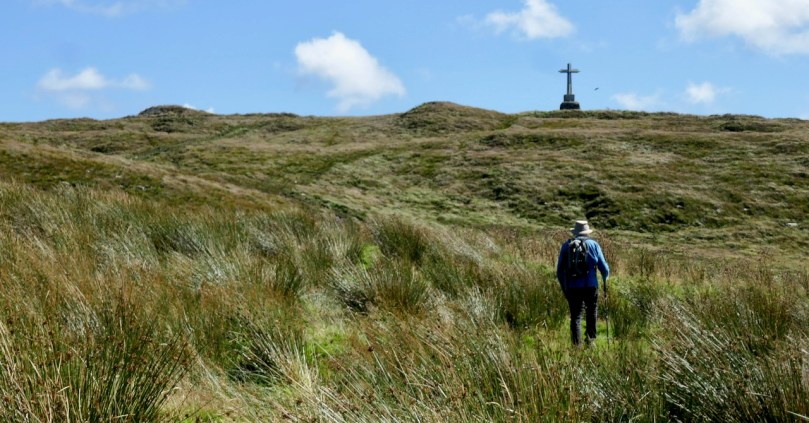
This week we walked up (above) to the cross on Dromore Hill. This one is clearly visible to anyone travelling between Drimoleague and Bantry, on a hill behind the village of Dromore. (Special thanks to Oliver Farrell and Bridget Threthewey for directions.)

The cross is visible from many spots, including from this five-stone circle at Trawlebawn

It’s a lovely walk and the cross looks like it may be original, although it may also have been replaced. It is still a focus – most years the local parish of Caheragh organises a mass at the cross in August and it’s always well attended. It’s another one where lights have been added, this time in the form of fluorescent strips. We couldn’t figure out the power source though – electrical lines disappear into the ground. Very mysterious.

The cross with its 1950 Holy Year Plaque and a space for an altar for the annual mass

St Lachtan’s Holy Well is situated south of Ballyvourney and in 1950 a group of volunteers from the Ré na nDoiri branch of Muintur na Tíre decided to erect a cross on the well to mark the occasion. This one is not on a hill top – in fact it is quite hard to find, but the plaque, in Irish, confirms it as a Holy Year project.

St Lachtan’s Holy Well (the two bullaun stones below the cross) and its Holy Year Cross

Our final local cross is one we haven’t been up to yet – a future project. It stands on a hill between between Skibbereen and Lough Hyne – I’m not sure what the townland name is, it looks like its on the boundaries of Gortshancrone, Booleybane and Curravalley.

If anyone local knows about it, or can tell us the best way up, we would love to hear it.

It wasn’t always a cross – the people of the beautiful Glen of Aherlow in Tipperary decided on a giant Christ the King statue (above). It’s visible for miles – the current one a 1975 replacement for the original and made by the same firm. According to the signage it depicts the hand of Christ the King, raised in blessing the Glen, its people, and all those who pass by.

However, crosses (that’s the one close to Skibbereen above) seem to be the most frequent choice to commemorate and mark the 1950 Holy Year. Do you have one close to where you live?  Have you been to it? Is it still in some form of use (for annual masses, say)? Is it valued by the community?

*There have been other Holy Years (officially they occur every 25 or every 50 years) but the only other Papal-decreed year of devotion that made the same kind of impact in Ireland was the Marian Year in 1954 – see our post Mary Mary for a quick description of the Lourdes Grottos that proliferated that year.