Raw Material

The art of building: West Cork Arts Centre on opening day

The art of building: West Cork Arts Centre on opening day

On the last day of January (traditionally the last day of winter and St Brigid’s Eve) the new West Cork Arts Centre opened its first exhibition in Skibbereen. We have taken a great interest in this building during its construction: the very strong architecture has aroused a lot of negative comment in the community, but now that it is virtually complete the general view of it seems to be mellowing a little. For my pennyworth this bold, modern insertion into the townscape has provided Skibbereen with a new visual focus and with great potential for a successful future.

A specially commissioned glass sculpture by Michael Ray graces the entrance hall, and incorporates the names of sponsors of the building

A specially commissioned glass sculpture by Michael Ray graces the entrance hall, and incorporates the signatures of sponsors of the building

The name of this new building is Uillinn – it means ‘elbow’, a reference to the angled plan of the building and its cantilevered location over a bend in the Caol Stream that snakes through the town’s back yard. Dublin based Architects Donaghy and Dimond won the international design competition in 2009: have a look at their plans for the building here.

One of the exhibits is titled ‘Flying Colours’ and is a project by the West Cork Education Centre in collaboration with local Primary School children: stairways and circulation spaces in the new centre are alive with colour and creativity. How wonderful that these children can feel they have played such a significant part in this new venture.

The fabric of the building is lively and well considered

The fabric of the building is lively and well considered

This building simmers with potential: the gallery spaces and facilities are impressive and architectural elements are well detailed. Skibbereen has been given a high quality civic building that will last for generations: it’s now got to be used creatively.

Sam Thorne

Sam Thorne

It’s no coincidence that one of the speaking guests at the opening was Sam Thorne, artistic director of the Tate St Ives Gallery in Cornwall. Comparison between West Cornwall and West Cork is inevitable: both regions have a history of attracting artists because of the very particular light that comes from close proximity to the Atlantic coastline. Also, artists have been drawn to these places because of enduring lifestyles that are simple, basic and close to nature. Thorne made the perhaps surprising statement that West Cork is home to more artists per capita than both Paris and London.

'Blinkers' - Angela Fulcher 2015

‘Blinkers’ – Angela Fulcher 2015

Sam Thorne said that having a community of artists contributes all kinds of different aspects to a region. One of the simple ones is tourism. “That’s been a really important thing in St Ives over the past two decades,” he said. “The gallery contributes £11m (€14.6m) every year to the local economy in St Ives – three times that which was anticipated when the gallery opened… So there’s a very real powerful impact that having artists there, having art there, creates for the community.” He added that the St Ives Gallery now needs to extend its buildings and anticipates over £80m coming into the local coffers over the next few years.

tate

Phenomenal success: the Tate Gallery, St Ives, Cornwall

I spent many years in Cornwall and watched the development of the Tate Gallery in St Ives. It has become a year-round tourist destination: in all seasons – and in all weathers – the streets of the little town are crowded with visitors who are, of course, using the local shops, b + bs and restaurants. It has also created problems: overloaded car parks, strained infrastructure. But surely this is better than closed shops and failing businesses?

Of course, Skibbereen is not St Ives – and our Arts Centre doesn’t have the backing of a body like the Tate, with its enormous resources of historical art. But there are great possibilities nevertheless: Ireland has a wonderful art heritage, much of which is seldom seen outside of the big city galleries. And there are strong links between Irish artists and Britain which could be delved into. Think of the Newlyn School artists – Alexander Stanhope Forbes and Norman Garstin were both Irish; Cornwall was also home to Breon O’Casey and Tony O’Malley. Other artists moved from Cornwall to the west of Ireland, including Nancy Wynne-Jones, Conor Fallon and – mentioned above – Michael Ray.
Impressive gallery spaces call for dynamic works

Impressive gallery spaces call for dynamic works

The St Ives Tate works so well because it is able to show the ‘big names’ – but it also encourages young and local artists, whose output often interacts with the historically established works. There is no reason why the Skibbereen centre couldn’t build on similar links: wouldn’t it be wonderful if we could see paintings by the likes of Jack B Yeats, Paul Henry, Sara Purser or Daniel Maclise on our doorstep – complimented, of course, by the very best of home grown talent? The ‘big names’ would be the crowd-pullers – at least initially: these are the building blocks for forging a lasting reputation.

headphones on

Works in progress: the centre contains studios and workshops

The new building still awaits its official opening: this will happen in the summer and the President of Ireland – Michael D Higgins – will have that honour: a scoop for Skibbereen! The Board of the West Cork Arts Centre – and the sponsors and donors – have moved mountains to realise the vision of this building. Now it’s down to creativity and dynamism from the team – and to enthusiasm and encouragement from us, the visitors, whose support is vital to this building’s future success.

quirky

Future Archaeologists at Work

Kilcoe National School Fourth Class - archaeologists of the future!

Kilcoe National School Fourth Class – archaeologists of the future!

A joint post by Robert and Finola, with additional photographs by Kilcoe National School.

Out of the blue this week came a message though the Roaringwater Journal Facebook page: The pupils of 4th class in Kilcoe NS have completed a history project for Discover Cork: Schools Heritage Project, on Archaeology in their local area. Their model and project book are on display tomorrow Tuesday January 20th from 2-3pm in the school hall. They invite you to come and see their work as you already do so much wonderful research on the area.

Delighted, we headed off to the school and were quite bowled over by what we saw. The students had been on field trips to several different types of monuments – a standing stone, a stone pair, a holy well, a cairn, a fulacht fia, a cillín and a ringfort. They had recorded their visits, their questions, and what they learned about each site. The formal archaeology was of interest to them, but also the stories and traditions about each site. They interviewed elderly community members and landowners and looked up the records for their area from the National Folklore Commission.

Once they had gathered all their notes and photographs they constructed a model showing each of the sites, a scrapbook of their records and drawings, another one showing what they had learned about the prehistoric way of life in West Cork, and a large photograph album charting their progress through the whole project.

Impressive as the work was that the children had put into this project, even more striking was their bubbling enthusiasm for what they had done and learned. Each table was manned by one or more of the students, ready to chat with us, show us the model or the photos, and explain everything. And how articulate and open and bright they were! Smiling and cheerful, but also earnest about their subject and falling over each other to add bits of information. It was totally captivating.

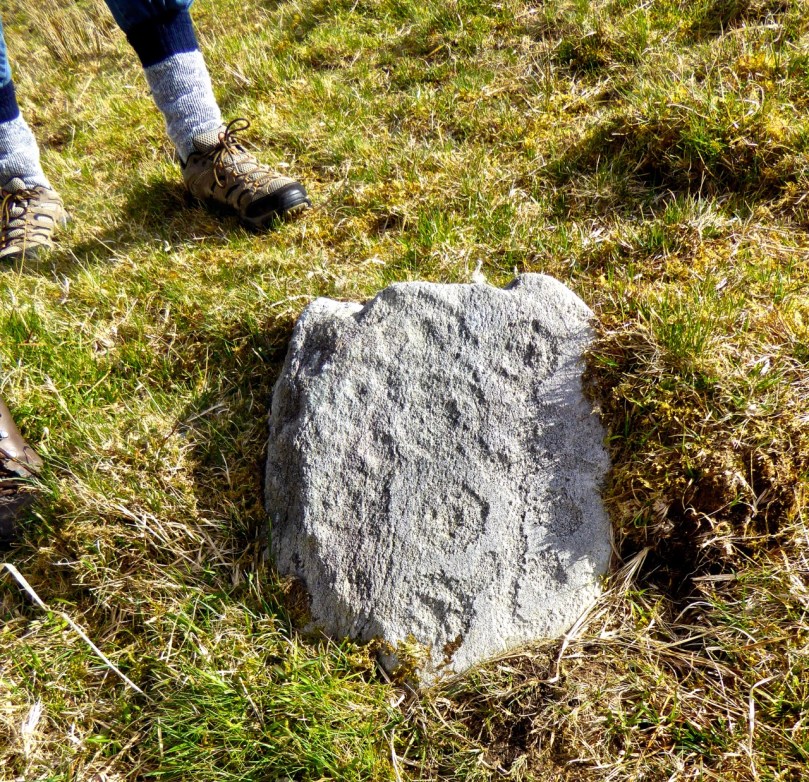
They had hiked up to a cairn – a large and mysterious feature on top of a prominent hill. It was said that you could see 15 churches from it. However, the cairn is now surrounded by tall trees as a result of a forestry plantation and therefore there is no longer any view from it. Local people had protested the plantation at the time, concerned that this cairn and its views should be preserved intact, but had lost the battle. In this write-up, I was touched to see a a photograph of my old friend, Bernard O’Regan, the local amateur archaeologist who, 40 years ago, had taken me to see several of the rock art panels in West Cork.

Visiting the Holy Well

Visiting the Holy Well

What a great project these children undertook – hats off to their teacher and the supportive community. The future for conservation and archaeology in West Cork is in safe hands! A huge thank you to Kilcoe National School for the invitation, and to their official photographer for sharing with us the superb photographs of the field trips.
Pilchards and Palaces

Black Castle, Leamcon

Black Castle, Leamcon – also known as ‘The Hound’s Leap’ – William Hull territory

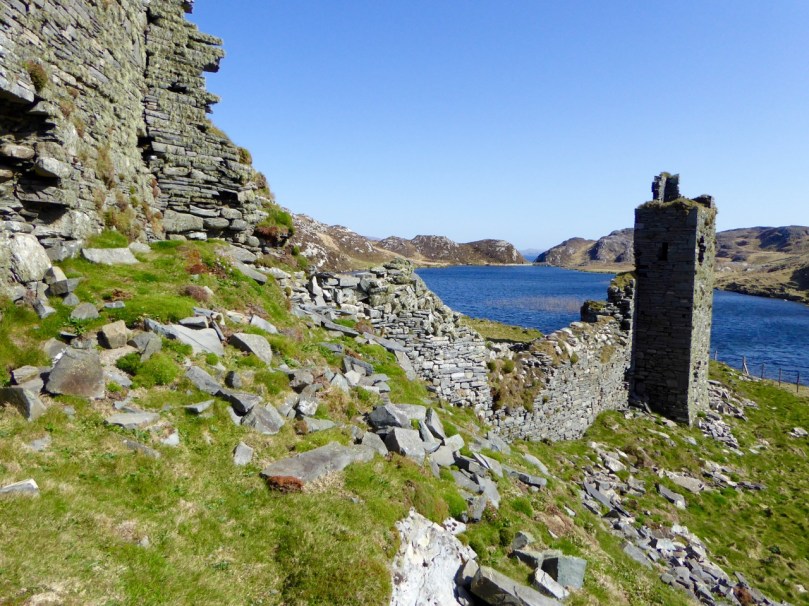
A little while ago I described an outing we undertook exploring some of the archaeological sites on the Mizen Peninsula. We were out again a few days ago checking on some monuments off to the west of us. I had researched the Archaeological Survey Database, and determined to have a look at the ‘Fish Palace’ located in the townland of Leenane, close to Crookhaven – evidently a substantial establishment set up by Sir William Hull and his business partner, Sir Richard Boyle, first Earl of Cork, in 1616.

Leenane Fish Palace in 2015

Leenane Fish Palace in 2015

Hull was a notorious character – his family home was Larkbeare, near Exeter in Devon. He had been appointed Deputy Vice Admiral of Munster in 1609 under James I, and settled in Leamcon near Black Castle or ‘The Hound’s Leap’, one of the O’Mahony castles built along the coast of Roaringwater Bay. Set on a promontory into Toormore Bay, Leamcon  is one of the most defensible of these, only being reached by crossing a narrow bridge. Hull’s job was ostensibly to protect the southern Irish coastline against piracy. In fact, the post seemed to encourage collaboration with the pirates, where it would financially benefit both the Admiralty and Hull himself.

You probably want to know what a ‘Fish Palace’ is? I had seen the term on Irish Ordnance Survey maps, and had established that it is a class of monument in the Archaeological Inventory of County Cork 1992, where it is well described:

‘…Fish palaces: The fishing and curing (smoking, pickling and pressing) of pilchards (Sardinia pilchardis) became an important industry in West Cork during the 17th century. This industry suffered from the erratic pattern of pilchard shoals (some years none would appear in Irish waters) and was in serious decline by the middle of the 18th century. Today, all that remains are the ruins of curing stations, called “pallices” along the coast. The word “palace” is of uncertain derivation, but probably originated in the SW of England where it meant a cellar used for storing fish. Usually the “press wall” is the only standing structure, with its horizontal line of lintelled support niches. These held one end of a press beam; at the other end a heavy weight was suspended and in the middle was a wooden press or “buckler”. The buckler was placed over an open barrel of pilchards and the downward force of the press beam pressed the pilchards into the barrel. Also fish or “train” oil was squeezed out through a drain in the base of the barrel; this was valuable as a luminant and was used by the tanning industry…’

All this has been ringing bells with me: firstly, because I know from the map that a Fish Palace once existed down below Nead an Iolair – overlooking Rossbrin Cove and Castle – but no trace is left now, except that the field there is still known as ‘The Palliashes’; but secondly because when I lived in Newlyn in Cornwall I looked out over Mounts Bay, where a pilchard fishery had been active since the 16th century. This was a huge business, whose heyday was the middle of the 19th century. Pilchard quantities are measured in ‘hogsheads’ – one hogshead holding 3,000 fish: in 1847 the exports of pilchards from Cornwall amounted to 40,883 hogsheads or 122 million fish! By good fortune we have a pictorial record of the activities, as two of the Newlyn School of Artists chose seining as the subject matter for two impressive paintings.

'Pilchards' - Charles Napier Hemy 1897 (Tate Gallery)

‘Pilchards’ – Charles Napier Hemy 1897 (Tate Gallery)

'Tucking Pilchards' Percy Craft 1897 - Penlee Gallery

‘Tucking Pilchards’ Percy Craft 1897 (Penlee Gallery)

*

In the good times Mounts Bay was brimming with seine boats. The pilchards were harvested during the summer when the shoals swam in close to the shore. Lookouts known as Huers were posted on the cliffs, from where the shoals could be seen and semaphore signals were sent out to the waiting boats who let out 400 yard long nets to surround and trap them. The nets were kept upright by floats at the surface and weights at the bottom, presenting an impenetrable wall to the pilchards. The pilchards were then removed by smaller tuck nets and loaded into punts and carried ashore. The seine net provided a convenient keep net in which the fish could be kept alive and fresh until they were processed.

Early photographs of seining, and the fishing fleets working out of Penzanace and Newlyn, Cornwall

During my time in Newlyn there was an active pilchard processing plant – now closed down – but I was fortunate enough to visit the works and see the pressing and preserving taking place, using exactly the same methods that William Hull’s workers employed four centuries before. Just as in those earlier times the main markets for the processed fish were in France and Spain.

Pressed Pilchards (Richard Greenwood)

Pressed Pilchards (Richard Greenwood)

As in Ireland, the pilchard shoals severely declined – probably because of overfishing – and the industry followed. Nowadays there is a small amount of pilchard fishing taking place in Cornwall, but it is barely viable.

Mousehole, Mounts Bay - Ernest Watson

Mousehole, Mounts Bay – Ernest Watson

To the casual observer, our little expedition to the Crookhaven Fish Palace might have seemed pointless – a lot of scrambling through bracken and brambles to find a few old stone walls and the crumbling remains of an abandoned quay. Through our eyes, however, we saw the industry and energy of former days: Irish men and women labouring long and hard to put clothes on the back of a Knight and an Earl…

canned pilchards

Wedge Tombs: Last of the Megaliths

Altar Wedge Tomb on The Mizen Peninsula

Altar Wedge Tomb on The Mizen Peninsula

In Ireland, the tradition of building megalithic (mega=large, lithos=stone) structures that included chambers to house the dead (such as the Boyne Valley Passage Grave complex, or the Court Tomb of Creevykeel) belongs to the Neolithic period, which ended around 2500 BC. About this time, a new style emerged of stone ‘galleries’, oriented towards the setting sun. Their distinctive shape – narrower and shorter at the eastern end – gives them their common name, wedge tombs. This tradition appears to have flourished for about 500 years.

Altar, side view

Altar, side view

In other areas of Ireland wedge tombs were often covered by a mound, but there is little evidence for this in West Cork. The closest parallel to wedge tombs outside of Ireland are in Brittany where allées couvertes date from this period. They are associated in some parts of Ireland (although once again not in West Cork) with Beaker pottery, a distinctive kind of vessel widely distributed across Western Europe. This was a time in which the population was expanding, farming practices were intensifying and a brand new technology was being introduced – it was the dawn of the Copper Age. Thus, we can speculate that wedge tombs mark the confluence of two forces: the new continental technologies of pottery and metalworking and the indigenous tradition of erecting megalithic chambered tombs.

Wedge tombs occur mostly in the western half of Ireland, including many in County Clare such as the Parknabinnia tomb pictured below.

 The largest wedge tomb in Ireland is near Fermoy, north of Cork City. It is typical of many Irish wedge tombs in featuring double walling, evidence of a surrounding cairn, and a sealed end chamber. Interestingly its name, Labbacallee, means the Hag’s Bed – the hag, or wise woman crops up frequently in Irish mythology.

In contrast to Labbacallee, wedge tombs in West Cork are generally smaller and simpler, comprising only one chamber and lacking a covering cairn. However, the distinctive wedge shape is preserved along with one other defining feature: wedge tombs are invariably oriented towards the setting sun. The funerary rite was that of cremation. Votive offerings of white quartz pebbles and small deposits of metal have been found in excavations.

Toormore wedge tomb,  now in someone's garden

Toormore wedge tomb, now in someone’s garden

Prof William O’Brien has excavated wedge tombs in West Cork and studied them, and the culture in which they were built, extensively. Here’s what he has to say, in his book, Iverni, about the society that produced them:

Whereas monuments like Newgrange could only have been built with a large organised input of labour over a long period, the building of wedge tombs was undertaken by small kin groups…This was a small scale society, comprised of local, clan-like groupings…The tomb was a type of shrine, sanctified by an association with ancestors and used for periodic offering and sacrifice to supernatural powers.

A striking aspect of Neolithic, Chalcolithic (Copper Age) and Bronze Age monuments in West Cork is their consistent orientation towards solar events such as sunrise and sunsets on the equinoxes, solstices and cross-quarter days (see our post on Bohonagh stone circle, for example). In this regard, wedge tombs are remarkably consistent in being oriented towards the West. Here’s O’Brien again:

Wedge tombs served as funnel-shaped openings to the Otherworld, facing the descending or setting sun to emphasise the symbolic dualism of light/life and darkness/death.

Toormore, side view

Toormore, side view

Looking for a wedge tomb closer to home, we set out yesterday to find the nearby Kilbronogue site, using the information from the National Monuments Service as a guide. We have found in the past that the mapping of sites is not always accurate and after an hour or two of tramping through a large and very muddy area with a helpful neighbour and his son we had to admit defeat – either the map was wrong, or the monument had disappeared in the recent fieldwork by a digger. Desperately hoping it was the former and not the latter, we found out who owned the land and went to call on him today. Stephen Lynch turned out to be a friendly, cheerful and very knowledgeable organic farmer – he assured us that the tomb would never be damaged in any way and not to worry, he would take us to it. Whew! Half an hour later we were trudging up a path that Stephen had had cut through his ash plantation – on we went and suddenly there it was in front of us – a classic wedge tomb, oriented to the west, built with large slabs that may have been cut from the rock face behind it.

Kilbronogue wedge tomb with its guardian, Stephen Lynch

Kilbronogue wedge tomb with its guardian, Stephen Lynch

Stephen told us the tomb had been used as a mass rock in penal times and that the Protestant farmers who owned all the farms that bordered on the rock had cooperated in allowing the masses to take place – an indication, Stephen said, of the long tradition of friendship between Catholic and Protestant farming families in this area. As with the Altar wedge tomb, also used as a mass rock, we marvelled at how a sacred site, built at least four thousand years ago, would retain its aura of veneration over the millennia, to be used again for religious purposes in the historic period.

Kilbronogue, side view

Kilbronogue, side view

Perhaps the most spectacularly situated wedge tomb we have been to is high on a hill overlooking Bantry. This one is known as Queen Medb’s Tomb and from it there are expansive views of the Beara, Sheep’s Head and Mizen Peninsulas. Climb up to it on a clear day, as the sun is sinking into the sea: in the presence of such awe-inspiring scenery you will find yourself contemplating how the mysteries and the wonders of Irish history and prehistory are written on its landscape.

Queen Medb's Tomb

Queen Medb’s Tomb

From Skibbereen to the Moon: Agnes Mary Clerke

Commemorative plaque in SkibbereenCommemorative plaque in Skibbereen

NOTE: I have rewritten this post and substantially updated it. See, from Sept 2023, Storm Agnes: Agnes Clerke of Skibbereen and Nineteenth Century Astronomy.

What follows is the original post, from 2015.

Wandering around Skibbereen, I came across a plaque on a once-imposing pink building – it showed two women, the Clerke sisters, who had grown up in the house. Intrigued, I searched for more information and what I found astonished me.

Agnes, Ellen and Aubrey Clerke, the offspring of John William Clerke (who managed the bank located on the ground floor) and Catherine Mary Deasy, were all brilliant, scholarly and published writers, each in their own fields. The Clerke (Protestant) and the Deasy (Catholic) families had long and solid histories in West Cork and lived through the awful famine period of Skibbereen during which they were said to be benevolent (see Paddy Leahy’s piece in The Journal of the Skibbereen and District Historical Society, Vol 7, 2011 for more on John and Catherine). John had been educated in Trinity and the children grew up in the 1840s and 50s with access to their father’s extensive library, his telescope and his chemistry experiments. The telescope, according to Mary Brück’s biography, was equipped with a chronograph for timing the transits of stars across the meridian. With this arrangement Clerke was able to provide a time service for the town of Skibbereen, which was as yet unconnected to the outer world by either railway or telegraph.

Bridge Street, Skibbereen, 19th Century. National Library CollectionBridge Street, Skibbereen, 19th Century. National Library Collection

The sisters were tutored by their mother to a high proficiency in music, Latin and Greek. (Catherine played Irish music on the harp and retained her ability to entertain well into her 80s.) Insatiably curious, they devoured knowledge and by 15 Agnes had already begun to write a history of astronomy – a book that would later count as her magnum opus. While Ellen and Aubrey distinguished themselves mainly (although not exclusively) in literature and law, Agnes went on to become one of the foremost science writers of her day. Devoted to each other, none of the siblings ever married and the family lived together in harmony and supported each other’s endeavours to the end.

Living in Italy for ten years, Agnes and Ellen studied extensively in the excellent libraries in Rome and Florence, becoming proficient in several languages and going to primary sources to research their interests. Thereafter, the family settled in London. Although she started off with a wide range of topics, Agnes over time concentrated on writing about astronomy. Her first published pieces (one about Copernicus, the other about the Mafia!) appeared in the Edinburgh Review in 1873. This was the equivalent, as Perry O’Donovan points out in an essay for the Skibbereen and District Historical Society Journal (Vol 9, 2013), of an unknown writer today being published in the New Yorker.

History of A 4th edition

The depth and scope of Agnes’s scholarship is awe-inspiring. To read through her History of Astronomy during the Nineteenth Century (available online through Project Gutenberg) is to see a brilliant mind at work. Her purpose in writing it was to embody an attempt to enable the ordinary reader to follow, with intelligent interest, the course of modern astronomical inquiries, and to realize (so far as it can at present be realized) the full effect of the comprehensive change in the whole aspect, purposes, and methods of celestial science introduced by the momentous discovery of spectrum analysis. This IS the rocket science of her generation, encompassing chemistry, physics, mathematics, history of scientific thought, cosmology, the most up to date observation and measurement techniques – in short, the disciplines that made up the emerging science of astrophysics.

Take a look, for example, at the headings for her Chapter IV: Chemistry of Prominences—Study of their Forms—Two Classes—Photographs and Spectrographs of Prominences—Their Distribution—Structure of the Chromosphere—Spectroscopic Measurement of Radial Movements—Spectroscopic Determination of Solar Rotation—Velocities of Transport in the Sun—Lockyer’s Theory of Dissociation—Solar Constituents—Oxygen Absorption in Solar Spectrum. Looks pretty frightening for a non-scientist, doesn’t it? And yet, this book was one of the best-sellers of the day. Agnes had a unique ability to absorb and compile knowledge and then to lay it out for the non-specialist. (I got through the first chapter with little difficulty.) She is rightly credited as the founder of what is called today Popular Science. Her books (she wrote many more) and articles sold well and she made a good living from her writing.

However, she was a woman, and a non-practitioner (that is, she didn’t work in an observatory, although she spent time in one) and many in the predominantly male science establishment of Victorian Britain were sceptical of her knowledge and resentful at her success. But as they read what she wrote most were won over by her erudition and her ability to present their complex findings to a wide audience. Although she was a member of the British Astronomical Association, as a woman she was ineligible to be a member of the prestigious Royal Astronomical Society and had to call in favours to be allowed access to their library. But eventually even that bastion of male scientific privilege was forced to acknowledge her achievements and appointed her and her great friend Lady Margaret Huggins (another Irish astronomer) as honorary members.

The Clerke CraterThe Clerke Crater

Recently, however, Agnes has been paid a high honour. A crater on the moon, near the Apollo 17 landing site, has been named the Clerke Crater by the International Astronomical Union.

Huggins memoirHuggins memoir

Margaret Huggins penned a small memoir about Agnes and Ellen Clerke after their deaths. However the real authority on Agnes’s life and scholarship was Mary Brück, a fellow astronomer, yet another Irish woman (from Meath) and author of Agnes Mary Clerke and the Rise of Astrophysics. 

Brück biographyBrück biography

Of Agnes, she said: This remarkable woman, educated solely within her own family and through her own private studies, not only kept abreast of astronomical progress world-wide but also had a genuine understanding of the matters on which she reported and the gift of communicating them through her fluent and prolific writings. Her books – in particular her Popular History of Astronomy during the Nineteenth Century, first published in 1885 and reprinted over almost twenty years – are treasured by historians and by amateur lovers of astronomy alike as sources of reliable and enjoyable information on that period.

I loved her description of Agnes at the height of her powers: Agnes Clerke in her sixties had become a sort of mother figure among astronomers, tactful, kind, helpful.

Ellen and Aubrey deserve their own posts (now written, see From Skibbereen to the Moon Part 2: Ellen and Aubrey Clerke). However, it does seem apt to close this piece on Agnes with a quote from one of Ellen’s poems, Night’s Soliloquy:

                                …are not hidden things

Reveal’d to science when with piercing sight

She looks beneath the shadow of my wings

To fathom space and sound the infinite?

Whisperers

Shergar wins the 1981 Derby by ten lengths!

Shergar wins the 1981 Derby by ten lengths!

The skill of the Irish in breeding, training and riding horses is unbounded. These arts are swathed in folklore and storytelling as much as in reality. Take Shergar – record-breaking racehorse whose 1981 win was the longest margin in the Epsom Derby’s history: after an illustrious career the horse was kidnapped from Ballymany Stud, near The Curragh in County Kildare by masked gunmen – and never seen again. The incident has been the inspiration for conspiracy theories, books, documentaries, and a film.

You’ve all heard of the Horse Whisperer, a novel by Nicholas Evans which, in 1998, became a blockbuster film starring Robert Redford? Well, the term ‘Whisperer’ was around long before that, used to describe people who communicate with and train working horses. As far back as 1648 it was recorded that a Sussex horseman, John Young, had the art of controlling horses ‘…by means of the whisper…’ – but the most famous of the historical ‘Whisperers’ is a man from County Cork, James Sullivan. He was born in Mallow towards the end of the eighteenth century, ‘…an ignorant, awkward rustic of the lowest class…’ according to Mile’s Modern Practical Farrier, 1843. Sullivan ‘…gained the singular epithet of Whisperer by an extraordinary art of controlling in a secret manner and taming into the most submissive and tractable disposition, any horse or mare that was notoriously vicious and obstinate… He seemed to possess an instinctive power of inspiring awe, the result perhaps of a natural intrepidity, in which I believe the greater part of the art consisted… A faculty like this would have, in other hands, made a fortune; but Sullivan preferred to remain in Ireland…’

A woodcut by C F Tunnicliffe

A woodcut by C F Tunnicliffe

It’s worth quoting a little further from the story of this man from Cork, here from one of my much-thumbed books which I have carried with me for countless years – The Horse in the Furrow, by folklorist George Ewart Evans:

‘…Sullivan’s best known exploit was his taming of King Pippin, a notoriously vicious horse, at the Curragh in 1804. A man who had offered to put on his bridle had been seized by the horse and shaken like a terrier shaking a rat. He was saved only by the amount of clothes he had on his back. It appears that this was the custom of the Irish countryman to show off his wardrobe on occasions such as this, and if he had three coats he put them all on. After this incident they sent for Sullivan to subdue the horse. He shut himself up with him all night, and in the morning the horse was following him about the course like a well trained dog: he won a race at the same meeting…’

Another of my favourite writers whose many books pad out the folklore section of our library here at Nead an Iolair is Kevin Danaher. I can’t resist quoting from The Horseman’s Word in Irish Country People, Mercier Press, 1966:

‘…At the horse fair the buyer would look out for the characteristics of a good horse as laid down in the old saying: “…Three traits of a bull, a bold walk, a strong neck and a hard forehead; three traits of a fox, a light step, a look to the front and a glance to each side of the road; three traits of a woman, a broad bosom, a slender waist and a short back; three traits of a hare, a lively ear, a bright eye and a quick run against a hill…”

A first hand account of Whispering from Danaher’s childhood:

‘…It was at a fair in Rathkeale that I saw for the first and only time the strange power of the “horseman’s word”. A young colt, either through fear or perverseness, was prancing and kicking wildly when a boy of about seventeen walked in and fondled the horse’s nose, talking quietly. Immediately the colt became calm and the boy took the headstall and led him up and down as meek as a lamb. We were told that this boy, the son of an itinerant horse dealer, had the power to calm any horse. Some people said it was a hereditary secret in his family, others that he had learned it from an old Palatine farmer in the district who also had this strange gift. It was said, too, that as well as being able to quieten horses and break untrained animals in a matter of minutes, this boy could get a horse to stand still and not move for any force or persuasion until he or somebody else who had the power released it. There is no doubt at all that certain persons have this gift, not only in Ireland but all over the world, but no satisfactory explanation is forthcoming. In Ireland it is known as ‘cogar i gcluais an chapaill’ or simply ‘the whisper’ and its potency is held to lie in the words which are spoken in the horse’s ear…’

Irish Travellers, County Clare 1951

Danaher mentions an ‘itinerant horse dealer’. Today we might call them Gypsies or Travellers. In Ireland they are well-known for their skills in horsemanship, and for breeding a very particular type of draft horse, suitable for pulling the vardo and also for riding and sulkie racing. The horses are often piebald or skewbald. You may be sure that the Travelling fraternity are natural Whisperers!

The 'Gypsy Horse' is a light draft cob

The ‘Gypsy Horse’ is a light draft cob

Both Evans and Danaher mention the Toadmen in their discussions. These characters would use divination to gain their power over horses. One such ritual was called the ‘Water of the Moon’, and was commonly practised in the East Anglian and Cambridgeshire regions of England. It required that the horseman kill a frog or toad and hang the body on a thorn tree until only the skeleton remained.  At full moon the man then had to take the skeleton to a running stream and throw it into the water.  One small forked bone would detach itself from rest and float upstream, and it was this bone from which the horseman would then derive power over horses.

The magical bone of the Toad...

The magical bone of the Toad… (Tunnicliffe)

Have a look at this clip from Canada – it’s not Ireland, but it’s about a modern day Horse Whisperer, and makes good watching…

Speed the Plough

Speed the Plough

In England today – the first Sunday after Epiphany – they ‘bless the plough’. I can’t find any mention of a similar tradition in Ireland, but please let me know if you are aware of one. It’s because the day marks the end of the agricultural holiday which follows Christmas: tomorrow is Plough Monday – the first day of the farmers’ working year – which has its own traditions. Ploughs were traditionally taken around with collecting boxes by mummers and molly dancers in parts of Eastern England, and in some places were used as a threat: if householders refused to donate to the participants their front paths would be ploughed up! Of course the ploughs used in these customs were all drawn by horses at one time – something that hasn’t died out yet: our friends Tim and Sandra keep their own working horses here in West Cork, and I’m quite sure they have mastered the art of Whispering for themselves.

philatelynews-irish-horse