Footsteps

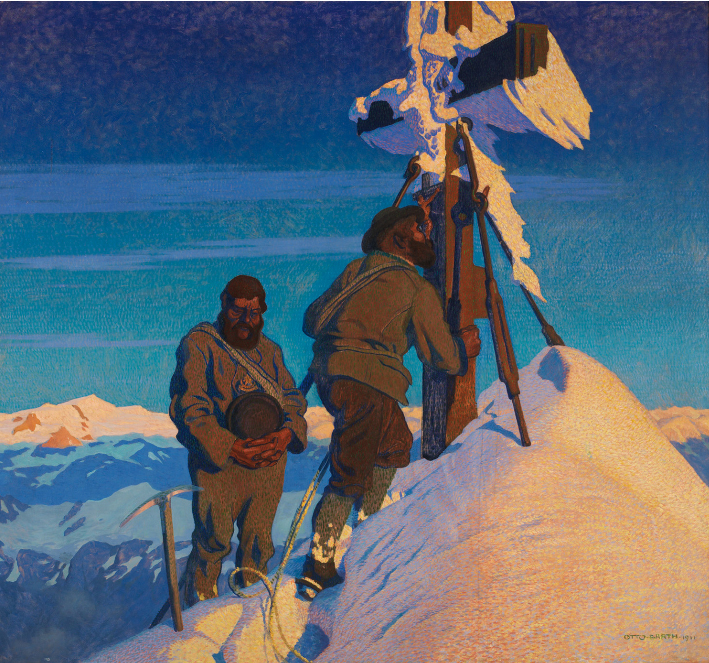
Morning prayers on the Großglockner, Otto Barth 1911

Morning prayers on the Großglockner, Otto Barth 1911

Is it us? We seem to be following in the footsteps of thieves and wreckers… Back in June 2012 we visited St Manchan’s Church, in Boher, Offaly and saw the splendid shrine of that Saint securely locked in an armoured glass case and mounted in front of the equally magnificent Harry Clarke window depicting him. That was at about 1 o’clock in the afternoon. We were shocked to hear on the news that evening that the shrine had been stolen at 1.30! Two men had taken just a few minutes to break open the case – in spite of alarms and cctv – and make off with the Saint’s remains…

We were relieved to hear the following day that the robbery had been bungled: the shrine was thrown out of the getaway car and landed in a bog: both it and the perpetrators were picked up by the Gardi. I wonder if perhaps the thought of what divine justice might be wrought from on high (from St Manchan himself, even) had put doubts into the minds of the thieves and diverted them from their intentions – whatever they might have been.
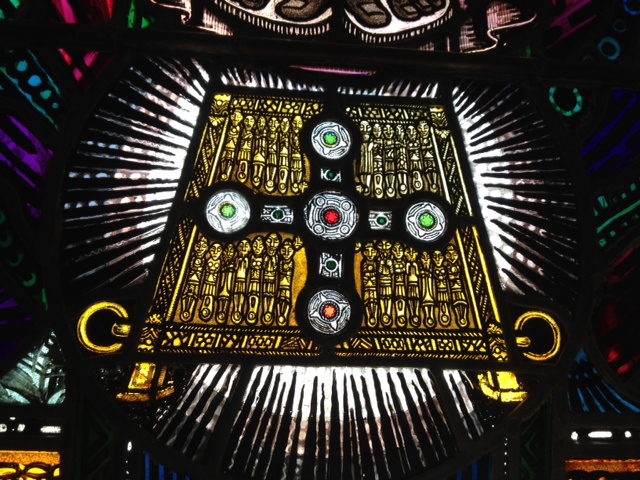
Harry Clarke's depiction of the Saint's shrine

Harry Clarke’s depiction of the Saint’s shrine

Nevertheless, the incident led to some considerable debate on whether the reliquary should be returned to the church – where the security was evidently lacking – or whether the original 1,000 year old artefact should be put into Ireland’s National Museum and the replica which happens to be there should be sent back to St Manchan’s. The Boher people campaigned vigorously against this – quite rightly in my opinion – and eventually, after some improvements to the arrangements in the church, the shrine has been restored to where it belongs.

winter

Carrauntoohil Summit – photo by Noel Mulcair: thejournal.ie

So there we were just a week or two ago, honeymooning in the shadow of Ireland’s highest mountain (although warmly ensconsed in a comfortable Kerry hotel) when we heard the news that, not far away, someone had climbed the mountain at night and felled the iron cross that had stood up there for many years, with an angle-grinder! Obviously some point was being made, although nobody was quite sure what that was at the time…
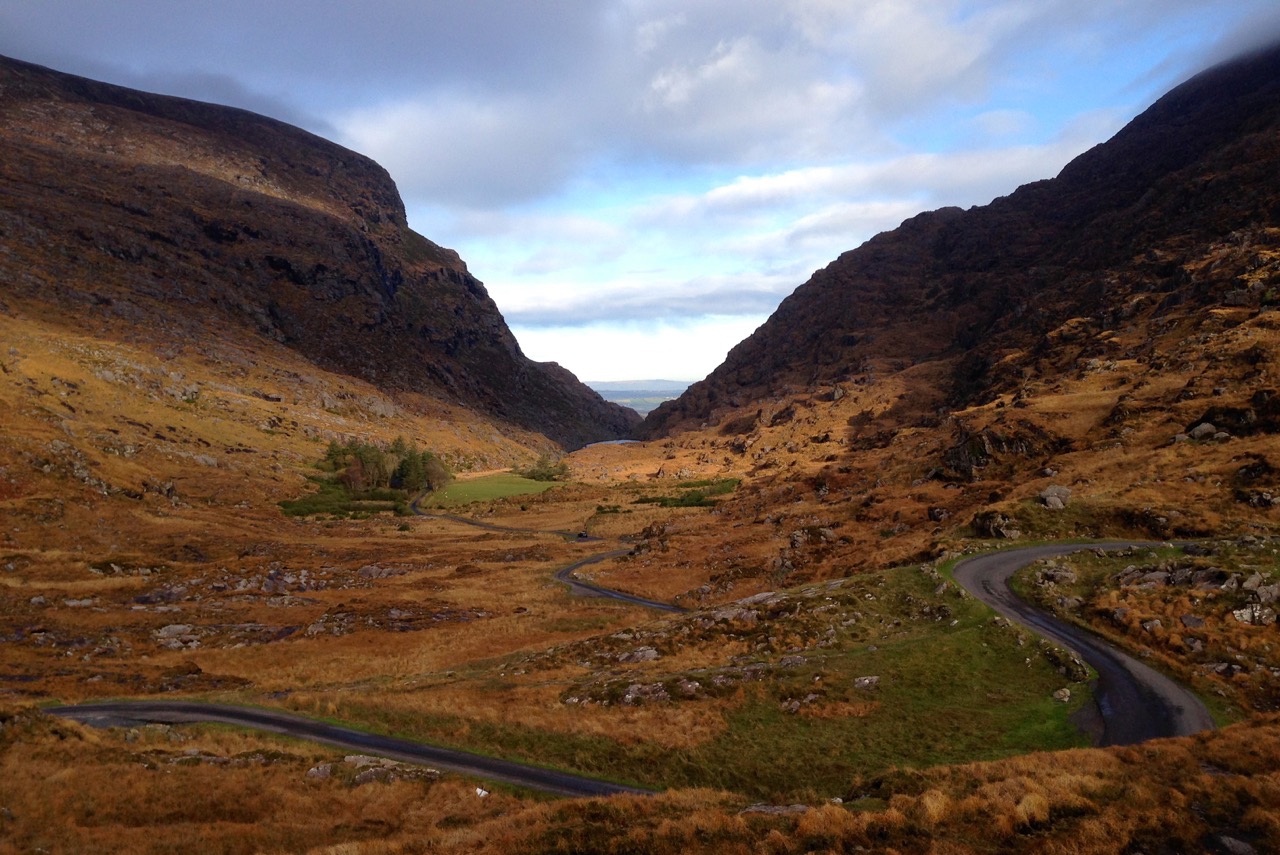
The Mountains of Kerry

Gap of Dunloe, in the shadow of Carrauntoohil
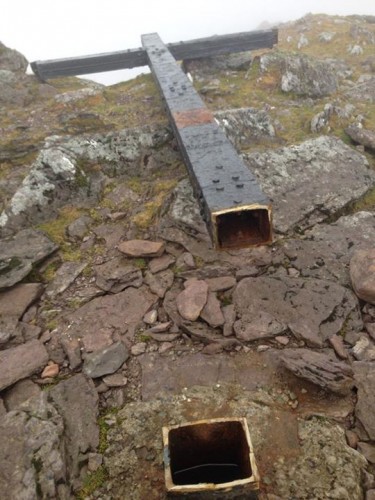
 

The cross is felled...

The cross is felled…

The Carrauntoohil incident sparked off a lively correspondence in The Irish Times. Many were indignant at the act of vandalism, while others took the view that there is no reason why wild places should be ‘sullied’ with religious symbols. Hmmmm… that’s a bit harsh, perhaps: crosses on mountain tops have a been around for a long time all over the world and, ever since prehistory, humans have marked their presence on the landscape with monuments of one sort or another. As you all know, the two of us are fascinated (obsessed might be a more appropriate word) by megaliths, tombs, circles and inscribed rocks – and these are preserved archaeological artefacts – it would be unthinkable for someone to get it into their head that a standing stone should be destroyed because it might have represented someone’s god. At the very least, surely, the subject should be aired and a democratic decision made by a public majority before any such action is taken. Indeed, the subject did get aired after the event and I gleaned that the majority of respondents felt that the iconic cross should not have come down.

Well, this story – like the St Manchan one, has had a happy ending. A group of volunteers has been up to the summit with block, tackle and welding equipment and the cross is back again.

Ireland has many summits adorned with constructed pieces – ancient cairns and tombs, and more modern statues and symbols, not forgetting the wind farms which are another source of controversy. We are all part of human history and one of Ireland’s big attractions for me is that the history is so visible and accessible. In 1968 a white marble Pieta was placed high up on the Goat’s Path in Glanalin townland. It’s someone’s personal monument to a much loved father. In my opinion the melancholy statue enhances the wild place: I make a bee-line for it whenever I’m in the area – partly to enjoy the magnificent view but also, I have to say, because I am fascinated to see how many coins and offerings are put into the outstretched palm of Mary. Look here for a fuller description on the excellent website Sheep’s Head Places.
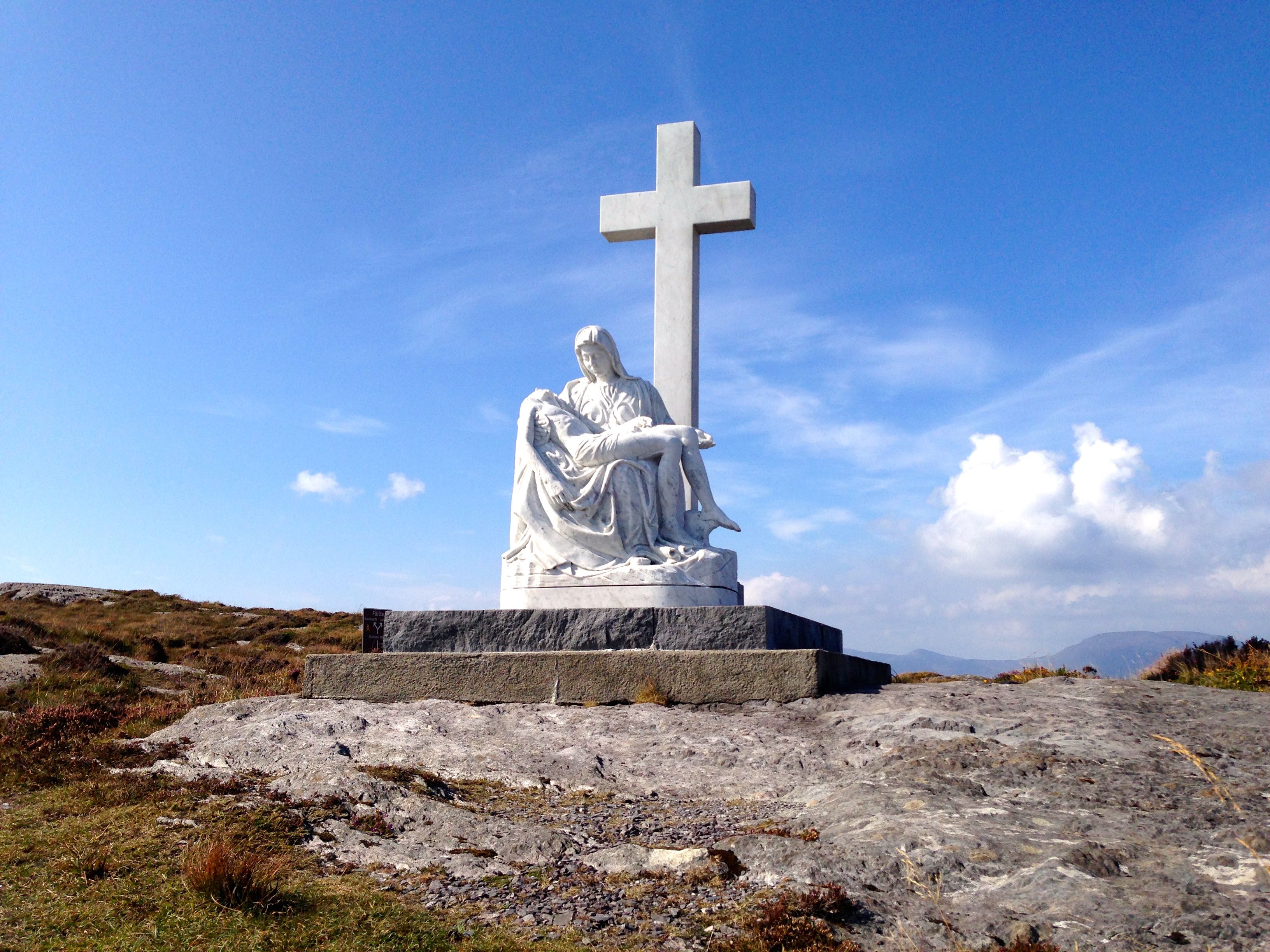
Hilltop Pieta

Hilltop Pieta

Given our experiences to date I worried a bit about our visits to Holy Cross Abbey and the Cathedral of St Mary and St Anne in Cork, where we came across the shin bone of Blessed Thaddeus McCarthy. But it seems to be ok: fair enough, the fragment of the True Cross was stolen from Holy Cross (it’s now been replaced with another), but long before our visit, while the saintly shin bone seems to have survived unscathed so far. I can’t help looking over my shoulder, though, when we visit such places. Ireland is full of enigmas…
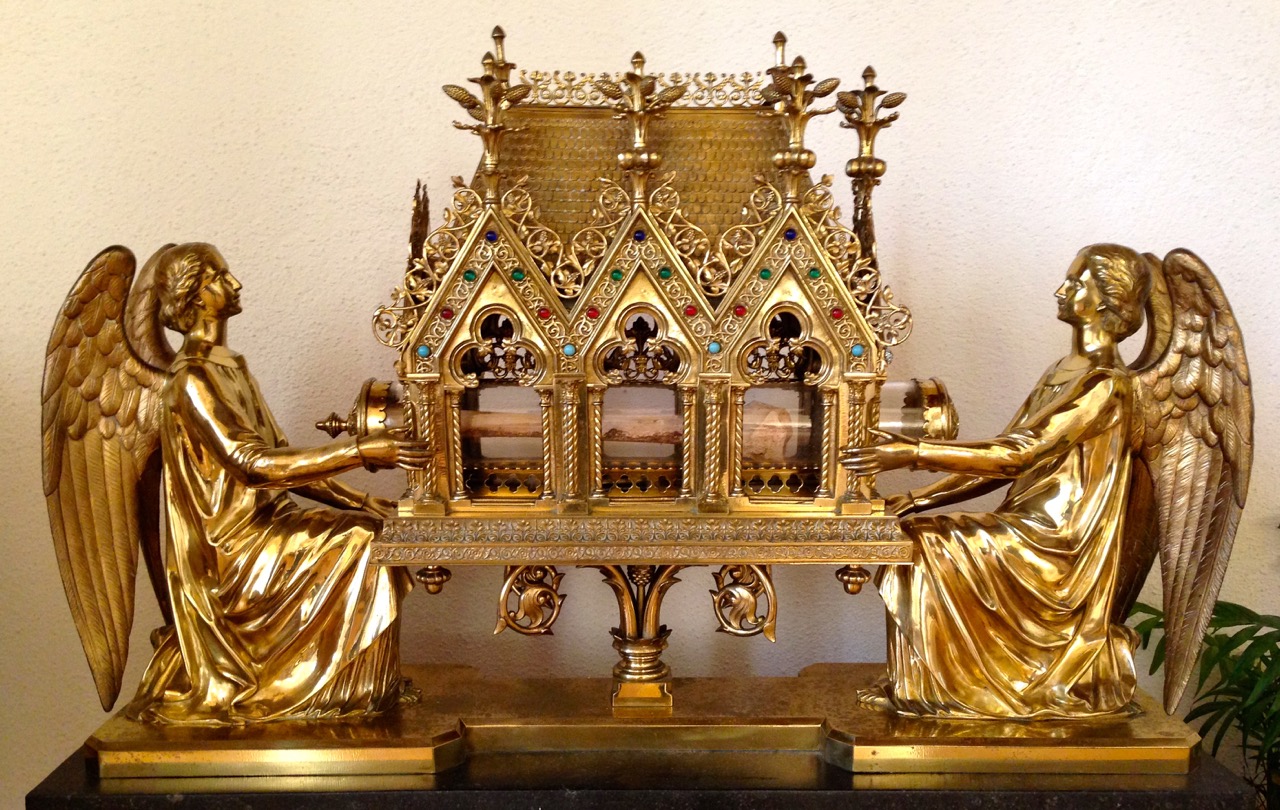
thaddeus

Sacred shin bone – with Angelic guardians
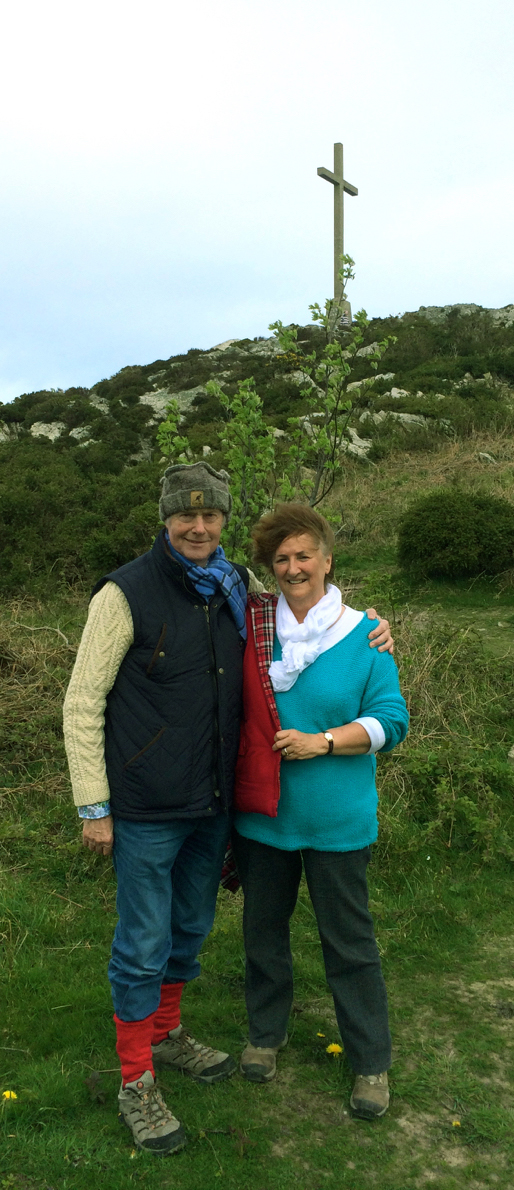
Finola's childhood haunts: the cross on Bray Head, Wicklow

Finola’s childhood haunts: the cross on Bray Head, Wicklow

Three Pilgrims in West Cork

Glebe Church, on the Ilen River

Glebe Church, on the Ilen River

The guest speaker at this Thursday’s Skibbereen Historical Society meeting was Louise Nugent, speaking on the topic of Pilgrimage in Medieval Ireland. We became familiar with Louise’s work though her blog of the same title – a blog which manages to be consistently erudite and down-to-earth and entertaining all at once – and suggested her as a speaker. This also gave us the opportunity to meet Louise in person (she is as engaging and as knowledgeable as her blog) and, the next day, show her a little bit of our part of West Cork.

One of the great delights of following Louise’s blog is realising that the concept of pilgrimage – a spiritual journey undertaken for a variety of purposes – is still very much alive in Ireland. Local veneration of shrines, relics and holy wells is common and often involves a mass or prayers on special days. The “journey” involves going to the shrine, and sometimes moving around it in a set pattern or round. Larger scale pilgrimages, such as the annual trek up Croagh Patrick or a stay at Lough Derg in Donegal or a Novena at Holy Cross Abbey, transcend the local and attract pilgrims from around Ireland. In her talk, Louise also described the popularity of pilgrimage in Medieval times to holy sites outside Ireland such as York, Santiago de Compostela, Rome, or Jerusalem. Those who completed the Santiago Camino wore scallop shells to signify their pilgrim status, an image we had just seen the previous weekend in Cork in the Cathedral of St Mary and St Anne, where we came across a shrine to Blessed Thaddeus McCarthy. There was a statue, a painting, scrolls, but most fascinating of all a reliquary containing a leg bone! Blessed Thaddeus lived in the 15th Century and was appointed a bishop twice but was never able to take up his see because of the activities of the rival clan O’Driscoll.

On our day with Louise we concentrated on the area around Skibbereen. We started off by visiting the 18th Century Church at Glebe, on the banks of the River Ilen. The church and graveyard enjoy a picturesque and peaceful setting and a wander around the graveyard yielded interesting headstones.

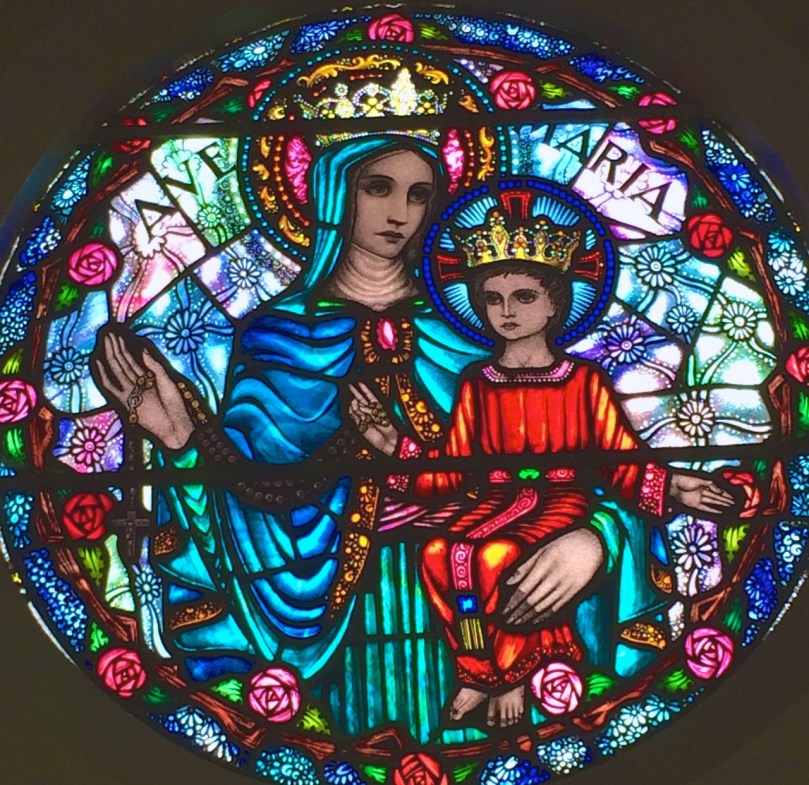
Holy Rosary Church at Aughadown, window detail

Holy Rosary Church at Aughadown, window detail

From there we went to the ruined medieval church at Kilcoe, stopping for a quick peak at the notable windows in the Church of the Most Holy Rosary at Aughadown. They deserve a fuller description at a future date, so for now I will include a detail from the rose window at the back of the church, designed and executed by the Harry Clarke studios in 1941.

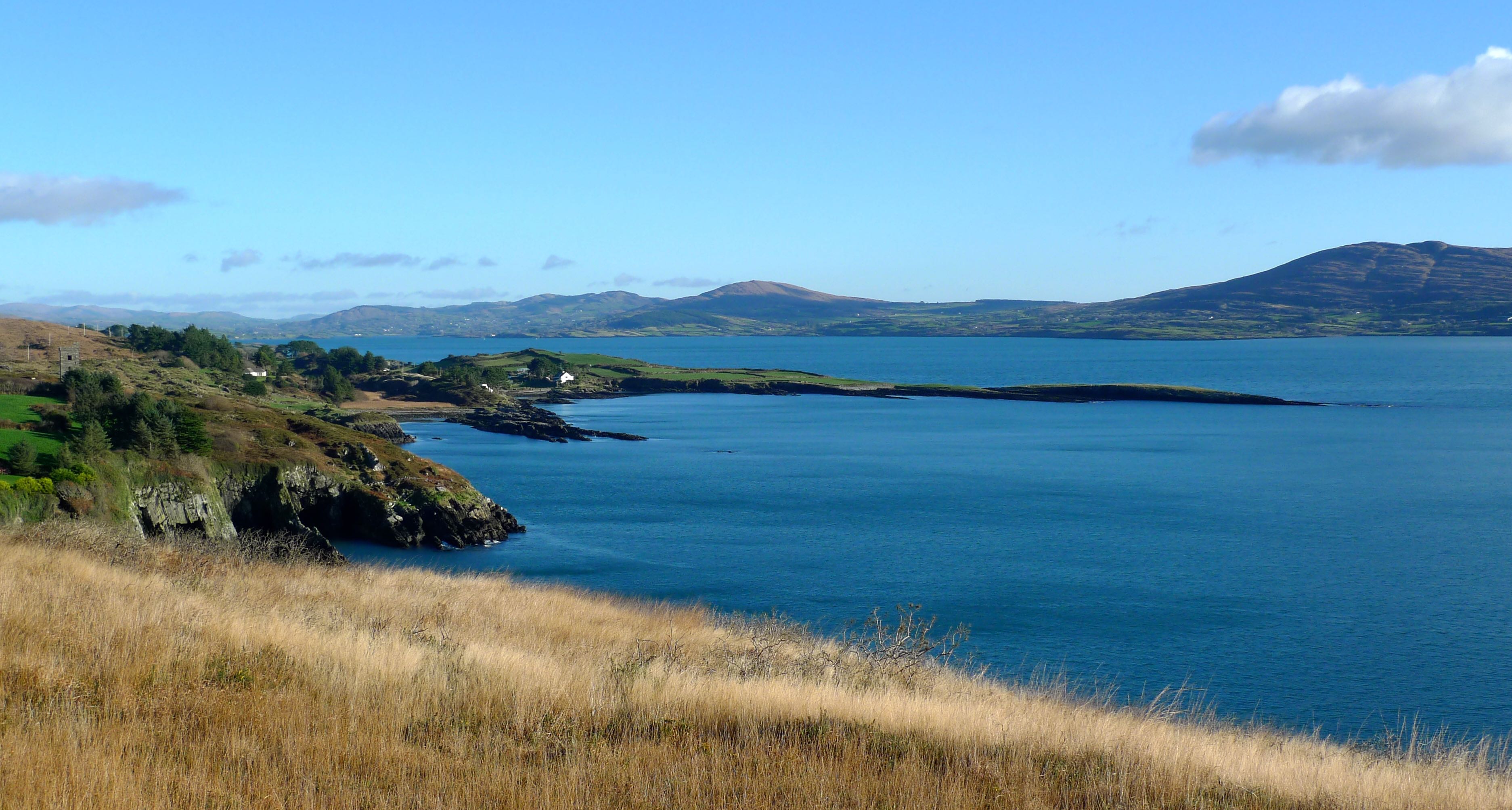
The church at the tip of the Kilcoe Peninsula was already a ruin in the early 17th century. Although a simple rectangular structure, the pointed arched doorway and the tiny ogival windows mark it as medieval, perhaps as early as 14th or 15th century. Romantic and atmospheric as it is, it has the added advantage of a clear view of Kilcoe Castle, famously restored by Jeremy Irons and gently glowing in the afternoon light as we were there.

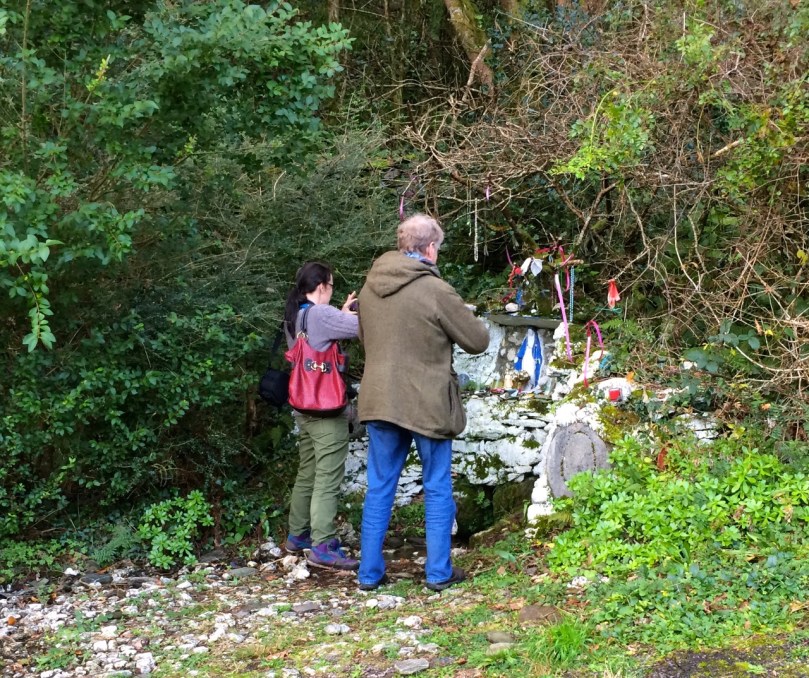
Two of the three pilgrims at a holy well

Two of the three pilgrims at a holy well

Louise’s special interest is in holy wells and several audience members the night before had come forward with information about local wells and the practices and beliefs associated with them. Two of the best known and most beloved local wells are situated close to each other at Lough Hyne. Robert is writing about these wells this week so I will leave the detailed description to him.

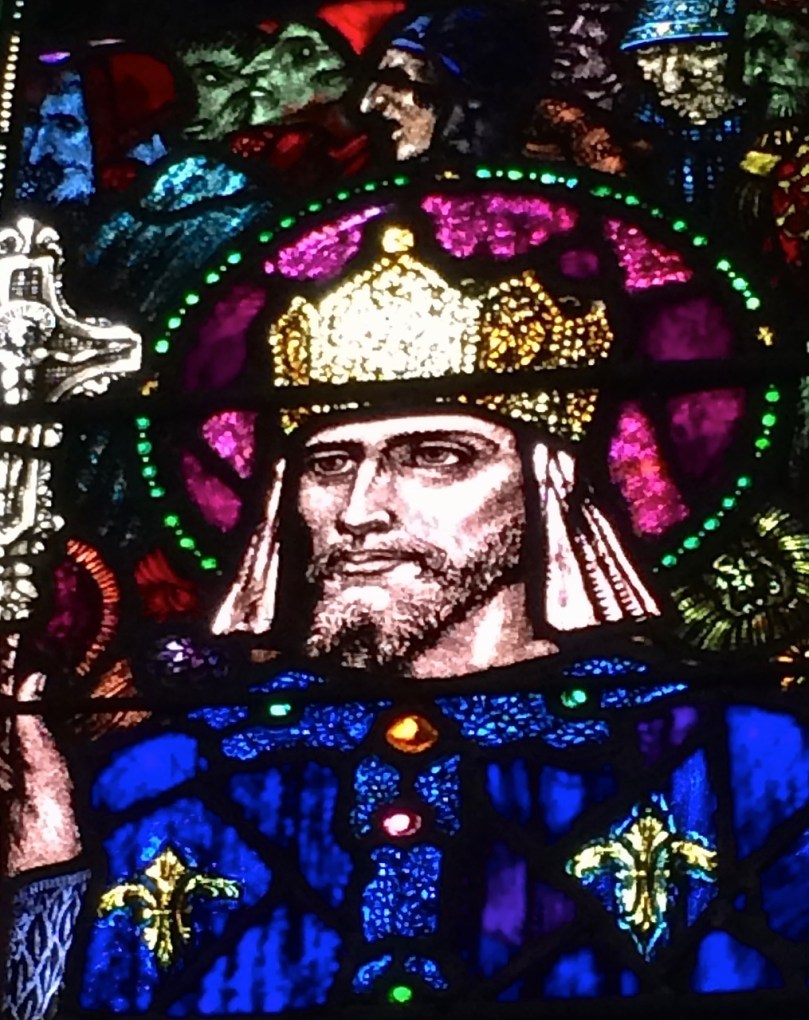
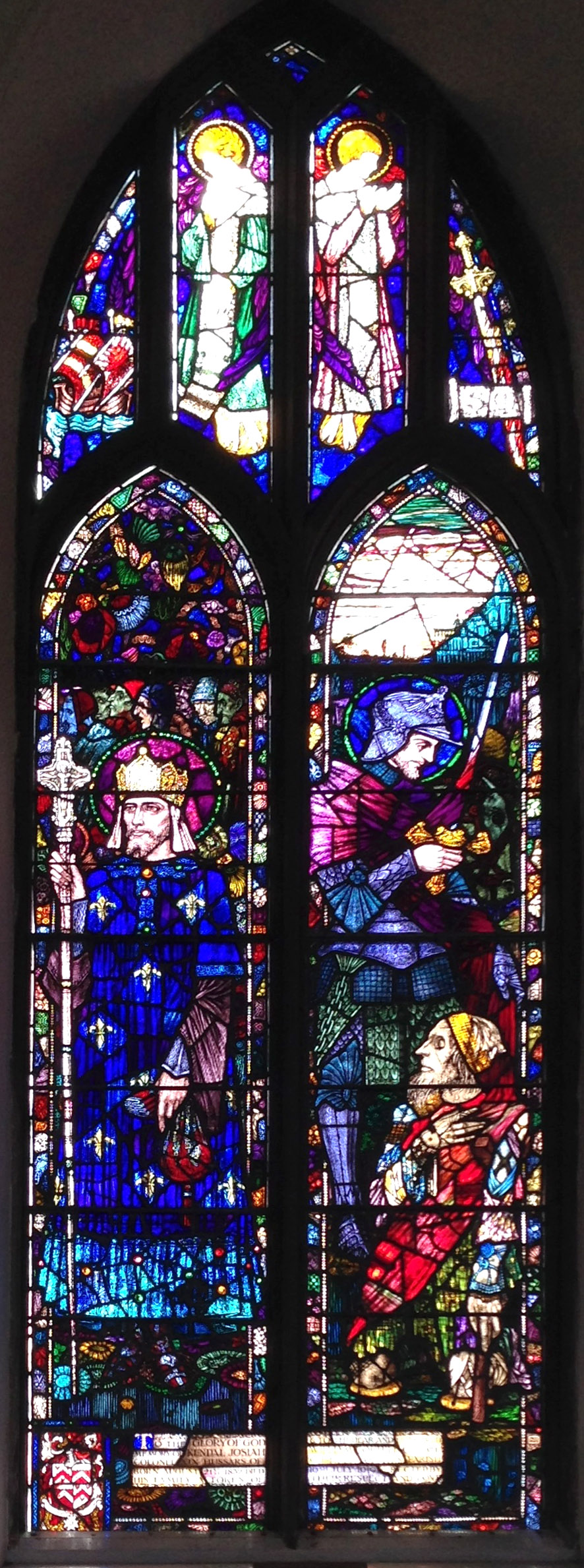
Our final stop was the village of Castletownshend and the Church of St Barrahane, filling two different functions. First, Louise had been to visit a holy well dedicated to St. Martin of Tours in Clare, and we wanted to show her the Harry Clarke window that Robert had described in his Martinmas post. Second, a trip to St Barrahane’s is always a pilgrimage of a different sort for me, as it is the final resting place of three of my heroes. The first two, of course, are the writing team of Somerville and Ross – more about them in this post. The third is Vice-Admiral Boyle Somerville, brother of Edith and a keen amateur archaeologist worthy of a post to himself in the future.

St Louis: detail of Harry Clarke window in St Barrahanes, Castletownshend

St Louis: detail of Harry Clarke window in St Barrahanes, Castletownshend

Come back soon, Louise – these two pilgrims have lots more to show you!

Martinmas

St Martin's Summer: late November on the Sheep's Head

St Martin’s Summer: late November on the Sheep’s Head

I’m used to pursuing the lives of the Irish Saints – often obscure, always fascinating – their legends tied up with folk tales and seasonal customs. But here we are, in Ireland, with a strong tradition of celebrating a continental Saint – St Martin of Tours.

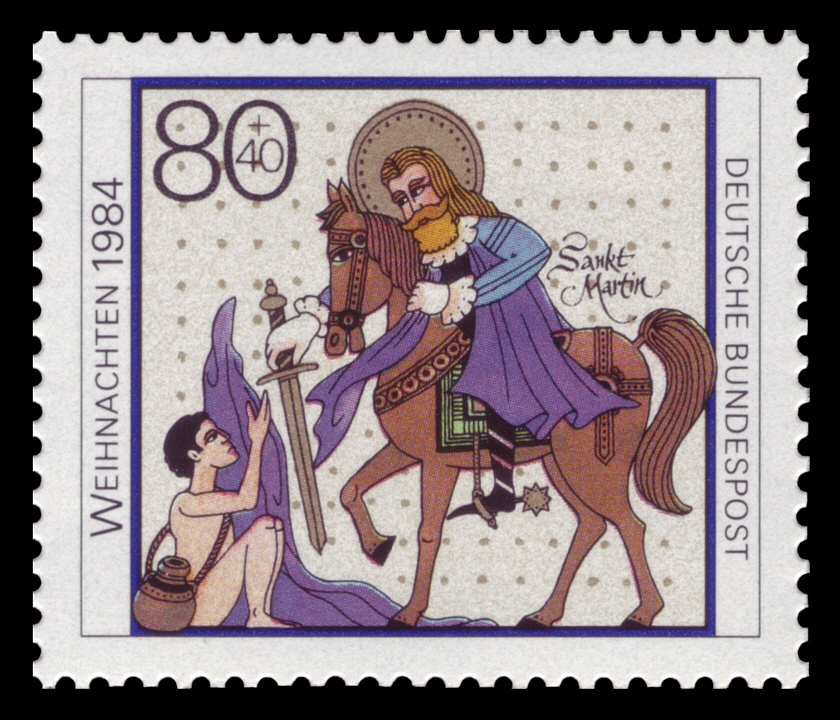
St Martin of Tours adorns a German postage stamp

St Martin of Tours adorns a German postage stamp

St Martin doesn’t appear to have any connection with Ireland at all – yet everyone here seems to know the one element of his story that is always told: in the winter storms he met a naked beggar and cut his own cloak in two, giving half to the beggar. There is a twist to the story – that same night Martin had a dream: he saw Jesus wrapped in the piece of cloak he had given away and Jesus said to him, “Martin has covered me with this garment.” Even though Martin was at that time a soldier in the Roman Army he sought to be baptised and then refused to fight as this was against Christian principles. In fact, he was the first recorded ‘Conscientious Objector’.

Harry Clarke's window in Castletownshend, showing St Martin and the Beggar in the right hand panel

Harry Clarke’s window in Castletownshend, showing St Martin and the Beggar in the right hand panel

St Martin’s Day is on 11 November and the season is known in Ireland as Martinmas. There are customs surrounding this time – still remembered in some rural districts. There is a whole chapter devoted to Martinmas in Kevin Danagher’s book The Year in Ireland (Mercier Press 1972). From this we learn that every family is to kill an animal of some kind “…and sprinkle the threshold with the blood, and do the same in the four corners of the house to exclude every kind of evil spirit from the dwelling where this sacrifice is made…”

In 1828 Amhlaoibh Ó Súilleabháin of Kilkenny recorded in his diary: “…The eleventh day, Tuesday. St Martin’s Day. No miller sets a wheel in motion today; no more than a spinning woman would set a spinning wheel going; nor does the farmer put his plough-team to plough. No work is done in which turning is necessary…” This might be because of a story that Martin was martyred when thrown into a mill stream and killed by the mill wheel. In fact the hagiography states that he died of old age.

Another Irish legend (from Wexford) relates that the fishing fleet was out one St Martin’s Day, when the Saint himself was observed walking on the waves towards the boats. He proceeded to tell them to put into harbour as fast as possible, despite the good weather and fishing conditions. All the fishermen who ignored the Saint’s warning drowned during a freak afternoon storm. Traditionally, Wexford fishermen will not go out to sea on Saint Martin’s Day.

St Martin is the patron saint of Geese. In England there are two ‘Goose Fairs’ held in the autumn, one at Tavistock near my old home on Dartmoor. I have been to that fair: geese and poultry are still in evidence, but I don’t know whether there is any direct link to our Saint. In the not-too-far-away Exeter Cathedral Close there is a Holy Well dedicated to St Martin.

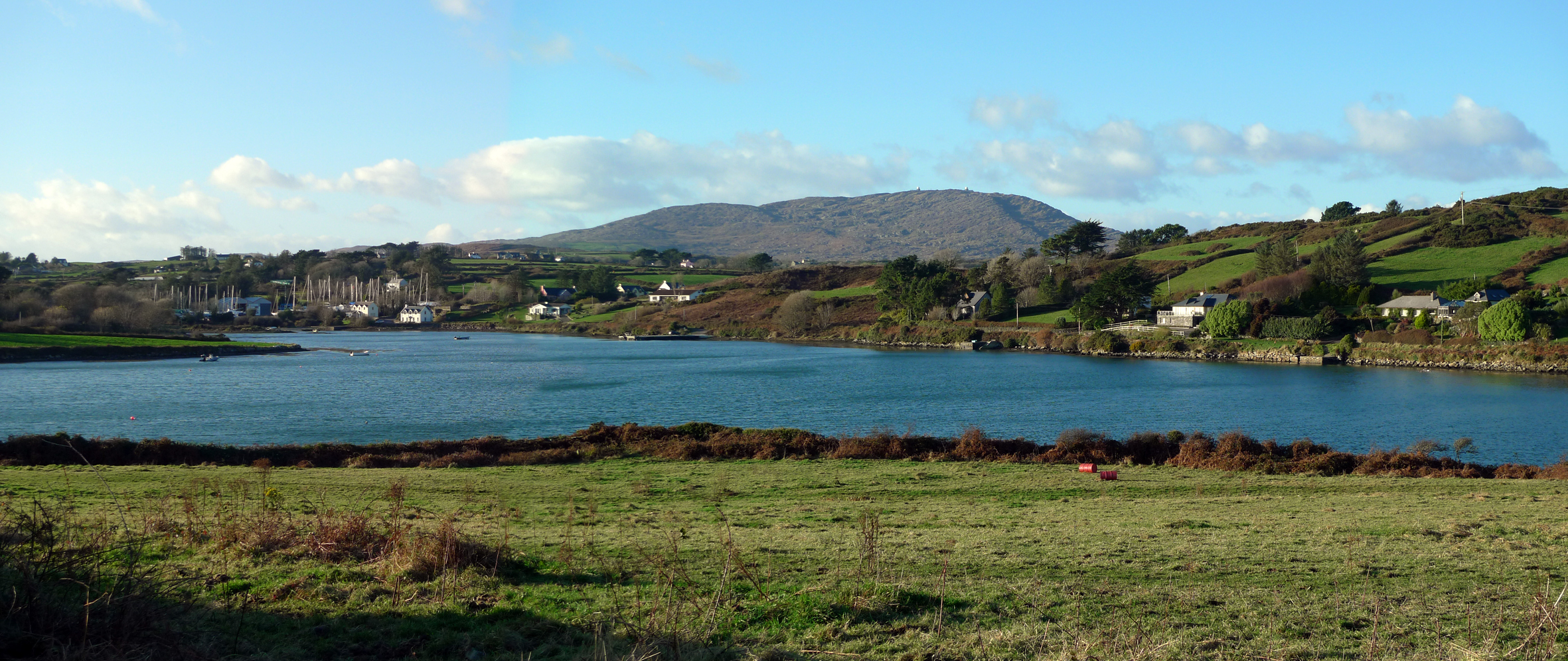
In England and Ireland they call any spell of good weather which occurs after 11th November ‘St Martin’s Summer’. We are having one of those at the moment.

We are also now at the ‘November Dark’ – the days just before a new moon when there is no moon at all visible in the night sky. Traditionally, this was the time to cut willow rods to store for basket making in the spring, as then “…they would have the most bend in them…” (according to Northside of the Mizen).

St Martin's Summer at Rossbrin Cove

St Martin’s Summer at Rossbrin Cove

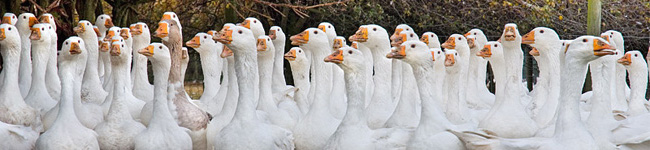
St Martin’s Goose was traditional fare on Martinmas in some cultures, so I’m feeling a little worried about this gaggle…

Goosey Fair, Tavistock, Devon

Goosey Fair, Tavistock, Devon


Lúnasa

Garlic Sunday at Nead an Iolair

A summer storm approaches Rossbrin Cove

Lúnasa – in Ireland it’s the name for the eighth month, and a festival.

August? So that would relate to Lammas in English – the first of August?

loaf

Yes, Lammas is supposedly from the Anglo-Saxon Hlafmaesse – meaning ‘Festival of the Loaf’. Here it was traditional to bake bread at Lúnasa – a round loaf, which was cut into four and each quarter was then set in the corners of the barn where the grain would be stored, to ensure a good harvest.

So is Lúnasa the harvest festival?

By some accounts, yes. Although the beginning of August is a bit early for harvesting. Having said that – our music session in Ballydehob last night was temporarily disrupted by the sight and sound of a fleet of huge tractors and a combine harvester thundering through the main street in the dark – yellow lights flashing dramatically: after a prolonged period of hot sunny weather there was a big rain storm forecast, so the farmers were working through the night to get in as much of the crop as possible before the deluge.

And did the rain come?

It did – just in time to dampen the Ballydehob Wooden Boat Festival. But it certainly didn’t put a dampener on the spirit of the event.

A damp Boat Festival in Ballydehob

A damp Boat Festival in Ballydehob

Is Lúnasa celebrated in Ireland nowadays?

Well – it’s remembered: you may have heard of Brian Friel’s play Dancing at Lughnasa, turned into a film in 1998. It’s set in rural Donegal in the 1930s and poignantly tells of the lives of five women encapsulated through one summer month. It touches on ritual themes and the mixture of superstition and religion which still characterises life in Ireland today.

Now you’ve spelled it differently…

Well spotted! On the calendar it’s usually Lúnasa. It’s suggested that the word Lughnasa harks back to pagan times: there was a god – Lugh – who in Irish mythology led the Tuatha Dé Danann against the Fomorians. After the victory Lugh finds Bres, the half-Fomorian former king of the Tuatha Dé Danann, alone on the battlefield, and Bres begs for his life. If he is spared, he promises, he will ensure that the cows of Ireland always give milk. The Tuatha Dé Danann refuse the offer. He then promises four harvests a year, but the Tuatha Dé Danann say one harvest a year suits them. But Lugh spares his life on the condition that he teach the Tuatha Dé Danann how and when to plough, sow and reap.

That story rather neatly ties up the connection with the harvest… Any more traditions?

August is the holiday month and there are plenty of things happening in Ireland: my favourite is Puck Fair, held every year in Killorglin, County Kerry. I came across it by accident when I was travelling in Ireland some forty years ago; now it’s notorious.

Why?

King Puck

King Puck (www.abitofireland.com)

Well, the central feature is an enormous Billy Goat, captured in the wilds of the Kerry Mountains. He gets treated royally – literally, as on the first day of the Fair he’s crowned King by a twelve year old girl. He’s then placed in a cage on top of a high platform which looks out over the street fair, which continues for three days.

Puck Fair, Killorglin 1900

Puck Fair, Killorglin 1900

That certainly does sound pagan! What happens to King Puck after the Fair?

He goes back to the mountains. It’s not uncommon to see wild Goats up in Kerry.

Sheena Jolley's superb study of Kerry Goats

Sheena Jolley‘s superb study of Kerry Goats

Is there a story attached to King Puck?

Of course… During St Patrick’s travels he reaches the borders of Kerry. He has with him his herd of Goats which give him food and milk. During the night his goats are stolen and this means he can’t go any further (in fact he supposedly then never set foot in Kerry, which means that Kerry people were never converted from their old pagan ways!). ‘…He resolved to detour a community that was so utterly depraved and lacking in hospitality. However, a chieftain from the Barony of Dunkerran saved the day for Kerry. He presented as a gift for the Saint a magnificent Puck-Goat and a hundred of the finest Goats from his herds on the slopes of Glencar highlands. The Saint came no further west, but instead of a malediction he gave to Kerry that benediction that will live forever in the salutations of the Irish Race – “Go mbeannuigh Dia siar sibh”*. Killorglin being the natural centre of defence of the Barony at that time has ever since held the Puck-Goat in the highest esteem, and elevated him to the place of honour for three days each year…’ (Liam Foley – the Kerryman, 1945)

*May God bless you back

cove

And are you celebrating Lúnasa yourself?

We’re off to the Blessing of the Boats this morning in Schull. Then we’re over to Hare Island later on for an evening meal with friends who’ve sailed down to West Cork for the weekend.

Enjoy it!

Ready for the Harvest

Ready for the Harvest

Fit-up

Summer Evening on Sherkin

Summer Evening on Sherkin

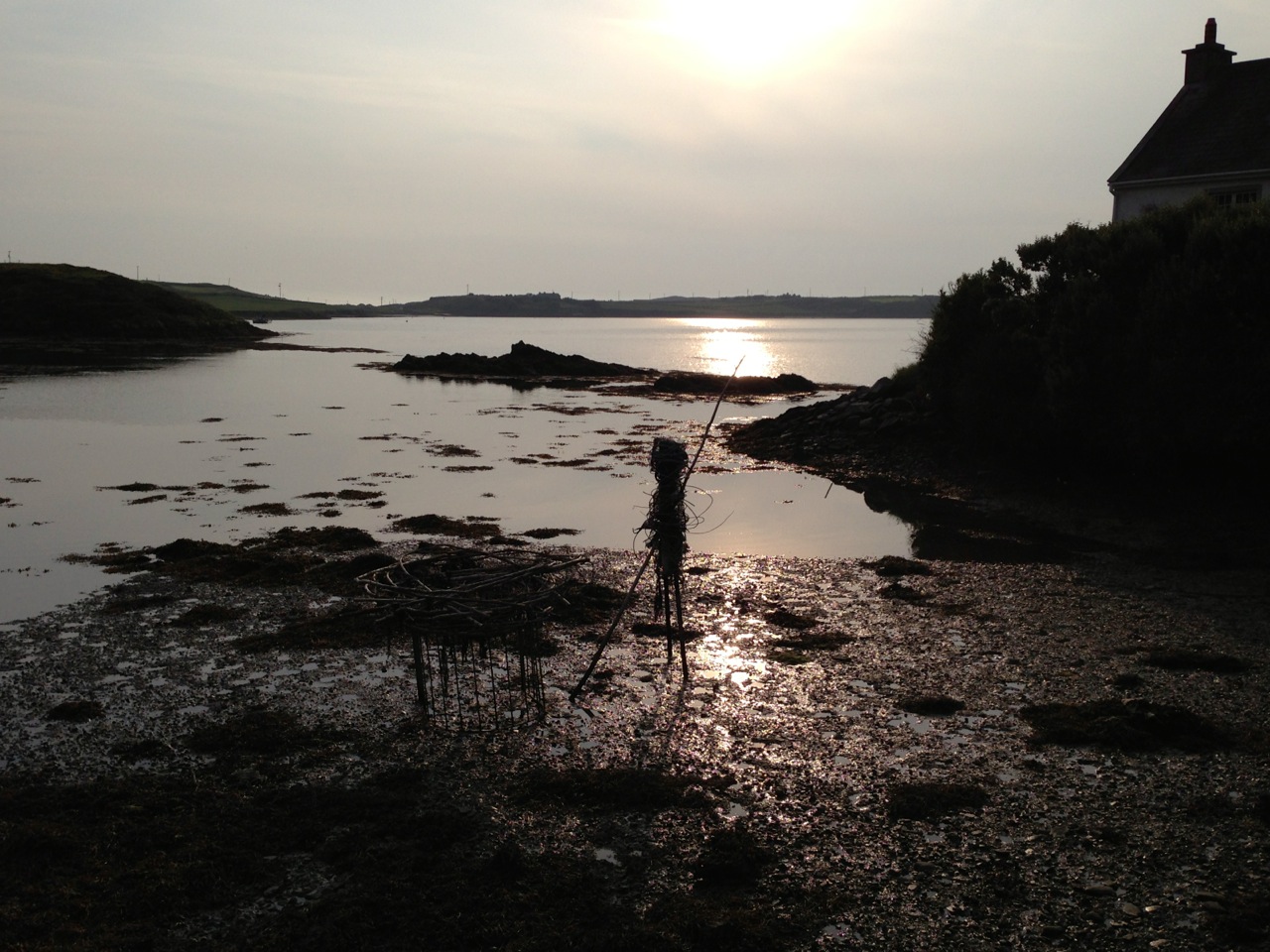
Theatre is alive and well in Ireland. If we went to every play that’s put on within a twenty kilometre radius of Nead an Iolair all through the year we’d be exhausted. Every community seems to have its own acting group, while professional companies are always coming out to the wilds to perform in front of usually packed and enthusiastic audiences. Venues don’t get much wilder than the Community Hall on Sherkin Island, a small space beside an even smaller public library, both of which look out on to the idyllic view above.

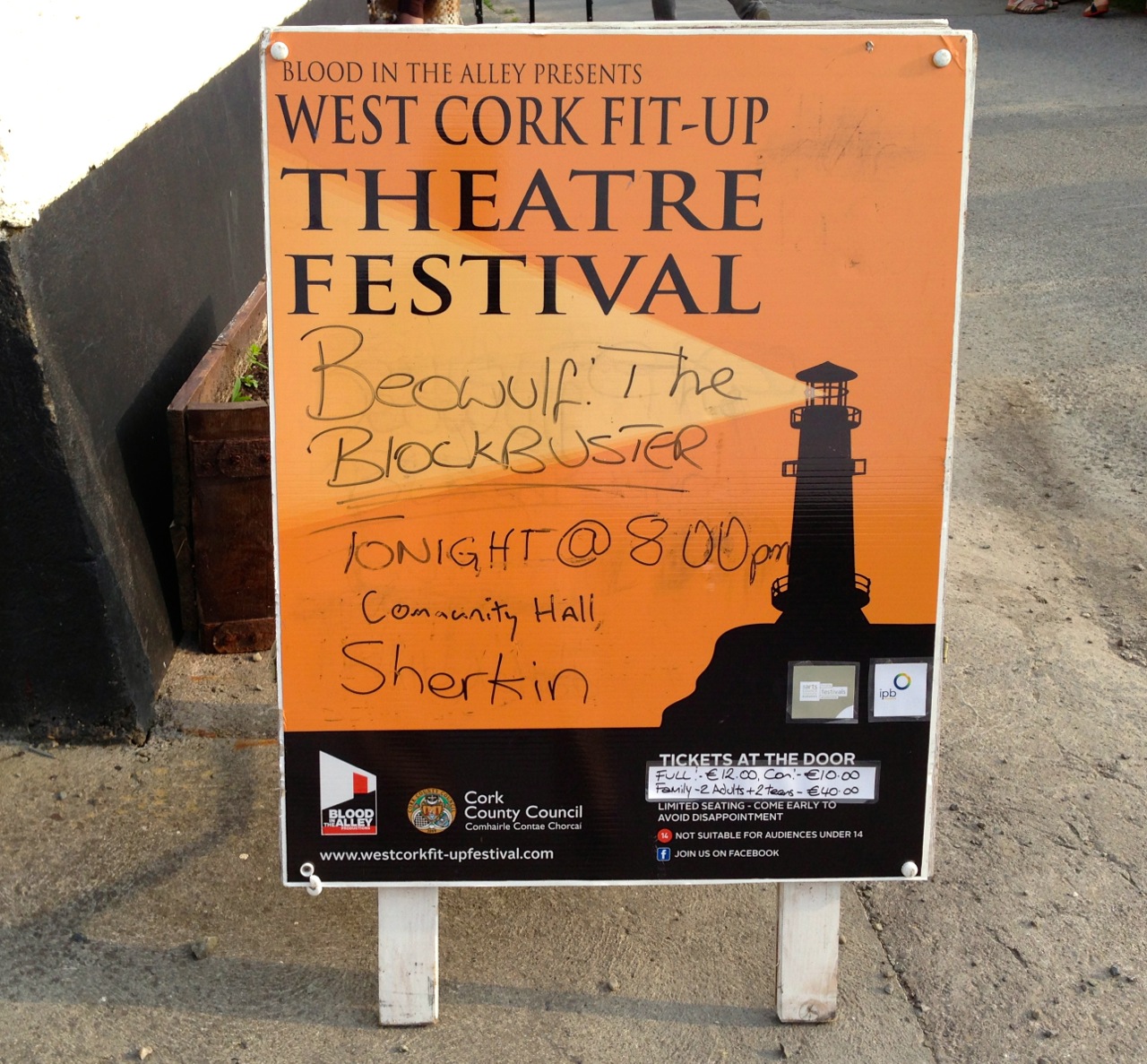
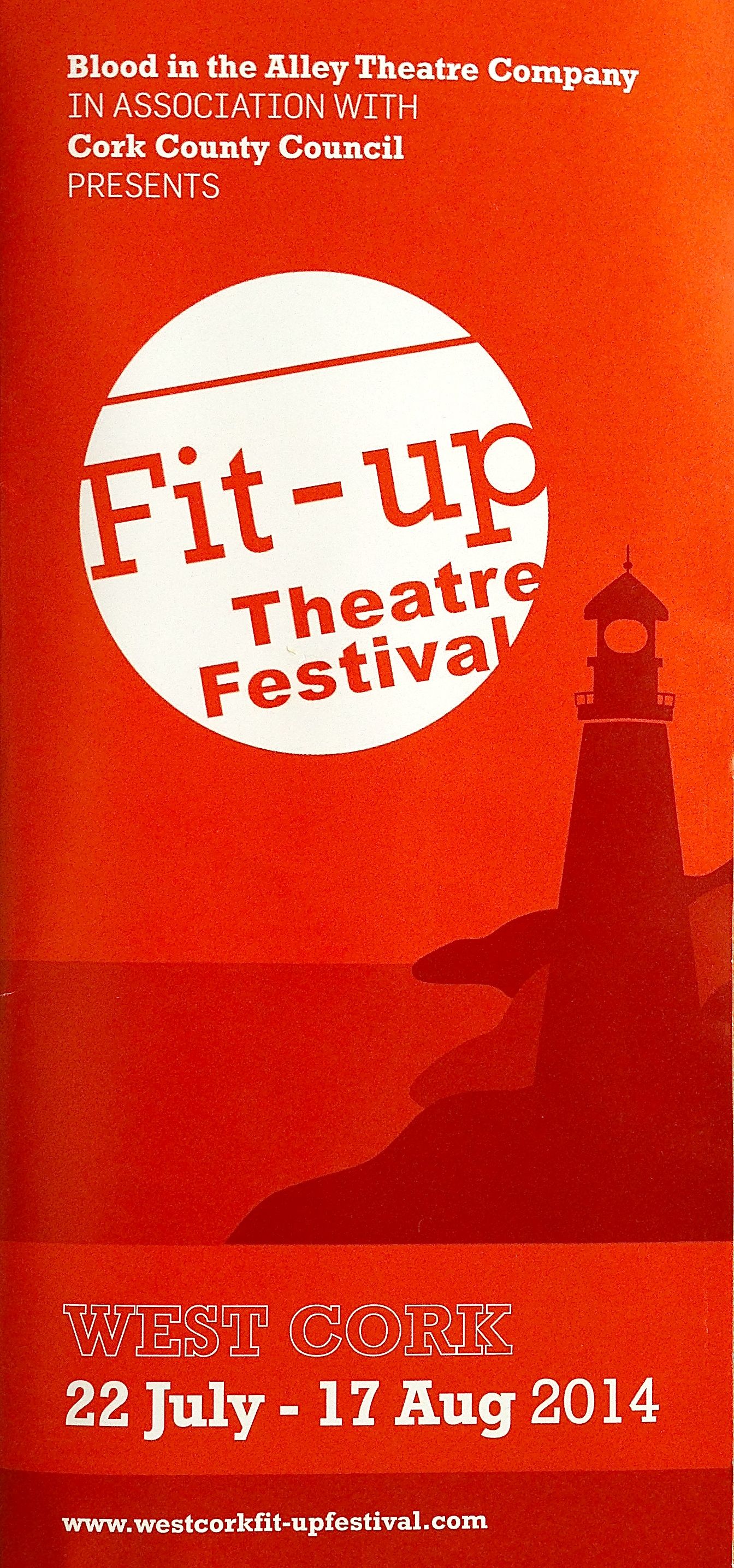
We went out on the late ferry to Sherkin recently to catch the West Cork Fit-up Theatre Festival’s production of Beowulf: The Blockbuster. The Beowulf story I know well: my good friends Michael and Wendy Dacre, back in Devon, have it in their repertoire and I have thoroughly enjoyed Michael’s renditions of some of the early English words accompanied by Wendy’s shadow pictures and songs. But this version was very different – written and performed by one man, Irish Times Theatre Award winning actor Bryan Burroughs and developed and directed by Edinburgh First Fringe winner David Horan. The story – commonly cited as one of the most important works of Anglo-Saxon literature – dates from before 1000 AD (there is a written version from that time in the British Museum). Bryan Burroughs sets it in a present day context: a father dying from cancer has a last chance to connect with his son, a boy with a fim-soaked imagination, and uses Beowulf to capture the boy’s attention. poster

Sherkin gave the performance a deserved double standing ovation. We were bowled over by it. Here on this little shard of land in the far west of Ireland we had seen an epic tale enacted without any scenery: we had witnessed the Scandinavian warrior Beowulf defeating Grendel, a horrific swamp demon and then killing an even more terrifying monster – Grendel’s mother. All this on the floor of the unadorned Community Hall, the only ‘props’ being coloured lights.

It’s sobering, perhaps, to think that this same production received rave reviews in New York: ‘PHANTASMOGORIC…dazzling, poignant…’ announced the New York Times, while the Sunday Times gave it 5 stars and said ‘…an utterly compelling, comic and vibrant one-man stage phenomenon…’ and here we were in faraway West Cork, where the Fit-up Festival is an annual event: it’s based on an ancient tradition – travelling players calling in on small communities and transforming a yard, a pub or just someone’s back room into a world stage. Fit-up means exactly what it says – ‘fitting up’ the space whatever its limitations, and the term goes back a very long way.

An early reference to 'Fit-up' in England

An early reference to ‘Fit-up’ in England

Of the Edwardian era, the Cambridge History of British Theatre says: ‘…Towns too small for a theatre building might be visited by a portable theatre for a couple of weeks or even a season, or a fit-up company would play in a hall of some sort – two-night stands mostly; a melodrama one night, a farce the next, and then up and away…’

Outside of our own Fit-up, Beowulf has inspired a large corpus of literature, critique and media retellings. Most notable, probably, is Seamus Heaney’s translation, pretty faithful to the Anglo-Saxon original. The fairly recent film versions have some entertainment value but don’t expect too much from their interpretations of the old texts.

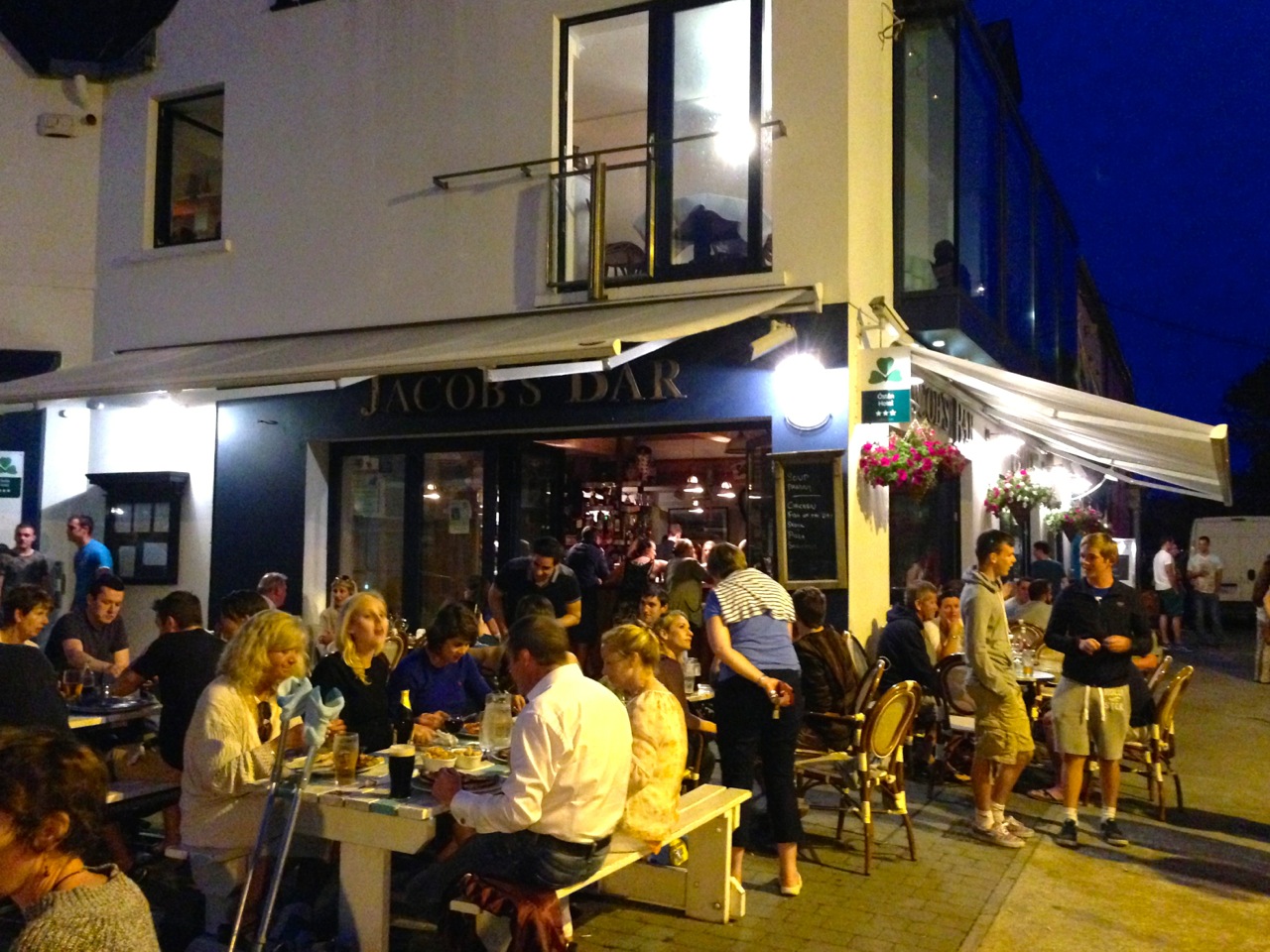
It was a little surreal, leaving the island after such a memorable experience and returning in the dark across the water to Baltimore, where the holiday atmosphere was in full swing – rather untypical of our normal West Cork experiences…

Summer night in Baltimore

Summer night in Baltimore

Just to finish, here’s a snippet worth listening to: an RTE sound documentary of reminiscences around the old ‘Roadshows’ in Bray, Co Wicklow in the middle of the last century – very much the spirit of the Fit-ups… Finola remembers them well!

logo

Out and About with Visitors in West Cork

At Coppinger's Court

At Coppinger’s Court

Vi and Grant and Jan and Brian came to stay last week – good friends from Canada here to see the Real Ireland. 

We had some challenges right away. First, the rental car Grant had booked was under repair and the substitute, although it nominally held all six of us, was too cramped and uncomfortable to venture too far afield. Second, muscle wear and tear issues among the group dictated that walks not be too long or arduous. 

No problem! The weather was (mostly) fine, we got in one good hike on the Sheep’s Head, and then set about discovering the delights of flatter terrain, local amenities and cultural events. Robert and I hadn’t toured Bantry House before, although we had been there for concerts. The house will be a future post in itself, but for the moment it’s worth recording that this may be the last summer to see it with its original furniture, as much of it is on the auction block later this year.

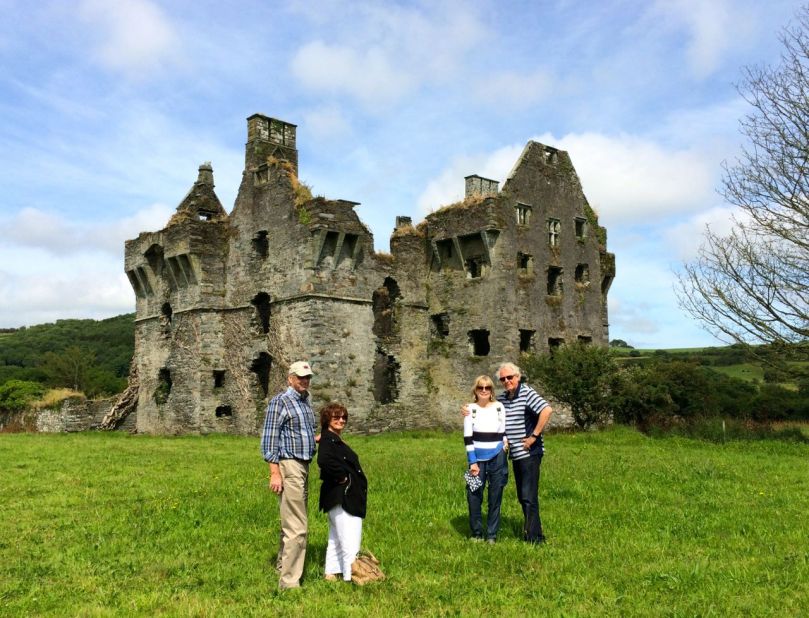
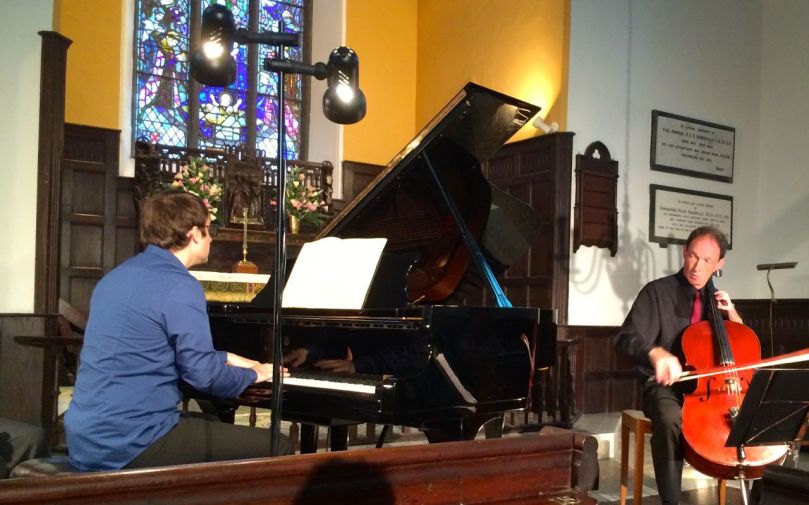
One day we spent exploring the area south east of Skibbereen. We started with lunch at Glandore overlooking the harbour, then on to the obligatory stop at the Drombeg Stone Circle, one of the better-know recumbent stone circles that dot West Cork. On to Coppinger’s Court (another subject for a full post), a 17th century fortified house and home to one of the fearsome characters in West Cork history. Back then to Castletownshend and dinner in Mary Anne’s, followed by a concert in the little church of St Barrahane’s. This was an evening of Beethoven, Debussy and Rachmaninov with Christopher Marwood of the Vanbrugh Quartet on the cello, and the brilliant young American Alexander Bernstein on the piano. It was truly a world-class performance, eliciting a standing ovation from the appreciative audience.

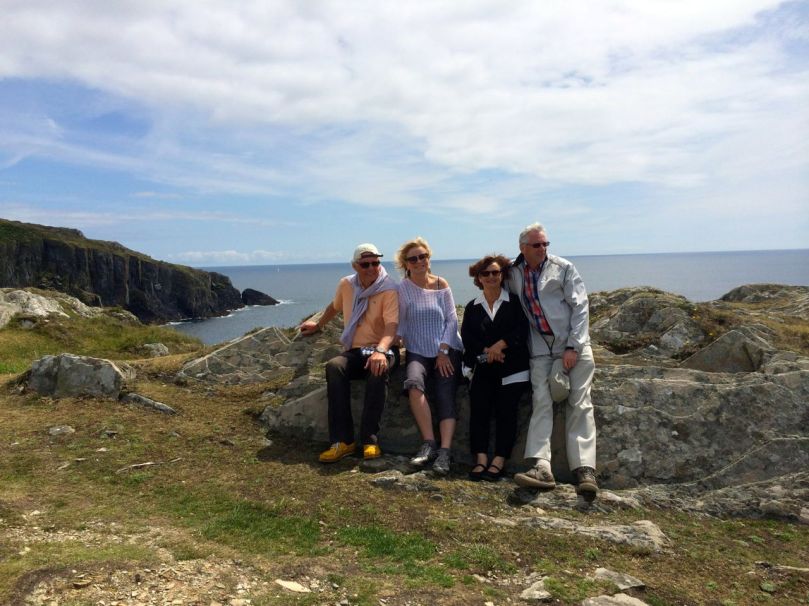
At Drombeg, Jan and Brian

At Drombeg, Jan and Brian

Concert In St. Barrahane's, Castletownshend

Concert In St Barrahane’s, Castletownshend

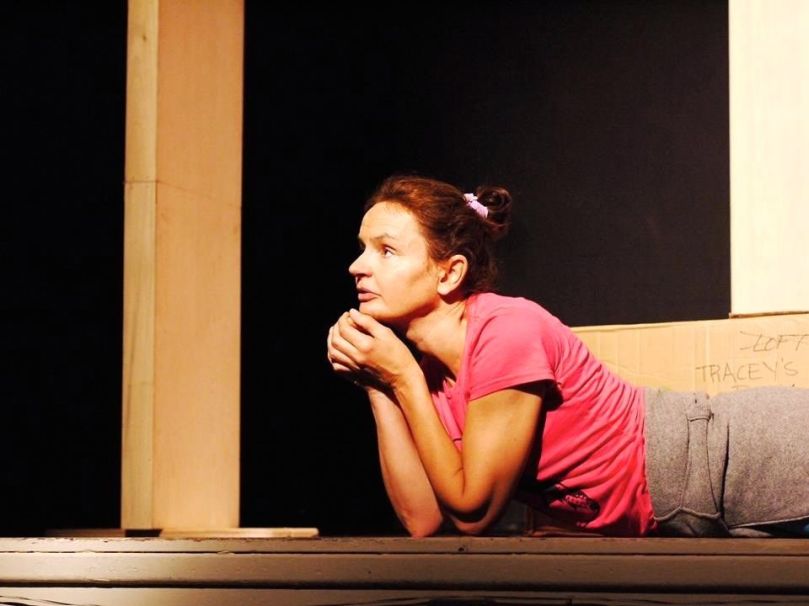
Another day, we wandered around Schull, dipping into the shops and stopping for coffee. Later that evening we attended PlayActing Theatre’s two one-woman shows in the local parish hall. Karen Minihan brought us up to date with her character, Eileen, going through a midlife crisis – it was moving, sad and funny all at once. Then Terri Leiber took us into the experience of eight-year-old Stacey negotiating the dysfunctional lives of the adults around her in 1960s Britain – a tour de force in which she played every role, with a minimalist stage set, a soundtrack from the times, and a beautiful nuanced performance.

Terri Leiber in May the Force

Terri Leiber in May the Force

Shopping at the local markets always makes food preparation easier and fresher and we all took turns. 

In Baltimore, we walked out to the Beacon, with its marvellous views of Sherkin Island and the faraway mountains of Kerry. We hope it’s a good memory to take away of this special part of Ireland. 

At the Baltimore Beacon

At the Baltimore Beacon

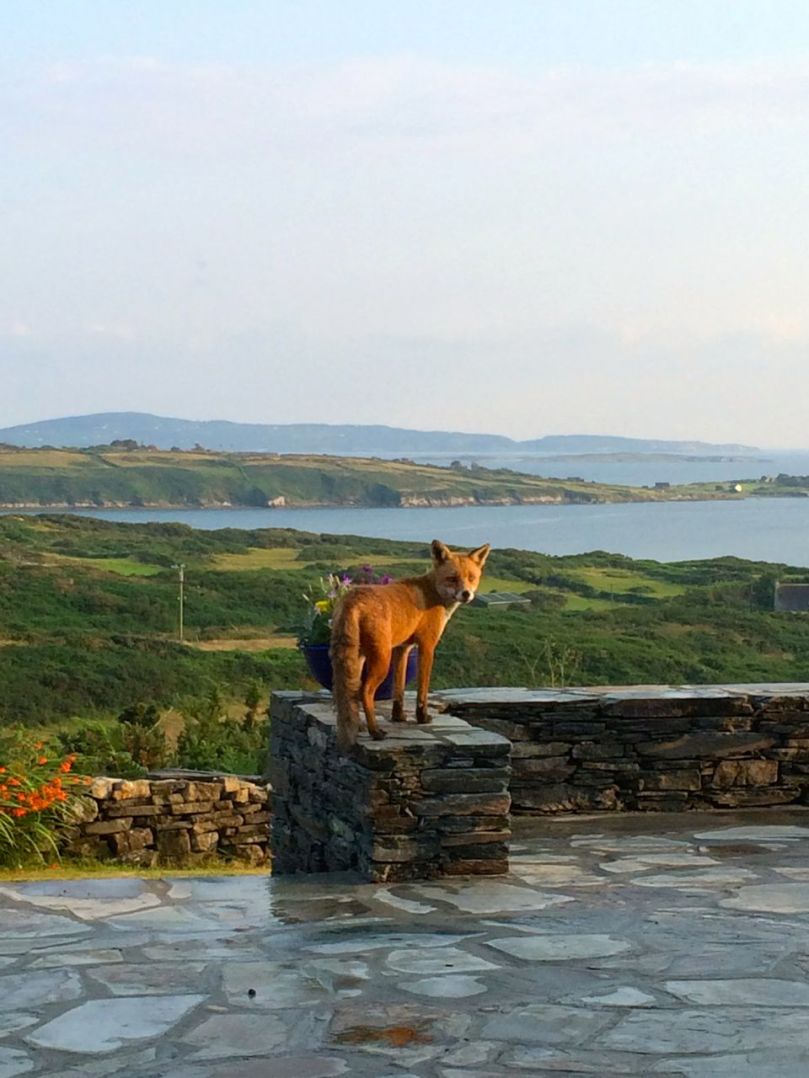
Vi and Grant, Jan and Brian – Ferdia has been missing you already!

Ferdia

Ferdia