Outlook: Unsettled!

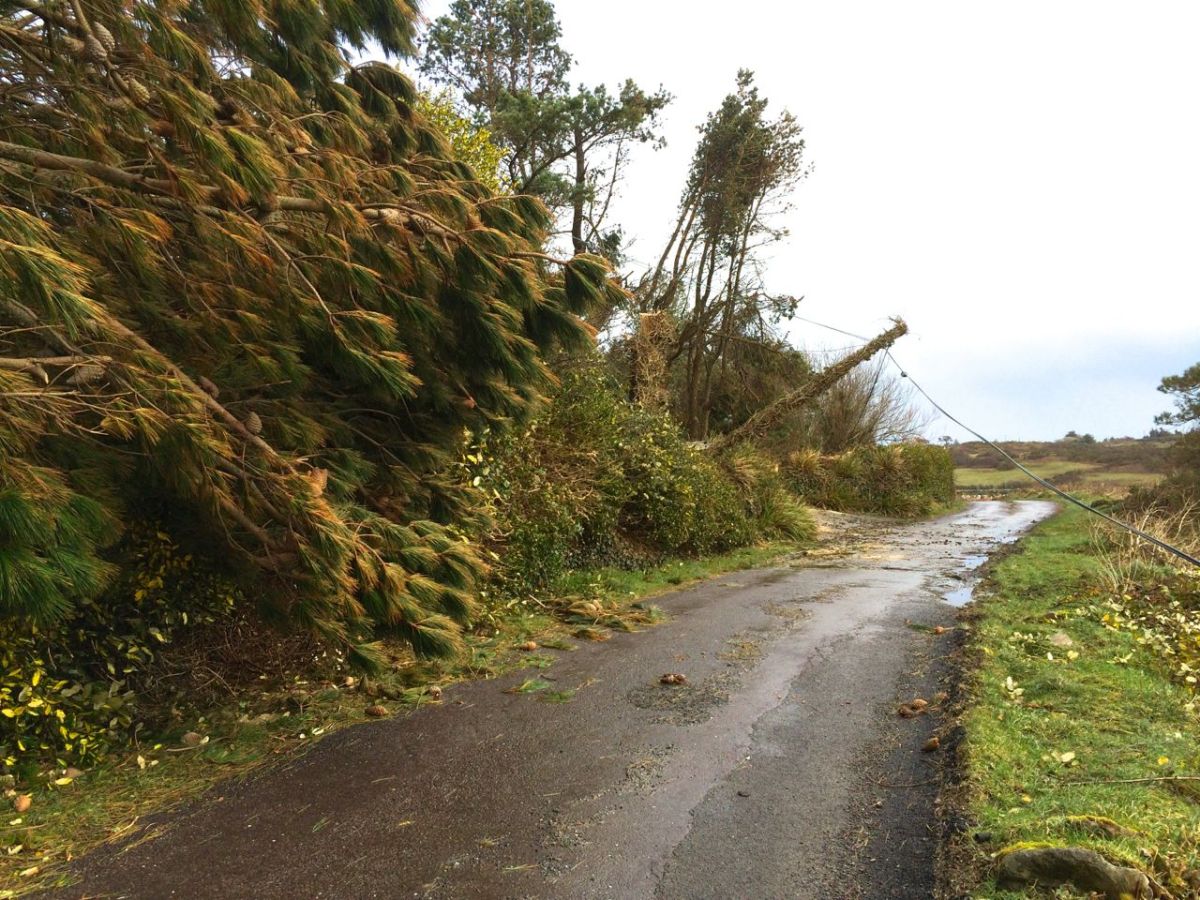
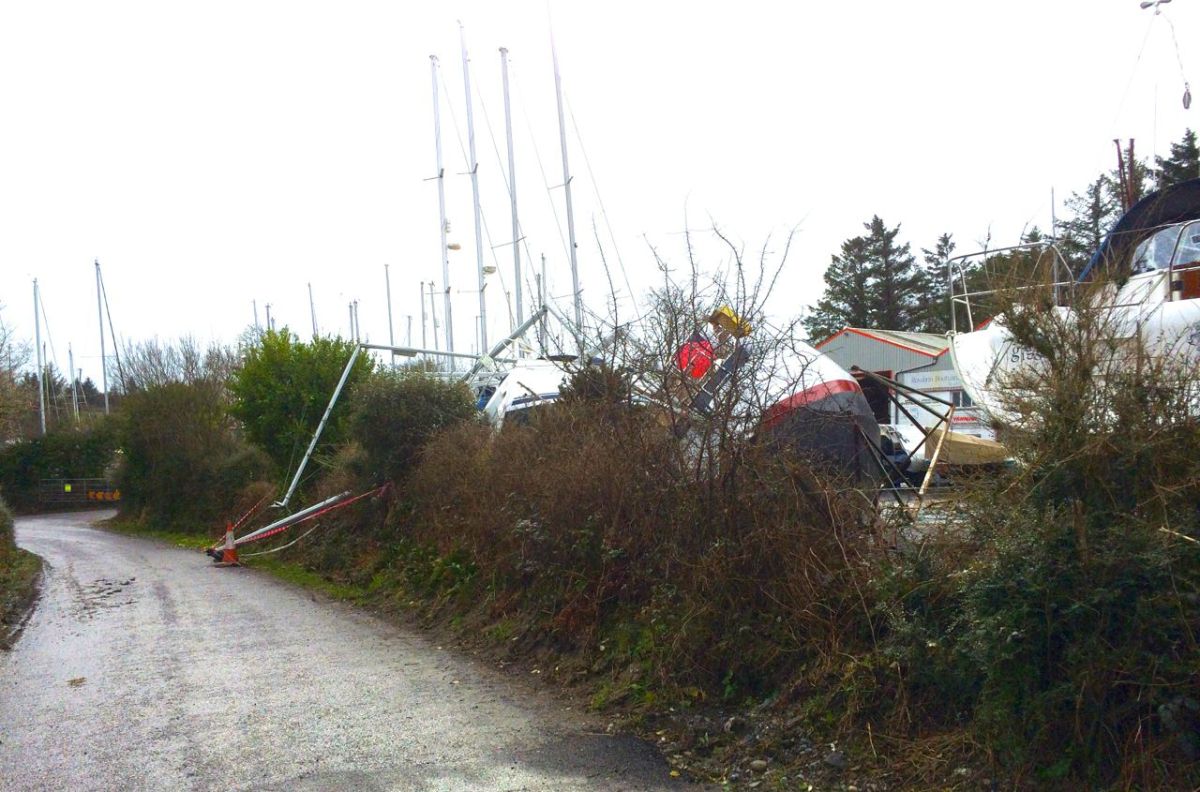
Exactly ten years ago I wrote a Roaringwater Journal post titled Outlook: Changeable! It was about the weather and – interestingly – things haven’t changed much in that respect over a decade. So I thought it was worth a re-run, with some adaptations. The new title, for a start – Outlook: Unsettled! – is apt, perhaps, for the whole world we are living in today and not just the weather. The year 2014 produced the fiercest storm – Darwin – that many in West Cork (and beyond) had experienced in their lifetimes. Certainly we had property damage, felled trees and powerlines, and were without electricity, phone and internet for very many days.

Examples of the damage caused by Darwin in 2014: neighbouring cables felled (upper) and boats toppled from their keel blocks in Rossbrin Boatyard

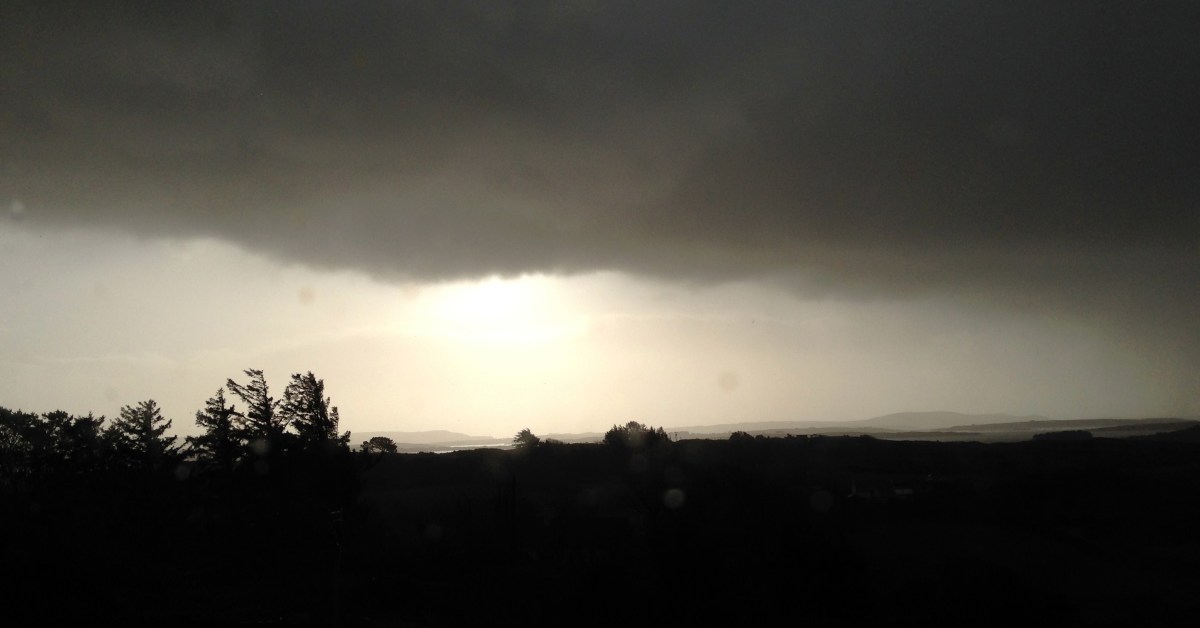
From January 2014: …One of my favourite expressions about the weather was learned from an elderly gentleman who had lived all his life in Hampshire, England. …Tis black over Will’s Mother’s… This would have described very well the scenes around us in Nead an Iolair when we awoke this morning. As an Englishman I would be expected to talk about the weather all the time; Irish people are not far behind in this, probably because there is such a variety of weather – even in a single day – that it demands to be described. …Is iomaí athrú a chuireann lá Márta dhe… means: …There is a lot of weather in a March day… This might just as well refer to a January day, or a day in any month in our experience. To illustrate this we decided to try a time lapse video, using an iPhone and a tripod. We had to shoot it through the window, hence the reflections – just as well because during the process we had torrential hail to add to the variety. So this is a thirty minute session of Irish weather coming in to Roaringwater Bay compressed to thirty seconds, each frame being shot a second apart:

By asking around the locality I have compiled some Irish expressions for weather. These are ones that I particularly like:

A snipe won’t stand in the morning… (meaning expect icy weather)

It’s a hure of a day… (meaning it’s a hure of a day – Finola has her own version here)

 Bad aul’ day isn’t it?

And – very occasionally – The Sun does be splittin’ the stones

Coming back to 2024 It’s worth delving into the archives of the The Schools’ Folklore Collection: the following entries were written down in the 1930s and provide an insight into weather-lore from the time:

“…When the sheep go under the wall there is a sign of rain.
When the curlew begins to whistle there is a sign of rain.
When the cricket begins to sing there is a sign of rain.
There is a sign of rain when the hills look near.
When the dust is flying off the road there is a sign of rain.
When the river is roaring there is a sign of rain.
When the fire is blue there is a sign of rain.
When the clouds are running in the sky there is a sign of rain.
When the smoke from the chimney is going up straight there is a sign of rain.
When the sky is red in the morning it is a sign of a wet day.
When there are a lot of clouds in the sky it is a sign of rain.
When there is a rainbow in the morning it is a sign of a rain.
The South wind brings most rain in this district. A red sky is a sign of a storm.
Black clouds are a sign of rain.
When the swallows are flying it is a sign of rain.
When the dog is eating grass it is a sign of rain.

When rain is expected the cat lies near the fire.
The crows lie on the walls when rain is expected.
The nearer the ring is to the moon the farther the rain is from us.
The farther the ring is from the moon the nearer the rain is to us.
When the lake is rough it is a sign of rain.
When the water-fall roars it is a sign of rain.
When the soot is falling it is a sign of rain.
When the cricket comes into the house it is a sign of rain.

If a robin comes in very near the door of the house its the sign of bad weather.
If crows fly in flocks together and are always cawing its the sign of rain.
The South and South West winds are the most that bring rain.
If the ducks quack loudly and the cricket sings sharply its the sign of rain.
A ring around the moon at night is the sign of rain…”

All these sayings have been collected by informants Willie Noone, John Monoghan and Michael Halloran, Co Mayo. It’s instructive that they are only about rain.

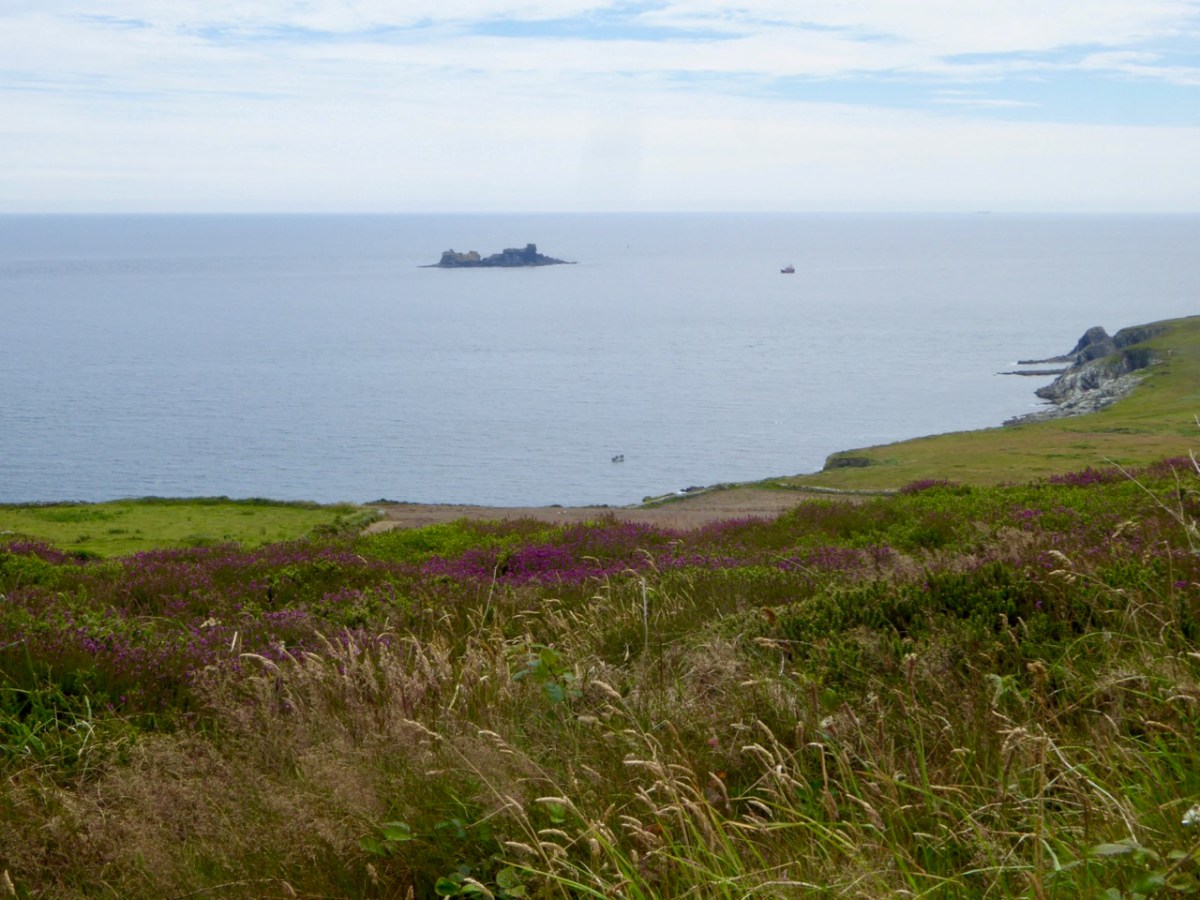
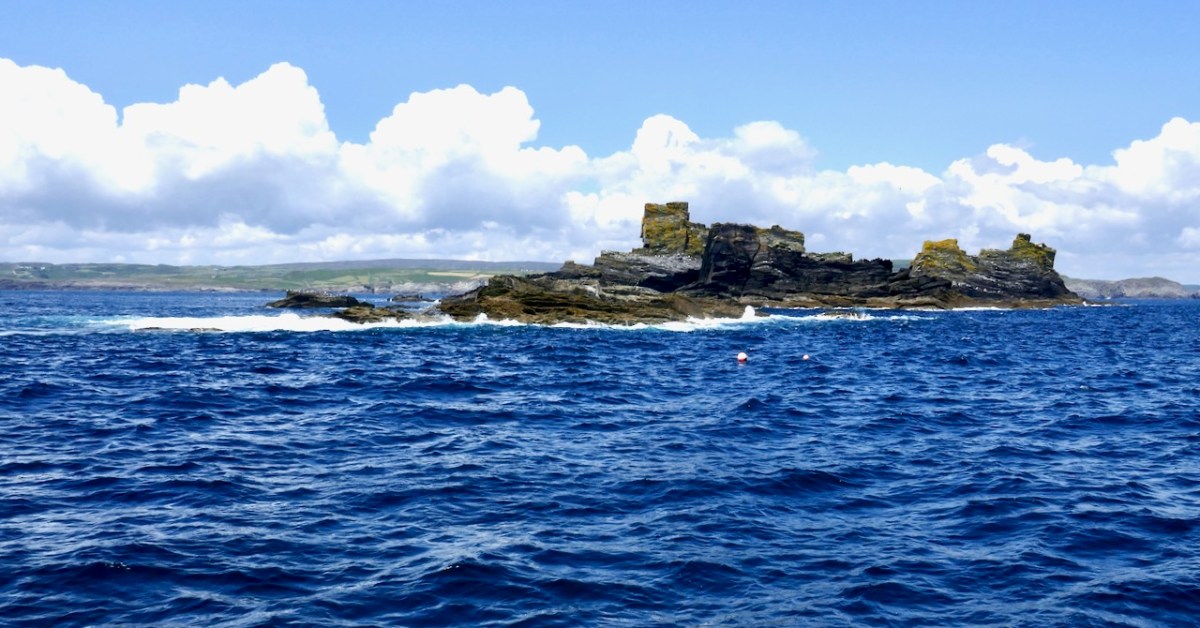
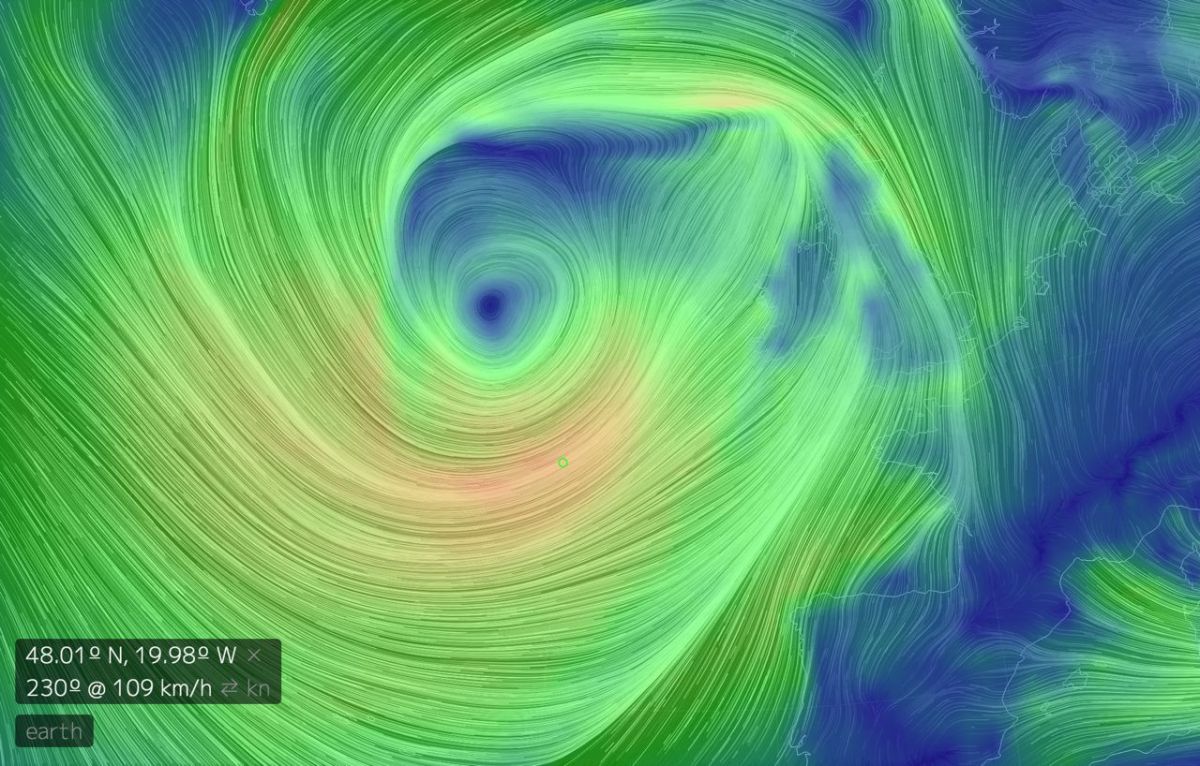
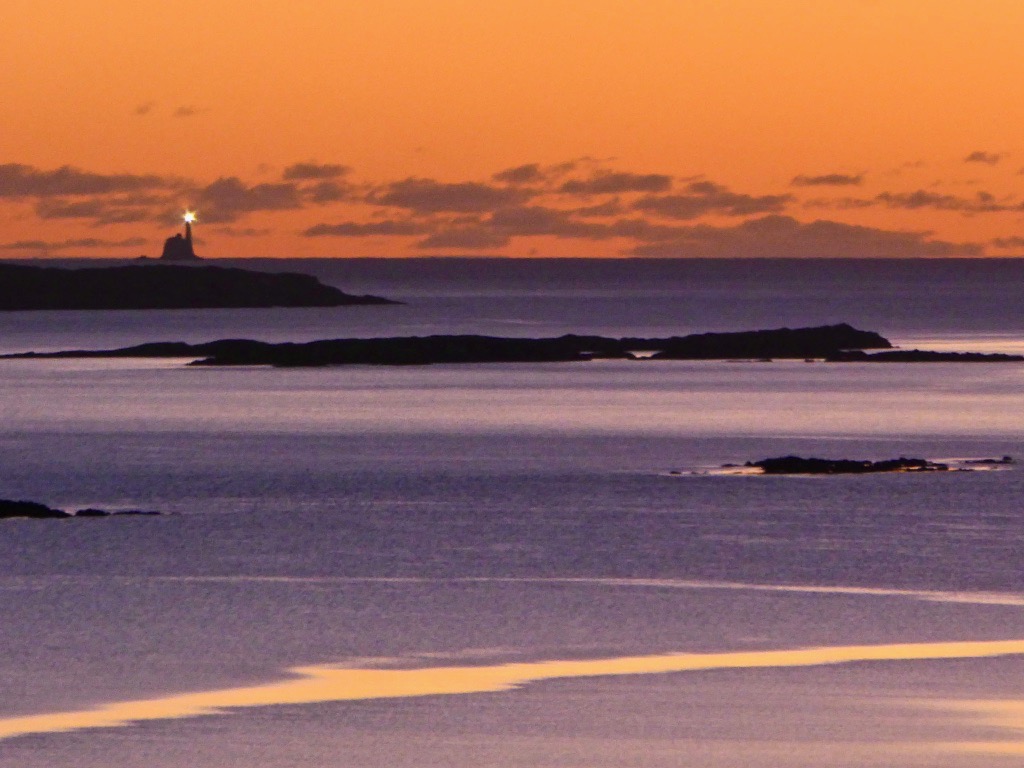
This is a record of the Earth Wind Map from early January, 2014. It’s centred over Ireland. Only 109 km/h is recorded. That’s classified as “Violent Storm” and just a few km/h short of a hurricane. Storm Darwin hit wind speeds of 177 km/h. That was a record for the time, but it’s worth noting that the greatest wind speed ever measured (so far) in Ireland was 191 km/h at Fastnet Lighthouse, County Cork on 16 October 2017. That’s just across the water from us here at Nead an Iolair! Here it is seen from our house (by Finola) on a happily calm day…

Back to Borlin Valley

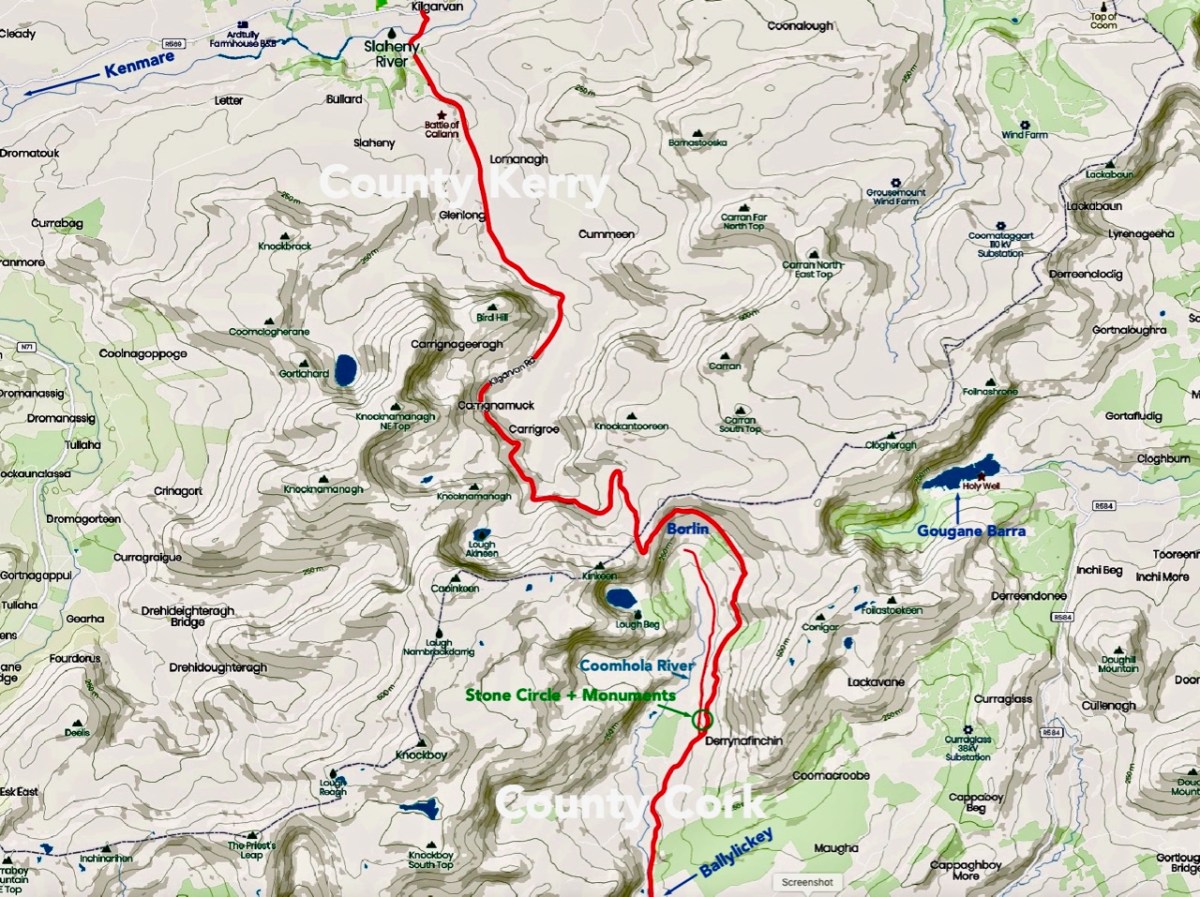
We have certainly travelled this route many times – it’s our favourite way of getting from Kenmare home to West Cork. Assuredly not a direct road, but spectacular – and you’ll hardly see a soul. Here’s a map – the road is in red:

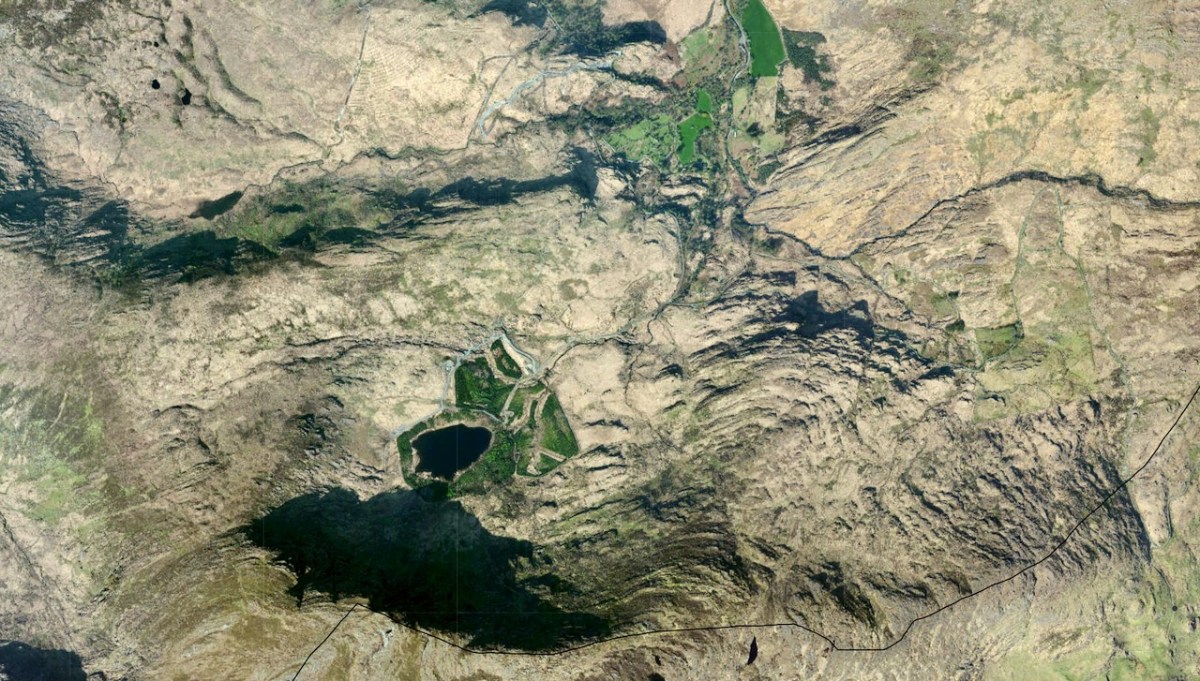
And here (below) – a sculptural abstract – is the nature of the terrain which the satellites spy on – looking straight down!

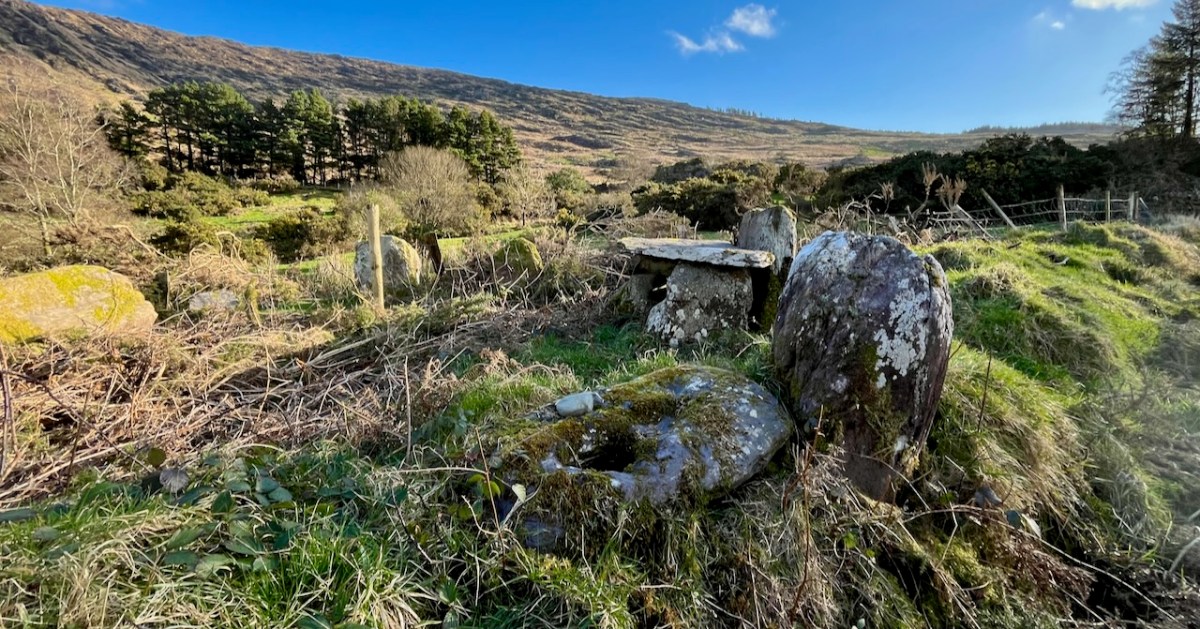
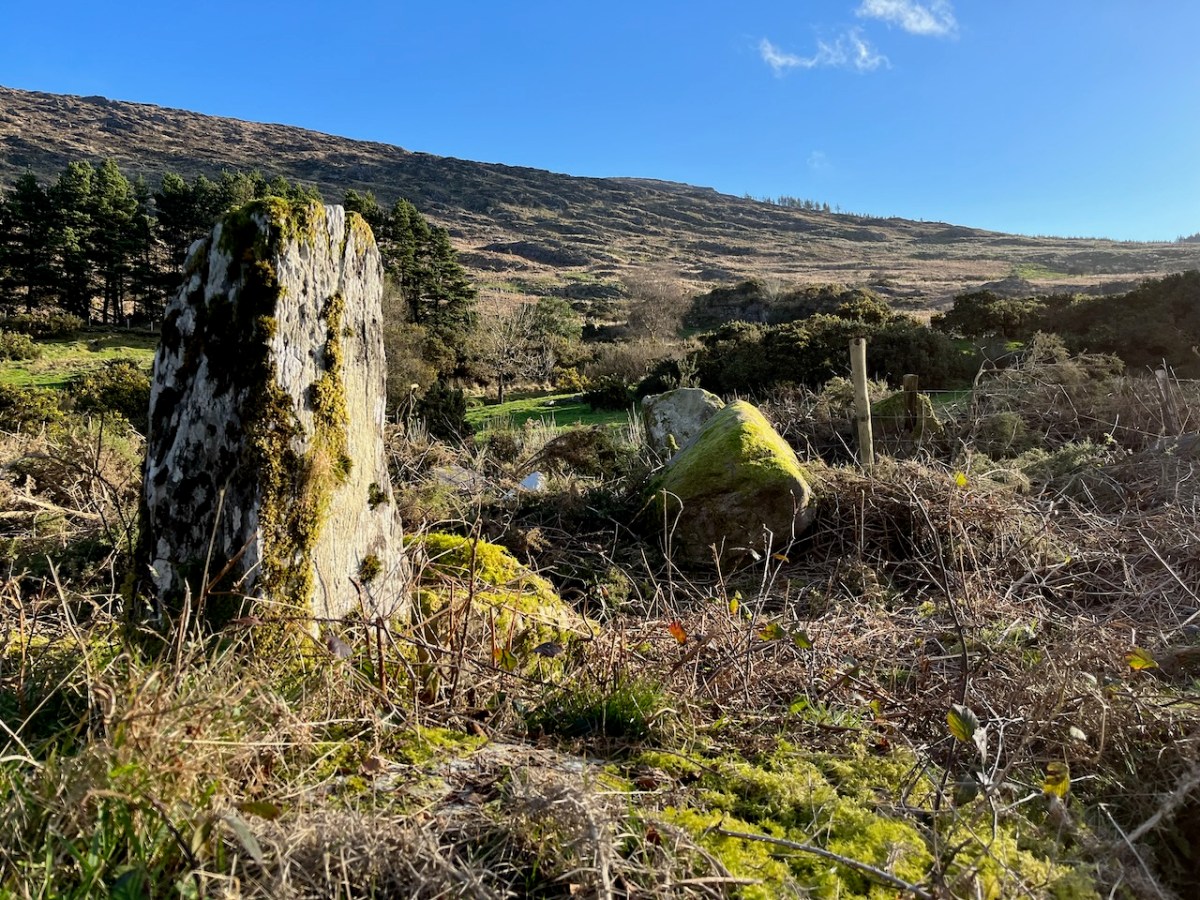
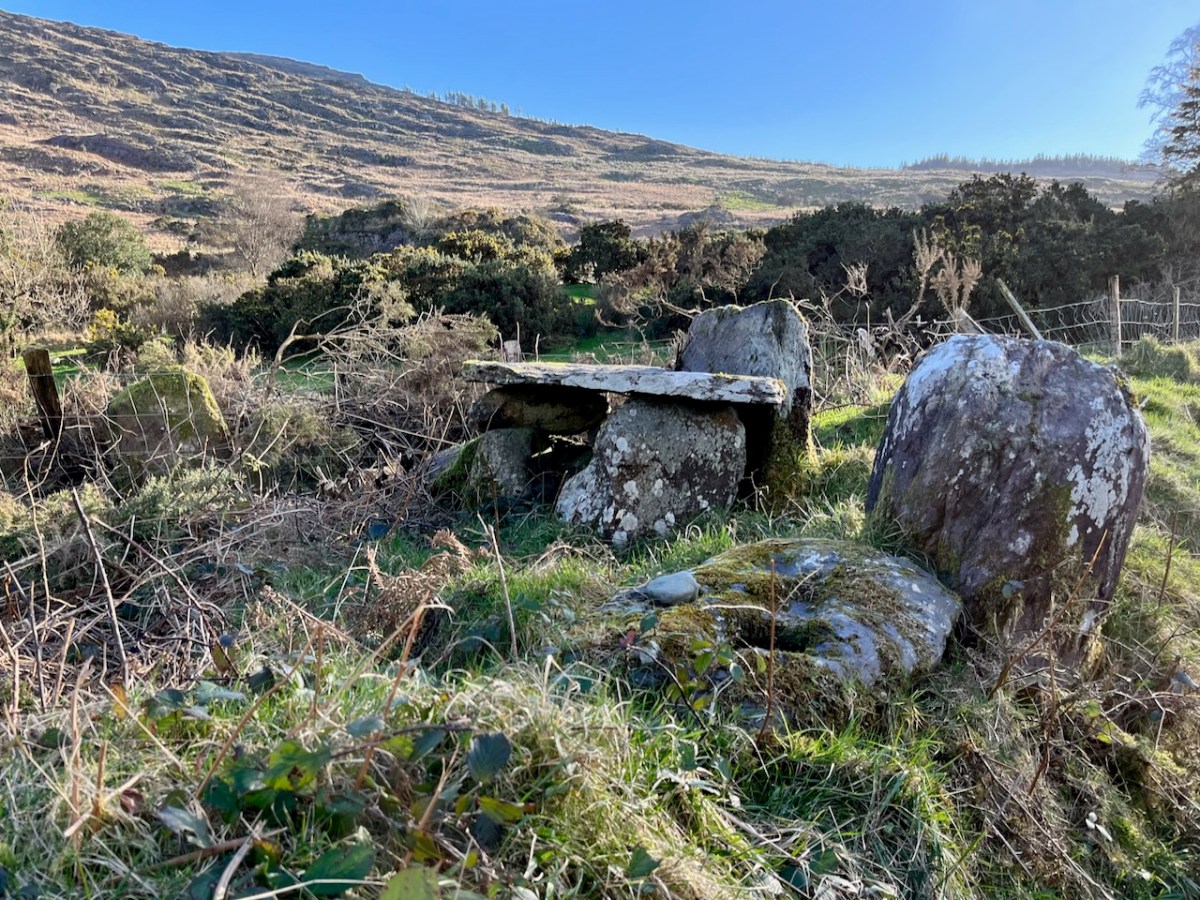
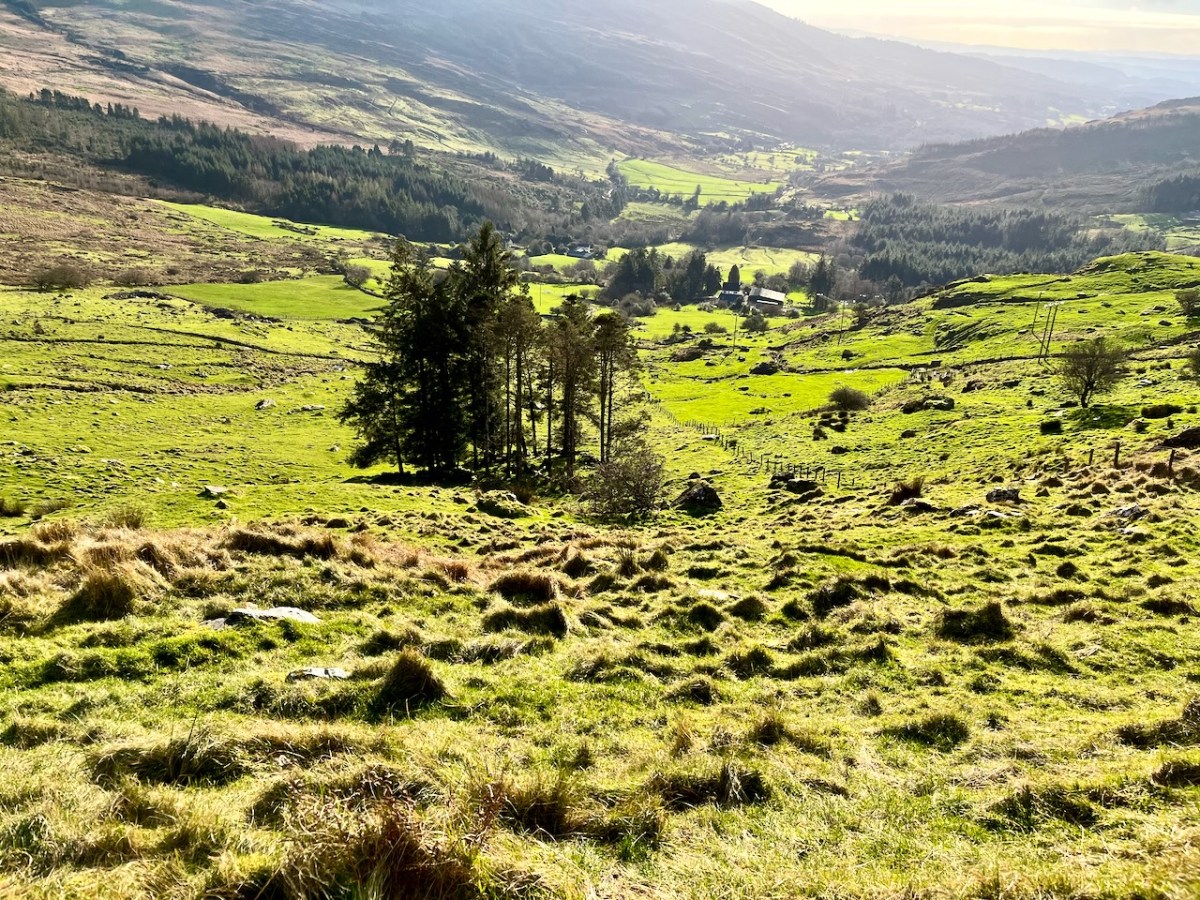
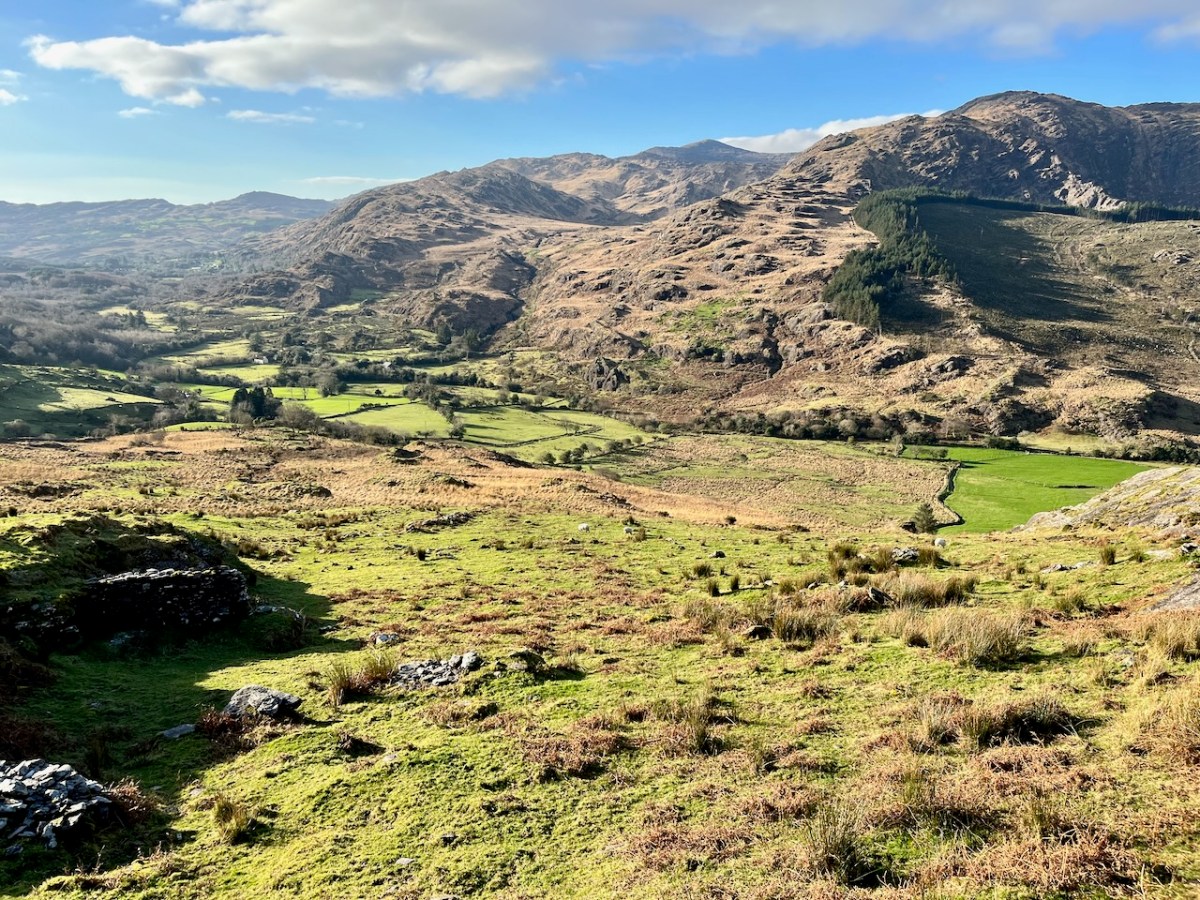
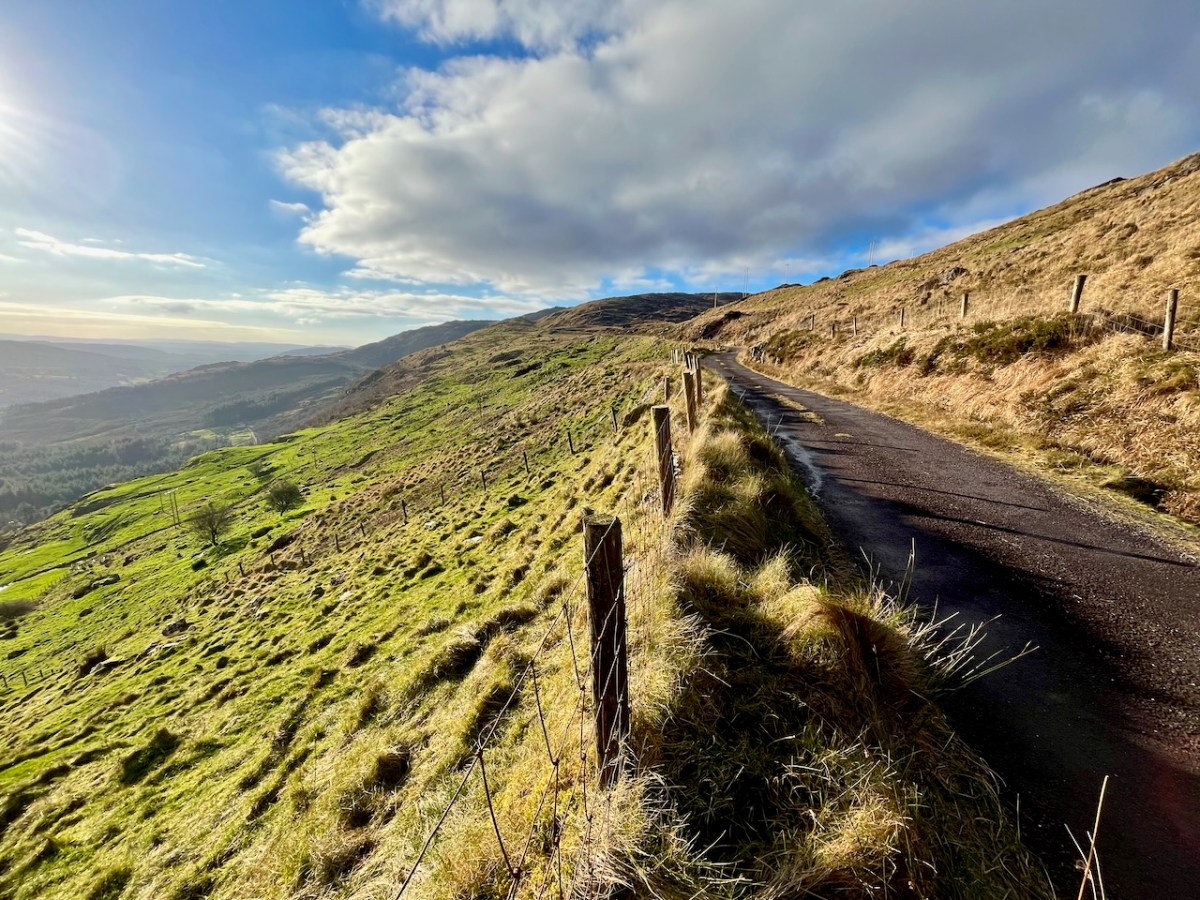
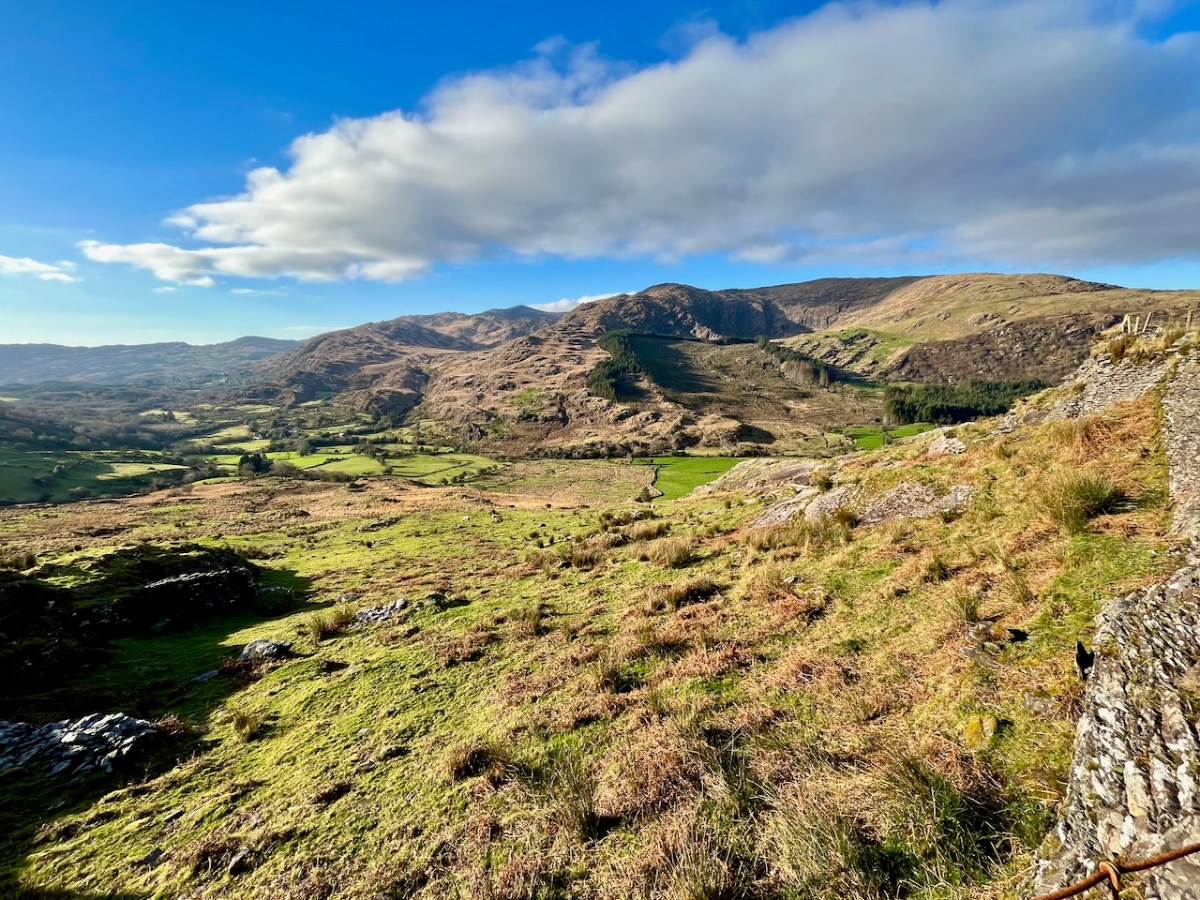
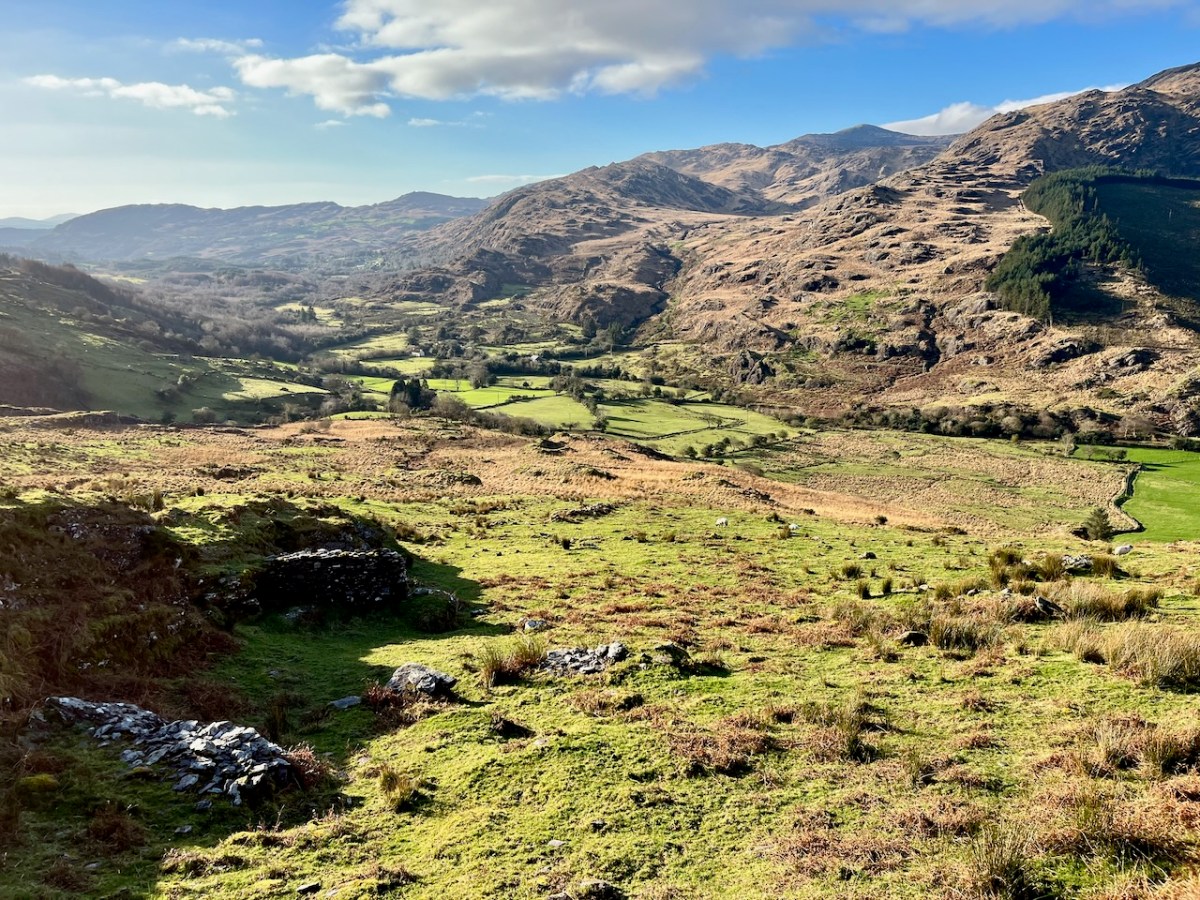
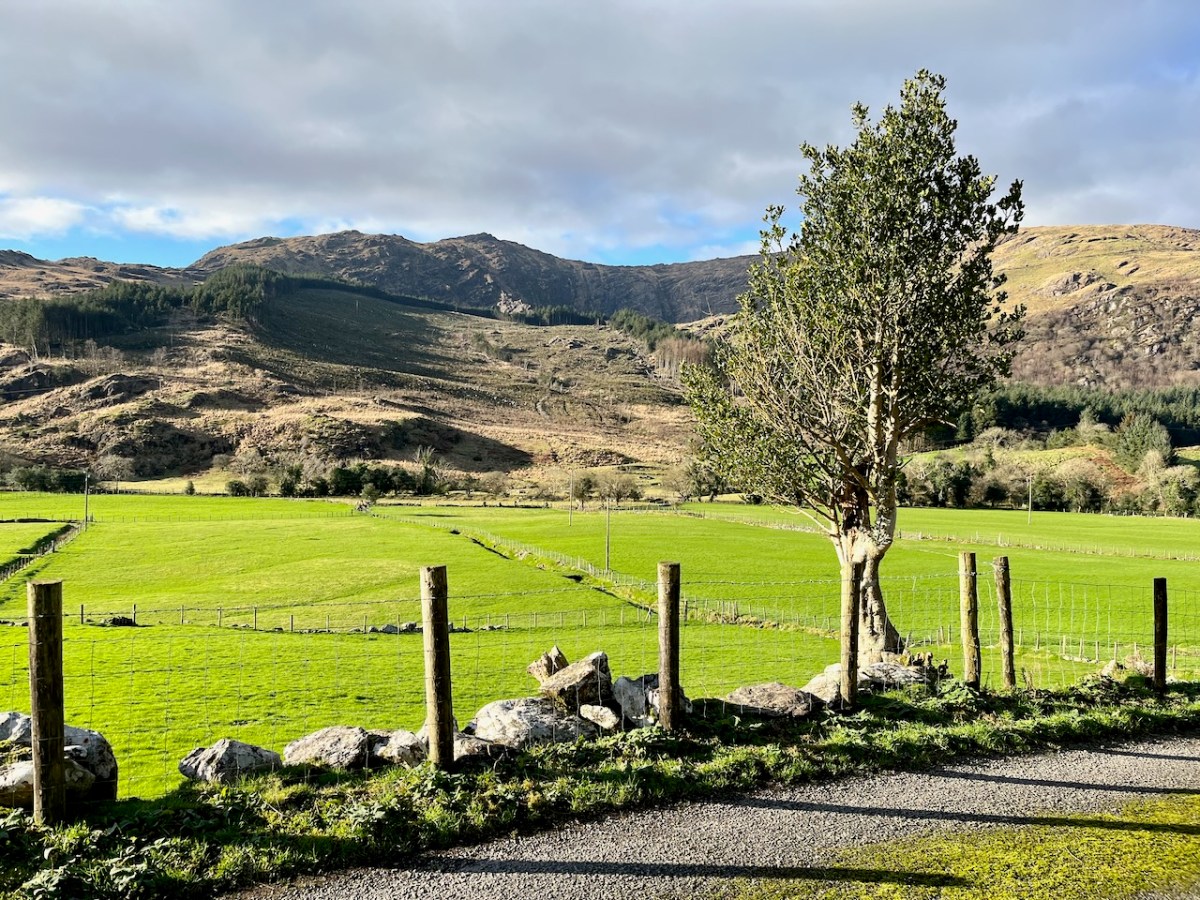
We passed over this high road that skirts the valley on an idyllic January day early in the new year (2024). For the first time, we also traversed the full length of the lane that goes into the heart of the vale, only serving scattered houses and farms. This goes by a complex stone circle and Mass Rock in the townland of Derrynafinchin – or Doire na Fuinseann. The group – also featured on the header – has been fully described by Amanda’s post Derrynafinchin: a bullaun, Mass rock & stone circle from a couple of years ago. Well worth a read!

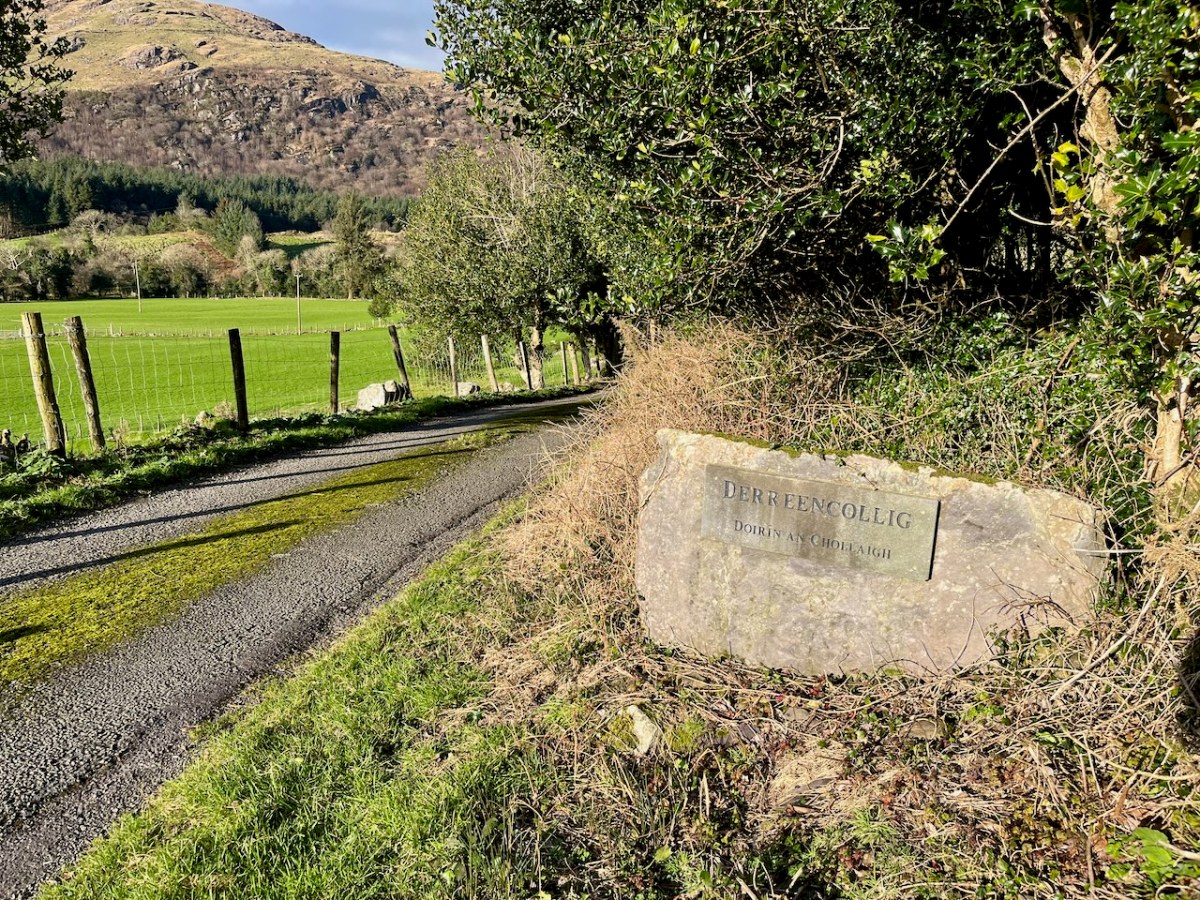
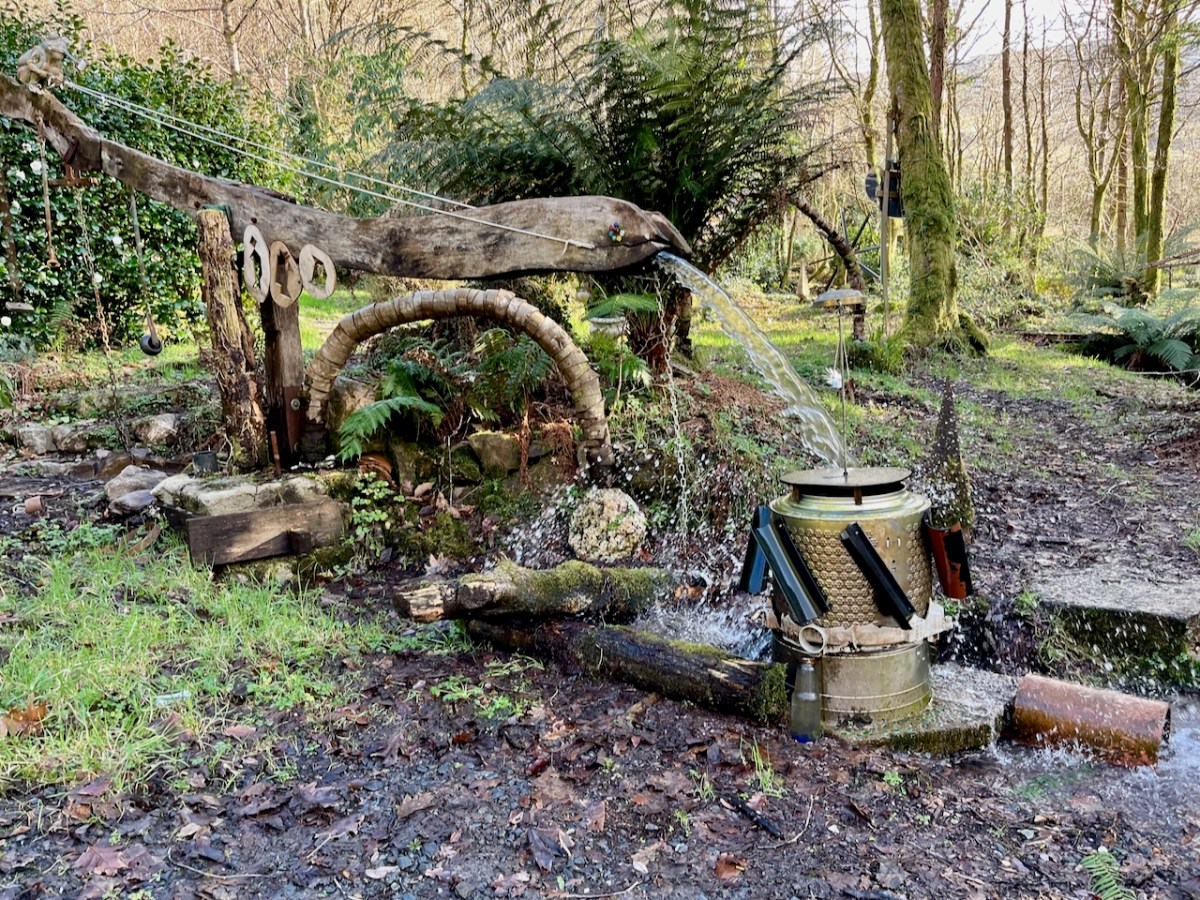
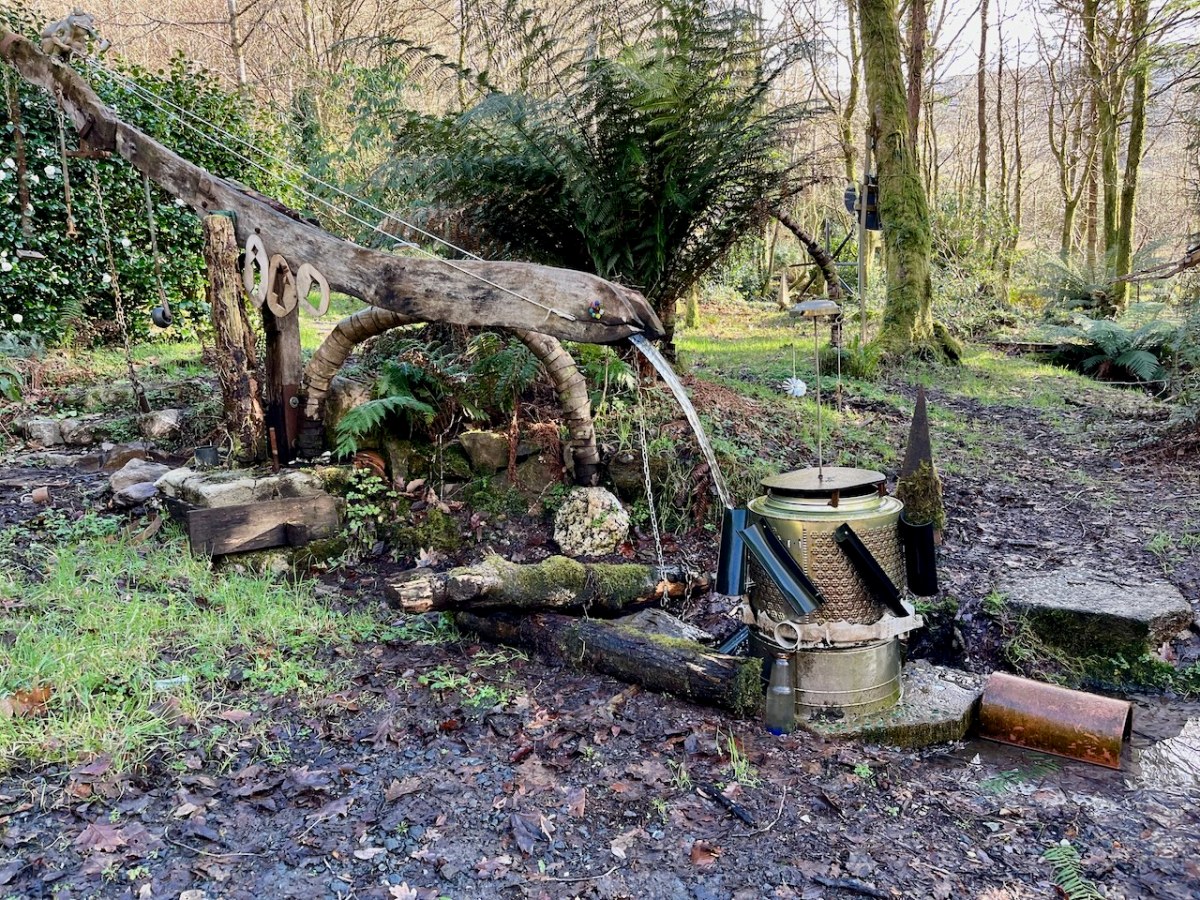
The little lane also passes into the townland of Derreencollig. We were intrigued by some kinetic sculptures we found beside the way: we did not come across the artist, nor anyone else on this part of the journey.

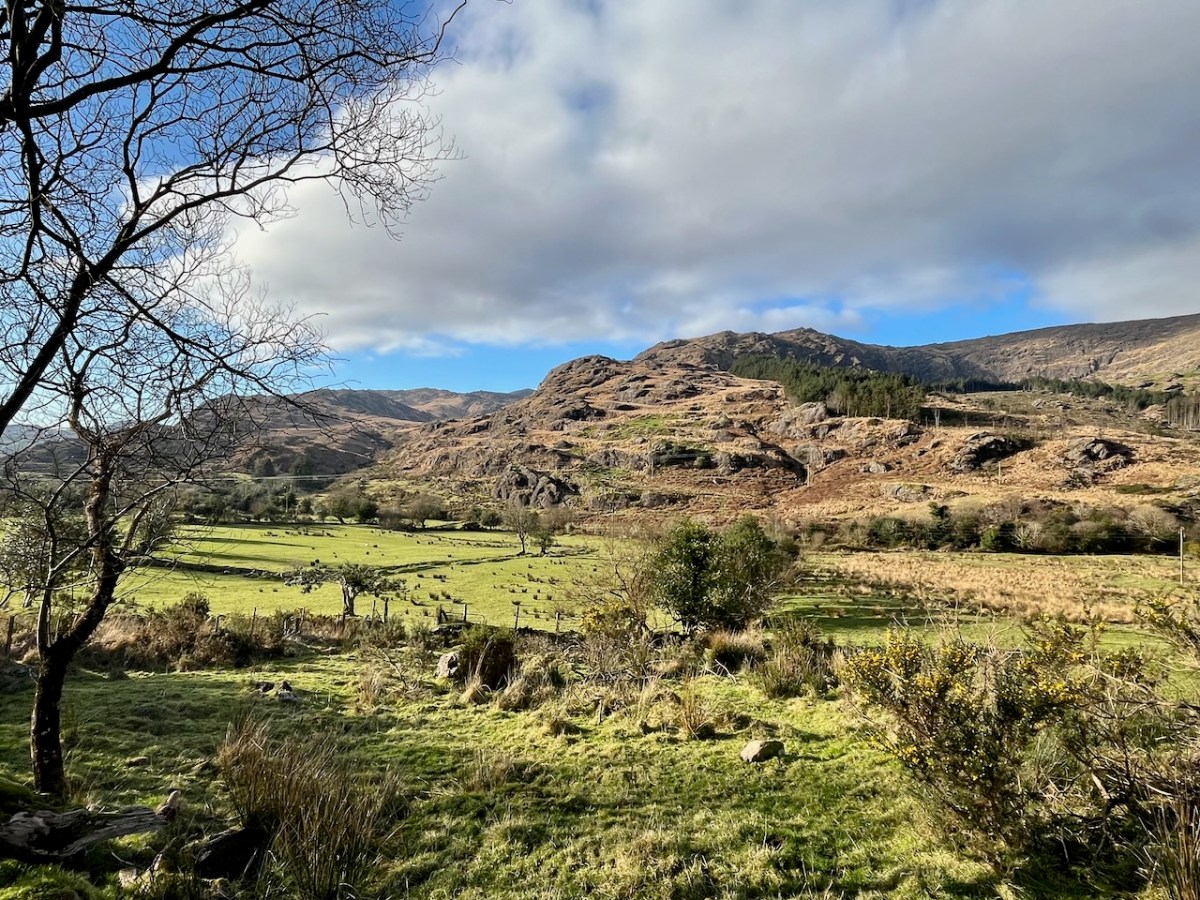
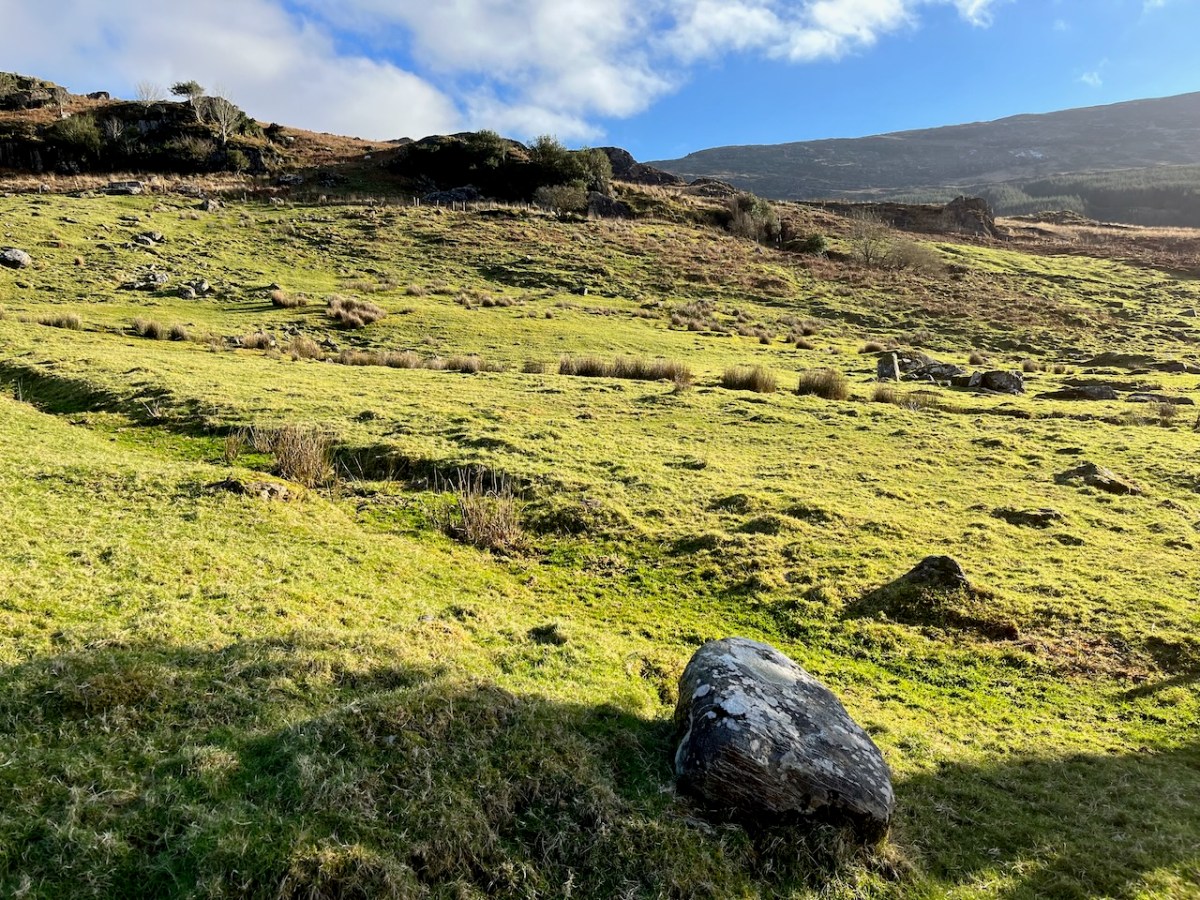
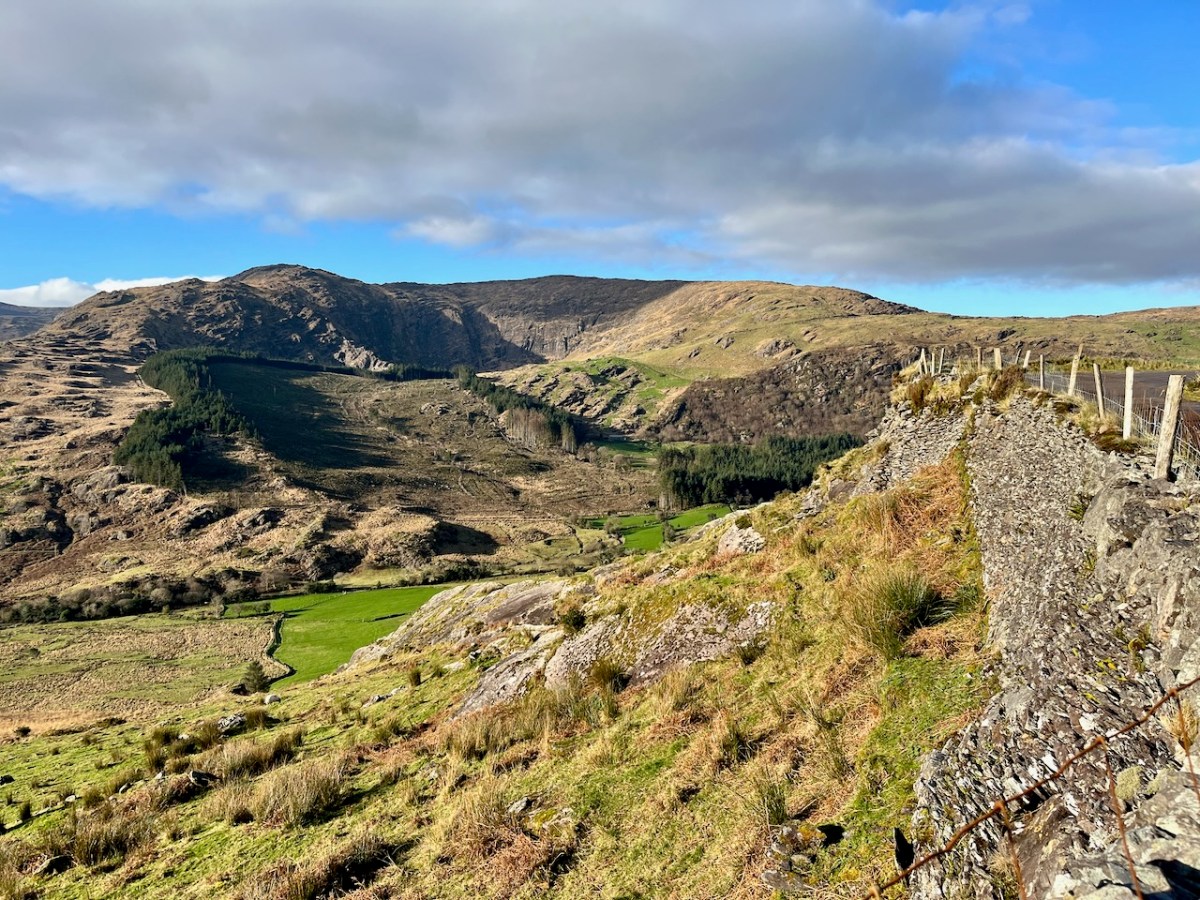
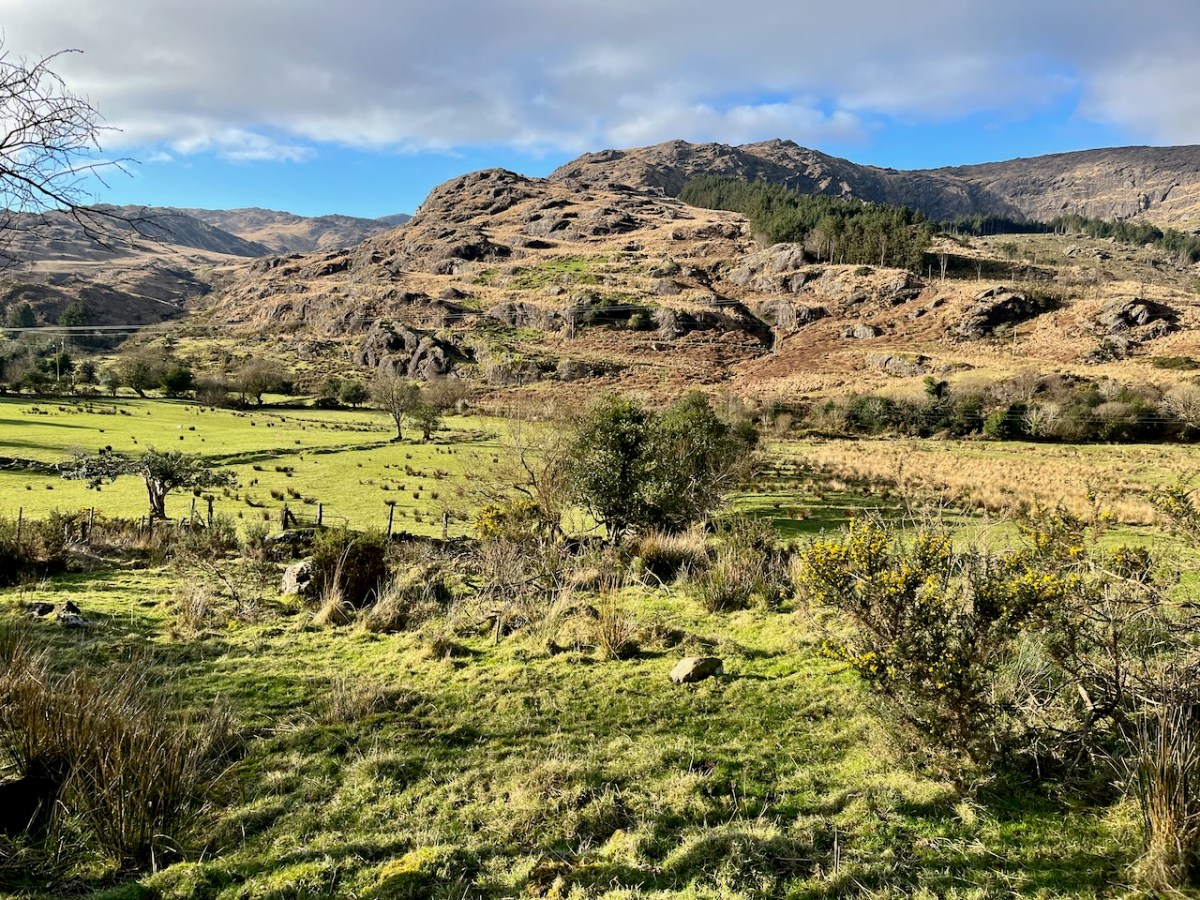
The views into this remote townland and its few habitations is seen from the minor road that follows the contour at high level, heading for Bantry.

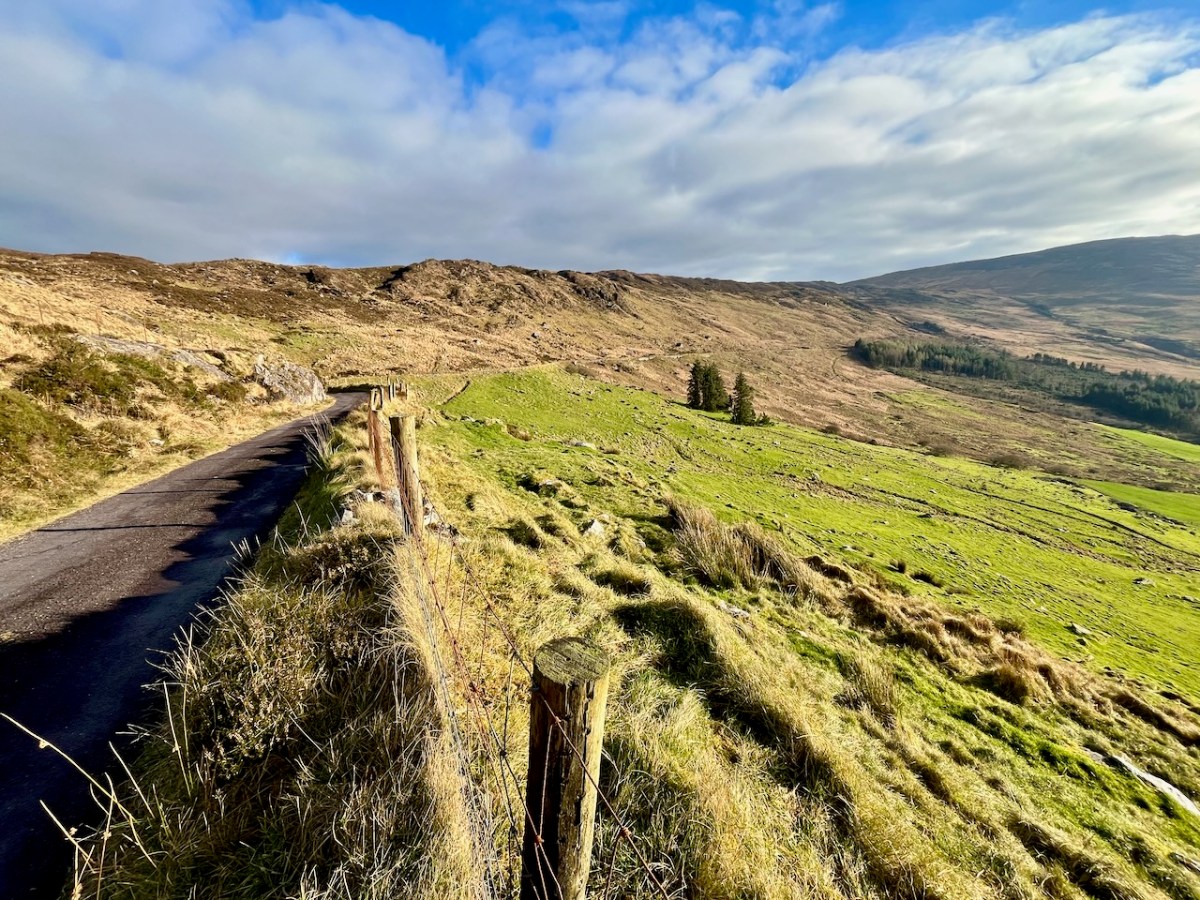
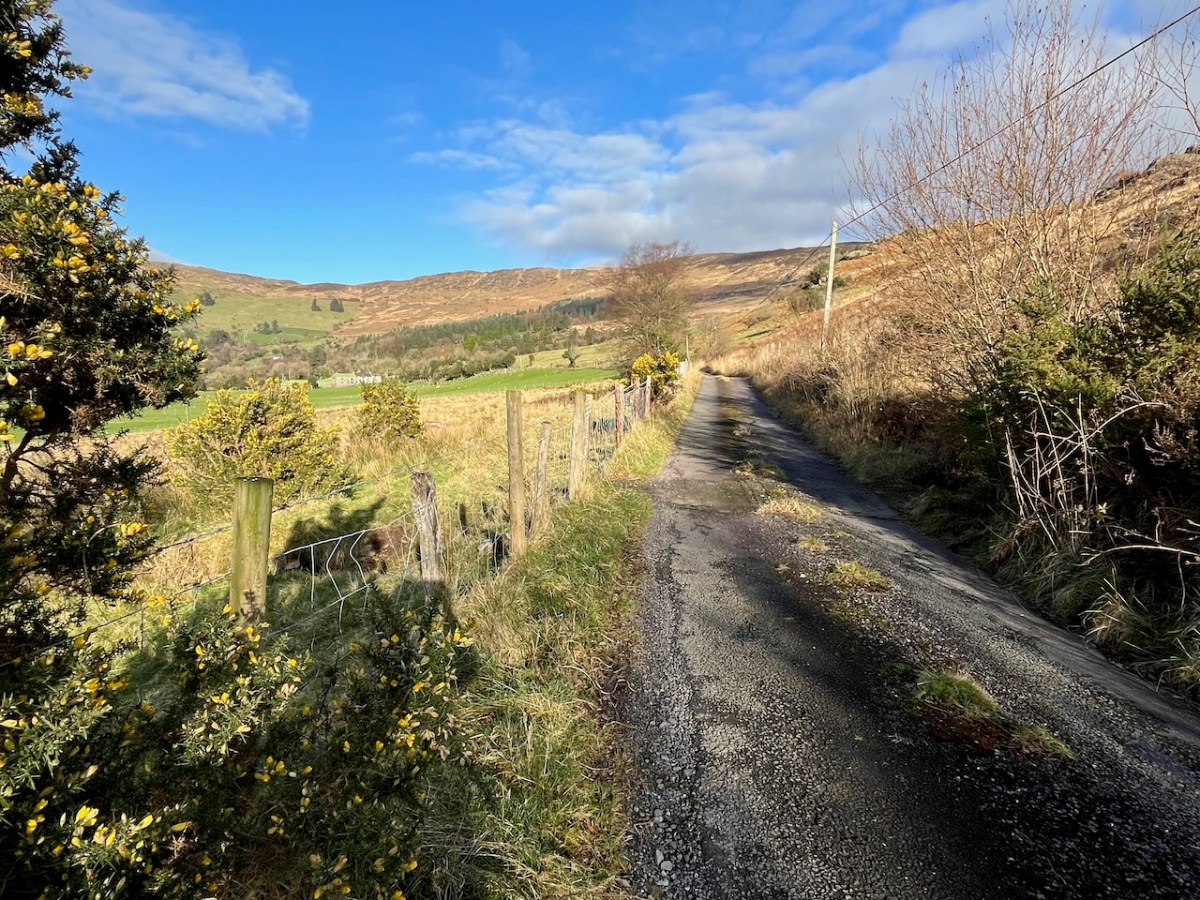
If you find our minor roads tricky, then stick to the main ones. But, if you are not in a hurry, you couldn’t do better on a day of winter sunshine than to traverse the gentler, secret ways.

Description is hardly needed in this little topographical diversion. I’m not sure where else in the world you could find your senses as satiated as here in West Cork (and Kerry!). Travel on!

To my mind there’s no more satisfying way of journeying: keep to the crags and cornices of the high tracks.

The Wran

The Wran, the Wran, the king of all birds
On St Stephen’s day was caught in the furze
His body is little but his family is great
So rise up landlady and give us a trate
And if your trate be of the best
Your soul in heaven can find its rest
And if your trate be of the small
It won’t plaze the boys at all
A glass of whiskey and a bottle of beer
Merry Christmas and a glad New Year
So up with the kettle and down with the pan
And give us a penny to bury the Wran

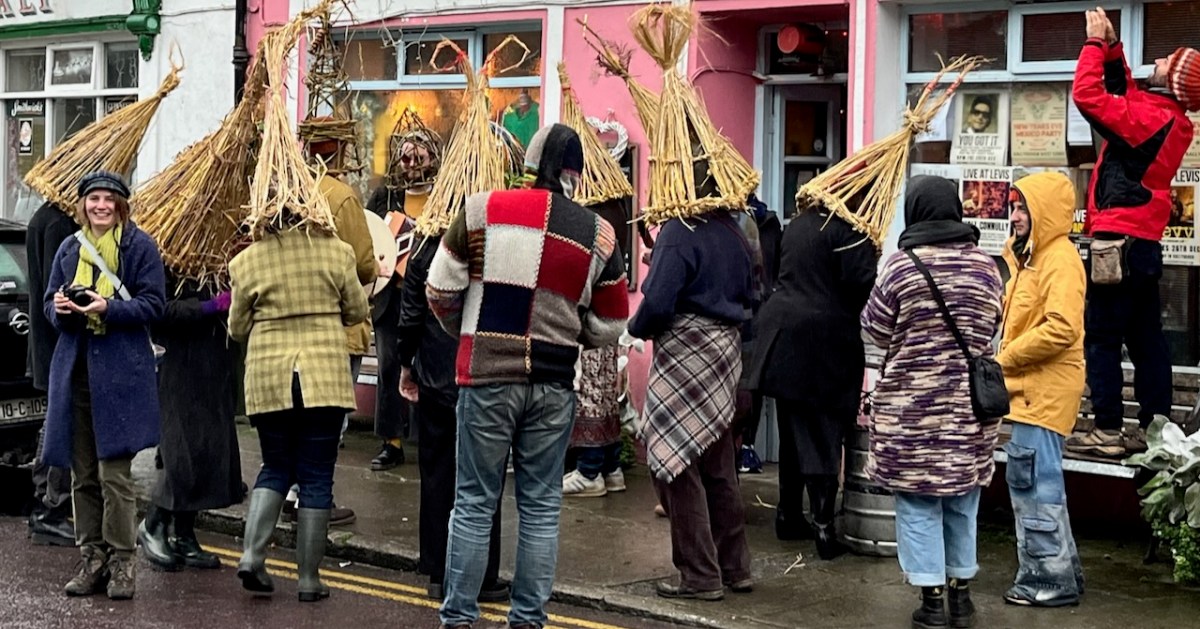
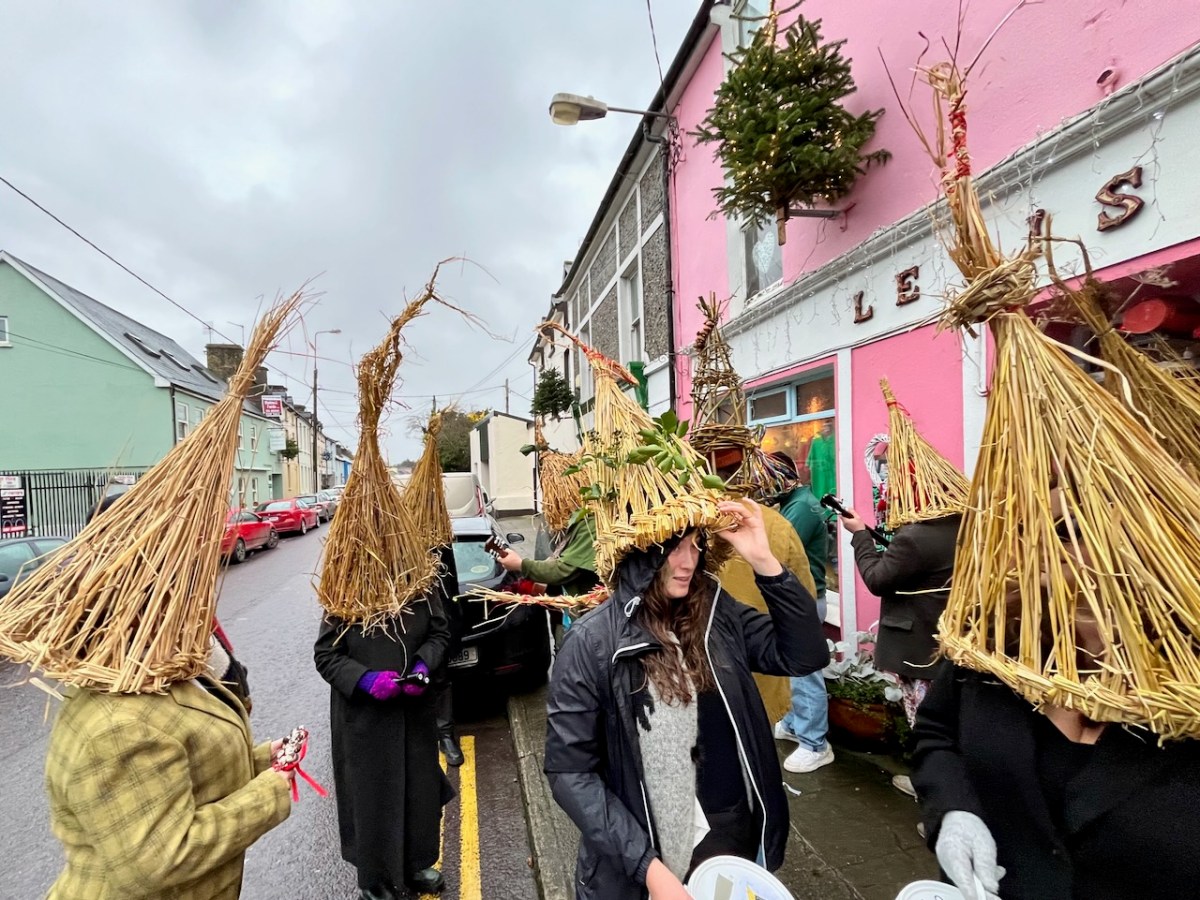
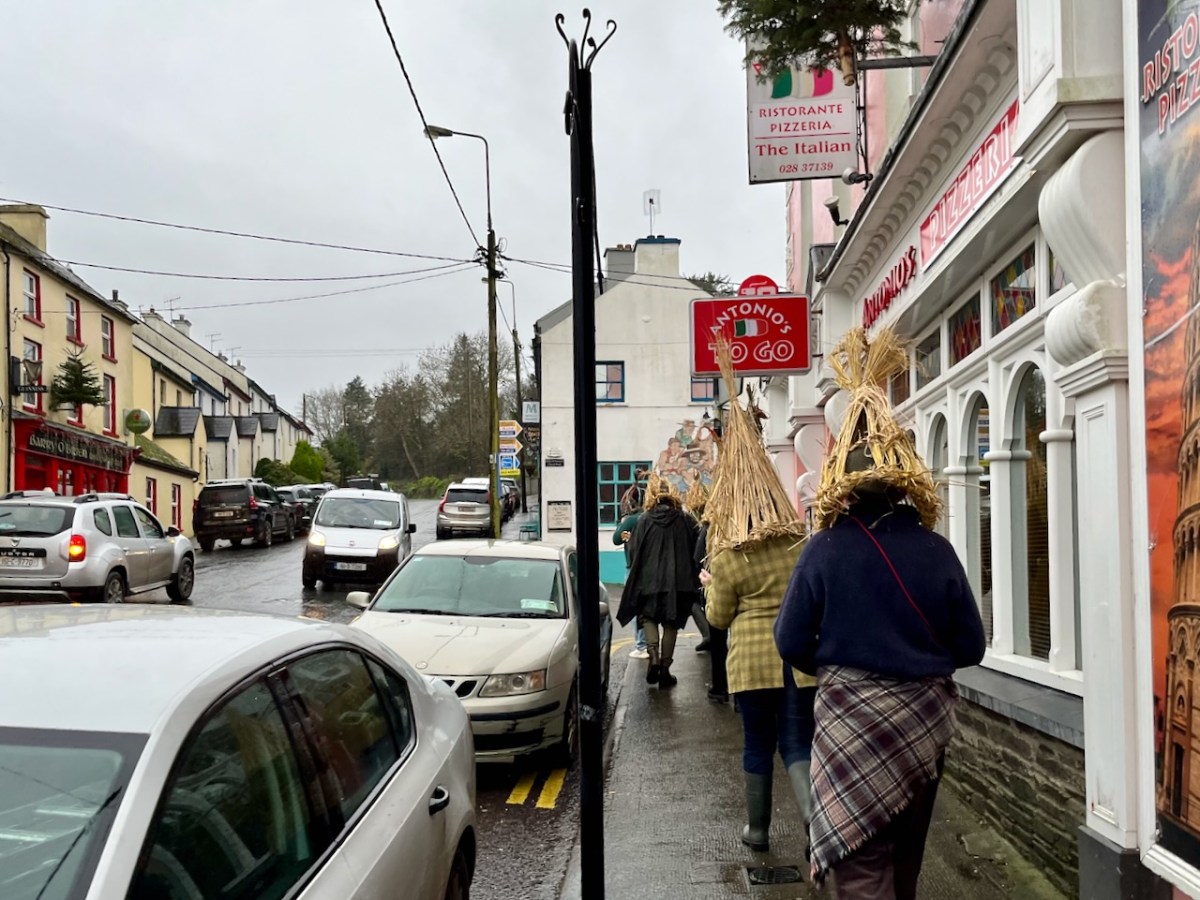
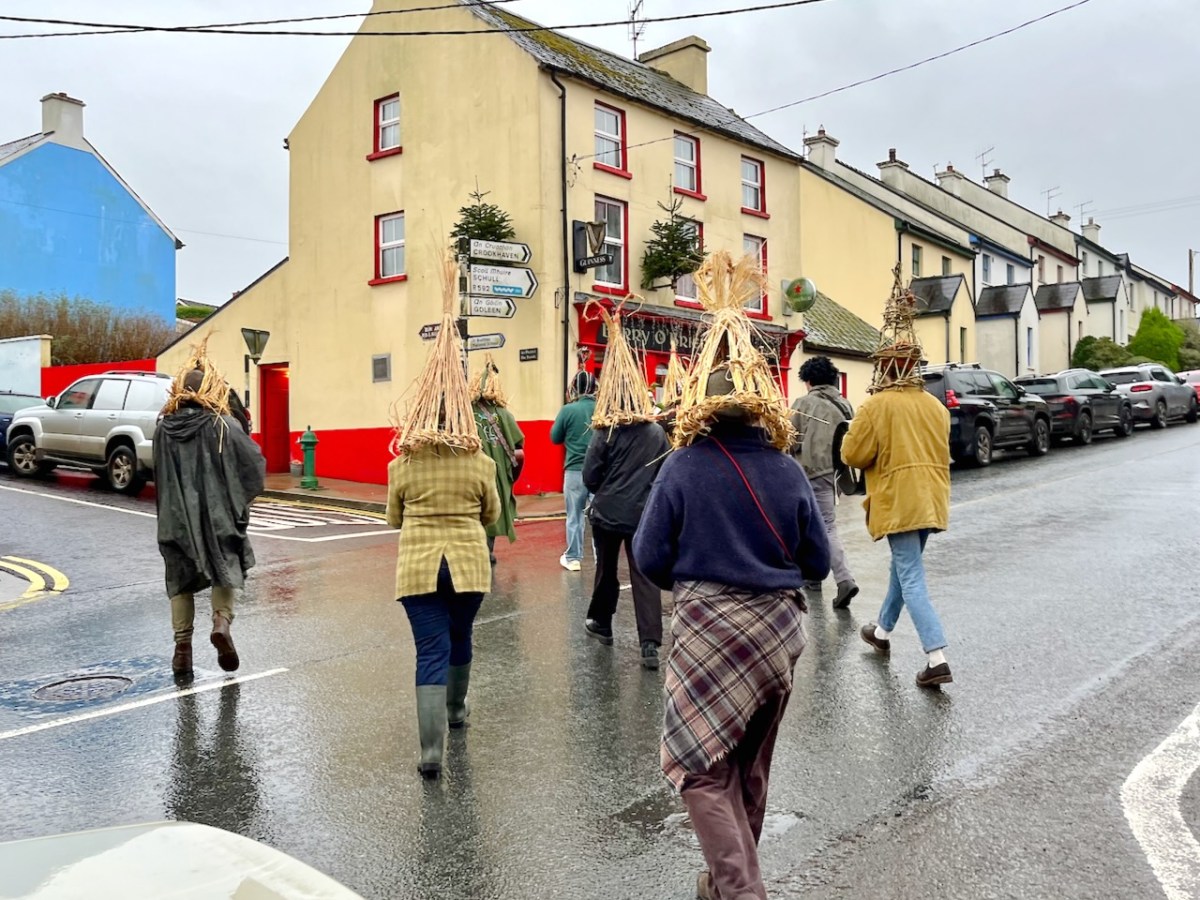
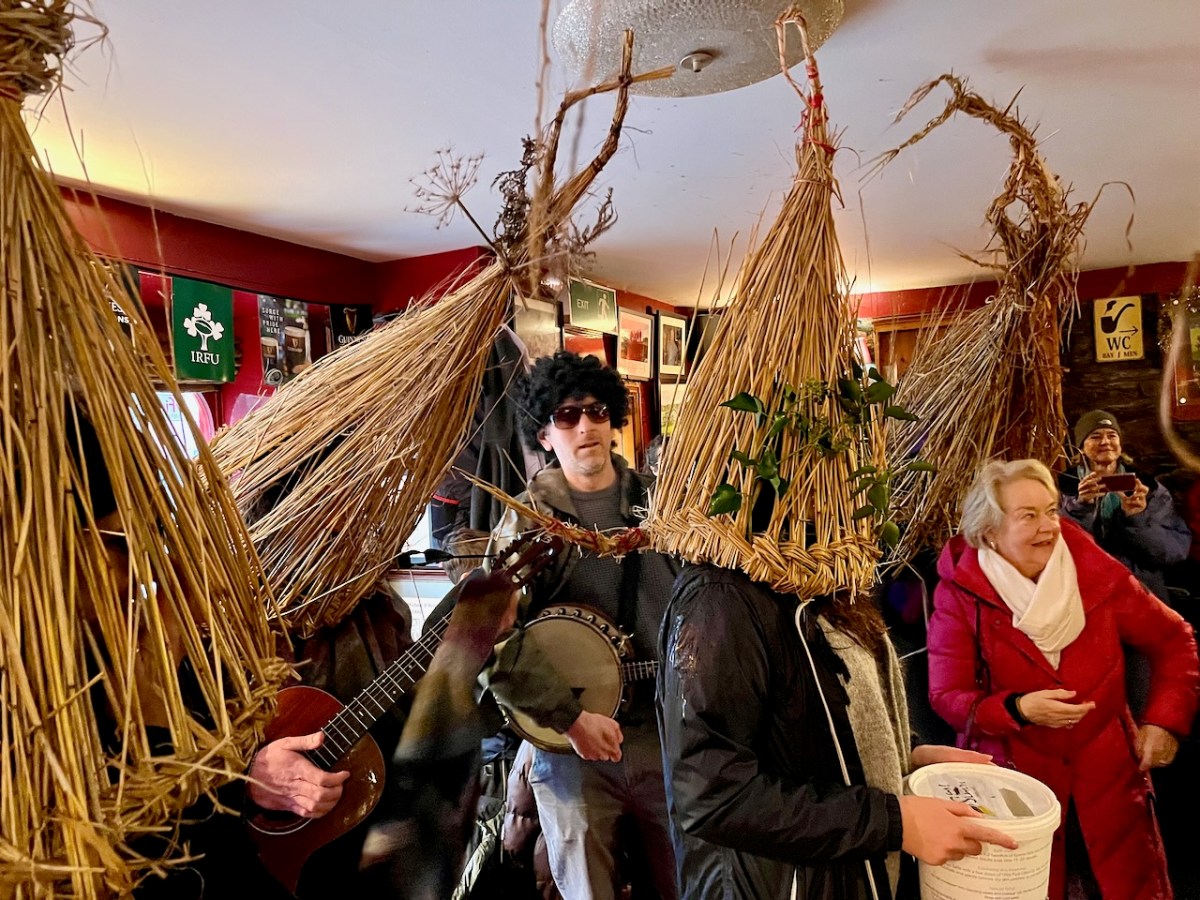
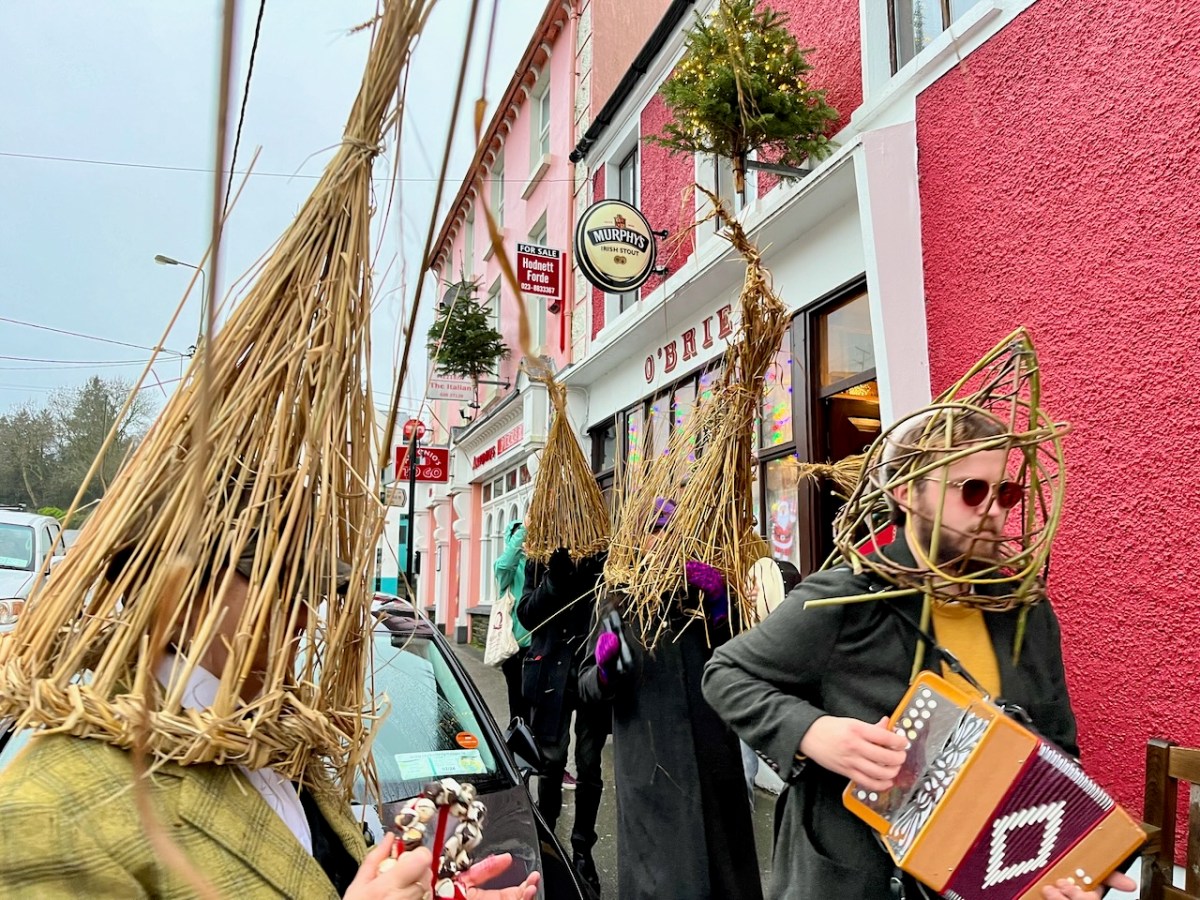
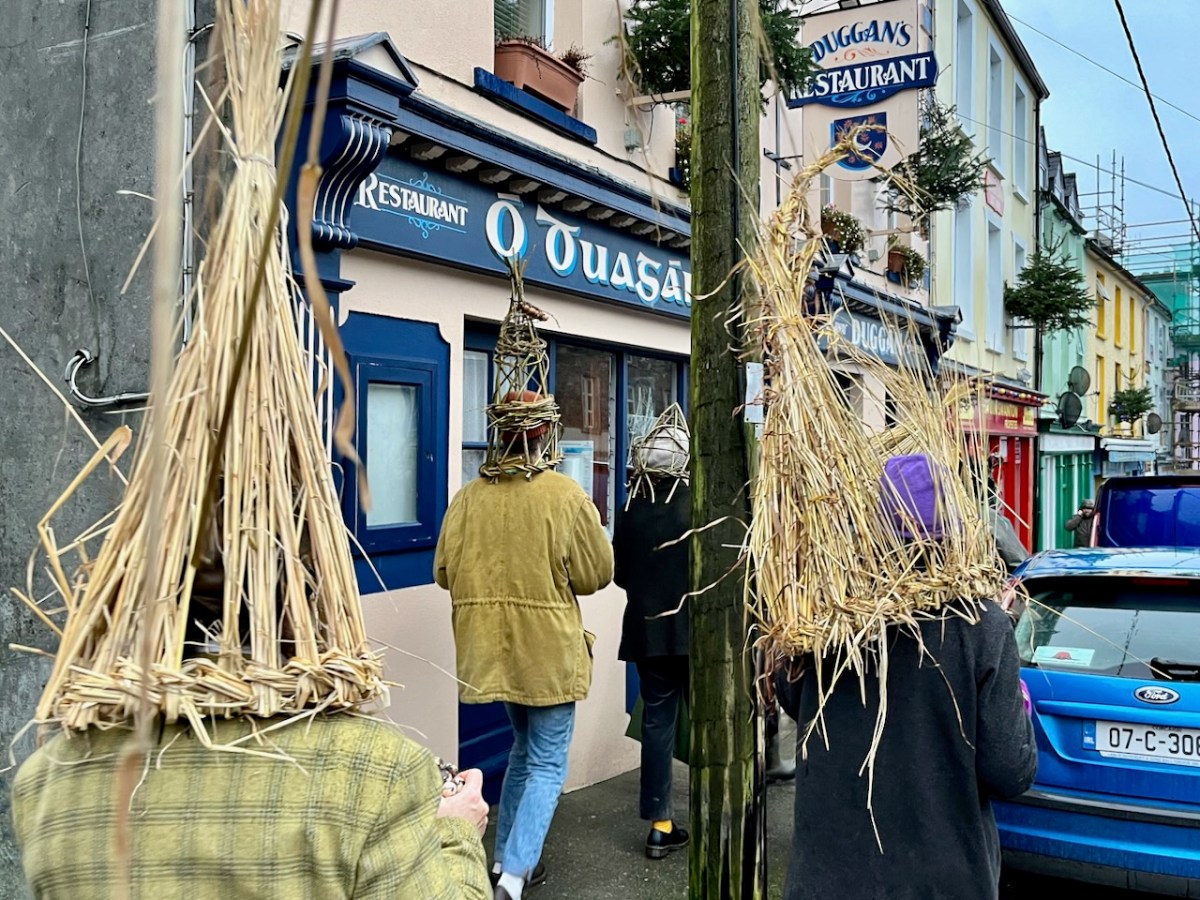
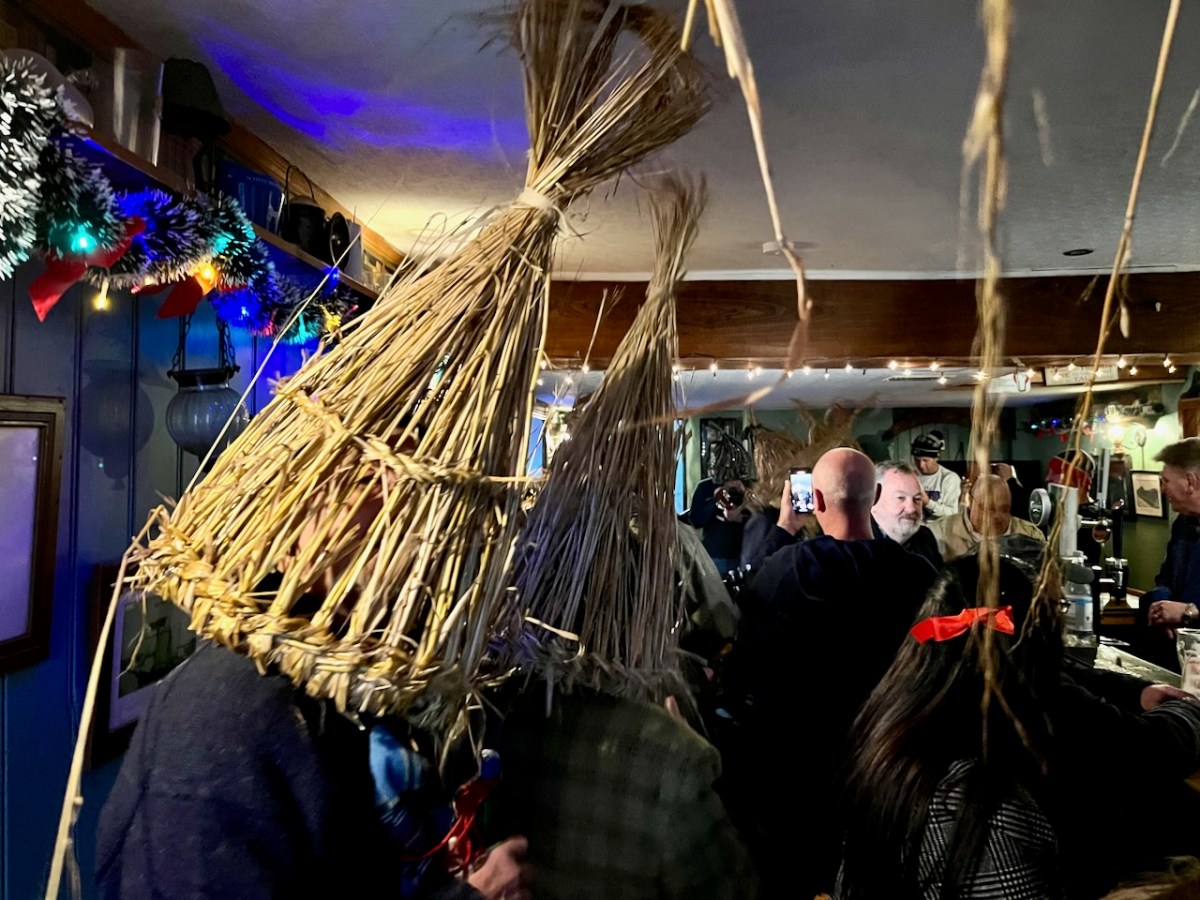
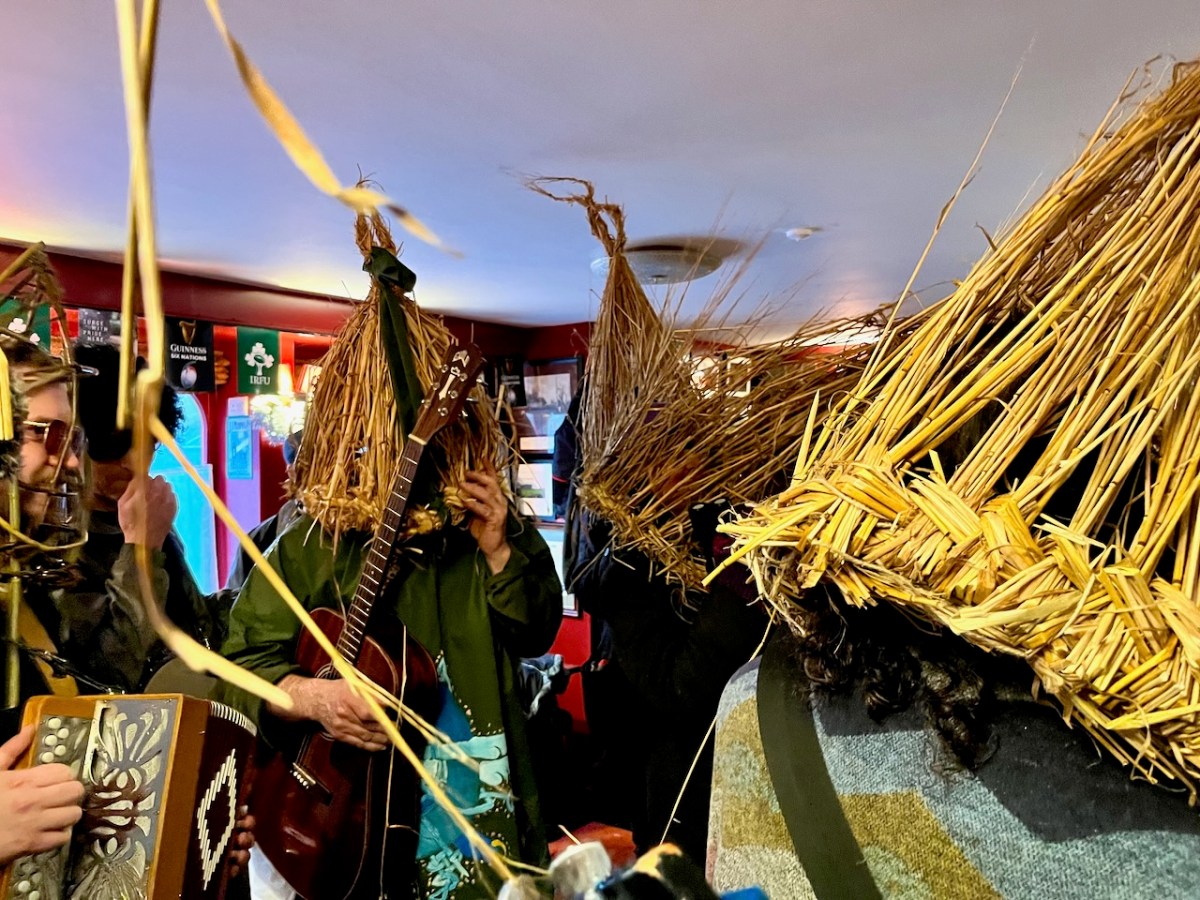
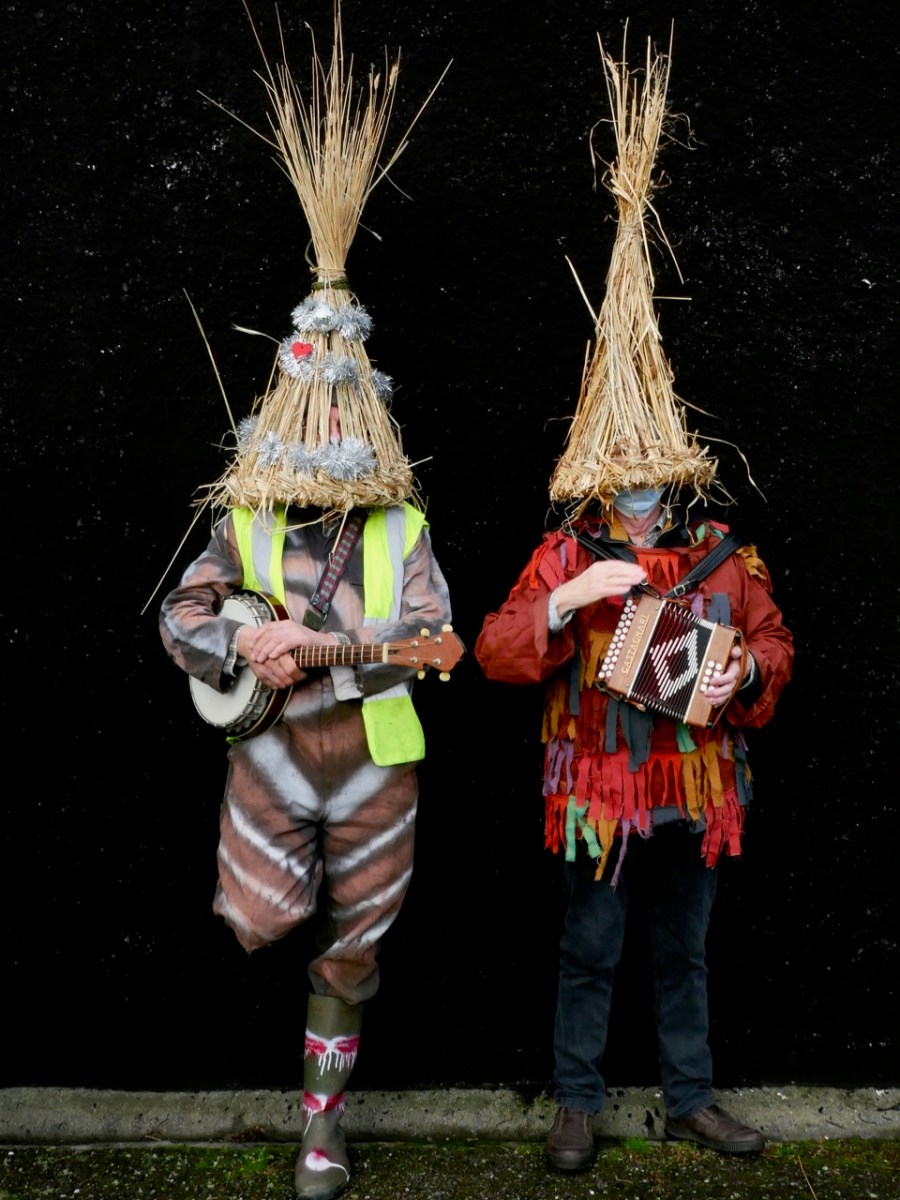
Ballydehob – here in West Cork – has an active Wran tradition on the day after Christmas: 26 December, St Stephen’s. In some parts of Ireland they call it The Wren, but with us there is no doubt – it’s The Wran.

The day was cold and wet: harsh winter ended our year. Nevertheless, the group perambulated the village, visiting each one of the hostelries, where they were well received.

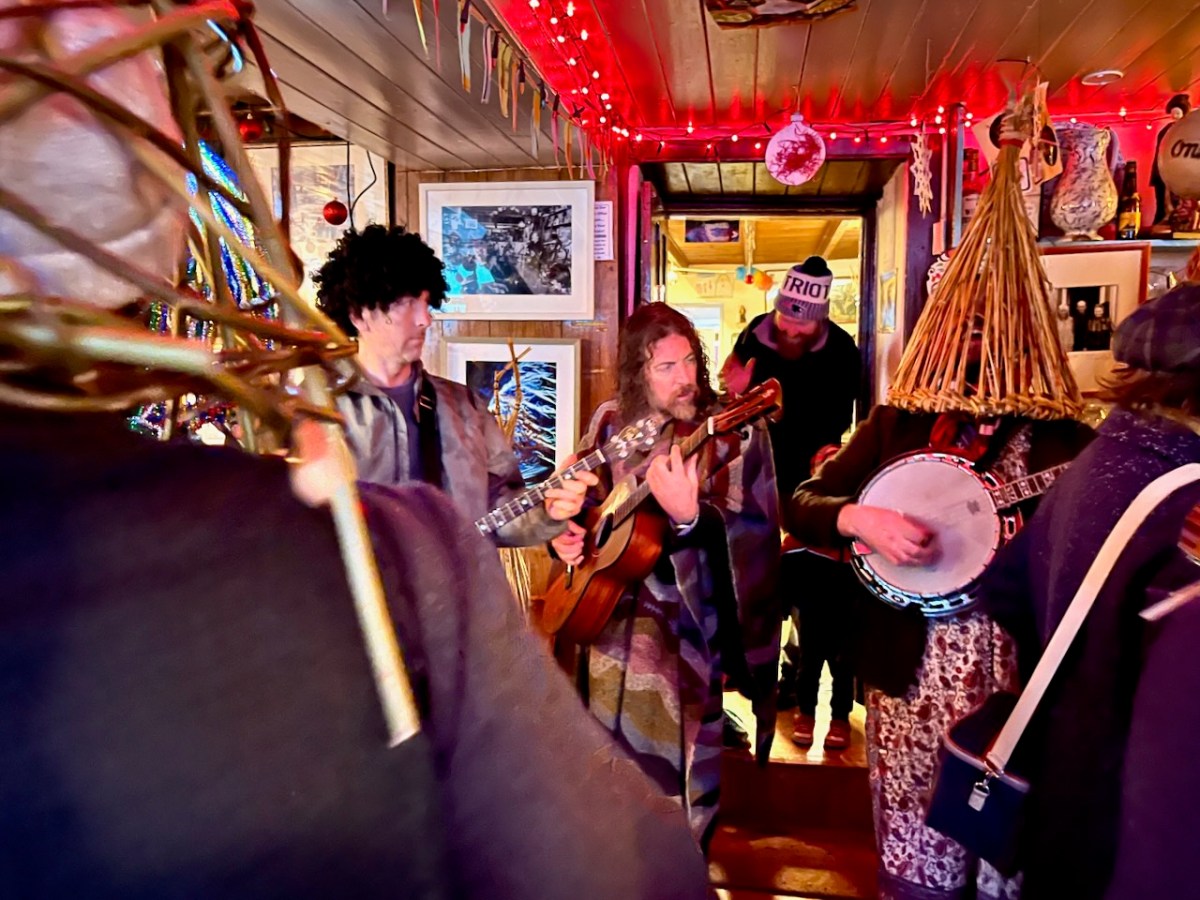
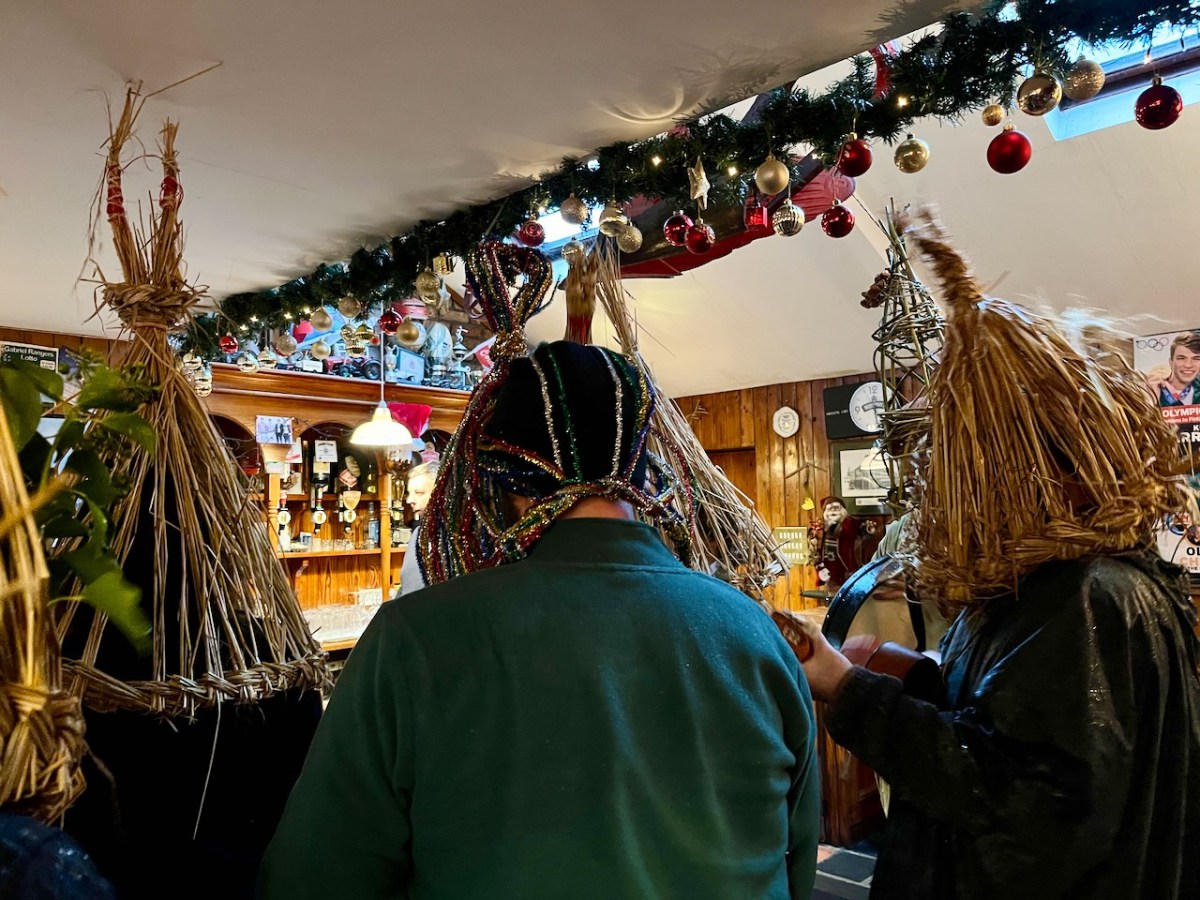
The Irish Whip was lively. The Wran Song was duly sung, and music ensued.

Over the last few years, Ballydehob has lost two of its establishments: Coughlan’s and Daly’s. It now has to make do with five: Levis’, Irish Whip, O’Brien’s, Sandboat (below) and Rosie’s. All were accommodating – no doubt to ensure good luck and fertility throughout the coming year.

This is a record of the Straw Boys and the Wran celebration in Ballydehob on St Stephen’s Day, 2023. I have written about the whole tradition in some previous posts – here’s a selection. I will continue to follow Ballydehob’s custom – and record it – as the years go by . . .

Looking Back on 2023: Robert

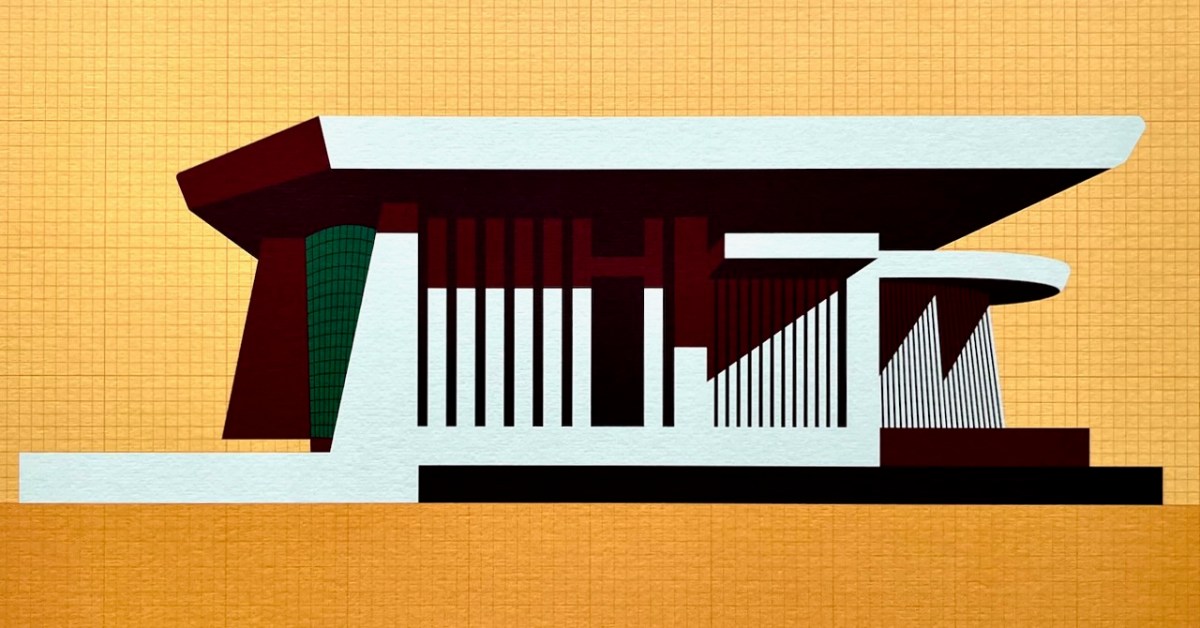
This is my favourite image of the year! I published a post about the architecture of Bantry Library, and it proved to be our most popular . . . This limited edition print, a collaboration between Dermot Harrington of Cook Architects and Robin Foley of Hurrah Hurrah is celebrating the upcoming 50th Anniversary of the completion of Bantry’s Library in 1974, and some refurbishment work is being undertaken for the occasion. For me, the print captures perfectly the iconic graphic of this most unorthodox design.

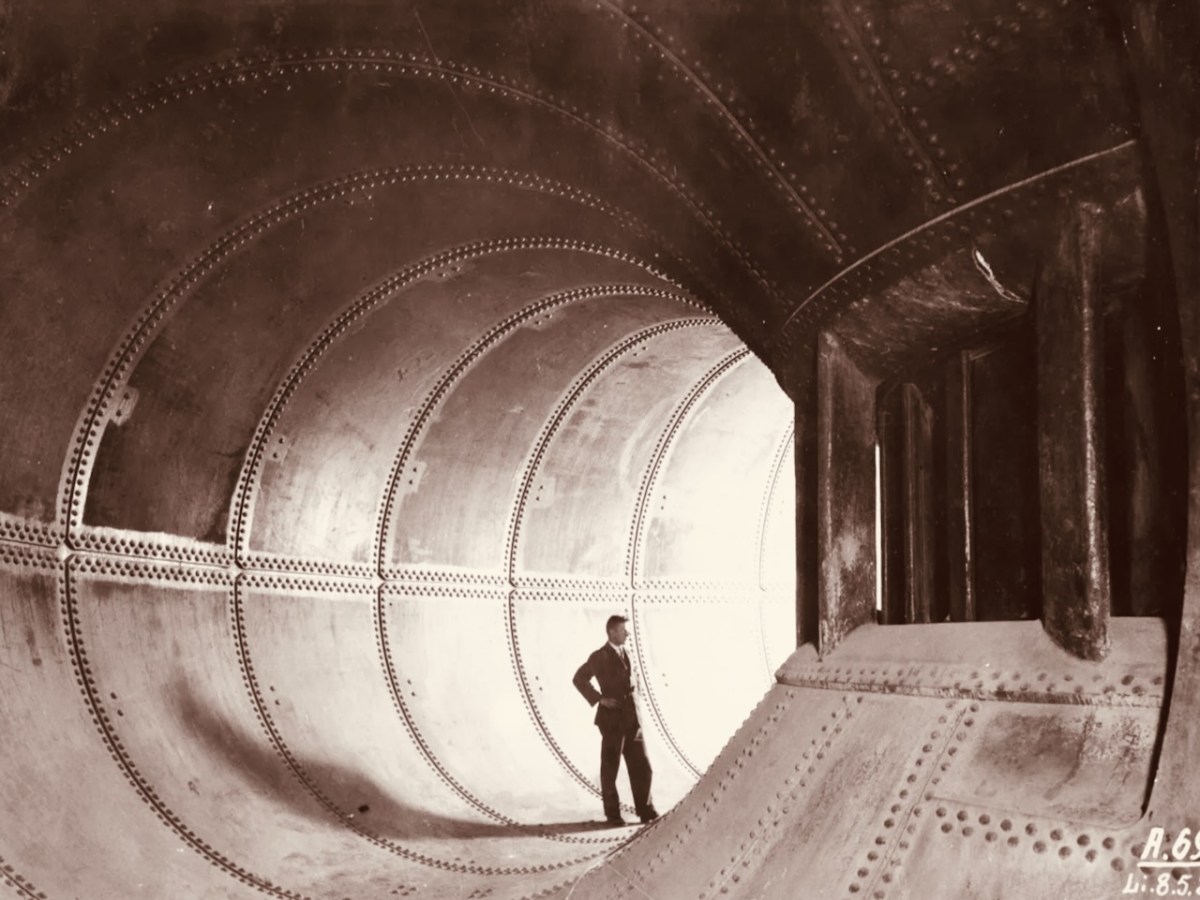
We both wrote 52 posts this year, each of around 1,000 words, and all fully illustrated. Above is a pic of one of the penstocks which brings the water into the turbine casings at Ardnacrusha Power Station (courtesy of ESB Archives). This incredible engineering feat – well ahead of its time – was constructed between 1925 and 1929, and was integral to the supply of electricity throughout Ireland’s young state by harnessing water power from The Shannon. West Cork benefitted from Rural Electrification, and I thoroughly enjoyed researching and writing a series of posts on the whole subject.

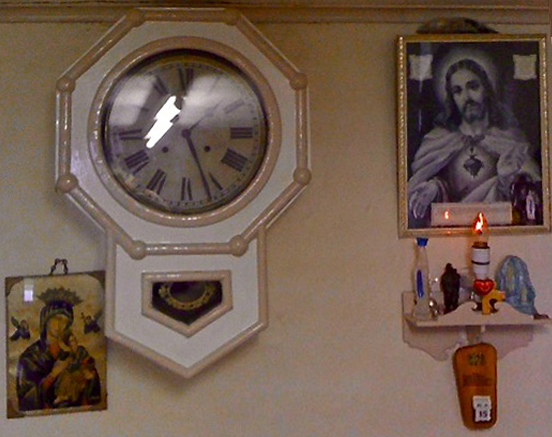
. . . Once a community was connected, or about to be connected, the ESB held public demonstrations of household appliances. These were then sold bringing electric irons, kettles, stoves to homes. The demonstration evening in Glenamaddy was held in January 1951. The handwritten report records that it took place “in the very fine Esker Ballroom”; these events were social occasions that brought communities together. The Glenamaddy evening “was attended by about 90, including 50 women. As is usual, the women appeared to be more keen than the men and more inclined to ask questions (and to argue). After the demonstration, a melodeon player turned up and an impromptu dance got under way” . . . Small towns and rural townlands became brighter and winters less harsh and Christmas more special as the fairy lights began to shine. It also gave rise to a rural Irish icon as every house had the Sacred Heart picture with the (electric) red lamp (below): many didn’t get a kettle and washing machine until later on . . .

ESB Archives

The whole series on Rural Electrification was written during the summer and can be read through this link: https://roaringwaterjournal.com/tag/electrification-of-ireland/

Since 2018 our own Museum in Ballydehob has been showing exhibitions of the work of locally based artists. This year it was the turn of the Verlings – John and Noelle. John died, sadly, in 2009; Noelle is still alive and kicking and assisted Brian Lalor and myself in assembling an excellent collection of the work of these two creative residents of our village, assisted technically and ably by Stephen Canty. BAM is a really valuable resource in setting out the unique history of the artistic community here in West Cork from the 1950s onwards.

A wonderful photograph (courtesy Geoff Greenham with many thanks) of St Bridget’s Catholic Church in Ballydehob. The interior was reordered by John Verling.

. . . The gold fish hand drawn in the background of the altar and the depiction of one fish swimming against the shoal continues to evoke admiration from locals and visitors alike. He also designed the two ‘windswept thorn’ stained glass windows and etched the brass surround of the tabernacle. The Altar slab, composed of a vast monolith like the capstone of a dolmen, is a distinguished piece of sculpture and a tribute to his imaginative capacity . . .

JOHN VERLING WEBSITE: HTTPS://WWW.JOHNVERLING.COM

There was great drama off the coast of Ballydehob on the night of 22 September 1973, and its 50th anniversary was duly celebrated in Roaringwater Journal!

. . . AS an inspector from the aeronautical section of the Department of Transport and Power arrived in Ballydehob to begin an investigation into Saturday night’s plane crash off the Cork coast, it was learned last night that the pilot of the Piper Cherokee almost lost his life in his efforts to save the other three men on board. Michael Murphy (23), of Mercier Park, Curragh Road, Cork, who was sitting next to the pilot, Eric Hutchins of Ballinlough, Cork, said that Mr Hutchins was concentrating so much on getting the plane down that he was knocked unconscious at impact. Mr Murphy, together with Noel O’Halloran, of St Luke’s, Cork, and James McGarry, of Monkstown, Co Cork, had been braced for the crash and scrambled free on to the wing. But then they found that they could not get out Mr Hutchins who was unconscious. Mr O’Halloran then went back into the rapidly sinking plane and between them they pulled Mr Hutchins free and threw him into the water. The three men then swam ashore taking 40 minutes to reach land at Fylemuck, as they had to support the injured man all the way . . .

IRISH PRESS, MONDAY 24 SEPTEMBER 1973

All four crew and passengers on the plane survived the ditching, but the aircraft itself (a photo taken in its good days, above) was a write-off. Those living locally who remembered the event gathered to mark it in Schull, on the anniversary.

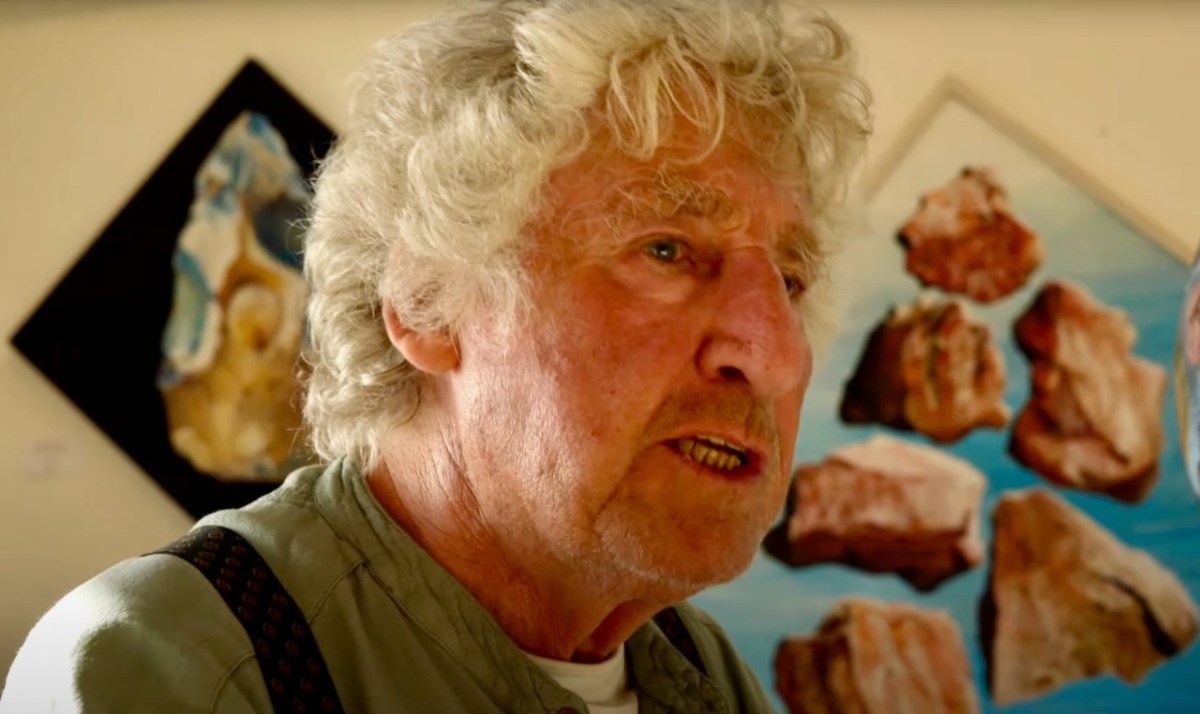
That’s Keith Payne, above. He’s one of the many artists who has lived in West Cork for a significant part of his life – at Leamcon, and he was deservedly given an exhibition in The Blue House Gallery, Schull, in September this year. He has always been fascinated by ‘early markings’, including Rock Art: he contributed dramatically to our own Rock Art exhibition at The Public Museum, Cork, in 2015.

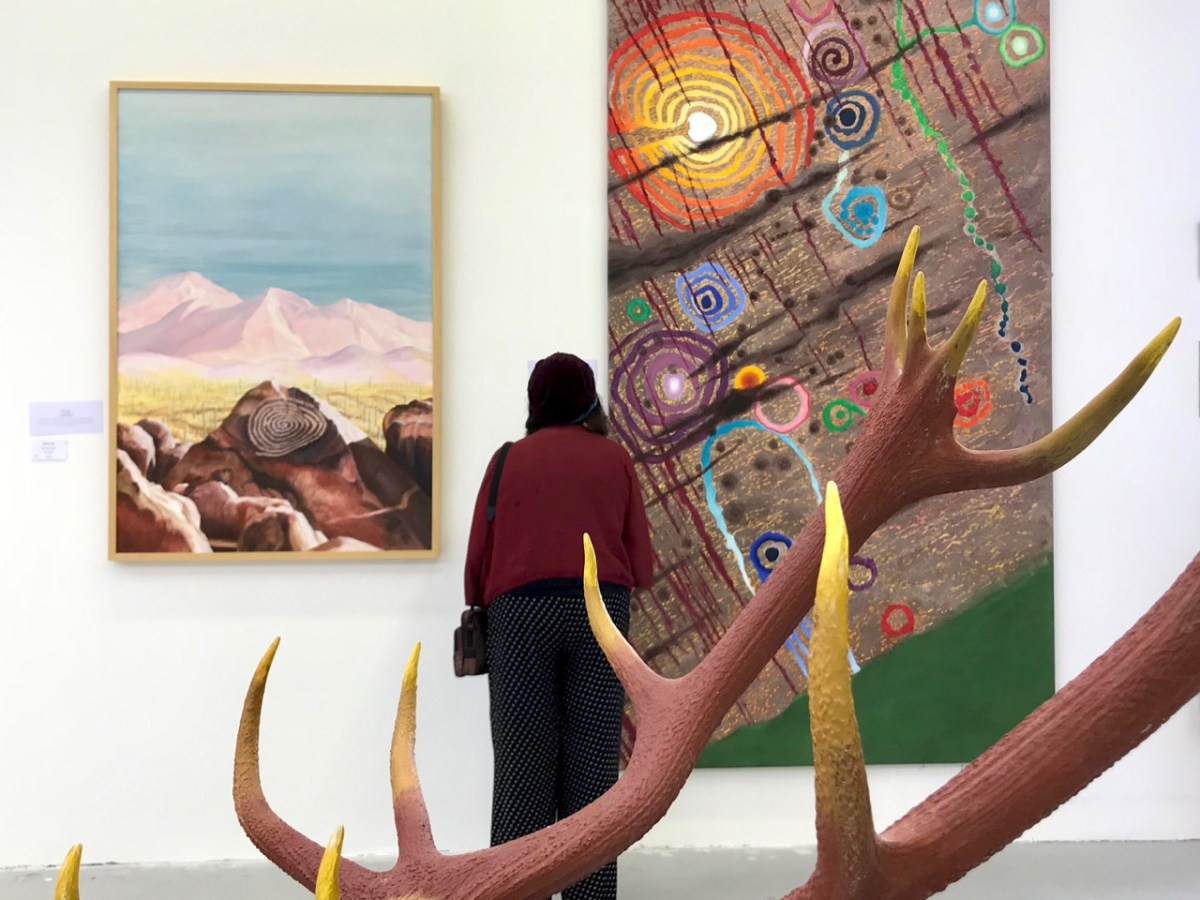
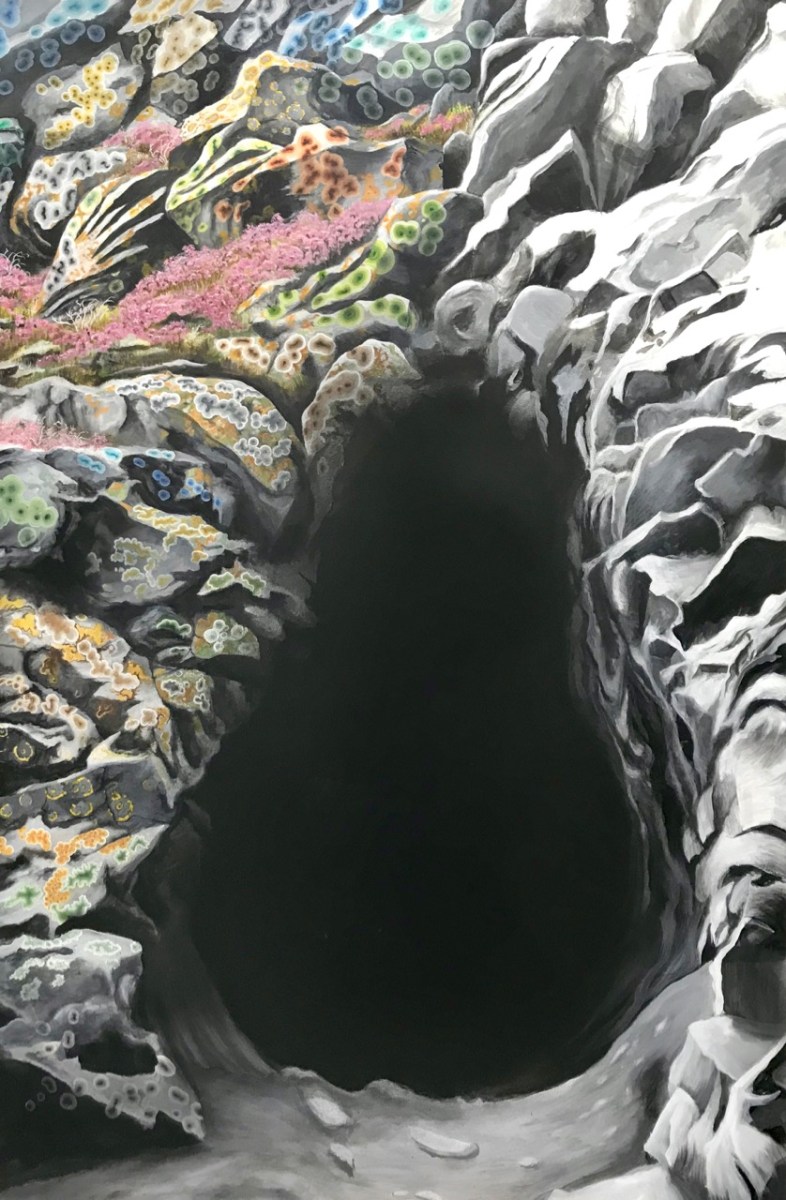
That’s a spectacular large canvas by Keith inspired by Rock Art at Derreenaclogh, West Cork (on the right, above). It’s from an earlier exhibition by Keith in County Clare in 2018, at the Burren College of Art Gallery in Ballyvaughan, Co Clare. The work below is titled Cave Entrance.

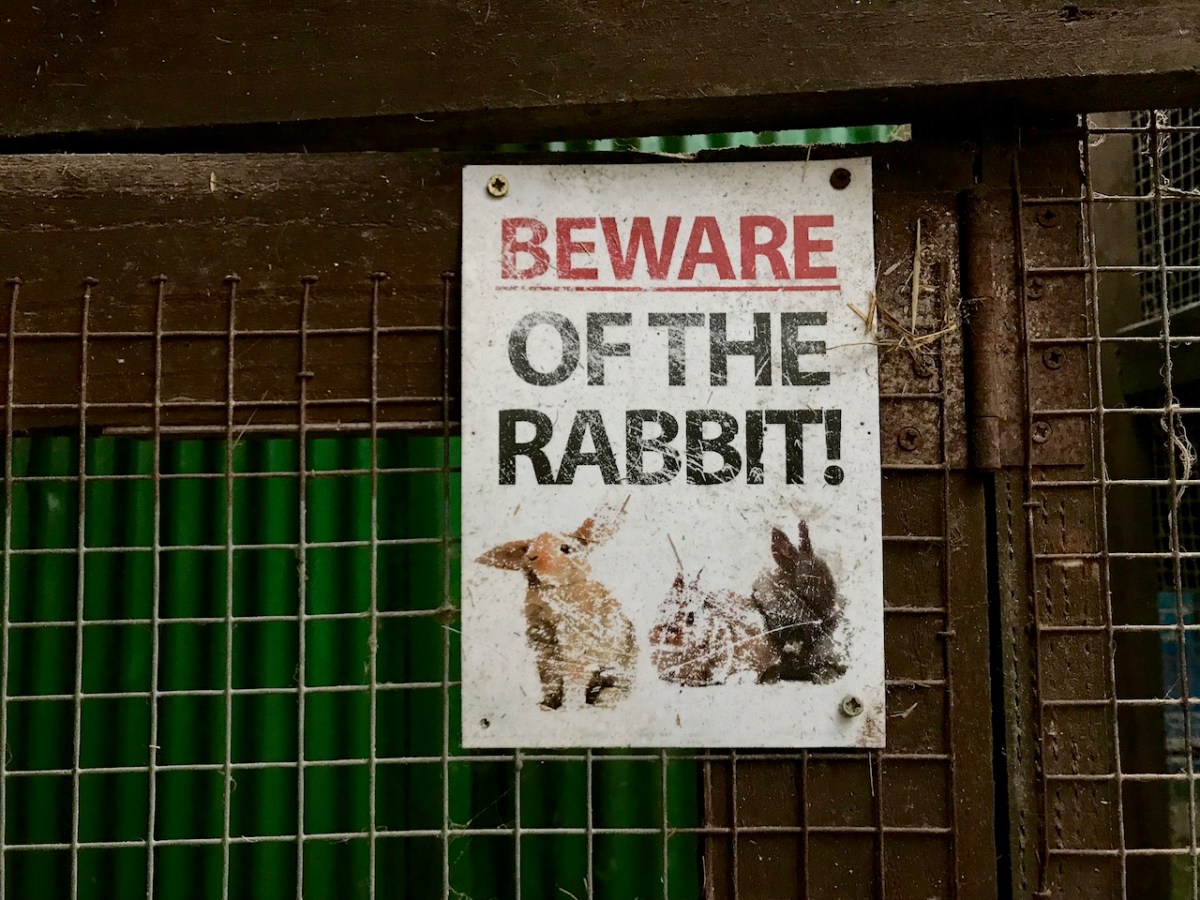
Throughout the year I continued to publish posts on some of my favourite subjects: Irish signs, advertising and curiosities. I’m always avidly collecting these, and will have some to show in 2024, for sure. In the meantime, let’s hope our general news becomes more positive as we move forward in this disorienting world of ours . . . Have a good new year, everyone!

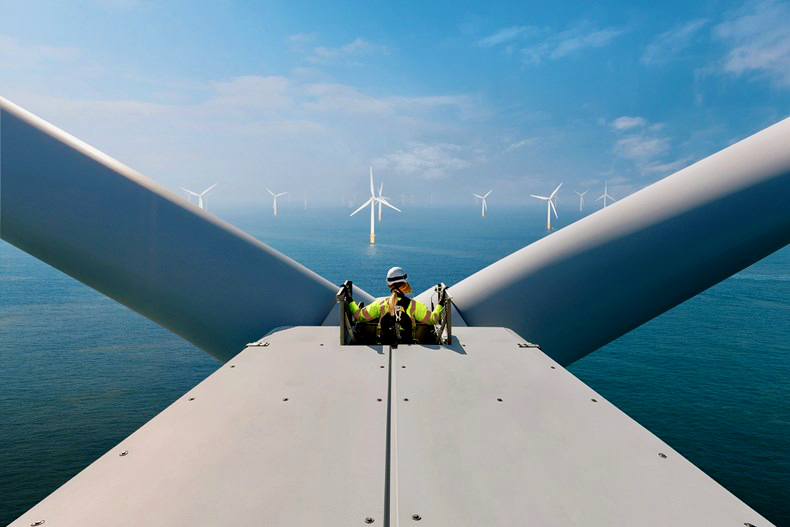
And here’s a little PS . . . Way back in January, before I had the idea to write about Rural Electrification in Ireland historically, I penned a post about how I saw Ireland very much at the forefront of harnessing wind power – all at sea. Here it is!

Walking with Stones – Your Christmas Present Solved!

If you live in West Cork, or if you love to visit it, your Christmas present dilemma is solved! Here comes Walking With Stones, the new book on West Cork archaeological sites written by David Myler.

David has been sharing his passion for West Cork antiquities in an online Facebook Page/blog which he called Walking with Stones. But even before that, he wrote An Archaeological Survey of the Mealagh Valley – a book we have had on our bookshelves for years and turned to often. 

Once we saw Walking With Stones pop up on our Facebook feed, we knew we had found a fellow traveller. We had to meet – and meet we did, along the way discovering many shared interests and even a relative in common. Our first meeting was a field trip where David showed us this stunning stone row in the Mealagh Valley.

On that same trip we saw my first ever Four-Poster Monument – they are very rare, with only four in West Cork – as well as a spectacularly-sited wedge tomb that David had discovered.

David’s book is a very welcome addition to our bookshelf. Perhaps I should declare right away that he asked me to write the Introduction and I was delighted to do so. Now that I finally have my own copy, I am thrilled to be associated with it, in this small way.

David’s favourite companions on his walks are his kids and one of the real strengths of this book is the sense that all these places can be enjoyed with family. Having young people along, with their curiosity, their need to really explore, and their chatter, brightens any walk. Just make sure you go equipped with food and bandaids. What follows are a few photos of joint field trips we have taken with them.
The only comparable book we can think of is Jack Roberts’ Exploring West Cork, first published in the 1980s and updated and re-published a couple of times. We treasure all of Jack’s books, especially for their marvellous black-and-white drawings, as accurate as they are charming.

While Jack tried to be fairly comprehensive in his coverage, David’s selection is personal – this does not pretend to be a gazetteer, but a guide and companion. Many of the sites have been chosen because they are accessible and can be enjoyed as part of a good walk through the countryside. Restricting the number of sites also allows David to write more about each one and use his own photographs to illustrate important features.

The best place to have David’s book is in your car, your bicycle carrier, or your backpack. You can buy it online here or here.  Look out for it in local bookstores, if you live in West Cork – David is doing the legwork now of getting copies to them.

Congratulations, David! Given that you work full time and have a family to look after, this is an amazing accomplishment and one we are all grateful for.

Yeats’ Day

Yeats country – Benbulben and Classiebawn Castle (above). Finola took this fine view seven years ago, when we set out to visit the haunts of William Butler Yeats. We have to turn to Yeats now, as it’s exactly one hundred years since he was awarded the Nobel Prize for Literature – in December, 1923. I have carried a place in my heart for Yeats, ever since I was at Primary School on the Hampshire/Surrey borders, not far from Thomas Hardy’s Wessex. Yeats and Hardy were rivals for the coveted award – the final vote in 1923 was between the two of them: in the end, only two Nobel committee members voted for Hardy, and Yeats achieved the prize. The Guardian newspaper said that “…Mr Yeats is to be congratulated, almost without reserve, on lifting this substantial stake. He is a poet of real greatness; prose, too, he can write like an angel…”, however then arguing that Thomas Hardy would have been a worthier recipient of the award!

The Irish press congratulates Yeats on his achievement (above – Irish Independent 29.11.1923). My schoolboy encounter with the poet must have been when I was around ten years old and we were tasked to learn The Lake Isle of Inisfree. I can still recite it, word for word, to this day, sixty seven years later. But it was far more than mere words for me, then. Our teacher – Mr Sharpe – was careful to explain that this man was cooped up in the city of London – on its “pavements grey” and was yearning for the countryside he loved:

I will arise and go now, and go to Innisfree,
And a small cabin build there, of clay and wattles made;
Nine bean-rows will I have there, a hive for the honey-bee,
And live alone in the bee-loud glade.

And I shall have some peace there, for peace comes dropping slow,
Dropping from the veils of the morning to where the cricket sings;
There midnight’s all a glimmer, and noon a purple glow,
And evening full of the linnet’s wings.

I will arise and go now, for always night and day
I hear lake water lapping with low sounds by the shore;
While I stand on the roadway, or on the pavements grey,
I hear it in the deep heart’s core.

Inisfree serves the poet’s romantic dreams of a remote idyllic landscape far away from the noisy metropolis. It does exist as a place – on Lough Gill in Co Sligo: Yeats spent childhood summers nearby. Interestingly, I searched the internet for pics of the island, and the above came up. It’s from a Roaringwater Journal Post which I wrote in 2016. And it’s not Inisfree, but another ‘lake island’ – just outside Skibbereen, in West Cork – Cloghan Castle Island on Lough Hyne: there’s a holy well nearby, and an 8th century church dedicated to St Brigid – but all that is another story. The diversion just serves to warn against trusting what you find online!

Thoor Ballylee Tower, Co Galway (above) – this 14th century tower house was described by Seamus Heaney, another Irish Nobel Literature prize winner, as The most important building in Ireland, because of its associations with Yeats, who spent many summers there with his family.

Here is the finely crafted cover of The Tower: a book of poems by W B Yeats, published in 1928 (courtesy Yeats Thoor Ballylee Society). The Tower was Yeats’s first major collection as Nobel Laureate after receiving the Nobel Prize in 1923. It is considered to be one of the poet’s most influential volumes and was well received by the public. (Below) a 1917 drawing by Robert Gregory – son of Isabella Augusta (Lady) Gregory and Sir William Gregory of Coole Park, Co Galway – of The Tower (courtesy Yeats Thoor Ballylee Society).

Going back to my early school years: I was an incurable romantic, and a daydreamer. I paid enough attention to lessons to get by, but my heart lay outside the school gates. Just minutes away were hop-fields and, beyond those, pastures, woodlands, streams – idyllic places where I loved to wander. I could completely relate to Yeat’s desire to be far away from the city, and that’s why his poem appealed to me. I knew very little about Ireland, and had no idea that was where I would one day make my home. I am here now, sitting at my desk, with the hills and oceans of Yeats’ own country beyond.

W B Yeats and his wife George Hyde-Lees heard the news that the Nobel Prize had been awarded to him on 14 November, 1923. The photograph above (courtesy Irish Independent) is said to be taken on that day. It’s also said that they celebrated by cooking sausages! The Irish Independent records: “Irish poet and senator, William Butler Yeats created history when he was awarded the Nobel Prize in Literature, the first Irish citizen to achieve such an accolade. The prize was awarded to Yeats ‘for his always inspired poetry, which in a highly artistic form gives expression to the spirit of a whole nation’.”

Somewhat surprised by the award, Yeats would later write in his (unpublished) autobiography: “Early in November (1923) a journalist called to show me a printed paragraph saying that the Nobel Prize would probably be conferred upon Herr Mann, the distinguished novelist, or upon myself, I did not know that the Swedish Academy had ever heard my name.” The news of the award was widely praised in Ireland with members of Dáil Éireann proudly announcing that it had placed Ireland on the international stage. It was a sentiment reiterated by the laureate himself, who at the awards ceremony claimed that the Nobel Prize was less for himself than for his country and called it Europe’s welcome to the Free State. In his presentation speech, Per Hallstrom, then chairman of the academy’s Nobel Committee, praised the poet’s ability to ‘follow the spirit that early appointed him the interpreter of his country, a country that had long waited for someone to bestow on it a voice’.

A portrait of Yeats painted by Augustus John OM RA in 1930 (courtesy Sothebys – private collection). Before Yeats passed away he requested that his final resting place be in Sligo. He died in Menton, France in 1939 aged 73 and was buried there. His wish was fulfilled in 1948 when his body was exhumed and buried in St Columba’s Church, Drumcliff. His headstone reads: